Adobe Photoshop Help
Last updated 11/5/2019
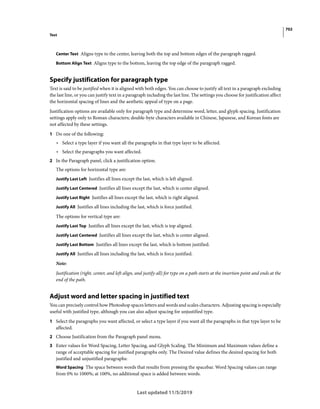
Legal notices
Legal notices
For legal notices, see http://help.adobe.com/en_US/legalnotices/index.html.
iii
Last updated 11/5/2019
Contents
Chapter 1: Introduction to Photoshop
What's new in Photoshop . . . . . . . . . . . . . . . . . . . . . . . . . . . . . . . . . . . . . . . . . . . . . . . . . . . . . . . . . . . . . . . . . . . . . . . . . . . . . . . . . . . . . . . . . . . . . . .1
Create documents . . . . . . . . . . . . . . . . . . . . . . . . . . . . . . . . . . . . . . . . . . . . . . . . . . . . . . . . . . . . . . . . . . . . . . . . . . . . . . . . . . . . . . . . . . . . . . . . . . . . . .7
Photoshop | Common Questions . . . . . . . . . . . . . . . . . . . . . . . . . . . . . . . . . . . . . . . . . . . . . . . . . . . . . . . . . . . . . . . . . . . . . . . . . . . . . . . . . . . . . . 16
Photoshop system requirements . . . . . . . . . . . . . . . . . . . . . . . . . . . . . . . . . . . . . . . . . . . . . . . . . . . . . . . . . . . . . . . . . . . . . . . . . . . . . . . . . . . . . . 18
Photoshop manual (PDF) . . . . . . . . . . . . . . . . . . . . . . . . . . . . . . . . . . . . . . . . . . . . . . . . . . . . . . . . . . . . . . . . . . . . . . . . . . . . . . . . . . . . . . . . . . . . . 21
Migrate presets, actions, and settings . . . . . . . . . . . . . . . . . . . . . . . . . . . . . . . . . . . . . . . . . . . . . . . . . . . . . . . . . . . . . . . . . . . . . . . . . . . . . . . . . 21
Chapter 2: Photoshop and Adobe services
Creative Cloud Libraries in Photoshop . . . . . . . . . . . . . . . . . . . . . . . . . . . . . . . . . . . . . . . . . . . . . . . . . . . . . . . . . . . . . . . . . . . . . . . . . . . . . . . . . 26
Use the Adobe Color Themes extension . . . . . . . . . . . . . . . . . . . . . . . . . . . . . . . . . . . . . . . . . . . . . . . . . . . . . . . . . . . . . . . . . . . . . . . . . . . . . . . 34
Touch capabilities and customizable workspaces . . . . . . . . . . . . . . . . . . . . . . . . . . . . . . . . . . . . . . . . . . . . . . . . . . . . . . . . . . . . . . . . . . . . . . 46
Error: Waiting for Bridge | Mini Bridge panel . . . . . . . . . . . . . . . . . . . . . . . . . . . . . . . . . . . . . . . . . . . . . . . . . . . . . . . . . . . . . . . . . . . . . . . . . . . 49
Untab image windows . . . . . . . . . . . . . . . . . . . . . . . . . . . . . . . . . . . . . . . . . . . . . . . . . . . . . . . . . . . . . . . . . . . . . . . . . . . . . . . . . . . . . . . . . . . . . . . . 51
Chapter 3: Photoshop on the iPad
Photoshop on the iPad | Common questions . . . . . . . . . . . . . . . . . . . . . . . . . . . . . . . . . . . . . . . . . . . . . . . . . . . . . . . . . . . . . . . . . . . . . . . . . . 53
Get to know the workspace . . . . . . . . . . . . . . . . . . . . . . . . . . . . . . . . . . . . . . . . . . . . . . . . . . . . . . . . . . . . . . . . . . . . . . . . . . . . . . . . . . . . . . . . . . . 60
System requirements | Photoshop on the iPad . . . . . . . . . . . . . . . . . . . . . . . . . . . . . . . . . . . . . . . . . . . . . . . . . . . . . . . . . . . . . . . . . . . . . . . . . 65
Add photos to your canvas . . . . . . . . . . . . . . . . . . . . . . . . . . . . . . . . . . . . . . . . . . . . . . . . . . . . . . . . . . . . . . . . . . . . . . . . . . . . . . . . . . . . . . . . . . . 67
Work with layers . . . . . . . . . . . . . . . . . . . . . . . . . . . . . . . . . . . . . . . . . . . . . . . . . . . . . . . . . . . . . . . . . . . . . . . . . . . . . . . . . . . . . . . . . . . . . . . . . . . . . . 69
Make selections and add masks . . . . . . . . . . . . . . . . . . . . . . . . . . . . . . . . . . . . . . . . . . . . . . . . . . . . . . . . . . . . . . . . . . . . . . . . . . . . . . . . . . . . . . . 74
Retouch your composites . . . . . . . . . . . . . . . . . . . . . . . . . . . . . . . . . . . . . . . . . . . . . . . . . . . . . . . . . . . . . . . . . . . . . . . . . . . . . . . . . . . . . . . . . . . . . 80
Draw and paint with brushes . . . . . . . . . . . . . . . . . . . . . . . . . . . . . . . . . . . . . . . . . . . . . . . . . . . . . . . . . . . . . . . . . . . . . . . . . . . . . . . . . . . . . . . . . 84
Apply transform operations . . . . . . . . . . . . . . . . . . . . . . . . . . . . . . . . . . . . . . . . . . . . . . . . . . . . . . . . . . . . . . . . . . . . . . . . . . . . . . . . . . . . . . . . . . . 88
Crop and rotate your composites . . . . . . . . . . . . . . . . . . . . . . . . . . . . . . . . . . . . . . . . . . . . . . . . . . . . . . . . . . . . . . . . . . . . . . . . . . . . . . . . . . . . . 90
Pan, zoom, and reset canvas . . . . . . . . . . . . . . . . . . . . . . . . . . . . . . . . . . . . . . . . . . . . . . . . . . . . . . . . . . . . . . . . . . . . . . . . . . . . . . . . . . . . . . . . . . 91
Work with Type layers . . . . . . . . . . . . . . . . . . . . . . . . . . . . . . . . . . . . . . . . . . . . . . . . . . . . . . . . . . . . . . . . . . . . . . . . . . . . . . . . . . . . . . . . . . . . . . . . 94
Japanese Text in Photoshop on the iPad . . . . . . . . . . . . . . . . . . . . . . . . . . . . . . . . . . . . . . . . . . . . . . . . . . . . . . . . . . . . . . . . . . . . . . . . . . . . . . . 99
Manage app settings . . . . . . . . . . . . . . . . . . . . . . . . . . . . . . . . . . . . . . . . . . . . . . . . . . . . . . . . . . . . . . . . . . . . . . . . . . . . . . . . . . . . . . . . . . . . . . . . . 99
Touch shortcuts and gestures . . . . . . . . . . . . . . . . . . . . . . . . . . . . . . . . . . . . . . . . . . . . . . . . . . . . . . . . . . . . . . . . . . . . . . . . . . . . . . . . . . . . . . . . 102
Keyboard shortcuts . . . . . . . . . . . . . . . . . . . . . . . . . . . . . . . . . . . . . . . . . . . . . . . . . . . . . . . . . . . . . . . . . . . . . . . . . . . . . . . . . . . . . . . . . . . . . . . . . 105
Chapter 4: Cloud documents
Photoshop cloud documents | Common questions . . . . . . . . . . . . . . . . . . . . . . . . . . . . . . . . . . . . . . . . . . . . . . . . . . . . . . . . . . . . . . . . . . . 108
Photoshop cloud documents | Workflow questions . . . . . . . . . . . . . . . . . . . . . . . . . . . . . . . . . . . . . . . . . . . . . . . . . . . . . . . . . . . . . . . . . . . 110
Create, open, and export cloud documents . . . . . . . . . . . . . . . . . . . . . . . . . . . . . . . . . . . . . . . . . . . . . . . . . . . . . . . . . . . . . . . . . . . . . . . . . . . 117
Manage and work with cloud documents in Photoshop . . . . . . . . . . . . . . . . . . . . . . . . . . . . . . . . . . . . . . . . . . . . . . . . . . . . . . . . . . . . . . 121
Get missing fonts in Photoshop on the iPad . . . . . . . . . . . . . . . . . . . . . . . . . . . . . . . . . . . . . . . . . . . . . . . . . . . . . . . . . . . . . . . . . . . . . . . . . . 128
Upgrade cloud storage for Photoshop . . . . . . . . . . . . . . . . . . . . . . . . . . . . . . . . . . . . . . . . . . . . . . . . . . . . . . . . . . . . . . . . . . . . . . . . . . . . . . . 129
Solve Photoshop cloud document errors . . . . . . . . . . . . . . . . . . . . . . . . . . . . . . . . . . . . . . . . . . . . . . . . . . . . . . . . . . . . . . . . . . . . . . . . . . . . . 130
iv
ADOBE PHOTOSHOP
Contents
Last updated 11/5/2019
Chapter 5: Workspace
Photoshop search . . . . . . . . . . . . . . . . . . . . . . . . . . . . . . . . . . . . . . . . . . . . . . . . . . . . . . . . . . . . . . . . . . . . . . . . . . . . . . . . . . . . . . . . . . . . . . . . . . . 135
Use the Touch Bar with Photoshop . . . . . . . . . . . . . . . . . . . . . . . . . . . . . . . . . . . . . . . . . . . . . . . . . . . . . . . . . . . . . . . . . . . . . . . . . . . . . . . . . . . 141
Microsoft Dial support in Photoshop . . . . . . . . . . . . . . . . . . . . . . . . . . . . . . . . . . . . . . . . . . . . . . . . . . . . . . . . . . . . . . . . . . . . . . . . . . . . . . . . . 145
Tool galleries . . . . . . . . . . . . . . . . . . . . . . . . . . . . . . . . . . . . . . . . . . . . . . . . . . . . . . . . . . . . . . . . . . . . . . . . . . . . . . . . . . . . . . . . . . . . . . . . . . . . . . . . 148
Performance preferences . . . . . . . . . . . . . . . . . . . . . . . . . . . . . . . . . . . . . . . . . . . . . . . . . . . . . . . . . . . . . . . . . . . . . . . . . . . . . . . . . . . . . . . . . . . . 155
Use tools . . . . . . . . . . . . . . . . . . . . . . . . . . . . . . . . . . . . . . . . . . . . . . . . . . . . . . . . . . . . . . . . . . . . . . . . . . . . . . . . . . . . . . . . . . . . . . . . . . . . . . . . . . . . 160
Touch gestures . . . . . . . . . . . . . . . . . . . . . . . . . . . . . . . . . . . . . . . . . . . . . . . . . . . . . . . . . . . . . . . . . . . . . . . . . . . . . . . . . . . . . . . . . . . . . . . . . . . . . . 164
Technology previews . . . . . . . . . . . . . . . . . . . . . . . . . . . . . . . . . . . . . . . . . . . . . . . . . . . . . . . . . . . . . . . . . . . . . . . . . . . . . . . . . . . . . . . . . . . . . . . . 164
Metadata and notes . . . . . . . . . . . . . . . . . . . . . . . . . . . . . . . . . . . . . . . . . . . . . . . . . . . . . . . . . . . . . . . . . . . . . . . . . . . . . . . . . . . . . . . . . . . . . . . . . 165
Quickly share your creations . . . . . . . . . . . . . . . . . . . . . . . . . . . . . . . . . . . . . . . . . . . . . . . . . . . . . . . . . . . . . . . . . . . . . . . . . . . . . . . . . . . . . . . . . 167
Place Photoshop images in other applications . . . . . . . . . . . . . . . . . . . . . . . . . . . . . . . . . . . . . . . . . . . . . . . . . . . . . . . . . . . . . . . . . . . . . . . . 169
Preferences . . . . . . . . . . . . . . . . . . . . . . . . . . . . . . . . . . . . . . . . . . . . . . . . . . . . . . . . . . . . . . . . . . . . . . . . . . . . . . . . . . . . . . . . . . . . . . . . . . . . . . . . . 172
Default keyboard shortcuts . . . . . . . . . . . . . . . . . . . . . . . . . . . . . . . . . . . . . . . . . . . . . . . . . . . . . . . . . . . . . . . . . . . . . . . . . . . . . . . . . . . . . . . . . . 174
Rulers . . . . . . . . . . . . . . . . . . . . . . . . . . . . . . . . . . . . . . . . . . . . . . . . . . . . . . . . . . . . . . . . . . . . . . . . . . . . . . . . . . . . . . . . . . . . . . . . . . . . . . . . . . . . . . . 196
Show or hide non-printing Extras . . . . . . . . . . . . . . . . . . . . . . . . . . . . . . . . . . . . . . . . . . . . . . . . . . . . . . . . . . . . . . . . . . . . . . . . . . . . . . . . . . . . 197
Specify columns for an image . . . . . . . . . . . . . . . . . . . . . . . . . . . . . . . . . . . . . . . . . . . . . . . . . . . . . . . . . . . . . . . . . . . . . . . . . . . . . . . . . . . . . . . . 198
Undo and history . . . . . . . . . . . . . . . . . . . . . . . . . . . . . . . . . . . . . . . . . . . . . . . . . . . . . . . . . . . . . . . . . . . . . . . . . . . . . . . . . . . . . . . . . . . . . . . . . . . . 198
Panels and menus . . . . . . . . . . . . . . . . . . . . . . . . . . . . . . . . . . . . . . . . . . . . . . . . . . . . . . . . . . . . . . . . . . . . . . . . . . . . . . . . . . . . . . . . . . . . . . . . . . . 204
Place files . . . . . . . . . . . . . . . . . . . . . . . . . . . . . . . . . . . . . . . . . . . . . . . . . . . . . . . . . . . . . . . . . . . . . . . . . . . . . . . . . . . . . . . . . . . . . . . . . . . . . . . . . . . 209
Position elements with snapping . . . . . . . . . . . . . . . . . . . . . . . . . . . . . . . . . . . . . . . . . . . . . . . . . . . . . . . . . . . . . . . . . . . . . . . . . . . . . . . . . . . . 211
Position with the Ruler tool . . . . . . . . . . . . . . . . . . . . . . . . . . . . . . . . . . . . . . . . . . . . . . . . . . . . . . . . . . . . . . . . . . . . . . . . . . . . . . . . . . . . . . . . . . 212
Presets . . . . . . . . . . . . . . . . . . . . . . . . . . . . . . . . . . . . . . . . . . . . . . . . . . . . . . . . . . . . . . . . . . . . . . . . . . . . . . . . . . . . . . . . . . . . . . . . . . . . . . . . . . . . . . 213
Customize keyboard shortcuts . . . . . . . . . . . . . . . . . . . . . . . . . . . . . . . . . . . . . . . . . . . . . . . . . . . . . . . . . . . . . . . . . . . . . . . . . . . . . . . . . . . . . . . 215
Grid and guides . . . . . . . . . . . . . . . . . . . . . . . . . . . . . . . . . . . . . . . . . . . . . . . . . . . . . . . . . . . . . . . . . . . . . . . . . . . . . . . . . . . . . . . . . . . . . . . . . . . . . 217
Chapter 6: Web, screen, and app design
Photoshop for design . . . . . . . . . . . . . . . . . . . . . . . . . . . . . . . . . . . . . . . . . . . . . . . . . . . . . . . . . . . . . . . . . . . . . . . . . . . . . . . . . . . . . . . . . . . . . . . . 222
Artboards . . . . . . . . . . . . . . . . . . . . . . . . . . . . . . . . . . . . . . . . . . . . . . . . . . . . . . . . . . . . . . . . . . . . . . . . . . . . . . . . . . . . . . . . . . . . . . . . . . . . . . . . . . 228
Device Preview . . . . . . . . . . . . . . . . . . . . . . . . . . . . . . . . . . . . . . . . . . . . . . . . . . . . . . . . . . . . . . . . . . . . . . . . . . . . . . . . . . . . . . . . . . . . . . . . . . . . . . 237
Slice web pages . . . . . . . . . . . . . . . . . . . . . . . . . . . . . . . . . . . . . . . . . . . . . . . . . . . . . . . . . . . . . . . . . . . . . . . . . . . . . . . . . . . . . . . . . . . . . . . . . . . . . 241
HTML options for slices . . . . . . . . . . . . . . . . . . . . . . . . . . . . . . . . . . . . . . . . . . . . . . . . . . . . . . . . . . . . . . . . . . . . . . . . . . . . . . . . . . . . . . . . . . . . . . 244
Modify slice layout . . . . . . . . . . . . . . . . . . . . . . . . . . . . . . . . . . . . . . . . . . . . . . . . . . . . . . . . . . . . . . . . . . . . . . . . . . . . . . . . . . . . . . . . . . . . . . . . . . 247
Work with web graphics . . . . . . . . . . . . . . . . . . . . . . . . . . . . . . . . . . . . . . . . . . . . . . . . . . . . . . . . . . . . . . . . . . . . . . . . . . . . . . . . . . . . . . . . . . . . . 251
Create web photo galleries . . . . . . . . . . . . . . . . . . . . . . . . . . . . . . . . . . . . . . . . . . . . . . . . . . . . . . . . . . . . . . . . . . . . . . . . . . . . . . . . . . . . . . . . . . 252
Chapter 7: Image and color basics
How to resize images . . . . . . . . . . . . . . . . . . . . . . . . . . . . . . . . . . . . . . . . . . . . . . . . . . . . . . . . . . . . . . . . . . . . . . . . . . . . . . . . . . . . . . . . . . . . . . . . 260
Video | Resizing images in Photoshop . . . . . . . . . . . . . . . . . . . . . . . . . . . . . . . . . . . . . . . . . . . . . . . . . . . . . . . . . . . . . . . . . . . . . . . . . . . . . . . . 260
Image essentials . . . . . . . . . . . . . . . . . . . . . . . . . . . . . . . . . . . . . . . . . . . . . . . . . . . . . . . . . . . . . . . . . . . . . . . . . . . . . . . . . . . . . . . . . . . . . . . . . . . . . 262
Image size and resolution . . . . . . . . . . . . . . . . . . . . . . . . . . . . . . . . . . . . . . . . . . . . . . . . . . . . . . . . . . . . . . . . . . . . . . . . . . . . . . . . . . . . . . . . . . . . 264
Acquire images from cameras and scanners . . . . . . . . . . . . . . . . . . . . . . . . . . . . . . . . . . . . . . . . . . . . . . . . . . . . . . . . . . . . . . . . . . . . . . . . . . 271
Create, open, and import images . . . . . . . . . . . . . . . . . . . . . . . . . . . . . . . . . . . . . . . . . . . . . . . . . . . . . . . . . . . . . . . . . . . . . . . . . . . . . . . . . . . . 273
View images . . . . . . . . . . . . . . . . . . . . . . . . . . . . . . . . . . . . . . . . . . . . . . . . . . . . . . . . . . . . . . . . . . . . . . . . . . . . . . . . . . . . . . . . . . . . . . . . . . . . . . . . 278
Invalid JPEG Marker error | Opening images . . . . . . . . . . . . . . . . . . . . . . . . . . . . . . . . . . . . . . . . . . . . . . . . . . . . . . . . . . . . . . . . . . . . . . . . . . 283
Viewing multiple images . . . . . . . . . . . . . . . . . . . . . . . . . . . . . . . . . . . . . . . . . . . . . . . . . . . . . . . . . . . . . . . . . . . . . . . . . . . . . . . . . . . . . . . . . . . . 285
Customize color pickers and swatches . . . . . . . . . . . . . . . . . . . . . . . . . . . . . . . . . . . . . . . . . . . . . . . . . . . . . . . . . . . . . . . . . . . . . . . . . . . . . . . 286
v
ADOBE PHOTOSHOP
Contents
Last updated 11/5/2019
High dynamic range images . . . . . . . . . . . . . . . . . . . . . . . . . . . . . . . . . . . . . . . . . . . . . . . . . . . . . . . . . . . . . . . . . . . . . . . . . . . . . . . . . . . . . . . . . 288
Match, replace, and mix colors . . . . . . . . . . . . . . . . . . . . . . . . . . . . . . . . . . . . . . . . . . . . . . . . . . . . . . . . . . . . . . . . . . . . . . . . . . . . . . . . . . . . . . . 296
Convert between color modes . . . . . . . . . . . . . . . . . . . . . . . . . . . . . . . . . . . . . . . . . . . . . . . . . . . . . . . . . . . . . . . . . . . . . . . . . . . . . . . . . . . . . . . 302
Color modes . . . . . . . . . . . . . . . . . . . . . . . . . . . . . . . . . . . . . . . . . . . . . . . . . . . . . . . . . . . . . . . . . . . . . . . . . . . . . . . . . . . . . . . . . . . . . . . . . . . . . . . . 307
Erase parts of an image . . . . . . . . . . . . . . . . . . . . . . . . . . . . . . . . . . . . . . . . . . . . . . . . . . . . . . . . . . . . . . . . . . . . . . . . . . . . . . . . . . . . . . . . . . . . . . 309
Blending modes . . . . . . . . . . . . . . . . . . . . . . . . . . . . . . . . . . . . . . . . . . . . . . . . . . . . . . . . . . . . . . . . . . . . . . . . . . . . . . . . . . . . . . . . . . . . . . . . . . . . . 313
Choose colors . . . . . . . . . . . . . . . . . . . . . . . . . . . . . . . . . . . . . . . . . . . . . . . . . . . . . . . . . . . . . . . . . . . . . . . . . . . . . . . . . . . . . . . . . . . . . . . . . . . . . . . 317
Customize indexed color tables . . . . . . . . . . . . . . . . . . . . . . . . . . . . . . . . . . . . . . . . . . . . . . . . . . . . . . . . . . . . . . . . . . . . . . . . . . . . . . . . . . . . . . 324
Image information . . . . . . . . . . . . . . . . . . . . . . . . . . . . . . . . . . . . . . . . . . . . . . . . . . . . . . . . . . . . . . . . . . . . . . . . . . . . . . . . . . . . . . . . . . . . . . . . . . 325
Distort filters are unavailable . . . . . . . . . . . . . . . . . . . . . . . . . . . . . . . . . . . . . . . . . . . . . . . . . . . . . . . . . . . . . . . . . . . . . . . . . . . . . . . . . . . . . . . . . 329
About color . . . . . . . . . . . . . . . . . . . . . . . . . . . . . . . . . . . . . . . . . . . . . . . . . . . . . . . . . . . . . . . . . . . . . . . . . . . . . . . . . . . . . . . . . . . . . . . . . . . . . . . . . 329
Color and monochrome adjustments using channels . . . . . . . . . . . . . . . . . . . . . . . . . . . . . . . . . . . . . . . . . . . . . . . . . . . . . . . . . . . . . . . . . 331
Choose colors in the Color and Swatches panels . . . . . . . . . . . . . . . . . . . . . . . . . . . . . . . . . . . . . . . . . . . . . . . . . . . . . . . . . . . . . . . . . . . . . . 334
Sample . . . . . . . . . . . . . . . . . . . . . . . . . . . . . . . . . . . . . . . . . . . . . . . . . . . . . . . . . . . . . . . . . . . . . . . . . . . . . . . . . . . . . . . . . . . . . . . . . . . . . . . . . . . . . . 337
Color mode or Image mode . . . . . . . . . . . . . . . . . . . . . . . . . . . . . . . . . . . . . . . . . . . . . . . . . . . . . . . . . . . . . . . . . . . . . . . . . . . . . . . . . . . . . . . . . . 338
Color cast . . . . . . . . . . . . . . . . . . . . . . . . . . . . . . . . . . . . . . . . . . . . . . . . . . . . . . . . . . . . . . . . . . . . . . . . . . . . . . . . . . . . . . . . . . . . . . . . . . . . . . . . . . . 338
Add swatches from HTML CSS and SVG . . . . . . . . . . . . . . . . . . . . . . . . . . . . . . . . . . . . . . . . . . . . . . . . . . . . . . . . . . . . . . . . . . . . . . . . . . . . . . 339
Chapter 8: Layers
Layer basics . . . . . . . . . . . . . . . . . . . . . . . . . . . . . . . . . . . . . . . . . . . . . . . . . . . . . . . . . . . . . . . . . . . . . . . . . . . . . . . . . . . . . . . . . . . . . . . . . . . . . . . . . 340
Nondestructive editing . . . . . . . . . . . . . . . . . . . . . . . . . . . . . . . . . . . . . . . . . . . . . . . . . . . . . . . . . . . . . . . . . . . . . . . . . . . . . . . . . . . . . . . . . . . . . . 344
Create and manage layers and groups . . . . . . . . . . . . . . . . . . . . . . . . . . . . . . . . . . . . . . . . . . . . . . . . . . . . . . . . . . . . . . . . . . . . . . . . . . . . . . . 344
Select, group, and link layers . . . . . . . . . . . . . . . . . . . . . . . . . . . . . . . . . . . . . . . . . . . . . . . . . . . . . . . . . . . . . . . . . . . . . . . . . . . . . . . . . . . . . . . . . 348
Place images into frames . . . . . . . . . . . . . . . . . . . . . . . . . . . . . . . . . . . . . . . . . . . . . . . . . . . . . . . . . . . . . . . . . . . . . . . . . . . . . . . . . . . . . . . . . . . . 350
Layer opacity and blending . . . . . . . . . . . . . . . . . . . . . . . . . . . . . . . . . . . . . . . . . . . . . . . . . . . . . . . . . . . . . . . . . . . . . . . . . . . . . . . . . . . . . . . . . . 353
Mask layers . . . . . . . . . . . . . . . . . . . . . . . . . . . . . . . . . . . . . . . . . . . . . . . . . . . . . . . . . . . . . . . . . . . . . . . . . . . . . . . . . . . . . . . . . . . . . . . . . . . . . . . . . . 357
Video tutorial: Mask out part of an image . . . . . . . . . . . . . . . . . . . . . . . . . . . . . . . . . . . . . . . . . . . . . . . . . . . . . . . . . . . . . . . . . . . . . . . . . . . . . 357
Video tutorial: Remove a person from the background with masking . . . . . . . . . . . . . . . . . . . . . . . . . . . . . . . . . . . . . . . . . . . . . . . . . . 357
Apply Smart Filters . . . . . . . . . . . . . . . . . . . . . . . . . . . . . . . . . . . . . . . . . . . . . . . . . . . . . . . . . . . . . . . . . . . . . . . . . . . . . . . . . . . . . . . . . . . . . . . . . . 361
Video tutorial: Learn Photoshop Smart filters . . . . . . . . . . . . . . . . . . . . . . . . . . . . . . . . . . . . . . . . . . . . . . . . . . . . . . . . . . . . . . . . . . . . . . . . . 361
Layer comps . . . . . . . . . . . . . . . . . . . . . . . . . . . . . . . . . . . . . . . . . . . . . . . . . . . . . . . . . . . . . . . . . . . . . . . . . . . . . . . . . . . . . . . . . . . . . . . . . . . . . . . . 365
Move, stack, and lock layers . . . . . . . . . . . . . . . . . . . . . . . . . . . . . . . . . . . . . . . . . . . . . . . . . . . . . . . . . . . . . . . . . . . . . . . . . . . . . . . . . . . . . . . . . . 367
Mask layers with vector masks . . . . . . . . . . . . . . . . . . . . . . . . . . . . . . . . . . . . . . . . . . . . . . . . . . . . . . . . . . . . . . . . . . . . . . . . . . . . . . . . . . . . . . . 369
Manage layers and groups . . . . . . . . . . . . . . . . . . . . . . . . . . . . . . . . . . . . . . . . . . . . . . . . . . . . . . . . . . . . . . . . . . . . . . . . . . . . . . . . . . . . . . . . . . . 370
Layer effects and styles . . . . . . . . . . . . . . . . . . . . . . . . . . . . . . . . . . . . . . . . . . . . . . . . . . . . . . . . . . . . . . . . . . . . . . . . . . . . . . . . . . . . . . . . . . . . . . 373
How to use new Presets in Photoshop . . . . . . . . . . . . . . . . . . . . . . . . . . . . . . . . . . . . . . . . . . . . . . . . . . . . . . . . . . . . . . . . . . . . . . . . . . . . . . . . 374
Edit layer masks . . . . . . . . . . . . . . . . . . . . . . . . . . . . . . . . . . . . . . . . . . . . . . . . . . . . . . . . . . . . . . . . . . . . . . . . . . . . . . . . . . . . . . . . . . . . . . . . . . . . . 383
Extract assets . . . . . . . . . . . . . . . . . . . . . . . . . . . . . . . . . . . . . . . . . . . . . . . . . . . . . . . . . . . . . . . . . . . . . . . . . . . . . . . . . . . . . . . . . . . . . . . . . . . . . . . . 383
Reveal layers with clipping masks . . . . . . . . . . . . . . . . . . . . . . . . . . . . . . . . . . . . . . . . . . . . . . . . . . . . . . . . . . . . . . . . . . . . . . . . . . . . . . . . . . . . 386
Generate image assets from layers . . . . . . . . . . . . . . . . . . . . . . . . . . . . . . . . . . . . . . . . . . . . . . . . . . . . . . . . . . . . . . . . . . . . . . . . . . . . . . . . . . . 387
Video: Generate web assets in Photoshop . . . . . . . . . . . . . . . . . . . . . . . . . . . . . . . . . . . . . . . . . . . . . . . . . . . . . . . . . . . . . . . . . . . . . . . . . . . . 387
Work with Smart Objects . . . . . . . . . . . . . . . . . . . . . . . . . . . . . . . . . . . . . . . . . . . . . . . . . . . . . . . . . . . . . . . . . . . . . . . . . . . . . . . . . . . . . . . . . . . . 393
Combine multiple images into a group portrait . . . . . . . . . . . . . . . . . . . . . . . . . . . . . . . . . . . . . . . . . . . . . . . . . . . . . . . . . . . . . . . . . . . . . . . 400
Combine images with Auto-Blend Layers . . . . . . . . . . . . . . . . . . . . . . . . . . . . . . . . . . . . . . . . . . . . . . . . . . . . . . . . . . . . . . . . . . . . . . . . . . . . . 401
Align and distribute layers . . . . . . . . . . . . . . . . . . . . . . . . . . . . . . . . . . . . . . . . . . . . . . . . . . . . . . . . . . . . . . . . . . . . . . . . . . . . . . . . . . . . . . . . . . . 402
Copy CSS from layers . . . . . . . . . . . . . . . . . . . . . . . . . . . . . . . . . . . . . . . . . . . . . . . . . . . . . . . . . . . . . . . . . . . . . . . . . . . . . . . . . . . . . . . . . . . . . . . . 404
vi
ADOBE PHOTOSHOP
Contents
Last updated 11/5/2019
Load selections from a layer or layer mask's boundaries . . . . . . . . . . . . . . . . . . . . . . . . . . . . . . . . . . . . . . . . . . . . . . . . . . . . . . . . . . . . . . . 405
Knockout to reveal content from other layers . . . . . . . . . . . . . . . . . . . . . . . . . . . . . . . . . . . . . . . . . . . . . . . . . . . . . . . . . . . . . . . . . . . . . . . . . 406
Layer . . . . . . . . . . . . . . . . . . . . . . . . . . . . . . . . . . . . . . . . . . . . . . . . . . . . . . . . . . . . . . . . . . . . . . . . . . . . . . . . . . . . . . . . . . . . . . . . . . . . . . . . . . . . . . . . 407
Flattening . . . . . . . . . . . . . . . . . . . . . . . . . . . . . . . . . . . . . . . . . . . . . . . . . . . . . . . . . . . . . . . . . . . . . . . . . . . . . . . . . . . . . . . . . . . . . . . . . . . . . . . . . . . 408
Composite . . . . . . . . . . . . . . . . . . . . . . . . . . . . . . . . . . . . . . . . . . . . . . . . . . . . . . . . . . . . . . . . . . . . . . . . . . . . . . . . . . . . . . . . . . . . . . . . . . . . . . . . . . 408
Background . . . . . . . . . . . . . . . . . . . . . . . . . . . . . . . . . . . . . . . . . . . . . . . . . . . . . . . . . . . . . . . . . . . . . . . . . . . . . . . . . . . . . . . . . . . . . . . . . . . . . . . . . 409
Chapter 9: Selections
Select And Mask workspace . . . . . . . . . . . . . . . . . . . . . . . . . . . . . . . . . . . . . . . . . . . . . . . . . . . . . . . . . . . . . . . . . . . . . . . . . . . . . . . . . . . . . . . . . 411
Make quick selections . . . . . . . . . . . . . . . . . . . . . . . . . . . . . . . . . . . . . . . . . . . . . . . . . . . . . . . . . . . . . . . . . . . . . . . . . . . . . . . . . . . . . . . . . . . . . . . 416
Make selections . . . . . . . . . . . . . . . . . . . . . . . . . . . . . . . . . . . . . . . . . . . . . . . . . . . . . . . . . . . . . . . . . . . . . . . . . . . . . . . . . . . . . . . . . . . . . . . . . . . . . 421
Select with the marquee tools . . . . . . . . . . . . . . . . . . . . . . . . . . . . . . . . . . . . . . . . . . . . . . . . . . . . . . . . . . . . . . . . . . . . . . . . . . . . . . . . . . . . . . . 422
Video tutorial: Select part of an image . . . . . . . . . . . . . . . . . . . . . . . . . . . . . . . . . . . . . . . . . . . . . . . . . . . . . . . . . . . . . . . . . . . . . . . . . . . . . . . . 422
Select with the lasso tools . . . . . . . . . . . . . . . . . . . . . . . . . . . . . . . . . . . . . . . . . . . . . . . . . . . . . . . . . . . . . . . . . . . . . . . . . . . . . . . . . . . . . . . . . . . 424
Select a color range in an image . . . . . . . . . . . . . . . . . . . . . . . . . . . . . . . . . . . . . . . . . . . . . . . . . . . . . . . . . . . . . . . . . . . . . . . . . . . . . . . . . . . . . 426
Adjust pixel selections . . . . . . . . . . . . . . . . . . . . . . . . . . . . . . . . . . . . . . . . . . . . . . . . . . . . . . . . . . . . . . . . . . . . . . . . . . . . . . . . . . . . . . . . . . . . . . . 429
Extract an object from its background . . . . . . . . . . . . . . . . . . . . . . . . . . . . . . . . . . . . . . . . . . . . . . . . . . . . . . . . . . . . . . . . . . . . . . . . . . . . . . . . 436
Convert between paths and selection borders . . . . . . . . . . . . . . . . . . . . . . . . . . . . . . . . . . . . . . . . . . . . . . . . . . . . . . . . . . . . . . . . . . . . . . . . 436
Channel basics . . . . . . . . . . . . . . . . . . . . . . . . . . . . . . . . . . . . . . . . . . . . . . . . . . . . . . . . . . . . . . . . . . . . . . . . . . . . . . . . . . . . . . . . . . . . . . . . . . . . . . 437
Move, copy, and delete selected pixels . . . . . . . . . . . . . . . . . . . . . . . . . . . . . . . . . . . . . . . . . . . . . . . . . . . . . . . . . . . . . . . . . . . . . . . . . . . . . . . 440
Create a temporary quick mask . . . . . . . . . . . . . . . . . . . . . . . . . . . . . . . . . . . . . . . . . . . . . . . . . . . . . . . . . . . . . . . . . . . . . . . . . . . . . . . . . . . . . . 445
Save selections and alpha channel masks . . . . . . . . . . . . . . . . . . . . . . . . . . . . . . . . . . . . . . . . . . . . . . . . . . . . . . . . . . . . . . . . . . . . . . . . . . . . 447
Video tutorial: Mask out part of an image . . . . . . . . . . . . . . . . . . . . . . . . . . . . . . . . . . . . . . . . . . . . . . . . . . . . . . . . . . . . . . . . . . . . . . . . . . . . . 447
Select the image areas in focus . . . . . . . . . . . . . . . . . . . . . . . . . . . . . . . . . . . . . . . . . . . . . . . . . . . . . . . . . . . . . . . . . . . . . . . . . . . . . . . . . . . . . . 451
Duplicate, split, and merge channels . . . . . . . . . . . . . . . . . . . . . . . . . . . . . . . . . . . . . . . . . . . . . . . . . . . . . . . . . . . . . . . . . . . . . . . . . . . . . . . . . 453
Channel calculations . . . . . . . . . . . . . . . . . . . . . . . . . . . . . . . . . . . . . . . . . . . . . . . . . . . . . . . . . . . . . . . . . . . . . . . . . . . . . . . . . . . . . . . . . . . . . . . . 455
Selection . . . . . . . . . . . . . . . . . . . . . . . . . . . . . . . . . . . . . . . . . . . . . . . . . . . . . . . . . . . . . . . . . . . . . . . . . . . . . . . . . . . . . . . . . . . . . . . . . . . . . . . . . . . . 457
Bounding box . . . . . . . . . . . . . . . . . . . . . . . . . . . . . . . . . . . . . . . . . . . . . . . . . . . . . . . . . . . . . . . . . . . . . . . . . . . . . . . . . . . . . . . . . . . . . . . . . . . . . . . 458
Chapter 10: Image adjustments
Perspective warp . . . . . . . . . . . . . . . . . . . . . . . . . . . . . . . . . . . . . . . . . . . . . . . . . . . . . . . . . . . . . . . . . . . . . . . . . . . . . . . . . . . . . . . . . . . . . . . . . . . . 460
Reduce camera shake blurring . . . . . . . . . . . . . . . . . . . . . . . . . . . . . . . . . . . . . . . . . . . . . . . . . . . . . . . . . . . . . . . . . . . . . . . . . . . . . . . . . . . . . . . 468
Video | Using the camera shake reduction filter . . . . . . . . . . . . . . . . . . . . . . . . . . . . . . . . . . . . . . . . . . . . . . . . . . . . . . . . . . . . . . . . . . . . . . . 468
Healing brush examples . . . . . . . . . . . . . . . . . . . . . . . . . . . . . . . . . . . . . . . . . . . . . . . . . . . . . . . . . . . . . . . . . . . . . . . . . . . . . . . . . . . . . . . . . . . . . 475
Export color lookup tables . . . . . . . . . . . . . . . . . . . . . . . . . . . . . . . . . . . . . . . . . . . . . . . . . . . . . . . . . . . . . . . . . . . . . . . . . . . . . . . . . . . . . . . . . . . 502
Adjust image sharpness and blur . . . . . . . . . . . . . . . . . . . . . . . . . . . . . . . . . . . . . . . . . . . . . . . . . . . . . . . . . . . . . . . . . . . . . . . . . . . . . . . . . . . . 503
Video | Sharpening in Photoshop . . . . . . . . . . . . . . . . . . . . . . . . . . . . . . . . . . . . . . . . . . . . . . . . . . . . . . . . . . . . . . . . . . . . . . . . . . . . . . . . . . . . 503
Video | Selective focus in Photoshop . . . . . . . . . . . . . . . . . . . . . . . . . . . . . . . . . . . . . . . . . . . . . . . . . . . . . . . . . . . . . . . . . . . . . . . . . . . . . . . . . 503
Understand color adjustments . . . . . . . . . . . . . . . . . . . . . . . . . . . . . . . . . . . . . . . . . . . . . . . . . . . . . . . . . . . . . . . . . . . . . . . . . . . . . . . . . . . . . . . 509
Apply a Brightness/Contrast adjustment . . . . . . . . . . . . . . . . . . . . . . . . . . . . . . . . . . . . . . . . . . . . . . . . . . . . . . . . . . . . . . . . . . . . . . . . . . . . . 515
Adjust shadow and highlight detail . . . . . . . . . . . . . . . . . . . . . . . . . . . . . . . . . . . . . . . . . . . . . . . . . . . . . . . . . . . . . . . . . . . . . . . . . . . . . . . . . . 516
From an expert: Shadows/Highlights . . . . . . . . . . . . . . . . . . . . . . . . . . . . . . . . . . . . . . . . . . . . . . . . . . . . . . . . . . . . . . . . . . . . . . . . . . . . . . . . . 516
Levels adjustment . . . . . . . . . . . . . . . . . . . . . . . . . . . . . . . . . . . . . . . . . . . . . . . . . . . . . . . . . . . . . . . . . . . . . . . . . . . . . . . . . . . . . . . . . . . . . . . . . . . 518
Adjust hue and saturation . . . . . . . . . . . . . . . . . . . . . . . . . . . . . . . . . . . . . . . . . . . . . . . . . . . . . . . . . . . . . . . . . . . . . . . . . . . . . . . . . . . . . . . . . . . 521
Make quick tonal adjustments . . . . . . . . . . . . . . . . . . . . . . . . . . . . . . . . . . . . . . . . . . . . . . . . . . . . . . . . . . . . . . . . . . . . . . . . . . . . . . . . . . . . . . . 525
Apply special color effects to images . . . . . . . . . . . . . . . . . . . . . . . . . . . . . . . . . . . . . . . . . . . . . . . . . . . . . . . . . . . . . . . . . . . . . . . . . . . . . . . . . 528
Apply the Color Balance adjustment . . . . . . . . . . . . . . . . . . . . . . . . . . . . . . . . . . . . . . . . . . . . . . . . . . . . . . . . . . . . . . . . . . . . . . . . . . . . . . . . . 530
vii
ADOBE PHOTOSHOP
Contents
Last updated 11/5/2019
View histograms and pixel values . . . . . . . . . . . . . . . . . . . . . . . . . . . . . . . . . . . . . . . . . . . . . . . . . . . . . . . . . . . . . . . . . . . . . . . . . . . . . . . . . . . . 532
Convert a color image to black and white . . . . . . . . . . . . . . . . . . . . . . . . . . . . . . . . . . . . . . . . . . . . . . . . . . . . . . . . . . . . . . . . . . . . . . . . . . . . 537
Video tutorial: Creative black and white . . . . . . . . . . . . . . . . . . . . . . . . . . . . . . . . . . . . . . . . . . . . . . . . . . . . . . . . . . . . . . . . . . . . . . . . . . . . . . 538
Video | Black and White adjustment layer . . . . . . . . . . . . . . . . . . . . . . . . . . . . . . . . . . . . . . . . . . . . . . . . . . . . . . . . . . . . . . . . . . . . . . . . . . . . . 538
Adjustment and fill layers . . . . . . . . . . . . . . . . . . . . . . . . . . . . . . . . . . . . . . . . . . . . . . . . . . . . . . . . . . . . . . . . . . . . . . . . . . . . . . . . . . . . . . . . . . . . 538
Curves adjustment . . . . . . . . . . . . . . . . . . . . . . . . . . . . . . . . . . . . . . . . . . . . . . . . . . . . . . . . . . . . . . . . . . . . . . . . . . . . . . . . . . . . . . . . . . . . . . . . . . 542
Target images for press . . . . . . . . . . . . . . . . . . . . . . . . . . . . . . . . . . . . . . . . . . . . . . . . . . . . . . . . . . . . . . . . . . . . . . . . . . . . . . . . . . . . . . . . . . . . . . 546
Adjust color and tone with Levels and Curves eyedroppers . . . . . . . . . . . . . . . . . . . . . . . . . . . . . . . . . . . . . . . . . . . . . . . . . . . . . . . . . . . 549
Adjust HDR exposure and toning . . . . . . . . . . . . . . . . . . . . . . . . . . . . . . . . . . . . . . . . . . . . . . . . . . . . . . . . . . . . . . . . . . . . . . . . . . . . . . . . . . . . 550
Filter . . . . . . . . . . . . . . . . . . . . . . . . . . . . . . . . . . . . . . . . . . . . . . . . . . . . . . . . . . . . . . . . . . . . . . . . . . . . . . . . . . . . . . . . . . . . . . . . . . . . . . . . . . . . . . . . 551
Blur . . . . . . . . . . . . . . . . . . . . . . . . . . . . . . . . . . . . . . . . . . . . . . . . . . . . . . . . . . . . . . . . . . . . . . . . . . . . . . . . . . . . . . . . . . . . . . . . . . . . . . . . . . . . . . . . . 552
Dodge or burn image areas . . . . . . . . . . . . . . . . . . . . . . . . . . . . . . . . . . . . . . . . . . . . . . . . . . . . . . . . . . . . . . . . . . . . . . . . . . . . . . . . . . . . . . . . . . 552
Chapter 11: Adobe Camera Raw
Chapter 12: Image repair and restoration
Remove objects from your photos with Content-Aware Fill . . . . . . . . . . . . . . . . . . . . . . . . . . . . . . . . . . . . . . . . . . . . . . . . . . . . . . . . . . . 555
Content-Aware Patch and Move . . . . . . . . . . . . . . . . . . . . . . . . . . . . . . . . . . . . . . . . . . . . . . . . . . . . . . . . . . . . . . . . . . . . . . . . . . . . . . . . . . . . . . 560
Retouch and repair photos . . . . . . . . . . . . . . . . . . . . . . . . . . . . . . . . . . . . . . . . . . . . . . . . . . . . . . . . . . . . . . . . . . . . . . . . . . . . . . . . . . . . . . . . . . 561
Correct image distortion and noise . . . . . . . . . . . . . . . . . . . . . . . . . . . . . . . . . . . . . . . . . . . . . . . . . . . . . . . . . . . . . . . . . . . . . . . . . . . . . . . . . . 569
Chapter 13: Image transformations
Transform objects . . . . . . . . . . . . . . . . . . . . . . . . . . . . . . . . . . . . . . . . . . . . . . . . . . . . . . . . . . . . . . . . . . . . . . . . . . . . . . . . . . . . . . . . . . . . . . . . . . . 574
Adjust crop, rotation, and canvas size . . . . . . . . . . . . . . . . . . . . . . . . . . . . . . . . . . . . . . . . . . . . . . . . . . . . . . . . . . . . . . . . . . . . . . . . . . . . . . . . 578
Video | Cropping and straightening photos . . . . . . . . . . . . . . . . . . . . . . . . . . . . . . . . . . . . . . . . . . . . . . . . . . . . . . . . . . . . . . . . . . . . . . . . . . . 578
How to crop and straighten photos . . . . . . . . . . . . . . . . . . . . . . . . . . . . . . . . . . . . . . . . . . . . . . . . . . . . . . . . . . . . . . . . . . . . . . . . . . . . . . . . . . 582
Create and edit panoramic images . . . . . . . . . . . . . . . . . . . . . . . . . . . . . . . . . . . . . . . . . . . . . . . . . . . . . . . . . . . . . . . . . . . . . . . . . . . . . . . . . . . 585
Warp images, shapes, and paths . . . . . . . . . . . . . . . . . . . . . . . . . . . . . . . . . . . . . . . . . . . . . . . . . . . . . . . . . . . . . . . . . . . . . . . . . . . . . . . . . . . . . 590
Vanishing Point . . . . . . . . . . . . . . . . . . . . . . . . . . . . . . . . . . . . . . . . . . . . . . . . . . . . . . . . . . . . . . . . . . . . . . . . . . . . . . . . . . . . . . . . . . . . . . . . . . . . . 594
Content-aware scaling . . . . . . . . . . . . . . . . . . . . . . . . . . . . . . . . . . . . . . . . . . . . . . . . . . . . . . . . . . . . . . . . . . . . . . . . . . . . . . . . . . . . . . . . . . . . . . . 609
Transform images, shapes, and paths . . . . . . . . . . . . . . . . . . . . . . . . . . . . . . . . . . . . . . . . . . . . . . . . . . . . . . . . . . . . . . . . . . . . . . . . . . . . . . . . 610
Warp . . . . . . . . . . . . . . . . . . . . . . . . . . . . . . . . . . . . . . . . . . . . . . . . . . . . . . . . . . . . . . . . . . . . . . . . . . . . . . . . . . . . . . . . . . . . . . . . . . . . . . . . . . . . . . . . 612
Transform . . . . . . . . . . . . . . . . . . . . . . . . . . . . . . . . . . . . . . . . . . . . . . . . . . . . . . . . . . . . . . . . . . . . . . . . . . . . . . . . . . . . . . . . . . . . . . . . . . . . . . . . . . . 613
Panorama . . . . . . . . . . . . . . . . . . . . . . . . . . . . . . . . . . . . . . . . . . . . . . . . . . . . . . . . . . . . . . . . . . . . . . . . . . . . . . . . . . . . . . . . . . . . . . . . . . . . . . . . . . . 613
Chapter 14: Drawing and painting
Paint symmetrical patterns . . . . . . . . . . . . . . . . . . . . . . . . . . . . . . . . . . . . . . . . . . . . . . . . . . . . . . . . . . . . . . . . . . . . . . . . . . . . . . . . . . . . . . . . . . 615
Modify shapes . . . . . . . . . . . . . . . . . . . . . . . . . . . . . . . . . . . . . . . . . . . . . . . . . . . . . . . . . . . . . . . . . . . . . . . . . . . . . . . . . . . . . . . . . . . . . . . . . . . . . . . 619
About drawing . . . . . . . . . . . . . . . . . . . . . . . . . . . . . . . . . . . . . . . . . . . . . . . . . . . . . . . . . . . . . . . . . . . . . . . . . . . . . . . . . . . . . . . . . . . . . . . . . . . . . . 620
Draw shapes . . . . . . . . . . . . . . . . . . . . . . . . . . . . . . . . . . . . . . . . . . . . . . . . . . . . . . . . . . . . . . . . . . . . . . . . . . . . . . . . . . . . . . . . . . . . . . . . . . . . . . . . 621
Painting tools . . . . . . . . . . . . . . . . . . . . . . . . . . . . . . . . . . . . . . . . . . . . . . . . . . . . . . . . . . . . . . . . . . . . . . . . . . . . . . . . . . . . . . . . . . . . . . . . . . . . . . . 626
Create and modify brushes . . . . . . . . . . . . . . . . . . . . . . . . . . . . . . . . . . . . . . . . . . . . . . . . . . . . . . . . . . . . . . . . . . . . . . . . . . . . . . . . . . . . . . . . . . 629
Add color to paths . . . . . . . . . . . . . . . . . . . . . . . . . . . . . . . . . . . . . . . . . . . . . . . . . . . . . . . . . . . . . . . . . . . . . . . . . . . . . . . . . . . . . . . . . . . . . . . . . . 640
Edit paths . . . . . . . . . . . . . . . . . . . . . . . . . . . . . . . . . . . . . . . . . . . . . . . . . . . . . . . . . . . . . . . . . . . . . . . . . . . . . . . . . . . . . . . . . . . . . . . . . . . . . . . . . . . 642
Paint with the Mixer Brush . . . . . . . . . . . . . . . . . . . . . . . . . . . . . . . . . . . . . . . . . . . . . . . . . . . . . . . . . . . . . . . . . . . . . . . . . . . . . . . . . . . . . . . . . . . 651
Brush presets . . . . . . . . . . . . . . . . . . . . . . . . . . . . . . . . . . . . . . . . . . . . . . . . . . . . . . . . . . . . . . . . . . . . . . . . . . . . . . . . . . . . . . . . . . . . . . . . . . . . . . . . 654
Gradients . . . . . . . . . . . . . . . . . . . . . . . . . . . . . . . . . . . . . . . . . . . . . . . . . . . . . . . . . . . . . . . . . . . . . . . . . . . . . . . . . . . . . . . . . . . . . . . . . . . . . . . . . . . 657
Fill and stroke selections, layers, and paths . . . . . . . . . . . . . . . . . . . . . . . . . . . . . . . . . . . . . . . . . . . . . . . . . . . . . . . . . . . . . . . . . . . . . . . . . . . 663
viii
ADOBE PHOTOSHOP
Contents
Last updated 11/5/2019
Draw with the Pen tools . . . . . . . . . . . . . . . . . . . . . . . . . . . . . . . . . . . . . . . . . . . . . . . . . . . . . . . . . . . . . . . . . . . . . . . . . . . . . . . . . . . . . . . . . . . . . 666
Create patterns . . . . . . . . . . . . . . . . . . . . . . . . . . . . . . . . . . . . . . . . . . . . . . . . . . . . . . . . . . . . . . . . . . . . . . . . . . . . . . . . . . . . . . . . . . . . . . . . . . . . . . 679
Generate a pattern using the Pattern Maker . . . . . . . . . . . . . . . . . . . . . . . . . . . . . . . . . . . . . . . . . . . . . . . . . . . . . . . . . . . . . . . . . . . . . . . . . . 679
Manage paths . . . . . . . . . . . . . . . . . . . . . . . . . . . . . . . . . . . . . . . . . . . . . . . . . . . . . . . . . . . . . . . . . . . . . . . . . . . . . . . . . . . . . . . . . . . . . . . . . . . . . . 681
Manage pattern libraries and presets . . . . . . . . . . . . . . . . . . . . . . . . . . . . . . . . . . . . . . . . . . . . . . . . . . . . . . . . . . . . . . . . . . . . . . . . . . . . . . . . . 683
Draw or paint with a graphics tablet . . . . . . . . . . . . . . . . . . . . . . . . . . . . . . . . . . . . . . . . . . . . . . . . . . . . . . . . . . . . . . . . . . . . . . . . . . . . . . . . . 685
Create textured brushes . . . . . . . . . . . . . . . . . . . . . . . . . . . . . . . . . . . . . . . . . . . . . . . . . . . . . . . . . . . . . . . . . . . . . . . . . . . . . . . . . . . . . . . . . . . . . 685
Add dynamic elements to brushes . . . . . . . . . . . . . . . . . . . . . . . . . . . . . . . . . . . . . . . . . . . . . . . . . . . . . . . . . . . . . . . . . . . . . . . . . . . . . . . . . . . 687
Gradient . . . . . . . . . . . . . . . . . . . . . . . . . . . . . . . . . . . . . . . . . . . . . . . . . . . . . . . . . . . . . . . . . . . . . . . . . . . . . . . . . . . . . . . . . . . . . . . . . . . . . . . . . . . . 690
Paint stylized strokes with the Art History Brush . . . . . . . . . . . . . . . . . . . . . . . . . . . . . . . . . . . . . . . . . . . . . . . . . . . . . . . . . . . . . . . . . . . . . . 691
Paint with a pattern . . . . . . . . . . . . . . . . . . . . . . . . . . . . . . . . . . . . . . . . . . . . . . . . . . . . . . . . . . . . . . . . . . . . . . . . . . . . . . . . . . . . . . . . . . . . . . . . . 692
Chapter 15: Text
Work with OpenType SVG fonts . . . . . . . . . . . . . . . . . . . . . . . . . . . . . . . . . . . . . . . . . . . . . . . . . . . . . . . . . . . . . . . . . . . . . . . . . . . . . . . . . . . . . . 693
Format characters . . . . . . . . . . . . . . . . . . . . . . . . . . . . . . . . . . . . . . . . . . . . . . . . . . . . . . . . . . . . . . . . . . . . . . . . . . . . . . . . . . . . . . . . . . . . . . . . . . . 695
Format paragraphs . . . . . . . . . . . . . . . . . . . . . . . . . . . . . . . . . . . . . . . . . . . . . . . . . . . . . . . . . . . . . . . . . . . . . . . . . . . . . . . . . . . . . . . . . . . . . . . . . . 700
How to create type effects . . . . . . . . . . . . . . . . . . . . . . . . . . . . . . . . . . . . . . . . . . . . . . . . . . . . . . . . . . . . . . . . . . . . . . . . . . . . . . . . . . . . . . . . . . . 706
Edit text . . . . . . . . . . . . . . . . . . . . . . . . . . . . . . . . . . . . . . . . . . . . . . . . . . . . . . . . . . . . . . . . . . . . . . . . . . . . . . . . . . . . . . . . . . . . . . . . . . . . . . . . . . . . . 711
Line and character spacing . . . . . . . . . . . . . . . . . . . . . . . . . . . . . . . . . . . . . . . . . . . . . . . . . . . . . . . . . . . . . . . . . . . . . . . . . . . . . . . . . . . . . . . . . . 716
Arabic and Hebrew type . . . . . . . . . . . . . . . . . . . . . . . . . . . . . . . . . . . . . . . . . . . . . . . . . . . . . . . . . . . . . . . . . . . . . . . . . . . . . . . . . . . . . . . . . . . . . 719
How to access Arabic and Hebrew features in Photoshop . . . . . . . . . . . . . . . . . . . . . . . . . . . . . . . . . . . . . . . . . . . . . . . . . . . . . . . . . . . . . 719
Fonts . . . . . . . . . . . . . . . . . . . . . . . . . . . . . . . . . . . . . . . . . . . . . . . . . . . . . . . . . . . . . . . . . . . . . . . . . . . . . . . . . . . . . . . . . . . . . . . . . . . . . . . . . . . . . . . 722
Troubleshoot fonts . . . . . . . . . . . . . . . . . . . . . . . . . . . . . . . . . . . . . . . . . . . . . . . . . . . . . . . . . . . . . . . . . . . . . . . . . . . . . . . . . . . . . . . . . . . . . . . . . . 730
Asian type . . . . . . . . . . . . . . . . . . . . . . . . . . . . . . . . . . . . . . . . . . . . . . . . . . . . . . . . . . . . . . . . . . . . . . . . . . . . . . . . . . . . . . . . . . . . . . . . . . . . . . . . . . . 733
Create type . . . . . . . . . . . . . . . . . . . . . . . . . . . . . . . . . . . . . . . . . . . . . . . . . . . . . . . . . . . . . . . . . . . . . . . . . . . . . . . . . . . . . . . . . . . . . . . . . . . . . . . . . . 740
Text Engine error using Type tool in Photoshop | Windows 8 . . . . . . . . . . . . . . . . . . . . . . . . . . . . . . . . . . . . . . . . . . . . . . . . . . . . . . . . . . 743
World-Ready composer for Asian Scripts . . . . . . . . . . . . . . . . . . . . . . . . . . . . . . . . . . . . . . . . . . . . . . . . . . . . . . . . . . . . . . . . . . . . . . . . . . . . . 744
Chapter 16: Video and animation
Video editing in Photoshop . . . . . . . . . . . . . . . . . . . . . . . . . . . . . . . . . . . . . . . . . . . . . . . . . . . . . . . . . . . . . . . . . . . . . . . . . . . . . . . . . . . . . . . . . . 748
Video | Walk through a video project . . . . . . . . . . . . . . . . . . . . . . . . . . . . . . . . . . . . . . . . . . . . . . . . . . . . . . . . . . . . . . . . . . . . . . . . . . . . . . . . . 748
Edit video and animation layers . . . . . . . . . . . . . . . . . . . . . . . . . . . . . . . . . . . . . . . . . . . . . . . . . . . . . . . . . . . . . . . . . . . . . . . . . . . . . . . . . . . . . . 750
Video and animation overview . . . . . . . . . . . . . . . . . . . . . . . . . . . . . . . . . . . . . . . . . . . . . . . . . . . . . . . . . . . . . . . . . . . . . . . . . . . . . . . . . . . . . . . 754
Preview video and animations . . . . . . . . . . . . . . . . . . . . . . . . . . . . . . . . . . . . . . . . . . . . . . . . . . . . . . . . . . . . . . . . . . . . . . . . . . . . . . . . . . . . . . . 760
Paint frames in video layers . . . . . . . . . . . . . . . . . . . . . . . . . . . . . . . . . . . . . . . . . . . . . . . . . . . . . . . . . . . . . . . . . . . . . . . . . . . . . . . . . . . . . . . . . . 763
Import video files and image sequences . . . . . . . . . . . . . . . . . . . . . . . . . . . . . . . . . . . . . . . . . . . . . . . . . . . . . . . . . . . . . . . . . . . . . . . . . . . . . 765
Create frame animations . . . . . . . . . . . . . . . . . . . . . . . . . . . . . . . . . . . . . . . . . . . . . . . . . . . . . . . . . . . . . . . . . . . . . . . . . . . . . . . . . . . . . . . . . . . . . 768
Create timeline animations . . . . . . . . . . . . . . . . . . . . . . . . . . . . . . . . . . . . . . . . . . . . . . . . . . . . . . . . . . . . . . . . . . . . . . . . . . . . . . . . . . . . . . . . . . 775
Create images for video . . . . . . . . . . . . . . . . . . . . . . . . . . . . . . . . . . . . . . . . . . . . . . . . . . . . . . . . . . . . . . . . . . . . . . . . . . . . . . . . . . . . . . . . . . . . . 781
Chapter 17: Filters and effects
Use the Blur Gallery . . . . . . . . . . . . . . . . . . . . . . . . . . . . . . . . . . . . . . . . . . . . . . . . . . . . . . . . . . . . . . . . . . . . . . . . . . . . . . . . . . . . . . . . . . . . . . . . . 787
Filter basics . . . . . . . . . . . . . . . . . . . . . . . . . . . . . . . . . . . . . . . . . . . . . . . . . . . . . . . . . . . . . . . . . . . . . . . . . . . . . . . . . . . . . . . . . . . . . . . . . . . . . . . . . 796
Filter effects reference . . . . . . . . . . . . . . . . . . . . . . . . . . . . . . . . . . . . . . . . . . . . . . . . . . . . . . . . . . . . . . . . . . . . . . . . . . . . . . . . . . . . . . . . . . . . . . . 800
Add Lighting Effects . . . . . . . . . . . . . . . . . . . . . . . . . . . . . . . . . . . . . . . . . . . . . . . . . . . . . . . . . . . . . . . . . . . . . . . . . . . . . . . . . . . . . . . . . . . . . . . . . 810
Use the Adaptive Wide Angle filter . . . . . . . . . . . . . . . . . . . . . . . . . . . . . . . . . . . . . . . . . . . . . . . . . . . . . . . . . . . . . . . . . . . . . . . . . . . . . . . . . . . 814
From an expert: Adaptive wide angle filter . . . . . . . . . . . . . . . . . . . . . . . . . . . . . . . . . . . . . . . . . . . . . . . . . . . . . . . . . . . . . . . . . . . . . . . . . . . 814
ix
ADOBE PHOTOSHOP
Contents
Last updated 11/5/2019
Use the Oil Paint filter . . . . . . . . . . . . . . . . . . . . . . . . . . . . . . . . . . . . . . . . . . . . . . . . . . . . . . . . . . . . . . . . . . . . . . . . . . . . . . . . . . . . . . . . . . . . . . . . 815
Apply specific filters . . . . . . . . . . . . . . . . . . . . . . . . . . . . . . . . . . . . . . . . . . . . . . . . . . . . . . . . . . . . . . . . . . . . . . . . . . . . . . . . . . . . . . . . . . . . . . . . . 817
Smudge image areas . . . . . . . . . . . . . . . . . . . . . . . . . . . . . . . . . . . . . . . . . . . . . . . . . . . . . . . . . . . . . . . . . . . . . . . . . . . . . . . . . . . . . . . . . . . . . . . . 820
Chapter 18: Saving and exporting
Supported file formats . . . . . . . . . . . . . . . . . . . . . . . . . . . . . . . . . . . . . . . . . . . . . . . . . . . . . . . . . . . . . . . . . . . . . . . . . . . . . . . . . . . . . . . . . . . . . . . 821
Save files in graphics formats . . . . . . . . . . . . . . . . . . . . . . . . . . . . . . . . . . . . . . . . . . . . . . . . . . . . . . . . . . . . . . . . . . . . . . . . . . . . . . . . . . . . . . . . 823
Save images . . . . . . . . . . . . . . . . . . . . . . . . . . . . . . . . . . . . . . . . . . . . . . . . . . . . . . . . . . . . . . . . . . . . . . . . . . . . . . . . . . . . . . . . . . . . . . . . . . . . . . . . . 828
File formats . . . . . . . . . . . . . . . . . . . . . . . . . . . . . . . . . . . . . . . . . . . . . . . . . . . . . . . . . . . . . . . . . . . . . . . . . . . . . . . . . . . . . . . . . . . . . . . . . . . . . . . . . 830
Save and export video and animations . . . . . . . . . . . . . . . . . . . . . . . . . . . . . . . . . . . . . . . . . . . . . . . . . . . . . . . . . . . . . . . . . . . . . . . . . . . . . . . 837
Save PDF files . . . . . . . . . . . . . . . . . . . . . . . . . . . . . . . . . . . . . . . . . . . . . . . . . . . . . . . . . . . . . . . . . . . . . . . . . . . . . . . . . . . . . . . . . . . . . . . . . . . . . . . 844
Digimarc copyright protection . . . . . . . . . . . . . . . . . . . . . . . . . . . . . . . . . . . . . . . . . . . . . . . . . . . . . . . . . . . . . . . . . . . . . . . . . . . . . . . . . . . . . . . 852
Supported file formats . . . . . . . . . . . . . . . . . . . . . . . . . . . . . . . . . . . . . . . . . . . . . . . . . . . . . . . . . . . . . . . . . . . . . . . . . . . . . . . . . . . . . . . . . . . . . . . 854
Chapter 19: Printing
Print 3D objects . . . . . . . . . . . . . . . . . . . . . . . . . . . . . . . . . . . . . . . . . . . . . . . . . . . . . . . . . . . . . . . . . . . . . . . . . . . . . . . . . . . . . . . . . . . . . . . . . . . . . 856
Print from Photoshop . . . . . . . . . . . . . . . . . . . . . . . . . . . . . . . . . . . . . . . . . . . . . . . . . . . . . . . . . . . . . . . . . . . . . . . . . . . . . . . . . . . . . . . . . . . . . . . . 865
Print with color management . . . . . . . . . . . . . . . . . . . . . . . . . . . . . . . . . . . . . . . . . . . . . . . . . . . . . . . . . . . . . . . . . . . . . . . . . . . . . . . . . . . . . . . . 867
Contact Sheets and PDF Presentations . . . . . . . . . . . . . . . . . . . . . . . . . . . . . . . . . . . . . . . . . . . . . . . . . . . . . . . . . . . . . . . . . . . . . . . . . . . . . . . 870
Print photos in a picture package layout . . . . . . . . . . . . . . . . . . . . . . . . . . . . . . . . . . . . . . . . . . . . . . . . . . . . . . . . . . . . . . . . . . . . . . . . . . . . . 871
Print spot colors . . . . . . . . . . . . . . . . . . . . . . . . . . . . . . . . . . . . . . . . . . . . . . . . . . . . . . . . . . . . . . . . . . . . . . . . . . . . . . . . . . . . . . . . . . . . . . . . . . . . . 874
Duotones . . . . . . . . . . . . . . . . . . . . . . . . . . . . . . . . . . . . . . . . . . . . . . . . . . . . . . . . . . . . . . . . . . . . . . . . . . . . . . . . . . . . . . . . . . . . . . . . . . . . . . . . . . . 878
Print images to a commercial printing press . . . . . . . . . . . . . . . . . . . . . . . . . . . . . . . . . . . . . . . . . . . . . . . . . . . . . . . . . . . . . . . . . . . . . . . . . . 880
Improve color prints from Photoshop . . . . . . . . . . . . . . . . . . . . . . . . . . . . . . . . . . . . . . . . . . . . . . . . . . . . . . . . . . . . . . . . . . . . . . . . . . . . . . . . 886
Troubleshoot printing problems | Photoshop . . . . . . . . . . . . . . . . . . . . . . . . . . . . . . . . . . . . . . . . . . . . . . . . . . . . . . . . . . . . . . . . . . . . . . . . . 889
Chapter 20: Automation
Creating actions . . . . . . . . . . . . . . . . . . . . . . . . . . . . . . . . . . . . . . . . . . . . . . . . . . . . . . . . . . . . . . . . . . . . . . . . . . . . . . . . . . . . . . . . . . . . . . . . . . . . . 896
Video tutorial: Record actions . . . . . . . . . . . . . . . . . . . . . . . . . . . . . . . . . . . . . . . . . . . . . . . . . . . . . . . . . . . . . . . . . . . . . . . . . . . . . . . . . . . . . . . . 896
Create data-driven graphics . . . . . . . . . . . . . . . . . . . . . . . . . . . . . . . . . . . . . . . . . . . . . . . . . . . . . . . . . . . . . . . . . . . . . . . . . . . . . . . . . . . . . . . . . 900
Scripting . . . . . . . . . . . . . . . . . . . . . . . . . . . . . . . . . . . . . . . . . . . . . . . . . . . . . . . . . . . . . . . . . . . . . . . . . . . . . . . . . . . . . . . . . . . . . . . . . . . . . . . . . . . . 906
Process a batch of files . . . . . . . . . . . . . . . . . . . . . . . . . . . . . . . . . . . . . . . . . . . . . . . . . . . . . . . . . . . . . . . . . . . . . . . . . . . . . . . . . . . . . . . . . . . . . . . 906
Video | Using the Image Processor to batch process multiple files . . . . . . . . . . . . . . . . . . . . . . . . . . . . . . . . . . . . . . . . . . . . . . . . . . . . . 906
Play and manage actions . . . . . . . . . . . . . . . . . . . . . . . . . . . . . . . . . . . . . . . . . . . . . . . . . . . . . . . . . . . . . . . . . . . . . . . . . . . . . . . . . . . . . . . . . . . . 911
Add conditional actions . . . . . . . . . . . . . . . . . . . . . . . . . . . . . . . . . . . . . . . . . . . . . . . . . . . . . . . . . . . . . . . . . . . . . . . . . . . . . . . . . . . . . . . . . . . . . 915
About actions and the Actions panel . . . . . . . . . . . . . . . . . . . . . . . . . . . . . . . . . . . . . . . . . . . . . . . . . . . . . . . . . . . . . . . . . . . . . . . . . . . . . . . . . 915
Record tools in actions . . . . . . . . . . . . . . . . . . . . . . . . . . . . . . . . . . . . . . . . . . . . . . . . . . . . . . . . . . . . . . . . . . . . . . . . . . . . . . . . . . . . . . . . . . . . . . . 916
From an expert: Tool recording . . . . . . . . . . . . . . . . . . . . . . . . . . . . . . . . . . . . . . . . . . . . . . . . . . . . . . . . . . . . . . . . . . . . . . . . . . . . . . . . . . . . . . 917
Add a conditional mode change to an action . . . . . . . . . . . . . . . . . . . . . . . . . . . . . . . . . . . . . . . . . . . . . . . . . . . . . . . . . . . . . . . . . . . . . . . . . 917
Photoshop UI toolkit for plug-ins and scripts . . . . . . . . . . . . . . . . . . . . . . . . . . . . . . . . . . . . . . . . . . . . . . . . . . . . . . . . . . . . . . . . . . . . . . . . . 917
Chapter 21: 3D and technical imaging
Creative Cloud 3D Animation (Preview) . . . . . . . . . . . . . . . . . . . . . . . . . . . . . . . . . . . . . . . . . . . . . . . . . . . . . . . . . . . . . . . . . . . . . . . . . . . . . . 921
3D painting . . . . . . . . . . . . . . . . . . . . . . . . . . . . . . . . . . . . . . . . . . . . . . . . . . . . . . . . . . . . . . . . . . . . . . . . . . . . . . . . . . . . . . . . . . . . . . . . . . . . . . . . . 927
Video | 3D painting - The next level . . . . . . . . . . . . . . . . . . . . . . . . . . . . . . . . . . . . . . . . . . . . . . . . . . . . . . . . . . . . . . . . . . . . . . . . . . . . . . . . . . 927
3D panel enhancements | Photoshop . . . . . . . . . . . . . . . . . . . . . . . . . . . . . . . . . . . . . . . . . . . . . . . . . . . . . . . . . . . . . . . . . . . . . . . . . . . . . . . . 932
Essential 3D concepts and tools . . . . . . . . . . . . . . . . . . . . . . . . . . . . . . . . . . . . . . . . . . . . . . . . . . . . . . . . . . . . . . . . . . . . . . . . . . . . . . . . . . . . . . 934
3D rendering and saving . . . . . . . . . . . . . . . . . . . . . . . . . . . . . . . . . . . . . . . . . . . . . . . . . . . . . . . . . . . . . . . . . . . . . . . . . . . . . . . . . . . . . . . . . . . . . 939
x
ADOBE PHOTOSHOP
Contents
Last updated 11/5/2019
Create 3D objects and animations . . . . . . . . . . . . . . . . . . . . . . . . . . . . . . . . . . . . . . . . . . . . . . . . . . . . . . . . . . . . . . . . . . . . . . . . . . . . . . . . . . . 944
Image stacks . . . . . . . . . . . . . . . . . . . . . . . . . . . . . . . . . . . . . . . . . . . . . . . . . . . . . . . . . . . . . . . . . . . . . . . . . . . . . . . . . . . . . . . . . . . . . . . . . . . . . . . . 946
3D workflow . . . . . . . . . . . . . . . . . . . . . . . . . . . . . . . . . . . . . . . . . . . . . . . . . . . . . . . . . . . . . . . . . . . . . . . . . . . . . . . . . . . . . . . . . . . . . . . . . . . . . . . . 948
Measurement . . . . . . . . . . . . . . . . . . . . . . . . . . . . . . . . . . . . . . . . . . . . . . . . . . . . . . . . . . . . . . . . . . . . . . . . . . . . . . . . . . . . . . . . . . . . . . . . . . . . . . . 951
DICOM files . . . . . . . . . . . . . . . . . . . . . . . . . . . . . . . . . . . . . . . . . . . . . . . . . . . . . . . . . . . . . . . . . . . . . . . . . . . . . . . . . . . . . . . . . . . . . . . . . . . . . . . . . 957
Photoshop and MATLAB . . . . . . . . . . . . . . . . . . . . . . . . . . . . . . . . . . . . . . . . . . . . . . . . . . . . . . . . . . . . . . . . . . . . . . . . . . . . . . . . . . . . . . . . . . . . . 961
Count objects in an image . . . . . . . . . . . . . . . . . . . . . . . . . . . . . . . . . . . . . . . . . . . . . . . . . . . . . . . . . . . . . . . . . . . . . . . . . . . . . . . . . . . . . . . . . . . 963
Combine and convert 3D objects . . . . . . . . . . . . . . . . . . . . . . . . . . . . . . . . . . . . . . . . . . . . . . . . . . . . . . . . . . . . . . . . . . . . . . . . . . . . . . . . . . . . 965
3D texture editing . . . . . . . . . . . . . . . . . . . . . . . . . . . . . . . . . . . . . . . . . . . . . . . . . . . . . . . . . . . . . . . . . . . . . . . . . . . . . . . . . . . . . . . . . . . . . . . . . . . 967
3D panel settings . . . . . . . . . . . . . . . . . . . . . . . . . . . . . . . . . . . . . . . . . . . . . . . . . . . . . . . . . . . . . . . . . . . . . . . . . . . . . . . . . . . . . . . . . . . . . . . . . . . . 970
Chapter 22: Color Management
Understanding color management . . . . . . . . . . . . . . . . . . . . . . . . . . . . . . . . . . . . . . . . . . . . . . . . . . . . . . . . . . . . . . . . . . . . . . . . . . . . . . . . . . . 982
Keeping colors consistent . . . . . . . . . . . . . . . . . . . . . . . . . . . . . . . . . . . . . . . . . . . . . . . . . . . . . . . . . . . . . . . . . . . . . . . . . . . . . . . . . . . . . . . . . . . 984
Color settings . . . . . . . . . . . . . . . . . . . . . . . . . . . . . . . . . . . . . . . . . . . . . . . . . . . . . . . . . . . . . . . . . . . . . . . . . . . . . . . . . . . . . . . . . . . . . . . . . . . . . . . 988
Work with color profiles . . . . . . . . . . . . . . . . . . . . . . . . . . . . . . . . . . . . . . . . . . . . . . . . . . . . . . . . . . . . . . . . . . . . . . . . . . . . . . . . . . . . . . . . . . . . . 992
Color-managing documents for online viewing . . . . . . . . . . . . . . . . . . . . . . . . . . . . . . . . . . . . . . . . . . . . . . . . . . . . . . . . . . . . . . . . . . . . . . . 996
Color-managing documents when printing . . . . . . . . . . . . . . . . . . . . . . . . . . . . . . . . . . . . . . . . . . . . . . . . . . . . . . . . . . . . . . . . . . . . . . . . . . 997
Color-managing imported images . . . . . . . . . . . . . . . . . . . . . . . . . . . . . . . . . . . . . . . . . . . . . . . . . . . . . . . . . . . . . . . . . . . . . . . . . . . . . . . . . .1002
Proofing colors . . . . . . . . . . . . . . . . . . . . . . . . . . . . . . . . . . . . . . . . . . . . . . . . . . . . . . . . . . . . . . . . . . . . . . . . . . . . . . . . . . . . . . . . . . . . . . . . . . . . .1004
1
Last updated 11/5/2019
Chapter 1: Introduction to Photoshop
What's new in Photoshop
Photoshop desktop
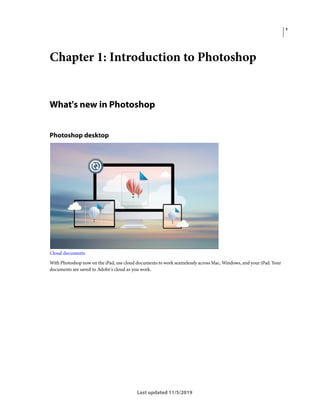
Cloud documents
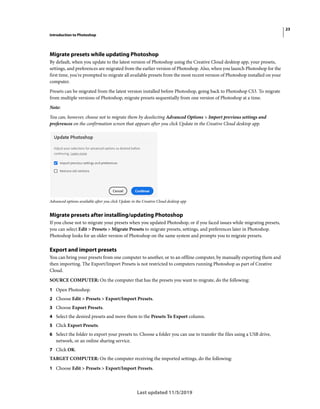
With Photoshop now on the iPad, use cloud documents to work seamelessly across Mac, Windows, and your iPad. Your
documents are saved to Adobe's cloud as you work.
2
Introduction to Photoshop
Last updated 11/5/2019
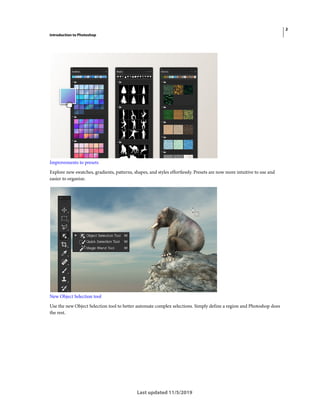
Improvements to presets
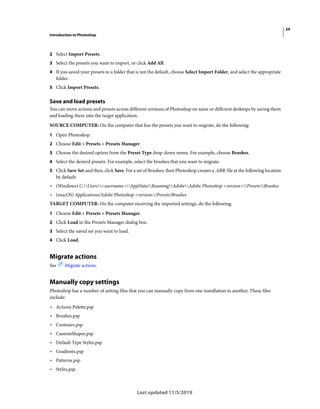
Explore new swatches, gradients, patterns, shapes, and styles effortlessly. Presets are now more intuitive to use and
easier to organize.
New Object Selection tool
Use the new Object Selection tool to better automate complex selections. Simply define a region and Photoshop does
the rest.
3
Introduction to Photoshop
Last updated 11/5/2019
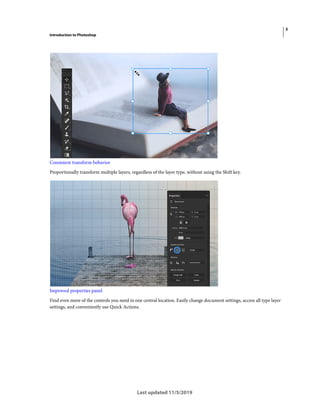
Consistent transform behavior
Proportionally transform multiple layers, regardless of the layer type, without using the Shift key.
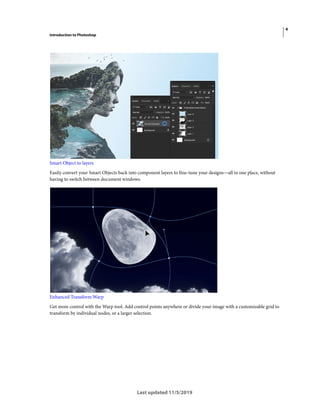
Improved properties panel
Find even more of the controls you need in one central location. Easily change document settings, access all type layer
settings, and conveniently use Quick Actions.
4
Introduction to Photoshop
Last updated 11/5/2019
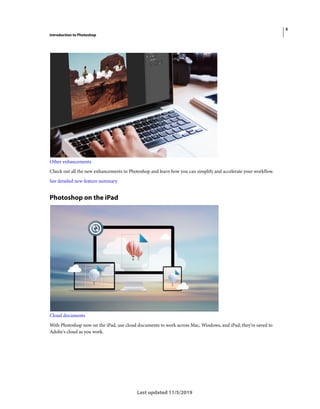
Smart Object to layers
Easily convert your Smart Objects back into component layers to fine-tune your designs—all in one place, without
having to switch between document windows.
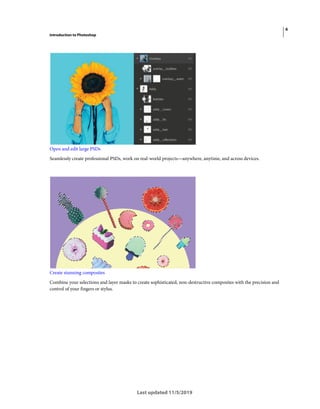
Enhanced Transform Warp
Get more control with the Warp tool. Add control points anywhere or divide your image with a customizable grid to
transform by individual nodes, or a larger selection.
5
Introduction to Photoshop
Last updated 11/5/2019
Other enhancements
Check out all the new enhancements to Photoshop and learn how you can simplify and accelerate your workflow.
See detailed new feature summary
Photoshop on the iPad
Cloud documents
With Photoshop now on the iPad, use cloud documents to work across Mac, Windows, and iPad; they're saved to
Adobe's cloud as you work.
6
Introduction to Photoshop
Last updated 11/5/2019
Open and edit large PSDs
Seamlessly create professional PSDs, work on real-world projects—anywhere, anytime, and across devices.
Create stunning composites
Combine your selections and layer masks to create sophisticated, non-destructive composites with the precision and
control of your fingers or stylus.
7
Introduction to Photoshop
Last updated 11/5/2019
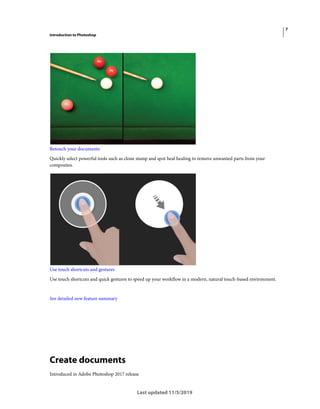
Retouch your documents
Quickly select powerful tools such as clone stamp and spot heal healing to remove unwanted parts from your
composites.
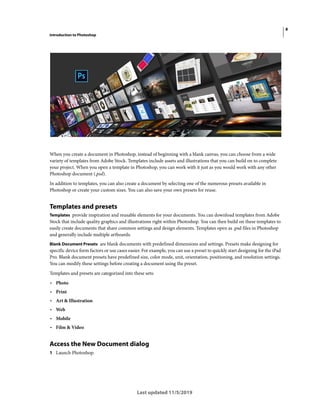
Use touch shortcuts and gestures
Use touch shortcuts and quick gestures to speed up your workflow in a modern, natural touch-based environment.
See detailed new feature summary
Create documents
Introduced in Adobe Photoshop 2017 release
8
Introduction to Photoshop
Last updated 11/5/2019
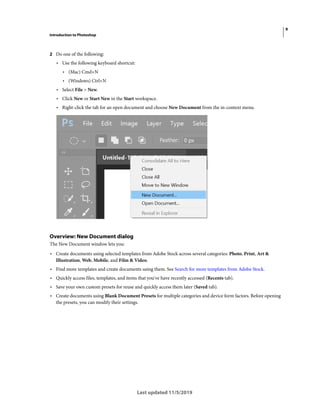
When you create a document in Photoshop, instead of beginning with a blank canvas, you can choose from a wide
variety of templates from Adobe Stock. Templates include assets and illustrations that you can build on to complete
your project. When you open a template in Photoshop, you can work with it just as you would work with any other
Photoshop document (.psd).
In addition to templates, you can also create a document by selecting one of the numerous presets available in
Photoshop or create your custom sizes. You can also save your own presets for reuse.
Templates and presets
Templates provide inspiration and reusable elements for your documents. You can download templates from Adobe
Stock that include quality graphics and illustrations right within Photoshop. You can then build on these templates to
easily create documents that share common settings and design elements. Templates open as .psd files in Photoshop
and generally include multiple artboards.
Blank Document Presets are blank documents with predefined dimensions and settings. Presets make designing for
specific device form factors or use cases easier. For example, you can use a preset to quickly start designing for the iPad
Pro. Blank document presets have predefined size, color mode, unit, orientation, positioning, and resolution settings.
You can modify these settings before creating a document using the preset.
Templates and presets are categorized into these sets:
• Photo
• Print
• Art & Illustration
• Web
• Mobile
• Film & Video
Access the New Document dialog
1 Launch Photoshop.
9
Introduction to Photoshop
Last updated 11/5/2019
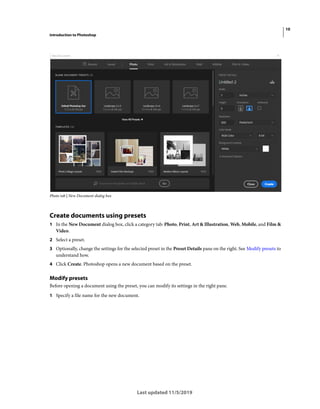
2 Do one of the following:
• Use the following keyboard shortcut:
• (Mac) Cmd+N
• (Windows) Ctrl+N
• Select File > New.
• Click New or Start New in the Start workspace.
• Right-click the tab for an open document and choose New Document from the in-context menu.
Overview: New Document dialog
The New Document window lets you:
• Create documents using selected templates from Adobe Stock across several categories: Photo, Print, Art &
Illustration, Web, Mobile, and Film & Video.
• Find more templates and create documents using them. See Search for more templates from Adobe Stock.
• Quickly access files, templates, and items that you've have recently accessed (Recents tab).
• Save your own custom presets for reuse and quickly access them later (Saved tab).
• Create documents using Blank Document Presets for multiple categories and device form factors. Before opening
the presets, you can modify their settings.
10
Introduction to Photoshop
Last updated 11/5/2019
Photo tab | New Document dialog box
Create documents using presets
1 In the New Document dialog box, click a category tab: Photo, Print, Art & Illustration, Web, Mobile, and Film &
Video.
2 Select a preset.
3 Optionally, change the settings for the selected preset in the Preset Details pane on the right. See Modify presets to
understand how.
4 Click Create. Photoshop opens a new document based on the preset.
Modify presets
Before opening a document using the preset, you can modify its settings in the right pane.
1 Specify a file name for the new document.
11
Introduction to Photoshop
Last updated 11/5/2019
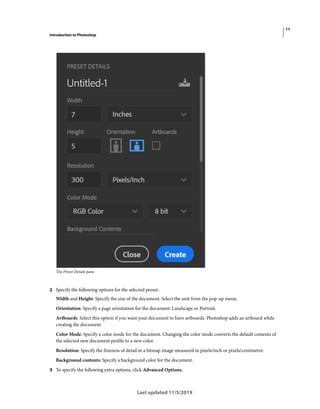
The Preset Details pane
2 Specify the following options for the selected preset:
Width and Height: Specify the size of the document. Select the unit from the pop-up menu.
Orientation: Specify a page orientation for the document: Landscape or Portrait.
Artboards: Select this option if you want your document to have artboards. Photoshop adds an artboard while
creating the document.
Color Mode: Specify a color mode for the document. Changing the color mode converts the default contents of
the selected new document profile to a new color.
Resolution: Specify the fineness of detail in a bitmap image measured in pixels/inch or pixels/centimetre.
Background contents: Specify a background color for the document.
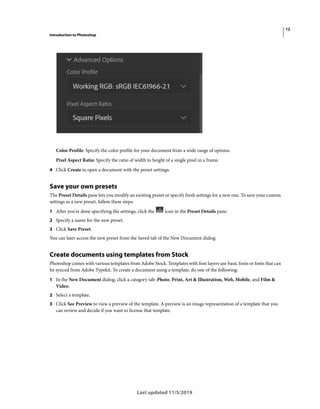
3 To specify the following extra options, click Advanced Options.
12
Introduction to Photoshop
Last updated 11/5/2019
Color Profile: Specify the color profile for your document from a wide range of options.
Pixel Aspect Ratio: Specify the ratio of width to height of a single pixel in a frame.
4 Click Create to open a document with the preset settings.
Save your own presets
The Preset Details pane lets you modify an existing preset or specify fresh settings for a new one. To save your custom
settings as a new preset, follow these steps:
1 After you're done specifying the settings, click the icon in the Preset Details pane.
2 Specify a name for the new preset.
3 Click Save Preset.
You can later access the new preset from the Saved tab of the New Document dialog.
Create documents using templates from Stock
Photoshop comes with various templates from Adobe Stock. Templates with font layers use basic fonts or fonts that can
be synced from Adobe Typekit. To create a document using a template, do one of the following:
1 In the New Document dialog, click a category tab: Photo, Print, Art & Illustration, Web, Mobile, and Film &
Video.
2 Select a template.
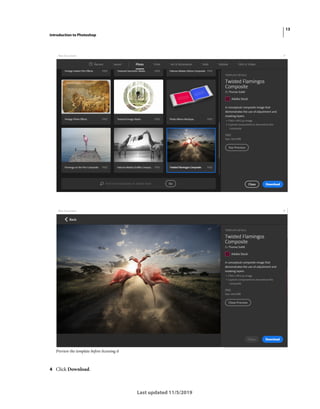
3 Click See Preview to view a preview of the template. A preview is an image representation of a template that you
can review and decide if you want to license that template.
13
Introduction to Photoshop
Last updated 11/5/2019
Preview the template before licensing it
4 Click Download.
14
Introduction to Photoshop
Last updated 11/5/2019
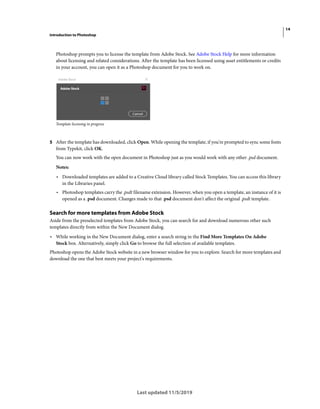
Photoshop prompts you to license the template from Adobe Stock. See Adobe Stock Help for more information
about licensing and related considerations. After the template has been licensed using asset entitlements or credits
in your account, you can open it as a Photoshop document for you to work on.
Template licensing in progress
5 After the template has downloaded, click Open. While opening the template, if you're prompted to sync some fonts
from Typekit, click OK.
You can now work with the open document in Photoshop just as you would work with any other .psd document.
Notes:
• Downloaded templates are added to a Creative Cloud library called Stock Templates. You can access this library
in the Libraries panel.
• Photoshop templates carry the .psdt filename extension. However, when you open a template, an instance of it is
opened as a .psd document. Changes made to that .psd document don't affect the original .psdt template.
Search for more templates from Adobe Stock
Aside from the preselected templates from Adobe Stock, you can search for and download numerous other such
templates directly from within the New Document dialog.
• While working in the New Document dialog, enter a search string in the Find More Templates On Adobe
Stock box. Alternatively, simply click Go to browse the full selection of available templates.
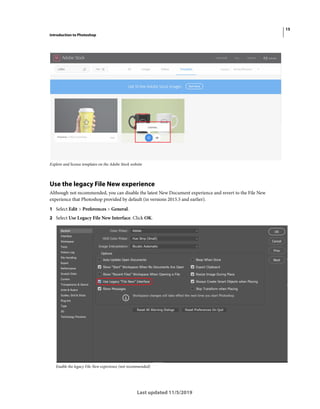
Photoshop opens the Adobe Stock website in a new browser window for you to explore. Search for more templates and
download the one that best meets your project's requirements.
15
Introduction to Photoshop
Last updated 11/5/2019
Explore and license templates on the Adobe Stock website
Use the legacy File New experience
Although not recommended, you can disable the latest New Document experience and revert to the File New
experience that Photoshop provided by default (in versions 2015.5 and earlier).
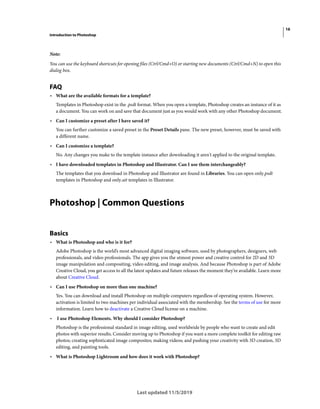
1 Select Edit > Preferences > General.
2 Select Use Legacy File New Interface. Click OK.
Enable the legacy File New experience (not recommended)
16
Introduction to Photoshop
Last updated 11/5/2019
Note:
You can use the keyboard shortcuts for opening files (Ctrl/Cmd+O) or starting new documents (Ctrl/Cmd+N) to open this
dialog box.
FAQ
• What are the available formats for a template?
Templates in Photoshop exist in the .psdt format. When you open a template, Photoshop creates an instance of it as
a document. You can work on and save that document just as you would work with any other Photoshop document.
• Can I customize a preset after I have saved it?
You can further customize a saved preset in the Preset Details pane. The new preset, however, must be saved with
a different name.
• Can I customize a template?
No. Any changes you make to the template instance after downloading it aren't applied to the original template.
• I have downloaded templates in Photoshop and Illustrator. Can I use them interchangeably?
The templates that you download in Photoshop and Illustrator are found in Libraries. You can open only.psdt
templates in Photoshop and only.ait templates in Illustrator.
Photoshop | Common Questions
Basics
• What is Photoshop and who is it for?
Adobe Photoshop is the world’s most advanced digital imaging software, used by photographers, designers, web
professionals, and video professionals. The app gives you the utmost power and creative control for 2D and 3D
image manipulation and compositing, video editing, and image analysis. And because Photoshop is part of Adobe
Creative Cloud, you get access to all the latest updates and future releases the moment they’re available. Learn more
about Creative Cloud.
• Can I use Photoshop on more than one machine?
Yes. You can download and install Photoshop on multiple computers regardless of operating system. However,
activation is limited to two machines per individual associated with the membership. See the terms of use for more
information. Learn how to deactivate a Creative Cloud license on a machine.
• I use Photoshop Elements. Why should I consider Photoshop?
Photoshop is the professional standard in image editing, used worldwide by people who want to create and edit
photos with superior results. Consider moving up to Photoshop if you want a more complete toolkit for editing raw
photos; creating sophisticated image composites; making videos; and pushing your creativity with 3D creation, 3D
editing, and painting tools.
• What is Photoshop Lightroom and how does it work with Photoshop?
17
Introduction to Photoshop
Last updated 11/5/2019
Lightroom, also included in Creative Cloud, helps you quickly import, process, manage, and showcase volumes of
photos. Its tight integration with Photoshop lets you easily take advantage of unrivaled pixel-level retouching and
compositing, giving you a complete professional photography solution.
• Does Photoshop include the features that were previously exclusive to Photoshop Extended?
Yes. Photoshop includes the full set of Photoshop tools, including the 3D image creation, 3D editing, and
quantitative image analysis tools that were previously available only in Photoshop Extended.
• What cameras does Photoshop/Adobe Camera Raw support?
See Supported cameras.
• Where can I learn more about new features?
See the What’s New page for details.
• How does Photoshop compare with earlier versions?
Check out the Photoshop version comparison.
Technical questions
• What are the minimum system requirements to run Photoshop?
See the Photoshop system requirementsfor information.
• Where can I ask a technical or how-to question related to Photoshop?
Visit the Photoshop forums to get answers from product team members and other expert users.
You can also use the following helpful resources:
• Find basic troubleshooting steps to fix most issues.
• Report a bug or request a feature.
• Need help? Start here to get support.
Free trials
• Where can I get a trial version of Photoshop?
With a free Creative Cloud membership, you can download a trial version of Photoshop - and other applications in
Creative Cloud. When you upgrade to an All Apps plan, you’ll be able to download the full version of every Creative
Cloud application.
• Can I convert my trial version to a paid plan?
If you were prompted to enter your payment details before downloading Photoshop, the trial automatically converts
to a paid plan after the trial period ends. Otherwise, you can purchase a plan directly from the Creative Cloud
website.
Purchasing options
• How can I purchase Photoshop?
Learn more about purchasing options on the Creative Cloud plans page.
• What's the difference between Photoshop Single App Subscription, Creative Cloud Photography Plan, and
Photoshop Photography Program?
18
Introduction to Photoshop
Last updated 11/5/2019
See Differences between Photoshop and Creative Cloud Photography programs.
Learning Photoshop
• How can I get started with Photoshop?
Check out Photoshop Learn & Support for all you need to get started—video and step-by-step-tutorials, Help
content, and links to resources offering comprehensive product support from Adobe and our knowledgeable
community.
• Where can I find the manual?
You can find web and PDF versions of the Photoshop manual on the Photoshop User Guide page. To learn more
about the latest features in Photoshop, read the New features summary.
Photoshop system requirements
Applicable for November 2019 release (version 21.0)
System requirements for earlier releases Photoshop system requirements | earlier releases
Minimum system requirements for Photoshop
Windows
* The 32-bit version of Windows is no longer supported. For support with 32-bit drivers and plug-ins, use earlier
versions of Photoshop: Links to prior version installers and updates.
** Not supported on Windows 10 versions 1511, 1607, 1703,?1709,?and?1803.
*** 3D features are disabled on computers having less than 512MB of VRAM.
Minimum requirement
Processor Intel® or AMD processor with 64-bit support*; 2 GHz or faster processor
Operating system Microsoft Windows 7 with Service Pack 1 (64-bit)*, Microsoft Windows
10** October 2018 update (64-bit) version 1809 or later
RAM 2 GB or more of RAM (8 GB recommended)
Graphics card nVidia GeForce GTX 1050 or equivalent; nVidia GeForce GTX 1660 or
Quadro T1000 is recommended
Hard disk space 3.1 GB or more of available hard-disk space for 64-bit installation;
additional free space required during installation (cannot install on a
volume that uses a case-sensitive file system)
Monitor resolution 1280 x 800 display at 100% UI scaling with 16-bit color and 512 MB or
more of dedicated VRAM; 2 GB is recommended***
OpenGL OpenGL 2.0-capable system
Internet Internet connection and registration are necessary for required
software activation, validation of subscriptions, and access to online
services †
19
Introduction to Photoshop
Last updated 11/5/2019
† NOTICE TO USERS. Internet connection, Adobe ID, and acceptance of license agreement required to activate and
use this product. This product may integrate with or allow access to certain Adobe or third-party hosted online
services. Adobe services are available only to users 13 and older and require agreement to additional terms of use and
Adobe’s online privacy policy (see http://www.adobe.com/aboutadobe/legal.html). Applications and Services may not
be available in all countries or languages and may be subject to change or discontinuation without notice. Additional
fees or membership charges may apply.
macOS
* 3D features are disabled on computers having less than 512MB of VRAM.
† NOTICE TO USERS. Internet connection, Adobe ID, and acceptance of license agreement required to activate and
use this product. This product may integrate with or allow access to certain Adobe or third-party hosted online
services. Adobe services are available only to users 13 and older and require agreement to additional terms of use and
Adobe’s online privacy policy (see http://www.adobe.com/aboutadobe/legal.html). Applications and Services may not
be available in all countries or languages and may be subject to change or discontinuation without notice. Additional
fees or membership charges may apply.
Language versions available for Photoshop
Windows and macOS
Photoshop is available in the following languages:
Dansk
Deutsch
English
Español
Français
Minimum requirement
Processor Multicore Intel processor with 64-bit support
Operating system macOS version 10.13 (High Sierra), macOS version 10.14 (Mojave),
macOS version 10.15 (Catalina)
RAM 2 GB or more of RAM (8 GB recommended)
Graphics card nVidia GeForce GTX 1050 or equivalent; nVidia GeForce GTX 1660 or
Quadro T1000 is recommended
Hard disk space 4 GB or more of available hard-disk space for installation; additional
free space required during installation (cannot install on a volume that
uses a case-sensitive file system)
Monitor resolution 1280 x 800 display at 100% UI scaling with 16-bit color and 512 MB or
more of dedicated VRAM; 2 GB is recommended*
OpenGL OpenGL 2.0-capable system
Internet Internet connection and registration are necessary for required
software activation, membership validation, and access to online
services †
20
Introduction to Photoshop
Last updated 11/5/2019
Français*
Hebrew*
Hungarian
Italiano
Nederlands
Norwegian
Polish
Português (Brasil)
Suomi
Svenska
Turkish
Ukrainian
čeština
Русский
????*
???
????
????
???
* Arabic and Hebrew supported in a Middle Eastern version with full right-to-left language support, Arabic/Hebrew
features, and an English interface; also in a North African French (Français*) version with full right-to-left language
support, Arabic/Hebrew features, and a French interface.
iOS
On supported iOS devices, Photoshop is available in the following languages:
Deutsch
English
Français
???
Graphic processor requirements
Features requiring the graphics processor
21
Introduction to Photoshop
Last updated 11/5/2019
Tested graphics card
Don't see your card on the list?
Unsupported card series
System requirements for Adobe Camera Raw
The Adobe Camera Raw plug-in gives you ability to import and work with camera raw files in Photoshop. You can also
use Camera Raw to work with JPEG and TIFF files.
Your computer may need to meet additional system requirements to work efficiently with Adobe Camera Raw.
See Photoshop system requirements for details.
Unsupported video adapters on macOS
See considerations for Graphics Processor (GPU)-accelerated features:
• Camera Raw 11.4 and later
• Camera Raw 11.3 and earlier
Photoshop manual (PDF)
Find a PDF of articles to learn how to use Photoshop.
Photoshop manual (PDF)
Migrate presets, actions, and settings
Presets, settings, and actions
Presets are collections of items and values that are applied to artwork in Photoshop. You can save and load presets, or
replace them with custom values at any time. Actions, brushes, and keyboard shortcuts are examples of presets.
Photoshop comes with presets, but you can also create your own.
22
Introduction to Photoshop
Last updated 11/5/2019
Settings are actual values that are currently loaded in Photoshop. They control various elements and tools in the
application, such as your current brush and all its values.
Actions are series of tasks that you play back on a single file or a batch of files—menu commands, panel options, tool
actions, and so on. For example, an action can change the size of an image, apply an effect to that image, and then saves
the file in the desired format.
Migrate presets
You can migrate your custom preset collections, as well as some Photoshop presets, from one version of Photoshop to
another on the same computer. The presets you can migrate include:
• Actions
• Brushes
• Black and White (Adjustment)
• Channel Mixer (Adjustment)
• Color Range
• Color Swatches
• Contours
• Curves (Adjustment)
• Custom Shapes
• Doutone (Mono, Duo, Tri, Quad)
• Exposure (Adjustment)
• Gradients
• HDR Toning (Adjustment)
• Hue and Saturation (Adjustment)
• Keyboard Shortcuts
• Levels (Adjustment)
• Lighting Effects
• Lights (3D)
• Materials (3D)
• Menu Customization
• Patterns
• Render Settings (3D)
• Repousse (3D)
• Selective Color (Adjustment)
• Styles
• Tools
• Volumes (3D)
23
Introduction to Photoshop
Last updated 11/5/2019
Migrate presets while updating Photoshop
By default, when you update to the latest version of Photoshop using the Creative Cloud desktop app, your presets,
settings, and preferences are migrated from the earlier version of Photoshop. Also, when you launch Photoshop for the
first time, you're prompted to migrate all available presets from the most recent version of Photoshop installed on your
computer.
Presets can be migrated from the latest version installed before Photoshop, going back to Photoshop CS3. To migrate
from multiple versions of Photoshop, migrate presets sequentially from one version of Photoshop at a time.
Note:
You can, however, choose not to migrate them by deselecting Advanced Options > Import previous settings and
preferences on the confirmation screen that appears after you click Update in the Creative Cloud desktop app.
Advanced options available after you click Update in the Creative Cloud desktop app
Migrate presets after installing/updating Photoshop
If you chose not to migrate your presets when you updated Photoshop, or if you faced issues while migrating presets,
you can select Edit > Presets > Migrate Presets to migrate presets, settings, and preferences later in Photoshop.
Photoshop looks for an older version of Photoshop on the same system and prompts you to migrate presets.
Export and import presets
You can bring your presets from one computer to another, or to an offline computer, by manually exporting them and
then importing. The Export/Import Presets is not restricted to computers running Photoshop as part of Creative
Cloud.
SOURCE COMPUTER: On the computer that has the presets you want to migrate, do the following:
1 Open Photoshop.
2 Choose Edit > Presets > Export/Import Presets.
3 Choose Export Presets.
4 Select the desired presets and move them to the Presets To Export column.
5 Click Export Presets.
6 Select the folder to export your presets to. Choose a folder you can use to transfer the files using a USB drive,
network, or an online sharing service.
7 Click OK.
TARGET COMPUTER: On the computer receiving the imported settings, do the following:
1 Choose Edit > Presets > Export/Import Presets.
24
Introduction to Photoshop
Last updated 11/5/2019
2 Select Import Presets.
3 Select the presets you want to import, or click Add All.
4 If you saved your presets to a folder that is not the default, choose Select Import Folder, and select the appropriate
folder.
5 Click Import Presets.
Save and load presets
You can move actions and presets across different versions of Photoshop on same or different desktops by saving them
and loading them into the target application.
SOURCE COMPUTER: On the computer that has the presets you want to migrate, do the following:
1 Open Photoshop.
2 Choose Edit > Presets > Presets Manager.
3 Choose the desired option from the Preset Type drop-down menu. For example, choose Brushes.
4 Select the desired presets. For example, select the brushes that you want to migrate.
5 Click Save Set and then, click Save. For a set of Brushes, then Photoshop creates a .ABR file at the following location
by default:
• (Windows) C:Users<username>AppDataRoamingAdobeAdobe Photoshop <version>PresetsBrushes
• (macOS) Applications/Adobe Photoshop <version>/Presets/Brushes
TARGET COMPUTER: On the computer receiving the imported settings, do the following:
1 Choose Edit > Presets > Presets Manager.
2 Click Load in the Presets Manager dialog box.
3 Select the saved set you want to load.
4 Click Load.
Migrate actions
See Migrate actions.
Manually copy settings
Photoshop has a number of setting files that you can manually copy from one installation to another. These files
include:
• Actions Palette.psp
• Brushes.psp
• Contours.psp
• CustomShapes.psp
• Default Type Styles.psp
• Gradients.psp
• Patterns.psp
• Styles.psp
25
Introduction to Photoshop
Last updated 11/5/2019
• Swatches.psp
• ToolPresets.psp
To move these settings to a new installation, copy these files from the following path on the source installation to the
same path on the target installation:
• Mac:<Username>/Library/Preferences/Adobe Photoshop <version> Settings
• Windows:C:Users<username>AppDataRoamingAdobeAdobe Photoshop <version>Adobe Photoshop
<version> Settings
26
Last updated 11/5/2019
Chapter 2: Photoshop and Adobe services
Creative Cloud Libraries in Photoshop
Creative Cloud Libraries is a web service that allows you to access your assets across various Adobe desktop and mobile
applications. You can add graphics, colors, text styles, brushes, and layer styles to libraries in Photoshop and then easily
access those elements in several Creative Cloud apps.
A first look at Creative Cloud Libraries
A Libraries list | B Search C Assets | D Library from Document E Add graphics | F Add character style | G Add layer style | H Add foreground
color | I Libraries sync status | J Delete | K Show items in a list | L Libraries options | M Show items as icons
Create a library
1 In Photoshop, select Window > Libraries.
2 In the Libraries panel, select Create New Library from the pop-up menu.
Create a library
? In the dialog box that appears, enter a name for the new library and click Create.
27
Photoshop and Adobe services
Last updated 11/5/2019
The new library is now available in the Libraries panel.
Create new library from a document
When you open a document containing assets that can be automatically added to a library, Photoshop prompts you to
create a new library. There are four types of assets that can be automatically added to a library from a document:
• Character styles
• Colors
• Layer styles
• Smart objects
Based on the contents of the document, Photoshop shows you the count for each type of asset.
Create new library from a document
You can also create a new library from a document in one of the following ways:
• From the Libraries panel options, select Create New Library From Document
28
Photoshop and Adobe services
Last updated 11/5/2019
• Click the Library from Document ( ) icon at the bottom of the Libraries panel.
• Click Library from Document in the Libraries panel. This option is available only if your current library is empty.
Linked and unlinked assets
You can use assets in libraries as linked assets or unlinked assets in your Photoshop documents. Library-linked assets
are instances that stay associated with the original asset in the library. When the original asset in the library is updated,
its instances in your Photoshop documents are automatically updated. Any effects that you applied to the instances are
retained as well. Library-linked assets are similar in their behavior to Linked Smart Objects.
Unlinked assets, on the other hand, are embedded in your Photoshop documents and are decoupled from the original
asset in the library. Unlinked assets are not updated automatically when the original asset changes.
Use library-linked assets in your Photoshop document
• In the Libraries panel, right-click an asset in a library and select Place Linked from the context menu.
Photoshop places the asset in your Photoshop document as a new layer. The layer thumbnail displays a cloud icon ( )
indicating that the layer is linked to a library asset.
29
Photoshop and Adobe services
Last updated 11/5/2019
A layer containing a library-linked asset
File sync
Creative sync makes your libraries accessible across multiple applications, devices, and the web automatically. For
cross-device syncing to work, file sync must be enabled in Creative Cloud desktop app. You can check the status of
library syncing by the Creative Cloud icon in the Libraries panel.
Library sync status
A Sync enabled B Sync disabled
On your local desktop machine all apps share a single local cache for your libraries data. This enables optimal use of
disk space and network bandwidth as well as near-instant propagation of libraries changes between local apps, even
when you are not connected to the network.
Turn on file sync
Depending on your version of Creative Cloud desktop app, do one of the following:
When you turn on file sync, libraries start syncing. Your libraries are kept up to date across devices. File syncing may
take some time, depending on the volume of content in your libraries.
Add assets to the library
Open the file containing your assets. You can add graphics, colors, text styles, and layer styles to the library. You can
also add assets to the library from Creative Cloud Market.
Add graphics
1 Select the appropriate layers or layer groups containing the graphic asset in the Layers panel.
2 Select the Move tool. .
3 Drag and drop the layers or layer groups into the Libraries panel.
The graphic asset is now available in the library.
30
Photoshop and Adobe services
Last updated 11/5/2019
Graphic assets added to a library.
Add layer styles, character styles, and colors
1 In the Layers panel, select the appropriate layer containing the asset.
2 Click an icon in the Libraries panel.
Add layer styles, character styles, or colors
A Add Character Style | B Add Layer Style | C Add Color
The assets are now available in the library.
Note:
Layer Styles apply only to Photoshop layers. Although you can add these styles to a library, you cannot use them in other
Creative Cloud desktop applications that support Creative Cloud Libraries.
You can also drag brush presets from Brush Presets panel, layers from Layers panel, colors from Swatches panel, and
layers styles from Styles panel and drop them in the Libraries panel.
31
Photoshop and Adobe services
Last updated 11/5/2019
Add assets from Adobe Stock
Adobe Stock is deeply integrated with Creative Cloud Libraries. You can add a watermarked stock image to any of your
libraries directly using the Adobe Stock website. You can then use the watermarked image in your Photoshop
documents as a library-linked asset.
When you choose to license the image—which you can do directly from within the Libraries panel in Photoshop—all
instances of the watermarked asset in your open documents are updated to the high-resolution licensed image.
For more information, see these resources:
• Use Adobe Stock in apps supporting Creative Cloud Libraries
Add assets from Creative Cloud Market
You can use the Creative Cloud for desktop app to browse and add assets from Creative Cloud Market.
1 Launch the Creative Cloud for desktop app.
2 Go to the Assets tab and select Market.
Creative Cloud for desktop
1 Browse and select the asset you want to add to the library.
2 Select the library you created in Adobe Photoshop from the pop-up menu.
32
Photoshop and Adobe services
Last updated 11/5/2019
Add asset from Creative Cloud Market
The asset is now available in the library.
Add assets from other Adobe applications
You can add assets from other Adobe applications, such as Adobe Illustrator, and mobile applications, such as Adobe
Brush. Creative Cloud keeps all the assets in sync and you can use these assets in Photoshop.
For more information, see Apps supporting Creative Cloud Libraries.
33
Photoshop and Adobe services
Last updated 11/5/2019
Library search
Adobe Stock search from Libraries panel
The search box in the Libraries panel enables you to search for the right asset, quickly and efficiently. You can modify
your search based on the following available options:
Adobe Stock Search for the assets in Adobe Stock from directly within the Libraries panel.
Current Library Perform a search for your asset within your current library.
All Libraries Perform a search for your asset across all your libraries.
Find stock images visually similar to a library element
The visual search functionality in the Libraries panel lets you quickly find stock images similar to a library element.
Follow these steps:
• In the Libraries panel, right-click an element and then select Find Similar from the context menu.
Photoshop displays the search results right within the Libraries panel.
34
Photoshop and Adobe services
Last updated 11/5/2019
Use the Adobe Color Themes extension
The Adobe Color service helps you choose harmonious and appealing color combinations for your design projects.
Adobe Color is integrated right within Photoshop in the form of an extension that lets you create, save, and access your
color themes. You can also explore the many public color themes available on Adobe Color and filter them in several
ways: Most Popular, Most Used, Random, themes you've published, or themes you've appreciated in the past. Once
you've found a theme that you like; you can edit it and and save it to your themes, or add it to your swatches in
Photoshop.
Aside from Photoshop, the Adobe Color Themes extension is currently available in three other Creative Cloud desktop
applications: Adobe Illustrator, Adobe InDesign and Adobe After Effects. Themes saved to Creative Cloud libraries
from within these desktop apps, mobile apps such as Capture, or using the Adobe Color website are accessible
seamlessly in Photoshop.
Additionally, Adobe Color Themes panel is your portal to groups of colors, or themes, created by an online community
of designers. Using the Adobe Color Themes panel, you can create or edit thousands of themes, and then use them in
your projects. You can also use the this panel to share your themes with the community by uploading them.
Access the Adobe Color Themes panel
• In Photoshop, select Window > Extensions > Adobe Color Themes.
35
Photoshop and Adobe services
Last updated 11/5/2019
Explore color themes
Explore themes
1 Click the Explore tab in the Adobe Color Themes panel. By default, the Explore tab displays all public color
themes.
2 If necessary, filter the color themes by a category and a timeframe. Use the search bar if you're looking for a specific
theme.
Work with the color theme
Once you've found a theme that you like; click icon to choose the desired option from the flyout menu of a color
theme using the Adobe Color Themes panel:
Options available for color themes under the Explore tab
Edit This Theme Opens the selected color theme in the Create tab of the Adobe Colors Theme panel. You can modify
and work with the colors present in the theme as desired and save it in your Creative Cloud Libraries.
Note:
Alternatively, you can click the name of a color theme to edit it.
Add To Swatches Saves the selected color theme in the Swatches panel.
View Online View the color theme and related information, such as who created this color theme, the date of sharing
this color theme, ratings and reviews, and so on in your browser. You can also appreciate, save, share, and edit this
theme from your browser.
36
Photoshop and Adobe services
Last updated 11/5/2019
View a color theme online
Create and save a color theme
1 Click the Create tab in the Adobe Color Themes panel.
2 Select the color rule on which you want to base the theme: Analogous, Monochromatic, Triad, Complementary,
Compound, Shades, or Custom. For details, see Color rules.
? Now, choose a base color by clicking the little triangle corresponding to a color in the theme you're editing. Based
upon the color rule selected, a color theme is automatically built around the base color.
Choose a base color
While a color is selected, you can adjust it either using the color wheel or by changing its value in one of the following color
systems: CMYK, RGB, LAB, HSB, or HEX.
1 (Optional) You can choose one of the following options while creating a color theme:
• Click the Set Selected Color From Active Color icon ( ) to add the active color from Illustrator workspace to
your color theme.
• Click the Click To Set Active Color icon ( ) to set the active color in the Illustrator workspace from your color
theme.
37
Photoshop and Adobe services
Last updated 11/5/2019
• Click the Add To Swatches icon ( ) to add your color theme to the Swatches panel.
2 Enter a name for the new color theme. Click Save.
3 Choose the Creative Cloud library to which you want to save the theme.
Save the new theme to a library
? Click Save.
Note:
Depending on whether you're logged in using your Adobe ID or your enterprise credentials, different sets of libraries may
be available for saving themes. Select Help > Manage My Account to check the credentials with which you're logged in. If
you land at the authentication screen for your organization when you select this option, you're logged in using your
enterprise credentials.
The same email ID may be associated with an Adobe ID as well as an enterprise ID.
Color rules
Analogous Uses colors that are adjacent on the color wheel. Analogous colors usually blend well with one another and
are harmonious and pleasing to the eye.
38
Photoshop and Adobe services
Last updated 11/5/2019
Example: Analogous color rule
Monochromatic Uses variations in saturation and brightness of a single color. When you use this color rule, you're
presented with five colors sharing the same hue (example: H:182) but different saturation and brightness values.
Monochromatic colors go well together and produce a soothing effect.
39
Photoshop and Adobe services
Last updated 11/5/2019
Example: Monochromatic color rule
Triad Uses colors evenly spaced around three equidistant points on the color wheel. When you use this color rule,
you're presented with two colors with the same hue but different saturation and brightness values from the first point
on the color wheel (example: HSB: 182, 90, 45 & HSB: 182, 100, 75), two from the second point on the color wheel (HSB:
51, 90, 55 & HSB: 51, 95, 45), and one color from the third point (HSB: 321, 90, 79). Triadic colors tend to be
contrasting—albeit not as contrasting as complementary colors—while still retaining harmony when used together.
40
Photoshop and Adobe services
Last updated 11/5/2019
Example: Triad color rule
41
Photoshop and Adobe services
Last updated 11/5/2019
Example: Monochromatic color rule
Complementary Uses colors opposite to each other on the color wheel. When you use this color rule, you are presented
with two colors with the same hue as the base color (example: HSB: 182, 100, 45 & HSB: 182, 90, 100), the base color
itself (HSB: 182, 100, 75), and two colors with the same hue from the opposite point on the color wheel (HSB: 23, 100,
45 & HSB: 23, 100, 75). Complementary colors provide high contrast and tend to stand out when used together.
42
Photoshop and Adobe services
Last updated 11/5/2019
Example: Complementary color rule
Compound Uses a mix of complementary and analogous colors. When you use this color rule, you are presented with
two colors with the same hue that are adjacent (analogous) to the base color (example: HSB: 214, 90, 95 & HSB: 214,
60, 35), the base color itself (HSB: 182, 100, 75), and two colors opposite to the base color (complementary) but adjacent
to each other (HSB: 15, 75, 78 & HSB: 6, 90, 95). Compound color themes have the same strong visual contrast as
complementary color themes, but they have less pressure.
43
Photoshop and Adobe services
Last updated 11/5/2019
Example: Compound color rule
Shades Uses five colors—all sharing the same hue (example: H: 182) and saturation (S: 100) but different brightness
values.
44
Photoshop and Adobe services
Last updated 11/5/2019
Shades color rule
Custom Lets you manually select the colors on the color wheel in your palette without any rules controlling them.
45
Photoshop and Adobe services
Last updated 11/5/2019
Custom color rule
Access themes saved to your libraries
Access your themes
1 In the Adobe Color Themes panel, click the My Themes tab.
2 Select the Creative Cloud library from which you want to access the color theme.
3 If necessary, select a sorting parameter/order for the listed themes: By Date, By Name, or By Quantity; ascending
or descending.
46
Photoshop and Adobe services
Last updated 11/5/2019
Touch capabilities and customizable workspaces
Photoshop now features a modern user experience that provides robust touch capabilities, an updated UI, and
customizable toolbar and workspaces.
Touch workspace and gestures
If you own a Photoshop-supported Windows-powered device, such as the Surface Pro, you can use these touch gestures
while using Photoshop on it.
Two-Finger Pan
Move two fingers in any direction on the canvas without changing the distance between them or the angle of the line
connecting them. You may, this way, pan the canvas view.
Two-Finger Pan and Zoom
Move two fingers toward or away from each other. You may, this way, pan or zoom the canvas view (scaled).
Two-Finger Pan and Rotate
Rotate two fingers around the center of the line connecting them. You may, this way, pan and rotate the canvas.
47
Photoshop and Adobe services
Last updated 11/5/2019
Five-Finger Cycle Screen Mode
Tap once with five fingers to cycle through the three application display screen modes, including full screen.
Two-Finger Reset or Restore View
Double-tap two fingers on the tablet surface to reset the view to an unrotated transform that nearly fills the document
canvas. Double-tap with two fingers again to restore the view to its previous state.
Three-Finger Step Back in History (Undo)
Move three fingers rapidly from right to left. The document view moves back one step in the change history.
Three-Finger Step Forward in History (Redo)
48
Photoshop and Adobe services
Last updated 11/5/2019
Move three fingers rapidly from left to right. The document view moves forward one step in the change history.
Three-Finger History Scrub
Move three fingers from right to left or from left to right. The document view moves continuously through the entire
change history.
Two-Finger Free Transform (Pan, Zoom, and Rotate)
• Place two fingers on the tablet surface and rest motionless for a moment.
• Rotate the two fingers around the center of the line connecting them while simultaneously moving them nearer to
or farther from each other.
You may, this way, freely pan, zoom, and rotate the canvas view.
Customizable toolbar and workspaces
Photoshop now features an updated UI. In addition to look-and-feel improvements, it now lets you customize your
toolbar and save multiple toolbar configurations as parts of different workspaces. Also, included Photoshop workspaces
have been streamlined to give you quick access to only the tools you need.
Customize the toolbar.
49
Photoshop and Adobe services
Last updated 11/5/2019
Customize your toolbar
Error: Waiting for Bridge | Mini Bridge panel
Issue
When you browse files using the Mini Bridge panel in Photoshop, InDesign, or InCopy, you see the following message
in the Content pod:
"Waiting for Bridge."
No files or folders appear.
Mini Bridge uses a background process called SwitchBoard to communicate with Adobe Bridge. If SwitchBoard can't
open Adobe Bridge, then Mini Bridge can't display your files. This issue also occurs if Photoshop, InDesign, or InCopy
can't communicate with Adobe Bridge through SwitchBoard. Solutions to the "Waiting for Bridge" error involve fixing
this SwitchBoard communication. Try the following solutions in order, and stop when you resolve the issue.
Solution 1: Re-create the SwitchBoard preferences files.
1 Quit all Adobe applications.
2 In the Finder (Mac OS) or Windows Explorer (Windows), navigate to one of the following folders:
• Mac OS X: /Users/Your User Name/Library/Preferences/Adobe
• Windows 7/Vista: C:UsersYour User NameAppDataRoamingAdobe
• Windows XP: C:Documents and SettingsYour User NameApplication DataAdobe
Note: Replace Your User Name above with the name of your Mac OS or Windows user account.
3 Delete the SwitchBoard folder.
50
Photoshop and Adobe services
Last updated 11/5/2019
4 Restart your computer.
5 Open Photoshop, InDesign, or InCopy and then open the Mini Bridge panel.
Solution 2: Add SwitchBoard to your firewall software's exception list.
Firewall software is used to protect computers from threats on the Internet. Some examples of firewall software are Mac
OS Application Firewall, McAfee, Norton, Windows Firewall, and ZoneAlarm.
If firewall software prevents SwitchBoard from communicating with Adobe Bridge, however, Mini Bridge can't display
your files. Most firewall software can store a list of exceptions, that is, a list of programs that are allowed to access
network resources. It's possible that your firewall software calls these exceptions a "white list" or an "allow list."
For instructions on how to add an exception to your firewall software, see the firewall software's documentation, or
contact its manufacturer.
SwitchBoard is installed to one of the following locations:
• Mac OS X: /Library/Application Support/Adobe/SwitchBoard/SwitchBoard.app
• 32-bit editions of Windows: C:Program FilesCommon FilesAdobeSwitchBoardSwitchBoard.exe
• 64-bit editions of Windows: C:Program Files (x86)Common FilesAdobeSwitchBoardSwitchBoard.exe
After adding SwitchBoard to the list of exceptions in your firewall software, restart your computer. Open Photoshop,
InDesign, or InCopy, and then open the Mini Bridge panel.
Solution 3: (Windows) Ensure that the Windows hosts file contains its default
entries.
SwitchBoard points to the localhost server, which is an internal name for your computer, to communicate with Adobe
Bridge. By default, the Windows OS "hosts" file contains a reference to localhost. If the hosts file is missing this entry,
however, or if this entry is incorrect, then Mini Bridge can't access your content.
To determine what information is required in the hosts file for your edition of Windows, see Microsoft Support article
972034. This article also includes information about resetting the hosts file to its default.
Solution 4: (Windows) Clear the Windows cryptographic database and reset
SwitchBoard.
The first time SwitchBoard runs on your computer, it uses information in the Windows cryptographic database to
create values in the registry and switchboard.ini file. If SwitchBoard cannot read this database, then the resulting
registry values and the data in switchboard.ini are all invalid. These invalid files prevent SwitchBoard from functioning.
1 Close all Adobe applications.
2 Choose Start > Run (Windows XP) or click Start (Windows Vista or Windows 7),
type "%appdata%MicrosoftCrypto" (including the quotation marks), and press Enter.
3 Rename the RSA folder to, for example, oldRSA.
4 Choose Start > Run (Windows XP) or click Start (Windows Vista or Windows 7), and type regedit and then press
Enter. The Registry Editor opens.
5 In the left pane of the Registry Editor, navigate to HKEY_CURRENT_USERSoftwareAdobeIAC. Select the IAC
key.
6 In the right pane, right-click the MD5ID value and choose Delete. Click Yes in the Confirm Value Delete dialog box.
51
Photoshop and Adobe services
Last updated 11/5/2019
7 In the right pane, right-click the user ID value and choose Delete. Click Yes in the Confirm Value Delete dialog box.
8 Close the Registry Editor.
9 Choose Start > Run (Windows XP) or click Start (Windows Vista or Windows 7),
type "%appdata%AdobeSwitchBoard" (including the quotation marks), and press Enter.
10 Delete the switchboard.ini file. (If you do not see the .ini filename extension, then delete the file that is of the type
Configuration Settings. The file has an icon that looks like a notepad with a gear on top of it.)
11 Restart your computer; open Photoshop, InDesign, or InCopy; and open the Mini Bridge panel.
Solution 5: Create a different user account.
Occasionally, a user account can become corrupted, which can prevent SwitchBoard from accessing or creating the
necessary files. Create an account with the same permissions as your current account, log in to the new account, and
then run your Adobe applications.
For assistance creating a user account, see the following documents:
• Creating a new user account in the Mac OS X Help
• How to create and configure user accounts in Windows XP, Create a user account in Windows (select Windows 7
or Windows Vista from the menu) on the Microsoft support website.
For additional assistance, contact your system administrator.
Untab image windows
Issue
When you open images in Adobe Photoshop they are tabbed together instead of in individual windows.
Solutions
Solution 1: Float your images in windows.
• To float one image in a window, choose Window > Arrange > Float in Window.
• To float all open images in windows, choose Window > Arrange > Float All In Windows.
Note: Window > Arrange is only available when an image window is open.
Solution 2: Disable image tabs and window docking.
To prevent images from opening in tabs in the future, do the follow:
1 Choose Photoshop > Preferences > Interface (Mac OS) or Edit > Preferences > Interface (Windows).
2 Deselect Open Documents As Tabs.
3 Deselect Enable Floating Document Window Docking.
4 Click OK.
52
Photoshop and Adobe services
Last updated 11/5/2019
Additional information
When you drag an image into Photoshop (and the Application Frame is on in Mac OS), the image opens in a tab. This
issue occurs even if the tabbed preferences are disabled.
For more information, see Manage windows and panels and View images in multiple windows in the Photoshop User
Guide.
53
Last updated 11/5/2019
Chapter 3: Photoshop on the iPad
Photoshop on the iPad | Common questions
Can I use Photoshop on the iPad?
Yes, you can now use Photoshop on your iPad and create anything, anytime, and anywhere.
Inspiration is everywhere. So is Photoshop!
When you're inspired to create something new, Photoshop on the iPad allows you to open and edit large Photoshop
files, create stunning composites, retouch your images, and apply effects while on the go. With Photoshop on the iPad,
you can untether yourself from your desktop and resume work seamlessly across devices — with the power of
Photoshop cloud documents | Common questions.
54
Photoshop on the iPad
Last updated 11/5/2019
Begin creating with Photoshop on the iPad today by subscribing to a Creative Cloud plan that includes Photoshop.
Already have an active plan that includes Photoshop? Sign-in with your Adobe ID on your iPad and download
Photoshop for the iPad today.
Which iPad do I need to download and use Photoshop?
To use Photoshop on the iPad, see the list of supported iPad models updated to iPadOS:
What languages are supported in Photoshop on the iPad?
On supported devices, Photoshop is available in the following languages:
Deutsch
English
Français
???
Note:
In Photoshop on the iPad, you may be able to use unsupported languages by selecting a native font. However, the
functionality will be limited and your experience may vary. Adobe is working to provide support for additional languages
in the future releases.
Minimum requirement
iPadOS version iPadOS (13.1)
iPad models • iPad Pro 12.9-inch (recommended)
• iPad Pro 11-inch
• iPad Pro 10.5-inch
• iPad Pro 9.7-inch
• iPad (7th generation)
• iPad (6th generation)
• iPad (5th generation)
• iPad mini (5th generation)
• iPad mini 4
• iPad Air (3rd generation)
• iPad Air 2
Apple Pencil models • Apple Pencil (2nd generation) (recommended)
• Apple Pencil (1st generation)
55
Photoshop on the iPad
Last updated 11/5/2019
Which Adobe plans include Photoshop on the iPad?
Get Photoshop and start working with Photoshop on the iPad.
If you have an Adobe Creative Cloud plan that already includes Photoshop, you can simply download Photoshop on
the iPad for a limited time without purchasing another plan — simply sign-in with your Adobe ID.
If you don't have a plan that includes Photoshop, for a limited time, you can purchase the Creative Cloud Photography
plan that includes Photoshop on the iPad, Photoshop desktop, Lightroom, Lightroom Classic, Spark and Portfolio.
Simply sign-in with your Adobe ID to purchase the Creative Cloud Photography plan.
Don't have an Adobe ID? It's free and easy to create one. Click here to quickly create your Adobe ID.
Is Photoshop on the iPad available in my country?
Photoshop on the iPad is available only in countries where Creative Cloud services are available. See the latest list of
countries that support Creative Cloud services.
Adobe Creative Cloud services are currently not available on adobe.com in mainland China. As a result, Photoshop on
the iPad is not available in this region.
56
Photoshop on the iPad
Last updated 11/5/2019
How does Photoshop on the desktop work with Photoshop on the iPad?
You can access cloud documents from both the desktop or the iPad.
Any document you create with Photoshop on the iPad is automatically saved as a cloud document, so that you can easily
access your creative work from iPad to desktop. Cloud documents are automatically synced across devices to create a
seamless workflow.
For example, if you want to resume your desktop work on the iPad, simply save your PSD as a cloud document.
To view your cloud documents, simply navigate to the Cloud documents tab on the home screen.
57
Photoshop on the iPad
Last updated 11/5/2019
Can I turn off auto-save in cloud documents?
Cloud documents are automatically saved to the cloud and help you work seamlessly across devices.
A cloud document is always automatically saved to the cloud — this is what helps you work seamlessly on your creative
projects anytime, anywhere, across your devices.
Although cloud document auto-save does not turn off, you can restrict syncing over your cellular network when
working on an iPad.
To learn more about cloud documents workflows in Photoshop, see Photoshop cloud documents | Common questions.
How much cloud storage does Photoshop on the iPad provide? Can I upgrade
my storage?
Your cloud storage is shared across your Adobe Creative Cloud apps. The amount of your cloud storage is determined
by your Adobe Creative Cloud subscription plan.
Plan Storage
In-app purchase (via Apple App Store) 100 GB
Free trial 2 GB
Creative Cloud Photography plan (20 GB) (For existing subscribers and
new subscribers who purchase this plan by January 31, 2020 )
20 GB
58
Photoshop on the iPad
Last updated 11/5/2019
If your cloud storage goes over your quota, your documents can be saved as a local document only. If you need more
cloud storage, easily upgrade your subscription plan to include additional storage at any time.
What happens to my assets if I close or delete my Adobe account?
Assets are available for download for a limited period of time even after your plan expires.
If you close or delete your Adobe account, or if your subscription expires, your assets remain in the cloud and available
to download for 30 days. After 30 days, you may lose access to some or all of your documents that are saved on the cloud
servers.
To view your assets, go to assets.adobe.com. To learn more about Creative Cloud, see Common Questions | Creative
Cloud.
Creative Cloud Photography plan (1 TB) 1 TB
Photoshop Single App 100 GB
Creative Cloud All Apps 100 GB
59
Photoshop on the iPad
Last updated 11/5/2019
What are the keyboard and touch shortcuts for Photoshop on the iPad?
Simplify your workflows with keyboard and touch shortcuts.
To view a list of popular keyboard shortcuts in Photoshop on the iPad, see Keyboard shortcuts.
To learn more about touch shortcuts and touch gestures in Photoshop on the iPad, see Touch shortcuts and gestures.
60
Photoshop on the iPad
Last updated 11/5/2019
How do I suggest a feature or report an issue with Photoshop on the iPad?
Your feedback is valuable! Send us your suggestions. Connect with us on Adobe forum.
Adobe actively listens to our large community of users. We value your input and make it easy to report issues or request
new features for Photoshop on the iPad.
To report a problem, suggest a feature, or take a survey, navigate to App Settings > General > Help > Send feedback.
To ask a question and be a part of community discussions on Adobe Forum for Photoshop, navigate to App Settings >
General > Help > Community forum.
To join a discussion or post to the community, go to Adobe Support Community | Photoshop.
Get to know the workspace
As you launch Photoshop on the iPad, you can view the home screen of the app. From the home screen, you can start
creating your composites or documents and proceed to the editing workspace. In the workspace, you can find your
favorite Photoshop tools, panels, and other options that will equip you to create composites and retouch your creative
work. More Photoshop tools and features are coming to your iPad in future releases.
61
Photoshop on the iPad
Last updated 11/5/2019
Home screen
Easily find all your documents on the home screen in Photoshop on the iPad.
• Home: Use the Home icon ( ) to switch back to the home screen from the editing workspace at any time.
• Learn: Access an interactive app tour and hands-on tutorials to help you explore what's different when you use
Photoshop on the iPad and understand common workflows.
• Cloud documents: View a list of all saved cloud documents in Photoshop, whether created in Photoshop on your
iPad or desktop. To learn more about cloud documents, see Photoshop cloud documents | Common questions.
• Deleted: Accidentally deleted a file? No worries! Find a complete list of cloud documents that you have deleted here.
You can choose to restore the documents or permanently delete them.
• Create new: Easily create a new document with the option to name the document, set the canvas dimension, change
orientation, select resolution and choose black, white or transparent background color. You can also explore
common preset canvas options in the Print, Screen,Film, or Video categories.
• Import and open: Quickly import and open your document from the Camera Roll, Files, or take a new photo with
your iPad's Camera. Your imported file converts to a Photoshop cloud document and opens on the canvas.
• Suggest a feature: Suggest features you would like to see in future releases of Photoshop on the iPad. Adobe is
building Photoshop with valuable inputs from its large community of users like you.
• Recent: Use the Recent section to access all the documents you worked on recently.
62
Photoshop on the iPad
Last updated 11/5/2019
• App Settings: Tap to set your preferences while working with Photoshop on the iPad. To learn more, see
Manage app settings.
• Cloud docs help: Tap to check whether you're online or offline, and the save status of your cloud documents.
Edit workspace
As soon as you open a document, you will enter into the editing workspace and your creative work can begin. The
canvas displays the area where you interact with your open document. Photoshop on the iPad offers you a context-
aware user interface. Core tools and tool options are contextual and surface only when you need them.
Get to know the Photoshop workspace on your iPad
Header bar
A Home B File name C Current zoom level D Undo E Redo F Cloud docs help G Send to H Help
63
Photoshop on the iPad
Last updated 11/5/2019
A. Home: Use the Home icon ( ) to switch back to the home screen from the editing workspace at any time.B.
Filename: Displays the name of the document currently open.C. Current zoom level: Displays the current zoom level
of the open document. D. Undo: Reverts the last action performed.E. Redo: Restore the last action undone.F. Cloud
docs help: Check whether you're online or offline, and the save status of your cloud documents.G. Send to: Use the
Send to icon to save and send your work to Photos, Files, or Share. H. Help: Tap the help icon to browse tutorials, take
the in-app tour, view shortcuts, check the Photoshop user guide, reach out to the community forum, and share your
feedback with Adobe.
Toolbar
A. Move: Move selections and layers.B. Transform: Apply various transform operations to the selected layer or
object.C. Select: Make a selection with the selection tools—Lasso, Quick select, Rectangular marquee, and Elliptical
marquee. Long press icon to reveal all selection tools.D. Brush: Apply brush strokes and control brush settings.E.
Erase: Remove portions in your photo where you apply the eraser brush strokes.F. Fill: Fill the active selection with the
foreground color. Long press icon to reveal the Gradient tool.G. Heal: Retouch and fix imperfections with the Heal
tool. Long press icon to reveal the Clone stamp tool.H. Crop: Crop your selection, and choose to rotate and recenter.I.
Type: Create a type layer to add text.J. Place photo: Add photos from Camera Roll, Files, Libraries, and Camera. K.
Eyedropper: Easily change foreground color by sampling from any layer.L. Color chip: View the selected foreground
and background colors in the color chip. Swipe vertically to switch between the two colors. Tap the color chip to choose
a new color from the color picker that appears.
Note: Long press the icons that have triangles on the bottom right to reveal more tools.
A Move B Transform C Select D Brush E Erase F Fill G Heal H Crop I Type J Place Photo K Eyedropper L Color chip
64
Photoshop on the iPad
Last updated 11/5/2019
Taskbar
A Compact layer view B Detail layer view C Layer properties D Add new layer E Layer visibility F Add mask G Add clipping mask H Filters
and adjustments I More layer actions
A. Compact layer view: See all the layer thumbnails in a simplified view. B. Detail layer view: See an expanded layer
stack with masks, layer names, visibility, and group contents.C. Layer properties: View blending options, adjustments,
and dimensions for the type of layer selected (type, pixel, adjustment, and so on).D. Add layer: Insert a new layer. Long
press for more options — add a new layer, adjustment layer, or empty group.E. Layer visibility: Control layer
visibility.F. Add layer mask: Add layer masks to hide or reveal portions of a layer.G. Add clipping mask: Add clipping
masks to hide or reveal portions of a layer based on the layer below.H. Filters and adjustments: Apply various filters
and adjustments to the selected layer.I. More layer actions: Reveal more actions you can perform with layers.
Note: Long press the icons that have triangles on the bottom right to reveal more tools.
Tool options
65
Photoshop on the iPad
Last updated 11/5/2019
You can control the settings of your selected tools using the tool options. Tap a tool icon to bring up the tool options.
Hold and drag the grabber at the top of the tool options to move it around the canvas. You can also dock tool options
by dragging it to the bottom of the toolbar and releasing.
Note: All tools do not have tool options.
Touch shortcut
Left: Primary touch shortcut. Right: Secondary touch shortcut.
Use the touch shortcut to quickly access alternate actions of a selected tool in Photoshop on the iPad.
To learn how to use primary and secondary touch shortcuts, see Touch shortcuts and gestures
System requirements | Photoshop on the iPad
66
Photoshop on the iPad
Last updated 11/5/2019
Minimum and recommended system requirements
To identify iPadOS supported devices, see Apple's support documentation.
To identify your iPad model, see Apple's support documentation.
To find out which Apple Pencil works with your iPad, see Apple's support documentation.
Language versions available
On supported iPadOS devices, Photoshop is available in the following languages:
Deutsch
English
Français
???
Note:
In Photoshop on the iPad, you may be able to use unsupported languages by selecting a native font. However, the
functionality will be limited and your experience may vary. Adobe is working to provide support for additional languages
in the future releases.
Minimum requirement
iPadOS version iPadOS (13.1)
iPad models • iPad Pro 12.9-inch (recommended)
• iPad Pro 11-inch
• iPad Pro 10.5-inch
• iPad Pro 9.7-inch
• iPad (7th generation)
• iPad (6th generation)
• iPad (5th generation)
• iPad mini (5th generation)
• iPad mini 4
• iPad Air (3rd generation)
• iPad Air 2
Apple Pencil models • Apple Pencil (2nd generation) (recommended)
• Apple Pencil (1st generation)
67
Photoshop on the iPad
Last updated 11/5/2019
Add photos to your canvas
Placing photos in Photoshop on the iPad is easy with the Place Photo tool. Every photo placed is added as a new layer
to your document. You can effortlessly select photos from your iPad's Camera Roll, Files, Libraries, or take a new
photo right in the app with the Camera option. Easily transform your photo to finalize its placement in your
document.
Tap the Place Photo icon and view the sources from which you can add photos.
5 Simple steps to quickly place a photo in your document
1 Open the Photoshop document you want to add a photo to.
2 Simply tap from the toolbar on the left side of the canvas.
3 In the options panel that opens, select the source of the photo you want to add:
• Camera Roll: Tap Camera Roll to see all your Camera Roll photos.
• Files: Tap Files to browse through your file Locations on your iPad. You can also add selected files to Favorites
and find tagged files under the Tags section.
• Libraries: Tap Libraries to access the images saved in your Creative Cloud Libraries, and other third-party apps
that are installed on your iPad and signed-in. Library assets are placed unlinked and flattened for now.
• Camera: Tap the camera icon to open the camera on your iPad. On opening the camera for the first time, a dialog
opens: "Photoshop would like to access the Camera". Tap OK to grant access. Capture a photo with your iPad.
Tap Retake to capture a better shot or tap Use Photo to continue.
68
Photoshop on the iPad
Last updated 11/5/2019
4 Tap a photo to select it from any of the above sources. The selected photo opens in the Transform mode. Select a
transform operation to apply on the photo before placing it in the canvas. To learn more about transform operations,
see Apply transform operations.
5 Tap Done to apply transformations and add the photo to your canvas. Tap Cancel to go back to the open document
and start the process again.
Have a question on supported file types?
Find answers to some of your common queries. If your question isn't listed here, or you want to share your feedback,
join discussions on Adobe Photoshop Community.
What file formats can I place in a document?
The supported file formats for placing a photo in Photoshop are - PSD, PSB, TIFF, JPG, and PNG.
Can I place .pdf and .ai files in a document?
Yes. However, PDF and AI files are converted to flat PNG images before getting added to a document.
Can I place smart objects and linked assets in a document?
Yes. However, linked assets and smart objects are placed as unlinked raster layers for now.
69
Photoshop on the iPad
Last updated 11/5/2019
Work with layers
Layers contain the images, fonts, and objects that make up a layered file. Layers enable you to move, edit, and work with
content on one layer without affecting the content within your other layers. Use layers to perform tasks such as
compositing multiple images, adding text to an image, and applying filters and adjustments.
Layers are arranged in a stack and can be viewed by tapping either the compact or detailed layer view from the
taskbar in the workspace.
Layer views
You can choose to view the layers in your document and other layer information from the taskbar. The available layer
view options are compact, detailed, or hidden layer view.
Compact layer view
Tap from the taskbar to view layer thumbnails only. Swipe left on a thumbnail to see applied mask, if one has been
applied to the layer.
70
Photoshop on the iPad
Last updated 11/5/2019
Detailed layer view
Tap from the taskbar to view layer names, visibility, and thumbnails of the layer and applied mask, if one has been
applied to the layer.
Hidden layer view
Deselect the compact layer view and detail layer view to hide both layer views from the canvas.
Layer properties
Tap from the taskbar to access layer properties:
Thumbnail: Displays the layer thumbnail and name.
Blending options: You can create various special effects using blending options — Opacity and Blend mode.
• Opacity: Use the Opacity slider to adjust the overall opacity level of a layer. Opacity determines to what degree the
selected layer is obscured or revealed. A layer with 1% opacity appears nearly transparent, whereas one with 100%
opacity appears opaque. To learn more about how opacity works in Photoshop, see Layer opacity and blending.
• Blend mode: A layer’s blending mode determines how its pixels blend with underlying pixels in the image. You can
choose from a list of special effects using blending modes available in the drop-down list. To learn more about
blending options in Photoshop, see Blending modes.
Add clipped adjustment: Adds a clipped adjustment layer to the current layer — Brightness/Contrast, Black and
white, Color balance, Exposure, Hue/Saturation, Levels, and Vibrance.
Effects: This feature is not supported on the iPad yet.
71
Photoshop on the iPad
Last updated 11/5/2019
Smart filters: This feature is not supported on the iPad yet.
Dimensions: Displays the dimensions of the current layer bounds.
Add and name a layer
Tap from the taskbar, to add a new layer. The new layer is inserted above the currently selected layer. To name or
rename a layer, open the detailed layer ( ) view. Double tap the layer name to bring up the Rename layer dialog. Type
a name for the layer and tap Rename to confirm the name.
Layer visibility
You can choose to show or hide the contents of a particular layer with the layer visibility ( ) option available in the
taskbar. Tap from the taskbar, or from the detailed layer view to hide the contents of a selected layer. Tap again to
view the contents of that layer.
Layer mask
You can add a mask to a layer to show parts of the layer and hide others by tapping on the layer mask ( ) icon. In the
areas where the layer is masked (hidden), the layers below are visible. Masking layers is a valuable compositing
technique for combining multiple photos into a single image or for removing a person or object from a photo.
You can edit a layer mask to add or subtract from the masked region. Areas you paint in black on the mask, hides those
areas of the layer while areas you paint white on the mask are visible. For areas you paint on the mask in shades of gray,
the layer appears in various levels of transparency.
Tap the mask visibility ( ) icon to temporarily make the mask invisible, so that you can see the entire layer without
the mask applied.
By default, a layer or group is linked to its layer mask. To break the link between a layer and a mask, tap ( ). This
allows you to move the layer image and the mask independent of one another.
Clipping mask
A clipping mask allows you to use the content of one layer to mask the layers above it. The masking is determined by
the content of the bottom or base layer. The non-transparent content of the base layer clips (reveals) the content of the
layers above it in the clipping mask. All other content in the clipped layer is masked out. When the layer to be clipped
is selected, tap the clipping mask ( ) icon and the layer below it is used to clip the layer. More layers can be placed on
top and clipped to the same shape.
The top layer is the layer to be clipped. The middle layer determines what is clipped. The bottom layer is the lower layer
that shows through when the top layer is clipped.
72
Photoshop on the iPad
Last updated 11/5/2019
Add a clipping mask in Photoshop on the iPad
Filters and adjustments
Tap from the taskbar to bring up the Filters and adjustments panel.
Gaussian blur: Applies the selected amount (from .1 to 1000) of gaussian blur to a layer.
Invert: Inverts the contents of the layer.
Filters and adjustments in Photoshop on the iPad
Layer actions
Tap from the taskbar to bring up the Layer actions panel.
Lock layer: Locks the layer so it can’t be edited.
Delete layer: Deletes the active layer.
73
Photoshop on the iPad
Last updated 11/5/2019
Rename layer: Renames the active layer.
Add clipped adjustment: Adds a clipped adjustment layer to the selected layer.
Begin multi-select mode: Allows you to select multiple layers.
Duplicate layer: Duplicates the active layer.
Copy layer: Allows you to copy a selection or layer to be pasted.
Select all: Selects all contents of the active layer.
Load as selection: Selects all the nontransparent areas on a layer, or if a layer mask exists all the unmasked areas.
Selecting these areas is useful when you want to select text or image content that is surrounded by or contains
transparent areas or to create a selection that excludes masked areas on a layer.
Flatten layer: Brings all layers of a multi-layered document to one plane.
Merge down: Merges the active layer with the layer below it.
Merge visible: Merges all visible layers into the active layer.
Layer actions panel in Photoshop on the iPad
74
Photoshop on the iPad
Last updated 11/5/2019
Manage your layers
Select multiple layers
You can select multiple layers to work with. Select the compact layer view or the detailed layer view, and tap the layer
actions ( ) icon. Select Begin multi-select mode from the layer actions panel that opens. In the Select layer mode,
checkboxes appear next to each layer thumbnail in the layer view. Tap only those checkboxes that are next to layer
thumbnails you want to select. Tap Done in the Select layer mode, or Cancel to exit selection.
Group and ungroup layers
You can Select multiple layersthat you want to group as described above. Tap the folder icon ( ) to group the layers
together. To ungroup layers, do the following:
1 Select the grouped layer.
2 Tap the three dots icon ( ) on the taskbar .
3 Tap the open folder ( ) icon to ungroup layers.
Reorder layers
To reorder a layer, long-press the thumbnail of the layer you want to move and then move it to the desired location in
the layer stack.
Make selections and add masks
Making selections and adding masks are two powerful ways to edit selective areas and add effects to your composites.
75
Photoshop on the iPad
Last updated 11/5/2019
Easily create accurate selections and masks in Photoshop on your iPad.
Make selections
A selection isolates one or more parts of your image. By selecting specific areas, you can edit, and apply effects and
filters to portions of your document while leaving the unselected areas untouched.
• Double tap the Lasso tool from the toolbar, to bring up more selection tools. You can select areas of a layer with —
Lasso, Quick selection, Rectangular marquee, and Elliptical marquee.
• When you tap a selection tool, the associated tool options appear. From the tool options, you can choose whether
to add to your selection ( ), subtract from your selection ( ), or select the areas that intersect with the current
selection ( ).
76
Photoshop on the iPad
Last updated 11/5/2019
• When you make a selection, the active selection properties appear at the bottom of the workspace. It gives you the
option to deselect, mask, erase, invert, transform the selection, or select similar.
Selection tools
Select with the Lasso tool
The Lasso tool is useful for drawing freeform segments of a selection border. To select using the the Lasso tool, tap the
( ) icon.
As you tap Lasso, choose from the tool options that appear. Simply draw a freehand selection to proceed.
• Add to selection ( ): Next selections will be added to the current selection.
• Subtract from selection ( ): Next selections will be subtracted from the current selection.
• Select the areas that intersect with the current selection ( ): Select the intersection of current and next selection.
• Lasso settings ( ): Feather - Select the number of pixels to feather the edges of a selection.
77
Photoshop on the iPad
Last updated 11/5/2019
Select with the Quick selection tool
The Quick selection tool allows you to quickly paint a selection using an adjustable round brush. As you drag, the
selection expands outward and automatically finds and follows defined edges in your document.
Double tap the Lasso tool from the toolbar to bring up the Quick selection tool ( ) . As you tap the Quick selection
tool, choose from the tool options that appear:
• Add to selection ( ): Next selections will be added to the current selection.
• Subtract from selection ( ): Next selections will be subtracted from the current selection.
• Brush size: Determines the pixel size of the quick selection tool.
• Hardness: The hardness setting controls the size of the brush’s hard center.
• Quick Select settings ( ): Enable/disable Use pressure for size.
Select with the Marquee tools
The marquee tools allow you to select rectangles and ellipses. To make a marquee selection, choose one of the marquee
tools and simply drag over the area you wish to select. If you have a physical keyboard connected to your iPad, you can
also press M (Shift) to select the Marquee tools.
The Rectangular marquee tool ( ) makes a rectangular selection.
78
Photoshop on the iPad
Last updated 11/5/2019
Rectangular marquee tool
The Elliptical marquee tool ( ) makes an elliptical selection.
Elliptical marquee tool
• Add to selection ( ): Next selections will be added to the current selection.
• Subtract from selection ( ): Next selections will be subtracted from the current selection.
• Select the areas that intersect with the current selection ( ): Select the intersection of current and next selection.
• Lasso settings ( ): Feather - Select the number of pixels to feather the edges of a selection.Style - Select a style
from the drop-down list.
Active selection properties
Once you make a selection, you can see active selection properties at the bottom of the workspace:
• Deselect: Deselects the current selection
• Mask: Turns the current selection into a mask for the layer
• Erase: Allows you to erase the selected area
• Invert: Inverts the selection so that the deselected area becomes the selection
• Transform: Allows you to transform the selection
• Select similar: Adds pixels to the selection that are similar to the ones already selected
79
Photoshop on the iPad
Last updated 11/5/2019
More options on taskbar
• Cut: Allows you to cut a selection or layer
• Copy merged: Allows you to copy a merged selection or layer to be pasted over another layer.
Apply masks
You can use masks to hide portions of a layer and reveal portions of the layers below. Masks are nondestructive, which
means you can go back and edit the masks again without losing the pixels they hide.
• A layer mask hides part of a layer from view.
• A clipping mask uses the contents of one layer to clip or hide the contents of one or more other layers from view.
Layer mask
You can create a layer mask to show parts of a layer and hide others by turning a selection into a layer mask, or by
painting on the layer mask after creating it. In areas where the layer is masked or hidden, the layers below are visible.
Masking layers is a valuable compositing technique for combining multiple documents into a single document or for
removing unwanted objects from a composite.
Create a layer mask from a selection
1 Make sure the layer you wish to mask is selected. Simply tap a layer thumbnail from the taskbar to select a layer.
2 Create a selection using one of the selection tools.
3 Tap the layer mask icon on the taskbar ( ).
You can view the selected area while the rest of the layer gets masked.
From the compact layer view, you can swipe left and right on the layer thumbnail to switch the view from layer view to
layer mask view. Both thumbnails are visible on the detailed layer view. To learn more about layer views, see Work with
layers.
80
Photoshop on the iPad
Last updated 11/5/2019
Create a layer mask and edit the mask with a brush
1 Make sure the layer you wish to mask is selected. Simply tap a layer thumbnail from the taskbar to select a layer.
2 Tap the layer mask ( ) icon on the taskbar to create a mask.
3 Tap the brush ( ) icon.
4 Set up brush properties as desired. Choose black to fully mask where you paint. To learn more about brush
properties, see Draw and paint with brushes.
5 Paint over the mask layer.
To learn more about layer masks, see Work with layers.
Clipping mask
A clipping mask allows you to use the content of one layer to mask the layers above it. To learn more about clipping
masks, see Work with layers.
Retouch your composites
With Photoshop now available on your iPad, you can select powerful tools such as Spot Healing Brush and Clone
Stamp to retouch and remove unwanted parts from your composites.
Retouch with Spot Healing Brush
The Spot Healing tool paints with a sampled part from your document and matches the texture, lighting, transparency,
and shading of the sampled part to the part of the document being healed. The Spot Healing Brush does not require
you to specify a sample spot and automatically picks samples from around the part of the document to be retouched.
To work with the Spot Healing Brush, do the following:
1 Tap the Spot Healing Brush ( ) icon from the toolbar.
2 From the tool options that open, you can set the brush size, and hardness.
3 Tap ( ) to access more settings.
4 In the Spot Healing Brush settings panel that opens, enable Sample all layers to use all visible layers in your
document as a source to apply healing on the selected layer. Deselect Sample All Layers, to sample only from the
active layer. Also, you can enable/disable Use pressure for size as required.
5 Tap the area in your document you want to retouch, or tap and drag to smooth over imperfections in a larger area.
81
Photoshop on the iPad
Last updated 11/5/2019
Retouch using Clone Stamp
The Clone Stamp ( ) tool paints one part of your document over another part of the same document. You can also
paint one part of a layer over another layer. The Clone Stamp tool is useful for duplicating objects or removing a defect
in your composite. To use the Clone Stamp tool, you set a sampling source on the area you want to clone from and paint
over another area. By default, your last sampling area is selected when you access the Clone Stamp.
To work with the Clone Stamp tool, do the following:
1 Double tap the Spot Healing Brush ( ) icon from the toolbar to reveal the hidden Clone Stamp tool.
2 Tap to select the Clone Stamp tool.
3 From the tool options that open, you can change the brush radius, hardness, opacity, and set source.
4 Tap ( ) to access more settings.
5 In the Clone Stamp settings panel that opens, you can select your Sample—Current, Current and below, and All
layers. You can also enable/disable the Use pressure for size and Use pressure for opacity options.
82
Photoshop on the iPad
Last updated 11/5/2019
6. Work with touch shortcuts to Set source and tap over an area you want to select as the cloning source.
83
Photoshop on the iPad
Last updated 11/5/2019
Use the primary touch shortcut to set the source from where you wish to clone.
7. Release the touch shortcut after setting the source and tap over an area on which you want to apply Clone stamp.
This action paints the source area over your selected area.
84
Photoshop on the iPad
Last updated 11/5/2019
Use the secondary touch shortcut to apply Clone stamp to the destination area in your document.
Draw and paint with brushes
With Photoshop on the iPad, you can draw and paint with brushes—whenever, wherever inspiration strikes.
Not sure where to begin? Start with selecting a brush type to create your composite.
How to choose a brush type
1. Tap from the toolbar to select the brush tool.
2. A small triangle in the lower right corner of the brush icon represents hidden tool options. Long press the brush icon
to reveal the Brushes panel.
3. In the Brushes panel that opens, you can scroll through a list of default brush types. Tap to select the desired brush
type and apply to the canvas.
Note: The brush type used in your previous session remains selected when you use the brush tool again. You can always
come back to the Brushes panel and change your brush.
85
Photoshop on the iPad
Last updated 11/5/2019
Quickly adjust brush properties
You can adjust brush properties from the floating options panel to suit your creative work.
To bring up the tool options, simply tap the brush icon from the toolbar.
From the tool options, tap an icon to select the attribute and modify:
• Color chip: The color chip allows you to choose a color from the color picker, enter a hex color code, or enter
numbers for HSB, RGB, Lab, or CMYK colors. You can swipe the color chip vertically to easily switch between the
foreground and background colors.
• Brush size: The brush size option allows you to choose the diameter of your brush, which can vary in size from 1 to
1000 pixels.
• Opacity: The opacity option sets the maximum transparency of the color you apply per brush stroke. 100% opacity
represents opaqueness. As you paint over an area, the opacity doesn't exceed the set level until you complete the
stroke (even when you paint over an area several times).
• Hardness: The hardness setting controls the size of the brush’s hard center. Select a value that is a percentage of the
brush diameter.
• More brush settings: Tap the three dots icon to bring up the settings panel. To learn more about brush settings, see
Apply more brush settings.
86
Photoshop on the iPad
Last updated 11/5/2019
Tool options corresponding to the Brush tool in Photoshop on the iPad
Swipe the color chip vertically to switch between the two colors in the tool options.
Apply more brush settings
To access more Brush settings, tap the three dots ( ) icon at the bottom of the tool options bar. You can modify more
brush settings as desired:
• Blend mode: The blend mode determines how the active layer blends with the layers below it. Tap the blend mode
icon to see a list of available modes. For more information, see Blending modes.
• Roundness: The roundness setting specifies the ratio between the brush’s short and long axes. Select a percentage
value. A value of 100% indicates a circular brush, a value of 0% indicates a linear brush, and intermediate values
indicate elliptical brushes.
• Angle: The angle setting specifies the angle by which an elliptical or sampled brush’s long axis is rotated from
horizontal. Select a value in degrees.
• Flow: Flow sets the rate at which color is applied on your canvas as you move your finger or stylus over an area in
your document.
87
Photoshop on the iPad
Last updated 11/5/2019
• Smoothing: Smoothing produces smoother curves in brush strokes. Higher values apply increasing amounts of
intelligent smoothing to your strokes. This option is most effective when you are painting quickly with a stylus;
however, it may produce a slight lag time in stroke rendering.
• Use pressure for size: Selecting Use pressure for size varies the diameter of the brush based on the brush pressure
applied while painting.
• Use pressure for opacity: Selecting Use pressure for opacity varies the opacity of the brush based on the brush
pressure applied while painting.
Modify brush settings.
Use touch shortcuts
While using the Brush tool you can activate the primary touch shortcut to access the Eraser version of your Brush, and
activate the secondary touch shortcut to switch to the Eyedropper tool.
To know more about how to use the touch shortcut, see Touch shortcuts and gestures.
88
Photoshop on the iPad
Last updated 11/5/2019
Left: Primary touch shortcut. Right: Secondary touch shortcut.
Apply transform operations
Transform is one of the basic tools in Photoshop and lets you easily modify your document by performing scale, skew,
perspective, distort, rotate, and horizontal/vertical flip transformation operations.
Read on to learn how to transform your document just the way you want!
Apply transformations to your document in Photoshop on mobile
89
Photoshop on the iPad
Last updated 11/5/2019
How to select an object to transform
• To transform a layer, tap a layer from the Layer panel in the taskbar to make the layer active.
• To transform a selection, select the Lasso tool from the toolbar and make a selection on the layer you desire.
You can now simply apply your transformations to the selected object.
Apply basic transform operations
You can apply transform operations to an active layer, or a selection.
1. Tap the transform ( ) icon from the toolbar to select the Transform tool.
2. In the Transform mode, do any of the following:
• To select a transformation, tap an icon from the transform options panel to select—scale, skew, perspective, and
distort.
• To select rotate transformation, tap the three dots ( ) icon to access Transform settings and set a rotation
angle. You can also drag the handle hanging off the bottom of the bounding box to rotate your selection.
• To flip your selection, tap the horizontal flip ( ) or vertical flip ( ) icons at the top of the transform mode.
3. Simply drag any of the handles of the bounding box that appears to apply your selected transformation. You can also
drag the center of the transform bounding box to move your selection on the canvas.
Note: Drag the corner handles to transform proportionally, and non-corner handles to transform non-
proportionally. You can use the pinch gesture within the transform bounding box to scale the selection, or to rotate the
selection. Use the pinch gesture outside the layer bounding box to pan or zoom the canvas.
4. Tap the undo ( ) icon to revert to the last transformation action performed. Tap redo ( ) to restore the undone
transformation action.
5. Tap Done at the top of the transform mode to save your applied transformations. Tap Cancel to exit the transform
mode without saving any of the applied transformations.
Use touch shortcuts
Scale:
• If you are using corner handles while scaling, activate the primary touch shortcut to scale non-proportionally, and
activate the secondary touch shortcut to scale from the center.
• If you are using non-corner handles while scaling, activate the primary touch shortcut to scale non-proportionally
from the center and secondary touch shortcut to scale proportionally from the center.
• By default, the scale tool lets you transform proportionally about the reference point.
Rotate: While rotating, you can activate the primary touch shortcut to snap rotation in every 15°.
To learn more about touch shortcuts, see Touch shortcuts and gestures.
90
Photoshop on the iPad
Last updated 11/5/2019
Left: Primary touch shortcut. Right: Secondary touch shortcut.
Crop and rotate your composites
Cropping is easy with Photoshop on the iPad. The crop tool lets you eliminate unwanted edges of a photo and helps
you improve the overall composition. You can crop constrained or free-form, and also rotate your selection while you
crop.
Set your crop size and rotation angle in the Crop and rotate mode.
91
Photoshop on the iPad
Last updated 11/5/2019
How to quickly crop and rotate your selection
You can crop and rotate an active layer, or the contents of a selection. To make a layer active, tap the layer thumbnail
from the taskbar. To proceed with crop and rotate, do the following:
1 Tap from the toolbar to select the crop tool.
2 In the Crop and rotate mode, a bounding box appears around your active layer or selection.
3 Drag any of the handles of the bounding box and release to set the crop size. You can view the crop size at the top of
the Crop and rotate mode. By default, the crop tool lets you perform free-form crop around the reference handle.
For alternate crop actions, see Use touch shortcuts.
4 Move the rotation dial that appears below the bounding box to freely rotate your layer or selection. While rotating,
the crop size remains unchanged. For alternate rotation actions, see Use touch shortcuts.
5 Apply touch gestures to pan, zoom, and reset your layer or selection in the Crop and rotate mode.
6 Tap the undo ( ) icon to revert the last action performed. Tap redo ( ) to restore the undone action.
7 Tap Done to apply your crop and rotate actions. Your active layer or selection scales to fit the crop size and rotation
angle. Tap Cancel to exit the Crop and rotate mode.
Use touch shortcuts
While using the crop tool, you can activate the primary touch shortcut to apply constrained crop around the reference
handle, and activate the secondary touch shortcut to apply constrained crop scale from center.
While using the rotation action, you can activate the primary or secondary touch shortcut to snap rotation in every 15°.
To learn more about how to use the touch shortcuts, see Touch shortcuts and gestures.
Left: Primary touch shortcut. Right: Secondary touch shortcut.
Pan, zoom, and reset canvas
While working with Photoshop on the iPad, you can bring to focus and take a closer look at a part of your document
by zooming in and reduce magnification as you zoom out. You can also pan around to view other portions of your
document.
92
Photoshop on the iPad
Last updated 11/5/2019
How to pan through your canvas
Tap the canvas with any two fingers. While pressing the two fingers to the canvas, simultaneously slide in any direction
to move around the canvas.
Use two-finger pan gesture to move around the canvas.
How to zoom your canvas
To zoom your selection, do any of the following:
• The current zoom level of your canvas is displayed at the center of the Top bar. Tap and roll the current zoom level
indicator side to side to zoom in and out.
• You can also use pinch gestures to quickly:Zoom in - Tap anywhere in the canvas with two fingers and move them
closer toward each other while keeping the fingers pressed to your iPad screen.Zoom out - Tap anywhere in the
canvas with two fingers and move them away from each other while keeping the fingers pressed to your iPad screen.
Note: The maximum sustained zoom level in Photoshop on mobile is 25,600%.
93
Photoshop on the iPad
Last updated 11/5/2019
Use pinch finger gestures to zoom in and out of your canvas.
Note:
Usually, the pan and zoom actions are best achieved with your thumb and index fingers.
How to reset your canvas
Double tap anywhere in the canvas to fit canvas to the screen and recenter.
Note: The reset canvas gesture works only when you are working with the Move, Transform, and Place Photo tools.
94
Photoshop on the iPad
Last updated 11/5/2019
Double tap to reset your canvas.
Work with Type layers
Adding and editing text is another important way to enhance your composites in Photoshop on your iPad. You can
create a type layer, edit the text and attributes, and apply layer commands.
Access the Type tool
To access the Type tool, do any of the following:
• From the toolbar, tap the Type tool ( ) icon to select it.
• Simply press ‘T’ if you have a physical keyboard connected to your iPad to select the Type tool.
Note:
Setting vertical text in Photoshop on the iPad is not available. However, vertical text frames are visible and supported if the
document was first created in Photoshop on the desktop.
95
Photoshop on the iPad
Last updated 11/5/2019
Work with Type layers in Photoshop on the iPad
Create a Type layer
A type layer is automatically created when you create point or paragraph text. A badge visible over the type layer
thumbnail helps you distinguish the type layer from other layers in the Compact layer viewor Detailed layer viewlayer
views.
Point text
Use point text to add a few words like a heading or title to your document in Photoshop on the iPad.
To add point text, do the following:
1 Simply select Type ( ) from the toolbar and tap anywhere in your canvas to enter the Type mode.
2 Some sample text appears surrounded by a bounding box by default, as the type layer gets created. Tap anywhere
inside the bounding box and start typing your desired text.
3 Use ( ) icon visible over the text bounding box to move your type layer around your canvas.
4 In the Layer Properties panel that opens by default in the Type mode, you can modify — Text, Paragraph, Blending
options, and Add clipped adjustment.
5 Use the cut ( ), copy ( ), and paste ( ) icons visible on the virtual keyboard that appears by default in the Type
mode, and apply corresponding actions.
6 Tap Done from the top of the Type mode to save your edits to the type layer. Tap Cancel to exit the Type mode.
96
Photoshop on the iPad
Last updated 11/5/2019
Create point text layer in Photoshop on the iPad
Paragraph text
Use paragraph text to add a paragraph of text to your document. Click and drag the cursor on the canvas to create a
bounding box in which you can type your paragraph. This helps you efficiently edit and align the paragraph later.
To add paragraph text, do the following:
1 Simply select Type ( ) from the toolbar
2 Tap and drag the pointer on the canvas to create a bounding box in which you can type your text paragraph. As you
create a paragraph you enter the Type mode automatically.
3 You can see sample text inside the bounding box. Tap anywhere inside the bounding box and start typing your
desired text.
4 Use ( ) icon visible over the text bounding box to move your type layer around your canvas.
5 In the Layer Properties panel that opens by default in the Type mode, you can modify — Text, Paragraph, Blending
options, and Add clipped adjustment.
6 Use the cut ( ), copy ( ), and paste ( ) icons visible on the virtual keyboard that appears by default in
the Type mode, and apply corresponding actions.
7 Tap Done from the top of the Type mode to save your edits to the type layer. Tap Cancel to exit the Type mode.
97
Photoshop on the iPad
Last updated 11/5/2019
Create paragraph text layer in Photoshop on the iPad
Edit text using the Type tool
In the Layer Properties panel, you can edit and modify text attributes:
Text
Under Text, choose your desired font type and font style from the drop-down list. You can either manually type in a
font size or use the slider to set a desired text size. Set a color for your text from the Color box.
Paragraph
Under Paragraph, you can view various justify options. Select an option to view changes to alignment in your text.
98
Photoshop on the iPad
Last updated 11/5/2019
Blending options
Under Blending options, you can use the Opacity slider to change the opacity of your text. Also, you can select a Blend
Mode for your text.
To learn more about blending options, see Work with layers.
Add clipped adjustment
Adds a clipped adjustment layer to your type layer.
To learn more about clipped adjustments, see Work with layers.
99
Photoshop on the iPad
Last updated 11/5/2019
Font substitutions
In Photoshop on the iPad, not all fonts are are available by default when you work with the Type tool. If there is a font
in the document that is not available on your iPad and you attempt to edit text, the font will be substituted with an
available font. If you attempt to transform the text, the layer will be flattened to pixels but you won't lose your font.
To learn more about missing fonts and accent characters, see:
• Get missing fonts in Photoshop on the iPad
• Can't type French and German accent characters with a physical keyboard
Japanese Text in Photoshop on the iPad
When in the Japanese version 1.0 of Photoshop on the iPad, any Japanese text attribute that can be set in the desktop
version of Photoshop are supported when opened on the iPad. However, none of those text attributes are editable. In
some cases, importing or opening up a Photoshop document from Photoshop desktop can cause text reflow.
For 1.0, it is recommended that, for any documents that need rich text features and assets, you do your work in the
desktop Photoshop version and not in Photoshop on the iPad. While Adobe is considering expanding the Japanese text
feature set for future releases of Photoshop on the iPad, the current text tool set for Japanese is limited.
Limitations
• You can enter Japanese characters through the iOS Romaji and Kana through both the inline and attached
keyboards.
• You can apply Justification, Color, and Japanese Fonts bundled with the application.
• Dummy text is not available.
• Setting vertical text in Photoshop on the iPad is not available. However, vertical text frames are visible and supported
if the document was first created in Photoshop on desktop.
• Under certain conditions, Japanese text created in Photoshop on the iPad can recompose when opening Photoshop
on the iPad and desktop Photoshop files back and forth.
Manage app settings
How to manage your app settings
1 Tap the Settings icon( ) in the upper-right corner of the home screen.
100
Photoshop on the iPad
Last updated 11/5/2019
2 In the App Settings dialog, choose any of the setting groups: General, Input, Account, or About.
Within these setting groups, tap to expand any section to view the available settings and options.
3 Update the settings as required depending on your preferences for working in the app. Close the App Settings dialog
when done.
General
Interface
Color Theme: Choose a Dark or Light color theme for the app interface.
Show font names in English: View the available font names in English. This button is turned on by default. Turn it off
to see font names in their respective languages.
Help
View All Tutorials: Takes you to the Learn page on the home screen where you can explore and view Photoshop
tutorials within the app.
Check Out FAQ: Read frequently asked questions about Photoshop. Opens in your device's default web browser.
Send feedback: Tap to report a problem, suggest a feature, or take a survey in the How can we help? dialog that opens.
101
Photoshop on the iPad
Last updated 11/5/2019
Community forum: Connect with fellow community members and be a part of trending discussions in Photoshop.
Tap to open Adobe Support Community in your device's default web browser.
Advanced
Reset preferences on quit: To reset to default app preferences, quit the app from the App Switcher. To do so, swipe up
from the bottom to the middle of your screen and hold until the App Switcher appears, then swipe the app up to quit.
Reset all warning dialogs: Resets the default warnings. The warning dialogs will appear again when appropriate.
Legacy compositing: Enable the Legacy compositing button if you feel layer blending is not working properly. You
won't need to enable this for new documents, but some older documents might look different from what it looked like
in older versions of Photoshop.
Export cloud document logs: Tap to export your cloud document logs in the Files app > On My iPad > Photoshop.
Input
Touch
Touch indicator: Turn on to show the area where your finger or stylus touches the screen. Disabled by default.
Touch shortcut: Turn on to see the touch shortcut activated on the canvas. Quickly perform alternate actions with the
selected tool using touch shortcuts. Enabled by default.
Stylus double-tap: Turn on to activate double-tap gesture using the stylus. Enabled by default.
Stylus-only painting: Turn on to ignore finger touches on the canvas and only accept touched from the stylus. Disabled
by default.
View gestures: Tap to view a map of all the gestures you can use within the app.
View touch shortcuts: Tap to view a map of all the touch shortcuts you can use within the app.
Keyboard
View all keyboard shortcuts: Tap to view a map of all the keyboard shortcuts you can use within the app.
Account
Profile information
The Account section displays the profile information associated with your Adobe account.
Link
Edit profile: Tap to access your Adobe ID account online and manage the account information for your Adobe ID. For
example, you can change your password, add a profile picture, and view your plans.
Sign out: Tap to sign out of the app. You have to sign back in to use the app.
Creative cloud storage
Available cloud storage: Displays the amount of cloud storage available with your Creative Cloud membership. A bar
indicates the space used by your documents backed up in the cloud.
102
Photoshop on the iPad
Last updated 11/5/2019
Use cellular data to sync: Turn on to use your cellular network's Internet bandwidth to:
• Download your documents from the cloud when you open them for editing.
• Sync your changes and edits to the cloud.
• Upload any recently created documents to the cloud.
Turn off to sync only over a WiFi connection.
About
About Photoshop
Find a brief introduction about Photoshop along with current version details.
What's new
Find a link to visit the What's new page of Photoshop. Page opens in your default browser.
Follow and share
• Follow and share: Follow Photoshop on the social platforms and share your inspirational work with fellow
enthusiasts.
• Leave a review: Leave a review for the Photoshop on mobile app.
• Share this app: Find your experience with the Photoshop on mobile app exciting? Share the app with friends!
Improvement program
Help improve Photoshop by sharing anonymous usage statistics and crash information with Adobe. No personal
information or assets are shared.
• Send usage info: Turn on to share your usage information with the Photoshop team.
• Send crash info: You can choose to send crash reports that help improve Photoshop.
Legal
Walks you through the terms of use, privacy policy, and third party notices.
Contributors
Shows you a list of Adobe resources who have dedicatedly worked on creating the best Photoshop experience.
Touch shortcuts and gestures
103
Photoshop on the iPad
Last updated 11/5/2019
Work with touch shortcuts
Use the touch shortcuts to quickly access the alternate actions of a selected tool in Photoshop on your iPad. You can tap
and drag the touch shortcut to move it across your canvas. For each selected tool, the touch shortcut offers upto two
alternate actions. Keep the touch shortcut pressed down the entire time you want to use the alternate behavior of a
selected tool. A blue indicator appears on the upper right side of the canvas to notify you about the activated state of
the touch shortcut.
For example, while using the Brush tool you can activate the primary touch shortcut to access the Eraser version of your
Brush, and activate the secondary touch shortcut to switch to the Eyedropper tool.
Using the Primary Touch Shortcut to activate the Eraser version of the Brush tool.
Using primary touch shortcut: Tap and hold the center of the touch shortcut with your other hand to activate the
primary action of the selected tool.
Using the Secondary Touch Shortcut to activate the Eyedropper tool with the Brush tool selected.
Using secondary touch shortcut: Tap and slide to the outer edge of the touch shortcut with your other hand to activate
the secondary action of the selected tool.
The Brush tool is just one of the many tools you can use with the Touch shortcut. To access a list of tools that work with
touch shortcuts in Photoshop on your iPad from within the app, navigate to Help ( ) > View touch shortcuts, or see
the table below:
104
Photoshop on the iPad
Last updated 11/5/2019
Use gestures
Quickly perform helpful common actions using gestures to interact with the touch-based user interface of Photoshop
on the iPad. To access a list of touch gestures that you can use in Photoshop on your iPad from within the app, navigate
to Help ( ) > View gestures, or see the table below:
Icon Tool Primary Touch Shortcut Secondary Touch Shortcut
Move Move on the X/Y axis Duplicate
Scale Scale unproportionally Scale from center
Rotate Snap to 15 degrees None
Lasso Add to selection None
Quick select Add to selection None
Rectangular marquee Select with a fixed ratio Selectfromthecenter with afixed
ratio
Elliptical marquee Select with circle Select from the center with circle
Brush Eraser Eyedropper
Clone stamp Set source None
Crop Crop proportionally Crop proportionally from the
center
Tap Layer Enter multi-select mode None
Tap Layer group Enter multi-select mode None
105
Photoshop on the iPad
Last updated 11/5/2019
Keyboard shortcuts
You can connect a physical keyboard to your iPad and enjoy a great typing experience whenever you need it.
While you have a keyboard connected to your iPad, you can also use popular keyboard shortcuts to easily perform
common actions when working with Photoshop on the iPad.
To access the in-app keyboard shortcuts map on your iPad:
• From the Home screen, go to App Settings ( ) > Input > View keyboard shortcuts.
Illustration Gesture Action
2 finger tap Undo
3 finger tap Redo
Hold and drag the grabber at the top of the
floating tool panel to move it around the
canvas
Move tool options
Double tap or long press icons that have
triangles on the bottom right to reveal more
tool options
Reveal more options
2 finger drag to pan Pan canvas
Double tap View at 100%
Pinch to zoom Zoom canvas
106
Photoshop on the iPad
Last updated 11/5/2019
• From the editing workspace, go to Help ( ) > View keyboard shortcuts.
Let's take a look at the comprehensive list of keyboard shortcuts to work quickly on the iPad:
Action
Keyboard shortcut (iPad)
Copy Command + C
Copy content from all visible layers Command + Shift + C
Paste Command + V
Undo Command + Z
Redo Command + Shift + Z
Move V
Transform N
Lasso L
Quick select W
Rectangular marquee M (Shift)
Elliptical marquee M (Shift)
Brush B
Eraser E
Paint bucket G (Shift)
Gradient G (Shift)
Spot healing brush J
Clone stamp S
Crop C
Type T
Eyedropper I
Use default foreground and background colors D
Switch foreground and background colors X
Brush size increase ]
Brush size decrease [
Select All Command + A
Deselect Command + D
Reselect Command + Shift + D
Invert Selection Command + Shift + I
Next selection view F
Previous selection view Shift + F
Fill with the foreground color Option + Delete
107
Photoshop on the iPad
Last updated 11/5/2019
Fill with the background color Command + Delete
Invert Command + I
Nudge 10 pixels at a time Shift + Arrow
Nudge 1 pixel at a time Arrow
Cycle to next blend mode Shift -
Cycle to previous blend mode Shift =
108
Last updated 11/5/2019
Chapter 4: Cloud documents
Photoshop cloud documents | Common questions
What are Photoshop cloud documents?
Cloud documents are Adobe's new cloud-native document file type that can be accessed online or offline directly from
within the Photoshop application. Cloud documents can be accessed across devices while your edits are automatically
saved through the cloud. To learn more about cloud documents, see What are cloud documents.
What are the benefits of using Photoshop cloud documents?
Photoshop cloud documents provide you with:
• Reliability:? Your edits are automatically updated and saved in Photoshop on the iPad. When working on a desktop,
save your project as a cloud document so that you never have to worry about losing your work.
109
Cloud documents
Last updated 11/5/2019
• Mobility: Access your cloud documents across devices - anytime, anywhere.
• Quality: Cloud documents stored every layer, at full fidelity.
• Access all your work: You can easily find all your cloud documents right within Photoshop whether on your
desktop or iPad.
What is the difference between cloud documents and Adobe Creative Cloud
Files?
Cloud document is the next generation of document files that are optimized for working on the go. You can easily work
seamlessly between applications like Photoshop, XD, Fresco, and Aero using cloud documents. Creative Cloud
Files allow you to save, store and sync any file type in your Creative Cloud.
• While working with Photoshop on the iPad, you can save your work as a cloud document but not as Creative Cloud
File directly from within the app.
• Cloud documents and Creative Cloud Files are stored in different locations within your Creative Cloud account.
• Unlike cloud documents, PSDs saved as Creative Cloud Files are not native to the cloud, and therefore do not have
the same What are the benefits of using Photoshop cloud documents?as cloud documents.
Can I access cloud documents from Creative Cloud Libraries?
Cloud documents can be accessed from within the Photoshop app and from on the web at assets.adobe.com, but not
from Creative Cloud Libraries.
110
Cloud documents
Last updated 11/5/2019
Am I going to be forced to save my documents to the cloud in Photoshop?
On the desktop, you can always choose between saving documents to the document cloud or choose to save locally.
Photoshop remembers how you saved or opened your most recently accessed document and will continue to present
you with the same experience until you choose otherwise.
While working with Photoshop on the iPad, cloud documents are the default experience, but you can export your
cloud documents locally as other file formats, including PSD, JPEG, PNG, TIFF, to ensure interoperability with other
applications.
To learn more about save and export workflows, see Create, open, and save cloud documents.
Is there a limit to the number of cloud documents I can save in Photoshop?
You are only limited by the amount of Creative Cloud storage you have. To know more about your Creative Cloud
storage, or how to add more storage to your plan, see File storage and quota.
Do cloud documents in Photoshop have anything to do with Lightroom
photos?
Although both Lightroom photos and cloud documents are stored in your Creative Cloud account, your Lightroom
photos and cloud documents are unrelated and stored separately. For saving a file as a cloud document in Photoshop
on the desktop, you require Adobe Photoshop 2020.
To work with Lightroom photos in Photoshop on the iPad, select a photo from within Lightroom Classic or Lightroom
Desktop, and open the photo within Photoshop on your desktop by selecting Photo > Edit In > Edit in Adobe
Photoshop from the Lightroom top menu. Once your photo is open within Photoshop on your desktop, choose Save
as cloud document. Your photo will then be saved as a cloud document and available for your use on the go within
Photoshop on the iPad.
To see your Photoshop edits reflected within your Lightroom catalog, you can export your cloud document into a file
format supported by Lightroom, such as a PSD or TIFF, and import your photo back into Lightroom.
Open a photo to edit in Photoshop on your desktop directly from Lightroom Classic.
Photoshop cloud documents | Workflow questions
111
Cloud documents
Last updated 11/5/2019
Where can I find my Photoshop cloud documents?
To find your? Photoshop cloud documents, access:
• Photoshop (desktop or iPad): Cloud documents tab in the Photoshop home screen.
• assets.adobe.com (web): Navigate to Creative Cloud > Files > Your work > Cloud documents.
To learn more about accessing your cloud documents, see Access your cloud documents.
What are the workflows associated with cloud documents in Photoshop?
The common workflows for cloud documents in Photoshop include create, edit, save, rename, share, move, and delete
actions, both on the iPad or desktop. To learn more about common workflows in cloud documents, see:
• Create, open, and export cloud documents
• Manage and work with cloud documents in Photoshop
Note: Work with Smart Objects are supported in cloud documents. Create Linked Smart Objects | Photoshop are only
supported on the device where the cloud document was created.
112
Cloud documents
Last updated 11/5/2019
Can I save my documents as local PSD files?
Yes, Photoshop on the desktop enables you to save your Photoshop document as a local file or as a cloud document.
When working with Photoshop on the iPad, you can explicitly save your document locally in any file format other than
the default cloud document format.
To learn more about the saving your documents, see Manage and work with cloud documents in Photoshop.
113
Cloud documents
Last updated 11/5/2019
How can I make my PSD accessible across my devices?
To make your PSD accessible across your devices, you can convert? your PSD to a cloud document and save it to the
cloud.
To do so, open Photoshop on the desktop and select File ?>? Save as? >? Save Adobe Cloud document. Documents
created with Photoshop on your iPad are automatically saved to the cloud by default and are accessible on Photoshop
across your devices.
To learn more about the saving and working with your documents, see Manage and work with cloud documents in
Photoshop.
Can I simultaneously edit a cloud document on multiple devices?
While editing a document on multiple devices at the same time, conflict arises when you try to save changes to the cloud
documents.
When making changes on different devices, we recommend to make sure your changes have been saved to the cloud
before you resume editing on another device to avoid version conflict.
114
Cloud documents
Last updated 11/5/2019
Can I work with cloud documents in Photoshop on the iPad when I’m not
connected to the Internet?
Yes, you can work offline with any cloud document that is currently available in your device cache. To make sure you
have access to a cloud document locally, open the cloud document before going offline. You will then be able to find
your project under the Recent section on the home screen and can continue to work. Your document changes will be
saved to the cloud as soon as your device is reconnected to a network.
Under the Cloud documents section in the app home screen, cloud documents that do not have their local cache
available on your device have a cloud icon ( ) visible on their thumbnail. Caches are not shared between devices or
other applications like Fresco, XD, or Aero and it is recommended that you open only the documents that you will need
while you work offline as the app cache is limited.
To learn more about working offline with cloud documents, see Prepare to work offline with cloud documents.
115
Cloud documents
Last updated 11/5/2019
Can I access Photoshop documents through the Creative Cloud mobile app?
To access your Photoshop documents from Creative Cloud files, save them as cloud documents from the Photoshop
desktop app. Documents created with Photoshop on the iPad are automatically saved as cloud documents by default.
Your cloud documents will appear in the ?Creative Cloud mobile app.
To learn more about the save experiences in Photoshop on your iPad and desktop, see Manage and work with cloud
documents in Photoshop.
116
Cloud documents
Last updated 11/5/2019
How do I get back to an older version of a cloud doc?
Go to assets.adobe.com > Files > Your work > Cloud documents, to browse through your cloud documents. Open a
cloud document and select the Timeline icon from the right side of the document preview. In the timeline view, you
can find all your document versions listed. To learn more, see:
• View the version history of a cloud document
• Revert to the previous version of a cloud document
117
Cloud documents
Last updated 11/5/2019
How can I clear my Creative Cloud storage quota?
The assets you delete while working on Photoshop remain in the Deleted section in the app home screen. As a result,
these deleted assets will still consume cloud storage space. To clear up your cloud storage, tap the three dots ( ) icon
that appears below a document in the Deleted section and tap Permanently Delete.
To learn more about deleting your cloud documents permanently, see
• Manage and work with cloud documents in Photoshop
• Delete files permanently from cloud storage
Create, open, and export cloud documents
Open up full-size Photoshop files on your iPad and automatically store them in the cloud as Photoshop cloud
documents, without the fear of losing your work. You get the same fidelity, power, and performance no matter what
device you're working on, even when you're designing with thousands of layers.
Create new
While working with Photoshop on the iPad, tap Create new ( ) from the home screen to easily create a new cloud
document.
118
Cloud documents
Last updated 11/5/2019
In the New document panel that opens, you can type a name for your document, set the canvas dimension, change
orientation, select resolution, and choose the background content. Currently, Photoshop on the iPad supports RGB 8-
bit color mode. Also, you can explore common preset canvas options based on the field of usage: Print, Screen,
and Film and video, and find the recently used canvas formats listed underRecent. Tap Create to create a new
document and place it in the canvas.
Any document you create in Photoshop on the iPad is a cloud document by default. You can also choose to export your
cloud documents in other file formats if required.
Cloud documents give you the ability to work on the go. With Photoshop on the iPad, you can:
• Add photos to your canvas to your composite.
• Make selections and add masks to create non-destructive composites.
• Retouch your composites to remove specific parts.
• Draw and paint with brushes.
• Work with layers.
• Apply transform operations.
• Crop and rotate your composites.
• Touch shortcuts and gestures to speed up your workflows.
Feel closer to your creative work with Photoshop on the iPad.
119
Cloud documents
Last updated 11/5/2019
Import and open
Tap Import and open ( ) to quickly import a document from:
• Camera Roll: Tap Camera Roll to see all your Camera Roll photos.
• Files: Tap Files to browse through your file Locations on your iPad. You can also add selected files to Favorites and
find tagged files under the Tags section.
• Camera: Tap the camera icon to take a new photo with your iPad's camera and open it directly on the canvas.
Any file imported and opened in Photoshop on the iPad is converted to a cloud document by default.
Select from — Camera Roll, Files, or Camera, to import and open a document in Photoshop on the iPad.
Publish and export
A document you create or open in Photoshop on the iPad is auto-saved to the cloud.
Tap the export ( ) icon to easily export your saved documents in formats other than the default cloud document
format. You can use this option to share your document to text, email, or any other application available on your mobile
devices, such as Instagram, Facebook, Behance, and more. You can also use the export options to easily work with
compatible apps like Fresco, Aero, XD, and others.
Publish and export: Use this option to set your export preferences.
Quick export: Use this option to quickly share a snapshot of your document.
Save and export in formats other than the default cloud document.
On selecting Publish and export, you can further set:
• Format: Choose from an available format option — PNG, JPEG, PSD, or TIFF
120
Cloud documents
Last updated 11/5/2019
• File size:
• Quality: Adjust the slider to select the quality of your exported file. The value varies between 0 and 12.
• Format: Select a suitable file export format — Standard, Optimized, or Progressive.
Tap the Export button to export your document with the preferences you have selected above.
Set your preferences while using the Publish and export option to export your documents.
121
Cloud documents
Last updated 11/5/2019
Manage and work with cloud documents in Photoshop
Cloud document is Adobe's new cloud-native document file type that is optimized for a seamless online or offline work
experience across devices. With cloud documents, you can enjoy the security of knowing that your edits get saved and
synced to the cloud all the time.
Read the full article below to learn more about common workflows associated with cloud documents in Photoshop.
Create a cloud document and save
iPad
Any document you create with Photoshop on mobile is automatically saved as a cloud document by default. Use
the Create new option in the app home screen to create a cloud document.
To learn more about creating and explicitly exporting a cloud document to other file formats, see Create, open, and
export cloud documents.
Desktop
You can create a document with Photoshop on desktop and save it as a cloud document to work anytime, anywhere,
and across devices.
To save a document, go to File > Save as and select an option from the Save on your computer or to cloud
documents window that opens. You can always switch between the available save options in the cloud document
picker— Save to cloud documents and Save on your computer.
122
Cloud documents
Last updated 11/5/2019
Select the Don't show again check box if you don't want to see Save on your computer or to cloud documents window
again. Photoshop remembers the save behavior from your last session and intuitively presents you with the same
experience when you try to save a document again.
Web
You can Access your cloud documentsfrom web (assets.adobe.com) but not create, open, make edits, or save.
Access your cloud documents
iPad
Tap the Cloud documents tab in the app home screen on your iPad.
Under the Cloud documents section, you can:
• Sort your cloud documents by Date Created, Date Modified, or Name in ascending or descending orders.
• You can switch between the list view ( ) and the grid view ( ).
• You can create a folder ( ) to organize your cloud documents.
123
Cloud documents
Last updated 11/5/2019
Desktop
Click the Cloud documents tab in the app home screen on your desktop.
Under the Cloud documents section, you can:
• You can enable the check box to select multiple cloud documents simultaneously.
• Sort your cloud documents by Date Modified, or Name in ascending or descending orders.
• You can switch between the list view ( ) and the grid view ( ).
• You can create a folder ( ) to organize your cloud documents.
124
Cloud documents
Last updated 11/5/2019
Web
Open assets.adobe.com. Navigate to Creative Cloud > Files > Your work > Cloud documents.
Under the Cloud documents section, you can:
• You can enable the check box to select multiple cloud documents simultaneously.
• Sort your cloud documents by Modified, or Name in ascending or descending orders.
• You can switch between the list view ( ) and the grid view ( ).
• You can create a folder ( ) to organize your cloud documents.
View version history of a cloud document
You can view and manage the version history of your Photoshop cloud documents from only from web.
125
Cloud documents
Last updated 11/5/2019
To view the version history, do the following:
1. Go to assets.adobe.com > Files > Cloud documents and browse through your cloud documents.
2. Open a cloud document and click the Timeline ( ) icon.
3. In the timeline panel that opens, you can find auto-saved versions of your cloud document. Hover over a cloud
document version to see more options:
• Click the three dots ( ) icon and select Name this version to give a name to the selected version.
• Click the Mark version ( ) icon to save that version of your cloud document, and easily access your saved cloud
document versions under the Marked Versions section at the top of the timeline panel.
• Click the Mark version icon again to remove a saved cloud document version from the Marked Versions section.
126
Cloud documents
Last updated 11/5/2019
Revert to previous version of a cloud document
1. Hover over a cloud document version that is already named and click the three dots ( ) icon.
2. Select Revert to this version to revert to a previous version. When you open the same cloud document in
Photoshop, you can see the reverted version and start working.
Also, you can use Rename this version to change the name of your previously named cloud document version.
Rename, delete, and move
Rename your cloud documents
Once you have accessed your cloud documents from within the Photoshop home screen on your device (desktop or
mobile), or on the web (assets.adobe.com), you can rename your cloud documents.
Tap the three dots ( ) icon visible below a cloud document thumbnail and select Rename. Simply type in a new
name for your cloud document to rename it.
Delete your cloud documents
Open the three dots ( ) menu visible below a cloud document thumbnail on your device (desktop or mobile), or
on the web (assets.adobe.com) and select Delete.
The documents you delete from within the app or from the web, get archived and stored under the Deleted section in
the app home screen or Creative Cloud > Your work > Deleted. Tap or click the three dots ( ) menu that appears
below a cloud document in the Deleted section and choose to Restore or Permanently Delete your cloud document.
You can find the restored cloud documents again under the Cloud documents section.
127
Cloud documents
Last updated 11/5/2019
Delete your cloud documents permanently to clear your cloud storage. To learn more about storage quota, see File
storage and quota.
Move and organize your cloud documents
iPad
Under the Cloud documents section in the app home screen, simply drag and place a cloud document to an available
folder or create a folder ( ). You cannot multi-select your cloud documents while on the ipad.
Desktop
Tap the three dots ( ) icon visible below the cloud document thumbnail and select Move To. In the panel that opens,
you can select from available folders or use the Add folder ( ) option to create a folder. Tap Move to place your
selected cloud documents in a folder or Cancel to exit the move operation.
To move multiple cloud documents simultaneously, you can enable the check box below the Cloud document section
to enter multi-select mode.
Web
Hover over a cloud document thumbnail and click the three dots ( ) icon. Select Move To to move your cloud
documents. In the Move To panel that opens, you can choose from available folders or use the Add folder ( ) option
to create a folder. Click Move Here to place your selected cloud documents in a folder or Cancel to exit the move
operation.
To move multiple cloud documents simultaneously, you can enable the check box below the Cloud document section
to enter multi-select mode.
Create a duplicate copy of a cloud document
iPad
Tap the three dots ( ) icon visible below a cloud document thumbnail under Cloud documents in the app home
screen. Select Duplicate to create a copy of your cloud document.
Desktop
You cannot Duplicate a cloud document while working with Photoshop on desktop.
Web
While you are on the web (assets.adobe.com), go to Creative Cloud > Files > Your work > Cloud documents. Tap the
three dots ( ) icon visible below the cloud document thumbnail and select Copy to create a copy of your selected
cloud document.
Share a link to your creative work
While you are away from your iPad, desktop, or laptop, you can simply visit assets.adobe.com and login with your
Adobe ID to access your creative work. On the web (assets.adobe.com), tap the three dots ( ) icon visible below the
cloud document thumbnail and select Share to generate a public link. Anyone with the link can view your creative work
and post comments.
128
Cloud documents
Last updated 11/5/2019
Get missing fonts in Photoshop on the iPad
In Photoshop on the iPad, not all fonts are are available by default when you open a Photoshop cloud document.
You may see one of the following missing fonts dialogs:
• Replace Missing Fonts
• Transform With Missing Fonts
These dialogs appear when you use a font on your computer that is not installed or active on your iPad device. Learn
how to install the missing fonts on your iPad device using the Creative Cloud for iOS app.
Before you begin
Update the iOS software on your iPad to the latest version. See Update your iPhone, iPad, or iPod touch.
Download the Creative Cloud app to install fonts
After updating iOS software to the latest version, follow these steps:
1. On your iPad, download the Creative Cloud for iOS app from the App Store.
2. Open the Creative Cloud app and sign in to your Adobe account.
3. In the Creative Cloud app, tap Fontsat the bottom of the screen.
129
Cloud documents
Last updated 11/5/2019
Tap Fonts in the Creative Cloud app
4. Under Browse Adobe Fonts, tap Active Fonts Not On This Device.
5. Tap Install Fonts to download the fonts on your iPad.
The installed fonts are now available for use in other apps on your iPad including Photoshop.
Upgrade cloud storage for Photoshop
All Creative Cloud plans come with cloud storage. This allows you to access your cloud documents across your devices,
so you can create and share your files wherever you go. Read on to understand how you can upgrade and manage your
cloud storage.
130
Cloud documents
Last updated 11/5/2019
How much cloud storage am I entitled to?
I have a free trial. How do I upgrade to a paid plan and get more cloud storage?
If you are using the free trial of Photoshop on the iPad, you are entitled to 2 GB of cloud storage. If you run out of storage
and are enjoying your trial, simply upgrade to a paid plan on Adobe.com to receive a greater allotment of cloud
storage.
I have a paid plan. Can I upgrade my cloud storage?
If you are a paid subscriber, you can upgrade your storage from Adobe's upgrade storage site.
How do I free up space from my cloud storage?
If you have reached your storage limit, you can either upgrade your storage or delete older projects to free up space.
1 From the Home screen of Photoshop on the iPad, go to the Cloud documents tab. Tap the three-dots icon(...) next
to any of your documents, and then tap on Delete.
2 To permanently delete a document and free up space, navigate to the Deleted tab and tap the three-dots icon
(...) next to the deleted document, then select the Permanently Delete option.
Solve Photoshop cloud document errors
Follow these steps to resolve errors when working with cloud documents.
networkError
Plan Base cloud storage
Free trial 2 GB
Photography plan (20 GB) (Paid) 20 GB
Photography plan (1 TB) (Paid) 1 TB
Adobe Photoshop Single App (Paid) 100 GB
Adobe Creative Cloud All Apps (Paid) 100 GB
Issue Workaround
Network connection error - The cloud documents system has
detected that your computer is either not connected to a network or
the connection is intermittent. Normally this results in cloud
documents falling back into offline mode.
You can determine if your computer is operating in offline mode by
going to the Home screen > Cloud Documents and seeing if either the
offline banner or cloud icon with x is displayed in this screen.
If your computer is displaying the Cloud Document
organizer in online mode and you are getting this error
dialog from the application please follow the steps
outlined here: Resolve connection errors
131
Cloud documents
Last updated 11/5/2019
noInternetConnection
operatingOnOnlineOnlyAssetWhileDeviceIsOffline
Issue Workaround
No internet connection - The cloud documents system has detected
that your computer is either not connected to a network or the
connection is intermittent. Normally this results in cloud documents
falling back into offline mode. In this case the application thinks you
are trying to operate on a document that is online only.
If you are getting this error dialog from the application please follow
the steps outlined here - you are getting this error dialog from the
application please follow the steps outlined here: Resolve connection
errors
Issue Workaround
Editing a cloud document while device is offline - The cloud
documents system has detected that your computer is either not
connected to a network or the connection is intermittent. Normally
this results in cloud documents falling back into offline mode. In this
case the application thinks you are trying to edit a document that is
online only.
If you are getting this error dialog from the application please follow
the steps outlined here - you are getting this error dialog from the
application please follow the steps outlined here: Resolve connection
errors
132
Cloud documents
Last updated 11/5/2019
syncingFailed
requestTimedOut
userBlackListedPleaseContactSupport
Issue Workaround
Syncing Failed - The application is attempting to synchronize
changes either made locally back to the cloud or changes in the cloud
back to the local computer. Due to either a non performing or
disconnected internet connection it was not able to sync the changes.
Please check your internet connection by following the steps outlined
here: Resolve connection errors
If you think the internet connection is fine and you still receive this
error please try quitting Photoshop then stopping your coresync
process (Either by using Activity Monitor on macOS or Task Manager
on Windows).
After stopping the coresync process, launch Photoshop and see if the
error persists. If so, please Contact Adobe Customer Care.
Issue Workaround
Request Time Out - The cloud documents system is either not
connected to the internet or the connection is intermittent.
1 Retry the operation that failed. Sometimes the request
fails due to slow internet connection. Retrying again
will often succeed.
2 Please checkyourinternet connectionby following the
steps outlined here: Resolve connection errors.
3 If you think the internet connection is fine and you
still receive this error please try quitting Photoshop
then stopping your coresync process (Either by using
Activity Monitor on macOS or Task Manager on
Windows).
After stopping the coresync process, launch Photoshop
and see if the error persists. If so, please Contact Adobe
Customer Care.
Issue Workaround
User black listed – Adobe has suspended your account due to
violation of the terms of service.
Please Contact Adobe Customer Care.
133
Cloud documents
Last updated 11/5/2019
genericRetriableError
fullCloudStorage
loggedInUserLimitExceeded
Issue Workaround
An unknown error has occurred. Please retry and see if it succeeds. If you continue to get this failure,
quit and restart Photoshop. If it continues, rebooting your computer
may be required.
Issue Workaround
Your cloud storage is full. You can free space by permanently deleting documents several ways.
In the Home Screen > Cloud Documents > Deleted location, select one
ormultipledocumentstodeletepermanently. Note:Deletingfromthe
Cloud documents location of the home screen just moves them into
your deleted folder. You must permanently delete them (from the
deleted area) in order to free up storage space.
Issue Workaround
Activation limit reached - Adobe has determined that you have
exceeded the maximum sign-ins/activations allowed to Creative
Cloud.
To get to an acceptable number of sign-ins/activations please follow
the steps outlined here: Creative Cloud "Activation limit reached" or
"Sign-in failed" error
134
Cloud documents
Last updated 11/5/2019
outOfBounds
cannotPerformOpWhenAssetNotInSync
conflictOfSamePathOrName
Issue Workaround
Out of bounds - You’ve exceeded the number of items allowed in a
single folder.
Delete or move items into another folder in order to access them.
Issue Workaround
The operation you are trying to perform can not be started when a
document is in the middle of syncing changes to or from the cloud.
Please wait for the sync operation to complete then try it again. Sync
operations will vary in time based on the size of the document and
network performance.
Issue Workaround
Naming conflict - Two documents can not have the same name in the
same folder.
In the case of 1 item temporarily having thesamenameas another, the
system will rename one of the documents to a unique name.
Once the rename is complete the cloud documents system will refresh
to show the unique name and you can try your operation again.
This situation happens only when 1 document is in the cloud and the
other is a locally synced document.
135
Last updated 11/5/2019
Chapter 5: Workspace
Photoshop search
Photoshop features powerful search functionality that lets you search across UI elements, documents, Help & learning
content, inspiring Stock assets, and much more—all from within a unified dialog. You can search for items right after
launching Photoshop or when one or more documents are open. The in-app search experience also lets you find, filter,
sort, and import your Lightroom photos into Photoshop.
Begin searching
In Photoshop, do any of the following:
• Select Edit > Search.
• Use the Cmd/Ctrl+F keyboard shortcut.
• At initial launch, click the Search icon ( ) in the right extremity of the Options bar, to the left of the Workspace
Switcher icon.
Search icon in the Options bar
A Search icon B Workspace switcher
Note:
136
Workspace
Last updated 11/5/2019
In earlier releases of Photoshop, Cmd/Ctrl+F used to be the keyboard shortcut for reapplying the last-used filter. Beginning
the 2017 release of Photoshop CC, it invokes the Photoshop search experience.
To set a different keyboard shortcut for reapplying the last-used filter, see Customize keyboard shortcuts.
Scope of search
Using the Photoshop search functionality, you can find items across the following:
• UI elements
• Tools
• Panels, including the Styles panel
• Menu items
• New document presets
• Open documents
• Recent files
• Layers
• Smart objects
• Help & learning content; documentation and instructional tutorials
• Stock assets
• Your Lightroom photos
Note:
• The search scope does not currently include library elements and individual styles.
• The search scope shows menu items that are disabled too.
Search interface
Search tabs
Photoshop organizes search results into the following tabs:
All: Displays, in order, Photoshop UI elements, Help & Learn content, and Adobe Stock assets
137
Workspace
Last updated 11/5/2019
Photoshop search | All tab
Photoshop: Displays only results from the Photoshop UI: tools, commands, panels, presets, open documents, layers,
etc.
138
Workspace
Last updated 11/5/2019
Photoshop search | Photoshop tab
Learn: Displays Photoshop Help/documentation & learning content relevant to the keywords.
Photoshop search | Learn tab
139
Workspace
Last updated 11/5/2019
Stock: Displays Adobe Stock images relevant to the keywords. The search experience minimizes the number of clicks
required to add a Stock image to your project. Stock images here include photographs and vector graphics.
Photoshop search | Stock tab
Lightroom Lets you find, filter, sort, and import Lightroom photos matching the search keywords into Photoshop.
140
Workspace
Last updated 11/5/2019
Work with your Lightroom photos in Photoshop
Note:
To dismiss the Search dialog, press Esc or Cmd+F. Alternatively, click any Photoshop UI element outside the Search dialog.
Visual canvas search
You can find similar images in Adobe Stock based on your canvas selection.
Default behaviors with search results
When you click a search result, Photoshop performs the default operation associated with its type:
Layer: Selects the layer and makes it visible in the Layers panel
Tool: Activates the tool and highlights it in the UI
Panel: Makes the panel visible and active; highlights and opens it
Menu command: Runs that command; search results may also include disabled menu commands
Recent file: Opens the file
Open document: Makes the document active
Help or Learn topics: Opens the topic in a new browser window
Stock asset: Downloads the image asset and adds it to your active Creative Cloud library. For licensed assets full
resolution images are added, while for unlicensed assets watermarked previews are added. It also gets placed as a cloud-
linked asset on the canvas.
141
Workspace
Last updated 11/5/2019
Use the Touch Bar with Photoshop
Photoshop supports Touch Bar, the multitouch display at the top of the new MacBook Pro keyboard. Using the Touch
Bar, you can access Photoshop features and controls right in the context of your current task on the main screen. The
Touch Bar supports familiar gestures, such as tap, drag, and slide.
Touch Bar support in Photoshop is currently a technology preview feature.
Note:
For more information about Touch Bar fundamentals, see this Apple documentation page.
Touch Bar interface
By default, a part of the Touch Bar interface is reserved for macOS system controls. Controls for Photoshop are
displayed in the app-specific area in the middle of the Touch Bar interface.
Default Touch Bar interface
A Photoshop controls B macOS system controls (Control Strip and Esc)
Note:
If necessary, you can configure the Touch Bar to display only app-specific controls. In this configuration, the middle and
right parts of the Touch Bar interface (B on the right + A) display Photoshop controls. To do so, in the macOS System
Preferences > Keyboard dialog, select Touch Bar Shows: App Controls.
Touch Bar modes in Photoshop
Tap the icon in the Touch Bar to choose one of the three available modes:
Layer Properties ( ) Default mode; lets you work with Layer properties and related functions
Brushes ( ) Lets you work with Brush and paint properties
Favorites ( ) Customizable mode to which you can add your favorite controls
Context-sensitive operations
In addition to the commands available in the three modes, several context-specific operations become available
depending on what you're working on in Photoshop.
• When a modal tool, such as Text or Transform is active, the Touch Bar displays OK and Cancel.
142
Workspace
Last updated 11/5/2019
• When the Select & Mask taskspace is active, the Touch Bar displays controls related to making selections.
Photoshop controls in the Touch Bar
Default ModeUsing the History
panel
Icon Control name Description
All three History Scubber Worksmuchlike theHistorypanel
in Photoshop. Use this control to
jump to any recent state of the
document created during the
current session. Each time you
apply a change to the document,
a new document state is added.
Tap the History Scrubber icon to
view thumbnails representing
document states. Scroll through
or tap the thumbnails to navigate
the document history.
For related useful information,
see Using the History panel.
Layer Properties Add Content Imports a file into the currently-
open document using the Place
Embedded command. See Place
files.
Layer Visibility and Opacity Adjusts the layer opacity and
visibility.
• Use the slider to adjust
layer opacity (0-100%).
The buttons at either
end of the slider
decrease or increase the
value by a preset
amount.
• Tap the icon to hide
the layer altogether.
You can use this command by
tapping or by simply pressing and
holding over the tap gesture. The
changes you make in the Touch
Bar reflect instantaneously in the
Layers panel.
Blend Mode Lets you scroll through the
available blending modes—
Normal, Dissolve, Darken, etc—
and select the one you want. For
more information, see Blending
modes.
Clipping Mask Makes a layer a clipping mask or
reverts it from that state. For
related information, see Reveal
layers with clipping masks.
143
Workspace
Last updated 11/5/2019
Select & Mask Launches the Select And Mask
workspace.
Brushes Color Displays a color picker for the
foreground color. The first 16
swatches are displayed by default.
• Long-press any swatch
to get hues.
• Click the icon to
make finer adjustments
byindividuallyadjusting
hue, saturation, and
brightness (HSB).
Brush Size Controls the size of the current
brush. This command is
active when a brush allowing for
multiple sizes is selected.
Formoreinformationaboutbrush
options, see:
• Painting tools
• Create and modify
brushes
Brush Hardness Controls the hardness of the
current brush. This command is
active when a brush that allows
multiple hardness values is
selected.
Brush Opacity Controls the opacity of the
current brush. This command is
activewhenabrushthatsupports
opacity is selected.
Brush Flow Controls the flow of the current
brush. This command is active
when a brush that supports flow
is selected.
Favorites Screen Mode Toggles between the normal
screen mode and full screen
mode
New Layer Invokes the New Layer command
Flip Vertical Flips the contents of the current
set of selected layers vertically
Flip Horizontal Flips the contents of the current
set of selected layers horizontally
144
Workspace
Last updated 11/5/2019
* You can add these controls to the Touch Bar modes by Customize the Touch Bar modes.
Customize the Touch Bar modes
Preferences
Photoshop provides three settings for the Touch Bar under Preferences > Technology Previews. These settings are
enabled by default.
Enable Touch Bar Enables/disables the Touch Bar while working in Photoshop
Show Touch Bar Property Adjustments Shows/hides the informational pop-up windows displayed when you modify
properties, such as Brush Size, using the Touch Bar
Add and delete commands from the Touch Bar
You can add and delete commands to any of the three Touch Bar modes in Photoshop. Follow these steps:
1 Select the Touch Bar mode to which you want to add or remove items: Layer Properties, Brushes, or Favorites.
2 In Photoshop, select View > Customize Touch Bar.
Photoshop invokes the standard macOS interface for customizing the Touch Bar. For more information about this
interface, see "Customize your Touch Bar" on this Apple documentation page.
3 Drag commands down into the Touch Bar, toward the bottom edge of your MacBook Pro's main display. You can
also drag commands within the Touch Bar to arrange them, or drag them up and out of the Touch Bar to remove
them.
When you're modifying the Touch Bar, the icon (Space) indicates an empty slot where you can add a
command.
Customize the Touch Bar; this illustration shows the Favorites mode in Photoshop
None by default* Fill Mode Invokes the Fill command with
the Content-Aware Fill option
preselected. For more
information, see Use Content-
aware, pattern, or history fills.
Duplicate Layer Duplicates the currently-selected
layer
Share Shares a preview of the current
document state in the JPEG
format. The maximum shareable
size is 1024 x 1024 px.
145
Workspace
Last updated 11/5/2019
Note:
• Select Show Typing Suggestions if you want to see autocomplete suggestions while entering or editing certain
text related inputs, such as layer names.
• To restore a mode layout to its default state, drag the Default Set strip down onto the Touch Bar while that mode
is enabled.
4 When you've finished making changes, click Done.
macOS takes you back to Photoshop.
Microsoft Dial support in Photoshop
Note:
See this Microsoft documentation page for an introduction to the Surface Dial.
Using the Surface Dial with Photoshop, you can adjust tool settings without ever looking away from the canvas. Use the
Dial to adjust size, opacity, hardness, flow, and smoothing for all brush-like tools. Using the Control option, you can
also rotate the dial to make dynamic adjustments to settings while a brush stroke is in progress.
Photoshop supports the Surface Dial on bluetooth-enabled computers running Windows 10 Fall Creator’s release
(version 1709) and later versions.
1 In the Surface Dial home interface, rotate to select the brush icon and then press the dial.
146
Workspace
Last updated 11/5/2019
2 Rotate the dial to choose a setting, such as Size or Opacity. Press to enter the adjustment mode.
3 Adjust the setting in one of these ways:
Normal adjustment (Rotate the dial) Adjusts the setting in increments proportionate to the current value. For
example, if you're working with a brush sized 5, rotating the dial increases the brush size to 6. Instead, if you're
working with a brush sized 200, the size increases by a larger increment to 220.
Fine adjustment (Press the dial and then rotate) Adjusts the setting by finer increments even at high values. For
example, even for a large-sized brush, the size increases in smaller increments than normal adjustment.
147
Workspace
Last updated 11/5/2019
4 Tap/release the dial to commit your change to the setting.
Make dynamic adjustments
For several settings for brush-like tools, in the Brush Settings panel, you can set the Control option to Dial. Once this
step is complete, you can make dynamic adjustments to that setting using the Dial while a brush stroke is in progress.
Dynamically adjust settings
1 In the Brush Settings panel, set the Control option to Dial for the desired setting. For example, set Control to Dial
for the Shape Dynamics > Size Jitter setting.
2 While making a brush stroke, rotate the Dial to dynamically adjust the setting.
Note:
You can rotate the dial to vary the brush size to a maximum of the currently-selected brush size. For example, if you're
working with a 24-px-sized brush, rotating the dial varies the brush size between 0-24 px. No changes are visible on the
canvas when you draw with a zero-sized brush.
148
Workspace
Last updated 11/5/2019
Tool galleries
When you start Photoshop, the Tools panel appears at the left of the screen. Some tools in the Tools panel have options
that appear in the context-sensitive options bar.
You can expand some tools to show hidden tools beneath them. A small triangle at the lower right of the tool icon
signals the presence of hidden tools.
You can view information about any tool by positioning the pointer over it. The name of the tool appears in a tooltip
below the pointer.
Some workspaces shipped with Photoshop CC 2015 customize the toolbar. When you switch to one of such
workspaces, some tools may seem missing from the toolbar. See Tools missing from the toolbar to learn how to resolve
this issue.
Note:
In Photoshop CS6, some tools were available as part of Photoshop Extended. All features in the erstwhile Photoshop
Extended offering are now part of Photoshop. Photoshop does not have a separate Extended offering.
Note:
If you're looking for general information on how to use tools in Photoshop, see Use tools
149
Workspace
Last updated 11/5/2019
Rich tooltips
Figuring out what Photoshop tools do is now easier than ever before! When you hover the pointer over certain tools in
the Tools panel, Photoshop displays a description and a short video of the tool in action.
You can choose not to view rich tooltips. To do so, deselect the Preferences > Tools > Use Rich Tooltips preference.
Rich tooltip: Quick Selection tool
Rich tooltip: Crop tool
Customize the toolbar
You can customize the Photoshop toolbar to organize tools in a group and do much more.
? Do one of the following:
• Select Edit > Toolbar
• Long press , located at the bottom of the toolbar and then select Edit Toolbar.
150
Workspace
Last updated 11/5/2019
The Customize Toolbar dialog
? In the Customize Toolbar dialog box, do one or more the following:
• Drag and drop tools and/or groups to re-organize the toolbar.
• Move excess, unused, or low priority tools to Extra Tools.
• To access extra tools, long press at the bottom of the toolbar.
• To save the custom toolbar, click Save Preset.
• To open a previously saved custom toolbar, click Load Preset.
• To restore the default toolbar, click Restore Defaults.
• To move all the tools to Extra Tools, click Clear Tools.
• Select the non-tool widgets to show/hide them at the bottom of the toolbar.
A Show/Hide Extra Tools | B Show/Hide Foreground/Background Colors | C Show/Hide Quick Mask Mode | D Show/Hide Screen Mode
Tool galleries
• Selection tools gallery
151
Workspace
Last updated 11/5/2019
• Crop and slice tools gallery
• Retouching tools gallery
Th
e marquee tools make
rectangular, elliptical, single
row, and single column
selections.
Th
e Move tool moves
selections, layers, and guides.
Th
e lasso tools make freehand,
polygonal (straight-edged),
and magnetic (snap-to)
selections.
Th
e Quick Selection tool lets
youquickly“paint”aselection
using an adjustable round
brush tip.
Th
e Magic Wand tool selects
similarly colored areas.
The Crop tool
trims images.
The Slice tool
creates slices.
The Slice
Select tool selects slices.
152
Workspace
Last updated 11/5/2019
• Painting tools gallery
Th
e Spot Healing Brush tool
removes blemishes and
objects.
Th
e Healing Brush tool paints
with a sample or pattern to
repair imperfections in a
image.
Th
e Patch tool repairs
imperfections in a selected
area of an image using a
sample or pattern.
Th
e Red Eye tool removes the
red reflection caused by a
flash.
Th
e Clone Stamp tool paints
with a sample of an image.
Th
e Pattern Stamp tool paints
with part of an image as a
pattern.
Th
e Eraser tool erases pixels
andrestorespartsofanimage
to a previously saved state.
Th
e Background Eraser tool
erases areas to transparency
by dragging.
Th
e Magic Eraser tool erases
solid-colored areas to
transparency with a single
click.
Th
e Blur tool blurs hard
edges in an image.
Th
e Sharpen tool sharpens soft
edges in an image.
Th
eSmudgetoolsmudgesdata
in an image.
Th
e Dodge tool lightens areas
in an image.
Th
e Burn tool darkens areas in
an image.
Th
e Sponge tool changes the
color saturation of an area.
153
Workspace
Last updated 11/5/2019
• Drawing and type tools gallery
• Navigation, notes, and measuring tools gallery
Th
e Brush tool paints brush
strokes.
Th
e Pencil tool paints hard-
edged strokes.
Th
e Color Replacement tool
replaces a selected color with
a new color.
Th
e Mixer Brush tool Simulates
realistic painting techniques
such as blending canvas
colors and varying paint
wetness.
Th
e History Brush tool paints a
copy of the selected state or
snapshot into the current
image window.
Th
e Art History Brush tool
paints with stylized strokes
that simulate the look of
different paint styles, using a
selected state or snapshot.
Th
e gradient tools create
straight-line, radial, angle,
reflected, and diamond
blends between colors.
Th
e Paint Bucket tool fills
similarly colored areas with
the foreground color.
Th
e path selection tools make
shape or segment selections
showing anchor points,
direction lines, and direction
points.
Th
etypetools createtypeonan
image.
Th
e type mask tools create a
selection in the shape of type.
Th
e pen tools let you draw
smooth-edged paths.
Th
e shape tools and Line tool
draw shapes and lines in a
normal layer or a shape layer.
Th
e Custom Shape tool makes
customized shapes selected
from a custom shape list.
154
Workspace
Last updated 11/5/2019
• 3D tools gallery
Th
e Hand tool moves an image
within its window.
Th
e Rotate View tool non-
destructively rotates the
canvas.
Th
e Zoom tool magnifies and
reduces the view of an image.
Th
e Note tool makes notes that
can be attached to an image.
Th
e Eyedropper tool samples
colors in an image.
Th
eColorSamplertooldisplays
color values for up to four
areas.
Th
e Ruler tool measures
distances, locations, and
angles.
Th
e Count tool counts objects
in an image.
155
Workspace
Last updated 11/5/2019
Performance preferences
Th
e 3D Object Rotate tool
rotates the object around its
x-axis.
Th
e 3D Object Roll tool rotates
the object around its z-axis.
Th
e 3D Object Pan tool pans
the object in the x or y
direction.
Th
e3DObjectSlidetoolmoves
the object laterally when you
drag horizontally, or forward
and back when you drag
vertically.
Th
e 3D Object Scale tool scales
the object larger or smaller.
Th
e 3D Rotate Camera tool
orbits the camera in the x or y
direction.
Th
e3DRollCameratoolrotates
the camera around the z-axis.
Th
e 3D Pan Camera tool pans
the camera in the x or y
direction.
Th
e 3D Walk Camera tool
moves laterally when you
drag horizontally, or forward
and back when you drag
vertically.
Th
e 3D Zoom Camera tool
changes the field of view
closer or farther away.
Adjust the allocated memory
156
Workspace
Last updated 11/5/2019
Photoshop provides a set of preferences (Preferences > Performance) to help you make optimum use of your
computer's resources, such as memory, cache, graphics processor, displays, etc. Depending on your primary use case
for using Photoshop and the types of documents you generally work with, different combinations of these settings may
suit you.
Limit history states
Manage scratch disks
The Efficiency indicator
Adjust cache levels
Set GPU settings
Recovery and background save options
157
Workspace
Last updated 11/5/2019
Additional settings such as Scratch Disks, available on other tabs of the Preferences dialog, may also directly impact
your computer's running speed and stability.
Performance preferences in Photoshop
Adjust the memory allocated to Photoshop
You can improve performance by increasing the amount of memory/RAM allocated to Photoshop. The Memory Usage
area of the Performance preferences screen (Preferences > Performance) tells you how much RAM is available to
Photoshop. It also shows the ideal Photoshop memory allocation range for your system. By default, Photoshop uses
70% of available RAM.
1 Increate the RAM allocated to Photoshop by changing the value in the Let Photoshop Use box. Alternatively, adjust
the Memory Usage slider.
2 Restart Photoshop to enable your changes.
To find the ideal RAM allocation for your system, change it in 5% increments and monitor performance in the
Efficiency indicator. See Keep an eye on the Efficiency indicator.
We don't recommend allocating more than 85% of your computer's memory to Photoshop. Doing so may affect
performance by leaving no memory for other essential system applications.
Note:
If you experience out-of-RAM or out-of-memory errors in Photoshop, try increasing the amount of RAM allocated to
Photoshop. However, setting the RAM allocation for Photoshop too high (>85%) could affect the performance of other
running applications, making your system unstable.
The best solution to this issue is to add more RAM to your computer.
158
Workspace
Last updated 11/5/2019
Adjust cache levels
Cache basics
Photoshop uses image caching to speed up the redrawing of high-resolution documents while you're working on them.
You can specify up to eight levels of cached image data and choose one of the four available cache tile sizes.
Increasing cache levels improves Photoshop’s responsiveness while you work, although images may take longer to load.
The cache tile size determines the amount of data on which Photoshop operates at a time. Bigger tile sizes speed up
complex operations, such as sharpening filters. Smaller changes, such as brush strokes, are more responsive with
smaller tile sizes.
Cache presets
Three cache presets are available in the Performance preferences. Choose the one that matches your primary use
case/purpose of using Photoshop:
• Web/UI Design: Choose this option if you use Photoshop primarily for web, app, or screen design. This option is
appropriate for documents having numerous layers of low-to-medium pixel dimension assets.
• Default/Photos: Choose this option if you use Photoshop primarily to retouch or edit moderate-sized images. For
example, use this option if you normally edit photos originating from your mobile or digital camera in Photoshop.
• Huge Pixel Dimensions: Choose this option if you work extensively with heavy documents in Photoshop; for
example, panoramas, matte paintings, etc.
Cache levels
For finer control, specify cache levels manually; the default value is 4.
• If you use relatively small files—roughly 1 megapixel or 1280 by 1024 pixels—and many layers (50 or more), set
Cache Levels to 1 or 2. Setting Cache Levels to 1 disables image caching; only the current screen image is cached.
• If you use files with larger pixel dimensions—say, 50 megapixels or larger—set Cache Levels higher than 4. Higher
cache levels speed up redrawing.
Note:
You may not get high-quality results with some Photoshop features if you set Cache Levels to 1.
Limit history states
You can save scratch disk space and improve performance by limiting or reducing the number of history states
Photoshop saves in the History panel. The amount of space you save varies depending on how many pixels an operation
changes. For example, a history state based on a small paint stroke or a non-destructive operation, such as creating or
modifying an adjustment layer, consumes little space. Applying a filter to an entire image, on the other hand, consumes
much more space.
Photoshop can save up to 1,000 history states; the default number is 20. To reduce that number, go to the Performance
preference dialog box, choose History & Cache > History States. In the History States pop-up menu, if necessary, drag
the setting to a lower value.
159
Workspace
Last updated 11/5/2019
Set graphics processor (GPU) settings
The best way to optimize GPU acceleration, which speeds up screen redraws, is to keep your video adapter driver up
to date. For more information about GPU acceleration and instructions on updating video adapter drivers, see
Photoshop GPU and video card FAQ.
LinkTurning on OpenCL, a technology that lets applications use the GPU, is likely to improve performance if you use
these Photoshop features:
• Video Panorama
• Blur Gallery (Iris, Field, and Tilt-shift Blur)
To turn on OpenCL, in the Performance Preferences panel, click Advanced Settings and select Use OpenCL.
GPU preferences
Photoshop provides you with dedicated GPU settings in both the Performance and 3D sections in the Preferences
dialog.
Settings in the Preferences > Performance section
If a suitable video card is installed on your system, it will appear in the GPU Settings area of the Performance section.
• To enable GPU acceleration, make sure that the Enable OpenGL Drawing option is selected.
• To fine-tune the card’s performance, click the Advanced Settings button and select Basic, Normal, or Advanced,
matching the option with your requirements.
• Basic—Uses the least amount of GPU memory to run the most basic OpenGL features when sharing the GPU
with other applications or when experiencing slow responsiveness. Select this option if you have other programs
running that also use the GPU or if you notice bad screen redraws or slower performance when using GPU-
accelerated features.
• Normal—Is the default setting. It uses a large amount of GPU memory to support advanced OpenGL features
and should be selected if you regularly use the GPU-accelerated features in Photoshop.
• Advanced—Uses the same amount of memory as the Normal mode, but enables more advanced features to
improve drawing performance. This setting is best when working in 3D or when working extensively with the
GPU-accelerated features.
Note: Mode changes take effect only after Photoshop is restarted.
Settings in the Preferences > 3D section
The 3D section of the Performances dialog box contains a VRAM slider similar to the memory control located in the
Performance section. Use the slider to determine the upper limit of the video RAM (VRAM) available to the Photoshop
3D engine. The total value is a percentage of the overall VRAM available. A setting of 100% will still reserve a portion
of the overall VRAM for use with the operating system. Higher values will help with overall 3D performance but may
compete with other GPU-enabled applications.
3D: Memory usage
160
Workspace
Last updated 11/5/2019
Manage scratch disks
A scratch disk is a disk drive or SSD used for temporary storage while Photoshop is running. Photoshop uses this space
to store portions of your documents and their history panel states that don’t fit in the RAM memory. Scratch files go
into invisible OS-specified folders, except for non-boot volumes on Windows, at the root directory of the drive. When
a non-boot drive is used as a scratch disk, the temporary files are placed in the drive’s root directory.
By default, Photoshop uses the hard drive on which the operating system is installed as the primary scratch disk.
To learn more about managing scratch disk preferences, recommended settings, and troubleshooting, see Set up
scratch disks.
See also
• Photoshop system requirements
• Optimize Photoshop performance
• Basic troubleshooting steps to fix most issues
• Troubleshoot Photoshop graphics processor (GPU) and graphics driver issues
• Photoshop plug-ins troubleshooting
• Photoshop lags, freezes, or runs slowly
Use tools
When you start Photoshop, the Tools panel appears at the left of the screen. Some tools in the Tools panel have options
that appear in the context-sensitive options bar.
You can expand some tools to show hidden tools beneath them. A small triangle at the lower right of the tool icon
signals the presence of hidden tools.
You can view information about any tool by positioning the pointer over it. The name of the tool appears in a tool tip
below the pointer.
For a pictorial overview of the different tools in Photoshop, see Tool galleries.
161
Workspace
Last updated 11/5/2019
Select and display tools
Select a tool
? Do one of the following:
• Click a tool in the Tools panel. If there is a small triangle at a tool’s lower right corner, hold down the mouse
button to view the hidden tools. Then click the tool you want to select.
• Press the tool’s keyboard shortcut. The keyboard shortcut is displayed in its tool tip. For example, you can select
the Move tool by pressing V.
Pressing and holding a keyboard shortcut key lets you temporarily switch to a tool. When you let go of the shortcut key,
Photoshop returns to the tool you were using before the temporary switch.
Accessing tools
A Tools panel B Active tool C Hidden tools D Tool name E Tool shortcut F Hidden tool triangle
Cycle through hidden tools
By default, you cycle through a set of hidden tools by holding down Shift and repeatedly pressing a tool shortcut key.
If you prefer to cycle through tools without holding down Shift, you can disable this preference.
1 Choose Edit > Preferences > General (Windows) or Photoshop > Preferences > General (Mac OS).
2 Deselect Use Shift Key For Tool Switch.
Change tool pointers
Each default pointer has a different hotspot, where an effect or action in the image begins. With most tools, you can
switch to precise cursors, which appear as cross hairs centered around the hotspot.
With Photoshop Mix, you can perform non-destructive photo enhancements, make selections, cut out and mix
images, and do much more right from your iPhone or iPad.
Read more and download Photoshop Mix.
162
Workspace
Last updated 11/5/2019
In most cases, the pointer for a tool is the same as the icon for that tool; you see that pointer when you select the tool.
The default pointer for the marquee tools is the cross-hair pointer ; for the text tool, the default pointer is the
I-beam ; and for the painting tools, the default pointer is the Brush Size icon.
1 Choose Edit > Preferences > Cursors (Windows) or choose Photoshop > Preferences > Cursors (Mac OS).
2 Choose tool pointer settings under Painting Cursors or Other Cursors:
Standard Displays pointers as tool icons.
Precise Displays pointers as cross hairs.
Normal Brush Tip The pointer outline corresponds to approximately 50% of the area that the tool will affect. This
option shows the pixels that would be most visibly affected.
Full Size Brush Tip The pointer outline corresponds to nearly 100% of the area that the tool will affect, or nearly all
the pixels that would be affected.
Show Crosshair In Brush Tip Displays cross hairs in the center of the brush shape.
Show Only Crosshair While Painting Improves performance with large brushes.
3 Click OK.
The Painting Cursors options control the pointers for the following tools:
Eraser, Pencil, Paintbrush, Healing Brush, Clone Stamp, Pattern Stamp, Quick Selection, Smudge, Blur, Sharpen,
Dodge, Burn, and Sponge
The Other Cursors options control the pointers for the following tools:
Marquee, Lasso, Polygonal Lasso, Magic Wand, Crop, Slice, Patch, Eyedropper, Pen, Gradient, Line, Paint Bucket,
Magnetic Lasso, Magnetic Pen, Freeform Pen, Measure, and Color Sampler
To toggle between standard and precise cursors in some tool pointers, press Caps Lock.
Visually resize or change hardness of painting cursors
You can resize or change the hardness of a painting cursor by dragging in the image. As you drag, the painting cursor
previews your changes. (Previews require OpenGL.)
? To resize a cursor, press Alt+right-click (Windows) or Control+Option (Mac OS), and drag left or right. To change
hardness, drag up or down.
Use the options bar
The options bar appears below the menu bar at the top of the workspace. The options bar is context sensitive—it
changes as you select different tools. Some settings in the options bar (such as painting modes and opacity) are common
to several tools, and some are specific to one tool.
You can move the options bar in the workspace by using the gripper bar, and you can dock it at the top or bottom of
the screen. Tool tips appear when you position the pointer over a tool. To show or hide the options bar, choose
Window > Options.
163
Workspace
Last updated 11/5/2019
Lasso options bar
A Gripper bar B Tool tip
To return tools to their default settings, right-click (Windows) or Control-click (Mac OS) the tool icon in the options
bar, and then choose Reset Tool or Reset All Tools from the context menu.
For more information on setting options for a specific tool, search for the tool’s name in Photoshop Help.
Tool presets
Tool presets let you save and reuse tool settings. You can load, edit, and create libraries of tool presets using the Tool
Preset picker in the options bar, the Tool Presets panel, and the Preset Manager.
To choose a tool preset, click the Tool Preset picker in the options bar, and select a preset from the pop-up panel. You
can also choose Window > Tool Presets and select a preset in the Tools Presets panel.
Viewing the Tool Preset picker
A Click the Tool Preset picker in the options bar to show the Tool Preset pop-up panel. B Select a preset to change the tool’s options to the preset,
which applies each time you select the tool until you choose Reset Tool from the panel menu. C Deselect to show all tool presets; select to show
presets for only the tool selected in the toolbox.
Create a tool preset
1 Choose a tool, and set the options you want to save as a tool preset in the options bar.
2 Do one of the following:
• Click the Tool Preset button next to the tool at the left of the options bar.
• Choose Window > Tool Presets to display the Tool Presets panel.
3 Do one of the following:
• Click the Create New Tool Preset button .
• Choose New Tool Preset from the panel menu.
4 Enter a name for the tool preset, and click OK.
Change the list of tool presets
? Click the triangle to open the Tool Presets pop-up panel menu and choose one of the following:
Show All Tool Presets Shows all loaded presets.
Sort By Tool Sorts the presets by tool.
164
Workspace
Last updated 11/5/2019
Show Current Tool Presets Shows only the loaded presets for the active tool. You can also select the Current Tool
Only option in the Tool Presets pop-up panel.
Text Only, Small List, or Large List Determines how presets are displayed in the pop-up panel.
Note:
To create, load, and manage libraries of tool presets, see Work with the Preset Manager.
Touch gestures
Touch Gestures have been enabled in the 2014 release of Photoshop CC for Windows 8 systems. Photoshop recognizes
its custom gestures on any multi-touch enabled digitizer attached to the system, including direct touch displays and
external tablets. Custom Photoshop gestures are not recognized on the touchpad pointing device provided with many
laptop systems. You can control Photoshop using devices which support two or more simultaneous touch points.
In Photoshop, two-fingered touch gestures are used to control the location, rotation, and scaling of the image canvas
view. Users may alternate between touch view control and other interactions using the mouse or stylus, but touch may
not be used simultaneously with other input. Touch control of the view is very convenient when painting on large
monitors which are difficult to rotate physically and on tablets to avoid constantly shifting the device.
General considerations
• Photoshop constrains the freedom to view changes based on the motion at the beginning of the gesture so the user
can control different aspects of the view independently.
• When the user moves both touch points in parallel, the view pans without rotating or scaling.
• When the initial motion is a pinch, scaling and pan will occur.
• Rotation of touch points about a relatively motionless center enables rotation and pan but with no scaling.
• Finally, by pinching and rotating at first, all three aspects may be adjusted. As a convenience, this latter free-
transform gesture mode can also be chosen by simply holding initial touch points motionless for a moment.
• As expected, when not in the full-screen mode, Photoshop does not pan a canvas view that is smaller than its
document window. To pan windowed views with touch, first use pinch to scale the view until it intersects a window
edge. In full-screen mode, all view transforms are always available.
• The two-fingered double tap can be used to reset the image canvas view to show the entire canvas. A second two-
fingered double tap will restore the user’s previously selected view.
Gestures currently supported
See Touch capabilities and customizable workspaces.
Technology previews
Photoshop ships with technology preview features that you can try out. These features may not be completely
production-ready yet, so exercise discretion while using them.
Enable/disable a technology preview feature
1 Select Preferences > Technology Previews.
165
Workspace
Last updated 11/5/2019
2 Select/deselect the option for the technology preview feature. For example, select Preserve Details 2.0 Upscale.
3 Click OK.
Preserve Details 2.0 Upscale
Default state: On
Photoshop now features artificial intelligence-assisted upscaling to preserve important details and textures while
resizing images without introducing distortions. In addition to skin tones and hair textures, this feature preserves
harder-edged details like text and logos. Try it on soups, salads, pizza, and any other subjects that need that extra dash
of texture preservation.
Artificial intelligence-assisted upscale (left) versus legacy resizing (right)
Metadata and notes
About metadata
Metadata is a set of standardized information about a file, such as author name, resolution, color space, copyright, and
keywords applied to it. For example, most digital cameras attach some basic information to an image file, such as height,
width, file format, and time the image was taken. You can use metadata to streamline your workflow and organize your
files.
About the XMP standard
166
Workspace
Last updated 11/5/2019
Metadata information is stored using the Extensible Metadata Platform (XMP) standard, on which Adobe Bridge,
Adobe Illustrator, Adobe InDesign, and Adobe Photoshop are built. Adjustments made to images with Photoshop®
Camera Raw are stored as XMP metadata. XMP is built on XML, and in most cases the metadata is stored in the file. If
it isn’t possible to store the information in the file, metadata is stored in a separate file called a sidecar file. XMP
facilitates the exchange of metadata between Adobe applications and across publishing workflows. For example, you
can save metadata from one file as a template, and then import the metadata into other files.
Metadata that is stored in other formats, such as Exif, IPTC (IIM), GPS, and TIFF, is synchronized and described with
XMP so that it can be more easily viewed and managed. Other applications and features also use XMP to communicate
and store information such as version comments, which you can search using Adobe Bridge.
In most cases, the metadata remains with the file even when the file format changes (for example, from PSD to JPG).
Metadata also remains when files are placed in an Adobe document or project.
If you’re a C++ or Java developer, use the XMP Toolkit SDK to customize the processing and exchange of metadata. If you’re
an Adobe Flash or Flex developer, use the XMP File Info SDK to customize the File Info dialog box. For more information,
visit the Adobe website.
Work with metadata in Adobe Bridge and Adobe Creative Suite components
Many of the powerful Adobe Bridge features that allow you to organize, search, and keep track of your files and versions
depend on XMP metadata in your files. Adobe Bridge provides two ways of working with metadata: through the
Metadata panel and through the File Info dialog box.
In some cases, multiple views exist for the same metadata property. For example, a property may be labeled Author in
one view and Creator in another, but both refer to the same underlying property. Even if you customize these views for
specific workflows, they remain standardized through XMP.
Notes
You can attach notes to an image in Photoshop. This is useful for associating review comments, production notes, or
other information with the image. Notes appear as small non-printable icons on the image. They are associated with a
location on the image rather than with a layer. You can hide or show notes, or open notes to view or edit their contents.
Add notes
You can add notes anywhere on your Photoshop image canvas. When you create a note, an icon appears on the image.
1 Select the Note tool in the toolbox. (If the tool isn’t visible, hold down the Eyedropper.)
2 In the Options bar, enter or specify the following as needed:
Author Specifies the note author’s name.
Color Selects the color for the note icon. Clicking the color box opens the Adobe Color Picker so you can select a
color.
3 Click where you want to place the note.
4 The cursor will automatically be active
Show or hide notes
To show or hide notes, do one of the following:
• Choose View > Show > Notes.
167
Workspace
Last updated 11/5/2019
• Choose View > Extras. This command also shows or hides grids, guides, selection edges, target paths, and slices.
Open and edit notes
• Using the Note tool, double-click the note icon in the image. The text editing area appears in the Notes panel.
• Choose Window > Notes to display the Notes panel, and click the back and forward arrows to toggle through all
notes in the active image.
Import notes from a flattened PDF version of a multilayer image
When you open a PDF file, Photoshop automatically imports any notes it contains. You may want to import notes
separately, however, if they were added to a flattened PDF version of a multilayer image. This approach lets reviewers
who lack Photoshop provide comments, while letting you view comments in the context of the multilayer design.
1 Choose File > Import > Notes.
2 Select a PDF or FDF file that contains notes, and then click Load.
The annotations appear in the locations where they were saved in the source document.
Delete notes
? Select the Note tool, and then do either of the following:
• To delete an individual note, click it in the image, and then click the Delete Note icon in the Notes panel.
• To delete all notes, click Clear All in the options bar.
Quickly share your creations
You can now email or share your creations to several services directly from within Photoshop. When you share a
document by email, Photoshop sends out the original document (.psd file). For certain services and social media
channels, Photoshop automatically converts the document to the JPEG format before sharing.
Do the following:
• In Photoshop, select File > Share. Alternatively, click the icon in the options bar.
• In the Share panel, choose whether you want to share the full-sized asset or a smaller version of it. If you choose to
share the smaller version, Photoshop scales down the document such that its longer edge is 1200 px long. The other
edge is scaled down proportionately.
• Click the service using which you want to share the asset. For example, click Facebook.
• For some services, you may be able to specify additional details. For example, while posting an image on Facebook,
you're able to enter a "What's on your mind?" description for the image.
• Follow the onscreen instructions to share the asset.
168
Workspace
Last updated 11/5/2019
Sharing options on macOS
Sharing options on Windows
Note:
Your operating system preferences determine the actual list of services appearing in the Share panel. You can tweak these
preferences. For example, on macOS, add/remove services to the Share panel by tweaking System Preferences >
Extensions > Share Menu. See this Apple documentation page for more information.
169
Workspace
Last updated 11/5/2019
Place Photoshop images in other applications
Photoshop provides a number of features to help you use images in other applications. Because of the tight integration
between Adobe products, many Adobe applications can directly import Photoshop (PSD) format files and use
Photoshop features like layers, layer styles, masks, transparency, and effects.
Prepare images for page-layout programs
How you prepare an image for a page-layout program depends upon the file formats the program recognizes:
• Adobe InDesign 2.0 and later can place Photoshop PSD files. You do not need to save or export your Photoshop
image to a different file format. Transparent areas are displayed and printed as expected.
• Most other page-layout programs require you to save the image as a TIFF or EPS file. However, if the image contains
fully transparent areas, you must first define those areas using a clipping path. Check the documentation for your
page-layout program to determine the best format for importing Photoshop images.
If the page-layout program cannot place Photoshop PSD files, follow these steps:
1 If your image contains a transparent background or areas that you want to be transparent, create a clipping path
around the opaque areas of the image. Even if you have deleted the background around the image, you must define
the area with a clipping path before converting the file to TIFF or EPS format. Otherwise, areas that are transparent
may appear as white in the page-layout program.
2 Choose File > Save As.
3 In the Save As dialog box, choose the appropriate format from the Format menu. The format you choose depends
on the final output for the document. For printing to non-PostScript printers, choose TIFF. For printing to
PostScript printers, choose Photoshop EPS. Then click Save.
4 In the TIFF Options or EPS Options dialog box, set the following options. Leave any remaining options at their
default settings, and click OK.
• TIFF Options dialog box: set Image Compression to None.
• EPS Options dialog box (Windows): set Preview to TIFF (8 bits/pixel) and Encoding to ASCII85.
• EPS Options dialog box (Mac OS): set Preview to Mac (8 bits/pixel) and Encoding to ASCII85.
If the layout program displays transparent areas as white, try printing the document. Some layout programs do not
display clipping paths properly but print them as expected.
Use Photoshop artwork in Adobe Illustrator
Adobe Illustrator can both open or place Photoshop files; you do not need to save or export your Photoshop image to
a different file format. If you place an image into an open Illustrator file, you can incorporate the image as if it were any
other element in the artwork, or you can maintain a link to the original file. Although you can’t edit a linked image
within Illustrator, you can jump back to Photoshop, using the Edit Original command, to revise it. Once saved, any
changes you make are reflected in the version in Illustrator.
1 If the image file is open in Photoshop, save it as a Photoshop (PSD) file, and close the file.
2 In Adobe Illustrator, do one of the following:
• To open the file directly in Illustrator, choose File > Open. Locate the image in the Open File dialog box, and
click Open.
170
Workspace
Last updated 11/5/2019
• To incorporate the image into an existing Illustrator file, choose File > Place. Locate the file in the Place dialog
box, make sure the Link option is not selected, and click Place.
• To place the image into a file but maintain a link to the original, choose File > Place. In the Place dialog box,
locate the file, select the Link option, and click Place. Illustrator centers the image in the open illustration. A red
X through the image indicates it is linked and not editable.
3 If you opened or placed the image without linking, the Photoshop Import dialog box appears. Choose the
appropriate option as follows, and click OK:
• Convert Photoshop Layers To Objects to convert the layers to Illustrator objects. This option preserves masks,
blending modes, transparency, and (optionally) slices and image maps. However, it does not support Photoshop
adjustment layers and layer effects.
• Flatten Photoshop Layers To A Single Image to merge all the layers into a single layer. This option preserves the
look of the image, but you can no longer edit individual layers.
Create transparency using image clipping paths
You can use image clipping paths to define transparent areas in images you place in page-layout applications.
In addition, Mac OS users can embed Photoshop images in many word-processor files.
You may want to use only part of a Photoshop image when printing it or placing it in another application. For example,
you may want to use a foreground object and exclude the background. An image clipping path lets you isolate the
foreground object and make everything else transparent when the image is printed or placed in another application.
Note:
Paths are vector-based; therefore, they have hard edges. You cannot preserve the softness of a feathered edge, such as in a
shadow, when creating an image clipping path.
Image imported into Illustrator or InDesign without image clipping path (left), and with image clipping path (right)
1 Draw a work path that defines the area of the image you want to show.
If you’ve already selected the area of the image you want to show, you can convert the selection to a work path. See
Convert a selection to a pathfor instructions.
2 In the Paths panel, save the work path as a path.
3 Choose Clipping Path from the Paths panel menu, set the following options, and click OK:
• For Path, choose the path you want to save.
171
Workspace
Last updated 11/5/2019
• For Flatness, leave the flatness value blank to print the image using the printer’s default value. If you experience
printing errors, enter a flatness value to determine how the PostScript interpreter approximates the curve. The
lower the flatness value, the greater the number of straight lines used to draw the curve and the more accurate
the curve. Values can range from 0.2 to 100. In general, a flatness setting from 8 to 10 is recommended for high-
resolution printing (1200 dpi to 2400 dpi), and a setting from 1 to 3 for low-resolution printing (300 dpi to 600
dpi).
4 If you plan to print the file using process colors, convert the file to CMYK mode.
5 Save the file by doing one of the following:
• To print the file using a PostScript printer, save in Photoshop EPS, DCS, or PDF format.
• To print the file using a non-PostScript printer, save in TIFF format and export to Adobe InDesign, or to Adobe
PageMaker® 5.0 or later.
Print image clipping paths
Sometimes an imagesetter cannot interpret image clipping paths, or an image clipping path is too complex for a printer,
resulting in a Limitcheck error or a general PostScript error. Sometimes you can print a complex path on a low-
resolution printer without difficulty but run into problems when printing the same path on a high-resolution printer.
This is because the lower-resolution printer simplifies the path, using fewer line segments to describe curves than the
high-resolution printer does.
You can simplify an image clipping path in the following ways:
• Manually reduce the number of anchor points on the path.
• Increase the tolerance setting used to create the path. To do this, load the existing path as a selection, choose Make
Work Path from the Paths panel menu, and increase the tolerance setting (4 to 6 pixels is a good starting value).
Then re-create the image clipping path.
Export paths to Adobe Illustrator
The Paths To Illustrator command lets you export Photoshop paths as Adobe Illustrator files. Exporting paths in this
way simplifies the task of combining Photoshop and Illustrator artwork or using Photoshop features with Illustrator
artwork. For example, you may want to export a pen tool path and stroke it to use as a trap with a Photoshop clipping
path you are printing in Illustrator. You can also use this feature to align Illustrator text or objects with Photoshop paths.
1 Draw and save a path or convert an existing selection into a path.
2 Choose File > Export > Paths To Illustrator.
3 Choose a location for the exported path, and enter a filename. Make sure Work Path is chosen from the Path menu
to export the path.
4 Click Save.
5 Open the file in Adobe Illustrator. You can manipulate the path or use the path to align Illustrator objects that you
add to the file.
Note that the crop marks in Adobe Illustrator reflect the dimensions of the Photoshop image. The position of the
path within the Photoshop image is maintained, provided you don’t change the crop marks or move the path.
172
Workspace
Last updated 11/5/2019
Link or embed an image using OLE (Windows only)
Photoshop is an OLE 2.0 server, which means it supports embedding or linking an image in an OLE container
application (usually a word-processing or page-layout program). For example, you can insert Photoshop files and
selections into other OLE applications, such as Adobe PageMaker, Adobe FrameMaker, and Microsoft Word, using
copy and paste or other methods.
• Linking lets you place a link in the OLE container file that refers to the Photoshop file on the hard drive.
• Embedding lets you insert the Photoshop file into the OLE container file.
After the image is in the container application, you can double-click it for editing in Photoshop. When you close the
image in Photoshop, it is updated in the container application.
Link or embed a selection or image in an OLE application
? Do one of the following:
• Copy a selection in Photoshop, and insert it in your OLE container application using the application’s Paste
Special command. Refer to your word-processing or page-layout application documentation for more
instructions. Pasted selections can only be embedded, not linked.
• Use your OLE container application’s Insert Object command to insert a new Photoshop image or existing
Photoshop file as an OLE-embedded or OLE-linked object. Refer to your word-processing or page-layout
application documentation for instructions.
Insert an unlinked screen-resolution bitmap into an OLE application
? With the Move tool , drag a selection to the OLE container application. When you drop the object, it appears as
a 72-ppi bitmap, which cannot be automatically updated in Photoshop.
Modify and update a linked or embedded image in an OLE application
1 Double-click the linked or embedded image in your word-processing or page-layout application to start Photoshop
(if it is not already running), and open the image for editing.
2 Modify the image as desired.
3 Do one of the following:
• For embedded images, close the file, or choose File > Update or File > Close & Return to [application name].
• For linked images, save and close the file.
Note:
You can also modify linked files without first opening the container document. The linked image is updated the next
time you open the document in its OLE container application.
Preferences
About preferences
In order for Photoshop to run as smoothly as possible, in a way that's customized for your particular workflow, you
need to set up your Preferences to your liking.
173
Workspace
Last updated 11/5/2019
Numerous program settings are stored in the Adobe Photoshop Prefs file, including general display options, file-saving
options, performance options, cursor options, transparency options, type options, and options for plug-ins and scratch
disks. Most of these options are set in the Preferences dialog box. Preference settings are saved each time you quit the
application.
Unexpected behavior may indicate damaged preferences. If you suspect damage to preferences, restore preferences to
their default settings.
Detailed information about specific preference settings appears in task-specific topics. For example, search Help for
“Transparency preferences” to see those settings discussed in the context of related features such as layers.
Adjust preferences in Photoshop
Open a preferences dialog box
1 Do one of the following:
• (Windows) Choose Edit > Preferences and choose the desired preference set from the submenu.
• (Mac OS) Choose Photoshop > Preferences, and then choose the desired preference set from the submenu.
2 To switch to a different preference set, do one of the following:
• Choose the preference set from the menu at the left of the dialog box.
• Click Next to display the next preference set in the list; click Prev to display the previous set.
Reset Photoshop preferences
For information on a specific preference option, search Help.Link
Video
To manually restore preferences to default:
• Find the preference file that you want to reset and move it to another location. When you restart Photoshop, a new
preference file will be created in the original location. See Preference file functions, names, and locations.
To restore preferences quickly using a keyboard shortcut:
• Press and hold Alt+Control+Shift (Windows) or Option+Command+Shift (Mac OS) as you start Photoshop. You
are prompted to delete the current settings. The new preferences files are created the next time you start Photoshop.
Note: Using the keyboard shortcut, preference files for custom shortcuts, workspaces, and color settings will also be
reset to default.
Disable and enable warning messages
Sometimes you will see messages containing warnings or prompts. You can suppress the display of these messages by
selecting the Don’t Show Again option in the message. You can also globally redisplay all messages that have been
suppressed.
1 Do one of the following:
• (Windows) Choose Edit > Preferences > General.
• (Mac OS) Choose Photoshop > Preferences > General.
174
Workspace
Last updated 11/5/2019
2 Click Reset All Warning Dialogs, and click OK.
Performance-related preferences
See Performance preferences.
Default keyboard shortcuts
Notes:
• You can customize the keyboard shortcuts in Photoshop on the desktop. See Customize keyboard shortcuts.
• You can view, edit, and summarize keyboard shortcuts in the Keyboard Shortcuts dialog box. To view this in
Photoshop, select Edit > Keyboard Shortcuts or use the following keyboard shortcuts:
• Alt + Shift + Control + K (Windows)
• Alt + Shift + Command + K (macOS)
• On newer MacBook Pro models, the Touch Bar replaces the function keys on top of the keyboard. See this Apple
documentation article to understand how to use the function keys on these models.
Popular shortcuts
Result Windows macOS
Free Transform Control + T Command + T
Togglebetweenpaintinganderasingwiththe
same brush tip
Hold down ~ (tilde key) Hold down ~ (tilde key)
Decrease Brush Size [ [
Increase Brush Size ] ]
Decrease Brush Hardness { {
Increase Brush Hardness } }
Rotate the brush tip by 1 degree Left Arrow (anti-clockwise), Right Arrow
(clockwise)
Left Arrow (anti-clockwise), Right Arrow
(clockwise)
Rotate the brush tip by 15 degrees Shift + Left Arrow (anti-clockwise), Shift +
Right Arrow (clockwise)
Shift + Left Arrow (anti-clockwise), Shift
+ Right Arrow (clockwise)
Default Foreground/Background colors D D
Switch Foreground/Background colors X X
Fit layer(s) to screen Alt-click layer Option-click layer
New layer via copy Control + J Command + J
New layer via cut Shift + Control + J Shift + Command + J
Add to a selection Any selection tool + Shift-drag Any selection tool + Shift-drag
Delete brush or swatch Alt-click brush or swatch Option-click brush or swatch
Toggle auto-select with the move tool Control-click Command-click
Close all open documents other than the
current document
Ctrl + Alt + P Command + Option + P
175
Workspace
Last updated 11/5/2019
Invoke the search experience
Use function keys
Note:
For macOS, press and hold the Fn key along with the function key (F1-F12) to override default macOS functions such as
screen brightness, volume, etc. For more information on the behavior of function keys on your Mac, refer to these Apple
documentations:
• macOS Catalina: Use keyboard function keys
• Change the behavior of function keys on your Mac
Select tools
Holding down a key temporarily activates a tool. Letting go of the key returns to the previous tool.
Cancel any modal dialog window (including
the Start Workspace)
Escape Escape
Select the first edit field of the toolbar Enter Return
Navigate between fields Tab Tab
Navigate between fields in the opposite
direction
Tab + Shift Tab + Shift
Change Cancel to Reset Alt Option
Result Windows macOS
Search across Photoshop UI, Help & Learn
content, and Adobe Stock assets. For more
information, see Photoshop search.
Control + F Command + F
Result Windows macOS
Start Help F1 Help key
Undo/Redo F1
Cut F2 F2
Copy F3 F3
Paste F4 F4
Show/Hide Brush panel F5 F5
Show/Hide Color panel F6 F6
Show/Hide Layers panel F7 F7
Show/Hide Info panel F8 F8
Show/Hide Actions panel F9 Option + F9
Revert F12 F12
Fill Shift + F5 Shift + F5
Feather Selection Shift + F6 Shift + F6
Inverse Selection Shift + F7 Shift + F7
176
Workspace
Last updated 11/5/2019
Note:
In rows with multiple tools, repeatedly press the same shortcut to toggle through the group.
Result Windows macOS
Cycle through tools with the same shortcut
key
Shift-press shortcut key (if Use Shift Key for
Tool Switch preference is selected)
Shift-press shortcut key (if Use Shift Key for
Tool Switch preference is selected)
Cycle through hidden tools Alt-click + tool (except Add Anchor Point,
Delete Anchor Point, and Convert Point tools)
Option-click + tool (except Add Anchor Point,
Delete Anchor Point, and Convert Point tools)
Move tool V V
Rectangular Marquee tool†
Elliptical Marquee tool
M M
Lasso tool
Polygonal Lasso tool
Magnetic Lasso tool
L L
Magic Wand tool
Quick Selection tool
W W
Crop tool
Slice tool
Slice Select tool
C C
Eyedropper tool†
Color Sampler tool
Ruler tool
Note tool
I I
Spot Healing Brush tool
Healing Brush tool
Patch tool
Red Eye tool
J J
Brush tool
Pencil tool
Color Replacement tool
Mixer Brush tool
B B
Clone Stamp tool
Pattern Stamp tool
S S
History Brush tool
Art History Brush tool
Y Y
Eraser tool†
Background Eraser tool
Magic Eraser tool
E E
177
Workspace
Last updated 11/5/2019
Gradient tool
Paint Bucket tool
G G
Dodge tool
Burn tool
Sponge tool
O O
Pen tool
Freeform Pen tool
P P
Horizontal Type tool
Vertical Type tool
Horizontal Type mask tool
Vertical Type mask tool
T T
Path Selection tool
Direct Selection tool
A A
Rectangle tool
Rounded Rectangle tool
Ellipse tool
Polygon tool
Line tool
Custom Shape tool
U U
Hand tool† H H
Rotate View tool R R
Zoom tool† Z Z
Default Foreground/Background colors D D
Switch Foreground/Background colors X X
Toggle Standard/Quick Mask modes Q Q
Content-Aware Move tool J J
Perspective Crop tool C C
Artboard tool V V
Rotate View tool R R
Toggle Preserve Transparency / (forward slash) / (forward slash)
Decrease Brush Hardness { {
Increase Brush Hardness } }
Previous Brush , ,
Next Brush . .
First Brush < <
Last Brush > >
†Use same shortcut key for Liquify
178
Workspace
Last updated 11/5/2019
View images
This partial list provides shortcuts that don’t appear in menu commands or tool tips.
Result Windows macOS
Cycle through open documents Control + Tab Control + Tab
Switch to previous document Shift + Control + Tab Shift + Command + `(grave accent)
Close a file in Photoshop and open Bridge Shift-Control-W Shift-Command-W
Toggle between Standard mode and Quick
Mask mode
Q Q
Toggle (forward) between Standard screen
mode, Full screen mode with menu bar, and
Full screen mode
F F
Toggle (backward) between Standard screen
mode, Full screen mode with menu bar, and
Full screen mode
Shift + F Shift + F
Toggle (forward) canvas color Spacebar + F (or right-click canvas
background and select color)
Spacebar + F (or Control-click canvas
background and select color)
Toggle (backward) canvas color Spacebar + Shift + F Spacebar + Shift + F
Fit image in window Double-click Hand tool Double-click Hand tool
Magnify 100% Double-click Zoom tool or
Ctrl + 1
Double-click Zoom tool or
Command + 1
Switch to Hand tool (when not in text-edit
mode)
Spacebar Spacebar
Simultaneously pan multiple documents with
Hand tool
Shift-drag Shift-drag
Switch to Zoom In tool Control + spacebar Command + spacebar
Switch to Zoom Out tool Alt + spacebar Option + spacebar
MoveZoommarqueewhiledraggingwiththe
Zoom tool
Spacebar-drag Spacebar-drag
Apply zoom percentage, and keep zoom
percentage box active
Shift + Enter in Navigator panel zoom
percentage box
Shift + Return in Navigator panel zoom
percentage box
Zoom in on specified area of an image Control-drag over preview in Navigator panel Command-drag over preview in Navigator
panel
Temporarily zoom into an image Hold down H and then click in the image and
hold down the mouse button
Hold down H and then click in the image and
hold down the mouse button
Scroll image with Hand tool Spacebar-drag, or drag view area box in
Navigator panel
Spacebar-drag, or drag view area box in
Navigator panel
Scroll up or down 1 screen Page Up or Page Down† Page Up or Page Down†
Scroll up or down 10 units Shift + Page Up or Page Down†
Shift + Page Up or Page Down†
179
Workspace
Last updated 11/5/2019
Use Puppet Warp
This partial list provides shortcuts that don’t appear in menu commands or tool tips.
*Currently unavailable in Photoshop on iPad.
Use Refine Edge
Use the Filter Gallery
Move view to upper-left corner or lower-right
corner
Home or End Home or End
Toggle layer mask on/off as rubylith (layer
mask must be selected)
 (backslash)  (backslash)
†Hold down Ctrl (Windows) or Command
(macOS) to scroll left (Page Up) or right (Page
Down)
Result Windows macOS
Cancel completely Esc Esc
Undo last pin adjustment Ctrl + Z Command + Z
Select all pins Ctrl + A Command + A
Deselect all pins Ctrl + D Command + D
Select multiple pins Shift-click Shift-click
Move multiple selected pins Shift-drag Shift-drag
Temporarily hide pins H H
Result Windows macOS
Open the Refine Edge dialog box Control + Alt + R Command + Option + R
Cycle (forward) through preview modes F F
Cycle (backward) through preview modes Shift + F Shift + F
Toggle between original image and selection
preview
X X
Togglebetweenoriginal selectionandrefined
version
P P
Toggle radius preview on and off J J
Toggle between Refine Radius and Erase
Refinements tools
Shift + E Shift + E
Result Windows macOS
Apply a new filter on top of selected Alt-click a filter Option-click a filter
Reapply last-used filter Control + Alt + F Control + Command + F
Open/close all disclosure triangles Alt-click a disclosure triangle Option-click a disclosure triangle
Change Cancel button to Default Control Command
180
Workspace
Last updated 11/5/2019
Use the Liquify filter
Use Vanishing Point
Change Cancel button to Reset Alt Option
Undo/Redo Control + Z Command + Z
Step forward Control + Shift + Z Command + Shift + Z
Step backward Control + Alt + Z Command + Option + Z
Result Windows macOS
Forward Warp tool W W
Reconstruct tool R R
Twirl Clockwise tool C C
Pucker tool S S
Bloat tool B B
Push Left tool O O
Mirror tool M M
Turbulence tool T T
Freeze Mask tool F F
Thaw Mask tool D D
Reverse direction for Bloat, Pucker, Push Left,
and Mirror tools
Alt + tool Option + tool
Continually sample the distortion Alt-drag in preview with Reconstruct tool,
Displace, Amplitwist, or Affine mode selected
Option-draginpreviewwithReconstructtool,
Displace, Amplitwist, or Affine mode selected
Decrease/increase brush size by 2, or density,
pressure, rate, or turbulent jitter by 1
Down Arrow/Up Arrow in Brush Size, Density,
Pressure, Rate, or Turbulent Jitter text box†
Down Arrow/Up Arrow in Brush Size, Density,
Pressure, Rate, or Turbulent Jitter text box†
Decrease/increase brush size by 2, or density,
pressure, rate, or turbulent jitter by 1
Left Arrow/Right Arrow with Brush Size,
Density, Pressure, Rate, or Turbulent Jitter
slider showing†
Left Arrow/Right Arrow with Brush Size,
Density, Pressure, Rate, or Turbulent Jitter
slider showing†
Cycle through controls on right from top Tab Tab
Cycle through controls on right from bottom Shift + Tab Shift + Tab
Change Cancel to Reset Alt Option
†Hold down Shift to decrease/increase by 10
Result Windows macOS
Zoom 2x (temporary) X X
Zoom in Control + + (plus) Command + + (plus)
Zoom out Control + - (hyphen) Command + - (hyphen)
Fit in view Control + 0 (zero), Double-click Hand tool Command + 0 (zero), Double-click Hand tool
Zoom to the center at 100% Double-click Zoom tool Double-click Zoom tool
181
Workspace
Last updated 11/5/2019
Use the Camera Raw dialog box
Note:
Holding down a key temporarily activates a tool. Letting go of the key returns to the previous tool.
Increase brush size (Brush, Stamp tools) ] ]
Decrease brush size (Brush, Stamp tools) [ [
Increase brush hardness (Brush, Stamp tools) Shift + ] Shift + ]
Decrease brush hardness (Brush, Stamp tools) Shift + [ Shift + [
Undo last action Control + Z Command + Z
Redo last action Control + Shift + Z Command + Shift + Z
Deselect all Control + D Command + D
Hide selection and planes Control + H Command + H
Move selection 1 pixel Arrow keys Arrow keys
Move selection 10 pixels Shift + arrow keys Shift + arrow keys
Copy Control + C Command + C
Paste Control + V Command + V
Repeat last duplicate and move Control + Shift + T Command + Shift + T
Create a floating selection from the current
selection
Control + Alt + T
Fill a selection with image under the pointer Control-drag Command-drag
Create a duplicate of the selection as a
floating selection
Control + Alt-drag Command + Option-drag
Constrain selection to a 15° rotation Alt + Shift to rotate Option + Shift to rotate
Select a plane under another selected plane Control-click the plane Command-click the plane
Create 90° plane off parent plane Control-drag Command-drag
Delete last node while creating plane Backspace Delete
Make a full canvas plane, square to the camera Double-click the Create Plane tool Double-click the Create Plane tool
Result Windows macOS
Zoom tool Z Z
Hand tool H H
White Balance tool I I
Color Sampler tool S S
Crop tool C C
Straighten tool A A
Spot Removal tool B B
Red Eye Removal tool E E
182
Workspace
Last updated 11/5/2019
Basic panel Ctrl + Alt + 1 Command + Option + 1
Tone Curve panel Ctrl + Alt + 2 Command + Option + 2
Detail panel Ctrl + Alt + 3 Command + Option + 3
HSL/Grayscale panel Ctrl + Alt + 4 Command + Option + 4
Split Toning panel Ctrl + Alt + 5 Command + Option + 5
Lens Corrections panel Ctrl + Alt + 6 Command + Option + 6
Camera Calibration panel Ctrl + Alt + 7 Command + Option + 7
Presets panel Ctrl + Alt + 9 Command + Option + 9 (macOS Universal
Access zoom shortcut must be disabled in
System Preferences)
Open Snapshots panel Ctrl + Alt + 9 Command + Option + 9
Parametric Curve Targeted Adjustment tool Ctrl + Alt + Shift + T Command + Option + Shift + T
Hue Targeted Adjustment tool Ctrl + Alt + Shift + H Command + Option + Shift + H
Saturation Targeted Adjustment tool Ctrl + Alt + Shift + S Command + Option + Shift + S
Luminance Targeted Adjustment tool Ctrl + Alt + Shift + L Command + Option + Shift + L
Grayscale Mix Targeted Adjustment tool Ctrl + Alt + Shift + G Command + Option + Shift + G
Last-used Targeted Adjustment tool T T
Adjustment Brush tool K K
Graduated Filter tool G G
Increase/decrease brush size ] / [ ] / [
Increase/decrease brush feather Shift + ] / Shift + [ Shift + ] / Shift + [
Increase/decreaseAdjustmentBrush toolflow
in increments of 10
= (equal sign) / - (hyphen) = (equal sign) / - (hyphen)
Temporarily switch from Add to Erase mode
for theAdjustment Brush tool, or from Erase to
Add mode
Alt Option
Increase/decrease temporary Adjustment
Brush tool size
Alt + ] / Alt + [ Option + ] / Option + [
Increase/decrease temporary Adjustment
Brush tool feather
Alt + Shift + ] / Alt + Shift + [ Option + Shift + ] / Option + Shift + [
Increase/decrease temporary Adjustment
Brush tool flow in increments of 10
Alt + = (equal sign) / Alt + - (hyphen) Option = (equal sign) / Option + - (hyphen)
Switch to New mode from Add or Erase mode
oftheAdjustmentBrush toolorthe Graduated
Filter
N N
Toggle Auto Mask for Adjustment Brush tool M M
Toggle Show Mask for Adjustment Brush tool Y Y
Toggle pins for Adjustment Brush tool V V
Toggle overlay for Graduated Filter, Spot
Removal tool, or Red Eye Removal tool.
V V
183
Workspace
Last updated 11/5/2019
Use the Black-and-White dialog box
Rotate image left L or Ctrl + ] L or Command + ]
Rotate image right R or Ctrl + [ R or Command + [
Zoom in Ctrl + + (plus) Command + + (plus)
Zoom out Ctrl + - (hyphen) Command + - (hyphen)
Temporarily switch to Zoom In tool
(Doesn’t work when Straighten tool is
selected. If Crop tool is active, temporarily
switches to Straighten tool.)
Ctrl Command
Temporarily switch to Zoom Out tool and
changethe Open Image buttontoOpenCopy
and the Cancel button to Reset.
Alt Option
Toggle preview P P
Full screen mode F F
Temporarily activate the White Balance tool
and change the Open Image button to Open
Object.
(Does not work if Crop tool is active)
Shift Shift
Select multiple points in Curves panel Click the first point; Shift-click additional
points
Click the first point; Shift-click additional
points
Add point to curve in Curves panel Control-click in preview Command-click in preview
Move selected point in Curves panel (1 unit) Arrow keys Arrow keys
Move selected point in Curves panel (10 units) Shift-arrow Shift-arrow
Open selected images in Camera Raw dialog
box from Bridge
Ctrl + R Command + R
Open selected images from Bridge bypassing
Camera Raw dialog box
Shift + double-click image Shift + double-click image
Display highlights that will be clipped in
Preview
Alt-drag Exposure, Recovery, or Black sliders Option-drag Exposure, Recovery, or Black
sliders
Highlight clipping warning O O
Shadows clipping warning U U
(Filmstrip mode) Add 1 - 5 star rating Ctrl +1 - 5 Command + 1 - 5
(Filmstrip mode) Increase/decrease rating Ctrl +. (period) / Ctrl+, (comma) Command + . (period) / Command+, (comma)
(Filmstrip mode) Add red label Ctrl + 6 Command + 6
(Filmstrip mode) Add yellow label Ctrl + 7 Command + 7
(Filmstrip mode) Add green label Ctrl + 8 Command + 8
(Filmstrip mode) Add blue label Ctrl + 9 Command + 9
(Filmstrip mode) Add purple label Ctrl + Shift + 0 Command + Shift + 0
Camera Raw preferences Ctrl + K Command + K
Deletes Adobe Camera Raw preferences Ctrl + Alt (on open) Option + Shift (on open)
184
Workspace
Last updated 11/5/2019
Use Curves
Select and move objects
This partial list provides shortcuts that don’t appear in menu commands or tool tips.
Result Windows macOS
Open the Black-and-White dialog box Shift + Control + Alt + B Shift + Command + Option+ B
Increase/decrease selected value by 1% Up Arrow/Down Arrow Up Arrow/Down Arrow
Increase/decrease selected value by 10% Shift + Up Arrow/Down Arrow Shift + Up Arrow/Down Arrow
Change the values of the closest color slider Click-drag on the image Click-drag on the image
Result Windows macOS
Open the Curves dialog box Control + M Command + M
Select next point on the curve + (plus) + (plus)
Select the previous point on the curve – (minus) – (minus)
Select multiple points on the curve Shift-click the points Shift-click the points
Deselect a point Control + D Command + D
To delete a point on the curve Select a point and press Delete Select a point and press Delete
Move the selected point 1 unit Arrow keys Arrow keys
Move the selected point 10 units Shift + Arrow keys Shift + Arrow keys
Display highlights and shadows that will be
clipped
Alt-drag black/white point sliders Option-drag black/white point sliders
Set a point to the composite curve Control-click the image Command-click the image
Set a point to the channel curves Shift + Control-click the image Shift + Command-click the image
Toggle grid size Alt-click the field Option-click the field
Result Windows macOS
Reposition marquee while selecting‡ Any marquee tool (except single column and
single row) + spacebar-drag
Any marquee tool (except single column and
single row) + spacebar-drag
Add to a selection Any selection tool + Shift-drag Any selection tool + Shift-drag
Subtract from a selection Any selection tool + Alt-drag Any selection tool + Option-drag
Intersect a selection Any selection tool (except Quick Selection
tool) + Shift-Alt-drag
Any selection tool (except Quick Selection
tool) + Shift-Option-drag
Constrain marquee to square or circle (if no
other selections are active)‡
Shift-drag Shift-drag
Draw marquee from center (if no other
selections are active)‡
Alt-drag Option-drag
Constrain shape and draw marquee from
center‡
Shift + Alt-drag Shift + Option-drag
Switch to Move tool Control(exceptwhenHand,Slice,Path,Shape,
or any Pen tool is selected)
Command (except when Hand, Slice, Path,
Shape, or any Pen tool is selected)
185
Workspace
Last updated 11/5/2019
Transform selections, selection borders, and paths
This partial list provides shortcuts that don’t appear in menu commands or tool tips.
Edit paths
This partial list provides shortcuts that don’t appear in menu commands or tool tips.
Switch from Magnetic Lasso tool to Lasso tool Alt-drag Option-drag
Switch from Magnetic Lasso tool to polygonal
Lasso tool
Alt-click Option-click
Apply/cancel an operation of the Magnetic
Lasso
Enter/Esc or Control + . (period) Return/Esc or Command + . (period)
Move copy of selection Move tool + Alt-drag selection‡ Move tool + Option-drag selection‡
Move selection area 1 pixel Any selection + Right Arrow, Left Arrow, Up
Arrow, or Down Arrow†
Any selection + Right Arrow, Left Arrow, Up
Arrow, or Down Arrow†
Move selection 1 pixel Move tool + Right Arrow, Left Arrow, Up
Arrow, or Down Arrow†‡
Move tool + Right Arrow, Left Arrow, Up
Arrow, or Down Arrow†‡
Move layer 1 pixel when nothing selected on
layer
Control + Right Arrow, Left Arrow, Up Arrow,
or Down Arrow†
Command + Right Arrow, Left Arrow, Up
Arrow, or Down Arrow†
Increase/decrease detection width Magnetic Lasso tool + [ or ] Magnetic Lasso tool + [ or ]
Accept cropping or exit cropping Crop tool + Enter or Esc Crop tool + Return or Esc
Toggle crop shield off and on / (forward slash) / (forward slash)
Make protractor Ruler tool + Alt-drag end point Ruler tool + Option-drag end point
Snap guide to ruler ticks (except when View >
Snap is unchecked)
Shift-drag guide Shift-drag guide
Convert between horizontal and vertical
guide
Alt-drag guide Option-drag guide
†Hold down Shift to move 10 pixels
‡Applies to shape tools
Result Windows macOS
Transform from the center or reflect Alt Option
Constrain Shift Shift
Distort Control Command
Apply Enter Return
Cancel Control + . (period) or Esc Command + . (period) or Esc
Free transform with duplicate data Control + Alt + T Command + Option + T
Transform again with duplicate data Control + Shift + Alt + T Command + Shift + Option + T
Result Windows macOS
Select multiple anchor points Direct selection tool + Shift-click Direct selection tool + Shift-click
Select entire path Direct selection tool + Alt-click Direct selection tool + Option-click
186
Workspace
Last updated 11/5/2019
Use for painting
This partial list provides shortcuts that don’t appear in menu commands or tool tips.
Duplicate a path Pen (any Pen tool), Path Selection or Direct
Selection tool + Control + Alt-drag
Pen (any Pen tool), Path Selection or Direct
Selection tool + Command + Option-drag
Switch from Path Selection, Pen, Add Anchor
Point, Delete Anchor Point, or Convert Point
tools to Direct Selection tool
Control Command
Switch from Pen tool or Freeform Pen tool to
Convert Point tool when pointer is over
anchor or direction point
Alt Option
Close path Magnetic Pen tool-double-click Magnetic Pen tool-double-click
Close path with straight-line segment Magnetic Pen tool + Alt-double-click Magnetic Pen tool + Option-double-click
Result Windows macOS
Select foreground color from color picker Anypaintingtool+Shift+Alt+ right-clickand
drag
Any painting tool + Control + Option +
Command and drag
Select foreground color from image with
Eyedropper tool
Any painting tool + Alt or any shape tool + Alt
(except when Paths option is selected)
Any painting tool + Option or any shape tool
+ Option (except when Paths option is
selected)
Select background color Eyedropper tool + Alt-click Eyedropper tool + Option-click
Color sampler tool Eyedropper tool + Shift Eyedropper tool + Shift
Deletes color sampler Color sampler tool + Alt-click Color sampler tool + Option-click
Sets opacity, tolerance, strength, or exposure
for painting mode
Any painting or editing tool + number keys
(e.g., 0 = 100%, 1 = 10%, 4 then 5 in quick
succession = 45%) (when airbrush option is
enabled, use Shift + number keys)
Any painting or editing tool + number keys
(e.g., 0 = 100%, 1 = 10%, 4 then 5 in quick
succession = 45%) (when airbrush option is
enabled, use Shift + number keys)
Sets flow for painting mode Any painting or editing tool + Shift + number
keys (e.g., 0 = 100%, 1 = 10%, 4 then 5 in quick
succession = 45%) (when airbrush option is
enabled, omit Shift)
Any painting or editing tool + Shift + number
keys (e.g., 0 = 100%, 1 = 10%, 4 then 5 in quick
succession = 45%) (when airbrush option is
enabled, omit Shift)
Mixer Brush changes Mix setting Alt + Shift + number Option + Shift + number
Mixer Brush changes Wet setting Number keys Number keys
Mixer Brush changes Wet and Mix to zero 00 00
Cycle through blending modes Shift + + (plus) or – (minus) Shift + + (plus) or – (minus)
Open Fill dialog box on the background or
standard layer
Backspace or Shift + Backspace Delete or Shift + Delete
Fill with foreground or background color Alt + Backspace or Control + Backspace† Option + Delete or Command + Delete†
Fill from history Control + Alt + Backspace†
Command + Option + Delete†
Displays Fill dialog box Shift + Backspace Shift + Delete
Lock transparent pixels on/off / (forward slash) / (forward slash)
Connects points with a straight line Any painting tool + Shift-click Any painting tool + Shift-click
†Hold down Shift to preserve transparency
187
Workspace
Last updated 11/5/2019
Use for blending modes
Result Windows macOS
Cycle through blending modes Shift + + (plus) or – (minus) Shift + + (plus) or – (minus)
Normal Shift + Alt + N Shift + Option + N
Dissolve Shift + Alt + I Shift + Option + I
Behind (Brush tool only) Shift + Alt + Q Shift + Option + Q
Clear (Brush tool only) Shift + Alt + R Shift + Option + R
Darken Shift + Alt + K Shift + Option + K
Multiply Shift + Alt + M Shift + Option + M
Color Burn Shift + Alt + B Shift + Option + B
Linear Burn Shift + Alt + A Shift + Option + A
Lighten Shift + Alt + G Shift + Option + G
Screen Shift + Alt + S Shift + Option + S
Color Dodge Shift + Alt + D Shift + Option + D
Linear Dodge Shift + Alt + W Shift + Option + W
Overlay Shift + Alt + O Shift + Option + O
Soft Light Shift + Alt + F Shift + Option + F
Hard Light Shift + Alt + H Shift + Option + H
Vivid Light Shift + Alt + V Shift + Option + V
Linear Light Shift + Alt + J Shift + Option + J
Pin Light Shift + Alt + Z Shift + Option + Z
Hard Mix Shift + Alt + L Shift + Option + L
Difference Shift + Alt + E Shift + Option + E
Exclusion Shift + Alt + X Shift + Option + X
Hue Shift + Alt + U Shift + Option + U
Saturation Shift + Alt + T Shift + Option + T
Color Shift + Alt + C Shift + Option + C
Luminosity Shift + Alt + Y Shift + Option + Y
Desaturate Sponge tool + Shift + Alt + D Sponge tool + Shift + Option + D
Saturate Sponge tool + Shift + Alt + S Sponge tool + Shift + Option + S
Dodge/burn shadows Dodge tool/Burn tool + Shift + Alt + S Dodge tool/Burn tool + Shift + Option + S
Dodge/burn midtones Dodge tool/Burn tool + Shift + Alt + M Dodge tool/Burn tool + Shift + Option + M
Dodge/burn highlights Dodge tool/Burn tool + Shift + Alt + H Dodge tool/Burn tool + Shift + Option + H
Set blending mode to Threshold for bitmap
images, Normal for all other images
Shift + Alt + N Shift + Option + N
188
Workspace
Last updated 11/5/2019
Select and edit text
This partial list provides shortcuts that don’t appear in menu commands or tool tips.
Format type
This partial list provides shortcuts that don’t appear in menu commands or tool tips.
Result Windows macOS
Move type in image Control-drag type when Type layer is selected Command-drag type when Type layer is
selected
Select 1 character left/right or 1 line down/up,
or 1 word left/right
Shift + Left Arrow/Right Arrow or Down
Arrow/Up Arrow, or Control + Shift + Left
Arrow/Right Arrow
Shift + Left Arrow/Right Arrow or Down
Arrow/Up Arrow, or Command + Shift + Left
Arrow/Right Arrow
Select characters from insertion point to
mouse click point
Shift-click Shift-click
Move 1 character left/right, 1 line down/up, or
1 word left/right
Left Arrow/Right Arrow, Down Arrow/Up
Arrow, or Control + Left Arrow/Right Arrow
Left Arrow/Right Arrow, Down Arrow/Up
Arrow, or Command + Left Arrow/Right Arrow
Create a new text layer, when a text layer is
selected in the Layers panel
Shift-click Shift-click
Select a word, line, paragraph, or story Double-click, triple-click, quadruple-click, or
quintuple-click
Double-click, triple-click, quadruple-click, or
quintuple-click
Show/Hide selection on selected type Control + H Command + H
Display the bounding box for transforming
text when editing text, or activate Move tool if
cursor is inside the bounding box
Control Command
Scale text within a bounding box when
resizing the bounding box
Control-drag a bounding box handle Command-drag a bounding box handle
Move text box while creating text box Spacebar-drag Spacebar-drag
Result Windows macOS
Align left, center, or right Horizontal Type tool + Control + Shift + L, C, or
R
Horizontal Type tool + Command + Shift + L,
C, or R
Align top, center, or bottom Vertical Type tool + Control + Shift + L, C, or R Vertical Typetool + Command + Shift + L,C, or
R
Choose 100% horizontal scale Control + Shift + X Command + Shift + X
Choose 100% vertical scale Control + Shift + Alt + X Command + Shift + Option + X
Choose Auto leading Control + Shift + Alt + A Command + Shift + Option + A
Choose 0 for tracking Control + Shift + Q Command + Control + Shift + Q
Justify paragraph, left aligns last line Control + Shift + J Command + Shift + J
Justify paragraph, justifies all Control + Shift + F Command + Shift + F
Toggle paragraph hyphenation on/off Control + Shift + Alt + H Command + Control + Shift + Option + H
Toggle single/every-line composer on/off Control + Shift + Alt + T Command + Shift + Option + T
Decrease or increase type size of selected text
2 points or pixels
Control + Shift + < or >† Command + Shift + < or >†
189
Workspace
Last updated 11/5/2019
Slice and optimize
Use panels
This partial list provides shortcuts that don’t appear in menu commands or tool tips.
Use the Actions panel
Decrease or increase leading 2 points or pixels Alt + Down Arrow or Up Arrow†† Option + Down Arrow or Up Arrow††
Decrease or increase baseline shift 2 points or
pixels
Shift + Alt + Down Arrow or Up Arrow††
Shift + Option + Down Arrow or Up Arrow††
Decrease or increase kerning/tracking
20/1000 ems
Alt + Left Arrow or Right Arrow††
Option + Left Arrow or Right Arrow††
†
Hold down Alt (Win) or Option (macOS) to
decrease/increase by 10
††Hold down Ctrl (Windows) or Command
(macOS) to decrease/increase by 10
Result Windows macOS
Toggle between Slice tool and Slice Selection
tool
Control Command
Draw square slice Shift-drag Shift-drag
Draw from center outward Alt-drag Option-drag
Draw square slice from center outward Shift + Alt-drag Shift + Option-drag
Reposition slice while creating slice Spacebar-drag Spacebar-drag
Open context-sensitive menu Right-click slice Control-click slice
Result Windows macOS
Set options for new items (except for Actions,
Animation, Styles, Brushes, Tool Presets, and
Layer Comps panels)
Alt-click New button Option-click New button
Delete without confirmation (except for the
Brush panel)
Alt-click Delete button Option-click Delete button
Apply value and keep text box active Shift + Enter Shift + Return
Show/Hide all panels Tab Tab
Show/Hide all panels except the toolbox and
options bar
Shift + Tab Shift + Tab
Highlight options bar Select tool and press Enter Select tool and press Return
Increase/decrease selected values by 10 Shift + Up Arrow/Down Arrow Shift + Up Arrow/Down Arrow
Result Windows macOS
Turn command onand all others off, orturn all
commands on
Alt-click the check-mark next to a command Option-click the check-mark next to a
command
Turn current modal control on and toggle all
other modal controls
Alt-click Option-click
190
Workspace
Last updated 11/5/2019
Use adjustment layers
Note:
If you prefer channel shortcuts starting with Alt/Option + 1 for red, choose Edit > Keyboard Shortcuts, and select Use
Legacy Channel Shortcuts. Then restart Photoshop.
Use the Animation panel in Frames mode
Use the Brush panel
Change action or action set options Alt + double-click action or action set Option + double-click action or action set
Display Options dialog box for recorded
command
Double-click recorded command Double-click recorded command
Play entire action Control + double-click an action Command + double-click an action
Collapse/expand all components of an action Alt-click the triangle Option-click the triangle
Play a command Control-click the Play button Command-click the Play button
Create a new action and begin recording
without confirmation
Alt-click the New Action button Option-click the New Action button
Select contiguous items of the same kind Shift-click the action/command Shift-click the action/command
Select discontiguous items of the same kind Control-click the action/command Command-click the action/command
Result Windows macOS
Choose specific channel for adjustment Alt + 3 (red), 4 (green), 5 (blue) Option + 3 (red), 4 (green), 5 (blue)
Choose composite channel for adjustment Alt + 2 Option + 2
Delete adjustment layer Delete or Backspace Delete
Define Auto options for Levels or Curves Alt-click Auto button Option-click Auto button
Result Windows macOS
Select/deselect multiple contiguous frames Shift-click second frame Shift-click second frame
Select/deselect multiple discontiguous
frames
Control-click multiple frames Command-click multiple frames
Paste using previous settings without
displaying the dialog box
Alt + Paste Frames command from the Panel
pop-up menu
Option + Paste Frames command from the
Panel pop-up menu
Result Windows macOS
Delete brush Alt-click brush Option-click brush
Rename brush Double-click brush Double-click brush
Change brush size Alt + right-click + drag left or right Ctrl + Option + drag left or right
Decrease/increase brush softness/hardness Alt + right-click + drag up or down Ctrl + Option + drag up or down
Select previous/next brush size , (comma) or . (period) , (comma) or . (period)
191
Workspace
Last updated 11/5/2019
Use the Channels panel
Note:
If you prefer channel shortcuts starting with Ctrl/Command + 1 for red, choose Edit > Keyboard Shortcuts, and select Use
Legacy Channel Shortcuts.
Use the Clone Source panel
Use the Color panel
Select first/last brush Shift + , (comma) or . (period) Shift + , (comma) or . (period)
Display precise cross hair for brushes Caps Lock or Shift + Caps Lock Caps Lock
Toggle airbrush option Shift + Alt + P Shift + Option + P
Result Windows macOS
Select individual channels Ctrl + 3 (red), 4 (green), 5 (blue) Command + 3 (red), 4 (green), 5 (blue)
Select composite channel Ctrl + 2 Command + 2
Load channel as selection Control-click channel thumbnail, or Alt + Ctrl
+ 3 (red), 4 (green), 5 (blue)
Command-clickchannelthumbnail,orOption
+ Command + 3 (red), 4 (green), 5 (blue)
Add to current selection Control + Shift-click channel thumbnail Command + Shift-click channel thumbnail
Subtract from current selection Control + Alt-click channel thumbnail Command + Option-click channel thumbnail
Intersect with current selection Control + Shift + Alt-click channel thumbnail Command + Shift + Option-click channel
thumbnail
Set options for Save Selection As Channel
button
Alt-click Save Selection As Channel button Option-click Save Selection As Channel
button
Create a new spot channel Control-click Create New Channel button Command-click Create New Channel button
Select/deselect multiple color-channel
selection
Shift-click color channel Shift-click color channel
Select/deselect alpha channel and show/hide
as a rubylith overlay
Shift-click alpha channel Shift-click alpha channel
Display channel options Double-click alpha or spot channel thumbnail Double-click alpha or spot channel thumbnail
Toggle composite and grayscale mask in
Quick Mask mode
~ (tilde) ~ (tilde)
Result Windows macOS
Show Clone Source (overlays image) Alt + Shift Option + Shift
Nudge Clone Source Alt + Shift + arrow keys Option + Shift + arrow keys
Rotate Clone Source Alt + Shift + < or > Option + Shift + < or >
Scale (increase or reduce size) Clone Source Alt + Shift + [ or ] Option + Shift + [ or ]
Result Windows macOS
192
Workspace
Last updated 11/5/2019
Use the History panel
Use the Info panel
Use the Layers panel
Select background color Alt-click color in color bar Option-click color in color bar
Display Color Bar menu Right-click color bar Control-click color bar
Cycle through color choices Shift-click color bar Shift-click color bar
Result Windows macOS
Create a new snapshot Alt + New Snapshot Option + New Snapshot
Rename snapshot Double-click snapshot name Double-click snapshot name
Step forward through image states Control + Shift + Z Command + Shift + Z
Step backward through image states Control + Alt + Z Command + Option + Z
Duplicate any image state, except the current
state
Alt-click the image state Option-click the image state
Permanently clear history (no Undo) Alt + Clear History (in History panel pop-up
menu)
Option + Clear History (in History panel
pop-up menu)
Result Windows macOS
Change color readout modes Click eyedropper icon Click eyedropper icon
Change measurement units Click crosshair icon Click crosshair icon
Result Windows macOS
Load layer transparency as a selection Control-click layer thumbnail Command-click layer thumbnail
Add to current selection Control + Shift-click layer thumbnail Command + Shift-click layer thumbnail
Subtract from current selection Control + Alt-click layer thumbnail Command + Option-click layer thumbnail
Intersect with current selection Control + Shift + Alt-click layer thumbnail Command + Shift + Option-click layer
thumbnail
Load filter mask as a selection Control-click filter mask thumbnail Command-click filter mask thumbnail
New layer Control + Shift+ N Command + Shift+ N
New layer via copy Control + J Command + J
New layer via cut Shift + Control + J Shift + Command + J
Group layers Control + G Command + G
Ungroup layers Control + Shift + G Command + Shift + G
Create/release clipping mask Control + Alt + G Command + Option + G
Select all layers Control + Alt + A Command + Option + A
Merge visible layers Control + Shift + E Command + Shift + E
Create new empty layer with dialog box Alt-click New Layer button Option-click New Layer button
193
Workspace
Last updated 11/5/2019
Create new layer below target layer Control-click New Layer button Command-click New Layer button
Select top layer Alt + . (period) Option + . (period)
Select bottom layer Alt + , (comma) Option + , (comma)
Add to layer selection in Layers panel Shift + Alt + [ or ] Shift + Option + [ or ]
Select next layer down/up Alt + [ or ] Option + [ or ]
Move target layer down/up Control + [ or ] Command + [ or ]
Merge a copy of all visible layers into target
layer
Control + Shift + Alt + E Command + Shift + Option + E
Merge layers Highlight layers you want to merge, then
Control + E
Highlight the layers you want to merge, then
Command + E
Move layer to bottom or top Control + Shift + [ or ] Command + Shift + [ or ]
Copy current layer to layer below Alt + Merge Down command from the Panel
pop-up menu
Option + Merge Down command from the
Panel pop-up menu
Merge all visible layers to a new layer above
the currently selected layer
Alt + Merge Visible command from the Panel
pop-up menu
Option + Merge Visible command from the
Panel pop-up menu
Show/hide this layer/layer group only or all
layers/layer groups
Right-click the eye icon Control-click the eye icon
Show/hide all other currently visible layers Alt-click the eye icon Option-click the eye icon
Toggle lock transparency for target layer, or
last applied lock
/ (forward slash) / (forward slash)
Edit layer effect/style, options Double-click layer effect/style Double-click layer effect/style
Hide layer effect/style Alt-double-click layer effect/style Option-double-click layer effect/style
Edit layer style Double-click layer Double-click layer
Disable/enable vector mask Shift-click vector mask thumbnail Shift-click vector mask thumbnail
Open Layer Mask Display Options dialog box Double-click layer mask thumbnail Double-click layer mask thumbnail
Toggle layer mask on/off Shift-click layer mask thumbnail Shift-click layer mask thumbnail
Toggle filter mask on/off Shift-click filter mask thumbnail Shift-click filter mask thumbnail
Toggle between layer mask/composite image Alt-click layer mask thumbnail Option-click layer mask thumbnail
Toggle between filter mask/composite image Alt-click filter mask thumbnail Option-click filter mask thumbnail
Toggle rubylith mode for layer mask on/off  (backslash), or Shift + Alt-click  (backslash), or Shift + Option-click
Select all type; temporarily select Type tool Double-click type layer thumbnail Double-click type layer thumbnail
Create a clipping mask Alt-click the line dividing two layers Option-click the line dividing two layers
Rename layer Double-click the layer name Double-click the layer name
Edit filter settings Double-click the filter effect Double-click the filter effect
Edit the Filter Blending options Double-click the Filter Blending icon Double-click the Filter Blending icon
Create new layer group below current
layer/layer set
Control-click New Group button Command-click New Group button
Create new layer group with dialog box Alt-click New Group button Option-click New Group button
194
Workspace
Last updated 11/5/2019
Note:
If Kotoeri is your Japanese language input method, the “Toggle rubylith mode for layer mask on/off” shortcut starts an
action in Kotoeri. Please switch to another mode (for example, “U.S.”) to enable this shortcut.
Use the Layer Comps panel
Use the Paths panel
Use the Swatches panel
Create layer mask that hides all/selection Alt-click Add Layer Mask button Option-click Add Layer Mask button
Create vector mask that reveals all/path area Control-click Add Layer Mask button Command-click Add Layer Mask button
Create vector mask that hides all or displays
path area
Control + Alt-click Add Layer Mask button Command + Option-click Add Layer Mask
button
Display layer group properties Right-click layer group and choose Group
Properties, or double-click group
Control-click the layer group and choose
Group Properties, or double-click group
Select/deselect multiple contiguous layers Shift-click Shift-click
Select/deselect multiple discontiguous layers Control-click Command-click
Result Windows macOS
Create new layer comp without the New Layer
Comp box
Alt-click Create New Layer Comp button Option-click Create New Layer Comp button
Open Layer Comp Options dialog box Double-click layer comp Double-click layer comp
Rename in-line Double-click layer comp name Double-click layer comp name
Select/deselect multiple contiguous layer
comps
Shift-click Shift-click
Select/deselect multiple discontiguous layer
comps
Control-click Command-click
Result Windows macOS
Load path as selection Control-click pathname Command-click pathname
Add path to selection Control + Shift-click pathname Command + Shift-click pathname
Subtract path from selection Control + Alt-click pathname Command + Option-click pathname
Retain intersection of path as selection Control + Shift + Alt-click pathname Command + Shift + Option-click pathname
Hide path Control + Shift + H Command + Shift + H
Set options for Fill Path with Foreground
Color button, Stroke Path with Brush button,
Load Path as a Selection button, Make Work
Path from Selection button, and Create New
Path button
Alt-click button Option-click button
Result Windows macOS
195
Workspace
Last updated 11/5/2019
Use Extract and Pattern Maker (optional plug-ins)
Create new swatch from foreground color Click in empty area of panel Click in empty area of panel
Set swatch color as background color Control-click swatch Command-click swatch
Delete swatch Alt-click swatch Option-click swatch
Result (Extract and Pattern Maker) Windows macOS
Result (Extract only) Windows macOS
Result (Pattern Maker only) Windows macOS
Fit in window Control + 0 Command + 0
Zoom in Control + + (plus) Command + + (plus)
Zoom out Control + - (hyphen) Command + - (hyphen)
Cycle through controls on right from top Tab Tab
Cycle through controls on right from bottom Shift + Tab Shift + Tab
Temporarily activate Hand tool Spacebar Spacebar
Change Cancel to Reset Alt Option
Edge Highlighter tool B B
Fill tool G G
Eyedropper tool I I
Cleanup tool C C
Edge Touchup tool T T
Toggle between Edge Highlighter tool and
Eraser tool
Alt + Edge Highlighter/Eraser tool Option + Edge Highlighter/Eraser tool
Toggle Smart Highlighting Control with Edge Highlighter tool selected Command with Edge Highlighter tool
selected
Remove current highlight Alt + Delete Option + Delete
Highlight entire image Control + Delete Command + Delete
Fill foreground area and preview extraction Shift-click with Fill tool selected Shift-click with Fill tool selected
Move mask when Edge Touchup tool is
selected
Control-drag Command-drag
Add opacity when Cleanup tool is selected Alt-drag Option-drag
Toggle Show menu options in preview
between Original and Extracted
X X
Enable Cleanup and Edge Touchup tools
before preview
Shift + X Shift + X
Cycle through Display menu in preview from
top to bottom
F F
Cycle through Display menu in preview from
bottom to top
Shift + F Shift + F
196
Workspace
Last updated 11/5/2019
Rulers
About rulers
Rulers help you position images or elements precisely. When visible, rulers appear along the top and left side of the
active window. Markers in the ruler display the pointer’s position when you move it. Changing the ruler origin (the (0,
0) mark on the top and left rulers) lets you measure from a specific point on the image. The ruler origin also determines
the grid’s point of origin.
To show or hide rulers, choose View > Rulers.
Change a ruler’s zero origin
1 (Optional) Choose View > Snap To, then choose any combination of options from the submenu. This snaps the ruler
origin to guides, slices, or document bounds. You can also snap to the grid.
Decrease/increase brush size by 1 Down Arrow/Up Arrow in Brush Size text box† Down Arrow or Up Arrow in Brush Size text
box†
Decrease/increase brush size by 1 Left Arrow/Right Arrow with Brush Size Slider
showing†
Left Arrow/Right Arrow with Brush Size Slider
showing†
Set strength of Cleanup or Edge Touch-up tool 0–9 0–9
†Hold down Shift to decrease/increase by 10
Delete current selection Control + D Command + D
Undo a selection move Control + Z Command + Z
Generate or generate again Control + G Command + G
Intersect with current selection Shift + Alt + select Shift + Option + select
Toggle view: original/generated pattern X X
Go to first tile in Tile History Home Home
Go to last tile in Tile History End End
Go to previous tile in Tile History Left Arrow, Page Up Left Arrow, Page Up
Go to next tile in Tile History Right Arrow, Page Down Right Arrow, Page Down
Delete current tile from Tile History Delete Delete
Nudge selection when viewing the original Right Arrow, Left Arrow, Up Arrow, or Down
Arrow
Right Arrow, Left Arrow, Up Arrow, or Down
Arrow
Increase selection nudging when viewing the
original
Shift + Right Arrow, Left Arrow, Up Arrow, or
Down Arrow
Shift + Right Arrow, Left Arrow, Up Arrow, or
Down Arrow
Result (Extract and Pattern Maker) Windows macOS
Result (Extract only) Windows macOS
Result (Pattern Maker only) Windows macOS
197
Workspace
Last updated 11/5/2019
2 Position the pointer over the intersection of the rulers in the upper-left corner of the window, and drag diagonally
down onto the image. A set of cross hairs appears, marking the new origin on the rulers.
You can hold down Shift as you drag to make the ruler origin snap to the ruler ticks.
To reset a ruler’s origin to its default value, double-click the upper-left corner of the ruler.
Dragging to create new ruler origin
Change the unit of measurement
1 Do one of the following:
• Double-click a ruler.
• (Windows) Choose Edit > Preferences > Units & Rulers, or right-click the ruler and then choose a new unit from
the context menu.
• (Mac OS) Choose Photoshop > Preferences > Units & Rulers, or Control-click the ruler and then choose a new
unit from the context menu.
2 For Rulers, choose a unit of measurement.
Note:
Changing the units on the Info panel automatically changes the units on the rulers.
3 For Point/Pica Size, choose from the following options:
PostScript (72 points per inch) Sets a unit size compatible for printing to a PostScript device.
Traditional Uses 72.27 points per inch, as traditionally used in printing.
4 Click OK.
Show or hide non-printing Extras
198
Workspace
Last updated 11/5/2019
Show or hide Extras
Guides, grids, selection edges, slices, and text baselines are examples of nonprinting Extras that help you select, move,
or edit objects. You can enable or disable any combination of Extras without affecting the image. You can also show or
hide enabled Extras to clean up the workspace.
? Do one of the following:
• To show or hide all enabled Extras, choose View > Extras. (A check mark appears next to enabled Extras in the
Show submenu.)
• To enable and show an individual Extra, choose View > Show, and select the Extra from the submenu.
• To enable and show all available Extras, choose View > Show > All.
• To disable and hide all Extras, choose View > Show > None.
• To enable or disable groups of Extras, choose View > Show > Show Extra Options.
Note:
Color samplers are affected by the Extras, All, and None commands, though they are not an option in the Show
submenu.
Specify columns for an image
Columns help you position images or elements precisely. The New, Image Size, and Canvas Size commands let you
specify image width in terms of columns. Using columns is convenient when you plan to import an image into a page-
layout program, such as Adobe InDesign, and you want the image to fit exactly within a certain number of columns.
1 Choose Edit > Preferences > Units & Rulers (Windows) or Photoshop > Preferences > Units & Rulers (Mac OS).
2 Enter values for Width and Gutter. (A gutter is the vertical whitespace between the columns.)
3 Use the File > New command to create a new image, select Columns for the Width value, and enter the number of
columns you need for the new document. You can also resize an open image to the number of columns required by
the page layout using the Image > Image Size or Image > Canvas Size commands.
Undo and history
By using the Undo/Redo commands and the History panel, you can easily control the state(s) of your images.
Use the Undo or Redo commands
Beginning with the October 2018 release of Photoshop CC (20.0), you can undo multiple steps in your Photoshop
document using Control + Z (Win) / Command + Z (Mac). This new multiple undo mode is enabled by default.
To perform undo or redo operation, do the following:
• Undo: Moves one step back in the undo chain. Choose Edit > Undo or use the keyboard shortcut Control + Z (Win)
/ Command + Z (Mac).
199
Workspace
Last updated 11/5/2019
• Redo: Moves one step forward. Choose Edit > Redo or use the keyboard shortcut Shift + Control + Z (Win) / Shift
+ Command + Z (Mac).
The Edit menu also displays the name of the step that will be undone next to the Undo and Redo commands. For
example, Edit > Undo Edit Type.
• How do I switch back to the legacy undo shortcuts?
(Photoshop)
To switch back to the legacy undo mode in Photoshop, do the following:
1 From the menu bar, choose Edit > Keyboards Shortcuts.
2 In the Keyboard Shortcuts And Menus dialog, select Use Legacy Undo Shortcuts and click OK.
3 Restart Photoshop.
(Adobe Camera Raw)
To switch back to the legacy undo mode in Adobe Camera Raw, do the following:
1 From the menu bar in Photoshop, choose Edit > Preferences > File Handling.
2 In the File Compatibility section, click Camera Raw Preferences.
3 In the Camera Raw Preferences dialog, select Use Legacy Undo Shortcuts and click OK.
4 Restart Photoshop.
Revert to the last saved version
? Choose File > Revert.
Note:
Revert is added as a history state in the History panel and can be undone.
Restore part of an image to its previously saved version
? Do one of the following:
• Use the History Brush tool to paint with the selected state or snapshot on the History panel.
• Use the Eraser tool with the Erase To History option selected.
• Select the area you want to restore, and choose Edit > Fill. For Use, choose History, and click OK.
Note:
To restore the image with a snapshot of the initial state of the document, choose History Options from the Panel menu
and make sure that the Automatically Create First Snapshot option is selected.
Cancel an operation
? Hold down Esc until the operation in progress has stopped. In Mac OS, you can also press Command+period.
200
Workspace
Last updated 11/5/2019
Receive notification when an operation is completed
A progress bar indicates that an operation is being performed. You can interrupt the operation or have the program
notify you when it has finished the operation.
1 Do one of the following: Choose Edit > Preferences > General (Windows) or Photoshop > Preferences > General
(Mac OS).
2 Select Beep When Done.
3 Click OK.
Using the History panel
You can use the History panel to jump to any recent state of the image created during the current working session. Each
time you apply a change to an image, the new state of that image is added to the panel.
For example, if you select, paint, and rotate part of an image, each of those states is listed separately in the panel. When
you select one of the states, the image reverts to how it looked when that change was first applied. You can then work
from that state.
You can also use the History panel to delete image states and, in Photoshop, to create a document from a state or
snapshot.
To display the History panel, choose Window > History, or click the History panel tab.
Photoshop History panel
A Sets the source for the history brush B Thumbnail of a snapshot C History state D History state slider
Keep the following in mind when using the History panel:
• Program-wide changes, such as changes to panels, color settings, actions, and preferences, are not reflected in the
History panel, because they are not changes to a particular image.
• By default, the History panel lists the previous 20 states. You can change the number of remembered states by setting
a preference under Preferences > Performance. Older states are automatically deleted to free more memory
for Photoshop. To keep a particular state throughout your work session, make a snapshot of the state (see Make a
snapshot of an image).
• Once you close and reopen the document, all states and snapshots from the last working session are cleared from
the panel.
• By default, a snapshot of the initial state of the document is displayed at the top of the panel.
201
Workspace
Last updated 11/5/2019
• States are added to the bottom of the list. That is, the oldest state is at the top of the list, the most recent one at the
bottom.
• Each state is listed with the name of the tool or command used to change the image.
• By default, when you select a state, the states below it are dimmed. This way you can easily see which changes will
be discarded if you continue working from the selected state.
• By default, selecting a state and then changing the image eliminates all states that come after it.
• If you select a state and then change the image, eliminating the states that came after, you can use the Undo
command to undo the last change and restore the eliminated states.
• By default, deleting a state deletes that state and those that came after it. If you choose the Allow Non-Linear History
option, deleting a state deletes only that state.
Revert to a previous image state
? Do any of the following:
• Click the name of the state.
• Choose Step Forward or Step Backward from the History panel menu or the Edit menu to move to the next or
previous state.
Delete one or more image states
? Do one of the following:
• Click the name of the state, and choose Delete from the History panel menu to delete that change and those that
came after it.
• Drag the state to the Delete icon to delete that change and those that came after it.
• Choose Clear History from the panel menu to delete the list of states from the History panel, without changing
the image. This option doesn’t reduce the amount of memory used by Photoshop.
• Hold down Alt (Windows) or Option (Mac OS), and choose Clear History from the panel menu to purge the list
of states without changing the image. If you get a message that Photoshop is low on memory, purging states is
useful, because the command deletes the states from the Undo buffer and frees up memory. You can’t undo the
Clear History command.
• Choose Edit > Purge > Histories to purge the list of states for all open documents. You can’t undo this action.
Create or replace a document with an image state
? Do one of the following:
• Drag a state or snapshot onto the Create A New Document From Current State button in the History panel.
The history list for the newly created document contains only the Duplicate State entry.
• Select a state or snapshot, and click the Create A New Document From Current State button . The history list
for the newly created document contains only the Duplicate State entry.
• Select a state or snapshot, and choose New Document from the History panel menu. The history list for the newly
created document contains only the Duplicate State entry.
• Drag a state onto an existing document.
202
Workspace
Last updated 11/5/2019
To save one or more snapshots or image states for use in a later editing session, create a new file for each state you save,
and save each in a separate file. When you reopen your original file, plan to open the other saved files also. You can drag
each file’s initial snapshot to the original image to access the snapshots again from the original image’s History panel.
Set history options
You can specify the maximum number of items to include in the History panel and set other options to customize the
panel.
1 Choose History Options from the History panel menu.
2 Select an option:
Automatically Create First Snapshot Automatically creates a snapshot of the initial state of the image when the
document is opened.
Automatically Create New Snapshot When Saving Generates a snapshot every time you save.
Allow Non-Linear History Makes changes to a selected state without deleting the states that come after. Normally,
when you select a state and change the image, all states that come after the selected one are deleted. In this way, the
History panel can display a list of the editing steps in the order that they were made. By recording states in a
nonlinear way, you can select a state, make a change to the image, and delete just that state. The change is appended
at the end of the list.
Show New Snapshot Dialog By Default Forces Photoshop to prompt you for snapshot names even when you use the
buttons on the panel.
Make Layer Visibility Changes Undoable This option is selected by default. Turning layer visibility on or off is
recorded as a history step. Deselect this option to exclude layer visibility changes in history steps.
Set Edit History Log options
You may need to keep careful track of what’s been done to a file in Photoshop, either for your own records, client
records, or legal purposes. The Edit History Log helps you keep a textual history of changes made to an image. You can
view the Edit History Log metadata using Adobe Bridge or the File Info dialog box.
You can choose to export the text to an external log file, or you can store the information in the metadata of edited files.
Storing many editing operations as file metadata increases file size; such files may take longer than usual to open and
save.
If you need to prove that the log file hasn’t been tampered with, keep the edit log in the file’s metadata, and then use Adobe
Acrobat to digitally sign the log file.
By default, history log data about each session is saved as metadata embedded in the image file. You can specify where
the history log data is saved and the level of detail contained in the history log.
1 Choose Edit > Preferences > General (Windows) or Photoshop > Preferences > General (Mac OS).
2 Click the History Log preference to toggle from on to off or vice versa.
3 For the Save Log Items To option, choose one of the following:
Metadata Saves the history log as metadata embedded in each file.
Text File Exports the history log to a text file. You are prompted to name the text file and choose a location in which
to store it.
Both Stores metadata in the file and creates a text file.
203
Workspace
Last updated 11/5/2019
Note:
If you want to save the text file in a different location or save another text file, click the Choose button, specify where
to save the text file, name the file if necessary, and click Save.
4 From the Edit Log Items menu, choose one of the following options:
Sessions Only Keeps a record of each time you start or quit Photoshop and each time you open and close files (each
image’s filename is included). Does not include any information about edits made to the file.
Concise Includes the text that appears in the History panel in addition to the Sessions information.
Detailed Includes the text that appears in the Actions panel in addition to the Concise information. If you need a
complete history of all changes made to files, choose Detailed.
Make a snapshot of an image
The Snapshot command lets you make a temporary copy (or snapshot) of any state of the image. The new snapshot is
added to the list of snapshots at the top of the History panel. Selecting a snapshot lets you work from that version of the
image.
Snapshots are similar to the states listed in the History panel, but they offer additional advantages:
• You can name a snapshot to make it easy to identify.
• Snapshots can be stored for an entire work session.
• You can compare effects easily. For example, you can take a snapshot before and after applying a filter. Then select
the first snapshot, and try the same filter with different settings. Switch between the snapshots to find the settings
you like best.
• With snapshots, you can recover your work easily. When you experiment with a complex technique or apply an
action, take a snapshot first. If you’re not satisfied with the results, you can select the snapshot to undo all the steps.
Note:
Snapshots are not saved with the image—closing an image deletes its snapshots. Also, unless you select the Allow Non-
Linear History option, selecting a snapshot and changing the image deletes all of the states currently listed in the History
panel.
Create a snapshot
1 Select a state and do one of the following:
• To automatically create a snapshot, click the Create New Snapshot button on the History panel, or if
Automatically Create New Snapshot When Saving is selected in the history options, choose New Snapshot from
the History panel menu.
• To set options when creating a snapshot, choose New Snapshot from the History panel menu, or Alt-click
(Windows) or Option-click (Mac OS) the Create New Snapshot button.
2 Enter the name of the snapshot in the Name text box.
3 Choose the snapshot contents from the From menu:
Full Document Makes a snapshot of all layers in the image at that state
Merged Layers Makes a snapshot that merges all layers in the image at that state
Current Layer Makes a snapshot of only the currently selected layer at that state
204
Workspace
Last updated 11/5/2019
Work with snapshots
? Do one of the following:
• To select a snapshot, click the name of the snapshot or drag the slider at the left of the snapshot up or down to a
different snapshot.
• To rename a snapshot, double-click the snapshot and enter a name.
• To delete a snapshot, select the snapshot and either choose Delete from the panel menu, click the Delete icon ,
or drag the snapshot to the Delete icon.
Paint with a state or snapshot of an image
The History Brush tool lets you paint a copy of one image state or snapshot into the current image window. This
tool makes a copy, or sample, of the image and then paints with it.
For example, you might make a snapshot of a change you made with a painting tool or filter (with the Full Document
option selected when you create the snapshot). After undoing the change to the image, you could use the History Brush
tool to apply the change selectively to areas of the image. Unless you select a merged snapshot, the History Brush tool
paints from a layer in the selected state to the same layer in another state.
The History Brush tool copies from one state or snapshot to another, but only at the same location. In Photoshop, you
can also paint with the Art History Brush tool to create special effects.
1 Select the History Brush tool .
2 Do one of the following in the options bar:
• Specify the opacity and blending mode.
• Choose a brush and set brush options.
3 In the History panel, click the left column of the state or snapshot to be used as the source for the History Brush tool.
4 Drag to paint with the History Brush tool.
Panels and menus
Enter values in panels, dialog boxes, and the options bar
? Do any of the following:
• Type a value in the text box, and press Enter (Windows) or Return (Mac OS).
• Drag the slider.
• Move the pointer over the title of a slider or pop-up slider. When the pointer turns to a Hand icon, drag the
scrubby slider to the left or right. This feature is available only for selected sliders and pop-up sliders.
• Drag the dial.
• Click the arrow buttons in the panel to increase or decrease the value.
• (Windows) Click the text box and then use the Up Arrow key and the Down Arrow key on the keyboard to
increase or decrease the value.
• Select a value from the menu associated with the text box.
205
Workspace
Last updated 11/5/2019
Ways to enter values
A Menu arrow B Scrubby slider C Text box D Dial E Slider
Work with sliders
About pop-up sliders
Some panels, dialog boxes, and options bars contain settings that use pop-up sliders (for example, the Opacity option
in the Layers panel). If there is a triangle next to the text box, you can activate the pop-up slider by clicking the triangle.
Position the pointer over the triangle next to the setting, hold down the mouse button, and drag the slider or angle
radius to the desired value. Click outside the slider box or press Enter to close the slider box. To cancel changes, press
the Esc key.
To increase or decrease values in 10% increments when the pop-up slider box is open, hold down Shift and press the
Up Arrow or Down Arrow key.
Using different kinds of pop-up sliders
A Click to open the pop-up slider box. B Drag slider or angle radius.
You can also “scrub” some pop-up sliders. For example, if you hold the pointer over the word “Fill” or “Opacity” in the
Layers panel, the pointer changes to the Hand icon. Then you can move the pointer left or right to change the fill or opacity
percentage.
About scrubby sliders
In some panels, dialog boxes, and options bars, you can drag scrubby sliders to change option values. Scrubby sliders
are hidden until you position the pointer over the title of sliders and pop-up sliders. When the pointer changes to a
Hand icon, you drag to the left or right. Holding down the Shift key while dragging accelerates the scrubbing by a factor
of 10.
Hovering over the title of a slider or pop-up slider shows the scrubby slider
206
Workspace
Last updated 11/5/2019
Work with pop-up panels
Pop-up panels provide easy access to available options for brushes, swatches, gradients, styles, patterns, contours, and
shapes. You can customize pop-up panels by renaming and deleting items and by loading, saving, and replacing
libraries. You can also change the display of a pop-up panel to view items by their names, as thumbnail icons, or with
both names and icons.
Click a tool thumbnail in the options bar to show its pop-up panel. Click an item in the pop-up panel to select it.
Viewing the Brush pop-up panel in the options bar
A Click to show the pop-up panel. B Click to view the pop-up panel menu.
Rename or delete an item in a pop-up panel
? Select an item, click the triangle in the upper right corner of the pop-up panel, and choose one of the following:
Rename Tool Preset Lets you enter a new name for the item.
Delete Tool Preset Deletes an item in the pop-up panel.
Note:
You can also delete an item in a pop-up panel by holding down Alt (Windows) or Option (Mac OS) and clicking the
item.
Customize the list of items in a pop-up panel
1 Click the triangle in the upper right corner of the pop-up panel to view the panel menu.
2 To return to the default library, choose the Reset Tool Presets command. You can either replace the current list or
add the default library to the current list.
3 To load a different library, do one of the following:
• Choose the Load Tool Presets command to add a library to the current list. Then select the library file you want
to use, and click Load.
• Choose the Replace Tool Presets command to replace the current list with a different library. Then select the
library file you want to use, and click Load.
• Choose a library file (displayed at the bottom of the panel menu). Then click OK to replace the current list, or
click Append to add it to the current list.
4 To save the current list as a library for later use, choose the Save Tool Presets command. Then enter a name for the
library file, and click Save.
207
Workspace
Last updated 11/5/2019
(Mac OS) Include the extension of the library file name so that you can easily share the libraries across operating
systems. Select Append File Extension Always in the File Handling Preferences to append extensions to file names.
Change the display of items in a pop-up panel
1 Click the triangle in the upper right corner of the pop-up panel to view the panel menu.
2 Select a view option: Text Only, Small List, and Large List.
Display and define menus
Display context menus
Context menus display commands relevant to the active tool, selection, or panel. They are distinct from the menus
across the top of the workspace.
Viewing the context menu for the Eyedropper tool
1 Position the pointer over an image or panel item.
2 Right-click (Windows) or Control-click (Mac OS).
Define a set of menus
1 Do one of the following:
• Choose Edit > Menus.
• Choose Window > Workspace > Keyboard Shortcuts & Menus and click the Menus tab.
2 In the Keyboard Shortcuts and Menus dialog box, choose a set of menus from the Set drop-down menu. For
information on creating a new set, see Customize keyboard shortcuts.
3 Choose a type from the Menu For menu:
Application Menus Lets you show, hide, or add color to items in the application menus.
Panel Menus Lets you show, hide, or add color to items in panel menus.
4 Click the triangle next to a menu or panel name.
5 Do one of the following:
• To hide a menu item, click the Visibility button .
• To show a menu item, click the empty Visibility button.
• To add color to a menu item, click the color swatch (if no color is assigned, it will say None) and choose a color.
208
Workspace
Last updated 11/5/2019
6 When you finish changing the menus, do one of the following:
• To save all changes to the current set of menus, click the Save Set button . Changes to a custom set are saved.
If you’re saving changes to the Photoshop Defaults set, the Save dialog box opens. Enter a name for the new set
and click Save.
• To create a new set based on the current set of menus, click the Save Set As button .
Note:
If you haven’t saved the current set of changes, you can click Cancel to discard all changes and close the dialog box.
7 In the Save dialog box, enter a name for the set and click Save.
Choosing a color for a menu item using the Keyboard Shortcuts & Menus dialog box
Delete a set of menus
1 Do one of the following:
• Choose Edit > Menus.
• Choose Window > Workspace > Keyboard Shortcuts & Menus and click the Menu tab.
2 In the Keyboard Shortcuts & Menus dialog box, choose a set of menus from the Set menu.
3 Click the Delete Set icon .
Temporarily show hidden menu items
It’s possible to temporarily show items that you’ve hidden in a menu. After the menu closes, the items return to their
hidden state.
? Do one of the following:
• From a menu with hidden items, choose Show All Menu Items.
• Ctrl-click (Windows) or Command-click (Mac OS) a menu with hidden items.
To permanently reveal all menu items, choose Window > Workspace > Essentials.
Turn menu colors on or off
? In Interface preferences, select or deselect Show Menu Colors.
209
Workspace
Last updated 11/5/2019
Place files
The Place command adds a photo, art, or any Photoshop-supported file as a Smart Object to your document. Smart
Objects can be scaled, positioned, skewed, rotated, or warped without degrading the image.
Place a file in Photoshop
1 Open the Photoshop document that is the destination for the placed art or photo.
2 Do one of the following:
• (Photoshop) Choose File > Place, select the file you want to place, and click Place.
You can also drag a file from Windows or Mac OS onto an open Photoshop image.
• (Bridge) Select the file and choose File > Place > In Photoshop.
3 If you are placing a PDF or Illustrator (AI) file, the Place PDF dialog box appears. Select the page or image you want
to place, set the Crop options, and click OK. For more information on the Place PDF dialog box options, see Place
PDF or Illustrator files in Photoshop.
The placed artwork appears inside a bounding box at the center of the Photoshop image. The artwork maintains its
original aspect ratio; however, if the artwork is larger than the Photoshop image, it is resized to fit.
Note:
In addition to the Place command, you can also add Adobe Illustrator art as a Smart Object by copying and pasting the
art from Illustrator into a Photoshop document. See Paste Adobe Illustrator art into Photoshop.
4 (Optional) Reposition or transform the placed artwork by doing any of the following:
• To reposition the placed art, position the pointer inside the bounding box of the placed artwork and drag, or in
the options bar, enter a value for X to specify the distance between the center point of the placed artwork and the
left edge of the image. Enter a value for Y to specify the distance between the center point of the placed artwork
and the top edge of the image.
• To scale the placed art, drag one of the corner handles of the bounding box or enter values for W and H in the
options bar. When dragging, hold down the Shift key to constrain proportions.
• To rotate the placed art, position the pointer outside the bounding box (the pointer turns into a curved arrow)
and drag, or enter a value (in degrees) for the Rotation option in the options bar. The artwork rotates around
the center point of the placed artwork. To adjust the center point, drag it to a new location, or click a handle on
the Center Point icon in the options bar.
• To skew the placed art, hold down Ctrl (Windows) or Command (Mac OS) and drag a side handle of the
bounding box.
• To warp the placed art, choose Edit > Transform > Warp and then choose a warp from the Warp Style pop-up
menu in the options bar.
If you choose Custom from the Warp Style pop-up menu, drag the control points, a segment of the bounding box
or mesh, or an area within the mesh to warp the image.
5 If you’re placing a PDF, EPS, or Adobe Illustrator file, set the Anti-alias option in the options bar as desired. To blend
edge pixels during rasterization, select the Anti-alias option. To produce a hard-edged transition between edge
pixels during rasterization, deselect the Anti-alias option.
210
Workspace
Last updated 11/5/2019
6 Do one of the following:
• Click Commit in the options bar or press Enter (Windows) or Return (Mac OS) to commit the placed artwork
to a new layer.
• Click Cancel in the options bar, or press Esc to cancel the placement.
Place PDF or Illustrator files in Photoshop
When you place a PDF or Adobe Illustrator file, use the Place PDF dialog box to set options for placing the artwork.
1 With the destination Photoshop document open, place a PDF or Adobe Illustrator file.
2 Under Select in the Place PDF dialog box, select Page or Image, depending on what elements of the PDF document
you want to import. If the PDF file has multiple pages or images, click the thumbnail of the page or file you want to
place.
Note:
Use the Thumbnail Size menu to adjust the thumbnail view in the preview window. The Fit Page option fits one
thumbnail in the preview window. A scroll bar appears if there are multiple items.
3 Under Options, choose from the Crop To menu to specify what part of the PDF or Illustrator (AI) document to
include:
Bounding Box Crops to the smallest rectangular region that includes all the text and graphics of the page. This
option eliminates extraneous white space.
Media Box Crops to the original size of the page.
Crop Box Crops to the clipping region (crop margins) of the PDF file.
Bleed Box Crops to the region specified in the PDF file for accommodating limitations inherent in production
processes such as cutting, folding, and trimming.
Trim Box Crops to the region specified for the intended finished size of the page.
Art Box Crops to the region specified in the PDF file for placing the PDF data into another application.
4 Click OK to close the Place PDF dialog box.
5 If necessary, set any positioning, scaling, skewing, rotating, warping, or anti-aliasing options in the options bar.
6 Click Commit to place the artwork as a Smart Object on a new layer of the destination document.
Paste Adobe Illustrator art into Photoshop
You can copy art from Adobe Illustrator and paste it into a Photoshop document.
1 In Adobe Illustrator, specify preferences for the copy-and-paste behavior:
• To automatically rasterize the art when pasting it into a Photoshop document, turn off the PDF and the AICB
(No Transparency Support) options in the File Handling & Clipboard preferences.
• To paste the art as a Smart Object, rasterized image, path, or shape layer, turn on the PDF and the AICB (No
Transparency Support) options in the File Handling & Clipboard preferences.
2 Open a file in Adobe Illustrator, select the art you want to copy, and choose Edit > Copy.
3 In Photoshop, open the document that you want to paste the Adobe Illustrator art into and then choose Edit > Paste.
Note:
211
Workspace
Last updated 11/5/2019
If the PDF and the AICB (No Transparency Support) options are turned off in the File Handling & Clipboard
preferences of Adobe Illustrator, the art is automatically rasterized as it’s pasted into the Photoshop document. You can
skip the rest of the steps in this procedure.
4 In the Paste dialog box, select how you want to paste the Adobe Illustrator art and then click OK:
Smart Object Pastes the art as a Vector Smart Object that can be scaled, transformed, or moved without degrading
the image. As the art is placed, its file data is embedded in the Photoshop document on a separate layer.
Pixels Pastes the art as pixels that can be scaled, transformed, or moved before it is rasterized and placed on its own
layer in the Photoshop document.
Path Pastes the art as a path that can be edited with the pen tools, Path Selection tool, or Direct Selection tool. The
path is pasted into the layer that’s selected in the Layers panel.
Shape Layer Pastes the art as a new shape layer (a layer containing a path filled with the foreground color).
5 If you selected Smart Object or Pixels in the Paste dialog box, make any transformations you wish, and then click
Enter or Return to place the art.
Position elements with snapping
Use snapping
Snapping helps with precise placement of selection edges, cropping marquees, slices, shapes, and paths. However, if
snapping prevents you from correctly placing elements, you can disable it.
Enable or disable snapping
? Choose View > Snap. A check mark indicates that snapping is enabled.
To temporarily disable snapping while using the Move tool, hold down Ctrl.
Specify what to snap to
? Choose View > Snap To, and choose one or more options from the submenu:
Guides Snaps to guides.
Grid Snaps to the grid. You cannot select this option when the grid is hidden.
Layer Snaps to the content in the layer.
Slices Snaps to slice boundaries. You cannot select this option when slices are hidden.
Document Bounds Snaps to the edges of the document.
All Selects all Snap To options.
None Deselects all Snap To options.
A check mark indicates that the option is selected and snapping is enabled.
212
Workspace
Last updated 11/5/2019
If you want to enable snapping for only one option, make sure the Snap command is disabled, and then choose View >
Snap To and choose an option. This automatically enables snapping for the selected option, and deselects all other Snap
To options.
Position with the Ruler tool
The Ruler tool helps you position images or elements precisely. The Ruler tool calculates the distance between any
two points in the workspace. When you measure from one point to another, a nonprinting line is drawn, and the
options bar and Info panel show the following information:
• The starting location (X and Y)
• The horizontal (W) and vertical (H) distances traveled from the x and y axes
• The angle measured relative to the axis (A)
• The total length traveled (D1)
• The two lengths traveled (D1 and D2), when you use a protractor
All measurements except the angle are calculated in the unit of measure currently set in the Units & Rulers
preference dialog box.
If your document has an existing measuring line, selecting the Ruler tool causes it to be displayed.
Measure between two points
1 Select the Ruler tool . (If the Ruler isn’t visible, hold down the Eyedropper tool.)
2 Drag from the starting point to the ending point. Hold down the Shift key to constrain the tool to 45° increments.
3 To create a protractor from an existing measuring line, Alt-drag (Windows) or Option-drag (Mac OS) at an angle
from one end of the measuring line, or double-click the line and drag. Hold down the Shift key to constrain the tool
to multiples of 45°.
Edit a measuring line
1 Select the Ruler tool .
2 Do one of the following:
• To resize the line, drag one end of an existing measuring line.
• To move the line, place the pointer on the line away from either endpoint, and drag the line.
• To remove the line, place the pointer on the line away from either endpoint, and drag the line out of the image,
or click Clear in the tool options bar.
Note:
213
Workspace
Last updated 11/5/2019
You can drag out a measure line on an image feature that should be horizontal or vertical, and then choose Image >
Image Rotation > Arbitrary. The correct angle of rotation required to straighten the image is automatically entered into
the Rotate Canvas dialog box.
Presets
Note:
This article is relevant to Adobe Photoshop CC versions 2015.5 and earlier. Beginning with the CC 2017 release, Photoshop
provides a new document creation experience. While creating a new document, you can now choose from a choose from a
wide variety of templates from Adobe Stock and blank presets. For details, see Create documents.
Migrate presets from earlier versions of Photoshop
You can migrate presets from earlier versions of Photoshop into newer versions. The Migrate Presets command lets you
automatically migrate brushes, swatches, gradients, patterns, and more.
1 Choose Edit > Presets > Migrate Presets.
2 Click Yes when prompted to import presets from an earlier version of Photoshop.
3 Click OK.
From an expert: Migrating presets into Photoshop
Work with the Preset Manager
About the Preset Manager
The Preset Manager lets you manage the libraries of preset brushes, swatches, gradients, styles, patterns, contours,
custom shapes, and preset tools that come with Photoshop. For example, you can use the Preset Manager to change the
current set of preset items or create new libraries. After you load a library in the Preset Manager, you can access the
library’s items in locations such as the options bar, panels, dialog boxes, and so on.
In general, when you change a preset, Photoshop prompts you to save the changes as a new preset so that both the
original and changed preset remain available.
Each type of library has its own file extension and default folder. Preset files are installed on your computer inside the
Presets folder in the Adobe Photoshop application folder.
To open the Preset Manager, choose Edit > Presets > Preset Manager. Choose an option from the Preset Type menu to
switch to a specific preset type.
You can adjust the configuration of presets by clicking the panel menu button and choosing a display mode from the
top section of the menu:
Text Only Displays the name of each preset item.
Small Thumbnail or Large Thumbnail Displays a thumbnail of each preset item.
Small List or Large List Displays the name and thumbnail of each preset item.
214
Workspace
Last updated 11/5/2019
Stroke Thumbnail Displays a sample brush stroke and brush thumbnail of each brush preset. (This option is available
for brush presets only.)
To rearrange the list of items, drag an item up or down in the list.
Rearranging tool presets in the Preset Manager
Note:
To delete a preset in the Preset Manager, select the preset and click Delete. You can always use the Reset command to restore
the default items in a library.
Load a library of preset items
? Do one of the following:
• Click the triangle to the right of the Preset Type pop-up menu and then choose a library file from the bottom of
the panel menu. Click OK to replace the current list, or click Append to add the current list.
• To add a library to the current list, click Load, select the library file you want to add, and click Load.
• To replace the current list with a different library, choose Replace [Preset Type] from the panel menu. Select the
library file you want to use, and click Load.
Note:
Each type of library has its own file extension and default folder.
Manage preset items
You can rename or delete preset items, as well as create or restore libraries of presets.
Rename preset items
1 Select a preset item. Shift-click to select multiple items.
2 Do one of the following:
• Click Rename, and then enter a new name for the brush, swatch, and so on.
• If the Preset Manager currently displays presets as thumbnails, double-click a preset, enter a new name, and
click OK.
• If the Preset Manager currently displays presets as a list or text only, double-click a preset, enter a new name
inline, and press Enter (Windows) or Return (Mac OS).
215
Workspace
Last updated 11/5/2019
Delete preset items
? Do one of the following:
• Select a preset item, and click Delete.
• Alt-click (Windows) or Option-click (Mac OS) the items you want to delete.
Create a new library of presets
1 Do one of the following:
• To save all the presets in the list as a library, make sure that all items are selected.
• To save a subset of the current list as a library, hold down Shift, and select the items you want to save.
2 Click Save Set, choose a location for the library, enter a file name, and click Save.
You can save the library anywhere. However, if you place the library file in the appropriate Presets folder in the
default preset location, the library name will appear at the bottom of the panel menu after you restart Photoshop.
Restore the default library of preset items
? Choose Reset from the panel menu. You can either replace the current list or append the default library to the
current list.
Default preset locations
1 The default location for saving/loading/replacing presets depends on your operating system.
• Windows 7 and Windows Vista: [Drive]:Users<user>AppDataRoamingAdobeAdobe
Photoshop[version_number]Presets.
• Mac: <User>/Library/Application Support/Adobe/AdobePhotoshop[version_number]/Presets.
• Windows XP: [Drive]:Document and Settings<user>Application DataAdobeAdobePhotoshop
[version_number]Presets.
2 Presets that ship with Adobe Photoshop are stored in the Photoshop program folder.
Displaying hidden files in Windows
The default locations for saving/loading/replacing presets are hidden by default in Windows.
See Show hidden files and folders to learn how to view hidden items.
Customize keyboard shortcuts
Photoshop lets you view a list of all shortcuts, and edit or create shortcuts. The Keyboard Shortcuts dialog box serves
as a shortcut editor, and includes all commands that support shortcuts, some of which aren’t addressed in the default
shortcut set.
In addition to using keyboard shortcuts, you can access many commands using context-sensitive menus that are relevant
to the active tool, selection, or panel. To display a context-sensitive menu, right-click in the document window or panel.
216
Workspace
Last updated 11/5/2019
Define new keyboard shortcuts
1 Do one of the following:
• Choose Edit > Keyboard Shortcuts.
• Choose Window > Workspace > Keyboard Shortcuts & Menus and click the Keyboard Shortcuts tab.
2 Choose a set of shortcuts from the Set menu at the top of the Keyboard Shortcuts & Menus dialog box.
3 Choose a shortcut type from the Shortcuts For menu:
Application Menus Lets you customize keyboard shortcuts for items in the menu bar.
Panel Menus Lets you customize keyboard shortcuts for items in panel menus.
Tools Lets you customize keyboard shortcuts for tools in the toolbox.
Taskspaces Lets you customize keyboard shortcuts for the Content-Aware Fill and Select and Mask workspaces.
4 In the Shortcut column of the scroll list, select the shortcut you want to modify.
5 Type a new shortcut.
If the keyboard shortcut is already assigned to another command or tool in the set, an alert appears. Click Accept to
assign the shortcut to the new command or tool and erase the previously assigned shortcut. After you reassign a
shortcut, you can click Undo Changes to undo the change, or click Accept and Go To Conflict to assign a new
shortcut to the other command or tool.
6 When you’re finished changing shortcuts, do one of the following:
• To save all changes to the current set of keyboard shortcuts, click the Save Set button . Changes to a custom
set are saved. If you’re saving changes to the Photoshop Defaults set, the Save dialog box opens. Enter a name for
the new set and click Save.
• To create a new set based on the current set of shortcuts, click the Save Set As button . In the Save dialog box,
enter a name for the new set in the Name text box, and click Save. The new keyboard shortcut set will appear in
the pop-up menu under the new name.
• To discard the last saved change without closing the dialog box, click Undo.
• To return a new shortcut to the default, click Use Default.
• To discard all changes and exit the dialog box, click Cancel.
Note:
If you haven’t saved the current set of changes, you can click Cancel to discard all changes and exit the dialog box.
Clear shortcuts from a command or tool
1 Choose Edit > Keyboard Shortcuts.
2 In the Keyboard Shortcuts dialog box, select the command or tool name whose shortcut you want to delete.
3 Click Delete Shortcut.
Delete a set of shortcuts
1 Choose Edit > Keyboard Shortcuts.
2 In the Set pop-up menu, choose the shortcut set that you want to delete.
3 Click the Delete icon and then click OK to exit the dialog box.
217
Workspace
Last updated 11/5/2019
View a list of current shortcuts
To view a list of current shortcuts, export them to an HTML file, which you can display or print with a web browser.
1 Choose Edit > Keyboard Shortcuts.
2 From the Shortcuts For menu, choose a shortcut type: Application Menus, Panel Menus, or Tools.
3 Click Summarize.
Grid and guides
Position with guides and the grid
Guides and the grid help you position images or elements precisely. Guides appear as nonprinting lines that float over
the image. You can move and remove guides. You can also lock them so that you don’t move them by accident.
Smart Guides help you align shapes, slices, and selections. They appear automatically when you draw a shape or create
a selection or slide. You can hide Smart Guides if you need to.
The grid is useful for laying out elements symmetrically. The grid appears by default as nonprinting lines but can also
be displayed as dots.
Guides and grids behave in similar ways:
• Selections, selection borders, and tools snap to a guide or the grid when dragged within 8 screen (not image) pixels.
Guides also snap to the grid when moved. You can turn this feature on and off.
• Guide spacing, along with guide and grid visibility and snapping, is specific to an image.
• Grid spacing, along with guide and grid color and style, is the same for all images.
Show or hide a grid, guides, or Smart Guides
? Do one of the following:
• Choose View > Show > Grid.
• Choose View > Show > Guides.
• Choose View > Show > Smart Guides.
• Choose View > Extras. This command also shows or hides layer edges, selection edges, target paths, and slices.
Place a guide
1 If the rulers are not visible, choose View > Rulers.
Note:
For the most accurate readings, view the image at 100% magnification or use the Info panel.
2 Do one of the following to create a guide:
• Choose View > New Guide. In the dialog box, select Horizontal or Vertical orientation, enter a position, and
click OK.
• Drag from the horizontal ruler to create a horizontal guide.
218
Workspace
Last updated 11/5/2019
Dragging to create a horizontal guide
• Hold down Alt (Windows) or Option (Mac OS), and drag from the vertical ruler to create a horizontal guide.
• Drag from the vertical ruler to create a vertical guide.
• Hold down Alt (Windows) or Option (Mac OS), and drag from the horizontal ruler to create a vertical guide.
• Hold down Shift and drag from the horizontal or vertical ruler to create a guide that snaps to the ruler ticks. The
pointer changes to a double-headed arrow when you drag a guide.
3 (Optional) If you want to lock all guides, choose View > Lock Guides.
Move a guide
1 Select the Move tool , or hold down Ctrl (Windows) or Command (Mac OS) to activate the Move tool.
2 Position the pointer over the guide (the pointer turns into a double-headed arrow).
3 Move the guide in any of the following ways:
• Drag the guide to move it.
• Change the guide from horizontal to vertical, or vice versa, by holding down Alt (Windows) or Option (Mac OS)
as you click or drag the guide.
• Align the guide with the ruler ticks by holding down Shift as you drag the guide. The guide snaps to the grid if
the grid is visible and View > Snap To > Grid is selected.
Remove guides from the image
? Do one of the following:
• To remove a single guide, drag the guide outside the image window.
• To remove all guides, choose View > Clear Guides.
Set guide and grid preferences
1 Do one of the following:
• (Windows) Choose Edit > Preferences > Guides, Grid, & Slices.
• (Mac OS) Choose Photoshop > Preferences > Guides, Grid, & Slices.
2 For Color, choose a color for the guides, the grid, or both. If you choose Custom, click the color box, choose a color,
and click OK.
3 For Style, choose a display option for guides or the grid, or both.
4 For Gridline Every, enter a value for the grid spacing. For Subdivisions, enter a value by which to subdivide the
grid.
219
Workspace
Last updated 11/5/2019
If desired, change the units for this option. The Percent option creates a grid that divides the image into even
sections. For example, choosing 25 for the Percent option creates an evenly divided 4-by-4 grid.
5 Click OK.
Work efficiently with Smart Guides
Smart Guides come in handy in several scenarios, such as the following:
• Option (Mac) / Alt (Windows) + drag a layer: When you drag a layer while keeping the Option (Mac) or Alt
(Windows) key pressed, Photoshop displays reference measurement guides showing the distance between the
original layer and the duplicate layer. This feature works with both the Move and Path Selection tools.
Distance between the layers: original and duplicate
• Path measurements: Photoshop displays measurement guides while you're working with paths. Measurement
guides are also displayed when you select the Path Selection tool and then drag a path within the same layer.
220
Workspace
Last updated 11/5/2019
Path measurements
• Matched spacing: When you duplicate or move an object, Photoshop displays measurement guides to visually
indicate spacing between other objects that match the spacing between the selected object and its immediate
neighbors.
• Cmd (Mac) / Ctrl (Windows) + hover over a layer: You can view measurement guides while working with layers.
With one layer selected, hover over another layer with the Cmd (Mac) or Ctrl (Windows) key pressed. You can use
arrow keys in conjunction with this feature to nudge the selected layer.
Measurement guides while working with layers
• Distances from the canvas: When you hold down the Cmd (Mac) or Ctrl (Windows) key while hovering outside a
shape, Photoshop displays distances from the canvas.
221
Workspace
Last updated 11/5/2019
Distances of a shape from the canvas
Spacing between matched objects
222
Last updated 11/5/2019
Chapter 6: Web, screen, and app design
Photoshop for design
Note:
Typekit is now called Adobe Fonts and is included with Creative Cloud and other subscriptions. Learn more.
Try Photoshop CC
Buy Photoshop CC
What's New in Photoshop CC
Photoshop Learn & Support
Photoshop Help
Jumpstart your projects
While creating a document in Photoshop, instead of beginning with a blank canvas, you can choose from a wide variety
of templates from Adobe Stock. Templates include stock assets and illustrations that you can build on to complete your
project.
In addition to templates, you can also create a document by selecting one of the numerous presets available in
Photoshop or create your custom sizes. You can also save your own presets for reuse.
Learn more...
Creative Cloud Libraries
223
Web, screen, and app design
Last updated 11/5/2019
Powered by Adobe CreativeSync technology, Creative Cloud Libraries make your favorite assets available to you
anywhere, anytime, and on any device.
Share and collaborate on libraries with anyone who has a Creative Cloud account. While adding collaborators to a
library, choose what level of permissions you want to give them. You can also create libraries that others can follow to
receive updates to them.
Learn more...
SVG fonts
Photoshop supports SVG fonts, including emoji fonts. You can composite several emoji SVG font characters to create
new glyphs. For example, you can create the flags of countries or change the skin color of single-person default
characters.
Learn more...
Work with Adobe Experience Design CC (Preview)
Bring your Photoshop CC assets directly into Adobe XD, the new all-in-one tool for designing and prototyping user
experiences for websites and mobile apps.
Try it now...
Artboards
224
Web, screen, and app design
Last updated 11/5/2019
Ideal for responsive and multi-screen design, artboards let you create multiple layouts in different sizes, lay them out
within a single document, and see them all at once. You can export artboards individually or several at a time. You can
now duplicate a layer or layer group into other artboards, quickly change artboard backgrounds, and view artboards
with transparent backgrounds.
Learn more...
New export options
Export artboards, layers, layer groups, or Photoshop documents as JPEG, GIF, PNG, PNG-8, or SVG image assets. Use
Quick Export commands to generate assets in commonly-used image assets with a single click. Embed color profiles
into PNG or JPG files. Customize all export settings per your requirements in Preferences.
Learn more...
Selection and Masking Space
Creating accurate selections and masks in Photoshop is now quicker and easier than ever before. A dedicated new
workspace now helps you make precise selections and masks. Use tools like Refine Edge Brush to cleanly separate
foreground and background elements and do much more.
Learn more...
Match Font
225
Web, screen, and app design
Last updated 11/5/2019
Take the guesswork out of identifying certain fonts and let Photoshop CC do the hard work for you. Thanks to the
magic of intelligent imaging analysis, using just a picture of a Latin font, Photoshop CC can use machine learning to
detect which font it is and match it to licensed fonts on your computer or on Typekit, suggesting similar fonts.
Learn more...Link
Adobe Stock integration
While working with assets on the Adobe Stock website, you can now open your chosen asset in Photoshop from directly
within the website. You can also add watermarked previews or licensed stock images to any of your libraries. Then, in
Photoshop, you can use the stock images in your documents as library-linked assets.
The new filtered search of the Adobe Stock site and your library assets makes finding the assets you need a breeze. Also,
licensed Adobe Stock assets are badged for easy identification; video assets now have linked previews.
Learn more...
Photoshop everywhere
Mobile apps like Photoshop Mix, Photoshop Sketch, Adobe Comp CC, and Adobe Capture CC extend the power of
Photoshop to your devices so you can create powerful designs at your desk or on the go. Try something new! For
example, use Capture CC on your mobile device to turn any image into a pattern. Save it to a Creative Cloud library
and then use it as a pattern or pattern fill in your Photoshop projects.
Learn more...
Faster everyday tasks
226
Web, screen, and app design
Last updated 11/5/2019
Photoshop CC now opens documents faster and delivers great responsiveness. Content-Aware Fill is now up to 3X
faster with even better results. The Font menu loads up the list of fonts up to 4X faster.
Multiple layer styles
Easily add up to 10 instances of select layer style—including drop shadow, gradient overlay, color overlay, inner shadow,
and stroke—to a layer or layer group, and re-edit any style at any time. No more rasterizing effects or stacking in
different layer groups.
Learn more...
Work with glyphs
Use the new Glyphs panel to work efficiently with glyphs. Browse all the available glyphs in a font, view alternatives for
currently selected glyphs, access commonly used glyphs, see and insert your most recently used glyphs and sort glyphs
for faster browsing. Apply alternate glyphs for specific characters directly using a new in-context menu. Hover over a
glyph to see details such as its glyph ID, Unicode value, Unicode name, etc.
Learn more...
Content-Aware Crop
Photoshop CC now uses content-aware technology to intelligently fill in the gaps when you use the Crop tool for
rotating or straightening an image, or expanding your canvas beyond the image's original size.
Learn more...
227
Web, screen, and app design
Last updated 11/5/2019
Find fonts faster
Quickly find the font you need by starring individual fonts as favorites. Narrow down your search by filtering fonts by
classification, like serif or sans serif, or by visual similarity. Seach among fonts installed on your computer or
synchronized fonts from Typekit.
Learn more...
Import and export SVG files
Open and place native SVG files—which can rescale for any size device or any resolution—in your Photoshop designs.
Just double-click the object to edit it in Adobe Illustrator. Export SVG image assets using the new Export experience.
Learn more...
Device Preview
Get real-time previews of your designs on multiple iOS devices with the new Device Preview feature and the Adobe
Preview CC mobile app. For documents with artboards, Device Preview shows you the correct artboard by matching
the size and position of the artboard with that of the connected device.
Learn more...
228
Web, screen, and app design
Last updated 11/5/2019
Adobe Portfolio
Use Adobe Portfolio to quickly and easily create a beautiful portfolio site to show off your Photoshop images. And now
when you use Portfolio, you can create custom landing and contact pages to better connect with viewers.
Try it now...
Artboards
Artboards for different devices on the same canvas
If you are a web or UX designer, you increasingly find yourself designing websites or apps for multiple devices.
Artboards help streamline your design process by giving you an infinite canvas on which you can lay out designs for
different devices and screens. While creating artboards, you can choose from a wide variety of preset sizes or define
your own custom artboard size.
229
Web, screen, and app design
Last updated 11/5/2019
Artboards are useful even if you normally design for just one screen size. For example, while designing a website, you
can use artboards to view designs for different pages side-by-side and in context.
Note:
Artboards are optimized for the RGB color mode and advanced GPU drawing mode.
So, what's an artboard?
You can think of an artboard as a special type of layer group. An artboard clips the contents of any contained elements
to its boundaries. The hierarchy of elements in an artboard is displayed in the Layers panel, together with layers and
layer groups. Artboards can contain layers and layer groups, but not other artboards.
Visually, artboards serve as individual canvases within a document. Any layers in the document not contained within
an artboard are grouped at the top of the Layers panel and remain unclipped by any artboards.
Artboard preferences
To customize the look of your artboards select Preferences > Interface > Appearance > Artboards. You have the option
to select the artboard matte color and to show or hide artboard borders.
Create an artboard document
1 In Photoshop, select File > New.
2 In the New dialog box, specify a name for the document. For example, iPhone website.
3 From the Document Type pop-up menu, select Artboard.
4 Select one of the 35+ Artboard Size presets.
230
Web, screen, and app design
Last updated 11/5/2019
Wide choice of artboard size presets
? Begin adding your design elements to the artboard. You can add smart objects, layers, layer groups, etc. to the
artboard.
Convert an existing document into an artboard document
If you have a standard Photoshop document, you can quickly convert it into an artboard document.
1 Select one or more layer groups or layers in the document.
2 Right-click the selection and then choose Artboard From Layers or Artboard From Group.
Add artboards to the current document
? In the Tools panel, click the icon to select the Artboard tool.
1 Draw the artboard on the canvas.
2 Resize the artboard if necessary. From the tool options bar, select a preset size from the Size pop-up menu.
Alternatively, you can leave the artboard custom-sized.
231
Web, screen, and app design
Last updated 11/5/2019
Resize the artboard
1 Rename the artboard to your desired name. Do the following:
1 With the artboard selected, select Layer > Rename Artboard.
2 Type a new name for the artboard and press Return.
3 Begin adding your design elements to the artboard. You can add smart objects, layers, layer groups, etc. to the
artboard.
Quickly add new artboards to a document
You can add artboards to your document by clicking the + icons that appear alongside artboards currently in the
document. These + icons appear wherever the canvas can accommodate additional artboards. To duplicate an artboard
along with its contents, Option/Alt-click a plus (+) icon.
1 Select an artboard.
2 Click a + icon alongside the artboard. Photoshop adds an artboard to the document in the direction of the + icon.
232
Web, screen, and app design
Last updated 11/5/2019
Add artboards with plus icons
Option/Alt-click a plus (+) icon to duplicate the currently-selected artboard along with its contents. The new artboard is
added in the direction of the + icon you clicked.
Work with artboards
Set artboard background In the Properties panel (Window > Properties) for the artboard, set the desired value for
Artboard Background Color field. You can also set the artboard background to transparent.
233
Web, screen, and app design
Last updated 11/5/2019
Set artboard background
Move elements between artboards Simply drag the elements from one artboard to another on the canvas. When you
move an element between artboards, Photoshop tries to position it in the same location relative to the ruler origins
located in the upper-left corners of the artboards.
When you add/move an element to an artboard, the new element moves to the top of the Layers panel Z-order for that
artboard.
You can also group layers/elements not included in any artboard with existing artboards. Simply drag the element on
the canvas to the target artboard. Alternatively, move it into the target artboard in the Layers panel.
Duplicate layers or layer groups When you duplicate a layer or layer group in a document containing artboards, you
can choose the artboard in which you want to place the copied layer.
Duplicate Layers: Choose the artboard in which you want to place the copied layer
Move With the Artboard or Move tool selected, click the label of an artboard to select it. Now, move it to its desired
location on the canvas.
Resize With the Artboard or Move tool selected, click the label of an artboard to select it. Now, select a new preset Size
for the artboard from the tool options bar.
If you want to resize the artboard to a custom size, simply resize its boundaries using the handles.
Grids Select an artboard and select View > Show > Grid to view grids in an artboard.
234
Web, screen, and app design
Last updated 11/5/2019
Guides With an artboard selected, drag guides from the ruler to the canvas. These guides now move with the artboard.
You can also duplicate an artboard with the assigned guides to assign identical guides to the duplicated artboard.
Alternatively, you can select View > New Guide Layout to target the desired artboards. To set the guide visibility
options, select View > Show.
(Left) New Guide Layout | (Right) Guide visibility options
Inspect artboard properties Select an artboard and select Window > Properties to quickly inspect its key properties.
You can also resize the artboard from within the Properties panel.
Artboard properties are also displayed in the tool options bar when an artboard is selected.
The artboard Properties panel
Show artboard names To show/hide artboard names select View > Show > Artboard Names. Artboard names are
automatically truncated to the width of the artboard.
Filter layers by artboard In the Layers panel, from the Search pop-up menu, select Artboard. Select an artboard or any
layer within an artboard. The Layers panel view is now restricted to just the selected artboard. To return to the full
Layers panel view, either deselect all layers or select something outside the artboard.
235
Web, screen, and app design
Last updated 11/5/2019
Prevent auto-nesting into or out of Artboards Assign the lock in the illustration to an artboard to disallow auto-
nesting into and out of the artboard, or to specific layers within an artboard to disallow auto-nesting of those particular
layers. To revert to the normal auto-nesting behavior, remove any auto-nesting locks from artboards or layers.
Artboard positional lock Select an artboard and assign the positional lock. The artboard now remains fixed in its
position on the canvas, but elements can still be added, moved within, or removed as usual.
Rename Double-click the artboard name in the Layers panel and enter a new name. Alternatively, use the Layer >
Rename Artboard command.
Dissolve artboards You can quickly dissolve artboards into their constituent elements. With the artboards selected,
select Layer > Ungroup Artboards. The artboards are dissolved and their constituent elements all move a level higher
in the Layers panel. If the last remaining artboard in the document is dissolved or ungrouped, the document becomes
a non-artboard document.
Export artboards
Export artboards as image assets
You can export artboards as JPEG, GIF, PNG, PNG-8, or SVG image assets directly from the Layers panel.
For more information, see Export artboards and layers.
Export artboards as PDF
You can export artboards as PDF documents. Follow these steps:
1 In Photoshop, select File > Export > Artboards To PDF.
2 In the Artboards To PDF dialog, do the following:
• Choose the destination/location where you want to save the generated PDF documents.
• Specify a file name prefix for the generated PDF documents. For example, Campaign_insurance.
• Specify whether you want to export only content on the artboards or also the content in areas overlapping the
artboards.
• Specify whether you want to export all artboards or only the ones currently selected.
• Specify whether you also want to export artboard backgrounds along with the artboards.
• Specify whether you want to generate a single PDF for all the artboards in the current document, or generate one
PDF document per artboard. If you choose to generate multiple PDF documents, all of those documents take the
file name prefix you specified earlier.
236
Web, screen, and app design
Last updated 11/5/2019
• Specify an encoding for the exported PDF documents: ZIP or JPEG. If you chose JPEG, also specify a Quality
setting (0-12).
• Specify whether you want to include the International Color Consortium (ICC) Profile in the exported PDF
documents. An ICC profile comprises data that characterizes a color input or output device.
• Specify whether you want to also export the artboard names along with the exported artboards. You can specify
a custom font, font size, font color, and canvas extension color while selecting this setting.
3 Click Run. Photoshop generates the PDF document.
Export artboards as files
You can export artboards as separate files. Follow these steps:
1 In Photoshop, select File > Export > Artboards To Files.
2 In the Artboards To Files dialog, do the following:
• Choose the destination where you want to save the generated files.
• Specify a file name prefix.
• Specify whether you want to export artboard content only or want to include overlapping areas as well.
• Specify whether you want to export all artboards or only the ones currently selected.
• Specify whether you also want to export artboard backgrounds along with the artboards.
• Choose the file type to whcih you want to export. You have the option to export as BMP, JPEG, PDF, PSD, Targa,
TIFF, PNG-8, or PNG-24.
• Specify the export options for the file type you have selected.
• Specify whether you want to also export the artboard names along with the exported artboards. You can
specify a custom font, font size, font color, and canvas extension color while selecting this setting.
3 Click Run. Photoshop exports the artboards as files in the selected format.
Device Preview and the Preview CC companion app
237
Web, screen, and app design
Last updated 11/5/2019
Using the Device Preview feature in Photoshop and Preview CC, a companion app, you can quickly preview designs on
their target iOS devices. Preview CC connects to Photoshop through a USB port or over Wi-Fi, and renders a live
preview of your design. Any changes you make to your design are automatically sent to the device, so that you can
preview them.
For documents with artboards, Device Preview attempts to show you the correct artboard by matching the size and
position of the artboard with the size of the connected iOS device. You can also use the navigation bar to preview a
specific artboard on the device or swipe through artboards in the order in which they're listed in the Photoshop Layers
panel.
For more information about Device Preview and Preview CC, see:
• Device Preview
• Adobe Preview CC FAQ
FAQ
• Can I add an artboard within an artboard?
No. Artboard nesting is currently not supported.
• Is artboard a type of layer?
You can think of artboards as a special type of layer groups. Artboards are listed in the Photoshop Layers panel, just
like layers and layer groups.
• Can I make artboards out of a standard Photoshop document?
Yes. Use the Convert an existing document into an artboard document.
Device Preview
Note:
The Device Preview functionality has been removed from the October 2017 release of Photoshop CC. Additionally, the
Preview CC iOS app is no longer available for download or actively maintained as of October 2017. If you have a
previously-downloaded version of Preview CC on your iOS device, you can continue to use it on an as-is basis with earlier
versions of Photoshop.
The information on this page is relevant to earlier versions of Photoshop.
238
Web, screen, and app design
Last updated 11/5/2019
Get real-time previews of your Photoshop designs on multiple iOS devices with the new Device Preview feature in
Photoshop and the Adobe Preview CC mobile app. Changes you make in Photoshop are displayed in Preview CC in
real time. You can reliably connect multiple iOS devices to Photoshop using USB or over Wi-Fi.
If you have a document with artboards, Device Preview attempts to show you the correct artboard by matching the size
and position of the artboard with the size of the connected device. You can also use the navigation bar to preview a
specific artboard on the device or swipe through artboards that have matching widths.
Connect Preview CC with Photoshop
Connect multiple iOS devices to Photoshop via USB or over WiFi. Creative Cloud seamlessly pairs your devices with
Photoshop.
Wi-Fi
USB
Note:
If you're unable to see a device listed in the Device Preview dialog while connecting it, click Check For Devices.
Having trouble connecting to your device? See Troubleshooting Device Preview connectivity
Ensure the following before connecting Preview CC to Photoshop over Wi-Fi:
• You are signed in to Creative Cloud in both Photoshop and Preview CC.
•The computer running Photoshop and the device running Preview CC are on the same Wi-Fi network.
• The Device Preview panel in Photoshop is open. To open this panel, in Photoshop, select Window > Device
Preview.
Ensure the following before connecting Preview CC to Photoshop using a USB port:
• Preview CC is up and running on your device.
• The USB cable is connected to the computer running Photoshop.
• The Device Preview panel in Photoshop is open. To open this panel, in Photoshop, select Window > Device
Preview.
239
Web, screen, and app design
Last updated 11/5/2019
Once the connection has been successfully established, the Device Preview panel in Photoshop displays the name of
the connected device. Any changes you now make to the design in Photoshop are reflected in the preview on the device.
When you rotate your device, the content being previewed is rotated automatically.
Note:
While connecting to Photoshop for the first time, Preview CC requires that the Device Preview panel in Photoshop is open.
Any subsequent connections don’t require this panel to be open.
Check for devices
If you're unable to see a device listed in the Device Preview dialog while connecting it, click Check For Devices.
Check For Devices when no devices are connected
Check for devices when a device is already connected
Support for artboards
You can swipe to navigate between different artboards and preview them on actual devices. For example, you can
preview an iPhone artboard on an iPhone while simultaneously previewing a larger version of that artboard on an iPad,
reducing the time required to test designs on multiple screens.
240
Web, screen, and app design
Last updated 11/5/2019
Preview CC automatically selects and displays the appropriate artboard based on the device screen size.
Common questions
• Is Preview CC available for Android?
Preview CC is not yet available for Android.
• Which version of Photoshop does Preview CC work with?
Preview CC works with Photoshop CC 2015, which is available as a free update for Creative Cloud members. You
can download Photoshop CC 2015 as an update via the Creative Cloud desktop app. See this Help article to learn
how to install or upgrade to Photoshop CC 2015.
• Which devices does Preview CC support?
Preview CC works with iOS devices running iOS 8 or above:
• iPad Pro
• iPhone 4s
• iPhone 5
• iPhone 5c
• iPhone 5s
• iPhone 6
• iPhone 6 Plus
• iPhone 6s
• iPhone 6s Plus
• iPod Touch (5th generation)
• iPad 2
• iPad (3rd generation)
• iPad (4th generation)
• iPad Air
• iPad Air 2
• iPad Mini
• iPad Mini 2
• iPad Mini 3
Learn more about Preview CC
Adobe Preview CC FAQ answers several other frequently-asked questions about Preview CC.
Creative Commons Wi-Fi icon courtesy: Canopus49
241
Web, screen, and app design
Last updated 11/5/2019
Slice web pages
Slices divide an image into smaller images that are reassembled on a web page using an HTML table or CSS layers. By
dividing the image, you can assign different URL links to create page navigation, or optimize each part of an image
using its own optimization settings.
You export and optimize a sliced image using the Save For Web & Devices command. Photoshop saves each slice as a
separate file and generates the HTML or CSS code needed to display the sliced image.
Web page divided into slices.
When you work with slices, keep these basics in mind:
• You can create a slice by using the Slice tool or by creating layer-based slices.
• After you create a slice, you can select it using the Slice Select tool and then move, resize, or align it with other
slices.
• You can set options for each slice—such as slice type, name, and URL—in the Slice Options dialog box.
• You can optimize each slice using different optimization settings in the Save For Web & Devices dialog box.
Slice types
Slices are categorized by their content type (Table, Image, No Image) and by the way they are created (user, layer-based,
auto).
Slices created with the Slice tool are called user slices; slices created from a layer are called layer-based slices. When you
create a new user slice or layer-based slice, additional auto slices are generated to account for the remaining areas of the
image. In other words, auto slices fill the space in the image that is not defined by user slices or layer-based slices. Auto
slices are regenerated every time you add or edit user slices or layer-based slices. You can convert auto slices to user
slices.
User slices, layer-based slices, and auto slices look different—user slices and layer-based slices are defined by a solid
line, whereas auto slices are defined by a dotted line. In addition, user slices and layer-based slices display a distinct icon.
You can choose to show or hide auto slices, which can make your work with user-slices and layer-based slices easier to
view.
A subslice is a type of auto slice that is generated when you create overlapping slices. Subslices indicate how the image
is divided when you save the optimized file. Although subslices are numbered and display a slice symbol, you cannot
select or edit them separately from the underlying slice. Subslices are regenerated every time you arrange the stacking
order of slices.
242
Web, screen, and app design
Last updated 11/5/2019
Slices are created using different methods:
• Auto slices are automatically generated.
• User slices are created with the Slice tool.
• Layer-based slices are created with the Layers panel.
Slice a web page
You can use the slice tool to draw slice lines directly on an image, or design your graphic using layers, and then create
slices based on the layers.
Create a slice with the Slice tool
1 Select the Slice tool . (Press the C key to cycle through tools grouped with the Crop too.)
Any existing slices automatically appear in the document window.
2 Choose a style setting in the options bar:
Normal Determines slice proportions as you drag.
Fixed Aspect Ratio Sets a height-to-width ratio. Enter whole numbers or decimals for the aspect ratio. For example,
to create a slice twice as wide as it is high, enter 2 for the width and 1 for the height.
Fixed Size Specifies the slice’s height and width. Enter pixel values in whole numbers.
3 Drag over the area where you want to create a slice. Shift-drag to constrain the slice to a square. Alt-drag (Windows)
or Option-drag (Mac OS) to draw from the center. Use View > Snap To to align a new slice to a guide or another
slice in the image. See Move, resize, and snap user slices.
Create slices from guides
1 Add guides to an image.
2 Select the Slice tool, and click Slices From Guides in the options bar.
When you create slices from guides, any existing slices are deleted.
Create a slice from a layer
A layer-based slice encompasses all the pixel data in the layer. If you move the layer or edit the layer’s content, the slice
area automatically adjusts to include the new pixels.
A layer-based slice is updated when the source layer is modified.
243
Web, screen, and app design
Last updated 11/5/2019
Layer-based slices are less flexible than user slices; however, you can convert (“promote”) a layer-based slice to a user
slice. See Convert auto and layer-based slices to user slices.
1 Select a layer in the Layers panel.
2 Choose Layer > New Layer-based Slice.
Don’t use a layer-based slice when you plan to move the layer over a large area of the image during an animation, because
the slice dimension may exceed a useful size.
Convert auto and layer-based slices to user slices
A layer-based slice is tied to the pixel content of a layer, so the only way to move, combine, divide, resize, and align it is
to edit the layer—unless you convert it to a user slice.
All auto slices in an image are linked and share the same optimization settings. If you want to set different optimization
settings for an auto slice, you need to promote it to a user slice.
1 Using the Slice Select tool , select one or more slices to convert.
2 Click Promote in the options bar.
You can promote an auto slice in the Save For Web & Devices dialog box by unlinking it. See Work with slices in the
Save For Web & Devices dialog box
View slices and slice options
You can view slices in Photoshop and the Save For Web & Devices dialog box. The following characteristics can help
you identify and differentiate between slices:
Slice lines Define the boundary of the slice. Solid lines indicate that the slice is a user slice or layer-based slice; dotted
lines indicate that the slice is an auto slice.
Slice colors Differentiate user slices and layer-based slices from auto slices. By default, user slices and layer-based slices
have blue symbols, and auto slices have gray symbols.
In addition, the Save For Web & Devices dialog box uses color adjustments to dim unselected slices. These adjustments
are for display purposes only and do not affect the color of the final image. By default, the color adjustment for auto
slices is twice the amount of that for user slices.
Slice numbers Slices are numbered from left to right and top to bottom, beginning in the upper-left corner of the
image. If you change the arrangement or total number of slices, slice numbers are updated to reflect the new order.
Slice badges The following badges, or icons, indicate certain conditions.
User slice has Image content.
User slice has No Image content.
244
Web, screen, and app design
Last updated 11/5/2019
Slice is layer-based.
Show or hide slice boundaries
? Choose View > Show > Slices. To hide and show slices along with other items, use the Extras command. See Show
or hide Extras.
Show or hide auto slices
? Do one of the following:
• Select the Slice Select tool , and click Show Auto Slices or Hide Auto Slices in the options bar.
• Choose View > Show > Slices. Auto slices appear with the rest of your slices.
Show or hide slice numbers
1 Do one of the following:
• In Windows, choose Edit > Preferences > Guides, Grid & Slices.
• In Mac OS, choose Photoshop > Preferences > Guides, Grid & Slices.
2 Under Slices, click Show Slice Numbers.
Change the color of slice lines
1 In Windows, choose Edit > Preferences > Guides, Grid & Slices; in Mac OS, choose Photoshop > Preferences >
Guides, Grid & Slices.
2 Under Slice Lines, choose a color from the Line Color menu.
After the color change, selected slice lines are automatically displayed in a contrasting color.
HTML options for slices
Display the Slice Options dialog box
Do one of the following:
• Double-click a slice with the Slice Select tool . (If the tool isn’t visible, hold down the Crop or Slice tool.)
• With the Slice Select tool active, click the Slice Options button in the options bar. This method is not in the Save
For Web & Devices dialog box.
Specify a slice content type
You can specify how the slice data appears in a web browser when exported with an HTML file. The available options
vary according to the slice type you select.
• Image slices contain image data. This is the default content type.
• No Image slices let you create empty table cells that can be populated with text or a solid color. You can enter HTML
text in a No Image slice. If you set the Text Is HTML option in the Save for Web & Devices dialog box, the text is
interpreted as HTML when viewed in a browser. Slices of type No Image aren’t exported as images and can be
previewed in a browser.
245
Web, screen, and app design
Last updated 11/5/2019
Note:
Setting options for an auto slice promotes the slice to a user slice.
1 Select a slice. If you are working in Photoshop, double-click the slice with the Slice Select tool to display the Slice
Options dialog box.
2 In the Slice Options dialog box, select a slice type from the Type pop-up menu.
Rename a slice
As you add slices to an image, you may find it helpful to rename slices based on their content. By default, user slices are
named according to the settings in the Output Settings dialog box. (See Output settings for web graphics.)
? Select a slice and double-click the slice with the Slice Select tool to display the Slice Options dialog box. In the Slice
Options dialog box, type a new name in the Name text box.
Note:
The Name text box is not available for No Image slice content.
Choose a background color for a slice
You can select a background color to fill the transparent area (for Image slices) or entire area (for No Image slices) of
the slice.
Photoshop does not display the selected background color—you must preview the image in a browser to view the effect
of selecting a background color.
1 Select a slice. If you are working in the Photoshop Save For Web & Devices dialog box, double-click the slice with
the Slice Select tool to display the Slice Options dialog box.
2 In the Slice Options dialog box, select a background color from the Background Color pop-up menu. Select None,
Matte, White, Black, or Other (using the Adobe Color Picker).
Assign URL link information to an Image slice
Assigning a URL to a slice makes the entire slice area a link in the resulting web page. When a user clicks the link, the
web browser navigates to the specified URL and target frame. This option is available only for Image slices.
1 Select a slice. If you are working in Photoshop, double-click the slice with the Slice Select tool to display the Slice
Options dialog box.
2 In the Slice Options dialog box, enter a URL in the URL text box. You can enter a relative URL or absolute (full)
URL. If you enter an absolute URL, be sure to include the proper protocol (for example, http://www.adobe.com, not
www.adobe.com). For more information on using relative and full URLs, see an HTML reference.
3 If desired, enter the name of a target frame in the Target text box:
_blank Displays the linked file in a new window, leaving the original browser window open.
_self Displays the linked file in the same frame as the original file.
_parent Displays the linked file in its own original parent frameset. Use this option if the HTML document contains
frames and the current frame is a child. The linked file appears in the current parent frame.
_top Replaces the entire browser window with the linked file, removing all current frames. The name must match
a frame name previously defined in the HTML file for the document. When a user clicks the link, the specified file
appears in the new frame.
246
Web, screen, and app design
Last updated 11/5/2019
Note:
For more information on frames, see an HTML reference.
Specify browser messages and Alt text
You can specify what messages appear in the browser. These options are available only for Image slices and appear only
in exported HTML files.
1 Select a slice. If you are working in Photoshop, double-click the slice with the Slice Select tool to display the Slice
Options dialog box.
2 In the Slice Options dialog box, type the desired text.
Message Text Changes the default message in the browser’s status area for a selected slice or slices. By default, the
slice’s URL, if any, is displayed.
Alt Tag/Alt Specifies an Alt tag for a selected slice or slices. The Alt text appears in place of the slice image in
nongraphical browsers. It also appears in place of the image while the image is downloading and as a tool tip in some
browsers.
Add HTML text to a slice
When you choose a slice of type No Image, you can enter text to be displayed in the slice area of the resulting web page.
This can be plain text or text formatted with standard HTML tags. You can also select vertical and horizontal alignment
options. For more information on specific HTML tags, see an HTML reference.
Photoshop does not display HTML text in the document window; you must use a web browser to preview the text. Be
sure to preview HTML text in different browsers, with different browser settings, and on different operating systems to
confirm that your text is displayed correctly on the web.
Note:
The amount of text in a No Image slice can affect the layout of an exported page.
1 Select a slice. Double-click the slice with the Slice Select tool to display the Slice Options dialog box. You can double-
click the slice in the Save For Web & Devices dialog box to set additional formatting options.
2 In the Slice Options dialog box, select No Image from the Slice Type menu.
3 Type the desired text in the text box.
4 (Save For Web & Devices dialog box only) If the text includes HTML formatting tags, select the Text Is HTML
option. If you don’t select this option, HTML tags are ignored and all text appears as unformatted plain text on the
resulting web page.
5 (Save For Web & Devices dialog box only) If desired, select options in the Cell Alignment section of the dialog box:
Default Uses the browser’s default for horizontal alignment.
Left Aligns the text to the left side of the slice area.
Center Aligns the text to the center of the slice area.
Right Aligns the text to the right side of the slice area.
Default Uses the browser’s default for vertical alignment.
Top Aligns the text to the top of the slice area.
Baseline Sets a common baseline for the first line of text in cells in the same row (of the resulting HTML table).
Each cell in the row must use the Baseline option.
247
Web, screen, and app design
Last updated 11/5/2019
Middle Centers the text vertically in the slice area.
Bottom Aligns the text to the bottom of the slice area.
Modify slice layout
Select one or more slices
Do one of the following:
• Select the Slice Select tool and click the slice in the image. When working with overlapping slices, click the
visible section of an underlying slice to select it.
• Select the Slice Select tool, and Shift-click to add slices to the selection.
• Select the Slice Select tool in the Save for Web & Devices dialog box, and click in an auto slice or outside the image
area, and drag across the slices you want to select. (Clicking in a user slice and dragging moves the slice.)
• Choose File > Save For Web & Devices. In the dialog box, use the Slice tool to select a slice.
When using either the Slice tool or the Slice Select tool, you can switch from one tool to the other by holding down Ctrl
(Windows) or Command (Mac OS).
Move, resize, and snap user slices
You can move and resize user slices in Photoshop, but not in the Save For Web & Devices dialog box.
Move or resize a user slice
1 Select one or more user slices.
2 Do one of the following:
• To move a slice, move the pointer inside the slice selection border, and drag the slice to a new position. Press Shift
to restrict movement to a vertical, horizontal, or 45° diagonal line.
• To resize a slice, grab a side or a corner handle of the slice, and drag. If you select and resize adjacent slices,
common edges shared by the slices are resized together.
Resize or move a user slice using numeric coordinates
1 Select one or more user slices.
2 Click the Options button in the options bar. You can also double-click a slice to show the options.
3 In the Dimensions area of the Slice Options dialog box, change one or more of the following options:
X Specifies the distance in pixels between the left edge of the slice and the origin of the ruler in the document
window.
Y Specifies the distance in pixels between the top edge of the slice and the origin of the ruler in the document
window.
Note:
248
Web, screen, and app design
Last updated 11/5/2019
The default origin of the ruler is the upper-left corner of the image.
W Specifies the width of the slice.
H Specifies the height of the slice.
Snap slices to a guide, user slice, or other object
1 Select the options you want from the View > Snap To submenu.
2 Choose View > Snap. A check mark indicates that the option is turned on.
3 Move your selected slices as desired. The slices snap to any of your chosen objects within 4 pixels.
Divide user slices and auto slices
Use the Divide Slice dialog box to divide slices horizontally, vertically, or both. Divided slices are always user slices,
regardless of whether the original is a user slice or an auto slice.
Note:
You cannot divide layer-based slices.
1 Select one or more slices.
2 With the Slice Select tool , click Divide in the options bar.
3 Select Preview in the Divide Slice dialog box to preview the changes.
4 In the Divide Slice dialog box, select one or both of the following options:
Divide Horizontally Into Divides the slice lengthwise.
Divide Vertically Into Divides the slice widthwise.
5 Define how you want to divide each selected slice:
• Select and enter a value for Slices Down or Slices Across to divide each slice evenly into the specified number of
slices.
• Select and enter a value for Pixels Per Slice to create slices with the specified number of pixels. If the slice cannot
be divided evenly by that number of pixels, the remainder is made into another slice. For example, if you divide
a slice that is 100 pixels wide into three new slices each 30 pixels wide, the remaining 10-pixel-wide area becomes
a new slice.
6 Click OK.
Duplicate slices
You can create a duplicate slice with the same dimensions and optimization settings as the original. If the original slice
is a linked user slice, the duplicate is linked to the same collection of linked slices. Duplicate slices are always user slices,
regardless of whether the original is a user slice, a layer-based slice, or an auto slice.
1 Select a slice or multiple slices.
2 Alt-drag (Windows) or Option-drag (Mac OS) from inside the selection.
249
Web, screen, and app design
Last updated 11/5/2019
Copy and paste a slice
You can copy and paste a selected slice within an image, into another image, or into another application such as
Dreamweaver. Copying a slice copies all layers within the bounds of the slice (not just the active layer).
1 Select one or more slices with the Slice Select tool .
2 Choose Edit > Copy.
Note:
A slice can’t be copied if there is an active selection in the document (a marquee pixel selection or a selected path).
3 Do one of the following:
• If you want to paste the slice into another image, open and display that image.
• If pasting into Dreamweaver, make your Dreamweaver document the active window.
4 Choose Edit > Paste. A new layer is created when a slice is pasted into a Photoshop image.
Note:
A slice copied into Dreamweaver retains information about the filename and path of the original Photoshop source file.
To view this information in Dreamweaver, right-click (Windows) or Ctrl+click (Mac OS) the image and choose Design
Notes, then locate the FilePathSrc field on the All Info tab.
Combine slices
You can combine two or more slices into a single slice. Photoshop determines the dimensions and position of the
resulting slice from the rectangle created by joining the outer edges of the combined slices. If the combined slices are
not adjacent or have different proportions or alignments, the newly combined slice may overlap other slices.
The combined slice takes the optimization settings of the first slice in the series of slices you select. A combined slice is
always a user slice, regardless of whether the original slices include auto slices.
Note:
You cannot combine layer-based slices.
1 Select two or more slices.
2 Right-click (Windows) or Ctrl-click (Mac OS) and choose Combine Slices.
Change the stacking order of slices
When slices overlap, the last slice you create is the top slice in the stacking order. You can change the stacking order to
gain access to underlying slices. You can specify which slice is on the top and bottom of the stack and move slices up or
down in the stacking order.
Note:
You cannot arrange the stacking order of auto slices.
1 Select a slice or multiple slices.
2 Choose the Slice Select tool , and click a stacking order option in the options bar.
250
Web, screen, and app design
Last updated 11/5/2019
Stacking order options
A Bring To Front B Bring Forward C Send Backward D Send To Back
Align and distribute user slices
You can align user slices along an edge or their centers, and distribute user slices evenly along the vertical or horizontal
axis. By aligning and distributing user slices, you can eliminate unneeded auto slices and generate a smaller, more
efficient HTML file.
Note:
To align or distribute layer-based slices, align or distribute the contents of the layers.
1 Select the user slices you want to align.
2 Choose the Slice Select tool , and select an option in the options bar.
Alignment options
A Top B Vertical Centers C Bottom D Left E Horizontal Centers F Right
Distribute options
A Top B Vertical Centers C Bottom D Left E Horizontal Centers F Right
Delete a slice
When you delete a user slice or layer-based slice, auto slices are regenerated to fill the document area.
Deleting a layer-based slice does not delete the associated layer; however, deleting the layer associated with a layer-
based slice does delete the layer-based slice.
Note:
You cannot delete auto slices. If you delete all user slices and layer-based slices in an image, one auto slice covering the entire
image remains.
1 Select one or more slices.
2 Choose the Slice or Slice Select tool and press the Backspace key or the Delete key.
3 To delete all user slices and layer-based slices, choose View > Clear Slices.
Lock all slices
Locking slices prevents you from resizing, moving, or otherwise changing them accidentally.
? Choose View > Lock Slice.
251
Web, screen, and app design
Last updated 11/5/2019
Work with web graphics
The Photoshop web tools make it easy to build component pieces for your web pages or to output complete web pages
in preset or customized formats.
• Use layers and slices to design web pages and web page interface elements. (See Layers and Slice web pages.)
• Use layer comps to experiment with different page compositions or to export variations of a page. (See Layer
comps.)
• Create rollover text or button graphics to import into Dreamweaver or Flash.
• Create web animations with the Animation panel, then export them as animated GIF images or QuickTime files.
See Create frame animations.
• Use Adobe Bridge to create a web photo gallery to quickly turn a set of images into an interactive web site, using a
variety of professional-looking templates.
For a video on designing web sites with Photoshop and Dreamweaver, see Access Photoshop from Dreamweaver to
enhance web image.
Creating rollover images
A rollover is a button or image on a web page that changes when the mouse is over it. To create a rollover, you need at
least two images: a primary image for the normal state and a secondary image for the changed state.
Photoshop provides a number of useful tools for creating rollover images:
• Use layers to create primary and secondary images. Create content on one layer, then duplicate the layer and edit it
to create similar content while maintaining alignment between layers. When creating a rollover effect, you can
change the layer’s style, visibility or position, make color or tonal adjustments, or apply filter effects. See Duplicate
Photoshop layers.
• You can also use layer styles to apply effects, such as color overlays, drop shadows, glow, or emboss, to the primary
layer. To create a rollover pair, turn the layer style on or off and save the image in each state. See Layer effects and
styles.
• Use preset button styles from the Styles panel to quickly create rollover buttons with normal, mouseover, and
mousedown states. Draw a basic shape with the rectangle tool and apply a style, such as Beveled Normal, to
automatically turn the rectangle into a button. Then copy the layer and apply other preset styles, like Beveled
Mouseover, to create additional button states. Save each layer as a separate image to create a finished rollover button
set.
• Use the Save For Web & Devices dialog box to save rollover images in a web-compatible format and with an
optimized file size. See Optimizing images.
When you save rollover images, use a naming convention to distinguish the primary (non-rollover state) image from the
secondary (rollover state) image.
After creating a rollover image set in Photoshop, use Dreamweaver to place the images on a web page and automatically
add the JavaScript code for the rollover action.
252
Web, screen, and app design
Last updated 11/5/2019
Export to Zoomify
You can post high-resolution images on the web that viewers can pan and zoom to see more detail. The basic-size image
downloads in the same time as an equivalent size JPEG file. Photoshop exports the JPEG files and HTML file that you
can upload to your web server.
1 Choose File > Export > Zoomify and set export options.
Template Sets the background and navigation for the image viewed in the browser.
Output Location Specifies the location and name of the file.
Image Tile Options Specifies the quality of the image.
Browser Options Sets the pixel width and height for the base image in the viewer’s browser.
2 Upload the HTML and image files to your web server.
Working with hexadecimal color values
Photoshop can display the hexadecimal values of image colors or copy a color’s hexadecimal value for use in an HTML
file.
View hexadecimal color values in the Info panel
1 Choose Window > Info or click the Info panel tab to view the panel.
2 Choose Panel Options from the panel menu. Under First Color Readout or Second Color Readout, choose Web
Color from the Mode menu and click OK.
3 Position the pointer over the color for which you want to view hexadecimal values.
Copy a color as a hexadecimal value
Photoshop copies colors either as an HTML COLOR attribute containing the hexadecimal value (color=#xxyyzz), or
as the hexadecimal value alone.
1 Do one of the following:
• With the Eyedropper tool, move the pointer over the color that you want to copy. Right-click (Windows) or
Control-click (Mac OS), and choose Copy Color As HTML or Copy Color’s Hex Code.
• Set the foreground color using the Color panel, the Swatches panel, or the Adobe Color Picker. From the Color
panel menu, choose Copy Color As HTML or Copy Color’s Hex Code.
• In the Save For Web dialog box, click the color swatch or choose Matte > Other. In the Adobe Color Picker, right-
click the hexadecimal value, and choose Copy.
2 Open the desired file in an HTML editing application, and choose Edit > Paste.
Create web photo galleries
To create web galleries with Photoshop CS5, see Create a web photo gallery in Adobe Bridge Help. To use the older, optional
Web Photo Gallery plug-in described in the topics below, first download and install it for Windows or Mac OS.
253
Web, screen, and app design
Last updated 11/5/2019
About web photo galleries
A web photo gallery is a web site that features a home page with thumbnail images and gallery pages with full-size
images. Each page contains links that allow visitors to navigate the site. For example, when a visitor clicks a thumbnail
image on the home page, the associated full-size image is loaded into a gallery page. You use the Web Photo Gallery
command to automatically generate a web photo gallery from a set of images.
Web photo gallery home page
Photoshop provides a variety of styles for your gallery, which you can select using the Web Photo Gallery command. If
you are an advanced user who knows HTML, you can create a new style or customize a style by editing a set of HTML
template files.
Each template for gallery styles comes with different options. If you’re using a preset style, some options may be
dimmed, or unavailable in that particular style.
Create a web photo gallery
Create web galleries using Adobe Bridge
Adobe Bridge provides updated web gallery features. For instructions, see Create a web photo gallery in Adobe Bridge
Help, or view the tutorials below.
Use the older, optional Photoshop plug-in
1 Download and install the older Web Photo Gallery plug-in for Windows or Mac OS.
2 Run Photoshop in 32-bit mode (64-bit Mac OS only).
3 (Optional) Select the files or folder you want to use in Adobe Bridge.
Your images will be presented in the order in which they’re displayed in Bridge. If you’d rather use a different order,
change the order in Bridge.
4 Do one of the following:
• In Adobe Bridge, choose Tools > Photoshop > Web Photo Gallery.
• In Photoshop, choose File > Automate > Web Photo Gallery.
5 Choose a style for the gallery from the Styles pop-up menu. A preview of the home page for the chosen style appears
in the dialog box.
254
Web, screen, and app design
Last updated 11/5/2019
6 (Optional) Enter an e-mail address as the contact information for the gallery.
7 Choose the source files for your gallery from the Use menu.
Selected Images From Bridge Uses images you selected before opening the Web Photo Gallery dialog box.
Folder Uses images from folders you select using the Browse (Windows) or Choose (Mac OS) buttons. Select
Include All Subfolders to include images inside any subfolders of the selected folder.
8 Click Destination, and then select a folder in which to store the images and HTML pages for the gallery. Then
click OK (Windows) or Choose (Mac OS).
9 Select formatting options for the web gallery. Choose from the Options menu to display each set of options. See Web
photo gallery options.
10 Click OK. Photoshop places the following HTML and JPEG files in your destination folder:
• A home page for your gallery named index.htm or index.html, depending on the Extension options. Open this
file in any web browser to preview your gallery.
• JPEG images inside an images subfolder.
• HTML pages inside a pages subfolder.
• JPEG thumbnail images inside a thumbnails subfolder.
Making sure that your colors match
If you work with photos in a wide-gamut color working space such as ProPhoto RGB or Adobe RGB, image colors may
change when viewed in a web gallery by a browser that doesn’t read embedded color profiles. If this happens, try
converting the image profiles to sRGB (which most browsers use as a default) before optimizing them or including
them in a Web Photo Gallery. Convert them to sRGB in one of the following ways. It is a good idea to work with a copy
of the images.
• To convert a single image, choose Edit >Convert To Profile and then choose sRGB. See Assign or remove a color
profile (Illustrator, Photoshop).
• To convert a folder of images, use the Image Processor. Choose File > Scripts > Image Processor. See Convert files
with the Image Processor.
If you use the Image Processor, you can save the files directly to JPEG format in the size that you want them. If you do
so, make sure to turn Resize Images off in the Large Image options.
Web photo gallery options
General Options for file extensions, encoding, and metadata.
Extension Uses either .htm or .html as the filename extension.
Use UTF 8 Encoding For URL Uses UTF-8 encoding.
Add Width And Height Attributes For Images Specifies dimensions, shortening download time.
Preserve All Metadata Maintains metadata info.
Banner Text options for the banner that appears on each page in the gallery. Enter text for each of these:
Site Name The name of the gallery.
Photographer The name of the person or organization receiving credit for the photos in the gallery.
Contact Info The contact information for the gallery, such as a telephone number or a business address.
255
Web, screen, and app design
Last updated 11/5/2019
Date The date appearing on each page of the gallery. By default, Photoshop uses the current date.
Font and Font Size (Available for some site styles) Options for the banner text.
Large Images Options for the main images that appear on each gallery page.
Add numeric links (Available for some site styles) Places a numeric sequence (starting at 1, ending with the total
number of pages in the gallery) running horizontally at the top of each gallery page. Each number is a link to the
respective page.
Resize Images Resizes the source images for placement on the gallery pages. Choose a size from the pop-up menu or
enter a size in pixels. For Constrain, choose which dimensions of the image you want to constrain during resizing.
For JPEG Quality, choose an option from the pop-up menu, enter a value between 0 and 12, or drag the slider. The
higher the value, the better the image quality and the larger the file.
Note:
Photoshop uses the default image interpolation method set in preferences. Choose Bicubic Sharper as the default for best
results when reducing image size.
Border Size Specifies the width, in pixels, of the border around the image.
Titles Use (Available for some site styles) Specifies options for displaying captions under each image. Select Filename
to display the filename, or select Description, Credits, Title, and Copyright to display description text drawn from the
File Info dialog box.
Font and Font Size (Available for some site styles) Specify the font and size of the caption.
Thumbnails Options for the gallery home page, including the size of the thumbnail images.
Size Specifies the thumbnail size. Choose from the pop-up menu or enter a value in pixels for the width of each
thumbnail.
Columns and Rows Specify the number of columns and rows in which to display thumbnails on the home page.
This option doesn’t apply to galleries that use the Horizontal Frame Style or Vertical Frame Style.
Border Size Specifies the width, in pixels, of the border around each thumbnail.
Titles Use (Available for some site styles) Specifies options for displaying captions under each thumbnail. Select
Filename to display the filename, or select Description, Credits, Title, and Copyright to display description text drawn
from the File Info dialog box.
Font and Font Size (Available for some site styles) Specify the font and size of the caption.
Custom Colors Options for colors of elements in the gallery. To change the color of an element, click its color swatch
and then select a new color from the Adobe Color Picker. You can change the background color of each page
(Background option) and of the banner (Banner option).
Security Displays text over each image as a theft deterrent.
Content Specifies the text to be displayed. Select Custom Text to enter customized text. Select Filename, Description,
Credits, Title, or Copyright to display text drawn from the File Info dialog box.
Font, Color, and Position Specify the font, color, and alignment of the caption.
Rotate Place the text on the image at an angle.
Web photo gallery styles
256
Web, screen, and app design
Last updated 11/5/2019
To create web galleries with Photoshop CS5, see Create a web photo gallery in Adobe Bridge Help. To use the older, optional
Web Photo Gallery plug-in described below, first download and install it for Windows or Mac OS.
Photoshop provides a variety of styles for your web photo gallery. If you are an advanced user who knows HTML, you
can create a new style or customize a style by editing a set of HTML template files.
The web photo gallery styles provided by Photoshop are stored in individual folders in the following locations:
Windows Program Files/Adobe/Adobe Photoshop CS5/Presets/Web Photo Gallery.
Mac OS Adobe Photoshop CS5/Presets/Web Photo Gallery.
The name of each folder in this location appears as an option in the Styles menu in the Web Photo Gallery dialog box.
Each folder contains the following HTML template files, which Photoshop uses to generate the gallery:
Caption.htm Determines the layout of the caption that appears below each thumbnail on the home page.
FrameSet.htm Determines the layout of the frame set for displaying pages.
IndexPage.htm Determines the layout of the home page.
SubPage.htm Determines the layout of the gallery pages with full-size images.
Thumbnail.htm Determines the layout of the thumbnails that appear on the home page.
Each template file contains HTML code and tokens. A token is a text string that is replaced by Photoshop when you set
its corresponding option in the Web Photo Gallery dialog box. For example, a template file may contain the following
TITLE element that uses a token as its enclosed text:
<TITLE>%TITLE%</TITLE>
When Photoshop generates the gallery using this template file, it replaces the token %TITLE% with the text that you
entered for Site Name in the Web Photo Gallery dialog box.
To better understand an existing style, you can open and study its HTML template files using an HTML editor. Because
only standard ASCII characters are required to create HTML documents, you can open, edit, and create these
documents using a plain-text editor such as Notepad (Windows) or TextEdit (Mac OS).
About customizing web photo gallery styles
You can customize an existing web photo gallery style by editing one or more of its HTML template files. When
customizing a style, you need to follow these guidelines so that Photoshop can generate the gallery correctly:
• The style folder must contain these files: Caption.htm, IndexPage.htm, SubPage.htm, Thumbnail.htm, and
FrameSet.htm.
• You can rename the style folder but not the HTML template files in the folder.
• You can have an empty Caption.htm file, and place the HTML code and tokens determining the layout of the caption
in the Thumbnail.htm file.
• You can replace a token in a template file with the appropriate text or HTML code, so that an option is set through
the template file rather than through the Web Photo Gallery dialog box. For example, a template file may contain a
BODY element with the following background color attribute that uses a token as its value:
bgcolor=%BGCOLOR%
To set the background color of the page to red, you can replace the token %BGCOLOR% with “FF0000.”
• You can add HTML code and tokens to the template files. All tokens must be in uppercase characters, and begin and
end with the percent (%) symbol.
257
Web, screen, and app design
Last updated 11/5/2019
Customize or create a web photo gallery style
1 Locate the folder that stores the existing web photo gallery styles.
2 Do one of the following:
• To customize a style, create a copy of the style folder, and store it in the same location as the existing style folders.
• To create a new style, create a new folder for the new style, and store it in the same location as the existing style
folders.
The new or customized style (named for its folder) appears in the Styles menu in the Web Photo Gallery dialog box.
3 Using an HTML editor, do one of the following:
• Customize the HTML template file.
• Create the necessary HTML template files and store them inside the style folder.
When creating the template files, make sure that you follow the guidelines for customization outlined in About
customizing web photo gallery styles.
Note:
When customizing or creating a template for a gallery style, you should place each of the following tokens on a separate
line in the HTML file: %CURRENTINDEX%, %NEXTIMAGE%, %NEXTINDEX%, %PAGE%, %PREVIMAGE%,
and %PREVINDEX%. When generating specific pages of a gallery, Photoshop skips lines in a template that contain
tokens that don’t apply to those pages. For example, when Photoshop generates the first gallery page, it skips any line in
the template that contains the %PREVIMAGE% token, which determines the link to the previous gallery page. By
keeping the %PREVIMAGE% token on a separate line, you ensure that Photoshop doesn’t ignore other tokens in the
template.
Web photo gallery style tokens
Photoshop uses tokens in the HTML template files to define a default web photo gallery style. Photoshop uses these
tokens to generate a gallery based on user input in the Web Photo Gallery dialog box.
When customizing or creating a gallery style, you can add any token to any HTML template file, with the exception of
%THUMBNAILS% and %THUMBNAILSROWS%, which can appear only in the IndexPage.htm file. When adding a
token, keep in mind that you may also need to add HTML code to the file so that the token is used correctly.
You can use the following tokens in the HTML template files:
%ALINK% Determines the color of active links.
%ALT% Determines the name of an image file.
%ANCHOR% Provides the ability to return to the thumbnail of the image the user is viewing, rather than the beginning
of the index. This takes effect when the user clicks the Home button.
%BANNERCOLOR% Determines the color of the banner.
%BANNERFONT% Determines the font of the banner text.
%BANNERFONTSIZE% Determines the font size of the banner text.
%BGCOLOR% Determines the background color.
%CAPTIONFONT% Determines the font of the caption below each thumbnail on the home page.
%CAPTIONFONTSIZE% Determines the font size of the caption.
%CAPTIONTITLE% Inserts the document title for a caption from the file information.
258
Web, screen, and app design
Last updated 11/5/2019
%CHARSET% Determines the character set used on each page.
%CONTACTINFO% Determines the contact information for the gallery, such as phone number and location.
%CONTENT_GENRATOR% Expands to “Adobe Photoshop CS5 Web Photo Gallery.”
%COPYRIGHT% Inserts the copyright information for a caption from the file information.
%CREDITS% Inserts the credits for a caption from the file information.
%CURRENTINDEX% Determines the link for the current home page.
%CURRENTINDEXANCHOR% Resides in SubPage.htm and points to the first index page.
%DATE% Determines the date that appears on the banner.
%EMAIL% Determines the e-mail address contact information for the gallery.
%FILEINFO% Determines the image file information for a caption.
%FILENAME% Determines the filename of an image. Use this for metadata that appears as HTML text.
%FILENAME_URL% Determines the URL filename of an image. Use this for URL filenames only.
%FIRSTPAGE% Determines the link for the first gallery page that appears in the right frame of a frame set.
%FRAMEINDEX% Determines the link for the home page that appears in the left frame of a frame set.
%HEADER% Determines the title of the gallery.
%IMAGEBORDER% Determines the border size of the full-size image on a gallery page.
%IMAGE_HEIGHT% Enables the Add Width And Height Attributes For Images check box. This allows the user to
download the attributes, reducing download time.
%IMAGE_HEIGHT_NUMBER% This token is replaced by a numeral (only) representing the width of the image.
%IMAGEPAGE% Determines the link to a gallery page.
%IMAGE_SIZE% If the Resize Images box is selected, this token contains the image pixel value used in the Large Images
panel. If the box is not selected, this token contains an empty string. This is useful for JavaScript in the templates,
because it can show the maximum height and width values for all images for the generated site.
%IMAGESRC% Determines the URL for a full-size image on a gallery page.
%IMAGE_WIDTH% Enables the Add Width And Height Attributes For Images check box. This allows the user to
download the attributes, reducing download time.
%IMAGE_WIDTH_NUMBER% This token is replaced by a numeral (only) representing the width of the image.
%LINK% Determines the color of links.
%NEXTIMAGE% Determines the link for the next gallery page.
%NEXTIMAGE_CIRCULAR% Sets the link from large preview image to next large preview image.
%NEXTINDEX% Determines the link for the next home page.
%NUMERICLINKS% Inserts numbered links on subpages to all large preview images.
%PAGE% Determines the current page location (for example, page 1 of 3).
%PHOTOGRAPHER% Determines the name of the person or organization receiving credit for the photos in the gallery.
%PREVIMAGE% Determines the link for the previous gallery page.
%PREVINDEX% Determines the link for the previous home page.
259
Web, screen, and app design
Last updated 11/5/2019
%SUBPAGEHEADER% Determines the title of the gallery.
%SUBPAGETITLE% Determines the title of the gallery.
%TEXT% Determines the text color.
%THUMBBORDER% Determines the size of thumbnail borders.
%THUMBNAIL_HEIGHT% Enables the Add Width And Height Attributes For Images check box. This allows the user to
download the attributes, reducing download time.
%THUMBNAIL_HEIGHT_NUMBER% This token is replaced with a numeral (only) representing the height of the
thumbnail.
%THUMBNAILS% This token is replaced with thumbnails using the Thumbnail.htm file for the frame styles. You must
place this token alone in a single, nonbreaking line in the HTML file.
%THUMBNAIL_SIZE% Contains the thumbnail pixel value in the Thumbnails panel. This is useful for JavaScript in the
templates, as it can show the maximum height and width values for all thumbnails for the generated site.
%THUMBNAILSRC% Determines the link to a thumbnail.
%THUMBNAILSROWS% This token is replaced with rows of thumbnails using the Thumbnail.htm file for the nonframe
styles. You must place this token alone in a single, nonbreaking line in the HTML file.
%THUMBNAIL_WIDTH% Enables the Add Width And Height Attributes For Images check box. This allows the user to
download the attributes, reducing download time.
%THUMBNAIL_WIDTH_NUMBER% This token is replaced by a numeral (only) representing the width of the thumbnail.
%TITLE% Determines the title of the gallery.
%VLINK% Determines the color of visited links.
260
Last updated 11/5/2019
Chapter 7: Image and color basics
How to resize images
The Image Size command in Photoshop includes a method to preserve details and provide better sharpness while
enlarging images.
Original uncropped image (left); sharp resized image (right)
In addition, the Photoshop Image Size dialog box has been updated for ease of use:
• A window displays the preview image from the resizing parameters.
• Resizing the dialog box resizes the preview window.
• The Scale Styles option is turned on and off from inside the gear menu in the upper right corner of the dialog box.
• From the Dimensions pop-up menu, choose different units of measurement to display the dimensions of the final
output.
• Click the link icon to toggle the Constrain Proportions option on and off.
Video | Resizing images in Photoshop
261
Image and color basics
Last updated 11/5/2019
Resize images
Resizing images
1 Choose Image > Image Size.
2 Do any of the following to modify the image preview:
• To change the size of the preview window, drag a corner of the Image Size dialog box and resize it.
• To view a different area of the image, drag within the preview.
• To change the preview magnification, Ctrl-click (Windows) or Command-click (Mac OS) in the preview image
to increase magnification. Alt-click (Windows) or Option-click (Mac OS) to reduce the magnification. After
clicking, the percentage of magnification briefly appears near the bottom of the preview image.
3 To change the unit of measurement for the pixel dimension, click the triangle next to Dimensions and choose from
the menu.
4 To maintain the original ratio of width to height measurement, make sure that the Constrain Proportions option
is enabled. If you want to scale the width and height independently of each other, click the Constrain Proportions
icon to unlink them.
Note:
You can change the unit of measurement for width and height by choosing from the menus to the right of the Width and
Height text boxes.
5 Do any of the following:
• To change the image size or resolution and allow the total number of pixels to adjust proportionately, make sure
that Resample is selected, and if necessary, choose an interpolation method from the Resample menu.
• To change the image size or resolution without changing the total number of pixels in the image, deselect
Resample.
6 (Optional) From the Fit To menu:
• Choose a preset to resize the image.
• Choose Auto Resolution to resize the image for a specific printing output. In the Auto Resolution dialog box,
specify the Screen value and select a Quality. You can change the unit of measurement by choosing from the
menu to the right of the Screen text box.
262
Image and color basics
Last updated 11/5/2019
7 Enter values for Width and Height. To enter values in a different unit of measurement, choose from the menus next
to the Width and Height text boxes.
The new image file size appears at the top of the Image Size dialog box, with the old file size in parentheses.
8 To change the Resolution, enter a new value. (Optional) You can also choose a different unit of measurement.
9 If your image has layers with styles applied to them, select Scale Styles from the gear icon to scale the effects in the
resized image. This option is available only if you selected the Constrain Proportions option.
10 When you finish setting options, click OK.
To restore the initial values displayed in the Image Size dialog box, either choose Original Size from the Fit To menu, or
hold down Alt (Windows) or Option (Mac OS), and click Reset.
Resampling options | Photoshop
Automatic Photoshop chooses the resampling method based on the document type and whether the document is
scaling up or down.
Preserve Details (enlargement) When this method is chosen, a Noise reduction slider becomes available for
smoothing out noise as you upscale the image.
Bicubic Smoother (enlargement) A good method for enlarging images based on Bicubic interpolation but designed to
produce smoother results.
Bicubic Sharper (reduction) A good method for reducing the size of an image based on Bicubic interpolation with
enhanced sharpening. This method maintains the detail in a resampled image. If Bicubic Sharper oversharpens some
areas of an image, try using Bicubic.
Bicubic (smoother gradients) A slower but more precise method based on an examination of the values of surrounding
pixels. Using more complex calculations, Bicubic produces smoother tonal gradations than Nearest Neighbor or
Bilinear.
Nearest Neighbor (hard edges) A fast but less precise method that replicates the pixels in an image. This
method preserves hard edges and produces a smaller file in illustrations containing edges that are not anti-aliased.
However, this method can produce jagged effects, which become apparent when you distort or scale an image or
perform multiple manipulations on a selection.
Bilinear A method that adds pixels by averaging the color values of surrounding pixels. It produces medium-quality
results.
Image essentials
About bitmap images
Bitmap images—technically called raster images—use a rectangular grid of picture elements (pixels) to represent
images. Each pixel is assigned a specific location and color value. When working with bitmap images, you edit pixels
rather than objects or shapes. Bitmap images are the most common electronic medium for continuous-tone images,
such as photographs or digital paintings, because they can more efficiently represent subtle gradations of shades and
color.
263
Image and color basics
Last updated 11/5/2019
Bitmap images are resolution-dependent—that is, they contain a fixed number of pixels. As a result, they can lose detail
and appear jagged if they are scaled to high magnifications on-screen or if they are printed at a lower resolution than
they were created for.
Example of a bitmap image at different levels of magnification
Bitmap images sometimes require large amounts of storage space, and often need to be compressed to keep file sizes
down when used in certain Creative Suite components. For instance, you compress an image file in its original
application before you import it into a layout.
Note:
In Adobe Illustrator, you can create bitmap effects in your artwork using effects and graphic styles.
About vector graphics
Vector graphics (sometimes called vector shapes or vector objects) are made up of lines and curves defined by
mathematical objects called vectors, which describe an image according to its geometric characteristics.
You can freely move or modify vector graphics without losing detail or clarity, because they are resolution-
independent—they maintain crisp edges when resized, printed to a PostScript printer, saved in a PDF file, or imported
into a vector-based graphics application. As a result, vector graphics are the best choice for artwork, such as logos, that
will be used at various sizes and in various output media.
The vector objects you create using the drawing and shape tools in Adobe Creative Suite are examples of vector
graphics. You can use the Copy and Paste commands to duplicate vector graphics between Creative Suite components.
Combining vector graphics and bitmap images
When combining vector graphics and bitmap images in a document, it’s important to remember that how your artwork
looks on-screen isn’t always how it will look in its final medium (whether commercially printed, printed on a desktop
printer, or viewed on the web). The following factors influence the quality of your final artwork:
Transparency Many effects add partially transparent pixels to your artwork. When your artwork contains
transparency, Photoshop performs a process called flattening before printing or exporting. In most cases, the default
flattening process produces excellent results. However, if your artwork contains complex, overlapping areas and you
require high-resolution output, you will probably want to preview the effects of flattening.
Image Resolution The number of pixels per inch (ppi) in a bitmap image. Using too low a resolution for a printed image
results in pixelation—output with large, coarse-looking pixels. Using too high a resolution (pixels smaller than what the
output device can produce) increases the file size without increasing the quality of the printed output, and slows the
printing of the artwork.
Printer resolution and screen frequency The number of ink dots produced per inch (dpi) and the number of lines per
inch (lpi) in a halftone screen. The relationship between image resolution, printer resolution, and screen frequency
determines the quality of detail in the printed image.
264
Image and color basics
Last updated 11/5/2019
Color channels
Every Photoshop image has one or more channels, each storing information about color elements in the image. The
number of default color channels in an image depends on its color mode. By default, images in Bitmap, Grayscale,
Duotone, and Indexed Color mode have one channel; RGB and Lab images have three; and CMYK images have four.
You can add channels to all image types except Bitmap mode images. For more information, see Color modes.
Channels in color images are actually grayscale images that represent each of the color components of an image. For
example, an RGB image has separate channels for red, green, and blues color values.
In addition to color channels, alpha channels, can be added to an image for storing and editing selections as masks, and
spot color channels can be added to add spot color plates for printing. For more information, see Channel basics.
Bit depth
Bit depth specifies how much color information is available for each pixel in an image. The more bits of information per
pixel, the more available colors and more accurate color representation. For example, an image with a bit depth of 1 has
pixels with two possible values: black and white. An image with a bit depth of 8 has 28
, or 256, possible values. Grayscale
mode images with a bit depth of 8 have 256 possible gray values.
RGB images are made of three color channels. An 8-bit per pixel RGB image has 256 possible values for each channel
which means it has over 16 million possible color values. RGB images with 8-bits per channel (bpc) are sometimes
called 24-bit images (8 bits x 3 channels = 24 bits of data for each pixel).
In addition to 8-bpc images, Photoshop can also work with images that contain 16-bpc or 32-bpc. Images with 32-bpc
are also known as high dynamic range (HDR) images.
Photoshop support for 16-bit images
Photoshop provides the following support for working with 16-bpc images:
• Working in Grayscale, RGB Color, CMYK Color, Lab Color, and Multichannel modes.
• All tools in the toolbox, except the Art History Brush tool, can be used with 16-bpc images.
• Color and tonal adjustment commands are available
• You can work with layers, including adjustment layers, in 16-bpc images.
• Many Photoshop filters can be used with 16-bpc images.
To take advantage of certain Photoshop features, such as some filters, you can convert a 16-bpc image to an 8-bpc
image. It’s best if you do a Save As and convert a copy of the image file so the original file retains the full 16-bpc
image data.
Convert between bit depths
? Do any of the following:
• To convert between 8 bpc and 16 bpc, Choose Image > Mode > 16 Bits/Channel or 8 Bits/Channel.
• To convert from 8 bpc or 16 bits to 32 bpc, choose Image > Mode > 32 Bits/Channel.
Image size and resolution
Note:
265
Image and color basics
Last updated 11/5/2019
Photoshop has an updated Image Size dialog box. See Resizing images for more information.
About pixel dimensions and printed image resolution
Pixel dimensions measure the total number of pixels along an image’s width and height. Resolution is the fineness of
detail in a bitmap image and is measured in pixels per inch (ppi). The more pixels per inch, the greater the resolution.
Generally, an image with a higher resolution produces a better printed image quality.
Same image at 72-ppi and 300-ppi; inset zoom 200%
Unless an image is resampled (see Resampling), the amount of image data remains constant as you change either the
print dimensions or resolution. For example, if you change the resolution of a file, its width and height change
accordingly to maintain the same amount of image data.
In Photoshop, you can see the relationship between image size and resolution in the Image Size dialog box (choose
Image > Image Size). Deselect Resample Image, because you don’t want to change the amount of image data in your
photo. Then change width, height, or resolution. As you change one value, the other two values change accordingly.
With the Resample Image option selected, you can change the resolution, width, and height of the image to suit your
printing or onscreen needs.
266
Image and color basics
Last updated 11/5/2019
Pixel dimensions equal document (output) size times resolution.
A Original dimensions and resolution B Decreasing the resolution without changing pixel dimensions (no resampling) C Decreasing the
resolution at same document size decreases pixel dimensions (resampling).
Quickly display the current image size
If you want to quickly display a document’s current image size, use the information box at the bottom of the document
window.
? Position the pointer over the file information box, and hold down the mouse button.
File size
The file size of an image is the digital size of the image file, measured in kilobytes (K), megabytes (MB), or gigabytes
(GB). File size is proportional to the pixel dimensions of the image. Images with more pixels may produce more detail
at a given printed size, but they require more disk space to store and may be slower to edit and print. Image resolution
thus becomes a compromise between image quality (capturing all the data you need) and file size.
Another factor that affects file size is file format. Because of the varying compression methods used by GIF, JPEG, PNG,
and TIFF file formats, file sizes can vary considerably for the same pixel dimensions. Similarly, color bit-depth and the
number of layers and channels in an image affect file size.
Photoshop supports a maximum pixel dimension of 300,000 by 300,000 pixels per image. This restriction places limits
on the print size and resolution available to an image.
267
Image and color basics
Last updated 11/5/2019
About monitor resolution
Your monitor’s resolution is described in pixel dimensions. For example, if your monitor resolution and your photo’s
pixel dimensions are the same size, the photo will fill the screen when viewed at 100%. How large an image appears
on-screen depends on a combination of factors—the pixel dimensions of the image, the monitor size, and the monitor
resolution setting. In Photoshop, you can change the image magnification on-screen, so you can easily work with
images of any pixel dimensions.
A 620- by 400-pixel image displayed on monitors of various sizes and resolutions.
When preparing images for viewing on-screen, you should consider the lowest monitor resolution that your photo is
likely to be viewed on.
About printer resolution
Printer resolution is measured in ink dots per inch, also known as dpi. Generally, the more dots per inch, the finer the
printed output you’ll get. Most inkjet printers have a resolution of approximately 720 to 2880 dpi. (Technically, inkjet
printers produce a microscopic spray of ink, not actual dots like imagesetters or laser printers.)
Printer resolution is different from, but related to image resolution. To print a high quality photo on an inkjet printer,
an image resolution of at least 220 ppi should provide good results.
Screen frequency is the number of printer dots or halftone cells per inch used to print grayscale images or color
separations. Also known as screen ruling or line screen, screen frequency is measured in lines per inch (lpi)—or lines of
cells per inch in a halftone screen. The higher the resolution of the output device, the finer (higher) a screen ruling you
can use.
The relationship between image resolution and screen frequency determines the quality of detail in the printed image.
To produce a halftone image of the highest quality, you generally use an image resolution that is from 1.5 to at most 2
times the screen frequency. But with some images and output devices, a lower resolution can produce good results. To
determine your printer’s screen frequency, check your printer documentation or consult your service provider.
Note:
Some imagesetters and 600-dpi laser printers use screening technologies other than halftoning. If you are printing an image
on a nonhalftone printer, consult your service provider or your printer documentation for the recommended image
resolutions.
268
Image and color basics
Last updated 11/5/2019
Screen frequency examples
A 65 lpi: Coarse screen typically used to print newsletters and grocery coupons B 85 lpi: Average screen typically used to print newspapers C 133
lpi: High-quality screen typically used to print four-color magazines D 177 lpi: Very fine screen typically used for annual reports and images in
art books
Determine a suggested resolution for an image
If you plan to print your image using a halftone screen, the range of suitable image resolutions depends on the screen
frequency of your output device. Photoshop can determine a recommended image resolution based on the screen
frequency of your output device.
Note:
If your image resolution is more than 2.5 times the screen ruling, an alert message appears when you try to print the image.
This means that the image resolution is higher than necessary for the printer. Save a copy of the file, and then reduce the
resolution.
1 Choose Image > Image Size.
2 Click Auto.
3 For Screen, enter the screen frequency for the output device. If necessary, choose a different unit of measurement.
Note that the screen value is used only to calculate the image resolution, not to set the screen for printing.
4 For Quality, select an option:
Draft Produces a resolution that is the same as the screen frequency (no lower than 72 pixels per inch).
Good Produces a resolution 1.5 times the screen frequency.
Best Produces a resolution 2 times the screen frequency.
View the print size onscreen
? Do one of the following:
• Choose View > Print Size.
• Select the Hand tool or Zoom tool, and click Print Size in the options bar.
The image is redisplayed in its approximate printed size, as specified in the Document Size area of the Image Size
dialog box. The size and resolution of your monitor affect the on-screen print size.
Note:
The Print Size command is not available in the Creative Cloud version.
269
Image and color basics
Last updated 11/5/2019
Resampling
Resampling is changing the amount of image data as you change either the pixel dimensions or the resolution of an
image. When you downsample (decrease the number of pixels), information is deleted from the image. When you
resample up (increase the number of pixels, or upsample), new pixels are added. You specify an interpolation method to
determine how pixels are added or deleted.
Resampling pixels
A Downsampled B Original C Resampled up (selected pixels displayed for each set of images)
Keep in mind that resampling can result in poorer image quality. For example, when you resample an image to larger
pixel dimensions, the image loses some detail and sharpness. Applying the Unsharp Mask filter to a resampled image
can help refocus the image details.
You can avoid the need for resampling by scanning or creating the image at a sufficiently high resolution. If you want
to preview the effects of changing pixel dimensions on-screen or to print proofs at different resolutions, resample a
duplicate of your file.
Photoshop resamples images using an interpolation method to assign color values to any new pixels based on the color
values of existing pixels. You can choose which method to use in the Image Size dialog box.
Nearest Neighbor A fast but less precise method that replicates the pixels in an image. This method is for use with
illustrations containing edges that are not anti-aliased, to preserve hard edges and produce a smaller file. However, this
method can produce jagged effects, which become apparent when you distort or scale an image or perform multiple
manipulations on a selection.
Bilinear A method that adds pixels by averaging the color values of surrounding pixels. It produces medium-quality
results.
Bicubic A slower but more precise method based on an examination of the values of surrounding pixels. Using more
complex calculations, Bicubic produces smoother tonal gradations than Nearest Neighbor or Bilinear.
Bicubic Smoother A good method for enlarging images based on Bicubic interpolation but designed to produce
smoother results.
270
Image and color basics
Last updated 11/5/2019
Bicubic Sharper A good method for reducing the size of an image based on Bicubic interpolation with enhanced
sharpening. This method maintains the detail in a resampled image. If Bicubic Sharper oversharpens some areas of an
image, try using Bicubic.
You can specify a default interpolation method to use whenever Photoshop resamples image data. Choose Edit >
Preferences > General (Windows) or Photoshop > Preferences > General (Mac OS), and then choose a method from the
Image Interpolation Methods menu.
Change pixel dimensions of an image
Changing an image’s pixel dimensions affects not only its onscreen size but also its image quality and its printed
characteristics—either its printed dimensions or its image resolution.
1 Choose Image > Image Size.
2 To maintain the current ratio of pixel width to pixel height, select Constrain Proportions. This option automatically
updates the width as you change the height, and vice versa.
3 Under Pixel Dimensions, enter values for Width and Height. To enter values as percentages of the current
dimensions, choose Percent as the unit of measurement. The new file size for the image appears at the top of the
Image Size dialog box, with the old file size in parentheses.
4 Make sure that Resample Image is selected, and choose an interpolation method.
5 If your image has layers with styles applied to them, select Scale Styles to scale the effects in the resized image. This
option is available only if you selected Constrain Proportions.
6 When you finish setting options, click OK.
For best results when you produce a smaller image, downsample and apply the Unsharp Mask filter. To produce a larger
image, rescan the image at a higher resolution.
Change the print dimensions and resolution
When creating an image for print media, it’s useful to specify image size in terms of the printed dimensions and the
image resolution. These two measurements, referred to as the document size, determine the total pixel count and
therefore the file size of the image; document size also determines the base size at which an image is placed into another
application. You can further manipulate the scale of the printed image using the Print command; however, changes you
make using the Print command affect only the printed image, not the document size of the image file.
If you turn on resampling for the image, you can change print dimensions and resolution independently (and change
the total number of pixels in the image). If you turn off resampling, you can change either the dimensions or the
resolution—Photoshop adjusts the other value automatically to preserve the total pixel count. For the highest print
quality, it’s generally best to change the dimensions and resolution first, without resampling. Then resample only as
necessary.
1 Choose Image > Image Size.
2 Change the print dimensions, image resolution, or both:
• To change only the print dimensions or only the resolution and adjust the total number of pixels in the image
proportionately, select Resample Image and then choose an interpolation method.
271
Image and color basics
Last updated 11/5/2019
• To change the print dimensions and resolution without changing the total number of pixels in the image, deselect
Resample Image.
3 To maintain the current ratio of image width to image height, select Constrain Proportions. This option
automatically changes the width as you change the height, and vice versa.
4 Under Document Size, enter new values for the height and width. If desired, choose a new unit of measurement.
Note that for Width, the Columns option uses the width and gutter sizes specified in the Units & Rulers preferences.
5 For Resolution, enter a new value. If desired, choose a new unit of measurement.
To restore the initial values displayed in the Image Size dialog box, hold down Alt (Windows) or Option (Mac OS), and
click Reset.
What affects file size?
File size depends on the pixel dimensions of an image and the number of layers it contains. Images with more pixels
may produce more detail when printed, but they require more disk space to store and may be slower to edit and print.
You should keep track of your file sizes to make sure the files are not becoming too large for your purposes. If the file
is becoming too large, reduce the number of layers in the image or change the image size.
You can view the file size information for an image at the bottom of the application window.
Acquire images from cameras and scanners
Acquiring digital images from cameras
You can copy images to your computer by connecting your camera or a media card reader to your computer.
• Use the Get Photos From Camera command in Adobe® Bridge® to download photos, and to organize, rename, and
apply metadata to them.
• If your camera or the card reader appears as a drive on your computer, copy images directly to your hard disk or into
Adobe Bridge.
• Use the software that came with your camera, Windows Image Acquisition (WIA), or Image Capture (Mac OS). For
more information on using Windows Image Acquisition or Image Capture, see your computer documentation.
Import images from a digital camera using WIA (Windows only)
Certain digital cameras import images using Windows Image Acquisition (WIA) support. When you use WIA,
Photoshop works with Windows and your digital camera or scanner software to import images directly into Photoshop.
1 Choose File > Import > WIA Support.
2 Select a destination in which to save your image files on your computer.
3 Make sure that Open Acquired Images in Photoshop is selected. If you are importing a large number of images, or
if you want to edit the images later, deselect Open Acquired Images.
4 To save the imported images directly into a folder whose name is the current date, select Unique Subfolder.
272
Image and color basics
Last updated 11/5/2019
5 Click Start.
6 Select the digital camera from which to import images.
Note:
If the name of your camera does not appear in the submenu, verify that the software and drivers were properly installed
and that the camera is connected.
7 Choose the image or images you want to import:
• Click the image from the list of thumbnails to import the image.
• Hold down Shift and click multiple images to import them at the same time.
• Click Select All to import all available images.
8 Click Get Picture to import the image.
Importing scanned images
Note:
Scanner software and drivers are supported by the scanner manufacturer, not Adobe. If you have problems with scanning,
make sure that you are using the latest version of the scanner software and driver.
Scan and import images from a separate scanning application
Most scanners provide a stand-alone scanning application that can be used to scan and save images.
If your scanner manufacturer doesn't provide updated software and drivers that are compatible with current operating
systems you may need to look at third-party scanning solutions. These third-party utilities are dedicated scanning
solutions, and they are more appropriate for critical or high-volume scanning:
• VueScan
• Silverfast
Using a dedicated application to scan allows you to retouch and edit images in Photoshop while you scan in the
background – which can be more efficient.
If you use a stand-alone scanning application, save your scanned images as TIFF files, then open them into Photoshop.
Some scanner software lets you designate Photoshop as the external editor for an image after a scanning is completed.
Consult the documentation that came with your scanner or contact your scanner manufacturer for more details.
1 Start the scanning software, and set options as desired.
2 Save scanned images in TIFF format.
3 In Photoshop, open the saved TIFF files.
Scan and import images using Apple’s ImageKit interface (Mac only)
1 Choose File > Import > Images from Device
This will launch Apple's Image Capture app.
2 Select the scanner that you want to use from the list of DEVICES in the left-hand column.
Note:
273
Image and color basics
Last updated 11/5/2019
If the name of your scanner does not appear in the list of DEVICES, verify that the software and drivers were properly
installed and that the scanner is connected.
3 Choose "Create new Photoshop document" to open the resulting scanned image in Photoshop as a new document.
4 Set the options for color, resolution, size, as well as the destination, name and file format for your scanned image.
5 Click Scan.
6 The scanned image will open in Photoshop for editing.
Scan and import images using a WIA interface (Windows only)
1 Choose File > Import > WIA Support.
2 Choose a destination on your computer for saving your image files.
3 Click Start.
4 Select Open Acquired Images In Photoshop (unless you have a large number of images to import, or if you want to
edit the images at a later time).
5 Select Unique Subfolder if you want to save imported images in a folder named with the current date.
6 Select the scanner that you want to use.
Note:
If the name of your scanner does not appear in the submenu, verify that the software and drivers were properly installed
and that the scanner is connected.
7 Choose the kind of image you want to scan: Color Picture, Grayscale Picture, or Black And White Picture or Text.
To specify custom settings, select Adjust The Quality Of The Scanned Picture.
8 Click Preview. If necessary, drag the handles of the bounding box to adjust the size of the crop.
9 Click Scan.
10 The scanned image will open in Photoshop for editing.
Scan and import images using a TWAIN interface
Due to limitations with TWAIN in Photoshop, we strongly suggest scanning your images Scan and import images from
a separate scanning applicationincluded with your scanner or the native OS scanning interfaces (Scan and import
images using Apple’s ImageKit interface (Mac only) or Scan and import images using a WIA interface (Windows only)).
Note:
See TWAIN plug-in for more information about scanning using the TWAIN interface with Photoshop CS6 and later.
Video | Improve smartphone images
Create, open, and import images
274
Image and color basics
Last updated 11/5/2019
Create an image
1 Choose File > New.
2 In the New dialog box, type a name for the image.
3 (Optional) Choose a document size from the Document Type menu.
Note:
To create a document with the pixel dimensions set for a specific device, click the Device Central button.
4 Set the width and height by choosing a preset from the Size menu or entering values in the Width and Height text
boxes.
To match the width, height, resolution, color mode, and bit depth of the new image to that of any open image, choose a
filename from the bottom section of the Document Type menu.
5 Set the Resolution, Color Mode, and bit depth.
If you’ve copied a selection to the clipboard, the image dimensions and resolution are automatically based on that
image data.
6 Select a Background Contents option:
White Fills the background layer with white, the default background color.
Background Color Fills the background layer with the current background color.
Transparent Makes the first layer transparent, with no color values. The resulting document has a single,
transparent layer as its contents.
Other Opens the Color Picker dialog box to select a background color. For more information, see Adobe Color
Picker overview.
7 (Optional) If necessary, click the Advanced button to display more options.
8 (Optional) Under Advanced, choose a color profile, or choose Don’t Color Manage This Document. For Pixel
Aspect Ratio, choose Square unless you’re using the image for video. In that case, choose another option to use non-
square pixels.
9 When you finish, you can save the settings as a preset by clicking Save Preset, or you can click OK to open the new
file.
Duplicate an image
You can duplicate an entire image (including all layers, layer masks, and channels) into available memory without
saving to disk.
1 Open the image you want to duplicate.
2 Choose Image > Duplicate.
3 Enter a name for the duplicated image.
4 If you want to duplicate the image and merge the layers, select Duplicate Merged Layers Only. To preserve the layers,
make sure this option is deselected.
5 Click OK.
275
Image and color basics
Last updated 11/5/2019
Open files
You can open files using the Open command and Open Recent command. You can also open files into Photoshop from
Adobe Bridge or Adobe Photoshop Lightroom.
When opening certain files, such as camera raw and PDF, you specify settings and options in a dialog box before the
files completely open in Photoshop.
In addition to still images, Photoshop users can open and edit 3D files, video and image sequence files. For more
information, see Import video files and image sequences.
Note:
Photoshop uses plug-in modules to open and import many file formats. If a file format does not appear in the Open dialog
box or in the File > Import submenu, you may need to install the format’s plug-in module.
Sometimes Photoshop may not be able to determine the correct format for a file. This can happen, for example, because
the file has been transferred between two operating systems. Sometimes a transfer between Mac OS and Windows can
cause the file format to be mislabeled. In such cases, you must specify the correct format in which to open the file.
You can retain (where possible) layers, masks, transparency, compound shapes, slices, image maps, and editable type when
bringing your Illustrator art into Photoshop. In Illustrator, export the art in the Photoshop (PSD) file format. If your
Illustrator art contains elements that Photoshop doesn’t support, the appearance of the artwork is preserved, but the layers
are merged and the artwork is rasterized.
Open a file using the Open command
1 Choose File > Open.
2 Select the name of the file you want to open. If the file does not appear, select the option for showing all files from
the Files Of Type (Windows) or Enable (Mac OS) pop-up menu.
3 Click Open. In some cases, a dialog box appears, letting you set format-specific options.
Note:
If a color profile warning message appears, specify whether to use embedded profile as the working space, convert the
document color to working space, or reverse the embedded profile. For more information, see Color-managing imported
images.
Open a recently used file
? Choose File > Open Recent, and select a file from the submenu.
Note:
To specify the number of files listed in the Open Recent menu, change the Recent File List Contains option in the File
Handling preferences. Choose Edit > Preferences > File Handling (Windows), or Photoshop > Preferences > File
Handling (Mac OS).
276
Image and color basics
Last updated 11/5/2019
Specify the file format in which to open a file
If a file was saved with an extension that doesn’t match its true format (for example, a PSD file saved with a .gif
extension), or has no extension, Photoshop may not be able to open the file. Selecting the correct format will allow
Photoshop to recognize and open the file.
? Do one of the following:
• (Windows) Choose File > Open As, and select the file you want to open. Then choose the desired format from
the Open As pop-up menu, and click Open.
• (Mac OS) Choose File > Open, and choose All Documents from the Show pop-up menu. Then select the file you
want to open, choose the desired file format from the Format pop-up menu, and click Open.
Note:
If the file does not open, then the chosen format may not match the file’s true format, or the file may be damaged.
Open PDF files
Adobe Portable Document Format (PDF) is a versatile file format that can represent both vector and bitmap data. It has
electronic document search and navigation features. PDF is the primary format for Adobe Illustrator and Adobe
Acrobat.
Some PDF files contain a single image, and others contain multiple pages and images. When you open a PDF file in
Photoshop, you can choose which pages or images to open and specify rasterization options.
You can also import PDF data using the Place command, the Paste command, and the drag-and-drop feature. The page
or image is placed on a separate layer as a Smart Object.
Note:
The following procedure is only for opening generic PDF files in Photoshop. You don’t need to specify options in the Import
PDF dialog box when opening Photoshop PDF files.
1 Do one of the following:
• (Photoshop) Choose File > Open.
• (Bridge) Select the PDF file and choose File > Open With > Adobe Photoshop. Skip to step 3.
2 In the Open dialog box, select the name of the file, and click Open.
3 Under Select in the Import PDF dialog box, select Pages or Images, depending on what elements of the PDF
document you want to import.
4 Click the thumbnails to select the pages or images you want to open. Shift-click to select more than one page or
image. The number of selected items appears under the preview window. If you’re importing images, skip to step 8.
Note:
Use the Thumbnail Size menu to adjust the thumbnail view in the preview window. The Fit Page option fits one
thumbnail in the preview window. A scroll bar appears if there are multiple items.
5 To give the new document a name, type it in the Name text box. If you’re importing more than one page or image,
multiple documents open with the base name followed by a number.
6 Under Page Options, choose from the Crop To menu to specify what part of the PDF document to include:
Bounding Box Crops to the smallest rectangular region that includes all the text and graphics of the page. This
option eliminates extraneous white space and any document elements outside the Trim Box.
Note:
277
Image and color basics
Last updated 11/5/2019
Bounding Box will not crop white space that is part of a background created by the source application.
Media Box Crops to the original size of the page.
Crop Box Crops to the clipping region (crop margins) of the PDF file.
Bleed Box Crops to the region specified in the PDF file for accommodating limitations inherent in production
processes such as cutting, folding, and trimming.
Trim Box Crops to the region specified for the intended finished size of the page.
Art Box Crops to the region specified in the PDF file for placing the PDF data into another application.
7 Under Image Size, enter values (if necessary) for Width and Height:
• To preserve the aspect ratio of the pages as they’re scaled to fit within the rectangle defined by the Width and
Height values, select Constrain Proportions.
• To scale the pages exactly to the Width and Height values, deselect Constrain Proportions. Some distortion might
occur when the pages are scaled.
When more than one page is selected, the Width and Height text boxes display the maximum width and height
values of the selected pages. All pages are rendered at their original size if Constrain Proportions is selected and you
don’t change the Width and Height values. Changing the values will scale all pages proportionately as they're
rasterized.
8 Specify the following options under Image Size:
Resolution Sets the resolution for the new document. See also About pixel dimensions and printed image
resolution.
Mode Sets the color mode for the new document. See also Color modes.
Bit Depth Sets the bit depth for the new document. See also Bit depth.
The Width and Height values plus the Resolution determine the final pixel dimension of resulting document.
9 To suppress color profile warnings, select Suppress Warning.
10 Click OK.
Open an EPS file
Encapsulated PostScript (EPS) can represent both vector and bitmap data and is supported by virtually all graphic,
illustration, and page-layout programs. The Adobe application that primarily produces PostScript artwork is Adobe
Illustrator. When you open an EPS file containing vector art, it is rasterized—the mathematically defined lines and
curves of the vector artwork are converted into the pixels or bits of a bitmap image.
You can also bring PostScript artwork into Photoshop using the Place command, the Paste command, and the drag-
and-drop feature.
1 Choose File > Open.
2 Select the file you want to open, and click Open.
3 Indicate the desired dimensions, resolution, and mode. To maintain the same height-to-width ratio, select Constrain
Proportions.
4 To minimize jagged lines at the edges of artwork, select Anti-aliased.
278
Image and color basics
Last updated 11/5/2019
View images
Change the screen mode
You can use the screen mode options to view images on your entire screen. You can show or hide the menu bar, title
bar, and scroll bars.
Press the F key to quickly cycle through screen modes.
? Do one of the following:
• To display the default mode (menu bar at the top and scroll bars on the side), choose View > Screen Mode >
Standard Screen Mode. Or, click the Screen Mode button in the Application bar, and select Standard Screen
Mode from the pop-up menu.
• To display a full-screen window with a menu bar and a 50% gray background, but no title bar or scroll bars,
choose View > Screen Mode > Full Screen Mode With Menu Bar. Or, click the Screen Mode button in the
Application bar, and select Full Screen Mode With Menu Bar from the pop-up menu.
• To display a full-screen window with only a black background (no title bar, menu bar, or scroll bars), choose
View > Screen Mode > Full Screen Mode. Or, click the Screen Mode button in the Application bar, and select Full
Screen Mode from the pop-up menu.
View another area of an image
? Do one of the following:
• Use the window scroll bars.
• Select the Hand tool and drag to pan over the image. To use the Hand tool while another tool is selected, hold
down the spacebar as you drag in the image.
If your computer has OpenGL, you can use the Hand tool to flick the image in the direction you want to view. After a
quick mouse gesture, the image will move as if you were continuously dragging. Enable this feature by choosing Edit >
Preferences > General (Windows) or Photoshop > Preferences > General (Mac OS) and then select Enable Flick
Panning.
279
Image and color basics
Last updated 11/5/2019
Dragging the Hand tool to view another area of an image
• Drag the colored box (proxy view area) in the Navigator panel.
Use the Rotate View tool
You use the Rotate View tool to rotate the canvas non-destructively; it does not transform the image. Rotating the
canvas can be useful for any number of reasons, including facilitating easier painting or drawing. (OpenGL is required.)
You can also use rotate gestures on MacBook computers with multi-touch trackpads.
1 In the toolbox, select the Rotate View tool . (If the tool isn’t visible, hold down the Hand tool.)
2 Do any of the following:
• Drag in the image. A compass will indicate north in the image, regardless of the current canvas angle.
• In the options bar, enter degrees in the Rotation Angle field.
• Click or drag the circular Set Angle of Rotation control.
3 To restore the canvas to the original angle, click Reset View.
For a video on the Rotate View tool and other workspace tips, see www.adobe.com/go/lrvid4001_ps. (Discussion of the
Rotate View tool begins at the 5:10 mark.)
Disable trackpad gestures (Mac OS)
If you have a MacBook computer with a multi-touch trackpad, you can use the trackpad to flick, rotate, or zoom images.
This functionality can greatly increase your efficiency, but you can disable it if inadvertent changes occur.
1 Choose Photoshop > Preferences > Interface (Mac OS).
2 In the General section, deselect Enable Gestures.
Use the Navigator panel
You use the Navigator panel to quickly change the view of your artwork using a thumbnail display. The colored box in
the Navigator (called the proxy view area) corresponds to the currently viewable area in the window.
? Do one or more of the following:
• To display the Navigator panel, select Window > Navigator.
• To change the magnification, type a value in the text box, click the Zoom Out or Zoom In button, or drag the
zoom slider.
280
Image and color basics
Last updated 11/5/2019
• To move the view of an image, drag the proxy view area in the image thumbnail. You can also click the image
thumbnail to designate the viewable area.
Tip: To simultaneously set the size and position of the proxy area, Control-drag (Windows) or Command-drag
(Mac OS) in the image thumbnail.
• To change the color of the proxy view area, select Panel Options from the panel menu. Select a preset color from
the Color pop-up menu, or click the color box to choose a custom color.
Navigator panel
A Panel menu button B Thumbnail display of artwork C Proxy preview area D Zoom text box E Zoom Out button F Zoom slider G Zoom
In button
Zoom in or out
Use the Zoom tool or the View menu commands to zoom in or zoom out of an image. When you use the Zoom
tool, each click magnifies or reduces the image to the next preset percentage and centers the display around the point
you click. When the image has reached its maximum magnification level of 3200% or minimum size of 1 pixel, the
magnifying glass appears empty.
To view images most accurately, precisely revealing sharpening, layer effects, and other adjustments, see Display images at
100%.
Set Zoom tool preferences
1 Choose Edit > Preferences > Performance (Windows) or Photoshop > Preferences > Performance (Mac OS). In the
GPU Settings section, select Enable OpenGL Drawing.
Note:
Some Zoom tool preferences require OpenGL. If Enable OpenGL Drawing is unavailable, your video card does not
support this technology.
2 In the General preferences, select any of the following:
Animated Zoom Enables continuous zooming while holding down the Zoom tool
Zoom Resizes Windows See Automatically resize the window when zooming.
Zoom With Scroll Wheel Enables zooming with the scroll wheel on your mouse.
Zoom Clicked Point To Center Centers the zoom view on the clicked location.
281
Image and color basics
Last updated 11/5/2019
Zoom a preset amount
? Do any of the following:
• Select the Zoom tool , and click either the Zoom In orZoom Out button in the options bar. Then,
click the area you want to zoom in or out.
Tip: To quickly switch to zoom out mode, hold down Alt (Windows) or Option (Mac OS).
• Choose View > Zoom In or View >Zoom Out. The Zoom In or Zoom Out command becomes unavailable
when the maximum image magnification or reduction is reached.
• Set the zoom level at the lower left corner of the document window or in the Navigator panel.
Display images at 100%
A zoom setting of 100% provides the most accurate view, because each image pixel is displayed by one monitor pixel.
(At other zoom settings, image pixels are interpolated to a different amount of monitor pixels.)
? Do one of the following:
• Double-click the Zoom tool in the toolbox.
• (Creative Cloud) Choose View > 100% or, click 100% in either the Zoom tool or Hand tool options bar.
• Choose View > Actual Pixels or, click Actual Pixels in either the Zoom tool or Hand tool options bar.
• Enter 100% in the Status Bar and press Enter (Windows) or Return (Mac OS).
The 100% view of an image displays an image as it will appear in a web browser (at the current monitor resolution).
Zoom continuously
To zoom continuously, your video card must support OpenGL, and Animated Zoom must be selected in the General
preferences.
? Select the Zoom tool, and then do any of the following:
• Click and hold in the image to zoom in. Press Alt (Windows) or Option (Mac OS) to zoom out.
• In the options bar, select Scrubby Zoom. Then drag to the left in the image to zoom out, or to the right to zoom in.
Magnify a specific area
1 Select the Zoom tool.
2 Drag over the part of the image that you want to magnify.
282
Image and color basics
Last updated 11/5/2019
Dragging the Zoom tool to magnify the view of an image
The area inside the zoom marquee is displayed at the highest possible magnification. To move the marquee around
the artwork in Photoshop, begin dragging a marquee and then hold down the spacebar.
Temporarily zoom an image
1 Hold down the H key, and then click in the image and hold down the mouse button.
The current tool changes to the Hand tool, and the image magnification changes as follows:
• If the entire image originally fit within the document window, the image zooms in to fit the window.
• If only a portion of the image was originally visible, the image zooms out. Drag the zoom marquee to magnify a
different part of the image.
2 Release the mouse button and then the H key.
The image returns to the previous magnification and tool.
Automatically resize the window when zooming
? With the Zoom tool active, select Resize Windows To Fit in the options bar. The window is resized when you
magnify or reduce the view of the image.
When Resize Windows To Fit is deselected (the default), the window maintains a constant size regardless of the
image magnification. This can be helpful when using smaller monitors or working with tiled views.
Note:
To automatically resize the window when using keyboard shortcuts for zooming, choose Edit > Preferences > General
(Windows) or Photoshop > Preferences > General (Mac OS). Then select the Zoom Resizes Windows.
Fit an image to the screen
? Do one of the following:
• Double-click the Hand tool in the toolbox.
• Choose View > Fit On Screen.
• Select a zoom tool or the Hand tool, and click the Fit On Screen button in the options bar.
These options scale both the zoom level and the window size to fit the available screen space.
Hide the pixel grid
Over 500% magnification, the image’s pixel grid becomes visible by default. To hide the grid, do the following.
? Choose View > Show, and deselect Pixel Grid.
283
Image and color basics
Last updated 11/5/2019
Invalid JPEG Marker error | Opening images
Issue
When you open an image in Photoshop, one of the following errors occurs:
• Could not complete your request because it is not a valid Photoshop document.
• Could not complete your request because an unknown or invalid JPEG marker type is found.
• Could not complete your request because the file-format module cannot parse the file.
• This is not a valid Portable Document File (PDF) document. It cannot be opened.
Solutions
Solution 1: Make sure that the filename extension matches the actual file type.
It's important that the extension you add to the filename is the appropriate one for the actual file type of the image.
When you choose a format from the Format pop-up menu in the Save As dialog box, the appropriate extension is added
automatically. If you entered the extension manually, you could have typed in an extension that doesn't match the file
format of your file.
Note:
If you cannot remember the actual file type the file should be, see Determine the file type of a document.
Filename extensions are hidden by default. To turn them on, perform the following steps:
Mac OS
1 In Finder, choose Finder > Finder Preferences > Advanced.
2 Select Show all filename extensions.
Windows
1 Open Windows Explorer.
284
Image and color basics
Last updated 11/5/2019
2 If you don't see your menus, choose Organize > Layout > Menu Bar.
3 Choose Tools > Folder Options > View.
4 Deselect Hide Extensions for Known File Types.
5 Click Apply, then click OK.
Solution 2: Make sure that the file has only one filename extension.
Turn on filename extensions as in Solution 1, and view your images in Finder or Windows Explorer. Then, check to see
of there are two extensions on your files. If your images have two extensions, such as:
filename.pdf.jpg
Remove the last extension so the file is named:
filename.pdf
285
Image and color basics
Last updated 11/5/2019
Solution 3: Open the file in another photo app and save as JPEG
Open the problematic image in a photo app such as Preview (on macOS) or Photos (on Windows). Now save the file
again as a JPEG image from within such an app. Try opening the file again in Photoshop.
Solution 4: Make sure that your hardware isn't damaged.
Validate your hardware to make sure that there are no hardware failures, such as with an external hard disk or network.
Viewing multiple images
View images in multiple windows
The document window is where your images appear. You can open multiple windows to display different images or
different views of the same one. A list of open windows appears in the Window menu. To bring an open image to the
front, choose the file name from the bottom of the Window menu. Available memory may limit the number of windows
per image.
1 Choose Window > Arrange > New Window For [Image File Name].
2 If you want to arrange the windows, choose Window > Arrange and then choose one of the following:
Cascade Displays undocked windows stacked and cascading from the upper-left to the lower right of the screen.
Tile Displays windows edge to edge. As you close images, the open windows are resized to fill the available space.
Float in Window Allows image to float freely.
Float All in Windows Floats all images.
Consolidate All to Tabs Shows one image in full screen and minimizes the other images to tabs.
You can use the Hand tool’s Scroll All Windows option to scroll through all open images. Select it in the options bar and
drag in one image to scroll through all visible images.
Match zoom and location in multiple images
Match only zoom
1 Open one or more images, or open one image in multiple windows.
2 Choose Window > Arrange > Tile to display the images edge to edge.
3 Select the Zoom tool, and then do one of the following:
• Select Zoom All Windows in the options bar, and then click one of the images. The other images zoom in or out
the same relative amount.
• Choose Window > Arrange > Match Zoom. Hold down the Shift key and click one of the images. The other
images zoom in or out at the same magnification.
286
Image and color basics
Last updated 11/5/2019
Match only location
1 Open one or more images, or open one image in multiple windows.
2 Choose Window > Arrange > Tile.
3 Do either of the following:
• Choose Window > Arrange > Match Location.
• Select the Hand tool, select Scroll All Windows in the options bar, and then drag to view another area in one of
the images. (To temporarily enable this option, hold down the Shift key while dragging with the Hand tool.)
Note:
Photoshop automatically scrolls to the same relative location on the horizontal and vertical axes. You may need to
manually scroll to reveal the edges of images.
Match zoom and location
1 Open one or more images, or open one image in multiple windows.
2 Choose Window > Arrange > Tile.
3 Choose Window > Arrange > Match All.
Without Match All command (top), and with Match All command (bottom) selected
4 Select the Zoom tool or the Hand tool.
5 Select one of the images, hold down the Shift key, and click in or drag an area of an image. The other images are
magnified to the same percentage and snap to the area you clicked.
Customize color pickers and swatches
Change the Color Picker
Instead of using the Adobe Color Picker, you can choose colors from your computer operating system’s standard Color
Picker or from a third party Color Picker.
1 Choose Edit > Preferences > General (Windows) or Photoshop > Preferences > General (Mac OS).
287
Image and color basics
Last updated 11/5/2019
2 Choose a Color Picker from the Color Picker menu, and click OK.
For more information, see your operating system documentation.
Add and delete color swatches
You can add or delete color swatches from the Swatches panel.
You can also add a color swatch from the Color Picker by clicking the Add To Swatches button.
Add a color to the Swatches panel
1 Decide which color you want to add and make it the foreground color.
2 Do one of the following:
• Click the New Swatch button in the Swatches panel. Alternatively, choose New Swatch from the Swatches
panel menu.
• Position the pointer over an empty space in the bottom row of the Swatches panel (the pointer turns into the
Paint Bucket tool), and click to add the color. Enter a name for the new color and click OK.
Color selected from image (left), and added to Swatches panel (right)
• (Creative Cloud only) Choose Load Swatches from the panel menu. Then, in the Load window, navigate to an
HTML, CSS, or SVG file and click OK. Photoshop will read the color values specified in the documents. This
feature recognizes the following HTML/CSS color syntax: #112233, #123, rgb(1,2,3), rgba(1,2,3,4), hsb(1,2,3),
and hsba(1,2,3,4).
Note:
New colors are saved in the Photoshop preferences file so that they persist between editing sessions. To permanently save
a color, save it in a library.
Delete a color from the Swatches panel
? Do one of the following:
• Drag a swatch to the Delete icon .
• Hold down Alt (Windows) or Option (Mac OS), position the pointer over a swatch (the pointer turns into
scissors), and click.
Manage swatch libraries
Swatch libraries provide an easy way to access different sets of colors. You can save custom sets of swatches as a library
for reuse. You can also save swatches in a format for sharing in other applications.
288
Image and color basics
Last updated 11/5/2019
Load or replace a library of swatches
? Choose one of the following from the Swatches panel menu:
Load Swatches Adds a library to the current set of swatches. Select the library file you want to use, and click Load.
Replace Swatches Replaces the current list with a different library. Select the library file you want to use, and click
Load. Photoshop gives your the option of saving the current set of swatches before replacing them.
Name of a color library Loads a specific color system listed in the lower part of the Swatches panel menu. You can
either replace or append the current set of colors with the library you’re loading.
Save a set of swatches as a library
1 Choose Save Swatches from the Swatches panel menu.
2 Choose a location for the swatch library, enter a filename, and click Save.
You can save the library anywhere. However, if you place the library file in the Presets/Swatches folder in the default
presets location, the library name will appear at the bottom of the Swatches panel menu after you restart the
application.
Return to the default library of swatches
? Choose Reset Swatches from the Swatches panel menu. You can either replace or append the current set of colors
with the default swatch library.
Share swatches between applications
You can share the solid swatches you create in Photoshop, Illustrator, and InDesign by saving a swatch library for
exchange. The colors appear exactly the same across applications as long as your color settings are synchronized.
1 In the Swatches panel, create the process and spot-color swatches you want to share, and remove any swatches you
don’t want to share.
Note:
You cannot share the following types of swatches between applications: patterns, gradients, and the Registration swatch
from Illustrator or InDesign; and book color references, HSB, XYZ, duotone, monitorRGB, opacity, total ink, and
webRGB swatches from Photoshop. These types of swatches are automatically excluded when you save swatches for
exchange.
2 Select Save Swatches For Exchange from the Swatches panel menu, and save the swatch libraries in an easily
accessible location.
3 Load the swatch library into the Swatches panel for Photoshop, Illustrator, or InDesign.
High dynamic range images
289
Image and color basics
Last updated 11/5/2019
About high dynamic range images
The dynamic range (ratio between dark and bright regions) in the visible world far exceeds the range of human vision
and of images that are displayed on a monitor or printed. But whereas human eyes can adapt to very different brightness
levels, most cameras and computer monitors can reproduce only a fixed dynamic range. Photographers, motion picture
artists, and others working with digital images must be selective about what’s important in a scene because they are
working with a limited dynamic range.
High dynamic range (HDR) images open up a world of possibilities because they can represent the entire dynamic
range of the visible world. Because all the luminance values in a real-world scene are represented proportionately and
stored in an HDR image, adjusting the exposure of an HDR image is like adjusting the exposure when photographing
a scene in the real world.
Merging images of different exposures to create an HDR image
A Image with shadow detail but highlights clipped B Image with highlight detail but shadows clipped C HDR image containing the dynamic range
of the scene
In Photoshop, the luminance values of an HDR image are stored using a floating-point numeric representation that’s
32 bits long (32-bits-per-channel). The luminance values in an HDR image are directly related to the amount of light
in a scene. By contrast, non-floating point 16- and 8-bpc image files store luminance values only from black to paper
white, reflecting an extremely small segment of dynamic range in the real world.
290
Image and color basics
Last updated 11/5/2019
In Photoshop, the Merge To HDR Pro command lets you create HDR images by combining multiple photographs
captured at different exposures. Because an HDR image contains brightness levels that far exceed the display
capabilities of a standard 24-bit monitor, Photoshop lets you adjust the HDR preview. If you need to print or use tools
and filters that don’t work with HDR images, you can convert them to 16- or 8-bpc images.
Take photos for HDR images
How many photos are required to process a quality HDR merge?
Tips to keep in mind when you take photos to be combined with the Merge To HDR Pro
command
• Secure the camera to a tripod.
• Take enough photos to cover the full dynamic range of the scene. You can try taking at least five to seven photos, but
you might need to take more exposures depending on the dynamic range of the scene. The minimum number of
photos should be three.
• Vary the shutter speed to create different exposures. Changing the aperture changes the depth of field in each
exposure and can produce lower-quality results. Changing the ISO or aperture may also cause noise or vignetting
in the image.
• In general, don’t use your camera’s auto-bracket feature, because the exposure changes are usually too small.
• The exposure differences between the photos should be one or two EV (exposure value) steps apart (equivalent to
about one or two f-stops apart).
• Don’t vary the lighting; for instance, don’t use a flash in one exposure but not the next.
• Make sure that nothing is moving in the scene. Exposure Merge works only with differently exposed images of the
identical scene.
Features that support 32-bpc HDR images
You can use the following tools, adjustments, and filters with 32-bpc HDR images. (To work with more Photoshop
features, convert a 32-bpc image to a 16-bpc or an 8-bpc image. To preserve the original image, create a copy with the
Save As command.)
Adjustments Levels, Exposure, Hue/Saturation, Channel Mixer, Photo Filter.
Note:
Although the Exposure command can be used with 8- and 16-bpc images, it is designed for making exposure adjustments
to 32-bpc HDR images.
Blend Modes Normal, Dissolve, Darken, Multiply, Lighten, Darker Color, Linear Dodge (Add), Lighter Color,
Difference, Subtract, Divide, Hue, Saturation, Color, and Luminosity.
Create new 32-bpc documents In the New dialog box, 32 bit is an option in the bit depth pop-up menu to the right of
the Color Mode pop-up menu.
Edit menu commands All commands including Fill, Stroke, Free Transform, and Transform.
File Formats Photoshop (PSD, PSB), Radiance (HDR), Portable Bit Map (PBM), OpenEXR, and TIFF.
291
Image and color basics
Last updated 11/5/2019
Note:
Although Photoshop cannot save an HDR image in the LogLuv TIFF file format, it can open and read a LogLuv TIFF file.
Filters Average, Box Blur, Gaussian Blur, Motion Blur, Radial Blur, Shape Blur, Surface Blur, Add Noise, Clouds,
Difference Clouds, Lens Flare, Smart Sharpen, Unsharp Mask, Emboss, De-Interlace, NTSC Colors, High Pass,
Maximum, Minimum, and Offset.
Image commands Image Size, Canvas Size, Image Rotation, Crop, Trim, Duplicate, Apply Image, Calculations, and
Variables.
View Pixel Aspect Ratio (Custom Pixel Aspect Ratio, Delete Pixel Aspect Ratio, Reset Pixel Aspect Ratio, etc.)
Layers New layers, duplicate layers, adjustment layers (Levels, Vibrance, Hue/Saturation, Channel Mixer, Photo Filter,
and Exposure), fill layers, layer masks, layer styles, supported blending modes, and Smart Objects.
Modes RGB Color, Grayscale, conversion to 8 Bits/Channel or 16 Bits/Channel.
Pixel Aspect Ratio Support for square and non-square documents.
Selections Invert, Modify Border, Transform Selection, Save Selection and Load Selection.
Tools All tools in the toolbox except: Magnetic Lasso, Magic Wand, Spot Healing Brush, Healing Brush, Red Eye, Color
Replacement, Art History Brush, Magic Eraser, Background Eraser, Paint Bucket, Dodge, Burn, and Sponge. Some tools
work with supported blend modes only.
Merge images to HDR
The Merge To HDR Pro command combines multiple images with different exposures of the same scene, capturing the
full dynamic range in a single HDR image. You can output the merged image as a 32-, 16-, or 8-bpc file. However, only
a 32-bpc file can store all the HDR image data.
HDR merging works best when photos are optimized for the process. For recommendations, see Take photos for HDR
images.
1 Do one of the following:
• (Photoshop) Choose File > Automate > Merge To HDR Pro.
• (Bridge) Select the images you want to use and choose Tools > Photoshop > Merge To HDR Pro. Skip to step 5.
2 In the Merge To HDR Pro dialog box, click Browse to select specific images, click Add Open Files, or choose Use >
Folder. (To remove a particular item, select it in files list, and click Remove.)
3 (Optional) Select Attempt To Automatically Align Source Images if you held the camera in your hands when you
photographed the images.
4 Click OK.
Note:
If images lack exposure metadata, enter values in the Manually Set EV dialog box.
A second Merge To HDR Pro dialog box displays thumbnails of the source images, and a preview of the merged
result.
5 To the upper right of the preview, choose a bit depth for the merged image.
292
Image and color basics
Last updated 11/5/2019
Choose 32 Bit if you want the merged image to store the entire dynamic range of the HDR image. 8-bit and (non-floating
point) 16-bit image files cannot store the entire range of luminance values in an HDR image.
6 To adjust the tonal range, see Options for 32-bit imagesor Options for 16- or 8-bit images.
7 (Optional) To save your tonal settings for future use, choose Preset > Save Preset. (To later reapply the settings,
choose Load Preset.)
Options for 32-bit images
Move the slider below the histogram to adjust the white point preview of the merged image. Moving the slider adjusts
the image preview only; all HDR image data remains in the merged file.
The preview adjustment is stored in the HDR file and applied whenever you open the file in Photoshop. To re-adjust
the white point preview at any time, choose View > 32-Bit Preview Options.
Note:
The Camera Raw Filter does not work with 32-bit files in the following:
• Adobe Camera Raw 9.10
• Photoshop CC 2017
If you are using one of the above, see The Camera Raw Filter no longer works with 32-bit files to view workarounds for this
issue.
Options for 16- or 8-bit images
HDR images contain luminance levels that far exceed the dynamic range that 16- or 8-bpc images can store. To produce
an image with the dynamic range you want, adjust exposure and contrast when converting from 32-bpc to lower bit
depths.
Choose one of the following tone-mapping methods:
Local Adaptation Adjusts HDR tonality by adjusting local brightness regions throughout the image.
Edge Glow Radius specifies the size of the local brightness regions. Strength specifies how far apart two pixels’ tonal
values must be before they’re no longer part of the same brightness region.
Tone and Detail Dynamic range is maximized at a Gamma setting of 1.0; lower settings emphasize midtones, while
higher settings emphasize highlights and shadows. Exposure values reflect f-stops. Drag the Detail slider to adjust
sharpness and the Shadow and Highlight sliders to brighten or darken these regions.
Color Vibrance adjusts the intensity of subtle colors, while minimizing clipping of highly saturated colors. Saturation
adjusts the intensity of all colors from –100 (monochrome) to +100 (double saturation).
Toning Curve Displays an adjustable curve over a histogram showing luminance values in the original, 32-bit HDR
image. The red tick marks along the horizontal axis are in one EV (approximately one f-stop) increments.
Note:
By default, the Toning Curve and Histogram limit and equalize your changes from point to point. To remove the limit and
apply more extreme adjustments, select the Corner option after inserting a point on the curve. When you insert and move
a second point, the curve becomes angular.
293
Image and color basics
Last updated 11/5/2019
Toning Curve and Histogram adjustment using the Corner option
A Inserting a point and selecting the Corner option. B Adjusting new point makes the curve angular at the point where the Corner option is used.
Equalize Histogram Compresses the dynamic range of the HDR image while trying to preserve some contrast. No
further adjustments are necessary; this method is automatic.
Exposure and Gamma Lets you manually adjust the brightness and contrast of the HDR image. Move the Exposure
slider to adjust gain and the Gamma slider to adjust contrast.
Highlight Compression Compresses the highlight values in the HDR image so they fall within the luminance values
range of the 8- or 16-bpc image file. No further adjustments are necessary; this method is automatic.
Compensate for moving objects
If images have different content due to moving objects like cars, people, or foliage, select Remove Ghosts in the Merge
To HDR Pro dialog box.
Photoshop displays a green outline around the thumbnail with the best tonal balance, identifying the base image.
Moving objects found in other images are removed. (If movement occurs in very light or dark areas, click a different
thumbnail where moving objects are better exposed to improve results.)
For a tutorial on the Remove Ghosts option, see this video. (Discussion of Remove Ghosts begins at 3:00.)
Save or load camera response curves
Response curves indicate how camera sensors interpret different levels of incoming light. By default, the Merge To HDR
Pro dialog box automatically calculates a camera response curve based on the tonal range of images you are merging.
You can save the current response curve and later apply it to another group of merged images.
• In the upper-right corner of the Merge to HDR Pro dialog box, click the response curve menu , and then choose
Save Response Curve. (To later reapply the curve, choose Load Response Curve.)
Convert from 32 bits to 16 or 8 bpc
If you originally created a 32-bit image during the Merge to HDR Pro process, you can later convert it to a 16- or 8-bit
image.
1 Open a 32-bpc image in Photoshop, and choose Image > Mode > 16 Bits/Channel or 8 Bits/Channel.
294
Image and color basics
Last updated 11/5/2019
2 Adjust exposure and contrast to produce an image with the dynamic range you want. (See Options for 16- or 8-bit
images.)
3 Click OK to convert the 32-bit image.
Adjust displayed dynamic range for 32-bit HDR images
The dynamic range of HDR images exceeds the display capabilities of standard computer monitors. When you open an
HDR image in Photoshop, it can look very dark or washed out. Photoshop lets you adjust the preview so that the
monitor displays an HDR image whose highlights and shadows aren’t washed out or too dark. The preview settings are
stored in the HDR image file (PSD, PSB, and TIFF only) and are applied whenever the file is opened in Photoshop.
Preview adjustments don’t edit the HDR image file; all the HDR image information remains intact. Use the Exposure
adjustment (Image > Adjustments > Exposure) to make exposure edits to the 32-bpc HDR image.
To view 32-bit readouts in the Info panel, click the Eyedropper icon in the Info panel and choose 32-Bit from the pop-up
menu.
1 Open a 32-bpc HDR image in Photoshop, and choose View > 32-Bit Preview Options.
2 In the 32-bit Preview Options dialog box, choose an option from the Method menu:
Exposure And Gamma Adjusts the brightness and contrast.
Highlight Compression Compresses the highlight values in the HDR image so they fall within the luminance values
range of the 8- or 16-bpc image file.
3 If you chose Exposure And Gamma, move the Exposure and Gamma sliders to adjust the brightness and contrast
of the image preview.
4 Click OK.
You can also adjust the preview of an HDR image open in Photoshop by clicking the triangle in the status bar of the
document window and choosing 32-Bit Exposure from the pop-up menu. Move the slider to set the white point for
viewing the HDR image. Double-click the slider to return to the default exposure setting. Since the adjustment is made
per view, you can have the same HDR image open in multiple windows, each with a different preview adjustment.
Preview adjustments made with this method are not stored in the HDR image file.
About the HDR Color Picker
The HDR Color Picker allows you to accurately view and select colors for use in 32-bit HDR images. As in the regular
Adobe Color Picker, you select a color by clicking a color field and adjusting the color slider. The Intensity slider allows
you to adjust the brightness of a color to match the intensity of the colors in the HDR image you’re working with. A
Preview area lets you view swatches of a selected color to see how it will display at different exposures and intensities.
295
Image and color basics
Last updated 11/5/2019
HDR Color Picker
A Preview area B Adjusted color C Original color D 32-bit floating point values E Intensity slider F Picked color G Color slider H Color values
Display the HDR Color Picker
With a 32-bpc image open, do one of the following:
• In the toolbox, click the foreground or background color selection box.
• In the Color panel, click the Set Foreground Coloror Set Background Color selection box.
The Color Picker is also available when features let you choose a color. For example, by clicking the color swatch in the
options bar for some tools, or the eyedroppers in some color adjustment dialog boxes.
Choose colors for HDR images
The lower part of the HDR Color Picker functions like the regular Color Picker does with 8- or 16-bit images. Click in
the color field to select a color and move the color slider to change hues, or use the HSB or RGB fields to enter numeric
values for a particular color. In the color field, brightness increases as you move from bottom to top, and saturation
increases as you move from left to right.
Use the Intensity slider to adjust the brightness of the color. The color value plus the intensity value are converted to
32-bit floating point number values in your HDR document.
1 Select a color by clicking in the color field and moving the color slider, or by entering HSB or RGB numeric values,
as in the Adobe Color Picker.
2 Adjust the Intensity slider to boost or reduce the color’s brightness. The new color swatch in the Preview scale at the
top of the Color Picker shows the effect of increasing or decreasing stops for the selected color.
The Intensity Stops correspond inversely to exposure setting stops. If you boost the Exposure setting of the HDR
image two stops, reducing the Intensity stops by two will maintain the same color appearance as if the HDR image
exposure and the color intensity were both set to 0.
If you know the exact 32-bit RGB values for the color you want, you can enter them directly in the 32-bit value RGB
fields.
296
Image and color basics
Last updated 11/5/2019
3 (Optional) Adjust settings for the Preview area.
Preview Stop Size Sets the stop increments for each preview swatch. For example, a setting of 3 results in swatches
of -9, -6, -3, +3, +6, +9. These swatches let you preview the appearance of your selected color at different exposure
settings.
Relative to Document Select to adjust the preview swatches to reflect the current exposure setting for the image. For
example, if the document exposure is set higher, the new preview swatch will be lighter than the color selected in
the Color Picker’s color field, to show the effect of the higher exposure on the selected color. If the current exposure
is set to 0 (the default), checking or unchecking this option will not change the new swatch.
4 (Optional) Click Add to Swatches to add the selected color to the Swatches panel.
5 Click OK.
Paint on HDR images
You can edit and add effects to HDR/32-bpc images using any of the following Photoshop tools: Brush, Pencil, Pen,
Shape, Clone Stamp, Pattern Stamp, Eraser, Gradient, Blur, Sharpen, Smudge, and History Brush. You can also use the
Text tool to add 32-bpc text layers to an HDR image.
When editing or painting on HDR images, you can preview your work at different exposure settings using either the
32-Bit Exposure slider in the document info area or the 32-Bit Preview Options dialog box (View > 32-Bit Preview
Options). The HDR Color Picker also lets you preview your selected foreground color at different intensity settings, to
match different exposure settings in an HDR image.
1 Open an HDR image.
2 (Optional) Set the exposure for the image. See Adjust displayed dynamic range for 32-bit HDR images.
3 For the Brush or Pencil tools, click the foreground color to open the HDR Color Picker and select a color. For the
Text tool, click the color chip in the Text tool options bar to set the text color.
The Preview area of the HDR Color Picker helps you select and adjust a foreground color in relation to different
exposure settings in the HDR image. See About the HDR Color Picker.
By default, the Toning Curve and Histogram limit and equalize your changes from point to point. To remove the limit
and apply more extreme adjustments, select the Corner option after inserting a point on the curve. When you insert and
move a second point, the curve becomes angular.
Match, replace, and mix colors
Match colors
297
Image and color basics
Last updated 11/5/2019
Match the color in different images
The Match Color command matches colors between multiple images, between multiple layers, or between multiple
selections. It also lets you adjust the colors in an image by changing the luminance, changing the color range, and
neutralizing a color cast. The Match Color command works only in RGB mode.
When you use the Match Color command, the pointer becomes the Eyedropper tool. Use the Eyedropper tool while
adjusting the image to view the color pixel values in the Info panel. This panel gives you feedback about changes in color
values as you use the Match Color command. See View color values in an image.
The Match Color command matches the colors in one image (the source image) with colors in another image (the target
image). Match Color is useful when you’re trying to make the colors in different photos consistent, or when certain
colors (such as skin tones) in one image must match the colors in another image.
In addition to matching the color between two images, the Match Color command can match the color between
different layers in the same image.
Match the color between two images
1 (Optional) Make a selection in the source and target images.
If you don’t make a selection, then the Match Color command matches the overall image statistics between images.
2 Make the image that you want to change active, and then choose Image > Adjustments > Match Color.
If you’re applying the Match Color command to a specific layer in the target image, make sure that layer is active
when you choose the Match Color command.
3 From the Source menu in the Image Statistics area of the Match Color dialog box, choose the source image whose
colors you’ll be matching in the target image. Choose None when you don’t want to reference a different image to
calculate the color adjustment. With None chosen, the target image and the source image are the same.
If necessary, use the Layer menu to choose the layer from the source image whose colors you want to match. You
can also choose Merged from the Layer menu to match the colors from all the layers in the source image.
4 If you made a selection in the image, do one or more of the following:
• In the Destination Image area, select Ignore Selection When Applying Adjustment if you’re applying the
adjustment to the entire target image. This option ignores the selection in the target image and applies the
adjustment to the entire target image.
• In the Image Statistics area, select Use Selection In Source To Calculate Colors if you made a selection in the
source image and want to use the colors in the selection to compute the adjustment. Deselect this option to ignore
the selection in the source image, and use the colors from the entire source image to compute the adjustment.
• In the Image Statistics area, select Use Selection In Target To Calculate Adjustment if you made a selection in the
target image and want to use the colors in the selection to calculate the adjustment. Deselect this option to ignore
the selection in the target image and compute the adjustment by using the colors of the entire target image.
5 To automatically remove a color cast in the target image, select the Neutralize option. Make sure that the Preview
option is selected so that your image is updated as you make adjustments.
6 To increase or decrease the brightness in the target image, move the Luminance slider. Alternatively, enter a value
in the Luminance box. The maximum value is 200, the minimum is 1, and the default is 100.
7 To adjust the color saturation in the target image, adjust the Color Intensity slider. Alternatively, enter a value in the
Color Intensity box. The maximum value is 200, the minimum is 1 (which produces a grayscale image), and the
default is 100.
298
Image and color basics
Last updated 11/5/2019
8 To control the amount of adjustment applied to the image, move the Fade slider. Moving the slider to the right
reduces the adjustment.
9 Click OK.
Match the color of two layers in the same image
1 (Optional) Make a selection in the layer you want to match. Use this method when matching a color region (for
example, facial skin tones) in one layer with a region in another.
If you don’t make a selection, then the Match Color matches the colors of the entire source layer.
2 Make sure that the layer you want to target (apply the color adjustment to) is active, and then choose Image >
Adjustments > Match Color.
3 From the Source menu in the Image Statistics area of the Match Color dialog box, make sure that the image in the
Source menu is the same as the target image.
4 Use the Layer menu to choose the layer whose colors you want to match. You can also choose Merged from the Layer
menu to match the colors from all the layers.
5 If you made a selection in the image, do one or more of the following:
• In the Destination Image area, select Ignore Selection When Applying Adjustment if you’re applying the
adjustment to the entire target layer. This option ignores the selection in the target layer and applies the
adjustment to the entire target layer.
• In the Image Statistics area, select Use Selection In Source To Calculate Colors if you made a selection in the
source image and want to use the color in the selection to compute the adjustment. Deselect this option to ignore
the selection in the source layer and use the colors in the entire source layer to compute the adjustment.
• In the Image Statistics area, select Use Selection In Target To Calculate Adjustment if you want to use only the
colors in the selected area of the target layer to compute the adjustment. Deselect this option to ignore the
selection and use the colors of the entire target layer to compute the adjustment.
6 To automatically remove a color cast in the target layer, select the Neutralize option. Make sure that the Preview
option is selected so that your image is updated as you make adjustments.
7 To increase or decrease the brightness in the target layer, move the Luminance slider. Alternatively, enter a value in
the Luminance box. The maximum value is 200, the minimum is 1, and the default is 100.
8 To adjust the range of color pixel values in the target layer, adjust the Color Intensity slider. Alternatively, enter a
value in the Color Intensity box. The maximum value is 200, the minimum is 1 (which produces a grayscale image),
and the default is 100.
9 To control the amount of adjustment applied to the image, adjust the Fade slider. Moving the slider to the right
reduces the amount of adjustment.
10 Click OK.
Save and apply settings in the Match Color command
• In the Image Statistics area of the Match Color dialog box, click the Save Statistics button. Name and save the
settings.
• In the Image Statistics area of the Match Color dialog box, click the Load Statistics button. Locate and load the saved
settings file.
Replace colors
299
Image and color basics
Last updated 11/5/2019
Replace the color of objects in an image
Photoshop provides several techniques that let you replace the colors of objects. For great flexibility and results, apply
a Hue/Saturation adjustment to selected objects. For less flexibility but a convenient grouping of options, use the
Replace Color dialog box. For speed but less precision, try the Color Replacement tool.
Video tutorial: Change the color of an object
Apply a Hue/Saturation adjustment to selected objects
In most cases, this flexible technique best replaces colors. Because masks and adjustment layers are non-destructive,
you can later fine-tune the results with complete freedom. A unique Colorize option makes absolute, rather than
relative, color changes (avoiding tinting from original colors).
1 Select the object you want to change. The Quick Selection tool often produces good results. For additional
techniques, see Select a color range in an imageand Refine selection edges.
2 In the Adjustments panel, click the Hue/Saturation icon.
The selection becomes a mask on the adjustment layer.
3 In the Properties panel, change Hue and Saturation settings to replace the object’s color. If the original color tints
the new color, select Colorize, and readjust settings. (See Adjust hue and saturation.)
Leave the Lightness setting at zero to maintain contrast. To maintain both contrast and saturation, select the Hue
blending mode for the adjustment layer.
4 If necessary, enlarge or reduce the affected area by painting on the mask with white or black. (See Edit layer masks.)
For more information, see Adjustments panel overview.
Use the Replace Color dialog box
The Replace Color dialog box combines tools for selecting a color range with HSL sliders for replacing that color. You
can also choose the replacement color in the Color Picker.
Replace Color lacks the Colorize option from the Hue/Saturation adjustment, which may be needed for a complete
color change. You may also find the adjustment layer technique easier for changing specific objects. However, the
Replace Color command is good for global color changes—especially changing out-of-gamut colors for printing.
1 Choose Image > Adjustments > Replace Color.
2 (Optional) If you are selecting similar, contiguuous colors in the image, select Localized Color Clusters to build a
more accurate mask.
3 Select a preview option:
Selection Displays the mask in the preview box. Masked areas are black, and unmasked areas are white. Partially
masked areas (areas covered with a semitransparent mask) appear as varying levels of gray according to their
opacity.
Image Displays the image in the preview box. This option is useful when you are working with a magnified image
or have limited screen space.
4 To select the colors that you want to replace, use the Eyedropper tool to click in the image or in the preview box
to select the areas exposed by the mask.
300
Image and color basics
Last updated 11/5/2019
5 To refine the selection, do any of the following:
• Shift-click or use the Add To Sample Eyedropper tool to add areas.
• Alt-click (Windows), Option-click (Mac OS), or use the Subtract From Sample Eyedropper tool to remove
areas.
• Click the Selection Color swatch to open the Color Picker. Use the Color Picker to target the color you want
replaced. As you select a color in the Color Picker, the mask in the preview box is updated.
6 Drag the Fuzziness slider or enter a Fuzziness value to control the degree to which related colors are included in the
selection.
7 Specify a Replacement color by doing either of the following:
• Drag the Hue, Saturation, and Lightness sliders (or enter values in the text boxes).
• Double-click the Result swatch and use the Color Picker to select the replacement color.
Note:
You cannot replace pure gray, black, or white with a color. However, you can change the Lightness setting. (The Hue and
Saturation settings are relative to existing color, so they have no effect.)
8 (Optional) Click Save to store settings you will later load for other images.
Use the Color Replacement tool
The Color Replacement tool paints over a targeted color with a replacement color. While this tool is good for quick
edits, it often proves unsatisfactory, particularly with dark colors and black. If you don’t get good results after
experimenting with tool options, see Adjust hue and saturation.
The Color Replacement tool doesn’t work in Bitmap, Indexed, or Multichannel color mode.
1 Select the Color Replacement tool . (If the tool isn’t visible, access it by holding down the Brush tool.)
2 In the options bar, choose a brush tip. Generally, you should keep the blending mode set to Color.
3 For the Sampling option, choose one of the following:
Continuous Samples colors continuously as you drag.
Once Replaces the targeted color only in areas containing the color that you first click.
Background Swatch Replaces only areas containing the current background color.
4 From the Limits menu, select one of the following:
Discontiguous Replaces the sampled color wherever it occurs under the pointer.
Contiguous Replaces colors that are contiguous with the color immediately under the pointer.
Find Edges Replaces connected areas containing the sampled color while better preserving the sharpness of
shape edges.
5 For Tolerance, choose a low percentage to replace colors very similar to the pixel you click, or raise the percentage
to replace a broader range of colors.
6 To produce a smooth edge in the corrected areas, select Anti-aliased.
7 Choose a foreground color to replace the unwanted color. (See Choose colors in the toolbox.)
8 Click the color you want to replace in the image.
9 Drag in the image to replace the targeted color.
301
Image and color basics
Last updated 11/5/2019
If the range of replaced colors is too small, increase the Tolerance setting in the options bar.
Mix colors selectively
Make selective color adjustments
Selective color correction is a technique used by high-end scanners and separation programs to change the amount of
process colors in each of the primary color components in an image. You can modify the amount of a process color in
any primary color selectively—without affecting the other primary colors. For example, you can use selective color
correction to dramatically decrease the cyan in the green component of an image while leaving the cyan in the blue
component unaltered.
Even though Selective Color uses CMYK colors to correct an image, you can use it on RGB images.
1 Make sure that the composite channel is selected in the Channels panel. The Selective Color adjustment is available
only when you’re viewing the composite channel.
2 Do one of the following:
• Click the Selective Color icon in the Adjustments panel.
• Choose Layer > New Adjustment Layer > Selective Color. Click OK in the New Layer dialog box.
Note:
You can also choose Image > Adjustments > Selective Color. But keep in mind that this method makes direct
adjustments to the image layer and discards image information.
3 Do one of the following:
• Choose the color you want to adjust from the Colors menu in the Properties panel. You can also choose a Preset
that you’ve saved.
• In the Properties panel, choose a Selective Color preset from the Preset menu.
4 Select a method in the Properties panel:
Relative Changes the existing amount of cyan, magenta, yellow, or black by its percentage of the total. For example,
if you start with a pixel that is 50% magenta and add 10%, 5% is added to the magenta (10% of 50% = 5%) for a total
of 55% magenta. (This option cannot adjust pure specular white, which contains no color components.)
Absolute Adjusts the color in absolute values. For example, if you start with a pixel that is 50% magenta and add
10%, the magenta ink is set to a total of 60%.
Note:
The adjustment is based on how close a color is to one of the options in the Colors menu. For example, 50% magenta is
midway between white and pure magenta and receives a proportionate mix of corrections defined for the two colors.
5 Drag the sliders to increase or decrease the components in the selected color.
You can also save the settings you make for the Selective Color adjustment and reuse the settings on other images.
302
Image and color basics
Last updated 11/5/2019
Convert between color modes
In Photoshop you can easily create an image in one color mode and convert it to another, perhaps to get it ready for a
specific print job.
Convert an image to another color mode
You can change an image from its original mode (source mode) to a different mode (target mode). When you choose
a different color mode for an image, you permanently change the color values in the image. For example, when you
convert an RGB image to CMYK mode, RGB color values outside the CMYK gamut (defined by the CMYK working
space setting in the Color Settings dialog box) are adjusted to fall within gamut. As a result, some image data may be
lost and can’t be recovered if you convert the image from CMYK back to RGB.
Before converting images, it’s best to do the following:
• Do as much editing as possible in the original image mode (usually RGB for images from most scanners or digital
cameras, or CMYK for images from traditional drum scanners or imported from a Scitex system).
• Save a backup copy before converting. Be sure to save a copy of your image that includes all layers so that you can
edit the original version of the image after the conversion.
• Flatten the file before converting it. The interaction of colors between layer blending modes changes when the mode
changes.
Note:
In most cases, you’ll want to flatten a file before converting it. However, it isn't required and, in some cases, it isn’t desirable
(for example, when the file has vector text layers).
? Choose Image > Mode and the mode you want from the submenu. Modes not available for the active image appear
dimmed in the menu.
Images are flattened when converted to Multichannel, Bitmap, or Indexed Color mode, because these modes do not
support layers.
Convert an image to Bitmap mode
Converting an image to Bitmap mode reduces the image to two colors, greatly simplifying the color information in the
image and reducing its file size.
When converting a color image to Bitmap mode, first convert it to Grayscale mode. This removes the hue and
saturation information from the pixels and leaves just the brightness values. However, because only a few editing
options are available for Bitmap mode images, it’s usually best to edit the image in Grayscale mode and then convert it
to Bitmap mode.
Note:
Images in Bitmap mode are 1 bit per channel. You must convert a 16- or 32-bits-per-channel image to 8-bit Grayscale mode
before converting it to Bitmap mode.
1 Do one of the following:
• If the image is in color, choose Image > Mode > Grayscale. Then choose Image > Mode > Bitmap.
• If the image is grayscale, choose Image > Mode > Bitmap.
2 For Output, enter a value for the output resolution of the Bitmap mode image, and choose a unit of measurement.
By default, the current image resolution appears as both the input and the output resolutions.
303
Image and color basics
Last updated 11/5/2019
3 Choose one of the following bitmap conversion methods from the Use pop-up menu:
50% Threshold Converts pixels with gray values above the middle gray level (128) to white and pixels with gray
values below that level to black. The result is a very high-contrast, black-and-white representation of the image.
Pattern Dither Converts an image by organizing the gray levels into geometric configurations of black and white
dots.
Diffusion Dither Converts an image by using an error-diffusion process, starting at the pixel in the upper-left corner
of the image. If the pixel’s value is above middle gray (128), the pixel is changed to white—if below it, to black.
Because the original pixel is rarely pure white or pure black, error is inevitably introduced. This error is transferred
to surrounding pixels and diffused throughout the image, resulting in a grainy, film-like texture.
Halftone Screen Simulates the appearance of halftone dots in the converted image. Enter values in the Halftone
Screen dialog box:
• For Frequency, enter a value for the screen frequency, and choose a unit of measurement. Values can range from
1.000 to 999.999 for lines per inch and from 0.400 to 400.00 for lines per centimeter. You can enter decimal
values. The screen frequency specifies the ruling of the halftone screen in lines per inch (lpi). The frequency
depends on the paper stock and type of press used for printing. Newspapers commonly use an 85-line screen.
Magazines use higher resolution screens, such as 133-lpi and 150-lpi. Check with your print shop for correct
screen frequencies.
• Enter a value for the screen angle in degrees from -180 to +180. The screen angle refers to the orientation of the
screen. Continuous-tone and black-and-white halftone screens commonly use a 45° angle.
• For Shape, choose the dot shape you want.
Note:
The halftone screen becomes part of the image. If you print the image on a halftone printer, the printer will use its own
halftone screen as well as the halftone screen that is part of the image. On some printers, the result is a moiré pattern.
Custom Pattern Simulates the appearance of a custom halftone screen in the converted image. Choose a pattern that
lends itself to thickness variations, typically one with a variety of gray shades.
To use this option, you first define a pattern and then screen the grayscale image to apply the texture. To cover the
entire image, the pattern must be as large as the image. Otherwise, the pattern is tiled. Photoshop comes with several
self-tiling patterns that can be used as halftone screen patterns.
To prepare a black-and-white pattern for conversion, first convert the image to grayscale and then apply the Blur More
filter several times. This blurring technique creates thick lines tapering from dark gray to white.
Original grayscale image, and 50% Threshold conversion method
304
Image and color basics
Last updated 11/5/2019
Pattern Dither conversion method, and Diffusion Dither conversion method
Convert a color photo to Grayscale mode
1 Open the photo you want to convert to black-and-white.
2 Choose Image > Mode > Grayscale.
3 Click Discard. Photoshop converts the colors in the image to black, white, and shades of gray.
Note:
The technique above minimizes file size but discards color information and can convert adjacent colors to the exact
same shade of gray. Using a Black & White adjustment layer increases file size but retains color information, letting you
map colors to shades of gray.
Convert a Bitmap mode image to Grayscale mode
You can convert a Bitmap mode image to Grayscale mode in order to edit it. Keep in mind that a Bitmap mode image
edited in Grayscale mode may not look the same when you convert it back to Bitmap mode. For example, suppose a
pixel that is black in Bitmap mode is edited to a shade of gray in Grayscale mode. When the image is converted back to
Bitmap mode, that pixel is rendered as white if its gray value is above the middle gray value of 128.
1 Choose Image > Mode > Grayscale.
2 Enter a value between 1 and 16 for the size ratio.
The size ratio is the factor for scaling down the image. For example, to reduce a grayscale image by 50%, enter 2 for
the size ratio. If you enter a number greater than 1, the program averages multiple pixels in the Bitmap mode image
to produce a single pixel in the grayscale image. This process lets you generate multiple shades of gray from an image
scanned on a 1-bit scanner.
Convert a grayscale or RGB image to indexed color
Converting to indexed color reduces the number of colors in the image to at most 256—the standard number of colors
supported by the GIF and PNG-8 formats and many multimedia applications. This conversion reduces file size by
deleting color information from the image.
To convert to indexed color, you must start with an image that is 8 bits per channel and in either Grayscale or RGB
mode.
1 Choose Image > Mode > Indexed Color.
Note:
All visible layers will be flattened; any hidden layers will be discarded.
For grayscale images, the conversion happens automatically. For RGB images, the Indexed Color dialog box appears.
305
Image and color basics
Last updated 11/5/2019
2 Select Preview in the Indexed Color dialog box to display a preview of the changes.
3 Specify conversion options.
Conversion options for indexed-color images
When converting an RGB image to indexed color, you can specify a number of conversion options in the Indexed Color
dialog box.
Palette Type A number of palette types are available for converting an image to indexed color. For the Perceptual,
Selective, and Adaptive options, you can choose using a local palette based on the current image’s colors. These are the
available palette types:
Exact Creates a palette using the exact colors appearing in the RGB image—an option available only if the image uses
256 or fewer colors. Because the image’s palette contains all colors in the image, there is no dithering.
System (Mac OS) Uses the Mac OS default 8-bit palette, which is based on a uniform sampling of RGB colors.
System (Windows) Uses the Windows system’s default 8-bit palette, which is based on a uniform sampling of RGB
colors.
Web Uses the 216-color palette that web browsers, regardless of platform, use to display images on a monitor limited
to 256 colors. This palette is a subset of the Mac OS 8-bit palette. Use this option to avoid browser dither when viewing
images on a monitor display limited to 256 colors.
Uniform Creates a palette by uniformly sampling colors from the RGB color cube. For example, if Photoshop takes six
evenly-spaced color levels each of red, green, and blue, the combination produces a uniform palette of 216 colors (6
cubed = 6 x 6 x 6 = 216). The total number of colors displayed in an image corresponds to the nearest perfect cube (8,
27, 64, 125, or 216) that is less than the value in the Colors text box.
Local (Perceptual) Creates a custom palette by giving priority to colors for which the human eye has greater sensitivity.
Local (Selective) Creates a color table similar to the Perceptual color table, but favoring broad areas of color and the
preservation of web colors. This option usually produces images with the greatest color integrity.
Local (Adaptive) Creates a palette by sampling the colors from the spectrum appearing most commonly in the image.
For example, an RGB image with only the colors green and blue produces a palette made primarily of greens and blues.
Most images concentrate colors in particular areas of the spectrum. To control a palette more precisely, first select a part
of the image containing the colors you want to emphasize. Photoshop weights the conversion toward these colors.
Master (Perceptual) Creates a custom palette by giving priority to colors for which the human eye has greater
sensitivity. Applies when you have multiple documents open; takes all open documents into account.
Master (Selective) Creates a color table similar to the Perceptual color table, but favoring broad areas of color and the
preservation of web colors. This option usually produces images with the greatest color integrity. Applies when you
have multiple documents open; takes all open documents into account.
Master (Adaptive) Creates a palette by sampling the colors from the spectrum appearing most commonly in the image.
For example, an RGB image with only the colors green and blue produces a palette made primarily of greens and blues.
Most images concentrate colors in particular areas of the spectrum. To control a palette more precisely, first select a part
of the image containing the colors you want to emphasize. Photoshop weights the conversion toward these colors.
Applies when you have multiple documents open; takes all open documents into account.
Custom Creates a custom palette using the Color Table dialog box. Either edit the color table and save it for later use
or click Load to load a previously created color table. This option also displays the current Adaptive palette, which is
useful for previewing the colors most often used in the image.
Previous Uses the custom palette from the previous conversion, making it easy to convert several images with the same
custom palette.
306
Image and color basics
Last updated 11/5/2019
Number Of Colors For the Uniform, Perceptual, Selective, or Adaptive palette, you can specify the exact number of
colors to be displayed (up to 256) by entering a value for Colors. The Colors text box controls only how the indexed
color table is created. Adobe Photoshop still treats the image as an 8-bit, 256-color image.
Color Inclusion And Transparency To specify colors to be included in the indexed color table or to specify transparency
in the image, choose from the following options:
Forced Provides options to force the inclusion of certain colors in the color table. Black And White adds a pure black
and a pure white to the color table; Primaries adds red, green, blue, cyan, magenta, yellow, black, and white; Web adds
the 216 web-safe colors; and Custom lets you define custom colors to add.
Transparency Specifies whether to preserve transparent areas of the image during conversion. Selecting this option
adds a special index entry in the color table for transparent colors. Deselecting this option fills transparent areas with
the matte color, or with white if no matte color is chosen.
Matte Specifies the background color used to fill anti-aliased edges that lie adjacent to transparent areas of the image.
When Transparency is selected, the matte is applied to edge areas to help blend the edges with a web background of the
same color. When Transparency is deselected, the matte is applied to transparent areas. Choosing None for the matte
creates hard-edged transparency if Transparency is selected; otherwise, all transparent areas are filled with 100% white.
The image must have transparency for the Matte options to be available.
Dithering Unless you’re using the Exact color table option, the color table may not contain all the colors used in the
image. To simulate colors not in the color table, you can dither the colors. Dithering mixes the pixels of the available
colors to simulate the missing colors. Choose a dither option from the menu, and enter a percentage value for the dither
amount. A higher amount dithers more colors but may increase file size. You can choose from the following dither
options:
None Does not dither colors but instead uses the color closest to the missing color. This tends to result in sharp
transitions between shades of color in the image, creating a posterized effect.
Diffusion Uses an error-diffusion method that produces a less-structured dither than the Pattern option. To protect
colors in the image that contain entries in the color table from being dithered, select Preserve Exact Colors. This is
useful for preserving fine lines and text for web images.
Pattern Uses a halftone-like square pattern to simulate any colors not in the color table.
Noise Helps to reduce seam patterns along the edges of image slices. Choose this option if you plan to slice the image
for placement in an HTML table.
307
Image and color basics
Last updated 11/5/2019
Color modes
Different color modes:
1 RGB mode (millions of colors)
2 CMYK mode (four-printed colors)
3 Index mode (256 colors)
4 Grayscale mode (256 grays)
5 Bitmap mode (2 colors)
The color mode or image mode determines how colors combine based on the number of channels in a color model.
Different color modes result in different levels of color detail and file size. For instance, use CMYK color mode for
images in a full-color print brochure, and use RGB color mode for images in web or e-mail to reduce file size while
maintaining color integrity.
RGB Color mode
Photoshop RGB Color mode uses the RGB model, assigning an intensity value to each pixel. In 8-bits-per-channel
images, the intensity values range from 0 (black) to 255 (white) for each of the RGB (red, green, blue) components in a
color image. For example, a bright red color has an R value of 246, a G value of 20, and a B value of 50. When the values
of all three components are equal, the result is a shade of neutral gray. When the values of all components are 255, the
result is pure white; when the values are 0, pure black.
308
Image and color basics
Last updated 11/5/2019
RGB images use three colors, or channels, to reproduce colors on screen. In 8-bits-per-channel images, the three
channels translate to 24 (8 bits x 3 channels) bits of color information per pixel. With 24-bit images, the three channels
can reproduce up to 16.7 million colors per pixel. With 48-bit (16-bits-per-channel) and 96-bit (32-bits-per-channel)
images, even more colors can be reproduced per pixel. In addition to being the default mode for new Photoshop images,
the RGB model is used by computer monitors to display colors. This means that when working in color modes other
than RGB, such as CMYK, Photoshop converts the CMYK image to RGB for display on screen.
Although RGB is a standard color model, the exact range of colors represented can vary, depending on the application
or display device. The RGB Color mode in Photoshop varies according to the working space setting that you specify in
the Color Settings dialog box.
CMYK Color mode
In the CMYK mode, each pixel is assigned a percentage value for each of the process inks. The lightest (highlight) colors
are assigned small percentages of process ink colors; the darker (shadow) colors higher percentages. For example, a
bright red might contain 2% cyan, 93% magenta, 90% yellow, and 0% black. In CMYK images, pure white is generated
when all four components have values of 0%.
Use the CMYK mode when preparing an image to be printed using process colors. Converting an RGB image into
CMYK creates a color separation. If you start with an RGB image, it’s best to edit first in RGB and then convert to CMYK
at the end of your editing process. In RGB mode, you can use the Proof Setup commands to simulate the effects of a
CMYK conversion without changing the actual image data. You can also use CMYK mode to work directly with CMYK
images scanned or imported from high-end systems.
Although CMYK is a standard color model, the exact range of colors represented can vary, depending on the press and
printing conditions. The CMYK Color mode in Photoshop varies according to the working space setting that you
specify in the Color Settings dialog box.
Lab Color mode
The CIE L*a*b* color model (Lab) is based on the human perception of color. The numeric values in Lab describe all
the colors that a person with normal vision sees. Because Lab describes how a color looks rather than how much of a
particular colorant is needed for a device (such as a monitor, desktop printer, or digital camera) to produce colors, Lab
is considered to be a device-independent color model. Color management systems use Lab as a color reference to
predictably transform a color from one color space to another color space.
The Lab Color mode has a lightness component (L) that can range from 0 to 100. In the Adobe Color Picker and Color
panel, the a component (green-red axis) and the b component (blue-yellow axis) can range from +127 to –128.
Lab images can be saved in Photoshop, Photoshop EPS, Large Document Format (PSB), Photoshop PDF, Photoshop
Raw, TIFF, Photoshop DCS 1.0, or Photoshop DCS 2.0 formats. You can save 48-bit (16-bits-per-channel) Lab images
in Photoshop, Large Document Format (PSB), Photoshop PDF, Photoshop Raw, or TIFF formats.
Note:
The DCS 1.0 and DCS 2.0 formats convert the file to CMYK when opened.
Grayscale mode
Grayscale mode uses different shades of gray in an image. In 8-bit images, there can be up to 256 shades of gray. Every
pixel of a grayscale image has a brightness value ranging from 0 (black) to 255 (white). In 16-and 32-bit images, the
number of shades in an image is much greater than in 8-bit images.
Grayscale values can also be measured as percentages of black ink coverage (0% is equal to white, 100% to black).
309
Image and color basics
Last updated 11/5/2019
Grayscale mode uses the range defined by the working space setting that you specify in the Color Settings dialog box.
Bitmap mode
Bitmap mode uses one of two color values (black or white) to represent the pixels in an image. Images in Bitmap mode
are called bitmapped 1-bit images because they have a bit depth of 1.
Duotone mode
Duotone mode creates monotone, duotone (two-color), tritone (three-color), and quadtone (four-color) grayscale
images using one to four custom inks.
Indexed Color mode
Indexed Color mode produces 8-bit image files with up to 256 colors. When converting to indexed color, Photoshop
builds a color lookup table (CLUT), which stores and indexes the colors in the image. If a color in the original image
does not appear in the table, the program chooses the closest one or uses dithering to simulate the color using available
colors.
Although its palette of colors is limited, indexed color can reduce file size yet maintain the visual quality needed for
multimedia presentations, web pages, and the like. Limited editing is available in this mode. For extensive editing, you
should convert temporarily to RGB mode. Indexed color files can be saved in Photoshop, BMP, DICOM (Digital
Imaging and Communications in Medicine), GIF, Photoshop EPS, Large Document Format (PSB), PCX, Photoshop
PDF, Photoshop Raw, Photoshop 2.0, PICT, PNG, Targa®, or TIFF formats.
Multichannel mode
Multichannel mode images contain 256 levels of gray in each channel and are useful for specialized printing.
Multichannel mode images can be saved in Photoshop, Large Document Format (PSB), Photoshop 2.0, Photoshop Raw,
or Photoshop DCS 2.0 formats.
These guidelines apply when converting images to Multichannel mode:
• Layers are unsupported and therefore flattened.
• Color channels in the original image become spot color channels in the converted image.
• Converting a CMYK image to Multichannel mode creates cyan, magenta, yellow, and black spot channels.
• Converting an RGB image to Multichannel mode creates cyan, magenta, and yellow spot channels.
• Deleting a channel from an RGB, CMYK, or Lab image automatically converts the image to Multichannel mode,
flattening layers.
• To export a multichannel image, save it in Photoshop DCS 2.0 format.
Note:
Indexed Color and 32-bit images cannot be converted to Multichannel mode.
Erase parts of an image
310
Image and color basics
Last updated 11/5/2019
Erase with the Eraser tool
The Eraser tool changes pixels to either the background color or to transparent. If you’re working on a background or
in a layer with transparency locked, the pixels change to the background color; otherwise, the pixels are erased to
transparency.
You can also use the eraser to return the affected area to a state selected in the History panel.
1 Select the Eraser tool .
2 Set the background color you want to apply if you are erasing in the background or a layer with locked transparency.
3 In the options bar, choose a Mode setting. Brush and Pencil set the eraser to act like those tools. Block is a hard-
edged, fixed-sized square with no options for changing the opacity or flow.
4 For Brush and Pencil modes, choose a brush preset, and set Opacity and Flow in the options bar.
An opacity of 100% erases pixels completely. A lower opacity erases pixels partially. See Paint tool options.
5 To erase to a saved state or snapshot of the image, click the left column of the state or snapshot in the History panel,
and then select Erase To History in the options bar.
To temporarily use the Eraser tool in Erase To History mode, hold down Alt (Windows) or Option (Mac OS) as you drag
in the image.
6 Drag through the area you want to erase.
Stroke smoothing
Photoshop performs intelligent smoothing on your brush strokes. Simply enter a value (0-100) for Smoothing in the
Options bar when you're working with one of the following tools: Brush, Pencil, Mixer Brush, or Eraser. A value of 0 is
the same as legacy smoothing in earlier versions of Photoshop. Higher values apply increasing amounts of intelligent
smoothing to your strokes.
Stroke smoothing works in several modes. Clicking the gear icon ( ) to enable one or more of the following modes:
Pulled String Mode Paints only when the string is taut. Cursor movements within the smoothing radius leave no mark.
Stroke Catch Up Allows the paint to continue catching up with your cursor while you've paused the stroke. Disabling
this mode stops paint application as soon as the cursor movement stops.
311
Image and color basics
Last updated 11/5/2019
Catch-Up On Stroke End Completes the stroke from the last paint position to the point where you released the
mouse/stylus control.
Adjust For Zoom Prevents jittery strokes by adjusting smoothing. Decreases smoothing when you zoom in the
document; increases smoothing when you zoom out.
Change similar pixels with the Magic Eraser tool
When you click in a layer with the Magic Eraser tool, the tool changes all similar pixels to transparent. If you’re working
in a layer with locked transparency, the pixels change to the background color. If you click in the background, it is
converted to a layer and all similar pixels change to transparent.
You can choose to erase contiguous pixels only or all similar pixels on the current layer.
312
Image and color basics
Last updated 11/5/2019
Example of erasing similar pixels
1 Select the Magic Eraser tool .
2 Do the following in the options bar:
• Enter a tolerance value to define the range of colors that can be erased. A low tolerance erases pixels within a
range of color values very similar to the pixel you click. A high tolerance extends the range of colors that will be
erased.
• Select Anti-aliased to smooth the edges of the area you erase.
• Select Contiguous to erase only pixels contiguous to the one you click, or deselect to erase all similar pixels in the
image.
• Select Sample All Layers to sample the erased color using combined data from all visible layers.
• Specify an opacity to define the strength of the erasure. An opacity of 100% erases pixels completely. A lower
opacity erases pixels partially.
3 Click in the part of the layer you want to erase.
Change pixels to transparent with the Background Eraser tool
The Background Eraser tool erases pixels on a layer to transparency as you drag. You can erase the background while
maintaining the edges of an object in the foreground. By specifying different sampling and tolerance options, you can
control the range of the transparency and the sharpness of the boundaries.
If you want to erase the background of an object with intricate or wispy edges, use QuickSelect.
The background eraser samples the color in the center of the brush, also called the hotspot, and deletes that color
wherever it appears inside the brush. It also performs color extraction at the edges of any foreground objects, so that
color halos are not visible if the foreground object is later pasted into another image.
Note:
The background eraser overrides the lock transparency setting of a layer.
1 In the Layers panel, select the layer containing the areas you want to erase.
2 Select the Background Eraser tool . (If the tool isn’t visible, hold down the Eraser tool , and choose the
Background Eraser from the pop-up menu.)
313
Image and color basics
Last updated 11/5/2019
3 Click the brush sample in the options bar, and set brush options in the pop-up panel:
• Choose settings for the Diameter, Hardness, Spacing, Angle, and Roundness options (see Standard brush tip
shape options).
• If you’re using a pressure-sensitive digitizing tablet, choose options from the Size and Tolerance menus to vary
the size and tolerance of the background eraser over the course of a stroke. Choose Pen Pressure to base the
variation on the pen pressure. Choose Stylus Wheel to base the variation on the position of the pen thumbwheel.
Choose Off if you don’t want to vary the size or tolerance.
4 Do the following in the options bar:
• Choose a Limits mode for erasing: Discontiguous to erase the sampled color wherever it occurs under the brush;
Contiguous to erase areas that contain the sampled color and are connected to one another; and Find Edges to
erase connected areas containing the sampled color while better preserving the sharpness of shape edges.
• For Tolerance, enter a value or drag the slider. A low tolerance limits erasure to areas that are very similar to the
sampled color. A high tolerance erases a broader range of colors.
• Select Protect Foreground Color to prevent the erasure of areas that match the foreground color in the toolbox.
• Choose a Sampling option: Continuous to sample colors continuously as you drag; Once to erase only areas
containing the color you first click; and Background Swatch to erase only areas containing the current
background color.
5 Drag through the area you want to erase. The Background Eraser tool pointer appears as a brush shape with a cross
hair indicating the tool’s hot spot .
Auto Erase with the Pencil tool
The Auto Erase option for the Pencil tool lets you paint the background color over areas containing the foreground
color.
1 Specify foreground and background colors.
2 Select the Pencil tool .
3 Select Auto Erase in the options bar.
4 Drag over the image.
If the center of the cursor is over the foreground color when you begin dragging, the area is erased to the background
color. If the center of the cursor is over an area that doesn’t contain the foreground color when you begin dragging,
the area is painted with the foreground color.
Blending modes
The blending mode specified in the options bar controls how pixels in the image are affected by a painting or editing
tool. Think in terms of the following colors when visualizing a blending mode’s effect:
• The base color is the original color in the image.
• The blend color is the color being applied with the painting or editing tool.
• The result color is the color resulting from the blend.
314
Image and color basics
Last updated 11/5/2019
Blending mode descriptions
Choose from the Mode pop-up menu in the options bar.
Note:
• In the Blend Mode pop-up menu, scroll over different options to see how they look on your image. Photoshop
displays a live preview of blend modes on the canvas.
• Only the Normal, Dissolve, Darken, Multiply, Lighten, Linear Dodge (Add), Difference, Hue, Saturation, Color,
Luminosity, Lighter Color, and Darker Color blending modes are available for 32-bit images.
Normal Edits or paints each pixel to make it the result color. This is the default mode. (Normal mode is called Threshold
when you’re working with a bitmapped or indexed-color image.)
Dissolve Edits or paints each pixel to make it the result color. However, the result color is a random replacement of the
pixels with the base color or the blend color, depending on the opacity at any pixel location.
Behind Edits or paints only on the transparent part of a layer. This mode works only in layers with Lock Transparency
deselected and is analogous to painting on the back of transparent areas on a sheet of acetate.
Clear Edits or paints each pixel and makes it transparent. This mode is available for the Shape tools (when fill region
is selected), Paint Bucket tool , Brush tool , Pencil tool , Fill command, and Stroke command. You must be
in a layer with Lock Transparency deselected to use this mode.
Darken Looks at the color information in each channel and selects the base or blend color—whichever is darker—as
the result color. Pixels lighter than the blend color are replaced, and pixels darker than the blend color do not change.
Multiply Looks at the color information in each channel and multiplies the base color by the blend color. The result
color is always a darker color. Multiplying any color with black produces black. Multiplying any color with white leaves
the color unchanged. When you’re painting with a color other than black or white, successive strokes with a painting
tool produce progressively darker colors. The effect is similar to drawing on the image with multiple marking pens.
Color Burn Looks at the color information in each channel and darkens the base color to reflect the blend color by
increasing the contrast between the two. Blending with white produces no change.
Linear Burn Looks at the color information in each channel and darkens the base color to reflect the blend color by
decreasing the brightness. Blending with white produces no change.
Lighten Looks at the color information in each channel and selects the base or blend color—whichever is lighter—as
the result color. Pixels darker than the blend color are replaced, and pixels lighter than the blend color do not change.
Screen Looks at each channel’s color information and multiplies the inverse of the blend and base colors. The result
color is always a lighter color. Screening with black leaves the color unchanged. Screening with white produces white.
The effect is similar to projecting multiple photographic slides on top of each other.
Color Dodge Looks at the color information in each channel and brightens the base color to reflect the blend color by
decreasing contrast between the two. Blending with black produces no change.
Linear Dodge (Add) Looks at the color information in each channel and brightens the base color to reflect the blend
color by increasing the brightness. Blending with black produces no change.
Overlay Multiplies or screens the colors, depending on the base color. Patterns or colors overlay the existing pixels
while preserving the highlights and shadows of the base color. The base color is not replaced, but mixed with the blend
color to reflect the lightness or darkness of the original color.
Soft Light Darkens or lightens the colors, depending on the blend color. The effect is similar to shining a diffused
spotlight on the image. If the blend color (light source) is lighter than 50% gray, the image is lightened as if it were
dodged. If the blend color is darker than 50% gray, the image is darkened as if it were burned in. Painting with pure
black or white produces a distinctly darker or lighter area, but does not result in pure black or white.
315
Image and color basics
Last updated 11/5/2019
Hard Light Multiplies or screens the colors, depending on the blend color. The effect is similar to shining a harsh
spotlight on the image. If the blend color (light source) is lighter than 50% gray, the image is lightened, as if it were
screened. This is useful for adding highlights to an image. If the blend color is darker than 50% gray, the image is
darkened, as if it were multiplied. This is useful for adding shadows to an image. Painting with pure black or white
results in pure black or white.
Vivid Light Burns or dodges the colors by increasing or decreasing the contrast, depending on the blend color. If the
blend color (light source) is lighter than 50% gray, the image is lightened by decreasing the contrast. If the blend color
is darker than 50% gray, the image is darkened by increasing the contrast.
Linear Light Burns or dodges the colors by decreasing or increasing the brightness, depending on the blend color. If
the blend color (light source) is lighter than 50% gray, the image is lightened by increasing the brightness. If the blend
color is darker than 50% gray, the image is darkened by decreasing the brightness.
Pin Light Replaces the colors, depending on the blend color. If the blend color (light source) is lighter than 50% gray,
pixels darker than the blend color are replaced, and pixels lighter than the blend color do not change. If the blend color
is darker than 50% gray, pixels lighter than the blend color are replaced, and pixels darker than the blend color do not
change. This is useful for adding special effects to an image.
Hard Mix Adds the red, green and blue channel values of the blend color to the RGB values of the base color. If the
resulting sum for a channel is 255 or greater, it receives a value of 255; if less than 255, a value of 0. Therefore, all blended
pixels have red, green, and blue channel values of either 0 or 255. This changes all pixels to primary additive colors (red,
green, or blue), white, or black.
Note:
For CMYK images, Hard Mix changes all pixels to the primary subtractive colors (cyan, yellow, or magenta), white, or
black. The maximum color value is 100.
Difference Looks at the color information in each channel and subtracts either the blend color from the base color or
the base color from the blend color, depending on which has the greater brightness value. Blending with white inverts
the base color values; blending with black produces no change.
Exclusion Creates an effect similar to but lower in contrast than the Difference mode. Blending with white inverts the
base color values. Blending with black produces no change.
Subtract Looks at the color information in each channel and subtracts the blend color from the base color. In 8- and
16-bit images, any resulting negative values are clipped to zero.
Divide Looks at the color information in each channel and divides the blend color from the base color.
Hue Creates a result color with the luminance and saturation of the base color and the hue of the blend color.
Saturation Creates a result color with the luminance and hue of the base color and the saturation of the blend color.
Painting with this mode in an area with no (0) saturation (gray) causes no change.
Color Creates a result color with the luminance of the base color and the hue and saturation of the blend color. This
preserves the gray levels in the image and is useful for coloring monochrome images and for tinting color images.
Luminosity Creates a result color with the hue and saturation of the base color and the luminance of the blend color.
This mode creates the inverse effect of Color mode.
Lighter Color Compares the total of all channel values for the blend and base color and displays the higher value color.
Lighter Color does not produce a third color, which can result from the Lighten blend, because it chooses the highest
channel values from both the base and blend color to create the result color.
Darker Color Compares the total of all channel values for the blend and base color and displays the lower value color.
Darker Color does not produce a third color, which can result from the Darken blend, because it chooses the lowest
channel values from both the base and the blend color to create the result color.
316
Image and color basics
Last updated 11/5/2019
Blending mode examples
These examples show the result of painting part of the image’s face using each blending mode.
Origina
l image
Norma
l, 100% opacity
Norma
l, 50% opacity
Dissolv
e, 50% opacity
Behind Clear Darken Multipl
y
Color
Burn
Linear
Burn
Lighte
n
Screen
Color
Dodge
Linear
Dodge (Add)
Overla
y
Soft
Light
Hard
Light
Vivid
Light
Linear
Light
Pin
Light
317
Image and color basics
Last updated 11/5/2019
Choose colors
About foreground and background colors
Photoshop uses the foreground color to paint, fill, and stroke selections and the background color to make gradient fills
and fill in the erased areas of an image. The foreground and background colors are also used by some special effects
filters.
You can designate a new foreground or background color using the Eyedropper tool, the Color panel, the Swatches
panel, or the Adobe Color Picker.
The default foreground color is black, and the default background color is white. (In an alpha channel, the default
foreground is white, and the background is black.)
Video Tip | Make a shortcut for the Color Picker
Choose colors in the toolbox
The current foreground color appears in the upper color selection box in the toolbox; the current background color
appears in the lower box.
Hard
Mix
Differe
nce
Exclusi
on
Subtra
ct
Divide Hue Saturat
ion
Color
Lumin
osity, 80% opacity
Lighter
Color
Darker
Color
318
Image and color basics
Last updated 11/5/2019
Foreground and background color boxes in toolbox
A Default Colors icon B Switch Colors icon C Foreground color box D Background color box
• To change the foreground color, click the upper color selection box in the toolbox, and then choose a color in the
Adobe Color Picker.
• To change the background color, click the lower color selection box in the toolbox, and then choose a color in the
Adobe Color Picker.
• To reverse the foreground and background colors, click the Switch Colors icon in the toolbox.
• To restore the default foreground and background colors, click the Default Colors icon in the toolbox.
Choose colors with the Eyedropper tool
The Eyedropper tool samples color to designate a new foreground or background color. You can sample from the active
image or from anywhere else on the screen.
1 Select the Eyedropper tool .
2 In the options bar, change the sample size of the eyedropper by choosing an option from the Sample Size menu:
Point Sample Reads the precise value of the pixel you click.
3 by 3 Average, 5 by 5 Average, 11 by 11 Average, 31 by 31 Average, 51 by 51 Average, 101 by 101 Average Reads
the average value of the specified number of pixels within the area you click.
Selecting a foreground color with the Eyedropper tool
3 Choose one of the following from the Sample menu:
All Layers Samples color from all layers in the document.
Current Layer Samples color from the currently active layer.
4 To circle the Eyedropper tool with a ring that previews the sampled color above the current foreground color, select
Show Sampling Ring. (This option requires OpenGL. See Enable OpenGL and optimize GPU settings.)
5 Do one of the following:
• To select a new foreground color, click in the image. Alternatively, position the pointer over the image, press the
mouse button, and drag anywhere on the screen. The foreground color selection box changes dynamically as you
drag. Release the mouse button to pick the new color.
• To select a new background color, Alt-click (Windows) or Option-click (Mac OS) in the image. Alternatively,
position the pointer over the image, press Alt (Windows) or Options (Mac OS), press the mouse button, and drag
anywhere on the screen. The background color selection box changes dynamically as you drag. Release the
mouse button to pick the new color.
319
Image and color basics
Last updated 11/5/2019
To use the Eyedropper tool temporarily to select a foreground color while using any painting tool, hold down Alt
(Windows) or Option (Mac OS).
Adobe Color Picker overview
In the Adobe Color Picker, you choose colors using four color models: HSB, RGB, Lab, and CMYK. Use the Adobe
Color Picker to set the foreground color, background color, and text color. You can also set target colors for different
tools, commands, and options.
You can configure the Adobe Color Picker to let you choose only colors that are part of the web-safe palette or choose
from specific color systems. You can also access an HDR (high dynamic range) picker to choose colors for use in HDR
images.
The Color field in the Adobe Color Picker displays color components in HSB color mode, RGB color mode, and Lab
color mode. If you know the numeric value of the color you want, you can enter it into the text fields. You can also use
the color slider and the color field to preview a color to choose. As you adjust the color using the color field and color
slider, the numeric values are adjusted accordingly. The color box to the right of the color slider displays the adjusted
color in the top section and the original color in the bottom section. Alerts appear if the color is not a web-safe color
or is out of gamut for printing (non-printable) .
Adobe Color Picker
A Picked color B Original color C Adjusted color D Out-of-gamut alert icon E Alert icon for color that is not web-safe F Displays only web-safe
colors G Color field H Color slider I Color values
When you select a color in the Adobe Color Picker, it simultaneously displays the numeric values for HSB, RGB, Lab,
CMYK, and hexadecimal numbers. This is useful for viewing how the different color models describe a color.
Although Photoshop uses the Adobe Color Picker by default, you can use a different color picker than the Adobe Color
Picker by setting a preference. For example, you can use the built-in color picker of your computer’s operating system
or a third-party plug-in color picker.
Display the Color Picker
• In the toolbox, click the foreground or background color selection box.
• In the Color panel, click the Set Foreground Color or Set Background Color selection box.
320
Image and color basics
Last updated 11/5/2019
The Color Picker is also available when features let you choose a color. For example, by clicking the color swatch in
the options bar for some tools, or the eyedroppers in some color adjustment dialog boxes.
Choose a color with the Adobe Color Picker
You can choose a color by entering color component values in HSB, RGB, and Lab text boxes, or by using the color slider
and the color field.
To choose a color with the color slider and color field, click in the color slider or move the color slider triangle to set
one color component. Then move the circular marker or click in the color field. This sets the other two color
components.
As you adjust the color using the color field and color slider, the numeric values for the different color models adjust
accordingly. The rectangle to the right of the color slider displays the new color in the top half and the original color in
the bottom. Alerts appear if the color is not a web-safe color or is out of gamut .
You can choose a color outside the Adobe Color Picker window. Moving the pointer over the document window changes it
to the Eyedropper tool. You can then select a color by clicking in the image. The selected color is displayed in the Adobe
Color Picker. You can move the Eyedropper tool anywhere on your desktop by clicking in the image and then holding down
the mouse button. You can select a color by releasing the mouse button.
Choose a color using the HSB model
Using the HSB color model, the hue is specified in the color field, as an angle from 0° to 360° that corresponds to a
location on the color wheel. Saturation and brightness are specified as percentages. In the color field, the hue saturation
increases from left to right and the brightness increases from the bottom to top.
1 In the Adobe Color Picker, select the H option and then enter a numeric value in the H text box or select a hue in
the color slider.
2 Adjust the saturation and brightness by clicking in the color field, moving the circular maker, or entering numeric
values in the S and B text boxes.
3 (Optional) Select either the S option or B option to display the color’s saturation or brightness in the color field for
making further adjustments.
Choose a color using the RGB model
Choose a color by specifying its red, green, and blue components.
1 In the Adobe Color Picker, enter numeric values in the R, G, and B text boxes. Specify component values from 0 to
255 (0 is no color, and 255 is the pure color).
2 To visually select a color using the color slider and color field, click either R, G, or B and then adjust the slider and
color field.
The color you click appears in the color slider with 0 (none of that color) at the bottom and 255 (maximum amount
of that color) at the top. The color field displays the range of the other two components, one on the horizontal axis
and one on the vertical axis.
321
Image and color basics
Last updated 11/5/2019
Choose a color using the Lab model
When choosing a color based on the Lab color model, the L value specifies the luminance of a color. The A value
specifies how red or green a color is. The B value specifies how blue or yellow a color is.
1 In the Adobe Color Picker, enter values for L (from 0 to 100), and for A and B (from -128 to +127).
2 (Optional) Use the color slider or color field to adjust the color.
Choose a color using the CMYK model
You can choose a color by specifying each component value as a percentage of cyan, magenta, yellow, and black.
? In the Adobe Color Picker, enter percentage values for C, M, Y, and K, or use the color slider and color field to choose
a color.
Choose a color by specifying a hexadecimal value
You can choose a color by specifying a hexadecimal value that defines the R, G, and B components in a color. The three
pairs of numbers are expressed in values from 00 (minimum luminance) to ff (maximum luminance). For example,
000000 is black, ffffff is white, and ff0000 is red.
? In the Adobe Color Picker, enter a hexadecimal value in the # text box.
Choose a color while painting
The heads-up-display (HUD) color picker lets you quickly choose colors while painting in the document window,
where image colors provide helpful context.
Note:
The HUD color picker requires OpenGL. (See Enable OpenGL and optimize GPU settings.)
Choose the type of HUD color picker
1 Choose Edit > Preferences > General (Windows) or Photoshop > Preferences > General (Mac OS).
2 From the HUD Color Picker menu, choose Hue Strip to display a vertical picker or Hue Wheel to display a circular
one.
Choose a color from the HUD color picker
1 Select a painting tool.
2 Press Shift + Alt + right-click (Windows) or Control + Option + Command (Mac OS).
3 Click in the document window to display the picker. Then drag to select a color hue and shade.
After clicking in the document window, you can release the pressed keys. Temporarily press the spacebar to maintain
the selected shade while you select another hue, or vice versa.
322
Image and color basics
Last updated 11/5/2019
Choosing color with HUD picker
A Shade B Hue
To instead select a color from the image, hold down Alt (Windows) or Option (Mac OS) to access the Eyedropper tool.
Choose web-safe colors
The web-safe colors are the 216 colors used by browsers regardless of the platform. The browser changes all colors in
the image to these colors when displaying the image on an 8-bit screen. The 216 colors are a subset of the Mac OS 8-bit
color palettes. By working only with these colors, you can be sure that art you prepare for the web will not dither on a
system set to display 256 colors.
Select web-safe colors in the Adobe Color Picker
? Select the Only Web Colors option in the lower left corner of the Adobe Color Picker. Any color you pick with this
option selected is web-safe.
Change a non-web color to a web-safe color
If you select a non-web color, an alert cube appears next to the color rectangle in the Adobe Color Picker.
? Click the alert cube to select the closest web color. (If no alert cube appears, the color you chose is web-safe.)
Select a web-safe color using the Color panel
1 Click the Color panel tab, or choose Window > Color to view the Color panel.
2 Choose an option for selecting a web-safe color:
• Choose Make Ramp Web Safe from the Color panel menu. Any color you pick with this option selected is
web-safe.
• Choose Web Color Sliders from the Color panel menu. By default, web color sliders snap to web-safe colors
(indicated by tick marks) when you drag them. To override web-safe color selection, Alt-drag (Windows) or
Option-drag (Mac OS) the sliders.
If you choose a non-web color, an alert cube appears above the color ramp on the left side of the Color panel.
Click the alert cube to select the closest web color.
323
Image and color basics
Last updated 11/5/2019
Choose a CMYK equivalent for a non-printable color
Some colors in the RGB, HSB, and Lab color models cannot be printed because they are out-of-gamut and have no
equivalents in the CMYK model. When you choose a non-printable color in either the Adobe Color Picker or the Color
panel, a warning alert triangle appears. A swatch below the triangle displays the closest CMYK equivalent.
Note:
In the Color panel, the alert triangle is not available if you are using Web Color Sliders.
? To choose the closest CMYK equivalent, click the alert triangle in the Color Picker dialog box or the Color panel.
Printable colors are determined by the current CMYK working space defined in the Color Settings dialog box.
Choose a spot color
The Adobe Color Picker lets you choose colors from the PANTONE MATCHING SYSTEM®, the Trumatch® Swatching
System™, the Focoltone® Colour System, the Toyo Color Finder™ 1050 system, the ANPA-Color™ system, the HKS® color
system, and the DIC Color Guide.
To ensure that the final printed output is the color you want, consult your printer or service bureau and choose your
color based on a printed color swatch. Manufacturers recommend that you get a new swatch book each year to
compensate for fading inks and other damage.
Note:
Photoshop prints spot colors to CMYK (process color) plates in every image mode except Duotone. To print true spot color
plates, create spot color channels.
1 Open the Adobe Color Picker, and click Color Libraries.
The Custom Colors dialog box displays the color closest to the color currently selected in the Adobe Color Picker.
2 For Book, choose a color library. See below for descriptions of the color libraries.
3 Locate the color you want by entering the ink number or by dragging the triangles along the scroll bar.
4 Click the desired color patch in the list.
Spot color libraries
The Adobe Color Picker supports the following color systems:
ANPA-COLOR Commonly used for newspaper applications. The ANPA-COLOR ROP Newspaper Color Ink Book
contains samples of the ANPA colors.
DIC Color Guide Commonly used for printing projects in Japan. For more information, contact Dainippon Ink &
Chemicals, Inc., in Tokyo, Japan.
FOCOLTONE Consists of 763 CMYK colors. Focoltone colors help avoid prepress trapping and registration problems by
showing the overprints that make up the colors. A swatch book with specifications for process and spot colors,
overprint charts, and a chip book for marking up layouts are available from Focoltone. For more information, contact
Focoltone International, Ltd., in Stafford, United Kingdom.
HKS swatches Used for printing projects in Europe. Each color has a specified CMYK equivalent. You can select from
HKS E (for continuous stationery), HKS K (for gloss art paper), HKS N (for natural paper), and HKS Z (for newsprint).
Color samplers for each scale are available. HKS Process books and swatches have been added to the color system menu.
PANTONE® Colors used for spot-color reproduction. The PANTONE MATCHING SYSTEM can render 1,114 colors.
PANTONE color guides and chip books are printed on coated, uncoated, and matte paper stocks to ensure accurate
visualization of the printed result and better on-press control. You can print a solid PANTONE color in CMYK. To
324
Image and color basics
Last updated 11/5/2019
compare a solid PANTONE color to its closest process color match, use the PANTONE solid to process guide. The
CMYK screen tint percentages are printed under each color. For more information, contact Pantone, Inc., Carlstadt, NJ
(www.pantone.com).
TOYO Color Finder 1050 Consists of more than 1,000 colors based on the most common printing inks used in Japan.
The TOYO Process Color Finder book and swatches have been added to the color system menu. The TOYO Color
Finder 1050 Book contains printed samples of Toyo colors and is available from printers and graphic arts supply stores.
For more information, contact Toyo Ink Manufacturing Co., Ltd., in Tokyo, Japan.
TRUMATCH Provides predictable CMYK color matching with more than 2,000 achievable, computer-generated colors.
Trumatch colors cover the visible spectrum of the CMYK gamut in even steps. The Trumatch Color displays up to 40
tints and shades of each hue, each originally created in four-color process and each reproducible in four colors on
electronic imagesetters. In addition, four-color grays using different hues are included. For more information, contact
Trumatch Inc., in New York City, New York.
Customize indexed color tables
The Color Table command lets you make changes to the color table of an indexed-color image. These customization
features are particularly useful with pseudocolor images—images displaying variations in gray levels with color rather
than shades of gray, often used in scientific and medical applications. However, customizing the color table can also
produce special effects with indexed-color images that have a limited number of colors.
Note:
To shift colors simply in a pseudocolor image, choose Image > Adjustments, and use the color adjustment commands in the
submenu.
Edit colors and assign transparency with a color table
You can edit colors in the color table to produce special effects, or assign transparency in the image to a single color in
the table.
1 Open the indexed-color image.
2 Choose Image > Mode > Color Table.
3 To change a single color, click the color and choose a new color in the Color Picker.
4 To change a range of colors, drag in the table to choose the range of colors you want to change. In the Color Picker,
choose the first color you want in the range and click OK. When the Color Picker redisplays, choose the last color
you want in the range and click OK.
The colors you selected in the Color Picker are placed in the range you selected in the Color Table dialog box.
5 To assign transparency to a color, select the Eyedropper tool in the Color Table dialog box, and click the color in
the table or in the image. The sampled color is replaced with transparency in the image.
6 Click OK in the Color Table dialog box to apply the new colors to the indexed-color image.
325
Image and color basics
Last updated 11/5/2019
Choose a predefined color table
1 Open the indexed-color image.
2 Do one of the following:
• Choose Image > Mode > Color Table.
• Choose Image > Mode > Indexed Color. In the Indexed Color dialog box, choose Custom from the Panel pop-
up menu. This opens the Color Table dialog box.
3 In the Color Table dialog box, choose a predefined table from the Table menu.
Custom Creates a palette you specify.
Black Body Displays a palette based on the different colors a black body radiator emits as it is heated—from black
to red, orange, yellow, and white.
Grayscale Displays a palette based on 256 levels of gray—from black to white.
Spectrum Displays a palette based on the colors produced as white light passes through a prism—from violet, blue,
and green to yellow, orange, and red.
System (Mac OS) Displays the standard Mac OS 256-color system palette.
System (Windows) Displays the standard Windows 256-color system palette.
Save and load color tables
You use the Save and Load buttons in the Color Table dialog box to save your indexed color tables for use with other
Adobe Photoshop images. After you load a color table into an image, the colors in the image change to reflect the color
positions they reference in the new color table.
Note:
You can also load saved color tables into the Swatches panel.
Image information
Work with the Info panel
The Info panel shows the color values beneath the pointer and, depending on the tool in use, gives other useful
information. The Info panel also displays a hint on using the selected tool, gives document status information, and can
display 8-bit, 16-bit, or 32-bit values.
The Info panel displays the following information:
• Depending on the option you specify, the Info panel displays 8-bit, 16-bit, or 32-bit values.
• When displaying CMYK values, the Info panel displays an exclamation point next to the CMYK values if the color
beneath the pointer or color sampler is out of the printable CMYK color gamut.
• When a marquee tool is being used, the Info panel displays the x and y coordinates of the pointer position and the
width (W) and height (H) of the marquee as you drag.
• When the Crop tool or Zoom tool is being used, the Info panel displays the width (W) and height (H) of the marquee
as you drag. The panel also shows the angle of rotation of the crop marquee.
326
Image and color basics
Last updated 11/5/2019
• When the Line tool, the Pen tool, or Gradient tool is being used, or when a selection is being moved, the Info panel
displays the x and y coordinates of your starting position, the change in X (DX), the change in Y (DY), the angle (A),
and the length (D) as you drag.
• When a two-dimensional transformation command is being used, the Info panel displays the percentage change in
width (W) and height (H), the angle of rotation (A), and the angle of horizontal skew (H) or vertical skew (V).
• When any color adjustment dialog box (for example, Curves) is being used, the Info panel displays before-and-after
color values for the pixels beneath the pointer and beneath color samplers.
• If the Show Tool Hints option is enabled, you see hints for using the tool selected in the toolbox.
• Depending on the options selected, the Info panel displays status information, such as document size, document
profile, document dimensions, scratch sizes, efficiency, timing, and current tool.
Use the Info panel
The Info panel displays file information about an image and also provides feedback about the color values as you move
a tool pointer over an image. Make sure the Info panel is visible in your workspace if you want to view information
while dragging in the image.
1 (Optional) Do one of the following if you need to display the Info panel:
• Click the Info panel tab if it’s docked with other panels.
• Choose Window > Info. File information about the image is displayed at the bottom of the Info panel. You can
change the information displayed by clicking the triangle in the upper right corner of the panel and choosing
Panel Options from the panel menu.
2 Set the options for the information you want displayed in the Info Panel by doing any of the following:
• Choose Panel Options from the Info panel menu and specify options in the Info Panel Options dialog box.
• Click an eyedropper icon and choose display options from the pop-up menu. You can also use the pop-up menu
to specify whether the Info panel displays 8-bit, 16-bit, or 32-bit values.
• Click the cursor coordinates icon and choose a unit of measurement.
3 Select a tool.
4 Move the pointer in the image, or drag in the image to use the tool. The following information may appear,
depending on which tool you’re using:
Displays the numeric values for the color beneath the pointer.
Displays the x and y coordinates of the pointer.
Displays the width (W) and height (H) of a marquee or shape as you drag, or the width and height of an active
selection.
Change the Info panel options
1 Click the triangle in the upper right corner to open the Info panel menu and choose Panel Options.
2 In the Info Panel Options dialog box, for First Color Readout, choose one of the following display options:
Actual Color Displays values in the current color mode of the image.
Proof Color Displays values for the output color space of the image.
[Color mode] Displays the color values in that color mode.
Total Ink Displays the total percentage of all CMYK ink at the pointer’s current location, based on the values set in
the CMYK Setup dialog box.
327
Image and color basics
Last updated 11/5/2019
Opacity Displays the opacity of the current layer. This option does not apply to the background.
You can also set the readout options by clicking the eyedropper icon in the Info panel. In addition to the First Color
Readout options, you can also display 8-bit, 16-bit, or 32-bit values.
3 For Second Color Readout, choose a display option from the list in step 2. For the second readout, you can also click
the eyedropper icon in the Info panel and choose readout options from the pop-up menu.
Clicking an eyedropper icon and choosing a readout mode from the pop-up menu
4 For Ruler Units, choose a unit of measurement.
5 Under Status information, select from the following to display file information in the Info panel:
Document Sizes Displays information on the amount of data in the image. The number on the left represents the
printing size of the image—approximately the size of the saved, flattened file in Adobe Photoshop format. The
number on the right indicates the file’s approximate size including layers and channels.
Document Profile Displays the name of the color profile used by the image.
Document Dimensions Displays the dimensions of the image.
Scratch Sizes Displays information on the amount of RAM and the scratch disk used to process the image. The
number on the left represents the amount of memory that is currently being used by the program to display all open
images. The number on the right represents the total amount of RAM available for processing images.
Efficiency Displays the percentage of time spent performing an operation instead of reading or writing to the
scratch disk. If the value is below 100%, Photoshop is using the scratch disk and is therefore operating more slowly.
Timing Displays the amount of time it took to complete the last operation.
Current Tool Displays the name of the active tool.
Measurement Scale Displays the scale of the document.
6 (Optional) Select Show Tool Hints to display a hint for using a selected tool at the bottom of the Info panel.
7 Click OK.
To change measurement units, click the crosshair icon in the Info panel and choose from the menu.
328
Image and color basics
Last updated 11/5/2019
Display file information in the document window
The status bar is located at the bottom of every document window and displays useful information—such as the current
magnification and file size of the active image, and brief instructions for using the active tool.
Note:
You can also view copyright and authorship information that has been added to the file. This information includes
standard file information and Digimarc watermarks. Photoshop automatically scans opened images for watermarks using
the Digimarc Detect Watermark plug-in. If a watermark is detected, Photoshop displays a copyright symbol in the image
window’s title bar and updates the Copyright fields of the File Info dialog box.
1 Click the triangle in the bottom border of the document window.
File information view options when Version Cue is enabled
2 Choose a view option from the pop-up menu:
Note:
If you have Version Cue enabled, choose from the Show submenu.
Version Cue Displays the Version Cue workgroup status of your document, such as open, unmanaged, unsaved, and
so forth. This option is available only if you have Version Cue enabled.
Document Sizes Information on the amount of data in the image.
Document Profile The name of the color profile used by the image.
Document Dimensions The dimensions of the image.
Measurement Scale The scale of the document.
Scratch Sizes Information on the amount of RAM and the scratch disk used to process the image.
Efficiency The percentage of time actually spent performing an operation instead of reading or writing to the
scratch disk.
Timing The time it took to complete the last operation.
Current Tool The name of the active tool.
32-bit Exposure Option for adjusting the preview image for viewing 32-bits-per-channel high dynamic range
(HDR) images on your computer monitor. The slider is available only when the document window displays an HDR
image.
Click the file information area of the status bar to display document width, height, channels, and resolution. Control-click
(Windows) or Command-click (Mac OS), to display tile width and height.
329
Image and color basics
Last updated 11/5/2019
Distort filters are unavailable
Issue
When you try to use the Pinch, Spherize, Twirl, or ZigZag distort filters on a large image in Adobe Photoshop, they are
dimmed (unavailable).
Solution
Reduce the pixel dimensions of the image.
Additional information
There are maximum image pixel dimensions for each of these filters:
ZigZag: 8000 x 8000 Pinch: 11500 x 11500 Spherize: 11500 x 11500 Twirl: 11500 x 11500
About color
Understanding color
Knowing how colors are created and how they relate to each other lets you work more effectively in Photoshop. Instead
of achieving an effect by accident, you’ll produce consistent results thanks to an understanding of basic color theory.
Primary colors
Additive primaries are the three colors of light (red, green, and blue) that produce all the colors in the visible spectrum
when added together in different combinations. Adding equal parts of red, blue, and green light produces white. The
complete absence of red, blue, and green light results in black. Computer monitors are devices that use the additive
primaries to create color.
Additive colors (RGB)
A Red B Green C Blue
330
Image and color basics
Last updated 11/5/2019
Subtractive primaries are pigments, which create a spectrum of colors in different combinations. Unlike monitors,
printers use subtractive primaries (cyan, magenta, yellow, and black pigments) to produce colors through subtractive
mixing. The term “subtractive” is used because the primary colors are pure until you begin mixing them together,
resulting in colors that are less pure versions of the primaries. For example, orange is created through the subtractive
mixing of magenta and yellow together.
Subtractive colors (CMYK)
A Cyan B Magenta C Yellow D Black
The color wheel
If you’re new to adjusting color components, it helps to keep a standard color wheel diagram on hand when you work
on color balance. You can use the color wheel to predict how a change in one color component affects other colors and
also how changes translate between RGB and CMYK color models.
Color wheel
A Red B Yellow C Green D Cyan E Blue F Magenta
For example, you can decrease the amount of any color in an image by increasing the amount of its opposite on the
color wheel—and vice versa. Colors that lie opposite each other on the standard color wheel are known as
complementary colors. Similarly, you can increase and decrease a color by adjusting the two adjacent colors on the
wheel, or even by adjusting the two colors adjacent to its opposite.
In a CMYK image, you can decrease magenta either by decreasing the amount of magenta or by increasing its
complement, which is green (the color on the opposite side of the color wheel from magenta). In an RGB image, you
can decrease magenta by removing red and blue or by adding green. All of these adjustments result in an overall color
balance containing less magenta.
Color models, spaces, and modes
A color model describes the colors we see and work with in digital images. Each color model, such as RGB, CMYK, or
HSB, represents a different method (usually numeric) for describing color.
331
Image and color basics
Last updated 11/5/2019
A color space is a variant of a color model and has a specific gamut (range) of colors. For example, within the RGB color
model are a number of color spaces: Adobe RGB, sRGB, ProPhoto RGB, and so on.
Each device, like your monitor or printer, has its own color space and can only reproduce colors in its gamut. When an
image moves from one device to another, image colors may change because each device interprets the RGB or CMYK
values according to its own color space. You can use color management when moving images to ensure that most colors
are the same or similar enough so they appear consistent. See Why colors sometimes don’t match.
In Photoshop, a document’s color mode determines which color model is used to display and print the image you’re
working on. Photoshop bases its color modes on the color models that are useful for images used in publishing. You
can choose from RGB (Red, Green, Blue), CMYK (Cyan, Magenta, Yellow, Black), Lab Color (based on CIE L* a* b*),
and Grayscale. Photoshop also includes modes for specialized color output such as Indexed Color and Duotone. Color
modes determine the number of colors, the number of channels, and the file size of an image. Choosing a color mode
also determines which tools and file formats are available. See Color modes.
When you work with the colors in an image, you are adjusting numerical values in the file. It’s easy to think of a number
as a color, but these numerical values are not absolute colors in themselves—they only have a color meaning within the
color space of the device that is producing the color.
Adjust color hue, saturation, and brightness
Based on the human perception of color, the HSB model describes three fundamental characteristics of color:
Hue Color reflected from or transmitted through an object. It is measured as a location on the standard color wheel,
expressed as a degree between 0° and 360°. In common use, hue is identified by the name of the color, such as red,
orange, or green.
Saturation Strength or purity of the color (sometimes called chroma). Saturation represents the amount of gray in
proportion to the hue, measured as a percentage from 0% (gray) to 100% (fully saturated). On the standard color wheel,
saturation increases from the center to the edge.
Brightness Relative lightness or darkness of the color, usually measured as a percentage from 0% (black) to 100%
(white).
HSB color model
A Hue B Saturation C Brightness
Color and monochrome adjustments using channels
332
Image and color basics
Last updated 11/5/2019
Mix color channels
Using the Channel Mixer adjustment, you can create high-quality grayscale, sepia tone, or other tinted images. You can
also make creative color adjustments to an image. To create high-quality grayscale images, choose the percentage for
each color channel in the Channel Mixer adjustment. To convert a color image to grayscale and add tinting to the image,
use the Black & White command (see Convert a color image to black and white).
The Channel Mixer adjustment options modify a targeted (output) color channel using a mix of the existing (source)
color channels in the image. Color channels are grayscale images representing the tonal values of the color components
in an image (RGB or CMYK). When you use the Channel Mixer, you are adding or subtracting grayscale data from a
source channel to the targeted channel. You are not adding or subtracting colors to a specific color component as you
do with the Selective Color adjustment.
Channel Mixer presets are available from the Preset menu in the Properties panel. Use the default Channel Mixer
presets to create, save, and load custom presets.
Mix color channels
1 In the Channels panel, select the composite color channel.
2 To access the Channel Mixer adjustment, do one of the following:
• Click the Channel Mixer icon in the Adjustments panel.
• Choose Layer > New Adjustment Layer > Channel Mixer. Click OK in the New Layer dialog box.
Note:
You can also choose Image > Adjustments > Channel Mixer. But keep in mind that this method makes direct
adjustments to the image layer and discards image information.
3 Do one of the following:
• In the Properties panel, choose a channel from the Output Channel menu in which to blend one or more existing
channels.
• In the Properties panel, choose a Channel Mixer preset from the Preset menu.
Choosing an output channel sets the source slider for that channel to 100% and all other channels to 0%. For
example, choosing Red as the output channel sets the Source Channels sliders to 100% for Red, and to 0% for Green
and Blue (in an RGB image).
4 To decrease the channel’s contribution to the output channel, drag a source channel slider to the left. To increase the
channel’s contribution, drag a source channel slider to the right or enter a value between -200% and +200% in the
box. Using a negative value inverts the source channel before adding it to the output channel.
Photoshop displays the total value of the source channels in the Total field. If the combined channel values are above
100%, Photoshop displays a warning icon next to the total.
5 Drag the slider or enter a value for the Constant option.
This option adjusts the grayscale value of the output channel. Negative values add more black, and positive values
add more white. A -200% value makes the output channel black, and a +200% value makes the output channel white.
You can save Channel Mixer dialog box settings for reuse on other images. See Save adjustment settingsand Reapply
adjustment settings.
333
Image and color basics
Last updated 11/5/2019
Create monochrome images from RGB or CMYK images
Monochrome images display color channels as gray values. Adjust the percentage of each source channel to fine-tune
the overall grayscale image.
1 In the Channels panel, select the composite color channel.
2 Apply a Channel Mixer adjustment.
3 In the Properties panel, do one of the following:
• Select Monochrome.
• Select one of the default presets from the Channel Mixer menu:Black & White Infrared (RGB)Red=-70%,
Green=200%, Blue=-30%Black & White With Blue Filter (RGB)Red=0%, Green=0%, Blue=100%Black &
White With Green Filter (RGB)Red=0%, Green=100%, Blue=0%Black & White With Orange Filter
(RGB)Red=50%, Green=50%, Blue=0%Black & White With Red Filter (RGB)Red=100%, Green=0%,
Blue=0%Black & White With Yellow Filter (RGB)Red=34%, Green=66%, Blue=0%
4 To control the amount of detail and contrast in the images before you convert them to grayscale, use the source
channel sliders.
Before adjusting the percentages of the source channels, view how each source channel affects the monochrome
image. For example, in RGB, view the image with the Red channel set to +100% and the Green and Blue source
channels set to 0%. Then, view the image with the Green source channel set to +100% and the other two channels
set to 0%. Finally, view the image with Blue source channel set to +100% and the other channels set to 0%.
The Total value displays the total percentage of the source channels. For best results, adjust the source channels so the
combined values equal 100%. If the combined values are above 100%, a warning icon appears next to the total,
indicating that the processed image will be brighter than the original, possibly removing highlight detail.
5 (Optional) Drag the slider or enter a value for the Constant option.
This option adjusts the grayscale value of the output channel. Negative values add more black, and positive values
add more white. A -200% value makes the output channel black; a +200% value makes the output channel white.
Create a hand-tinted appearance for specific image elements
1 In the Channels panel, select the composite color channel.
2 Apply a Channel Mixer adjustment.
3 In the Properties panel, select and then deselect Monochrome.
4 Choose an Output Channel option, and adjust the source channel sliders. (Repeat this step as desired for each output
channel.)
A Original color image B Selecting Monochrome creates grayscale image C Deselecting Monochrome and mixing channels tints elements of
grayscale image
334
Image and color basics
Last updated 11/5/2019
Choose colors in the Color and Swatches panels
Color panel overview
The Color panel (Window > Color) displays the color values for the current foreground and background colors. Using
the sliders in the Color panel, you can edit the foreground and background colors using different color models. You can
also choose a foreground or background color from the spectrum of colors displayed in the color ramp at the bottom
of the panel.
Color panel
A Foreground color B Background color C Slider D Color ramp
The Color panel may display the following alerts when you select a color:
• An exclamation point inside a triangle appears above the left side of the color ramp when you choose a color that
cannot be printed using CMYK inks.
• A square appears above the left side of the color ramp when you choose a color that is not web-safe.
Change the color model of the Color panel sliders
? Choose a Sliders option from the Color panel menu.
Change the spectrum displayed in the Color panel
1 Choose an option from the Color panel menu:
• RGB Spectrum, CMYK Spectrum, or Grayscale Ramp to display the spectrum of the specified color model.
• Current Colors to display the spectrum of colors between the current foreground color and the current
background color.
2 To display only web-safe colors, choose Make Ramp Web Safe.
To change the spectrum of the color ramp quickly, Shift-click in the color ramp until you see the spectrum you want.
Select a color in the Color panel
1 In the Color panel, click the foreground or background color box to make it active (outlined in black).
When the background color box is active in the Color panel, the Eyedropper tool changes the background color by
default.
335
Image and color basics
Last updated 11/5/2019
2 Do one of the following:
• Drag the color sliders. By default, the slider colors change as you drag. You can turn off this feature to improve
performance by deselecting Dynamic Color Sliders in the General section of the Preferences dialog box.
• Enter values next to the color sliders.
• Click the color selection box, choose a color using the Color Picker, and click OK.
• Position the pointer over the color ramp (the pointer becomes the eyedropper), and click to sample a color. Alt-
click to apply the sample to the non-active color selection box.
Select a color in the Swatches panel
How to use new Presets in Photoshop
The Swatches panel (Window > Swatches) stores colors that you use often and displays a default set of swatches that
you can work with. You can add or delete colors from the panel or display different libraries of colors for different
projects.
Apply swatches to layers
To apply a color swatch to text layers or shape layers, do any of the following:
• Select one or more layers in the Layers panel and then click any of the swatches in the Swatches panel to apply it.
• Drag a swatch from the Swatches panel onto the layer's content on the canvas area.
• Drag a swatch from the Swatches panel onto a layer in the Layers panel.
To apply a color swatch to pixel layers, do the following:
1 Drag a swatch from the Swatches panel onto a pixel layer in the Layers panel.
2 Photoshop automatically creates a About adjustment and fill layers on top of the pixel layer.
336
Image and color basics
Last updated 11/5/2019
Organize swatches into groups
To organize swatches under a new group:
1 In the Swatches panel, click the Create New Group icon.
2 Specify a group name and click OK.
3 Drag a swatch or use the Shift key to select multiple swatches to drag them inside the Group.
To create nested groups:
1 Select a group in the Swatches panel.
2 Now, drag and drop that group under another group.
337
Image and color basics
Last updated 11/5/2019
Show legacy swatches
From the Swatches panel menu, choose Legacy Swatches.
Sample
Sample
To select the color of an image area with the eyedropper tool.
HOW TO SAMPLE A COLOR
Eyedropper tool
Color Sampler tool
RELATED CONCEPTS
Color cast
Contrast
Exposure
Gradient
Grayscale
Highlight & shadow
Lighten
Saturation & desaturation
Sepia tone
View the entire Visual Dictionary
338
Image and color basics
Last updated 11/5/2019
Color mode or Image mode
The color mode, or image mode, determines how the components of a color are combined, based on the number of
color channels in the color model. Color modes include grayscale, RGB, and CMYK, among others. Photoshop
Elements supports bitmap, grayscale, indexed, and RGB color modes.
HOW TO CHANGE THE COLOR MODE
Image > Mode > [Image mode]
RELATED CONCEPTS
Compression
Flattening
Grayscale
Raster & vector
Resample
Resolution
Sepia tone
View the entire Visual Dictionary
Color cast
Color cast
An unwanted color shift in the whole image, which can be caused by reflected light from a nearby object. For example,
many photos taken using flourescent lighting tend to have a greenish color cast.
HOW TO CORRECT COLOR CASTING
Auto Color
Eyedroppers, Levels or Curves adjustment
Image > Adjustments > Match Color, Neutralize option
Levels
Curves
RELATED CONCEPTS
Adjustment layer
339
Image and color basics
Last updated 11/5/2019
Contrast
Exposure
Grayscale
Highlight & shadow
Lighten
Saturation & desaturation
Sepia tone
View the entire Visual Dictionary
Add swatches from HTML CSS and SVG
Note:
This feature was introduced in the Creative Cloud release for Photoshop CS6.
You can add all colors specified in an HTML, CSS, or SVG document to the Swatches panel. If a color value is repeated
in a document, only one instance of the color is added not duplicates. This feature recognizes the following HTML/CSS
color syntax: #112233, #123, rgb(1,2,3), rgba(1,2,3,4), hsb(1,2,3), and hsba(1,2,3,4).
1 In the Swatches panel, do one of the following:
• Choose Load Swatches from the panel menu.
• Choose Replace Swatches from the panel menu.
2 In the Load window, navigate to the HTML, CSS, or SVG file, select it, and then, click Load.
For more information, see Customize color pickers and swatches.
340
Last updated 11/5/2019
Chapter 8: Layers
Layer basics
About Photoshop layers
Photoshop layers are like sheets of stacked acetate. You can see through transparent areas of a layer to the layers below.
You move a layer to position the content on the layer, like sliding a sheet of acetate in a stack. You can also change the
opacity of a layer to make content partially transparent.
Transparent areas on a layer let you see layers below.
You use layers to perform tasks such as compositing multiple images, adding text to an image, or adding vector graphic
shapes. You can apply a layer style to add a special effect such as a drop shadow or a glow.
Introduction to layers
Organizing Photoshop layers
A new image has a single layer. The number of additional layers, layer effects, and layer sets you can add to an image is
limited only by your computer’s memory.
You work with layers in the Layers panel. Layer groups help you organize and manage layers. You can use groups to
arrange your layers in a logical order and to reduce clutter in the Layers panel. You can nest groups within other groups.
You can also use groups to apply attributes and masks to multiple layers simultaneously.
For some great tips for working with layers, see the tutorial video Organize with layers and layer groups.
Photoshop layers for non-destructive editing
Sometimes layers don’t contain any apparent content. For example, an adjustment layer holds color or tonal
adjustments that affect the layers below it. Rather than edit image pixels directly, you can edit an adjustment layer and
leave the underlying pixels unchanged.
341
Layers
Last updated 11/5/2019
A special type of layer, called a Smart Object, contains one or more layers of content. You can transform (scale, skew,
or reshape) a Smart Object without directly editing image pixels. Or, you can edit the Smart Object as a separate image
even after placing it in a Photoshop image. Smart Objects can also contain smart filter effects, which allow you to apply
filters non-destructively to images so that you can later tweak or remove the filter effect. See Nondestructive editingand
Work with Smart Objects.
Video layers
You can use video layers to add video to an image. After importing a video clip into an image as a video layer, you can
mask the layer, transform it, apply layer effects, paint on individual frames, or rasterize an individual frame and convert
it to a standard layer. Use the Timeline panel to play the video within the image or to access individual frames. See
Supported video and image sequence formats.
Photoshop Layers panel overview
The Layers panel in Photoshop lists all layers, layer groups, and layer effects in an image. You can use the Layers panel
to show and hide layers, create new layers, and work with groups of layers. You can access additional commands and
options in the Layers panel menu.
Photoshop Layers panel
A Layers panel menu B Filter C Layer Group D Layer E Expand/Collapse Layer effects F Layer effect G Layer thumbnail
Display the Photoshop Layers panel
? Choose Window > Layers.
Choose a command from the Photoshop Layers panel menu
? Click the triangle in the upper-right corner of the panel.
Change the size of Photoshop layer thumbnails
? Choose Panel Options from the Layers panel menu, and select a thumbnail size.
Change thumbnail contents
? Choose Panel Options from the Layers panel menu, and select Entire Document to display the contents of the entire
document. Select Layer Bounds to restrict the thumbnail to the object’s pixels on the layer.
Turn off thumbnails to improve performance and save monitor space.
342
Layers
Last updated 11/5/2019
Expand and collapse groups
? Click the triangle to the left of a group folder. See View layers and groups within a group.
Filter Photoshop layers
At the top of the Layers panel, the filtering options help you find key layers in complex documents quickly. You can
display a subset of layers based on name, kind, effect, mode, attribute, or color label.
Filter layers options in the Layers panel
1 Choose a filter type from the pop-up menu.
2 Select or enter the filter criteria.
3 Click the toggle switch to switch layer filtering on or off.
Convert background and Photoshop layers
When you create a new image with a white background or a colored background, the bottommost image in the Layers
panel is called Background. An image can have only one background layer. You cannot change the stacking order of a
background layer, its blending mode, or its opacity. However, you can convert a background into a regular layer, and
then change any of these attributes.
When you create a new image with transparent content, the image does not have a background layer. The bottommost
layer is not constrained like the background layer; you can move it anywhere in the Layers panel and change its opacity
and blending mode.
Convert a background into a Photoshop layer
1 Double-click Background in the Layers panel, or choose Layer > New > Layer From Background.
2 Set layer options. (See Create layers and groups.)
3 Click OK.
Convert a Photoshop layer into a background
1 Select a Photoshop layer in the Layers panel.
2 Choose Layer > New > Background From Layer.
Any transparent pixels in the layer are converted to the background color, and the layer drops to the bottom of the
layer stack.
Note:
You cannot create a background by giving a regular layer the name, Background—you must use the Background From
Layer command.
Video tutorial: Turn the background layer into a regular layer
343
Layers
Last updated 11/5/2019
Duplicate Photoshop layers
You can duplicate layers within an image or into another or a new image.
Duplicate a Photoshop layer or group within an image
1 Select a layer or group in the Layers panel.
2 Do one of the following:
• Drag the layer or group to the Create a New Layer button .
• Choose Duplicate Layer or Duplicate Group from the Layers menu or the Layers panel menu. Enter a name for
the layer or group, and click OK.
Duplicate a Photoshop layer or group in another image
1 Open the source and destination images.
2 From the Layers panel of the source image, select one or more layers or a layer group.
3 Do one of the following:
• Drag the layer or group from the Layers panel to the destination image.
• Select the Move tool , and drag from the source image to the destination image. The duplicate layer or group
appears above the active layer in the Layers panel of the destination image. Shift-drag to move the image content
to the same location it occupied in the source image (if the source and destination images have the same pixel
dimensions) or to the center of the document window (if the source and destination images have different pixel
dimensions).
• Choose Duplicate Layer or Duplicate Group from the Layers menu or the Layers panel menu. Choose the
destination document from the Document pop-up menu, and click OK.
• Choose Select > All to select all the pixels on the layer, and choose Edit > Copy. Then choose Edit > Paste in the
destination image. (This method copies only pixels, excluding layer properties such as blending mode.)
Create a new document from a Photoshop layer or group
1 Select a layer or group from the Layers panel.
2 Choose Duplicate Layer or Duplicate Group from the Layers menu or the Layers panel menu.
3 Choose New from the Document pop-up menu, and click OK.
Sample from all visible Photoshop layers
The default behavior of the Mixer Brush, Magic Wand, Smudge, Blur, Sharpen, Paint Bucket, Clone Stamp, and Healing
Brush tools is to sample color only from pixels on the active layer. This means you can smudge or sample in a single
layer.
? To smudge or sample pixels from all visible layers with these tools, select Sample All Layers from the options bar.
Change transparency preferences
1 In Windows, choose Edit > Preferences > Transparency & Gamut; in Mac OS, choose Photoshop > Preferences >
Transparency & Gamut.
2 Choose a size and color for the transparency checkerboard, or choose None for Grid Size to hide the transparency
checkerboard.
344
Layers
Last updated 11/5/2019
3 Click OK.
Nondestructive editing
Techniques for nondestructive editing
Nondestructive editing allows you to make changes to an image without overwriting the original image data, which
remains available in case you want to revert to it. Because nondestructive editing doesn’t remove data from an image,
the image quality doesn’t degrade when you make edits. You can perform nondestructive editing in Photoshop in
several ways:
Working with adjustment layers Adjustment layers apply color and tonal adjustments to an image without
permanently changing pixel values.
Transforming with Smart Objects Smart Objects enable nondestructive scaling, rotating, and warping.
Filtering with Smart Filters Filters applied to Smart Objects become Smart Filters and allow for nondestructive filter
effects.
Adjusting variations, shadows, and highlights with Smart Objects Shadow/Highlight and Variations commands can
be applied to a Smart Object as Smart Filters.
Retouching on a separate layer Clone Stamp, Healing Brush, Spot Healing Brush, Content-Aware Patch, and Content-
Aware Move tools let you retouch nondestructively on a separate layer. Be sure to select Sample All Layers from the
options bar (select Ignore Adjustment Layers to ensure that adjustment layers won’t affect the separate layer twice). You
can discard unsatisfactory retouching, if necessary.
Editing in Camera Raw Adjustments to batches of raw, JPEG, or TIFF images preserve the original image data. Camera
Raw stores adjustment settings on a per-image basis separately from the original image files.
Opening Camera Raw files as Smart Objects Before you can edit Camera Raw files in Photoshop, you must configure
settings for them with Camera Raw. Once you edit a Camera Raw file in Photoshop, you can’t reconfigure Camera Raw
settings without losing the changes. Opening Camera Raw files in Photoshop as Smart Objects enables you to
reconfigure Camera Raw settings at any time, even after you edit the file.
Cropping nondestructively After you create a cropping rectangle with the Crop tool, select Hide from the options bar
to preserve the cropped area in a layer. Restore the cropped area anytime by choosing Image > Reveal All or by dragging
the Crop tool beyond the edge of the image. The Hide option is unavailable for images that contain only a background
layer.
Masking Layer and vector masks are nondestructive because you can re-edit the masks without losing the pixels they
hide. Filter masks let you mask out the effects of Smart Filters on Smart Object layers.
Create and manage layers and groups
Create layers and groups
A new layer appears either above the selected layer or within the selected group in the Layers panel.
345
Layers
Last updated 11/5/2019
Create a new layer or group
1 Do one of the following:
• To create a new layer or group using default options, click the Create A New Layer button or New Group
button in the Layers panel.
• Choose Layer > New > Layer or choose Layer > New > Group.
• Choose New Layer or New Group from the Layers panel menu.
• Alt-click (Windows) or Option-click (Mac OS) the Create A New Layer button or New Group button in the
Layers panel to display the New Layer dialog box and set layer options.
• Ctrl-click (Windows) or Command-click (Mac OS) the Create A New Layer button or New Group button in the
Layers panel to add a layer below the currently selected layer.
2 Set layer options, and click OK:
Name Specifies a name for the layer or group.
Use Previous Layer to Create Clipping Mask This option is not available for groups. (See Mask layers with clipping
masks.)
Color Assigns a color to the layer or group in the Layers panel.
Mode Specifies a blending mode for the layer or group. (See Blending modes.)
Opacity Specifies an opacity level for the layer or group.
Fill With Mode-Neutral Color Fills the layer with a preset, neutral color.
Note:
To add currently selected layers to a new group, choose Layer > Group Layers, or Shift-click the New Group button at
the bottom of the Layers panel.
Create a layer from an existing file
1 Drag the file icon from Windows or Mac OS onto an open image in Photoshop.
2 Move, scale, or rotate the imported image. (See Place a file in Photoshop.)
3 Press Enter or Return.
By default, Photoshop creates a Smart Object layer. To create standard layers from dragged files, deselect Place Or
Drag Raster Images As Smart Objects in the General preferences.
If the placed file is a multilayer image, a flattened version appears on the new layer. To instead copy separate layers,
duplicate them in another image. (See Duplicate Photoshop layers.)
Create a layer with effects from another layer
1 Select the existing layer in the Layers panel.
2 Drag the layer to the Create A New Layer button at the bottom of the Layers panel. The newly created layer contains
all the effects of the existing one.
Convert a selection into a new layer
1 Make a selection.
346
Layers
Last updated 11/5/2019
2 Do one of the following:
• Choose Layer > New > Layer Via Copy to copy the selection into a new layer.
• Choose Layer > New > Layer Via Cut to cut the selection and paste it into a new layer.
Note:
You must rasterize Smart Objects or shape layers to enable these commands.
View layers and groups within a group
? Do one of the following to open the group:
• Click the triangle to the left of the folder icon .
• Right-click (Windows) or Control-click (Mac OS) the triangle to the left of the folder icon and choose Open This
Group.
• Alt-click (Windows) or Option-click (Mac OS) the triangle to open or close a group and the groups nested within
it.
Show or hide a layer, group, or style
Showing or hiding layers, groups, or styles lets you isolate or view only certain portions of your image for easy editing.
? Do one of the following in the Layers panel:
• Click the eye icon next to a layer, group, or layer effect to hide its content in the document window. Click in
the column again to redisplay the content. To view the eye icon for styles and effects, click the Reveal Effects In
panel icon .
• Choose Show Layers or Hide Layers from the Layers menu.
• Alt-click (Windows) or Option-click (Mac OS) an eye icon to display only the contents of that layer or group.
Photoshop remembers the visibility states of all layers before hiding them. If you don’t change the visibility of any
other layer, Alt-clicking (Windows) or Option-clicking (Mac OS) the same eye icon restores the original visibility
settings.
• Drag through the eye column to change the visibility of multiple items in the Layers panel.
Note:
Only visible layers are printed.
Copy/paste layers
You can now copy and paste layers in Photoshop—inside a document and between documents. Depending on your
color management settings and the color profile associated with the file (or imported data), Photoshop may prompt
you for directions to handle color information in the imported data.
Note:
Any edit you make to a copy-pasted Smart Object layer does not update the original Smart Object layer and vice versa.
This is a known limitation. As a workaround, create Create Linked Smart Objects | Photoshop.
Copy-paste commands
Copy (Edit > Copy or Cmd/Ctrl+C) Copies the selected layers
347
Layers
Last updated 11/5/2019
Paste (Edit > Paste or Cmd/Ctrl+V) Pastes the copied layers into the chosen document in the center of that document.
Pasting creates a duplicate layer, including all bitmap and vector masks, and layer effects.
Paste In Place (Edit > Paste Special > Paste In Place or Cmd/Ctrl+Shift+V) Pastes the copied layers into the targeted
document in a position relative to its position in the original document. For example, a layer containing content from
the bottom-right corner of a large document pastes into the new document in the bottom-right corner. In all cases,
Photoshop tries to keep at least some piece of the pasted layers visible in the destination document, so that you can
reposition it as desired.
Note:
If you copy a layer and then create a new document, you can make use of the Clipboard option in the New Document
dialog. Choosing this option creates a new document the size of the layers you’ve copied. You can then easily paste your
copied layers into the new document
Note:
Cut is grayed out when you have a layer or layers selected. Delete layers directly in the Layers panel.
Considerations for copy/pasting layers containing paths
Copy behaviors
• If you copy a layer that contains paths—i.e. a Shape layer—but no paths are selected, then the layer is copied to the
clipboard. Pasting creates a duplicate shape layer, including all bitmap and vector masks, and layer effects.
• If you copy a layer that contains paths—i.e. a Shape layer—and the paths are selected on canvas, then the path is
copied to the clipboard.
• If you copy a layer with a vector mask, but the vector mask is not selected, then all layer data is copied to the
clipboard. Pasting creates a duplicate layer, including all bitmap and vector masks, and layer effects.
• If you copy a layer with a vector mask, and the vector mask is selected, then the path data is copied to the clipboard.
Pasting depends on the context.
Paste behaviors
• If you paste a layer between documents with different resolutions, the pasted layer retains its pixel dimensions. This
behavior can make the pasted portion appear out of proportion to the new image. Use the Image Size command to
make the source and destination images the same resolution before copying and pasting, or use the Free Transform
command to resize the pasted content.
• If you select a layer that contains no paths—for example, a bitmap layer, pasting the path data creates a new vector
mask.
• If you select a layer that contains paths—for example, a Shape layer—but no paths are selected, then pasting replaces
the current Shape in the layer.
• If you select a Shape layer and select the path, then pasting pastes the path data into the existing Shape layer,
combining it with the existing path.
• If you select a layer with a vector mask, but the vector mask is not selected, then pasting path data replaces the Vector
Mask path.
• If you select a layer with a vector mask, and the vector mask is selected, then pasting pastes the path data into the
vector mask, combining it with the existing path.
348
Layers
Last updated 11/5/2019
Copy Merged
This command makes a merged copy of all the visible layers in the selected area.
Select, group, and link layers
Select layers
You can select one or more layers to work on them. For some activities, such as painting or making color and tonal
adjustments, you can work on only one layer at a time. A single selected layer is called the active layer. The name of the
active layer appears in the title bar of the document window.
For other activities, such as moving, aligning, transforming, or applying styles from the Styles panel, you can select and
work on multiple layers at a time. You can select layers in the Layers panel or with the Move tool .
You can also link layers. Unlike multiple layers selected at the same time, linked layers stay linked when you change the
selection in the Layers panel. See Link and unlink layers.
If you don’t see the desired results when using a tool or applying a command, you may not have the correct layer selected.
Check the Layers panel to make sure that you’re working on the correct layer.
Select layers in the Layers panel
? Do one of the following:
• Click a layer in the Layers panel.
• To select multiple contiguous layers, click the first layer and then Shift-click the last layer.
• To select multiple noncontiguous layers, Ctrl-click (Windows) or Command-click (Mac OS) them in the Layers
panel.
Note:
When selecting, Ctrl-click (Windows) or Command-click (Mac OS) the area outside the layer thumbnail. Ctrl-clicking
or Command-clicking the layer thumbnail selects the nontransparent areas of the layer.
• To select all layers, choose Select > All Layers.
• To select all layers of a similar type (for example all type layers), select one of the layers, and choose Select >
Similar Layers.
• To deselect a layer, Ctrl-click (Windows) or Command-click (Mac OS) the layer.
• To have no layer selected, click in the Layers panel below the background or bottom layer, or choose Select >
Deselect Layers.
Select layers in the document window
You can also select a layer or layers directly from the document window.
1 Select the Move tool .
349
Layers
Last updated 11/5/2019
2 Do one of the following:
• In the options bar, select Auto Select, then choose Layer from the drop-down menu, and click in the document
on the layer you want to select. The top layer containing pixels under the cursor is selected.
• In the options bar, select Auto Select, then choose Group from the drop-down menu, and click in the document
on the content you want to select. The top group containing pixels under the cursor is selected. If you click an
ungrouped layer, it becomes selected.
• Right-click (Windows) or Control-click (Mac OS) in the image, and choose a layer from the context menu. The
context menu lists all the layers that contain pixels under the current pointer location.
Select a layer in a group
You can open a group and then select an individual layer within that group.
1 Click the group in the Layers panel.
2 Click the triangle to the left of the folder icon .
3 Click the individual layer in the group.
Group and link layers
Grouping layers helps organize your projects and keeps your Layers panel uncluttered. By linking layers, you establish
a relationship between them, even if they aren't next to each other in your layer order.
Group and ungroup layers
1 Select multiple layers in the Layers panel.
2 Do one of the following:
• Choose Layer > Group Layers.
• Alt-drag (Windows) or Option-drag (Mac OS) layers to the folder icon at the bottom of the Layers panel to
group the layers.
3 To Ungroup the layers, select the group and choose Layer > Ungroup Layers.
Add layers to a group
? Do one of the following:
• Select the group in the Layers panel and click the Create a New Layer button .
• Drag a layer to the group folder.
• Drag a group folder into another group folder. The group and all of its layers move.
• Drag an existing group to the New Group button .
Link and unlink layers
You can link two or more layers or groups. Unlike multiple layers selected at the same time, linked layers retain their
relationship until you unlink them. You can move or apply transformations to linked layers.
1 Select the layers or groups in the Layers panel.
2 Click the link icon at the bottom of the Layers panel.
3 To unlink layers do one of the following:
• Select a linked layer, and click the link icon.
350
Layers
Last updated 11/5/2019
• To temporarily disable the linked layer, Shift-click the Link icon for the linked layer. A red X appears. Shift-click
the link icon to enable the link again.
• Select the linked layers and click the Link icon. To select all linked layers, select one of the layers and then choose
Layer > Select Linked Layers.
Show layer edges and handles
Showing the boundary or edges of the content in a layer can help you move and align the content. You can also display
the transform handles for selected layers and groups so that you can resize or rotate them.
Layer content with edges showing (left), and with transform mode selected (right)
Display the edges of content in a selected layer
? Choose View > Show > Layer Edges.
Display transform handles in a selected layer
1 Select the Move tool .
2 From the options bar, select Show Transform Controls.
You can resize and rotate layer content using the transform handles. See Transform freely.
Place images into frames
Create a placeholder frame
You can create placeholder frames for images in any of the following ways:
• Use the Frame Tool to draw empty rectangular or elliptical frames on the canvas.
• Convert any existing shape or text to a frame.
• With an existing image on the canvas, use the Frame Tool to draw over the desired area of the image.
Create frames with the Frame Tool
1 Select the Frame Tool from the Tools panel or press 'K'.
2 In the Tool options bar, choose a rectangular frame or an elliptical frame .
3 Draw a new frame on the canvas.
351
Layers
Last updated 11/5/2019
Convert any shape or text to a frame
1 In the Layers panel, right-click (Win) / Control-click (Mac) a text layer or a shape layer and choose Convert To
Frame from the context-menu.
2 In the New Frame dialog, enter a Name and set a specific Width and Height for the frame.
3 Click OK.
Draw a frame over an existing image on the canvas
1 Select the Frame Tool from the Tools panel or press 'K'.
2 In the Tool options bar, choose a rectangular frame or an elliptical frame.
3 With an existing image on the canvas, draw a frame over the desired area of the image.
4 When you draw the frame, the image is masked by the frame boundaries.
When you draw a frame on a pixel layer or drag a pixel layer into an empty frame in the Layers panel, the pixel layer is
automatically converted to a Smart Object.
Placing an image from Adobe Stock search results into frames.
Place an image into a frame
Content placed in frames is always placed as Smart Objects so that it can be scaled non-destructively. The content
automatically scales to fit the frame. You can place content in a frame in any of the following ways:
• Drag an Adobe Stock asset or a libraries asset from the Libraries panel into the frame. The asset is placed as Smart
Object that is linked back to Creative Cloud Libraries by default. To get the original separated layer (not linked to
Libraries), hold down Alt key (Win) / Option key (Mac) as you drag from the Libraries panel or use the Place Layers
command in the Libraries panel.
• Drag an image from your local disk into the frame. The image is placed as Embedded Smart Object. To create a
Linked Smart Object, hold down Alt key (Win) / Option key (Mac) as you drag-and-drop the image.
• Select a frame. From the menu bar, select File > Place Linked or Place Embedded. In the dialog box that appears,
select an image that you want to place in the selected frame. The image is placed as Linked or Embedded Smart
Object.
352
Layers
Last updated 11/5/2019
• In the Layers panel, drag a pixel layer into an empty frame. The pixel layer is automatically converted to a Smart
Object.
Frame layer in the Layers panel
In the Layers panel, frames are represented by a Frame layer type. The frame layer displays two thumbnails - a frame
thumbnail and a content thumbnail.
Frame layer in the Layers panel
A Frame thumbnail B Content thumbnail; Smart Object linked to Libraries C Frame layer
Note:
If you open a document with frame layers in Photoshop CC 2018 or earlier versions, the frame layer opens as a Smart
Object with a vector mask over it.
Select a frame or its content
Frame and its content can either be selected together or separately allowing you to transform the frame and its content
independently.
Selection states of a frame and the inset image.
A Both the frame and its image selected B Only the image selected (shown with transform controls enabled) C Only the frame selected
Select both the frame and its image
To select both the frame and its image, do any of the following:
• On the Canvas, click the inset image once.
353
Layers
Last updated 11/5/2019
• In the Layers panel, click the frame layer.
In this selection state, the frame and the image can be moved or transformed together.
Select the image only
To select only the inset image and not the frame, do any of the following:
• On the Canvas, double-click the image.
• In the Layers panel, click the content thumbnail in the frame layer.
In the selection state, the inset image can be transformed independently. Double-clicking again in this selection state
reverts to selecting both the frame and its image.
Select the frame only
To select the frame only, do any of the following:
• In any of the selection states mentioned above, click once on the frame's border in the Canvas area.
• In the Layers panel, click the frame thumbnail in the frame layer.
You can now transform the frame independently.
Replace a frame's content
Dropping a new image in a frame replaces its existing inset image. Do any one of the following:
• Drag an image from the Libraries panel into the frame in the Canvas area or over the frame layer in the Layers
panel.
• Drag an image from local disk into the frame in the Canvas area.
• Select a frame or its image and use the options under Inset Image in the Properties panel: Find on Adobe Stock,
Open Libraries, Place From Local Disk - Linked, or Place From Local Desk - Embedded.
• Select a frame. From the menu bar, select File > Place Linked or Place Embedded. In the dialog box that appears,
select an image that you want to place in the selected frame.
Layer opacity and blending
A layer’s blending mode determines how its pixels blend with underlying pixels in the image. You can create a variety
of special effects using blending modes.
Specify overall and fill opacity for selected layers
A layer’s overall opacity determines to what degree it obscures or reveals the layer beneath it. A layer with 1% opacity
appears nearly transparent, whereas one with 100% opacity appears completely opaque.
In addition to overall opacity, which affects layer styles and blending modes applied to a layer, you can specify fill
opacity. Fill opacity affects only pixels, shapes, or text on a layer without affecting the opacity of layer effects such as
drop shadows.
Note:
354
Layers
Last updated 11/5/2019
You cannot change the opacity of a background layer or a locked layer. To convert a background layer into a regular layer
that supports transparency, see Convert background and Photoshop layers.
1 In the Layers panel, select one or more layers or groups.
2 Change the Opacity and Fill values. (If you selected a group, only Opacity is available.)
To view all blending options, choose Blending Options from the Add A Layer Style icon at the bottom of the Layers
panel.
Specify a blending mode for a layer or group
By default, the blending mode of a layer group is Pass Through, which means that the group has no blending properties
of its own. When you choose a different blending mode for a group, you effectively change the order in which the image
components are put together. All of the layers in the group are put together first. The composite group is then treated
as a single image and blended with the rest of the image using the selected blending mode. Thus, if you choose a
blending mode other than Pass Through for the group, none of the adjustment layers or layer blending modes inside
the group will apply to layers outside the group.
Note:
There is no Clear blending mode for layers. For Lab images, the Color Dodge, Color Burn, Darken, Lighten, Difference,
Exclusion, Subtract, and Divide modes are unavailable. For HDR images, see Features that support 32-bpc HDR images.
1 Select a layer or group from the Layers panel.
2 Choose a blending mode:
• From the Layers panel, choose an option from the Blend Mode pop-up menu.
• Choose Layer > Layer Style > Blending Options, and then choose an option from the Blend Mode pop-up menu.
Note:
In the Blend Mode pop-up menu, scroll over different options to see how they look on your image. Photoshop displays a
live preview of blend modes on the canvas.
For descriptions and examples of each mode, see Blending modes.
Group blend effects
By default, layers in a clipping mask are blended with the underlying layers using the blending mode of the bottommost
layer in the group. However, you can choose to have the blending mode of the bottommost layer apply only to that layer,
allowing you to preserve the original blending appearance of the clipped layers. (See Reveal layers with clipping masks.)
You can also apply the blending mode of a layer to layer effects that modify opaque pixels, such as Inner Glow or Color
Overlay, without changing layer effects that modify only transparent pixels, such as Outer Glow or Drop Shadow.
1 Select the layer that you want to affect.
2 Double-click a layer thumbnail, choose Blending Options from the Layers panel menu, or choose Layer > Layer
Style > Blending Options.
Note:
To view blending options for a text layer, choose Layer > Layer Style > Blending Options, or choose Blending Options
from the Add A Layer Style button at the bottom of the Layers panel menu.
355
Layers
Last updated 11/5/2019
3 Specify the scope of blending options:
• Select Blend Interior Effects As Group to apply the blending mode of the layer to layer effects that modify opaque
pixels, such as Inner Glow, Satin, Color Overlay, and Gradient Overlay.
• Select Blend Clipped Layers As Group to apply the blending mode of the base layer to all layers in the clipping
mask. Deselecting this option, which is always selected by default, maintains the original blending mode and
appearance of each layer in the group.
Advanced blending options
• Select Transparency Shapes Layers to restrict layer effects and knockouts to opaque areas of the layer. Deselecting
this option, which is always selected by default, applies these effects throughout the layer.
• Select Layer Mask Hides Effects to restrict layer effects to the area defined by the layer mask.
• Select Vector Mask Hides Effects to restrict layer effects to the area defined by the vector mask.
4 Click OK.
Exclude channels from blending
You can restrict blending effects to a specified channel when you blend a layer or group. By default, all channels are
included. When using an RGB image, for example, you can choose to exclude the red channel from blending; in the
composite image, only the information in the green and blue channels is affected.
1 Do one of the following:
• Double-click a layer thumbnail.
• Choose Layer > Layer Style > Blending Options.
• Choose Blending Options from the Add A Layer Style icon at the bottom of the Layers panel.
Note:
356
Layers
Last updated 11/5/2019
To view blending options for a text layer, choose Layer > Layer Style > Blending Options, or choose Blending Options
from the Add A Layer Style button at the bottom of the Layers panel menu.
2 From the Advanced Blending area of the Layer Style dialog box, deselect any channels you do not want to include
when the layer is blended.
Specify a tonal range for blending layers
The sliders in the Blending Options dialog box control which pixels from the active layer and the underlying visible
layers appear in the final image. For example, you can drop dark pixels out of the active layer or force bright pixels from
the underlying layers to show through. You can also define a range of partially blended pixels to produce a smooth
transition between blended and unblended areas.
1 Double-click a layer thumbnail, choose Layer > Layer Style > Blending Options, or choose Add A Layer Style >
Blending Options from the Layers panel menu.
Note:
To view blending options for a text layer, choose Layer > Layer Style > Blending Options, or choose Blending Options
from the Add A Layer Style button at the bottom of the Layers panel menu.
2 In the Advanced Blending area of the Layer Style dialog box, choose an option from the Blend If pop-up menu.
• Choose Gray to specify a blending range for all channels.
• Select an individual color channel (for example, red, green, or blue in an RGB image) to specify blending in that
channel.
3 Use the This Layer and Underlying Layer sliders to set the brightness range of the blended pixels—measured on a
scale from 0 (black) to 255 (white). Drag the white slider to set the high value of the range. Drag the black slider to
set the low value of the range.
To define a range of partially blended pixels, hold down Alt (Windows) or Option (Mac OS), and drag one half of a
slider triangle. The two values that appear above the divided slider indicate the partial blending range.
Keep the following guidelines in mind when specifying blending ranges:
• Use the This Layer sliders to specify the range of pixels on the active layer that will blend, and therefore appear,
in the final image. For example, if you drag the white slider to 235, pixels with brightness values higher than 235
will remain unblended and will be excluded from the final image.
• Use the Underlying Layer sliders to specify the range of pixels in the underlying visible layers that will blend in
the final image. Blended pixels are combined with pixels in the active layer to produce composite pixels, whereas
unblended pixels show through overlying areas of the active layer. For example, if you drag the black slider to 19,
pixels with brightness values lower than 19 will remain unblended and will show through the active layer in the
final image.
Fill new layers with a neutral color
You can’t apply certain filters (such as the Lighting Effects filter) to layers with no pixels. Selecting Fill With (Mode)-
Neutral Color in the New Layer dialog box resolves this problem by first filling the layer with a preset, neutral color.
This invisible, neutral color is assigned according to the layer’s blending mode. If no effect is applied, filling with a
neutral color has no effect on the remaining layers. The Fill With Neutral Color option is not available for layers that
use the Normal, Dissolve, Hard Mix, Hue, Saturation, Color, or Luminosity modes.
357
Layers
Last updated 11/5/2019
Mask layers
You can add a mask to a layer and use the mask to hide portions of the layer and reveal the layers below. Masking layers
is a valuable compositing technique for combining multiple photos into a single image or for removing a person or
object from a photo.
Video tutorial: Mask out part of an image
Video tutorial: Remove a person from the background
with masking
Video tutorial: Remove a person from the background with masking
About layer and vector masks
You can use masks to hide portions of a layer and reveal portions of the layers below. You can create two types of masks:
• Layer masks are resolution-dependent bitmap images that are edited with the painting or selection tools.
• Vector masks are resolution independent and are created with a pen or shape tool.
Layer and vector masks are nondestructive, which means you can go back and re-edit the masks later without losing
the pixels they hide.
In the Layers panel, both the layer and vector masks appear as an additional thumbnail to the right of the layer
thumbnail. For the layer mask, this thumbnail represents the grayscale channel that is created when you add the
layer mask. The vector mask thumbnail represents a path that clips out the contents of the layer.
Note:
To create a layer or vector mask on the Background layer, first convert it to a regular layer (Layer > New > Layer from
Background).
Masking layer
A Layer mask thumbnail B Vector mask thumbnail C Vector Mask Link icon D Add Mask
358
Layers
Last updated 11/5/2019
You can edit a layer mask to add or subtract from the masked region. A layer mask is a grayscale image, so areas you
paint in black are hidden, areas you paint in white are visible, and areas you paint in shades of gray appear in various
levels of transparency.
Background painted with black; description card painted with gray; basket painted with white
A vector mask creates a sharp-edged shape on a layer and is useful anytime you want to add a design element with clean,
defined edges. After you create a layer with a vector mask, you can apply one or more layer styles to it, edit them if
needed, and instantly have a usable button, panel, or other web-design element.
The Properties panel provides additional controls to adjust a mask. You can change the opacity of a mask to let more
or less of the masked content show through, invert the mask, or refine the mask borders, as with a selection area.
Properties panel
A Layer mask B Vector mask
Add layer masks
When you add a layer mask, you can hide or show all of the layer, or base the mask on a selection or transparency. Later,
you’ll paint on the mask to precisely hide portions of the layer, revealing the layers beneath.
Add a mask that shows or hides the entire layer
1 Make sure that no part of your image is selected. Choose Select > Deselect.
2 In the Layers panel, select the layer or group.
3 Do one of the following:
• To create a mask that reveals the entire layer, click the Add Layer Mask button in the Layers panel, or choose
Layer > Layer Mask > Reveal All.
• To create a mask that hides the entire layer, Alt-click (Windows) or Option-click (Mac OS) the Add Layer Mask
button, or choose Layer > Layer Mask > Hide All.
359
Layers
Last updated 11/5/2019
Add a layer mask that hides part of a layer
1 In the Layers panel, select the layer or group.
2 Select the area in the image, and do one of the following:
• Click the New Layer Mask button in the Layers panel to create a mask that reveals the selection.
• Alt-click (Windows) or Option-click (Mac OS) the Add Layer Mask button in the Layers panel to create a mask
that hides the selection.
• Choose Layer > Layer Mask > Reveal Selection or Hide Selection.
Create a mask from layer transparency
If you want to directly edit layer transparency, create a mask from this data. This technique is helpful for video and 3D
workflows.
1 In the Layers panel, select the layer.
2 Choose Layer > Layer Mask > From Transparency.
Photoshop converts transparency into an opaque color, hidden by the newly created mask. The opaque color varies
greatly, depending upon the filters and other processing previously applied to the layer.
Apply a layer mask from another layer
? Do one of the following:
• To move the mask to another layer, drag the mask to the other layer.
• To duplicate the mask, Alt-drag (Windows) or Option-drag (Mac OS) the mask to the other layer.
Unlink layers and masks
By default, a layer or group is linked to its layer mask or vector mask, as indicated by the link icon between the
thumbnails in the Layers panel. The layer and its mask move together in the image when you move either one with the
Move tool . Unlinking them lets you move them independently and shift the mask’s boundaries separately from the
layer.
• To unlink a layer from its mask, click the link icon in the Layers panel.
• To reestablish the link between a layer and its mask, click between the layer and mask path thumbnails in the Layers
panel.
Disable or enable a layer mask
? Do one of the following:
• Select the layer containing the layer mask you want to disable or enable, and click the Disable/Enable Mask
button in the Properties panel.
• Shift-click the layer mask thumbnail in the Layers panel.
• Select the layer containing the layer mask you want to disable or enable, and choose Layer > Layer Mask >
Disable or Layer > Layer Mask > Enable.
A red X appears over the mask thumbnail in the Layers panel when the mask is disabled, and the layer’s content
appears without masking effects.
360
Layers
Last updated 11/5/2019
Apply or delete a layer mask
You can apply a layer mask to permanently delete the hidden portions of a layer. Layer masks are stored as alpha
channels, so applying and deleting layer masks can help reduce file size. You can also delete a layer mask without
applying the changes.
1 In the Layers panel, select the layer containing the layer mask.
2 Do one of the following:
• To remove the layer mask after applying it permanently to the layer, click the Apply Mask icon at the bottom
of the Properties panel.
• To remove the layer mask without applying it to the layer, click the Delete button at the bottom of the Properties
panel, and then click Delete.
You can also apply or delete layer masks using the Layer menu.
Note:
You cannot apply a layer mask permanently to a Smart Object layer when deleting the layer mask.
Select and display the layer mask channel
For easier editing of a layer mask, you can display the grayscale mask by itself or as a rubylith overlay on the layer.
? In the Layers panel, do one of the following:
• Alt-click (Windows) or Option-click (Mac OS) the layer mask thumbnail to view only the grayscale mask. To
redisplay the layers, Alt-click or Option-click the layer mask thumbnail. Alternatively, click the eye icon in the
Properties panel.
• Hold down Alt+Shift (Windows) or Option+Shift (Mac OS), and click the layer mask thumbnail to view the
mask on top of the layer in a rubylith masking color. Hold down Alt+Shift or Option+Shift, and click the
thumbnail again to turn off the color display.
Change the layer mask rubylith color or opacity
1 Double-click the layer mask channel in the Channels panel.
2 To choose a new mask color, in the Layer Mask Display Options dialog box, click the color swatch and choose a new
color.
3 To change the opacity, enter a value between 0% and 100%.
Both the color and opacity settings affect only the appearance of the mask and have no effect on how underlying
areas are protected. For example, you may want to change these settings to make the mask more easily visible against
the colors in the image.
4 Click OK.
Adjust mask opacity and edges
Use the Properties panel to adjust the opacity of a selected layer or vector mask. The Density slider controls mask
opacity. Feather lets you soften mask edges.
Additional options are specific to layer masks. The Invert option reverses masked and unmasked areas. The Mask Edge
option gives you various controls to modify the mask edges, such as Smooth and Contract/Expand. For information on
the Color Range option, see Create and confine adjustment and fill layers.
361
Layers
Last updated 11/5/2019
Change mask density
1 In the Layers panel, select the layer containing the mask you want to edit.
2 In the Layers panel, click the Mask thumbnail. A border appears around the thumbnail.
3 In the Properties panel, drag the Density slider to adjust the mask opacity.
At 100% density, the mask is completely opaque and blocks out any underlying area of the layer. As you lower the
density, more of the area under the mask becomes visible.
Feather mask edges
1 In the Layers panel, select the layer containing the mask you want to edit.
2 In the Layers panel, click the Mask thumbnail. A border appears around the thumbnail.
3 Drag the Feather slider to apply feathering to the mask edges.
Feathering blurs the edges of the mask to create a softer transition between the masked and unmasked areas.
Feathering is applied from the edges of the mask outward, within the range of pixels you set with the slider.
Refine mask edges
1 In the Layers panel, select the layer containing the mask you want to edit.
2 In the Layers panel, click the Mask thumbnail. A border appears around the thumbnail.
3 Click Mask Edge. You can modify mask edges with the options in the Refine Mask dialog box and view the mask
against different backgrounds. For a description of options, see Refine selection edges.
4 Click OK to close the Refine Mask dialog box and apply your changes to the layer mask.
Apply Smart Filters
Any filter applied to a Smart Object is a Smart Filter. Smart Filters appear in the Layers panel below the Smart Object
layer to which they are applied. Because you can adjust, remove, or hide Smart Filters, they are nondestructive.
You can apply any Photoshop filter (that has been enabled to work with Smart Filters)—except for Lens Blur, Flame
Picture Frame, Trees, and Vanishing Point—as a Smart Filter. In addition, you can apply Shadow/Highlight as Smart
Filters.
To work with Smart Filters, select a Smart Object layer, choose a filter, and then set filter options. After you apply a
Smart Filter, you can adjust, reorder, or delete it.
To expand or collapse the view of Smart Filters, click the triangle next to the Smart Filter icon, displayed to the right of
the Smart Object layer in the Layers panel. (This technique also shows or hides Layer Style.) Or, choose Layers panel
Options from the Layers panel menu, then select Expand New Effects in the dialog box.
Use filter masks to selectively mask Smart Filter effects.
Video tutorial: Learn Photoshop Smart filters
362
Layers
Last updated 11/5/2019
Apply a Smart Filter
1 Do one of the following:
• To apply a Smart Filter to an entire Smart Object layer, select the layer in the Layers panel.
• To constrain the effects of the Smart Filter to a selected area of a Smart Object layer, make a selection.
• To apply a Smart Filter to a regular layer, select the layer, and choose Filter > Convert For Smart Filters, and click
OK.
2 Do one of the following:
• Choose a filter from the Filter menu. You can choose any filter, including third-party filters that support Smart
Filters, except Extract, Liquify, Pattern Maker, and Vanishing Point.
• Choose Image > Adjustments > Shadows/Highlight.
Note:
If you apply one or more filters using the Filter Gallery, they appear as a group in the Layers panel named “Filter
Gallery.” You can edit individual filters by double-clicking a Filter Gallery entry.
3 Set filter options and click OK.
The Smart Filter appears under the Smart Filters line in the Layers panel beneath the Smart Object layer. If you see
a warning icon next to a Smart Filter in the Layers panel, the filter doesn’t support the image’s color mode or depth.
After you apply a Smart Filter, you can drag it (or an entire group of Smart Filters) onto another Smart Object layer in
the Layers panel; press Alt-drag (Windows) or Option-drag (Mac OS) Smart Filters. You can’t drag Smart Filters onto
regular layers.
Edit a Smart Filter
If a Smart Filter contains editable settings, you can edit it at any time. You can also edit blending options for Smart
Filters.
Note:
When you edit a Smart Filter, you can’t preview filters stacked above it. After you finish editing the Smart Filter, Photoshop
again displays the filters stacked above it.
Edit Smart Filter settings
1 Double-click the Smart Filter in the Layers panel.
2 Set filter options, and click OK.
Edit Smart Filter blending options
Editing Smart Filter blending options is similar to using the Fade command when applying a filter to a traditional layer.
1 Double-click the Edit Blending Options icon next to the Filter in the Layers panel.
2 Set blending options, and click OK.
Hide Smart Filters
? Do one of the following:
• To hide a single Smart Filter, click the eye icon next to the Smart Filter in the Layers panel. To show the Smart
Filter, click in the column again.
363
Layers
Last updated 11/5/2019
• To hide all Smart Filters applied to a Smart Object layer, click the eye icon next to the Smart Filters line in the
Layers panel. To show the Smart Filters, click in the column again.
Reorder, duplicate, or delete Smart Filters
You can reorder Smart Filters in the Layers panel, duplicate them, or delete Smart Filters if you no longer want to apply
them to a Smart Object.
Reorder Smart Filters
? In the Layers panel, drag a Smart Filter up or down in the list. (Double-click Filter Gallery to reorder any gallery
filters.)
Photoshop applies Smart Filters from the bottom up.
Duplicate Smart Filters
? In the Layers panel, Alt-drag (Windows) or Option-drag (Mac OS) the Smart Filter from one Smart Object to
another, or to a new location in the Smart Filters list.
Note:
To duplicate all Smart Filters, Alt-drag (Windows) or Option-drag (Mac OS) the Smart Filters icon that appears next
to the Smart Object layer.
Delete Smart Filters
• To delete an individual Smart Filter, drag it to the Delete icon at the bottom of the Layers panel.
• To delete all Smart Filters applied to a Smart Object layer, select the Smart Object layer and choose Layer > Smart
Filter > Clear Smart Filters.
Mask Smart Filters
When you apply a Smart Filter to a Smart Object, Photoshop displays an empty (white) mask thumbnail on the Smart
Filters line in the Layers panel under the Smart Object. By default, this mask shows the entire filter effect. (If you made
a selection before applying the Smart Filter, Photoshop displays the appropriate mask instead of an empty mask on the
Smart Filters line in the Layers panel.)
Use filter masks to selectively mask Smart Filters. When you mask Smart Filters, the masking applies to all Smart
Filters—you can’t mask individual Smart Filters.
Filter masks work much like layer masks, and you can use many of the same techniques with them. Like layer masks,
filter masks are stored as alpha channels in the Channels panel, and you can load their boundaries as a selection.
Like layer masks, you can paint on a filter mask. Areas of the filter that you paint in black are hidden; areas you paint
in white are visible; and areas you paint in shades of gray appear in various levels of transparency.
Use the controls in the Masks panel to change the filter mask density, add feathering to the edges of the mask, or invert
the mask.
Note:
By default, layer masks are linked to regular layers or Smart Object layers. When you move the layer mask or the layer
using the Move tool, they move as a unit.
364
Layers
Last updated 11/5/2019
Mask Smart Filter effects
1 Click the filter mask thumbnail in the Layers panel to make it active.
A border appears around the mask thumbnail.
2 Select any of the editing or painting tools.
3 Do one of the following:
• To hide portions of the filter, paint the mask with black.
• To show portions of the filter, paint the mask with white.
• To make the filter partially visible, paint the mask with gray.
You can also apply image adjustments and filters to filter masks.
Change filter mask opacity or feather mask edges
1 Click the filter mask thumbnail or select the Smart Object layer in the Layers panel, and then click the Filter Mask
button in the Masks panel.
2 In the Masks panel, drag the Density slider to adjust the mask opacity, and the Feathering slider to apply feathering
to the mask edges. See Adjust mask opacity and edges.
Note:
The Mask Edge option is not available for filter masks.
Invert a filter mask
? Click the filter mask thumbnail in the Layers panel, then click Invert in the Masks panel.
Display only the filter mask
? Alt-click (Windows) or Option-click (Mac OS) the filter mask thumbnail in the Layers panel. To show the Smart
Object layer, Alt-click or Option-click the filter mask thumbnail again.
Move or copy filter masks
• To move the mask to another Smart Filter Effect, drag the mask to the other Smart Filter Effect.
• To copy the mask, Alt-drag (Windows) or Option-drag (Mac OS) the mask to another Smart Filter Effect.
Disable a filter mask
? Do one of the following:
• Shift-click the filter mask thumbnail in the Layers panel.
• Click the filter mask thumbnail in the Layers panel, then click the Disable/Enable Mask button in the Masks
panel.
• Choose Layer > Smart Filter > Disable Filter Mask.
A red X appears over the filter mask thumbnail when the mask is disabled, and the Smart Filter appears without
masking. To re-enable the mask, Shift-click the Smart Filter mask thumbnail again.
365
Layers
Last updated 11/5/2019
Delete a Smart Filter mask
• Click the filter mask thumbnail in the Layers panel, then click the Delete icon in the Masks panel.
• Drag the filter mask thumbnail in the Layers panel to the Delete icon.
• Select the Smart Filter Effect, and choose Layer > Smart Filters > Delete Filter Mask.
Add a filter mask
If you delete a filter mask, you can subsequently add another mask.
• To add an empty mask, select the Smart Object layer, and then click the Filter Mask button in the Masks panel.
• To add a mask based on a selection, make a selection, and then right-click (Windows) or Control-click (Mac OS)
the Smart Filters line in the Layers panel, and choose Add Filter Mask.
Layer comps
Designers often create multiple compositions (or comps) of a page layout to show clients. Using layer comps, you can
create, manage, and view multiple versions of a layout in a single Photoshop file.
A layer comp is a snapshot of a state of the Layers panel. Layer comps record three types of layer options:
• Layer visibility—whether a layer is showing or hidden.
• Layer position in the document.
• Layer appearance—whether a layer style is applied to the layer and the layer’s blending mode.
• Layer Comp selection for Smart Objects.
Create a layer comp
1 Choose Window > Layer Comps to display the Layer Comps panel.
Layer Comps panel
2 Click the Create New Layer Comp button (+ icon) at the bottom of the Layer Comps panel. The new comp reflects
the current state of layers in the Layers panel.
3 In the New Layer Comp dialog box, name the comp, add descriptive comments, and choose options to apply to
layers: Visibility, Position, Appearance (Layer Style), Layer Comp Selection For Smart Objects.
366
Layers
Last updated 11/5/2019
New Layer Comp dialog
4 Click OK. The options you chose are stored as defaults for your next comp.
To duplicate a comp, select a comp in the Layer Comps panel and drag the comp to the New Comps button.
Apply and view layer comps
? In the Layer Comp panel, do any of the following:
• To view a layer comp, you first need to apply it. Click the Apply Layer Comp icon next to a selected comp.
• To cycle through a view of all layer comps, use the Previous and Next buttons at the bottom of the panel.
(To cycle through specific comps, first select them.)
• To restore the document to its state before you chose a layer comp, click the Apply Layer Comp icon next to
Last Document State at the top of the panel.
Change and update a layer comp
If you change the configuration of a layer comp, you need to update it.
1 Select the layer comp in the Layer Comps panel.
2 Make changes to the layer’s visibility, position, or style. You may need to change the layer comp’s options to record
these changes.
3 To change your comp options, select Layer Comp Options from the panel menu and select additional options to
record layer position and style.
4 Click the Update Layer Comp button at the bottom of the panel.
Layer comps in Smart Objects
Consider a document with layer comps placed as a Smart Object within another document. When you select the Smart
Object in the containing document, the Properties panel gives you access to the layer comps that were defined in the
source file.
This feature lets you change the state of the Smart Object at a layer level without editing the Smart Object.
367
Layers
Last updated 11/5/2019
Layer comps in a Smart Object
Clear layer comp warnings
Certain actions create a state where the layer comp can no longer be fully restored. This happens when you delete a
layer, merge a layer, or convert a layer to a background. In such instances, a caution icon appears next to the layer
comp name.
? Do one of the following:
• Ignore the warning, which may result in the loss of one or more layers. Other saved parameters may be preserved.
• Update the comp, which results in the loss of the previously captured parameters, but brings the comp up to date.
• Click the caution icon to see the message explaining that the layer comp can’t be restored properly. Choose Clear
to remove the alert icon and leave the remaining layers unchanged.
• Right-click (Windows) or Control-click (Mac OS) the caution icon to see the pop-up menu that lets you choose
either the Clear Layer Comp Warning or the Clear All Layer Comp Warnings command.
Delete a layer comp
? Do one of the following:
• Select the layer comp in the Layer Comps panel and click the Delete icon in the panel, or choose Delete Layer
Comp from the panel menu.
• Drag it to the Delete icon in the panel.
Export layer comps
You can export layer comps to individual files.
? Choose File > Export > Layer Comps To Files and then choose the file type and set the destination.
Move, stack, and lock layers
You can easily rearrange an image's layers in the Layers panel or directly in the document window. You can also lock
layers to protect them.
368
Layers
Last updated 11/5/2019
Change the stack order of layers and groups
? Do one of the following:
• Drag the layer or group up or down in the Layers panel. Release the mouse button when the highlighted line
appears where you want to place the layer or group.
• To move a layer into a group, drag a layer to the group folder . If the group is closed, the layer is placed at the
bottom of the group.
• Select a layer or group, choose Layer > Arrange, and choose a command from the submenu. If the selected item
is in a group, the command applies to the stacking order within the group. If the selected item is not in a group,
the command applies to the stacking order within the Layers panel.
• To reverse the order of selected layers, choose Layer > Arrange > Reverse. These options appear dimmed if you
do not have at least two layers selected.
Note:
By definition, the background layer is always at the bottom of the stacking order. Therefore, the Send To Back command
places the selected item directly above the background layer.
Move the content of layers
1 From the Layers panel, select the layers containing the objects you want to move.
2 Select the Move tool .
You can select the layers that you want to move directly in the document window. In the Move tool’s options bar, select
Auto Select, then choose Layer from the drop-down menu. Shift-click to select multiple layers. Select Auto Select, then
choose Group, to select the entire group when you select one layer in the group.
3 Do one of the following:
• In the document window, drag any object onto one of the selected layers. (All objects on the layer will move
together.)
• Press an arrow key on the keyboard to nudge the objects by 1 pixel.
• Hold down Shift and press an arrow key on the keyboard to nudge the objects by 10 pixels.
Rotate a layer
1 From the Layers panel, select the layer you want to rotate.
2 If anything is currently selected in the image, choose Select > Deselect.
3 Choose Edit > Transform > Rotate. A box defining the boundaries of the layer (called a bounding box) appears.
4 Move the pointer outside of the bounding box (the pointer becomes a curved, two-sided arrow), and then drag.
Press Shift to constrain the rotation to 15° increments.
5 When you’re satisfied with the results, press Enter (Windows) or Return (Mac OS), or click the check mark in the
options bar. To cancel the rotation, press Esc, or click the Cancel Transform icon on the options bar.
369
Layers
Last updated 11/5/2019
Lock layers
You can lock layers fully or partially to protect their contents. For instance, you may want to lock a layer fully when you
finish with it. You may want to lock a layer partially if it has the correct transparency and styles, but you are still deciding
on positioning. When a layer is locked, a lock icon appears to the right of the layer name. The lock icon is solid when
the layer is fully locked and hollow when the layer is partially locked.
Lock all properties of a layer or group
1 Select a layer or group.
2 Click the Lock All option in the Layers panel.
Note:
Layers in a locked group display a dimmed lock icon .
Partially lock a layer
1 Select a layer.
2 Click one or more lock options in the Layers panel.
Lock Transparent Pixels Confines editing to the opaque portions of the layer. This option is equivalent to the
Preserve Transparency option in earlier versions of Photoshop.
Lock Image Pixels Prevents modification of the layer’s pixels using the painting tools.
Lock Position Prevents the layer’s pixels from being moved.
Note:
For type and shape layers, Lock Transparency and Lock Image are selected by default and cannot be deselected.
Apply lock options to selected layers or a group
1 Select multiple layers or a group.
2 Choose Lock Layers or Lock All Layers In Group from the Layers menu or the Layers panel menu.
3 Select lock options, and click OK.
Mask layers with vector masks
A vector mask is a resolution independent path that clips out the contents of the layer. Vector masks are usually more
accurate than those created with pixel-based tools. You create vector masks with the pen or shapes tools. For more
information on working with the pen or shapes tools, see About drawing.
Add a vector mask that shows or hides the entire layer
1 In the Layers panel, select the layer to which you want to add a vector mask.
2 Do one of the following:
• To create a vector mask that reveals the entire layer, choose Layer > Vector Mask > Reveal All.
• To create a vector mask that hides the entire layer, choose Layer > Vector Mask > Hide All.
Add a vector mask that shows the contents of a shape
1 In the Layers panel, select the layer to which you want to add a vector mask.
370
Layers
Last updated 11/5/2019
2 Select a path, or use one of the shape or Pen tools to draw a work path.
Note:
To create a path with a Shape tool, click the Paths icon in the Shape tool options bar.
3 Click the Vector Mask button in the Masks panel, or choose Layer > Vector Mask > Current Path.
Edit a vector mask
1 In the Layers panel, select the layer containing the vector mask you want to edit.
2 Click the Vector Mask button in the Properties panel or the thumbnail in the Paths panel. Then change the shape
using the shape, pen, or Direct Selection tools. See Editing paths.
Change vector mask opacity or feather mask edges
1 In the Layers panel, select the layer containing the vector mask.
2 In the Properties panel, click the Vector Mask button.
3 Drag the Density slider to adjust mask opacity, or the Feathering slider to feather mask edges. For more information,
see Adjust mask opacity and edges.
Remove a vector mask
1 In the Layers panel, select the layer containing the vector mask.
2 In the Properties panel, click the Delete Mask button .
Disable or enable a vector mask
? Do one of the following:
• Select the layer containing the vector mask you want to disable or enable, and click the Disable/Enable Mask
button in the Properties panel.
• Shift-click the vector mask thumbnail in the Layers panel.
• Select the layer containing the vector mask you want to disable or enable, and choose Layer > Vector Mask >
Disable or Layer > Vector Mask > Enable.
A red X appears over the mask thumbnail in the Layers panel when the mask is disabled, and the layer’s content
appears without masking effects.
Convert a vector mask to a layer mask
? Select the layer containing the vector mask you want to convert, and choose Layer > Rasterize > Vector Mask.
Note:
After you rasterize a vector mask, you can’t change it back into a vector object.
Manage layers and groups
Managing layers and groups keeps your project organized. You can rename layers, color-code to easily locate similar
layers, and delete and export layers as needed.
371
Layers
Last updated 11/5/2019
Rename a layer or layer group
As you add layers or layer groups to an image, it’s helpful to give them names that reflect their content. Descriptive
names make layers easy to identify in the Layers panel.
? Do one of the following:
• Double-click the layer name or group name in the Layers panel and enter a new name. Press Enter (Windows)
or Return (Mac OS).
• Select the layer/group and then follow these steps:
• Choose Layer > Rename Layer or Layer > Rename Group.
• Enter a new name for the layer/group in the Layers panel.
• Press Enter (Windows) or Return (Mac OS).
Assign a color to a layer or group
Color coding layers and groups helps you locate related layers in the Layers panel. Simply right-click the layer or group
and select a color.
Rasterize layers
You cannot use the painting tools or filters on layers that contain vector data (such as type layers, shape layers, vector
masks, or Smart Objects) and generated data (such as fill layers). However, you can rasterize these layers to convert their
contents into a flat, raster image.
? Select the layers you want to rasterize, choose Layer > Rasterize, and then choose an option from the submenu:
Type Rasterizes the type on a type layer. It does not rasterize any other vector data on the layer.
Shape Rasterizes a shape layer.
Fill Content Rasterizes the fill of a shape layer, leaving the vector mask.
Vector Mask Rasterizes the vector mask on a layer, turning it into a layer mask.
Smart Object Converts a Smart Object into a raster layer.
Video Rasterizes the current video frame to an image layer.
3D (Extended only) Rasterizes the current view of 3D data into a flat raster layer.
Layer Rasterizes all vector data on the selected layers.
All Layers Rasterizes all layers that contain vector and generated data.
Note:
To rasterize linked layers, select a linked layer, choose Layer > Select Linked Layers, and then rasterize the selected
layers.
Delete a layer or group
Deleting layers you no longer need reduces the size of your image file.
372
Layers
Last updated 11/5/2019
To quickly delete empty layers, choose File > Scripts > Delete All Empty Layers.
1 Select one or more layers or groups from the Layers panel.
2 Do one of the following:
• To delete with a confirmation message, click the Delete icon . Alternatively, choose Layers > Delete > Layer or
Delete Layer or Delete Group from the Layers panel menu.
• To delete the layer or group without confirmation, drag it to the Delete icon , Alt-click (Windows) or Option-
click (Mac OS) the Delete icon, or press the Delete key.
• To delete hidden layers, choose Layers > Delete > Hidden Layers.
To delete linked layers, select a linked layer, choose Layer > Select Linked Layers, and then delete the layers.
Export layers
You can export all layers or visible layers to separate files.
? Choose File > Scripts > Export Layers To Files.
Merging layers
When you have finalized the content of layers, you can merge them to reduce the size of your image files. When you
merge layers, the data on the top layers replaces any data it overlaps on the lower layers. The intersection of all
transparent areas in the merged layers remains transparent.
Note:
You cannot use an adjustment or fill layer as the target layer for a merge.
In addition to merging layers, you can stamp them. Stamping allows you to merge the contents of more than one layer
into a target layer while leaving the other layers intact.
Note:
When you save a merged document, you cannot revert back to the unmerged state; the layers are permanently merged.
Merge two layers or groups
1 Make sure that the layers and groups you want to merge are visible.
2 Select the layers and groups you want to merge.
3 Choose Layer > Merge Layers.
Note:
You can merge two adjacent layers or groups by selecting the top item and then choosing Layer > Merge Layers. You can
merge linked layers by choosing Layer > Select Linked Layers, and then merging the selected layers. You can merge two 3D
layers by choosing Layer > Merge Layers; they will share the same scene and the top layer will inherit the bottom layer 3D
properties (the camera views must be the same for this to be enabled).
Merge layers in a clipping mask
1 Hide any layers that you do not want to merge.
2 Select the base layer in the clipping mask. The base layer must be a raster layer.
373
Layers
Last updated 11/5/2019
3 Choose Merge Clipping Mask from the Layers menu or the Layers panel menu.
For more information on clipping masks, see Mask layers with clipping masks.
Merge all visible layers and groups in an image
? Choose Merge Visible from the Layers panel or the Layers panel menu. All layers showing an eye icon are
merged.
Note:
A visible layer must be selected to enable the Merge Visible command.
Stamp multiple layers or linked layers
When you stamp multiple selected layers or linked layers, Photoshop creates a new layer containing the merged
content.
1 Select multiple layers.
2 Press Ctrl+Alt+E (Windows) or Command+Option+E (Mac OS).
To stamp all visible layers, do the following:
1 Turn visibility on for the layers you want to merge.
2 Press Shift+Ctrl+Alt+E (Windows) or Shift+Command+Option+E (Mac OS).
Photoshop creates a new layer containing the merged content.
Flatten all layers
Flattening reduces file size by merging all visible layers into the background and discarding hidden layers. Any
transparent areas that remain are filled with white. When you save a flattened image, you cannot revert back to the
unflattened state; the layers are permanently merged.
Note:
Converting an image between some color modes flattens the file. Save a copy of your file with all layers intact if you want
to edit the original image after the conversion.
1 Make sure that all the layers you want to keep are visible.
2 Choose Layer > Flatten Image, or choose Flatten Image from the Layers panel menu.
Layer effects and styles
Photoshop provides a variety of effects—such as shadows, glows, and bevels—that change the appearance of a layer’s
contents in a non-distructive way. Layer effects are linked to the layer contents. When you move or edit the contents of
the layer, the same effects are applied to the modified contents. For example, if you apply a drop shadow to a text layer
and then add new text, the shadow is added automatically to the new text.
A layer style is one or more effects applied to a layer or layer group. You can apply one of the preset styles provided with
Photoshop or create a custom style using the Layer Style dialog box. The layer effects icon appears to the right of
the layer’s name in the Layers panel. You can expand the style in the Layers panel to view or edit the effects that compose
the style.
You can apply multiple effects in a single layer style. Also, more than one instance of some effects can comprise a layer
style.
374
Layers
Last updated 11/5/2019
Layers panel showing layer with multiple effects applied
A Layer effects icon B Click to expand and show layer effects C Layer effects
When you save a custom style, it becomes a preset style. Preset styles appear in the Styles panel and can be applied to a
layer or group with a single click.
How to use new Presets in Photoshop
Apply preset styles
You can apply preset styles from the Styles panel. The layer styles that come with Photoshop are grouped into libraries
by function. For example, one library contains styles for creating web buttons; another library contains styles for adding
effects to text. To access these styles, you need to load the appropriate library. For information on loading and saving
styles, see Create and manage preset styles.
Note:
You cannot apply layer styles to a background, locked layer, or group.
Display the Styles panel
? Choose Window > Styles.
Apply a preset style to a layer
Normally, applying a preset style replaces the current layer style. However, you can add the attributes of a second style
to those of the current style.
? Do one of the following:
• Click a style in the Styles panel to apply it to the currently selected layers.
• Drag a style from the Styles panel onto a layer in the Layers panel.
• Drag a style from the Styles panel to the document window, and release the mouse button when the pointer is
over the layer content to which you want to apply the style.
Note: Hold down Shift as you click or drag to add (rather than replace) the style to any existing effects on the
destination layer.
• Choose Layer > Layer Style > Blending Options, and click the word Styles in the Layer Style dialog box (top item
in the list on the left side of the dialog box). Click the style you want to apply, and click OK.
375
Layers
Last updated 11/5/2019
• When using a Shape tool or Pen tool in shape layers mode, select a style from the pop-up panel in the options
bar before drawing the shape.
Note:
Some effects have a + icon, indicating that they can be applied more than once in a layer style.
Apply a style from another layer
• In the Layers panel, Alt-drag (Windows) or Option-drag (Mac OS) the style from a layer’s effect list to copy it to
another layer.
• In the Layers panel, click-drag the style from a layer’s effect list to move it to another layer.
Change how preset styles are displayed
1 Click the triangle in the Styles panel, Layer Style dialog box, or Layer Style pop-up panel in the options bar.
2 Choose a display option from the panel menu:
• Text Only to view the layer styles as a list.
• Small Thumbnail or Large Thumbnail to view the layer styles as thumbnails.
• Small List or Large List to view the layer styles as a list, with a thumbnail of the selected layer style displayed.
Layer Style dialog box overview
You can edit styles applied to a layer or create new styles using the Layer Style dialog box.
Layer Style dialog box. Click a check box to apply the current settings without displaying the effect’s options. Click an effect name to display its
options.
You can create custom styles using one or more of the following effects:
Drop Shadow
Adds a shadow that falls behind the contents on the layer.
Inner Shadow
Adds a shadow that falls just inside the edges of the layer’s content, giving the layer a recessed appearance.
Outer Glow and Inner Glow
376
Layers
Last updated 11/5/2019
Add glows that emanate from the outside or inside edges of the layer’s content.
Bevel and Emboss
Add various combinations of highlights and shadows to a layer.
Satin
Applies interior shading that creates a satiny finish.
Color, Gradient, and Pattern Overlay
Fills the layer’s content with a color, gradient, or pattern.
Stroke
Outlines the object on the current layer using color, a gradient, or a pattern. It is particularly useful on hard-edged
shapes such as type.
Apply or edit a custom layer style
Note:
You cannot apply layer styles to a background layer, a locked layer, or a group. To apply a layer style to a background layer,
first convert it into a regular layer.
1 Select a single layer from the Layers panel.
2 Do one of the following:
• Double-click the layer, outside the layer name or thumbnail.
• Click the Add A Layer Style icon at the bottom of the Layers panel and choose an effect from the list.
• Choose an effect from the Layer > Layer Style submenu.
• To edit an existing style, double-click an effect displayed below the layer name in the Layers panel. (Click the
triangle next to the Add A Layer Style icon to display the effects contained in the style.)
3 Set effect options in the Layer Style dialog box. See Layer style options.
4 Add other effects to the style, if desired. In the Layer Style dialog box, click the check box to the left of the effect
name to add the effect without selecting it.
You can edit multiple effects without closing the Layer Style dialog box. Click the name of an effect on the left side of the
dialog box to display its options.
377
Layers
Last updated 11/5/2019
Change style defaults to custom values
1 In the Layer Style dialog box, customize settings as desired.
2 Click Make Default.
When you next open the dialog box, your custom defaults are automatically applied. If you adjust settings and want
to return to your custom defaults, click Reset To Default.
To return to Photoshop’s original defaults, see Restore preferences to default.
Layer style options
Altitude For the Bevel and Emboss effect, sets the height of the light source. A setting of 0 is equivalent to ground level,
90 is directly above the layer.
Angle Determines the lighting angle at which the effect is applied to the layer. You can drag in the document window
to adjust the angle of a Drop Shadow, Inner Shadow, or Satin effect.
Anti-alias Blends the edge pixels of a contour or gloss contour. This option is most useful on small shadows with
complicated contours.
Blend Mode Determines how the layer style blends with the underlying layers, which may or may not include the active
layer. For example, an inner shadow blends with the active layer because the effect is drawn on top of that layer, but a
drop shadow blends only with the layers beneath the active layer. In most cases, the default mode for each effect
produces the best results. See Blending modes.
Choke Shrinks the boundaries of the matte of an Inner Shadow or Inner Glow prior to blurring.
Color Specifies the color of a shadow, glow, or highlight. You can click the color box and choose a color.
Contour With solid-color glows, Contour allows you to create rings of transparency. With gradient-filled glows,
Contour allows you to create variations in the repetition of the gradient color and opacity. In beveling and embossing,
Contour allows you to sculpt the ridges, valleys, and bumps that are shaded in the embossing process. With shadows,
Contour allows you to specify the fade. For more information, see Modify layer effects with contours.
Distance Specifies the offset distance for a shadow or satin effect. You can drag in the document window to adjust the
offset distance.
Depth Specifies the depth of a bevel. It also specifies the depth of a pattern.
Use Global Light This setting allows you to set one “master” lighting angle that is then available in all the layer effects
that use shading: Drop Shadow, Inner Shadow, and Bevel and Emboss. In any of these effects, if Use Global Light is
selected and you set a lighting angle, that angle becomes the global lighting angle. Any other effect that has Use Global
Light selected automatically inherits the same angle setting. If Use Global Light is deselected, the lighting angle you set
is “local” and applies only to that effect. You can also set the global lighting angle by choosing Layer Style > Global Light.
Gloss Contour Creates a glossy, metallic appearance. Gloss Contour is applied after shading a bevel or emboss.
Gradient Specifies the gradient of a layer effect. Click the gradient to display the Gradient Editor, or click the inverted
arrow and choose a gradient from the pop-up panel. You can edit a gradient or create a new gradient using the Gradient
Editor. You can edit the color or opacity in the Gradient Overlay panel the same way you edit them in the Gradient
Editor. For some effects, you can specify additional gradient options. Reverse flips the orientation of the gradient, Align
With Layer uses the bounding box of the layer to calculate the gradient fill, and Scale scales the application of the
gradient. You can also move the center of the gradient by clicking and dragging in the image window. Style specifies the
shape of the gradient.
378
Layers
Last updated 11/5/2019
Highlight or Shadow Mode Specifies the blending mode of a bevel or emboss highlight or shadow.
Jitter Varies the application of a gradient’s color and opacity.
Layer Knocks Out Drop Shadow Controls the drop shadow’s visibility in a semitransparent layer.
Noise Specifies the number of random elements in the opacity of a glow or shadow. Enter a value or drag the slider.
Opacity Sets the opacity of the layer effect. Enter a value or drag the slider.
Pattern Specifies the pattern of a layer effect. Click the pop-up panel and choose a pattern. Click the New Preset
button to create a new preset pattern based on the current settings. Click Snap To Origin to make the origin of the
pattern the same as the origin of the document (when Link With Layer is selected), or to place the origin at the upper-
left corner of the layer (if Link With Layer is deselected). Select Link With Layer if you want the pattern to move along
with the layer as the layer moves. Drag the Scale slider or enter a value to specify the size of the pattern. Drag a pattern
to position it in the layer; reset the position by using the Snap To Origin button. The Pattern option is not available if
no patterns are loaded.
Position Specifies the position of a stroke effect as Outside, Inside, or Center.
Range Controls which portion or range of the glow is targeted for the contour.
Size Specifies the radius and size of blur or the size of the shadow.
Soften Blurs the results of shading to reduce unwanted artifacts.
Source Specifies the source for an inner glow. Choose Center to apply a glow that emanates from the center of the
layer’s content, or Edge to apply a glow that emanates from the inside edges of the layer’s content.
Spread Expands the boundaries of the matte prior to blurring.
Style Specifies the style of a bevel: Inner Bevel creates a bevel on the inside edges of the layer contents; Outer Bevel
creates a bevel on the outside edges of the layer contents; Emboss simulates the effect of embossing the layer contents
against the underlying layers; Pillow Emboss simulates the effect of stamping the edges of the layer contents into the
underlying layers; and Stroke Emboss confines embossing to the boundaries of a stroke effect applied to the layer. (The
Stroke Emboss effect is not visible if no stroke is applied to the layer.)
Technique Smooth, Chisel Hard, and Chisel Soft are available for bevel and emboss effects; Softer and Precise apply to
Inner Glow and Outer Glow effects.SmoothBlurs the edges of a matte slightly and is useful for all types of mattes,
whether their edges are soft or hard. It does not preserve detailed features at larger sizes.Chisel HardUses a distance
measurement technique and is primarily useful on hard-edged mattes from anti-aliased shapes such as type. It
preserves detailed features better than the Smooth technique.Chisel SoftUses a modified distance measurement
technique and, although not as accurate as Chisel Hard, is more useful on a larger range of mattes. It preserves features
better than the Smooth technique.SofterApplies a blur and is useful on all types of mattes, whether their edges are soft
or hard. At larger sizes, Softer does not preserve detailed features.PreciseUses a distance measurement technique to
create a glow and is primarily useful on hard-edged mattes from anti-aliased shapes such as type. It preserves features
better than the Softer technique.
Texture Applies a texture. Use Scale to scale the size of the texture. Select Link With Layer if you want the texture to
move along with the layer as the layer moves. Invert inverts the texture. Depth varies the degree and direction
(up/down) to which the texturing is applied. Snap To Origin makes the origin of the pattern the same as the origin of
the document (if Link With Layer is deselected) or places the origin in the upper-left corner of the layer (if Link With
Layer is selected). Drag the texture to position it in the layer.
379
Layers
Last updated 11/5/2019
Modify layer effects with contours
When you create custom layer styles, you can use contours to control the shape of Drop Shadow, Inner Shadow, Inner
Glow, Outer Glow, Bevel and Emboss, and Satin effects over a given range. For example, a Linear contour on a Drop
Shadow causes the opacity to drop off in a linear transition. Use a Custom contour to create a unique shadow transition.
You can select, reset, delete, or change the preview of contours in the Contour pop-up panel and Preset Manager.
Detail of Layer Style dialog box for Drop Shadow effect
A Click to display the Contour Editor dialog box. B Click to display the pop-up panel.
Create a custom contour
1 Select the Drop Shadow, Inner Shadow, Inner Glow, Outer Glow, Bevel and Emboss, Contour, or Satin effect in the
Layer Style dialog box.
2 Click the contour thumbnail in the Layer Style dialog box.
3 Click the contour to add points, and drag to adjust the contour. Or enter values for Input and Output.
4 To create a sharp corner instead of a smooth curve, select a point and click Corner.
5 To save the contour to a file, click Save and name the contour.
6 To store a contour as a preset, choose New.
7 Click OK. New contours are added at the bottom of the pop-up panel.
Load a contour
? Click the contour in the Layer Style dialog box, and in the Contour Editor dialog box, and then choose Load. Go to
the folder containing the contour library you want to load and click Open.
Delete a contour
? Click the inverted arrow next to the currently selected contour to view the pop-up panel. Press Alt (Windows) or
Option (Mac OS), and click the contour you want to delete.
Set a global lighting angle for all layers
Using global light gives the appearance of a common light source shining on the image.
? Do one of the following:
• Choose Layer > Layer Style > Global Light. In the Global Light dialog box, enter a value or drag the angle radius
to set the angle and altitude, and click OK.
• In the Layer Style dialog box for Drop Shadow, Inner Shadow, or Bevel, select Use Global Light. For Angle, enter
a value or drag the radius, and click OK.
The global lighting applies to each layer effect that uses the global lighting angle.
380
Layers
Last updated 11/5/2019
Display or hide layer styles
When a layer has a style, an “fx” icon appears to the right of the layer’s name in the Layers panel.
Hide or show all layer styles in an image
? Choose Layer > Layer Style > Hide All Effects or Show All Effects.
Expand or collapse layer styles in the Layers panel
? Do one of the following:
• Click the triangle next to the Add A Layer Style icon to expand the list of layer effects applied to that layer.
• Click the triangle to collapse the layer effects.
• To expand or collapse all of the layer styles applied within a group, hold down Alt (Windows) or Option
(Mac OS), and click the triangle or inverted triangle for the group. The layer styles applied to all layers within the
group expand or collapse correspondingly.
Copy layer styles
Copying and pasting styles is an easy way to apply the same effects to multiple layers.
Copy layer styles between layers
1 From the Layers panel, select the layer containing the style you want to copy.
2 Choose Layer > Layer Style > Copy Layer Style.
3 Select the destination layer from the panel, and choose Layer > Layer Style > Paste Layer Style.
The pasted layer style replaces the existing layer style on the destination layer or layers.
Copy layer styles between layers by dragging
? Do one of the following:
• In the Layers panel, Alt-drag (Windows) or Option-drag (Mac OS) a single layer effect from one layer to another
to duplicate the layer effect, or drag the Effects bar from one layer to another to duplicate the layer style.
• Drag one or more layer effects from the Layers panel to the image to apply the resulting layer style to the highest
layer in the Layers panel that contains pixels at the drop point.
Scale a layer effect
A layer style may have been fine-tuned for a target resolution and features of a given size. Using Scale Effects allows you
to scale the effects in the layer style without scaling the object to which the layer style is applied.
1 Select the layer in the Layers panel.
2 Choose Layer > Layer Style > Scale Effects.
3 Enter a percentage or drag the slider.
4 Select Preview to preview the changes in the image.
5 Click OK.
Remove layer effects
You can remove an individual effect from a style applied to a layer, or remove the entire style from the layer.
381
Layers
Last updated 11/5/2019
Remove an effect from a style
1 In the Layers panel, expand the layer style to see its effects.
2 Drag the effect to the Delete icon .
Remove a style from a layer
1 In the Layers panel, select the layer containing the style you want to remove.
2 Do one of the following:
• In the Layers panel, drag the Effects bar to the Delete icon .
• Choose Layer > Layer Style > Clear Layer Style.
• Select the layer, and then click the Clear Style button at the bottom of the Styles panel.
Convert a layer style to image layers
To customize or fine-tune the appearance of layer styles, you can convert the layer styles to regular image layers. After
you convert a layer style to image layers, you can enhance the result by painting or applying commands and filters.
However, you can no longer edit the layer style on the original layer, and the layer style no longer updates as you change
the original image layer.
Note:
The layers produced by this process may not result in artwork that exactly matches the version using layer styles. You may
see an alert when you create the new layers.
1 In the Layers panel, select the layer containing the layer style that you want to convert.
2 Choose Layer > Layer Style > Create Layers.
You can now modify and restack the new layers in the same way as regular layers. Some effects—for example, Inner
Glow—convert to layers within a clipping mask.
Create and manage preset styles
You can create a custom style and save it as a preset, which is then available from the Styles panel. You can save preset
styles in a library and load or remove them from the Styles panel as you need them.
Create a new preset style
1 From the Layers panel, select the layer containing the style that you want to save as a preset.
2 Do one of the following:
• Click an empty area of the Styles panel.
• Click the Create New Style button at the bottom of the Styles panel.
• Choose New Style from the Styles panel menu.
• Choose Layer > Layer Style > Blending Options, and click New Style in the Layer Style dialog box.
3 Enter a name for the preset style, set style options, and click OK.
382
Layers
Last updated 11/5/2019
Rename a preset style
? Do one of the following:
• Double-click a style in the Styles panel. If the Styles panel is set to display styles as thumbnails, enter a new name
in the dialog box and click OK. Otherwise, type a new name directly in the Styles panel and press Enter
(Windows) or Return (Mac OS).
• Select a style in the Styles area of the Layer Style dialog box. Then choose Rename Style from the pop-up menu,
enter a new name, and click OK.
• When using a shape or Pen tool, select a style from the Style pop-up panel in the options bar. Then choose
Rename Style from the pop-up panel menu.
Delete a preset style
? Do one of the following:
• Drag a style to the Delete icon at the bottom of the Styles panel.
• Press Alt (Windows) or Option (Mac OS), and click the layer style in the Styles panel.
• Select a style in the Styles area of the Layer Style dialog box. (See Apply preset styles.) Then choose Delete Style
from the pop-up menu.
• When using a shape or Pen tool, select a style from the Layer Style pop-up panel in the options bar. Then choose
Delete Style from the pop-up panel menu.
Save a set of preset styles as a library
1 Do one of the following:
• Choose Save Styles from the Styles panel menu.
• Select Styles on the left side of the Layer Style dialog box. Then choose Save Styles from the pop-up menu.
• When using a shape or Pen tool, click the layer style thumbnail in the options bar. Then choose Save Styles from
the pop-up panel menu.
2 Choose a location for the style library, enter a file name, and click Save.
You can save the library anywhere. However, if you place the library file in the Presets/Styles folder inside the default
presets location, the library name will appear at the bottom of the Styles panel menu when you restart the
application.
Note:
You can also use the Preset Manager to rename, delete, and save libraries of preset styles.
Load a library of preset styles
1 Click the triangle in the Styles panel, Layer Style dialog box, or Layer Style pop-up panel in the options bar.
2 Do one of the following:
• Choose Load Styles to add a library to the current list. Then select the library file you want to use, and click Load.
• Choose Replace Styles to replace the current list with a different library. Then select the library file you want to
use, and click Load.
• Choose a library file (displayed at the bottom of the panel menu). Then click OK to replace the current list, or
click Append to append the current list.
383
Layers
Last updated 11/5/2019
3 To return to the default library of preset styles, choose Reset Styles. You can either replace the current list or append
the default library to the current list.
Note:
You can also use the Preset Manager to load and reset style libraries. See Work with the Preset Manager.
Edit layer masks
You can easily edit and refine existing layer masks.
1 In the Layers panel, select the layer containing the mask you want to edit.
2 Click the Mask thumbnail in the Layers panel.
3 Select any of the editing or painting tools.
Note:
The foreground and background colors assume default grayscale values when the mask is active.
4 Do one of the following:
• To subtract from the mask and reveal the layer, paint the mask with white.
• To make the layer partially visible, paint the mask with gray. Darker grays make the level more transparent;
lighter grays make it more opaque.
• To add to the mask and hide the layer or group, paint the mask with black. The layers below become visible.
To edit the layer instead of the layer mask, select it by clicking its thumbnail in the Layers panel. A border appears
around the layer thumbnail.
To paste a copied selection into a layer mask, Alt-click (Windows) or Option-click (Mac OS) the layer mask thumbnail in
the Layers panel to select and display the mask channel. Choose Edit > Paste, then Select > Deselect. The selection is
converted to grayscale and added to the mask. Click the layer thumbnail in the Layers panel to deselect the mask channel.
Extract assets
As of the 2015 release of Photoshop CC, extract assets functionality is no longer available in the form
described in this article. More intuitive functionality to export artboards, layers, layer groups, and documents as
image assets has been introduced in Photoshop.
For details of these newer export options, see Export artboards, layers, and more.
384
Layers
Last updated 11/5/2019
Extract layers or layer groups
When multiple layers or layer groups are selected for extraction, you are presented with options to generate a separate
asset from each of the selected items.
1 Select one or more layers or layer groups.
2 Do one of the following:
• Right-click the selected items and then select Extract Assets from the context menu.
• Press the Cmd+Opt+Shift+W (Mac) or Ctrl+Alt+Shift+W (Windows) keyboard shortcut.
• Select File > Extract Assets.
Note:
Extract Assets honors layer names that conform with the Specify quality and size parameters. For example, if you try to
extract an asset from a layer named layer.gif, the Extract Assets dialog displays GIF as the default format for the image
asset.
? In the Extract Assets dialog, specify the following settings for each asset that you want to generate: Asset format:
Select PNG-8, PNG-24, PNG-32, GIF, JPG, or SVG. Quality scaling: For JPEG assets, you can specify a value from
0–100% to scale the quality of the asset. Adjust the slider in the appropriate direction.
1 To extract more than one version of the asset, click the + icon next to the asset in the Extract Assets dialog. You can
specify different format, quality, and scaling parameters for each asset.
2 Click Extract.
3 Photoshop notifies you that it requires a change in layer name to continue with the asset extraction. This is because
Photoshop uses the underlying Generator framework to create assets through the Generator syntax. Click OK to
continue with extracting assets.
4 Navigate to the folder where you want to save the generated assets.
5 Click Extract. Photoshop creates the image assets and opens their containing folder in the Finder (Mac) or Windows
Explorer. In the process of creating the assets, the relevant layers are automatically renamed in accordance with the
Specify quality and size parameters.
Note:
Layers/layer groups that you extract as image assets are displayed in the Extract Assets dialog the next time you invoke
image asset extraction functionality.
Extract Assets is a feature in Photoshop CC (2014) and earlier that provides an interface on top of Adobe Generator
to extract assets quickly for web and screen design from Photoshop files. You can select layers or layer groups in
Photoshop and use a graphical user interface to extract them as JPG, PNG, SVG, or GIF image assets.
With Extract Assets you can:
• Extract a layer or a layer group from a PSD into one or more image assets
• Create image assets that are PNG, JPG, GIF, or SVG
• Set up 1x, 2x, or more versions of all image assets
• Preview each image asset
• Easily extract assets into your preferred folder
• Ensure that the extracted assets are updated whenever the PSD changes
385
Layers
Last updated 11/5/2019
Specify asset resolutions
You can specify extraction settings and create assets for different purposes using a number of pre-populated setting
combinations. For example, you can generate assets for Retina displays. Any settings that you specify are applied
document-wide.
1 Specify one or more resolutions you want in the Extract Assets section on the right.
2 If you want a resolution that is not listed, or to change the destination subfolder for assets to be extracted at different
resolutions, click Settings.
3 You can either use the default suffixes for each resolution or add your own.
4 You can also choose to use the default subfolders for each resolution or specify a different subfolder name that you
prefer.
5 Clicking Done in the Extract Assets dialog saves these settings to the document. Whenever you next create assets,
the same settings are used. All future assets are created for the resolutions you have chosen when the document is
opened in any instance of Photoshop CC.
Automatically generate assets
If necessary, you can select the Automatically Generate Assets While Updating Document option. This option is
synchronized with the Generate > Image Assets option for Photoshop Generator. When you enable the Extract Assets
option, the Generator option is also automatically enabled.
Share with developers
1 Save your PSD file to the Creative Cloud folder you synchronized with Creative Cloud.
2 Open Extract Assets (File > Extract Assets) and add the assets you want. Click Extract and choose the default
folder to save to.
3 When you open the PSD in Creative Cloud, you will now be able to view your Photoshop file along with a list of
assets you have extracted.
4 You can now share your PSD and the assets you have created with developers you want to collaborate with through
Creative Cloud.
Common errors
• Layer is empty in the Extract Assets dialog
Layers that are empty or are not capable of rendering images cannot be rendered in Extract Assets dialog. These
layers can be Clipping Masks, Adjustment Layers, or just layers that have no pixels in them.
• Asset names are in conflict
If you have layers with the same name but split across different groups, they are likely to overwrite each other
because assets are usually rendered into one single directory. To prevent this, Photoshop automatically rename a
layer when we detect a conflict.
If you override the renaming, you receive this error to prevent you from overwriting an existing asset with the name
you have chosen.
If your asset names contain invalid characters, you also receive this error. Rename the file without the invalid
characters to resolve the issue.
• Image is outside of the document bounds
386
Layers
Last updated 11/5/2019
Extract was unable to render the image because it bleeds off the canvas. Move the image so that it fits within the
canvas.
• An unknown error has occured
This error occurs if Adobe Generator stops responding while the Extract Assets dialog box is open. To fix it, click
Done to close the Extract Assets dialog, save your file, and then restart Photoshop.
Reveal layers with clipping masks
A clipping mask lets you use the content of a layer to mask the layers above it. The masking is determined by the content
of the bottom or base layer. The non-transparent content of the base layer clips (reveals) the content of the layers above
it in the clipping mask. All other content in the clipped layers is masked out.
Clipping mask: Content of the clipped layer (Potatoes) is only visible within the content of the base layer (Logo)
You can use multiple layers in a clipping mask, but they must be successive layers. The name of the base layer in the
mask is underlined, and the thumbnails for the overlying layers are indented. The overlying layers display a clipping
mask icon.
The Blend Clipped Layers As Group option in the Layer Style dialog box determines whether the blending mode of the
base affects the whole group or just the base. (See Group blend effects.)
Create a clipping mask
1 Arrange the layers in the Layers panel so that the base layer with the mask is below the layers that you want to mask.
2 Do one of the following:
• Hold down Alt (Windows) or Option (Mac OS), position the pointer over the line in the Layers panel dividing
the base layer and the first layer above it that you want to include in the clipping mask (the pointer changes to
two overlapping circles ), and click.
• Select the first layer above the base layer in the Layers panel, and choose Layer > Create Clipping Mask.
3 To add additional layers to the clipping mask, use either method in step 2, and work your way upward one level at a
time in the Layers panel.
Note:
If you create a new layer between layers in a clipping mask, or drag an unclipped layer between layers in a clipping mask,
the layer becomes part of the clipping mask.
Layers in the clipping mask are assigned the opacity and mode attributes of the base layer.
387
Layers
Last updated 11/5/2019
Remove a layer from a clipping mask
? Do one of the following:
• Hold down Alt (Windows) or Option (Mac OS), position the pointer over the line separating two grouped layers
in the Layers panel (the pointer changes to two overlapping circles ), and click.
• In the Layers panel, select a layer in the clipping mask, and choose Layer > Release Clipping Mask. This
command removes the selected layer and any layers above it from the clipping mask.
Release all layers in a clipping mask
1 In the Layers panel, select the clipping mask layer just above the base layer.
2 Choose Layer > Release Clipping Mask.
Generate image assets from layers
You can generate JPEG, PNG, or GIF image assets from the contents of a layer or layer group in a PSD file. Assets are
automatically generated when you append a supported image format extension to a layer name or a layer group name.
Optionally, you can also specify quality and size parameters for the generated image assets.
Generating image assets from a PSD file is particularly useful for multidevice web design.
Video: Generate web assets in Photoshop
How to create and generate web graphics with Adobe Generator, see Extract Assets for the web.
Generate image assets from layers or layer groups
To understand the image asset generator better, consider a simple PSD file (download from this link) with the
following layer hierarchy:
388
Layers
Last updated 11/5/2019
Example PSD file and its layer hierarchy
The layer hierarchy for this file has two layer groups—Rounded_rectangles and Ellipses. Each of these layer groups
contains five layers.
Follow these steps to generate image assets from this PSD file:
1 With the PSD file open, select File > Generate > Image Assets.
2 Append appropriate file format extensions (.jpg, .png, or .gif) to the names of the layers or layer groups from which
you want to generate image assets. For example, rename the layer groups, Rounded_rectangles and Ellipses, as
Rounded_rectangles.jpg and Ellipses.png; and the layer, Ellipse_4 as Ellipse_4.gif.
Note:
The special characters : and * are not supported in layer names.
Photoshop generates the image assets and saves them in a subfolder alongside the source PSD file. If the source PSD
file is not saved yet, Photoshop saves the generated assets in a new folder on your Desktop.
Image asset names are generated from layer names/layer group names
389
Layers
Last updated 11/5/2019
Image asset generation is enabled for the current document. Once enabled, the feature remains available whenever the
document is opened next. In order to disable image asset generation for the current document, deselect File > Generate >
Image Assets.
Generate multiple assets from a layer or layer group
To generate multiple assets from a layer/layer group, separate the asset names with commas. For example, the following
layer name generates three assets:
Ellipse_4.jpg, Ellipse_4b.png, Ellipse_4c.png
Save assets to a subfolder
You can choose to save image assets generated from particular layers/layer groups in a subfolder directly under the
document's asset folder. Include the subfolder name in the layer/layer group name; for example:
[subfolder]/Ellipse_4.jpg
A web design use case
Generating image assets from a PSD file is particularly useful for multidevice web design. Consider the following web
design and its layer structure:
A web design and its layer hierarchy
Let's extract the icon on top and the top row of the Global Hotspots image grid as image assets:
• Append image format extensions to the appropriate layer names.
390
Layers
Last updated 11/5/2019
Rename the appropriate layers/layer groups
Note:
A single image asset is generated from the contents of a layer/layer group. For example, the AdventureCo Logo layer group
in the screenshot above contains a shape layer and a live text layer. These layers are flattened when an image asset is
generated from the layer group.
Photoshop generates the assets and saves them in the same location as the source PSD file.
Generated image assets
Specify quality and size parameters
JPEG assets are generated at 90% quality by default. PNG assets are generated as 32-bit images by default. GIF assets
are generated with basic alpha transparency.
While renaming layers or layer groups in preparation for asset generation, you can customize quality and size.
391
Layers
Last updated 11/5/2019
Parameters for JPEG assets
• Add the desired output quality as a suffix to the asset name: .jpg(1-10) or .jpg(1-100%). For example:
• Ellipse_4.jpg5
• Ellipse_4.jpg50%
• Add the desired output image size (relative or in supported formats: px, in, cm, and mm) as a prefix to the asset name.
Photoshop scales the image accordingly. For example:
• 200% Ellipse_4.jpg
• 300 x 200 Rounded_rectangle_3.jpg
• 10in x 200mm Rounded_rectangle_3.jpg
Note:Remember to add a space character between the prefix and the asset name. If you're specifying the size in pixels,
you can omit the unit. For example, 300 x 200.
As illustrated, you can mix different units and pixels while specifying the desired output image size. For example, 4in x 100
Rounded_rectangle_3.jpg is a valid layer name for asset generation.
Parameters for PNG assets
• Add the desired output quality as a suffix to the asset name: 8, 24, or 32. For example:
• Ellipse_4.png24
• Add the desired output image size (relative or in supported formats: px, in, cm, and mm) as a prefix to the asset name.
Photoshop scales the image accordingly. For example:
• 42% Ellipse_4.png
• 300mm x 20cm Rounded_rectangle_3.png
• 10in x 50cm Rounded_rectangle_3.png
Note:Remember to add a space character between the prefix and the asset name. If you're specifying the size in pixels,
you can omit the unit. For example, 300 x 200.
As illustrated, you can mix different units and pixels while specifying the desired output image size. For example, 4in x 100
Rounded_rectangle_3.png is a valid layer name for asset generation.
Parameters for GIF assets
• Add the desired output image size (relative or in supported formats: px, in, cm, and mm) as a prefix to the asset name.
For example:
• 42% Ellipse_4.gif
• 300mm x 20cm Rounded_rectangle_3.gif
• 20in x 50cm Rounded_rectangle_3.gif
Note:Remember to add a space character between the prefix and the asset name. If you're specifying the size in pixels,
you can omit the unit. For example, 300 x 200.
392
Layers
Last updated 11/5/2019
As illustrated, you can mix different units and pixels while specifying the desired output image size. For example, 4in x 100
Rounded_rectangle_3.gif is a valid layer name for asset generation.
Quality parameters are not available for GIF assets.
Construct complex layer names
You can specify multiple asset names with parameters while naming a layer for asset generation. For example:
120% Delicious.jpg, 42% Delicious.png24, 100x100 Delicious_2.jpg90%, 250% Delicious.gif
Photoshop generates the following assets from this layer:
• Delicious.jpg (an 8-quality JPG image scaled 120%)
• Delicious.png (a 24-bit PNG image scaled 42%)
• Delicious_2.jpg (a 90%-quality JPG image that has an absolute size of 100x100 px)
• Delicious.gif (a GIF image scaled 250%)
Specify default settings for assets
You can specify document-wide default settings for the generated assets. Follow these steps:
1 Create an empty layer in the document.
2 Begin the name of the layer with the keyword default. Now, enter the settings that you want to apply to all image
assets generated from the document. For example:
default hi-res/ Generates all image assets in a subfolder named hi-res. For example, [asset_folder]/hi-res/Delicious.jpg.
default hi-res/@2x Generates all image assets in a subfolder named hi-res. Additionally, suffixes the asset names with
@2x. For example, [asset_folder]/hi-res/Delicious@2x.jpg.
default 50% lo-res/ Saves image assets scaled down by 50% in the subfolder lo-res under the document's asset folder
default hi-res/@2x + 50% lo-res/ Generates two image assets from a layer:
• In the hi-res subfolder, an image asset whose name is suffixed with @2x
• In the lo-res subfolder, an image asset scaled down by 50%
Note:
Default scaling factors are overriden by scaling factors specified for individual layers.
Disable image asset generation for all documents
You can disable image asset generation globally for all Photoshop documents by modifying your Preferences.
1 Choose Edit > Preferences > Plug-Ins.
2 Deselect Enable Generator.
3 Click OK.
Note:
The File > Generate menu command is unavailable when you disable image asset generation from Preferences. The
feature can be enabled again only in the Preferences dialog box.
393
Layers
Last updated 11/5/2019
FAQ
• Do I need to specify unique asset names?
Asset names must be unique at a document level.
• What is the default quality level at which image assets are generated?
JPG assets are generated at 90% quality by default. PNG assets are generated as 32-bit images by default. GIF assets
are generated with basic alpha transparency.
• Does Photoshop generate image assets from layers with transparency and other effects?
Yes. Transparency and other effects applied to a layer are reflected in the assets generated from that layer. However,
such effects may be flattened in the generated assets.
• How are image assets generated from layers that bleed off the canvas?
Assets are clipped to the document boundaries. If an image does not fall within the document boundaries,
Generator does not create the associated image assets.
• Is the comma the only permitted separator between image asset names?
In addition to the comma (,), you can use the plus (+) symbol as a separator between image asset names. For
example:
42% Rounded_rectangle_1.png24 + 100x100 Rounded_rectangle_1.jpg90%
is the same as:
42% Rounded_rectangle_1.png24, 100x100 Rounded_rectangle_1.jpg90%
Video: Create an Edge Reflow project from Photoshop Generator
Work with Smart Objects
Understand Smart Objects
Smart Objects are layers that contain image data from raster or vector images, such as Photoshop or Illustrator files.
Smart Objects preserve an image’s source content with all its original characteristics, enabling you to perform
nondestructive editing to the layer.
In Photoshop, you can embed the contents of an image into a Photoshop document. In Photoshop, you can also create
Linked Smart Objects whose contents are referenced from external image files. The contents of a Linked Smart Object
are updated when its source image file changes.
Linked Smart Objects are distinct from duplicated instances of a Smart Object within a Photoshop document. With
Linked Smart Objects, you can use a shared source file across multiple Photoshop documents which is a familiar and
welcome concept for web designers.
394
Layers
Last updated 11/5/2019
Smart Object benefits
With Smart Objects, you can:
• Perform nondestructive transforms. You can scale, rotate, skew, distort, perspective transform, or warp a layer
without losing original image data or quality because the transforms don’t affect the original data.
• Work with vector data, such as vector artwork from Illustrator, that otherwise would be rasterized in Photoshop.
• Perform nondestructive filtering. You can edit filters applied to Smart Objects at any time.
• Edit one Smart Object and automatically update all its linked instances.
• Apply a layer mask that’s either linked or unlinked to the Smart Object layer.
• Try various designs with low-resolution placeholder images that you later replace with final versions.
You can’t perform operations that alter pixel data—such as painting, dodging, burning, or cloning—directly to a Smart
Object layer, unless it is first converted into a regular layer, which will be rasterized. To perform operations that alter
pixel data, you can edit the contents of a Smart Object, clone a new layer above the Smart Object layer, edit duplicates
of the Smart Object, or create a new layer.
Note:
When you transform a Smart Object that has a Smart Filter applied to it, Photoshop turns off filter effects while the
transform is being performed. Filter effects are applied again after the transform is complete. See Apply Smart Filters.
Regular layer and a Smart Object in the Layers panel. The icon in the lower-right corner of the thumbnail indicates a Smart Object.
(Photoshop) A linked Smart Object in the Layers panel
Create embedded Smart Objects
You can create embedded Smart Objects using several methods: by using the Open As Smart Object command; placing
a file (Photoshop CS6) or placing a file as embedded (Photoshop, and Photoshop CS6), pasting data from Illustrator;
or converting one or more Photoshop layers to Smart Objects.
? Do any of the following:
• (Photoshop) Choose File > Place Embedded to import files as Smart Objects into an open Photoshop document.
• Choose File > Open As Smart Object, select a file, and click Open.
• (Photoshop CS6) Choose File> Place to import files as Smart Objects into an open Photoshop document.
395
Layers
Last updated 11/5/2019
Although you can place JPEG files, it's better to place PSD, TIFF, or PSB files because you can add layers, modify pixels,
and resave the file without loss. (Saving a modified JPEG file requires you to flatten new layers and recompress the
image, causing image quality degradation).
• Choose Layer > Smart Object > Convert to Smart Object to convert a selected layer into a Smart Object.
• In Bridge, choose File > Place > In Photoshop to import a file as a Smart Object into an open Photoshop
document.
• Select one or more layers and choose Layer > Smart Objects > Convert To Smart Object. The layers are bundled
into one Smart Object.
• Drag PDF or Adobe Illustrator layers or objects into a Photoshop document.
• Paste artwork from Illustrator into a Photoshop document, and choose Smart Object in the Paste dialog box. For
the greatest flexibility, enable both PDF and AICB (No Transparency Support) in the File Handling & Clipboard
section of the Preferences dialog box in Adobe Illustrator.
Create Linked Smart Objects | Photoshop
Note:
The Linked Smart Object feature is available in Photoshop CC version 14.2 (January 2014) and later.
In Photoshop, you can create Linked Smart Objects. The contents of Linked Smart Objects are updated when the source
image file changes. Linked Smart Objects are particularly useful for teams or in cases where assets must be reused across
designs.
Follow these steps to create a Linked Smart Object:
1 Choose File > Place Linked.
2 Select an appropriate file and click Place.
The Linked Smart Object is created and is displayed in the Layers panel with a link icon ( ).
You can also create a Linked Smart Object in an open document by dragging and dropping the appropriate file while
keeping the following key pressed:
(Windows) Alt key(Mac OS) Option key
To change this default behavior, turn off Preferences > General > Always Create Smart Objects While Placing.
File size savings using Linked Smart Objects
Since Linked Smart Objects maintain a dependency on an external file rather than embedding a source file within the
containing document, they often result in significantly smaller file sizes. While Linked Smart Objects do not store the
original file in the containing document, they still store a flattened and scaled version of the image data from the
original file. In some cases, the size of this data may be much larger than the size of the original file, making the file size
savings seem negligible.
396
Layers
Last updated 11/5/2019
Update Linked Smart Objects
If an external source file changes while a Photoshop document referencing it is open, the relevant Linked Smart Object
is automatically updated. However, when you open a Photoshop document containing out-of-synch Linked Smart
Objects, you can update the Smart Objects:
• Right-click a Linked Smart Object layer and choose Update Modified Content.
• Choose Layer > Smart Objects > Update Modified Content.
Linked Smart Objects whose source images have changed are visually highlighted in the Layers panel:
Out-of-sync Linked Smart Objects are highlighted in the Layers panel.
You can update all linked Smart Objects in the current Photoshop document by choosing Layer > Smart Objects > Update
All Modified Content.
Linked Smart Objects with missing external source files are highlighted in the Layers panel.
Note:
While detecting changes to Linked Smart Objects or updating a Linked Smart Object, Photoshop looks only at the
immediate linked file. Links nested inside Smart Objects are not updated.
Resolve a broken Smart Object link
To resolve a Linked Smart Object with a missing external source, follow these steps:
1 Right-click the Linked Smart Object layer icon and choose Resolve Broken Link.
2 Navigate to the new location of the missing object.
3 Click Place.
View Linked Smart Object properties
With a Linked Smart Object layer selected in the Layers panel, choose Window > Properties.
The following properties are displayed:
• The path of the external source file for the Linked Smart Object
• The Linked Smart Object size and positional coordinates (X, Y)
You can perform the following actions directly from within the Properties panel:
• Edit the contents of the external image file. If necessary, Photoshop opens an external application that can handle
the source image file. For example, Photoshop opens Adobe Illustrator if the external source image is a .ai file.
• Embed the Linked Smart Object within the current document.
397
Layers
Last updated 11/5/2019
Embed Linked Smart Objects
Do one of the following:
• Right-click a Linked Smart Object layer in the Layers panel and choose Embed Linked.
• Choose Layer > Smart Objects > Embed Linked.
• In the Properties panel, click Embed.
Choose Layer > Smart Objects > Embed All Linked to embed all Linked Smart Objects in the Photoshop document.
Package Linked Smart Objects
You can package the Linked Smart Objects in a Photoshop document, such that their source files are saved to a folder
on your computer. A copy of the Photoshop document is saved along with the source files in the folder.
1 Choose File > Package.
2 Select a location where you want to place the source files and a copy of the Photoshop document.
Any audio or video Linked Smart Objects in the document are packaged as well.
Note:
You must save a file before packaging the Linked Smart Objects that it contains.
How Photoshop locates linked files
Photoshop always looks for linked files in the last-known relative location. If the linked file is not found in that location,
Photoshop looks for it:
• In the last-known absolute location
• Using a saved alias (Mac OS only)
• In the same folder as the containing document
This behavior allows you to move, copy, and share project folders and files with minimal risk of encountering broken
links.
Note:
The Resolve Missing Assets dialog always displays the last-known absolute path of missing source files.
Convert an embedded Smart Object to a Linked Smart Object
You can convert an embedded Smart Object to a Linked Smart Object. Transforms, filters, and other effects applied to
the embedded Smart Object are preserved when it is converted.
Do the following:
1 Select an embedded Smart Object layer in the Photoshop document.
2 Choose Layer > Smart Object > Convert To Linked.
3 Select the location on your computer where you want to save the source file. Enter a name for the file, including a
supported extension. For example, link_file.jpg.
398
Layers
Last updated 11/5/2019
Filter the Layers panel by Smart Objects | Photoshop
? In the Layers panel, select Smart Object from the filtering pop-up menu.
Filter layers by Smart Objects
? Click one of the following icons:
• Filter for up-to-date Linked Smart Objects
• Filter for out-of-synch Linked Smart Objects
• Filter for missing Linked Smart Objects
• Filter for embedded Smart Objects
You can use the toggle switch ( ) to turn off layer filtering.
Duplicate an embedded Smart Object
? In the Layers panel, select a Smart Object layer, and do one of the following:
• To create a duplicate Smart Object that is linked to the original, choose Layer > New > Layer Via Copy, or drag
the Smart Object layer to the Create A New Layer icon at the bottom of the Layers panel. Edits you make to the
original affect the copy and vice versa.
• To create a duplicate Smart Object that isn’t linked to the original, choose Layer > Smart Objects > New Smart
Object Via Copy. Edits you make to the original don’t affect the copy.
A new Smart Object appears in the Layers panel with the same name as the original and “copy” as a suffix.
Edit the contents of a Smart Object
When you edit a Smart Object, the source content is opened in either Photoshop (if the content is raster data or a
camera raw file) or the application that handles the placed format by default (for example, Adobe Illustrator or Adobe
Acrobat). When you save changes to the source content, the edits appear in all linked instances of the Smart Object in
the Photoshop document.
1 Select the Smart Object from the Layers panel, and do one of the following:
• Choose Layer > Smart Objects > Edit Contents.
• Double-click the Smart Objects thumbnail in the Layers panel.
• In the Properties panel, click Edit Contents.
2 Click OK to close the dialog box.
3 Make edits to the source content file, then choose File > Save.
399
Layers
Last updated 11/5/2019
Photoshop updates the Smart Object to reflect the changes you made. (If you don’t see the changes, make the
Photoshop document containing the Smart Object active.)
Replace the contents of a Smart Object
You can replace the image data in one Smart Object or multiple linked instances. This feature lets you quickly update
a visual design, or replace low-resolution placeholder images with final versions.
Note:
When you replace a Smart Object, any scaling, warping, or effects that you applied to the first Smart Object are maintained.
1 Select the Smart Object, and choose Layer > Smart Objects > Replace Contents.
2 Navigate to the file you want to use, and click Place.
3 Click OK.
The new content is placed in the Smart Object.
Convert an embedded or linked Smart Object to layers
You can convert an embedded or linked smart object back into its component layers directly into a Photoshop
document. If there are multiple layers in the Smart Object, the layers are unpacked into a new layer group within the
Layers panel. Transforms and Smart Filters on Smart Objects containing more than a single layer are not retained when
you unpack.
Convert a Smart Object back into its component layers
1 Select the Smart Object layer from the Layers panel.
400
Layers
Last updated 11/5/2019
2 Do any of the following:
• Right-click (Win) / Control-click (Mac) the Smart Object layer and select Convert To Layers from the context
menu.
• From the menu bar, choose Layer > Smart Objects > Convert To Layers.
• In the Properties panel, click Convert To Layers.
• From the Layers panel's options menu, choose Convert To Layers.
3 The layers are unpacked into a layer group in the Layers panel.
Rasterize an embedded or linked Smart Object
You can rasterize the contents of a Smart Object to a regular layer if you no longer need to edit the Smart Object data.
Transforms, warps, and filters applied to a Smart Object are no longer editable after the Smart Object is rasterized.
Select the Smart Object, and choose Layer > Smart Objects > Rasterize.
If you want to re-create the Smart Object, reselect its original layers and start from scratch. The new Smart Object won’t
retain transforms you applied to the original Smart Object.
Export the contents of an embedded Smart Object
1 Select the Smart Object from the Layers panel, and choose Layer > Smart Objects > Export Contents.
2 Choose a location for the contents of the Smart Object, then click Save.
Photoshop exports the Smart Object in its original placed format (JPEG, AI, TIF, PDF, or other formats). If the
Smart Object was created from layers, it is exported in PSB format.
Combine multiple images into a group portrait
You can use the Auto-Align Layers command to make a composite photo from a pair of nearly identical images that
may contain some unwanted areas. For example, one shot of a group portrait is ideal except that one of the subjects has
her eyes closed. In another shot her eyes are open. Using Auto-Align Layers and layer masking, you can combine these
shots and eliminate the flaw in the final image.
1 Open the two images you want to combine.
2 Create a new image (File > New) with the same dimensions as the two source images.
3 In the Layers panel for each source image, select the layer that contains the image content, and drag it to the new
image window. The Layers panel for the new image now contains two new layers, one for each source image.
4 In the Layers panel of the new image, arrange the new layers so the layer that contains the content you want to
correct (portrait with eyes closed) is on top of the layer that contains the correct content (portrait with eyes open).
5 Select the two new layers, and choose Edit > Auto-Align Layers.
6 Select Reposition Only, then click OK. Photoshop finds the common areas in each layer and aligns them so that
identical areas overlap.
7 Click the top layer to select only that layer.
401
Layers
Last updated 11/5/2019
8 Add a blank layer mask to the layer:
• Click Add Layer Mask in the Layers panel.
• Choose Layer > Layer Mask > Reveal All.
9 Set the foreground color to black, choose a brush tip and size, and zoom in if necessary to focus on the part of the
image you want to correct.
10 Using the brush tool, add to the layer mask by painting over the top layer. Painting with black completely masks out
the top layer, while grayscale creates partial transparency to the layer below, and white restores the top layer. See
Masking layers. Continue editing the layer mask until you successfully blend the two layers to create one unified
image.
Note:
Make sure that the layer mask thumbnail, not the image thumbnail, is selected in the Layers panel during the masking
operation.
11 To allow further editing, save the layered and masked version of the image, and make another copy that you can
flatten to produce a single-layer version with a smaller file size.
Combine images with Auto-Blend Layers
The Auto-Blend Layers command
Use the Auto-Blend Layers command to stitch or combine images with smooth transitions in the final composite image.
Auto-Blend Layers applies layer masks as needed to each layer to mask out over or underexposed areas or content
differences. Auto-Blend layers is available only for RGB or Grayscale images. It does not work with Smart Objects, video
layers, 3D layers, or background layers.
Among the many uses of the Auto-Blend Layers command, you can blend multiple images of a scene with different
areas in focus to achieve a composite image with an extended depth of field. Similarly, you can create a composite by
blending multiple images of a scene with different illuminations. In addition to combining images of a scene, you can
stitch together images into a panorama. (Although, it might be better to use the Photomerge command to produce
panoramas from multiple images.)
Auto-Blend Layers applies layer masks as needed to each layer to mask out over or underexposed areas or content
differences and create a seamless composite.
Depth of field blending
1 Copy or place the images you want to combine into the same document.
Each image will be in a separate layer. See Duplicate Photoshop layers.
2 Select the layers you want to blend.
3 (Optional) Align the layers.
You can align layers manually or by using the Auto-Align Layers command. See Automatically align image layers.
4 With the layers still selected, choose Edit > Auto-Blend Layers.
402
Layers
Last updated 11/5/2019
5 Select the Auto-Blend Objective:
Panorama Blends overlapping layers into a panorama image.
Stack Images Blends the best details in each corresponding area. This options works best with aligned layers.
Note:
Stack Images lets you blend multiple images of a scene with different areas in focus or different illuminations, to achieve
the best results of all the images (you must auto-align the images first).
6 Select Seamless Tones And Colors to adjust the color and tonality for blending.
7 Click OK.
Align and distribute layers
In Photoshop you can use the Align and Distribute options to easily line up and properly space your image layers, used
frequently for creating panoramic images.
Align objects on different layers
Video tutorial: Align objects in a design
You can align the content of layers and groups using the Move tool . (See Move the content of layers.)
1 Do one of the following:
• To align multiple layers, select the layers with the Move tool or in the Layers panel, or select a group.
• To align the content of one or more layers to a selection border, make a selection in the image, and then select
the layers in the Layers panel. Use this method to align to any specified point in the image.
2 Choose Layer > Align or Layer > Align Layers To Selection, and choose a command from the submenu. These same
commands are available as Alignment buttons in the Move tool options bar.
Top Edges Aligns the top pixel on the selected layers to the topmost pixel on all selected layers, or to the top edge
of the selection border.
Vertical Centers Aligns the vertical center pixel on each selected layers to the vertical center pixel of all the selected
layers, or to the vertical center of the selection border.
Bottom Edges Aligns the bottom pixel on the selected layers to the bottommost pixel on selected layers, or to the
bottom edge of the selection border.
Left Edges Aligns the left pixel on the selected layers to the left pixel on the leftmost layer, or to the left edge of the
selection border.
Horizontal Centers Aligns the horizontal center pixel on the selected layers to the horizontal center pixel of all the
selected layers, or to the horizontal center of the selection border.
Right Edges Aligns the right pixel on the linked layers to the rightmost pixel on all selected layers, or to the right
edge of the selection border.
403
Layers
Last updated 11/5/2019
Distribute layers and groups evenly
1 Select three or more layers.
2 Choose Layer > Distribute and choose a command. Alternatively, select the Move tool and click a distribution
button in the options bar.
Top Edges Spaces the layers evenly, starting from the top pixel of each layer.
Vertical Centers Spaces the layers evenly, starting from the vertical center pixel of each layer.
Bottom Edges Spaces the layers evenly, starting from the bottom pixel of each layer.
Left Edges Spaces the layers evenly, starting from the left pixel of each layer.
Horizontal Centers Spaces the layers evenly, starting from the horizontal center of each layer.
Right Edges Spaces the layers evenly, starting from the right pixel on each layer.
Horizontally Distributes horizontal spacing between the layers evenly.
Vertically Distributes vertical spacing between the layers evenly.
Automatically align image layers
The Auto-Align Layers command can automatically align layers based on similar content in different layers, such as
corners and edges. You assign one layer as a reference layer, or let Photoshop automatically choose the reference layer.
Other layers are aligned to the reference layer so that matching content overlays itself.
Using the Auto-Align Layers command, you can combine images in several ways:
• Replace or delete parts of images that have the same background. After aligning the images, use masking or blending
effects to combine parts of each image into one image.
See Combine images with Auto-Blend Layers.
• Stitch images together that share overlapping content.
• For video frames shot against a static background, you can convert frames into layers, then add or delete content
across multiple frames.
1 Copy or place the images you want to align into the same document.
Each image will be in a separate layer. See Duplicate Photoshop layers.
You can load multiple images into layers using a script. Choose File > Scripts > Load Files into Stack.
2 (Optional) In the Layers panel, create a reference layer by locking it. See Lock layers. If you do not set a reference
layer, Photoshop will analyze all the layers and select the one at the center of the final composition as the reference.
3 Select the remaining layers you want to align.
To select multiple adjacent layers from the panel, Shift-click; To select noncontiguous layers, Ctrl-Click (Windows)
or Command-click (Mac OS).
Note:
Do not select adjustment layers, vector layers, or Smart Objects that do not contain information needed for alignment.
404
Layers
Last updated 11/5/2019
4 Choose Edit > Auto-Align Layers, and choose an alignment option. For stitching together multiple images that
share overlapping areas—for example, to create a panorama—use the Auto, Perspective, or Cylindrical options. To
align scanned images with offset content, use the Reposition Only option.
Auto Photoshop analyzes the source images and applies either a Perspective or Cylindrical layout, depending on
which produces a better composite.
Perspective Creates a consistent composition by designating one of the source images (by default, the middle
image) as the reference image. The other images are then transformed (repositioned, stretched, or skewed, as
necessary) so that overlapping content across layers is matched.
Cylindrical Reduces the “bow-tie” distortion that can occur with the Perspective layout by displaying individual
images as on an unfolded cylinder. Overlapping content across layers is still matched. The reference image is placed
at the center. Best suited for creating wide panoramas.
Spherical Aligns images with wide fields of view (vertical and horizontal). Designates one of the sources images (the
middle image, by default) as the reference image and spherically transforms the other images so that overlapping
content is matched.
Scene Collage Aligns layers and matches overlapping content, without changing the shape of the objects in the
image (for example, a circle will still be a circle).
Reposition Only Aligns the layers and matches overlapping content, but does not transform (stretch or skew) any
of the source layers.
Lens Correction Automatically corrects for lens defects:
Vignette Removal Compensates for a lens defect that causes the edges, especially the corners, of an image to be
darker than the center.
Geometric Distortion Compensates for barrel, pincushion, or fisheye distortion.
Note:
Geometric Distortion will try to take into account the radical distortion to improve the result of the alignment, except
with fish eye lens; when fish eye metadata is detected, Geometric Distortion will align the images for fish eye
After auto-aligning, you can use Edit > Free Transform to fine tune the alignment or make tonal adjustments to even
out exposure differences between layers, then combine the layers into one composite image.
For a video on using Photoshop's alignment tools and automatic features to create panoramas, see Create a panoramic
photo.
Copy CSS from layers
Copy CSS generates Cascading Style Sheet (CSS) properties from shape or text layers. The CSS is copied to the
clipboard and can be pasted into a style sheet. For shapes it captures values for the following:
size
position
stroke color
fill color (including gradients)
405
Layers
Last updated 11/5/2019
drop shadow
For text layers, Copy CSS also captures the following values:
• font family
• font size
• font weight
• line height
• underline
• strikethrough
• superscript
• subscript
• text alignment
Copying CSS from a layer group containing shapes or text creates a class for each layer as well as a Group class. The
Group class represents a parent div containing child divs that correspond to the layers in the group. The top/left values
for the child divs are in relation to the parent div.
Note:
The Copy CSS command does not work with Smart Objects or when selecting multiple shape/text layers that are not
grouped.
1 In the Layers panel, do one of the following:
• Right-click a shape/text layer or layer group and choose Copy CSS from the context menu.
• Select a shape/text layer or layer group and choose Copy CSS from the Layers panel menu.
2 Paste the code into your style sheet document.
For more information on creating web pages with Photoshop, see Slice web pages.
Load selections from a layer or layer mask's boundaries
You can select all the nontransparent areas on a layer, or, if a layer mask exists, all the unmasked areas. Selecting these
areas is useful when you want to select text or image content that is surrounded by or contains transparent areas, or to
create a selection that excludes masked areas on a layer.
1 Do one of the following:
• To select only the nontransparent areas on an unmasked layer, Ctrl-click (Windows) or Command-click
(Mac OS) the layer thumbnail in the Layers panel.
• To select the unmasked areas on a layer that has a layer mask, Ctrl-click (Windows) or Command-click (Mac OS)
the layer mask thumbnail in the Layers panel.
406
Layers
Last updated 11/5/2019
2 If a selection already exists, you can do any of the following:
• To add the pixels to an existing selection, press Ctrl+Shift (Windows) or Command+Shift (Mac OS), and click
the layer thumbnail or layer mask thumbnail in the Layers panel.
• To subtract the pixels from an existing selection, press Ctrl+Alt (Windows) or Command+Option (Mac OS), and
click the layer thumbnail or layer mask thumbnail in the Layers panel.
• To load the intersection of the pixels and an existing selection, press Ctrl+Alt+Shift (Windows) or
Command+Option+Shift (Mac OS), and click the layer thumbnail or layer mask thumbnail in the Layers panel.
If you want to move all the contents of a layer, use the Move tool without loading a transparency mask.
Knockout to reveal content from other layers
Create a knockout
Knockout options let you specify which layers “punch through” to reveal content from other layers. For example, you
can use a text layer to knock out a color adjustment layer and reveal a portion of the image using the original colors.
As you plan your knockout effect, you need to decide which layer will create the shape of the knockout, which layers
will be punched through, and which layer will be revealed. If you want to reveal a layer other than the Background, you
can place the layers you want to use in a group or clipping mask.
Farm logo with shallow knockout to Background layer
1 Do one of the following in the Layers panel:
• To reveal the background, position the layer that will create the knockout above the layers that will be punched
through, and make sure the bottom layer in the image is a Background layer. (Choose Layer > New > Background
From Layer to convert a regular layer into a Background layer.)
• To reveal a layer above the background, place the layers you want to punch through in a group. The top layer in
the group will punch through the grouped layers to the next layer below the group.
• To reveal the base layer of a clipping mask, place the layers you want to use in a clipping mask. (See Reveal layers
with clipping masks.) Make sure that the Blend Clipped Layers As Group option is selected for the base layer.
(See Group blend effects.)
407
Layers
Last updated 11/5/2019
2 Select the top layer (the layer that will create the knockout).
3 To display blending options, either double-click the layer (anywhere outside the layer name or thumbnail), choose
Layer > Layer Style > Blending Options, or choose Blending Options from the Layers panel menu.
Note:
To view blending options for a text layer, choose Layer > Layer Style > Blending Options, or choose Blending Options
from the Add A Layer Style button at the bottom of the Layers panel menu.
4 Choose an option from the Knockout pop-up menu:
• Select Shallow to knock out to the first possible stopping point, such as the first layer after the layer group or the
base layer of the clipping mask.
• Select Deep to knock out to the background. If there is no background, Deep knocks out to transparency.
Note:
If you are not using a layer group or clipping mask, either Shallow or Deep creates a knockout that reveals the
background layer (or transparency, if the bottom layer is not a background layer).
5 To create the knockout effect, do one of the following:
• Lower the fill opacity.
• Using the choices in the Blend Mode menu, change the blending mode to reveal the underlying pixels.
6 Click OK.
Layer
Layer
Layers are like stacked, transparent sheets of glass on which you can create images. You can see through the transparent
areas of a layer to the layers below. You can work on each layer independently.
TOOLS USED TO WORK WITH LAYERS
Window > Layer
Layer > New > Layer, or New Layer button
Layer > Duplicate Layer
Layer > Delete Layer, or Delete Layer button
Layer > Merge Layers
RELATED CONCEPTS
Adjustment layer
Background
Canvas
Composite
Flattening
408
Layers
Last updated 11/5/2019
Panorama
Transparency and opacity
Vignette
View the entire Visual Dictionary
Flattening
Flattening
Flattening is merging all visible layers into the background layer to reduce file size.
HOW TO FLATTEN AN IMAGE
Layer > Merge Layers
Layer > Flatten Image
Image > Mode > Bitmap
Image > Mode > Multichannel
RELATED CONCEPTS
Adjustment layer
Background
Canvas
Color mode or Image mode
Composite
Compression
Layer
Transparency and opacity
View the entire Visual Dictionary
Composite
Composite
A composite is multiple images combined into one.
409
Layers
Last updated 11/5/2019
HOW TO CREATE A COMPOSITE IMAGE
Edit > Auto-Align Layers
File > Automate > Photomerge
RELATED CONCEPTS
Background
Canvas
Clone
Flattening
Layer
Panorama
Transparency and opacity
Vignette
View the entire Visual Dictionary
Background
Background
The background layer is the bottommost layer in the Layers palette. When you import an image from a scanner or
digital camera, the entire image will be placed on the Background layer.
Background vs. background layer
HOW TO CONVERT THE BACKGROUND LAYER
Layer > New > Layer from Background
Layer > New > Background from Layer
RELATED CONCEPTS
Adjustment layer
Blur
Canvas
Composite
Crop
Flattening
410
Layers
Last updated 11/5/2019
Layer
Transparency and opacity
Vignette
View the entire Visual Dictionary
411
Last updated 11/5/2019
Chapter 9: Selections
Select And Mask workspace
Creating accurate selections and masks in Photoshop is now quicker and easier than ever before. A dedicated new
workspace helps you make precise selections and masks. Use tools like the Tools at a glance to cleanly separate
foreground and background elements and do much more.
Note:
The Select and Mask workspace replaces the Refine Edge dialog in earlier versions of Photoshop, offering the same
functionality in a streamlined way. See Tools at a glance.
Launch the Select And Mask workspace
Open an image in Photoshop and do one of the following:
• Choose Select > Select And Mask.
• Press Ctrl+Alt+R (Windows) or Cmd+Option+R (Mac).
• Enable a selection tool, such as Quick Selection, Magic Wand, or Lasso. Now, click Select And Mask in the Options
bar.
Options bar | Select And Mask button
• In the Properties panel for a Layer Mask, click Select And Mask.
You can set the default tool behavior, such that double-clicking a layer mask opens the Select And Mask workspace. Simply
double-click a layer mask for the first time and set the behavior. Alternatively, select Preferences > Tools > Double Click
Layer Mask Launches Select And Mask Workspace.
Community video: Use the Select And Mask workspace
Video
412
Selections
Last updated 11/5/2019
User interface
User interface: Select and Mask workspace
A Tool options B Tools C Adjustable properties
Tools at a glance
The Select And Mask workspace features a combination of familiar and new tools:
Quick Selection Tool Make quick selections based on color and texture similarity when you click or click-drag the area
you want to select. The mark you make doesn’t need to be precise, because the Quick Selection tool automatically and
intuitively creates a border.LinkFor an even easier experience, while using the Quick Selection tool, click Select Subject
in the options bar to automatically select the most prominent subjects in the image in a single click.
See Make quick selections for more information about this tool.
413
Selections
Last updated 11/5/2019
Quick Selection: Click Select Subject to automatically select the most prominent subjects in the image.
Refine Edge Brush Tool Precisely adjust the border area in which edge refinement occurs. For example, brush over soft
areas such as hair or fur to add fine details to the selection. To change the brush size, press the bracket keys.
Brush Tool Begin with making a rough selection using the Quick Selection tool (or another selection tool) and then
refine it using the Refine Edge Brush tool. Now, use the Brush tool to finalize or clean up details.
Use the Brush tool to fine-tune selections in two simple ways: paint over the area you want to select in the Add mode,
or paint over areas you don’t want to select in the Subtract mode.
The Brush tool in the Select And Mask workspace works much like the corresponding tool in classic Photoshop.
Object Selection Tool Draw a rectangular region or a lasso around an object. The Object Selection toolfinds and
automatically selects the object inside the defined region.
Lasso Tool Draw freehand selection borders. Using this tool, you can make precise selections.
The Lasso tool in the Select And Mask workspace works just like the corresponding tool in classic Photoshop.
See Select with the Lasso tool.
Polygonal Lasso Tool Draw straight-edged segments of a selection border. Using this tool, you can make straight or
freehand selections. The Lasso tool in the Select and Mask workspace works just like the corresponding tool in classic
Photoshop. See Select with the Polygonal Lasso tool
You can select this tool from the options when you right-click Lasso Tool.
Hand Tool Navigate around an image document quickly. Select this tool and drag around the image canvas. You can
also switch to the Hand tool quickly by pressing H while using any other tool.. This photo works just like the Hand tool
in classic Photoshop
414
Selections
Last updated 11/5/2019
Zoom Tool Magnify and navigate around the photo; works just like the Zoom tool in classic Photoshop and in many
other apps.
Options bar
AddorSubtract: Add or subtract from the refinement area. Adjust the brush size if necessary.
Options bar
Sample All Layers: Creates a selection based on all layers instead of just the currently selected layer
Refine the selection
You can refine your selection in the Properties panel of the Select And Mask workspace. Adjust the following settings:
View Mode settings
View Mode. From the View pop-up menu, choose one of the following view modes for your selection:
• Onion Skin (O): Visualizes the selection as an animation-style onion skin scheme
• Marching Ants (M): Visualizes the selection borders as marching ants
• Overlay (V): Visualizes the selection as a transparent color overlay. Unselected areas are displayed in that color. The
default color is red.
• On Black (A): Places the selection over a black background
• On White (T): Places the selection over a white background
• Black & White (K): Visualizes the selection as a black and white mask
• On Layers (Y): Surrounds the selection with areas of transparency
Press F to cycle through the modes and X to temporarily disable all modes.
Show Edge: Shows the area of refinement.
Show Original: Shows the original selection.
High Quality Preview: Renders an accurate preview of the changes. This option may affect performance. When this
option is selected, while working on the image, hold down the left mouse button (mouse down) to view a higher-
resolution preview. When this option is deselected, a lower-resolution preview is displayed even on mouse down.
Transparency/Opacity: Sets transparency/opacity for the View Mode. This setting applies beyond the Select And
Mask workspace to the Overlay view mode in classic Photoshop.
Edge Detection settings
Radius. Determines the size of the selection border in which edge refinement occurs. Use a small radius for sharp
edges, and a large one for softer edges.
Smart Radius. Allows for a variable width refinement area around the edge of your selection. Among other use cases,
this option is helpful if your selection is a portrait that includes both hair and shoulders. In such portraits, the hair
might require a larger refinement area than the shoulders, where the edge is more consistent.
415
Selections
Last updated 11/5/2019
Global Refinement settings
Smooth. Reduces irregular areas (“hills and valleys”) in the selection border to create a smoother outline
Feather. Blurs the transition between the selection and the surrounding pixels
Contrast. When increased, soft-edged transitions along the selection border become more abrupt. Typically, the Smart
Radius option and refinement tools are more effective.
Shift Edge. Moves soft-edged borders inward with negative values or outward with positive ones. Shifting these borders
inward can help remove unwanted background colors from selection edges.
Output Settings
Decontaminate Colors. Replaces color fringes with the color of fully selected pixels nearby. The strength of color
replacement is proportionate to the softness of selection edges. Adjust the slider to change the decontamination
amount. 100% (maximum strength) is the default value.
Important: Because this option changes pixel color, it requires output to a new layer or document. Retain the original
layer so you can revert to it if needed.
Output To. Determines whether the refined selection becomes a selection or mask on the current layer, or produces a
new layer or document.
Output settings
• Click (Reset The Workspace) to revert the settings to the original state in which you entered the Select And
Mask workspace. This option also reverts to the original selections/masks applied to the image when you entered
the Select And Mask workspace.
• Select RememberSettings to save the settings for use with future images. The settings are applied afresh to all future
images, including the current image if it is reopened in the Select And Mask workspace.
Community video: Mask hair using Select And Mask
Video
More like this
• Create a temporary quick mask
• Make quick selections
• Mask layers
• Select with the Lasso tool
416
Selections
Last updated 11/5/2019
• Select with the Polygonal Lasso tool
• Filter effects reference
Make quick selections
Object Selection tool
The Object Selection tool simplifies the process selecting a single object or part of an object in an image—people, cars,
furniture, pets, clothes, and more. You simply draw a rectangular region or a lasso around the object, the Object
Selection tool automatically selects the object inside the defined region. The tool works better on well-defined objects
than on regions without contrast.
Check out this video where Julieanne Kost dives into the improvements to Photoshop’s Select Subject, the innovations
of the new Object Select tool, and the enhancements to Content-Aware Fill: AI Improvements to Photoshop
You can access the Object Selection tool at the following locations:
• From the main application Tools panel in Photoshop.
• From the Tools panel in the Select And Mask workspace.
• How is the Object Selection tool different from the Select Subject command?
The Object Selection tool is useful when you only need to select one of the objects or part of an object within an
image that contains multiple objects. While the Select Subject command is designed to select all the main subjects
in the image.
To select objects in an image using the Object Selection tool, follow the steps below:
1 Select the Object Selection tool from the Tools panel.
2 Choose a selection mode and define a region around the object.
In the options bar, choose a selection Mode: Rectangle or Lasso.
• Rectangle mode: Drag the pointer to define a rectangular region around the object.
• Lasso mode: Draw a rough lasso outside the boundary of the object.
Photoshop automatically selects the object inside the defined region.
3 (Optional) Subtract from or add to the selection
In the options bar, click one of the selection options: New, Add To, Subtract From, or Intersect With the selection.
417
Selections
Last updated 11/5/2019
New is the default option if nothing is selected. After making the initial selection, the option changes automatically
to Add To.
Add to the selection
Hold the Shift key or select Add To Selection in the options bar, then draw a new rectangle or a lasso around the
missing region. Repeat this process for all the missing regions you want to add to the selection.
Subtract from the selection
There are two options to subtract from the selection:
1. Use the Subtract From Selection option in the options bar
a Turn OFF the Object Subtract option in the options bar.
b Hold the Option (Mac)/ Alt (Win) key or select Subtract From Selection in the options bar, then draw an exact
rectangle or a lasso around the boundary of the region you want to subtract from the selection.
2. Use the Object Subtract option in the options bar
Object Subtract is especially useful when removing the background regions inside the current object selection. You
can think of Object Subtract option as equivalent to Object Selection inverted. So, you can draw a rough lasso or
a rectangle around the region to be subtracted. Including more of the background within the lasso or the rectangle
region produces better subtraction results.
c Turn ON the Object Subtract option in the options bar.
d Hold the Option (Mac)/ Alt (Win) key or select Subtract From Selection in the options bar, then draw a rough
rectangle or a lasso around the region you want to subtract from the selection.
4 (Optional) Choose object selection options
Sample All Layers: Creates a selection based on all layers instead of just the currently selected layer.
Link
Auto-Enhance: Reduces roughness and blockiness in the selection boundary. Automatically flows the selection
further toward image edges and applies some of the edge refinement you can apply manually in the Select And Mask
workspace.
5 (Optional) Further refine the selection edge in the Select And Mask workspace
To further adjust the selection boundary or view the selection against different backgrounds or as a mask, click
Select And Mask workspacein the options bar.
Select Subject
418
Selections
Last updated 11/5/2019
The Select Subject command lets you select the most prominent subject in an image in a single click. Powered by
advanced machine learning technology, Select Subject is trained to identify a variety of objects in an image—people,
animals, vehicles, toys, and more.
Access Select Subject in one of the following ways in Photoshop:
• While editing an image, choose Select > Subject.
• While using the Object Selection tool, click Select Subject in the options bar.
• While using the Quick Selection or Magic Wand tools, click Select Subject in the options bar.
• While using the Quick Selection tool in the Select & Mask workspace, click Select Subject in the options bar.
Select Subject automatically selects the prominent subjects in the image. You can then refine the selection using other
selection tools. For example, in the illustration above, use the Subtract From Selection option with another selection
tool to remove the part of the sidewalk included in the automatic selection.
For more information on refining selections, see Adjust selections manually.
Options to refine selections
A New selection B Add to selection C Subtract from selection D Intersect with selection
419
Selections
Last updated 11/5/2019
Refine the automatic selection using other selection tools. In this example, we've subtracted (right) from the automatic selection (left).
Quick Selection tool
You can use the Quick Selection tool to quickly “paint” a selection using an adjustable round brush tip. As you drag,
the selection expands outward and automatically finds and follows defined edges in the image.
1 Select the Quick Selection tool . (If the tool isn’t visible, hold down the Magic Wand tool .)
2 In the options bar, click one of the selection options: New, Add To, or Subtract From.
New is the default option if nothing is selected. After making the initial selection, the option changes automatically
to Add To.
3 To change the brush tip size, click the Brush pop-up menu in the options bar, and type in a pixel size or drag the
slider. Use the Size pop-up menu options to make the brush tip size sensitive to pen pressure or a stylus wheel.
When creating a selection, press the right bracket (]) to increase the Quick Selection tool brush tip size; press the left
bracket ([) to decrease the brush tip size.
4 Choose Quick Selection options.
Sample All Layers Creates a selection based on all layers instead of just the currently selected layer.
Auto-Enhance Reduces roughness and blockiness in the selection boundary. Auto-Enhance automatically flows the
selection further toward image edges and applies some of the edge refinement you can apply manually in the Refine
Edge dialog with the Contrast and Radius options.
5 Paint inside the part of the image you want to select.
420
Selections
Last updated 11/5/2019
The selection grows as you paint. If updating is slow, continue to drag to allow time to complete work on the
selection. As you paint near the edges of a shape, the selection area extends to follow the contours of the shape edge.
Painting with the Quick Selection tool to extend the selection
If you stop dragging and then click or drag in a nearby area, the selection will grow to include the new area.
• To subtract from a selection, click the Subtract From option in the options bar, then drag over the existing
selection.
• To temporarily switch between add and subtract modes, hold down the Alt (Windows) or Option (Mac OS) key.
• To change the tool cursor, choose Edit > Preferences > Cursors > Painting Cursors (Windows) or Photoshop >
Preferences > Cursors > Painting Cursors (Mac OS). Normal Brush Tip displays the standard Quick Selection
cursor with a plus or minus sign to show the selection mode.
6 (Optional) Click Refine Edge to further adjust the selection boundary. See Refine selection edges.
Magic Wand tool
The Magic Wand tool lets you select a consistently colored area (for example, a red flower) without having to trace its
outline. You specify the selected color range, or tolerance, relative to the original color you click.
You cannot use the Magic Wand tool on an image in Bitmap mode or on 32-bits-per-channel images.
1 Select the Magic Wand tool . (If the tool isn’t visible, access it by holding down the Quick Selection tool .)
2 Specify one of the selection options in the options bar. The Magic Wand tool’s pointer changes depending on which
option is selected.
Selection options
A New B Add To C Subtract From D Intersect With
3 In the options bar, specify any of the following:
Tolerance Determines the color range of selected pixels. Enter a value in pixels, ranging from 0 to 255. A low value
selects the few colors very similar to the pixel you click. A higher value selects a broader range of colors.
421
Selections
Last updated 11/5/2019
Anti-aliased Creates a smoother-edged selection.
Contiguous Selects only adjacent areas using the same colors. Otherwise, all pixels in the entire image using the
same colors are selected.
Sample All Layers Selects colors using data from all the visible layers. Otherwise, the Magic Wand tool selects colors
from the active layer only.
4 In the image, click the color you want to select. If Contiguous is selected, all adjacent pixels within the tolerance
range are selected. Otherwise, all pixels in the tolerance range are selected.
5 (Optional) Click Refine Edge to further adjust the selection boundary or view the selection against different
backgrounds or as a mask. See Refine selection edges.
Video tutorial: Select part of a photo
Make selections
About selecting pixels
A selection isolates one or more parts of your image. By selecting specific areas, you can edit and apply effects and filters
to portions of your image while leaving the unselected areas untouched.
The easiest way to select pixels in your image is to use Make quick selectionsor one of the quick selection tools. You can
also select areas of a certain shape with the Select with the marquee toolsor use the Select with the lasso toolsto make a
selection by tracing an element in your image. It's also possible to make selections based on a Select a color range in an
imagein an image. There are commands in the Select menu to select, deselect, or reselect all pixels.
In addition to pixels, vector data can be used to make selections. Use the pen or shape tools to produce precise outlines
called paths. Paths can be converted to selections.
Selections can be copied, moved, and pasted, or saved and stored in an alpha channel. Alpha channels store selections
as grayscale images called masks. A mask is like the inverse of a selection: it covers the unselected part of the image and
protects it from any editing or manipulations you apply. You can convert a stored mask back into a selection by loading
the alpha channel into an image.
Note:
While paths can be converted to selections, selections can also be converted to paths.
Select single or multiple objects or paths for quick editing. See the tutorial on Path selection and editing.
Video tutorial: Select part of an image
422
Selections
Last updated 11/5/2019
Video tutorial: Making fine hair selections
Video tutorial: A selection tip
Select, deselect, and reselect pixels
If a tool is not working as expected, you may have a hidden selection. Use the Deselect command and try the tool again.
Select all pixels on a layer within the canvas boundaries
1 Select the layer in the Layers panel.
2 Choose Select > All.
Deselect selections
? Do one of the following:
• Choose Select > Deselect.
• If you are using the Rectangle Marquee tool, the Elliptical Marquee tool, or the Lasso tool, click anywhere in the
image outside the selected area.
Reselect the most recent selection
? Choose Select > Reselect.
Select with the marquee tools
Video tutorial: Select part of an image
The marquee tools let you select rectangles, ellipses, and 1-pixel rows and columns.
1 Select a marquee tool:
Rectangular Marquee Makes a rectangular selection (or a square, when used with the Shift key).
Elliptical Marquee Makes an elliptical selection (or a circle, when used with the Shift key).
Single Row or Single Column Marquee Defines the border as a 1-pixel-wide row or column.
2 Specify one of the selection options in the options bar.
423
Selections
Last updated 11/5/2019
Selection options
A New B Add To C Subtract From D Intersect With
3 Specify a feathering setting in the options bar. Turn anti-aliasing on or off for the Elliptical Marquee tool. See Soften
the edges of selections.
4 For the Rectangular Marquee tool or the Elliptical Marquee tool, choose a style in the options bar:
Normal Determines marquee proportions by dragging.
Fixed Ratio Sets a height-to-width ratio. Enter values (decimal values are valid) for the aspect ratio. For example, to
draw a marquee twice as wide as it is high, enter 2 for the width and 1 for the height.
Fixed Size Specifies set values for the marquee’s height and width. Enter pixel values in whole numbers.
In addition to pixels (px) you can also use specific units such as inches (in) or centimeters (cm) in height and width
values.
5 For aligning your selection to guides, a grid, slices, or document bounds, do one of the following to snap your
selection:
• Choose View > Snap, or choose View > Snap To and choose a command from the submenu. The marquee
selection can snap to a document boundary or to a variety of Photoshop Extras, controlled in the Snap To
submenu.
6 Do one of the following to make a selection:
• With the Rectangular Marquee tool or the Elliptical Marquee tool, drag over the area you want to select.
• Hold down Shift as you drag to constrain the marquee to a square or circle (release the mouse button before you
release Shift to keep the selection shape constrained).
• To drag a marquee from its center, hold down Alt (Windows) or Option (Mac OS) after you begin dragging.
Dragging a marquee from the corner of an image (left), and from the center of an image (right) by pressing Alt/Option as you drag
• With the Single Row or Single Column Marquee tool, click near the area you want to select, and then drag the
marquee to the exact location. If no marquee is visible, increase the magnification of your image view.
424
Selections
Last updated 11/5/2019
To reposition a rectangular or elliptical marquee, first drag to create the selection border, keeping the mouse button
depressed. Then hold down the spacebar and continue to drag. Release the spacebar, but keep the mouse button
depressed, if you need to continue adjusting the selection border.
Select with the lasso tools
Select with the Lasso tool
The Lasso tool is useful for drawing freeform segments of a selection border.
1 Select the Lasso tool , and set feathering and anti-aliasing in the options bar. (See Soften the edges of selections.)
2 To add to, subtract from, or intersect with an existing selection, click the corresponding button in the options bar.
Selection options
A New B Add To C Subtract From D Intersect With
3 Do either of the following:
• Drag to draw a freehand selection border.
• To switch between freehand and straight-edged segments, press Alt (Windows) or Option (Mac OS), and click
where segments should begin and end. (To erase recently drawn straight segments, hold down the Delete key.)
4 To close the selection border, release the mouse without holding down Alt or Option.
5 (Optional) Click Refine Edge to further adjust the selection boundary. See Refine selection edges.
Select with the Polygonal Lasso tool
The Polygonal Lasso tool is useful for drawing straight-edged segments of a selection border.
1 Select the Polygonal Lasso tool , and select options.
2 Specify one of the selection options in the options bar.
Selection options
A New B Add To C Subtract From D Intersect With
3 (Optional) Set feathering and anti-aliasing in the options bar. See Soften the edges of selections.
4 Click in the image to set the starting point.
425
Selections
Last updated 11/5/2019
5 Do one or more of the following:
• To draw a straight segment, position the pointer where you want the first straight segment to end, and click.
Continue clicking to set endpoints for subsequent segments.
• To draw a straight line at a multiple of 45°, hold down Shift as you move to click the next segment.
• To draw a freehand segment, hold down Alt (Windows) or Option (Mac OS), and drag. When you finish, release
Alt or Option and the mouse button.
• To erase recently drawn straight segments, press the Delete key.
6 Close the selection border:
• Position the Polygonal Lasso tool pointer over the starting point (a closed circle appears next to the pointer), and
click.
• If the pointer is not over the starting point, double-click the Polygonal Lasso tool pointer, or Ctrl-click
(Windows) or Command-click (Mac OS).
7 (Optional) Click Refine Edge to further adjust the selection boundary. See Refine selection edges.
Select with the Magnetic Lasso tool
When you use the Magnetic Lasso tool , the border snaps to the edges of defined areas in the image. The Magnetic
Lasso tool is not available for 32-bits-per-channel images.
The Magnetic Lasso tool is especially useful for quickly selecting objects with complex edges set against high-contrast
backgrounds.
1 Select the Magnetic Lasso tool.
2 Specify one of the selection options in the options bar.
Selection options
A New B Add To C Subtract From D Intersect With
3 (Optional) Set feathering and anti-aliasing in the options bar. See Soften the edges of selections.
4 Set any of these options:
Width To specify a detection width, enter a pixel value for Width. The Magnetic Lasso tool detects edges only within
the specified distance from the pointer.
To change the lasso pointer so that it indicates the lasso width, press the Caps Lock key. You can change the pointer while
the tool is selected but not in use. Press the right bracket (]) to increase the Magnetic Lasso edge width by 1 pixel; press
the left bracket ([) to decrease the width by 1 pixel.
Contrast To specify the lasso’s sensitivity to edges in the image, enter a value between 1% and 100% for Contrast. A
higher value detects only edges that contrast sharply with their surroundings; a lower value detects lower-contrast
edges.
426
Selections
Last updated 11/5/2019
Frequency To specify the rate at which the lasso sets fastening points, enter a value between 0 and 100 for
Frequency. A higher value anchors the selection border in place more quickly.
On an image with well-defined edges, try a higher width and higher edge contrast, and trace the border roughly. On an
image with softer edges, try a lower width and lower edge contrast, and trace the border more precisely.
Stylus Pressure If you are working with a stylus tablet, select or deselect the Stylus Pressure option. When the option
is selected, an increase in stylus pressure decreases the edge width.
5 Click in the image to set the first fastening point. Fastening points anchor the selection border in place.
6 Release the mouse button or keep it pressed, and then move the pointer along the edge you want to trace.
The most recent segment of the selection border remains active. As you move the pointer, the active segment snaps
to the strongest edge in the image, based on the detection width set in the options bar. Periodically, the Magnetic
Lasso tool adds fastening points to the selection border to anchor previous segments.
7 If the border doesn’t snap to the desired edge, click once to add a fastening point manually. Continue to trace the
edge, and add fastening points as needed.
Fastening points anchor selection border to edges
8 To switch temporarily to the other lasso tools, do one of the following:
• To activate the Lasso tool, hold down Alt (Windows) or Option (Mac OS), and drag while pressing the mouse
button.
• To activate the Polygonal Lasso tool, hold down Alt (Windows) or Option (Mac OS), and click.
9 To erase recently drawn segments and fastening points, press the Delete key until you’ve erased the fastening points
for the desired segment.
10 Close the selection border:
• To close the border with a magnetic segment, double-click, or press Enter or Return. (To manually close the
border, drag over the starting point and click.)
• To close the border with a straight segment, hold down Alt (Windows) or Option (Mac OS), and double-click.
11 (Optional) Click Refine Edge to further adjust the selection boundary. See Refine selection edges.
Select a color range in an image
427
Selections
Last updated 11/5/2019
Select a range of colors
The Color Range command selects a specified color or color range within an existing selection or an entire image. If
you want to replace a selection, be sure to deselect everything before applying this command. The Color Range
command is not available for 32-bits-per-channel images.
To refine an existing selection, use the Color Range command repeatedly to select a subset of colors. For example, to
select the green areas in a cyan selection, select Cyans in the Color Range dialog box, and click OK. Then reopen the
Color Range dialog box, and select Greens. (The results are subtle because this technique selects parts of colors within
a color mix.)
You can also select skin tones and automatically detect faces to select them. To create a selection that preserves skin
tones while you adjust the color of everything else, select Invert below the eyedropper samplers.
1 Choose Select > Color Range.
You can also use Color Range to refine a layer mask. See Adjust mask opacity and edges.
2 From the Select menu, choose one of the following:
Skin Tones To select colors that resemble common skin tones. Enable Detect Faces for more accurate skin tone
selection.
Sampled Colors To enable the Eyedropper tool and pick sample colors from the image. If you are selecting multiple
color ranges in the image, select Localized Color Clusters to build a more accurate selection.
• A color or tonal range. You won’t be able to adjust the selection if you use this option.
3 Select one of the display options:
Selection Previews the selection that will result from the colors you sample in the image. By default, white areas are
selected pixels, black areas are unselected, and gray areas are partially selected.
Image Previews the entire image. For example, you might want to sample from a part of the image that isn’t
on-screen.
To toggle between the Image and Selection previews in the Color Range dialog box, press Ctrl (Windows) or Command
(Mac OS).
4 For sampled colors, position the Eyedropper pointer over the image or preview area, and click to sample the colors
you want included.
Sampling color
428
Selections
Last updated 11/5/2019
To adjust the selection:
• To add colors, select the plus eyedropper, and click in the preview area or image.
• To remove colors, select the minus eyedropper, and click in the preview area or image.
To activate the plus eyedropper temporarily, hold down Shift. Hold down Alt (Windows) or Option (Mac OS) to activate
the minus eyedropper.
5 Adjust the range of colors selected using the Fuzziness slider or by entering a value. The Fuzziness setting controls
how wide a range of colors is in the selection, and increases or decreases the amount of partially selected pixels (gray
areas in the selection preview). Set a low Fuzziness value to restrict the color range, a higher value to increase the
range.
Increasing fuzziness expands selection
If you selected Localized Color Clusters, use the Range slider to control how far or near a color must be from the
sample points to be included in the selection. For example, your image contains a patch of yellow flowers in both
the foreground and the background, but you want to select just the foreground flowers. Sample the colors in the
foreground flowers and reduce the Range so that the similarly colored flowers in the background are not selected.
6 To preview the selection in the image window, choose a Selection Preview option:
None Shows the original image.
Grayscale Shows white for completely selected pixels, gray for partially selected ones, and black for unselected ones.
Black Matte Shows the original image for selected pixels, and black for unselected ones. This option is good for
bright images.
White Matte Shows the original image for selected pixels, and white for unselected ones. This option is good for
dark images.
Quick Mask Shows unselected areas as a rubylith overlay (or a custom color you’ve specified in the Quick Mask
Options dialog box).
7 To revert to the original selection, hold down Alt (Windows) or Option (Mac OS), and click Reset.
8 To save and load color range settings, use the Save and Load buttons in the Color Range dialog box to save and reuse
the current settings.
You can save Skin Tones selection settings as a preset.
Note:
If you see the message “No pixels are more than 50% selected,” the selection border will not be visible. You may have picked
a color choice from the Select menu, such as Reds, when the image didn’t contain any red hues with high enough saturation.
429
Selections
Last updated 11/5/2019
Video tutorial: Adjust skin tones
Save Skin Tones settings as a preset
The Color Range selections command saves Skin Tones selections as a preset. It can also save the setting for the Detect
Faces option when you select Skin Tones or Sampled Colors.
To save Skin Tones settings as a preset:
1 Choose Select > Color Range.
2 In the Color Range dialog box, choose Skin Tones from the Select menu.
3 For more accurate skin tone selection, select Detect Faces and then adjust the Fuzziness slider or enter a value. To
help you make your selections, make sure the display option is set to Selection and choose a Selection Preview to
view your selections in the document window.
4 Click the Save button and in the Save window, type a file name for the skin tone preset, and then click Save.
To load a skin tones preset:
1 In the Color Range dialog box, click the Load button.
2 In the Load window, select the preset file you want, and then click Load.
Adjust pixel selections
Move, hide, or invert a selection
You can move a selection border around an image, hide a selection border, and invert a selection so that the previously
unselected part of the image is selected.
Note:
To move the selection itself, not the selection border, use the Move tool. See Move a selection.
Move a selection border
1 Using any selection tool, select New Selection from the options bar, and position the pointer inside the selection
border. The pointer changes to indicate that you can move the selection.
2 Drag the border to enclose a different area of the image. You can drag a selection border partly beyond the canvas
boundaries. When you drag it back, the original border reappears intact. You can also drag the selection border to
another image window.
430
Selections
Last updated 11/5/2019
Original selection border (left), and selection border moved (right)
You can apply geometric transformations to change the shape of a selection border. (See Apply transformations.)
Control the movement of a selection
• To constrain the direction to multiples of 45°, begin dragging, and then hold down Shift as you continue to drag.
• To move the selection in 1-pixel increments, use an arrow key.
• To move the selection in 10-pixel increments, hold down Shift, and use an arrow key.
Hide or show selection edges
Do one of the following:
• Choose View > Extras. This command shows or hides selection edges, grids, guides, target paths, slices, annotations,
layer borders, count, and Smart Guides.
• Choose View > Show > Selection Edges. This toggles the view of the selection edges and affects the current selection
only. The selection edges reappear when you make a different selection.
Select the unselected parts of an image
? Choose Select > Inverse.
You can use this option to select an object placed against a solid-colored background. Select the background using the
Magic Wand tool and then invert the selection.
Adjust selections manually
You can use the selection tools to add to or subtract from existing pixel selections.
Before manually adding to or subtracting from a selection, you may want to set the feather and anti-aliasing values in
the options bar to the same settings used in the original selection.
Add to a selection or select an additional area
1 Make a selection.
2 Using any selection tool, do one of the following:
• Select the Add To Selection option in the options bar, and drag to add to the selection.
• Hold down Shift, and drag to add to the selection.
431
Selections
Last updated 11/5/2019
A plus sign appears next to the pointer when you’re adding to a selection.
Subtract from a selection
1 Make a selection.
2 Using any selection tool, do one of the following:
• Select the Subtract From Selection option in the options bar, and drag to intersect with other selections.
• Hold down Alt (Windows) or Option (Mac OS), and drag to subtract another selection.
A minus sign appears next to the pointer when you’re subtracting from a selection.
Select only an area intersected by other selections
1 Make a selection.
2 Using any selection tool, do one of the following:
• Select the Intersect With Selection option in the options bar, and drag.
• Hold down Alt+Shift (Windows) or Option+Shift (Mac OS) and drag over the portion of the original selection
you want to select.
An “x” appears next to the pointer when you’re selecting an intersected area.
Intersected selections
Expand or contract a selection by a specific number of pixels
1 Use a selection tool to make a selection.
2 Choose Select > Modify > Expand or Contract.
3 For Expand By or Contract By, enter a pixel value between 1 and 100, and click OK.
The border is increased or decreased by the specified number of pixels. (Any portion of the selection border running
along the canvas’s edge is unaffected by the Expand command.)
Create a selection around a selection border
The Border command lets you select a width of pixels inside and outside an existing selection border. This can be useful
when you need to select a border or band of pixels around an image area, rather than the area itself, for example to clean
up a halo effect around a pasted object.
432
Selections
Last updated 11/5/2019
Original selection (left), and after Border command: 5 pixels (right)
1 Use a selection tool to make a selection.
2 Choose Select > Modify > Border.
3 Enter a value between 1 and 200 pixels for the border width of the new selection, and click OK.
The new selection frames the original selected area, and is centered on the original selection border. For example, a
border width of 20 pixels creates a new, soft-edged selection that extends 10 pixels inside the original selection
border and 10 pixels outside it.
Expand a selection to include areas with similar color
Do one of the following:
• Choose Select > Grow to include all adjacent pixels falling within the tolerance range specified in the Magic Wand
options.
• Choose Select > Similar to include pixels throughout the image, not just adjacent ones, falling within the tolerance
range.
To increase the selection in increments, choose either command more than once.
Note:
You cannot use the Grow and Similar commands on Bitmap mode images or 32-bits-per-channel images.
Clean up stray pixels in a color-based selection
1 Choose Select > Modify > Smooth.
2 For Sample Radius, enter a pixel value between 1 and 100, and click OK.
For each pixel in the selection, Photoshop examines the pixels around it, to the distance you specify in the radius
setting. If more than half of these surrounding pixels are selected, the pixel remains in the selection, and the
unselected pixels around it are added to the selection. If less than half the surrounding pixels are selected, the pixel
is removed from the selection. The overall effect is to reduce patchiness and smooth sharp corners and jagged lines
in the selection.
Refine selection edges
Video tutorial: Make perfect selections
433
Selections
Last updated 11/5/2019
The Refine Edge option improves the quality of selection edges, letting you extract objects with ease. You can also use
Refine Edge options to refine a layer mask. (See Adjust mask opacity and edges.)
• Click Refine Edge in the options bar, or choose Select > Refine Edge. Then set the following options:
View Mode From the pop-up menu, choose a mode to change how the selection is displayed. For information about
each mode, hover the pointer over it until a tool tip appears. Show Original displays the original selection for
comparison. Show Radius displays the selection border where edge refinement occurs.
Edge Detection
Refine Radius and Erase Refinements tools
These tools let you precisely adjust the border area in which edge refinement occurs. To quickly toggle from one tool
to the other, press Shift+E. To change the brush size, press the bracket keys.
Brush over soft areas such as hair or fur to add fine details to the selection.
Smart Radius Automatically adjusts the radius for hard and soft edges found in the border region. Deselect this option
if the border is uniformly hard- or soft-edged, or if you want to control the Radius setting and refinement brushes more
precisely.
Radius Determines the size of the selection border in which edge refinement occurs. Use a small radius for sharp edges,
and a large one for softer edges.
Adjust Edge
Smooth Reduces irregular areas (“hills and valleys”) in the selection border to create a smoother outline.
Feather Blurs the transition between the selection and surrounding pixels.
Contrast When increased, soft-edged transitions along the selection border become more abrupt. Typically, the Smart
Radius option and refinement tools are more effective.
Shift Edge Moves soft-edged borders inward with negative values or outward with positive ones. Shifting these borders
inward can help remove unwanted background colors from selection edges.
Output
Decontaminate Colors Replaces color fringes with the color of fully selected pixels nearby. The strength of color
replacement is proportionate to the softness of selection edges.
Note:
Because this option changes pixel color, it requires output to a new layer or document. Retain the original layer so you can
revert back to it if needed. (To easily see changes in pixel color, choose Reveal Layer for the View Mode.)
Amount Changes the level of decontamination and fringe replacement.
Output To Determines whether the refined selection becomes a selection or mask on the current layer, or produces a
new layer or document.
434
Selections
Last updated 11/5/2019
Soften the edges of selections
You can smooth the hard edges of a selection by anti-aliasing and by feathering.
Anti-aliasing Smooths the jagged edges of a selection by softening the color transition between edge pixels and
background pixels. Because only the edge pixels change, no detail is lost. Anti-aliasing is useful when cutting, copying,
and pasting selections to create composite images.
Anti-aliasing is available for the Lasso tool, the Polygonal Lasso tool, the Magnetic Lasso tool, the Elliptical Marquee
tool, and the Magic Wand tool. (Select a tool to display its options bar.)
Note:
You must specify this option before using these tools. After a selection is made, you cannot add anti-aliasing.
Feathering Blurs edges by building a transition boundary between the selection and its surrounding pixels. This
blurring can cause some loss of detail at the edge of the selection.
You can define feathering for the Marquee tools, the Lasso tool, the Polygonal Lasso tool, or the Magnetic Lasso tool as
you use the tool, or you can add feathering to an existing selection.
Note:
Feathering effects become apparent only after you move, cut, copy, or fill the selection.
Select pixels using anti-aliasing
1 Select the Lasso tool, the Polygonal Lasso tool, the Magnetic Lasso tool, the Elliptical Marquee tool, or the Magic
Wand tool.
2 Select Anti-aliased in the options bar.
Define a feathered edge for a selection tool
1 Select any of the lasso or marquee tools.
2 Enter a Feather value in the options bar. This value defines the width of the feathered edge and can range from 0 to
250 pixels.
Define a feathered edge for an existing selection
1 Choose Select > Modify > Feather.
2 Enter a value for the Feather Radius, and click OK.
Note:
A small selection made with a large feather radius may be so faint that its edges are invisible and thus not selectable. If
you see the message “No pixels are more than 50% selected,” either decrease the feather radius or increase the size of the
selection. Or click OK to accept the mask at its current setting and create a selection in which you cannot see the edges.
435
Selections
Last updated 11/5/2019
Selection without feathering and with feathering
A Selection with no feather, same selection filled with pattern B Selection with feather, same selection filled with pattern
Remove fringe pixels from a selection
When you move or paste an anti-aliased selection, some of the pixels surrounding the selection border are included
with the selection. This can result in a fringe or halo around the edges of the pasted selection. These Layer > Matting
commands let you edit unwanted edge pixels:
• Color Decontaminate replaces background colors in fringe pixels with the color of fully selected pixels nearby.
• Defringe replaces the color of fringe pixels with the color of pixels farther in from the edge of the selection that lack
the background color.
• Remove Black Matte and Remove White Matte are useful when a selection is anti-aliased against a white or black
background and you want to paste it onto a different background. For example, anti-aliased black text on a white
background has gray pixels at the edges, which are visible against a colored background.
You can also remove fringe areas by using the Advanced Blending sliders in the Layer Styles dialog box to remove, or make
transparent, areas from the layer. In this case, you would make the black or white areas transparent. Alt-click (Windows)
or Option-click (Mac OS) the sliders to separate them; separating the sliders allows you to remove fringe pixels and retain
a smooth edge.
Decrease fringe on a selection
1 Choose Layer > Matting > Defringe.
2 Enter a value in the Width box to specify the area in which to search for replacement pixels. In most cases, a distance
of 1 or 2 pixels is enough.
3 Click OK.
Remove a matte from a selection
? Choose Layer > Matting > Remove Black Matte or Layer > Matting > Remove White Matte.
436
Selections
Last updated 11/5/2019
Extract an object from its background
When you extract an object, Photoshop erases its background to transparency. Pixels on the edge of the object lose the
color components derived from the background, so they can blend with a new background without producing a color
halo.
Use the more effective and flexible Refine Edge command
For superior results and nondestructive processing, use the Select > Refine Edge command. See Refine selection
edgesfor instructions and links to additional helpful tutorials.
The Refine Edge command is particularly impressive with highly complex edge content such as wispy hair. Unlike the
older Extract plug-in, which permanently erases pixel data, the Refine Edge command creates selection masks that you
can later readjust and fine-tune.
Adobe recommends
Adobe recommends
Convert between paths and selection borders
Convert paths to selection borders
Paths provide smooth outlines that you can convert into precise selection borders. You can also convert selection
borders into paths, using the Direct Selection tool for fine-tuning.
You can define any closed path as a selection border. A closed path can be added to, subtracted from, or combined with
the current selection.
Convert a path to a selection border using the current settings
1 Select the path in the Paths panel.
2 To convert the path, do one of the following:
• Click the Load Path As A Selection button at the bottom of the Paths panel.
• Ctrl-click (Windows) or Command-click (Mac OS) the path thumbnail in the Paths panel.
Convert a path to a selection border and specify settings
1 Select the path in the Paths panel.
2 Do one of the following:
• Alt-click (Windows) or Option-click (Mac OS) the Load Path As A Selection button at the bottom of the Paths
panel.
• Alt-drag (Windows) or Option-drag (Mac OS) the path to the Load Path As A Selection button.
• Choose Make Selection from the Paths panel menu.
437
Selections
Last updated 11/5/2019
3 In the Make Selection dialog box, select a Rendering option:
Feather Radius Defines how far inside and outside the selection border the feather edge extends. Enter a value in
pixels.
Anti-aliased Creates a finer transition between the pixels in the selection and the surrounding pixels. Make sure the
Feather Radius is set to 0.
For more information on these options, see Soften the edges of selections.
4 Select an Operation option:
New Selection Selects only the area defined by the path.
Add To Selection Adds the area defined by the path to the original selection.
Subtract From Selection Removes the area defined by the path from the current selection.
Intersect With Selection Selects the area common to both the path and the original selection. If the path and
selection do not overlap, nothing is selected.
5 Click OK.
Convert a selection to a path
Any selection made with a selection tool can be defined as a path. The Make Work Path command eliminates any
feathering applied to the selection. It can also alter the shape of the selection, depending on the complexity of the path
and the tolerance value you choose in the Make Work Path dialog box.
1 Make the selection, and do one of the following:
• Click the Make Work Path button at the bottom of the Paths panel to use the current tolerance setting,
without opening the Make Work Path dialog box.
• Alt-click (Windows) or Option-click (Mac OS) the Make Work Path button at the bottom of the Paths panel.
• Choose Make Work Path from the Paths panel menu.
2 Enter a Tolerance value or use the default value in the Make Work Path dialog box.
Tolerance values can range from 0.5 to 10 pixels and determine how sensitive the Make Work Path command is to
slight changes in the selection shape. The higher the tolerance value, the fewer the anchor points used to draw the
path and the smoother the path. If the path is used as a clipping path and you have problems printing the image, use
a higher tolerance value. (See Print image clipping paths.)
3 Click OK. The path appears at the bottom of the Paths panel.
Channel basics
About channels
Channels are grayscale images that store different types of information:
• Color information channels are created automatically when you open a new image. The image’s color mode
determines the number of color channels created. For example, an RGB image has a channel for each color (red,
green, and blue) plus a composite channel used for editing the image.
438
Selections
Last updated 11/5/2019
• Alpha channels store selections as grayscale images. You can add alpha channels to create and store masks, which
let you manipulate or protect parts of an image. (See About masks and alpha channels.)
• Spot color channels specify additional plates for printing with spot color inks. (See About spot colors.)
An image can have up to 56 channels. All new channels have the same dimensions and number of pixels as the
original image.
The file size required for a channel depends on the pixel information in the channel. Certain file formats, including
TIFF and Photoshop formats, compress channel information and can save space. The size of an uncompressed file,
including alpha channels and layers, appears as the right-most value in the status bar at the bottom of the window
when you choose Document Sizes from the pop-up menu.
Note:
As long as you save a file in a format supporting the image’s color mode, the color channels are preserved. Alpha channels
are preserved only when you save a file in Photoshop, PDF, TIFF, PSB, or raw formats. DCS 2.0 format preserves only spot
channels. Saving in other formats may cause channel information to be discarded.
Channels panel overview
The Channels panel lists all channels in the image—composite channel first (for RGB, CMYK, and Lab images). A
thumbnail of the channel’s contents appears to the left of the channel name; the thumbnail is automatically updated as
you edit the channel.
Channel types
A Color channels B Spot channels C Alpha channels
Display the Channels panel
? Choose Windows > Channels.
Resize or hide channel thumbnails
? Choose Panel Options from the Channels panel menu. Click a thumbnail size or click None to turn off the display
of thumbnails.
Viewing thumbnails is a convenient way of tracking channel contents; however, turning off the display of thumbnails
can improve performance.
439
Selections
Last updated 11/5/2019
Show or hide a channel
You can use the Channels panel to view any combination of channels in the document window. For example, you can
view an alpha channel and the composite channel together to see how changes made in the alpha channel relate to the
entire image.
? Click in the eye column next to the channel to show or hide that channel. (Click the composite channel to view all
default color channels. The composite channel is displayed whenever all the color channels are visible.)
To show or hide multiple channels, drag through the eye column in the Channels panel.
Show color channels in color
Individual channels are displayed in grayscale. In RGB, CMYK, or Lab images, you can view the individual channels in
color. (In Lab images, only the a and b channels appear in color.) If more than one channel is active, the channels always
appear in color.
You can change the default to show the individual color channels in color. When a channel is visible in the image, an
eye icon appears to its left in the panel.
1 Do one of the following:
• In Windows, choose Edit > Preferences > Interface.
• In Mac OS, choose Photoshop > Preferences > Interface.
2 Select Show Channels In Color, and click OK.
Select and edit channels
You can select one or more channels in the Channels panel. The names of all selected, or active, channels are
highlighted.
Selecting multiple channels
A Not visible or editable B Visible but not selected for editing C Selected for viewing and editing D Selected for editing but not viewing
• To select a channel, click the channel name. Shift-click to select (or deselect) multiple channels.
• To edit a channel, select it and then use a painting or editing tool to paint in the image. You can paint on only one
channel at a time. Paint with white to add the selected channel’s color at 100% intensity. Paint with a value of gray
to add the channel’s color at a lower intensity. Paint with black to fully remove the channel’s color.
440
Selections
Last updated 11/5/2019
Rearrange and rename alpha and spot channels
You can move alpha or spot channels above the default color channels only if the image is in Multichannel mode (Image
> Mode > Multichannel). For information about that mode’s limitations, see Multichannel mode.
• To change the order of alpha or spot channels, drag the channel up or down in the Channels panel. When a line
appears in the position you want, release the mouse button.
Note:
Spot colors are overprinted in the order of their appearance from top to bottom in the Channels panel.
• To rename an alpha or spot channel, double-click the channel’s name in the Channels panel, and enter a new name.
For more information, see Create a new spot channel.
Delete a channel
You may want to delete spot or alpha channels you no longer need before saving an image. Complex alpha channels can
substantially increase the disk space required for an image.
? In Photoshop, select the channel in the Channels panel and do one of the following:
• Alt-click (Windows) or Option-click (Mac OS) the Delete icon .
• Drag the channel name in the panel to the Delete icon.
• Choose Delete Channel from the Channels panel menu.
• Click the Delete icon at the bottom of the panel, and then click Yes.
Note:
When you delete a color channel from a file with layers, visible layers are flattened and hidden layers are discarded.
This is done because removing a color channel converts the image to Multichannel mode, which does not support layers.
An image isn’t flattened when you delete an alpha channel, a spot channel, or a quick mask.
Move, copy, and delete selected pixels
Note:
Looking for help with modifying your selection? See Adjust pixel selections.
Move a selection
1 Select the Move tool .
2 Move the pointer inside the selection border, and drag the selection to a new position. If you selected multiple areas,
all move as you drag.
441
Selections
Last updated 11/5/2019
Original selection (left), and after you move the selection with the Move tool (right)
Copy and paste selections
You can use the Move tool to copy selections as you drag them within or between images, or you can copy and move
selections using the Copy, Copy Merged, Cut, and Paste commands. Dragging with the Move tool saves memory
because you don't use the clipboard.
When you paste a selection or layer between images with different resolutions, the pasted data retains its pixel
dimensions. This can make the pasted portion appear out of proportion to the new image. Use the Image Size
command to make the source and destination images the same resolution before copying and pasting, or use the Free
Transform command to resize the pasted content.
Note:
Depending on your color management settings and the color profile associated with the file (or imported data), you may
be prompted to specify how to handle color information in the file (or imported data).
Understanding the Copy and Paste commands
Copy Copies the selected area on the active layer.
Copy Merged Makes a merged copy of all the visible layers in the selected area.
Paste Pastes a copied selection into another part of the image or into another image as a new layer. If you have a
selection, the Paste command places the copied selection over the current selection. Without an active selection, Paste
places the copied selection in the middle of the view area.
Paste In Place If the clipboard contains pixels copied from another Photoshop document, pastes the selection into the
same relative location in the target document as it occupied in the source.
Paste Into or Paste Outside Pastes a copied selection into or outside another selection in any image. The source
selection is pasted onto a new layer, and the destination selection border is converted into a layer mask.
Copy a selection
1 Select the area you want to copy.
2 Choose Edit > Copy, or Edit > Copy Merged.
Copy a selection while dragging
1 Select the Move tool , or hold down Ctrl (Windows) or Command (Mac OS) to activate the Move tool.
2 Hold down Alt (Windows) or Option (Mac OS), and drag the selection you want to copy and move.
When copying between images, drag the selection from the active image window into the destination image
window. If nothing is selected, the entire active layer is copied. As you drag the selection over another image window,
a border highlights the window if you can drop the selection into it.
442
Selections
Last updated 11/5/2019
Dragging a selection into another image
Create multiple copies of a selection within an image
1 Select the Move tool , or hold down Ctrl (Windows) or Command (Mac OS) to activate the Move tool.
2 Copy the selection:
• Hold down Alt (Windows) or Option (Mac OS), and drag the selection.
• To copy the selection and offset the duplicate by 1 pixel, hold down Alt or Option, and press an arrow key.
• To copy the selection and offset the duplicate by 10 pixels, press Alt+Shift (Windows) or Option+Shift (Mac OS),
and press an arrow key.
As long as you hold down Alt or Option, each press of an arrow key creates a copy of the selection and offsets it
by the specified distance from the last duplicate. In this case, the copy is made on the same layer.
Paste one selection into or outside another
1 Cut or copy the part of the image you want to paste.
2 In the same image or another, select the area you want to paste into or outside.
Note:
If you’re pasting outside, select an area smaller than the copied selection.
3 Do either of the following:
• Choose Edit > Paste Special > Paste Into. The contents of the source selection appear within the destination
selection.
• Choose Edit > Paste Special > Paste Outside. The contents of the source selection appear around the destination
selection.
The Paste Into or Paste Outside command adds a layer and layer mask to the image. In the Layers panel, the new
layer contains a layer thumbnail for the pasted selection next to a layer mask thumbnail. The layer mask is based on
the selection you pasted into: the selection is unmasked (white), the rest of the layer is masked (black). The layer and
layer mask are unlinked—that is, you can move each one independently.
443
Selections
Last updated 11/5/2019
Using the Paste Into command
A Window panes selected B Copied image C Paste Into command D Layer thumbnails and layer mask in Layers panel E Pasted image
repositioned
4 Select the Move tool , or hold down the Ctrl (Windows) or Command (Mac OS) key to activate the Move tool.
Then drag the source contents until the part you want appears through the mask.
5 To specify how much of the underlying image shows through, click the layer mask thumbnail in the Layers panel,
select a painting tool, and edit the mask:
• To hide more of the image underlying the layer, paint the mask with black.
• To reveal more of the underlying image, paint the mask with white.
• To partially reveal the underlying image, paint the mask with gray.
6 If you are satisfied with your results, you can choose Layer > Merge Down to merge the new layer and layer mask
with the underlying layer and make the changes permanent.
Copy and paste between applications
You can use the Cut, Copy, or Paste commands to copy selections from Photoshop and paste them into other
applications, or to paste artwork from other applications into Photoshop. The cut or copied selection remains on the
clipboard until you cut or copy another selection. You can also copy artwork between Photoshop and Illustrator by
dragging and dropping.
In some cases, the contents of the clipboard are converted to a raster image. Photoshop prompts you when vector
artwork will be rasterized.
Note:
The image is rasterized at the resolution of the file into which you paste it. Vector Smart Objects are not rasterized.
444
Selections
Last updated 11/5/2019
Paste PostScript artwork into Photoshop from another application
1 In the supporting application, select your artwork, and choose Edit > Copy.
2 In Photoshop, select the image into which you’ll paste the selection.
3 Choose Edit > Paste.
4 In the Paste dialog box, select from the following Paste As options:
Smart Object Places the artwork in a new layer as a Smart Object.
Pixels Rasterizes the artwork as it is pasted. Rasterizing converts mathematically-defined vector artwork to pixels.
Paths Pastes the copy as a path in the Paths panel. When copying type from Illustrator, you must first convert it to
outlines.
Shape Layer Creates a new shape layer that uses the path as a vector mask.
Note:
When copying artwork from Adobe Illustrator, the default clipboard preferences in Illustrator may prevent the Paste
dialog box from appearing in Photoshop. Select AICB in the File Handling and Clipboard area of the Preferences dialog
box in Illustrator if you want the Paste options to appear when you paste the artwork into Photoshop.
5 If you chose Paste As Pixels in the previous step, you can choose Anti-aliased in the options bar to make a smooth
transition between the edges of the selection and the surrounding pixels.
Note:
You can use the Matting commands if you have already merged data and are trying to reextract the rasterized data.
Save clipboard contents when you quit Photoshop
Set up Photoshop to save your clipboard contents after quitting so that you can still paste the contents elsewhere.
1 Do one of the following:
• (Windows) Choose Edit > Preferences > General.
• (Mac OS) Choose Photoshop > Preferences > General.
2 Select Export Clipboard to save any Photoshop contents to the clipboard when you quit Photoshop.
Copy artwork from Illustrator by dragging and dropping
? Do one of the following:
• Drag one or more Illustrator vector objects into an open image in Photoshop. This creates a vector Smart Object
layer in the image. Choose Layer > Smart Objects > Edit Content to reopen the content in Illustrator for editing.
• To copy the vector object as a path in Photoshop, hold down Ctrl (Windows) or Command (Mac OS) as you drag
from Illustrator.
• To copy the contents of the currently selected layer in Photoshop to Illustrator, use the Move tool to drag the
content from the Photoshop window into an open Illustrator document.
Delete or cut selected pixels
? Choose Edit > Clear, or press Backspace (Windows) or Delete (Mac OS). To cut a selection to the clipboard, choose
Edit > Cut.
Deleting a selection on a background layer replaces the original color with the background color. Deleting a
selection on a standard layer replaces the original color with layer transparency.
445
Selections
Last updated 11/5/2019
Create a temporary quick mask
Creating and editing a quick mask
To use Quick Mask mode to create and edit selections quickly, start with a selection and then add to or subtract from
it to make the mask. You can also create the mask entirely in Quick Mask mode. Color differentiates the protected and
unprotected areas. When you leave Quick Mask mode, the unprotected areas become a selection.
Note:
A temporary Quick Mask channel appears in the Channels panel while you work in Quick Mask mode. However, you do
all mask editing in the image window.
1 Using any selection tool, select the part of the image you want to change.
2 Click the Quick Mask mode button in the toolbox.
A color overlay (similar to a rubylith) covers and protects the area outside the selection. Selected areas are left
unprotected by this mask. By default, Quick Mask mode colors the protected area using a red, 50% opaque overlay.
Selecting in Standard mode and Quick Mask mode
A Standard mode B Quick Mask mode C Selected pixels appear as white in channel thumbnail D Rubylith overlay protects area outside
selection, and unselected pixels appear as black in channel thumbnail
3 To edit the mask, select a painting tool from the toolbox. The swatches in the toolbox automatically become black
and white.
4 Paint with white to select more of an image (the color overlay is removed from areas painted with white). To deselect
areas, paint over them with black (the color overlay covers areas painted with black). Painting with gray or another
color creates a semitransparent area, useful for feathering or anti-aliased effects. (Semitransparent areas may not
appear to be selected when you exit Quick Mask mode, but they are.)
446
Selections
Last updated 11/5/2019
Painting in Quick Mask mode
A Original selection and Quick Mask mode with green chosen as mask color B Painting with white in Quick Mask mode adds to the selection
C Painting with black in Quick Mask mode subtracts from the selection
5 Click the Standard Mode button in the toolbox to turn off the quick mask and return to your original image. A
selection border now surrounds the unprotected area of the quick mask.
If a feathered mask is converted to a selection, the boundary line runs halfway between the black pixels and the white
pixels of the mask gradient. The selection boundary indicates the transition between pixels that are less than 50%
selected and those that are more than 50% selected.
6 Apply the desired changes to the image. Changes affect only the selected area.
7 Choose Select > Deselect to deselect the selection.
You can convert this temporary mask to a permanent alpha channel by switching to standard mode and choosing
Select > Save Selection.
Change Quick Mask options
1 Double-click the Quick Mask Mode button in the toolbox.
2 Choose from the following display options:
Masked Areas Sets masked areas to black (opaque) and selected areas to white (transparent). Painting with black
increases the masked area; painting with white increases the selected area. When this option is selected, the Quick
Mask button in the toolbox becomes a white circle on a gray background .
Selected Areas Sets masked areas to white (transparent) and selected areas to black (opaque). Painting with white
increases the masked area; painting with black increases the selected area. When this option is selected, the Quick
Mask button in the toolbox becomes a gray circle on a white background .
447
Selections
Last updated 11/5/2019
To toggle between the Masked Areas and Selected Areas options for quick masks, Alt-click (Windows) or Option-click
(Mac OS) the Quick Mask Mode button.
3 To choose a new mask color, click the color box, and choose a new color.
4 To change the opacity, enter a value between 0% and 100%.
Both the color and opacity settings affect only the appearance of the mask and have no effect on how underlying
areas are protected. Changing these settings may make the mask more easily visible against the colors in the image.
Save selections and alpha channel masks
Video tutorial: Mask out part of an image
About masks and alpha channels
When you select part of an image, the area that is not selected is masked, or protected from editing. So, when you create
a mask, you isolate and protect areas of an image as you apply color changes, filters, or other effects to the rest of the
image. You can also use masks for complex image editing such as gradually applying color or filter effects to an image.
Examples of masks
A Opaque mask used to protect the background and edit the butterfly B Opaque mask used to protect the butterfly and color the background
C Semitransparent mask used to color the background and part of the butterfly
Masks are stored in alpha channels. Masks and channels are grayscale images, so you can edit them like any other image
with painting tools, editing tools, and filters. Areas painted black on a mask are protected, and areas painted white are
editable.
Use Quick Mask mode to convert a selection to a temporary mask for easier editing. The Quick Mask appears as a
colored overlay with adjustable opacity. You can edit the Quick Mask using any painting tool or modify it with a filter.
Once you exit Quick Mask mode, the mask is converted back to a selection on the image.
To save a selection more permanently, you can store it as an alpha channel. The alpha channel stores the selection as an
editable grayscale mask in the Channels panel. Once you store the selection as an alpha channel, you can reload it at
any time or even load it into another image.
448
Selections
Last updated 11/5/2019
Selection saved as an alpha channel in Channels panel
Note:
You can mask or hide parts of a layer using a layer mask.
Create and edit alpha channel masks
You can create a new alpha channel and then use painting tools, editing tools, and filters to create a mask from the alpha
channel. You can also save an existing selection in a Photoshop image as an alpha channel that appears in the Channels
panel. See Save and load selections.
Create an alpha channel mask using current options
1 Click the New Channel button at the bottom of the Channels panel.
2 Paint on the new channel to mask out image areas.
Select areas of the image before you create the channel for the mask. Then paint on the channel to refine the mask.
Create an alpha channel mask and set options
1 Alt-click (Windows) or Option-click (Mac OS) the New Channel button at the bottom of the Channels panel, or
choose New Channel from the Channels panel menu.
2 Specify options in the New Channel dialog box.
3 Paint on the new channel to mask out image areas.
Edit channel options
To change options for an existing channel, double-click the channel thumbnail in the Channels panel or select Channel
Options from the Channels panel menu.
Options available in the New Channel and Channel Options dialog boxes:
Masked Areas Sets masked areas to black (opaque) and selected areas to white (transparent). Painting with black
increases the masked area; painting with white increases the selected area. When this option is selected, the Quick Mask
button in the toolbox becomes a white circle on a gray background .
Selected Areas Sets masked areas to white (transparent) and selected areas to black (opaque). Painting with white
increases the masked area; painting with black increases the selected area. When this option is selected, the Quick Mask
button in the toolbox becomes a gray circle on a white background .
449
Selections
Last updated 11/5/2019
Spot Color Converts an alpha channel to a spot color channel. Only available for existing channels.
Color Sets the color and opacity of the mask. Click the color field to change the color. The color and opacity settings
affect only the appearance of the mask and have no effect on how underlying areas are protected. Changing these
settings may make the mask more easily visible against the colors in the image.
Paint on a channel to mask image areas
When the new channel appears at the bottom of the Channels panel, it is the only channel visible in the image window.
Click the eye icon for the composite color channel (RGB, CMYK) to display the image with a color overlay showing
the mask.
? Select the brush or an editing tool and do one of the following to add or subtract from the mask created from the
alpha channel:
• To remove areas in the new channel, paint with white.
• To add areas in the new channel, paint with black.
• To add or remove areas using opacities less than 100%, set the Opacity in the options bar of the painting or
editing tool and then paint with white or black. You can also paint with a color to achieve lower opacities.
Save and load selections
You can save any selection as a mask in a new or existing alpha channel and later reload the selection from the mask.
You can use a selection as a layer mask by loading the selection to make it active, then adding a new layer mask.
Save a selection to a new channel
1 Select the area or areas of the image you want to isolate.
2 Click the Save Selection button at the bottom of the Channels panel. A new channel appears, named according
to the sequence in which it was created.
Save a selection to a new or existing channel
1 Use a selection tool to select the area or areas of the image you want to isolate.
2 Choose Select > Save Selection.
3 Specify the following in the Save Selection dialog box, and click OK:
Document Chooses a destination image for the selection. By default, the selection is placed in a channel in your
active image. You can choose to save the selection to a channel in another open image with the same pixel
dimensions or to a new image.
Channel Chooses a destination channel for the selection. By default, the selection is saved in a new channel. You
can choose to save the selection to any existing channel in the selected image or to a layer mask if the image contains
layers.
4 If you’re saving the selection as a new channel, type a name for the channel in the Name text box.
5 If you’re saving the selection to an existing channel, select how to combine the selections:
Replace Channel Replaces the current selection in the channel.
Add to Channel Adds the selection to the current channel contents.
Subtract From Channel Deletes the selection from the channel contents.
Intersect With Channel Keeps the areas of the new selection that intersect with the channel contents.
450
Selections
Last updated 11/5/2019
You can select the channel from the Channels panel to see the saved selection displayed in grayscale.
Load a saved selection from the Channels panel
You can reuse a previously saved selection by loading it into an image. You can also load the selection into an image
after you finish modifying an alpha channel.
? Do one of the following in the Channels panel:
• Select the alpha channel, click the Load Selection button at the bottom of the panel, and then click the
composite color channel near the top of the panel.
• Drag the channel containing the selection you want to load onto the Load Selection button.
• Ctrl-click (Windows) or Command-click (Mac OS) the channel containing the selection you want to load.
• To add the mask to an existing selection, press Ctrl+Shift (Windows) or Command+Shift (Mac OS), and click
the channel.
• To subtract the mask from an existing selection, press Ctrl+Alt (Windows) or Command+Option (Mac OS), and
click the channel.
• To load the intersection of the saved selection and an existing selection, press Ctrl+Alt+Shift (Windows) or
Command+Option+Shift (Mac OS), and select the channel.
You can drag a selection from one open Photoshop image into another.
Load a saved selection
Note:
If you are loading a saved selection from another image, make sure to open it. Also, make sure your destination image is
active.
1 Choose Select > Load Selection.
2 Specify the Source options in the Load Selection dialog box:
Document Chooses the source to load.
Channel Chooses the channel containing the selection you want to load.
Invert Selects the non-selected areas.
3 Select an Operation option to specify how to combine the selections if the image already has a selection:
New Selection Adds the loaded selection.
Add To Selection Adds the loaded selection to any existing selections in the image.
Subtract From Selection Subtracts the loaded selection from existing selections in the image.
Intersect With Selection Saves a selection from an area intersected by the loaded selection and existing selections in
the image.
You can drag a selection from one open Photoshop image into another.
451
Selections
Last updated 11/5/2019
Select the image areas in focus
Photoshop lets you easily select the areas/pixels of an image that are in focus.
Do the following:
1 With the image open in Photoshop, choose Select > Focus Area. In the Focus Area dialog box, you can make
changes to the default selection.
2 Adjust the In-Focus Range parameter to broaden or narrow down the selection. If you move the slider to 0, the
entire image gets selected. However, if you move the slider to the extreme right, only the parts of the image in clearest
focus remain selected.
In action: A Focus Area selection using the default options
? Use the brush controls to manually add ( ) or remove ( ) areas from the selection.
452
Selections
Last updated 11/5/2019
Add areas to the selection manually.
? If the selection area has noise, control it by adjusting the Advanced > Image Noise Level slider control.
You can leave the Auto option selected for In-Focus Range and Image Noise Level. Photoshop automatically selects
appropriate values for these parameters.
? At any point, while making changes to the Focus Area selection, you can toggle the Preview option to see the
original image.
453
Selections
Last updated 11/5/2019
Toggle the Preview option.
1 If necessary, select Soften Edge to feather the edges of the selection.
2 If you want to fine-tune the selection edges, click Refine Edge. For information about specifying the settings in the
Refine Edge dialog box, see Refine selection edges.
? Once you've adjusted the selection to your satisfaction, determine whether the refined selection should become a
selection or mask on the current layer, or produce a new layer or document. You can choose one of the following
output options:
• Selection (default)
• Layer Mask
• New Layer
• New Layer With Layer Mask
• New Document
• New Document With Layer Mask
? Click OK.
Duplicate, split, and merge channels
454
Selections
Last updated 11/5/2019
Duplicate channels
You can copy a channel and use it in the current image or another image.
For example, you may want to use the Duplicate Channel feature to create a channel mask; or you may want to back up
a copy of a channel before you edit it.
Duplicate a channel
If you are duplicating alpha channels between images, the channels must have identical pixel dimensions. You cannot
duplicate a channel to a Bitmap-mode image.
1 In the Channels panel, select the channel to duplicate.
2 Choose Duplicate Channel from the Channels panel menu.
3 Type a name for the duplicate channel.
4 For Document, do one of the following:
• Choose a destination. Open images only with pixel dimensions identical to the current image are available. To
duplicate the channel in the same file, select the channel’s current file.
• Choose New to copy the channel to a new image, creating a multichannel image containing a single channel.
Type a name for the new image.
5 To reverse the selected and masked areas in the duplicate channel, select Invert.
Duplicate a channel in an image
1 In the Channels panel, select the channel you want to duplicate.
2 Drag the channel onto the Create New Channel button at the bottom of the panel.
Duplicate a channel in another image
1 In the Channels panel, select the channel you want to duplicate.
2 Make sure that the destination image is open.
Note:
The destination image does not have to have the same pixel dimensions as the duplicated channel.
3 Do one of the following:
• Drag the channel from the Channels panel into the destination image window. The duplicated channel appears
at the bottom of the Channels panel.
• Choose Select > All, and then choose Edit > Copy. Select the channel in the destination image and choose Edit >
Paste. The pasted channel overwrites the existing channel.
Split channels into separate images
You can split channels of flattened images only. Splitting channels is useful when you want to retain individual channel
information in a file format that doesn’t preserve channels.
? To split channels into separate images, choose Split Channels from the Channels panel menu.
The original file is closed, and the individual channels appear in separate grayscale image windows. The title bars in
the new windows show the original filename plus the channel. You save and edit the new images separately.
455
Selections
Last updated 11/5/2019
Merge channels
Multiple grayscale images can be combined as the channels of a single image. The images you want to merge must be
in grayscale mode, be flattened (have no layers), have the same pixel dimensions, and be open. The number of grayscale
images you have open determines the color modes available when merging channels. For example, if you have three
images open, you can merge them into an RGB image; if you have four images open, they can become a CMYK image.
If you are working with DCS files that have accidentally lost their links (and so cannot be opened, placed, or printed), open
the channel files, and merge them into a CMYK image. Then re-save the file as a DCS EPS file.
1 Open the grayscale images containing the channels you want to merge, and make one of the images active.
You must have more than one image open for the Merge Channels option to be available.
2 Choose Merge Channels from the Channels panel menu.
3 For Mode, choose the color mode you want to create. The number of channels appropriate for the mode appears in
the Channels text box.
4 If necessary, enter a number in the Channels text box.
If you enter a number that is incompatible with the selected mode, Multichannel mode is automatically selected.
This creates a multichannel image with two or more channels.
5 Click OK.
6 For each channel, make sure the image you want is open. If you change your mind about the image type, click Mode
to return to the Merge Channels dialog box.
7 If you are merging channels into a multichannel image, click Next, and select the remaining channels.
Note:
All channels of a multichannel image are alpha channels or spot channels.
8 When you have finished selecting channels, click OK.
The selected channels are merged into a new image of the specified type, and the original images are closed without
any changes. The new image appears in an untitled window.
Note:
You cannot split and recombine (merge) an image with spot color channels. The spot color channel will be added as an
alpha channel.
Channel calculations
Blend layers and channels
You can use the blending effects associated with layers to combine channels within and between images into new
images. You can use either the Apply Image command (on single and composite channels) or the Calculations
command (on single channels). These commands offer two additional blending modes not available in the Layers
panel—Add and Subtract. Although it’s possible to create new combinations of channels by copying channels to layers
in the Layers panel, you may find it quicker to use the calculation commands to blend channel information.
456
Selections
Last updated 11/5/2019
The calculation commands perform mathematical operations on the corresponding pixels of two channels (the pixels
with identical locations in the image) and then combine the results in a single channel. Two concepts are fundamental
to understanding how the calculation commands work:
• Each pixel in a channel has a brightness value. The Calculations and Apply Image commands manipulate these
values to produce the resulting composite pixels.
• These commands overlay the pixels in two or more channels. Thus, the images used for calculations must have the
same pixel dimensions.
Blend channels with the Apply Image command
The Apply Image command lets you blend one image’s layer and channel (the source) with a layer and channel of the
active image (the destination).
1 Open the source and destination images, and select the desired layer and channel in the destination image. The pixel
dimensions of the images must match for image names to appear in the Apply Image dialog box.
Note:
If the color modes of the two images differ (for example, one image is RGB and the other is CMYK), you can apply a
single channel (but not the source’s composite) to the destination layer’s composite channel.
2 Choose Image > Apply Image.
3 Choose the source image, layer, and channel you want to combine with the destination. To use all layers in the source
image, select Merged For Layer.
4 To preview the results in the image window, select Preview.
5 To use the negative of the channel contents in the calculation, select Invert.
6 For Blending, choose a blending option.
For information on the Add and Subtract options, see Add and Subtract blending modes. For information on other
blending options, see Blending mode descriptions.
7 Enter an Opacity value to specify the effect’s strength.
8 To apply the results only to opaque areas in the result layer, select Preserve Transparency.
9 If you want to apply the blending through a mask, select Mask. Then choose the image and layer containing the
mask. For Channel, you can choose any color or alpha channel to use as the mask. You can also use a mask based on
the active selection or the boundaries of the chosen layer (Transparency). Select Invert to reverse the masked and
unmasked areas of the channel.
Blend channels with the Calculations command
The Calculations command lets you blend two individual channels from one or more source images. You can then
apply the results to a new image or to a new channel or selection in the active image. You cannot apply the Calculations
command to composite channels.
1 Open the source image or images.
Note:
If you are using more than one source image, the images must have the same pixel dimensions.
2 Choose Image > Calculations.
3 To preview the results in the image window, select Preview.
457
Selections
Last updated 11/5/2019
4 Choose the first source image, layer, and channel. To use all the layers in the source image, choose Merged For Layer.
5 To use the negative of the channel contents in the calculation, select Invert. For Channel, choose Gray if you want
to duplicate the effect of converting the image to grayscale.
6 Choose the second source image, layer, and channel, and specify options.
7 For Blending, choose a blending mode.
For information on the Add and Subtract options, see Add and Subtract blending modes. For information on other
blending options, see Blending mode descriptions.
8 Enter an Opacity value to specify the effect’s strength.
9 If you want to apply the blending through a mask, select Mask. Then choose the image and layer containing the
mask. For Channel, you can choose any color or alpha channel to use as the mask. You can also use a mask based on
the active selection or the boundaries of the chosen layer (Transparency). Select Invert to reverse the masked and
unmasked areas of the channel.
10 For Result, specify whether to place the blending results in a new document or in a new channel or selection in the
active image.
Add and Subtract blending modes
The Add and Subtract blending modes are available only for the Apply Image and Calculations commands.
Add
Adds the pixel values in two channels. This is a good way to combine non-overlapping images in two channels.
Because higher pixel values represent lighter colors, adding channels with overlapping pixels lightens the image. Black
areas in both channels remain black (0 + 0 = 0). White in either channel results in white (255 + any value = 255 or
greater).
Add mode divides the sum of the pixel values by the Scale amount, and then adds the Offset value to the sum. For
example, to find the average of the pixels in two channels, add them, divide by 2, and enter no Offset value.
The Scale factor may be any number between 1.000 and 2.000. Entering a higher Scale value darkens the image.
The Offset value lets you lighten or darken the pixels in the destination channel by any brightness value between +255
and –255. Negative values darken the image; positive values lighten the image.
Subtract
Subtracts the pixel values in the source channel from the corresponding pixels in the target channel. As with Add mode,
the result is then divided by the Scale factor and added to the Offset value.
The Scale factor may be any number between 1.000 and 2.000. The Offset value lets you lighten or darken the pixels in
the destination channel by any brightness value between +255 and –255.
Selection
458
Selections
Last updated 11/5/2019
Selection
A selection is a part of an image selected for manipulation of any kind—duplication in a layer, color correction,
deletion, rotation, and so on. The selection consists of all the pixels—fully or partially selected—contained within the
selection boundary.
HOW TO SELECT PART OR ALL OF AN IMAGE
Selecting with the marquee tools
Selecting with the lasso tools
Quick Selection tool
Magic Wand tool
RELATED CONCEPTS
Bounding box
Canvas
Clone
Crop
Resize
Rotate
Scale
Skew
Transform
Warp
Zoom
View the entire Visual Dictionary
Bounding box
Bounding box
A bounding box is a rectangular border around an image, shape, or text that you can drag to move, transform, rotate,
or scale.
HOW TO USE A BOUNDING BOX
Path Selection tool, show bounding box option
Crop tool
Edit > Free Transform
459
Selections
Last updated 11/5/2019
Edit > Transform > Scale, Rotate, Skew, Distort, Perspective, or Warp
RELATED CONCEPTS
Canvas
Crop
Resample
Resize
Rotate
Scale
Selection
Skew
Transform
Warp
View the entire Visual Dictionary
460
Last updated 11/5/2019
Chapter 10: Image adjustments
Perspective warp
Photoshop lets you easily adjust perspective in images. This feature is particularly useful for images having straight lines
and flat surfaces—for example, architectural images and images of buildings. You can also use this feature to composite
objects having different perspectives in a single image.
Background
Sometimes, an object may look different in an image from how it appears in real life. This mismatch is due to
perspective distortion. Images of the same object captured from different camera distances and angles of view exhibit
different perspective distortion.
Perspective distortion in images of the same object captured from different distances and angles
(Creative Commons image courtesy: SharkD)
Prerequisite: Enable the graphics processor
Photoshop requires at least 512 MB of video RAM (VRAM) to run the perspective warp feature on 16-bit and 32-bit
documents. For details, see Photoshop graphics processor (GPU) card FAQ.
As a prerequisite to adjusting perspective, ensure that the graphics processor is enabled in your Photoshop preferences.
1 Choose Edit > Preferences > Performance.
2 In the Graphics Processor Settings area, select Use Graphics Processor.
3 Click Advanced Settings. Ensure that Use Graphics Processor To Accelerate Computation is selected.
4 Click OK.
Adjust perspective
Define planes
Before you adjust perspective, you must define the planes of the architecture in the image:
1 Open the image in Photoshop.
2 Choose Edit > Perspective Warp. Review the onscreen tip and close it.
3 Draw quads along the planes of the architecture in the image. While drawing the quads, try to keep their edges
parallel to the straight lines in the architecture.
461
Image adjustments
Last updated 11/5/2019
Draw the edges of the quads roughly parallel to the lines in the architecture. As depicted in the illustration, you can snap two planes together. Here
is a set of planes defined for a building
Manipulate the planes
? Switch to the Warp mode from the Layout mode.
462
Image adjustments
Last updated 11/5/2019
Warp mode
? Manipulate perspective in one of the available ways:
• Move around the corners of the quads (pins) as appropriate. For example, you can adjust the perspective of this
image, such that the two sides of the building exhibit foreshortening in equal measures. The resulting perspective
would approximate a direct view of the building from a corner.
463
Image adjustments
Last updated 11/5/2019
Adjusting the perspective, such that the two sides of the building are equally foreshortened
• Shift-click an individual edge of a quad to straighten it and keep it straight during further perspective manipulation.
Such a straightened edge is highlighted in yellow in the Warp mode. You can manipulate the corners of the quads
(pins) for finer control while adjusting perspective.
Shift-click to straighten an individual edge of a quad and keep it straight during further perspective manipulation. The rightmost selected edge in
this image is highlighted in yellow.
464
Image adjustments
Last updated 11/5/2019
The selected edge is straightened. Also, the straightening of the edge is preserved during further perspective manipulation
Shift-click the edge again if you don't want to preserve its straightening.
• In the Warp mode, you can click the following icons for automatic perspective adjustment:
Automatically level near horizontal lines
Level horizontally
465
Image adjustments
Last updated 11/5/2019
Automatically straighten near vertical lines
Straighten vertically
Automatically straighten both vertically and horizontally
Straighten horizontally and vertically
? Once you're done adjusting the perspective, click the Commit Perspective Warp icon ( ).
466
Image adjustments
Last updated 11/5/2019
Keyboard shortcuts
The following keyboard shortcuts make it easier to adjust perspective:
Arrow keys Slightly move a corner of a quad (pin)
H Hides the grid when you're working in the Warp mode
L Switches to the Layout mode
W Switches to the Warp mode
Enter key In the Layout mode, you can press the Enter key to quickly switch to the Warp mode. In the Warp mode,
the Enter key commits the current changes to the perspective.
Shift-click (Warp mode) Straightens an individual edge of a quad and keeps it straight during further perspective
manipulation. If you don't want to preserve the straightening of the edge, Shift-click it again.
Shift-(drag an edge) (Warp mode) Constrains the shape of a plane while lengthening it
Enhance landscapes using Perspective Warp
Video tutorial
Video tutorial
FAQ
• Can I edit different perspectives in the same image?
Yes. When you edit different perspectives in the same image, you can choose to:
• Keep one part of the image having a certain perspective unchanged while adjusting the perspective for the rest
of the image. To do so:
1 Draw a quad around the part of the image whose perspective you want to preserve. Ensure that this quad is
not snapped to any of the other planes whose perspective you're adjusting.
2 Keep this quad unchanged while working with the other planes whose perspective you want to adjust.
• Edit parts of the image having different perspectives independent of each other.
1 Draw unconnected quads around the relevant parts of the image.
2 Manipulate the quads independent of one another.
• How much VRAM do I need to run the perspective warp feature?
Photoshop requires at least 512 MB of video RAM (VRAM) to run the perspective warp feature on 16-bit and 32-
bit documents. If your GPU has 256 MB of VRAM, you can run the perspective warp feature only on 8-bit
documents.
Also, the nVidia GeForce GT 120 video card isn't currently supported for the perspective warp feature.
• The onscreen tips are no longer displaying. How do I bring them back?
Follow these steps:
1 Choose Edit > Preferences > General.
2 Click Reset All Warning Dialogs and then click OK.
• Can I define different sets of planes for the same architecture?
467
Image adjustments
Last updated 11/5/2019
Yes. As an illustration, here are two different ways of defining planes for the gateway to the Taj Mahal:
One quad drawn loosely around the architecture
A different set of planes defined for the same architecture. This set of planes gives finer control over perspective adjustment.
468
Image adjustments
Last updated 11/5/2019
Reduce camera shake blurring
Photoshop features an intelligent mechanism to automatically reduce image blurring caused by camera motion. If
necessary, you can adjust advanced settings to further sharpen the image. The Shake Reduction filter in the Filter >
Sharpen menu can reduce blurring resulting from several types of camera motion; including linear motion, arc-shaped
motion, rotational motion, and zigzag motion.
Original image (left); image after camera-shake reduction (right)
Video | Using the camera shake reduction filter
Images suitable for camera shake reduction
The camera shake reduction feature works best with decently lit still camera images having low noise. The following
types of still images are particularly suitable for shake reduction:
• Indoor or outdoor images captured using a lens with a long focal length
• Indoor images of a static scene taken with a slow shutter speed and no flash
In addition, shake reduction can help sharpen blurred text in images affected by camera motion.
Use automatic camera shake reduction
1 Open the image.
2 Select Filter > Sharpen > Shake Reduction. Photoshop automatically analyzes the region of the image best suited
for shake reduction, determines the nature of the blur, and extrapolates the appropriate corrections to the entire
image. The corrected image is displayed for your review in the Shake Reductiondialog.
469
Image adjustments
Last updated 11/5/2019
The Detail loupe in the lower-right pane lets you closely examine the region in focus. If necessary, zoom in or zoom out on
an image element. As you drag the Hand tool over the Detail loupe to examine an image region, release the mouse button
to see a quick preview of the shake reduction changes for that region.
Note:
If no corrections seem to be applied to the image in the Shake Reduction dialog, ensure that the Preview option in the right
pane is enabled.
Use multiple blur traces for camera shake reduction
A blur trace represents the shape and extent of the blur that affects a selected region of the image. Different regions of
the image may have differently shaped blurs. Automatic camera shake reduction takes into account the blur trace for
just the default region of the image that Photoshop has determined as most suitable for blur estimation. To further fine-
tune the image, you can have Photoshop compute and consider blur traces for multiple regions.
Available blur traces are listed in the Advanced panel of the Shake Reduction dialog. You can click a blur trace to zoom
in on it.
Multiple blur traces listed in the Advanced panel
Create and modify blur traces
Photoshop provides several ways to create and modify blur traces. For best results, create blur traces in regions of the
image that have edge contrast. For example, the region labeled A in the illustration below is better suited for blur
estimation than the region labeled B.
470
Image adjustments
Last updated 11/5/2019
Due to texture contrasts, A is more suitable for blur estimation than B
Resize/reposition the boundaries of the current region in focus
You can simply resize the boundaries of the region in focus to update the associated blur trace. To shift focus to a
different region, drag the center pin of the region currently in focus.
Have Photoshop suggest a new region for blur estimation
1 Click the Add Suggested Blur Trace icon ( ) in the Advanced panel in the right-pane. Photoshop highlights a
new region of the image suitable for blur estimation and creates its blur trace.
2 Add more blur traces if necessary.
Click the trash can icon ( ) to delete one or more selected blur traces.
Manually select a new image region
1 Click the Blur Estimation Tool icon ( ) in the upper-left corner of the Shake Reduction dialog.
2 Draw a selection rectangle anywhere on the image. Photoshop automatically creates a blur trace for the region you
selected.
3 Add more blur traces if necessary.
Create a blur trace using the Blur Direction Tool
1 Select the Blur Direction Tool ( ) from the left panel.
471
Image adjustments
Last updated 11/5/2019
2 Draw a straight line representing the blur direction on the image.
? If necessary, adjust the Blur Trace Length and Blur Trace Direction.
Blur Trace Length and Blur Trace Direction
Modify a blur trace using the Detail loupe
1 Using the Detail loupe, focus on a new image region suitable for camera shake reduction.
2 Click the Enhance At Loupe Location icon ( ) to move focus in the left-pane to the region highlighted in the
Detail loupe. The blur trace for the region displayed earlier in the Detail loupe is automatically updated.
The keyboard shortcut Q lets you dock/undock the Detail loupe.
Modify a blur trace using the Detail loupe
Preview and apply multiple blur traces
Once you’ve added the required blur traces, you can select one or more blur traces in the Advanced panel to apply them
to the image.
Preview and compare the results of two blur traces
• With the Ctrl key (Windows) or the Command key (Mac) held down, select the blur traces in the Advanced panel.
Photoshop displays the multiple preview pane for the selected blur traces.
472
Image adjustments
Last updated 11/5/2019
Results for two blur traces displayed side-by-side
While previewing the results for two blur traces side-by-side, you can quickly adjust Smoothing and Artifact Suppression
and check how your changes affect the image. See Smoothingand Artifact Suppression.
Duplicate a blur trace
• Drag a blur trace onto the Add Suggested Blur Trace icon ( ).
Photoshop creates a copy of the blur trace and locks the duplicate copy.
Creating duplicate copies of blur traces is helpful when you want to quickly adjust Smoothing and Artifact Suppression,
and preview how your changes affect the image. See Smoothingand Artifact Suppression.
473
Image adjustments
Last updated 11/5/2019
Working with duplicate blur traces
Reuse blur traces
Once you’ve created blur traces; you can save them, so that they can be applied to different images.
1 Select one or more blur traces.
2 Select Save Blur Trace from the Advanced panel flyout menu. You can save blur traces in two formats—KNL and
PNG.
When you want to reuse the saved blur traces for a different image, you can use the Load option in the Advanced panel
flyout menu.
Saving and loading blur traces
Advanced blur trace settings
Advanced blur trace settings help you further fine-tune camera shake reduction.
Blur Trace Bounds
The Blur Trace Bounds setting represents the bound size of the blur trace. You can adjust this value if necessary.
Source Noise
Photoshop automatically estimates the amount of noise in the image. If necessary, select a different value
(Auto/Low/Medium/High).
474
Image adjustments
Last updated 11/5/2019
Smoothing
Smoothing reduces high-frequency sharpening noise. You can move the slider to a value different from the default 30%.
A low Smoothing setting is recommended.
Artifact Suppression
Sometimes, in the course of sharpening the image, you may observe some noticeable noise artifacts. Follow these steps
to suppress these artifacts:
? Select Artifact Suppression.
Note:
When Artifact Suppression is not turned on, Photoshop generates coarse previews. Coarse previews are sharper, but they
also have more noise artifacts.
? Adjust the Artifact Suppression slider to a higher value. 100% artifact suppression yields the original image, while
0% artifact suppression does not suppress any noise artifacts.
Artifact suppression works best to suppress medium-frequency noise.
Artifact suppression
475
Image adjustments
Last updated 11/5/2019
Noise artifacts
Healing brush examples
Note:
This article demonstrates Healing Brush and related Photoshop tools in action with the help of examples. See Retouch with
the Healing Brush tool if you're looking for basic information on using these tools.
Diffusion slider control
The Healing Brush, Spot Healing Brush, and Patch tool in Photoshop have a Diffusion slider which controls how
quickly the pasted region adapts to the surrounding image.
As a general guideline, low slider values are good for images with grain or fine details whereas high values are good for
smooth images.
Examples: Photoshop healing in action
Let's go through some of the examples to illustrate how to use the Photoshop healing feature.
Example 1
In the below example, a rectangular region from the left image has been pasted into the right image
476
Image adjustments
Last updated 11/5/2019
The following three images demonstrate the effect of increasing Diffusion slider.
Example 2
Next, we will remove the two bulbous objects from an image.
477
Image adjustments
Last updated 11/5/2019
Image with two bulbous objects on top left corner
View full image
478
Image adjustments
Last updated 11/5/2019
Top left corner healed in PS CC 2015.1 using Patch tool
View full image
479
Image adjustments
Last updated 11/5/2019
Top left corner healed in PS CC 2014 using Patch tool
View full image
Example 3
The new healing algorithm is better in diffusing the color and spreading them over an area. However, you need to be
very clear about the area being sampled or filled. For soft selection, Photoshop thresholds the soft selection at 128 to
display an 8-bit mask. As a result, the screen feedback in patch tool can misrepresent what user is actually sampling or
trying to heal. This can manifest itself in bright or dark color contamination at the boundary of the filled area, which
will be spread over the filled area. The new algorithm is enhanced to deal with very soft brushes. To limit the
contamination, you may want to try different diffusion slider values and be careful with the sampling region. The patch
tool can be prone to this sort of error as illustrated in the next example.
480
Image adjustments
Last updated 11/5/2019
Original image
View full image
Underneath left eye healed in PS CC 2014 using Patch tool
View full image
Underneath left eye healed in PS CC 2015.1 using Patch tool (Diffusion 6)
View full image
Photographer: Takeshi FujishimaModel: Asaka Kubo
The next six examples will compare the effect of various slider values on the healing result. The focus will be on the
content with noise, high texture, and details.
481
Image adjustments
Last updated 11/5/2019
Example 4
Original image
View full image
Healed in PS CC 2015.1 (Diffusion 2)
View full image
482
Image adjustments
Last updated 11/5/2019
Healed in PS CC 2015.1 (Diffusion 4)
View full image
Healed in PS CC 2015.1 (Diffusion 6)
View full image
483
Image adjustments
Last updated 11/5/2019
Healed in PS CC 2014 and older
View full image
Healed in PS CC 2015.1 (Diffusion 3)
View full image
484
Image adjustments
Last updated 11/5/2019
Healed in PS CC 2015.1 (Diffusion 5)
View full image
Original image courtsey of Giuseppe Circhetta
485
Image adjustments
Last updated 11/5/2019
Example 5
486
Image adjustments
Last updated 11/5/2019
Original image
487
Image adjustments
Last updated 11/5/2019
View full image
Healed in PS CC 2015.1
View full image
488
Image adjustments
Last updated 11/5/2019
Healed in PS CC 2014 and older
View full image
Original image courtsey of Giuseppe Circhetta
489
Image adjustments
Last updated 11/5/2019
Example 6
Original image
View full image
Healed in PS CC 2015.1 (Diffusion 2)
View full image
490
Image adjustments
Last updated 11/5/2019
Healed in PS CC 2015.1 (Diffusion 4)
View full image
Healed in PS CC 2015.1 (Diffusion 6)
View full image
491
Image adjustments
Last updated 11/5/2019
Healed in PS CC 2014 and older
View full image
Healed in PS CC 2015.1 (Diffusion 3)
View full image
492
Image adjustments
Last updated 11/5/2019
Healed in PS CC 2015.1 (Diffusion 5)
View full image
Original image courtsey of Josh Withers
Example 7
Original image
View full image
493
Image adjustments
Last updated 11/5/2019
Healed in PS CC 2015.1 (Diffusion 2)
View full image
Healed in PS CC 2015.1 (Diffusion 4)
View full image
Healed in PS CC 2015.1 (Diffusion 6)
494
Image adjustments
Last updated 11/5/2019
View full image
Healed in PS CC 2014 and older.
View full image
Healed in PS CC 2015.1 (Diffusion 3)
View full image
495
Image adjustments
Last updated 11/5/2019
Healed in PS CC 2015.1 (Diffusion 5)
View full image
Original image courtsey of Steve Brown
Example 8
Original image
View full image
496
Image adjustments
Last updated 11/5/2019
Healed in PS CC 2015.1 (Diffusion 2)
View full image
Healed in PS CC 2015.1 (Diffusion 4)
View full image
497
Image adjustments
Last updated 11/5/2019
Healed in PS CC 2014 and older
View full image
Healed in PS CC 2015.1 (Diffusion 3)
View full image
498
Image adjustments
Last updated 11/5/2019
Healed in PS CC 2015.1 (Diffusion 5)
View full image
Original image courtsey of Marko Saari
Example 9
Original image
View full image
499
Image adjustments
Last updated 11/5/2019
Healed in PS CC 2015.1 (Diffusion 2)
View full image
Healed in PS CC 2015.1 (Diffusion 4)
500
Image adjustments
Last updated 11/5/2019
View full image
Healed in PS CC 2014 and older
View full image
501
Image adjustments
Last updated 11/5/2019
Healed in PS CC 2015.1 (Diffusion 3)
View full image
Healed in PS CC 2015.1 (Diffusion 5)
View full image
502
Image adjustments
Last updated 11/5/2019
Original image courtsey of Bram Declercq
skin-original-hr.pngskin-healed-2014_hr.pngskin-healed-diffusion-2_hr.pngskin-healed-diffusion-3_hr.pngskin-
healed-diffusion-4_hr.pngskin-healed-diffusion-5_hr.pngskin-healed-diffusion-6_hr.png
Export color lookup tables
You can now export color lookup tables from Photoshop in multiple formats. The exported files can then be applied in
Photoshop, After Effects, and other image/video editing applications.
You can export color lookup tables only from documents that have a background layer and additional layers to modify
colors.
Export lookup tables
1 Open an image having a background layer.
2 Add adjustment layers to give the image the desired look or effect.
3 Select Fill > Export > Color Lookup Tables.
4 In the Export Color Lookup Tables dialog, enter a Description.
5 Optionally, enter a Copyright string. Photoshop automatically prefixes © Copyright <current year> to the text you
entered.
6 Enter a value in the Grid Points field (0-256). A higher value for this field creates bigger files having higher quality.
Alternatively, select a fuzzy quality setting—Poor, Low, Medium, High, or Maximum—from the pop-up menu.
7 Select one or more of the available formats in which you want to export the color lookup table:
• 3DL
• CUBE
• CSP
• ICC Profile
1 Click OK.
2 Select the location on your computer where you want to save the generated files. Also, enter a base filename to which
Photoshop automatically appends the file extensions.
Considerations for exporting to different formats
• If you start with a document in the LAB color mode, you can export the color lookup table as an ICC abstract profile.
Abstract profiles are the most flexible of the formats and you can apply them to any color mode. When you export
the table in an RGB-only format, Photoshop automatically converts the document to the RGB color mode.
• If you start with a document in the CMYK color profile, you can export the color lookup table as an ICC CMYK
device link profile. When you export the table in an RGB-only format, Photoshop automatically converts the
document to the RGB color mode.
• If you start with a document in the RGB color mode, you can export the color lookup table only in 3DLUT (3DL,
CUBE, and CSP) and RGB device link formats.
503
Image adjustments
Last updated 11/5/2019
Adjust image sharpness and blur
Photoshop offers a variety of tools, filters, and masks that give you fine control over image sharpness (or blur).
Video | Sharpening in Photoshop
Video | Selective focus in Photoshop
Sharpening recommendations
Sharpening enhances the definition of edges in an image. Whether your images come from a digital camera or a
scanner, most images can benefit from sharpening. The degree of sharpening needed varies depending on the quality
of the digital camera or scanner. Keep in mind that sharpening cannot correct a severely blurred image.
Tips for better sharpening:
• Sharpen your image on a separate layer so that you can resharpen it later to output to a different medium.
• If you sharpen your image on a separate layer, set the layer’s blending mode to Luminosity to avoid color shifts along
edges.
• Sharpening increases image contrast. If you find that highlights or shadows are clipped after you sharpen, use the
layer blending controls (if you sharpen a separate layer) to prevent sharpening in highlights and shadows. See
Specify a tonal range for blending layers.
• Reduce image noise before sharpening so that you don’t intensify the noise.
• Sharpen your image multiple times in small amounts. Sharpen the first time to correct blur caused by capturing your
image (scanning it or taking it with your digital camera). After you’ve color corrected and sized your image, sharpen
it again (or a copy of it) to add the appropriate amount of sharpening for your output medium.
• If possible, judge your sharpening by outputting it to the final medium. The amount of sharpening needed varies
among output media.
Use the Unsharp Mask (USM) filter or the Smart Sharpen filter for better control when sharpening your images.
Although Photoshop also has the Sharpen, Sharpen Edges, and Sharpen More filter options, these filters are automatic
and do not provide controls and options.
You can sharpen your entire image or just a portion using a selection or mask. Because the Unsharp Mask and Smart
Sharpen filters can be applied to only one layer at a time, you might need to merge layers or flatten your file to sharpen
all image layers in a multilayered file.
Note:
The name Unsharp Mask comes from a darkroom technique used in traditional film-based photography. The filter
sharpens images rather than the opposite.
504
Image adjustments
Last updated 11/5/2019
Sharpen using Smart Sharpen
The Smart Sharpen filter has sharpening controls not available with the Unsharp Mask filter. You can set the sharpening
algorithm or control the amount of sharpening that occurs in shadow and highlight areas.
(Photoshop) Smart Sharpen dialog box
1 Zoom the document window to 100% to get an accurate view of the sharpening.
2 Choose Filter > Sharpen > Smart Sharpen.
3 Set the controls in the Sharpen tabs:
Amount Sets the amount of sharpening. A higher value increases the contrast between edge pixels, giving the
appearance of greater sharpness.
Radius Determines the number of pixels surrounding the edge pixels affected by the sharpening. The greater the
radius value, the wider the edge effects and the more obvious the sharpening.
Reduce Noise (Photoshop only) Reduce unwanted noise while keeping important edges unaffected.
Remove Sets the sharpening algorithm used to sharpen the image.
• Gaussian Blur is the method used by the Unsharp Mask filter.
• Lens Blur detects the edges and detail in an image, and provides finer sharpening of detail and reduced
sharpening halos.
• Motion Blur attempts to reduce the effects of blur due to camera or subject movement. Set the Angle control if
you choose Motion Blur.
Angle Sets the direction of motion for the Motion Blur option of the Remove control.
More Accurate (CS6 only) Processes the file slowly for a more accurate removal of blurring.
4 Adjust sharpening of dark and light areas using in the Shadow and Highlight tabs. (Click the Advanced button to
display the tabs). If the dark or light sharpening halos appear too strong you can reduce them with these controls,
which are only available for 8-bits and 16-bits-per-channel images:
Fade Amount Adjusts the amount of sharpening in the highlights or shadows.
Tonal Width Controls the range of tones in the shadows or highlights that are modified. Move the slider to the left
or right to decrease or increase the Tonal Width value. Smaller values restrict the adjustments to only the darker
regions for shadow correction and only the lighter regions for highlight correction.
505
Image adjustments
Last updated 11/5/2019
Radius Controls the size of the area around each pixel that is used to determine whether a pixel is in the shadows
or highlights. Moving the slider to the left specifies a smaller area, and moving it to the right specifies a larger area.
5 Click OK.
Sharpen using Unsharp Mask
The Unsharp Mask sharpens an image by increasing contrast along the edges in an image. The Unsharp Mask does not
detect edges in an image. Instead, it locates pixels that differ in value from surrounding pixels by the threshold you
specify. It then increases the contrast of neighboring pixels by the amount you specify. So, for neighboring pixels the
lighter pixels get lighter and the darker pixels get darker.
In addition, you specify the radius of the region to which each pixel is compared. The greater the radius, the larger the
edge effects.
Original image, and Unsharp Mask applied
The degree of sharpening applied to an image is often a matter of personal choice. Keep in mind that oversharpening
an image produces a halo effect around the edges.
Oversharpening an image produces a halo effect around the edges.
The effects of the Unsharp Mask filter are more pronounced on-screen than in high-resolution output. If your final
destination is print, experiment to determine what settings work best for your image.
1 (Optional) If your image is multilayered, select the layer containing the image you want to sharpen. You can apply
Unsharp Mask to only one layer at a time, even if layers are linked or grouped. You can merge the layers before
applying the Unsharp Mask filter.
2 Choose Filter > Sharpen > Unsharp Mask. Make sure the Preview option is selected.
Click the image in the preview window and hold down the mouse to see how the image looks without the sharpening.
Drag in the preview window to see different parts of the image, and click + or – to zoom in or out.
506
Image adjustments
Last updated 11/5/2019
Although there is a preview window in the Unsharp Mask dialog box, it’s best to move the dialog box so you can
preview the effects of the filter in the document window.
3 Drag the Radius slider or enter a value to determine the number of pixels surrounding the edge pixels that affect the
sharpening. The greater the radius value, the wider the edge effects. And the wider the edge effects, the more obvious
the sharpening.
The Radius value varies according to the subject matter, the size of the final reproduction, and the output method.
For high-resolution images, a Radius value between 1 and 2 is usually recommended. A lower value sharpens only
the edge pixels, whereas a higher value sharpens a wider band of pixels. This effect is much less noticeable in print
than on-screen, because a 2-pixel radius represents a smaller area in a high-resolution printed image.
4 Drag the Amount slider or enter a value to determine how much to increase the contrast of pixels. For high-
resolution printed images, an amount between 150% and 200% is usually recommended.
5 Drag the Threshold slider or enter a value to determine how different the sharpened pixels must be from the
surrounding area before they are considered edge pixels and sharpened by the filter. For instance, a threshold of 4
affects all pixels that have tonal values that differ by a value of 4 or more, on a scale of 0 to 255. So, if adjacent pixels
have tonal values of 128 and 129, they are not affected. To avoid introducing noise or posterization (in images with
flesh tones, for example), use an edge mask or try experimenting with Threshold values between 2 and 20. The
default Threshold value (0) sharpens all pixels in the image.
If applying Unsharp Mask makes already bright colors appear overly saturated, choose Edit > Fade Unsharp Mask and
choose Luminosity from the Mode menu.
Sharpen selectively
You can sharpen parts of your image by using a mask or a selection to prevent sharpening in certain parts of your image.
For example, you can use an edge mask with the Unsharp Mask filter on a portrait to sharpen the eyes, mouth, nose,
and outline of the head, but not the texture of the skin.
Using an edge mask to apply the Unsharp Mask only to specific features in an image
Sharpen a selection
1 With the image layer selected in the Layers panel, draw a selection.
2 Choose Filter > Sharpen > Unsharp Mask. Adjust the options and click OK.
Only the selection is sharpened, leaving the rest of the image untouched.
507
Image adjustments
Last updated 11/5/2019
Sharpen an image using an edge mask
1 Create a mask to apply sharpening selectively. There are many ways to create an edge mask. Use your favorite
method, or try this one:
• Open the Channels panel and select the channel that displays the grayscale image with the greatest contrast in
the document window. Often, this is the green or the red channel.
Selecting a channel with the greatest contrast
• Duplicate the selected channel.
• With the duplicate channel selected, choose Filter > Stylize > Find Edges.
• Choose Image > Adjustments > Invert to invert the image.
Find Edges filter applied and image inverted
• With the inverted image still selected, choose Filter > Other > Maximum. Set the radius to a low number and
click OK to thicken the edges and randomize the pixels.
• Choose Filter > Noise > Median. Set the radius to a low number and click OK. This averages the neighboring
pixels.
• Choose Image > Adjustment > Levels and set the black point high to get rid of random pixels. If necessary, you
can also paint with black to retouch the final edge mask.
Setting the black point high in Levels to eliminate random pixels in the edge mask
• Choose Filter > Blur > Gaussian Blur to feather the edges.
508
Image adjustments
Last updated 11/5/2019
Note:
The Maximum, the Median, and the Gaussian Blur filters soften the edge mask so that the sharpening effects blend
better in the final image. Although all three filters are used in this procedure, you can experiment using only one or two.
2 In the Channels panel, Ctrl-click (Windows) or Command-click (Mac OS) the duplicate channel to make the edge
mask a selection.
3 In the Layers panel, select the image layer. Make sure the selection is still visible on the image.
4 Choose Select > Inverse.
5 With the selection active on the image layer, choose Filter > Sharpen > Unsharp Mask. Set the desired options and
click OK.
To view your results, select the RGB channel in the Channels panel and deselect the selection in the image.
You can create an action to conveniently apply all the steps in the procedure.
Add lens blur
Add blur to an image to give the effect of a narrower depth of field so that some objects in the image stay in focus and
others areas are blurred. You can use a simple selection to determine which areas are blurred, or you can provide a
separate alpha channel depth map to describe exactly how you want the blur added.
The Lens Blur filter uses the depth map to determine the position of pixels in an image. With a depth map selected, you
can also use the crosshair cursor to set the starting point of a given blur. You can use alpha channels and layer masks to
create depth maps; black areas in an alpha channel are treated as though they’re at the front of the photo, and white
areas are treated as if they’re far in the distance.
For a gradual blurring effect (none at the bottom to maximum at the top), create a new alpha channel and apply a gradient
so that the channel is white at the top of the image and black at the bottom. Then select the Lens Blur filter and choose the
alpha channel from the Source pop-up menu. To change the direction of the gradient, select the Invert check box.
The way the blur appears depends on the iris shape you choose. The number of blades determines the iris shape. You
can change blades of an iris by curving them (making them more circular) or rotating them. You can also reduce or
magnify the preview by clicking the minus button or the plus button.
1 Choose Filter > Blur > Lens Blur.
2 For Preview, choose Faster to generate quicker previews. Choose More Accurate to view the final version of the
image. More Accurate previews take longer to generate.
3 For Depth Map, choose a source (if you have one) from the Source pop-up menu. Drag the Blur Focal Distance slider
to set the depth at which pixels are in focus. For example, if you set focal distance to 100, pixels at 1 and at 255 are
completely blurred, and pixels closer to 100 are blurred less. If you click in the preview image, the Blur Focal
Distance slider changes to reflect the clicked location and brings the depth of the clicked location into focus.
4 To invert the selection or alpha channel you’re using as the depth map source, select Invert.
5 Choose an iris from the Shape pop-up menu. If you wish, drag the Blade Curvature slider to smooth the edges of
the iris, or drag the Rotation slider to rotate it. To add more blur, drag the Radius slider.
509
Image adjustments
Last updated 11/5/2019
6 For Specular Highlight, drag the Threshold slider to select a brightness cutoff; all pixels brighter than the cutoff
value are treated as specular highlights. To increase the brightness of the highlights, drag the Brightness slider.
7 To add noise to an image, choose Uniform or Gaussian. To add noise without affecting color, choose
Monochromatic. Drag the Amount slider to increase or decrease noise.
Blurring removes film grain and noise from the original image. To make the image look realistic and unretouched, you
can return some of the removed noise to the image.
8 Click OK to apply the changes to your image.
Blur image areas
The Blur tool softens hard edges or reduces detail in an image. The more you paint over an area with the tool, the
blurrier it becomes.
1 Select the Blur tool .
2 Do the following in the options bar:
• Choose a brush tip and set options for the blending mode and strength in the options bar.
• Select Sample All Layers in the options bar to blur using data from all visible layers. Deselect this option and the
tool uses data from only the active layer.
3 Drag over the part of the image you want to blur.
Sharpen image areas
The Sharpen tool increases contrast along edges to increase apparent sharpness. The more you paint over an area with
the tool, the more sharpening increases.
1 Select the Sharpen tool . (If the tool isn’t visible, hold down the Blur tool.)
2 Do the following in the options bar:
• Choose a brush tip and set options for the blending mode and strength.
• Select Sample All Layers to sharpen using data from all visible layers. If this is deselected, the tool uses data from
only the active layer.
• Select Protect Detail to enhance details and minimize pixelated artifacts. Deselect this option if you want to
produce more exaggerated sharpening effects.
3 Drag over the part of the image you want to sharpen.
Understand color adjustments
510
Image adjustments
Last updated 11/5/2019
Before making color and tonal adjustments
The powerful tools in Photoshop can enhance, repair, and correct the color and tonality (lightness, darkness, and
contrast) in an image. Here are some items to consider before making color and tonal adjustments.
• Work with a monitor that’s calibrated and profiled. For critical image editing, calibration and profiling are essential.
Otherwise, the image you see on your monitor looks different on other monitors or when printed.
• Plan to use adjustment layers to adjust the tonal range and color balance of your image. Adjustment layers let you
go back and make successive tonal adjustments without discarding or permanently modifying data from the image
layer. Keep in mind that using adjustment layers adds to the file size of the image and demands more RAM from
your computer. Accessing the color and tonal commands in the Adjustments panel automatically creates adjustment
layers.
• If you don’t want to use adjustment layers, you can apply adjustments directly to an image layer. Remember that
some image information is discarded, when making a color or tonal adjustment directly to an image layer.
• For critical work and maximum preservation of image data, it’s best if the image you work with is 16 bits per channel
(16-bit image) rather than 8 bits per channel (8-bit image). Data is discarded when you make tonal and color
adjustments. The loss of image information is more critical in an 8-bit image than a 16-bit image. Generally, 16-bit
images have a larger file size than 8-bit images.
• Duplicate or make a copy of the image file. Working on a copy of your image preserves the original in the event you
want to use the image in its original state.
• Remove any flaws such as dust spots, blemishes, and scratches from the image before making color and tonal
adjustments.
• Open the Info or Histogram panel in Expanded view. As you evaluate and correct the image, both panels display
invaluable feedback on your adjustments.
• You can make a selection or use a mask to confine your color and tonal adjustments to part of an image. Another
way to apply color and tonal adjustments selectively is to set up your document with image components on different
layers. Color and tonal adjustments are applied to only one layer at a time. Only the image components on the
targeted layer are affected.
Correcting images
Here is the general workflow you follow when you correct the tonality and color of an image:
1 Use the histogram to check the quality and tonal range of the image.
2 Make sure that the Adjustments panel is open to access color and tonal adjustments. Click an icon to access the
adjustments described in the following steps. Applying corrections from the Adjustments panel creates an
adjustment layer, which gives you more flexibility and doesn’t discard image information. See Adjustments panel
overviewand About adjustment and fill layers.
3 Adjust the color balance to remove unwanted color casts or to correct oversaturated or undersaturated colors. See
Color adjustment commands.
4 Adjust the tonal range, using either the Levels or Curves adjustments.
Begin tonal corrections by adjusting the values of the extreme highlight and shadow pixels in the image, setting an
overall tonal range for the image. This process is known as setting the highlights and shadows or setting the white
and black points. Setting the highlights and shadows typically redistributes the midtone pixels appropriately.
However, you might need to adjust your midtones manually.
To adjust the tonality in just shadow and highlight areas, use the Shadow/Highlight command. See Improve shadow
and highlight detail.
511
Image adjustments
Last updated 11/5/2019
5 (Optional) Make other color adjustments.
After you correct the overall color balance of your image, you can make optional adjustments to enhance colors or
produce special effects.
6 Sharpen the edges in the image.
As one of the final steps, use the Unsharp Mask or the Smart Sharpen filter to sharpen the clarity of edges in the
image. The amount of sharpening required for an image varies according to the image quality produced by the
digital camera or scanner you use. See Sharpening recommendations.
7 (Optional) Target the image for printer or press characteristics.
You can use options in the Levels or Curves adjustments to import highlight and shadow information into the gamut
of an output device, like a desktop printer. This procedure can also be done if you are sending your image to a
printing press, and know the characteristics of the press.
Because sharpening increases the contrast of neighboring pixels, it’s possible that some pixels in critical areas might
become unprintable on the printer or press that you’re using. For this reason, it’s best to fine-tune the output settings
after sharpening. For more information on adjusting the output settings, see Setting highlight and shadow target
values.
Adjustments panel overview
The tools for making color and tonal adjustments can be found in the Adjustments panel. Clicking a tool icon both
selects an adjustment and automatically creates an adjustment layer. The adjustments you make using the controls and
options in the Adjustments panel create nondestructive adjustment layers. See About adjustment layers and fill layers.
The Properties panel has a Presets menu with the adjustment presets. Presets are available for Levels, Curves, Exposure,
Hue/Saturation, Black & White, Channel Mixer, and Selective Color. Clicking a preset applies it to the image using an
adjustment layer. You can always save adjustment settings as a preset, which is added to the presets list.
Clicking an adjustment icon or a preset displays the settings options for the specific adjustment.
For a video, see Control which layers are affected by an adjustment layer.
Apply a correction using the Adjustments panel
1 In the Adjustments panel, click an adjustment icon or choose an adjustment from the panel menu.
2 Use the controls and options in the Properties panel to apply the settings you want.
3 (Optional) Do any of the following:
• To toggle the visibility of the adjustment, click the Toggle Layer Visibility button .
• To return the adjustment to its original settings, click the Reset button .
• To discard an adjustment, click the Delete This Adjustment Layer button .
• To expand the width of the Adjustment panel, drag a bottom corner of the panel.
Apply a correction to only the layer below
1 In the Adjustments panel, click an adjustment icon or choose an adjustment from the panel menu.
2 The Adjustments, click the Clip to Layer button . Click the icon again to make the adjustment apply to all layers
below it in the Layers panel.
512
Image adjustments
Last updated 11/5/2019
Save and apply adjustment presets
The Properties panel has a Preset menu with the adjustment presets for the tool that you clicked in the Adjustments
panel. Additionally, you can save and apply presets for Levels, Curves, Exposure, Hue/Saturation, Black & White,
Channel Mixer, and Selective Color. When you save a preset, it’s added to the presets list.
• To save adjustment settings as a preset, choose the Save Preset option from the Properties panel menu.
• To apply an adjustment preset, choose a preset from the Preset menu in the Properties panel.
Automatically select text fields or the targeted adjustment tool
If you often change adjustment parameters using text fields or the targeted adjustment tool, maximize your efficiency
by automatically selecting these items.
? From the Properties panel menu, select Auto-Select Parameter or Auto-Select Targeted Adjustment Tool.
If you prefer to select text fields as needed, press Shift-Enter (Windows) or Shift-Return (Mac OS).
Color adjustment commands
You can choose from the following color adjustment commands:
Adjust Levels Auto Quickly corrects the color balance in an image. Although its name implies an automatic
adjustment, you can fine-tune how the Auto Color command behaves. See Remove a color cast using Auto Color.
Levels command Adjusts color balance by setting the pixel distribution for individual color channels. See Adjust color
using Levels.
Curves command Provides up to 14 control points for highlight, midtone, and shadow adjustments for individual
channels. See Curves overview.
Exposure command Adjusts tonality by performing calculations in a linear color space. Exposure is primarily for use
in HDR images. See Adjust HDR exposure and toning.
Vibrance command Adjusts color saturation so clipping is minimized. See Adjust color saturation using Vibrance.
Photo Filter command Makes color adjustments by simulating the effects of using a Kodak Wratten or Fuji filter in
front of a camera lens.
Color Balance command Changes the overall mixture of colors in an image. See Apply the Color Balance adjustment.
Hue/Saturation command Adjusts the hue, saturation, and lightness values of the entire image or of individual color
components. See Adjust hue and saturation.
Match Color command Matches the color: from one photo to another photo, from one layer to another layer, and from
a selection in an image to another selection in the same image or a different image. This command also adjusts the
luminance and color range and neutralizes color casts in an image. See Match, replace, and mix colors.
Replace Color command Replaces specified colors in an image with new color values. See Match, replace, and mix
colors.
Selective Color command Adjusts the amount of process colors in individual color components. See Match, replace,
and mix colors.
Channel Mixer command Modifies a color channel and makes color adjustments not easily done with other color
adjustment tools. See Match, replace, and mix colors.
513
Image adjustments
Last updated 11/5/2019
Make a color adjustment
All Photoshop color adjustment tools work essentially the same way; they map an existing range of pixel values to a new
range of values. The difference between the tools is the amount of control they provide. Color adjustment tools and
their option settings are accessed in the Adjustments panel. For an overview of the color adjustment tools, see Color
adjustment commands.
You can adjust the color in an image in different ways. The most flexible method is to use an adjustment layer. When
you select a color adjustment tool in the Adjustments panel, Photoshop automatically creates an adjustment layer.
Adjustment layers let you experiment with color and tonal adjustments without permanently modifying the pixels in
the image. The color and tonal changes reside within the adjustment layer, which acts as a veil through which the
underlying image layers appear.
1 If you want to make adjustments to a portion of your image, select that portion. If you make no selection, the
adjustment is applied to the entire image.
2 Do one of the following:
• Click an adjustment icon in the Adjustments panel.
• Create an adjustment layer. See Create and confine adjustment and fill layers.
• Double-click the thumbnail of an existing adjustment layer in the Layers panel.
Note:
You can also choose Image > Adjustments, and choose a command from the submenu to apply adjustments directly to
the image layer. Keep in mind that this method discards image information.
A new adjustment layer includes a layer mask, which by default is empty (or white), meaning that your adjustment
is applied to the entire image. (If you have an active selection on the image when you add an adjustment layer, the
initial layer mask masks out the unselected area in black.) Using the Brush tool, you can paint black areas on the
mask where you don’t want the adjustment to affect the image. See Edit a layer mask.
3 To toggle the view of your image with and without adjustments, click the Toggle Layer Visibility icon in the
Properties.
To cancel changes, click the Reset button .
Save adjustment settings
You can save your color adjustment settings and apply them to other images. Once a setting is saved, it can be accessed
in the Preset menu in the Properties panel. You can also choose the Load Preset option from an adjustment dialog box
menu. If you are saving color adjustment settings using the Match Color command, see Match, replace, and mix colors.
• To save a setting in the Preset menu, choose the Save Preset option from the panel menu. This option is only
available for Levels, Curves, Exposure, Hue/Saturation, Black & White, Channel Mixer, and Selective Color.
• To save a setting in the Shadows/Highlights or Replace Color image adjustment dialog box, click Save. In the Levels,
Curves, Exposure, Hue/Saturation, Black & White, Channel Mixer, or Selective Color image adjustment dialog box,
choose Save Preset from the panel menu. Enter a name for the setting, then click Save.
514
Image adjustments
Last updated 11/5/2019
Reapply adjustment settings
Once an adjustment setting is saved, it’s stored as a preset and can be reapplied.
• Choose an adjustment preset from the Preset menu in the Properties panel.
• In an adjustment dialog box, click Load. Locate and load the saved adjustment file. In the Curves, Black & White,
Exposure, Hue/Saturation, Selective Color, Levels, or Channel Mixer dialog boxes, saved presets appear in the
Presets menu. Choose Load Preset from the Preset option to load a preset not shown on the Preset pop-up menu
from a different location.
To remove default presets, navigate to the following folders, move the presets out of the folders, and restart Photoshop.
• Windows: [startup drive]/Program Files/Adobe/Adobe Photoshop [version_number]/Presets/[adjustment
type]/[preset name]
• Mac OS: [startup drive]/Applications/Adobe Photoshop [version_number]/Presets/[adjustment type]/[preset
name]
Correcting colors in CMYK and RGB
Although you can perform all color and tonal corrections in RGB mode and most adjustments in CMYK mode, choose
a mode carefully. Avoid multiple conversions between modes, because color values are rounded and lost with each
conversion. Don’t convert RGB images to CMYK mode if they are meant for on-screen display. For CMYK images that
are separated and printed, do not make color corrections in RGB mode.
If you must convert your image from one mode to another, perform most of your tonal and color corrections in RGB
mode. You can then use CMYK mode for fine-tuning. The advantages of working in RGB mode are:
• RGB has fewer channels. As a result, your computer uses less memory.
• RGB has a wider range of colors than CMYK, and more colors are likely to be preserved after adjustments.
You can soft proof colors to see an on-screen preview of how your document’s colors will look when reproduced on
a particular output device. See About soft-proofing colors.
You can edit an image in RGB mode in one window and view the same image in CMYK colors in another window. Choose
Window > Arrange > New Window For (Filename) to open a second window. Select the Working CMYK option for Proof
Setup, then choose the Proof Color command to turn on the CMYK preview in one of the windows.
Identify out-of-gamut colors
A gamut is the range of colors that a color system can display or print. A color that can be displayed in RGB could be
out of gamut, and therefore unprintable, for your CMYK setting.
In RGB mode, you can tell whether a color is out of gamut in the following ways:
• In the Info panel, an exclamation point appears next to the CMYK values whenever you move the pointer over an
out-of-gamut color.
• In both the Color Picker and the Color panel, an alert triangle appears. When you select an out-of-gamut color,
the closest CMYK equivalent is displayed. To select the CMYK equivalent, click the triangle or the color patch.
515
Image adjustments
Last updated 11/5/2019
Photoshop automatically brings all colors into gamut when you convert an RGB image to CMYK. Note that some
detail in the image may be lost, depending on your conversion options. You can identify the out-of-gamut colors in
an image or correct them manually before converting to CMYK. You can use the Gamut Warning command to
highlight out-of-gamut colors.
Find out-of-gamut colors
1 Choose View > Proof Setup, then choose the proof profile on which you want to base the gamut warning.
2 Choose View > Gamut Warning.
All pixels outside the gamut of the current proof profile space are highlighted in gray.
Change the gamut warning color
1 Do one of the following:
• (Windows) Choose Edit > Preferences > Transparency & Gamut.
• (Mac OS) Choose Photoshop > Preferences > Transparency & Gamut.
2 Under Gamut Warning, click the color box to display the Color Picker. Then choose a new warning color, and
click OK.
For best results, use a color that is not already present in the image.
3 Enter a value in the Opacity box, then click OK.
Use this option to reveal more or less of the underlying image through the warning color. Values can range from 1
% to 100%.
Original image, and out-of-gamut colors preview with blue selected for gamut warning color
Apply a Brightness/Contrast adjustment
Apply the Brightness/Contrast adjustment
The Brightness/Contrast adjustment lets you make simple adjustments to the tonal range of an image. Moving the
brightness slider to the right increases tonal values and expands image highlights, to the left decreases values and
expands shadows. The contrast slider expands or shrinks the overall range of tonal values in the image.
In normal mode, Brightness/Contrast applies proportionate (nonlinear) adjustments to the image layer, as with Levels
and Curves adjustments. When Use Legacy is selected, Brightness/Contrast simply shifts all pixel values higher or lower
when adjusting brightness. Since this can cause clipping or loss of image detail in highlight or shadow areas, using
Brightness/Contrast in Legacy mode is not recommended for photographic images (but can be useful for editing masks
or scientific imagery).
516
Image adjustments
Last updated 11/5/2019
Note:
Use Legacy is automatically selected when editing Brightness/Contrast adjustment layers created with previous versions of
Photoshop.
1 Do one of the following:
• Click the Brightness/Contrast icon in the Adjustments panel.
• Choose Layer > New Adjustment Layer > Brightness/Contrast. Click OK in the New Layer dialog box.
Note:
You can also choose Image > Adjustments > Brightness/Contrast. But keep in mind that this method makes direct
adjustments to the image layer and discards image information.
2 In the Properties panel, drag the sliders to adjust the brightness and contrast.
Dragging to the left decreases the level, and dragging to the right increases it. The number at the right of each slider
reflects the brightness or contrast value. Values can range from -150 to +150 for Brightness, -50 to +100 for Contrast.
Adjust shadow and highlight detail
From an expert: Shadows/Highlights
Improve shadow and highlight detail
The Shadow/Highlight command is one method for correcting photos with silhouetted images due to strong
backlighting or correcting subjects that have been slightly washed out because they were too close to the camera flash.
The adjustment can also be used for brightening areas of shadow in an otherwise well-lit image. The Shadow/Highlight
command does not simply lighten or darken an image; it lightens or darkens based on the surrounding pixels (local
neighborhood) in the shadows or highlights. For this reason, there are separate controls of the shadows and the
highlights. The defaults are set to fix images with backlighting problems.
The Shadow/Highlight command also has a Midtone Contrast slider, Black Clip option, and White Clip option for
adjusting the overall contrast of the image, and a Color Correction slider for adjusting saturation.
Note:
Keep in mind that the Shadow/Highlight command applies adjustments directly to the image and will discard image
information. For nondestructive image editing, it is recommended that you use adjustment layers or Camera Raw. See
Adjustment and fill layersand Introduction to Camera Raw.
517
Image adjustments
Last updated 11/5/2019
Original image, and Shadow/Highlight Correction applied
Adjust image shadows and highlights
1 Choose Image > Adjustments > Shadow/Highlight.
Make sure that the Preview option is selected in the dialog box if you want the image to be updated as you make
adjustments.
2 Adjust the amount of lighting correction by moving the Amount slider or entering a value in the Shadows or
Highlights percentage box. Larger values provide either greater lightening of shadows or greater darkening of
highlights. You can adjust both Shadows and Highlights in an image.
3 For finer control, select Show More Options to make the additional adjustments.
Note:
To increase shadow detail in an otherwise well-exposed image, try values in the 0-25% range for Shadows Amount and
Shadows Tonal Width.
4 (Optional) Click the Save As Defaults button to save your current settings and make them the default settings for
the Shadow/Highlights command. To restore the original default settings, hold down the Shift key while clicking the
Save As Defaults button.
Note:
You can reuse Shadow/Highlight settings by clicking the Save button to save the current settings to a file and later using
the Load button to reload them. For more information on saving and loading settings, see Save adjustment settings.
5 Click OK.
Shadow/Highlight command options
Amount Controls (separately for the highlight and shadow values in the image) how much of a correction to make.
Note:
Extreme Amount values may lead to a crossover, where what started as a highlight becomes darker than something that
started as a shadow; this can make the adjusted images look ‘unnatural’.
Tonal Width Controls the range of tones in the shadows or highlights that are modified. Smaller values restrict the
adjustments to the darker regions for shadow correction and the lighter regions for highlight correction. Larger values
increase the range of tones that are adjusted further into the midtones. For example, at 100% the shadow tonal width
slider affects the shadows the most, the midtones are partially affected, but the brightest highlights are not affected.
Tonal width varies from image to image. Too large a value may introduce halos around dark or light edges. The default
settings attempt to reduce these artifacts. Halos may also occur when the Shadow or Highlight Amount values are too
large.
518
Image adjustments
Last updated 11/5/2019
Tonal Width is set to 50% by default. If you find that you are trying to lighten a dark subject but the midtones or lighter
regions are changing too much, try reducing Shadow Tone Width toward zero so that only the darkest regions are lightened.
If, however, you want to brighten the midtones as well as the shadows, increase Shadows Tonal Width toward 100%
Radius Controls the size of the local neighborhood around each pixel. Neighboring pixels are used to determine
whether a pixel is in the shadows or highlights. Moving the slider to the left specifies a smaller area, and moving it to
the right specifies a larger area. The optimum local neighborhood size depends on the image. It’s best to experiment
with the adjustment. If the radius is too large, the adjustment tends to brighten (or darken) the whole image rather than
brightening the subject only. It’s best to set the radius to roughly the size of the subjects of interest in the image.
Experiment with different Radius settings to obtain the best balance between subject contrast and differential
brightening (or darkening) of the subject compared to the background.
Brightness Adjusts the brightness in a grayscale image. This adjustment is available only for grayscale images. Moving
the Brightness slider to the left darkens a grayscale image, and moving the slider to the right lightens a grayscale image.
Midtone Contrast Adjusts the contrast in the midtones. Move the slider to the left to reduce the contrast and to the right
to increase the contrast. You can also enter a value in the Midtone Contrast box. A negative value reduces contrast, and
a positive value increases contrast. Increasing midtone contrast produces greater contrast in the midtones while
tending to darken the shadows and lighten the highlights.
Black Clip And White Clip Specifies how greatly the shadows and highlights are clipped to the new extreme shadow
(level 0) and highlight (level 255) colors in the image. Larger values produce an image with greater contrast. Be careful
not to make the clipping values too large, because doing so reduces detail in the shadows or highlights (the intensity
values are clipped and rendered as pure black or pure white).
Levels adjustment
Levels overview
You use the Levels adjustment to correct the tonal range and color balance of an image by adjusting intensity levels of
image shadows, midtones, and highlights. The Levels histogram is a visual guide for adjusting the image key tones. For
more information on how to read a histogram, see View histograms and pixel values.
You can save Levels settings as a preset, then apply them to other images. See Save adjustment settingsand Reapply
adjustment settings.
519
Image adjustments
Last updated 11/5/2019
Adjusting levels
A Shadows B Midtones C Highlights D Output Level sliders
Video tutorial: Improving tonal quality with Levels
For another tutorial, see How to correct color and tone.
Adjust tonal range using Levels
The outer two Input Levels sliders map the black point and white point to the settings of the Output sliders. By default,
the Output sliders are at level 0, where the pixels are black, and level 255, where the pixels are white. With the Output
sliders in the default positions, moving the black input slider maps the pixel value to level 0 and moving the white point
slider maps the pixel value to level 255. The remaining levels are redistributed between levels 0 and 255. This
redistribution increases the tonal range of the image, in effect increasing the overall contrast of the image.
Note:
When shadows are clipped, the pixels are black, with no detail. When highlights are clipped, the pixels are white, with no
detail.
The middle Input slider adjusts the gamma in the image. It moves the midtone (level 128) and changes the intensity
values of the middle range of gray tones without dramatically altering the highlights and shadows.
1 Do one of the following:
• Click the Levels icon in the Adjustments panel, or choose Levels from the panel menu.
• Choose Layer > New Adjustment Layer > Levels. Click OK in the New Layer dialog box.
Note:
Choosing Image > Adjustments > Levels makes direct adjustments to the image layer and discards image information.
2 (Optional) To adjust tones for a specific color channel, choose an option from the Channel menu.
520
Image adjustments
Last updated 11/5/2019
3 (Optional) To edit a combination of color channels at the same time, Shift-select the channels in the Channels panel
before choosing the Image > Adjustments > Levels command. (This method does not work in a Levels adjustment
layer.) The Channel menu then displays the abbreviations for the target channels—for example, CM for cyan and
magenta. The menu also contains the individual channels for the selected combination. Edit spot channels and alpha
channels individually.
4 To adjust the shadows and highlights manually, drag the black and white Input Levels sliders to the edge of the first
group of pixels at either end of the histogram.
For example, if you move the black point slider to the right at level 5, Photoshop maps all the pixels at level 5 and
lower to level 0. Similarly, if you move the white point slider to the left at level 243, Photoshop maps all pixels at level
243 and higher to level 255. The mapping affects the darkest and lightest pixels in each channel. The corresponding
pixels in the other channels are adjusted proportionately to avoid altering the color balance.
Note:
You can also enter values directly into the first and third Input Levels text boxes.
Adjusting black and white points with Levels Input sliders
5 (Optional) To identify areas in the image that are being clipped (completely black or completely white), do one of
the following:
• Hold down Alt (Windows) or Option (Mac OS) as you drag the black point and white point sliders.
• Choose Show Clipping For Black/White Points from the panel menu.
6 To adjust midtones, use the middle Input slider to make a gamma adjustment.
Moving the middle Input slider to the left makes the overall image lighter. This slider adjustment maps a lower
(darker) level up to the midpoint level between the Output sliders. If the Output sliders are in their default position
(0 and 255), the midpoint is level 128. In this example, the shadows expand to fill the tonal range from 0 to 128, and
the highlights are compressed. Moving the middle Input slider to the right has the opposite effect, making the image
darker.
Note:
You can also enter a gamma adjustment value directly in the middle Input Levels box.
You can view the adjusted histogram in the Histogram panel.
Adjust color using Levels
1 In the Adjustments panel, click the Levels icon or choose Levels from the panel menu.
521
Image adjustments
Last updated 11/5/2019
2 In the Properties panel, do one of the following to neutralize a color cast:
• Click the eyedropper tool to set the gray point . Then click in a part of the image that is neutral gray.
• Click Auto to apply the default automatic levels adjustment. To experiment with other automatic adjustment
options, choose Auto Options from the Properties panel menu, then change Algorithms in the Auto Color
Corrections Options dialog box.
In general, assign equal color component values to achieve a neutral gray. For example, assign equal red, green, and
blue values to produce a neutral gray in an RGB image.
Add contrast to a photo with Levels
If the image needs overall contrast because it doesn’t use the full tonal range, click the Levels icon in the
Adjustments panel. Then drag the Shadow and Highlight input sliders inward until they touch the ends of the
histogram.
Image layer doesn’t extend to the ends of the graph, indicating that the image is not using the full tonal range.
A Shadow Input slider B Highlight Input slider
Adjust hue and saturation
Hue/Saturation lets you adjust the hue, saturation, and lightness of a specific range of colors in an image or
simultaneously adjust all the colors in an image. This adjustment is especially good for fine-tuning colors in a CMYK
image so that they are in the gamut of an output device.
You can save Hue/Saturation settings in the Properties panel, and then load them for reuse in other images. For more
information, see Save adjustment settingsand Reapply adjustment settings.
For more information on image adjustments, see Adjusting image color and tone in.
Apply a Hue/Saturation adjustment
1 Do one of the following:
• Click the Hue/Saturation icon in the Adjustments panel.
• Choose Layer > New Adjustment Layer > Hue/Saturation. Click OK in the New Layer dialog box.
The two color bars in the dialog box represent the colors in their order on the color wheel. The upper color bar shows
the color before the adjustment; the lower bar shows how the adjustment affects all of the hues at full saturation.
Note:
You can also choose Image > Adjustments > Hue/Saturation. But keep in mind that this method makes direct
adjustments to the image layer and discards image information.
522
Image adjustments
Last updated 11/5/2019
2 In the Properties panel, choose from the menu to the right of the On-image adjustment tool :
• Choose Master to adjust all colors at once.
• Choose one of the other preset color ranges listed for the color you want to adjust. To modify the color range, see
Specify the range of colors adjusted using Hue/Saturation.
• Choose a Hue/Saturation preset from the Preset menu.
3 For Hue, enter a value or drag the slider until you are satisfied with the colors.
The values displayed in the box reflect the number of degrees of rotation around the wheel from the original color
of the pixel. A positive value indicates clockwise rotation; a negative value, counterclockwise rotation. Values can
range from -180 to +180.
Color wheel
A Saturation B Hue
You can also select the On-image adjustment tool in the Properties panel, and then Ctrl-click (Windows) or
Command-click (Mac OS) a color in the image. Drag left or right in the image to modify the hue value.
4 For Saturation, enter a value or drag the slider to the right to increase the saturation or to the left to decrease it.
The color shifts away from or toward the center of the color wheel. Values can range from -100 (percentage of
desaturation, duller colors) to +100 (percentage of saturation increase).
You can also, select the On-image adjustment tool in the Properties panel, and click a color in the image. Drag left
or right in the image to decrease or increase saturation of the color range that includes the pixel you clicked.
5 For Lightness, enter a value or drag the slider to the right to increase the lightness (add white to a color) or to the
left to decrease it (add black to a color). Values can range from -100 (percentage of black) to +100 (percentage of
white).
Note:
Click the Reset button to undo a Hue/Saturation setting in the Properties panel.
Specify the range of colors adjusted using Hue/Saturation
1 Apply a Hue/Saturation adjustment.
2 In the Properties panel, choose a color from the menu to the right of the On-image adjustment button .
523
Image adjustments
Last updated 11/5/2019
Four color wheel values (in degrees) appear in the Properties panel. They correspond to the adjustment sliders that
appear between the color bars. The two inner vertical sliders define the color range. The two outer triangle sliders
show where the adjustments on a color range “fall off” (fall-off is a feathering or tapering of the adjustments instead
of a sharply defined on/off application of the adjustments).
3 Use either the eyedropper tools or the adjustment sliders to modify the range of colors.
• Click or drag in the image with the Eyedropper tool to select a color range. To expand the range, click or drag
in the image with the Add To Sample Eyedropper tool . To reduce the range of color, click or drag in the image
with the Subtract From Sample Eyedropper tool . While an eyedropper tool is selected, you can also press
Shift to add to the range, or Alt (Windows) or Option (Mac OS) to subtract from it.
• Drag one of the white triangle sliders to adjust the amount of color fall-off (feathering of adjustment) without
affecting the range.
• Drag the area between the triangle and the vertical bar to adjust the range without affecting the amount of
fall-off.
• Drag the center area to move the entire adjustment slider (which includes the triangles and vertical bars) to select
a different color area.
• Drag one of the vertical white bars to adjust the range of the color component. Moving a vertical bar from the
center of the adjustment slider and closer to a triangle increases the color range and decreases the fall-off. Moving
a vertical bar closer to the center of the adjustment slider and away from a triangle decreases the color range and
increases the fall-off.
• Ctrl-drag (Windows) or Command-drag (Mac OS) the color bar so that a different color is in the center of the
bar.
Hue/Saturation adjustment slider
A Hue slider values B Adjusts fall-off without affecting range C Adjusts range without affecting fall-off D Adjusts range of color and fall-off
E Moves entire slider
If you modify the adjustment slider so that it falls into a different color range, the name in the Edit menu changes
to reflect this change. For example, if you choose Yellow and alter its range so that it falls in the red part of the color
bar, the name changes to Red 2. You can convert up to six of the individual color ranges to varieties of the same color
range (for example, Red through Red 6).
By default, the range of color selected when you choose a color component is 30° wide, with 30° of fall-off on either
side. Setting the fall-off too low can produce banding in the image.
Colorize a grayscale image or create a monotone effect
1 (Optional) If you are colorizing a grayscale image, choose Image > Mode > RGB Color to convert the image to RGB.
2 Apply a Hue/Saturation adjustment.
524
Image adjustments
Last updated 11/5/2019
3 In the Properties panel, select the Colorize option. If the foreground color is black or white, the image is converted
to a red hue (0°). If the foreground color is not black or white, the image is converted to the hue of the current
foreground color. The lightness value of each pixel does not change.
4 (Optional) Use the Hue slider to select a new color. Use the Saturation and Lightness sliders to adjust the saturation
and lightness of the pixels.
Adjust color saturation using Vibrance
Vibrance adjusts the saturation so that clipping is minimized as colors approach full saturation. This adjustment
increases the saturation of less-saturated colors more than the colors that are already saturated. Vibrance also prevents
skintones from becoming over saturated.
From an expert: Vibrance adjustment layer
1 Do one of the following:
• In the Adjustments panel, click the Vibrance icon .
• Choose Layer > New Adjustment Layer > Vibrance. In the New Layer dialog box, type a name for the Vibrance
adjustment layer and click OK.
Note:
You can also choose Image > Adjustments > Vibrance. But keep in mind that this method makes direct adjustments to
the image layer and discards image information.
2 In the Properties panel, drag the Vibrance slider to increase or decrease color saturation without clipping when
colors become more saturated. Then, do one of the following:
• To apply more adjustment to less saturated colors and prevent colors clipping as they reach total saturation, move
the Vibrance slider to the right.
• To apply the same amount of saturation adjustment to all colors regardless of their current saturation, move the
Saturation slider. In some situations, this may produce less banding than the Saturation slider in the
Hue/Saturation Adjustments panel or Hue/Saturation dialog box.
• To decrease saturation, move either the Vibrance or the Saturation slider to the left.
Adjust color saturation in image areas
The Sponge tool subtly changes the color saturation of an area. When an image is in Grayscale mode, the tool increases
or decreases contrast by moving gray levels away from or toward the middle gray.
1 Select the Sponge tool .
2 Choose a brush tip and set brush options in the options bar.
3 In the options bar, choose the way you want to change the color from the Mode menu:
Saturate Intensifies the color’s saturation
Desaturate Dilutes the color’s saturation
4 Specify the flow for the Sponge tool.
5 Select the Vibrance option to minimize clipping for fully saturated or desaturated colors.
6 Drag over the part of the image you want to modify.
525
Image adjustments
Last updated 11/5/2019
Make quick tonal adjustments
Apply the Auto Contrast adjustment
The Auto Contrast command adjusts image contrast automatically. Because Auto Contrast does not adjust channels
individually, it does not introduce or remove color casts. It clips the shadow and highlight values in an image and then
maps the remaining lightest and darkest pixels in the image to pure white (level 255) and pure black (level 0). This
makes the highlights appear lighter and shadows appear darker.
By default, when identifying the lightest and darkest pixels in an image, Auto Contrast clips the white and black pixels
by 0.5%—that is, it ignores the first 0.5% of either extreme. You can change this default using the Auto Color Correction
Options found in the Levels and the Curves dialog boxes.
Auto Contrast can improve the appearance of many photographic or continuous-tone images. It does not improve
flat-color images.
1 Do one of the following:
• Click the Levels or Curves icon in the Adjustments panel.
• Choose Layer > New Adjustment Layer and choose either Levels or Curves. Click OK in the New Layer dialog
box.
Note:
You can also choose Image > Auto Contrast to apply the adjustment directly to the image layer. Keep in mind that this
method discards image information and its application is automatic. You cannot adjust any of the options in the
following steps.
2 In the Properties panel, Alt-click (Windows) or Option-click (Mac OS) the Auto button.
3 Under Algorithms in the Auto Color Correction Options dialog box, select the Enhance Monochromatic Contrast
option.
4 Specify the shadows and highlights that are clipped, and adjust the target color for the midtones.
5 Click OK to apply Auto Contrast.
Remove a color cast using Auto Color
Auto Color adjusts the contrast and color of an image by searching the image to identify shadows, midtones, and
highlights. By default, Auto Color neutralizes the midtones using a target color of RGB 128 gray and clips the shadows
and highlight pixels by 0.5%. You can change these defaults in the Auto Color Correction Options dialog box.
1 Do one of the following:
• Click the Levels or Curves icon in the Adjustments panel.
• Choose Layer > New Adjustment Layer and choose either Levels or Curves. Click OK in the New Layer dialog
box.
Note:
You can also choose Image > Auto Color to apply the adjustment directly to the image layer. Keep in mind that this
method discards image information and is automatic. You cannot adjust any of the options in the following steps.
2 In the Properties panel, Alt-click (Windows) or Option-click (Mac OS) the Auto button.
526
Image adjustments
Last updated 11/5/2019
3 Under Algorithms in the Auto Color Correction Options dialog box, select the Find Dark & Light colors option.
4 Select the Snap Neutral Midtones option.
5 Specify the shadows and highlights that are clipped, and adjust the target color for the midtones.
6 Click OK to apply Auto Color.
Set Auto adjustment options
The Auto Color Correction options control the automatic tone and color corrections available in both Levels and
Curves. It also controls the settings for the Auto Tone, Auto Contrast, and Auto Color commands. The Auto Color
Correction options let you specify shadow and highlight clipping percentages, and assign color values to shadows,
midtones, and highlights.
You can apply the settings during a single use of the Levels or Curves adjustment, or you can save the settings as default
values when applying Auto Tone, Auto Contrast, Auto Color, and the Auto option for Levels and Curves.
Auto Color Correction Options dialog box
A Auto Contrast option B Auto Levels option C Auto Color option D Set target colors, black point, and white point
1 Click the Levels or Curves icon in the Adjustments panel.
2 Alt-click (Windows) or Option-click (Mac OS) the Auto button in the Properties panel.
3 Specify the algorithm you want Photoshop to use to adjust the overall tonal range of an image:
Enhance Monochromatic Contrast Clips all channels identically. This preserves the overall color relationship while
making highlights appear lighter and shadows appear darker. The Auto Contrast command uses this algorithm.
Enhance Per Channel Contrast Maximizes the tonal range in each channel to produce a more dramatic correction.
Because each channel is adjusted individually, Enhance Per Channel Contrast may remove or introduce color casts.
The Auto Tone command uses this algorithm.
Find Dark & Light Colors Finds the average lightest and darkest pixels in an image and uses them to maximize
contrast while minimizing clipping. The Auto Color command uses this algorithm.
4 Select Snap Neutral Midtones if you want Photoshop to find an average nearly-neutral color in an image and then
adjust the gamma (midtone) values to make the color neutral. The Auto Color command uses this algorithm.
5 To specify how much to clip black and white pixels, enter percentages in the Clip text boxes. A value between 0.0%
and 1% is recommended.
527
Image adjustments
Last updated 11/5/2019
By default, Photoshop clips the black and white pixels by 0.1%—that is, it ignores the first 0.1% of either extreme
when identifying the lightest and darkest pixels in the image. Because of the better output quality of modern
scanners and digital cameras, these default clipping percentages might be too high.
6 To assign (target) color values to the darkest, neutral, and lightest areas of an image, click a color swatch.
7 Do one of the following:
• To use the settings in the current Levels or Curves adjustment, click OK. If you then click the Auto button,
Photoshop reapplies the same settings to the image.
• To save the settings as the default, select Save as Defaults, and then click OK. The next time you access Levels or
Curves in the Adjustments panel, you can apply the same setting by clicking the Auto button. The Auto Tone,
Auto Contrast, and Auto Color commands also use the default clipping percentages.
Note:
When you save the Auto Color Correction options as defaults for Auto Color, Auto Tone, and Auto Contrast, it does not
matter what algorithm you select in step 3. The three auto-correction commands use only those values that you set for
the target colors and clipping. The only exception is that the Auto Color command also uses the Snap Neutral Midtones
option.
Video tutorial: Auto corrections
Using the Equalize command
The Equalize command redistributes the brightness values of the pixels in an image so that they more evenly represent
the entire range of brightness levels. Equalize remaps pixel values in the composite image so that the brightest value
represents white, the darkest value represents black, and intermediate values are evenly distributed throughout the
grayscale.
You can use the Equalize command when a scanned image appears darker than the original and you want to balance
the values to produce a lighter image. Using Equalize together with the Histogram panel lets you see before-and-after
brightness comparisons.
Keep in mind that the Equalize command applies adjustments directly to the image layer and deletes image
information. For nondestructive adjustments, use adjustment layers or edit in Adobe Camera Raw.
1 (Optional) Select an area of the image to equalize.
2 Choose Image > Adjustments > Equalize.
3 If you selected an area of the image, select what to equalize in the dialog box, and click OK:
Equalize Selected Area Only Evenly distributes only the pixels in the selection.
Equalize Entire Image Based On Selected Area Evenly distributes all image layers based on those in the selection.
Adjust black and white points with the Auto option
The Auto option for Levels and Curves and the Auto Tone command automatically adjust the black point and white
point in an image. This clips a portion of the shadows and highlights in each channel and maps the lightest and darkest
pixels in each color channel to pure white (level 255) and pure black (level 0). The intermediate pixel values are
redistributed proportionately. As a result, using the Auto option or Auto Tone increases the contrast in an image
because the pixel values are expanded. Because the Auto option and Auto Tone adjust each color channel individually,
it may remove color or introduce color casts.
528
Image adjustments
Last updated 11/5/2019
The Auto option and Auto Tone give good results in certain images with an average distribution of pixel values that
need a simple increase in contrast.
By default, the Auto option and the Auto Tone command clip the white and black pixels by 0.1%—that is, it ignores the
first 0.1% of either extreme when identifying the lightest and darkest pixels in the image. The default settings for the
Auto option can be changed in the Auto Color Correction Options dialog box.
1 Do one of the following:
• Click the Levels or Curves icon in the Adjustments panel.
• Choose Layer > New Adjustment Layer and choose either Levels or Curves. Click OK in the New Layer dialog
box.
Note:
You can choose Image > Auto Tone to apply the adjustment directly to the image layer. Keep in mind that this method
discards image information and is automatic. You cannot adjust any of the options in the following steps.
2 In the Properties panel, Alt-click (Windows) or Option-click (Mac OS) the Auto button.
3 Under Algorithms in the Auto Color Correction Options dialog box, select Enhance Per Channel Contrast.
4 Adjust the amount of shadow and highlight values that are clipped, and adjust the target color for the midtones.
5 Click OK to apply the Auto option settings.
Apply special color effects to images
Desaturate colors
The Desaturate command converts a color image to grayscale values, but leaves the image in the same color mode. For
example, it assigns equal red, green, and blue values to each pixel in an RGB image. The lightness value of each pixel
does not change.
Keep in mind that the Desaturate command permanently alters the original image information in the background layer.
This command has the same effect as setting Saturation to minus (-)100 in the Hue/Saturation adjustment. For
nondestructive editing, use a Hue/Saturation adjustment layer.
Note:
If you are working with a multilayer image, Desaturate converts the selected layer only.
? Choose Image > Adjustments > Desaturate.
Invert colors
The Invert adjustment inverts the colors in an image. You can use Invert as part of the process of making an edge mask
to apply sharpening and other adjustments to selected areas of an image.
Note:
Because color print film contains an orange mask in its base, the Invert adjustment cannot make accurate positive images
from scanned color negatives. Be sure to use the proper settings for color negatives when scanning film.
529
Image adjustments
Last updated 11/5/2019
When you invert an image, the brightness value of each pixel in the channels is converted to the inverse value on the
256-step color-values scale. For example, a pixel in a positive image with a value of 255 is changed to 0, and a pixel with
a value of 5 is changed to 250.
Do one of the following:
• Click the Invert icon in the Adjustments panel.
• Choose Layer > New Adjustment Layer > Invert. Click OK in the New Layer dialog box.
Note:
You can also choose Image > Adjustments > Invert. But keep in mind that this method makes direct adjustments to the
image layer and discards image information.
Create a two-valued black and white image
The Threshold adjustment converts grayscale or color images to high-contrast, black-and-white images. You can
specify a certain level as a threshold. All pixels lighter than the threshold are converted to white; all pixels darker are
converted to black.
1 Do one of the following:
• Click the Threshold icon in the Adjustments panel.
• Choose Layer > New Adjustment Layer > Threshold. Click OK in the New Layer dialog box.
The Properties panel displays a histogram of the luminance levels of the pixels in the current selection.
Note:
You can also choose Image > Adjustments > Threshold. But keep in mind that this method makes direct adjustments to
the image layer and discards image information.
2 In the Properties panel, drag the slider below the histogram until the threshold level you want appears. As you drag,
the image changes to reflect the new threshold setting.
Posterize an image
The Posterize adjustment lets you specify the number of tonal levels (or brightness values) for each channel in an image
and then maps pixels to the closest matching level. For example, choosing two tonal levels in an RGB image gives six
colors: two for red, two for green, and two for blue.
This adjustment is useful for creating special effects, such as large, flat areas in a photograph. Its effects are most evident
when you reduce the number of gray levels in a grayscale image, but it also produces interesting effects in color images.
If you want a specific number of colors in your image, convert the image to grayscale and specify the number of levels you
want. Then convert the image back to the previous color mode, and replace the various gray tones with the colors you want.
1 Do one of the following:
• Click the Posterize icon in the Adjustments panel.
• Choose Layer > New Adjustment Layer > Posterize.
Note:
530
Image adjustments
Last updated 11/5/2019
You can also choose Image > Adjustments > Posterize. But keep in mind that this method makes direct adjustments to
the image layer and discards image information.
2 In the Properties panel, move the Levels slider or enter the number of tonal levels you want.
Apply a gradient map to an image
The Gradient Map adjustment maps the equivalent grayscale range of an image to the colors of a specified gradient fill.
If you specify a two-color gradient fill, for example, shadows in the image are mapped to one of the endpoint colors of
the gradient fill, highlights are mapped to the other endpoint color, and midtones are mapped to the gradations in
between.
1 Do one of the following:
• Click the Gradient Map icon in the Adjustments panel.
• Choose Layer > New Adjustment Layer > Gradient Map. Click OK in the New Layer dialog box.
Note:
You can also choose Image > Adjustments > Gradient Map. But keep in mind that this method applies the adjustment
directly to the image layer and discards image information.
2 In the Properties panel, specify the gradient fill you want to use:
• To choose from a list of gradient fills, click the triangle to the right of the gradient fill. Click to select the desired
gradient fill, and then click in a blank area of the Properties panel to dismiss the list. For information on
customizing the gradient fill list, see Work with the Preset Manager.
• To edit the currently-displayed gradient fill, click the gradient fill, and then modify the existing gradient fill or
create a gradient fill in the Gradient Editor. (See Create a smooth gradient.)
By default, the shadows, midtones, and highlights of the image are mapped respectively to the starting (left) color,
midpoint, and ending (right) color of the gradient fill.
3 Select either, none, or both of the Gradient options:
Dither Adds random noise to smooth the appearance of the gradient fill and reduces banding effects.
Reverse Switches the direction of the gradient fill, reversing the gradient map.
Apply the Color Balance adjustment
The Color Balance command changes the overall mixture of colors in an image for generalized color correction.
1 Make sure that the composite channel is selected in the Channels panel. This command is available only when you’re
viewing the composite channel.
2 Do one of the following:
• Click the Color Balance icon in the Adjustments panel.
• Choose Layer > New Adjustment Layer > Color Balance. Click OK in the New Layer dialog box.
Note:
531
Image adjustments
Last updated 11/5/2019
You can also choose Image > Adjustments > Color Balance. But keep in mind that this method makes direct adjustments
to the image layer and discards image information.
3 In the Properties panel, select Shadows, Midtones, or Highlights to select the tonal range in which you want to focus
the changes.
4 (Optional) Select Preserve Luminosity to prevent changing the luminosity values in the image while changing the
color. This option maintains the tonal balance in the image.
5 Drag a slider toward a color that you want to increase in the image; drag a slider away from a color that you want to
decrease in the image.
The values above the color bars show the color changes for the red, green, and blue channels. (For Lab images, the
values are for the A and B channels.) Values can range from -100 to +100.
Change the color balance using the Photo Filter command
The Photo Filter adjustment mimics the technique of placing a colored filter in front of the camera lens to adjust the
color balance and color temperature of the light transmitted through the lens and exposing the film. Photo Filter also
lets you choose a color preset to apply a hue adjustment to an image. If you want to apply a custom color adjustment,
the Photo Filter adjustment lets you specify a color using the Adobe Color Picker.
1 Do one of the following:
• Click the Photo Filter icon in the Adjustments panel.
• Choose Layer > New Adjustment Layer > Photo Filter. Click OK in the New Layer dialog box.
Note:
You can also choose Image > Adjustments > Photo Filter. But keep in mind that this method makes direct adjustments
to the image layer and discards image information.
2 In the Properties panel, choose the filter color, either a custom filter or a preset. For a custom filter, select the Color
option, click the color square, and use the Adobe Color Picker to specify a color for a custom color filter. For a preset
filter, select the Filter option and choose one of the following presets from the Filter menu:
Warming Filter (85 and LBA) and Cooling Filter (80 and LBB) Color conversion filters that tune the white balance in
an image. If an image was photographed with a lower color temperature of light (yellowish), the Cooling Filter (80)
makes the image colors bluer to compensate for the lower color temperature of the ambient light. Conversely, if the
photo was taken with a higher color temperature of light (bluish), the Warming Filter (85) makes the image colors
warmer to compensate for the higher color temperature of the ambient light.
Warming Filter (81) and Cooling Filter (82) Use light-balancing filters for minor adjustments in the color quality of
an image. The Warming Filter (81) makes the image warmer (more yellow), and the Cooling Filter (82) makes the
image cooler (bluer).
Individual Colors Apply a hue adjustment to the image depending on the color preset you choose. Your choice of
color depends on how you’re using the Photo Filter adjustment. If your photo has a color cast, you can choose a
complementary color to neutralize the color cast. You can also apply colors for special color effects or enhancements.
For example, the Underwater color simulates the greenish blue color cast in underwater photos.
Make sure that Preview is selected to view the results of using a color filter. If you don’t want the image darkened by
adding the color filter, be sure that the Preserve Luminosity option is selected.
3 To adjust the amount of color applied to the image, use the Density slider or enter a percentage in the Density box.
A higher density results in a stronger color adjustment.
532
Image adjustments
Last updated 11/5/2019
View histograms and pixel values
About histograms
A histogram illustrates how pixels in an image are distributed by graphing the number of pixels at each color intensity
level. The histogram shows detail in the shadows (shown in the left part of the histogram), midtones (shown in the
middle), and highlights (shown in the right part) A histogram can help you determine whether an image has enough
detail to make a good correction.
The histogram also gives a quick picture of the tonal range of the image, or the image key type. A low-key image has
detail concentrated in the shadows. A high-key image has detail concentrated in the highlights. And, an average-key
image has detail concentrated in the midtones. An image with full tonal range has some pixels in all areas. Identifying
the tonal range helps determine appropriate tonal corrections.
How to read a histogram
A Overexposed photo B Properly exposed photo with full tonality C Underexposed photo
The Histogram panel offers many options for viewing tonal and color information about an image. By default, the
histogram displays the tonal range of the entire image. To display histogram data for a portion of the image, first select
that portion.
You can view an image histogram as an overlay in the Curves dialog box by selecting the histogram option under Curve
Display Options, and in the Curves Properties panel, or by choosing Curve Display Options from the panel menu, then
Histogram.
Histogram panel overview
? Choose Window > Histogram or click the Histogram tab to open the Histogram panel. By default, the Histogram
panel opens in Compact View with no controls or statistics, but you can adjust the view.
533
Image adjustments
Last updated 11/5/2019
Histogram panel (Expanded view)
A Channel menu B panel menu C Uncached Refresh button D Cached Data Warning icon E Statistics
Adjust the view of the Histogram panel
? Choose a view from the Histogram panel menu.
Expanded View Displays the histogram with statistics. It also displays: controls for choosing the channel
represented by the histogram, viewing options in the Histogram panel, refreshing the histogram to display uncached
data, and choosing a specific layer in a multilayered document.
Compact View Displays a histogram with no controls or statistics. The histogram represents the entire image.
All Channels View Displays individual histograms of the channels in addition to all the options of the Expanded
View. The individual histograms do not include alpha channels, spot channels, or masks.
Histogram panel with all channels displayed in color and statistics hidden
534
Image adjustments
Last updated 11/5/2019
View a specific channel in the histogram
If you chose the Expanded View or All Channels View of the Histogram panel, you can choose a setting from the
Channel menu. Photoshop remembers the channel setting if you switch from either Expanded View or All Channels
View back to Compact View.
• Choose an individual channel to display a histogram of the channel, including color channels, alpha channels, and
spot channels.
• Depending on the color mode of the image, choose RGB, CMYK, or Composite to view a composite histogram of
all the channels.
• If the image is RGB or CMYK, choose Luminosity to display a histogram representing the luminance or intensity
values of the composite channel.
• If the image is RGB or CMYK, choose Colors to display a composite histogram of the individual color channels in
color. This option is the default view for RGB and CMYK images when you first choose Expanded View or All
Channels View.
In the All Channels View, choosing from the Channels menu affects only the topmost histogram in the panel.
View channel histograms in color
? From the Histogram panel, do one of the following:
• In the All Channels View, choose Show Channels In Color from the panel menu.
• In Expanded View or All Channels View, choose an individual channel from the Channel menu and choose Show
Channels In Color from the panel menu. If you switch to Compact View, the channel continues to be shown in
color.
• In Expanded View or All Channels View, choose Colors from the Channel menu to show a composite histogram
of the channels in color. If you switch to Compact View, the composite histogram continues to be shown in color.
View histogram statistics
By default, the Histogram panel displays statistics in the Expanded View and All Channels View.
1 Choose Show Statistics from the Histogram panel menu.
2 Do one of the following:
• To view information about a specific pixel value, place the pointer in the histogram.
• To view information about a range of values, drag in the histogram to highlight the range.
The panel displays the following statistical information below the histogram:
Mean Represents the average intensity value.
Std Dev (Standard deviation) Represents how widely intensity values vary.
Median Shows the middle value in the range of intensity values.
Pixels Represents the total number of pixels used to calculate the histogram.
Level Displays the intensity level of the area underneath the pointer.
Count Shows the total number of pixels corresponding to the intensity level underneath the pointer.
Percentile Displays the cumulative number of pixels at or below the level underneath the pointer. This value is
expressed as a percentage of all the pixels in the image, from 0% at the far left to 100% at the far right.
535
Image adjustments
Last updated 11/5/2019
Cache Level Shows the current image cache used to create the histogram. When the cache level is higher than 1, the
histogram is displayed faster. In this case, the histogram is derived from a representative sampling of pixels in the
image (based on the magnification). The original image is cache level 1. At each level above level 1, four adjacent
pixels are averaged to arrive at a single pixel value. So, each level is half the dimensions (has 1/4 the number of pixels)
of the lower level. When Photoshop makes a quick approximation, it can use one of the upper levels. Click the
Uncached Refresh button to redraw the histogram using the actual image layer.
View the histogram for a multilayered document
1 Choose Expanded View from the Histogram panel menu.
2 Choose a setting from the Source menu. (The Source menu is not available for single-layered documents.)
Entire Image Displays a histogram of the entire image, including all layers.
Selected Layer Displays a histogram of the layer that’s selected in the Layers panel.
Adjustment Composite Displays a histogram of an adjustment layer selected in the Layers panel, including all the
layers below the adjustment layer.
Preview histogram adjustments
You can preview the effect on the histogram of any color and tonal adjustments.
? Select the Preview option in the dialog boxes of any color or tonal adjustment command.
When Preview is selected, the Histogram panel shows how the adjustment affects the histogram.
Note:
When making adjustments using the Adjustments panel, changes are automatically reflected in the Histogram panel.
Preview of histogram adjustment in the Histogram panel
A Original histogram B Adjusted histogram C Shadows D Midtones E Highlights
Refresh the histogram display
When a histogram is read from a cache instead of the current state of the document, the Cached Data Warning icon
appears in the Histogram panel. Histograms based on the image cache are displayed faster and are based on a
representative sampling of pixels in the image. You can set the maximum cache level (from 2 to 8) in the Performance
preference.
Note:
A higher cache level setting will increase the redraw speed for large, multi-layer files, but requires additional usage of system
RAM. If RAM is limited or you work mainly with smaller images, use lower cache level settings
? To refresh the histogram so that it displays all of the pixels of the original image in its current state, do one of the
following:
• Double-click anywhere in the histogram.
• Click the Cached Data Warning icon .
536
Image adjustments
Last updated 11/5/2019
• Click the Uncached Refresh button .
• Choose Uncached Refresh from the Histogram panel menu.
For information about cache level, see Histogram panel overview.
View color values in an image
You can use the Info panel to see the color value of pixels as you make color corrections. When you work with the
Properties panel, the Info panel displays two sets of color values for the pixels under the pointer. The value in the left
column is the original color value. The value in the right column is the color value after the adjustment is made.
Using Levels and Info panel to neutralize the tone of an image
You can view the color of a single location using the Eyedropper tool . You can also use up to four Color
Samplers to display color information for one or more locations in the image. These samplers are saved in the image,
so you can refer to them repeatedly as you work, even if you close and reopen the image.
Color samplers and Info panel
1 Choose Window > Info to open the Info panel.
2 Select (then Shift-click) the Eyedropper tool or Color Sampler tool , and if necessary, choose a sample size
in the options bar. Point Sample reads the value of a single pixel, other options read the average of a pixel area.
3 If you selected the Color Sampler tool , place up to four color samplers on the image. Click where you want to
place a sampler.
537
Image adjustments
Last updated 11/5/2019
View color information while adjusting color
You can view color information for specific pixels in the image while adjusting color in the Properties panel.
1 Add an adjustment using the Adjustments panel.
2 Make adjustments in the Properties panel. As you make adjustments, view the before and after color values in the
Info panel. Move the pointer over the image to view color values at the pointer location.
Note:
If you are using a command from the Image > Adjustments menu, the Eyedropper tool is activated (and other tools
temporarily disabled) when you move the pointer over the image. You still have access to the scroll controls and to the
Hand and Zoom tools using keyboard shortcuts.
3 If you’ve placed color samplers on the image, the color values under the color samplers appear in the lower half of
the Info panel. To add new color samplers, select the Color Sampler tool and click in the image, or select the
Eyedropper tool and Shift-click in the image.
Adjusting color samplers
Once you’ve added a color sampler, you can move or delete it, hide it, or change the color sampler information displayed
in the Info panel.
Move or delete a color sampler
1 Select the Color Sampler tool .
2 Do one of the following:
• To move a color sampler, drag the sampler to the new location.
• To delete a color sampler, drag the sampler out of the document window. Alternatively, hold down Alt (Windows)
or Option (Mac OS) until the pointer becomes a scissors and click the sampler.
• To delete all color samplers, click Clear in the options bar.
• To delete a color sampler while an adjustment dialog box is open, hold down Alt+Shift (Windows) or
Option+Shift (Mac OS), and click the sampler.
Hide or show color samplers in an image
? Choose View > Extras. A check mark indicates that color samplers are visible.
Change the display of color sampler information in the Info panel
• To display or hide color sampler information in the Info panel, choose Color Samplers from the panel menu. A
check mark indicates that the color sampler information is visible.
• To change the color space in which a color sampler displays values, move the pointer onto the color sampler icon
in the Info panel. Then, hold down the mouse button, and choose another color space from the menu.
Convert a color image to black and white
The Black & White adjustment lets you convert a color image to grayscale while maintaining full control over how
individual colors are converted. You can also tint the grayscale by applying a color tone to the image, for example to
create a sepia effect.
538
Image adjustments
Last updated 11/5/2019
Video tutorial: Creative black and white
Video | Black and White adjustment layer
1 Do one of the following:
• Click the Black & White icon in the Adjustments panel.
• Choose Layer > New Adjustment Layer > Black & White. In the New Layer dialog box, type a name for the
adjustment layer and then click OK.
Photoshop applies a default grayscale conversion.
Note:
You can also choose Image > Adjustments > Black & White. But keep in mind that this method makes direct
adjustments to the image layer and discards image information.
2 (Optional) choose a Black & White preset from the Preset menu in the Properties panel.
3 In the Properties panel, manually adjust the conversion using the color sliders, apply an Auto conversion, or select
a previously saved custom mix.
Preset menu Select a predefined grayscale mix or a previously saved mix. To save a mix, choose Save Black & White
Preset from the panel menu.
Auto Sets a grayscale mix based on the color values of the images, maximizing the distribution of gray values. The
Auto mix often produces excellent results, or can be used as the starting point for tweaking gray values using the
color sliders.
Color sliders Adjust the gray tones of specific colors in an image. Drag a slider left to darken or right to lighten the
gray tones of an image’s original color.
• To adjust a particular color component, select the On-image adjustment tool and then click in the image.
Drag left or right to modify the color slider for the predominant color at that location, making it darker or
brighter in the image.
• Click the Reset button to reset all color sliders to the default grayscale conversion.
Preview Deselect to view the image in its original color mode.
4 To apply a color tone, select Tint. To fine-tune the tint color, click the color swatch to open the Color Picker.
Adjustment and fill layers
539
Image adjustments
Last updated 11/5/2019
About adjustment and fill layers
An adjustment layer applies color and tonal adjustments to your image without permanently changing pixel values. For
example, rather than making a Levels or Curves adjustment directly to your image, you can create a Levels or Curves
adjustment layer. The color and tonal adjustments are stored in the adjustment layer and apply to all the layers below
it; you can correct multiple layers by making a single adjustment, rather than adjusting each layer separately. You can
discard your changes and restore the original image at any time.
Fill layers let you fill a layer with a solid color, a gradient, or a pattern. Unlike adjustment layers, fill layers do not affect
the layers underneath them.
Adjustment layers provide the following advantages:
• Nondestructive edits. You can try different settings and re-edit the adjustment layer at any time. You can also reduce
the effect of the adjustment by lowering the opacity of the layer.
• Selective editing. Paint on the adjustment layer’s image mask to apply an adjustment to part of an image. Later you
can control which parts of the image are adjusted by re-editing the layer mask. You can vary the adjustment by
painting on the mask with different tones of gray.
• Ability to apply adjustments to multiple images. Copy and paste adjustment layers between images to apply the same
color and tonal adjustments.
Adjustment layers have many of the same characteristics as other layers. You can adjust their opacity and blending
mode, and you can group them to apply the adjustment to specific layers. Likewise, you can turn their visibility on and
off to apply or preview the effect.
Original (left); adjustment layer applied to barn only (center), which brings out detail in the barn; and adjustment layer applied to entire image
(right), which lightens the entire image and pixelates the clouds
Because adjustment layers contain adjustment data rather than pixels, they increase file size far less than standard pixel
layers. If you are working with an unusually large file, however, you may want to reduce file size by merging adjustment
layers into pixel layers.
Create and confine adjustment and fill layers
Adjustment and fill layers have the same opacity and blending mode options as image layers. You can rearrange, delete,
hide, and duplicate them just as you do image layers.
540
Image adjustments
Last updated 11/5/2019
Adjustment and fill layers
A Adjustment layer confined to “Log home” layer only B Layer thumbnail C Fill layer D Layer mask
Create an adjustment layer
? Do one of the following:
• Click the New Adjustment Layer button at the bottom of the Layers panel, and choose an adjustment layer
type.
• Choose Layer > New Adjustment Layer, and choose an option. Name the layer, set layer options, and click OK.
To confine the effects of an adjustment layer to specific image layers, select the image layers, choose Layer > New >
Group From Layers, and change the Mode from Pass Through to any other blending mode. Then place the adjustment
layer at the top of the layer group.
Create a fill layer
? Do one of the following:
• Choose Layer > New Fill Layer, and choose an option. Name the layer, set layer options, and click OK.
• Click the New Adjustment Layer button at the bottom of the Layers panel, and choose a fill layer type.
Solid Color
Fills the adjustment layer with the current foreground color. Use the Color Picker to select a different a fill color.
Gradient
Click the gradient to display the Gradient Editor, or click the inverted arrow and choose a gradient from the
pop-up panel. Set additional options if desired.
• Style specifies the shape of the gradient.
• Angle specifies the angle at which the gradient is applied.
• Scale changes the size of the gradient.
• Reverse flips the orientation of the gradient.
• Dither reduces banding by applying dithering to the gradient.
• Align With Layer uses the bounding box of the layer to calculate the gradient fill. You can drag in the image
window to move the center of the gradient.
Pattern
541
Image adjustments
Last updated 11/5/2019
Click the pattern, and choose a pattern from the pop-up panel. Click Scale, and enter a value or drag the slider.
Click Snap To Origin to make the origin of the pattern the same as the origin of the document. Select Link With
Layer if you want the pattern to move along with the layer as the layer moves. When Link With Layer is selected,
you can drag in the image to position the pattern while the Pattern Fill dialog box is open.
Confine adjustment and fill layers to specific areas
To confine adjustment and fill layers to specific areas, use layer masks. By default, adjustment and fill layers
automatically have layer masks, indicated by the mask icon to the right of the layer thumbnail. (To create adjustment
layers without masks, deselect Add Mask by Default in the Adjustments panel menu.)
To change the shape of a mask on an existing layer, see Edit layer masks. To create a new adjustment or fill layer with a
mask of specific shape, complete one of the following procedures.
Create an adjustment or fill layer mask using a selection or path
1 In the Layers panel, select the layer to which you want to apply the adjustment or fill layer.
2 In the image, create a pixel selection, or create and select a closed path.
A selection confines the new adjustment or fill layer with a layer mask. A path confines the new adjustment or fill
layer with a vector mask.
3 Create an adjustment or fill layer.
Create an adjustment layer mask using a color range
The Color Range feature, which is useful for creating a selection area based on sampled colors in an image, can also be
used to create an adjustment layer mask. For more information, see Select a color range in an image.
1 In the Layers panel, select the layer to which you want to apply the adjustment layer.
2 Choose Layer > New Adjustment Layer, and choose an adjustment type.
3 In the Masks section of the Properties panel, click Color Range.
4 In the Color Range dialog box, choose Sampled Colors from the Select menu.
5 Select Localized Color Clusters to build a mask based on different color ranges in the image.
6 Set the display option to Selection, and Selection Preview to None.
7 Click a color area in the image.
To sample multiple areas, hold down Shift to activate the plus eyedropper. Hold down Alt (Windows) or Option (Mac
OS) to activate the minus eyedropper.
As you click on image areas, you can preview the mask in the Color Range dialog box. White areas are unmasked
pixels, black areas masked, and gray areas partially masked.
8 Use the Fuzziness slider to increase or decrease the range of colors around your sample colors that are included in
the masked area. Use the Range slider to control how far or near a color must be from the sample points to be
included in the mask. After adjusting the mask, click OK to close the Color Range dialog box.
9 Modify the adjustment as needed in the Properties panel.
The adjustment is only applied to the unmasked (or partially masked) areas of the image. If necessary click Color
Range again to make further adjustments to the adjustment layer mask.
542
Image adjustments
Last updated 11/5/2019
Edit or merge adjustment and fill layers
Editing adjustment and fill layers
You can edit an adjustment or fill-layer setting. You can also edit the mask of an adjustment or fill layer to control the
effect that the layer has on the image. By default, all areas of an adjustment or fill layer are “unmasked” and are therefore
visible. (See About layer and vector masks.)
Change adjustment and fill layer options
1 Do one of the following:
• Double-click the adjustment or fill-layer thumbnail in the Layers panel.
• Choose Layer > Layer Content Options.
2 Make the desired changes in the Properties panel.
Note:
Inverted adjustment layers do not have editable settings.
Merging adjustment or fill layers
You can merge an adjustment or fill layer several ways: with the layer below it, with the layers in its own grouped layer,
with other selected layers, and with all other visible layers. You cannot, however, use an adjustment or fill layer as the
target layer for a merge. When you merge an adjustment or fill layer with the layer below it, the adjustments are
rasterized and become permanently applied within the merged layer. You can also rasterize a fill layer without merging
it. (See Rasterize layers.)
Adjustment and fill layers whose masks contain only white values do not add significantly to the file size, so it is not
necessary to merge these adjustment layers to conserve file space.
Curves adjustment
Curves overview
In the Curves adjustment, you adjust points throughout an image’s tonal range. Initially, the image’s tonality is
represented as a straight diagonal line on a graph. When adjusting an RGB image, the upper-right area of the graph
represents the highlights and the lower-left area represents the shadows. The horizontal axis of the graph represents the
input levels (original image values) and the vertical axis represents the output levels (new adjusted values). As you add
control points to the line and move them, the shape of the curve changes, reflecting your image adjustments. The
steeper sections of the curve represent areas of higher contrast while flatter sections represent areas of lower contrast.
You can save Curves adjustment settings as presets. See Save adjustment settingsand Reapply adjustment settings.
Note:
The Curves adjustment can also be applied to CMYK, LAB, or Grayscale images. For CMYK images, the graph displays
percentages of ink/pigment. For LAB and Grayscale images, the graph displays light values.
543
Image adjustments
Last updated 11/5/2019
Curves options in the Properties panel
A On-image adjustment tool B Sample in image to set black point. C Sample in image to set gray point. D Sample in image to set white point.
E Edit points to modify the curve. F Draw to modify the curve. G Curves presets menu H Set black point. I Set gray point. J Set white point.
K Show clipping.
Video tutorial: Increase midtone contrast with curves
Adjust image color and tone with Curves
Moving a point in the top portion of the curve adjusts the highlights. Moving a point in the center of the curve adjusts
the midtones, and moving a point in the bottom section of the curve adjusts the shadows. To darken highlights, move
a point near the top of the curve downward. Moving a point either down or to the right maps the Input value to a lower
Output value, and the image darkens. To lighten the shadows, move a point near the bottom of the curve upward.
Moving a point either up or to the left maps a lower Input value to a higher Output value, and the image lightens.
1 To apply a Curves adjustment, do one of the following:
• Click the Curves icon in the Adjustments panel.
• Choose Layer > New Adjustment Layer > Curves. Click OK in the New Layer dialog box.
Note:
Choosing Image > Adjustments > Curves applies the adjustment directly to the image layer and discards image
information.
2 (Optional) To adjust the color balance, in the Properties panel, choose the channel you want to adjust from the menu
to the left of the Auto button.
3 In the Properties panel, do any of the following:
• Click directly on the curve line and then drag the control point to adjust a tonal area.
• Select the On-image adjustment tool and then drag in the area of the image you want to adjust.
• Select the On-image adjustment tool and click the tonal areas in the image that you want to adjust. This places
control points along the curve line.
• Choose a preset from the Preset menu.
544
Image adjustments
Last updated 11/5/2019
Dragging a control point up or down lightens or darkens the tonal area you’re adjusting. Dragging a control point
left or right increases or decreases the contrast. You can add up to 14 control points to the curve. To remove a control
point, drag it off the graph. As you adjust the tonality, the graph continues displaying the original diagonal baseline
and image histogram as references. These options can be turned off, see Set Curves Display Options.
4 (Optional) Do any of the following to modify the adjustment:
• Add more points directly to the curve to adjust different tonal areas.
• Click the On-image adjustment tool in other areas of the image, and drag up or down.
• Move the Set Black and White Point sliders or use the Eyedropper tools to specify the darkest and lightest values
in the image.
• Click a point on the curve, and enter values in the Input and Output text boxes.
• Select the pencil icon and draw a new curve over the existing one. When you have finished, click the Smooth the
Curve Values icon or to smooth the curve you drew. Clicking more than once continues to smooth the curve
further.
Points on the curve remain anchored until you move them. You can make an adjustment in one tonal area without
affecting other areas.
Clicking the On-image adjustment tool in the image adds control points to the curve. Moving the control points adjusts the tonality of the image.
Removing control points from a curve
To remove a control point, do any of the following:
• Drag the control point off the graph.
• Select the control point and press Delete.
• Ctrl-click (Windows) or Command-click (Mac OS) the control point.
Set Curve display options
You can control the curve grid display using the Curve display options.
1 Apply a Curves adjustment.
2 In the Properties panel, choose Curves Display Options from the panel menu.
Note:
545
Image adjustments
Last updated 11/5/2019
If you chose Image > Adjustments > Curves, expand the Curve Display Options in the Curves dialog box.
3 In the Curves Display Options dialog box, select any of the following:
Light (0-255) Displays the intensity values for RGB images in a range from 0 to 255, with black (0) at the lower-left
corner.Pigment/Ink % Displays the percentages for CMYK images are displayed in a range from 0 to 100, with
highlights (0%) at the lower-left corner.Simple Grid Displays gridlines in 25% increments.Detailed Grid Displays
gridlines in 10% increments.Show Channel Overlays Displays color channel curves superimposed on the
composite curve.Histogram Displays a histogram of the original image tonal values behind the graph.Baseline
Displays the original image color and tonality as a 45-degree angle line for reference,Intersection Line Displays
horizontal and vertical lines to help you align control points as your drag them relative to the histogram or grid.
To change the gridline increment, Alt-click (Windows) or Option-click (Mac OS) the grid.
Apply an Auto correction in Curves
? Click Auto in the Properties panel.
Auto applies an automatic color correction using the current default setting. To change the default setting, choose Auto
Options from the Properties panel menu and set the options in the Auto Color Correction Options dialog box. You can
apply an Auto Color, Auto Contrast, or Auto Tone correction to an image. For more information on these options, see
Make quick tonal adjustments.
Set black and white points using the black point and white point sliders
When applying a Curves adjustment, use the black and white sliders to quickly set the black and white points (pure
black and pure white values) in the image.
1 Drag the black and white point sliders to any point along the horizontal axis. Note that the Input value changes as
your drag.
2 To preview clipping as you adjust black and white points, do one of the following:
• Hold down Alt (Windows) or Option (Mac OS).
• Choose Show Clipping For Black/White Points from the panel menu.
Add contrast to the midtones of a photo with Curves
If the image uses the full tonal range, but needs midtone contrast, Click the Curves icon in the Adjustments panel.
Drag the curve into an S shape.
Increasing the slope in the middle of the curve increases contrast in the midtones.
546
Image adjustments
Last updated 11/5/2019
Keyboard shortcuts: Curves
You can use these keyboard shortcuts for Curves:
• To set a point on the curve for the selected color in each color component channel (but not in the composite
channel), Shift+Ctrl-click (Windows) or Shift+Command-click (Mac OS) in the image.
• To select multiple points, Shift-click points on the curve. Selected points are filled with black.
• To deselect all points on the curve, click in the grid, or press Ctrl-D (Windows) or Command-D (Mac OS).
• To select the next higher point on the curve, press the plus key; to select the next lowest, press the minus key.
• To move selected points on the curve, press the arrow keys.
• (Curves dialog box) To set a point on the curve for the current channel, Ctrl-click (Windows) or Command-click
(Mac OS) in the image.
If you’re instead using the Curves adjustment, simply click in the image with the On-image adjustment tool .
Target images for press
Setting highlight and shadow target values
Assigning (targeting) highlight and shadow values of an image is necessary because most output devices (usually
printing presses) cannot print detail in the blackest shadow values (near level 0) or the whitest highlight values (near
level 255). Specifying the minimum shadow level and maximum highlight level helps to bring the important shadow
and highlight details within the gamut of the output device.
If you are printing an image on a desktop printer and your system is color-managed, don’t set target values. The
Photoshop color management system automatically makes adjustments to the image you see on the screen so that it
prints properly on your profiled desktop printer.
Using Levels to preserve highlight and shadow details for printing
The Output Levels sliders let you set the shadow and highlight levels to compress the image into a range less than 0 to
255. Use this adjustment to preserve the shadow and highlight details when an image is being printed on a press whose
characteristics you know. For example, suppose there are important image details in the highlights with a value of 245,
and the printing press that you’re using won’t hold a dot smaller than 5%. You can pull the highlight slider to level 242
(which is a 5% dot on the press) to shift the highlight detail from 245 to 242. Now, the highlight detail can safely print
on that press.
Generally, it is not a good idea to use the Output Levels sliders to target images with specular highlights. Your specular
highlight will look gray rather than blow out to pure white. Use the highlight eyedropper for images with specular
highlights.
547
Image adjustments
Last updated 11/5/2019
Targeting shadows and highlights with Output Levels sliders
Set target values using the eyedroppers
1 Select the Eyedropper tool in the toolbox. You can choose 3 by 3 Average from the Sample Size menu in the
Eyedropper tool options. This ensures a representative sample of an area rather than the value of a single screen
pixel.
2 Click the Levels or Curves icon in the Adjustments panel.
When you select Levels or Curves, the Eyedropper tool is active outside the Properties panel. You still have
access to the scroll controls, the Hand tool, and the Zoom tool through keyboard shortcuts.
3 Do one of the following to identify areas of highlights and shadows that you want to preserve in the image:
• Move the pointer around the image, and look at the Info panel to find the lightest and darkest areas that you want
preserved (not clipped to pure black or white). (See View color values in an image.)
• Drag the pointer in the image, and look at Curves in the Properties panel to find the lightest and darkest points
you want to preserve. This method does not work if the Curves adjustment is set to the CMYK composite
channel.
When identifying the lightest highlight details that you want targeted to a printable (lower) value, don’t include
specular highlights. Specular highlights such as the highlight glint in jewelry or a spot of glare are meant to be the
brightest points in an image. It’s desirable to clip specular highlight pixels (pure white, no detail) so that no ink is
printed on the paper.
You can also use the Threshold command to identify representative highlights and shadows before accessing Levels or
Curves. (See Create a two-valued black and white image.)
4 To assign highlight values to the lightest area of the image, double-click the Set White Point Eyedropper tool in
the Levels or Curves adjustment to display the Color Picker. Enter the values you want to assign to the lightest area
in the image, and click OK. Then click the highlight you identified in step 3.
If you accidentally click the wrong highlight, click the Reset button in the Adjustments panel.
548
Image adjustments
Last updated 11/5/2019
Depending on the output device, you can achieve a good highlight in an average-key image using CMYK values of
5, 3, 3, and 0, respectively, when you are printing on white paper. An approximate RGB equivalent is 244, 244, 244,
and an approximate grayscale equivalent is a 4% dot. You can approximate these target values quickly by entering
96 in the Brightness (B) box under the HSB area of the Color Picker.
With a low-key image, you may want to set the highlight to a lower value to avoid too much contrast. Experiment with
Brightness values from 96 through 80.
The pixel values are adjusted throughout the image proportionately to the new highlight values. Any pixels lighter
than the area you clicked are clipped (adjusted to level 255, pure white). The Info panel shows the values both before
and after the color adjustment.
Setting the target value for the Set White Point Eyedropper tool and then clicking a highlight to assign it the target value
5 To assign shadow values to the darkest area of the image that you want preserved, double-click the Set Black Point
Eyedropper tool in the Properties panel to display the Color Picker. Enter the values you want to assign to the
darkest area in the image, and click OK. Then click the shadow you identified in step 3.
When you’re printing on white paper, you can usually achieve a good shadow in an average-key image using CMYK
values of 65, 53, 51, and 95. An approximate RGB equivalent is 10, 10, 10, and an approximate grayscale equivalent
is a 96% dot. You can approximate these values quickly by entering 4 in the Brightness (B) box under the HSB area
of the Color Picker.
With a high-key image, you may want to set the shadow to a higher value to maintain detail in the highlights.
Experiment with Brightness values from 4 through 20.
549
Image adjustments
Last updated 11/5/2019
Adjust color and tone with Levels and Curves
eyedroppers
Set black and white points using the Eyedropper tools
Keep in mind that using the eyedroppers undoes any previous adjustment you made in Levels or Curves. If you plan to
use the eyedroppers, it’s best to use them first and then fine-tune your adjustments with the Levels sliders or Curves
points.
1 Apply a Curves or Levels adjustment.
2 In the Properties panel, do any of the following:
• Double-click the Set Black Point eyedropper tool to set the black point.
• Double-click the Set White Point eyedropper tool to set the white point.
3 In the Adobe Color Picker, determine the values you want for the darkest and lightest tones in the image:
• To set the black point value to pure black, type 0 for R, G, and B.
• To set the white point value to pure white, type 255 for R, G, and B.
• To specify a shade of gray for either the black or white point, type identical values (between 0 and 255) for R, G,
and B. The lower the values, the darker the gray. The higher the values, the lighter the gray.
4 Do one of the following to adjust the tonal areas to the black or white points you specified in Step 2:
• With the Set Black Point eyedropper, click an image area that represents the black point (area with the lowest
tonal values).
• With the Set White Point eyedropper, click an image area that represents the white point (area with the lightest
tonal values).
Color correct using the eyedroppers
You can use the eyedroppers in the Levels or Curves adjustment to correct a color cast such as an unwanted tint from
an excess of color (red, green, blue, or cyan, magenta, yellow). It’s easier to color-balance an image by first identifying
an area that you want to be neutral and then removing the color cast from that area. Depending on the image, you can
use one or all three of the eyedroppers. The Set Gray Point eyedropper works best on images that don’t require large
adjustments and have easily identified neutrals.
Keep in mind that using the eyedroppers undoes any previous adjustment you made in Levels or Curves. If you plan to
use the eyedroppers, it’s best to use them first and then fine-tune your adjustments with the Levels sliders or Curves
points.
Note:
The eyedropper tool that sets the gray point is used primarily for color correction and is unavailable when you work
with grayscale images.
1 Before applying an adjustment, identify an area in the image that you want to be neutral gray. For example, a paved
road.
550
Image adjustments
Last updated 11/5/2019
Use a color sampler to mark a neutral area so that you can click it with an eyedropper later.
2 Click the Levels or Curves icon in the Adjustments panel.
3 In the Properties panel, double-click the Set Gray Point tool .
4 In the Adobe Color Picker, verify that the currently selected color has identical R, G, and B values for a neutral gray
(for example, 128,128,128). If necessary, type the identical values for R, G, and B. Photoshop asks whether you want
to save the new target color as a default.
5 With the Set Gray Point eyedropper tool, click the neutral area that you identified in Step 1. This should reset
midtones and remove the color cast from the image.
6 (Optional) Make final Levels or Curves adjustments in the Properties panel.
Adjust HDR exposure and toning
Note:
In Photoshop CS6, 3D functionality is part of Photoshop Extended. All features in Photoshop Extended are part of
Photoshop CC. Photoshop CC does not have a separate Extended offering.
The Exposure and HDR Toning adjustments are primarily designed for 32-bit HDR images, but you can also apply
them to 16- and 8-bit images to create HDR-like effects.
Adjust HDR exposure
Exposure works by performing calculations in a linear color space (gamma 1.0) rather than the current color space.
1 Do one of the following:
• Click the Exposure icon or an Exposure preset in the Adjustments panel.
• Choose Layer > New Adjustment Layer > Exposure.
Note:
You can also choose Image > Adjustments > Exposure. But keep in mind that this method makes direct adjustments to
the image layer and discards image information.
2 In the Adjustments panel, set any of the following options:
Exposure Adjusts the highlight end of the tonal scale with minimal effect in the extreme shadows.
With 32-bit images, you can also access the Exposure slider at the bottom of the image window.
Offset Darkens the shadows and midtones with minimal effect on the highlights.
Gamma Adjusts the image gamma, using a simple power function. Negative values are mirrored around zero (that
is, they remain negative but still get adjusted as if they are positive).
The eyedroppers adjust the luminance values of images (unlike the Levels eyedroppers that affect all color channels).
• The Set Black Point eyedropper sets the Offset, shifting the pixel you click to zero.
• The Set White Point eyedropper sets the Exposure, shifting the point you click to white (1.0 for HDR images).
• The Midtone eyedropper sets the Exposure, making the value you click middle gray.
Adjust HDR toning
551
Image adjustments
Last updated 11/5/2019
The HDR Toning command lets you apply the full range of HDR contrast and exposure settings to individual images.
Note:
HDR toning requires flattened layers.
1 Open a 32-, 16-, or 8-bit image in RGB or Grayscale color mode.
2 Choose Image > Adjustments > HDR Toning.
For detailed information about each setting, see Options for 16- or 8-bit images. (In the HDR Toning dialog box,
these options appy to images of all bit depths.)
Filter
Filter
Automated ways to alter the look of an image—for instance, to make it look like a mosaic, add unique lighting, apply
distortions, and so on.
HOW TO APPLY FILTERS
Filter menu
Filter > Filter Gallery
RELATED CONCEPTS
Adjustment layer
Blur
Color cast
Composite
Contrast
Panorama
Saturation and desaturation
Sepia tone
Sharpen
Transparency and opacity
View the entire Visual Dictionary
552
Image adjustments
Last updated 11/5/2019
Blur
Blur
Blur is softening of the detail in an image or parts of a image.
HOW TO BLUR AN ENTIRE IMAGE OR SELECTION
Blur tool
Blur filters
Filter > Blur > Lens Blur
RELATED CONCEPTS
Aliasing & anti-aliasing
Background
Composite
Filter
Layer
Sharpen
Transparency and opacity
Vignette
View the entire Visual Dictionary
Dodge or burn image areas
The Dodge tool and the Burn tool lighten or darken areas of the image. These tools are based on a traditional darkroom
technique for regulating exposure on specific areas of a print. Photographers hold back light to lighten an area on the
print (dodging) or increase the exposure to darken areas on a print (burning). The more you paint over an area with
the Dodge or Burn tool, the lighter or darker it becomes.
Note:
Applying the Dodge tool or Burn tool to the background layer permanently alters the image information. To edit your
images nondestructively, work on a duplicate layer. For information on duplicating layers, see Layer basics.
1 Select the Dodge tool or the Burn tool .
2 Choose a brush tip and set brush options in the options bar.
3 In the options bar, select one of the following from the Range menu:
Midtones Changes the middle range of grays
553
Image adjustments
Last updated 11/5/2019
Shadows Changes the dark areas
Highlights Changes the light areas
4 Specify the exposure for the Dodge tool or the Burn tool.
5 Click the airbrush button to use the brush as an airbrush. Alternatively, select the Airbrush option in the Brush
panel.
6 Select the Protect Tones option to minimize clipping in the shadows and highlights. This option also tries to keep
colors from shifting hue.
7 Drag over the part of the image you want to lighten or darken.
554
Last updated 11/5/2019
Chapter 11: Adobe Camera Raw
Camera Raw system requirements
Camera Raw system requirements for Mac and Windows OS.
What's new in Camera Raw
What's new in the November 2019 release of Adobe Camera Raw.
Introduction to Camera Raw
Read this guide to learn about Adobe Camera Raw. Construct and process
color images and integrate the Camera Raw plug-in.
Create panoramas
Learn how to easily merge your DNG files shot in a panoramic sequence into a
breathtaking panorama composite.
Supported lenses
Learn what lens profiles are supported with Adobe Photoshop, Lightroom, and
Camera Raw and get tips for working with them effectively.
Vignette, grain, and dehaze effects in Camera Raw
Learn how to apply vignette, film grain, and dehaze effects in Adobe Camera
Raw.
Learn more about using Adobe Camera Raw in Photoshop, click here.
555
Last updated 11/5/2019
Chapter 12: Image repair and restoration
Remove objects from your photos with Content-Aware
Fill
The Content-Aware Fill workspace (Edit > Content-Aware Fill) provides you an interactive editing experience to
achieve seamless results. You get control over the sampling area that is used by the content-aware technology to fill the
selected portion of the image and several other settings to adjust the fill result. You also get a live full-resolution preview
of the changes and an option to output the result to a new layer.
Content-Aware Fill workspace
Check out this video where Julieanne Kost dives into the improvements to Photoshop’s Select Subject, the innovations
of the new Object Select tool, and the enhancements to Content-Aware Fill: AI Improvements to Photoshop
Launch the Content-Aware Fill workspace
1 Open an image in Photoshop. Use any selection tool to select a part of the image you want to fill.
2 Choose Edit > Content-Aware Fill.
Photoshop launches the Content-Aware Fill workspace.
Within the Content-Aware Fill workspace, the document window displays the default sampling area as an overlay
mask over the image. You can use tools provided in the Tools panel (at the left of the screen) to modify the sampling
area and your initial selection of the fill area. In the Content-Aware Fill panel (at the right of the screen), you can
specify sampling options, fill settings, and output settings to get the desired fill result in the image. As you make
changes, the Preview panel displays a live full-resolution preview of the output.
Use tools to fine-tune sampling and fill areas
Sampling Brush Tool Use the Sampling Brush Tool to add to or remove from the sampling area used to fill the
selection. Paint over the image in the document window.
556
Image repair and restoration
Last updated 11/5/2019
Modify the sampling area using the Sampling Brush Tool.
• To add to the default sampling area, choose the Add mode in the Tool Options bar and brush over the areas in the
image you want to include in the sampling area overlay.
• To remove from the default sampling area, choose the Subtract mode in the Tool Options bar and brush over the
areas in the image you want to exclude from the sampling area overlay.
• To toggle between Add and Subtract modes, hold down Alt (Win) / Option (Mac) key while brushing with the
Sampling Brush Tool.
• To increase or decrease the Sampling Brush size, use the Size option in the Tool Options bar or use the left/right
bracket keys.
Lasso Tool and Polygonal Lasso Tool Use any one of these selection tools to change or modify your original selection
(fill area) in the document window.
Modify your selection using the Lasso or Polygonal Lasso Tool.
• Lasso Tool and Polygonal Lasso Tool in the Content-Aware Fill workspace work just like the corresponding tool in
Photoshop. See Select with the lasso tools.
• Use the keyboard shortcut 'E' to cycle modes for Lasso Tools - New Selection, Add To Selection, Subtract From
Selection, and Intersect With Selection.
• The Content-Aware Fill workspace provides two additional tool options for Lasso Tools - Expand and Contract.
You can click these options in the Tool Options bar to expand or contract the selection by a specified number of
pixels.
• To reset all changes made in this workspace to the original selection, click the reset ( ) icon in the Tool Options
bar.
557
Image repair and restoration
Last updated 11/5/2019
Note:
When you change the selection, the sampling area gets reset but the previous brush strokes are preserved. The selection also
gets updated in the document when you exit the Content-Aware Fill workspace after committing the fill.
Hand Tool Use this tool to pan over different parts of the image in the document window and the image preview in the
Preview panel. You can switch to Hand Tool quickly by pressing the 'H' key while using any other tool.
Zoom Tool Use Zoom Tool to magnify or reduce the view of the image in the document window or the image preview
in the Preview panel.
• Zoom Tool in the Content-Aware Fill workspace works just like the corresponding tool in Photoshop. See Zoom in
or out.
• To change the magnification in the Preview panel, you can also drag the zoom slider or type a value in the text box
at the bottom of the panel.
Adjust Content-Aware Fill settings
You can adjust the following settings in the Content-Aware Fill panel.
Sampling Area Overlay
Show Sampling Area Select this option to show the sampling area or the excluded area as an overlay on the image in
the document window.
• To reset to default sampling area, click the reset ( ) icon next to the Show Sampling Area option.
Opacity Sets the opacity of the overlay displayed in the document window. To adjust the opacity, drag the slider or type
a percentage value in the text box.
Color Assigns color to the overlay displayed in the document window. Click the color selection box and then Choose
a color with the Adobe Color Picker.
Indicates Shows the overlay in the sampling or the excluded area. Choose an option from the drop-down list -
Sampling Area or Excluded Area.
Sampling Area Options
Determine the sampling area in your image where you want Photoshop to look for source pixels to fill content.
Auto Select this option to use content similar to surrounding fill area.
Rectangular Select this option to uses rectangular region around fill area.
Custom Select this option to manually define a sampling area. Use the Sampling Brush Tool to add to the sampling area.
Fill Settings
Color Adaptation Allows contrast and brightness to adapt for a better match. This setting is useful for filling content
with gradual color or texture changes. Choose an appropriate option from the drop-down list - None, Default, High,
or Very High.
558
Image repair and restoration
Last updated 11/5/2019
Use the Color Adaptation setting to fill content with gradual color or texture changes.
Rotation Adaptation Allows content rotation for a better match. This setting is useful for filling content with rotated
or curved patterns. Choose an appropriate option from the drop-down list - None, Low, Medium, High, or Full.
Use the Rotation Adaptation setting to fill content with rotated or curved patterns.
Scale Select this option to allow content resizing for a better match. It works well for filling content with repeating
patterns of different sizes or under perspective.
Use the Scale option for filling content with repeating patterns of different sizes or under perspective.
Mirror Select this option to allow content to be flipped horizontally for a better match. This is useful for images with
horizontal symmetry.
559
Image repair and restoration
Last updated 11/5/2019
Use the Mirror option to fill images with horizontal symmetry.
To reset to default fill settings, click the reset ( ) icon in the Fill Settings menu.
Output settings
Output To Apply Content-Aware Fill to Current Layer, New Layer, or Duplicate Layer.
View full-resolution preview in the Preview panel
As you fine-tune sampling and fill areas and adjust fill settings, the Preview panel renders a full-resolution preview of
the changes.
Note:
Photoshop first renders an initial low-resolution preview of the changes in the Preview panel. Immediately after, it generates
a full-resolution preview. While this full-resolution preview is being generated, you may notice that a warning icon appears
next to the spinner in the lower-right corner of the Preview panel.
• To change the magnification of the preview image, you can drag the zoom slider or type a value in the text box at
the bottom of the panel. You can also select Zoom Tool in the Tools panel.
• To pan over different parts of the preview image, you can switch to Hand Tool quickly by pressing 'H' while using
any other tool.
Commit or cancel fill changes
• When you get the desired fill result in the image, click OK at the bottom of the Content-Aware Fill panel or press
Enter (Win) / Return (Mac) to commit fill.
• To cancel fill and exit the Content-Aware Fill workspace, click Cancel at the bottom of the Content-Aware Fill panel
or press Esc.
Reset all fill settings
To reset all Content-Aware Fill settings, click the reset ( ) icon in the lower-left corner of the Content-Aware Fill
panel.
560
Image repair and restoration
Last updated 11/5/2019
Content-Aware Patch and Move
For information about the Edit > Content-Aware Fill option introduced in Photoshop CC 20.0 (October 2018 release),
see Remove objects from your photos with Content-Aware Fill.
Content-Aware Patch
The Patch tool is used to remove unwanted image elements. The Content-Aware option in the Patch tool synthesizes
nearby content for seamless blending with the surrounding content.
Legacy: For information about using the Patch tool in versions earlier than Photoshop CS6, see Patch an area.
Video | Fix photos with Content-Aware
1 In the toolbar, hold down the Spot Healing Brush and select the Patch tool .
2 In the options bar, do the following:
Content-Aware Patch options
Patch Choose Content-Aware to select the content-aware option.
Structure Enter a value between 1 and 7 to specify how closely the patch should reflect existing image patterns. If
you enter 7, the patch adheres very strongly to existing image patterns. If you enter 1, the patch adheres very loosely
to the existing image patterns.
Color Enter a value between 0 and 10 to specify the extent to which you want Photoshop to apply algorithmic color-
blending to the patch. If you enter 0, color blending is disabled. A Color value of 10 applies maximum color
blending.
Sample All Layers Enable this option to create the result of the move in another layer using information from all
layers. Select the target layer in the Layers panel.
3 Select an area to replace on the image. You can use the Patch tool to draw a selection, or use any of the other
Selection tools as well.
4 Drag the selection over the area you want to generate a fill from.
Content-Aware Move
Use the Content-Aware Move tool to select and move a part of a picture. The image is recomposed, and the hole left
behind is filled using matching elements from the picture. You do not need to carry out intensive edits involving layers
and complex selections.
You can use the Content-Aware Move tool in two modes:
• Use the Move mode to place objects in different locations (most effectively when the background remains similar).
• Use the Extend mode to expand or contract objects such as hair, trees, or buildings. To best extend architectural
objects, use photos shot on a parallel plane, rather than at an angle.
561
Image repair and restoration
Last updated 11/5/2019
From an expert: Using Content-Aware Move and Fill
1 In the toolbar, hold down the Spot Healing Brush and select the Content-Aware Move tool .
2 In the options bar, do the following:
Content-Aware Move options
Mode Use the Move mode to place selected objects at at a different location. Use the Extend mode to expand or
contract objects.
Structure Enter a value between 1 and 7 to specify how closely the patch should reflect existing image patterns. If
you enter 7, the patch adheres very strongly to existing image patterns. If you enter 1, the patch adheres very loosely
to the existing image patterns.
Color Enter a value between 0 and 10 to specify the extent to which you want Photoshop to apply algorithmic color-
blending to the patch. If you enter 0, color blending is disabled. A Color value of 10 applies maximum color
blending.
A Without color blending B With color blending
Sample All Layers Enable this option to use information from all layers to create the result of the move in the
selected layer. Select the target layer in the Layers panel.
Transform On Drop When this option is enabled, you can scale the part of the image that you've just moved to its
new location. Simply adjust the resizing handles for the moved part of the image.
3 Select an area to move or extend. You can use the Move tool to draw a selection, or use any of the other selection
tools as well.
4 Drag the selection to the area you want to place the object.
Retouch and repair photos
Using a variety of Photoshop tools, you can easily touch up blemishes, whiten teeth, correct red eye, and fix many other
imperfections in your images.
562
Image repair and restoration
Last updated 11/5/2019
Note:
Photoshop doesn't support opening or editing banknotes or currency notes. See Counterfeit Deterrence System (CDS).
About the Clone Source panel
The Clone Source panel (Window > Clone Source) has options for the Clone Stamp tools or Healing Brush tools. You
can set up to five different sample sources and quickly select the one you need without resampling each time you change
to a different source. You can view an overlay of your sample source to make it easier to clone the source in a specific
location. You can also scale or rotate the sample source to better match the size and orientation of the cloning
destination.
For timeline-based animations, the Clone Source panel also has options for specifying the frame relationship between
the sample source video/animation frame and the target video/animation frame. See also Cloning content in video and
animation frames.
Retouch with the Clone Stamp tool
The Clone Stamp tool paints one part of an image over another part of the same image or over another part of any
open document that has the same color mode. You can also paint part of one layer over another layer. The Clone Stamp
tool is useful for duplicating objects or removing a defect in an image.
You can also use the Clone Stamp tool to paint content on video or animation frames. See also Cloning content in video
and animation frames.
To use the Clone Stamp tool, you set a sampling point on the area you want to copy (clone) the pixels from and paint
over another area. To paint with the most current sampling point whenever you stop and resume painting, select the
Aligned option. Deselect the Aligned option to paint starting from the initial sampling point no matter how many times
you stop and resume painting.
You can use any brush tip with the Clone Stamp tool, which gives you precise control over the size of the clone area.
You can also use opacity and flow settings to control the paint application to the cloned area.
Altering an image with the Clone Stamp tool
1 Select the Clone Stamp tool .
2 Choose a brush tip and set brush options for the blending mode, opacity, and flow in the options bar.
563
Image repair and restoration
Last updated 11/5/2019
3 To specify how you want to align the sampled pixels and how to sample data from the layers in your document, set
any of the following in the options bar:
Aligned Samples pixels continuously, without losing the current sampling point, even if you release the mouse
button. Deselect Aligned to continue to use the sampled pixels from the initial sampling point each time you stop
and resume painting.
Sample Samples data from the layers you specify. To sample from the active layer and visible layers below it, choose
Current And Below. To sample only from the active layer, choose Current Layer. To sample from all visible layers,
choose All Layers. To sample from all visible layers except adjustment layers, choose All Layers and click the Ignore
Adjustment Layers icon to the right of the Sample pop-up menu.
4 Set the sampling point by positioning the pointer in any open image and Alt-clicking (Windows) or Option-clicking
(Mac OS).
Note:
Make sure you are not working on an adjustment layer. The Clone Stamp tool does not work on adjustment layers.
5 (Optional) In the Clone Source panel, click a clone source button and set an additional sampling point.
You can set up to five different sampling sources. The Clone Source panel saves the sampled sources until you close
the document.
6 (Optional) Do any of the following in the Clone Source panel:
• To scale or rotate the source that you’re cloning, enter a value for W (width), H (height), or the rotation in
degrees .
• To reverse the direction of the source (good for mirroring features like eyes), click the Flip Horizontal or Flip
Vertical buttons.
• To show an overlay of the source that you’re cloning, select Show Overlay and specify the overlay options.
Note:
Select Clipped to clip the overlay to the brush size.
7 Drag over the area of the image you want to correct.
Set sample sources for cloning and healing
Using the Clone Stamp or Healing Brush tool, you can sample sources in the current document or any open document
in Photoshop.
When cloning video or animation, you can set sampling points in the current frame you’re painting or sample sources
in a different frame, even if the frame is in a different video layer or in a different open document.
You can set up to five different sampling sources at a time in the Clone Source panel. The Clone Source panel saves the
sampling sources until you close the document.
1 To clone video or animation frames, open the Animation panel (if you’re not cloning video or animation frames,
skip to step 2). Select the timeline animation option and move the current-time indicator to the frame with the
source you want to sample.
2 To set the sampling point, select the Clone Stamp tool and Alt-click (Windows) or Option-click (Mac OS) in any
open document window.
3 (Optional) To set another sampling point, click a different Clone Source button in the Clone Source panel.
You can change the sampling source for a Clone Source button by setting a different sampling point.
564
Image repair and restoration
Last updated 11/5/2019
Scale or rotate the sample source
1 Select the Clone Stamp or Healing Brush tool and set one or more source samples.
2 In the Clone Source panel, select a clone source and then do any of the following:
• To scale the sample source, enter a percentage value for W (width) or H (height) or scrub W or H. The default is
to constrain proportions. To adjust the dimensions independently or restore the constrain option, click the
Maintain Aspect Ratio button .
• To rotate the sample source, enter a degree value or scrub the Rotate The Clone Source icon .
• To reset the sample source to its original size and orientation, click the Reset Transform button .
Adjust the sample source overlay options
Adjust the sample source overlay options to see the overlay and underlying images better when painting with the Clone
Stamp and Healing Brush tools.
To temporarily display the overlay while painting with the Clone Stamp tool, press Alt+Shift (Windows) or Option+Shift
(Mac OS). The brush changes temporarily to the Move Source Overlay tool. Drag to move the overlay to another location.
? In the Clone Source panel, select Show Overlay and do any of the following:
• To hide the overlay while you apply the paint strokes, select Auto Hide.
• To clip the overlay to the brush size, enable the Clipped option.
• To set the opacity of the overlay, enter a percentage value in the Opacity text box.
• To set the appearance of the overlay, choose either the Normal, Darken, Lighten, or Difference blending mode
from the pop-up menu at the bottom of the Clone Source panel.
• To invert the colors in the overlay, select Invert.
To help align identical areas in the source overlay and underlying image, set Opacity to 50%, select Invert, and deselect
Clipped. Matching image areas will appear solid gray when aligned.
Specify the clone source offset
When using the Clone Stamp tool or Healing Brush tool, you can paint with the sampled source anywhere in the target
image. The overlay options help you visualize where you want to paint. However, if you paint in a specific location
relative to the sampling point, you can specify the x and y pixel offset.
? In the Clone Source panel, select the source you want to use and enter the x and y pixel values for the Offset option.
Retouch with the Healing Brush tool
Note:Beginning with the Photoshop CC 2015.5 release, you have an option to revert to the legacy Photoshop CC 2014
behavior for the Healing Brush tool. Select Preferences > Tools > Use Legacy Healing Algorithm For Healing Brush.
For more information about Photoshop version history, see the What's new in Photoshop.
565
Image repair and restoration
Last updated 11/5/2019
The Healing Brush tool lets you correct imperfections, causing them to disappear into the surrounding image. Like the
cloning tools, you use the Healing Brush tool to paint with sampled pixels from an image or pattern. However, the
Healing Brush tool also matches the texture, lighting, transparency, and shading of the sampled pixels to the pixels
being healed. As a result, the repaired pixels blend seamlessly into the rest of the image.
The Healing Brush tool can be applied to video or animation frames. See Healing brush examplesfor tips and samples
of the Healing Brush in action.
Sampled pixels and healed image
1 Select the Healing Brush tool .
2 Click the brush sample in the options bar and set brush options in the pop-up panel:
Note:
If you’re using a pressure-sensitive digitizing tablet, choose an option from the Size menu to vary the size of the healing
brush over the course of a stroke. Choose Pen Pressure to base the variation on the pen pressure. Choose Stylus Wheel
to base the variation on the position of the pen thumbwheel. Choose Off if you don’t want to vary the size.
Mode Specifies the blending mode. Choose Replace to preserve noise, film grain, and texture at the edges of the
brush stroke when using a soft-edge brush.
Source Specifies the source to use for repairing pixels. Sampled to use pixels from the current image, or Pattern to
use pixels from a pattern. If you chose Pattern, select a pattern from the Pattern pop-up panel.
Aligned Samples pixels continuously, without losing the current sampling point, even if you release the mouse
button. Deselect Aligned to continue to use the sampled pixels from the initial sampling point each time you stop
and resume painting.
Sample Samples data from the layers you specify. To sample from the active layer and visible layers below it, choose
Current And Below. To sample only from the active layer, choose Current Layer. To sample from all visible layers,
choose All Layers. To sample from all visible layers except adjustment layers, choose All Layers and click the Ignore
Adjustment Layers icon to the right of the Sample pop-up menu.
Diffusion Controls how quickly the pasted region adapts to the surrounding image. Select a lower value for images
with grain or fine details, or a higher value for smooth images.
3 Set the sampling point by positioning the pointer over an area of the image and Alt-clicking (Windows) or Option-
clicking (Mac OS).
Note:
If you are sampling from one image and applying to another, both images must be in the same color mode unless one of
the images is in Grayscale mode.
4 (Optional) In the Clone Source panel, click a clone source button and set an additional sampling point.
You can set up to five different sampling sources. The Clone Source panel remembers the sampled sources until you
close the document you’re editing.
566
Image repair and restoration
Last updated 11/5/2019
5 (Optional) In the Clone Source panel, click a clone source button to select the sampled source you want.
6 (Optional) Do any of the following in the Clone Source panel:
• To scale or rotate the source that you’re cloning, enter a value for W (width), H (height), or the rotation in
degrees .
• To show an overlay of the source that you’re cloning, select Show Overlay and specify the overlay options.
7 Drag in the image.
The sampled pixels are melded with the existing pixels each time you release the mouse button.
If there is a strong contrast at the edges of the area you want to heal, make a selection before you use the Healing Brush tool.
The selection should be bigger than the area you want to heal and precisely follow the boundary of contrasting pixels. When
you paint with the Healing Brush tool, the selection prevents colors from bleeding in from the outside.
Retouch with the Spot Healing Brush tool
The Spot Healing Brush tool quickly removes blemishes and other imperfections in your photos. The Spot Healing
Brush works similarly to the Healing Brush: it paints with sampled pixels from an image or pattern and matches the
texture, lighting, transparency, and shading of the sampled pixels to the pixels being healed. Unlike the Healing Brush,
the Spot Healing Brush doesn’t require you to specify a sample spot. The Spot Healing Brush automatically samples
from around the retouched area.
Using the Spot Healing Brush to remove a blemish
For retouching a large area or for more control over the source sampling, you can use the Healing Brush instead of the Spot
Healing Brush.
1 Select the Spot Healing Brush tool from the toolbox. If necessary, click either the Healing Brush tool, Patch tool,
or Red Eye tool to show the hidden tools and make your selection.
2 Choose a brush size in the options bar. A brush that is slightly larger than the area you want to fix works best so that
you can cover the entire area with one click.
3 (Optional) Choose a blending mode from the Mode menu in the options bar. Choose Replace to preserve noise, film
grain, and texture at the edges of the brush stroke when using a soft-edge brush.
567
Image repair and restoration
Last updated 11/5/2019
4 Choose a Type option in the options bar:
Proximity Match Uses pixels around the edge of the selection to find an area to use as a patch.
Create Texture Uses pixels in the selection to create a texture. If the texture doesn’t work, try dragging through the
area a second time.
Content-Aware Compares nearby image content to seamlessly fill the selection, realistically maintaining key details
such as shadows and object edges.
The create a larger or more precise selection for the Content-Aware option, use the Edit > Fill command. (See Use
Content-aware, pattern, or history fills.)
5 Select Sample All Layers in the options bar to sample data from all visible layers. Deselect Sample All Layers to
sample only from the active layer.
6 Click the area you want to fix, or click and drag to smooth over imperfections in a larger area.
Video | Retouching cars in Photoshop
Patch an area
The Patch tool lets you repair a selected area with pixels from another area or a pattern. Like the Healing Brush tool,
the Patch tool matches the texture, lighting, and shading of the sampled pixels to the source pixels. You can also use the
Patch tool to clone isolated areas of an image. The Patch tool works with 8-bits or 16-bits-per-channel images.
When repairing with pixels from the image, select a small area to produce the best result.
For information about using the Content-Aware Patch tool options, see Content-Aware Patch and Move.
Using the Patch tool to replace pixels
568
Image repair and restoration
Last updated 11/5/2019
Patched image
Repair an area using sampled pixels
1 Select the Patch tool .
2 Do one of the following:
• Drag in the image to select the area you want to repair, and select Source in the options bar.
• Drag in the image to select the area from which you want to sample, and select Destination in the options bar.
Note:
You can also make a selection prior to selecting the Patch tool.
3 To adjust the selection, do one of the following:
• Shift-drag in the image to add to the existing selection.
• Alt-drag (Windows) or Option-drag (Mac OS) in the image to subtract from the existing selection.
• Alt+Shift-drag (Windows) or Option+Shift-drag (Mac OS) in the image to select an area intersected by the
existing selection.
4 To extract texture with a transparent background from the sampled area, select Transparent. Deselect this option if
you want to fully replace the target area with the sampled area.
The Transparent option works best for solid or gradient backgrounds with clearly distinct textures (such as a bird in a
blue sky).
5 To control how quickly the pasted region adapts to the surrounding image, adjust the Diffusion slider. Select a lower
value for images with grain or fine details, or a higher value for smooth images.
6 Position the pointer inside the selection, and do one of the following:
• If Source is selected in the options bar, drag the selection border to the area from which you want to sample.
When you release the mouse button, the originally selected area is patched with the sampled pixels.
• If Destination is selected in the options bar, drag the selection border to the area you want to patch. When you
release the mouse button, the newly selected area is patched with the sampled pixels.
Repair an area using a pattern
1 Select the Patch tool .
2 Drag in the image to select the area you want to repair.
569
Image repair and restoration
Last updated 11/5/2019
Note:
You can also make a selection prior to selecting the Patch tool.
3 If desired, complete steps 3-4 above to adjust the selection and apply pattern texture with a transparent background.
4 Select a pattern from the Pattern panel in the options bar, and click Use Pattern.
Remove red eye
Video | Removing red eye and whitening teeth
The Red Eye tool removes red eye in flash photos of people or animals.
1 In RGB Color mode, select the Red Eye tool . (The Red Eye tool is in the same group as the Spot Healing Brush
tool . Hold down a tool to display additional tools in the group.)
2 Click in the red eye. If you are not satisfied with the result, undo the correction, set one or more of the following
options in the options bar, and click the red eye again:
Pupil Size Increases or decreases the area affected by the Red Eye tool.
Darken Amount Sets the darkness of the correction.
A reflection of the camera flash in the subject’s retina causes red eye. You’ll see it more often when taking pictures in a
darkened room because the subject’s iris is wide open. To avoid red eye, use the camera’s red eye reduction feature. Or, better
yet, use a separate flash unit that you can mount on the camera farther away from the camera’s lens.
Video | Light correction &amp; removing unwanted objects
Correct image distortion and noise
About lens distortion
Barrel distortion is a lens defect that causes straight lines to bow out toward the edges of the image. Pincushion distortion
is the opposite effect, where straight lines bend inward.
570
Image repair and restoration
Last updated 11/5/2019
Examples of barrel distortion (left) and pincushion distortion (right)
Vignetting is a defect that darkens the corners of an image due to light falloff around the perimeter of the lens. Chromatic
aberration appears as a color fringe along the edges of objects, caused by the lens focusing on different colors of light
in different planes.
Some lenses exhibit different defects at certain focal lengths, f-stops, and focus distances. With the Lens Correction
filter, you can specify the combination of settings used to make the image.
Correct lens distortion and adjust perspective
The Lens Correction filter fixes common lens flaws such as barrel and pincushion distortion, vignetting, and chromatic
aberration. The filter works only with 8- and 16-bit-per-channel images in RGB or Grayscale mode.
You can also use the filter to rotate an image or fix image perspective caused by vertical or horizontal camera tilt. The
filter’s image grid makes these adjustments easier and more accurate than using the Transform command.
Automatically correct image perspective and lens flaws
Using lens profiles, the default Auto Correction option quickly and accurately fixes distortion. For proper automatic
correction, Photoshop requires Exif metadata that identifies the camera and lens that created the image, and a matching
lens profile on your system.
1 Choose Filter > Lens Correction.
2 Set the following options:
Correction Select the problems you want to fix. If corrections undesirably extend or contract the image beyond
original dimensions, select Auto Scale Image.
The Edge menu specifies how to handle blank areas that result from pincushion, rotation, or perspective corrections.
You can fill blank areas with transparency or a color, or you can extend the edge pixels of the image.
Search Criteria Filters the Lens Profiles list. By default, profiles based on image sensor size appear first. To list RAW
profiles first, click the pop-up menu , and select Prefer RAW Profiles.
Lens Profiles Select a matching profile. By default, Photoshop displays only profiles that match the camera and lens
used to create the image. (The camera model does not have to match perfectly.) Photoshop also automatically selects
a matching sub-profile for the selected lens based on focal length, f-stop and focus distance. To change the automatic
selection, right-click the current lens profile, and select a different sub-profile.
If you find no matching lens profile, click Search Online to acquire additional profiles created by the Photoshop
community. To store online profiles for future use, click the pop-up menu , and choose Save Online Profile
Locally.
571
Image repair and restoration
Last updated 11/5/2019
For tips for working with lens profiles and a list of supported lenses, see the support article Lens profile support. To create
custom profiles, use the Adobe Lens Profile Creator.
Manually correct image perspective and lens flaws
You can apply manual correction alone or use it to refine automatic lens correction.
1 Choose Filter > Lens Correction.
2 In the upper-right corner of the dialog box, click the Custom tab.
3 (Optional) Choose a preset list of settings from the Settings menu. Lens Default uses settings that you previously
saved for the camera, lens, focal length, f-stop, and focus distance used to create the image. Previous Conversion
uses the settings used in your last lens correction. Any group of custom settings you saved are listed at the bottom
of the menu. (See Save settings and set camera and lens defaults.)
4 Set any of the following options to correct your image.
Remove Distortion Corrects lens barrel or pincushion distortion. Move the slider to straighten horizontal and
vertical lines that bend either away from or toward the center of the image. You can also use the Remove Distortion
tool to make this correction. Drag toward the center of the image to correct for barrel distortion and toward the
edge of the image to correct for pincushion distortion. To compensate for any blank image edges that result, adjust
the Edge option on the Auto Correction tab.
Fix Fringe settings Compensate for fringing by adjusting the size of one color channel relative to another.
Zoom in on the image preview to get a closer view of the fringing as you make the correction.
Vignette Amount Sets the amount of lightening or darkening along the edges of an image. Corrects images that have
darkened corners caused by lens faults or improper lens shading.
You can also apply vignetting for a creative effect.
Vignette Midpoint Specifies the width of area affected by the Amount slider. Specify a lower number to affect more
of the image. Specify a higher number to restrict the effect to the edges of the image.
Vertical Perspective Corrects image perspective caused by tilting the camera up or down. Makes vertical lines in an
image parallel.
Horizontal Perspective Corrects image perspective, making horizontal lines parallel.
Angle Rotates the image to correct for camera tilt or to make adjustments after correcting perspective. You can also
use the Straighten tool to make this correction. Drag along a line in the image that you want to make vertical or
horizontal.
Note:
572
Image repair and restoration
Last updated 11/5/2019
To avoid unintended scaling when adjusting perspective or angle settings, deselect Auto Scale Image on the Auto
Correction tab.
Scale Adjusts the image scale up or down. The image pixel dimensions aren’t changed. The main use is to remove
blank areas of the image caused by pincushion, rotation, or perspective corrections. Scaling up effectively results in
cropping the image and interpolating up to the original pixel dimensions.
Adjust the Lens Correction preview and grid
Adjust the preview magnification and grid lines to better judge the necessary amount of correction.
• To change the image preview magnification, use the Zoom tool or the zoom controls in the lower left side of the
preview image.
• To move the image in the preview window, select the Hand tool and drag in the image preview.
• To use the grid, select Show Grid at the bottom of the dialog box. Use the Size control to adjust the grid spacing and
the Color control to change the color of the grid. You can move the grid to line it up with your image using the Move
Grid tool .
Save settings and set camera and lens defaults
You can save the settings in the Lens Correction dialog box to reuse with other images made with the same camera,
lens, and focal length. Photoshop saves both Auto Correction settings and Custom settings for distortion, chromatic
aberration, and vignetting. Perspective correction settings are not saved because they typically vary from one image to
another.
You can save and reuse settings in two ways:
• Manually save and load settings. Set options in the dialog box, and then choose Save Settings from the Settings
menu . To use the saved settings, choose them from the Settings menu. (If you save settings outside the default
folder, they don’t appear in the menu; use the Load Settings command to access them.)
• Set a lens default. If your image has EXIF metadata for the camera, lens, focal length, and f-stop, you can save the
current settings as a lens default. To save the settings, click the Set Lens Default button. When you correct an image
that matches the camera, lens, focal length, and f-stop, the Lens Default option becomes available in the Settings
menu. This option is not available if your image doesn’t have EXIF metadata.
Reduce image noise and JPEG artifacts
Image noise appears as random extraneous pixels that aren’t part of the image detail. Noise can be caused by
photographing with a high ISO setting on a digital camera, underexposure, or shooting in a dark area with a long
shutter speed. Low-end consumer cameras usually exhibit more image noise than high-end cameras. Scanned images
may have image noise caused by the scanning sensor. Often, the film’s grain pattern appears in the scanned image.
Image noise can appear in two forms: luminance (grayscale) noise, which makes an image look grainy or patchy, and
color noise, which is usually visible as colored artifacts in the image.
Luminance noise may be more pronounced in one channel of the image, usually the blue channel. You can adjust the
noise for each channel separately in Advanced mode. Before opening the filter, examine each channel in your image
separately to see if noise is prevalent in one channel. You preserve more image detail by correcting one channel rather
than making an overall correction to all channels.
1 Choose Filter > Noise > Reduce Noise.
2 Zoom in on the preview image to get a better view of image noise.
573
Image repair and restoration
Last updated 11/5/2019
3 Set options:
Strength Controls the amount of luminance noise reduction applied to all image channels.
Preserve Details Preserves edges and image details such as hair or texture objects. A value of 100 preserves the most
image detail, but reduces luminance noise the least. Balance the Strength and Preserve Details controls to fine-tune
noise reduction.
Reduce Color Noise Removes random color pixels. A higher value reduces more color noise.
Sharpen Details Sharpens the image. Removing noise reduces image sharpness. Use the sharpening control in the
dialog box or use one of the other Photoshop sharpening filters later to restore sharpness.
Remove JPEG Artifacts Removes blocky image artifacts and halos caused by saving a image using a low JPEG quality
setting.
4 If luminance noise is more prevalent in one or two color channels, click the Advanced button and then choose the
color channel from the Channel menu. Use the Strength and Preserve Details controls to reduce noise in that
channel.
574
Last updated 11/5/2019
Chapter 13: Image transformations
Transform objects
Scale layers proportionally
When transforming any layer type, dragging a corner handle now scales the layer proportionally by default, indicated
by the Maintain Aspect Ratio button (Link icon) in the ON state in the Options bar. To change the default transform
behavior to non-proportional scaling, simply turn OFF the Maintain Aspect Ratio (Link icon) button. The Shift key,
while pressed, now acts as a toggle for the Maintain Aspect Ratio button. If the Maintain Aspect Ratio button is ON,
the Shift key toggles it OFF while pressed and vice versa. Photoshop remembers your last transform behavior setting—
proportional or non-proportional scaling—it will be your default transform behavior when you start Photoshop the
next time.
Use the Maintain Aspect Ratio button (Link icon) in the Options bar to choose the default scaling behavior.
For detailed instructions, see Scale, rotate, skew, distort, apply perspective, or warp.
How do I switch back to the legacy transform behavior?
From the menu bar, choose Edit (Win)/Photoshop (Mac) > Preferences > General, then select Legacy Free
Transform.
Apply transformations
Transforming scales, rotates, skews, stretches, or warps an image. You can apply transformations to a selection,
an entire layer, multiple layers, or a layer mask. You can also apply transformations to a path, a vector shape, a vector
mask, a selection border, or an alpha channel. Transforming affects image quality when you manipulate the pixels. To
apply non-destructive transformations to raster images, use Smart Objects. (See Work with Smart Objects.)
Transforming a vector shape or path is always non-destructive because you’re only changing the mathematical
calculations producing the object.
To make a transformation, first select an item to transform and then choose a transformation command. If necessary,
adjust the reference point before manipulating the transformation. You can perform several manipulations in
succession before applying the cumulative transformation. For example, you can choose Scale and drag a handle to
scale, and then choose Distort and drag a handle to distort. Then press Enter or Return to apply both transformations.
Photoshop uses the interpolation method selected in the General area of the Preferences dialog box to calculate the
color values of pixels that are added or deleted during transformations. This interpolation setting directly affects the
speed and quality of the transformation. Bicubic interpolation, the default, is slowest but yields the best results.
Note:
575
Image transformations
Last updated 11/5/2019
You can also warp and distort raster images using the Liquify filter.
Transforming an image
A Original image B Layer flipped C Selection border rotated D Part of object scaled
Transform submenu commands
Scale Enlarges or reduces an item relative to its reference point, the fixed point around which transformations are
performed. You can scale horizontally, vertically, or both horizontally and vertically.
Rotate Turns an item around a reference point. By default, this point is at the center of the object; however, you can
move it to another location.
Skew Slants an item vertically and horizontally.
Distort Stretches an item in all directions.
Perspective Applies one-point perspective to an item.
Warp Manipulates the shape of an item.
Rotate 180, Rotate 90 CW, Rotate 90 CCW Rotates the item by the specified number of degrees, either clockwise or
counterclockwise.
Flip Flips the item vertically or horizontally.
Video tutorial: Tips for working with vectors in Photoshop
Select an item to transform
? Do one of the following:
• To transform an entire layer, make the layer active, and make sure nothing is selected.
Note:
576
Image transformations
Last updated 11/5/2019
You cannot transform the background layer. To transform it, first convert it to a regular layer.
• To transform part of a layer, select the layer in the Layers panel, and then select part of the image on that layer.
• To transform multiple layers, do either of the following in the Layers panel: Link the layers together, or select
multiple layers by Ctrl-clicking (Windows) or Command-clicking (Mac OS) more than one layer. In the Layers
panel, you can also Shift-click to select contiguous layers. (See Select, group, and link layers.)
• To transform a layer mask or a vector mask, unlink the mask and select the mask thumbnail in the Layers panel.
• To transform a path or vector shape, use the Path Selection tool to select the entire path or the Direct Selection
tool to select part of the path. If you select one or more points on a path, only those path segments connected
to the points are transformed. (See Select a path.)
• To transform a selection border, make or load a selection. Then choose Select > Transform Selection.
• To transform an alpha channel, select the channel in the Channels panel.
Set or move the reference point for a transformation
All transformations are performed around a fixed point called the reference point. By default, this point is at the center
of the item you are transforming. However, you can change the reference point or move the center point to a different
location using the reference point locator in the options bar.
1 Choose a transformation command. A bounding box appears in the image.
2 The reference point is hidden by default. To show the reference point , click select the check box next to
the reference point locator in the options bar.
Show reference point check box in the options bar.
3 Do one of the following:
• In the options bar, click a square on the reference point locator . Each square represents a point on the
bounding box. For example, to move the reference point to the upper-left corner of the bounding box, click the
top left square on the reference point locator.
• In the transform bounding box that appears in the image, drag the reference point . The reference point can
be outside the item you want to transform.
577
Image transformations
Last updated 11/5/2019
Scale, rotate, skew, distort, apply perspective, or warp
You can apply various transform operations such as Scale, Rotate, Skew, Distort, Perspective, or Warp to the selected
image.
1 Select what you want to transform.
2 Choose Edit > Transform > Scale, Rotate, Skew, Distort, Perspective, or Warp.
Note:
If you are transforming a shape or entire path, the Transform menu becomes the Transform Path menu. If you are
transforming multiple path segments (but not the entire path), the Transform menu becomes the Transform Points
menu.
3 (Optional) In the options bar, click a square on the reference point locator .
4 Do one or more of the following:
Use the Maintain Aspect Ratio button (Link icon) in the Options bar to choose the default scaling behavior
• If you chose Scale, drag a handle on the bounding box. When positioned over a handle, the pointer becomes
a double arrow.
• If the Maintain Aspect Ratio button (Link icon) is ON in the Options bar, drag a corner handle to scale the
layer proportionally.
• If the Maintain Aspect Ratio button (Link icon) is OFF in the Options bar, drag a corner handle scales the
layer non-proportionally.
• Hold down the Shift key while transforming to toggle between proportional and non-proportional scaling
behavior.
• If you chose Rotate, move the pointer outside the bounding border (it becomes a curved, two-sided arrow), and
then drag. Press Shift to constrain the rotation to 15° increments.
• If you chose Skew, drag a side handle to slant the bounding box.
• If you chose Distort, drag a corner handle to stretch the bounding box.
• If you chose Perspective, drag a corner handle to apply perspective to the bounding box.
• If you chose Warp, choose a warp from the Warp Style pop-up menu in the options bar, or to perform a custom
warp, drag the control points, a line, or an area within the mesh to change the shape of the bounding box and
mesh.
• For all types of transformations, enter a value in the options bar. For example, to rotate an item, specify degrees
in the rotation text box.
5 (Optional) If desired, switch to a different type of transformation by selecting a command from the Edit >
Transform submenu.
Note:
When you transform a bitmap image (versus a shape or path), the image becomes slightly less sharp each time you
commit a transformation; therefore, performing multiple commands before applying the cumulative transformation is
preferable to applying each transformation separately.
6 (Optional) If you want to warp the image, click the Switch Between Free Transform And Warp Mode button in
the options bar.
578
Image transformations
Last updated 11/5/2019
7 When you finish, do one of the following to commit the transformation:
• Select a new tool.
• Click a layer in the Layers panel. (This action auto-commits changes and also selects the layer.)
• Click outside the canvas area in the document window.
• Click outside the bounding box in the canvas area.
• Press Enter (Windows) or Return (Mac OS), click the Commit button in the options bar, or double-click
inside the transformation marquee.
To cancel the transformation, press Esc or click the Cancel button in the options bar.
Flip or rotate precisely
1 Select what you want to transform.
2 Choose Edit > Transform and choose one of the following commands from the submenu:
• Rotate to specify degrees in the options bar
• Rotate 180° to rotate by a half-turn
• Rotate 90° CW to rotate clockwise by a quarter-turn
• Rotate 90° CCW to rotate counterclockwise by a quarter-turn
• Flip Horizontal to flip horizontally, along the vertical axis
• Flip Vertical to flip vertically, along the horizontal axis
Note:
If you are transforming a shape or entire path, the Transform command becomes the Transform Path command. If you
are transforming multiple path segments (but not the entire path), the Transform command becomes the Transform
Points command.
Repeat a transformation
? Choose Edit > Transform > Again, Edit > Transform Path > Again, or Edit > Transform Points > Again.
Duplicate an item when transforming it
? Hold down Alt (Windows) or Option (Mac OS) when selecting the Transform command.
Adjust crop, rotation, and canvas size
This document outlines the different methods you can use to adjust your image's cropping, rotation, and canvas size.
Video | Cropping and straightening photos
579
Image transformations
Last updated 11/5/2019
Crop an image using the Crop command
1 Use a selection tool to select the part of the image you want to keep.
2 Choose Image > Crop.
Crop an image using the Trim command
The Trim command crops an image by removing unwanted image data in different ways than the Crop command. You
can crop an image by trimming surrounding transparent pixels, or background pixels of the color you specify.
1 Choose Image > Trim.
2 In the Trim dialog box, select an option:
• Transparent Pixels to trim away transparency at the edges of the image, leaving the smallest image containing
nontransparent pixels.
• Top Left Pixel Color to remove an area the color of the upper-left pixel from the image.
• Bottom Right Pixel Color to remove an area the color of the lower right pixel from the image.
3 Select one or more areas of the image to trim away: Top, Bottom, Left, or Right.
Crop and straighten scanned photos
You can place several photos on your scanner and scan them in one pass, which creates a single image file. The Crop
and Straighten Photos command is an automated feature that can create separate image files from the multiple-image
scan.
For best results, keep 1/8 inch between the images in your scan, and the background (typically the scanner bed) should
be a uniform color with little noise. The Crop and Straighten Photos command works best on images with clearly
delineated outlines. If the Crop and Straighten Photos command cannot properly process the image file, use the Crop
tool.
1 Open the scanned file that contains the images you want to separate.
2 Select the layer that contains the images.
3 (Optional) Draw a selection around the images you want to process.
4 Choose File > Automate > Crop And Straighten Photos. The scanned images are processed, and then each image
opens in its own window.
If the Crop And Straighten Photos command incorrectly splits one of your images, make a selection border around the
image and some background, and then hold down Alt (Windows) or Option (Mac OS) as you choose the command.
The modifier key indicates that only one image should be separated from the background.
Straighten an image
The Ruler tool provides a Straighten option that quickly aligns images with horizon lines, building walls, and other key
elements.
1 Select the Ruler tool . (If necessary, click and hold the Eyedropper tool to reveal the Ruler.)
2 In the image, drag across a key horizontal or vertical element.
3 In the options bar, click Straighten.
580
Image transformations
Last updated 11/5/2019
Photoshop straightens the image and automatically crops it. To reveal image areas that extend beyond the new
document boundaries, choose Edit > Undo.
To entirely avoid automatic cropping, hold down Alt (Windows) or Option (Mac OS) when you click Straighten.
Rotate or flip an entire image
Note:
Image Rotation is destructive editing and actually modifies the file information. If you want to non-destructively rotate the
image for viewing, use the Rotation tool.
The Image Rotation commands let you rotate or flip an entire image. The commands do not work on individual layers
or parts of layers, paths, or selection borders. If you want to rotate a selection or layer, use the Transform or Free
Transform commands.
Rotating images
A Flip Horizontal B Original image C Flip Vertical D Rotate 90° CCW E Rotate 180° F Rotate 90° CW
? Choose Image > Image Rotation, and choose one of the following commands from the submenu:
180
photoshop_reference.pdf

photoshop_reference.pdf

  • 1.
  • 2.
    Last updated 11/5/2019 Legalnotices Legal notices For legal notices, see http://help.adobe.com/en_US/legalnotices/index.html.
  • 3.
    iii Last updated 11/5/2019 Contents Chapter1: Introduction to Photoshop What's new in Photoshop . . . . . . . . . . . . . . . . . . . . . . . . . . . . . . . . . . . . . . . . . . . . . . . . . . . . . . . . . . . . . . . . . . . . . . . . . . . . . . . . . . . . . . . . . . . . . . .1 Create documents . . . . . . . . . . . . . . . . . . . . . . . . . . . . . . . . . . . . . . . . . . . . . . . . . . . . . . . . . . . . . . . . . . . . . . . . . . . . . . . . . . . . . . . . . . . . . . . . . . . . . .7 Photoshop | Common Questions . . . . . . . . . . . . . . . . . . . . . . . . . . . . . . . . . . . . . . . . . . . . . . . . . . . . . . . . . . . . . . . . . . . . . . . . . . . . . . . . . . . . . . 16 Photoshop system requirements . . . . . . . . . . . . . . . . . . . . . . . . . . . . . . . . . . . . . . . . . . . . . . . . . . . . . . . . . . . . . . . . . . . . . . . . . . . . . . . . . . . . . . 18 Photoshop manual (PDF) . . . . . . . . . . . . . . . . . . . . . . . . . . . . . . . . . . . . . . . . . . . . . . . . . . . . . . . . . . . . . . . . . . . . . . . . . . . . . . . . . . . . . . . . . . . . . 21 Migrate presets, actions, and settings . . . . . . . . . . . . . . . . . . . . . . . . . . . . . . . . . . . . . . . . . . . . . . . . . . . . . . . . . . . . . . . . . . . . . . . . . . . . . . . . . 21 Chapter 2: Photoshop and Adobe services Creative Cloud Libraries in Photoshop . . . . . . . . . . . . . . . . . . . . . . . . . . . . . . . . . . . . . . . . . . . . . . . . . . . . . . . . . . . . . . . . . . . . . . . . . . . . . . . . . 26 Use the Adobe Color Themes extension . . . . . . . . . . . . . . . . . . . . . . . . . . . . . . . . . . . . . . . . . . . . . . . . . . . . . . . . . . . . . . . . . . . . . . . . . . . . . . . 34 Touch capabilities and customizable workspaces . . . . . . . . . . . . . . . . . . . . . . . . . . . . . . . . . . . . . . . . . . . . . . . . . . . . . . . . . . . . . . . . . . . . . . 46 Error: Waiting for Bridge | Mini Bridge panel . . . . . . . . . . . . . . . . . . . . . . . . . . . . . . . . . . . . . . . . . . . . . . . . . . . . . . . . . . . . . . . . . . . . . . . . . . . 49 Untab image windows . . . . . . . . . . . . . . . . . . . . . . . . . . . . . . . . . . . . . . . . . . . . . . . . . . . . . . . . . . . . . . . . . . . . . . . . . . . . . . . . . . . . . . . . . . . . . . . . 51 Chapter 3: Photoshop on the iPad Photoshop on the iPad | Common questions . . . . . . . . . . . . . . . . . . . . . . . . . . . . . . . . . . . . . . . . . . . . . . . . . . . . . . . . . . . . . . . . . . . . . . . . . . 53 Get to know the workspace . . . . . . . . . . . . . . . . . . . . . . . . . . . . . . . . . . . . . . . . . . . . . . . . . . . . . . . . . . . . . . . . . . . . . . . . . . . . . . . . . . . . . . . . . . . 60 System requirements | Photoshop on the iPad . . . . . . . . . . . . . . . . . . . . . . . . . . . . . . . . . . . . . . . . . . . . . . . . . . . . . . . . . . . . . . . . . . . . . . . . . 65 Add photos to your canvas . . . . . . . . . . . . . . . . . . . . . . . . . . . . . . . . . . . . . . . . . . . . . . . . . . . . . . . . . . . . . . . . . . . . . . . . . . . . . . . . . . . . . . . . . . . 67 Work with layers . . . . . . . . . . . . . . . . . . . . . . . . . . . . . . . . . . . . . . . . . . . . . . . . . . . . . . . . . . . . . . . . . . . . . . . . . . . . . . . . . . . . . . . . . . . . . . . . . . . . . . 69 Make selections and add masks . . . . . . . . . . . . . . . . . . . . . . . . . . . . . . . . . . . . . . . . . . . . . . . . . . . . . . . . . . . . . . . . . . . . . . . . . . . . . . . . . . . . . . . 74 Retouch your composites . . . . . . . . . . . . . . . . . . . . . . . . . . . . . . . . . . . . . . . . . . . . . . . . . . . . . . . . . . . . . . . . . . . . . . . . . . . . . . . . . . . . . . . . . . . . . 80 Draw and paint with brushes . . . . . . . . . . . . . . . . . . . . . . . . . . . . . . . . . . . . . . . . . . . . . . . . . . . . . . . . . . . . . . . . . . . . . . . . . . . . . . . . . . . . . . . . . 84 Apply transform operations . . . . . . . . . . . . . . . . . . . . . . . . . . . . . . . . . . . . . . . . . . . . . . . . . . . . . . . . . . . . . . . . . . . . . . . . . . . . . . . . . . . . . . . . . . . 88 Crop and rotate your composites . . . . . . . . . . . . . . . . . . . . . . . . . . . . . . . . . . . . . . . . . . . . . . . . . . . . . . . . . . . . . . . . . . . . . . . . . . . . . . . . . . . . . 90 Pan, zoom, and reset canvas . . . . . . . . . . . . . . . . . . . . . . . . . . . . . . . . . . . . . . . . . . . . . . . . . . . . . . . . . . . . . . . . . . . . . . . . . . . . . . . . . . . . . . . . . . 91 Work with Type layers . . . . . . . . . . . . . . . . . . . . . . . . . . . . . . . . . . . . . . . . . . . . . . . . . . . . . . . . . . . . . . . . . . . . . . . . . . . . . . . . . . . . . . . . . . . . . . . . 94 Japanese Text in Photoshop on the iPad . . . . . . . . . . . . . . . . . . . . . . . . . . . . . . . . . . . . . . . . . . . . . . . . . . . . . . . . . . . . . . . . . . . . . . . . . . . . . . . 99 Manage app settings . . . . . . . . . . . . . . . . . . . . . . . . . . . . . . . . . . . . . . . . . . . . . . . . . . . . . . . . . . . . . . . . . . . . . . . . . . . . . . . . . . . . . . . . . . . . . . . . . 99 Touch shortcuts and gestures . . . . . . . . . . . . . . . . . . . . . . . . . . . . . . . . . . . . . . . . . . . . . . . . . . . . . . . . . . . . . . . . . . . . . . . . . . . . . . . . . . . . . . . . 102 Keyboard shortcuts . . . . . . . . . . . . . . . . . . . . . . . . . . . . . . . . . . . . . . . . . . . . . . . . . . . . . . . . . . . . . . . . . . . . . . . . . . . . . . . . . . . . . . . . . . . . . . . . . 105 Chapter 4: Cloud documents Photoshop cloud documents | Common questions . . . . . . . . . . . . . . . . . . . . . . . . . . . . . . . . . . . . . . . . . . . . . . . . . . . . . . . . . . . . . . . . . . . 108 Photoshop cloud documents | Workflow questions . . . . . . . . . . . . . . . . . . . . . . . . . . . . . . . . . . . . . . . . . . . . . . . . . . . . . . . . . . . . . . . . . . . 110 Create, open, and export cloud documents . . . . . . . . . . . . . . . . . . . . . . . . . . . . . . . . . . . . . . . . . . . . . . . . . . . . . . . . . . . . . . . . . . . . . . . . . . . 117 Manage and work with cloud documents in Photoshop . . . . . . . . . . . . . . . . . . . . . . . . . . . . . . . . . . . . . . . . . . . . . . . . . . . . . . . . . . . . . . 121 Get missing fonts in Photoshop on the iPad . . . . . . . . . . . . . . . . . . . . . . . . . . . . . . . . . . . . . . . . . . . . . . . . . . . . . . . . . . . . . . . . . . . . . . . . . . 128 Upgrade cloud storage for Photoshop . . . . . . . . . . . . . . . . . . . . . . . . . . . . . . . . . . . . . . . . . . . . . . . . . . . . . . . . . . . . . . . . . . . . . . . . . . . . . . . 129 Solve Photoshop cloud document errors . . . . . . . . . . . . . . . . . . . . . . . . . . . . . . . . . . . . . . . . . . . . . . . . . . . . . . . . . . . . . . . . . . . . . . . . . . . . . 130
  • 4.
    iv ADOBE PHOTOSHOP Contents Last updated11/5/2019 Chapter 5: Workspace Photoshop search . . . . . . . . . . . . . . . . . . . . . . . . . . . . . . . . . . . . . . . . . . . . . . . . . . . . . . . . . . . . . . . . . . . . . . . . . . . . . . . . . . . . . . . . . . . . . . . . . . . 135 Use the Touch Bar with Photoshop . . . . . . . . . . . . . . . . . . . . . . . . . . . . . . . . . . . . . . . . . . . . . . . . . . . . . . . . . . . . . . . . . . . . . . . . . . . . . . . . . . . 141 Microsoft Dial support in Photoshop . . . . . . . . . . . . . . . . . . . . . . . . . . . . . . . . . . . . . . . . . . . . . . . . . . . . . . . . . . . . . . . . . . . . . . . . . . . . . . . . . 145 Tool galleries . . . . . . . . . . . . . . . . . . . . . . . . . . . . . . . . . . . . . . . . . . . . . . . . . . . . . . . . . . . . . . . . . . . . . . . . . . . . . . . . . . . . . . . . . . . . . . . . . . . . . . . . 148 Performance preferences . . . . . . . . . . . . . . . . . . . . . . . . . . . . . . . . . . . . . . . . . . . . . . . . . . . . . . . . . . . . . . . . . . . . . . . . . . . . . . . . . . . . . . . . . . . . 155 Use tools . . . . . . . . . . . . . . . . . . . . . . . . . . . . . . . . . . . . . . . . . . . . . . . . . . . . . . . . . . . . . . . . . . . . . . . . . . . . . . . . . . . . . . . . . . . . . . . . . . . . . . . . . . . . 160 Touch gestures . . . . . . . . . . . . . . . . . . . . . . . . . . . . . . . . . . . . . . . . . . . . . . . . . . . . . . . . . . . . . . . . . . . . . . . . . . . . . . . . . . . . . . . . . . . . . . . . . . . . . . 164 Technology previews . . . . . . . . . . . . . . . . . . . . . . . . . . . . . . . . . . . . . . . . . . . . . . . . . . . . . . . . . . . . . . . . . . . . . . . . . . . . . . . . . . . . . . . . . . . . . . . . 164 Metadata and notes . . . . . . . . . . . . . . . . . . . . . . . . . . . . . . . . . . . . . . . . . . . . . . . . . . . . . . . . . . . . . . . . . . . . . . . . . . . . . . . . . . . . . . . . . . . . . . . . . 165 Quickly share your creations . . . . . . . . . . . . . . . . . . . . . . . . . . . . . . . . . . . . . . . . . . . . . . . . . . . . . . . . . . . . . . . . . . . . . . . . . . . . . . . . . . . . . . . . . 167 Place Photoshop images in other applications . . . . . . . . . . . . . . . . . . . . . . . . . . . . . . . . . . . . . . . . . . . . . . . . . . . . . . . . . . . . . . . . . . . . . . . . 169 Preferences . . . . . . . . . . . . . . . . . . . . . . . . . . . . . . . . . . . . . . . . . . . . . . . . . . . . . . . . . . . . . . . . . . . . . . . . . . . . . . . . . . . . . . . . . . . . . . . . . . . . . . . . . 172 Default keyboard shortcuts . . . . . . . . . . . . . . . . . . . . . . . . . . . . . . . . . . . . . . . . . . . . . . . . . . . . . . . . . . . . . . . . . . . . . . . . . . . . . . . . . . . . . . . . . . 174 Rulers . . . . . . . . . . . . . . . . . . . . . . . . . . . . . . . . . . . . . . . . . . . . . . . . . . . . . . . . . . . . . . . . . . . . . . . . . . . . . . . . . . . . . . . . . . . . . . . . . . . . . . . . . . . . . . . 196 Show or hide non-printing Extras . . . . . . . . . . . . . . . . . . . . . . . . . . . . . . . . . . . . . . . . . . . . . . . . . . . . . . . . . . . . . . . . . . . . . . . . . . . . . . . . . . . . 197 Specify columns for an image . . . . . . . . . . . . . . . . . . . . . . . . . . . . . . . . . . . . . . . . . . . . . . . . . . . . . . . . . . . . . . . . . . . . . . . . . . . . . . . . . . . . . . . . 198 Undo and history . . . . . . . . . . . . . . . . . . . . . . . . . . . . . . . . . . . . . . . . . . . . . . . . . . . . . . . . . . . . . . . . . . . . . . . . . . . . . . . . . . . . . . . . . . . . . . . . . . . . 198 Panels and menus . . . . . . . . . . . . . . . . . . . . . . . . . . . . . . . . . . . . . . . . . . . . . . . . . . . . . . . . . . . . . . . . . . . . . . . . . . . . . . . . . . . . . . . . . . . . . . . . . . . 204 Place files . . . . . . . . . . . . . . . . . . . . . . . . . . . . . . . . . . . . . . . . . . . . . . . . . . . . . . . . . . . . . . . . . . . . . . . . . . . . . . . . . . . . . . . . . . . . . . . . . . . . . . . . . . . 209 Position elements with snapping . . . . . . . . . . . . . . . . . . . . . . . . . . . . . . . . . . . . . . . . . . . . . . . . . . . . . . . . . . . . . . . . . . . . . . . . . . . . . . . . . . . . 211 Position with the Ruler tool . . . . . . . . . . . . . . . . . . . . . . . . . . . . . . . . . . . . . . . . . . . . . . . . . . . . . . . . . . . . . . . . . . . . . . . . . . . . . . . . . . . . . . . . . . 212 Presets . . . . . . . . . . . . . . . . . . . . . . . . . . . . . . . . . . . . . . . . . . . . . . . . . . . . . . . . . . . . . . . . . . . . . . . . . . . . . . . . . . . . . . . . . . . . . . . . . . . . . . . . . . . . . . 213 Customize keyboard shortcuts . . . . . . . . . . . . . . . . . . . . . . . . . . . . . . . . . . . . . . . . . . . . . . . . . . . . . . . . . . . . . . . . . . . . . . . . . . . . . . . . . . . . . . . 215 Grid and guides . . . . . . . . . . . . . . . . . . . . . . . . . . . . . . . . . . . . . . . . . . . . . . . . . . . . . . . . . . . . . . . . . . . . . . . . . . . . . . . . . . . . . . . . . . . . . . . . . . . . . 217 Chapter 6: Web, screen, and app design Photoshop for design . . . . . . . . . . . . . . . . . . . . . . . . . . . . . . . . . . . . . . . . . . . . . . . . . . . . . . . . . . . . . . . . . . . . . . . . . . . . . . . . . . . . . . . . . . . . . . . . 222 Artboards . . . . . . . . . . . . . . . . . . . . . . . . . . . . . . . . . . . . . . . . . . . . . . . . . . . . . . . . . . . . . . . . . . . . . . . . . . . . . . . . . . . . . . . . . . . . . . . . . . . . . . . . . . 228 Device Preview . . . . . . . . . . . . . . . . . . . . . . . . . . . . . . . . . . . . . . . . . . . . . . . . . . . . . . . . . . . . . . . . . . . . . . . . . . . . . . . . . . . . . . . . . . . . . . . . . . . . . . 237 Slice web pages . . . . . . . . . . . . . . . . . . . . . . . . . . . . . . . . . . . . . . . . . . . . . . . . . . . . . . . . . . . . . . . . . . . . . . . . . . . . . . . . . . . . . . . . . . . . . . . . . . . . . 241 HTML options for slices . . . . . . . . . . . . . . . . . . . . . . . . . . . . . . . . . . . . . . . . . . . . . . . . . . . . . . . . . . . . . . . . . . . . . . . . . . . . . . . . . . . . . . . . . . . . . . 244 Modify slice layout . . . . . . . . . . . . . . . . . . . . . . . . . . . . . . . . . . . . . . . . . . . . . . . . . . . . . . . . . . . . . . . . . . . . . . . . . . . . . . . . . . . . . . . . . . . . . . . . . . 247 Work with web graphics . . . . . . . . . . . . . . . . . . . . . . . . . . . . . . . . . . . . . . . . . . . . . . . . . . . . . . . . . . . . . . . . . . . . . . . . . . . . . . . . . . . . . . . . . . . . . 251 Create web photo galleries . . . . . . . . . . . . . . . . . . . . . . . . . . . . . . . . . . . . . . . . . . . . . . . . . . . . . . . . . . . . . . . . . . . . . . . . . . . . . . . . . . . . . . . . . . 252 Chapter 7: Image and color basics How to resize images . . . . . . . . . . . . . . . . . . . . . . . . . . . . . . . . . . . . . . . . . . . . . . . . . . . . . . . . . . . . . . . . . . . . . . . . . . . . . . . . . . . . . . . . . . . . . . . . 260 Video | Resizing images in Photoshop . . . . . . . . . . . . . . . . . . . . . . . . . . . . . . . . . . . . . . . . . . . . . . . . . . . . . . . . . . . . . . . . . . . . . . . . . . . . . . . . 260 Image essentials . . . . . . . . . . . . . . . . . . . . . . . . . . . . . . . . . . . . . . . . . . . . . . . . . . . . . . . . . . . . . . . . . . . . . . . . . . . . . . . . . . . . . . . . . . . . . . . . . . . . . 262 Image size and resolution . . . . . . . . . . . . . . . . . . . . . . . . . . . . . . . . . . . . . . . . . . . . . . . . . . . . . . . . . . . . . . . . . . . . . . . . . . . . . . . . . . . . . . . . . . . . 264 Acquire images from cameras and scanners . . . . . . . . . . . . . . . . . . . . . . . . . . . . . . . . . . . . . . . . . . . . . . . . . . . . . . . . . . . . . . . . . . . . . . . . . . 271 Create, open, and import images . . . . . . . . . . . . . . . . . . . . . . . . . . . . . . . . . . . . . . . . . . . . . . . . . . . . . . . . . . . . . . . . . . . . . . . . . . . . . . . . . . . . 273 View images . . . . . . . . . . . . . . . . . . . . . . . . . . . . . . . . . . . . . . . . . . . . . . . . . . . . . . . . . . . . . . . . . . . . . . . . . . . . . . . . . . . . . . . . . . . . . . . . . . . . . . . . 278 Invalid JPEG Marker error | Opening images . . . . . . . . . . . . . . . . . . . . . . . . . . . . . . . . . . . . . . . . . . . . . . . . . . . . . . . . . . . . . . . . . . . . . . . . . . 283 Viewing multiple images . . . . . . . . . . . . . . . . . . . . . . . . . . . . . . . . . . . . . . . . . . . . . . . . . . . . . . . . . . . . . . . . . . . . . . . . . . . . . . . . . . . . . . . . . . . . 285 Customize color pickers and swatches . . . . . . . . . . . . . . . . . . . . . . . . . . . . . . . . . . . . . . . . . . . . . . . . . . . . . . . . . . . . . . . . . . . . . . . . . . . . . . . 286
  • 5.
    v ADOBE PHOTOSHOP Contents Last updated11/5/2019 High dynamic range images . . . . . . . . . . . . . . . . . . . . . . . . . . . . . . . . . . . . . . . . . . . . . . . . . . . . . . . . . . . . . . . . . . . . . . . . . . . . . . . . . . . . . . . . . 288 Match, replace, and mix colors . . . . . . . . . . . . . . . . . . . . . . . . . . . . . . . . . . . . . . . . . . . . . . . . . . . . . . . . . . . . . . . . . . . . . . . . . . . . . . . . . . . . . . . 296 Convert between color modes . . . . . . . . . . . . . . . . . . . . . . . . . . . . . . . . . . . . . . . . . . . . . . . . . . . . . . . . . . . . . . . . . . . . . . . . . . . . . . . . . . . . . . . 302 Color modes . . . . . . . . . . . . . . . . . . . . . . . . . . . . . . . . . . . . . . . . . . . . . . . . . . . . . . . . . . . . . . . . . . . . . . . . . . . . . . . . . . . . . . . . . . . . . . . . . . . . . . . . 307 Erase parts of an image . . . . . . . . . . . . . . . . . . . . . . . . . . . . . . . . . . . . . . . . . . . . . . . . . . . . . . . . . . . . . . . . . . . . . . . . . . . . . . . . . . . . . . . . . . . . . . 309 Blending modes . . . . . . . . . . . . . . . . . . . . . . . . . . . . . . . . . . . . . . . . . . . . . . . . . . . . . . . . . . . . . . . . . . . . . . . . . . . . . . . . . . . . . . . . . . . . . . . . . . . . . 313 Choose colors . . . . . . . . . . . . . . . . . . . . . . . . . . . . . . . . . . . . . . . . . . . . . . . . . . . . . . . . . . . . . . . . . . . . . . . . . . . . . . . . . . . . . . . . . . . . . . . . . . . . . . . 317 Customize indexed color tables . . . . . . . . . . . . . . . . . . . . . . . . . . . . . . . . . . . . . . . . . . . . . . . . . . . . . . . . . . . . . . . . . . . . . . . . . . . . . . . . . . . . . . 324 Image information . . . . . . . . . . . . . . . . . . . . . . . . . . . . . . . . . . . . . . . . . . . . . . . . . . . . . . . . . . . . . . . . . . . . . . . . . . . . . . . . . . . . . . . . . . . . . . . . . . 325 Distort filters are unavailable . . . . . . . . . . . . . . . . . . . . . . . . . . . . . . . . . . . . . . . . . . . . . . . . . . . . . . . . . . . . . . . . . . . . . . . . . . . . . . . . . . . . . . . . . 329 About color . . . . . . . . . . . . . . . . . . . . . . . . . . . . . . . . . . . . . . . . . . . . . . . . . . . . . . . . . . . . . . . . . . . . . . . . . . . . . . . . . . . . . . . . . . . . . . . . . . . . . . . . . 329 Color and monochrome adjustments using channels . . . . . . . . . . . . . . . . . . . . . . . . . . . . . . . . . . . . . . . . . . . . . . . . . . . . . . . . . . . . . . . . . 331 Choose colors in the Color and Swatches panels . . . . . . . . . . . . . . . . . . . . . . . . . . . . . . . . . . . . . . . . . . . . . . . . . . . . . . . . . . . . . . . . . . . . . . 334 Sample . . . . . . . . . . . . . . . . . . . . . . . . . . . . . . . . . . . . . . . . . . . . . . . . . . . . . . . . . . . . . . . . . . . . . . . . . . . . . . . . . . . . . . . . . . . . . . . . . . . . . . . . . . . . . . 337 Color mode or Image mode . . . . . . . . . . . . . . . . . . . . . . . . . . . . . . . . . . . . . . . . . . . . . . . . . . . . . . . . . . . . . . . . . . . . . . . . . . . . . . . . . . . . . . . . . . 338 Color cast . . . . . . . . . . . . . . . . . . . . . . . . . . . . . . . . . . . . . . . . . . . . . . . . . . . . . . . . . . . . . . . . . . . . . . . . . . . . . . . . . . . . . . . . . . . . . . . . . . . . . . . . . . . 338 Add swatches from HTML CSS and SVG . . . . . . . . . . . . . . . . . . . . . . . . . . . . . . . . . . . . . . . . . . . . . . . . . . . . . . . . . . . . . . . . . . . . . . . . . . . . . . 339 Chapter 8: Layers Layer basics . . . . . . . . . . . . . . . . . . . . . . . . . . . . . . . . . . . . . . . . . . . . . . . . . . . . . . . . . . . . . . . . . . . . . . . . . . . . . . . . . . . . . . . . . . . . . . . . . . . . . . . . . 340 Nondestructive editing . . . . . . . . . . . . . . . . . . . . . . . . . . . . . . . . . . . . . . . . . . . . . . . . . . . . . . . . . . . . . . . . . . . . . . . . . . . . . . . . . . . . . . . . . . . . . . 344 Create and manage layers and groups . . . . . . . . . . . . . . . . . . . . . . . . . . . . . . . . . . . . . . . . . . . . . . . . . . . . . . . . . . . . . . . . . . . . . . . . . . . . . . . 344 Select, group, and link layers . . . . . . . . . . . . . . . . . . . . . . . . . . . . . . . . . . . . . . . . . . . . . . . . . . . . . . . . . . . . . . . . . . . . . . . . . . . . . . . . . . . . . . . . . 348 Place images into frames . . . . . . . . . . . . . . . . . . . . . . . . . . . . . . . . . . . . . . . . . . . . . . . . . . . . . . . . . . . . . . . . . . . . . . . . . . . . . . . . . . . . . . . . . . . . 350 Layer opacity and blending . . . . . . . . . . . . . . . . . . . . . . . . . . . . . . . . . . . . . . . . . . . . . . . . . . . . . . . . . . . . . . . . . . . . . . . . . . . . . . . . . . . . . . . . . . 353 Mask layers . . . . . . . . . . . . . . . . . . . . . . . . . . . . . . . . . . . . . . . . . . . . . . . . . . . . . . . . . . . . . . . . . . . . . . . . . . . . . . . . . . . . . . . . . . . . . . . . . . . . . . . . . . 357 Video tutorial: Mask out part of an image . . . . . . . . . . . . . . . . . . . . . . . . . . . . . . . . . . . . . . . . . . . . . . . . . . . . . . . . . . . . . . . . . . . . . . . . . . . . . 357 Video tutorial: Remove a person from the background with masking . . . . . . . . . . . . . . . . . . . . . . . . . . . . . . . . . . . . . . . . . . . . . . . . . . 357 Apply Smart Filters . . . . . . . . . . . . . . . . . . . . . . . . . . . . . . . . . . . . . . . . . . . . . . . . . . . . . . . . . . . . . . . . . . . . . . . . . . . . . . . . . . . . . . . . . . . . . . . . . . 361 Video tutorial: Learn Photoshop Smart filters . . . . . . . . . . . . . . . . . . . . . . . . . . . . . . . . . . . . . . . . . . . . . . . . . . . . . . . . . . . . . . . . . . . . . . . . . 361 Layer comps . . . . . . . . . . . . . . . . . . . . . . . . . . . . . . . . . . . . . . . . . . . . . . . . . . . . . . . . . . . . . . . . . . . . . . . . . . . . . . . . . . . . . . . . . . . . . . . . . . . . . . . . 365 Move, stack, and lock layers . . . . . . . . . . . . . . . . . . . . . . . . . . . . . . . . . . . . . . . . . . . . . . . . . . . . . . . . . . . . . . . . . . . . . . . . . . . . . . . . . . . . . . . . . . 367 Mask layers with vector masks . . . . . . . . . . . . . . . . . . . . . . . . . . . . . . . . . . . . . . . . . . . . . . . . . . . . . . . . . . . . . . . . . . . . . . . . . . . . . . . . . . . . . . . 369 Manage layers and groups . . . . . . . . . . . . . . . . . . . . . . . . . . . . . . . . . . . . . . . . . . . . . . . . . . . . . . . . . . . . . . . . . . . . . . . . . . . . . . . . . . . . . . . . . . . 370 Layer effects and styles . . . . . . . . . . . . . . . . . . . . . . . . . . . . . . . . . . . . . . . . . . . . . . . . . . . . . . . . . . . . . . . . . . . . . . . . . . . . . . . . . . . . . . . . . . . . . . 373 How to use new Presets in Photoshop . . . . . . . . . . . . . . . . . . . . . . . . . . . . . . . . . . . . . . . . . . . . . . . . . . . . . . . . . . . . . . . . . . . . . . . . . . . . . . . . 374 Edit layer masks . . . . . . . . . . . . . . . . . . . . . . . . . . . . . . . . . . . . . . . . . . . . . . . . . . . . . . . . . . . . . . . . . . . . . . . . . . . . . . . . . . . . . . . . . . . . . . . . . . . . . 383 Extract assets . . . . . . . . . . . . . . . . . . . . . . . . . . . . . . . . . . . . . . . . . . . . . . . . . . . . . . . . . . . . . . . . . . . . . . . . . . . . . . . . . . . . . . . . . . . . . . . . . . . . . . . . 383 Reveal layers with clipping masks . . . . . . . . . . . . . . . . . . . . . . . . . . . . . . . . . . . . . . . . . . . . . . . . . . . . . . . . . . . . . . . . . . . . . . . . . . . . . . . . . . . . 386 Generate image assets from layers . . . . . . . . . . . . . . . . . . . . . . . . . . . . . . . . . . . . . . . . . . . . . . . . . . . . . . . . . . . . . . . . . . . . . . . . . . . . . . . . . . . 387 Video: Generate web assets in Photoshop . . . . . . . . . . . . . . . . . . . . . . . . . . . . . . . . . . . . . . . . . . . . . . . . . . . . . . . . . . . . . . . . . . . . . . . . . . . . 387 Work with Smart Objects . . . . . . . . . . . . . . . . . . . . . . . . . . . . . . . . . . . . . . . . . . . . . . . . . . . . . . . . . . . . . . . . . . . . . . . . . . . . . . . . . . . . . . . . . . . . 393 Combine multiple images into a group portrait . . . . . . . . . . . . . . . . . . . . . . . . . . . . . . . . . . . . . . . . . . . . . . . . . . . . . . . . . . . . . . . . . . . . . . . 400 Combine images with Auto-Blend Layers . . . . . . . . . . . . . . . . . . . . . . . . . . . . . . . . . . . . . . . . . . . . . . . . . . . . . . . . . . . . . . . . . . . . . . . . . . . . . 401 Align and distribute layers . . . . . . . . . . . . . . . . . . . . . . . . . . . . . . . . . . . . . . . . . . . . . . . . . . . . . . . . . . . . . . . . . . . . . . . . . . . . . . . . . . . . . . . . . . . 402 Copy CSS from layers . . . . . . . . . . . . . . . . . . . . . . . . . . . . . . . . . . . . . . . . . . . . . . . . . . . . . . . . . . . . . . . . . . . . . . . . . . . . . . . . . . . . . . . . . . . . . . . . 404
  • 6.
    vi ADOBE PHOTOSHOP Contents Last updated11/5/2019 Load selections from a layer or layer mask's boundaries . . . . . . . . . . . . . . . . . . . . . . . . . . . . . . . . . . . . . . . . . . . . . . . . . . . . . . . . . . . . . . . 405 Knockout to reveal content from other layers . . . . . . . . . . . . . . . . . . . . . . . . . . . . . . . . . . . . . . . . . . . . . . . . . . . . . . . . . . . . . . . . . . . . . . . . . 406 Layer . . . . . . . . . . . . . . . . . . . . . . . . . . . . . . . . . . . . . . . . . . . . . . . . . . . . . . . . . . . . . . . . . . . . . . . . . . . . . . . . . . . . . . . . . . . . . . . . . . . . . . . . . . . . . . . . 407 Flattening . . . . . . . . . . . . . . . . . . . . . . . . . . . . . . . . . . . . . . . . . . . . . . . . . . . . . . . . . . . . . . . . . . . . . . . . . . . . . . . . . . . . . . . . . . . . . . . . . . . . . . . . . . . 408 Composite . . . . . . . . . . . . . . . . . . . . . . . . . . . . . . . . . . . . . . . . . . . . . . . . . . . . . . . . . . . . . . . . . . . . . . . . . . . . . . . . . . . . . . . . . . . . . . . . . . . . . . . . . . 408 Background . . . . . . . . . . . . . . . . . . . . . . . . . . . . . . . . . . . . . . . . . . . . . . . . . . . . . . . . . . . . . . . . . . . . . . . . . . . . . . . . . . . . . . . . . . . . . . . . . . . . . . . . . 409 Chapter 9: Selections Select And Mask workspace . . . . . . . . . . . . . . . . . . . . . . . . . . . . . . . . . . . . . . . . . . . . . . . . . . . . . . . . . . . . . . . . . . . . . . . . . . . . . . . . . . . . . . . . . 411 Make quick selections . . . . . . . . . . . . . . . . . . . . . . . . . . . . . . . . . . . . . . . . . . . . . . . . . . . . . . . . . . . . . . . . . . . . . . . . . . . . . . . . . . . . . . . . . . . . . . . 416 Make selections . . . . . . . . . . . . . . . . . . . . . . . . . . . . . . . . . . . . . . . . . . . . . . . . . . . . . . . . . . . . . . . . . . . . . . . . . . . . . . . . . . . . . . . . . . . . . . . . . . . . . 421 Select with the marquee tools . . . . . . . . . . . . . . . . . . . . . . . . . . . . . . . . . . . . . . . . . . . . . . . . . . . . . . . . . . . . . . . . . . . . . . . . . . . . . . . . . . . . . . . 422 Video tutorial: Select part of an image . . . . . . . . . . . . . . . . . . . . . . . . . . . . . . . . . . . . . . . . . . . . . . . . . . . . . . . . . . . . . . . . . . . . . . . . . . . . . . . . 422 Select with the lasso tools . . . . . . . . . . . . . . . . . . . . . . . . . . . . . . . . . . . . . . . . . . . . . . . . . . . . . . . . . . . . . . . . . . . . . . . . . . . . . . . . . . . . . . . . . . . 424 Select a color range in an image . . . . . . . . . . . . . . . . . . . . . . . . . . . . . . . . . . . . . . . . . . . . . . . . . . . . . . . . . . . . . . . . . . . . . . . . . . . . . . . . . . . . . 426 Adjust pixel selections . . . . . . . . . . . . . . . . . . . . . . . . . . . . . . . . . . . . . . . . . . . . . . . . . . . . . . . . . . . . . . . . . . . . . . . . . . . . . . . . . . . . . . . . . . . . . . . 429 Extract an object from its background . . . . . . . . . . . . . . . . . . . . . . . . . . . . . . . . . . . . . . . . . . . . . . . . . . . . . . . . . . . . . . . . . . . . . . . . . . . . . . . . 436 Convert between paths and selection borders . . . . . . . . . . . . . . . . . . . . . . . . . . . . . . . . . . . . . . . . . . . . . . . . . . . . . . . . . . . . . . . . . . . . . . . . 436 Channel basics . . . . . . . . . . . . . . . . . . . . . . . . . . . . . . . . . . . . . . . . . . . . . . . . . . . . . . . . . . . . . . . . . . . . . . . . . . . . . . . . . . . . . . . . . . . . . . . . . . . . . . 437 Move, copy, and delete selected pixels . . . . . . . . . . . . . . . . . . . . . . . . . . . . . . . . . . . . . . . . . . . . . . . . . . . . . . . . . . . . . . . . . . . . . . . . . . . . . . . 440 Create a temporary quick mask . . . . . . . . . . . . . . . . . . . . . . . . . . . . . . . . . . . . . . . . . . . . . . . . . . . . . . . . . . . . . . . . . . . . . . . . . . . . . . . . . . . . . . 445 Save selections and alpha channel masks . . . . . . . . . . . . . . . . . . . . . . . . . . . . . . . . . . . . . . . . . . . . . . . . . . . . . . . . . . . . . . . . . . . . . . . . . . . . 447 Video tutorial: Mask out part of an image . . . . . . . . . . . . . . . . . . . . . . . . . . . . . . . . . . . . . . . . . . . . . . . . . . . . . . . . . . . . . . . . . . . . . . . . . . . . . 447 Select the image areas in focus . . . . . . . . . . . . . . . . . . . . . . . . . . . . . . . . . . . . . . . . . . . . . . . . . . . . . . . . . . . . . . . . . . . . . . . . . . . . . . . . . . . . . . 451 Duplicate, split, and merge channels . . . . . . . . . . . . . . . . . . . . . . . . . . . . . . . . . . . . . . . . . . . . . . . . . . . . . . . . . . . . . . . . . . . . . . . . . . . . . . . . . 453 Channel calculations . . . . . . . . . . . . . . . . . . . . . . . . . . . . . . . . . . . . . . . . . . . . . . . . . . . . . . . . . . . . . . . . . . . . . . . . . . . . . . . . . . . . . . . . . . . . . . . . 455 Selection . . . . . . . . . . . . . . . . . . . . . . . . . . . . . . . . . . . . . . . . . . . . . . . . . . . . . . . . . . . . . . . . . . . . . . . . . . . . . . . . . . . . . . . . . . . . . . . . . . . . . . . . . . . . 457 Bounding box . . . . . . . . . . . . . . . . . . . . . . . . . . . . . . . . . . . . . . . . . . . . . . . . . . . . . . . . . . . . . . . . . . . . . . . . . . . . . . . . . . . . . . . . . . . . . . . . . . . . . . . 458 Chapter 10: Image adjustments Perspective warp . . . . . . . . . . . . . . . . . . . . . . . . . . . . . . . . . . . . . . . . . . . . . . . . . . . . . . . . . . . . . . . . . . . . . . . . . . . . . . . . . . . . . . . . . . . . . . . . . . . . 460 Reduce camera shake blurring . . . . . . . . . . . . . . . . . . . . . . . . . . . . . . . . . . . . . . . . . . . . . . . . . . . . . . . . . . . . . . . . . . . . . . . . . . . . . . . . . . . . . . . 468 Video | Using the camera shake reduction filter . . . . . . . . . . . . . . . . . . . . . . . . . . . . . . . . . . . . . . . . . . . . . . . . . . . . . . . . . . . . . . . . . . . . . . . 468 Healing brush examples . . . . . . . . . . . . . . . . . . . . . . . . . . . . . . . . . . . . . . . . . . . . . . . . . . . . . . . . . . . . . . . . . . . . . . . . . . . . . . . . . . . . . . . . . . . . . 475 Export color lookup tables . . . . . . . . . . . . . . . . . . . . . . . . . . . . . . . . . . . . . . . . . . . . . . . . . . . . . . . . . . . . . . . . . . . . . . . . . . . . . . . . . . . . . . . . . . . 502 Adjust image sharpness and blur . . . . . . . . . . . . . . . . . . . . . . . . . . . . . . . . . . . . . . . . . . . . . . . . . . . . . . . . . . . . . . . . . . . . . . . . . . . . . . . . . . . . 503 Video | Sharpening in Photoshop . . . . . . . . . . . . . . . . . . . . . . . . . . . . . . . . . . . . . . . . . . . . . . . . . . . . . . . . . . . . . . . . . . . . . . . . . . . . . . . . . . . . 503 Video | Selective focus in Photoshop . . . . . . . . . . . . . . . . . . . . . . . . . . . . . . . . . . . . . . . . . . . . . . . . . . . . . . . . . . . . . . . . . . . . . . . . . . . . . . . . . 503 Understand color adjustments . . . . . . . . . . . . . . . . . . . . . . . . . . . . . . . . . . . . . . . . . . . . . . . . . . . . . . . . . . . . . . . . . . . . . . . . . . . . . . . . . . . . . . . 509 Apply a Brightness/Contrast adjustment . . . . . . . . . . . . . . . . . . . . . . . . . . . . . . . . . . . . . . . . . . . . . . . . . . . . . . . . . . . . . . . . . . . . . . . . . . . . . 515 Adjust shadow and highlight detail . . . . . . . . . . . . . . . . . . . . . . . . . . . . . . . . . . . . . . . . . . . . . . . . . . . . . . . . . . . . . . . . . . . . . . . . . . . . . . . . . . 516 From an expert: Shadows/Highlights . . . . . . . . . . . . . . . . . . . . . . . . . . . . . . . . . . . . . . . . . . . . . . . . . . . . . . . . . . . . . . . . . . . . . . . . . . . . . . . . . 516 Levels adjustment . . . . . . . . . . . . . . . . . . . . . . . . . . . . . . . . . . . . . . . . . . . . . . . . . . . . . . . . . . . . . . . . . . . . . . . . . . . . . . . . . . . . . . . . . . . . . . . . . . . 518 Adjust hue and saturation . . . . . . . . . . . . . . . . . . . . . . . . . . . . . . . . . . . . . . . . . . . . . . . . . . . . . . . . . . . . . . . . . . . . . . . . . . . . . . . . . . . . . . . . . . . 521 Make quick tonal adjustments . . . . . . . . . . . . . . . . . . . . . . . . . . . . . . . . . . . . . . . . . . . . . . . . . . . . . . . . . . . . . . . . . . . . . . . . . . . . . . . . . . . . . . . 525 Apply special color effects to images . . . . . . . . . . . . . . . . . . . . . . . . . . . . . . . . . . . . . . . . . . . . . . . . . . . . . . . . . . . . . . . . . . . . . . . . . . . . . . . . . 528 Apply the Color Balance adjustment . . . . . . . . . . . . . . . . . . . . . . . . . . . . . . . . . . . . . . . . . . . . . . . . . . . . . . . . . . . . . . . . . . . . . . . . . . . . . . . . . 530
  • 7.
    vii ADOBE PHOTOSHOP Contents Last updated11/5/2019 View histograms and pixel values . . . . . . . . . . . . . . . . . . . . . . . . . . . . . . . . . . . . . . . . . . . . . . . . . . . . . . . . . . . . . . . . . . . . . . . . . . . . . . . . . . . . 532 Convert a color image to black and white . . . . . . . . . . . . . . . . . . . . . . . . . . . . . . . . . . . . . . . . . . . . . . . . . . . . . . . . . . . . . . . . . . . . . . . . . . . . 537 Video tutorial: Creative black and white . . . . . . . . . . . . . . . . . . . . . . . . . . . . . . . . . . . . . . . . . . . . . . . . . . . . . . . . . . . . . . . . . . . . . . . . . . . . . . 538 Video | Black and White adjustment layer . . . . . . . . . . . . . . . . . . . . . . . . . . . . . . . . . . . . . . . . . . . . . . . . . . . . . . . . . . . . . . . . . . . . . . . . . . . . . 538 Adjustment and fill layers . . . . . . . . . . . . . . . . . . . . . . . . . . . . . . . . . . . . . . . . . . . . . . . . . . . . . . . . . . . . . . . . . . . . . . . . . . . . . . . . . . . . . . . . . . . . 538 Curves adjustment . . . . . . . . . . . . . . . . . . . . . . . . . . . . . . . . . . . . . . . . . . . . . . . . . . . . . . . . . . . . . . . . . . . . . . . . . . . . . . . . . . . . . . . . . . . . . . . . . . 542 Target images for press . . . . . . . . . . . . . . . . . . . . . . . . . . . . . . . . . . . . . . . . . . . . . . . . . . . . . . . . . . . . . . . . . . . . . . . . . . . . . . . . . . . . . . . . . . . . . . 546 Adjust color and tone with Levels and Curves eyedroppers . . . . . . . . . . . . . . . . . . . . . . . . . . . . . . . . . . . . . . . . . . . . . . . . . . . . . . . . . . . 549 Adjust HDR exposure and toning . . . . . . . . . . . . . . . . . . . . . . . . . . . . . . . . . . . . . . . . . . . . . . . . . . . . . . . . . . . . . . . . . . . . . . . . . . . . . . . . . . . . 550 Filter . . . . . . . . . . . . . . . . . . . . . . . . . . . . . . . . . . . . . . . . . . . . . . . . . . . . . . . . . . . . . . . . . . . . . . . . . . . . . . . . . . . . . . . . . . . . . . . . . . . . . . . . . . . . . . . . 551 Blur . . . . . . . . . . . . . . . . . . . . . . . . . . . . . . . . . . . . . . . . . . . . . . . . . . . . . . . . . . . . . . . . . . . . . . . . . . . . . . . . . . . . . . . . . . . . . . . . . . . . . . . . . . . . . . . . . 552 Dodge or burn image areas . . . . . . . . . . . . . . . . . . . . . . . . . . . . . . . . . . . . . . . . . . . . . . . . . . . . . . . . . . . . . . . . . . . . . . . . . . . . . . . . . . . . . . . . . . 552 Chapter 11: Adobe Camera Raw Chapter 12: Image repair and restoration Remove objects from your photos with Content-Aware Fill . . . . . . . . . . . . . . . . . . . . . . . . . . . . . . . . . . . . . . . . . . . . . . . . . . . . . . . . . . . 555 Content-Aware Patch and Move . . . . . . . . . . . . . . . . . . . . . . . . . . . . . . . . . . . . . . . . . . . . . . . . . . . . . . . . . . . . . . . . . . . . . . . . . . . . . . . . . . . . . . 560 Retouch and repair photos . . . . . . . . . . . . . . . . . . . . . . . . . . . . . . . . . . . . . . . . . . . . . . . . . . . . . . . . . . . . . . . . . . . . . . . . . . . . . . . . . . . . . . . . . . 561 Correct image distortion and noise . . . . . . . . . . . . . . . . . . . . . . . . . . . . . . . . . . . . . . . . . . . . . . . . . . . . . . . . . . . . . . . . . . . . . . . . . . . . . . . . . . 569 Chapter 13: Image transformations Transform objects . . . . . . . . . . . . . . . . . . . . . . . . . . . . . . . . . . . . . . . . . . . . . . . . . . . . . . . . . . . . . . . . . . . . . . . . . . . . . . . . . . . . . . . . . . . . . . . . . . . 574 Adjust crop, rotation, and canvas size . . . . . . . . . . . . . . . . . . . . . . . . . . . . . . . . . . . . . . . . . . . . . . . . . . . . . . . . . . . . . . . . . . . . . . . . . . . . . . . . 578 Video | Cropping and straightening photos . . . . . . . . . . . . . . . . . . . . . . . . . . . . . . . . . . . . . . . . . . . . . . . . . . . . . . . . . . . . . . . . . . . . . . . . . . . 578 How to crop and straighten photos . . . . . . . . . . . . . . . . . . . . . . . . . . . . . . . . . . . . . . . . . . . . . . . . . . . . . . . . . . . . . . . . . . . . . . . . . . . . . . . . . . 582 Create and edit panoramic images . . . . . . . . . . . . . . . . . . . . . . . . . . . . . . . . . . . . . . . . . . . . . . . . . . . . . . . . . . . . . . . . . . . . . . . . . . . . . . . . . . . 585 Warp images, shapes, and paths . . . . . . . . . . . . . . . . . . . . . . . . . . . . . . . . . . . . . . . . . . . . . . . . . . . . . . . . . . . . . . . . . . . . . . . . . . . . . . . . . . . . . 590 Vanishing Point . . . . . . . . . . . . . . . . . . . . . . . . . . . . . . . . . . . . . . . . . . . . . . . . . . . . . . . . . . . . . . . . . . . . . . . . . . . . . . . . . . . . . . . . . . . . . . . . . . . . . 594 Content-aware scaling . . . . . . . . . . . . . . . . . . . . . . . . . . . . . . . . . . . . . . . . . . . . . . . . . . . . . . . . . . . . . . . . . . . . . . . . . . . . . . . . . . . . . . . . . . . . . . . 609 Transform images, shapes, and paths . . . . . . . . . . . . . . . . . . . . . . . . . . . . . . . . . . . . . . . . . . . . . . . . . . . . . . . . . . . . . . . . . . . . . . . . . . . . . . . . 610 Warp . . . . . . . . . . . . . . . . . . . . . . . . . . . . . . . . . . . . . . . . . . . . . . . . . . . . . . . . . . . . . . . . . . . . . . . . . . . . . . . . . . . . . . . . . . . . . . . . . . . . . . . . . . . . . . . . 612 Transform . . . . . . . . . . . . . . . . . . . . . . . . . . . . . . . . . . . . . . . . . . . . . . . . . . . . . . . . . . . . . . . . . . . . . . . . . . . . . . . . . . . . . . . . . . . . . . . . . . . . . . . . . . . 613 Panorama . . . . . . . . . . . . . . . . . . . . . . . . . . . . . . . . . . . . . . . . . . . . . . . . . . . . . . . . . . . . . . . . . . . . . . . . . . . . . . . . . . . . . . . . . . . . . . . . . . . . . . . . . . . 613 Chapter 14: Drawing and painting Paint symmetrical patterns . . . . . . . . . . . . . . . . . . . . . . . . . . . . . . . . . . . . . . . . . . . . . . . . . . . . . . . . . . . . . . . . . . . . . . . . . . . . . . . . . . . . . . . . . . 615 Modify shapes . . . . . . . . . . . . . . . . . . . . . . . . . . . . . . . . . . . . . . . . . . . . . . . . . . . . . . . . . . . . . . . . . . . . . . . . . . . . . . . . . . . . . . . . . . . . . . . . . . . . . . . 619 About drawing . . . . . . . . . . . . . . . . . . . . . . . . . . . . . . . . . . . . . . . . . . . . . . . . . . . . . . . . . . . . . . . . . . . . . . . . . . . . . . . . . . . . . . . . . . . . . . . . . . . . . . 620 Draw shapes . . . . . . . . . . . . . . . . . . . . . . . . . . . . . . . . . . . . . . . . . . . . . . . . . . . . . . . . . . . . . . . . . . . . . . . . . . . . . . . . . . . . . . . . . . . . . . . . . . . . . . . . 621 Painting tools . . . . . . . . . . . . . . . . . . . . . . . . . . . . . . . . . . . . . . . . . . . . . . . . . . . . . . . . . . . . . . . . . . . . . . . . . . . . . . . . . . . . . . . . . . . . . . . . . . . . . . . 626 Create and modify brushes . . . . . . . . . . . . . . . . . . . . . . . . . . . . . . . . . . . . . . . . . . . . . . . . . . . . . . . . . . . . . . . . . . . . . . . . . . . . . . . . . . . . . . . . . . 629 Add color to paths . . . . . . . . . . . . . . . . . . . . . . . . . . . . . . . . . . . . . . . . . . . . . . . . . . . . . . . . . . . . . . . . . . . . . . . . . . . . . . . . . . . . . . . . . . . . . . . . . . 640 Edit paths . . . . . . . . . . . . . . . . . . . . . . . . . . . . . . . . . . . . . . . . . . . . . . . . . . . . . . . . . . . . . . . . . . . . . . . . . . . . . . . . . . . . . . . . . . . . . . . . . . . . . . . . . . . 642 Paint with the Mixer Brush . . . . . . . . . . . . . . . . . . . . . . . . . . . . . . . . . . . . . . . . . . . . . . . . . . . . . . . . . . . . . . . . . . . . . . . . . . . . . . . . . . . . . . . . . . . 651 Brush presets . . . . . . . . . . . . . . . . . . . . . . . . . . . . . . . . . . . . . . . . . . . . . . . . . . . . . . . . . . . . . . . . . . . . . . . . . . . . . . . . . . . . . . . . . . . . . . . . . . . . . . . . 654 Gradients . . . . . . . . . . . . . . . . . . . . . . . . . . . . . . . . . . . . . . . . . . . . . . . . . . . . . . . . . . . . . . . . . . . . . . . . . . . . . . . . . . . . . . . . . . . . . . . . . . . . . . . . . . . 657 Fill and stroke selections, layers, and paths . . . . . . . . . . . . . . . . . . . . . . . . . . . . . . . . . . . . . . . . . . . . . . . . . . . . . . . . . . . . . . . . . . . . . . . . . . . 663
  • 8.
    viii ADOBE PHOTOSHOP Contents Last updated11/5/2019 Draw with the Pen tools . . . . . . . . . . . . . . . . . . . . . . . . . . . . . . . . . . . . . . . . . . . . . . . . . . . . . . . . . . . . . . . . . . . . . . . . . . . . . . . . . . . . . . . . . . . . . 666 Create patterns . . . . . . . . . . . . . . . . . . . . . . . . . . . . . . . . . . . . . . . . . . . . . . . . . . . . . . . . . . . . . . . . . . . . . . . . . . . . . . . . . . . . . . . . . . . . . . . . . . . . . . 679 Generate a pattern using the Pattern Maker . . . . . . . . . . . . . . . . . . . . . . . . . . . . . . . . . . . . . . . . . . . . . . . . . . . . . . . . . . . . . . . . . . . . . . . . . . 679 Manage paths . . . . . . . . . . . . . . . . . . . . . . . . . . . . . . . . . . . . . . . . . . . . . . . . . . . . . . . . . . . . . . . . . . . . . . . . . . . . . . . . . . . . . . . . . . . . . . . . . . . . . . 681 Manage pattern libraries and presets . . . . . . . . . . . . . . . . . . . . . . . . . . . . . . . . . . . . . . . . . . . . . . . . . . . . . . . . . . . . . . . . . . . . . . . . . . . . . . . . . 683 Draw or paint with a graphics tablet . . . . . . . . . . . . . . . . . . . . . . . . . . . . . . . . . . . . . . . . . . . . . . . . . . . . . . . . . . . . . . . . . . . . . . . . . . . . . . . . . 685 Create textured brushes . . . . . . . . . . . . . . . . . . . . . . . . . . . . . . . . . . . . . . . . . . . . . . . . . . . . . . . . . . . . . . . . . . . . . . . . . . . . . . . . . . . . . . . . . . . . . 685 Add dynamic elements to brushes . . . . . . . . . . . . . . . . . . . . . . . . . . . . . . . . . . . . . . . . . . . . . . . . . . . . . . . . . . . . . . . . . . . . . . . . . . . . . . . . . . . 687 Gradient . . . . . . . . . . . . . . . . . . . . . . . . . . . . . . . . . . . . . . . . . . . . . . . . . . . . . . . . . . . . . . . . . . . . . . . . . . . . . . . . . . . . . . . . . . . . . . . . . . . . . . . . . . . . 690 Paint stylized strokes with the Art History Brush . . . . . . . . . . . . . . . . . . . . . . . . . . . . . . . . . . . . . . . . . . . . . . . . . . . . . . . . . . . . . . . . . . . . . . 691 Paint with a pattern . . . . . . . . . . . . . . . . . . . . . . . . . . . . . . . . . . . . . . . . . . . . . . . . . . . . . . . . . . . . . . . . . . . . . . . . . . . . . . . . . . . . . . . . . . . . . . . . . 692 Chapter 15: Text Work with OpenType SVG fonts . . . . . . . . . . . . . . . . . . . . . . . . . . . . . . . . . . . . . . . . . . . . . . . . . . . . . . . . . . . . . . . . . . . . . . . . . . . . . . . . . . . . . . 693 Format characters . . . . . . . . . . . . . . . . . . . . . . . . . . . . . . . . . . . . . . . . . . . . . . . . . . . . . . . . . . . . . . . . . . . . . . . . . . . . . . . . . . . . . . . . . . . . . . . . . . . 695 Format paragraphs . . . . . . . . . . . . . . . . . . . . . . . . . . . . . . . . . . . . . . . . . . . . . . . . . . . . . . . . . . . . . . . . . . . . . . . . . . . . . . . . . . . . . . . . . . . . . . . . . . 700 How to create type effects . . . . . . . . . . . . . . . . . . . . . . . . . . . . . . . . . . . . . . . . . . . . . . . . . . . . . . . . . . . . . . . . . . . . . . . . . . . . . . . . . . . . . . . . . . . 706 Edit text . . . . . . . . . . . . . . . . . . . . . . . . . . . . . . . . . . . . . . . . . . . . . . . . . . . . . . . . . . . . . . . . . . . . . . . . . . . . . . . . . . . . . . . . . . . . . . . . . . . . . . . . . . . . . 711 Line and character spacing . . . . . . . . . . . . . . . . . . . . . . . . . . . . . . . . . . . . . . . . . . . . . . . . . . . . . . . . . . . . . . . . . . . . . . . . . . . . . . . . . . . . . . . . . . 716 Arabic and Hebrew type . . . . . . . . . . . . . . . . . . . . . . . . . . . . . . . . . . . . . . . . . . . . . . . . . . . . . . . . . . . . . . . . . . . . . . . . . . . . . . . . . . . . . . . . . . . . . 719 How to access Arabic and Hebrew features in Photoshop . . . . . . . . . . . . . . . . . . . . . . . . . . . . . . . . . . . . . . . . . . . . . . . . . . . . . . . . . . . . . 719 Fonts . . . . . . . . . . . . . . . . . . . . . . . . . . . . . . . . . . . . . . . . . . . . . . . . . . . . . . . . . . . . . . . . . . . . . . . . . . . . . . . . . . . . . . . . . . . . . . . . . . . . . . . . . . . . . . . 722 Troubleshoot fonts . . . . . . . . . . . . . . . . . . . . . . . . . . . . . . . . . . . . . . . . . . . . . . . . . . . . . . . . . . . . . . . . . . . . . . . . . . . . . . . . . . . . . . . . . . . . . . . . . . 730 Asian type . . . . . . . . . . . . . . . . . . . . . . . . . . . . . . . . . . . . . . . . . . . . . . . . . . . . . . . . . . . . . . . . . . . . . . . . . . . . . . . . . . . . . . . . . . . . . . . . . . . . . . . . . . . 733 Create type . . . . . . . . . . . . . . . . . . . . . . . . . . . . . . . . . . . . . . . . . . . . . . . . . . . . . . . . . . . . . . . . . . . . . . . . . . . . . . . . . . . . . . . . . . . . . . . . . . . . . . . . . . 740 Text Engine error using Type tool in Photoshop | Windows 8 . . . . . . . . . . . . . . . . . . . . . . . . . . . . . . . . . . . . . . . . . . . . . . . . . . . . . . . . . . 743 World-Ready composer for Asian Scripts . . . . . . . . . . . . . . . . . . . . . . . . . . . . . . . . . . . . . . . . . . . . . . . . . . . . . . . . . . . . . . . . . . . . . . . . . . . . . 744 Chapter 16: Video and animation Video editing in Photoshop . . . . . . . . . . . . . . . . . . . . . . . . . . . . . . . . . . . . . . . . . . . . . . . . . . . . . . . . . . . . . . . . . . . . . . . . . . . . . . . . . . . . . . . . . . 748 Video | Walk through a video project . . . . . . . . . . . . . . . . . . . . . . . . . . . . . . . . . . . . . . . . . . . . . . . . . . . . . . . . . . . . . . . . . . . . . . . . . . . . . . . . . 748 Edit video and animation layers . . . . . . . . . . . . . . . . . . . . . . . . . . . . . . . . . . . . . . . . . . . . . . . . . . . . . . . . . . . . . . . . . . . . . . . . . . . . . . . . . . . . . . 750 Video and animation overview . . . . . . . . . . . . . . . . . . . . . . . . . . . . . . . . . . . . . . . . . . . . . . . . . . . . . . . . . . . . . . . . . . . . . . . . . . . . . . . . . . . . . . . 754 Preview video and animations . . . . . . . . . . . . . . . . . . . . . . . . . . . . . . . . . . . . . . . . . . . . . . . . . . . . . . . . . . . . . . . . . . . . . . . . . . . . . . . . . . . . . . . 760 Paint frames in video layers . . . . . . . . . . . . . . . . . . . . . . . . . . . . . . . . . . . . . . . . . . . . . . . . . . . . . . . . . . . . . . . . . . . . . . . . . . . . . . . . . . . . . . . . . . 763 Import video files and image sequences . . . . . . . . . . . . . . . . . . . . . . . . . . . . . . . . . . . . . . . . . . . . . . . . . . . . . . . . . . . . . . . . . . . . . . . . . . . . . 765 Create frame animations . . . . . . . . . . . . . . . . . . . . . . . . . . . . . . . . . . . . . . . . . . . . . . . . . . . . . . . . . . . . . . . . . . . . . . . . . . . . . . . . . . . . . . . . . . . . . 768 Create timeline animations . . . . . . . . . . . . . . . . . . . . . . . . . . . . . . . . . . . . . . . . . . . . . . . . . . . . . . . . . . . . . . . . . . . . . . . . . . . . . . . . . . . . . . . . . . 775 Create images for video . . . . . . . . . . . . . . . . . . . . . . . . . . . . . . . . . . . . . . . . . . . . . . . . . . . . . . . . . . . . . . . . . . . . . . . . . . . . . . . . . . . . . . . . . . . . . 781 Chapter 17: Filters and effects Use the Blur Gallery . . . . . . . . . . . . . . . . . . . . . . . . . . . . . . . . . . . . . . . . . . . . . . . . . . . . . . . . . . . . . . . . . . . . . . . . . . . . . . . . . . . . . . . . . . . . . . . . . 787 Filter basics . . . . . . . . . . . . . . . . . . . . . . . . . . . . . . . . . . . . . . . . . . . . . . . . . . . . . . . . . . . . . . . . . . . . . . . . . . . . . . . . . . . . . . . . . . . . . . . . . . . . . . . . . 796 Filter effects reference . . . . . . . . . . . . . . . . . . . . . . . . . . . . . . . . . . . . . . . . . . . . . . . . . . . . . . . . . . . . . . . . . . . . . . . . . . . . . . . . . . . . . . . . . . . . . . . 800 Add Lighting Effects . . . . . . . . . . . . . . . . . . . . . . . . . . . . . . . . . . . . . . . . . . . . . . . . . . . . . . . . . . . . . . . . . . . . . . . . . . . . . . . . . . . . . . . . . . . . . . . . . 810 Use the Adaptive Wide Angle filter . . . . . . . . . . . . . . . . . . . . . . . . . . . . . . . . . . . . . . . . . . . . . . . . . . . . . . . . . . . . . . . . . . . . . . . . . . . . . . . . . . . 814 From an expert: Adaptive wide angle filter . . . . . . . . . . . . . . . . . . . . . . . . . . . . . . . . . . . . . . . . . . . . . . . . . . . . . . . . . . . . . . . . . . . . . . . . . . . 814
  • 9.
    ix ADOBE PHOTOSHOP Contents Last updated11/5/2019 Use the Oil Paint filter . . . . . . . . . . . . . . . . . . . . . . . . . . . . . . . . . . . . . . . . . . . . . . . . . . . . . . . . . . . . . . . . . . . . . . . . . . . . . . . . . . . . . . . . . . . . . . . . 815 Apply specific filters . . . . . . . . . . . . . . . . . . . . . . . . . . . . . . . . . . . . . . . . . . . . . . . . . . . . . . . . . . . . . . . . . . . . . . . . . . . . . . . . . . . . . . . . . . . . . . . . . 817 Smudge image areas . . . . . . . . . . . . . . . . . . . . . . . . . . . . . . . . . . . . . . . . . . . . . . . . . . . . . . . . . . . . . . . . . . . . . . . . . . . . . . . . . . . . . . . . . . . . . . . . 820 Chapter 18: Saving and exporting Supported file formats . . . . . . . . . . . . . . . . . . . . . . . . . . . . . . . . . . . . . . . . . . . . . . . . . . . . . . . . . . . . . . . . . . . . . . . . . . . . . . . . . . . . . . . . . . . . . . . 821 Save files in graphics formats . . . . . . . . . . . . . . . . . . . . . . . . . . . . . . . . . . . . . . . . . . . . . . . . . . . . . . . . . . . . . . . . . . . . . . . . . . . . . . . . . . . . . . . . 823 Save images . . . . . . . . . . . . . . . . . . . . . . . . . . . . . . . . . . . . . . . . . . . . . . . . . . . . . . . . . . . . . . . . . . . . . . . . . . . . . . . . . . . . . . . . . . . . . . . . . . . . . . . . . 828 File formats . . . . . . . . . . . . . . . . . . . . . . . . . . . . . . . . . . . . . . . . . . . . . . . . . . . . . . . . . . . . . . . . . . . . . . . . . . . . . . . . . . . . . . . . . . . . . . . . . . . . . . . . . 830 Save and export video and animations . . . . . . . . . . . . . . . . . . . . . . . . . . . . . . . . . . . . . . . . . . . . . . . . . . . . . . . . . . . . . . . . . . . . . . . . . . . . . . . 837 Save PDF files . . . . . . . . . . . . . . . . . . . . . . . . . . . . . . . . . . . . . . . . . . . . . . . . . . . . . . . . . . . . . . . . . . . . . . . . . . . . . . . . . . . . . . . . . . . . . . . . . . . . . . . 844 Digimarc copyright protection . . . . . . . . . . . . . . . . . . . . . . . . . . . . . . . . . . . . . . . . . . . . . . . . . . . . . . . . . . . . . . . . . . . . . . . . . . . . . . . . . . . . . . . 852 Supported file formats . . . . . . . . . . . . . . . . . . . . . . . . . . . . . . . . . . . . . . . . . . . . . . . . . . . . . . . . . . . . . . . . . . . . . . . . . . . . . . . . . . . . . . . . . . . . . . . 854 Chapter 19: Printing Print 3D objects . . . . . . . . . . . . . . . . . . . . . . . . . . . . . . . . . . . . . . . . . . . . . . . . . . . . . . . . . . . . . . . . . . . . . . . . . . . . . . . . . . . . . . . . . . . . . . . . . . . . . 856 Print from Photoshop . . . . . . . . . . . . . . . . . . . . . . . . . . . . . . . . . . . . . . . . . . . . . . . . . . . . . . . . . . . . . . . . . . . . . . . . . . . . . . . . . . . . . . . . . . . . . . . . 865 Print with color management . . . . . . . . . . . . . . . . . . . . . . . . . . . . . . . . . . . . . . . . . . . . . . . . . . . . . . . . . . . . . . . . . . . . . . . . . . . . . . . . . . . . . . . . 867 Contact Sheets and PDF Presentations . . . . . . . . . . . . . . . . . . . . . . . . . . . . . . . . . . . . . . . . . . . . . . . . . . . . . . . . . . . . . . . . . . . . . . . . . . . . . . . 870 Print photos in a picture package layout . . . . . . . . . . . . . . . . . . . . . . . . . . . . . . . . . . . . . . . . . . . . . . . . . . . . . . . . . . . . . . . . . . . . . . . . . . . . . 871 Print spot colors . . . . . . . . . . . . . . . . . . . . . . . . . . . . . . . . . . . . . . . . . . . . . . . . . . . . . . . . . . . . . . . . . . . . . . . . . . . . . . . . . . . . . . . . . . . . . . . . . . . . . 874 Duotones . . . . . . . . . . . . . . . . . . . . . . . . . . . . . . . . . . . . . . . . . . . . . . . . . . . . . . . . . . . . . . . . . . . . . . . . . . . . . . . . . . . . . . . . . . . . . . . . . . . . . . . . . . . 878 Print images to a commercial printing press . . . . . . . . . . . . . . . . . . . . . . . . . . . . . . . . . . . . . . . . . . . . . . . . . . . . . . . . . . . . . . . . . . . . . . . . . . 880 Improve color prints from Photoshop . . . . . . . . . . . . . . . . . . . . . . . . . . . . . . . . . . . . . . . . . . . . . . . . . . . . . . . . . . . . . . . . . . . . . . . . . . . . . . . . 886 Troubleshoot printing problems | Photoshop . . . . . . . . . . . . . . . . . . . . . . . . . . . . . . . . . . . . . . . . . . . . . . . . . . . . . . . . . . . . . . . . . . . . . . . . . 889 Chapter 20: Automation Creating actions . . . . . . . . . . . . . . . . . . . . . . . . . . . . . . . . . . . . . . . . . . . . . . . . . . . . . . . . . . . . . . . . . . . . . . . . . . . . . . . . . . . . . . . . . . . . . . . . . . . . . 896 Video tutorial: Record actions . . . . . . . . . . . . . . . . . . . . . . . . . . . . . . . . . . . . . . . . . . . . . . . . . . . . . . . . . . . . . . . . . . . . . . . . . . . . . . . . . . . . . . . . 896 Create data-driven graphics . . . . . . . . . . . . . . . . . . . . . . . . . . . . . . . . . . . . . . . . . . . . . . . . . . . . . . . . . . . . . . . . . . . . . . . . . . . . . . . . . . . . . . . . . 900 Scripting . . . . . . . . . . . . . . . . . . . . . . . . . . . . . . . . . . . . . . . . . . . . . . . . . . . . . . . . . . . . . . . . . . . . . . . . . . . . . . . . . . . . . . . . . . . . . . . . . . . . . . . . . . . . 906 Process a batch of files . . . . . . . . . . . . . . . . . . . . . . . . . . . . . . . . . . . . . . . . . . . . . . . . . . . . . . . . . . . . . . . . . . . . . . . . . . . . . . . . . . . . . . . . . . . . . . . 906 Video | Using the Image Processor to batch process multiple files . . . . . . . . . . . . . . . . . . . . . . . . . . . . . . . . . . . . . . . . . . . . . . . . . . . . . 906 Play and manage actions . . . . . . . . . . . . . . . . . . . . . . . . . . . . . . . . . . . . . . . . . . . . . . . . . . . . . . . . . . . . . . . . . . . . . . . . . . . . . . . . . . . . . . . . . . . . 911 Add conditional actions . . . . . . . . . . . . . . . . . . . . . . . . . . . . . . . . . . . . . . . . . . . . . . . . . . . . . . . . . . . . . . . . . . . . . . . . . . . . . . . . . . . . . . . . . . . . . 915 About actions and the Actions panel . . . . . . . . . . . . . . . . . . . . . . . . . . . . . . . . . . . . . . . . . . . . . . . . . . . . . . . . . . . . . . . . . . . . . . . . . . . . . . . . . 915 Record tools in actions . . . . . . . . . . . . . . . . . . . . . . . . . . . . . . . . . . . . . . . . . . . . . . . . . . . . . . . . . . . . . . . . . . . . . . . . . . . . . . . . . . . . . . . . . . . . . . . 916 From an expert: Tool recording . . . . . . . . . . . . . . . . . . . . . . . . . . . . . . . . . . . . . . . . . . . . . . . . . . . . . . . . . . . . . . . . . . . . . . . . . . . . . . . . . . . . . . 917 Add a conditional mode change to an action . . . . . . . . . . . . . . . . . . . . . . . . . . . . . . . . . . . . . . . . . . . . . . . . . . . . . . . . . . . . . . . . . . . . . . . . . 917 Photoshop UI toolkit for plug-ins and scripts . . . . . . . . . . . . . . . . . . . . . . . . . . . . . . . . . . . . . . . . . . . . . . . . . . . . . . . . . . . . . . . . . . . . . . . . . 917 Chapter 21: 3D and technical imaging Creative Cloud 3D Animation (Preview) . . . . . . . . . . . . . . . . . . . . . . . . . . . . . . . . . . . . . . . . . . . . . . . . . . . . . . . . . . . . . . . . . . . . . . . . . . . . . . 921 3D painting . . . . . . . . . . . . . . . . . . . . . . . . . . . . . . . . . . . . . . . . . . . . . . . . . . . . . . . . . . . . . . . . . . . . . . . . . . . . . . . . . . . . . . . . . . . . . . . . . . . . . . . . . 927 Video | 3D painting - The next level . . . . . . . . . . . . . . . . . . . . . . . . . . . . . . . . . . . . . . . . . . . . . . . . . . . . . . . . . . . . . . . . . . . . . . . . . . . . . . . . . . 927 3D panel enhancements | Photoshop . . . . . . . . . . . . . . . . . . . . . . . . . . . . . . . . . . . . . . . . . . . . . . . . . . . . . . . . . . . . . . . . . . . . . . . . . . . . . . . . 932 Essential 3D concepts and tools . . . . . . . . . . . . . . . . . . . . . . . . . . . . . . . . . . . . . . . . . . . . . . . . . . . . . . . . . . . . . . . . . . . . . . . . . . . . . . . . . . . . . . 934 3D rendering and saving . . . . . . . . . . . . . . . . . . . . . . . . . . . . . . . . . . . . . . . . . . . . . . . . . . . . . . . . . . . . . . . . . . . . . . . . . . . . . . . . . . . . . . . . . . . . . 939
  • 10.
    x ADOBE PHOTOSHOP Contents Last updated11/5/2019 Create 3D objects and animations . . . . . . . . . . . . . . . . . . . . . . . . . . . . . . . . . . . . . . . . . . . . . . . . . . . . . . . . . . . . . . . . . . . . . . . . . . . . . . . . . . . 944 Image stacks . . . . . . . . . . . . . . . . . . . . . . . . . . . . . . . . . . . . . . . . . . . . . . . . . . . . . . . . . . . . . . . . . . . . . . . . . . . . . . . . . . . . . . . . . . . . . . . . . . . . . . . . 946 3D workflow . . . . . . . . . . . . . . . . . . . . . . . . . . . . . . . . . . . . . . . . . . . . . . . . . . . . . . . . . . . . . . . . . . . . . . . . . . . . . . . . . . . . . . . . . . . . . . . . . . . . . . . . 948 Measurement . . . . . . . . . . . . . . . . . . . . . . . . . . . . . . . . . . . . . . . . . . . . . . . . . . . . . . . . . . . . . . . . . . . . . . . . . . . . . . . . . . . . . . . . . . . . . . . . . . . . . . . 951 DICOM files . . . . . . . . . . . . . . . . . . . . . . . . . . . . . . . . . . . . . . . . . . . . . . . . . . . . . . . . . . . . . . . . . . . . . . . . . . . . . . . . . . . . . . . . . . . . . . . . . . . . . . . . . 957 Photoshop and MATLAB . . . . . . . . . . . . . . . . . . . . . . . . . . . . . . . . . . . . . . . . . . . . . . . . . . . . . . . . . . . . . . . . . . . . . . . . . . . . . . . . . . . . . . . . . . . . . 961 Count objects in an image . . . . . . . . . . . . . . . . . . . . . . . . . . . . . . . . . . . . . . . . . . . . . . . . . . . . . . . . . . . . . . . . . . . . . . . . . . . . . . . . . . . . . . . . . . . 963 Combine and convert 3D objects . . . . . . . . . . . . . . . . . . . . . . . . . . . . . . . . . . . . . . . . . . . . . . . . . . . . . . . . . . . . . . . . . . . . . . . . . . . . . . . . . . . . 965 3D texture editing . . . . . . . . . . . . . . . . . . . . . . . . . . . . . . . . . . . . . . . . . . . . . . . . . . . . . . . . . . . . . . . . . . . . . . . . . . . . . . . . . . . . . . . . . . . . . . . . . . . 967 3D panel settings . . . . . . . . . . . . . . . . . . . . . . . . . . . . . . . . . . . . . . . . . . . . . . . . . . . . . . . . . . . . . . . . . . . . . . . . . . . . . . . . . . . . . . . . . . . . . . . . . . . . 970 Chapter 22: Color Management Understanding color management . . . . . . . . . . . . . . . . . . . . . . . . . . . . . . . . . . . . . . . . . . . . . . . . . . . . . . . . . . . . . . . . . . . . . . . . . . . . . . . . . . . 982 Keeping colors consistent . . . . . . . . . . . . . . . . . . . . . . . . . . . . . . . . . . . . . . . . . . . . . . . . . . . . . . . . . . . . . . . . . . . . . . . . . . . . . . . . . . . . . . . . . . . 984 Color settings . . . . . . . . . . . . . . . . . . . . . . . . . . . . . . . . . . . . . . . . . . . . . . . . . . . . . . . . . . . . . . . . . . . . . . . . . . . . . . . . . . . . . . . . . . . . . . . . . . . . . . . 988 Work with color profiles . . . . . . . . . . . . . . . . . . . . . . . . . . . . . . . . . . . . . . . . . . . . . . . . . . . . . . . . . . . . . . . . . . . . . . . . . . . . . . . . . . . . . . . . . . . . . 992 Color-managing documents for online viewing . . . . . . . . . . . . . . . . . . . . . . . . . . . . . . . . . . . . . . . . . . . . . . . . . . . . . . . . . . . . . . . . . . . . . . . 996 Color-managing documents when printing . . . . . . . . . . . . . . . . . . . . . . . . . . . . . . . . . . . . . . . . . . . . . . . . . . . . . . . . . . . . . . . . . . . . . . . . . . 997 Color-managing imported images . . . . . . . . . . . . . . . . . . . . . . . . . . . . . . . . . . . . . . . . . . . . . . . . . . . . . . . . . . . . . . . . . . . . . . . . . . . . . . . . . .1002 Proofing colors . . . . . . . . . . . . . . . . . . . . . . . . . . . . . . . . . . . . . . . . . . . . . . . . . . . . . . . . . . . . . . . . . . . . . . . . . . . . . . . . . . . . . . . . . . . . . . . . . . . . .1004
  • 11.
    1 Last updated 11/5/2019 Chapter1: Introduction to Photoshop What's new in Photoshop Photoshop desktop Cloud documents With Photoshop now on the iPad, use cloud documents to work seamelessly across Mac, Windows, and your iPad. Your documents are saved to Adobe's cloud as you work.
  • 12.
    2 Introduction to Photoshop Lastupdated 11/5/2019 Improvements to presets Explore new swatches, gradients, patterns, shapes, and styles effortlessly. Presets are now more intuitive to use and easier to organize. New Object Selection tool Use the new Object Selection tool to better automate complex selections. Simply define a region and Photoshop does the rest.
  • 13.
    3 Introduction to Photoshop Lastupdated 11/5/2019 Consistent transform behavior Proportionally transform multiple layers, regardless of the layer type, without using the Shift key. Improved properties panel Find even more of the controls you need in one central location. Easily change document settings, access all type layer settings, and conveniently use Quick Actions.
  • 14.
    4 Introduction to Photoshop Lastupdated 11/5/2019 Smart Object to layers Easily convert your Smart Objects back into component layers to fine-tune your designs—all in one place, without having to switch between document windows. Enhanced Transform Warp Get more control with the Warp tool. Add control points anywhere or divide your image with a customizable grid to transform by individual nodes, or a larger selection.
  • 15.
    5 Introduction to Photoshop Lastupdated 11/5/2019 Other enhancements Check out all the new enhancements to Photoshop and learn how you can simplify and accelerate your workflow. See detailed new feature summary Photoshop on the iPad Cloud documents With Photoshop now on the iPad, use cloud documents to work across Mac, Windows, and iPad; they're saved to Adobe's cloud as you work.
  • 16.
    6 Introduction to Photoshop Lastupdated 11/5/2019 Open and edit large PSDs Seamlessly create professional PSDs, work on real-world projects—anywhere, anytime, and across devices. Create stunning composites Combine your selections and layer masks to create sophisticated, non-destructive composites with the precision and control of your fingers or stylus.
  • 17.
    7 Introduction to Photoshop Lastupdated 11/5/2019 Retouch your documents Quickly select powerful tools such as clone stamp and spot heal healing to remove unwanted parts from your composites. Use touch shortcuts and gestures Use touch shortcuts and quick gestures to speed up your workflow in a modern, natural touch-based environment. See detailed new feature summary Create documents Introduced in Adobe Photoshop 2017 release
  • 18.
    8 Introduction to Photoshop Lastupdated 11/5/2019 When you create a document in Photoshop, instead of beginning with a blank canvas, you can choose from a wide variety of templates from Adobe Stock. Templates include assets and illustrations that you can build on to complete your project. When you open a template in Photoshop, you can work with it just as you would work with any other Photoshop document (.psd). In addition to templates, you can also create a document by selecting one of the numerous presets available in Photoshop or create your custom sizes. You can also save your own presets for reuse. Templates and presets Templates provide inspiration and reusable elements for your documents. You can download templates from Adobe Stock that include quality graphics and illustrations right within Photoshop. You can then build on these templates to easily create documents that share common settings and design elements. Templates open as .psd files in Photoshop and generally include multiple artboards. Blank Document Presets are blank documents with predefined dimensions and settings. Presets make designing for specific device form factors or use cases easier. For example, you can use a preset to quickly start designing for the iPad Pro. Blank document presets have predefined size, color mode, unit, orientation, positioning, and resolution settings. You can modify these settings before creating a document using the preset. Templates and presets are categorized into these sets: • Photo • Print • Art & Illustration • Web • Mobile • Film & Video Access the New Document dialog 1 Launch Photoshop.
  • 19.
    9 Introduction to Photoshop Lastupdated 11/5/2019 2 Do one of the following: • Use the following keyboard shortcut: • (Mac) Cmd+N • (Windows) Ctrl+N • Select File > New. • Click New or Start New in the Start workspace. • Right-click the tab for an open document and choose New Document from the in-context menu. Overview: New Document dialog The New Document window lets you: • Create documents using selected templates from Adobe Stock across several categories: Photo, Print, Art & Illustration, Web, Mobile, and Film & Video. • Find more templates and create documents using them. See Search for more templates from Adobe Stock. • Quickly access files, templates, and items that you've have recently accessed (Recents tab). • Save your own custom presets for reuse and quickly access them later (Saved tab). • Create documents using Blank Document Presets for multiple categories and device form factors. Before opening the presets, you can modify their settings.
  • 20.
    10 Introduction to Photoshop Lastupdated 11/5/2019 Photo tab | New Document dialog box Create documents using presets 1 In the New Document dialog box, click a category tab: Photo, Print, Art & Illustration, Web, Mobile, and Film & Video. 2 Select a preset. 3 Optionally, change the settings for the selected preset in the Preset Details pane on the right. See Modify presets to understand how. 4 Click Create. Photoshop opens a new document based on the preset. Modify presets Before opening a document using the preset, you can modify its settings in the right pane. 1 Specify a file name for the new document.
  • 21.
    11 Introduction to Photoshop Lastupdated 11/5/2019 The Preset Details pane 2 Specify the following options for the selected preset: Width and Height: Specify the size of the document. Select the unit from the pop-up menu. Orientation: Specify a page orientation for the document: Landscape or Portrait. Artboards: Select this option if you want your document to have artboards. Photoshop adds an artboard while creating the document. Color Mode: Specify a color mode for the document. Changing the color mode converts the default contents of the selected new document profile to a new color. Resolution: Specify the fineness of detail in a bitmap image measured in pixels/inch or pixels/centimetre. Background contents: Specify a background color for the document. 3 To specify the following extra options, click Advanced Options.
  • 22.
    12 Introduction to Photoshop Lastupdated 11/5/2019 Color Profile: Specify the color profile for your document from a wide range of options. Pixel Aspect Ratio: Specify the ratio of width to height of a single pixel in a frame. 4 Click Create to open a document with the preset settings. Save your own presets The Preset Details pane lets you modify an existing preset or specify fresh settings for a new one. To save your custom settings as a new preset, follow these steps: 1 After you're done specifying the settings, click the icon in the Preset Details pane. 2 Specify a name for the new preset. 3 Click Save Preset. You can later access the new preset from the Saved tab of the New Document dialog. Create documents using templates from Stock Photoshop comes with various templates from Adobe Stock. Templates with font layers use basic fonts or fonts that can be synced from Adobe Typekit. To create a document using a template, do one of the following: 1 In the New Document dialog, click a category tab: Photo, Print, Art & Illustration, Web, Mobile, and Film & Video. 2 Select a template. 3 Click See Preview to view a preview of the template. A preview is an image representation of a template that you can review and decide if you want to license that template.
  • 23.
    13 Introduction to Photoshop Lastupdated 11/5/2019 Preview the template before licensing it 4 Click Download.
  • 24.
    14 Introduction to Photoshop Lastupdated 11/5/2019 Photoshop prompts you to license the template from Adobe Stock. See Adobe Stock Help for more information about licensing and related considerations. After the template has been licensed using asset entitlements or credits in your account, you can open it as a Photoshop document for you to work on. Template licensing in progress 5 After the template has downloaded, click Open. While opening the template, if you're prompted to sync some fonts from Typekit, click OK. You can now work with the open document in Photoshop just as you would work with any other .psd document. Notes: • Downloaded templates are added to a Creative Cloud library called Stock Templates. You can access this library in the Libraries panel. • Photoshop templates carry the .psdt filename extension. However, when you open a template, an instance of it is opened as a .psd document. Changes made to that .psd document don't affect the original .psdt template. Search for more templates from Adobe Stock Aside from the preselected templates from Adobe Stock, you can search for and download numerous other such templates directly from within the New Document dialog. • While working in the New Document dialog, enter a search string in the Find More Templates On Adobe Stock box. Alternatively, simply click Go to browse the full selection of available templates. Photoshop opens the Adobe Stock website in a new browser window for you to explore. Search for more templates and download the one that best meets your project's requirements.
  • 25.
    15 Introduction to Photoshop Lastupdated 11/5/2019 Explore and license templates on the Adobe Stock website Use the legacy File New experience Although not recommended, you can disable the latest New Document experience and revert to the File New experience that Photoshop provided by default (in versions 2015.5 and earlier). 1 Select Edit > Preferences > General. 2 Select Use Legacy File New Interface. Click OK. Enable the legacy File New experience (not recommended)
  • 26.
    16 Introduction to Photoshop Lastupdated 11/5/2019 Note: You can use the keyboard shortcuts for opening files (Ctrl/Cmd+O) or starting new documents (Ctrl/Cmd+N) to open this dialog box. FAQ • What are the available formats for a template? Templates in Photoshop exist in the .psdt format. When you open a template, Photoshop creates an instance of it as a document. You can work on and save that document just as you would work with any other Photoshop document. • Can I customize a preset after I have saved it? You can further customize a saved preset in the Preset Details pane. The new preset, however, must be saved with a different name. • Can I customize a template? No. Any changes you make to the template instance after downloading it aren't applied to the original template. • I have downloaded templates in Photoshop and Illustrator. Can I use them interchangeably? The templates that you download in Photoshop and Illustrator are found in Libraries. You can open only.psdt templates in Photoshop and only.ait templates in Illustrator. Photoshop | Common Questions Basics • What is Photoshop and who is it for? Adobe Photoshop is the world’s most advanced digital imaging software, used by photographers, designers, web professionals, and video professionals. The app gives you the utmost power and creative control for 2D and 3D image manipulation and compositing, video editing, and image analysis. And because Photoshop is part of Adobe Creative Cloud, you get access to all the latest updates and future releases the moment they’re available. Learn more about Creative Cloud. • Can I use Photoshop on more than one machine? Yes. You can download and install Photoshop on multiple computers regardless of operating system. However, activation is limited to two machines per individual associated with the membership. See the terms of use for more information. Learn how to deactivate a Creative Cloud license on a machine. • I use Photoshop Elements. Why should I consider Photoshop? Photoshop is the professional standard in image editing, used worldwide by people who want to create and edit photos with superior results. Consider moving up to Photoshop if you want a more complete toolkit for editing raw photos; creating sophisticated image composites; making videos; and pushing your creativity with 3D creation, 3D editing, and painting tools. • What is Photoshop Lightroom and how does it work with Photoshop?
  • 27.
    17 Introduction to Photoshop Lastupdated 11/5/2019 Lightroom, also included in Creative Cloud, helps you quickly import, process, manage, and showcase volumes of photos. Its tight integration with Photoshop lets you easily take advantage of unrivaled pixel-level retouching and compositing, giving you a complete professional photography solution. • Does Photoshop include the features that were previously exclusive to Photoshop Extended? Yes. Photoshop includes the full set of Photoshop tools, including the 3D image creation, 3D editing, and quantitative image analysis tools that were previously available only in Photoshop Extended. • What cameras does Photoshop/Adobe Camera Raw support? See Supported cameras. • Where can I learn more about new features? See the What’s New page for details. • How does Photoshop compare with earlier versions? Check out the Photoshop version comparison. Technical questions • What are the minimum system requirements to run Photoshop? See the Photoshop system requirementsfor information. • Where can I ask a technical or how-to question related to Photoshop? Visit the Photoshop forums to get answers from product team members and other expert users. You can also use the following helpful resources: • Find basic troubleshooting steps to fix most issues. • Report a bug or request a feature. • Need help? Start here to get support. Free trials • Where can I get a trial version of Photoshop? With a free Creative Cloud membership, you can download a trial version of Photoshop - and other applications in Creative Cloud. When you upgrade to an All Apps plan, you’ll be able to download the full version of every Creative Cloud application. • Can I convert my trial version to a paid plan? If you were prompted to enter your payment details before downloading Photoshop, the trial automatically converts to a paid plan after the trial period ends. Otherwise, you can purchase a plan directly from the Creative Cloud website. Purchasing options • How can I purchase Photoshop? Learn more about purchasing options on the Creative Cloud plans page. • What's the difference between Photoshop Single App Subscription, Creative Cloud Photography Plan, and Photoshop Photography Program?
  • 28.
    18 Introduction to Photoshop Lastupdated 11/5/2019 See Differences between Photoshop and Creative Cloud Photography programs. Learning Photoshop • How can I get started with Photoshop? Check out Photoshop Learn & Support for all you need to get started—video and step-by-step-tutorials, Help content, and links to resources offering comprehensive product support from Adobe and our knowledgeable community. • Where can I find the manual? You can find web and PDF versions of the Photoshop manual on the Photoshop User Guide page. To learn more about the latest features in Photoshop, read the New features summary. Photoshop system requirements Applicable for November 2019 release (version 21.0) System requirements for earlier releases Photoshop system requirements | earlier releases Minimum system requirements for Photoshop Windows * The 32-bit version of Windows is no longer supported. For support with 32-bit drivers and plug-ins, use earlier versions of Photoshop: Links to prior version installers and updates. ** Not supported on Windows 10 versions 1511, 1607, 1703,?1709,?and?1803. *** 3D features are disabled on computers having less than 512MB of VRAM. Minimum requirement Processor Intel® or AMD processor with 64-bit support*; 2 GHz or faster processor Operating system Microsoft Windows 7 with Service Pack 1 (64-bit)*, Microsoft Windows 10** October 2018 update (64-bit) version 1809 or later RAM 2 GB or more of RAM (8 GB recommended) Graphics card nVidia GeForce GTX 1050 or equivalent; nVidia GeForce GTX 1660 or Quadro T1000 is recommended Hard disk space 3.1 GB or more of available hard-disk space for 64-bit installation; additional free space required during installation (cannot install on a volume that uses a case-sensitive file system) Monitor resolution 1280 x 800 display at 100% UI scaling with 16-bit color and 512 MB or more of dedicated VRAM; 2 GB is recommended*** OpenGL OpenGL 2.0-capable system Internet Internet connection and registration are necessary for required software activation, validation of subscriptions, and access to online services †
  • 29.
    19 Introduction to Photoshop Lastupdated 11/5/2019 † NOTICE TO USERS. Internet connection, Adobe ID, and acceptance of license agreement required to activate and use this product. This product may integrate with or allow access to certain Adobe or third-party hosted online services. Adobe services are available only to users 13 and older and require agreement to additional terms of use and Adobe’s online privacy policy (see http://www.adobe.com/aboutadobe/legal.html). Applications and Services may not be available in all countries or languages and may be subject to change or discontinuation without notice. Additional fees or membership charges may apply. macOS * 3D features are disabled on computers having less than 512MB of VRAM. † NOTICE TO USERS. Internet connection, Adobe ID, and acceptance of license agreement required to activate and use this product. This product may integrate with or allow access to certain Adobe or third-party hosted online services. Adobe services are available only to users 13 and older and require agreement to additional terms of use and Adobe’s online privacy policy (see http://www.adobe.com/aboutadobe/legal.html). Applications and Services may not be available in all countries or languages and may be subject to change or discontinuation without notice. Additional fees or membership charges may apply. Language versions available for Photoshop Windows and macOS Photoshop is available in the following languages: Dansk Deutsch English Español Français Minimum requirement Processor Multicore Intel processor with 64-bit support Operating system macOS version 10.13 (High Sierra), macOS version 10.14 (Mojave), macOS version 10.15 (Catalina) RAM 2 GB or more of RAM (8 GB recommended) Graphics card nVidia GeForce GTX 1050 or equivalent; nVidia GeForce GTX 1660 or Quadro T1000 is recommended Hard disk space 4 GB or more of available hard-disk space for installation; additional free space required during installation (cannot install on a volume that uses a case-sensitive file system) Monitor resolution 1280 x 800 display at 100% UI scaling with 16-bit color and 512 MB or more of dedicated VRAM; 2 GB is recommended* OpenGL OpenGL 2.0-capable system Internet Internet connection and registration are necessary for required software activation, membership validation, and access to online services †
  • 30.
    20 Introduction to Photoshop Lastupdated 11/5/2019 Français* Hebrew* Hungarian Italiano Nederlands Norwegian Polish Português (Brasil) Suomi Svenska Turkish Ukrainian čeština Русский ????* ??? ???? ???? ??? * Arabic and Hebrew supported in a Middle Eastern version with full right-to-left language support, Arabic/Hebrew features, and an English interface; also in a North African French (Français*) version with full right-to-left language support, Arabic/Hebrew features, and a French interface. iOS On supported iOS devices, Photoshop is available in the following languages: Deutsch English Français ??? Graphic processor requirements Features requiring the graphics processor
  • 31.
    21 Introduction to Photoshop Lastupdated 11/5/2019 Tested graphics card Don't see your card on the list? Unsupported card series System requirements for Adobe Camera Raw The Adobe Camera Raw plug-in gives you ability to import and work with camera raw files in Photoshop. You can also use Camera Raw to work with JPEG and TIFF files. Your computer may need to meet additional system requirements to work efficiently with Adobe Camera Raw. See Photoshop system requirements for details. Unsupported video adapters on macOS See considerations for Graphics Processor (GPU)-accelerated features: • Camera Raw 11.4 and later • Camera Raw 11.3 and earlier Photoshop manual (PDF) Find a PDF of articles to learn how to use Photoshop. Photoshop manual (PDF) Migrate presets, actions, and settings Presets, settings, and actions Presets are collections of items and values that are applied to artwork in Photoshop. You can save and load presets, or replace them with custom values at any time. Actions, brushes, and keyboard shortcuts are examples of presets. Photoshop comes with presets, but you can also create your own.
  • 32.
    22 Introduction to Photoshop Lastupdated 11/5/2019 Settings are actual values that are currently loaded in Photoshop. They control various elements and tools in the application, such as your current brush and all its values. Actions are series of tasks that you play back on a single file or a batch of files—menu commands, panel options, tool actions, and so on. For example, an action can change the size of an image, apply an effect to that image, and then saves the file in the desired format. Migrate presets You can migrate your custom preset collections, as well as some Photoshop presets, from one version of Photoshop to another on the same computer. The presets you can migrate include: • Actions • Brushes • Black and White (Adjustment) • Channel Mixer (Adjustment) • Color Range • Color Swatches • Contours • Curves (Adjustment) • Custom Shapes • Doutone (Mono, Duo, Tri, Quad) • Exposure (Adjustment) • Gradients • HDR Toning (Adjustment) • Hue and Saturation (Adjustment) • Keyboard Shortcuts • Levels (Adjustment) • Lighting Effects • Lights (3D) • Materials (3D) • Menu Customization • Patterns • Render Settings (3D) • Repousse (3D) • Selective Color (Adjustment) • Styles • Tools • Volumes (3D)
  • 33.
    23 Introduction to Photoshop Lastupdated 11/5/2019 Migrate presets while updating Photoshop By default, when you update to the latest version of Photoshop using the Creative Cloud desktop app, your presets, settings, and preferences are migrated from the earlier version of Photoshop. Also, when you launch Photoshop for the first time, you're prompted to migrate all available presets from the most recent version of Photoshop installed on your computer. Presets can be migrated from the latest version installed before Photoshop, going back to Photoshop CS3. To migrate from multiple versions of Photoshop, migrate presets sequentially from one version of Photoshop at a time. Note: You can, however, choose not to migrate them by deselecting Advanced Options > Import previous settings and preferences on the confirmation screen that appears after you click Update in the Creative Cloud desktop app. Advanced options available after you click Update in the Creative Cloud desktop app Migrate presets after installing/updating Photoshop If you chose not to migrate your presets when you updated Photoshop, or if you faced issues while migrating presets, you can select Edit > Presets > Migrate Presets to migrate presets, settings, and preferences later in Photoshop. Photoshop looks for an older version of Photoshop on the same system and prompts you to migrate presets. Export and import presets You can bring your presets from one computer to another, or to an offline computer, by manually exporting them and then importing. The Export/Import Presets is not restricted to computers running Photoshop as part of Creative Cloud. SOURCE COMPUTER: On the computer that has the presets you want to migrate, do the following: 1 Open Photoshop. 2 Choose Edit > Presets > Export/Import Presets. 3 Choose Export Presets. 4 Select the desired presets and move them to the Presets To Export column. 5 Click Export Presets. 6 Select the folder to export your presets to. Choose a folder you can use to transfer the files using a USB drive, network, or an online sharing service. 7 Click OK. TARGET COMPUTER: On the computer receiving the imported settings, do the following: 1 Choose Edit > Presets > Export/Import Presets.
  • 34.
    24 Introduction to Photoshop Lastupdated 11/5/2019 2 Select Import Presets. 3 Select the presets you want to import, or click Add All. 4 If you saved your presets to a folder that is not the default, choose Select Import Folder, and select the appropriate folder. 5 Click Import Presets. Save and load presets You can move actions and presets across different versions of Photoshop on same or different desktops by saving them and loading them into the target application. SOURCE COMPUTER: On the computer that has the presets you want to migrate, do the following: 1 Open Photoshop. 2 Choose Edit > Presets > Presets Manager. 3 Choose the desired option from the Preset Type drop-down menu. For example, choose Brushes. 4 Select the desired presets. For example, select the brushes that you want to migrate. 5 Click Save Set and then, click Save. For a set of Brushes, then Photoshop creates a .ABR file at the following location by default: • (Windows) C:Users<username>AppDataRoamingAdobeAdobe Photoshop <version>PresetsBrushes • (macOS) Applications/Adobe Photoshop <version>/Presets/Brushes TARGET COMPUTER: On the computer receiving the imported settings, do the following: 1 Choose Edit > Presets > Presets Manager. 2 Click Load in the Presets Manager dialog box. 3 Select the saved set you want to load. 4 Click Load. Migrate actions See Migrate actions. Manually copy settings Photoshop has a number of setting files that you can manually copy from one installation to another. These files include: • Actions Palette.psp • Brushes.psp • Contours.psp • CustomShapes.psp • Default Type Styles.psp • Gradients.psp • Patterns.psp • Styles.psp
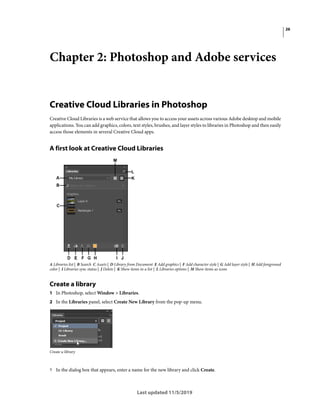
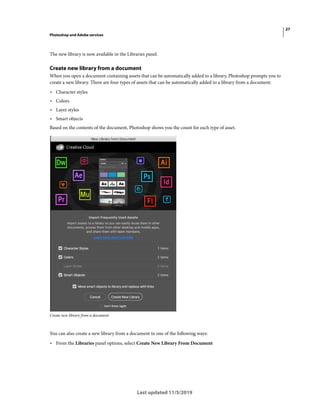
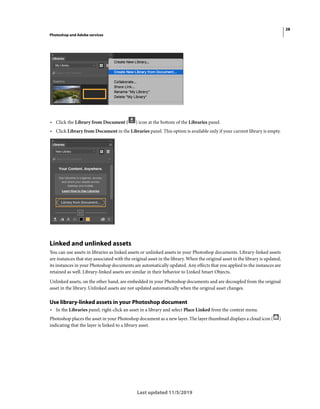
  • 35.
    25 Introduction to Photoshop Lastupdated 11/5/2019 • Swatches.psp • ToolPresets.psp To move these settings to a new installation, copy these files from the following path on the source installation to the same path on the target installation: • Mac:<Username>/Library/Preferences/Adobe Photoshop <version> Settings • Windows:C:Users<username>AppDataRoamingAdobeAdobe Photoshop <version>Adobe Photoshop <version> Settings
  • 36.
    26 Last updated 11/5/2019 Chapter2: Photoshop and Adobe services Creative Cloud Libraries in Photoshop Creative Cloud Libraries is a web service that allows you to access your assets across various Adobe desktop and mobile applications. You can add graphics, colors, text styles, brushes, and layer styles to libraries in Photoshop and then easily access those elements in several Creative Cloud apps. A first look at Creative Cloud Libraries A Libraries list | B Search C Assets | D Library from Document E Add graphics | F Add character style | G Add layer style | H Add foreground color | I Libraries sync status | J Delete | K Show items in a list | L Libraries options | M Show items as icons Create a library 1 In Photoshop, select Window > Libraries. 2 In the Libraries panel, select Create New Library from the pop-up menu. Create a library ? In the dialog box that appears, enter a name for the new library and click Create.
  • 37.
    27 Photoshop and Adobeservices Last updated 11/5/2019 The new library is now available in the Libraries panel. Create new library from a document When you open a document containing assets that can be automatically added to a library, Photoshop prompts you to create a new library. There are four types of assets that can be automatically added to a library from a document: • Character styles • Colors • Layer styles • Smart objects Based on the contents of the document, Photoshop shows you the count for each type of asset. Create new library from a document You can also create a new library from a document in one of the following ways: • From the Libraries panel options, select Create New Library From Document
  • 38.
    28 Photoshop and Adobeservices Last updated 11/5/2019 • Click the Library from Document ( ) icon at the bottom of the Libraries panel. • Click Library from Document in the Libraries panel. This option is available only if your current library is empty. Linked and unlinked assets You can use assets in libraries as linked assets or unlinked assets in your Photoshop documents. Library-linked assets are instances that stay associated with the original asset in the library. When the original asset in the library is updated, its instances in your Photoshop documents are automatically updated. Any effects that you applied to the instances are retained as well. Library-linked assets are similar in their behavior to Linked Smart Objects. Unlinked assets, on the other hand, are embedded in your Photoshop documents and are decoupled from the original asset in the library. Unlinked assets are not updated automatically when the original asset changes. Use library-linked assets in your Photoshop document • In the Libraries panel, right-click an asset in a library and select Place Linked from the context menu. Photoshop places the asset in your Photoshop document as a new layer. The layer thumbnail displays a cloud icon ( ) indicating that the layer is linked to a library asset.
  • 39.
    29 Photoshop and Adobeservices Last updated 11/5/2019 A layer containing a library-linked asset File sync Creative sync makes your libraries accessible across multiple applications, devices, and the web automatically. For cross-device syncing to work, file sync must be enabled in Creative Cloud desktop app. You can check the status of library syncing by the Creative Cloud icon in the Libraries panel. Library sync status A Sync enabled B Sync disabled On your local desktop machine all apps share a single local cache for your libraries data. This enables optimal use of disk space and network bandwidth as well as near-instant propagation of libraries changes between local apps, even when you are not connected to the network. Turn on file sync Depending on your version of Creative Cloud desktop app, do one of the following: When you turn on file sync, libraries start syncing. Your libraries are kept up to date across devices. File syncing may take some time, depending on the volume of content in your libraries. Add assets to the library Open the file containing your assets. You can add graphics, colors, text styles, and layer styles to the library. You can also add assets to the library from Creative Cloud Market. Add graphics 1 Select the appropriate layers or layer groups containing the graphic asset in the Layers panel. 2 Select the Move tool. . 3 Drag and drop the layers or layer groups into the Libraries panel. The graphic asset is now available in the library.
  • 40.
    30 Photoshop and Adobeservices Last updated 11/5/2019 Graphic assets added to a library. Add layer styles, character styles, and colors 1 In the Layers panel, select the appropriate layer containing the asset. 2 Click an icon in the Libraries panel. Add layer styles, character styles, or colors A Add Character Style | B Add Layer Style | C Add Color The assets are now available in the library. Note: Layer Styles apply only to Photoshop layers. Although you can add these styles to a library, you cannot use them in other Creative Cloud desktop applications that support Creative Cloud Libraries. You can also drag brush presets from Brush Presets panel, layers from Layers panel, colors from Swatches panel, and layers styles from Styles panel and drop them in the Libraries panel.
  • 41.
    31 Photoshop and Adobeservices Last updated 11/5/2019 Add assets from Adobe Stock Adobe Stock is deeply integrated with Creative Cloud Libraries. You can add a watermarked stock image to any of your libraries directly using the Adobe Stock website. You can then use the watermarked image in your Photoshop documents as a library-linked asset. When you choose to license the image—which you can do directly from within the Libraries panel in Photoshop—all instances of the watermarked asset in your open documents are updated to the high-resolution licensed image. For more information, see these resources: • Use Adobe Stock in apps supporting Creative Cloud Libraries Add assets from Creative Cloud Market You can use the Creative Cloud for desktop app to browse and add assets from Creative Cloud Market. 1 Launch the Creative Cloud for desktop app. 2 Go to the Assets tab and select Market. Creative Cloud for desktop 1 Browse and select the asset you want to add to the library. 2 Select the library you created in Adobe Photoshop from the pop-up menu.
  • 42.
    32 Photoshop and Adobeservices Last updated 11/5/2019 Add asset from Creative Cloud Market The asset is now available in the library. Add assets from other Adobe applications You can add assets from other Adobe applications, such as Adobe Illustrator, and mobile applications, such as Adobe Brush. Creative Cloud keeps all the assets in sync and you can use these assets in Photoshop. For more information, see Apps supporting Creative Cloud Libraries.
  • 43.
    33 Photoshop and Adobeservices Last updated 11/5/2019 Library search Adobe Stock search from Libraries panel The search box in the Libraries panel enables you to search for the right asset, quickly and efficiently. You can modify your search based on the following available options: Adobe Stock Search for the assets in Adobe Stock from directly within the Libraries panel. Current Library Perform a search for your asset within your current library. All Libraries Perform a search for your asset across all your libraries. Find stock images visually similar to a library element The visual search functionality in the Libraries panel lets you quickly find stock images similar to a library element. Follow these steps: • In the Libraries panel, right-click an element and then select Find Similar from the context menu. Photoshop displays the search results right within the Libraries panel.
  • 44.
    34 Photoshop and Adobeservices Last updated 11/5/2019 Use the Adobe Color Themes extension The Adobe Color service helps you choose harmonious and appealing color combinations for your design projects. Adobe Color is integrated right within Photoshop in the form of an extension that lets you create, save, and access your color themes. You can also explore the many public color themes available on Adobe Color and filter them in several ways: Most Popular, Most Used, Random, themes you've published, or themes you've appreciated in the past. Once you've found a theme that you like; you can edit it and and save it to your themes, or add it to your swatches in Photoshop. Aside from Photoshop, the Adobe Color Themes extension is currently available in three other Creative Cloud desktop applications: Adobe Illustrator, Adobe InDesign and Adobe After Effects. Themes saved to Creative Cloud libraries from within these desktop apps, mobile apps such as Capture, or using the Adobe Color website are accessible seamlessly in Photoshop. Additionally, Adobe Color Themes panel is your portal to groups of colors, or themes, created by an online community of designers. Using the Adobe Color Themes panel, you can create or edit thousands of themes, and then use them in your projects. You can also use the this panel to share your themes with the community by uploading them. Access the Adobe Color Themes panel • In Photoshop, select Window > Extensions > Adobe Color Themes.
  • 45.
    35 Photoshop and Adobeservices Last updated 11/5/2019 Explore color themes Explore themes 1 Click the Explore tab in the Adobe Color Themes panel. By default, the Explore tab displays all public color themes. 2 If necessary, filter the color themes by a category and a timeframe. Use the search bar if you're looking for a specific theme. Work with the color theme Once you've found a theme that you like; click icon to choose the desired option from the flyout menu of a color theme using the Adobe Color Themes panel: Options available for color themes under the Explore tab Edit This Theme Opens the selected color theme in the Create tab of the Adobe Colors Theme panel. You can modify and work with the colors present in the theme as desired and save it in your Creative Cloud Libraries. Note: Alternatively, you can click the name of a color theme to edit it. Add To Swatches Saves the selected color theme in the Swatches panel. View Online View the color theme and related information, such as who created this color theme, the date of sharing this color theme, ratings and reviews, and so on in your browser. You can also appreciate, save, share, and edit this theme from your browser.
  • 46.
    36 Photoshop and Adobeservices Last updated 11/5/2019 View a color theme online Create and save a color theme 1 Click the Create tab in the Adobe Color Themes panel. 2 Select the color rule on which you want to base the theme: Analogous, Monochromatic, Triad, Complementary, Compound, Shades, or Custom. For details, see Color rules. ? Now, choose a base color by clicking the little triangle corresponding to a color in the theme you're editing. Based upon the color rule selected, a color theme is automatically built around the base color. Choose a base color While a color is selected, you can adjust it either using the color wheel or by changing its value in one of the following color systems: CMYK, RGB, LAB, HSB, or HEX. 1 (Optional) You can choose one of the following options while creating a color theme: • Click the Set Selected Color From Active Color icon ( ) to add the active color from Illustrator workspace to your color theme. • Click the Click To Set Active Color icon ( ) to set the active color in the Illustrator workspace from your color theme.
  • 47.
    37 Photoshop and Adobeservices Last updated 11/5/2019 • Click the Add To Swatches icon ( ) to add your color theme to the Swatches panel. 2 Enter a name for the new color theme. Click Save. 3 Choose the Creative Cloud library to which you want to save the theme. Save the new theme to a library ? Click Save. Note: Depending on whether you're logged in using your Adobe ID or your enterprise credentials, different sets of libraries may be available for saving themes. Select Help > Manage My Account to check the credentials with which you're logged in. If you land at the authentication screen for your organization when you select this option, you're logged in using your enterprise credentials. The same email ID may be associated with an Adobe ID as well as an enterprise ID. Color rules Analogous Uses colors that are adjacent on the color wheel. Analogous colors usually blend well with one another and are harmonious and pleasing to the eye.
  • 48.
    38 Photoshop and Adobeservices Last updated 11/5/2019 Example: Analogous color rule Monochromatic Uses variations in saturation and brightness of a single color. When you use this color rule, you're presented with five colors sharing the same hue (example: H:182) but different saturation and brightness values. Monochromatic colors go well together and produce a soothing effect.
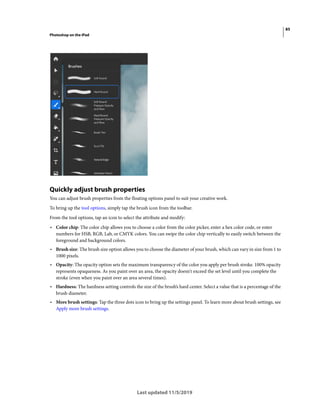
  • 49.
    39 Photoshop and Adobeservices Last updated 11/5/2019 Example: Monochromatic color rule Triad Uses colors evenly spaced around three equidistant points on the color wheel. When you use this color rule, you're presented with two colors with the same hue but different saturation and brightness values from the first point on the color wheel (example: HSB: 182, 90, 45 & HSB: 182, 100, 75), two from the second point on the color wheel (HSB: 51, 90, 55 & HSB: 51, 95, 45), and one color from the third point (HSB: 321, 90, 79). Triadic colors tend to be contrasting—albeit not as contrasting as complementary colors—while still retaining harmony when used together.
  • 50.
    40 Photoshop and Adobeservices Last updated 11/5/2019 Example: Triad color rule
  • 51.
    41 Photoshop and Adobeservices Last updated 11/5/2019 Example: Monochromatic color rule Complementary Uses colors opposite to each other on the color wheel. When you use this color rule, you are presented with two colors with the same hue as the base color (example: HSB: 182, 100, 45 & HSB: 182, 90, 100), the base color itself (HSB: 182, 100, 75), and two colors with the same hue from the opposite point on the color wheel (HSB: 23, 100, 45 & HSB: 23, 100, 75). Complementary colors provide high contrast and tend to stand out when used together.
  • 52.
    42 Photoshop and Adobeservices Last updated 11/5/2019 Example: Complementary color rule Compound Uses a mix of complementary and analogous colors. When you use this color rule, you are presented with two colors with the same hue that are adjacent (analogous) to the base color (example: HSB: 214, 90, 95 & HSB: 214, 60, 35), the base color itself (HSB: 182, 100, 75), and two colors opposite to the base color (complementary) but adjacent to each other (HSB: 15, 75, 78 & HSB: 6, 90, 95). Compound color themes have the same strong visual contrast as complementary color themes, but they have less pressure.
  • 53.
    43 Photoshop and Adobeservices Last updated 11/5/2019 Example: Compound color rule Shades Uses five colors—all sharing the same hue (example: H: 182) and saturation (S: 100) but different brightness values.
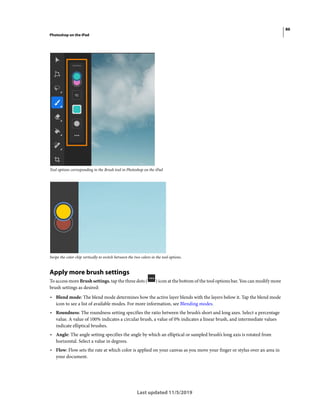
  • 54.
    44 Photoshop and Adobeservices Last updated 11/5/2019 Shades color rule Custom Lets you manually select the colors on the color wheel in your palette without any rules controlling them.
  • 55.
    45 Photoshop and Adobeservices Last updated 11/5/2019 Custom color rule Access themes saved to your libraries Access your themes 1 In the Adobe Color Themes panel, click the My Themes tab. 2 Select the Creative Cloud library from which you want to access the color theme. 3 If necessary, select a sorting parameter/order for the listed themes: By Date, By Name, or By Quantity; ascending or descending.
  • 56.
    46 Photoshop and Adobeservices Last updated 11/5/2019 Touch capabilities and customizable workspaces Photoshop now features a modern user experience that provides robust touch capabilities, an updated UI, and customizable toolbar and workspaces. Touch workspace and gestures If you own a Photoshop-supported Windows-powered device, such as the Surface Pro, you can use these touch gestures while using Photoshop on it. Two-Finger Pan Move two fingers in any direction on the canvas without changing the distance between them or the angle of the line connecting them. You may, this way, pan the canvas view. Two-Finger Pan and Zoom Move two fingers toward or away from each other. You may, this way, pan or zoom the canvas view (scaled). Two-Finger Pan and Rotate Rotate two fingers around the center of the line connecting them. You may, this way, pan and rotate the canvas.
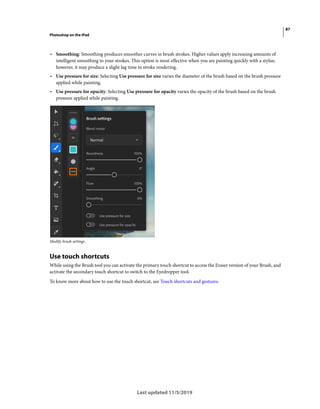
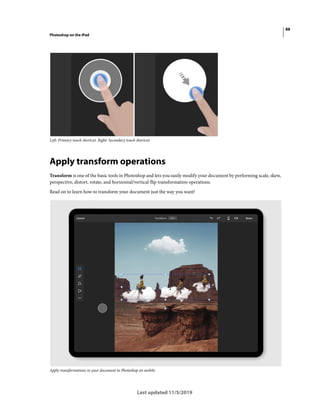
  • 57.
    47 Photoshop and Adobeservices Last updated 11/5/2019 Five-Finger Cycle Screen Mode Tap once with five fingers to cycle through the three application display screen modes, including full screen. Two-Finger Reset or Restore View Double-tap two fingers on the tablet surface to reset the view to an unrotated transform that nearly fills the document canvas. Double-tap with two fingers again to restore the view to its previous state. Three-Finger Step Back in History (Undo) Move three fingers rapidly from right to left. The document view moves back one step in the change history. Three-Finger Step Forward in History (Redo)
  • 58.
    48 Photoshop and Adobeservices Last updated 11/5/2019 Move three fingers rapidly from left to right. The document view moves forward one step in the change history. Three-Finger History Scrub Move three fingers from right to left or from left to right. The document view moves continuously through the entire change history. Two-Finger Free Transform (Pan, Zoom, and Rotate) • Place two fingers on the tablet surface and rest motionless for a moment. • Rotate the two fingers around the center of the line connecting them while simultaneously moving them nearer to or farther from each other. You may, this way, freely pan, zoom, and rotate the canvas view. Customizable toolbar and workspaces Photoshop now features an updated UI. In addition to look-and-feel improvements, it now lets you customize your toolbar and save multiple toolbar configurations as parts of different workspaces. Also, included Photoshop workspaces have been streamlined to give you quick access to only the tools you need. Customize the toolbar.
  • 59.
    49 Photoshop and Adobeservices Last updated 11/5/2019 Customize your toolbar Error: Waiting for Bridge | Mini Bridge panel Issue When you browse files using the Mini Bridge panel in Photoshop, InDesign, or InCopy, you see the following message in the Content pod: "Waiting for Bridge." No files or folders appear. Mini Bridge uses a background process called SwitchBoard to communicate with Adobe Bridge. If SwitchBoard can't open Adobe Bridge, then Mini Bridge can't display your files. This issue also occurs if Photoshop, InDesign, or InCopy can't communicate with Adobe Bridge through SwitchBoard. Solutions to the "Waiting for Bridge" error involve fixing this SwitchBoard communication. Try the following solutions in order, and stop when you resolve the issue. Solution 1: Re-create the SwitchBoard preferences files. 1 Quit all Adobe applications. 2 In the Finder (Mac OS) or Windows Explorer (Windows), navigate to one of the following folders: • Mac OS X: /Users/Your User Name/Library/Preferences/Adobe • Windows 7/Vista: C:UsersYour User NameAppDataRoamingAdobe • Windows XP: C:Documents and SettingsYour User NameApplication DataAdobe Note: Replace Your User Name above with the name of your Mac OS or Windows user account. 3 Delete the SwitchBoard folder.
  • 60.
    50 Photoshop and Adobeservices Last updated 11/5/2019 4 Restart your computer. 5 Open Photoshop, InDesign, or InCopy and then open the Mini Bridge panel. Solution 2: Add SwitchBoard to your firewall software's exception list. Firewall software is used to protect computers from threats on the Internet. Some examples of firewall software are Mac OS Application Firewall, McAfee, Norton, Windows Firewall, and ZoneAlarm. If firewall software prevents SwitchBoard from communicating with Adobe Bridge, however, Mini Bridge can't display your files. Most firewall software can store a list of exceptions, that is, a list of programs that are allowed to access network resources. It's possible that your firewall software calls these exceptions a "white list" or an "allow list." For instructions on how to add an exception to your firewall software, see the firewall software's documentation, or contact its manufacturer. SwitchBoard is installed to one of the following locations: • Mac OS X: /Library/Application Support/Adobe/SwitchBoard/SwitchBoard.app • 32-bit editions of Windows: C:Program FilesCommon FilesAdobeSwitchBoardSwitchBoard.exe • 64-bit editions of Windows: C:Program Files (x86)Common FilesAdobeSwitchBoardSwitchBoard.exe After adding SwitchBoard to the list of exceptions in your firewall software, restart your computer. Open Photoshop, InDesign, or InCopy, and then open the Mini Bridge panel. Solution 3: (Windows) Ensure that the Windows hosts file contains its default entries. SwitchBoard points to the localhost server, which is an internal name for your computer, to communicate with Adobe Bridge. By default, the Windows OS "hosts" file contains a reference to localhost. If the hosts file is missing this entry, however, or if this entry is incorrect, then Mini Bridge can't access your content. To determine what information is required in the hosts file for your edition of Windows, see Microsoft Support article 972034. This article also includes information about resetting the hosts file to its default. Solution 4: (Windows) Clear the Windows cryptographic database and reset SwitchBoard. The first time SwitchBoard runs on your computer, it uses information in the Windows cryptographic database to create values in the registry and switchboard.ini file. If SwitchBoard cannot read this database, then the resulting registry values and the data in switchboard.ini are all invalid. These invalid files prevent SwitchBoard from functioning. 1 Close all Adobe applications. 2 Choose Start > Run (Windows XP) or click Start (Windows Vista or Windows 7), type "%appdata%MicrosoftCrypto" (including the quotation marks), and press Enter. 3 Rename the RSA folder to, for example, oldRSA. 4 Choose Start > Run (Windows XP) or click Start (Windows Vista or Windows 7), and type regedit and then press Enter. The Registry Editor opens. 5 In the left pane of the Registry Editor, navigate to HKEY_CURRENT_USERSoftwareAdobeIAC. Select the IAC key. 6 In the right pane, right-click the MD5ID value and choose Delete. Click Yes in the Confirm Value Delete dialog box.
  • 61.
    51 Photoshop and Adobeservices Last updated 11/5/2019 7 In the right pane, right-click the user ID value and choose Delete. Click Yes in the Confirm Value Delete dialog box. 8 Close the Registry Editor. 9 Choose Start > Run (Windows XP) or click Start (Windows Vista or Windows 7), type "%appdata%AdobeSwitchBoard" (including the quotation marks), and press Enter. 10 Delete the switchboard.ini file. (If you do not see the .ini filename extension, then delete the file that is of the type Configuration Settings. The file has an icon that looks like a notepad with a gear on top of it.) 11 Restart your computer; open Photoshop, InDesign, or InCopy; and open the Mini Bridge panel. Solution 5: Create a different user account. Occasionally, a user account can become corrupted, which can prevent SwitchBoard from accessing or creating the necessary files. Create an account with the same permissions as your current account, log in to the new account, and then run your Adobe applications. For assistance creating a user account, see the following documents: • Creating a new user account in the Mac OS X Help • How to create and configure user accounts in Windows XP, Create a user account in Windows (select Windows 7 or Windows Vista from the menu) on the Microsoft support website. For additional assistance, contact your system administrator. Untab image windows Issue When you open images in Adobe Photoshop they are tabbed together instead of in individual windows. Solutions Solution 1: Float your images in windows. • To float one image in a window, choose Window > Arrange > Float in Window. • To float all open images in windows, choose Window > Arrange > Float All In Windows. Note: Window > Arrange is only available when an image window is open. Solution 2: Disable image tabs and window docking. To prevent images from opening in tabs in the future, do the follow: 1 Choose Photoshop > Preferences > Interface (Mac OS) or Edit > Preferences > Interface (Windows). 2 Deselect Open Documents As Tabs. 3 Deselect Enable Floating Document Window Docking. 4 Click OK.
  • 62.
    52 Photoshop and Adobeservices Last updated 11/5/2019 Additional information When you drag an image into Photoshop (and the Application Frame is on in Mac OS), the image opens in a tab. This issue occurs even if the tabbed preferences are disabled. For more information, see Manage windows and panels and View images in multiple windows in the Photoshop User Guide.
  • 63.
    53 Last updated 11/5/2019 Chapter3: Photoshop on the iPad Photoshop on the iPad | Common questions Can I use Photoshop on the iPad? Yes, you can now use Photoshop on your iPad and create anything, anytime, and anywhere. Inspiration is everywhere. So is Photoshop! When you're inspired to create something new, Photoshop on the iPad allows you to open and edit large Photoshop files, create stunning composites, retouch your images, and apply effects while on the go. With Photoshop on the iPad, you can untether yourself from your desktop and resume work seamlessly across devices — with the power of Photoshop cloud documents | Common questions.
  • 64.
    54 Photoshop on theiPad Last updated 11/5/2019 Begin creating with Photoshop on the iPad today by subscribing to a Creative Cloud plan that includes Photoshop. Already have an active plan that includes Photoshop? Sign-in with your Adobe ID on your iPad and download Photoshop for the iPad today. Which iPad do I need to download and use Photoshop? To use Photoshop on the iPad, see the list of supported iPad models updated to iPadOS: What languages are supported in Photoshop on the iPad? On supported devices, Photoshop is available in the following languages: Deutsch English Français ??? Note: In Photoshop on the iPad, you may be able to use unsupported languages by selecting a native font. However, the functionality will be limited and your experience may vary. Adobe is working to provide support for additional languages in the future releases. Minimum requirement iPadOS version iPadOS (13.1) iPad models • iPad Pro 12.9-inch (recommended) • iPad Pro 11-inch • iPad Pro 10.5-inch • iPad Pro 9.7-inch • iPad (7th generation) • iPad (6th generation) • iPad (5th generation) • iPad mini (5th generation) • iPad mini 4 • iPad Air (3rd generation) • iPad Air 2 Apple Pencil models • Apple Pencil (2nd generation) (recommended) • Apple Pencil (1st generation)
  • 65.
    55 Photoshop on theiPad Last updated 11/5/2019 Which Adobe plans include Photoshop on the iPad? Get Photoshop and start working with Photoshop on the iPad. If you have an Adobe Creative Cloud plan that already includes Photoshop, you can simply download Photoshop on the iPad for a limited time without purchasing another plan — simply sign-in with your Adobe ID. If you don't have a plan that includes Photoshop, for a limited time, you can purchase the Creative Cloud Photography plan that includes Photoshop on the iPad, Photoshop desktop, Lightroom, Lightroom Classic, Spark and Portfolio. Simply sign-in with your Adobe ID to purchase the Creative Cloud Photography plan. Don't have an Adobe ID? It's free and easy to create one. Click here to quickly create your Adobe ID. Is Photoshop on the iPad available in my country? Photoshop on the iPad is available only in countries where Creative Cloud services are available. See the latest list of countries that support Creative Cloud services. Adobe Creative Cloud services are currently not available on adobe.com in mainland China. As a result, Photoshop on the iPad is not available in this region.
  • 66.
    56 Photoshop on theiPad Last updated 11/5/2019 How does Photoshop on the desktop work with Photoshop on the iPad? You can access cloud documents from both the desktop or the iPad. Any document you create with Photoshop on the iPad is automatically saved as a cloud document, so that you can easily access your creative work from iPad to desktop. Cloud documents are automatically synced across devices to create a seamless workflow. For example, if you want to resume your desktop work on the iPad, simply save your PSD as a cloud document. To view your cloud documents, simply navigate to the Cloud documents tab on the home screen.
  • 67.
    57 Photoshop on theiPad Last updated 11/5/2019 Can I turn off auto-save in cloud documents? Cloud documents are automatically saved to the cloud and help you work seamlessly across devices. A cloud document is always automatically saved to the cloud — this is what helps you work seamlessly on your creative projects anytime, anywhere, across your devices. Although cloud document auto-save does not turn off, you can restrict syncing over your cellular network when working on an iPad. To learn more about cloud documents workflows in Photoshop, see Photoshop cloud documents | Common questions. How much cloud storage does Photoshop on the iPad provide? Can I upgrade my storage? Your cloud storage is shared across your Adobe Creative Cloud apps. The amount of your cloud storage is determined by your Adobe Creative Cloud subscription plan. Plan Storage In-app purchase (via Apple App Store) 100 GB Free trial 2 GB Creative Cloud Photography plan (20 GB) (For existing subscribers and new subscribers who purchase this plan by January 31, 2020 ) 20 GB
  • 68.
    58 Photoshop on theiPad Last updated 11/5/2019 If your cloud storage goes over your quota, your documents can be saved as a local document only. If you need more cloud storage, easily upgrade your subscription plan to include additional storage at any time. What happens to my assets if I close or delete my Adobe account? Assets are available for download for a limited period of time even after your plan expires. If you close or delete your Adobe account, or if your subscription expires, your assets remain in the cloud and available to download for 30 days. After 30 days, you may lose access to some or all of your documents that are saved on the cloud servers. To view your assets, go to assets.adobe.com. To learn more about Creative Cloud, see Common Questions | Creative Cloud. Creative Cloud Photography plan (1 TB) 1 TB Photoshop Single App 100 GB Creative Cloud All Apps 100 GB
  • 69.
    59 Photoshop on theiPad Last updated 11/5/2019 What are the keyboard and touch shortcuts for Photoshop on the iPad? Simplify your workflows with keyboard and touch shortcuts. To view a list of popular keyboard shortcuts in Photoshop on the iPad, see Keyboard shortcuts. To learn more about touch shortcuts and touch gestures in Photoshop on the iPad, see Touch shortcuts and gestures.
  • 70.
    60 Photoshop on theiPad Last updated 11/5/2019 How do I suggest a feature or report an issue with Photoshop on the iPad? Your feedback is valuable! Send us your suggestions. Connect with us on Adobe forum. Adobe actively listens to our large community of users. We value your input and make it easy to report issues or request new features for Photoshop on the iPad. To report a problem, suggest a feature, or take a survey, navigate to App Settings > General > Help > Send feedback. To ask a question and be a part of community discussions on Adobe Forum for Photoshop, navigate to App Settings > General > Help > Community forum. To join a discussion or post to the community, go to Adobe Support Community | Photoshop. Get to know the workspace As you launch Photoshop on the iPad, you can view the home screen of the app. From the home screen, you can start creating your composites or documents and proceed to the editing workspace. In the workspace, you can find your favorite Photoshop tools, panels, and other options that will equip you to create composites and retouch your creative work. More Photoshop tools and features are coming to your iPad in future releases.
  • 71.
    61 Photoshop on theiPad Last updated 11/5/2019 Home screen Easily find all your documents on the home screen in Photoshop on the iPad. • Home: Use the Home icon ( ) to switch back to the home screen from the editing workspace at any time. • Learn: Access an interactive app tour and hands-on tutorials to help you explore what's different when you use Photoshop on the iPad and understand common workflows. • Cloud documents: View a list of all saved cloud documents in Photoshop, whether created in Photoshop on your iPad or desktop. To learn more about cloud documents, see Photoshop cloud documents | Common questions. • Deleted: Accidentally deleted a file? No worries! Find a complete list of cloud documents that you have deleted here. You can choose to restore the documents or permanently delete them. • Create new: Easily create a new document with the option to name the document, set the canvas dimension, change orientation, select resolution and choose black, white or transparent background color. You can also explore common preset canvas options in the Print, Screen,Film, or Video categories. • Import and open: Quickly import and open your document from the Camera Roll, Files, or take a new photo with your iPad's Camera. Your imported file converts to a Photoshop cloud document and opens on the canvas. • Suggest a feature: Suggest features you would like to see in future releases of Photoshop on the iPad. Adobe is building Photoshop with valuable inputs from its large community of users like you. • Recent: Use the Recent section to access all the documents you worked on recently.
  • 72.
    62 Photoshop on theiPad Last updated 11/5/2019 • App Settings: Tap to set your preferences while working with Photoshop on the iPad. To learn more, see Manage app settings. • Cloud docs help: Tap to check whether you're online or offline, and the save status of your cloud documents. Edit workspace As soon as you open a document, you will enter into the editing workspace and your creative work can begin. The canvas displays the area where you interact with your open document. Photoshop on the iPad offers you a context- aware user interface. Core tools and tool options are contextual and surface only when you need them. Get to know the Photoshop workspace on your iPad Header bar A Home B File name C Current zoom level D Undo E Redo F Cloud docs help G Send to H Help
  • 73.
    63 Photoshop on theiPad Last updated 11/5/2019 A. Home: Use the Home icon ( ) to switch back to the home screen from the editing workspace at any time.B. Filename: Displays the name of the document currently open.C. Current zoom level: Displays the current zoom level of the open document. D. Undo: Reverts the last action performed.E. Redo: Restore the last action undone.F. Cloud docs help: Check whether you're online or offline, and the save status of your cloud documents.G. Send to: Use the Send to icon to save and send your work to Photos, Files, or Share. H. Help: Tap the help icon to browse tutorials, take the in-app tour, view shortcuts, check the Photoshop user guide, reach out to the community forum, and share your feedback with Adobe. Toolbar A. Move: Move selections and layers.B. Transform: Apply various transform operations to the selected layer or object.C. Select: Make a selection with the selection tools—Lasso, Quick select, Rectangular marquee, and Elliptical marquee. Long press icon to reveal all selection tools.D. Brush: Apply brush strokes and control brush settings.E. Erase: Remove portions in your photo where you apply the eraser brush strokes.F. Fill: Fill the active selection with the foreground color. Long press icon to reveal the Gradient tool.G. Heal: Retouch and fix imperfections with the Heal tool. Long press icon to reveal the Clone stamp tool.H. Crop: Crop your selection, and choose to rotate and recenter.I. Type: Create a type layer to add text.J. Place photo: Add photos from Camera Roll, Files, Libraries, and Camera. K. Eyedropper: Easily change foreground color by sampling from any layer.L. Color chip: View the selected foreground and background colors in the color chip. Swipe vertically to switch between the two colors. Tap the color chip to choose a new color from the color picker that appears. Note: Long press the icons that have triangles on the bottom right to reveal more tools. A Move B Transform C Select D Brush E Erase F Fill G Heal H Crop I Type J Place Photo K Eyedropper L Color chip
  • 74.
    64 Photoshop on theiPad Last updated 11/5/2019 Taskbar A Compact layer view B Detail layer view C Layer properties D Add new layer E Layer visibility F Add mask G Add clipping mask H Filters and adjustments I More layer actions A. Compact layer view: See all the layer thumbnails in a simplified view. B. Detail layer view: See an expanded layer stack with masks, layer names, visibility, and group contents.C. Layer properties: View blending options, adjustments, and dimensions for the type of layer selected (type, pixel, adjustment, and so on).D. Add layer: Insert a new layer. Long press for more options — add a new layer, adjustment layer, or empty group.E. Layer visibility: Control layer visibility.F. Add layer mask: Add layer masks to hide or reveal portions of a layer.G. Add clipping mask: Add clipping masks to hide or reveal portions of a layer based on the layer below.H. Filters and adjustments: Apply various filters and adjustments to the selected layer.I. More layer actions: Reveal more actions you can perform with layers. Note: Long press the icons that have triangles on the bottom right to reveal more tools. Tool options
  • 75.
    65 Photoshop on theiPad Last updated 11/5/2019 You can control the settings of your selected tools using the tool options. Tap a tool icon to bring up the tool options. Hold and drag the grabber at the top of the tool options to move it around the canvas. You can also dock tool options by dragging it to the bottom of the toolbar and releasing. Note: All tools do not have tool options. Touch shortcut Left: Primary touch shortcut. Right: Secondary touch shortcut. Use the touch shortcut to quickly access alternate actions of a selected tool in Photoshop on the iPad. To learn how to use primary and secondary touch shortcuts, see Touch shortcuts and gestures System requirements | Photoshop on the iPad
  • 76.
    66 Photoshop on theiPad Last updated 11/5/2019 Minimum and recommended system requirements To identify iPadOS supported devices, see Apple's support documentation. To identify your iPad model, see Apple's support documentation. To find out which Apple Pencil works with your iPad, see Apple's support documentation. Language versions available On supported iPadOS devices, Photoshop is available in the following languages: Deutsch English Français ??? Note: In Photoshop on the iPad, you may be able to use unsupported languages by selecting a native font. However, the functionality will be limited and your experience may vary. Adobe is working to provide support for additional languages in the future releases. Minimum requirement iPadOS version iPadOS (13.1) iPad models • iPad Pro 12.9-inch (recommended) • iPad Pro 11-inch • iPad Pro 10.5-inch • iPad Pro 9.7-inch • iPad (7th generation) • iPad (6th generation) • iPad (5th generation) • iPad mini (5th generation) • iPad mini 4 • iPad Air (3rd generation) • iPad Air 2 Apple Pencil models • Apple Pencil (2nd generation) (recommended) • Apple Pencil (1st generation)
  • 77.
    67 Photoshop on theiPad Last updated 11/5/2019 Add photos to your canvas Placing photos in Photoshop on the iPad is easy with the Place Photo tool. Every photo placed is added as a new layer to your document. You can effortlessly select photos from your iPad's Camera Roll, Files, Libraries, or take a new photo right in the app with the Camera option. Easily transform your photo to finalize its placement in your document. Tap the Place Photo icon and view the sources from which you can add photos. 5 Simple steps to quickly place a photo in your document 1 Open the Photoshop document you want to add a photo to. 2 Simply tap from the toolbar on the left side of the canvas. 3 In the options panel that opens, select the source of the photo you want to add: • Camera Roll: Tap Camera Roll to see all your Camera Roll photos. • Files: Tap Files to browse through your file Locations on your iPad. You can also add selected files to Favorites and find tagged files under the Tags section. • Libraries: Tap Libraries to access the images saved in your Creative Cloud Libraries, and other third-party apps that are installed on your iPad and signed-in. Library assets are placed unlinked and flattened for now. • Camera: Tap the camera icon to open the camera on your iPad. On opening the camera for the first time, a dialog opens: "Photoshop would like to access the Camera". Tap OK to grant access. Capture a photo with your iPad. Tap Retake to capture a better shot or tap Use Photo to continue.
  • 78.
    68 Photoshop on theiPad Last updated 11/5/2019 4 Tap a photo to select it from any of the above sources. The selected photo opens in the Transform mode. Select a transform operation to apply on the photo before placing it in the canvas. To learn more about transform operations, see Apply transform operations. 5 Tap Done to apply transformations and add the photo to your canvas. Tap Cancel to go back to the open document and start the process again. Have a question on supported file types? Find answers to some of your common queries. If your question isn't listed here, or you want to share your feedback, join discussions on Adobe Photoshop Community. What file formats can I place in a document? The supported file formats for placing a photo in Photoshop are - PSD, PSB, TIFF, JPG, and PNG. Can I place .pdf and .ai files in a document? Yes. However, PDF and AI files are converted to flat PNG images before getting added to a document. Can I place smart objects and linked assets in a document? Yes. However, linked assets and smart objects are placed as unlinked raster layers for now.
  • 79.
    69 Photoshop on theiPad Last updated 11/5/2019 Work with layers Layers contain the images, fonts, and objects that make up a layered file. Layers enable you to move, edit, and work with content on one layer without affecting the content within your other layers. Use layers to perform tasks such as compositing multiple images, adding text to an image, and applying filters and adjustments. Layers are arranged in a stack and can be viewed by tapping either the compact or detailed layer view from the taskbar in the workspace. Layer views You can choose to view the layers in your document and other layer information from the taskbar. The available layer view options are compact, detailed, or hidden layer view. Compact layer view Tap from the taskbar to view layer thumbnails only. Swipe left on a thumbnail to see applied mask, if one has been applied to the layer.
  • 80.
    70 Photoshop on theiPad Last updated 11/5/2019 Detailed layer view Tap from the taskbar to view layer names, visibility, and thumbnails of the layer and applied mask, if one has been applied to the layer. Hidden layer view Deselect the compact layer view and detail layer view to hide both layer views from the canvas. Layer properties Tap from the taskbar to access layer properties: Thumbnail: Displays the layer thumbnail and name. Blending options: You can create various special effects using blending options — Opacity and Blend mode. • Opacity: Use the Opacity slider to adjust the overall opacity level of a layer. Opacity determines to what degree the selected layer is obscured or revealed. A layer with 1% opacity appears nearly transparent, whereas one with 100% opacity appears opaque. To learn more about how opacity works in Photoshop, see Layer opacity and blending. • Blend mode: A layer’s blending mode determines how its pixels blend with underlying pixels in the image. You can choose from a list of special effects using blending modes available in the drop-down list. To learn more about blending options in Photoshop, see Blending modes. Add clipped adjustment: Adds a clipped adjustment layer to the current layer — Brightness/Contrast, Black and white, Color balance, Exposure, Hue/Saturation, Levels, and Vibrance. Effects: This feature is not supported on the iPad yet.
  • 81.
    71 Photoshop on theiPad Last updated 11/5/2019 Smart filters: This feature is not supported on the iPad yet. Dimensions: Displays the dimensions of the current layer bounds. Add and name a layer Tap from the taskbar, to add a new layer. The new layer is inserted above the currently selected layer. To name or rename a layer, open the detailed layer ( ) view. Double tap the layer name to bring up the Rename layer dialog. Type a name for the layer and tap Rename to confirm the name. Layer visibility You can choose to show or hide the contents of a particular layer with the layer visibility ( ) option available in the taskbar. Tap from the taskbar, or from the detailed layer view to hide the contents of a selected layer. Tap again to view the contents of that layer. Layer mask You can add a mask to a layer to show parts of the layer and hide others by tapping on the layer mask ( ) icon. In the areas where the layer is masked (hidden), the layers below are visible. Masking layers is a valuable compositing technique for combining multiple photos into a single image or for removing a person or object from a photo. You can edit a layer mask to add or subtract from the masked region. Areas you paint in black on the mask, hides those areas of the layer while areas you paint white on the mask are visible. For areas you paint on the mask in shades of gray, the layer appears in various levels of transparency. Tap the mask visibility ( ) icon to temporarily make the mask invisible, so that you can see the entire layer without the mask applied. By default, a layer or group is linked to its layer mask. To break the link between a layer and a mask, tap ( ). This allows you to move the layer image and the mask independent of one another. Clipping mask A clipping mask allows you to use the content of one layer to mask the layers above it. The masking is determined by the content of the bottom or base layer. The non-transparent content of the base layer clips (reveals) the content of the layers above it in the clipping mask. All other content in the clipped layer is masked out. When the layer to be clipped is selected, tap the clipping mask ( ) icon and the layer below it is used to clip the layer. More layers can be placed on top and clipped to the same shape. The top layer is the layer to be clipped. The middle layer determines what is clipped. The bottom layer is the lower layer that shows through when the top layer is clipped.
  • 82.
    72 Photoshop on theiPad Last updated 11/5/2019 Add a clipping mask in Photoshop on the iPad Filters and adjustments Tap from the taskbar to bring up the Filters and adjustments panel. Gaussian blur: Applies the selected amount (from .1 to 1000) of gaussian blur to a layer. Invert: Inverts the contents of the layer. Filters and adjustments in Photoshop on the iPad Layer actions Tap from the taskbar to bring up the Layer actions panel. Lock layer: Locks the layer so it can’t be edited. Delete layer: Deletes the active layer.
  • 83.
    73 Photoshop on theiPad Last updated 11/5/2019 Rename layer: Renames the active layer. Add clipped adjustment: Adds a clipped adjustment layer to the selected layer. Begin multi-select mode: Allows you to select multiple layers. Duplicate layer: Duplicates the active layer. Copy layer: Allows you to copy a selection or layer to be pasted. Select all: Selects all contents of the active layer. Load as selection: Selects all the nontransparent areas on a layer, or if a layer mask exists all the unmasked areas. Selecting these areas is useful when you want to select text or image content that is surrounded by or contains transparent areas or to create a selection that excludes masked areas on a layer. Flatten layer: Brings all layers of a multi-layered document to one plane. Merge down: Merges the active layer with the layer below it. Merge visible: Merges all visible layers into the active layer. Layer actions panel in Photoshop on the iPad
  • 84.
    74 Photoshop on theiPad Last updated 11/5/2019 Manage your layers Select multiple layers You can select multiple layers to work with. Select the compact layer view or the detailed layer view, and tap the layer actions ( ) icon. Select Begin multi-select mode from the layer actions panel that opens. In the Select layer mode, checkboxes appear next to each layer thumbnail in the layer view. Tap only those checkboxes that are next to layer thumbnails you want to select. Tap Done in the Select layer mode, or Cancel to exit selection. Group and ungroup layers You can Select multiple layersthat you want to group as described above. Tap the folder icon ( ) to group the layers together. To ungroup layers, do the following: 1 Select the grouped layer. 2 Tap the three dots icon ( ) on the taskbar . 3 Tap the open folder ( ) icon to ungroup layers. Reorder layers To reorder a layer, long-press the thumbnail of the layer you want to move and then move it to the desired location in the layer stack. Make selections and add masks Making selections and adding masks are two powerful ways to edit selective areas and add effects to your composites.
  • 85.
    75 Photoshop on theiPad Last updated 11/5/2019 Easily create accurate selections and masks in Photoshop on your iPad. Make selections A selection isolates one or more parts of your image. By selecting specific areas, you can edit, and apply effects and filters to portions of your document while leaving the unselected areas untouched. • Double tap the Lasso tool from the toolbar, to bring up more selection tools. You can select areas of a layer with — Lasso, Quick selection, Rectangular marquee, and Elliptical marquee. • When you tap a selection tool, the associated tool options appear. From the tool options, you can choose whether to add to your selection ( ), subtract from your selection ( ), or select the areas that intersect with the current selection ( ).
  • 86.
    76 Photoshop on theiPad Last updated 11/5/2019 • When you make a selection, the active selection properties appear at the bottom of the workspace. It gives you the option to deselect, mask, erase, invert, transform the selection, or select similar. Selection tools Select with the Lasso tool The Lasso tool is useful for drawing freeform segments of a selection border. To select using the the Lasso tool, tap the ( ) icon. As you tap Lasso, choose from the tool options that appear. Simply draw a freehand selection to proceed. • Add to selection ( ): Next selections will be added to the current selection. • Subtract from selection ( ): Next selections will be subtracted from the current selection. • Select the areas that intersect with the current selection ( ): Select the intersection of current and next selection. • Lasso settings ( ): Feather - Select the number of pixels to feather the edges of a selection.
  • 87.
    77 Photoshop on theiPad Last updated 11/5/2019 Select with the Quick selection tool The Quick selection tool allows you to quickly paint a selection using an adjustable round brush. As you drag, the selection expands outward and automatically finds and follows defined edges in your document. Double tap the Lasso tool from the toolbar to bring up the Quick selection tool ( ) . As you tap the Quick selection tool, choose from the tool options that appear: • Add to selection ( ): Next selections will be added to the current selection. • Subtract from selection ( ): Next selections will be subtracted from the current selection. • Brush size: Determines the pixel size of the quick selection tool. • Hardness: The hardness setting controls the size of the brush’s hard center. • Quick Select settings ( ): Enable/disable Use pressure for size. Select with the Marquee tools The marquee tools allow you to select rectangles and ellipses. To make a marquee selection, choose one of the marquee tools and simply drag over the area you wish to select. If you have a physical keyboard connected to your iPad, you can also press M (Shift) to select the Marquee tools. The Rectangular marquee tool ( ) makes a rectangular selection.
  • 88.
    78 Photoshop on theiPad Last updated 11/5/2019 Rectangular marquee tool The Elliptical marquee tool ( ) makes an elliptical selection. Elliptical marquee tool • Add to selection ( ): Next selections will be added to the current selection. • Subtract from selection ( ): Next selections will be subtracted from the current selection. • Select the areas that intersect with the current selection ( ): Select the intersection of current and next selection. • Lasso settings ( ): Feather - Select the number of pixels to feather the edges of a selection.Style - Select a style from the drop-down list. Active selection properties Once you make a selection, you can see active selection properties at the bottom of the workspace: • Deselect: Deselects the current selection • Mask: Turns the current selection into a mask for the layer • Erase: Allows you to erase the selected area • Invert: Inverts the selection so that the deselected area becomes the selection • Transform: Allows you to transform the selection • Select similar: Adds pixels to the selection that are similar to the ones already selected
  • 89.
    79 Photoshop on theiPad Last updated 11/5/2019 More options on taskbar • Cut: Allows you to cut a selection or layer • Copy merged: Allows you to copy a merged selection or layer to be pasted over another layer. Apply masks You can use masks to hide portions of a layer and reveal portions of the layers below. Masks are nondestructive, which means you can go back and edit the masks again without losing the pixels they hide. • A layer mask hides part of a layer from view. • A clipping mask uses the contents of one layer to clip or hide the contents of one or more other layers from view. Layer mask You can create a layer mask to show parts of a layer and hide others by turning a selection into a layer mask, or by painting on the layer mask after creating it. In areas where the layer is masked or hidden, the layers below are visible. Masking layers is a valuable compositing technique for combining multiple documents into a single document or for removing unwanted objects from a composite. Create a layer mask from a selection 1 Make sure the layer you wish to mask is selected. Simply tap a layer thumbnail from the taskbar to select a layer. 2 Create a selection using one of the selection tools. 3 Tap the layer mask icon on the taskbar ( ). You can view the selected area while the rest of the layer gets masked. From the compact layer view, you can swipe left and right on the layer thumbnail to switch the view from layer view to layer mask view. Both thumbnails are visible on the detailed layer view. To learn more about layer views, see Work with layers.
  • 90.
    80 Photoshop on theiPad Last updated 11/5/2019 Create a layer mask and edit the mask with a brush 1 Make sure the layer you wish to mask is selected. Simply tap a layer thumbnail from the taskbar to select a layer. 2 Tap the layer mask ( ) icon on the taskbar to create a mask. 3 Tap the brush ( ) icon. 4 Set up brush properties as desired. Choose black to fully mask where you paint. To learn more about brush properties, see Draw and paint with brushes. 5 Paint over the mask layer. To learn more about layer masks, see Work with layers. Clipping mask A clipping mask allows you to use the content of one layer to mask the layers above it. To learn more about clipping masks, see Work with layers. Retouch your composites With Photoshop now available on your iPad, you can select powerful tools such as Spot Healing Brush and Clone Stamp to retouch and remove unwanted parts from your composites. Retouch with Spot Healing Brush The Spot Healing tool paints with a sampled part from your document and matches the texture, lighting, transparency, and shading of the sampled part to the part of the document being healed. The Spot Healing Brush does not require you to specify a sample spot and automatically picks samples from around the part of the document to be retouched. To work with the Spot Healing Brush, do the following: 1 Tap the Spot Healing Brush ( ) icon from the toolbar. 2 From the tool options that open, you can set the brush size, and hardness. 3 Tap ( ) to access more settings. 4 In the Spot Healing Brush settings panel that opens, enable Sample all layers to use all visible layers in your document as a source to apply healing on the selected layer. Deselect Sample All Layers, to sample only from the active layer. Also, you can enable/disable Use pressure for size as required. 5 Tap the area in your document you want to retouch, or tap and drag to smooth over imperfections in a larger area.
  • 91.
    81 Photoshop on theiPad Last updated 11/5/2019 Retouch using Clone Stamp The Clone Stamp ( ) tool paints one part of your document over another part of the same document. You can also paint one part of a layer over another layer. The Clone Stamp tool is useful for duplicating objects or removing a defect in your composite. To use the Clone Stamp tool, you set a sampling source on the area you want to clone from and paint over another area. By default, your last sampling area is selected when you access the Clone Stamp. To work with the Clone Stamp tool, do the following: 1 Double tap the Spot Healing Brush ( ) icon from the toolbar to reveal the hidden Clone Stamp tool. 2 Tap to select the Clone Stamp tool. 3 From the tool options that open, you can change the brush radius, hardness, opacity, and set source. 4 Tap ( ) to access more settings. 5 In the Clone Stamp settings panel that opens, you can select your Sample—Current, Current and below, and All layers. You can also enable/disable the Use pressure for size and Use pressure for opacity options.
  • 92.
    82 Photoshop on theiPad Last updated 11/5/2019 6. Work with touch shortcuts to Set source and tap over an area you want to select as the cloning source.
  • 93.
    83 Photoshop on theiPad Last updated 11/5/2019 Use the primary touch shortcut to set the source from where you wish to clone. 7. Release the touch shortcut after setting the source and tap over an area on which you want to apply Clone stamp. This action paints the source area over your selected area.
  • 94.
    84 Photoshop on theiPad Last updated 11/5/2019 Use the secondary touch shortcut to apply Clone stamp to the destination area in your document. Draw and paint with brushes With Photoshop on the iPad, you can draw and paint with brushes—whenever, wherever inspiration strikes. Not sure where to begin? Start with selecting a brush type to create your composite. How to choose a brush type 1. Tap from the toolbar to select the brush tool. 2. A small triangle in the lower right corner of the brush icon represents hidden tool options. Long press the brush icon to reveal the Brushes panel. 3. In the Brushes panel that opens, you can scroll through a list of default brush types. Tap to select the desired brush type and apply to the canvas. Note: The brush type used in your previous session remains selected when you use the brush tool again. You can always come back to the Brushes panel and change your brush.
  • 95.
    85 Photoshop on theiPad Last updated 11/5/2019 Quickly adjust brush properties You can adjust brush properties from the floating options panel to suit your creative work. To bring up the tool options, simply tap the brush icon from the toolbar. From the tool options, tap an icon to select the attribute and modify: • Color chip: The color chip allows you to choose a color from the color picker, enter a hex color code, or enter numbers for HSB, RGB, Lab, or CMYK colors. You can swipe the color chip vertically to easily switch between the foreground and background colors. • Brush size: The brush size option allows you to choose the diameter of your brush, which can vary in size from 1 to 1000 pixels. • Opacity: The opacity option sets the maximum transparency of the color you apply per brush stroke. 100% opacity represents opaqueness. As you paint over an area, the opacity doesn't exceed the set level until you complete the stroke (even when you paint over an area several times). • Hardness: The hardness setting controls the size of the brush’s hard center. Select a value that is a percentage of the brush diameter. • More brush settings: Tap the three dots icon to bring up the settings panel. To learn more about brush settings, see Apply more brush settings.
  • 96.
    86 Photoshop on theiPad Last updated 11/5/2019 Tool options corresponding to the Brush tool in Photoshop on the iPad Swipe the color chip vertically to switch between the two colors in the tool options. Apply more brush settings To access more Brush settings, tap the three dots ( ) icon at the bottom of the tool options bar. You can modify more brush settings as desired: • Blend mode: The blend mode determines how the active layer blends with the layers below it. Tap the blend mode icon to see a list of available modes. For more information, see Blending modes. • Roundness: The roundness setting specifies the ratio between the brush’s short and long axes. Select a percentage value. A value of 100% indicates a circular brush, a value of 0% indicates a linear brush, and intermediate values indicate elliptical brushes. • Angle: The angle setting specifies the angle by which an elliptical or sampled brush’s long axis is rotated from horizontal. Select a value in degrees. • Flow: Flow sets the rate at which color is applied on your canvas as you move your finger or stylus over an area in your document.
  • 97.
    87 Photoshop on theiPad Last updated 11/5/2019 • Smoothing: Smoothing produces smoother curves in brush strokes. Higher values apply increasing amounts of intelligent smoothing to your strokes. This option is most effective when you are painting quickly with a stylus; however, it may produce a slight lag time in stroke rendering. • Use pressure for size: Selecting Use pressure for size varies the diameter of the brush based on the brush pressure applied while painting. • Use pressure for opacity: Selecting Use pressure for opacity varies the opacity of the brush based on the brush pressure applied while painting. Modify brush settings. Use touch shortcuts While using the Brush tool you can activate the primary touch shortcut to access the Eraser version of your Brush, and activate the secondary touch shortcut to switch to the Eyedropper tool. To know more about how to use the touch shortcut, see Touch shortcuts and gestures.
  • 98.
    88 Photoshop on theiPad Last updated 11/5/2019 Left: Primary touch shortcut. Right: Secondary touch shortcut. Apply transform operations Transform is one of the basic tools in Photoshop and lets you easily modify your document by performing scale, skew, perspective, distort, rotate, and horizontal/vertical flip transformation operations. Read on to learn how to transform your document just the way you want! Apply transformations to your document in Photoshop on mobile
  • 99.
    89 Photoshop on theiPad Last updated 11/5/2019 How to select an object to transform • To transform a layer, tap a layer from the Layer panel in the taskbar to make the layer active. • To transform a selection, select the Lasso tool from the toolbar and make a selection on the layer you desire. You can now simply apply your transformations to the selected object. Apply basic transform operations You can apply transform operations to an active layer, or a selection. 1. Tap the transform ( ) icon from the toolbar to select the Transform tool. 2. In the Transform mode, do any of the following: • To select a transformation, tap an icon from the transform options panel to select—scale, skew, perspective, and distort. • To select rotate transformation, tap the three dots ( ) icon to access Transform settings and set a rotation angle. You can also drag the handle hanging off the bottom of the bounding box to rotate your selection. • To flip your selection, tap the horizontal flip ( ) or vertical flip ( ) icons at the top of the transform mode. 3. Simply drag any of the handles of the bounding box that appears to apply your selected transformation. You can also drag the center of the transform bounding box to move your selection on the canvas. Note: Drag the corner handles to transform proportionally, and non-corner handles to transform non- proportionally. You can use the pinch gesture within the transform bounding box to scale the selection, or to rotate the selection. Use the pinch gesture outside the layer bounding box to pan or zoom the canvas. 4. Tap the undo ( ) icon to revert to the last transformation action performed. Tap redo ( ) to restore the undone transformation action. 5. Tap Done at the top of the transform mode to save your applied transformations. Tap Cancel to exit the transform mode without saving any of the applied transformations. Use touch shortcuts Scale: • If you are using corner handles while scaling, activate the primary touch shortcut to scale non-proportionally, and activate the secondary touch shortcut to scale from the center. • If you are using non-corner handles while scaling, activate the primary touch shortcut to scale non-proportionally from the center and secondary touch shortcut to scale proportionally from the center. • By default, the scale tool lets you transform proportionally about the reference point. Rotate: While rotating, you can activate the primary touch shortcut to snap rotation in every 15°. To learn more about touch shortcuts, see Touch shortcuts and gestures.
  • 100.
    90 Photoshop on theiPad Last updated 11/5/2019 Left: Primary touch shortcut. Right: Secondary touch shortcut. Crop and rotate your composites Cropping is easy with Photoshop on the iPad. The crop tool lets you eliminate unwanted edges of a photo and helps you improve the overall composition. You can crop constrained or free-form, and also rotate your selection while you crop. Set your crop size and rotation angle in the Crop and rotate mode.
  • 101.
    91 Photoshop on theiPad Last updated 11/5/2019 How to quickly crop and rotate your selection You can crop and rotate an active layer, or the contents of a selection. To make a layer active, tap the layer thumbnail from the taskbar. To proceed with crop and rotate, do the following: 1 Tap from the toolbar to select the crop tool. 2 In the Crop and rotate mode, a bounding box appears around your active layer or selection. 3 Drag any of the handles of the bounding box and release to set the crop size. You can view the crop size at the top of the Crop and rotate mode. By default, the crop tool lets you perform free-form crop around the reference handle. For alternate crop actions, see Use touch shortcuts. 4 Move the rotation dial that appears below the bounding box to freely rotate your layer or selection. While rotating, the crop size remains unchanged. For alternate rotation actions, see Use touch shortcuts. 5 Apply touch gestures to pan, zoom, and reset your layer or selection in the Crop and rotate mode. 6 Tap the undo ( ) icon to revert the last action performed. Tap redo ( ) to restore the undone action. 7 Tap Done to apply your crop and rotate actions. Your active layer or selection scales to fit the crop size and rotation angle. Tap Cancel to exit the Crop and rotate mode. Use touch shortcuts While using the crop tool, you can activate the primary touch shortcut to apply constrained crop around the reference handle, and activate the secondary touch shortcut to apply constrained crop scale from center. While using the rotation action, you can activate the primary or secondary touch shortcut to snap rotation in every 15°. To learn more about how to use the touch shortcuts, see Touch shortcuts and gestures. Left: Primary touch shortcut. Right: Secondary touch shortcut. Pan, zoom, and reset canvas While working with Photoshop on the iPad, you can bring to focus and take a closer look at a part of your document by zooming in and reduce magnification as you zoom out. You can also pan around to view other portions of your document.
  • 102.
    92 Photoshop on theiPad Last updated 11/5/2019 How to pan through your canvas Tap the canvas with any two fingers. While pressing the two fingers to the canvas, simultaneously slide in any direction to move around the canvas. Use two-finger pan gesture to move around the canvas. How to zoom your canvas To zoom your selection, do any of the following: • The current zoom level of your canvas is displayed at the center of the Top bar. Tap and roll the current zoom level indicator side to side to zoom in and out. • You can also use pinch gestures to quickly:Zoom in - Tap anywhere in the canvas with two fingers and move them closer toward each other while keeping the fingers pressed to your iPad screen.Zoom out - Tap anywhere in the canvas with two fingers and move them away from each other while keeping the fingers pressed to your iPad screen. Note: The maximum sustained zoom level in Photoshop on mobile is 25,600%.
  • 103.
    93 Photoshop on theiPad Last updated 11/5/2019 Use pinch finger gestures to zoom in and out of your canvas. Note: Usually, the pan and zoom actions are best achieved with your thumb and index fingers. How to reset your canvas Double tap anywhere in the canvas to fit canvas to the screen and recenter. Note: The reset canvas gesture works only when you are working with the Move, Transform, and Place Photo tools.
  • 104.
    94 Photoshop on theiPad Last updated 11/5/2019 Double tap to reset your canvas. Work with Type layers Adding and editing text is another important way to enhance your composites in Photoshop on your iPad. You can create a type layer, edit the text and attributes, and apply layer commands. Access the Type tool To access the Type tool, do any of the following: • From the toolbar, tap the Type tool ( ) icon to select it. • Simply press ‘T’ if you have a physical keyboard connected to your iPad to select the Type tool. Note: Setting vertical text in Photoshop on the iPad is not available. However, vertical text frames are visible and supported if the document was first created in Photoshop on the desktop.
  • 105.
    95 Photoshop on theiPad Last updated 11/5/2019 Work with Type layers in Photoshop on the iPad Create a Type layer A type layer is automatically created when you create point or paragraph text. A badge visible over the type layer thumbnail helps you distinguish the type layer from other layers in the Compact layer viewor Detailed layer viewlayer views. Point text Use point text to add a few words like a heading or title to your document in Photoshop on the iPad. To add point text, do the following: 1 Simply select Type ( ) from the toolbar and tap anywhere in your canvas to enter the Type mode. 2 Some sample text appears surrounded by a bounding box by default, as the type layer gets created. Tap anywhere inside the bounding box and start typing your desired text. 3 Use ( ) icon visible over the text bounding box to move your type layer around your canvas. 4 In the Layer Properties panel that opens by default in the Type mode, you can modify — Text, Paragraph, Blending options, and Add clipped adjustment. 5 Use the cut ( ), copy ( ), and paste ( ) icons visible on the virtual keyboard that appears by default in the Type mode, and apply corresponding actions. 6 Tap Done from the top of the Type mode to save your edits to the type layer. Tap Cancel to exit the Type mode.
  • 106.
    96 Photoshop on theiPad Last updated 11/5/2019 Create point text layer in Photoshop on the iPad Paragraph text Use paragraph text to add a paragraph of text to your document. Click and drag the cursor on the canvas to create a bounding box in which you can type your paragraph. This helps you efficiently edit and align the paragraph later. To add paragraph text, do the following: 1 Simply select Type ( ) from the toolbar 2 Tap and drag the pointer on the canvas to create a bounding box in which you can type your text paragraph. As you create a paragraph you enter the Type mode automatically. 3 You can see sample text inside the bounding box. Tap anywhere inside the bounding box and start typing your desired text. 4 Use ( ) icon visible over the text bounding box to move your type layer around your canvas. 5 In the Layer Properties panel that opens by default in the Type mode, you can modify — Text, Paragraph, Blending options, and Add clipped adjustment. 6 Use the cut ( ), copy ( ), and paste ( ) icons visible on the virtual keyboard that appears by default in the Type mode, and apply corresponding actions. 7 Tap Done from the top of the Type mode to save your edits to the type layer. Tap Cancel to exit the Type mode.
  • 107.
    97 Photoshop on theiPad Last updated 11/5/2019 Create paragraph text layer in Photoshop on the iPad Edit text using the Type tool In the Layer Properties panel, you can edit and modify text attributes: Text Under Text, choose your desired font type and font style from the drop-down list. You can either manually type in a font size or use the slider to set a desired text size. Set a color for your text from the Color box. Paragraph Under Paragraph, you can view various justify options. Select an option to view changes to alignment in your text.
  • 108.
    98 Photoshop on theiPad Last updated 11/5/2019 Blending options Under Blending options, you can use the Opacity slider to change the opacity of your text. Also, you can select a Blend Mode for your text. To learn more about blending options, see Work with layers. Add clipped adjustment Adds a clipped adjustment layer to your type layer. To learn more about clipped adjustments, see Work with layers.
  • 109.
    99 Photoshop on theiPad Last updated 11/5/2019 Font substitutions In Photoshop on the iPad, not all fonts are are available by default when you work with the Type tool. If there is a font in the document that is not available on your iPad and you attempt to edit text, the font will be substituted with an available font. If you attempt to transform the text, the layer will be flattened to pixels but you won't lose your font. To learn more about missing fonts and accent characters, see: • Get missing fonts in Photoshop on the iPad • Can't type French and German accent characters with a physical keyboard Japanese Text in Photoshop on the iPad When in the Japanese version 1.0 of Photoshop on the iPad, any Japanese text attribute that can be set in the desktop version of Photoshop are supported when opened on the iPad. However, none of those text attributes are editable. In some cases, importing or opening up a Photoshop document from Photoshop desktop can cause text reflow. For 1.0, it is recommended that, for any documents that need rich text features and assets, you do your work in the desktop Photoshop version and not in Photoshop on the iPad. While Adobe is considering expanding the Japanese text feature set for future releases of Photoshop on the iPad, the current text tool set for Japanese is limited. Limitations • You can enter Japanese characters through the iOS Romaji and Kana through both the inline and attached keyboards. • You can apply Justification, Color, and Japanese Fonts bundled with the application. • Dummy text is not available. • Setting vertical text in Photoshop on the iPad is not available. However, vertical text frames are visible and supported if the document was first created in Photoshop on desktop. • Under certain conditions, Japanese text created in Photoshop on the iPad can recompose when opening Photoshop on the iPad and desktop Photoshop files back and forth. Manage app settings How to manage your app settings 1 Tap the Settings icon( ) in the upper-right corner of the home screen.
  • 110.
    100 Photoshop on theiPad Last updated 11/5/2019 2 In the App Settings dialog, choose any of the setting groups: General, Input, Account, or About. Within these setting groups, tap to expand any section to view the available settings and options. 3 Update the settings as required depending on your preferences for working in the app. Close the App Settings dialog when done. General Interface Color Theme: Choose a Dark or Light color theme for the app interface. Show font names in English: View the available font names in English. This button is turned on by default. Turn it off to see font names in their respective languages. Help View All Tutorials: Takes you to the Learn page on the home screen where you can explore and view Photoshop tutorials within the app. Check Out FAQ: Read frequently asked questions about Photoshop. Opens in your device's default web browser. Send feedback: Tap to report a problem, suggest a feature, or take a survey in the How can we help? dialog that opens.
  • 111.
    101 Photoshop on theiPad Last updated 11/5/2019 Community forum: Connect with fellow community members and be a part of trending discussions in Photoshop. Tap to open Adobe Support Community in your device's default web browser. Advanced Reset preferences on quit: To reset to default app preferences, quit the app from the App Switcher. To do so, swipe up from the bottom to the middle of your screen and hold until the App Switcher appears, then swipe the app up to quit. Reset all warning dialogs: Resets the default warnings. The warning dialogs will appear again when appropriate. Legacy compositing: Enable the Legacy compositing button if you feel layer blending is not working properly. You won't need to enable this for new documents, but some older documents might look different from what it looked like in older versions of Photoshop. Export cloud document logs: Tap to export your cloud document logs in the Files app > On My iPad > Photoshop. Input Touch Touch indicator: Turn on to show the area where your finger or stylus touches the screen. Disabled by default. Touch shortcut: Turn on to see the touch shortcut activated on the canvas. Quickly perform alternate actions with the selected tool using touch shortcuts. Enabled by default. Stylus double-tap: Turn on to activate double-tap gesture using the stylus. Enabled by default. Stylus-only painting: Turn on to ignore finger touches on the canvas and only accept touched from the stylus. Disabled by default. View gestures: Tap to view a map of all the gestures you can use within the app. View touch shortcuts: Tap to view a map of all the touch shortcuts you can use within the app. Keyboard View all keyboard shortcuts: Tap to view a map of all the keyboard shortcuts you can use within the app. Account Profile information The Account section displays the profile information associated with your Adobe account. Link Edit profile: Tap to access your Adobe ID account online and manage the account information for your Adobe ID. For example, you can change your password, add a profile picture, and view your plans. Sign out: Tap to sign out of the app. You have to sign back in to use the app. Creative cloud storage Available cloud storage: Displays the amount of cloud storage available with your Creative Cloud membership. A bar indicates the space used by your documents backed up in the cloud.
  • 112.
    102 Photoshop on theiPad Last updated 11/5/2019 Use cellular data to sync: Turn on to use your cellular network's Internet bandwidth to: • Download your documents from the cloud when you open them for editing. • Sync your changes and edits to the cloud. • Upload any recently created documents to the cloud. Turn off to sync only over a WiFi connection. About About Photoshop Find a brief introduction about Photoshop along with current version details. What's new Find a link to visit the What's new page of Photoshop. Page opens in your default browser. Follow and share • Follow and share: Follow Photoshop on the social platforms and share your inspirational work with fellow enthusiasts. • Leave a review: Leave a review for the Photoshop on mobile app. • Share this app: Find your experience with the Photoshop on mobile app exciting? Share the app with friends! Improvement program Help improve Photoshop by sharing anonymous usage statistics and crash information with Adobe. No personal information or assets are shared. • Send usage info: Turn on to share your usage information with the Photoshop team. • Send crash info: You can choose to send crash reports that help improve Photoshop. Legal Walks you through the terms of use, privacy policy, and third party notices. Contributors Shows you a list of Adobe resources who have dedicatedly worked on creating the best Photoshop experience. Touch shortcuts and gestures
  • 113.
    103 Photoshop on theiPad Last updated 11/5/2019 Work with touch shortcuts Use the touch shortcuts to quickly access the alternate actions of a selected tool in Photoshop on your iPad. You can tap and drag the touch shortcut to move it across your canvas. For each selected tool, the touch shortcut offers upto two alternate actions. Keep the touch shortcut pressed down the entire time you want to use the alternate behavior of a selected tool. A blue indicator appears on the upper right side of the canvas to notify you about the activated state of the touch shortcut. For example, while using the Brush tool you can activate the primary touch shortcut to access the Eraser version of your Brush, and activate the secondary touch shortcut to switch to the Eyedropper tool. Using the Primary Touch Shortcut to activate the Eraser version of the Brush tool. Using primary touch shortcut: Tap and hold the center of the touch shortcut with your other hand to activate the primary action of the selected tool. Using the Secondary Touch Shortcut to activate the Eyedropper tool with the Brush tool selected. Using secondary touch shortcut: Tap and slide to the outer edge of the touch shortcut with your other hand to activate the secondary action of the selected tool. The Brush tool is just one of the many tools you can use with the Touch shortcut. To access a list of tools that work with touch shortcuts in Photoshop on your iPad from within the app, navigate to Help ( ) > View touch shortcuts, or see the table below:
  • 114.
    104 Photoshop on theiPad Last updated 11/5/2019 Use gestures Quickly perform helpful common actions using gestures to interact with the touch-based user interface of Photoshop on the iPad. To access a list of touch gestures that you can use in Photoshop on your iPad from within the app, navigate to Help ( ) > View gestures, or see the table below: Icon Tool Primary Touch Shortcut Secondary Touch Shortcut Move Move on the X/Y axis Duplicate Scale Scale unproportionally Scale from center Rotate Snap to 15 degrees None Lasso Add to selection None Quick select Add to selection None Rectangular marquee Select with a fixed ratio Selectfromthecenter with afixed ratio Elliptical marquee Select with circle Select from the center with circle Brush Eraser Eyedropper Clone stamp Set source None Crop Crop proportionally Crop proportionally from the center Tap Layer Enter multi-select mode None Tap Layer group Enter multi-select mode None
  • 115.
    105 Photoshop on theiPad Last updated 11/5/2019 Keyboard shortcuts You can connect a physical keyboard to your iPad and enjoy a great typing experience whenever you need it. While you have a keyboard connected to your iPad, you can also use popular keyboard shortcuts to easily perform common actions when working with Photoshop on the iPad. To access the in-app keyboard shortcuts map on your iPad: • From the Home screen, go to App Settings ( ) > Input > View keyboard shortcuts. Illustration Gesture Action 2 finger tap Undo 3 finger tap Redo Hold and drag the grabber at the top of the floating tool panel to move it around the canvas Move tool options Double tap or long press icons that have triangles on the bottom right to reveal more tool options Reveal more options 2 finger drag to pan Pan canvas Double tap View at 100% Pinch to zoom Zoom canvas
  • 116.
    106 Photoshop on theiPad Last updated 11/5/2019 • From the editing workspace, go to Help ( ) > View keyboard shortcuts. Let's take a look at the comprehensive list of keyboard shortcuts to work quickly on the iPad: Action Keyboard shortcut (iPad) Copy Command + C Copy content from all visible layers Command + Shift + C Paste Command + V Undo Command + Z Redo Command + Shift + Z Move V Transform N Lasso L Quick select W Rectangular marquee M (Shift) Elliptical marquee M (Shift) Brush B Eraser E Paint bucket G (Shift) Gradient G (Shift) Spot healing brush J Clone stamp S Crop C Type T Eyedropper I Use default foreground and background colors D Switch foreground and background colors X Brush size increase ] Brush size decrease [ Select All Command + A Deselect Command + D Reselect Command + Shift + D Invert Selection Command + Shift + I Next selection view F Previous selection view Shift + F Fill with the foreground color Option + Delete
  • 117.
    107 Photoshop on theiPad Last updated 11/5/2019 Fill with the background color Command + Delete Invert Command + I Nudge 10 pixels at a time Shift + Arrow Nudge 1 pixel at a time Arrow Cycle to next blend mode Shift - Cycle to previous blend mode Shift =
  • 118.
    108 Last updated 11/5/2019 Chapter4: Cloud documents Photoshop cloud documents | Common questions What are Photoshop cloud documents? Cloud documents are Adobe's new cloud-native document file type that can be accessed online or offline directly from within the Photoshop application. Cloud documents can be accessed across devices while your edits are automatically saved through the cloud. To learn more about cloud documents, see What are cloud documents. What are the benefits of using Photoshop cloud documents? Photoshop cloud documents provide you with: • Reliability:? Your edits are automatically updated and saved in Photoshop on the iPad. When working on a desktop, save your project as a cloud document so that you never have to worry about losing your work.
  • 119.
    109 Cloud documents Last updated11/5/2019 • Mobility: Access your cloud documents across devices - anytime, anywhere. • Quality: Cloud documents stored every layer, at full fidelity. • Access all your work: You can easily find all your cloud documents right within Photoshop whether on your desktop or iPad. What is the difference between cloud documents and Adobe Creative Cloud Files? Cloud document is the next generation of document files that are optimized for working on the go. You can easily work seamlessly between applications like Photoshop, XD, Fresco, and Aero using cloud documents. Creative Cloud Files allow you to save, store and sync any file type in your Creative Cloud. • While working with Photoshop on the iPad, you can save your work as a cloud document but not as Creative Cloud File directly from within the app. • Cloud documents and Creative Cloud Files are stored in different locations within your Creative Cloud account. • Unlike cloud documents, PSDs saved as Creative Cloud Files are not native to the cloud, and therefore do not have the same What are the benefits of using Photoshop cloud documents?as cloud documents. Can I access cloud documents from Creative Cloud Libraries? Cloud documents can be accessed from within the Photoshop app and from on the web at assets.adobe.com, but not from Creative Cloud Libraries.
  • 120.
    110 Cloud documents Last updated11/5/2019 Am I going to be forced to save my documents to the cloud in Photoshop? On the desktop, you can always choose between saving documents to the document cloud or choose to save locally. Photoshop remembers how you saved or opened your most recently accessed document and will continue to present you with the same experience until you choose otherwise. While working with Photoshop on the iPad, cloud documents are the default experience, but you can export your cloud documents locally as other file formats, including PSD, JPEG, PNG, TIFF, to ensure interoperability with other applications. To learn more about save and export workflows, see Create, open, and save cloud documents. Is there a limit to the number of cloud documents I can save in Photoshop? You are only limited by the amount of Creative Cloud storage you have. To know more about your Creative Cloud storage, or how to add more storage to your plan, see File storage and quota. Do cloud documents in Photoshop have anything to do with Lightroom photos? Although both Lightroom photos and cloud documents are stored in your Creative Cloud account, your Lightroom photos and cloud documents are unrelated and stored separately. For saving a file as a cloud document in Photoshop on the desktop, you require Adobe Photoshop 2020. To work with Lightroom photos in Photoshop on the iPad, select a photo from within Lightroom Classic or Lightroom Desktop, and open the photo within Photoshop on your desktop by selecting Photo > Edit In > Edit in Adobe Photoshop from the Lightroom top menu. Once your photo is open within Photoshop on your desktop, choose Save as cloud document. Your photo will then be saved as a cloud document and available for your use on the go within Photoshop on the iPad. To see your Photoshop edits reflected within your Lightroom catalog, you can export your cloud document into a file format supported by Lightroom, such as a PSD or TIFF, and import your photo back into Lightroom. Open a photo to edit in Photoshop on your desktop directly from Lightroom Classic. Photoshop cloud documents | Workflow questions
  • 121.
    111 Cloud documents Last updated11/5/2019 Where can I find my Photoshop cloud documents? To find your? Photoshop cloud documents, access: • Photoshop (desktop or iPad): Cloud documents tab in the Photoshop home screen. • assets.adobe.com (web): Navigate to Creative Cloud > Files > Your work > Cloud documents. To learn more about accessing your cloud documents, see Access your cloud documents. What are the workflows associated with cloud documents in Photoshop? The common workflows for cloud documents in Photoshop include create, edit, save, rename, share, move, and delete actions, both on the iPad or desktop. To learn more about common workflows in cloud documents, see: • Create, open, and export cloud documents • Manage and work with cloud documents in Photoshop Note: Work with Smart Objects are supported in cloud documents. Create Linked Smart Objects | Photoshop are only supported on the device where the cloud document was created.
  • 122.
    112 Cloud documents Last updated11/5/2019 Can I save my documents as local PSD files? Yes, Photoshop on the desktop enables you to save your Photoshop document as a local file or as a cloud document. When working with Photoshop on the iPad, you can explicitly save your document locally in any file format other than the default cloud document format. To learn more about the saving your documents, see Manage and work with cloud documents in Photoshop.
  • 123.
    113 Cloud documents Last updated11/5/2019 How can I make my PSD accessible across my devices? To make your PSD accessible across your devices, you can convert? your PSD to a cloud document and save it to the cloud. To do so, open Photoshop on the desktop and select File ?>? Save as? >? Save Adobe Cloud document. Documents created with Photoshop on your iPad are automatically saved to the cloud by default and are accessible on Photoshop across your devices. To learn more about the saving and working with your documents, see Manage and work with cloud documents in Photoshop. Can I simultaneously edit a cloud document on multiple devices? While editing a document on multiple devices at the same time, conflict arises when you try to save changes to the cloud documents. When making changes on different devices, we recommend to make sure your changes have been saved to the cloud before you resume editing on another device to avoid version conflict.
  • 124.
    114 Cloud documents Last updated11/5/2019 Can I work with cloud documents in Photoshop on the iPad when I’m not connected to the Internet? Yes, you can work offline with any cloud document that is currently available in your device cache. To make sure you have access to a cloud document locally, open the cloud document before going offline. You will then be able to find your project under the Recent section on the home screen and can continue to work. Your document changes will be saved to the cloud as soon as your device is reconnected to a network. Under the Cloud documents section in the app home screen, cloud documents that do not have their local cache available on your device have a cloud icon ( ) visible on their thumbnail. Caches are not shared between devices or other applications like Fresco, XD, or Aero and it is recommended that you open only the documents that you will need while you work offline as the app cache is limited. To learn more about working offline with cloud documents, see Prepare to work offline with cloud documents.
  • 125.
    115 Cloud documents Last updated11/5/2019 Can I access Photoshop documents through the Creative Cloud mobile app? To access your Photoshop documents from Creative Cloud files, save them as cloud documents from the Photoshop desktop app. Documents created with Photoshop on the iPad are automatically saved as cloud documents by default. Your cloud documents will appear in the ?Creative Cloud mobile app. To learn more about the save experiences in Photoshop on your iPad and desktop, see Manage and work with cloud documents in Photoshop.
  • 126.
    116 Cloud documents Last updated11/5/2019 How do I get back to an older version of a cloud doc? Go to assets.adobe.com > Files > Your work > Cloud documents, to browse through your cloud documents. Open a cloud document and select the Timeline icon from the right side of the document preview. In the timeline view, you can find all your document versions listed. To learn more, see: • View the version history of a cloud document • Revert to the previous version of a cloud document
  • 127.
    117 Cloud documents Last updated11/5/2019 How can I clear my Creative Cloud storage quota? The assets you delete while working on Photoshop remain in the Deleted section in the app home screen. As a result, these deleted assets will still consume cloud storage space. To clear up your cloud storage, tap the three dots ( ) icon that appears below a document in the Deleted section and tap Permanently Delete. To learn more about deleting your cloud documents permanently, see • Manage and work with cloud documents in Photoshop • Delete files permanently from cloud storage Create, open, and export cloud documents Open up full-size Photoshop files on your iPad and automatically store them in the cloud as Photoshop cloud documents, without the fear of losing your work. You get the same fidelity, power, and performance no matter what device you're working on, even when you're designing with thousands of layers. Create new While working with Photoshop on the iPad, tap Create new ( ) from the home screen to easily create a new cloud document.
  • 128.
    118 Cloud documents Last updated11/5/2019 In the New document panel that opens, you can type a name for your document, set the canvas dimension, change orientation, select resolution, and choose the background content. Currently, Photoshop on the iPad supports RGB 8- bit color mode. Also, you can explore common preset canvas options based on the field of usage: Print, Screen, and Film and video, and find the recently used canvas formats listed underRecent. Tap Create to create a new document and place it in the canvas. Any document you create in Photoshop on the iPad is a cloud document by default. You can also choose to export your cloud documents in other file formats if required. Cloud documents give you the ability to work on the go. With Photoshop on the iPad, you can: • Add photos to your canvas to your composite. • Make selections and add masks to create non-destructive composites. • Retouch your composites to remove specific parts. • Draw and paint with brushes. • Work with layers. • Apply transform operations. • Crop and rotate your composites. • Touch shortcuts and gestures to speed up your workflows. Feel closer to your creative work with Photoshop on the iPad.
  • 129.
    119 Cloud documents Last updated11/5/2019 Import and open Tap Import and open ( ) to quickly import a document from: • Camera Roll: Tap Camera Roll to see all your Camera Roll photos. • Files: Tap Files to browse through your file Locations on your iPad. You can also add selected files to Favorites and find tagged files under the Tags section. • Camera: Tap the camera icon to take a new photo with your iPad's camera and open it directly on the canvas. Any file imported and opened in Photoshop on the iPad is converted to a cloud document by default. Select from — Camera Roll, Files, or Camera, to import and open a document in Photoshop on the iPad. Publish and export A document you create or open in Photoshop on the iPad is auto-saved to the cloud. Tap the export ( ) icon to easily export your saved documents in formats other than the default cloud document format. You can use this option to share your document to text, email, or any other application available on your mobile devices, such as Instagram, Facebook, Behance, and more. You can also use the export options to easily work with compatible apps like Fresco, Aero, XD, and others. Publish and export: Use this option to set your export preferences. Quick export: Use this option to quickly share a snapshot of your document. Save and export in formats other than the default cloud document. On selecting Publish and export, you can further set: • Format: Choose from an available format option — PNG, JPEG, PSD, or TIFF
  • 130.
    120 Cloud documents Last updated11/5/2019 • File size: • Quality: Adjust the slider to select the quality of your exported file. The value varies between 0 and 12. • Format: Select a suitable file export format — Standard, Optimized, or Progressive. Tap the Export button to export your document with the preferences you have selected above. Set your preferences while using the Publish and export option to export your documents.
  • 131.
    121 Cloud documents Last updated11/5/2019 Manage and work with cloud documents in Photoshop Cloud document is Adobe's new cloud-native document file type that is optimized for a seamless online or offline work experience across devices. With cloud documents, you can enjoy the security of knowing that your edits get saved and synced to the cloud all the time. Read the full article below to learn more about common workflows associated with cloud documents in Photoshop. Create a cloud document and save iPad Any document you create with Photoshop on mobile is automatically saved as a cloud document by default. Use the Create new option in the app home screen to create a cloud document. To learn more about creating and explicitly exporting a cloud document to other file formats, see Create, open, and export cloud documents. Desktop You can create a document with Photoshop on desktop and save it as a cloud document to work anytime, anywhere, and across devices. To save a document, go to File > Save as and select an option from the Save on your computer or to cloud documents window that opens. You can always switch between the available save options in the cloud document picker— Save to cloud documents and Save on your computer.
  • 132.
    122 Cloud documents Last updated11/5/2019 Select the Don't show again check box if you don't want to see Save on your computer or to cloud documents window again. Photoshop remembers the save behavior from your last session and intuitively presents you with the same experience when you try to save a document again. Web You can Access your cloud documentsfrom web (assets.adobe.com) but not create, open, make edits, or save. Access your cloud documents iPad Tap the Cloud documents tab in the app home screen on your iPad. Under the Cloud documents section, you can: • Sort your cloud documents by Date Created, Date Modified, or Name in ascending or descending orders. • You can switch between the list view ( ) and the grid view ( ). • You can create a folder ( ) to organize your cloud documents.
  • 133.
    123 Cloud documents Last updated11/5/2019 Desktop Click the Cloud documents tab in the app home screen on your desktop. Under the Cloud documents section, you can: • You can enable the check box to select multiple cloud documents simultaneously. • Sort your cloud documents by Date Modified, or Name in ascending or descending orders. • You can switch between the list view ( ) and the grid view ( ). • You can create a folder ( ) to organize your cloud documents.
  • 134.
    124 Cloud documents Last updated11/5/2019 Web Open assets.adobe.com. Navigate to Creative Cloud > Files > Your work > Cloud documents. Under the Cloud documents section, you can: • You can enable the check box to select multiple cloud documents simultaneously. • Sort your cloud documents by Modified, or Name in ascending or descending orders. • You can switch between the list view ( ) and the grid view ( ). • You can create a folder ( ) to organize your cloud documents. View version history of a cloud document You can view and manage the version history of your Photoshop cloud documents from only from web.
  • 135.
    125 Cloud documents Last updated11/5/2019 To view the version history, do the following: 1. Go to assets.adobe.com > Files > Cloud documents and browse through your cloud documents. 2. Open a cloud document and click the Timeline ( ) icon. 3. In the timeline panel that opens, you can find auto-saved versions of your cloud document. Hover over a cloud document version to see more options: • Click the three dots ( ) icon and select Name this version to give a name to the selected version. • Click the Mark version ( ) icon to save that version of your cloud document, and easily access your saved cloud document versions under the Marked Versions section at the top of the timeline panel. • Click the Mark version icon again to remove a saved cloud document version from the Marked Versions section.
  • 136.
    126 Cloud documents Last updated11/5/2019 Revert to previous version of a cloud document 1. Hover over a cloud document version that is already named and click the three dots ( ) icon. 2. Select Revert to this version to revert to a previous version. When you open the same cloud document in Photoshop, you can see the reverted version and start working. Also, you can use Rename this version to change the name of your previously named cloud document version. Rename, delete, and move Rename your cloud documents Once you have accessed your cloud documents from within the Photoshop home screen on your device (desktop or mobile), or on the web (assets.adobe.com), you can rename your cloud documents. Tap the three dots ( ) icon visible below a cloud document thumbnail and select Rename. Simply type in a new name for your cloud document to rename it. Delete your cloud documents Open the three dots ( ) menu visible below a cloud document thumbnail on your device (desktop or mobile), or on the web (assets.adobe.com) and select Delete. The documents you delete from within the app or from the web, get archived and stored under the Deleted section in the app home screen or Creative Cloud > Your work > Deleted. Tap or click the three dots ( ) menu that appears below a cloud document in the Deleted section and choose to Restore or Permanently Delete your cloud document. You can find the restored cloud documents again under the Cloud documents section.
  • 137.
    127 Cloud documents Last updated11/5/2019 Delete your cloud documents permanently to clear your cloud storage. To learn more about storage quota, see File storage and quota. Move and organize your cloud documents iPad Under the Cloud documents section in the app home screen, simply drag and place a cloud document to an available folder or create a folder ( ). You cannot multi-select your cloud documents while on the ipad. Desktop Tap the three dots ( ) icon visible below the cloud document thumbnail and select Move To. In the panel that opens, you can select from available folders or use the Add folder ( ) option to create a folder. Tap Move to place your selected cloud documents in a folder or Cancel to exit the move operation. To move multiple cloud documents simultaneously, you can enable the check box below the Cloud document section to enter multi-select mode. Web Hover over a cloud document thumbnail and click the three dots ( ) icon. Select Move To to move your cloud documents. In the Move To panel that opens, you can choose from available folders or use the Add folder ( ) option to create a folder. Click Move Here to place your selected cloud documents in a folder or Cancel to exit the move operation. To move multiple cloud documents simultaneously, you can enable the check box below the Cloud document section to enter multi-select mode. Create a duplicate copy of a cloud document iPad Tap the three dots ( ) icon visible below a cloud document thumbnail under Cloud documents in the app home screen. Select Duplicate to create a copy of your cloud document. Desktop You cannot Duplicate a cloud document while working with Photoshop on desktop. Web While you are on the web (assets.adobe.com), go to Creative Cloud > Files > Your work > Cloud documents. Tap the three dots ( ) icon visible below the cloud document thumbnail and select Copy to create a copy of your selected cloud document. Share a link to your creative work While you are away from your iPad, desktop, or laptop, you can simply visit assets.adobe.com and login with your Adobe ID to access your creative work. On the web (assets.adobe.com), tap the three dots ( ) icon visible below the cloud document thumbnail and select Share to generate a public link. Anyone with the link can view your creative work and post comments.
  • 138.
    128 Cloud documents Last updated11/5/2019 Get missing fonts in Photoshop on the iPad In Photoshop on the iPad, not all fonts are are available by default when you open a Photoshop cloud document. You may see one of the following missing fonts dialogs: • Replace Missing Fonts • Transform With Missing Fonts These dialogs appear when you use a font on your computer that is not installed or active on your iPad device. Learn how to install the missing fonts on your iPad device using the Creative Cloud for iOS app. Before you begin Update the iOS software on your iPad to the latest version. See Update your iPhone, iPad, or iPod touch. Download the Creative Cloud app to install fonts After updating iOS software to the latest version, follow these steps: 1. On your iPad, download the Creative Cloud for iOS app from the App Store. 2. Open the Creative Cloud app and sign in to your Adobe account. 3. In the Creative Cloud app, tap Fontsat the bottom of the screen.
  • 139.
    129 Cloud documents Last updated11/5/2019 Tap Fonts in the Creative Cloud app 4. Under Browse Adobe Fonts, tap Active Fonts Not On This Device. 5. Tap Install Fonts to download the fonts on your iPad. The installed fonts are now available for use in other apps on your iPad including Photoshop. Upgrade cloud storage for Photoshop All Creative Cloud plans come with cloud storage. This allows you to access your cloud documents across your devices, so you can create and share your files wherever you go. Read on to understand how you can upgrade and manage your cloud storage.
  • 140.
    130 Cloud documents Last updated11/5/2019 How much cloud storage am I entitled to? I have a free trial. How do I upgrade to a paid plan and get more cloud storage? If you are using the free trial of Photoshop on the iPad, you are entitled to 2 GB of cloud storage. If you run out of storage and are enjoying your trial, simply upgrade to a paid plan on Adobe.com to receive a greater allotment of cloud storage. I have a paid plan. Can I upgrade my cloud storage? If you are a paid subscriber, you can upgrade your storage from Adobe's upgrade storage site. How do I free up space from my cloud storage? If you have reached your storage limit, you can either upgrade your storage or delete older projects to free up space. 1 From the Home screen of Photoshop on the iPad, go to the Cloud documents tab. Tap the three-dots icon(...) next to any of your documents, and then tap on Delete. 2 To permanently delete a document and free up space, navigate to the Deleted tab and tap the three-dots icon (...) next to the deleted document, then select the Permanently Delete option. Solve Photoshop cloud document errors Follow these steps to resolve errors when working with cloud documents. networkError Plan Base cloud storage Free trial 2 GB Photography plan (20 GB) (Paid) 20 GB Photography plan (1 TB) (Paid) 1 TB Adobe Photoshop Single App (Paid) 100 GB Adobe Creative Cloud All Apps (Paid) 100 GB Issue Workaround Network connection error - The cloud documents system has detected that your computer is either not connected to a network or the connection is intermittent. Normally this results in cloud documents falling back into offline mode. You can determine if your computer is operating in offline mode by going to the Home screen > Cloud Documents and seeing if either the offline banner or cloud icon with x is displayed in this screen. If your computer is displaying the Cloud Document organizer in online mode and you are getting this error dialog from the application please follow the steps outlined here: Resolve connection errors
  • 141.
    131 Cloud documents Last updated11/5/2019 noInternetConnection operatingOnOnlineOnlyAssetWhileDeviceIsOffline Issue Workaround No internet connection - The cloud documents system has detected that your computer is either not connected to a network or the connection is intermittent. Normally this results in cloud documents falling back into offline mode. In this case the application thinks you are trying to operate on a document that is online only. If you are getting this error dialog from the application please follow the steps outlined here - you are getting this error dialog from the application please follow the steps outlined here: Resolve connection errors Issue Workaround Editing a cloud document while device is offline - The cloud documents system has detected that your computer is either not connected to a network or the connection is intermittent. Normally this results in cloud documents falling back into offline mode. In this case the application thinks you are trying to edit a document that is online only. If you are getting this error dialog from the application please follow the steps outlined here - you are getting this error dialog from the application please follow the steps outlined here: Resolve connection errors
  • 142.
    132 Cloud documents Last updated11/5/2019 syncingFailed requestTimedOut userBlackListedPleaseContactSupport Issue Workaround Syncing Failed - The application is attempting to synchronize changes either made locally back to the cloud or changes in the cloud back to the local computer. Due to either a non performing or disconnected internet connection it was not able to sync the changes. Please check your internet connection by following the steps outlined here: Resolve connection errors If you think the internet connection is fine and you still receive this error please try quitting Photoshop then stopping your coresync process (Either by using Activity Monitor on macOS or Task Manager on Windows). After stopping the coresync process, launch Photoshop and see if the error persists. If so, please Contact Adobe Customer Care. Issue Workaround Request Time Out - The cloud documents system is either not connected to the internet or the connection is intermittent. 1 Retry the operation that failed. Sometimes the request fails due to slow internet connection. Retrying again will often succeed. 2 Please checkyourinternet connectionby following the steps outlined here: Resolve connection errors. 3 If you think the internet connection is fine and you still receive this error please try quitting Photoshop then stopping your coresync process (Either by using Activity Monitor on macOS or Task Manager on Windows). After stopping the coresync process, launch Photoshop and see if the error persists. If so, please Contact Adobe Customer Care. Issue Workaround User black listed – Adobe has suspended your account due to violation of the terms of service. Please Contact Adobe Customer Care.
  • 143.
    133 Cloud documents Last updated11/5/2019 genericRetriableError fullCloudStorage loggedInUserLimitExceeded Issue Workaround An unknown error has occurred. Please retry and see if it succeeds. If you continue to get this failure, quit and restart Photoshop. If it continues, rebooting your computer may be required. Issue Workaround Your cloud storage is full. You can free space by permanently deleting documents several ways. In the Home Screen > Cloud Documents > Deleted location, select one ormultipledocumentstodeletepermanently. Note:Deletingfromthe Cloud documents location of the home screen just moves them into your deleted folder. You must permanently delete them (from the deleted area) in order to free up storage space. Issue Workaround Activation limit reached - Adobe has determined that you have exceeded the maximum sign-ins/activations allowed to Creative Cloud. To get to an acceptable number of sign-ins/activations please follow the steps outlined here: Creative Cloud "Activation limit reached" or "Sign-in failed" error
  • 144.
    134 Cloud documents Last updated11/5/2019 outOfBounds cannotPerformOpWhenAssetNotInSync conflictOfSamePathOrName Issue Workaround Out of bounds - You’ve exceeded the number of items allowed in a single folder. Delete or move items into another folder in order to access them. Issue Workaround The operation you are trying to perform can not be started when a document is in the middle of syncing changes to or from the cloud. Please wait for the sync operation to complete then try it again. Sync operations will vary in time based on the size of the document and network performance. Issue Workaround Naming conflict - Two documents can not have the same name in the same folder. In the case of 1 item temporarily having thesamenameas another, the system will rename one of the documents to a unique name. Once the rename is complete the cloud documents system will refresh to show the unique name and you can try your operation again. This situation happens only when 1 document is in the cloud and the other is a locally synced document.
  • 145.
    135 Last updated 11/5/2019 Chapter5: Workspace Photoshop search Photoshop features powerful search functionality that lets you search across UI elements, documents, Help & learning content, inspiring Stock assets, and much more—all from within a unified dialog. You can search for items right after launching Photoshop or when one or more documents are open. The in-app search experience also lets you find, filter, sort, and import your Lightroom photos into Photoshop. Begin searching In Photoshop, do any of the following: • Select Edit > Search. • Use the Cmd/Ctrl+F keyboard shortcut. • At initial launch, click the Search icon ( ) in the right extremity of the Options bar, to the left of the Workspace Switcher icon. Search icon in the Options bar A Search icon B Workspace switcher Note:
  • 146.
    136 Workspace Last updated 11/5/2019 Inearlier releases of Photoshop, Cmd/Ctrl+F used to be the keyboard shortcut for reapplying the last-used filter. Beginning the 2017 release of Photoshop CC, it invokes the Photoshop search experience. To set a different keyboard shortcut for reapplying the last-used filter, see Customize keyboard shortcuts. Scope of search Using the Photoshop search functionality, you can find items across the following: • UI elements • Tools • Panels, including the Styles panel • Menu items • New document presets • Open documents • Recent files • Layers • Smart objects • Help & learning content; documentation and instructional tutorials • Stock assets • Your Lightroom photos Note: • The search scope does not currently include library elements and individual styles. • The search scope shows menu items that are disabled too. Search interface Search tabs Photoshop organizes search results into the following tabs: All: Displays, in order, Photoshop UI elements, Help & Learn content, and Adobe Stock assets
  • 147.
    137 Workspace Last updated 11/5/2019 Photoshopsearch | All tab Photoshop: Displays only results from the Photoshop UI: tools, commands, panels, presets, open documents, layers, etc.
  • 148.
    138 Workspace Last updated 11/5/2019 Photoshopsearch | Photoshop tab Learn: Displays Photoshop Help/documentation & learning content relevant to the keywords. Photoshop search | Learn tab
  • 149.
    139 Workspace Last updated 11/5/2019 Stock:Displays Adobe Stock images relevant to the keywords. The search experience minimizes the number of clicks required to add a Stock image to your project. Stock images here include photographs and vector graphics. Photoshop search | Stock tab Lightroom Lets you find, filter, sort, and import Lightroom photos matching the search keywords into Photoshop.
  • 150.
    140 Workspace Last updated 11/5/2019 Workwith your Lightroom photos in Photoshop Note: To dismiss the Search dialog, press Esc or Cmd+F. Alternatively, click any Photoshop UI element outside the Search dialog. Visual canvas search You can find similar images in Adobe Stock based on your canvas selection. Default behaviors with search results When you click a search result, Photoshop performs the default operation associated with its type: Layer: Selects the layer and makes it visible in the Layers panel Tool: Activates the tool and highlights it in the UI Panel: Makes the panel visible and active; highlights and opens it Menu command: Runs that command; search results may also include disabled menu commands Recent file: Opens the file Open document: Makes the document active Help or Learn topics: Opens the topic in a new browser window Stock asset: Downloads the image asset and adds it to your active Creative Cloud library. For licensed assets full resolution images are added, while for unlicensed assets watermarked previews are added. It also gets placed as a cloud- linked asset on the canvas.
  • 151.
    141 Workspace Last updated 11/5/2019 Usethe Touch Bar with Photoshop Photoshop supports Touch Bar, the multitouch display at the top of the new MacBook Pro keyboard. Using the Touch Bar, you can access Photoshop features and controls right in the context of your current task on the main screen. The Touch Bar supports familiar gestures, such as tap, drag, and slide. Touch Bar support in Photoshop is currently a technology preview feature. Note: For more information about Touch Bar fundamentals, see this Apple documentation page. Touch Bar interface By default, a part of the Touch Bar interface is reserved for macOS system controls. Controls for Photoshop are displayed in the app-specific area in the middle of the Touch Bar interface. Default Touch Bar interface A Photoshop controls B macOS system controls (Control Strip and Esc) Note: If necessary, you can configure the Touch Bar to display only app-specific controls. In this configuration, the middle and right parts of the Touch Bar interface (B on the right + A) display Photoshop controls. To do so, in the macOS System Preferences > Keyboard dialog, select Touch Bar Shows: App Controls. Touch Bar modes in Photoshop Tap the icon in the Touch Bar to choose one of the three available modes: Layer Properties ( ) Default mode; lets you work with Layer properties and related functions Brushes ( ) Lets you work with Brush and paint properties Favorites ( ) Customizable mode to which you can add your favorite controls Context-sensitive operations In addition to the commands available in the three modes, several context-specific operations become available depending on what you're working on in Photoshop. • When a modal tool, such as Text or Transform is active, the Touch Bar displays OK and Cancel.
  • 152.
    142 Workspace Last updated 11/5/2019 •When the Select & Mask taskspace is active, the Touch Bar displays controls related to making selections. Photoshop controls in the Touch Bar Default ModeUsing the History panel Icon Control name Description All three History Scubber Worksmuchlike theHistorypanel in Photoshop. Use this control to jump to any recent state of the document created during the current session. Each time you apply a change to the document, a new document state is added. Tap the History Scrubber icon to view thumbnails representing document states. Scroll through or tap the thumbnails to navigate the document history. For related useful information, see Using the History panel. Layer Properties Add Content Imports a file into the currently- open document using the Place Embedded command. See Place files. Layer Visibility and Opacity Adjusts the layer opacity and visibility. • Use the slider to adjust layer opacity (0-100%). The buttons at either end of the slider decrease or increase the value by a preset amount. • Tap the icon to hide the layer altogether. You can use this command by tapping or by simply pressing and holding over the tap gesture. The changes you make in the Touch Bar reflect instantaneously in the Layers panel. Blend Mode Lets you scroll through the available blending modes— Normal, Dissolve, Darken, etc— and select the one you want. For more information, see Blending modes. Clipping Mask Makes a layer a clipping mask or reverts it from that state. For related information, see Reveal layers with clipping masks.
  • 153.
    143 Workspace Last updated 11/5/2019 Select& Mask Launches the Select And Mask workspace. Brushes Color Displays a color picker for the foreground color. The first 16 swatches are displayed by default. • Long-press any swatch to get hues. • Click the icon to make finer adjustments byindividuallyadjusting hue, saturation, and brightness (HSB). Brush Size Controls the size of the current brush. This command is active when a brush allowing for multiple sizes is selected. Formoreinformationaboutbrush options, see: • Painting tools • Create and modify brushes Brush Hardness Controls the hardness of the current brush. This command is active when a brush that allows multiple hardness values is selected. Brush Opacity Controls the opacity of the current brush. This command is activewhenabrushthatsupports opacity is selected. Brush Flow Controls the flow of the current brush. This command is active when a brush that supports flow is selected. Favorites Screen Mode Toggles between the normal screen mode and full screen mode New Layer Invokes the New Layer command Flip Vertical Flips the contents of the current set of selected layers vertically Flip Horizontal Flips the contents of the current set of selected layers horizontally
  • 154.
    144 Workspace Last updated 11/5/2019 *You can add these controls to the Touch Bar modes by Customize the Touch Bar modes. Customize the Touch Bar modes Preferences Photoshop provides three settings for the Touch Bar under Preferences > Technology Previews. These settings are enabled by default. Enable Touch Bar Enables/disables the Touch Bar while working in Photoshop Show Touch Bar Property Adjustments Shows/hides the informational pop-up windows displayed when you modify properties, such as Brush Size, using the Touch Bar Add and delete commands from the Touch Bar You can add and delete commands to any of the three Touch Bar modes in Photoshop. Follow these steps: 1 Select the Touch Bar mode to which you want to add or remove items: Layer Properties, Brushes, or Favorites. 2 In Photoshop, select View > Customize Touch Bar. Photoshop invokes the standard macOS interface for customizing the Touch Bar. For more information about this interface, see "Customize your Touch Bar" on this Apple documentation page. 3 Drag commands down into the Touch Bar, toward the bottom edge of your MacBook Pro's main display. You can also drag commands within the Touch Bar to arrange them, or drag them up and out of the Touch Bar to remove them. When you're modifying the Touch Bar, the icon (Space) indicates an empty slot where you can add a command. Customize the Touch Bar; this illustration shows the Favorites mode in Photoshop None by default* Fill Mode Invokes the Fill command with the Content-Aware Fill option preselected. For more information, see Use Content- aware, pattern, or history fills. Duplicate Layer Duplicates the currently-selected layer Share Shares a preview of the current document state in the JPEG format. The maximum shareable size is 1024 x 1024 px.
  • 155.
    145 Workspace Last updated 11/5/2019 Note: •Select Show Typing Suggestions if you want to see autocomplete suggestions while entering or editing certain text related inputs, such as layer names. • To restore a mode layout to its default state, drag the Default Set strip down onto the Touch Bar while that mode is enabled. 4 When you've finished making changes, click Done. macOS takes you back to Photoshop. Microsoft Dial support in Photoshop Note: See this Microsoft documentation page for an introduction to the Surface Dial. Using the Surface Dial with Photoshop, you can adjust tool settings without ever looking away from the canvas. Use the Dial to adjust size, opacity, hardness, flow, and smoothing for all brush-like tools. Using the Control option, you can also rotate the dial to make dynamic adjustments to settings while a brush stroke is in progress. Photoshop supports the Surface Dial on bluetooth-enabled computers running Windows 10 Fall Creator’s release (version 1709) and later versions. 1 In the Surface Dial home interface, rotate to select the brush icon and then press the dial.
  • 156.
    146 Workspace Last updated 11/5/2019 2Rotate the dial to choose a setting, such as Size or Opacity. Press to enter the adjustment mode. 3 Adjust the setting in one of these ways: Normal adjustment (Rotate the dial) Adjusts the setting in increments proportionate to the current value. For example, if you're working with a brush sized 5, rotating the dial increases the brush size to 6. Instead, if you're working with a brush sized 200, the size increases by a larger increment to 220. Fine adjustment (Press the dial and then rotate) Adjusts the setting by finer increments even at high values. For example, even for a large-sized brush, the size increases in smaller increments than normal adjustment.
  • 157.
    147 Workspace Last updated 11/5/2019 4Tap/release the dial to commit your change to the setting. Make dynamic adjustments For several settings for brush-like tools, in the Brush Settings panel, you can set the Control option to Dial. Once this step is complete, you can make dynamic adjustments to that setting using the Dial while a brush stroke is in progress. Dynamically adjust settings 1 In the Brush Settings panel, set the Control option to Dial for the desired setting. For example, set Control to Dial for the Shape Dynamics > Size Jitter setting. 2 While making a brush stroke, rotate the Dial to dynamically adjust the setting. Note: You can rotate the dial to vary the brush size to a maximum of the currently-selected brush size. For example, if you're working with a 24-px-sized brush, rotating the dial varies the brush size between 0-24 px. No changes are visible on the canvas when you draw with a zero-sized brush.
  • 158.
    148 Workspace Last updated 11/5/2019 Toolgalleries When you start Photoshop, the Tools panel appears at the left of the screen. Some tools in the Tools panel have options that appear in the context-sensitive options bar. You can expand some tools to show hidden tools beneath them. A small triangle at the lower right of the tool icon signals the presence of hidden tools. You can view information about any tool by positioning the pointer over it. The name of the tool appears in a tooltip below the pointer. Some workspaces shipped with Photoshop CC 2015 customize the toolbar. When you switch to one of such workspaces, some tools may seem missing from the toolbar. See Tools missing from the toolbar to learn how to resolve this issue. Note: In Photoshop CS6, some tools were available as part of Photoshop Extended. All features in the erstwhile Photoshop Extended offering are now part of Photoshop. Photoshop does not have a separate Extended offering. Note: If you're looking for general information on how to use tools in Photoshop, see Use tools
  • 159.
    149 Workspace Last updated 11/5/2019 Richtooltips Figuring out what Photoshop tools do is now easier than ever before! When you hover the pointer over certain tools in the Tools panel, Photoshop displays a description and a short video of the tool in action. You can choose not to view rich tooltips. To do so, deselect the Preferences > Tools > Use Rich Tooltips preference. Rich tooltip: Quick Selection tool Rich tooltip: Crop tool Customize the toolbar You can customize the Photoshop toolbar to organize tools in a group and do much more. ? Do one of the following: • Select Edit > Toolbar • Long press , located at the bottom of the toolbar and then select Edit Toolbar.
  • 160.
    150 Workspace Last updated 11/5/2019 TheCustomize Toolbar dialog ? In the Customize Toolbar dialog box, do one or more the following: • Drag and drop tools and/or groups to re-organize the toolbar. • Move excess, unused, or low priority tools to Extra Tools. • To access extra tools, long press at the bottom of the toolbar. • To save the custom toolbar, click Save Preset. • To open a previously saved custom toolbar, click Load Preset. • To restore the default toolbar, click Restore Defaults. • To move all the tools to Extra Tools, click Clear Tools. • Select the non-tool widgets to show/hide them at the bottom of the toolbar. A Show/Hide Extra Tools | B Show/Hide Foreground/Background Colors | C Show/Hide Quick Mask Mode | D Show/Hide Screen Mode Tool galleries • Selection tools gallery
  • 161.
    151 Workspace Last updated 11/5/2019 •Crop and slice tools gallery • Retouching tools gallery Th e marquee tools make rectangular, elliptical, single row, and single column selections. Th e Move tool moves selections, layers, and guides. Th e lasso tools make freehand, polygonal (straight-edged), and magnetic (snap-to) selections. Th e Quick Selection tool lets youquickly“paint”aselection using an adjustable round brush tip. Th e Magic Wand tool selects similarly colored areas. The Crop tool trims images. The Slice tool creates slices. The Slice Select tool selects slices.
  • 162.
    152 Workspace Last updated 11/5/2019 •Painting tools gallery Th e Spot Healing Brush tool removes blemishes and objects. Th e Healing Brush tool paints with a sample or pattern to repair imperfections in a image. Th e Patch tool repairs imperfections in a selected area of an image using a sample or pattern. Th e Red Eye tool removes the red reflection caused by a flash. Th e Clone Stamp tool paints with a sample of an image. Th e Pattern Stamp tool paints with part of an image as a pattern. Th e Eraser tool erases pixels andrestorespartsofanimage to a previously saved state. Th e Background Eraser tool erases areas to transparency by dragging. Th e Magic Eraser tool erases solid-colored areas to transparency with a single click. Th e Blur tool blurs hard edges in an image. Th e Sharpen tool sharpens soft edges in an image. Th eSmudgetoolsmudgesdata in an image. Th e Dodge tool lightens areas in an image. Th e Burn tool darkens areas in an image. Th e Sponge tool changes the color saturation of an area.
  • 163.
    153 Workspace Last updated 11/5/2019 •Drawing and type tools gallery • Navigation, notes, and measuring tools gallery Th e Brush tool paints brush strokes. Th e Pencil tool paints hard- edged strokes. Th e Color Replacement tool replaces a selected color with a new color. Th e Mixer Brush tool Simulates realistic painting techniques such as blending canvas colors and varying paint wetness. Th e History Brush tool paints a copy of the selected state or snapshot into the current image window. Th e Art History Brush tool paints with stylized strokes that simulate the look of different paint styles, using a selected state or snapshot. Th e gradient tools create straight-line, radial, angle, reflected, and diamond blends between colors. Th e Paint Bucket tool fills similarly colored areas with the foreground color. Th e path selection tools make shape or segment selections showing anchor points, direction lines, and direction points. Th etypetools createtypeonan image. Th e type mask tools create a selection in the shape of type. Th e pen tools let you draw smooth-edged paths. Th e shape tools and Line tool draw shapes and lines in a normal layer or a shape layer. Th e Custom Shape tool makes customized shapes selected from a custom shape list.
  • 164.
    154 Workspace Last updated 11/5/2019 •3D tools gallery Th e Hand tool moves an image within its window. Th e Rotate View tool non- destructively rotates the canvas. Th e Zoom tool magnifies and reduces the view of an image. Th e Note tool makes notes that can be attached to an image. Th e Eyedropper tool samples colors in an image. Th eColorSamplertooldisplays color values for up to four areas. Th e Ruler tool measures distances, locations, and angles. Th e Count tool counts objects in an image.
  • 165.
    155 Workspace Last updated 11/5/2019 Performancepreferences Th e 3D Object Rotate tool rotates the object around its x-axis. Th e 3D Object Roll tool rotates the object around its z-axis. Th e 3D Object Pan tool pans the object in the x or y direction. Th e3DObjectSlidetoolmoves the object laterally when you drag horizontally, or forward and back when you drag vertically. Th e 3D Object Scale tool scales the object larger or smaller. Th e 3D Rotate Camera tool orbits the camera in the x or y direction. Th e3DRollCameratoolrotates the camera around the z-axis. Th e 3D Pan Camera tool pans the camera in the x or y direction. Th e 3D Walk Camera tool moves laterally when you drag horizontally, or forward and back when you drag vertically. Th e 3D Zoom Camera tool changes the field of view closer or farther away. Adjust the allocated memory
  • 166.
    156 Workspace Last updated 11/5/2019 Photoshopprovides a set of preferences (Preferences > Performance) to help you make optimum use of your computer's resources, such as memory, cache, graphics processor, displays, etc. Depending on your primary use case for using Photoshop and the types of documents you generally work with, different combinations of these settings may suit you. Limit history states Manage scratch disks The Efficiency indicator Adjust cache levels Set GPU settings Recovery and background save options
  • 167.
    157 Workspace Last updated 11/5/2019 Additionalsettings such as Scratch Disks, available on other tabs of the Preferences dialog, may also directly impact your computer's running speed and stability. Performance preferences in Photoshop Adjust the memory allocated to Photoshop You can improve performance by increasing the amount of memory/RAM allocated to Photoshop. The Memory Usage area of the Performance preferences screen (Preferences > Performance) tells you how much RAM is available to Photoshop. It also shows the ideal Photoshop memory allocation range for your system. By default, Photoshop uses 70% of available RAM. 1 Increate the RAM allocated to Photoshop by changing the value in the Let Photoshop Use box. Alternatively, adjust the Memory Usage slider. 2 Restart Photoshop to enable your changes. To find the ideal RAM allocation for your system, change it in 5% increments and monitor performance in the Efficiency indicator. See Keep an eye on the Efficiency indicator. We don't recommend allocating more than 85% of your computer's memory to Photoshop. Doing so may affect performance by leaving no memory for other essential system applications. Note: If you experience out-of-RAM or out-of-memory errors in Photoshop, try increasing the amount of RAM allocated to Photoshop. However, setting the RAM allocation for Photoshop too high (>85%) could affect the performance of other running applications, making your system unstable. The best solution to this issue is to add more RAM to your computer.
  • 168.
    158 Workspace Last updated 11/5/2019 Adjustcache levels Cache basics Photoshop uses image caching to speed up the redrawing of high-resolution documents while you're working on them. You can specify up to eight levels of cached image data and choose one of the four available cache tile sizes. Increasing cache levels improves Photoshop’s responsiveness while you work, although images may take longer to load. The cache tile size determines the amount of data on which Photoshop operates at a time. Bigger tile sizes speed up complex operations, such as sharpening filters. Smaller changes, such as brush strokes, are more responsive with smaller tile sizes. Cache presets Three cache presets are available in the Performance preferences. Choose the one that matches your primary use case/purpose of using Photoshop: • Web/UI Design: Choose this option if you use Photoshop primarily for web, app, or screen design. This option is appropriate for documents having numerous layers of low-to-medium pixel dimension assets. • Default/Photos: Choose this option if you use Photoshop primarily to retouch or edit moderate-sized images. For example, use this option if you normally edit photos originating from your mobile or digital camera in Photoshop. • Huge Pixel Dimensions: Choose this option if you work extensively with heavy documents in Photoshop; for example, panoramas, matte paintings, etc. Cache levels For finer control, specify cache levels manually; the default value is 4. • If you use relatively small files—roughly 1 megapixel or 1280 by 1024 pixels—and many layers (50 or more), set Cache Levels to 1 or 2. Setting Cache Levels to 1 disables image caching; only the current screen image is cached. • If you use files with larger pixel dimensions—say, 50 megapixels or larger—set Cache Levels higher than 4. Higher cache levels speed up redrawing. Note: You may not get high-quality results with some Photoshop features if you set Cache Levels to 1. Limit history states You can save scratch disk space and improve performance by limiting or reducing the number of history states Photoshop saves in the History panel. The amount of space you save varies depending on how many pixels an operation changes. For example, a history state based on a small paint stroke or a non-destructive operation, such as creating or modifying an adjustment layer, consumes little space. Applying a filter to an entire image, on the other hand, consumes much more space. Photoshop can save up to 1,000 history states; the default number is 20. To reduce that number, go to the Performance preference dialog box, choose History & Cache > History States. In the History States pop-up menu, if necessary, drag the setting to a lower value.
  • 169.
    159 Workspace Last updated 11/5/2019 Setgraphics processor (GPU) settings The best way to optimize GPU acceleration, which speeds up screen redraws, is to keep your video adapter driver up to date. For more information about GPU acceleration and instructions on updating video adapter drivers, see Photoshop GPU and video card FAQ. LinkTurning on OpenCL, a technology that lets applications use the GPU, is likely to improve performance if you use these Photoshop features: • Video Panorama • Blur Gallery (Iris, Field, and Tilt-shift Blur) To turn on OpenCL, in the Performance Preferences panel, click Advanced Settings and select Use OpenCL. GPU preferences Photoshop provides you with dedicated GPU settings in both the Performance and 3D sections in the Preferences dialog. Settings in the Preferences > Performance section If a suitable video card is installed on your system, it will appear in the GPU Settings area of the Performance section. • To enable GPU acceleration, make sure that the Enable OpenGL Drawing option is selected. • To fine-tune the card’s performance, click the Advanced Settings button and select Basic, Normal, or Advanced, matching the option with your requirements. • Basic—Uses the least amount of GPU memory to run the most basic OpenGL features when sharing the GPU with other applications or when experiencing slow responsiveness. Select this option if you have other programs running that also use the GPU or if you notice bad screen redraws or slower performance when using GPU- accelerated features. • Normal—Is the default setting. It uses a large amount of GPU memory to support advanced OpenGL features and should be selected if you regularly use the GPU-accelerated features in Photoshop. • Advanced—Uses the same amount of memory as the Normal mode, but enables more advanced features to improve drawing performance. This setting is best when working in 3D or when working extensively with the GPU-accelerated features. Note: Mode changes take effect only after Photoshop is restarted. Settings in the Preferences > 3D section The 3D section of the Performances dialog box contains a VRAM slider similar to the memory control located in the Performance section. Use the slider to determine the upper limit of the video RAM (VRAM) available to the Photoshop 3D engine. The total value is a percentage of the overall VRAM available. A setting of 100% will still reserve a portion of the overall VRAM for use with the operating system. Higher values will help with overall 3D performance but may compete with other GPU-enabled applications. 3D: Memory usage
  • 170.
    160 Workspace Last updated 11/5/2019 Managescratch disks A scratch disk is a disk drive or SSD used for temporary storage while Photoshop is running. Photoshop uses this space to store portions of your documents and their history panel states that don’t fit in the RAM memory. Scratch files go into invisible OS-specified folders, except for non-boot volumes on Windows, at the root directory of the drive. When a non-boot drive is used as a scratch disk, the temporary files are placed in the drive’s root directory. By default, Photoshop uses the hard drive on which the operating system is installed as the primary scratch disk. To learn more about managing scratch disk preferences, recommended settings, and troubleshooting, see Set up scratch disks. See also • Photoshop system requirements • Optimize Photoshop performance • Basic troubleshooting steps to fix most issues • Troubleshoot Photoshop graphics processor (GPU) and graphics driver issues • Photoshop plug-ins troubleshooting • Photoshop lags, freezes, or runs slowly Use tools When you start Photoshop, the Tools panel appears at the left of the screen. Some tools in the Tools panel have options that appear in the context-sensitive options bar. You can expand some tools to show hidden tools beneath them. A small triangle at the lower right of the tool icon signals the presence of hidden tools. You can view information about any tool by positioning the pointer over it. The name of the tool appears in a tool tip below the pointer. For a pictorial overview of the different tools in Photoshop, see Tool galleries.
  • 171.
    161 Workspace Last updated 11/5/2019 Selectand display tools Select a tool ? Do one of the following: • Click a tool in the Tools panel. If there is a small triangle at a tool’s lower right corner, hold down the mouse button to view the hidden tools. Then click the tool you want to select. • Press the tool’s keyboard shortcut. The keyboard shortcut is displayed in its tool tip. For example, you can select the Move tool by pressing V. Pressing and holding a keyboard shortcut key lets you temporarily switch to a tool. When you let go of the shortcut key, Photoshop returns to the tool you were using before the temporary switch. Accessing tools A Tools panel B Active tool C Hidden tools D Tool name E Tool shortcut F Hidden tool triangle Cycle through hidden tools By default, you cycle through a set of hidden tools by holding down Shift and repeatedly pressing a tool shortcut key. If you prefer to cycle through tools without holding down Shift, you can disable this preference. 1 Choose Edit > Preferences > General (Windows) or Photoshop > Preferences > General (Mac OS). 2 Deselect Use Shift Key For Tool Switch. Change tool pointers Each default pointer has a different hotspot, where an effect or action in the image begins. With most tools, you can switch to precise cursors, which appear as cross hairs centered around the hotspot. With Photoshop Mix, you can perform non-destructive photo enhancements, make selections, cut out and mix images, and do much more right from your iPhone or iPad. Read more and download Photoshop Mix.
  • 172.
    162 Workspace Last updated 11/5/2019 Inmost cases, the pointer for a tool is the same as the icon for that tool; you see that pointer when you select the tool. The default pointer for the marquee tools is the cross-hair pointer ; for the text tool, the default pointer is the I-beam ; and for the painting tools, the default pointer is the Brush Size icon. 1 Choose Edit > Preferences > Cursors (Windows) or choose Photoshop > Preferences > Cursors (Mac OS). 2 Choose tool pointer settings under Painting Cursors or Other Cursors: Standard Displays pointers as tool icons. Precise Displays pointers as cross hairs. Normal Brush Tip The pointer outline corresponds to approximately 50% of the area that the tool will affect. This option shows the pixels that would be most visibly affected. Full Size Brush Tip The pointer outline corresponds to nearly 100% of the area that the tool will affect, or nearly all the pixels that would be affected. Show Crosshair In Brush Tip Displays cross hairs in the center of the brush shape. Show Only Crosshair While Painting Improves performance with large brushes. 3 Click OK. The Painting Cursors options control the pointers for the following tools: Eraser, Pencil, Paintbrush, Healing Brush, Clone Stamp, Pattern Stamp, Quick Selection, Smudge, Blur, Sharpen, Dodge, Burn, and Sponge The Other Cursors options control the pointers for the following tools: Marquee, Lasso, Polygonal Lasso, Magic Wand, Crop, Slice, Patch, Eyedropper, Pen, Gradient, Line, Paint Bucket, Magnetic Lasso, Magnetic Pen, Freeform Pen, Measure, and Color Sampler To toggle between standard and precise cursors in some tool pointers, press Caps Lock. Visually resize or change hardness of painting cursors You can resize or change the hardness of a painting cursor by dragging in the image. As you drag, the painting cursor previews your changes. (Previews require OpenGL.) ? To resize a cursor, press Alt+right-click (Windows) or Control+Option (Mac OS), and drag left or right. To change hardness, drag up or down. Use the options bar The options bar appears below the menu bar at the top of the workspace. The options bar is context sensitive—it changes as you select different tools. Some settings in the options bar (such as painting modes and opacity) are common to several tools, and some are specific to one tool. You can move the options bar in the workspace by using the gripper bar, and you can dock it at the top or bottom of the screen. Tool tips appear when you position the pointer over a tool. To show or hide the options bar, choose Window > Options.
  • 173.
    163 Workspace Last updated 11/5/2019 Lassooptions bar A Gripper bar B Tool tip To return tools to their default settings, right-click (Windows) or Control-click (Mac OS) the tool icon in the options bar, and then choose Reset Tool or Reset All Tools from the context menu. For more information on setting options for a specific tool, search for the tool’s name in Photoshop Help. Tool presets Tool presets let you save and reuse tool settings. You can load, edit, and create libraries of tool presets using the Tool Preset picker in the options bar, the Tool Presets panel, and the Preset Manager. To choose a tool preset, click the Tool Preset picker in the options bar, and select a preset from the pop-up panel. You can also choose Window > Tool Presets and select a preset in the Tools Presets panel. Viewing the Tool Preset picker A Click the Tool Preset picker in the options bar to show the Tool Preset pop-up panel. B Select a preset to change the tool’s options to the preset, which applies each time you select the tool until you choose Reset Tool from the panel menu. C Deselect to show all tool presets; select to show presets for only the tool selected in the toolbox. Create a tool preset 1 Choose a tool, and set the options you want to save as a tool preset in the options bar. 2 Do one of the following: • Click the Tool Preset button next to the tool at the left of the options bar. • Choose Window > Tool Presets to display the Tool Presets panel. 3 Do one of the following: • Click the Create New Tool Preset button . • Choose New Tool Preset from the panel menu. 4 Enter a name for the tool preset, and click OK. Change the list of tool presets ? Click the triangle to open the Tool Presets pop-up panel menu and choose one of the following: Show All Tool Presets Shows all loaded presets. Sort By Tool Sorts the presets by tool.
  • 174.
    164 Workspace Last updated 11/5/2019 ShowCurrent Tool Presets Shows only the loaded presets for the active tool. You can also select the Current Tool Only option in the Tool Presets pop-up panel. Text Only, Small List, or Large List Determines how presets are displayed in the pop-up panel. Note: To create, load, and manage libraries of tool presets, see Work with the Preset Manager. Touch gestures Touch Gestures have been enabled in the 2014 release of Photoshop CC for Windows 8 systems. Photoshop recognizes its custom gestures on any multi-touch enabled digitizer attached to the system, including direct touch displays and external tablets. Custom Photoshop gestures are not recognized on the touchpad pointing device provided with many laptop systems. You can control Photoshop using devices which support two or more simultaneous touch points. In Photoshop, two-fingered touch gestures are used to control the location, rotation, and scaling of the image canvas view. Users may alternate between touch view control and other interactions using the mouse or stylus, but touch may not be used simultaneously with other input. Touch control of the view is very convenient when painting on large monitors which are difficult to rotate physically and on tablets to avoid constantly shifting the device. General considerations • Photoshop constrains the freedom to view changes based on the motion at the beginning of the gesture so the user can control different aspects of the view independently. • When the user moves both touch points in parallel, the view pans without rotating or scaling. • When the initial motion is a pinch, scaling and pan will occur. • Rotation of touch points about a relatively motionless center enables rotation and pan but with no scaling. • Finally, by pinching and rotating at first, all three aspects may be adjusted. As a convenience, this latter free- transform gesture mode can also be chosen by simply holding initial touch points motionless for a moment. • As expected, when not in the full-screen mode, Photoshop does not pan a canvas view that is smaller than its document window. To pan windowed views with touch, first use pinch to scale the view until it intersects a window edge. In full-screen mode, all view transforms are always available. • The two-fingered double tap can be used to reset the image canvas view to show the entire canvas. A second two- fingered double tap will restore the user’s previously selected view. Gestures currently supported See Touch capabilities and customizable workspaces. Technology previews Photoshop ships with technology preview features that you can try out. These features may not be completely production-ready yet, so exercise discretion while using them. Enable/disable a technology preview feature 1 Select Preferences > Technology Previews.
  • 175.
    165 Workspace Last updated 11/5/2019 2Select/deselect the option for the technology preview feature. For example, select Preserve Details 2.0 Upscale. 3 Click OK. Preserve Details 2.0 Upscale Default state: On Photoshop now features artificial intelligence-assisted upscaling to preserve important details and textures while resizing images without introducing distortions. In addition to skin tones and hair textures, this feature preserves harder-edged details like text and logos. Try it on soups, salads, pizza, and any other subjects that need that extra dash of texture preservation. Artificial intelligence-assisted upscale (left) versus legacy resizing (right) Metadata and notes About metadata Metadata is a set of standardized information about a file, such as author name, resolution, color space, copyright, and keywords applied to it. For example, most digital cameras attach some basic information to an image file, such as height, width, file format, and time the image was taken. You can use metadata to streamline your workflow and organize your files. About the XMP standard
  • 176.
    166 Workspace Last updated 11/5/2019 Metadatainformation is stored using the Extensible Metadata Platform (XMP) standard, on which Adobe Bridge, Adobe Illustrator, Adobe InDesign, and Adobe Photoshop are built. Adjustments made to images with Photoshop® Camera Raw are stored as XMP metadata. XMP is built on XML, and in most cases the metadata is stored in the file. If it isn’t possible to store the information in the file, metadata is stored in a separate file called a sidecar file. XMP facilitates the exchange of metadata between Adobe applications and across publishing workflows. For example, you can save metadata from one file as a template, and then import the metadata into other files. Metadata that is stored in other formats, such as Exif, IPTC (IIM), GPS, and TIFF, is synchronized and described with XMP so that it can be more easily viewed and managed. Other applications and features also use XMP to communicate and store information such as version comments, which you can search using Adobe Bridge. In most cases, the metadata remains with the file even when the file format changes (for example, from PSD to JPG). Metadata also remains when files are placed in an Adobe document or project. If you’re a C++ or Java developer, use the XMP Toolkit SDK to customize the processing and exchange of metadata. If you’re an Adobe Flash or Flex developer, use the XMP File Info SDK to customize the File Info dialog box. For more information, visit the Adobe website. Work with metadata in Adobe Bridge and Adobe Creative Suite components Many of the powerful Adobe Bridge features that allow you to organize, search, and keep track of your files and versions depend on XMP metadata in your files. Adobe Bridge provides two ways of working with metadata: through the Metadata panel and through the File Info dialog box. In some cases, multiple views exist for the same metadata property. For example, a property may be labeled Author in one view and Creator in another, but both refer to the same underlying property. Even if you customize these views for specific workflows, they remain standardized through XMP. Notes You can attach notes to an image in Photoshop. This is useful for associating review comments, production notes, or other information with the image. Notes appear as small non-printable icons on the image. They are associated with a location on the image rather than with a layer. You can hide or show notes, or open notes to view or edit their contents. Add notes You can add notes anywhere on your Photoshop image canvas. When you create a note, an icon appears on the image. 1 Select the Note tool in the toolbox. (If the tool isn’t visible, hold down the Eyedropper.) 2 In the Options bar, enter or specify the following as needed: Author Specifies the note author’s name. Color Selects the color for the note icon. Clicking the color box opens the Adobe Color Picker so you can select a color. 3 Click where you want to place the note. 4 The cursor will automatically be active Show or hide notes To show or hide notes, do one of the following: • Choose View > Show > Notes.
  • 177.
    167 Workspace Last updated 11/5/2019 •Choose View > Extras. This command also shows or hides grids, guides, selection edges, target paths, and slices. Open and edit notes • Using the Note tool, double-click the note icon in the image. The text editing area appears in the Notes panel. • Choose Window > Notes to display the Notes panel, and click the back and forward arrows to toggle through all notes in the active image. Import notes from a flattened PDF version of a multilayer image When you open a PDF file, Photoshop automatically imports any notes it contains. You may want to import notes separately, however, if they were added to a flattened PDF version of a multilayer image. This approach lets reviewers who lack Photoshop provide comments, while letting you view comments in the context of the multilayer design. 1 Choose File > Import > Notes. 2 Select a PDF or FDF file that contains notes, and then click Load. The annotations appear in the locations where they were saved in the source document. Delete notes ? Select the Note tool, and then do either of the following: • To delete an individual note, click it in the image, and then click the Delete Note icon in the Notes panel. • To delete all notes, click Clear All in the options bar. Quickly share your creations You can now email or share your creations to several services directly from within Photoshop. When you share a document by email, Photoshop sends out the original document (.psd file). For certain services and social media channels, Photoshop automatically converts the document to the JPEG format before sharing. Do the following: • In Photoshop, select File > Share. Alternatively, click the icon in the options bar. • In the Share panel, choose whether you want to share the full-sized asset or a smaller version of it. If you choose to share the smaller version, Photoshop scales down the document such that its longer edge is 1200 px long. The other edge is scaled down proportionately. • Click the service using which you want to share the asset. For example, click Facebook. • For some services, you may be able to specify additional details. For example, while posting an image on Facebook, you're able to enter a "What's on your mind?" description for the image. • Follow the onscreen instructions to share the asset.
  • 178.
    168 Workspace Last updated 11/5/2019 Sharingoptions on macOS Sharing options on Windows Note: Your operating system preferences determine the actual list of services appearing in the Share panel. You can tweak these preferences. For example, on macOS, add/remove services to the Share panel by tweaking System Preferences > Extensions > Share Menu. See this Apple documentation page for more information.
  • 179.
    169 Workspace Last updated 11/5/2019 PlacePhotoshop images in other applications Photoshop provides a number of features to help you use images in other applications. Because of the tight integration between Adobe products, many Adobe applications can directly import Photoshop (PSD) format files and use Photoshop features like layers, layer styles, masks, transparency, and effects. Prepare images for page-layout programs How you prepare an image for a page-layout program depends upon the file formats the program recognizes: • Adobe InDesign 2.0 and later can place Photoshop PSD files. You do not need to save or export your Photoshop image to a different file format. Transparent areas are displayed and printed as expected. • Most other page-layout programs require you to save the image as a TIFF or EPS file. However, if the image contains fully transparent areas, you must first define those areas using a clipping path. Check the documentation for your page-layout program to determine the best format for importing Photoshop images. If the page-layout program cannot place Photoshop PSD files, follow these steps: 1 If your image contains a transparent background or areas that you want to be transparent, create a clipping path around the opaque areas of the image. Even if you have deleted the background around the image, you must define the area with a clipping path before converting the file to TIFF or EPS format. Otherwise, areas that are transparent may appear as white in the page-layout program. 2 Choose File > Save As. 3 In the Save As dialog box, choose the appropriate format from the Format menu. The format you choose depends on the final output for the document. For printing to non-PostScript printers, choose TIFF. For printing to PostScript printers, choose Photoshop EPS. Then click Save. 4 In the TIFF Options or EPS Options dialog box, set the following options. Leave any remaining options at their default settings, and click OK. • TIFF Options dialog box: set Image Compression to None. • EPS Options dialog box (Windows): set Preview to TIFF (8 bits/pixel) and Encoding to ASCII85. • EPS Options dialog box (Mac OS): set Preview to Mac (8 bits/pixel) and Encoding to ASCII85. If the layout program displays transparent areas as white, try printing the document. Some layout programs do not display clipping paths properly but print them as expected. Use Photoshop artwork in Adobe Illustrator Adobe Illustrator can both open or place Photoshop files; you do not need to save or export your Photoshop image to a different file format. If you place an image into an open Illustrator file, you can incorporate the image as if it were any other element in the artwork, or you can maintain a link to the original file. Although you can’t edit a linked image within Illustrator, you can jump back to Photoshop, using the Edit Original command, to revise it. Once saved, any changes you make are reflected in the version in Illustrator. 1 If the image file is open in Photoshop, save it as a Photoshop (PSD) file, and close the file. 2 In Adobe Illustrator, do one of the following: • To open the file directly in Illustrator, choose File > Open. Locate the image in the Open File dialog box, and click Open.
  • 180.
    170 Workspace Last updated 11/5/2019 •To incorporate the image into an existing Illustrator file, choose File > Place. Locate the file in the Place dialog box, make sure the Link option is not selected, and click Place. • To place the image into a file but maintain a link to the original, choose File > Place. In the Place dialog box, locate the file, select the Link option, and click Place. Illustrator centers the image in the open illustration. A red X through the image indicates it is linked and not editable. 3 If you opened or placed the image without linking, the Photoshop Import dialog box appears. Choose the appropriate option as follows, and click OK: • Convert Photoshop Layers To Objects to convert the layers to Illustrator objects. This option preserves masks, blending modes, transparency, and (optionally) slices and image maps. However, it does not support Photoshop adjustment layers and layer effects. • Flatten Photoshop Layers To A Single Image to merge all the layers into a single layer. This option preserves the look of the image, but you can no longer edit individual layers. Create transparency using image clipping paths You can use image clipping paths to define transparent areas in images you place in page-layout applications. In addition, Mac OS users can embed Photoshop images in many word-processor files. You may want to use only part of a Photoshop image when printing it or placing it in another application. For example, you may want to use a foreground object and exclude the background. An image clipping path lets you isolate the foreground object and make everything else transparent when the image is printed or placed in another application. Note: Paths are vector-based; therefore, they have hard edges. You cannot preserve the softness of a feathered edge, such as in a shadow, when creating an image clipping path. Image imported into Illustrator or InDesign without image clipping path (left), and with image clipping path (right) 1 Draw a work path that defines the area of the image you want to show. If you’ve already selected the area of the image you want to show, you can convert the selection to a work path. See Convert a selection to a pathfor instructions. 2 In the Paths panel, save the work path as a path. 3 Choose Clipping Path from the Paths panel menu, set the following options, and click OK: • For Path, choose the path you want to save.
  • 181.
    171 Workspace Last updated 11/5/2019 •For Flatness, leave the flatness value blank to print the image using the printer’s default value. If you experience printing errors, enter a flatness value to determine how the PostScript interpreter approximates the curve. The lower the flatness value, the greater the number of straight lines used to draw the curve and the more accurate the curve. Values can range from 0.2 to 100. In general, a flatness setting from 8 to 10 is recommended for high- resolution printing (1200 dpi to 2400 dpi), and a setting from 1 to 3 for low-resolution printing (300 dpi to 600 dpi). 4 If you plan to print the file using process colors, convert the file to CMYK mode. 5 Save the file by doing one of the following: • To print the file using a PostScript printer, save in Photoshop EPS, DCS, or PDF format. • To print the file using a non-PostScript printer, save in TIFF format and export to Adobe InDesign, or to Adobe PageMaker® 5.0 or later. Print image clipping paths Sometimes an imagesetter cannot interpret image clipping paths, or an image clipping path is too complex for a printer, resulting in a Limitcheck error or a general PostScript error. Sometimes you can print a complex path on a low- resolution printer without difficulty but run into problems when printing the same path on a high-resolution printer. This is because the lower-resolution printer simplifies the path, using fewer line segments to describe curves than the high-resolution printer does. You can simplify an image clipping path in the following ways: • Manually reduce the number of anchor points on the path. • Increase the tolerance setting used to create the path. To do this, load the existing path as a selection, choose Make Work Path from the Paths panel menu, and increase the tolerance setting (4 to 6 pixels is a good starting value). Then re-create the image clipping path. Export paths to Adobe Illustrator The Paths To Illustrator command lets you export Photoshop paths as Adobe Illustrator files. Exporting paths in this way simplifies the task of combining Photoshop and Illustrator artwork or using Photoshop features with Illustrator artwork. For example, you may want to export a pen tool path and stroke it to use as a trap with a Photoshop clipping path you are printing in Illustrator. You can also use this feature to align Illustrator text or objects with Photoshop paths. 1 Draw and save a path or convert an existing selection into a path. 2 Choose File > Export > Paths To Illustrator. 3 Choose a location for the exported path, and enter a filename. Make sure Work Path is chosen from the Path menu to export the path. 4 Click Save. 5 Open the file in Adobe Illustrator. You can manipulate the path or use the path to align Illustrator objects that you add to the file. Note that the crop marks in Adobe Illustrator reflect the dimensions of the Photoshop image. The position of the path within the Photoshop image is maintained, provided you don’t change the crop marks or move the path.
  • 182.
    172 Workspace Last updated 11/5/2019 Linkor embed an image using OLE (Windows only) Photoshop is an OLE 2.0 server, which means it supports embedding or linking an image in an OLE container application (usually a word-processing or page-layout program). For example, you can insert Photoshop files and selections into other OLE applications, such as Adobe PageMaker, Adobe FrameMaker, and Microsoft Word, using copy and paste or other methods. • Linking lets you place a link in the OLE container file that refers to the Photoshop file on the hard drive. • Embedding lets you insert the Photoshop file into the OLE container file. After the image is in the container application, you can double-click it for editing in Photoshop. When you close the image in Photoshop, it is updated in the container application. Link or embed a selection or image in an OLE application ? Do one of the following: • Copy a selection in Photoshop, and insert it in your OLE container application using the application’s Paste Special command. Refer to your word-processing or page-layout application documentation for more instructions. Pasted selections can only be embedded, not linked. • Use your OLE container application’s Insert Object command to insert a new Photoshop image or existing Photoshop file as an OLE-embedded or OLE-linked object. Refer to your word-processing or page-layout application documentation for instructions. Insert an unlinked screen-resolution bitmap into an OLE application ? With the Move tool , drag a selection to the OLE container application. When you drop the object, it appears as a 72-ppi bitmap, which cannot be automatically updated in Photoshop. Modify and update a linked or embedded image in an OLE application 1 Double-click the linked or embedded image in your word-processing or page-layout application to start Photoshop (if it is not already running), and open the image for editing. 2 Modify the image as desired. 3 Do one of the following: • For embedded images, close the file, or choose File > Update or File > Close & Return to [application name]. • For linked images, save and close the file. Note: You can also modify linked files without first opening the container document. The linked image is updated the next time you open the document in its OLE container application. Preferences About preferences In order for Photoshop to run as smoothly as possible, in a way that's customized for your particular workflow, you need to set up your Preferences to your liking.
  • 183.
    173 Workspace Last updated 11/5/2019 Numerousprogram settings are stored in the Adobe Photoshop Prefs file, including general display options, file-saving options, performance options, cursor options, transparency options, type options, and options for plug-ins and scratch disks. Most of these options are set in the Preferences dialog box. Preference settings are saved each time you quit the application. Unexpected behavior may indicate damaged preferences. If you suspect damage to preferences, restore preferences to their default settings. Detailed information about specific preference settings appears in task-specific topics. For example, search Help for “Transparency preferences” to see those settings discussed in the context of related features such as layers. Adjust preferences in Photoshop Open a preferences dialog box 1 Do one of the following: • (Windows) Choose Edit > Preferences and choose the desired preference set from the submenu. • (Mac OS) Choose Photoshop > Preferences, and then choose the desired preference set from the submenu. 2 To switch to a different preference set, do one of the following: • Choose the preference set from the menu at the left of the dialog box. • Click Next to display the next preference set in the list; click Prev to display the previous set. Reset Photoshop preferences For information on a specific preference option, search Help.Link Video To manually restore preferences to default: • Find the preference file that you want to reset and move it to another location. When you restart Photoshop, a new preference file will be created in the original location. See Preference file functions, names, and locations. To restore preferences quickly using a keyboard shortcut: • Press and hold Alt+Control+Shift (Windows) or Option+Command+Shift (Mac OS) as you start Photoshop. You are prompted to delete the current settings. The new preferences files are created the next time you start Photoshop. Note: Using the keyboard shortcut, preference files for custom shortcuts, workspaces, and color settings will also be reset to default. Disable and enable warning messages Sometimes you will see messages containing warnings or prompts. You can suppress the display of these messages by selecting the Don’t Show Again option in the message. You can also globally redisplay all messages that have been suppressed. 1 Do one of the following: • (Windows) Choose Edit > Preferences > General. • (Mac OS) Choose Photoshop > Preferences > General.
  • 184.
    174 Workspace Last updated 11/5/2019 2Click Reset All Warning Dialogs, and click OK. Performance-related preferences See Performance preferences. Default keyboard shortcuts Notes: • You can customize the keyboard shortcuts in Photoshop on the desktop. See Customize keyboard shortcuts. • You can view, edit, and summarize keyboard shortcuts in the Keyboard Shortcuts dialog box. To view this in Photoshop, select Edit > Keyboard Shortcuts or use the following keyboard shortcuts: • Alt + Shift + Control + K (Windows) • Alt + Shift + Command + K (macOS) • On newer MacBook Pro models, the Touch Bar replaces the function keys on top of the keyboard. See this Apple documentation article to understand how to use the function keys on these models. Popular shortcuts Result Windows macOS Free Transform Control + T Command + T Togglebetweenpaintinganderasingwiththe same brush tip Hold down ~ (tilde key) Hold down ~ (tilde key) Decrease Brush Size [ [ Increase Brush Size ] ] Decrease Brush Hardness { { Increase Brush Hardness } } Rotate the brush tip by 1 degree Left Arrow (anti-clockwise), Right Arrow (clockwise) Left Arrow (anti-clockwise), Right Arrow (clockwise) Rotate the brush tip by 15 degrees Shift + Left Arrow (anti-clockwise), Shift + Right Arrow (clockwise) Shift + Left Arrow (anti-clockwise), Shift + Right Arrow (clockwise) Default Foreground/Background colors D D Switch Foreground/Background colors X X Fit layer(s) to screen Alt-click layer Option-click layer New layer via copy Control + J Command + J New layer via cut Shift + Control + J Shift + Command + J Add to a selection Any selection tool + Shift-drag Any selection tool + Shift-drag Delete brush or swatch Alt-click brush or swatch Option-click brush or swatch Toggle auto-select with the move tool Control-click Command-click Close all open documents other than the current document Ctrl + Alt + P Command + Option + P
  • 185.
    175 Workspace Last updated 11/5/2019 Invokethe search experience Use function keys Note: For macOS, press and hold the Fn key along with the function key (F1-F12) to override default macOS functions such as screen brightness, volume, etc. For more information on the behavior of function keys on your Mac, refer to these Apple documentations: • macOS Catalina: Use keyboard function keys • Change the behavior of function keys on your Mac Select tools Holding down a key temporarily activates a tool. Letting go of the key returns to the previous tool. Cancel any modal dialog window (including the Start Workspace) Escape Escape Select the first edit field of the toolbar Enter Return Navigate between fields Tab Tab Navigate between fields in the opposite direction Tab + Shift Tab + Shift Change Cancel to Reset Alt Option Result Windows macOS Search across Photoshop UI, Help & Learn content, and Adobe Stock assets. For more information, see Photoshop search. Control + F Command + F Result Windows macOS Start Help F1 Help key Undo/Redo F1 Cut F2 F2 Copy F3 F3 Paste F4 F4 Show/Hide Brush panel F5 F5 Show/Hide Color panel F6 F6 Show/Hide Layers panel F7 F7 Show/Hide Info panel F8 F8 Show/Hide Actions panel F9 Option + F9 Revert F12 F12 Fill Shift + F5 Shift + F5 Feather Selection Shift + F6 Shift + F6 Inverse Selection Shift + F7 Shift + F7
  • 186.
    176 Workspace Last updated 11/5/2019 Note: Inrows with multiple tools, repeatedly press the same shortcut to toggle through the group. Result Windows macOS Cycle through tools with the same shortcut key Shift-press shortcut key (if Use Shift Key for Tool Switch preference is selected) Shift-press shortcut key (if Use Shift Key for Tool Switch preference is selected) Cycle through hidden tools Alt-click + tool (except Add Anchor Point, Delete Anchor Point, and Convert Point tools) Option-click + tool (except Add Anchor Point, Delete Anchor Point, and Convert Point tools) Move tool V V Rectangular Marquee tool† Elliptical Marquee tool M M Lasso tool Polygonal Lasso tool Magnetic Lasso tool L L Magic Wand tool Quick Selection tool W W Crop tool Slice tool Slice Select tool C C Eyedropper tool† Color Sampler tool Ruler tool Note tool I I Spot Healing Brush tool Healing Brush tool Patch tool Red Eye tool J J Brush tool Pencil tool Color Replacement tool Mixer Brush tool B B Clone Stamp tool Pattern Stamp tool S S History Brush tool Art History Brush tool Y Y Eraser tool† Background Eraser tool Magic Eraser tool E E
  • 187.
    177 Workspace Last updated 11/5/2019 Gradienttool Paint Bucket tool G G Dodge tool Burn tool Sponge tool O O Pen tool Freeform Pen tool P P Horizontal Type tool Vertical Type tool Horizontal Type mask tool Vertical Type mask tool T T Path Selection tool Direct Selection tool A A Rectangle tool Rounded Rectangle tool Ellipse tool Polygon tool Line tool Custom Shape tool U U Hand tool† H H Rotate View tool R R Zoom tool† Z Z Default Foreground/Background colors D D Switch Foreground/Background colors X X Toggle Standard/Quick Mask modes Q Q Content-Aware Move tool J J Perspective Crop tool C C Artboard tool V V Rotate View tool R R Toggle Preserve Transparency / (forward slash) / (forward slash) Decrease Brush Hardness { { Increase Brush Hardness } } Previous Brush , , Next Brush . . First Brush < < Last Brush > > †Use same shortcut key for Liquify
  • 188.
    178 Workspace Last updated 11/5/2019 Viewimages This partial list provides shortcuts that don’t appear in menu commands or tool tips. Result Windows macOS Cycle through open documents Control + Tab Control + Tab Switch to previous document Shift + Control + Tab Shift + Command + `(grave accent) Close a file in Photoshop and open Bridge Shift-Control-W Shift-Command-W Toggle between Standard mode and Quick Mask mode Q Q Toggle (forward) between Standard screen mode, Full screen mode with menu bar, and Full screen mode F F Toggle (backward) between Standard screen mode, Full screen mode with menu bar, and Full screen mode Shift + F Shift + F Toggle (forward) canvas color Spacebar + F (or right-click canvas background and select color) Spacebar + F (or Control-click canvas background and select color) Toggle (backward) canvas color Spacebar + Shift + F Spacebar + Shift + F Fit image in window Double-click Hand tool Double-click Hand tool Magnify 100% Double-click Zoom tool or Ctrl + 1 Double-click Zoom tool or Command + 1 Switch to Hand tool (when not in text-edit mode) Spacebar Spacebar Simultaneously pan multiple documents with Hand tool Shift-drag Shift-drag Switch to Zoom In tool Control + spacebar Command + spacebar Switch to Zoom Out tool Alt + spacebar Option + spacebar MoveZoommarqueewhiledraggingwiththe Zoom tool Spacebar-drag Spacebar-drag Apply zoom percentage, and keep zoom percentage box active Shift + Enter in Navigator panel zoom percentage box Shift + Return in Navigator panel zoom percentage box Zoom in on specified area of an image Control-drag over preview in Navigator panel Command-drag over preview in Navigator panel Temporarily zoom into an image Hold down H and then click in the image and hold down the mouse button Hold down H and then click in the image and hold down the mouse button Scroll image with Hand tool Spacebar-drag, or drag view area box in Navigator panel Spacebar-drag, or drag view area box in Navigator panel Scroll up or down 1 screen Page Up or Page Down† Page Up or Page Down† Scroll up or down 10 units Shift + Page Up or Page Down† Shift + Page Up or Page Down†
  • 189.
    179 Workspace Last updated 11/5/2019 UsePuppet Warp This partial list provides shortcuts that don’t appear in menu commands or tool tips. *Currently unavailable in Photoshop on iPad. Use Refine Edge Use the Filter Gallery Move view to upper-left corner or lower-right corner Home or End Home or End Toggle layer mask on/off as rubylith (layer mask must be selected) (backslash) (backslash) †Hold down Ctrl (Windows) or Command (macOS) to scroll left (Page Up) or right (Page Down) Result Windows macOS Cancel completely Esc Esc Undo last pin adjustment Ctrl + Z Command + Z Select all pins Ctrl + A Command + A Deselect all pins Ctrl + D Command + D Select multiple pins Shift-click Shift-click Move multiple selected pins Shift-drag Shift-drag Temporarily hide pins H H Result Windows macOS Open the Refine Edge dialog box Control + Alt + R Command + Option + R Cycle (forward) through preview modes F F Cycle (backward) through preview modes Shift + F Shift + F Toggle between original image and selection preview X X Togglebetweenoriginal selectionandrefined version P P Toggle radius preview on and off J J Toggle between Refine Radius and Erase Refinements tools Shift + E Shift + E Result Windows macOS Apply a new filter on top of selected Alt-click a filter Option-click a filter Reapply last-used filter Control + Alt + F Control + Command + F Open/close all disclosure triangles Alt-click a disclosure triangle Option-click a disclosure triangle Change Cancel button to Default Control Command
  • 190.
    180 Workspace Last updated 11/5/2019 Usethe Liquify filter Use Vanishing Point Change Cancel button to Reset Alt Option Undo/Redo Control + Z Command + Z Step forward Control + Shift + Z Command + Shift + Z Step backward Control + Alt + Z Command + Option + Z Result Windows macOS Forward Warp tool W W Reconstruct tool R R Twirl Clockwise tool C C Pucker tool S S Bloat tool B B Push Left tool O O Mirror tool M M Turbulence tool T T Freeze Mask tool F F Thaw Mask tool D D Reverse direction for Bloat, Pucker, Push Left, and Mirror tools Alt + tool Option + tool Continually sample the distortion Alt-drag in preview with Reconstruct tool, Displace, Amplitwist, or Affine mode selected Option-draginpreviewwithReconstructtool, Displace, Amplitwist, or Affine mode selected Decrease/increase brush size by 2, or density, pressure, rate, or turbulent jitter by 1 Down Arrow/Up Arrow in Brush Size, Density, Pressure, Rate, or Turbulent Jitter text box† Down Arrow/Up Arrow in Brush Size, Density, Pressure, Rate, or Turbulent Jitter text box† Decrease/increase brush size by 2, or density, pressure, rate, or turbulent jitter by 1 Left Arrow/Right Arrow with Brush Size, Density, Pressure, Rate, or Turbulent Jitter slider showing† Left Arrow/Right Arrow with Brush Size, Density, Pressure, Rate, or Turbulent Jitter slider showing† Cycle through controls on right from top Tab Tab Cycle through controls on right from bottom Shift + Tab Shift + Tab Change Cancel to Reset Alt Option †Hold down Shift to decrease/increase by 10 Result Windows macOS Zoom 2x (temporary) X X Zoom in Control + + (plus) Command + + (plus) Zoom out Control + - (hyphen) Command + - (hyphen) Fit in view Control + 0 (zero), Double-click Hand tool Command + 0 (zero), Double-click Hand tool Zoom to the center at 100% Double-click Zoom tool Double-click Zoom tool
  • 191.
    181 Workspace Last updated 11/5/2019 Usethe Camera Raw dialog box Note: Holding down a key temporarily activates a tool. Letting go of the key returns to the previous tool. Increase brush size (Brush, Stamp tools) ] ] Decrease brush size (Brush, Stamp tools) [ [ Increase brush hardness (Brush, Stamp tools) Shift + ] Shift + ] Decrease brush hardness (Brush, Stamp tools) Shift + [ Shift + [ Undo last action Control + Z Command + Z Redo last action Control + Shift + Z Command + Shift + Z Deselect all Control + D Command + D Hide selection and planes Control + H Command + H Move selection 1 pixel Arrow keys Arrow keys Move selection 10 pixels Shift + arrow keys Shift + arrow keys Copy Control + C Command + C Paste Control + V Command + V Repeat last duplicate and move Control + Shift + T Command + Shift + T Create a floating selection from the current selection Control + Alt + T Fill a selection with image under the pointer Control-drag Command-drag Create a duplicate of the selection as a floating selection Control + Alt-drag Command + Option-drag Constrain selection to a 15° rotation Alt + Shift to rotate Option + Shift to rotate Select a plane under another selected plane Control-click the plane Command-click the plane Create 90° plane off parent plane Control-drag Command-drag Delete last node while creating plane Backspace Delete Make a full canvas plane, square to the camera Double-click the Create Plane tool Double-click the Create Plane tool Result Windows macOS Zoom tool Z Z Hand tool H H White Balance tool I I Color Sampler tool S S Crop tool C C Straighten tool A A Spot Removal tool B B Red Eye Removal tool E E
  • 192.
    182 Workspace Last updated 11/5/2019 Basicpanel Ctrl + Alt + 1 Command + Option + 1 Tone Curve panel Ctrl + Alt + 2 Command + Option + 2 Detail panel Ctrl + Alt + 3 Command + Option + 3 HSL/Grayscale panel Ctrl + Alt + 4 Command + Option + 4 Split Toning panel Ctrl + Alt + 5 Command + Option + 5 Lens Corrections panel Ctrl + Alt + 6 Command + Option + 6 Camera Calibration panel Ctrl + Alt + 7 Command + Option + 7 Presets panel Ctrl + Alt + 9 Command + Option + 9 (macOS Universal Access zoom shortcut must be disabled in System Preferences) Open Snapshots panel Ctrl + Alt + 9 Command + Option + 9 Parametric Curve Targeted Adjustment tool Ctrl + Alt + Shift + T Command + Option + Shift + T Hue Targeted Adjustment tool Ctrl + Alt + Shift + H Command + Option + Shift + H Saturation Targeted Adjustment tool Ctrl + Alt + Shift + S Command + Option + Shift + S Luminance Targeted Adjustment tool Ctrl + Alt + Shift + L Command + Option + Shift + L Grayscale Mix Targeted Adjustment tool Ctrl + Alt + Shift + G Command + Option + Shift + G Last-used Targeted Adjustment tool T T Adjustment Brush tool K K Graduated Filter tool G G Increase/decrease brush size ] / [ ] / [ Increase/decrease brush feather Shift + ] / Shift + [ Shift + ] / Shift + [ Increase/decreaseAdjustmentBrush toolflow in increments of 10 = (equal sign) / - (hyphen) = (equal sign) / - (hyphen) Temporarily switch from Add to Erase mode for theAdjustment Brush tool, or from Erase to Add mode Alt Option Increase/decrease temporary Adjustment Brush tool size Alt + ] / Alt + [ Option + ] / Option + [ Increase/decrease temporary Adjustment Brush tool feather Alt + Shift + ] / Alt + Shift + [ Option + Shift + ] / Option + Shift + [ Increase/decrease temporary Adjustment Brush tool flow in increments of 10 Alt + = (equal sign) / Alt + - (hyphen) Option = (equal sign) / Option + - (hyphen) Switch to New mode from Add or Erase mode oftheAdjustmentBrush toolorthe Graduated Filter N N Toggle Auto Mask for Adjustment Brush tool M M Toggle Show Mask for Adjustment Brush tool Y Y Toggle pins for Adjustment Brush tool V V Toggle overlay for Graduated Filter, Spot Removal tool, or Red Eye Removal tool. V V
  • 193.
    183 Workspace Last updated 11/5/2019 Usethe Black-and-White dialog box Rotate image left L or Ctrl + ] L or Command + ] Rotate image right R or Ctrl + [ R or Command + [ Zoom in Ctrl + + (plus) Command + + (plus) Zoom out Ctrl + - (hyphen) Command + - (hyphen) Temporarily switch to Zoom In tool (Doesn’t work when Straighten tool is selected. If Crop tool is active, temporarily switches to Straighten tool.) Ctrl Command Temporarily switch to Zoom Out tool and changethe Open Image buttontoOpenCopy and the Cancel button to Reset. Alt Option Toggle preview P P Full screen mode F F Temporarily activate the White Balance tool and change the Open Image button to Open Object. (Does not work if Crop tool is active) Shift Shift Select multiple points in Curves panel Click the first point; Shift-click additional points Click the first point; Shift-click additional points Add point to curve in Curves panel Control-click in preview Command-click in preview Move selected point in Curves panel (1 unit) Arrow keys Arrow keys Move selected point in Curves panel (10 units) Shift-arrow Shift-arrow Open selected images in Camera Raw dialog box from Bridge Ctrl + R Command + R Open selected images from Bridge bypassing Camera Raw dialog box Shift + double-click image Shift + double-click image Display highlights that will be clipped in Preview Alt-drag Exposure, Recovery, or Black sliders Option-drag Exposure, Recovery, or Black sliders Highlight clipping warning O O Shadows clipping warning U U (Filmstrip mode) Add 1 - 5 star rating Ctrl +1 - 5 Command + 1 - 5 (Filmstrip mode) Increase/decrease rating Ctrl +. (period) / Ctrl+, (comma) Command + . (period) / Command+, (comma) (Filmstrip mode) Add red label Ctrl + 6 Command + 6 (Filmstrip mode) Add yellow label Ctrl + 7 Command + 7 (Filmstrip mode) Add green label Ctrl + 8 Command + 8 (Filmstrip mode) Add blue label Ctrl + 9 Command + 9 (Filmstrip mode) Add purple label Ctrl + Shift + 0 Command + Shift + 0 Camera Raw preferences Ctrl + K Command + K Deletes Adobe Camera Raw preferences Ctrl + Alt (on open) Option + Shift (on open)
  • 194.
    184 Workspace Last updated 11/5/2019 UseCurves Select and move objects This partial list provides shortcuts that don’t appear in menu commands or tool tips. Result Windows macOS Open the Black-and-White dialog box Shift + Control + Alt + B Shift + Command + Option+ B Increase/decrease selected value by 1% Up Arrow/Down Arrow Up Arrow/Down Arrow Increase/decrease selected value by 10% Shift + Up Arrow/Down Arrow Shift + Up Arrow/Down Arrow Change the values of the closest color slider Click-drag on the image Click-drag on the image Result Windows macOS Open the Curves dialog box Control + M Command + M Select next point on the curve + (plus) + (plus) Select the previous point on the curve – (minus) – (minus) Select multiple points on the curve Shift-click the points Shift-click the points Deselect a point Control + D Command + D To delete a point on the curve Select a point and press Delete Select a point and press Delete Move the selected point 1 unit Arrow keys Arrow keys Move the selected point 10 units Shift + Arrow keys Shift + Arrow keys Display highlights and shadows that will be clipped Alt-drag black/white point sliders Option-drag black/white point sliders Set a point to the composite curve Control-click the image Command-click the image Set a point to the channel curves Shift + Control-click the image Shift + Command-click the image Toggle grid size Alt-click the field Option-click the field Result Windows macOS Reposition marquee while selecting‡ Any marquee tool (except single column and single row) + spacebar-drag Any marquee tool (except single column and single row) + spacebar-drag Add to a selection Any selection tool + Shift-drag Any selection tool + Shift-drag Subtract from a selection Any selection tool + Alt-drag Any selection tool + Option-drag Intersect a selection Any selection tool (except Quick Selection tool) + Shift-Alt-drag Any selection tool (except Quick Selection tool) + Shift-Option-drag Constrain marquee to square or circle (if no other selections are active)‡ Shift-drag Shift-drag Draw marquee from center (if no other selections are active)‡ Alt-drag Option-drag Constrain shape and draw marquee from center‡ Shift + Alt-drag Shift + Option-drag Switch to Move tool Control(exceptwhenHand,Slice,Path,Shape, or any Pen tool is selected) Command (except when Hand, Slice, Path, Shape, or any Pen tool is selected)
  • 195.
    185 Workspace Last updated 11/5/2019 Transformselections, selection borders, and paths This partial list provides shortcuts that don’t appear in menu commands or tool tips. Edit paths This partial list provides shortcuts that don’t appear in menu commands or tool tips. Switch from Magnetic Lasso tool to Lasso tool Alt-drag Option-drag Switch from Magnetic Lasso tool to polygonal Lasso tool Alt-click Option-click Apply/cancel an operation of the Magnetic Lasso Enter/Esc or Control + . (period) Return/Esc or Command + . (period) Move copy of selection Move tool + Alt-drag selection‡ Move tool + Option-drag selection‡ Move selection area 1 pixel Any selection + Right Arrow, Left Arrow, Up Arrow, or Down Arrow† Any selection + Right Arrow, Left Arrow, Up Arrow, or Down Arrow† Move selection 1 pixel Move tool + Right Arrow, Left Arrow, Up Arrow, or Down Arrow†‡ Move tool + Right Arrow, Left Arrow, Up Arrow, or Down Arrow†‡ Move layer 1 pixel when nothing selected on layer Control + Right Arrow, Left Arrow, Up Arrow, or Down Arrow† Command + Right Arrow, Left Arrow, Up Arrow, or Down Arrow† Increase/decrease detection width Magnetic Lasso tool + [ or ] Magnetic Lasso tool + [ or ] Accept cropping or exit cropping Crop tool + Enter or Esc Crop tool + Return or Esc Toggle crop shield off and on / (forward slash) / (forward slash) Make protractor Ruler tool + Alt-drag end point Ruler tool + Option-drag end point Snap guide to ruler ticks (except when View > Snap is unchecked) Shift-drag guide Shift-drag guide Convert between horizontal and vertical guide Alt-drag guide Option-drag guide †Hold down Shift to move 10 pixels ‡Applies to shape tools Result Windows macOS Transform from the center or reflect Alt Option Constrain Shift Shift Distort Control Command Apply Enter Return Cancel Control + . (period) or Esc Command + . (period) or Esc Free transform with duplicate data Control + Alt + T Command + Option + T Transform again with duplicate data Control + Shift + Alt + T Command + Shift + Option + T Result Windows macOS Select multiple anchor points Direct selection tool + Shift-click Direct selection tool + Shift-click Select entire path Direct selection tool + Alt-click Direct selection tool + Option-click
  • 196.
    186 Workspace Last updated 11/5/2019 Usefor painting This partial list provides shortcuts that don’t appear in menu commands or tool tips. Duplicate a path Pen (any Pen tool), Path Selection or Direct Selection tool + Control + Alt-drag Pen (any Pen tool), Path Selection or Direct Selection tool + Command + Option-drag Switch from Path Selection, Pen, Add Anchor Point, Delete Anchor Point, or Convert Point tools to Direct Selection tool Control Command Switch from Pen tool or Freeform Pen tool to Convert Point tool when pointer is over anchor or direction point Alt Option Close path Magnetic Pen tool-double-click Magnetic Pen tool-double-click Close path with straight-line segment Magnetic Pen tool + Alt-double-click Magnetic Pen tool + Option-double-click Result Windows macOS Select foreground color from color picker Anypaintingtool+Shift+Alt+ right-clickand drag Any painting tool + Control + Option + Command and drag Select foreground color from image with Eyedropper tool Any painting tool + Alt or any shape tool + Alt (except when Paths option is selected) Any painting tool + Option or any shape tool + Option (except when Paths option is selected) Select background color Eyedropper tool + Alt-click Eyedropper tool + Option-click Color sampler tool Eyedropper tool + Shift Eyedropper tool + Shift Deletes color sampler Color sampler tool + Alt-click Color sampler tool + Option-click Sets opacity, tolerance, strength, or exposure for painting mode Any painting or editing tool + number keys (e.g., 0 = 100%, 1 = 10%, 4 then 5 in quick succession = 45%) (when airbrush option is enabled, use Shift + number keys) Any painting or editing tool + number keys (e.g., 0 = 100%, 1 = 10%, 4 then 5 in quick succession = 45%) (when airbrush option is enabled, use Shift + number keys) Sets flow for painting mode Any painting or editing tool + Shift + number keys (e.g., 0 = 100%, 1 = 10%, 4 then 5 in quick succession = 45%) (when airbrush option is enabled, omit Shift) Any painting or editing tool + Shift + number keys (e.g., 0 = 100%, 1 = 10%, 4 then 5 in quick succession = 45%) (when airbrush option is enabled, omit Shift) Mixer Brush changes Mix setting Alt + Shift + number Option + Shift + number Mixer Brush changes Wet setting Number keys Number keys Mixer Brush changes Wet and Mix to zero 00 00 Cycle through blending modes Shift + + (plus) or – (minus) Shift + + (plus) or – (minus) Open Fill dialog box on the background or standard layer Backspace or Shift + Backspace Delete or Shift + Delete Fill with foreground or background color Alt + Backspace or Control + Backspace† Option + Delete or Command + Delete† Fill from history Control + Alt + Backspace† Command + Option + Delete† Displays Fill dialog box Shift + Backspace Shift + Delete Lock transparent pixels on/off / (forward slash) / (forward slash) Connects points with a straight line Any painting tool + Shift-click Any painting tool + Shift-click †Hold down Shift to preserve transparency
  • 197.
    187 Workspace Last updated 11/5/2019 Usefor blending modes Result Windows macOS Cycle through blending modes Shift + + (plus) or – (minus) Shift + + (plus) or – (minus) Normal Shift + Alt + N Shift + Option + N Dissolve Shift + Alt + I Shift + Option + I Behind (Brush tool only) Shift + Alt + Q Shift + Option + Q Clear (Brush tool only) Shift + Alt + R Shift + Option + R Darken Shift + Alt + K Shift + Option + K Multiply Shift + Alt + M Shift + Option + M Color Burn Shift + Alt + B Shift + Option + B Linear Burn Shift + Alt + A Shift + Option + A Lighten Shift + Alt + G Shift + Option + G Screen Shift + Alt + S Shift + Option + S Color Dodge Shift + Alt + D Shift + Option + D Linear Dodge Shift + Alt + W Shift + Option + W Overlay Shift + Alt + O Shift + Option + O Soft Light Shift + Alt + F Shift + Option + F Hard Light Shift + Alt + H Shift + Option + H Vivid Light Shift + Alt + V Shift + Option + V Linear Light Shift + Alt + J Shift + Option + J Pin Light Shift + Alt + Z Shift + Option + Z Hard Mix Shift + Alt + L Shift + Option + L Difference Shift + Alt + E Shift + Option + E Exclusion Shift + Alt + X Shift + Option + X Hue Shift + Alt + U Shift + Option + U Saturation Shift + Alt + T Shift + Option + T Color Shift + Alt + C Shift + Option + C Luminosity Shift + Alt + Y Shift + Option + Y Desaturate Sponge tool + Shift + Alt + D Sponge tool + Shift + Option + D Saturate Sponge tool + Shift + Alt + S Sponge tool + Shift + Option + S Dodge/burn shadows Dodge tool/Burn tool + Shift + Alt + S Dodge tool/Burn tool + Shift + Option + S Dodge/burn midtones Dodge tool/Burn tool + Shift + Alt + M Dodge tool/Burn tool + Shift + Option + M Dodge/burn highlights Dodge tool/Burn tool + Shift + Alt + H Dodge tool/Burn tool + Shift + Option + H Set blending mode to Threshold for bitmap images, Normal for all other images Shift + Alt + N Shift + Option + N
  • 198.
    188 Workspace Last updated 11/5/2019 Selectand edit text This partial list provides shortcuts that don’t appear in menu commands or tool tips. Format type This partial list provides shortcuts that don’t appear in menu commands or tool tips. Result Windows macOS Move type in image Control-drag type when Type layer is selected Command-drag type when Type layer is selected Select 1 character left/right or 1 line down/up, or 1 word left/right Shift + Left Arrow/Right Arrow or Down Arrow/Up Arrow, or Control + Shift + Left Arrow/Right Arrow Shift + Left Arrow/Right Arrow or Down Arrow/Up Arrow, or Command + Shift + Left Arrow/Right Arrow Select characters from insertion point to mouse click point Shift-click Shift-click Move 1 character left/right, 1 line down/up, or 1 word left/right Left Arrow/Right Arrow, Down Arrow/Up Arrow, or Control + Left Arrow/Right Arrow Left Arrow/Right Arrow, Down Arrow/Up Arrow, or Command + Left Arrow/Right Arrow Create a new text layer, when a text layer is selected in the Layers panel Shift-click Shift-click Select a word, line, paragraph, or story Double-click, triple-click, quadruple-click, or quintuple-click Double-click, triple-click, quadruple-click, or quintuple-click Show/Hide selection on selected type Control + H Command + H Display the bounding box for transforming text when editing text, or activate Move tool if cursor is inside the bounding box Control Command Scale text within a bounding box when resizing the bounding box Control-drag a bounding box handle Command-drag a bounding box handle Move text box while creating text box Spacebar-drag Spacebar-drag Result Windows macOS Align left, center, or right Horizontal Type tool + Control + Shift + L, C, or R Horizontal Type tool + Command + Shift + L, C, or R Align top, center, or bottom Vertical Type tool + Control + Shift + L, C, or R Vertical Typetool + Command + Shift + L,C, or R Choose 100% horizontal scale Control + Shift + X Command + Shift + X Choose 100% vertical scale Control + Shift + Alt + X Command + Shift + Option + X Choose Auto leading Control + Shift + Alt + A Command + Shift + Option + A Choose 0 for tracking Control + Shift + Q Command + Control + Shift + Q Justify paragraph, left aligns last line Control + Shift + J Command + Shift + J Justify paragraph, justifies all Control + Shift + F Command + Shift + F Toggle paragraph hyphenation on/off Control + Shift + Alt + H Command + Control + Shift + Option + H Toggle single/every-line composer on/off Control + Shift + Alt + T Command + Shift + Option + T Decrease or increase type size of selected text 2 points or pixels Control + Shift + < or >† Command + Shift + < or >†
  • 199.
    189 Workspace Last updated 11/5/2019 Sliceand optimize Use panels This partial list provides shortcuts that don’t appear in menu commands or tool tips. Use the Actions panel Decrease or increase leading 2 points or pixels Alt + Down Arrow or Up Arrow†† Option + Down Arrow or Up Arrow†† Decrease or increase baseline shift 2 points or pixels Shift + Alt + Down Arrow or Up Arrow†† Shift + Option + Down Arrow or Up Arrow†† Decrease or increase kerning/tracking 20/1000 ems Alt + Left Arrow or Right Arrow†† Option + Left Arrow or Right Arrow†† † Hold down Alt (Win) or Option (macOS) to decrease/increase by 10 ††Hold down Ctrl (Windows) or Command (macOS) to decrease/increase by 10 Result Windows macOS Toggle between Slice tool and Slice Selection tool Control Command Draw square slice Shift-drag Shift-drag Draw from center outward Alt-drag Option-drag Draw square slice from center outward Shift + Alt-drag Shift + Option-drag Reposition slice while creating slice Spacebar-drag Spacebar-drag Open context-sensitive menu Right-click slice Control-click slice Result Windows macOS Set options for new items (except for Actions, Animation, Styles, Brushes, Tool Presets, and Layer Comps panels) Alt-click New button Option-click New button Delete without confirmation (except for the Brush panel) Alt-click Delete button Option-click Delete button Apply value and keep text box active Shift + Enter Shift + Return Show/Hide all panels Tab Tab Show/Hide all panels except the toolbox and options bar Shift + Tab Shift + Tab Highlight options bar Select tool and press Enter Select tool and press Return Increase/decrease selected values by 10 Shift + Up Arrow/Down Arrow Shift + Up Arrow/Down Arrow Result Windows macOS Turn command onand all others off, orturn all commands on Alt-click the check-mark next to a command Option-click the check-mark next to a command Turn current modal control on and toggle all other modal controls Alt-click Option-click
  • 200.
    190 Workspace Last updated 11/5/2019 Useadjustment layers Note: If you prefer channel shortcuts starting with Alt/Option + 1 for red, choose Edit > Keyboard Shortcuts, and select Use Legacy Channel Shortcuts. Then restart Photoshop. Use the Animation panel in Frames mode Use the Brush panel Change action or action set options Alt + double-click action or action set Option + double-click action or action set Display Options dialog box for recorded command Double-click recorded command Double-click recorded command Play entire action Control + double-click an action Command + double-click an action Collapse/expand all components of an action Alt-click the triangle Option-click the triangle Play a command Control-click the Play button Command-click the Play button Create a new action and begin recording without confirmation Alt-click the New Action button Option-click the New Action button Select contiguous items of the same kind Shift-click the action/command Shift-click the action/command Select discontiguous items of the same kind Control-click the action/command Command-click the action/command Result Windows macOS Choose specific channel for adjustment Alt + 3 (red), 4 (green), 5 (blue) Option + 3 (red), 4 (green), 5 (blue) Choose composite channel for adjustment Alt + 2 Option + 2 Delete adjustment layer Delete or Backspace Delete Define Auto options for Levels or Curves Alt-click Auto button Option-click Auto button Result Windows macOS Select/deselect multiple contiguous frames Shift-click second frame Shift-click second frame Select/deselect multiple discontiguous frames Control-click multiple frames Command-click multiple frames Paste using previous settings without displaying the dialog box Alt + Paste Frames command from the Panel pop-up menu Option + Paste Frames command from the Panel pop-up menu Result Windows macOS Delete brush Alt-click brush Option-click brush Rename brush Double-click brush Double-click brush Change brush size Alt + right-click + drag left or right Ctrl + Option + drag left or right Decrease/increase brush softness/hardness Alt + right-click + drag up or down Ctrl + Option + drag up or down Select previous/next brush size , (comma) or . (period) , (comma) or . (period)
  • 201.
    191 Workspace Last updated 11/5/2019 Usethe Channels panel Note: If you prefer channel shortcuts starting with Ctrl/Command + 1 for red, choose Edit > Keyboard Shortcuts, and select Use Legacy Channel Shortcuts. Use the Clone Source panel Use the Color panel Select first/last brush Shift + , (comma) or . (period) Shift + , (comma) or . (period) Display precise cross hair for brushes Caps Lock or Shift + Caps Lock Caps Lock Toggle airbrush option Shift + Alt + P Shift + Option + P Result Windows macOS Select individual channels Ctrl + 3 (red), 4 (green), 5 (blue) Command + 3 (red), 4 (green), 5 (blue) Select composite channel Ctrl + 2 Command + 2 Load channel as selection Control-click channel thumbnail, or Alt + Ctrl + 3 (red), 4 (green), 5 (blue) Command-clickchannelthumbnail,orOption + Command + 3 (red), 4 (green), 5 (blue) Add to current selection Control + Shift-click channel thumbnail Command + Shift-click channel thumbnail Subtract from current selection Control + Alt-click channel thumbnail Command + Option-click channel thumbnail Intersect with current selection Control + Shift + Alt-click channel thumbnail Command + Shift + Option-click channel thumbnail Set options for Save Selection As Channel button Alt-click Save Selection As Channel button Option-click Save Selection As Channel button Create a new spot channel Control-click Create New Channel button Command-click Create New Channel button Select/deselect multiple color-channel selection Shift-click color channel Shift-click color channel Select/deselect alpha channel and show/hide as a rubylith overlay Shift-click alpha channel Shift-click alpha channel Display channel options Double-click alpha or spot channel thumbnail Double-click alpha or spot channel thumbnail Toggle composite and grayscale mask in Quick Mask mode ~ (tilde) ~ (tilde) Result Windows macOS Show Clone Source (overlays image) Alt + Shift Option + Shift Nudge Clone Source Alt + Shift + arrow keys Option + Shift + arrow keys Rotate Clone Source Alt + Shift + < or > Option + Shift + < or > Scale (increase or reduce size) Clone Source Alt + Shift + [ or ] Option + Shift + [ or ] Result Windows macOS
  • 202.
    192 Workspace Last updated 11/5/2019 Usethe History panel Use the Info panel Use the Layers panel Select background color Alt-click color in color bar Option-click color in color bar Display Color Bar menu Right-click color bar Control-click color bar Cycle through color choices Shift-click color bar Shift-click color bar Result Windows macOS Create a new snapshot Alt + New Snapshot Option + New Snapshot Rename snapshot Double-click snapshot name Double-click snapshot name Step forward through image states Control + Shift + Z Command + Shift + Z Step backward through image states Control + Alt + Z Command + Option + Z Duplicate any image state, except the current state Alt-click the image state Option-click the image state Permanently clear history (no Undo) Alt + Clear History (in History panel pop-up menu) Option + Clear History (in History panel pop-up menu) Result Windows macOS Change color readout modes Click eyedropper icon Click eyedropper icon Change measurement units Click crosshair icon Click crosshair icon Result Windows macOS Load layer transparency as a selection Control-click layer thumbnail Command-click layer thumbnail Add to current selection Control + Shift-click layer thumbnail Command + Shift-click layer thumbnail Subtract from current selection Control + Alt-click layer thumbnail Command + Option-click layer thumbnail Intersect with current selection Control + Shift + Alt-click layer thumbnail Command + Shift + Option-click layer thumbnail Load filter mask as a selection Control-click filter mask thumbnail Command-click filter mask thumbnail New layer Control + Shift+ N Command + Shift+ N New layer via copy Control + J Command + J New layer via cut Shift + Control + J Shift + Command + J Group layers Control + G Command + G Ungroup layers Control + Shift + G Command + Shift + G Create/release clipping mask Control + Alt + G Command + Option + G Select all layers Control + Alt + A Command + Option + A Merge visible layers Control + Shift + E Command + Shift + E Create new empty layer with dialog box Alt-click New Layer button Option-click New Layer button
  • 203.
    193 Workspace Last updated 11/5/2019 Createnew layer below target layer Control-click New Layer button Command-click New Layer button Select top layer Alt + . (period) Option + . (period) Select bottom layer Alt + , (comma) Option + , (comma) Add to layer selection in Layers panel Shift + Alt + [ or ] Shift + Option + [ or ] Select next layer down/up Alt + [ or ] Option + [ or ] Move target layer down/up Control + [ or ] Command + [ or ] Merge a copy of all visible layers into target layer Control + Shift + Alt + E Command + Shift + Option + E Merge layers Highlight layers you want to merge, then Control + E Highlight the layers you want to merge, then Command + E Move layer to bottom or top Control + Shift + [ or ] Command + Shift + [ or ] Copy current layer to layer below Alt + Merge Down command from the Panel pop-up menu Option + Merge Down command from the Panel pop-up menu Merge all visible layers to a new layer above the currently selected layer Alt + Merge Visible command from the Panel pop-up menu Option + Merge Visible command from the Panel pop-up menu Show/hide this layer/layer group only or all layers/layer groups Right-click the eye icon Control-click the eye icon Show/hide all other currently visible layers Alt-click the eye icon Option-click the eye icon Toggle lock transparency for target layer, or last applied lock / (forward slash) / (forward slash) Edit layer effect/style, options Double-click layer effect/style Double-click layer effect/style Hide layer effect/style Alt-double-click layer effect/style Option-double-click layer effect/style Edit layer style Double-click layer Double-click layer Disable/enable vector mask Shift-click vector mask thumbnail Shift-click vector mask thumbnail Open Layer Mask Display Options dialog box Double-click layer mask thumbnail Double-click layer mask thumbnail Toggle layer mask on/off Shift-click layer mask thumbnail Shift-click layer mask thumbnail Toggle filter mask on/off Shift-click filter mask thumbnail Shift-click filter mask thumbnail Toggle between layer mask/composite image Alt-click layer mask thumbnail Option-click layer mask thumbnail Toggle between filter mask/composite image Alt-click filter mask thumbnail Option-click filter mask thumbnail Toggle rubylith mode for layer mask on/off (backslash), or Shift + Alt-click (backslash), or Shift + Option-click Select all type; temporarily select Type tool Double-click type layer thumbnail Double-click type layer thumbnail Create a clipping mask Alt-click the line dividing two layers Option-click the line dividing two layers Rename layer Double-click the layer name Double-click the layer name Edit filter settings Double-click the filter effect Double-click the filter effect Edit the Filter Blending options Double-click the Filter Blending icon Double-click the Filter Blending icon Create new layer group below current layer/layer set Control-click New Group button Command-click New Group button Create new layer group with dialog box Alt-click New Group button Option-click New Group button
  • 204.
    194 Workspace Last updated 11/5/2019 Note: IfKotoeri is your Japanese language input method, the “Toggle rubylith mode for layer mask on/off” shortcut starts an action in Kotoeri. Please switch to another mode (for example, “U.S.”) to enable this shortcut. Use the Layer Comps panel Use the Paths panel Use the Swatches panel Create layer mask that hides all/selection Alt-click Add Layer Mask button Option-click Add Layer Mask button Create vector mask that reveals all/path area Control-click Add Layer Mask button Command-click Add Layer Mask button Create vector mask that hides all or displays path area Control + Alt-click Add Layer Mask button Command + Option-click Add Layer Mask button Display layer group properties Right-click layer group and choose Group Properties, or double-click group Control-click the layer group and choose Group Properties, or double-click group Select/deselect multiple contiguous layers Shift-click Shift-click Select/deselect multiple discontiguous layers Control-click Command-click Result Windows macOS Create new layer comp without the New Layer Comp box Alt-click Create New Layer Comp button Option-click Create New Layer Comp button Open Layer Comp Options dialog box Double-click layer comp Double-click layer comp Rename in-line Double-click layer comp name Double-click layer comp name Select/deselect multiple contiguous layer comps Shift-click Shift-click Select/deselect multiple discontiguous layer comps Control-click Command-click Result Windows macOS Load path as selection Control-click pathname Command-click pathname Add path to selection Control + Shift-click pathname Command + Shift-click pathname Subtract path from selection Control + Alt-click pathname Command + Option-click pathname Retain intersection of path as selection Control + Shift + Alt-click pathname Command + Shift + Option-click pathname Hide path Control + Shift + H Command + Shift + H Set options for Fill Path with Foreground Color button, Stroke Path with Brush button, Load Path as a Selection button, Make Work Path from Selection button, and Create New Path button Alt-click button Option-click button Result Windows macOS
  • 205.
    195 Workspace Last updated 11/5/2019 UseExtract and Pattern Maker (optional plug-ins) Create new swatch from foreground color Click in empty area of panel Click in empty area of panel Set swatch color as background color Control-click swatch Command-click swatch Delete swatch Alt-click swatch Option-click swatch Result (Extract and Pattern Maker) Windows macOS Result (Extract only) Windows macOS Result (Pattern Maker only) Windows macOS Fit in window Control + 0 Command + 0 Zoom in Control + + (plus) Command + + (plus) Zoom out Control + - (hyphen) Command + - (hyphen) Cycle through controls on right from top Tab Tab Cycle through controls on right from bottom Shift + Tab Shift + Tab Temporarily activate Hand tool Spacebar Spacebar Change Cancel to Reset Alt Option Edge Highlighter tool B B Fill tool G G Eyedropper tool I I Cleanup tool C C Edge Touchup tool T T Toggle between Edge Highlighter tool and Eraser tool Alt + Edge Highlighter/Eraser tool Option + Edge Highlighter/Eraser tool Toggle Smart Highlighting Control with Edge Highlighter tool selected Command with Edge Highlighter tool selected Remove current highlight Alt + Delete Option + Delete Highlight entire image Control + Delete Command + Delete Fill foreground area and preview extraction Shift-click with Fill tool selected Shift-click with Fill tool selected Move mask when Edge Touchup tool is selected Control-drag Command-drag Add opacity when Cleanup tool is selected Alt-drag Option-drag Toggle Show menu options in preview between Original and Extracted X X Enable Cleanup and Edge Touchup tools before preview Shift + X Shift + X Cycle through Display menu in preview from top to bottom F F Cycle through Display menu in preview from bottom to top Shift + F Shift + F
  • 206.
    196 Workspace Last updated 11/5/2019 Rulers Aboutrulers Rulers help you position images or elements precisely. When visible, rulers appear along the top and left side of the active window. Markers in the ruler display the pointer’s position when you move it. Changing the ruler origin (the (0, 0) mark on the top and left rulers) lets you measure from a specific point on the image. The ruler origin also determines the grid’s point of origin. To show or hide rulers, choose View > Rulers. Change a ruler’s zero origin 1 (Optional) Choose View > Snap To, then choose any combination of options from the submenu. This snaps the ruler origin to guides, slices, or document bounds. You can also snap to the grid. Decrease/increase brush size by 1 Down Arrow/Up Arrow in Brush Size text box† Down Arrow or Up Arrow in Brush Size text box† Decrease/increase brush size by 1 Left Arrow/Right Arrow with Brush Size Slider showing† Left Arrow/Right Arrow with Brush Size Slider showing† Set strength of Cleanup or Edge Touch-up tool 0–9 0–9 †Hold down Shift to decrease/increase by 10 Delete current selection Control + D Command + D Undo a selection move Control + Z Command + Z Generate or generate again Control + G Command + G Intersect with current selection Shift + Alt + select Shift + Option + select Toggle view: original/generated pattern X X Go to first tile in Tile History Home Home Go to last tile in Tile History End End Go to previous tile in Tile History Left Arrow, Page Up Left Arrow, Page Up Go to next tile in Tile History Right Arrow, Page Down Right Arrow, Page Down Delete current tile from Tile History Delete Delete Nudge selection when viewing the original Right Arrow, Left Arrow, Up Arrow, or Down Arrow Right Arrow, Left Arrow, Up Arrow, or Down Arrow Increase selection nudging when viewing the original Shift + Right Arrow, Left Arrow, Up Arrow, or Down Arrow Shift + Right Arrow, Left Arrow, Up Arrow, or Down Arrow Result (Extract and Pattern Maker) Windows macOS Result (Extract only) Windows macOS Result (Pattern Maker only) Windows macOS
  • 207.
    197 Workspace Last updated 11/5/2019 2Position the pointer over the intersection of the rulers in the upper-left corner of the window, and drag diagonally down onto the image. A set of cross hairs appears, marking the new origin on the rulers. You can hold down Shift as you drag to make the ruler origin snap to the ruler ticks. To reset a ruler’s origin to its default value, double-click the upper-left corner of the ruler. Dragging to create new ruler origin Change the unit of measurement 1 Do one of the following: • Double-click a ruler. • (Windows) Choose Edit > Preferences > Units & Rulers, or right-click the ruler and then choose a new unit from the context menu. • (Mac OS) Choose Photoshop > Preferences > Units & Rulers, or Control-click the ruler and then choose a new unit from the context menu. 2 For Rulers, choose a unit of measurement. Note: Changing the units on the Info panel automatically changes the units on the rulers. 3 For Point/Pica Size, choose from the following options: PostScript (72 points per inch) Sets a unit size compatible for printing to a PostScript device. Traditional Uses 72.27 points per inch, as traditionally used in printing. 4 Click OK. Show or hide non-printing Extras
  • 208.
    198 Workspace Last updated 11/5/2019 Showor hide Extras Guides, grids, selection edges, slices, and text baselines are examples of nonprinting Extras that help you select, move, or edit objects. You can enable or disable any combination of Extras without affecting the image. You can also show or hide enabled Extras to clean up the workspace. ? Do one of the following: • To show or hide all enabled Extras, choose View > Extras. (A check mark appears next to enabled Extras in the Show submenu.) • To enable and show an individual Extra, choose View > Show, and select the Extra from the submenu. • To enable and show all available Extras, choose View > Show > All. • To disable and hide all Extras, choose View > Show > None. • To enable or disable groups of Extras, choose View > Show > Show Extra Options. Note: Color samplers are affected by the Extras, All, and None commands, though they are not an option in the Show submenu. Specify columns for an image Specify columns for an image Columns help you position images or elements precisely. The New, Image Size, and Canvas Size commands let you specify image width in terms of columns. Using columns is convenient when you plan to import an image into a page- layout program, such as Adobe InDesign, and you want the image to fit exactly within a certain number of columns. 1 Choose Edit > Preferences > Units & Rulers (Windows) or Photoshop > Preferences > Units & Rulers (Mac OS). 2 Enter values for Width and Gutter. (A gutter is the vertical whitespace between the columns.) 3 Use the File > New command to create a new image, select Columns for the Width value, and enter the number of columns you need for the new document. You can also resize an open image to the number of columns required by the page layout using the Image > Image Size or Image > Canvas Size commands. Undo and history By using the Undo/Redo commands and the History panel, you can easily control the state(s) of your images. Use the Undo or Redo commands Beginning with the October 2018 release of Photoshop CC (20.0), you can undo multiple steps in your Photoshop document using Control + Z (Win) / Command + Z (Mac). This new multiple undo mode is enabled by default. To perform undo or redo operation, do the following: • Undo: Moves one step back in the undo chain. Choose Edit > Undo or use the keyboard shortcut Control + Z (Win) / Command + Z (Mac).
  • 209.
    199 Workspace Last updated 11/5/2019 •Redo: Moves one step forward. Choose Edit > Redo or use the keyboard shortcut Shift + Control + Z (Win) / Shift + Command + Z (Mac). The Edit menu also displays the name of the step that will be undone next to the Undo and Redo commands. For example, Edit > Undo Edit Type. • How do I switch back to the legacy undo shortcuts? (Photoshop) To switch back to the legacy undo mode in Photoshop, do the following: 1 From the menu bar, choose Edit > Keyboards Shortcuts. 2 In the Keyboard Shortcuts And Menus dialog, select Use Legacy Undo Shortcuts and click OK. 3 Restart Photoshop. (Adobe Camera Raw) To switch back to the legacy undo mode in Adobe Camera Raw, do the following: 1 From the menu bar in Photoshop, choose Edit > Preferences > File Handling. 2 In the File Compatibility section, click Camera Raw Preferences. 3 In the Camera Raw Preferences dialog, select Use Legacy Undo Shortcuts and click OK. 4 Restart Photoshop. Revert to the last saved version ? Choose File > Revert. Note: Revert is added as a history state in the History panel and can be undone. Restore part of an image to its previously saved version ? Do one of the following: • Use the History Brush tool to paint with the selected state or snapshot on the History panel. • Use the Eraser tool with the Erase To History option selected. • Select the area you want to restore, and choose Edit > Fill. For Use, choose History, and click OK. Note: To restore the image with a snapshot of the initial state of the document, choose History Options from the Panel menu and make sure that the Automatically Create First Snapshot option is selected. Cancel an operation ? Hold down Esc until the operation in progress has stopped. In Mac OS, you can also press Command+period.
  • 210.
    200 Workspace Last updated 11/5/2019 Receivenotification when an operation is completed A progress bar indicates that an operation is being performed. You can interrupt the operation or have the program notify you when it has finished the operation. 1 Do one of the following: Choose Edit > Preferences > General (Windows) or Photoshop > Preferences > General (Mac OS). 2 Select Beep When Done. 3 Click OK. Using the History panel You can use the History panel to jump to any recent state of the image created during the current working session. Each time you apply a change to an image, the new state of that image is added to the panel. For example, if you select, paint, and rotate part of an image, each of those states is listed separately in the panel. When you select one of the states, the image reverts to how it looked when that change was first applied. You can then work from that state. You can also use the History panel to delete image states and, in Photoshop, to create a document from a state or snapshot. To display the History panel, choose Window > History, or click the History panel tab. Photoshop History panel A Sets the source for the history brush B Thumbnail of a snapshot C History state D History state slider Keep the following in mind when using the History panel: • Program-wide changes, such as changes to panels, color settings, actions, and preferences, are not reflected in the History panel, because they are not changes to a particular image. • By default, the History panel lists the previous 20 states. You can change the number of remembered states by setting a preference under Preferences > Performance. Older states are automatically deleted to free more memory for Photoshop. To keep a particular state throughout your work session, make a snapshot of the state (see Make a snapshot of an image). • Once you close and reopen the document, all states and snapshots from the last working session are cleared from the panel. • By default, a snapshot of the initial state of the document is displayed at the top of the panel.
  • 211.
    201 Workspace Last updated 11/5/2019 •States are added to the bottom of the list. That is, the oldest state is at the top of the list, the most recent one at the bottom. • Each state is listed with the name of the tool or command used to change the image. • By default, when you select a state, the states below it are dimmed. This way you can easily see which changes will be discarded if you continue working from the selected state. • By default, selecting a state and then changing the image eliminates all states that come after it. • If you select a state and then change the image, eliminating the states that came after, you can use the Undo command to undo the last change and restore the eliminated states. • By default, deleting a state deletes that state and those that came after it. If you choose the Allow Non-Linear History option, deleting a state deletes only that state. Revert to a previous image state ? Do any of the following: • Click the name of the state. • Choose Step Forward or Step Backward from the History panel menu or the Edit menu to move to the next or previous state. Delete one or more image states ? Do one of the following: • Click the name of the state, and choose Delete from the History panel menu to delete that change and those that came after it. • Drag the state to the Delete icon to delete that change and those that came after it. • Choose Clear History from the panel menu to delete the list of states from the History panel, without changing the image. This option doesn’t reduce the amount of memory used by Photoshop. • Hold down Alt (Windows) or Option (Mac OS), and choose Clear History from the panel menu to purge the list of states without changing the image. If you get a message that Photoshop is low on memory, purging states is useful, because the command deletes the states from the Undo buffer and frees up memory. You can’t undo the Clear History command. • Choose Edit > Purge > Histories to purge the list of states for all open documents. You can’t undo this action. Create or replace a document with an image state ? Do one of the following: • Drag a state or snapshot onto the Create A New Document From Current State button in the History panel. The history list for the newly created document contains only the Duplicate State entry. • Select a state or snapshot, and click the Create A New Document From Current State button . The history list for the newly created document contains only the Duplicate State entry. • Select a state or snapshot, and choose New Document from the History panel menu. The history list for the newly created document contains only the Duplicate State entry. • Drag a state onto an existing document.
  • 212.
    202 Workspace Last updated 11/5/2019 Tosave one or more snapshots or image states for use in a later editing session, create a new file for each state you save, and save each in a separate file. When you reopen your original file, plan to open the other saved files also. You can drag each file’s initial snapshot to the original image to access the snapshots again from the original image’s History panel. Set history options You can specify the maximum number of items to include in the History panel and set other options to customize the panel. 1 Choose History Options from the History panel menu. 2 Select an option: Automatically Create First Snapshot Automatically creates a snapshot of the initial state of the image when the document is opened. Automatically Create New Snapshot When Saving Generates a snapshot every time you save. Allow Non-Linear History Makes changes to a selected state without deleting the states that come after. Normally, when you select a state and change the image, all states that come after the selected one are deleted. In this way, the History panel can display a list of the editing steps in the order that they were made. By recording states in a nonlinear way, you can select a state, make a change to the image, and delete just that state. The change is appended at the end of the list. Show New Snapshot Dialog By Default Forces Photoshop to prompt you for snapshot names even when you use the buttons on the panel. Make Layer Visibility Changes Undoable This option is selected by default. Turning layer visibility on or off is recorded as a history step. Deselect this option to exclude layer visibility changes in history steps. Set Edit History Log options You may need to keep careful track of what’s been done to a file in Photoshop, either for your own records, client records, or legal purposes. The Edit History Log helps you keep a textual history of changes made to an image. You can view the Edit History Log metadata using Adobe Bridge or the File Info dialog box. You can choose to export the text to an external log file, or you can store the information in the metadata of edited files. Storing many editing operations as file metadata increases file size; such files may take longer than usual to open and save. If you need to prove that the log file hasn’t been tampered with, keep the edit log in the file’s metadata, and then use Adobe Acrobat to digitally sign the log file. By default, history log data about each session is saved as metadata embedded in the image file. You can specify where the history log data is saved and the level of detail contained in the history log. 1 Choose Edit > Preferences > General (Windows) or Photoshop > Preferences > General (Mac OS). 2 Click the History Log preference to toggle from on to off or vice versa. 3 For the Save Log Items To option, choose one of the following: Metadata Saves the history log as metadata embedded in each file. Text File Exports the history log to a text file. You are prompted to name the text file and choose a location in which to store it. Both Stores metadata in the file and creates a text file.
  • 213.
    203 Workspace Last updated 11/5/2019 Note: Ifyou want to save the text file in a different location or save another text file, click the Choose button, specify where to save the text file, name the file if necessary, and click Save. 4 From the Edit Log Items menu, choose one of the following options: Sessions Only Keeps a record of each time you start or quit Photoshop and each time you open and close files (each image’s filename is included). Does not include any information about edits made to the file. Concise Includes the text that appears in the History panel in addition to the Sessions information. Detailed Includes the text that appears in the Actions panel in addition to the Concise information. If you need a complete history of all changes made to files, choose Detailed. Make a snapshot of an image The Snapshot command lets you make a temporary copy (or snapshot) of any state of the image. The new snapshot is added to the list of snapshots at the top of the History panel. Selecting a snapshot lets you work from that version of the image. Snapshots are similar to the states listed in the History panel, but they offer additional advantages: • You can name a snapshot to make it easy to identify. • Snapshots can be stored for an entire work session. • You can compare effects easily. For example, you can take a snapshot before and after applying a filter. Then select the first snapshot, and try the same filter with different settings. Switch between the snapshots to find the settings you like best. • With snapshots, you can recover your work easily. When you experiment with a complex technique or apply an action, take a snapshot first. If you’re not satisfied with the results, you can select the snapshot to undo all the steps. Note: Snapshots are not saved with the image—closing an image deletes its snapshots. Also, unless you select the Allow Non- Linear History option, selecting a snapshot and changing the image deletes all of the states currently listed in the History panel. Create a snapshot 1 Select a state and do one of the following: • To automatically create a snapshot, click the Create New Snapshot button on the History panel, or if Automatically Create New Snapshot When Saving is selected in the history options, choose New Snapshot from the History panel menu. • To set options when creating a snapshot, choose New Snapshot from the History panel menu, or Alt-click (Windows) or Option-click (Mac OS) the Create New Snapshot button. 2 Enter the name of the snapshot in the Name text box. 3 Choose the snapshot contents from the From menu: Full Document Makes a snapshot of all layers in the image at that state Merged Layers Makes a snapshot that merges all layers in the image at that state Current Layer Makes a snapshot of only the currently selected layer at that state
  • 214.
    204 Workspace Last updated 11/5/2019 Workwith snapshots ? Do one of the following: • To select a snapshot, click the name of the snapshot or drag the slider at the left of the snapshot up or down to a different snapshot. • To rename a snapshot, double-click the snapshot and enter a name. • To delete a snapshot, select the snapshot and either choose Delete from the panel menu, click the Delete icon , or drag the snapshot to the Delete icon. Paint with a state or snapshot of an image The History Brush tool lets you paint a copy of one image state or snapshot into the current image window. This tool makes a copy, or sample, of the image and then paints with it. For example, you might make a snapshot of a change you made with a painting tool or filter (with the Full Document option selected when you create the snapshot). After undoing the change to the image, you could use the History Brush tool to apply the change selectively to areas of the image. Unless you select a merged snapshot, the History Brush tool paints from a layer in the selected state to the same layer in another state. The History Brush tool copies from one state or snapshot to another, but only at the same location. In Photoshop, you can also paint with the Art History Brush tool to create special effects. 1 Select the History Brush tool . 2 Do one of the following in the options bar: • Specify the opacity and blending mode. • Choose a brush and set brush options. 3 In the History panel, click the left column of the state or snapshot to be used as the source for the History Brush tool. 4 Drag to paint with the History Brush tool. Panels and menus Enter values in panels, dialog boxes, and the options bar ? Do any of the following: • Type a value in the text box, and press Enter (Windows) or Return (Mac OS). • Drag the slider. • Move the pointer over the title of a slider or pop-up slider. When the pointer turns to a Hand icon, drag the scrubby slider to the left or right. This feature is available only for selected sliders and pop-up sliders. • Drag the dial. • Click the arrow buttons in the panel to increase or decrease the value. • (Windows) Click the text box and then use the Up Arrow key and the Down Arrow key on the keyboard to increase or decrease the value. • Select a value from the menu associated with the text box.
  • 215.
    205 Workspace Last updated 11/5/2019 Waysto enter values A Menu arrow B Scrubby slider C Text box D Dial E Slider Work with sliders About pop-up sliders Some panels, dialog boxes, and options bars contain settings that use pop-up sliders (for example, the Opacity option in the Layers panel). If there is a triangle next to the text box, you can activate the pop-up slider by clicking the triangle. Position the pointer over the triangle next to the setting, hold down the mouse button, and drag the slider or angle radius to the desired value. Click outside the slider box or press Enter to close the slider box. To cancel changes, press the Esc key. To increase or decrease values in 10% increments when the pop-up slider box is open, hold down Shift and press the Up Arrow or Down Arrow key. Using different kinds of pop-up sliders A Click to open the pop-up slider box. B Drag slider or angle radius. You can also “scrub” some pop-up sliders. For example, if you hold the pointer over the word “Fill” or “Opacity” in the Layers panel, the pointer changes to the Hand icon. Then you can move the pointer left or right to change the fill or opacity percentage. About scrubby sliders In some panels, dialog boxes, and options bars, you can drag scrubby sliders to change option values. Scrubby sliders are hidden until you position the pointer over the title of sliders and pop-up sliders. When the pointer changes to a Hand icon, you drag to the left or right. Holding down the Shift key while dragging accelerates the scrubbing by a factor of 10. Hovering over the title of a slider or pop-up slider shows the scrubby slider
  • 216.
    206 Workspace Last updated 11/5/2019 Workwith pop-up panels Pop-up panels provide easy access to available options for brushes, swatches, gradients, styles, patterns, contours, and shapes. You can customize pop-up panels by renaming and deleting items and by loading, saving, and replacing libraries. You can also change the display of a pop-up panel to view items by their names, as thumbnail icons, or with both names and icons. Click a tool thumbnail in the options bar to show its pop-up panel. Click an item in the pop-up panel to select it. Viewing the Brush pop-up panel in the options bar A Click to show the pop-up panel. B Click to view the pop-up panel menu. Rename or delete an item in a pop-up panel ? Select an item, click the triangle in the upper right corner of the pop-up panel, and choose one of the following: Rename Tool Preset Lets you enter a new name for the item. Delete Tool Preset Deletes an item in the pop-up panel. Note: You can also delete an item in a pop-up panel by holding down Alt (Windows) or Option (Mac OS) and clicking the item. Customize the list of items in a pop-up panel 1 Click the triangle in the upper right corner of the pop-up panel to view the panel menu. 2 To return to the default library, choose the Reset Tool Presets command. You can either replace the current list or add the default library to the current list. 3 To load a different library, do one of the following: • Choose the Load Tool Presets command to add a library to the current list. Then select the library file you want to use, and click Load. • Choose the Replace Tool Presets command to replace the current list with a different library. Then select the library file you want to use, and click Load. • Choose a library file (displayed at the bottom of the panel menu). Then click OK to replace the current list, or click Append to add it to the current list. 4 To save the current list as a library for later use, choose the Save Tool Presets command. Then enter a name for the library file, and click Save.
  • 217.
    207 Workspace Last updated 11/5/2019 (MacOS) Include the extension of the library file name so that you can easily share the libraries across operating systems. Select Append File Extension Always in the File Handling Preferences to append extensions to file names. Change the display of items in a pop-up panel 1 Click the triangle in the upper right corner of the pop-up panel to view the panel menu. 2 Select a view option: Text Only, Small List, and Large List. Display and define menus Display context menus Context menus display commands relevant to the active tool, selection, or panel. They are distinct from the menus across the top of the workspace. Viewing the context menu for the Eyedropper tool 1 Position the pointer over an image or panel item. 2 Right-click (Windows) or Control-click (Mac OS). Define a set of menus 1 Do one of the following: • Choose Edit > Menus. • Choose Window > Workspace > Keyboard Shortcuts & Menus and click the Menus tab. 2 In the Keyboard Shortcuts and Menus dialog box, choose a set of menus from the Set drop-down menu. For information on creating a new set, see Customize keyboard shortcuts. 3 Choose a type from the Menu For menu: Application Menus Lets you show, hide, or add color to items in the application menus. Panel Menus Lets you show, hide, or add color to items in panel menus. 4 Click the triangle next to a menu or panel name. 5 Do one of the following: • To hide a menu item, click the Visibility button . • To show a menu item, click the empty Visibility button. • To add color to a menu item, click the color swatch (if no color is assigned, it will say None) and choose a color.
  • 218.
    208 Workspace Last updated 11/5/2019 6When you finish changing the menus, do one of the following: • To save all changes to the current set of menus, click the Save Set button . Changes to a custom set are saved. If you’re saving changes to the Photoshop Defaults set, the Save dialog box opens. Enter a name for the new set and click Save. • To create a new set based on the current set of menus, click the Save Set As button . Note: If you haven’t saved the current set of changes, you can click Cancel to discard all changes and close the dialog box. 7 In the Save dialog box, enter a name for the set and click Save. Choosing a color for a menu item using the Keyboard Shortcuts & Menus dialog box Delete a set of menus 1 Do one of the following: • Choose Edit > Menus. • Choose Window > Workspace > Keyboard Shortcuts & Menus and click the Menu tab. 2 In the Keyboard Shortcuts & Menus dialog box, choose a set of menus from the Set menu. 3 Click the Delete Set icon . Temporarily show hidden menu items It’s possible to temporarily show items that you’ve hidden in a menu. After the menu closes, the items return to their hidden state. ? Do one of the following: • From a menu with hidden items, choose Show All Menu Items. • Ctrl-click (Windows) or Command-click (Mac OS) a menu with hidden items. To permanently reveal all menu items, choose Window > Workspace > Essentials. Turn menu colors on or off ? In Interface preferences, select or deselect Show Menu Colors.
  • 219.
    209 Workspace Last updated 11/5/2019 Placefiles The Place command adds a photo, art, or any Photoshop-supported file as a Smart Object to your document. Smart Objects can be scaled, positioned, skewed, rotated, or warped without degrading the image. Place a file in Photoshop 1 Open the Photoshop document that is the destination for the placed art or photo. 2 Do one of the following: • (Photoshop) Choose File > Place, select the file you want to place, and click Place. You can also drag a file from Windows or Mac OS onto an open Photoshop image. • (Bridge) Select the file and choose File > Place > In Photoshop. 3 If you are placing a PDF or Illustrator (AI) file, the Place PDF dialog box appears. Select the page or image you want to place, set the Crop options, and click OK. For more information on the Place PDF dialog box options, see Place PDF or Illustrator files in Photoshop. The placed artwork appears inside a bounding box at the center of the Photoshop image. The artwork maintains its original aspect ratio; however, if the artwork is larger than the Photoshop image, it is resized to fit. Note: In addition to the Place command, you can also add Adobe Illustrator art as a Smart Object by copying and pasting the art from Illustrator into a Photoshop document. See Paste Adobe Illustrator art into Photoshop. 4 (Optional) Reposition or transform the placed artwork by doing any of the following: • To reposition the placed art, position the pointer inside the bounding box of the placed artwork and drag, or in the options bar, enter a value for X to specify the distance between the center point of the placed artwork and the left edge of the image. Enter a value for Y to specify the distance between the center point of the placed artwork and the top edge of the image. • To scale the placed art, drag one of the corner handles of the bounding box or enter values for W and H in the options bar. When dragging, hold down the Shift key to constrain proportions. • To rotate the placed art, position the pointer outside the bounding box (the pointer turns into a curved arrow) and drag, or enter a value (in degrees) for the Rotation option in the options bar. The artwork rotates around the center point of the placed artwork. To adjust the center point, drag it to a new location, or click a handle on the Center Point icon in the options bar. • To skew the placed art, hold down Ctrl (Windows) or Command (Mac OS) and drag a side handle of the bounding box. • To warp the placed art, choose Edit > Transform > Warp and then choose a warp from the Warp Style pop-up menu in the options bar. If you choose Custom from the Warp Style pop-up menu, drag the control points, a segment of the bounding box or mesh, or an area within the mesh to warp the image. 5 If you’re placing a PDF, EPS, or Adobe Illustrator file, set the Anti-alias option in the options bar as desired. To blend edge pixels during rasterization, select the Anti-alias option. To produce a hard-edged transition between edge pixels during rasterization, deselect the Anti-alias option.
  • 220.
    210 Workspace Last updated 11/5/2019 6Do one of the following: • Click Commit in the options bar or press Enter (Windows) or Return (Mac OS) to commit the placed artwork to a new layer. • Click Cancel in the options bar, or press Esc to cancel the placement. Place PDF or Illustrator files in Photoshop When you place a PDF or Adobe Illustrator file, use the Place PDF dialog box to set options for placing the artwork. 1 With the destination Photoshop document open, place a PDF or Adobe Illustrator file. 2 Under Select in the Place PDF dialog box, select Page or Image, depending on what elements of the PDF document you want to import. If the PDF file has multiple pages or images, click the thumbnail of the page or file you want to place. Note: Use the Thumbnail Size menu to adjust the thumbnail view in the preview window. The Fit Page option fits one thumbnail in the preview window. A scroll bar appears if there are multiple items. 3 Under Options, choose from the Crop To menu to specify what part of the PDF or Illustrator (AI) document to include: Bounding Box Crops to the smallest rectangular region that includes all the text and graphics of the page. This option eliminates extraneous white space. Media Box Crops to the original size of the page. Crop Box Crops to the clipping region (crop margins) of the PDF file. Bleed Box Crops to the region specified in the PDF file for accommodating limitations inherent in production processes such as cutting, folding, and trimming. Trim Box Crops to the region specified for the intended finished size of the page. Art Box Crops to the region specified in the PDF file for placing the PDF data into another application. 4 Click OK to close the Place PDF dialog box. 5 If necessary, set any positioning, scaling, skewing, rotating, warping, or anti-aliasing options in the options bar. 6 Click Commit to place the artwork as a Smart Object on a new layer of the destination document. Paste Adobe Illustrator art into Photoshop You can copy art from Adobe Illustrator and paste it into a Photoshop document. 1 In Adobe Illustrator, specify preferences for the copy-and-paste behavior: • To automatically rasterize the art when pasting it into a Photoshop document, turn off the PDF and the AICB (No Transparency Support) options in the File Handling & Clipboard preferences. • To paste the art as a Smart Object, rasterized image, path, or shape layer, turn on the PDF and the AICB (No Transparency Support) options in the File Handling & Clipboard preferences. 2 Open a file in Adobe Illustrator, select the art you want to copy, and choose Edit > Copy. 3 In Photoshop, open the document that you want to paste the Adobe Illustrator art into and then choose Edit > Paste. Note:
  • 221.
    211 Workspace Last updated 11/5/2019 Ifthe PDF and the AICB (No Transparency Support) options are turned off in the File Handling & Clipboard preferences of Adobe Illustrator, the art is automatically rasterized as it’s pasted into the Photoshop document. You can skip the rest of the steps in this procedure. 4 In the Paste dialog box, select how you want to paste the Adobe Illustrator art and then click OK: Smart Object Pastes the art as a Vector Smart Object that can be scaled, transformed, or moved without degrading the image. As the art is placed, its file data is embedded in the Photoshop document on a separate layer. Pixels Pastes the art as pixels that can be scaled, transformed, or moved before it is rasterized and placed on its own layer in the Photoshop document. Path Pastes the art as a path that can be edited with the pen tools, Path Selection tool, or Direct Selection tool. The path is pasted into the layer that’s selected in the Layers panel. Shape Layer Pastes the art as a new shape layer (a layer containing a path filled with the foreground color). 5 If you selected Smart Object or Pixels in the Paste dialog box, make any transformations you wish, and then click Enter or Return to place the art. Position elements with snapping Use snapping Snapping helps with precise placement of selection edges, cropping marquees, slices, shapes, and paths. However, if snapping prevents you from correctly placing elements, you can disable it. Enable or disable snapping ? Choose View > Snap. A check mark indicates that snapping is enabled. To temporarily disable snapping while using the Move tool, hold down Ctrl. Specify what to snap to ? Choose View > Snap To, and choose one or more options from the submenu: Guides Snaps to guides. Grid Snaps to the grid. You cannot select this option when the grid is hidden. Layer Snaps to the content in the layer. Slices Snaps to slice boundaries. You cannot select this option when slices are hidden. Document Bounds Snaps to the edges of the document. All Selects all Snap To options. None Deselects all Snap To options. A check mark indicates that the option is selected and snapping is enabled.
  • 222.
    212 Workspace Last updated 11/5/2019 Ifyou want to enable snapping for only one option, make sure the Snap command is disabled, and then choose View > Snap To and choose an option. This automatically enables snapping for the selected option, and deselects all other Snap To options. Position with the Ruler tool Position with the Ruler tool The Ruler tool helps you position images or elements precisely. The Ruler tool calculates the distance between any two points in the workspace. When you measure from one point to another, a nonprinting line is drawn, and the options bar and Info panel show the following information: • The starting location (X and Y) • The horizontal (W) and vertical (H) distances traveled from the x and y axes • The angle measured relative to the axis (A) • The total length traveled (D1) • The two lengths traveled (D1 and D2), when you use a protractor All measurements except the angle are calculated in the unit of measure currently set in the Units & Rulers preference dialog box. If your document has an existing measuring line, selecting the Ruler tool causes it to be displayed. Measure between two points 1 Select the Ruler tool . (If the Ruler isn’t visible, hold down the Eyedropper tool.) 2 Drag from the starting point to the ending point. Hold down the Shift key to constrain the tool to 45° increments. 3 To create a protractor from an existing measuring line, Alt-drag (Windows) or Option-drag (Mac OS) at an angle from one end of the measuring line, or double-click the line and drag. Hold down the Shift key to constrain the tool to multiples of 45°. Edit a measuring line 1 Select the Ruler tool . 2 Do one of the following: • To resize the line, drag one end of an existing measuring line. • To move the line, place the pointer on the line away from either endpoint, and drag the line. • To remove the line, place the pointer on the line away from either endpoint, and drag the line out of the image, or click Clear in the tool options bar. Note:
  • 223.
    213 Workspace Last updated 11/5/2019 Youcan drag out a measure line on an image feature that should be horizontal or vertical, and then choose Image > Image Rotation > Arbitrary. The correct angle of rotation required to straighten the image is automatically entered into the Rotate Canvas dialog box. Presets Note: This article is relevant to Adobe Photoshop CC versions 2015.5 and earlier. Beginning with the CC 2017 release, Photoshop provides a new document creation experience. While creating a new document, you can now choose from a choose from a wide variety of templates from Adobe Stock and blank presets. For details, see Create documents. Migrate presets from earlier versions of Photoshop You can migrate presets from earlier versions of Photoshop into newer versions. The Migrate Presets command lets you automatically migrate brushes, swatches, gradients, patterns, and more. 1 Choose Edit > Presets > Migrate Presets. 2 Click Yes when prompted to import presets from an earlier version of Photoshop. 3 Click OK. From an expert: Migrating presets into Photoshop From an expert: Migrating presets into Photoshop Work with the Preset Manager About the Preset Manager The Preset Manager lets you manage the libraries of preset brushes, swatches, gradients, styles, patterns, contours, custom shapes, and preset tools that come with Photoshop. For example, you can use the Preset Manager to change the current set of preset items or create new libraries. After you load a library in the Preset Manager, you can access the library’s items in locations such as the options bar, panels, dialog boxes, and so on. In general, when you change a preset, Photoshop prompts you to save the changes as a new preset so that both the original and changed preset remain available. Each type of library has its own file extension and default folder. Preset files are installed on your computer inside the Presets folder in the Adobe Photoshop application folder. To open the Preset Manager, choose Edit > Presets > Preset Manager. Choose an option from the Preset Type menu to switch to a specific preset type. You can adjust the configuration of presets by clicking the panel menu button and choosing a display mode from the top section of the menu: Text Only Displays the name of each preset item. Small Thumbnail or Large Thumbnail Displays a thumbnail of each preset item. Small List or Large List Displays the name and thumbnail of each preset item.
  • 224.
    214 Workspace Last updated 11/5/2019 StrokeThumbnail Displays a sample brush stroke and brush thumbnail of each brush preset. (This option is available for brush presets only.) To rearrange the list of items, drag an item up or down in the list. Rearranging tool presets in the Preset Manager Note: To delete a preset in the Preset Manager, select the preset and click Delete. You can always use the Reset command to restore the default items in a library. Load a library of preset items ? Do one of the following: • Click the triangle to the right of the Preset Type pop-up menu and then choose a library file from the bottom of the panel menu. Click OK to replace the current list, or click Append to add the current list. • To add a library to the current list, click Load, select the library file you want to add, and click Load. • To replace the current list with a different library, choose Replace [Preset Type] from the panel menu. Select the library file you want to use, and click Load. Note: Each type of library has its own file extension and default folder. Manage preset items You can rename or delete preset items, as well as create or restore libraries of presets. Rename preset items 1 Select a preset item. Shift-click to select multiple items. 2 Do one of the following: • Click Rename, and then enter a new name for the brush, swatch, and so on. • If the Preset Manager currently displays presets as thumbnails, double-click a preset, enter a new name, and click OK. • If the Preset Manager currently displays presets as a list or text only, double-click a preset, enter a new name inline, and press Enter (Windows) or Return (Mac OS).
  • 225.
    215 Workspace Last updated 11/5/2019 Deletepreset items ? Do one of the following: • Select a preset item, and click Delete. • Alt-click (Windows) or Option-click (Mac OS) the items you want to delete. Create a new library of presets 1 Do one of the following: • To save all the presets in the list as a library, make sure that all items are selected. • To save a subset of the current list as a library, hold down Shift, and select the items you want to save. 2 Click Save Set, choose a location for the library, enter a file name, and click Save. You can save the library anywhere. However, if you place the library file in the appropriate Presets folder in the default preset location, the library name will appear at the bottom of the panel menu after you restart Photoshop. Restore the default library of preset items ? Choose Reset from the panel menu. You can either replace the current list or append the default library to the current list. Default preset locations 1 The default location for saving/loading/replacing presets depends on your operating system. • Windows 7 and Windows Vista: [Drive]:Users<user>AppDataRoamingAdobeAdobe Photoshop[version_number]Presets. • Mac: <User>/Library/Application Support/Adobe/AdobePhotoshop[version_number]/Presets. • Windows XP: [Drive]:Document and Settings<user>Application DataAdobeAdobePhotoshop [version_number]Presets. 2 Presets that ship with Adobe Photoshop are stored in the Photoshop program folder. Displaying hidden files in Windows The default locations for saving/loading/replacing presets are hidden by default in Windows. See Show hidden files and folders to learn how to view hidden items. Customize keyboard shortcuts Photoshop lets you view a list of all shortcuts, and edit or create shortcuts. The Keyboard Shortcuts dialog box serves as a shortcut editor, and includes all commands that support shortcuts, some of which aren’t addressed in the default shortcut set. In addition to using keyboard shortcuts, you can access many commands using context-sensitive menus that are relevant to the active tool, selection, or panel. To display a context-sensitive menu, right-click in the document window or panel.
  • 226.
    216 Workspace Last updated 11/5/2019 Definenew keyboard shortcuts 1 Do one of the following: • Choose Edit > Keyboard Shortcuts. • Choose Window > Workspace > Keyboard Shortcuts & Menus and click the Keyboard Shortcuts tab. 2 Choose a set of shortcuts from the Set menu at the top of the Keyboard Shortcuts & Menus dialog box. 3 Choose a shortcut type from the Shortcuts For menu: Application Menus Lets you customize keyboard shortcuts for items in the menu bar. Panel Menus Lets you customize keyboard shortcuts for items in panel menus. Tools Lets you customize keyboard shortcuts for tools in the toolbox. Taskspaces Lets you customize keyboard shortcuts for the Content-Aware Fill and Select and Mask workspaces. 4 In the Shortcut column of the scroll list, select the shortcut you want to modify. 5 Type a new shortcut. If the keyboard shortcut is already assigned to another command or tool in the set, an alert appears. Click Accept to assign the shortcut to the new command or tool and erase the previously assigned shortcut. After you reassign a shortcut, you can click Undo Changes to undo the change, or click Accept and Go To Conflict to assign a new shortcut to the other command or tool. 6 When you’re finished changing shortcuts, do one of the following: • To save all changes to the current set of keyboard shortcuts, click the Save Set button . Changes to a custom set are saved. If you’re saving changes to the Photoshop Defaults set, the Save dialog box opens. Enter a name for the new set and click Save. • To create a new set based on the current set of shortcuts, click the Save Set As button . In the Save dialog box, enter a name for the new set in the Name text box, and click Save. The new keyboard shortcut set will appear in the pop-up menu under the new name. • To discard the last saved change without closing the dialog box, click Undo. • To return a new shortcut to the default, click Use Default. • To discard all changes and exit the dialog box, click Cancel. Note: If you haven’t saved the current set of changes, you can click Cancel to discard all changes and exit the dialog box. Clear shortcuts from a command or tool 1 Choose Edit > Keyboard Shortcuts. 2 In the Keyboard Shortcuts dialog box, select the command or tool name whose shortcut you want to delete. 3 Click Delete Shortcut. Delete a set of shortcuts 1 Choose Edit > Keyboard Shortcuts. 2 In the Set pop-up menu, choose the shortcut set that you want to delete. 3 Click the Delete icon and then click OK to exit the dialog box.
  • 227.
    217 Workspace Last updated 11/5/2019 Viewa list of current shortcuts To view a list of current shortcuts, export them to an HTML file, which you can display or print with a web browser. 1 Choose Edit > Keyboard Shortcuts. 2 From the Shortcuts For menu, choose a shortcut type: Application Menus, Panel Menus, or Tools. 3 Click Summarize. Grid and guides Position with guides and the grid Guides and the grid help you position images or elements precisely. Guides appear as nonprinting lines that float over the image. You can move and remove guides. You can also lock them so that you don’t move them by accident. Smart Guides help you align shapes, slices, and selections. They appear automatically when you draw a shape or create a selection or slide. You can hide Smart Guides if you need to. The grid is useful for laying out elements symmetrically. The grid appears by default as nonprinting lines but can also be displayed as dots. Guides and grids behave in similar ways: • Selections, selection borders, and tools snap to a guide or the grid when dragged within 8 screen (not image) pixels. Guides also snap to the grid when moved. You can turn this feature on and off. • Guide spacing, along with guide and grid visibility and snapping, is specific to an image. • Grid spacing, along with guide and grid color and style, is the same for all images. Show or hide a grid, guides, or Smart Guides ? Do one of the following: • Choose View > Show > Grid. • Choose View > Show > Guides. • Choose View > Show > Smart Guides. • Choose View > Extras. This command also shows or hides layer edges, selection edges, target paths, and slices. Place a guide 1 If the rulers are not visible, choose View > Rulers. Note: For the most accurate readings, view the image at 100% magnification or use the Info panel. 2 Do one of the following to create a guide: • Choose View > New Guide. In the dialog box, select Horizontal or Vertical orientation, enter a position, and click OK. • Drag from the horizontal ruler to create a horizontal guide.
  • 228.
    218 Workspace Last updated 11/5/2019 Draggingto create a horizontal guide • Hold down Alt (Windows) or Option (Mac OS), and drag from the vertical ruler to create a horizontal guide. • Drag from the vertical ruler to create a vertical guide. • Hold down Alt (Windows) or Option (Mac OS), and drag from the horizontal ruler to create a vertical guide. • Hold down Shift and drag from the horizontal or vertical ruler to create a guide that snaps to the ruler ticks. The pointer changes to a double-headed arrow when you drag a guide. 3 (Optional) If you want to lock all guides, choose View > Lock Guides. Move a guide 1 Select the Move tool , or hold down Ctrl (Windows) or Command (Mac OS) to activate the Move tool. 2 Position the pointer over the guide (the pointer turns into a double-headed arrow). 3 Move the guide in any of the following ways: • Drag the guide to move it. • Change the guide from horizontal to vertical, or vice versa, by holding down Alt (Windows) or Option (Mac OS) as you click or drag the guide. • Align the guide with the ruler ticks by holding down Shift as you drag the guide. The guide snaps to the grid if the grid is visible and View > Snap To > Grid is selected. Remove guides from the image ? Do one of the following: • To remove a single guide, drag the guide outside the image window. • To remove all guides, choose View > Clear Guides. Set guide and grid preferences 1 Do one of the following: • (Windows) Choose Edit > Preferences > Guides, Grid, & Slices. • (Mac OS) Choose Photoshop > Preferences > Guides, Grid, & Slices. 2 For Color, choose a color for the guides, the grid, or both. If you choose Custom, click the color box, choose a color, and click OK. 3 For Style, choose a display option for guides or the grid, or both. 4 For Gridline Every, enter a value for the grid spacing. For Subdivisions, enter a value by which to subdivide the grid.
  • 229.
    219 Workspace Last updated 11/5/2019 Ifdesired, change the units for this option. The Percent option creates a grid that divides the image into even sections. For example, choosing 25 for the Percent option creates an evenly divided 4-by-4 grid. 5 Click OK. Work efficiently with Smart Guides Smart Guides come in handy in several scenarios, such as the following: • Option (Mac) / Alt (Windows) + drag a layer: When you drag a layer while keeping the Option (Mac) or Alt (Windows) key pressed, Photoshop displays reference measurement guides showing the distance between the original layer and the duplicate layer. This feature works with both the Move and Path Selection tools. Distance between the layers: original and duplicate • Path measurements: Photoshop displays measurement guides while you're working with paths. Measurement guides are also displayed when you select the Path Selection tool and then drag a path within the same layer.
  • 230.
    220 Workspace Last updated 11/5/2019 Pathmeasurements • Matched spacing: When you duplicate or move an object, Photoshop displays measurement guides to visually indicate spacing between other objects that match the spacing between the selected object and its immediate neighbors. • Cmd (Mac) / Ctrl (Windows) + hover over a layer: You can view measurement guides while working with layers. With one layer selected, hover over another layer with the Cmd (Mac) or Ctrl (Windows) key pressed. You can use arrow keys in conjunction with this feature to nudge the selected layer. Measurement guides while working with layers • Distances from the canvas: When you hold down the Cmd (Mac) or Ctrl (Windows) key while hovering outside a shape, Photoshop displays distances from the canvas.
  • 231.
    221 Workspace Last updated 11/5/2019 Distancesof a shape from the canvas Spacing between matched objects
  • 232.
    222 Last updated 11/5/2019 Chapter6: Web, screen, and app design Photoshop for design Note: Typekit is now called Adobe Fonts and is included with Creative Cloud and other subscriptions. Learn more. Try Photoshop CC Buy Photoshop CC What's New in Photoshop CC Photoshop Learn & Support Photoshop Help Jumpstart your projects While creating a document in Photoshop, instead of beginning with a blank canvas, you can choose from a wide variety of templates from Adobe Stock. Templates include stock assets and illustrations that you can build on to complete your project. In addition to templates, you can also create a document by selecting one of the numerous presets available in Photoshop or create your custom sizes. You can also save your own presets for reuse. Learn more... Creative Cloud Libraries
  • 233.
    223 Web, screen, andapp design Last updated 11/5/2019 Powered by Adobe CreativeSync technology, Creative Cloud Libraries make your favorite assets available to you anywhere, anytime, and on any device. Share and collaborate on libraries with anyone who has a Creative Cloud account. While adding collaborators to a library, choose what level of permissions you want to give them. You can also create libraries that others can follow to receive updates to them. Learn more... SVG fonts Photoshop supports SVG fonts, including emoji fonts. You can composite several emoji SVG font characters to create new glyphs. For example, you can create the flags of countries or change the skin color of single-person default characters. Learn more... Work with Adobe Experience Design CC (Preview) Bring your Photoshop CC assets directly into Adobe XD, the new all-in-one tool for designing and prototyping user experiences for websites and mobile apps. Try it now... Artboards
  • 234.
    224 Web, screen, andapp design Last updated 11/5/2019 Ideal for responsive and multi-screen design, artboards let you create multiple layouts in different sizes, lay them out within a single document, and see them all at once. You can export artboards individually or several at a time. You can now duplicate a layer or layer group into other artboards, quickly change artboard backgrounds, and view artboards with transparent backgrounds. Learn more... New export options Export artboards, layers, layer groups, or Photoshop documents as JPEG, GIF, PNG, PNG-8, or SVG image assets. Use Quick Export commands to generate assets in commonly-used image assets with a single click. Embed color profiles into PNG or JPG files. Customize all export settings per your requirements in Preferences. Learn more... Selection and Masking Space Creating accurate selections and masks in Photoshop is now quicker and easier than ever before. A dedicated new workspace now helps you make precise selections and masks. Use tools like Refine Edge Brush to cleanly separate foreground and background elements and do much more. Learn more... Match Font
  • 235.
    225 Web, screen, andapp design Last updated 11/5/2019 Take the guesswork out of identifying certain fonts and let Photoshop CC do the hard work for you. Thanks to the magic of intelligent imaging analysis, using just a picture of a Latin font, Photoshop CC can use machine learning to detect which font it is and match it to licensed fonts on your computer or on Typekit, suggesting similar fonts. Learn more...Link Adobe Stock integration While working with assets on the Adobe Stock website, you can now open your chosen asset in Photoshop from directly within the website. You can also add watermarked previews or licensed stock images to any of your libraries. Then, in Photoshop, you can use the stock images in your documents as library-linked assets. The new filtered search of the Adobe Stock site and your library assets makes finding the assets you need a breeze. Also, licensed Adobe Stock assets are badged for easy identification; video assets now have linked previews. Learn more... Photoshop everywhere Mobile apps like Photoshop Mix, Photoshop Sketch, Adobe Comp CC, and Adobe Capture CC extend the power of Photoshop to your devices so you can create powerful designs at your desk or on the go. Try something new! For example, use Capture CC on your mobile device to turn any image into a pattern. Save it to a Creative Cloud library and then use it as a pattern or pattern fill in your Photoshop projects. Learn more... Faster everyday tasks
  • 236.
    226 Web, screen, andapp design Last updated 11/5/2019 Photoshop CC now opens documents faster and delivers great responsiveness. Content-Aware Fill is now up to 3X faster with even better results. The Font menu loads up the list of fonts up to 4X faster. Multiple layer styles Easily add up to 10 instances of select layer style—including drop shadow, gradient overlay, color overlay, inner shadow, and stroke—to a layer or layer group, and re-edit any style at any time. No more rasterizing effects or stacking in different layer groups. Learn more... Work with glyphs Use the new Glyphs panel to work efficiently with glyphs. Browse all the available glyphs in a font, view alternatives for currently selected glyphs, access commonly used glyphs, see and insert your most recently used glyphs and sort glyphs for faster browsing. Apply alternate glyphs for specific characters directly using a new in-context menu. Hover over a glyph to see details such as its glyph ID, Unicode value, Unicode name, etc. Learn more... Content-Aware Crop Photoshop CC now uses content-aware technology to intelligently fill in the gaps when you use the Crop tool for rotating or straightening an image, or expanding your canvas beyond the image's original size. Learn more...
  • 237.
    227 Web, screen, andapp design Last updated 11/5/2019 Find fonts faster Quickly find the font you need by starring individual fonts as favorites. Narrow down your search by filtering fonts by classification, like serif or sans serif, or by visual similarity. Seach among fonts installed on your computer or synchronized fonts from Typekit. Learn more... Import and export SVG files Open and place native SVG files—which can rescale for any size device or any resolution—in your Photoshop designs. Just double-click the object to edit it in Adobe Illustrator. Export SVG image assets using the new Export experience. Learn more... Device Preview Get real-time previews of your designs on multiple iOS devices with the new Device Preview feature and the Adobe Preview CC mobile app. For documents with artboards, Device Preview shows you the correct artboard by matching the size and position of the artboard with that of the connected device. Learn more...
  • 238.
    228 Web, screen, andapp design Last updated 11/5/2019 Adobe Portfolio Use Adobe Portfolio to quickly and easily create a beautiful portfolio site to show off your Photoshop images. And now when you use Portfolio, you can create custom landing and contact pages to better connect with viewers. Try it now... Artboards Artboards for different devices on the same canvas If you are a web or UX designer, you increasingly find yourself designing websites or apps for multiple devices. Artboards help streamline your design process by giving you an infinite canvas on which you can lay out designs for different devices and screens. While creating artboards, you can choose from a wide variety of preset sizes or define your own custom artboard size.
  • 239.
    229 Web, screen, andapp design Last updated 11/5/2019 Artboards are useful even if you normally design for just one screen size. For example, while designing a website, you can use artboards to view designs for different pages side-by-side and in context. Note: Artboards are optimized for the RGB color mode and advanced GPU drawing mode. So, what's an artboard? You can think of an artboard as a special type of layer group. An artboard clips the contents of any contained elements to its boundaries. The hierarchy of elements in an artboard is displayed in the Layers panel, together with layers and layer groups. Artboards can contain layers and layer groups, but not other artboards. Visually, artboards serve as individual canvases within a document. Any layers in the document not contained within an artboard are grouped at the top of the Layers panel and remain unclipped by any artboards. Artboard preferences To customize the look of your artboards select Preferences > Interface > Appearance > Artboards. You have the option to select the artboard matte color and to show or hide artboard borders. Create an artboard document 1 In Photoshop, select File > New. 2 In the New dialog box, specify a name for the document. For example, iPhone website. 3 From the Document Type pop-up menu, select Artboard. 4 Select one of the 35+ Artboard Size presets.
  • 240.
    230 Web, screen, andapp design Last updated 11/5/2019 Wide choice of artboard size presets ? Begin adding your design elements to the artboard. You can add smart objects, layers, layer groups, etc. to the artboard. Convert an existing document into an artboard document If you have a standard Photoshop document, you can quickly convert it into an artboard document. 1 Select one or more layer groups or layers in the document. 2 Right-click the selection and then choose Artboard From Layers or Artboard From Group. Add artboards to the current document ? In the Tools panel, click the icon to select the Artboard tool. 1 Draw the artboard on the canvas. 2 Resize the artboard if necessary. From the tool options bar, select a preset size from the Size pop-up menu. Alternatively, you can leave the artboard custom-sized.
  • 241.
    231 Web, screen, andapp design Last updated 11/5/2019 Resize the artboard 1 Rename the artboard to your desired name. Do the following: 1 With the artboard selected, select Layer > Rename Artboard. 2 Type a new name for the artboard and press Return. 3 Begin adding your design elements to the artboard. You can add smart objects, layers, layer groups, etc. to the artboard. Quickly add new artboards to a document You can add artboards to your document by clicking the + icons that appear alongside artboards currently in the document. These + icons appear wherever the canvas can accommodate additional artboards. To duplicate an artboard along with its contents, Option/Alt-click a plus (+) icon. 1 Select an artboard. 2 Click a + icon alongside the artboard. Photoshop adds an artboard to the document in the direction of the + icon.
  • 242.
    232 Web, screen, andapp design Last updated 11/5/2019 Add artboards with plus icons Option/Alt-click a plus (+) icon to duplicate the currently-selected artboard along with its contents. The new artboard is added in the direction of the + icon you clicked. Work with artboards Set artboard background In the Properties panel (Window > Properties) for the artboard, set the desired value for Artboard Background Color field. You can also set the artboard background to transparent.
  • 243.
    233 Web, screen, andapp design Last updated 11/5/2019 Set artboard background Move elements between artboards Simply drag the elements from one artboard to another on the canvas. When you move an element between artboards, Photoshop tries to position it in the same location relative to the ruler origins located in the upper-left corners of the artboards. When you add/move an element to an artboard, the new element moves to the top of the Layers panel Z-order for that artboard. You can also group layers/elements not included in any artboard with existing artboards. Simply drag the element on the canvas to the target artboard. Alternatively, move it into the target artboard in the Layers panel. Duplicate layers or layer groups When you duplicate a layer or layer group in a document containing artboards, you can choose the artboard in which you want to place the copied layer. Duplicate Layers: Choose the artboard in which you want to place the copied layer Move With the Artboard or Move tool selected, click the label of an artboard to select it. Now, move it to its desired location on the canvas. Resize With the Artboard or Move tool selected, click the label of an artboard to select it. Now, select a new preset Size for the artboard from the tool options bar. If you want to resize the artboard to a custom size, simply resize its boundaries using the handles. Grids Select an artboard and select View > Show > Grid to view grids in an artboard.
  • 244.
    234 Web, screen, andapp design Last updated 11/5/2019 Guides With an artboard selected, drag guides from the ruler to the canvas. These guides now move with the artboard. You can also duplicate an artboard with the assigned guides to assign identical guides to the duplicated artboard. Alternatively, you can select View > New Guide Layout to target the desired artboards. To set the guide visibility options, select View > Show. (Left) New Guide Layout | (Right) Guide visibility options Inspect artboard properties Select an artboard and select Window > Properties to quickly inspect its key properties. You can also resize the artboard from within the Properties panel. Artboard properties are also displayed in the tool options bar when an artboard is selected. The artboard Properties panel Show artboard names To show/hide artboard names select View > Show > Artboard Names. Artboard names are automatically truncated to the width of the artboard. Filter layers by artboard In the Layers panel, from the Search pop-up menu, select Artboard. Select an artboard or any layer within an artboard. The Layers panel view is now restricted to just the selected artboard. To return to the full Layers panel view, either deselect all layers or select something outside the artboard.
  • 245.
    235 Web, screen, andapp design Last updated 11/5/2019 Prevent auto-nesting into or out of Artboards Assign the lock in the illustration to an artboard to disallow auto- nesting into and out of the artboard, or to specific layers within an artboard to disallow auto-nesting of those particular layers. To revert to the normal auto-nesting behavior, remove any auto-nesting locks from artboards or layers. Artboard positional lock Select an artboard and assign the positional lock. The artboard now remains fixed in its position on the canvas, but elements can still be added, moved within, or removed as usual. Rename Double-click the artboard name in the Layers panel and enter a new name. Alternatively, use the Layer > Rename Artboard command. Dissolve artboards You can quickly dissolve artboards into their constituent elements. With the artboards selected, select Layer > Ungroup Artboards. The artboards are dissolved and their constituent elements all move a level higher in the Layers panel. If the last remaining artboard in the document is dissolved or ungrouped, the document becomes a non-artboard document. Export artboards Export artboards as image assets You can export artboards as JPEG, GIF, PNG, PNG-8, or SVG image assets directly from the Layers panel. For more information, see Export artboards and layers. Export artboards as PDF You can export artboards as PDF documents. Follow these steps: 1 In Photoshop, select File > Export > Artboards To PDF. 2 In the Artboards To PDF dialog, do the following: • Choose the destination/location where you want to save the generated PDF documents. • Specify a file name prefix for the generated PDF documents. For example, Campaign_insurance. • Specify whether you want to export only content on the artboards or also the content in areas overlapping the artboards. • Specify whether you want to export all artboards or only the ones currently selected. • Specify whether you also want to export artboard backgrounds along with the artboards. • Specify whether you want to generate a single PDF for all the artboards in the current document, or generate one PDF document per artboard. If you choose to generate multiple PDF documents, all of those documents take the file name prefix you specified earlier.
  • 246.
    236 Web, screen, andapp design Last updated 11/5/2019 • Specify an encoding for the exported PDF documents: ZIP or JPEG. If you chose JPEG, also specify a Quality setting (0-12). • Specify whether you want to include the International Color Consortium (ICC) Profile in the exported PDF documents. An ICC profile comprises data that characterizes a color input or output device. • Specify whether you want to also export the artboard names along with the exported artboards. You can specify a custom font, font size, font color, and canvas extension color while selecting this setting. 3 Click Run. Photoshop generates the PDF document. Export artboards as files You can export artboards as separate files. Follow these steps: 1 In Photoshop, select File > Export > Artboards To Files. 2 In the Artboards To Files dialog, do the following: • Choose the destination where you want to save the generated files. • Specify a file name prefix. • Specify whether you want to export artboard content only or want to include overlapping areas as well. • Specify whether you want to export all artboards or only the ones currently selected. • Specify whether you also want to export artboard backgrounds along with the artboards. • Choose the file type to whcih you want to export. You have the option to export as BMP, JPEG, PDF, PSD, Targa, TIFF, PNG-8, or PNG-24. • Specify the export options for the file type you have selected. • Specify whether you want to also export the artboard names along with the exported artboards. You can specify a custom font, font size, font color, and canvas extension color while selecting this setting. 3 Click Run. Photoshop exports the artboards as files in the selected format. Device Preview and the Preview CC companion app
  • 247.
    237 Web, screen, andapp design Last updated 11/5/2019 Using the Device Preview feature in Photoshop and Preview CC, a companion app, you can quickly preview designs on their target iOS devices. Preview CC connects to Photoshop through a USB port or over Wi-Fi, and renders a live preview of your design. Any changes you make to your design are automatically sent to the device, so that you can preview them. For documents with artboards, Device Preview attempts to show you the correct artboard by matching the size and position of the artboard with the size of the connected iOS device. You can also use the navigation bar to preview a specific artboard on the device or swipe through artboards in the order in which they're listed in the Photoshop Layers panel. For more information about Device Preview and Preview CC, see: • Device Preview • Adobe Preview CC FAQ FAQ • Can I add an artboard within an artboard? No. Artboard nesting is currently not supported. • Is artboard a type of layer? You can think of artboards as a special type of layer groups. Artboards are listed in the Photoshop Layers panel, just like layers and layer groups. • Can I make artboards out of a standard Photoshop document? Yes. Use the Convert an existing document into an artboard document. Device Preview Note: The Device Preview functionality has been removed from the October 2017 release of Photoshop CC. Additionally, the Preview CC iOS app is no longer available for download or actively maintained as of October 2017. If you have a previously-downloaded version of Preview CC on your iOS device, you can continue to use it on an as-is basis with earlier versions of Photoshop. The information on this page is relevant to earlier versions of Photoshop.
  • 248.
    238 Web, screen, andapp design Last updated 11/5/2019 Get real-time previews of your Photoshop designs on multiple iOS devices with the new Device Preview feature in Photoshop and the Adobe Preview CC mobile app. Changes you make in Photoshop are displayed in Preview CC in real time. You can reliably connect multiple iOS devices to Photoshop using USB or over Wi-Fi. If you have a document with artboards, Device Preview attempts to show you the correct artboard by matching the size and position of the artboard with the size of the connected device. You can also use the navigation bar to preview a specific artboard on the device or swipe through artboards that have matching widths. Connect Preview CC with Photoshop Connect multiple iOS devices to Photoshop via USB or over WiFi. Creative Cloud seamlessly pairs your devices with Photoshop. Wi-Fi USB Note: If you're unable to see a device listed in the Device Preview dialog while connecting it, click Check For Devices. Having trouble connecting to your device? See Troubleshooting Device Preview connectivity Ensure the following before connecting Preview CC to Photoshop over Wi-Fi: • You are signed in to Creative Cloud in both Photoshop and Preview CC. •The computer running Photoshop and the device running Preview CC are on the same Wi-Fi network. • The Device Preview panel in Photoshop is open. To open this panel, in Photoshop, select Window > Device Preview. Ensure the following before connecting Preview CC to Photoshop using a USB port: • Preview CC is up and running on your device. • The USB cable is connected to the computer running Photoshop. • The Device Preview panel in Photoshop is open. To open this panel, in Photoshop, select Window > Device Preview.
  • 249.
    239 Web, screen, andapp design Last updated 11/5/2019 Once the connection has been successfully established, the Device Preview panel in Photoshop displays the name of the connected device. Any changes you now make to the design in Photoshop are reflected in the preview on the device. When you rotate your device, the content being previewed is rotated automatically. Note: While connecting to Photoshop for the first time, Preview CC requires that the Device Preview panel in Photoshop is open. Any subsequent connections don’t require this panel to be open. Check for devices If you're unable to see a device listed in the Device Preview dialog while connecting it, click Check For Devices. Check For Devices when no devices are connected Check for devices when a device is already connected Support for artboards You can swipe to navigate between different artboards and preview them on actual devices. For example, you can preview an iPhone artboard on an iPhone while simultaneously previewing a larger version of that artboard on an iPad, reducing the time required to test designs on multiple screens.
  • 250.
    240 Web, screen, andapp design Last updated 11/5/2019 Preview CC automatically selects and displays the appropriate artboard based on the device screen size. Common questions • Is Preview CC available for Android? Preview CC is not yet available for Android. • Which version of Photoshop does Preview CC work with? Preview CC works with Photoshop CC 2015, which is available as a free update for Creative Cloud members. You can download Photoshop CC 2015 as an update via the Creative Cloud desktop app. See this Help article to learn how to install or upgrade to Photoshop CC 2015. • Which devices does Preview CC support? Preview CC works with iOS devices running iOS 8 or above: • iPad Pro • iPhone 4s • iPhone 5 • iPhone 5c • iPhone 5s • iPhone 6 • iPhone 6 Plus • iPhone 6s • iPhone 6s Plus • iPod Touch (5th generation) • iPad 2 • iPad (3rd generation) • iPad (4th generation) • iPad Air • iPad Air 2 • iPad Mini • iPad Mini 2 • iPad Mini 3 Learn more about Preview CC Adobe Preview CC FAQ answers several other frequently-asked questions about Preview CC. Creative Commons Wi-Fi icon courtesy: Canopus49
  • 251.
    241 Web, screen, andapp design Last updated 11/5/2019 Slice web pages Slices divide an image into smaller images that are reassembled on a web page using an HTML table or CSS layers. By dividing the image, you can assign different URL links to create page navigation, or optimize each part of an image using its own optimization settings. You export and optimize a sliced image using the Save For Web & Devices command. Photoshop saves each slice as a separate file and generates the HTML or CSS code needed to display the sliced image. Web page divided into slices. When you work with slices, keep these basics in mind: • You can create a slice by using the Slice tool or by creating layer-based slices. • After you create a slice, you can select it using the Slice Select tool and then move, resize, or align it with other slices. • You can set options for each slice—such as slice type, name, and URL—in the Slice Options dialog box. • You can optimize each slice using different optimization settings in the Save For Web & Devices dialog box. Slice types Slices are categorized by their content type (Table, Image, No Image) and by the way they are created (user, layer-based, auto). Slices created with the Slice tool are called user slices; slices created from a layer are called layer-based slices. When you create a new user slice or layer-based slice, additional auto slices are generated to account for the remaining areas of the image. In other words, auto slices fill the space in the image that is not defined by user slices or layer-based slices. Auto slices are regenerated every time you add or edit user slices or layer-based slices. You can convert auto slices to user slices. User slices, layer-based slices, and auto slices look different—user slices and layer-based slices are defined by a solid line, whereas auto slices are defined by a dotted line. In addition, user slices and layer-based slices display a distinct icon. You can choose to show or hide auto slices, which can make your work with user-slices and layer-based slices easier to view. A subslice is a type of auto slice that is generated when you create overlapping slices. Subslices indicate how the image is divided when you save the optimized file. Although subslices are numbered and display a slice symbol, you cannot select or edit them separately from the underlying slice. Subslices are regenerated every time you arrange the stacking order of slices.
  • 252.
    242 Web, screen, andapp design Last updated 11/5/2019 Slices are created using different methods: • Auto slices are automatically generated. • User slices are created with the Slice tool. • Layer-based slices are created with the Layers panel. Slice a web page You can use the slice tool to draw slice lines directly on an image, or design your graphic using layers, and then create slices based on the layers. Create a slice with the Slice tool 1 Select the Slice tool . (Press the C key to cycle through tools grouped with the Crop too.) Any existing slices automatically appear in the document window. 2 Choose a style setting in the options bar: Normal Determines slice proportions as you drag. Fixed Aspect Ratio Sets a height-to-width ratio. Enter whole numbers or decimals for the aspect ratio. For example, to create a slice twice as wide as it is high, enter 2 for the width and 1 for the height. Fixed Size Specifies the slice’s height and width. Enter pixel values in whole numbers. 3 Drag over the area where you want to create a slice. Shift-drag to constrain the slice to a square. Alt-drag (Windows) or Option-drag (Mac OS) to draw from the center. Use View > Snap To to align a new slice to a guide or another slice in the image. See Move, resize, and snap user slices. Create slices from guides 1 Add guides to an image. 2 Select the Slice tool, and click Slices From Guides in the options bar. When you create slices from guides, any existing slices are deleted. Create a slice from a layer A layer-based slice encompasses all the pixel data in the layer. If you move the layer or edit the layer’s content, the slice area automatically adjusts to include the new pixels. A layer-based slice is updated when the source layer is modified.
  • 253.
    243 Web, screen, andapp design Last updated 11/5/2019 Layer-based slices are less flexible than user slices; however, you can convert (“promote”) a layer-based slice to a user slice. See Convert auto and layer-based slices to user slices. 1 Select a layer in the Layers panel. 2 Choose Layer > New Layer-based Slice. Don’t use a layer-based slice when you plan to move the layer over a large area of the image during an animation, because the slice dimension may exceed a useful size. Convert auto and layer-based slices to user slices A layer-based slice is tied to the pixel content of a layer, so the only way to move, combine, divide, resize, and align it is to edit the layer—unless you convert it to a user slice. All auto slices in an image are linked and share the same optimization settings. If you want to set different optimization settings for an auto slice, you need to promote it to a user slice. 1 Using the Slice Select tool , select one or more slices to convert. 2 Click Promote in the options bar. You can promote an auto slice in the Save For Web & Devices dialog box by unlinking it. See Work with slices in the Save For Web & Devices dialog box View slices and slice options You can view slices in Photoshop and the Save For Web & Devices dialog box. The following characteristics can help you identify and differentiate between slices: Slice lines Define the boundary of the slice. Solid lines indicate that the slice is a user slice or layer-based slice; dotted lines indicate that the slice is an auto slice. Slice colors Differentiate user slices and layer-based slices from auto slices. By default, user slices and layer-based slices have blue symbols, and auto slices have gray symbols. In addition, the Save For Web & Devices dialog box uses color adjustments to dim unselected slices. These adjustments are for display purposes only and do not affect the color of the final image. By default, the color adjustment for auto slices is twice the amount of that for user slices. Slice numbers Slices are numbered from left to right and top to bottom, beginning in the upper-left corner of the image. If you change the arrangement or total number of slices, slice numbers are updated to reflect the new order. Slice badges The following badges, or icons, indicate certain conditions. User slice has Image content. User slice has No Image content.
  • 254.
    244 Web, screen, andapp design Last updated 11/5/2019 Slice is layer-based. Show or hide slice boundaries ? Choose View > Show > Slices. To hide and show slices along with other items, use the Extras command. See Show or hide Extras. Show or hide auto slices ? Do one of the following: • Select the Slice Select tool , and click Show Auto Slices or Hide Auto Slices in the options bar. • Choose View > Show > Slices. Auto slices appear with the rest of your slices. Show or hide slice numbers 1 Do one of the following: • In Windows, choose Edit > Preferences > Guides, Grid & Slices. • In Mac OS, choose Photoshop > Preferences > Guides, Grid & Slices. 2 Under Slices, click Show Slice Numbers. Change the color of slice lines 1 In Windows, choose Edit > Preferences > Guides, Grid & Slices; in Mac OS, choose Photoshop > Preferences > Guides, Grid & Slices. 2 Under Slice Lines, choose a color from the Line Color menu. After the color change, selected slice lines are automatically displayed in a contrasting color. HTML options for slices Display the Slice Options dialog box Do one of the following: • Double-click a slice with the Slice Select tool . (If the tool isn’t visible, hold down the Crop or Slice tool.) • With the Slice Select tool active, click the Slice Options button in the options bar. This method is not in the Save For Web & Devices dialog box. Specify a slice content type You can specify how the slice data appears in a web browser when exported with an HTML file. The available options vary according to the slice type you select. • Image slices contain image data. This is the default content type. • No Image slices let you create empty table cells that can be populated with text or a solid color. You can enter HTML text in a No Image slice. If you set the Text Is HTML option in the Save for Web & Devices dialog box, the text is interpreted as HTML when viewed in a browser. Slices of type No Image aren’t exported as images and can be previewed in a browser.
  • 255.
    245 Web, screen, andapp design Last updated 11/5/2019 Note: Setting options for an auto slice promotes the slice to a user slice. 1 Select a slice. If you are working in Photoshop, double-click the slice with the Slice Select tool to display the Slice Options dialog box. 2 In the Slice Options dialog box, select a slice type from the Type pop-up menu. Rename a slice As you add slices to an image, you may find it helpful to rename slices based on their content. By default, user slices are named according to the settings in the Output Settings dialog box. (See Output settings for web graphics.) ? Select a slice and double-click the slice with the Slice Select tool to display the Slice Options dialog box. In the Slice Options dialog box, type a new name in the Name text box. Note: The Name text box is not available for No Image slice content. Choose a background color for a slice You can select a background color to fill the transparent area (for Image slices) or entire area (for No Image slices) of the slice. Photoshop does not display the selected background color—you must preview the image in a browser to view the effect of selecting a background color. 1 Select a slice. If you are working in the Photoshop Save For Web & Devices dialog box, double-click the slice with the Slice Select tool to display the Slice Options dialog box. 2 In the Slice Options dialog box, select a background color from the Background Color pop-up menu. Select None, Matte, White, Black, or Other (using the Adobe Color Picker). Assign URL link information to an Image slice Assigning a URL to a slice makes the entire slice area a link in the resulting web page. When a user clicks the link, the web browser navigates to the specified URL and target frame. This option is available only for Image slices. 1 Select a slice. If you are working in Photoshop, double-click the slice with the Slice Select tool to display the Slice Options dialog box. 2 In the Slice Options dialog box, enter a URL in the URL text box. You can enter a relative URL or absolute (full) URL. If you enter an absolute URL, be sure to include the proper protocol (for example, http://www.adobe.com, not www.adobe.com). For more information on using relative and full URLs, see an HTML reference. 3 If desired, enter the name of a target frame in the Target text box: _blank Displays the linked file in a new window, leaving the original browser window open. _self Displays the linked file in the same frame as the original file. _parent Displays the linked file in its own original parent frameset. Use this option if the HTML document contains frames and the current frame is a child. The linked file appears in the current parent frame. _top Replaces the entire browser window with the linked file, removing all current frames. The name must match a frame name previously defined in the HTML file for the document. When a user clicks the link, the specified file appears in the new frame.
  • 256.
    246 Web, screen, andapp design Last updated 11/5/2019 Note: For more information on frames, see an HTML reference. Specify browser messages and Alt text You can specify what messages appear in the browser. These options are available only for Image slices and appear only in exported HTML files. 1 Select a slice. If you are working in Photoshop, double-click the slice with the Slice Select tool to display the Slice Options dialog box. 2 In the Slice Options dialog box, type the desired text. Message Text Changes the default message in the browser’s status area for a selected slice or slices. By default, the slice’s URL, if any, is displayed. Alt Tag/Alt Specifies an Alt tag for a selected slice or slices. The Alt text appears in place of the slice image in nongraphical browsers. It also appears in place of the image while the image is downloading and as a tool tip in some browsers. Add HTML text to a slice When you choose a slice of type No Image, you can enter text to be displayed in the slice area of the resulting web page. This can be plain text or text formatted with standard HTML tags. You can also select vertical and horizontal alignment options. For more information on specific HTML tags, see an HTML reference. Photoshop does not display HTML text in the document window; you must use a web browser to preview the text. Be sure to preview HTML text in different browsers, with different browser settings, and on different operating systems to confirm that your text is displayed correctly on the web. Note: The amount of text in a No Image slice can affect the layout of an exported page. 1 Select a slice. Double-click the slice with the Slice Select tool to display the Slice Options dialog box. You can double- click the slice in the Save For Web & Devices dialog box to set additional formatting options. 2 In the Slice Options dialog box, select No Image from the Slice Type menu. 3 Type the desired text in the text box. 4 (Save For Web & Devices dialog box only) If the text includes HTML formatting tags, select the Text Is HTML option. If you don’t select this option, HTML tags are ignored and all text appears as unformatted plain text on the resulting web page. 5 (Save For Web & Devices dialog box only) If desired, select options in the Cell Alignment section of the dialog box: Default Uses the browser’s default for horizontal alignment. Left Aligns the text to the left side of the slice area. Center Aligns the text to the center of the slice area. Right Aligns the text to the right side of the slice area. Default Uses the browser’s default for vertical alignment. Top Aligns the text to the top of the slice area. Baseline Sets a common baseline for the first line of text in cells in the same row (of the resulting HTML table). Each cell in the row must use the Baseline option.
  • 257.
    247 Web, screen, andapp design Last updated 11/5/2019 Middle Centers the text vertically in the slice area. Bottom Aligns the text to the bottom of the slice area. Modify slice layout Select one or more slices Do one of the following: • Select the Slice Select tool and click the slice in the image. When working with overlapping slices, click the visible section of an underlying slice to select it. • Select the Slice Select tool, and Shift-click to add slices to the selection. • Select the Slice Select tool in the Save for Web & Devices dialog box, and click in an auto slice or outside the image area, and drag across the slices you want to select. (Clicking in a user slice and dragging moves the slice.) • Choose File > Save For Web & Devices. In the dialog box, use the Slice tool to select a slice. When using either the Slice tool or the Slice Select tool, you can switch from one tool to the other by holding down Ctrl (Windows) or Command (Mac OS). Move, resize, and snap user slices You can move and resize user slices in Photoshop, but not in the Save For Web & Devices dialog box. Move or resize a user slice 1 Select one or more user slices. 2 Do one of the following: • To move a slice, move the pointer inside the slice selection border, and drag the slice to a new position. Press Shift to restrict movement to a vertical, horizontal, or 45° diagonal line. • To resize a slice, grab a side or a corner handle of the slice, and drag. If you select and resize adjacent slices, common edges shared by the slices are resized together. Resize or move a user slice using numeric coordinates 1 Select one or more user slices. 2 Click the Options button in the options bar. You can also double-click a slice to show the options. 3 In the Dimensions area of the Slice Options dialog box, change one or more of the following options: X Specifies the distance in pixels between the left edge of the slice and the origin of the ruler in the document window. Y Specifies the distance in pixels between the top edge of the slice and the origin of the ruler in the document window. Note:
  • 258.
    248 Web, screen, andapp design Last updated 11/5/2019 The default origin of the ruler is the upper-left corner of the image. W Specifies the width of the slice. H Specifies the height of the slice. Snap slices to a guide, user slice, or other object 1 Select the options you want from the View > Snap To submenu. 2 Choose View > Snap. A check mark indicates that the option is turned on. 3 Move your selected slices as desired. The slices snap to any of your chosen objects within 4 pixels. Divide user slices and auto slices Use the Divide Slice dialog box to divide slices horizontally, vertically, or both. Divided slices are always user slices, regardless of whether the original is a user slice or an auto slice. Note: You cannot divide layer-based slices. 1 Select one or more slices. 2 With the Slice Select tool , click Divide in the options bar. 3 Select Preview in the Divide Slice dialog box to preview the changes. 4 In the Divide Slice dialog box, select one or both of the following options: Divide Horizontally Into Divides the slice lengthwise. Divide Vertically Into Divides the slice widthwise. 5 Define how you want to divide each selected slice: • Select and enter a value for Slices Down or Slices Across to divide each slice evenly into the specified number of slices. • Select and enter a value for Pixels Per Slice to create slices with the specified number of pixels. If the slice cannot be divided evenly by that number of pixels, the remainder is made into another slice. For example, if you divide a slice that is 100 pixels wide into three new slices each 30 pixels wide, the remaining 10-pixel-wide area becomes a new slice. 6 Click OK. Duplicate slices You can create a duplicate slice with the same dimensions and optimization settings as the original. If the original slice is a linked user slice, the duplicate is linked to the same collection of linked slices. Duplicate slices are always user slices, regardless of whether the original is a user slice, a layer-based slice, or an auto slice. 1 Select a slice or multiple slices. 2 Alt-drag (Windows) or Option-drag (Mac OS) from inside the selection.
  • 259.
    249 Web, screen, andapp design Last updated 11/5/2019 Copy and paste a slice You can copy and paste a selected slice within an image, into another image, or into another application such as Dreamweaver. Copying a slice copies all layers within the bounds of the slice (not just the active layer). 1 Select one or more slices with the Slice Select tool . 2 Choose Edit > Copy. Note: A slice can’t be copied if there is an active selection in the document (a marquee pixel selection or a selected path). 3 Do one of the following: • If you want to paste the slice into another image, open and display that image. • If pasting into Dreamweaver, make your Dreamweaver document the active window. 4 Choose Edit > Paste. A new layer is created when a slice is pasted into a Photoshop image. Note: A slice copied into Dreamweaver retains information about the filename and path of the original Photoshop source file. To view this information in Dreamweaver, right-click (Windows) or Ctrl+click (Mac OS) the image and choose Design Notes, then locate the FilePathSrc field on the All Info tab. Combine slices You can combine two or more slices into a single slice. Photoshop determines the dimensions and position of the resulting slice from the rectangle created by joining the outer edges of the combined slices. If the combined slices are not adjacent or have different proportions or alignments, the newly combined slice may overlap other slices. The combined slice takes the optimization settings of the first slice in the series of slices you select. A combined slice is always a user slice, regardless of whether the original slices include auto slices. Note: You cannot combine layer-based slices. 1 Select two or more slices. 2 Right-click (Windows) or Ctrl-click (Mac OS) and choose Combine Slices. Change the stacking order of slices When slices overlap, the last slice you create is the top slice in the stacking order. You can change the stacking order to gain access to underlying slices. You can specify which slice is on the top and bottom of the stack and move slices up or down in the stacking order. Note: You cannot arrange the stacking order of auto slices. 1 Select a slice or multiple slices. 2 Choose the Slice Select tool , and click a stacking order option in the options bar.
  • 260.
    250 Web, screen, andapp design Last updated 11/5/2019 Stacking order options A Bring To Front B Bring Forward C Send Backward D Send To Back Align and distribute user slices You can align user slices along an edge or their centers, and distribute user slices evenly along the vertical or horizontal axis. By aligning and distributing user slices, you can eliminate unneeded auto slices and generate a smaller, more efficient HTML file. Note: To align or distribute layer-based slices, align or distribute the contents of the layers. 1 Select the user slices you want to align. 2 Choose the Slice Select tool , and select an option in the options bar. Alignment options A Top B Vertical Centers C Bottom D Left E Horizontal Centers F Right Distribute options A Top B Vertical Centers C Bottom D Left E Horizontal Centers F Right Delete a slice When you delete a user slice or layer-based slice, auto slices are regenerated to fill the document area. Deleting a layer-based slice does not delete the associated layer; however, deleting the layer associated with a layer- based slice does delete the layer-based slice. Note: You cannot delete auto slices. If you delete all user slices and layer-based slices in an image, one auto slice covering the entire image remains. 1 Select one or more slices. 2 Choose the Slice or Slice Select tool and press the Backspace key or the Delete key. 3 To delete all user slices and layer-based slices, choose View > Clear Slices. Lock all slices Locking slices prevents you from resizing, moving, or otherwise changing them accidentally. ? Choose View > Lock Slice.
  • 261.
    251 Web, screen, andapp design Last updated 11/5/2019 Work with web graphics The Photoshop web tools make it easy to build component pieces for your web pages or to output complete web pages in preset or customized formats. • Use layers and slices to design web pages and web page interface elements. (See Layers and Slice web pages.) • Use layer comps to experiment with different page compositions or to export variations of a page. (See Layer comps.) • Create rollover text or button graphics to import into Dreamweaver or Flash. • Create web animations with the Animation panel, then export them as animated GIF images or QuickTime files. See Create frame animations. • Use Adobe Bridge to create a web photo gallery to quickly turn a set of images into an interactive web site, using a variety of professional-looking templates. For a video on designing web sites with Photoshop and Dreamweaver, see Access Photoshop from Dreamweaver to enhance web image. Creating rollover images A rollover is a button or image on a web page that changes when the mouse is over it. To create a rollover, you need at least two images: a primary image for the normal state and a secondary image for the changed state. Photoshop provides a number of useful tools for creating rollover images: • Use layers to create primary and secondary images. Create content on one layer, then duplicate the layer and edit it to create similar content while maintaining alignment between layers. When creating a rollover effect, you can change the layer’s style, visibility or position, make color or tonal adjustments, or apply filter effects. See Duplicate Photoshop layers. • You can also use layer styles to apply effects, such as color overlays, drop shadows, glow, or emboss, to the primary layer. To create a rollover pair, turn the layer style on or off and save the image in each state. See Layer effects and styles. • Use preset button styles from the Styles panel to quickly create rollover buttons with normal, mouseover, and mousedown states. Draw a basic shape with the rectangle tool and apply a style, such as Beveled Normal, to automatically turn the rectangle into a button. Then copy the layer and apply other preset styles, like Beveled Mouseover, to create additional button states. Save each layer as a separate image to create a finished rollover button set. • Use the Save For Web & Devices dialog box to save rollover images in a web-compatible format and with an optimized file size. See Optimizing images. When you save rollover images, use a naming convention to distinguish the primary (non-rollover state) image from the secondary (rollover state) image. After creating a rollover image set in Photoshop, use Dreamweaver to place the images on a web page and automatically add the JavaScript code for the rollover action.
  • 262.
    252 Web, screen, andapp design Last updated 11/5/2019 Export to Zoomify You can post high-resolution images on the web that viewers can pan and zoom to see more detail. The basic-size image downloads in the same time as an equivalent size JPEG file. Photoshop exports the JPEG files and HTML file that you can upload to your web server. 1 Choose File > Export > Zoomify and set export options. Template Sets the background and navigation for the image viewed in the browser. Output Location Specifies the location and name of the file. Image Tile Options Specifies the quality of the image. Browser Options Sets the pixel width and height for the base image in the viewer’s browser. 2 Upload the HTML and image files to your web server. Working with hexadecimal color values Photoshop can display the hexadecimal values of image colors or copy a color’s hexadecimal value for use in an HTML file. View hexadecimal color values in the Info panel 1 Choose Window > Info or click the Info panel tab to view the panel. 2 Choose Panel Options from the panel menu. Under First Color Readout or Second Color Readout, choose Web Color from the Mode menu and click OK. 3 Position the pointer over the color for which you want to view hexadecimal values. Copy a color as a hexadecimal value Photoshop copies colors either as an HTML COLOR attribute containing the hexadecimal value (color=#xxyyzz), or as the hexadecimal value alone. 1 Do one of the following: • With the Eyedropper tool, move the pointer over the color that you want to copy. Right-click (Windows) or Control-click (Mac OS), and choose Copy Color As HTML or Copy Color’s Hex Code. • Set the foreground color using the Color panel, the Swatches panel, or the Adobe Color Picker. From the Color panel menu, choose Copy Color As HTML or Copy Color’s Hex Code. • In the Save For Web dialog box, click the color swatch or choose Matte > Other. In the Adobe Color Picker, right- click the hexadecimal value, and choose Copy. 2 Open the desired file in an HTML editing application, and choose Edit > Paste. Create web photo galleries To create web galleries with Photoshop CS5, see Create a web photo gallery in Adobe Bridge Help. To use the older, optional Web Photo Gallery plug-in described in the topics below, first download and install it for Windows or Mac OS.
  • 263.
    253 Web, screen, andapp design Last updated 11/5/2019 About web photo galleries A web photo gallery is a web site that features a home page with thumbnail images and gallery pages with full-size images. Each page contains links that allow visitors to navigate the site. For example, when a visitor clicks a thumbnail image on the home page, the associated full-size image is loaded into a gallery page. You use the Web Photo Gallery command to automatically generate a web photo gallery from a set of images. Web photo gallery home page Photoshop provides a variety of styles for your gallery, which you can select using the Web Photo Gallery command. If you are an advanced user who knows HTML, you can create a new style or customize a style by editing a set of HTML template files. Each template for gallery styles comes with different options. If you’re using a preset style, some options may be dimmed, or unavailable in that particular style. Create a web photo gallery Create web galleries using Adobe Bridge Adobe Bridge provides updated web gallery features. For instructions, see Create a web photo gallery in Adobe Bridge Help, or view the tutorials below. Use the older, optional Photoshop plug-in 1 Download and install the older Web Photo Gallery plug-in for Windows or Mac OS. 2 Run Photoshop in 32-bit mode (64-bit Mac OS only). 3 (Optional) Select the files or folder you want to use in Adobe Bridge. Your images will be presented in the order in which they’re displayed in Bridge. If you’d rather use a different order, change the order in Bridge. 4 Do one of the following: • In Adobe Bridge, choose Tools > Photoshop > Web Photo Gallery. • In Photoshop, choose File > Automate > Web Photo Gallery. 5 Choose a style for the gallery from the Styles pop-up menu. A preview of the home page for the chosen style appears in the dialog box.
  • 264.
    254 Web, screen, andapp design Last updated 11/5/2019 6 (Optional) Enter an e-mail address as the contact information for the gallery. 7 Choose the source files for your gallery from the Use menu. Selected Images From Bridge Uses images you selected before opening the Web Photo Gallery dialog box. Folder Uses images from folders you select using the Browse (Windows) or Choose (Mac OS) buttons. Select Include All Subfolders to include images inside any subfolders of the selected folder. 8 Click Destination, and then select a folder in which to store the images and HTML pages for the gallery. Then click OK (Windows) or Choose (Mac OS). 9 Select formatting options for the web gallery. Choose from the Options menu to display each set of options. See Web photo gallery options. 10 Click OK. Photoshop places the following HTML and JPEG files in your destination folder: • A home page for your gallery named index.htm or index.html, depending on the Extension options. Open this file in any web browser to preview your gallery. • JPEG images inside an images subfolder. • HTML pages inside a pages subfolder. • JPEG thumbnail images inside a thumbnails subfolder. Making sure that your colors match If you work with photos in a wide-gamut color working space such as ProPhoto RGB or Adobe RGB, image colors may change when viewed in a web gallery by a browser that doesn’t read embedded color profiles. If this happens, try converting the image profiles to sRGB (which most browsers use as a default) before optimizing them or including them in a Web Photo Gallery. Convert them to sRGB in one of the following ways. It is a good idea to work with a copy of the images. • To convert a single image, choose Edit >Convert To Profile and then choose sRGB. See Assign or remove a color profile (Illustrator, Photoshop). • To convert a folder of images, use the Image Processor. Choose File > Scripts > Image Processor. See Convert files with the Image Processor. If you use the Image Processor, you can save the files directly to JPEG format in the size that you want them. If you do so, make sure to turn Resize Images off in the Large Image options. Web photo gallery options General Options for file extensions, encoding, and metadata. Extension Uses either .htm or .html as the filename extension. Use UTF 8 Encoding For URL Uses UTF-8 encoding. Add Width And Height Attributes For Images Specifies dimensions, shortening download time. Preserve All Metadata Maintains metadata info. Banner Text options for the banner that appears on each page in the gallery. Enter text for each of these: Site Name The name of the gallery. Photographer The name of the person or organization receiving credit for the photos in the gallery. Contact Info The contact information for the gallery, such as a telephone number or a business address.
  • 265.
    255 Web, screen, andapp design Last updated 11/5/2019 Date The date appearing on each page of the gallery. By default, Photoshop uses the current date. Font and Font Size (Available for some site styles) Options for the banner text. Large Images Options for the main images that appear on each gallery page. Add numeric links (Available for some site styles) Places a numeric sequence (starting at 1, ending with the total number of pages in the gallery) running horizontally at the top of each gallery page. Each number is a link to the respective page. Resize Images Resizes the source images for placement on the gallery pages. Choose a size from the pop-up menu or enter a size in pixels. For Constrain, choose which dimensions of the image you want to constrain during resizing. For JPEG Quality, choose an option from the pop-up menu, enter a value between 0 and 12, or drag the slider. The higher the value, the better the image quality and the larger the file. Note: Photoshop uses the default image interpolation method set in preferences. Choose Bicubic Sharper as the default for best results when reducing image size. Border Size Specifies the width, in pixels, of the border around the image. Titles Use (Available for some site styles) Specifies options for displaying captions under each image. Select Filename to display the filename, or select Description, Credits, Title, and Copyright to display description text drawn from the File Info dialog box. Font and Font Size (Available for some site styles) Specify the font and size of the caption. Thumbnails Options for the gallery home page, including the size of the thumbnail images. Size Specifies the thumbnail size. Choose from the pop-up menu or enter a value in pixels for the width of each thumbnail. Columns and Rows Specify the number of columns and rows in which to display thumbnails on the home page. This option doesn’t apply to galleries that use the Horizontal Frame Style or Vertical Frame Style. Border Size Specifies the width, in pixels, of the border around each thumbnail. Titles Use (Available for some site styles) Specifies options for displaying captions under each thumbnail. Select Filename to display the filename, or select Description, Credits, Title, and Copyright to display description text drawn from the File Info dialog box. Font and Font Size (Available for some site styles) Specify the font and size of the caption. Custom Colors Options for colors of elements in the gallery. To change the color of an element, click its color swatch and then select a new color from the Adobe Color Picker. You can change the background color of each page (Background option) and of the banner (Banner option). Security Displays text over each image as a theft deterrent. Content Specifies the text to be displayed. Select Custom Text to enter customized text. Select Filename, Description, Credits, Title, or Copyright to display text drawn from the File Info dialog box. Font, Color, and Position Specify the font, color, and alignment of the caption. Rotate Place the text on the image at an angle. Web photo gallery styles
  • 266.
    256 Web, screen, andapp design Last updated 11/5/2019 To create web galleries with Photoshop CS5, see Create a web photo gallery in Adobe Bridge Help. To use the older, optional Web Photo Gallery plug-in described below, first download and install it for Windows or Mac OS. Photoshop provides a variety of styles for your web photo gallery. If you are an advanced user who knows HTML, you can create a new style or customize a style by editing a set of HTML template files. The web photo gallery styles provided by Photoshop are stored in individual folders in the following locations: Windows Program Files/Adobe/Adobe Photoshop CS5/Presets/Web Photo Gallery. Mac OS Adobe Photoshop CS5/Presets/Web Photo Gallery. The name of each folder in this location appears as an option in the Styles menu in the Web Photo Gallery dialog box. Each folder contains the following HTML template files, which Photoshop uses to generate the gallery: Caption.htm Determines the layout of the caption that appears below each thumbnail on the home page. FrameSet.htm Determines the layout of the frame set for displaying pages. IndexPage.htm Determines the layout of the home page. SubPage.htm Determines the layout of the gallery pages with full-size images. Thumbnail.htm Determines the layout of the thumbnails that appear on the home page. Each template file contains HTML code and tokens. A token is a text string that is replaced by Photoshop when you set its corresponding option in the Web Photo Gallery dialog box. For example, a template file may contain the following TITLE element that uses a token as its enclosed text: <TITLE>%TITLE%</TITLE> When Photoshop generates the gallery using this template file, it replaces the token %TITLE% with the text that you entered for Site Name in the Web Photo Gallery dialog box. To better understand an existing style, you can open and study its HTML template files using an HTML editor. Because only standard ASCII characters are required to create HTML documents, you can open, edit, and create these documents using a plain-text editor such as Notepad (Windows) or TextEdit (Mac OS). About customizing web photo gallery styles You can customize an existing web photo gallery style by editing one or more of its HTML template files. When customizing a style, you need to follow these guidelines so that Photoshop can generate the gallery correctly: • The style folder must contain these files: Caption.htm, IndexPage.htm, SubPage.htm, Thumbnail.htm, and FrameSet.htm. • You can rename the style folder but not the HTML template files in the folder. • You can have an empty Caption.htm file, and place the HTML code and tokens determining the layout of the caption in the Thumbnail.htm file. • You can replace a token in a template file with the appropriate text or HTML code, so that an option is set through the template file rather than through the Web Photo Gallery dialog box. For example, a template file may contain a BODY element with the following background color attribute that uses a token as its value: bgcolor=%BGCOLOR% To set the background color of the page to red, you can replace the token %BGCOLOR% with “FF0000.” • You can add HTML code and tokens to the template files. All tokens must be in uppercase characters, and begin and end with the percent (%) symbol.
  • 267.
    257 Web, screen, andapp design Last updated 11/5/2019 Customize or create a web photo gallery style 1 Locate the folder that stores the existing web photo gallery styles. 2 Do one of the following: • To customize a style, create a copy of the style folder, and store it in the same location as the existing style folders. • To create a new style, create a new folder for the new style, and store it in the same location as the existing style folders. The new or customized style (named for its folder) appears in the Styles menu in the Web Photo Gallery dialog box. 3 Using an HTML editor, do one of the following: • Customize the HTML template file. • Create the necessary HTML template files and store them inside the style folder. When creating the template files, make sure that you follow the guidelines for customization outlined in About customizing web photo gallery styles. Note: When customizing or creating a template for a gallery style, you should place each of the following tokens on a separate line in the HTML file: %CURRENTINDEX%, %NEXTIMAGE%, %NEXTINDEX%, %PAGE%, %PREVIMAGE%, and %PREVINDEX%. When generating specific pages of a gallery, Photoshop skips lines in a template that contain tokens that don’t apply to those pages. For example, when Photoshop generates the first gallery page, it skips any line in the template that contains the %PREVIMAGE% token, which determines the link to the previous gallery page. By keeping the %PREVIMAGE% token on a separate line, you ensure that Photoshop doesn’t ignore other tokens in the template. Web photo gallery style tokens Photoshop uses tokens in the HTML template files to define a default web photo gallery style. Photoshop uses these tokens to generate a gallery based on user input in the Web Photo Gallery dialog box. When customizing or creating a gallery style, you can add any token to any HTML template file, with the exception of %THUMBNAILS% and %THUMBNAILSROWS%, which can appear only in the IndexPage.htm file. When adding a token, keep in mind that you may also need to add HTML code to the file so that the token is used correctly. You can use the following tokens in the HTML template files: %ALINK% Determines the color of active links. %ALT% Determines the name of an image file. %ANCHOR% Provides the ability to return to the thumbnail of the image the user is viewing, rather than the beginning of the index. This takes effect when the user clicks the Home button. %BANNERCOLOR% Determines the color of the banner. %BANNERFONT% Determines the font of the banner text. %BANNERFONTSIZE% Determines the font size of the banner text. %BGCOLOR% Determines the background color. %CAPTIONFONT% Determines the font of the caption below each thumbnail on the home page. %CAPTIONFONTSIZE% Determines the font size of the caption. %CAPTIONTITLE% Inserts the document title for a caption from the file information.
  • 268.
    258 Web, screen, andapp design Last updated 11/5/2019 %CHARSET% Determines the character set used on each page. %CONTACTINFO% Determines the contact information for the gallery, such as phone number and location. %CONTENT_GENRATOR% Expands to “Adobe Photoshop CS5 Web Photo Gallery.” %COPYRIGHT% Inserts the copyright information for a caption from the file information. %CREDITS% Inserts the credits for a caption from the file information. %CURRENTINDEX% Determines the link for the current home page. %CURRENTINDEXANCHOR% Resides in SubPage.htm and points to the first index page. %DATE% Determines the date that appears on the banner. %EMAIL% Determines the e-mail address contact information for the gallery. %FILEINFO% Determines the image file information for a caption. %FILENAME% Determines the filename of an image. Use this for metadata that appears as HTML text. %FILENAME_URL% Determines the URL filename of an image. Use this for URL filenames only. %FIRSTPAGE% Determines the link for the first gallery page that appears in the right frame of a frame set. %FRAMEINDEX% Determines the link for the home page that appears in the left frame of a frame set. %HEADER% Determines the title of the gallery. %IMAGEBORDER% Determines the border size of the full-size image on a gallery page. %IMAGE_HEIGHT% Enables the Add Width And Height Attributes For Images check box. This allows the user to download the attributes, reducing download time. %IMAGE_HEIGHT_NUMBER% This token is replaced by a numeral (only) representing the width of the image. %IMAGEPAGE% Determines the link to a gallery page. %IMAGE_SIZE% If the Resize Images box is selected, this token contains the image pixel value used in the Large Images panel. If the box is not selected, this token contains an empty string. This is useful for JavaScript in the templates, because it can show the maximum height and width values for all images for the generated site. %IMAGESRC% Determines the URL for a full-size image on a gallery page. %IMAGE_WIDTH% Enables the Add Width And Height Attributes For Images check box. This allows the user to download the attributes, reducing download time. %IMAGE_WIDTH_NUMBER% This token is replaced by a numeral (only) representing the width of the image. %LINK% Determines the color of links. %NEXTIMAGE% Determines the link for the next gallery page. %NEXTIMAGE_CIRCULAR% Sets the link from large preview image to next large preview image. %NEXTINDEX% Determines the link for the next home page. %NUMERICLINKS% Inserts numbered links on subpages to all large preview images. %PAGE% Determines the current page location (for example, page 1 of 3). %PHOTOGRAPHER% Determines the name of the person or organization receiving credit for the photos in the gallery. %PREVIMAGE% Determines the link for the previous gallery page. %PREVINDEX% Determines the link for the previous home page.
  • 269.
    259 Web, screen, andapp design Last updated 11/5/2019 %SUBPAGEHEADER% Determines the title of the gallery. %SUBPAGETITLE% Determines the title of the gallery. %TEXT% Determines the text color. %THUMBBORDER% Determines the size of thumbnail borders. %THUMBNAIL_HEIGHT% Enables the Add Width And Height Attributes For Images check box. This allows the user to download the attributes, reducing download time. %THUMBNAIL_HEIGHT_NUMBER% This token is replaced with a numeral (only) representing the height of the thumbnail. %THUMBNAILS% This token is replaced with thumbnails using the Thumbnail.htm file for the frame styles. You must place this token alone in a single, nonbreaking line in the HTML file. %THUMBNAIL_SIZE% Contains the thumbnail pixel value in the Thumbnails panel. This is useful for JavaScript in the templates, as it can show the maximum height and width values for all thumbnails for the generated site. %THUMBNAILSRC% Determines the link to a thumbnail. %THUMBNAILSROWS% This token is replaced with rows of thumbnails using the Thumbnail.htm file for the nonframe styles. You must place this token alone in a single, nonbreaking line in the HTML file. %THUMBNAIL_WIDTH% Enables the Add Width And Height Attributes For Images check box. This allows the user to download the attributes, reducing download time. %THUMBNAIL_WIDTH_NUMBER% This token is replaced by a numeral (only) representing the width of the thumbnail. %TITLE% Determines the title of the gallery. %VLINK% Determines the color of visited links.
  • 270.
    260 Last updated 11/5/2019 Chapter7: Image and color basics How to resize images The Image Size command in Photoshop includes a method to preserve details and provide better sharpness while enlarging images. Original uncropped image (left); sharp resized image (right) In addition, the Photoshop Image Size dialog box has been updated for ease of use: • A window displays the preview image from the resizing parameters. • Resizing the dialog box resizes the preview window. • The Scale Styles option is turned on and off from inside the gear menu in the upper right corner of the dialog box. • From the Dimensions pop-up menu, choose different units of measurement to display the dimensions of the final output. • Click the link icon to toggle the Constrain Proportions option on and off. Video | Resizing images in Photoshop Video | Resizing images in Photoshop
  • 271.
    261 Image and colorbasics Last updated 11/5/2019 Resize images Resizing images 1 Choose Image > Image Size. 2 Do any of the following to modify the image preview: • To change the size of the preview window, drag a corner of the Image Size dialog box and resize it. • To view a different area of the image, drag within the preview. • To change the preview magnification, Ctrl-click (Windows) or Command-click (Mac OS) in the preview image to increase magnification. Alt-click (Windows) or Option-click (Mac OS) to reduce the magnification. After clicking, the percentage of magnification briefly appears near the bottom of the preview image. 3 To change the unit of measurement for the pixel dimension, click the triangle next to Dimensions and choose from the menu. 4 To maintain the original ratio of width to height measurement, make sure that the Constrain Proportions option is enabled. If you want to scale the width and height independently of each other, click the Constrain Proportions icon to unlink them. Note: You can change the unit of measurement for width and height by choosing from the menus to the right of the Width and Height text boxes. 5 Do any of the following: • To change the image size or resolution and allow the total number of pixels to adjust proportionately, make sure that Resample is selected, and if necessary, choose an interpolation method from the Resample menu. • To change the image size or resolution without changing the total number of pixels in the image, deselect Resample. 6 (Optional) From the Fit To menu: • Choose a preset to resize the image. • Choose Auto Resolution to resize the image for a specific printing output. In the Auto Resolution dialog box, specify the Screen value and select a Quality. You can change the unit of measurement by choosing from the menu to the right of the Screen text box.
  • 272.
    262 Image and colorbasics Last updated 11/5/2019 7 Enter values for Width and Height. To enter values in a different unit of measurement, choose from the menus next to the Width and Height text boxes. The new image file size appears at the top of the Image Size dialog box, with the old file size in parentheses. 8 To change the Resolution, enter a new value. (Optional) You can also choose a different unit of measurement. 9 If your image has layers with styles applied to them, select Scale Styles from the gear icon to scale the effects in the resized image. This option is available only if you selected the Constrain Proportions option. 10 When you finish setting options, click OK. To restore the initial values displayed in the Image Size dialog box, either choose Original Size from the Fit To menu, or hold down Alt (Windows) or Option (Mac OS), and click Reset. Resampling options | Photoshop Automatic Photoshop chooses the resampling method based on the document type and whether the document is scaling up or down. Preserve Details (enlargement) When this method is chosen, a Noise reduction slider becomes available for smoothing out noise as you upscale the image. Bicubic Smoother (enlargement) A good method for enlarging images based on Bicubic interpolation but designed to produce smoother results. Bicubic Sharper (reduction) A good method for reducing the size of an image based on Bicubic interpolation with enhanced sharpening. This method maintains the detail in a resampled image. If Bicubic Sharper oversharpens some areas of an image, try using Bicubic. Bicubic (smoother gradients) A slower but more precise method based on an examination of the values of surrounding pixels. Using more complex calculations, Bicubic produces smoother tonal gradations than Nearest Neighbor or Bilinear. Nearest Neighbor (hard edges) A fast but less precise method that replicates the pixels in an image. This method preserves hard edges and produces a smaller file in illustrations containing edges that are not anti-aliased. However, this method can produce jagged effects, which become apparent when you distort or scale an image or perform multiple manipulations on a selection. Bilinear A method that adds pixels by averaging the color values of surrounding pixels. It produces medium-quality results. Image essentials About bitmap images Bitmap images—technically called raster images—use a rectangular grid of picture elements (pixels) to represent images. Each pixel is assigned a specific location and color value. When working with bitmap images, you edit pixels rather than objects or shapes. Bitmap images are the most common electronic medium for continuous-tone images, such as photographs or digital paintings, because they can more efficiently represent subtle gradations of shades and color.
  • 273.
    263 Image and colorbasics Last updated 11/5/2019 Bitmap images are resolution-dependent—that is, they contain a fixed number of pixels. As a result, they can lose detail and appear jagged if they are scaled to high magnifications on-screen or if they are printed at a lower resolution than they were created for. Example of a bitmap image at different levels of magnification Bitmap images sometimes require large amounts of storage space, and often need to be compressed to keep file sizes down when used in certain Creative Suite components. For instance, you compress an image file in its original application before you import it into a layout. Note: In Adobe Illustrator, you can create bitmap effects in your artwork using effects and graphic styles. About vector graphics Vector graphics (sometimes called vector shapes or vector objects) are made up of lines and curves defined by mathematical objects called vectors, which describe an image according to its geometric characteristics. You can freely move or modify vector graphics without losing detail or clarity, because they are resolution- independent—they maintain crisp edges when resized, printed to a PostScript printer, saved in a PDF file, or imported into a vector-based graphics application. As a result, vector graphics are the best choice for artwork, such as logos, that will be used at various sizes and in various output media. The vector objects you create using the drawing and shape tools in Adobe Creative Suite are examples of vector graphics. You can use the Copy and Paste commands to duplicate vector graphics between Creative Suite components. Combining vector graphics and bitmap images When combining vector graphics and bitmap images in a document, it’s important to remember that how your artwork looks on-screen isn’t always how it will look in its final medium (whether commercially printed, printed on a desktop printer, or viewed on the web). The following factors influence the quality of your final artwork: Transparency Many effects add partially transparent pixels to your artwork. When your artwork contains transparency, Photoshop performs a process called flattening before printing or exporting. In most cases, the default flattening process produces excellent results. However, if your artwork contains complex, overlapping areas and you require high-resolution output, you will probably want to preview the effects of flattening. Image Resolution The number of pixels per inch (ppi) in a bitmap image. Using too low a resolution for a printed image results in pixelation—output with large, coarse-looking pixels. Using too high a resolution (pixels smaller than what the output device can produce) increases the file size without increasing the quality of the printed output, and slows the printing of the artwork. Printer resolution and screen frequency The number of ink dots produced per inch (dpi) and the number of lines per inch (lpi) in a halftone screen. The relationship between image resolution, printer resolution, and screen frequency determines the quality of detail in the printed image.
  • 274.
    264 Image and colorbasics Last updated 11/5/2019 Color channels Every Photoshop image has one or more channels, each storing information about color elements in the image. The number of default color channels in an image depends on its color mode. By default, images in Bitmap, Grayscale, Duotone, and Indexed Color mode have one channel; RGB and Lab images have three; and CMYK images have four. You can add channels to all image types except Bitmap mode images. For more information, see Color modes. Channels in color images are actually grayscale images that represent each of the color components of an image. For example, an RGB image has separate channels for red, green, and blues color values. In addition to color channels, alpha channels, can be added to an image for storing and editing selections as masks, and spot color channels can be added to add spot color plates for printing. For more information, see Channel basics. Bit depth Bit depth specifies how much color information is available for each pixel in an image. The more bits of information per pixel, the more available colors and more accurate color representation. For example, an image with a bit depth of 1 has pixels with two possible values: black and white. An image with a bit depth of 8 has 28 , or 256, possible values. Grayscale mode images with a bit depth of 8 have 256 possible gray values. RGB images are made of three color channels. An 8-bit per pixel RGB image has 256 possible values for each channel which means it has over 16 million possible color values. RGB images with 8-bits per channel (bpc) are sometimes called 24-bit images (8 bits x 3 channels = 24 bits of data for each pixel). In addition to 8-bpc images, Photoshop can also work with images that contain 16-bpc or 32-bpc. Images with 32-bpc are also known as high dynamic range (HDR) images. Photoshop support for 16-bit images Photoshop provides the following support for working with 16-bpc images: • Working in Grayscale, RGB Color, CMYK Color, Lab Color, and Multichannel modes. • All tools in the toolbox, except the Art History Brush tool, can be used with 16-bpc images. • Color and tonal adjustment commands are available • You can work with layers, including adjustment layers, in 16-bpc images. • Many Photoshop filters can be used with 16-bpc images. To take advantage of certain Photoshop features, such as some filters, you can convert a 16-bpc image to an 8-bpc image. It’s best if you do a Save As and convert a copy of the image file so the original file retains the full 16-bpc image data. Convert between bit depths ? Do any of the following: • To convert between 8 bpc and 16 bpc, Choose Image > Mode > 16 Bits/Channel or 8 Bits/Channel. • To convert from 8 bpc or 16 bits to 32 bpc, choose Image > Mode > 32 Bits/Channel. Image size and resolution Note:
  • 275.
    265 Image and colorbasics Last updated 11/5/2019 Photoshop has an updated Image Size dialog box. See Resizing images for more information. About pixel dimensions and printed image resolution Pixel dimensions measure the total number of pixels along an image’s width and height. Resolution is the fineness of detail in a bitmap image and is measured in pixels per inch (ppi). The more pixels per inch, the greater the resolution. Generally, an image with a higher resolution produces a better printed image quality. Same image at 72-ppi and 300-ppi; inset zoom 200% Unless an image is resampled (see Resampling), the amount of image data remains constant as you change either the print dimensions or resolution. For example, if you change the resolution of a file, its width and height change accordingly to maintain the same amount of image data. In Photoshop, you can see the relationship between image size and resolution in the Image Size dialog box (choose Image > Image Size). Deselect Resample Image, because you don’t want to change the amount of image data in your photo. Then change width, height, or resolution. As you change one value, the other two values change accordingly. With the Resample Image option selected, you can change the resolution, width, and height of the image to suit your printing or onscreen needs.
  • 276.
    266 Image and colorbasics Last updated 11/5/2019 Pixel dimensions equal document (output) size times resolution. A Original dimensions and resolution B Decreasing the resolution without changing pixel dimensions (no resampling) C Decreasing the resolution at same document size decreases pixel dimensions (resampling). Quickly display the current image size If you want to quickly display a document’s current image size, use the information box at the bottom of the document window. ? Position the pointer over the file information box, and hold down the mouse button. File size The file size of an image is the digital size of the image file, measured in kilobytes (K), megabytes (MB), or gigabytes (GB). File size is proportional to the pixel dimensions of the image. Images with more pixels may produce more detail at a given printed size, but they require more disk space to store and may be slower to edit and print. Image resolution thus becomes a compromise between image quality (capturing all the data you need) and file size. Another factor that affects file size is file format. Because of the varying compression methods used by GIF, JPEG, PNG, and TIFF file formats, file sizes can vary considerably for the same pixel dimensions. Similarly, color bit-depth and the number of layers and channels in an image affect file size. Photoshop supports a maximum pixel dimension of 300,000 by 300,000 pixels per image. This restriction places limits on the print size and resolution available to an image.
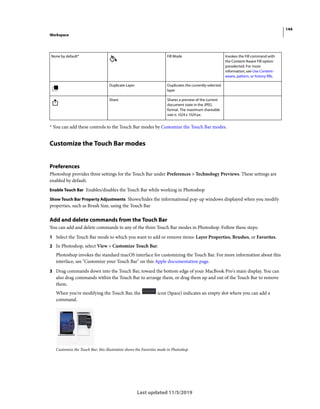
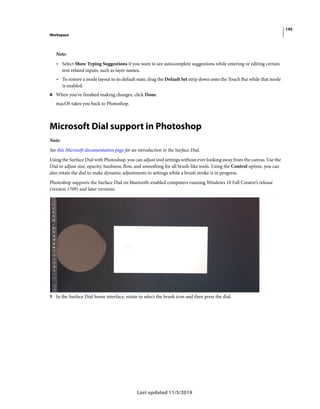
  • 277.
    267 Image and colorbasics Last updated 11/5/2019 About monitor resolution Your monitor’s resolution is described in pixel dimensions. For example, if your monitor resolution and your photo’s pixel dimensions are the same size, the photo will fill the screen when viewed at 100%. How large an image appears on-screen depends on a combination of factors—the pixel dimensions of the image, the monitor size, and the monitor resolution setting. In Photoshop, you can change the image magnification on-screen, so you can easily work with images of any pixel dimensions. A 620- by 400-pixel image displayed on monitors of various sizes and resolutions. When preparing images for viewing on-screen, you should consider the lowest monitor resolution that your photo is likely to be viewed on. About printer resolution Printer resolution is measured in ink dots per inch, also known as dpi. Generally, the more dots per inch, the finer the printed output you’ll get. Most inkjet printers have a resolution of approximately 720 to 2880 dpi. (Technically, inkjet printers produce a microscopic spray of ink, not actual dots like imagesetters or laser printers.) Printer resolution is different from, but related to image resolution. To print a high quality photo on an inkjet printer, an image resolution of at least 220 ppi should provide good results. Screen frequency is the number of printer dots or halftone cells per inch used to print grayscale images or color separations. Also known as screen ruling or line screen, screen frequency is measured in lines per inch (lpi)—or lines of cells per inch in a halftone screen. The higher the resolution of the output device, the finer (higher) a screen ruling you can use. The relationship between image resolution and screen frequency determines the quality of detail in the printed image. To produce a halftone image of the highest quality, you generally use an image resolution that is from 1.5 to at most 2 times the screen frequency. But with some images and output devices, a lower resolution can produce good results. To determine your printer’s screen frequency, check your printer documentation or consult your service provider. Note: Some imagesetters and 600-dpi laser printers use screening technologies other than halftoning. If you are printing an image on a nonhalftone printer, consult your service provider or your printer documentation for the recommended image resolutions.
  • 278.
    268 Image and colorbasics Last updated 11/5/2019 Screen frequency examples A 65 lpi: Coarse screen typically used to print newsletters and grocery coupons B 85 lpi: Average screen typically used to print newspapers C 133 lpi: High-quality screen typically used to print four-color magazines D 177 lpi: Very fine screen typically used for annual reports and images in art books Determine a suggested resolution for an image If you plan to print your image using a halftone screen, the range of suitable image resolutions depends on the screen frequency of your output device. Photoshop can determine a recommended image resolution based on the screen frequency of your output device. Note: If your image resolution is more than 2.5 times the screen ruling, an alert message appears when you try to print the image. This means that the image resolution is higher than necessary for the printer. Save a copy of the file, and then reduce the resolution. 1 Choose Image > Image Size. 2 Click Auto. 3 For Screen, enter the screen frequency for the output device. If necessary, choose a different unit of measurement. Note that the screen value is used only to calculate the image resolution, not to set the screen for printing. 4 For Quality, select an option: Draft Produces a resolution that is the same as the screen frequency (no lower than 72 pixels per inch). Good Produces a resolution 1.5 times the screen frequency. Best Produces a resolution 2 times the screen frequency. View the print size onscreen ? Do one of the following: • Choose View > Print Size. • Select the Hand tool or Zoom tool, and click Print Size in the options bar. The image is redisplayed in its approximate printed size, as specified in the Document Size area of the Image Size dialog box. The size and resolution of your monitor affect the on-screen print size. Note: The Print Size command is not available in the Creative Cloud version.
  • 279.
    269 Image and colorbasics Last updated 11/5/2019 Resampling Resampling is changing the amount of image data as you change either the pixel dimensions or the resolution of an image. When you downsample (decrease the number of pixels), information is deleted from the image. When you resample up (increase the number of pixels, or upsample), new pixels are added. You specify an interpolation method to determine how pixels are added or deleted. Resampling pixels A Downsampled B Original C Resampled up (selected pixels displayed for each set of images) Keep in mind that resampling can result in poorer image quality. For example, when you resample an image to larger pixel dimensions, the image loses some detail and sharpness. Applying the Unsharp Mask filter to a resampled image can help refocus the image details. You can avoid the need for resampling by scanning or creating the image at a sufficiently high resolution. If you want to preview the effects of changing pixel dimensions on-screen or to print proofs at different resolutions, resample a duplicate of your file. Photoshop resamples images using an interpolation method to assign color values to any new pixels based on the color values of existing pixels. You can choose which method to use in the Image Size dialog box. Nearest Neighbor A fast but less precise method that replicates the pixels in an image. This method is for use with illustrations containing edges that are not anti-aliased, to preserve hard edges and produce a smaller file. However, this method can produce jagged effects, which become apparent when you distort or scale an image or perform multiple manipulations on a selection. Bilinear A method that adds pixels by averaging the color values of surrounding pixels. It produces medium-quality results. Bicubic A slower but more precise method based on an examination of the values of surrounding pixels. Using more complex calculations, Bicubic produces smoother tonal gradations than Nearest Neighbor or Bilinear. Bicubic Smoother A good method for enlarging images based on Bicubic interpolation but designed to produce smoother results.
  • 280.
    270 Image and colorbasics Last updated 11/5/2019 Bicubic Sharper A good method for reducing the size of an image based on Bicubic interpolation with enhanced sharpening. This method maintains the detail in a resampled image. If Bicubic Sharper oversharpens some areas of an image, try using Bicubic. You can specify a default interpolation method to use whenever Photoshop resamples image data. Choose Edit > Preferences > General (Windows) or Photoshop > Preferences > General (Mac OS), and then choose a method from the Image Interpolation Methods menu. Change pixel dimensions of an image Changing an image’s pixel dimensions affects not only its onscreen size but also its image quality and its printed characteristics—either its printed dimensions or its image resolution. 1 Choose Image > Image Size. 2 To maintain the current ratio of pixel width to pixel height, select Constrain Proportions. This option automatically updates the width as you change the height, and vice versa. 3 Under Pixel Dimensions, enter values for Width and Height. To enter values as percentages of the current dimensions, choose Percent as the unit of measurement. The new file size for the image appears at the top of the Image Size dialog box, with the old file size in parentheses. 4 Make sure that Resample Image is selected, and choose an interpolation method. 5 If your image has layers with styles applied to them, select Scale Styles to scale the effects in the resized image. This option is available only if you selected Constrain Proportions. 6 When you finish setting options, click OK. For best results when you produce a smaller image, downsample and apply the Unsharp Mask filter. To produce a larger image, rescan the image at a higher resolution. Change the print dimensions and resolution When creating an image for print media, it’s useful to specify image size in terms of the printed dimensions and the image resolution. These two measurements, referred to as the document size, determine the total pixel count and therefore the file size of the image; document size also determines the base size at which an image is placed into another application. You can further manipulate the scale of the printed image using the Print command; however, changes you make using the Print command affect only the printed image, not the document size of the image file. If you turn on resampling for the image, you can change print dimensions and resolution independently (and change the total number of pixels in the image). If you turn off resampling, you can change either the dimensions or the resolution—Photoshop adjusts the other value automatically to preserve the total pixel count. For the highest print quality, it’s generally best to change the dimensions and resolution first, without resampling. Then resample only as necessary. 1 Choose Image > Image Size. 2 Change the print dimensions, image resolution, or both: • To change only the print dimensions or only the resolution and adjust the total number of pixels in the image proportionately, select Resample Image and then choose an interpolation method.
  • 281.
    271 Image and colorbasics Last updated 11/5/2019 • To change the print dimensions and resolution without changing the total number of pixels in the image, deselect Resample Image. 3 To maintain the current ratio of image width to image height, select Constrain Proportions. This option automatically changes the width as you change the height, and vice versa. 4 Under Document Size, enter new values for the height and width. If desired, choose a new unit of measurement. Note that for Width, the Columns option uses the width and gutter sizes specified in the Units & Rulers preferences. 5 For Resolution, enter a new value. If desired, choose a new unit of measurement. To restore the initial values displayed in the Image Size dialog box, hold down Alt (Windows) or Option (Mac OS), and click Reset. What affects file size? File size depends on the pixel dimensions of an image and the number of layers it contains. Images with more pixels may produce more detail when printed, but they require more disk space to store and may be slower to edit and print. You should keep track of your file sizes to make sure the files are not becoming too large for your purposes. If the file is becoming too large, reduce the number of layers in the image or change the image size. You can view the file size information for an image at the bottom of the application window. Acquire images from cameras and scanners Acquiring digital images from cameras You can copy images to your computer by connecting your camera or a media card reader to your computer. • Use the Get Photos From Camera command in Adobe® Bridge® to download photos, and to organize, rename, and apply metadata to them. • If your camera or the card reader appears as a drive on your computer, copy images directly to your hard disk or into Adobe Bridge. • Use the software that came with your camera, Windows Image Acquisition (WIA), or Image Capture (Mac OS). For more information on using Windows Image Acquisition or Image Capture, see your computer documentation. Import images from a digital camera using WIA (Windows only) Certain digital cameras import images using Windows Image Acquisition (WIA) support. When you use WIA, Photoshop works with Windows and your digital camera or scanner software to import images directly into Photoshop. 1 Choose File > Import > WIA Support. 2 Select a destination in which to save your image files on your computer. 3 Make sure that Open Acquired Images in Photoshop is selected. If you are importing a large number of images, or if you want to edit the images later, deselect Open Acquired Images. 4 To save the imported images directly into a folder whose name is the current date, select Unique Subfolder.
  • 282.
    272 Image and colorbasics Last updated 11/5/2019 5 Click Start. 6 Select the digital camera from which to import images. Note: If the name of your camera does not appear in the submenu, verify that the software and drivers were properly installed and that the camera is connected. 7 Choose the image or images you want to import: • Click the image from the list of thumbnails to import the image. • Hold down Shift and click multiple images to import them at the same time. • Click Select All to import all available images. 8 Click Get Picture to import the image. Importing scanned images Note: Scanner software and drivers are supported by the scanner manufacturer, not Adobe. If you have problems with scanning, make sure that you are using the latest version of the scanner software and driver. Scan and import images from a separate scanning application Most scanners provide a stand-alone scanning application that can be used to scan and save images. If your scanner manufacturer doesn't provide updated software and drivers that are compatible with current operating systems you may need to look at third-party scanning solutions. These third-party utilities are dedicated scanning solutions, and they are more appropriate for critical or high-volume scanning: • VueScan • Silverfast Using a dedicated application to scan allows you to retouch and edit images in Photoshop while you scan in the background – which can be more efficient. If you use a stand-alone scanning application, save your scanned images as TIFF files, then open them into Photoshop. Some scanner software lets you designate Photoshop as the external editor for an image after a scanning is completed. Consult the documentation that came with your scanner or contact your scanner manufacturer for more details. 1 Start the scanning software, and set options as desired. 2 Save scanned images in TIFF format. 3 In Photoshop, open the saved TIFF files. Scan and import images using Apple’s ImageKit interface (Mac only) 1 Choose File > Import > Images from Device This will launch Apple's Image Capture app. 2 Select the scanner that you want to use from the list of DEVICES in the left-hand column. Note:
  • 283.
    273 Image and colorbasics Last updated 11/5/2019 If the name of your scanner does not appear in the list of DEVICES, verify that the software and drivers were properly installed and that the scanner is connected. 3 Choose "Create new Photoshop document" to open the resulting scanned image in Photoshop as a new document. 4 Set the options for color, resolution, size, as well as the destination, name and file format for your scanned image. 5 Click Scan. 6 The scanned image will open in Photoshop for editing. Scan and import images using a WIA interface (Windows only) 1 Choose File > Import > WIA Support. 2 Choose a destination on your computer for saving your image files. 3 Click Start. 4 Select Open Acquired Images In Photoshop (unless you have a large number of images to import, or if you want to edit the images at a later time). 5 Select Unique Subfolder if you want to save imported images in a folder named with the current date. 6 Select the scanner that you want to use. Note: If the name of your scanner does not appear in the submenu, verify that the software and drivers were properly installed and that the scanner is connected. 7 Choose the kind of image you want to scan: Color Picture, Grayscale Picture, or Black And White Picture or Text. To specify custom settings, select Adjust The Quality Of The Scanned Picture. 8 Click Preview. If necessary, drag the handles of the bounding box to adjust the size of the crop. 9 Click Scan. 10 The scanned image will open in Photoshop for editing. Scan and import images using a TWAIN interface Due to limitations with TWAIN in Photoshop, we strongly suggest scanning your images Scan and import images from a separate scanning applicationincluded with your scanner or the native OS scanning interfaces (Scan and import images using Apple’s ImageKit interface (Mac only) or Scan and import images using a WIA interface (Windows only)). Note: See TWAIN plug-in for more information about scanning using the TWAIN interface with Photoshop CS6 and later. Video | Improve smartphone images Video | Improve smartphone images Create, open, and import images
  • 284.
    274 Image and colorbasics Last updated 11/5/2019 Create an image 1 Choose File > New. 2 In the New dialog box, type a name for the image. 3 (Optional) Choose a document size from the Document Type menu. Note: To create a document with the pixel dimensions set for a specific device, click the Device Central button. 4 Set the width and height by choosing a preset from the Size menu or entering values in the Width and Height text boxes. To match the width, height, resolution, color mode, and bit depth of the new image to that of any open image, choose a filename from the bottom section of the Document Type menu. 5 Set the Resolution, Color Mode, and bit depth. If you’ve copied a selection to the clipboard, the image dimensions and resolution are automatically based on that image data. 6 Select a Background Contents option: White Fills the background layer with white, the default background color. Background Color Fills the background layer with the current background color. Transparent Makes the first layer transparent, with no color values. The resulting document has a single, transparent layer as its contents. Other Opens the Color Picker dialog box to select a background color. For more information, see Adobe Color Picker overview. 7 (Optional) If necessary, click the Advanced button to display more options. 8 (Optional) Under Advanced, choose a color profile, or choose Don’t Color Manage This Document. For Pixel Aspect Ratio, choose Square unless you’re using the image for video. In that case, choose another option to use non- square pixels. 9 When you finish, you can save the settings as a preset by clicking Save Preset, or you can click OK to open the new file. Duplicate an image You can duplicate an entire image (including all layers, layer masks, and channels) into available memory without saving to disk. 1 Open the image you want to duplicate. 2 Choose Image > Duplicate. 3 Enter a name for the duplicated image. 4 If you want to duplicate the image and merge the layers, select Duplicate Merged Layers Only. To preserve the layers, make sure this option is deselected. 5 Click OK.
  • 285.
    275 Image and colorbasics Last updated 11/5/2019 Open files You can open files using the Open command and Open Recent command. You can also open files into Photoshop from Adobe Bridge or Adobe Photoshop Lightroom. When opening certain files, such as camera raw and PDF, you specify settings and options in a dialog box before the files completely open in Photoshop. In addition to still images, Photoshop users can open and edit 3D files, video and image sequence files. For more information, see Import video files and image sequences. Note: Photoshop uses plug-in modules to open and import many file formats. If a file format does not appear in the Open dialog box or in the File > Import submenu, you may need to install the format’s plug-in module. Sometimes Photoshop may not be able to determine the correct format for a file. This can happen, for example, because the file has been transferred between two operating systems. Sometimes a transfer between Mac OS and Windows can cause the file format to be mislabeled. In such cases, you must specify the correct format in which to open the file. You can retain (where possible) layers, masks, transparency, compound shapes, slices, image maps, and editable type when bringing your Illustrator art into Photoshop. In Illustrator, export the art in the Photoshop (PSD) file format. If your Illustrator art contains elements that Photoshop doesn’t support, the appearance of the artwork is preserved, but the layers are merged and the artwork is rasterized. Open a file using the Open command 1 Choose File > Open. 2 Select the name of the file you want to open. If the file does not appear, select the option for showing all files from the Files Of Type (Windows) or Enable (Mac OS) pop-up menu. 3 Click Open. In some cases, a dialog box appears, letting you set format-specific options. Note: If a color profile warning message appears, specify whether to use embedded profile as the working space, convert the document color to working space, or reverse the embedded profile. For more information, see Color-managing imported images. Open a recently used file ? Choose File > Open Recent, and select a file from the submenu. Note: To specify the number of files listed in the Open Recent menu, change the Recent File List Contains option in the File Handling preferences. Choose Edit > Preferences > File Handling (Windows), or Photoshop > Preferences > File Handling (Mac OS).
  • 286.
    276 Image and colorbasics Last updated 11/5/2019 Specify the file format in which to open a file If a file was saved with an extension that doesn’t match its true format (for example, a PSD file saved with a .gif extension), or has no extension, Photoshop may not be able to open the file. Selecting the correct format will allow Photoshop to recognize and open the file. ? Do one of the following: • (Windows) Choose File > Open As, and select the file you want to open. Then choose the desired format from the Open As pop-up menu, and click Open. • (Mac OS) Choose File > Open, and choose All Documents from the Show pop-up menu. Then select the file you want to open, choose the desired file format from the Format pop-up menu, and click Open. Note: If the file does not open, then the chosen format may not match the file’s true format, or the file may be damaged. Open PDF files Adobe Portable Document Format (PDF) is a versatile file format that can represent both vector and bitmap data. It has electronic document search and navigation features. PDF is the primary format for Adobe Illustrator and Adobe Acrobat. Some PDF files contain a single image, and others contain multiple pages and images. When you open a PDF file in Photoshop, you can choose which pages or images to open and specify rasterization options. You can also import PDF data using the Place command, the Paste command, and the drag-and-drop feature. The page or image is placed on a separate layer as a Smart Object. Note: The following procedure is only for opening generic PDF files in Photoshop. You don’t need to specify options in the Import PDF dialog box when opening Photoshop PDF files. 1 Do one of the following: • (Photoshop) Choose File > Open. • (Bridge) Select the PDF file and choose File > Open With > Adobe Photoshop. Skip to step 3. 2 In the Open dialog box, select the name of the file, and click Open. 3 Under Select in the Import PDF dialog box, select Pages or Images, depending on what elements of the PDF document you want to import. 4 Click the thumbnails to select the pages or images you want to open. Shift-click to select more than one page or image. The number of selected items appears under the preview window. If you’re importing images, skip to step 8. Note: Use the Thumbnail Size menu to adjust the thumbnail view in the preview window. The Fit Page option fits one thumbnail in the preview window. A scroll bar appears if there are multiple items. 5 To give the new document a name, type it in the Name text box. If you’re importing more than one page or image, multiple documents open with the base name followed by a number. 6 Under Page Options, choose from the Crop To menu to specify what part of the PDF document to include: Bounding Box Crops to the smallest rectangular region that includes all the text and graphics of the page. This option eliminates extraneous white space and any document elements outside the Trim Box. Note:
  • 287.
    277 Image and colorbasics Last updated 11/5/2019 Bounding Box will not crop white space that is part of a background created by the source application. Media Box Crops to the original size of the page. Crop Box Crops to the clipping region (crop margins) of the PDF file. Bleed Box Crops to the region specified in the PDF file for accommodating limitations inherent in production processes such as cutting, folding, and trimming. Trim Box Crops to the region specified for the intended finished size of the page. Art Box Crops to the region specified in the PDF file for placing the PDF data into another application. 7 Under Image Size, enter values (if necessary) for Width and Height: • To preserve the aspect ratio of the pages as they’re scaled to fit within the rectangle defined by the Width and Height values, select Constrain Proportions. • To scale the pages exactly to the Width and Height values, deselect Constrain Proportions. Some distortion might occur when the pages are scaled. When more than one page is selected, the Width and Height text boxes display the maximum width and height values of the selected pages. All pages are rendered at their original size if Constrain Proportions is selected and you don’t change the Width and Height values. Changing the values will scale all pages proportionately as they're rasterized. 8 Specify the following options under Image Size: Resolution Sets the resolution for the new document. See also About pixel dimensions and printed image resolution. Mode Sets the color mode for the new document. See also Color modes. Bit Depth Sets the bit depth for the new document. See also Bit depth. The Width and Height values plus the Resolution determine the final pixel dimension of resulting document. 9 To suppress color profile warnings, select Suppress Warning. 10 Click OK. Open an EPS file Encapsulated PostScript (EPS) can represent both vector and bitmap data and is supported by virtually all graphic, illustration, and page-layout programs. The Adobe application that primarily produces PostScript artwork is Adobe Illustrator. When you open an EPS file containing vector art, it is rasterized—the mathematically defined lines and curves of the vector artwork are converted into the pixels or bits of a bitmap image. You can also bring PostScript artwork into Photoshop using the Place command, the Paste command, and the drag- and-drop feature. 1 Choose File > Open. 2 Select the file you want to open, and click Open. 3 Indicate the desired dimensions, resolution, and mode. To maintain the same height-to-width ratio, select Constrain Proportions. 4 To minimize jagged lines at the edges of artwork, select Anti-aliased.
  • 288.
    278 Image and colorbasics Last updated 11/5/2019 View images Change the screen mode You can use the screen mode options to view images on your entire screen. You can show or hide the menu bar, title bar, and scroll bars. Press the F key to quickly cycle through screen modes. ? Do one of the following: • To display the default mode (menu bar at the top and scroll bars on the side), choose View > Screen Mode > Standard Screen Mode. Or, click the Screen Mode button in the Application bar, and select Standard Screen Mode from the pop-up menu. • To display a full-screen window with a menu bar and a 50% gray background, but no title bar or scroll bars, choose View > Screen Mode > Full Screen Mode With Menu Bar. Or, click the Screen Mode button in the Application bar, and select Full Screen Mode With Menu Bar from the pop-up menu. • To display a full-screen window with only a black background (no title bar, menu bar, or scroll bars), choose View > Screen Mode > Full Screen Mode. Or, click the Screen Mode button in the Application bar, and select Full Screen Mode from the pop-up menu. View another area of an image ? Do one of the following: • Use the window scroll bars. • Select the Hand tool and drag to pan over the image. To use the Hand tool while another tool is selected, hold down the spacebar as you drag in the image. If your computer has OpenGL, you can use the Hand tool to flick the image in the direction you want to view. After a quick mouse gesture, the image will move as if you were continuously dragging. Enable this feature by choosing Edit > Preferences > General (Windows) or Photoshop > Preferences > General (Mac OS) and then select Enable Flick Panning.
  • 289.
    279 Image and colorbasics Last updated 11/5/2019 Dragging the Hand tool to view another area of an image • Drag the colored box (proxy view area) in the Navigator panel. Use the Rotate View tool You use the Rotate View tool to rotate the canvas non-destructively; it does not transform the image. Rotating the canvas can be useful for any number of reasons, including facilitating easier painting or drawing. (OpenGL is required.) You can also use rotate gestures on MacBook computers with multi-touch trackpads. 1 In the toolbox, select the Rotate View tool . (If the tool isn’t visible, hold down the Hand tool.) 2 Do any of the following: • Drag in the image. A compass will indicate north in the image, regardless of the current canvas angle. • In the options bar, enter degrees in the Rotation Angle field. • Click or drag the circular Set Angle of Rotation control. 3 To restore the canvas to the original angle, click Reset View. For a video on the Rotate View tool and other workspace tips, see www.adobe.com/go/lrvid4001_ps. (Discussion of the Rotate View tool begins at the 5:10 mark.) Disable trackpad gestures (Mac OS) If you have a MacBook computer with a multi-touch trackpad, you can use the trackpad to flick, rotate, or zoom images. This functionality can greatly increase your efficiency, but you can disable it if inadvertent changes occur. 1 Choose Photoshop > Preferences > Interface (Mac OS). 2 In the General section, deselect Enable Gestures. Use the Navigator panel You use the Navigator panel to quickly change the view of your artwork using a thumbnail display. The colored box in the Navigator (called the proxy view area) corresponds to the currently viewable area in the window. ? Do one or more of the following: • To display the Navigator panel, select Window > Navigator. • To change the magnification, type a value in the text box, click the Zoom Out or Zoom In button, or drag the zoom slider.
  • 290.
    280 Image and colorbasics Last updated 11/5/2019 • To move the view of an image, drag the proxy view area in the image thumbnail. You can also click the image thumbnail to designate the viewable area. Tip: To simultaneously set the size and position of the proxy area, Control-drag (Windows) or Command-drag (Mac OS) in the image thumbnail. • To change the color of the proxy view area, select Panel Options from the panel menu. Select a preset color from the Color pop-up menu, or click the color box to choose a custom color. Navigator panel A Panel menu button B Thumbnail display of artwork C Proxy preview area D Zoom text box E Zoom Out button F Zoom slider G Zoom In button Zoom in or out Use the Zoom tool or the View menu commands to zoom in or zoom out of an image. When you use the Zoom tool, each click magnifies or reduces the image to the next preset percentage and centers the display around the point you click. When the image has reached its maximum magnification level of 3200% or minimum size of 1 pixel, the magnifying glass appears empty. To view images most accurately, precisely revealing sharpening, layer effects, and other adjustments, see Display images at 100%. Set Zoom tool preferences 1 Choose Edit > Preferences > Performance (Windows) or Photoshop > Preferences > Performance (Mac OS). In the GPU Settings section, select Enable OpenGL Drawing. Note: Some Zoom tool preferences require OpenGL. If Enable OpenGL Drawing is unavailable, your video card does not support this technology. 2 In the General preferences, select any of the following: Animated Zoom Enables continuous zooming while holding down the Zoom tool Zoom Resizes Windows See Automatically resize the window when zooming. Zoom With Scroll Wheel Enables zooming with the scroll wheel on your mouse. Zoom Clicked Point To Center Centers the zoom view on the clicked location.
  • 291.
    281 Image and colorbasics Last updated 11/5/2019 Zoom a preset amount ? Do any of the following: • Select the Zoom tool , and click either the Zoom In orZoom Out button in the options bar. Then, click the area you want to zoom in or out. Tip: To quickly switch to zoom out mode, hold down Alt (Windows) or Option (Mac OS). • Choose View > Zoom In or View >Zoom Out. The Zoom In or Zoom Out command becomes unavailable when the maximum image magnification or reduction is reached. • Set the zoom level at the lower left corner of the document window or in the Navigator panel. Display images at 100% A zoom setting of 100% provides the most accurate view, because each image pixel is displayed by one monitor pixel. (At other zoom settings, image pixels are interpolated to a different amount of monitor pixels.) ? Do one of the following: • Double-click the Zoom tool in the toolbox. • (Creative Cloud) Choose View > 100% or, click 100% in either the Zoom tool or Hand tool options bar. • Choose View > Actual Pixels or, click Actual Pixels in either the Zoom tool or Hand tool options bar. • Enter 100% in the Status Bar and press Enter (Windows) or Return (Mac OS). The 100% view of an image displays an image as it will appear in a web browser (at the current monitor resolution). Zoom continuously To zoom continuously, your video card must support OpenGL, and Animated Zoom must be selected in the General preferences. ? Select the Zoom tool, and then do any of the following: • Click and hold in the image to zoom in. Press Alt (Windows) or Option (Mac OS) to zoom out. • In the options bar, select Scrubby Zoom. Then drag to the left in the image to zoom out, or to the right to zoom in. Magnify a specific area 1 Select the Zoom tool. 2 Drag over the part of the image that you want to magnify.
  • 292.
    282 Image and colorbasics Last updated 11/5/2019 Dragging the Zoom tool to magnify the view of an image The area inside the zoom marquee is displayed at the highest possible magnification. To move the marquee around the artwork in Photoshop, begin dragging a marquee and then hold down the spacebar. Temporarily zoom an image 1 Hold down the H key, and then click in the image and hold down the mouse button. The current tool changes to the Hand tool, and the image magnification changes as follows: • If the entire image originally fit within the document window, the image zooms in to fit the window. • If only a portion of the image was originally visible, the image zooms out. Drag the zoom marquee to magnify a different part of the image. 2 Release the mouse button and then the H key. The image returns to the previous magnification and tool. Automatically resize the window when zooming ? With the Zoom tool active, select Resize Windows To Fit in the options bar. The window is resized when you magnify or reduce the view of the image. When Resize Windows To Fit is deselected (the default), the window maintains a constant size regardless of the image magnification. This can be helpful when using smaller monitors or working with tiled views. Note: To automatically resize the window when using keyboard shortcuts for zooming, choose Edit > Preferences > General (Windows) or Photoshop > Preferences > General (Mac OS). Then select the Zoom Resizes Windows. Fit an image to the screen ? Do one of the following: • Double-click the Hand tool in the toolbox. • Choose View > Fit On Screen. • Select a zoom tool or the Hand tool, and click the Fit On Screen button in the options bar. These options scale both the zoom level and the window size to fit the available screen space. Hide the pixel grid Over 500% magnification, the image’s pixel grid becomes visible by default. To hide the grid, do the following. ? Choose View > Show, and deselect Pixel Grid.
  • 293.
    283 Image and colorbasics Last updated 11/5/2019 Invalid JPEG Marker error | Opening images Issue When you open an image in Photoshop, one of the following errors occurs: • Could not complete your request because it is not a valid Photoshop document. • Could not complete your request because an unknown or invalid JPEG marker type is found. • Could not complete your request because the file-format module cannot parse the file. • This is not a valid Portable Document File (PDF) document. It cannot be opened. Solutions Solution 1: Make sure that the filename extension matches the actual file type. It's important that the extension you add to the filename is the appropriate one for the actual file type of the image. When you choose a format from the Format pop-up menu in the Save As dialog box, the appropriate extension is added automatically. If you entered the extension manually, you could have typed in an extension that doesn't match the file format of your file. Note: If you cannot remember the actual file type the file should be, see Determine the file type of a document. Filename extensions are hidden by default. To turn them on, perform the following steps: Mac OS 1 In Finder, choose Finder > Finder Preferences > Advanced. 2 Select Show all filename extensions. Windows 1 Open Windows Explorer.
  • 294.
    284 Image and colorbasics Last updated 11/5/2019 2 If you don't see your menus, choose Organize > Layout > Menu Bar. 3 Choose Tools > Folder Options > View. 4 Deselect Hide Extensions for Known File Types. 5 Click Apply, then click OK. Solution 2: Make sure that the file has only one filename extension. Turn on filename extensions as in Solution 1, and view your images in Finder or Windows Explorer. Then, check to see of there are two extensions on your files. If your images have two extensions, such as: filename.pdf.jpg Remove the last extension so the file is named: filename.pdf
  • 295.
    285 Image and colorbasics Last updated 11/5/2019 Solution 3: Open the file in another photo app and save as JPEG Open the problematic image in a photo app such as Preview (on macOS) or Photos (on Windows). Now save the file again as a JPEG image from within such an app. Try opening the file again in Photoshop. Solution 4: Make sure that your hardware isn't damaged. Validate your hardware to make sure that there are no hardware failures, such as with an external hard disk or network. Viewing multiple images View images in multiple windows The document window is where your images appear. You can open multiple windows to display different images or different views of the same one. A list of open windows appears in the Window menu. To bring an open image to the front, choose the file name from the bottom of the Window menu. Available memory may limit the number of windows per image. 1 Choose Window > Arrange > New Window For [Image File Name]. 2 If you want to arrange the windows, choose Window > Arrange and then choose one of the following: Cascade Displays undocked windows stacked and cascading from the upper-left to the lower right of the screen. Tile Displays windows edge to edge. As you close images, the open windows are resized to fill the available space. Float in Window Allows image to float freely. Float All in Windows Floats all images. Consolidate All to Tabs Shows one image in full screen and minimizes the other images to tabs. You can use the Hand tool’s Scroll All Windows option to scroll through all open images. Select it in the options bar and drag in one image to scroll through all visible images. Match zoom and location in multiple images Match only zoom 1 Open one or more images, or open one image in multiple windows. 2 Choose Window > Arrange > Tile to display the images edge to edge. 3 Select the Zoom tool, and then do one of the following: • Select Zoom All Windows in the options bar, and then click one of the images. The other images zoom in or out the same relative amount. • Choose Window > Arrange > Match Zoom. Hold down the Shift key and click one of the images. The other images zoom in or out at the same magnification.
  • 296.
    286 Image and colorbasics Last updated 11/5/2019 Match only location 1 Open one or more images, or open one image in multiple windows. 2 Choose Window > Arrange > Tile. 3 Do either of the following: • Choose Window > Arrange > Match Location. • Select the Hand tool, select Scroll All Windows in the options bar, and then drag to view another area in one of the images. (To temporarily enable this option, hold down the Shift key while dragging with the Hand tool.) Note: Photoshop automatically scrolls to the same relative location on the horizontal and vertical axes. You may need to manually scroll to reveal the edges of images. Match zoom and location 1 Open one or more images, or open one image in multiple windows. 2 Choose Window > Arrange > Tile. 3 Choose Window > Arrange > Match All. Without Match All command (top), and with Match All command (bottom) selected 4 Select the Zoom tool or the Hand tool. 5 Select one of the images, hold down the Shift key, and click in or drag an area of an image. The other images are magnified to the same percentage and snap to the area you clicked. Customize color pickers and swatches Change the Color Picker Instead of using the Adobe Color Picker, you can choose colors from your computer operating system’s standard Color Picker or from a third party Color Picker. 1 Choose Edit > Preferences > General (Windows) or Photoshop > Preferences > General (Mac OS).
  • 297.
    287 Image and colorbasics Last updated 11/5/2019 2 Choose a Color Picker from the Color Picker menu, and click OK. For more information, see your operating system documentation. Add and delete color swatches You can add or delete color swatches from the Swatches panel. You can also add a color swatch from the Color Picker by clicking the Add To Swatches button. Add a color to the Swatches panel 1 Decide which color you want to add and make it the foreground color. 2 Do one of the following: • Click the New Swatch button in the Swatches panel. Alternatively, choose New Swatch from the Swatches panel menu. • Position the pointer over an empty space in the bottom row of the Swatches panel (the pointer turns into the Paint Bucket tool), and click to add the color. Enter a name for the new color and click OK. Color selected from image (left), and added to Swatches panel (right) • (Creative Cloud only) Choose Load Swatches from the panel menu. Then, in the Load window, navigate to an HTML, CSS, or SVG file and click OK. Photoshop will read the color values specified in the documents. This feature recognizes the following HTML/CSS color syntax: #112233, #123, rgb(1,2,3), rgba(1,2,3,4), hsb(1,2,3), and hsba(1,2,3,4). Note: New colors are saved in the Photoshop preferences file so that they persist between editing sessions. To permanently save a color, save it in a library. Delete a color from the Swatches panel ? Do one of the following: • Drag a swatch to the Delete icon . • Hold down Alt (Windows) or Option (Mac OS), position the pointer over a swatch (the pointer turns into scissors), and click. Manage swatch libraries Swatch libraries provide an easy way to access different sets of colors. You can save custom sets of swatches as a library for reuse. You can also save swatches in a format for sharing in other applications.
  • 298.
    288 Image and colorbasics Last updated 11/5/2019 Load or replace a library of swatches ? Choose one of the following from the Swatches panel menu: Load Swatches Adds a library to the current set of swatches. Select the library file you want to use, and click Load. Replace Swatches Replaces the current list with a different library. Select the library file you want to use, and click Load. Photoshop gives your the option of saving the current set of swatches before replacing them. Name of a color library Loads a specific color system listed in the lower part of the Swatches panel menu. You can either replace or append the current set of colors with the library you’re loading. Save a set of swatches as a library 1 Choose Save Swatches from the Swatches panel menu. 2 Choose a location for the swatch library, enter a filename, and click Save. You can save the library anywhere. However, if you place the library file in the Presets/Swatches folder in the default presets location, the library name will appear at the bottom of the Swatches panel menu after you restart the application. Return to the default library of swatches ? Choose Reset Swatches from the Swatches panel menu. You can either replace or append the current set of colors with the default swatch library. Share swatches between applications You can share the solid swatches you create in Photoshop, Illustrator, and InDesign by saving a swatch library for exchange. The colors appear exactly the same across applications as long as your color settings are synchronized. 1 In the Swatches panel, create the process and spot-color swatches you want to share, and remove any swatches you don’t want to share. Note: You cannot share the following types of swatches between applications: patterns, gradients, and the Registration swatch from Illustrator or InDesign; and book color references, HSB, XYZ, duotone, monitorRGB, opacity, total ink, and webRGB swatches from Photoshop. These types of swatches are automatically excluded when you save swatches for exchange. 2 Select Save Swatches For Exchange from the Swatches panel menu, and save the swatch libraries in an easily accessible location. 3 Load the swatch library into the Swatches panel for Photoshop, Illustrator, or InDesign. High dynamic range images
  • 299.
    289 Image and colorbasics Last updated 11/5/2019 About high dynamic range images The dynamic range (ratio between dark and bright regions) in the visible world far exceeds the range of human vision and of images that are displayed on a monitor or printed. But whereas human eyes can adapt to very different brightness levels, most cameras and computer monitors can reproduce only a fixed dynamic range. Photographers, motion picture artists, and others working with digital images must be selective about what’s important in a scene because they are working with a limited dynamic range. High dynamic range (HDR) images open up a world of possibilities because they can represent the entire dynamic range of the visible world. Because all the luminance values in a real-world scene are represented proportionately and stored in an HDR image, adjusting the exposure of an HDR image is like adjusting the exposure when photographing a scene in the real world. Merging images of different exposures to create an HDR image A Image with shadow detail but highlights clipped B Image with highlight detail but shadows clipped C HDR image containing the dynamic range of the scene In Photoshop, the luminance values of an HDR image are stored using a floating-point numeric representation that’s 32 bits long (32-bits-per-channel). The luminance values in an HDR image are directly related to the amount of light in a scene. By contrast, non-floating point 16- and 8-bpc image files store luminance values only from black to paper white, reflecting an extremely small segment of dynamic range in the real world.
  • 300.
    290 Image and colorbasics Last updated 11/5/2019 In Photoshop, the Merge To HDR Pro command lets you create HDR images by combining multiple photographs captured at different exposures. Because an HDR image contains brightness levels that far exceed the display capabilities of a standard 24-bit monitor, Photoshop lets you adjust the HDR preview. If you need to print or use tools and filters that don’t work with HDR images, you can convert them to 16- or 8-bpc images. Take photos for HDR images How many photos are required to process a quality HDR merge? Tips to keep in mind when you take photos to be combined with the Merge To HDR Pro command • Secure the camera to a tripod. • Take enough photos to cover the full dynamic range of the scene. You can try taking at least five to seven photos, but you might need to take more exposures depending on the dynamic range of the scene. The minimum number of photos should be three. • Vary the shutter speed to create different exposures. Changing the aperture changes the depth of field in each exposure and can produce lower-quality results. Changing the ISO or aperture may also cause noise or vignetting in the image. • In general, don’t use your camera’s auto-bracket feature, because the exposure changes are usually too small. • The exposure differences between the photos should be one or two EV (exposure value) steps apart (equivalent to about one or two f-stops apart). • Don’t vary the lighting; for instance, don’t use a flash in one exposure but not the next. • Make sure that nothing is moving in the scene. Exposure Merge works only with differently exposed images of the identical scene. Features that support 32-bpc HDR images You can use the following tools, adjustments, and filters with 32-bpc HDR images. (To work with more Photoshop features, convert a 32-bpc image to a 16-bpc or an 8-bpc image. To preserve the original image, create a copy with the Save As command.) Adjustments Levels, Exposure, Hue/Saturation, Channel Mixer, Photo Filter. Note: Although the Exposure command can be used with 8- and 16-bpc images, it is designed for making exposure adjustments to 32-bpc HDR images. Blend Modes Normal, Dissolve, Darken, Multiply, Lighten, Darker Color, Linear Dodge (Add), Lighter Color, Difference, Subtract, Divide, Hue, Saturation, Color, and Luminosity. Create new 32-bpc documents In the New dialog box, 32 bit is an option in the bit depth pop-up menu to the right of the Color Mode pop-up menu. Edit menu commands All commands including Fill, Stroke, Free Transform, and Transform. File Formats Photoshop (PSD, PSB), Radiance (HDR), Portable Bit Map (PBM), OpenEXR, and TIFF.
  • 301.
    291 Image and colorbasics Last updated 11/5/2019 Note: Although Photoshop cannot save an HDR image in the LogLuv TIFF file format, it can open and read a LogLuv TIFF file. Filters Average, Box Blur, Gaussian Blur, Motion Blur, Radial Blur, Shape Blur, Surface Blur, Add Noise, Clouds, Difference Clouds, Lens Flare, Smart Sharpen, Unsharp Mask, Emboss, De-Interlace, NTSC Colors, High Pass, Maximum, Minimum, and Offset. Image commands Image Size, Canvas Size, Image Rotation, Crop, Trim, Duplicate, Apply Image, Calculations, and Variables. View Pixel Aspect Ratio (Custom Pixel Aspect Ratio, Delete Pixel Aspect Ratio, Reset Pixel Aspect Ratio, etc.) Layers New layers, duplicate layers, adjustment layers (Levels, Vibrance, Hue/Saturation, Channel Mixer, Photo Filter, and Exposure), fill layers, layer masks, layer styles, supported blending modes, and Smart Objects. Modes RGB Color, Grayscale, conversion to 8 Bits/Channel or 16 Bits/Channel. Pixel Aspect Ratio Support for square and non-square documents. Selections Invert, Modify Border, Transform Selection, Save Selection and Load Selection. Tools All tools in the toolbox except: Magnetic Lasso, Magic Wand, Spot Healing Brush, Healing Brush, Red Eye, Color Replacement, Art History Brush, Magic Eraser, Background Eraser, Paint Bucket, Dodge, Burn, and Sponge. Some tools work with supported blend modes only. Merge images to HDR The Merge To HDR Pro command combines multiple images with different exposures of the same scene, capturing the full dynamic range in a single HDR image. You can output the merged image as a 32-, 16-, or 8-bpc file. However, only a 32-bpc file can store all the HDR image data. HDR merging works best when photos are optimized for the process. For recommendations, see Take photos for HDR images. 1 Do one of the following: • (Photoshop) Choose File > Automate > Merge To HDR Pro. • (Bridge) Select the images you want to use and choose Tools > Photoshop > Merge To HDR Pro. Skip to step 5. 2 In the Merge To HDR Pro dialog box, click Browse to select specific images, click Add Open Files, or choose Use > Folder. (To remove a particular item, select it in files list, and click Remove.) 3 (Optional) Select Attempt To Automatically Align Source Images if you held the camera in your hands when you photographed the images. 4 Click OK. Note: If images lack exposure metadata, enter values in the Manually Set EV dialog box. A second Merge To HDR Pro dialog box displays thumbnails of the source images, and a preview of the merged result. 5 To the upper right of the preview, choose a bit depth for the merged image.
  • 302.
    292 Image and colorbasics Last updated 11/5/2019 Choose 32 Bit if you want the merged image to store the entire dynamic range of the HDR image. 8-bit and (non-floating point) 16-bit image files cannot store the entire range of luminance values in an HDR image. 6 To adjust the tonal range, see Options for 32-bit imagesor Options for 16- or 8-bit images. 7 (Optional) To save your tonal settings for future use, choose Preset > Save Preset. (To later reapply the settings, choose Load Preset.) Options for 32-bit images Move the slider below the histogram to adjust the white point preview of the merged image. Moving the slider adjusts the image preview only; all HDR image data remains in the merged file. The preview adjustment is stored in the HDR file and applied whenever you open the file in Photoshop. To re-adjust the white point preview at any time, choose View > 32-Bit Preview Options. Note: The Camera Raw Filter does not work with 32-bit files in the following: • Adobe Camera Raw 9.10 • Photoshop CC 2017 If you are using one of the above, see The Camera Raw Filter no longer works with 32-bit files to view workarounds for this issue. Options for 16- or 8-bit images HDR images contain luminance levels that far exceed the dynamic range that 16- or 8-bpc images can store. To produce an image with the dynamic range you want, adjust exposure and contrast when converting from 32-bpc to lower bit depths. Choose one of the following tone-mapping methods: Local Adaptation Adjusts HDR tonality by adjusting local brightness regions throughout the image. Edge Glow Radius specifies the size of the local brightness regions. Strength specifies how far apart two pixels’ tonal values must be before they’re no longer part of the same brightness region. Tone and Detail Dynamic range is maximized at a Gamma setting of 1.0; lower settings emphasize midtones, while higher settings emphasize highlights and shadows. Exposure values reflect f-stops. Drag the Detail slider to adjust sharpness and the Shadow and Highlight sliders to brighten or darken these regions. Color Vibrance adjusts the intensity of subtle colors, while minimizing clipping of highly saturated colors. Saturation adjusts the intensity of all colors from –100 (monochrome) to +100 (double saturation). Toning Curve Displays an adjustable curve over a histogram showing luminance values in the original, 32-bit HDR image. The red tick marks along the horizontal axis are in one EV (approximately one f-stop) increments. Note: By default, the Toning Curve and Histogram limit and equalize your changes from point to point. To remove the limit and apply more extreme adjustments, select the Corner option after inserting a point on the curve. When you insert and move a second point, the curve becomes angular.
  • 303.
    293 Image and colorbasics Last updated 11/5/2019 Toning Curve and Histogram adjustment using the Corner option A Inserting a point and selecting the Corner option. B Adjusting new point makes the curve angular at the point where the Corner option is used. Equalize Histogram Compresses the dynamic range of the HDR image while trying to preserve some contrast. No further adjustments are necessary; this method is automatic. Exposure and Gamma Lets you manually adjust the brightness and contrast of the HDR image. Move the Exposure slider to adjust gain and the Gamma slider to adjust contrast. Highlight Compression Compresses the highlight values in the HDR image so they fall within the luminance values range of the 8- or 16-bpc image file. No further adjustments are necessary; this method is automatic. Compensate for moving objects If images have different content due to moving objects like cars, people, or foliage, select Remove Ghosts in the Merge To HDR Pro dialog box. Photoshop displays a green outline around the thumbnail with the best tonal balance, identifying the base image. Moving objects found in other images are removed. (If movement occurs in very light or dark areas, click a different thumbnail where moving objects are better exposed to improve results.) For a tutorial on the Remove Ghosts option, see this video. (Discussion of Remove Ghosts begins at 3:00.) Save or load camera response curves Response curves indicate how camera sensors interpret different levels of incoming light. By default, the Merge To HDR Pro dialog box automatically calculates a camera response curve based on the tonal range of images you are merging. You can save the current response curve and later apply it to another group of merged images. • In the upper-right corner of the Merge to HDR Pro dialog box, click the response curve menu , and then choose Save Response Curve. (To later reapply the curve, choose Load Response Curve.) Convert from 32 bits to 16 or 8 bpc If you originally created a 32-bit image during the Merge to HDR Pro process, you can later convert it to a 16- or 8-bit image. 1 Open a 32-bpc image in Photoshop, and choose Image > Mode > 16 Bits/Channel or 8 Bits/Channel.
  • 304.
    294 Image and colorbasics Last updated 11/5/2019 2 Adjust exposure and contrast to produce an image with the dynamic range you want. (See Options for 16- or 8-bit images.) 3 Click OK to convert the 32-bit image. Adjust displayed dynamic range for 32-bit HDR images The dynamic range of HDR images exceeds the display capabilities of standard computer monitors. When you open an HDR image in Photoshop, it can look very dark or washed out. Photoshop lets you adjust the preview so that the monitor displays an HDR image whose highlights and shadows aren’t washed out or too dark. The preview settings are stored in the HDR image file (PSD, PSB, and TIFF only) and are applied whenever the file is opened in Photoshop. Preview adjustments don’t edit the HDR image file; all the HDR image information remains intact. Use the Exposure adjustment (Image > Adjustments > Exposure) to make exposure edits to the 32-bpc HDR image. To view 32-bit readouts in the Info panel, click the Eyedropper icon in the Info panel and choose 32-Bit from the pop-up menu. 1 Open a 32-bpc HDR image in Photoshop, and choose View > 32-Bit Preview Options. 2 In the 32-bit Preview Options dialog box, choose an option from the Method menu: Exposure And Gamma Adjusts the brightness and contrast. Highlight Compression Compresses the highlight values in the HDR image so they fall within the luminance values range of the 8- or 16-bpc image file. 3 If you chose Exposure And Gamma, move the Exposure and Gamma sliders to adjust the brightness and contrast of the image preview. 4 Click OK. You can also adjust the preview of an HDR image open in Photoshop by clicking the triangle in the status bar of the document window and choosing 32-Bit Exposure from the pop-up menu. Move the slider to set the white point for viewing the HDR image. Double-click the slider to return to the default exposure setting. Since the adjustment is made per view, you can have the same HDR image open in multiple windows, each with a different preview adjustment. Preview adjustments made with this method are not stored in the HDR image file. About the HDR Color Picker The HDR Color Picker allows you to accurately view and select colors for use in 32-bit HDR images. As in the regular Adobe Color Picker, you select a color by clicking a color field and adjusting the color slider. The Intensity slider allows you to adjust the brightness of a color to match the intensity of the colors in the HDR image you’re working with. A Preview area lets you view swatches of a selected color to see how it will display at different exposures and intensities.
  • 305.
    295 Image and colorbasics Last updated 11/5/2019 HDR Color Picker A Preview area B Adjusted color C Original color D 32-bit floating point values E Intensity slider F Picked color G Color slider H Color values Display the HDR Color Picker With a 32-bpc image open, do one of the following: • In the toolbox, click the foreground or background color selection box. • In the Color panel, click the Set Foreground Coloror Set Background Color selection box. The Color Picker is also available when features let you choose a color. For example, by clicking the color swatch in the options bar for some tools, or the eyedroppers in some color adjustment dialog boxes. Choose colors for HDR images The lower part of the HDR Color Picker functions like the regular Color Picker does with 8- or 16-bit images. Click in the color field to select a color and move the color slider to change hues, or use the HSB or RGB fields to enter numeric values for a particular color. In the color field, brightness increases as you move from bottom to top, and saturation increases as you move from left to right. Use the Intensity slider to adjust the brightness of the color. The color value plus the intensity value are converted to 32-bit floating point number values in your HDR document. 1 Select a color by clicking in the color field and moving the color slider, or by entering HSB or RGB numeric values, as in the Adobe Color Picker. 2 Adjust the Intensity slider to boost or reduce the color’s brightness. The new color swatch in the Preview scale at the top of the Color Picker shows the effect of increasing or decreasing stops for the selected color. The Intensity Stops correspond inversely to exposure setting stops. If you boost the Exposure setting of the HDR image two stops, reducing the Intensity stops by two will maintain the same color appearance as if the HDR image exposure and the color intensity were both set to 0. If you know the exact 32-bit RGB values for the color you want, you can enter them directly in the 32-bit value RGB fields.
  • 306.
    296 Image and colorbasics Last updated 11/5/2019 3 (Optional) Adjust settings for the Preview area. Preview Stop Size Sets the stop increments for each preview swatch. For example, a setting of 3 results in swatches of -9, -6, -3, +3, +6, +9. These swatches let you preview the appearance of your selected color at different exposure settings. Relative to Document Select to adjust the preview swatches to reflect the current exposure setting for the image. For example, if the document exposure is set higher, the new preview swatch will be lighter than the color selected in the Color Picker’s color field, to show the effect of the higher exposure on the selected color. If the current exposure is set to 0 (the default), checking or unchecking this option will not change the new swatch. 4 (Optional) Click Add to Swatches to add the selected color to the Swatches panel. 5 Click OK. Paint on HDR images You can edit and add effects to HDR/32-bpc images using any of the following Photoshop tools: Brush, Pencil, Pen, Shape, Clone Stamp, Pattern Stamp, Eraser, Gradient, Blur, Sharpen, Smudge, and History Brush. You can also use the Text tool to add 32-bpc text layers to an HDR image. When editing or painting on HDR images, you can preview your work at different exposure settings using either the 32-Bit Exposure slider in the document info area or the 32-Bit Preview Options dialog box (View > 32-Bit Preview Options). The HDR Color Picker also lets you preview your selected foreground color at different intensity settings, to match different exposure settings in an HDR image. 1 Open an HDR image. 2 (Optional) Set the exposure for the image. See Adjust displayed dynamic range for 32-bit HDR images. 3 For the Brush or Pencil tools, click the foreground color to open the HDR Color Picker and select a color. For the Text tool, click the color chip in the Text tool options bar to set the text color. The Preview area of the HDR Color Picker helps you select and adjust a foreground color in relation to different exposure settings in the HDR image. See About the HDR Color Picker. By default, the Toning Curve and Histogram limit and equalize your changes from point to point. To remove the limit and apply more extreme adjustments, select the Corner option after inserting a point on the curve. When you insert and move a second point, the curve becomes angular. Match, replace, and mix colors Match colors
  • 307.
    297 Image and colorbasics Last updated 11/5/2019 Match the color in different images The Match Color command matches colors between multiple images, between multiple layers, or between multiple selections. It also lets you adjust the colors in an image by changing the luminance, changing the color range, and neutralizing a color cast. The Match Color command works only in RGB mode. When you use the Match Color command, the pointer becomes the Eyedropper tool. Use the Eyedropper tool while adjusting the image to view the color pixel values in the Info panel. This panel gives you feedback about changes in color values as you use the Match Color command. See View color values in an image. The Match Color command matches the colors in one image (the source image) with colors in another image (the target image). Match Color is useful when you’re trying to make the colors in different photos consistent, or when certain colors (such as skin tones) in one image must match the colors in another image. In addition to matching the color between two images, the Match Color command can match the color between different layers in the same image. Match the color between two images 1 (Optional) Make a selection in the source and target images. If you don’t make a selection, then the Match Color command matches the overall image statistics between images. 2 Make the image that you want to change active, and then choose Image > Adjustments > Match Color. If you’re applying the Match Color command to a specific layer in the target image, make sure that layer is active when you choose the Match Color command. 3 From the Source menu in the Image Statistics area of the Match Color dialog box, choose the source image whose colors you’ll be matching in the target image. Choose None when you don’t want to reference a different image to calculate the color adjustment. With None chosen, the target image and the source image are the same. If necessary, use the Layer menu to choose the layer from the source image whose colors you want to match. You can also choose Merged from the Layer menu to match the colors from all the layers in the source image. 4 If you made a selection in the image, do one or more of the following: • In the Destination Image area, select Ignore Selection When Applying Adjustment if you’re applying the adjustment to the entire target image. This option ignores the selection in the target image and applies the adjustment to the entire target image. • In the Image Statistics area, select Use Selection In Source To Calculate Colors if you made a selection in the source image and want to use the colors in the selection to compute the adjustment. Deselect this option to ignore the selection in the source image, and use the colors from the entire source image to compute the adjustment. • In the Image Statistics area, select Use Selection In Target To Calculate Adjustment if you made a selection in the target image and want to use the colors in the selection to calculate the adjustment. Deselect this option to ignore the selection in the target image and compute the adjustment by using the colors of the entire target image. 5 To automatically remove a color cast in the target image, select the Neutralize option. Make sure that the Preview option is selected so that your image is updated as you make adjustments. 6 To increase or decrease the brightness in the target image, move the Luminance slider. Alternatively, enter a value in the Luminance box. The maximum value is 200, the minimum is 1, and the default is 100. 7 To adjust the color saturation in the target image, adjust the Color Intensity slider. Alternatively, enter a value in the Color Intensity box. The maximum value is 200, the minimum is 1 (which produces a grayscale image), and the default is 100.
  • 308.
    298 Image and colorbasics Last updated 11/5/2019 8 To control the amount of adjustment applied to the image, move the Fade slider. Moving the slider to the right reduces the adjustment. 9 Click OK. Match the color of two layers in the same image 1 (Optional) Make a selection in the layer you want to match. Use this method when matching a color region (for example, facial skin tones) in one layer with a region in another. If you don’t make a selection, then the Match Color matches the colors of the entire source layer. 2 Make sure that the layer you want to target (apply the color adjustment to) is active, and then choose Image > Adjustments > Match Color. 3 From the Source menu in the Image Statistics area of the Match Color dialog box, make sure that the image in the Source menu is the same as the target image. 4 Use the Layer menu to choose the layer whose colors you want to match. You can also choose Merged from the Layer menu to match the colors from all the layers. 5 If you made a selection in the image, do one or more of the following: • In the Destination Image area, select Ignore Selection When Applying Adjustment if you’re applying the adjustment to the entire target layer. This option ignores the selection in the target layer and applies the adjustment to the entire target layer. • In the Image Statistics area, select Use Selection In Source To Calculate Colors if you made a selection in the source image and want to use the color in the selection to compute the adjustment. Deselect this option to ignore the selection in the source layer and use the colors in the entire source layer to compute the adjustment. • In the Image Statistics area, select Use Selection In Target To Calculate Adjustment if you want to use only the colors in the selected area of the target layer to compute the adjustment. Deselect this option to ignore the selection and use the colors of the entire target layer to compute the adjustment. 6 To automatically remove a color cast in the target layer, select the Neutralize option. Make sure that the Preview option is selected so that your image is updated as you make adjustments. 7 To increase or decrease the brightness in the target layer, move the Luminance slider. Alternatively, enter a value in the Luminance box. The maximum value is 200, the minimum is 1, and the default is 100. 8 To adjust the range of color pixel values in the target layer, adjust the Color Intensity slider. Alternatively, enter a value in the Color Intensity box. The maximum value is 200, the minimum is 1 (which produces a grayscale image), and the default is 100. 9 To control the amount of adjustment applied to the image, adjust the Fade slider. Moving the slider to the right reduces the amount of adjustment. 10 Click OK. Save and apply settings in the Match Color command • In the Image Statistics area of the Match Color dialog box, click the Save Statistics button. Name and save the settings. • In the Image Statistics area of the Match Color dialog box, click the Load Statistics button. Locate and load the saved settings file. Replace colors
  • 309.
    299 Image and colorbasics Last updated 11/5/2019 Replace the color of objects in an image Photoshop provides several techniques that let you replace the colors of objects. For great flexibility and results, apply a Hue/Saturation adjustment to selected objects. For less flexibility but a convenient grouping of options, use the Replace Color dialog box. For speed but less precision, try the Color Replacement tool. Video tutorial: Change the color of an object Video tutorial: Change the color of an object Apply a Hue/Saturation adjustment to selected objects In most cases, this flexible technique best replaces colors. Because masks and adjustment layers are non-destructive, you can later fine-tune the results with complete freedom. A unique Colorize option makes absolute, rather than relative, color changes (avoiding tinting from original colors). 1 Select the object you want to change. The Quick Selection tool often produces good results. For additional techniques, see Select a color range in an imageand Refine selection edges. 2 In the Adjustments panel, click the Hue/Saturation icon. The selection becomes a mask on the adjustment layer. 3 In the Properties panel, change Hue and Saturation settings to replace the object’s color. If the original color tints the new color, select Colorize, and readjust settings. (See Adjust hue and saturation.) Leave the Lightness setting at zero to maintain contrast. To maintain both contrast and saturation, select the Hue blending mode for the adjustment layer. 4 If necessary, enlarge or reduce the affected area by painting on the mask with white or black. (See Edit layer masks.) For more information, see Adjustments panel overview. Use the Replace Color dialog box The Replace Color dialog box combines tools for selecting a color range with HSL sliders for replacing that color. You can also choose the replacement color in the Color Picker. Replace Color lacks the Colorize option from the Hue/Saturation adjustment, which may be needed for a complete color change. You may also find the adjustment layer technique easier for changing specific objects. However, the Replace Color command is good for global color changes—especially changing out-of-gamut colors for printing. 1 Choose Image > Adjustments > Replace Color. 2 (Optional) If you are selecting similar, contiguuous colors in the image, select Localized Color Clusters to build a more accurate mask. 3 Select a preview option: Selection Displays the mask in the preview box. Masked areas are black, and unmasked areas are white. Partially masked areas (areas covered with a semitransparent mask) appear as varying levels of gray according to their opacity. Image Displays the image in the preview box. This option is useful when you are working with a magnified image or have limited screen space. 4 To select the colors that you want to replace, use the Eyedropper tool to click in the image or in the preview box to select the areas exposed by the mask.
  • 310.
    300 Image and colorbasics Last updated 11/5/2019 5 To refine the selection, do any of the following: • Shift-click or use the Add To Sample Eyedropper tool to add areas. • Alt-click (Windows), Option-click (Mac OS), or use the Subtract From Sample Eyedropper tool to remove areas. • Click the Selection Color swatch to open the Color Picker. Use the Color Picker to target the color you want replaced. As you select a color in the Color Picker, the mask in the preview box is updated. 6 Drag the Fuzziness slider or enter a Fuzziness value to control the degree to which related colors are included in the selection. 7 Specify a Replacement color by doing either of the following: • Drag the Hue, Saturation, and Lightness sliders (or enter values in the text boxes). • Double-click the Result swatch and use the Color Picker to select the replacement color. Note: You cannot replace pure gray, black, or white with a color. However, you can change the Lightness setting. (The Hue and Saturation settings are relative to existing color, so they have no effect.) 8 (Optional) Click Save to store settings you will later load for other images. Use the Color Replacement tool The Color Replacement tool paints over a targeted color with a replacement color. While this tool is good for quick edits, it often proves unsatisfactory, particularly with dark colors and black. If you don’t get good results after experimenting with tool options, see Adjust hue and saturation. The Color Replacement tool doesn’t work in Bitmap, Indexed, or Multichannel color mode. 1 Select the Color Replacement tool . (If the tool isn’t visible, access it by holding down the Brush tool.) 2 In the options bar, choose a brush tip. Generally, you should keep the blending mode set to Color. 3 For the Sampling option, choose one of the following: Continuous Samples colors continuously as you drag. Once Replaces the targeted color only in areas containing the color that you first click. Background Swatch Replaces only areas containing the current background color. 4 From the Limits menu, select one of the following: Discontiguous Replaces the sampled color wherever it occurs under the pointer. Contiguous Replaces colors that are contiguous with the color immediately under the pointer. Find Edges Replaces connected areas containing the sampled color while better preserving the sharpness of shape edges. 5 For Tolerance, choose a low percentage to replace colors very similar to the pixel you click, or raise the percentage to replace a broader range of colors. 6 To produce a smooth edge in the corrected areas, select Anti-aliased. 7 Choose a foreground color to replace the unwanted color. (See Choose colors in the toolbox.) 8 Click the color you want to replace in the image. 9 Drag in the image to replace the targeted color.
  • 311.
    301 Image and colorbasics Last updated 11/5/2019 If the range of replaced colors is too small, increase the Tolerance setting in the options bar. Mix colors selectively Make selective color adjustments Selective color correction is a technique used by high-end scanners and separation programs to change the amount of process colors in each of the primary color components in an image. You can modify the amount of a process color in any primary color selectively—without affecting the other primary colors. For example, you can use selective color correction to dramatically decrease the cyan in the green component of an image while leaving the cyan in the blue component unaltered. Even though Selective Color uses CMYK colors to correct an image, you can use it on RGB images. 1 Make sure that the composite channel is selected in the Channels panel. The Selective Color adjustment is available only when you’re viewing the composite channel. 2 Do one of the following: • Click the Selective Color icon in the Adjustments panel. • Choose Layer > New Adjustment Layer > Selective Color. Click OK in the New Layer dialog box. Note: You can also choose Image > Adjustments > Selective Color. But keep in mind that this method makes direct adjustments to the image layer and discards image information. 3 Do one of the following: • Choose the color you want to adjust from the Colors menu in the Properties panel. You can also choose a Preset that you’ve saved. • In the Properties panel, choose a Selective Color preset from the Preset menu. 4 Select a method in the Properties panel: Relative Changes the existing amount of cyan, magenta, yellow, or black by its percentage of the total. For example, if you start with a pixel that is 50% magenta and add 10%, 5% is added to the magenta (10% of 50% = 5%) for a total of 55% magenta. (This option cannot adjust pure specular white, which contains no color components.) Absolute Adjusts the color in absolute values. For example, if you start with a pixel that is 50% magenta and add 10%, the magenta ink is set to a total of 60%. Note: The adjustment is based on how close a color is to one of the options in the Colors menu. For example, 50% magenta is midway between white and pure magenta and receives a proportionate mix of corrections defined for the two colors. 5 Drag the sliders to increase or decrease the components in the selected color. You can also save the settings you make for the Selective Color adjustment and reuse the settings on other images.
  • 312.
    302 Image and colorbasics Last updated 11/5/2019 Convert between color modes In Photoshop you can easily create an image in one color mode and convert it to another, perhaps to get it ready for a specific print job. Convert an image to another color mode You can change an image from its original mode (source mode) to a different mode (target mode). When you choose a different color mode for an image, you permanently change the color values in the image. For example, when you convert an RGB image to CMYK mode, RGB color values outside the CMYK gamut (defined by the CMYK working space setting in the Color Settings dialog box) are adjusted to fall within gamut. As a result, some image data may be lost and can’t be recovered if you convert the image from CMYK back to RGB. Before converting images, it’s best to do the following: • Do as much editing as possible in the original image mode (usually RGB for images from most scanners or digital cameras, or CMYK for images from traditional drum scanners or imported from a Scitex system). • Save a backup copy before converting. Be sure to save a copy of your image that includes all layers so that you can edit the original version of the image after the conversion. • Flatten the file before converting it. The interaction of colors between layer blending modes changes when the mode changes. Note: In most cases, you’ll want to flatten a file before converting it. However, it isn't required and, in some cases, it isn’t desirable (for example, when the file has vector text layers). ? Choose Image > Mode and the mode you want from the submenu. Modes not available for the active image appear dimmed in the menu. Images are flattened when converted to Multichannel, Bitmap, or Indexed Color mode, because these modes do not support layers. Convert an image to Bitmap mode Converting an image to Bitmap mode reduces the image to two colors, greatly simplifying the color information in the image and reducing its file size. When converting a color image to Bitmap mode, first convert it to Grayscale mode. This removes the hue and saturation information from the pixels and leaves just the brightness values. However, because only a few editing options are available for Bitmap mode images, it’s usually best to edit the image in Grayscale mode and then convert it to Bitmap mode. Note: Images in Bitmap mode are 1 bit per channel. You must convert a 16- or 32-bits-per-channel image to 8-bit Grayscale mode before converting it to Bitmap mode. 1 Do one of the following: • If the image is in color, choose Image > Mode > Grayscale. Then choose Image > Mode > Bitmap. • If the image is grayscale, choose Image > Mode > Bitmap. 2 For Output, enter a value for the output resolution of the Bitmap mode image, and choose a unit of measurement. By default, the current image resolution appears as both the input and the output resolutions.
  • 313.
    303 Image and colorbasics Last updated 11/5/2019 3 Choose one of the following bitmap conversion methods from the Use pop-up menu: 50% Threshold Converts pixels with gray values above the middle gray level (128) to white and pixels with gray values below that level to black. The result is a very high-contrast, black-and-white representation of the image. Pattern Dither Converts an image by organizing the gray levels into geometric configurations of black and white dots. Diffusion Dither Converts an image by using an error-diffusion process, starting at the pixel in the upper-left corner of the image. If the pixel’s value is above middle gray (128), the pixel is changed to white—if below it, to black. Because the original pixel is rarely pure white or pure black, error is inevitably introduced. This error is transferred to surrounding pixels and diffused throughout the image, resulting in a grainy, film-like texture. Halftone Screen Simulates the appearance of halftone dots in the converted image. Enter values in the Halftone Screen dialog box: • For Frequency, enter a value for the screen frequency, and choose a unit of measurement. Values can range from 1.000 to 999.999 for lines per inch and from 0.400 to 400.00 for lines per centimeter. You can enter decimal values. The screen frequency specifies the ruling of the halftone screen in lines per inch (lpi). The frequency depends on the paper stock and type of press used for printing. Newspapers commonly use an 85-line screen. Magazines use higher resolution screens, such as 133-lpi and 150-lpi. Check with your print shop for correct screen frequencies. • Enter a value for the screen angle in degrees from -180 to +180. The screen angle refers to the orientation of the screen. Continuous-tone and black-and-white halftone screens commonly use a 45° angle. • For Shape, choose the dot shape you want. Note: The halftone screen becomes part of the image. If you print the image on a halftone printer, the printer will use its own halftone screen as well as the halftone screen that is part of the image. On some printers, the result is a moiré pattern. Custom Pattern Simulates the appearance of a custom halftone screen in the converted image. Choose a pattern that lends itself to thickness variations, typically one with a variety of gray shades. To use this option, you first define a pattern and then screen the grayscale image to apply the texture. To cover the entire image, the pattern must be as large as the image. Otherwise, the pattern is tiled. Photoshop comes with several self-tiling patterns that can be used as halftone screen patterns. To prepare a black-and-white pattern for conversion, first convert the image to grayscale and then apply the Blur More filter several times. This blurring technique creates thick lines tapering from dark gray to white. Original grayscale image, and 50% Threshold conversion method
  • 314.
    304 Image and colorbasics Last updated 11/5/2019 Pattern Dither conversion method, and Diffusion Dither conversion method Convert a color photo to Grayscale mode 1 Open the photo you want to convert to black-and-white. 2 Choose Image > Mode > Grayscale. 3 Click Discard. Photoshop converts the colors in the image to black, white, and shades of gray. Note: The technique above minimizes file size but discards color information and can convert adjacent colors to the exact same shade of gray. Using a Black & White adjustment layer increases file size but retains color information, letting you map colors to shades of gray. Convert a Bitmap mode image to Grayscale mode You can convert a Bitmap mode image to Grayscale mode in order to edit it. Keep in mind that a Bitmap mode image edited in Grayscale mode may not look the same when you convert it back to Bitmap mode. For example, suppose a pixel that is black in Bitmap mode is edited to a shade of gray in Grayscale mode. When the image is converted back to Bitmap mode, that pixel is rendered as white if its gray value is above the middle gray value of 128. 1 Choose Image > Mode > Grayscale. 2 Enter a value between 1 and 16 for the size ratio. The size ratio is the factor for scaling down the image. For example, to reduce a grayscale image by 50%, enter 2 for the size ratio. If you enter a number greater than 1, the program averages multiple pixels in the Bitmap mode image to produce a single pixel in the grayscale image. This process lets you generate multiple shades of gray from an image scanned on a 1-bit scanner. Convert a grayscale or RGB image to indexed color Converting to indexed color reduces the number of colors in the image to at most 256—the standard number of colors supported by the GIF and PNG-8 formats and many multimedia applications. This conversion reduces file size by deleting color information from the image. To convert to indexed color, you must start with an image that is 8 bits per channel and in either Grayscale or RGB mode. 1 Choose Image > Mode > Indexed Color. Note: All visible layers will be flattened; any hidden layers will be discarded. For grayscale images, the conversion happens automatically. For RGB images, the Indexed Color dialog box appears.
  • 315.
    305 Image and colorbasics Last updated 11/5/2019 2 Select Preview in the Indexed Color dialog box to display a preview of the changes. 3 Specify conversion options. Conversion options for indexed-color images When converting an RGB image to indexed color, you can specify a number of conversion options in the Indexed Color dialog box. Palette Type A number of palette types are available for converting an image to indexed color. For the Perceptual, Selective, and Adaptive options, you can choose using a local palette based on the current image’s colors. These are the available palette types: Exact Creates a palette using the exact colors appearing in the RGB image—an option available only if the image uses 256 or fewer colors. Because the image’s palette contains all colors in the image, there is no dithering. System (Mac OS) Uses the Mac OS default 8-bit palette, which is based on a uniform sampling of RGB colors. System (Windows) Uses the Windows system’s default 8-bit palette, which is based on a uniform sampling of RGB colors. Web Uses the 216-color palette that web browsers, regardless of platform, use to display images on a monitor limited to 256 colors. This palette is a subset of the Mac OS 8-bit palette. Use this option to avoid browser dither when viewing images on a monitor display limited to 256 colors. Uniform Creates a palette by uniformly sampling colors from the RGB color cube. For example, if Photoshop takes six evenly-spaced color levels each of red, green, and blue, the combination produces a uniform palette of 216 colors (6 cubed = 6 x 6 x 6 = 216). The total number of colors displayed in an image corresponds to the nearest perfect cube (8, 27, 64, 125, or 216) that is less than the value in the Colors text box. Local (Perceptual) Creates a custom palette by giving priority to colors for which the human eye has greater sensitivity. Local (Selective) Creates a color table similar to the Perceptual color table, but favoring broad areas of color and the preservation of web colors. This option usually produces images with the greatest color integrity. Local (Adaptive) Creates a palette by sampling the colors from the spectrum appearing most commonly in the image. For example, an RGB image with only the colors green and blue produces a palette made primarily of greens and blues. Most images concentrate colors in particular areas of the spectrum. To control a palette more precisely, first select a part of the image containing the colors you want to emphasize. Photoshop weights the conversion toward these colors. Master (Perceptual) Creates a custom palette by giving priority to colors for which the human eye has greater sensitivity. Applies when you have multiple documents open; takes all open documents into account. Master (Selective) Creates a color table similar to the Perceptual color table, but favoring broad areas of color and the preservation of web colors. This option usually produces images with the greatest color integrity. Applies when you have multiple documents open; takes all open documents into account. Master (Adaptive) Creates a palette by sampling the colors from the spectrum appearing most commonly in the image. For example, an RGB image with only the colors green and blue produces a palette made primarily of greens and blues. Most images concentrate colors in particular areas of the spectrum. To control a palette more precisely, first select a part of the image containing the colors you want to emphasize. Photoshop weights the conversion toward these colors. Applies when you have multiple documents open; takes all open documents into account. Custom Creates a custom palette using the Color Table dialog box. Either edit the color table and save it for later use or click Load to load a previously created color table. This option also displays the current Adaptive palette, which is useful for previewing the colors most often used in the image. Previous Uses the custom palette from the previous conversion, making it easy to convert several images with the same custom palette.
  • 316.
    306 Image and colorbasics Last updated 11/5/2019 Number Of Colors For the Uniform, Perceptual, Selective, or Adaptive palette, you can specify the exact number of colors to be displayed (up to 256) by entering a value for Colors. The Colors text box controls only how the indexed color table is created. Adobe Photoshop still treats the image as an 8-bit, 256-color image. Color Inclusion And Transparency To specify colors to be included in the indexed color table or to specify transparency in the image, choose from the following options: Forced Provides options to force the inclusion of certain colors in the color table. Black And White adds a pure black and a pure white to the color table; Primaries adds red, green, blue, cyan, magenta, yellow, black, and white; Web adds the 216 web-safe colors; and Custom lets you define custom colors to add. Transparency Specifies whether to preserve transparent areas of the image during conversion. Selecting this option adds a special index entry in the color table for transparent colors. Deselecting this option fills transparent areas with the matte color, or with white if no matte color is chosen. Matte Specifies the background color used to fill anti-aliased edges that lie adjacent to transparent areas of the image. When Transparency is selected, the matte is applied to edge areas to help blend the edges with a web background of the same color. When Transparency is deselected, the matte is applied to transparent areas. Choosing None for the matte creates hard-edged transparency if Transparency is selected; otherwise, all transparent areas are filled with 100% white. The image must have transparency for the Matte options to be available. Dithering Unless you’re using the Exact color table option, the color table may not contain all the colors used in the image. To simulate colors not in the color table, you can dither the colors. Dithering mixes the pixels of the available colors to simulate the missing colors. Choose a dither option from the menu, and enter a percentage value for the dither amount. A higher amount dithers more colors but may increase file size. You can choose from the following dither options: None Does not dither colors but instead uses the color closest to the missing color. This tends to result in sharp transitions between shades of color in the image, creating a posterized effect. Diffusion Uses an error-diffusion method that produces a less-structured dither than the Pattern option. To protect colors in the image that contain entries in the color table from being dithered, select Preserve Exact Colors. This is useful for preserving fine lines and text for web images. Pattern Uses a halftone-like square pattern to simulate any colors not in the color table. Noise Helps to reduce seam patterns along the edges of image slices. Choose this option if you plan to slice the image for placement in an HTML table.
  • 317.
    307 Image and colorbasics Last updated 11/5/2019 Color modes Different color modes: 1 RGB mode (millions of colors) 2 CMYK mode (four-printed colors) 3 Index mode (256 colors) 4 Grayscale mode (256 grays) 5 Bitmap mode (2 colors) The color mode or image mode determines how colors combine based on the number of channels in a color model. Different color modes result in different levels of color detail and file size. For instance, use CMYK color mode for images in a full-color print brochure, and use RGB color mode for images in web or e-mail to reduce file size while maintaining color integrity. RGB Color mode Photoshop RGB Color mode uses the RGB model, assigning an intensity value to each pixel. In 8-bits-per-channel images, the intensity values range from 0 (black) to 255 (white) for each of the RGB (red, green, blue) components in a color image. For example, a bright red color has an R value of 246, a G value of 20, and a B value of 50. When the values of all three components are equal, the result is a shade of neutral gray. When the values of all components are 255, the result is pure white; when the values are 0, pure black.
  • 318.
    308 Image and colorbasics Last updated 11/5/2019 RGB images use three colors, or channels, to reproduce colors on screen. In 8-bits-per-channel images, the three channels translate to 24 (8 bits x 3 channels) bits of color information per pixel. With 24-bit images, the three channels can reproduce up to 16.7 million colors per pixel. With 48-bit (16-bits-per-channel) and 96-bit (32-bits-per-channel) images, even more colors can be reproduced per pixel. In addition to being the default mode for new Photoshop images, the RGB model is used by computer monitors to display colors. This means that when working in color modes other than RGB, such as CMYK, Photoshop converts the CMYK image to RGB for display on screen. Although RGB is a standard color model, the exact range of colors represented can vary, depending on the application or display device. The RGB Color mode in Photoshop varies according to the working space setting that you specify in the Color Settings dialog box. CMYK Color mode In the CMYK mode, each pixel is assigned a percentage value for each of the process inks. The lightest (highlight) colors are assigned small percentages of process ink colors; the darker (shadow) colors higher percentages. For example, a bright red might contain 2% cyan, 93% magenta, 90% yellow, and 0% black. In CMYK images, pure white is generated when all four components have values of 0%. Use the CMYK mode when preparing an image to be printed using process colors. Converting an RGB image into CMYK creates a color separation. If you start with an RGB image, it’s best to edit first in RGB and then convert to CMYK at the end of your editing process. In RGB mode, you can use the Proof Setup commands to simulate the effects of a CMYK conversion without changing the actual image data. You can also use CMYK mode to work directly with CMYK images scanned or imported from high-end systems. Although CMYK is a standard color model, the exact range of colors represented can vary, depending on the press and printing conditions. The CMYK Color mode in Photoshop varies according to the working space setting that you specify in the Color Settings dialog box. Lab Color mode The CIE L*a*b* color model (Lab) is based on the human perception of color. The numeric values in Lab describe all the colors that a person with normal vision sees. Because Lab describes how a color looks rather than how much of a particular colorant is needed for a device (such as a monitor, desktop printer, or digital camera) to produce colors, Lab is considered to be a device-independent color model. Color management systems use Lab as a color reference to predictably transform a color from one color space to another color space. The Lab Color mode has a lightness component (L) that can range from 0 to 100. In the Adobe Color Picker and Color panel, the a component (green-red axis) and the b component (blue-yellow axis) can range from +127 to –128. Lab images can be saved in Photoshop, Photoshop EPS, Large Document Format (PSB), Photoshop PDF, Photoshop Raw, TIFF, Photoshop DCS 1.0, or Photoshop DCS 2.0 formats. You can save 48-bit (16-bits-per-channel) Lab images in Photoshop, Large Document Format (PSB), Photoshop PDF, Photoshop Raw, or TIFF formats. Note: The DCS 1.0 and DCS 2.0 formats convert the file to CMYK when opened. Grayscale mode Grayscale mode uses different shades of gray in an image. In 8-bit images, there can be up to 256 shades of gray. Every pixel of a grayscale image has a brightness value ranging from 0 (black) to 255 (white). In 16-and 32-bit images, the number of shades in an image is much greater than in 8-bit images. Grayscale values can also be measured as percentages of black ink coverage (0% is equal to white, 100% to black).
  • 319.
    309 Image and colorbasics Last updated 11/5/2019 Grayscale mode uses the range defined by the working space setting that you specify in the Color Settings dialog box. Bitmap mode Bitmap mode uses one of two color values (black or white) to represent the pixels in an image. Images in Bitmap mode are called bitmapped 1-bit images because they have a bit depth of 1. Duotone mode Duotone mode creates monotone, duotone (two-color), tritone (three-color), and quadtone (four-color) grayscale images using one to four custom inks. Indexed Color mode Indexed Color mode produces 8-bit image files with up to 256 colors. When converting to indexed color, Photoshop builds a color lookup table (CLUT), which stores and indexes the colors in the image. If a color in the original image does not appear in the table, the program chooses the closest one or uses dithering to simulate the color using available colors. Although its palette of colors is limited, indexed color can reduce file size yet maintain the visual quality needed for multimedia presentations, web pages, and the like. Limited editing is available in this mode. For extensive editing, you should convert temporarily to RGB mode. Indexed color files can be saved in Photoshop, BMP, DICOM (Digital Imaging and Communications in Medicine), GIF, Photoshop EPS, Large Document Format (PSB), PCX, Photoshop PDF, Photoshop Raw, Photoshop 2.0, PICT, PNG, Targa®, or TIFF formats. Multichannel mode Multichannel mode images contain 256 levels of gray in each channel and are useful for specialized printing. Multichannel mode images can be saved in Photoshop, Large Document Format (PSB), Photoshop 2.0, Photoshop Raw, or Photoshop DCS 2.0 formats. These guidelines apply when converting images to Multichannel mode: • Layers are unsupported and therefore flattened. • Color channels in the original image become spot color channels in the converted image. • Converting a CMYK image to Multichannel mode creates cyan, magenta, yellow, and black spot channels. • Converting an RGB image to Multichannel mode creates cyan, magenta, and yellow spot channels. • Deleting a channel from an RGB, CMYK, or Lab image automatically converts the image to Multichannel mode, flattening layers. • To export a multichannel image, save it in Photoshop DCS 2.0 format. Note: Indexed Color and 32-bit images cannot be converted to Multichannel mode. Erase parts of an image
  • 320.
    310 Image and colorbasics Last updated 11/5/2019 Erase with the Eraser tool The Eraser tool changes pixels to either the background color or to transparent. If you’re working on a background or in a layer with transparency locked, the pixels change to the background color; otherwise, the pixels are erased to transparency. You can also use the eraser to return the affected area to a state selected in the History panel. 1 Select the Eraser tool . 2 Set the background color you want to apply if you are erasing in the background or a layer with locked transparency. 3 In the options bar, choose a Mode setting. Brush and Pencil set the eraser to act like those tools. Block is a hard- edged, fixed-sized square with no options for changing the opacity or flow. 4 For Brush and Pencil modes, choose a brush preset, and set Opacity and Flow in the options bar. An opacity of 100% erases pixels completely. A lower opacity erases pixels partially. See Paint tool options. 5 To erase to a saved state or snapshot of the image, click the left column of the state or snapshot in the History panel, and then select Erase To History in the options bar. To temporarily use the Eraser tool in Erase To History mode, hold down Alt (Windows) or Option (Mac OS) as you drag in the image. 6 Drag through the area you want to erase. Stroke smoothing Photoshop performs intelligent smoothing on your brush strokes. Simply enter a value (0-100) for Smoothing in the Options bar when you're working with one of the following tools: Brush, Pencil, Mixer Brush, or Eraser. A value of 0 is the same as legacy smoothing in earlier versions of Photoshop. Higher values apply increasing amounts of intelligent smoothing to your strokes. Stroke smoothing works in several modes. Clicking the gear icon ( ) to enable one or more of the following modes: Pulled String Mode Paints only when the string is taut. Cursor movements within the smoothing radius leave no mark. Stroke Catch Up Allows the paint to continue catching up with your cursor while you've paused the stroke. Disabling this mode stops paint application as soon as the cursor movement stops.
  • 321.
    311 Image and colorbasics Last updated 11/5/2019 Catch-Up On Stroke End Completes the stroke from the last paint position to the point where you released the mouse/stylus control. Adjust For Zoom Prevents jittery strokes by adjusting smoothing. Decreases smoothing when you zoom in the document; increases smoothing when you zoom out. Change similar pixels with the Magic Eraser tool When you click in a layer with the Magic Eraser tool, the tool changes all similar pixels to transparent. If you’re working in a layer with locked transparency, the pixels change to the background color. If you click in the background, it is converted to a layer and all similar pixels change to transparent. You can choose to erase contiguous pixels only or all similar pixels on the current layer.
  • 322.
    312 Image and colorbasics Last updated 11/5/2019 Example of erasing similar pixels 1 Select the Magic Eraser tool . 2 Do the following in the options bar: • Enter a tolerance value to define the range of colors that can be erased. A low tolerance erases pixels within a range of color values very similar to the pixel you click. A high tolerance extends the range of colors that will be erased. • Select Anti-aliased to smooth the edges of the area you erase. • Select Contiguous to erase only pixels contiguous to the one you click, or deselect to erase all similar pixels in the image. • Select Sample All Layers to sample the erased color using combined data from all visible layers. • Specify an opacity to define the strength of the erasure. An opacity of 100% erases pixels completely. A lower opacity erases pixels partially. 3 Click in the part of the layer you want to erase. Change pixels to transparent with the Background Eraser tool The Background Eraser tool erases pixels on a layer to transparency as you drag. You can erase the background while maintaining the edges of an object in the foreground. By specifying different sampling and tolerance options, you can control the range of the transparency and the sharpness of the boundaries. If you want to erase the background of an object with intricate or wispy edges, use QuickSelect. The background eraser samples the color in the center of the brush, also called the hotspot, and deletes that color wherever it appears inside the brush. It also performs color extraction at the edges of any foreground objects, so that color halos are not visible if the foreground object is later pasted into another image. Note: The background eraser overrides the lock transparency setting of a layer. 1 In the Layers panel, select the layer containing the areas you want to erase. 2 Select the Background Eraser tool . (If the tool isn’t visible, hold down the Eraser tool , and choose the Background Eraser from the pop-up menu.)
  • 323.
    313 Image and colorbasics Last updated 11/5/2019 3 Click the brush sample in the options bar, and set brush options in the pop-up panel: • Choose settings for the Diameter, Hardness, Spacing, Angle, and Roundness options (see Standard brush tip shape options). • If you’re using a pressure-sensitive digitizing tablet, choose options from the Size and Tolerance menus to vary the size and tolerance of the background eraser over the course of a stroke. Choose Pen Pressure to base the variation on the pen pressure. Choose Stylus Wheel to base the variation on the position of the pen thumbwheel. Choose Off if you don’t want to vary the size or tolerance. 4 Do the following in the options bar: • Choose a Limits mode for erasing: Discontiguous to erase the sampled color wherever it occurs under the brush; Contiguous to erase areas that contain the sampled color and are connected to one another; and Find Edges to erase connected areas containing the sampled color while better preserving the sharpness of shape edges. • For Tolerance, enter a value or drag the slider. A low tolerance limits erasure to areas that are very similar to the sampled color. A high tolerance erases a broader range of colors. • Select Protect Foreground Color to prevent the erasure of areas that match the foreground color in the toolbox. • Choose a Sampling option: Continuous to sample colors continuously as you drag; Once to erase only areas containing the color you first click; and Background Swatch to erase only areas containing the current background color. 5 Drag through the area you want to erase. The Background Eraser tool pointer appears as a brush shape with a cross hair indicating the tool’s hot spot . Auto Erase with the Pencil tool The Auto Erase option for the Pencil tool lets you paint the background color over areas containing the foreground color. 1 Specify foreground and background colors. 2 Select the Pencil tool . 3 Select Auto Erase in the options bar. 4 Drag over the image. If the center of the cursor is over the foreground color when you begin dragging, the area is erased to the background color. If the center of the cursor is over an area that doesn’t contain the foreground color when you begin dragging, the area is painted with the foreground color. Blending modes The blending mode specified in the options bar controls how pixels in the image are affected by a painting or editing tool. Think in terms of the following colors when visualizing a blending mode’s effect: • The base color is the original color in the image. • The blend color is the color being applied with the painting or editing tool. • The result color is the color resulting from the blend.
  • 324.
    314 Image and colorbasics Last updated 11/5/2019 Blending mode descriptions Choose from the Mode pop-up menu in the options bar. Note: • In the Blend Mode pop-up menu, scroll over different options to see how they look on your image. Photoshop displays a live preview of blend modes on the canvas. • Only the Normal, Dissolve, Darken, Multiply, Lighten, Linear Dodge (Add), Difference, Hue, Saturation, Color, Luminosity, Lighter Color, and Darker Color blending modes are available for 32-bit images. Normal Edits or paints each pixel to make it the result color. This is the default mode. (Normal mode is called Threshold when you’re working with a bitmapped or indexed-color image.) Dissolve Edits or paints each pixel to make it the result color. However, the result color is a random replacement of the pixels with the base color or the blend color, depending on the opacity at any pixel location. Behind Edits or paints only on the transparent part of a layer. This mode works only in layers with Lock Transparency deselected and is analogous to painting on the back of transparent areas on a sheet of acetate. Clear Edits or paints each pixel and makes it transparent. This mode is available for the Shape tools (when fill region is selected), Paint Bucket tool , Brush tool , Pencil tool , Fill command, and Stroke command. You must be in a layer with Lock Transparency deselected to use this mode. Darken Looks at the color information in each channel and selects the base or blend color—whichever is darker—as the result color. Pixels lighter than the blend color are replaced, and pixels darker than the blend color do not change. Multiply Looks at the color information in each channel and multiplies the base color by the blend color. The result color is always a darker color. Multiplying any color with black produces black. Multiplying any color with white leaves the color unchanged. When you’re painting with a color other than black or white, successive strokes with a painting tool produce progressively darker colors. The effect is similar to drawing on the image with multiple marking pens. Color Burn Looks at the color information in each channel and darkens the base color to reflect the blend color by increasing the contrast between the two. Blending with white produces no change. Linear Burn Looks at the color information in each channel and darkens the base color to reflect the blend color by decreasing the brightness. Blending with white produces no change. Lighten Looks at the color information in each channel and selects the base or blend color—whichever is lighter—as the result color. Pixels darker than the blend color are replaced, and pixels lighter than the blend color do not change. Screen Looks at each channel’s color information and multiplies the inverse of the blend and base colors. The result color is always a lighter color. Screening with black leaves the color unchanged. Screening with white produces white. The effect is similar to projecting multiple photographic slides on top of each other. Color Dodge Looks at the color information in each channel and brightens the base color to reflect the blend color by decreasing contrast between the two. Blending with black produces no change. Linear Dodge (Add) Looks at the color information in each channel and brightens the base color to reflect the blend color by increasing the brightness. Blending with black produces no change. Overlay Multiplies or screens the colors, depending on the base color. Patterns or colors overlay the existing pixels while preserving the highlights and shadows of the base color. The base color is not replaced, but mixed with the blend color to reflect the lightness or darkness of the original color. Soft Light Darkens or lightens the colors, depending on the blend color. The effect is similar to shining a diffused spotlight on the image. If the blend color (light source) is lighter than 50% gray, the image is lightened as if it were dodged. If the blend color is darker than 50% gray, the image is darkened as if it were burned in. Painting with pure black or white produces a distinctly darker or lighter area, but does not result in pure black or white.
  • 325.
    315 Image and colorbasics Last updated 11/5/2019 Hard Light Multiplies or screens the colors, depending on the blend color. The effect is similar to shining a harsh spotlight on the image. If the blend color (light source) is lighter than 50% gray, the image is lightened, as if it were screened. This is useful for adding highlights to an image. If the blend color is darker than 50% gray, the image is darkened, as if it were multiplied. This is useful for adding shadows to an image. Painting with pure black or white results in pure black or white. Vivid Light Burns or dodges the colors by increasing or decreasing the contrast, depending on the blend color. If the blend color (light source) is lighter than 50% gray, the image is lightened by decreasing the contrast. If the blend color is darker than 50% gray, the image is darkened by increasing the contrast. Linear Light Burns or dodges the colors by decreasing or increasing the brightness, depending on the blend color. If the blend color (light source) is lighter than 50% gray, the image is lightened by increasing the brightness. If the blend color is darker than 50% gray, the image is darkened by decreasing the brightness. Pin Light Replaces the colors, depending on the blend color. If the blend color (light source) is lighter than 50% gray, pixels darker than the blend color are replaced, and pixels lighter than the blend color do not change. If the blend color is darker than 50% gray, pixels lighter than the blend color are replaced, and pixels darker than the blend color do not change. This is useful for adding special effects to an image. Hard Mix Adds the red, green and blue channel values of the blend color to the RGB values of the base color. If the resulting sum for a channel is 255 or greater, it receives a value of 255; if less than 255, a value of 0. Therefore, all blended pixels have red, green, and blue channel values of either 0 or 255. This changes all pixels to primary additive colors (red, green, or blue), white, or black. Note: For CMYK images, Hard Mix changes all pixels to the primary subtractive colors (cyan, yellow, or magenta), white, or black. The maximum color value is 100. Difference Looks at the color information in each channel and subtracts either the blend color from the base color or the base color from the blend color, depending on which has the greater brightness value. Blending with white inverts the base color values; blending with black produces no change. Exclusion Creates an effect similar to but lower in contrast than the Difference mode. Blending with white inverts the base color values. Blending with black produces no change. Subtract Looks at the color information in each channel and subtracts the blend color from the base color. In 8- and 16-bit images, any resulting negative values are clipped to zero. Divide Looks at the color information in each channel and divides the blend color from the base color. Hue Creates a result color with the luminance and saturation of the base color and the hue of the blend color. Saturation Creates a result color with the luminance and hue of the base color and the saturation of the blend color. Painting with this mode in an area with no (0) saturation (gray) causes no change. Color Creates a result color with the luminance of the base color and the hue and saturation of the blend color. This preserves the gray levels in the image and is useful for coloring monochrome images and for tinting color images. Luminosity Creates a result color with the hue and saturation of the base color and the luminance of the blend color. This mode creates the inverse effect of Color mode. Lighter Color Compares the total of all channel values for the blend and base color and displays the higher value color. Lighter Color does not produce a third color, which can result from the Lighten blend, because it chooses the highest channel values from both the base and blend color to create the result color. Darker Color Compares the total of all channel values for the blend and base color and displays the lower value color. Darker Color does not produce a third color, which can result from the Darken blend, because it chooses the lowest channel values from both the base and the blend color to create the result color.
  • 326.
    316 Image and colorbasics Last updated 11/5/2019 Blending mode examples These examples show the result of painting part of the image’s face using each blending mode. Origina l image Norma l, 100% opacity Norma l, 50% opacity Dissolv e, 50% opacity Behind Clear Darken Multipl y Color Burn Linear Burn Lighte n Screen Color Dodge Linear Dodge (Add) Overla y Soft Light Hard Light Vivid Light Linear Light Pin Light
  • 327.
    317 Image and colorbasics Last updated 11/5/2019 Choose colors About foreground and background colors Photoshop uses the foreground color to paint, fill, and stroke selections and the background color to make gradient fills and fill in the erased areas of an image. The foreground and background colors are also used by some special effects filters. You can designate a new foreground or background color using the Eyedropper tool, the Color panel, the Swatches panel, or the Adobe Color Picker. The default foreground color is black, and the default background color is white. (In an alpha channel, the default foreground is white, and the background is black.) Video Tip | Make a shortcut for the Color Picker Video Tip | Make a shortcut for the Color Picker Choose colors in the toolbox The current foreground color appears in the upper color selection box in the toolbox; the current background color appears in the lower box. Hard Mix Differe nce Exclusi on Subtra ct Divide Hue Saturat ion Color Lumin osity, 80% opacity Lighter Color Darker Color
  • 328.
    318 Image and colorbasics Last updated 11/5/2019 Foreground and background color boxes in toolbox A Default Colors icon B Switch Colors icon C Foreground color box D Background color box • To change the foreground color, click the upper color selection box in the toolbox, and then choose a color in the Adobe Color Picker. • To change the background color, click the lower color selection box in the toolbox, and then choose a color in the Adobe Color Picker. • To reverse the foreground and background colors, click the Switch Colors icon in the toolbox. • To restore the default foreground and background colors, click the Default Colors icon in the toolbox. Choose colors with the Eyedropper tool The Eyedropper tool samples color to designate a new foreground or background color. You can sample from the active image or from anywhere else on the screen. 1 Select the Eyedropper tool . 2 In the options bar, change the sample size of the eyedropper by choosing an option from the Sample Size menu: Point Sample Reads the precise value of the pixel you click. 3 by 3 Average, 5 by 5 Average, 11 by 11 Average, 31 by 31 Average, 51 by 51 Average, 101 by 101 Average Reads the average value of the specified number of pixels within the area you click. Selecting a foreground color with the Eyedropper tool 3 Choose one of the following from the Sample menu: All Layers Samples color from all layers in the document. Current Layer Samples color from the currently active layer. 4 To circle the Eyedropper tool with a ring that previews the sampled color above the current foreground color, select Show Sampling Ring. (This option requires OpenGL. See Enable OpenGL and optimize GPU settings.) 5 Do one of the following: • To select a new foreground color, click in the image. Alternatively, position the pointer over the image, press the mouse button, and drag anywhere on the screen. The foreground color selection box changes dynamically as you drag. Release the mouse button to pick the new color. • To select a new background color, Alt-click (Windows) or Option-click (Mac OS) in the image. Alternatively, position the pointer over the image, press Alt (Windows) or Options (Mac OS), press the mouse button, and drag anywhere on the screen. The background color selection box changes dynamically as you drag. Release the mouse button to pick the new color.
  • 329.
    319 Image and colorbasics Last updated 11/5/2019 To use the Eyedropper tool temporarily to select a foreground color while using any painting tool, hold down Alt (Windows) or Option (Mac OS). Adobe Color Picker overview In the Adobe Color Picker, you choose colors using four color models: HSB, RGB, Lab, and CMYK. Use the Adobe Color Picker to set the foreground color, background color, and text color. You can also set target colors for different tools, commands, and options. You can configure the Adobe Color Picker to let you choose only colors that are part of the web-safe palette or choose from specific color systems. You can also access an HDR (high dynamic range) picker to choose colors for use in HDR images. The Color field in the Adobe Color Picker displays color components in HSB color mode, RGB color mode, and Lab color mode. If you know the numeric value of the color you want, you can enter it into the text fields. You can also use the color slider and the color field to preview a color to choose. As you adjust the color using the color field and color slider, the numeric values are adjusted accordingly. The color box to the right of the color slider displays the adjusted color in the top section and the original color in the bottom section. Alerts appear if the color is not a web-safe color or is out of gamut for printing (non-printable) . Adobe Color Picker A Picked color B Original color C Adjusted color D Out-of-gamut alert icon E Alert icon for color that is not web-safe F Displays only web-safe colors G Color field H Color slider I Color values When you select a color in the Adobe Color Picker, it simultaneously displays the numeric values for HSB, RGB, Lab, CMYK, and hexadecimal numbers. This is useful for viewing how the different color models describe a color. Although Photoshop uses the Adobe Color Picker by default, you can use a different color picker than the Adobe Color Picker by setting a preference. For example, you can use the built-in color picker of your computer’s operating system or a third-party plug-in color picker. Display the Color Picker • In the toolbox, click the foreground or background color selection box. • In the Color panel, click the Set Foreground Color or Set Background Color selection box.
  • 330.
    320 Image and colorbasics Last updated 11/5/2019 The Color Picker is also available when features let you choose a color. For example, by clicking the color swatch in the options bar for some tools, or the eyedroppers in some color adjustment dialog boxes. Choose a color with the Adobe Color Picker You can choose a color by entering color component values in HSB, RGB, and Lab text boxes, or by using the color slider and the color field. To choose a color with the color slider and color field, click in the color slider or move the color slider triangle to set one color component. Then move the circular marker or click in the color field. This sets the other two color components. As you adjust the color using the color field and color slider, the numeric values for the different color models adjust accordingly. The rectangle to the right of the color slider displays the new color in the top half and the original color in the bottom. Alerts appear if the color is not a web-safe color or is out of gamut . You can choose a color outside the Adobe Color Picker window. Moving the pointer over the document window changes it to the Eyedropper tool. You can then select a color by clicking in the image. The selected color is displayed in the Adobe Color Picker. You can move the Eyedropper tool anywhere on your desktop by clicking in the image and then holding down the mouse button. You can select a color by releasing the mouse button. Choose a color using the HSB model Using the HSB color model, the hue is specified in the color field, as an angle from 0° to 360° that corresponds to a location on the color wheel. Saturation and brightness are specified as percentages. In the color field, the hue saturation increases from left to right and the brightness increases from the bottom to top. 1 In the Adobe Color Picker, select the H option and then enter a numeric value in the H text box or select a hue in the color slider. 2 Adjust the saturation and brightness by clicking in the color field, moving the circular maker, or entering numeric values in the S and B text boxes. 3 (Optional) Select either the S option or B option to display the color’s saturation or brightness in the color field for making further adjustments. Choose a color using the RGB model Choose a color by specifying its red, green, and blue components. 1 In the Adobe Color Picker, enter numeric values in the R, G, and B text boxes. Specify component values from 0 to 255 (0 is no color, and 255 is the pure color). 2 To visually select a color using the color slider and color field, click either R, G, or B and then adjust the slider and color field. The color you click appears in the color slider with 0 (none of that color) at the bottom and 255 (maximum amount of that color) at the top. The color field displays the range of the other two components, one on the horizontal axis and one on the vertical axis.
  • 331.
    321 Image and colorbasics Last updated 11/5/2019 Choose a color using the Lab model When choosing a color based on the Lab color model, the L value specifies the luminance of a color. The A value specifies how red or green a color is. The B value specifies how blue or yellow a color is. 1 In the Adobe Color Picker, enter values for L (from 0 to 100), and for A and B (from -128 to +127). 2 (Optional) Use the color slider or color field to adjust the color. Choose a color using the CMYK model You can choose a color by specifying each component value as a percentage of cyan, magenta, yellow, and black. ? In the Adobe Color Picker, enter percentage values for C, M, Y, and K, or use the color slider and color field to choose a color. Choose a color by specifying a hexadecimal value You can choose a color by specifying a hexadecimal value that defines the R, G, and B components in a color. The three pairs of numbers are expressed in values from 00 (minimum luminance) to ff (maximum luminance). For example, 000000 is black, ffffff is white, and ff0000 is red. ? In the Adobe Color Picker, enter a hexadecimal value in the # text box. Choose a color while painting The heads-up-display (HUD) color picker lets you quickly choose colors while painting in the document window, where image colors provide helpful context. Note: The HUD color picker requires OpenGL. (See Enable OpenGL and optimize GPU settings.) Choose the type of HUD color picker 1 Choose Edit > Preferences > General (Windows) or Photoshop > Preferences > General (Mac OS). 2 From the HUD Color Picker menu, choose Hue Strip to display a vertical picker or Hue Wheel to display a circular one. Choose a color from the HUD color picker 1 Select a painting tool. 2 Press Shift + Alt + right-click (Windows) or Control + Option + Command (Mac OS). 3 Click in the document window to display the picker. Then drag to select a color hue and shade. After clicking in the document window, you can release the pressed keys. Temporarily press the spacebar to maintain the selected shade while you select another hue, or vice versa.
  • 332.
    322 Image and colorbasics Last updated 11/5/2019 Choosing color with HUD picker A Shade B Hue To instead select a color from the image, hold down Alt (Windows) or Option (Mac OS) to access the Eyedropper tool. Choose web-safe colors The web-safe colors are the 216 colors used by browsers regardless of the platform. The browser changes all colors in the image to these colors when displaying the image on an 8-bit screen. The 216 colors are a subset of the Mac OS 8-bit color palettes. By working only with these colors, you can be sure that art you prepare for the web will not dither on a system set to display 256 colors. Select web-safe colors in the Adobe Color Picker ? Select the Only Web Colors option in the lower left corner of the Adobe Color Picker. Any color you pick with this option selected is web-safe. Change a non-web color to a web-safe color If you select a non-web color, an alert cube appears next to the color rectangle in the Adobe Color Picker. ? Click the alert cube to select the closest web color. (If no alert cube appears, the color you chose is web-safe.) Select a web-safe color using the Color panel 1 Click the Color panel tab, or choose Window > Color to view the Color panel. 2 Choose an option for selecting a web-safe color: • Choose Make Ramp Web Safe from the Color panel menu. Any color you pick with this option selected is web-safe. • Choose Web Color Sliders from the Color panel menu. By default, web color sliders snap to web-safe colors (indicated by tick marks) when you drag them. To override web-safe color selection, Alt-drag (Windows) or Option-drag (Mac OS) the sliders. If you choose a non-web color, an alert cube appears above the color ramp on the left side of the Color panel. Click the alert cube to select the closest web color.
  • 333.
    323 Image and colorbasics Last updated 11/5/2019 Choose a CMYK equivalent for a non-printable color Some colors in the RGB, HSB, and Lab color models cannot be printed because they are out-of-gamut and have no equivalents in the CMYK model. When you choose a non-printable color in either the Adobe Color Picker or the Color panel, a warning alert triangle appears. A swatch below the triangle displays the closest CMYK equivalent. Note: In the Color panel, the alert triangle is not available if you are using Web Color Sliders. ? To choose the closest CMYK equivalent, click the alert triangle in the Color Picker dialog box or the Color panel. Printable colors are determined by the current CMYK working space defined in the Color Settings dialog box. Choose a spot color The Adobe Color Picker lets you choose colors from the PANTONE MATCHING SYSTEM®, the Trumatch® Swatching System™, the Focoltone® Colour System, the Toyo Color Finder™ 1050 system, the ANPA-Color™ system, the HKS® color system, and the DIC Color Guide. To ensure that the final printed output is the color you want, consult your printer or service bureau and choose your color based on a printed color swatch. Manufacturers recommend that you get a new swatch book each year to compensate for fading inks and other damage. Note: Photoshop prints spot colors to CMYK (process color) plates in every image mode except Duotone. To print true spot color plates, create spot color channels. 1 Open the Adobe Color Picker, and click Color Libraries. The Custom Colors dialog box displays the color closest to the color currently selected in the Adobe Color Picker. 2 For Book, choose a color library. See below for descriptions of the color libraries. 3 Locate the color you want by entering the ink number or by dragging the triangles along the scroll bar. 4 Click the desired color patch in the list. Spot color libraries The Adobe Color Picker supports the following color systems: ANPA-COLOR Commonly used for newspaper applications. The ANPA-COLOR ROP Newspaper Color Ink Book contains samples of the ANPA colors. DIC Color Guide Commonly used for printing projects in Japan. For more information, contact Dainippon Ink & Chemicals, Inc., in Tokyo, Japan. FOCOLTONE Consists of 763 CMYK colors. Focoltone colors help avoid prepress trapping and registration problems by showing the overprints that make up the colors. A swatch book with specifications for process and spot colors, overprint charts, and a chip book for marking up layouts are available from Focoltone. For more information, contact Focoltone International, Ltd., in Stafford, United Kingdom. HKS swatches Used for printing projects in Europe. Each color has a specified CMYK equivalent. You can select from HKS E (for continuous stationery), HKS K (for gloss art paper), HKS N (for natural paper), and HKS Z (for newsprint). Color samplers for each scale are available. HKS Process books and swatches have been added to the color system menu. PANTONE® Colors used for spot-color reproduction. The PANTONE MATCHING SYSTEM can render 1,114 colors. PANTONE color guides and chip books are printed on coated, uncoated, and matte paper stocks to ensure accurate visualization of the printed result and better on-press control. You can print a solid PANTONE color in CMYK. To
  • 334.
    324 Image and colorbasics Last updated 11/5/2019 compare a solid PANTONE color to its closest process color match, use the PANTONE solid to process guide. The CMYK screen tint percentages are printed under each color. For more information, contact Pantone, Inc., Carlstadt, NJ (www.pantone.com). TOYO Color Finder 1050 Consists of more than 1,000 colors based on the most common printing inks used in Japan. The TOYO Process Color Finder book and swatches have been added to the color system menu. The TOYO Color Finder 1050 Book contains printed samples of Toyo colors and is available from printers and graphic arts supply stores. For more information, contact Toyo Ink Manufacturing Co., Ltd., in Tokyo, Japan. TRUMATCH Provides predictable CMYK color matching with more than 2,000 achievable, computer-generated colors. Trumatch colors cover the visible spectrum of the CMYK gamut in even steps. The Trumatch Color displays up to 40 tints and shades of each hue, each originally created in four-color process and each reproducible in four colors on electronic imagesetters. In addition, four-color grays using different hues are included. For more information, contact Trumatch Inc., in New York City, New York. Customize indexed color tables Customize indexed color tables The Color Table command lets you make changes to the color table of an indexed-color image. These customization features are particularly useful with pseudocolor images—images displaying variations in gray levels with color rather than shades of gray, often used in scientific and medical applications. However, customizing the color table can also produce special effects with indexed-color images that have a limited number of colors. Note: To shift colors simply in a pseudocolor image, choose Image > Adjustments, and use the color adjustment commands in the submenu. Edit colors and assign transparency with a color table You can edit colors in the color table to produce special effects, or assign transparency in the image to a single color in the table. 1 Open the indexed-color image. 2 Choose Image > Mode > Color Table. 3 To change a single color, click the color and choose a new color in the Color Picker. 4 To change a range of colors, drag in the table to choose the range of colors you want to change. In the Color Picker, choose the first color you want in the range and click OK. When the Color Picker redisplays, choose the last color you want in the range and click OK. The colors you selected in the Color Picker are placed in the range you selected in the Color Table dialog box. 5 To assign transparency to a color, select the Eyedropper tool in the Color Table dialog box, and click the color in the table or in the image. The sampled color is replaced with transparency in the image. 6 Click OK in the Color Table dialog box to apply the new colors to the indexed-color image.
  • 335.
    325 Image and colorbasics Last updated 11/5/2019 Choose a predefined color table 1 Open the indexed-color image. 2 Do one of the following: • Choose Image > Mode > Color Table. • Choose Image > Mode > Indexed Color. In the Indexed Color dialog box, choose Custom from the Panel pop- up menu. This opens the Color Table dialog box. 3 In the Color Table dialog box, choose a predefined table from the Table menu. Custom Creates a palette you specify. Black Body Displays a palette based on the different colors a black body radiator emits as it is heated—from black to red, orange, yellow, and white. Grayscale Displays a palette based on 256 levels of gray—from black to white. Spectrum Displays a palette based on the colors produced as white light passes through a prism—from violet, blue, and green to yellow, orange, and red. System (Mac OS) Displays the standard Mac OS 256-color system palette. System (Windows) Displays the standard Windows 256-color system palette. Save and load color tables You use the Save and Load buttons in the Color Table dialog box to save your indexed color tables for use with other Adobe Photoshop images. After you load a color table into an image, the colors in the image change to reflect the color positions they reference in the new color table. Note: You can also load saved color tables into the Swatches panel. Image information Work with the Info panel The Info panel shows the color values beneath the pointer and, depending on the tool in use, gives other useful information. The Info panel also displays a hint on using the selected tool, gives document status information, and can display 8-bit, 16-bit, or 32-bit values. The Info panel displays the following information: • Depending on the option you specify, the Info panel displays 8-bit, 16-bit, or 32-bit values. • When displaying CMYK values, the Info panel displays an exclamation point next to the CMYK values if the color beneath the pointer or color sampler is out of the printable CMYK color gamut. • When a marquee tool is being used, the Info panel displays the x and y coordinates of the pointer position and the width (W) and height (H) of the marquee as you drag. • When the Crop tool or Zoom tool is being used, the Info panel displays the width (W) and height (H) of the marquee as you drag. The panel also shows the angle of rotation of the crop marquee.
  • 336.
    326 Image and colorbasics Last updated 11/5/2019 • When the Line tool, the Pen tool, or Gradient tool is being used, or when a selection is being moved, the Info panel displays the x and y coordinates of your starting position, the change in X (DX), the change in Y (DY), the angle (A), and the length (D) as you drag. • When a two-dimensional transformation command is being used, the Info panel displays the percentage change in width (W) and height (H), the angle of rotation (A), and the angle of horizontal skew (H) or vertical skew (V). • When any color adjustment dialog box (for example, Curves) is being used, the Info panel displays before-and-after color values for the pixels beneath the pointer and beneath color samplers. • If the Show Tool Hints option is enabled, you see hints for using the tool selected in the toolbox. • Depending on the options selected, the Info panel displays status information, such as document size, document profile, document dimensions, scratch sizes, efficiency, timing, and current tool. Use the Info panel The Info panel displays file information about an image and also provides feedback about the color values as you move a tool pointer over an image. Make sure the Info panel is visible in your workspace if you want to view information while dragging in the image. 1 (Optional) Do one of the following if you need to display the Info panel: • Click the Info panel tab if it’s docked with other panels. • Choose Window > Info. File information about the image is displayed at the bottom of the Info panel. You can change the information displayed by clicking the triangle in the upper right corner of the panel and choosing Panel Options from the panel menu. 2 Set the options for the information you want displayed in the Info Panel by doing any of the following: • Choose Panel Options from the Info panel menu and specify options in the Info Panel Options dialog box. • Click an eyedropper icon and choose display options from the pop-up menu. You can also use the pop-up menu to specify whether the Info panel displays 8-bit, 16-bit, or 32-bit values. • Click the cursor coordinates icon and choose a unit of measurement. 3 Select a tool. 4 Move the pointer in the image, or drag in the image to use the tool. The following information may appear, depending on which tool you’re using: Displays the numeric values for the color beneath the pointer. Displays the x and y coordinates of the pointer. Displays the width (W) and height (H) of a marquee or shape as you drag, or the width and height of an active selection. Change the Info panel options 1 Click the triangle in the upper right corner to open the Info panel menu and choose Panel Options. 2 In the Info Panel Options dialog box, for First Color Readout, choose one of the following display options: Actual Color Displays values in the current color mode of the image. Proof Color Displays values for the output color space of the image. [Color mode] Displays the color values in that color mode. Total Ink Displays the total percentage of all CMYK ink at the pointer’s current location, based on the values set in the CMYK Setup dialog box.
  • 337.
    327 Image and colorbasics Last updated 11/5/2019 Opacity Displays the opacity of the current layer. This option does not apply to the background. You can also set the readout options by clicking the eyedropper icon in the Info panel. In addition to the First Color Readout options, you can also display 8-bit, 16-bit, or 32-bit values. 3 For Second Color Readout, choose a display option from the list in step 2. For the second readout, you can also click the eyedropper icon in the Info panel and choose readout options from the pop-up menu. Clicking an eyedropper icon and choosing a readout mode from the pop-up menu 4 For Ruler Units, choose a unit of measurement. 5 Under Status information, select from the following to display file information in the Info panel: Document Sizes Displays information on the amount of data in the image. The number on the left represents the printing size of the image—approximately the size of the saved, flattened file in Adobe Photoshop format. The number on the right indicates the file’s approximate size including layers and channels. Document Profile Displays the name of the color profile used by the image. Document Dimensions Displays the dimensions of the image. Scratch Sizes Displays information on the amount of RAM and the scratch disk used to process the image. The number on the left represents the amount of memory that is currently being used by the program to display all open images. The number on the right represents the total amount of RAM available for processing images. Efficiency Displays the percentage of time spent performing an operation instead of reading or writing to the scratch disk. If the value is below 100%, Photoshop is using the scratch disk and is therefore operating more slowly. Timing Displays the amount of time it took to complete the last operation. Current Tool Displays the name of the active tool. Measurement Scale Displays the scale of the document. 6 (Optional) Select Show Tool Hints to display a hint for using a selected tool at the bottom of the Info panel. 7 Click OK. To change measurement units, click the crosshair icon in the Info panel and choose from the menu.
  • 338.
    328 Image and colorbasics Last updated 11/5/2019 Display file information in the document window The status bar is located at the bottom of every document window and displays useful information—such as the current magnification and file size of the active image, and brief instructions for using the active tool. Note: You can also view copyright and authorship information that has been added to the file. This information includes standard file information and Digimarc watermarks. Photoshop automatically scans opened images for watermarks using the Digimarc Detect Watermark plug-in. If a watermark is detected, Photoshop displays a copyright symbol in the image window’s title bar and updates the Copyright fields of the File Info dialog box. 1 Click the triangle in the bottom border of the document window. File information view options when Version Cue is enabled 2 Choose a view option from the pop-up menu: Note: If you have Version Cue enabled, choose from the Show submenu. Version Cue Displays the Version Cue workgroup status of your document, such as open, unmanaged, unsaved, and so forth. This option is available only if you have Version Cue enabled. Document Sizes Information on the amount of data in the image. Document Profile The name of the color profile used by the image. Document Dimensions The dimensions of the image. Measurement Scale The scale of the document. Scratch Sizes Information on the amount of RAM and the scratch disk used to process the image. Efficiency The percentage of time actually spent performing an operation instead of reading or writing to the scratch disk. Timing The time it took to complete the last operation. Current Tool The name of the active tool. 32-bit Exposure Option for adjusting the preview image for viewing 32-bits-per-channel high dynamic range (HDR) images on your computer monitor. The slider is available only when the document window displays an HDR image. Click the file information area of the status bar to display document width, height, channels, and resolution. Control-click (Windows) or Command-click (Mac OS), to display tile width and height.
  • 339.
    329 Image and colorbasics Last updated 11/5/2019 Distort filters are unavailable Issue When you try to use the Pinch, Spherize, Twirl, or ZigZag distort filters on a large image in Adobe Photoshop, they are dimmed (unavailable). Solution Reduce the pixel dimensions of the image. Additional information There are maximum image pixel dimensions for each of these filters: ZigZag: 8000 x 8000 Pinch: 11500 x 11500 Spherize: 11500 x 11500 Twirl: 11500 x 11500 About color Understanding color Knowing how colors are created and how they relate to each other lets you work more effectively in Photoshop. Instead of achieving an effect by accident, you’ll produce consistent results thanks to an understanding of basic color theory. Primary colors Additive primaries are the three colors of light (red, green, and blue) that produce all the colors in the visible spectrum when added together in different combinations. Adding equal parts of red, blue, and green light produces white. The complete absence of red, blue, and green light results in black. Computer monitors are devices that use the additive primaries to create color. Additive colors (RGB) A Red B Green C Blue
  • 340.
    330 Image and colorbasics Last updated 11/5/2019 Subtractive primaries are pigments, which create a spectrum of colors in different combinations. Unlike monitors, printers use subtractive primaries (cyan, magenta, yellow, and black pigments) to produce colors through subtractive mixing. The term “subtractive” is used because the primary colors are pure until you begin mixing them together, resulting in colors that are less pure versions of the primaries. For example, orange is created through the subtractive mixing of magenta and yellow together. Subtractive colors (CMYK) A Cyan B Magenta C Yellow D Black The color wheel If you’re new to adjusting color components, it helps to keep a standard color wheel diagram on hand when you work on color balance. You can use the color wheel to predict how a change in one color component affects other colors and also how changes translate between RGB and CMYK color models. Color wheel A Red B Yellow C Green D Cyan E Blue F Magenta For example, you can decrease the amount of any color in an image by increasing the amount of its opposite on the color wheel—and vice versa. Colors that lie opposite each other on the standard color wheel are known as complementary colors. Similarly, you can increase and decrease a color by adjusting the two adjacent colors on the wheel, or even by adjusting the two colors adjacent to its opposite. In a CMYK image, you can decrease magenta either by decreasing the amount of magenta or by increasing its complement, which is green (the color on the opposite side of the color wheel from magenta). In an RGB image, you can decrease magenta by removing red and blue or by adding green. All of these adjustments result in an overall color balance containing less magenta. Color models, spaces, and modes A color model describes the colors we see and work with in digital images. Each color model, such as RGB, CMYK, or HSB, represents a different method (usually numeric) for describing color.
  • 341.
    331 Image and colorbasics Last updated 11/5/2019 A color space is a variant of a color model and has a specific gamut (range) of colors. For example, within the RGB color model are a number of color spaces: Adobe RGB, sRGB, ProPhoto RGB, and so on. Each device, like your monitor or printer, has its own color space and can only reproduce colors in its gamut. When an image moves from one device to another, image colors may change because each device interprets the RGB or CMYK values according to its own color space. You can use color management when moving images to ensure that most colors are the same or similar enough so they appear consistent. See Why colors sometimes don’t match. In Photoshop, a document’s color mode determines which color model is used to display and print the image you’re working on. Photoshop bases its color modes on the color models that are useful for images used in publishing. You can choose from RGB (Red, Green, Blue), CMYK (Cyan, Magenta, Yellow, Black), Lab Color (based on CIE L* a* b*), and Grayscale. Photoshop also includes modes for specialized color output such as Indexed Color and Duotone. Color modes determine the number of colors, the number of channels, and the file size of an image. Choosing a color mode also determines which tools and file formats are available. See Color modes. When you work with the colors in an image, you are adjusting numerical values in the file. It’s easy to think of a number as a color, but these numerical values are not absolute colors in themselves—they only have a color meaning within the color space of the device that is producing the color. Adjust color hue, saturation, and brightness Based on the human perception of color, the HSB model describes three fundamental characteristics of color: Hue Color reflected from or transmitted through an object. It is measured as a location on the standard color wheel, expressed as a degree between 0° and 360°. In common use, hue is identified by the name of the color, such as red, orange, or green. Saturation Strength or purity of the color (sometimes called chroma). Saturation represents the amount of gray in proportion to the hue, measured as a percentage from 0% (gray) to 100% (fully saturated). On the standard color wheel, saturation increases from the center to the edge. Brightness Relative lightness or darkness of the color, usually measured as a percentage from 0% (black) to 100% (white). HSB color model A Hue B Saturation C Brightness Color and monochrome adjustments using channels
  • 342.
    332 Image and colorbasics Last updated 11/5/2019 Mix color channels Using the Channel Mixer adjustment, you can create high-quality grayscale, sepia tone, or other tinted images. You can also make creative color adjustments to an image. To create high-quality grayscale images, choose the percentage for each color channel in the Channel Mixer adjustment. To convert a color image to grayscale and add tinting to the image, use the Black & White command (see Convert a color image to black and white). The Channel Mixer adjustment options modify a targeted (output) color channel using a mix of the existing (source) color channels in the image. Color channels are grayscale images representing the tonal values of the color components in an image (RGB or CMYK). When you use the Channel Mixer, you are adding or subtracting grayscale data from a source channel to the targeted channel. You are not adding or subtracting colors to a specific color component as you do with the Selective Color adjustment. Channel Mixer presets are available from the Preset menu in the Properties panel. Use the default Channel Mixer presets to create, save, and load custom presets. Mix color channels 1 In the Channels panel, select the composite color channel. 2 To access the Channel Mixer adjustment, do one of the following: • Click the Channel Mixer icon in the Adjustments panel. • Choose Layer > New Adjustment Layer > Channel Mixer. Click OK in the New Layer dialog box. Note: You can also choose Image > Adjustments > Channel Mixer. But keep in mind that this method makes direct adjustments to the image layer and discards image information. 3 Do one of the following: • In the Properties panel, choose a channel from the Output Channel menu in which to blend one or more existing channels. • In the Properties panel, choose a Channel Mixer preset from the Preset menu. Choosing an output channel sets the source slider for that channel to 100% and all other channels to 0%. For example, choosing Red as the output channel sets the Source Channels sliders to 100% for Red, and to 0% for Green and Blue (in an RGB image). 4 To decrease the channel’s contribution to the output channel, drag a source channel slider to the left. To increase the channel’s contribution, drag a source channel slider to the right or enter a value between -200% and +200% in the box. Using a negative value inverts the source channel before adding it to the output channel. Photoshop displays the total value of the source channels in the Total field. If the combined channel values are above 100%, Photoshop displays a warning icon next to the total. 5 Drag the slider or enter a value for the Constant option. This option adjusts the grayscale value of the output channel. Negative values add more black, and positive values add more white. A -200% value makes the output channel black, and a +200% value makes the output channel white. You can save Channel Mixer dialog box settings for reuse on other images. See Save adjustment settingsand Reapply adjustment settings.
  • 343.
    333 Image and colorbasics Last updated 11/5/2019 Create monochrome images from RGB or CMYK images Monochrome images display color channels as gray values. Adjust the percentage of each source channel to fine-tune the overall grayscale image. 1 In the Channels panel, select the composite color channel. 2 Apply a Channel Mixer adjustment. 3 In the Properties panel, do one of the following: • Select Monochrome. • Select one of the default presets from the Channel Mixer menu:Black & White Infrared (RGB)Red=-70%, Green=200%, Blue=-30%Black & White With Blue Filter (RGB)Red=0%, Green=0%, Blue=100%Black & White With Green Filter (RGB)Red=0%, Green=100%, Blue=0%Black & White With Orange Filter (RGB)Red=50%, Green=50%, Blue=0%Black & White With Red Filter (RGB)Red=100%, Green=0%, Blue=0%Black & White With Yellow Filter (RGB)Red=34%, Green=66%, Blue=0% 4 To control the amount of detail and contrast in the images before you convert them to grayscale, use the source channel sliders. Before adjusting the percentages of the source channels, view how each source channel affects the monochrome image. For example, in RGB, view the image with the Red channel set to +100% and the Green and Blue source channels set to 0%. Then, view the image with the Green source channel set to +100% and the other two channels set to 0%. Finally, view the image with Blue source channel set to +100% and the other channels set to 0%. The Total value displays the total percentage of the source channels. For best results, adjust the source channels so the combined values equal 100%. If the combined values are above 100%, a warning icon appears next to the total, indicating that the processed image will be brighter than the original, possibly removing highlight detail. 5 (Optional) Drag the slider or enter a value for the Constant option. This option adjusts the grayscale value of the output channel. Negative values add more black, and positive values add more white. A -200% value makes the output channel black; a +200% value makes the output channel white. Create a hand-tinted appearance for specific image elements 1 In the Channels panel, select the composite color channel. 2 Apply a Channel Mixer adjustment. 3 In the Properties panel, select and then deselect Monochrome. 4 Choose an Output Channel option, and adjust the source channel sliders. (Repeat this step as desired for each output channel.) A Original color image B Selecting Monochrome creates grayscale image C Deselecting Monochrome and mixing channels tints elements of grayscale image
  • 344.
    334 Image and colorbasics Last updated 11/5/2019 Choose colors in the Color and Swatches panels Color panel overview The Color panel (Window > Color) displays the color values for the current foreground and background colors. Using the sliders in the Color panel, you can edit the foreground and background colors using different color models. You can also choose a foreground or background color from the spectrum of colors displayed in the color ramp at the bottom of the panel. Color panel A Foreground color B Background color C Slider D Color ramp The Color panel may display the following alerts when you select a color: • An exclamation point inside a triangle appears above the left side of the color ramp when you choose a color that cannot be printed using CMYK inks. • A square appears above the left side of the color ramp when you choose a color that is not web-safe. Change the color model of the Color panel sliders ? Choose a Sliders option from the Color panel menu. Change the spectrum displayed in the Color panel 1 Choose an option from the Color panel menu: • RGB Spectrum, CMYK Spectrum, or Grayscale Ramp to display the spectrum of the specified color model. • Current Colors to display the spectrum of colors between the current foreground color and the current background color. 2 To display only web-safe colors, choose Make Ramp Web Safe. To change the spectrum of the color ramp quickly, Shift-click in the color ramp until you see the spectrum you want. Select a color in the Color panel 1 In the Color panel, click the foreground or background color box to make it active (outlined in black). When the background color box is active in the Color panel, the Eyedropper tool changes the background color by default.
  • 345.
    335 Image and colorbasics Last updated 11/5/2019 2 Do one of the following: • Drag the color sliders. By default, the slider colors change as you drag. You can turn off this feature to improve performance by deselecting Dynamic Color Sliders in the General section of the Preferences dialog box. • Enter values next to the color sliders. • Click the color selection box, choose a color using the Color Picker, and click OK. • Position the pointer over the color ramp (the pointer becomes the eyedropper), and click to sample a color. Alt- click to apply the sample to the non-active color selection box. Select a color in the Swatches panel How to use new Presets in Photoshop How to use new Presets in Photoshop The Swatches panel (Window > Swatches) stores colors that you use often and displays a default set of swatches that you can work with. You can add or delete colors from the panel or display different libraries of colors for different projects. Apply swatches to layers To apply a color swatch to text layers or shape layers, do any of the following: • Select one or more layers in the Layers panel and then click any of the swatches in the Swatches panel to apply it. • Drag a swatch from the Swatches panel onto the layer's content on the canvas area. • Drag a swatch from the Swatches panel onto a layer in the Layers panel. To apply a color swatch to pixel layers, do the following: 1 Drag a swatch from the Swatches panel onto a pixel layer in the Layers panel. 2 Photoshop automatically creates a About adjustment and fill layers on top of the pixel layer.
  • 346.
    336 Image and colorbasics Last updated 11/5/2019 Organize swatches into groups To organize swatches under a new group: 1 In the Swatches panel, click the Create New Group icon. 2 Specify a group name and click OK. 3 Drag a swatch or use the Shift key to select multiple swatches to drag them inside the Group. To create nested groups: 1 Select a group in the Swatches panel. 2 Now, drag and drop that group under another group.
  • 347.
    337 Image and colorbasics Last updated 11/5/2019 Show legacy swatches From the Swatches panel menu, choose Legacy Swatches. Sample Sample To select the color of an image area with the eyedropper tool. HOW TO SAMPLE A COLOR Eyedropper tool Color Sampler tool RELATED CONCEPTS Color cast Contrast Exposure Gradient Grayscale Highlight & shadow Lighten Saturation & desaturation Sepia tone View the entire Visual Dictionary
  • 348.
    338 Image and colorbasics Last updated 11/5/2019 Color mode or Image mode Color mode or Image mode The color mode, or image mode, determines how the components of a color are combined, based on the number of color channels in the color model. Color modes include grayscale, RGB, and CMYK, among others. Photoshop Elements supports bitmap, grayscale, indexed, and RGB color modes. HOW TO CHANGE THE COLOR MODE Image > Mode > [Image mode] RELATED CONCEPTS Compression Flattening Grayscale Raster & vector Resample Resolution Sepia tone View the entire Visual Dictionary Color cast Color cast An unwanted color shift in the whole image, which can be caused by reflected light from a nearby object. For example, many photos taken using flourescent lighting tend to have a greenish color cast. HOW TO CORRECT COLOR CASTING Auto Color Eyedroppers, Levels or Curves adjustment Image > Adjustments > Match Color, Neutralize option Levels Curves RELATED CONCEPTS Adjustment layer
  • 349.
    339 Image and colorbasics Last updated 11/5/2019 Contrast Exposure Grayscale Highlight & shadow Lighten Saturation & desaturation Sepia tone View the entire Visual Dictionary Add swatches from HTML CSS and SVG Note: This feature was introduced in the Creative Cloud release for Photoshop CS6. You can add all colors specified in an HTML, CSS, or SVG document to the Swatches panel. If a color value is repeated in a document, only one instance of the color is added not duplicates. This feature recognizes the following HTML/CSS color syntax: #112233, #123, rgb(1,2,3), rgba(1,2,3,4), hsb(1,2,3), and hsba(1,2,3,4). 1 In the Swatches panel, do one of the following: • Choose Load Swatches from the panel menu. • Choose Replace Swatches from the panel menu. 2 In the Load window, navigate to the HTML, CSS, or SVG file, select it, and then, click Load. For more information, see Customize color pickers and swatches.
  • 350.
    340 Last updated 11/5/2019 Chapter8: Layers Layer basics About Photoshop layers Photoshop layers are like sheets of stacked acetate. You can see through transparent areas of a layer to the layers below. You move a layer to position the content on the layer, like sliding a sheet of acetate in a stack. You can also change the opacity of a layer to make content partially transparent. Transparent areas on a layer let you see layers below. You use layers to perform tasks such as compositing multiple images, adding text to an image, or adding vector graphic shapes. You can apply a layer style to add a special effect such as a drop shadow or a glow. Introduction to layers Introduction to layers Organizing Photoshop layers A new image has a single layer. The number of additional layers, layer effects, and layer sets you can add to an image is limited only by your computer’s memory. You work with layers in the Layers panel. Layer groups help you organize and manage layers. You can use groups to arrange your layers in a logical order and to reduce clutter in the Layers panel. You can nest groups within other groups. You can also use groups to apply attributes and masks to multiple layers simultaneously. For some great tips for working with layers, see the tutorial video Organize with layers and layer groups. Photoshop layers for non-destructive editing Sometimes layers don’t contain any apparent content. For example, an adjustment layer holds color or tonal adjustments that affect the layers below it. Rather than edit image pixels directly, you can edit an adjustment layer and leave the underlying pixels unchanged.
  • 351.
    341 Layers Last updated 11/5/2019 Aspecial type of layer, called a Smart Object, contains one or more layers of content. You can transform (scale, skew, or reshape) a Smart Object without directly editing image pixels. Or, you can edit the Smart Object as a separate image even after placing it in a Photoshop image. Smart Objects can also contain smart filter effects, which allow you to apply filters non-destructively to images so that you can later tweak or remove the filter effect. See Nondestructive editingand Work with Smart Objects. Video layers You can use video layers to add video to an image. After importing a video clip into an image as a video layer, you can mask the layer, transform it, apply layer effects, paint on individual frames, or rasterize an individual frame and convert it to a standard layer. Use the Timeline panel to play the video within the image or to access individual frames. See Supported video and image sequence formats. Photoshop Layers panel overview The Layers panel in Photoshop lists all layers, layer groups, and layer effects in an image. You can use the Layers panel to show and hide layers, create new layers, and work with groups of layers. You can access additional commands and options in the Layers panel menu. Photoshop Layers panel A Layers panel menu B Filter C Layer Group D Layer E Expand/Collapse Layer effects F Layer effect G Layer thumbnail Display the Photoshop Layers panel ? Choose Window > Layers. Choose a command from the Photoshop Layers panel menu ? Click the triangle in the upper-right corner of the panel. Change the size of Photoshop layer thumbnails ? Choose Panel Options from the Layers panel menu, and select a thumbnail size. Change thumbnail contents ? Choose Panel Options from the Layers panel menu, and select Entire Document to display the contents of the entire document. Select Layer Bounds to restrict the thumbnail to the object’s pixels on the layer. Turn off thumbnails to improve performance and save monitor space.
  • 352.
    342 Layers Last updated 11/5/2019 Expandand collapse groups ? Click the triangle to the left of a group folder. See View layers and groups within a group. Filter Photoshop layers At the top of the Layers panel, the filtering options help you find key layers in complex documents quickly. You can display a subset of layers based on name, kind, effect, mode, attribute, or color label. Filter layers options in the Layers panel 1 Choose a filter type from the pop-up menu. 2 Select or enter the filter criteria. 3 Click the toggle switch to switch layer filtering on or off. Convert background and Photoshop layers When you create a new image with a white background or a colored background, the bottommost image in the Layers panel is called Background. An image can have only one background layer. You cannot change the stacking order of a background layer, its blending mode, or its opacity. However, you can convert a background into a regular layer, and then change any of these attributes. When you create a new image with transparent content, the image does not have a background layer. The bottommost layer is not constrained like the background layer; you can move it anywhere in the Layers panel and change its opacity and blending mode. Convert a background into a Photoshop layer 1 Double-click Background in the Layers panel, or choose Layer > New > Layer From Background. 2 Set layer options. (See Create layers and groups.) 3 Click OK. Convert a Photoshop layer into a background 1 Select a Photoshop layer in the Layers panel. 2 Choose Layer > New > Background From Layer. Any transparent pixels in the layer are converted to the background color, and the layer drops to the bottom of the layer stack. Note: You cannot create a background by giving a regular layer the name, Background—you must use the Background From Layer command. Video tutorial: Turn the background layer into a regular layer Video tutorial: Turn the background layer into a regular layer
  • 353.
    343 Layers Last updated 11/5/2019 DuplicatePhotoshop layers You can duplicate layers within an image or into another or a new image. Duplicate a Photoshop layer or group within an image 1 Select a layer or group in the Layers panel. 2 Do one of the following: • Drag the layer or group to the Create a New Layer button . • Choose Duplicate Layer or Duplicate Group from the Layers menu or the Layers panel menu. Enter a name for the layer or group, and click OK. Duplicate a Photoshop layer or group in another image 1 Open the source and destination images. 2 From the Layers panel of the source image, select one or more layers or a layer group. 3 Do one of the following: • Drag the layer or group from the Layers panel to the destination image. • Select the Move tool , and drag from the source image to the destination image. The duplicate layer or group appears above the active layer in the Layers panel of the destination image. Shift-drag to move the image content to the same location it occupied in the source image (if the source and destination images have the same pixel dimensions) or to the center of the document window (if the source and destination images have different pixel dimensions). • Choose Duplicate Layer or Duplicate Group from the Layers menu or the Layers panel menu. Choose the destination document from the Document pop-up menu, and click OK. • Choose Select > All to select all the pixels on the layer, and choose Edit > Copy. Then choose Edit > Paste in the destination image. (This method copies only pixels, excluding layer properties such as blending mode.) Create a new document from a Photoshop layer or group 1 Select a layer or group from the Layers panel. 2 Choose Duplicate Layer or Duplicate Group from the Layers menu or the Layers panel menu. 3 Choose New from the Document pop-up menu, and click OK. Sample from all visible Photoshop layers The default behavior of the Mixer Brush, Magic Wand, Smudge, Blur, Sharpen, Paint Bucket, Clone Stamp, and Healing Brush tools is to sample color only from pixels on the active layer. This means you can smudge or sample in a single layer. ? To smudge or sample pixels from all visible layers with these tools, select Sample All Layers from the options bar. Change transparency preferences 1 In Windows, choose Edit > Preferences > Transparency & Gamut; in Mac OS, choose Photoshop > Preferences > Transparency & Gamut. 2 Choose a size and color for the transparency checkerboard, or choose None for Grid Size to hide the transparency checkerboard.
  • 354.
    344 Layers Last updated 11/5/2019 3Click OK. Nondestructive editing Techniques for nondestructive editing Nondestructive editing allows you to make changes to an image without overwriting the original image data, which remains available in case you want to revert to it. Because nondestructive editing doesn’t remove data from an image, the image quality doesn’t degrade when you make edits. You can perform nondestructive editing in Photoshop in several ways: Working with adjustment layers Adjustment layers apply color and tonal adjustments to an image without permanently changing pixel values. Transforming with Smart Objects Smart Objects enable nondestructive scaling, rotating, and warping. Filtering with Smart Filters Filters applied to Smart Objects become Smart Filters and allow for nondestructive filter effects. Adjusting variations, shadows, and highlights with Smart Objects Shadow/Highlight and Variations commands can be applied to a Smart Object as Smart Filters. Retouching on a separate layer Clone Stamp, Healing Brush, Spot Healing Brush, Content-Aware Patch, and Content- Aware Move tools let you retouch nondestructively on a separate layer. Be sure to select Sample All Layers from the options bar (select Ignore Adjustment Layers to ensure that adjustment layers won’t affect the separate layer twice). You can discard unsatisfactory retouching, if necessary. Editing in Camera Raw Adjustments to batches of raw, JPEG, or TIFF images preserve the original image data. Camera Raw stores adjustment settings on a per-image basis separately from the original image files. Opening Camera Raw files as Smart Objects Before you can edit Camera Raw files in Photoshop, you must configure settings for them with Camera Raw. Once you edit a Camera Raw file in Photoshop, you can’t reconfigure Camera Raw settings without losing the changes. Opening Camera Raw files in Photoshop as Smart Objects enables you to reconfigure Camera Raw settings at any time, even after you edit the file. Cropping nondestructively After you create a cropping rectangle with the Crop tool, select Hide from the options bar to preserve the cropped area in a layer. Restore the cropped area anytime by choosing Image > Reveal All or by dragging the Crop tool beyond the edge of the image. The Hide option is unavailable for images that contain only a background layer. Masking Layer and vector masks are nondestructive because you can re-edit the masks without losing the pixels they hide. Filter masks let you mask out the effects of Smart Filters on Smart Object layers. Create and manage layers and groups Create layers and groups A new layer appears either above the selected layer or within the selected group in the Layers panel.
  • 355.
    345 Layers Last updated 11/5/2019 Createa new layer or group 1 Do one of the following: • To create a new layer or group using default options, click the Create A New Layer button or New Group button in the Layers panel. • Choose Layer > New > Layer or choose Layer > New > Group. • Choose New Layer or New Group from the Layers panel menu. • Alt-click (Windows) or Option-click (Mac OS) the Create A New Layer button or New Group button in the Layers panel to display the New Layer dialog box and set layer options. • Ctrl-click (Windows) or Command-click (Mac OS) the Create A New Layer button or New Group button in the Layers panel to add a layer below the currently selected layer. 2 Set layer options, and click OK: Name Specifies a name for the layer or group. Use Previous Layer to Create Clipping Mask This option is not available for groups. (See Mask layers with clipping masks.) Color Assigns a color to the layer or group in the Layers panel. Mode Specifies a blending mode for the layer or group. (See Blending modes.) Opacity Specifies an opacity level for the layer or group. Fill With Mode-Neutral Color Fills the layer with a preset, neutral color. Note: To add currently selected layers to a new group, choose Layer > Group Layers, or Shift-click the New Group button at the bottom of the Layers panel. Create a layer from an existing file 1 Drag the file icon from Windows or Mac OS onto an open image in Photoshop. 2 Move, scale, or rotate the imported image. (See Place a file in Photoshop.) 3 Press Enter or Return. By default, Photoshop creates a Smart Object layer. To create standard layers from dragged files, deselect Place Or Drag Raster Images As Smart Objects in the General preferences. If the placed file is a multilayer image, a flattened version appears on the new layer. To instead copy separate layers, duplicate them in another image. (See Duplicate Photoshop layers.) Create a layer with effects from another layer 1 Select the existing layer in the Layers panel. 2 Drag the layer to the Create A New Layer button at the bottom of the Layers panel. The newly created layer contains all the effects of the existing one. Convert a selection into a new layer 1 Make a selection.
  • 356.
    346 Layers Last updated 11/5/2019 2Do one of the following: • Choose Layer > New > Layer Via Copy to copy the selection into a new layer. • Choose Layer > New > Layer Via Cut to cut the selection and paste it into a new layer. Note: You must rasterize Smart Objects or shape layers to enable these commands. View layers and groups within a group ? Do one of the following to open the group: • Click the triangle to the left of the folder icon . • Right-click (Windows) or Control-click (Mac OS) the triangle to the left of the folder icon and choose Open This Group. • Alt-click (Windows) or Option-click (Mac OS) the triangle to open or close a group and the groups nested within it. Show or hide a layer, group, or style Showing or hiding layers, groups, or styles lets you isolate or view only certain portions of your image for easy editing. ? Do one of the following in the Layers panel: • Click the eye icon next to a layer, group, or layer effect to hide its content in the document window. Click in the column again to redisplay the content. To view the eye icon for styles and effects, click the Reveal Effects In panel icon . • Choose Show Layers or Hide Layers from the Layers menu. • Alt-click (Windows) or Option-click (Mac OS) an eye icon to display only the contents of that layer or group. Photoshop remembers the visibility states of all layers before hiding them. If you don’t change the visibility of any other layer, Alt-clicking (Windows) or Option-clicking (Mac OS) the same eye icon restores the original visibility settings. • Drag through the eye column to change the visibility of multiple items in the Layers panel. Note: Only visible layers are printed. Copy/paste layers You can now copy and paste layers in Photoshop—inside a document and between documents. Depending on your color management settings and the color profile associated with the file (or imported data), Photoshop may prompt you for directions to handle color information in the imported data. Note: Any edit you make to a copy-pasted Smart Object layer does not update the original Smart Object layer and vice versa. This is a known limitation. As a workaround, create Create Linked Smart Objects | Photoshop. Copy-paste commands Copy (Edit > Copy or Cmd/Ctrl+C) Copies the selected layers
  • 357.
    347 Layers Last updated 11/5/2019 Paste(Edit > Paste or Cmd/Ctrl+V) Pastes the copied layers into the chosen document in the center of that document. Pasting creates a duplicate layer, including all bitmap and vector masks, and layer effects. Paste In Place (Edit > Paste Special > Paste In Place or Cmd/Ctrl+Shift+V) Pastes the copied layers into the targeted document in a position relative to its position in the original document. For example, a layer containing content from the bottom-right corner of a large document pastes into the new document in the bottom-right corner. In all cases, Photoshop tries to keep at least some piece of the pasted layers visible in the destination document, so that you can reposition it as desired. Note: If you copy a layer and then create a new document, you can make use of the Clipboard option in the New Document dialog. Choosing this option creates a new document the size of the layers you’ve copied. You can then easily paste your copied layers into the new document Note: Cut is grayed out when you have a layer or layers selected. Delete layers directly in the Layers panel. Considerations for copy/pasting layers containing paths Copy behaviors • If you copy a layer that contains paths—i.e. a Shape layer—but no paths are selected, then the layer is copied to the clipboard. Pasting creates a duplicate shape layer, including all bitmap and vector masks, and layer effects. • If you copy a layer that contains paths—i.e. a Shape layer—and the paths are selected on canvas, then the path is copied to the clipboard. • If you copy a layer with a vector mask, but the vector mask is not selected, then all layer data is copied to the clipboard. Pasting creates a duplicate layer, including all bitmap and vector masks, and layer effects. • If you copy a layer with a vector mask, and the vector mask is selected, then the path data is copied to the clipboard. Pasting depends on the context. Paste behaviors • If you paste a layer between documents with different resolutions, the pasted layer retains its pixel dimensions. This behavior can make the pasted portion appear out of proportion to the new image. Use the Image Size command to make the source and destination images the same resolution before copying and pasting, or use the Free Transform command to resize the pasted content. • If you select a layer that contains no paths—for example, a bitmap layer, pasting the path data creates a new vector mask. • If you select a layer that contains paths—for example, a Shape layer—but no paths are selected, then pasting replaces the current Shape in the layer. • If you select a Shape layer and select the path, then pasting pastes the path data into the existing Shape layer, combining it with the existing path. • If you select a layer with a vector mask, but the vector mask is not selected, then pasting path data replaces the Vector Mask path. • If you select a layer with a vector mask, and the vector mask is selected, then pasting pastes the path data into the vector mask, combining it with the existing path.
  • 358.
    348 Layers Last updated 11/5/2019 CopyMerged This command makes a merged copy of all the visible layers in the selected area. Select, group, and link layers Select layers You can select one or more layers to work on them. For some activities, such as painting or making color and tonal adjustments, you can work on only one layer at a time. A single selected layer is called the active layer. The name of the active layer appears in the title bar of the document window. For other activities, such as moving, aligning, transforming, or applying styles from the Styles panel, you can select and work on multiple layers at a time. You can select layers in the Layers panel or with the Move tool . You can also link layers. Unlike multiple layers selected at the same time, linked layers stay linked when you change the selection in the Layers panel. See Link and unlink layers. If you don’t see the desired results when using a tool or applying a command, you may not have the correct layer selected. Check the Layers panel to make sure that you’re working on the correct layer. Select layers in the Layers panel ? Do one of the following: • Click a layer in the Layers panel. • To select multiple contiguous layers, click the first layer and then Shift-click the last layer. • To select multiple noncontiguous layers, Ctrl-click (Windows) or Command-click (Mac OS) them in the Layers panel. Note: When selecting, Ctrl-click (Windows) or Command-click (Mac OS) the area outside the layer thumbnail. Ctrl-clicking or Command-clicking the layer thumbnail selects the nontransparent areas of the layer. • To select all layers, choose Select > All Layers. • To select all layers of a similar type (for example all type layers), select one of the layers, and choose Select > Similar Layers. • To deselect a layer, Ctrl-click (Windows) or Command-click (Mac OS) the layer. • To have no layer selected, click in the Layers panel below the background or bottom layer, or choose Select > Deselect Layers. Select layers in the document window You can also select a layer or layers directly from the document window. 1 Select the Move tool .
  • 359.
    349 Layers Last updated 11/5/2019 2Do one of the following: • In the options bar, select Auto Select, then choose Layer from the drop-down menu, and click in the document on the layer you want to select. The top layer containing pixels under the cursor is selected. • In the options bar, select Auto Select, then choose Group from the drop-down menu, and click in the document on the content you want to select. The top group containing pixels under the cursor is selected. If you click an ungrouped layer, it becomes selected. • Right-click (Windows) or Control-click (Mac OS) in the image, and choose a layer from the context menu. The context menu lists all the layers that contain pixels under the current pointer location. Select a layer in a group You can open a group and then select an individual layer within that group. 1 Click the group in the Layers panel. 2 Click the triangle to the left of the folder icon . 3 Click the individual layer in the group. Group and link layers Grouping layers helps organize your projects and keeps your Layers panel uncluttered. By linking layers, you establish a relationship between them, even if they aren't next to each other in your layer order. Group and ungroup layers 1 Select multiple layers in the Layers panel. 2 Do one of the following: • Choose Layer > Group Layers. • Alt-drag (Windows) or Option-drag (Mac OS) layers to the folder icon at the bottom of the Layers panel to group the layers. 3 To Ungroup the layers, select the group and choose Layer > Ungroup Layers. Add layers to a group ? Do one of the following: • Select the group in the Layers panel and click the Create a New Layer button . • Drag a layer to the group folder. • Drag a group folder into another group folder. The group and all of its layers move. • Drag an existing group to the New Group button . Link and unlink layers You can link two or more layers or groups. Unlike multiple layers selected at the same time, linked layers retain their relationship until you unlink them. You can move or apply transformations to linked layers. 1 Select the layers or groups in the Layers panel. 2 Click the link icon at the bottom of the Layers panel. 3 To unlink layers do one of the following: • Select a linked layer, and click the link icon.
  • 360.
    350 Layers Last updated 11/5/2019 •To temporarily disable the linked layer, Shift-click the Link icon for the linked layer. A red X appears. Shift-click the link icon to enable the link again. • Select the linked layers and click the Link icon. To select all linked layers, select one of the layers and then choose Layer > Select Linked Layers. Show layer edges and handles Showing the boundary or edges of the content in a layer can help you move and align the content. You can also display the transform handles for selected layers and groups so that you can resize or rotate them. Layer content with edges showing (left), and with transform mode selected (right) Display the edges of content in a selected layer ? Choose View > Show > Layer Edges. Display transform handles in a selected layer 1 Select the Move tool . 2 From the options bar, select Show Transform Controls. You can resize and rotate layer content using the transform handles. See Transform freely. Place images into frames Create a placeholder frame You can create placeholder frames for images in any of the following ways: • Use the Frame Tool to draw empty rectangular or elliptical frames on the canvas. • Convert any existing shape or text to a frame. • With an existing image on the canvas, use the Frame Tool to draw over the desired area of the image. Create frames with the Frame Tool 1 Select the Frame Tool from the Tools panel or press 'K'. 2 In the Tool options bar, choose a rectangular frame or an elliptical frame . 3 Draw a new frame on the canvas.
  • 361.
    351 Layers Last updated 11/5/2019 Convertany shape or text to a frame 1 In the Layers panel, right-click (Win) / Control-click (Mac) a text layer or a shape layer and choose Convert To Frame from the context-menu. 2 In the New Frame dialog, enter a Name and set a specific Width and Height for the frame. 3 Click OK. Draw a frame over an existing image on the canvas 1 Select the Frame Tool from the Tools panel or press 'K'. 2 In the Tool options bar, choose a rectangular frame or an elliptical frame. 3 With an existing image on the canvas, draw a frame over the desired area of the image. 4 When you draw the frame, the image is masked by the frame boundaries. When you draw a frame on a pixel layer or drag a pixel layer into an empty frame in the Layers panel, the pixel layer is automatically converted to a Smart Object. Placing an image from Adobe Stock search results into frames. Place an image into a frame Content placed in frames is always placed as Smart Objects so that it can be scaled non-destructively. The content automatically scales to fit the frame. You can place content in a frame in any of the following ways: • Drag an Adobe Stock asset or a libraries asset from the Libraries panel into the frame. The asset is placed as Smart Object that is linked back to Creative Cloud Libraries by default. To get the original separated layer (not linked to Libraries), hold down Alt key (Win) / Option key (Mac) as you drag from the Libraries panel or use the Place Layers command in the Libraries panel. • Drag an image from your local disk into the frame. The image is placed as Embedded Smart Object. To create a Linked Smart Object, hold down Alt key (Win) / Option key (Mac) as you drag-and-drop the image. • Select a frame. From the menu bar, select File > Place Linked or Place Embedded. In the dialog box that appears, select an image that you want to place in the selected frame. The image is placed as Linked or Embedded Smart Object.
  • 362.
    352 Layers Last updated 11/5/2019 •In the Layers panel, drag a pixel layer into an empty frame. The pixel layer is automatically converted to a Smart Object. Frame layer in the Layers panel In the Layers panel, frames are represented by a Frame layer type. The frame layer displays two thumbnails - a frame thumbnail and a content thumbnail. Frame layer in the Layers panel A Frame thumbnail B Content thumbnail; Smart Object linked to Libraries C Frame layer Note: If you open a document with frame layers in Photoshop CC 2018 or earlier versions, the frame layer opens as a Smart Object with a vector mask over it. Select a frame or its content Frame and its content can either be selected together or separately allowing you to transform the frame and its content independently. Selection states of a frame and the inset image. A Both the frame and its image selected B Only the image selected (shown with transform controls enabled) C Only the frame selected Select both the frame and its image To select both the frame and its image, do any of the following: • On the Canvas, click the inset image once.
  • 363.
    353 Layers Last updated 11/5/2019 •In the Layers panel, click the frame layer. In this selection state, the frame and the image can be moved or transformed together. Select the image only To select only the inset image and not the frame, do any of the following: • On the Canvas, double-click the image. • In the Layers panel, click the content thumbnail in the frame layer. In the selection state, the inset image can be transformed independently. Double-clicking again in this selection state reverts to selecting both the frame and its image. Select the frame only To select the frame only, do any of the following: • In any of the selection states mentioned above, click once on the frame's border in the Canvas area. • In the Layers panel, click the frame thumbnail in the frame layer. You can now transform the frame independently. Replace a frame's content Dropping a new image in a frame replaces its existing inset image. Do any one of the following: • Drag an image from the Libraries panel into the frame in the Canvas area or over the frame layer in the Layers panel. • Drag an image from local disk into the frame in the Canvas area. • Select a frame or its image and use the options under Inset Image in the Properties panel: Find on Adobe Stock, Open Libraries, Place From Local Disk - Linked, or Place From Local Desk - Embedded. • Select a frame. From the menu bar, select File > Place Linked or Place Embedded. In the dialog box that appears, select an image that you want to place in the selected frame. Layer opacity and blending A layer’s blending mode determines how its pixels blend with underlying pixels in the image. You can create a variety of special effects using blending modes. Specify overall and fill opacity for selected layers A layer’s overall opacity determines to what degree it obscures or reveals the layer beneath it. A layer with 1% opacity appears nearly transparent, whereas one with 100% opacity appears completely opaque. In addition to overall opacity, which affects layer styles and blending modes applied to a layer, you can specify fill opacity. Fill opacity affects only pixels, shapes, or text on a layer without affecting the opacity of layer effects such as drop shadows. Note:
  • 364.
    354 Layers Last updated 11/5/2019 Youcannot change the opacity of a background layer or a locked layer. To convert a background layer into a regular layer that supports transparency, see Convert background and Photoshop layers. 1 In the Layers panel, select one or more layers or groups. 2 Change the Opacity and Fill values. (If you selected a group, only Opacity is available.) To view all blending options, choose Blending Options from the Add A Layer Style icon at the bottom of the Layers panel. Specify a blending mode for a layer or group By default, the blending mode of a layer group is Pass Through, which means that the group has no blending properties of its own. When you choose a different blending mode for a group, you effectively change the order in which the image components are put together. All of the layers in the group are put together first. The composite group is then treated as a single image and blended with the rest of the image using the selected blending mode. Thus, if you choose a blending mode other than Pass Through for the group, none of the adjustment layers or layer blending modes inside the group will apply to layers outside the group. Note: There is no Clear blending mode for layers. For Lab images, the Color Dodge, Color Burn, Darken, Lighten, Difference, Exclusion, Subtract, and Divide modes are unavailable. For HDR images, see Features that support 32-bpc HDR images. 1 Select a layer or group from the Layers panel. 2 Choose a blending mode: • From the Layers panel, choose an option from the Blend Mode pop-up menu. • Choose Layer > Layer Style > Blending Options, and then choose an option from the Blend Mode pop-up menu. Note: In the Blend Mode pop-up menu, scroll over different options to see how they look on your image. Photoshop displays a live preview of blend modes on the canvas. For descriptions and examples of each mode, see Blending modes. Group blend effects By default, layers in a clipping mask are blended with the underlying layers using the blending mode of the bottommost layer in the group. However, you can choose to have the blending mode of the bottommost layer apply only to that layer, allowing you to preserve the original blending appearance of the clipped layers. (See Reveal layers with clipping masks.) You can also apply the blending mode of a layer to layer effects that modify opaque pixels, such as Inner Glow or Color Overlay, without changing layer effects that modify only transparent pixels, such as Outer Glow or Drop Shadow. 1 Select the layer that you want to affect. 2 Double-click a layer thumbnail, choose Blending Options from the Layers panel menu, or choose Layer > Layer Style > Blending Options. Note: To view blending options for a text layer, choose Layer > Layer Style > Blending Options, or choose Blending Options from the Add A Layer Style button at the bottom of the Layers panel menu.
  • 365.
    355 Layers Last updated 11/5/2019 3Specify the scope of blending options: • Select Blend Interior Effects As Group to apply the blending mode of the layer to layer effects that modify opaque pixels, such as Inner Glow, Satin, Color Overlay, and Gradient Overlay. • Select Blend Clipped Layers As Group to apply the blending mode of the base layer to all layers in the clipping mask. Deselecting this option, which is always selected by default, maintains the original blending mode and appearance of each layer in the group. Advanced blending options • Select Transparency Shapes Layers to restrict layer effects and knockouts to opaque areas of the layer. Deselecting this option, which is always selected by default, applies these effects throughout the layer. • Select Layer Mask Hides Effects to restrict layer effects to the area defined by the layer mask. • Select Vector Mask Hides Effects to restrict layer effects to the area defined by the vector mask. 4 Click OK. Exclude channels from blending You can restrict blending effects to a specified channel when you blend a layer or group. By default, all channels are included. When using an RGB image, for example, you can choose to exclude the red channel from blending; in the composite image, only the information in the green and blue channels is affected. 1 Do one of the following: • Double-click a layer thumbnail. • Choose Layer > Layer Style > Blending Options. • Choose Blending Options from the Add A Layer Style icon at the bottom of the Layers panel. Note:
  • 366.
    356 Layers Last updated 11/5/2019 Toview blending options for a text layer, choose Layer > Layer Style > Blending Options, or choose Blending Options from the Add A Layer Style button at the bottom of the Layers panel menu. 2 From the Advanced Blending area of the Layer Style dialog box, deselect any channels you do not want to include when the layer is blended. Specify a tonal range for blending layers The sliders in the Blending Options dialog box control which pixels from the active layer and the underlying visible layers appear in the final image. For example, you can drop dark pixels out of the active layer or force bright pixels from the underlying layers to show through. You can also define a range of partially blended pixels to produce a smooth transition between blended and unblended areas. 1 Double-click a layer thumbnail, choose Layer > Layer Style > Blending Options, or choose Add A Layer Style > Blending Options from the Layers panel menu. Note: To view blending options for a text layer, choose Layer > Layer Style > Blending Options, or choose Blending Options from the Add A Layer Style button at the bottom of the Layers panel menu. 2 In the Advanced Blending area of the Layer Style dialog box, choose an option from the Blend If pop-up menu. • Choose Gray to specify a blending range for all channels. • Select an individual color channel (for example, red, green, or blue in an RGB image) to specify blending in that channel. 3 Use the This Layer and Underlying Layer sliders to set the brightness range of the blended pixels—measured on a scale from 0 (black) to 255 (white). Drag the white slider to set the high value of the range. Drag the black slider to set the low value of the range. To define a range of partially blended pixels, hold down Alt (Windows) or Option (Mac OS), and drag one half of a slider triangle. The two values that appear above the divided slider indicate the partial blending range. Keep the following guidelines in mind when specifying blending ranges: • Use the This Layer sliders to specify the range of pixels on the active layer that will blend, and therefore appear, in the final image. For example, if you drag the white slider to 235, pixels with brightness values higher than 235 will remain unblended and will be excluded from the final image. • Use the Underlying Layer sliders to specify the range of pixels in the underlying visible layers that will blend in the final image. Blended pixels are combined with pixels in the active layer to produce composite pixels, whereas unblended pixels show through overlying areas of the active layer. For example, if you drag the black slider to 19, pixels with brightness values lower than 19 will remain unblended and will show through the active layer in the final image. Fill new layers with a neutral color You can’t apply certain filters (such as the Lighting Effects filter) to layers with no pixels. Selecting Fill With (Mode)- Neutral Color in the New Layer dialog box resolves this problem by first filling the layer with a preset, neutral color. This invisible, neutral color is assigned according to the layer’s blending mode. If no effect is applied, filling with a neutral color has no effect on the remaining layers. The Fill With Neutral Color option is not available for layers that use the Normal, Dissolve, Hard Mix, Hue, Saturation, Color, or Luminosity modes.
  • 367.
    357 Layers Last updated 11/5/2019 Masklayers You can add a mask to a layer and use the mask to hide portions of the layer and reveal the layers below. Masking layers is a valuable compositing technique for combining multiple photos into a single image or for removing a person or object from a photo. Video tutorial: Mask out part of an image Video tutorial: Mask out part of an image Video tutorial: Remove a person from the background with masking Video tutorial: Remove a person from the background with masking About layer and vector masks You can use masks to hide portions of a layer and reveal portions of the layers below. You can create two types of masks: • Layer masks are resolution-dependent bitmap images that are edited with the painting or selection tools. • Vector masks are resolution independent and are created with a pen or shape tool. Layer and vector masks are nondestructive, which means you can go back and re-edit the masks later without losing the pixels they hide. In the Layers panel, both the layer and vector masks appear as an additional thumbnail to the right of the layer thumbnail. For the layer mask, this thumbnail represents the grayscale channel that is created when you add the layer mask. The vector mask thumbnail represents a path that clips out the contents of the layer. Note: To create a layer or vector mask on the Background layer, first convert it to a regular layer (Layer > New > Layer from Background). Masking layer A Layer mask thumbnail B Vector mask thumbnail C Vector Mask Link icon D Add Mask
  • 368.
    358 Layers Last updated 11/5/2019 Youcan edit a layer mask to add or subtract from the masked region. A layer mask is a grayscale image, so areas you paint in black are hidden, areas you paint in white are visible, and areas you paint in shades of gray appear in various levels of transparency. Background painted with black; description card painted with gray; basket painted with white A vector mask creates a sharp-edged shape on a layer and is useful anytime you want to add a design element with clean, defined edges. After you create a layer with a vector mask, you can apply one or more layer styles to it, edit them if needed, and instantly have a usable button, panel, or other web-design element. The Properties panel provides additional controls to adjust a mask. You can change the opacity of a mask to let more or less of the masked content show through, invert the mask, or refine the mask borders, as with a selection area. Properties panel A Layer mask B Vector mask Add layer masks When you add a layer mask, you can hide or show all of the layer, or base the mask on a selection or transparency. Later, you’ll paint on the mask to precisely hide portions of the layer, revealing the layers beneath. Add a mask that shows or hides the entire layer 1 Make sure that no part of your image is selected. Choose Select > Deselect. 2 In the Layers panel, select the layer or group. 3 Do one of the following: • To create a mask that reveals the entire layer, click the Add Layer Mask button in the Layers panel, or choose Layer > Layer Mask > Reveal All. • To create a mask that hides the entire layer, Alt-click (Windows) or Option-click (Mac OS) the Add Layer Mask button, or choose Layer > Layer Mask > Hide All.
  • 369.
    359 Layers Last updated 11/5/2019 Adda layer mask that hides part of a layer 1 In the Layers panel, select the layer or group. 2 Select the area in the image, and do one of the following: • Click the New Layer Mask button in the Layers panel to create a mask that reveals the selection. • Alt-click (Windows) or Option-click (Mac OS) the Add Layer Mask button in the Layers panel to create a mask that hides the selection. • Choose Layer > Layer Mask > Reveal Selection or Hide Selection. Create a mask from layer transparency If you want to directly edit layer transparency, create a mask from this data. This technique is helpful for video and 3D workflows. 1 In the Layers panel, select the layer. 2 Choose Layer > Layer Mask > From Transparency. Photoshop converts transparency into an opaque color, hidden by the newly created mask. The opaque color varies greatly, depending upon the filters and other processing previously applied to the layer. Apply a layer mask from another layer ? Do one of the following: • To move the mask to another layer, drag the mask to the other layer. • To duplicate the mask, Alt-drag (Windows) or Option-drag (Mac OS) the mask to the other layer. Unlink layers and masks By default, a layer or group is linked to its layer mask or vector mask, as indicated by the link icon between the thumbnails in the Layers panel. The layer and its mask move together in the image when you move either one with the Move tool . Unlinking them lets you move them independently and shift the mask’s boundaries separately from the layer. • To unlink a layer from its mask, click the link icon in the Layers panel. • To reestablish the link between a layer and its mask, click between the layer and mask path thumbnails in the Layers panel. Disable or enable a layer mask ? Do one of the following: • Select the layer containing the layer mask you want to disable or enable, and click the Disable/Enable Mask button in the Properties panel. • Shift-click the layer mask thumbnail in the Layers panel. • Select the layer containing the layer mask you want to disable or enable, and choose Layer > Layer Mask > Disable or Layer > Layer Mask > Enable. A red X appears over the mask thumbnail in the Layers panel when the mask is disabled, and the layer’s content appears without masking effects.
  • 370.
    360 Layers Last updated 11/5/2019 Applyor delete a layer mask You can apply a layer mask to permanently delete the hidden portions of a layer. Layer masks are stored as alpha channels, so applying and deleting layer masks can help reduce file size. You can also delete a layer mask without applying the changes. 1 In the Layers panel, select the layer containing the layer mask. 2 Do one of the following: • To remove the layer mask after applying it permanently to the layer, click the Apply Mask icon at the bottom of the Properties panel. • To remove the layer mask without applying it to the layer, click the Delete button at the bottom of the Properties panel, and then click Delete. You can also apply or delete layer masks using the Layer menu. Note: You cannot apply a layer mask permanently to a Smart Object layer when deleting the layer mask. Select and display the layer mask channel For easier editing of a layer mask, you can display the grayscale mask by itself or as a rubylith overlay on the layer. ? In the Layers panel, do one of the following: • Alt-click (Windows) or Option-click (Mac OS) the layer mask thumbnail to view only the grayscale mask. To redisplay the layers, Alt-click or Option-click the layer mask thumbnail. Alternatively, click the eye icon in the Properties panel. • Hold down Alt+Shift (Windows) or Option+Shift (Mac OS), and click the layer mask thumbnail to view the mask on top of the layer in a rubylith masking color. Hold down Alt+Shift or Option+Shift, and click the thumbnail again to turn off the color display. Change the layer mask rubylith color or opacity 1 Double-click the layer mask channel in the Channels panel. 2 To choose a new mask color, in the Layer Mask Display Options dialog box, click the color swatch and choose a new color. 3 To change the opacity, enter a value between 0% and 100%. Both the color and opacity settings affect only the appearance of the mask and have no effect on how underlying areas are protected. For example, you may want to change these settings to make the mask more easily visible against the colors in the image. 4 Click OK. Adjust mask opacity and edges Use the Properties panel to adjust the opacity of a selected layer or vector mask. The Density slider controls mask opacity. Feather lets you soften mask edges. Additional options are specific to layer masks. The Invert option reverses masked and unmasked areas. The Mask Edge option gives you various controls to modify the mask edges, such as Smooth and Contract/Expand. For information on the Color Range option, see Create and confine adjustment and fill layers.
  • 371.
    361 Layers Last updated 11/5/2019 Changemask density 1 In the Layers panel, select the layer containing the mask you want to edit. 2 In the Layers panel, click the Mask thumbnail. A border appears around the thumbnail. 3 In the Properties panel, drag the Density slider to adjust the mask opacity. At 100% density, the mask is completely opaque and blocks out any underlying area of the layer. As you lower the density, more of the area under the mask becomes visible. Feather mask edges 1 In the Layers panel, select the layer containing the mask you want to edit. 2 In the Layers panel, click the Mask thumbnail. A border appears around the thumbnail. 3 Drag the Feather slider to apply feathering to the mask edges. Feathering blurs the edges of the mask to create a softer transition between the masked and unmasked areas. Feathering is applied from the edges of the mask outward, within the range of pixels you set with the slider. Refine mask edges 1 In the Layers panel, select the layer containing the mask you want to edit. 2 In the Layers panel, click the Mask thumbnail. A border appears around the thumbnail. 3 Click Mask Edge. You can modify mask edges with the options in the Refine Mask dialog box and view the mask against different backgrounds. For a description of options, see Refine selection edges. 4 Click OK to close the Refine Mask dialog box and apply your changes to the layer mask. Apply Smart Filters Any filter applied to a Smart Object is a Smart Filter. Smart Filters appear in the Layers panel below the Smart Object layer to which they are applied. Because you can adjust, remove, or hide Smart Filters, they are nondestructive. You can apply any Photoshop filter (that has been enabled to work with Smart Filters)—except for Lens Blur, Flame Picture Frame, Trees, and Vanishing Point—as a Smart Filter. In addition, you can apply Shadow/Highlight as Smart Filters. To work with Smart Filters, select a Smart Object layer, choose a filter, and then set filter options. After you apply a Smart Filter, you can adjust, reorder, or delete it. To expand or collapse the view of Smart Filters, click the triangle next to the Smart Filter icon, displayed to the right of the Smart Object layer in the Layers panel. (This technique also shows or hides Layer Style.) Or, choose Layers panel Options from the Layers panel menu, then select Expand New Effects in the dialog box. Use filter masks to selectively mask Smart Filter effects. Video tutorial: Learn Photoshop Smart filters Video tutorial: Learn Photoshop Smart filters
  • 372.
    362 Layers Last updated 11/5/2019 Applya Smart Filter 1 Do one of the following: • To apply a Smart Filter to an entire Smart Object layer, select the layer in the Layers panel. • To constrain the effects of the Smart Filter to a selected area of a Smart Object layer, make a selection. • To apply a Smart Filter to a regular layer, select the layer, and choose Filter > Convert For Smart Filters, and click OK. 2 Do one of the following: • Choose a filter from the Filter menu. You can choose any filter, including third-party filters that support Smart Filters, except Extract, Liquify, Pattern Maker, and Vanishing Point. • Choose Image > Adjustments > Shadows/Highlight. Note: If you apply one or more filters using the Filter Gallery, they appear as a group in the Layers panel named “Filter Gallery.” You can edit individual filters by double-clicking a Filter Gallery entry. 3 Set filter options and click OK. The Smart Filter appears under the Smart Filters line in the Layers panel beneath the Smart Object layer. If you see a warning icon next to a Smart Filter in the Layers panel, the filter doesn’t support the image’s color mode or depth. After you apply a Smart Filter, you can drag it (or an entire group of Smart Filters) onto another Smart Object layer in the Layers panel; press Alt-drag (Windows) or Option-drag (Mac OS) Smart Filters. You can’t drag Smart Filters onto regular layers. Edit a Smart Filter If a Smart Filter contains editable settings, you can edit it at any time. You can also edit blending options for Smart Filters. Note: When you edit a Smart Filter, you can’t preview filters stacked above it. After you finish editing the Smart Filter, Photoshop again displays the filters stacked above it. Edit Smart Filter settings 1 Double-click the Smart Filter in the Layers panel. 2 Set filter options, and click OK. Edit Smart Filter blending options Editing Smart Filter blending options is similar to using the Fade command when applying a filter to a traditional layer. 1 Double-click the Edit Blending Options icon next to the Filter in the Layers panel. 2 Set blending options, and click OK. Hide Smart Filters ? Do one of the following: • To hide a single Smart Filter, click the eye icon next to the Smart Filter in the Layers panel. To show the Smart Filter, click in the column again.
  • 373.
    363 Layers Last updated 11/5/2019 •To hide all Smart Filters applied to a Smart Object layer, click the eye icon next to the Smart Filters line in the Layers panel. To show the Smart Filters, click in the column again. Reorder, duplicate, or delete Smart Filters You can reorder Smart Filters in the Layers panel, duplicate them, or delete Smart Filters if you no longer want to apply them to a Smart Object. Reorder Smart Filters ? In the Layers panel, drag a Smart Filter up or down in the list. (Double-click Filter Gallery to reorder any gallery filters.) Photoshop applies Smart Filters from the bottom up. Duplicate Smart Filters ? In the Layers panel, Alt-drag (Windows) or Option-drag (Mac OS) the Smart Filter from one Smart Object to another, or to a new location in the Smart Filters list. Note: To duplicate all Smart Filters, Alt-drag (Windows) or Option-drag (Mac OS) the Smart Filters icon that appears next to the Smart Object layer. Delete Smart Filters • To delete an individual Smart Filter, drag it to the Delete icon at the bottom of the Layers panel. • To delete all Smart Filters applied to a Smart Object layer, select the Smart Object layer and choose Layer > Smart Filter > Clear Smart Filters. Mask Smart Filters When you apply a Smart Filter to a Smart Object, Photoshop displays an empty (white) mask thumbnail on the Smart Filters line in the Layers panel under the Smart Object. By default, this mask shows the entire filter effect. (If you made a selection before applying the Smart Filter, Photoshop displays the appropriate mask instead of an empty mask on the Smart Filters line in the Layers panel.) Use filter masks to selectively mask Smart Filters. When you mask Smart Filters, the masking applies to all Smart Filters—you can’t mask individual Smart Filters. Filter masks work much like layer masks, and you can use many of the same techniques with them. Like layer masks, filter masks are stored as alpha channels in the Channels panel, and you can load their boundaries as a selection. Like layer masks, you can paint on a filter mask. Areas of the filter that you paint in black are hidden; areas you paint in white are visible; and areas you paint in shades of gray appear in various levels of transparency. Use the controls in the Masks panel to change the filter mask density, add feathering to the edges of the mask, or invert the mask. Note: By default, layer masks are linked to regular layers or Smart Object layers. When you move the layer mask or the layer using the Move tool, they move as a unit.
  • 374.
    364 Layers Last updated 11/5/2019 MaskSmart Filter effects 1 Click the filter mask thumbnail in the Layers panel to make it active. A border appears around the mask thumbnail. 2 Select any of the editing or painting tools. 3 Do one of the following: • To hide portions of the filter, paint the mask with black. • To show portions of the filter, paint the mask with white. • To make the filter partially visible, paint the mask with gray. You can also apply image adjustments and filters to filter masks. Change filter mask opacity or feather mask edges 1 Click the filter mask thumbnail or select the Smart Object layer in the Layers panel, and then click the Filter Mask button in the Masks panel. 2 In the Masks panel, drag the Density slider to adjust the mask opacity, and the Feathering slider to apply feathering to the mask edges. See Adjust mask opacity and edges. Note: The Mask Edge option is not available for filter masks. Invert a filter mask ? Click the filter mask thumbnail in the Layers panel, then click Invert in the Masks panel. Display only the filter mask ? Alt-click (Windows) or Option-click (Mac OS) the filter mask thumbnail in the Layers panel. To show the Smart Object layer, Alt-click or Option-click the filter mask thumbnail again. Move or copy filter masks • To move the mask to another Smart Filter Effect, drag the mask to the other Smart Filter Effect. • To copy the mask, Alt-drag (Windows) or Option-drag (Mac OS) the mask to another Smart Filter Effect. Disable a filter mask ? Do one of the following: • Shift-click the filter mask thumbnail in the Layers panel. • Click the filter mask thumbnail in the Layers panel, then click the Disable/Enable Mask button in the Masks panel. • Choose Layer > Smart Filter > Disable Filter Mask. A red X appears over the filter mask thumbnail when the mask is disabled, and the Smart Filter appears without masking. To re-enable the mask, Shift-click the Smart Filter mask thumbnail again.
  • 375.
    365 Layers Last updated 11/5/2019 Deletea Smart Filter mask • Click the filter mask thumbnail in the Layers panel, then click the Delete icon in the Masks panel. • Drag the filter mask thumbnail in the Layers panel to the Delete icon. • Select the Smart Filter Effect, and choose Layer > Smart Filters > Delete Filter Mask. Add a filter mask If you delete a filter mask, you can subsequently add another mask. • To add an empty mask, select the Smart Object layer, and then click the Filter Mask button in the Masks panel. • To add a mask based on a selection, make a selection, and then right-click (Windows) or Control-click (Mac OS) the Smart Filters line in the Layers panel, and choose Add Filter Mask. Layer comps Designers often create multiple compositions (or comps) of a page layout to show clients. Using layer comps, you can create, manage, and view multiple versions of a layout in a single Photoshop file. A layer comp is a snapshot of a state of the Layers panel. Layer comps record three types of layer options: • Layer visibility—whether a layer is showing or hidden. • Layer position in the document. • Layer appearance—whether a layer style is applied to the layer and the layer’s blending mode. • Layer Comp selection for Smart Objects. Create a layer comp 1 Choose Window > Layer Comps to display the Layer Comps panel. Layer Comps panel 2 Click the Create New Layer Comp button (+ icon) at the bottom of the Layer Comps panel. The new comp reflects the current state of layers in the Layers panel. 3 In the New Layer Comp dialog box, name the comp, add descriptive comments, and choose options to apply to layers: Visibility, Position, Appearance (Layer Style), Layer Comp Selection For Smart Objects.
  • 376.
    366 Layers Last updated 11/5/2019 NewLayer Comp dialog 4 Click OK. The options you chose are stored as defaults for your next comp. To duplicate a comp, select a comp in the Layer Comps panel and drag the comp to the New Comps button. Apply and view layer comps ? In the Layer Comp panel, do any of the following: • To view a layer comp, you first need to apply it. Click the Apply Layer Comp icon next to a selected comp. • To cycle through a view of all layer comps, use the Previous and Next buttons at the bottom of the panel. (To cycle through specific comps, first select them.) • To restore the document to its state before you chose a layer comp, click the Apply Layer Comp icon next to Last Document State at the top of the panel. Change and update a layer comp If you change the configuration of a layer comp, you need to update it. 1 Select the layer comp in the Layer Comps panel. 2 Make changes to the layer’s visibility, position, or style. You may need to change the layer comp’s options to record these changes. 3 To change your comp options, select Layer Comp Options from the panel menu and select additional options to record layer position and style. 4 Click the Update Layer Comp button at the bottom of the panel. Layer comps in Smart Objects Consider a document with layer comps placed as a Smart Object within another document. When you select the Smart Object in the containing document, the Properties panel gives you access to the layer comps that were defined in the source file. This feature lets you change the state of the Smart Object at a layer level without editing the Smart Object.
  • 377.
    367 Layers Last updated 11/5/2019 Layercomps in a Smart Object Clear layer comp warnings Certain actions create a state where the layer comp can no longer be fully restored. This happens when you delete a layer, merge a layer, or convert a layer to a background. In such instances, a caution icon appears next to the layer comp name. ? Do one of the following: • Ignore the warning, which may result in the loss of one or more layers. Other saved parameters may be preserved. • Update the comp, which results in the loss of the previously captured parameters, but brings the comp up to date. • Click the caution icon to see the message explaining that the layer comp can’t be restored properly. Choose Clear to remove the alert icon and leave the remaining layers unchanged. • Right-click (Windows) or Control-click (Mac OS) the caution icon to see the pop-up menu that lets you choose either the Clear Layer Comp Warning or the Clear All Layer Comp Warnings command. Delete a layer comp ? Do one of the following: • Select the layer comp in the Layer Comps panel and click the Delete icon in the panel, or choose Delete Layer Comp from the panel menu. • Drag it to the Delete icon in the panel. Export layer comps You can export layer comps to individual files. ? Choose File > Export > Layer Comps To Files and then choose the file type and set the destination. Move, stack, and lock layers You can easily rearrange an image's layers in the Layers panel or directly in the document window. You can also lock layers to protect them.
  • 378.
    368 Layers Last updated 11/5/2019 Changethe stack order of layers and groups ? Do one of the following: • Drag the layer or group up or down in the Layers panel. Release the mouse button when the highlighted line appears where you want to place the layer or group. • To move a layer into a group, drag a layer to the group folder . If the group is closed, the layer is placed at the bottom of the group. • Select a layer or group, choose Layer > Arrange, and choose a command from the submenu. If the selected item is in a group, the command applies to the stacking order within the group. If the selected item is not in a group, the command applies to the stacking order within the Layers panel. • To reverse the order of selected layers, choose Layer > Arrange > Reverse. These options appear dimmed if you do not have at least two layers selected. Note: By definition, the background layer is always at the bottom of the stacking order. Therefore, the Send To Back command places the selected item directly above the background layer. Move the content of layers 1 From the Layers panel, select the layers containing the objects you want to move. 2 Select the Move tool . You can select the layers that you want to move directly in the document window. In the Move tool’s options bar, select Auto Select, then choose Layer from the drop-down menu. Shift-click to select multiple layers. Select Auto Select, then choose Group, to select the entire group when you select one layer in the group. 3 Do one of the following: • In the document window, drag any object onto one of the selected layers. (All objects on the layer will move together.) • Press an arrow key on the keyboard to nudge the objects by 1 pixel. • Hold down Shift and press an arrow key on the keyboard to nudge the objects by 10 pixels. Rotate a layer 1 From the Layers panel, select the layer you want to rotate. 2 If anything is currently selected in the image, choose Select > Deselect. 3 Choose Edit > Transform > Rotate. A box defining the boundaries of the layer (called a bounding box) appears. 4 Move the pointer outside of the bounding box (the pointer becomes a curved, two-sided arrow), and then drag. Press Shift to constrain the rotation to 15° increments. 5 When you’re satisfied with the results, press Enter (Windows) or Return (Mac OS), or click the check mark in the options bar. To cancel the rotation, press Esc, or click the Cancel Transform icon on the options bar.
  • 379.
    369 Layers Last updated 11/5/2019 Locklayers You can lock layers fully or partially to protect their contents. For instance, you may want to lock a layer fully when you finish with it. You may want to lock a layer partially if it has the correct transparency and styles, but you are still deciding on positioning. When a layer is locked, a lock icon appears to the right of the layer name. The lock icon is solid when the layer is fully locked and hollow when the layer is partially locked. Lock all properties of a layer or group 1 Select a layer or group. 2 Click the Lock All option in the Layers panel. Note: Layers in a locked group display a dimmed lock icon . Partially lock a layer 1 Select a layer. 2 Click one or more lock options in the Layers panel. Lock Transparent Pixels Confines editing to the opaque portions of the layer. This option is equivalent to the Preserve Transparency option in earlier versions of Photoshop. Lock Image Pixels Prevents modification of the layer’s pixels using the painting tools. Lock Position Prevents the layer’s pixels from being moved. Note: For type and shape layers, Lock Transparency and Lock Image are selected by default and cannot be deselected. Apply lock options to selected layers or a group 1 Select multiple layers or a group. 2 Choose Lock Layers or Lock All Layers In Group from the Layers menu or the Layers panel menu. 3 Select lock options, and click OK. Mask layers with vector masks A vector mask is a resolution independent path that clips out the contents of the layer. Vector masks are usually more accurate than those created with pixel-based tools. You create vector masks with the pen or shapes tools. For more information on working with the pen or shapes tools, see About drawing. Add a vector mask that shows or hides the entire layer 1 In the Layers panel, select the layer to which you want to add a vector mask. 2 Do one of the following: • To create a vector mask that reveals the entire layer, choose Layer > Vector Mask > Reveal All. • To create a vector mask that hides the entire layer, choose Layer > Vector Mask > Hide All. Add a vector mask that shows the contents of a shape 1 In the Layers panel, select the layer to which you want to add a vector mask.
  • 380.
    370 Layers Last updated 11/5/2019 2Select a path, or use one of the shape or Pen tools to draw a work path. Note: To create a path with a Shape tool, click the Paths icon in the Shape tool options bar. 3 Click the Vector Mask button in the Masks panel, or choose Layer > Vector Mask > Current Path. Edit a vector mask 1 In the Layers panel, select the layer containing the vector mask you want to edit. 2 Click the Vector Mask button in the Properties panel or the thumbnail in the Paths panel. Then change the shape using the shape, pen, or Direct Selection tools. See Editing paths. Change vector mask opacity or feather mask edges 1 In the Layers panel, select the layer containing the vector mask. 2 In the Properties panel, click the Vector Mask button. 3 Drag the Density slider to adjust mask opacity, or the Feathering slider to feather mask edges. For more information, see Adjust mask opacity and edges. Remove a vector mask 1 In the Layers panel, select the layer containing the vector mask. 2 In the Properties panel, click the Delete Mask button . Disable or enable a vector mask ? Do one of the following: • Select the layer containing the vector mask you want to disable or enable, and click the Disable/Enable Mask button in the Properties panel. • Shift-click the vector mask thumbnail in the Layers panel. • Select the layer containing the vector mask you want to disable or enable, and choose Layer > Vector Mask > Disable or Layer > Vector Mask > Enable. A red X appears over the mask thumbnail in the Layers panel when the mask is disabled, and the layer’s content appears without masking effects. Convert a vector mask to a layer mask ? Select the layer containing the vector mask you want to convert, and choose Layer > Rasterize > Vector Mask. Note: After you rasterize a vector mask, you can’t change it back into a vector object. Manage layers and groups Managing layers and groups keeps your project organized. You can rename layers, color-code to easily locate similar layers, and delete and export layers as needed.
  • 381.
    371 Layers Last updated 11/5/2019 Renamea layer or layer group As you add layers or layer groups to an image, it’s helpful to give them names that reflect their content. Descriptive names make layers easy to identify in the Layers panel. ? Do one of the following: • Double-click the layer name or group name in the Layers panel and enter a new name. Press Enter (Windows) or Return (Mac OS). • Select the layer/group and then follow these steps: • Choose Layer > Rename Layer or Layer > Rename Group. • Enter a new name for the layer/group in the Layers panel. • Press Enter (Windows) or Return (Mac OS). Assign a color to a layer or group Color coding layers and groups helps you locate related layers in the Layers panel. Simply right-click the layer or group and select a color. Rasterize layers You cannot use the painting tools or filters on layers that contain vector data (such as type layers, shape layers, vector masks, or Smart Objects) and generated data (such as fill layers). However, you can rasterize these layers to convert their contents into a flat, raster image. ? Select the layers you want to rasterize, choose Layer > Rasterize, and then choose an option from the submenu: Type Rasterizes the type on a type layer. It does not rasterize any other vector data on the layer. Shape Rasterizes a shape layer. Fill Content Rasterizes the fill of a shape layer, leaving the vector mask. Vector Mask Rasterizes the vector mask on a layer, turning it into a layer mask. Smart Object Converts a Smart Object into a raster layer. Video Rasterizes the current video frame to an image layer. 3D (Extended only) Rasterizes the current view of 3D data into a flat raster layer. Layer Rasterizes all vector data on the selected layers. All Layers Rasterizes all layers that contain vector and generated data. Note: To rasterize linked layers, select a linked layer, choose Layer > Select Linked Layers, and then rasterize the selected layers. Delete a layer or group Deleting layers you no longer need reduces the size of your image file.
  • 382.
    372 Layers Last updated 11/5/2019 Toquickly delete empty layers, choose File > Scripts > Delete All Empty Layers. 1 Select one or more layers or groups from the Layers panel. 2 Do one of the following: • To delete with a confirmation message, click the Delete icon . Alternatively, choose Layers > Delete > Layer or Delete Layer or Delete Group from the Layers panel menu. • To delete the layer or group without confirmation, drag it to the Delete icon , Alt-click (Windows) or Option- click (Mac OS) the Delete icon, or press the Delete key. • To delete hidden layers, choose Layers > Delete > Hidden Layers. To delete linked layers, select a linked layer, choose Layer > Select Linked Layers, and then delete the layers. Export layers You can export all layers or visible layers to separate files. ? Choose File > Scripts > Export Layers To Files. Merging layers When you have finalized the content of layers, you can merge them to reduce the size of your image files. When you merge layers, the data on the top layers replaces any data it overlaps on the lower layers. The intersection of all transparent areas in the merged layers remains transparent. Note: You cannot use an adjustment or fill layer as the target layer for a merge. In addition to merging layers, you can stamp them. Stamping allows you to merge the contents of more than one layer into a target layer while leaving the other layers intact. Note: When you save a merged document, you cannot revert back to the unmerged state; the layers are permanently merged. Merge two layers or groups 1 Make sure that the layers and groups you want to merge are visible. 2 Select the layers and groups you want to merge. 3 Choose Layer > Merge Layers. Note: You can merge two adjacent layers or groups by selecting the top item and then choosing Layer > Merge Layers. You can merge linked layers by choosing Layer > Select Linked Layers, and then merging the selected layers. You can merge two 3D layers by choosing Layer > Merge Layers; they will share the same scene and the top layer will inherit the bottom layer 3D properties (the camera views must be the same for this to be enabled). Merge layers in a clipping mask 1 Hide any layers that you do not want to merge. 2 Select the base layer in the clipping mask. The base layer must be a raster layer.
  • 383.
    373 Layers Last updated 11/5/2019 3Choose Merge Clipping Mask from the Layers menu or the Layers panel menu. For more information on clipping masks, see Mask layers with clipping masks. Merge all visible layers and groups in an image ? Choose Merge Visible from the Layers panel or the Layers panel menu. All layers showing an eye icon are merged. Note: A visible layer must be selected to enable the Merge Visible command. Stamp multiple layers or linked layers When you stamp multiple selected layers or linked layers, Photoshop creates a new layer containing the merged content. 1 Select multiple layers. 2 Press Ctrl+Alt+E (Windows) or Command+Option+E (Mac OS). To stamp all visible layers, do the following: 1 Turn visibility on for the layers you want to merge. 2 Press Shift+Ctrl+Alt+E (Windows) or Shift+Command+Option+E (Mac OS). Photoshop creates a new layer containing the merged content. Flatten all layers Flattening reduces file size by merging all visible layers into the background and discarding hidden layers. Any transparent areas that remain are filled with white. When you save a flattened image, you cannot revert back to the unflattened state; the layers are permanently merged. Note: Converting an image between some color modes flattens the file. Save a copy of your file with all layers intact if you want to edit the original image after the conversion. 1 Make sure that all the layers you want to keep are visible. 2 Choose Layer > Flatten Image, or choose Flatten Image from the Layers panel menu. Layer effects and styles Photoshop provides a variety of effects—such as shadows, glows, and bevels—that change the appearance of a layer’s contents in a non-distructive way. Layer effects are linked to the layer contents. When you move or edit the contents of the layer, the same effects are applied to the modified contents. For example, if you apply a drop shadow to a text layer and then add new text, the shadow is added automatically to the new text. A layer style is one or more effects applied to a layer or layer group. You can apply one of the preset styles provided with Photoshop or create a custom style using the Layer Style dialog box. The layer effects icon appears to the right of the layer’s name in the Layers panel. You can expand the style in the Layers panel to view or edit the effects that compose the style. You can apply multiple effects in a single layer style. Also, more than one instance of some effects can comprise a layer style.
  • 384.
    374 Layers Last updated 11/5/2019 Layerspanel showing layer with multiple effects applied A Layer effects icon B Click to expand and show layer effects C Layer effects When you save a custom style, it becomes a preset style. Preset styles appear in the Styles panel and can be applied to a layer or group with a single click. How to use new Presets in Photoshop How to use new Presets in Photoshop Apply preset styles You can apply preset styles from the Styles panel. The layer styles that come with Photoshop are grouped into libraries by function. For example, one library contains styles for creating web buttons; another library contains styles for adding effects to text. To access these styles, you need to load the appropriate library. For information on loading and saving styles, see Create and manage preset styles. Note: You cannot apply layer styles to a background, locked layer, or group. Display the Styles panel ? Choose Window > Styles. Apply a preset style to a layer Normally, applying a preset style replaces the current layer style. However, you can add the attributes of a second style to those of the current style. ? Do one of the following: • Click a style in the Styles panel to apply it to the currently selected layers. • Drag a style from the Styles panel onto a layer in the Layers panel. • Drag a style from the Styles panel to the document window, and release the mouse button when the pointer is over the layer content to which you want to apply the style. Note: Hold down Shift as you click or drag to add (rather than replace) the style to any existing effects on the destination layer. • Choose Layer > Layer Style > Blending Options, and click the word Styles in the Layer Style dialog box (top item in the list on the left side of the dialog box). Click the style you want to apply, and click OK.
  • 385.
    375 Layers Last updated 11/5/2019 •When using a Shape tool or Pen tool in shape layers mode, select a style from the pop-up panel in the options bar before drawing the shape. Note: Some effects have a + icon, indicating that they can be applied more than once in a layer style. Apply a style from another layer • In the Layers panel, Alt-drag (Windows) or Option-drag (Mac OS) the style from a layer’s effect list to copy it to another layer. • In the Layers panel, click-drag the style from a layer’s effect list to move it to another layer. Change how preset styles are displayed 1 Click the triangle in the Styles panel, Layer Style dialog box, or Layer Style pop-up panel in the options bar. 2 Choose a display option from the panel menu: • Text Only to view the layer styles as a list. • Small Thumbnail or Large Thumbnail to view the layer styles as thumbnails. • Small List or Large List to view the layer styles as a list, with a thumbnail of the selected layer style displayed. Layer Style dialog box overview You can edit styles applied to a layer or create new styles using the Layer Style dialog box. Layer Style dialog box. Click a check box to apply the current settings without displaying the effect’s options. Click an effect name to display its options. You can create custom styles using one or more of the following effects: Drop Shadow Adds a shadow that falls behind the contents on the layer. Inner Shadow Adds a shadow that falls just inside the edges of the layer’s content, giving the layer a recessed appearance. Outer Glow and Inner Glow
  • 386.
    376 Layers Last updated 11/5/2019 Addglows that emanate from the outside or inside edges of the layer’s content. Bevel and Emboss Add various combinations of highlights and shadows to a layer. Satin Applies interior shading that creates a satiny finish. Color, Gradient, and Pattern Overlay Fills the layer’s content with a color, gradient, or pattern. Stroke Outlines the object on the current layer using color, a gradient, or a pattern. It is particularly useful on hard-edged shapes such as type. Apply or edit a custom layer style Note: You cannot apply layer styles to a background layer, a locked layer, or a group. To apply a layer style to a background layer, first convert it into a regular layer. 1 Select a single layer from the Layers panel. 2 Do one of the following: • Double-click the layer, outside the layer name or thumbnail. • Click the Add A Layer Style icon at the bottom of the Layers panel and choose an effect from the list. • Choose an effect from the Layer > Layer Style submenu. • To edit an existing style, double-click an effect displayed below the layer name in the Layers panel. (Click the triangle next to the Add A Layer Style icon to display the effects contained in the style.) 3 Set effect options in the Layer Style dialog box. See Layer style options. 4 Add other effects to the style, if desired. In the Layer Style dialog box, click the check box to the left of the effect name to add the effect without selecting it. You can edit multiple effects without closing the Layer Style dialog box. Click the name of an effect on the left side of the dialog box to display its options.
  • 387.
    377 Layers Last updated 11/5/2019 Changestyle defaults to custom values 1 In the Layer Style dialog box, customize settings as desired. 2 Click Make Default. When you next open the dialog box, your custom defaults are automatically applied. If you adjust settings and want to return to your custom defaults, click Reset To Default. To return to Photoshop’s original defaults, see Restore preferences to default. Layer style options Altitude For the Bevel and Emboss effect, sets the height of the light source. A setting of 0 is equivalent to ground level, 90 is directly above the layer. Angle Determines the lighting angle at which the effect is applied to the layer. You can drag in the document window to adjust the angle of a Drop Shadow, Inner Shadow, or Satin effect. Anti-alias Blends the edge pixels of a contour or gloss contour. This option is most useful on small shadows with complicated contours. Blend Mode Determines how the layer style blends with the underlying layers, which may or may not include the active layer. For example, an inner shadow blends with the active layer because the effect is drawn on top of that layer, but a drop shadow blends only with the layers beneath the active layer. In most cases, the default mode for each effect produces the best results. See Blending modes. Choke Shrinks the boundaries of the matte of an Inner Shadow or Inner Glow prior to blurring. Color Specifies the color of a shadow, glow, or highlight. You can click the color box and choose a color. Contour With solid-color glows, Contour allows you to create rings of transparency. With gradient-filled glows, Contour allows you to create variations in the repetition of the gradient color and opacity. In beveling and embossing, Contour allows you to sculpt the ridges, valleys, and bumps that are shaded in the embossing process. With shadows, Contour allows you to specify the fade. For more information, see Modify layer effects with contours. Distance Specifies the offset distance for a shadow or satin effect. You can drag in the document window to adjust the offset distance. Depth Specifies the depth of a bevel. It also specifies the depth of a pattern. Use Global Light This setting allows you to set one “master” lighting angle that is then available in all the layer effects that use shading: Drop Shadow, Inner Shadow, and Bevel and Emboss. In any of these effects, if Use Global Light is selected and you set a lighting angle, that angle becomes the global lighting angle. Any other effect that has Use Global Light selected automatically inherits the same angle setting. If Use Global Light is deselected, the lighting angle you set is “local” and applies only to that effect. You can also set the global lighting angle by choosing Layer Style > Global Light. Gloss Contour Creates a glossy, metallic appearance. Gloss Contour is applied after shading a bevel or emboss. Gradient Specifies the gradient of a layer effect. Click the gradient to display the Gradient Editor, or click the inverted arrow and choose a gradient from the pop-up panel. You can edit a gradient or create a new gradient using the Gradient Editor. You can edit the color or opacity in the Gradient Overlay panel the same way you edit them in the Gradient Editor. For some effects, you can specify additional gradient options. Reverse flips the orientation of the gradient, Align With Layer uses the bounding box of the layer to calculate the gradient fill, and Scale scales the application of the gradient. You can also move the center of the gradient by clicking and dragging in the image window. Style specifies the shape of the gradient.
  • 388.
    378 Layers Last updated 11/5/2019 Highlightor Shadow Mode Specifies the blending mode of a bevel or emboss highlight or shadow. Jitter Varies the application of a gradient’s color and opacity. Layer Knocks Out Drop Shadow Controls the drop shadow’s visibility in a semitransparent layer. Noise Specifies the number of random elements in the opacity of a glow or shadow. Enter a value or drag the slider. Opacity Sets the opacity of the layer effect. Enter a value or drag the slider. Pattern Specifies the pattern of a layer effect. Click the pop-up panel and choose a pattern. Click the New Preset button to create a new preset pattern based on the current settings. Click Snap To Origin to make the origin of the pattern the same as the origin of the document (when Link With Layer is selected), or to place the origin at the upper- left corner of the layer (if Link With Layer is deselected). Select Link With Layer if you want the pattern to move along with the layer as the layer moves. Drag the Scale slider or enter a value to specify the size of the pattern. Drag a pattern to position it in the layer; reset the position by using the Snap To Origin button. The Pattern option is not available if no patterns are loaded. Position Specifies the position of a stroke effect as Outside, Inside, or Center. Range Controls which portion or range of the glow is targeted for the contour. Size Specifies the radius and size of blur or the size of the shadow. Soften Blurs the results of shading to reduce unwanted artifacts. Source Specifies the source for an inner glow. Choose Center to apply a glow that emanates from the center of the layer’s content, or Edge to apply a glow that emanates from the inside edges of the layer’s content. Spread Expands the boundaries of the matte prior to blurring. Style Specifies the style of a bevel: Inner Bevel creates a bevel on the inside edges of the layer contents; Outer Bevel creates a bevel on the outside edges of the layer contents; Emboss simulates the effect of embossing the layer contents against the underlying layers; Pillow Emboss simulates the effect of stamping the edges of the layer contents into the underlying layers; and Stroke Emboss confines embossing to the boundaries of a stroke effect applied to the layer. (The Stroke Emboss effect is not visible if no stroke is applied to the layer.) Technique Smooth, Chisel Hard, and Chisel Soft are available for bevel and emboss effects; Softer and Precise apply to Inner Glow and Outer Glow effects.SmoothBlurs the edges of a matte slightly and is useful for all types of mattes, whether their edges are soft or hard. It does not preserve detailed features at larger sizes.Chisel HardUses a distance measurement technique and is primarily useful on hard-edged mattes from anti-aliased shapes such as type. It preserves detailed features better than the Smooth technique.Chisel SoftUses a modified distance measurement technique and, although not as accurate as Chisel Hard, is more useful on a larger range of mattes. It preserves features better than the Smooth technique.SofterApplies a blur and is useful on all types of mattes, whether their edges are soft or hard. At larger sizes, Softer does not preserve detailed features.PreciseUses a distance measurement technique to create a glow and is primarily useful on hard-edged mattes from anti-aliased shapes such as type. It preserves features better than the Softer technique. Texture Applies a texture. Use Scale to scale the size of the texture. Select Link With Layer if you want the texture to move along with the layer as the layer moves. Invert inverts the texture. Depth varies the degree and direction (up/down) to which the texturing is applied. Snap To Origin makes the origin of the pattern the same as the origin of the document (if Link With Layer is deselected) or places the origin in the upper-left corner of the layer (if Link With Layer is selected). Drag the texture to position it in the layer.
  • 389.
    379 Layers Last updated 11/5/2019 Modifylayer effects with contours When you create custom layer styles, you can use contours to control the shape of Drop Shadow, Inner Shadow, Inner Glow, Outer Glow, Bevel and Emboss, and Satin effects over a given range. For example, a Linear contour on a Drop Shadow causes the opacity to drop off in a linear transition. Use a Custom contour to create a unique shadow transition. You can select, reset, delete, or change the preview of contours in the Contour pop-up panel and Preset Manager. Detail of Layer Style dialog box for Drop Shadow effect A Click to display the Contour Editor dialog box. B Click to display the pop-up panel. Create a custom contour 1 Select the Drop Shadow, Inner Shadow, Inner Glow, Outer Glow, Bevel and Emboss, Contour, or Satin effect in the Layer Style dialog box. 2 Click the contour thumbnail in the Layer Style dialog box. 3 Click the contour to add points, and drag to adjust the contour. Or enter values for Input and Output. 4 To create a sharp corner instead of a smooth curve, select a point and click Corner. 5 To save the contour to a file, click Save and name the contour. 6 To store a contour as a preset, choose New. 7 Click OK. New contours are added at the bottom of the pop-up panel. Load a contour ? Click the contour in the Layer Style dialog box, and in the Contour Editor dialog box, and then choose Load. Go to the folder containing the contour library you want to load and click Open. Delete a contour ? Click the inverted arrow next to the currently selected contour to view the pop-up panel. Press Alt (Windows) or Option (Mac OS), and click the contour you want to delete. Set a global lighting angle for all layers Using global light gives the appearance of a common light source shining on the image. ? Do one of the following: • Choose Layer > Layer Style > Global Light. In the Global Light dialog box, enter a value or drag the angle radius to set the angle and altitude, and click OK. • In the Layer Style dialog box for Drop Shadow, Inner Shadow, or Bevel, select Use Global Light. For Angle, enter a value or drag the radius, and click OK. The global lighting applies to each layer effect that uses the global lighting angle.
  • 390.
    380 Layers Last updated 11/5/2019 Displayor hide layer styles When a layer has a style, an “fx” icon appears to the right of the layer’s name in the Layers panel. Hide or show all layer styles in an image ? Choose Layer > Layer Style > Hide All Effects or Show All Effects. Expand or collapse layer styles in the Layers panel ? Do one of the following: • Click the triangle next to the Add A Layer Style icon to expand the list of layer effects applied to that layer. • Click the triangle to collapse the layer effects. • To expand or collapse all of the layer styles applied within a group, hold down Alt (Windows) or Option (Mac OS), and click the triangle or inverted triangle for the group. The layer styles applied to all layers within the group expand or collapse correspondingly. Copy layer styles Copying and pasting styles is an easy way to apply the same effects to multiple layers. Copy layer styles between layers 1 From the Layers panel, select the layer containing the style you want to copy. 2 Choose Layer > Layer Style > Copy Layer Style. 3 Select the destination layer from the panel, and choose Layer > Layer Style > Paste Layer Style. The pasted layer style replaces the existing layer style on the destination layer or layers. Copy layer styles between layers by dragging ? Do one of the following: • In the Layers panel, Alt-drag (Windows) or Option-drag (Mac OS) a single layer effect from one layer to another to duplicate the layer effect, or drag the Effects bar from one layer to another to duplicate the layer style. • Drag one or more layer effects from the Layers panel to the image to apply the resulting layer style to the highest layer in the Layers panel that contains pixels at the drop point. Scale a layer effect A layer style may have been fine-tuned for a target resolution and features of a given size. Using Scale Effects allows you to scale the effects in the layer style without scaling the object to which the layer style is applied. 1 Select the layer in the Layers panel. 2 Choose Layer > Layer Style > Scale Effects. 3 Enter a percentage or drag the slider. 4 Select Preview to preview the changes in the image. 5 Click OK. Remove layer effects You can remove an individual effect from a style applied to a layer, or remove the entire style from the layer.
  • 391.
    381 Layers Last updated 11/5/2019 Removean effect from a style 1 In the Layers panel, expand the layer style to see its effects. 2 Drag the effect to the Delete icon . Remove a style from a layer 1 In the Layers panel, select the layer containing the style you want to remove. 2 Do one of the following: • In the Layers panel, drag the Effects bar to the Delete icon . • Choose Layer > Layer Style > Clear Layer Style. • Select the layer, and then click the Clear Style button at the bottom of the Styles panel. Convert a layer style to image layers To customize or fine-tune the appearance of layer styles, you can convert the layer styles to regular image layers. After you convert a layer style to image layers, you can enhance the result by painting or applying commands and filters. However, you can no longer edit the layer style on the original layer, and the layer style no longer updates as you change the original image layer. Note: The layers produced by this process may not result in artwork that exactly matches the version using layer styles. You may see an alert when you create the new layers. 1 In the Layers panel, select the layer containing the layer style that you want to convert. 2 Choose Layer > Layer Style > Create Layers. You can now modify and restack the new layers in the same way as regular layers. Some effects—for example, Inner Glow—convert to layers within a clipping mask. Create and manage preset styles You can create a custom style and save it as a preset, which is then available from the Styles panel. You can save preset styles in a library and load or remove them from the Styles panel as you need them. Create a new preset style 1 From the Layers panel, select the layer containing the style that you want to save as a preset. 2 Do one of the following: • Click an empty area of the Styles panel. • Click the Create New Style button at the bottom of the Styles panel. • Choose New Style from the Styles panel menu. • Choose Layer > Layer Style > Blending Options, and click New Style in the Layer Style dialog box. 3 Enter a name for the preset style, set style options, and click OK.
  • 392.
    382 Layers Last updated 11/5/2019 Renamea preset style ? Do one of the following: • Double-click a style in the Styles panel. If the Styles panel is set to display styles as thumbnails, enter a new name in the dialog box and click OK. Otherwise, type a new name directly in the Styles panel and press Enter (Windows) or Return (Mac OS). • Select a style in the Styles area of the Layer Style dialog box. Then choose Rename Style from the pop-up menu, enter a new name, and click OK. • When using a shape or Pen tool, select a style from the Style pop-up panel in the options bar. Then choose Rename Style from the pop-up panel menu. Delete a preset style ? Do one of the following: • Drag a style to the Delete icon at the bottom of the Styles panel. • Press Alt (Windows) or Option (Mac OS), and click the layer style in the Styles panel. • Select a style in the Styles area of the Layer Style dialog box. (See Apply preset styles.) Then choose Delete Style from the pop-up menu. • When using a shape or Pen tool, select a style from the Layer Style pop-up panel in the options bar. Then choose Delete Style from the pop-up panel menu. Save a set of preset styles as a library 1 Do one of the following: • Choose Save Styles from the Styles panel menu. • Select Styles on the left side of the Layer Style dialog box. Then choose Save Styles from the pop-up menu. • When using a shape or Pen tool, click the layer style thumbnail in the options bar. Then choose Save Styles from the pop-up panel menu. 2 Choose a location for the style library, enter a file name, and click Save. You can save the library anywhere. However, if you place the library file in the Presets/Styles folder inside the default presets location, the library name will appear at the bottom of the Styles panel menu when you restart the application. Note: You can also use the Preset Manager to rename, delete, and save libraries of preset styles. Load a library of preset styles 1 Click the triangle in the Styles panel, Layer Style dialog box, or Layer Style pop-up panel in the options bar. 2 Do one of the following: • Choose Load Styles to add a library to the current list. Then select the library file you want to use, and click Load. • Choose Replace Styles to replace the current list with a different library. Then select the library file you want to use, and click Load. • Choose a library file (displayed at the bottom of the panel menu). Then click OK to replace the current list, or click Append to append the current list.
  • 393.
    383 Layers Last updated 11/5/2019 3To return to the default library of preset styles, choose Reset Styles. You can either replace the current list or append the default library to the current list. Note: You can also use the Preset Manager to load and reset style libraries. See Work with the Preset Manager. Edit layer masks You can easily edit and refine existing layer masks. 1 In the Layers panel, select the layer containing the mask you want to edit. 2 Click the Mask thumbnail in the Layers panel. 3 Select any of the editing or painting tools. Note: The foreground and background colors assume default grayscale values when the mask is active. 4 Do one of the following: • To subtract from the mask and reveal the layer, paint the mask with white. • To make the layer partially visible, paint the mask with gray. Darker grays make the level more transparent; lighter grays make it more opaque. • To add to the mask and hide the layer or group, paint the mask with black. The layers below become visible. To edit the layer instead of the layer mask, select it by clicking its thumbnail in the Layers panel. A border appears around the layer thumbnail. To paste a copied selection into a layer mask, Alt-click (Windows) or Option-click (Mac OS) the layer mask thumbnail in the Layers panel to select and display the mask channel. Choose Edit > Paste, then Select > Deselect. The selection is converted to grayscale and added to the mask. Click the layer thumbnail in the Layers panel to deselect the mask channel. Extract assets As of the 2015 release of Photoshop CC, extract assets functionality is no longer available in the form described in this article. More intuitive functionality to export artboards, layers, layer groups, and documents as image assets has been introduced in Photoshop. For details of these newer export options, see Export artboards, layers, and more.
  • 394.
    384 Layers Last updated 11/5/2019 Extractlayers or layer groups When multiple layers or layer groups are selected for extraction, you are presented with options to generate a separate asset from each of the selected items. 1 Select one or more layers or layer groups. 2 Do one of the following: • Right-click the selected items and then select Extract Assets from the context menu. • Press the Cmd+Opt+Shift+W (Mac) or Ctrl+Alt+Shift+W (Windows) keyboard shortcut. • Select File > Extract Assets. Note: Extract Assets honors layer names that conform with the Specify quality and size parameters. For example, if you try to extract an asset from a layer named layer.gif, the Extract Assets dialog displays GIF as the default format for the image asset. ? In the Extract Assets dialog, specify the following settings for each asset that you want to generate: Asset format: Select PNG-8, PNG-24, PNG-32, GIF, JPG, or SVG. Quality scaling: For JPEG assets, you can specify a value from 0–100% to scale the quality of the asset. Adjust the slider in the appropriate direction. 1 To extract more than one version of the asset, click the + icon next to the asset in the Extract Assets dialog. You can specify different format, quality, and scaling parameters for each asset. 2 Click Extract. 3 Photoshop notifies you that it requires a change in layer name to continue with the asset extraction. This is because Photoshop uses the underlying Generator framework to create assets through the Generator syntax. Click OK to continue with extracting assets. 4 Navigate to the folder where you want to save the generated assets. 5 Click Extract. Photoshop creates the image assets and opens their containing folder in the Finder (Mac) or Windows Explorer. In the process of creating the assets, the relevant layers are automatically renamed in accordance with the Specify quality and size parameters. Note: Layers/layer groups that you extract as image assets are displayed in the Extract Assets dialog the next time you invoke image asset extraction functionality. Extract Assets is a feature in Photoshop CC (2014) and earlier that provides an interface on top of Adobe Generator to extract assets quickly for web and screen design from Photoshop files. You can select layers or layer groups in Photoshop and use a graphical user interface to extract them as JPG, PNG, SVG, or GIF image assets. With Extract Assets you can: • Extract a layer or a layer group from a PSD into one or more image assets • Create image assets that are PNG, JPG, GIF, or SVG • Set up 1x, 2x, or more versions of all image assets • Preview each image asset • Easily extract assets into your preferred folder • Ensure that the extracted assets are updated whenever the PSD changes
  • 395.
    385 Layers Last updated 11/5/2019 Specifyasset resolutions You can specify extraction settings and create assets for different purposes using a number of pre-populated setting combinations. For example, you can generate assets for Retina displays. Any settings that you specify are applied document-wide. 1 Specify one or more resolutions you want in the Extract Assets section on the right. 2 If you want a resolution that is not listed, or to change the destination subfolder for assets to be extracted at different resolutions, click Settings. 3 You can either use the default suffixes for each resolution or add your own. 4 You can also choose to use the default subfolders for each resolution or specify a different subfolder name that you prefer. 5 Clicking Done in the Extract Assets dialog saves these settings to the document. Whenever you next create assets, the same settings are used. All future assets are created for the resolutions you have chosen when the document is opened in any instance of Photoshop CC. Automatically generate assets If necessary, you can select the Automatically Generate Assets While Updating Document option. This option is synchronized with the Generate > Image Assets option for Photoshop Generator. When you enable the Extract Assets option, the Generator option is also automatically enabled. Share with developers 1 Save your PSD file to the Creative Cloud folder you synchronized with Creative Cloud. 2 Open Extract Assets (File > Extract Assets) and add the assets you want. Click Extract and choose the default folder to save to. 3 When you open the PSD in Creative Cloud, you will now be able to view your Photoshop file along with a list of assets you have extracted. 4 You can now share your PSD and the assets you have created with developers you want to collaborate with through Creative Cloud. Common errors • Layer is empty in the Extract Assets dialog Layers that are empty or are not capable of rendering images cannot be rendered in Extract Assets dialog. These layers can be Clipping Masks, Adjustment Layers, or just layers that have no pixels in them. • Asset names are in conflict If you have layers with the same name but split across different groups, they are likely to overwrite each other because assets are usually rendered into one single directory. To prevent this, Photoshop automatically rename a layer when we detect a conflict. If you override the renaming, you receive this error to prevent you from overwriting an existing asset with the name you have chosen. If your asset names contain invalid characters, you also receive this error. Rename the file without the invalid characters to resolve the issue. • Image is outside of the document bounds
  • 396.
    386 Layers Last updated 11/5/2019 Extractwas unable to render the image because it bleeds off the canvas. Move the image so that it fits within the canvas. • An unknown error has occured This error occurs if Adobe Generator stops responding while the Extract Assets dialog box is open. To fix it, click Done to close the Extract Assets dialog, save your file, and then restart Photoshop. Reveal layers with clipping masks A clipping mask lets you use the content of a layer to mask the layers above it. The masking is determined by the content of the bottom or base layer. The non-transparent content of the base layer clips (reveals) the content of the layers above it in the clipping mask. All other content in the clipped layers is masked out. Clipping mask: Content of the clipped layer (Potatoes) is only visible within the content of the base layer (Logo) You can use multiple layers in a clipping mask, but they must be successive layers. The name of the base layer in the mask is underlined, and the thumbnails for the overlying layers are indented. The overlying layers display a clipping mask icon. The Blend Clipped Layers As Group option in the Layer Style dialog box determines whether the blending mode of the base affects the whole group or just the base. (See Group blend effects.) Create a clipping mask 1 Arrange the layers in the Layers panel so that the base layer with the mask is below the layers that you want to mask. 2 Do one of the following: • Hold down Alt (Windows) or Option (Mac OS), position the pointer over the line in the Layers panel dividing the base layer and the first layer above it that you want to include in the clipping mask (the pointer changes to two overlapping circles ), and click. • Select the first layer above the base layer in the Layers panel, and choose Layer > Create Clipping Mask. 3 To add additional layers to the clipping mask, use either method in step 2, and work your way upward one level at a time in the Layers panel. Note: If you create a new layer between layers in a clipping mask, or drag an unclipped layer between layers in a clipping mask, the layer becomes part of the clipping mask. Layers in the clipping mask are assigned the opacity and mode attributes of the base layer.
  • 397.
    387 Layers Last updated 11/5/2019 Removea layer from a clipping mask ? Do one of the following: • Hold down Alt (Windows) or Option (Mac OS), position the pointer over the line separating two grouped layers in the Layers panel (the pointer changes to two overlapping circles ), and click. • In the Layers panel, select a layer in the clipping mask, and choose Layer > Release Clipping Mask. This command removes the selected layer and any layers above it from the clipping mask. Release all layers in a clipping mask 1 In the Layers panel, select the clipping mask layer just above the base layer. 2 Choose Layer > Release Clipping Mask. Generate image assets from layers You can generate JPEG, PNG, or GIF image assets from the contents of a layer or layer group in a PSD file. Assets are automatically generated when you append a supported image format extension to a layer name or a layer group name. Optionally, you can also specify quality and size parameters for the generated image assets. Generating image assets from a PSD file is particularly useful for multidevice web design. Video: Generate web assets in Photoshop Video: Generate web assets in Photoshop How to create and generate web graphics with Adobe Generator, see Extract Assets for the web. Generate image assets from layers or layer groups To understand the image asset generator better, consider a simple PSD file (download from this link) with the following layer hierarchy:
  • 398.
    388 Layers Last updated 11/5/2019 ExamplePSD file and its layer hierarchy The layer hierarchy for this file has two layer groups—Rounded_rectangles and Ellipses. Each of these layer groups contains five layers. Follow these steps to generate image assets from this PSD file: 1 With the PSD file open, select File > Generate > Image Assets. 2 Append appropriate file format extensions (.jpg, .png, or .gif) to the names of the layers or layer groups from which you want to generate image assets. For example, rename the layer groups, Rounded_rectangles and Ellipses, as Rounded_rectangles.jpg and Ellipses.png; and the layer, Ellipse_4 as Ellipse_4.gif. Note: The special characters : and * are not supported in layer names. Photoshop generates the image assets and saves them in a subfolder alongside the source PSD file. If the source PSD file is not saved yet, Photoshop saves the generated assets in a new folder on your Desktop. Image asset names are generated from layer names/layer group names
  • 399.
    389 Layers Last updated 11/5/2019 Imageasset generation is enabled for the current document. Once enabled, the feature remains available whenever the document is opened next. In order to disable image asset generation for the current document, deselect File > Generate > Image Assets. Generate multiple assets from a layer or layer group To generate multiple assets from a layer/layer group, separate the asset names with commas. For example, the following layer name generates three assets: Ellipse_4.jpg, Ellipse_4b.png, Ellipse_4c.png Save assets to a subfolder You can choose to save image assets generated from particular layers/layer groups in a subfolder directly under the document's asset folder. Include the subfolder name in the layer/layer group name; for example: [subfolder]/Ellipse_4.jpg A web design use case Generating image assets from a PSD file is particularly useful for multidevice web design. Consider the following web design and its layer structure: A web design and its layer hierarchy Let's extract the icon on top and the top row of the Global Hotspots image grid as image assets: • Append image format extensions to the appropriate layer names.
  • 400.
    390 Layers Last updated 11/5/2019 Renamethe appropriate layers/layer groups Note: A single image asset is generated from the contents of a layer/layer group. For example, the AdventureCo Logo layer group in the screenshot above contains a shape layer and a live text layer. These layers are flattened when an image asset is generated from the layer group. Photoshop generates the assets and saves them in the same location as the source PSD file. Generated image assets Specify quality and size parameters JPEG assets are generated at 90% quality by default. PNG assets are generated as 32-bit images by default. GIF assets are generated with basic alpha transparency. While renaming layers or layer groups in preparation for asset generation, you can customize quality and size.
  • 401.
    391 Layers Last updated 11/5/2019 Parametersfor JPEG assets • Add the desired output quality as a suffix to the asset name: .jpg(1-10) or .jpg(1-100%). For example: • Ellipse_4.jpg5 • Ellipse_4.jpg50% • Add the desired output image size (relative or in supported formats: px, in, cm, and mm) as a prefix to the asset name. Photoshop scales the image accordingly. For example: • 200% Ellipse_4.jpg • 300 x 200 Rounded_rectangle_3.jpg • 10in x 200mm Rounded_rectangle_3.jpg Note:Remember to add a space character between the prefix and the asset name. If you're specifying the size in pixels, you can omit the unit. For example, 300 x 200. As illustrated, you can mix different units and pixels while specifying the desired output image size. For example, 4in x 100 Rounded_rectangle_3.jpg is a valid layer name for asset generation. Parameters for PNG assets • Add the desired output quality as a suffix to the asset name: 8, 24, or 32. For example: • Ellipse_4.png24 • Add the desired output image size (relative or in supported formats: px, in, cm, and mm) as a prefix to the asset name. Photoshop scales the image accordingly. For example: • 42% Ellipse_4.png • 300mm x 20cm Rounded_rectangle_3.png • 10in x 50cm Rounded_rectangle_3.png Note:Remember to add a space character between the prefix and the asset name. If you're specifying the size in pixels, you can omit the unit. For example, 300 x 200. As illustrated, you can mix different units and pixels while specifying the desired output image size. For example, 4in x 100 Rounded_rectangle_3.png is a valid layer name for asset generation. Parameters for GIF assets • Add the desired output image size (relative or in supported formats: px, in, cm, and mm) as a prefix to the asset name. For example: • 42% Ellipse_4.gif • 300mm x 20cm Rounded_rectangle_3.gif • 20in x 50cm Rounded_rectangle_3.gif Note:Remember to add a space character between the prefix and the asset name. If you're specifying the size in pixels, you can omit the unit. For example, 300 x 200.
  • 402.
    392 Layers Last updated 11/5/2019 Asillustrated, you can mix different units and pixels while specifying the desired output image size. For example, 4in x 100 Rounded_rectangle_3.gif is a valid layer name for asset generation. Quality parameters are not available for GIF assets. Construct complex layer names You can specify multiple asset names with parameters while naming a layer for asset generation. For example: 120% Delicious.jpg, 42% Delicious.png24, 100x100 Delicious_2.jpg90%, 250% Delicious.gif Photoshop generates the following assets from this layer: • Delicious.jpg (an 8-quality JPG image scaled 120%) • Delicious.png (a 24-bit PNG image scaled 42%) • Delicious_2.jpg (a 90%-quality JPG image that has an absolute size of 100x100 px) • Delicious.gif (a GIF image scaled 250%) Specify default settings for assets You can specify document-wide default settings for the generated assets. Follow these steps: 1 Create an empty layer in the document. 2 Begin the name of the layer with the keyword default. Now, enter the settings that you want to apply to all image assets generated from the document. For example: default hi-res/ Generates all image assets in a subfolder named hi-res. For example, [asset_folder]/hi-res/Delicious.jpg. default hi-res/@2x Generates all image assets in a subfolder named hi-res. Additionally, suffixes the asset names with @2x. For example, [asset_folder]/hi-res/Delicious@2x.jpg. default 50% lo-res/ Saves image assets scaled down by 50% in the subfolder lo-res under the document's asset folder default hi-res/@2x + 50% lo-res/ Generates two image assets from a layer: • In the hi-res subfolder, an image asset whose name is suffixed with @2x • In the lo-res subfolder, an image asset scaled down by 50% Note: Default scaling factors are overriden by scaling factors specified for individual layers. Disable image asset generation for all documents You can disable image asset generation globally for all Photoshop documents by modifying your Preferences. 1 Choose Edit > Preferences > Plug-Ins. 2 Deselect Enable Generator. 3 Click OK. Note: The File > Generate menu command is unavailable when you disable image asset generation from Preferences. The feature can be enabled again only in the Preferences dialog box.
  • 403.
    393 Layers Last updated 11/5/2019 FAQ •Do I need to specify unique asset names? Asset names must be unique at a document level. • What is the default quality level at which image assets are generated? JPG assets are generated at 90% quality by default. PNG assets are generated as 32-bit images by default. GIF assets are generated with basic alpha transparency. • Does Photoshop generate image assets from layers with transparency and other effects? Yes. Transparency and other effects applied to a layer are reflected in the assets generated from that layer. However, such effects may be flattened in the generated assets. • How are image assets generated from layers that bleed off the canvas? Assets are clipped to the document boundaries. If an image does not fall within the document boundaries, Generator does not create the associated image assets. • Is the comma the only permitted separator between image asset names? In addition to the comma (,), you can use the plus (+) symbol as a separator between image asset names. For example: 42% Rounded_rectangle_1.png24 + 100x100 Rounded_rectangle_1.jpg90% is the same as: 42% Rounded_rectangle_1.png24, 100x100 Rounded_rectangle_1.jpg90% Video: Create an Edge Reflow project from Photoshop Generator Video: Create an Edge Reflow project from Photoshop Generator Work with Smart Objects Understand Smart Objects Smart Objects are layers that contain image data from raster or vector images, such as Photoshop or Illustrator files. Smart Objects preserve an image’s source content with all its original characteristics, enabling you to perform nondestructive editing to the layer. In Photoshop, you can embed the contents of an image into a Photoshop document. In Photoshop, you can also create Linked Smart Objects whose contents are referenced from external image files. The contents of a Linked Smart Object are updated when its source image file changes. Linked Smart Objects are distinct from duplicated instances of a Smart Object within a Photoshop document. With Linked Smart Objects, you can use a shared source file across multiple Photoshop documents which is a familiar and welcome concept for web designers.
  • 404.
    394 Layers Last updated 11/5/2019 SmartObject benefits With Smart Objects, you can: • Perform nondestructive transforms. You can scale, rotate, skew, distort, perspective transform, or warp a layer without losing original image data or quality because the transforms don’t affect the original data. • Work with vector data, such as vector artwork from Illustrator, that otherwise would be rasterized in Photoshop. • Perform nondestructive filtering. You can edit filters applied to Smart Objects at any time. • Edit one Smart Object and automatically update all its linked instances. • Apply a layer mask that’s either linked or unlinked to the Smart Object layer. • Try various designs with low-resolution placeholder images that you later replace with final versions. You can’t perform operations that alter pixel data—such as painting, dodging, burning, or cloning—directly to a Smart Object layer, unless it is first converted into a regular layer, which will be rasterized. To perform operations that alter pixel data, you can edit the contents of a Smart Object, clone a new layer above the Smart Object layer, edit duplicates of the Smart Object, or create a new layer. Note: When you transform a Smart Object that has a Smart Filter applied to it, Photoshop turns off filter effects while the transform is being performed. Filter effects are applied again after the transform is complete. See Apply Smart Filters. Regular layer and a Smart Object in the Layers panel. The icon in the lower-right corner of the thumbnail indicates a Smart Object. (Photoshop) A linked Smart Object in the Layers panel Create embedded Smart Objects You can create embedded Smart Objects using several methods: by using the Open As Smart Object command; placing a file (Photoshop CS6) or placing a file as embedded (Photoshop, and Photoshop CS6), pasting data from Illustrator; or converting one or more Photoshop layers to Smart Objects. ? Do any of the following: • (Photoshop) Choose File > Place Embedded to import files as Smart Objects into an open Photoshop document. • Choose File > Open As Smart Object, select a file, and click Open. • (Photoshop CS6) Choose File> Place to import files as Smart Objects into an open Photoshop document.
  • 405.
    395 Layers Last updated 11/5/2019 Althoughyou can place JPEG files, it's better to place PSD, TIFF, or PSB files because you can add layers, modify pixels, and resave the file without loss. (Saving a modified JPEG file requires you to flatten new layers and recompress the image, causing image quality degradation). • Choose Layer > Smart Object > Convert to Smart Object to convert a selected layer into a Smart Object. • In Bridge, choose File > Place > In Photoshop to import a file as a Smart Object into an open Photoshop document. • Select one or more layers and choose Layer > Smart Objects > Convert To Smart Object. The layers are bundled into one Smart Object. • Drag PDF or Adobe Illustrator layers or objects into a Photoshop document. • Paste artwork from Illustrator into a Photoshop document, and choose Smart Object in the Paste dialog box. For the greatest flexibility, enable both PDF and AICB (No Transparency Support) in the File Handling & Clipboard section of the Preferences dialog box in Adobe Illustrator. Create Linked Smart Objects | Photoshop Note: The Linked Smart Object feature is available in Photoshop CC version 14.2 (January 2014) and later. In Photoshop, you can create Linked Smart Objects. The contents of Linked Smart Objects are updated when the source image file changes. Linked Smart Objects are particularly useful for teams or in cases where assets must be reused across designs. Follow these steps to create a Linked Smart Object: 1 Choose File > Place Linked. 2 Select an appropriate file and click Place. The Linked Smart Object is created and is displayed in the Layers panel with a link icon ( ). You can also create a Linked Smart Object in an open document by dragging and dropping the appropriate file while keeping the following key pressed: (Windows) Alt key(Mac OS) Option key To change this default behavior, turn off Preferences > General > Always Create Smart Objects While Placing. File size savings using Linked Smart Objects Since Linked Smart Objects maintain a dependency on an external file rather than embedding a source file within the containing document, they often result in significantly smaller file sizes. While Linked Smart Objects do not store the original file in the containing document, they still store a flattened and scaled version of the image data from the original file. In some cases, the size of this data may be much larger than the size of the original file, making the file size savings seem negligible.
  • 406.
    396 Layers Last updated 11/5/2019 UpdateLinked Smart Objects If an external source file changes while a Photoshop document referencing it is open, the relevant Linked Smart Object is automatically updated. However, when you open a Photoshop document containing out-of-synch Linked Smart Objects, you can update the Smart Objects: • Right-click a Linked Smart Object layer and choose Update Modified Content. • Choose Layer > Smart Objects > Update Modified Content. Linked Smart Objects whose source images have changed are visually highlighted in the Layers panel: Out-of-sync Linked Smart Objects are highlighted in the Layers panel. You can update all linked Smart Objects in the current Photoshop document by choosing Layer > Smart Objects > Update All Modified Content. Linked Smart Objects with missing external source files are highlighted in the Layers panel. Note: While detecting changes to Linked Smart Objects or updating a Linked Smart Object, Photoshop looks only at the immediate linked file. Links nested inside Smart Objects are not updated. Resolve a broken Smart Object link To resolve a Linked Smart Object with a missing external source, follow these steps: 1 Right-click the Linked Smart Object layer icon and choose Resolve Broken Link. 2 Navigate to the new location of the missing object. 3 Click Place. View Linked Smart Object properties With a Linked Smart Object layer selected in the Layers panel, choose Window > Properties. The following properties are displayed: • The path of the external source file for the Linked Smart Object • The Linked Smart Object size and positional coordinates (X, Y) You can perform the following actions directly from within the Properties panel: • Edit the contents of the external image file. If necessary, Photoshop opens an external application that can handle the source image file. For example, Photoshop opens Adobe Illustrator if the external source image is a .ai file. • Embed the Linked Smart Object within the current document.
  • 407.
    397 Layers Last updated 11/5/2019 EmbedLinked Smart Objects Do one of the following: • Right-click a Linked Smart Object layer in the Layers panel and choose Embed Linked. • Choose Layer > Smart Objects > Embed Linked. • In the Properties panel, click Embed. Choose Layer > Smart Objects > Embed All Linked to embed all Linked Smart Objects in the Photoshop document. Package Linked Smart Objects You can package the Linked Smart Objects in a Photoshop document, such that their source files are saved to a folder on your computer. A copy of the Photoshop document is saved along with the source files in the folder. 1 Choose File > Package. 2 Select a location where you want to place the source files and a copy of the Photoshop document. Any audio or video Linked Smart Objects in the document are packaged as well. Note: You must save a file before packaging the Linked Smart Objects that it contains. How Photoshop locates linked files Photoshop always looks for linked files in the last-known relative location. If the linked file is not found in that location, Photoshop looks for it: • In the last-known absolute location • Using a saved alias (Mac OS only) • In the same folder as the containing document This behavior allows you to move, copy, and share project folders and files with minimal risk of encountering broken links. Note: The Resolve Missing Assets dialog always displays the last-known absolute path of missing source files. Convert an embedded Smart Object to a Linked Smart Object You can convert an embedded Smart Object to a Linked Smart Object. Transforms, filters, and other effects applied to the embedded Smart Object are preserved when it is converted. Do the following: 1 Select an embedded Smart Object layer in the Photoshop document. 2 Choose Layer > Smart Object > Convert To Linked. 3 Select the location on your computer where you want to save the source file. Enter a name for the file, including a supported extension. For example, link_file.jpg.
  • 408.
    398 Layers Last updated 11/5/2019 Filterthe Layers panel by Smart Objects | Photoshop ? In the Layers panel, select Smart Object from the filtering pop-up menu. Filter layers by Smart Objects ? Click one of the following icons: • Filter for up-to-date Linked Smart Objects • Filter for out-of-synch Linked Smart Objects • Filter for missing Linked Smart Objects • Filter for embedded Smart Objects You can use the toggle switch ( ) to turn off layer filtering. Duplicate an embedded Smart Object ? In the Layers panel, select a Smart Object layer, and do one of the following: • To create a duplicate Smart Object that is linked to the original, choose Layer > New > Layer Via Copy, or drag the Smart Object layer to the Create A New Layer icon at the bottom of the Layers panel. Edits you make to the original affect the copy and vice versa. • To create a duplicate Smart Object that isn’t linked to the original, choose Layer > Smart Objects > New Smart Object Via Copy. Edits you make to the original don’t affect the copy. A new Smart Object appears in the Layers panel with the same name as the original and “copy” as a suffix. Edit the contents of a Smart Object When you edit a Smart Object, the source content is opened in either Photoshop (if the content is raster data or a camera raw file) or the application that handles the placed format by default (for example, Adobe Illustrator or Adobe Acrobat). When you save changes to the source content, the edits appear in all linked instances of the Smart Object in the Photoshop document. 1 Select the Smart Object from the Layers panel, and do one of the following: • Choose Layer > Smart Objects > Edit Contents. • Double-click the Smart Objects thumbnail in the Layers panel. • In the Properties panel, click Edit Contents. 2 Click OK to close the dialog box. 3 Make edits to the source content file, then choose File > Save.
  • 409.
    399 Layers Last updated 11/5/2019 Photoshopupdates the Smart Object to reflect the changes you made. (If you don’t see the changes, make the Photoshop document containing the Smart Object active.) Replace the contents of a Smart Object You can replace the image data in one Smart Object or multiple linked instances. This feature lets you quickly update a visual design, or replace low-resolution placeholder images with final versions. Note: When you replace a Smart Object, any scaling, warping, or effects that you applied to the first Smart Object are maintained. 1 Select the Smart Object, and choose Layer > Smart Objects > Replace Contents. 2 Navigate to the file you want to use, and click Place. 3 Click OK. The new content is placed in the Smart Object. Convert an embedded or linked Smart Object to layers You can convert an embedded or linked smart object back into its component layers directly into a Photoshop document. If there are multiple layers in the Smart Object, the layers are unpacked into a new layer group within the Layers panel. Transforms and Smart Filters on Smart Objects containing more than a single layer are not retained when you unpack. Convert a Smart Object back into its component layers 1 Select the Smart Object layer from the Layers panel.
  • 410.
    400 Layers Last updated 11/5/2019 2Do any of the following: • Right-click (Win) / Control-click (Mac) the Smart Object layer and select Convert To Layers from the context menu. • From the menu bar, choose Layer > Smart Objects > Convert To Layers. • In the Properties panel, click Convert To Layers. • From the Layers panel's options menu, choose Convert To Layers. 3 The layers are unpacked into a layer group in the Layers panel. Rasterize an embedded or linked Smart Object You can rasterize the contents of a Smart Object to a regular layer if you no longer need to edit the Smart Object data. Transforms, warps, and filters applied to a Smart Object are no longer editable after the Smart Object is rasterized. Select the Smart Object, and choose Layer > Smart Objects > Rasterize. If you want to re-create the Smart Object, reselect its original layers and start from scratch. The new Smart Object won’t retain transforms you applied to the original Smart Object. Export the contents of an embedded Smart Object 1 Select the Smart Object from the Layers panel, and choose Layer > Smart Objects > Export Contents. 2 Choose a location for the contents of the Smart Object, then click Save. Photoshop exports the Smart Object in its original placed format (JPEG, AI, TIF, PDF, or other formats). If the Smart Object was created from layers, it is exported in PSB format. Combine multiple images into a group portrait You can use the Auto-Align Layers command to make a composite photo from a pair of nearly identical images that may contain some unwanted areas. For example, one shot of a group portrait is ideal except that one of the subjects has her eyes closed. In another shot her eyes are open. Using Auto-Align Layers and layer masking, you can combine these shots and eliminate the flaw in the final image. 1 Open the two images you want to combine. 2 Create a new image (File > New) with the same dimensions as the two source images. 3 In the Layers panel for each source image, select the layer that contains the image content, and drag it to the new image window. The Layers panel for the new image now contains two new layers, one for each source image. 4 In the Layers panel of the new image, arrange the new layers so the layer that contains the content you want to correct (portrait with eyes closed) is on top of the layer that contains the correct content (portrait with eyes open). 5 Select the two new layers, and choose Edit > Auto-Align Layers. 6 Select Reposition Only, then click OK. Photoshop finds the common areas in each layer and aligns them so that identical areas overlap. 7 Click the top layer to select only that layer.
  • 411.
    401 Layers Last updated 11/5/2019 8Add a blank layer mask to the layer: • Click Add Layer Mask in the Layers panel. • Choose Layer > Layer Mask > Reveal All. 9 Set the foreground color to black, choose a brush tip and size, and zoom in if necessary to focus on the part of the image you want to correct. 10 Using the brush tool, add to the layer mask by painting over the top layer. Painting with black completely masks out the top layer, while grayscale creates partial transparency to the layer below, and white restores the top layer. See Masking layers. Continue editing the layer mask until you successfully blend the two layers to create one unified image. Note: Make sure that the layer mask thumbnail, not the image thumbnail, is selected in the Layers panel during the masking operation. 11 To allow further editing, save the layered and masked version of the image, and make another copy that you can flatten to produce a single-layer version with a smaller file size. Combine images with Auto-Blend Layers The Auto-Blend Layers command Use the Auto-Blend Layers command to stitch or combine images with smooth transitions in the final composite image. Auto-Blend Layers applies layer masks as needed to each layer to mask out over or underexposed areas or content differences. Auto-Blend layers is available only for RGB or Grayscale images. It does not work with Smart Objects, video layers, 3D layers, or background layers. Among the many uses of the Auto-Blend Layers command, you can blend multiple images of a scene with different areas in focus to achieve a composite image with an extended depth of field. Similarly, you can create a composite by blending multiple images of a scene with different illuminations. In addition to combining images of a scene, you can stitch together images into a panorama. (Although, it might be better to use the Photomerge command to produce panoramas from multiple images.) Auto-Blend Layers applies layer masks as needed to each layer to mask out over or underexposed areas or content differences and create a seamless composite. Depth of field blending 1 Copy or place the images you want to combine into the same document. Each image will be in a separate layer. See Duplicate Photoshop layers. 2 Select the layers you want to blend. 3 (Optional) Align the layers. You can align layers manually or by using the Auto-Align Layers command. See Automatically align image layers. 4 With the layers still selected, choose Edit > Auto-Blend Layers.
  • 412.
    402 Layers Last updated 11/5/2019 5Select the Auto-Blend Objective: Panorama Blends overlapping layers into a panorama image. Stack Images Blends the best details in each corresponding area. This options works best with aligned layers. Note: Stack Images lets you blend multiple images of a scene with different areas in focus or different illuminations, to achieve the best results of all the images (you must auto-align the images first). 6 Select Seamless Tones And Colors to adjust the color and tonality for blending. 7 Click OK. Align and distribute layers In Photoshop you can use the Align and Distribute options to easily line up and properly space your image layers, used frequently for creating panoramic images. Align objects on different layers Video tutorial: Align objects in a design Video tutorial: Align objects in a design You can align the content of layers and groups using the Move tool . (See Move the content of layers.) 1 Do one of the following: • To align multiple layers, select the layers with the Move tool or in the Layers panel, or select a group. • To align the content of one or more layers to a selection border, make a selection in the image, and then select the layers in the Layers panel. Use this method to align to any specified point in the image. 2 Choose Layer > Align or Layer > Align Layers To Selection, and choose a command from the submenu. These same commands are available as Alignment buttons in the Move tool options bar. Top Edges Aligns the top pixel on the selected layers to the topmost pixel on all selected layers, or to the top edge of the selection border. Vertical Centers Aligns the vertical center pixel on each selected layers to the vertical center pixel of all the selected layers, or to the vertical center of the selection border. Bottom Edges Aligns the bottom pixel on the selected layers to the bottommost pixel on selected layers, or to the bottom edge of the selection border. Left Edges Aligns the left pixel on the selected layers to the left pixel on the leftmost layer, or to the left edge of the selection border. Horizontal Centers Aligns the horizontal center pixel on the selected layers to the horizontal center pixel of all the selected layers, or to the horizontal center of the selection border. Right Edges Aligns the right pixel on the linked layers to the rightmost pixel on all selected layers, or to the right edge of the selection border.
  • 413.
    403 Layers Last updated 11/5/2019 Distributelayers and groups evenly 1 Select three or more layers. 2 Choose Layer > Distribute and choose a command. Alternatively, select the Move tool and click a distribution button in the options bar. Top Edges Spaces the layers evenly, starting from the top pixel of each layer. Vertical Centers Spaces the layers evenly, starting from the vertical center pixel of each layer. Bottom Edges Spaces the layers evenly, starting from the bottom pixel of each layer. Left Edges Spaces the layers evenly, starting from the left pixel of each layer. Horizontal Centers Spaces the layers evenly, starting from the horizontal center of each layer. Right Edges Spaces the layers evenly, starting from the right pixel on each layer. Horizontally Distributes horizontal spacing between the layers evenly. Vertically Distributes vertical spacing between the layers evenly. Automatically align image layers The Auto-Align Layers command can automatically align layers based on similar content in different layers, such as corners and edges. You assign one layer as a reference layer, or let Photoshop automatically choose the reference layer. Other layers are aligned to the reference layer so that matching content overlays itself. Using the Auto-Align Layers command, you can combine images in several ways: • Replace or delete parts of images that have the same background. After aligning the images, use masking or blending effects to combine parts of each image into one image. See Combine images with Auto-Blend Layers. • Stitch images together that share overlapping content. • For video frames shot against a static background, you can convert frames into layers, then add or delete content across multiple frames. 1 Copy or place the images you want to align into the same document. Each image will be in a separate layer. See Duplicate Photoshop layers. You can load multiple images into layers using a script. Choose File > Scripts > Load Files into Stack. 2 (Optional) In the Layers panel, create a reference layer by locking it. See Lock layers. If you do not set a reference layer, Photoshop will analyze all the layers and select the one at the center of the final composition as the reference. 3 Select the remaining layers you want to align. To select multiple adjacent layers from the panel, Shift-click; To select noncontiguous layers, Ctrl-Click (Windows) or Command-click (Mac OS). Note: Do not select adjustment layers, vector layers, or Smart Objects that do not contain information needed for alignment.
  • 414.
    404 Layers Last updated 11/5/2019 4Choose Edit > Auto-Align Layers, and choose an alignment option. For stitching together multiple images that share overlapping areas—for example, to create a panorama—use the Auto, Perspective, or Cylindrical options. To align scanned images with offset content, use the Reposition Only option. Auto Photoshop analyzes the source images and applies either a Perspective or Cylindrical layout, depending on which produces a better composite. Perspective Creates a consistent composition by designating one of the source images (by default, the middle image) as the reference image. The other images are then transformed (repositioned, stretched, or skewed, as necessary) so that overlapping content across layers is matched. Cylindrical Reduces the “bow-tie” distortion that can occur with the Perspective layout by displaying individual images as on an unfolded cylinder. Overlapping content across layers is still matched. The reference image is placed at the center. Best suited for creating wide panoramas. Spherical Aligns images with wide fields of view (vertical and horizontal). Designates one of the sources images (the middle image, by default) as the reference image and spherically transforms the other images so that overlapping content is matched. Scene Collage Aligns layers and matches overlapping content, without changing the shape of the objects in the image (for example, a circle will still be a circle). Reposition Only Aligns the layers and matches overlapping content, but does not transform (stretch or skew) any of the source layers. Lens Correction Automatically corrects for lens defects: Vignette Removal Compensates for a lens defect that causes the edges, especially the corners, of an image to be darker than the center. Geometric Distortion Compensates for barrel, pincushion, or fisheye distortion. Note: Geometric Distortion will try to take into account the radical distortion to improve the result of the alignment, except with fish eye lens; when fish eye metadata is detected, Geometric Distortion will align the images for fish eye After auto-aligning, you can use Edit > Free Transform to fine tune the alignment or make tonal adjustments to even out exposure differences between layers, then combine the layers into one composite image. For a video on using Photoshop's alignment tools and automatic features to create panoramas, see Create a panoramic photo. Copy CSS from layers Copy CSS generates Cascading Style Sheet (CSS) properties from shape or text layers. The CSS is copied to the clipboard and can be pasted into a style sheet. For shapes it captures values for the following: size position stroke color fill color (including gradients)
  • 415.
    405 Layers Last updated 11/5/2019 dropshadow For text layers, Copy CSS also captures the following values: • font family • font size • font weight • line height • underline • strikethrough • superscript • subscript • text alignment Copying CSS from a layer group containing shapes or text creates a class for each layer as well as a Group class. The Group class represents a parent div containing child divs that correspond to the layers in the group. The top/left values for the child divs are in relation to the parent div. Note: The Copy CSS command does not work with Smart Objects or when selecting multiple shape/text layers that are not grouped. 1 In the Layers panel, do one of the following: • Right-click a shape/text layer or layer group and choose Copy CSS from the context menu. • Select a shape/text layer or layer group and choose Copy CSS from the Layers panel menu. 2 Paste the code into your style sheet document. For more information on creating web pages with Photoshop, see Slice web pages. Load selections from a layer or layer mask's boundaries You can select all the nontransparent areas on a layer, or, if a layer mask exists, all the unmasked areas. Selecting these areas is useful when you want to select text or image content that is surrounded by or contains transparent areas, or to create a selection that excludes masked areas on a layer. 1 Do one of the following: • To select only the nontransparent areas on an unmasked layer, Ctrl-click (Windows) or Command-click (Mac OS) the layer thumbnail in the Layers panel. • To select the unmasked areas on a layer that has a layer mask, Ctrl-click (Windows) or Command-click (Mac OS) the layer mask thumbnail in the Layers panel.
  • 416.
    406 Layers Last updated 11/5/2019 2If a selection already exists, you can do any of the following: • To add the pixels to an existing selection, press Ctrl+Shift (Windows) or Command+Shift (Mac OS), and click the layer thumbnail or layer mask thumbnail in the Layers panel. • To subtract the pixels from an existing selection, press Ctrl+Alt (Windows) or Command+Option (Mac OS), and click the layer thumbnail or layer mask thumbnail in the Layers panel. • To load the intersection of the pixels and an existing selection, press Ctrl+Alt+Shift (Windows) or Command+Option+Shift (Mac OS), and click the layer thumbnail or layer mask thumbnail in the Layers panel. If you want to move all the contents of a layer, use the Move tool without loading a transparency mask. Knockout to reveal content from other layers Create a knockout Knockout options let you specify which layers “punch through” to reveal content from other layers. For example, you can use a text layer to knock out a color adjustment layer and reveal a portion of the image using the original colors. As you plan your knockout effect, you need to decide which layer will create the shape of the knockout, which layers will be punched through, and which layer will be revealed. If you want to reveal a layer other than the Background, you can place the layers you want to use in a group or clipping mask. Farm logo with shallow knockout to Background layer 1 Do one of the following in the Layers panel: • To reveal the background, position the layer that will create the knockout above the layers that will be punched through, and make sure the bottom layer in the image is a Background layer. (Choose Layer > New > Background From Layer to convert a regular layer into a Background layer.) • To reveal a layer above the background, place the layers you want to punch through in a group. The top layer in the group will punch through the grouped layers to the next layer below the group. • To reveal the base layer of a clipping mask, place the layers you want to use in a clipping mask. (See Reveal layers with clipping masks.) Make sure that the Blend Clipped Layers As Group option is selected for the base layer. (See Group blend effects.)
  • 417.
    407 Layers Last updated 11/5/2019 2Select the top layer (the layer that will create the knockout). 3 To display blending options, either double-click the layer (anywhere outside the layer name or thumbnail), choose Layer > Layer Style > Blending Options, or choose Blending Options from the Layers panel menu. Note: To view blending options for a text layer, choose Layer > Layer Style > Blending Options, or choose Blending Options from the Add A Layer Style button at the bottom of the Layers panel menu. 4 Choose an option from the Knockout pop-up menu: • Select Shallow to knock out to the first possible stopping point, such as the first layer after the layer group or the base layer of the clipping mask. • Select Deep to knock out to the background. If there is no background, Deep knocks out to transparency. Note: If you are not using a layer group or clipping mask, either Shallow or Deep creates a knockout that reveals the background layer (or transparency, if the bottom layer is not a background layer). 5 To create the knockout effect, do one of the following: • Lower the fill opacity. • Using the choices in the Blend Mode menu, change the blending mode to reveal the underlying pixels. 6 Click OK. Layer Layer Layers are like stacked, transparent sheets of glass on which you can create images. You can see through the transparent areas of a layer to the layers below. You can work on each layer independently. TOOLS USED TO WORK WITH LAYERS Window > Layer Layer > New > Layer, or New Layer button Layer > Duplicate Layer Layer > Delete Layer, or Delete Layer button Layer > Merge Layers RELATED CONCEPTS Adjustment layer Background Canvas Composite Flattening
  • 418.
    408 Layers Last updated 11/5/2019 Panorama Transparencyand opacity Vignette View the entire Visual Dictionary Flattening Flattening Flattening is merging all visible layers into the background layer to reduce file size. HOW TO FLATTEN AN IMAGE Layer > Merge Layers Layer > Flatten Image Image > Mode > Bitmap Image > Mode > Multichannel RELATED CONCEPTS Adjustment layer Background Canvas Color mode or Image mode Composite Compression Layer Transparency and opacity View the entire Visual Dictionary Composite Composite A composite is multiple images combined into one.
  • 419.
    409 Layers Last updated 11/5/2019 HOWTO CREATE A COMPOSITE IMAGE Edit > Auto-Align Layers File > Automate > Photomerge RELATED CONCEPTS Background Canvas Clone Flattening Layer Panorama Transparency and opacity Vignette View the entire Visual Dictionary Background Background The background layer is the bottommost layer in the Layers palette. When you import an image from a scanner or digital camera, the entire image will be placed on the Background layer. Background vs. background layer HOW TO CONVERT THE BACKGROUND LAYER Layer > New > Layer from Background Layer > New > Background from Layer RELATED CONCEPTS Adjustment layer Blur Canvas Composite Crop Flattening
  • 420.
    410 Layers Last updated 11/5/2019 Layer Transparencyand opacity Vignette View the entire Visual Dictionary
  • 421.
    411 Last updated 11/5/2019 Chapter9: Selections Select And Mask workspace Creating accurate selections and masks in Photoshop is now quicker and easier than ever before. A dedicated new workspace helps you make precise selections and masks. Use tools like the Tools at a glance to cleanly separate foreground and background elements and do much more. Note: The Select and Mask workspace replaces the Refine Edge dialog in earlier versions of Photoshop, offering the same functionality in a streamlined way. See Tools at a glance. Launch the Select And Mask workspace Open an image in Photoshop and do one of the following: • Choose Select > Select And Mask. • Press Ctrl+Alt+R (Windows) or Cmd+Option+R (Mac). • Enable a selection tool, such as Quick Selection, Magic Wand, or Lasso. Now, click Select And Mask in the Options bar. Options bar | Select And Mask button • In the Properties panel for a Layer Mask, click Select And Mask. You can set the default tool behavior, such that double-clicking a layer mask opens the Select And Mask workspace. Simply double-click a layer mask for the first time and set the behavior. Alternatively, select Preferences > Tools > Double Click Layer Mask Launches Select And Mask Workspace. Community video: Use the Select And Mask workspace Video
  • 422.
    412 Selections Last updated 11/5/2019 Userinterface User interface: Select and Mask workspace A Tool options B Tools C Adjustable properties Tools at a glance The Select And Mask workspace features a combination of familiar and new tools: Quick Selection Tool Make quick selections based on color and texture similarity when you click or click-drag the area you want to select. The mark you make doesn’t need to be precise, because the Quick Selection tool automatically and intuitively creates a border.LinkFor an even easier experience, while using the Quick Selection tool, click Select Subject in the options bar to automatically select the most prominent subjects in the image in a single click. See Make quick selections for more information about this tool.
  • 423.
    413 Selections Last updated 11/5/2019 QuickSelection: Click Select Subject to automatically select the most prominent subjects in the image. Refine Edge Brush Tool Precisely adjust the border area in which edge refinement occurs. For example, brush over soft areas such as hair or fur to add fine details to the selection. To change the brush size, press the bracket keys. Brush Tool Begin with making a rough selection using the Quick Selection tool (or another selection tool) and then refine it using the Refine Edge Brush tool. Now, use the Brush tool to finalize or clean up details. Use the Brush tool to fine-tune selections in two simple ways: paint over the area you want to select in the Add mode, or paint over areas you don’t want to select in the Subtract mode. The Brush tool in the Select And Mask workspace works much like the corresponding tool in classic Photoshop. Object Selection Tool Draw a rectangular region or a lasso around an object. The Object Selection toolfinds and automatically selects the object inside the defined region. Lasso Tool Draw freehand selection borders. Using this tool, you can make precise selections. The Lasso tool in the Select And Mask workspace works just like the corresponding tool in classic Photoshop. See Select with the Lasso tool. Polygonal Lasso Tool Draw straight-edged segments of a selection border. Using this tool, you can make straight or freehand selections. The Lasso tool in the Select and Mask workspace works just like the corresponding tool in classic Photoshop. See Select with the Polygonal Lasso tool You can select this tool from the options when you right-click Lasso Tool. Hand Tool Navigate around an image document quickly. Select this tool and drag around the image canvas. You can also switch to the Hand tool quickly by pressing H while using any other tool.. This photo works just like the Hand tool in classic Photoshop
  • 424.
    414 Selections Last updated 11/5/2019 ZoomTool Magnify and navigate around the photo; works just like the Zoom tool in classic Photoshop and in many other apps. Options bar AddorSubtract: Add or subtract from the refinement area. Adjust the brush size if necessary. Options bar Sample All Layers: Creates a selection based on all layers instead of just the currently selected layer Refine the selection You can refine your selection in the Properties panel of the Select And Mask workspace. Adjust the following settings: View Mode settings View Mode. From the View pop-up menu, choose one of the following view modes for your selection: • Onion Skin (O): Visualizes the selection as an animation-style onion skin scheme • Marching Ants (M): Visualizes the selection borders as marching ants • Overlay (V): Visualizes the selection as a transparent color overlay. Unselected areas are displayed in that color. The default color is red. • On Black (A): Places the selection over a black background • On White (T): Places the selection over a white background • Black & White (K): Visualizes the selection as a black and white mask • On Layers (Y): Surrounds the selection with areas of transparency Press F to cycle through the modes and X to temporarily disable all modes. Show Edge: Shows the area of refinement. Show Original: Shows the original selection. High Quality Preview: Renders an accurate preview of the changes. This option may affect performance. When this option is selected, while working on the image, hold down the left mouse button (mouse down) to view a higher- resolution preview. When this option is deselected, a lower-resolution preview is displayed even on mouse down. Transparency/Opacity: Sets transparency/opacity for the View Mode. This setting applies beyond the Select And Mask workspace to the Overlay view mode in classic Photoshop. Edge Detection settings Radius. Determines the size of the selection border in which edge refinement occurs. Use a small radius for sharp edges, and a large one for softer edges. Smart Radius. Allows for a variable width refinement area around the edge of your selection. Among other use cases, this option is helpful if your selection is a portrait that includes both hair and shoulders. In such portraits, the hair might require a larger refinement area than the shoulders, where the edge is more consistent.
  • 425.
    415 Selections Last updated 11/5/2019 GlobalRefinement settings Smooth. Reduces irregular areas (“hills and valleys”) in the selection border to create a smoother outline Feather. Blurs the transition between the selection and the surrounding pixels Contrast. When increased, soft-edged transitions along the selection border become more abrupt. Typically, the Smart Radius option and refinement tools are more effective. Shift Edge. Moves soft-edged borders inward with negative values or outward with positive ones. Shifting these borders inward can help remove unwanted background colors from selection edges. Output Settings Decontaminate Colors. Replaces color fringes with the color of fully selected pixels nearby. The strength of color replacement is proportionate to the softness of selection edges. Adjust the slider to change the decontamination amount. 100% (maximum strength) is the default value. Important: Because this option changes pixel color, it requires output to a new layer or document. Retain the original layer so you can revert to it if needed. Output To. Determines whether the refined selection becomes a selection or mask on the current layer, or produces a new layer or document. Output settings • Click (Reset The Workspace) to revert the settings to the original state in which you entered the Select And Mask workspace. This option also reverts to the original selections/masks applied to the image when you entered the Select And Mask workspace. • Select RememberSettings to save the settings for use with future images. The settings are applied afresh to all future images, including the current image if it is reopened in the Select And Mask workspace. Community video: Mask hair using Select And Mask Video More like this • Create a temporary quick mask • Make quick selections • Mask layers • Select with the Lasso tool
  • 426.
    416 Selections Last updated 11/5/2019 •Select with the Polygonal Lasso tool • Filter effects reference Make quick selections Object Selection tool The Object Selection tool simplifies the process selecting a single object or part of an object in an image—people, cars, furniture, pets, clothes, and more. You simply draw a rectangular region or a lasso around the object, the Object Selection tool automatically selects the object inside the defined region. The tool works better on well-defined objects than on regions without contrast. Check out this video where Julieanne Kost dives into the improvements to Photoshop’s Select Subject, the innovations of the new Object Select tool, and the enhancements to Content-Aware Fill: AI Improvements to Photoshop You can access the Object Selection tool at the following locations: • From the main application Tools panel in Photoshop. • From the Tools panel in the Select And Mask workspace. • How is the Object Selection tool different from the Select Subject command? The Object Selection tool is useful when you only need to select one of the objects or part of an object within an image that contains multiple objects. While the Select Subject command is designed to select all the main subjects in the image. To select objects in an image using the Object Selection tool, follow the steps below: 1 Select the Object Selection tool from the Tools panel. 2 Choose a selection mode and define a region around the object. In the options bar, choose a selection Mode: Rectangle or Lasso. • Rectangle mode: Drag the pointer to define a rectangular region around the object. • Lasso mode: Draw a rough lasso outside the boundary of the object. Photoshop automatically selects the object inside the defined region. 3 (Optional) Subtract from or add to the selection In the options bar, click one of the selection options: New, Add To, Subtract From, or Intersect With the selection.
  • 427.
    417 Selections Last updated 11/5/2019 Newis the default option if nothing is selected. After making the initial selection, the option changes automatically to Add To. Add to the selection Hold the Shift key or select Add To Selection in the options bar, then draw a new rectangle or a lasso around the missing region. Repeat this process for all the missing regions you want to add to the selection. Subtract from the selection There are two options to subtract from the selection: 1. Use the Subtract From Selection option in the options bar a Turn OFF the Object Subtract option in the options bar. b Hold the Option (Mac)/ Alt (Win) key or select Subtract From Selection in the options bar, then draw an exact rectangle or a lasso around the boundary of the region you want to subtract from the selection. 2. Use the Object Subtract option in the options bar Object Subtract is especially useful when removing the background regions inside the current object selection. You can think of Object Subtract option as equivalent to Object Selection inverted. So, you can draw a rough lasso or a rectangle around the region to be subtracted. Including more of the background within the lasso or the rectangle region produces better subtraction results. c Turn ON the Object Subtract option in the options bar. d Hold the Option (Mac)/ Alt (Win) key or select Subtract From Selection in the options bar, then draw a rough rectangle or a lasso around the region you want to subtract from the selection. 4 (Optional) Choose object selection options Sample All Layers: Creates a selection based on all layers instead of just the currently selected layer. Link Auto-Enhance: Reduces roughness and blockiness in the selection boundary. Automatically flows the selection further toward image edges and applies some of the edge refinement you can apply manually in the Select And Mask workspace. 5 (Optional) Further refine the selection edge in the Select And Mask workspace To further adjust the selection boundary or view the selection against different backgrounds or as a mask, click Select And Mask workspacein the options bar. Select Subject
  • 428.
    418 Selections Last updated 11/5/2019 TheSelect Subject command lets you select the most prominent subject in an image in a single click. Powered by advanced machine learning technology, Select Subject is trained to identify a variety of objects in an image—people, animals, vehicles, toys, and more. Access Select Subject in one of the following ways in Photoshop: • While editing an image, choose Select > Subject. • While using the Object Selection tool, click Select Subject in the options bar. • While using the Quick Selection or Magic Wand tools, click Select Subject in the options bar. • While using the Quick Selection tool in the Select & Mask workspace, click Select Subject in the options bar. Select Subject automatically selects the prominent subjects in the image. You can then refine the selection using other selection tools. For example, in the illustration above, use the Subtract From Selection option with another selection tool to remove the part of the sidewalk included in the automatic selection. For more information on refining selections, see Adjust selections manually. Options to refine selections A New selection B Add to selection C Subtract from selection D Intersect with selection
  • 429.
    419 Selections Last updated 11/5/2019 Refinethe automatic selection using other selection tools. In this example, we've subtracted (right) from the automatic selection (left). Quick Selection tool You can use the Quick Selection tool to quickly “paint” a selection using an adjustable round brush tip. As you drag, the selection expands outward and automatically finds and follows defined edges in the image. 1 Select the Quick Selection tool . (If the tool isn’t visible, hold down the Magic Wand tool .) 2 In the options bar, click one of the selection options: New, Add To, or Subtract From. New is the default option if nothing is selected. After making the initial selection, the option changes automatically to Add To. 3 To change the brush tip size, click the Brush pop-up menu in the options bar, and type in a pixel size or drag the slider. Use the Size pop-up menu options to make the brush tip size sensitive to pen pressure or a stylus wheel. When creating a selection, press the right bracket (]) to increase the Quick Selection tool brush tip size; press the left bracket ([) to decrease the brush tip size. 4 Choose Quick Selection options. Sample All Layers Creates a selection based on all layers instead of just the currently selected layer. Auto-Enhance Reduces roughness and blockiness in the selection boundary. Auto-Enhance automatically flows the selection further toward image edges and applies some of the edge refinement you can apply manually in the Refine Edge dialog with the Contrast and Radius options. 5 Paint inside the part of the image you want to select.
  • 430.
    420 Selections Last updated 11/5/2019 Theselection grows as you paint. If updating is slow, continue to drag to allow time to complete work on the selection. As you paint near the edges of a shape, the selection area extends to follow the contours of the shape edge. Painting with the Quick Selection tool to extend the selection If you stop dragging and then click or drag in a nearby area, the selection will grow to include the new area. • To subtract from a selection, click the Subtract From option in the options bar, then drag over the existing selection. • To temporarily switch between add and subtract modes, hold down the Alt (Windows) or Option (Mac OS) key. • To change the tool cursor, choose Edit > Preferences > Cursors > Painting Cursors (Windows) or Photoshop > Preferences > Cursors > Painting Cursors (Mac OS). Normal Brush Tip displays the standard Quick Selection cursor with a plus or minus sign to show the selection mode. 6 (Optional) Click Refine Edge to further adjust the selection boundary. See Refine selection edges. Magic Wand tool The Magic Wand tool lets you select a consistently colored area (for example, a red flower) without having to trace its outline. You specify the selected color range, or tolerance, relative to the original color you click. You cannot use the Magic Wand tool on an image in Bitmap mode or on 32-bits-per-channel images. 1 Select the Magic Wand tool . (If the tool isn’t visible, access it by holding down the Quick Selection tool .) 2 Specify one of the selection options in the options bar. The Magic Wand tool’s pointer changes depending on which option is selected. Selection options A New B Add To C Subtract From D Intersect With 3 In the options bar, specify any of the following: Tolerance Determines the color range of selected pixels. Enter a value in pixels, ranging from 0 to 255. A low value selects the few colors very similar to the pixel you click. A higher value selects a broader range of colors.
  • 431.
    421 Selections Last updated 11/5/2019 Anti-aliasedCreates a smoother-edged selection. Contiguous Selects only adjacent areas using the same colors. Otherwise, all pixels in the entire image using the same colors are selected. Sample All Layers Selects colors using data from all the visible layers. Otherwise, the Magic Wand tool selects colors from the active layer only. 4 In the image, click the color you want to select. If Contiguous is selected, all adjacent pixels within the tolerance range are selected. Otherwise, all pixels in the tolerance range are selected. 5 (Optional) Click Refine Edge to further adjust the selection boundary or view the selection against different backgrounds or as a mask. See Refine selection edges. Video tutorial: Select part of a photo Video tutorial: Select part of a photo Make selections About selecting pixels A selection isolates one or more parts of your image. By selecting specific areas, you can edit and apply effects and filters to portions of your image while leaving the unselected areas untouched. The easiest way to select pixels in your image is to use Make quick selectionsor one of the quick selection tools. You can also select areas of a certain shape with the Select with the marquee toolsor use the Select with the lasso toolsto make a selection by tracing an element in your image. It's also possible to make selections based on a Select a color range in an imagein an image. There are commands in the Select menu to select, deselect, or reselect all pixels. In addition to pixels, vector data can be used to make selections. Use the pen or shape tools to produce precise outlines called paths. Paths can be converted to selections. Selections can be copied, moved, and pasted, or saved and stored in an alpha channel. Alpha channels store selections as grayscale images called masks. A mask is like the inverse of a selection: it covers the unselected part of the image and protects it from any editing or manipulations you apply. You can convert a stored mask back into a selection by loading the alpha channel into an image. Note: While paths can be converted to selections, selections can also be converted to paths. Select single or multiple objects or paths for quick editing. See the tutorial on Path selection and editing. Video tutorial: Select part of an image Video tutorial: Select part of an image
  • 432.
    422 Selections Last updated 11/5/2019 Videotutorial: Making fine hair selections Video tutorial: Making fine hair selections Video tutorial: A selection tip Video tutorial: A selection tip Select, deselect, and reselect pixels If a tool is not working as expected, you may have a hidden selection. Use the Deselect command and try the tool again. Select all pixels on a layer within the canvas boundaries 1 Select the layer in the Layers panel. 2 Choose Select > All. Deselect selections ? Do one of the following: • Choose Select > Deselect. • If you are using the Rectangle Marquee tool, the Elliptical Marquee tool, or the Lasso tool, click anywhere in the image outside the selected area. Reselect the most recent selection ? Choose Select > Reselect. Select with the marquee tools Video tutorial: Select part of an image Video tutorial: Select part of an image The marquee tools let you select rectangles, ellipses, and 1-pixel rows and columns. 1 Select a marquee tool: Rectangular Marquee Makes a rectangular selection (or a square, when used with the Shift key). Elliptical Marquee Makes an elliptical selection (or a circle, when used with the Shift key). Single Row or Single Column Marquee Defines the border as a 1-pixel-wide row or column. 2 Specify one of the selection options in the options bar.
  • 433.
    423 Selections Last updated 11/5/2019 Selectionoptions A New B Add To C Subtract From D Intersect With 3 Specify a feathering setting in the options bar. Turn anti-aliasing on or off for the Elliptical Marquee tool. See Soften the edges of selections. 4 For the Rectangular Marquee tool or the Elliptical Marquee tool, choose a style in the options bar: Normal Determines marquee proportions by dragging. Fixed Ratio Sets a height-to-width ratio. Enter values (decimal values are valid) for the aspect ratio. For example, to draw a marquee twice as wide as it is high, enter 2 for the width and 1 for the height. Fixed Size Specifies set values for the marquee’s height and width. Enter pixel values in whole numbers. In addition to pixels (px) you can also use specific units such as inches (in) or centimeters (cm) in height and width values. 5 For aligning your selection to guides, a grid, slices, or document bounds, do one of the following to snap your selection: • Choose View > Snap, or choose View > Snap To and choose a command from the submenu. The marquee selection can snap to a document boundary or to a variety of Photoshop Extras, controlled in the Snap To submenu. 6 Do one of the following to make a selection: • With the Rectangular Marquee tool or the Elliptical Marquee tool, drag over the area you want to select. • Hold down Shift as you drag to constrain the marquee to a square or circle (release the mouse button before you release Shift to keep the selection shape constrained). • To drag a marquee from its center, hold down Alt (Windows) or Option (Mac OS) after you begin dragging. Dragging a marquee from the corner of an image (left), and from the center of an image (right) by pressing Alt/Option as you drag • With the Single Row or Single Column Marquee tool, click near the area you want to select, and then drag the marquee to the exact location. If no marquee is visible, increase the magnification of your image view.
  • 434.
    424 Selections Last updated 11/5/2019 Toreposition a rectangular or elliptical marquee, first drag to create the selection border, keeping the mouse button depressed. Then hold down the spacebar and continue to drag. Release the spacebar, but keep the mouse button depressed, if you need to continue adjusting the selection border. Select with the lasso tools Select with the Lasso tool The Lasso tool is useful for drawing freeform segments of a selection border. 1 Select the Lasso tool , and set feathering and anti-aliasing in the options bar. (See Soften the edges of selections.) 2 To add to, subtract from, or intersect with an existing selection, click the corresponding button in the options bar. Selection options A New B Add To C Subtract From D Intersect With 3 Do either of the following: • Drag to draw a freehand selection border. • To switch between freehand and straight-edged segments, press Alt (Windows) or Option (Mac OS), and click where segments should begin and end. (To erase recently drawn straight segments, hold down the Delete key.) 4 To close the selection border, release the mouse without holding down Alt or Option. 5 (Optional) Click Refine Edge to further adjust the selection boundary. See Refine selection edges. Select with the Polygonal Lasso tool The Polygonal Lasso tool is useful for drawing straight-edged segments of a selection border. 1 Select the Polygonal Lasso tool , and select options. 2 Specify one of the selection options in the options bar. Selection options A New B Add To C Subtract From D Intersect With 3 (Optional) Set feathering and anti-aliasing in the options bar. See Soften the edges of selections. 4 Click in the image to set the starting point.
  • 435.
    425 Selections Last updated 11/5/2019 5Do one or more of the following: • To draw a straight segment, position the pointer where you want the first straight segment to end, and click. Continue clicking to set endpoints for subsequent segments. • To draw a straight line at a multiple of 45°, hold down Shift as you move to click the next segment. • To draw a freehand segment, hold down Alt (Windows) or Option (Mac OS), and drag. When you finish, release Alt or Option and the mouse button. • To erase recently drawn straight segments, press the Delete key. 6 Close the selection border: • Position the Polygonal Lasso tool pointer over the starting point (a closed circle appears next to the pointer), and click. • If the pointer is not over the starting point, double-click the Polygonal Lasso tool pointer, or Ctrl-click (Windows) or Command-click (Mac OS). 7 (Optional) Click Refine Edge to further adjust the selection boundary. See Refine selection edges. Select with the Magnetic Lasso tool When you use the Magnetic Lasso tool , the border snaps to the edges of defined areas in the image. The Magnetic Lasso tool is not available for 32-bits-per-channel images. The Magnetic Lasso tool is especially useful for quickly selecting objects with complex edges set against high-contrast backgrounds. 1 Select the Magnetic Lasso tool. 2 Specify one of the selection options in the options bar. Selection options A New B Add To C Subtract From D Intersect With 3 (Optional) Set feathering and anti-aliasing in the options bar. See Soften the edges of selections. 4 Set any of these options: Width To specify a detection width, enter a pixel value for Width. The Magnetic Lasso tool detects edges only within the specified distance from the pointer. To change the lasso pointer so that it indicates the lasso width, press the Caps Lock key. You can change the pointer while the tool is selected but not in use. Press the right bracket (]) to increase the Magnetic Lasso edge width by 1 pixel; press the left bracket ([) to decrease the width by 1 pixel. Contrast To specify the lasso’s sensitivity to edges in the image, enter a value between 1% and 100% for Contrast. A higher value detects only edges that contrast sharply with their surroundings; a lower value detects lower-contrast edges.
  • 436.
    426 Selections Last updated 11/5/2019 FrequencyTo specify the rate at which the lasso sets fastening points, enter a value between 0 and 100 for Frequency. A higher value anchors the selection border in place more quickly. On an image with well-defined edges, try a higher width and higher edge contrast, and trace the border roughly. On an image with softer edges, try a lower width and lower edge contrast, and trace the border more precisely. Stylus Pressure If you are working with a stylus tablet, select or deselect the Stylus Pressure option. When the option is selected, an increase in stylus pressure decreases the edge width. 5 Click in the image to set the first fastening point. Fastening points anchor the selection border in place. 6 Release the mouse button or keep it pressed, and then move the pointer along the edge you want to trace. The most recent segment of the selection border remains active. As you move the pointer, the active segment snaps to the strongest edge in the image, based on the detection width set in the options bar. Periodically, the Magnetic Lasso tool adds fastening points to the selection border to anchor previous segments. 7 If the border doesn’t snap to the desired edge, click once to add a fastening point manually. Continue to trace the edge, and add fastening points as needed. Fastening points anchor selection border to edges 8 To switch temporarily to the other lasso tools, do one of the following: • To activate the Lasso tool, hold down Alt (Windows) or Option (Mac OS), and drag while pressing the mouse button. • To activate the Polygonal Lasso tool, hold down Alt (Windows) or Option (Mac OS), and click. 9 To erase recently drawn segments and fastening points, press the Delete key until you’ve erased the fastening points for the desired segment. 10 Close the selection border: • To close the border with a magnetic segment, double-click, or press Enter or Return. (To manually close the border, drag over the starting point and click.) • To close the border with a straight segment, hold down Alt (Windows) or Option (Mac OS), and double-click. 11 (Optional) Click Refine Edge to further adjust the selection boundary. See Refine selection edges. Select a color range in an image
  • 437.
    427 Selections Last updated 11/5/2019 Selecta range of colors The Color Range command selects a specified color or color range within an existing selection or an entire image. If you want to replace a selection, be sure to deselect everything before applying this command. The Color Range command is not available for 32-bits-per-channel images. To refine an existing selection, use the Color Range command repeatedly to select a subset of colors. For example, to select the green areas in a cyan selection, select Cyans in the Color Range dialog box, and click OK. Then reopen the Color Range dialog box, and select Greens. (The results are subtle because this technique selects parts of colors within a color mix.) You can also select skin tones and automatically detect faces to select them. To create a selection that preserves skin tones while you adjust the color of everything else, select Invert below the eyedropper samplers. 1 Choose Select > Color Range. You can also use Color Range to refine a layer mask. See Adjust mask opacity and edges. 2 From the Select menu, choose one of the following: Skin Tones To select colors that resemble common skin tones. Enable Detect Faces for more accurate skin tone selection. Sampled Colors To enable the Eyedropper tool and pick sample colors from the image. If you are selecting multiple color ranges in the image, select Localized Color Clusters to build a more accurate selection. • A color or tonal range. You won’t be able to adjust the selection if you use this option. 3 Select one of the display options: Selection Previews the selection that will result from the colors you sample in the image. By default, white areas are selected pixels, black areas are unselected, and gray areas are partially selected. Image Previews the entire image. For example, you might want to sample from a part of the image that isn’t on-screen. To toggle between the Image and Selection previews in the Color Range dialog box, press Ctrl (Windows) or Command (Mac OS). 4 For sampled colors, position the Eyedropper pointer over the image or preview area, and click to sample the colors you want included. Sampling color
  • 438.
    428 Selections Last updated 11/5/2019 Toadjust the selection: • To add colors, select the plus eyedropper, and click in the preview area or image. • To remove colors, select the minus eyedropper, and click in the preview area or image. To activate the plus eyedropper temporarily, hold down Shift. Hold down Alt (Windows) or Option (Mac OS) to activate the minus eyedropper. 5 Adjust the range of colors selected using the Fuzziness slider or by entering a value. The Fuzziness setting controls how wide a range of colors is in the selection, and increases or decreases the amount of partially selected pixels (gray areas in the selection preview). Set a low Fuzziness value to restrict the color range, a higher value to increase the range. Increasing fuzziness expands selection If you selected Localized Color Clusters, use the Range slider to control how far or near a color must be from the sample points to be included in the selection. For example, your image contains a patch of yellow flowers in both the foreground and the background, but you want to select just the foreground flowers. Sample the colors in the foreground flowers and reduce the Range so that the similarly colored flowers in the background are not selected. 6 To preview the selection in the image window, choose a Selection Preview option: None Shows the original image. Grayscale Shows white for completely selected pixels, gray for partially selected ones, and black for unselected ones. Black Matte Shows the original image for selected pixels, and black for unselected ones. This option is good for bright images. White Matte Shows the original image for selected pixels, and white for unselected ones. This option is good for dark images. Quick Mask Shows unselected areas as a rubylith overlay (or a custom color you’ve specified in the Quick Mask Options dialog box). 7 To revert to the original selection, hold down Alt (Windows) or Option (Mac OS), and click Reset. 8 To save and load color range settings, use the Save and Load buttons in the Color Range dialog box to save and reuse the current settings. You can save Skin Tones selection settings as a preset. Note: If you see the message “No pixels are more than 50% selected,” the selection border will not be visible. You may have picked a color choice from the Select menu, such as Reds, when the image didn’t contain any red hues with high enough saturation.
  • 439.
    429 Selections Last updated 11/5/2019 Videotutorial: Adjust skin tones Video tutorial: Adjust skin tones Save Skin Tones settings as a preset The Color Range selections command saves Skin Tones selections as a preset. It can also save the setting for the Detect Faces option when you select Skin Tones or Sampled Colors. To save Skin Tones settings as a preset: 1 Choose Select > Color Range. 2 In the Color Range dialog box, choose Skin Tones from the Select menu. 3 For more accurate skin tone selection, select Detect Faces and then adjust the Fuzziness slider or enter a value. To help you make your selections, make sure the display option is set to Selection and choose a Selection Preview to view your selections in the document window. 4 Click the Save button and in the Save window, type a file name for the skin tone preset, and then click Save. To load a skin tones preset: 1 In the Color Range dialog box, click the Load button. 2 In the Load window, select the preset file you want, and then click Load. Adjust pixel selections Move, hide, or invert a selection You can move a selection border around an image, hide a selection border, and invert a selection so that the previously unselected part of the image is selected. Note: To move the selection itself, not the selection border, use the Move tool. See Move a selection. Move a selection border 1 Using any selection tool, select New Selection from the options bar, and position the pointer inside the selection border. The pointer changes to indicate that you can move the selection. 2 Drag the border to enclose a different area of the image. You can drag a selection border partly beyond the canvas boundaries. When you drag it back, the original border reappears intact. You can also drag the selection border to another image window.
  • 440.
    430 Selections Last updated 11/5/2019 Originalselection border (left), and selection border moved (right) You can apply geometric transformations to change the shape of a selection border. (See Apply transformations.) Control the movement of a selection • To constrain the direction to multiples of 45°, begin dragging, and then hold down Shift as you continue to drag. • To move the selection in 1-pixel increments, use an arrow key. • To move the selection in 10-pixel increments, hold down Shift, and use an arrow key. Hide or show selection edges Do one of the following: • Choose View > Extras. This command shows or hides selection edges, grids, guides, target paths, slices, annotations, layer borders, count, and Smart Guides. • Choose View > Show > Selection Edges. This toggles the view of the selection edges and affects the current selection only. The selection edges reappear when you make a different selection. Select the unselected parts of an image ? Choose Select > Inverse. You can use this option to select an object placed against a solid-colored background. Select the background using the Magic Wand tool and then invert the selection. Adjust selections manually You can use the selection tools to add to or subtract from existing pixel selections. Before manually adding to or subtracting from a selection, you may want to set the feather and anti-aliasing values in the options bar to the same settings used in the original selection. Add to a selection or select an additional area 1 Make a selection. 2 Using any selection tool, do one of the following: • Select the Add To Selection option in the options bar, and drag to add to the selection. • Hold down Shift, and drag to add to the selection.
  • 441.
    431 Selections Last updated 11/5/2019 Aplus sign appears next to the pointer when you’re adding to a selection. Subtract from a selection 1 Make a selection. 2 Using any selection tool, do one of the following: • Select the Subtract From Selection option in the options bar, and drag to intersect with other selections. • Hold down Alt (Windows) or Option (Mac OS), and drag to subtract another selection. A minus sign appears next to the pointer when you’re subtracting from a selection. Select only an area intersected by other selections 1 Make a selection. 2 Using any selection tool, do one of the following: • Select the Intersect With Selection option in the options bar, and drag. • Hold down Alt+Shift (Windows) or Option+Shift (Mac OS) and drag over the portion of the original selection you want to select. An “x” appears next to the pointer when you’re selecting an intersected area. Intersected selections Expand or contract a selection by a specific number of pixels 1 Use a selection tool to make a selection. 2 Choose Select > Modify > Expand or Contract. 3 For Expand By or Contract By, enter a pixel value between 1 and 100, and click OK. The border is increased or decreased by the specified number of pixels. (Any portion of the selection border running along the canvas’s edge is unaffected by the Expand command.) Create a selection around a selection border The Border command lets you select a width of pixels inside and outside an existing selection border. This can be useful when you need to select a border or band of pixels around an image area, rather than the area itself, for example to clean up a halo effect around a pasted object.
  • 442.
    432 Selections Last updated 11/5/2019 Originalselection (left), and after Border command: 5 pixels (right) 1 Use a selection tool to make a selection. 2 Choose Select > Modify > Border. 3 Enter a value between 1 and 200 pixels for the border width of the new selection, and click OK. The new selection frames the original selected area, and is centered on the original selection border. For example, a border width of 20 pixels creates a new, soft-edged selection that extends 10 pixels inside the original selection border and 10 pixels outside it. Expand a selection to include areas with similar color Do one of the following: • Choose Select > Grow to include all adjacent pixels falling within the tolerance range specified in the Magic Wand options. • Choose Select > Similar to include pixels throughout the image, not just adjacent ones, falling within the tolerance range. To increase the selection in increments, choose either command more than once. Note: You cannot use the Grow and Similar commands on Bitmap mode images or 32-bits-per-channel images. Clean up stray pixels in a color-based selection 1 Choose Select > Modify > Smooth. 2 For Sample Radius, enter a pixel value between 1 and 100, and click OK. For each pixel in the selection, Photoshop examines the pixels around it, to the distance you specify in the radius setting. If more than half of these surrounding pixels are selected, the pixel remains in the selection, and the unselected pixels around it are added to the selection. If less than half the surrounding pixels are selected, the pixel is removed from the selection. The overall effect is to reduce patchiness and smooth sharp corners and jagged lines in the selection. Refine selection edges Video tutorial: Make perfect selections Video tutorial: Make perfect selections
  • 443.
    433 Selections Last updated 11/5/2019 TheRefine Edge option improves the quality of selection edges, letting you extract objects with ease. You can also use Refine Edge options to refine a layer mask. (See Adjust mask opacity and edges.) • Click Refine Edge in the options bar, or choose Select > Refine Edge. Then set the following options: View Mode From the pop-up menu, choose a mode to change how the selection is displayed. For information about each mode, hover the pointer over it until a tool tip appears. Show Original displays the original selection for comparison. Show Radius displays the selection border where edge refinement occurs. Edge Detection Refine Radius and Erase Refinements tools These tools let you precisely adjust the border area in which edge refinement occurs. To quickly toggle from one tool to the other, press Shift+E. To change the brush size, press the bracket keys. Brush over soft areas such as hair or fur to add fine details to the selection. Smart Radius Automatically adjusts the radius for hard and soft edges found in the border region. Deselect this option if the border is uniformly hard- or soft-edged, or if you want to control the Radius setting and refinement brushes more precisely. Radius Determines the size of the selection border in which edge refinement occurs. Use a small radius for sharp edges, and a large one for softer edges. Adjust Edge Smooth Reduces irregular areas (“hills and valleys”) in the selection border to create a smoother outline. Feather Blurs the transition between the selection and surrounding pixels. Contrast When increased, soft-edged transitions along the selection border become more abrupt. Typically, the Smart Radius option and refinement tools are more effective. Shift Edge Moves soft-edged borders inward with negative values or outward with positive ones. Shifting these borders inward can help remove unwanted background colors from selection edges. Output Decontaminate Colors Replaces color fringes with the color of fully selected pixels nearby. The strength of color replacement is proportionate to the softness of selection edges. Note: Because this option changes pixel color, it requires output to a new layer or document. Retain the original layer so you can revert back to it if needed. (To easily see changes in pixel color, choose Reveal Layer for the View Mode.) Amount Changes the level of decontamination and fringe replacement. Output To Determines whether the refined selection becomes a selection or mask on the current layer, or produces a new layer or document.
  • 444.
    434 Selections Last updated 11/5/2019 Softenthe edges of selections You can smooth the hard edges of a selection by anti-aliasing and by feathering. Anti-aliasing Smooths the jagged edges of a selection by softening the color transition between edge pixels and background pixels. Because only the edge pixels change, no detail is lost. Anti-aliasing is useful when cutting, copying, and pasting selections to create composite images. Anti-aliasing is available for the Lasso tool, the Polygonal Lasso tool, the Magnetic Lasso tool, the Elliptical Marquee tool, and the Magic Wand tool. (Select a tool to display its options bar.) Note: You must specify this option before using these tools. After a selection is made, you cannot add anti-aliasing. Feathering Blurs edges by building a transition boundary between the selection and its surrounding pixels. This blurring can cause some loss of detail at the edge of the selection. You can define feathering for the Marquee tools, the Lasso tool, the Polygonal Lasso tool, or the Magnetic Lasso tool as you use the tool, or you can add feathering to an existing selection. Note: Feathering effects become apparent only after you move, cut, copy, or fill the selection. Select pixels using anti-aliasing 1 Select the Lasso tool, the Polygonal Lasso tool, the Magnetic Lasso tool, the Elliptical Marquee tool, or the Magic Wand tool. 2 Select Anti-aliased in the options bar. Define a feathered edge for a selection tool 1 Select any of the lasso or marquee tools. 2 Enter a Feather value in the options bar. This value defines the width of the feathered edge and can range from 0 to 250 pixels. Define a feathered edge for an existing selection 1 Choose Select > Modify > Feather. 2 Enter a value for the Feather Radius, and click OK. Note: A small selection made with a large feather radius may be so faint that its edges are invisible and thus not selectable. If you see the message “No pixels are more than 50% selected,” either decrease the feather radius or increase the size of the selection. Or click OK to accept the mask at its current setting and create a selection in which you cannot see the edges.
  • 445.
    435 Selections Last updated 11/5/2019 Selectionwithout feathering and with feathering A Selection with no feather, same selection filled with pattern B Selection with feather, same selection filled with pattern Remove fringe pixels from a selection When you move or paste an anti-aliased selection, some of the pixels surrounding the selection border are included with the selection. This can result in a fringe or halo around the edges of the pasted selection. These Layer > Matting commands let you edit unwanted edge pixels: • Color Decontaminate replaces background colors in fringe pixels with the color of fully selected pixels nearby. • Defringe replaces the color of fringe pixels with the color of pixels farther in from the edge of the selection that lack the background color. • Remove Black Matte and Remove White Matte are useful when a selection is anti-aliased against a white or black background and you want to paste it onto a different background. For example, anti-aliased black text on a white background has gray pixels at the edges, which are visible against a colored background. You can also remove fringe areas by using the Advanced Blending sliders in the Layer Styles dialog box to remove, or make transparent, areas from the layer. In this case, you would make the black or white areas transparent. Alt-click (Windows) or Option-click (Mac OS) the sliders to separate them; separating the sliders allows you to remove fringe pixels and retain a smooth edge. Decrease fringe on a selection 1 Choose Layer > Matting > Defringe. 2 Enter a value in the Width box to specify the area in which to search for replacement pixels. In most cases, a distance of 1 or 2 pixels is enough. 3 Click OK. Remove a matte from a selection ? Choose Layer > Matting > Remove Black Matte or Layer > Matting > Remove White Matte.
  • 446.
    436 Selections Last updated 11/5/2019 Extractan object from its background When you extract an object, Photoshop erases its background to transparency. Pixels on the edge of the object lose the color components derived from the background, so they can blend with a new background without producing a color halo. Use the more effective and flexible Refine Edge command For superior results and nondestructive processing, use the Select > Refine Edge command. See Refine selection edgesfor instructions and links to additional helpful tutorials. The Refine Edge command is particularly impressive with highly complex edge content such as wispy hair. Unlike the older Extract plug-in, which permanently erases pixel data, the Refine Edge command creates selection masks that you can later readjust and fine-tune. Adobe recommends Adobe recommends Convert between paths and selection borders Convert paths to selection borders Paths provide smooth outlines that you can convert into precise selection borders. You can also convert selection borders into paths, using the Direct Selection tool for fine-tuning. You can define any closed path as a selection border. A closed path can be added to, subtracted from, or combined with the current selection. Convert a path to a selection border using the current settings 1 Select the path in the Paths panel. 2 To convert the path, do one of the following: • Click the Load Path As A Selection button at the bottom of the Paths panel. • Ctrl-click (Windows) or Command-click (Mac OS) the path thumbnail in the Paths panel. Convert a path to a selection border and specify settings 1 Select the path in the Paths panel. 2 Do one of the following: • Alt-click (Windows) or Option-click (Mac OS) the Load Path As A Selection button at the bottom of the Paths panel. • Alt-drag (Windows) or Option-drag (Mac OS) the path to the Load Path As A Selection button. • Choose Make Selection from the Paths panel menu.
  • 447.
    437 Selections Last updated 11/5/2019 3In the Make Selection dialog box, select a Rendering option: Feather Radius Defines how far inside and outside the selection border the feather edge extends. Enter a value in pixels. Anti-aliased Creates a finer transition between the pixels in the selection and the surrounding pixels. Make sure the Feather Radius is set to 0. For more information on these options, see Soften the edges of selections. 4 Select an Operation option: New Selection Selects only the area defined by the path. Add To Selection Adds the area defined by the path to the original selection. Subtract From Selection Removes the area defined by the path from the current selection. Intersect With Selection Selects the area common to both the path and the original selection. If the path and selection do not overlap, nothing is selected. 5 Click OK. Convert a selection to a path Any selection made with a selection tool can be defined as a path. The Make Work Path command eliminates any feathering applied to the selection. It can also alter the shape of the selection, depending on the complexity of the path and the tolerance value you choose in the Make Work Path dialog box. 1 Make the selection, and do one of the following: • Click the Make Work Path button at the bottom of the Paths panel to use the current tolerance setting, without opening the Make Work Path dialog box. • Alt-click (Windows) or Option-click (Mac OS) the Make Work Path button at the bottom of the Paths panel. • Choose Make Work Path from the Paths panel menu. 2 Enter a Tolerance value or use the default value in the Make Work Path dialog box. Tolerance values can range from 0.5 to 10 pixels and determine how sensitive the Make Work Path command is to slight changes in the selection shape. The higher the tolerance value, the fewer the anchor points used to draw the path and the smoother the path. If the path is used as a clipping path and you have problems printing the image, use a higher tolerance value. (See Print image clipping paths.) 3 Click OK. The path appears at the bottom of the Paths panel. Channel basics About channels Channels are grayscale images that store different types of information: • Color information channels are created automatically when you open a new image. The image’s color mode determines the number of color channels created. For example, an RGB image has a channel for each color (red, green, and blue) plus a composite channel used for editing the image.
  • 448.
    438 Selections Last updated 11/5/2019 •Alpha channels store selections as grayscale images. You can add alpha channels to create and store masks, which let you manipulate or protect parts of an image. (See About masks and alpha channels.) • Spot color channels specify additional plates for printing with spot color inks. (See About spot colors.) An image can have up to 56 channels. All new channels have the same dimensions and number of pixels as the original image. The file size required for a channel depends on the pixel information in the channel. Certain file formats, including TIFF and Photoshop formats, compress channel information and can save space. The size of an uncompressed file, including alpha channels and layers, appears as the right-most value in the status bar at the bottom of the window when you choose Document Sizes from the pop-up menu. Note: As long as you save a file in a format supporting the image’s color mode, the color channels are preserved. Alpha channels are preserved only when you save a file in Photoshop, PDF, TIFF, PSB, or raw formats. DCS 2.0 format preserves only spot channels. Saving in other formats may cause channel information to be discarded. Channels panel overview The Channels panel lists all channels in the image—composite channel first (for RGB, CMYK, and Lab images). A thumbnail of the channel’s contents appears to the left of the channel name; the thumbnail is automatically updated as you edit the channel. Channel types A Color channels B Spot channels C Alpha channels Display the Channels panel ? Choose Windows > Channels. Resize or hide channel thumbnails ? Choose Panel Options from the Channels panel menu. Click a thumbnail size or click None to turn off the display of thumbnails. Viewing thumbnails is a convenient way of tracking channel contents; however, turning off the display of thumbnails can improve performance.
  • 449.
    439 Selections Last updated 11/5/2019 Showor hide a channel You can use the Channels panel to view any combination of channels in the document window. For example, you can view an alpha channel and the composite channel together to see how changes made in the alpha channel relate to the entire image. ? Click in the eye column next to the channel to show or hide that channel. (Click the composite channel to view all default color channels. The composite channel is displayed whenever all the color channels are visible.) To show or hide multiple channels, drag through the eye column in the Channels panel. Show color channels in color Individual channels are displayed in grayscale. In RGB, CMYK, or Lab images, you can view the individual channels in color. (In Lab images, only the a and b channels appear in color.) If more than one channel is active, the channels always appear in color. You can change the default to show the individual color channels in color. When a channel is visible in the image, an eye icon appears to its left in the panel. 1 Do one of the following: • In Windows, choose Edit > Preferences > Interface. • In Mac OS, choose Photoshop > Preferences > Interface. 2 Select Show Channels In Color, and click OK. Select and edit channels You can select one or more channels in the Channels panel. The names of all selected, or active, channels are highlighted. Selecting multiple channels A Not visible or editable B Visible but not selected for editing C Selected for viewing and editing D Selected for editing but not viewing • To select a channel, click the channel name. Shift-click to select (or deselect) multiple channels. • To edit a channel, select it and then use a painting or editing tool to paint in the image. You can paint on only one channel at a time. Paint with white to add the selected channel’s color at 100% intensity. Paint with a value of gray to add the channel’s color at a lower intensity. Paint with black to fully remove the channel’s color.
  • 450.
    440 Selections Last updated 11/5/2019 Rearrangeand rename alpha and spot channels You can move alpha or spot channels above the default color channels only if the image is in Multichannel mode (Image > Mode > Multichannel). For information about that mode’s limitations, see Multichannel mode. • To change the order of alpha or spot channels, drag the channel up or down in the Channels panel. When a line appears in the position you want, release the mouse button. Note: Spot colors are overprinted in the order of their appearance from top to bottom in the Channels panel. • To rename an alpha or spot channel, double-click the channel’s name in the Channels panel, and enter a new name. For more information, see Create a new spot channel. Delete a channel You may want to delete spot or alpha channels you no longer need before saving an image. Complex alpha channels can substantially increase the disk space required for an image. ? In Photoshop, select the channel in the Channels panel and do one of the following: • Alt-click (Windows) or Option-click (Mac OS) the Delete icon . • Drag the channel name in the panel to the Delete icon. • Choose Delete Channel from the Channels panel menu. • Click the Delete icon at the bottom of the panel, and then click Yes. Note: When you delete a color channel from a file with layers, visible layers are flattened and hidden layers are discarded. This is done because removing a color channel converts the image to Multichannel mode, which does not support layers. An image isn’t flattened when you delete an alpha channel, a spot channel, or a quick mask. Move, copy, and delete selected pixels Note: Looking for help with modifying your selection? See Adjust pixel selections. Move a selection 1 Select the Move tool . 2 Move the pointer inside the selection border, and drag the selection to a new position. If you selected multiple areas, all move as you drag.
  • 451.
    441 Selections Last updated 11/5/2019 Originalselection (left), and after you move the selection with the Move tool (right) Copy and paste selections You can use the Move tool to copy selections as you drag them within or between images, or you can copy and move selections using the Copy, Copy Merged, Cut, and Paste commands. Dragging with the Move tool saves memory because you don't use the clipboard. When you paste a selection or layer between images with different resolutions, the pasted data retains its pixel dimensions. This can make the pasted portion appear out of proportion to the new image. Use the Image Size command to make the source and destination images the same resolution before copying and pasting, or use the Free Transform command to resize the pasted content. Note: Depending on your color management settings and the color profile associated with the file (or imported data), you may be prompted to specify how to handle color information in the file (or imported data). Understanding the Copy and Paste commands Copy Copies the selected area on the active layer. Copy Merged Makes a merged copy of all the visible layers in the selected area. Paste Pastes a copied selection into another part of the image or into another image as a new layer. If you have a selection, the Paste command places the copied selection over the current selection. Without an active selection, Paste places the copied selection in the middle of the view area. Paste In Place If the clipboard contains pixels copied from another Photoshop document, pastes the selection into the same relative location in the target document as it occupied in the source. Paste Into or Paste Outside Pastes a copied selection into or outside another selection in any image. The source selection is pasted onto a new layer, and the destination selection border is converted into a layer mask. Copy a selection 1 Select the area you want to copy. 2 Choose Edit > Copy, or Edit > Copy Merged. Copy a selection while dragging 1 Select the Move tool , or hold down Ctrl (Windows) or Command (Mac OS) to activate the Move tool. 2 Hold down Alt (Windows) or Option (Mac OS), and drag the selection you want to copy and move. When copying between images, drag the selection from the active image window into the destination image window. If nothing is selected, the entire active layer is copied. As you drag the selection over another image window, a border highlights the window if you can drop the selection into it.
  • 452.
    442 Selections Last updated 11/5/2019 Dragginga selection into another image Create multiple copies of a selection within an image 1 Select the Move tool , or hold down Ctrl (Windows) or Command (Mac OS) to activate the Move tool. 2 Copy the selection: • Hold down Alt (Windows) or Option (Mac OS), and drag the selection. • To copy the selection and offset the duplicate by 1 pixel, hold down Alt or Option, and press an arrow key. • To copy the selection and offset the duplicate by 10 pixels, press Alt+Shift (Windows) or Option+Shift (Mac OS), and press an arrow key. As long as you hold down Alt or Option, each press of an arrow key creates a copy of the selection and offsets it by the specified distance from the last duplicate. In this case, the copy is made on the same layer. Paste one selection into or outside another 1 Cut or copy the part of the image you want to paste. 2 In the same image or another, select the area you want to paste into or outside. Note: If you’re pasting outside, select an area smaller than the copied selection. 3 Do either of the following: • Choose Edit > Paste Special > Paste Into. The contents of the source selection appear within the destination selection. • Choose Edit > Paste Special > Paste Outside. The contents of the source selection appear around the destination selection. The Paste Into or Paste Outside command adds a layer and layer mask to the image. In the Layers panel, the new layer contains a layer thumbnail for the pasted selection next to a layer mask thumbnail. The layer mask is based on the selection you pasted into: the selection is unmasked (white), the rest of the layer is masked (black). The layer and layer mask are unlinked—that is, you can move each one independently.
  • 453.
    443 Selections Last updated 11/5/2019 Usingthe Paste Into command A Window panes selected B Copied image C Paste Into command D Layer thumbnails and layer mask in Layers panel E Pasted image repositioned 4 Select the Move tool , or hold down the Ctrl (Windows) or Command (Mac OS) key to activate the Move tool. Then drag the source contents until the part you want appears through the mask. 5 To specify how much of the underlying image shows through, click the layer mask thumbnail in the Layers panel, select a painting tool, and edit the mask: • To hide more of the image underlying the layer, paint the mask with black. • To reveal more of the underlying image, paint the mask with white. • To partially reveal the underlying image, paint the mask with gray. 6 If you are satisfied with your results, you can choose Layer > Merge Down to merge the new layer and layer mask with the underlying layer and make the changes permanent. Copy and paste between applications You can use the Cut, Copy, or Paste commands to copy selections from Photoshop and paste them into other applications, or to paste artwork from other applications into Photoshop. The cut or copied selection remains on the clipboard until you cut or copy another selection. You can also copy artwork between Photoshop and Illustrator by dragging and dropping. In some cases, the contents of the clipboard are converted to a raster image. Photoshop prompts you when vector artwork will be rasterized. Note: The image is rasterized at the resolution of the file into which you paste it. Vector Smart Objects are not rasterized.
  • 454.
    444 Selections Last updated 11/5/2019 PastePostScript artwork into Photoshop from another application 1 In the supporting application, select your artwork, and choose Edit > Copy. 2 In Photoshop, select the image into which you’ll paste the selection. 3 Choose Edit > Paste. 4 In the Paste dialog box, select from the following Paste As options: Smart Object Places the artwork in a new layer as a Smart Object. Pixels Rasterizes the artwork as it is pasted. Rasterizing converts mathematically-defined vector artwork to pixels. Paths Pastes the copy as a path in the Paths panel. When copying type from Illustrator, you must first convert it to outlines. Shape Layer Creates a new shape layer that uses the path as a vector mask. Note: When copying artwork from Adobe Illustrator, the default clipboard preferences in Illustrator may prevent the Paste dialog box from appearing in Photoshop. Select AICB in the File Handling and Clipboard area of the Preferences dialog box in Illustrator if you want the Paste options to appear when you paste the artwork into Photoshop. 5 If you chose Paste As Pixels in the previous step, you can choose Anti-aliased in the options bar to make a smooth transition between the edges of the selection and the surrounding pixels. Note: You can use the Matting commands if you have already merged data and are trying to reextract the rasterized data. Save clipboard contents when you quit Photoshop Set up Photoshop to save your clipboard contents after quitting so that you can still paste the contents elsewhere. 1 Do one of the following: • (Windows) Choose Edit > Preferences > General. • (Mac OS) Choose Photoshop > Preferences > General. 2 Select Export Clipboard to save any Photoshop contents to the clipboard when you quit Photoshop. Copy artwork from Illustrator by dragging and dropping ? Do one of the following: • Drag one or more Illustrator vector objects into an open image in Photoshop. This creates a vector Smart Object layer in the image. Choose Layer > Smart Objects > Edit Content to reopen the content in Illustrator for editing. • To copy the vector object as a path in Photoshop, hold down Ctrl (Windows) or Command (Mac OS) as you drag from Illustrator. • To copy the contents of the currently selected layer in Photoshop to Illustrator, use the Move tool to drag the content from the Photoshop window into an open Illustrator document. Delete or cut selected pixels ? Choose Edit > Clear, or press Backspace (Windows) or Delete (Mac OS). To cut a selection to the clipboard, choose Edit > Cut. Deleting a selection on a background layer replaces the original color with the background color. Deleting a selection on a standard layer replaces the original color with layer transparency.
  • 455.
    445 Selections Last updated 11/5/2019 Createa temporary quick mask Creating and editing a quick mask To use Quick Mask mode to create and edit selections quickly, start with a selection and then add to or subtract from it to make the mask. You can also create the mask entirely in Quick Mask mode. Color differentiates the protected and unprotected areas. When you leave Quick Mask mode, the unprotected areas become a selection. Note: A temporary Quick Mask channel appears in the Channels panel while you work in Quick Mask mode. However, you do all mask editing in the image window. 1 Using any selection tool, select the part of the image you want to change. 2 Click the Quick Mask mode button in the toolbox. A color overlay (similar to a rubylith) covers and protects the area outside the selection. Selected areas are left unprotected by this mask. By default, Quick Mask mode colors the protected area using a red, 50% opaque overlay. Selecting in Standard mode and Quick Mask mode A Standard mode B Quick Mask mode C Selected pixels appear as white in channel thumbnail D Rubylith overlay protects area outside selection, and unselected pixels appear as black in channel thumbnail 3 To edit the mask, select a painting tool from the toolbox. The swatches in the toolbox automatically become black and white. 4 Paint with white to select more of an image (the color overlay is removed from areas painted with white). To deselect areas, paint over them with black (the color overlay covers areas painted with black). Painting with gray or another color creates a semitransparent area, useful for feathering or anti-aliased effects. (Semitransparent areas may not appear to be selected when you exit Quick Mask mode, but they are.)
  • 456.
    446 Selections Last updated 11/5/2019 Paintingin Quick Mask mode A Original selection and Quick Mask mode with green chosen as mask color B Painting with white in Quick Mask mode adds to the selection C Painting with black in Quick Mask mode subtracts from the selection 5 Click the Standard Mode button in the toolbox to turn off the quick mask and return to your original image. A selection border now surrounds the unprotected area of the quick mask. If a feathered mask is converted to a selection, the boundary line runs halfway between the black pixels and the white pixels of the mask gradient. The selection boundary indicates the transition between pixels that are less than 50% selected and those that are more than 50% selected. 6 Apply the desired changes to the image. Changes affect only the selected area. 7 Choose Select > Deselect to deselect the selection. You can convert this temporary mask to a permanent alpha channel by switching to standard mode and choosing Select > Save Selection. Change Quick Mask options 1 Double-click the Quick Mask Mode button in the toolbox. 2 Choose from the following display options: Masked Areas Sets masked areas to black (opaque) and selected areas to white (transparent). Painting with black increases the masked area; painting with white increases the selected area. When this option is selected, the Quick Mask button in the toolbox becomes a white circle on a gray background . Selected Areas Sets masked areas to white (transparent) and selected areas to black (opaque). Painting with white increases the masked area; painting with black increases the selected area. When this option is selected, the Quick Mask button in the toolbox becomes a gray circle on a white background .
  • 457.
    447 Selections Last updated 11/5/2019 Totoggle between the Masked Areas and Selected Areas options for quick masks, Alt-click (Windows) or Option-click (Mac OS) the Quick Mask Mode button. 3 To choose a new mask color, click the color box, and choose a new color. 4 To change the opacity, enter a value between 0% and 100%. Both the color and opacity settings affect only the appearance of the mask and have no effect on how underlying areas are protected. Changing these settings may make the mask more easily visible against the colors in the image. Save selections and alpha channel masks Video tutorial: Mask out part of an image Video tutorial: Mask out part of an image About masks and alpha channels When you select part of an image, the area that is not selected is masked, or protected from editing. So, when you create a mask, you isolate and protect areas of an image as you apply color changes, filters, or other effects to the rest of the image. You can also use masks for complex image editing such as gradually applying color or filter effects to an image. Examples of masks A Opaque mask used to protect the background and edit the butterfly B Opaque mask used to protect the butterfly and color the background C Semitransparent mask used to color the background and part of the butterfly Masks are stored in alpha channels. Masks and channels are grayscale images, so you can edit them like any other image with painting tools, editing tools, and filters. Areas painted black on a mask are protected, and areas painted white are editable. Use Quick Mask mode to convert a selection to a temporary mask for easier editing. The Quick Mask appears as a colored overlay with adjustable opacity. You can edit the Quick Mask using any painting tool or modify it with a filter. Once you exit Quick Mask mode, the mask is converted back to a selection on the image. To save a selection more permanently, you can store it as an alpha channel. The alpha channel stores the selection as an editable grayscale mask in the Channels panel. Once you store the selection as an alpha channel, you can reload it at any time or even load it into another image.
  • 458.
    448 Selections Last updated 11/5/2019 Selectionsaved as an alpha channel in Channels panel Note: You can mask or hide parts of a layer using a layer mask. Create and edit alpha channel masks You can create a new alpha channel and then use painting tools, editing tools, and filters to create a mask from the alpha channel. You can also save an existing selection in a Photoshop image as an alpha channel that appears in the Channels panel. See Save and load selections. Create an alpha channel mask using current options 1 Click the New Channel button at the bottom of the Channels panel. 2 Paint on the new channel to mask out image areas. Select areas of the image before you create the channel for the mask. Then paint on the channel to refine the mask. Create an alpha channel mask and set options 1 Alt-click (Windows) or Option-click (Mac OS) the New Channel button at the bottom of the Channels panel, or choose New Channel from the Channels panel menu. 2 Specify options in the New Channel dialog box. 3 Paint on the new channel to mask out image areas. Edit channel options To change options for an existing channel, double-click the channel thumbnail in the Channels panel or select Channel Options from the Channels panel menu. Options available in the New Channel and Channel Options dialog boxes: Masked Areas Sets masked areas to black (opaque) and selected areas to white (transparent). Painting with black increases the masked area; painting with white increases the selected area. When this option is selected, the Quick Mask button in the toolbox becomes a white circle on a gray background . Selected Areas Sets masked areas to white (transparent) and selected areas to black (opaque). Painting with white increases the masked area; painting with black increases the selected area. When this option is selected, the Quick Mask button in the toolbox becomes a gray circle on a white background .
  • 459.
    449 Selections Last updated 11/5/2019 SpotColor Converts an alpha channel to a spot color channel. Only available for existing channels. Color Sets the color and opacity of the mask. Click the color field to change the color. The color and opacity settings affect only the appearance of the mask and have no effect on how underlying areas are protected. Changing these settings may make the mask more easily visible against the colors in the image. Paint on a channel to mask image areas When the new channel appears at the bottom of the Channels panel, it is the only channel visible in the image window. Click the eye icon for the composite color channel (RGB, CMYK) to display the image with a color overlay showing the mask. ? Select the brush or an editing tool and do one of the following to add or subtract from the mask created from the alpha channel: • To remove areas in the new channel, paint with white. • To add areas in the new channel, paint with black. • To add or remove areas using opacities less than 100%, set the Opacity in the options bar of the painting or editing tool and then paint with white or black. You can also paint with a color to achieve lower opacities. Save and load selections You can save any selection as a mask in a new or existing alpha channel and later reload the selection from the mask. You can use a selection as a layer mask by loading the selection to make it active, then adding a new layer mask. Save a selection to a new channel 1 Select the area or areas of the image you want to isolate. 2 Click the Save Selection button at the bottom of the Channels panel. A new channel appears, named according to the sequence in which it was created. Save a selection to a new or existing channel 1 Use a selection tool to select the area or areas of the image you want to isolate. 2 Choose Select > Save Selection. 3 Specify the following in the Save Selection dialog box, and click OK: Document Chooses a destination image for the selection. By default, the selection is placed in a channel in your active image. You can choose to save the selection to a channel in another open image with the same pixel dimensions or to a new image. Channel Chooses a destination channel for the selection. By default, the selection is saved in a new channel. You can choose to save the selection to any existing channel in the selected image or to a layer mask if the image contains layers. 4 If you’re saving the selection as a new channel, type a name for the channel in the Name text box. 5 If you’re saving the selection to an existing channel, select how to combine the selections: Replace Channel Replaces the current selection in the channel. Add to Channel Adds the selection to the current channel contents. Subtract From Channel Deletes the selection from the channel contents. Intersect With Channel Keeps the areas of the new selection that intersect with the channel contents.
  • 460.
    450 Selections Last updated 11/5/2019 Youcan select the channel from the Channels panel to see the saved selection displayed in grayscale. Load a saved selection from the Channels panel You can reuse a previously saved selection by loading it into an image. You can also load the selection into an image after you finish modifying an alpha channel. ? Do one of the following in the Channels panel: • Select the alpha channel, click the Load Selection button at the bottom of the panel, and then click the composite color channel near the top of the panel. • Drag the channel containing the selection you want to load onto the Load Selection button. • Ctrl-click (Windows) or Command-click (Mac OS) the channel containing the selection you want to load. • To add the mask to an existing selection, press Ctrl+Shift (Windows) or Command+Shift (Mac OS), and click the channel. • To subtract the mask from an existing selection, press Ctrl+Alt (Windows) or Command+Option (Mac OS), and click the channel. • To load the intersection of the saved selection and an existing selection, press Ctrl+Alt+Shift (Windows) or Command+Option+Shift (Mac OS), and select the channel. You can drag a selection from one open Photoshop image into another. Load a saved selection Note: If you are loading a saved selection from another image, make sure to open it. Also, make sure your destination image is active. 1 Choose Select > Load Selection. 2 Specify the Source options in the Load Selection dialog box: Document Chooses the source to load. Channel Chooses the channel containing the selection you want to load. Invert Selects the non-selected areas. 3 Select an Operation option to specify how to combine the selections if the image already has a selection: New Selection Adds the loaded selection. Add To Selection Adds the loaded selection to any existing selections in the image. Subtract From Selection Subtracts the loaded selection from existing selections in the image. Intersect With Selection Saves a selection from an area intersected by the loaded selection and existing selections in the image. You can drag a selection from one open Photoshop image into another.
  • 461.
    451 Selections Last updated 11/5/2019 Selectthe image areas in focus Photoshop lets you easily select the areas/pixels of an image that are in focus. Do the following: 1 With the image open in Photoshop, choose Select > Focus Area. In the Focus Area dialog box, you can make changes to the default selection. 2 Adjust the In-Focus Range parameter to broaden or narrow down the selection. If you move the slider to 0, the entire image gets selected. However, if you move the slider to the extreme right, only the parts of the image in clearest focus remain selected. In action: A Focus Area selection using the default options ? Use the brush controls to manually add ( ) or remove ( ) areas from the selection.
  • 462.
    452 Selections Last updated 11/5/2019 Addareas to the selection manually. ? If the selection area has noise, control it by adjusting the Advanced > Image Noise Level slider control. You can leave the Auto option selected for In-Focus Range and Image Noise Level. Photoshop automatically selects appropriate values for these parameters. ? At any point, while making changes to the Focus Area selection, you can toggle the Preview option to see the original image.
  • 463.
    453 Selections Last updated 11/5/2019 Togglethe Preview option. 1 If necessary, select Soften Edge to feather the edges of the selection. 2 If you want to fine-tune the selection edges, click Refine Edge. For information about specifying the settings in the Refine Edge dialog box, see Refine selection edges. ? Once you've adjusted the selection to your satisfaction, determine whether the refined selection should become a selection or mask on the current layer, or produce a new layer or document. You can choose one of the following output options: • Selection (default) • Layer Mask • New Layer • New Layer With Layer Mask • New Document • New Document With Layer Mask ? Click OK. Duplicate, split, and merge channels
  • 464.
    454 Selections Last updated 11/5/2019 Duplicatechannels You can copy a channel and use it in the current image or another image. For example, you may want to use the Duplicate Channel feature to create a channel mask; or you may want to back up a copy of a channel before you edit it. Duplicate a channel If you are duplicating alpha channels between images, the channels must have identical pixel dimensions. You cannot duplicate a channel to a Bitmap-mode image. 1 In the Channels panel, select the channel to duplicate. 2 Choose Duplicate Channel from the Channels panel menu. 3 Type a name for the duplicate channel. 4 For Document, do one of the following: • Choose a destination. Open images only with pixel dimensions identical to the current image are available. To duplicate the channel in the same file, select the channel’s current file. • Choose New to copy the channel to a new image, creating a multichannel image containing a single channel. Type a name for the new image. 5 To reverse the selected and masked areas in the duplicate channel, select Invert. Duplicate a channel in an image 1 In the Channels panel, select the channel you want to duplicate. 2 Drag the channel onto the Create New Channel button at the bottom of the panel. Duplicate a channel in another image 1 In the Channels panel, select the channel you want to duplicate. 2 Make sure that the destination image is open. Note: The destination image does not have to have the same pixel dimensions as the duplicated channel. 3 Do one of the following: • Drag the channel from the Channels panel into the destination image window. The duplicated channel appears at the bottom of the Channels panel. • Choose Select > All, and then choose Edit > Copy. Select the channel in the destination image and choose Edit > Paste. The pasted channel overwrites the existing channel. Split channels into separate images You can split channels of flattened images only. Splitting channels is useful when you want to retain individual channel information in a file format that doesn’t preserve channels. ? To split channels into separate images, choose Split Channels from the Channels panel menu. The original file is closed, and the individual channels appear in separate grayscale image windows. The title bars in the new windows show the original filename plus the channel. You save and edit the new images separately.
  • 465.
    455 Selections Last updated 11/5/2019 Mergechannels Multiple grayscale images can be combined as the channels of a single image. The images you want to merge must be in grayscale mode, be flattened (have no layers), have the same pixel dimensions, and be open. The number of grayscale images you have open determines the color modes available when merging channels. For example, if you have three images open, you can merge them into an RGB image; if you have four images open, they can become a CMYK image. If you are working with DCS files that have accidentally lost their links (and so cannot be opened, placed, or printed), open the channel files, and merge them into a CMYK image. Then re-save the file as a DCS EPS file. 1 Open the grayscale images containing the channels you want to merge, and make one of the images active. You must have more than one image open for the Merge Channels option to be available. 2 Choose Merge Channels from the Channels panel menu. 3 For Mode, choose the color mode you want to create. The number of channels appropriate for the mode appears in the Channels text box. 4 If necessary, enter a number in the Channels text box. If you enter a number that is incompatible with the selected mode, Multichannel mode is automatically selected. This creates a multichannel image with two or more channels. 5 Click OK. 6 For each channel, make sure the image you want is open. If you change your mind about the image type, click Mode to return to the Merge Channels dialog box. 7 If you are merging channels into a multichannel image, click Next, and select the remaining channels. Note: All channels of a multichannel image are alpha channels or spot channels. 8 When you have finished selecting channels, click OK. The selected channels are merged into a new image of the specified type, and the original images are closed without any changes. The new image appears in an untitled window. Note: You cannot split and recombine (merge) an image with spot color channels. The spot color channel will be added as an alpha channel. Channel calculations Blend layers and channels You can use the blending effects associated with layers to combine channels within and between images into new images. You can use either the Apply Image command (on single and composite channels) or the Calculations command (on single channels). These commands offer two additional blending modes not available in the Layers panel—Add and Subtract. Although it’s possible to create new combinations of channels by copying channels to layers in the Layers panel, you may find it quicker to use the calculation commands to blend channel information.
  • 466.
    456 Selections Last updated 11/5/2019 Thecalculation commands perform mathematical operations on the corresponding pixels of two channels (the pixels with identical locations in the image) and then combine the results in a single channel. Two concepts are fundamental to understanding how the calculation commands work: • Each pixel in a channel has a brightness value. The Calculations and Apply Image commands manipulate these values to produce the resulting composite pixels. • These commands overlay the pixels in two or more channels. Thus, the images used for calculations must have the same pixel dimensions. Blend channels with the Apply Image command The Apply Image command lets you blend one image’s layer and channel (the source) with a layer and channel of the active image (the destination). 1 Open the source and destination images, and select the desired layer and channel in the destination image. The pixel dimensions of the images must match for image names to appear in the Apply Image dialog box. Note: If the color modes of the two images differ (for example, one image is RGB and the other is CMYK), you can apply a single channel (but not the source’s composite) to the destination layer’s composite channel. 2 Choose Image > Apply Image. 3 Choose the source image, layer, and channel you want to combine with the destination. To use all layers in the source image, select Merged For Layer. 4 To preview the results in the image window, select Preview. 5 To use the negative of the channel contents in the calculation, select Invert. 6 For Blending, choose a blending option. For information on the Add and Subtract options, see Add and Subtract blending modes. For information on other blending options, see Blending mode descriptions. 7 Enter an Opacity value to specify the effect’s strength. 8 To apply the results only to opaque areas in the result layer, select Preserve Transparency. 9 If you want to apply the blending through a mask, select Mask. Then choose the image and layer containing the mask. For Channel, you can choose any color or alpha channel to use as the mask. You can also use a mask based on the active selection or the boundaries of the chosen layer (Transparency). Select Invert to reverse the masked and unmasked areas of the channel. Blend channels with the Calculations command The Calculations command lets you blend two individual channels from one or more source images. You can then apply the results to a new image or to a new channel or selection in the active image. You cannot apply the Calculations command to composite channels. 1 Open the source image or images. Note: If you are using more than one source image, the images must have the same pixel dimensions. 2 Choose Image > Calculations. 3 To preview the results in the image window, select Preview.
  • 467.
    457 Selections Last updated 11/5/2019 4Choose the first source image, layer, and channel. To use all the layers in the source image, choose Merged For Layer. 5 To use the negative of the channel contents in the calculation, select Invert. For Channel, choose Gray if you want to duplicate the effect of converting the image to grayscale. 6 Choose the second source image, layer, and channel, and specify options. 7 For Blending, choose a blending mode. For information on the Add and Subtract options, see Add and Subtract blending modes. For information on other blending options, see Blending mode descriptions. 8 Enter an Opacity value to specify the effect’s strength. 9 If you want to apply the blending through a mask, select Mask. Then choose the image and layer containing the mask. For Channel, you can choose any color or alpha channel to use as the mask. You can also use a mask based on the active selection or the boundaries of the chosen layer (Transparency). Select Invert to reverse the masked and unmasked areas of the channel. 10 For Result, specify whether to place the blending results in a new document or in a new channel or selection in the active image. Add and Subtract blending modes The Add and Subtract blending modes are available only for the Apply Image and Calculations commands. Add Adds the pixel values in two channels. This is a good way to combine non-overlapping images in two channels. Because higher pixel values represent lighter colors, adding channels with overlapping pixels lightens the image. Black areas in both channels remain black (0 + 0 = 0). White in either channel results in white (255 + any value = 255 or greater). Add mode divides the sum of the pixel values by the Scale amount, and then adds the Offset value to the sum. For example, to find the average of the pixels in two channels, add them, divide by 2, and enter no Offset value. The Scale factor may be any number between 1.000 and 2.000. Entering a higher Scale value darkens the image. The Offset value lets you lighten or darken the pixels in the destination channel by any brightness value between +255 and –255. Negative values darken the image; positive values lighten the image. Subtract Subtracts the pixel values in the source channel from the corresponding pixels in the target channel. As with Add mode, the result is then divided by the Scale factor and added to the Offset value. The Scale factor may be any number between 1.000 and 2.000. The Offset value lets you lighten or darken the pixels in the destination channel by any brightness value between +255 and –255. Selection
  • 468.
    458 Selections Last updated 11/5/2019 Selection Aselection is a part of an image selected for manipulation of any kind—duplication in a layer, color correction, deletion, rotation, and so on. The selection consists of all the pixels—fully or partially selected—contained within the selection boundary. HOW TO SELECT PART OR ALL OF AN IMAGE Selecting with the marquee tools Selecting with the lasso tools Quick Selection tool Magic Wand tool RELATED CONCEPTS Bounding box Canvas Clone Crop Resize Rotate Scale Skew Transform Warp Zoom View the entire Visual Dictionary Bounding box Bounding box A bounding box is a rectangular border around an image, shape, or text that you can drag to move, transform, rotate, or scale. HOW TO USE A BOUNDING BOX Path Selection tool, show bounding box option Crop tool Edit > Free Transform
  • 469.
    459 Selections Last updated 11/5/2019 Edit> Transform > Scale, Rotate, Skew, Distort, Perspective, or Warp RELATED CONCEPTS Canvas Crop Resample Resize Rotate Scale Selection Skew Transform Warp View the entire Visual Dictionary
  • 470.
    460 Last updated 11/5/2019 Chapter10: Image adjustments Perspective warp Photoshop lets you easily adjust perspective in images. This feature is particularly useful for images having straight lines and flat surfaces—for example, architectural images and images of buildings. You can also use this feature to composite objects having different perspectives in a single image. Background Sometimes, an object may look different in an image from how it appears in real life. This mismatch is due to perspective distortion. Images of the same object captured from different camera distances and angles of view exhibit different perspective distortion. Perspective distortion in images of the same object captured from different distances and angles (Creative Commons image courtesy: SharkD) Prerequisite: Enable the graphics processor Photoshop requires at least 512 MB of video RAM (VRAM) to run the perspective warp feature on 16-bit and 32-bit documents. For details, see Photoshop graphics processor (GPU) card FAQ. As a prerequisite to adjusting perspective, ensure that the graphics processor is enabled in your Photoshop preferences. 1 Choose Edit > Preferences > Performance. 2 In the Graphics Processor Settings area, select Use Graphics Processor. 3 Click Advanced Settings. Ensure that Use Graphics Processor To Accelerate Computation is selected. 4 Click OK. Adjust perspective Define planes Before you adjust perspective, you must define the planes of the architecture in the image: 1 Open the image in Photoshop. 2 Choose Edit > Perspective Warp. Review the onscreen tip and close it. 3 Draw quads along the planes of the architecture in the image. While drawing the quads, try to keep their edges parallel to the straight lines in the architecture.
  • 471.
    461 Image adjustments Last updated11/5/2019 Draw the edges of the quads roughly parallel to the lines in the architecture. As depicted in the illustration, you can snap two planes together. Here is a set of planes defined for a building Manipulate the planes ? Switch to the Warp mode from the Layout mode.
  • 472.
    462 Image adjustments Last updated11/5/2019 Warp mode ? Manipulate perspective in one of the available ways: • Move around the corners of the quads (pins) as appropriate. For example, you can adjust the perspective of this image, such that the two sides of the building exhibit foreshortening in equal measures. The resulting perspective would approximate a direct view of the building from a corner.
  • 473.
    463 Image adjustments Last updated11/5/2019 Adjusting the perspective, such that the two sides of the building are equally foreshortened • Shift-click an individual edge of a quad to straighten it and keep it straight during further perspective manipulation. Such a straightened edge is highlighted in yellow in the Warp mode. You can manipulate the corners of the quads (pins) for finer control while adjusting perspective. Shift-click to straighten an individual edge of a quad and keep it straight during further perspective manipulation. The rightmost selected edge in this image is highlighted in yellow.
  • 474.
    464 Image adjustments Last updated11/5/2019 The selected edge is straightened. Also, the straightening of the edge is preserved during further perspective manipulation Shift-click the edge again if you don't want to preserve its straightening. • In the Warp mode, you can click the following icons for automatic perspective adjustment: Automatically level near horizontal lines Level horizontally
  • 475.
    465 Image adjustments Last updated11/5/2019 Automatically straighten near vertical lines Straighten vertically Automatically straighten both vertically and horizontally Straighten horizontally and vertically ? Once you're done adjusting the perspective, click the Commit Perspective Warp icon ( ).
  • 476.
    466 Image adjustments Last updated11/5/2019 Keyboard shortcuts The following keyboard shortcuts make it easier to adjust perspective: Arrow keys Slightly move a corner of a quad (pin) H Hides the grid when you're working in the Warp mode L Switches to the Layout mode W Switches to the Warp mode Enter key In the Layout mode, you can press the Enter key to quickly switch to the Warp mode. In the Warp mode, the Enter key commits the current changes to the perspective. Shift-click (Warp mode) Straightens an individual edge of a quad and keeps it straight during further perspective manipulation. If you don't want to preserve the straightening of the edge, Shift-click it again. Shift-(drag an edge) (Warp mode) Constrains the shape of a plane while lengthening it Enhance landscapes using Perspective Warp Video tutorial Video tutorial FAQ • Can I edit different perspectives in the same image? Yes. When you edit different perspectives in the same image, you can choose to: • Keep one part of the image having a certain perspective unchanged while adjusting the perspective for the rest of the image. To do so: 1 Draw a quad around the part of the image whose perspective you want to preserve. Ensure that this quad is not snapped to any of the other planes whose perspective you're adjusting. 2 Keep this quad unchanged while working with the other planes whose perspective you want to adjust. • Edit parts of the image having different perspectives independent of each other. 1 Draw unconnected quads around the relevant parts of the image. 2 Manipulate the quads independent of one another. • How much VRAM do I need to run the perspective warp feature? Photoshop requires at least 512 MB of video RAM (VRAM) to run the perspective warp feature on 16-bit and 32- bit documents. If your GPU has 256 MB of VRAM, you can run the perspective warp feature only on 8-bit documents. Also, the nVidia GeForce GT 120 video card isn't currently supported for the perspective warp feature. • The onscreen tips are no longer displaying. How do I bring them back? Follow these steps: 1 Choose Edit > Preferences > General. 2 Click Reset All Warning Dialogs and then click OK. • Can I define different sets of planes for the same architecture?
  • 477.
    467 Image adjustments Last updated11/5/2019 Yes. As an illustration, here are two different ways of defining planes for the gateway to the Taj Mahal: One quad drawn loosely around the architecture A different set of planes defined for the same architecture. This set of planes gives finer control over perspective adjustment.
  • 478.
    468 Image adjustments Last updated11/5/2019 Reduce camera shake blurring Photoshop features an intelligent mechanism to automatically reduce image blurring caused by camera motion. If necessary, you can adjust advanced settings to further sharpen the image. The Shake Reduction filter in the Filter > Sharpen menu can reduce blurring resulting from several types of camera motion; including linear motion, arc-shaped motion, rotational motion, and zigzag motion. Original image (left); image after camera-shake reduction (right) Video | Using the camera shake reduction filter Video | Using the camera shake reduction filter Images suitable for camera shake reduction The camera shake reduction feature works best with decently lit still camera images having low noise. The following types of still images are particularly suitable for shake reduction: • Indoor or outdoor images captured using a lens with a long focal length • Indoor images of a static scene taken with a slow shutter speed and no flash In addition, shake reduction can help sharpen blurred text in images affected by camera motion. Use automatic camera shake reduction 1 Open the image. 2 Select Filter > Sharpen > Shake Reduction. Photoshop automatically analyzes the region of the image best suited for shake reduction, determines the nature of the blur, and extrapolates the appropriate corrections to the entire image. The corrected image is displayed for your review in the Shake Reductiondialog.
  • 479.
    469 Image adjustments Last updated11/5/2019 The Detail loupe in the lower-right pane lets you closely examine the region in focus. If necessary, zoom in or zoom out on an image element. As you drag the Hand tool over the Detail loupe to examine an image region, release the mouse button to see a quick preview of the shake reduction changes for that region. Note: If no corrections seem to be applied to the image in the Shake Reduction dialog, ensure that the Preview option in the right pane is enabled. Use multiple blur traces for camera shake reduction A blur trace represents the shape and extent of the blur that affects a selected region of the image. Different regions of the image may have differently shaped blurs. Automatic camera shake reduction takes into account the blur trace for just the default region of the image that Photoshop has determined as most suitable for blur estimation. To further fine- tune the image, you can have Photoshop compute and consider blur traces for multiple regions. Available blur traces are listed in the Advanced panel of the Shake Reduction dialog. You can click a blur trace to zoom in on it. Multiple blur traces listed in the Advanced panel Create and modify blur traces Photoshop provides several ways to create and modify blur traces. For best results, create blur traces in regions of the image that have edge contrast. For example, the region labeled A in the illustration below is better suited for blur estimation than the region labeled B.
  • 480.
    470 Image adjustments Last updated11/5/2019 Due to texture contrasts, A is more suitable for blur estimation than B Resize/reposition the boundaries of the current region in focus You can simply resize the boundaries of the region in focus to update the associated blur trace. To shift focus to a different region, drag the center pin of the region currently in focus. Have Photoshop suggest a new region for blur estimation 1 Click the Add Suggested Blur Trace icon ( ) in the Advanced panel in the right-pane. Photoshop highlights a new region of the image suitable for blur estimation and creates its blur trace. 2 Add more blur traces if necessary. Click the trash can icon ( ) to delete one or more selected blur traces. Manually select a new image region 1 Click the Blur Estimation Tool icon ( ) in the upper-left corner of the Shake Reduction dialog. 2 Draw a selection rectangle anywhere on the image. Photoshop automatically creates a blur trace for the region you selected. 3 Add more blur traces if necessary. Create a blur trace using the Blur Direction Tool 1 Select the Blur Direction Tool ( ) from the left panel.
  • 481.
    471 Image adjustments Last updated11/5/2019 2 Draw a straight line representing the blur direction on the image. ? If necessary, adjust the Blur Trace Length and Blur Trace Direction. Blur Trace Length and Blur Trace Direction Modify a blur trace using the Detail loupe 1 Using the Detail loupe, focus on a new image region suitable for camera shake reduction. 2 Click the Enhance At Loupe Location icon ( ) to move focus in the left-pane to the region highlighted in the Detail loupe. The blur trace for the region displayed earlier in the Detail loupe is automatically updated. The keyboard shortcut Q lets you dock/undock the Detail loupe. Modify a blur trace using the Detail loupe Preview and apply multiple blur traces Once you’ve added the required blur traces, you can select one or more blur traces in the Advanced panel to apply them to the image. Preview and compare the results of two blur traces • With the Ctrl key (Windows) or the Command key (Mac) held down, select the blur traces in the Advanced panel. Photoshop displays the multiple preview pane for the selected blur traces.
  • 482.
    472 Image adjustments Last updated11/5/2019 Results for two blur traces displayed side-by-side While previewing the results for two blur traces side-by-side, you can quickly adjust Smoothing and Artifact Suppression and check how your changes affect the image. See Smoothingand Artifact Suppression. Duplicate a blur trace • Drag a blur trace onto the Add Suggested Blur Trace icon ( ). Photoshop creates a copy of the blur trace and locks the duplicate copy. Creating duplicate copies of blur traces is helpful when you want to quickly adjust Smoothing and Artifact Suppression, and preview how your changes affect the image. See Smoothingand Artifact Suppression.
  • 483.
    473 Image adjustments Last updated11/5/2019 Working with duplicate blur traces Reuse blur traces Once you’ve created blur traces; you can save them, so that they can be applied to different images. 1 Select one or more blur traces. 2 Select Save Blur Trace from the Advanced panel flyout menu. You can save blur traces in two formats—KNL and PNG. When you want to reuse the saved blur traces for a different image, you can use the Load option in the Advanced panel flyout menu. Saving and loading blur traces Advanced blur trace settings Advanced blur trace settings help you further fine-tune camera shake reduction. Blur Trace Bounds The Blur Trace Bounds setting represents the bound size of the blur trace. You can adjust this value if necessary. Source Noise Photoshop automatically estimates the amount of noise in the image. If necessary, select a different value (Auto/Low/Medium/High).
  • 484.
    474 Image adjustments Last updated11/5/2019 Smoothing Smoothing reduces high-frequency sharpening noise. You can move the slider to a value different from the default 30%. A low Smoothing setting is recommended. Artifact Suppression Sometimes, in the course of sharpening the image, you may observe some noticeable noise artifacts. Follow these steps to suppress these artifacts: ? Select Artifact Suppression. Note: When Artifact Suppression is not turned on, Photoshop generates coarse previews. Coarse previews are sharper, but they also have more noise artifacts. ? Adjust the Artifact Suppression slider to a higher value. 100% artifact suppression yields the original image, while 0% artifact suppression does not suppress any noise artifacts. Artifact suppression works best to suppress medium-frequency noise. Artifact suppression
  • 485.
    475 Image adjustments Last updated11/5/2019 Noise artifacts Healing brush examples Note: This article demonstrates Healing Brush and related Photoshop tools in action with the help of examples. See Retouch with the Healing Brush tool if you're looking for basic information on using these tools. Diffusion slider control The Healing Brush, Spot Healing Brush, and Patch tool in Photoshop have a Diffusion slider which controls how quickly the pasted region adapts to the surrounding image. As a general guideline, low slider values are good for images with grain or fine details whereas high values are good for smooth images. Examples: Photoshop healing in action Let's go through some of the examples to illustrate how to use the Photoshop healing feature. Example 1 In the below example, a rectangular region from the left image has been pasted into the right image
  • 486.
    476 Image adjustments Last updated11/5/2019 The following three images demonstrate the effect of increasing Diffusion slider. Example 2 Next, we will remove the two bulbous objects from an image.
  • 487.
    477 Image adjustments Last updated11/5/2019 Image with two bulbous objects on top left corner View full image
  • 488.
    478 Image adjustments Last updated11/5/2019 Top left corner healed in PS CC 2015.1 using Patch tool View full image
  • 489.
    479 Image adjustments Last updated11/5/2019 Top left corner healed in PS CC 2014 using Patch tool View full image Example 3 The new healing algorithm is better in diffusing the color and spreading them over an area. However, you need to be very clear about the area being sampled or filled. For soft selection, Photoshop thresholds the soft selection at 128 to display an 8-bit mask. As a result, the screen feedback in patch tool can misrepresent what user is actually sampling or trying to heal. This can manifest itself in bright or dark color contamination at the boundary of the filled area, which will be spread over the filled area. The new algorithm is enhanced to deal with very soft brushes. To limit the contamination, you may want to try different diffusion slider values and be careful with the sampling region. The patch tool can be prone to this sort of error as illustrated in the next example.
  • 490.
    480 Image adjustments Last updated11/5/2019 Original image View full image Underneath left eye healed in PS CC 2014 using Patch tool View full image Underneath left eye healed in PS CC 2015.1 using Patch tool (Diffusion 6) View full image Photographer: Takeshi FujishimaModel: Asaka Kubo The next six examples will compare the effect of various slider values on the healing result. The focus will be on the content with noise, high texture, and details.
  • 491.
    481 Image adjustments Last updated11/5/2019 Example 4 Original image View full image Healed in PS CC 2015.1 (Diffusion 2) View full image
  • 492.
    482 Image adjustments Last updated11/5/2019 Healed in PS CC 2015.1 (Diffusion 4) View full image Healed in PS CC 2015.1 (Diffusion 6) View full image
  • 493.
    483 Image adjustments Last updated11/5/2019 Healed in PS CC 2014 and older View full image Healed in PS CC 2015.1 (Diffusion 3) View full image
  • 494.
    484 Image adjustments Last updated11/5/2019 Healed in PS CC 2015.1 (Diffusion 5) View full image Original image courtsey of Giuseppe Circhetta
  • 495.
  • 496.
    486 Image adjustments Last updated11/5/2019 Original image
  • 497.
    487 Image adjustments Last updated11/5/2019 View full image Healed in PS CC 2015.1 View full image
  • 498.
    488 Image adjustments Last updated11/5/2019 Healed in PS CC 2014 and older View full image Original image courtsey of Giuseppe Circhetta
  • 499.
    489 Image adjustments Last updated11/5/2019 Example 6 Original image View full image Healed in PS CC 2015.1 (Diffusion 2) View full image
  • 500.
    490 Image adjustments Last updated11/5/2019 Healed in PS CC 2015.1 (Diffusion 4) View full image Healed in PS CC 2015.1 (Diffusion 6) View full image
  • 501.
    491 Image adjustments Last updated11/5/2019 Healed in PS CC 2014 and older View full image Healed in PS CC 2015.1 (Diffusion 3) View full image
  • 502.
    492 Image adjustments Last updated11/5/2019 Healed in PS CC 2015.1 (Diffusion 5) View full image Original image courtsey of Josh Withers Example 7 Original image View full image
  • 503.
    493 Image adjustments Last updated11/5/2019 Healed in PS CC 2015.1 (Diffusion 2) View full image Healed in PS CC 2015.1 (Diffusion 4) View full image Healed in PS CC 2015.1 (Diffusion 6)
  • 504.
    494 Image adjustments Last updated11/5/2019 View full image Healed in PS CC 2014 and older. View full image Healed in PS CC 2015.1 (Diffusion 3) View full image
  • 505.
    495 Image adjustments Last updated11/5/2019 Healed in PS CC 2015.1 (Diffusion 5) View full image Original image courtsey of Steve Brown Example 8 Original image View full image
  • 506.
    496 Image adjustments Last updated11/5/2019 Healed in PS CC 2015.1 (Diffusion 2) View full image Healed in PS CC 2015.1 (Diffusion 4) View full image
  • 507.
    497 Image adjustments Last updated11/5/2019 Healed in PS CC 2014 and older View full image Healed in PS CC 2015.1 (Diffusion 3) View full image
  • 508.
    498 Image adjustments Last updated11/5/2019 Healed in PS CC 2015.1 (Diffusion 5) View full image Original image courtsey of Marko Saari Example 9 Original image View full image
  • 509.
    499 Image adjustments Last updated11/5/2019 Healed in PS CC 2015.1 (Diffusion 2) View full image Healed in PS CC 2015.1 (Diffusion 4)
  • 510.
    500 Image adjustments Last updated11/5/2019 View full image Healed in PS CC 2014 and older View full image
  • 511.
    501 Image adjustments Last updated11/5/2019 Healed in PS CC 2015.1 (Diffusion 3) View full image Healed in PS CC 2015.1 (Diffusion 5) View full image
  • 512.
    502 Image adjustments Last updated11/5/2019 Original image courtsey of Bram Declercq skin-original-hr.pngskin-healed-2014_hr.pngskin-healed-diffusion-2_hr.pngskin-healed-diffusion-3_hr.pngskin- healed-diffusion-4_hr.pngskin-healed-diffusion-5_hr.pngskin-healed-diffusion-6_hr.png Export color lookup tables You can now export color lookup tables from Photoshop in multiple formats. The exported files can then be applied in Photoshop, After Effects, and other image/video editing applications. You can export color lookup tables only from documents that have a background layer and additional layers to modify colors. Export lookup tables 1 Open an image having a background layer. 2 Add adjustment layers to give the image the desired look or effect. 3 Select Fill > Export > Color Lookup Tables. 4 In the Export Color Lookup Tables dialog, enter a Description. 5 Optionally, enter a Copyright string. Photoshop automatically prefixes © Copyright <current year> to the text you entered. 6 Enter a value in the Grid Points field (0-256). A higher value for this field creates bigger files having higher quality. Alternatively, select a fuzzy quality setting—Poor, Low, Medium, High, or Maximum—from the pop-up menu. 7 Select one or more of the available formats in which you want to export the color lookup table: • 3DL • CUBE • CSP • ICC Profile 1 Click OK. 2 Select the location on your computer where you want to save the generated files. Also, enter a base filename to which Photoshop automatically appends the file extensions. Considerations for exporting to different formats • If you start with a document in the LAB color mode, you can export the color lookup table as an ICC abstract profile. Abstract profiles are the most flexible of the formats and you can apply them to any color mode. When you export the table in an RGB-only format, Photoshop automatically converts the document to the RGB color mode. • If you start with a document in the CMYK color profile, you can export the color lookup table as an ICC CMYK device link profile. When you export the table in an RGB-only format, Photoshop automatically converts the document to the RGB color mode. • If you start with a document in the RGB color mode, you can export the color lookup table only in 3DLUT (3DL, CUBE, and CSP) and RGB device link formats.
  • 513.
    503 Image adjustments Last updated11/5/2019 Adjust image sharpness and blur Photoshop offers a variety of tools, filters, and masks that give you fine control over image sharpness (or blur). Video | Sharpening in Photoshop Video | Sharpening in Photoshop Video | Selective focus in Photoshop Video | Selective focus in Photoshop Sharpening recommendations Sharpening enhances the definition of edges in an image. Whether your images come from a digital camera or a scanner, most images can benefit from sharpening. The degree of sharpening needed varies depending on the quality of the digital camera or scanner. Keep in mind that sharpening cannot correct a severely blurred image. Tips for better sharpening: • Sharpen your image on a separate layer so that you can resharpen it later to output to a different medium. • If you sharpen your image on a separate layer, set the layer’s blending mode to Luminosity to avoid color shifts along edges. • Sharpening increases image contrast. If you find that highlights or shadows are clipped after you sharpen, use the layer blending controls (if you sharpen a separate layer) to prevent sharpening in highlights and shadows. See Specify a tonal range for blending layers. • Reduce image noise before sharpening so that you don’t intensify the noise. • Sharpen your image multiple times in small amounts. Sharpen the first time to correct blur caused by capturing your image (scanning it or taking it with your digital camera). After you’ve color corrected and sized your image, sharpen it again (or a copy of it) to add the appropriate amount of sharpening for your output medium. • If possible, judge your sharpening by outputting it to the final medium. The amount of sharpening needed varies among output media. Use the Unsharp Mask (USM) filter or the Smart Sharpen filter for better control when sharpening your images. Although Photoshop also has the Sharpen, Sharpen Edges, and Sharpen More filter options, these filters are automatic and do not provide controls and options. You can sharpen your entire image or just a portion using a selection or mask. Because the Unsharp Mask and Smart Sharpen filters can be applied to only one layer at a time, you might need to merge layers or flatten your file to sharpen all image layers in a multilayered file. Note: The name Unsharp Mask comes from a darkroom technique used in traditional film-based photography. The filter sharpens images rather than the opposite.
  • 514.
    504 Image adjustments Last updated11/5/2019 Sharpen using Smart Sharpen The Smart Sharpen filter has sharpening controls not available with the Unsharp Mask filter. You can set the sharpening algorithm or control the amount of sharpening that occurs in shadow and highlight areas. (Photoshop) Smart Sharpen dialog box 1 Zoom the document window to 100% to get an accurate view of the sharpening. 2 Choose Filter > Sharpen > Smart Sharpen. 3 Set the controls in the Sharpen tabs: Amount Sets the amount of sharpening. A higher value increases the contrast between edge pixels, giving the appearance of greater sharpness. Radius Determines the number of pixels surrounding the edge pixels affected by the sharpening. The greater the radius value, the wider the edge effects and the more obvious the sharpening. Reduce Noise (Photoshop only) Reduce unwanted noise while keeping important edges unaffected. Remove Sets the sharpening algorithm used to sharpen the image. • Gaussian Blur is the method used by the Unsharp Mask filter. • Lens Blur detects the edges and detail in an image, and provides finer sharpening of detail and reduced sharpening halos. • Motion Blur attempts to reduce the effects of blur due to camera or subject movement. Set the Angle control if you choose Motion Blur. Angle Sets the direction of motion for the Motion Blur option of the Remove control. More Accurate (CS6 only) Processes the file slowly for a more accurate removal of blurring. 4 Adjust sharpening of dark and light areas using in the Shadow and Highlight tabs. (Click the Advanced button to display the tabs). If the dark or light sharpening halos appear too strong you can reduce them with these controls, which are only available for 8-bits and 16-bits-per-channel images: Fade Amount Adjusts the amount of sharpening in the highlights or shadows. Tonal Width Controls the range of tones in the shadows or highlights that are modified. Move the slider to the left or right to decrease or increase the Tonal Width value. Smaller values restrict the adjustments to only the darker regions for shadow correction and only the lighter regions for highlight correction.
  • 515.
    505 Image adjustments Last updated11/5/2019 Radius Controls the size of the area around each pixel that is used to determine whether a pixel is in the shadows or highlights. Moving the slider to the left specifies a smaller area, and moving it to the right specifies a larger area. 5 Click OK. Sharpen using Unsharp Mask The Unsharp Mask sharpens an image by increasing contrast along the edges in an image. The Unsharp Mask does not detect edges in an image. Instead, it locates pixels that differ in value from surrounding pixels by the threshold you specify. It then increases the contrast of neighboring pixels by the amount you specify. So, for neighboring pixels the lighter pixels get lighter and the darker pixels get darker. In addition, you specify the radius of the region to which each pixel is compared. The greater the radius, the larger the edge effects. Original image, and Unsharp Mask applied The degree of sharpening applied to an image is often a matter of personal choice. Keep in mind that oversharpening an image produces a halo effect around the edges. Oversharpening an image produces a halo effect around the edges. The effects of the Unsharp Mask filter are more pronounced on-screen than in high-resolution output. If your final destination is print, experiment to determine what settings work best for your image. 1 (Optional) If your image is multilayered, select the layer containing the image you want to sharpen. You can apply Unsharp Mask to only one layer at a time, even if layers are linked or grouped. You can merge the layers before applying the Unsharp Mask filter. 2 Choose Filter > Sharpen > Unsharp Mask. Make sure the Preview option is selected. Click the image in the preview window and hold down the mouse to see how the image looks without the sharpening. Drag in the preview window to see different parts of the image, and click + or – to zoom in or out.
  • 516.
    506 Image adjustments Last updated11/5/2019 Although there is a preview window in the Unsharp Mask dialog box, it’s best to move the dialog box so you can preview the effects of the filter in the document window. 3 Drag the Radius slider or enter a value to determine the number of pixels surrounding the edge pixels that affect the sharpening. The greater the radius value, the wider the edge effects. And the wider the edge effects, the more obvious the sharpening. The Radius value varies according to the subject matter, the size of the final reproduction, and the output method. For high-resolution images, a Radius value between 1 and 2 is usually recommended. A lower value sharpens only the edge pixels, whereas a higher value sharpens a wider band of pixels. This effect is much less noticeable in print than on-screen, because a 2-pixel radius represents a smaller area in a high-resolution printed image. 4 Drag the Amount slider or enter a value to determine how much to increase the contrast of pixels. For high- resolution printed images, an amount between 150% and 200% is usually recommended. 5 Drag the Threshold slider or enter a value to determine how different the sharpened pixels must be from the surrounding area before they are considered edge pixels and sharpened by the filter. For instance, a threshold of 4 affects all pixels that have tonal values that differ by a value of 4 or more, on a scale of 0 to 255. So, if adjacent pixels have tonal values of 128 and 129, they are not affected. To avoid introducing noise or posterization (in images with flesh tones, for example), use an edge mask or try experimenting with Threshold values between 2 and 20. The default Threshold value (0) sharpens all pixels in the image. If applying Unsharp Mask makes already bright colors appear overly saturated, choose Edit > Fade Unsharp Mask and choose Luminosity from the Mode menu. Sharpen selectively You can sharpen parts of your image by using a mask or a selection to prevent sharpening in certain parts of your image. For example, you can use an edge mask with the Unsharp Mask filter on a portrait to sharpen the eyes, mouth, nose, and outline of the head, but not the texture of the skin. Using an edge mask to apply the Unsharp Mask only to specific features in an image Sharpen a selection 1 With the image layer selected in the Layers panel, draw a selection. 2 Choose Filter > Sharpen > Unsharp Mask. Adjust the options and click OK. Only the selection is sharpened, leaving the rest of the image untouched.
  • 517.
    507 Image adjustments Last updated11/5/2019 Sharpen an image using an edge mask 1 Create a mask to apply sharpening selectively. There are many ways to create an edge mask. Use your favorite method, or try this one: • Open the Channels panel and select the channel that displays the grayscale image with the greatest contrast in the document window. Often, this is the green or the red channel. Selecting a channel with the greatest contrast • Duplicate the selected channel. • With the duplicate channel selected, choose Filter > Stylize > Find Edges. • Choose Image > Adjustments > Invert to invert the image. Find Edges filter applied and image inverted • With the inverted image still selected, choose Filter > Other > Maximum. Set the radius to a low number and click OK to thicken the edges and randomize the pixels. • Choose Filter > Noise > Median. Set the radius to a low number and click OK. This averages the neighboring pixels. • Choose Image > Adjustment > Levels and set the black point high to get rid of random pixels. If necessary, you can also paint with black to retouch the final edge mask. Setting the black point high in Levels to eliminate random pixels in the edge mask • Choose Filter > Blur > Gaussian Blur to feather the edges.
  • 518.
    508 Image adjustments Last updated11/5/2019 Note: The Maximum, the Median, and the Gaussian Blur filters soften the edge mask so that the sharpening effects blend better in the final image. Although all three filters are used in this procedure, you can experiment using only one or two. 2 In the Channels panel, Ctrl-click (Windows) or Command-click (Mac OS) the duplicate channel to make the edge mask a selection. 3 In the Layers panel, select the image layer. Make sure the selection is still visible on the image. 4 Choose Select > Inverse. 5 With the selection active on the image layer, choose Filter > Sharpen > Unsharp Mask. Set the desired options and click OK. To view your results, select the RGB channel in the Channels panel and deselect the selection in the image. You can create an action to conveniently apply all the steps in the procedure. Add lens blur Add blur to an image to give the effect of a narrower depth of field so that some objects in the image stay in focus and others areas are blurred. You can use a simple selection to determine which areas are blurred, or you can provide a separate alpha channel depth map to describe exactly how you want the blur added. The Lens Blur filter uses the depth map to determine the position of pixels in an image. With a depth map selected, you can also use the crosshair cursor to set the starting point of a given blur. You can use alpha channels and layer masks to create depth maps; black areas in an alpha channel are treated as though they’re at the front of the photo, and white areas are treated as if they’re far in the distance. For a gradual blurring effect (none at the bottom to maximum at the top), create a new alpha channel and apply a gradient so that the channel is white at the top of the image and black at the bottom. Then select the Lens Blur filter and choose the alpha channel from the Source pop-up menu. To change the direction of the gradient, select the Invert check box. The way the blur appears depends on the iris shape you choose. The number of blades determines the iris shape. You can change blades of an iris by curving them (making them more circular) or rotating them. You can also reduce or magnify the preview by clicking the minus button or the plus button. 1 Choose Filter > Blur > Lens Blur. 2 For Preview, choose Faster to generate quicker previews. Choose More Accurate to view the final version of the image. More Accurate previews take longer to generate. 3 For Depth Map, choose a source (if you have one) from the Source pop-up menu. Drag the Blur Focal Distance slider to set the depth at which pixels are in focus. For example, if you set focal distance to 100, pixels at 1 and at 255 are completely blurred, and pixels closer to 100 are blurred less. If you click in the preview image, the Blur Focal Distance slider changes to reflect the clicked location and brings the depth of the clicked location into focus. 4 To invert the selection or alpha channel you’re using as the depth map source, select Invert. 5 Choose an iris from the Shape pop-up menu. If you wish, drag the Blade Curvature slider to smooth the edges of the iris, or drag the Rotation slider to rotate it. To add more blur, drag the Radius slider.
  • 519.
    509 Image adjustments Last updated11/5/2019 6 For Specular Highlight, drag the Threshold slider to select a brightness cutoff; all pixels brighter than the cutoff value are treated as specular highlights. To increase the brightness of the highlights, drag the Brightness slider. 7 To add noise to an image, choose Uniform or Gaussian. To add noise without affecting color, choose Monochromatic. Drag the Amount slider to increase or decrease noise. Blurring removes film grain and noise from the original image. To make the image look realistic and unretouched, you can return some of the removed noise to the image. 8 Click OK to apply the changes to your image. Blur image areas The Blur tool softens hard edges or reduces detail in an image. The more you paint over an area with the tool, the blurrier it becomes. 1 Select the Blur tool . 2 Do the following in the options bar: • Choose a brush tip and set options for the blending mode and strength in the options bar. • Select Sample All Layers in the options bar to blur using data from all visible layers. Deselect this option and the tool uses data from only the active layer. 3 Drag over the part of the image you want to blur. Sharpen image areas The Sharpen tool increases contrast along edges to increase apparent sharpness. The more you paint over an area with the tool, the more sharpening increases. 1 Select the Sharpen tool . (If the tool isn’t visible, hold down the Blur tool.) 2 Do the following in the options bar: • Choose a brush tip and set options for the blending mode and strength. • Select Sample All Layers to sharpen using data from all visible layers. If this is deselected, the tool uses data from only the active layer. • Select Protect Detail to enhance details and minimize pixelated artifacts. Deselect this option if you want to produce more exaggerated sharpening effects. 3 Drag over the part of the image you want to sharpen. Understand color adjustments
  • 520.
    510 Image adjustments Last updated11/5/2019 Before making color and tonal adjustments The powerful tools in Photoshop can enhance, repair, and correct the color and tonality (lightness, darkness, and contrast) in an image. Here are some items to consider before making color and tonal adjustments. • Work with a monitor that’s calibrated and profiled. For critical image editing, calibration and profiling are essential. Otherwise, the image you see on your monitor looks different on other monitors or when printed. • Plan to use adjustment layers to adjust the tonal range and color balance of your image. Adjustment layers let you go back and make successive tonal adjustments without discarding or permanently modifying data from the image layer. Keep in mind that using adjustment layers adds to the file size of the image and demands more RAM from your computer. Accessing the color and tonal commands in the Adjustments panel automatically creates adjustment layers. • If you don’t want to use adjustment layers, you can apply adjustments directly to an image layer. Remember that some image information is discarded, when making a color or tonal adjustment directly to an image layer. • For critical work and maximum preservation of image data, it’s best if the image you work with is 16 bits per channel (16-bit image) rather than 8 bits per channel (8-bit image). Data is discarded when you make tonal and color adjustments. The loss of image information is more critical in an 8-bit image than a 16-bit image. Generally, 16-bit images have a larger file size than 8-bit images. • Duplicate or make a copy of the image file. Working on a copy of your image preserves the original in the event you want to use the image in its original state. • Remove any flaws such as dust spots, blemishes, and scratches from the image before making color and tonal adjustments. • Open the Info or Histogram panel in Expanded view. As you evaluate and correct the image, both panels display invaluable feedback on your adjustments. • You can make a selection or use a mask to confine your color and tonal adjustments to part of an image. Another way to apply color and tonal adjustments selectively is to set up your document with image components on different layers. Color and tonal adjustments are applied to only one layer at a time. Only the image components on the targeted layer are affected. Correcting images Here is the general workflow you follow when you correct the tonality and color of an image: 1 Use the histogram to check the quality and tonal range of the image. 2 Make sure that the Adjustments panel is open to access color and tonal adjustments. Click an icon to access the adjustments described in the following steps. Applying corrections from the Adjustments panel creates an adjustment layer, which gives you more flexibility and doesn’t discard image information. See Adjustments panel overviewand About adjustment and fill layers. 3 Adjust the color balance to remove unwanted color casts or to correct oversaturated or undersaturated colors. See Color adjustment commands. 4 Adjust the tonal range, using either the Levels or Curves adjustments. Begin tonal corrections by adjusting the values of the extreme highlight and shadow pixels in the image, setting an overall tonal range for the image. This process is known as setting the highlights and shadows or setting the white and black points. Setting the highlights and shadows typically redistributes the midtone pixels appropriately. However, you might need to adjust your midtones manually. To adjust the tonality in just shadow and highlight areas, use the Shadow/Highlight command. See Improve shadow and highlight detail.
  • 521.
    511 Image adjustments Last updated11/5/2019 5 (Optional) Make other color adjustments. After you correct the overall color balance of your image, you can make optional adjustments to enhance colors or produce special effects. 6 Sharpen the edges in the image. As one of the final steps, use the Unsharp Mask or the Smart Sharpen filter to sharpen the clarity of edges in the image. The amount of sharpening required for an image varies according to the image quality produced by the digital camera or scanner you use. See Sharpening recommendations. 7 (Optional) Target the image for printer or press characteristics. You can use options in the Levels or Curves adjustments to import highlight and shadow information into the gamut of an output device, like a desktop printer. This procedure can also be done if you are sending your image to a printing press, and know the characteristics of the press. Because sharpening increases the contrast of neighboring pixels, it’s possible that some pixels in critical areas might become unprintable on the printer or press that you’re using. For this reason, it’s best to fine-tune the output settings after sharpening. For more information on adjusting the output settings, see Setting highlight and shadow target values. Adjustments panel overview The tools for making color and tonal adjustments can be found in the Adjustments panel. Clicking a tool icon both selects an adjustment and automatically creates an adjustment layer. The adjustments you make using the controls and options in the Adjustments panel create nondestructive adjustment layers. See About adjustment layers and fill layers. The Properties panel has a Presets menu with the adjustment presets. Presets are available for Levels, Curves, Exposure, Hue/Saturation, Black & White, Channel Mixer, and Selective Color. Clicking a preset applies it to the image using an adjustment layer. You can always save adjustment settings as a preset, which is added to the presets list. Clicking an adjustment icon or a preset displays the settings options for the specific adjustment. For a video, see Control which layers are affected by an adjustment layer. Apply a correction using the Adjustments panel 1 In the Adjustments panel, click an adjustment icon or choose an adjustment from the panel menu. 2 Use the controls and options in the Properties panel to apply the settings you want. 3 (Optional) Do any of the following: • To toggle the visibility of the adjustment, click the Toggle Layer Visibility button . • To return the adjustment to its original settings, click the Reset button . • To discard an adjustment, click the Delete This Adjustment Layer button . • To expand the width of the Adjustment panel, drag a bottom corner of the panel. Apply a correction to only the layer below 1 In the Adjustments panel, click an adjustment icon or choose an adjustment from the panel menu. 2 The Adjustments, click the Clip to Layer button . Click the icon again to make the adjustment apply to all layers below it in the Layers panel.
  • 522.
    512 Image adjustments Last updated11/5/2019 Save and apply adjustment presets The Properties panel has a Preset menu with the adjustment presets for the tool that you clicked in the Adjustments panel. Additionally, you can save and apply presets for Levels, Curves, Exposure, Hue/Saturation, Black & White, Channel Mixer, and Selective Color. When you save a preset, it’s added to the presets list. • To save adjustment settings as a preset, choose the Save Preset option from the Properties panel menu. • To apply an adjustment preset, choose a preset from the Preset menu in the Properties panel. Automatically select text fields or the targeted adjustment tool If you often change adjustment parameters using text fields or the targeted adjustment tool, maximize your efficiency by automatically selecting these items. ? From the Properties panel menu, select Auto-Select Parameter or Auto-Select Targeted Adjustment Tool. If you prefer to select text fields as needed, press Shift-Enter (Windows) or Shift-Return (Mac OS). Color adjustment commands You can choose from the following color adjustment commands: Adjust Levels Auto Quickly corrects the color balance in an image. Although its name implies an automatic adjustment, you can fine-tune how the Auto Color command behaves. See Remove a color cast using Auto Color. Levels command Adjusts color balance by setting the pixel distribution for individual color channels. See Adjust color using Levels. Curves command Provides up to 14 control points for highlight, midtone, and shadow adjustments for individual channels. See Curves overview. Exposure command Adjusts tonality by performing calculations in a linear color space. Exposure is primarily for use in HDR images. See Adjust HDR exposure and toning. Vibrance command Adjusts color saturation so clipping is minimized. See Adjust color saturation using Vibrance. Photo Filter command Makes color adjustments by simulating the effects of using a Kodak Wratten or Fuji filter in front of a camera lens. Color Balance command Changes the overall mixture of colors in an image. See Apply the Color Balance adjustment. Hue/Saturation command Adjusts the hue, saturation, and lightness values of the entire image or of individual color components. See Adjust hue and saturation. Match Color command Matches the color: from one photo to another photo, from one layer to another layer, and from a selection in an image to another selection in the same image or a different image. This command also adjusts the luminance and color range and neutralizes color casts in an image. See Match, replace, and mix colors. Replace Color command Replaces specified colors in an image with new color values. See Match, replace, and mix colors. Selective Color command Adjusts the amount of process colors in individual color components. See Match, replace, and mix colors. Channel Mixer command Modifies a color channel and makes color adjustments not easily done with other color adjustment tools. See Match, replace, and mix colors.
  • 523.
    513 Image adjustments Last updated11/5/2019 Make a color adjustment All Photoshop color adjustment tools work essentially the same way; they map an existing range of pixel values to a new range of values. The difference between the tools is the amount of control they provide. Color adjustment tools and their option settings are accessed in the Adjustments panel. For an overview of the color adjustment tools, see Color adjustment commands. You can adjust the color in an image in different ways. The most flexible method is to use an adjustment layer. When you select a color adjustment tool in the Adjustments panel, Photoshop automatically creates an adjustment layer. Adjustment layers let you experiment with color and tonal adjustments without permanently modifying the pixels in the image. The color and tonal changes reside within the adjustment layer, which acts as a veil through which the underlying image layers appear. 1 If you want to make adjustments to a portion of your image, select that portion. If you make no selection, the adjustment is applied to the entire image. 2 Do one of the following: • Click an adjustment icon in the Adjustments panel. • Create an adjustment layer. See Create and confine adjustment and fill layers. • Double-click the thumbnail of an existing adjustment layer in the Layers panel. Note: You can also choose Image > Adjustments, and choose a command from the submenu to apply adjustments directly to the image layer. Keep in mind that this method discards image information. A new adjustment layer includes a layer mask, which by default is empty (or white), meaning that your adjustment is applied to the entire image. (If you have an active selection on the image when you add an adjustment layer, the initial layer mask masks out the unselected area in black.) Using the Brush tool, you can paint black areas on the mask where you don’t want the adjustment to affect the image. See Edit a layer mask. 3 To toggle the view of your image with and without adjustments, click the Toggle Layer Visibility icon in the Properties. To cancel changes, click the Reset button . Save adjustment settings You can save your color adjustment settings and apply them to other images. Once a setting is saved, it can be accessed in the Preset menu in the Properties panel. You can also choose the Load Preset option from an adjustment dialog box menu. If you are saving color adjustment settings using the Match Color command, see Match, replace, and mix colors. • To save a setting in the Preset menu, choose the Save Preset option from the panel menu. This option is only available for Levels, Curves, Exposure, Hue/Saturation, Black & White, Channel Mixer, and Selective Color. • To save a setting in the Shadows/Highlights or Replace Color image adjustment dialog box, click Save. In the Levels, Curves, Exposure, Hue/Saturation, Black & White, Channel Mixer, or Selective Color image adjustment dialog box, choose Save Preset from the panel menu. Enter a name for the setting, then click Save.
  • 524.
    514 Image adjustments Last updated11/5/2019 Reapply adjustment settings Once an adjustment setting is saved, it’s stored as a preset and can be reapplied. • Choose an adjustment preset from the Preset menu in the Properties panel. • In an adjustment dialog box, click Load. Locate and load the saved adjustment file. In the Curves, Black & White, Exposure, Hue/Saturation, Selective Color, Levels, or Channel Mixer dialog boxes, saved presets appear in the Presets menu. Choose Load Preset from the Preset option to load a preset not shown on the Preset pop-up menu from a different location. To remove default presets, navigate to the following folders, move the presets out of the folders, and restart Photoshop. • Windows: [startup drive]/Program Files/Adobe/Adobe Photoshop [version_number]/Presets/[adjustment type]/[preset name] • Mac OS: [startup drive]/Applications/Adobe Photoshop [version_number]/Presets/[adjustment type]/[preset name] Correcting colors in CMYK and RGB Although you can perform all color and tonal corrections in RGB mode and most adjustments in CMYK mode, choose a mode carefully. Avoid multiple conversions between modes, because color values are rounded and lost with each conversion. Don’t convert RGB images to CMYK mode if they are meant for on-screen display. For CMYK images that are separated and printed, do not make color corrections in RGB mode. If you must convert your image from one mode to another, perform most of your tonal and color corrections in RGB mode. You can then use CMYK mode for fine-tuning. The advantages of working in RGB mode are: • RGB has fewer channels. As a result, your computer uses less memory. • RGB has a wider range of colors than CMYK, and more colors are likely to be preserved after adjustments. You can soft proof colors to see an on-screen preview of how your document’s colors will look when reproduced on a particular output device. See About soft-proofing colors. You can edit an image in RGB mode in one window and view the same image in CMYK colors in another window. Choose Window > Arrange > New Window For (Filename) to open a second window. Select the Working CMYK option for Proof Setup, then choose the Proof Color command to turn on the CMYK preview in one of the windows. Identify out-of-gamut colors A gamut is the range of colors that a color system can display or print. A color that can be displayed in RGB could be out of gamut, and therefore unprintable, for your CMYK setting. In RGB mode, you can tell whether a color is out of gamut in the following ways: • In the Info panel, an exclamation point appears next to the CMYK values whenever you move the pointer over an out-of-gamut color. • In both the Color Picker and the Color panel, an alert triangle appears. When you select an out-of-gamut color, the closest CMYK equivalent is displayed. To select the CMYK equivalent, click the triangle or the color patch.
  • 525.
    515 Image adjustments Last updated11/5/2019 Photoshop automatically brings all colors into gamut when you convert an RGB image to CMYK. Note that some detail in the image may be lost, depending on your conversion options. You can identify the out-of-gamut colors in an image or correct them manually before converting to CMYK. You can use the Gamut Warning command to highlight out-of-gamut colors. Find out-of-gamut colors 1 Choose View > Proof Setup, then choose the proof profile on which you want to base the gamut warning. 2 Choose View > Gamut Warning. All pixels outside the gamut of the current proof profile space are highlighted in gray. Change the gamut warning color 1 Do one of the following: • (Windows) Choose Edit > Preferences > Transparency & Gamut. • (Mac OS) Choose Photoshop > Preferences > Transparency & Gamut. 2 Under Gamut Warning, click the color box to display the Color Picker. Then choose a new warning color, and click OK. For best results, use a color that is not already present in the image. 3 Enter a value in the Opacity box, then click OK. Use this option to reveal more or less of the underlying image through the warning color. Values can range from 1 % to 100%. Original image, and out-of-gamut colors preview with blue selected for gamut warning color Apply a Brightness/Contrast adjustment Apply the Brightness/Contrast adjustment The Brightness/Contrast adjustment lets you make simple adjustments to the tonal range of an image. Moving the brightness slider to the right increases tonal values and expands image highlights, to the left decreases values and expands shadows. The contrast slider expands or shrinks the overall range of tonal values in the image. In normal mode, Brightness/Contrast applies proportionate (nonlinear) adjustments to the image layer, as with Levels and Curves adjustments. When Use Legacy is selected, Brightness/Contrast simply shifts all pixel values higher or lower when adjusting brightness. Since this can cause clipping or loss of image detail in highlight or shadow areas, using Brightness/Contrast in Legacy mode is not recommended for photographic images (but can be useful for editing masks or scientific imagery).
  • 526.
    516 Image adjustments Last updated11/5/2019 Note: Use Legacy is automatically selected when editing Brightness/Contrast adjustment layers created with previous versions of Photoshop. 1 Do one of the following: • Click the Brightness/Contrast icon in the Adjustments panel. • Choose Layer > New Adjustment Layer > Brightness/Contrast. Click OK in the New Layer dialog box. Note: You can also choose Image > Adjustments > Brightness/Contrast. But keep in mind that this method makes direct adjustments to the image layer and discards image information. 2 In the Properties panel, drag the sliders to adjust the brightness and contrast. Dragging to the left decreases the level, and dragging to the right increases it. The number at the right of each slider reflects the brightness or contrast value. Values can range from -150 to +150 for Brightness, -50 to +100 for Contrast. Adjust shadow and highlight detail From an expert: Shadows/Highlights From an expert: Shadows/Highlights Improve shadow and highlight detail The Shadow/Highlight command is one method for correcting photos with silhouetted images due to strong backlighting or correcting subjects that have been slightly washed out because they were too close to the camera flash. The adjustment can also be used for brightening areas of shadow in an otherwise well-lit image. The Shadow/Highlight command does not simply lighten or darken an image; it lightens or darkens based on the surrounding pixels (local neighborhood) in the shadows or highlights. For this reason, there are separate controls of the shadows and the highlights. The defaults are set to fix images with backlighting problems. The Shadow/Highlight command also has a Midtone Contrast slider, Black Clip option, and White Clip option for adjusting the overall contrast of the image, and a Color Correction slider for adjusting saturation. Note: Keep in mind that the Shadow/Highlight command applies adjustments directly to the image and will discard image information. For nondestructive image editing, it is recommended that you use adjustment layers or Camera Raw. See Adjustment and fill layersand Introduction to Camera Raw.
  • 527.
    517 Image adjustments Last updated11/5/2019 Original image, and Shadow/Highlight Correction applied Adjust image shadows and highlights 1 Choose Image > Adjustments > Shadow/Highlight. Make sure that the Preview option is selected in the dialog box if you want the image to be updated as you make adjustments. 2 Adjust the amount of lighting correction by moving the Amount slider or entering a value in the Shadows or Highlights percentage box. Larger values provide either greater lightening of shadows or greater darkening of highlights. You can adjust both Shadows and Highlights in an image. 3 For finer control, select Show More Options to make the additional adjustments. Note: To increase shadow detail in an otherwise well-exposed image, try values in the 0-25% range for Shadows Amount and Shadows Tonal Width. 4 (Optional) Click the Save As Defaults button to save your current settings and make them the default settings for the Shadow/Highlights command. To restore the original default settings, hold down the Shift key while clicking the Save As Defaults button. Note: You can reuse Shadow/Highlight settings by clicking the Save button to save the current settings to a file and later using the Load button to reload them. For more information on saving and loading settings, see Save adjustment settings. 5 Click OK. Shadow/Highlight command options Amount Controls (separately for the highlight and shadow values in the image) how much of a correction to make. Note: Extreme Amount values may lead to a crossover, where what started as a highlight becomes darker than something that started as a shadow; this can make the adjusted images look ‘unnatural’. Tonal Width Controls the range of tones in the shadows or highlights that are modified. Smaller values restrict the adjustments to the darker regions for shadow correction and the lighter regions for highlight correction. Larger values increase the range of tones that are adjusted further into the midtones. For example, at 100% the shadow tonal width slider affects the shadows the most, the midtones are partially affected, but the brightest highlights are not affected. Tonal width varies from image to image. Too large a value may introduce halos around dark or light edges. The default settings attempt to reduce these artifacts. Halos may also occur when the Shadow or Highlight Amount values are too large.
  • 528.
    518 Image adjustments Last updated11/5/2019 Tonal Width is set to 50% by default. If you find that you are trying to lighten a dark subject but the midtones or lighter regions are changing too much, try reducing Shadow Tone Width toward zero so that only the darkest regions are lightened. If, however, you want to brighten the midtones as well as the shadows, increase Shadows Tonal Width toward 100% Radius Controls the size of the local neighborhood around each pixel. Neighboring pixels are used to determine whether a pixel is in the shadows or highlights. Moving the slider to the left specifies a smaller area, and moving it to the right specifies a larger area. The optimum local neighborhood size depends on the image. It’s best to experiment with the adjustment. If the radius is too large, the adjustment tends to brighten (or darken) the whole image rather than brightening the subject only. It’s best to set the radius to roughly the size of the subjects of interest in the image. Experiment with different Radius settings to obtain the best balance between subject contrast and differential brightening (or darkening) of the subject compared to the background. Brightness Adjusts the brightness in a grayscale image. This adjustment is available only for grayscale images. Moving the Brightness slider to the left darkens a grayscale image, and moving the slider to the right lightens a grayscale image. Midtone Contrast Adjusts the contrast in the midtones. Move the slider to the left to reduce the contrast and to the right to increase the contrast. You can also enter a value in the Midtone Contrast box. A negative value reduces contrast, and a positive value increases contrast. Increasing midtone contrast produces greater contrast in the midtones while tending to darken the shadows and lighten the highlights. Black Clip And White Clip Specifies how greatly the shadows and highlights are clipped to the new extreme shadow (level 0) and highlight (level 255) colors in the image. Larger values produce an image with greater contrast. Be careful not to make the clipping values too large, because doing so reduces detail in the shadows or highlights (the intensity values are clipped and rendered as pure black or pure white). Levels adjustment Levels overview You use the Levels adjustment to correct the tonal range and color balance of an image by adjusting intensity levels of image shadows, midtones, and highlights. The Levels histogram is a visual guide for adjusting the image key tones. For more information on how to read a histogram, see View histograms and pixel values. You can save Levels settings as a preset, then apply them to other images. See Save adjustment settingsand Reapply adjustment settings.
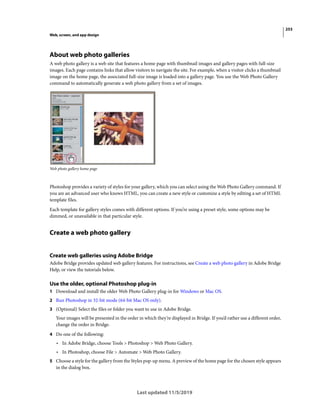
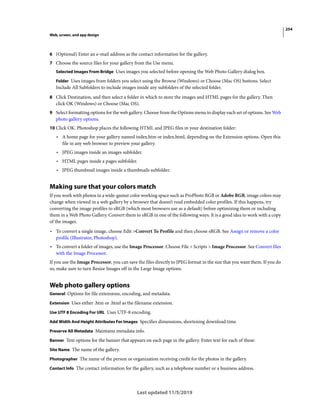
  • 529.
    519 Image adjustments Last updated11/5/2019 Adjusting levels A Shadows B Midtones C Highlights D Output Level sliders Video tutorial: Improving tonal quality with Levels Video tutorial: Improving tonal quality with Levels For another tutorial, see How to correct color and tone. Adjust tonal range using Levels The outer two Input Levels sliders map the black point and white point to the settings of the Output sliders. By default, the Output sliders are at level 0, where the pixels are black, and level 255, where the pixels are white. With the Output sliders in the default positions, moving the black input slider maps the pixel value to level 0 and moving the white point slider maps the pixel value to level 255. The remaining levels are redistributed between levels 0 and 255. This redistribution increases the tonal range of the image, in effect increasing the overall contrast of the image. Note: When shadows are clipped, the pixels are black, with no detail. When highlights are clipped, the pixels are white, with no detail. The middle Input slider adjusts the gamma in the image. It moves the midtone (level 128) and changes the intensity values of the middle range of gray tones without dramatically altering the highlights and shadows. 1 Do one of the following: • Click the Levels icon in the Adjustments panel, or choose Levels from the panel menu. • Choose Layer > New Adjustment Layer > Levels. Click OK in the New Layer dialog box. Note: Choosing Image > Adjustments > Levels makes direct adjustments to the image layer and discards image information. 2 (Optional) To adjust tones for a specific color channel, choose an option from the Channel menu.
  • 530.
    520 Image adjustments Last updated11/5/2019 3 (Optional) To edit a combination of color channels at the same time, Shift-select the channels in the Channels panel before choosing the Image > Adjustments > Levels command. (This method does not work in a Levels adjustment layer.) The Channel menu then displays the abbreviations for the target channels—for example, CM for cyan and magenta. The menu also contains the individual channels for the selected combination. Edit spot channels and alpha channels individually. 4 To adjust the shadows and highlights manually, drag the black and white Input Levels sliders to the edge of the first group of pixels at either end of the histogram. For example, if you move the black point slider to the right at level 5, Photoshop maps all the pixels at level 5 and lower to level 0. Similarly, if you move the white point slider to the left at level 243, Photoshop maps all pixels at level 243 and higher to level 255. The mapping affects the darkest and lightest pixels in each channel. The corresponding pixels in the other channels are adjusted proportionately to avoid altering the color balance. Note: You can also enter values directly into the first and third Input Levels text boxes. Adjusting black and white points with Levels Input sliders 5 (Optional) To identify areas in the image that are being clipped (completely black or completely white), do one of the following: • Hold down Alt (Windows) or Option (Mac OS) as you drag the black point and white point sliders. • Choose Show Clipping For Black/White Points from the panel menu. 6 To adjust midtones, use the middle Input slider to make a gamma adjustment. Moving the middle Input slider to the left makes the overall image lighter. This slider adjustment maps a lower (darker) level up to the midpoint level between the Output sliders. If the Output sliders are in their default position (0 and 255), the midpoint is level 128. In this example, the shadows expand to fill the tonal range from 0 to 128, and the highlights are compressed. Moving the middle Input slider to the right has the opposite effect, making the image darker. Note: You can also enter a gamma adjustment value directly in the middle Input Levels box. You can view the adjusted histogram in the Histogram panel. Adjust color using Levels 1 In the Adjustments panel, click the Levels icon or choose Levels from the panel menu.
  • 531.
    521 Image adjustments Last updated11/5/2019 2 In the Properties panel, do one of the following to neutralize a color cast: • Click the eyedropper tool to set the gray point . Then click in a part of the image that is neutral gray. • Click Auto to apply the default automatic levels adjustment. To experiment with other automatic adjustment options, choose Auto Options from the Properties panel menu, then change Algorithms in the Auto Color Corrections Options dialog box. In general, assign equal color component values to achieve a neutral gray. For example, assign equal red, green, and blue values to produce a neutral gray in an RGB image. Add contrast to a photo with Levels If the image needs overall contrast because it doesn’t use the full tonal range, click the Levels icon in the Adjustments panel. Then drag the Shadow and Highlight input sliders inward until they touch the ends of the histogram. Image layer doesn’t extend to the ends of the graph, indicating that the image is not using the full tonal range. A Shadow Input slider B Highlight Input slider Adjust hue and saturation Hue/Saturation lets you adjust the hue, saturation, and lightness of a specific range of colors in an image or simultaneously adjust all the colors in an image. This adjustment is especially good for fine-tuning colors in a CMYK image so that they are in the gamut of an output device. You can save Hue/Saturation settings in the Properties panel, and then load them for reuse in other images. For more information, see Save adjustment settingsand Reapply adjustment settings. For more information on image adjustments, see Adjusting image color and tone in. Apply a Hue/Saturation adjustment 1 Do one of the following: • Click the Hue/Saturation icon in the Adjustments panel. • Choose Layer > New Adjustment Layer > Hue/Saturation. Click OK in the New Layer dialog box. The two color bars in the dialog box represent the colors in their order on the color wheel. The upper color bar shows the color before the adjustment; the lower bar shows how the adjustment affects all of the hues at full saturation. Note: You can also choose Image > Adjustments > Hue/Saturation. But keep in mind that this method makes direct adjustments to the image layer and discards image information.
  • 532.
    522 Image adjustments Last updated11/5/2019 2 In the Properties panel, choose from the menu to the right of the On-image adjustment tool : • Choose Master to adjust all colors at once. • Choose one of the other preset color ranges listed for the color you want to adjust. To modify the color range, see Specify the range of colors adjusted using Hue/Saturation. • Choose a Hue/Saturation preset from the Preset menu. 3 For Hue, enter a value or drag the slider until you are satisfied with the colors. The values displayed in the box reflect the number of degrees of rotation around the wheel from the original color of the pixel. A positive value indicates clockwise rotation; a negative value, counterclockwise rotation. Values can range from -180 to +180. Color wheel A Saturation B Hue You can also select the On-image adjustment tool in the Properties panel, and then Ctrl-click (Windows) or Command-click (Mac OS) a color in the image. Drag left or right in the image to modify the hue value. 4 For Saturation, enter a value or drag the slider to the right to increase the saturation or to the left to decrease it. The color shifts away from or toward the center of the color wheel. Values can range from -100 (percentage of desaturation, duller colors) to +100 (percentage of saturation increase). You can also, select the On-image adjustment tool in the Properties panel, and click a color in the image. Drag left or right in the image to decrease or increase saturation of the color range that includes the pixel you clicked. 5 For Lightness, enter a value or drag the slider to the right to increase the lightness (add white to a color) or to the left to decrease it (add black to a color). Values can range from -100 (percentage of black) to +100 (percentage of white). Note: Click the Reset button to undo a Hue/Saturation setting in the Properties panel. Specify the range of colors adjusted using Hue/Saturation 1 Apply a Hue/Saturation adjustment. 2 In the Properties panel, choose a color from the menu to the right of the On-image adjustment button .
  • 533.
    523 Image adjustments Last updated11/5/2019 Four color wheel values (in degrees) appear in the Properties panel. They correspond to the adjustment sliders that appear between the color bars. The two inner vertical sliders define the color range. The two outer triangle sliders show where the adjustments on a color range “fall off” (fall-off is a feathering or tapering of the adjustments instead of a sharply defined on/off application of the adjustments). 3 Use either the eyedropper tools or the adjustment sliders to modify the range of colors. • Click or drag in the image with the Eyedropper tool to select a color range. To expand the range, click or drag in the image with the Add To Sample Eyedropper tool . To reduce the range of color, click or drag in the image with the Subtract From Sample Eyedropper tool . While an eyedropper tool is selected, you can also press Shift to add to the range, or Alt (Windows) or Option (Mac OS) to subtract from it. • Drag one of the white triangle sliders to adjust the amount of color fall-off (feathering of adjustment) without affecting the range. • Drag the area between the triangle and the vertical bar to adjust the range without affecting the amount of fall-off. • Drag the center area to move the entire adjustment slider (which includes the triangles and vertical bars) to select a different color area. • Drag one of the vertical white bars to adjust the range of the color component. Moving a vertical bar from the center of the adjustment slider and closer to a triangle increases the color range and decreases the fall-off. Moving a vertical bar closer to the center of the adjustment slider and away from a triangle decreases the color range and increases the fall-off. • Ctrl-drag (Windows) or Command-drag (Mac OS) the color bar so that a different color is in the center of the bar. Hue/Saturation adjustment slider A Hue slider values B Adjusts fall-off without affecting range C Adjusts range without affecting fall-off D Adjusts range of color and fall-off E Moves entire slider If you modify the adjustment slider so that it falls into a different color range, the name in the Edit menu changes to reflect this change. For example, if you choose Yellow and alter its range so that it falls in the red part of the color bar, the name changes to Red 2. You can convert up to six of the individual color ranges to varieties of the same color range (for example, Red through Red 6). By default, the range of color selected when you choose a color component is 30° wide, with 30° of fall-off on either side. Setting the fall-off too low can produce banding in the image. Colorize a grayscale image or create a monotone effect 1 (Optional) If you are colorizing a grayscale image, choose Image > Mode > RGB Color to convert the image to RGB. 2 Apply a Hue/Saturation adjustment.
  • 534.
    524 Image adjustments Last updated11/5/2019 3 In the Properties panel, select the Colorize option. If the foreground color is black or white, the image is converted to a red hue (0°). If the foreground color is not black or white, the image is converted to the hue of the current foreground color. The lightness value of each pixel does not change. 4 (Optional) Use the Hue slider to select a new color. Use the Saturation and Lightness sliders to adjust the saturation and lightness of the pixels. Adjust color saturation using Vibrance Vibrance adjusts the saturation so that clipping is minimized as colors approach full saturation. This adjustment increases the saturation of less-saturated colors more than the colors that are already saturated. Vibrance also prevents skintones from becoming over saturated. From an expert: Vibrance adjustment layer From an expert: Vibrance adjustment layer 1 Do one of the following: • In the Adjustments panel, click the Vibrance icon . • Choose Layer > New Adjustment Layer > Vibrance. In the New Layer dialog box, type a name for the Vibrance adjustment layer and click OK. Note: You can also choose Image > Adjustments > Vibrance. But keep in mind that this method makes direct adjustments to the image layer and discards image information. 2 In the Properties panel, drag the Vibrance slider to increase or decrease color saturation without clipping when colors become more saturated. Then, do one of the following: • To apply more adjustment to less saturated colors and prevent colors clipping as they reach total saturation, move the Vibrance slider to the right. • To apply the same amount of saturation adjustment to all colors regardless of their current saturation, move the Saturation slider. In some situations, this may produce less banding than the Saturation slider in the Hue/Saturation Adjustments panel or Hue/Saturation dialog box. • To decrease saturation, move either the Vibrance or the Saturation slider to the left. Adjust color saturation in image areas The Sponge tool subtly changes the color saturation of an area. When an image is in Grayscale mode, the tool increases or decreases contrast by moving gray levels away from or toward the middle gray. 1 Select the Sponge tool . 2 Choose a brush tip and set brush options in the options bar. 3 In the options bar, choose the way you want to change the color from the Mode menu: Saturate Intensifies the color’s saturation Desaturate Dilutes the color’s saturation 4 Specify the flow for the Sponge tool. 5 Select the Vibrance option to minimize clipping for fully saturated or desaturated colors. 6 Drag over the part of the image you want to modify.
  • 535.
    525 Image adjustments Last updated11/5/2019 Make quick tonal adjustments Apply the Auto Contrast adjustment The Auto Contrast command adjusts image contrast automatically. Because Auto Contrast does not adjust channels individually, it does not introduce or remove color casts. It clips the shadow and highlight values in an image and then maps the remaining lightest and darkest pixels in the image to pure white (level 255) and pure black (level 0). This makes the highlights appear lighter and shadows appear darker. By default, when identifying the lightest and darkest pixels in an image, Auto Contrast clips the white and black pixels by 0.5%—that is, it ignores the first 0.5% of either extreme. You can change this default using the Auto Color Correction Options found in the Levels and the Curves dialog boxes. Auto Contrast can improve the appearance of many photographic or continuous-tone images. It does not improve flat-color images. 1 Do one of the following: • Click the Levels or Curves icon in the Adjustments panel. • Choose Layer > New Adjustment Layer and choose either Levels or Curves. Click OK in the New Layer dialog box. Note: You can also choose Image > Auto Contrast to apply the adjustment directly to the image layer. Keep in mind that this method discards image information and its application is automatic. You cannot adjust any of the options in the following steps. 2 In the Properties panel, Alt-click (Windows) or Option-click (Mac OS) the Auto button. 3 Under Algorithms in the Auto Color Correction Options dialog box, select the Enhance Monochromatic Contrast option. 4 Specify the shadows and highlights that are clipped, and adjust the target color for the midtones. 5 Click OK to apply Auto Contrast. Remove a color cast using Auto Color Auto Color adjusts the contrast and color of an image by searching the image to identify shadows, midtones, and highlights. By default, Auto Color neutralizes the midtones using a target color of RGB 128 gray and clips the shadows and highlight pixels by 0.5%. You can change these defaults in the Auto Color Correction Options dialog box. 1 Do one of the following: • Click the Levels or Curves icon in the Adjustments panel. • Choose Layer > New Adjustment Layer and choose either Levels or Curves. Click OK in the New Layer dialog box. Note: You can also choose Image > Auto Color to apply the adjustment directly to the image layer. Keep in mind that this method discards image information and is automatic. You cannot adjust any of the options in the following steps. 2 In the Properties panel, Alt-click (Windows) or Option-click (Mac OS) the Auto button.
  • 536.
    526 Image adjustments Last updated11/5/2019 3 Under Algorithms in the Auto Color Correction Options dialog box, select the Find Dark & Light colors option. 4 Select the Snap Neutral Midtones option. 5 Specify the shadows and highlights that are clipped, and adjust the target color for the midtones. 6 Click OK to apply Auto Color. Set Auto adjustment options The Auto Color Correction options control the automatic tone and color corrections available in both Levels and Curves. It also controls the settings for the Auto Tone, Auto Contrast, and Auto Color commands. The Auto Color Correction options let you specify shadow and highlight clipping percentages, and assign color values to shadows, midtones, and highlights. You can apply the settings during a single use of the Levels or Curves adjustment, or you can save the settings as default values when applying Auto Tone, Auto Contrast, Auto Color, and the Auto option for Levels and Curves. Auto Color Correction Options dialog box A Auto Contrast option B Auto Levels option C Auto Color option D Set target colors, black point, and white point 1 Click the Levels or Curves icon in the Adjustments panel. 2 Alt-click (Windows) or Option-click (Mac OS) the Auto button in the Properties panel. 3 Specify the algorithm you want Photoshop to use to adjust the overall tonal range of an image: Enhance Monochromatic Contrast Clips all channels identically. This preserves the overall color relationship while making highlights appear lighter and shadows appear darker. The Auto Contrast command uses this algorithm. Enhance Per Channel Contrast Maximizes the tonal range in each channel to produce a more dramatic correction. Because each channel is adjusted individually, Enhance Per Channel Contrast may remove or introduce color casts. The Auto Tone command uses this algorithm. Find Dark & Light Colors Finds the average lightest and darkest pixels in an image and uses them to maximize contrast while minimizing clipping. The Auto Color command uses this algorithm. 4 Select Snap Neutral Midtones if you want Photoshop to find an average nearly-neutral color in an image and then adjust the gamma (midtone) values to make the color neutral. The Auto Color command uses this algorithm. 5 To specify how much to clip black and white pixels, enter percentages in the Clip text boxes. A value between 0.0% and 1% is recommended.
  • 537.
    527 Image adjustments Last updated11/5/2019 By default, Photoshop clips the black and white pixels by 0.1%—that is, it ignores the first 0.1% of either extreme when identifying the lightest and darkest pixels in the image. Because of the better output quality of modern scanners and digital cameras, these default clipping percentages might be too high. 6 To assign (target) color values to the darkest, neutral, and lightest areas of an image, click a color swatch. 7 Do one of the following: • To use the settings in the current Levels or Curves adjustment, click OK. If you then click the Auto button, Photoshop reapplies the same settings to the image. • To save the settings as the default, select Save as Defaults, and then click OK. The next time you access Levels or Curves in the Adjustments panel, you can apply the same setting by clicking the Auto button. The Auto Tone, Auto Contrast, and Auto Color commands also use the default clipping percentages. Note: When you save the Auto Color Correction options as defaults for Auto Color, Auto Tone, and Auto Contrast, it does not matter what algorithm you select in step 3. The three auto-correction commands use only those values that you set for the target colors and clipping. The only exception is that the Auto Color command also uses the Snap Neutral Midtones option. Video tutorial: Auto corrections Video tutorial: Auto corrections Using the Equalize command The Equalize command redistributes the brightness values of the pixels in an image so that they more evenly represent the entire range of brightness levels. Equalize remaps pixel values in the composite image so that the brightest value represents white, the darkest value represents black, and intermediate values are evenly distributed throughout the grayscale. You can use the Equalize command when a scanned image appears darker than the original and you want to balance the values to produce a lighter image. Using Equalize together with the Histogram panel lets you see before-and-after brightness comparisons. Keep in mind that the Equalize command applies adjustments directly to the image layer and deletes image information. For nondestructive adjustments, use adjustment layers or edit in Adobe Camera Raw. 1 (Optional) Select an area of the image to equalize. 2 Choose Image > Adjustments > Equalize. 3 If you selected an area of the image, select what to equalize in the dialog box, and click OK: Equalize Selected Area Only Evenly distributes only the pixels in the selection. Equalize Entire Image Based On Selected Area Evenly distributes all image layers based on those in the selection. Adjust black and white points with the Auto option The Auto option for Levels and Curves and the Auto Tone command automatically adjust the black point and white point in an image. This clips a portion of the shadows and highlights in each channel and maps the lightest and darkest pixels in each color channel to pure white (level 255) and pure black (level 0). The intermediate pixel values are redistributed proportionately. As a result, using the Auto option or Auto Tone increases the contrast in an image because the pixel values are expanded. Because the Auto option and Auto Tone adjust each color channel individually, it may remove color or introduce color casts.
  • 538.
    528 Image adjustments Last updated11/5/2019 The Auto option and Auto Tone give good results in certain images with an average distribution of pixel values that need a simple increase in contrast. By default, the Auto option and the Auto Tone command clip the white and black pixels by 0.1%—that is, it ignores the first 0.1% of either extreme when identifying the lightest and darkest pixels in the image. The default settings for the Auto option can be changed in the Auto Color Correction Options dialog box. 1 Do one of the following: • Click the Levels or Curves icon in the Adjustments panel. • Choose Layer > New Adjustment Layer and choose either Levels or Curves. Click OK in the New Layer dialog box. Note: You can choose Image > Auto Tone to apply the adjustment directly to the image layer. Keep in mind that this method discards image information and is automatic. You cannot adjust any of the options in the following steps. 2 In the Properties panel, Alt-click (Windows) or Option-click (Mac OS) the Auto button. 3 Under Algorithms in the Auto Color Correction Options dialog box, select Enhance Per Channel Contrast. 4 Adjust the amount of shadow and highlight values that are clipped, and adjust the target color for the midtones. 5 Click OK to apply the Auto option settings. Apply special color effects to images Desaturate colors The Desaturate command converts a color image to grayscale values, but leaves the image in the same color mode. For example, it assigns equal red, green, and blue values to each pixel in an RGB image. The lightness value of each pixel does not change. Keep in mind that the Desaturate command permanently alters the original image information in the background layer. This command has the same effect as setting Saturation to minus (-)100 in the Hue/Saturation adjustment. For nondestructive editing, use a Hue/Saturation adjustment layer. Note: If you are working with a multilayer image, Desaturate converts the selected layer only. ? Choose Image > Adjustments > Desaturate. Invert colors The Invert adjustment inverts the colors in an image. You can use Invert as part of the process of making an edge mask to apply sharpening and other adjustments to selected areas of an image. Note: Because color print film contains an orange mask in its base, the Invert adjustment cannot make accurate positive images from scanned color negatives. Be sure to use the proper settings for color negatives when scanning film.
  • 539.
    529 Image adjustments Last updated11/5/2019 When you invert an image, the brightness value of each pixel in the channels is converted to the inverse value on the 256-step color-values scale. For example, a pixel in a positive image with a value of 255 is changed to 0, and a pixel with a value of 5 is changed to 250. Do one of the following: • Click the Invert icon in the Adjustments panel. • Choose Layer > New Adjustment Layer > Invert. Click OK in the New Layer dialog box. Note: You can also choose Image > Adjustments > Invert. But keep in mind that this method makes direct adjustments to the image layer and discards image information. Create a two-valued black and white image The Threshold adjustment converts grayscale or color images to high-contrast, black-and-white images. You can specify a certain level as a threshold. All pixels lighter than the threshold are converted to white; all pixels darker are converted to black. 1 Do one of the following: • Click the Threshold icon in the Adjustments panel. • Choose Layer > New Adjustment Layer > Threshold. Click OK in the New Layer dialog box. The Properties panel displays a histogram of the luminance levels of the pixels in the current selection. Note: You can also choose Image > Adjustments > Threshold. But keep in mind that this method makes direct adjustments to the image layer and discards image information. 2 In the Properties panel, drag the slider below the histogram until the threshold level you want appears. As you drag, the image changes to reflect the new threshold setting. Posterize an image The Posterize adjustment lets you specify the number of tonal levels (or brightness values) for each channel in an image and then maps pixels to the closest matching level. For example, choosing two tonal levels in an RGB image gives six colors: two for red, two for green, and two for blue. This adjustment is useful for creating special effects, such as large, flat areas in a photograph. Its effects are most evident when you reduce the number of gray levels in a grayscale image, but it also produces interesting effects in color images. If you want a specific number of colors in your image, convert the image to grayscale and specify the number of levels you want. Then convert the image back to the previous color mode, and replace the various gray tones with the colors you want. 1 Do one of the following: • Click the Posterize icon in the Adjustments panel. • Choose Layer > New Adjustment Layer > Posterize. Note:
  • 540.
    530 Image adjustments Last updated11/5/2019 You can also choose Image > Adjustments > Posterize. But keep in mind that this method makes direct adjustments to the image layer and discards image information. 2 In the Properties panel, move the Levels slider or enter the number of tonal levels you want. Apply a gradient map to an image The Gradient Map adjustment maps the equivalent grayscale range of an image to the colors of a specified gradient fill. If you specify a two-color gradient fill, for example, shadows in the image are mapped to one of the endpoint colors of the gradient fill, highlights are mapped to the other endpoint color, and midtones are mapped to the gradations in between. 1 Do one of the following: • Click the Gradient Map icon in the Adjustments panel. • Choose Layer > New Adjustment Layer > Gradient Map. Click OK in the New Layer dialog box. Note: You can also choose Image > Adjustments > Gradient Map. But keep in mind that this method applies the adjustment directly to the image layer and discards image information. 2 In the Properties panel, specify the gradient fill you want to use: • To choose from a list of gradient fills, click the triangle to the right of the gradient fill. Click to select the desired gradient fill, and then click in a blank area of the Properties panel to dismiss the list. For information on customizing the gradient fill list, see Work with the Preset Manager. • To edit the currently-displayed gradient fill, click the gradient fill, and then modify the existing gradient fill or create a gradient fill in the Gradient Editor. (See Create a smooth gradient.) By default, the shadows, midtones, and highlights of the image are mapped respectively to the starting (left) color, midpoint, and ending (right) color of the gradient fill. 3 Select either, none, or both of the Gradient options: Dither Adds random noise to smooth the appearance of the gradient fill and reduces banding effects. Reverse Switches the direction of the gradient fill, reversing the gradient map. Apply the Color Balance adjustment Apply the Color Balance adjustment The Color Balance command changes the overall mixture of colors in an image for generalized color correction. 1 Make sure that the composite channel is selected in the Channels panel. This command is available only when you’re viewing the composite channel. 2 Do one of the following: • Click the Color Balance icon in the Adjustments panel. • Choose Layer > New Adjustment Layer > Color Balance. Click OK in the New Layer dialog box. Note:
  • 541.
    531 Image adjustments Last updated11/5/2019 You can also choose Image > Adjustments > Color Balance. But keep in mind that this method makes direct adjustments to the image layer and discards image information. 3 In the Properties panel, select Shadows, Midtones, or Highlights to select the tonal range in which you want to focus the changes. 4 (Optional) Select Preserve Luminosity to prevent changing the luminosity values in the image while changing the color. This option maintains the tonal balance in the image. 5 Drag a slider toward a color that you want to increase in the image; drag a slider away from a color that you want to decrease in the image. The values above the color bars show the color changes for the red, green, and blue channels. (For Lab images, the values are for the A and B channels.) Values can range from -100 to +100. Change the color balance using the Photo Filter command The Photo Filter adjustment mimics the technique of placing a colored filter in front of the camera lens to adjust the color balance and color temperature of the light transmitted through the lens and exposing the film. Photo Filter also lets you choose a color preset to apply a hue adjustment to an image. If you want to apply a custom color adjustment, the Photo Filter adjustment lets you specify a color using the Adobe Color Picker. 1 Do one of the following: • Click the Photo Filter icon in the Adjustments panel. • Choose Layer > New Adjustment Layer > Photo Filter. Click OK in the New Layer dialog box. Note: You can also choose Image > Adjustments > Photo Filter. But keep in mind that this method makes direct adjustments to the image layer and discards image information. 2 In the Properties panel, choose the filter color, either a custom filter or a preset. For a custom filter, select the Color option, click the color square, and use the Adobe Color Picker to specify a color for a custom color filter. For a preset filter, select the Filter option and choose one of the following presets from the Filter menu: Warming Filter (85 and LBA) and Cooling Filter (80 and LBB) Color conversion filters that tune the white balance in an image. If an image was photographed with a lower color temperature of light (yellowish), the Cooling Filter (80) makes the image colors bluer to compensate for the lower color temperature of the ambient light. Conversely, if the photo was taken with a higher color temperature of light (bluish), the Warming Filter (85) makes the image colors warmer to compensate for the higher color temperature of the ambient light. Warming Filter (81) and Cooling Filter (82) Use light-balancing filters for minor adjustments in the color quality of an image. The Warming Filter (81) makes the image warmer (more yellow), and the Cooling Filter (82) makes the image cooler (bluer). Individual Colors Apply a hue adjustment to the image depending on the color preset you choose. Your choice of color depends on how you’re using the Photo Filter adjustment. If your photo has a color cast, you can choose a complementary color to neutralize the color cast. You can also apply colors for special color effects or enhancements. For example, the Underwater color simulates the greenish blue color cast in underwater photos. Make sure that Preview is selected to view the results of using a color filter. If you don’t want the image darkened by adding the color filter, be sure that the Preserve Luminosity option is selected. 3 To adjust the amount of color applied to the image, use the Density slider or enter a percentage in the Density box. A higher density results in a stronger color adjustment.
  • 542.
    532 Image adjustments Last updated11/5/2019 View histograms and pixel values About histograms A histogram illustrates how pixels in an image are distributed by graphing the number of pixels at each color intensity level. The histogram shows detail in the shadows (shown in the left part of the histogram), midtones (shown in the middle), and highlights (shown in the right part) A histogram can help you determine whether an image has enough detail to make a good correction. The histogram also gives a quick picture of the tonal range of the image, or the image key type. A low-key image has detail concentrated in the shadows. A high-key image has detail concentrated in the highlights. And, an average-key image has detail concentrated in the midtones. An image with full tonal range has some pixels in all areas. Identifying the tonal range helps determine appropriate tonal corrections. How to read a histogram A Overexposed photo B Properly exposed photo with full tonality C Underexposed photo The Histogram panel offers many options for viewing tonal and color information about an image. By default, the histogram displays the tonal range of the entire image. To display histogram data for a portion of the image, first select that portion. You can view an image histogram as an overlay in the Curves dialog box by selecting the histogram option under Curve Display Options, and in the Curves Properties panel, or by choosing Curve Display Options from the panel menu, then Histogram. Histogram panel overview ? Choose Window > Histogram or click the Histogram tab to open the Histogram panel. By default, the Histogram panel opens in Compact View with no controls or statistics, but you can adjust the view.
  • 543.
    533 Image adjustments Last updated11/5/2019 Histogram panel (Expanded view) A Channel menu B panel menu C Uncached Refresh button D Cached Data Warning icon E Statistics Adjust the view of the Histogram panel ? Choose a view from the Histogram panel menu. Expanded View Displays the histogram with statistics. It also displays: controls for choosing the channel represented by the histogram, viewing options in the Histogram panel, refreshing the histogram to display uncached data, and choosing a specific layer in a multilayered document. Compact View Displays a histogram with no controls or statistics. The histogram represents the entire image. All Channels View Displays individual histograms of the channels in addition to all the options of the Expanded View. The individual histograms do not include alpha channels, spot channels, or masks. Histogram panel with all channels displayed in color and statistics hidden
  • 544.
    534 Image adjustments Last updated11/5/2019 View a specific channel in the histogram If you chose the Expanded View or All Channels View of the Histogram panel, you can choose a setting from the Channel menu. Photoshop remembers the channel setting if you switch from either Expanded View or All Channels View back to Compact View. • Choose an individual channel to display a histogram of the channel, including color channels, alpha channels, and spot channels. • Depending on the color mode of the image, choose RGB, CMYK, or Composite to view a composite histogram of all the channels. • If the image is RGB or CMYK, choose Luminosity to display a histogram representing the luminance or intensity values of the composite channel. • If the image is RGB or CMYK, choose Colors to display a composite histogram of the individual color channels in color. This option is the default view for RGB and CMYK images when you first choose Expanded View or All Channels View. In the All Channels View, choosing from the Channels menu affects only the topmost histogram in the panel. View channel histograms in color ? From the Histogram panel, do one of the following: • In the All Channels View, choose Show Channels In Color from the panel menu. • In Expanded View or All Channels View, choose an individual channel from the Channel menu and choose Show Channels In Color from the panel menu. If you switch to Compact View, the channel continues to be shown in color. • In Expanded View or All Channels View, choose Colors from the Channel menu to show a composite histogram of the channels in color. If you switch to Compact View, the composite histogram continues to be shown in color. View histogram statistics By default, the Histogram panel displays statistics in the Expanded View and All Channels View. 1 Choose Show Statistics from the Histogram panel menu. 2 Do one of the following: • To view information about a specific pixel value, place the pointer in the histogram. • To view information about a range of values, drag in the histogram to highlight the range. The panel displays the following statistical information below the histogram: Mean Represents the average intensity value. Std Dev (Standard deviation) Represents how widely intensity values vary. Median Shows the middle value in the range of intensity values. Pixels Represents the total number of pixels used to calculate the histogram. Level Displays the intensity level of the area underneath the pointer. Count Shows the total number of pixels corresponding to the intensity level underneath the pointer. Percentile Displays the cumulative number of pixels at or below the level underneath the pointer. This value is expressed as a percentage of all the pixels in the image, from 0% at the far left to 100% at the far right.
  • 545.
    535 Image adjustments Last updated11/5/2019 Cache Level Shows the current image cache used to create the histogram. When the cache level is higher than 1, the histogram is displayed faster. In this case, the histogram is derived from a representative sampling of pixels in the image (based on the magnification). The original image is cache level 1. At each level above level 1, four adjacent pixels are averaged to arrive at a single pixel value. So, each level is half the dimensions (has 1/4 the number of pixels) of the lower level. When Photoshop makes a quick approximation, it can use one of the upper levels. Click the Uncached Refresh button to redraw the histogram using the actual image layer. View the histogram for a multilayered document 1 Choose Expanded View from the Histogram panel menu. 2 Choose a setting from the Source menu. (The Source menu is not available for single-layered documents.) Entire Image Displays a histogram of the entire image, including all layers. Selected Layer Displays a histogram of the layer that’s selected in the Layers panel. Adjustment Composite Displays a histogram of an adjustment layer selected in the Layers panel, including all the layers below the adjustment layer. Preview histogram adjustments You can preview the effect on the histogram of any color and tonal adjustments. ? Select the Preview option in the dialog boxes of any color or tonal adjustment command. When Preview is selected, the Histogram panel shows how the adjustment affects the histogram. Note: When making adjustments using the Adjustments panel, changes are automatically reflected in the Histogram panel. Preview of histogram adjustment in the Histogram panel A Original histogram B Adjusted histogram C Shadows D Midtones E Highlights Refresh the histogram display When a histogram is read from a cache instead of the current state of the document, the Cached Data Warning icon appears in the Histogram panel. Histograms based on the image cache are displayed faster and are based on a representative sampling of pixels in the image. You can set the maximum cache level (from 2 to 8) in the Performance preference. Note: A higher cache level setting will increase the redraw speed for large, multi-layer files, but requires additional usage of system RAM. If RAM is limited or you work mainly with smaller images, use lower cache level settings ? To refresh the histogram so that it displays all of the pixels of the original image in its current state, do one of the following: • Double-click anywhere in the histogram. • Click the Cached Data Warning icon .
  • 546.
    536 Image adjustments Last updated11/5/2019 • Click the Uncached Refresh button . • Choose Uncached Refresh from the Histogram panel menu. For information about cache level, see Histogram panel overview. View color values in an image You can use the Info panel to see the color value of pixels as you make color corrections. When you work with the Properties panel, the Info panel displays two sets of color values for the pixels under the pointer. The value in the left column is the original color value. The value in the right column is the color value after the adjustment is made. Using Levels and Info panel to neutralize the tone of an image You can view the color of a single location using the Eyedropper tool . You can also use up to four Color Samplers to display color information for one or more locations in the image. These samplers are saved in the image, so you can refer to them repeatedly as you work, even if you close and reopen the image. Color samplers and Info panel 1 Choose Window > Info to open the Info panel. 2 Select (then Shift-click) the Eyedropper tool or Color Sampler tool , and if necessary, choose a sample size in the options bar. Point Sample reads the value of a single pixel, other options read the average of a pixel area. 3 If you selected the Color Sampler tool , place up to four color samplers on the image. Click where you want to place a sampler.
  • 547.
    537 Image adjustments Last updated11/5/2019 View color information while adjusting color You can view color information for specific pixels in the image while adjusting color in the Properties panel. 1 Add an adjustment using the Adjustments panel. 2 Make adjustments in the Properties panel. As you make adjustments, view the before and after color values in the Info panel. Move the pointer over the image to view color values at the pointer location. Note: If you are using a command from the Image > Adjustments menu, the Eyedropper tool is activated (and other tools temporarily disabled) when you move the pointer over the image. You still have access to the scroll controls and to the Hand and Zoom tools using keyboard shortcuts. 3 If you’ve placed color samplers on the image, the color values under the color samplers appear in the lower half of the Info panel. To add new color samplers, select the Color Sampler tool and click in the image, or select the Eyedropper tool and Shift-click in the image. Adjusting color samplers Once you’ve added a color sampler, you can move or delete it, hide it, or change the color sampler information displayed in the Info panel. Move or delete a color sampler 1 Select the Color Sampler tool . 2 Do one of the following: • To move a color sampler, drag the sampler to the new location. • To delete a color sampler, drag the sampler out of the document window. Alternatively, hold down Alt (Windows) or Option (Mac OS) until the pointer becomes a scissors and click the sampler. • To delete all color samplers, click Clear in the options bar. • To delete a color sampler while an adjustment dialog box is open, hold down Alt+Shift (Windows) or Option+Shift (Mac OS), and click the sampler. Hide or show color samplers in an image ? Choose View > Extras. A check mark indicates that color samplers are visible. Change the display of color sampler information in the Info panel • To display or hide color sampler information in the Info panel, choose Color Samplers from the panel menu. A check mark indicates that the color sampler information is visible. • To change the color space in which a color sampler displays values, move the pointer onto the color sampler icon in the Info panel. Then, hold down the mouse button, and choose another color space from the menu. Convert a color image to black and white The Black & White adjustment lets you convert a color image to grayscale while maintaining full control over how individual colors are converted. You can also tint the grayscale by applying a color tone to the image, for example to create a sepia effect.
  • 548.
    538 Image adjustments Last updated11/5/2019 Video tutorial: Creative black and white Video tutorial: Creative black and white Video | Black and White adjustment layer Video | Black and White adjustment layer 1 Do one of the following: • Click the Black & White icon in the Adjustments panel. • Choose Layer > New Adjustment Layer > Black & White. In the New Layer dialog box, type a name for the adjustment layer and then click OK. Photoshop applies a default grayscale conversion. Note: You can also choose Image > Adjustments > Black & White. But keep in mind that this method makes direct adjustments to the image layer and discards image information. 2 (Optional) choose a Black & White preset from the Preset menu in the Properties panel. 3 In the Properties panel, manually adjust the conversion using the color sliders, apply an Auto conversion, or select a previously saved custom mix. Preset menu Select a predefined grayscale mix or a previously saved mix. To save a mix, choose Save Black & White Preset from the panel menu. Auto Sets a grayscale mix based on the color values of the images, maximizing the distribution of gray values. The Auto mix often produces excellent results, or can be used as the starting point for tweaking gray values using the color sliders. Color sliders Adjust the gray tones of specific colors in an image. Drag a slider left to darken or right to lighten the gray tones of an image’s original color. • To adjust a particular color component, select the On-image adjustment tool and then click in the image. Drag left or right to modify the color slider for the predominant color at that location, making it darker or brighter in the image. • Click the Reset button to reset all color sliders to the default grayscale conversion. Preview Deselect to view the image in its original color mode. 4 To apply a color tone, select Tint. To fine-tune the tint color, click the color swatch to open the Color Picker. Adjustment and fill layers
  • 549.
    539 Image adjustments Last updated11/5/2019 About adjustment and fill layers An adjustment layer applies color and tonal adjustments to your image without permanently changing pixel values. For example, rather than making a Levels or Curves adjustment directly to your image, you can create a Levels or Curves adjustment layer. The color and tonal adjustments are stored in the adjustment layer and apply to all the layers below it; you can correct multiple layers by making a single adjustment, rather than adjusting each layer separately. You can discard your changes and restore the original image at any time. Fill layers let you fill a layer with a solid color, a gradient, or a pattern. Unlike adjustment layers, fill layers do not affect the layers underneath them. Adjustment layers provide the following advantages: • Nondestructive edits. You can try different settings and re-edit the adjustment layer at any time. You can also reduce the effect of the adjustment by lowering the opacity of the layer. • Selective editing. Paint on the adjustment layer’s image mask to apply an adjustment to part of an image. Later you can control which parts of the image are adjusted by re-editing the layer mask. You can vary the adjustment by painting on the mask with different tones of gray. • Ability to apply adjustments to multiple images. Copy and paste adjustment layers between images to apply the same color and tonal adjustments. Adjustment layers have many of the same characteristics as other layers. You can adjust their opacity and blending mode, and you can group them to apply the adjustment to specific layers. Likewise, you can turn their visibility on and off to apply or preview the effect. Original (left); adjustment layer applied to barn only (center), which brings out detail in the barn; and adjustment layer applied to entire image (right), which lightens the entire image and pixelates the clouds Because adjustment layers contain adjustment data rather than pixels, they increase file size far less than standard pixel layers. If you are working with an unusually large file, however, you may want to reduce file size by merging adjustment layers into pixel layers. Create and confine adjustment and fill layers Adjustment and fill layers have the same opacity and blending mode options as image layers. You can rearrange, delete, hide, and duplicate them just as you do image layers.
  • 550.
    540 Image adjustments Last updated11/5/2019 Adjustment and fill layers A Adjustment layer confined to “Log home” layer only B Layer thumbnail C Fill layer D Layer mask Create an adjustment layer ? Do one of the following: • Click the New Adjustment Layer button at the bottom of the Layers panel, and choose an adjustment layer type. • Choose Layer > New Adjustment Layer, and choose an option. Name the layer, set layer options, and click OK. To confine the effects of an adjustment layer to specific image layers, select the image layers, choose Layer > New > Group From Layers, and change the Mode from Pass Through to any other blending mode. Then place the adjustment layer at the top of the layer group. Create a fill layer ? Do one of the following: • Choose Layer > New Fill Layer, and choose an option. Name the layer, set layer options, and click OK. • Click the New Adjustment Layer button at the bottom of the Layers panel, and choose a fill layer type. Solid Color Fills the adjustment layer with the current foreground color. Use the Color Picker to select a different a fill color. Gradient Click the gradient to display the Gradient Editor, or click the inverted arrow and choose a gradient from the pop-up panel. Set additional options if desired. • Style specifies the shape of the gradient. • Angle specifies the angle at which the gradient is applied. • Scale changes the size of the gradient. • Reverse flips the orientation of the gradient. • Dither reduces banding by applying dithering to the gradient. • Align With Layer uses the bounding box of the layer to calculate the gradient fill. You can drag in the image window to move the center of the gradient. Pattern
  • 551.
    541 Image adjustments Last updated11/5/2019 Click the pattern, and choose a pattern from the pop-up panel. Click Scale, and enter a value or drag the slider. Click Snap To Origin to make the origin of the pattern the same as the origin of the document. Select Link With Layer if you want the pattern to move along with the layer as the layer moves. When Link With Layer is selected, you can drag in the image to position the pattern while the Pattern Fill dialog box is open. Confine adjustment and fill layers to specific areas To confine adjustment and fill layers to specific areas, use layer masks. By default, adjustment and fill layers automatically have layer masks, indicated by the mask icon to the right of the layer thumbnail. (To create adjustment layers without masks, deselect Add Mask by Default in the Adjustments panel menu.) To change the shape of a mask on an existing layer, see Edit layer masks. To create a new adjustment or fill layer with a mask of specific shape, complete one of the following procedures. Create an adjustment or fill layer mask using a selection or path 1 In the Layers panel, select the layer to which you want to apply the adjustment or fill layer. 2 In the image, create a pixel selection, or create and select a closed path. A selection confines the new adjustment or fill layer with a layer mask. A path confines the new adjustment or fill layer with a vector mask. 3 Create an adjustment or fill layer. Create an adjustment layer mask using a color range The Color Range feature, which is useful for creating a selection area based on sampled colors in an image, can also be used to create an adjustment layer mask. For more information, see Select a color range in an image. 1 In the Layers panel, select the layer to which you want to apply the adjustment layer. 2 Choose Layer > New Adjustment Layer, and choose an adjustment type. 3 In the Masks section of the Properties panel, click Color Range. 4 In the Color Range dialog box, choose Sampled Colors from the Select menu. 5 Select Localized Color Clusters to build a mask based on different color ranges in the image. 6 Set the display option to Selection, and Selection Preview to None. 7 Click a color area in the image. To sample multiple areas, hold down Shift to activate the plus eyedropper. Hold down Alt (Windows) or Option (Mac OS) to activate the minus eyedropper. As you click on image areas, you can preview the mask in the Color Range dialog box. White areas are unmasked pixels, black areas masked, and gray areas partially masked. 8 Use the Fuzziness slider to increase or decrease the range of colors around your sample colors that are included in the masked area. Use the Range slider to control how far or near a color must be from the sample points to be included in the mask. After adjusting the mask, click OK to close the Color Range dialog box. 9 Modify the adjustment as needed in the Properties panel. The adjustment is only applied to the unmasked (or partially masked) areas of the image. If necessary click Color Range again to make further adjustments to the adjustment layer mask.
  • 552.
    542 Image adjustments Last updated11/5/2019 Edit or merge adjustment and fill layers Editing adjustment and fill layers You can edit an adjustment or fill-layer setting. You can also edit the mask of an adjustment or fill layer to control the effect that the layer has on the image. By default, all areas of an adjustment or fill layer are “unmasked” and are therefore visible. (See About layer and vector masks.) Change adjustment and fill layer options 1 Do one of the following: • Double-click the adjustment or fill-layer thumbnail in the Layers panel. • Choose Layer > Layer Content Options. 2 Make the desired changes in the Properties panel. Note: Inverted adjustment layers do not have editable settings. Merging adjustment or fill layers You can merge an adjustment or fill layer several ways: with the layer below it, with the layers in its own grouped layer, with other selected layers, and with all other visible layers. You cannot, however, use an adjustment or fill layer as the target layer for a merge. When you merge an adjustment or fill layer with the layer below it, the adjustments are rasterized and become permanently applied within the merged layer. You can also rasterize a fill layer without merging it. (See Rasterize layers.) Adjustment and fill layers whose masks contain only white values do not add significantly to the file size, so it is not necessary to merge these adjustment layers to conserve file space. Curves adjustment Curves overview In the Curves adjustment, you adjust points throughout an image’s tonal range. Initially, the image’s tonality is represented as a straight diagonal line on a graph. When adjusting an RGB image, the upper-right area of the graph represents the highlights and the lower-left area represents the shadows. The horizontal axis of the graph represents the input levels (original image values) and the vertical axis represents the output levels (new adjusted values). As you add control points to the line and move them, the shape of the curve changes, reflecting your image adjustments. The steeper sections of the curve represent areas of higher contrast while flatter sections represent areas of lower contrast. You can save Curves adjustment settings as presets. See Save adjustment settingsand Reapply adjustment settings. Note: The Curves adjustment can also be applied to CMYK, LAB, or Grayscale images. For CMYK images, the graph displays percentages of ink/pigment. For LAB and Grayscale images, the graph displays light values.
  • 553.
    543 Image adjustments Last updated11/5/2019 Curves options in the Properties panel A On-image adjustment tool B Sample in image to set black point. C Sample in image to set gray point. D Sample in image to set white point. E Edit points to modify the curve. F Draw to modify the curve. G Curves presets menu H Set black point. I Set gray point. J Set white point. K Show clipping. Video tutorial: Increase midtone contrast with curves Video tutorial: Increase midtone contrast with curves Adjust image color and tone with Curves Moving a point in the top portion of the curve adjusts the highlights. Moving a point in the center of the curve adjusts the midtones, and moving a point in the bottom section of the curve adjusts the shadows. To darken highlights, move a point near the top of the curve downward. Moving a point either down or to the right maps the Input value to a lower Output value, and the image darkens. To lighten the shadows, move a point near the bottom of the curve upward. Moving a point either up or to the left maps a lower Input value to a higher Output value, and the image lightens. 1 To apply a Curves adjustment, do one of the following: • Click the Curves icon in the Adjustments panel. • Choose Layer > New Adjustment Layer > Curves. Click OK in the New Layer dialog box. Note: Choosing Image > Adjustments > Curves applies the adjustment directly to the image layer and discards image information. 2 (Optional) To adjust the color balance, in the Properties panel, choose the channel you want to adjust from the menu to the left of the Auto button. 3 In the Properties panel, do any of the following: • Click directly on the curve line and then drag the control point to adjust a tonal area. • Select the On-image adjustment tool and then drag in the area of the image you want to adjust. • Select the On-image adjustment tool and click the tonal areas in the image that you want to adjust. This places control points along the curve line. • Choose a preset from the Preset menu.
  • 554.
    544 Image adjustments Last updated11/5/2019 Dragging a control point up or down lightens or darkens the tonal area you’re adjusting. Dragging a control point left or right increases or decreases the contrast. You can add up to 14 control points to the curve. To remove a control point, drag it off the graph. As you adjust the tonality, the graph continues displaying the original diagonal baseline and image histogram as references. These options can be turned off, see Set Curves Display Options. 4 (Optional) Do any of the following to modify the adjustment: • Add more points directly to the curve to adjust different tonal areas. • Click the On-image adjustment tool in other areas of the image, and drag up or down. • Move the Set Black and White Point sliders or use the Eyedropper tools to specify the darkest and lightest values in the image. • Click a point on the curve, and enter values in the Input and Output text boxes. • Select the pencil icon and draw a new curve over the existing one. When you have finished, click the Smooth the Curve Values icon or to smooth the curve you drew. Clicking more than once continues to smooth the curve further. Points on the curve remain anchored until you move them. You can make an adjustment in one tonal area without affecting other areas. Clicking the On-image adjustment tool in the image adds control points to the curve. Moving the control points adjusts the tonality of the image. Removing control points from a curve To remove a control point, do any of the following: • Drag the control point off the graph. • Select the control point and press Delete. • Ctrl-click (Windows) or Command-click (Mac OS) the control point. Set Curve display options You can control the curve grid display using the Curve display options. 1 Apply a Curves adjustment. 2 In the Properties panel, choose Curves Display Options from the panel menu. Note:
  • 555.
    545 Image adjustments Last updated11/5/2019 If you chose Image > Adjustments > Curves, expand the Curve Display Options in the Curves dialog box. 3 In the Curves Display Options dialog box, select any of the following: Light (0-255) Displays the intensity values for RGB images in a range from 0 to 255, with black (0) at the lower-left corner.Pigment/Ink % Displays the percentages for CMYK images are displayed in a range from 0 to 100, with highlights (0%) at the lower-left corner.Simple Grid Displays gridlines in 25% increments.Detailed Grid Displays gridlines in 10% increments.Show Channel Overlays Displays color channel curves superimposed on the composite curve.Histogram Displays a histogram of the original image tonal values behind the graph.Baseline Displays the original image color and tonality as a 45-degree angle line for reference,Intersection Line Displays horizontal and vertical lines to help you align control points as your drag them relative to the histogram or grid. To change the gridline increment, Alt-click (Windows) or Option-click (Mac OS) the grid. Apply an Auto correction in Curves ? Click Auto in the Properties panel. Auto applies an automatic color correction using the current default setting. To change the default setting, choose Auto Options from the Properties panel menu and set the options in the Auto Color Correction Options dialog box. You can apply an Auto Color, Auto Contrast, or Auto Tone correction to an image. For more information on these options, see Make quick tonal adjustments. Set black and white points using the black point and white point sliders When applying a Curves adjustment, use the black and white sliders to quickly set the black and white points (pure black and pure white values) in the image. 1 Drag the black and white point sliders to any point along the horizontal axis. Note that the Input value changes as your drag. 2 To preview clipping as you adjust black and white points, do one of the following: • Hold down Alt (Windows) or Option (Mac OS). • Choose Show Clipping For Black/White Points from the panel menu. Add contrast to the midtones of a photo with Curves If the image uses the full tonal range, but needs midtone contrast, Click the Curves icon in the Adjustments panel. Drag the curve into an S shape. Increasing the slope in the middle of the curve increases contrast in the midtones.
  • 556.
    546 Image adjustments Last updated11/5/2019 Keyboard shortcuts: Curves You can use these keyboard shortcuts for Curves: • To set a point on the curve for the selected color in each color component channel (but not in the composite channel), Shift+Ctrl-click (Windows) or Shift+Command-click (Mac OS) in the image. • To select multiple points, Shift-click points on the curve. Selected points are filled with black. • To deselect all points on the curve, click in the grid, or press Ctrl-D (Windows) or Command-D (Mac OS). • To select the next higher point on the curve, press the plus key; to select the next lowest, press the minus key. • To move selected points on the curve, press the arrow keys. • (Curves dialog box) To set a point on the curve for the current channel, Ctrl-click (Windows) or Command-click (Mac OS) in the image. If you’re instead using the Curves adjustment, simply click in the image with the On-image adjustment tool . Target images for press Setting highlight and shadow target values Assigning (targeting) highlight and shadow values of an image is necessary because most output devices (usually printing presses) cannot print detail in the blackest shadow values (near level 0) or the whitest highlight values (near level 255). Specifying the minimum shadow level and maximum highlight level helps to bring the important shadow and highlight details within the gamut of the output device. If you are printing an image on a desktop printer and your system is color-managed, don’t set target values. The Photoshop color management system automatically makes adjustments to the image you see on the screen so that it prints properly on your profiled desktop printer. Using Levels to preserve highlight and shadow details for printing The Output Levels sliders let you set the shadow and highlight levels to compress the image into a range less than 0 to 255. Use this adjustment to preserve the shadow and highlight details when an image is being printed on a press whose characteristics you know. For example, suppose there are important image details in the highlights with a value of 245, and the printing press that you’re using won’t hold a dot smaller than 5%. You can pull the highlight slider to level 242 (which is a 5% dot on the press) to shift the highlight detail from 245 to 242. Now, the highlight detail can safely print on that press. Generally, it is not a good idea to use the Output Levels sliders to target images with specular highlights. Your specular highlight will look gray rather than blow out to pure white. Use the highlight eyedropper for images with specular highlights.
  • 557.
    547 Image adjustments Last updated11/5/2019 Targeting shadows and highlights with Output Levels sliders Set target values using the eyedroppers 1 Select the Eyedropper tool in the toolbox. You can choose 3 by 3 Average from the Sample Size menu in the Eyedropper tool options. This ensures a representative sample of an area rather than the value of a single screen pixel. 2 Click the Levels or Curves icon in the Adjustments panel. When you select Levels or Curves, the Eyedropper tool is active outside the Properties panel. You still have access to the scroll controls, the Hand tool, and the Zoom tool through keyboard shortcuts. 3 Do one of the following to identify areas of highlights and shadows that you want to preserve in the image: • Move the pointer around the image, and look at the Info panel to find the lightest and darkest areas that you want preserved (not clipped to pure black or white). (See View color values in an image.) • Drag the pointer in the image, and look at Curves in the Properties panel to find the lightest and darkest points you want to preserve. This method does not work if the Curves adjustment is set to the CMYK composite channel. When identifying the lightest highlight details that you want targeted to a printable (lower) value, don’t include specular highlights. Specular highlights such as the highlight glint in jewelry or a spot of glare are meant to be the brightest points in an image. It’s desirable to clip specular highlight pixels (pure white, no detail) so that no ink is printed on the paper. You can also use the Threshold command to identify representative highlights and shadows before accessing Levels or Curves. (See Create a two-valued black and white image.) 4 To assign highlight values to the lightest area of the image, double-click the Set White Point Eyedropper tool in the Levels or Curves adjustment to display the Color Picker. Enter the values you want to assign to the lightest area in the image, and click OK. Then click the highlight you identified in step 3. If you accidentally click the wrong highlight, click the Reset button in the Adjustments panel.
  • 558.
    548 Image adjustments Last updated11/5/2019 Depending on the output device, you can achieve a good highlight in an average-key image using CMYK values of 5, 3, 3, and 0, respectively, when you are printing on white paper. An approximate RGB equivalent is 244, 244, 244, and an approximate grayscale equivalent is a 4% dot. You can approximate these target values quickly by entering 96 in the Brightness (B) box under the HSB area of the Color Picker. With a low-key image, you may want to set the highlight to a lower value to avoid too much contrast. Experiment with Brightness values from 96 through 80. The pixel values are adjusted throughout the image proportionately to the new highlight values. Any pixels lighter than the area you clicked are clipped (adjusted to level 255, pure white). The Info panel shows the values both before and after the color adjustment. Setting the target value for the Set White Point Eyedropper tool and then clicking a highlight to assign it the target value 5 To assign shadow values to the darkest area of the image that you want preserved, double-click the Set Black Point Eyedropper tool in the Properties panel to display the Color Picker. Enter the values you want to assign to the darkest area in the image, and click OK. Then click the shadow you identified in step 3. When you’re printing on white paper, you can usually achieve a good shadow in an average-key image using CMYK values of 65, 53, 51, and 95. An approximate RGB equivalent is 10, 10, 10, and an approximate grayscale equivalent is a 96% dot. You can approximate these values quickly by entering 4 in the Brightness (B) box under the HSB area of the Color Picker. With a high-key image, you may want to set the shadow to a higher value to maintain detail in the highlights. Experiment with Brightness values from 4 through 20.
  • 559.
    549 Image adjustments Last updated11/5/2019 Adjust color and tone with Levels and Curves eyedroppers Set black and white points using the Eyedropper tools Keep in mind that using the eyedroppers undoes any previous adjustment you made in Levels or Curves. If you plan to use the eyedroppers, it’s best to use them first and then fine-tune your adjustments with the Levels sliders or Curves points. 1 Apply a Curves or Levels adjustment. 2 In the Properties panel, do any of the following: • Double-click the Set Black Point eyedropper tool to set the black point. • Double-click the Set White Point eyedropper tool to set the white point. 3 In the Adobe Color Picker, determine the values you want for the darkest and lightest tones in the image: • To set the black point value to pure black, type 0 for R, G, and B. • To set the white point value to pure white, type 255 for R, G, and B. • To specify a shade of gray for either the black or white point, type identical values (between 0 and 255) for R, G, and B. The lower the values, the darker the gray. The higher the values, the lighter the gray. 4 Do one of the following to adjust the tonal areas to the black or white points you specified in Step 2: • With the Set Black Point eyedropper, click an image area that represents the black point (area with the lowest tonal values). • With the Set White Point eyedropper, click an image area that represents the white point (area with the lightest tonal values). Color correct using the eyedroppers You can use the eyedroppers in the Levels or Curves adjustment to correct a color cast such as an unwanted tint from an excess of color (red, green, blue, or cyan, magenta, yellow). It’s easier to color-balance an image by first identifying an area that you want to be neutral and then removing the color cast from that area. Depending on the image, you can use one or all three of the eyedroppers. The Set Gray Point eyedropper works best on images that don’t require large adjustments and have easily identified neutrals. Keep in mind that using the eyedroppers undoes any previous adjustment you made in Levels or Curves. If you plan to use the eyedroppers, it’s best to use them first and then fine-tune your adjustments with the Levels sliders or Curves points. Note: The eyedropper tool that sets the gray point is used primarily for color correction and is unavailable when you work with grayscale images. 1 Before applying an adjustment, identify an area in the image that you want to be neutral gray. For example, a paved road.
  • 560.
    550 Image adjustments Last updated11/5/2019 Use a color sampler to mark a neutral area so that you can click it with an eyedropper later. 2 Click the Levels or Curves icon in the Adjustments panel. 3 In the Properties panel, double-click the Set Gray Point tool . 4 In the Adobe Color Picker, verify that the currently selected color has identical R, G, and B values for a neutral gray (for example, 128,128,128). If necessary, type the identical values for R, G, and B. Photoshop asks whether you want to save the new target color as a default. 5 With the Set Gray Point eyedropper tool, click the neutral area that you identified in Step 1. This should reset midtones and remove the color cast from the image. 6 (Optional) Make final Levels or Curves adjustments in the Properties panel. Adjust HDR exposure and toning Note: In Photoshop CS6, 3D functionality is part of Photoshop Extended. All features in Photoshop Extended are part of Photoshop CC. Photoshop CC does not have a separate Extended offering. The Exposure and HDR Toning adjustments are primarily designed for 32-bit HDR images, but you can also apply them to 16- and 8-bit images to create HDR-like effects. Adjust HDR exposure Exposure works by performing calculations in a linear color space (gamma 1.0) rather than the current color space. 1 Do one of the following: • Click the Exposure icon or an Exposure preset in the Adjustments panel. • Choose Layer > New Adjustment Layer > Exposure. Note: You can also choose Image > Adjustments > Exposure. But keep in mind that this method makes direct adjustments to the image layer and discards image information. 2 In the Adjustments panel, set any of the following options: Exposure Adjusts the highlight end of the tonal scale with minimal effect in the extreme shadows. With 32-bit images, you can also access the Exposure slider at the bottom of the image window. Offset Darkens the shadows and midtones with minimal effect on the highlights. Gamma Adjusts the image gamma, using a simple power function. Negative values are mirrored around zero (that is, they remain negative but still get adjusted as if they are positive). The eyedroppers adjust the luminance values of images (unlike the Levels eyedroppers that affect all color channels). • The Set Black Point eyedropper sets the Offset, shifting the pixel you click to zero. • The Set White Point eyedropper sets the Exposure, shifting the point you click to white (1.0 for HDR images). • The Midtone eyedropper sets the Exposure, making the value you click middle gray. Adjust HDR toning
  • 561.
    551 Image adjustments Last updated11/5/2019 The HDR Toning command lets you apply the full range of HDR contrast and exposure settings to individual images. Note: HDR toning requires flattened layers. 1 Open a 32-, 16-, or 8-bit image in RGB or Grayscale color mode. 2 Choose Image > Adjustments > HDR Toning. For detailed information about each setting, see Options for 16- or 8-bit images. (In the HDR Toning dialog box, these options appy to images of all bit depths.) Filter Filter Automated ways to alter the look of an image—for instance, to make it look like a mosaic, add unique lighting, apply distortions, and so on. HOW TO APPLY FILTERS Filter menu Filter > Filter Gallery RELATED CONCEPTS Adjustment layer Blur Color cast Composite Contrast Panorama Saturation and desaturation Sepia tone Sharpen Transparency and opacity View the entire Visual Dictionary
  • 562.
    552 Image adjustments Last updated11/5/2019 Blur Blur Blur is softening of the detail in an image or parts of a image. HOW TO BLUR AN ENTIRE IMAGE OR SELECTION Blur tool Blur filters Filter > Blur > Lens Blur RELATED CONCEPTS Aliasing & anti-aliasing Background Composite Filter Layer Sharpen Transparency and opacity Vignette View the entire Visual Dictionary Dodge or burn image areas The Dodge tool and the Burn tool lighten or darken areas of the image. These tools are based on a traditional darkroom technique for regulating exposure on specific areas of a print. Photographers hold back light to lighten an area on the print (dodging) or increase the exposure to darken areas on a print (burning). The more you paint over an area with the Dodge or Burn tool, the lighter or darker it becomes. Note: Applying the Dodge tool or Burn tool to the background layer permanently alters the image information. To edit your images nondestructively, work on a duplicate layer. For information on duplicating layers, see Layer basics. 1 Select the Dodge tool or the Burn tool . 2 Choose a brush tip and set brush options in the options bar. 3 In the options bar, select one of the following from the Range menu: Midtones Changes the middle range of grays
  • 563.
    553 Image adjustments Last updated11/5/2019 Shadows Changes the dark areas Highlights Changes the light areas 4 Specify the exposure for the Dodge tool or the Burn tool. 5 Click the airbrush button to use the brush as an airbrush. Alternatively, select the Airbrush option in the Brush panel. 6 Select the Protect Tones option to minimize clipping in the shadows and highlights. This option also tries to keep colors from shifting hue. 7 Drag over the part of the image you want to lighten or darken.
  • 564.
    554 Last updated 11/5/2019 Chapter11: Adobe Camera Raw Camera Raw system requirements Camera Raw system requirements for Mac and Windows OS. What's new in Camera Raw What's new in the November 2019 release of Adobe Camera Raw. Introduction to Camera Raw Read this guide to learn about Adobe Camera Raw. Construct and process color images and integrate the Camera Raw plug-in. Create panoramas Learn how to easily merge your DNG files shot in a panoramic sequence into a breathtaking panorama composite. Supported lenses Learn what lens profiles are supported with Adobe Photoshop, Lightroom, and Camera Raw and get tips for working with them effectively. Vignette, grain, and dehaze effects in Camera Raw Learn how to apply vignette, film grain, and dehaze effects in Adobe Camera Raw. Learn more about using Adobe Camera Raw in Photoshop, click here.
  • 565.
    555 Last updated 11/5/2019 Chapter12: Image repair and restoration Remove objects from your photos with Content-Aware Fill The Content-Aware Fill workspace (Edit > Content-Aware Fill) provides you an interactive editing experience to achieve seamless results. You get control over the sampling area that is used by the content-aware technology to fill the selected portion of the image and several other settings to adjust the fill result. You also get a live full-resolution preview of the changes and an option to output the result to a new layer. Content-Aware Fill workspace Check out this video where Julieanne Kost dives into the improvements to Photoshop’s Select Subject, the innovations of the new Object Select tool, and the enhancements to Content-Aware Fill: AI Improvements to Photoshop Launch the Content-Aware Fill workspace 1 Open an image in Photoshop. Use any selection tool to select a part of the image you want to fill. 2 Choose Edit > Content-Aware Fill. Photoshop launches the Content-Aware Fill workspace. Within the Content-Aware Fill workspace, the document window displays the default sampling area as an overlay mask over the image. You can use tools provided in the Tools panel (at the left of the screen) to modify the sampling area and your initial selection of the fill area. In the Content-Aware Fill panel (at the right of the screen), you can specify sampling options, fill settings, and output settings to get the desired fill result in the image. As you make changes, the Preview panel displays a live full-resolution preview of the output. Use tools to fine-tune sampling and fill areas Sampling Brush Tool Use the Sampling Brush Tool to add to or remove from the sampling area used to fill the selection. Paint over the image in the document window.
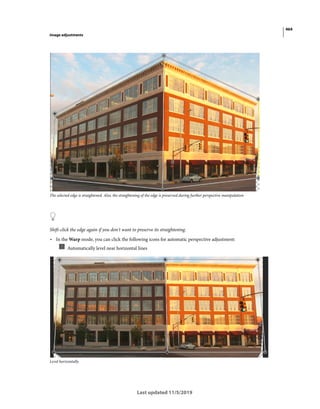
  • 566.
    556 Image repair andrestoration Last updated 11/5/2019 Modify the sampling area using the Sampling Brush Tool. • To add to the default sampling area, choose the Add mode in the Tool Options bar and brush over the areas in the image you want to include in the sampling area overlay. • To remove from the default sampling area, choose the Subtract mode in the Tool Options bar and brush over the areas in the image you want to exclude from the sampling area overlay. • To toggle between Add and Subtract modes, hold down Alt (Win) / Option (Mac) key while brushing with the Sampling Brush Tool. • To increase or decrease the Sampling Brush size, use the Size option in the Tool Options bar or use the left/right bracket keys. Lasso Tool and Polygonal Lasso Tool Use any one of these selection tools to change or modify your original selection (fill area) in the document window. Modify your selection using the Lasso or Polygonal Lasso Tool. • Lasso Tool and Polygonal Lasso Tool in the Content-Aware Fill workspace work just like the corresponding tool in Photoshop. See Select with the lasso tools. • Use the keyboard shortcut 'E' to cycle modes for Lasso Tools - New Selection, Add To Selection, Subtract From Selection, and Intersect With Selection. • The Content-Aware Fill workspace provides two additional tool options for Lasso Tools - Expand and Contract. You can click these options in the Tool Options bar to expand or contract the selection by a specified number of pixels. • To reset all changes made in this workspace to the original selection, click the reset ( ) icon in the Tool Options bar.
  • 567.
    557 Image repair andrestoration Last updated 11/5/2019 Note: When you change the selection, the sampling area gets reset but the previous brush strokes are preserved. The selection also gets updated in the document when you exit the Content-Aware Fill workspace after committing the fill. Hand Tool Use this tool to pan over different parts of the image in the document window and the image preview in the Preview panel. You can switch to Hand Tool quickly by pressing the 'H' key while using any other tool. Zoom Tool Use Zoom Tool to magnify or reduce the view of the image in the document window or the image preview in the Preview panel. • Zoom Tool in the Content-Aware Fill workspace works just like the corresponding tool in Photoshop. See Zoom in or out. • To change the magnification in the Preview panel, you can also drag the zoom slider or type a value in the text box at the bottom of the panel. Adjust Content-Aware Fill settings You can adjust the following settings in the Content-Aware Fill panel. Sampling Area Overlay Show Sampling Area Select this option to show the sampling area or the excluded area as an overlay on the image in the document window. • To reset to default sampling area, click the reset ( ) icon next to the Show Sampling Area option. Opacity Sets the opacity of the overlay displayed in the document window. To adjust the opacity, drag the slider or type a percentage value in the text box. Color Assigns color to the overlay displayed in the document window. Click the color selection box and then Choose a color with the Adobe Color Picker. Indicates Shows the overlay in the sampling or the excluded area. Choose an option from the drop-down list - Sampling Area or Excluded Area. Sampling Area Options Determine the sampling area in your image where you want Photoshop to look for source pixels to fill content. Auto Select this option to use content similar to surrounding fill area. Rectangular Select this option to uses rectangular region around fill area. Custom Select this option to manually define a sampling area. Use the Sampling Brush Tool to add to the sampling area. Fill Settings Color Adaptation Allows contrast and brightness to adapt for a better match. This setting is useful for filling content with gradual color or texture changes. Choose an appropriate option from the drop-down list - None, Default, High, or Very High.
  • 568.
    558 Image repair andrestoration Last updated 11/5/2019 Use the Color Adaptation setting to fill content with gradual color or texture changes. Rotation Adaptation Allows content rotation for a better match. This setting is useful for filling content with rotated or curved patterns. Choose an appropriate option from the drop-down list - None, Low, Medium, High, or Full. Use the Rotation Adaptation setting to fill content with rotated or curved patterns. Scale Select this option to allow content resizing for a better match. It works well for filling content with repeating patterns of different sizes or under perspective. Use the Scale option for filling content with repeating patterns of different sizes or under perspective. Mirror Select this option to allow content to be flipped horizontally for a better match. This is useful for images with horizontal symmetry.
  • 569.
    559 Image repair andrestoration Last updated 11/5/2019 Use the Mirror option to fill images with horizontal symmetry. To reset to default fill settings, click the reset ( ) icon in the Fill Settings menu. Output settings Output To Apply Content-Aware Fill to Current Layer, New Layer, or Duplicate Layer. View full-resolution preview in the Preview panel As you fine-tune sampling and fill areas and adjust fill settings, the Preview panel renders a full-resolution preview of the changes. Note: Photoshop first renders an initial low-resolution preview of the changes in the Preview panel. Immediately after, it generates a full-resolution preview. While this full-resolution preview is being generated, you may notice that a warning icon appears next to the spinner in the lower-right corner of the Preview panel. • To change the magnification of the preview image, you can drag the zoom slider or type a value in the text box at the bottom of the panel. You can also select Zoom Tool in the Tools panel. • To pan over different parts of the preview image, you can switch to Hand Tool quickly by pressing 'H' while using any other tool. Commit or cancel fill changes • When you get the desired fill result in the image, click OK at the bottom of the Content-Aware Fill panel or press Enter (Win) / Return (Mac) to commit fill. • To cancel fill and exit the Content-Aware Fill workspace, click Cancel at the bottom of the Content-Aware Fill panel or press Esc. Reset all fill settings To reset all Content-Aware Fill settings, click the reset ( ) icon in the lower-left corner of the Content-Aware Fill panel.
  • 570.
    560 Image repair andrestoration Last updated 11/5/2019 Content-Aware Patch and Move For information about the Edit > Content-Aware Fill option introduced in Photoshop CC 20.0 (October 2018 release), see Remove objects from your photos with Content-Aware Fill. Content-Aware Patch The Patch tool is used to remove unwanted image elements. The Content-Aware option in the Patch tool synthesizes nearby content for seamless blending with the surrounding content. Legacy: For information about using the Patch tool in versions earlier than Photoshop CS6, see Patch an area. Video | Fix photos with Content-Aware Video | Fix photos with Content-Aware 1 In the toolbar, hold down the Spot Healing Brush and select the Patch tool . 2 In the options bar, do the following: Content-Aware Patch options Patch Choose Content-Aware to select the content-aware option. Structure Enter a value between 1 and 7 to specify how closely the patch should reflect existing image patterns. If you enter 7, the patch adheres very strongly to existing image patterns. If you enter 1, the patch adheres very loosely to the existing image patterns. Color Enter a value between 0 and 10 to specify the extent to which you want Photoshop to apply algorithmic color- blending to the patch. If you enter 0, color blending is disabled. A Color value of 10 applies maximum color blending. Sample All Layers Enable this option to create the result of the move in another layer using information from all layers. Select the target layer in the Layers panel. 3 Select an area to replace on the image. You can use the Patch tool to draw a selection, or use any of the other Selection tools as well. 4 Drag the selection over the area you want to generate a fill from. Content-Aware Move Use the Content-Aware Move tool to select and move a part of a picture. The image is recomposed, and the hole left behind is filled using matching elements from the picture. You do not need to carry out intensive edits involving layers and complex selections. You can use the Content-Aware Move tool in two modes: • Use the Move mode to place objects in different locations (most effectively when the background remains similar). • Use the Extend mode to expand or contract objects such as hair, trees, or buildings. To best extend architectural objects, use photos shot on a parallel plane, rather than at an angle.
  • 571.
    561 Image repair andrestoration Last updated 11/5/2019 From an expert: Using Content-Aware Move and Fill From an expert: Using Content-Aware Move and Fill 1 In the toolbar, hold down the Spot Healing Brush and select the Content-Aware Move tool . 2 In the options bar, do the following: Content-Aware Move options Mode Use the Move mode to place selected objects at at a different location. Use the Extend mode to expand or contract objects. Structure Enter a value between 1 and 7 to specify how closely the patch should reflect existing image patterns. If you enter 7, the patch adheres very strongly to existing image patterns. If you enter 1, the patch adheres very loosely to the existing image patterns. Color Enter a value between 0 and 10 to specify the extent to which you want Photoshop to apply algorithmic color- blending to the patch. If you enter 0, color blending is disabled. A Color value of 10 applies maximum color blending. A Without color blending B With color blending Sample All Layers Enable this option to use information from all layers to create the result of the move in the selected layer. Select the target layer in the Layers panel. Transform On Drop When this option is enabled, you can scale the part of the image that you've just moved to its new location. Simply adjust the resizing handles for the moved part of the image. 3 Select an area to move or extend. You can use the Move tool to draw a selection, or use any of the other selection tools as well. 4 Drag the selection to the area you want to place the object. Retouch and repair photos Using a variety of Photoshop tools, you can easily touch up blemishes, whiten teeth, correct red eye, and fix many other imperfections in your images.
  • 572.
    562 Image repair andrestoration Last updated 11/5/2019 Note: Photoshop doesn't support opening or editing banknotes or currency notes. See Counterfeit Deterrence System (CDS). About the Clone Source panel The Clone Source panel (Window > Clone Source) has options for the Clone Stamp tools or Healing Brush tools. You can set up to five different sample sources and quickly select the one you need without resampling each time you change to a different source. You can view an overlay of your sample source to make it easier to clone the source in a specific location. You can also scale or rotate the sample source to better match the size and orientation of the cloning destination. For timeline-based animations, the Clone Source panel also has options for specifying the frame relationship between the sample source video/animation frame and the target video/animation frame. See also Cloning content in video and animation frames. Retouch with the Clone Stamp tool The Clone Stamp tool paints one part of an image over another part of the same image or over another part of any open document that has the same color mode. You can also paint part of one layer over another layer. The Clone Stamp tool is useful for duplicating objects or removing a defect in an image. You can also use the Clone Stamp tool to paint content on video or animation frames. See also Cloning content in video and animation frames. To use the Clone Stamp tool, you set a sampling point on the area you want to copy (clone) the pixels from and paint over another area. To paint with the most current sampling point whenever you stop and resume painting, select the Aligned option. Deselect the Aligned option to paint starting from the initial sampling point no matter how many times you stop and resume painting. You can use any brush tip with the Clone Stamp tool, which gives you precise control over the size of the clone area. You can also use opacity and flow settings to control the paint application to the cloned area. Altering an image with the Clone Stamp tool 1 Select the Clone Stamp tool . 2 Choose a brush tip and set brush options for the blending mode, opacity, and flow in the options bar.
  • 573.
    563 Image repair andrestoration Last updated 11/5/2019 3 To specify how you want to align the sampled pixels and how to sample data from the layers in your document, set any of the following in the options bar: Aligned Samples pixels continuously, without losing the current sampling point, even if you release the mouse button. Deselect Aligned to continue to use the sampled pixels from the initial sampling point each time you stop and resume painting. Sample Samples data from the layers you specify. To sample from the active layer and visible layers below it, choose Current And Below. To sample only from the active layer, choose Current Layer. To sample from all visible layers, choose All Layers. To sample from all visible layers except adjustment layers, choose All Layers and click the Ignore Adjustment Layers icon to the right of the Sample pop-up menu. 4 Set the sampling point by positioning the pointer in any open image and Alt-clicking (Windows) or Option-clicking (Mac OS). Note: Make sure you are not working on an adjustment layer. The Clone Stamp tool does not work on adjustment layers. 5 (Optional) In the Clone Source panel, click a clone source button and set an additional sampling point. You can set up to five different sampling sources. The Clone Source panel saves the sampled sources until you close the document. 6 (Optional) Do any of the following in the Clone Source panel: • To scale or rotate the source that you’re cloning, enter a value for W (width), H (height), or the rotation in degrees . • To reverse the direction of the source (good for mirroring features like eyes), click the Flip Horizontal or Flip Vertical buttons. • To show an overlay of the source that you’re cloning, select Show Overlay and specify the overlay options. Note: Select Clipped to clip the overlay to the brush size. 7 Drag over the area of the image you want to correct. Set sample sources for cloning and healing Using the Clone Stamp or Healing Brush tool, you can sample sources in the current document or any open document in Photoshop. When cloning video or animation, you can set sampling points in the current frame you’re painting or sample sources in a different frame, even if the frame is in a different video layer or in a different open document. You can set up to five different sampling sources at a time in the Clone Source panel. The Clone Source panel saves the sampling sources until you close the document. 1 To clone video or animation frames, open the Animation panel (if you’re not cloning video or animation frames, skip to step 2). Select the timeline animation option and move the current-time indicator to the frame with the source you want to sample. 2 To set the sampling point, select the Clone Stamp tool and Alt-click (Windows) or Option-click (Mac OS) in any open document window. 3 (Optional) To set another sampling point, click a different Clone Source button in the Clone Source panel. You can change the sampling source for a Clone Source button by setting a different sampling point.
  • 574.
    564 Image repair andrestoration Last updated 11/5/2019 Scale or rotate the sample source 1 Select the Clone Stamp or Healing Brush tool and set one or more source samples. 2 In the Clone Source panel, select a clone source and then do any of the following: • To scale the sample source, enter a percentage value for W (width) or H (height) or scrub W or H. The default is to constrain proportions. To adjust the dimensions independently or restore the constrain option, click the Maintain Aspect Ratio button . • To rotate the sample source, enter a degree value or scrub the Rotate The Clone Source icon . • To reset the sample source to its original size and orientation, click the Reset Transform button . Adjust the sample source overlay options Adjust the sample source overlay options to see the overlay and underlying images better when painting with the Clone Stamp and Healing Brush tools. To temporarily display the overlay while painting with the Clone Stamp tool, press Alt+Shift (Windows) or Option+Shift (Mac OS). The brush changes temporarily to the Move Source Overlay tool. Drag to move the overlay to another location. ? In the Clone Source panel, select Show Overlay and do any of the following: • To hide the overlay while you apply the paint strokes, select Auto Hide. • To clip the overlay to the brush size, enable the Clipped option. • To set the opacity of the overlay, enter a percentage value in the Opacity text box. • To set the appearance of the overlay, choose either the Normal, Darken, Lighten, or Difference blending mode from the pop-up menu at the bottom of the Clone Source panel. • To invert the colors in the overlay, select Invert. To help align identical areas in the source overlay and underlying image, set Opacity to 50%, select Invert, and deselect Clipped. Matching image areas will appear solid gray when aligned. Specify the clone source offset When using the Clone Stamp tool or Healing Brush tool, you can paint with the sampled source anywhere in the target image. The overlay options help you visualize where you want to paint. However, if you paint in a specific location relative to the sampling point, you can specify the x and y pixel offset. ? In the Clone Source panel, select the source you want to use and enter the x and y pixel values for the Offset option. Retouch with the Healing Brush tool Note:Beginning with the Photoshop CC 2015.5 release, you have an option to revert to the legacy Photoshop CC 2014 behavior for the Healing Brush tool. Select Preferences > Tools > Use Legacy Healing Algorithm For Healing Brush. For more information about Photoshop version history, see the What's new in Photoshop.
  • 575.
    565 Image repair andrestoration Last updated 11/5/2019 The Healing Brush tool lets you correct imperfections, causing them to disappear into the surrounding image. Like the cloning tools, you use the Healing Brush tool to paint with sampled pixels from an image or pattern. However, the Healing Brush tool also matches the texture, lighting, transparency, and shading of the sampled pixels to the pixels being healed. As a result, the repaired pixels blend seamlessly into the rest of the image. The Healing Brush tool can be applied to video or animation frames. See Healing brush examplesfor tips and samples of the Healing Brush in action. Sampled pixels and healed image 1 Select the Healing Brush tool . 2 Click the brush sample in the options bar and set brush options in the pop-up panel: Note: If you’re using a pressure-sensitive digitizing tablet, choose an option from the Size menu to vary the size of the healing brush over the course of a stroke. Choose Pen Pressure to base the variation on the pen pressure. Choose Stylus Wheel to base the variation on the position of the pen thumbwheel. Choose Off if you don’t want to vary the size. Mode Specifies the blending mode. Choose Replace to preserve noise, film grain, and texture at the edges of the brush stroke when using a soft-edge brush. Source Specifies the source to use for repairing pixels. Sampled to use pixels from the current image, or Pattern to use pixels from a pattern. If you chose Pattern, select a pattern from the Pattern pop-up panel. Aligned Samples pixels continuously, without losing the current sampling point, even if you release the mouse button. Deselect Aligned to continue to use the sampled pixels from the initial sampling point each time you stop and resume painting. Sample Samples data from the layers you specify. To sample from the active layer and visible layers below it, choose Current And Below. To sample only from the active layer, choose Current Layer. To sample from all visible layers, choose All Layers. To sample from all visible layers except adjustment layers, choose All Layers and click the Ignore Adjustment Layers icon to the right of the Sample pop-up menu. Diffusion Controls how quickly the pasted region adapts to the surrounding image. Select a lower value for images with grain or fine details, or a higher value for smooth images. 3 Set the sampling point by positioning the pointer over an area of the image and Alt-clicking (Windows) or Option- clicking (Mac OS). Note: If you are sampling from one image and applying to another, both images must be in the same color mode unless one of the images is in Grayscale mode. 4 (Optional) In the Clone Source panel, click a clone source button and set an additional sampling point. You can set up to five different sampling sources. The Clone Source panel remembers the sampled sources until you close the document you’re editing.
  • 576.
    566 Image repair andrestoration Last updated 11/5/2019 5 (Optional) In the Clone Source panel, click a clone source button to select the sampled source you want. 6 (Optional) Do any of the following in the Clone Source panel: • To scale or rotate the source that you’re cloning, enter a value for W (width), H (height), or the rotation in degrees . • To show an overlay of the source that you’re cloning, select Show Overlay and specify the overlay options. 7 Drag in the image. The sampled pixels are melded with the existing pixels each time you release the mouse button. If there is a strong contrast at the edges of the area you want to heal, make a selection before you use the Healing Brush tool. The selection should be bigger than the area you want to heal and precisely follow the boundary of contrasting pixels. When you paint with the Healing Brush tool, the selection prevents colors from bleeding in from the outside. Retouch with the Spot Healing Brush tool The Spot Healing Brush tool quickly removes blemishes and other imperfections in your photos. The Spot Healing Brush works similarly to the Healing Brush: it paints with sampled pixels from an image or pattern and matches the texture, lighting, transparency, and shading of the sampled pixels to the pixels being healed. Unlike the Healing Brush, the Spot Healing Brush doesn’t require you to specify a sample spot. The Spot Healing Brush automatically samples from around the retouched area. Using the Spot Healing Brush to remove a blemish For retouching a large area or for more control over the source sampling, you can use the Healing Brush instead of the Spot Healing Brush. 1 Select the Spot Healing Brush tool from the toolbox. If necessary, click either the Healing Brush tool, Patch tool, or Red Eye tool to show the hidden tools and make your selection. 2 Choose a brush size in the options bar. A brush that is slightly larger than the area you want to fix works best so that you can cover the entire area with one click. 3 (Optional) Choose a blending mode from the Mode menu in the options bar. Choose Replace to preserve noise, film grain, and texture at the edges of the brush stroke when using a soft-edge brush.
  • 577.
    567 Image repair andrestoration Last updated 11/5/2019 4 Choose a Type option in the options bar: Proximity Match Uses pixels around the edge of the selection to find an area to use as a patch. Create Texture Uses pixels in the selection to create a texture. If the texture doesn’t work, try dragging through the area a second time. Content-Aware Compares nearby image content to seamlessly fill the selection, realistically maintaining key details such as shadows and object edges. The create a larger or more precise selection for the Content-Aware option, use the Edit > Fill command. (See Use Content-aware, pattern, or history fills.) 5 Select Sample All Layers in the options bar to sample data from all visible layers. Deselect Sample All Layers to sample only from the active layer. 6 Click the area you want to fix, or click and drag to smooth over imperfections in a larger area. Video | Retouching cars in Photoshop Video | Retouching cars in Photoshop Patch an area The Patch tool lets you repair a selected area with pixels from another area or a pattern. Like the Healing Brush tool, the Patch tool matches the texture, lighting, and shading of the sampled pixels to the source pixels. You can also use the Patch tool to clone isolated areas of an image. The Patch tool works with 8-bits or 16-bits-per-channel images. When repairing with pixels from the image, select a small area to produce the best result. For information about using the Content-Aware Patch tool options, see Content-Aware Patch and Move. Using the Patch tool to replace pixels
  • 578.
    568 Image repair andrestoration Last updated 11/5/2019 Patched image Repair an area using sampled pixels 1 Select the Patch tool . 2 Do one of the following: • Drag in the image to select the area you want to repair, and select Source in the options bar. • Drag in the image to select the area from which you want to sample, and select Destination in the options bar. Note: You can also make a selection prior to selecting the Patch tool. 3 To adjust the selection, do one of the following: • Shift-drag in the image to add to the existing selection. • Alt-drag (Windows) or Option-drag (Mac OS) in the image to subtract from the existing selection. • Alt+Shift-drag (Windows) or Option+Shift-drag (Mac OS) in the image to select an area intersected by the existing selection. 4 To extract texture with a transparent background from the sampled area, select Transparent. Deselect this option if you want to fully replace the target area with the sampled area. The Transparent option works best for solid or gradient backgrounds with clearly distinct textures (such as a bird in a blue sky). 5 To control how quickly the pasted region adapts to the surrounding image, adjust the Diffusion slider. Select a lower value for images with grain or fine details, or a higher value for smooth images. 6 Position the pointer inside the selection, and do one of the following: • If Source is selected in the options bar, drag the selection border to the area from which you want to sample. When you release the mouse button, the originally selected area is patched with the sampled pixels. • If Destination is selected in the options bar, drag the selection border to the area you want to patch. When you release the mouse button, the newly selected area is patched with the sampled pixels. Repair an area using a pattern 1 Select the Patch tool . 2 Drag in the image to select the area you want to repair.
  • 579.
    569 Image repair andrestoration Last updated 11/5/2019 Note: You can also make a selection prior to selecting the Patch tool. 3 If desired, complete steps 3-4 above to adjust the selection and apply pattern texture with a transparent background. 4 Select a pattern from the Pattern panel in the options bar, and click Use Pattern. Remove red eye Video | Removing red eye and whitening teeth Video | Removing red eye and whitening teeth The Red Eye tool removes red eye in flash photos of people or animals. 1 In RGB Color mode, select the Red Eye tool . (The Red Eye tool is in the same group as the Spot Healing Brush tool . Hold down a tool to display additional tools in the group.) 2 Click in the red eye. If you are not satisfied with the result, undo the correction, set one or more of the following options in the options bar, and click the red eye again: Pupil Size Increases or decreases the area affected by the Red Eye tool. Darken Amount Sets the darkness of the correction. A reflection of the camera flash in the subject’s retina causes red eye. You’ll see it more often when taking pictures in a darkened room because the subject’s iris is wide open. To avoid red eye, use the camera’s red eye reduction feature. Or, better yet, use a separate flash unit that you can mount on the camera farther away from the camera’s lens. Video | Light correction &amp; removing unwanted objects Video | Light correction &amp; removing unwanted objects Correct image distortion and noise About lens distortion Barrel distortion is a lens defect that causes straight lines to bow out toward the edges of the image. Pincushion distortion is the opposite effect, where straight lines bend inward.
  • 580.
    570 Image repair andrestoration Last updated 11/5/2019 Examples of barrel distortion (left) and pincushion distortion (right) Vignetting is a defect that darkens the corners of an image due to light falloff around the perimeter of the lens. Chromatic aberration appears as a color fringe along the edges of objects, caused by the lens focusing on different colors of light in different planes. Some lenses exhibit different defects at certain focal lengths, f-stops, and focus distances. With the Lens Correction filter, you can specify the combination of settings used to make the image. Correct lens distortion and adjust perspective The Lens Correction filter fixes common lens flaws such as barrel and pincushion distortion, vignetting, and chromatic aberration. The filter works only with 8- and 16-bit-per-channel images in RGB or Grayscale mode. You can also use the filter to rotate an image or fix image perspective caused by vertical or horizontal camera tilt. The filter’s image grid makes these adjustments easier and more accurate than using the Transform command. Automatically correct image perspective and lens flaws Using lens profiles, the default Auto Correction option quickly and accurately fixes distortion. For proper automatic correction, Photoshop requires Exif metadata that identifies the camera and lens that created the image, and a matching lens profile on your system. 1 Choose Filter > Lens Correction. 2 Set the following options: Correction Select the problems you want to fix. If corrections undesirably extend or contract the image beyond original dimensions, select Auto Scale Image. The Edge menu specifies how to handle blank areas that result from pincushion, rotation, or perspective corrections. You can fill blank areas with transparency or a color, or you can extend the edge pixels of the image. Search Criteria Filters the Lens Profiles list. By default, profiles based on image sensor size appear first. To list RAW profiles first, click the pop-up menu , and select Prefer RAW Profiles. Lens Profiles Select a matching profile. By default, Photoshop displays only profiles that match the camera and lens used to create the image. (The camera model does not have to match perfectly.) Photoshop also automatically selects a matching sub-profile for the selected lens based on focal length, f-stop and focus distance. To change the automatic selection, right-click the current lens profile, and select a different sub-profile. If you find no matching lens profile, click Search Online to acquire additional profiles created by the Photoshop community. To store online profiles for future use, click the pop-up menu , and choose Save Online Profile Locally.
  • 581.
    571 Image repair andrestoration Last updated 11/5/2019 For tips for working with lens profiles and a list of supported lenses, see the support article Lens profile support. To create custom profiles, use the Adobe Lens Profile Creator. Manually correct image perspective and lens flaws You can apply manual correction alone or use it to refine automatic lens correction. 1 Choose Filter > Lens Correction. 2 In the upper-right corner of the dialog box, click the Custom tab. 3 (Optional) Choose a preset list of settings from the Settings menu. Lens Default uses settings that you previously saved for the camera, lens, focal length, f-stop, and focus distance used to create the image. Previous Conversion uses the settings used in your last lens correction. Any group of custom settings you saved are listed at the bottom of the menu. (See Save settings and set camera and lens defaults.) 4 Set any of the following options to correct your image. Remove Distortion Corrects lens barrel or pincushion distortion. Move the slider to straighten horizontal and vertical lines that bend either away from or toward the center of the image. You can also use the Remove Distortion tool to make this correction. Drag toward the center of the image to correct for barrel distortion and toward the edge of the image to correct for pincushion distortion. To compensate for any blank image edges that result, adjust the Edge option on the Auto Correction tab. Fix Fringe settings Compensate for fringing by adjusting the size of one color channel relative to another. Zoom in on the image preview to get a closer view of the fringing as you make the correction. Vignette Amount Sets the amount of lightening or darkening along the edges of an image. Corrects images that have darkened corners caused by lens faults or improper lens shading. You can also apply vignetting for a creative effect. Vignette Midpoint Specifies the width of area affected by the Amount slider. Specify a lower number to affect more of the image. Specify a higher number to restrict the effect to the edges of the image. Vertical Perspective Corrects image perspective caused by tilting the camera up or down. Makes vertical lines in an image parallel. Horizontal Perspective Corrects image perspective, making horizontal lines parallel. Angle Rotates the image to correct for camera tilt or to make adjustments after correcting perspective. You can also use the Straighten tool to make this correction. Drag along a line in the image that you want to make vertical or horizontal. Note:
  • 582.
    572 Image repair andrestoration Last updated 11/5/2019 To avoid unintended scaling when adjusting perspective or angle settings, deselect Auto Scale Image on the Auto Correction tab. Scale Adjusts the image scale up or down. The image pixel dimensions aren’t changed. The main use is to remove blank areas of the image caused by pincushion, rotation, or perspective corrections. Scaling up effectively results in cropping the image and interpolating up to the original pixel dimensions. Adjust the Lens Correction preview and grid Adjust the preview magnification and grid lines to better judge the necessary amount of correction. • To change the image preview magnification, use the Zoom tool or the zoom controls in the lower left side of the preview image. • To move the image in the preview window, select the Hand tool and drag in the image preview. • To use the grid, select Show Grid at the bottom of the dialog box. Use the Size control to adjust the grid spacing and the Color control to change the color of the grid. You can move the grid to line it up with your image using the Move Grid tool . Save settings and set camera and lens defaults You can save the settings in the Lens Correction dialog box to reuse with other images made with the same camera, lens, and focal length. Photoshop saves both Auto Correction settings and Custom settings for distortion, chromatic aberration, and vignetting. Perspective correction settings are not saved because they typically vary from one image to another. You can save and reuse settings in two ways: • Manually save and load settings. Set options in the dialog box, and then choose Save Settings from the Settings menu . To use the saved settings, choose them from the Settings menu. (If you save settings outside the default folder, they don’t appear in the menu; use the Load Settings command to access them.) • Set a lens default. If your image has EXIF metadata for the camera, lens, focal length, and f-stop, you can save the current settings as a lens default. To save the settings, click the Set Lens Default button. When you correct an image that matches the camera, lens, focal length, and f-stop, the Lens Default option becomes available in the Settings menu. This option is not available if your image doesn’t have EXIF metadata. Reduce image noise and JPEG artifacts Image noise appears as random extraneous pixels that aren’t part of the image detail. Noise can be caused by photographing with a high ISO setting on a digital camera, underexposure, or shooting in a dark area with a long shutter speed. Low-end consumer cameras usually exhibit more image noise than high-end cameras. Scanned images may have image noise caused by the scanning sensor. Often, the film’s grain pattern appears in the scanned image. Image noise can appear in two forms: luminance (grayscale) noise, which makes an image look grainy or patchy, and color noise, which is usually visible as colored artifacts in the image. Luminance noise may be more pronounced in one channel of the image, usually the blue channel. You can adjust the noise for each channel separately in Advanced mode. Before opening the filter, examine each channel in your image separately to see if noise is prevalent in one channel. You preserve more image detail by correcting one channel rather than making an overall correction to all channels. 1 Choose Filter > Noise > Reduce Noise. 2 Zoom in on the preview image to get a better view of image noise.
  • 583.
    573 Image repair andrestoration Last updated 11/5/2019 3 Set options: Strength Controls the amount of luminance noise reduction applied to all image channels. Preserve Details Preserves edges and image details such as hair or texture objects. A value of 100 preserves the most image detail, but reduces luminance noise the least. Balance the Strength and Preserve Details controls to fine-tune noise reduction. Reduce Color Noise Removes random color pixels. A higher value reduces more color noise. Sharpen Details Sharpens the image. Removing noise reduces image sharpness. Use the sharpening control in the dialog box or use one of the other Photoshop sharpening filters later to restore sharpness. Remove JPEG Artifacts Removes blocky image artifacts and halos caused by saving a image using a low JPEG quality setting. 4 If luminance noise is more prevalent in one or two color channels, click the Advanced button and then choose the color channel from the Channel menu. Use the Strength and Preserve Details controls to reduce noise in that channel.
  • 584.
    574 Last updated 11/5/2019 Chapter13: Image transformations Transform objects Scale layers proportionally When transforming any layer type, dragging a corner handle now scales the layer proportionally by default, indicated by the Maintain Aspect Ratio button (Link icon) in the ON state in the Options bar. To change the default transform behavior to non-proportional scaling, simply turn OFF the Maintain Aspect Ratio (Link icon) button. The Shift key, while pressed, now acts as a toggle for the Maintain Aspect Ratio button. If the Maintain Aspect Ratio button is ON, the Shift key toggles it OFF while pressed and vice versa. Photoshop remembers your last transform behavior setting— proportional or non-proportional scaling—it will be your default transform behavior when you start Photoshop the next time. Use the Maintain Aspect Ratio button (Link icon) in the Options bar to choose the default scaling behavior. For detailed instructions, see Scale, rotate, skew, distort, apply perspective, or warp. How do I switch back to the legacy transform behavior? From the menu bar, choose Edit (Win)/Photoshop (Mac) > Preferences > General, then select Legacy Free Transform. Apply transformations Transforming scales, rotates, skews, stretches, or warps an image. You can apply transformations to a selection, an entire layer, multiple layers, or a layer mask. You can also apply transformations to a path, a vector shape, a vector mask, a selection border, or an alpha channel. Transforming affects image quality when you manipulate the pixels. To apply non-destructive transformations to raster images, use Smart Objects. (See Work with Smart Objects.) Transforming a vector shape or path is always non-destructive because you’re only changing the mathematical calculations producing the object. To make a transformation, first select an item to transform and then choose a transformation command. If necessary, adjust the reference point before manipulating the transformation. You can perform several manipulations in succession before applying the cumulative transformation. For example, you can choose Scale and drag a handle to scale, and then choose Distort and drag a handle to distort. Then press Enter or Return to apply both transformations. Photoshop uses the interpolation method selected in the General area of the Preferences dialog box to calculate the color values of pixels that are added or deleted during transformations. This interpolation setting directly affects the speed and quality of the transformation. Bicubic interpolation, the default, is slowest but yields the best results. Note:
  • 585.
    575 Image transformations Last updated11/5/2019 You can also warp and distort raster images using the Liquify filter. Transforming an image A Original image B Layer flipped C Selection border rotated D Part of object scaled Transform submenu commands Scale Enlarges or reduces an item relative to its reference point, the fixed point around which transformations are performed. You can scale horizontally, vertically, or both horizontally and vertically. Rotate Turns an item around a reference point. By default, this point is at the center of the object; however, you can move it to another location. Skew Slants an item vertically and horizontally. Distort Stretches an item in all directions. Perspective Applies one-point perspective to an item. Warp Manipulates the shape of an item. Rotate 180, Rotate 90 CW, Rotate 90 CCW Rotates the item by the specified number of degrees, either clockwise or counterclockwise. Flip Flips the item vertically or horizontally. Video tutorial: Tips for working with vectors in Photoshop Video tutorial: Tips for working with vectors in Photoshop Select an item to transform ? Do one of the following: • To transform an entire layer, make the layer active, and make sure nothing is selected. Note:
  • 586.
    576 Image transformations Last updated11/5/2019 You cannot transform the background layer. To transform it, first convert it to a regular layer. • To transform part of a layer, select the layer in the Layers panel, and then select part of the image on that layer. • To transform multiple layers, do either of the following in the Layers panel: Link the layers together, or select multiple layers by Ctrl-clicking (Windows) or Command-clicking (Mac OS) more than one layer. In the Layers panel, you can also Shift-click to select contiguous layers. (See Select, group, and link layers.) • To transform a layer mask or a vector mask, unlink the mask and select the mask thumbnail in the Layers panel. • To transform a path or vector shape, use the Path Selection tool to select the entire path or the Direct Selection tool to select part of the path. If you select one or more points on a path, only those path segments connected to the points are transformed. (See Select a path.) • To transform a selection border, make or load a selection. Then choose Select > Transform Selection. • To transform an alpha channel, select the channel in the Channels panel. Set or move the reference point for a transformation All transformations are performed around a fixed point called the reference point. By default, this point is at the center of the item you are transforming. However, you can change the reference point or move the center point to a different location using the reference point locator in the options bar. 1 Choose a transformation command. A bounding box appears in the image. 2 The reference point is hidden by default. To show the reference point , click select the check box next to the reference point locator in the options bar. Show reference point check box in the options bar. 3 Do one of the following: • In the options bar, click a square on the reference point locator . Each square represents a point on the bounding box. For example, to move the reference point to the upper-left corner of the bounding box, click the top left square on the reference point locator. • In the transform bounding box that appears in the image, drag the reference point . The reference point can be outside the item you want to transform.
  • 587.
    577 Image transformations Last updated11/5/2019 Scale, rotate, skew, distort, apply perspective, or warp You can apply various transform operations such as Scale, Rotate, Skew, Distort, Perspective, or Warp to the selected image. 1 Select what you want to transform. 2 Choose Edit > Transform > Scale, Rotate, Skew, Distort, Perspective, or Warp. Note: If you are transforming a shape or entire path, the Transform menu becomes the Transform Path menu. If you are transforming multiple path segments (but not the entire path), the Transform menu becomes the Transform Points menu. 3 (Optional) In the options bar, click a square on the reference point locator . 4 Do one or more of the following: Use the Maintain Aspect Ratio button (Link icon) in the Options bar to choose the default scaling behavior • If you chose Scale, drag a handle on the bounding box. When positioned over a handle, the pointer becomes a double arrow. • If the Maintain Aspect Ratio button (Link icon) is ON in the Options bar, drag a corner handle to scale the layer proportionally. • If the Maintain Aspect Ratio button (Link icon) is OFF in the Options bar, drag a corner handle scales the layer non-proportionally. • Hold down the Shift key while transforming to toggle between proportional and non-proportional scaling behavior. • If you chose Rotate, move the pointer outside the bounding border (it becomes a curved, two-sided arrow), and then drag. Press Shift to constrain the rotation to 15° increments. • If you chose Skew, drag a side handle to slant the bounding box. • If you chose Distort, drag a corner handle to stretch the bounding box. • If you chose Perspective, drag a corner handle to apply perspective to the bounding box. • If you chose Warp, choose a warp from the Warp Style pop-up menu in the options bar, or to perform a custom warp, drag the control points, a line, or an area within the mesh to change the shape of the bounding box and mesh. • For all types of transformations, enter a value in the options bar. For example, to rotate an item, specify degrees in the rotation text box. 5 (Optional) If desired, switch to a different type of transformation by selecting a command from the Edit > Transform submenu. Note: When you transform a bitmap image (versus a shape or path), the image becomes slightly less sharp each time you commit a transformation; therefore, performing multiple commands before applying the cumulative transformation is preferable to applying each transformation separately. 6 (Optional) If you want to warp the image, click the Switch Between Free Transform And Warp Mode button in the options bar.
  • 588.
    578 Image transformations Last updated11/5/2019 7 When you finish, do one of the following to commit the transformation: • Select a new tool. • Click a layer in the Layers panel. (This action auto-commits changes and also selects the layer.) • Click outside the canvas area in the document window. • Click outside the bounding box in the canvas area. • Press Enter (Windows) or Return (Mac OS), click the Commit button in the options bar, or double-click inside the transformation marquee. To cancel the transformation, press Esc or click the Cancel button in the options bar. Flip or rotate precisely 1 Select what you want to transform. 2 Choose Edit > Transform and choose one of the following commands from the submenu: • Rotate to specify degrees in the options bar • Rotate 180° to rotate by a half-turn • Rotate 90° CW to rotate clockwise by a quarter-turn • Rotate 90° CCW to rotate counterclockwise by a quarter-turn • Flip Horizontal to flip horizontally, along the vertical axis • Flip Vertical to flip vertically, along the horizontal axis Note: If you are transforming a shape or entire path, the Transform command becomes the Transform Path command. If you are transforming multiple path segments (but not the entire path), the Transform command becomes the Transform Points command. Repeat a transformation ? Choose Edit > Transform > Again, Edit > Transform Path > Again, or Edit > Transform Points > Again. Duplicate an item when transforming it ? Hold down Alt (Windows) or Option (Mac OS) when selecting the Transform command. Adjust crop, rotation, and canvas size This document outlines the different methods you can use to adjust your image's cropping, rotation, and canvas size. Video | Cropping and straightening photos Video | Cropping and straightening photos
  • 589.
    579 Image transformations Last updated11/5/2019 Crop an image using the Crop command 1 Use a selection tool to select the part of the image you want to keep. 2 Choose Image > Crop. Crop an image using the Trim command The Trim command crops an image by removing unwanted image data in different ways than the Crop command. You can crop an image by trimming surrounding transparent pixels, or background pixels of the color you specify. 1 Choose Image > Trim. 2 In the Trim dialog box, select an option: • Transparent Pixels to trim away transparency at the edges of the image, leaving the smallest image containing nontransparent pixels. • Top Left Pixel Color to remove an area the color of the upper-left pixel from the image. • Bottom Right Pixel Color to remove an area the color of the lower right pixel from the image. 3 Select one or more areas of the image to trim away: Top, Bottom, Left, or Right. Crop and straighten scanned photos You can place several photos on your scanner and scan them in one pass, which creates a single image file. The Crop and Straighten Photos command is an automated feature that can create separate image files from the multiple-image scan. For best results, keep 1/8 inch between the images in your scan, and the background (typically the scanner bed) should be a uniform color with little noise. The Crop and Straighten Photos command works best on images with clearly delineated outlines. If the Crop and Straighten Photos command cannot properly process the image file, use the Crop tool. 1 Open the scanned file that contains the images you want to separate. 2 Select the layer that contains the images. 3 (Optional) Draw a selection around the images you want to process. 4 Choose File > Automate > Crop And Straighten Photos. The scanned images are processed, and then each image opens in its own window. If the Crop And Straighten Photos command incorrectly splits one of your images, make a selection border around the image and some background, and then hold down Alt (Windows) or Option (Mac OS) as you choose the command. The modifier key indicates that only one image should be separated from the background. Straighten an image The Ruler tool provides a Straighten option that quickly aligns images with horizon lines, building walls, and other key elements. 1 Select the Ruler tool . (If necessary, click and hold the Eyedropper tool to reveal the Ruler.) 2 In the image, drag across a key horizontal or vertical element. 3 In the options bar, click Straighten.
  • 590.
    580 Image transformations Last updated11/5/2019 Photoshop straightens the image and automatically crops it. To reveal image areas that extend beyond the new document boundaries, choose Edit > Undo. To entirely avoid automatic cropping, hold down Alt (Windows) or Option (Mac OS) when you click Straighten. Rotate or flip an entire image Note: Image Rotation is destructive editing and actually modifies the file information. If you want to non-destructively rotate the image for viewing, use the Rotation tool. The Image Rotation commands let you rotate or flip an entire image. The commands do not work on individual layers or parts of layers, paths, or selection borders. If you want to rotate a selection or layer, use the Transform or Free Transform commands. Rotating images A Flip Horizontal B Original image C Flip Vertical D Rotate 90° CCW E Rotate 180° F Rotate 90° CW ? Choose Image > Image Rotation, and choose one of the following commands from the submenu: 180