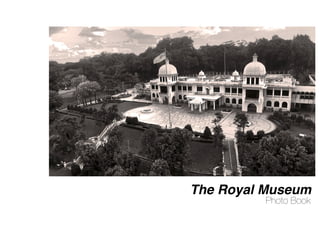
The Royal Museum
Photo Book
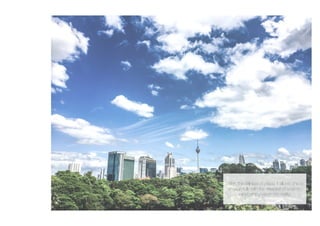
The cityscapes that surround
the majestic Royal Museum.
Facade of the Royal
Museum
01
Various outdoor decorative
elements and vegetation that
adorn the Istana Negara’s
surroundings.
Balairung Seri Utama
02
The Royal Museums’ exterior
elevations
The main throne hall that is
located in the Balairung.
Concrete Jungle Landscape Elements
03 04
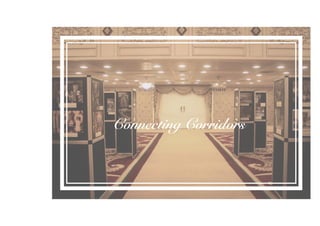
Connecting Corridor
The Hallways that provide
passage to and fro around
the Royal Museum and
Balairung.
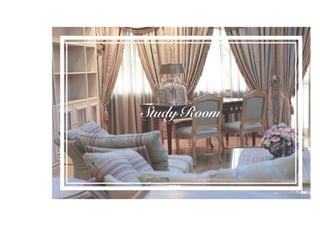
The study room located in
the King’s suite.
The queen’s bedroom
located in the King’s suite.
Study Room
The queen’s washroom
located in the King’s suite.
Royal’s Bedroom Queen’s Washroom
05 06 07 08
The King’s washroom
located int the King’s suite
The various stairs that are
scattered around the Royal
Museum.
King’s Washroom
Decorative Elements that are
adorn the various walls,
ceiling and floor.
Decorative Elements
The decorative light fixtures
that are located in the main
throne hall and the King’s
suite.
Stairs Chandelier
DetailingLocation
09 10 11 12


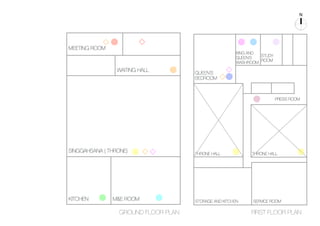
GROUND FLOOR PLAN FIRST FLOOR PLAN
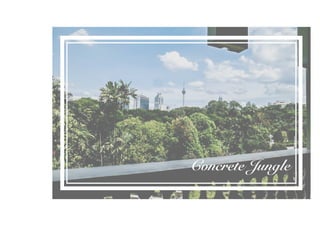
Concrete Jungle
Within the stillness of place, it allows one to
engage fully with the deepest of soul into
transforming vision into reality.
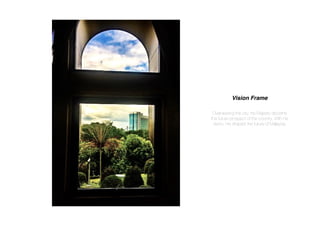
Vision Frame
Overviewing the city, his Majesty discerns
the future prospect of the country. With his
vision, He shaped the future of Malaysia.
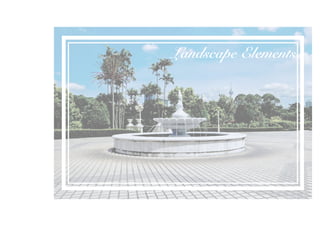
Landscape Elements
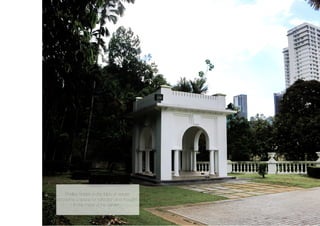
Shelter hidden in the folds of nature,
providing a space for reflection and thought
in the midst of the garden.
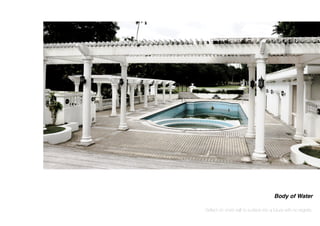
Body of Water
Reflect on one’s self to surface into a future with no regrets.
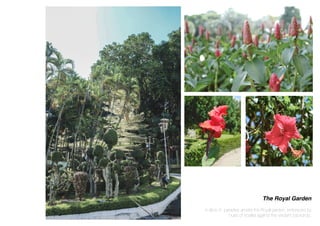
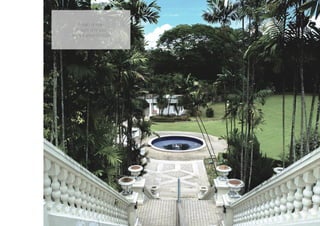
The Royal Garden
A slice of paradise amidst the Royal garden, embraced by
hues of scarlet against the verdant backdrop.
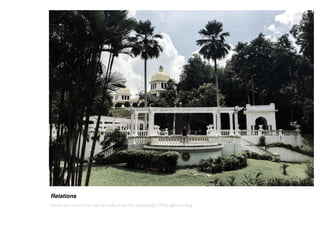
Relations
Nature and man thrive harmoniously under the careful sight of the glorious king.
A path of man
A sight of nature
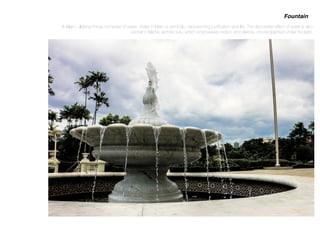
An epicentre of water
In Islam, all living things comprise of water. Water in Islam is symbolic, representing purification and life. The decorative effect of water is also
central to Islamic architecture, which emphasises motion and silence, choreographed under the light.
Fountain
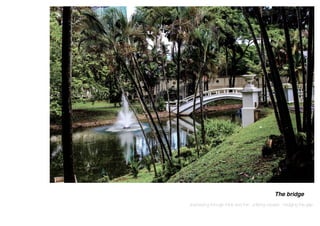
Journeying through thick and thin, unifying causes , bridging the gap
The bridge
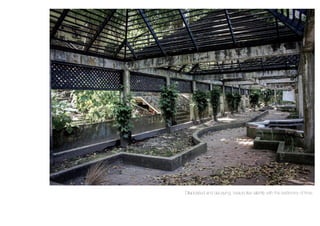
Dilapidated and decaying, beauty lies silently with the testimony of time.
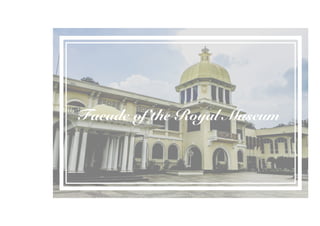
Facade of the Royal Museum
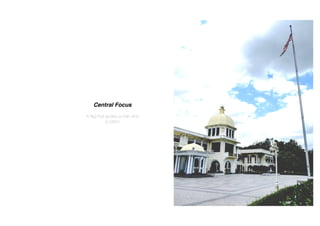
Central Focus
A flag that guides a man and
a nation
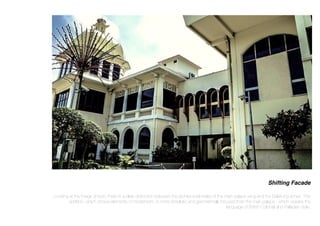
Shifting Facade
Looking at the image shown, there is a clear distinction between the architectural styles of the main palace wing and the Balairung annex. This
addition, which shows elements of modernism, is more simplistic and geometrically focused than the main palace - which speaks the
language of British Colonial and Palladian style.
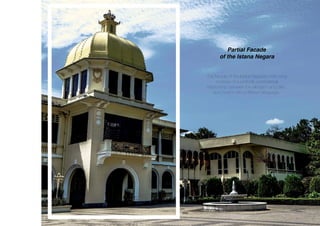
The facade of the Istana Negara’s main wing
consists of a perfectly symmetrical
relationship between the elevation and plan,
but morphs into a different language.
Partial Facade
of the Istana Negara
Balairung Seri Utama
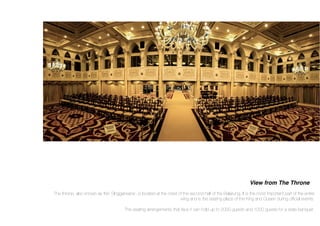
View from The Throne
The throne, also known as the’ SInggahsana’, is located at the crest of the second half of the Balairung. It is the most important part of the entire
wing and is the seating place of the King and Queen during official events.
The seating arrangements that face it can hold up to 2000 guests and 1000 guests for a state banquet.
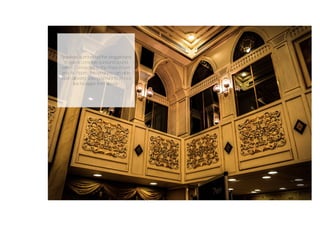
Speakers surrounded the singgahsana
to give a complete surround sound
within. Connected to the Press Room
and AV Room, the windows can slide
open allowing videographers to record
live footages from above.
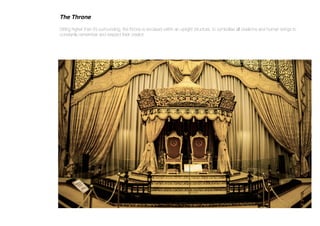
The Throne
Sitting higher than it’s surrounding, the throne is encased within an upright structure, to symbolise all creations and human brings to
constantly remember and respect their creator.
Connecting Corridors
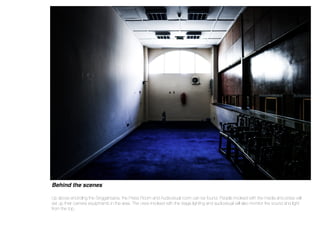
Behind the scenes
Up above encircling the Singgahsana, the Press Room and Audiovisual room can be found. People involved with the media and press will
set up their camera equipments in the area. The crew involved with the stage lighting and audiovisual will also monitor the sound and light
from the top.
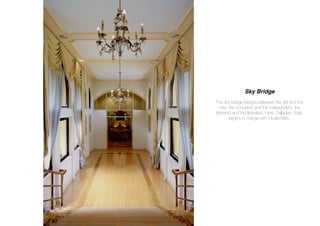
Sky Bridge
The sky bridge bridges between the old and the
new, the occupied and the independent, the
tethered and the liberated. Here, Palladian Style,
begins to merge with Modernistic.
Study Room
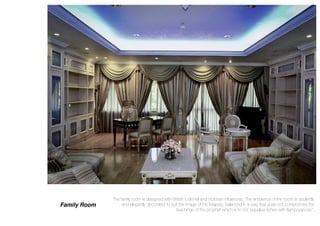
Family Room
The family room is designed with British Colonial and Victorian influences. The ambience of the room is opulently
and elegantly decorated to suit the image of His Majesty, balanced in a way that does not compromise the
teachings of the prophet which is to not ‘equalise riches with flamboyances”.
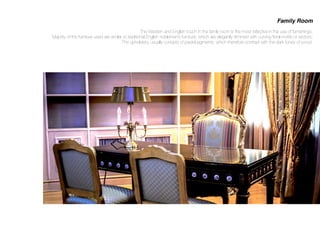
Family Room
The Western and English touch in the family room is the most reflective in the use of furnishings.
Majority of the furniture used are similar to traditional English noblemen’s furniture, which are elegantly trimmed with curving floral motifs or vectors.
The upholstery, usually consists of pastel pigments, which therefore contrast with the dark tones of wood.
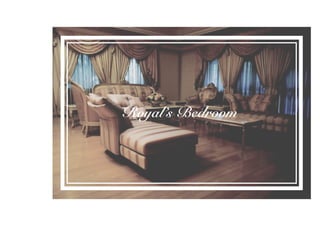
Royal’s Bedroom
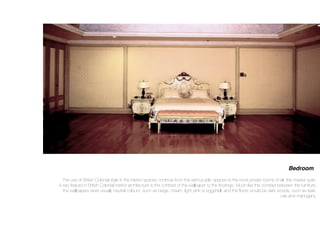
Bedroom
The use of British Colonial style in the interior spaces continue from the semi-public spaces to the most private rooms of all- the master suite.
A key feature in British Colonial interior architecture is the contrast of the wallpaper to the floorings. Much like the contrast between the furniture,
the wallpapers were usually neutral colours, such as beige, cream, light pink or eggshell, and the floors would be dark woods, such as teak,
oak and mahogany.
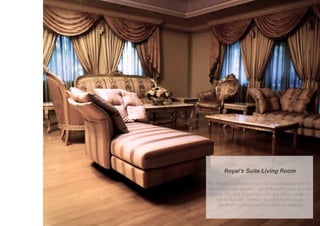
Royal’s Suite Living Room
The Royal’s Suite’s living room blends seamlessly with the
rest of the private quarters, with soft pastel tones and dim
lighting. The type of furniture used also remain similar to
the family suite - whereby the frames are heavily
garnished and flourished to portray decadence
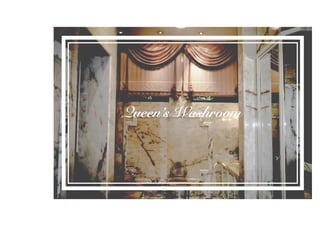
Queen’s Washroom
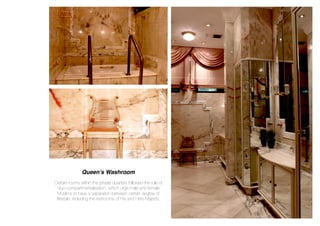
Queen’s Washroom
Certain rooms within the private quarters followed the rule of
‘duo-compartmentalisation’, which urge male and female
Muslims to have a separation between certain degree of
lifestyle, including the restrooms of His and Hers Majesty.
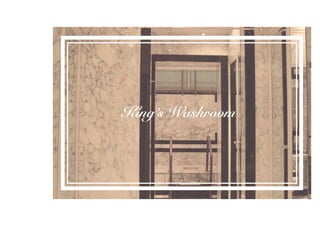
King’s Washroom
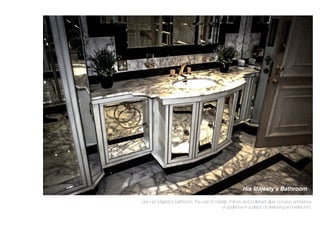
His Majesty’s Bathroom
Like Her Majesty’s bathroom, the use of marble, mirrors and polished silver conveys ambience
of opulence in a place of cleansing and reflection.
Stairs
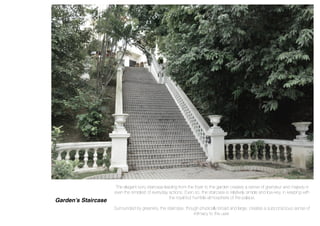
Garden’s Staircase
The elegant ivory staircase leading from the foyer to the garden creates a sense of grandeur and majesty in
even the simplest of everyday actions. Even so, the staircase is relatively simple and low-key, in keeping with
the royal but humble atmosphere of the palace.
Surrounded by greenery, the staircase, though physically broad and large, creates a subconscious sense of
intimacy to the user.
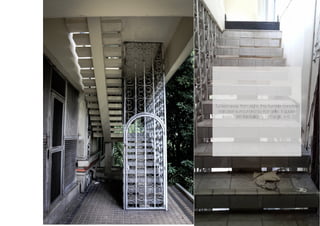
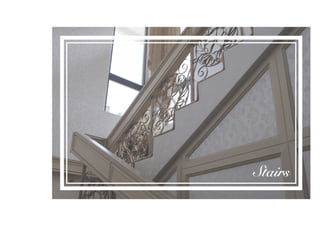
Tucked away from sight, this humble concrete
staircase surrounded by iron grille, it guides
leads from the balcony to the ground.
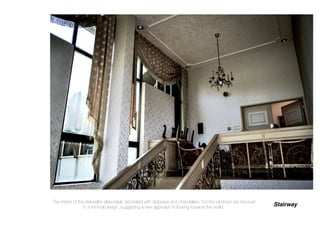
The interior of the stairwell is elaborately decorated with draperies and chandeliers, but the windows are reduced
to a minimal design, suggesting a new approach in looking towards the world.
Stairway
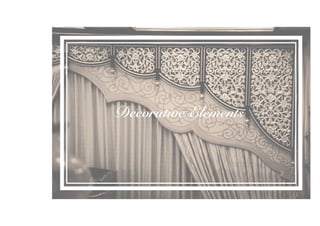
Decorative Elements
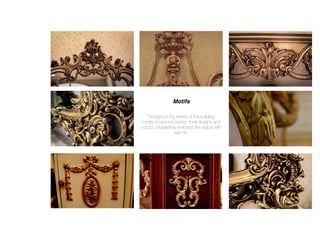
Motifs
Throughout the interior of the building,
motifs of sinuous curves, floral designs and
rococo whiplashes embrace the space with
warmth.
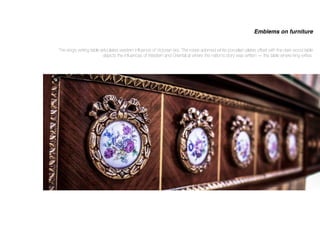
The king’s writing table articulates western influence of Victorian era. The roses adorned white porcelain plates offset with the dark wood table
depicts the influences of Western and Oriental at where the nation’s story was written — the table where king writes.
Emblems on furniture
Malaysian’s National
Emblem
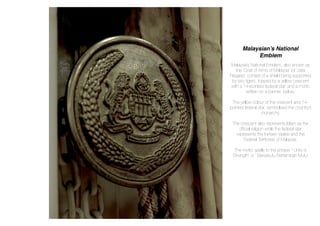
Malaysia’s National Emblem, also known as
the ‘Coat of Arms of Malaysia’ (or ‘Jata
Negara’) consist of a shield being supported
by two tigers, topped by a yellow crescent
with a 14-pointed ‘federal star’ and a motto
written on a banner, below.
The yellow colour of the crescent and 14-
pointed federal star, symbolised the country’s
monarchy.
The crescent also represents Islam as the
official religion while the federal star
represents the thirteen states and the
Federal Territories of Malaysia.
The motto spells to the phrase “ Unity is
Strength’ or ‘ Bersekutu Bertambah Mutu’
Chandelier
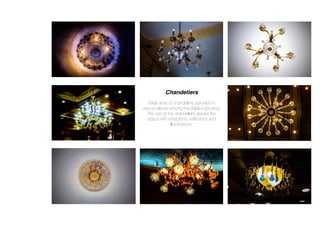
Chandeliers
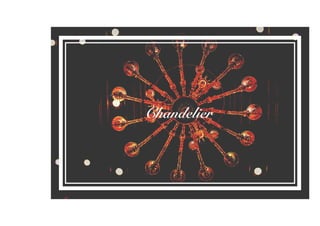
Wide array of chandeliers sprinkled in
various places among the Balairung’s wing.
The use of the chandeliers graces the
space with refractions, reflections and
illuminations.
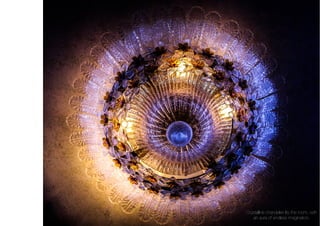
Crystalline chandelier lits the room, with
an aura of endless imagination.

Photo book final

  • 1.
  • 2.
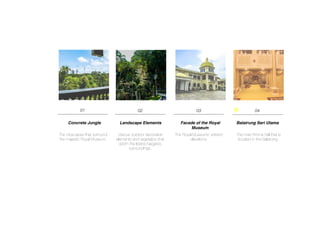
    The cityscapes thatsurround the majestic Royal Museum. Facade of the Royal Museum 01 Various outdoor decorative elements and vegetation that adorn the Istana Negara’s surroundings. Balairung Seri Utama 02 The Royal Museums’ exterior elevations The main throne hall that is located in the Balairung. Concrete Jungle Landscape Elements 03 04
  • 3.
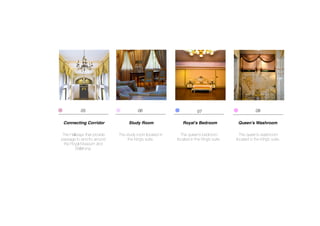
    Connecting Corridor The Hallwaysthat provide passage to and fro around the Royal Museum and Balairung. The study room located in the King’s suite. The queen’s bedroom located in the King’s suite. Study Room The queen’s washroom located in the King’s suite. Royal’s Bedroom Queen’s Washroom 05 06 07 08
  • 4.
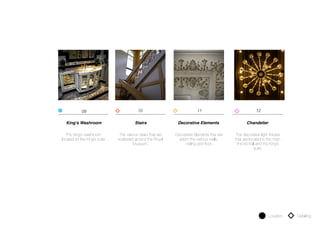
    The King’s washroom locatedint the King’s suite The various stairs that are scattered around the Royal Museum. King’s Washroom Decorative Elements that are adorn the various walls, ceiling and floor. Decorative Elements The decorative light fixtures that are located in the main throne hall and the King’s suite. Stairs Chandelier DetailingLocation 09 10 11 12
  • 5.
    
 GROUND FLOOR PLANFIRST FLOOR PLAN
  • 6.
  • 7.
    Within the stillnessof place, it allows one to engage fully with the deepest of soul into transforming vision into reality.
  • 8.
    Vision Frame Overviewing thecity, his Majesty discerns the future prospect of the country. With his vision, He shaped the future of Malaysia.
  • 9.
  • 10.
    Shelter hidden inthe folds of nature, providing a space for reflection and thought in the midst of the garden.
  • 11.
    Body of Water Reflecton one’s self to surface into a future with no regrets.
  • 12.
    The Royal Garden Aslice of paradise amidst the Royal garden, embraced by hues of scarlet against the verdant backdrop.
  • 13.
    Relations Nature and manthrive harmoniously under the careful sight of the glorious king.
  • 14.
    A path ofman A sight of nature An epicentre of water
  • 15.
    In Islam, allliving things comprise of water. Water in Islam is symbolic, representing purification and life. The decorative effect of water is also central to Islamic architecture, which emphasises motion and silence, choreographed under the light. Fountain
  • 16.
    Journeying through thickand thin, unifying causes , bridging the gap The bridge
  • 17.
    Dilapidated and decaying,beauty lies silently with the testimony of time.
  • 18.
    Facade of theRoyal Museum
  • 19.
    Central Focus A flagthat guides a man and a nation
  • 20.
    Shifting Facade Looking atthe image shown, there is a clear distinction between the architectural styles of the main palace wing and the Balairung annex. This addition, which shows elements of modernism, is more simplistic and geometrically focused than the main palace - which speaks the language of British Colonial and Palladian style.
  • 21.
    The facade ofthe Istana Negara’s main wing consists of a perfectly symmetrical relationship between the elevation and plan, but morphs into a different language. Partial Facade of the Istana Negara
  • 22.
  • 23.
    View from TheThrone The throne, also known as the’ SInggahsana’, is located at the crest of the second half of the Balairung. It is the most important part of the entire wing and is the seating place of the King and Queen during official events. The seating arrangements that face it can hold up to 2000 guests and 1000 guests for a state banquet.
  • 24.
    Speakers surrounded thesinggahsana to give a complete surround sound within. Connected to the Press Room and AV Room, the windows can slide open allowing videographers to record live footages from above.
  • 25.
    The Throne Sitting higherthan it’s surrounding, the throne is encased within an upright structure, to symbolise all creations and human brings to constantly remember and respect their creator.
  • 26.
  • 27.
    Behind the scenes Upabove encircling the Singgahsana, the Press Room and Audiovisual room can be found. People involved with the media and press will set up their camera equipments in the area. The crew involved with the stage lighting and audiovisual will also monitor the sound and light from the top.
  • 28.
    Sky Bridge The skybridge bridges between the old and the new, the occupied and the independent, the tethered and the liberated. Here, Palladian Style, begins to merge with Modernistic.
  • 29.
  • 30.
    Family Room The familyroom is designed with British Colonial and Victorian influences. The ambience of the room is opulently and elegantly decorated to suit the image of His Majesty, balanced in a way that does not compromise the teachings of the prophet which is to not ‘equalise riches with flamboyances”.
  • 31.
    Family Room The Westernand English touch in the family room is the most reflective in the use of furnishings. Majority of the furniture used are similar to traditional English noblemen’s furniture, which are elegantly trimmed with curving floral motifs or vectors. The upholstery, usually consists of pastel pigments, which therefore contrast with the dark tones of wood.
  • 32.
  • 33.
    Bedroom The use ofBritish Colonial style in the interior spaces continue from the semi-public spaces to the most private rooms of all- the master suite. A key feature in British Colonial interior architecture is the contrast of the wallpaper to the floorings. Much like the contrast between the furniture, the wallpapers were usually neutral colours, such as beige, cream, light pink or eggshell, and the floors would be dark woods, such as teak, oak and mahogany.
  • 34.
    Royal’s Suite LivingRoom The Royal’s Suite’s living room blends seamlessly with the rest of the private quarters, with soft pastel tones and dim lighting. The type of furniture used also remain similar to the family suite - whereby the frames are heavily garnished and flourished to portray decadence
  • 35.
  • 36.
    Queen’s Washroom Certain roomswithin the private quarters followed the rule of ‘duo-compartmentalisation’, which urge male and female Muslims to have a separation between certain degree of lifestyle, including the restrooms of His and Hers Majesty.
  • 37.
  • 38.
    His Majesty’s Bathroom LikeHer Majesty’s bathroom, the use of marble, mirrors and polished silver conveys ambience of opulence in a place of cleansing and reflection.
  • 39.
  • 40.
    Garden’s Staircase The elegantivory staircase leading from the foyer to the garden creates a sense of grandeur and majesty in even the simplest of everyday actions. Even so, the staircase is relatively simple and low-key, in keeping with the royal but humble atmosphere of the palace. Surrounded by greenery, the staircase, though physically broad and large, creates a subconscious sense of intimacy to the user.
  • 41.
    Tucked away fromsight, this humble concrete staircase surrounded by iron grille, it guides leads from the balcony to the ground.
  • 42.
    The interior ofthe stairwell is elaborately decorated with draperies and chandeliers, but the windows are reduced to a minimal design, suggesting a new approach in looking towards the world. Stairway
  • 43.
  • 44.
    Motifs Throughout the interiorof the building, motifs of sinuous curves, floral designs and rococo whiplashes embrace the space with warmth.
  • 45.
    The king’s writingtable articulates western influence of Victorian era. The roses adorned white porcelain plates offset with the dark wood table depicts the influences of Western and Oriental at where the nation’s story was written — the table where king writes. Emblems on furniture
  • 46.
    Malaysian’s National Emblem Malaysia’s NationalEmblem, also known as the ‘Coat of Arms of Malaysia’ (or ‘Jata Negara’) consist of a shield being supported by two tigers, topped by a yellow crescent with a 14-pointed ‘federal star’ and a motto written on a banner, below. The yellow colour of the crescent and 14- pointed federal star, symbolised the country’s monarchy. The crescent also represents Islam as the official religion while the federal star represents the thirteen states and the Federal Territories of Malaysia. The motto spells to the phrase “ Unity is Strength’ or ‘ Bersekutu Bertambah Mutu’
  • 47.
  • 48.
    Chandeliers Wide array ofchandeliers sprinkled in various places among the Balairung’s wing. The use of the chandeliers graces the space with refractions, reflections and illuminations.
  • 49.
    Crystalline chandelier litsthe room, with an aura of endless imagination.