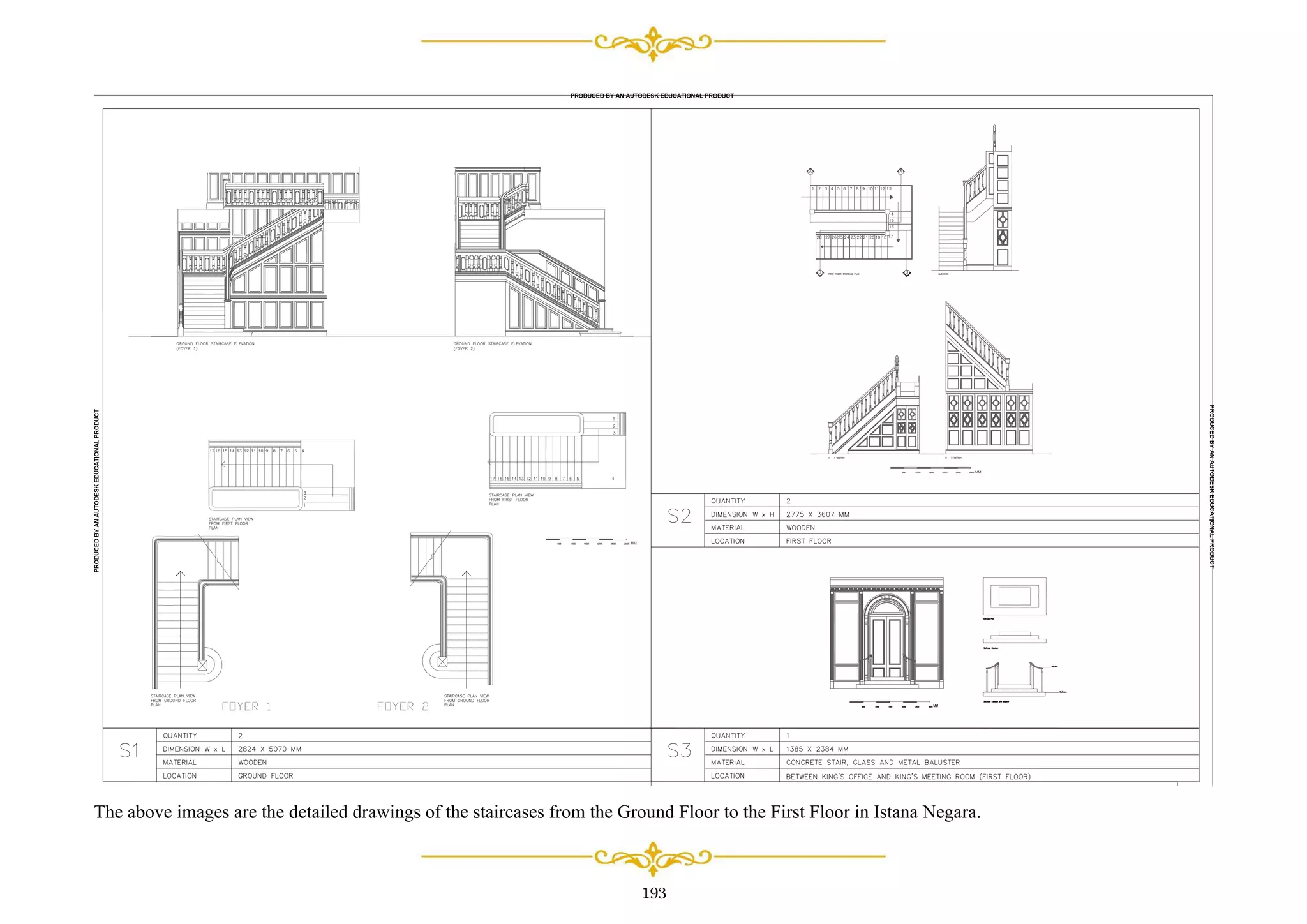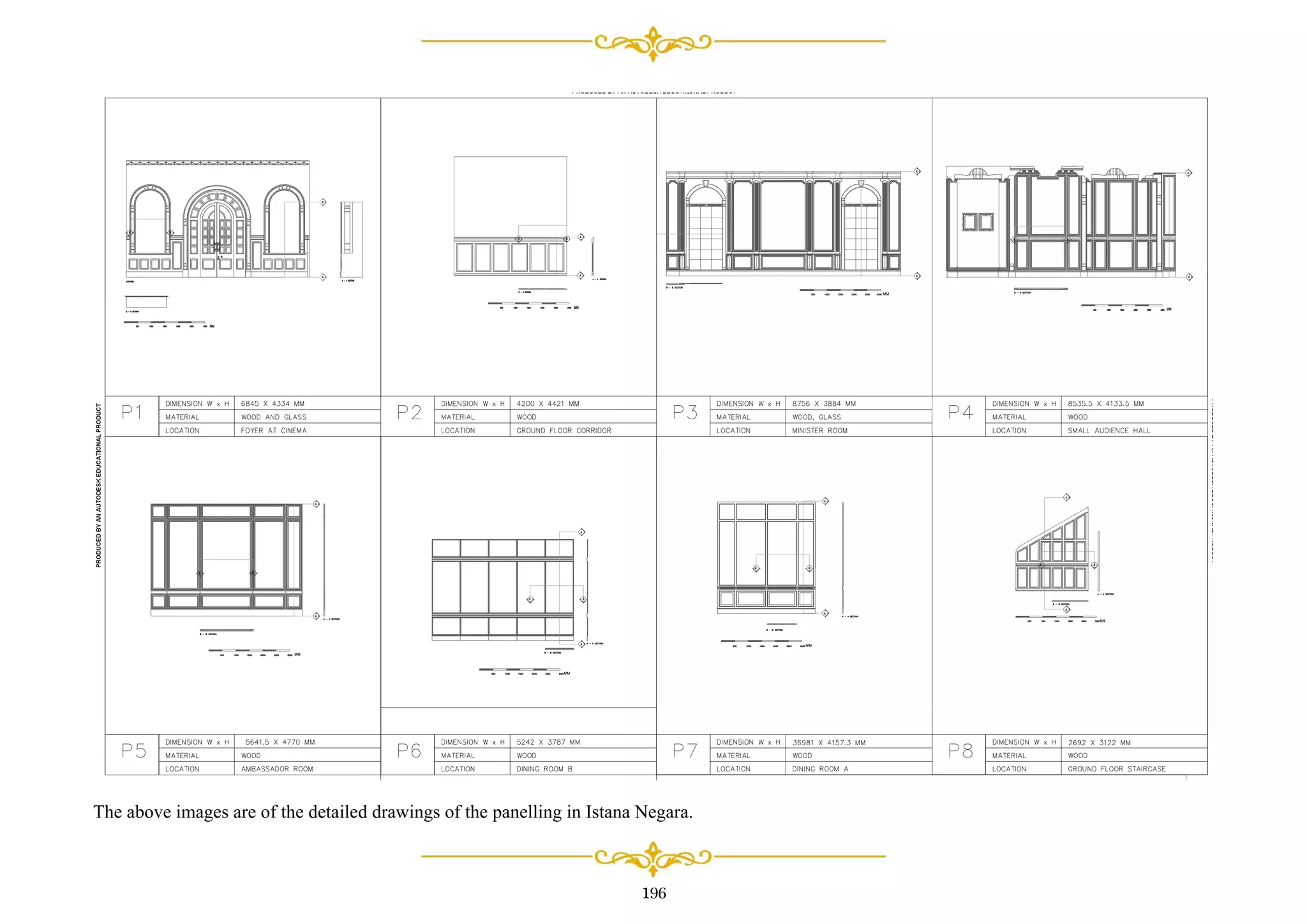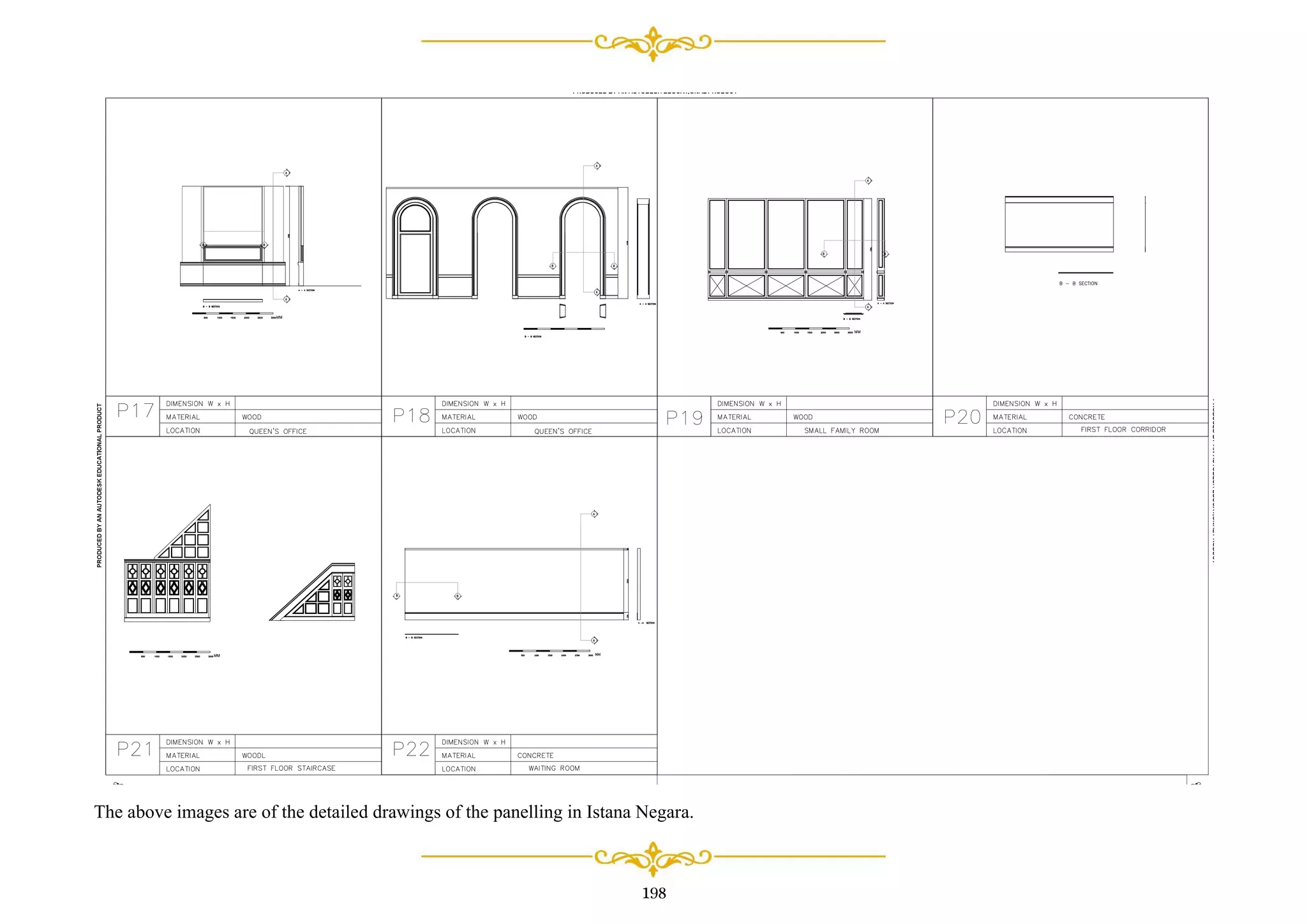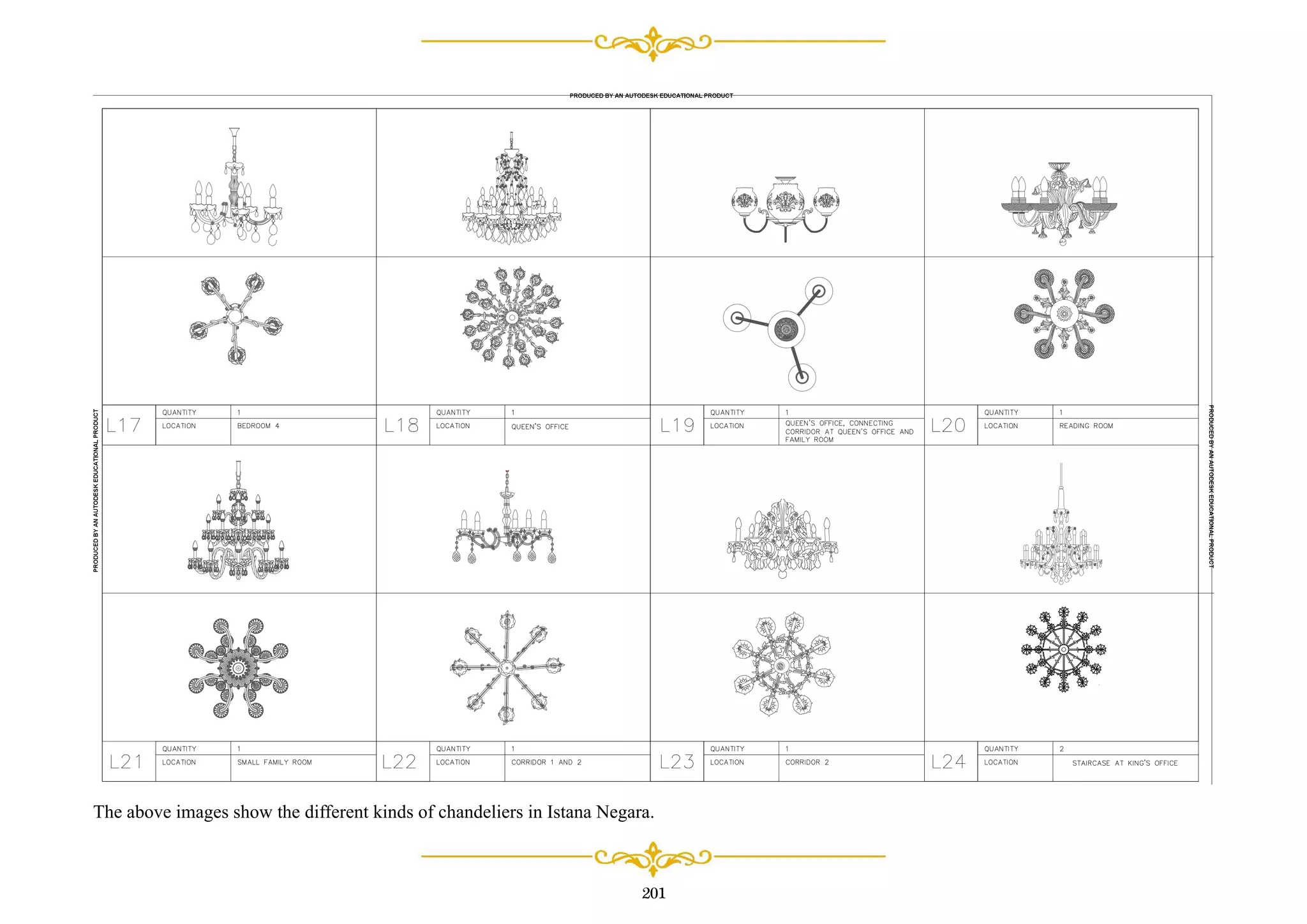








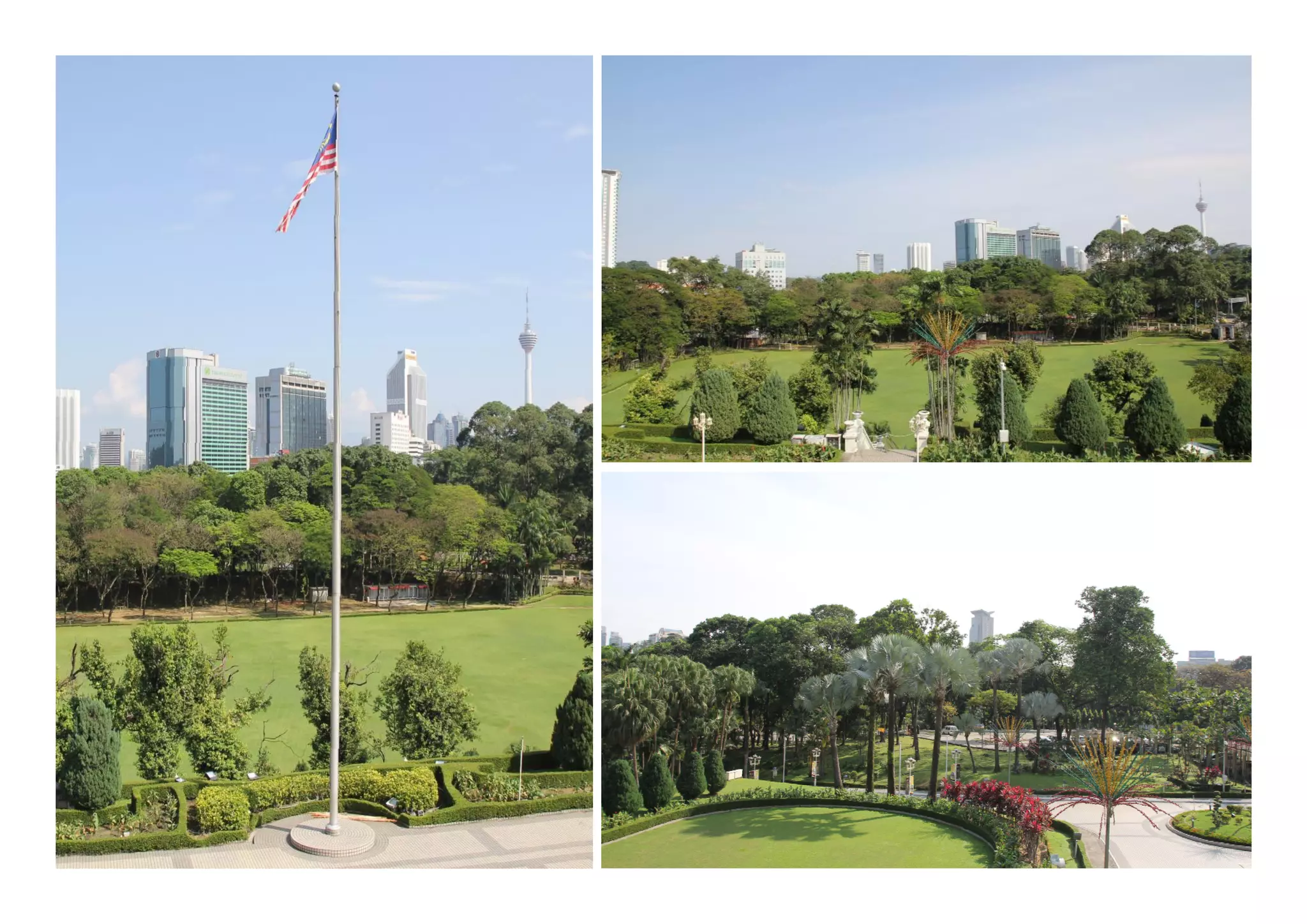
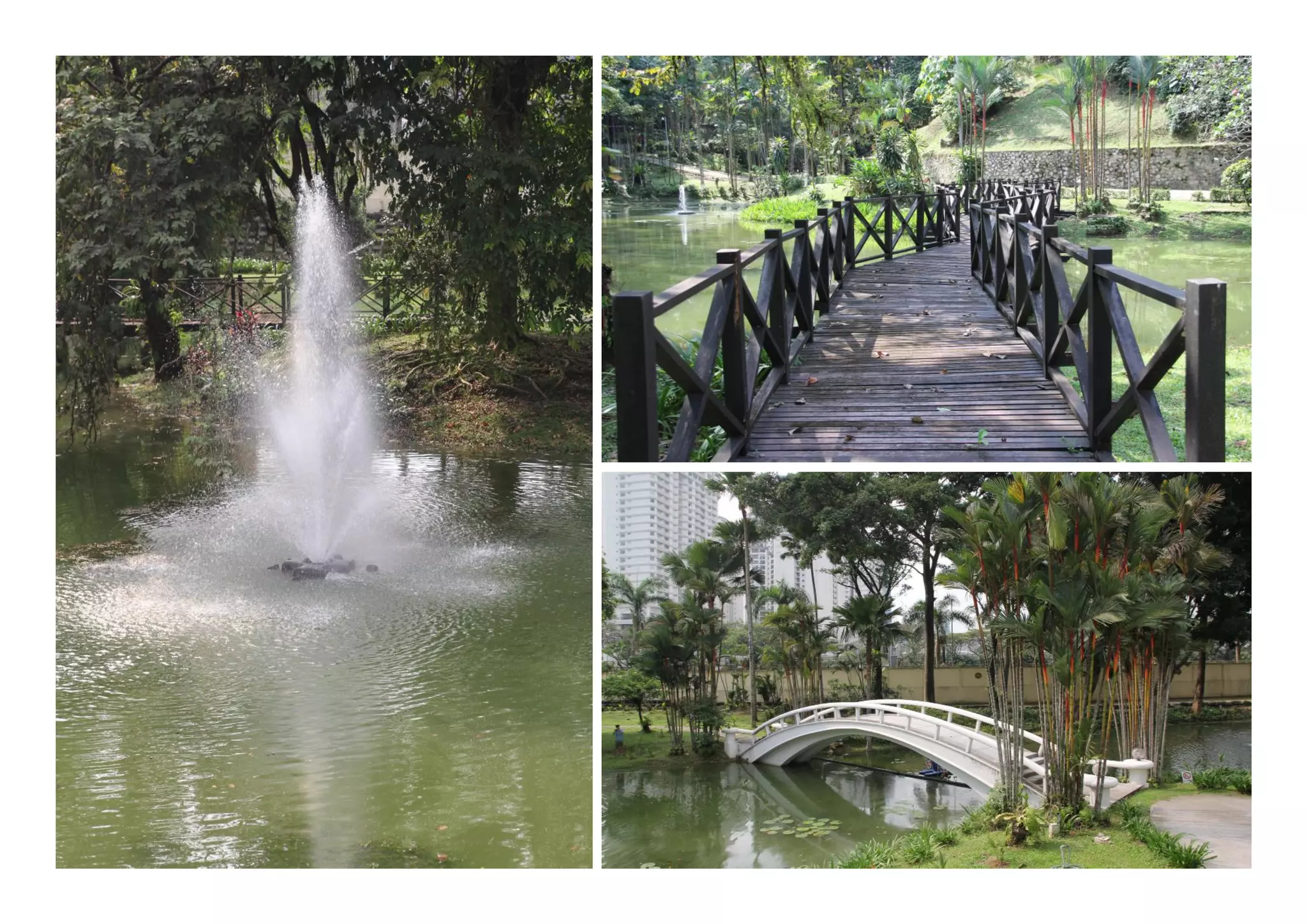


Istana Negara
ARC1215 - Methods of Documentation and Measured Drawing
Abstract
This report documents the overall information and data obtained from Measured Drawings activity on the site of Istana Negara (Lama). The Istana
Negara was once the home of the Malaysian Royal Family from the 1957 to 2011. Today it stands as a museum, exhibiting a glimpse of the past; the
importance of the royalty, and their lives in the palace itself. In the process of measuring the palace for conservation purposes, the current condition of
palace as well as the architectural development has been analyzed and recorded. The colonization of Malaysia by the British has clearly influenced the
style in which interior of the Istana Negara has been designed. As an illustration of wealth and prosperity, Istana Negara demonstrates Malaysia’s desire
to achieve the lifestyle of the British.
i
ii
Acknowledgements
Team Istana Negara would like to formally recognize and thank all those who have provided us with guidance and knowledge to produce this report. We
extend our gratitude to everyone who has kindly helped us, without whom this project could not have been possible. These people include:
Hayati Binti Mohamad Zawawi, the Director of the Istana Negara Museum, for giving us permission to measure and document the whole of the Istana
Negara, allowing us to photograph the interior of the palace, and providing an interview regarding the history of Istana Negara;
The staff at Istana Negara Museum, for being so accommodating and providing us with the floor plans and other information they had;
Nurul Alia Ahamad and Norhayati Ramli, for guiding and encouraging us through the entirety of this project.
iii
Declaration of Submission
We, the Team Istana Negara, in Methods of Documentation and Measured Drawing, hereby certify all the information and content of this report are
original, except when appropriately referenced to other sources, and that written permission has been granted by any existing copyright holders. We
affirm that this is a record of our work carried out during the field trip from January 19th – 23rd, 2015 in Istana Negara, Jalan Istana.
Lastly, we understand that this declaration covers all works submitted for the final assessment.
Pua Kee Hui
Leader of Team Istana
Chin Jovi
Leader of Team Istana
Table of Contents
Abstract
Acknowledgements
Declaration of Submission
Table of Contents
List of Figures
Chapter 1: Introduction
Objectives and Aim
Scope
Limitations
Methods of Measurement
Equipment Used
Literature Review
Significance of Study
Chapter 2: Historical Background
History of Malaysia and Kuala Lumpur
History of the Royalty in Malaysia
History of the Istana
History of Istana Negara Lama
Ownership
Renovations
Chapter 3: Architectural Development
i
ii
iii
iv
vi
1
1.1
1.2
1.3
1.4
1.5
1.6
1.7
2
2.1
2.2
2.3
2.4
2.5.1
2.5.2
3
iv
Site Context
Hardscape
Softscape
External Structures
Architectural Influences
Palladian Style
British Colonial Style
Design Concept
Form
Exterior
Interior
Space Planning
Exterior
Interior
Cultural Aspects and Elements
Chapter 4: Construction Details
Staircases
Dome
Arch
Chapter 5: Materials
Structural Materials
Finishing
Chapter 6: Ornamentation and Details
3.1
3.1.1
3.1.2
3.1.3
3.2
3.2.1
3.2.2
3.3
3.3.1
3.3.2
3.3.3
3.4
3.4.1
3.4.2
3.5
4
4.1
4.2
4.3
5
5.1
5.2
6
v
Columns and Pilasters
Doors
Windows
Ceiling
Lighting
Other Ornamentation
Chapter 7: Comparison with Istana Nega-
ra, Jalan Duta
Design Concept
Details
Scale
Function
Chapter 8: Conclusion
Future of Istana Negara Lama
Conclusion
References
Appendix
Letter from the National Archive
Interview Transcript
Glossary
Photobook
3D Computer Modelling
F Scaled Drawings
6.1
6.2
6.3
6.4
6.5
6.6
7
7.1
7.2
7.3
7.4
8
8.1
8.2
A
B
C
D
E
vi
List of Figures
Avintage telephone found in the Queen’s office. (Tee,
2015)
Photograph of a set table in one of the dining rooms.
(Woo, 2015)
A member of Team Istana, Adrian Yap, using a piece
of equipment to measure the building. (All Tools Di-
rect, 2015)
Image of Bosch DLE 50 Professional Digital Laser
Distance Meter. (Caulfield Industrial, 2015)
Example of a standard measuring tape.
One of the team members, Adrian Yap, using the
Geometric Quadrant Plumb Bob. (Woo, 2015)
View of royal dishes and cutlery, laid out for a meal.
(Tee, 2015)
Independence ceremony in Merdeka Stadium. Au-
gust 31st , 1957. (Malaysia Independence Day)
Yang di-Pertuan Agong Pertama (Portal Rasmi Perli-
men Malaysia)
Yang di-Pertuan Agong Kedua (Portal Rasmi Perli-
men Malaysia)
Yang di-Pertuan Agong Ketiga (Portal Rasmi Perli-
Figure 1.1
Figure 1.2
Figure 1.3
Figure 1.4
Figure 1.5
Figure 1.6
Figure 1.7
Figure 2.1
Figure 2.2
Figure 2.3
Figure 2.4
men Malaysia)
Yang di-Pertuan Agong Keempat (Portal Rasmi Per-
limen Malaysia)
Yang di-Pertuan Agong Kelima (Portal Rasmi Perli-
men Malaysia)
Yang di-Pertuan Agong Keenam (Portal Rasmi Perli-
men Malaysia)
Yang di-Pertuan Agong Ketujuh (Portal Rasmi Perli-
men Malaysia)
Yang di-Pertuan Agong Kelapan (Portal Rasmi Perli-
men Malaysia)
Yang di-Pertuan Agong Kesembilan (Portal Rasmi
Perlimen Malaysia)
Yang di-Pertuan Agong Kesepuluh(Portal Rasmi Per-
limen Malaysia)
Yang di-Pertuan Agong Kesebelas (Portal Rasmi Per-
limen Malaysia)
Yang di-Pertuan Agong Kedua Belas (Portal Rasmi
Perlimen Malaysia)
Yang di-Pertuan Agong Ketiga Belas (Portal Rasmi
Perlimen Malaysia)
Malacca Sultanate Palace, 1459. (Malacca Attrac-
tions)
Istana Balai Besar, 1840. (Kelantan Attractions)
The Astana, 1870. (Asia Explores)
Istana Jugra, 1875. (Asia Explores)
Figure 2.5
Figure 2.6
Figure 2.7
Figure 2.8
Figure 2.9
Figure 2.10
Figure 2.11
Figure 2.12
Figure 2.13
Figure 2.14
Figure 2.15
Figure 2.16
Figure 2.17
Figure 2.18
vii
Istana Jahar, 1887. (Asia Explores)
Istana Sri Menanti, 1980. (Asia Explores)
Istana Kenangan, 1926. (Arkib Government)
Old Istana Negara, 1982. (Woo, 2015)
Istana Badariah, 1940. (Arkib Government)
Istana Darul Ehsan, 2000. (Arkib Government)
Istana Anak Bukit, 2007. (Malaysian Explorer)
Istana Negara Baru, 2011. (Malaysian Explorer)
Mr. Chan Wing’s Potrait (Malaysian Explorer)
Istana Negara before the first renovations in 1940.
(Choong)
Istana Negara in 1956.( Choong)
Current physical state of Istana Negara. (Woo, 2015)
The then Prime Minister of Malaysia overlooking the
renovation works. (Choong)
The renovation and additional site plan of Old Istana
Negara. (Jabatan Penerangan, 1976)
The renovation and additional detailing plan of Old
Istana Negara of the main gate in front. (Jabatan Pen-
erangan, 1976)
Timeline of Chan Wing and the Istana Negara.
The pavement in front. (Woo, 2015)
The pavement that connects the Royal Musuem Gal-
lery to the Balairun Seri Gallery. (Woo, 2015)
View of the pavement looking down to the main en-
Figure 2.19
Figure 2.20
Figure 2.21
Figure 2.22
Figure 2.23
Figure 2.24
Figure 2.25
Figure 2.26
Figure 2.27
Figure 2.28
Figure 2.29
Figure 2.30
Figure 2.31
Figure 2.32
Figure 2.33
Figure 2.34
Figure 3.1
Figure 3.2
Figure 3.3
trance. (Woo, 2015)
Example of tiled pavements used in the royal garden.
(Woo, 2015)
Photograph of a planter box outside the entrance of
the Istana Negara building. (Woo, 2015)
Photograph of a curb on the tiled pavement on the
exterior. (Woo, 2015)
Fountain directly outside the entrance to the Istana
Negara building. (Woo, 2015)
Fountain in the lake of the royal gardens. (Woo, 2015)
Retaining walls are used to ensure the soil does not
move and cause damage. (Woo, 2015)
Barricades, or gates surrounding the Istana Negara as
a type of security. (Woo, 2015)
The white bridge in the garden to cross the pond.
(Woo, 2015)
Drainage near the boundaries of the site. (Woo, 2015)
View of the royal garden, with the lake and white
bridge. (Tee, 2015)
The open field in front of the Istana Negara structure.
(Woo, 2015)
The Balairung Seri, or the Throne Hall Gallery. (Woo,
2015)
The management office structure. (Woo, 2015)
Cimborium in the garden. (Woo, 2015)
Cimborium near the pool. (Woo, 2015)
Figure 3.4
Figure 3.5
Figure 3.6
Figure 3.7
Figure 3.8
Figure 3.9
Figure 3.10
Figure 3.11
Figure 3.12
Figure 3.13
Figure 3.14
Figure 3.15
Figure 3.16
Figure 3.17
Figure 3.18
viii
Photo of the pyramidal greehouse. (Woo, 2015)
The swimming pool next to the royal garden. (Te,
2015)
The carpark outside the management office. (Woo,
2015)
The main entrance for visitiors. (Woo, 2015)
The indoor badminton courts. (Woo, 2015)
Exterior view of the badminton courts. (Woo, 2015)
Outdoor futsal field or tennis courts. (Woo, 2015)
Top view of one of the fountains outside the entrance.
(Tee, 2015)
Capital of the column at the entrance of the minister’s
room on the Ground Floor. (Woo, 2015)
Pediment above two Corinthian columns at the en-
trance of the minister’s room on the Ground Floor.
(Woo, 2015)
Diagram showing the symmetry in the floor plan.
(Woo, 2015)
Door and window arrangement on the ground floor.
(Woo, 2015)
One of the doors from the exterior to the interior.
(Woo, 2015)
View of the main entrance on the south side. (Woo,
2015)
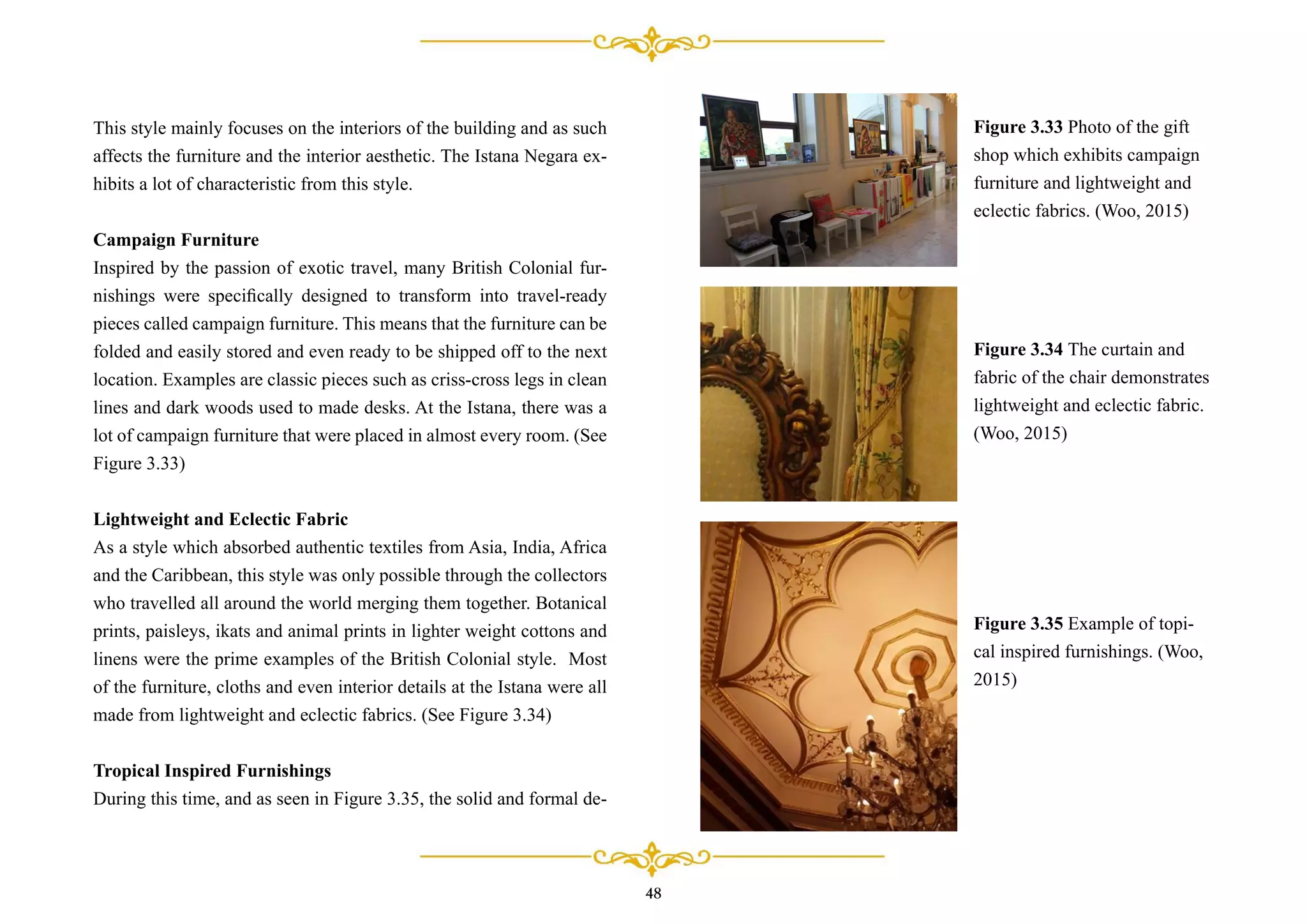
Photo of the gift shop, which exhibits campaign fur-
niture, and lightweight and eclectic fabrics. (Woo,
Figure 3.19
Figure 3.20
Figure 3.21
Figure 3.22
Figure 3.23
Figure 3.24
Figure 3.25
Figure 3.26
Figure 3.27
Figure 3.28
Figure 3.29
Figure 3.30
Figure 3.31
Figure 3.32
Figure 3.33
2015)
The curtain and fabric of the chair demonstrates light-
weight and electric fabric. (Woo, 2015)
Example of topical inspired furnishings. (Woo, 2015)
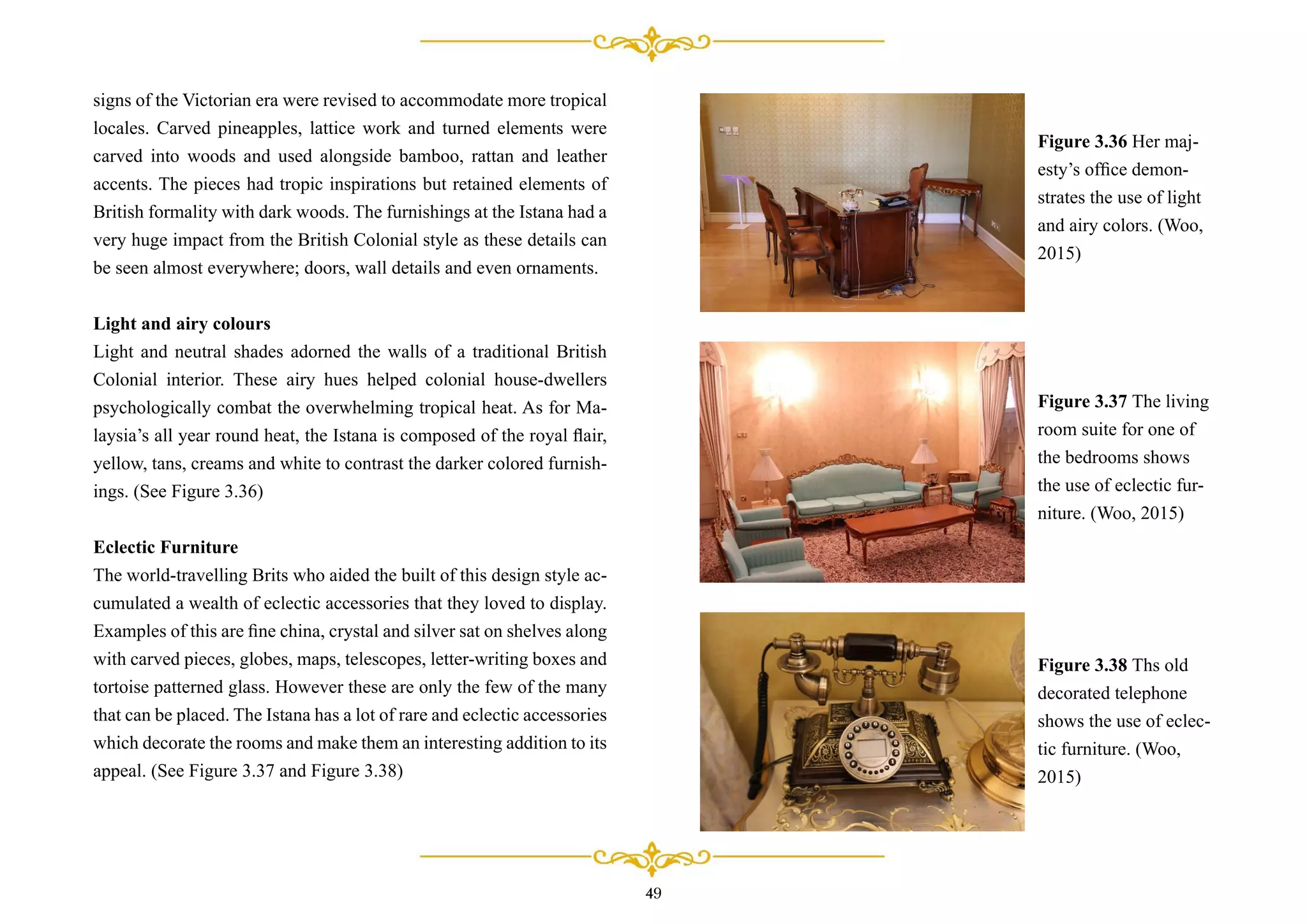
Her majesty’s office demonstrates the use of light and
airy colours. (Woo, 2015)
The living room suite for one of the bedrooms shows
the use of eclectic furniture. (Woo, 2015)
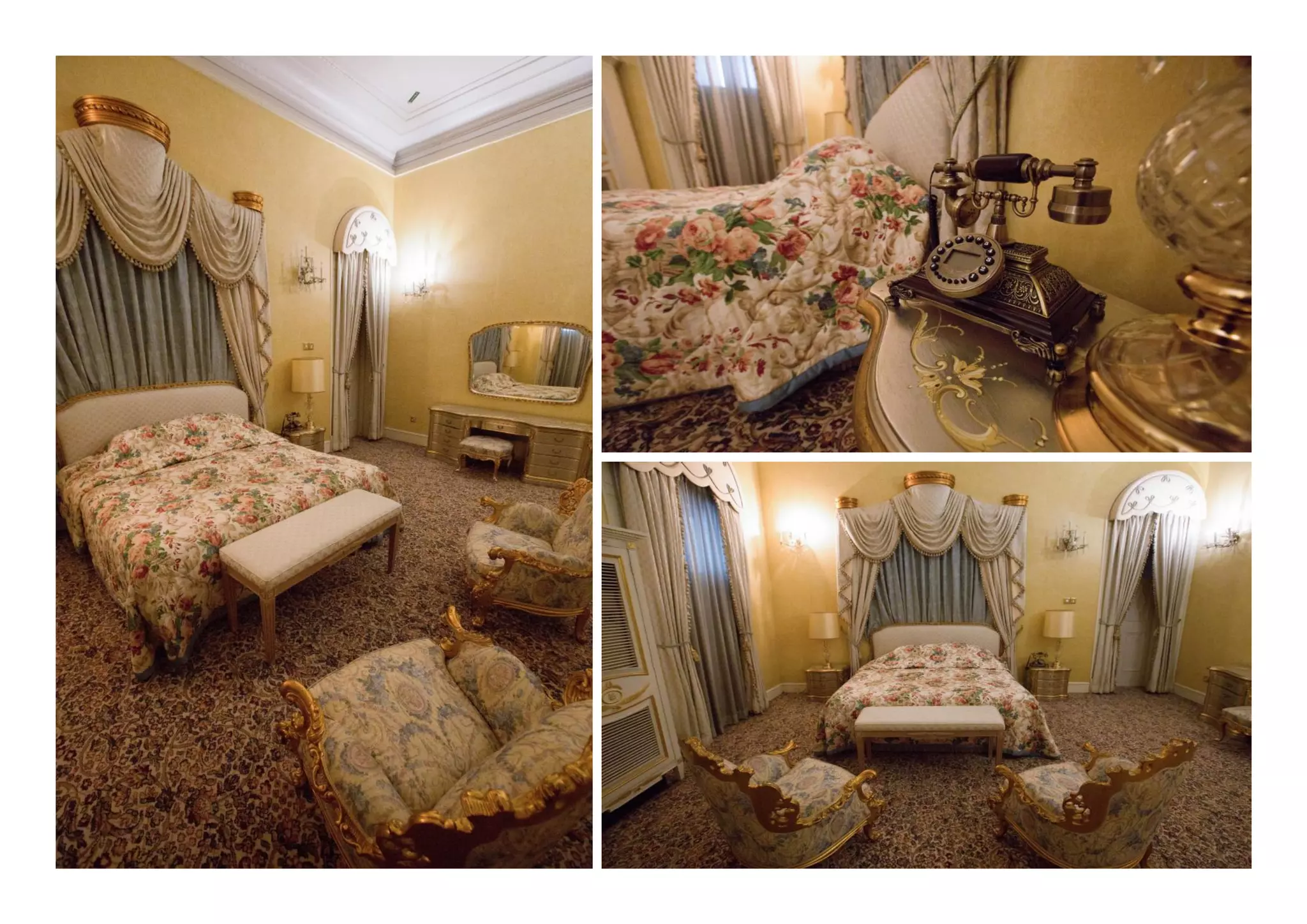
This old decorated telephone shows the use of eclec-
tic furniture. (Woo, 2015)
Image of a lizard on the Istana Negara grounds. (Tee,
2015)
Image of the horses that were once used to wander
around the grounds of Istana Negara. (Woo, 2015)
Cropped view of the center of the facade of Istana
Negara shows a detailed symmetry of the facade.
(Woo, 2015)
View of the Istana Negara’s Exterior. (Tee, 2015)
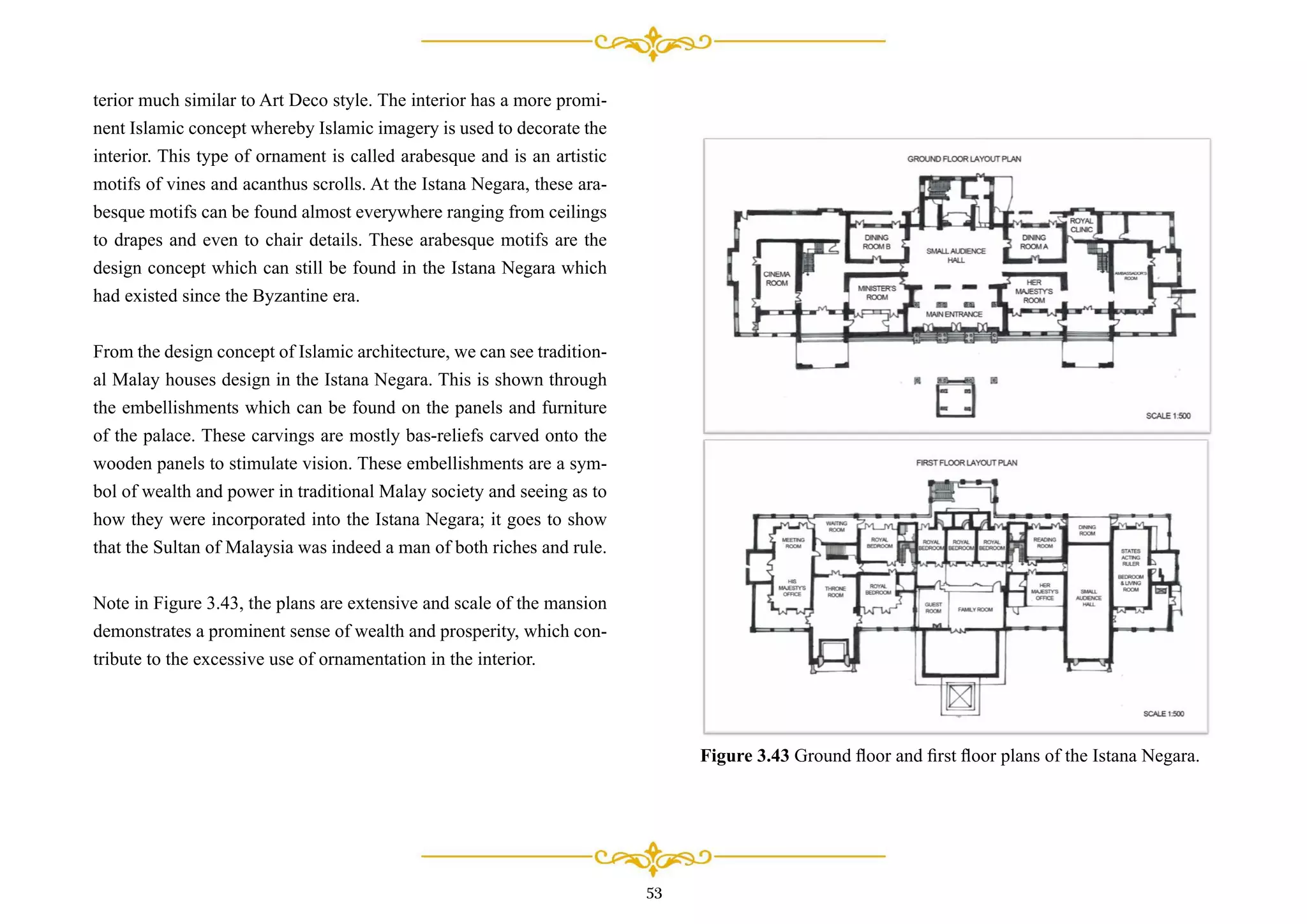
Ground floor and first floor plans of the Istana Neg-
ara.
Map of the Royal Museum, otherwise known as Ista-
na Negara on Jalan Istana.
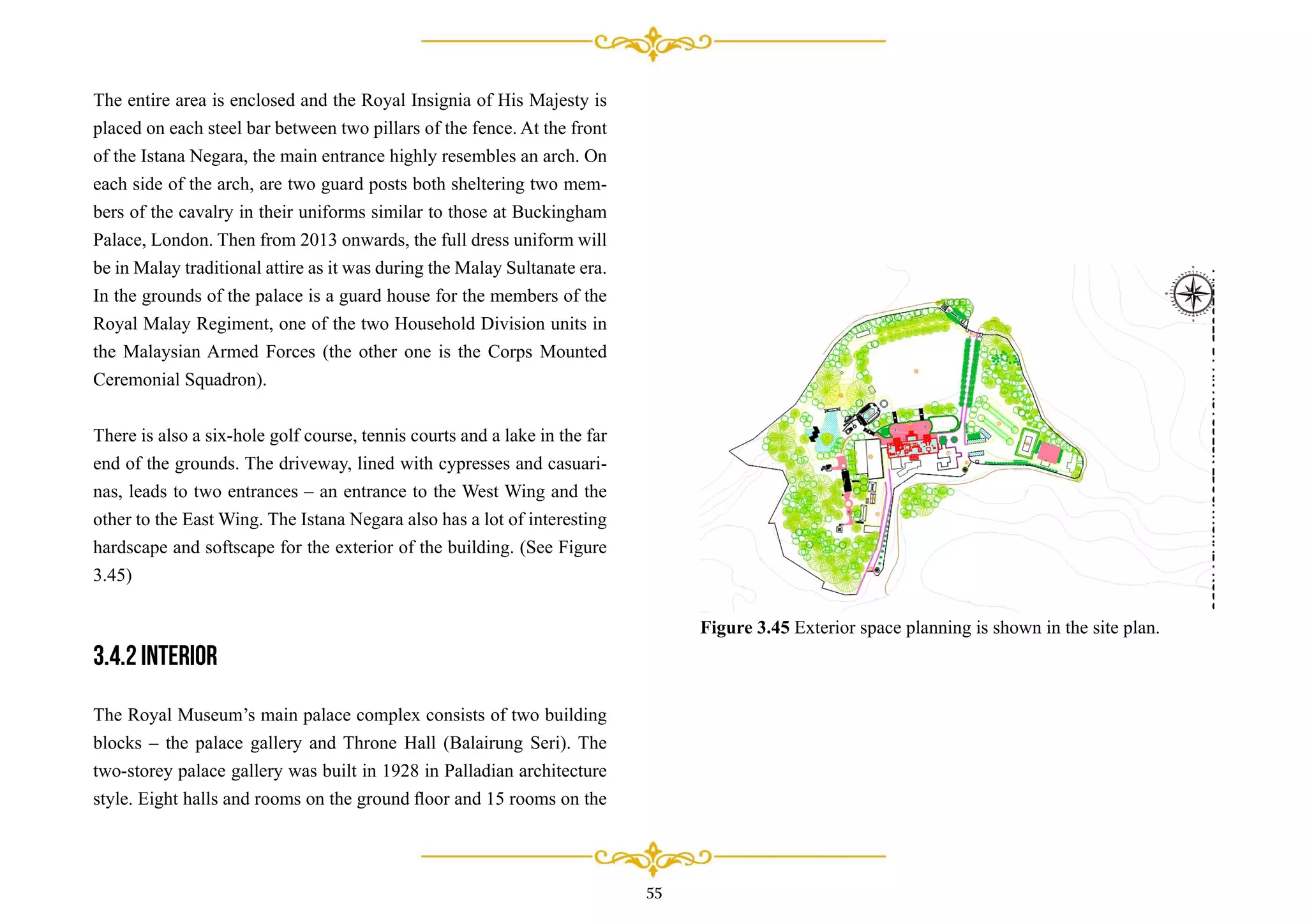
Exterior space planning is shown in the site plan.
The small audience hall is the first room visitors see.
(Woo, 2015)
One of the dining rooms in the royal palace. (Woo,
Figure 3.34
Figure 3.35
Figure 3.36
Figure 3.37
Figure 3.38
Figure 3.39
Figure 3.4
Figure 3.41
Figure 3.42
Figure 3.43
Figure 3.44
Figure 3.45
Figure 3.46
Figure 3.47
ix
2015)
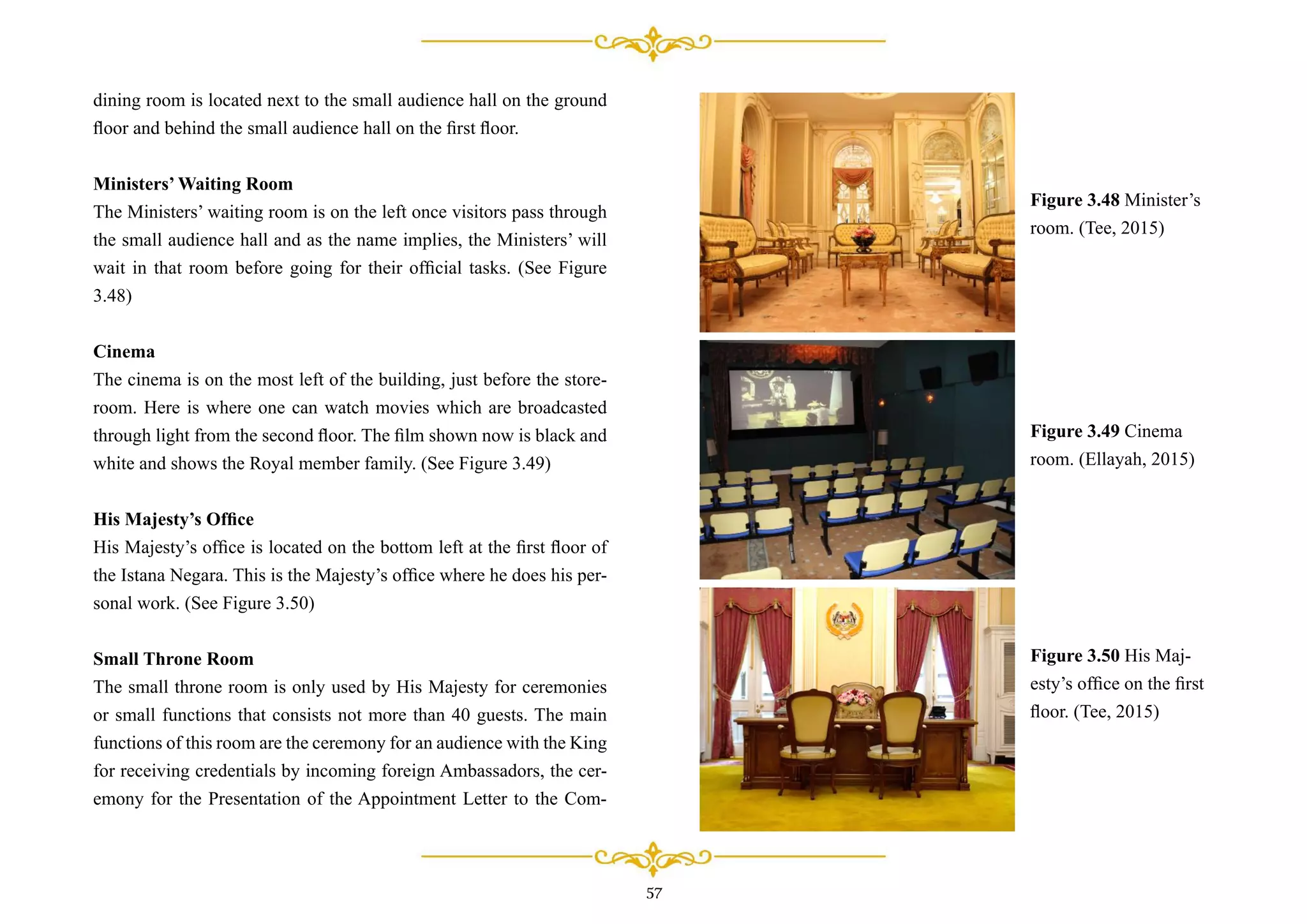
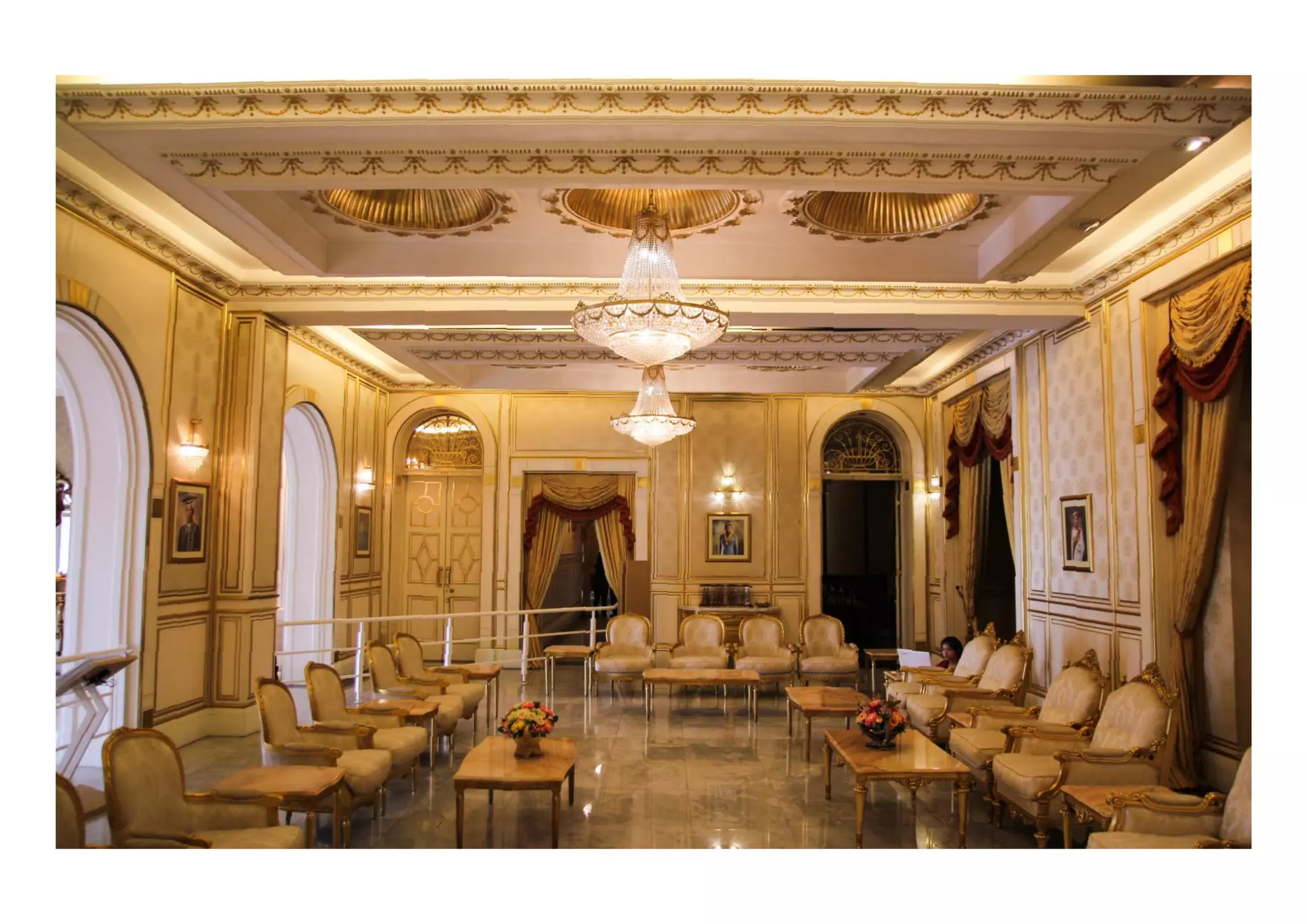
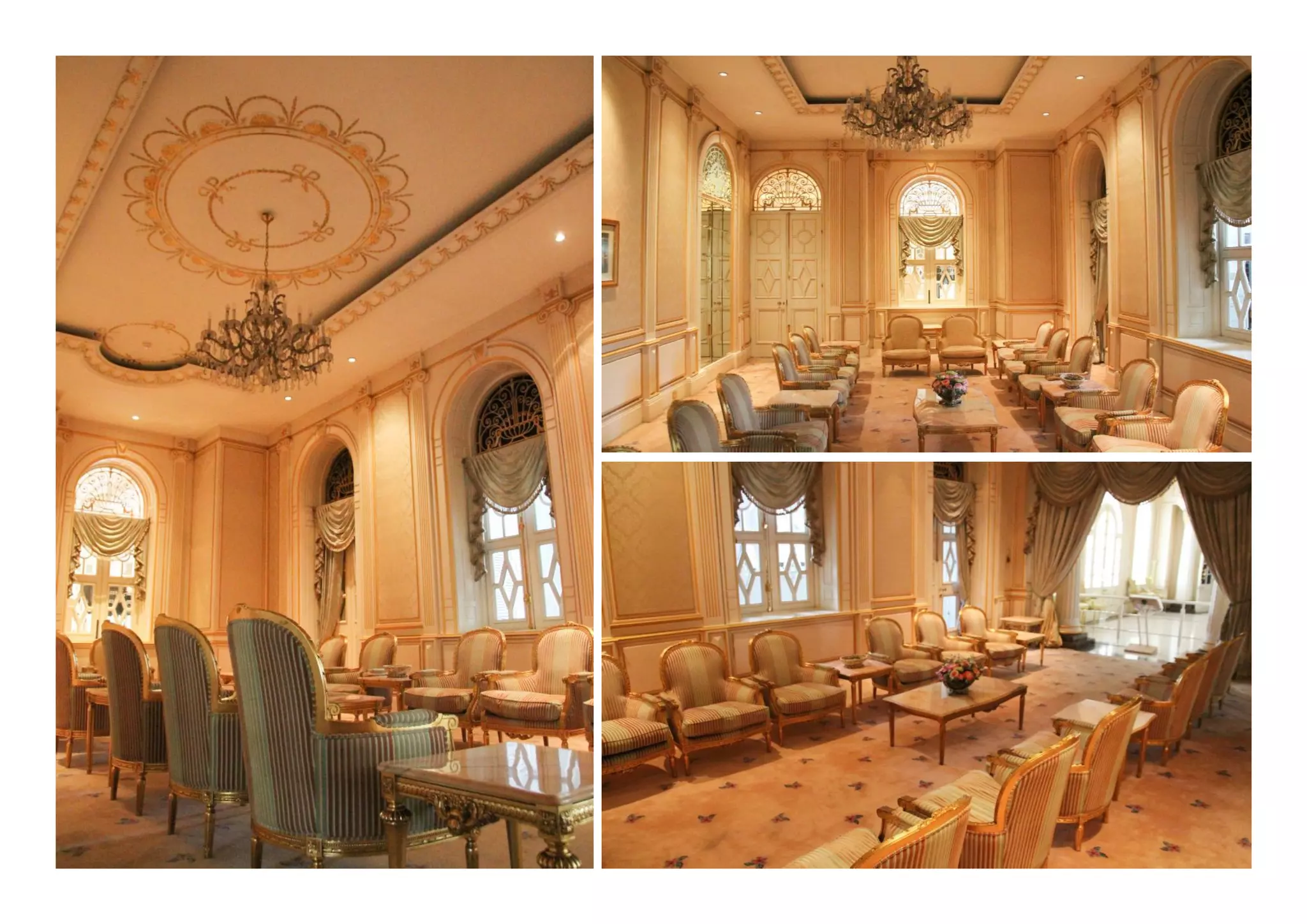
Minister’s room. (Tee, 2015)
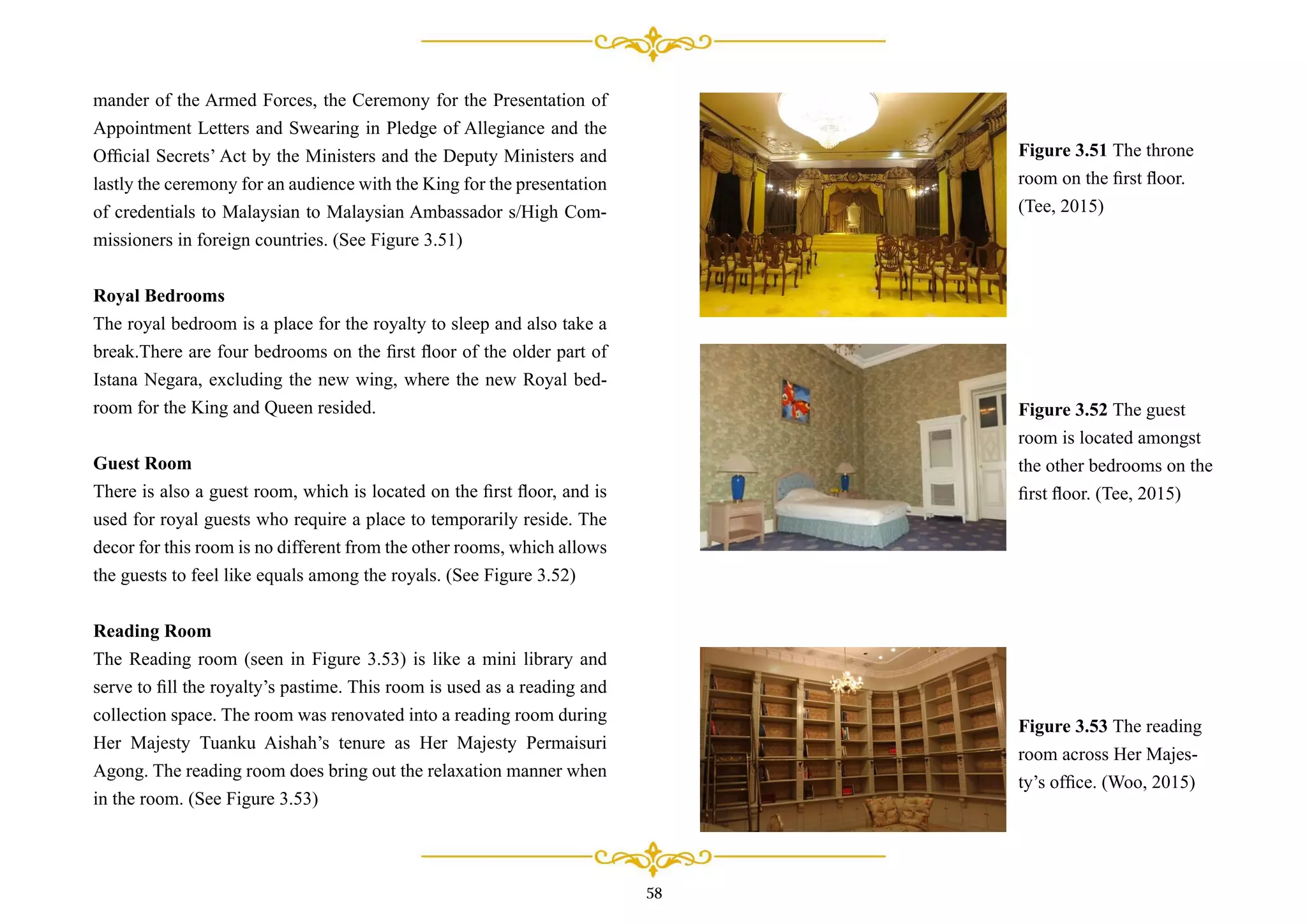
Cinema room. (Ellayah, 2015)
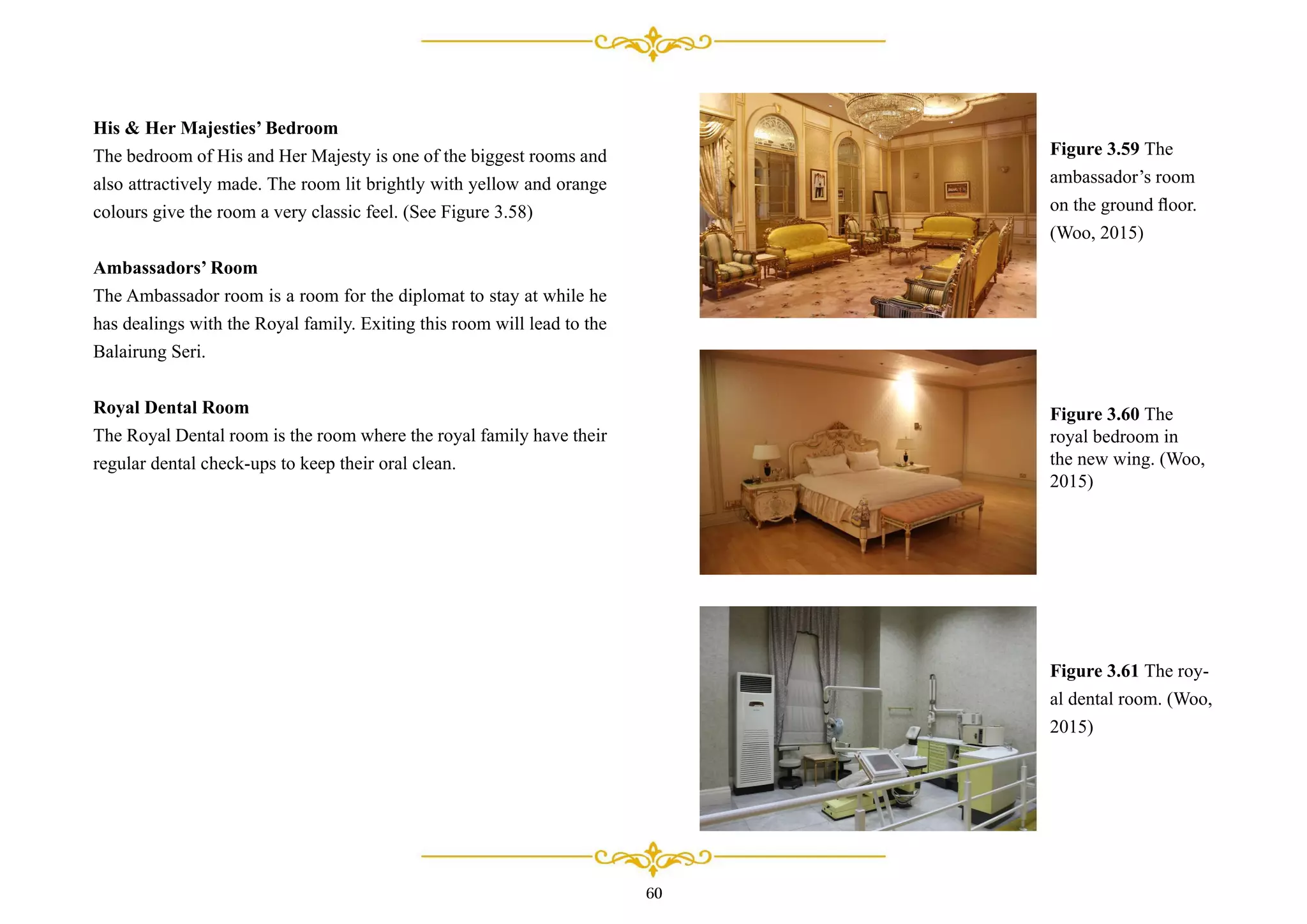
His Majesty’s office on the first floor. (Tee, 2015)
The throne room on the first floor. (Tee, 2015)
The guest room is located amongst the other bed-
rooms on the first floor. (Tee, 2015)
The reading room across Her Majesty’s office. (Woo,
2015)
Her Majesty’s office. (Ellayah, 2015)
Small audience hall. (Ellayah, 2015)
State acting ruler’s bedroom. (Tee, 2015)
His Majesty’s restroom. (Tee, 2015)
Her Majesty’s powder room. (Tee, 2015)
The ambassador’s room on the ground floor. (Woo,
2015)
The royal bedroom in the new wing. (Woo, 2015)
The royal dental room. (Woo, 2015)
One of the domes on the top of the Istana Negara.
(Tee, 2015)
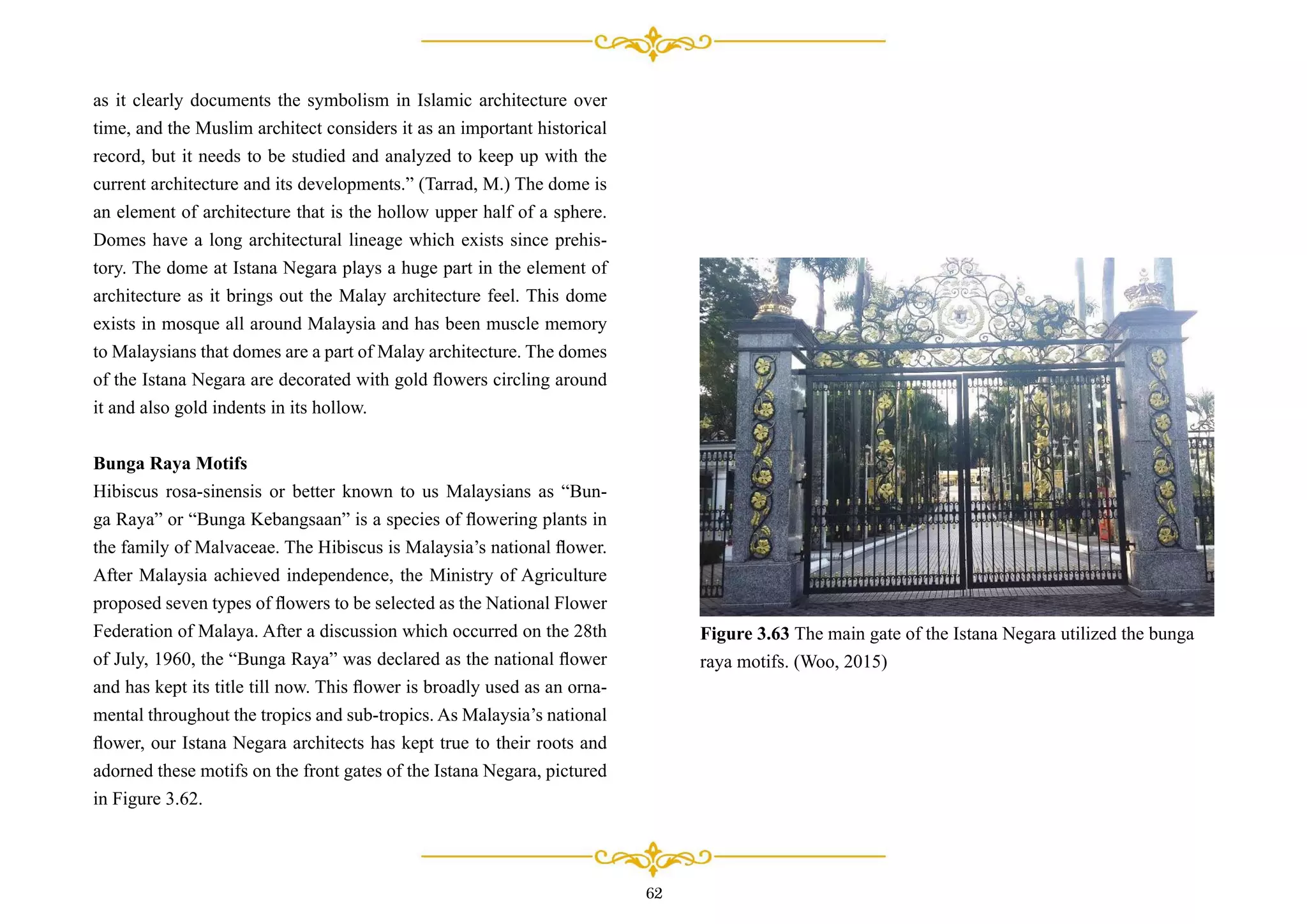
The main gate of the Istana Negara utilized the bunga
raya motifs. (Woo, 2015)
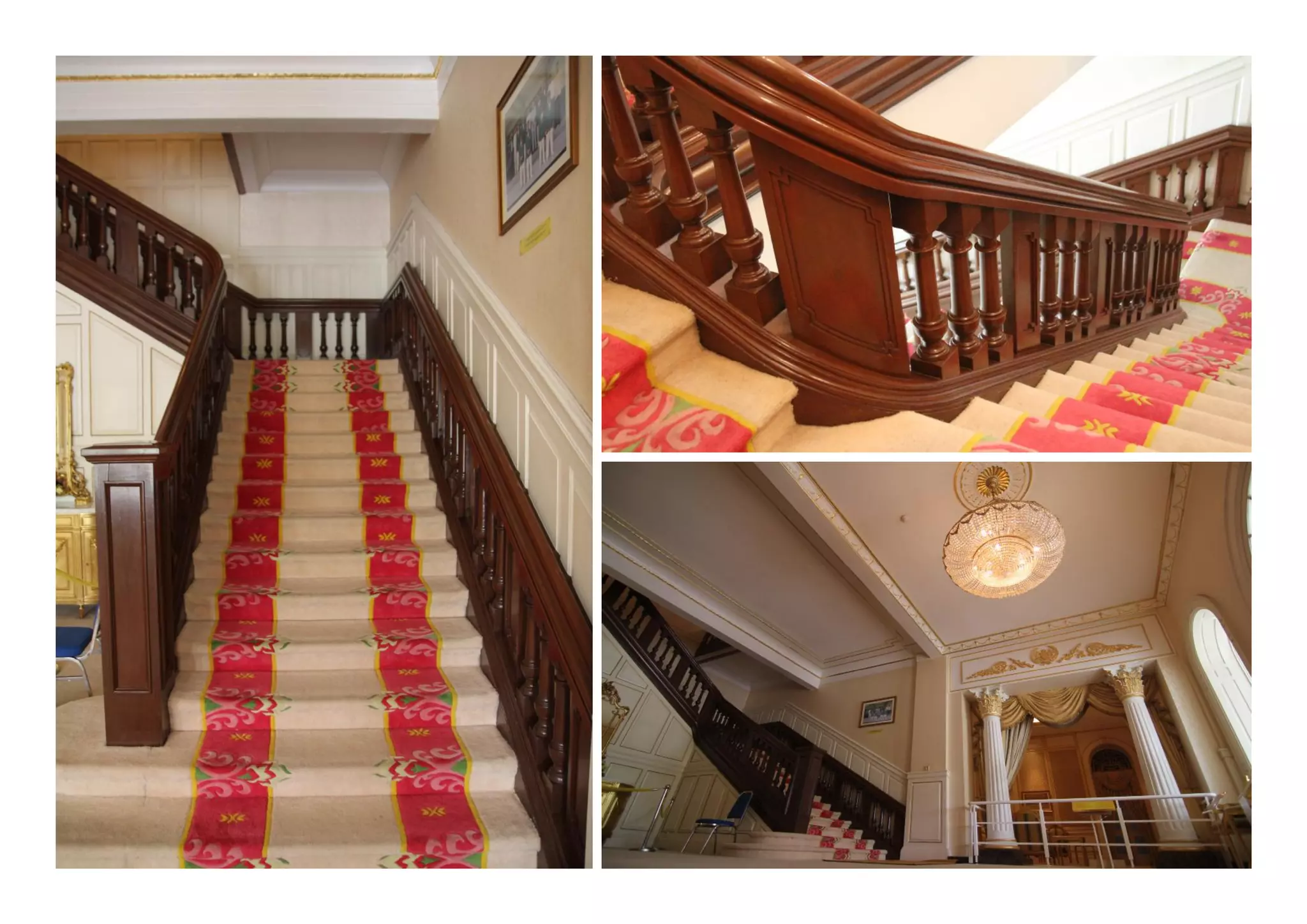
One of two of the main staircases in the Istana Nega-
ra. (Woo, 2015)
Three step staircases are used to further distinguish
Figure 3.48
Figure 3.49
Figure 3.50
Figure 3.51
Figure 3.52
Figure 3.53
Figure 3.54
Figure 3.55
Figure 3.56
Figure 3.57
Figure 3.58
Figure 3.59
Figure 3.60
Figure 3.61
Figure 3.62
Figure 3.63
Figure 4.1
Figure 4.2
rooms. These are the steps to His Majesty’s Office.
(Woo, 2015)
Staircase handrail at His Majesty’s Office. (Woo,
2015)
View of one of the two main domes on top of the Ista-
na Negara. (Tee, 2015)
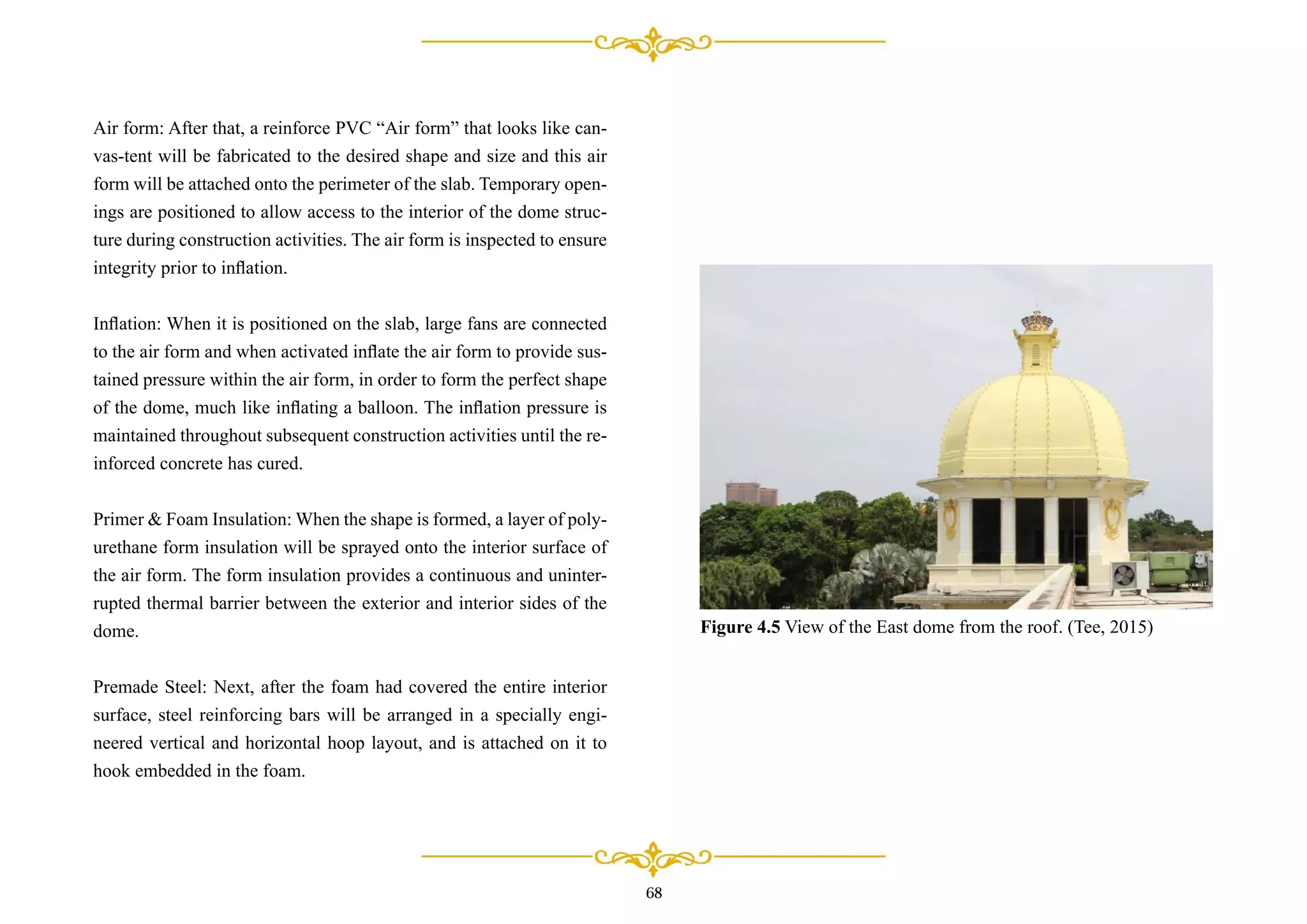
View of the East dome from the roof. (Tee, 2015)
Close-up view of the crown and symbol of Malaysia
on top of the dome. (Tee, 2015)
View of an arched entrance from the exterior of the
building. (Ellayah, 2015)
Concrete formwork seen throughout Istana Negara.
(Tee, 2015)
Masonry wall which has been left as it is at the bad-
minton court. (Woo, 2015)
Existing timber structures with floral motifs. (Woo,
2015)
The exterior of Istana Negara painted beautifully.
(Woo, 2015)
Plaster walls and ceilings. (Woo, 2015)
The full column at the minister’s room. (Woo, 2015)
View of the Greek styled Corinthian column’s capi-
tal. (Woo, 2015)
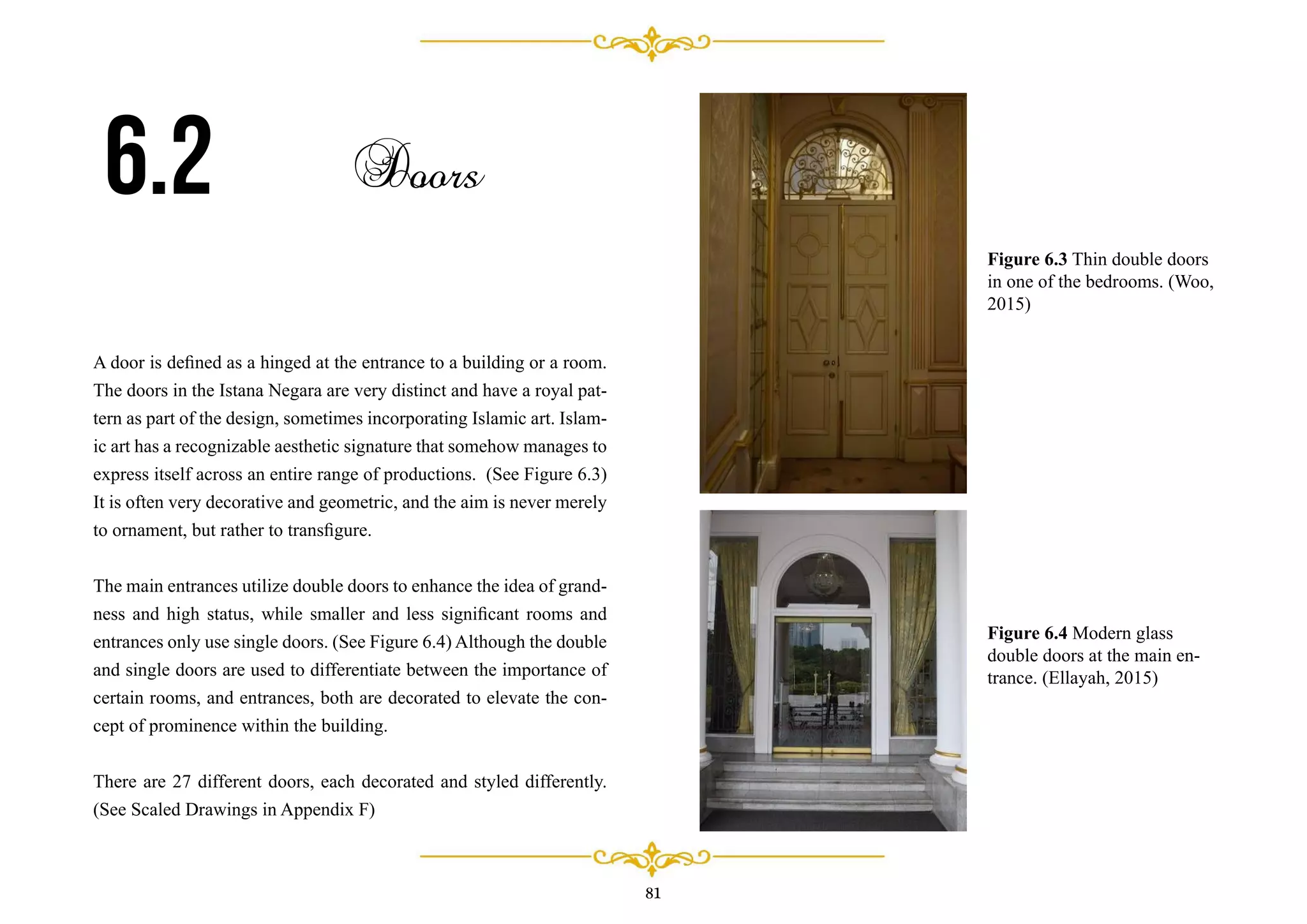
Thin double doors in one of the bedrooms. (Woo,
Figure 4.3
Figure 4.4
Figure 4.5
Figure 4.6
Figure 4.7
Figure 5.1
Figure 5.2
Figure 5.3
Figure 5.4
Figure 5.5
Figure 6.1
Figure 6.2
Figure 6.3
x
2015)
Modern glass double doors at the main entrance. (El-
layah, 2015)
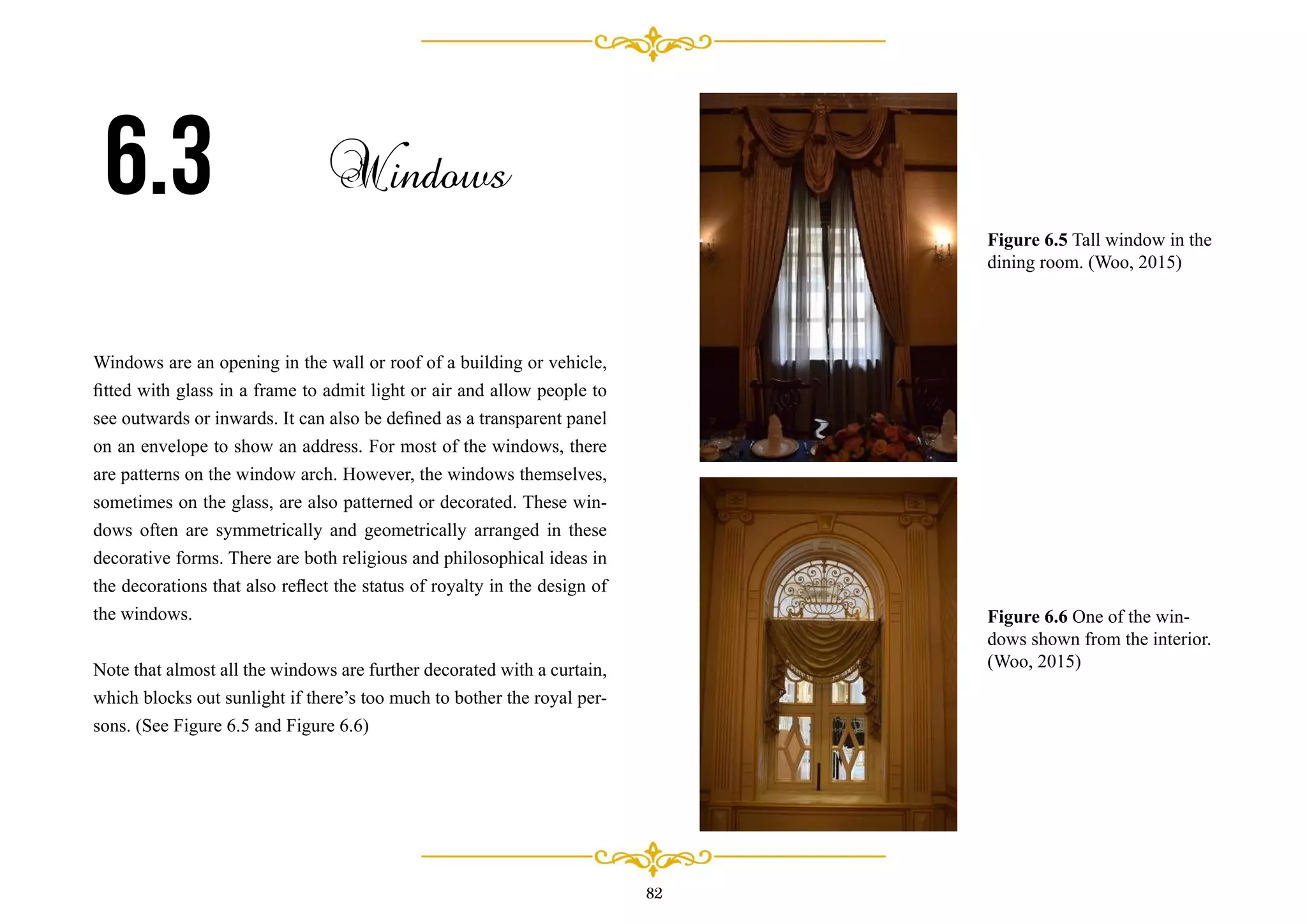
Tall window in the dining room. (Woo, 2015)
One of the windows shown from the interior. (Woo,
2015)
View of the ceiling decoration around the chandelier.
(Woo, 2015)
Ceiling decoration at the corner. (Woo, 2015)
One of the chandeliers in the interior of the palace.
(Woo, 2015)
Chandelier in the room in front of the minister’s
room. (Woo, 2015)
Carpet design shows floral patterns. (Ellayah, 2015)
Aerial view of the new Istana Negara on Jalan Duta.
(placeandsee.com, 2015)
The guests’ room in the old Istana Negara. (Ellayah,
2015)
The new Istana Negara’s domes. (The Star, 2015)
New Agong Installation Ceremony. (Kosmo)
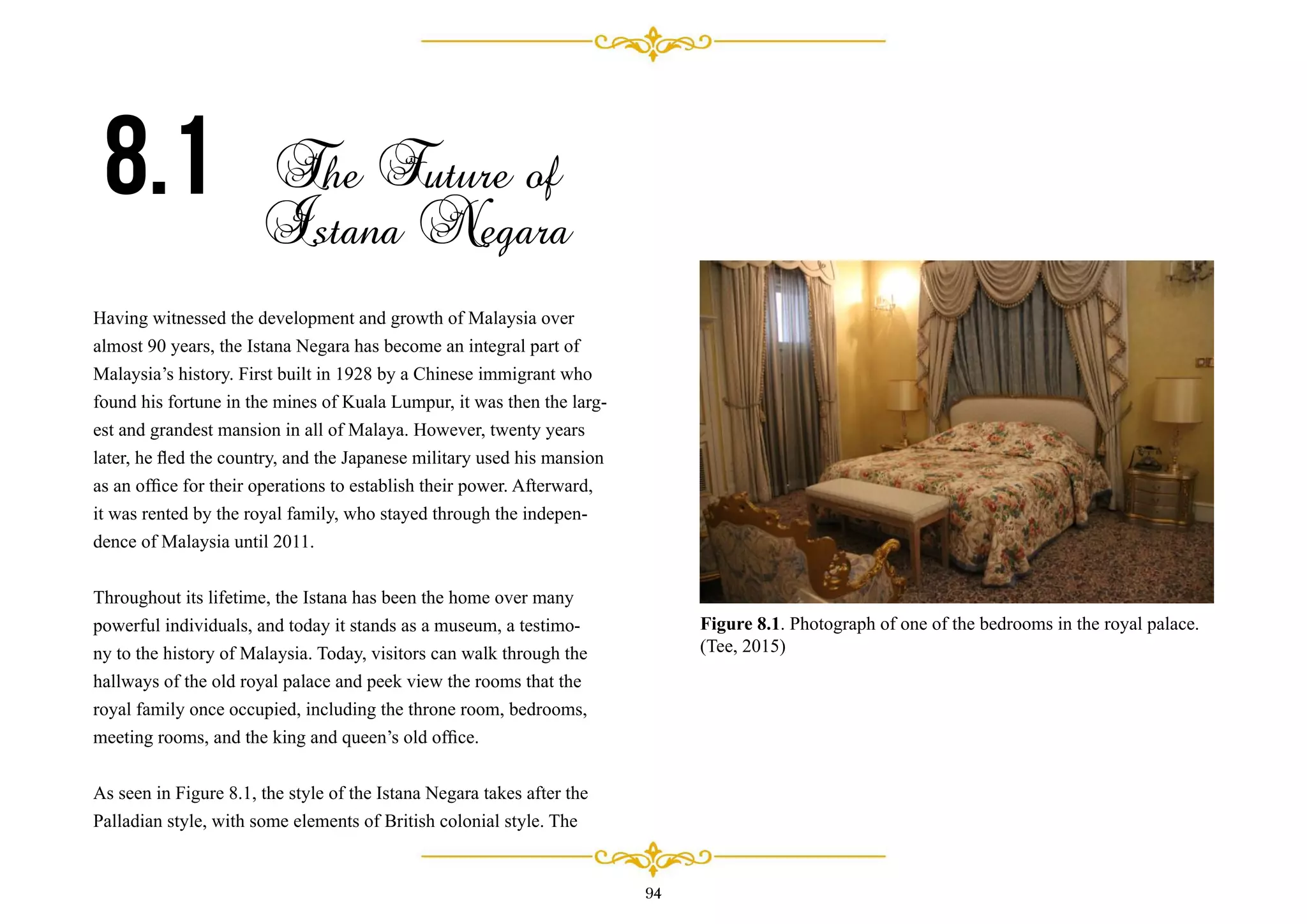
Photograph of one of the bedrooms in the royal pal-
ace. (Tee, 2015)
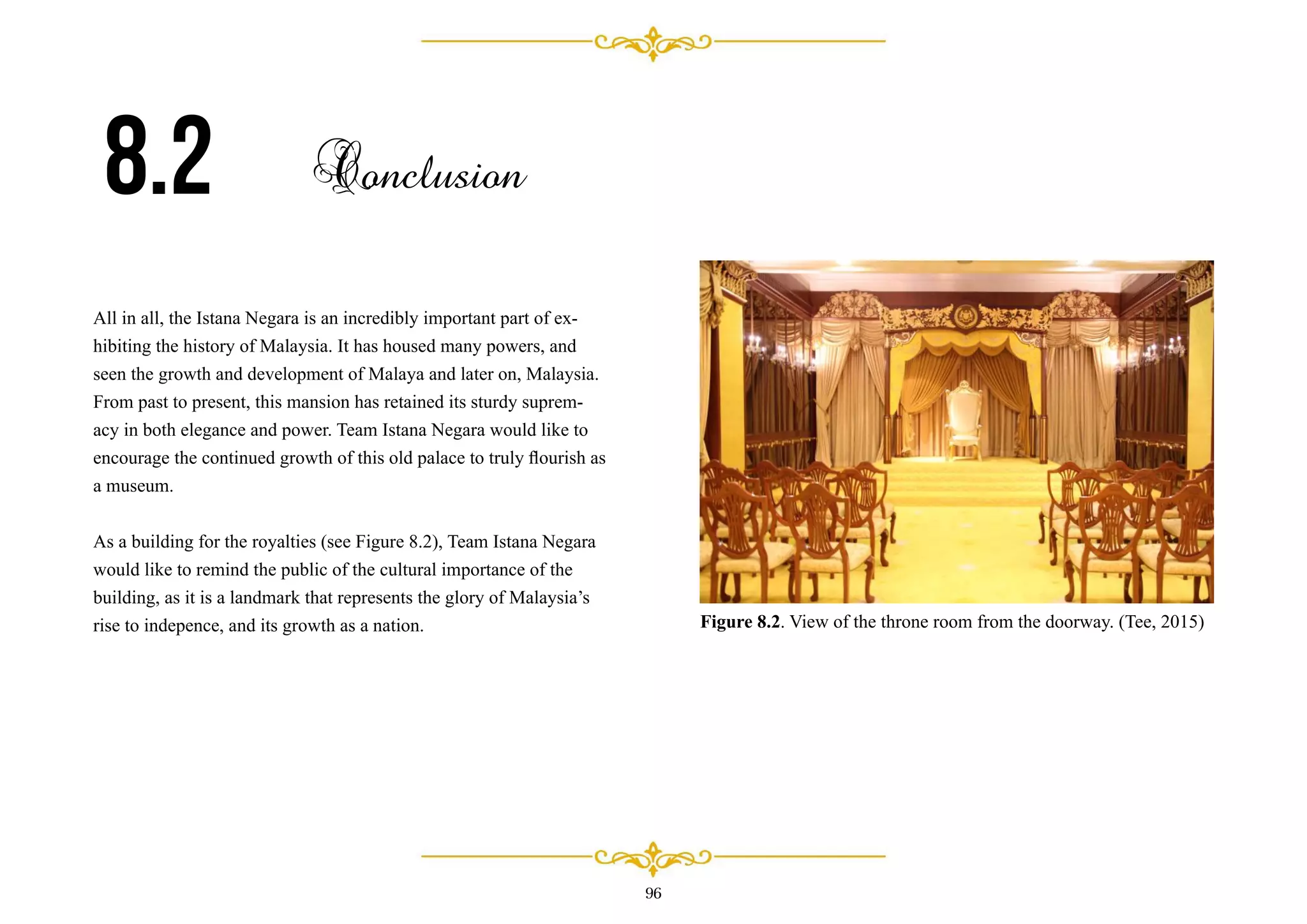
View of the throne room from the doorway. (Tee,
2015)
Figure 6.4
Figure 6.5
Figure 6.6
Figure 6.7
Figure 6.8
Figure 6.9
Figure 6.10
Figure 6.11
Figure 7.1
Figure 7.2
Figure 7.3
Figure 7.4
Figure 8.1
Figure 8.2
1
Chapter One
INTRODUCTION
2
The objective of this study is to obtain accurate measurements that
reflect of the current state of Istana Negara.
Team Istana Negara is required to produce floor plans, sections,
elevations and site plan. These drawings are scale drawings done
according to the existing heritage building on site. Also included is a
scaled model of the Istana Negara.
Team Istana is also required to produce a research paper to highlight
the history and design concept of the structure. Photographs that
exhibit the interior and the furniture of in the Istana Negara. (See
Figure 1.1)
The aim of this study is to become a credible source of information
regarding Istana Negara for both academic and conservational pur-
poses.
1.1Objectives and Aim
Figure 1.1. A vintage telephone found in the Queen’s office. (Yap,
2015)
3
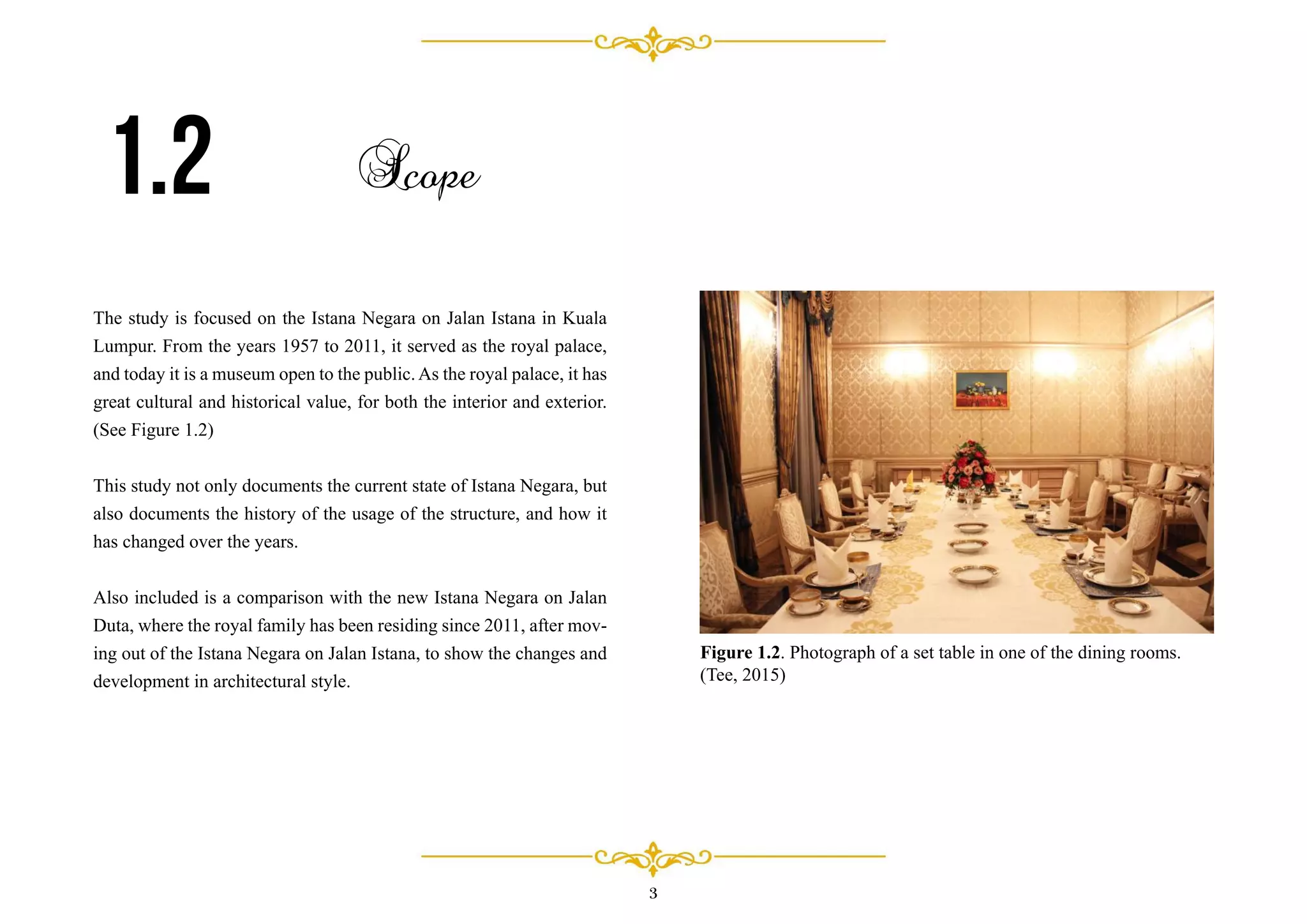
The study is focused on the Istana Negara on Jalan Istana in Kuala
Lumpur. From the years 1957 to 2011, it served as the royal palace,
and today it is a museum open to the public.As the royal palace, it has
great cultural and historical value, for both the interior and exterior.
(See Figure 1.2)
This study not only documents the current state of Istana Negara, but
also documents the history of the usage of the structure, and how it
has changed over the years.
Also included is a comparison with the new Istana Negara on Jalan
Duta, where the royal family has been residing since 2011, after mov-
ing out of the Istana Negara on Jalan Istana, to show the changes and
development in architectural style.
1.2 Scope
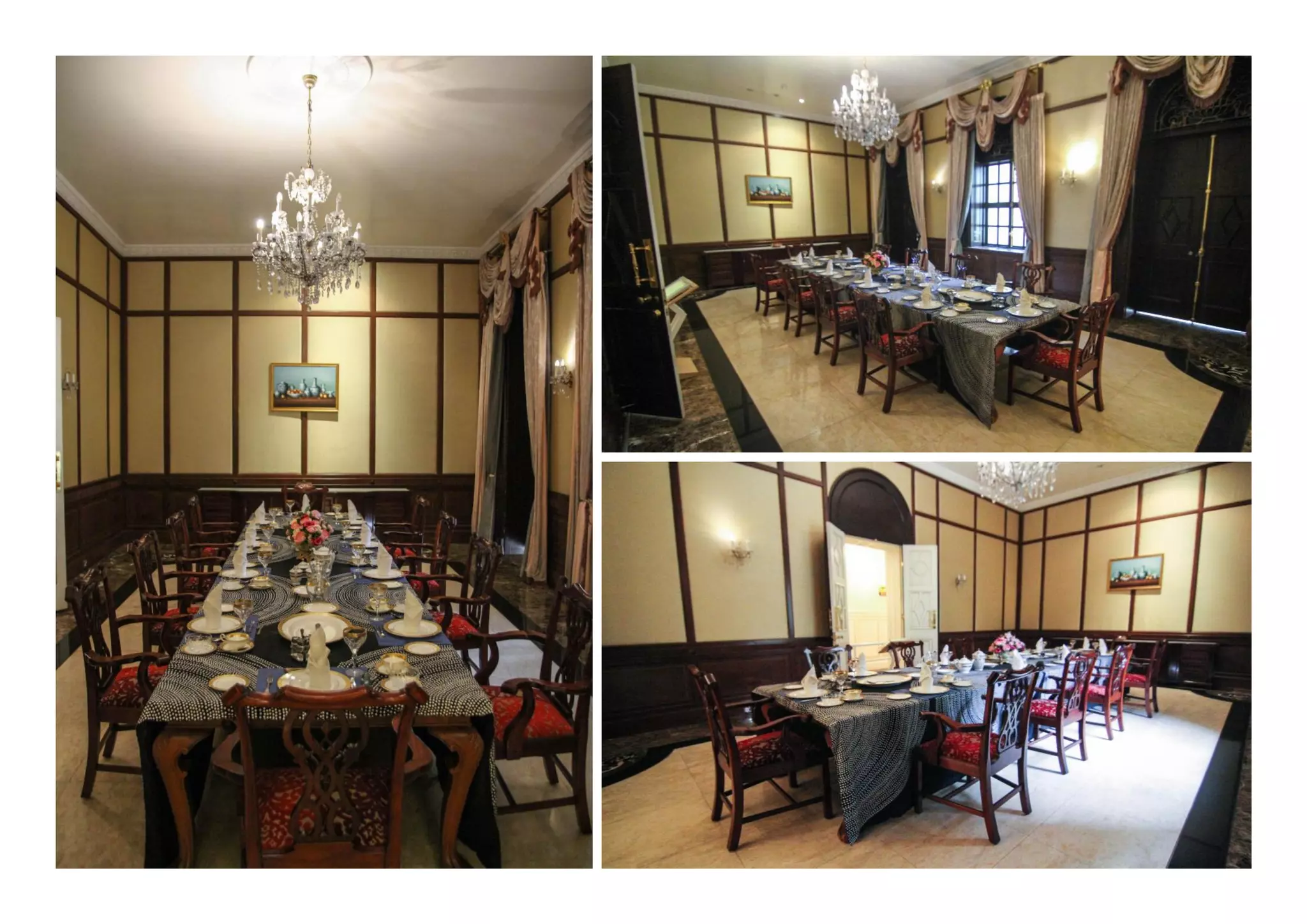
Figure 1.2. Photograph of a set table in one of the dining rooms.
(Tee, 2015)
The Istana Negara Lama is now open to the public, and has restricted
access to the rooms therefore allowing the public to only view the
rooms through the corridors. Thankfully we were allowed to access
the rooms that were otherwise off-limits to visitors. However, the Di-
rector of Istana Negara Museum placed a few restrictions our access
of the building. There were also some issues regarding usage of the
furniture inside the Istana Negara.
Due to the fact that the Istana Negara is currently open to the public,
the team still had to take into consideration the visitors and how they
viewed the palace, as well as how our presence would affect their
viewing.
Photographs and documentation of the structure is scarce from Chan
Wing’s time, despite the fact that in 1928, his mansion (now known
as Istana Negara) was the largest and most grand house in the whole
of Malaya. Documenting the building has focused more significantly
on the usage (royal events and ceremonies) rather than the actual ar-
chitecture of the structure. The original architecture firm, Swann and
1.3 Limitations
Maclaren has declined to share with us their original design of Chan
Wing’s mansion.
The Istana Negara has undergone several renovations since it was
first completed in 1928. However, full documentation of the details of
the renovations are not accessible by the public.
Documentation of the site including the garden, field, pool and so on,
is also very limited.
4
Several different methods were used to collect the data for complet-
ing the research and documentation of the Istana Negara. The team
is composed of a total of 39 students, who were then divided into
the following sub-groups: elevations group, floor plans group, sec-
tions group and site plan group (though the site plan group was also
charged with the responsibility of completing the report and video).
Each group operated under a sub-group leader who oversaw the prog-
ress of work, as well as collaborated with other groups to confirm the
accuracy of the measurements.
Measuring Methods
Although there are several different methods of measuring a whole
building, the team primarily utilized the use of a measuring tape, and
secondarily using a digital laser measuring device (see Figure 1.3).
The measuring tape was used mostly for smaller measurements, such
as floor area, walls, columns, details, and areas that are easily accessi-
ble. For further lengths, such as the ceiling height and so on, the team
would use the laser measuring device.
1.4 Methods of
Measurement
5
Figure 1.3. A member of Team Istana, Adrian Yap, using a piece of
equipment to measure the building. (Woo, 2015)
Research Methods
To document the historical, the cultural, and architectural aspect of
the Istana Negara on Jalan Istana, interviews were conducted with
both the Director of Istana Negara Museum as well as one of the
gardeners who has worked in the Museum for twenty years. The team
has also visited the National Library and the National Archive in Kua-
la Lumpur to search for information and photographs regarding the
Istana Negara. A lot of information has been obtained from online
books, journals, and websites as well.
Model-making Methods
Due to a combination between a tight time restraint and decorative
facade of our structure, Team Istana Negara made the decision to take
a risk and utilize the method of laser cutting. In order to make it a re-
ality, however, Team Istana Negara had to learn how to use software
and separate the design so that the cuttings could be done on isolated
wood panels. After the laser cutting was complete, Team Istana Neg-
ara had to carefully stick the pieces together to complete the model.
To obtain data on the façade too high and therefore inaccessible, the
team hired a crane to access the higher areas. This was more applica-
ble towards the elevation team, who had to obtain measurements from
areas too high up to access.
As an old building, some of the walls and such may not be levelled
correctly, or some of the corners may not be exactly 90 degrees, or
so on. To measure this, a set square was used to measure the angles
between the joining walls.
Measuring the details and ornamentation was tedious and incredibly
time consuming. Considering the short time period in which we were
given to obtain all the data, it was deemed more efficient to take a
photo of the detailing, along with documenting the main measure-
ments of the detail or ornament, and later inserting it into AutoCAD,
and scaling the photograph with the main measurements then.
Production of Drawings
The measurements that were obtained on-site were directly drafted
onto AutoCAD both on-site and off-site. After returning from the site,
members of the team returned to campus (Taylor’s University, Lake-
side Campus) to further discuss and draft the measured drawings on
AutoCAD. After the measurements have been documented in Auto-
CAD, the drawings are given the final touches, especially in terms of
standardizing the line weights and such between all the sub-groups
for the final submission.
6
Both measuring the building and documenting the measurements re-
quires some equipment to obtain data.
DLE 50 Professional Digital Laser Distance Meter
The DLE 50 Professional Digital Laser Distance Meter from Bosch
was used to conduct the measurements of some of the less accessible
distances. As an expensive piece of equipment, this digital laser mea-
suring device was used with utmost care. For example, to measure the
height of the ceiling from the floor in a room at one point, the device is
placed on the floor, with the laser transmitter facing the ceiling. After
correcting the settings, the measurement of the distance between the
floor and ceiling will appear digitally on the screen. (See Figure 1.4)
Standard Measuring Tape
This was the primary piece of equipment used in the measurement
of the building. It is a common instrument that can be bought at any
hardware store. For longer distances, the cloth measuring tape was
used. (See Figure 1.5)
1.5 Equipment Used
7
Figure 1.5 Example of a standard measuring tape. (Caulfield Indus-
trial, 2015)
Figure 1.4 Image of Bosch DLE 50 Professional Digital Laser Dis-
tance Meter. (All Tools Direct, 2015)
8
Adjustable Set Square
These were used to measure the angles of parts of the building that
may not have been exactly straight. For example, if the connection
between two joining walls is not exactly 90 degrees, the set square
would have been used to measure the difference.
Geometric Quadrant Plumb Bob
This piece of equipment is used to measure the levels of the building.
It is a quarter of a circle, with 90 degrees. It can be used to measure
the angles of acute corners, as well as levelling. The plumb bob is
hung from above to observe the levels. The usage is shown in Figure
1.6.
Crane
The team also hired a crane to secure access to higher areas on the
building that are not accessible by a ladder. To make sure the team
was utilizing the crane correctly and safely, the owner of the crane
was present.
Ladder
There were a few ladders on-site, brought personally by different
members of the team. The ladders are approximately 5 feet in height,
and allowed access to the ceilings and higher areas. Anything higher
would require the crane. Unlike the crane, the ladder could be used
for the interior. There was always one person to hold the ladder se-
curely for safety purposes.
Figure 1.6. One of the team members, Adrian Yap, using the Geo-
metric Quadrant Plumb Bob. (Woo, 2015)
Stationery
To record the measurements, paper, pens, pencils, erasers and rulers
were used. This allowed for sketching and visual documentation of
the items and spaces that were being documented.
DSLR Cameras
Several team members visually documented the spaces, the details,
the façade, the furniture and the genius loci and so on with Profes-
sional Digital Single Lens Reflex cameras.
Laptops and AutoCAD
The documented measurements were inserted into AutoCAD draw-
ings for the final submission. In AutoCAD, the line weights are edited
and standardized between all the sub-groups. Of course, AutoCAD is
a piece of software that is only accessible through a laptop.
9
The Istana Negara on Jalan Istana has become an important part of
the history of Malaysia. As an example of the growing wealth and a
foreshadowing of the future development of Kuala Lumpur, it was
built in 1928 as a mansion of a Chinese man named Chan Wing for
his extensive family.
From 1941 to 1943, it was occupied by the Japanese military. By
then, Chan Wing had fled Malaya. Afterward, it was the home of the
royal family until 2011.
This structure has always been the home of powerful people, and has
witnessed the great development of Malaya and later on, Malaysia.
The literature review emphasizes the importance of knowledge on
history and theory.
The key figure of this study is the most recent ownership of this build-
ing and its current state as a museum. In addition, the study of the
spaces in this building, the culture aspects, and the site context are
selected for the writings. Books, articles, journals and other physical
1.6 Literature Review
publications provide information on the historical background of Ma-
laya and Malaysia, more specifically, Kuala Lumpur through these
times. They also provide information on the architecture style during
the time. Information was mainly obtained from online material, the
National Archive and the National Library.
10
The purpose of this project is to emphasize the importance of the Ista-
na Negara on Jalan Istana in the history of Malaysia. The palace are
witnessed the growth and development of Kuala Lumpur, Malaysia
from 1928 to the present. As the house of powerful people at different
times, this mansion has become an integral part of the history of Ma-
laysia as it is today.
This study aims to analyze further the culture, politics and economics
that surround the palace itself, as well as how it characterizes Malay-
sia through the times. Figure 1.7 exhibits the extravagant culture and
lifestyle of the royal family.
By sketching, drawing, measuring and documenting the building on-
site enabled the students to develop more appreciation towards both
the palace itself as well as Malaysia’s history.
1.6 Significance of
Study
Figure 1.7 View of royal dishes and cutlery, laid out for a meal.
(Tee, 2015)
11
12
Chapter Two
HISTORICAL BACKGROUND
During the late 18th and 19th centuries, Great Britain established
colonies and protested in the area of current Malaysia; these were
occupied by Japan from 1942 to 1945. In 1948, the British-ruled ter-
ritories on the Malay Peninsula formed the Federation of Malaya,
which became independent in 1957. Malaysia was formed in 1963
when the former British colonies of Singapore and the East Malay-
sian states of Sabah and Sarawak, located on the northern coast of
Borneo, joined the Federation (see Figure 2.1). The first several years
of the country’s history were disfigured by several events, such as the
Communist insurgency, Indonesian confrontation with Malaysia, the
Philippine claims to Sabah, and Singapore’s secession from the Fed-
eration in 1965. During the 22-year term of Prime Minister Mahathir
bin Mohamad (1981-2003), Malaysia was successful in diversifying
its economy from dependence on exports of raw materials to expan-
sion in manufacturing, services, and tourism.
2.1 History of
Malaysia and
Kuala Lumpur
Figure 2.1 Malaysia’s Independence day ceremony in Merdeka Sta-
dium, August 31st 1957.
13
Independence to the Present: 1957- Now
Malaya’s independence brought about new decisions that needed to
be made, the first of which being to ascertain which territories to in-
clude in the new state. “Malaysia” was a term brought up in 1961,
when the appointed Tunku at the time persuaded Singapore, Sabah
and Sarawak to combine with Malaya in a federal union. This did not
go over well with the Indonesian president Sukharno, who feared the
impact of such a union on his plans to expand the Indonesian borders.
He later initiated several unsuccessful attacks against Malaysia.
As Malaysia is comprised of a very diverse mix of people, another
problem the country faced post-independence was determining the
national identity. Although the majority of the population was Malay
and as such they were given permanent positions in government and
other perks, the Chinese were dominant in business and trade. Since
most Malaysian’s were not doing well economically, the government
imposed some quotas that were designed to help the Malays improve
their chances economically. The Chinese didn’t like this and formed
a political party that won a number of seats in the following elections
in 1969. The Malays protested this political win by erupting into riots
throughout Kuala Lumpur, which for the next couple of years resulted
in placing Malaysia in a state of turmoil.
Malaysia has made tremendous strides in their growth and wealth.
Prime Minister Mahathir bin Mohammed, who has led Malaysia since
1981, is felt to be responsible for a majority of Malaysia’s success.
History of Kuala Lumpur
In the 19th century, the area where KL now lies was an important
settlement for the tin-industry. Because of the important work of Yap
Ah Loy, the city grew from a settlement to an eventual city. The end
of the 19th century was harsh on Kuala Lumpur, as at this time the
city was tormented by disasters and adversity. Diseases, epidemics,
fires and floods plagued the city with high consistancy. During this
period people began to build stone houses instead of wooden houses.
This was also the period in which the first railroads was constructed.
Some people believe that it was not Yap Ah Loy, but Raja Abdullah,
who founded Kuala Lumpur, since Raja Abdullah had allegedly sent
miners to look for tin in the region years before Yap Ah Loy arrived
in the area now called Kuala Lumpur.
14
InAugust 1957, having rejected the suggested title of Yang di-Pertuan
Besar in favour of Yang di-Pertuan Agong, the Council of Rulers met
to elect the first occupant of the throne. By seniority, the 84-year-old
major general Sultan Ibrahim, Sultan of Johor since 1895, was first
in line, but he declined due to old age. Sultan Abu Bakar, Sultan of
Pahang since 1932, despite being next in line for the throne following
Sultan Ibrahim, was rejected five times by his fellow electors, and
did not secure the necessary votes. Tuanku Abdul Rahman of Negeri
Sembilan, having been elected to his state throne in 1933, was even-
tually elected, with eight votes in favour of him against one opposing
vote.
2.2 History of
Royalty
in Malaysia
List of Yang di-Pertuan Agongs in Malaysia since 1957
Figure 2.2 Yang di-Pertuan Agong Pertama
Al-Marhum Tuanku Rahman Ibni Al-Mar-
hum Tuanku Muhammad
State: Negeri Sembilan
Period: 3 Ogos 1957 – 1 April 1960
Figure 2.3 Yang di-Pertuan Agong Kedua
Al-Marhum Tuanku Hisamuddin Alam Shah
Al-Haj Ibni Al-Marhum Sultan Alaiddin
Sulaiman Shah
State: Selangor
Period: 14 April 1960- 1 September 1960
Figure 2.4 Yang di-Pertuan Agong Ketiga
Al-Marhum Tuanku Syed Putra ibni
Al-Marhum Syed Hassan Jamalullail
State: Perlis
Period: 21 September 1960 – 20 September
1965
15
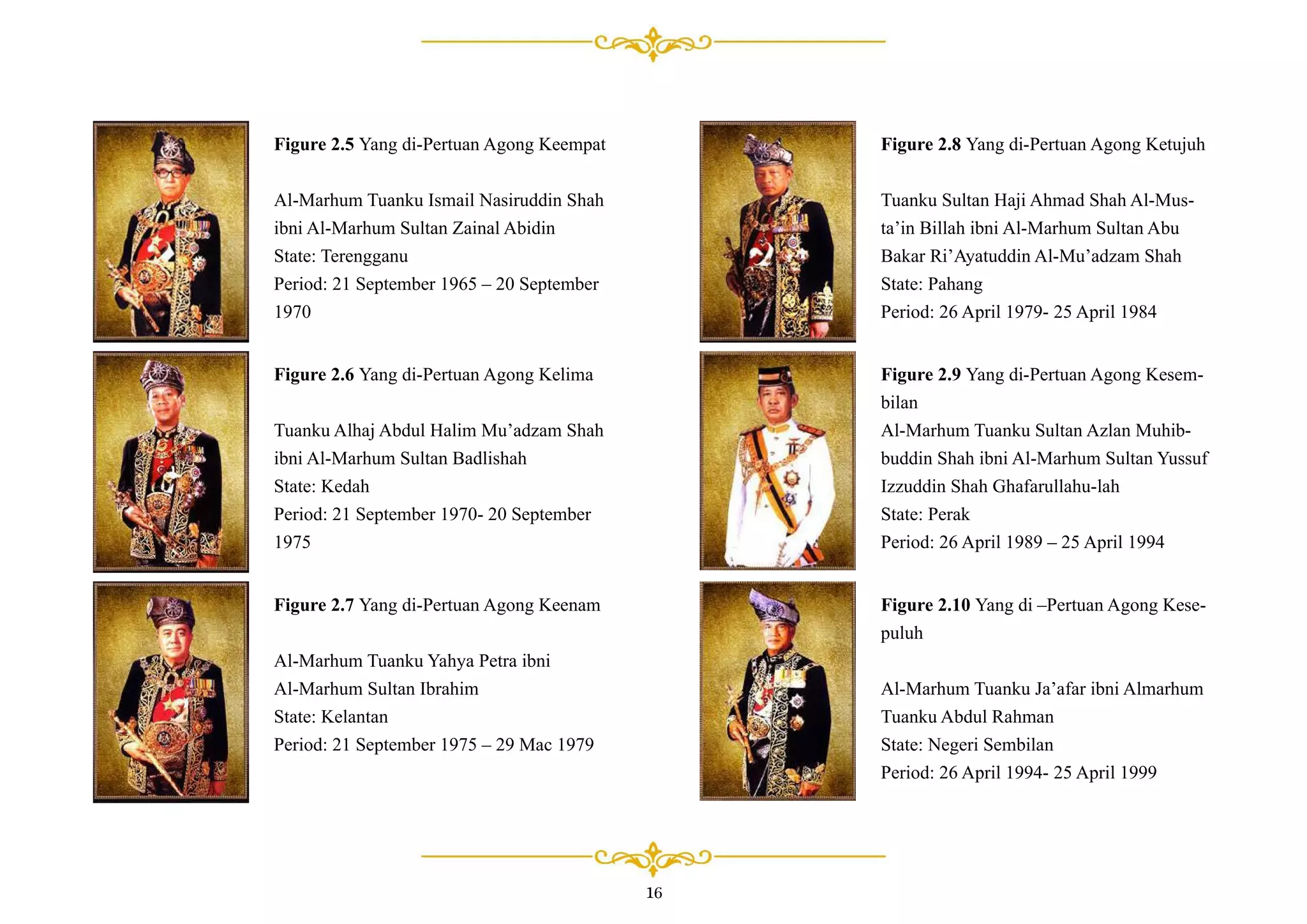
Figure 2.5 Yang di-Pertuan Agong Keempat
Al-Marhum Tuanku Ismail Nasiruddin Shah
ibni Al-Marhum Sultan Zainal Abidin
State: Terengganu
Period: 21 September 1965 – 20 September
1970
Figure 2.6 Yang di-Pertuan Agong Kelima
Tuanku Alhaj Abdul Halim Mu’adzam Shah
ibni Al-Marhum Sultan Badlishah
State: Kedah
Period: 21 September 1970- 20 September
1975
Figure 2.7 Yang di-Pertuan Agong Keenam
Al-Marhum Tuanku Yahya Petra ibni
Al-Marhum Sultan Ibrahim
State: Kelantan
Period: 21 September 1975 – 29 Mac 1979
Figure 2.8 Yang di-Pertuan Agong Ketujuh
Tuanku Sultan Haji Ahmad Shah Al-Mus-
ta’in Billah ibni Al-Marhum Sultan Abu
Bakar Ri’Ayatuddin Al-Mu’adzam Shah
State: Pahang
Period: 26 April 1979- 25 April 1984
Figure 2.9 Yang di-Pertuan Agong Kesem-
bilan
Al-Marhum Tuanku Sultan Azlan Muhib-
buddin Shah ibni Al-Marhum Sultan Yussuf
Izzuddin Shah Ghafarullahu-lah
State: Perak
Period: 26 April 1989 – 25 April 1994
Figure 2.10 Yang di –Pertuan Agong Kese-
puluh
Al-Marhum Tuanku Ja’afar ibni Almarhum
Tuanku Abdul Rahman
State: Negeri Sembilan
Period: 26 April 1994- 25 April 1999
16
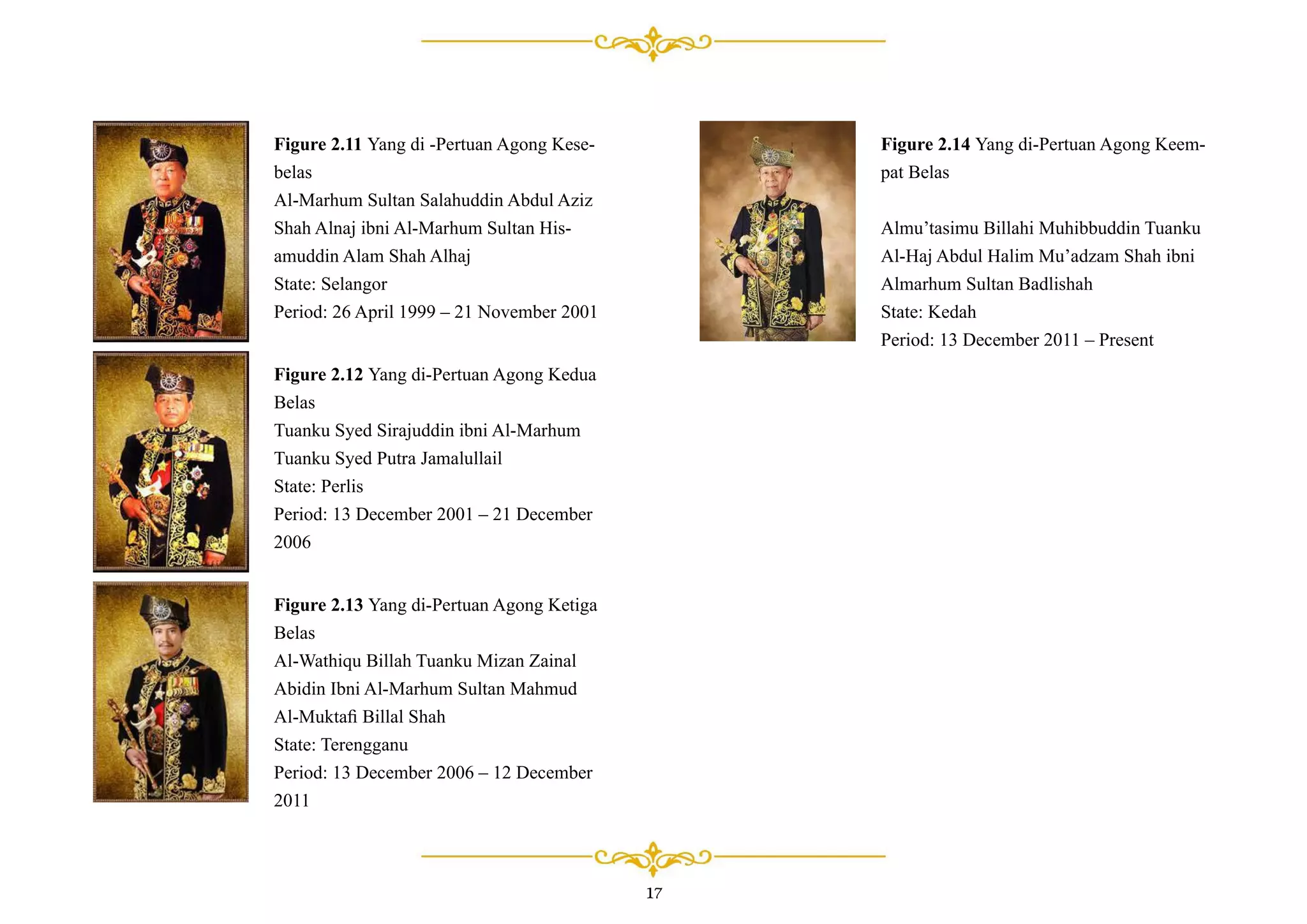
Figure 2.11 Yang di -Pertuan Agong Kese-
belas
Al-Marhum Sultan Salahuddin Abdul Aziz
Shah Alnaj ibni Al-Marhum Sultan His-
amuddin Alam Shah Alhaj
State: Selangor
Period: 26 April 1999 – 21 November 2001
Figure 2.12 Yang di-Pertuan Agong Kedua
Belas
Tuanku Syed Sirajuddin ibni Al-Marhum
Tuanku Syed Putra Jamalullail
State: Perlis
Period: 13 December 2001 – 21 December
2006
Figure 2.13 Yang di-Pertuan Agong Ketiga
Belas
Al-Wathiqu Billah Tuanku Mizan Zainal
Abidin Ibni Al-Marhum Sultan Mahmud
Al-Muktafi Billal Shah
State: Terengganu
Period: 13 December 2006 – 12 December
2011
Figure 2.14 Yang di-Pertuan Agong Keem-
pat Belas
Almu’tasimu Billahi Muhibbuddin Tuanku
Al-Haj Abdul Halim Mu’adzam Shah ibni
Almarhum Sultan Badlishah
State: Kedah
Period: 13 December 2011 – Present
17
The “Istana Negara” means the “national palace”. Each individual
state in Malaysia has its own royal family, meaning that every state
has its own history of residential palaces for the royalty in that state.
The Istana Negara of this study is located in Kuala Lumpur, Malaysia.
2.3 History of
the Istana
18
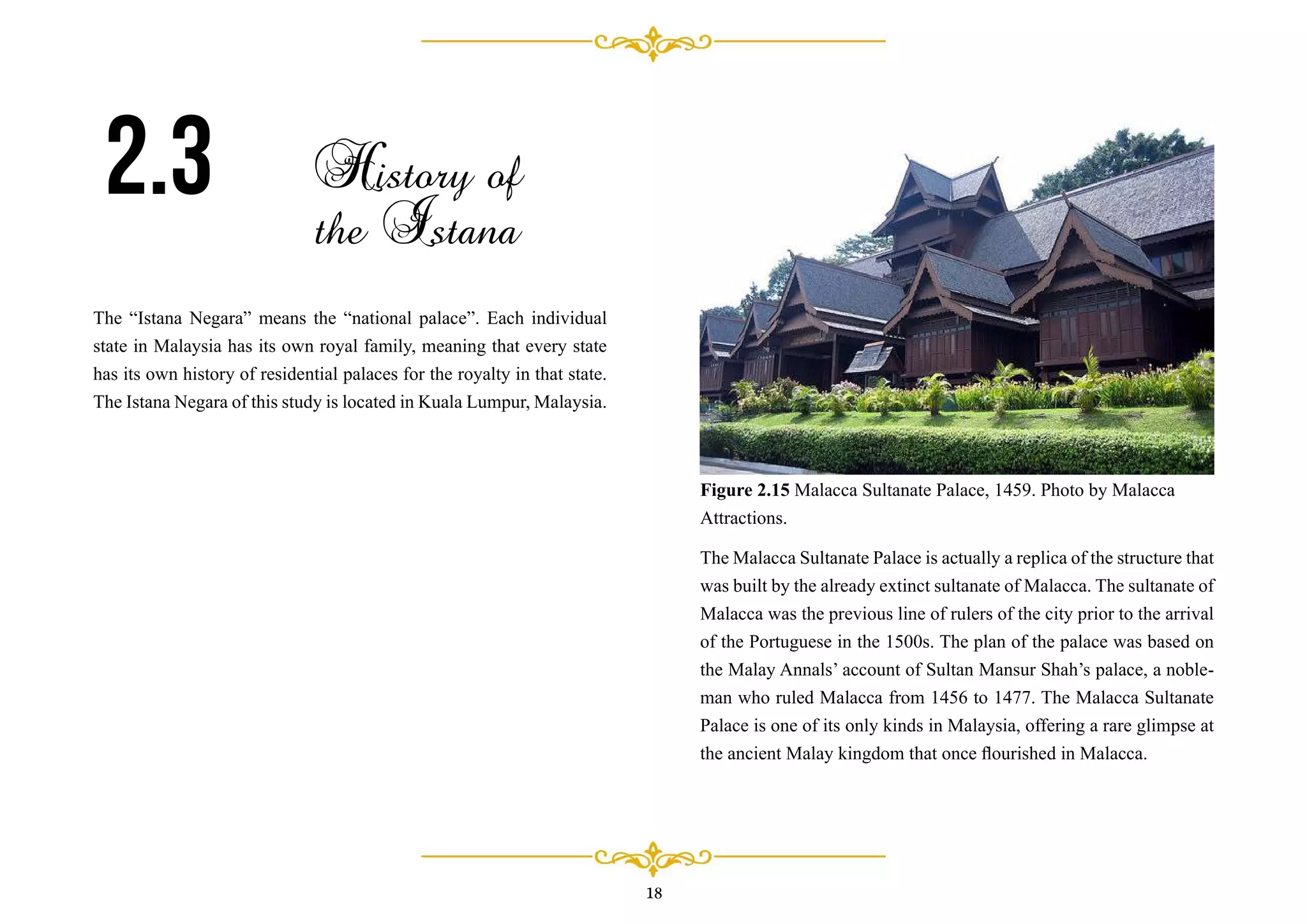
The Malacca Sultanate Palace is actually a replica of the structure that
was built by the already extinct sultanate of Malacca. The sultanate of
Malacca was the previous line of rulers of the city prior to the arrival
of the Portuguese in the 1500s. The plan of the palace was based on
the Malay Annals’ account of Sultan Mansur Shah’s palace, a noble-
man who ruled Malacca from 1456 to 1477. The Malacca Sultanate
Palace is one of its only kinds in Malaysia, offering a rare glimpse at
the ancient Malay kingdom that once flourished in Malacca.
Figure 2.15 Malacca Sultanate Palace, 1459. Photo by Malacca
Attractions.
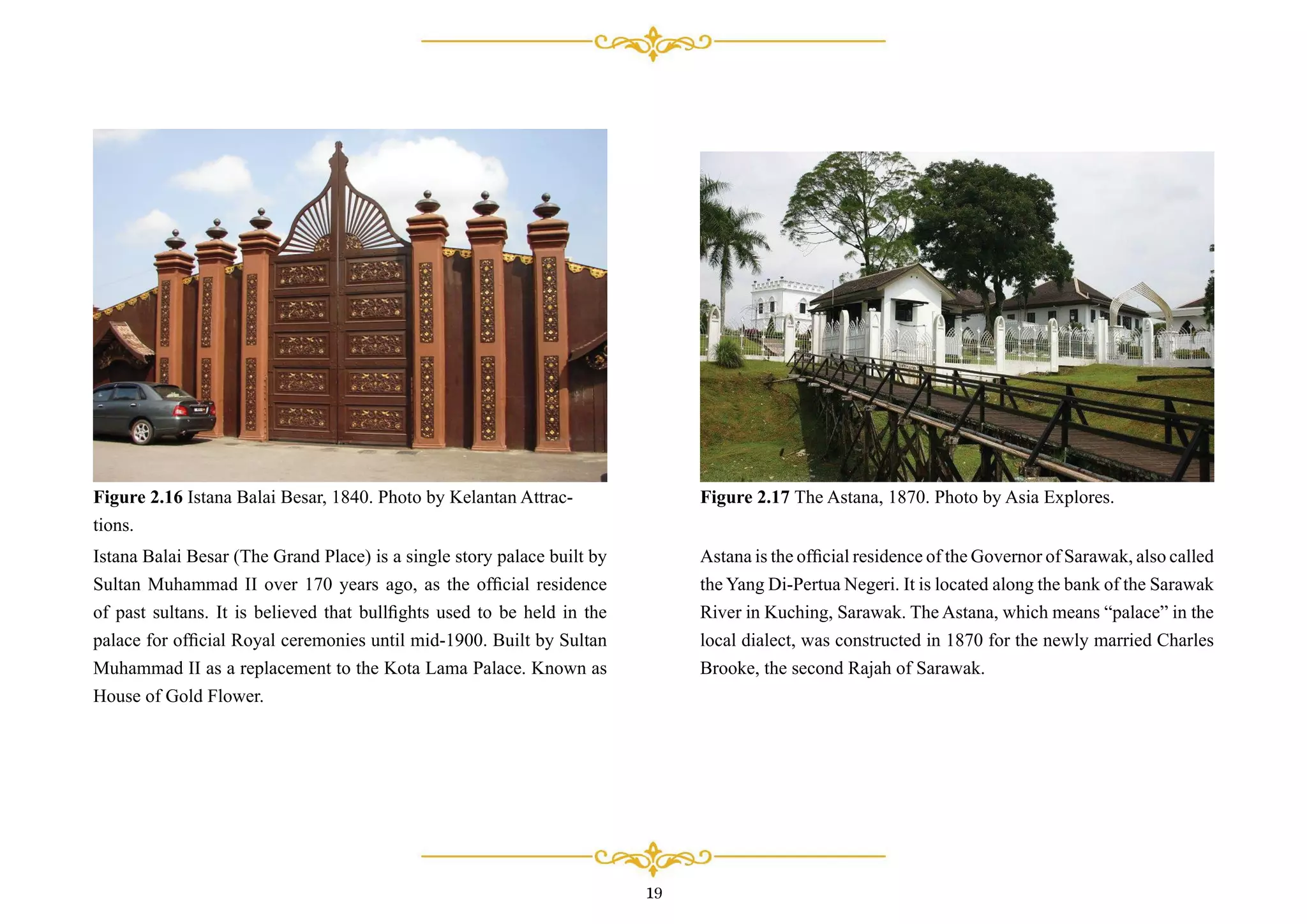
Istana Balai Besar (The Grand Place) is a single story palace built by
Sultan Muhammad II over 170 years ago, as the official residence
of past sultans. It is believed that bullfights used to be held in the
palace for official Royal ceremonies until mid-1900. Built by Sultan
Muhammad II as a replacement to the Kota Lama Palace. Known as
House of Gold Flower.
Figure 2.16 Istana Balai Besar, 1840. Photo by Kelantan Attrac-
tions.
Astana is the official residence of the Governor of Sarawak, also called
the Yang Di-Pertua Negeri. It is located along the bank of the Sarawak
River in Kuching, Sarawak. The Astana, which means “palace” in the
local dialect, was constructed in 1870 for the newly married Charles
Brooke, the second Rajah of Sarawak.
Figure 2.17 The Astana, 1870. Photo by Asia Explores.
19
Istana Balai Besar is located in the heart of Kota Bharu. Sultan Mu-
hammad II who reigned from 1839 to 1886 built the old palace in
1842-1844. The castle was built on a land area of 1.6 hectares. Istana
Balai Besar was established to replace the Old Palace , which is lo-
cated on the island of Saba near the east bank of Sungai Kelantan that
were eroding its banks because of floods that occur every year . These
Saba city is the seat of government of the Sultanate of Kelantan in the
period before 1842 . It is the oldest Palace building in Selangor Darul
Ehsan which is still existing.
Figure 2.18 Istana Jugra, 1875. Photo by Asia Explores.
Istana Jahar (Jahar Palace) is built by Sultan Muhamad II in 1887 for
his grandson Long Kundur. Following the demise of Sultan Muham-
mad II in 1886, the Kelantan State throne was replaced by Long Su-
long which reigned with the was continued until its completion. It has
luxurious woodcarvings that showcase the excellent craftsmanship of
the Kelantanese. Now houses the Museum of Royal Traditions and
Ceremonies.
Figure 2.19 Istana Jahar, 1887. Photo by Asia Explores.
20
One of the palaces which still remains intact to this day is the Istana
Lama Seri Menanti. Being lavishly unique and picturesque, the pal-
ace is also known as the icon of the Negeri Sembilan royal family.
The breathtaking panorama of the area became the reason of its being
made a place to live and an administrative centre of the Kings of Neg-
eri Sembilan of yesteryear. Magnificent palaces with their intricate
carvings were built here as the residence for the Yang di- Pertuans.
Figure 2.20 Istana Sri Menanti, 1908. Photo by Asia Explores.
Istana Kenangan, which now houses the Royal Museum, was built
in 1926 by a Malay craftsman by the name of Encik Sopian and his
two sons, Zainal Abidin and Ismail, from Bukit Mertajam. The palace
was built on the decree of the late Sultan Iskandar as a temporary res-
idence while waiting for Istana Iskandariah to be completed. Prior to
that, the Sultan resided in Istana Negara, which had been demolished
to make way for Istana Iskandariah.
Figure 2.21 Istana Kenangan, 1926. Photo by Arkib Government.
21
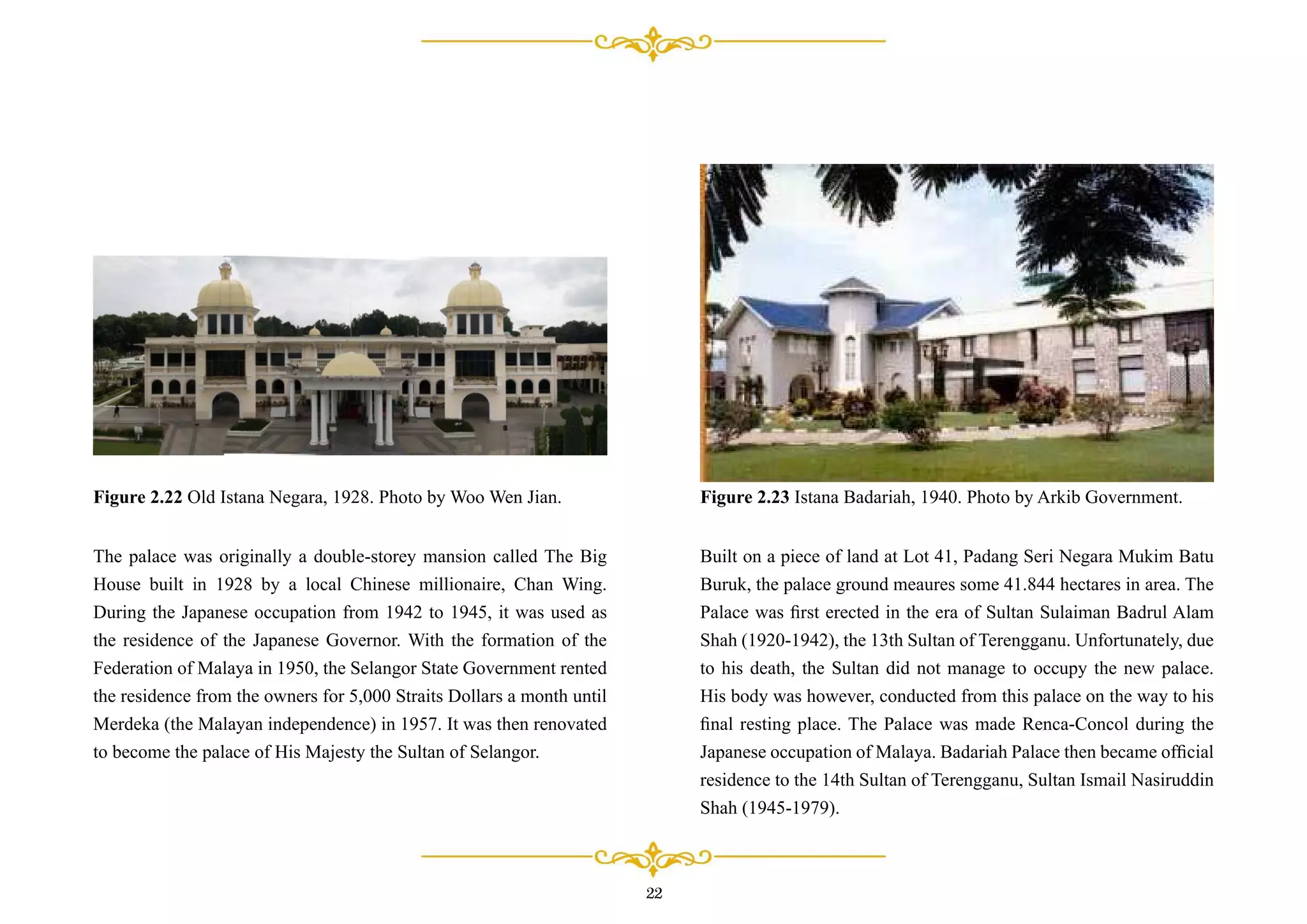
The palace was originally a double-storey mansion called The Big
House built in 1928 by a local Chinese millionaire, Chan Wing.
During the Japanese occupation from 1942 to 1945, it was used as
the residence of the Japanese Governor. With the formation of the
Federation of Malaya in 1950, the Selangor State Government rented
the residence from the owners for 5,000 Straits Dollars a month until
Merdeka (the Malayan independence) in 1957. It was then renovated
to become the palace of His Majesty the Sultan of Selangor.
Figure 2.22 Old Istana Negara, 1928. Photo by Woo Wen Jian.
Built on a piece of land at Lot 41, Padang Seri Negara Mukim Batu
Buruk, the palace ground meaures some 41.844 hectares in area. The
Palace was first erected in the era of Sultan Sulaiman Badrul Alam
Shah (1920-1942), the 13th Sultan of Terengganu. Unfortunately, due
to his death, the Sultan did not manage to occupy the new palace.
His body was however, conducted from this palace on the way to his
final resting place. The Palace was made Renca-Concol during the
Japanese occupation of Malaya. Badariah Palace then became official
residence to the 14th Sultan of Terengganu, Sultan Ismail Nasiruddin
Shah (1945-1979).
Figure 2.23 Istana Badariah, 1940. Photo by Arkib Government.
22
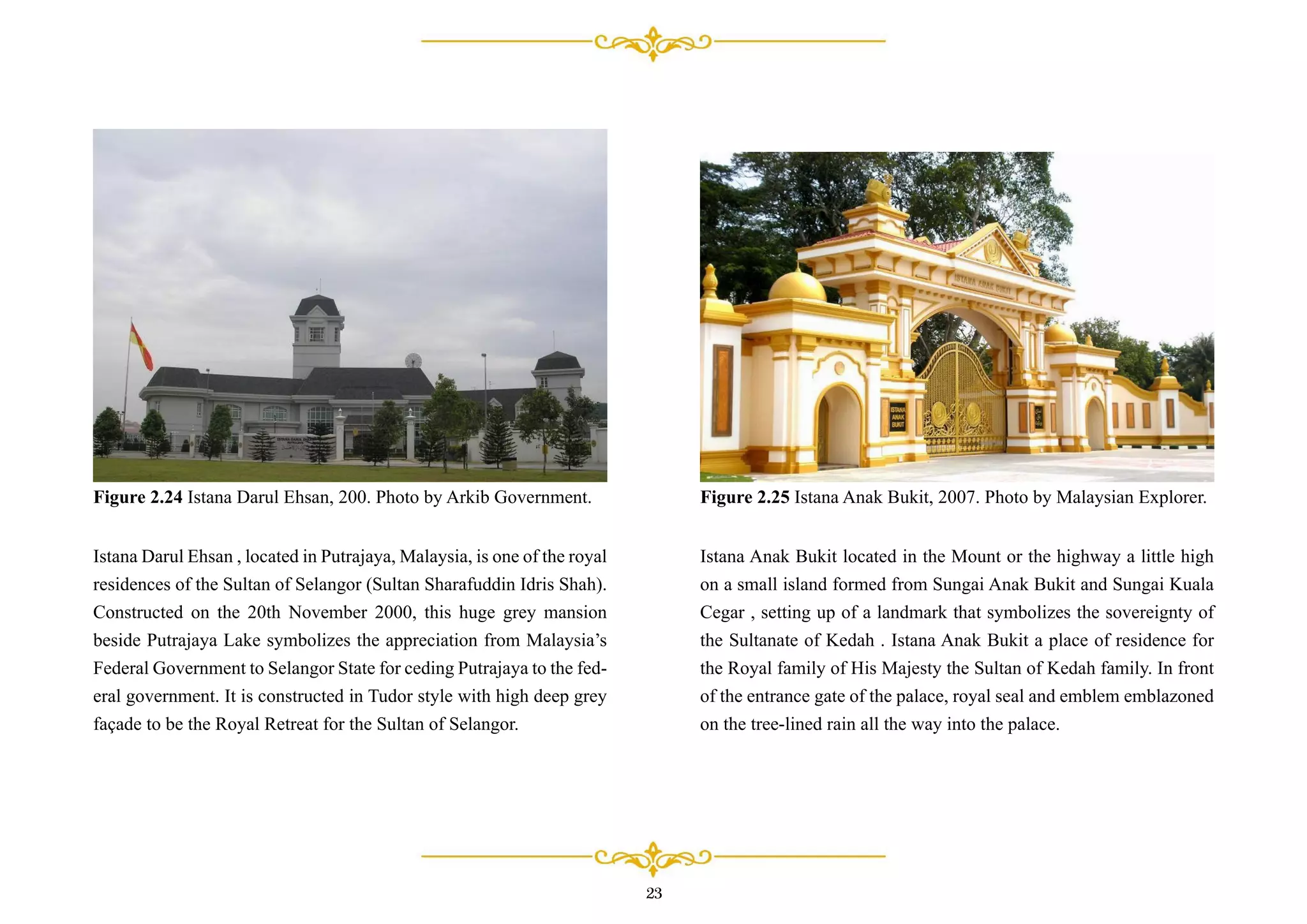
Istana Darul Ehsan , located in Putrajaya, Malaysia, is one of the royal
residences of the Sultan of Selangor (Sultan Sharafuddin Idris Shah).
Constructed on the 20th November 2000, this huge grey mansion
beside Putrajaya Lake symbolizes the appreciation from Malaysia’s
Federal Government to Selangor State for ceding Putrajaya to the fed-
eral government. It is constructed in Tudor style with high deep grey
façade to be the Royal Retreat for the Sultan of Selangor.
Figure 2.24 Istana Darul Ehsan, 200. Photo by Arkib Government.
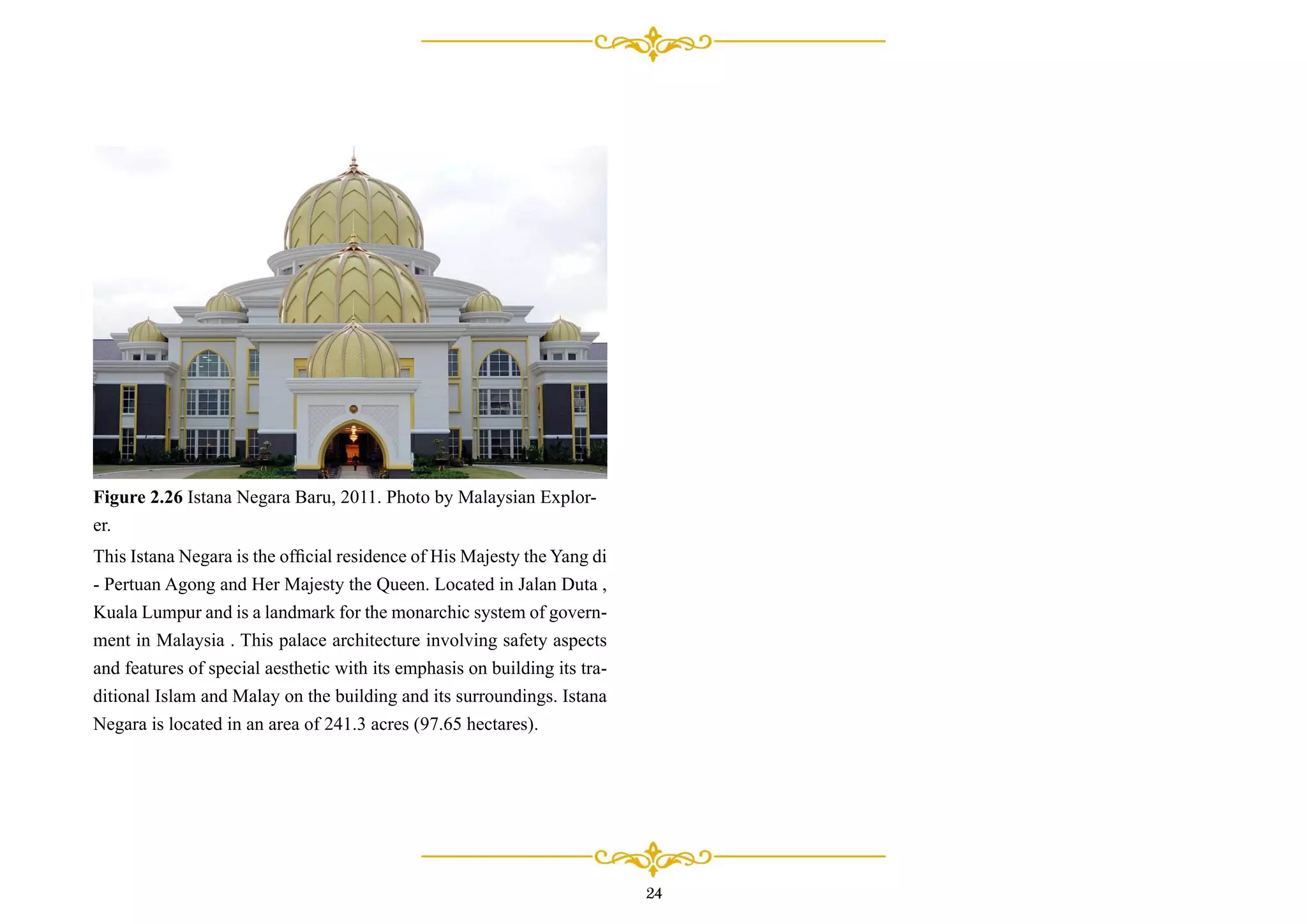
Istana Anak Bukit located in the Mount or the highway a little high
on a small island formed from Sungai Anak Bukit and Sungai Kuala
Cegar , setting up of a landmark that symbolizes the sovereignty of
the Sultanate of Kedah . Istana Anak Bukit a place of residence for
the Royal family of His Majesty the Sultan of Kedah family. In front
of the entrance gate of the palace, royal seal and emblem emblazoned
on the tree-lined rain all the way into the palace.
Figure 2.25 Istana Anak Bukit, 2007. Photo by Malaysian Explorer.
23
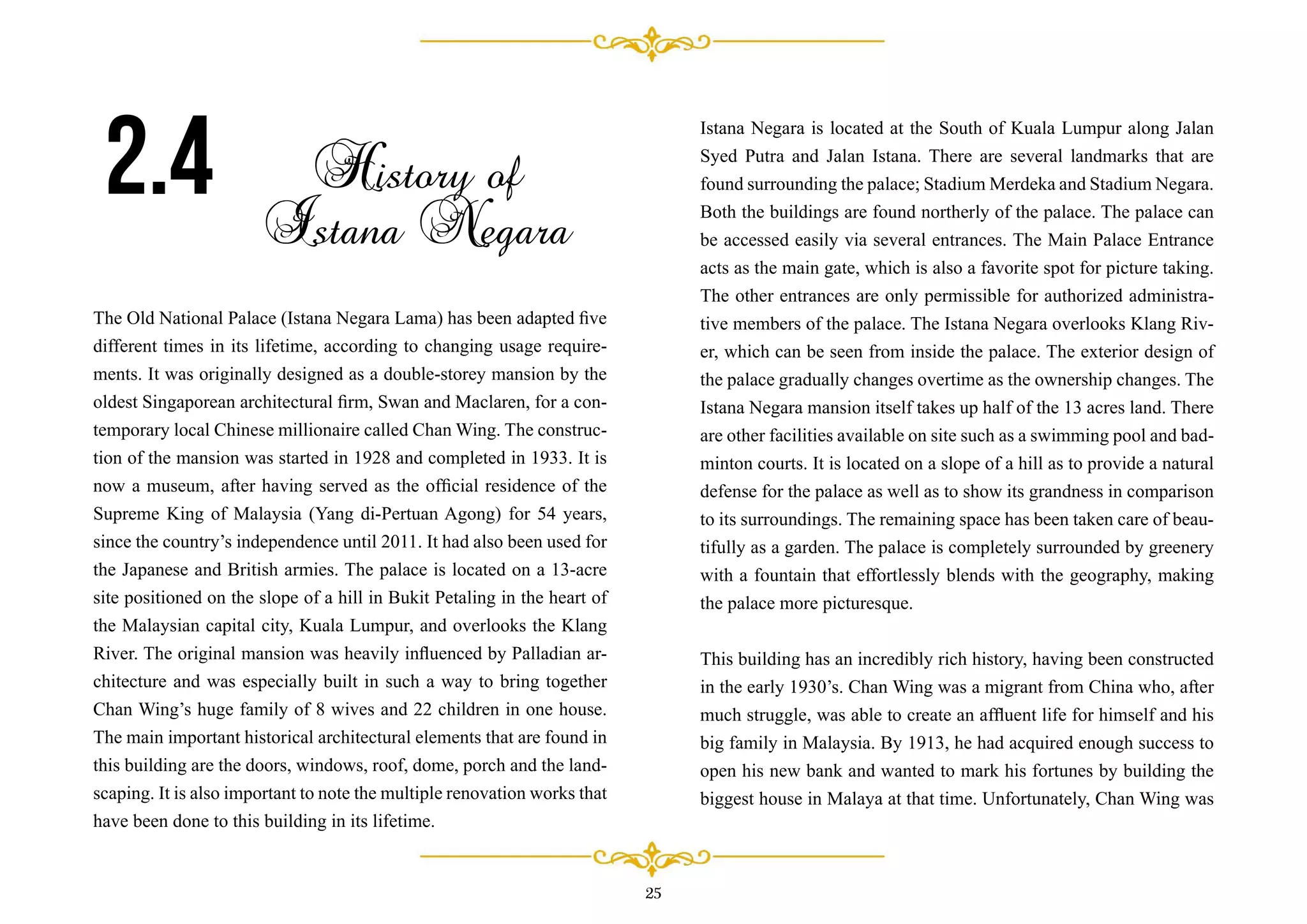
This Istana Negara is the official residence of His Majesty the Yang di
- Pertuan Agong and Her Majesty the Queen. Located in Jalan Duta ,
Kuala Lumpur and is a landmark for the monarchic system of govern-
ment in Malaysia . This palace architecture involving safety aspects
and features of special aesthetic with its emphasis on building its tra-
ditional Islam and Malay on the building and its surroundings. Istana
Negara is located in an area of 241.3 acres (97.65 hectares).
Figure 2.26 Istana Negara Baru, 2011. Photo by Malaysian Explor-
er.
24
The Old National Palace (Istana Negara Lama) has been adapted five
different times in its lifetime, according to changing usage require-
ments. It was originally designed as a double-storey mansion by the
oldest Singaporean architectural firm, Swan and Maclaren, for a con-
temporary local Chinese millionaire called Chan Wing. The construc-
tion of the mansion was started in 1928 and completed in 1933. It is
now a museum, after having served as the official residence of the
Supreme King of Malaysia (Yang di-Pertuan Agong) for 54 years,
since the country’s independence until 2011. It had also been used for
the Japanese and British armies. The palace is located on a 13-acre
site positioned on the slope of a hill in Bukit Petaling in the heart of
the Malaysian capital city, Kuala Lumpur, and overlooks the Klang
River. The original mansion was heavily influenced by Palladian ar-
chitecture and was especially built in such a way to bring together
Chan Wing’s huge family of 8 wives and 22 children in one house.
The main important historical architectural elements that are found in
this building are the doors, windows, roof, dome, porch and the land-
scaping. It is also important to note the multiple renovation works that
have been done to this building in its lifetime.
2.4 History of
Istana Negara
Istana Negara is located at the South of Kuala Lumpur along Jalan
Syed Putra and Jalan Istana. There are several landmarks that are
found surrounding the palace; Stadium Merdeka and Stadium Negara.
Both the buildings are found northerly of the palace. The palace can
be accessed easily via several entrances. The Main Palace Entrance
acts as the main gate, which is also a favorite spot for picture taking.
The other entrances are only permissible for authorized administra-
tive members of the palace. The Istana Negara overlooks Klang Riv-
er, which can be seen from inside the palace. The exterior design of
the palace gradually changes overtime as the ownership changes. The
Istana Negara mansion itself takes up half of the 13 acres land. There
are other facilities available on site such as a swimming pool and bad-
minton courts. It is located on a slope of a hill as to provide a natural
defense for the palace as well as to show its grandness in comparison
to its surroundings. The remaining space has been taken care of beau-
tifully as a garden. The palace is completely surrounded by greenery
with a fountain that effortlessly blends with the geography, making
the palace more picturesque.
This building has an incredibly rich history, having been constructed
in the early 1930’s. Chan Wing was a migrant from China who, after
much struggle, was able to create an affluent life for himself and his
big family in Malaysia. By 1913, he had acquired enough success to
open his new bank and wanted to mark his fortunes by building the
biggest house in Malaya at that time. Unfortunately, Chan Wing was
25
infamous for having contributed towards the China War and would
have been possibly targeted by the Japanese invaders. (Chan Wing)
His portrait is shown in Figure 2.27. He fled Malaysia and the man-
sion was used as the residence of the Japanese. Three years later, the
British occupied Malaya. During this time, they commanded the man-
sion for a senior military officers mess. In 1950, the Selangor govern-
ment rented the residence from the British and renovated it to become
the palace for the Sultan of Selangor. A few months before the Inde-
pendence of Malaysia was declared, the Federal Government bought
over the mansion at a cost of RM1.4m, converting it as the National
Palace. The palace saw many renovation and upgrading works, the
main being the addition of a whole new building (annexed) unit in
1980.In 2007, the construction of the new Istana Negara began. It
only took four years for the majestic new building to be completed.
Now the original Istana Negara is open to the public as a nostalgic
icon of the unique Malaysian monarchy.
Location of Istana Negara
Istana Negara is located at the South of Kuala Lumpur along Jalan
Syed Putra and Jalan Istana. There are a few landmarks that surround
the palace, the most notable ones being Stadium Negara and Stadium
Merdeka, which are both located north of the palace. The palace is
accessible through several points of entry. The main gate acts as the
Main Palace Entrance, which is also a favorite spot for tourist pic-
ture taking. The other entrances are only permissible for authorized
administrative members of the palace. The Istana Negara also over-
26
Figure 2.27 Mr. Chan Wing’s portrait. (Chan Wing)
looks the Klang River – a view visible from inside the palace. The
building itself takes up half of the 13 acres land and has its exterior
design gradually changing as ownership changes overtime. Other fa-
cilities available on site are a swimming pool, and badminton courts.
As a show of grandeur and to provide a natural defense, the palace
is located on a slope of a hill. The remaining space has been taken
care of beautifully as a garden. The palace’s ground is covered with
many plants and trees with a fountain feature that naturally blends
with the landscape, creating a very picturesque scene. Figure 2.28 and
Figure 2.29 are photographs of the Istana Negara in 1940 and 1956,
respectively, and the difference between them and Figure 2.30 is very
notable.
2.4.1 Ownership
About Chan Wing
A Chinese Immigrant who built Istana Negara, Chan Wing was born
in 1873 in the Xin Hui District, Pearl River Delta, Canton (Guang
Zhou). He arrived in Malaya at the age of 14 in 1887. He had a total
of 22 children with 8 wives. (Chan Wing) Being a staunch believer in
the teachings of Confucious, he and many other chinese men of their
times took multiple wives to carry on the family lineage. He first lived
in a house on Weld Road (the present Jalan Raja Culan) upon arriving
in KL with his family, and also became the richest and most success-
ful man in KL after the opening of the Hong Fatt Tin Mine in 1897 at
Figure 2.30 Photo of the current physical state of Istana Negara.
(Woo, 2015)
Figure 2.28 Photo of Istana
Negara before the first renova-
tions in 1940. (Choong)
Figure 2.29 Photo of Istana
Negara in 1956. (Choong)
27
the age of 24, in Sungai Besi (known as The Mines now). Afterwards,
Chan Wing ventured into rubber plantations and also opened a bank,
Kwong Yik Bank Corporation, in 1913. As Weld House became too
small for his growing family, Chan Wing purchased a 13 acres piece
of land and contacted the well known architecture firm Swann & Ma-
claren to design “the biggest house in Malaya”. The building was
completed in 1928 and he lived there until the second World War in
1941 when the Japanese invaded Malaya. Chan Wing had to leave
Malaya, as he was known to be one of the biggest contributors of the
China War Relief Fund, which placed him high on the wanted list of
the Japanese Imperial Army. He and his family fled to Cameron, and
then onwards to Mussorie in India and other countries to wait for the
war to end until March 1946. He later passed away 1947 at the age of
74. (Chan Wing)
Introduction to Istana Negara
The Old National Palace (Istana Negara Lama) has been altered as
many as five different times throughout its lifetime, in accordance
to its constantly- changing usage requirements. It was initially de-
signed as a double-storey mansion for the contemporary local Chi-
nese millionaire Chan Wing by the oldest Singaporean architectural
firm, Swan and Maclaren. The construction of the mansion started in
1928 and finished in 1933, but it has undergone several renovations
(See Figure 2.31). Since the country’s independence in 1957, until
2011, it has served as the official residence of the Supreme King of
Malaysia (Yang di-Pertuan Agong). It is now preserved and displayed
Figure 2.31 The then Prime Minister of Malaysia overlooking the
renovation works. (Choong)
28
29
as a museum. It has also been used previously by the Japanese and
British armies during times of conflict. The palace is situated on a 13-
acre site placed on the slope of a hill in Bukit Petaling in the middle
of the Malaysian capital city, Kuala Lumpur, overlooking the Klang
River. The initial building was highly influenced by Palladian archi-
tecture and was specially built and designed to accommodate Chan
Wing’s large family of 8 wives and 22 children, all in one house. The
main important historical-architectural elements that can be found in
this mansion are the windows, doors, dome, roof, landscaping and
its porch. There have also been multiple renovation and additions to
the structure since its original completion in 1933. (See Figure 2.31,
Figure 2.32 and Figure 2.33)
Timeline of Istana Negara
This building was constructed in the early 1930’s and has an exten-
sive and rich history. Chan Wing, a migrant from China, was able to
establish a prosperous and comfortable life for himself and his family
in Malaysia, despite many struggles. He had obtained so much suc-
cess in his wealth that by 1913 he opened a new bank, and had already
planned to build the biggest house in Malaya. Sadly, Chan Wing was
well-known for having a hand in aiding the Chinese, and would have
been most likely being targeted by the Japanese invaders during the
second World War; this caused him to flee from Malaysia, and the
Japanese consequently used the mansion he left behind as a residence.
The British occupied Malaya three years later and commandeered the
mansion as a senior military officer’s station. In 1950, the Selangor
Figure 2.31 The renovation and additional site plan of Old Istana
Negara. (Jabatan Penerangan, 1976)
Figure 2.32 The renovation and additional detailing plan of Old
Istana Negara. (Jabatan Penerangan, 1976)
government rented the residence from the British and renovated it to
become the palace for the Sultan of Selangor. The Federal Govern-
ment then bought over the building for RM 1.4 million, a few months
before Malaysia’s Independence Day. It was then converted into the
National Palace. A major renovation was undertaken in 1980 where
a whole new building (annexed) unit was added. Construction for a
new Istana Negara commenced in 2007 and took four years to com-
plete. Currently, the original Istana Negara is open to the public as a
nostalgic representation of the Malaysian monarchy.
Location of Istana Negara
Istana Negara is located at the South of Kuala Lumpur along Jalan
Syed Putra and Jalan Istana. There are a few landmarks that surround
the palace, the most notable ones being Stadium Negara and Stadium
Merdeka, which are both located north of the palace. The palace is
accessible through several points of entry. The main gate acts as the
Main Palace Entrance, which is also a favorite spot for tourist picture
taking. The other entrances are only permissible for authorized ad-
ministrative members of the palace. The Istana Negara also overlooks
the Klang River – a view visible from inside the palace. The building
itself takes up half of the 13 acres land and has its exterior design
gradually changing as ownership changes overtime. Other facilities
available on site are a swimming pool, and badminton courts. As a
show of grandeur and to provide a natural defense, the palace is lo-
cated on a slope of a hill. The remaining space has been taken care
of beautifully as a garden. The palace’s ground is covered with many
Figure 2.33 The renovation and additional detailing plan of Old
Istana Negara of the main gate in front. (Jabatan Penerangan, 1976)
30
plants and trees with a fountain feature that naturally blends with the
landscape, creating a very picturesque scene.
2.4.2 Renovations
In May 1957, a total of RM 328,000.00 was spent on the renova-
tion and redecoration of the palace (which was then 29 years old).
Sixty workers under the supervision of a local contractor started the
construction, bringing architect E. K. Dinsdale’s beautiful design to
reality. Additions to the building included seven bedrooms (giving
the palace 20 bedrooms altogether), four living rooms, a ‘balai meng-
adap’, a dining room and a kitchen that could serve up to 100 people.
Dinsdale’s design was successful in creating a majestic atmosphere,
with 350-square-yards of carpet adding grandeur to the majestic stair-
cases. Three thousand litres of paint was used to produce the carefully
chosen colour scheme. Wide ranges of colours starting from mimo-
sa yellow to the commodore blue were used in the interior of the
building, while white and grey were used in the exterior sections. It
took four months for the renovation work to complete, leavig just
one week before the Independence Day on August 31st, 1957. Due to
the increase of palace staff, an annexe was added four years later to
the east wing. Further improvements were made at Istana Negara in
1980, which included the erection of fences around the whole palace
grounds as well as two special guard posts at the main entrance. More
renovation took place in conjunction with the Crowning Ceremony of
31
the 7th Yang Di-Pertuan Agong where a two-storey building was add-
ed to the Istana for the purpose of accomodating a royal conference
room and the throne room (Balairong Seri). This newly built structure
is accessible through a closed passage on the second floor of the main
building.
32
Figure 2.34 Timeline of Chan Wing and the Istana Negara.
33
Chapter Three
Design Concept
34
The site context is compromised of three components, the hardscape
the softscape and teh external structures. The hardscape constitutes
the unnatural landscaping, such as the pavements, the curb and the
external staircases. The softscape includes vegetation and the natural
landscaping, and the external structures are the structures not includ-
ed in the main building of the Istana Negara.
3.1.1 Hardscape
Passageway (sidewalk, paved road)
The road of the Istana Negara from the side entrance passing through
the roundabout and reaching the main gate of the palace is made en-
tirely of square tiles. The white and grey coloured tiles helps to define
the space as both to define the edges and as part of the aesthetic. (See
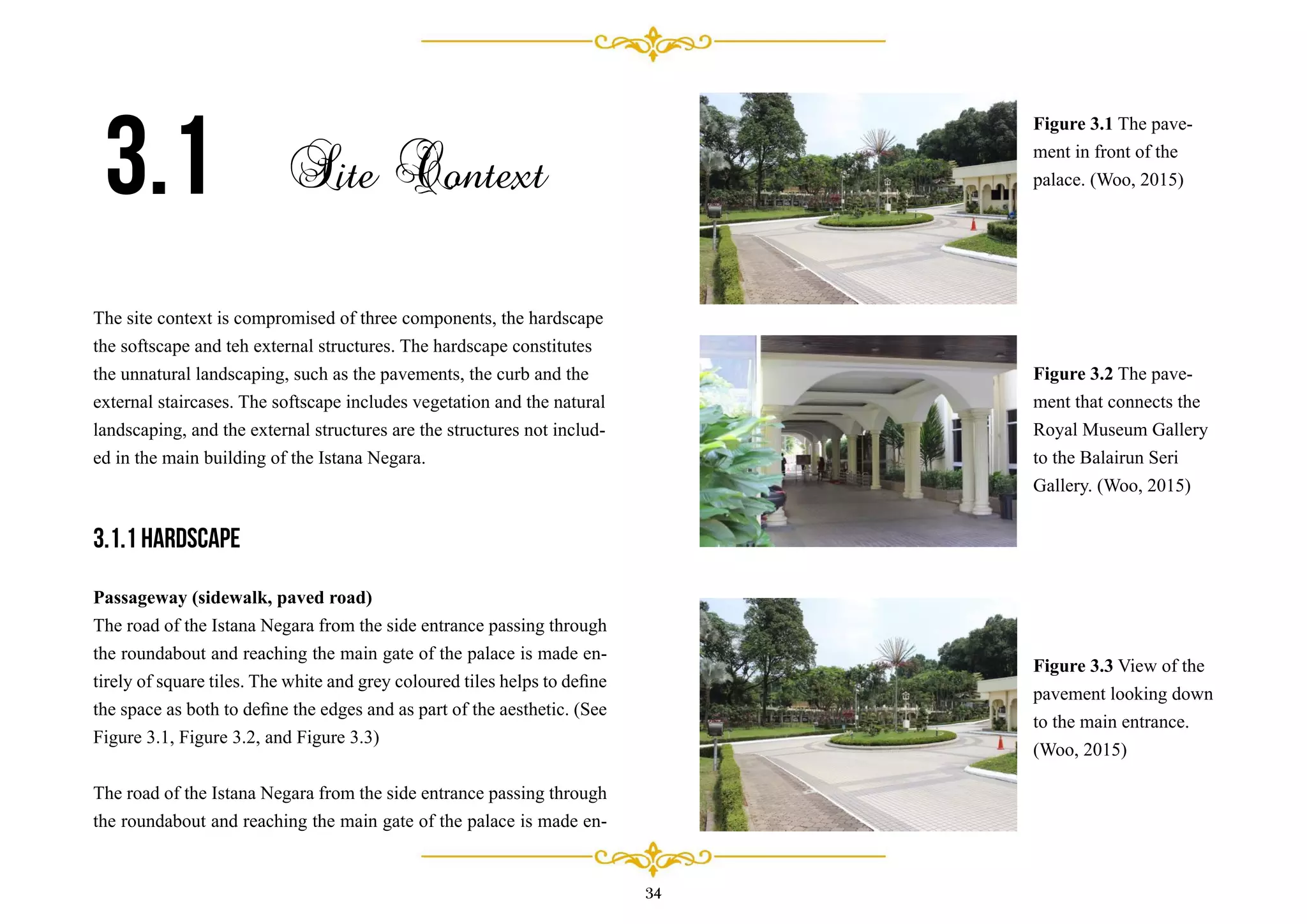
Figure 3.1, Figure 3.2, and Figure 3.3)
The road of the Istana Negara from the side entrance passing through
the roundabout and reaching the main gate of the palace is made en-
3.1 Site Context
Figure 3.1 The pave-
ment in front of the
palace. (Woo, 2015)
Figure 3.2 The pave-
ment that connects the
Royal Museum Gallery
to the Balairun Seri
Gallery. (Woo, 2015)
Figure 3.3 View of the
pavement looking down
to the main entrance.
(Woo, 2015)
35
tirely of square tiles. The white and grey coloured tiles helps to define
the space as both to define the edges and as part of the aesthetic.
Figure 3.2 shows the sidewalk which connects the Royal Museum
Gallery from the Balairung Seri Gallery. One can exit the ambassador
room from the Istana Negara and walk straight into the Balairung Seri
if you are on ground floor.
While the main palace buildings are mostly paved roads and tiles
roads, the gardens of the Istana Negara are concrete tiles arranged in
the same way as shown in Figure 3.4. These tiles help us keep a foot-
ing when traversing on the soil if there was rain.At different locations
there are also similar tiles which are arranged distinctly to indicate
different location but mostly serve the function of a foothold.
Planter Boxes
A planter box or flower box is an affixed vase which is usually placed
outdoors to display live plants and flowers. It is affixed to accessible
locations for the convenience of cleaning up the plants. The planter
boxes at the Istana Negara are all placed close to entrances and dis-
play very beautiful plants. Those at the Istana are made of concrete
and one has tiles as part of its design. (See Figure 3.5)
Curb
A curb is the edge whereby a pavement or sidewalk which is raised
meets a road which is unraised. Usage of curbs begun in the 18th
Figure 3.4 Example of
tiled pavements used in
the royal garden. (Woo,
2015)
Figure 3.5 Photograph
of a planter box out-
side the entrance of the
Istana Negara build-
ing. (Woo, 2015)
Figure 3.6 Photograph
of a curb on the tiled
pavement on the exte-
rior. (Woo, 2015)
century and has been part of modern architecture eveer since. The
curbs at the Istana are made of concrete and surrounds all walkways.
Recently, there were paintjobs to help keep it white to preserve the
cleanliness of the Istana. (See Figure 3.6)
Fountains
A fountain is an architectural element which pours water or ejects
water into the air to either supply water or mainly for decorative pur-
poses. Past fountains were functional which receives its water from
springs or aqueducts for drinking water or other purposes. These
fountains were manned by gravity but it lost its efficiency to mechan-
ical pumps which allowed fountains to recycle water and to force it
high into the air. The Istana Negara has these fountains incorporated
as part of its design and can be found all over the Istana Negara. Each
fountain is unique to its own as the design varies completely which
makes each having its own characteristics. These fountains, however,
are merely decorative. (See Figure 3.7 and Figure 3.8)
Retaining Walls
Retaining walls (seen in Figure 3.9) are walls which functions as a
soil restraint to unnatural slopes. They are bound to soils between two
different elevations often in terrain with undesirable slopes or man-
made hillside and overpasses. The retaining walls at the Istana Negara
were man-made to plant shrubs and plants and are a part of the design.
The materials used are stones which are arranged artistically.
36
Figure 3.7 Fountain directly outside the entrance to the Istana Nega-
ra building. (Woo, 2015)
Figure 3.8 Fountain in the lake
of the royal gardens. (Woo,
2015)
Figure 3.9 Retaining walls are
used to ensure the soil does not
move and cause damage. (Woo,
2015)
37
Barricades
Barricades are barriers which block the flow of traffic or passage in
its desired direction. These barricades were made for the purpose of
protection and have been around since the 80s’. The barricades at the
Istana Negara are built as a wall marking its huge territory and serve
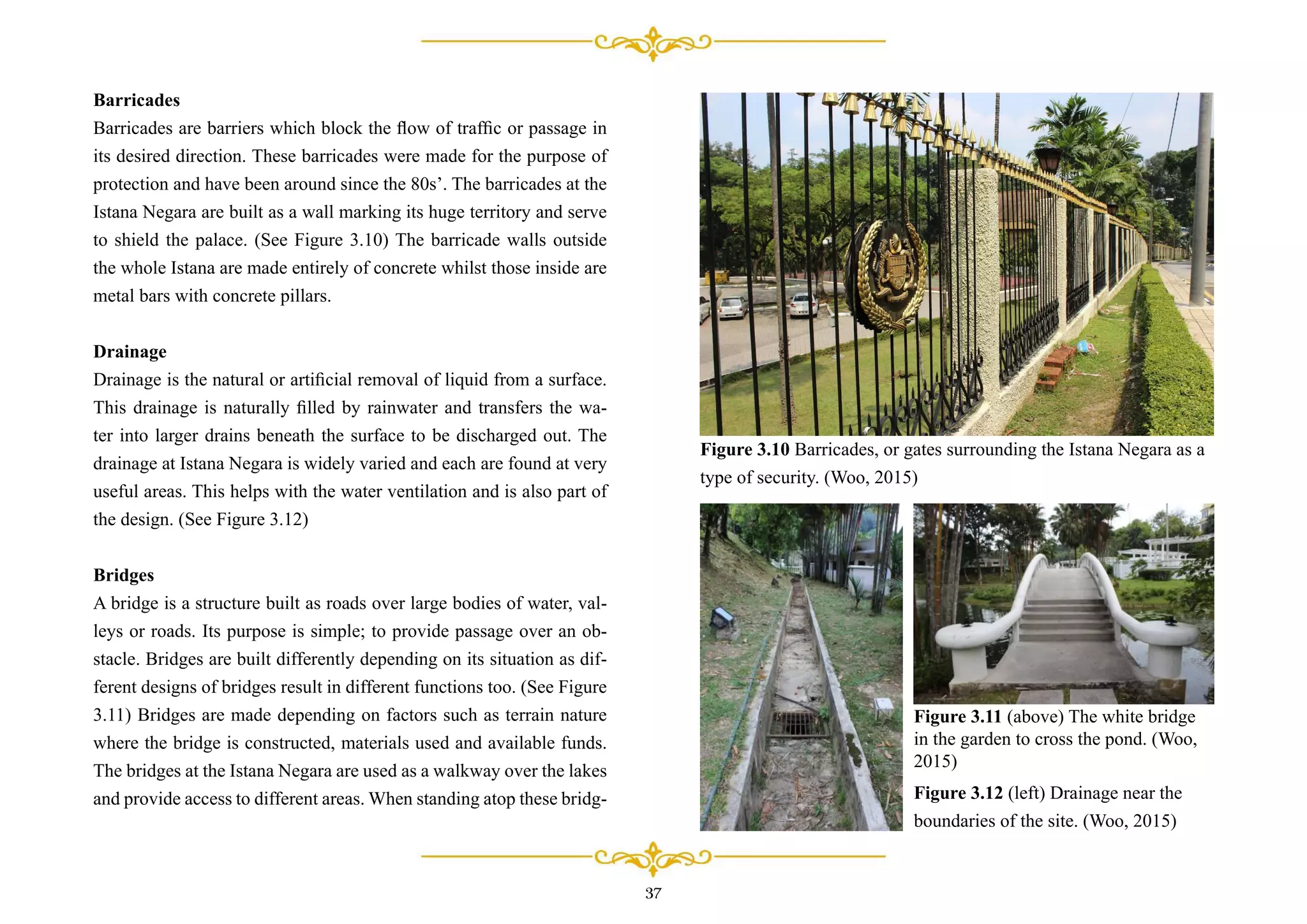
to shield the palace. (See Figure 3.10) The barricade walls outside
the whole Istana are made entirely of concrete whilst those inside are
metal bars with concrete pillars.
Drainage
Drainage is the natural or artificial removal of liquid from a surface.
This drainage is naturally filled by rainwater and transfers the wa-
ter into larger drains beneath the surface to be discharged out. The
drainage at Istana Negara is widely varied and each are found at very
useful areas. This helps with the water ventilation and is also part of
the design. (See Figure 3.12)
Bridges
A bridge is a structure built as roads over large bodies of water, val-
leys or roads. Its purpose is simple; to provide passage over an ob-
stacle. Bridges are built differently depending on its situation as dif-
ferent designs of bridges result in different functions too. (See Figure
3.11) Bridges are made depending on factors such as terrain nature
where the bridge is constructed, materials used and available funds.
The bridges at the Istana Negara are used as a walkway over the lakes
and provide access to different areas. When standing atop these bridg-
Figure 3.10 Barricades, or gates surrounding the Istana Negara as a
type of security. (Woo, 2015)
Figure 3.12 (left) Drainage near the
boundaries of the site. (Woo, 2015)
Figure 3.11 (above) The white bridge
in the garden to cross the pond. (Woo,
2015)
es, one can see a magnificent view of the lake and the water fountains
surrounded with nature’s beauty.
3.1.2 Softscape
Within the site boundaries, there are several different types of vege-
tation that make up the greenery that surrounds the whole structure.
Seeing as it was the royal palace, extra measures were taken to care
for few rarer species of plants. The main and therefore most plentiful
of the species make up majority of the garden. (See Figure 3.13)
Foxtail Palm (Wodyetia)
The Foxtail Palm is usually around 12 meters in height, and has a
grey coloured trunk. This tree has a flowering plan, and upward about
2-3 meters, the beautiful plumose leaves begin to grow. These scale
leaves are arranged in alternating decussate pairs, usually in four rows
along the twigs. (Dowl 1998)
Yew (TaxusBaccata)
This tree grows 10 to 20 meters in height, and its bark is scaly, thin
and brown, peeling off in small flakes that easily align with the stem
itself. The Yew’s leaves are flat and dark green in colour, and are ar-
ranged spirally on the stem, however the bases of the leaves twist to
align the leaves into two flat rows on either side of the stem. (Rush-
forth, 1999)
38
Figure 3.13 View of the royal garden, with the lake and white
bridge. (Tee, 2015)
Melaka Tree (Phyllanthus emblica)
The leaves on the Melaka tree are simple, sebsessile, and very closely
set together along the branchlets. They resemble pinnate leaves and
are light green in color. This deciduous tree’s height usually ranges
from 8 to 18 meters tall. The branchlets are quite glabrous or very
finely pubescent. It has a crooked trunk and spreading branches. (US
Department of Agriculture, 2008)
Perupok (Lepisanthes alata)
The Perupok’s inner bark tends to be a brownish colour, with pale
streaks or wedges, with a smell similar to ginger. This 10 meter tall
tree has flowers that will grow out of its main trunk, also known as
“cauliflory”. These flowers are coloured salmon pink, with narrow
linear petals that hang down. (Mohamad, 2003)
Thuja (Arborvitaes)
Growing relatively shorter at 3 to 6 meters tall, the Thuja is a beau-
tiful evergreen tree with reddish brown back that is stringy textured.
Its shoots are quite flat, while the shoots on the side grow in a single
plane. The leaves of this tree are arranged in alternating and decussate
pairs in four rows along the twigs. (Gadek, 2000)
Open Field
Afield is an area of land which are used either in agriculture or merely
an expanse of open ground. Figure 3.14 shows the field at the Istana
Figure 3.14 The open field in front of the Istana Negara structure.
(Woo, 2015)
39
Negara actually fall under the category of a lawn whereby the area of
land are planted with grass and other plants which are all maintained
at a short height. This are utilised as both aesthetic and recreational
purposes. Mass prayers would often be held here, with the Sultan
leading the people in prayer, especially for religious occassions.
3.1.3 External Structures
Balairung Seri
The Balairung Seri Gallery or the throne hall gallery is located in the
East Wing of the palace.. The gallery which was built in the 1980s
was used for His Majesty, the Yang di-Pertuan Agong, and Her Maj-
esty, the Raja Permaisuri Agong to hold official ceremonies. These
include the taking of royal pledge, installation ceremony of a new
elected King and appointments for new prime ministers. The gallery
is also an area to accept foreign diplomatic appointments and even a
banquet hall. Figure 3.15 shows the large event hall. Behind the hall
is a small gallery exhibiting belongings of some of the previous and
present royalties.
Management Office
The Management office is the workplace where the people in charge
of the Royal Museum use as a base of operations, as shown in Figure
3.16. They provide supervisory actions and can be looked upon for
more information. The structure is attached on the right side of the
Figure 3.15 The Balairung Seri, or the Throne Hall Gallery. (Woo,
2015)
Figure 3.16 The management office structure. (Woo, 2015)
40
palace, near the carpark.
Cimborium
A ciborium is a canopy or cover supported by columns and is part
of the ecclesiastical architecture. This ciborium were directed from
Islamic architecture and still exists as part of the Istana Negara’s ex-
ternal structures. (See Figure 3.17 and Figure 3.18) The ciboriums at
the Istana Negara serve as a rest spot and as shelter from sun or rain.
The ciborium located here differs in both design and material which
convey different feelings. The wooden one gives a more old and clas-
sic feel whereas the concrete one exerts strength and durability whilst
keeping its classic feel as plain as possible.
Pyramid Greenhouse
The pyramid area at the Istana Negara is currently the botanical gar-
den where lots of plants are planted there to preserve its species and
also to boast the flowers’ beauty. The pyramid houses some unique
plants and would be a favourite for plant lovers. However, today, the
botanical garden is unkept and contains few plants. (See Figure 3.19)
Swimming Pool
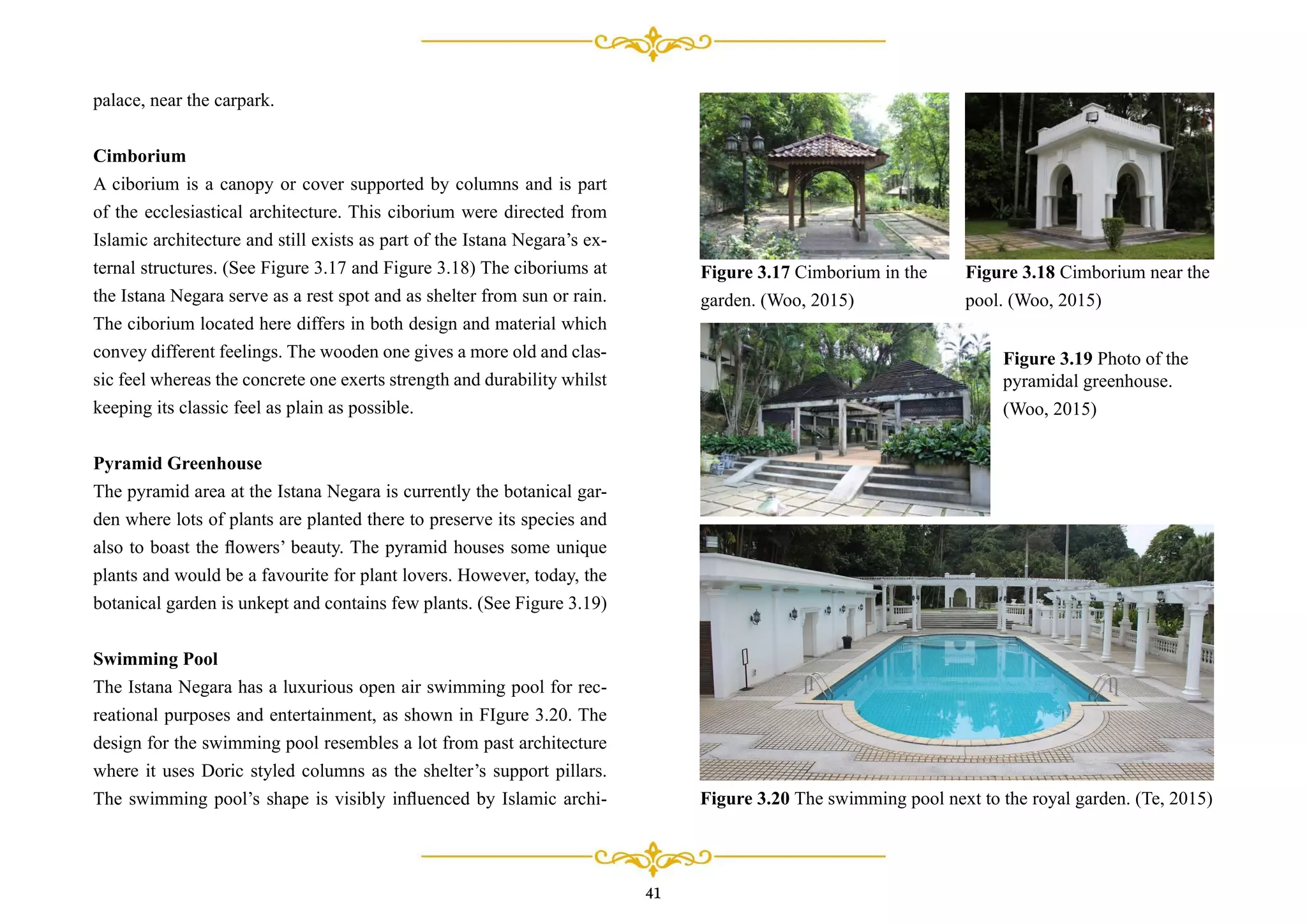
The Istana Negara has a luxurious open air swimming pool for rec-
reational purposes and entertainment, as shown in FIgure 3.20. The
design for the swimming pool resembles a lot from past architecture
where it uses Doric styled columns as the shelter’s support pillars.
The swimming pool’s shape is visibly influenced by Islamic archi- Figure 3.20 The swimming pool next to the royal garden. (Te, 2015)
Figure 3.17 Cimborium in the
garden. (Woo, 2015)
Figure 3.18 Cimborium near the
pool. (Woo, 2015)
Figure 3.19 Photo of the
pyramidal greenhouse.
(Woo, 2015)
41
tecture. This is exhibited in the rounded ends, which resemble a two
dimensional dome.
Carparks
The roadways of the Istana Negara will take you to the carpark if you
turn right from the side entrance. The first image shows the carpark
for the royal family and the higher-ups and has been indicated on
every space. The second picture shows the public carpark which is a
short distance away from the royal carpark. The road materials which
are tiles stops at the royal carpark and changes to brick flooring for
the public carpark. (See Figure 3.21)
Guardhouses
The guardhouses of the Istana Negara are stations where guards are
positioned to keep watch of intruders. The guards are provided with
the Malay outfit Baju Melayu and given a horse to stand watch and
patrol. There are three guardhouses found at the Istana Negara. The
one at the main entrance of the Istana Negara site is shown in Figure
3.22)
Badminton Courts
field in the whole building as well as seat at every side of
the building is truly a marvellous stage for private badminton games.
(See Figure 3.23)
Figure 3.21 The carpark outside the management office. (Woo,
2015)
Figure 3.22 (left) The main entrance
for visitors. (Woo, 2015)
Figure 3.23 (bottom) The indoor
badminton courts. (Woo, 2015)
42
Gymnasium
The outside of the badminton hall was built to look like an old rumah
atap and had an old feeling to it. The building has dark tinted win-
dows which obscure your view if one tries to look into it. The side
elevation also shows that one of the walls are made entirely of bricks.
(See Figure 3.24)
Futsal Field
Right next to the gymnasium is a fenced area which can be accessed
through a small gate leading to the futsal field.The field is wide enough
for five-a-side games that can prove challenging. (Figure 3.25)
Figure 3.24 Exterior view of the badminton courts. (Woo, 2015)
Figure 3.25 Outdoor futsal field or tennis courts. (Woo, 2015)
43
44
Having spanned a life of over 80 years, under the cultural influence
of Malays, Indians, Chinese, and the British, the Istana Negara con-
tains elements from different cultures. During this time, however,
the Western influence was new and strong, and as a result, the largest
influences on this building were western ones; Palladian style, and
British colonial style.
3.2.1 Palladian style
Palladian style is a style based on the designs of the 16th-century Ital-
ian architect Andrea Palladio (1508-1580). Palladio got his inspira-
tion from ancient Roman buildings and his work conveys rationality
in its clarity, order, and symmetry whilst still keeping the classical
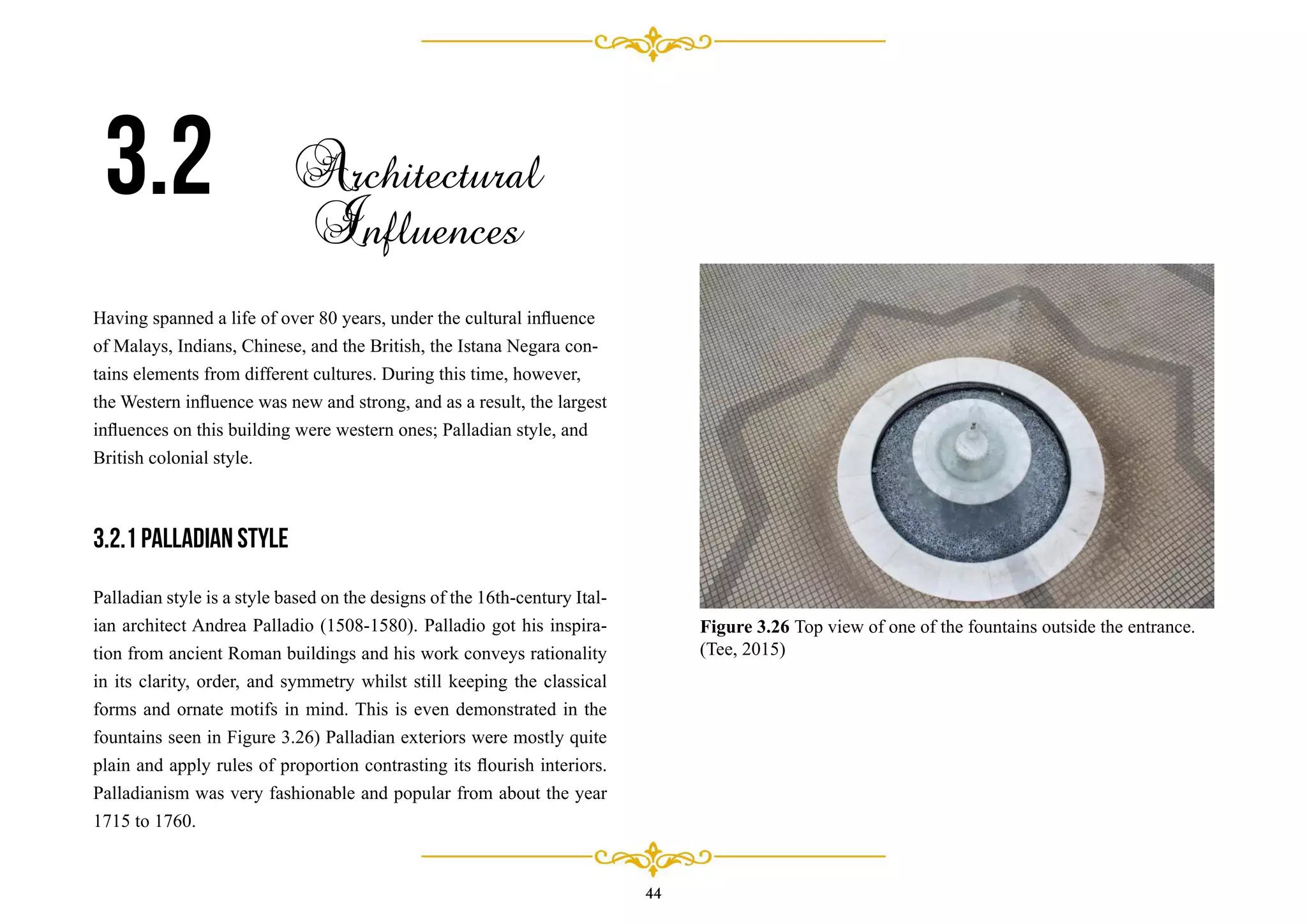
forms and ornate motifs in mind. This is even demonstrated in the
fountains seen in Figure 3.26) Palladian exteriors were mostly quite
plain and apply rules of proportion contrasting its flourish interiors.
Palladianism was very fashionable and popular from about the year
1715 to 1760.
3.2 Architectural
Influences
Figure 3.26 Top view of one of the fountains outside the entrance.
(Tee, 2015)
45
The Istana Negara has very obvious indications of its architecture
style being influenced by the Palladian style with many prominent
features and elements present.
Corinthian Columns
Palladian style is widely known for its usage of Corinthian order col-
umns. These columns are most recognizable by their decorative cap-
ital, which has been adopted into the columns seen in Figure 3.7 and
3.8. The slender fluted columns are ornate with two rows of acanthus
leaves and four scrolls. An example of these elegant columns can be
found in Istana Negara’s entrance to the Minister’s Room.
Pediments
Pediments are a construction element consisting of a gable supported
by columns. They were used over doors and windows of the buildings
and are also found over the interior doors. Palladian style incorporates
a lot of this design in its construction. Most of the pediment would be
decorated with relief sculpture. In the Istana Negara these pediments
are found in abundance and the main designs of it were mostly curved
pediments. It also has its relief of the Royal Insignia of His Majesty
printed on a glass. (See Figure 3.28)
Symmetry
As seen in Figure 3.29, Palladian designs heavily emphasize the ide-
ology of symmetry. This means that when a line separates the middle,
Figure 3.27 Capital of the
column at the entrance of
the minister’s room on the
Ground Floor. (Woo, 2015)
Figure 3.28 Pediment
above two Corinthian
columns at the entrance of
the minister’s room on the
Ground Floor. (Woo, 2015)
Figure 3.29 Diagram show-
ing the symmetry in the
floor plan. (Woo, 2015)
46
both sides are identical to each other. Symmetry and balance were of
great importance since ancient Greek and Roman architecture which
was what inspired Andrea Palladio’s style. This is because symmetry
became a metaphor for a sense of harmony and agreement between
two sides. The Istana Negara, when cut into demonstrates symmetry
and thus proving itself to be a Palladian influenced building. It con-
sists of a structured west and east wing with a large space in between.
Symmetry can also be seen in the two white cupolas, which tops the
structure above each wing. Finally, the reflection of the plan in the
section is also an important factor in the building’s symmetry.
Windows
A Palladian window is usually a large window that is divided into
three separate parts. The centre section is larger than the two side
sections and is usually arched. At the Istana Negara, there are many
different designs for the windows, which differ at different places.
Some are frosted, tinted and some were completely translucent. (See
Figure 3.30)
Doors
The designs for the doors are different depending on the hierarchy
of importance of the doors. The doors to individual bedrooms, bath-
rooms, and even some meeting rooms are single doors. Figure 3.9
shows a door to the exterior topped with a rounded arch, which are
flanked by vertical rectangular areas of fixed glass on each side that
are narrower than and also not as high as the door. This is suggestive
Figure 3.30 Door and
window arrangement on the
ground floor. (Woo, 2015)
Figure 3.31 One of the
doors from the exterior to
the interior. (Woo, 2015)
47
of the appearance of a Palladian styled window.
Main Entrance
The main entrance of the Istana Negara where the changing of guards
occurs has a strong sense of the Palladian style, which can be clearly
seen on both the columns and gate structure. (See Figure 3.32) The
columns used are solid and structural, to emulate security, while the
gold ornamentation shows a sense of royalty. The palace is located
within a 13-hectare site, and therefore the surrounding landscape is
very important. The landscape is used to highlight the majesty and
grandeur of the building.
3.2.2 British Colonial Style
The British Colonial style first came about when the British colonies
and trading posts around the world were first established in the 16th
and 17th centuries, and reached its peak in the 19th and early 20th
centuries. The British Empire covered approximately one-quarter of
the world and was an empire on which it seemed like the sun never
set. As British subjects were sent around the world to colonies to help
govern, do business, and protect the home country’s interests, they
brought with them their traditional decor from home which they in-
termingled with local materials and styles and modified them for their
own needs of climate and landscape. They produced a unique and
beautiful blended British colonial style.
Figure 3.32 View of the main entrance on the south side. (Woo,
2015)
48
This style mainly focuses on the interiors of the building and as such
affects the furniture and the interior aesthetic. The Istana Negara ex-
hibits a lot of characteristic from this style.
Campaign Furniture
Inspired by the passion of exotic travel, many British Colonial fur-
nishings were specifically designed to transform into travel-ready
pieces called campaign furniture. This means that the furniture can be
folded and easily stored and even ready to be shipped off to the next
location. Examples are classic pieces such as criss-cross legs in clean
lines and dark woods used to made desks. At the Istana, there was a
lot of campaign furniture that were placed in almost every room. (See
Figure 3.33)
Lightweight and Eclectic Fabric
As a style which absorbed authentic textiles from Asia, India, Africa
and the Caribbean, this style was only possible through the collectors
who travelled all around the world merging them together. Botanical
prints, paisleys, ikats and animal prints in lighter weight cottons and
linens were the prime examples of the British Colonial style. Most
of the furniture, cloths and even interior details at the Istana were all
made from lightweight and eclectic fabrics. (See Figure 3.34)
Tropical Inspired Furnishings
During this time, and as seen in Figure 3.35, the solid and formal de-
Figure 3.33 Photo of the gift
shop which exhibits campaign
furniture and lightweight and
eclectic fabrics. (Woo, 2015)
Figure 3.34 The curtain and
fabric of the chair demonstrates
lightweight and eclectic fabric.
(Woo, 2015)
Figure 3.35 Example of topi-
cal inspired furnishings. (Woo,
2015)
49
signs of the Victorian era were revised to accommodate more tropical
locales. Carved pineapples, lattice work and turned elements were
carved into woods and used alongside bamboo, rattan and leather
accents. The pieces had tropic inspirations but retained elements of
British formality with dark woods. The furnishings at the Istana had a
very huge impact from the British Colonial style as these details can
be seen almost everywhere; doors, wall details and even ornaments.
Light and airy colours
Light and neutral shades adorned the walls of a traditional British
Colonial interior. These airy hues helped colonial house-dwellers
psychologically combat the overwhelming tropical heat. As for Ma-
laysia’s all year round heat, the Istana is composed of the royal flair,
yellow, tans, creams and white to contrast the darker colored furnish-
ings. (See Figure 3.36)
Eclectic Furniture
The world-travelling Brits who aided the built of this design style ac-
cumulated a wealth of eclectic accessories that they loved to display.
Examples of this are fine china, crystal and silver sat on shelves along
with carved pieces, globes, maps, telescopes, letter-writing boxes and
tortoise patterned glass. However these are only the few of the many
that can be placed. The Istana has a lot of rare and eclectic accessories
which decorate the rooms and make them an interesting addition to its
appeal. (See Figure 3.37 and Figure 3.38)
Figure 3.36 Her maj-
esty’s office demon-
strates the use of light
and airy colors. (Woo,
2015)
Figure 3.37 The living
room suite for one of
the bedrooms shows
the use of eclectic fur-
niture. (Woo, 2015)
Figure 3.38 Ths old
decorated telephone
shows the use of eclec-
tic furniture. (Woo,
2015)
50
Flora and Fauna
The British were quite intent with their local flora and fauna in their
new surroundings, and thus adapted them into their houses. Potted
plants, ferns and palms convey the incredible drama of the tropics to
these elegant homes. The Istana built on a 97.65 hectares land has its
own share of flora and fauna attractively blended together. The florae
and trees planted at the Istana have its own traditional worth and there
were even fascinating wildlife that could be found there. Examples of
this can be seen in Figure 3.39 and Figure 3.40.
Figure 3.39 Image of a lizard on the Istana Negara grounds. Photo
by Celine Tee.
Figure 3.40 Image of the horses that were once used to wander
around the grounds of Istana Negara.
51
The Istana Negara is a double-storied castle constructed with the
main components of brick and cement. Concrete and stonework was
celebrated and almost always shown. This creates a very solid, sturdy
and heavy massing of the structure, reminiscent of Palladio’s palaces.
The castle overall exude a very grand and luxurious feel to it and it
synchronizes well since it is a castle made for royalty.
3.3.1 Form
The concept behind the form of the building is symmetry. Symme-
try creates balance which in turn forms harmony, order and design.
Symmetry can be found everywhere and is the reason as to why we
love it. By being a constant in our daily lives, our human theory has
our mind to create order in the things we see and the actions we do.
At the Istana Negara, the palace is built into symmetrical halves and
is the main form of the building. By having a symmetrical form, the
palace has its own uniqueness to it. Figure 3.41 shows the symmetry
exhibited in the facade of the building.
3.3 Design Concept
Figure 3.41 Cropped view of the center of the facade of Istana Neg-
ara shows a detailed symmetry of the facade. (Woo, 2015)
3.3.2 Exterior
The Istana Negara bears great resemblance to Islamic architecture.
This is proven by its plain exterior with a lavish interior. The Istana
Negara’s building exterior although packs a whole lot of details but
when compared to the interior, it is that big of a difference. To further
proof the design concept is from Islamic architecture are the usage
of domes and also the ornamental tiles used. The usage of domes has
been a feature of Islamic architecture and has been incorporated into
the construction of all the mosques. However, this does not mean that
the dome signifies a building of religion but to show its Islamic roots.
(See Figure 3.42)
Other than the dome, the Istana Negara has ciboriums around the gar-
den areas. Ciboriums were used as a design concept in the earliest
surviving Islamic building, the Dome of the Rock in Jerusalem. This
points to the Islamic design concept which is kept even through all
those years of renovation.
3.3.3 Interior
The interior of the Istana Negara has been extravagantly designed like
I said previously and most of this came from the Islamic architecture
design concept; to keep the exterior plain while having a beautiful in-
52
Figure 3.42 view of the Istana Negara’s exterior. (Tee, 2015)
terior much similar to Art Deco style. The interior has a more promi-
nent Islamic concept whereby Islamic imagery is used to decorate the
interior. This type of ornament is called arabesque and is an artistic
motifs of vines and acanthus scrolls. At the Istana Negara, these ara-
besque motifs can be found almost everywhere ranging from ceilings
to drapes and even to chair details. These arabesque motifs are the
design concept which can still be found in the Istana Negara which
had existed since the Byzantine era.
From the design concept of Islamic architecture, we can see tradition-
al Malay houses design in the Istana Negara. This is shown through
the embellishments which can be found on the panels and furniture
of the palace. These carvings are mostly bas-reliefs carved onto the
wooden panels to stimulate vision. These embellishments are a sym-
bol of wealth and power in traditional Malay society and seeing as to
how they were incorporated into the Istana Negara; it goes to show
that the Sultan of Malaysia was indeed a man of both riches and rule.
Note in Figure 3.43, the plans are extensive and scale of the mansion
demonstrates a prominent sense of wealth and prosperity, which con-
tribute to the excessive use of ornamentation in the interior.
53
Figure 3.43 Ground floor and first floor plans of the Istana Negara.
The Istana Negara is a double-storied castle constructed with the
main components of brick and cement. Concrete and stonework was
celebrated and almost always shown. This creates a very solid, sturdy
and heavy massing of the structure, reminiscent of Palladio’s palaces.
The castle overall exude a very grand and luxurious feel to it and it
synchronizes well since it is a castle made for royalty.
3.4.1 Exterior
The palace complex has an area of 97.65 hectares, 22 domes, and is
split into three main portions: the Formal Component, Royal Compo-
nent and Administration Component. The building is nestled within
an 11.34-hectare complex with a huge range of plants and flowers,
swimming pool and indoor badminton hall. As the palace grounds
are not opened to members of the public or tourists, the Main Palace
Entrance is a favourite picture spot for tourists. In the recent years,
this has changed and has become a fantastic tourist attraction site for
a certain fee. A map showing the location is seen in Figure 3.44.
3.4 Space Planning
Figure 3.44 Map of the Royal Museum, otherwise known as Istana
Negara on Jalan Istana. (Royal Museum)
54
The entire area is enclosed and the Royal Insignia of His Majesty is
placed on each steel bar between two pillars of the fence. At the front
of the Istana Negara, the main entrance highly resembles an arch. On
each side of the arch, are two guard posts both sheltering two mem-
bers of the cavalry in their uniforms similar to those at Buckingham
Palace, London. Then from 2013 onwards, the full dress uniform will
be in Malay traditional attire as it was during the Malay Sultanate era.
In the grounds of the palace is a guard house for the members of the
Royal Malay Regiment, one of the two Household Division units in
the Malaysian Armed Forces (the other one is the Corps Mounted
Ceremonial Squadron).
There is also a six-hole golf course, tennis courts and a lake in the far
end of the grounds. The driveway, lined with cypresses and casuari-
nas, leads to two entrances – an entrance to the West Wing and the
other to the East Wing. The Istana Negara also has a lot of interesting
hardscape and softscape for the exterior of the building. (See Figure
3.45)
3.4.2 Interior
The Royal Museum’s main palace complex consists of two building
blocks – the palace gallery and Throne Hall (Balairung Seri). The
two-storey palace gallery was built in 1928 in Palladian architecture
style. Eight halls and rooms on the ground floor and 15 rooms on the
55
Figure 3.45 Exterior space planning is shown in the site plan.
upper floor are open to visitors to view. Photography is not allowed
within the building and those who break this rule will be forced out
of the palace.
Meanwhile, the Throne Hall was built in the 1960s, which has a ban-
quet hall, the Rulers’ meeting room, Kings’ lounge and apartments
for Yang Di-Pertuan Agong and Raja Permaisuri Agong. Since it was
used by the first King, changes have been made, almost every five
years, with the installation of a new Agong. However, some of the
plates on display were imported from England and been used since
1945. The old national palace was declared as a National Heritage un-
der the National Heritage Act 2005. The National Palace is a symbol
and representation of dignity for Malaysia’s monarchy institution as
well as the centre of administrative institution of monarchy.
Small Audience Hall
The small audience hall can be seen straight ahead after entering the
Istana Negara from the main entrance. The hall has been exquisitely
decorated and is the first room to be entered. It is a great introduction
to the rest of the palace in terms of the characterization of the design
and style. (See Figure 3.46)
Dining Rooms
The Royalty are still humans and will need a dining room to eat their
meals. However, as it is in the royal palace, the dining rooms are also
used for official or leisurely gatherings. As seen in FIgure 3.47, the
56
Figure 3.46 The small audience hall is the first room visitors see.
(Woo, 2015)
Figure 3.47 One of the dining rooms in the royal palace. (Woo,
2015)
dining room is located next to the small audience hall on the ground
floor and behind the small audience hall on the first floor.
Ministers’ Waiting Room
The Ministers’ waiting room is on the left once visitors pass through
the small audience hall and as the name implies, the Ministers’ will
wait in that room before going for their official tasks. (See Figure
3.48)
Cinema
The cinema is on the most left of the building, just before the store-
room. Here is where one can watch movies which are broadcasted
through light from the second floor. The film shown now is black and
white and shows the Royal member family. (See Figure 3.49)
His Majesty’s Office
His Majesty’s office is located on the bottom left at the first floor of
the Istana Negara. This is the Majesty’s office where he does his per-
sonal work. (See Figure 3.50)
Small Throne Room
The small throne room is only used by His Majesty for ceremonies
or small functions that consists not more than 40 guests. The main
functions of this room are the ceremony for an audience with the King
for receiving credentials by incoming foreign Ambassadors, the cer-
emony for the Presentation of the Appointment Letter to the Com-
Figure 3.48 Minister’s
room. (Tee, 2015)
Figure 3.49 Cinema
room. (Ellayah, 2015)
Figure 3.50 His Maj-
esty’s office on the first
floor. (Tee, 2015)
57
mander of the Armed Forces, the Ceremony for the Presentation of
Appointment Letters and Swearing in Pledge of Allegiance and the
Official Secrets’ Act by the Ministers and the Deputy Ministers and
lastly the ceremony for an audience with the King for the presentation
of credentials to Malaysian to Malaysian Ambassador s/High Com-
missioners in foreign countries. (See Figure 3.51)
Royal Bedrooms
The royal bedroom is a place for the royalty to sleep and also take a
break.There are four bedrooms on the first floor of the older part of
Istana Negara, excluding the new wing, where the new Royal bed-
room for the King and Queen resided.
Guest Room
There is also a guest room, which is located on the first floor, and is
used for royal guests who require a place to temporarily reside. The
decor for this room is no different from the other rooms, which allows
the guests to feel like equals among the royals. (See Figure 3.52)
Reading Room
The Reading room (seen in Figure 3.53) is like a mini library and
serve to fill the royalty’s pastime. This room is used as a reading and
collection space. The room was renovated into a reading room during
Her Majesty Tuanku Aishah’s tenure as Her Majesty Permaisuri
Agong. The reading room does bring out the relaxation manner when
in the room. (See Figure 3.53)
Figure 3.51 The throne
room on the first floor.
(Tee, 2015)
Figure 3.52 The guest
room is located amongst
the other bedrooms on the
first floor. (Tee, 2015)
Figure 3.53 The reading
room across Her Majes-
ty’s office. (Woo, 2015)
58
Her Majesty’s Office
Her Majesty’s office is where Her Majesty does her official work and
is located opposite the reading room. This room is smaller when com-
pared to His Majesty’s office. (See Figure 3.54)
Small Audience Hall or Family Hall
The small audience hall is a hall with seats for the audience to rest and
even have some small talks before any of their meeting. This small
audience hall is located on the first floor. (See Figure 3.55)
State Acting Ruler’s Bedroom
The State Acting Ruler’s bedroom is the room where the State Acting
Ruler will sleep in. This room is beautifully decorated and has stan-
dards comparable to His Majesty’s. This bedroom is located next to
the small audience hall on the first floor. (See Figure 3.56)
His Majesty’s Restroom
The restroom above is solely for His Majesty’s use to go and urinate
and do his other private businesses. This is in the new wing of the
palace. (See Figure 3.57)
Her Majesty’s Powder Room
This room is used by Her Majesty to apply make up to herself and to
prepare herself before any occasion. The powder room is located in
the new wing of the Istana Negara. (See Figure 3.58)
Figure 3.54 Her Majesty’s of-
fice. (Ellayah, 2015)
Figure 3.55 Small audience hall.
(Ellayah, 2015)
Figure 3.56 State acting ruler’s
bedroom. (Tee, 2015)
Figure 3.57 His Majesty’s re-
stroom. (Tee, 2015)
Figure 3.58 Her
Majesty’s powder
room. (Tee, 2015)
59
His & Her Majesties’ Bedroom
The bedroom of His and Her Majesty is one of the biggest rooms and
also attractively made. The room lit brightly with yellow and orange
colours give the room a very classic feel. (See Figure 3.58)
Ambassadors’ Room
The Ambassador room is a room for the diplomat to stay at while he
has dealings with the Royal family. Exiting this room will lead to the
Balairung Seri.
Royal Dental Room
The Royal Dental room is the room where the royal family have their
regular dental check-ups to keep their oral clean.
Figure 3.59 The
ambassador’s room
on the ground floor.
(Woo, 2015)
Figure 3.60 The
royal bedroom in
the new wing. (Woo,
2015)
Figure 3.61 The roy-
al dental room. (Woo,
2015)
60
Royal Colour - Yellow
The colour royal yellow is a symbol of the colour of the robes worn
by the Emperor of China. Its’ first recorded use of royal yellow as a
colour name in English was in 1548. Not to mention, Malaysia once
had a very close relation to the China when the Ming Dynasty had
allied with the Malacca Sultanate. The Chinese presented offerings to
the Malacca King and those gifts were indeed of yellow colour.As for
The Istana Negara was made with mostly brick and cement but how-
ever its furnishings retain the cultural and royal colour of yellow. A
huge portion of the buildings’interior are bright with yellow coloured
furniture and such.
Domes
The dome has become a prominent feature of Islamic architecture.
One is pictured in Figure 3.61. “Since the ancient times, the architect
was able to link architecture to his beliefs, and applied that to serve
his intellectual trends by developing the design concept for himself,
most notably, the shifts and changes that have occurred in the forms
of the domes since the dome is characterized by its deep memory
3.5 Cultural Aspects
and Elements
61
Figure 3.62 One of the domes on top of the Istana Negara. (Tee,
2015)
as it clearly documents the symbolism in Islamic architecture over
time, and the Muslim architect considers it as an important historical
record, but it needs to be studied and analyzed to keep up with the
current architecture and its developments.” (Tarrad, M.) The dome is
an element of architecture that is the hollow upper half of a sphere.
Domes have a long architectural lineage which exists since prehis-
tory. The dome at Istana Negara plays a huge part in the element of
architecture as it brings out the Malay architecture feel. This dome
exists in mosque all around Malaysia and has been muscle memory
to Malaysians that domes are a part of Malay architecture. The domes
of the Istana Negara are decorated with gold flowers circling around
it and also gold indents in its hollow.
Bunga Raya Motifs
Hibiscus rosa-sinensis or better known to us Malaysians as “Bun-
ga Raya” or “Bunga Kebangsaan” is a species of flowering plants in
the family of Malvaceae. The Hibiscus is Malaysia’s national flower.
After Malaysia achieved independence, the Ministry of Agriculture
proposed seven types of flowers to be selected as the National Flower
Federation of Malaya. After a discussion which occurred on the 28th
of July, 1960, the “Bunga Raya” was declared as the national flower
and has kept its title till now. This flower is broadly used as an orna-
mental throughout the tropics and sub-tropics. As Malaysia’s national
flower, our Istana Negara architects has kept true to their roots and
adorned these motifs on the front gates of the Istana Negara, pictured
in Figure 3.62.
Figure 3.63 The main gate of the Istana Negara utilized the bunga
raya motifs. (Woo, 2015)
62
63
Chapter Four
Construction Details
Stairs are used to reach one floor level to another floor level. Vis-
itors will view and use two separate staircases, one at each end of
the building. These staircases are symmetrically situated at the east
and west end. One of them is pictured in Figure 4.1. However, there
are also two staircases that connect the first floor to the roof level of
the Istana Negara. Staircases are also used as a divider between two
rooms, though these are mainly 3 or 4 steps.
Construction
L-shaped stairs are generally used where the space does not allow a
straight run. These stairs have a landing where there is a change in
directions. The carriages for L-shaped stairs include vertical supports
that are under the landing.
Stairs, of course must be at least a certain length that can be comfort-
ably stepped on to climb upwards and downwards. In order to build
the stairs in within these rules, the risers must be 7½ inches high and
4.1 Staircases
Figure 4.1 One of two of the main staircases in the Istana Negara.
(Woo, 2015)
64
65
the treads must be 10 inches wide. The height of the risers can be
found by dividing the total rise by the number of risers. The width
of the treads is found by simply dividing the total run by the number
of treads. To calculate the length of the treads and risers in stairs with
the landing, the treads and risers should be the same size in each part.
First to make the stairs, the winders must be laid out, because wind-
ers shorten the run of a stairway, so they’re incredibly useful when
space is tight. After that, the stair stringers must be installed, and then
the risers. Lastly, the construction worker must complete stacking the
steps.
Materials used
When viewed, most of the stairs look to be made of a solid surface
material, used to implement the realistic joint-free appearance of the
stair casing. However, the stairs are completed with a carpet finishing
which hides the original materials used for the staircase. (See Fig-
ure 4.2) The solid surface cladding elements are attached to the steel
sub-construction by using façade construction technology.
Handrail Construction
According to Architect’s Handbook of Construction Detailing, “the
railing height must be between 34 in. and 38 in. (864 mm to 956 mm)
above the nosing to be in compliance with the requirements of the
International Building Code.” (Ballast, 1990) The stair members such
as the nosing line, stringer line, and handrail should be parallel as
long as the work points fall on the vertical work lines. The first riser Figure 4.2 Three step staircases are used to further distinguish
rooms. This is the steps to His Majesty’s Office. (Woo, 2015)
66
of the upper flight should begin exactly one tread distance from the
nosing of the last riser of the lower flight so as to make a smoother
transition of the handrail. (See Figure 4.3)
In the stair layout at the top landing, the edge of the landing structure
is shown to schematically fall on the work line of the bottom nosing.
However, the edge of the landing may fall along the last riser of the
flight, which makes it easier to detail the structure of the landing.
Handrails must be between 32mm and 38mm across in length, with
the inside edge at least 38mm from the wall or other plausible ob-
structions.
Figure 4.3 Staircase handrail at His Majesty’s office. (Woo, 2015)
67
Construction
Geotechnical & Subgrade Preparation: The initial phase of construc-
tion activity ensures that the building subgrade is prepared for the
long-term performance and unique loading of the stored materials and
handling systems. During construction the site is prepared according
to design assumptions.
Foundation & Tunnels: After proper preparation of the subgrade,
work activities shift focus towards construction of the Dome foun-
dations and tunnel systems. Depending on the geometry of the Dome
(see Figure 4.4 and Figure 4.5), the foundations may be functioning
only for gravity loads of the building, or with significant reinforcing
steel to establish the tensioning ring beam that provides the primarily
thrust resistance for the dome portion of the structure. The circular
beam footing provides significant resistance against lateral movement
and bridges against potential localizes subgrade failures in the foun-
dation system.
4.2 Domes
Figure 4.4 View of one of the two main domes on top of the Istana
Negara. (Tee, 2015)
68
Air form: After that, a reinforce PVC “Air form” that looks like can-
vas-tent will be fabricated to the desired shape and size and this air
form will be attached onto the perimeter of the slab. Temporary open-
ings are positioned to allow access to the interior of the dome struc-
ture during construction activities. The air form is inspected to ensure
integrity prior to inflation.
Inflation: When it is positioned on the slab, large fans are connected
to the air form and when activated inflate the air form to provide sus-
tained pressure within the air form, in order to form the perfect shape
of the dome, much like inflating a balloon. The inflation pressure is
maintained throughout subsequent construction activities until the re-
inforced concrete has cured.
Primer & Foam Insulation: When the shape is formed, a layer of poly-
urethane form insulation will be sprayed onto the interior surface of
the air form. The form insulation provides a continuous and uninter-
rupted thermal barrier between the exterior and interior sides of the
dome.
Premade Steel: Next, after the foam had covered the entire interior
surface, steel reinforcing bars will be arranged in a specially engi-
neered vertical and horizontal hoop layout, and is attached on it to
hook embedded in the foam.
Figure 4.5 View of the East dome from the roof. (Tee, 2015)
69
After that, a type of specially mixed concrete called short-crete will
be sprayed onto the interior surface of the dome, fully covering the
rebar. After a few inches of short-crete are sprayed on, the steel rein-
forced concrete dome is done.
Finishing
In order to beautify the dome, it was painted later with glorious co-
lours, lightbulbs are added onto the dome and a crown shaped finial
is added onto the dome as a symbol of the royalties. This is shown in
Figure 4.6.
On the two large yellow domes on top of the Istana Negara is a crown
shaped finial. Furthermore, a gold top is seated above the crown
shape. This gold top is in the shape of a moon and star, the same one
on the current Malaysian flag today. The star has fourteen points, one
for each state in Malaysia.
Figure 4.6 Close-up view of the crown and symbol of Malaysia on
top of the dome. (Tee, 2015)
70
Construction
The procedure of creating an arch may differ depending on the de-
sired flatness of the finished arch. It is essential that the blocks touch
each other at the intrados. No mortar is in between the blocks inside,
and outside the joint thickness will depend on the curvature of the
arch. It is essential that the arch rises within the blocks perpendicular
to the centring, so as to get the last blocks parallel near the apex. Ex-
treme care must be taken over the decentring. The centring should go
down slowly and vertically.
Older arches require maintenance and reinforcement, especially when
it appears that there is decay on the keystones. This will create what
known as a bald arch.
The intrados is the interior and lower line or the curve of the arch. In
reinforced concrete construction, the principle of the arch is used to
improve the concrete’s strength in resisting compressive stress. When
4.3 Arches
Figure 4.7 View of an arched entrance from the exterior of the
building. (Ellayah, 2015)
71
there are other types of stress that’s raised, for example torsional stress
and tensile strength, it will have to be resisted by carefully placing the
reinforcement rods or fibers.
Segmental arches
Segmental arches are arches that are less than 180 degrees of a circle,
or simply less than a semi-circle. There are a few segmental arches in
Istana Negara, but because of the Islamic design and Palladian style,
geometry is incredibly important, therefore most of the arches are not
segmental arches. (See Figure 4.7)
72
Chapter Five
Materials
Although Team Istana Negara could not obtain the old Istana Nega-
ra’s main material composition, it can be only assumed that they fol-
low the architectural styles which were famous at that period of time.
The time period is during the 1920s, which could possibly include Art
Deco and Neo-Classical style which was growing rampantly at that
time. The Istana Negara is certainly reminiscent of these two styles
along with Islamic architecture, but the Palladian style and British
Colonial style being the most prominent of the architecture style.
The Istana Negara has Art Deco style whereby the traditional craft
motifs have a relationship with its imagery and materiality. The pal-
ace also has defining Art Deco properties which include rich colours,
bold geometry and lavish ornamentation. This modern style also pre-
fers symmetry and runs in line with Palladio’s favoured architectural
element which exists within Istana Negara. The Neo-Classical style
comprises of ornate Corinthian columns and grand facades which is
also part of the palace.
5.1 Structural
Materials
73
The Istana Negara is assumed to bear resemblances with Sultan
Alauddin’s Palace which was built in1899. They both adopt Islamic
architecture into the design production. As both have the same archi-
tecture style and are from the same time period, we can assume the
material and the assembly work are similar.
The Istana Negara’s main building structure is constructed with the
main components of concrete and bricks, with load bearing walls with
post and beam structures as support. Possible binders used would in-
clude cement and used to stick the structural materials together firmly.
The corridors and large open spaces are supported by a long span
structural system. The flooring is made of marble and also covered
with carpets. Other possible materials are ceramic tiles and hard cen-
gal wood. The staircases on both ends are made of hard cengal wood
with balustrades as part of the detailing. The staircases are also cov-
ered with carpets to provide better footing.
Istana Negara is a one of a kind form of architecture not solely for its
historical background but also due to the building’s incorporation of
royal elements into its design. The palace displays both colonial and
local architectural elements, but is built to suit the local context by the
usage of new materials and technology.
Structural materials are the construction materials which are able to
withstand external forces. By taking the materials into consideration,
74
we can then design a strong structural framework. Structural engi-
neering requires in depth knowledge of the material’s properties and
disadvantages in order to select the most suitable material. The main
structural materials found at the Istana Negara are concrete, bricks
and timber.
Concrete
Concrete is a composite material which consists of cement, water and
aggregate that chemically react (hydration) to form stronger material.
Concrete, when hydrated with different materials form different con-
crete components, however only with the desirable qualities. As such,
we need the workability of concrete or in simpler terms, the difficulty
of handling concrete in the form. This is affected by the consistency
of mixture while forming the concrete. The concrete should also have
minimum segregation to keep it homogenous.
Concrete has been a very popular choice for construction since mid-
18th century and up till today is the commonly used man-made mate-
rial. It is also applied in the construction of the Istana Negara. You can
see a lot of concrete usage at the Istana Negara including the walls of
the palace or even the bridge located in the garden. (See Figure 5.1)
Concrete is used due to its deciding factor of strength where it can
bear massive loads from weight, compression, flexure or shear. The
strength of concrete varies through the concrete to water ratio and can
be adjusted to suit different needs. Other than that, concrete is durable
Figure 5.1 Concrete formwork seen throughout Istana Negara. (Tee,
2015)
75
to environmental ailments. Concrete is also easy to form the desired
shape and is a simple yet beautiful material. While concrete has its
own disadvantages but the material efficiency makes it applicable re-
gardless of those limitations. To hold the colossal Istana Negara, the
strong concrete is definitely a good choice of material.
Brickwork
A brick is a single unit of clay-bearing soil, lime and sand or concrete
used in masonry construction. Bricks are made from expanded clay
aggregate and are fired to create brickwork. A single brick combined
with other bricks over a course forms a strong and durable brick struc-
ture. Bricks itself have different types and functions and are usually
produced in bulk.
The bricks are used to form a masonry wall at the Istana Negara and
are later covered over with concrete or left as it is, as shown in Figure
5.2. Bricks have a high aesthetic value because of its natural and vary-
ing colours and textures. Bricks are also strong and durable almost
on par with the advantages of concrete. Bricks also offer insulation
against sound or even heat. It is recorded that bricks can regulate tem-
perature and thus save energy. At the Istana Negara which is prone to
the sun rays, having bricks to help regulate the internal temperature
would help save roughly 30% on energy savings. This helps a lot be-
cause bricks would be cost-efficient and at the same time providing
lifelong strength to keep the palace standing proud.
Figure 5.2 Masonry wall which as been left as it is at the badminton
courts. (Woo, 2015)
76
Timber
Timber or lumber are the results of wood being processed into either
beams or planks and the sort. Timbers are sorted into two kinds; hard-
wood and softwood. There are several conversion methods for wood
which are plain sawn, quarter sawn and rift/radial sawn. Different
sawing methods will result in different grain patterns.
We believe that the old Istana Negara have traces of timber especially
the usage of hard cengal wood. This was because wood was as popular
a choice next to concrete back in the 80s. Timbers also provide great
strength and even have some assets exclusive to it. As timber was a
natural and renewable material as well as requiring low embodied
energy while in production, timber was widely used for these reasons.
Timber being a natural material also has a unique capability to absorb
and store carbon dioxide. Not only that, timber used in construction
has aesthetic value due to its grain. (See Figure 5.3) That said, timber
was the initial material used to construct the Istana Negara and later
on it was replaced with concrete.
Figure 5.3 Existing timber structures with floral motifs. (Woo,
2015)
77
Finishings are a method of preserving an already existing structure or
beautifying the structure. This is because the structural materials will
wear and tear in a matter of time and the means of delaying the wear
are to apply finishings. Finishings are also the last step of construction
and can help increase the beauty of the building.
Painting
Painting is the most efficient way of beautifying the structure and also
preserving the material. Giving the structure a coat of paint will give
a longer lifespan as well as giving it a unique aesthetic depending on
the desired effect. At the Istana Negara, the walls are painted yellow
to highlight the concept of royalty in the Istana Negara, as shown in
Figure 5.4.
Plastering
Plastering is also another common method to coat the walls and ceil-
ings, as well as creating the forms for some ornamentation. Plaster
5.2 Finishing
Materials
Figure 5.4 The exterior of Istana Negara painted beautifully. (Woo,
2015)
78
is manufactured as dry powder and forms a paste when applied with
water. The paste would then harden on the surface applied forming
the plaster layer. It is easily manageable with any metal tools and
sandpaper. Plasters are best used in the Istana for the complex detail-
ing in room interiors, as pictured in Figure 5.5. The plasters which are
constructed into a sheet are fastened to the existing wall or ceiling.
This saves cost while also keeping the details intact.
Figure 5.5 Plaster walls and ceilings. (Woo, 2015)
79
Chapter Six
Ornamentation and details
A column, or a pillar, is typically cylindrical, and may support an
arch, entablature, a roof or other structure. However, it may also stand
alone as a monument. They are rigid, and relatively slender structural
members that are designed to support axial compressive loads that are
applied to the top and bottom of the members. Some of the pillars are
strucural and stand at a height of two stories high, this mansion con-
sists of half sunken pillars into the walls with thicken square base and
top to help withstand the imposed load. However, the more decorated
columns in the interior of the Istana Negara are notably decorated in
the Corinthian order for the King. (See Figure 6.1 and 6.2)
6.1 Columns and Pi-
lasters
80
Figure 6.2 View of the Greek styled Corinthian column’s capital.
(Woo, 2015)
Figure 6.1 The full column at the
minister’s room. (Woo, 2015)
81
A door is defined as a hinged at the entrance to a building or a room.
The doors in the Istana Negara are very distinct and have a royal pat-
tern as part of the design, sometimes incorporating Islamic art. Islam-
ic art has a recognizable aesthetic signature that somehow manages to
express itself across an entire range of productions. (See Figure 6.3)
It is often very decorative and geometric, and the aim is never merely
to ornament, but rather to transfigure.
The main entrances utilize double doors to enhance the idea of grand-
ness and high status, while smaller and less significant rooms and
entrances only use single doors. (See Figure 6.4) Although the double
and single doors are used to differentiate between the importance of
certain rooms, and entrances, both are decorated to elevate the con-
cept of prominence within the building.
There are 27 different doors, each decorated and styled differently.
(See Scaled Drawings in Appendix F)
6.2 Doors
Figure 6.3 Thin double doors
in one of the bedrooms. (Woo,
2015)
Figure 6.4 Modern glass
double doors at the main en-
trance. (Ellayah, 2015)
82
Windows are an opening in the wall or roof of a building or vehicle,
fitted with glass in a frame to admit light or air and allow people to
see outwards or inwards. It can also be defined as a transparent panel
on an envelope to show an address. For most of the windows, there
are patterns on the window arch. However, the windows themselves,
sometimes on the glass, are also patterned or decorated. These win-
dows often are symmetrically and geometrically arranged in these
decorative forms. There are both religious and philosophical ideas in
the decorations that also reflect the status of royalty in the design of
the windows.
Note that almost all the windows are further decorated with a curtain,
which blocks out sunlight if there’s too much to bother the royal per-
sons. (See Figure 6.5 and Figure 6.6)
6.3 Windows
Figure 6.5 Tall window in the
dining room. (Woo, 2015)
Figure 6.6 One of the win-
dows shown from the interior.
(Woo, 2015)
83
The ceiling is the upper interior surface of a room. In the Istana Neg-
ara, there are several types of patterns that decorate the ceilings, and
each pattern involves a different meaning in terms of status and sig-
nificance. For example, some of the repeated floral patterns demon-
strate the rich variety of flora and fauna that the royalty had access to.
These influenced the design, and the form of the design derives from
both classical as well as oriental origins.
Ceiling decorations are especially noticeable around some of the
chandeliers (see Figure 6.7) and the edges and corners of the ceiling
(Figure 6.8).
6.4 Ceiling
Figure 6.7 View of the ceiling decoration around the chandelier.
(Woo, 2015)
Figure 6.8 Ceiling decoration at the corner. (Woo, 2015)
84
A chandelier is a large, decorative hanging light with several branch-
es for several light bulbs or candles. It is often a fancy light fixture
that is usually very ornate and hanging suspended in the middle of a
formal space. However, in the Istana Negara, chandeliers are even in
the bedroom. This demonstrates a level of grandness and royalty all
throughout the building. (See Figure 6.9 and Figure 6.10)
The word ‘chandelier’ originates from the French word ‘candere’
meaning “to be white, glisten.” To exhibit a level of prestige as a
grand palace, in this Istana Negara chandeliers are hanging in nearly
every room, including dining rooms, bedrooms and so on.
6.5 Lighting
Figure 6.9 One of the chandeliers in the interior of the palace. (Woo,
2015)
Figure 6.10 Chandelier in the room in front of the minister’s room.
(Woo, 2015)
85
Many of the walls are decorated with wallpaper that is designed to
contribute to the general genius loci of the room, as well as the en-
tirety of the building structure. The wallpaper is generally ornately
decorated, often under the influence of floral or geometric patterns.
They may also understake Islamic motifs.
Most of the palace, especially the first floor, is finished with carpet
on the floor. The carpet, similarly to the wallpaper, is not plain, but
decorated with designs that reflect the bunga raya and natural floral
motifs. (See Figure 6.11)
6.6 Other
Ornamentation
Figure 6.11 Carpet design shows floral patterns. (Ellayah, 2015)
86
Chapter Seven
Comparison with Istana Negara on Jalan Duta
The old royal palace was originally designed by the famous archi-
tectural firm, Swan & Maclaren. The building itself was constructed
using a mixture of local Islamic architecture crossed with Western
influences, resulting in a mix that boasted high arched doorways and
balconies alongside the traditional Islamic domes. It showcases the
use of palladium doors and windows throughout the building. Built
of mostly brick and cement, the palace is almost perfectly symmetri-
cal, clearly shown by the reflection of the East and West wings. Use
of brick and cement established a sturdy and solid structure, which is
very reminiscent of Palladio styled palace designs, with Greek and
Roman influences appearing in the structures symmetry and balance.
The new royal palace is situated off of Jalan Duta, near Sri Hartamas.
Totalling over 90 hectares, the main building is a multi-storied palace
that spans a total of 28 hectares of the total 97.65 hectares that encom-
pass the compounds entire space, with an estimated 75,000 square
metres of floor space. Architecturally, the palace boasts a mixture of
7.1 Design Concept
87
Figure 7.1 Aerial view of the new Istana Negara on Jalan Duta.
(placeandsee.com, 2015)
88
heavily Malaysian and Islamic influenced architecture, with very few
Western influences; this contrasts to the old Palace, which showcased
a large amount of Palladio-styled architecture fused with Islamic
forms. Figure 7.1 shows an aerial view of the site along Jalan Duta.
While both palaces have been shown to be built with Islamic archi-
tecture style, the exhibition of both is very different. The old Istana
Negara has more of a Western mixed feeling into it whereas the new
palace has been modified to a more Islamic building.
89
The Old Istana Negara
The interior of the old palace is filled with wooden decorations and
furniture, most of which have been hand-crafted in traditional Malay
and Islamic forms. Almost every room is naturally lit and ventilated
by windows, with most rooms being interconnected with a variety
of corridors and doorways, resulting in a large flow of circulation,
despite the very wide and narrow building design. Flooring on the
ground floors are usually made of stone, while the upper levels con-
sist mainly of carpet, with the exception of certain office rooms being
floored with polished wood. This is also shown in Figure 7.2, where
there is a great use of wood in an antique manner.
The old palace grounds also had a number of external components
that added onto the overall appeal of the complex. This was inclusive
of a pool, greenhouse, royal garden, badminton court, tennis court, a
large pond, and a 6-hole golf course.
7.2 Details
Figure 7.2 The guests’ room in the old Istana Negara. (Ellayah,
2015)
90
The New Istana Negara
Boasting a total of 22 domes (the old palace had 2, with 3 being added
post-renovations), with the main dome reaching a height of 60 metres
(see Figure 7.3), they were meant to signify the supremacy of the
Agong and Raja Permaisuri Agong within the nations affairs and it’s
society.
The main building is divided into three sections, the Royal Compo-
nent, the Federal Component, and the Administrative Component.
The main floor consists of the Official Wing and the Royal wing,
while the lower floors of the palace are home to the administrative
offices, kitchen, store, and supporting infrastructure. Similarly to that
of the old royal palace, the new palace showcases a lot of handmade
wooden furniture and decorations in traditional Malay and Islamic
forms. Chandeliers are very popularly used in the new palace, as they
are a signifying element of grandeur and royalty.
Since the location where the new royal palace is situated was initially
a forest, the remaining space on the new palace grounds has been
overhauled into a security zone, where the forest reserves are current-
ly being kept safe, and as a part of the new royal garden.
Apart from the central building, the palace also houses a variety of
external components, including a selection of supporting buildings,
housing for staff, a police station, security headquarters, a mini army
camp, and a two-story entryway from Jalan Duta leading to a car park.
Figure 7.3 The new Istana Negara’s domes. (The Star, 2015)
91
While both palaces are grand in their immense size, the difference of
both is that palpable. The old Istana Negara is within an 11.34-hectare
compound while the new Istana Negara has a massive area of 97.65
hectares. From that alone, we can deduce the ratio of the old palace
to the new one is roughly 1:9. This may as well be the primary reason
why renovating the palace took so much money because the space
required to work on is huge.
7.3 Scale
92
Both Istana have been the official residence of the Yang di-Pertuan
Agong, or the head of state of Malaysia. However on the 1st of Feb-
ruary 2013, the Istana Negara located at Jalan Istana has ceased all its
official functions. The palace has served in its glory for 54 years be-
fore being reformed into the Royal Museum. When comparing both
palaces, the biggest difference now would be in its functionality. The
old Istana Negara, currently the Royal Museum will serve to illustrate
how the constitutional monarchy in the country had evolved and instil
cultural values to the younger generation. (MalaysiaKini, 2011) The
new Istana Negara will take on its predecessor’s job of housing the
future head of states of Malaysia. (See Figure 7.4)
7.4 Function
Figure 7.4 New Agong Installation Ceremony. (Kosmo)
93
Chapter Eight
Conclusion
94
Having witnessed the development and growth of Malaysia over
almost 90 years, the Istana Negara has become an integral part of
Malaysia’s history. First built in 1928 by a Chinese immigrant who
found his fortune in the mines of Kuala Lumpur, it was then the larg-
est and grandest mansion in all of Malaya. However, twenty years
later, he fled the country, and the Japanese military used his mansion
as an office for their operations to establish their power. Afterward,
it was rented by the royal family, who stayed through the indepen-
dence of Malaysia until 2011.
Throughout its lifetime, the Istana has been the home over many
powerful individuals, and today it stands as a museum, a testimo-
ny to the history of Malaysia. Today, visitors can walk through the
hallways of the old royal palace and peek view the rooms that the
royal family once occupied, including the throne room, bedrooms,
meeting rooms, and the king and queen’s old office.
As seen in Figure 8.1, the style of the Istana Negara takes after the
Palladian style, with some elements of British colonial style. The
8.1 The Future of
Istana Negara
Figure 8.1. Photograph of one of the bedrooms in the royal palace.
(Tee, 2015)
95
textiles used in the building are ornate and incredibly decorative.
Today the garden is not open for public viewing, but it is kept in
good condition. There is more potential in the museum to allow
visitors to truly experience the lives of the royal family. Perhaps the
museum would consider opening the garden for public viewing as
well, and perhaps hosting events at the open field as the royals used
to do as well.
Having a more interactive museum, both within and outside site
boundaries could prove beneficial for the museum’s popularity. Per-
haps if there were shops for the tourists or coffee shop where tourists
can relax and fully appreciate the entirety of the palace.
All in all, the Istana Negara is an incredibly important part of ex-
hibiting the history of Malaysia. It has housed many powers, and
seen the growth and development of Malaya and later on, Malaysia.
From past to present, this mansion has retained its sturdy suprem-
acy in both elegance and power. Team Istana Negara would like to
encourage the continued growth of this old palace to truly flourish as
a museum.
As a building for the royalties (see Figure 8.2), Team Istana Negara
would like to remind the public of the cultural importance of the
building, as it is a landmark that represents the glory of Malaysia’s
rise to indepence, and its growth as a nation.
8.2 Conclusion
96
Figure 8.2. View of the throne room from the doorway. (Tee, 2015)
References
97
98
99
Appendix A
LETTER FROM THE NATIONAL ARCHIVE
Letter from the
National Archive
100
101
Appendix B
INTERVIEW TRANSCRIPT WITH THE ROYAL MUSEUM
102
Interview
This interview took place between Team Istana Negara and the head
of the Royal Palace Museum Gallery, Ms. Nor Saleha binti Gazali
and her assistant Mr. Azzro bin Asman. Note that this is a translated
transcript from Bahasa Melayu to English.
Nor Saleha: Hello, my name is Nor Saleha binti Gazali, a gallery
worker at the old Istana Negara and it has been more than a year
since I worked here. (To Mr. Azzro) Okay, it’s your turn to intro-
duce yourself.
Azzro: I am Muhammad Azzro bin Asman, the head in charge of the
gallery at the old Istana Negara and have worked in the museum for
two years.
Interviewer: So, may I ask about the background and history of the
palace from whence it started till its end?
Nor Saleha: The palace was built in the year 1928 and it was previ-
ously a household for a China millionaire. There were a few chang-
es, especially in the positioning. For example, when the Japanese
soldiers came to the Malay Peninsula in the year 1943 until 1945,
the soldiers have taken hold of the palace and made it a public
central. And after the British’s’ rein, our Selangor sultan, Sultan
Hishammudin have stayed here for a while. After the sultan, it was
our country’s first Yang di-Pertuan Agong, Tunku Abdul Rahman
who stayed beginning 1957 until the year 2011. Lastly it was Sultan
Mizan Zainal Abidin from Terengganu and this place has become
his residential. It had been a residence till the 13th Yang di-Pertuan
Agong while the 14th Yang di-Pertuan Agong, Tuanku Abdul Halim
from Kedah has went to the new palace at Jalan Duta.
Interviewer: So, that was the history of?
Nor Saleha: Yes, that was the residence history of the Yang-diPertu-
an Agongs from the year 1957 until 2011.
Interviewer: The next question would be how many rooms in total
are there?
Nor Saleha: The rooms that we have shown off at this Royal Mu-
seum have amounted to 24 rooms, 8 rooms on the ground floor and
16 rooms on the first floor which are open for visit. They consist of
the sleeping room, His Majesty’s office, Her Majesty’s office and all
sorts.
Interviewer: Other than the rooms which are open for visit, how
many rooms are there which are not accessible?
Nor Saleha: As a whole, there were some rooms not open to public.
These are the saloon, treatment room, kitchen and a few more. We
don’t allow access to any more than the aforementioned 24 rooms.
Interviewer: Then, among the 24 rooms, which is the most signifi-
cant?
Azzro: In my opinion, it would the small singgahsana room. That
room is meaningful and is historically important to the head of our
country and to our leader at Arkib Negara.
Nor Saleha: The singgahsana is multifunctional. For example, the
inauguration of foreign ambassadors, the inauguration of the chief
judge and appointments to uphold the minister’s oath and ambassa-
dors.
Interviewer: Would there be a difference in functionality when
compared to the Balairung Seri?
Azzro: That would definitely be the spatial difference. The
Balairung Seri has a larger space compared to the singgahsana
which at best can fit up to around 40 persons.
Nor Saleha: To be exact, it can fit 44 people.
Azzro: The wider Balairung Seri can fit a range of 300 to 400 peo-
ple. Its function as compared to the singgahsana which holds small
official appointments differs in that the Balairung Seri holds even
larger official ceremonies such as the enthronement of the Yang
di-Pertuan Agong and the award for greatness as well.
Interviewer: Are there any other such rooms at the palace?
Nor Saleha: Another example would be the apartment space which
is an extended building since the year 1980. That space serves as
the bridal room for the Yang di-Pertuan Agong. It’s a private space
only His and Her Majesty can access and is extremely off-limits
to anyone else. If there is a need for entry, one requires permission
beforehand.
Azzro: As for the history of the apartment, it was stationed a year
before. The apartment and Balairong Seri which we are in was pre-
viously the waiting room. And the other room was the King’s meet-
ing room. The 4 rooms here were built in the year 1980.
Nor Saleha: It was during Tuanku Sultan Ahmad Shah, the then
Sultan of Pahang who was made Yang di-Pertuan Agong that this
extension was made.
Interviewer: Okay, so what exactly is the function of the minister’s
room and Queen Room situated on the ground floor?
Nor Saleha: The minister’s room serves as the meeting room for
ministers, prime ministers before a meeting. The room is made to
the needs of the ministers as the name implies.
Interviewer: Is that the same for the Queen Room?
Nor Saleha: Yes and it’s also a room for special guests invited by
Her Majesty herself.
Interviewer: What about the Bilik Duta?
Nor Saleha: As we know the word duta which stands for ambas-
sadors, it functions for ambassadors who have ended their period.
They will have an audience with the Yang di-Pertuan Agong before
returning to their homeland. This is like a farewell greeting. It’s a
custom for them to pay a visit to the Yang di-Pertuan Agong when
they come and go from our country. It would be wrong if you were
to just leave without giving goodbyes.
Interviewer: Why is it that the Istana Negara is now open to public?
Nor Saleha: After the creation of the new Istana Negara which is
10 times the size of this palace. Its roughly 90 hectares while this
palace is 10 hectares. The rooms there are considered to be more
perfect. Just the mosque there can easily accommodate a thousand
people but the palace here is not up to the extent. There are even
funeral rooms and a complete set of rooms.
Azzro: Even the spaces for the staff are located within the palace.
103
So there are no extensions outside the palace. The dormitories are
also in the palace and built bigger so there’s no need to rush when
there’s an on call as all functions are already complete in the palace.
Interviewer: Excuse me for another question. Back then when this
palace was still in use, with its large space, was it only the Agong
using the space or were the workers residing in it as well?
Azzro: No, it is solely for the Agong and his family members ex-
cluding his cousins.
Nor Saleha: There was a worker’s space situated at the back, which
is pink in color and that has been a recent addition.
Interviewer: As for the horse stable, is it located at the police sta-
tion?
Azzro: It is located downstairs; at the end of the field is where the
stable is.
Interviewer: Alright, then next can we know what were the archi-
tectural styles or influence that was inspired in the construction of
the Istana Negara?
Nor Saleha: When the palace was first built, it was more to the Pal-
ladian and Roman-Palladian style. So those properties can be seen
on the doors and windows through its style and shape.
Interviewer: Were there any reason for them to use that particular
architectural style or was it an influence by someone?
Nor Saleha: That was the Singaporean architects, Swann and Mc-
Laren’s decision.
Azzro: There is a reason. When you travel to other palaces, the
characteristics are more or less the same. So if you take notice,
the palaces would take on a more Italian style because it’s fancier.
As you can see, the dome was also an outside influence. Even the
arches and columns aren’t a part of local architecture. And it can be
found in the palace.
Nor Saleha: Actually, ever since this palace was made into the Roy-
al Museum, there were many changes and renovations. From a hand-
ful of rooms, there were new additions. For an example, during the
time of Tuanku Jafar, almost all the rooms are completely renovated
around the year 1994. The rooms were all given a visual update.
Interviewer: And where does the Agong reside in this period of
renovation?
Azzro: He still stays at the Palace. However, the Agong didnt exact-
ly stay at the palace unless on occasions, similar to us staying in ho-
tels. It’s just a place to stay and rest. The palace is more of the state’s
palace like how Selangor has Istana Selangor. This is most likely
due to every state having its own palace. Like I said, it’s like a hotel
but more majestic. But there were some Sultans who reside here.
Nor Saleha: For example, Tuanku Yahya Putra from Kelantan,
Tuanku Salahuddin of Selangor and also funeral businesses at the
Balairung Seri.
Azzro: We’ve also added a funeral function below at the Balairung
Seri.
Interviewer: Was that exclusively to the Agong and how long was
it?
Azzro: Roughly 2 to 3 years ago. And that function wasn’t all to for
the Agong like you mentioned, its for the Agongs who live here. So
104
it’s like paying respect to the Agongs who stayed here.
Interviewer: I think that’s all; is there anything else you want to add
on?
Nor Saleha: It’s just that this palace has been turned into a museum
for about 2 years. It was opened since February 2013 till now and
I hope this museum can give information to the current generation
in Malaysia which most is oblivious to. By opening this museum,
hopefully we can give this information out.
Azzro: We don’t want any confusion between a King and an Agong.
We can get to see the lifestyle and the changes to an Agong’s life-
style within 5 years. These are the messages we want to send out the
young generation especially the teenagers. This is to help them get a
better understanding because we are 1Malaysia and we should know
this much.
Interviewer: There’s one more, would the museum’s staff plan to
open the garden for other visitors because that place seems a bit
wasted. Such beauty yet not portrayed.
Azzro: As for the moment, we had some affairs with Jabatan Per-
tanian Malaysia where we will open it but it might take some time
until we make an orchid garden. It will roughly take a year or two
but there are works in progress. Even the Jabatan mentioned that
they would open the area to access the lake and orchards.
Interviewer: Okay, I think that’s all. Thank you.
Nor Saleha and Azzro: You’re welcome.
105
106
Appendix C
gLOSSARY
107
Glossary
108
109
110
Appendix D
PHOTOBOOK
Photo Gallery
111
Small Audience Hall
Small Audience Hall is where his Majesty and Her Majesty receive dig-
niteries such as the Head of States and others. This Hall doubles up as the
resting place of Their Royal Highnesses , The Rulers and Excellencies the
Yang Dipertua Negeri during the Royal Banquet held in conjuction with
the Meeting of the conference of Rulers.
112
Minister’s Room
This room is a waiting room for guests accompanying Heads of States and
dignitaries who are not involved in the audience with the King.
114
Ambassador’s Room
This room serves the functions for the Ceremony of granting the audience
to the Honorable Prime Minister/Deputy’s Prime Ministers before the
cabinet meeting, to receive credentials from foreign high commisioner/Am-
bassadors to Malaysia and departing High Commisioner/Ambassadors from
Foreign countires. This is also a resting place before attending the Royal’s
Conferences.
116
Small Throne Room
The ceremony for the presentation of Appointments Letters and Swearing
In, Pledge of Allegiance ad the Official Secrets’Act of the Chief of Justice
of Malaysia. It is also used for ceremony for the presentation of Appoint-
ment Letters to the President of the Court of Appeals, Chief of Judge of the
High Court in Malaya and Borneo, Judges of the Federal Courts, Courts of
Appeal and High Courts.
118
His Majesty’s Office
The office where His Majesty Seri Paduka Baginda Yang di-Pertuan Agong
performs His Majesty’s official businesses.
120
Her Majesty’s Office
The office where Her Majesty Seri Paduka Baginda Raja Permaisuri
Agong performs Her Majesty’s official businesses.
122
Her Majesty’s Room
This room is specially for audience with Her Majesty Seri Paduka Baginda
Raja Permaisuri Agong.
124
Guest Room
This room serves as as lodging area for guests to exchange pleasantries
while waiting for their host.
126
Reading Room
This room is used as a reading and collection space. The room was reno-
vated into a reading room during Her Majesty Tuanku Aishah’s tenure as
Her Majesty Permaisuri Agong
128
Waiting Room
This room is used by dignitaries before an audience with His Majesty for
the Ceremony of an audience with His Majesty at the Small Throne Room.
130
Royal Family Room
This room was used for family activities such as karaoke session.
132
Small Family Hall
This is as gathering hall for His Majesty and his family.
134
Dining Room A
This is the dining room for the Royal family and dignitaries.
136
Dining Room B
This is the dining room for the Royal family and dignitaries.
138
Round Dining Table
This is a private dining room for the Royal family and dignitaries.
140
Acting Ruler’s Rest Room
This room was used by the acting Ruler of the States during official cere-
mony as a resting and changing room.
142
Guest Bedroom
There are three different guest room to serve as a resting area for the Royal
guests.
144
Stairway
A stairway from the Ambassador’s hall leading up towards the first floor
where the rooms are located.
146
Stair Way To Roof
The stairs leading to the roof, its design is much simpler compared to the
stairway, looking upwards to the small dome at the top.
148
Royal Clinic
Every Wednesday, a nurse from the Royal Ward will be on duty in this clinic
and doctors from the Royal Ward will be on duty during official functions.
150
The Main Gate
The gate uses the hibiscus flower as decorative patterns along with two
crowns on the pillars and the Malaysian emblem on top of the gate which
is part of the significance of the Royal Palace.
152
The Royal Carriage
The Royal Carrigage was used to tranport tourists from the gate to the
main building.
154
The Views From Balcony
The view from the balcony looking out, you can see the city skyline at a
glance, including the Petronas Twin Tower and Kuala Lumpur Tower.
156
The Royal Field
Coming down from the stair, you can see a fountion in the center. to the
right is an open field used to organize events, especially during Hari Raya.
158
The Royal Swimming Pool
The swimming pool is located on the left side of the fountain as you come
down the stairs from the elevated foyer.
160
The Royal Lake
The lake has two bridges, one wooden and one made out of concrete, link-
ing both shores, fountions located at the center.
162
The Royal Garden
The Royal Garden consists of pyramid roofs that shelters the plants it houses.
164
166
Appendix E
3D MODELLING BY TEAM ISTANA
167
168
169
170
171
172
Appendix F
Scaled drawings
173
10
5
4
3
22
17
16
11
9
8
13
7
14
90
120
0
N
80
70
50
4O
20
10350
320
310
290
280
260
250
230
220
200
190 170
160
140
130
110
100
340
SITE PLAN
1
7A
12
12
12
12
14A
15
18
19
20
21
2
23
The above image is the Key Site Plan.
174
KEY PLANSP
IN /01
N.T.S.
LOCATION PLANSP
IN /01
1:3500
SITE PLAN (ZOOM IN)SP
IN /01
90
120
150
180
210
240
270
300
330
0
30
60
W E
S
N
80
70
50
4O
20
10350
320
310
290
280
260
250
230
220
200
190 170
160
140
130
110
100
340
90
120
150
180
210
240
270
300
330
0
30
60
W E
S
N
80
70
50
4O
20
10350
320
310
290
280
260
250
230
220
200
190 170
160
140
130
110
100
340
90
120
150
180
210
240
270
300
330
0
30
60
W E
S
N
80
70
50
4O
20
10350
320
310
290
280
260
250
230
220
200
190 1 70
160
140
130
110
100
340
0 8.0 [m]4.0 1:200
280014000 [m]
The top left image is the Key Plan, the bottom left image is the Location Plan, and the image on the right is a zoomed in Site Plan.
175
SITE SECTION B-B
SITE SECTION A-A
The above image shows two site sections.
176
The above picture is the axonometric drawing of the Istana Negara.
177
33 dp
44 dp
33 dp
0 [m]2.51.25
The above picture is the Ground Floor Plan of the Istana Negara.
178
3301 2932 3375 7798 3416 2931 3318 5078 5205 5082 3311 2945 3395 7854 3173 3122 3498973 979
0 [m]2.51.25
The above picture is the First Floor Plan of the Istana Negara.
179
33 dp
44 dp
33 dp
SMALL AUDIENCE ROOM
MAIN FOYER
AMBASSADOR ROOM
ROYAL CLINIC
TREATMENT ROOM
AHU
GIFT SHOP
LIFT
BALCONY
DINING ROOM B
STORE
ROOM
CINEMA ROOM
FOYER 1
MINISTER'S ROOM
PROJECTOR ROOM STOREROOM AHU
STORE
ROOM
STORE
ROOM
SERVER
BALCONY
DINING ROOM A
FOYER 2
QUEEN ROOM
STOREROOM
SWITCH
ROOM
WET KITCHEN
SERVING ROOM
FFL = 0.410
FFL = 0.366
TOILET
1
2
3
1
2
3
1
2
3
UP UP UP
T=430
R=143
UP UP
1
2
3
1
2
3
123456789101112
13
14 2524232221201918171615 26
T=310
R=102-197
12
UP
UP
T=202
R=188
MEETING
ROOM
STORE
ROOM
FFL = 0.000
L1
L3 L27
L5
L6
LX
The above picture is the Ground Floor’s Ceiling Plan.
180
The above picture is the First Floor’s Ceiling Plan.
181
0 [m]2.5
90
120
150
180
210
240
270
300
330
0
30
60
W E
S
N
80
70
50
4O
20
10350
320
310
290
280
260
250
230
220
200
190 170
160
140
130
110
100
340
1.25
RP
IN/05
The above picture is the Istana Negara’s Roof Plan.
182
THERMOMAX THERMOMAX MAX THERMOM
0 [m]2.51.25
The above picture is the Front Elevation.
183
0 [m]2.51.25
The above picture is the Back Elevation.
184
0 [m]2.51.25
The above picture is the Right Elevation.
185
0 [m]2.51.25
The above picture is the Left Elevation.
186
0 [m]2.51.25
The above picture is Section A-A of Istana Negara.
187
0 [m]2.51.25
The above picture is Section B-B of Istana Negara.
188
0 [m]2.51.25
SC
IN / 15
The above picture is Section C-C of Istana Negara.
189
The above picture is Section D-D of Istana Negara.
190
The above picture is Section E-E of Istana Negara.
191
The above images are the detailed drawings of the columns in Istana Negara.
192
The above images are the detailed drawings of the columns in Istana Negara.
193
The above images are the detailed drawings of the staircases from the Ground Floor to the First Floor in Istana Negara.
194
The above images are the detailed drawings of the staircases in Istana Negara.
195
The above images are the detailed drawings of the staircases that connect the Ground floor to the First floor in Istana Negara.
196
The above images are of the detailed drawings of the panelling in Istana Negara.
197
The above images are of the detailed drawings of the panelling in Istana Negara.
198
The above images are of the detailed drawings of the panelling in Istana Negara.
199
The above images show the different kinds of chandeliers in Istana Negara.
200
201
The above images show the different kinds of chandeliers in Istana Negara.
202
The above images show the different kinds of chandeliers in Istana Negara.
The above images show the different kinds of doors in Istana Negara.
203
The above images show the different kinds of doors in Istana Negara.
204
The above images show the different kinds of doors in Istana Negara.
205
0 FFL
5000 1000 1500 3000 MM
The above images show the different kinds of doors in Istana Negara.
206
0 FFL
0 FFL
0 FFL
The above images show the different kinds of doors in Istana Negara.
207
0 FFL
0 FFL
0 FFL 0 FFL
5000 1000 1500 3000 MM
0 FFL
The above images show the different kinds of doors in Istana Negara.
208
209
This is the schedule for the ornamentation in Istana Negara.
2010
This is the schedule for the flooring patterns in Istana Negara.
Team Members
Student Architects
Tutors
Puan Alia Ahamad
Puan Nor Hayati
211

Real full report

  • 2.
    Istana Negara ARC1215 -Methods of Documentation and Measured Drawing
  • 3.
    Abstract This report documentsthe overall information and data obtained from Measured Drawings activity on the site of Istana Negara (Lama). The Istana Negara was once the home of the Malaysian Royal Family from the 1957 to 2011. Today it stands as a museum, exhibiting a glimpse of the past; the importance of the royalty, and their lives in the palace itself. In the process of measuring the palace for conservation purposes, the current condition of palace as well as the architectural development has been analyzed and recorded. The colonization of Malaysia by the British has clearly influenced the style in which interior of the Istana Negara has been designed. As an illustration of wealth and prosperity, Istana Negara demonstrates Malaysia’s desire to achieve the lifestyle of the British. i
  • 4.
    ii Acknowledgements Team Istana Negarawould like to formally recognize and thank all those who have provided us with guidance and knowledge to produce this report. We extend our gratitude to everyone who has kindly helped us, without whom this project could not have been possible. These people include: Hayati Binti Mohamad Zawawi, the Director of the Istana Negara Museum, for giving us permission to measure and document the whole of the Istana Negara, allowing us to photograph the interior of the palace, and providing an interview regarding the history of Istana Negara; The staff at Istana Negara Museum, for being so accommodating and providing us with the floor plans and other information they had; Nurul Alia Ahamad and Norhayati Ramli, for guiding and encouraging us through the entirety of this project.
  • 5.
    iii Declaration of Submission We,the Team Istana Negara, in Methods of Documentation and Measured Drawing, hereby certify all the information and content of this report are original, except when appropriately referenced to other sources, and that written permission has been granted by any existing copyright holders. We affirm that this is a record of our work carried out during the field trip from January 19th – 23rd, 2015 in Istana Negara, Jalan Istana. Lastly, we understand that this declaration covers all works submitted for the final assessment. Pua Kee Hui Leader of Team Istana Chin Jovi Leader of Team Istana
  • 6.
    Table of Contents Abstract Acknowledgements Declarationof Submission Table of Contents List of Figures Chapter 1: Introduction Objectives and Aim Scope Limitations Methods of Measurement Equipment Used Literature Review Significance of Study Chapter 2: Historical Background History of Malaysia and Kuala Lumpur History of the Royalty in Malaysia History of the Istana History of Istana Negara Lama Ownership Renovations Chapter 3: Architectural Development i ii iii iv vi 1 1.1 1.2 1.3 1.4 1.5 1.6 1.7 2 2.1 2.2 2.3 2.4 2.5.1 2.5.2 3 iv Site Context Hardscape Softscape External Structures Architectural Influences Palladian Style British Colonial Style Design Concept Form Exterior Interior Space Planning Exterior Interior Cultural Aspects and Elements Chapter 4: Construction Details Staircases Dome Arch Chapter 5: Materials Structural Materials Finishing Chapter 6: Ornamentation and Details 3.1 3.1.1 3.1.2 3.1.3 3.2 3.2.1 3.2.2 3.3 3.3.1 3.3.2 3.3.3 3.4 3.4.1 3.4.2 3.5 4 4.1 4.2 4.3 5 5.1 5.2 6
  • 7.
    v Columns and Pilasters Doors Windows Ceiling Lighting OtherOrnamentation Chapter 7: Comparison with Istana Nega- ra, Jalan Duta Design Concept Details Scale Function Chapter 8: Conclusion Future of Istana Negara Lama Conclusion References Appendix Letter from the National Archive Interview Transcript Glossary Photobook 3D Computer Modelling F Scaled Drawings 6.1 6.2 6.3 6.4 6.5 6.6 7 7.1 7.2 7.3 7.4 8 8.1 8.2 A B C D E
  • 8.
    vi List of Figures Avintagetelephone found in the Queen’s office. (Tee, 2015) Photograph of a set table in one of the dining rooms. (Woo, 2015) A member of Team Istana, Adrian Yap, using a piece of equipment to measure the building. (All Tools Di- rect, 2015) Image of Bosch DLE 50 Professional Digital Laser Distance Meter. (Caulfield Industrial, 2015) Example of a standard measuring tape. One of the team members, Adrian Yap, using the Geometric Quadrant Plumb Bob. (Woo, 2015) View of royal dishes and cutlery, laid out for a meal. (Tee, 2015) Independence ceremony in Merdeka Stadium. Au- gust 31st , 1957. (Malaysia Independence Day) Yang di-Pertuan Agong Pertama (Portal Rasmi Perli- men Malaysia) Yang di-Pertuan Agong Kedua (Portal Rasmi Perli- men Malaysia) Yang di-Pertuan Agong Ketiga (Portal Rasmi Perli- Figure 1.1 Figure 1.2 Figure 1.3 Figure 1.4 Figure 1.5 Figure 1.6 Figure 1.7 Figure 2.1 Figure 2.2 Figure 2.3 Figure 2.4 men Malaysia) Yang di-Pertuan Agong Keempat (Portal Rasmi Per- limen Malaysia) Yang di-Pertuan Agong Kelima (Portal Rasmi Perli- men Malaysia) Yang di-Pertuan Agong Keenam (Portal Rasmi Perli- men Malaysia) Yang di-Pertuan Agong Ketujuh (Portal Rasmi Perli- men Malaysia) Yang di-Pertuan Agong Kelapan (Portal Rasmi Perli- men Malaysia) Yang di-Pertuan Agong Kesembilan (Portal Rasmi Perlimen Malaysia) Yang di-Pertuan Agong Kesepuluh(Portal Rasmi Per- limen Malaysia) Yang di-Pertuan Agong Kesebelas (Portal Rasmi Per- limen Malaysia) Yang di-Pertuan Agong Kedua Belas (Portal Rasmi Perlimen Malaysia) Yang di-Pertuan Agong Ketiga Belas (Portal Rasmi Perlimen Malaysia) Malacca Sultanate Palace, 1459. (Malacca Attrac- tions) Istana Balai Besar, 1840. (Kelantan Attractions) The Astana, 1870. (Asia Explores) Istana Jugra, 1875. (Asia Explores) Figure 2.5 Figure 2.6 Figure 2.7 Figure 2.8 Figure 2.9 Figure 2.10 Figure 2.11 Figure 2.12 Figure 2.13 Figure 2.14 Figure 2.15 Figure 2.16 Figure 2.17 Figure 2.18
  • 9.
    vii Istana Jahar, 1887.(Asia Explores) Istana Sri Menanti, 1980. (Asia Explores) Istana Kenangan, 1926. (Arkib Government) Old Istana Negara, 1982. (Woo, 2015) Istana Badariah, 1940. (Arkib Government) Istana Darul Ehsan, 2000. (Arkib Government) Istana Anak Bukit, 2007. (Malaysian Explorer) Istana Negara Baru, 2011. (Malaysian Explorer) Mr. Chan Wing’s Potrait (Malaysian Explorer) Istana Negara before the first renovations in 1940. (Choong) Istana Negara in 1956.( Choong) Current physical state of Istana Negara. (Woo, 2015) The then Prime Minister of Malaysia overlooking the renovation works. (Choong) The renovation and additional site plan of Old Istana Negara. (Jabatan Penerangan, 1976) The renovation and additional detailing plan of Old Istana Negara of the main gate in front. (Jabatan Pen- erangan, 1976) Timeline of Chan Wing and the Istana Negara. The pavement in front. (Woo, 2015) The pavement that connects the Royal Musuem Gal- lery to the Balairun Seri Gallery. (Woo, 2015) View of the pavement looking down to the main en- Figure 2.19 Figure 2.20 Figure 2.21 Figure 2.22 Figure 2.23 Figure 2.24 Figure 2.25 Figure 2.26 Figure 2.27 Figure 2.28 Figure 2.29 Figure 2.30 Figure 2.31 Figure 2.32 Figure 2.33 Figure 2.34 Figure 3.1 Figure 3.2 Figure 3.3 trance. (Woo, 2015) Example of tiled pavements used in the royal garden. (Woo, 2015) Photograph of a planter box outside the entrance of the Istana Negara building. (Woo, 2015) Photograph of a curb on the tiled pavement on the exterior. (Woo, 2015) Fountain directly outside the entrance to the Istana Negara building. (Woo, 2015) Fountain in the lake of the royal gardens. (Woo, 2015) Retaining walls are used to ensure the soil does not move and cause damage. (Woo, 2015) Barricades, or gates surrounding the Istana Negara as a type of security. (Woo, 2015) The white bridge in the garden to cross the pond. (Woo, 2015) Drainage near the boundaries of the site. (Woo, 2015) View of the royal garden, with the lake and white bridge. (Tee, 2015) The open field in front of the Istana Negara structure. (Woo, 2015) The Balairung Seri, or the Throne Hall Gallery. (Woo, 2015) The management office structure. (Woo, 2015) Cimborium in the garden. (Woo, 2015) Cimborium near the pool. (Woo, 2015) Figure 3.4 Figure 3.5 Figure 3.6 Figure 3.7 Figure 3.8 Figure 3.9 Figure 3.10 Figure 3.11 Figure 3.12 Figure 3.13 Figure 3.14 Figure 3.15 Figure 3.16 Figure 3.17 Figure 3.18
  • 10.
    viii Photo of thepyramidal greehouse. (Woo, 2015) The swimming pool next to the royal garden. (Te, 2015) The carpark outside the management office. (Woo, 2015) The main entrance for visitiors. (Woo, 2015) The indoor badminton courts. (Woo, 2015) Exterior view of the badminton courts. (Woo, 2015) Outdoor futsal field or tennis courts. (Woo, 2015) Top view of one of the fountains outside the entrance. (Tee, 2015) Capital of the column at the entrance of the minister’s room on the Ground Floor. (Woo, 2015) Pediment above two Corinthian columns at the en- trance of the minister’s room on the Ground Floor. (Woo, 2015) Diagram showing the symmetry in the floor plan. (Woo, 2015) Door and window arrangement on the ground floor. (Woo, 2015) One of the doors from the exterior to the interior. (Woo, 2015) View of the main entrance on the south side. (Woo, 2015) Photo of the gift shop, which exhibits campaign fur- niture, and lightweight and eclectic fabrics. (Woo, Figure 3.19 Figure 3.20 Figure 3.21 Figure 3.22 Figure 3.23 Figure 3.24 Figure 3.25 Figure 3.26 Figure 3.27 Figure 3.28 Figure 3.29 Figure 3.30 Figure 3.31 Figure 3.32 Figure 3.33 2015) The curtain and fabric of the chair demonstrates light- weight and electric fabric. (Woo, 2015) Example of topical inspired furnishings. (Woo, 2015) Her majesty’s office demonstrates the use of light and airy colours. (Woo, 2015) The living room suite for one of the bedrooms shows the use of eclectic furniture. (Woo, 2015) This old decorated telephone shows the use of eclec- tic furniture. (Woo, 2015) Image of a lizard on the Istana Negara grounds. (Tee, 2015) Image of the horses that were once used to wander around the grounds of Istana Negara. (Woo, 2015) Cropped view of the center of the facade of Istana Negara shows a detailed symmetry of the facade. (Woo, 2015) View of the Istana Negara’s Exterior. (Tee, 2015) Ground floor and first floor plans of the Istana Neg- ara. Map of the Royal Museum, otherwise known as Ista- na Negara on Jalan Istana. Exterior space planning is shown in the site plan. The small audience hall is the first room visitors see. (Woo, 2015) One of the dining rooms in the royal palace. (Woo, Figure 3.34 Figure 3.35 Figure 3.36 Figure 3.37 Figure 3.38 Figure 3.39 Figure 3.4 Figure 3.41 Figure 3.42 Figure 3.43 Figure 3.44 Figure 3.45 Figure 3.46 Figure 3.47
  • 11.
    ix 2015) Minister’s room. (Tee,2015) Cinema room. (Ellayah, 2015) His Majesty’s office on the first floor. (Tee, 2015) The throne room on the first floor. (Tee, 2015) The guest room is located amongst the other bed- rooms on the first floor. (Tee, 2015) The reading room across Her Majesty’s office. (Woo, 2015) Her Majesty’s office. (Ellayah, 2015) Small audience hall. (Ellayah, 2015) State acting ruler’s bedroom. (Tee, 2015) His Majesty’s restroom. (Tee, 2015) Her Majesty’s powder room. (Tee, 2015) The ambassador’s room on the ground floor. (Woo, 2015) The royal bedroom in the new wing. (Woo, 2015) The royal dental room. (Woo, 2015) One of the domes on the top of the Istana Negara. (Tee, 2015) The main gate of the Istana Negara utilized the bunga raya motifs. (Woo, 2015) One of two of the main staircases in the Istana Nega- ra. (Woo, 2015) Three step staircases are used to further distinguish Figure 3.48 Figure 3.49 Figure 3.50 Figure 3.51 Figure 3.52 Figure 3.53 Figure 3.54 Figure 3.55 Figure 3.56 Figure 3.57 Figure 3.58 Figure 3.59 Figure 3.60 Figure 3.61 Figure 3.62 Figure 3.63 Figure 4.1 Figure 4.2 rooms. These are the steps to His Majesty’s Office. (Woo, 2015) Staircase handrail at His Majesty’s Office. (Woo, 2015) View of one of the two main domes on top of the Ista- na Negara. (Tee, 2015) View of the East dome from the roof. (Tee, 2015) Close-up view of the crown and symbol of Malaysia on top of the dome. (Tee, 2015) View of an arched entrance from the exterior of the building. (Ellayah, 2015) Concrete formwork seen throughout Istana Negara. (Tee, 2015) Masonry wall which has been left as it is at the bad- minton court. (Woo, 2015) Existing timber structures with floral motifs. (Woo, 2015) The exterior of Istana Negara painted beautifully. (Woo, 2015) Plaster walls and ceilings. (Woo, 2015) The full column at the minister’s room. (Woo, 2015) View of the Greek styled Corinthian column’s capi- tal. (Woo, 2015) Thin double doors in one of the bedrooms. (Woo, Figure 4.3 Figure 4.4 Figure 4.5 Figure 4.6 Figure 4.7 Figure 5.1 Figure 5.2 Figure 5.3 Figure 5.4 Figure 5.5 Figure 6.1 Figure 6.2 Figure 6.3
  • 12.
    x 2015) Modern glass doubledoors at the main entrance. (El- layah, 2015) Tall window in the dining room. (Woo, 2015) One of the windows shown from the interior. (Woo, 2015) View of the ceiling decoration around the chandelier. (Woo, 2015) Ceiling decoration at the corner. (Woo, 2015) One of the chandeliers in the interior of the palace. (Woo, 2015) Chandelier in the room in front of the minister’s room. (Woo, 2015) Carpet design shows floral patterns. (Ellayah, 2015) Aerial view of the new Istana Negara on Jalan Duta. (placeandsee.com, 2015) The guests’ room in the old Istana Negara. (Ellayah, 2015) The new Istana Negara’s domes. (The Star, 2015) New Agong Installation Ceremony. (Kosmo) Photograph of one of the bedrooms in the royal pal- ace. (Tee, 2015) View of the throne room from the doorway. (Tee, 2015) Figure 6.4 Figure 6.5 Figure 6.6 Figure 6.7 Figure 6.8 Figure 6.9 Figure 6.10 Figure 6.11 Figure 7.1 Figure 7.2 Figure 7.3 Figure 7.4 Figure 8.1 Figure 8.2
  • 13.
  • 14.
    2 The objective ofthis study is to obtain accurate measurements that reflect of the current state of Istana Negara. Team Istana Negara is required to produce floor plans, sections, elevations and site plan. These drawings are scale drawings done according to the existing heritage building on site. Also included is a scaled model of the Istana Negara. Team Istana is also required to produce a research paper to highlight the history and design concept of the structure. Photographs that exhibit the interior and the furniture of in the Istana Negara. (See Figure 1.1) The aim of this study is to become a credible source of information regarding Istana Negara for both academic and conservational pur- poses. 1.1Objectives and Aim Figure 1.1. A vintage telephone found in the Queen’s office. (Yap, 2015)
  • 15.
    3 The study isfocused on the Istana Negara on Jalan Istana in Kuala Lumpur. From the years 1957 to 2011, it served as the royal palace, and today it is a museum open to the public.As the royal palace, it has great cultural and historical value, for both the interior and exterior. (See Figure 1.2) This study not only documents the current state of Istana Negara, but also documents the history of the usage of the structure, and how it has changed over the years. Also included is a comparison with the new Istana Negara on Jalan Duta, where the royal family has been residing since 2011, after mov- ing out of the Istana Negara on Jalan Istana, to show the changes and development in architectural style. 1.2 Scope Figure 1.2. Photograph of a set table in one of the dining rooms. (Tee, 2015)
  • 16.
    The Istana NegaraLama is now open to the public, and has restricted access to the rooms therefore allowing the public to only view the rooms through the corridors. Thankfully we were allowed to access the rooms that were otherwise off-limits to visitors. However, the Di- rector of Istana Negara Museum placed a few restrictions our access of the building. There were also some issues regarding usage of the furniture inside the Istana Negara. Due to the fact that the Istana Negara is currently open to the public, the team still had to take into consideration the visitors and how they viewed the palace, as well as how our presence would affect their viewing. Photographs and documentation of the structure is scarce from Chan Wing’s time, despite the fact that in 1928, his mansion (now known as Istana Negara) was the largest and most grand house in the whole of Malaya. Documenting the building has focused more significantly on the usage (royal events and ceremonies) rather than the actual ar- chitecture of the structure. The original architecture firm, Swann and 1.3 Limitations Maclaren has declined to share with us their original design of Chan Wing’s mansion. The Istana Negara has undergone several renovations since it was first completed in 1928. However, full documentation of the details of the renovations are not accessible by the public. Documentation of the site including the garden, field, pool and so on, is also very limited. 4
  • 17.
    Several different methodswere used to collect the data for complet- ing the research and documentation of the Istana Negara. The team is composed of a total of 39 students, who were then divided into the following sub-groups: elevations group, floor plans group, sec- tions group and site plan group (though the site plan group was also charged with the responsibility of completing the report and video). Each group operated under a sub-group leader who oversaw the prog- ress of work, as well as collaborated with other groups to confirm the accuracy of the measurements. Measuring Methods Although there are several different methods of measuring a whole building, the team primarily utilized the use of a measuring tape, and secondarily using a digital laser measuring device (see Figure 1.3). The measuring tape was used mostly for smaller measurements, such as floor area, walls, columns, details, and areas that are easily accessi- ble. For further lengths, such as the ceiling height and so on, the team would use the laser measuring device. 1.4 Methods of Measurement 5 Figure 1.3. A member of Team Istana, Adrian Yap, using a piece of equipment to measure the building. (Woo, 2015)
  • 18.
    Research Methods To documentthe historical, the cultural, and architectural aspect of the Istana Negara on Jalan Istana, interviews were conducted with both the Director of Istana Negara Museum as well as one of the gardeners who has worked in the Museum for twenty years. The team has also visited the National Library and the National Archive in Kua- la Lumpur to search for information and photographs regarding the Istana Negara. A lot of information has been obtained from online books, journals, and websites as well. Model-making Methods Due to a combination between a tight time restraint and decorative facade of our structure, Team Istana Negara made the decision to take a risk and utilize the method of laser cutting. In order to make it a re- ality, however, Team Istana Negara had to learn how to use software and separate the design so that the cuttings could be done on isolated wood panels. After the laser cutting was complete, Team Istana Neg- ara had to carefully stick the pieces together to complete the model. To obtain data on the façade too high and therefore inaccessible, the team hired a crane to access the higher areas. This was more applica- ble towards the elevation team, who had to obtain measurements from areas too high up to access. As an old building, some of the walls and such may not be levelled correctly, or some of the corners may not be exactly 90 degrees, or so on. To measure this, a set square was used to measure the angles between the joining walls. Measuring the details and ornamentation was tedious and incredibly time consuming. Considering the short time period in which we were given to obtain all the data, it was deemed more efficient to take a photo of the detailing, along with documenting the main measure- ments of the detail or ornament, and later inserting it into AutoCAD, and scaling the photograph with the main measurements then. Production of Drawings The measurements that were obtained on-site were directly drafted onto AutoCAD both on-site and off-site. After returning from the site, members of the team returned to campus (Taylor’s University, Lake- side Campus) to further discuss and draft the measured drawings on AutoCAD. After the measurements have been documented in Auto- CAD, the drawings are given the final touches, especially in terms of standardizing the line weights and such between all the sub-groups for the final submission. 6
  • 19.
    Both measuring thebuilding and documenting the measurements re- quires some equipment to obtain data. DLE 50 Professional Digital Laser Distance Meter The DLE 50 Professional Digital Laser Distance Meter from Bosch was used to conduct the measurements of some of the less accessible distances. As an expensive piece of equipment, this digital laser mea- suring device was used with utmost care. For example, to measure the height of the ceiling from the floor in a room at one point, the device is placed on the floor, with the laser transmitter facing the ceiling. After correcting the settings, the measurement of the distance between the floor and ceiling will appear digitally on the screen. (See Figure 1.4) Standard Measuring Tape This was the primary piece of equipment used in the measurement of the building. It is a common instrument that can be bought at any hardware store. For longer distances, the cloth measuring tape was used. (See Figure 1.5) 1.5 Equipment Used 7 Figure 1.5 Example of a standard measuring tape. (Caulfield Indus- trial, 2015) Figure 1.4 Image of Bosch DLE 50 Professional Digital Laser Dis- tance Meter. (All Tools Direct, 2015)
  • 20.
    8 Adjustable Set Square Thesewere used to measure the angles of parts of the building that may not have been exactly straight. For example, if the connection between two joining walls is not exactly 90 degrees, the set square would have been used to measure the difference. Geometric Quadrant Plumb Bob This piece of equipment is used to measure the levels of the building. It is a quarter of a circle, with 90 degrees. It can be used to measure the angles of acute corners, as well as levelling. The plumb bob is hung from above to observe the levels. The usage is shown in Figure 1.6. Crane The team also hired a crane to secure access to higher areas on the building that are not accessible by a ladder. To make sure the team was utilizing the crane correctly and safely, the owner of the crane was present. Ladder There were a few ladders on-site, brought personally by different members of the team. The ladders are approximately 5 feet in height, and allowed access to the ceilings and higher areas. Anything higher would require the crane. Unlike the crane, the ladder could be used for the interior. There was always one person to hold the ladder se- curely for safety purposes. Figure 1.6. One of the team members, Adrian Yap, using the Geo- metric Quadrant Plumb Bob. (Woo, 2015)
  • 21.
    Stationery To record themeasurements, paper, pens, pencils, erasers and rulers were used. This allowed for sketching and visual documentation of the items and spaces that were being documented. DSLR Cameras Several team members visually documented the spaces, the details, the façade, the furniture and the genius loci and so on with Profes- sional Digital Single Lens Reflex cameras. Laptops and AutoCAD The documented measurements were inserted into AutoCAD draw- ings for the final submission. In AutoCAD, the line weights are edited and standardized between all the sub-groups. Of course, AutoCAD is a piece of software that is only accessible through a laptop. 9
  • 22.
    The Istana Negaraon Jalan Istana has become an important part of the history of Malaysia. As an example of the growing wealth and a foreshadowing of the future development of Kuala Lumpur, it was built in 1928 as a mansion of a Chinese man named Chan Wing for his extensive family. From 1941 to 1943, it was occupied by the Japanese military. By then, Chan Wing had fled Malaya. Afterward, it was the home of the royal family until 2011. This structure has always been the home of powerful people, and has witnessed the great development of Malaya and later on, Malaysia. The literature review emphasizes the importance of knowledge on history and theory. The key figure of this study is the most recent ownership of this build- ing and its current state as a museum. In addition, the study of the spaces in this building, the culture aspects, and the site context are selected for the writings. Books, articles, journals and other physical 1.6 Literature Review publications provide information on the historical background of Ma- laya and Malaysia, more specifically, Kuala Lumpur through these times. They also provide information on the architecture style during the time. Information was mainly obtained from online material, the National Archive and the National Library. 10
  • 23.
    The purpose ofthis project is to emphasize the importance of the Ista- na Negara on Jalan Istana in the history of Malaysia. The palace are witnessed the growth and development of Kuala Lumpur, Malaysia from 1928 to the present. As the house of powerful people at different times, this mansion has become an integral part of the history of Ma- laysia as it is today. This study aims to analyze further the culture, politics and economics that surround the palace itself, as well as how it characterizes Malay- sia through the times. Figure 1.7 exhibits the extravagant culture and lifestyle of the royal family. By sketching, drawing, measuring and documenting the building on- site enabled the students to develop more appreciation towards both the palace itself as well as Malaysia’s history. 1.6 Significance of Study Figure 1.7 View of royal dishes and cutlery, laid out for a meal. (Tee, 2015) 11
  • 24.
  • 25.
    During the late18th and 19th centuries, Great Britain established colonies and protested in the area of current Malaysia; these were occupied by Japan from 1942 to 1945. In 1948, the British-ruled ter- ritories on the Malay Peninsula formed the Federation of Malaya, which became independent in 1957. Malaysia was formed in 1963 when the former British colonies of Singapore and the East Malay- sian states of Sabah and Sarawak, located on the northern coast of Borneo, joined the Federation (see Figure 2.1). The first several years of the country’s history were disfigured by several events, such as the Communist insurgency, Indonesian confrontation with Malaysia, the Philippine claims to Sabah, and Singapore’s secession from the Fed- eration in 1965. During the 22-year term of Prime Minister Mahathir bin Mohamad (1981-2003), Malaysia was successful in diversifying its economy from dependence on exports of raw materials to expan- sion in manufacturing, services, and tourism. 2.1 History of Malaysia and Kuala Lumpur Figure 2.1 Malaysia’s Independence day ceremony in Merdeka Sta- dium, August 31st 1957. 13
  • 26.
    Independence to thePresent: 1957- Now Malaya’s independence brought about new decisions that needed to be made, the first of which being to ascertain which territories to in- clude in the new state. “Malaysia” was a term brought up in 1961, when the appointed Tunku at the time persuaded Singapore, Sabah and Sarawak to combine with Malaya in a federal union. This did not go over well with the Indonesian president Sukharno, who feared the impact of such a union on his plans to expand the Indonesian borders. He later initiated several unsuccessful attacks against Malaysia. As Malaysia is comprised of a very diverse mix of people, another problem the country faced post-independence was determining the national identity. Although the majority of the population was Malay and as such they were given permanent positions in government and other perks, the Chinese were dominant in business and trade. Since most Malaysian’s were not doing well economically, the government imposed some quotas that were designed to help the Malays improve their chances economically. The Chinese didn’t like this and formed a political party that won a number of seats in the following elections in 1969. The Malays protested this political win by erupting into riots throughout Kuala Lumpur, which for the next couple of years resulted in placing Malaysia in a state of turmoil. Malaysia has made tremendous strides in their growth and wealth. Prime Minister Mahathir bin Mohammed, who has led Malaysia since 1981, is felt to be responsible for a majority of Malaysia’s success. History of Kuala Lumpur In the 19th century, the area where KL now lies was an important settlement for the tin-industry. Because of the important work of Yap Ah Loy, the city grew from a settlement to an eventual city. The end of the 19th century was harsh on Kuala Lumpur, as at this time the city was tormented by disasters and adversity. Diseases, epidemics, fires and floods plagued the city with high consistancy. During this period people began to build stone houses instead of wooden houses. This was also the period in which the first railroads was constructed. Some people believe that it was not Yap Ah Loy, but Raja Abdullah, who founded Kuala Lumpur, since Raja Abdullah had allegedly sent miners to look for tin in the region years before Yap Ah Loy arrived in the area now called Kuala Lumpur. 14
  • 27.
    InAugust 1957, havingrejected the suggested title of Yang di-Pertuan Besar in favour of Yang di-Pertuan Agong, the Council of Rulers met to elect the first occupant of the throne. By seniority, the 84-year-old major general Sultan Ibrahim, Sultan of Johor since 1895, was first in line, but he declined due to old age. Sultan Abu Bakar, Sultan of Pahang since 1932, despite being next in line for the throne following Sultan Ibrahim, was rejected five times by his fellow electors, and did not secure the necessary votes. Tuanku Abdul Rahman of Negeri Sembilan, having been elected to his state throne in 1933, was even- tually elected, with eight votes in favour of him against one opposing vote. 2.2 History of Royalty in Malaysia List of Yang di-Pertuan Agongs in Malaysia since 1957 Figure 2.2 Yang di-Pertuan Agong Pertama Al-Marhum Tuanku Rahman Ibni Al-Mar- hum Tuanku Muhammad State: Negeri Sembilan Period: 3 Ogos 1957 – 1 April 1960 Figure 2.3 Yang di-Pertuan Agong Kedua Al-Marhum Tuanku Hisamuddin Alam Shah Al-Haj Ibni Al-Marhum Sultan Alaiddin Sulaiman Shah State: Selangor Period: 14 April 1960- 1 September 1960 Figure 2.4 Yang di-Pertuan Agong Ketiga Al-Marhum Tuanku Syed Putra ibni Al-Marhum Syed Hassan Jamalullail State: Perlis Period: 21 September 1960 – 20 September 1965 15
  • 28.
    Figure 2.5 Yangdi-Pertuan Agong Keempat Al-Marhum Tuanku Ismail Nasiruddin Shah ibni Al-Marhum Sultan Zainal Abidin State: Terengganu Period: 21 September 1965 – 20 September 1970 Figure 2.6 Yang di-Pertuan Agong Kelima Tuanku Alhaj Abdul Halim Mu’adzam Shah ibni Al-Marhum Sultan Badlishah State: Kedah Period: 21 September 1970- 20 September 1975 Figure 2.7 Yang di-Pertuan Agong Keenam Al-Marhum Tuanku Yahya Petra ibni Al-Marhum Sultan Ibrahim State: Kelantan Period: 21 September 1975 – 29 Mac 1979 Figure 2.8 Yang di-Pertuan Agong Ketujuh Tuanku Sultan Haji Ahmad Shah Al-Mus- ta’in Billah ibni Al-Marhum Sultan Abu Bakar Ri’Ayatuddin Al-Mu’adzam Shah State: Pahang Period: 26 April 1979- 25 April 1984 Figure 2.9 Yang di-Pertuan Agong Kesem- bilan Al-Marhum Tuanku Sultan Azlan Muhib- buddin Shah ibni Al-Marhum Sultan Yussuf Izzuddin Shah Ghafarullahu-lah State: Perak Period: 26 April 1989 – 25 April 1994 Figure 2.10 Yang di –Pertuan Agong Kese- puluh Al-Marhum Tuanku Ja’afar ibni Almarhum Tuanku Abdul Rahman State: Negeri Sembilan Period: 26 April 1994- 25 April 1999 16
  • 29.
    Figure 2.11 Yangdi -Pertuan Agong Kese- belas Al-Marhum Sultan Salahuddin Abdul Aziz Shah Alnaj ibni Al-Marhum Sultan His- amuddin Alam Shah Alhaj State: Selangor Period: 26 April 1999 – 21 November 2001 Figure 2.12 Yang di-Pertuan Agong Kedua Belas Tuanku Syed Sirajuddin ibni Al-Marhum Tuanku Syed Putra Jamalullail State: Perlis Period: 13 December 2001 – 21 December 2006 Figure 2.13 Yang di-Pertuan Agong Ketiga Belas Al-Wathiqu Billah Tuanku Mizan Zainal Abidin Ibni Al-Marhum Sultan Mahmud Al-Muktafi Billal Shah State: Terengganu Period: 13 December 2006 – 12 December 2011 Figure 2.14 Yang di-Pertuan Agong Keem- pat Belas Almu’tasimu Billahi Muhibbuddin Tuanku Al-Haj Abdul Halim Mu’adzam Shah ibni Almarhum Sultan Badlishah State: Kedah Period: 13 December 2011 – Present 17
  • 30.
    The “Istana Negara”means the “national palace”. Each individual state in Malaysia has its own royal family, meaning that every state has its own history of residential palaces for the royalty in that state. The Istana Negara of this study is located in Kuala Lumpur, Malaysia. 2.3 History of the Istana 18 The Malacca Sultanate Palace is actually a replica of the structure that was built by the already extinct sultanate of Malacca. The sultanate of Malacca was the previous line of rulers of the city prior to the arrival of the Portuguese in the 1500s. The plan of the palace was based on the Malay Annals’ account of Sultan Mansur Shah’s palace, a noble- man who ruled Malacca from 1456 to 1477. The Malacca Sultanate Palace is one of its only kinds in Malaysia, offering a rare glimpse at the ancient Malay kingdom that once flourished in Malacca. Figure 2.15 Malacca Sultanate Palace, 1459. Photo by Malacca Attractions.
  • 31.
    Istana Balai Besar(The Grand Place) is a single story palace built by Sultan Muhammad II over 170 years ago, as the official residence of past sultans. It is believed that bullfights used to be held in the palace for official Royal ceremonies until mid-1900. Built by Sultan Muhammad II as a replacement to the Kota Lama Palace. Known as House of Gold Flower. Figure 2.16 Istana Balai Besar, 1840. Photo by Kelantan Attrac- tions. Astana is the official residence of the Governor of Sarawak, also called the Yang Di-Pertua Negeri. It is located along the bank of the Sarawak River in Kuching, Sarawak. The Astana, which means “palace” in the local dialect, was constructed in 1870 for the newly married Charles Brooke, the second Rajah of Sarawak. Figure 2.17 The Astana, 1870. Photo by Asia Explores. 19
  • 32.
    Istana Balai Besaris located in the heart of Kota Bharu. Sultan Mu- hammad II who reigned from 1839 to 1886 built the old palace in 1842-1844. The castle was built on a land area of 1.6 hectares. Istana Balai Besar was established to replace the Old Palace , which is lo- cated on the island of Saba near the east bank of Sungai Kelantan that were eroding its banks because of floods that occur every year . These Saba city is the seat of government of the Sultanate of Kelantan in the period before 1842 . It is the oldest Palace building in Selangor Darul Ehsan which is still existing. Figure 2.18 Istana Jugra, 1875. Photo by Asia Explores. Istana Jahar (Jahar Palace) is built by Sultan Muhamad II in 1887 for his grandson Long Kundur. Following the demise of Sultan Muham- mad II in 1886, the Kelantan State throne was replaced by Long Su- long which reigned with the was continued until its completion. It has luxurious woodcarvings that showcase the excellent craftsmanship of the Kelantanese. Now houses the Museum of Royal Traditions and Ceremonies. Figure 2.19 Istana Jahar, 1887. Photo by Asia Explores. 20
  • 33.
    One of thepalaces which still remains intact to this day is the Istana Lama Seri Menanti. Being lavishly unique and picturesque, the pal- ace is also known as the icon of the Negeri Sembilan royal family. The breathtaking panorama of the area became the reason of its being made a place to live and an administrative centre of the Kings of Neg- eri Sembilan of yesteryear. Magnificent palaces with their intricate carvings were built here as the residence for the Yang di- Pertuans. Figure 2.20 Istana Sri Menanti, 1908. Photo by Asia Explores. Istana Kenangan, which now houses the Royal Museum, was built in 1926 by a Malay craftsman by the name of Encik Sopian and his two sons, Zainal Abidin and Ismail, from Bukit Mertajam. The palace was built on the decree of the late Sultan Iskandar as a temporary res- idence while waiting for Istana Iskandariah to be completed. Prior to that, the Sultan resided in Istana Negara, which had been demolished to make way for Istana Iskandariah. Figure 2.21 Istana Kenangan, 1926. Photo by Arkib Government. 21
  • 34.
    The palace wasoriginally a double-storey mansion called The Big House built in 1928 by a local Chinese millionaire, Chan Wing. During the Japanese occupation from 1942 to 1945, it was used as the residence of the Japanese Governor. With the formation of the Federation of Malaya in 1950, the Selangor State Government rented the residence from the owners for 5,000 Straits Dollars a month until Merdeka (the Malayan independence) in 1957. It was then renovated to become the palace of His Majesty the Sultan of Selangor. Figure 2.22 Old Istana Negara, 1928. Photo by Woo Wen Jian. Built on a piece of land at Lot 41, Padang Seri Negara Mukim Batu Buruk, the palace ground meaures some 41.844 hectares in area. The Palace was first erected in the era of Sultan Sulaiman Badrul Alam Shah (1920-1942), the 13th Sultan of Terengganu. Unfortunately, due to his death, the Sultan did not manage to occupy the new palace. His body was however, conducted from this palace on the way to his final resting place. The Palace was made Renca-Concol during the Japanese occupation of Malaya. Badariah Palace then became official residence to the 14th Sultan of Terengganu, Sultan Ismail Nasiruddin Shah (1945-1979). Figure 2.23 Istana Badariah, 1940. Photo by Arkib Government. 22
  • 35.
    Istana Darul Ehsan, located in Putrajaya, Malaysia, is one of the royal residences of the Sultan of Selangor (Sultan Sharafuddin Idris Shah). Constructed on the 20th November 2000, this huge grey mansion beside Putrajaya Lake symbolizes the appreciation from Malaysia’s Federal Government to Selangor State for ceding Putrajaya to the fed- eral government. It is constructed in Tudor style with high deep grey façade to be the Royal Retreat for the Sultan of Selangor. Figure 2.24 Istana Darul Ehsan, 200. Photo by Arkib Government. Istana Anak Bukit located in the Mount or the highway a little high on a small island formed from Sungai Anak Bukit and Sungai Kuala Cegar , setting up of a landmark that symbolizes the sovereignty of the Sultanate of Kedah . Istana Anak Bukit a place of residence for the Royal family of His Majesty the Sultan of Kedah family. In front of the entrance gate of the palace, royal seal and emblem emblazoned on the tree-lined rain all the way into the palace. Figure 2.25 Istana Anak Bukit, 2007. Photo by Malaysian Explorer. 23
  • 36.
    This Istana Negarais the official residence of His Majesty the Yang di - Pertuan Agong and Her Majesty the Queen. Located in Jalan Duta , Kuala Lumpur and is a landmark for the monarchic system of govern- ment in Malaysia . This palace architecture involving safety aspects and features of special aesthetic with its emphasis on building its tra- ditional Islam and Malay on the building and its surroundings. Istana Negara is located in an area of 241.3 acres (97.65 hectares). Figure 2.26 Istana Negara Baru, 2011. Photo by Malaysian Explor- er. 24
  • 37.
    The Old NationalPalace (Istana Negara Lama) has been adapted five different times in its lifetime, according to changing usage require- ments. It was originally designed as a double-storey mansion by the oldest Singaporean architectural firm, Swan and Maclaren, for a con- temporary local Chinese millionaire called Chan Wing. The construc- tion of the mansion was started in 1928 and completed in 1933. It is now a museum, after having served as the official residence of the Supreme King of Malaysia (Yang di-Pertuan Agong) for 54 years, since the country’s independence until 2011. It had also been used for the Japanese and British armies. The palace is located on a 13-acre site positioned on the slope of a hill in Bukit Petaling in the heart of the Malaysian capital city, Kuala Lumpur, and overlooks the Klang River. The original mansion was heavily influenced by Palladian ar- chitecture and was especially built in such a way to bring together Chan Wing’s huge family of 8 wives and 22 children in one house. The main important historical architectural elements that are found in this building are the doors, windows, roof, dome, porch and the land- scaping. It is also important to note the multiple renovation works that have been done to this building in its lifetime. 2.4 History of Istana Negara Istana Negara is located at the South of Kuala Lumpur along Jalan Syed Putra and Jalan Istana. There are several landmarks that are found surrounding the palace; Stadium Merdeka and Stadium Negara. Both the buildings are found northerly of the palace. The palace can be accessed easily via several entrances. The Main Palace Entrance acts as the main gate, which is also a favorite spot for picture taking. The other entrances are only permissible for authorized administra- tive members of the palace. The Istana Negara overlooks Klang Riv- er, which can be seen from inside the palace. The exterior design of the palace gradually changes overtime as the ownership changes. The Istana Negara mansion itself takes up half of the 13 acres land. There are other facilities available on site such as a swimming pool and bad- minton courts. It is located on a slope of a hill as to provide a natural defense for the palace as well as to show its grandness in comparison to its surroundings. The remaining space has been taken care of beau- tifully as a garden. The palace is completely surrounded by greenery with a fountain that effortlessly blends with the geography, making the palace more picturesque. This building has an incredibly rich history, having been constructed in the early 1930’s. Chan Wing was a migrant from China who, after much struggle, was able to create an affluent life for himself and his big family in Malaysia. By 1913, he had acquired enough success to open his new bank and wanted to mark his fortunes by building the biggest house in Malaya at that time. Unfortunately, Chan Wing was 25
  • 38.
    infamous for havingcontributed towards the China War and would have been possibly targeted by the Japanese invaders. (Chan Wing) His portrait is shown in Figure 2.27. He fled Malaysia and the man- sion was used as the residence of the Japanese. Three years later, the British occupied Malaya. During this time, they commanded the man- sion for a senior military officers mess. In 1950, the Selangor govern- ment rented the residence from the British and renovated it to become the palace for the Sultan of Selangor. A few months before the Inde- pendence of Malaysia was declared, the Federal Government bought over the mansion at a cost of RM1.4m, converting it as the National Palace. The palace saw many renovation and upgrading works, the main being the addition of a whole new building (annexed) unit in 1980.In 2007, the construction of the new Istana Negara began. It only took four years for the majestic new building to be completed. Now the original Istana Negara is open to the public as a nostalgic icon of the unique Malaysian monarchy. Location of Istana Negara Istana Negara is located at the South of Kuala Lumpur along Jalan Syed Putra and Jalan Istana. There are a few landmarks that surround the palace, the most notable ones being Stadium Negara and Stadium Merdeka, which are both located north of the palace. The palace is accessible through several points of entry. The main gate acts as the Main Palace Entrance, which is also a favorite spot for tourist pic- ture taking. The other entrances are only permissible for authorized administrative members of the palace. The Istana Negara also over- 26 Figure 2.27 Mr. Chan Wing’s portrait. (Chan Wing)
  • 39.
    looks the KlangRiver – a view visible from inside the palace. The building itself takes up half of the 13 acres land and has its exterior design gradually changing as ownership changes overtime. Other fa- cilities available on site are a swimming pool, and badminton courts. As a show of grandeur and to provide a natural defense, the palace is located on a slope of a hill. The remaining space has been taken care of beautifully as a garden. The palace’s ground is covered with many plants and trees with a fountain feature that naturally blends with the landscape, creating a very picturesque scene. Figure 2.28 and Figure 2.29 are photographs of the Istana Negara in 1940 and 1956, respectively, and the difference between them and Figure 2.30 is very notable. 2.4.1 Ownership About Chan Wing A Chinese Immigrant who built Istana Negara, Chan Wing was born in 1873 in the Xin Hui District, Pearl River Delta, Canton (Guang Zhou). He arrived in Malaya at the age of 14 in 1887. He had a total of 22 children with 8 wives. (Chan Wing) Being a staunch believer in the teachings of Confucious, he and many other chinese men of their times took multiple wives to carry on the family lineage. He first lived in a house on Weld Road (the present Jalan Raja Culan) upon arriving in KL with his family, and also became the richest and most success- ful man in KL after the opening of the Hong Fatt Tin Mine in 1897 at Figure 2.30 Photo of the current physical state of Istana Negara. (Woo, 2015) Figure 2.28 Photo of Istana Negara before the first renova- tions in 1940. (Choong) Figure 2.29 Photo of Istana Negara in 1956. (Choong) 27
  • 40.
    the age of24, in Sungai Besi (known as The Mines now). Afterwards, Chan Wing ventured into rubber plantations and also opened a bank, Kwong Yik Bank Corporation, in 1913. As Weld House became too small for his growing family, Chan Wing purchased a 13 acres piece of land and contacted the well known architecture firm Swann & Ma- claren to design “the biggest house in Malaya”. The building was completed in 1928 and he lived there until the second World War in 1941 when the Japanese invaded Malaya. Chan Wing had to leave Malaya, as he was known to be one of the biggest contributors of the China War Relief Fund, which placed him high on the wanted list of the Japanese Imperial Army. He and his family fled to Cameron, and then onwards to Mussorie in India and other countries to wait for the war to end until March 1946. He later passed away 1947 at the age of 74. (Chan Wing) Introduction to Istana Negara The Old National Palace (Istana Negara Lama) has been altered as many as five different times throughout its lifetime, in accordance to its constantly- changing usage requirements. It was initially de- signed as a double-storey mansion for the contemporary local Chi- nese millionaire Chan Wing by the oldest Singaporean architectural firm, Swan and Maclaren. The construction of the mansion started in 1928 and finished in 1933, but it has undergone several renovations (See Figure 2.31). Since the country’s independence in 1957, until 2011, it has served as the official residence of the Supreme King of Malaysia (Yang di-Pertuan Agong). It is now preserved and displayed Figure 2.31 The then Prime Minister of Malaysia overlooking the renovation works. (Choong) 28
  • 41.
    29 as a museum.It has also been used previously by the Japanese and British armies during times of conflict. The palace is situated on a 13- acre site placed on the slope of a hill in Bukit Petaling in the middle of the Malaysian capital city, Kuala Lumpur, overlooking the Klang River. The initial building was highly influenced by Palladian archi- tecture and was specially built and designed to accommodate Chan Wing’s large family of 8 wives and 22 children, all in one house. The main important historical-architectural elements that can be found in this mansion are the windows, doors, dome, roof, landscaping and its porch. There have also been multiple renovation and additions to the structure since its original completion in 1933. (See Figure 2.31, Figure 2.32 and Figure 2.33) Timeline of Istana Negara This building was constructed in the early 1930’s and has an exten- sive and rich history. Chan Wing, a migrant from China, was able to establish a prosperous and comfortable life for himself and his family in Malaysia, despite many struggles. He had obtained so much suc- cess in his wealth that by 1913 he opened a new bank, and had already planned to build the biggest house in Malaya. Sadly, Chan Wing was well-known for having a hand in aiding the Chinese, and would have been most likely being targeted by the Japanese invaders during the second World War; this caused him to flee from Malaysia, and the Japanese consequently used the mansion he left behind as a residence. The British occupied Malaya three years later and commandeered the mansion as a senior military officer’s station. In 1950, the Selangor Figure 2.31 The renovation and additional site plan of Old Istana Negara. (Jabatan Penerangan, 1976) Figure 2.32 The renovation and additional detailing plan of Old Istana Negara. (Jabatan Penerangan, 1976)
  • 42.
    government rented theresidence from the British and renovated it to become the palace for the Sultan of Selangor. The Federal Govern- ment then bought over the building for RM 1.4 million, a few months before Malaysia’s Independence Day. It was then converted into the National Palace. A major renovation was undertaken in 1980 where a whole new building (annexed) unit was added. Construction for a new Istana Negara commenced in 2007 and took four years to com- plete. Currently, the original Istana Negara is open to the public as a nostalgic representation of the Malaysian monarchy. Location of Istana Negara Istana Negara is located at the South of Kuala Lumpur along Jalan Syed Putra and Jalan Istana. There are a few landmarks that surround the palace, the most notable ones being Stadium Negara and Stadium Merdeka, which are both located north of the palace. The palace is accessible through several points of entry. The main gate acts as the Main Palace Entrance, which is also a favorite spot for tourist picture taking. The other entrances are only permissible for authorized ad- ministrative members of the palace. The Istana Negara also overlooks the Klang River – a view visible from inside the palace. The building itself takes up half of the 13 acres land and has its exterior design gradually changing as ownership changes overtime. Other facilities available on site are a swimming pool, and badminton courts. As a show of grandeur and to provide a natural defense, the palace is lo- cated on a slope of a hill. The remaining space has been taken care of beautifully as a garden. The palace’s ground is covered with many Figure 2.33 The renovation and additional detailing plan of Old Istana Negara of the main gate in front. (Jabatan Penerangan, 1976) 30
  • 43.
    plants and treeswith a fountain feature that naturally blends with the landscape, creating a very picturesque scene. 2.4.2 Renovations In May 1957, a total of RM 328,000.00 was spent on the renova- tion and redecoration of the palace (which was then 29 years old). Sixty workers under the supervision of a local contractor started the construction, bringing architect E. K. Dinsdale’s beautiful design to reality. Additions to the building included seven bedrooms (giving the palace 20 bedrooms altogether), four living rooms, a ‘balai meng- adap’, a dining room and a kitchen that could serve up to 100 people. Dinsdale’s design was successful in creating a majestic atmosphere, with 350-square-yards of carpet adding grandeur to the majestic stair- cases. Three thousand litres of paint was used to produce the carefully chosen colour scheme. Wide ranges of colours starting from mimo- sa yellow to the commodore blue were used in the interior of the building, while white and grey were used in the exterior sections. It took four months for the renovation work to complete, leavig just one week before the Independence Day on August 31st, 1957. Due to the increase of palace staff, an annexe was added four years later to the east wing. Further improvements were made at Istana Negara in 1980, which included the erection of fences around the whole palace grounds as well as two special guard posts at the main entrance. More renovation took place in conjunction with the Crowning Ceremony of 31 the 7th Yang Di-Pertuan Agong where a two-storey building was add- ed to the Istana for the purpose of accomodating a royal conference room and the throne room (Balairong Seri). This newly built structure is accessible through a closed passage on the second floor of the main building.
  • 44.
    32 Figure 2.34 Timelineof Chan Wing and the Istana Negara.
  • 45.
  • 46.
    34 The site contextis compromised of three components, the hardscape the softscape and teh external structures. The hardscape constitutes the unnatural landscaping, such as the pavements, the curb and the external staircases. The softscape includes vegetation and the natural landscaping, and the external structures are the structures not includ- ed in the main building of the Istana Negara. 3.1.1 Hardscape Passageway (sidewalk, paved road) The road of the Istana Negara from the side entrance passing through the roundabout and reaching the main gate of the palace is made en- tirely of square tiles. The white and grey coloured tiles helps to define the space as both to define the edges and as part of the aesthetic. (See Figure 3.1, Figure 3.2, and Figure 3.3) The road of the Istana Negara from the side entrance passing through the roundabout and reaching the main gate of the palace is made en- 3.1 Site Context Figure 3.1 The pave- ment in front of the palace. (Woo, 2015) Figure 3.2 The pave- ment that connects the Royal Museum Gallery to the Balairun Seri Gallery. (Woo, 2015) Figure 3.3 View of the pavement looking down to the main entrance. (Woo, 2015)
  • 47.
    35 tirely of squaretiles. The white and grey coloured tiles helps to define the space as both to define the edges and as part of the aesthetic. Figure 3.2 shows the sidewalk which connects the Royal Museum Gallery from the Balairung Seri Gallery. One can exit the ambassador room from the Istana Negara and walk straight into the Balairung Seri if you are on ground floor. While the main palace buildings are mostly paved roads and tiles roads, the gardens of the Istana Negara are concrete tiles arranged in the same way as shown in Figure 3.4. These tiles help us keep a foot- ing when traversing on the soil if there was rain.At different locations there are also similar tiles which are arranged distinctly to indicate different location but mostly serve the function of a foothold. Planter Boxes A planter box or flower box is an affixed vase which is usually placed outdoors to display live plants and flowers. It is affixed to accessible locations for the convenience of cleaning up the plants. The planter boxes at the Istana Negara are all placed close to entrances and dis- play very beautiful plants. Those at the Istana are made of concrete and one has tiles as part of its design. (See Figure 3.5) Curb A curb is the edge whereby a pavement or sidewalk which is raised meets a road which is unraised. Usage of curbs begun in the 18th Figure 3.4 Example of tiled pavements used in the royal garden. (Woo, 2015) Figure 3.5 Photograph of a planter box out- side the entrance of the Istana Negara build- ing. (Woo, 2015) Figure 3.6 Photograph of a curb on the tiled pavement on the exte- rior. (Woo, 2015)
  • 48.
    century and hasbeen part of modern architecture eveer since. The curbs at the Istana are made of concrete and surrounds all walkways. Recently, there were paintjobs to help keep it white to preserve the cleanliness of the Istana. (See Figure 3.6) Fountains A fountain is an architectural element which pours water or ejects water into the air to either supply water or mainly for decorative pur- poses. Past fountains were functional which receives its water from springs or aqueducts for drinking water or other purposes. These fountains were manned by gravity but it lost its efficiency to mechan- ical pumps which allowed fountains to recycle water and to force it high into the air. The Istana Negara has these fountains incorporated as part of its design and can be found all over the Istana Negara. Each fountain is unique to its own as the design varies completely which makes each having its own characteristics. These fountains, however, are merely decorative. (See Figure 3.7 and Figure 3.8) Retaining Walls Retaining walls (seen in Figure 3.9) are walls which functions as a soil restraint to unnatural slopes. They are bound to soils between two different elevations often in terrain with undesirable slopes or man- made hillside and overpasses. The retaining walls at the Istana Negara were man-made to plant shrubs and plants and are a part of the design. The materials used are stones which are arranged artistically. 36 Figure 3.7 Fountain directly outside the entrance to the Istana Nega- ra building. (Woo, 2015) Figure 3.8 Fountain in the lake of the royal gardens. (Woo, 2015) Figure 3.9 Retaining walls are used to ensure the soil does not move and cause damage. (Woo, 2015)
  • 49.
    37 Barricades Barricades are barrierswhich block the flow of traffic or passage in its desired direction. These barricades were made for the purpose of protection and have been around since the 80s’. The barricades at the Istana Negara are built as a wall marking its huge territory and serve to shield the palace. (See Figure 3.10) The barricade walls outside the whole Istana are made entirely of concrete whilst those inside are metal bars with concrete pillars. Drainage Drainage is the natural or artificial removal of liquid from a surface. This drainage is naturally filled by rainwater and transfers the wa- ter into larger drains beneath the surface to be discharged out. The drainage at Istana Negara is widely varied and each are found at very useful areas. This helps with the water ventilation and is also part of the design. (See Figure 3.12) Bridges A bridge is a structure built as roads over large bodies of water, val- leys or roads. Its purpose is simple; to provide passage over an ob- stacle. Bridges are built differently depending on its situation as dif- ferent designs of bridges result in different functions too. (See Figure 3.11) Bridges are made depending on factors such as terrain nature where the bridge is constructed, materials used and available funds. The bridges at the Istana Negara are used as a walkway over the lakes and provide access to different areas. When standing atop these bridg- Figure 3.10 Barricades, or gates surrounding the Istana Negara as a type of security. (Woo, 2015) Figure 3.12 (left) Drainage near the boundaries of the site. (Woo, 2015) Figure 3.11 (above) The white bridge in the garden to cross the pond. (Woo, 2015)
  • 50.
    es, one cansee a magnificent view of the lake and the water fountains surrounded with nature’s beauty. 3.1.2 Softscape Within the site boundaries, there are several different types of vege- tation that make up the greenery that surrounds the whole structure. Seeing as it was the royal palace, extra measures were taken to care for few rarer species of plants. The main and therefore most plentiful of the species make up majority of the garden. (See Figure 3.13) Foxtail Palm (Wodyetia) The Foxtail Palm is usually around 12 meters in height, and has a grey coloured trunk. This tree has a flowering plan, and upward about 2-3 meters, the beautiful plumose leaves begin to grow. These scale leaves are arranged in alternating decussate pairs, usually in four rows along the twigs. (Dowl 1998) Yew (TaxusBaccata) This tree grows 10 to 20 meters in height, and its bark is scaly, thin and brown, peeling off in small flakes that easily align with the stem itself. The Yew’s leaves are flat and dark green in colour, and are ar- ranged spirally on the stem, however the bases of the leaves twist to align the leaves into two flat rows on either side of the stem. (Rush- forth, 1999) 38 Figure 3.13 View of the royal garden, with the lake and white bridge. (Tee, 2015)
  • 51.
    Melaka Tree (Phyllanthusemblica) The leaves on the Melaka tree are simple, sebsessile, and very closely set together along the branchlets. They resemble pinnate leaves and are light green in color. This deciduous tree’s height usually ranges from 8 to 18 meters tall. The branchlets are quite glabrous or very finely pubescent. It has a crooked trunk and spreading branches. (US Department of Agriculture, 2008) Perupok (Lepisanthes alata) The Perupok’s inner bark tends to be a brownish colour, with pale streaks or wedges, with a smell similar to ginger. This 10 meter tall tree has flowers that will grow out of its main trunk, also known as “cauliflory”. These flowers are coloured salmon pink, with narrow linear petals that hang down. (Mohamad, 2003) Thuja (Arborvitaes) Growing relatively shorter at 3 to 6 meters tall, the Thuja is a beau- tiful evergreen tree with reddish brown back that is stringy textured. Its shoots are quite flat, while the shoots on the side grow in a single plane. The leaves of this tree are arranged in alternating and decussate pairs in four rows along the twigs. (Gadek, 2000) Open Field Afield is an area of land which are used either in agriculture or merely an expanse of open ground. Figure 3.14 shows the field at the Istana Figure 3.14 The open field in front of the Istana Negara structure. (Woo, 2015) 39
  • 52.
    Negara actually fallunder the category of a lawn whereby the area of land are planted with grass and other plants which are all maintained at a short height. This are utilised as both aesthetic and recreational purposes. Mass prayers would often be held here, with the Sultan leading the people in prayer, especially for religious occassions. 3.1.3 External Structures Balairung Seri The Balairung Seri Gallery or the throne hall gallery is located in the East Wing of the palace.. The gallery which was built in the 1980s was used for His Majesty, the Yang di-Pertuan Agong, and Her Maj- esty, the Raja Permaisuri Agong to hold official ceremonies. These include the taking of royal pledge, installation ceremony of a new elected King and appointments for new prime ministers. The gallery is also an area to accept foreign diplomatic appointments and even a banquet hall. Figure 3.15 shows the large event hall. Behind the hall is a small gallery exhibiting belongings of some of the previous and present royalties. Management Office The Management office is the workplace where the people in charge of the Royal Museum use as a base of operations, as shown in Figure 3.16. They provide supervisory actions and can be looked upon for more information. The structure is attached on the right side of the Figure 3.15 The Balairung Seri, or the Throne Hall Gallery. (Woo, 2015) Figure 3.16 The management office structure. (Woo, 2015) 40
  • 53.
    palace, near thecarpark. Cimborium A ciborium is a canopy or cover supported by columns and is part of the ecclesiastical architecture. This ciborium were directed from Islamic architecture and still exists as part of the Istana Negara’s ex- ternal structures. (See Figure 3.17 and Figure 3.18) The ciboriums at the Istana Negara serve as a rest spot and as shelter from sun or rain. The ciborium located here differs in both design and material which convey different feelings. The wooden one gives a more old and clas- sic feel whereas the concrete one exerts strength and durability whilst keeping its classic feel as plain as possible. Pyramid Greenhouse The pyramid area at the Istana Negara is currently the botanical gar- den where lots of plants are planted there to preserve its species and also to boast the flowers’ beauty. The pyramid houses some unique plants and would be a favourite for plant lovers. However, today, the botanical garden is unkept and contains few plants. (See Figure 3.19) Swimming Pool The Istana Negara has a luxurious open air swimming pool for rec- reational purposes and entertainment, as shown in FIgure 3.20. The design for the swimming pool resembles a lot from past architecture where it uses Doric styled columns as the shelter’s support pillars. The swimming pool’s shape is visibly influenced by Islamic archi- Figure 3.20 The swimming pool next to the royal garden. (Te, 2015) Figure 3.17 Cimborium in the garden. (Woo, 2015) Figure 3.18 Cimborium near the pool. (Woo, 2015) Figure 3.19 Photo of the pyramidal greenhouse. (Woo, 2015) 41
  • 54.
    tecture. This isexhibited in the rounded ends, which resemble a two dimensional dome. Carparks The roadways of the Istana Negara will take you to the carpark if you turn right from the side entrance. The first image shows the carpark for the royal family and the higher-ups and has been indicated on every space. The second picture shows the public carpark which is a short distance away from the royal carpark. The road materials which are tiles stops at the royal carpark and changes to brick flooring for the public carpark. (See Figure 3.21) Guardhouses The guardhouses of the Istana Negara are stations where guards are positioned to keep watch of intruders. The guards are provided with the Malay outfit Baju Melayu and given a horse to stand watch and patrol. There are three guardhouses found at the Istana Negara. The one at the main entrance of the Istana Negara site is shown in Figure 3.22) Badminton Courts field in the whole building as well as seat at every side of the building is truly a marvellous stage for private badminton games. (See Figure 3.23) Figure 3.21 The carpark outside the management office. (Woo, 2015) Figure 3.22 (left) The main entrance for visitors. (Woo, 2015) Figure 3.23 (bottom) The indoor badminton courts. (Woo, 2015) 42
  • 55.
    Gymnasium The outside ofthe badminton hall was built to look like an old rumah atap and had an old feeling to it. The building has dark tinted win- dows which obscure your view if one tries to look into it. The side elevation also shows that one of the walls are made entirely of bricks. (See Figure 3.24) Futsal Field Right next to the gymnasium is a fenced area which can be accessed through a small gate leading to the futsal field.The field is wide enough for five-a-side games that can prove challenging. (Figure 3.25) Figure 3.24 Exterior view of the badminton courts. (Woo, 2015) Figure 3.25 Outdoor futsal field or tennis courts. (Woo, 2015) 43
  • 56.
    44 Having spanned alife of over 80 years, under the cultural influence of Malays, Indians, Chinese, and the British, the Istana Negara con- tains elements from different cultures. During this time, however, the Western influence was new and strong, and as a result, the largest influences on this building were western ones; Palladian style, and British colonial style. 3.2.1 Palladian style Palladian style is a style based on the designs of the 16th-century Ital- ian architect Andrea Palladio (1508-1580). Palladio got his inspira- tion from ancient Roman buildings and his work conveys rationality in its clarity, order, and symmetry whilst still keeping the classical forms and ornate motifs in mind. This is even demonstrated in the fountains seen in Figure 3.26) Palladian exteriors were mostly quite plain and apply rules of proportion contrasting its flourish interiors. Palladianism was very fashionable and popular from about the year 1715 to 1760. 3.2 Architectural Influences Figure 3.26 Top view of one of the fountains outside the entrance. (Tee, 2015)
  • 57.
    45 The Istana Negarahas very obvious indications of its architecture style being influenced by the Palladian style with many prominent features and elements present. Corinthian Columns Palladian style is widely known for its usage of Corinthian order col- umns. These columns are most recognizable by their decorative cap- ital, which has been adopted into the columns seen in Figure 3.7 and 3.8. The slender fluted columns are ornate with two rows of acanthus leaves and four scrolls. An example of these elegant columns can be found in Istana Negara’s entrance to the Minister’s Room. Pediments Pediments are a construction element consisting of a gable supported by columns. They were used over doors and windows of the buildings and are also found over the interior doors. Palladian style incorporates a lot of this design in its construction. Most of the pediment would be decorated with relief sculpture. In the Istana Negara these pediments are found in abundance and the main designs of it were mostly curved pediments. It also has its relief of the Royal Insignia of His Majesty printed on a glass. (See Figure 3.28) Symmetry As seen in Figure 3.29, Palladian designs heavily emphasize the ide- ology of symmetry. This means that when a line separates the middle, Figure 3.27 Capital of the column at the entrance of the minister’s room on the Ground Floor. (Woo, 2015) Figure 3.28 Pediment above two Corinthian columns at the entrance of the minister’s room on the Ground Floor. (Woo, 2015) Figure 3.29 Diagram show- ing the symmetry in the floor plan. (Woo, 2015)
  • 58.
    46 both sides areidentical to each other. Symmetry and balance were of great importance since ancient Greek and Roman architecture which was what inspired Andrea Palladio’s style. This is because symmetry became a metaphor for a sense of harmony and agreement between two sides. The Istana Negara, when cut into demonstrates symmetry and thus proving itself to be a Palladian influenced building. It con- sists of a structured west and east wing with a large space in between. Symmetry can also be seen in the two white cupolas, which tops the structure above each wing. Finally, the reflection of the plan in the section is also an important factor in the building’s symmetry. Windows A Palladian window is usually a large window that is divided into three separate parts. The centre section is larger than the two side sections and is usually arched. At the Istana Negara, there are many different designs for the windows, which differ at different places. Some are frosted, tinted and some were completely translucent. (See Figure 3.30) Doors The designs for the doors are different depending on the hierarchy of importance of the doors. The doors to individual bedrooms, bath- rooms, and even some meeting rooms are single doors. Figure 3.9 shows a door to the exterior topped with a rounded arch, which are flanked by vertical rectangular areas of fixed glass on each side that are narrower than and also not as high as the door. This is suggestive Figure 3.30 Door and window arrangement on the ground floor. (Woo, 2015) Figure 3.31 One of the doors from the exterior to the interior. (Woo, 2015)
  • 59.
    47 of the appearanceof a Palladian styled window. Main Entrance The main entrance of the Istana Negara where the changing of guards occurs has a strong sense of the Palladian style, which can be clearly seen on both the columns and gate structure. (See Figure 3.32) The columns used are solid and structural, to emulate security, while the gold ornamentation shows a sense of royalty. The palace is located within a 13-hectare site, and therefore the surrounding landscape is very important. The landscape is used to highlight the majesty and grandeur of the building. 3.2.2 British Colonial Style The British Colonial style first came about when the British colonies and trading posts around the world were first established in the 16th and 17th centuries, and reached its peak in the 19th and early 20th centuries. The British Empire covered approximately one-quarter of the world and was an empire on which it seemed like the sun never set. As British subjects were sent around the world to colonies to help govern, do business, and protect the home country’s interests, they brought with them their traditional decor from home which they in- termingled with local materials and styles and modified them for their own needs of climate and landscape. They produced a unique and beautiful blended British colonial style. Figure 3.32 View of the main entrance on the south side. (Woo, 2015)
  • 60.
    48 This style mainlyfocuses on the interiors of the building and as such affects the furniture and the interior aesthetic. The Istana Negara ex- hibits a lot of characteristic from this style. Campaign Furniture Inspired by the passion of exotic travel, many British Colonial fur- nishings were specifically designed to transform into travel-ready pieces called campaign furniture. This means that the furniture can be folded and easily stored and even ready to be shipped off to the next location. Examples are classic pieces such as criss-cross legs in clean lines and dark woods used to made desks. At the Istana, there was a lot of campaign furniture that were placed in almost every room. (See Figure 3.33) Lightweight and Eclectic Fabric As a style which absorbed authentic textiles from Asia, India, Africa and the Caribbean, this style was only possible through the collectors who travelled all around the world merging them together. Botanical prints, paisleys, ikats and animal prints in lighter weight cottons and linens were the prime examples of the British Colonial style. Most of the furniture, cloths and even interior details at the Istana were all made from lightweight and eclectic fabrics. (See Figure 3.34) Tropical Inspired Furnishings During this time, and as seen in Figure 3.35, the solid and formal de- Figure 3.33 Photo of the gift shop which exhibits campaign furniture and lightweight and eclectic fabrics. (Woo, 2015) Figure 3.34 The curtain and fabric of the chair demonstrates lightweight and eclectic fabric. (Woo, 2015) Figure 3.35 Example of topi- cal inspired furnishings. (Woo, 2015)
  • 61.
    49 signs of theVictorian era were revised to accommodate more tropical locales. Carved pineapples, lattice work and turned elements were carved into woods and used alongside bamboo, rattan and leather accents. The pieces had tropic inspirations but retained elements of British formality with dark woods. The furnishings at the Istana had a very huge impact from the British Colonial style as these details can be seen almost everywhere; doors, wall details and even ornaments. Light and airy colours Light and neutral shades adorned the walls of a traditional British Colonial interior. These airy hues helped colonial house-dwellers psychologically combat the overwhelming tropical heat. As for Ma- laysia’s all year round heat, the Istana is composed of the royal flair, yellow, tans, creams and white to contrast the darker colored furnish- ings. (See Figure 3.36) Eclectic Furniture The world-travelling Brits who aided the built of this design style ac- cumulated a wealth of eclectic accessories that they loved to display. Examples of this are fine china, crystal and silver sat on shelves along with carved pieces, globes, maps, telescopes, letter-writing boxes and tortoise patterned glass. However these are only the few of the many that can be placed. The Istana has a lot of rare and eclectic accessories which decorate the rooms and make them an interesting addition to its appeal. (See Figure 3.37 and Figure 3.38) Figure 3.36 Her maj- esty’s office demon- strates the use of light and airy colors. (Woo, 2015) Figure 3.37 The living room suite for one of the bedrooms shows the use of eclectic fur- niture. (Woo, 2015) Figure 3.38 Ths old decorated telephone shows the use of eclec- tic furniture. (Woo, 2015)
  • 62.
    50 Flora and Fauna TheBritish were quite intent with their local flora and fauna in their new surroundings, and thus adapted them into their houses. Potted plants, ferns and palms convey the incredible drama of the tropics to these elegant homes. The Istana built on a 97.65 hectares land has its own share of flora and fauna attractively blended together. The florae and trees planted at the Istana have its own traditional worth and there were even fascinating wildlife that could be found there. Examples of this can be seen in Figure 3.39 and Figure 3.40. Figure 3.39 Image of a lizard on the Istana Negara grounds. Photo by Celine Tee. Figure 3.40 Image of the horses that were once used to wander around the grounds of Istana Negara.
  • 63.
    51 The Istana Negarais a double-storied castle constructed with the main components of brick and cement. Concrete and stonework was celebrated and almost always shown. This creates a very solid, sturdy and heavy massing of the structure, reminiscent of Palladio’s palaces. The castle overall exude a very grand and luxurious feel to it and it synchronizes well since it is a castle made for royalty. 3.3.1 Form The concept behind the form of the building is symmetry. Symme- try creates balance which in turn forms harmony, order and design. Symmetry can be found everywhere and is the reason as to why we love it. By being a constant in our daily lives, our human theory has our mind to create order in the things we see and the actions we do. At the Istana Negara, the palace is built into symmetrical halves and is the main form of the building. By having a symmetrical form, the palace has its own uniqueness to it. Figure 3.41 shows the symmetry exhibited in the facade of the building. 3.3 Design Concept Figure 3.41 Cropped view of the center of the facade of Istana Neg- ara shows a detailed symmetry of the facade. (Woo, 2015)
  • 64.
    3.3.2 Exterior The IstanaNegara bears great resemblance to Islamic architecture. This is proven by its plain exterior with a lavish interior. The Istana Negara’s building exterior although packs a whole lot of details but when compared to the interior, it is that big of a difference. To further proof the design concept is from Islamic architecture are the usage of domes and also the ornamental tiles used. The usage of domes has been a feature of Islamic architecture and has been incorporated into the construction of all the mosques. However, this does not mean that the dome signifies a building of religion but to show its Islamic roots. (See Figure 3.42) Other than the dome, the Istana Negara has ciboriums around the gar- den areas. Ciboriums were used as a design concept in the earliest surviving Islamic building, the Dome of the Rock in Jerusalem. This points to the Islamic design concept which is kept even through all those years of renovation. 3.3.3 Interior The interior of the Istana Negara has been extravagantly designed like I said previously and most of this came from the Islamic architecture design concept; to keep the exterior plain while having a beautiful in- 52 Figure 3.42 view of the Istana Negara’s exterior. (Tee, 2015)
  • 65.
    terior much similarto Art Deco style. The interior has a more promi- nent Islamic concept whereby Islamic imagery is used to decorate the interior. This type of ornament is called arabesque and is an artistic motifs of vines and acanthus scrolls. At the Istana Negara, these ara- besque motifs can be found almost everywhere ranging from ceilings to drapes and even to chair details. These arabesque motifs are the design concept which can still be found in the Istana Negara which had existed since the Byzantine era. From the design concept of Islamic architecture, we can see tradition- al Malay houses design in the Istana Negara. This is shown through the embellishments which can be found on the panels and furniture of the palace. These carvings are mostly bas-reliefs carved onto the wooden panels to stimulate vision. These embellishments are a sym- bol of wealth and power in traditional Malay society and seeing as to how they were incorporated into the Istana Negara; it goes to show that the Sultan of Malaysia was indeed a man of both riches and rule. Note in Figure 3.43, the plans are extensive and scale of the mansion demonstrates a prominent sense of wealth and prosperity, which con- tribute to the excessive use of ornamentation in the interior. 53 Figure 3.43 Ground floor and first floor plans of the Istana Negara.
  • 66.
    The Istana Negarais a double-storied castle constructed with the main components of brick and cement. Concrete and stonework was celebrated and almost always shown. This creates a very solid, sturdy and heavy massing of the structure, reminiscent of Palladio’s palaces. The castle overall exude a very grand and luxurious feel to it and it synchronizes well since it is a castle made for royalty. 3.4.1 Exterior The palace complex has an area of 97.65 hectares, 22 domes, and is split into three main portions: the Formal Component, Royal Compo- nent and Administration Component. The building is nestled within an 11.34-hectare complex with a huge range of plants and flowers, swimming pool and indoor badminton hall. As the palace grounds are not opened to members of the public or tourists, the Main Palace Entrance is a favourite picture spot for tourists. In the recent years, this has changed and has become a fantastic tourist attraction site for a certain fee. A map showing the location is seen in Figure 3.44. 3.4 Space Planning Figure 3.44 Map of the Royal Museum, otherwise known as Istana Negara on Jalan Istana. (Royal Museum) 54
  • 67.
    The entire areais enclosed and the Royal Insignia of His Majesty is placed on each steel bar between two pillars of the fence. At the front of the Istana Negara, the main entrance highly resembles an arch. On each side of the arch, are two guard posts both sheltering two mem- bers of the cavalry in their uniforms similar to those at Buckingham Palace, London. Then from 2013 onwards, the full dress uniform will be in Malay traditional attire as it was during the Malay Sultanate era. In the grounds of the palace is a guard house for the members of the Royal Malay Regiment, one of the two Household Division units in the Malaysian Armed Forces (the other one is the Corps Mounted Ceremonial Squadron). There is also a six-hole golf course, tennis courts and a lake in the far end of the grounds. The driveway, lined with cypresses and casuari- nas, leads to two entrances – an entrance to the West Wing and the other to the East Wing. The Istana Negara also has a lot of interesting hardscape and softscape for the exterior of the building. (See Figure 3.45) 3.4.2 Interior The Royal Museum’s main palace complex consists of two building blocks – the palace gallery and Throne Hall (Balairung Seri). The two-storey palace gallery was built in 1928 in Palladian architecture style. Eight halls and rooms on the ground floor and 15 rooms on the 55 Figure 3.45 Exterior space planning is shown in the site plan.
  • 68.
    upper floor areopen to visitors to view. Photography is not allowed within the building and those who break this rule will be forced out of the palace. Meanwhile, the Throne Hall was built in the 1960s, which has a ban- quet hall, the Rulers’ meeting room, Kings’ lounge and apartments for Yang Di-Pertuan Agong and Raja Permaisuri Agong. Since it was used by the first King, changes have been made, almost every five years, with the installation of a new Agong. However, some of the plates on display were imported from England and been used since 1945. The old national palace was declared as a National Heritage un- der the National Heritage Act 2005. The National Palace is a symbol and representation of dignity for Malaysia’s monarchy institution as well as the centre of administrative institution of monarchy. Small Audience Hall The small audience hall can be seen straight ahead after entering the Istana Negara from the main entrance. The hall has been exquisitely decorated and is the first room to be entered. It is a great introduction to the rest of the palace in terms of the characterization of the design and style. (See Figure 3.46) Dining Rooms The Royalty are still humans and will need a dining room to eat their meals. However, as it is in the royal palace, the dining rooms are also used for official or leisurely gatherings. As seen in FIgure 3.47, the 56 Figure 3.46 The small audience hall is the first room visitors see. (Woo, 2015) Figure 3.47 One of the dining rooms in the royal palace. (Woo, 2015)
  • 69.
    dining room islocated next to the small audience hall on the ground floor and behind the small audience hall on the first floor. Ministers’ Waiting Room The Ministers’ waiting room is on the left once visitors pass through the small audience hall and as the name implies, the Ministers’ will wait in that room before going for their official tasks. (See Figure 3.48) Cinema The cinema is on the most left of the building, just before the store- room. Here is where one can watch movies which are broadcasted through light from the second floor. The film shown now is black and white and shows the Royal member family. (See Figure 3.49) His Majesty’s Office His Majesty’s office is located on the bottom left at the first floor of the Istana Negara. This is the Majesty’s office where he does his per- sonal work. (See Figure 3.50) Small Throne Room The small throne room is only used by His Majesty for ceremonies or small functions that consists not more than 40 guests. The main functions of this room are the ceremony for an audience with the King for receiving credentials by incoming foreign Ambassadors, the cer- emony for the Presentation of the Appointment Letter to the Com- Figure 3.48 Minister’s room. (Tee, 2015) Figure 3.49 Cinema room. (Ellayah, 2015) Figure 3.50 His Maj- esty’s office on the first floor. (Tee, 2015) 57
  • 70.
    mander of theArmed Forces, the Ceremony for the Presentation of Appointment Letters and Swearing in Pledge of Allegiance and the Official Secrets’ Act by the Ministers and the Deputy Ministers and lastly the ceremony for an audience with the King for the presentation of credentials to Malaysian to Malaysian Ambassador s/High Com- missioners in foreign countries. (See Figure 3.51) Royal Bedrooms The royal bedroom is a place for the royalty to sleep and also take a break.There are four bedrooms on the first floor of the older part of Istana Negara, excluding the new wing, where the new Royal bed- room for the King and Queen resided. Guest Room There is also a guest room, which is located on the first floor, and is used for royal guests who require a place to temporarily reside. The decor for this room is no different from the other rooms, which allows the guests to feel like equals among the royals. (See Figure 3.52) Reading Room The Reading room (seen in Figure 3.53) is like a mini library and serve to fill the royalty’s pastime. This room is used as a reading and collection space. The room was renovated into a reading room during Her Majesty Tuanku Aishah’s tenure as Her Majesty Permaisuri Agong. The reading room does bring out the relaxation manner when in the room. (See Figure 3.53) Figure 3.51 The throne room on the first floor. (Tee, 2015) Figure 3.52 The guest room is located amongst the other bedrooms on the first floor. (Tee, 2015) Figure 3.53 The reading room across Her Majes- ty’s office. (Woo, 2015) 58
  • 71.
    Her Majesty’s Office HerMajesty’s office is where Her Majesty does her official work and is located opposite the reading room. This room is smaller when com- pared to His Majesty’s office. (See Figure 3.54) Small Audience Hall or Family Hall The small audience hall is a hall with seats for the audience to rest and even have some small talks before any of their meeting. This small audience hall is located on the first floor. (See Figure 3.55) State Acting Ruler’s Bedroom The State Acting Ruler’s bedroom is the room where the State Acting Ruler will sleep in. This room is beautifully decorated and has stan- dards comparable to His Majesty’s. This bedroom is located next to the small audience hall on the first floor. (See Figure 3.56) His Majesty’s Restroom The restroom above is solely for His Majesty’s use to go and urinate and do his other private businesses. This is in the new wing of the palace. (See Figure 3.57) Her Majesty’s Powder Room This room is used by Her Majesty to apply make up to herself and to prepare herself before any occasion. The powder room is located in the new wing of the Istana Negara. (See Figure 3.58) Figure 3.54 Her Majesty’s of- fice. (Ellayah, 2015) Figure 3.55 Small audience hall. (Ellayah, 2015) Figure 3.56 State acting ruler’s bedroom. (Tee, 2015) Figure 3.57 His Majesty’s re- stroom. (Tee, 2015) Figure 3.58 Her Majesty’s powder room. (Tee, 2015) 59
  • 72.
    His & HerMajesties’ Bedroom The bedroom of His and Her Majesty is one of the biggest rooms and also attractively made. The room lit brightly with yellow and orange colours give the room a very classic feel. (See Figure 3.58) Ambassadors’ Room The Ambassador room is a room for the diplomat to stay at while he has dealings with the Royal family. Exiting this room will lead to the Balairung Seri. Royal Dental Room The Royal Dental room is the room where the royal family have their regular dental check-ups to keep their oral clean. Figure 3.59 The ambassador’s room on the ground floor. (Woo, 2015) Figure 3.60 The royal bedroom in the new wing. (Woo, 2015) Figure 3.61 The roy- al dental room. (Woo, 2015) 60
  • 73.
    Royal Colour -Yellow The colour royal yellow is a symbol of the colour of the robes worn by the Emperor of China. Its’ first recorded use of royal yellow as a colour name in English was in 1548. Not to mention, Malaysia once had a very close relation to the China when the Ming Dynasty had allied with the Malacca Sultanate. The Chinese presented offerings to the Malacca King and those gifts were indeed of yellow colour.As for The Istana Negara was made with mostly brick and cement but how- ever its furnishings retain the cultural and royal colour of yellow. A huge portion of the buildings’interior are bright with yellow coloured furniture and such. Domes The dome has become a prominent feature of Islamic architecture. One is pictured in Figure 3.61. “Since the ancient times, the architect was able to link architecture to his beliefs, and applied that to serve his intellectual trends by developing the design concept for himself, most notably, the shifts and changes that have occurred in the forms of the domes since the dome is characterized by its deep memory 3.5 Cultural Aspects and Elements 61 Figure 3.62 One of the domes on top of the Istana Negara. (Tee, 2015)
  • 74.
    as it clearlydocuments the symbolism in Islamic architecture over time, and the Muslim architect considers it as an important historical record, but it needs to be studied and analyzed to keep up with the current architecture and its developments.” (Tarrad, M.) The dome is an element of architecture that is the hollow upper half of a sphere. Domes have a long architectural lineage which exists since prehis- tory. The dome at Istana Negara plays a huge part in the element of architecture as it brings out the Malay architecture feel. This dome exists in mosque all around Malaysia and has been muscle memory to Malaysians that domes are a part of Malay architecture. The domes of the Istana Negara are decorated with gold flowers circling around it and also gold indents in its hollow. Bunga Raya Motifs Hibiscus rosa-sinensis or better known to us Malaysians as “Bun- ga Raya” or “Bunga Kebangsaan” is a species of flowering plants in the family of Malvaceae. The Hibiscus is Malaysia’s national flower. After Malaysia achieved independence, the Ministry of Agriculture proposed seven types of flowers to be selected as the National Flower Federation of Malaya. After a discussion which occurred on the 28th of July, 1960, the “Bunga Raya” was declared as the national flower and has kept its title till now. This flower is broadly used as an orna- mental throughout the tropics and sub-tropics. As Malaysia’s national flower, our Istana Negara architects has kept true to their roots and adorned these motifs on the front gates of the Istana Negara, pictured in Figure 3.62. Figure 3.63 The main gate of the Istana Negara utilized the bunga raya motifs. (Woo, 2015) 62
  • 75.
  • 76.
    Stairs are usedto reach one floor level to another floor level. Vis- itors will view and use two separate staircases, one at each end of the building. These staircases are symmetrically situated at the east and west end. One of them is pictured in Figure 4.1. However, there are also two staircases that connect the first floor to the roof level of the Istana Negara. Staircases are also used as a divider between two rooms, though these are mainly 3 or 4 steps. Construction L-shaped stairs are generally used where the space does not allow a straight run. These stairs have a landing where there is a change in directions. The carriages for L-shaped stairs include vertical supports that are under the landing. Stairs, of course must be at least a certain length that can be comfort- ably stepped on to climb upwards and downwards. In order to build the stairs in within these rules, the risers must be 7½ inches high and 4.1 Staircases Figure 4.1 One of two of the main staircases in the Istana Negara. (Woo, 2015) 64
  • 77.
    65 the treads mustbe 10 inches wide. The height of the risers can be found by dividing the total rise by the number of risers. The width of the treads is found by simply dividing the total run by the number of treads. To calculate the length of the treads and risers in stairs with the landing, the treads and risers should be the same size in each part. First to make the stairs, the winders must be laid out, because wind- ers shorten the run of a stairway, so they’re incredibly useful when space is tight. After that, the stair stringers must be installed, and then the risers. Lastly, the construction worker must complete stacking the steps. Materials used When viewed, most of the stairs look to be made of a solid surface material, used to implement the realistic joint-free appearance of the stair casing. However, the stairs are completed with a carpet finishing which hides the original materials used for the staircase. (See Fig- ure 4.2) The solid surface cladding elements are attached to the steel sub-construction by using façade construction technology. Handrail Construction According to Architect’s Handbook of Construction Detailing, “the railing height must be between 34 in. and 38 in. (864 mm to 956 mm) above the nosing to be in compliance with the requirements of the International Building Code.” (Ballast, 1990) The stair members such as the nosing line, stringer line, and handrail should be parallel as long as the work points fall on the vertical work lines. The first riser Figure 4.2 Three step staircases are used to further distinguish rooms. This is the steps to His Majesty’s Office. (Woo, 2015)
  • 78.
    66 of the upperflight should begin exactly one tread distance from the nosing of the last riser of the lower flight so as to make a smoother transition of the handrail. (See Figure 4.3) In the stair layout at the top landing, the edge of the landing structure is shown to schematically fall on the work line of the bottom nosing. However, the edge of the landing may fall along the last riser of the flight, which makes it easier to detail the structure of the landing. Handrails must be between 32mm and 38mm across in length, with the inside edge at least 38mm from the wall or other plausible ob- structions. Figure 4.3 Staircase handrail at His Majesty’s office. (Woo, 2015)
  • 79.
    67 Construction Geotechnical & SubgradePreparation: The initial phase of construc- tion activity ensures that the building subgrade is prepared for the long-term performance and unique loading of the stored materials and handling systems. During construction the site is prepared according to design assumptions. Foundation & Tunnels: After proper preparation of the subgrade, work activities shift focus towards construction of the Dome foun- dations and tunnel systems. Depending on the geometry of the Dome (see Figure 4.4 and Figure 4.5), the foundations may be functioning only for gravity loads of the building, or with significant reinforcing steel to establish the tensioning ring beam that provides the primarily thrust resistance for the dome portion of the structure. The circular beam footing provides significant resistance against lateral movement and bridges against potential localizes subgrade failures in the foun- dation system. 4.2 Domes Figure 4.4 View of one of the two main domes on top of the Istana Negara. (Tee, 2015)
  • 80.
    68 Air form: Afterthat, a reinforce PVC “Air form” that looks like can- vas-tent will be fabricated to the desired shape and size and this air form will be attached onto the perimeter of the slab. Temporary open- ings are positioned to allow access to the interior of the dome struc- ture during construction activities. The air form is inspected to ensure integrity prior to inflation. Inflation: When it is positioned on the slab, large fans are connected to the air form and when activated inflate the air form to provide sus- tained pressure within the air form, in order to form the perfect shape of the dome, much like inflating a balloon. The inflation pressure is maintained throughout subsequent construction activities until the re- inforced concrete has cured. Primer & Foam Insulation: When the shape is formed, a layer of poly- urethane form insulation will be sprayed onto the interior surface of the air form. The form insulation provides a continuous and uninter- rupted thermal barrier between the exterior and interior sides of the dome. Premade Steel: Next, after the foam had covered the entire interior surface, steel reinforcing bars will be arranged in a specially engi- neered vertical and horizontal hoop layout, and is attached on it to hook embedded in the foam. Figure 4.5 View of the East dome from the roof. (Tee, 2015)
  • 81.
    69 After that, atype of specially mixed concrete called short-crete will be sprayed onto the interior surface of the dome, fully covering the rebar. After a few inches of short-crete are sprayed on, the steel rein- forced concrete dome is done. Finishing In order to beautify the dome, it was painted later with glorious co- lours, lightbulbs are added onto the dome and a crown shaped finial is added onto the dome as a symbol of the royalties. This is shown in Figure 4.6. On the two large yellow domes on top of the Istana Negara is a crown shaped finial. Furthermore, a gold top is seated above the crown shape. This gold top is in the shape of a moon and star, the same one on the current Malaysian flag today. The star has fourteen points, one for each state in Malaysia. Figure 4.6 Close-up view of the crown and symbol of Malaysia on top of the dome. (Tee, 2015)
  • 82.
    70 Construction The procedure ofcreating an arch may differ depending on the de- sired flatness of the finished arch. It is essential that the blocks touch each other at the intrados. No mortar is in between the blocks inside, and outside the joint thickness will depend on the curvature of the arch. It is essential that the arch rises within the blocks perpendicular to the centring, so as to get the last blocks parallel near the apex. Ex- treme care must be taken over the decentring. The centring should go down slowly and vertically. Older arches require maintenance and reinforcement, especially when it appears that there is decay on the keystones. This will create what known as a bald arch. The intrados is the interior and lower line or the curve of the arch. In reinforced concrete construction, the principle of the arch is used to improve the concrete’s strength in resisting compressive stress. When 4.3 Arches Figure 4.7 View of an arched entrance from the exterior of the building. (Ellayah, 2015)
  • 83.
    71 there are othertypes of stress that’s raised, for example torsional stress and tensile strength, it will have to be resisted by carefully placing the reinforcement rods or fibers. Segmental arches Segmental arches are arches that are less than 180 degrees of a circle, or simply less than a semi-circle. There are a few segmental arches in Istana Negara, but because of the Islamic design and Palladian style, geometry is incredibly important, therefore most of the arches are not segmental arches. (See Figure 4.7)
  • 84.
  • 85.
    Although Team IstanaNegara could not obtain the old Istana Nega- ra’s main material composition, it can be only assumed that they fol- low the architectural styles which were famous at that period of time. The time period is during the 1920s, which could possibly include Art Deco and Neo-Classical style which was growing rampantly at that time. The Istana Negara is certainly reminiscent of these two styles along with Islamic architecture, but the Palladian style and British Colonial style being the most prominent of the architecture style. The Istana Negara has Art Deco style whereby the traditional craft motifs have a relationship with its imagery and materiality. The pal- ace also has defining Art Deco properties which include rich colours, bold geometry and lavish ornamentation. This modern style also pre- fers symmetry and runs in line with Palladio’s favoured architectural element which exists within Istana Negara. The Neo-Classical style comprises of ornate Corinthian columns and grand facades which is also part of the palace. 5.1 Structural Materials 73 The Istana Negara is assumed to bear resemblances with Sultan Alauddin’s Palace which was built in1899. They both adopt Islamic architecture into the design production. As both have the same archi- tecture style and are from the same time period, we can assume the material and the assembly work are similar. The Istana Negara’s main building structure is constructed with the main components of concrete and bricks, with load bearing walls with post and beam structures as support. Possible binders used would in- clude cement and used to stick the structural materials together firmly. The corridors and large open spaces are supported by a long span structural system. The flooring is made of marble and also covered with carpets. Other possible materials are ceramic tiles and hard cen- gal wood. The staircases on both ends are made of hard cengal wood with balustrades as part of the detailing. The staircases are also cov- ered with carpets to provide better footing. Istana Negara is a one of a kind form of architecture not solely for its historical background but also due to the building’s incorporation of royal elements into its design. The palace displays both colonial and local architectural elements, but is built to suit the local context by the usage of new materials and technology. Structural materials are the construction materials which are able to withstand external forces. By taking the materials into consideration,
  • 86.
    74 we can thendesign a strong structural framework. Structural engi- neering requires in depth knowledge of the material’s properties and disadvantages in order to select the most suitable material. The main structural materials found at the Istana Negara are concrete, bricks and timber. Concrete Concrete is a composite material which consists of cement, water and aggregate that chemically react (hydration) to form stronger material. Concrete, when hydrated with different materials form different con- crete components, however only with the desirable qualities. As such, we need the workability of concrete or in simpler terms, the difficulty of handling concrete in the form. This is affected by the consistency of mixture while forming the concrete. The concrete should also have minimum segregation to keep it homogenous. Concrete has been a very popular choice for construction since mid- 18th century and up till today is the commonly used man-made mate- rial. It is also applied in the construction of the Istana Negara. You can see a lot of concrete usage at the Istana Negara including the walls of the palace or even the bridge located in the garden. (See Figure 5.1) Concrete is used due to its deciding factor of strength where it can bear massive loads from weight, compression, flexure or shear. The strength of concrete varies through the concrete to water ratio and can be adjusted to suit different needs. Other than that, concrete is durable Figure 5.1 Concrete formwork seen throughout Istana Negara. (Tee, 2015)
  • 87.
    75 to environmental ailments.Concrete is also easy to form the desired shape and is a simple yet beautiful material. While concrete has its own disadvantages but the material efficiency makes it applicable re- gardless of those limitations. To hold the colossal Istana Negara, the strong concrete is definitely a good choice of material. Brickwork A brick is a single unit of clay-bearing soil, lime and sand or concrete used in masonry construction. Bricks are made from expanded clay aggregate and are fired to create brickwork. A single brick combined with other bricks over a course forms a strong and durable brick struc- ture. Bricks itself have different types and functions and are usually produced in bulk. The bricks are used to form a masonry wall at the Istana Negara and are later covered over with concrete or left as it is, as shown in Figure 5.2. Bricks have a high aesthetic value because of its natural and vary- ing colours and textures. Bricks are also strong and durable almost on par with the advantages of concrete. Bricks also offer insulation against sound or even heat. It is recorded that bricks can regulate tem- perature and thus save energy. At the Istana Negara which is prone to the sun rays, having bricks to help regulate the internal temperature would help save roughly 30% on energy savings. This helps a lot be- cause bricks would be cost-efficient and at the same time providing lifelong strength to keep the palace standing proud. Figure 5.2 Masonry wall which as been left as it is at the badminton courts. (Woo, 2015)
  • 88.
    76 Timber Timber or lumberare the results of wood being processed into either beams or planks and the sort. Timbers are sorted into two kinds; hard- wood and softwood. There are several conversion methods for wood which are plain sawn, quarter sawn and rift/radial sawn. Different sawing methods will result in different grain patterns. We believe that the old Istana Negara have traces of timber especially the usage of hard cengal wood. This was because wood was as popular a choice next to concrete back in the 80s. Timbers also provide great strength and even have some assets exclusive to it. As timber was a natural and renewable material as well as requiring low embodied energy while in production, timber was widely used for these reasons. Timber being a natural material also has a unique capability to absorb and store carbon dioxide. Not only that, timber used in construction has aesthetic value due to its grain. (See Figure 5.3) That said, timber was the initial material used to construct the Istana Negara and later on it was replaced with concrete. Figure 5.3 Existing timber structures with floral motifs. (Woo, 2015)
  • 89.
    77 Finishings are amethod of preserving an already existing structure or beautifying the structure. This is because the structural materials will wear and tear in a matter of time and the means of delaying the wear are to apply finishings. Finishings are also the last step of construction and can help increase the beauty of the building. Painting Painting is the most efficient way of beautifying the structure and also preserving the material. Giving the structure a coat of paint will give a longer lifespan as well as giving it a unique aesthetic depending on the desired effect. At the Istana Negara, the walls are painted yellow to highlight the concept of royalty in the Istana Negara, as shown in Figure 5.4. Plastering Plastering is also another common method to coat the walls and ceil- ings, as well as creating the forms for some ornamentation. Plaster 5.2 Finishing Materials Figure 5.4 The exterior of Istana Negara painted beautifully. (Woo, 2015)
  • 90.
    78 is manufactured asdry powder and forms a paste when applied with water. The paste would then harden on the surface applied forming the plaster layer. It is easily manageable with any metal tools and sandpaper. Plasters are best used in the Istana for the complex detail- ing in room interiors, as pictured in Figure 5.5. The plasters which are constructed into a sheet are fastened to the existing wall or ceiling. This saves cost while also keeping the details intact. Figure 5.5 Plaster walls and ceilings. (Woo, 2015)
  • 91.
  • 92.
    A column, ora pillar, is typically cylindrical, and may support an arch, entablature, a roof or other structure. However, it may also stand alone as a monument. They are rigid, and relatively slender structural members that are designed to support axial compressive loads that are applied to the top and bottom of the members. Some of the pillars are strucural and stand at a height of two stories high, this mansion con- sists of half sunken pillars into the walls with thicken square base and top to help withstand the imposed load. However, the more decorated columns in the interior of the Istana Negara are notably decorated in the Corinthian order for the King. (See Figure 6.1 and 6.2) 6.1 Columns and Pi- lasters 80 Figure 6.2 View of the Greek styled Corinthian column’s capital. (Woo, 2015) Figure 6.1 The full column at the minister’s room. (Woo, 2015)
  • 93.
    81 A door isdefined as a hinged at the entrance to a building or a room. The doors in the Istana Negara are very distinct and have a royal pat- tern as part of the design, sometimes incorporating Islamic art. Islam- ic art has a recognizable aesthetic signature that somehow manages to express itself across an entire range of productions. (See Figure 6.3) It is often very decorative and geometric, and the aim is never merely to ornament, but rather to transfigure. The main entrances utilize double doors to enhance the idea of grand- ness and high status, while smaller and less significant rooms and entrances only use single doors. (See Figure 6.4) Although the double and single doors are used to differentiate between the importance of certain rooms, and entrances, both are decorated to elevate the con- cept of prominence within the building. There are 27 different doors, each decorated and styled differently. (See Scaled Drawings in Appendix F) 6.2 Doors Figure 6.3 Thin double doors in one of the bedrooms. (Woo, 2015) Figure 6.4 Modern glass double doors at the main en- trance. (Ellayah, 2015)
  • 94.
    82 Windows are anopening in the wall or roof of a building or vehicle, fitted with glass in a frame to admit light or air and allow people to see outwards or inwards. It can also be defined as a transparent panel on an envelope to show an address. For most of the windows, there are patterns on the window arch. However, the windows themselves, sometimes on the glass, are also patterned or decorated. These win- dows often are symmetrically and geometrically arranged in these decorative forms. There are both religious and philosophical ideas in the decorations that also reflect the status of royalty in the design of the windows. Note that almost all the windows are further decorated with a curtain, which blocks out sunlight if there’s too much to bother the royal per- sons. (See Figure 6.5 and Figure 6.6) 6.3 Windows Figure 6.5 Tall window in the dining room. (Woo, 2015) Figure 6.6 One of the win- dows shown from the interior. (Woo, 2015)
  • 95.
    83 The ceiling isthe upper interior surface of a room. In the Istana Neg- ara, there are several types of patterns that decorate the ceilings, and each pattern involves a different meaning in terms of status and sig- nificance. For example, some of the repeated floral patterns demon- strate the rich variety of flora and fauna that the royalty had access to. These influenced the design, and the form of the design derives from both classical as well as oriental origins. Ceiling decorations are especially noticeable around some of the chandeliers (see Figure 6.7) and the edges and corners of the ceiling (Figure 6.8). 6.4 Ceiling Figure 6.7 View of the ceiling decoration around the chandelier. (Woo, 2015) Figure 6.8 Ceiling decoration at the corner. (Woo, 2015)
  • 96.
    84 A chandelier isa large, decorative hanging light with several branch- es for several light bulbs or candles. It is often a fancy light fixture that is usually very ornate and hanging suspended in the middle of a formal space. However, in the Istana Negara, chandeliers are even in the bedroom. This demonstrates a level of grandness and royalty all throughout the building. (See Figure 6.9 and Figure 6.10) The word ‘chandelier’ originates from the French word ‘candere’ meaning “to be white, glisten.” To exhibit a level of prestige as a grand palace, in this Istana Negara chandeliers are hanging in nearly every room, including dining rooms, bedrooms and so on. 6.5 Lighting Figure 6.9 One of the chandeliers in the interior of the palace. (Woo, 2015) Figure 6.10 Chandelier in the room in front of the minister’s room. (Woo, 2015)
  • 97.
    85 Many of thewalls are decorated with wallpaper that is designed to contribute to the general genius loci of the room, as well as the en- tirety of the building structure. The wallpaper is generally ornately decorated, often under the influence of floral or geometric patterns. They may also understake Islamic motifs. Most of the palace, especially the first floor, is finished with carpet on the floor. The carpet, similarly to the wallpaper, is not plain, but decorated with designs that reflect the bunga raya and natural floral motifs. (See Figure 6.11) 6.6 Other Ornamentation Figure 6.11 Carpet design shows floral patterns. (Ellayah, 2015)
  • 98.
    86 Chapter Seven Comparison withIstana Negara on Jalan Duta
  • 99.
    The old royalpalace was originally designed by the famous archi- tectural firm, Swan & Maclaren. The building itself was constructed using a mixture of local Islamic architecture crossed with Western influences, resulting in a mix that boasted high arched doorways and balconies alongside the traditional Islamic domes. It showcases the use of palladium doors and windows throughout the building. Built of mostly brick and cement, the palace is almost perfectly symmetri- cal, clearly shown by the reflection of the East and West wings. Use of brick and cement established a sturdy and solid structure, which is very reminiscent of Palladio styled palace designs, with Greek and Roman influences appearing in the structures symmetry and balance. The new royal palace is situated off of Jalan Duta, near Sri Hartamas. Totalling over 90 hectares, the main building is a multi-storied palace that spans a total of 28 hectares of the total 97.65 hectares that encom- pass the compounds entire space, with an estimated 75,000 square metres of floor space. Architecturally, the palace boasts a mixture of 7.1 Design Concept 87 Figure 7.1 Aerial view of the new Istana Negara on Jalan Duta. (placeandsee.com, 2015)
  • 100.
    88 heavily Malaysian andIslamic influenced architecture, with very few Western influences; this contrasts to the old Palace, which showcased a large amount of Palladio-styled architecture fused with Islamic forms. Figure 7.1 shows an aerial view of the site along Jalan Duta. While both palaces have been shown to be built with Islamic archi- tecture style, the exhibition of both is very different. The old Istana Negara has more of a Western mixed feeling into it whereas the new palace has been modified to a more Islamic building.
  • 101.
    89 The Old IstanaNegara The interior of the old palace is filled with wooden decorations and furniture, most of which have been hand-crafted in traditional Malay and Islamic forms. Almost every room is naturally lit and ventilated by windows, with most rooms being interconnected with a variety of corridors and doorways, resulting in a large flow of circulation, despite the very wide and narrow building design. Flooring on the ground floors are usually made of stone, while the upper levels con- sist mainly of carpet, with the exception of certain office rooms being floored with polished wood. This is also shown in Figure 7.2, where there is a great use of wood in an antique manner. The old palace grounds also had a number of external components that added onto the overall appeal of the complex. This was inclusive of a pool, greenhouse, royal garden, badminton court, tennis court, a large pond, and a 6-hole golf course. 7.2 Details Figure 7.2 The guests’ room in the old Istana Negara. (Ellayah, 2015)
  • 102.
    90 The New IstanaNegara Boasting a total of 22 domes (the old palace had 2, with 3 being added post-renovations), with the main dome reaching a height of 60 metres (see Figure 7.3), they were meant to signify the supremacy of the Agong and Raja Permaisuri Agong within the nations affairs and it’s society. The main building is divided into three sections, the Royal Compo- nent, the Federal Component, and the Administrative Component. The main floor consists of the Official Wing and the Royal wing, while the lower floors of the palace are home to the administrative offices, kitchen, store, and supporting infrastructure. Similarly to that of the old royal palace, the new palace showcases a lot of handmade wooden furniture and decorations in traditional Malay and Islamic forms. Chandeliers are very popularly used in the new palace, as they are a signifying element of grandeur and royalty. Since the location where the new royal palace is situated was initially a forest, the remaining space on the new palace grounds has been overhauled into a security zone, where the forest reserves are current- ly being kept safe, and as a part of the new royal garden. Apart from the central building, the palace also houses a variety of external components, including a selection of supporting buildings, housing for staff, a police station, security headquarters, a mini army camp, and a two-story entryway from Jalan Duta leading to a car park. Figure 7.3 The new Istana Negara’s domes. (The Star, 2015)
  • 103.
    91 While both palacesare grand in their immense size, the difference of both is that palpable. The old Istana Negara is within an 11.34-hectare compound while the new Istana Negara has a massive area of 97.65 hectares. From that alone, we can deduce the ratio of the old palace to the new one is roughly 1:9. This may as well be the primary reason why renovating the palace took so much money because the space required to work on is huge. 7.3 Scale
  • 104.
    92 Both Istana havebeen the official residence of the Yang di-Pertuan Agong, or the head of state of Malaysia. However on the 1st of Feb- ruary 2013, the Istana Negara located at Jalan Istana has ceased all its official functions. The palace has served in its glory for 54 years be- fore being reformed into the Royal Museum. When comparing both palaces, the biggest difference now would be in its functionality. The old Istana Negara, currently the Royal Museum will serve to illustrate how the constitutional monarchy in the country had evolved and instil cultural values to the younger generation. (MalaysiaKini, 2011) The new Istana Negara will take on its predecessor’s job of housing the future head of states of Malaysia. (See Figure 7.4) 7.4 Function Figure 7.4 New Agong Installation Ceremony. (Kosmo)
  • 105.
  • 106.
    94 Having witnessed thedevelopment and growth of Malaysia over almost 90 years, the Istana Negara has become an integral part of Malaysia’s history. First built in 1928 by a Chinese immigrant who found his fortune in the mines of Kuala Lumpur, it was then the larg- est and grandest mansion in all of Malaya. However, twenty years later, he fled the country, and the Japanese military used his mansion as an office for their operations to establish their power. Afterward, it was rented by the royal family, who stayed through the indepen- dence of Malaysia until 2011. Throughout its lifetime, the Istana has been the home over many powerful individuals, and today it stands as a museum, a testimo- ny to the history of Malaysia. Today, visitors can walk through the hallways of the old royal palace and peek view the rooms that the royal family once occupied, including the throne room, bedrooms, meeting rooms, and the king and queen’s old office. As seen in Figure 8.1, the style of the Istana Negara takes after the Palladian style, with some elements of British colonial style. The 8.1 The Future of Istana Negara Figure 8.1. Photograph of one of the bedrooms in the royal palace. (Tee, 2015)
  • 107.
    95 textiles used inthe building are ornate and incredibly decorative. Today the garden is not open for public viewing, but it is kept in good condition. There is more potential in the museum to allow visitors to truly experience the lives of the royal family. Perhaps the museum would consider opening the garden for public viewing as well, and perhaps hosting events at the open field as the royals used to do as well. Having a more interactive museum, both within and outside site boundaries could prove beneficial for the museum’s popularity. Per- haps if there were shops for the tourists or coffee shop where tourists can relax and fully appreciate the entirety of the palace.
  • 108.
    All in all,the Istana Negara is an incredibly important part of ex- hibiting the history of Malaysia. It has housed many powers, and seen the growth and development of Malaya and later on, Malaysia. From past to present, this mansion has retained its sturdy suprem- acy in both elegance and power. Team Istana Negara would like to encourage the continued growth of this old palace to truly flourish as a museum. As a building for the royalties (see Figure 8.2), Team Istana Negara would like to remind the public of the cultural importance of the building, as it is a landmark that represents the glory of Malaysia’s rise to indepence, and its growth as a nation. 8.2 Conclusion 96 Figure 8.2. View of the throne room from the doorway. (Tee, 2015)
  • 109.
  • 110.
  • 111.
    99 Appendix A LETTER FROMTHE NATIONAL ARCHIVE
  • 112.
  • 113.
  • 114.
    102 Interview This interview tookplace between Team Istana Negara and the head of the Royal Palace Museum Gallery, Ms. Nor Saleha binti Gazali and her assistant Mr. Azzro bin Asman. Note that this is a translated transcript from Bahasa Melayu to English. Nor Saleha: Hello, my name is Nor Saleha binti Gazali, a gallery worker at the old Istana Negara and it has been more than a year since I worked here. (To Mr. Azzro) Okay, it’s your turn to intro- duce yourself. Azzro: I am Muhammad Azzro bin Asman, the head in charge of the gallery at the old Istana Negara and have worked in the museum for two years. Interviewer: So, may I ask about the background and history of the palace from whence it started till its end? Nor Saleha: The palace was built in the year 1928 and it was previ- ously a household for a China millionaire. There were a few chang- es, especially in the positioning. For example, when the Japanese soldiers came to the Malay Peninsula in the year 1943 until 1945, the soldiers have taken hold of the palace and made it a public central. And after the British’s’ rein, our Selangor sultan, Sultan Hishammudin have stayed here for a while. After the sultan, it was our country’s first Yang di-Pertuan Agong, Tunku Abdul Rahman who stayed beginning 1957 until the year 2011. Lastly it was Sultan Mizan Zainal Abidin from Terengganu and this place has become his residential. It had been a residence till the 13th Yang di-Pertuan Agong while the 14th Yang di-Pertuan Agong, Tuanku Abdul Halim from Kedah has went to the new palace at Jalan Duta. Interviewer: So, that was the history of? Nor Saleha: Yes, that was the residence history of the Yang-diPertu- an Agongs from the year 1957 until 2011. Interviewer: The next question would be how many rooms in total are there? Nor Saleha: The rooms that we have shown off at this Royal Mu- seum have amounted to 24 rooms, 8 rooms on the ground floor and 16 rooms on the first floor which are open for visit. They consist of the sleeping room, His Majesty’s office, Her Majesty’s office and all sorts. Interviewer: Other than the rooms which are open for visit, how many rooms are there which are not accessible? Nor Saleha: As a whole, there were some rooms not open to public. These are the saloon, treatment room, kitchen and a few more. We don’t allow access to any more than the aforementioned 24 rooms. Interviewer: Then, among the 24 rooms, which is the most signifi- cant? Azzro: In my opinion, it would the small singgahsana room. That room is meaningful and is historically important to the head of our country and to our leader at Arkib Negara. Nor Saleha: The singgahsana is multifunctional. For example, the
  • 115.
    inauguration of foreignambassadors, the inauguration of the chief judge and appointments to uphold the minister’s oath and ambassa- dors. Interviewer: Would there be a difference in functionality when compared to the Balairung Seri? Azzro: That would definitely be the spatial difference. The Balairung Seri has a larger space compared to the singgahsana which at best can fit up to around 40 persons. Nor Saleha: To be exact, it can fit 44 people. Azzro: The wider Balairung Seri can fit a range of 300 to 400 peo- ple. Its function as compared to the singgahsana which holds small official appointments differs in that the Balairung Seri holds even larger official ceremonies such as the enthronement of the Yang di-Pertuan Agong and the award for greatness as well. Interviewer: Are there any other such rooms at the palace? Nor Saleha: Another example would be the apartment space which is an extended building since the year 1980. That space serves as the bridal room for the Yang di-Pertuan Agong. It’s a private space only His and Her Majesty can access and is extremely off-limits to anyone else. If there is a need for entry, one requires permission beforehand. Azzro: As for the history of the apartment, it was stationed a year before. The apartment and Balairong Seri which we are in was pre- viously the waiting room. And the other room was the King’s meet- ing room. The 4 rooms here were built in the year 1980. Nor Saleha: It was during Tuanku Sultan Ahmad Shah, the then Sultan of Pahang who was made Yang di-Pertuan Agong that this extension was made. Interviewer: Okay, so what exactly is the function of the minister’s room and Queen Room situated on the ground floor? Nor Saleha: The minister’s room serves as the meeting room for ministers, prime ministers before a meeting. The room is made to the needs of the ministers as the name implies. Interviewer: Is that the same for the Queen Room? Nor Saleha: Yes and it’s also a room for special guests invited by Her Majesty herself. Interviewer: What about the Bilik Duta? Nor Saleha: As we know the word duta which stands for ambas- sadors, it functions for ambassadors who have ended their period. They will have an audience with the Yang di-Pertuan Agong before returning to their homeland. This is like a farewell greeting. It’s a custom for them to pay a visit to the Yang di-Pertuan Agong when they come and go from our country. It would be wrong if you were to just leave without giving goodbyes. Interviewer: Why is it that the Istana Negara is now open to public? Nor Saleha: After the creation of the new Istana Negara which is 10 times the size of this palace. Its roughly 90 hectares while this palace is 10 hectares. The rooms there are considered to be more perfect. Just the mosque there can easily accommodate a thousand people but the palace here is not up to the extent. There are even funeral rooms and a complete set of rooms. Azzro: Even the spaces for the staff are located within the palace. 103
  • 116.
    So there areno extensions outside the palace. The dormitories are also in the palace and built bigger so there’s no need to rush when there’s an on call as all functions are already complete in the palace. Interviewer: Excuse me for another question. Back then when this palace was still in use, with its large space, was it only the Agong using the space or were the workers residing in it as well? Azzro: No, it is solely for the Agong and his family members ex- cluding his cousins. Nor Saleha: There was a worker’s space situated at the back, which is pink in color and that has been a recent addition. Interviewer: As for the horse stable, is it located at the police sta- tion? Azzro: It is located downstairs; at the end of the field is where the stable is. Interviewer: Alright, then next can we know what were the archi- tectural styles or influence that was inspired in the construction of the Istana Negara? Nor Saleha: When the palace was first built, it was more to the Pal- ladian and Roman-Palladian style. So those properties can be seen on the doors and windows through its style and shape. Interviewer: Were there any reason for them to use that particular architectural style or was it an influence by someone? Nor Saleha: That was the Singaporean architects, Swann and Mc- Laren’s decision. Azzro: There is a reason. When you travel to other palaces, the characteristics are more or less the same. So if you take notice, the palaces would take on a more Italian style because it’s fancier. As you can see, the dome was also an outside influence. Even the arches and columns aren’t a part of local architecture. And it can be found in the palace. Nor Saleha: Actually, ever since this palace was made into the Roy- al Museum, there were many changes and renovations. From a hand- ful of rooms, there were new additions. For an example, during the time of Tuanku Jafar, almost all the rooms are completely renovated around the year 1994. The rooms were all given a visual update. Interviewer: And where does the Agong reside in this period of renovation? Azzro: He still stays at the Palace. However, the Agong didnt exact- ly stay at the palace unless on occasions, similar to us staying in ho- tels. It’s just a place to stay and rest. The palace is more of the state’s palace like how Selangor has Istana Selangor. This is most likely due to every state having its own palace. Like I said, it’s like a hotel but more majestic. But there were some Sultans who reside here. Nor Saleha: For example, Tuanku Yahya Putra from Kelantan, Tuanku Salahuddin of Selangor and also funeral businesses at the Balairung Seri. Azzro: We’ve also added a funeral function below at the Balairung Seri. Interviewer: Was that exclusively to the Agong and how long was it? Azzro: Roughly 2 to 3 years ago. And that function wasn’t all to for the Agong like you mentioned, its for the Agongs who live here. So 104
  • 117.
    it’s like payingrespect to the Agongs who stayed here. Interviewer: I think that’s all; is there anything else you want to add on? Nor Saleha: It’s just that this palace has been turned into a museum for about 2 years. It was opened since February 2013 till now and I hope this museum can give information to the current generation in Malaysia which most is oblivious to. By opening this museum, hopefully we can give this information out. Azzro: We don’t want any confusion between a King and an Agong. We can get to see the lifestyle and the changes to an Agong’s life- style within 5 years. These are the messages we want to send out the young generation especially the teenagers. This is to help them get a better understanding because we are 1Malaysia and we should know this much. Interviewer: There’s one more, would the museum’s staff plan to open the garden for other visitors because that place seems a bit wasted. Such beauty yet not portrayed. Azzro: As for the moment, we had some affairs with Jabatan Per- tanian Malaysia where we will open it but it might take some time until we make an orchid garden. It will roughly take a year or two but there are works in progress. Even the Jabatan mentioned that they would open the area to access the lake and orchards. Interviewer: Okay, I think that’s all. Thank you. Nor Saleha and Azzro: You’re welcome. 105
  • 118.
  • 119.
  • 120.
  • 121.
  • 122.
  • 123.
  • 124.
    Small Audience Hall SmallAudience Hall is where his Majesty and Her Majesty receive dig- niteries such as the Head of States and others. This Hall doubles up as the resting place of Their Royal Highnesses , The Rulers and Excellencies the Yang Dipertua Negeri during the Royal Banquet held in conjuction with the Meeting of the conference of Rulers. 112
  • 126.
    Minister’s Room This roomis a waiting room for guests accompanying Heads of States and dignitaries who are not involved in the audience with the King. 114
  • 128.
    Ambassador’s Room This roomserves the functions for the Ceremony of granting the audience to the Honorable Prime Minister/Deputy’s Prime Ministers before the cabinet meeting, to receive credentials from foreign high commisioner/Am- bassadors to Malaysia and departing High Commisioner/Ambassadors from Foreign countires. This is also a resting place before attending the Royal’s Conferences. 116
  • 130.
    Small Throne Room Theceremony for the presentation of Appointments Letters and Swearing In, Pledge of Allegiance ad the Official Secrets’Act of the Chief of Justice of Malaysia. It is also used for ceremony for the presentation of Appoint- ment Letters to the President of the Court of Appeals, Chief of Judge of the High Court in Malaya and Borneo, Judges of the Federal Courts, Courts of Appeal and High Courts. 118
  • 132.
    His Majesty’s Office Theoffice where His Majesty Seri Paduka Baginda Yang di-Pertuan Agong performs His Majesty’s official businesses. 120
  • 134.
    Her Majesty’s Office Theoffice where Her Majesty Seri Paduka Baginda Raja Permaisuri Agong performs Her Majesty’s official businesses. 122
  • 136.
    Her Majesty’s Room Thisroom is specially for audience with Her Majesty Seri Paduka Baginda Raja Permaisuri Agong. 124
  • 138.
    Guest Room This roomserves as as lodging area for guests to exchange pleasantries while waiting for their host. 126
  • 140.
    Reading Room This roomis used as a reading and collection space. The room was reno- vated into a reading room during Her Majesty Tuanku Aishah’s tenure as Her Majesty Permaisuri Agong 128
  • 142.
    Waiting Room This roomis used by dignitaries before an audience with His Majesty for the Ceremony of an audience with His Majesty at the Small Throne Room. 130
  • 144.
    Royal Family Room Thisroom was used for family activities such as karaoke session. 132
  • 146.
    Small Family Hall Thisis as gathering hall for His Majesty and his family. 134
  • 148.
    Dining Room A Thisis the dining room for the Royal family and dignitaries. 136
  • 150.
    Dining Room B Thisis the dining room for the Royal family and dignitaries. 138
  • 152.
    Round Dining Table Thisis a private dining room for the Royal family and dignitaries. 140
  • 154.
    Acting Ruler’s RestRoom This room was used by the acting Ruler of the States during official cere- mony as a resting and changing room. 142
  • 156.
    Guest Bedroom There arethree different guest room to serve as a resting area for the Royal guests. 144
  • 158.
    Stairway A stairway fromthe Ambassador’s hall leading up towards the first floor where the rooms are located. 146
  • 160.
    Stair Way ToRoof The stairs leading to the roof, its design is much simpler compared to the stairway, looking upwards to the small dome at the top. 148
  • 162.
    Royal Clinic Every Wednesday,a nurse from the Royal Ward will be on duty in this clinic and doctors from the Royal Ward will be on duty during official functions. 150
  • 164.
    The Main Gate Thegate uses the hibiscus flower as decorative patterns along with two crowns on the pillars and the Malaysian emblem on top of the gate which is part of the significance of the Royal Palace. 152
  • 166.
    The Royal Carriage TheRoyal Carrigage was used to tranport tourists from the gate to the main building. 154
  • 168.
    The Views FromBalcony The view from the balcony looking out, you can see the city skyline at a glance, including the Petronas Twin Tower and Kuala Lumpur Tower. 156
  • 170.
    The Royal Field Comingdown from the stair, you can see a fountion in the center. to the right is an open field used to organize events, especially during Hari Raya. 158
  • 172.
    The Royal SwimmingPool The swimming pool is located on the left side of the fountain as you come down the stairs from the elevated foyer. 160
  • 174.
    The Royal Lake Thelake has two bridges, one wooden and one made out of concrete, link- ing both shores, fountions located at the center. 162
  • 176.
    The Royal Garden TheRoyal Garden consists of pyramid roofs that shelters the plants it houses. 164
  • 178.
  • 179.
  • 180.
  • 181.
  • 182.
  • 183.
  • 184.
  • 185.
  • 186.
    174 KEY PLANSP IN /01 N.T.S. LOCATIONPLANSP IN /01 1:3500 SITE PLAN (ZOOM IN)SP IN /01 90 120 150 180 210 240 270 300 330 0 30 60 W E S N 80 70 50 4O 20 10350 320 310 290 280 260 250 230 220 200 190 170 160 140 130 110 100 340 90 120 150 180 210 240 270 300 330 0 30 60 W E S N 80 70 50 4O 20 10350 320 310 290 280 260 250 230 220 200 190 170 160 140 130 110 100 340 90 120 150 180 210 240 270 300 330 0 30 60 W E S N 80 70 50 4O 20 10350 320 310 290 280 260 250 230 220 200 190 1 70 160 140 130 110 100 340 0 8.0 [m]4.0 1:200 280014000 [m] The top left image is the Key Plan, the bottom left image is the Location Plan, and the image on the right is a zoomed in Site Plan.
  • 187.
    175 SITE SECTION B-B SITESECTION A-A The above image shows two site sections.
  • 188.
    176 The above pictureis the axonometric drawing of the Istana Negara.
  • 189.
    177 33 dp 44 dp 33dp 0 [m]2.51.25 The above picture is the Ground Floor Plan of the Istana Negara.
  • 190.
    178 3301 2932 33757798 3416 2931 3318 5078 5205 5082 3311 2945 3395 7854 3173 3122 3498973 979 0 [m]2.51.25 The above picture is the First Floor Plan of the Istana Negara.
  • 191.
    179 33 dp 44 dp 33dp SMALL AUDIENCE ROOM MAIN FOYER AMBASSADOR ROOM ROYAL CLINIC TREATMENT ROOM AHU GIFT SHOP LIFT BALCONY DINING ROOM B STORE ROOM CINEMA ROOM FOYER 1 MINISTER'S ROOM PROJECTOR ROOM STOREROOM AHU STORE ROOM STORE ROOM SERVER BALCONY DINING ROOM A FOYER 2 QUEEN ROOM STOREROOM SWITCH ROOM WET KITCHEN SERVING ROOM FFL = 0.410 FFL = 0.366 TOILET 1 2 3 1 2 3 1 2 3 UP UP UP T=430 R=143 UP UP 1 2 3 1 2 3 123456789101112 13 14 2524232221201918171615 26 T=310 R=102-197 12 UP UP T=202 R=188 MEETING ROOM STORE ROOM FFL = 0.000 L1 L3 L27 L5 L6 LX The above picture is the Ground Floor’s Ceiling Plan.
  • 192.
    180 The above pictureis the First Floor’s Ceiling Plan.
  • 193.
    181 0 [m]2.5 90 120 150 180 210 240 270 300 330 0 30 60 W E S N 80 70 50 4O 20 10350 320 310 290 280 260 250 230 220 200 190170 160 140 130 110 100 340 1.25 RP IN/05 The above picture is the Istana Negara’s Roof Plan.
  • 194.
    182 THERMOMAX THERMOMAX MAXTHERMOM 0 [m]2.51.25 The above picture is the Front Elevation.
  • 195.
    183 0 [m]2.51.25 The abovepicture is the Back Elevation.
  • 196.
    184 0 [m]2.51.25 The abovepicture is the Right Elevation.
  • 197.
    185 0 [m]2.51.25 The abovepicture is the Left Elevation.
  • 198.
    186 0 [m]2.51.25 The abovepicture is Section A-A of Istana Negara.
  • 199.
    187 0 [m]2.51.25 The abovepicture is Section B-B of Istana Negara.
  • 200.
    188 0 [m]2.51.25 SC IN /15 The above picture is Section C-C of Istana Negara.
  • 201.
    189 The above pictureis Section D-D of Istana Negara.
  • 202.
    190 The above pictureis Section E-E of Istana Negara.
  • 203.
    191 The above imagesare the detailed drawings of the columns in Istana Negara.
  • 204.
    192 The above imagesare the detailed drawings of the columns in Istana Negara.
  • 205.
    193 The above imagesare the detailed drawings of the staircases from the Ground Floor to the First Floor in Istana Negara.
  • 206.
    194 The above imagesare the detailed drawings of the staircases in Istana Negara.
  • 207.
    195 The above imagesare the detailed drawings of the staircases that connect the Ground floor to the First floor in Istana Negara.
  • 208.
    196 The above imagesare of the detailed drawings of the panelling in Istana Negara.
  • 209.
    197 The above imagesare of the detailed drawings of the panelling in Istana Negara.
  • 210.
    198 The above imagesare of the detailed drawings of the panelling in Istana Negara.
  • 211.
    199 The above imagesshow the different kinds of chandeliers in Istana Negara.
  • 212.
    The above imagesshow the different kinds of chandeliers in Istana Negara. 200
  • 213.
    201 The above imagesshow the different kinds of chandeliers in Istana Negara.
  • 214.
    202 The above imagesshow the different kinds of chandeliers in Istana Negara.
  • 215.
    The above imagesshow the different kinds of doors in Istana Negara. 203
  • 216.
    The above imagesshow the different kinds of doors in Istana Negara. 204
  • 217.
    The above imagesshow the different kinds of doors in Istana Negara. 205
  • 218.
    0 FFL 5000 10001500 3000 MM The above images show the different kinds of doors in Istana Negara. 206
  • 219.
    0 FFL 0 FFL 0FFL The above images show the different kinds of doors in Istana Negara. 207
  • 220.
    0 FFL 0 FFL 0FFL 0 FFL 5000 1000 1500 3000 MM 0 FFL The above images show the different kinds of doors in Istana Negara. 208
  • 221.
    209 This is theschedule for the ornamentation in Istana Negara.
  • 222.
    2010 This is theschedule for the flooring patterns in Istana Negara.
  • 223.
    Team Members Student Architects Tutors PuanAlia Ahamad Puan Nor Hayati 211