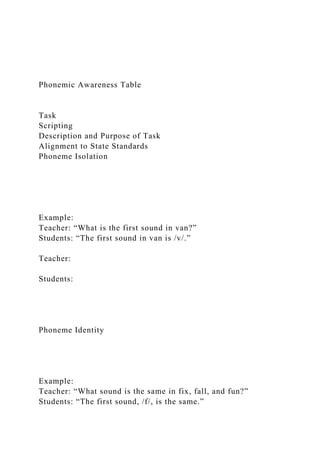
Phonemic Awareness Table
Task
Scripting
Description and Purpose of Task
Alignment to State Standards
Phoneme Isolation
Example:
Teacher: “What is the first sound in van?”
Students: “The first sound in van is /v/.”
Teacher:
Students:
Phoneme Identity
Example:
Teacher: “What sound is the same in fix, fall, and fun?”
Students: “The first sound, /f/, is the same.”
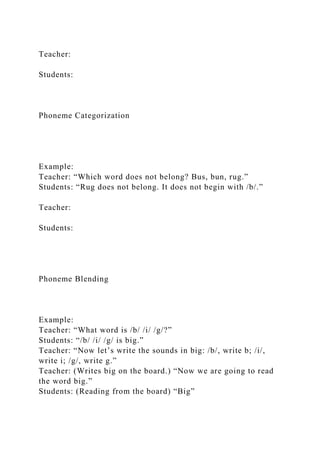
Teacher:
Students:
Phoneme Categorization
Example:
Teacher: “Which word does not belong? Bus, bun, rug.”
Students: “Rug does not belong. It does not begin with /b/.”
Teacher:
Students:
Phoneme Blending
Example:
Teacher: “What word is /b/ /i/ /g/?”
Students: “/b/ /i/ /g/ is big.”
Teacher: “Now let’s write the sounds in big: /b/, write b; /i/,
write i; /g/, write g.”
Teacher: (Writes big on the board.) “Now we are going to read
the word big.”
Students: (Reading from the board) “Big”
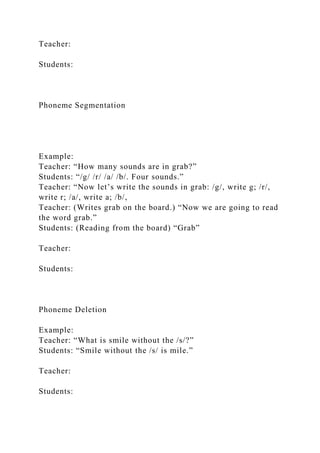
Teacher:
Students:
Phoneme Segmentation
Example:
Teacher: “How many sounds are in grab?”
Students: “/g/ /r/ /a/ /b/. Four sounds.”
Teacher: “Now let’s write the sounds in grab: /g/, write g; /r/,
write r; /a/, write a; /b/,
Teacher: (Writes grab on the board.) “Now we are going to read
the word grab.”
Students: (Reading from the board) “Grab”
Teacher:
Students:
Phoneme Deletion
Example:
Teacher: “What is smile without the /s/?”
Students: “Smile without the /s/ is mile.”
Teacher:
Students:
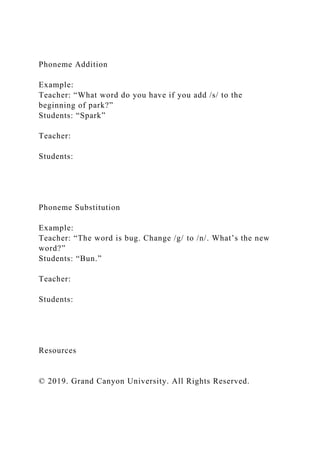
Phoneme Addition
Example:
Teacher: “What word do you have if you add /s/ to the
beginning of park?”
Students: “Spark”
Teacher:
Students:
Phoneme Substitution
Example:
Teacher: “The word is bug. Change /g/ to /n/. What’s the new
word?”
Students: “Bun.”
Teacher:
Students:
Resources
© 2019. Grand Canyon University. All Rights Reserved.
CIS333 – Assignments and Rubrics
© 2017 Strayer University. All Rights Reserved. This document
contains Strayer University Confidential and Proprietary
information
and may not be copied, further distributed, or otherwise
disclosed in whole or in part, without the expressed written
permission of
Strayer University.
CIS333 Faculty Version 1178 (03-22-19) Page 1 of 7
Assignment 1: Creating and Communicating a Security Strategy
Draft Due Week 4, worth 40 points
Final Due Week 6, worth 60 points
As an IT professional, you’ll often be required to communicate
policies, standards, and practices in the
workplace. For this assignment, you’ll practice this important
task by taking on the role of an IT
professional charged with creating a memo to communicate your
company’s new security strategy.
The specific course learning outcomes associated with this
assignment are:
• Analyze the importance of network architecture to security
operations.
• Apply information security standards to real-world
implementation.
• Communicate how problem-solving concepts are applied in a
business environment.
• Use information resources to research issues in information
systems security.
• Write clearly about network security topics using proper
writing mechanics and business formats.
Preparation
1. Review the essential elements of a security strategy
A successful IT administration strategy requires the continuous
enforcement of policies, standards, and
practices (procedures) within the organization. Review these
elements to see how they compare:
Policy The general statements that direct the organization’s
internal and external
communication and goals.
Standards Describe the requirements of a given activity related
to the policy. They are more
detailed and specific than policies. In effect, standards are rules
that evaluate the
quality of the activity. For example, standards define the
structure of the password
and the numbers, letters, and special characters that must be
used in order to
create a password.
Practices The written instructions that describe a series of steps
to be followed during the
performance of a given activity. Practices must support and
enhance the work
environment. Also referred to as procedures.
2. Describe the business environment
You are the IT professional in charge of security for a company
that has recently opened within a
shopping mall. Describe the current IT environment at this
business. You can draw details from a
company you work for now or for which you have worked in the
past. You’ll need to get creative and
identify the details about this business that will influence the
policies you’ll create. For example, does the
company allow cell phone email apps? Does the company allow
web mail? If so, how will this affect the
mobile computing policy? Describe all the details about this
business environment that will be necessary
to support your strategy.
CIS333 – Assignments and Rubrics
© 2017 Strayer University. All Rights Reserved. This document
contains Strayer University Confidential and Proprietary
information
and may not be copied, further distributed, or otherwise
disclosed in whole or in part, without the expressed written
permission of
Strayer University.
CIS333 Faculty Version 1178 (03-22-19) Page 2 of 7
3. Research sample policies
Familiarize yourself with various templates and sample policies
used in the IT field. Do not just copy
another company’s security policy, but rather learn from the
best practices of other companies and apply
them to yours. Use these resources to help structure your
policies:
● Information Security Policy Templates
● Sample Data Security Policies
● Additional Examples and Tips
Instructions
With the description of the business environment (the fictional
company that has opened in a shopping
mall) in mind and your policy review and research complete,
create a new security strategy in the format
of a company memo (no less than three to five pages) in which
you do the following:
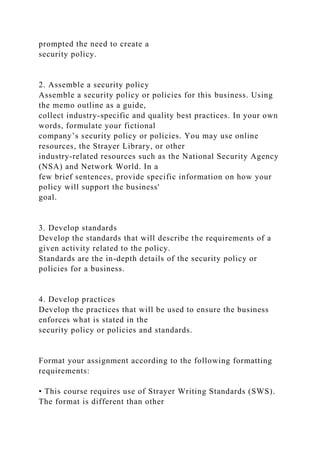
1. Describe the business environment and identify the risk and
reasoning
Provide a brief description of all the important areas of the
business environment that you’ve
discovered in your research. Be sure to identify the reasons that
prompted the need to create a
security policy.
2. Assemble a security policy
Assemble a security policy or policies for this business. Using
the memo outline as a guide,
collect industry-specific and quality best practices. In your own
words, formulate your fictional
company’s security policy or policies. You may use online
resources, the Strayer Library, or other
industry-related resources such as the National Security Agency
(NSA) and Network World. In a
few brief sentences, provide specific information on how your
policy will support the business'
goal.
3. Develop standards
Develop the standards that will describe the requirements of a
given activity related to the policy.
Standards are the in-depth details of the security policy or
policies for a business.
4. Develop practices
Develop the practices that will be used to ensure the business
enforces what is stated in the
security policy or policies and standards.
Format your assignment according to the following formatting
requirements:
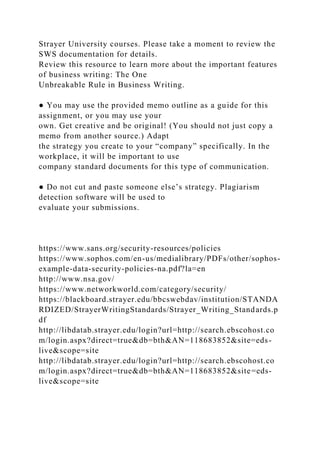
• This course requires use of Strayer Writing Standards (SWS).
The format is different than other
Strayer University courses. Please take a moment to review the
SWS documentation for details.
Review this resource to learn more about the important features
of business writing: The One
Unbreakable Rule in Business Writing.
● You may use the provided memo outline as a guide for this
assignment, or you may use your
own. Get creative and be original! (You should not just copy a
memo from another source.) Adapt
the strategy you create to your “company” specifically. In the
workplace, it will be important to use
company standard documents for this type of communication.
● Do not cut and paste someone else’s strategy. Plagiarism
detection software will be used to
evaluate your submissions.
https://www.sans.org/security-resources/policies
https://www.sophos.com/en-us/medialibrary/PDFs/other/sophos-
example-data-security-policies-na.pdf?la=en
http://www.nsa.gov/
https://www.networkworld.com/category/security/
https://blackboard.strayer.edu/bbcswebdav/institution/STANDA
RDIZED/StrayerWritingStandards/Strayer_Writing_Standards.p
df
http://libdatab.strayer.edu/login?url=http://search.ebscohost.co
m/login.aspx?direct=true&db=bth&AN=118683852&site=eds-
live&scope=site
http://libdatab.strayer.edu/login?url=http://search.ebscohost.co
m/login.aspx?direct=true&db=bth&AN=118683852&site=eds-
live&scope=site
CIS333 – Assignments and Rubrics
© 2017 Strayer University. All Rights Reserved. This document
contains Strayer University Confidential and Proprietary
information
and may not be copied, further distributed, or otherwise
disclosed in whole or in part, without the expressed written
permission of
Strayer University.
CIS333 Faculty Version 1178 (03-22-19) Page 3 of 7
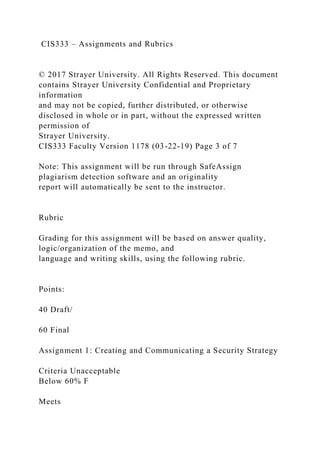
Note: This assignment will be run through SafeAssign
plagiarism detection software and an originality
report will automatically be sent to the instructor.
Rubric
Grading for this assignment will be based on answer quality,
logic/organization of the memo, and
language and writing skills, using the following rubric.
Points:
40 Draft/
60 Final
Assignment 1: Creating and Communicating a Security Strategy
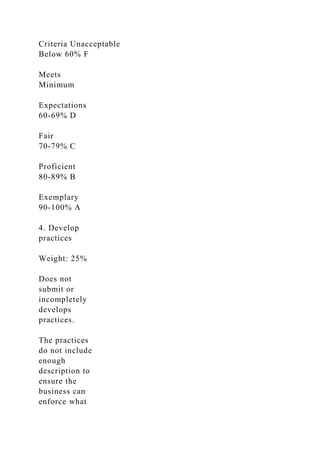
Criteria Unacceptable
Below 60% F
Meets
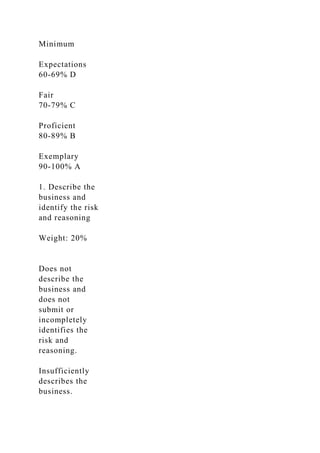
Minimum
Expectations
60-69% D
Fair
70-79% C
Proficient
80-89% B
Exemplary
90-100% A
1. Describe the
business and
identify the risk
and reasoning
Weight: 20%
Does not
describe the
business and
does not
submit or
incompletely
identifies the
risk and
reasoning.
Insufficiently
describes the
business.
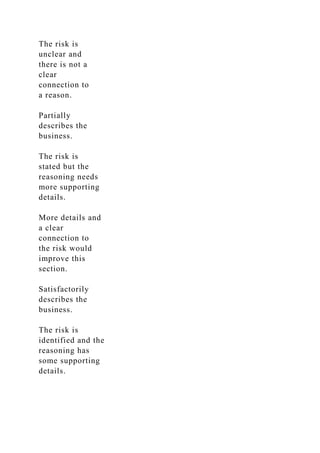
The risk is
unclear and
there is not a
clear
connection to
a reason.
Partially
describes the
business.
The risk is
stated but the
reasoning needs
more supporting
details.
More details and
a clear
connection to
the risk would
improve this
section.
Satisfactorily
describes the
business.
The risk is
identified and the
reasoning has
some supporting
details.
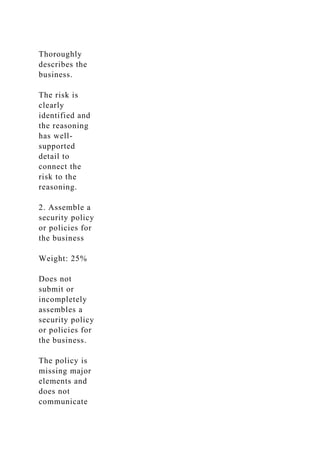
Thoroughly
describes the
business.
The risk is
clearly
identified and
the reasoning
has well-
supported
detail to
connect the
risk to the
reasoning.
2. Assemble a
security policy
or policies for
the business
Weight: 25%
Does not
submit or
incompletely
assembles a
security policy
or policies for
the business.
The policy is
missing major
elements and
does not
communicate
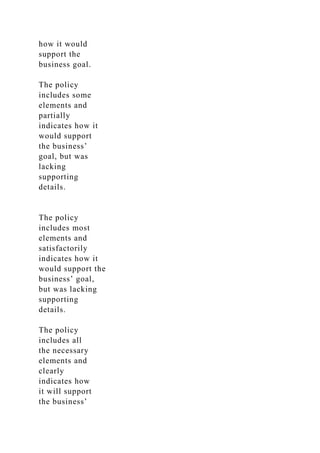
how it would
support the
business goal.
The policy
includes some
elements and
partially
indicates how it
would support
the business’
goal, but was
lacking
supporting
details.
The policy
includes most
elements and
satisfactorily
indicates how it
would support the
business’ goal,
but was lacking
supporting
details.
The policy
includes all
the necessary
elements and
clearly
indicates how
it will support
the business’
goal.
3. Develop
standards
Weight: 25%
Does not
submit or
incompletely
develops
standards.
The standards
are not fully
developed and
do not
describe the
requirements
of the activity.
The standards
partially
describe some
of the
requirements of
the activity but
lack the details
necessary to
make them
complete.
The standards
satisfactorily
describe many of
the requirements
of the activity but
could use more
details.
The standards
thoroughly
describe all
the
requirements
of the activity
and include
sound, in-
depth details.
CIS333 – Assignments and Rubrics
© 2017 Strayer University. All Rights Reserved. This document
contains Strayer University Confidential and Proprietary
information
and may not be copied, further distributed, or otherwise
disclosed in whole or in part, without the expressed written
permission of
Strayer University.
CIS333 Faculty Version 1178 (03-22-19) Page 4 of 7
Points:
40 Draft/
60 Final
Assignment 1: Creating and Communicating a Security Strategy
Criteria Unacceptable
Below 60% F
Meets
Minimum
Expectations
60-69% D
Fair
70-79% C
Proficient
80-89% B
Exemplary
90-100% A
4. Develop
practices
Weight: 25%
Does not
submit or
incompletely
develops
practices.
The practices
do not include
enough
description to
ensure the
business can
enforce what
is stated in the
policies and
standards.
The written
instructions do
not include
steps or
enough steps
to make them
complete.
The practices
partially
describe how to
ensure the
business can
enforce what is
stated in the
policies and
standards.
The written
instructions
include some
steps, but they
could be
expanded to
make them
complete.
The practices
satisfactorily
address how to
ensure the
business can
enforce what is
stated in the
policies and
standards.
The written
instructions
include many of
the necessary
steps, but
additional steps
and details would
improve the
instructions.
The practices
thoroughly
address how
to ensure the
business can
enforce what
is stated in the
policies and
standards.
The written
instructions
include all the
necessary
steps and
have well-
supporting
details.
5. Clarity,
writing
mechanics,
and business
formatting
requirements
Weight: 5%
The writing
lacks clarity.
Formatting is
not
appropriate
for business.
The writing
lacks some
clarity.
Formatting is
not
appropriate for
business.
The writing is
beginning to
show clarity.
Business
formatting is
partially applied.
The writing is
mostly clear and
business
formatting is
apparent.
Some minor
adjustments
would improve
the overall
format.
The writing is
professional
and clear.
The formatting
is excellent
and aligned
with business
requirements.
CIS333 – Assignments and Rubrics
© 2017 Strayer University. All Rights Reserved. This document
contains Strayer University Confidential and Proprietary
information
and may not be copied, further distributed, or otherwise
disclosed in whole or in part, without the expressed written
permission of
Strayer University.
CIS333 Faculty Version 1178 (03-22-19) Page 5 of 7
Additional Examples and Tips
Example 1: XYZ Inc. Company-Wide Employee Password
Strategy
Policies
• All users must have a password.
• Passwords must be changed every six months.
Standards
• A password must have a minimum of six characters.
• A password must have a maximum of 12 characters.
• A password must contain letters, numbers, and special
characters other than $.
Practices-Employee
• Create a password. The UserID should be an EmployeeID
already generated by HR.
• Send a request to create the account to the Information
Technology (IT) department.
• User receives a temporary password.
• Users must change their temporary password the first time
they log in.
Example 2: Security Policy and Standards
Password Policy: Passwords are an important part of computer
security at your organization. They often
serve as the first line of defense in preventing unauthorized
access to the organization’s computers and
data.
In order to define the password policy, it is important to
identify the standards.
1. Multi-factor authentication
2. Password strength standard
3. Password security standards; how to keep the password
secure
Tips and Points to Consider When Identifying Risks or Security
Vulnerabilities
• Flaws in operating systems due to constant attack by malware
• Denial of services attacks
• Employees data theft
• User set a weak password or password that is easy to guess,
such as a birthday or child’s name.
• User leaves sensitive data on an unlocked, unattended
computer
• Organization allows sensitive data on a laptop that leaves the
building
• Data can be accessed remotely without using proper security
CIS333 – Assignments and Rubrics
© 2017 Strayer University. All Rights Reserved. This document
contains Strayer University Confidential and Proprietary
information
and may not be copied, further distributed, or otherwise
disclosed in whole or in part, without the expressed written
permission of
Strayer University.
CIS333 Faculty Version 1178 (03-22-19) Page 6 of 7
Memo Outline
Network Security Associates of Atlantis, Inc.
123 Watery Lane
Atlantis, USVI 91199
From: IT Security Dept.
Re: Security Policy
Date:
Section 1: General Policies and Motivation
Section 2: Passwords
Section 3: Biometrics
Section 4: Tokens
Section 5: Physical Security
Section 6: Email Policies
Section 7: Breach Reporting Responsibilities
Section 8: Mobile Policy and BYOD (Bring Your Own Device)
CIS333 – Assignments and Rubrics
© 2017 Strayer University. All Rights Reserved. This document
contains Strayer University Confidential and Proprietary
information
and may not be copied, further distributed, or otherwise
disclosed in whole or in part, without the expressed written
permission of
Strayer University.
CIS333 Faculty Version 1178 (03-22-19) Page 7 of 7
Phonemic Awareness Skills
Phonemic awareness is crucial to both reading and spelling
success. Using a question and answer format when teaching
phonemic awareness is a common and useful strategy. Scripting
the questions you will pose to your future students and their
potential responses can help prepare you for implementing your
future literacy lessons.
Complete the “Phonemic Awareness Table,” by identifying and
using words from the “Birthday Soup” excerpt. Script phonemic
awareness practice activities, the description and purpose of the
task, and the alignment to state standards for each of
the g phoneme tasks.
Support your findings with 2‐3 scholarly sources.
Solid academic writing is expected, and in‐text citations and
references should be presented using APA documentation
guidelines, which can be found in the APA Style Guide, located
in the Student Success Center.
This assignment uses a rubric. Review the rubric prior to
beginning the assignment to become familiar with the
expectations for successful completion.
WEBSITES TO REVIEW PRIOR TO STARTING THE
ASSIGNMENT
Read “Building Phonemic Awareness for Struggling Readers,”
located on the Literacy Nest website.
URL:
http://www.theliteracynest.com/2016/04/building-phonemic-
awareness-for.html
Watch “Fun with Phonemes,” located on the Reading Rockets
website.
URL:
http://www.readingrockets.org/atoz/1138/video
View “Phonological Awareness, Phonemic Awareness, and
Phonics,” located on YouTube.
URL:
https://www.youtube.com/watch?v=McJldIFIpC8
IF YOU ARE UNABLE TO OPEN BIRTHDAY SOUP PLEASE
LET ME KNOW BECAUSE YOU NEED TO USE THE WORDS
IN THE CHART.
Birthday Soup
Read pages 14-15, from “Birthday Soup,” by Minarik, located
on the Common Core State Standards website.
URL:
http://www.corestandards.org/assets/Appendix_B.pdf
Rubic_Print_FormatCourse CodeClass CodeAssignment
TitleTotal PointsELM-305ELM-305-O501Phonemic Awareness
Skills35.0CriteriaPercentageNo Submission (0.00%)Insufficient
(65.00%)Approaching (75.00%)Acceptable (85.00%)Target
(100.00%)CommentsPoints EarnedCriteria100.0%Phoneme
Isolation10.0%Not addressed.Activity, description, and purpose
of phoneme isolation are inaccurately or inappropriately
described. Activity vocabulary may not relate to provided
reading excerpt. Activity is inadequately aligned to state
standards.Activity, description, and purpose of phoneme
isolation are broadly described. Activity vocabulary basically
relates to provided reading excerpt. Activity is partially aligned
to state standards.Activity, description, and purpose of phoneme
isolation are logical and effective. Activity vocabulary
sufficiently relates to provided reading excerpt. Alignment of
activity to state standards is reasonable.Activity, description,
and purpose of phoneme isolation are well crafted and skillfully
explained. Activity vocabulary thoroughly relates to provided
reading excerpt. Alignment of activity to state standards is
exceptional.Phoneme Identity10.0%Not addressed.Activity,
description, and purpose of phoneme identity are inaccurately or
inappropriately described. Activity vocabulary may not relate to
provided reading excerpt. Activity is inadequately aligned to
state standards.Activity, description, and purpose of phoneme
identity are broadly described. Activity vocabulary basically
relates to provided reading excerpt. Activity is partially aligned
to state standards.Activity, description, and purpose of phoneme
identity are logical and effective. Activity vocabulary
sufficiently relates to provided reading excerpt. Alignment of
activity to state standards is reasonable.Activity, description,
and purpose of phoneme identity are well crafted and skillfully
explained. Activity vocabulary thoroughly relates to provided
reading excerpt. Alignment of activity to state standards is
exceptional.Phoneme Categorization10.0%Not
addressed.Activity, description, and purpose of phoneme
categorization are inaccurately or inappropriately described.
Activity vocabulary may not relate to provided reading excerpt.
Activity is inadequately aligned to state standards.Activity,
description, and purpose of phoneme categorization are broadly
described. Activity vocabulary basically relates to provided
reading excerpt. Activity is partially aligned to state
standards.Activity, description, and purpose of phoneme
categorization are logical and effective. Activity vocabulary
sufficiently relates to provided reading excerpt. Alignment of
activity to state standards is reasonable.Activity, description,
and purpose of phoneme categorization are well crafted and
skillfully explained. Activity vocabulary thoroughly relates to
provided reading excerpt. Alignment of activity to state
standards is exceptional.Phoneme Blending10.0%Not
addressed.Activity, description, and purpose of phoneme
blending are inaccurately or inappropriately described. Activity
vocabulary may not relate to provided reading excerpt. Activity
is inadequately aligned to state standards.Activity, description,
and purpose of phoneme blending are broadly described.
Activity vocabulary basically relates to provided reading
excerpt. Activity is partially aligned to state standards.Activity,
description, and purpose of phoneme blending are logical and
effective. Activity vocabulary sufficiently relates to provided
reading excerpt. Alignment of activity to state standards is
reasonable.Activity, description, and purpose of phoneme
blending are well crafted and skillfully explained. Activity
vocabulary thoroughly relates to provided reading excerpt.
Alignment of activity to state standards is exceptional.Phoneme
Segmentation10.0%Not addressed.Activity, description, and
purpose of phoneme segmentation are inaccurately or
inappropriately described. Activity vocabulary may not relate to
provided reading excerpt. Activity is inadequately aligned to
state standards.Activity, description, and purpose of phoneme
segmentation are broadly described. Activity vocabulary
basically relates to provided reading excerpt. Activity is
partially aligned to state standards.Activity, description, and
purpose of phoneme segmentation are logical and effective.
Activity vocabulary sufficiently relates to provided reading
excerpt. Alignment of activity to state standards is
reasonable.Activity, description, and purpose of phoneme
segmentation are well crafted and skillfully explained. Activity
vocabulary thoroughly relates to provided reading excerpt.
Alignment of activity to state standards is exceptional.Phoneme
Deletion10.0%Not addressed.Activity, description, and purpose
of phoneme deletion are inaccurately or inappropriately
described. Activity vocabulary may not relate to provided
reading excerpt. Activity is inadequately aligned to state
standards.Activity, description, and purpose of phoneme
deletion are broadly described. Activity vocabulary basically
relates to provided reading excerpt. Activity is partially aligned
to state standards.Activity, description, and purpose of phoneme
deletion are logical and effective. Activity vocabulary
sufficiently relates to provided reading excerpt. Alignment of
activity to state standards is reasonable.Activity, description,
and purpose of phoneme deletion are well crafted and skillfully
explained. Activity vocabulary thoroughly relates to provided
reading excerpt. Alignment of activity to state standards is
exceptional.Phoneme Addition10.0%Not addressed.Activity,
description, and purpose of phoneme addition are inaccurately
or inappropriately described. Activity vocabulary may not relate
to provided reading excerpt. Activity is inadequately aligned to
state standards.Activity, description, and purpose of phoneme
addition are broadly described. Activity vocabulary basically
relates to provided reading excerpt. Activity is partially aligned
to state standards.Activity, description, and purpose of phoneme
addition are logical and effective. Activity vocabulary
sufficiently relates to provided reading excerpt. Alignment of
activity to state standards is reasonable.Activity, description,
and purpose of phoneme addition are well crafted and skillfully
explained. Activity vocabulary thoroughly relates to provided
reading excerpt. Alignment of activity to state standards is
exceptional.Phoneme Substitution10.0%Not addressed.Activity,
description, and purpose of phoneme substitution are
inaccurately or inappropriately described. Activity vocabulary
may not relate to provided reading excerpt. Activity is
inadequately aligned to state standards.Activity, description,
and purpose of phoneme substitution are broadly described.
Activity vocabulary basically relates to provided reading
excerpt. Activity is partially aligned to state standards.Activity,
description, and purpose of phoneme substitution are logical
and effective. Activity vocabulary sufficiently relates to
provided reading excerpt. Alignment of activity to state
standards is reasonable.Activity, description, and purpose of
phoneme substitution are well crafted and skillfully explained.
Activity vocabulary thoroughly relates to provided reading
excerpt. Alignment of activity to state standards is
exceptional.Documentation of Sources (citations, footnotes,
references, bibliography, etc., as appropriate to assignment and
style)5.0%Not addressed.Documentation of sources is
inconsistent and/or incorrect, as appropriate to assignment and
style, with numerous formatting errors.Sources are documented,
as appropriate to assignment and style, although some
formatting errors are present.Sources are documented, as
appropriate to assignment and style, and format is mostly
correct.Sources are completely and correctly documented, as
appropriate to assignment and style, and format is free of
error.Mechanics of Writing (includes spelling, punctuation,
grammar, language use)15.0%Not addressed.Surface errors are
pervasive enough that they impede communication of meaning.
Inappropriate word choice or sentence construction are
used.Submission includes mechanical errors, but they do not
hinder comprehension. Includes some practice and content-
related language.Submission is largely free of mechanical
errors, although a few are present. Includes appropriate practice
and content-related language.Submission is virtually free of
mechanical errors. Word choice reflects well-developed use of
practice and content-related language.Total Weightage100%

Phonemic Awareness TableTaskScriptingDescription and.docx

  • 1.
    Phonemic Awareness Table Task Scripting Descriptionand Purpose of Task Alignment to State Standards Phoneme Isolation Example: Teacher: “What is the first sound in van?” Students: “The first sound in van is /v/.” Teacher: Students: Phoneme Identity Example: Teacher: “What sound is the same in fix, fall, and fun?” Students: “The first sound, /f/, is the same.”
  • 2.
    Teacher: Students: Phoneme Categorization Example: Teacher: “Whichword does not belong? Bus, bun, rug.” Students: “Rug does not belong. It does not begin with /b/.” Teacher: Students: Phoneme Blending Example: Teacher: “What word is /b/ /i/ /g/?” Students: “/b/ /i/ /g/ is big.” Teacher: “Now let’s write the sounds in big: /b/, write b; /i/, write i; /g/, write g.” Teacher: (Writes big on the board.) “Now we are going to read the word big.” Students: (Reading from the board) “Big”
  • 3.
    Teacher: Students: Phoneme Segmentation Example: Teacher: “Howmany sounds are in grab?” Students: “/g/ /r/ /a/ /b/. Four sounds.” Teacher: “Now let’s write the sounds in grab: /g/, write g; /r/, write r; /a/, write a; /b/, Teacher: (Writes grab on the board.) “Now we are going to read the word grab.” Students: (Reading from the board) “Grab” Teacher: Students: Phoneme Deletion Example: Teacher: “What is smile without the /s/?” Students: “Smile without the /s/ is mile.” Teacher: Students:
  • 4.
    Phoneme Addition Example: Teacher: “Whatword do you have if you add /s/ to the beginning of park?” Students: “Spark” Teacher: Students: Phoneme Substitution Example: Teacher: “The word is bug. Change /g/ to /n/. What’s the new word?” Students: “Bun.” Teacher: Students: Resources © 2019. Grand Canyon University. All Rights Reserved.
  • 5.
    CIS333 – Assignmentsand Rubrics © 2017 Strayer University. All Rights Reserved. This document contains Strayer University Confidential and Proprietary information and may not be copied, further distributed, or otherwise disclosed in whole or in part, without the expressed written permission of Strayer University. CIS333 Faculty Version 1178 (03-22-19) Page 1 of 7 Assignment 1: Creating and Communicating a Security Strategy Draft Due Week 4, worth 40 points Final Due Week 6, worth 60 points As an IT professional, you’ll often be required to communicate policies, standards, and practices in the workplace. For this assignment, you’ll practice this important task by taking on the role of an IT professional charged with creating a memo to communicate your company’s new security strategy. The specific course learning outcomes associated with this assignment are: • Analyze the importance of network architecture to security operations. • Apply information security standards to real-world
  • 6.
    implementation. • Communicate howproblem-solving concepts are applied in a business environment. • Use information resources to research issues in information systems security. • Write clearly about network security topics using proper writing mechanics and business formats. Preparation 1. Review the essential elements of a security strategy A successful IT administration strategy requires the continuous enforcement of policies, standards, and practices (procedures) within the organization. Review these elements to see how they compare: Policy The general statements that direct the organization’s internal and external communication and goals. Standards Describe the requirements of a given activity related to the policy. They are more detailed and specific than policies. In effect, standards are rules that evaluate the quality of the activity. For example, standards define the structure of the password and the numbers, letters, and special characters that must be used in order to create a password.
  • 7.
    Practices The writteninstructions that describe a series of steps to be followed during the performance of a given activity. Practices must support and enhance the work environment. Also referred to as procedures. 2. Describe the business environment You are the IT professional in charge of security for a company that has recently opened within a shopping mall. Describe the current IT environment at this business. You can draw details from a company you work for now or for which you have worked in the past. You’ll need to get creative and identify the details about this business that will influence the policies you’ll create. For example, does the company allow cell phone email apps? Does the company allow web mail? If so, how will this affect the mobile computing policy? Describe all the details about this business environment that will be necessary to support your strategy. CIS333 – Assignments and Rubrics © 2017 Strayer University. All Rights Reserved. This document contains Strayer University Confidential and Proprietary information and may not be copied, further distributed, or otherwise disclosed in whole or in part, without the expressed written
  • 8.
    permission of Strayer University. CIS333Faculty Version 1178 (03-22-19) Page 2 of 7 3. Research sample policies Familiarize yourself with various templates and sample policies used in the IT field. Do not just copy another company’s security policy, but rather learn from the best practices of other companies and apply them to yours. Use these resources to help structure your policies: ● Information Security Policy Templates ● Sample Data Security Policies ● Additional Examples and Tips Instructions With the description of the business environment (the fictional company that has opened in a shopping mall) in mind and your policy review and research complete, create a new security strategy in the format of a company memo (no less than three to five pages) in which you do the following: 1. Describe the business environment and identify the risk and reasoning Provide a brief description of all the important areas of the business environment that you’ve discovered in your research. Be sure to identify the reasons that
  • 9.
    prompted the needto create a security policy. 2. Assemble a security policy Assemble a security policy or policies for this business. Using the memo outline as a guide, collect industry-specific and quality best practices. In your own words, formulate your fictional company’s security policy or policies. You may use online resources, the Strayer Library, or other industry-related resources such as the National Security Agency (NSA) and Network World. In a few brief sentences, provide specific information on how your policy will support the business' goal. 3. Develop standards Develop the standards that will describe the requirements of a given activity related to the policy. Standards are the in-depth details of the security policy or policies for a business. 4. Develop practices Develop the practices that will be used to ensure the business enforces what is stated in the security policy or policies and standards. Format your assignment according to the following formatting requirements: • This course requires use of Strayer Writing Standards (SWS). The format is different than other
  • 10.
    Strayer University courses.Please take a moment to review the SWS documentation for details. Review this resource to learn more about the important features of business writing: The One Unbreakable Rule in Business Writing. ● You may use the provided memo outline as a guide for this assignment, or you may use your own. Get creative and be original! (You should not just copy a memo from another source.) Adapt the strategy you create to your “company” specifically. In the workplace, it will be important to use company standard documents for this type of communication. ● Do not cut and paste someone else’s strategy. Plagiarism detection software will be used to evaluate your submissions. https://www.sans.org/security-resources/policies https://www.sophos.com/en-us/medialibrary/PDFs/other/sophos- example-data-security-policies-na.pdf?la=en http://www.nsa.gov/ https://www.networkworld.com/category/security/ https://blackboard.strayer.edu/bbcswebdav/institution/STANDA RDIZED/StrayerWritingStandards/Strayer_Writing_Standards.p df http://libdatab.strayer.edu/login?url=http://search.ebscohost.co m/login.aspx?direct=true&db=bth&AN=118683852&site=eds- live&scope=site http://libdatab.strayer.edu/login?url=http://search.ebscohost.co m/login.aspx?direct=true&db=bth&AN=118683852&site=eds- live&scope=site
  • 11.
    CIS333 – Assignmentsand Rubrics © 2017 Strayer University. All Rights Reserved. This document contains Strayer University Confidential and Proprietary information and may not be copied, further distributed, or otherwise disclosed in whole or in part, without the expressed written permission of Strayer University. CIS333 Faculty Version 1178 (03-22-19) Page 3 of 7 Note: This assignment will be run through SafeAssign plagiarism detection software and an originality report will automatically be sent to the instructor. Rubric Grading for this assignment will be based on answer quality, logic/organization of the memo, and language and writing skills, using the following rubric. Points: 40 Draft/ 60 Final Assignment 1: Creating and Communicating a Security Strategy Criteria Unacceptable Below 60% F Meets
  • 12.
    Minimum Expectations 60-69% D Fair 70-79% C Proficient 80-89%B Exemplary 90-100% A 1. Describe the business and identify the risk and reasoning Weight: 20% Does not describe the business and does not submit or incompletely identifies the risk and reasoning. Insufficiently describes the business.
  • 13.
    The risk is unclearand there is not a clear connection to a reason. Partially describes the business. The risk is stated but the reasoning needs more supporting details. More details and a clear connection to the risk would improve this section. Satisfactorily describes the business. The risk is identified and the reasoning has some supporting details.
  • 14.
    Thoroughly describes the business. The riskis clearly identified and the reasoning has well- supported detail to connect the risk to the reasoning. 2. Assemble a security policy or policies for the business Weight: 25% Does not submit or incompletely assembles a security policy or policies for the business. The policy is missing major elements and does not communicate
  • 15.
    how it would supportthe business goal. The policy includes some elements and partially indicates how it would support the business’ goal, but was lacking supporting details. The policy includes most elements and satisfactorily indicates how it would support the business’ goal, but was lacking supporting details. The policy includes all the necessary elements and clearly indicates how it will support the business’
  • 16.
    goal. 3. Develop standards Weight: 25% Doesnot submit or incompletely develops standards. The standards are not fully developed and do not describe the requirements of the activity. The standards partially describe some of the requirements of the activity but lack the details necessary to make them complete. The standards satisfactorily describe many of the requirements
  • 17.
    of the activitybut could use more details. The standards thoroughly describe all the requirements of the activity and include sound, in- depth details. CIS333 – Assignments and Rubrics © 2017 Strayer University. All Rights Reserved. This document contains Strayer University Confidential and Proprietary information and may not be copied, further distributed, or otherwise disclosed in whole or in part, without the expressed written permission of Strayer University. CIS333 Faculty Version 1178 (03-22-19) Page 4 of 7 Points: 40 Draft/ 60 Final Assignment 1: Creating and Communicating a Security Strategy
  • 18.
    Criteria Unacceptable Below 60%F Meets Minimum Expectations 60-69% D Fair 70-79% C Proficient 80-89% B Exemplary 90-100% A 4. Develop practices Weight: 25% Does not submit or incompletely develops practices. The practices do not include enough description to ensure the business can enforce what
  • 19.
    is stated inthe policies and standards. The written instructions do not include steps or enough steps to make them complete. The practices partially describe how to ensure the business can enforce what is stated in the policies and standards. The written instructions include some steps, but they could be expanded to make them complete. The practices satisfactorily address how to ensure the business can
  • 20.
    enforce what is statedin the policies and standards. The written instructions include many of the necessary steps, but additional steps and details would improve the instructions. The practices thoroughly address how to ensure the business can enforce what is stated in the policies and standards. The written instructions include all the necessary steps and have well- supporting details. 5. Clarity, writing
  • 21.
    mechanics, and business formatting requirements Weight: 5% Thewriting lacks clarity. Formatting is not appropriate for business. The writing lacks some clarity. Formatting is not appropriate for business. The writing is beginning to show clarity. Business formatting is partially applied. The writing is mostly clear and business
  • 22.
    formatting is apparent. Some minor adjustments wouldimprove the overall format. The writing is professional and clear. The formatting is excellent and aligned with business requirements. CIS333 – Assignments and Rubrics © 2017 Strayer University. All Rights Reserved. This document contains Strayer University Confidential and Proprietary information and may not be copied, further distributed, or otherwise disclosed in whole or in part, without the expressed written permission of Strayer University. CIS333 Faculty Version 1178 (03-22-19) Page 5 of 7
  • 23.
    Additional Examples andTips Example 1: XYZ Inc. Company-Wide Employee Password Strategy Policies • All users must have a password. • Passwords must be changed every six months. Standards • A password must have a minimum of six characters. • A password must have a maximum of 12 characters. • A password must contain letters, numbers, and special characters other than $. Practices-Employee • Create a password. The UserID should be an EmployeeID already generated by HR. • Send a request to create the account to the Information Technology (IT) department. • User receives a temporary password. • Users must change their temporary password the first time they log in.
  • 24.
    Example 2: SecurityPolicy and Standards Password Policy: Passwords are an important part of computer security at your organization. They often serve as the first line of defense in preventing unauthorized access to the organization’s computers and data. In order to define the password policy, it is important to identify the standards. 1. Multi-factor authentication 2. Password strength standard 3. Password security standards; how to keep the password secure Tips and Points to Consider When Identifying Risks or Security Vulnerabilities • Flaws in operating systems due to constant attack by malware • Denial of services attacks • Employees data theft • User set a weak password or password that is easy to guess, such as a birthday or child’s name. • User leaves sensitive data on an unlocked, unattended computer • Organization allows sensitive data on a laptop that leaves the building • Data can be accessed remotely without using proper security
  • 25.
    CIS333 – Assignmentsand Rubrics © 2017 Strayer University. All Rights Reserved. This document contains Strayer University Confidential and Proprietary information and may not be copied, further distributed, or otherwise disclosed in whole or in part, without the expressed written permission of Strayer University. CIS333 Faculty Version 1178 (03-22-19) Page 6 of 7 Memo Outline Network Security Associates of Atlantis, Inc. 123 Watery Lane Atlantis, USVI 91199 From: IT Security Dept. Re: Security Policy Date: Section 1: General Policies and Motivation Section 2: Passwords Section 3: Biometrics
  • 26.
    Section 4: Tokens Section5: Physical Security Section 6: Email Policies Section 7: Breach Reporting Responsibilities Section 8: Mobile Policy and BYOD (Bring Your Own Device) CIS333 – Assignments and Rubrics © 2017 Strayer University. All Rights Reserved. This document contains Strayer University Confidential and Proprietary information and may not be copied, further distributed, or otherwise disclosed in whole or in part, without the expressed written permission of Strayer University. CIS333 Faculty Version 1178 (03-22-19) Page 7 of 7 Phonemic Awareness Skills Phonemic awareness is crucial to both reading and spelling
  • 27.
    success. Using aquestion and answer format when teaching phonemic awareness is a common and useful strategy. Scripting the questions you will pose to your future students and their potential responses can help prepare you for implementing your future literacy lessons. Complete the “Phonemic Awareness Table,” by identifying and using words from the “Birthday Soup” excerpt. Script phonemic awareness practice activities, the description and purpose of the task, and the alignment to state standards for each of the g phoneme tasks. Support your findings with 2‐3 scholarly sources. Solid academic writing is expected, and in‐text citations and references should be presented using APA documentation guidelines, which can be found in the APA Style Guide, located in the Student Success Center. This assignment uses a rubric. Review the rubric prior to beginning the assignment to become familiar with the expectations for successful completion. WEBSITES TO REVIEW PRIOR TO STARTING THE ASSIGNMENT Read “Building Phonemic Awareness for Struggling Readers,” located on the Literacy Nest website. URL: http://www.theliteracynest.com/2016/04/building-phonemic- awareness-for.html Watch “Fun with Phonemes,” located on the Reading Rockets website. URL: http://www.readingrockets.org/atoz/1138/video View “Phonological Awareness, Phonemic Awareness, and Phonics,” located on YouTube. URL: https://www.youtube.com/watch?v=McJldIFIpC8
  • 28.
    IF YOU AREUNABLE TO OPEN BIRTHDAY SOUP PLEASE LET ME KNOW BECAUSE YOU NEED TO USE THE WORDS IN THE CHART. Birthday Soup Read pages 14-15, from “Birthday Soup,” by Minarik, located on the Common Core State Standards website. URL: http://www.corestandards.org/assets/Appendix_B.pdf Rubic_Print_FormatCourse CodeClass CodeAssignment TitleTotal PointsELM-305ELM-305-O501Phonemic Awareness Skills35.0CriteriaPercentageNo Submission (0.00%)Insufficient (65.00%)Approaching (75.00%)Acceptable (85.00%)Target (100.00%)CommentsPoints EarnedCriteria100.0%Phoneme Isolation10.0%Not addressed.Activity, description, and purpose of phoneme isolation are inaccurately or inappropriately described. Activity vocabulary may not relate to provided reading excerpt. Activity is inadequately aligned to state standards.Activity, description, and purpose of phoneme isolation are broadly described. Activity vocabulary basically relates to provided reading excerpt. Activity is partially aligned to state standards.Activity, description, and purpose of phoneme isolation are logical and effective. Activity vocabulary sufficiently relates to provided reading excerpt. Alignment of activity to state standards is reasonable.Activity, description, and purpose of phoneme isolation are well crafted and skillfully explained. Activity vocabulary thoroughly relates to provided reading excerpt. Alignment of activity to state standards is exceptional.Phoneme Identity10.0%Not addressed.Activity, description, and purpose of phoneme identity are inaccurately or inappropriately described. Activity vocabulary may not relate to provided reading excerpt. Activity is inadequately aligned to state standards.Activity, description, and purpose of phoneme
  • 29.
    identity are broadlydescribed. Activity vocabulary basically relates to provided reading excerpt. Activity is partially aligned to state standards.Activity, description, and purpose of phoneme identity are logical and effective. Activity vocabulary sufficiently relates to provided reading excerpt. Alignment of activity to state standards is reasonable.Activity, description, and purpose of phoneme identity are well crafted and skillfully explained. Activity vocabulary thoroughly relates to provided reading excerpt. Alignment of activity to state standards is exceptional.Phoneme Categorization10.0%Not addressed.Activity, description, and purpose of phoneme categorization are inaccurately or inappropriately described. Activity vocabulary may not relate to provided reading excerpt. Activity is inadequately aligned to state standards.Activity, description, and purpose of phoneme categorization are broadly described. Activity vocabulary basically relates to provided reading excerpt. Activity is partially aligned to state standards.Activity, description, and purpose of phoneme categorization are logical and effective. Activity vocabulary sufficiently relates to provided reading excerpt. Alignment of activity to state standards is reasonable.Activity, description, and purpose of phoneme categorization are well crafted and skillfully explained. Activity vocabulary thoroughly relates to provided reading excerpt. Alignment of activity to state standards is exceptional.Phoneme Blending10.0%Not addressed.Activity, description, and purpose of phoneme blending are inaccurately or inappropriately described. Activity vocabulary may not relate to provided reading excerpt. Activity is inadequately aligned to state standards.Activity, description, and purpose of phoneme blending are broadly described. Activity vocabulary basically relates to provided reading excerpt. Activity is partially aligned to state standards.Activity, description, and purpose of phoneme blending are logical and effective. Activity vocabulary sufficiently relates to provided reading excerpt. Alignment of activity to state standards is reasonable.Activity, description, and purpose of phoneme
  • 30.
    blending are wellcrafted and skillfully explained. Activity vocabulary thoroughly relates to provided reading excerpt. Alignment of activity to state standards is exceptional.Phoneme Segmentation10.0%Not addressed.Activity, description, and purpose of phoneme segmentation are inaccurately or inappropriately described. Activity vocabulary may not relate to provided reading excerpt. Activity is inadequately aligned to state standards.Activity, description, and purpose of phoneme segmentation are broadly described. Activity vocabulary basically relates to provided reading excerpt. Activity is partially aligned to state standards.Activity, description, and purpose of phoneme segmentation are logical and effective. Activity vocabulary sufficiently relates to provided reading excerpt. Alignment of activity to state standards is reasonable.Activity, description, and purpose of phoneme segmentation are well crafted and skillfully explained. Activity vocabulary thoroughly relates to provided reading excerpt. Alignment of activity to state standards is exceptional.Phoneme Deletion10.0%Not addressed.Activity, description, and purpose of phoneme deletion are inaccurately or inappropriately described. Activity vocabulary may not relate to provided reading excerpt. Activity is inadequately aligned to state standards.Activity, description, and purpose of phoneme deletion are broadly described. Activity vocabulary basically relates to provided reading excerpt. Activity is partially aligned to state standards.Activity, description, and purpose of phoneme deletion are logical and effective. Activity vocabulary sufficiently relates to provided reading excerpt. Alignment of activity to state standards is reasonable.Activity, description, and purpose of phoneme deletion are well crafted and skillfully explained. Activity vocabulary thoroughly relates to provided reading excerpt. Alignment of activity to state standards is exceptional.Phoneme Addition10.0%Not addressed.Activity, description, and purpose of phoneme addition are inaccurately or inappropriately described. Activity vocabulary may not relate to provided reading excerpt. Activity is inadequately aligned to
  • 31.
    state standards.Activity, description,and purpose of phoneme addition are broadly described. Activity vocabulary basically relates to provided reading excerpt. Activity is partially aligned to state standards.Activity, description, and purpose of phoneme addition are logical and effective. Activity vocabulary sufficiently relates to provided reading excerpt. Alignment of activity to state standards is reasonable.Activity, description, and purpose of phoneme addition are well crafted and skillfully explained. Activity vocabulary thoroughly relates to provided reading excerpt. Alignment of activity to state standards is exceptional.Phoneme Substitution10.0%Not addressed.Activity, description, and purpose of phoneme substitution are inaccurately or inappropriately described. Activity vocabulary may not relate to provided reading excerpt. Activity is inadequately aligned to state standards.Activity, description, and purpose of phoneme substitution are broadly described. Activity vocabulary basically relates to provided reading excerpt. Activity is partially aligned to state standards.Activity, description, and purpose of phoneme substitution are logical and effective. Activity vocabulary sufficiently relates to provided reading excerpt. Alignment of activity to state standards is reasonable.Activity, description, and purpose of phoneme substitution are well crafted and skillfully explained. Activity vocabulary thoroughly relates to provided reading excerpt. Alignment of activity to state standards is exceptional.Documentation of Sources (citations, footnotes, references, bibliography, etc., as appropriate to assignment and style)5.0%Not addressed.Documentation of sources is inconsistent and/or incorrect, as appropriate to assignment and style, with numerous formatting errors.Sources are documented, as appropriate to assignment and style, although some formatting errors are present.Sources are documented, as appropriate to assignment and style, and format is mostly correct.Sources are completely and correctly documented, as appropriate to assignment and style, and format is free of error.Mechanics of Writing (includes spelling, punctuation,
  • 32.
    grammar, language use)15.0%Notaddressed.Surface errors are pervasive enough that they impede communication of meaning. Inappropriate word choice or sentence construction are used.Submission includes mechanical errors, but they do not hinder comprehension. Includes some practice and content- related language.Submission is largely free of mechanical errors, although a few are present. Includes appropriate practice and content-related language.Submission is virtually free of mechanical errors. Word choice reflects well-developed use of practice and content-related language.Total Weightage100%