Phonegap Essentials Building Crossplatform Mobile Apps John M Wargo
Phonegap Essentials Building Crossplatform Mobile Apps John M Wargo
Phonegap Essentials Building Crossplatform Mobile Apps John M Wargo
Phonegap Essentials Building Crossplatform Mobile Apps John M Wargo
Phonegap Essentials Building Crossplatform Mobile Apps John M Wargo
1.
Phonegap Essentials BuildingCrossplatform
Mobile Apps John M Wargo download
https://ebookbell.com/product/phonegap-essentials-building-
crossplatform-mobile-apps-john-m-wargo-4701364
Explore and download more ebooks at ebookbell.com
2.
Here are somerecommended products that we believe you will be
interested in. You can click the link to download.
Phonegap Essentials Ivan Turkovic
https://ebookbell.com/product/phonegap-essentials-ivan-
turkovic-5770632
Phonegap Beginners Guide Andrew Lunny
https://ebookbell.com/product/phonegap-beginners-guide-andrew-
lunny-2359392
Phonegap Mobile Application Development Cookbook Gifford Matt
https://ebookbell.com/product/phonegap-mobile-application-development-
cookbook-gifford-matt-2619002
Phonegap 2x Mobile Application Development Hotshot Kerri Shotts
https://ebookbell.com/product/phonegap-2x-mobile-application-
development-hotshot-kerri-shotts-4570858
3.
Phonegap Build DevelopingCross Platform Mobile Applications In The
Cloud Bintu Harwani
https://ebookbell.com/product/phonegap-build-developing-cross-
platform-mobile-applications-in-the-cloud-bintu-harwani-4748214
Phonegap For Enterprise Kerri Shotts
https://ebookbell.com/product/phonegap-for-enterprise-kerri-
shotts-4985060
Phonegap 4 Mobile Application Development Cookbook Build Realworld
Hybrid Mobile Applications Using The Robust Phonegap Development
Platform Zainul Setyo Pamungkas
https://ebookbell.com/product/phonegap-4-mobile-application-
development-cookbook-build-realworld-hybrid-mobile-applications-using-
the-robust-phonegap-development-platform-zainul-setyo-
pamungkas-5472624
Phonegap By Example Andrey Kovalenko
https://ebookbell.com/product/phonegap-by-example-andrey-
kovalenko-5770658
Phonegap Beginners Guide 3rd Edition Purusothaman Ramanujam
https://ebookbell.com/product/phonegap-beginners-guide-3rd-edition-
purusothaman-ramanujam-5770700
PhoneGap Essentials
Building Cross-PlatformMobile Apps
John M. Wargo
Upper Saddle River, NJ • Boston • Indianapolis • San Francisco
New York • Toronto • Montreal • London • Munich • Paris • Madrid
Capetown • Sydney • Tokyo • Singapore • Mexico City
xii Contents
Chapter 22Storage . . . . . . . . . . . . . . . . . . . . . . . . . . . . . . . . . . . . . . . . 315
Local Storage 316
SQL Database 317
Appendix A Installing the PhoneGap Files . . . . . . . . . . . . . . . . . . . . . . 327
Preparing for Samsung bada Development 329
Preparing for iOS Development 329
Preparing for Windows Phone Development 330
Appendix B Installing the Oracle Java Developer Kit . . . . . . . . . . . . . . 333
Downloading the JDK 333
Installing the JDK 335
Configuring the Windows Path 335
Confirming Installation Success 336
Appendix C Installing Apache Ant . . . . . . . . . . . . . . . . . . . . . . . . . . . . . 337
Macintosh Installation 337
Windows Installation 338
Index 341
18.
xiii
by Bryce A.Curtis
Everywhereyou go, people are using mobile devices to keep in touch with fam-
ily and friends, to find a nearby restaurant, or to check the latest news headlines.
Their phones have become an indispensable part of their lives with applications
that bind them closer to each other and the world around them. It’s these applica-
tions that make their phones truly useful. Most users aren’t aware of the underly-
ing technology used to develop their favorite app or how much time it took to
write. Instead, they view an application in terms of the benefit it provides them.
Therefore, as developers, we are free to select technologies that deliver this benefit
in the most efficient manner.
One technology decision that must be made early on when developing an applica-
tion is whether it is to be written using native or web APIs. Depending upon the
application, nativeAPIs may be required to meet the user’s expectations. However,
for most applications, web technologies consisting of HTML 5, JavaScript, and
CSS provide equal user experiences. The advantage of using web APIs is that they
are written using web technologies familiar to many developers, thus providing an
easier and quicker development process. In addition, since web technologies are
standardized, they exhibit fairly consistent behavior across the many different
mobile platforms available today, such asAndroid and iOS phones and tablets.
One significant difference between native and web applications is that the native
applications provide extensive access to device features such as the camera and
accelerometer, while the web applications are limited to what the device’s web
browser supports. To bridge this gap between native and web, a new type of appli-
cation called the hybrid application was created. A hybrid application is written
using the same web technologies—HTML 5, JavaScript, and CSS—but includes
additional code that enables native APIs to be called from JavaScript. It works by
wrapping your web code with a web browser and packaging both together to cre-
ate a native application.
Foreword
19.
xiv Foreword bybryCe A. Curtis
This book focuses on how to develop mobile applications using PhoneGap, which
is a popular open source toolkit for building hybrid applications. You investigate
the extensive PhoneGapAPI and learn how to include many of the device features
in your applications. It will become apparent that PhoneGap delivers on the prom-
ise of a simplified, cross-platform mobile development by enabling you to write
your application using web technologies and then packaging it up so that it can be
distributed throughout the various app stores and markets. With any luck, your
application may even become someone’s favorite app.
BryceA. Curtis, Ph.D.
Mobile & Emerging Technologies
IBM Master Inventor
IBM Software Group
20.
xv
Foreword
by Jim Huempfner
Thereis no doubt that everything is going mobile—not just because everything
can but because it is having a transformational impact on how we live, work, and
communicate. Mobile applications have become critical solutions for both busi-
nesses and consumers.
As a result, many companies are gravitating toward mobile web as their primary
mobile app development technology. If not done correctly, defining, designing,
building, and maintaining mobile applications for both evolving multiple OS plat-
forms and the ever-changing device landscape can be difficult, time-consuming,
and expensive. Numerous commercial and open source products and frameworks
that can potentially simplify mobile application creation and development are
coming to the marketplace.
PhoneGap is proving to be one of the most popular solutions in this space, allow-
ing users to quickly and easily build applications that will run on multiple plat-
forms, leveraging your existing web development skill sets (tweaked for mobile
development, of course). Because of the emergence of this solution as a front-
runner and the challenges customers face in implementing the technology, John
Wargo has written this book to aid developers in the process.
After a decades-long career in various computing technologies, John started to
focus on mobile development platforms in 2006 when he began working for RIM,
the makers of the BlackBerry handheld devices. When I first met him, he was
teaching a group of colleagues and me the ins and outs of BlackBerry develop-
ment. John has a passion for teaching that is surpassed only by his passion for
mobile development, which was demonstrated both loud and clear during the
class. You’ll see that passion and depth of understanding clearly demonstrated in
this book as well.
21.
xvi Foreword byJim HuempFner
We were fortunate to hire John to work in AT&T’s Mobility Group in 2009. He
quickly became my team’s go-to expert on mobile development, constantly evalu-
ating technologies and learning new options in this rapidly changing mobile envi-
ronment. John is a particularly valuable resource in helping our customers define
their mobile application strategy and understand their options for mobile develop-
ment, whether they are using the mobile web, native, hybrid frameworks (such as
PhoneGap), or mobile application platforms such as MEAP or MCAP.
Mobile technology professionals will benefit from this book because it provides
experienced mobile web developers with everything they need to know to transi-
tion their mobile web applications into native mobile applications using
PhoneGap. This book walks you through configuring and using the development
environments you need to work with PhoneGap plus shows you how to use each of
theAPIs provided by the framework; it’s everything you need to get started devel-
oping with PhoneGap.
Success in the rapidly evolving and ever-changing mobility space should not cause
fear and frustration of inaction. Rather, we should embrace technology enablers
like PhoneGap and resources like this book to bring truly winning solutions to
reality.
Jim Huempfner
Vice President
Industry Solutions Practice
AT&T
22.
xvii
This book isabout PhoneGap—a really cool technology that allows you to build
native mobile applications for multiple mobile device platforms using standard
web technologies such as HTML, CSS, and JavaScript. I’d been looking at
PhoneGap for several years, and when I finally got a chance to start working with
it, I quickly found it to be a really simple and compelling way to build a single
application that can run across multiple device platforms.
I knew Java from my work at RIM and from building Android applications. I’d
poked around at Objective-C for iOS development and even did some work for
Windows Mobile using Visual Basic. The world, however, is no longer focusing
on applications for single mobile platforms but instead expects that mobile appli-
cations are available simultaneously for all popular mobile device platforms.
PhoneGap helps solve that particular problem.
This book is for web developers who want to learn how to leverage the capabilities
of the PhoneGap framework. It assumes you already know how to build web appli-
cations and are looking to understand the additional capabilities PhoneGap pro-
vides. The book highlights the PhoneGapAPI capabilities and how to use the tools
provided with PhoneGap.
To understand the topics covered in this book, you will need to have some experi-
ence with one or more of the most popular smartphones. Some experience with
smartphone SDKs is a benefit, but I’ll show you how to install and use the native
SDKs as I discuss each supported platform.
The book is organized into three parts:
• Part I, PhoneGap: Includes a very thorough introduction to PhoneGap:
what it is, how it works, and more
Preface
23.
xviii preFACe
• PartII, PhoneGap Developer Tools: Includes instructions on how to
install and use the SDKs and PhoneGap tools for each of the supported
smartphone platforms
• PartIII,PhoneGapAPIs:IncludesadetaileddescriptionofeachPhoneGap
API plus sample code that illustrates how to exercise theAPI
Additional information, downloadable code projects, and errata can be found on
the book’s web site at www.phonegapessentials.com.
When I first proposed this book to my publisher, it had a completely different struc-
turethanthebookyou’rereadingnow.AsIstartedwriting,Irealizedthatthestructure
I’d picked didn’t work for people learning PhoneGap. So, I quickly reordered it and
broke it into the parts listed earlier. I’ve tried to take you step-by-step through the
things that matter for PhoneGap development. I also tried to make it as complete as
possible—andnotskipanythingrelatedtothetopicathand.Thismeans,forexample,
that when you get to the chapters on configuring development environments for
PhoneGap, you’ll see that I cover each supported platform in detail (with the excep-
tion of webOS since at the time HP indicated it was going to kill the platform). If you
need to write PhoneGap applications for any of those platforms, you’ll find the infor-
mation you need here. If you are focusing on a subset of the supported platforms,
you’ll find that you will need to skip some chapters, but they’ll be there later if you
expand the scope of your development efforts. The other PhoneGap books that pre-
cededthisonefocusedprimarilyonAndroidandiOS,andthatdidn’tseemrighttome.
If you’re looking for a no-nonsense, complete guide to PhoneGap, this is it.
Inside the Book
As I worked through the manuscript, I deliberately assessed each topic against the
book’s title and my goals for the publication. I kept my focus on PhoneGap and
eliminated any topic that didn’t directly relate.
What you’ll find in the book:
• Lots of detailed information about PhoneGap and how PhoneGap works
• Lots of code examples
What you won’t find in this book:
• Mobile web development topics (this is a book about PhoneGap, not
mobile web development)
• Complete listing of the phonegap.js source file
24.
xix
tHe CHAllenges inwriting A pHonegAp book
• Expressions or phrases in languages other than English
• Obscure references to pop-culture topics (although there is an obscure
reference to DouglasAdams’ Hitchhiker’s Guide to the Galaxy and one
blatant reference to Monty Python)
• Pictures of my cats (I have no cats, but a picture of one of my dogs did make
it into the book)
As you look through the example code provided herein, it’s important to keep in
mind that the code was deliberately written to clearly illustrate a particular
PhoneGap-related topic or concept.While there are many things a developer can do
to write compact and/or efficient code, it’s distracting to readers when they have to
analyze every line in order to be able to tell what’s really going on therein. In this
book, the code is expanded to make it as readable as possible. There are, for exam-
ple, very few instances where JavaScript anonymous functions are used in the sam-
ple applications. Although using them would have made the code samples smaller,
I deliberately eliminated them (in all but one chapter) for readability purposes.
No effort whatsoever has been made to optimize these examples for speed or com-
pactness. They’ve been created to teach you the nuances of the PhoneGap APIs,
not best practices for web development.
The Challenges in Writing a PhoneGap Book
Writing a book about PhoneGap (and many other mobile technologies) is hard.
The writing isn’t hard, but keeping up with the changes that occur as you write is
hard. For this book, a lot of important and interesting things happened during the
writing process, and I found myself regularly rewriting chapters to accommodate
recent changes. The good news is that most of the PhoneGap-specific content in
here will remain valid for a very long time. It was industry changes and developer
tool changes that gave me the most trouble.
Let me give you some examples:
• Six (or more) versions of PhoneGap: When I started the book, version
1.0 of PhoneGap had just been released. It seemed that I’d picked the
perfect time to start work on a PhoneGap book. It took me just about
four-and-a-half months to write the manuscript, and during that time three
additional versions of PhoneGap (1.1, 1.2, and 1.3) were released. During
editing and all of the post-production work that needed to be done on the
manuscript, versions 1.4 and 1.5 were released. I expect that by the time
this book makes it onto paper, yet another version of PhoneGap, version
1.6, will have been released.
25.
xx preFACe
• HPkilling and then resurrecting webOS:As I started the manuscript,
HP announced it was discontinuing its webOS devices and would be
seeking someone to acquire the technology. For that reason, I decided to
omit any webOS-related topics from the book. Of course, HP then changed
its mind and announced it would be releasing webOS as an open source
project. Unfortunately, the announcement was made after I’d finished the
manuscript, so you will not find much information about webOS develop-
ment for PhoneGap in this book.After the book is published, I will try to
publish an update that includes information on webOS support.
• Nokia changed the way it supported web development: Immediately
after I completed the chapter on Symbian development, Nokia released a
new version of its Symbian SDK that removed support for testing web
applications on the simulator. Readers of this book will need to make sure
they deploy an older version of the SDK in order to build and test
PhoneGap applications for Symbian.
• Adding Windows Phone support to PhoneGap: With the release of
PhoneGap 1.2, the development team added partial support for Windows
Phone development. This was fortunate since it allowed me to replace the
webOS chapter with one on Windows Phone. With PhoneGap release 1.3,
the team added fullAPI support for Windows Phone development.
• Adding BlackBerry PlayBook support to PhoneGap: In PhoneGap 1.3,
the development team added support for the BlackBerry PlayBook. This,
of course, completely changed the way the Ant scripts used to build
BlackBerry applications worked, and the chapter had to be completely
rewritten. The BlackBerry stuff stayed basically the same, but the
command-line options changed, and a whole new suite of tools was added
to support the PlayBook.
• Deprecating support for the Symbian OS: Beginning with version 1.5,
the PhoneGap project has removed support for Symbian from the
PhoneGap download.You will have to download the code from a separate
location if you want to continue to work with Symbian applications.
• PhoneGap donated to theApache project: One of the biggest changes
that occurred during this process was Nitobi’s announcement that the
project was being donated to theApache Foundation. While not a huge
change for the development community, what was difficult was that the
project was supposed to get a name change. It was first donated toApache
as DeviceReady, but then because of a conflict with a company with the
same name, it was quickly changed to Callback, which was for some
bizarre reason later changed toApache Cordova (named after the street
26.
xxi
Code Conventions
where Nitobi’soffices were located). We’ve been told that the commercial
product will keep the PhoneGap name while the open source project will
have a different name, but I’m really not sure how that’s going to work out.
• NitobiAcquired byAdobe: Immediately following the previous announce-
ment(actuallythenextday),AdobeSystemsIncorporated(www.adobe.com)
announced it was acquiring Nitobi, the company responsible for the
PhoneGap project. That meant big changes for PhoneGap since the folks at
NitobicouldnowfocusentirelyonthePhoneGapprojectinsteadofworking
on it in their spare time. A while later, Adobe announced it was ceasing de-
velopment of its Flash product for mobile devices. This was huge news and
clearly indicated that PhoneGap now had a very important place inAdobe’s
mobile strategy.
One of the biggest problems I faced was getting the help I needed when things
didn’t work or didn’t make sense. As an open source project run by volunteers,
many of my forum questions went unanswered (and to this day are still unan-
swered).You can try to get help there, but usually you’re on your own (all the more
reason to pick up this book).
Code Conventions
I put a few notes and sidebars in the manuscript, but for the most part I kept the
manuscript as clean and simple as I could. I did, however, illustrate sample code in
two ways.
A code snippet, a section of a complete application, will be represented in the
manuscript in the following manner:
var d = new Date(heading.timestamp);
hc.innerHTML = "Timestamp: " + d.toLocaleString();
The code could stand alone, like a complete function that you could use in your
application, but in many cases this type of listing illustrates a piece of code that
simply affects one small part of an application.
On the other hand, complete code listings will look like this:
HelloWorld Example
<!DOCTYPE HTML>
<html>
<head>
<title>HelloWorld</title>
</head>
<body>
27.
xxii preFACe
<h1>Hello World!</h1>
<p>Thisis a very simple web page.</p>
</body>
</html>
In this example, the code shown is a complete, functional application that you can
copy into your IDE and use.
Web Resources
I’ve created a web site for the book: www.phonegapessentials.com (see Figure P-1).
The site contains information about the book’s chapters but will also contain any
errata (ideally none!), reader comments, and more. I will also make the book’s
source code available so you can test the applications yourself and use the code
from this book in your own projects.
I also regularly publish mobile development–related articles to my personal web
site at www.johnwargo.com. Check out the site when you get a chance.
Figure P-1 PhoneGap Essentials web site
28.
xxiii
Iwant to thankBryce Curtis for his excellent technical review of the manuscript
and his help clarifying some of the issues that cropped up as I worked through the
manuscript. There were quite a few places where Bryce added important clarifica-
tions that ultimately made this a better book.
Thanks also to the folks at Nitobi (nowAdobe) for their help with this book.
Thanks to my managers at AT&T: Abhi Ingle, Jim Huempfner, Shiraz Hasan, and
Vishy Gopalakrishnan for supporting me in this endeavor.
Finally, thanks to Greg Doench and the rest of the editorial staff at Pearson Edu-
cation for their continued support and for letting me do another mobile develop-
ment book.
Acknowledgments
29.
xxiv
John M. Wargohas been a professional software developer for most of his
career. He spent many years as a consultant and has created award-winning enter-
prise and commercial software products.
His involvement with mobile development began with a stint at Research In
Motion (RIM) as a developer supporting a large U.S.-based carrier and its custom-
ers. After leaving RIM, he wrote one of the first books dedicated to BlackBerry
development called BlackBerry®
Development Fundamentals (Addison-Wesley,
2010; www.bbdevfundamentals.com).
He is a technical advisor for The View, a magazine for IBM Lotus Domino devel-
opers and administrators, and has penned a series of articles on mobile develop-
ment for that publication.
Until recently, he worked for AT&T as a practice manager in AT&T’s Advanced
Mobile Applications Practice, specializing in cross-platform development tools
and working with customers designing and building both enterprise and consumer
mobile applications. He is now part of SAP’s Mobile Solution Management team,
focusing on the developer experience for SAP’s mobile development tools.
About the Author
30.
Part I
PhoneGap
This partof the book provides an introduction to PhoneGap and a complete
study of what makes a PhoneGap application a PhoneGap application. If you’re
new to PhoneGap, then this is the place to start. If you’ve been working with
PhoneGap for a little while, the material in this part of the book might be a repeat
of what you already know, but you might learn something as well.
3
Introduction to
PhoneGap
PhoneGap isan open source framework for building cross-platform native
applications using standard web technologies such as HyperText Markup Lan-
guage (HTML), Cascading Style Sheets (CSS), and JavaScript. This type of
mobile application is called a hybrid application. A group of developers created
PhoneGap as a way to simplify mobile development, and adoption of the frame-
work has grown significantly over time.
As described on the PhoneGap web site (www.phonegap.com), “PhoneGap is an
open source implementation of open standards.” The project’s development teams
work to implement relevant web development standards (from the World Wide
Web Consortium [W3C] and others) into the PhoneGap framework. There are a
robust suite of application programming interfaces (APIs) included in the frame-
work today, and there’s a solid road map for implementing additional capabilities
over time. There’s much more detail about what PhoneGap is and what makes a
PhoneGap application in this and the following chapter.
PhoneGap currently supports the following mobile device operating system
platforms:
• Apple iOS (both iPhone and iPad): http://developer.apple.com
• GoogleAndroid: http://developer.android.com
• HP/Palm webOS: http://developer.palm.com
• Microsoft Windows Phone 7: http://create.msdn.com/en-us/home/
getting_started
1
33.
4 CHApter 1introduCtion to pHonegAp
• Nokia Symbian: www.developer.nokia.com/Devices/Symbian
• RIM BlackBerry (devices running BlackBerry Device Software 4.6
and newer): www.blackberry.com/developers
• Samsung bada: http://developer.bada.com
The PhoneGap project has plans for adding other platforms as they become popu-
lar in the market (and popular with mobile developers). With Hewlett-Packard’s
announcement of its discontinued support for webOS, development for that plat-
form, although supported by PhoneGap, will not be covered in this book. With
Nokia’s announcement that it is adopting Windows Phone over its own Symbian
OS, it’s possible that PhoneGap will drop support for Symbian in the future, but
the Symbian OS is still covered in this book.
The framework is available under an open source license; as a user of PhoneGap,
you can choose to use either the modified BSD license or the MIT license. The
software is free to use, and the PhoneGap team will not accept any external contri-
butions that are incompatible with either license (either through inclusion of pro-
prietary code or license under a more restrictive license). As the project finishes
the process of migrating to the Apache Software Foundation community, the
license will change to an Apache license. To contribute code to the project, you
will need to sign a contributor agreement.
A Little PhoneGap History
PhoneGap was started at the 2008 iPhoneDevCamp by Nitobi (www.nitobi.com),
which started the project as a way to simplify cross-platform mobile development.
The project began with a team of developers working through a weekend to create
the skeleton of the framework; the core functionality plus the native application
container needed to render web application content on the iPhone.After the initial
build of the framework, the PhoneGap project team quickly added support for
Android, with BlackBerry following a short time thereafter.
In 2009, PhoneGap won the People’s Choice award at the Web 2.0 Expo Launch-
Pad competition. Of course, being a project for geeks, the conference attendees
voted for the winner by Short Message Service (SMS) from their mobile phones.
Over time, PhoneGap has added support for additional hardware platforms and
worked to ensure parity ofAPI features across platforms. The project team contin-
ues to add support for new devices and APIs over time and has a very robust road
map for future versions of the framework.
IBM has recently become more involved in the project. You can now find IBM’s
copyright alongside Nitobi’s in the source code for new PhoneGap projects. When
34.
5
wHy use pHonegAp?
IBMgot involved in the Eclipse project (an open source integrated development
environment [IDE]; www.eclipse.org), Eclipse quickly became integral to IBM’s
product strategy and became the core of several IBM projects. It’s likely that
IBM’s involvement in the PhoneGap project indicates where IBM could be taking
its mobile development or mobile product strategy.
After this section of the chapter had been written, PhoneGap applied to become
part of the open source Apache project (www.apache.org), first as Apache Call-
back and later (beginning with version 1.4) as Apache Cordova (the name of the
street where the Nitobi offices are located). At the same time, Nitobi announced
that it had been acquired byAdobe (www.adobe.com).
Right before the book went to press, the PhoneGap project team changed the name
of the PhoneGap JavaScript file (phonegap.js) to cordova.js. Throughout all of
this, the commercial name for PhoneGap should remain PhoneGap, so all refer-
ences in the book will refer to its commercial name, not the Apache project name.
Sample project source code included herein will be updated with the correct file
name and posted to the book’s web site at www.phonegapessentials.com.
The move to the Apache Software Foundation helps to reassure companies wish-
ing to use PhoneGap that the framework will remain a stable, available tool to use.
The acquisition of Nitobi by Adobe (and Adobe’s subsequent announcement that
they’re discontinuing support for Adobe Flash on mobile devices) clearly indi-
cates that Adobe sees PhoneGap as an important part of their product portfolio.
The folks at Nitobi who were working on PhoneGap in their spare time as a labor
of love should now find themselves in a position where they can work full-time on
the project. Expect regular and frequent updates to the framework.
Why Use PhoneGap?
You would use PhoneGap to build mobile application for several reasons:
• Your mobile application was already built using web technologies, and
you want to be able to deploy the application through one or more mobile
application stores (such as theAndroid Market, theAppleApp Store, or
BlackBerryApp World).
• You want to build a mobile application leveraging your web development
skills but need to leverage device-side features (such as the camera or the
calendar), which are not supported by the mobile browser.
• You want to build a quick prototype of a mobile application and don’t have
time to learn Java or Objective-C.
• You think PhoneGap is cool.
35.
6 CHApter 1introduCtion to pHonegAp
AlotofcommercialapplicationsareavailabletodaythatwerebuiltusingPhoneGap;
you can find a list of many of the applications on the PhoneGap web site at www
.phonegap.com/apps. The framework is used primarily for consumer applications
(games, social media applications, utilities, productivity applications, and more)
today, but more and more enterprises are looking at PhoneGap for their employee-
facing applications as well.
How PhoneGap Works
As mentioned previously, PhoneGap allows a developer to build native applica-
tions for mobile devices (both smartphones and tablets) using web technologies
such as HTML, CSS, and JavaScript.A developer builds a web application for the
mobile device, and special tools provided by PhoneGap package the web applica-
tion into a native application for each supported mobile platform. Figure 1-1 illus-
trates the packaging process, which will be described in greater detail later in the
chapter.
Packaging
Process
Native Mobile Application
Web Application
Web View
PhoneGap JavaScript
Interface
HTML
File(s)
JavaScript
File(s)
Other
Content
CSS
File(s)
Figure 1-1 PhoneGap application architecture
Within the native application, the application’s user interface consists of essen-
tially a single screen that contains nothing but a single web view that consumes all
of the available space on the device’s screen. When the application launches, it
loads the web application’s startup page (typically index.html but easily changed
by the developer to something else) into the web view and then passes control to
the web view to allow the user to interact with the web application. As the user
36.
7
How pHonegAp works
interactswith the application’s content (the web application), links or JavaScript
code within the application can load other content from within the resource files
packaged with this application or can reach out to the network and pull content
down from a web or application server.
For some mobile device platforms such as bada, Symbian, and webOS, a native
application is a web application; there’s no concept of a compiled native applica-
tion that is deployed to devices. Instead, a specially packaged web application is
what is executed as an application on the device. You’ll learn more about this in
subsequent chapters.
WebViews
A web view is a native application component that is used to render web content
(typically HTML pages) within a native application window or screen. It’s essentially
a programmatically accessible wrapper around the built-in web browser included
with the mobile device.
For some examples, on the BlackBerry platform, it’s implemented as a Browser
Field object (using net.rim.device.api.browser.field2). On Android, it’s
implemented using a WebView view (android.webkit.WebView), and on iOS, it’s a
UIWebView (System/Library/Frameworks/UIKit.framework).
The web application running within the container is just like any other web appli-
cation that would run within a mobile web browser. It can open other HTML pages
(either locally or from a web server sitting somewhere on the network); JavaScript
embedded within the application’s source files implements needed application
logic, hiding or unhiding content as needed within a page, playing media files,
opening new pages, performing calculations, and retrieving content from or send-
ing content to a server. The application’s look and feel is determined by any font
settings, lines, spacing, coloring, or shading attributes added directly to HTML
elements or implemented through CSS. Graphical elements applied to pages can
also help provide a theme for the application. Anything a developer can do in a
web application hosted on a server can be done within a PhoneGap application.
A typical mobile web browser does not have access to device-side components
such as any of the other applications running on the device (such as the Contacts
application) plus device-specific hardware (accelerometer, camera, compass,
microphone, and more). The typical native mobile application, on the other hand,
may make frequent use of those components. To be able to build an interesting
mobile application (interesting to prospective application users anyway), a mobile
application may need access to those native device components outside of the
37.
8 CHApter 1introduCtion to pHonegAp
typical web container. PhoneGap accommodates this need by providing a suite of
JavaScriptAPIs that a developer can use to allow a web application running within
the PhoneGap application container to access device components that are outside
of the web context. Figure 1-2 illustrates how this works at a high level.
Native Mobile Application
Web View
PhoneGap JavaScript
Interface
Mobile Device
Device OS
Native Device APIs
Figure 1-2 PhoneGap application: device interaction
When a developer implements a feature in an application that uses one of the
PhoneGap APIs, the application calls the API using JavaScript, and then a special
layer within the application translates the PhoneGap API call into the appropriate
nativeAPI for the particular feature.As an example, the way the camera is accessed
on a BlackBerry is different from how it’s done on Android, so this API common
layer allows a developer to implement a single interface that is translated behind
the scenes (within the container application) into the appropriate native API for
each supported mobile platform. To take a picture in a mobile application using
PhoneGap, the JavaScript code would look like this:
navigator.camera.getPicture( onSuccess, onFail );
38.
9
How pHonegAp works
Asparameters, the application passes in the names of two callback functions:
onSuccess and onFail (callback functions will be described in detail in subse-
quent chapters).
On BlackBerry, the code being executed behind the scenes might look like this:
Player player = Manager.createPlayer("capture://video");
player.realize();
player.start();
VideoControl vc = (VideoControl) player.getControl(
"VideoControl");
viewFinder = (Field)vc.initDisplayMode(
VideoControl.USE_GUI_PRIMITIVE,
"net.rim.device.api.ui.Field");
scrnMain.add(viewFinder);
vc.setDisplayFullScreen(true);
String imageType =
"encoding=jpeg&width=1024&height=768&quality=fine";
byte[] theImageBytes = vc.getSnapshot(imageType);
Bitmap image = Bitmap.createBitmapFromBytes(
imageBytes, 0, imageBytes.length, 5);
BitmapField bitmapField = new BitmapField();
bitmapField.setBitmap(image);
scrnMain.add(bitmapField);
OnAndroid, the code being executed by the function might look like this:
camera.takePicture( shutterCallback, rawCallback,
jpegCallback );
And on iOS, the code might look like this:
UIImagePickerController *imgPckr =
[[UIImagePickerController alloc] init];
imgPckr.sourceType = UIImagePickerControllerSourceTypeCamera;
imgPckr.delegate = self;
imgPckr.allowsImageEditing = NO;
[self presentModalViewController:imgPckr animated:YES];
The code samples listed here don’t cover all aspects of the process of taking a picture
(such as dealing with errors or processing the resulting image), but the examples
39.
10 CHApter 1introduCtion to pHonegAp
illustrate how PhoneGap simplifies cross-platform mobile development. A devel-
oper makes a single call to a common API available across all supported mobile
platforms, and PhoneGap translates the call into something appropriate for each tar-
get platform. This eliminates the need for the developer to have intimate knowledge
of the underlying technologies, instead allowing them to focus on their application
rather than how to accomplish something on multiple devices.
PhoneGap currently supports the followingAPIs:
• Accelerometer
• Camera
• Capture
• Compass
• Connection
• Contacts
• Device
• Events
• File
• Geolocation
• Media
• Notification
• Storage
Additional APIs are added as the PhoneGap project team gets to them and as new
standards evolve. The PhoneGap project’s efforts around API implementation are
partially guided by the W3C’s Device APIs and Policy (DAP) Working Group
(www.w3.org/2009/dap/). This group is working to “create client-side APIs that
enable the development of Web Applications and Web Widgets that interact with
device services such as Calendar, Contacts, Camera, etc.” You’ll find that the
PhoneGap project will implement the DAPAPIs as they become standardized.
Over time, as mobile device browsers implement the DAP APIs in a consistent
manner, PhoneGap will find itself obsolete. When mobile browsers all support
these APIs, there won’t be a need for the capabilities PhoneGap provides, and
essentially the project will just disappear.
40.
11
designing For tHeContAiner
Apple and PhoneGap
As restrictive as Apple is about what you can and cannot do within an iOS applica-
tion, in October 2009, Apple began approving PhoneGap applications built with
version 0.80 of the PhoneGap framework. Currently, many applications in the
Apple App Store were built using PhoneGap.
Designing for the Container
PhoneGap applications are web applications running inside a client-side native
application container. Because of this, web applications running within a
PhoneGap application leverage an HTML 5 application structure rather than that
of a traditional server-based web application. Let’s talk about the different options.
The Traditional Web Server (Web 1 .0) Approach
With old-school, traditional web applications, a web server serves up either static
HTML pages or dynamic pages to the requesting user agent (the browser).
With dynamic pages, a server-side language or scripting language is used to
retrieve dynamic content (from a database, for example) and format it all into
HTML before sending it to the browser. When the browser makes a request, the
server retrieves the containing page and content, massages it all into HTML (or
some variant such as XHTML), and sends it to the browser to be displayed.
In this example, the browser doesn’t need any intelligence with regard to the con-
tent; it merely requests a page, and the server does most of the work to deliver the
requested content. On the browser, the application can leverage client-side Java-
Script code to allow the user to interact with the content on the page, but in gen-
eral, most of the work is done by the server.
The Web 2 .0 Approach
With the advent of Web 2.0, a reduced load is placed on the web server; instead,
JavaScript code running within the browser is responsible for requesting and pre-
senting data. The web server delivers an HTML-based wrapper for the web appli-
cation, and JavaScript code delivered with the page dynamically manages the
content areas of the page, moving data in and out of sections of the page as
needed.
41.
12 CHApter 1introduCtion to pHonegAp
What allowed Web 2.0 applications to be successful was the addition of the
XMLHTTPRequest (XHR)API in JavaScript. ThisAPI allowed a web application to
submit asynchronous requests to a server and process the data whenever it returns
from the server, without interrupting the user’s activity within the application.
You’ll find that many PhoneGap applications make heavy use of XHR to interact
with a remote server.
This approach allows for much more interesting web applications—applications
that can easily look and feel like native desktop applications. The web server is
still involved, serving up the pages and the content to the browser, but it does less
direct manipulation of the data. Google Maps (http://maps.google.com) or Google
Gmail (http://mail.google.com) are good examples of Web 2.0 applications avail-
able today.
The HTML 5 Approach
Mobile devices need a slightly different approach. Web 1.0 and 2.0 technologies
work great on smartphones, but Web 1.0 apps caused a lot of data to be transmitted
between server and device, and Web 2.0 apps were cooler but still required con-
stant network connectivity to operate. Google even created a technology called
Google Gears (http://gears.google.com), which included a client-side SQL data-
base and other capabilities that web applications could use to allow an application
to run, even if the web server was not available. They later stopped work on the
project and instead shifted their efforts to helping craft the HTML 5 standard.
With HTML 5, web applications can make use of new capabilities that allow an
application to operate more efficiently on a mobile device (or devices with limited
connectivity). With HTML 5, web applications can make use of a client-side data-
base to store application data. This makes it easier for mobile devices to operate as
they go in and out of wireless coverage. Additionally, HTML 5 supports the addi-
tion of a manifest file that lists all of the files that comprise the web application.
When the web application’s index file loads, the browser will read the manifest file
and retrieve all of the files listed in the manifest and download them to the client
device. If a mobile device were to lose network connectivity, if the files listed in
the manifest were available on-device, then the application can continue working,
using any data that may be stored locally.
To leverage these HTML 5 capabilities, though, a web application must be written so
it is able to run completely within the browser container (or in the case of PhoneGap
applications, within the PhoneGap application container). The index.html file is
typically the only HTML file in the application, and the application’s different
42.
13
building pHonegAp AppliCAtions
“screens”are actually just different <div> containers that are switched in and out
as needed. HTML 5 applications will still reach out to a server for data as needed,
using XHR to request data asynchronously and store it locally as needed.
Web developers must rethink their approach to web development to leverage these
capabilities. Instead of having access to everything on the web server, the HTML 5
application running on a mobile device should try to be self-sufficient, making
sure it has the files and data it needs to run whenever possible.
The web applications running within a PhoneGap application are HTML 5
applications.
Writing PhoneGap Applications
As mentioned previously, PhoneGap applications are built using normal, every-
day web technologies such as HTML, CSS, and JavaScript. Whatever you want
your application to do, if you can make it work using standard web technologies,
you can make it work in a PhoneGap application. PhoneGap applications can do
more than standard web applications, through the specialized JavaScript libraries
provided with the framework.
To build PhoneGap applications, you’ll need to dig out your editor of choice and
get coding. To keep things simple, you could use Notepad onWindows or TextEdit
on a Macintosh.You could even use something more sophisticated such as Adobe
Dreamweaver or Eclipse. Aptana Studio (www.aptana.com) is a good option for
web developers; it’s an open source Eclipse-based IDE tailored for web develop-
ment. The PhoneGap project doesn’t currently offer or support any special editor
for coding your PhoneGap applications.
Building PhoneGap Applications
Once you have a completed web application, whether it uses any of the PhoneGap
APIs or not, it has to be packaged into a native application that will run on-device.
Each of the mobile device platforms supported by the PhoneGap project has its
own proprietary tools for packaging or building native applications for its plat-
form. To build a PhoneGap application for each supported mobile platform, the
application’s web content (the HTML, CSS, JavaScript, and other files that com-
prise the application) must be added to an application project appropriate for each
mobile platform and then be built using the platforms proprietary tools.
43.
14 CHApter 1introduCtion to pHonegAp
What’s challenging about this process is that each mobile platform uses com-
pletely different tools and the application projects for each use different configura-
tion files and a different folder structure. To make it even worse, the PhoneGap
JavaScript libraries are different for each mobile platform; the API calls are con-
sistent across all platforms, but the internal JavaScript code used to interact with
the native container differs depending on the platform (Android, BlackBerry, or
iOS, for example).
As you can see, there is no direct way for developers to configure development
system so they can create one project and use it to create PhoneGap applications
for multiple platforms.
What happens is that a developer will create a project for one platform (Android,
for example), write the appropriate web content, and then package and test the
application using the tools Google provides for Android developers. Once the
application is working correctly on Android, the web content is copied into a new
Xcode project (for iOS applications) or a new BlackBerry WebWorks project, and
the process repeats. Figure 1-3 illustrates the process; the figure doesn’t show all
of the PhoneGap-supported platforms, but you should get the point.
If that weren’t bad enough, tools for creating new PhoneGap projects for each of
the target platforms place the PhoneGap JavaScript libraries in a different location
dependingon theproject type. Forexample,inaBlackBerryproject,the PhoneGap
JavaScript library is placed in the /JavaScript folder, where for iOS it’s placed at
the root folder of the project. As an application’s web content is copied from one
mobile platform’s project to another, the code may have to be adjusted since the
JavaScript resource files may be in a different location on each.
Some platforms, such as webOS, require that their framework library (called
mojo) be the first JavaScript library loaded in your web project. So, in this case,
there’s special code that will be in only one flavor of your application: the version
for webOS.
What this means is that for developers to be able to build mobile applications for
multiple mobile platforms, they must install a complete development environment
for each and manually copy and adjust the web source files between each project.
Part 2 of this book contains information on how to configure each of the supported
development environments for PhoneGap.
You probably read the last few paragraphs and said to yourself that there must be a
better way. Fortunately, there is. The PhoneGap project team has been hard at
work building a cloud-based packaging service for PhoneGap applications called
PhoneGap Build, shown in Figure 1-4. This service should dramatically decrease
the complexity of maintaining a development environment for PhoneGap.
44.
15
building pHonegAp AppliCAtions
Android
Application
Android
SDK
Android
Project
BlackBerry
Application
WebWorks
SDK
BlackBerry
Project
Symbian
WebApp
Make
Symbian
Project
webOS
Application
Make
webOS
Project
Windows
Phone
Application
Visual
Studio
Windows
Phone
Project
Android
Application
Android
SDK
Android
Project
iOS
Application
Xcode
Xcode
Project
Symbian
Web App
Make
Symbian
Project
webOS
Application
Make
webOS
Project
Android
Application
Android
SDK
Android
Project
Symbian
Web App
Make
Symbian
Project
webOS
Application
Make
WebOS
Project
Windows PC
Macintosh
Linux PC
Web Application
HTML JavaScript
File(s)
Other
Content
CSS
Web Application
HTML JavaScript
File(s)
Other
Content
CSS
Web Application
HTML JavaScript
File(s)
Other
Content
CSS
Figure 1-3 PhoneGap application build process
45.
16 CHApter 1introduCtion to pHonegAp
Git or Subversion
Repository
Developer
Workstation
Upload
Archive
Use Repository
Config.xml
Web Application
PhoneGap Project
HTML
XML JavaScript
File(s)
Other
Content
CSS
Figure 1-4 PhoneGap Build build process
With PhoneGap Build, a developer creates a configuration file called config.xml
that describes settings for the mobile application. The format of the file is defined
in the W3C widget specification (www.w3.org/TR/widgets). The configuration
file and the application’s web content (the application’s HTML, CSS, and Java-
Script files) are uploaded to the PhoneGap Build server and packaged into native
mobile applications for each supported mobile device platform. A developer will
interact with PhoneGap Build using a standard desktop web browser.
PhoneGap projects can be loaded into PhoneGap Build as a .zip file or pulled from
a Git (http://git-scm.com) or svn (http://subversion.apache.org) repository. Devel-
opers can even store their PhoneGap projects in a Git repository hosted by the
PhoneGap project. The PhoneGap build process is described in detail in Chapter 9.
46.
17
pHonegAp limitAtions
PhoneGap Limitations
Thereare some limitations with using PhoneGap for your mobile application proj-
ects.As an open source project, its ability to deliver new features and bug fixes in a
timely manner is controlled mostly by volunteers.
Even though the project has a robust road map, it can deliver on that road map only
if it has enough resources, with relevant skills for each supported mobile platform,
to do the work. What happens then is that features and bug fixes for more popular
platforms (such asAndroid and iPhone) get more attention while less popular plat-
forms languish. As an example, take a look at Figure 1-5, which shows the API
documentation for the PhoneGap Device API. This API, described in more detail
in Chapter 16, allows a PhoneGap application to access information about the
device the application is running on.A developer would use this feature, for exam-
ple, to enable or disable features or capabilities within an application based on the
capabilities of the device.
Figure 1-5 PhoneGapAPI documentation example
47.
18 CHApter 1introduCtion to pHonegAp
As you can see from the figure, even though PhoneGap supports a wide range of
mobile devices, this simpleAPI to obtain the name of the device, device.name, is
supported by only three platforms.As a developer working with PhoneGap, you’re
going to have to constantly assess availability of a particularAPI against the target
audience for your application and possibly adjust the features of your application
accordingly.
That being said, I know that one of IBM’s goals is to help enforce a more consistent
implementation of the supportedAPIs across all of the supported platforms. In this
particular example, it’s a documentation omission; the device.name property is
available on all PhoneGap-supported mobile platforms. Someone just needs to
update the documentation to reflect the current supported devices for the API. The
differences in implementation of a method or property of a particularAPI are listed
in the PhoneGap documentation under a “Quirks” section of the document.
As with most open source software projects, a limited amount of documentation is
available for many topics. Even though the API documentation is excellent and
there are source code examples of most API functions (something that isn’t very
common even for commercial software packages), a lot of things related to
PhoneGap are just not documented or not documented in detail. When you go to
the PhoneGap web site, you can very quickly get to the API documentation, but
except for some quick-start guides for most of the supported mobile platforms,
there’s very little information available about how to actually “use” PhoneGap or
do cross-platform development using PhoneGap.
Fortunately for you, this book should fill in many of the gaps.
PhoneGap Plug-Ins
As with any developer tool, often there are times when the base functionality pro-
vided by the solution just isn’t enough for your particular needs. For those, cases,
PhoneGap supports the ability to extend PhoneGap applications with additional
functionality.You can find more information about plug-ins at http://wikiphonegap
.com/w/page/36752779/PhoneGap%20Plugins.
The PhoneGap project has a very active developer community. When a developer
sees a gap in a product, especially an open source project like PhoneGap, it doesn’t
take long before someone builds an enhancement (whether it is a plug-in or some
other mechanism) to “fix” the problem. Here are just a few examples of what’s
available from the PhoneGap community:
• PhoneGap Facebook Platform Plug-in (www.phonegap.com/2011/08/30/
get-the-new-phonegap-facebook-platform-plugin)
48.
19
Hybrid AppliCAtion FrAmeworks
•PhoneGapAndroid development plug-in for Eclipse (www
.mobiledevelopersolutions.com)
• PhoneGap iOS Plugin for Drupal (www.jefflinwood.com/2011/07/
announcing-phonegap-ios-plugin-for-drupal-v0-1/)
Getting Support for PhoneGap
One of the things corporations worry about is getting support for the software prod-
ucts they use for their business applications. Open source products such as Open-
Office.org (http://openoffice.org) and Linux wouldn’t be as popular with companies
if there weren’t support options available to them. Since commercial support for
OpenOffice.org is available from Oracle and Linux is supported by a wide range of
companies including Red Hat, Canonical, SUSE, and others, organizations are
much more willing to run their businesses on these open source software products.
The PhoneGap project is no different. As more and more companies look at
PhoneGap for their mobilization needs, their willingness to select the platform is
influenced partially by the availability of commercial support for the framework.
In early 2011, Nitobi announced availability of commercial support options for
PhoneGap. Support is offered at different levels (from Basic, currently at $249US
per year, up to Corporate and Enterprise at $20,000US or more per year), and a
wide range of support options are available at each level.You can find information
on support options for PhoneGap at www.phonegap.com/support.
PhoneGap Resources
You can find detailed information about how to work with the PhoneGap frame-
work in several places:
• PhoneGap web site: www.phonegap.com
• PhoneGap wiki: http://wiki.phonegap.com
• Google Groups: http://groups.google.com/group/phonegap
• Blogs: www.phonegap.com/blog
Hybrid Application Frameworks
The hybrid application approach PhoneGap uses is not unique to the market. The
PhoneGap project may have started the trend, but now several other products on
49.
20 CHApter 1introduCtion to pHonegAp
the market use a similar approach, as shown in the following sections. The follow-
ing products are only a subset of the available options in the hybrid mobile appli-
cation space.
Appcelerator Titanium
Titanium is another open source hybrid application framework. Appcelerator
(www.appcelerator.com) launched Titanium right about the time that PhoneGap
started to gain popularity with mobile developers. Titanium works very similarly
to PhoneGap in that developers build mobile applications using web technologies,
but with Titanium, applications are built entirely in JavaScript. The native applica-
tion running on a mobile device is just a container executing JavaScript code, as
shown in Figure 1-6. The application’s user interface and application logic are all
coded entirely in JavaScript.
Titanium Application
Canvas
JavaScript Code
JavaScript Interface to
Native Device Capabilities
Device OS
Other
Content
Video
File(s)
Image
File(s)
Figure 1-6 Appcelerator Titanium application structure
50.
21
Hybrid AppliCAtion FrAmeworks
AT&TWorkBench and Antenna Volt
These two products provide managed containers for running multiple HTML 5
applications. The solution is implemented as a native application container that is
provisioned remotely by a management server.When a user first launches the appli-
cation, they must authenticate against the back-end infrastructure, and the web
applications provisioned for the user are downloaded over the air into the container.
What users see is a single application icon on their mobile device screen, but when
they launch the application, the list of the provisioned applications appears on the
screen, and the user can easily switch between the applications.
This solution is designed primarily for enterprise customers, but there are many
use cases for consumer use as well.
Like Worklight, described shortly, WorkBench and Volt are part of an enterprise
mobile application platform that includes additional server components (with
management and reporting capabilities as well as the ability to provide connectors
to back-end data sources).
You can find additional information on these solutions at www.wireless.att.com/
businesscenter/built-for-business/AMEAP.jsp and www.antennasoftware.com/
resource-center/volt.
BlackBerry WebWorks
The Research In Motion (RIM) developer community complained that it was too
hard to build native mobile applications for the BlackBerry platform (in Java), so
RIM responded with the BlackBerry WebWorks platform. WebWorks (originally
called BlackBerry Widgets, which I think is a much better name) is a hybrid appli-
cation framework for BlackBerry applications. Developers build mobile applica-
tions using HTML, CSS, and JavaScript and use tools from RIM to package the
web application into a native Java application container just like PhoneGap does.
When you build a PhoneGap application for BlackBerry, you’re actually using the
BlackBerry, a WebWorks SDK to package the web application into a BlackBerry
native application. In essence, and there are certainly more technical details behind
this, a BlackBerry PhoneGap application is simply a BlackBerry WebWorks appli-
cation with the custom PhoneGap JavaScript libraries added in.
Note: If you want to learn more about BlackBerry development, there’s a great
book on the subject called BlackBerry®
Development Fundamentals (see
www.bbdevfundamentals.com) written by yours truly (me!). Unfortunately, the
book was released while the BlackBerry WebWorks tools were still in beta, so that
topic is not covered.
51.
22 CHApter 1introduCtion to pHonegAp
Strobe
Strobe (www.strobecorp.com) is a mobile application delivery network that uti-
lizes PhoneGap Build (described in Chapter 9) to package native applications built
using their frameworks. There’s a free test version of Strobe and additional paid
options depending on the size of your development needs. The solution is cur-
rently in private beta.
Tiggr
Tiggr (www.gotiggr.com) is a web-based IDE for building mobile applications. It
includes a visual editor and jQuery Mobile interface components that can just be
dragged onto a web application. Tiggr integrates with PhoneGap to provide native
mobile applications built with its IDE. Currently, the Tiggr Mobile Apps Builder
is free for a 15-day trial but then costs $45US per month thereafter.
Worklight
Worklight (www.worklight.com) is a commercial mobile application platform
built on top of PhoneGap. Worklight provides its own Eclipse-based IDE for
building Worklight applications and special server infrastructure for connectivity
to provide management and reporting capabilities as well as a mobile optimized
conduit to back-end or external applications and application data.Worklight appli-
cations are simply PhoneGap applications with some additional capabilities pro-
vided by theWorklight platform (implemented through some additional JavaScript
libraries). Worklight was acquired by IBM in early 2012.
52.
23
PhoneGap
Development,Testing,
and Debugging
As mentionedin the previous chapter, a PhoneGap application can do anything
that can be coded in standard, everyday HTML, CSS, and JavaScript. There are
web applications and PhoneGap applications, and the distinction between them
can be minor or can be considerable. In this chapter, we’ll analyze the anatomy of
a PhoneGap application, identifying what makes an application a PhoneGap
application and then highlighting ways to make a PhoneGap application…better.
The following sections will highlight different versions of the requisite Hello-
World application found in every developer book, article, and training class. For
the purpose of highlighting aspects of the applications’ web content, rather than
how they were created, the steps required to create the applications are omitted.
Refer to the chapters that follow for specific information on how to create and test
PhoneGap projects for each of the supported mobile platforms.
Hello,World!
As with any developer book, we’re going to start with the default HelloWorld appli-
cation and then build upon it to highlight different aspects of a PhoneGap applica-
tion. The following HTML content describes a simple web page that displays some
text on a page.
2
53.
24 CHApter 2pHonegAp development, testing, And debugging
HelloWorld1Application
<!DOCTYPE HTML>
<html>
<head>
<title>HelloWorld1</title>
</head>
<body>
<h1>Hello World</h1>
<p>This is a sample PhoneGap application</p>
</body>
</html>
If you package that page into a PhoneGap application and run it on a smartphone
or device emulator (in this case an Android emulator), you will see something
similar to what is shown in Figure 2-1.
Figure 2-1 HelloWorld1 application running on anAndroid emulator
This is technically a PhoneGap application because it’s a web application running
within the PhoneGap native application container. There is, however, nothing
54.
25
pHonegAp initiAlizAtion
PhoneGap-ish aboutthis application. It’s running in the PhoneGap native container,
but it isn’t leveraging any of theAPIs provided by the PhoneGap framework.
Therefore, any web application can be built into a PhoneGap application; there’s
nothing forcing you to use the PhoneGap APIs. If you have a simple web applica-
tion that simply needs a way to be deployed through a smartphone app store, then
this is one way to accomplish that goal.
PhoneGap Initialization
Now let’s take the previous example application and add some PhoneGap-specific
stuff to it. The HelloWorld2 application listed next has been updated to include
code that recognizes when the PhoneGap application has completed initialization
and displays an alert dialog letting you know PhoneGap is ready.
HelloWorld2Application
<!DOCTYPE html>
<html>
<head>
<meta http-equiv="Content-type" content="text/html;
charset=utf-8">
<meta name="viewport" id="viewport"
content="width=device-width, height=device-height,
initial-scale=1.0, maximum-scale=1.0,
user-scalable=no;" />
<script type="text/javascript" charset="utf-8"
src="phonegap.js"></script>
<script type="text/javascript" charset="utf-8">
function onBodyLoad() {
document.addEventListener("deviceready",onDeviceReady,
false);
}
function onDeviceReady() {
navigator.notification.alert("PhoneGap is ready!");
}
</script>
</head>
<body onload="onBodyLoad()">
<h1>HelloWorld2</h1>
<p>This is a sample PhoneGap application.</p>
</body>
</html>
"The British Courtsof Vice Admiralty, whatever may be the case,
seldom acquit and when they do, costs and damages for detention
are never awarded." Marshall demands that the British Government
shall "infuse a spirit of justice and respect for law into the Courts of
Vice Admiralty"—this alone, he insists, can check "their excessive
and irritating vexations.... This spirit can only be infused by
uniformly discountenancing and punishing those who tarnish alike
the seat of justice and the honor of their country, by converting
themselves from judges into mere instruments of plunder." And
Marshall broadly intimates that these courts are corrupt.
As to British impressment, "no right has been asserted to impress"
Americans; "yet they are impressed, they are dragged on board
British ships of war with the evidence of citizenship in their hands,
and forced by violence there to serve until conclusive testimonials of
their birth can be obtained." He demands that the British
Government stop this lawless, violent practice "by punishing and
frowning upon those who perpetrate it. The mere release of the
injured, after a long course of service and of suffering, is no
compensation for the past and no security for the future.... The
United States therefore require positively that their seamen ... be
exempt from impressments." Even "alien seamen, not British
subjects, engaged in our merchant service ought to be equally
exempt with citizens from impressments.... Britain has no pretext of
right to their persons or to their service. To tear them, then, from
our possession is, at the same time, an insult and an injury. It is an
act of violence for which there exists no palliative."
Suppose, says Marshall, that America should do the things Great
Britain was doing? "Should we impress from the merchant service of
Britain not only Americans but foreigners, and even British subjects,
how long would such a course of injury, unredressed, be permitted
to pass unrevenged? How long would the [British] Government be
content with unsuccessful remonstrance and unavailing memorials?"
Or, were America to retaliate by inducing British sailors to enter
the more attractive American service, as America might lawfully do,
57.
how would GreatBritain look upon it? Therefore, concludes Marshall,
"is it not more advisable to desist from, and to take effectual
measures to prevent an acknowledged wrong, than be perseverant
in that wrong, to excite against themselves the well founded
resentment of America, and to force our Government into measures
which may possibly terminate in an open rupture?"[1168]
Thus boldly and in justifiably harsh language did Marshall assert
American rights as against British violation of them, just as he had
similarly upheld those rights against French assault. Although France
desisted from her lawless practices after Adams's second mission
negotiated with Bonaparte an adjustment of our grievances,[1169]
Great Britain persisted in the ruthless conduct which Marshall and his
successors denounced until, twelve years later, America was driven
to armed resistance.
Working patiently in his stuffy office amidst the Potomac miasma
and mosquitoes during the sweltering months, it was Marshall's
unhappy fate to behold the beginning of the break-up of that great
party which had built our ship of state, set it upon the waters,
navigated it for twelve tempestuous years, through the storms of
domestic trouble and foreign danger.[1170] He was powerless to stay
the Federalist disintegration. Even in his home district Marshall's
personal strength had turned to water, and at the election of his
successor in Congress, his party was utterly crushed. "Mr. Mayo, who
was proposed to succeed Gen. Marshall, lost his election by an
immense majority," writes the alert Wolcott; "was grossly insulted in
public by a brother-in-law of the late Senator Taylor, and was
afterwards wounded by him in a duel. This is a specimen of the
political influence of the Secretary of State in his own district."[1171]
Marshall himself was extremely depressed. "Ill news from
Virginia," he writes Otis. "To succeed me has been elected by an
immense majority one of the most decided democrats[1172] in the
union." Upon the political horizon Marshall beheld only storm and
blackness: "In Jersey, too, I am afraid things are going badly. In
58.
Maryland the fullforce of parties will be tried but the issue I should
feel confident would be right if there did not appear to be a current
setting against us of which the force is incalculable. There is a tide in
the affairs of nations, of parties, and of individuals. I fear that of real
Americanism is on the ebb."[1173] Never, perhaps, in the history of
political parties was calm, dispassionate judgment and steady
courage needed more than they were now required to avert
Federalist defeat.
Yet in all the States revenge, apprehension, and despair blinded
the eyes and deranged the councils of the supreme Federalist
managers.[1174] The voters in the party were confused and angered
by the dissensions of those to whom they looked for guidance.[1175]
The leaders agreed that Jefferson was the bearer of the flag of
"anarchy and sedition," captain of the hordes of "lawlessness," and,
above all, the remorseless antagonist of Nationalism. What should
be done "by the friends of order and true liberty to keep the
[presidential] chair from being occupied by an enemy [Jefferson] of
both?" was the question which the distressed Federalist politicians
asked one another.[1176]
In May, Hamilton thought that "to support Adams and Pinckney
equally is the only thing that can save us from the fangs of
Jefferson."[1177] Yet, six days later, Hamilton wrote that "most of the
most influential men of that [Federalist] party consider him [Adams]
as a very unfit and incapable character.... My mind is made up. I will
never more be responsible for him by any direct support, even
though the consequence should be the election of Jefferson.... If the
cause is to be sacrificed to a weak and perverse man, I withdraw
from the party."[1178]
As the summer wore on, so acrimonious grew the feeling of
Hamilton's supporters toward the President that they seriously
considered whether his reëlection would not be as great a
misfortune as the success of the Republican Party.[1179] Although
59.
the Federalist caucushad agreed to support Adams and Pinckney
equally as the party's candidates for President,[1180] yet the
Hamiltonian faction decided to place Pinckney in the presidential
chair.[1181]
But, blindly as they groped, their failing vision was still clear
enough to discern that the small local leaders in New England, which
was the strong Federalist section of the country, were for Adams;
[1182] and that everywhere the party's rank and file, though irritated
and perplexed, were standing by the President. His real
statesmanship had made an impression on the masses of his party:
Dayton declared that Adams was "the most popular man in the
United States."[1183] Knox assured the President that "the great
body of the federal sentiment confide implicitly in your knowledge
and virtue.... They will ... cling to you in preference to all others."
[1184]
Some urged Adams to overthrow the Hamiltonian cabal which
opposed him. "Cunning half Jacobins assure the President that he
can combine the virtuous and moderate men of both parties, and
that all our difficulties are owing to an oligarchy which it is in his
power to crush, and thus acquire the general support of the nation,"
[1185] testifies Wolcott.
The President heeded this mad counsel. Hamilton and his crew
were not the party, said Adams; they were only a faction and a
"British faction" at that.[1186] He would "rip it up."[1187] The justly
angered President, it appears, thought of founding a new party, an
American Party, "a constitutionalist party."[1188] It was said that the
astute Jefferson so played upon him that Adams came to think the
engaging but crafty Virginian aspired only to be and to be known as
the first lieutenant of the Massachusetts statesman.[1189] Adams
concluded that he could make up any Federalist loss at the polls by
courting the Republicans, whose "friendship," wrote Ames, "he seeks
for himself."[1190]
60.
But the Republicanshad almost recovered from the effect of the
X. Y. Z. disclosures. "The rabies canina of Jacobinism has gradually
spread ... from the cities, where it was confined to docks and mob,
to the country,"[1191] was the tidings of woe that Ames sent to Gore.
The Hamiltonian leaders despaired of the continuance of the
Government and saw "a convulsion of revolution" as the result of
"excessive democracy."[1192] The union of all Federalist votes was
"the only measure by which the government can be preserved."
[1193] But Federalist union! As well ask shattered glass to remould
itself!
The harmonious and disciplined Republicans were superbly led.
Jefferson combined their battle-cries of the last two years into one
mighty appeal—simple, affirmative, popular. Peace, economy,
"freedom of the press, freedom of religion, trial by jury, ... no
standing armies," were the issues he announced, together with the
supreme issue of all, States' Rights. Upon this latter doctrine
Jefferson planted all the Republican guns and directed their fire on
"centralization" which, said he, would "monarchise" our Government
and make it "the most corrupt on earth," with increased "stock-
jobbing, speculating, plundering, office-holding, and office-hunting."
[1194]
The Federalists could reply but feebly. The tax-gatherer's fingers
were in every man's pockets; and Adams had pardoned the men
who had resisted the collectors of tribute. The increased revenue
was required for the army and navy, which, thought the people,
were worse than needless[1195] if there were to be no war and the
President's second mission made hostilities improbable (they had
forgotten that this very preparation had been the principal means of
changing the haughty attitude of France). The Alien and Sedition
Laws had infuriated the "foreign" voters[1196] and alarmed
thousands of American-born citizens. Even that potent bribe of free
institutions, the expectation of office, could no longer be employed
effectively with the party workers, who, testifies Ebenezer
61.
Huntington, were goingover "to Jefferson in hopes to partake of the
loaves and fishes, which are to be distributed by the new President."
[1197]
The Federalist leaders did nothing, therefore, but write letters to
one another denouncing the "Jacobins" and prophesying "anarchy."
"Behold France—what is theory here is fact there."[1198] Even the
tractable McHenry was disgusted with his stronger associates. "Their
conduct," said he, "is tremulous, timid, feeble, deceptive & cowardly.
They write private letters. To whom? To each other. But they do
nothing.... If the party recover its pristine energy & splendor, shall I
ascribe it to such cunning, paltry, indecisive, backdoor conduct?"
[1199]
What had become of the French mission?[1200] Would to God it
might fail! That outcome might yet save the Federalist fortunes. "If
Mr. Marshall has any [news of the second French mission] beg him
to let it out," implored Chauncey Goodrich.[1201] But Marshall had
none for public inspection. The envoys' dispatches of May 17,[1202]
which had reached him nearly seven weeks afterward, were
perplexing. Indeed, Marshall was "much inclined to think that ... the
French government may be inclined to protract it [the negotiation] in
the expectation that events in America[1203] may place them on
higher ground than that which they now occupy."[1204] To Hamilton,
he cautiously wrote that the dispatches contained nothing "on which
a positive opinion respecting the result of that negotiation can be
formed."[1205]
But he told the President that he feared "the impression which will
probably be made by the New York Election,"[1206] and that
European military developments might defeat the mission's purpose.
He advised Adams to consider what then should be done. Should
"hostilities against France with the exception of their West India
privateers ... be continued if on their part a change of conduct shall
62.
be manifest?"[1207] Adamswas so perturbed that he asked Marshall
whether, in case the envoys returned without a treaty, Congress
ought not to be asked to declare war, which already it had done in
effect. For, said Adams, "the public mind cannot be held in a state of
suspense; public opinion must be always a decided one whether
right or not."[1208]
Marshall counseled patience and moderation. Indeed, he finally
informed Adams that he hoped for an adjustment: "I am greatly
disposed to think," he advised the President, "that the present
[French] government is much inclined to correct, at least in part, the
follies of the past. Of these, none were perhaps more conspicuous or
more injurious to the french nation, than their haughty and hostile
conduct to neutrals. Considerable retrograde steps in this respect
have already been taken, and I expect the same course will be
continued." If so, "there will exist no cause for war, but to obtain
compensation for past injuries"; and this, Marshall is persuaded, is
not "a sufficient motive" for war.[1209]
To others, however, Marshall was apprehensive: "It is probable
that their [the French] late victories and the hope which many of our
papers [Republican] are well calculated to inspire, that America is
disposed once more to crouch at her [France's] feet may render
ineffectual our endeavors to obtain peace."[1210]
But the second American mission to France had dealt with
Bonaparte himself, who was now First Consul. The man on
horseback had arrived, as Marshall had foreseen; a statesman as
well as a soldier was now the supreme power in France. Also, as we
have seen, the American Government had provided for an army and
was building a navy which, indeed, was even then attacking and
defeating French ships. "America in arms was treated with some
respect," as Marshall expresses it.[1211] At any rate, the American
envoys did not have to overcome the obstacles that lay in the way
two years earlier and the negotiations began without difficulty and
proceeded without friction.
63.
Finally a treatywas made and copies sent to Marshall, October 4,
1800.[1212] The Republicans were rejoiced; the Federalist politicians
chagrined.[1213] Hamilton felt that in "the general politics of the
world" it "is a make-weight in the wrong scale," but he favored its
ratification because "the contrary ... would ... utterly ruin the federal
party," and "moreover it is better to close the thing where it is than
to leave it to a Jacobin to do much worse."[1214]
Marshall also advised ratification, although he was "far, very far,
from approving"[1215] the treaty. The Federalists in the Senate,
however, were resolved not to ratify it; they were willing to approve
only with impossible amendments. They could not learn the
President's opinion of this course; as to that, even Marshall was in
the dark. "The Secretary of State knows as little of the intentions of
the President as any other person connected with the government."
[1216] Finally the Senate rejected the convention; but it was so
"extremely popular," said the Republicans, that the Federalist
Senators were "frightened" to "recant."[1217] They reversed their
action and approved the compact. The strongest influence to change
their attitude, however, was not the popularity of the treaty, but the
pressure of the mercantile interests which wanted the business-
destroying conflict settled.[1218]
The Hamiltonian group daily became more wrathful with the
President. In addition to what they considered his mistakes of policy
and party blunders, Adams's charge that they were a "British
faction" angered them more and more as the circulation of it spread
and the public credited it. Even "General M[arshall] said that the
hardest thing for the Federalists to bear was the charge of British
influence."[1219] That was just what the "Jacobins" had been saying
all along.[1220] "If this cannot be counteracted, our characters are
the sacrifice," wrote Hamilton in anger and despair.[1221] Adams's
adherents were quite as vengeful against his party enemies. The
rank and file of the Federalists were more and more disgusted with
64.
the quarrels ofthe party leaders. "I cannot describe ... how broken
and scattered your federal friends are!" lamented Troup. "We have
no rallying-point; and no mortal can divine where and when we shall
again collect our strength.... Shadows, clouds, and darkness rest on
our future prospects."[1222] The "Aurora" chronicles that "the
disorganized state of the anti-Republican [Federalist] party ... is
scarcely describable."[1223]
Marshall, alone, was trusted by all; a faith which deepened, as we
shall see, during the perplexing months that follow. He strove for
Federalist union, but without avail. Even the most savage of the
President's party enemies felt that "there is not a man in the U. S. of
better intentions [than Marshall] and he has the confidence of all
good men—no man regrets more than he does the disunion which
has taken place and no one would do more to heal the wounds
inflicted by it. In a letter ... he says 'by union we can securely
maintain our ground—without it we must sink & with us all sound
correct American principle.' His efforts will ... prove ineffectual."
[1224]
It seems certain, then, that Hamilton did not consult the one
strong man in his party who kept his head in this hour of anger-
induced madness. Yet, if ever any man needed the advice of a cool,
far-seeing mind, lighted by a sincere and friendly heart, Hamilton
required it then. And Marshall could and would have given it. But the
New York Federalist chieftain conferred only with those who were as
blinded by hate as he was himself. At last, in the midst of an absurd
and pathetic confusion of counsels,[1225] Hamilton decided to attack
the President, and, in October, wrote his fateful and fatal tirade
against Adams.[1226] It was an extravaganza of party folly. It
denounced Adams's "extreme egotism," "terrible jealousy,"
"eccentric tendencies," "violent rage"; and questioned "the solidity of
his understanding." Hamilton's screed went back to the Revolution to
discover faults in the President. Every act of his Administration was
arraigned as a foolish or wicked mistake.
65.
This stupid pamphletwas not to be made public, but to be
circulated privately among the Federalist leaders in the various
States. The watchful Burr secured a copy[1227] and published
broadcast its bitterest passages. The Republican politicians shook
with laughter; the Republican masses roared with glee.[1228] The
rank and file of the Federalists were dazed, stunned, angered; the
party leaders were in despair. Thus exposed, Hamilton made public
his whole pamphlet. Although its purpose was to further the plan to
secure for Pinckney more votes than would be given Adams, it
ended with the apparent advice to support both. Absurd conclusion!
There might be intellects profound enough to understand why it was
necessary to show that Adams was not fit to be President and yet
that he should be voted for; but the mind of the average citizen
could not fathom such ratiocination. Hamilton's influence was
irreparably impaired.[1229] The "Washington Federalist" denounced
his attack as "the production of a disappointed man" and declared
that Adams was "much his superior as a statesman."[1230]
The campaign was a havoc of virulence. The Federalists' hatred
for one another increased their fury toward the compact
Republicans, who assailed their quarreling foes with a savage and
unrestrained ferocity. The newspapers, whose excesses had whipped
even the placid Franklin into a rage a few years before, now became
geysers spouting slander, vituperation, and unsavory[1231]
insinuations. "The venal, servile, base and stupid"[1232] "newspapers
are an overmatch for any government," cried Ames. "They will first
overawe and then usurp it."[1233] And Noah Webster felt that "no
government can be durable ... under the licentiousness of the press
that now disgraces our country."[1234] Discordant Federalists and
harmonious Republicans resorted to shameful methods.[1235] "Never
... was there such an Election in America."[1236]
As autumn was painting the New England trees, Adams, still
tarrying at his Massachusetts home, wrote Marshall to give his
66.
"sentiments as soonas possible in writing" as to what the President
should say to Congress when it met December 3.[1237] Three days
later, when his first request was not yet halfway to Washington,
Adams, apparently forgetful of his first letter, again urged Marshall to
advise him as President in regard to his forthcoming farewell address
to the National Legislature.[1238]
67.
Statue of JohnMarshall
By W. W. Story, at the Capitol, Washington, D. C.
Marshall not only favored the President with his "sentiments"—he wrote every word of
the speech which Adams delivered to Congress and sent it to the distressed Chief
Magistrate in such haste that he did not even make a copy.[1239] This presidential
address, the first ever made to Congress in Washington, was delivered exactly as
Marshall wrote it, with a change of only one word "much" for "such" and the omission of
an adjective "great."[1240]
The address is strong on the necessity for military and naval preparation. It would be
"a dangerous imprudence to abandon those measures of self-protection ... to which ...
violence and the injustice of others may again compel us to resort.... Seasonable and
systematic arrangements ... for a defensive war" are "a wise and true economy." The
navy is described as particularly important, coast defenses are urged, and the
manufacture of domestic arms is recommended in order to "supercede the necessity of
future importations." The extension of the national Judiciary is pressed as of "primary
importance ... to the public happiness."[1241]
The election, at last, was over. The Republicans won, but only by a dangerously narrow
margin. Indeed, outside of New York, the Federalists secured more electoral votes in
1800 than in the election of Adams four years earlier.[1242] The great constructive work
of the Federalist Party still so impressed conservative people; the mercantile and financial
68.
interests were stillso well banded together; the Federalist revival of 1798, brought about
by Marshall's dispatches, was, as yet, so strong; the genuine worth of Adams's
statesmanship[1243] was so generally recognized in spite of his unhappy manner, that it
would seem as though the Federalists might have succeeded but for the quarrels of their
leaders and Burr's skillful conduct of the Republican campaign in New York.
Jefferson and Burr each had seventy-three votes for President. Under the Constitution,
as it stood at that time, the final choice for President was thus thrown into the House of
Representatives.[1244] By united and persistent effort, it was possible for the Federalists
to elect Burr, or at least prevent any choice and, by law, give the Presidency to one of
their own number until the next election. This, Jefferson advises Burr, "they are strong
enough to do."[1245] The Federalists saw their chance; the Republicans realized their
danger.[1246] Jefferson writes of the "great dismay and gloom on the republican
gentlemen here and equal exultation on the federalists who openly declare they will
prevent an election."[1247] This "opens upon us an abyss, at which every sincere patriot
must shudder."[1248]
Although Hamilton hated Burr venomously, he advised the Federalist managers in
Washington "to throw out a lure for him, in order to tempt him to start for the plate, and
then lay the foundation of dissension between" him and Jefferson.[1249] The Federalists,
however, already were turning to Burr, not according to Hamilton's unworthy suggestion,
but in deadly earnest. At news of this, the fast-weakening New York Federalist chieftain
became frantic. He showered letters upon the party leaders in Congress, and upon all
who might have influence, appealing, arguing, persuading, threatening.[1250]
But the Federalists in Congress were not to be influenced, even by the once
omnipotent Hamilton. "The Federalists, almost with one Mind, from every Quarter of the
Union, say elect Burr" because "they must be disgraced in the Estimation of the People if
they vote for Jefferson having told Them that He was a Man without Religion, the Writer
of the Letter to Mazzei, a Coward, &c., &c."[1251] Hamilton's fierce warnings against Burr
and his black prophecies of "the Cataline of America"[1252] did not frighten them. They
knew little of Burr, personally, and the country knew less. What was popularly known of
this extraordinary man was not unattractive to the Federalists.
Burr was the son of the President of Princeton and the grandson of the celebrated
Jonathan Edwards, the greatest theologian America had produced. He had been an
intrepid and efficient officer in the Revolutionary War, and an able and brilliant Senator of
the United States. He was an excellent lawyer and a well-educated, polished man of the
world. He was a politician of energy, resourcefulness, and decision. And he was a
practical man of affairs. If he were elected by Federalist votes, the fury with which
Jefferson and his friends were certain to assail Burr[1253] would drive that practical
politician openly into their camp; and, as President, he would bring with him a
considerable Republican following. Thus the Federalists would be united and
strengthened and the Republicans divided and weakened.[1254]
69.
This was thereasoning which drew and bound the Federalists together in their last
historic folly; and they felt that they might succeed. "It is ... certainly within the compass
of possibility that Burr may ultimately obtain nine States," writes Bayard.[1255] In addition
to the solid Federalist strength in the House, there were at least three Republican
members, two corrupt and the other light-minded, who might by "management" be
secured for Burr.[1256] The Federalist managers felt that "the high Destinies ... of this
United & enlightened people are up";[1257] and resolved upon the hazard. Thus the
election of Burr, or, at least, a deadlock, faced the Republican chieftain.
At this critical hour there was just one man who still had the confidence of all
Federalists from Adams to Hamilton. John Marshall, Secretary of State, had enough
influence to turn the scales of Federalist action. Hamilton approached Marshall indirectly
at first. "You may communicate this letter to Marshall," he instructed Wolcott, in one of
his most savage denunciations of Burr.[1258] Wolcott obeyed and reported that Marshall
"has yet expressed no opinion."[1259] Thereupon Hamilton wrote Marshall personally.
This letter is lost; but undoubtedly it was in the same vein as were those to Wolcott,
Bayard, Sedgwick, Morris, and other Federalists. But Hamilton could not persuade
Marshall to throw his influence to Jefferson. The most Marshall would do was to agree to
keep hands off.
"To Mr. Jefferson," replies Marshall, "whose political character is better known than that
of Mr. Burr, I have felt almost insuperable objections. His foreign prejudices seem to me
totally to unfit him for the chief magistracy of a nation which cannot indulge those
prejudices without sustaining deep and permanent injury.
"In addition to this solid and immovable objection, Mr. Jefferson appears to me to be a
man, who will embody himself with the House of Representatives.[1260] By weakening
the office of President, he will increase his personal power. He will diminish his
responsibility, sap the fundamental principles of the government, and become the leader
of that party which is about to constitute the majority of the legislature. The morals of
the author of the letter to Mazzei[1261] cannot be pure....
"Your representation of Mr. Burr, with whom I am totally unacquainted, shows that
from him still greater danger than even from Mr. Jefferson may be apprehended. Such a
man as you describe is more to be feared, and may do more immediate, if not greater
mischief.
"Believing that you know him well, and are impartial, my preference would certainly
not be for him, but I can take no part in this business. I cannot bring myself to aid Mr.
Jefferson. Perhaps respect for myself should, in my present situation, deter me from
using any influence (if, indeed I possessed any) in support of either gentleman.
"Although no consideration could induce me to be the Secretary of State while there
was a President whose political system I believed to be at variance with my own; yet this
cannot be so well known to others, and it might be suspected that a desire to be well
with the successful candidate had, in some degree, governed my conduct."[1262]
70.
Marshall had goodpersonal reasons for wishing Burr to be elected, or at least that a
deadlock should be produced. He did not dream that the Chief Justiceship was to be
offered to him; his law practice, neglected for three years, had passed into other hands;
the head of the Cabinet was then the most important[1263] office in the Government,
excepting only the Presidency itself; and rumor had it that Marshall would remain
Secretary of State in case Burr was chosen as Chief Magistrate. If the tie between
Jefferson and Burr were not broken, Marshall might even be chosen President.[1264]
"I am rather inclined to think that Mr. Burr will be preferred.... General Marshall will
then remain in the department of state; but if Mr. Jefferson be chosen, Mr. Marshall will
retire," writes Pickering.[1265] But if Marshall cherished the ambition to continue as
Secretary of State, as seems likely, he finally stifled it and stood aloof from the struggle.
It was a decision which changed Marshall's whole life and affected the future of the
Republic. Had Marshall openly worked for Burr, or even insisted upon a permanent
deadlock, it is reasonably certain that the Federalists would have achieved one of their
alternate purposes.
Although Marshall refrained from assisting the Federalists in their plan to elect Burr, he
did not oppose it. The "Washington Federalist," which was the Administration organ[1266]
in the Capital, presented in glowing terms the superior qualifications of Burr over
Jefferson for the Presidency, three weeks after Marshall's letter to Hamilton.[1267] The
Republicans said that Marshall wrote much that appeared in this newspaper.[1268] If he
was influential with the editor, he did not exercise his power to exclude the paper's
laudation of the New York Republican leader.
It was reported that Marshall had declared that, in case of a deadlock, Congress "may
appoint a Presidt. till another election is made."[1269] The rumor increased Republican
alarm and fanned Republican anger. From Richmond came the first tidings of the spirit of
popular resistance to "such a usurpation,"[1270] even though it might result in the
election of Marshall himself to the Presidency. If they could not elect Burr, said Jefferson,
the Federalists planned to make Marshall or Jay the Chief Executive by a law to be
passed by the expiring Federalist Congress.[1271]
Monroe's son-in-law, George Hay, under the nom de guerre of "Hortensius," attacked
Marshall in an open letter in the "Richmond Examiner," which was copied far and wide in
the Republican press. Whether Congress will act on Marshall's opinion, says Hay, "is a
question which has already diffused throughout America anxiety and alarm; a question
on the decision of which depends not only the peace of the nation, but the existence of
the Union." Hay recounts the many indications of the Federalists' purpose and says: "I
understand that you, Sir, have not only examined the Constitution, but have given an
opinion in exact conformity with the wishes of your party." He challenges Marshall to
"come forward ... and defend it." If a majority of the House choose Burr the people will
submit, says Hay, because such an election, though contrary to their wishes, would be
constitutional. But if, disregarding the popular will and also violating the Constitution,
Congress "shall elect a stranger to rule over us, peace and union are driven from the
71.
land.... The usurpation... will be instantly and firmly repelled. The government will be at
an end."[1272]
Although the "Washington Federalist" denounced as "a lie"[1273] the opinion attributed
to him, Marshall, personally, paid no attention to this bold and menacing challenge. But
Jefferson did. After waiting a sufficient time to make sure that this open threat of armed
revolt expressed the feeling of the country, he asserted that "we thought best to declare
openly and firmly, one & all, that the day such an act passed, the Middle States would
arm, & that no such usurpation, even for a single day, should be submitted to."[1274] The
Republicans determined not only to resist the "usurpation ... by arms," but to set aside
the Constitution entirely and call "a convention to reorganize and amend the
government."[1275]
The drums of civil war were beating. Between Washington and Richmond "a chain of
expresses" was established, the messengers riding "day and night."[1276] In Maryland
and elsewhere, armed men, wrought up to the point of bloodshed, made ready to march
on the rude Capital, sprawling among the Potomac hills and thickets. Threats were openly
made that any man appointed President by act of Congress, pursuant to Marshall's
reputed opinion, would be instantly assassinated. The Governor of Pennsylvania prepared
to lead the militia into Washington by the 3d of March.[1277]
To this militant attitude Jefferson ascribed the final decision of the Federalists to permit
his election. But no evidence exists that they were intimidated in the least, or in any
manner influenced, by the ravings of Jefferson's adherents. On the contrary, the
Federalists defied and denounced the Republicans and met their threats of armed
interference with declarations that they, too, would resort to the sword.[1278]
The proof is overwhelming and decisive that nothing but Burr's refusal to help the
Federalists in his own behalf,[1279] his rejection of their proposals,[1280] and his
determination, if chosen, to go in as a Republican untainted by any promises;[1281] and,
on the other hand, the assurances which Jefferson gave Federalists as to offices and the
principal Federalist policies—Neutrality, the Finances, and the Navy[1282]—only all of
these circumstances combined finally made Jefferson president. Indeed, so stubborn was
the opposition that, in spite of his bargain with the Federalists and Burr's repulsion of
their advances, nearly all of them, through the long and thrillingly dramatic days and
nights of balloting,[1283] with the menace of physical violence hanging over them, voted
against Jefferson and for Burr to the very end.
The terms concluded with Jefferson, enough Federalists cast blank ballots[1284] to
permit his election; and so the curtain dropped on this comedy of shame.[1285] "Thus has
ended the most wicked and absurd attempt ever tried by the Federalists," said the
innocent Gallatin.[1286] So it came about that the party of Washington, as a dominant
and governing force in the development of the American Nation, went down forever in a
welter of passion, tawdry politics, and disgraceful intrigue. All was lost, including honor.
72.
But no! Allwas not lost. The Judiciary remained. The newly elected House and
President were Republican and in two years the Senate also would be "Jacobin"; but no
Republican was as yet a member of the National Judiciary. Let that branch of the
Government be extended; let new judgeships be created, and let new judges be made
while Federalists could be appointed and confirmed, so that, by means, at least, of the
National Courts, States' Rights might be opposed and retarded, and Nationalism
defended and advanced—thus ran the thoughts and the plans of the Federalist leaders.
Adams, in the speech to Congress in December of the previous year, had urged the
enactment of a law to this end as "indispensably necessary."[1287] In the President's
address to the expiring Federalist Congress on December 3, 1800, which Marshall wrote,
the extension of the National Judiciary, as we have seen, was again insistently urged.
[1288] Upon that measure, at least, Adams and all Federalists agreed. "Permit me," wrote
General Gunn to Hamilton, "to offer for your consideration, the policy of the federal party
extending the influence of our judiciary; if neglected by the federalists the ground will be
occupied by the enemy, the very next session of Congress, and, sir, we shall see —— and
many other scoundrels placed on the seat of justice."[1289]
Indeed, extension of the National Judiciary was now the most cherished purpose of
Federalism.[1290] A year earlier, after Adams's first recommendation of it, Wolcott
narrates that "the steady men" in the Senate and House were bent upon it, because
"there is no other way to combat the state opposition [to National action] but by an
efficient and extended organization of judges."[1291]
Two weeks after Congress convened, Roger Griswold of Connecticut reported the
eventful bill to carry out this Federalist plan.[1292] It was carefully and ably drawn and
greatly widened the practical effectiveness of the National Courts. The Supreme Court
was reduced, after the next vacancy, to five members—to prevent, said the Republicans,
the appointment of one of their party to the Nation's highest tribunal.[1293] Many new
judgeships were created. The Justices of the Supreme Court, who had sat as circuit
judges, were relieved of this itinerant labor and three circuit judges for each circuit were
to assume these duties. At first, even the watchful and suspicious Jefferson thought that
"the judiciary system will not be pushed, as the appointments, if made, by the present
administration, could not fall on those who create them."[1294]
But Jefferson underestimated the determination of the Federalists. Because they felt
that the bill would "greatly extend the judiciary power and of course widen the basis of
government," they were resolved, writes Rutledge, to "profit of our shortlived majority,
and do as much good as we can before the end of this session"[1295] by passing the
Judiciary Bill.
In a single week Jefferson changed from confidence to alarm. After all, he reflected,
Adams could fill the new judgeships, and these were life appointments. "I dread this
above all the measures meditated, because appointments in the nature of freehold
render it difficult to undo what is done,"[1296] was Jefferson's second thought.
73.
The Republicans foughtthe measure, though not with the vigor or animosity justified
by the political importance they afterwards attached to it. Among the many new districts
created was an additional one in Virginia. The representatives from that State dissented;
but, in the terms of that period, even their opposition was not strenuous. They said that,
in Virginia, litigation was declining instead of increasing. "At the last term the docket was
so completely cleared in ... ten days ... that the court ... had actually decided on several
[suits] returnable to the ensuing term."[1297]
That, replied the Federalists, was because the courts were too far away from the
citizens. As for the National revenues, they could be collected only through National
tribunals; for this purpose,[1298] two Federal Courts in Virginia, as provided by the bill,
were essential. But, of course, sneered the Federalists, "Virginia would be well satisfied
with one court in preference to two or with no court whatever in preference to one."
[1299]
But there was a defect in the bill, intimated the Virginia Republicans, that affected
tenants and landowners of the Northern Neck. A clause of section thirteen gave the
newly established National Court jurisdiction of all causes arising under the Constitution
where original or exclusive jurisdiction was not conferred upon the Supreme Court or
Admiralty Courts.[1300] The National Court of the new Virginia District was to be held at
Fredericksburg. Thus all suits for quitrents or other claims against those holding their
lands under the Fairfax title could be brought in this near-by National Court, instead of in
State Courts. This criticism was so attenuated and so plainly based on the assumption
that the State Courts would not observe the law in such actions, that it was not pressed
with ardor even by the impetuous and vindictive Giles.
But Nicholas went so far as to move that the jurisdiction of National Courts should be
limited to causes exceeding five hundred dollars. This would cut out the great mass of
claims which the present holders of the Fairfax title might lawfully have against tenants
or owners. The Marshalls were the Fairfax assignees, as we have seen. No Republican,
however, mentioned them in debate; but some one procured the insertion in the record
of an insinuation which nobody made on the floor. In brackets, the "Annals," after the
brief note of Nicholas's objection, states: "[It is understood that the present assignees of
the claims of Lord Fairfax, are General Marshall, General Lee, and a third individual and
that they maintain their claims under the British Treaty.]"[1301]
For three weeks the debate in the House dragged along. Republican opposition, though
united, was languid.[1302] At last, without much Republican resistance, the bill passed the
House on January 20, 1801, and reached the Senate the next day.[1303] Two weeks later
the Senate Republicans moved a substitute providing for fewer circuits, fewer judges, and
a larger Supreme Court, the members of which were to act as circuit judges as formerly.
[1304] It was defeated by a vote of 17 to 13.[1305] The next day the bill was passed by a
vote of 16 to 11.[1306]
When the debate began, the National Judiciary was without a head. Ellsworth, broken
in health, had resigned. Adams turned to Jay, the first Chief Justice, and, without asking
74.
his consent, reappointedhim. "I have nominated you to your old station,"[1307] wrote the
President. "This is as independent of the inconstancy of the people, as it is of the will of a
President." But Jay declined.[1308] Some of the Federalist leaders were disgruntled at
Jay's appointment. "Either Judge Paterson [of New Jersey] or General Pinckney ought to
have been appointed; but both these worthies were your friends,"[1309] Gunn reported to
Hamilton. The Republicans were relieved by Jay's nomination—they "were afraid of
something worse."[1310]
Then, on January 20, 1801, with no herald announcing the event, no trumpet
sounding, suddenly, and without previous notification even to himself, John Marshall was
nominated as Chief Justice of the United States a few weeks before the Federalists went
out of power forever. His appointment was totally unexpected. It was generally thought
that Judge Paterson was the logical successor to Ellsworth.[1311] Marshall, indeed, had
recommended his selection.[1312] The letters of the Federalist leaders, who at this period
were lynx-eyed for any office, do not so much as mention Marshall's name in connection
with the position of Chief Justice.
Doubtless the President's choice of Marshall was influenced by the fact that his "new
minister, Marshall, did all to" his "entire satisfaction."[1313] Federalist politicians afterward
caviled at this statement of Adams. It was quite the other way around, they declared.
"Every one who knew that great man [Marshall] knew that he possessed to an
extraordinary degree the faculty of putting his own ideas into the minds of others,
unconsciously to them. The secret of Mr. Adams's satisfaction [with Marshall] was, that
he obeyed his Secretary of State without suspecting it."[1314]
The President gave Marshall's qualifications as the reason of his elevation. Boudinot
reported to Adams that the New Jersey bar hailed with "the greatest pleasure" a rumor
that "the office of Chief Justice ... may be filled by" Adams himself "after the month of
March next." The President, who admitted that he was flattered, answered: "I have
already, by the nomination of a gentleman in the full vigor of middle age, in the full
habits of business, and whose reading of the science is fresh in his head,[1315] to this
office, put it wholly out of my power as it never was in my hopes or wishes."[1316]
Marshall's appointment as Chief Justice was not greeted with applause from any
quarter; there was even a hint of Federalist resentment because Paterson had not been
chosen. "I see it denied in your paper that Mr. Marshall was nominated Chief Justice of
the U.S. The fact is so and he will without doubt have the concurrence of the Senate, tho'
some hesitation was at first expressed from respect for the pretensions of Mr. Paterson."
[1317] The Republican politicians were utterly indifferent; and the masses of both parties
neither knew nor cared about Marshall's elevation.
The Republican press, of course, criticized the appointment, as it felt bound to attack
any and every thing, good or bad, that the Federalists did. But its protests against
Marshall were so mild that, in view of the recklessness of the period, this was a notable
compliment. "The vacant Chief Justiceship is to be conferred on John Marshall, one time
General, afterwards ambassador to X. Y. and Z., and for a short time incumbent of the
75.
office of Secretaryof State.... Who is to receive the salary of the Secretary of State, after
Mr. Marshall's resignation, we cannot foretell, because the wisdom of our wise men
surpasseth understanding."[1318] Some days later the "Aurora," in a long article,
denounced the Judiciary Law as a device for furnishing defeated Federalist politicians
with offices,[1319] and declared that the act would never be "carried into execution, ...
unless" the Federalists still meant to usurp the Presidency. But it goes on to say:—
"We cannot permit ourselves to believe that John Marshall has been called to the
bench to foster such a plot.... Still, how can we account for the strange mutations which
have passed before us—Marshall for a few weeks Secretary of State ascends the bench of
the Chief Justice."[1320] The principal objection of the Republican newspapers to
Marshall, however, was that he, "before he left the office [of Secretary of State], made
provision for all the Federal printers to the extent of his power.... He employed the
aristocratic presses alone to publish laws ... for ... one year."[1321]
Only the dissipated and venomous Callender, from his cell in prison, displayed that
virulent hatred of Marshall with which an increasing number of Jefferson's followers were
now obsessed. "We are to have that precious acquisition John Marshall as Chief Justice....
The very sound of this man's name is an insult upon truth and justice"; and the dissolute
scribbler then pours the contents of his ink-pot over Marshall's X. Y. Z. dispatches,
bespatters his campaign for election to Congress, and continues thus:—
"John Adams first appointed John Jay in the room of Ellsworth. A strong suspicion
exists that John did this with the previous certainty that John Jay would refuse the
nomination. It was then in view to name John Marshall: first, because President Jefferson
will not be able to turn him out of office, unless by impeachment; and in the second
place that the faction [Federalist Party] who burnt the war office might, with better grace,
attempt, forsooth, to set him up as a sort of president himself. Sus ad Minervam!"[1322]
That the voice of this depraved man, so soon to be turned against his patron Jefferson,
who had not yet cast him off, was the only one raised against Marshall's appointment to
the highest judicial office in the Nation, is a striking tribute, when we consider the
extreme partisanship and unrestrained abuse common to the times.
Marshall himself, it appears, was none too eager to accept the position which Ellsworth
had resigned and Jay refused; the Senate delayed the confirmation of his nomination;
[1323] and it was not until the last day of the month that his commission was executed.
On January 31, 1801, the President directed Dexter "to execute the office of Secretary
of State so far as to affix the seal of the United States to the inclosed commission to the
present Secretary of State, John Marshall, of Virginia, to be Chief Justice of the United
States, and to certify in your own name on the commission as executing the office of
Secretary of State pro hac vice."[1324]
It was almost a week before Marshall formally acknowledged and accepted the
appointment. "I pray you to accept my grateful acknowledgments for the honor conferred
on me in appointing me Chief Justice of the United States. This additional and flattering
76.
mark of yourgood opinion has made an impression on my mind which time will not
efface. I shall enter immediately on the duties of the office, and hope never to give you
occasion to regret having made this appointment."[1325] Marshall's acceptance greatly
relieved the President, who instantly acknowledged his letter: "I have this moment
received your letter of this morning, and am happy in your acceptance of the office of
Chief Justice."[1326]
Who should be Secretary of State for the remaining fateful four weeks? Adams could
think of no one but Marshall, who still held that office although he had been appointed,
confirmed, and commissioned as Chief Justice. Therefore, wrote Adams, "the
circumstances of the times ... render it necessary that I should request and authorize
you, as I do by this letter, to continue to discharge all the duties of Secretary of State
until ulterior arrangements can be made."[1327]
Thus Marshall was at the same time Chief Justice of the Supreme Court and Secretary
of State. Thus for the second time these two highest appointive offices of the National
Government were held simultaneously by the same man.[1328] He drew but one salary, of
course, during this period, that of Chief Justice,[1329] the salary of Secretary of State
remaining unpaid.
The President rapidly filled the newly created places on the Federal Bench. Marshall, it
appears, was influential in deciding these appointments. "I wrote for you to Dexter,
requesting him to show it to Marshall,"[1330] was Ames's reassuring message to an
aspirant to the Federal Bench. With astounding magnanimity or blindness, Adams
bestowed one of these judicial positions upon Wolcott, and Marshall "transmits ... the
commission ... with peculiar pleasure. Permit me," he adds, "to express my sincere wish
that it may be acceptable to you." His anxiety to make peace between Adams and
Wolcott suggests that he induced the President to make this appointment. For, says
Marshall, "I will allow myself the hope that this high and public evidence, given by the
President, of his respect for your services and character, will efface every unpleasant
sensation respecting the past, and smooth the way to a perfect reconciliation."[1331]
Wolcott "cordially thanks" Marshall for "the obliging expressions of" his "friendship." He
accepts the office "with sentiments of gratitude and good will," and agrees to Marshall's
wish for reconciliation with Adams, "not only without reluctance or reserve but with the
highest satisfaction."[1332] Thus did Marshall end one of the feuds which so embarrassed
the Administration of John Adams.[1333]
Until nine o'clock[1334] of the night before Jefferson's inauguration, Adams continued to
nominate officers, including judges, and the Senate to confirm them. Marshall, as
Secretary of State, signed and sealed the commissions. Although Adams was legally
within his rights, the only moral excuse for his conduct was that, if it was delayed,
Jefferson would make the appointments, control the National Judiciary, and through it
carry out his States' Rights doctrine which the Federalists believed would dissolve the
Union; if Adams acted, the most the Republicans could do would be to oust his
appointees by repealing the law.[1335]
77.
The angry butvictorious Republicans denounced Adams's appointees as "midnight
judges." It was a catchy and clever phrase. It flew from tongue to tongue, and, as it
traveled, it gathered force and volume. Soon a story grew up around the expression. Levi
Lincoln, the incoming Attorney-General, it was said, went, Jefferson's watch in his hand,
to Marshall's room at midnight and found him signing and sealing commissions. Pointing
to the timepiece, Lincoln told Marshall that, by the President's watch, the 4th of March
had come, and bade him instantly lay down his nefarious pen; covered with humiliation,
Marshall rose from his desk and departed.[1336]
This tale is, probably, a myth. Jefferson never spared an enemy, and Marshall was his
especial aversion. Yet in his letters denouncing these appointments, while he savagely
assails Adams, he does not mention Marshall.[1337] Jefferson's "Anas," inspired by
Marshall's "Life of Washington," omits no circumstance, no rumor, no second, third, or
fourth hand tale that could reflect upon an enemy. Yet he never once refers to the
imaginary part played by Marshall in the "midnight judges" legend.[1338]
Jefferson asked Marshall to administer to him the presidential oath of office on the
following day. Considering his curiously vindictive nature, it is unthinkable that Jefferson
would have done this had he sent his newly appointed Attorney-General, at the hour of
midnight, to stop Marshall's consummation of Adams's "indecent"[1339] plot.
Indeed, in the flush of victory and the multitude of practical and weighty matters that
immediately claimed his entire attention, it is probable that Jefferson never imagined that
Marshall would prove to be anything more than the learned but gentle Jay or the able but
innocuous Ellsworth had been. Also, as yet, the Supreme Court was, comparatively,
powerless, and the Republican President had little cause to fear from it that stern and
effective resistance to his anti-national principles, which he was so soon to experience.
Nor did the Federalists themselves suspect that the Virginia lawyer and politician would
reveal on the Supreme Bench the determination, courage, and constructive genius which
was presently to endow that great tribunal with life and strength and give to it the place
it deserved in our scheme of government.
In the opinions of those who thought they knew him, both friend and foe, Marshall's
character was well understood. All were agreed as to his extraordinary ability. No
respectable person, even among his enemies, questioned his uprightness. The charm of
his personality was admitted by everybody. But no one had, as yet, been impressed by
the fact that commanding will and unyielding purpose were Marshall's chief
characteristics. His agreeable qualities tended to conceal his masterfulness. Who could
discern in this kindly person, with "lax, lounging manners," indolent, and fond of jokes,
the heart that dared all things? And all overlooked the influence of Marshall's youth, his
determinative army life, his experience during the disintegrating years after
Independence was achieved and before the Constitution was adopted, the effect of the
French Revolution on his naturally orderly mind, and the part he had taken and the
ineffaceable impressions necessarily made upon him by the tremendous events of the
first three Administrations of the National Government.
78.
Thus it wasthat, unobtrusively and in modest guise, Marshall took that station which,
as long as he lived, he was to make the chief of all among the high places in the
Government of the American Nation.
FOOTNOTES:
[1093] Adams to McHenry, May 5, 1800; Steiner, 453.
[1094] McHenry to John McHenry, May 20, 1800; Gibbs, ii, 348.
[1095] According to McHenry, Adams's complaints were that the Secretary of War
had opposed the sending of the second mission to France, had not appointed as
captain a North Carolina elector who had voted for Adams, had "eulogized General
Washington ... attempted to praise Hamilton," etc. (McHenry to John McHenry, May
20, 1800; Gibbs, ii, 348; and see Hamilton's "Public Conduct, etc., of John Adams";
Hamilton: Works: Lodge, vii, 347-49.)
[1096] Gore to King, May 14, 1800; King, iii, 242-43; also Sedgwick to Hamilton,
May 7, 1800; Works: Hamilton, vi, 437-38.
[1097] Adams to Pickering, May 10, 1800; Works: Adams, ix, 53.
[1098] Pickering to Adams, May 11, 1800; ib., 54.
[1099] Pickering to Hamilton, May 15, 1800; Works: Hamilton, vi, 443.
[1100] Adams to Pickering, May 12, 1800; Works: Adams, ix, 55.
[1101] Sedgwick to Hamilton, May 13, 1800; Works: Hamilton, vi, 442.
[1102] Adams to Rush, March 4, 1809; Old Family Letters, 219.
[1103] "There never was perhaps a greater contrast between two characters than
between those of the present President & his predecessor.... The one [Washington]
cool, considerate, & cautious, the other [Adams] headlong & kindled into flame by
every spark that lights on his passions; the one ever scrutinizing into the public
opinion and ready to follow where he could not lead it; the other insulting it by the
most adverse sentiments & pursuits; W. a hero in the field, yet overweighing every
danger in the Cabinet—A. without a single pretension to the character of a soldier, a
perfect Quixotte as a statesman." (Madison to Jefferson, Feb., 1798; Writings: Hunt,
vi, 310.) And [Adams] "always an honest man, often a wise one, but sometimes
wholly out of his senses." (Madison to Jefferson, June 10, 1798; ib., 325.)
[1104] Adams to Rush, Aug. 23, 1805; Old Family Letters, 76.
[1105] Cabot to King, April 26, 1799; King, iii, 8.
[1106] Wolcott was as malicious as, but more cautious than, Pickering in his
opposition to the President.
[1107] "He [Adams] is liable to gusts of passion little short of frenzy.... I speak of
what I have seen." (Bayard to Hamilton, Aug. 18, 1800; Works: Hamilton, vi, 457.)
"He would speak in such a manner ... as to persuade one that he was actually
insane." (McHenry to John McHenry, May 20, 1800; Gibbs, ii, 347.) "Mr. Adams had
conducted strangely and unaccountably." (Ames to Hamilton, Aug. 26, 1800; Works:
79.
Ames, i, 280.)These men were Adams's enemies; but the extreme irritability of the
President at this time was noted by everybody. Undoubtedly this was increased by his
distress over the illness of his wife.
[1108] McHenry to John McHenry, May 20, 1800; Gibbs, ii, 347.
[1109] See preceding chapter.
[1110] Aurora, May 9, 1800; the Aurora had been attacking Pickering with all the
animosity of partisanship.
[1111] The French press had been quite as much under the control of the
Revolutionary authorities as it was under that of Bonaparte as First Consul or even
under his rule when he had become Napoleon I.
[1112] Aurora, May 27, 1800.
[1113] Ib., June 4, 1800; and June 17, 1800. The Aurora now made a systematic
campaign against Pickering. It had "substantial and damning facts" which it
threatened to publish if Adams did not subject Pickering to a "scrutiny" (ib., May 21,
1800). Pickering was a "disgrace to his station" (ib., May 23); several hundred
thousand dollars were "unaccounted for" (ib., June 4, and 17).
The attack of the Republican newspaper was entirely political, every charge and
innuendo being wholly false. Adams's dismissal of his Secretary of State was not
because of these charges, but on account of the Secretary's personal and political
disloyalty. Adams also declared, afterwards, that Pickering lacked ability to handle the
grave questions then pending and likely to arise. (Cunningham Letters, nos. xii, xiii,
and xiv.) But that was merely a pretense.
[1114] Aurora, June 12, 1800.
[1115] Pinckney to McHenry, June 10, 1800; Steiner, 460.
[1116] Wolcott to Ames, Aug. 10, 1800; Gibbs, ii, 402.
[1117] Cabot to Gore, Sept. 30, 1800; Lodge: Cabot, 291.
[1118] Wolcott to Ames, Aug. 10, 1800; Gibbs, ii, 401-02.
[1119] Adams's correspondence shows that the shortest time for a letter to go
from Washington to Quincy, Massachusetts, was seven days, although usually nine
days were required. "Last night I received your favor of the 4th." (Adams at Quincy to
Dexter at Washington, Aug. 13, 1800; Works: Adams, ix, 76; and to Marshall, Aug.
14; ib., 77; and Aug. 26; ib., 78; and Aug. 30; ib., 80.)
[1120] Washington at this time was forest, swamp, and morass, with only an
occasional and incommodious house. Georgetown contained the only comfortable
residences. For a description of Washington at this period, see chap. i, vol. iii, of this
work.
[1121] Marshall to Adams, Sept. 17, 1800; Adams MSS. This trip was to argue the
case of Mayo vs. Bentley (4 Call, 528), before the Court of Appeals of Virginia. (See
supra, chap. vi.)
[1122] Randall, ii, 547. Although Randall includes Dexter, this tribute is really to
Marshall who was the one dominating character in Adams's reconstructed Cabinet.
80.
[1123] Adams toMarshall, July 30, 1800; Works: Adams, ix, 66; also Marshall to
Adams, Aug. 1, Aug. 2, and July 29, 1800; Adams MSS.
[1124] Marshall to Adams, July 29, 1800; Adams MSS. This cost Adams the support
of young Chase's powerful father. (McHenry to John McHenry, Aug. 24, 1800; Gibbs,
ii, 408.)
[1125] McMaster, ii, 448.
[1126] Adams to Marshall, Aug. 7, 1800; Works: Adams, ix, 72; and Marshall to
Adams, Aug. 16, 1800; Adams MSS. Chief Justice Ellsworth presided at the trial of
Williams, who was fairly convicted. (Wharton: State Trials, 652-58.) The Republicans,
however, charged that it was another "political" conviction. It seems probable that
Adams's habitual inclination to grant the request of any one who was his personal
friend (Adams's closest friend, Governor Trumbull, had urged the pardon) caused the
President to wish to extend clemency to Williams.
[1127] Marshall to Adams, June 24, 1800; Adams MSS.
[1128] Marshall to Adams, Aug. 2, 1800; ib.
[1129] Marshall to Adams, July 26, 1800; ib.
[1130] De Yrujo to Marshall, July 31, 1800; ib.
[1131] Marshall does not state what these measures were.
[1132] Marshall to Adams, Sept. 6, 1800; Adams MSS.
[1133] Am. St. Prs., v, Indian Affairs, i, 184, 187, 246. For picturesque description
of Bowles and his claim of British support see Craig's report, ib., 264; also, 305.
Bowles was still active in 1801. (Ib., 651.)
[1134] Adams to Marshall, July 31, 1800; Works: Adams, ix, 67; Marshall to De
Yrujo, Aug. 15, 1800; Adams MSS.
[1135] Adams to Marshall, Aug. 11, 1800; Works: Adams, ix, 73.
[1136] Marshall to Adams, Aug. 12, 1800; Adams MSS.
[1137] Ib.
[1138] Liston to Marshall, Aug. 25, 1800; ib.
[1139] Marshall to Adams, Sept. 6, 1800; ib.
[1140] Marshall to Liston, Sept. 6, 1800; Adams MSS.
[1141] Marshall to J. Q. Adams, July 24, 1800; MS. It is incredible that the Barbary
corsairs held the whole of Europe and America under tribute for many years.
Although our part in this general submission to these brigands of the seas was
shameful, America was the first to move against them. One of Jefferson's earliest
official letters after becoming President was to the Bey of Tripoli, whom Jefferson
addressed as "Great and Respected Friend ... Illustrious & honored ... whom God
preserve." Jefferson's letter ends with this fervent invocation: "I pray God, very great
and respected friend, to have you always in his holy keeping." (Jefferson to Bey of
Tripoli, May 21, 1801; Am. St. Prs., For. Rel., ii, 349.)
81.
And see Jeffersonto Bey of Tunis (Sept. 9, 1801; ib., 358), in which the American
President addresses this sea robber and holder of Americans in slavery, as "Great and
Good Friend" and apologizes for delay in sending our tribute. In Jefferson's time, no
notice was taken of such expressions, which were recognized as mere forms. But
ninety years later the use of this exact expression, "Great and Good Friend,"
addressed to the Queen of the Hawaiian Islands, was urged on the stump and in the
press against President Cleveland in his campaign for re-election. For an accurate and
entertaining account of our relations with the Barbary pirates see Allen: Our Navy and
the Barbary Corsairs.
[1142] Marshall to Adams, Aug. 1, 1800; Adams MSS.
[1143] Marshall to Adams, June 24, 1800; Adams MSS.
[1144] Marshall to Adams, Aug. 16, 1800; July 24, 1800; Ib. and see Adams to
Marshall, Aug. 2, and to Secretary of State, May 25; King, iii, 243-46. The jewels were
part of our tribute to the Barbary pirates.
[1145] King to Secretary of State, Oct. 11, 1799; note to Grenville; King, iii, 129.
[1146] Secretary of State to King, Feb. 5, 1799; Am. St. Prs., For. Rel., ii, 383.
Hildreth says that the total amount of claims filed was twenty-four million dollars.
(Hildreth, v, 331; and see Marshall to King, infra.)
[1147] Secretary of State to King, Sept. 4, 1799; Am. St. Prs., For. Rel., ii, 383.
[1148] Troup to King, Sept. 2, 1799; King, iii, 91.
[1149] Secretary of State to King, Dec. 31, 1799; Am. St. Prs., For. Rel., ii, 384-85.
[1150] King to Secretary of State, April 7, 1800; King, iii, 215.
[1151] Marshall to Adams, June 24, 1800; Adams MSS.
[1152] King to Secretary of State, April 22, 1800; King, iii, 222.
[1153] Marshall to Adams, July 21, 1800; Adams MSS.
[1154] Adams to Marshall, Aug. 1, 1800; Works: Adams, ix, 68-69.
[1155] Marshall to Adams, Aug. 12, 1800; Adams MSS.
[1156] Infra, 507 et seq.
[1157] Am. St. Prs., For. Rel., ii, 386.
[1158] Am. St. Prs., For. Rel., ii, 387.
[1159] Am. St. Prs., For. Rel., ii, 387.
[1160] Marshall to Adams, Sept. 9, 1800; Adams MSS.
[1161] Adams to Marshall, Sept. 18, 1800; Works: Adams, ix, 84. After Jefferson
became President and Madison Secretary of State, King settled the controversy
according to these instructions of Marshall. But the Republicans, being then in power,
claimed the credit.
[1162] Secretary of State to King, Oct. 26, 1796; King, ii, 102.
82.
[1163] For acomprehensive though prejudiced review of British policy during this
period see Tench Coxe: Examination of the Conduct of Great Britain Respecting
Neutrals. Coxe declares that the purpose and policy of Great Britain were to
"monopolize the commerce of the world.... She denies the lawfulness of supplying
and buying from her enemies, and, in the face of the world, enacts statutes to enable
her own subjects to do these things. (Ib., 62.) ... She now aims at the Monarchy of
the ocean.... Her trade is war.... The spoils of neutrals fill her warehouses, while she
incarcerates their bodies in her floating castles. She seizes their persons and property
as the rich fruit of bloodless victories over her unarmed friends." (Ib., 72.)
This was the accepted American view at the time Marshall wrote his protest; and it
continued to be such until the War of 1812. Coxe's book is packed closely with
citations and statistics sustaining his position.
[1164] Secretary of State to King, June 14, 1799; King, iii, 47; and see King to
Secretary of State, July 15, 1799; ib., 58-59; and King to Grenville, Oct. 7, 1799; ib.,
115-21.
[1165] This complete paper is in Am. St. Prs., For. Rel., ii, 486-90.
[1166] At one place the word "distinctly" is used and at another the word "directly,"
in the American State Papers (ii, 487 and 488). The word "directly" is correct, the
word "distinctly" being a misprint. This is an example of the inaccuracies of these
official volumes, which must be used with careful scrutiny.
[1167] Am. St. Prs., For. Rel., ii, 488.
[1168] Am. St. Prs., For. Rel., ii, 490.
[1169] Infra, 524.
[1170] While political parties, as such, did not appear until the close of
Washington's first Administration, the Federalist Party of 1800 was made up, for the
most part, of substantially the same men and interests that forced the adoption of
the Constitution and originated all the policies and measures, foreign and domestic,
of the first three Administrations.
[1171] Wolcott to Ames, Aug. 10, 1800; Gibbs, ii, 404.
[1172] During this period, the word "Democrat" was used by the Federalists as a
term of extreme condemnation, even more opprobrious than the word "Jacobin." For
many years most Republicans hotly resented the appellation of "Democrat."
[1173] Marshall to Otis, Aug. 5, 1800; Otis MSS.
[1174] For a vivid review of factional causes of the Federalists' decline see
Sedgwick to King, Sept. 26, 1800; King, iii, 307-10; and Ames to King, Sept. 24,
1800; ib., 304.
[1175] "The Public mind is puzzled and fretted. People don't know what to think of
measures or men; they are mad because they are in the dark." (Goodrich to Wolcott,
July 28, 1800; Gibbs, ii, 394.)
[1176] Ames to Hamilton, Aug. 26, 1800; Works: Ames, i, 280.
[1177] Hamilton to Sedgwick, May 4, 1800; Works: Lodge, x, 371.
[1178] Same to same, May 10, 1800; ib., 375.
83.
Welcome to ourwebsite – the perfect destination for book lovers and
knowledge seekers. We believe that every book holds a new world,
offering opportunities for learning, discovery, and personal growth.
That’s why we are dedicated to bringing you a diverse collection of
books, ranging from classic literature and specialized publications to
self-development guides and children's books.
More than just a book-buying platform, we strive to be a bridge
connecting you with timeless cultural and intellectual values. With an
elegant, user-friendly interface and a smart search system, you can
quickly find the books that best suit your interests. Additionally,
our special promotions and home delivery services help you save time
and fully enjoy the joy of reading.
Join us on a journey of knowledge exploration, passion nurturing, and
personal growth every day!
ebookbell.com



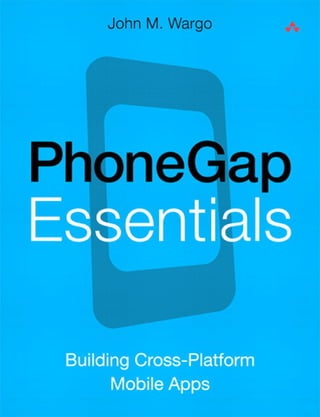



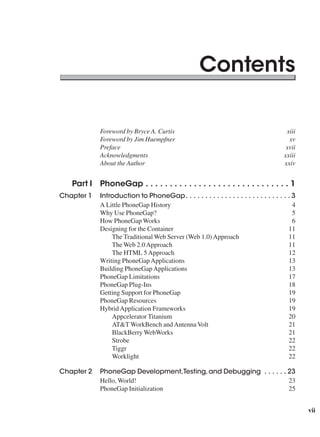
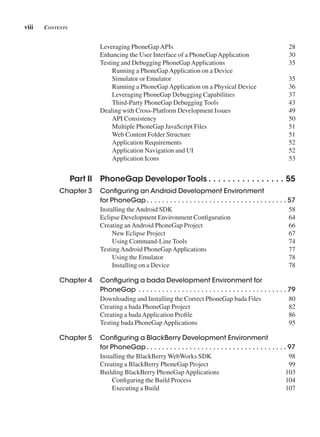
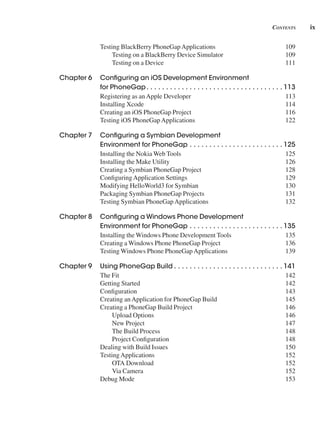
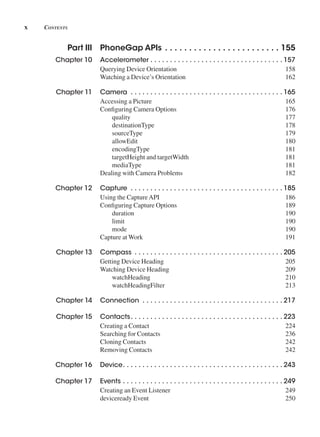
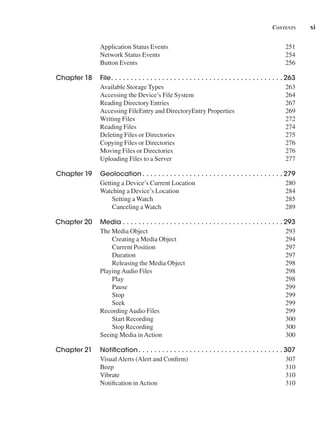
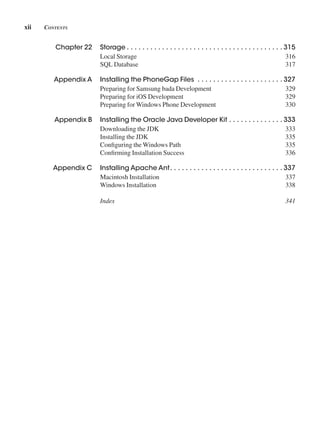
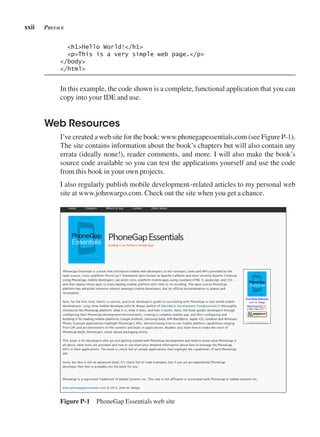

![3
Introduction to
PhoneGap
PhoneGap is an open source framework for building cross-platform native
applications using standard web technologies such as HyperText Markup Lan-
guage (HTML), Cascading Style Sheets (CSS), and JavaScript. This type of
mobile application is called a hybrid application. A group of developers created
PhoneGap as a way to simplify mobile development, and adoption of the frame-
work has grown significantly over time.
As described on the PhoneGap web site (www.phonegap.com), “PhoneGap is an
open source implementation of open standards.” The project’s development teams
work to implement relevant web development standards (from the World Wide
Web Consortium [W3C] and others) into the PhoneGap framework. There are a
robust suite of application programming interfaces (APIs) included in the frame-
work today, and there’s a solid road map for implementing additional capabilities
over time. There’s much more detail about what PhoneGap is and what makes a
PhoneGap application in this and the following chapter.
PhoneGap currently supports the following mobile device operating system
platforms:
• Apple iOS (both iPhone and iPad): http://developer.apple.com
• GoogleAndroid: http://developer.android.com
• HP/Palm webOS: http://developer.palm.com
• Microsoft Windows Phone 7: http://create.msdn.com/en-us/home/
getting_started
1](https://image.slidesharecdn.com/2350682-250526231047-db0d5320/85/Phonegap-Essentials-Building-Crossplatform-Mobile-Apps-John-M-Wargo-32-320.jpg)
![5
wHy use pHonegAp?
IBM got involved in the Eclipse project (an open source integrated development
environment [IDE]; www.eclipse.org), Eclipse quickly became integral to IBM’s
product strategy and became the core of several IBM projects. It’s likely that
IBM’s involvement in the PhoneGap project indicates where IBM could be taking
its mobile development or mobile product strategy.
After this section of the chapter had been written, PhoneGap applied to become
part of the open source Apache project (www.apache.org), first as Apache Call-
back and later (beginning with version 1.4) as Apache Cordova (the name of the
street where the Nitobi offices are located). At the same time, Nitobi announced
that it had been acquired byAdobe (www.adobe.com).
Right before the book went to press, the PhoneGap project team changed the name
of the PhoneGap JavaScript file (phonegap.js) to cordova.js. Throughout all of
this, the commercial name for PhoneGap should remain PhoneGap, so all refer-
ences in the book will refer to its commercial name, not the Apache project name.
Sample project source code included herein will be updated with the correct file
name and posted to the book’s web site at www.phonegapessentials.com.
The move to the Apache Software Foundation helps to reassure companies wish-
ing to use PhoneGap that the framework will remain a stable, available tool to use.
The acquisition of Nitobi by Adobe (and Adobe’s subsequent announcement that
they’re discontinuing support for Adobe Flash on mobile devices) clearly indi-
cates that Adobe sees PhoneGap as an important part of their product portfolio.
The folks at Nitobi who were working on PhoneGap in their spare time as a labor
of love should now find themselves in a position where they can work full-time on
the project. Expect regular and frequent updates to the framework.
Why Use PhoneGap?
You would use PhoneGap to build mobile application for several reasons:
• Your mobile application was already built using web technologies, and
you want to be able to deploy the application through one or more mobile
application stores (such as theAndroid Market, theAppleApp Store, or
BlackBerryApp World).
• You want to build a mobile application leveraging your web development
skills but need to leverage device-side features (such as the camera or the
calendar), which are not supported by the mobile browser.
• You want to build a quick prototype of a mobile application and don’t have
time to learn Java or Objective-C.
• You think PhoneGap is cool.](https://image.slidesharecdn.com/2350682-250526231047-db0d5320/85/Phonegap-Essentials-Building-Crossplatform-Mobile-Apps-John-M-Wargo-34-320.jpg)
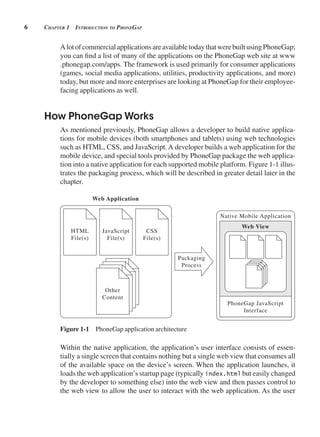
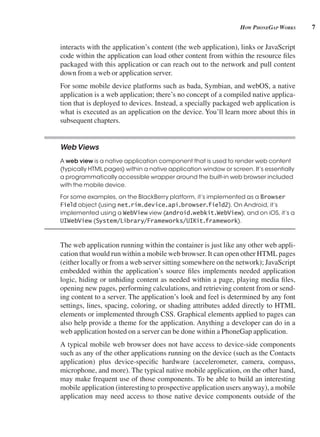
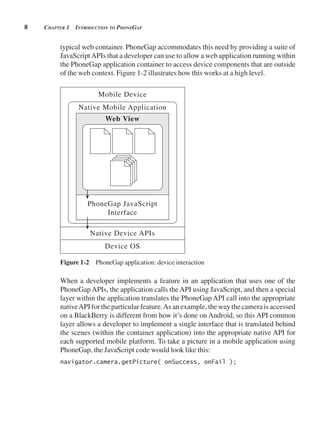
![9
How pHonegAp works
As parameters, the application passes in the names of two callback functions:
onSuccess and onFail (callback functions will be described in detail in subse-
quent chapters).
On BlackBerry, the code being executed behind the scenes might look like this:
Player player = Manager.createPlayer("capture://video");
player.realize();
player.start();
VideoControl vc = (VideoControl) player.getControl(
"VideoControl");
viewFinder = (Field)vc.initDisplayMode(
VideoControl.USE_GUI_PRIMITIVE,
"net.rim.device.api.ui.Field");
scrnMain.add(viewFinder);
vc.setDisplayFullScreen(true);
String imageType =
"encoding=jpeg&width=1024&height=768&quality=fine";
byte[] theImageBytes = vc.getSnapshot(imageType);
Bitmap image = Bitmap.createBitmapFromBytes(
imageBytes, 0, imageBytes.length, 5);
BitmapField bitmapField = new BitmapField();
bitmapField.setBitmap(image);
scrnMain.add(bitmapField);
OnAndroid, the code being executed by the function might look like this:
camera.takePicture( shutterCallback, rawCallback,
jpegCallback );
And on iOS, the code might look like this:
UIImagePickerController *imgPckr =
[[UIImagePickerController alloc] init];
imgPckr.sourceType = UIImagePickerControllerSourceTypeCamera;
imgPckr.delegate = self;
imgPckr.allowsImageEditing = NO;
[self presentModalViewController:imgPckr animated:YES];
The code samples listed here don’t cover all aspects of the process of taking a picture
(such as dealing with errors or processing the resulting image), but the examples](https://image.slidesharecdn.com/2350682-250526231047-db0d5320/85/Phonegap-Essentials-Building-Crossplatform-Mobile-Apps-John-M-Wargo-38-320.jpg)
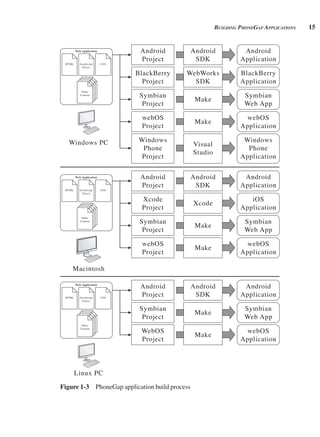
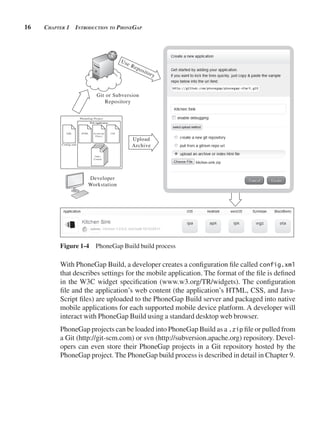
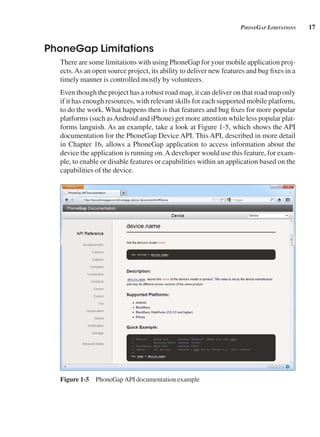
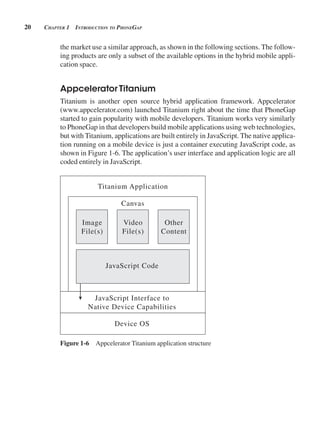
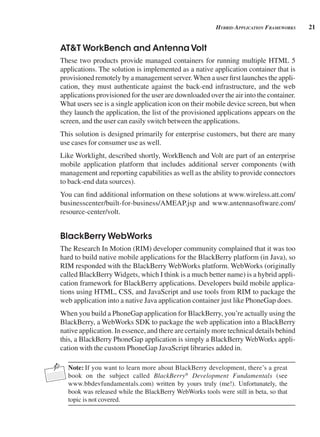
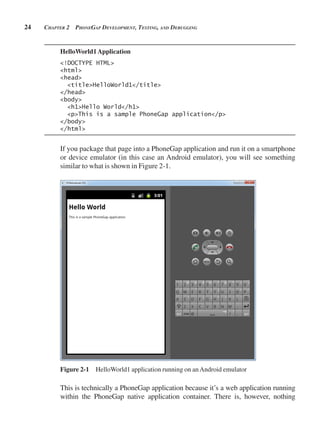
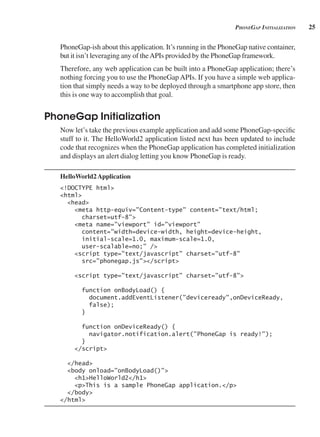

!["The British Courts of Vice Admiralty, whatever may be the case,
seldom acquit and when they do, costs and damages for detention
are never awarded." Marshall demands that the British Government
shall "infuse a spirit of justice and respect for law into the Courts of
Vice Admiralty"—this alone, he insists, can check "their excessive
and irritating vexations.... This spirit can only be infused by
uniformly discountenancing and punishing those who tarnish alike
the seat of justice and the honor of their country, by converting
themselves from judges into mere instruments of plunder." And
Marshall broadly intimates that these courts are corrupt.
As to British impressment, "no right has been asserted to impress"
Americans; "yet they are impressed, they are dragged on board
British ships of war with the evidence of citizenship in their hands,
and forced by violence there to serve until conclusive testimonials of
their birth can be obtained." He demands that the British
Government stop this lawless, violent practice "by punishing and
frowning upon those who perpetrate it. The mere release of the
injured, after a long course of service and of suffering, is no
compensation for the past and no security for the future.... The
United States therefore require positively that their seamen ... be
exempt from impressments." Even "alien seamen, not British
subjects, engaged in our merchant service ought to be equally
exempt with citizens from impressments.... Britain has no pretext of
right to their persons or to their service. To tear them, then, from
our possession is, at the same time, an insult and an injury. It is an
act of violence for which there exists no palliative."
Suppose, says Marshall, that America should do the things Great
Britain was doing? "Should we impress from the merchant service of
Britain not only Americans but foreigners, and even British subjects,
how long would such a course of injury, unredressed, be permitted
to pass unrevenged? How long would the [British] Government be
content with unsuccessful remonstrance and unavailing memorials?"
Or, were America to retaliate by inducing British sailors to enter
the more attractive American service, as America might lawfully do,](https://image.slidesharecdn.com/2350682-250526231047-db0d5320/85/Phonegap-Essentials-Building-Crossplatform-Mobile-Apps-John-M-Wargo-56-320.jpg)
![how would Great Britain look upon it? Therefore, concludes Marshall,
"is it not more advisable to desist from, and to take effectual
measures to prevent an acknowledged wrong, than be perseverant
in that wrong, to excite against themselves the well founded
resentment of America, and to force our Government into measures
which may possibly terminate in an open rupture?"[1168]
Thus boldly and in justifiably harsh language did Marshall assert
American rights as against British violation of them, just as he had
similarly upheld those rights against French assault. Although France
desisted from her lawless practices after Adams's second mission
negotiated with Bonaparte an adjustment of our grievances,[1169]
Great Britain persisted in the ruthless conduct which Marshall and his
successors denounced until, twelve years later, America was driven
to armed resistance.
Working patiently in his stuffy office amidst the Potomac miasma
and mosquitoes during the sweltering months, it was Marshall's
unhappy fate to behold the beginning of the break-up of that great
party which had built our ship of state, set it upon the waters,
navigated it for twelve tempestuous years, through the storms of
domestic trouble and foreign danger.[1170] He was powerless to stay
the Federalist disintegration. Even in his home district Marshall's
personal strength had turned to water, and at the election of his
successor in Congress, his party was utterly crushed. "Mr. Mayo, who
was proposed to succeed Gen. Marshall, lost his election by an
immense majority," writes the alert Wolcott; "was grossly insulted in
public by a brother-in-law of the late Senator Taylor, and was
afterwards wounded by him in a duel. This is a specimen of the
political influence of the Secretary of State in his own district."[1171]
Marshall himself was extremely depressed. "Ill news from
Virginia," he writes Otis. "To succeed me has been elected by an
immense majority one of the most decided democrats[1172] in the
union." Upon the political horizon Marshall beheld only storm and
blackness: "In Jersey, too, I am afraid things are going badly. In](https://image.slidesharecdn.com/2350682-250526231047-db0d5320/85/Phonegap-Essentials-Building-Crossplatform-Mobile-Apps-John-M-Wargo-57-320.jpg)
![Maryland the full force of parties will be tried but the issue I should
feel confident would be right if there did not appear to be a current
setting against us of which the force is incalculable. There is a tide in
the affairs of nations, of parties, and of individuals. I fear that of real
Americanism is on the ebb."[1173] Never, perhaps, in the history of
political parties was calm, dispassionate judgment and steady
courage needed more than they were now required to avert
Federalist defeat.
Yet in all the States revenge, apprehension, and despair blinded
the eyes and deranged the councils of the supreme Federalist
managers.[1174] The voters in the party were confused and angered
by the dissensions of those to whom they looked for guidance.[1175]
The leaders agreed that Jefferson was the bearer of the flag of
"anarchy and sedition," captain of the hordes of "lawlessness," and,
above all, the remorseless antagonist of Nationalism. What should
be done "by the friends of order and true liberty to keep the
[presidential] chair from being occupied by an enemy [Jefferson] of
both?" was the question which the distressed Federalist politicians
asked one another.[1176]
In May, Hamilton thought that "to support Adams and Pinckney
equally is the only thing that can save us from the fangs of
Jefferson."[1177] Yet, six days later, Hamilton wrote that "most of the
most influential men of that [Federalist] party consider him [Adams]
as a very unfit and incapable character.... My mind is made up. I will
never more be responsible for him by any direct support, even
though the consequence should be the election of Jefferson.... If the
cause is to be sacrificed to a weak and perverse man, I withdraw
from the party."[1178]
As the summer wore on, so acrimonious grew the feeling of
Hamilton's supporters toward the President that they seriously
considered whether his reëlection would not be as great a
misfortune as the success of the Republican Party.[1179] Although](https://image.slidesharecdn.com/2350682-250526231047-db0d5320/85/Phonegap-Essentials-Building-Crossplatform-Mobile-Apps-John-M-Wargo-58-320.jpg)
![the Federalist caucus had agreed to support Adams and Pinckney
equally as the party's candidates for President,[1180] yet the
Hamiltonian faction decided to place Pinckney in the presidential
chair.[1181]
But, blindly as they groped, their failing vision was still clear
enough to discern that the small local leaders in New England, which
was the strong Federalist section of the country, were for Adams;
[1182] and that everywhere the party's rank and file, though irritated
and perplexed, were standing by the President. His real
statesmanship had made an impression on the masses of his party:
Dayton declared that Adams was "the most popular man in the
United States."[1183] Knox assured the President that "the great
body of the federal sentiment confide implicitly in your knowledge
and virtue.... They will ... cling to you in preference to all others."
[1184]
Some urged Adams to overthrow the Hamiltonian cabal which
opposed him. "Cunning half Jacobins assure the President that he
can combine the virtuous and moderate men of both parties, and
that all our difficulties are owing to an oligarchy which it is in his
power to crush, and thus acquire the general support of the nation,"
[1185] testifies Wolcott.
The President heeded this mad counsel. Hamilton and his crew
were not the party, said Adams; they were only a faction and a
"British faction" at that.[1186] He would "rip it up."[1187] The justly
angered President, it appears, thought of founding a new party, an
American Party, "a constitutionalist party."[1188] It was said that the
astute Jefferson so played upon him that Adams came to think the
engaging but crafty Virginian aspired only to be and to be known as
the first lieutenant of the Massachusetts statesman.[1189] Adams
concluded that he could make up any Federalist loss at the polls by
courting the Republicans, whose "friendship," wrote Ames, "he seeks
for himself."[1190]](https://image.slidesharecdn.com/2350682-250526231047-db0d5320/85/Phonegap-Essentials-Building-Crossplatform-Mobile-Apps-John-M-Wargo-59-320.jpg)
![But the Republicans had almost recovered from the effect of the
X. Y. Z. disclosures. "The rabies canina of Jacobinism has gradually
spread ... from the cities, where it was confined to docks and mob,
to the country,"[1191] was the tidings of woe that Ames sent to Gore.
The Hamiltonian leaders despaired of the continuance of the
Government and saw "a convulsion of revolution" as the result of
"excessive democracy."[1192] The union of all Federalist votes was
"the only measure by which the government can be preserved."
[1193] But Federalist union! As well ask shattered glass to remould
itself!
The harmonious and disciplined Republicans were superbly led.
Jefferson combined their battle-cries of the last two years into one
mighty appeal—simple, affirmative, popular. Peace, economy,
"freedom of the press, freedom of religion, trial by jury, ... no
standing armies," were the issues he announced, together with the
supreme issue of all, States' Rights. Upon this latter doctrine
Jefferson planted all the Republican guns and directed their fire on
"centralization" which, said he, would "monarchise" our Government
and make it "the most corrupt on earth," with increased "stock-
jobbing, speculating, plundering, office-holding, and office-hunting."
[1194]
The Federalists could reply but feebly. The tax-gatherer's fingers
were in every man's pockets; and Adams had pardoned the men
who had resisted the collectors of tribute. The increased revenue
was required for the army and navy, which, thought the people,
were worse than needless[1195] if there were to be no war and the
President's second mission made hostilities improbable (they had
forgotten that this very preparation had been the principal means of
changing the haughty attitude of France). The Alien and Sedition
Laws had infuriated the "foreign" voters[1196] and alarmed
thousands of American-born citizens. Even that potent bribe of free
institutions, the expectation of office, could no longer be employed
effectively with the party workers, who, testifies Ebenezer](https://image.slidesharecdn.com/2350682-250526231047-db0d5320/85/Phonegap-Essentials-Building-Crossplatform-Mobile-Apps-John-M-Wargo-60-320.jpg)
![Huntington, were going over "to Jefferson in hopes to partake of the
loaves and fishes, which are to be distributed by the new President."
[1197]
The Federalist leaders did nothing, therefore, but write letters to
one another denouncing the "Jacobins" and prophesying "anarchy."
"Behold France—what is theory here is fact there."[1198] Even the
tractable McHenry was disgusted with his stronger associates. "Their
conduct," said he, "is tremulous, timid, feeble, deceptive & cowardly.
They write private letters. To whom? To each other. But they do
nothing.... If the party recover its pristine energy & splendor, shall I
ascribe it to such cunning, paltry, indecisive, backdoor conduct?"
[1199]
What had become of the French mission?[1200] Would to God it
might fail! That outcome might yet save the Federalist fortunes. "If
Mr. Marshall has any [news of the second French mission] beg him
to let it out," implored Chauncey Goodrich.[1201] But Marshall had
none for public inspection. The envoys' dispatches of May 17,[1202]
which had reached him nearly seven weeks afterward, were
perplexing. Indeed, Marshall was "much inclined to think that ... the
French government may be inclined to protract it [the negotiation] in
the expectation that events in America[1203] may place them on
higher ground than that which they now occupy."[1204] To Hamilton,
he cautiously wrote that the dispatches contained nothing "on which
a positive opinion respecting the result of that negotiation can be
formed."[1205]
But he told the President that he feared "the impression which will
probably be made by the New York Election,"[1206] and that
European military developments might defeat the mission's purpose.
He advised Adams to consider what then should be done. Should
"hostilities against France with the exception of their West India
privateers ... be continued if on their part a change of conduct shall](https://image.slidesharecdn.com/2350682-250526231047-db0d5320/85/Phonegap-Essentials-Building-Crossplatform-Mobile-Apps-John-M-Wargo-61-320.jpg)
![be manifest?"[1207] Adams was so perturbed that he asked Marshall
whether, in case the envoys returned without a treaty, Congress
ought not to be asked to declare war, which already it had done in
effect. For, said Adams, "the public mind cannot be held in a state of
suspense; public opinion must be always a decided one whether
right or not."[1208]
Marshall counseled patience and moderation. Indeed, he finally
informed Adams that he hoped for an adjustment: "I am greatly
disposed to think," he advised the President, "that the present
[French] government is much inclined to correct, at least in part, the
follies of the past. Of these, none were perhaps more conspicuous or
more injurious to the french nation, than their haughty and hostile
conduct to neutrals. Considerable retrograde steps in this respect
have already been taken, and I expect the same course will be
continued." If so, "there will exist no cause for war, but to obtain
compensation for past injuries"; and this, Marshall is persuaded, is
not "a sufficient motive" for war.[1209]
To others, however, Marshall was apprehensive: "It is probable
that their [the French] late victories and the hope which many of our
papers [Republican] are well calculated to inspire, that America is
disposed once more to crouch at her [France's] feet may render
ineffectual our endeavors to obtain peace."[1210]
But the second American mission to France had dealt with
Bonaparte himself, who was now First Consul. The man on
horseback had arrived, as Marshall had foreseen; a statesman as
well as a soldier was now the supreme power in France. Also, as we
have seen, the American Government had provided for an army and
was building a navy which, indeed, was even then attacking and
defeating French ships. "America in arms was treated with some
respect," as Marshall expresses it.[1211] At any rate, the American
envoys did not have to overcome the obstacles that lay in the way
two years earlier and the negotiations began without difficulty and
proceeded without friction.](https://image.slidesharecdn.com/2350682-250526231047-db0d5320/85/Phonegap-Essentials-Building-Crossplatform-Mobile-Apps-John-M-Wargo-62-320.jpg)
![Finally a treaty was made and copies sent to Marshall, October 4,
1800.[1212] The Republicans were rejoiced; the Federalist politicians
chagrined.[1213] Hamilton felt that in "the general politics of the
world" it "is a make-weight in the wrong scale," but he favored its
ratification because "the contrary ... would ... utterly ruin the federal
party," and "moreover it is better to close the thing where it is than
to leave it to a Jacobin to do much worse."[1214]
Marshall also advised ratification, although he was "far, very far,
from approving"[1215] the treaty. The Federalists in the Senate,
however, were resolved not to ratify it; they were willing to approve
only with impossible amendments. They could not learn the
President's opinion of this course; as to that, even Marshall was in
the dark. "The Secretary of State knows as little of the intentions of
the President as any other person connected with the government."
[1216] Finally the Senate rejected the convention; but it was so
"extremely popular," said the Republicans, that the Federalist
Senators were "frightened" to "recant."[1217] They reversed their
action and approved the compact. The strongest influence to change
their attitude, however, was not the popularity of the treaty, but the
pressure of the mercantile interests which wanted the business-
destroying conflict settled.[1218]
The Hamiltonian group daily became more wrathful with the
President. In addition to what they considered his mistakes of policy
and party blunders, Adams's charge that they were a "British
faction" angered them more and more as the circulation of it spread
and the public credited it. Even "General M[arshall] said that the
hardest thing for the Federalists to bear was the charge of British
influence."[1219] That was just what the "Jacobins" had been saying
all along.[1220] "If this cannot be counteracted, our characters are
the sacrifice," wrote Hamilton in anger and despair.[1221] Adams's
adherents were quite as vengeful against his party enemies. The
rank and file of the Federalists were more and more disgusted with](https://image.slidesharecdn.com/2350682-250526231047-db0d5320/85/Phonegap-Essentials-Building-Crossplatform-Mobile-Apps-John-M-Wargo-63-320.jpg)
![the quarrels of the party leaders. "I cannot describe ... how broken
and scattered your federal friends are!" lamented Troup. "We have
no rallying-point; and no mortal can divine where and when we shall
again collect our strength.... Shadows, clouds, and darkness rest on
our future prospects."[1222] The "Aurora" chronicles that "the
disorganized state of the anti-Republican [Federalist] party ... is
scarcely describable."[1223]
Marshall, alone, was trusted by all; a faith which deepened, as we
shall see, during the perplexing months that follow. He strove for
Federalist union, but without avail. Even the most savage of the
President's party enemies felt that "there is not a man in the U. S. of
better intentions [than Marshall] and he has the confidence of all
good men—no man regrets more than he does the disunion which
has taken place and no one would do more to heal the wounds
inflicted by it. In a letter ... he says 'by union we can securely
maintain our ground—without it we must sink & with us all sound
correct American principle.' His efforts will ... prove ineffectual."
[1224]
It seems certain, then, that Hamilton did not consult the one
strong man in his party who kept his head in this hour of anger-
induced madness. Yet, if ever any man needed the advice of a cool,
far-seeing mind, lighted by a sincere and friendly heart, Hamilton
required it then. And Marshall could and would have given it. But the
New York Federalist chieftain conferred only with those who were as
blinded by hate as he was himself. At last, in the midst of an absurd
and pathetic confusion of counsels,[1225] Hamilton decided to attack
the President, and, in October, wrote his fateful and fatal tirade
against Adams.[1226] It was an extravaganza of party folly. It
denounced Adams's "extreme egotism," "terrible jealousy,"
"eccentric tendencies," "violent rage"; and questioned "the solidity of
his understanding." Hamilton's screed went back to the Revolution to
discover faults in the President. Every act of his Administration was
arraigned as a foolish or wicked mistake.](https://image.slidesharecdn.com/2350682-250526231047-db0d5320/85/Phonegap-Essentials-Building-Crossplatform-Mobile-Apps-John-M-Wargo-64-320.jpg)
![This stupid pamphlet was not to be made public, but to be
circulated privately among the Federalist leaders in the various
States. The watchful Burr secured a copy[1227] and published
broadcast its bitterest passages. The Republican politicians shook
with laughter; the Republican masses roared with glee.[1228] The
rank and file of the Federalists were dazed, stunned, angered; the
party leaders were in despair. Thus exposed, Hamilton made public
his whole pamphlet. Although its purpose was to further the plan to
secure for Pinckney more votes than would be given Adams, it
ended with the apparent advice to support both. Absurd conclusion!
There might be intellects profound enough to understand why it was
necessary to show that Adams was not fit to be President and yet
that he should be voted for; but the mind of the average citizen
could not fathom such ratiocination. Hamilton's influence was
irreparably impaired.[1229] The "Washington Federalist" denounced
his attack as "the production of a disappointed man" and declared
that Adams was "much his superior as a statesman."[1230]
The campaign was a havoc of virulence. The Federalists' hatred
for one another increased their fury toward the compact
Republicans, who assailed their quarreling foes with a savage and
unrestrained ferocity. The newspapers, whose excesses had whipped
even the placid Franklin into a rage a few years before, now became
geysers spouting slander, vituperation, and unsavory[1231]
insinuations. "The venal, servile, base and stupid"[1232] "newspapers
are an overmatch for any government," cried Ames. "They will first
overawe and then usurp it."[1233] And Noah Webster felt that "no
government can be durable ... under the licentiousness of the press
that now disgraces our country."[1234] Discordant Federalists and
harmonious Republicans resorted to shameful methods.[1235] "Never
... was there such an Election in America."[1236]
As autumn was painting the New England trees, Adams, still
tarrying at his Massachusetts home, wrote Marshall to give his](https://image.slidesharecdn.com/2350682-250526231047-db0d5320/85/Phonegap-Essentials-Building-Crossplatform-Mobile-Apps-John-M-Wargo-65-320.jpg)
!["sentiments as soon as possible in writing" as to what the President
should say to Congress when it met December 3.[1237] Three days
later, when his first request was not yet halfway to Washington,
Adams, apparently forgetful of his first letter, again urged Marshall to
advise him as President in regard to his forthcoming farewell address
to the National Legislature.[1238]](https://image.slidesharecdn.com/2350682-250526231047-db0d5320/85/Phonegap-Essentials-Building-Crossplatform-Mobile-Apps-John-M-Wargo-66-320.jpg)
![Statue of John Marshall
By W. W. Story, at the Capitol, Washington, D. C.
Marshall not only favored the President with his "sentiments"—he wrote every word of
the speech which Adams delivered to Congress and sent it to the distressed Chief
Magistrate in such haste that he did not even make a copy.[1239] This presidential
address, the first ever made to Congress in Washington, was delivered exactly as
Marshall wrote it, with a change of only one word "much" for "such" and the omission of
an adjective "great."[1240]
The address is strong on the necessity for military and naval preparation. It would be
"a dangerous imprudence to abandon those measures of self-protection ... to which ...
violence and the injustice of others may again compel us to resort.... Seasonable and
systematic arrangements ... for a defensive war" are "a wise and true economy." The
navy is described as particularly important, coast defenses are urged, and the
manufacture of domestic arms is recommended in order to "supercede the necessity of
future importations." The extension of the national Judiciary is pressed as of "primary
importance ... to the public happiness."[1241]
The election, at last, was over. The Republicans won, but only by a dangerously narrow
margin. Indeed, outside of New York, the Federalists secured more electoral votes in
1800 than in the election of Adams four years earlier.[1242] The great constructive work
of the Federalist Party still so impressed conservative people; the mercantile and financial](https://image.slidesharecdn.com/2350682-250526231047-db0d5320/85/Phonegap-Essentials-Building-Crossplatform-Mobile-Apps-John-M-Wargo-67-320.jpg)
![interests were still so well banded together; the Federalist revival of 1798, brought about
by Marshall's dispatches, was, as yet, so strong; the genuine worth of Adams's
statesmanship[1243] was so generally recognized in spite of his unhappy manner, that it
would seem as though the Federalists might have succeeded but for the quarrels of their
leaders and Burr's skillful conduct of the Republican campaign in New York.
Jefferson and Burr each had seventy-three votes for President. Under the Constitution,
as it stood at that time, the final choice for President was thus thrown into the House of
Representatives.[1244] By united and persistent effort, it was possible for the Federalists
to elect Burr, or at least prevent any choice and, by law, give the Presidency to one of
their own number until the next election. This, Jefferson advises Burr, "they are strong
enough to do."[1245] The Federalists saw their chance; the Republicans realized their
danger.[1246] Jefferson writes of the "great dismay and gloom on the republican
gentlemen here and equal exultation on the federalists who openly declare they will
prevent an election."[1247] This "opens upon us an abyss, at which every sincere patriot
must shudder."[1248]
Although Hamilton hated Burr venomously, he advised the Federalist managers in
Washington "to throw out a lure for him, in order to tempt him to start for the plate, and
then lay the foundation of dissension between" him and Jefferson.[1249] The Federalists,
however, already were turning to Burr, not according to Hamilton's unworthy suggestion,
but in deadly earnest. At news of this, the fast-weakening New York Federalist chieftain
became frantic. He showered letters upon the party leaders in Congress, and upon all
who might have influence, appealing, arguing, persuading, threatening.[1250]
But the Federalists in Congress were not to be influenced, even by the once
omnipotent Hamilton. "The Federalists, almost with one Mind, from every Quarter of the
Union, say elect Burr" because "they must be disgraced in the Estimation of the People if
they vote for Jefferson having told Them that He was a Man without Religion, the Writer
of the Letter to Mazzei, a Coward, &c., &c."[1251] Hamilton's fierce warnings against Burr
and his black prophecies of "the Cataline of America"[1252] did not frighten them. They
knew little of Burr, personally, and the country knew less. What was popularly known of
this extraordinary man was not unattractive to the Federalists.
Burr was the son of the President of Princeton and the grandson of the celebrated
Jonathan Edwards, the greatest theologian America had produced. He had been an
intrepid and efficient officer in the Revolutionary War, and an able and brilliant Senator of
the United States. He was an excellent lawyer and a well-educated, polished man of the
world. He was a politician of energy, resourcefulness, and decision. And he was a
practical man of affairs. If he were elected by Federalist votes, the fury with which
Jefferson and his friends were certain to assail Burr[1253] would drive that practical
politician openly into their camp; and, as President, he would bring with him a
considerable Republican following. Thus the Federalists would be united and
strengthened and the Republicans divided and weakened.[1254]](https://image.slidesharecdn.com/2350682-250526231047-db0d5320/85/Phonegap-Essentials-Building-Crossplatform-Mobile-Apps-John-M-Wargo-68-320.jpg)
![This was the reasoning which drew and bound the Federalists together in their last
historic folly; and they felt that they might succeed. "It is ... certainly within the compass
of possibility that Burr may ultimately obtain nine States," writes Bayard.[1255] In addition
to the solid Federalist strength in the House, there were at least three Republican
members, two corrupt and the other light-minded, who might by "management" be
secured for Burr.[1256] The Federalist managers felt that "the high Destinies ... of this
United & enlightened people are up";[1257] and resolved upon the hazard. Thus the
election of Burr, or, at least, a deadlock, faced the Republican chieftain.
At this critical hour there was just one man who still had the confidence of all
Federalists from Adams to Hamilton. John Marshall, Secretary of State, had enough
influence to turn the scales of Federalist action. Hamilton approached Marshall indirectly
at first. "You may communicate this letter to Marshall," he instructed Wolcott, in one of
his most savage denunciations of Burr.[1258] Wolcott obeyed and reported that Marshall
"has yet expressed no opinion."[1259] Thereupon Hamilton wrote Marshall personally.
This letter is lost; but undoubtedly it was in the same vein as were those to Wolcott,
Bayard, Sedgwick, Morris, and other Federalists. But Hamilton could not persuade
Marshall to throw his influence to Jefferson. The most Marshall would do was to agree to
keep hands off.
"To Mr. Jefferson," replies Marshall, "whose political character is better known than that
of Mr. Burr, I have felt almost insuperable objections. His foreign prejudices seem to me
totally to unfit him for the chief magistracy of a nation which cannot indulge those
prejudices without sustaining deep and permanent injury.
"In addition to this solid and immovable objection, Mr. Jefferson appears to me to be a
man, who will embody himself with the House of Representatives.[1260] By weakening
the office of President, he will increase his personal power. He will diminish his
responsibility, sap the fundamental principles of the government, and become the leader
of that party which is about to constitute the majority of the legislature. The morals of
the author of the letter to Mazzei[1261] cannot be pure....
"Your representation of Mr. Burr, with whom I am totally unacquainted, shows that
from him still greater danger than even from Mr. Jefferson may be apprehended. Such a
man as you describe is more to be feared, and may do more immediate, if not greater
mischief.
"Believing that you know him well, and are impartial, my preference would certainly
not be for him, but I can take no part in this business. I cannot bring myself to aid Mr.
Jefferson. Perhaps respect for myself should, in my present situation, deter me from
using any influence (if, indeed I possessed any) in support of either gentleman.
"Although no consideration could induce me to be the Secretary of State while there
was a President whose political system I believed to be at variance with my own; yet this
cannot be so well known to others, and it might be suspected that a desire to be well
with the successful candidate had, in some degree, governed my conduct."[1262]](https://image.slidesharecdn.com/2350682-250526231047-db0d5320/85/Phonegap-Essentials-Building-Crossplatform-Mobile-Apps-John-M-Wargo-69-320.jpg)
![Marshall had good personal reasons for wishing Burr to be elected, or at least that a
deadlock should be produced. He did not dream that the Chief Justiceship was to be
offered to him; his law practice, neglected for three years, had passed into other hands;
the head of the Cabinet was then the most important[1263] office in the Government,
excepting only the Presidency itself; and rumor had it that Marshall would remain
Secretary of State in case Burr was chosen as Chief Magistrate. If the tie between
Jefferson and Burr were not broken, Marshall might even be chosen President.[1264]
"I am rather inclined to think that Mr. Burr will be preferred.... General Marshall will
then remain in the department of state; but if Mr. Jefferson be chosen, Mr. Marshall will
retire," writes Pickering.[1265] But if Marshall cherished the ambition to continue as
Secretary of State, as seems likely, he finally stifled it and stood aloof from the struggle.
It was a decision which changed Marshall's whole life and affected the future of the
Republic. Had Marshall openly worked for Burr, or even insisted upon a permanent
deadlock, it is reasonably certain that the Federalists would have achieved one of their
alternate purposes.
Although Marshall refrained from assisting the Federalists in their plan to elect Burr, he
did not oppose it. The "Washington Federalist," which was the Administration organ[1266]
in the Capital, presented in glowing terms the superior qualifications of Burr over
Jefferson for the Presidency, three weeks after Marshall's letter to Hamilton.[1267] The
Republicans said that Marshall wrote much that appeared in this newspaper.[1268] If he
was influential with the editor, he did not exercise his power to exclude the paper's
laudation of the New York Republican leader.
It was reported that Marshall had declared that, in case of a deadlock, Congress "may
appoint a Presidt. till another election is made."[1269] The rumor increased Republican
alarm and fanned Republican anger. From Richmond came the first tidings of the spirit of
popular resistance to "such a usurpation,"[1270] even though it might result in the
election of Marshall himself to the Presidency. If they could not elect Burr, said Jefferson,
the Federalists planned to make Marshall or Jay the Chief Executive by a law to be
passed by the expiring Federalist Congress.[1271]
Monroe's son-in-law, George Hay, under the nom de guerre of "Hortensius," attacked
Marshall in an open letter in the "Richmond Examiner," which was copied far and wide in
the Republican press. Whether Congress will act on Marshall's opinion, says Hay, "is a
question which has already diffused throughout America anxiety and alarm; a question
on the decision of which depends not only the peace of the nation, but the existence of
the Union." Hay recounts the many indications of the Federalists' purpose and says: "I
understand that you, Sir, have not only examined the Constitution, but have given an
opinion in exact conformity with the wishes of your party." He challenges Marshall to
"come forward ... and defend it." If a majority of the House choose Burr the people will
submit, says Hay, because such an election, though contrary to their wishes, would be
constitutional. But if, disregarding the popular will and also violating the Constitution,
Congress "shall elect a stranger to rule over us, peace and union are driven from the](https://image.slidesharecdn.com/2350682-250526231047-db0d5320/85/Phonegap-Essentials-Building-Crossplatform-Mobile-Apps-John-M-Wargo-70-320.jpg)
![land.... The usurpation ... will be instantly and firmly repelled. The government will be at
an end."[1272]
Although the "Washington Federalist" denounced as "a lie"[1273] the opinion attributed
to him, Marshall, personally, paid no attention to this bold and menacing challenge. But
Jefferson did. After waiting a sufficient time to make sure that this open threat of armed
revolt expressed the feeling of the country, he asserted that "we thought best to declare
openly and firmly, one & all, that the day such an act passed, the Middle States would
arm, & that no such usurpation, even for a single day, should be submitted to."[1274] The
Republicans determined not only to resist the "usurpation ... by arms," but to set aside
the Constitution entirely and call "a convention to reorganize and amend the
government."[1275]
The drums of civil war were beating. Between Washington and Richmond "a chain of
expresses" was established, the messengers riding "day and night."[1276] In Maryland
and elsewhere, armed men, wrought up to the point of bloodshed, made ready to march
on the rude Capital, sprawling among the Potomac hills and thickets. Threats were openly
made that any man appointed President by act of Congress, pursuant to Marshall's
reputed opinion, would be instantly assassinated. The Governor of Pennsylvania prepared
to lead the militia into Washington by the 3d of March.[1277]
To this militant attitude Jefferson ascribed the final decision of the Federalists to permit
his election. But no evidence exists that they were intimidated in the least, or in any
manner influenced, by the ravings of Jefferson's adherents. On the contrary, the
Federalists defied and denounced the Republicans and met their threats of armed
interference with declarations that they, too, would resort to the sword.[1278]
The proof is overwhelming and decisive that nothing but Burr's refusal to help the
Federalists in his own behalf,[1279] his rejection of their proposals,[1280] and his
determination, if chosen, to go in as a Republican untainted by any promises;[1281] and,
on the other hand, the assurances which Jefferson gave Federalists as to offices and the
principal Federalist policies—Neutrality, the Finances, and the Navy[1282]—only all of
these circumstances combined finally made Jefferson president. Indeed, so stubborn was
the opposition that, in spite of his bargain with the Federalists and Burr's repulsion of
their advances, nearly all of them, through the long and thrillingly dramatic days and
nights of balloting,[1283] with the menace of physical violence hanging over them, voted
against Jefferson and for Burr to the very end.
The terms concluded with Jefferson, enough Federalists cast blank ballots[1284] to
permit his election; and so the curtain dropped on this comedy of shame.[1285] "Thus has
ended the most wicked and absurd attempt ever tried by the Federalists," said the
innocent Gallatin.[1286] So it came about that the party of Washington, as a dominant
and governing force in the development of the American Nation, went down forever in a
welter of passion, tawdry politics, and disgraceful intrigue. All was lost, including honor.](https://image.slidesharecdn.com/2350682-250526231047-db0d5320/85/Phonegap-Essentials-Building-Crossplatform-Mobile-Apps-John-M-Wargo-71-320.jpg)
![But no! All was not lost. The Judiciary remained. The newly elected House and
President were Republican and in two years the Senate also would be "Jacobin"; but no
Republican was as yet a member of the National Judiciary. Let that branch of the
Government be extended; let new judgeships be created, and let new judges be made
while Federalists could be appointed and confirmed, so that, by means, at least, of the
National Courts, States' Rights might be opposed and retarded, and Nationalism
defended and advanced—thus ran the thoughts and the plans of the Federalist leaders.
Adams, in the speech to Congress in December of the previous year, had urged the
enactment of a law to this end as "indispensably necessary."[1287] In the President's
address to the expiring Federalist Congress on December 3, 1800, which Marshall wrote,
the extension of the National Judiciary, as we have seen, was again insistently urged.
[1288] Upon that measure, at least, Adams and all Federalists agreed. "Permit me," wrote
General Gunn to Hamilton, "to offer for your consideration, the policy of the federal party
extending the influence of our judiciary; if neglected by the federalists the ground will be
occupied by the enemy, the very next session of Congress, and, sir, we shall see —— and
many other scoundrels placed on the seat of justice."[1289]
Indeed, extension of the National Judiciary was now the most cherished purpose of
Federalism.[1290] A year earlier, after Adams's first recommendation of it, Wolcott
narrates that "the steady men" in the Senate and House were bent upon it, because
"there is no other way to combat the state opposition [to National action] but by an
efficient and extended organization of judges."[1291]
Two weeks after Congress convened, Roger Griswold of Connecticut reported the
eventful bill to carry out this Federalist plan.[1292] It was carefully and ably drawn and
greatly widened the practical effectiveness of the National Courts. The Supreme Court
was reduced, after the next vacancy, to five members—to prevent, said the Republicans,
the appointment of one of their party to the Nation's highest tribunal.[1293] Many new
judgeships were created. The Justices of the Supreme Court, who had sat as circuit
judges, were relieved of this itinerant labor and three circuit judges for each circuit were
to assume these duties. At first, even the watchful and suspicious Jefferson thought that
"the judiciary system will not be pushed, as the appointments, if made, by the present
administration, could not fall on those who create them."[1294]
But Jefferson underestimated the determination of the Federalists. Because they felt
that the bill would "greatly extend the judiciary power and of course widen the basis of
government," they were resolved, writes Rutledge, to "profit of our shortlived majority,
and do as much good as we can before the end of this session"[1295] by passing the
Judiciary Bill.
In a single week Jefferson changed from confidence to alarm. After all, he reflected,
Adams could fill the new judgeships, and these were life appointments. "I dread this
above all the measures meditated, because appointments in the nature of freehold
render it difficult to undo what is done,"[1296] was Jefferson's second thought.](https://image.slidesharecdn.com/2350682-250526231047-db0d5320/85/Phonegap-Essentials-Building-Crossplatform-Mobile-Apps-John-M-Wargo-72-320.jpg)
![The Republicans fought the measure, though not with the vigor or animosity justified
by the political importance they afterwards attached to it. Among the many new districts
created was an additional one in Virginia. The representatives from that State dissented;
but, in the terms of that period, even their opposition was not strenuous. They said that,
in Virginia, litigation was declining instead of increasing. "At the last term the docket was
so completely cleared in ... ten days ... that the court ... had actually decided on several
[suits] returnable to the ensuing term."[1297]
That, replied the Federalists, was because the courts were too far away from the
citizens. As for the National revenues, they could be collected only through National
tribunals; for this purpose,[1298] two Federal Courts in Virginia, as provided by the bill,
were essential. But, of course, sneered the Federalists, "Virginia would be well satisfied
with one court in preference to two or with no court whatever in preference to one."
[1299]
But there was a defect in the bill, intimated the Virginia Republicans, that affected
tenants and landowners of the Northern Neck. A clause of section thirteen gave the
newly established National Court jurisdiction of all causes arising under the Constitution
where original or exclusive jurisdiction was not conferred upon the Supreme Court or
Admiralty Courts.[1300] The National Court of the new Virginia District was to be held at
Fredericksburg. Thus all suits for quitrents or other claims against those holding their
lands under the Fairfax title could be brought in this near-by National Court, instead of in
State Courts. This criticism was so attenuated and so plainly based on the assumption
that the State Courts would not observe the law in such actions, that it was not pressed
with ardor even by the impetuous and vindictive Giles.
But Nicholas went so far as to move that the jurisdiction of National Courts should be
limited to causes exceeding five hundred dollars. This would cut out the great mass of
claims which the present holders of the Fairfax title might lawfully have against tenants
or owners. The Marshalls were the Fairfax assignees, as we have seen. No Republican,
however, mentioned them in debate; but some one procured the insertion in the record
of an insinuation which nobody made on the floor. In brackets, the "Annals," after the
brief note of Nicholas's objection, states: "[It is understood that the present assignees of
the claims of Lord Fairfax, are General Marshall, General Lee, and a third individual and
that they maintain their claims under the British Treaty.]"[1301]
For three weeks the debate in the House dragged along. Republican opposition, though
united, was languid.[1302] At last, without much Republican resistance, the bill passed the
House on January 20, 1801, and reached the Senate the next day.[1303] Two weeks later
the Senate Republicans moved a substitute providing for fewer circuits, fewer judges, and
a larger Supreme Court, the members of which were to act as circuit judges as formerly.
[1304] It was defeated by a vote of 17 to 13.[1305] The next day the bill was passed by a
vote of 16 to 11.[1306]
When the debate began, the National Judiciary was without a head. Ellsworth, broken
in health, had resigned. Adams turned to Jay, the first Chief Justice, and, without asking](https://image.slidesharecdn.com/2350682-250526231047-db0d5320/85/Phonegap-Essentials-Building-Crossplatform-Mobile-Apps-John-M-Wargo-73-320.jpg)
![his consent, reappointed him. "I have nominated you to your old station,"[1307] wrote the
President. "This is as independent of the inconstancy of the people, as it is of the will of a
President." But Jay declined.[1308] Some of the Federalist leaders were disgruntled at
Jay's appointment. "Either Judge Paterson [of New Jersey] or General Pinckney ought to
have been appointed; but both these worthies were your friends,"[1309] Gunn reported to
Hamilton. The Republicans were relieved by Jay's nomination—they "were afraid of
something worse."[1310]
Then, on January 20, 1801, with no herald announcing the event, no trumpet
sounding, suddenly, and without previous notification even to himself, John Marshall was
nominated as Chief Justice of the United States a few weeks before the Federalists went
out of power forever. His appointment was totally unexpected. It was generally thought
that Judge Paterson was the logical successor to Ellsworth.[1311] Marshall, indeed, had
recommended his selection.[1312] The letters of the Federalist leaders, who at this period
were lynx-eyed for any office, do not so much as mention Marshall's name in connection
with the position of Chief Justice.
Doubtless the President's choice of Marshall was influenced by the fact that his "new
minister, Marshall, did all to" his "entire satisfaction."[1313] Federalist politicians afterward
caviled at this statement of Adams. It was quite the other way around, they declared.
"Every one who knew that great man [Marshall] knew that he possessed to an
extraordinary degree the faculty of putting his own ideas into the minds of others,
unconsciously to them. The secret of Mr. Adams's satisfaction [with Marshall] was, that
he obeyed his Secretary of State without suspecting it."[1314]
The President gave Marshall's qualifications as the reason of his elevation. Boudinot
reported to Adams that the New Jersey bar hailed with "the greatest pleasure" a rumor
that "the office of Chief Justice ... may be filled by" Adams himself "after the month of
March next." The President, who admitted that he was flattered, answered: "I have
already, by the nomination of a gentleman in the full vigor of middle age, in the full
habits of business, and whose reading of the science is fresh in his head,[1315] to this
office, put it wholly out of my power as it never was in my hopes or wishes."[1316]
Marshall's appointment as Chief Justice was not greeted with applause from any
quarter; there was even a hint of Federalist resentment because Paterson had not been
chosen. "I see it denied in your paper that Mr. Marshall was nominated Chief Justice of
the U.S. The fact is so and he will without doubt have the concurrence of the Senate, tho'
some hesitation was at first expressed from respect for the pretensions of Mr. Paterson."
[1317] The Republican politicians were utterly indifferent; and the masses of both parties
neither knew nor cared about Marshall's elevation.
The Republican press, of course, criticized the appointment, as it felt bound to attack
any and every thing, good or bad, that the Federalists did. But its protests against
Marshall were so mild that, in view of the recklessness of the period, this was a notable
compliment. "The vacant Chief Justiceship is to be conferred on John Marshall, one time
General, afterwards ambassador to X. Y. and Z., and for a short time incumbent of the](https://image.slidesharecdn.com/2350682-250526231047-db0d5320/85/Phonegap-Essentials-Building-Crossplatform-Mobile-Apps-John-M-Wargo-74-320.jpg)
![office of Secretary of State.... Who is to receive the salary of the Secretary of State, after
Mr. Marshall's resignation, we cannot foretell, because the wisdom of our wise men
surpasseth understanding."[1318] Some days later the "Aurora," in a long article,
denounced the Judiciary Law as a device for furnishing defeated Federalist politicians
with offices,[1319] and declared that the act would never be "carried into execution, ...
unless" the Federalists still meant to usurp the Presidency. But it goes on to say:—
"We cannot permit ourselves to believe that John Marshall has been called to the
bench to foster such a plot.... Still, how can we account for the strange mutations which
have passed before us—Marshall for a few weeks Secretary of State ascends the bench of
the Chief Justice."[1320] The principal objection of the Republican newspapers to
Marshall, however, was that he, "before he left the office [of Secretary of State], made
provision for all the Federal printers to the extent of his power.... He employed the
aristocratic presses alone to publish laws ... for ... one year."[1321]
Only the dissipated and venomous Callender, from his cell in prison, displayed that
virulent hatred of Marshall with which an increasing number of Jefferson's followers were
now obsessed. "We are to have that precious acquisition John Marshall as Chief Justice....
The very sound of this man's name is an insult upon truth and justice"; and the dissolute
scribbler then pours the contents of his ink-pot over Marshall's X. Y. Z. dispatches,
bespatters his campaign for election to Congress, and continues thus:—
"John Adams first appointed John Jay in the room of Ellsworth. A strong suspicion
exists that John did this with the previous certainty that John Jay would refuse the
nomination. It was then in view to name John Marshall: first, because President Jefferson
will not be able to turn him out of office, unless by impeachment; and in the second
place that the faction [Federalist Party] who burnt the war office might, with better grace,
attempt, forsooth, to set him up as a sort of president himself. Sus ad Minervam!"[1322]
That the voice of this depraved man, so soon to be turned against his patron Jefferson,
who had not yet cast him off, was the only one raised against Marshall's appointment to
the highest judicial office in the Nation, is a striking tribute, when we consider the
extreme partisanship and unrestrained abuse common to the times.
Marshall himself, it appears, was none too eager to accept the position which Ellsworth
had resigned and Jay refused; the Senate delayed the confirmation of his nomination;
[1323] and it was not until the last day of the month that his commission was executed.
On January 31, 1801, the President directed Dexter "to execute the office of Secretary
of State so far as to affix the seal of the United States to the inclosed commission to the
present Secretary of State, John Marshall, of Virginia, to be Chief Justice of the United
States, and to certify in your own name on the commission as executing the office of
Secretary of State pro hac vice."[1324]
It was almost a week before Marshall formally acknowledged and accepted the
appointment. "I pray you to accept my grateful acknowledgments for the honor conferred
on me in appointing me Chief Justice of the United States. This additional and flattering](https://image.slidesharecdn.com/2350682-250526231047-db0d5320/85/Phonegap-Essentials-Building-Crossplatform-Mobile-Apps-John-M-Wargo-75-320.jpg)
![mark of your good opinion has made an impression on my mind which time will not
efface. I shall enter immediately on the duties of the office, and hope never to give you
occasion to regret having made this appointment."[1325] Marshall's acceptance greatly
relieved the President, who instantly acknowledged his letter: "I have this moment
received your letter of this morning, and am happy in your acceptance of the office of
Chief Justice."[1326]
Who should be Secretary of State for the remaining fateful four weeks? Adams could
think of no one but Marshall, who still held that office although he had been appointed,
confirmed, and commissioned as Chief Justice. Therefore, wrote Adams, "the
circumstances of the times ... render it necessary that I should request and authorize
you, as I do by this letter, to continue to discharge all the duties of Secretary of State
until ulterior arrangements can be made."[1327]
Thus Marshall was at the same time Chief Justice of the Supreme Court and Secretary
of State. Thus for the second time these two highest appointive offices of the National
Government were held simultaneously by the same man.[1328] He drew but one salary, of
course, during this period, that of Chief Justice,[1329] the salary of Secretary of State
remaining unpaid.
The President rapidly filled the newly created places on the Federal Bench. Marshall, it
appears, was influential in deciding these appointments. "I wrote for you to Dexter,
requesting him to show it to Marshall,"[1330] was Ames's reassuring message to an
aspirant to the Federal Bench. With astounding magnanimity or blindness, Adams
bestowed one of these judicial positions upon Wolcott, and Marshall "transmits ... the
commission ... with peculiar pleasure. Permit me," he adds, "to express my sincere wish
that it may be acceptable to you." His anxiety to make peace between Adams and
Wolcott suggests that he induced the President to make this appointment. For, says
Marshall, "I will allow myself the hope that this high and public evidence, given by the
President, of his respect for your services and character, will efface every unpleasant
sensation respecting the past, and smooth the way to a perfect reconciliation."[1331]
Wolcott "cordially thanks" Marshall for "the obliging expressions of" his "friendship." He
accepts the office "with sentiments of gratitude and good will," and agrees to Marshall's
wish for reconciliation with Adams, "not only without reluctance or reserve but with the
highest satisfaction."[1332] Thus did Marshall end one of the feuds which so embarrassed
the Administration of John Adams.[1333]
Until nine o'clock[1334] of the night before Jefferson's inauguration, Adams continued to
nominate officers, including judges, and the Senate to confirm them. Marshall, as
Secretary of State, signed and sealed the commissions. Although Adams was legally
within his rights, the only moral excuse for his conduct was that, if it was delayed,
Jefferson would make the appointments, control the National Judiciary, and through it
carry out his States' Rights doctrine which the Federalists believed would dissolve the
Union; if Adams acted, the most the Republicans could do would be to oust his
appointees by repealing the law.[1335]](https://image.slidesharecdn.com/2350682-250526231047-db0d5320/85/Phonegap-Essentials-Building-Crossplatform-Mobile-Apps-John-M-Wargo-76-320.jpg)
![The angry but victorious Republicans denounced Adams's appointees as "midnight
judges." It was a catchy and clever phrase. It flew from tongue to tongue, and, as it
traveled, it gathered force and volume. Soon a story grew up around the expression. Levi
Lincoln, the incoming Attorney-General, it was said, went, Jefferson's watch in his hand,
to Marshall's room at midnight and found him signing and sealing commissions. Pointing
to the timepiece, Lincoln told Marshall that, by the President's watch, the 4th of March
had come, and bade him instantly lay down his nefarious pen; covered with humiliation,
Marshall rose from his desk and departed.[1336]
This tale is, probably, a myth. Jefferson never spared an enemy, and Marshall was his
especial aversion. Yet in his letters denouncing these appointments, while he savagely
assails Adams, he does not mention Marshall.[1337] Jefferson's "Anas," inspired by
Marshall's "Life of Washington," omits no circumstance, no rumor, no second, third, or
fourth hand tale that could reflect upon an enemy. Yet he never once refers to the
imaginary part played by Marshall in the "midnight judges" legend.[1338]
Jefferson asked Marshall to administer to him the presidential oath of office on the
following day. Considering his curiously vindictive nature, it is unthinkable that Jefferson
would have done this had he sent his newly appointed Attorney-General, at the hour of
midnight, to stop Marshall's consummation of Adams's "indecent"[1339] plot.
Indeed, in the flush of victory and the multitude of practical and weighty matters that
immediately claimed his entire attention, it is probable that Jefferson never imagined that
Marshall would prove to be anything more than the learned but gentle Jay or the able but
innocuous Ellsworth had been. Also, as yet, the Supreme Court was, comparatively,
powerless, and the Republican President had little cause to fear from it that stern and
effective resistance to his anti-national principles, which he was so soon to experience.
Nor did the Federalists themselves suspect that the Virginia lawyer and politician would
reveal on the Supreme Bench the determination, courage, and constructive genius which
was presently to endow that great tribunal with life and strength and give to it the place
it deserved in our scheme of government.
In the opinions of those who thought they knew him, both friend and foe, Marshall's
character was well understood. All were agreed as to his extraordinary ability. No
respectable person, even among his enemies, questioned his uprightness. The charm of
his personality was admitted by everybody. But no one had, as yet, been impressed by
the fact that commanding will and unyielding purpose were Marshall's chief
characteristics. His agreeable qualities tended to conceal his masterfulness. Who could
discern in this kindly person, with "lax, lounging manners," indolent, and fond of jokes,
the heart that dared all things? And all overlooked the influence of Marshall's youth, his
determinative army life, his experience during the disintegrating years after
Independence was achieved and before the Constitution was adopted, the effect of the
French Revolution on his naturally orderly mind, and the part he had taken and the
ineffaceable impressions necessarily made upon him by the tremendous events of the
first three Administrations of the National Government.](https://image.slidesharecdn.com/2350682-250526231047-db0d5320/85/Phonegap-Essentials-Building-Crossplatform-Mobile-Apps-John-M-Wargo-77-320.jpg)
![Thus it was that, unobtrusively and in modest guise, Marshall took that station which,
as long as he lived, he was to make the chief of all among the high places in the
Government of the American Nation.
FOOTNOTES:
[1093] Adams to McHenry, May 5, 1800; Steiner, 453.
[1094] McHenry to John McHenry, May 20, 1800; Gibbs, ii, 348.
[1095] According to McHenry, Adams's complaints were that the Secretary of War
had opposed the sending of the second mission to France, had not appointed as
captain a North Carolina elector who had voted for Adams, had "eulogized General
Washington ... attempted to praise Hamilton," etc. (McHenry to John McHenry, May
20, 1800; Gibbs, ii, 348; and see Hamilton's "Public Conduct, etc., of John Adams";
Hamilton: Works: Lodge, vii, 347-49.)
[1096] Gore to King, May 14, 1800; King, iii, 242-43; also Sedgwick to Hamilton,
May 7, 1800; Works: Hamilton, vi, 437-38.
[1097] Adams to Pickering, May 10, 1800; Works: Adams, ix, 53.
[1098] Pickering to Adams, May 11, 1800; ib., 54.
[1099] Pickering to Hamilton, May 15, 1800; Works: Hamilton, vi, 443.
[1100] Adams to Pickering, May 12, 1800; Works: Adams, ix, 55.
[1101] Sedgwick to Hamilton, May 13, 1800; Works: Hamilton, vi, 442.
[1102] Adams to Rush, March 4, 1809; Old Family Letters, 219.
[1103] "There never was perhaps a greater contrast between two characters than
between those of the present President & his predecessor.... The one [Washington]
cool, considerate, & cautious, the other [Adams] headlong & kindled into flame by
every spark that lights on his passions; the one ever scrutinizing into the public
opinion and ready to follow where he could not lead it; the other insulting it by the
most adverse sentiments & pursuits; W. a hero in the field, yet overweighing every
danger in the Cabinet—A. without a single pretension to the character of a soldier, a
perfect Quixotte as a statesman." (Madison to Jefferson, Feb., 1798; Writings: Hunt,
vi, 310.) And [Adams] "always an honest man, often a wise one, but sometimes
wholly out of his senses." (Madison to Jefferson, June 10, 1798; ib., 325.)
[1104] Adams to Rush, Aug. 23, 1805; Old Family Letters, 76.
[1105] Cabot to King, April 26, 1799; King, iii, 8.
[1106] Wolcott was as malicious as, but more cautious than, Pickering in his
opposition to the President.
[1107] "He [Adams] is liable to gusts of passion little short of frenzy.... I speak of
what I have seen." (Bayard to Hamilton, Aug. 18, 1800; Works: Hamilton, vi, 457.)
"He would speak in such a manner ... as to persuade one that he was actually
insane." (McHenry to John McHenry, May 20, 1800; Gibbs, ii, 347.) "Mr. Adams had
conducted strangely and unaccountably." (Ames to Hamilton, Aug. 26, 1800; Works:](https://image.slidesharecdn.com/2350682-250526231047-db0d5320/85/Phonegap-Essentials-Building-Crossplatform-Mobile-Apps-John-M-Wargo-78-320.jpg)
![Ames, i, 280.) These men were Adams's enemies; but the extreme irritability of the
President at this time was noted by everybody. Undoubtedly this was increased by his
distress over the illness of his wife.
[1108] McHenry to John McHenry, May 20, 1800; Gibbs, ii, 347.
[1109] See preceding chapter.
[1110] Aurora, May 9, 1800; the Aurora had been attacking Pickering with all the
animosity of partisanship.
[1111] The French press had been quite as much under the control of the
Revolutionary authorities as it was under that of Bonaparte as First Consul or even
under his rule when he had become Napoleon I.
[1112] Aurora, May 27, 1800.
[1113] Ib., June 4, 1800; and June 17, 1800. The Aurora now made a systematic
campaign against Pickering. It had "substantial and damning facts" which it
threatened to publish if Adams did not subject Pickering to a "scrutiny" (ib., May 21,
1800). Pickering was a "disgrace to his station" (ib., May 23); several hundred
thousand dollars were "unaccounted for" (ib., June 4, and 17).
The attack of the Republican newspaper was entirely political, every charge and
innuendo being wholly false. Adams's dismissal of his Secretary of State was not
because of these charges, but on account of the Secretary's personal and political
disloyalty. Adams also declared, afterwards, that Pickering lacked ability to handle the
grave questions then pending and likely to arise. (Cunningham Letters, nos. xii, xiii,
and xiv.) But that was merely a pretense.
[1114] Aurora, June 12, 1800.
[1115] Pinckney to McHenry, June 10, 1800; Steiner, 460.
[1116] Wolcott to Ames, Aug. 10, 1800; Gibbs, ii, 402.
[1117] Cabot to Gore, Sept. 30, 1800; Lodge: Cabot, 291.
[1118] Wolcott to Ames, Aug. 10, 1800; Gibbs, ii, 401-02.
[1119] Adams's correspondence shows that the shortest time for a letter to go
from Washington to Quincy, Massachusetts, was seven days, although usually nine
days were required. "Last night I received your favor of the 4th." (Adams at Quincy to
Dexter at Washington, Aug. 13, 1800; Works: Adams, ix, 76; and to Marshall, Aug.
14; ib., 77; and Aug. 26; ib., 78; and Aug. 30; ib., 80.)
[1120] Washington at this time was forest, swamp, and morass, with only an
occasional and incommodious house. Georgetown contained the only comfortable
residences. For a description of Washington at this period, see chap. i, vol. iii, of this
work.
[1121] Marshall to Adams, Sept. 17, 1800; Adams MSS. This trip was to argue the
case of Mayo vs. Bentley (4 Call, 528), before the Court of Appeals of Virginia. (See
supra, chap. vi.)
[1122] Randall, ii, 547. Although Randall includes Dexter, this tribute is really to
Marshall who was the one dominating character in Adams's reconstructed Cabinet.](https://image.slidesharecdn.com/2350682-250526231047-db0d5320/85/Phonegap-Essentials-Building-Crossplatform-Mobile-Apps-John-M-Wargo-79-320.jpg)
![[1123] Adams to Marshall, July 30, 1800; Works: Adams, ix, 66; also Marshall to
Adams, Aug. 1, Aug. 2, and July 29, 1800; Adams MSS.
[1124] Marshall to Adams, July 29, 1800; Adams MSS. This cost Adams the support
of young Chase's powerful father. (McHenry to John McHenry, Aug. 24, 1800; Gibbs,
ii, 408.)
[1125] McMaster, ii, 448.
[1126] Adams to Marshall, Aug. 7, 1800; Works: Adams, ix, 72; and Marshall to
Adams, Aug. 16, 1800; Adams MSS. Chief Justice Ellsworth presided at the trial of
Williams, who was fairly convicted. (Wharton: State Trials, 652-58.) The Republicans,
however, charged that it was another "political" conviction. It seems probable that
Adams's habitual inclination to grant the request of any one who was his personal
friend (Adams's closest friend, Governor Trumbull, had urged the pardon) caused the
President to wish to extend clemency to Williams.
[1127] Marshall to Adams, June 24, 1800; Adams MSS.
[1128] Marshall to Adams, Aug. 2, 1800; ib.
[1129] Marshall to Adams, July 26, 1800; ib.
[1130] De Yrujo to Marshall, July 31, 1800; ib.
[1131] Marshall does not state what these measures were.
[1132] Marshall to Adams, Sept. 6, 1800; Adams MSS.
[1133] Am. St. Prs., v, Indian Affairs, i, 184, 187, 246. For picturesque description
of Bowles and his claim of British support see Craig's report, ib., 264; also, 305.
Bowles was still active in 1801. (Ib., 651.)
[1134] Adams to Marshall, July 31, 1800; Works: Adams, ix, 67; Marshall to De
Yrujo, Aug. 15, 1800; Adams MSS.
[1135] Adams to Marshall, Aug. 11, 1800; Works: Adams, ix, 73.
[1136] Marshall to Adams, Aug. 12, 1800; Adams MSS.
[1137] Ib.
[1138] Liston to Marshall, Aug. 25, 1800; ib.
[1139] Marshall to Adams, Sept. 6, 1800; ib.
[1140] Marshall to Liston, Sept. 6, 1800; Adams MSS.
[1141] Marshall to J. Q. Adams, July 24, 1800; MS. It is incredible that the Barbary
corsairs held the whole of Europe and America under tribute for many years.
Although our part in this general submission to these brigands of the seas was
shameful, America was the first to move against them. One of Jefferson's earliest
official letters after becoming President was to the Bey of Tripoli, whom Jefferson
addressed as "Great and Respected Friend ... Illustrious & honored ... whom God
preserve." Jefferson's letter ends with this fervent invocation: "I pray God, very great
and respected friend, to have you always in his holy keeping." (Jefferson to Bey of
Tripoli, May 21, 1801; Am. St. Prs., For. Rel., ii, 349.)](https://image.slidesharecdn.com/2350682-250526231047-db0d5320/85/Phonegap-Essentials-Building-Crossplatform-Mobile-Apps-John-M-Wargo-80-320.jpg)
![And see Jefferson to Bey of Tunis (Sept. 9, 1801; ib., 358), in which the American
President addresses this sea robber and holder of Americans in slavery, as "Great and
Good Friend" and apologizes for delay in sending our tribute. In Jefferson's time, no
notice was taken of such expressions, which were recognized as mere forms. But
ninety years later the use of this exact expression, "Great and Good Friend,"
addressed to the Queen of the Hawaiian Islands, was urged on the stump and in the
press against President Cleveland in his campaign for re-election. For an accurate and
entertaining account of our relations with the Barbary pirates see Allen: Our Navy and
the Barbary Corsairs.
[1142] Marshall to Adams, Aug. 1, 1800; Adams MSS.
[1143] Marshall to Adams, June 24, 1800; Adams MSS.
[1144] Marshall to Adams, Aug. 16, 1800; July 24, 1800; Ib. and see Adams to
Marshall, Aug. 2, and to Secretary of State, May 25; King, iii, 243-46. The jewels were
part of our tribute to the Barbary pirates.
[1145] King to Secretary of State, Oct. 11, 1799; note to Grenville; King, iii, 129.
[1146] Secretary of State to King, Feb. 5, 1799; Am. St. Prs., For. Rel., ii, 383.
Hildreth says that the total amount of claims filed was twenty-four million dollars.
(Hildreth, v, 331; and see Marshall to King, infra.)
[1147] Secretary of State to King, Sept. 4, 1799; Am. St. Prs., For. Rel., ii, 383.
[1148] Troup to King, Sept. 2, 1799; King, iii, 91.
[1149] Secretary of State to King, Dec. 31, 1799; Am. St. Prs., For. Rel., ii, 384-85.
[1150] King to Secretary of State, April 7, 1800; King, iii, 215.
[1151] Marshall to Adams, June 24, 1800; Adams MSS.
[1152] King to Secretary of State, April 22, 1800; King, iii, 222.
[1153] Marshall to Adams, July 21, 1800; Adams MSS.
[1154] Adams to Marshall, Aug. 1, 1800; Works: Adams, ix, 68-69.
[1155] Marshall to Adams, Aug. 12, 1800; Adams MSS.
[1156] Infra, 507 et seq.
[1157] Am. St. Prs., For. Rel., ii, 386.
[1158] Am. St. Prs., For. Rel., ii, 387.
[1159] Am. St. Prs., For. Rel., ii, 387.
[1160] Marshall to Adams, Sept. 9, 1800; Adams MSS.
[1161] Adams to Marshall, Sept. 18, 1800; Works: Adams, ix, 84. After Jefferson
became President and Madison Secretary of State, King settled the controversy
according to these instructions of Marshall. But the Republicans, being then in power,
claimed the credit.
[1162] Secretary of State to King, Oct. 26, 1796; King, ii, 102.](https://image.slidesharecdn.com/2350682-250526231047-db0d5320/85/Phonegap-Essentials-Building-Crossplatform-Mobile-Apps-John-M-Wargo-81-320.jpg)
![[1163] For a comprehensive though prejudiced review of British policy during this
period see Tench Coxe: Examination of the Conduct of Great Britain Respecting
Neutrals. Coxe declares that the purpose and policy of Great Britain were to
"monopolize the commerce of the world.... She denies the lawfulness of supplying
and buying from her enemies, and, in the face of the world, enacts statutes to enable
her own subjects to do these things. (Ib., 62.) ... She now aims at the Monarchy of
the ocean.... Her trade is war.... The spoils of neutrals fill her warehouses, while she
incarcerates their bodies in her floating castles. She seizes their persons and property
as the rich fruit of bloodless victories over her unarmed friends." (Ib., 72.)
This was the accepted American view at the time Marshall wrote his protest; and it
continued to be such until the War of 1812. Coxe's book is packed closely with
citations and statistics sustaining his position.
[1164] Secretary of State to King, June 14, 1799; King, iii, 47; and see King to
Secretary of State, July 15, 1799; ib., 58-59; and King to Grenville, Oct. 7, 1799; ib.,
115-21.
[1165] This complete paper is in Am. St. Prs., For. Rel., ii, 486-90.
[1166] At one place the word "distinctly" is used and at another the word "directly,"
in the American State Papers (ii, 487 and 488). The word "directly" is correct, the
word "distinctly" being a misprint. This is an example of the inaccuracies of these
official volumes, which must be used with careful scrutiny.
[1167] Am. St. Prs., For. Rel., ii, 488.
[1168] Am. St. Prs., For. Rel., ii, 490.
[1169] Infra, 524.
[1170] While political parties, as such, did not appear until the close of
Washington's first Administration, the Federalist Party of 1800 was made up, for the
most part, of substantially the same men and interests that forced the adoption of
the Constitution and originated all the policies and measures, foreign and domestic,
of the first three Administrations.
[1171] Wolcott to Ames, Aug. 10, 1800; Gibbs, ii, 404.
[1172] During this period, the word "Democrat" was used by the Federalists as a
term of extreme condemnation, even more opprobrious than the word "Jacobin." For
many years most Republicans hotly resented the appellation of "Democrat."
[1173] Marshall to Otis, Aug. 5, 1800; Otis MSS.
[1174] For a vivid review of factional causes of the Federalists' decline see
Sedgwick to King, Sept. 26, 1800; King, iii, 307-10; and Ames to King, Sept. 24,
1800; ib., 304.
[1175] "The Public mind is puzzled and fretted. People don't know what to think of
measures or men; they are mad because they are in the dark." (Goodrich to Wolcott,
July 28, 1800; Gibbs, ii, 394.)
[1176] Ames to Hamilton, Aug. 26, 1800; Works: Ames, i, 280.
[1177] Hamilton to Sedgwick, May 4, 1800; Works: Lodge, x, 371.
[1178] Same to same, May 10, 1800; ib., 375.](https://image.slidesharecdn.com/2350682-250526231047-db0d5320/85/Phonegap-Essentials-Building-Crossplatform-Mobile-Apps-John-M-Wargo-82-320.jpg)



![[2015/2016] Apache Cordova](https://cdn.slidesharecdn.com/ss_thumbnails/05cordova-160401161537-thumbnail.jpg?width=640&height=640&fit=bounds)


