Analytics in a Big
Data World
Wiley & SAS
Business Series
The Wiley & SAS Business Series presents books that help senior‐level
managers with their critical management decisions.
Titles in the Wiley & SAS Business Series include:
Activity‐Based Management for Financial Institutions: Driving Bottom‐
Line Results by Brent Bahnub
Bank Fraud: Using Technology to Combat Losses by Revathi Subramanian
Big Data Analytics: Turning Big Data into Big Money by Frank Ohlhorst
Branded! How Retailers Engage Consumers with Social Media and Mobil-
ity by Bernie Brennan and Lori Schafer
Business Analytics for Customer Intelligence by Gert Laursen
Business Analytics for Managers: Taking Business Intelligence beyond
Reporting by Gert Laursen and Jesper Thorlund
The Business Forecasting Deal: Exposing Bad Practices and Providing
Practical Solutions by Michael Gilliland
Business Intelligence Applied: Implementing an Effective Information and
Communications Technology Infrastructure by Michael Gendron
Business Intelligence in the Cloud: Strategic Implementation Guide by
Michael S. Gendron
Business Intelligence Success Factors: Tools for Aligning Your Business in
the Global Economy by Olivia Parr Rud
CIO Best Practices: Enabling Strategic Value with Information Technology,
second edition by Joe Stenzel
Connecting Organizational Silos: Taking Knowledge Flow Management to
the Next Level with Social Media by Frank Leistner
Credit Risk Assessment: The New Lending System for Borrowers, Lenders,
and Investors by Clark Abrahams and Mingyuan Zhang
Credit Risk Scorecards: Developing and Implementing Intelligent Credit
Scoring by Naeem Siddiqi
The Data Asset: How Smart Companies Govern Their Data for Business
Success by Tony Fisher
Delivering Business Analytics: Practical Guidelines for Best Practice by
Evan Stubbs
Demand‐Driven Forecasting: A Structured Approach to Forecasting, Sec-
ond Edition by Charles Chase
Demand‐Driven Inventory Optimization and Replenishment: Creating a
More Efficient Supply Chain by Robert A. Davis
The Executive’s Guide to Enterprise Social Media Strategy: How Social Net-
works Are Radically Transforming Your Business by David Thomas and
Mike Barlow
Economic and Business Forecasting: Analyzing and Interpreting Econo-
metric Results by John Silvia, Azhar Iqbal, Kaylyn Swankoski, Sarah
Watt, and Sam Bullard
Executive’s Guide to Solvency II by David Buckham, Jason Wahl, and
I
Stuart Rose
Fair Lending Compliance: Intelligence and Implications for Credit Risk
Management by Clark R. Abrahams and Mingyuan Zhang
t
Foreign Currency Financial Reporting from Euros to Yen to Yuan: A Guide
to Fundamental Concepts and Practical Applications by Robert Rowan
Health Analytics: Gaining the Insights to Transform Health Care by Jason
Burke
Heuristics in Analytics: A Practical Perspective of What Influences Our
Analytical World by Carlos Andre Reis Pinheiro and Fiona McNeill
d
Human Capital Analytics: How to Harness the Potential of Your Organiza-
tion’s Greatest Asset by Gene Pease, Boyce Byerly, and Jac Fitz‐enz
t
Implement, Improve and Expand Your Statewide Longitudinal Data Sys-
tem: Creating a Culture of Data in Education by Jamie McQuiggan and
Armistead Sapp
Information Revolution: Using the Information Evolution Model to Grow
Your Business by Jim Davis, Gloria J. Miller, and Allan Russell
Killer Analytics: Top 20 Metrics Missing from Your Balance Sheet by Mark
t
Brown
Manufacturing Best Practices: Optimizing Productivity and Product Qual-
ity by Bobby Hull
Marketing Automation: Practical Steps to More Effective Direct Marketing
by Jeff LeSueur
Mastering Organizational Knowledge Flow: How to Make Knowledge
Sharing Work by Frank Leistner
k
The New Know: Innovation Powered by Analytics by Thornton May
Performance Management: Integrating Strategy Execution, Methodologies,
Risk, and Analytics by Gary Cokins
Predictive Business Analytics: Forward‐Looking Capabilities to Improve
Business Performance by Lawrence Maisel and Gary Cokins
Retail Analytics: The Secret Weapon by Emmett Cox
Social Network Analysis in Telecommunications by Carlos Andre Reis
Pinheiro
Statistical Thinking: Improving Business Performance, second edition by
Roger W. Hoerl and Ronald D. Snee
Taming the Big Data Tidal Wave: Finding Opportunities in Huge Data
Streams with Advanced Analytics by Bill Franks
Too Big to Ignore: The Business Case for Big Data by Phil Simon
The Value of Business Analytics: Identifying the Path to Profitability by
Evan Stubbs
Visual Six Sigma: Making Data Analysis Lean by Ian Cox, Marie A.
Gaudard, Philip J. Ramsey, Mia L. Stephens, and Leo Wright
Win with Advanced Business Analytics: Creating Business Value from
Your Data by Jean Paul Isson and Jesse Harriott
For more information on any of the above titles, please visit www
.wiley.com.
Analytics in a Big
Data World
The Essential Guide to Data Science
and Its Applications
Bart Baesens
Cover image: ©iStockphoto/vlastos
Cover design: Wiley
Copyright © 2014 by Bart Baesens. All rights reserved.
Published by John Wiley & Sons, Inc., Hoboken, New Jersey.
Published simultaneously in Canada.
No part of this publication may be reproduced, stored in a retrieval system,
or transmitted in any form or by any means, electronic, mechanical,
photocopying, recording, scanning, or otherwise, except as permitted under
Section 107 or 108 of the 1976 United States Copyright Act, without either the
prior written permission of the Publisher, or authorization through payment
of the appropriate per-copy fee to the Copyright Clearance Center, Inc., 222
Rosewood Drive, Danvers, MA 01923, (978) 750-8400, fax (978) 646-8600, or
on the Web at www.copyright.com. Requests to the Publisher for permission
should be addressed to the Permissions Department, John Wiley & Sons, Inc.,
111 River Street, Hoboken, NJ 07030, (201) 748-6011, fax (201) 748-6008, or
online at http://www.wiley.com/go/permissions.
Limit of Liability/Disclaimer of Warranty: While the publisher and author have
used their best efforts in preparing this book, they make no representations
or warranties with respect to the accuracy or completeness of the contents of
this book and specifically disclaim any implied warranties of merchantability
or fitness for a particular purpose. No warranty may be created or extended
by sales representatives or written sales materials. The advice and strategies
contained herein may not be suitable for your situation. You should consult
with a professional where appropriate. Neither the publisher nor author shall
be liable for any loss of profit or any other commercial damages, including but
not limited to special, incidental, consequential, or other damages.
For general information on our other products and services or for technical
support, please contact our Customer Care Department within the United
States at (800) 762-2974, outside the United States at (317) 572-3993 or
fax (317) 572-4002.
Wiley publishes in a variety of print and electronic formats and by print-on-
demand. Some material included with standard print versions of this book
may not be included in e-books or in print-on-demand. If this book refers to
media such as a CD or DVD that is not included in the version you purchased,
you may download this material at http://booksupport.wiley.com. For more
information about Wiley products, visit www.wiley.com.
Library of Congress Cataloging-in-Publication Data:
Baesens, Bart.
Analytics in a big data world : the essential guide to data science and its
applications / Bart Baesens.
1 online resource. — (Wiley & SAS business series)
Description based on print version record and CIP data provided by publisher;
resource not viewed.
ISBN 978-1-118-89271-8 (ebk); ISBN 978-1-118-89274-9 (ebk);
ISBN 978-1-118-89270-1 (cloth) 1. Big data. 2. Management—Statistical
methods. 3. Management—Data processing. 4. Decision making—Data
processing. I. Title.
HD30.215
658.4’038 dc23
2014004728
Printed in the United States of America
10 9 8 7 6 5 4 3 2 1
To my wonderful wife, Katrien, and my kids,
Ann-Sophie, Victor, and Hannelore.
To my parents and parents-in-law.
ix
Contents
Preface xiii
Acknowledgments xv
Chapter 1 Big Data and Analytics 1
Example Applications 2
Basic Nomenclature 4
Analytics Process Model 4
Job Profiles Involved 6
Analytics 7
Analytical Model Requirements 9
Notes 10
Chapter 2 Data Collection, Sampling,
and Preprocessing 13
Types of Data Sources 13
Sampling 15
Types of Data Elements 17
Visual Data Exploration and Exploratory
Statistical Analysis 17
Missing Values 19
Outlier Detection and Treatment 20
Standardizing Data 24
Categorization 24
Weights of Evidence Coding 28
Variable Selection 29
x ▸ CONTENTS
Segmentation 32
Notes 33
Chapter 3 Predictive Analytics 35
Target Definition 35
Linear Regression 38
Logistic Regression 39
Decision Trees 42
Neural Networks 48
Support Vector Machines 58
Ensemble Methods 64
Multiclass Classification Techniques 67
Evaluating Predictive Models 71
Notes 84
Chapter 4 Descriptive Analytics 87
Association Rules 87
Sequence Rules 94
Segmentation 95
Notes 104
Chapter 5 Survival Analysis 105
Survival Analysis Measurements 106
Kaplan Meier Analysis 109
Parametric Survival Analysis 111
Proportional Hazards Regression 114
Extensions of Survival Analysis Models 116
Evaluating Survival Analysis Models 117
Notes 117
Chapter 6 Social Network Analytics 119
Social Network Definitions 119
Social Network Metrics 121
Social Network Learning 123
Relational Neighbor Classifier 124
C O N T E N T S ◂ xi
Probabilistic Relational Neighbor Classifier 125
Relational Logistic Regression 126
Collective Inferencing 128
Egonets 129
Bigraphs 130
Notes 132
Chapter 7 Analytics: Putting It All to Work 133
Backtesting Analytical Models 134
Benchmarking 146
Data Quality 149
Software 153
Privacy 155
Model Design and Documentation 158
Corporate Governance 159
Notes 159
Chapter 8 Example Applications 161
Credit Risk Modeling 161
Fraud Detection 165
Net Lift Response Modeling 168
Churn Prediction 172
Recommender Systems 176
Web Analytics 185
Social Media Analytics 195
Business Process Analytics 204
Notes 220
About the Author 223
Index 225
xiii
Preface
C
ompanies are being flooded with tsunamis of data collected in a
multichannel business environment, leaving an untapped poten-
tial for analytics to better understand, manage, and strategically
exploit the complex dynamics of customer behavior. In this book, we
will discuss how analytics can be used to create strategic leverage and
identify new business opportunities.
The focus of this book is not on the mathematics or theory, but on
the practical application. Formulas and equations will only be included
when absolutely needed from a practitioner’s perspective. It is also not
our aim to provide exhaustive coverage of all analytical techniques
previously developed, but rather to cover the ones that really provide
added value in a business setting.
The book is written in a condensed, focused way because it is tar-
geted at the business professional. A reader’s prerequisite knowledge
should consist of some basic exposure to descriptive statistics (e.g.,
mean, standard deviation, correlation, confidence intervals, hypothesis
testing), data handling (using, for example, Microsoft Excel, SQL, etc.),
and data visualization (e.g., bar plots, pie charts, histograms, scatter
plots). Throughout the book, many examples of real‐life case studies
will be included in areas such as risk management, fraud detection,
customer relationship management, web analytics, and so forth. The
author will also integrate both his research and consulting experience
throughout the various chapters. The book is aimed at senior data ana-
lysts, consultants, analytics practitioners, and PhD researchers starting
to explore the field.
Chapter 1 discusses big data and analytics. It starts with some
example application areas, followed by an overview of the analytics
process model and job profiles involved, and concludes by discussing
key analytic model requirements. Chapter 2 provides an overview of
xiv ▸ PREFACE
data collection, sampling, and preprocessing. Data is the key ingredi-
ent to any analytical exercise, hence the importance of this chapter.
It discusses sampling, types of data elements, visual data exploration
and exploratory statistical analysis, missing values, outlier detection
and treatment, standardizing data, categorization, weights of evidence
coding, variable selection, and segmentation. Chapter 3 discusses pre-
dictive analytics. It starts with an overview of the target definition
and then continues to discuss various analytics techniques such as
linear regression, logistic regression, decision trees, neural networks,
support vector machines, and ensemble methods (bagging, boost-
ing, random forests). In addition, multiclass classification techniques
are covered, such as multiclass logistic regression, multiclass deci-
sion trees, multiclass neural networks, and multiclass support vector
machines. The chapter concludes by discussing the evaluation of pre-
dictive models. Chapter 4 covers descriptive analytics. First, association
rules are discussed that aim at discovering intratransaction patterns.
This is followed by a section on sequence rules that aim at discovering
intertransaction patterns. Segmentation techniques are also covered.
Chapter 5 introduces survival analysis. The chapter starts by introduc-
ing some key survival analysis measurements. This is followed by a
discussion of Kaplan Meier analysis, parametric survival analysis, and
proportional hazards regression. The chapter concludes by discussing
various extensions and evaluation of survival analysis models. Chap-
ter 6 covers social network analytics. The chapter starts by discussing
example social network applications. Next, social network definitions
and metrics are given. This is followed by a discussion on social network
learning. The relational neighbor classifier and its probabilistic variant
together with relational logistic regression are covered next. The chap-
ter ends by discussing egonets and bigraphs. Chapter 7 provides an
overview of key activities to be considered when putting analytics to
work. It starts with a recapitulation of the analytic model requirements
and then continues with a discussion of backtesting, benchmarking,
data quality, software, privacy, model design and documentation, and
corporate governance. Chapter 8 concludes the book by discussing var-
ious example applications such as credit risk modeling, fraud detection,
net lift response modeling, churn prediction, recommender systems,
web analytics, social media analytics, and business process analytics.
xv
Acknowledgments
I
would like to acknowledge all my colleagues who contributed to
this text: Seppe vanden Broucke, Alex Seret, Thomas Verbraken,
Aimée Backiel, Véronique Van Vlasselaer, Helen Moges, and Barbara
Dergent.
Analytics in a Big
Data World
1
C H A P T E R 1
Big Data and
Analytics
D
ata are everywhere. IBM projects that every day we generate 2.5
quintillion bytes of data.1
In relative terms, this means 90 percent
of the data in the world has been created in the last two years.
Gartner projects that by 2015, 85 percent of Fortune 500 organizations
will be unable to exploit big data for competitive advantage and about
4.4 million jobs will be created around big data.2
Although these esti-
mates should not be interpreted in an absolute sense, they are a strong
indication of the ubiquity of big data and the strong need for analytical
skills and resources because, as the data piles up, managing and analyz-
ing these data resources in the most optimal way become critical suc-
cess factors in creating competitive advantage and strategic leverage.
Figure 1.1 shows the results of a KDnuggets3
poll conducted dur-
ing April 2013 about the largest data sets analyzed. The total number
of respondents was 322 and the numbers per category are indicated
between brackets. The median was estimated to be in the 40 to 50 giga-
byte (GB) range, which was about double the median answer for a simi-
lar poll run in 2012 (20 to 40 GB). This clearly shows the quick increase
in size of data that analysts are working on. A further regional break-
down of the poll showed that U.S. data miners lead other regions in big
data, with about 28% of them working with terabyte (TB) size databases.
A main obstacle to fully harnessing the power of big data using ana-
lytics is the lack of skilled resources and “data scientist” talent required to
2 ▸ ANALYTICS IN A BIG DATA WORLD
exploit big data. In another poll ran by KDnuggets in July 2013, a strong
need emerged for analytics/big data/data mining/data science educa-
tion.4
It is the purpose of this book to try and fill this gap by providing a
concise and focused overview of analytics for the business practitioner.
EXAMPLE APPLICATIONS
Analytics is everywhere and strongly embedded into our daily lives. As I
am writing this part, I was the subject of various analytical models today.
When I checked my physical mailbox this morning, I found a catalogue
sent to me most probably as a result of a response modeling analytical
exercise that indicated that, given my characteristics and previous pur-
chase behavior, I am likely to buy one or more products from it. Today,
I was the subject of a behavioral scoring model of my financial institu-
tion. This is a model that will look at, among other things, my check-
ing account balance from the past 12 months and my credit payments
during that period, together with other kinds of information available
to my bank, to predict whether I will default on my loan during the
next year. My bank needs to know this for provisioning purposes. Also
today, my telephone services provider analyzed my calling behavior
Figure 1.1 Results from a KDnuggets Poll about Largest Data Sets Analyzed
Source: www.kdnuggets.com/polls/2013/largest‐dataset‐analyzed‐data‐mined‐2013.html.
Less than 1 MB (12) 3.7%
1.1 to 10 MB (8) 2.5%
11 to 100 MB (14) 4.3%
101 MB to 1 GB (50) 15.5%
1.1 to 10 GB (59)
18%
11 to 100 GB (52) 16%
101 GB to 1 TB
(59) 18%
1.1 to 10 TB (39) 12%
11 to 100 TB (15) 4.7%
101 TB to 1 PB (6) 1.9%
1.1 to 10 PB (2) 0.6%
11 to 100 PB (0) 0%
Over 100 PB (6) 1.9%
B I G D A T A A N D A N A L Y T I C S ◂ 3
and my account information to predict whether I will churn during the
next three months. As I logged on to my Facebook page, the social ads
appearing there were based on analyzing all information (posts, pictures,
my friends and their behavior, etc.) available to Facebook. My Twitter
posts will be analyzed (possibly in real time) by social media analytics to
understand both the subject of my tweets and the sentiment of them.
As I checked out in the supermarket, my loyalty card was scanned first,
followed by all my purchases. This will be used by my supermarket to
analyze my market basket, which will help it decide on product bun-
dling, next best offer, improving shelf organization, and so forth. As I
made the payment with my credit card, my credit card provider used
a fraud detection model to see whether it was a legitimate transaction.
When I receive my credit card statement later, it will be accompanied by
various vouchers that are the result of an analytical customer segmenta-
tion exercise to better understand my expense behavior.
To summarize, the relevance, importance, and impact of analytics
are now bigger than ever before and, given that more and more data
are being collected and that there is strategic value in knowing what
is hidden in data, analytics will continue to grow. Without claiming to
be exhaustive, Table 1.1 presents some examples of how analytics is
applied in various settings.
Table 1.1 Example Analytics Applications
Marketing
Risk
Management Government Web Logistics Other
Response
modeling
Credit risk
modeling
Tax avoidance Web analytics Demand
forecasting
Text
analytics
Net lift
modeling
Market risk
modeling
Social
security fraud
Social media
analytics
Supply chain
analytics
Business
process
analytics
Retention
modeling
Operational
risk modeling
Money
laundering
Multivariate
testing
Market basket
analysis
Fraud
detection
Terrorism
detection
Recommender
systems
Customer
segmentation
4 ▸ ANALYTICS IN A BIG DATA WORLD
It is the purpose of this book to discuss the underlying techniques
and key challenges to work out the applications shown in Table 1.1
using analytics. Some of these applications will be discussed in further
detail in Chapter 8.
BASIC NOMENCLATURE
In order to start doing analytics, some basic vocabulary needs to be
defined. A first important concept here concerns the basic unit of anal-
ysis. Customers can be considered from various perspectives. Customer
lifetime value (CLV) can be measured for either individual customers
or at the household level. Another alternative is to look at account
behavior. For example, consider a credit scoring exercise for which
the aim is to predict whether the applicant will default on a particular
mortgage loan account. The analysis can also be done at the transac-
tion level. For example, in insurance fraud detection, one usually per-
forms the analysis at insurance claim level. Also, in web analytics, the
basic unit of analysis is usually a web visit or session.
It is also important to note that customers can play different roles.
For example, parents can buy goods for their kids, such that there is
a clear distinction between the payer and the end user. In a banking
setting, a customer can be primary account owner, secondary account
owner, main debtor of the credit, codebtor, guarantor, and so on. It
is very important to clearly distinguish between those different roles
when defining and/or aggregating data for the analytics exercise.
Finally, in case of predictive analytics, the target variable needs to
be appropriately defined. For example, when is a customer considered
to be a churner or not, a fraudster or not, a responder or not, or how
should the CLV be appropriately defined?
ANALYTICS PROCESS MODEL
Figure 1.2 gives a high‐level overview of the analytics process model.5
As a first step, a thorough definition of the business problem to be
solved with analytics is needed. Next, all source data need to be identi-
fied that could be of potential interest. This is a very important step, as
data is the key ingredient to any analytical exercise and the selection of
B I G D A T A A N D A N A L Y T I C S ◂ 5
data will have a deterministic impact on the analytical models that will
be built in a subsequent step. All data will then be gathered in a stag-
ing area, which could be, for example, a data mart or data warehouse.
Some basic exploratory analysis can be considered here using, for
example, online analytical processing (OLAP) facilities for multidimen-
sional data analysis (e.g., roll‐up, drill down, slicing and dicing). This
will be followed by a data cleaning step to get rid of all inconsistencies,
such as missing values, outliers, and duplicate data. Additional trans-
formations may also be considered, such as binning, alphanumeric to
numeric coding, geographical aggregation, and so forth. In the analyt-
ics step, an analytical model will be estimated on the preprocessed and
transformed data. Different types of analytics can be considered here
(e.g., to do churn prediction, fraud detection, customer segmentation,
market basket analysis). Finally, once the model has been built, it will
be interpreted and evaluated by the business experts. Usually, many
trivial patterns will be detected by the model. For example, in a market
basket analysis setting, one may find that spaghetti and spaghetti sauce
are often purchased together. These patterns are interesting because
they provide some validation of the model. But of course, the key issue
here is to find the unexpected yet interesting and actionable patterns
(sometimes also referred to as knowledge diamonds) that can provide
added value in the business setting. Once the analytical model has
been appropriately validated and approved, it can be put into produc-
tion as an analytics application (e.g., decision support system, scoring
engine). It is important to consider here how to represent the model
output in a user‐friendly way, how to integrate it with other applica-
tions (e.g., campaign management tools, risk engines), and how to
make sure the analytical model can be appropriately monitored and
backtested on an ongoing basis.
It is important to note that the process model outlined in Fig-
ure 1.2 is iterative in nature, in the sense that one may have to go back
to previous steps during the exercise. For example, during the analyt-
ics step, the need for additional data may be identified, which may
necessitate additional cleaning, transformation, and so forth. Also, the
most time consuming step is the data selection and preprocessing step;
this usually takes around 80% of the total efforts needed to build an
analytical model.
6 ▸ ANALYTICS IN A BIG DATA WORLD
JOB PROFILES INVOLVED
Analytics is essentially a multidisciplinary exercise in which many
different job profiles need to collaborate together. In what follows, we
will discuss the most important job profiles.
The database or data warehouse administrator (DBA) is aware of
all the data available within the firm, the storage details, and the data
definitions. Hence, the DBA plays a crucial role in feeding the analyti-
cal modeling exercise with its key ingredient, which is data. Because
analytics is an iterative exercise, the DBA may continue to play an
important role as the modeling exercise proceeds.
Another very important profile is the business expert. This could,
for example, be a credit portfolio manager, fraud detection expert,
brand manager, or e‐commerce manager. This person has extensive
business experience and business common sense, which is very valu-
able. It is precisely this knowledge that will help to steer the analytical
modeling exercise and interpret its key findings. A key challenge here
is that much of the expert knowledge is tacit and may be hard to elicit
at the start of the modeling exercise.
Legal experts are becoming more and more important given that
not all data can be used in an analytical model because of privacy,
Figure 1.2 The Analytics Process Model
Understanding
what data is
needed for the
application
Data Cleaning
Interpretation
and
Evaluation
Data
Transformation
(binning, alpha to
numeric, etc.)
Analytics
Data
Selection
Source
Data
Analytics
Application
Preprocessed
Data
Transformed
Data
Patterns
Data Mining
Mart
Dumps of Operational Data
B I G D A T A A N D A N A L Y T I C S ◂ 7
discrimination, and so forth. For example, in credit risk modeling, one
can typically not discriminate good and bad customers based upon
gender, national origin, or religion. In web analytics, information is
typically gathered by means of cookies, which are files that are stored
on the user’s browsing computer. However, when gathering informa-
tion using cookies, users should be appropriately informed. This is sub-
ject to regulation at various levels (both national and, for example,
European). A key challenge here is that privacy and other regulation
highly vary depending on the geographical region. Hence, the legal
expert should have good knowledge about what data can be used
when, and what regulation applies in what location.
The data scientist, data miner, or data analyst is the person respon-
sible for doing the actual analytics. This person should possess a thor-
ough understanding of all techniques involved and know how to
implement them using the appropriate software. A good data scientist
should also have good communication and presentation skills to report
the analytical findings back to the other parties involved.
The software tool vendors should also be mentioned as an
important part of the analytics team. Different types of tool vendors can
be distinguished here. Some vendors only provide tools to automate
specific steps of the analytical modeling process (e.g., data preprocess-
ing). Others sell software that covers the entire analytical modeling
process. Some vendors also provide analytics‐based solutions for spe-
cific application areas, such as risk management, marketing analytics
and campaign management, and so on.
ANALYTICS
Analytics is a term that is often used interchangeably with data science,
data mining, knowledge discovery, and others. The distinction between
all those is not clear cut. All of these terms essentially refer to extract-
ing useful business patterns or mathematical decision models from a
preprocessed data set. Different underlying techniques can be used for
this purpose, stemming from a variety of different disciplines, such as:
■ Statistics (e.g., linear and logistic regression)
■ Machine learning (e.g., decision trees)
8 ▸ ANALYTICS IN A BIG DATA WORLD
■ Biology (e.g., neural networks, genetic algorithms, swarm intel-
ligence)
■ Kernel methods (e.g., support vector machines)
Basically, a distinction can be made between predictive and descrip-
tive analytics. In predictive analytics, a target variable is typically avail-
able, which can either be categorical (e.g., churn or not, fraud or not)
or continuous (e.g., customer lifetime value, loss given default). In
descriptive analytics, no such target variable is available. Common
examples here are association rules, sequence rules, and clustering.
Figure 1.3 provides an example of a decision tree in a classification
predictive analytics setting for predicting churn.
More than ever before, analytical models steer the strategic risk
decisions of companies. For example, in a bank setting, the mini-
mum equity and provisions a financial institution holds are directly
determined by, among other things, credit risk analytics, market risk
analytics, operational risk analytics, fraud analytics, and insurance
risk analytics. In this setting, analytical model errors directly affect
profitability, solvency, shareholder value, the macroeconomy, and
society as a whole. Hence, it is of the utmost importance that analytical
Figure 1.3 Example of Classification Predictive Analytics
Customer Age Recency Frequency Monetary Churn
John 35 5 6 100 Yes
Sophie 18 10 2 150 No
Victor 38 28 8 20 No
Laura 44 12 4 280 Yes
Analytics
Software
Age < 40
Yes
Yes
Churn No Churn Churn No Churn
Yes
No
No No
Recency < 10 Frequency < 5
B I G D A T A A N D A N A L Y T I C S ◂ 9
models are developed in the most optimal way, taking into account
various requirements that will be discussed in what follows.
ANALYTICAL MODEL REQUIREMENTS
A good analytical model should satisfy several requirements, depend-
ing on the application area. A first critical success factor is business
relevance. The analytical model should actually solve the business
problem for which it was developed. It makes no sense to have a work-
ing analytical model that got sidetracked from the original problem
statement. In order to achieve business relevance, it is of key impor-
tance that the business problem to be solved is appropriately defined,
qualified, and agreed upon by all parties involved at the outset of the
analysis.
A second criterion is statistical performance. The model should
have statistical significance and predictive power. How this can be mea-
sured will depend upon the type of analytics considered. For example,
in a classification setting (churn, fraud), the model should have good
discrimination power. In a clustering setting, the clusters should be as
homogenous as possible. In later chapters, we will extensively discuss
various measures to quantify this.
Depending on the application, analytical models should also be
interpretable and justifiable. Interpretability refers to understanding
the patterns that the analytical model captures. This aspect has a
certain degree of subjectivism, since interpretability may depend on
the business user’s knowledge. In many settings, however, it is con-
sidered to be a key requirement. For example, in credit risk modeling
or medical diagnosis, interpretable models are absolutely needed to
get good insight into the underlying data patterns. In other settings,
such as response modeling and fraud detection, having interpretable
models may be less of an issue. Justifiability refers to the degree to
which a model corresponds to prior business knowledge and intu-
ition.6
For example, a model stating that a higher debt ratio results
in more creditworthy clients may be interpretable, but is not justifi-
able because it contradicts basic financial intuition. Note that both
interpretability and justifiability often need to be balanced against
statistical performance. Often one will observe that high performing
10 ▸ ANALYTICS IN A BIG DATA WORLD
analytical models are incomprehensible and black box in nature.
A popular example of this is neural networks, which are universal
approximators and are high performing, but offer no insight into the
underlying patterns in the data. On the contrary, linear regression
models are very transparent and comprehensible, but offer only
limited modeling power.
Analytical models should also be operationally efficient. This refers to
t
the efforts needed to collect the data, preprocess it, evaluate the model,
and feed its outputs to the business application (e.g., campaign man-
agement, capital calculation). Especially in a real‐time online scoring
environment (e.g., fraud detection) this may be a crucial characteristic.
Operational efficiency also entails the efforts needed to monitor and
backtest the model, and reestimate it when necessary.
Another key attention point is the economic cost needed to set up
t
the analytical model. This includes the costs to gather and preprocess
the data, the costs to analyze the data, and the costs to put the result-
ing analytical models into production. In addition, the software costs
and human and computing resources should be taken into account
here. It is important to do a thorough cost–benefit analysis at the start
of the project.
Finally, analytical models should also comply with both local and
international regulation and legislation. For example, in a credit risk set-
ting, the Basel II and Basel III Capital Accords have been introduced
to appropriately identify the types of data that can or cannot be used
to build credit risk models. In an insurance setting, the Solvency II
Accord plays a similar role. Given the importance of analytics nowa-
days, more and more regulation is being introduced relating to the
development and use of the analytical models. In addition, in the con-
text of privacy, many new regulatory developments are taking place at
various levels. A popular example here concerns the use of cookies in
a web analytics context.
NOTES
1. IBM, www.ibm.com/big‐data/us/en, 2013.
2. www.gartner.com/technology/topics/big‐data.jsp.
3. www.kdnuggets.com/polls/2013/largest‐dataset‐analyzed‐data‐mined‐2013.html.
4. www.kdnuggets.com/polls/2013/analytics‐data‐science‐education.html.
B I G D A T A A N D A N A L Y T I C S ◂ 11
5. J. Han and M. Kamber, Data Mining: Concepts and Techniques, 2nd ed. (Morgan
Kaufmann, Waltham, MA, US, 2006); D. J. Hand, H. Mannila, and P. Smyth, Prin-
ciples of Data Mining (MIT Press, Cambridge, Massachusetts, London, England, 2001);
P. N. Tan, M. Steinbach, and V. Kumar, Introduction to Data Mining (Pearson, Upper
Saddle River, New Jersey, US, 2006).
6. D. Martens, J. Vanthienen, W. Verbeke, and B. Baesens, “Performance of Classifica-
tion Models from a User Perspective.” Special issue, Decision Support Systems 51, no. 4
(2011): 782–793.
13
C H A P T E R 2
Data Collection,
Sampling, and
Preprocessing
D
ata are key ingredients for any analytical exercise. Hence, it is
important to thoroughly consider and list all data sources that are
of potential interest before starting the analysis. The rule here is
the more data, the better. However, real life data can be dirty because
of inconsistencies, incompleteness, duplication, and merging problems.
Throughout the analytical modeling steps, various data filtering mecha-
nisms will be applied to clean up and reduce the data to a manageable
and relevant size. Worth mentioning here is the garbage in, garbage
out (GIGO) principle, which essentially states that messy data will yield
messy analytical models. It is of the utmost importance that every data
preprocessing step is carefully justified, carried out, validated, and doc-
umented before proceeding with further analysis. Even the slightest
mistake can make the data totally unusable for further analysis. In what
follows, we will elaborate on the most important data preprocessing
steps that should be considered during an analytical modeling exercise.
TYPES OF DATA SOURCES
As previously mentioned, more data is better to start off the analysis.
Data can originate from a variety of different sources, which will be
explored in what follows.
14 ▸ ANALYTICS IN A BIG DATA WORLD
Transactions are the first important source of data. Transactional
data consist of structured, low‐level, detailed information capturing
the key characteristics of a customer transaction (e.g., purchase, claim,
cash transfer, credit card payment). This type of data is usually stored
in massive online transaction processing (OLTP) relational databases.
It can also be summarized over longer time horizons by aggregating it
into averages, absolute/relative trends, maximum/minimum values,
and so on.
Unstructured data embedded in text documents (e.g., emails, web
pages, claim forms) or multimedia content can also be interesting to
analyze. However, these sources typically require extensive preprocess-
ing before they can be successfully included in an analytical exercise.
Another important source of data is qualitative, expert‐based
data. An expert is a person with a substantial amount of subject mat-
ter expertise within a particular setting (e.g., credit portfolio manager,
brand manager). The expertise stems from both common sense and
business experience, and it is important to elicit expertise as much as
possible before the analytics is run. This will steer the modeling in the
right direction and allow you to interpret the analytical results from
the right perspective. A popular example of applying expert‐based
validation is checking the univariate signs of a regression model. For
example, one would expect a priori that higher debt has an adverse
i
impact on credit risk, such that it should have a negative sign in the
final scorecard. If this turns out not to be the case (e.g., due to bad
data quality, multicollinearity), the expert/business user will not be
tempted to use the analytical model at all, since it contradicts prior
expectations.
Nowadays, data poolers are becoming more and more important
in the industry. Popular examples are Dun & Bradstreet, Bureau Van
Dijck, and Thomson Reuters. The core business of these companies
is to gather data in a particular setting (e.g., credit risk, marketing),
build models with it, and sell the output of these models (e.g., scores),
possibly together with the underlying raw data, to interested custom-
ers. A popular example of this in the United States is the FICO score,
which is a credit score ranging between 300 and 850 that is provided
by the three most important credit bureaus: Experian, Equifax, and
Transunion. Many financial institutions use these FICO scores either
D A T A C O L L E C T I O N , S A M P L I N G , A N D P R E P R O C E S S I N G ◂ 15
as their final internal model, or as a benchmark against an internally
developed credit scorecard to better understand the weaknesses of
the latter.
Finally, plenty of publicly available data can be included in the
analytical exercise. A first important example is macroeconomic data
about gross domestic product (GDP), inflation, unemployment, and so
on. By including this type of data in an analytical model, it will become
possible to see how the model varies with the state of the economy.
This is especially relevant in a credit risk setting, where typically all
models need to be thoroughly stress tested. In addition, social media
data from Facebook, Twitter, and others can be an important source
of information. However, one needs to be careful here and make sure
that all data gathering respects both local and international privacy
regulations.
SAMPLING
The aim of sampling is to take a subset of past customer data and use
that to build an analytical model. A first obvious question concerns the
need for sampling. With the availability of high performance comput-
ing facilities (e.g., grid/cloud computing), one could also directly ana-
lyze the full data set. However, a key requirement for a good sample
is that it should be representative of the future customers on which
the analytical model will be run. Hence, the timing aspect becomes
important because customers of today are more similar to customers
of tomorrow than customers of yesterday. Choosing the optimal time
window for the sample involves a trade‐off between lots of data (and
hence a more robust analytical model) and recent data (which may be
more representative). The sample should also be taken from an aver-
age business period to get a picture of the target population that is as
accurate as possible.
It speaks for itself that sampling bias should be avoided as much
as possible. However, this is not always straightforward. Let’s take
the example of credit scoring. Assume one wants to build an applica-
tion scorecard to score mortgage applications. The future population
then consists of all customers who come to the bank and apply for
a mortgage—the so‐called through‐the‐door (TTD) population. One
16 ▸ ANALYTICS IN A BIG DATA WORLD
then needs a subset of the historical TTD population to build an ana-
lytical model. However, in the past, the bank was already applying
a credit policy (either expert based or based on a previous analytical
model). This implies that the historical TTD population has two subsets:
the customers that were accepted with the old policy, and the ones that
were rejected (see Figure 2.1). Obviously, for the latter, we don’t know
the target value since they were never granted the credit. When build-
ing a sample, one can then only make use of those that were accepted,
which clearly implies a bias. Procedures for reject inference have been
suggested in the literature to deal with this sampling bias problem.1
Unfortunately, all of these procedures make assumptions and none of
them works perfectly. One of the most popular solutions is bureau‐
based inference, whereby a sample of past customers is given to the
credit bureau to determine their target label (good or bad payer).
When thinking even closer about the target population for credit
scoring, another forgotten subset are the withdrawals. These are
the customers who were offered credit but decided not to take it
(despite the fact that they may have been classified as good by the
old scorecard). To be representative, these customers should also be
included in the development sample. However, to the best of our
knowledge, no procedures for withdrawal inference are typically
applied in the industry.
In stratified sampling, a sample is taken according to predefined
strata. Consider, for example, a churn prediction or fraud detection
context in which data sets are typically very skewed (e.g., 99 percent
nonchurners and 1 percent churners). When stratifying according to
the target churn indicator, the sample will contain exactly the same
percentages of churners and nonchurners as in the original data.
Figure 2.1 The Reject Inference Problem in Credit Scoring
Through-the-Door
Rejects Accepts
Bads Goods
? Bads ? Goods
D A T A C O L L E C T I O N , S A M P L I N G , A N D P R E P R O C E S S I N G ◂ 17
TYPES OF DATA ELEMENTS
It is important to appropriately consider the different types of data ele-
ments at the start of the analysis. The following types of data elements
can be considered:
■ Continuous: These are data elements that are defined on an
interval that can be limited or unlimited. Examples include
income, sales, RFM (recency, frequency, monetary).
■ Categorical
■ Nominal: These are data elements that can only take on a
limited set of values with no meaningful ordering in between.
Examples include marital status, profession, purpose of loan.
■ Ordinal: These are data elements that can only take on a lim-
ited set of values with a meaningful ordering in between.
Examples include credit rating; age coded as young, middle
aged, and old.
■ Binary: These are data elements that can only take on two
values. Examples include gender, employment status.
Appropriately distinguishing between these different data elements
is of key importance to start the analysis when importing the data
into an analytics tool. For example, if marital status were to be incor-
rectly specified as a continuous data element, then the software would
calculate its mean, standard deviation, and so on, which is obviously
meaningless.
VISUAL DATA EXPLORATION AND EXPLORATORY
STATISTICAL ANALYSIS
Visual data exploration is a very important part of getting to know
your data in an “informal” way. It allows you to get some initial
insights into the data, which can then be usefully adopted throughout
the modeling. Different plots/graphs can be useful here. A first popu-
lar example is pie charts. A pie chart represents a variable’s distribu-
tion as a pie, whereby each section represents the portion of the total
percent taken by each value of the variable. Figure 2.2 represents a pie
chart for a housing variable for which one’s status can be own, rent, or
18 ▸ ANALYTICS IN A BIG DATA WORLD
for free (e.g., live with parents). By doing a separate pie chart analysis
for the goods and bads, respectively, one can see that more goods own
their residential property than bads, which can be a very useful start-
ing insight. Bar charts represent the frequency of each of the values
(either absolute or relative) as bars. Other handy visual tools are histo-
grams and scatter plots. A histogram provides an easy way to visualize
the central tendency and to determine the variability or spread of the
data. It also allows you to contrast the observed data with standard
known distributions (e.g., normal distribution). Scatter plots allow you
to visualize one variable against another to see whether there are any
correlation patterns in the data. Also, OLAP‐based multidimensional
data analysis can be usefully adopted to explore patterns in the data.
A next step after visual analysis could be inspecting some basic
statistical measurements, such as averages, standard deviations, mini-
mum, maximum, percentiles, and confidence intervals. One could
calculate these measures separately for each of the target classes
Figure 2.2 Pie Charts for Exploratory Data Analysis
Total Population
Own
Rent
For Free
Goods
Own
Rent
For Free
Bads
Own
Rent
For Free
D A T A C O L L E C T I O N , S A M P L I N G , A N D P R E P R O C E S S I N G ◂ 19
(e.g., good versus bad customer) to see whether there are any interest-
ing patterns present (e.g., whether bad payers usually have a lower
average age than good payers).
MISSING VALUES
Missing values can occur because of various reasons. The information
can be nonapplicable. For example, when modeling time of churn,
this information is only available for the churners and not for the non-
churners because it is not applicable there. The information can also
be undisclosed. For example, a customer decided not to disclose his or
her income because of privacy. Missing data can also originate because
of an error during merging (e.g., typos in name or ID).
Some analytical techniques (e.g., decision trees) can directly deal
with missing values. Other techniques need some additional prepro-
cessing. The following are the most popular schemes to deal with miss-
ing values:2
■ Replace (impute). This implies replacing the missing value
with a known value (e.g., consider the example in Table 2.1).
One could impute the missing credit bureau scores with the
average or median of the known values. For marital status, the
mode can then be used. One could also apply regression‐based
imputation whereby a regression model is estimated to model
a target variable (e.g., credit bureau score) based on the other
information available (e.g., age, income). The latter is more
sophisticated, although the added value from an empirical view-
point (e.g., in terms of model performance) is questionable.
■ Delete. This is the most straightforward option and consists of
deleting observations or variables with lots of missing values. This,
of course, assumes that information is missing at random and has
no meaningful interpretation and/or relationship to the target.
■ Keep. Missing values can be meaningful (e.g., a customer did
not disclose his or her income because he or she is currently
unemployed). Obviously, this is clearly related to the target
(e.g., good/bad risk or churn) and needs to be considered as a
separate category.
20 ▸ ANALYTICS IN A BIG DATA WORLD
As a practical way of working, one can first start with statistically
testing whether missing information is related to the target variable
(using, for example, a chi‐squared test, discussed later). If yes, then we
can adopt the keep strategy and make a special category for it. If not,
one can, depending on the number of observations available, decide to
either delete or impute.
OUTLIER DETECTION AND TREATMENT
Outliers are extreme observations that are very dissimilar to the rest of
the population. Actually, two types of outliers can be considered:
1. Valid observations (e.g., salary of boss is $1 million)
2. Invalid observations (e.g., age is 300 years)
Both are univariate outliers in the sense that they are outlying on
one dimension. However, outliers can be hidden in unidimensional
views of the data. Multivariate outliers are observations that are outly-
ing in multiple dimensions. Figure 2.3 gives an example of two outly-
ing observations considering both the dimensions of income and age.
Two important steps in dealing with outliers are detection and treat-
ment. A first obvious check for outliers is to calculate the minimum
and maximum values for each of the data elements. Various graphical
Table 2.1 Dealing with Missing Values
ID Age Income
Marital
Status
Credit Bureau
Score Class
1 34 1,800 ? 620 Churner
2 28 1,200 Single ? Nonchurner
3 22 1,000 Single ? Nonchurner
4 60 2,200 Widowed 700 Churner
5 58 2,000 Married ? Nonchurner
6 44 ? ? ? Nonchurner
7 22 1,200 Single ? Nonchurner
8 26 1,500 Married 350 Nonchurner
9 34 ? Single ? Churner
10 50 2,100 Divorced ? Nonchurner
D A T A C O L L E C T I O N , S A M P L I N G , A N D P R E P R O C E S S I N G ◂ 21
tools can be used to detect outliers. Histograms are a first example.
Figure 2.4 presents an example of a distribution for age whereby the
circled areas clearly represent outliers.
Another useful visual mechanism are box plots. A box plot repre-
sents three key quartiles of the data: the first quartile (25 percent of
the observations have a lower value), the median (50 percent of the
observations have a lower value), and the third quartile (75 percent
of the observations have a lower value). All three quartiles are rep-
resented as a box. The minimum and maximum values are then also
Figure 2.3 Multivariate Outliers
0
500
1,000
1,500
2,000
2,500
3,000
3,500
4,000
4,500
10 20 30 40 50 60 70
Income and Age
Figure 2.4 Histograms for Outlier Detection
0
500
1,000
1,500
2,000
2,500
3,000
3,500
0–5 20–25 25–30 30–35 35–40 40–45 45–50 50–55 55–60 60–65 65–70 150–200
Age
Frequency
22 ▸ ANALYTICS IN A BIG DATA WORLD
added unless they are too far away from the edges of the box. Too
far away is then quantified as more than 1.5 * Interquartile Range
(IQR = Q3 − Q1). Figure 2.5 gives an example of a box plot in which
three outliers can be seen.
Another way is to calculate z‐scores, measuring how many stan-
dard deviations an observation lies away from the mean, as follows:
=
− μ
σ
z
x
i
i
where μ represents the average of the variable and σ its standard devi-
ation. An example is given in Table 2.2. Note that by definition, the
z‐scores will have 0 mean and unit standard deviation.
z
A practical rule of thumb then defines outliers when the absolute
value of the z‐score
z |z| is bigger than 3. Note that the z‐score relies on
z
the normal distribution.
The above methods all focus on univariate outliers. Multivariate
outliers can be detected by fitting regression lines and inspecting the
Table 2.2 Z‐Scores for Outlier Detection
ID Age Z‐Score
1 30 (30 − 40)/10 = −1
2 50 (50 − 40)/10 = +1
3 10 (10 − 40)/10 = −3
4 40 (40 − 40)/10 = 0
5 60 (60 − 40)/10 = +2
6 80 (80 − 40)/10 = +4
… … …
μ
μ = 40
σ = 10
μ
μ = 0
σ = 1
Figure 2.5 Box Plots for Outlier Detection
Min Q1 Q3
M
1.5 * IQR
Outliers
D A T A C O L L E C T I O N , S A M P L I N G , A N D P R E P R O C E S S I N G ◂ 23
observations with large errors (using, for example, a residual plot).
Alternative methods are clustering or calculating the Mahalanobis dis-
tance. Note, however, that although potentially useful, multivariate
outlier detection is typically not considered in many modeling exer-
cises due to the typical marginal impact on model performance.
Some analytical techniques (e.g., decision trees, neural net-
works, Support Vector Machines (SVMs)) are fairly robust with
respect to outliers. Others (e.g., linear/logistic regression) are more
sensitive to them. Various schemes exist to deal with outliers. It
highly depends on whether the outlier represents a valid or invalid
observation. For invalid observations (e.g., age is 300 years), one
could treat the outlier as a missing value using any of the schemes
discussed in the previous section. For valid observations (e.g.,
income is $1 million), other schemes are needed. A popular scheme
is truncation/capping/winsorizing. One hereby imposes both a
lower and upper limit on a variable and any values below/above
are brought back to these limits. The limits can be calculated using
the z‐scores (see Figure 2.6), or the IQR (which is more robust than
z
the z‐scores), as follows:
z
Upper/lower limit M 3s, with M median and s IQR/(2 0.6745).3
= ± = = ×
A sigmoid transformation ranging between 0 and 1 can also be
used for capping, as follows:
=
+ −
f x
e x
( )
1
1
μ + 3σ
μ – 3σ μ
Figure 2.6 Using the Z‐Scores for Truncation
24 ▸ ANALYTICS IN A BIG DATA WORLD
In addition, expert‐based limits based on business knowledge and/
or experience can be imposed.
STANDARDIZING DATA
Standardizing data is a data preprocessing activity targeted at scaling
variables to a similar range. Consider, for example, two variables: gen-
der (coded as 0/1) and income (ranging between $0 and $1 million).
When building logistic regression models using both information ele-
ments, the coefficient for income might become very small. Hence, it
could make sense to bring them back to a similar scale. The following
standardization procedures could be adopted:
■ Min/max standardization
■ =
−
−
− +
X
X X
X X
newmax newmin newmin
new
old old
old old
min( )
max( ) min( )
( ) ,
whereby newmax and newmin are the newly imposed maxi-
mum and minimum (e.g., 1 and 0).
■ Z‐score standardization
Z
■ Calculate the z‐scores (see the previous section)
z
■ Decimal scaling
■ Dividing by a power of 10 as follows: =
X
X
new
old
n
10
, with n the
number of digits of the maximum absolute value.
Again note that standardization is especially useful for regression‐
based approaches, but is not needed for decision trees, for example.
CATEGORIZATION
Categorization (also known as coarse classification, classing, grouping,
binning, etc.) can be done for various reasons. For categorical vari-
ables, it is needed to reduce the number of categories. Consider, for
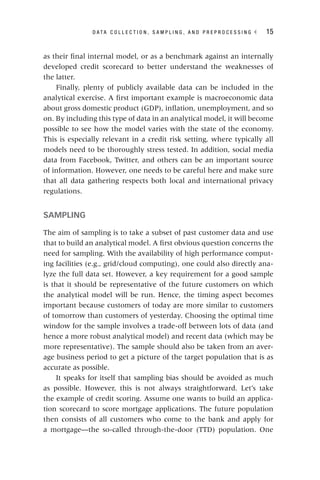
example, the variable “purpose of loan” having 50 different values.
When this variable would be put into a regression model, one would
need 49 dummy variables (50 − 1 because of the collinearity), which
would necessitate the estimation of 49 parameters for only one vari-
able. With categorization, one would create categories of values such
D A T A C O L L E C T I O N , S A M P L I N G , A N D P R E P R O C E S S I N G ◂ 25
that fewer parameters will have to be estimated and a more robust
model is obtained.
For continuous variables, categorization may also be very benefi-
cial. Consider, for example, the age variable and its risk as depicted in
Figure 2.7. Clearly, there is a nonmonotonous relation between risk
and age. If a nonlinear model (e.g., neural network, support vector
machine) were to be used, then the nonlinearity can be perfectly mod-
eled. However, if a regression model were to be used (which is typi-
cally more common because of its interpretability), then since it can
only fit a line, it will miss out on the nonmonotonicity. By categorizing
the variable into ranges, part of the nonmonotonicity can be taken
into account in the regression. Hence, categorization of continuous
variables can be useful to model nonlinear effects into linear models.
Various methods can be used to do categorization. Two very basic
methods are equal interval binning and equal frequency binning.
Consider, for example, the income values 1,000, 1,200, 1,300, 2,000,
1,800, and 1,400. Equal interval binning would create two bins with
the same range—Bin 1: 1,000, 1,500 and Bin 2: 1,500, 2,000—whereas
equal frequency binning would create two bins with the same num-
ber of observations—Bin 1: 1,000, 1,200, 1,300; Bin 2: 1,400, 1,800,
2,000. However, both methods are quite basic and do not take into
account a target variable (e.g., churn, fraud, credit risk).
Chi‐squared analysis is a more sophisticated way to do coarse clas-
sification. Consider the example depicted in Table 2.3 for coarse clas-
sifying a residential status variable.
0
5
10
15
20
25
30
16 26 38 51 64 75
Figure 2.7 Default Risk versus Age
26 ▸ ANALYTICS IN A BIG DATA WORLD
Suppose we want three categories and consider the following
options:
■ Option 1: owner, renters, others
■ Option 2: owner, with parents, others
Both options can now be investigated using chi‐squared analysis.
The purpose is to compare the empirically observed with the indepen-
dence frequencies. For option 1, the empirically observed frequencies
are depicted in Table 2.4.
The independence frequencies can be calculated as follows. The
number of good owners, given that the odds are the same as in the
whole population, is 6,300/10,000 × 9,000/10,000 × 10,000 = 5,670.
One then obtains Table 2.5.
The more the numbers in both tables differ, the less independence,
hence better dependence and a better coarse classification. Formally,
one can calculate the chi‐squared distance as follows:
χ =
−
+
−
+
−
+
−
+
−
+
−
=
(6000 5670)
5670
(300 630)
630
(1950 2241)
2241
(540 249)
249
(1050 1089)
1089
(160 121)
121
583
2
2 2 2 2
2 2
Table 2.3 Coarse Classifying the Residential Status Variable
Attribute Owner
Rent
Unfurnished
Rent
Furnished
With
Parents Other
No
Answer Total
6,000 1,600 350 950 90 10 9,000
Bads 300 400 140 100 50 10 1,000
Good:
bad odds
20:1 4:1 2.5:1 9.5:1 1.8:1 1:1 9:1
Source: L. C. Thomas, D. Edelman, and J. N. Crook, Credit Scoring and its Applications (Society for Industrial and Applied
s
Mathematics, Philadelphia, Penn., 2002).
Table 2.4 Empirical Frequencies Option 1 for Coarse Classifying Residential Status
Attribute Owner Renters Others Total
Goods 6,000 1,950 1,050 9,000
Bads 300 540 160 1,000
Total 6,300 2,490 1,210 10,000
D A T A C O L L E C T I O N , S A M P L I N G , A N D P R E P R O C E S S I N G ◂ 27
Table 2.5 Independence Frequencies Option 1 for Coarse Classifying Residential Status
Attribute Owner Renters Others Total
Goods 5,670 2,241 1,089 9,000
Bads 630 249 121 1,000
Total 6,300 2,490 1,210 10,000
Table 2.6 Coarse Classifying the Purpose Variable
Customer ID Age Purpose … G/B
C1 44 Car G
C2 20 Cash G
C3 58 Travel B
C4 26 Car G
C5 30 Study B
C6 32 House G
C7 48 Cash B
C8 60 Car G
… … …
Likewise, for option 2, the calculation becomes:
χ =
−
+
−
+
−
+
−
+
−
+
−
=
(6000 5670)
5670
(300 630)
630
(950 945)
945
(100 105)
105
(2050 2385)
2385
(600 265)
265
662
2
2 2 2 2
2 2
So, based upon the chi‐squared values, option 2 is the better cat-
egorization. Note that formally, one needs to compare the value with
a chi‐squared distribution with k − 1 degrees of freedom with
k k being
k
the number of values of the characteristic.
Many analytics software tools have built‐in facilities to do catego-
rization using chi‐squared analysis. A very handy and simple approach
(available in Microsoft Excel) is pivot tables. Consider the example
shown in Table 2.6.
One can then construct a pivot table and calculate the odds as
shown in Table 2.7.
28 ▸ ANALYTICS IN A BIG DATA WORLD
We can then categorize the values based on similar odds. For
example, category 1 (car, study), category 2 (house), and category 3
(cash, travel).
WEIGHTS OF EVIDENCE CODING
Categorization reduces the number of categories for categorical vari-
ables. For continuous variables, categorization will introduce new
variables. Consider a regression model with age (4 categories, so 3
parameters) and purpose (5 categories, so 4 parameters) characteris-
tics. The model then looks as follows:
Y Age Age Age Purp
Purp Purp Purp
0 1 1 2 2 3 3 4 1
5 2 6 3 7 4
= β + β + β + β + β
+ β + β + β
Despite having only two characteristics, the model still needs 8
parameters to be estimated. It would be handy to have a monotonic
transformation f(.) such that our model could be rewritten as follows:
f
f
= β + β + β
Y f f
(Age , Age , Age ) (Purp , Purp , Purp , Purp )
0 1 1 2 3 2 1 2 3 4
The transformation should have a monotonically increasing or
decreasing relationship with Y. Weights‐of‐evidence coding is one
example of a transformation that can be used for this purpose. This is
illustrated in Table 2.8.
The WOE is calculated as: ln(Distr. Good/Distr. Bad). Because of
the logarithmic transformation, a positive (negative) WOE means
Distr. Good > (<) Distr. Bad. The WOE transformation thus imple-
ments a transformation monotonically related to the target variable.
The model can then be reformulated as follows:
Y WOE WOE
0 1 age 2 purpose
= β + β + β
Table 2.7 Pivot Table for Coarse Classifying the Purpose Variable
Car Cash Travel Study House …
Good 1,000 2,000 3,000 100 5,000
Bad 500 100 200 80 800
Odds 2 20 15 1.25 6.25
D A T A C O L L E C T I O N , S A M P L I N G , A N D P R E P R O C E S S I N G ◂ 29
This gives a more concise model than the model with which we
started this section. However, note that the interpretability of the
model becomes somewhat less straightforward when WOE variables
are being used.
VARIABLE SELECTION
Many analytical modeling exercises start with tons of variables, of
which typically only a few actually contribute to the prediction of
the target variable. For example, the average application/behavioral
scorecard in credit scoring has somewhere between 10 and 15 vari-
ables. The key question is how to find these variables. Filters are a
very handy variable selection mechanism. They work by measuring
univariate correlations between each variable and the target. As such,
they allow for a quick screening of which variables should be retained
for further analysis. Various filter measures have been suggested in the
literature. One can categorize them as depicted in Table 2.9.
The Pearson correlation ρP is calculated as follows:
∑
∑ ∑
ρ =
− −
− −
=
= =
X X Y Y
X X Y Y
P
i
i
n
i
i
i
n
i
i
n
( )( )
( ) ( )
1
2
1
2
1
varies between −1 and +1. To apply it as a filter, one could select all
variables for which the Pearson correlation is significantly different
Table 2.8 Calculating Weights of Evidence (WOE)
Age Count
Distr.
Count Goods
Distr.
Good Bads
Distr.
Bad WOE
50 2.50% 42 2.33% 8 4.12% −57.28%
18–22 200 10.00% 152 8.42% 48 24.74% −107.83%
23–26 300 15.00% 246 13.62% 54 27.84% −71.47%
27–29 450 22.50% 405 22.43% 45 23.20% −3.38%
30–35 500 25.00% 475 26.30% 25 12.89% 71.34%
35–44 350 17.50% 339 18.77% 11 5.67% 119.71%
44+ 150 7.50% 147 8.14% 3 1.55% 166.08%
2,000 1,806 194
30 ▸ ANALYTICS IN A BIG DATA WORLD
from 0 (according to the p‐value), or, for example, the ones where
|ρP| > 0.50.
The Fisher score can be calculated as follows:
−
+
2 2
X X
s s
G B
G B
,
where XG XB
( ) represents the average value of the variable for the
Goods (Bads) and sG
2 sB
( )
2
the corresponding variances. High values of
the Fisher score indicate a predictive variable. To apply it as a filter,
one could, for example, keep the top 10 percent. Note that the Fisher
score may generalize to a well‐known analysis of variance (ANOVA) in
case a variable has multiple categories.
The information value (IV) filter is based on weights of evidence
and is calculated as follows:
∑
= −
=
IV Dist Good Dist Bad WOE
i i
i
k
i
( )*
1
k represents the number of categories of the variable. For the
k
example discussed in Table 2.8, the calculation becomes as depicted in
Table 2.10.
The following rules of thumb apply for the information value:
■ < 0.02: unpredictive
■ 0.02–0.1: weak predictive
■ 0.1–0.3: medium predictive
■ > 0.3: strong predictive
Note that the information value assumes that the variable has
been categorized. It can actually also be used to adjust/steer the cat-
egorization so as to optimize the IV. Many software tools will provide
Table 2.9 Filters for Variable Selection
Continuous Target
(e.g., CLV, LGD)
Categorical Target (e.g.,
churn, fraud, credit risk)
Continuous variable Pearson correlation Fisher score
Categorical variable Fisher score/ANOVA Information value (IV)
Cramer’s V
Gain/entropy
D A T A C O L L E C T I O N , S A M P L I N G , A N D P R E P R O C E S S I N G ◂ 31
interactive support to do this, whereby the modeler can adjust the
categories and gauge the impact on the IV. To apply it as a filter, one
can calculate the information value of all (categorical) variables and
only keep those for which the IV > 0.1 or, for example, the top 10%.
Another filter measure based upon chi‐squared analysis is Cramer’s
V. Consider the contingency table depicted in Table 2.11 for marital
status versus good/bad.
Similar to the example discussed in the section on categorization,
the chi‐squared value for independence can then be calculated as
follows:
χ =
−
+
−
+
−
+
−
=
(500 480)
480
(100 120)
120
(300 320)
320
(100 80)
80
10.41
2
2 2 2 2
k − 1 degrees of free-
k
dom, with k being the number of classes of the characteristic. The
k
Cramer’s V measure can then be calculated as follows:
Cramer s V
n
0.10,
2
′ =
χ
=
Table 2.10 Calculating the Information Value Filter Measure
Age Count
Distr.
Count Goods
Distr.
Good Bads
Distr.
Bad WOE IV
Missing 50 2.50% 42 2.33% 8 4.12% −57.28% 0.0103
18–22 200 10.00% 152 8.42% 48 24.74% −107.83% 0.1760
23–26 300 15.00% 246 13.62% 54 27.84% −71.47% 0.1016
27–29 450 22.50% 405 22.43% 45 23.20% −3.38% 0.0003
30–35 500 25.00% 475 26.30% 25 12.89% 71.34% 0.0957
35–44 350 17.50% 339 18.77% 11 5.67% 119.71% 0.1568
44+ 150 7.50% 147 8.14% 3 1.55% 166.08% 0.1095
Information Value 0.6502
Table 2.11 Contingency Table for Marital Status versus Good/Bad Customer
Good Bad Total
Married 500 100 600
Not Married 300 100 400
Total 800 200 1,000
32 ▸ ANALYTICS IN A BIG DATA WORLD
with n being the number of observations in the data set. Cramer’s V
is always bounded between 0 and 1 and higher values indicate bet-
ter predictive power. As a rule of thumb, a cutoff of 0.1 is commonly
adopted. One can then again select all variables where Cramer’s V is
bigger than 0.1, or consider the top 10 percent. Note that the informa-
tion value and Cramer’s V typically consider the same characteristics
as most important.
Filters are very handy because they allow you to reduce the num-
ber of dimensions of the data set early in the analysis in a quick way.
Their main drawback is that they work univariately and typically do
not consider, for example, correlation between the dimensions indi-
vidually. Hence, a follow-up input selection step during the modeling
phase will be necessary to further refine the characteristics. Also worth
mentioning here is that other criteria may play a role in selecting vari-
ables. For example, from a regulatory compliance viewpoint, some
variables may not be used in analytical models (e.g., the U.S. Equal
Credit Opportunities Act states that one cannot discriminate credit
based on age, gender, marital status, ethnic origin, religion, and so on,
so these variables should be left out of the analysis as soon as possible).
Note that different regulations may apply in different geographical
regions and hence should be checked. Also, operational issues could
be considered (e.g., trend variables could be very predictive but may
require too much time to be computed in a real‐time online scoring
environment).
SEGMENTATION
Sometimes the data is segmented before the analytical modeling
starts. A first reason for this could be strategic (e.g., banks might
want to adopt special strategies to specific segments of customers).
It could also be motivated from an operational viewpoint (e.g., new
customers must have separate models because the characteristics
in the standard model do not make sense operationally for them).
Segmentation could also be needed to take into account significant
variable interactions (e.g., if one variable strongly interacts with a
number of others, it might be sensible to segment according to this
variable).
D A T A C O L L E C T I O N , S A M P L I N G , A N D P R E P R O C E S S I N G ◂ 33
The segmentation can be conducted using the experience and
knowledge from a business expert, or it could be based on statistical
analysis using, for example, decision trees (see Chapter 3), k‐means, or
self‐organizing maps (see Chapter 4).
Segmentation is a very useful preprocessing activity because one
can now estimate different analytical models each tailored to a specific
segment. However, one needs to be careful with it because by seg-
menting, the number of analytical models to estimate will increase,
which will obviously also increase the production, monitoring, and
maintenance costs.
NOTES
1. J. Banasik, J. N. Crook, and L. C. Thomas, “Sample Selection Bias in Credit Scor-
ing Models” in Proceedings of the Seventh Conference on Credit Scoring and Credit Control
(Edinburgh University, 2001).
2. R. J. A. Little and D. B. Rubin, Statistical Analysis with Missing Data (Wiley-Inter-
science, Hoboken, New Jersey, 2002).
3. T. Van Gestel and B. Baesens, Credit Risk Management: Basic Concepts: Financial Risk
Components, Rating Analysis, Models, Economic and Regulatory Capital, Oxford University
Press, Oxford, England, ISBN 978-0-19-954511-7, 2009.
35
C H A P T E R 3
Predictive
Analytics
I
n predictive analytics, the aim is to build an analytical model pre-
dicting a target measure of interest.1
The target is then typically
used to steer the learning process during an optimization procedure.
Two types of predictive analytics can be distinguished: regression and
classification. In regression, the target variable is continuous. Popu-
lar examples are predicting stock prices, loss given default (LGD), and
customer lifetime value (CLV). In classification, the target is categori-
cal. It can be binary (e.g., fraud, churn, credit risk) or multiclass (e.g.,
predicting credit ratings). Different types of predictive analytics tech-
niques have been suggested in the literature. In what follows, we will
discuss a selection of techniques with a particular focus on the practi-
tioner’s perspective.
TARGET DEFINITION
Because the target variable plays an important role in the learning
process, it is of key importance that it is appropriately defined. In what
follows, we will give some examples.
In a customer attrition setting, churn can be defined in vari-
ous ways. Active churn implies that the customer stops the relation-
ship with the firm. In a contractual setting (e.g., postpaid telco),
36 ▸ ANALYTICS IN A BIG DATA WORLD
this can be easily detected when the customer cancels the contract.
In a noncontractual setting (e.g., supermarket), this is less obvious
and needs to be operationalized in a specific way. For example, a
customer churns if he or she has not purchased any products during
the previous three months. Passive churn occurs when a customer
decreases the intensity of the relationship with the firm, for exam-
ple, by decreasing product or service usage. Forced churn implies
that the company stops the relationship with the customer because
he or she has been engaged in fraudulent activities. Expected churn
occurs when the customer no longer needs the product or service
(e.g., baby products).
In credit scoring, a defaulter can be defined in various ways. For
example, according to the Basel II/Basel III regulation, a defaulter
is defined as someone who is 90 days in payment arrears. In the
United States, this has been changed to 180 days for mortgages and
qualifying revolving exposures, and 120 days for other retail expo-
sures. Other countries (e.g., the United Kingdom) have made similar
adjustments.
In fraud detection, the target fraud indicator is usually hard to
determine because one can never be fully sure that a certain transac-
tion (e.g., credit card) or claim (e.g., insurance) is fraudulent. Typically,
the decision is then made based on a legal judgment or a high suspi-
cion by a business expert.2
In response modeling, the response target can be defined in vari-
ous ways. Gross response refers to the customers who purchase after
having received the marketing message. However, it is more interest-
ing to define the target as the net response, being the customers who
purchase because of having received the marketing message, the so‐
called swingers.
Customer lifetime value (CLV) is a continuous target variable and
is usually defined as follows:3
∑
=
−
+
=
CLV
R C s
d
t t t
t
i
n
( )
(1 )
1
where n represents the time horizon considered (typically two to three
years), Rt the revenue at time
t t (both direct and indirect),
t Ct
C the costs
t
incurred at time t (both direct and indirect),
t st the survival probability
t
P R E D I C T I V E A N A L Y T I C S ◂ 37
at time t (see Chapter 5), and
t d the discounting factor (typically the
d
weighted average cost of capital [WACC]). Defining all these param-
eters is by no means a trivial exercise and should be done in close
collaboration with the business expert. Table 3.1 gives an example of
calculating CLV.
Loss given default (LGD) is an important credit risk parameter in a
Basel II/Basel III setting.4
It represents the percentage of the exposure
likely to be lost upon default. Again, when defining it, one needs to
decide on the time horizon (typically two to three years), what costs
to include (both direct and indirect), and what discount factor to adopt
(typically the contract rate).
Before starting the analytical step, it is really important to check
the robustness and stability of the target definition. In credit scoring,
one commonly adopts roll rate analysis for this purpose as illustrated
in Figure 3.1. The purpose here is to visualize how customers move
from one delinquency state to another during a specific time frame. It
Table 3.1 Example CLV Calculation
Month t
Revenue in
Month t (Rt)
Cost in Month
t (Ct)
Survival
Probability in
Month t (st)
(Rt − Ct) *
st / (1 + d )t
1 150 5 0.94 135.22
2 100 10 0.92 82.80
3 120 5 0.88 101.20
4 100 0 0.84 84.00
5 130 10 0.82 98.40
6 140 5 0.74 99.90
7 80 15 0.7 45.50
8 100 10 0.68 61.20
9 120 10 0.66 72.60
10 90 20 0.6 42.00
11 100 0 0.55 55.00
12 130 10 0.5 60.00
CLV 937.82
Yearly WACC 10%
Monthly WACC 1%
38 ▸ ANALYTICS IN A BIG DATA WORLD
can be easily seen from the plot that once the customer has reached
90 or more days of payment arrears, he or she is unlikely to recover.
LINEAR REGRESSION
Linear regression is a baseline modeling technique to model a continu-
ous target variable. For example, in a CLV modeling context, a linear
regression model can be defined to model CLV in terms of the RFM
(recency, frequency, monetary value) predictors as follows:
= β + β + β + β
CLV R F M
0 1 2 3
The β parameters are then typically estimated using ordinary least
squares (OLS) to minimize the sum of squared errors. As part of the
estimation, one then also obtains standard errors, p‐values indicating
variable importance (remember important variables get low p‐values),
and confidence intervals. A key advantage of linear regression is that it
is simple and usually works very well.
Note that more sophisticated variants have been suggested in the
literature (e.g., ridge regression, lasso regression, time series mod-
els [ARIMA, VAR, GARCH], multivariate adaptive regression splines
[MARS]).
Figure 3.1 Roll Rate Analysis
Source: N. Siddiqi, Credit Risk Scorecards: Developing and Implementing Intelligent Credit Scoring
(Hoboken, NJ: John Wiley & Sons, 2005).
100%
80%
60%
40%
20%
0%
Worst—Next 12 Months
Curr/x day
30 day
60 day
90+
Worst—Previous
12
Months Roll Rate
Curr/x day 30 day 60 day 90+
P R E D I C T I V E A N A L Y T I C S ◂ 39
LOGISTIC REGRESSION
Consider a classification data set for response modeling as depicted in
Table 3.2.
When modeling the response using linear regression, one gets:
= β + β + β + β
Y Age Income Gender
0 1 2 3
When estimating this using OLS, two key problems arise:
1. The errors/target are not normally distributed but follow a
Bernoulli distribution.
2. There is no guarantee that the target is between 0 and 1, which
would be handy because it can then be interpreted as a prob-
ability.
Consider now the following bounding function:
=
+ −
f z
e z
( )
1
1
which can be seen in Figure 3.2.
For every possible value of z, the outcome is always between
0 and 1. Hence, by combining the linear regression with the bounding
function, we get the following logistic regression model:
P response yes age income gender
e
( | , , )
1
1 ( age income gender)
0 1 2 3
= =
+ − β +β +β +β
The outcome of the above model is always bounded between 0
and 1, no matter what values of age, income, and gender are being
used, and can as such be interpreted as a probability.
Table 3.2 Example Classification Data Set
Customer Age Income Gender . . . Response Y
John 30 1,200 M No 0
Sarah 25 800 F Yes 1
Sophie 52 2,200 F Yes 1
David 48 2,000 M No 0
Peter 34 1,800 M Yes 1
40 ▸ ANALYTICS IN A BIG DATA WORLD
The general formulation of the logistic regression model then
becomes:
P Y X X
e
n X X
N N
( 1| , , )
1
1
,
1 ( )
0 1 1 
= … =
+ − β +β + +β
or, alternately,
P Y X X P Y X X
e e
N N
X X X X
N N N N
( 0| , , ) 1 ( 1| , , )
1
1
1
1
1
1 1
( ) (
0 1 1 0 1 1
 
= … = − = …
= −
+
=
+
− β +β + +β β +β + +β
Hence, both = …
P Y X XN
( 1| , , )
1 and = …
P Y X XN
( 0| , , )
1 are bounded
between 0 and 1.
Reformulating in terms of the odds, the model becomes:
P Y X X
P Y X X
e
N
N
X X
N N
( 1| , , )
( 0| , , )
1
1
( )
0 1 1 
= …
= …
= β +β + +β
or, in terms of log odds (logit),
= …
= …
⎛
⎝
⎜
⎞
⎠
⎟ = β + β + + β

P Y X X
P Y X X
X X
N
N
N N
ln
( 1| , , )
( 0| , , )
1
1
0 1 1
Figure 3.2 Bounding Function for Logistic Regression
0
0.1
0.2
0.3
0.4
0.5
0.6
0.7
0.8
0.9
1
7
5
3
1
–1
–3
–5
–7
P R E D I C T I V E A N A L Y T I C S ◂ 41
The βi parameters of a logistic regression model are then estimated
i
by optimizing a maximum likelihood function. Just as with linear
regression, the optimization comes with standard errors, p‐values for
variable screening and confidence intervals.
Since logistic regression is linear in the log odds (logit), it basically
estimates a linear decision boundary to separate both classes. This is
illustrated in Figure 3.3.
To interpret a logistic regression model, one can calculate the odds
ratio. Suppose variable Xi
X
X increases with one unit with all other vari-
i
ables being kept constant (ceteris paribus), then the new logit becomes
the old logit with βi added. Likewise, the new odds become the old
i
odds multiplied by eβi
. The latter represents the odds ratio, that is, the
i
multiplicative increase in the odds when Xi
X
X increases by 1 (
i ceteris pari-
bus). Hence,
■ βi  0 implies eβi
 1 and the odds and probability increase with
Xi
X
X
■ βi  0 implies eβi
 1 and the odds and probability decrease
with Xi
X
X
Another way of interpreting a logistic regression model is by cal-
culating the doubling amount. This represents the amount of change
required for doubling the primary outcome odds. It can be easily
seen that for a particular variable Xi
X
X , the doubling amount equals
log(2)/βi.
Figure 3.3 Decision Boundary of Logistic Regression
Income
Age
G
G
G G
G
G
G
G
G
G
G
G
G
G G
G
G
G
G
G
G
G
G
G
G
G
G
G
G
G
G
G G
B
B
G
G
G
G
G
G
G
G
G
G
G
G
G
B
B
B
B
B
B B
B
B B
G
G
G
B
B
B
G
B
42 ▸ ANALYTICS IN A BIG DATA WORLD
Note that next to the f(
f
f z) transformation discussed above, other
z
transformations also have been suggested in the literature. Popular
examples are the probit and cloglog transformation as follows:
∫
=
π −∞
−
f z e dt
z
t
( )
1
2
2
2
= − −
f z e ez
( ) 1
The probit transformation was used in Moody’s RiskCalc tool for
predicting probability of default for firms.5
Note, however, that empiri-
cal evidence suggests that all three transformations typically perform
equally well.
DECISION TREES
Decision trees are recursive partitioning algorithms (RPAs) that come
up with a tree-like structure representing patterns in an underlying
data set.6
Figure 3.4 provides an example of a decision tree.
The top node is the root node specifying a testing condition
of which the outcome corresponds to a branch leading up to an
internal node. The terminal nodes of the tree assign the classifica-
tions and are also referred to as the leaf nodes. Many algorithms
have been suggested to construct decision trees. Amongst the most
popular are: C4.5 (See5),7
CART,8
and CHAID.9
These algorithms
differ in their way of answering the key decisions to build a tree,
which are:
■ Splitting decision: Which variable to split at what value (e.g.,
age  30 or not, income  1,000 or not; marital status = married
or not)
■ Stopping decision: When to stop growing a tree?
■ Assignment decision: What class (e.g., good or bad customer) to
assign to a leaf node?
Usually, the assignment decision is the most straightforward to
make since one typically looks at the majority class within the leaf
node to make the decision. The other two decisions to be made are less
straightforward and are elaborated on in what follows.
P R E D I C T I V E A N A L Y T I C S ◂ 43
In order to answer the splitting decision, one needs to define the
concept of impurity or chaos. Consider, for example, the three data sets
of Figure 3.5, each of which contains good (unfilled circles) and bad
(filled circles) customers. Minimal impurity occurs when all customers
are either good or bad. Maximal impurity occurs when one has the same
number of good and bad customers (i.e., the data set in the middle).
Decision trees will now aim at minimizing the impurity in the data.
In order to do so appropriately, one needs a measure to quantify impu-
rity. Various measures have been introduced in the literature, and the
most popular are:
■ Entropy: E(S) = −pGlog2(pG)−pBlog2(pB) (C4.5/See5)
■ Gini: Gini(S) = 2pGpB (CART)
■ Chi‐squared analysis (CHAID)
with pG (pB) being the proportions of good and bad, respectively. Both
measures are depicted in Figure 3.6, where it can be clearly seen that
the entropy (Gini) is minimal when all customers are either good or bad,
and maximal in the case of the same number of good and bad customers.
Figure 3.4 Example Decision Tree
Income  $50,000
Employed Age  40
No
No No
Respond
Yes
Not Respond
Yes
Not Respond
Respond
Yes
Figure 3.5 Example Data Sets for Calculating Impurity
Minimal Impurity
Minimal Impurity Maximal Impurity
44 ▸ ANALYTICS IN A BIG DATA WORLD
In answering the splitting decision, various candidate splits will
now be evaluated in terms of their decrease in impurity. Consider, for
example, a split on age as depicted in Figure 3.7.
The original data set had maximum entropy. The entropy calcula-
tions become:
■ Entropy top node = −1/2 × log2(1/2) – 1/2 × log2(1/2) = 1
■ Entropy left node = −1/3 × log2(1/3) – 2/3 × log2(2/3) = 0.91
■ Entropy right node = −1 × log2(1) – 0 × log2(0) = 0
Figure 3.6 Entropy versus Gini
0
0.1
0.2
0.3
0.4
0.5
0.6
0.7
0.8
0.9
1
1
0.9
0.8
0.7
0.6
0.5
0.4
0.3
0.2
0.1
0
Entropy
Gini
Figure 3.7 Calculating the Entropy for Age Split
B
G
G B G B
Age
Age  30 ≥ 30
400 400
200 400 200 0
P R E D I C T I V E A N A L Y T I C S ◂ 45
The weighted decrease in entropy, also known as the gain, can
then be calculated as follows:
= − × − × =
Gain 1 (600/800) 0.91 (200/800) 0 0.32
It speaks for itself that a larger gain is to be preferred. The decision
tree algorithm will now consider different candidate splits for its root
node and adopt a greedy strategy by picking the one with the biggest
gain. Once the root node has been decided on, the procedure contin-
ues in a recursive way to continue tree growing.
The third decision relates to the stopping criterion. Obviously, if the
tree continues to split, it will become very detailed with leaf nodes con-
taining only a few observations. In other words, the tree will start to fit
the specificities or noise in the data, which is also referred to as overfit-
ting. In order to avoid this, the data will be split into a training sample
and a validation sample. The training sample will be used to make the
splitting decision. The validation sample is an independent sample, set
aside to monitor the misclassification error (or any other performance
metric). One then typically observes a pattern as depicted in Figure 3.8.
The error on the training sample keeps on decreasing as the splits
become more and more specific toward it. On the validation sample,
the error will initially decrease, but at some point it will increase back
again since the splits become too specific for the training sample as the
tree starts to memorize it. Where the validation set curve reaches its
minimum, the procedure should be stopped or overfitting will occur.
Note that besides classification error, one might also use accuracy or
Figure 3.8 Using a Validation Set to Stop Growing a Decision Tree
Validation set
Training set
Minimum
Misclassification
error
STOP growing tree!
Number of tree nodes
46 ▸ ANALYTICS IN A BIG DATA WORLD
profit based measures on the Y‐axis to make the stopping decision.
Also note that, sometimes, simplicity is preferred above accuracy, and
one can select a tree that does not necessarily have minimum valida-
tion set error, but a lower number of nodes.
In the example of Figure 3.4, every node had only two branches.
The advantage of this is that the testing condition can be implemented
as a simple yes/no question. Multiway splits allow for more than two
branches and can provide trees that are wider but less deep. In a read
once decision tree, a particular attribute can be used only once in a
certain tree path. Every tree can also be represented as a rule set since
every path from a root node to a leaf node makes up a simple if/then
rule. These rules can then be easily implemented in all kinds of soft-
ware packages (e.g., Microsoft Excel).
Decision trees essentially model decision boundaries orthogonal to
the axes. This is illustrated in Figure 3.9 for an example decision tree.
Decision trees can also be used for continuous targets. Consider
the example in Figure 3.10 of a regression tree for predicting LGD.
Other criteria need now be used to make the splitting decision
because the impurity will need to be measured in another way. One
way to measure impurity in a node is by calculating the mean squared
error (MSE) as follows:
∑ −
=
n
Y Y
i
i
n
1
( ) ,
2
1
where n represents the number of observations in a leave node, Yi the
value of observation i, and Y, the average of all values in the leaf node.
Figure 3.9 Decision Boundary of a Decision Tree
G
G
G
G
B
B
B
B
B
B
B
B
B
B
B
B
G
G
G
G
G G G
G
G
G G
G
G
G
G
G
G
G
G G
G
G
G
G
G G G G
G
G
G
G
G G G
G
G
G
G
1,200
30
Age
Income
Age
G
Income
G
B
1,200 1,200
30 30
P R E D I C T I V E A N A L Y T I C S ◂ 47
Another way is by conducting a simple analysis of variance
(ANOVA) test and calculate an F‐statistic as follows:
=
−
−
− −
∼
F
SS B
SS n B
F
between
within
n B B
/( 1)
/( )
,
, 1
whereby
∑
= −
=
SS n Y Y
between b
b
B
b
( )
1
2
∑
∑
= −
=
=
SS Y Y
within bi b
i
n
b
B b
( )2
1
1
with B being the number of branches of the split, nb the number of
observations in branch b, Yb the average in branch b,Ybi the value of
observation i in branch
i b, and Y the overall average. Good splits will
then result in a high F value, or low corresponding p‐value.
F
The stopping decision can be made in a similar way as for classifi-
cation trees, but using a regression‐based performance measure (e.g.,
mean squared error, mean absolute deviation, R‐squared) on the Y‐
Y
Y
axis. The assignment decision can be made by assigning the mean (or
median) to each leaf node. Note also that confidence intervals may be
computed for each of the leaf nodes.
Decision trees can be used for various purposes in analytics. First,
they can be used for input selection because attributes that occur at the
top of the tree are more predictive of the target. One could also sim-
ply calculate the gain of a characteristic to gauge its predictive power.
Figure 3.10 Example Regression Tree for Predicting LGD
Loan Collateral
LGD = 18%
LGD = 30%
Geographic Region LGD = 72%
Known Client
LGD = 42% LGD = 55%
None
Cash
Real Estate
EU
United
States No
Yes
48 ▸ ANALYTICS IN A BIG DATA WORLD
Next, they can also be used for initial segmentation. One then typically
builds a tree of two or three levels deep as the segmentation scheme
and then uses second stage logistic regression models for further
refinement. Finally, decision trees can also be used as the final analyti-
cal model to be used directly into production. A key advantage here is
that the decision tree gives a white box model with a clear explanation
behind how it reaches its classifications. Many software tools will also
allow you to grow trees interactively by providing a splitting option at
each level of the tree (e.g., a top five, or more, of splits amongst which
the modeler can choose). This allows us to choose splits not only based
upon impurity reduction, but also on the interpretability and/or com-
putational complexity of the split criterion.
NEURAL NETWORKS
A first perspective on the origin of neural networks states that they
are mathematical representations inspired by the functioning of the
human brain. Another more realistic perspective sees neural networks
as generalizations of existing statistical models. Let’s take logistic
regression as an example:
P Y X X
e
N X X
N N
( 1| , , )
1
1
,
1 ( )
0 1 1 
= … =
+ − β +β + +β
This model can be seen in Figure 3.11.
The processing element or neuron in the middle basically per-
forms two operations: it takes the inputs and multiplies them with the
weights (including the intercept term β0, which is called the bias term
Figure 3.11 Neural Network Representation of Logistic Regression
X1
X2
XN–1
XN
...
1
1 –( 0 + 1X1 + ... + NXN)
+
1
)
,...,
|
( N
e
X
X
Y
P =
N–1
N
0
β
β
β
β
β
β β β
1
2
P R E D I C T I V E A N A L Y T I C S ◂ 49
in neural networks) and then puts this into a nonlinear transforma-
tion function similar to the one we discussed in the section on logistic
regression. So, logistic regression is a neural network with one neuron.
Similarly, we could visualize linear regression as a one neuron neural
network with the identity transformation f(
f
f z) = z. We can now gener-
z
alize the above picture to a multilayer perceptron (MLP) neural net-
work by adding more layers and neurons as shown in Figure 3.12.10
The example in Figure 3.12 is an MLP with one input layer, one
hidden layer, and one output layer. The hidden layer has a nonlinear
transformation function f(
f
f .) and the output layer a linear transforma-
tion function. The most popular transformation functions (also called
squashing, activation functions) are:
■ Logistic, =
+ −
f z
e z
( )
1
1
, ranging between 0 and 1
■ Hyperbolic tangent, =
−
+
−
−
f z
e e
e e
z z
z z
( ) , ranging between –1 and +1
■ Linear, =
f z z
( ) , ranging between −∞ and +∞
For classification (e.g., churn, response, fraud), it is common prac-
tice to adopt a logistic transformation in the output layer, since the
outputs can then be interpreted as probabilities.11
For regression tar-
gets (e.g., CLV, LGD), one could use any of the transformation func-
tions listed above. Typically, one will use hyperbolic tangent activation
functions in the hidden layer.
In terms of hidden layers, theoretical works have shown that
neural networks with one hidden layer are universal approximators,
Figure 3.12 A Multilayer Perceptron (MLP) Neural Network
b1
b2
b3
b4
h1
h2
h3
v1
v3
v2
x1
x2
W11
W23
z = Σvjhj + b4
j = 1
3
hj = f(Σxiwij + bj)
i = 1
2
50 ▸ ANALYTICS IN A BIG DATA WORLD
capable of approximating any function to any desired degree of accu-
racy on a compact interval.12
Only for discontinuous functions (e.g., a
saw tooth pattern), it could make sense to try out more hidden layers,
although these patterns rarely occur in real‐life data sets.
For simple statistical models (e.g., linear regression), there exists a
closed‐form mathematical formula for the optimal parameter values.
However, for neural networks, the optimization is a lot more com-
plex and the weights sitting on the connections need to be estimated
using an iterative algorithm. The algorithm then optimizes a cost func-
tion, which may be similar to linear regression (mean squared error)
or logistic regression (maximum likelihood based). The procedure
typically starts from a set of random weights that are then iteratively
adjusted to the patterns in the data using an optimization algorithm.
Popular optimization algorithms here are backpropagation learning,
conjugate gradient, and Levenberg‐Marquardt.13
A key issue to note
here is the curvature of the objective function, which is not convex
and may be multimodal as illustrated in Figure 3.13. The error func-
tion can thus have multiple local minima but typically only one global
minimum. Hence, if the starting weights are chosen in a suboptimal
way, one may get stuck in a local minimum. One way to deal with this
is to try out different starting weights, start the optimization procedure
for a few steps, and then continue with the best intermediate solution.
The optimization procedure then continues until the error function
shows no further progress, the weights stop changing substantially, or
after a fixed number of optimization steps (also called epochs).
Figure 3.13 Local versus Global Minima
w
E
Local minimum!
Global minimum!
P R E D I C T I V E A N A L Y T I C S ◂ 51
Although multiple output neurons could be used (predicting, for
example, churn and CLV simultaneously), it is highly advised to use
only one. The hidden neurons, however, should be carefully tuned
and depend on the nonlinearity in the data. More complex, nonlinear
patterns will require more hidden neurons. Although various proce-
dures (e.g., cascade correlation, genetic algorithms, Bayesian methods)
have been suggested in the scientific literature to do this, the most
straightforward yet efficient procedure is as follows:14
■ Split the data into a training, validation, and test set.
■ Vary the number of hidden neurons from 1 to 10 in steps of 1
or more.
■ Train a neural network on the training set and measure the per-
formance on the validation set (may be train multiple neural
networks to deal with the local minimum issue).
■ Choose the number of hidden neurons with optimal validation
set performance.
■ Measure the performance on the independent test set.
Neural networks can model very complex patterns and decision
boundaries in the data and, as such, are very powerful. In fact, they
are so powerful that they can even model the noise in the training
data, which is something that definitely should be avoided. One way
to avoid this overfitting is by using a validation set in a similar way as
with decision trees. This is illustrated in Figure 3.14. The training set
is used here to estimate the weights and the validation set is again an
independent data set used to decide when to stop training. Another
scheme to prevent a neural network from overfitting is weight regu-
larization, whereby the idea is to keep the weights small in absolute
Figure 3.14 Using a Validation Set for Stopping Neural Network Training
Validation set
Training set
Minimum
Error
STOP training!
Training steps
52 ▸ ANALYTICS IN A BIG DATA WORLD
sense because otherwise they may be fitting the noise in the data. This
is then implemented by adding a weight size term (e.g., Euclidean
norm) to the objective function of the neural network.15
Although neural networks have their merits in terms of modeling
power, they are commonly described as black box techniques because
they relate the inputs to the outputs in a mathematically complex, non-
transparent, and opaque way. In application areas where interpretabil-
ity may not be required (e.g., fraud detection, response modeling), they
can be very successfully adopted as high‐performance analytical tools.
However, in application areas where explanation is important
(e.g., credit risk, medical diagnosis), one needs to be careful with neu-
ral networks because insight and comprehensibility in the underlying
patterns is crucial.16
Two ways to open up the neural network black
box are rule extraction and two‐stage models.
The purpose of rule extraction is to extract if/then classification
rules mimicking the behavior of the neural network.17
Two impor-
tant approaches here are decompositional and pedagogical techniques.
Decompositional rule extraction approaches decompose the network’s
internal workings by inspecting weights and/or activation values. A
typical five‐step approach here could be:18
1. Train a neural network and prune it as much as possible in
terms of connections.
2. Categorize the hidden unit activation values using clustering.
3. Extract rules that describe the network outputs in terms of the
categorized hidden unit activation values.
4. Extract rules that describe the categorized hidden unit activa-
tion values in terms of the network inputs.
5. Merge the rules obtained in steps 3 and 4 to directly relate the
inputs to the outputs.
This is illustrated in Figure 3.15.
Note that steps 3 and 4 can be done simultaneously by building
a decision tree relating the network outputs to the hidden unit acti-
vation values. Figure 3.16 gives an example of applying a decompo-
sitional neural network rule extraction approach in a credit scoring
setting.
Figure
3.15
Decompositional
Approach
for
Neural
Network
Rule
Extraction
Response
…
Gender
Income
Age
Customer
No
F
1,000
28
Emma
Yes
M
1,500
44
Will
No
M
1,200
30
Dan
Yes
M
2,400
58
Bob
Response
h3
h2
h1
h3
h2
h1
Gender
Income
Age
Customer
F
28
Emma
2
3
1
2
3
2
M
44
Will
M
30
Dan
2
1
3
M
1,000
1,500
1,200
2,400
58
Bob
2.34
1.22
–0.18
0.8
–1.20
0.78
2.1
–0.1
No
Yes
No
Yes
1
2
1
0.66
0.82
0.16
–2.34
If
h1
=
1
and
h2
=
3,
then
response
=
No
If
h2
=
2,
then
response
=
Yes
If
age

28
and
income

1,000,
then
h1
=
1
If
gender
=
F,
then
h2
=
3
If
age

34
and
income

1,500,
then
h2
=
2
If
age

28
and
income

1,000
and
gender
=
F
then
response
=
No
If
age

34
and
income

1,500
then
response
=
Yes
Step
1:
Start
from
original
data.
Step
2:
Build
a
neural
network
(e.g,
3
hidden
neurons).
Step
3:
Categorize
hidden
unit
activations.
Step
4:
Extract
rules
relating
network
outputs
to
categorized
hidden
units.
Step
5:
Extract
rules
relating
categorized
hidden
units
to
inputs.
Step
6:
Merge
both
rule
sets
53
Figure
3.16
Example
of
Decompositional
Neural
Network
Rule
Extraction
Economical
sector
=
sector
C
Term

12
Months
Purpose
=
cash
provisioning
Purpose
=
second
hand
car
Income

719
Euro
Savings
account

12.40
Euro
Years
client

3
years
Property
=
No
–0.202
–0.287
–0.102
0.278
–0.081
–0.162
0.137
–0.289
0.457
–0.453
0.611
0.380
Applicant
=
good
Applicant
=
bad
If
term

12
months
and
purpose
=
cash
provisioning
and
savings
account
≤
12.40
Euro
and
years
client
≤
3,
then
applicant
=
bad
If
term

12
months
and
purpose
=
cash
provisioning
and
owns
property
=
no
and
savings
account
≤
12.40
Euro
and
years
client
≤
3,
then
applicant
=
bad
If
purpose
=
cash
provisioning
and
income

719
and
owns
property
=
no
and
savings
account
≤
12.40
Euro
and
years
client
≤
3,
then
applicant
=
bad
If
purpose
=
secondhand
car
and
income

719
Euro
and
owns
property
=
no
and
savings
account
≤
12.40
Euro
and
years
client
≤
3,
then
applicant
=
bad
If
savings
account
≤
12.40
Euro
and
economical
sector
=
sector
C,
then
applicant
=
bad
Default
class:
applicant
=
good
54
P R E D I C T I V E A N A L Y T I C S ◂ 55
Pedagogical rule extraction techniques consider the neural net-
work as a black box and use the neural network predictions as input
to a white box analytical technique such as decision trees.19
This is
illustrated in Figure 3.17.
In this approach, the learning data set can be further augmented
with artificial data, which is then labeled (e.g., classified or predicted)
by the neural network, so as to further increase the number of obser-
vations to make the splitting decisions when building the decision tree.
When using either decompositional or pedagogical rule extraction
approaches, the rule sets should be evaluated in terms of their accuracy,
conciseness (e.g., number of rules, number of conditions per rule), and
fidelity. The latter measures to what extent the extracted rule set per-
fectly mimics the neural network and is calculated as follows:
Neural Network Classification
Rule set
classification
Good Bad
Good a b
Bad c d
= + +
Fidelity (a d)/(b c).
It is also important to always benchmark the extracted rules/trees
with a tree built directly on the original data to see the benefit of going
through the neural network.
Another approach to make neural networks more interpretable
is by using a two‐stage model setup.20
The idea here is to estimate an
easy to understand model first (e.g., linear regression, logistic regres-
sion). This will give us the interpretability part. In a second stage, a
neural network is used to predict the errors made by the simple model
using the same set of predictors. Both models are then combined in an
additive way, for example, as follows:
■ Target = linear regression (X1, X2
X
X , … XN
X ) + neural network
N
(X1, X2
X
X , … XN
X )
N
■ Score = logistic regression (X1, X2
X
X , … XN
X ) + neural network
N
(X1, X2
X
X , … XN
X )
N
This setup provides an ideal balance between model interpretabil-
ity (which comes from the first part) and model performance (which
comes from the second part). This is illustrated in Figure 3.18.
Figure
3.17
Pedagogical
Approach
for
Rule
Extraction
Response
…
Gender
Income
Age
Customer
1,000
28
Emma
1,500
44
Will
1,200
30
Dan
No
Yes
No
Yes
F
M
M
M
2,400
58
Bob
Gender
Income
Age
Customer
Network
Prediction
Response
1,000
28
Emma
1,500
44
Will
1,200
30
Dan
No
Yes
No
Yes
No
Yes
Yes
Yes
F
M
M
M
2,400
58
Bob
Step
1:
Start
from
original
data.
Step
2:
Build
a
neural
network.
Step
3:
Get
the
network
predictions
and
add
them
to
the
data
set.
Step
4:
Extract
rules
relating
network
predictions
to
original
inputs.
Generate
additional
data
where
necessary.
Income

1,500
Gender
=
Female
Age

30
No
No
No
Network
prediction
response
=
yes
Network
prediction
response
=
no
Network
prediction
response
=
yes
Yes
Network
prediction
response
=
no
Yes
Yes
Figure
3.18
Two‐Stage
Models
Response
Gender
Income
Age
Customer
No
1,000
28
Emma
Yes
1,500
44
Will
No
1,200
30
Dan
Yes
F
M
M
M
2,400
58
Bob
Response
Income
Gender
Age
Customer
Logistic
Regression
Output
1,000
28
Emma
0.44
1,500
44
Will
0.76
1,200
30
Dan
0.18
0.88
No
(=0)
Yes
(=1)
No
(=0)
Yes
(=1)
F
M
M
M
2,400
58
Bob
Income
Gender
Response
…
Age
Customer
Logistic
Regression
Output
Error
28
Emma
0.44
44
Will
0.76
30
Dan
0.18
−0.44
0.24
−0.18
0.12
0.88
No
(=0)
Yes
(=1)
No
(=0)
Yes
(=1)
F
M
M
M
1,000
1,500
1,200
2,400
58
Bob
Income
Gender
Customer
Age
Logistic
Regression
Output
NN
Output
Final
Output
0.68
F
1,000
28
Bart
−0.32
0.36
Step
1:
Start
from
original
data.
Step
2:
Build
logistic
regression
model.
Step
3:
Calculate
errors
from
logistic
regression
model.
Step
4:
Build
NN
predicting
errors
from
logistic
regression
model.
Step
5:
Score
new
observations
by
adding
up
logistic
regression
and
NN
scores.
…
…
…
57
58 ▸ ANALYTICS IN A BIG DATA WORLD
SUPPORT VECTOR MACHINES
Two key shortcomings of neural networks are the fact that the objective
function is nonconvex (and hence may have multiple local minima)
and the effort that is needed to tune the number of hidden neurons.
Support vector machines (SVMs) deal with both of these issues.21
The origins of classification SVMs date back to the early dates of
linear programming.22
Consider the following linear program (LP) for
classification:
+ + + + +
 
e e e e
ng nb
min 1 2
subject to
w x w x w x c e i n
i i n in i g
,1
1 1 2 2 
+ + + ≥ − ≤ ≤
+ + + ≤ + + ≤ ≤ +

w x w x w x c e n i n n
i i n in i g g b
, 1
1 1 2 2
≥
ei 0
The LP assigns the good customers a score above the cut‐off value c,
and the bad customers a score below c. ng
n and nb represent the number
of goods and bads, respectively. The error variables ei are needed to be
i
able to solve the program because perfect separation will typically not be
possible. Linear programming has been very popular in the early days of
credit scoring. One of its benefits is that it is easy to include domain or
business knowledge by adding extra constraints to the model.
A key problem with linear programming is that it can estimate
multiple optimal decision boundaries, as illustrated in Figure 3.19, for
a perfectly linearly separable case.
SVMs add an extra objective to the analysis. Consider, for exam-
ple, the situation depicted in Figure 3.20. It has two hyperplanes sit-
ting at the edges of both classes and a hyperplane in between, which
will serve as the classification boundary. The perpendicular distance
from the first hyperplane H1 to the origin equals |b−1|/||w||, whereby
w
||w|| represents the Euclidean norm of
w w calculated as
w w w w
|| || 1
2
2
2
= + .
Likewise, the perpendicular distance from H2 to the origin equals |b +
1|/||w||. Hence, the margin between both hyperplanes equals 2/||
w w||.
w
SVMs will now aim at maximizing this margin to pull both classes as
far apart as possible. Maximizing the margin is similar to minimizing
P R E D I C T I V E A N A L Y T I C S ◂ 59
||w||, or minimizing
w ∑
=
wi
i
N
1
2
2
1
. In case of perfect linear separation, the
SVM classifier then becomes
i 1
as follows.
Consider a training set: ∈ ∈ − +
=
{ , } with and { 1; 1}
1
x y x R y
k k k
n
k
N
k
The goods (e.g., class +1) should be above hyperplane H1, and the
bads (e.g., class−1) below hyperplane H2, which gives:
w x b if y
T
k k
1, 1
+ ≥ = +
w x b if y
T
k k
1, 1
+ ≤ = −
Figure 3.19 Multiple Separating Hyperplanes
x
x
x
x
x
x
x
x
+
+
+
+
+
+
+
+
Class 1
Class 2
x1
x2
Figure 3.20 SVM Classifier for the Perfectly Linearly Separable Case
x1
x
x
x
x
x
x
x
x
+
+
+
+
+
+
+
+
Class 1
Class 2
x2
H1: wTx + b = + 1
H0: wTx + b = 0
H2: wTx + b = –1
2/||w||
60 ▸ ANALYTICS IN A BIG DATA WORLD
Both can be combined as follows:
+ ≥
y w x b
k
T
k
( ) 1
The optimization problem then becomes:
∑
=
Minimize wi
i
N
1
2
2
1
subject to y w x b k n
k
T
k
( ) 1, 1…
+ ≥ =
This quadratic programming (QP) problem can now be solved
using Lagrangian optimization.23
It is important to note that the
optimization problem has a quadratic cost function, giving a convex
optimization problem with no local minima and only one global mini-
mum. Training points that lie on one of the hyperplanes H1 or H2 are
called support vectors and are essential to the classification. The classifi-
cation hyperplane itself is H0 and, for new observations, it needs to be
checked whether they are situated above H0, in which case the pre-
diction is +1 or below (prediction −1). This can be easily accomplished
using the sign operator as follows: y(x) = sign (
x wT
x + b
T
).
The SVM classifier discussed thus far assumed perfect separation is
possible, which will of course rarely be the case for real‐life data sets.
In case of overlapping class distributions (as illustrated in Figure 3.21),
the SVM classifier can be extended with error terms as follows:
∑ ∑
+
= =
Minimize w C e
i
i
N
i
i
n
1
2
2
1 1
Figure 3.21 SVM Classifier in Case of Overlapping Distributions
x
x
x
x
x
x
x
x
+
+
+
+
+
+
+
+
Class 1
Class 2
x2 2/||w||
x
+
x1
H1: wTx + b = + 1
H0: wTx + b = 0
H2: wTx + b = –1
P R E D I C T I V E A N A L Y T I C S ◂ 61
subject to y w x b e k n
k
T
k k
( ) 1 , 1…
+ ≥ − =
≥
ek 0.
The error variables ek are needed to allow for misclassifications.
k
The C hyperparameter in the objective function balances the impor-
C
tance of maximizing the margin versus minimizing the error on the
data. A high (low) value of C implies a higher (lower) risk of overfit-
C
ting. We will come back to it in due course. Note that again a qua-
dratic programming (QP) problem is obtained that can be solved using
Lagrangian optimization.
Finally, the nonlinear SVM classifier will first map the input data
to a higher dimensional feature space using some mapping x
( ).
ϕ This
is illustrated in Figure 3.22.
The SVM problem formulation now becomes:
∑ ∑
+
= =
Minimize w C e
i
i
N
i
i
n
1
2
2
1 1
subject to y w x b e k n
k
T
k k
( ( ) ) 1 , 1…
ϕ + ≥ − =
≥
ek 0.
When working out the Lagrangian optimization,24
it turns out that
the mapping ϕ x
( ) is never explicitly needed, but only implicitly by
meansofthekernelfunctionKdefinedasfollows:
K = ϕ ϕ
K x x x x
k l k
T
l
( , ) ( ) ( ).
Figure 3.22 The Feature Space Mapping
X
X
X
X
X X
X
O O
O
O
O
O
X
X
O
Input Space
X X
X
X
X
X
X
X
X
X
X
X
X
O
O
O
O
O
O
O
O
O
O
O
O
O
Feature Space
K(x1,x2) = (x1)T
φ
φ (x2)
φ
φ
WT
(xi) + b = 0
φ
φ
x→ (x)
φ
φ
62 ▸ ANALYTICS IN A BIG DATA WORLD
Hence, the feature space does not need to be explicitly specified. The
nonlinear SVM classifier then becomes:
∑
= α +
⎡
⎣
⎢
⎤
⎦
⎥
=
y x sign y K x x b
k
k
n
k k
( ) ( , )
1
whereby αk are the Lagrangian multipliers stemming from the optimi-
zation. Support vectors will have nonzero αk since they are needed to
construct the classification line. All other observations have zero αk,
which is often referred to as the sparseness property of SVMs. Different
types of kernel functions can be used. The most popular are:
■ Linear kernel: =
K x x x x
k k
T
( , )
■ Polynomial kernel: = +
K x x x x
k k
T d
( , ) (1 )
■ Radialbasisfunction(RBF)kernel: K x x x x
k k
( , ) exp{ || || / }
2 2
= − − σ
Empirical evidence has shown that the RBF kernel usually per-
forms best, but note that it includes an extra parameter σ to be tuned.25
An SVM classifier can be very easily represented as a neural net-
work, as depicted in Figure 3.23.
The hidden layer uses, for example, RBF activation functions,
whereas the output layer uses a linear activation function. Note that
the number of hidden neurons now corresponds to the number of
support vectors and follows automatically from the optimization. This
is in strong contrast to neural networks where the number of hidden
neurons needs to be tuned manually.
Figure 3.23 Representing an SVM Classifier as a Neural Network
xn
x1
b
α
αns
α
α2
α
α1
K(x,xns)
K(x,x2)
K(x,x1)
P R E D I C T I V E A N A L Y T I C S ◂ 63
A key question to answer when building SVM classifiers is the tun-
ing of the hyperparameters. For example, suppose one has an RBF
SVM that has two hyperparameters, C and σ. Both can be tuned using
the following procedure:26
■ Partition the data into 40/30/30 percent training, validation,
and test data.
■ Build an RBF SVM classifier for each (σ,C) combination from
C
the sets σ ∈{0.5, 5, 10, 15, 25, 50, 100, 250, 500} and C ∈{0.01,
0.05, 0.1, 0.5, 1, 5, 10, 50, 100, 500}.
■ Choose the (σ,C) combination with the best validation set per-
C
formance.
■ Build an RBF SVM classifier with the optimal (σ,C) combination
C
on the combined training + validation data set.
■ Calculate the performance of the estimated RBF SVM classifier
on the test set.
In case of linear or polynomial kernels, a similar procedure can be
adopted.
SVMs can also be used for regression applications with a continu-
ous target. The idea here is to find a function f(
f
f x) that has at most
x ε
deviation from the actual targets yi for all the training data, and is at
i
the same time as flat as possible. Hence, errors less (higher) than ε will
be tolerated (penalized). This is visualized in Figure 3.24.
Consider a training set: x y x R y R
k k k
n
k
N
k
{ , } with and
1 ∈ ∈
=
SVMs for Regression
x
x
x
x
x
x
x
x
x
x
x
x
x
x
x
+ε
–ε
ε
ε
Loss
function
64 ▸ ANALYTICS IN A BIG DATA WORLD
The SVM formulation then becomes:
∑ ∑
+ ε + ε
= =
Minimize w C
i
i
N
k k
i
n
1
2
( )
2
1
*
1
subject to
− ϕ − ≤ ε + ε
y w x b
k
T
k k
( )
ϕ + − ≤ ε + ε
w x b y
T
k k k
( ) *
ε ε ε ≥
k k
, , 0.
*
The hyperparameter C determines the trade‐off between the flat-
C
ness of f and the amount to which deviations larger than
f ε are toler-
ated. Note the feature space mapping ϕ x
( ), which is also used here.
Using Lagrangian optimization, the resulting nonlinear regression
function becomes:
∑
= α − α +
=
f x K x x b
k k
i
n
k
( ) ( ) ( , ) ,
*
1
whereby αk and αk
*
represent the Lagrangian multipliers. The hyper-
parameters C and
C ε can be tuned using a procedure similar to the one
outlined for classification SVMs.
Just as with neural networks, SVMs have a universal approxima-
tion property. As an extra benefit, they do not require tuning of the
number of hidden neurons and are characterized by convex optimiza-
tion. However, they are also very complex to be used in settings where
interpretability is important. Since an SVM can be represented as a
neural network (see Figure 3.23), one could use any of the rule extrac-
tion methods (decompositional, pedagogical) discussed in the section
on neural networks to make them more comprehensible.27
Also, two‐
stage models could be used to achieve this aim, whereby a second‐
stage SVM is estimated to correct for the errors of a simple (e.g., linear
or logistic regression) model.
ENSEMBLE METHODS
Ensemble methods aim at estimating multiple analytical models
instead of using only one. The idea here is that multiple models can
cover different parts of the data input space and, as such, complement
each other’s deficiencies. In order to successfully accomplish this, the
P R E D I C T I V E A N A L Y T I C S ◂ 65
analytical technique needs to be sensitive to changes in the underlying
data. This is especially the case for decision trees, and that’s why they
are commonly used in ensemble methods. In what follows, we will
discuss bagging, boosting, and random forests.
Bagging
Bagging (bootstrap aggregating) starts by taking B bootstraps from the

underlying sample.28
Note that a bootstrap is a sample with replacement
(see section on evaluating predictive models). The idea is then to build
a classifier (e.g., decision tree) for every bootstrap. For classification, a
new observation will be classified by letting all B classifiers vote, using, for
example, a majority voting scheme whereby ties are resolved arbitrarily.
For regression, the prediction is the average of the outcome of the B mod-
els (e.g., regression trees). Also note that here a standard error, and thus
confidence interval, can be calculated. The number of bootstraps B can
either be fixed (e.g., 30) or tuned via an independent validation data set.
The key element for bagging to be successful is the instability of the
analytical techniques. If perturbing the data set by means of the boot-
strapping procedure can alter the model constructed, then bagging will
improve the accuracy.29
Boosting
Boosting works by estimating multiple models using a weighted sample
of the data.30
Starting from uniform weights, boosting will iteratively
reweight the data according to the classification error, whereby mis-
classified cases get higher weights. The idea here is that difficult obser-
vations should get more attention. Either the analytical technique can
directly work with weighted observations or, if not, we can just sample
a new data set according to the weight distribution. The final ensemble
model is then a weighted combination of all the individual models.
A popular implementation of this is the adaptive boosting/adaboost
procedure, which works as follows:
1. Given the following observations: (x1,y1), …, (xn
x , yn) where xi is
i
the attribute vector of observation i and
i yi ∈{1,−1}
2. Initialize the weights as follows: W1
W
W (i)=1/
i n, i = 1, …,
i n
66 ▸ ANALYTICS IN A BIG DATA WORLD
3. For t = 1…
t T
a. Train a weak classifier (e.g., decision tree) using the weights Wt
W
W
b. Get weak classifier Ct
C
C with classification error
t εt
c. Choose t
t
t
1
2
ln
1
α =
− ε
ε
⎛
⎝
⎜
⎞
⎠
⎟
d. Update the weights as follows:
i. W i
W i
Z
e if C x y
t
t
t
t i
t
( )
( )
( )
1 = =
+
−α
ii. W i
W i
Z
e if C x y
t
t
t
t i
t
( )
( )
( )
1 = ≠
+
α
4. Output the final ensemble model: E x sign C x
t
T
t t
( ) ( ( ))
1
∑
= α
⎛
⎝
⎜
⎞
⎠
⎟
=
Note that in the above procedure, T represents the number of boost-
T
ing runs, αt measures the importance that is assigned to classifier
t Ct
C
C and
t
increases as εt gets smaller,
t Zt is a normalization factor needed to make
t
sure that the weights in step t make up a distribution and as such sum to
t
1, and C x
t( ) represents the classification of the classifier built in step t for
t
observation x. Multiple loss functions may be used to calculate the error
x
εt, although the misclassification rate is undoubtedly the most popular.
t
In substep i of step d, it can be seen that correctly classified observa-
tions get lower weights, whereas substep ii assigns higher weights to
the incorrectly classified cases. Again, the number of boosting runs T
can be fixed or tuned using an independent validation set. Note that
various variants of this adaboost procedure exist, such as adaboost.M1,
adaboost.M2 (both for multiclass classification), and adaboost.R1 and
adaboost.R2 (both for regression).31
A key advantage of boosting is that
it is really easy to implement. A potential drawback is that there may be
a risk of overfitting to the hard (potentially noisy) examples in the data,
which will get higher weights as the algorithm proceeds.
Random Forests
Random forests was first introduced by Breiman.32
It creates a forest of
decision trees as follows:
1. Given a data set with n observations and N inputs
N
2. m = constant chosen on beforehand
P R E D I C T I V E A N A L Y T I C S ◂ 67
3. For t = 1,…,
t T
a. Take a bootstrap sample with n observations
b. Build a decision tree whereby for each node of the tree,
randomly choose m inputs on which to base the splitting
decision
c. Split on the best of this subset
d. Fully grow each tree without pruning
Common choices for m are 1, 2, or floor(log2(N) + 1), which is rec-
N
ommended. Random forests can be used with both classification trees
and regression trees. Key in this approach is the dissimilarity amongst
the base classifiers (i.e., decision trees), which is obtained by adopting
a bootstrapping procedure to select the training samples of the indi-
vidual base classifiers, the selection of a random subset of attributes
at each node, and the strength of the individual base models. As such,
the diversity of the base classifiers creates an ensemble that is superior
in performance compared to the single models.
More recently, an alternative to random forests was proposed:
rotation forests. This ensemble technique takes the idea of random
forests one step further. It combines the idea of pooling a large num-
ber of decision trees built on a subset of the attributes and data, with
the application of principal component analysis prior to decision tree
building, explaining its name. Rotating the axes prior to model build-
ing was found to enhance base classifier accuracy at the expense of los-
ing the ability of ranking individual attributes by their importance.33
Empirical evidence has shown that random forests can achieve excel-
lent predictive performance at the cost of decreased comprehensibility.
MULTICLASS CLASSIFICATION TECHNIQUES
All of the techniques previously discussed can be easily extended to a
multiclass setting, whereby more than two target classes are available.
Multiclass Logistic Regression
When estimating a multiclass logistic regression model, one first needs
to know whether the target variable is nominal or ordinal. Examples
68 ▸ ANALYTICS IN A BIG DATA WORLD
of nominal targets could be predicting blood type and predicting voting
behavior. Examples of ordinal targets could be predicting credit ratings
and predicting income as high, medium, or low.
For nominal target variables, one of the target classes (say class K)
K
will be chosen as the base class as follows:
P Y X X
P Y K X X
e
N
N
X X X
N N
( 1| , , )
( | , , )
1
1
0
1
1
1
1 2
1
2
1

= …
= …
= ( )
β +β +β + β
P Y X X
P Y K X X
e
N
N
X X X
N N
( 2| , , )
( | , , )
1
1
0
2
1
2
1 2
2
2
2

= …
= …
= ( )
β +β +β + β
. . .
P Y K X X
P Y K X X
e
N
N
X X X
K K K
N
K
N
( 1| , , )
( | , , )
1
1
0
1
1
1
1 2
1
2
1

= − …
= …
= ( )
β +β +β + β
− − − −
Using the fact that all probabilities must sum to 1, one can obtain
the following:
P Y X X
e
e
N
X X X
X X X
k
K
N N
k k k
N
k
N
( 1| , , )
1
1
1
1
0
1
1
1
1 2
1
2
1
0 1 1 2 2


∑
= … =
+
( )
( )
β +β +β + β
β +β +β + β
=
−
P Y X X
e
e
N
X X X
X X X
k
K
N N
k k k
N
k
N
( 2| , , )
1
1
1
1
0
2
1
2
1 2
2
2
2
0 1 1 2 2


∑
= … =
+
( )
( )
β +β +β + β
β +β +β + β
=
−
P Y K X X
e
N X X X
k
K k k k
N
k
N
( | , , )
1
1
1
1
1 0 1 1 2 2 
∑
= … =
+
( )
β +β +β + β
=
−
The β parameters are then usually estimated using maximum
aposteriori estimation, which is an extension of maximum likelihood
estimation. As with binary logistic regression, the procedure comes
with standard errors, confidence intervals, and p‐values.
In case of ordinal targets, one could estimate a cumulative logistic
regression as follows:
P Y
e X X
N N
( 1)
1
1 1 1 1 
≤ =
+ −θ +β + +β
P Y
e X X
N N
( 2)
1
1 2 1 1 
≤ =
+ −θ +β + +β
P Y K
e X X
K N N
( 1)
1
1 1 1 1 
≤ − =
+ −θ +β + +β
−
P R E D I C T I V E A N A L Y T I C S ◂ 69
or,
P Y
P Y
e X X
N N
( 1)
1 ( 1)
1 1 1 
≤
− ≤
= −θ +β + +β
P Y
P Y
e X X
N N
( 2)
1 ( 2)
2 1 1 
≤
− ≤
= −θ +β + +β
. . .
P Y K
P Y K
e X X
K N N
( 1)
1 ( 1)
1 1 1 
≤ −
− ≤ −
= −θ +β + +β
−
Note that since ≤ =
P Y K
( ) 1 , θ = +∞
K .
The individual probabilities can then be obtained as follows:
= = ≤
P Y P Y
( 1) ( 1)
= = ≤ − ≤
P Y P Y P Y
( 2) ( 2) ( 1)
. . .
= = − ≤ −
P Y K P Y K
( ) 1 ( 1)
Also for this model, the β parameters can be estimated using a
maximum likelihood procedure.
Multiclass Decision Trees
Decision trees can be easily extended to a multiclass setting. For the
splitting decision, assuming K classes, the impurity criteria become:
K
∑
= −
=
Entropy S p log p
k
k
K
k
( ) ( )
1
2
∑
= −
=
Gini S p p
k
k
K
k
( ) (1 )
1
The stopping decision can be made in a similar way as for binary
target decision trees by using an independent validation data set. The
assignment decision then looks for the most prevalent class in each of
the leaf nodes.
Multiclass Neural Networks
A straightforward option for training a multiclass neural network
for K classes, is to create
K K output neurons, one for each class. An
K
70 ▸ ANALYTICS IN A BIG DATA WORLD
observation is then assigned to the output neuron with the highest
activation value (winner take all learning). Another option is to use a
softmax activation function.34
Multiclass Support Vector Machines
A common practice to estimate a multiclass support vector machine is
to map the multiclass classification problem to a set of binary classifica-
tion problems. Two well‐known schemes here are one‐versus‐one and
one‐versus‐all coding.35
For K classes, one‐versus‐one coding estimates
K K(
K K − 1)/2 binary
K
SVM classifiers contrasting every possible pair of classes. Every clas-
sifier as such can cast a vote on the target class and the final classi-
fication is then the result of a (weighted) voting procedure. Ties are
resolved arbitrarily. This is illustrated in Figure 3.25.
For K classes, one‐versus‐all coding estimates
K K binary SVM clas-
K
sifiers each time contrasting one particular class against all the other
ones. A classification decision can then be made by assigning a par-
ticular observation to the class for which one of the binary classifiers
assigns the highest posterior probability. Ties are less likely to occur
with this scheme. This is illustrated in Figure 3.26.
Note that one‐versus‐one and one‐versus‐all are meta schemes
that can be used with other base classifiers as well.
Figure 3.25 One‐versus‐One Coding for Multiclass Problems
x1
x2
a) or :
b) or :
c) or :
Class is !
P R E D I C T I V E A N A L Y T I C S ◂ 71
EVALUATING PREDICTIVE MODELS
In this section, we will discuss how to evaluate the performance of
predictive models. First, we will discuss how to split up the data set.
This will be followed by a discussion of performance metrics.
Splitting Up the Data Set
When evaluating predictive models, two key decisions need to be
made. A first decision concerns the data set split up, which specifies
on what part of the data the performance will be measured. A second
decision concerns the performance metric. In what follows, we will
elaborate on both.
The decision how to split up the data set for performance mea-
surement depends upon its size. In case of large data sets (say more
than 1,000 observations), the data can be split up into a training and
a test sample. The training sample (also called development or
t estimation
sample) will be used to build the model, whereas the test sample (also
called the hold out sample) will be used to calculate its performance (see
Figure 3.27). There should be a strict separation between training and
test sample. Note that in case of decision trees or neural networks, the
validation sample should be part of the training sample because it is
actively being used during model development (i.e., to make the stop-
ping decision).
Figure 3.26 One‐versus‐All Coding for Multiclass Problems
a) or other; p( ) = 0.92
b) or other; p( ) = 0.18
c) or other; p( ) = 0.30
Class is !
x2
x1
72 ▸ ANALYTICS IN A BIG DATA WORLD
In the case of small data sets (say, less than 1,000 observations),
special schemes need to be adopted. A very popular scheme is cross‐
validation (see Figure 3.28). In cross‐validation, the data is split into
K folds (e.g., 10). A model is then trained on
K K −1 training folds and
K
tested on the remaining validation fold. This is repeated for all possible
validation folds resulting in K performance estimates that can then be
K
averaged. Note also that a standard deviation and/or confidence inter-
val can be calculated if desired. Common choices for K are 5 and 10. In
K
its most extreme case, cross‐validation becomes leave‐one‐out cross‐
validation whereby every observation is left out in turn and a model is
estimated on the remaining K −1 observations. This gives
K K analytical
K
models in total. In stratified cross‐validation, special care is taken to
make sure the good/bad odds are the same in each fold.
Figure 3.27 Training versus Test Sample Set Up for Performance Estimation
Data
Build Model
Apply
Model
Target
…
Good/Bad
Gender
Income
Age
Customer
0
Bad
M
1,200
30
John
1
Good
F
800
25
Sarah
1
Good
F
2,200
52
Sophie
0
Bad
M
2,000
48
David
1
Good
M
1,800
34
Peter
Score
Good/Bad
…
Gender
Income
Age
Customer
0.44
Good
F
1,000
28
Emma
0.76
Bad
M
1,500
44
Will
0.18
Good
M
1,200
30
Dan
0.88
Good
M
2,400
58
Bob
Train Data
Test Data
1
1
−(0.10+0.50age+0.0034income +...)
+ e
P(Good | age,income,...) =
Figure 3.28 Cross‐Validation for Performance Measurement
Validation fold
Training fold
.
.
.
P R E D I C T I V E A N A L Y T I C S ◂ 73
A key question to answer when doing cross‐validation is what
should be the final model that is being output from the procedure.
Because cross‐validation gives multiple models, this is not an obvi-
ous question. Of course, one could let all models collaborate in an
ensemble setup. A more pragmatic answer would be to, for example,
do leave‐one‐out cross‐validation and pick one of the models at ran-
dom. Because the models differ up to one observation, they will be
quite similar anyway. Alternatively, one may also choose to build one
final model on all observations but report the performance coming out
of the cross‐validation procedure as the best independent estimate.
For small samples, one may also adopt bootstrapping procedures.
In bootstrapping, one takes samples with replacement from a data set D
(see Figure 3.29).
The probability that a customer is not sampled equals 1/n, with n
being the number of observations in the data set. Assuming a bootstrap
with n samples, the fraction of customers that is not sampled equals:
n
n
1
1
.
−
⎛
⎝
⎜
⎞
⎠
⎟
We then have:
−
⎛
⎝
⎜
⎞
⎠
⎟ = =
→∞
−
n
e
n
n
lim 1
1
0.368
1
whereby the approximation already works well for small values of n. So,
0.368 is the probability that a customer does not appear in the sample
and 0.632 is the probability that a customer does appear. If we then take
the bootstrap sample as the training set, and the test set as all samples in
D but not in the bootstrap, we can calculate the performance as follows:
Error estimate 0.368 error(training) 0.632 error(test),
= +
whereby obviously a higher weight is being put on the test set perfor-
mance.
Figure 3.29 Bootstrapping
C3 C3 C5 C3 C2
C2
Bootstrap 1
D
C1
C2
C4
C5
C1 C2 C1 C2
C4
Bootstrap 2
74 ▸ ANALYTICS IN A BIG DATA WORLD
Performance Measures for Classification Models
Consider, for example, the following churn prediction example for
a five customer data set. The first column in Table 3.3 depicts the
true status, whereas the second column is the churn score as it
comes from a logistic regression, decision tree, neural network, and
so on.
One can now map the scores to a predicted classification label by
assuming a default cutoff of 0.5 as shown in Figure 3.30.
A confusion matrix can now be calculated and is shown in
Table 3.4.
Based upon this matrix, one can now calculate the following per-
formance measures:
■ Classification accuracy = (TP + TN)/(TP + FP + FN + TN) = 3/5
■ Classification error = (FP + FN)/(TP + FP + FN + TN) = 2/5
■ Sensitivity = TP/(TP + FN) = 1/2
■ Specificity = TN/(FP + TN) = 2/3
However, note that all these classification measures depend on
the cut‐off. For example, for a cut off of 0 (1), classification accuracy
Table 3.3 Example Data Set for Performance Calculation
Churn Score
John Yes 0.72
Sophie No 0.56
David Yes 0.44
Emma No 0.18
Bob No 0.36
Figure 3.30 Calculating Predictions Using a Cut‐Off
Cutoff = 0.50
Churn Score
John Yes 0.72
Sophie No 0.56
David Yes 0.44
Emma No 0.18
Bob No 0.36
Churn Score Predicted
John Yes 0.72 Yes
Sophie No 0.56 Yes
David Yes 0.44 No
Emma No 0.18 No
Bob No 0.36 No
P R E D I C T I V E A N A L Y T I C S ◂ 75
Table 3.4 The Confusion Matrix
Actual Status
Positive (churn) Negative (no churn)
Predicted status
Positive (churn) True positive (John) False positive (Sophie)
Negative (no churn) False negative (David) True negative (Emma, Bob)
Table 3.5 ROC Analysis
Cutoff Sensitivity Specificity 1−Specificity
0 1 0 1
0.01
0.02
….
0.99
1 0 1 0
becomes 40 percent (60 percent), the error 60 percent (40 percent),
the sensitivity 100 percent (0), and the specificity 0 (100 percent).
It would be nice to have a performance measure that is indepen-
dent from the cut‐off. One could construct a table with the sensi-
tivity, specificity, and 1−specificity for various cut-offs as shown in
Table 3.5.
The receiver operating characteristic (ROC) curve then plots the
sensitivity versus 1−specificity as illustrated in Figure 3.31.36
Note that a perfect model has a sensitivity of 1 and a specificity of
1, and is thus represented by the upper left corner. The closer the curve
approaches this point, the better the performance. In Figure 3.31,
scorecard A has a better performance than scorecard B. A problem
arises, however, if the curves intersect. In this case, one can calcu-
late the area under the ROC curve (AUC) as a performance metric.
The AUC provides a simple figure‐of‐merit for the performance of
the constructed classifier. The higher the AUC, the better the per-
formance. The AUC is always bounded between 0 and 1 and can be
interpreted as a probability. In fact, it represents the probability that a
randomly chosen churner gets a higher score than a randomly chosen
nonchurner.37
Note that the diagonal represents a random scorecard
whereby sensitivity equals 1−specificity for all cut off points. Hence, a
76 ▸ ANALYTICS IN A BIG DATA WORLD
good classifier should have an ROC above the diagonal and AUC big-
ger than 50%. Table 3.6 presents some AUC benchmarks for various
analytics applications.38
A lift curve is another important performance metric. It starts by
sorting the population from low score to high score. Suppose now
that in the top 10% lowest scores there are 60 percent bads, whereas
the total population has 10% bads. The lift value in the top decile
then becomes 60/10 percent or 6. In other words, the lift value rep-
resents the cumulative percentage of bads per decile, divided by the
overall population percentage of bads. Using no model, or a random
sorting, the bads would be equally spread across the entire range and
the lift value would always equal 1. Obviously, the lift curve always
decreases as one considers bigger deciles, until it will reach 1. This is
illustrated in Figure 3.32. Note that a lift curve can also be expressed
in a noncumulative way, and is also often summarized as the top
decile lift.
Table 3.6 Performance Benchmarks in Terms of AUC
Application
Number of
Characteristics AUC Ranges
Application credit scoring 10–15 70–85%
Behavioral credit scoring 10–15 80–90%
Churn detection (telco) 6–10 70–90%
Fraud detection (insurance) 10–15 70–90%
Figure 3.31 The Receiver Operating Characteristic Curve
0
0.2
0.4
0.6
0.8
1
0 0.2 0.4 0.6 0.8 1
Sensitivity
(1–Specificity)
ROC Curve
Scorecard A Random Scorecard B
P R E D I C T I V E A N A L Y T I C S ◂ 77
The cumulative accuracy profile (CAP), Lorenz, or power curve is
very closely related to the lift curve (see Figure 3.33). It also starts by
sorting the population from low score to high score and then measures
the cumulative percentage of bads for each decile on the Y‐axis. The
perfect model gives a linearly increasing curve up to the sample bad
rate and then flattens out. The diagonal again represents the random
model.
The CAP curve can be summarized in an Accuracy Ratio (AR) as
depicted in Figure 3.34.
The accuracy ratio is then defined as follows:
(Area below power curve for current model−Area below power
curve for random model)/
(Area below power curve for perfect model−Area below power
curve for random model)
A perfect model will thus have an AR of 1 and a random model an
AR of 0. Note that the accuracy ratio is also often referred to as the Gini
coefficient. There is also a linear relation between the AR and the AUC
as follows: AR = 2 * AUC−1.
Figure 3.32 The Lift Curve
0
1
2
3
4
5
6
10 20 30 40 50 60 70 80 90 100
% of Sorted Population
Scorecard
Baseline
0
0.1
0.2
0.3
0.4
0.5
0.6
0.7
0.8
0.9
1
Scorecard
0
0.3
0.5
0.65
0.78
0.85
0.9
0.95
0.97
0.99
1
Random
model
0
0.1
0.2
0.3
0.4
0.5
0.6
0.7
0.8
0.9
1
Perfect
Model
0
1
1
1
1
1
1
1
1
1
1
0
0.2
0.4
0.6
0.8
1
1.2
Percentage
of
Bads
Percentage
of
sorted
population
Scorecard
Random
model
Perfect
Model
Figure
3.33
The
Cumulative
Accuracy
Profi
le
78
P R E D I C T I V E A N A L Y T I C S ◂ 79
The Kolmogorov‐Smirnov distance is a separation measure calcu-
lating the maximum distance between the cumulative score distribu-
tions P(s|B) and P(s|G) defined as follows (see Figure 3.35):
∑
=
≤
P s G p x G
x s
( | ) ( | )
∑
=
≤
P s B p x B
x s
( | ) ( | )
Note that by definition P(
P s|G) equals 1−sensitivity, and P(
P s|B)
equals the specificity. Hence, it can easily be verified that the KS dis-
tance can also be measured on an ROC graph. It fact, it is equal to the
maximum vertical distance between the ROC curve and the diagonal.
B
A
AR = B/(A + B)
Current model
Perfect model
Figure 3.34 Calculating the Accuracy Ratio
Figure 3.35 The Kolmogorov‐Smirnov Statistic
0
0.1
0.2
0.3
0.4
0.5
0.6
0.7
0.8
0.9
1
Score
P(s|G)
P(s|B)
KS distance
80 ▸ ANALYTICS IN A BIG DATA WORLD
Another performance measure is the Mahalanobis distance
between the score distributions, defined as follows:
M G B
| |
,
=
μ − μ
σ
whereby μG (μB) represents the mean score of the goods (bads) and
σ the pooled standard deviation. Obviously, a high Mahalanobis
distance is preferred because it means both score distributions are
well separated. Closely related is the divergence metric, calculated
as follows:
D G B
G B
( )
1
2
( )
2
2 2
=
μ − μ
σ + σ
be adopted. Figure 3.36 presents an example of a multiclass confusion
matrix.
The on‐diagonal elements represented in gray correspond to the
correct classifications. Off‐diagonal elements represent errors. Note,
however, that not all errors have equal impact. Given the ordinal
nature of the target variable, the further away from the diagonal,
the bigger the impact of the error. For example, in Figure 3.36,
there are 34 C+ observations predicted as C, which is not as bad as
the one C+ predicted as D. One could summarize this in a notch dif-
ference graph that depicts the cumulative accuracy for increasing
notch differences. Figure 3.37 gives an example of a notch differ-
ence graph.
At the 0 notch difference level, the performance equals about
35 percent, which may not seem very good. However, by allowing
for a one‐notch difference, the performance almost doubles to around
75 percent, which is a lot better!
The AUC can be generalized to the multiclass setting by plot-
ting an ROC graph for each class against all other classes, calculating
the AUC, and taking the overall average. Another option is to cal-
culate an AUC for each possible class comparison and then take the
average.39
A+
A
A–
B+
B
B–
C+
C
C–
D+
D
D–
E+
E
E–
A+
0
0
0
0
0
0
0
0
0
0
0
0
0
0
0
A
0
14
0
4
0
0
0
0
0
0
0
0
0
0
0
A–
0
0
0
2
0
0
0
0
0
0
0
0
0
0
0
B+
0
7
0
50
0
0
5
5
0
1
0
0
0
0
0
B
0
2
2
54
0
12
58
17
0
5
1
0
1
0
0
B–
0
0
0
6
0
6
10
6
0
1
0
0
0
0
0
C+
0
0
0
13
0
3
99
34
0
11
1
0
0
0
0
C
0
1
0
5
0
1
37
151
1
12
4
0
0
0
0
C–
0
0
0
2
0
0
3
8
3
4
0
0
0
0
0
D+
0
0
0
1
0
0
7
20
2
131
24
0
3
1
0
D
0
0
0
1
0
0
2
9
1
32
122
0
13
7
0
D–
0
0
0
0
0
0
0
0
0
0
0
2
1
0
0
E+
0
0
0
0
0
0
0
4
0
12
26
0
37
5
0
E
0
0
0
0
0
0
0
4
0
4
9
0
5
48
0
E–
0
0
0
0
0
0
0
0
0
0
0
0
0
0
0
Predicted
True
Figure
3.36
Confusion
Matrix
for
a
Multiclass
Example
81
Figure
3.37
A
Cumulative
Notch
Difference
Graph
0
10
20
30
40
50
60
70
80
90
100
0
1
2
3
4
5
6
Cumulative
Accuracy
(%)
Notch
Difference
P R E D I C T I V E A N A L Y T I C S ◂ 83
Performance Measures for Regression Models
Multiple measures exist to calculate the performance of regression
models. A first key metric is the R‐squared, defined as follows:
R
y y
y y
i i
i
n
i
i
n
1
( ˆ )
( )
,
2
2
1
2
1
∑
∑
= −
−
−
=
=
whereby yi is the true value, yi
ˆ the predicted value, and y the average.
The R2
always varies between 0 and 1, and higher values are to be pre-
ferred. Two other popular measures are the mean squared error (MSE)
and mean absolute deviation (MAD), defined as follows:
∑
=
−
=
MSE
y y
n
i i
i
n
( ˆ )2
1
a visual representation of model performance (see Figure 3.38). The
more the plot approaches a straight line through the origin, the better
the performance of the model. It can be summarized by calculating the
Pearson correlation coefficient.
∑
=
−
=
MAD
y y
n
i
n
i i
| ˆ |
1
0
5
10
15
20
25
30
35
40
45
50
0 5 10 15 20 25 30 35 40 45
P
r
e
d
i
c
t
e
d
C
L
V
CLV
Figure 3.38 Scatter Plot for Measuring Model Performance
84 ▸ ANALYTICS IN A BIG DATA WORLD
NOTES
1. T. Hastie, R. Tibshirani, and J. Friedman, Elements of Statistical Learning: Data Mining,
Inference and Prediction (Springer‐Verlag, Berlin, Germany, 2001).
2. S. Viaene et al., “A Comparison of State‐of‐the‐Art Classification Techniques for
Expert Automobile Insurance Fraud Detection.” Special issue, Journal of Risk and
Insurance 69, no. 3 (2002): 433–443.
3. S. Gupta et al., “Modeling Customer Lifetime Value,” Journal of Service Research 9,
no. 2 (2006): 139–155; N. Glady, C. Croux, and B. Baesens, “Modeling Churn Using
Customer Lifetime Value,” European Journal of Operational Research 197, no. 1 (2009):
402–411.
4. T. Van Gestel and B. Baesens, Credit Risk Management: Basic Concepts: Financial Risk
Components, Rating Analysis, Models, Economic and Regulatory Capital (Oxford University
l
Press, 2009); G. Loterman et al., “Benchmarking Regression Algorithms for Loss
Given Default Modeling,” International Journal of Forecasting 28, no. 1 (2012): 161–
170; E. Tobback et al., “Forecasting Loss Given Default Models: Impact of Account
Characteristics and the Macroeconomic State,” Journal of the Operational Research
Society, forthcoming 2014.
5. D. W. Dwyer, A. Kocagil, and R. Stein, The Moody’s KMV EDF™ RiskCalc™ v3.1 Model
Next Generation Technology for Predicting Private Firm Credit Risk (White paper, 2004).
k
6. R. O. Duda, P. E. Hart, and D. G. Stork, Pattern Classification (John Wiley  Sons,
Hoboken, New Jersey, US, 2001).
7. J. R. Quinlan, C4.5 Programs for Machine Learning (Morgan Kauffman Publishers,
Burlington, Massachusetts, United States, 1993).
8. L. Breiman et al., Classification and Regression Trees (Monterey, CA: Wadsworth 
Brooks/Cole Advanced Books  Software, 1984).
9. J. A. Hartigan, Clustering Algorithms (New York: John Wiley  Sons, 1975).
10. C. M. Bishop, Neural Networks for Pattern Recognition (Oxford University Press, Oxford,
England, 1995); J. M. Zurada, Introduction to Artificial Neural Systems (Boston: PWS
Publishing, 1992).
11. B. Baesens et al., “Bayesian Neural Network Learning for Repeat Purchase Model-
ling in Direct Marketing,” European Journal of Operational Research 138, no. 1 (2002):
191–211.
12. K. Hornik, M. Stinchcombe, and H. White, “Multilayer Feedforward Networks Are
Universal Approximators,” Neural Networks 2, no. 5 (1989): 359–366.
13. See C. M. Bishop, Neural Networks for Pattern Recognition (Oxford University Press,
Oxford, England, 1995) for more details.
14. J. Moody and J. Utans. “Architecture Selection Strategies for Neural Networks:
Application to Corporate Bond Rating Prediction,” in Neural Networks in the Capital
Markets, A. N. Refenes (editor) (New York: John Wiley  Sons, 1994).
15. P. L. Bartlett, “For Valid Generalization, the Size of the Weights Is More Important
than the Size of the Network,” in Advances in Neural Information Processing Systems 9,
ed. M. C, Mozer, M. I. Jordan, and T. Petsche (Cambridge, MA: MIT Press, 1997),
134–140.
16. B. Baesens, D. et al., “White Box Nonlinear Prediction Models.” Special issue, IEEE
Transactions on Neural Networks 22, no. 12 (2011): 2406–2408.
17. B. Baesens, “Developing Intelligent Systems for Credit Scoring using Machine Learn-
ing Techniques” (PhD thesis, Katholieke Universiteit Leuven, 2003); B. Baesens et al.,
P R E D I C T I V E A N A L Y T I C S ◂ 85
“Using Neural Network Rule Extraction and Decision Tables for Credit‐Risk Evalua-
tion,” Management Science 49, no. 3 (2003): 312–329; R. Setiono, B. Baesens, and C.
Mues, “A Note on Knowledge Discovery Using Neural Networks and Its Application
to Credit Card Screening,” European Journal of Operational Research 192, no. 1 (2009):
326–332.
18. H. Lu, R. Setiono, and H. Liu, “NeuroRule: A Connectionist Approach to Data
Mining,” in Proceedings of 21st International Conference on Very Large Data Bases (Zurich,
Switzerland, Morgan Kaufmann, 1995), 478–489.
19. M. Craven and J. Shavlik, “Extracting Tree‐Structured Representations of Trained
Networks,” in Advances in Neural Information Processing Systems (Cambridge, MA: MIT
Press, 1996).
20. T. Van Gestel et al., “Linear and Nonlinear Credit Scoring by Combining Logistic
Regression and Support Vector Machines,” Journal of Credit Risk 1, no. 4 (2005); T.
k
Van Gestel et al., “A Process Model to Develop an Internal Rating System: Sovereign
Credit Ratings,” Decision Support Systems 42, no. 2 (2006): 1131–1151.
21. N. Cristianini and J. S. Taylor, An Introduction to Support Vector Machines and Other
Kernel‐based Learning Methods (Cambridge University Press, 2000); B. Schölkopf and
A. Smola, Learning with Kernels (Cambridge, MA: MIT Press, 2001); V. Vapnik, The
Nature of Statistical Learning Theory (New York: Springer‐Verlag, 1995).
22. O. L. Mangasarian, “Linear and Non‐linear Separation of Patterns by Linear Pro-
gramming,” Operations Research 13, May‐June (1965): 444–452.
23. N. Cristianini and J. S. Taylor, An Introduction to Support Vector Machines and Other
Kernel‐based Learning Methods (Cambridge University Press, 2000); B. Schölkopf and
A. Smola, Learning with Kernels (Cambridge, MA: MIT Press, 2001); V. Vapnik, The
Nature of Statistical Learning Theory (New York: Springer‐Verlag, 1995).
24. N. Cristianini and J. S. Taylor, An Introduction to Support Vector Machines and Other
Kernel‐based Learning Methods (Cambridge University Press, 2000); B. Schölkopf and
A. Smola, Learning with Kernels (Cambridge, MA: MIT Press, 2001); V. Vapnik, The
Nature of Statistical Learning Theory (New York: Springer‐Verlag, 1995).
25. T. Van Gestel et al., “Benchmarking Least Squares Support Vector Machine Classi-
fiers,” Machine Learning 54, no. 1 (2004): 5–32.
26. Ibid.
27. D. Martens et al., “Comprehensible Credit Scoring Models Using Rule Extraction
From Support Vector Machines,” European Journal of Operational Research 183 (2007):
1466–1476; D. Martens, B. Baesens, and T. Van Gestel, “Decompositional Rule
Extraction from Support Vector Machines by Active Learning,” IEEE Transactions on
Knowledge and Data Engineering 21, no. 1, (2009): 178–191.
28. L. Breiman, “Bagging Predictors,” Machine Learning 24, no. 2 (1996): 123–140.
29. Ibid.
30. Y. Freund and R. E. Schapire, “A Decision‐Theoretic Generalization of On‐Line
Learning and an Application to Boosting,” Journal of Computer and System Sciences
55, no. 1 (1997): 119–139; Y. Freund and R. E. Schapire, “A Short Introduction
to Boosting,” Journal of Japanese Society for Artificial Intelligence 14, no. 5 (1999):
771–780.
31. See Y. Freund and R. E. Schapire, “A Decision‐Theoretic Generalization of On‐Line
Learning and an Application to Boosting,” Journal of Computer and System Sciences
55, no. 1 (1997): 119–139, and Y. Freund and R. E. Schapire, “A Short Introduc-
tion to Boosting,” Journal of Japanese Society for Artificial Intelligence 14, no. 5 (1999):
771–780, for more details.
86 ▸ ANALYTICS IN A BIG DATA WORLD
32. L. Breiman, “Random Forests,” Machine Learning 45, no. 1 (2001): 5–32.
33. J. J. Rodriguez, L. I. Kuncheva, and C. J. Alonso, “Rotation Forest: A New Classifier
Ensemble Method,” IEEE Transactions on Pattern Analysis and Machine Intelligence 28,
no. 10 (2006): 1619–1630.
34. C. M. Bishop, Neural Networks for Pattern Recognition (Oxford University Press, Oxford,
England, 1995).
35. T. Van Gestel, “From Linear to Kernel Based Methods for Classification, Modelling
and Prediction” (PhD Thesis, Katholieke Universiteit Leuven, 2002).
36. T. Fawcett, “ROC Graphs: Notes and Practical Considerations for Researchers,” HP
Labs Tech Report HPL‐2003–4, HP Laboratories, Palo Alto, US (2003).
37. E. R. Delong, D. M. Delong, and D. L. Clarke‐Pearson, “Comparing the Areas Under
Two or More Correlated Receiver Operating Characteristic Curves: A Nonparamet-
ric Approach,” Biometrics 44 (1988): 837–845; J. A, Hanley and B. J. McNeil, “The
Meaning and Use of Area under the ROC Curve,” Radiology 143 (1982): 29–36.
38. B. Baesens et al., “Benchmarking State of the Art Classification Algorithms for
Credit Scoring,” Journal of the Operational Research Society 54, no. 6 (2003): 627–635;
W. Verbeke et al., “New Insights into Churn Prediction in the Telecommunication
Sector: A Profit Driven Data Mining Approach,” European Journal of Operational
Research 218, no. 1 (2012): 211–229.
39. D. Hand and R. J. Till, “A Simple Generalization of the Area under the ROC Curve to
Multiple Class Classification Problems,” Machine Learning 45, no. 2 (2001): 171–186.
87
C H A P T E R 4
Descriptive
Analytics
I
n descriptive analytics, the aim is to describe patterns of customer
behavior. Contrary to predictive analytics, there is no real target
variable (e.g., churn or fraud indicator) available. Hence, descriptive
analytics is often referred to as unsupervised learning because there is no
target variable to steer the learning process. The three most common
types of descriptive analytics are summarized in Table 4.1.
ASSOCIATION RULES
In this section, we will address how to mine association rules from
data. First, the basic setting will be discussed. This will be followed by a
discussion of support and confidence, which are two key measures for
association rule mining. Next, we will zoom into the association rule
mining process. The lift measure will then be introduced. The section
will be concluded by discussing post processing, extensions, and vari-
ous applications of association rules.
Basic Setting
Association rules typically start from a database of transactions, D. Each
transaction consists of a transaction identifier and a set of items (e.g.,
88 ▸ ANALYTICS IN A BIG DATA WORLD
products, Web pages, courses) {i1, i2, …, in} selected from all possible
items (I). Table 4.2 gives an example of a transactions database in a
I
supermarket setting.
An association rule is then an implication of the form X ⇒ Y,
Y
Y
whereby X ⊂ I,
I Y ⊂ I and
I X ∩ Y =
Y ∅. X is referred to as the rule
X
Table 4.2 Example Transaction Data Set
Transaction Identifier Items
1 Beer, milk, diapers, baby food
2 Coke, beer, diapers
3 Cigarettes, diapers, baby food
4 Chocolates, diapers, milk, apples
5 Tomatoes, water, apples, beer
6 Spaghetti, diapers, baby food, beer
7 Water, beer, baby food
8 Diapers, baby food, spaghetti
9 Baby food, beer, diapers, milk
10 Apples, wine, baby food
Table 4.1 Examples of Descriptive Analytics
Type of Descriptive
Analytics Explanation Example
Association rules Detect frequently
occurring
patterns between
items
Detecting what products are frequently purchased
together in a supermarket context
Detecting what words frequently co‐occur in a
text document
Detecting what elective courses are frequently
chosen together in a university setting
Sequence rules Detect
sequences of
events
Detecting sequences of purchase behavior in a
supermarket context
Detecting sequences of web page visits in a web
mining context
Detecting sequences of words in a text document
Clustering Detect
homogeneous
segments of
observations
Differentiate between brands in a marketing
portfolio
Segment customer population for targeted
marketing
D E S C R I P T I V E A N A L Y T I C S ◂ 89
antecedent, whereas Y is referred to as the rule consequent. Examples
Y
of association rules are:
■ If a customer has a car loan and car insurance, then the cus-
tomer has a checking account in 80% of the cases.
■ If a customer buys spaghetti, then the customer buys red wine
in 70 percent of the cases.
■ If a customer visits web page A, then the customer will visit web
page B in 90% of the cases.
It is hereby important to note that association rules are stochastic
in nature, which means they should not be interpreted as a univer-
sal truth and are characterized by statistical measures quantifying the
strength of the association. Also, the rules measure correlational asso-
ciations and should not be interpreted in a causal way.
Support and Confidence
Support and confidence are two key measures to quantify the strength
of an association rule. The support of an item set is defined as the per-
centage of total transactions in the database that contains the item set.
Hence, the rule X ⇒ Y has support (
Y s) if 100s% of the transactions in D
contain X ∪ Y. It can be formally defined as follows:
Y
Y
∪ =
∪
support X Y
number of transactions supporting X Y
total number of transactions
( )
( )
WhenconsideringthetransactiondatabaseinTable4.2,theassociation
rule baby food and diapers ⇒ beer has support 3/10 or 30 percent.
A frequent item set is one for which the support is higher than a
threshold (minsup) that is typically specified upfront by the business
user or data analyst. A lower (higher) support will obviously generate
more (less) frequent item sets. The confidence measures the strength of
the association and is defined as the conditional probability of the rule
consequent, given the rule antecedent. The rule X ⇒ Y has confidence
Y
(c) if 100
c c% of the transactions in
c D that contain X also contain
X Y.
Y
Y
It can be formally defined as follows:
→ = =
∪
confidence X Y P Y X
support X Y
support X
( ) ( | )
( )
( )
90 ▸ ANALYTICS IN A BIG DATA WORLD
Again, the data analyst has to specify a minimum confidence (min-
conf) in order for an association rule to be considered interesting.
When considering Table 4.2, the association rule baby food and
diapers ⇒ beer has confidence 3/5 or 60 percent.
Association Rule Mining
Mining association rules from data is essentially a two‐step process as
follows:
1. Identification of all item sets having support above minsup (i.e.,
“frequent” item sets)
2. Discovery of all derived association rules having confidence
above minconf
As said before, both minsup and minconf need to be specified
beforehand by the data analyst. The first step is typically performed
using the Apriori algorithm.1
The basic notion of apriori states that every
i
subset of a frequent item set is frequent as well or, conversely, every
superset of an infrequent item set is infrequent. This implies that can-
didate item sets with k items can be found by pairwise joining frequent
k
item sets with k − 1 items and deleting those sets that have infrequent
k
subsets. Thanks to this property, the number of candidate subsets to
be evaluated can be decreased, which will substantially improve the
performance of the algorithm because fewer databases passes will be
required. The Apriori algorithm is illustrated in Figure 4.1.
Once the frequent item sets have been found, the association rules
can be generated in a straightforward way, as follows:
■ For each frequent item set k, generate all nonempty subsets of k
■ For every nonempty subset s of k, output the rule s ⇒ k −
k s if the
confidence  minconf
Note that the confidence can be easily computed using the support
values that were obtained during the frequent item set mining.
For the frequent item set {baby food, diapers, beer}, the following
association rules can be derived:
diapers, beer ⇒ baby food [conf = 75%]
f
baby food, beer ⇒ diapers [conf = 75%]
f
D E S C R I P T I V E A N A L Y T I C S ◂ 91
baby food, diapers ⇒ beer [conf = 60%]
f
beer ⇒ baby food and diapers [conf = 50%]
f
baby food ⇒ diapers and beer [conf = 43%]
f
diapers ⇒ baby food and beer [conf = 43%]
f
If the minconf is set to 70 percent, only the first two association
rules will be kept for further analysis.
The Lift Measure
Table 4.3 provides an example from a supermarket transactions data-
base to illustrate the lift measure.
Let’s now consider the association rule tea ⇒ coffee. The support
of this rule is 100/1,000, or 10 percent. The confidence of the rule is
Table 4.3 The Lift Measure
Tea Not Tea Total
Coffee 150 750 900
Not coffee 50 50 100
Total 200 800 1,000
Figure 4.1 The Apriori Algorithm
Items
TID
1, 3, 4
100
2, 3, 5
200
1, 2, 3, 5
300
2, 5
400
Support
Itemsets
2/4
{1, 3}
2/4
{2, 3}
3/4
{2, 5}
2/4
{3, 5}
L2
Support
Itemsets
1/4
{1, 2}
2/4
{1, 3}
1/4
{1, 5}
2/4
{2, 3}
3/4
{2, 5}
2/4
{3, 5}
C2
Support
Itemsets
2/4
{2, 3, 5}
C3
Result = {{1},{2},{3},{5},{1,3},{2,3},{2,5},{3,5},{2,3,5}}
Support
Itemsets
2/4
{2, 3, 5}
L3
Minsup = 50%
Database
Support
Itemsets
2/4
{1}
3/4
{2}
3/4
{3}
3/4
{5}
L1
{1,3} and {2,3} give
{1,2,3}, but because {1,2}
is not frequent, you do not
have to consider it!
92 ▸ ANALYTICS IN A BIG DATA WORLD
150/200, or 75 percent. At first sight, this association rule seems very
appealing given its high confidence. However, closer inspection reveals
that the prior probability of buying coffee equals 900/1,000, or 90 per-
cent. Hence, a customer who buys tea is less likely to buy coffee than a
customer about whom we have no information. The lift, also referred
to as the interestingness measure, takes this into account by incorporating
the prior probability of the rule consequent, as follows:
→ =
∪
i
Lift X Y
support X Y
support X support Y
( )
( )
( ) ( )
A lift value less (larger) than 1 indicates a negative (positive)
dependence or substitution (complementary) effect. In our example,
the lift value equals 0.89, which clearly indicates the expected substi-
tution effect between coffee and tea.
Post Processing Association Rules
Typically, an association rule mining exercise will yield lots of associa-
tion rules such that post processing will become a key activity. Exam-
ple steps that can be considered here are:
■ Filter out the trivial rules that contain already known patterns
(e.g., buying spaghetti and spaghetti sauce). This should be done
in collaboration with a business expert.
■ Perform a sensitivity analysis by varying the minsup and min-
conf values. Especially for rare but profitable items (e.g., Rolex
watches), it could be interesting to lower the minsup value and
find the interesting associations.
■ Use appropriate visualization facilities (e.g., OLAP based) to find
the unexpected rules that might represent novel and actionable
behavior in the data.
■ Measure the economic impact (e.g., profit, cost) of the associa-
tion rules.
Association Rule Extensions
Since the introduction of association rules, various extensions have
been proposed. A first extension would be to include item quantities
D E S C R I P T I V E A N A L Y T I C S ◂ 93
and/or price. This can be easily accomplished by adding discretized
quantitative variables (e.g., three bottles of milk) to the transaction
data set and mine the frequent item sets using the Apriori algorithm.
Another extension is to also include the absence of items. Also, this
can be achieved by adding the absence of items to the transactions
data set and again mine using the Apriori algorithm. Finally, multilevel
association rules mine association rules at different concept levels of a
product taxonomy, as illustrated in Figure 4.2.2
A similar approach can
again be followed here by adding taxonomy information to the trans-
actions data set. Note that different support levels may have to be set
for different levels of the product taxonomy.
Applications of Association Rules
The most popular application of association rules is market basket
analysis. The aim here is to detect which products or services are
frequently purchased together by analyzing market baskets. Finding
these associations can have important implications for targeted mar-
keting (e.g., next best offer), product bundling, store and shelf layout,
and/or catalog design.
Another popular application is recommender systems. These are
the systems adopted by companies such as Amazon and Netflix to give
a recommendation based on past purchases and/or browsing behavior.
Figure 4.2 A Product Taxonomy for Association Rule Mining
. . .
Beverages
Non-Gassy
Drinks
Milk
Carbonated
Drinks Beer
UHT Milk Fresh Milk
Strawberry
Milk
Chocolate
Milk
Vanilla
Milk
Plain
Milk
94 ▸ ANALYTICS IN A BIG DATA WORLD
SEQUENCE RULES
Given a database D of customer transactions, the problem of mining
sequential rules is to find the maximal sequences among all sequences
that have certain user‐specified minimum support and confidence. An
example could be a sequence of web page visits in a web analytics
setting, as follows:
Home page ⇒ Electronics ⇒ Cameras and Camcorders ⇒ Digital
Cameras⇒ Shoppingcart⇒ Orderconfirmation⇒ Returntoshopping
It is important to note that a transaction time or sequence field
will now be included in the analysis. Whereas association rules are
concerned about what items appear together at the same time (intra-
transaction patterns), sequence rules are concerned about what
items appear at different times (intertransaction patterns). To mine
the sequence rules, one can again make use of the a priori property
i
because if a sequential pattern of length k is infrequent, its supersets of
k
length k + 1 cannot be frequent.
k
Consider the following example of a transactions data set in a web
analytics setting (see Table 4.4). The letters A, B, C, … refer to web pages.
Table 4.4 Example Transactions Data Set for Sequence Rule Mining
Session ID Page Sequence
1 A 1
1 B 2
1 C 3
2 B 1
2 C 2
3 A 1
3 C 2
3 D 3
4 A 1
4 B 2
4 D 3
5 D 1
5 C 1
5 A 1
D E S C R I P T I V E A N A L Y T I C S ◂ 95
A sequential version can then be obtained as follows:
Session 1: A, B, C
Session 2: B, C
Session 3: A, C, D
Session 4: A, B, D
Session 5: D, C, A
One can now calculate the support in two different ways. Con-
sider, for example, the sequence rule A ⇒ C. A first approach would
be to calculate the support whereby the consequent can appear in any
subsequent stage of the sequence. In this case, the support becomes
2/5 (40%). Another approach would be to only consider sessions in
which the consequent appears right after the antecedent. In this case,
the support becomes 1/5 (20%). A similar reasoning can now be fol-
lowed for the confidence, which can then be 2/4 (50%) or 1/4 (25%),
respectively.
Remember that the confidence of a rule A1 ⇒ A2 is defined as the
probability P(A2 |A1) = support(A1 ∪ A2)/support(A1). For a rule with
multiple items, A1 ⇒ A2 ⇒ … An–1 ⇒ An, the confidence is defined as
P(An |A1, A2, …, An–1), or support(A1 ∪ A2 ∪ … ∪ An–1 ∪ An)/support
(A1 ∪ A2 ∪ … ∪ An–1).
SEGMENTATION
The aim of segmentation is to split up a set of customer observa-
tions into segments such that the homogeneity within a segment is
maximized (cohesive) and the heterogeneity between segments is
maximized (separated). Popular applications include:
■ Understanding a customer population (e.g., targeted marketing
or advertising [mass customization])
■ Efficiently allocating marketing resources
■ Differentiating between brands in a portfolio
■ Identifying the most profitable customers
■ Identifying shopping patterns
■ Identifying the need for new products
96 ▸ ANALYTICS IN A BIG DATA WORLD
Various types of clustering data can be used, such as demographic,
lifestyle, attitudinal, behavioral, RFM, acquisitional, social network,
and so on.
Clustering techniques can be categorized as either hierarchical or
nonhierarchical (see Figure 4.3).
Hierarchical Clustering
In what follows, we will first discuss hierarchical clustering. Divisive
hierarchical clustering starts from the whole data set in one clus-
ter, and then breaks this up in each time smaller clusters until one
observation per cluster remains (right to left in Figure 4.4). Agglom-
erative clustering works the other way around, starting from all
Figure 4.3 Hierarchical versus Nonhierarchical Clustering Techniques
Clustering
Nonhierarchical
Hierarchical
Divisive
Agglomerative k‐means SOM
Divisive versus Agglomerative Hierarchical Clustering
Step 4
Step 3
Step 2
Step 0 Step 1
C2
C3
C4
C5
C1
C2
C3
C4
C5
C4
C5
C1
C2
C3
C4
C5
Step 0
Step 2
Step 3 Step 1
Step 4
Agglomerative
Divisive
C1
D E S C R I P T I V E A N A L Y T I C S ◂ 97
observations in one cluster and continuing to merge the ones that
are most similar until all observations make up one big cluster (left to
right in Figure 4.4).
In order to decide on the merger or splitting, a similarity rule is
needed. Examples of popular similarity rules are the Euclidean distance
and Manhattan (city block) distance. For the example in Figure 4.5,
both are calculated as follows:
− + − =
Euclidean : (50 30) (20 10) 22
2 2
⎢ − ⎢+ ⎢ − ⎢=
Manhattan: 50 30 20 10 30
It is obvious that the Euclidean distance will always be shorter
than the Manhattan distance.
Various schemes can now be adopted to calculate the distance
between two clusters (see Figure 4.6). The single linkage method
Figure 4.5 Euclidean versus Manhattan Distance
Manhattan
Manhattan
50
30
10
20
Monetary
Recency
Figure 4.6 Calculating Distances between Clusters
Single linkage
Complete linkage
Average linkage
Centroid method
98 ▸ ANALYTICS IN A BIG DATA WORLD
defines the distance between two clusters as the shortest possible
distance, or the distance between the two most similar objects. The
complete linkage method defines the distance between two clusters as
the biggest distance, or the distance between the two most dissimilar
objects. The average linkage method calculates the average of all pos-
sible distances. The centroid method calculates the distance between
the centroids of both clusters. Finally, Ward’s method merges the pair
of clusters that leads to the minimum increase in total within‐cluster
variance after merging.
In order to decide on the optimal number of clusters, one could
use a dendrogram or scree plot. A dendrogram is a tree‐like diagram
that records the sequences of merges. The vertical (or horizontal
scale) then gives the distance between two clusters amalgamated. One
can then cut the dendrogram at the desired level to find the optimal
clustering. This is illustrated in Figure 4.7 and Figure 4.8 for a birds
clustering example. A scree plot is a plot of the distance at which clus-
ters are merged. The elbow point then indicates the optimal clustering.
This is illustrated in Figure 4.9.
Figure 4.7 Example for Clustering Birds
1
6
2
4
3
5
Chicken
Duck
Pigeon
Parrot
Owl
Eagle
Canary
The numbers indicate the clustering steps.
D E S C R I P T I V E A N A L Y T I C S ◂ 99
K‐Means Clustering
K‐means clustering is a nonhierarchical procedure that works along
the following steps:
1. Select k observations as initial cluster centroids (seeds).
k
2. Assign each observation to the cluster that has the closest cen-
troid (for example, in Euclidean sense).
3. When all observations have been assigned, recalculate the posi-
tions of the k centroids.
k
4. Repeat until the cluster centroids no longer change.
A key requirement here is that the number of clusters, k, needs to
be specified before the start of the analysis. It is also advised to try out
different seeds to verify the stability of the clustering solution.
Figure 4.8 Dendrogram for Birds Example
Pigeon
Chicken Duck Owl Eagle
Canary
Parrot
1
2
3
4
5
6
Figure 4.9 Scree Plot for Clustering
Number of Clusters
Distance
The black line indicates the optimal clustering.
100 ▸ ANALYTICS IN A BIG DATA WORLD
Self‐Organizing Maps
A self‐organizing map (SOM) is an unsupervised learning algorithm
that allows you to visualize and cluster high‐dimensional data on a
low‐dimensional grid of neurons.3
An SOM is a feedforward neural
network with two layers. The neurons from the output layer are usu-
ally ordered in a two‐dimensional rectangular or hexagonal grid (see
Figure 4.10). For the former, every neuron has at most eight neigh-
bors, whereas for the latter every neuron has at most six neighbors.
Each input is connected to all neurons in the output layer with
weights w = [
w w1, …, wN
w ], with
N
N N the number of variables. All weights
N
are randomly initialized. When a training vector x is presented, the
x
weight vector wc of each neuron
c c is compared with
c x, using, for
example, the Euclidean distance metric (beware to standardize the
data first):
d x w x w
c i ci
i
N
( , ) ( )2
1
∑
= −
=
x in Euclidean sense is called
x
the best matching unit (BMU). The weight vector of the BMU
and its neighbors in the grid are then adapted using the following
learning rule:
w t w t h t x t w t
i i ci i
( 1) ( 1) ( ) ( ) ( )
[ ]
+ = + + −
whereby t represents the time index during training and
t hci(
i t) defines
t
the neighborhood of the BMU c, specifying the region of influence. The
Figure 4.10 Rectangular versus Hexagonal SOM Grid
Rectangular SOM Grid Hexagonal SOM Grid
D E S C R I P T I V E A N A L Y T I C S ◂ 101
neighborhood function hci(
i t) should be a nonincreasing function of
t
time and the distance from the BMU. Some popular choices are:
= α −
−
σ
⎛
⎝
⎜
⎞
⎠
⎟
h t t
r r
t
ci
c i
( ) ( )exp
2 ( )
2
2
= α − ≤
h t t r r
ci c i
( ) ( ) if threshold,0 otherwise,
2
whereby rc and
c ri represent the location of the BMU and neuron
i i on
i
the map, σ2
(t) represents the decreasing radius, and 0 ≤
t α(t) ≤ 1, the
t
learning rate (e.g., α(t) =
t A/(t +
t B), α(t) = exp(–
t At
– )). The decreasing
t
learning rate and radius will give a stable map after a certain amount
of training. Training is stopped when the BMUs remain stable, or after
a fixed number of iterations (e.g., 500 times the number of SOM neu-
rons). The neurons will then move more and more toward the input
observations and interesting segments will emerge.
SOMs can be visualized by means of a U‐matrix or component
plane.
■ A U (unified distance)‐matrix essentially superimposes a height
Z dimension on top of each neuron visualizing the average dis-
Z
tance between the neuron and its neighbors, whereby typically
dark colors indicate a large distance and can be interpreted as
cluster boundaries.
■ A component plane visualizes the weights between each spe-
cific input variable and its output neurons, and as such provides
a visual overview of the relative contribution of each input attri-
bute to the output neurons.
Figure 4.11 provides an SOM example for clustering countries
based on a corruption perception index (CPI). This is a score between 0
(highly corrupt) and 10 (highly clean) assigned to each country in the
world. The CPI is combined with demographic and macroeconomic
information for the years 1996, 2000, and 2004. Upper case countries
(e.g., BEL) denote the situation in 2004, lowercase (e.g., bel) in 2000,
and sentence case (e.g., Bel) in 1996. It can be seen that many of the
European countries are situated in the upper right corner of the map.
102 ▸ ANALYTICS IN A BIG DATA WORLD
Figure 4.12 provides the component plane for literacy whereby darker
regions score worse on literacy. Figure 4.13 provides the component
plane for political rights whereby darker regions correspond to better
political rights. It can be seen that many of the European countries
score good on both literacy and political rights.
SOMs are a very handy tool for clustering high‐dimensional data
sets because of the visualization facilities. However, since there is no
real objective function to minimize, it is harder to compare various
SOM solutions against each other. Also, experimental evaluation and
expert interpretation are needed to decide on the optimal size of the
SOM. Unlike k‐means clustering, an SOM does not force the number
of clusters to be equal to the number of output neurons.
Using and Interpreting Clustering Solutions
In order to use a clustering scheme, one can assign new observations
to the cluster for which the centroid is closest (e.g., in Euclidean or
Figure 4.11 Clustering Countries Using SOMs
sgp
SGP
SWE
nor
Nor
NOR
Fin
Usa
usa
USA
fin
swe
FIN
SWE
NID
Nld
AUT
BEL
JPN
NLD
GBR
Gbr
FRA
DEU Dnk
dnk
DNK
fra
bel
ITA
Fra
deu
GRC
Bel
ESP
Aut
aut
CHE
Che
che
jpn
Aus
CAN
AUS
Can
aus
Hkg
hkg
HKG Nzl
nzl
NZL
can
TWN
Twn
twn ISR CHL
irl
IRL
ita
esp
Ita
Esp
Prt
hun
HUN
POL
Hun
Pol
Rus
rus
RUS
IND
KOR
Kor
kor
Chl
chl
ARG THA
Arg
arg
BRA tha
Tha
TUR
MEX
jor
JOR
Mys
MYS Mex mex
Ven ECU
COL
bra
Bra
Zaf
BOL
PHL
Col
col
mys
VEN
IDN
ven
idn
Idn
EGY
Tur
Chn
CHN
chn
Ecu
ecu
Phl
phl
bol
Jor Bol
Egy
egy
Ken
ken
pak
PAK
Pak
Bgd
nga
NGA
Uga
uga
UGA
Cmr
Nga
cmh
CMR
ind Ind KEN
tur
bgd
BGD
zaf
ZAF
CZE
CZe
cze
pol
Irl
Jpn
prt
Deu
PRT
Grc
grc
gbr
sgp ISR
iSR
Figure 4.12 Component Plane for Literacy
Figure 4.13 Component Plane for Political Rights
104 ▸ ANALYTICS IN A BIG DATA WORLD
Manhattan sense). To facilitate the interpretation of a clustering solu-
tion, one could do the following:
■ Compare cluster averages with population averages for all vari-
ables using histograms, for example.
■ Build a decision tree with the cluster ID as the target and the
clustering variables as the inputs (can also be used to assign new
observations to clusters).
It is also important to check cluster stability by running different
clustering techniques on different samples with different parameter
settings and check the robustness of the solution.
NOTES
1. R. Agrawal, T. Imielinski, and A. Swami, “Mining Association Rules between Sets of
Items in Massive Databases,” in Proceedings of the ACM SIGMOD International Confer-
ence on Management of Data (Washington, DC, ACM, 1993).
2. R. Srikant and R. Agrawal, “Mining Generalized Association Rules,” in Proceedings of
the 1995 International Conference on Very Large Data Bases (Zurich, 1995).
3. T. Kohonen, “Self‐Organized Formation of Topologically Correct Feature Maps,” Bio-
logical Cybernetics 43 (1982): 59–69; J. Huysmans et al., “Using Self Organizing Maps
for Credit Scoring,” Special issue on Intelligent Information Systems for Financial
Engineering, Expert Systems With Applications, 30, no. 3 (2006): 479–487; A. Seret
et al., “A New SOM‐Based Method for Profile Generation: Theory and an Applica-
tion in Direct Marketing,” European Journal of Operational Research 220, no. 1 (2012):
199–209.
105
C H A P T E R 5
Survival Analysis
S
urvival analysis is a set of statistical techniques focusing on the
occurrence and timing of events.1
As the name suggests, it origi-
nates from a medical context where it was used to study survival
times of patients that had received certain treatments. In fact, many
classification analytics problems we have discussed before also have a
time aspect included, which can be analyzed using survival analysis
techniques. Some examples are:2
■ Predict when customers churn
■ Predict when customers make their next purchase
■ Predict when customers default
■ Predict when customers pay off their loan early
■ Predict when customer will visit a website next
Two typical problems complicate the usage of classical statistical
techniques such as linear regression. A first key problem is censoring.
Censoring refers to the fact that the target time variable is not always
known because not all customers may have undergone the event yet at
the time of the analysis. Consider, for example, the example depicted
in Figure 5.1. At time T, Laura and John have not churned yet and thus
have no value for the target time indicator. The only information avail-
able is that they will churn at some later date after T. Note also that
Sophie is censored at the time she moved to Australia. In fact, these are
all examples of right censoring. An observation on a variable T is right
T
censored if all you know about T is that it is greater than some value
T c.
106 ▸ ANALYTICS IN A BIG DATA WORLD
Likewise, an observation on a variable T is left censored if all you know
T
about T is that it is smaller than some value
T c. An example here could
be a study investigating smoking behavior and some participants at
age 18 already began smoking but can no longer remember the exact
date. Interval censoring means the only information available on T is
T
that it belongs to some interval a  T 
T b. Returning to the previous
smoking example, one could be more precise and say 14  T  18. Cen-
T
soring occurs because many databases only contain current or rather
recent customers for whom the behavior has not yet been completely
observed, or because of database errors when, for example, the event
dates are missing. Using classical statistical analysis techniques such as
linear regression, the censored observations would have to be left out
from the analysis, since they have no value for the target time vari-
able. However, with survival analysis, the partial information available
for the censored observations giving either a lower and/or an upper
bound on the timing of the event will be included in the estimation.
Time‐varying covariates are variables that change value during the
course of the study. Examples are account balance, income, and credit
scores. Survival analysis techniques will be able to accommodate this
in the model formulation, as will be discussed in what follows.
SURVIVAL ANALYSIS MEASUREMENTS
A first important concept is the event time distribution defined as a
continuous probability distribution, as follows:
=
≤  + Δ
Δ
Δ →
f t
P t T t T
t
t
( ) lim
( )
0
Example of Right Censoring for Churn Prediction
Bart
John
Sophie
Victor
Laura Churn
Churn
Churn
Moves to
Australia
Churn
Time
T
S U R V I V A L A N A L Y S I S ◂ 107
The corresponding cumulative event time distribution is then
defined as follows:
∫
= ≤ =
F t P T t f u du
t
( ) ( ) ( )
0
Closely related is the survival function:
∫
= − =  =
∞
S t F t P T t f u du
t
( ) 1 ( ) ( ) ( )
(
S t) is a monotonically decreasing function with
t S(0)
S = 1 and S(
S ∞) = 0.
The following relationships hold:
= = −
f t
dF t
dt
dS t
dt
( )
( ) ( )
Figure 5.2 provides an example of a discrete event time distri-
bution, with the corresponding cumulative event time and survival
distribution depicted in Figure 5.3.
Another important measure in survival analysis is the hazard func-
tion, defined as follows:
=
≤  + Δ ≥
Δ
Δ →
h t
P t T t T T t
t
t
( ) lim
( | )
0
The hazard function tries to quantify the instantaneous risk that
an event will occur at time t, given that the individual has survived up
to time t. Hence, it tries to measure the risk of the event occurring at
time point t. The hazard function is closely related to the event time
Figure 5.2 Example of a Discrete Event Time Distribution
0%
10%
20%
30%
40%
50%
60%
8
7
6
5
4
3
2
1
Frequency
Month
108 ▸ ANALYTICS IN A BIG DATA WORLD
distribution up to the conditioning on T t
≥ . That is why it is often also
referred to as a conditional density.
Figure 5.4 provides some examples of hazard shapes, as follows:
■ Constant hazard, whereby the risk remains the same at all times.
■ Increasing hazard, reflecting an aging effect.
■ Decreasing hazard, reflecting a curing effect.
■ Convex bathtub shape, which is typically the case when study-
ing human mortality, since mortality declines after birth and
infancy, remains low for a while, and increases with elder years.
It is also a property of some mechanical systems to either fail
soon after operation, or much later, as the system ages.
The probability density function f(
f
f t), survivor function
t S(t), and the
t
hazard function h(t) are mathematically equivalent ways of describing
t
a continuous probability distribution with the following relationships:
=
h t
f t
S t
( )
( )
( )
= −
h t
dlogS t
dt
( )
( )
∫
= −
⎛
⎝
⎜
⎞
⎠
⎟
S t h u du
t
( ) exp ( )
0
Cumulative Distribution and Survival Function for the Event Time
Distribution in Figure 5.2
0%
10%
20%
30%
40%
50%
60%
70%
80%
90%
100%
9
8
7
6
5
4
3
2
1
Frequency
Month
Survival function
Cumulative distribution
S U R V I V A L A N A L Y S I S ◂ 109
KAPLAN MEIER ANALYSIS
A first type of survival analysis is Kaplan Meier (KM) analysis, which
is also known as the product limit estimator or nonparametric maxi-
mum likelihood estimator for S(
S t). If no censoring is available in the data
t
set, the KM estimator for S(
S t) is just the sample proportion with event
t
times greater than t. If censoring is present, the KM estimator starts with
t
ordering the event times in ascending order t1  t2
t  …  tk
t .
k At each time
tj
t , there are
j nj
n individuals who are at risk of the event. At risk means that
j
they have not undergone the event, nor have they been censored prior
to tj
t . Let
j dj
d be the number of individuals who die (e.g., churn, respond,
j
default) at tj
t . The KM estimator is then defined as follows:
j
i i
∏
= −
⎛
⎝
⎜
⎞
⎠
⎟ = − −
⎛
⎝
⎜
⎞
⎠
⎟ = − −
≤
ˆ( ) 1 ˆ( 1) 1 ˆ( 1) (1 ( ))
:
S t
d
n
S t
d
n
S t h t
j
j
j t t
t
t
j
for t1 ≤ t ≤
t tk
t . The intuition of the KM estimator is very straightforward
k
because it basically states that in order to survive time t, one must
survive time t − 1 and cannot die during time
t t.
Figure 5.5 gives an example of Kaplan Meier analysis for churn
prediction.
Figure 5.4 Example Hazard Shapes
110 ▸ ANALYTICS IN A BIG DATA WORLD
If there are many unique event times, the KM estimator can be
adjusted by using the life table (also known as actuarial) method to
l
group event times into intervals as follows:
∏
= −
−
⎡
⎣
⎢
⎤
⎦
⎥
≤
ˆ( ) 1
/2
:
S t
d
n c
j
j j
j t t
j
which basically assumes that censoring occurs uniformly across
the time interval, such that the average number at risk equals (nj
n +
j
(nj
n −
j cj
c ))/2 or
j nj
n −
j cj
c
c /2.
Kaplan Meier analysis can also be extended with hypothesis test-
ing to see whether the survival curves of different groups (e.g., men
versus women, employed versus unemployed) are statistically differ-
ent. Popular test statistics here are the log‐rank test (also known as the
Mantel‐Haenzel test), the Wilcoxon test, and the likelihood ratio statistic,
t
which are all readily available in any commercial analytics software.
KM analysis is a good way to start doing some exploratory survival
analysis. However, it would be nice to be able to also build predictive
survival analysis models that take into account customer heterogeneity
by including predictive variables or covariates.
Figure 5.5 Kaplan Meier Example
Customer
Time of Churn or
Censoring
Churn or
Censored
Churn
6
C1
Censored
3
C2
Churn
12
C3
Censored
15
C4
Censored
18
C5
Churn
12
C6
Churn
3
C7
Churn
12
C8
Censored
9
C9
Churn
15
C10
Time
Customers at Risk
at t (n )
t
Customers
Churned at t (dt)
Customers Censored
at t
S(t)
1
0
0
10
0
0.9
1
1
10
0.9* 7/8 = 0.79
0
1
8
6
0.79* 7/7 = 0.79
1
0
7
9
0.79* 3/6 = 0.39
0
3
6
12
0.39* 2/3 = 0.26
1
1
3
15
0.26* 1/1 = 0.26
1
0
1
18
3
S U R V I V A L A N A L Y S I S ◂ 111
PARAMETRIC SURVIVAL ANALYSIS
As the name suggests, parametric survival analysis models assume a
parametric shape for the event time distribution. A first popular choice
is an exponential distribution, defined as follows:
= λ −λ
f t e t
( )
Using the relationships defined earlier, the survival function then
becomes:
= −λ
S t e t
( )
and the hazard rate
= = λ
h t
f t
S t
( )
( )
( )
It is worth noting that the hazard rate is independent of time such
that the risk always remains the same. This is often referred to as the
memoryless property of an exponential distribution. Figure 5.6 shows an
example of an exponential event time distribution together with its
cumulative distribution and hazard function.
When taking into account covariates, the model becomes:

= μ + β + β + β
log( ( , )) 1 1 2 2
h t x x x x
i i i N iN
Exponential Event Time Distribution, with Cumulative Distribution and
Hazard Function
0
0.1
0.2
0.3
0.4
0.5
0.6
0.7
0.8
0.9
1
10
9
8
7
6
5
4
3
2
1
0
Hazard
S(t)
f(t)
112 ▸ ANALYTICS IN A BIG DATA WORLD
Note that the logarithmic transform is used here to make sure that
the hazard rate is always positive.
The Weibull distribution is another popular choice for a parametric
survival analysis model. It is defined as follows:
= κρ ρ − ρ
κ− κ
f t t t
( ) ( ) exp[ ( ) ]
1
The survival function then becomes:
= − ρ κ
S t t
( ) exp[ ( ) ]
and the hazard rate
= = κρ ρ κ−
h t
f t
S t
t
( )
( )
( )
( ) 1
Note that in this case the hazard rate does depend on time and can
be either increasing or decreasing (depending upon κ and ρ).
When including covariates, the model becomes:

( ) = μ + α + β + β + β
log ( , ) log( ) 1 1 2 2
h t x t x x x
i i i N iN
Other popular choices for the event time distribution are the
gamma, log‐logistic, and log‐normal distribution.3
Parametric survival analysis models are typically estimated using
maximum likelihood procedures. In case of no censored observations,
the likelihood function becomes:
∏
=
=
L f t
i
n
i
( )
1
When censoring is present, the likelihood function becomes:
L f t S t
i
n
i i
i i
∏ ( )
=
=
δ −δ
( )
1
1
i
δ equals 0 if observation i is censored, and 1 if the observa-
i
tion dies at time ti.
i It is important to note here that the censored obser-
vations do enter the likelihood function and, as such, have an impact
on the estimates. For example, for the exponential distribution, the
likelihood function becomes:
L e e
t
i
n
t
i i i i
∏
= λ −λ δ
=
−λ −δ
[ ] [ ]
1
1
S U R V I V A L A N A L Y S I S ◂ 113
This maximum likelihood function is then typically optimized by
further taking the logarithm and then using a Newton Raphson opti-
mization procedure.
A key question concerns the appropriate event time distribution
for a given set of survival data. This question can be answered both in
a graphical and a statistical way.
In order to solve it graphically, we can start from the following
relationships:
= −
h t
dlogS t
dt
( )
( )
or
∫
− =
S t h u du
t
log( ( )) ( )
0
Because of this relationship, the log survivor function is commonly
referred to as the cumulative hazard function, denoted as Λ t
( ). It can be
interpreted as the sum of the risks that are faced when going from time
0 to time t. If the survival times are exponentially distributed, then
the hazard is constant, = λ
h t
( ) , hence Λ = λ
t t
( ) and a plot of –log(S(t))
t
versus t should yield a straight line through the origin at 0. Similarly,
t
it can be shown that if the survival times are Weibull distributed,
then a plot of log(−log(S(t)) versus log(
t t) should yield a straight line
t
(not through the origin) with a slope of κ. These plots can typically
be asked for in any commercial analytics software implementing sur-
vival analysis. Note, however, that this graphical method is not a very
precise method because the lines will never be perfectly linear or go
through the origin.
A more precise method for testing the appropriate event time
distribution is a likelihood ratio test. In fact, the likelihood ratio
test can be used to compare models if one model is a special case of
another (nested models). Consider the following generalized gamma
distribution:
f t
t
t
e
k t
=
β
Γ θ θ
⎛
⎝
⎜
⎞
⎠
⎟
β− −
θ
⎛
⎝
⎜
⎞
⎠
⎟
β
( )
( )
1
114 ▸ ANALYTICS IN A BIG DATA WORLD
Let’s now use the following shortcut notations:
k
σ =
β
1
and
k
δ =
1
, then the Weibull, exponential, standard gamma, and log‐
normal model are all special versions of the generalized gamma model,
as follows:
■ σ = δ: standard gamma
■ δ = 1: Weibull
■ σ = δ = 1: exponential
■ δ = 0: log‐normal
Let Lfull now be the likelihood of the full model (e.g., generalized
gamma) and Lred be the likelihood of the reduced (specialized) model
(e.g., exponential). The likelihood ratio test statistic then becomes:
−
⎛
⎝
⎜
⎞
⎠
⎟ χ
∼
L
L
k
red
full
2log ( )
2
whereby the degrees of freedom k depends on the number of parame-
k
ters that need to be set to go from the full model to the reduced model.
In other words, it is set as follows:
■ Exponential versus Weibull: one degree of freedom
■ Exponential versus standard gamma: one degree of freedom
■ Exponential versus generalized gamma: two degrees of freedom
■ Weibull versus generalized gamma: one degree of freedom
■ Log‐normal versus generalized gamma: one degree of freedom
■ Standard gamma versus generalized gamma: one degree of
freedom
The χ2
‐test statistic can then be calculated together with the cor-
responding p‐value and a decision can be made about what is the most
appropriate event time distribution.
PROPORTIONAL HAZARDS REGRESSION
The proportional hazards model is formulated as follows:
= β + β + + β
…
h t x h t x x x
i i i N iN
( , ) ( )exp( )
0 1 1 2 2
S U R V I V A L A N A L Y S I S ◂ 115
so the hazard of an individual i with characteristics
i xi at time t is the
t
product of a baseline hazard function h t
( )
0 and a linear function of a set
of fixed covariates, which is exponentiated. In fact, h0(t) can be consid-
t
ered as the hazard for an individual with all covariates equal to 0. Note
that if a variable j increases with one unit and all other variables keep
j
their values (ceteris paribus), then the hazards for all t increase with
t
exp( j
β ), which is called the hazard ratio (HR). If j
β  0 then HR  1,
j
β  0 then HR  1; j
β = 0 then HR = 1. This is one of the most popular
models for doing survival analysis.
The name proportional hazards stems from the fact that the hazard
of any individual is a fixed proportion of the hazard of any other
individual.
= β − + β − + + β −

h t
h t
x x x x x x
i
j
i j i j n iN jN
( )
( )
exp( ( ) ( ) ( )).
1 1 1 1 2 2
Hence, the subjects most at risk at any one time remain the sub-
jects most at risk at any one other time (see also Figure 5.7).
Taking logarithms from the original proportional hazards model
gives:

= α + β + β + + β
log ( , ) ( ) 1 1 2 2
h t x t x x x
i i i N iN
Note that if one chooses α = α
t
( ) , one gets the exponential model,
whereas if α = α
t t
( ) log( ), the Weibull model is obtained. A nice prop-
erty of the proportional hazards model is that, using the idea of partial
likelihood, the s
β can be estimated without having to explicitly specify
the baseline hazard function h t
( )
0 .4
This is useful if one is only inter-
ested in analyzing the impact of the covariates on the hazard rates and/
or survival probabilities. However, if one wants to make predictions
Figure 5.7 The Proportional Hazards Model
Log h(t)
Subject i
Subject j
116 ▸ ANALYTICS IN A BIG DATA WORLD
with the proportional hazards model, the baseline hazard needs to be
explicitly specified.
The survival function that comes with the proportional hazards
model looks like this:

∫
= − β + β + + β
⎡
⎣
⎢
⎢
⎤
⎦
⎥
⎥
( , ) exp ( )exp( ) ,
0
0
1 1 2 2
S t x h u x x x du
i
t
i i N iN or

= β +β + +β
( , ) ( ) ,
0
exp( )
1 1 2 2
S t x S t
i
x x x
i i N iN with
∫
= −
⎛
⎝
⎜
⎞
⎠
⎟
S t h u du
t
( ) exp ( )
0 0
0
S0(t) is referred to as the
t baseline survivor function, that is, the survivor
function for an individual whose covariates are all 0. Note that if a
variable j increases with one unit (
j ceteris paribus), the survival proba-
bilities are raised to the power exp( j
β ), which is the hazard ratio (HR).
EXTENSIONS OF SURVIVAL ANALYSIS MODELS
A first extension of the models we previously discussed is the inclu-
sion of time‐varying covariates. These are variables that change value
throughout the course of the study. The model then becomes:

= β + β + + β
( , ) ( )exp( ( ) ( ) ( ))
0 1 1 2 2
h t x h t x t x t x t
i i i N iN
Note that the proportional hazards assumption here no longer
holds because the time‐varying covariates may change at different
rates for different subjects, so the ratios of their hazards will not remain
constant. One could also let the β parameters vary in time, as follows:

= β + β + + β
( , ) ( )exp( ( ) ( ) ( ) ( ) ( ) ( ))
0 1 1 2 2
h t x h t t x t t x t t x t
i i i N iN
The partial likelihood estimation method referred to earlier can
easily be extended to accommodate these changes in the model for-
mulation, such that the coefficients can also be estimated without
explicitly specifying the baseline hazard h t
( )
0 .
Another extension is the idea of competing risks.5
Often, an
observation can experience any of k competing events. In medicine,
k
customers may die because of cancer or ageing. In a bank setting, a
S U R V I V A L A N A L Y S I S ◂ 117
customer can default, pay off early, or churn at a given time. As long
as a customer has not undergone any of the events, he or she remains
at risk for any event. Once a customer has undergone the event, he or
she is no longer included in the population at risk for any of the other
risk groups, hence he or she becomes censored for the other risks.
Although the ideas of time‐varying covariates and competing risks
seem attractive at first sight, the number of successful business applica-
tions of both remains very limited, due to the extra complexity intro-
duced in the model(s).
EVALUATING SURVIVAL ANALYSIS MODELS
A survival analysis model can be evaluated by first considering the sta-
tistical significance of both the model as a whole and the individual
covariates. (Remember: Significant covariates have low p‐values.) One
could also predict the time of the event when the survival curve S(
S t)
t
drops below 0,50 and compare this with the real event time. Another
option is to take a snapshot of the survival probabilities at a specific time
t (e.g., 12 months), compare this with the event time indicator, and cal-
t
culate the corresponding ROC curve and its area beneath. The AUC will
then indicate how well the model ranks the observations for a specific
timestamp t. Finally, one could also evaluate the interpretability of the
survival analysis model by using univariate sign checks on the covari-
ates and seeing whether they correspond to business expert knowledge.
The survival analysis models we have discussed in this chapter are
classical statistical models. Hence, some important drawbacks are that
the functional relationship remains linear or some mild extension
thereof, interaction and nonlinear terms have to be specified ad hoc,
extreme hazards may occur for outlying observations, and there is the
assumption of proportional hazards that may not always be the case.
Other methods have been described in the literature to tackle these
shortcomings, based on, for example, splines and neural networks.6
NOTES
1. P. D. Allison, Survival Analysis Using the SAS System (SAS Institute Inc., Cary, NC, US,
1995); D. R. Cox, “Regression Models and Life Tables,” Journal of the Royal Statistical
Society, series B (1972); D. R. Cox and D. Oakes, Analysis of Survival Data (Chapman
118 ▸ ANALYTICS IN A BIG DATA WORLD
and Hall, 1984); D. Kalbfleisch and R. L. Prentice, The Statistical Analysis of Failure
Time Data (New York: Wiley, 2003).
2. J. Banasik, J. N. Crook, and L. C. Thomas, “Not If but When Borrowers Will Default,”
Journal of the Operational Research Society 50, no. 12 (1999): 1185–1190; L. C. Thomas
and M. Stepanova, “Survival Analysis Methods for Personal Loan Data,” Operations
Research 50 (2002): 277–289.
3. P. D. Allison, Survival Analysis using the SAS System (SAS Institute Inc., Cary, NC, US,
1995).
4. P. D. Allison, Survival Analysis Using the SAS System (SAS Institute Inc., Cary, NC,
US,1995); D. R. Cox, “Regression Models and Life Tables,” Journal of the Royal
Statistical Society, series B (1972); D. R. Cox and D. Oakes, Analysis of Survival Data
(Chapman and Hall, 1984); D. Kalbfleisch and R. L. Prentice, The Statistical Analysis of
Failure Time Data (New York: Wiley, 2003).
5. M. J. Crowder, Classical Competing Risks (London: Chapman and Hall, 2001).
6. B. Baesens et al., “Neural Network Survival Analysis for Personal Loan Data.” Spe-
cial issue, Journal of the Operational Research Society 59, no. 9 (2005): 1089–1098.
119
C H A P T E R 6
Social Network
Analytics
M
any types of social networks exist. The most popular are
undoubtedly Facebook, Twitter, Google+, and LinkedIn. How-
ever, social networks are more than that. It could be any set of
nodes (also referred to as vertices) connected by edges in a particular
business setting. Examples of social networks could be:
■ Web pages connected by hyperlinks
■ Email traffic between people
■ Research papers connected by citations
■ Telephone calls between customers of a telco provider
■ Banks connected by liquidity dependencies
■ Spread of illness between patients
These examples clearly illustrate that social network analytics can
be applied in a wide variety of different settings.
SOCIAL NETWORK DEFINITIONS
A social network consists of both nodes (vertices) and edges. Both
need to be clearly defined at the outset of the analysis. A node (vertex)
could be defined as a customer (private/professional), household/
family, patient, doctor, paper, author, terrorist, web page, and so forth.
An edge can be defined as a friend relationship, a call, transmission
120 ▸ ANALYTICS IN A BIG DATA WORLD
of a disease, reference, and so on. Note that the edges can also be
weighted based on interaction frequency, importance of information
exchange, intimacy, and emotional intensity. For example, in a churn
prediction setting, the edge can be weighted according to the time two
customers called each other during a specific period. Social networks
can be represented as a sociogram. This is illustrated in Figure 6.1,
whereby the color of the nodes corresponds to a specific status (e.g.,
churner or nonchurner).
Sociograms are good for small‐scale networks. For larger‐scale
networks, the network will typically be represented as a matrix, as
illustrated in Table 6.1. These matrices will be symmetrical and typi-
cally very sparse (with lots of zeros). The matrix can also contain the
weights in case of weighted connections.
Figure 6.1 Example Sociogram
S O C I A L N E T W O R K A N A L Y T I C S ◂ 121
Table 6.1 Matrix Representation of a Social Network
C1 C2 C3 C4
C1 — 1 1 0
C2 1 — 0 1
C3 1 0 — 0
C4 0 1 0 —
Table 6.2 Network Centrality Measures
Geodesic Shortest path between two
nodes in the network
Degree Number of connections of a
node (in‐ versus out‐degree if
the connections are directed)
Closeness The average distance of a
node to all other nodes in
the network (reciprocal of
farness)
d n n
g
j
g
i j
∑
⎡
⎣
⎢
⎢
⎤
⎦
⎥
⎥
=
−
( )
1
1
Betweenness Counts the number of times
a node or connection lies on
the shortest path between
any two nodes in the network
g n
g
jk i
jk
j k
∑

( )
Graph theoretic center The node with the smallest
maximum distance to all
other nodes in the network
SOCIAL NETWORK METRICS
A social network can be characterized by various social network
metrics. The most important centrality measures are depicted in
Table 6.2. Assume a network with g nodes ni, i = 1, …, g. gjk
g repre-
sents the number of geodesics from node j to node k, whereas gjk
g (ni)
represents the number of geodesics from node j to node k passing
through node ni. The formulas each time calculate the metric for
node ni.
These metrics can now be illustrated with the well‐known Kite
network depicted in Figure 6.2.
Table 6.3 reports the centrality measures for the Kite network.
Based on degree, Diane has the most connections. She works as a
122 ▸ ANALYTICS IN A BIG DATA WORLD
connector or hub. Note, however, that she only connects those
already connected to each other. Fernando and Garth are the closest
to all others. They are the best positioned to communicate messages
that need to flow quickly through to all other nodes in the network.
Heather has the highest betweenness. She sits in between two impor-
tant communities (Ike and Jane versus the rest). She plays a broker
role between both communities but is also a single point of failure.
Note that the betweenness measure is often used for community
Table 6.3 Centrality Measures for the Kite Network
Degree Closeness Betweenness
6 Diane 0.64 Fernando 14 Heather
5 Fernando 0.64 Garth 8.33 Fernando
5 Garth 0.6 Diane 8.33 Garth
4 Andre 0.6 Heather 8 Ike
4 Beverly 0.53 Andre 3.67 Diane
3 Carol 0.53 Beverly 0.83 Andre
3 Ed 0.5 Carol 0.83 Beverly
3 Heather 0.5 Ed 0 Carol
2 Ike 0.43 Ike 0 Ed
1 Jane 0.31 Jane 0 Jane
Jane
Ike
Heather
Fernando
Beverly
Garth
Ed
Carol
Diane
Andre
Figure 6.2 The Kite Network
S O C I A L N E T W O R K A N A L Y T I C S ◂ 123
mining. A popular technique here is the Girvan‐Newman algorithm,
which works as follows:1
1. The betweenness of all existing edges in the network is calcu-
lated first.
2. The edge with the highest betweenness is removed.
3. The betweenness of all edges affected by the removal is
recalculated.
4. Steps 2 and 3 are repeated until no edges remain.
The result of this procedure is essentially a dendrogram, which can
then be used to decide on the optimal number of communities.
SOCIAL NETWORK LEARNING
In social network learning, the goal is within‐network classification to
compute the marginal class membership probability of a particular node
given the other nodes in the network. Various important challenges arise
when learning in social networks. A first key challenge is that the data are
not independent and identically distributed (IID), an assumption often
made in classical statistical models (e.g., linear and logistic regression).
The correlational behavior between nodes implies that the class mem-
bership of one node might influence the class membership of a related
node. Next, it is not easy to come up with a separation into a training
set for model development and a test set for model validation, since the
whole network is interconnected and cannot just be cut into two parts.
Also, there is a strong need for collective inferencing procedures because
inferences about nodes can mutually influence one another. Moreover,
many networks are huge in scale (e.g., a call graph from a telco pro-
vider), and efficient computational procedures need to be developed to
do the learning.2
Finally, one should not forget the traditional way of
doing analytics using only node‐specific information because this can
still prove to be very valuable information for prediction as well.
Given the above remarks, a social network learner will usually
consist of the following components:3
■ A local model: This is a model using only node‐specific charac-
teristics, typically estimated using a classical predictive analytics
model (e.g., logistic regression, decision tree).
124 ▸ ANALYTICS IN A BIG DATA WORLD
■ A network model: This is a model that will make use of the con-
nections in the network to do the inferencing.
■ A collective inferencing procedure: This is a procedure to deter-
mine how the unknown nodes are estimated together, hereby
influencing each other.
In order to facilitate the computations, one often makes use of the
Markov property, stating that the class of a node in the network only
depends on the class of its direct neighbors (and not of the neighbors
of the neighbors). Although this assumption may seem limiting at first
sight, empirical evaluation has demonstrated that it is a reasonable
assumption to be made.
RELATIONAL NEIGHBOR CLASSIFIER
The relational neighbor classifier makes use of the homophily assump-
tion, which states that connected nodes have a propensity to belong to the
same class. This idea is also referred to as guilt by association. If two nodes
are associated, they tend to exhibit similar behavior. The posterior class
probability for node n to belong to class c is then calculated as follows:
c
P c n
Z
w n n
n Neighborhood class n c
j
j n j
∑
=
∈ =
( | )
1
( , )
{ | ( ) }
whereby Neighborhoodn represents the neighborhood of node
n, w(
w n,nj
n ) the weight of the connection between
j n and nj
n , and
j Z is a
Z
normalization factor to make sure all probabilities sum to one.
For example, consider the network depicted in Figure 6.3, whereby
C and
C NC represent churner and nonchurner nodes, respectively.
C
C
?
NC
NC
NC
C
Figure 6.3 Example Social Network for Relational Neighbor Classifier
S O C I A L N E T W O R K A N A L Y T I C S ◂ 125
The calculations then become:
P C = +
Z
( |?) 1/ (1 1)
Z
P NC = + +
( |?) 1/ (1 1 1)
Since both probabilities have to sum to 1, Z equals 5, so the prob-
Z
abilities become:
P C =
( |?) 2/5
P NC =
( |?) 3/5
PROBABILISTIC RELATIONAL NEIGHBOR CLASSIFIER
extension of the relational neighbor classifier, whereby the posterior
class probability for node n to belong to class c is calculated as follows:
c
P c n
Z
w n n P c n
n Neighborhood
j j
j n
∑
=
{ }
∈
( | )
1
( , ) ( | )
Note that the summation now ranges over the entire neighbor-
hood of nodes. The probabilities P c nj
( | ) can be the result of a local
model or of a previously applied network model. Consider the net-
work of Figure 6.4.
The calculations then become:
P C Z Z
= + + + + =
( |?) 1/ (0.25 0.80 0.10 0.20 0.90) 2.25/
P NC Z Z
= + + + + =
( |?) 1/ (0.75 0.20 0.90 0.80 0.10) 2.75/
C
?
NC
NC
NC
C
P(C) = 0.80
P(NC) = 0.20
P(C) = 0.25
P(NC) = 0.75
P(C) = 0.10
P(NC) = 0.90
P(C) = 0.20
P(NC) = 0.80
P(C) = 0.90
P(NC) = 0.10
Figure 6.4 Example Social Network for Probabilistic Relational Neighbor Classifier
126 ▸ ANALYTICS IN A BIG DATA WORLD
Since both probabilities have to sum to 1, Z equals 5, so the prob-
Z
abilities become:
P C = =
( |?) 2.25/5 0.45
P NC = =
( |?) 2.75/5 0.55
RELATIONAL LOGISTIC REGRESSION
Relational logistic regression was introduced by Lu and Getoor.4
It
basically starts off from a data set with local node‐specific characteris-
tics and adds network characteristics to it, as follows:
■ Most frequently occurring class of neighbor (mode‐link)
■ Frequency of the classes of the neighbors (count‐link)
■ Binary indicators indicating class presence (binary‐link)
This is illustrated in Figure 6.5.
A logistic regression model is then estimated using the data set
with both local and network characteristics. Note that there is some
correlation between the network characteristics added, which should
be filtered out during an input selection procedure (e.g., using step-
wise logistic regression). This idea is also referred to as featuriza-
tion, since the network characteristics are basically added as special
Mode
…
Income
Age
CID
link
Frequency
no churn
Frequency
churn
Binary no
churn
Binary
churn
1
1
2
3
NC
1,000
33
Bart
C
?
NC
NC
NC
C
Figure 6.5 Relational Logistic Regression
S O C I A L N E T W O R K A N A L Y T I C S ◂ 127
features to the data set. These features can measure the behavior of
the neighbors in terms of the target variable (e.g., churn or not) or in
terms of the local node‐specific characteristics (e.g., age, promotions,
RFM). Figure 6.6 provides an example, whereby features are added
describing the target behavior (i.e., churn) of the neighbors. Figure 6.7
provides an example, whereby features are added describing the local
node behavior of the neighbors.
Recency
Age
Customer Number of
contacts
Contacts with
churners
Contacts with
contacts of
churners
Churn
Yes
9
3
18
5
35
John
No
6
1
7
10
18
Sophie
No
5
1
11
28
38
Victor
Yes
7
0
9
12
44
Laura
Local variables Network variables
First-order
network variable
Second-order
network variable
Figure 6.6 Example of Featurization with Features Describing Target Behavior of
Neighbors
Age
Customer Average
duration
Average
revenue
Promotions Average
age
friends
Average
duration
friends
Average
revenue
friends
Promotions
friends
Churn
Yes
X
250
55
20
X
123
50
25
John
No
Y
66
44
18
Y
55
65
35
Sophie
X, Y
50
33
50
None
85
12
50
Victor No
No
X
189
55
65
X
230
66
18
Laura
Example of Featurization with Features Describing Local Node Behavior of
Neighbors
128 ▸ ANALYTICS IN A BIG DATA WORLD
COLLECTIVE INFERENCING
Given a network initialized by a local model and a relational model, a
collective inference procedure infers a set of class labels/probabilities
for the unknown nodes by taking into account the fact that inferences
about nodes can mutually affect one another. Some popular examples
of collective inferencing procedures are:
■ Gibbs sampling5
■ Iterative classification6
■ Relaxation labeling7
■ Loopy belief propagation8
As an example, Gibbs sampling works as follows:
1. Given a network with known and unknown nodes, initialize
every unknown node using the local classifier to obtain the
(local) posterior probabilities P(
P c =
c k),
k k = 1, …,
k m (m = number
of classes).
2. Sample the class value of each node according to the probabili-
ties P(
P c =
c k).
k
3. Generate a random ordering for the unknown nodes.
4. For each node i in the ordering
i
a. Apply the relational learner to node i to obtain new posterior
i
probabilities P(
P c =
c k).
k
b. Sample the class value of each node according to the new
probabilities P(
P c =
c k).
k
5. Repeat step 5 during 200 iterations without keeping any statis-
tics (burning period).
6. Repeat step 5 during 2,000 iterations counting the number
of times each class is assigned to a particular node. Normalizing
these counts gives us the final class probability estimates.
Note, however, that empirical evidence has shown that collective
inferencing usually does not substantially add to the performance of a
social network learner.
S O C I A L N E T W O R K A N A L Y T I C S ◂ 129
EGONETS
While real‐life networks often contain billions of nodes and millions
of links, sometimes the direct neighborhood of nodes provides enough
information on which to base decisions. An ego‐centered network,
or egonet, represents the one‐hop neighborhood of the node of inter-
est. In other words, an egonet consists of a particular node and its
immediate neighbors. The center of the egonet is the ego, and the sur-
rounding nodes are the alters. An example of an egonet is illustrated
in Figure 6.8. Especially when networks are highly characterized by
homophily, egonets can be very useful. Homophily is the tendency of
people to associate with others whom they perceive as being similar
to themselves in some way.9
In such homophilic networks, the influ-
ences of the direct neighborhood are so intense that they diminish the
effect of the rest of the network. Restricting the analysis to the egonet
already gives a good indication of the behavior and interests of the sur-
veyed individual: If all of John’s friends have a flamboyant personality
what does this say about John? The same reasoning holds in fraud
networks: If all of Mary’s friends are fraudsters, what kind of behavior
do you expect from Mary?
John
Charlie
Elise
Lauren
Bart
Victor
Figure 6.8 John’s Egonet: The Center of the Egonet Is the Ego, the Surrounding Nodes
Are the Alters of the Egonet
130 ▸ ANALYTICS IN A BIG DATA WORLD
BIGRAPHS
Nodes in networks represent real‐life objects, such as customers,
patients, Internet routers, companies, and so forth. These objects are
connected to each other through links. As in real‐life applications,
some of these relationships are stronger than others. This is reflected in
the weight of the link. In call behavior data for example, two users are
more closely related when they call each other more often. Authors
who write various papers together have a stronger connection. Com-
panies rely more on each other when they share more resources. All
this information can be summarized in a network representation con-
necting nodes directly to each other and weighing the links between
them. This is a unipartite graph, as the graph only contains one type
of nodes. A unipartite graph for the author network is illustrated in
Figure 6.9. The weights between nodes are represented by the thick-
ness of the lines connecting the two nodes. Tina is more closely con-
nected to Peter and Monique than Louis. In some applications, it can
be interesting to gather more detailed information about the object
that connects these nodes. In the author network, authors are explic-
itly connected with each other through papers. For the company net-
work, a relationship between companies only exists when they utilize
a common resource. Adding a new type of node to the network does
not only enrich the imaginative power of graphs, but also creates new
insights in the network structure and provides additional information
Figure 6.9 Author Network
Louis
Peter
Tina
Monique
S O C I A L N E T W O R K A N A L Y T I C S ◂ 131
neglected before. However, including a second type of nodes results in
an increasing complexity for analysis.
If a network consists of two types of nodes, we call the network a
bipartite graph or a bigraph. For example, in an author–paper network,
there are two types of nodes: authors and papers. This is illustrated
in Figure 6.10. Mathematically, a bipartite graph is represented by a
matrix M with
M n rows and m columns. The rows refer to the type‐one
nodes, while the columns specify the type‐two nodes. The correspond-
ing matrix of Figure 6.10 is given in Figure 6.11.
Louis
Peter
Tina
Monique
Text Mining
Paper
SNA Paper
Fraud
Detection
Paper
Figure 6.10 Representation of a Small Author–Paper Network
FD
SNA
TM
1
Louis –
–
1
1
1
Tina
1
Peter – 1
Monique – 1
1
Paper
Author
Figure 6.11 Mathematical Representation of the Author–Paper Network
132 ▸ ANALYTICS IN A BIG DATA WORLD
While the weight of the links in the unipartite graph was used to
represent the frequency that both nodes were associated to a similar
object (e.g., the number of papers written together), the bipartite graph
allows one to include additional information in the link weight, like
the recency, intensity, and information exchange. For example, in the
author–paper network, instead of using a binary link (0/1 or writer/
nonwriter) to specify relationships between authors and papers, the
link weight can now represent the contributions of each author to the
paper. When analyzing the influence of one node on another, the link
weights should refer to the recency of the relationship. Authors will
have much less influence on each other if they wrote a paper together
several years ago than if they had written the paper only yesterday.
NOTES
1. M. Girvan and M. E. J. Newman, “Community Structure in Social and Biological
Networks,” in Proceedings of the National Academy of Sciences (2002), 7821–7826.
2. W. Verbeke, D. Martens, and B. Baesens, “Social Network Analysis for Customer
Churn Prediction,” Applied Soft Computing, forthcoming, 2014.
3. S. A. Macskassy and F. Provost, “Classification in Networked Data: A Toolkit and
a Univariate Case Study,” Journal of Machine Learning Research 8 (2007): 935–983;
W. Verbeke, D. Martens, and B. Baesens, “Social Network Analysis for Customer
Churn Prediction,” Applied Soft Computing, forthcoming, 2014; T. Verbraken et al.,
“Predicting Online Channel Acceptance Using Social Network Data,” Decision Support
Systems, forthcoming, 2014.
4. Q. Lu and L. Getoor, “Link‐based Classification,” in Proceedings of the Twentieth Confer-
ence on Machine Learning (ICML‐2003) (Washington, DC, 2003).
5. S. Geman and D. Geman, “Stochastic Relaxation, Gibbs Distributions, and the
Bayesian Restoration of Images,” IEEE Transactions on Pattern Analysis and Machine
Intelligence 6 (1984): 721–741.
6. Q. Lu and L. Getoor, “Link‐based Classification,” in Proceedings of the Twentieth Confer-
ence on Machine Learning (ICML‐2003) (Washington, DC, 2003).
7. S. Chakrabarti, B. Dom, and P. Indyk, “Enhanced Hypertext Categorization Using
Hyperlinks,” in Proceedings of the 1998 ACM SIGMOD International Conference on Man-
agement of Data (1998), ACM, Seattle, WA, US, 307–319.
8. J. Pearl, Probabilistic Reasoning in Intelligent Systems (Morgan Kaufmann, 1988).
9. M. E. J. Newman, Networks: An Introduction (Oxford University Press, 2010).
133
C H A P T E R 7
Analytics: Putting
It All to Work
I
n Chapter 1, we discussed the following key requirements of analyti-
cal models:
■ Business relevance
■ Statistical performance
■ Interpretability and justifiability
■ Operational efficiency
■ Economical cost
■ Regulatory compliance
When only considering statistical performance as the key objec-
tive, analytical techniques such as neural networks, SVMs, and ran-
dom forests are among the most powerful. However, when inter-
pretability and justifiability are the goal, then logistic regression and
decision trees should be considered. Obviously, the ideal mix of these
requirements largely depends on the setting in which analytics is to
be used. For example, in fraud detection, response and/or retention
modeling, interpretability, and justifiability are less of an issue. Hence,
it is common to see techniques such as neural networks, SVMs, and/or
random forests applied in these settings. In domains such as credit risk
modeling and medical diagnosis, comprehensibility is a key require-
ment. Techniques such as logistic regression and decision trees are
134 ▸ ANALYTICS IN A BIG DATA WORLD
very popular here. Neural networks and/or SVMs can also be applied
if they are complemented with white box explanation facilities using,
for example, rule extraction and/or two‐stage models, as explained in
Chapter 3.
BACKTESTING ANALYTICAL MODELS
Backesting is an important model monitoring activity that aims at
comparing ex‐ante made predictions with ex‐post observed num-
bers.1
For example, consider the example in Table 7.1 of a churn pre-
diction model. The purpose here is to decide whether the observed
churn rates differ significantly from the estimated probability of
churn.
During model development, one typically performs out‐of‐
sample validation. This means that the training set and test set basi-
cally stem from the same underlying time period. Backtesting is
done using an out‐of‐sample/out‐of‐time data set, as illustrated in
Figure 7.1. Out of universe validation refers to testing the model
on another population. An example of this could be a model devel-
oped on European customers that is being validated on American
customers.
Many challenges arise during backtesting. Different reasons could
be behind the differences between the predicted and observed churn
rates reported in Table 7.1. A first reason could be sample variation.
This is the variation due to the fact that the predictions are typically
based on a limited sample. Suppose one only considers sample varia-
tion and the churn rate for a cluster is 1 percent, and one wants to be
95 percent confident that the actual churn rate is no more than 20
Table 7.1 Backtesting a Churn Prediction Model
Cluster
Estimated
Probability of
Churn
No. of Customers
Observed
No. of Churners
Observed
Observed
Churn Rate
A 2% 1,000 30 3%
B 4% 2,000 120 6%
C 10% 4,000 500 12.5%
D 30% 2,000 750 37.5%
A N A L Y T I C S : P U T T I N G I T A L L T O W O R K ◂ 135
basis points off from that estimate. The number of observations needed
would be:
( )
=
−
⎛
⎝
⎜
⎞
⎠
⎟ =
1.96 1
0.002
9,500
2
n
P P
When dealing with large data sets, this number can be easily
obtained. However, for smaller data sets (as is typically the case in
credit risk modeling), a lower number of observations might be avail-
able, hereby inflating the standard errors and making the uncertainty
on the predictions bigger.
External effects could also be a reason for the difference between
predicted and observed churn rates. A typical example here is the
impact of macroeconomic up‐ or downturns.
Finally, internal effects could also play a role. Examples here are a
strategy change or a merger and/or acquisition. Both have an impact
on the composition of the data samples and, as such, also on the
observed churn rates.
When backtesting analytical models, one often adopts a traffic light
indicator approach to encode the outcome of a performance metric or
test statistic. A green traffic light means that the model predicts well
and no changes are needed. A yellow light indicates an early warning
that a potential problem may arise soon. An orange light is a more
Figure 7.1 Out‐of‐Sample versus Out‐of‐Sample/Out‐of‐Time Validation
Out of Sample/Out of Time
Out of Sample
Out of Universe/Out of Time
Out of Universe
: Training Set :Test Set
Time
136 ▸ ANALYTICS IN A BIG DATA WORLD
severe warning that a problem is very likely to arise. A red light then
indicates a serious problem that needs immediate attention and action.
Depending on the implementation, more or fewer traffic lights can be
adopted.
Backtesting Classification Models
When backtesting classification models, one should first clearly state
whether the goal of the classification model is scoring/ranking or provid-
ing well-calibrated posterior class probabilities. In response and/or reten-
tion modeling, one is typically interested in scores/ranking customers,
whereas in credit risk modeling, well‐calibrated probabilities are needed.
When the model purpose is scoring, backtesting should check both data
stability and model ranking. When the model is aimed at providing well‐
calibrated probabilities, the calibration itself should also be backtested.
When validating data stability, one should check whether inter-
nal or external environmental changes will impact the classification
model. Examples of external environmental changes are new devel-
opments in economic, political, or legal environment; changes in
commercial law; or new bankruptcy procedures. Examples of inter-
nal environmental changes are changes of business strategy, explora-
tion of new market segments, or changes in organizational structure
(internal). A two‐step approach can be suggested as follows:
1. Check whether the population on which the model is currently
being used is similar to the population that was used to develop
the model.
2. If differences occur in step 1, verify the stability of the individual
variables.
For step 1, a system stability index (SSI) can be calculated as
follows:
.
( ) ln
1
SSI observed expected
observed
expected
i i
i
k
i
i
∑
= −
=
This is illustrated in Table 7.2.
Note that the system stability index is also referred to as the devia-
tion index. It is identical to the information value measure discussed
A N A L Y T I C S : P U T T I N G I T A L L T O W O R K ◂ 137
in Chapter 2 for variable screening. A rule of thumb can be defined
as follows:
■ SSI  0.10: no significant shift (green traffic light)
■ 0.10 ≤ SSI  0.25: moderate shift (yellow traffic light)
■ SSI ≥ 0.25: significant shift (red traffic light)
It is also recommended to monitor the SSI through time as illus-
trated in Table 7.3.
When population instability has been diagnosed, one can then
verify the stability of the individual variables. Again, a system stability
index can be calculated at the variable level as illustrated in Table 7.4.
Note also that histograms and/or t‐tests can be used for this purpose.
t
Backtesting model ranking verifies whether high (low) scores are
assigned to good (bad) customers. Ranking is then typically used in
combination with profit measures to decide on the desired action (e.g.,
who to mail in a direct mailing campaign). Performance measures
commonly adopted here have been discussed in Chapter 3: ROC, CAP,
lift, and/or Kolmogorov‐Smirnov curves. In terms of area under the
ROC curve, one can adopt the traffic light indicator approach given in
Table 7.5. Note that an AUC of bigger than 0.95 can be regarded as too
good to be true and might be a sign that something has gone wrong in
Table 7.2 Calculating the System Stability Index (SSI)
Score Range
Expected
(Training) %
Observed
(Actual) % SSI
0–169 6% 7% 0.0015
170–179 10% 8% 0.0045
180–189 9% 7% 0.0050
190–199 12% 9% 0.0086
200–209 12% 11% 0.0009
210–219 8% 11% 0.0096
220–229 7% 10% 0.0107
230–239 8% 12% 0.0162
240–249 12% 11% 0.0009
250+ 16% 14% 0.0027
100% 100% 0.0605
138 ▸ ANALYTICS IN A BIG DATA WORLD
Table 7.4 Calculating the SSI for Individual Variables
Range
Expected
(Training)%
Observed
(Actual)% at t
Observed (Actual)
% at t + 1
Income 0–1,000 16% 18% 10%
1,001–2,000 23% 25% 12%
2,001–3,000 22% 20% 20%
3,001–4,000 19% 17% 25%
4,001–5,000 15% 12% 20%
5,000+ 5% 8% 13%
SSI Reference 0.029 0.208
SSI t − 1 0.238
Years client Unknown client 15% 10% 5%
0–2 years 20% 25% 15%
2–5 years 25% 30% 40%
5–10 years 30% 30% 20%
10+ years 10% 5% 20%
SSI Reference 0.075 0.304
SSI t − 1
t 0.362
Table 7.3 Monitoring the SSI through Time
Score Range
Expected
(Training) %
Observed
(Actual) % at t
Observed
(Actual) % at t + 1
0–169 6% 7% 6%
170–179 10% 8% 7%
180–189 9% 7% 10%
190–199 12% 9% 11%
200–209 12% 11% 10%
210–219 8% 11% 9%
220–229 7% 10% 11%
230–239 8% 12% 11%
240–249 12% 11% 10%
250+ 16% 14% 15%
SSI versus
Expected
0.0605 0.0494
SSI versus t − 1
t 0.0260
A N A L Y T I C S : P U T T I N G I T A L L T O W O R K ◂ 139
the setup of the model (e.g., information about the dependent variable
was used in one of the independent variables).
One can then monitor the AUC or accuracy ratio (AR) through
time using a report as depicted in Table 7.6. A rule of thumb that could
be applied here is that a decrease of less than 5% in terms of AR is
considered green (normal script), between 5% and 10% yellow (bold
face), and more than 10% red (bold face and underlined).
For backtesting probability calibration, one can first use the Brier
score defined as follows:
n
Pi i
i
n
∑ −θ
=
1
( ˆ )2
1
Table 7.5 Traffic Light Coding of AUC
Area under the ROC Curve Quality
0  AUC ≤ 0.5 No discrimination
0.5  AUC ≤ 0.7 Poor discrimination
0.7  AUC ≤ 0.8 Acceptable discrimination
0.8  AUC ≤ 0.9 Excellent discrimination
0.9  AUC ≤ 1 Exceptional
Table 7.6 Monitoring Accuracy Ratio (AR) through Time
Number of
Observations
Number of
Defaulters AR
AR model 5,866 105 0.85
AR 2012 5,677 97 0.81
AR 2011 5,462 108 0.80
AR 2010 5,234 111 0.83
AR 2009 5,260 123 0.79
AR 2008 5,365 113 0.79
AR 2007 5,354 120 0.75
AR 2006 5,306 119 0.82
AR 2005 4,970 98 0.78
AR 2004 4,501 62 0.80
AR 2003 3,983 60 0.83
Average AR 5,179.8 101.5 0.8
140 ▸ ANALYTICS IN A BIG DATA WORLD
whereby n is the number of customers, Pi
ˆ the calibrated probability
for customer i, and i
θ is 1 if the event of interest (e.g. churn, fraud,
default) took place and 0 otherwise. The Brier score always varies
between 0 and 1, and lower values indicate a better calibration ability.
Another very popular test for measuring calibration performance
is the binomial test. The binomial test assumes an experiment with
only two outcomes (e.g., head or tail), whereby the experiment is
repeated multiple times and the individual outcomes are independent.
Although the last assumption is not always nicely fulfilled because of,
for example, social network effects, the binomial test is often used as a
heuristic for calibration. It works as follows:
H0
H
H : The estimated probability of the event (e.g., churn, fraud,
default), P̂, equals the true probability P.
P
HA
H : The estimated probability of the event P̂ is bigger/smaller/not
equal to the true probability.
Note that the estimated probability P̂ is typically the probability within
a particular customer segment or pool. Depending on the analytical tech-
nique, the pool can be obtained in various ways. It could be a leaf node
of a decision tree, or a clustered range output from a logistic regression.
Assuming a right‐tailed test and given a significance level, α, (e.g.,
α = 99% ), H0
H
H is rejected if the number of events is greater than or
equal to k*, which is obtained as follows:
k
k k
n
k
P P
i k
n
i i
∑
=
⎛
⎝
⎜
⎞
⎠
⎟ − ≤ −α
⎧
⎨
⎪
⎩
⎪
⎫
⎬
⎪
⎭
⎪
=
min | ˆ (1 ˆ) 1 .
*
For large n, nP 
ˆ 5 and n P
− 
(1 ˆ) 5, the binomial distribution can
be approximated by a normal distribution as N(
N nP̂, nP P
−
ˆ(1 ˆ)). Hence,
one obtains:
P z
k nP
nP P
≤
−
−
⎛
⎝
⎜
⎜
⎞
⎠
⎟
⎟ = α
ˆ
ˆ(1 ˆ)
,
*
with z a standard normally distributed variable. The critical value,
z k*,
k
can then be obtained as follows:
k nP N nP P
= + α −
−
ˆ ( ) ˆ(1 ˆ)
* 1
A N A L Y T I C S : P U T T I N G I T A L L T O W O R K ◂ 141
with α
−
N ( )
1
the inverse cumulative standard normal distribution. In
terms of a critical event rate, p*, one then has:
= + α
−
−
p P N
P P
n
* ˆ ( )
ˆ(1 ˆ )
1
H0 can then be rejected at significance level α, if the observed
event rate is higher than p*. Remember that the binomial test
assumes that all observations are independent. If the observations
are correlated, then the binomial test has a higher probability to
erroneously reject H0 (type I error), so that’s why it is often used
as an early warning system. It can be coded using traffic lights, as
follows:
■ Green (normal font): no statistical difference at 90 percent
■ Yellow (italics): statistical difference at 90 percent but not at
95 percent
■ Orange (bold face): statistical difference at 95 percent but not
at 99 percent
■ Red (bold face and underlined): statistical difference at
99 percent
Table 7.7 shows an example of using the binomial test for backtest-
ing calibrated probabilities of default (PDs) against observed default
rates (DRs). It can be seen that from 2001 onwards, the calibration is
no longer satisfactory.
The Hosmer‐Lemeshow test is a closely related test that will test
calibrated versus observed event rates across multiple segments/pools
simultaneously. It also assumes independence of the events, and the
test statistic is defined as follows:
k
n P
n P P
i i i
i i i
i
k
∑
χ =
−θ
−
=
( )
( ˆ )
ˆ (1 ˆ )
2
2
1
whereby ni is the number of observations in pool i, Pi
ˆ is the estimated
probability of the event for pool i, and i
θ is the number of observed
events. The test statistic follows a chi‐squared distribution with k degrees
k
of freedom. It can be coded using traffic lights in a similar way as for the
binomial test.
Table
7.7
The
Binomial
Test
for
Backtesting
PDs
versus
DRs
PD
Baa1
Baa2
Baa3
Ba1
Ba2
Ba3
B1
B2
B3
Caa‐C
Av
0.26%
0.17%
0.42%
0.53%
0.54%
1.36%
2.46%
5.76%
8.76%
20.89%
3.05%
DR
Baa1
Baa2
Baa3
Ba1
Ba2
Ba3
B1
B2
B3
Caa‐C
Av
1993
0.00%
0.00%
0.00%
0.83%
0.00%
0.76%
3.24%
5.04%
11.29
%
28.57
%
3.24%
1994
0.00%
0.00%
0.00%
0.00%
0.00%
0.59%
1.88%
3.75%
7.95%
5.13%
1.88%
1995
0.00%
0.00%
0.00%
0.00%
0.00%
1.76%
4.35
%
6.42%
4.06%
11.57%
2.51%
1996
0.00%
0.00%
0.00%
0.00%
0.00%
0.00%
1.17%
0.00%
3.28%
13.99%
0.78%
1997
0.00%
0.00%
0.00%
0.00%
0.00%
0.47%
0.00%
1.54%
7.22%
14.67%
1.41%
1998
0.00%
0.31%
0.00%
0.00%
0.62%
1.12%
2.11%
7.55
%
5.52%
15.09%
2.83%
1999
0.00%
0.00%
0.34%
0.47%
0.00%
2.00%
3.28
%
6.91
%
9.63%
20.44%
3.35%
2000
0.28%
0.00%
0.97
%
0.94
%
0.63%
1.04%
3.24
%
4.10%
10.88
%
19.65%
3.01%
2001
0.27%
0.27%
0.00%
0.51%
1.38
%
2.93
%
3.19
%
11.07
%
16.38
%
34.45
%
5.48
%
2002
1.26
%
0.72
%
1.78
%
1.58
%
1.41
%
1.58%
2.00%
6.81
%
6.86%
29.45
%
3.70
%
Av
0.26%
0.17%
0.42%
0.53%
0.54%
1.36%
2.46%
5.76%
8.76%
20.9%
3.05%
142
A N A L Y T I C S : P U T T I N G I T A L L T O W O R K ◂ 143
Backtesting Regression Models
In backtesting regression models, one can also make a distinction
between model ranking and model calibration. When predicting
CLV, one might especially be interested in model ranking, since it is
typically hard to accurately quantify CLV. However, in the majority
of the cases, the aim is model calibration. For ranking, one could first
consider a system stability index (SSI), as discussed before, applied
to the categorized output. Also t‐tests and/or histograms can be used
t
here. For ranking, one could create a scatter plot and summarize it
into a Pearson correlation coefficient (see Chapter 3). For calibra-
tion, one can calculate the R‐squared, mean squared error (MSE),
or mean absolute deviation (MAD) as also discussed in Chapter 3.
Table 7.8 gives an example of a table that can be used to monitor
the MSE.
Backtesting Clustering Models
When backtesting clustering models, one can first check the data
stability by comparing the number of observations per cluster dur-
ing model design with the number observed now and calculate a
system stability index (SSI) across all clusters. One can also measure
how the distance/proximity measures have changed on new obser-
vations by creating histograms of distances per cluster and compare
the histograms of the model design data with those of new data. The
Table 7.8 Monitoring Model Calibration Using MSE
MSE
Number of
Observations
Number of
Events Traffic Light
MSE model
MSE year t
MSE year t + 1
t
MSE year t + 2
t
…
Average MSE period 1
Average MSE period 2
144 ▸ ANALYTICS IN A BIG DATA WORLD
distances can then be statistically tested using, for example, a t‐test.
t
One can also statistically compare the intracluster similarity with the
intercluster similarity using an F‐test to see whether reclustering is
needed.
Developing a Backtesting Framework
In order to setup a backtesting framework, one needs to decide on the
following:
■ Diagnose backtesting needs
■ Work out backtesting activities
■ Design timetable for backtesting activities
■ Specify tests and analyses to be performed
■ Define actions to be taken in response to findings
■ Identify why/what/who/how/when
All of the above should be described in a backtesting policy.
Figure 7.2 presents an example of a digital dashboard application that
could be developed for backtesting classification models. Note also that
qualitative checks are included that are based on a judgment made by
one or more business experts. These subjective evaluations are consid-
ered to be very important.
Once a backtesting framework has been developed, it should be
complemented with an action plan. This plan will specify what to do
in response to what finding of the backtesting exercise. Figure 7.3
gives an example of this. If the model calibration is okay, one can
continue to use the model. If not, one needs to verify the model
discrimination or ranking. If this is okay, then the solution might be
to simply recalibrate the probabilities upward or downward using
a scaling factor. If not, the next step is to check the data stability. If
the data stability is still okay, one may consider tweaking the model.
Note that this is, however, not that straightforward and will often
boil down to reestimating the model (as is the case when the data
stability is not okay).
A N A L Y T I C S : P U T T I N G I T A L L T O W O R K ◂ 145
Figure 7.2 A Backtesting Digital Dashboard for Classification Models
Level 0: Data
Quantitative
Red
Yellow
Green
SSI (current versus
training sample)
SSI  0.10 0.10 SSI 0.25 SSI  0.25
SSI attribute level SSI  0.10 0.10 SSI 0.25 SSI  0.25
t-test attribute level p-value  0.10 p-value between
0.10 and 0.01
p-value  0.01
Qualitative
No change
Characteristic
analysis
Moderate
change
Major change
Attribute histogram No shift Moderate shift Major shift
Level 2:
Calibration
Quantitative
Red
Yellow
Green
significant
Not
Binomial
at 95% level
Significant at
95% but not at
99% level
Hosmer-Lemeshow Not significant
at 95% level
Significant at
95% but not at
99% level
Vasicek Not significant
at 95% level
Significant at
95% but not at
99% level
Significant at 99%
level
Significant at 99%
level
Significant at 99%
level
Significant at 99%
level
Not significant
Normal
at 95% level
Significant at
95% but not at
99% level
Qualitative
Portfolio distribution Minor shift Moderate shift Major shift
Underestimation
Overestimation
Correct
Difference
Minor
stability
Portfolio
migrations
Moderate
migrations
Major migrations
Level 1:
Discrimination
Quantitative
Red
Yellow
Green
AR difference with
reference model
 5% Between 5%
and 10%
 10%
AUC difference with
reference model
 2.5% Between 2.5%
and 5%
 5%
Model significance p-value  0.01 p-value between
0.01 and 0.10
p-value  0.10
Qualitative
Preprocessing
(missing values,
outliers)
Partially
Considered
considered
Ignored
Coefficient signs All as expected Minor
exceptions
exceptions
Major
Number of overrides Major
Moderate
Minor
Minor issues
Sufficient
Documentation Major issues
146 ▸ ANALYTICS IN A BIG DATA WORLD
BENCHMARKING
The idea of benchmarking is to compare the output and performance
of the analytical model with a reference model or benchmark. This is
needed as an extra validity check to make sure that the current analyt-
ical is the optimal one to be used. The benchmark can be externally or
internally developed. A popular example of an external benchmark in
credit risk modeling could be the FICO score. This is a credit score that
ranges between 300 and 850 and is developed by Experian, Equifax,
and Transunion in the United States. It is often used as a benchmark to
compare application and/or behavioral credit scoring models. A closely
related score is the Vantage score, also available in the United States.
Credit rating agencies (e.g., Moody’s, SP, and Fitch) could also be
considered as benchmarking partners. These agencies typically provide
information on credit ratings and default probabilities that are very
useful in a credit risk modeling context.
Note that although external benchmarking may seem appealing
at first sight, one should be aware of potential problems, for example,
unknown quality of the external benchmark, different underlying data
samples and/or methodologies, different target definitions, and legal
constraints. One should also be vigilant for cherry‐picking, whereby
Model
calibration
Model
discrimination
Continue using
model
Data stability
Recalibrate
model
Reestimate
model
Tweak
model
Okay
Not Okay
Okay
Not Okay
Okay
Not Okay
Figure 7.3 Example Backtesting Action Plan
A N A L Y T I C S : P U T T I N G I T A L L T O W O R K ◂ 147
the external benchmark is selected so as to correspond as closely as
possible to the internal model.
The benchmark can also be internally developed, either statisti-
cally or expert based. For example, one could benchmark a logis-
tic regression model against a neural network benchmark to see
whether there are any significant nonlinearities in the data. If it
turns out that this is indeed the case, then nonlinear transforma-
tions and/or interaction terms can be added to the logistic regres-
sion model to come as close as possible to the neural network per-
formance. An expert-based benchmark is a qualitative model based
on expert experience and/or common sense. An example of this
could be an expert committee ranking a set of small‐ and medium‐
sized enterprises (SMEs) in terms of default risk by merely inspect-
ing their balance sheet and financial statement information in an
expert‐based, subjective way.
When benchmarking, one commonly adopts a champion–
challenger approach. The current analytical model serves as the
champion and the benchmark as the challenger. The purpose of the
challenger is to find the weaknesses of the champion and to beat it.
Once the benchmark outperforms the champion, one could consider
making it the new champion, and the old champion then becomes the
new benchmark. The purpose of this approach is to continuously chal-
lenge the current model so as to continuously perfect it.
Popular agreement statistics for benchmarking are Spearman’s
rank order correlation, Kendall’s τ, and the Goodman‐Kruskal γ.
Spearman’s rank order correlation measures the degree to which a
monotonic relationship exists between the scores or ratings provided
by an internal scoring system and those from a benchmark. It starts by
assigning 1 to the lowest score, 2 to the second lowest score, and so
on. In case of tied scores, the average is taken. Spearman’s rank order
correlation is then computed as follows:
d
n n
s
i
i
n
∑
ρ = −
−
=
1
6
( 1)
2
1
2
whereby n is the number of observations and di the difference between
i
the scores. Spearman’s rank order correlation always ranges between
−1 (perfect disagreement) and +1 (perfect agreement).
148 ▸ ANALYTICS IN A BIG DATA WORLD
Kendall’s τ works by first calculating the concordant and discor-
dant pairs of observations. Two observations are said to be concor-
dant if the observation that has a higher score assigned by the internal
model also has a higher score assigned by the external model. If there
is disagreement in the scores, then the pair is said to be discordant.
Note that if the pair is neither concordant nor discordant, it is tied,
meaning the two observations have identical scores assigned by the
internal model, or by the benchmark, or by both. Kendall’s τ is then
calculated as follows:
A B
n n
τ =
−
−
1
2
( 1)
,
whereby n is the number of observations, A the number of concordant
pairs, and B the number of discordant pairs. Note that the denomina-
tor gives all possible pairs for n observations. Kendall’s τ is 1 for perfect
agreement and −1 for perfect disagreement.
Kendall’s τ basically looks at all possible pairs of observations. The
Goodman‐Kruskal γ will only consider the untied pairs (i.e., either
concordant or discordant), as follows:
A B
A B
γ =
−
+
The Goodman‐Kruskal γ is +1 if there are no discordant pairs (per-
fect agreement), −1 if there are no concordant pairs (perfect disagree-
ment), and 0 if there are equal numbers of concordant and discordant
pairs.
For example, consider the example in Table 7.9.
Spearman’s rank order correlation then becomes −0.025. The con-
cordant pairs are as follows: C1,C3; C1,C4; C3,C4; C3,C5; and C4,C5.
The discordant pairs are: C1,C2; C2,C3; C3,C4; and C2,C5. The pair
C1,C5 is a tie. Kendall’s τ thus becomes: (5 − 4)/10 or 0.1 and the
Goodman‐Kruskal γ becomes (5 − 4)/(5 + 4) or 0.11.
In case of disagreement between the current analytical model
and the benchmark, it becomes interesting to see which is the best
model overall, or whether there are certain segments of observa-
tions where either the internal model or benchmark proves to be
superior. Based on this analysis, it can be decided to further perfect
A N A L Y T I C S : P U T T I N G I T A L L T O W O R K ◂ 149
the current analytical model or simply proceed with the benchmark
as the new model.
DATA QUALITY
Corporate information systems consist of many databases linked
by real-time and batch data feeds.2
The databases are continuously
updated, as are the applications performing data exchange. This
dynamism has a negative impact on data quality (DQ), which is very
disadvantageous since DQ determines the value of the data to the ana-
lytical technique. Information and communication technology can be
used to further improve intrinsic value. Hence, high-quality data in
combination with good technology gives added value, whereas poor-
quality data with good technology is a big problem (remember the
garbage in, garbage out idea discussed in Chapter 2). Decisions made
based on bad data can create high losses for companies. Poor DQ
impacts organizations in many ways. At the operational level, it has
an impact on customer satisfaction, increases operational expenses,
and will lead to lowered employee job satisfaction. Similarly, at the
strategic level, it affects the quality of the (analytical) decision mak-
ing process.3
Poor DQ are often experienced in everyday life. For exam-
ple, the mistaken delivery of a letter is often associated with
Table 7.9 Example for Calculating Agreement Statistics
Customer
Internal
Credit Score FICO
Rank Internal
Score
Rank
External
Score di
20 680 2.5 3 0.25
2 35 580 5 1 16
3 15 640 1 2 1
4 25 720 4 5 1
5 20 700 2.5 4 2.25
di
i
n
2
1
∑
=
20.5
150 ▸ ANALYTICS IN A BIG DATA WORLD
malfunctioning postal services. However, one of the causes of this
mistaken delivery can be an error in the address. Similarly, two
similar emails sent to the same recipient can be an indication of a
duplication error.
Moreover, the magnitude of DQ problems is continuously growing
following the exponential increase in the size of databases. This cer-
tainly qualifies DQ management as one of the most important business
challenges in today’s information‐based economy.
Data quality is often defined as “fitness for use,” which implies
the relative nature of the concept.4
Data with quality for one use
may not be appropriate for another use. For instance, the extent
to which data is required to be complete for accounting tasks may
not be required for analytical sales prediction tasks. More generally,
data that are of acceptable quality in one decision context may be
perceived to be of poor quality in another decision context, even
by the same individual. This is mainly because DQ is a multidi-
mensional concept in which each dimension represents a single
aspect or construct of data items and also comprises both objec-
tive and subjective aspects. Some aspects are independent while
others depend on the type of task and/or experience of the data
user. Therefore, it is useful to define DQ in terms of its dimensions.
Table 7.10 shows the different DQ dimensions, their categories, and
definitions.5
Accuracy indicates whether the data stored are the correct val-
ues. For example if my birthdate is February 27, 1975, for a data-
base that expects dates in USA format, 02/27/1975 is the correct
value. However, for a database that expects a European represen-
tation, the date 02/27/1975 is incorrect; instead 27/02/1975 is the
correct value.6
Another interesting dimension concerns the completeness of data.
The completeness dimension can be considered from different per-
spectives. Schema completeness refers to the extent to which entities
and attributes are not lacking from the schema. Column completeness
verifies whether a column of a table has missing values or not. Finally,
population completeness refers to the degree to which members of
the population are not present. As an example, population complete-
ness is depicted in Table 7.11.7
A N A L Y T I C S : P U T T I N G I T A L L T O W O R K ◂ 151
Table 7.10 Data Quality Dimensions
Category Dimension Definition: The Extent to Which . . .
Intrinsic Accuracy Data are regarded as correct
Believability Data are accepted or regarded as true, real, and
credible
Objectivity Data are unbiased and impartial
Reputation Data are trusted or highly regarded in terms of their
source and content
Contextual Value‐added Data are beneficial and provide advantages for
their use
Completeness Data values are present
Relevancy Data are applicable and useful for the task at hand
Appropriate
amount of data
The quantity or volume of available data is appropriate
Representational Interpretability Data are in appropriate language and unit and the
data definitions are clear
Ease of
understanding
Data are clear without ambiguity and easily
comprehended
Accessibility Accessibility Data are available or easily and quickly retrieved
Security Access to data can be restricted and hence kept
secure
Table 7.11 Population Completeness
ID Name Surname Birth Date Email
1 Monica Smith 04/10/1978 smith@abc.it
2 Yuki Tusnoda 04/03/1968 Nulla
3 Rose David 02/01/1937 Nullb
4 John Edward 14/12/1955 Nullc
a
Not existing
b
Existing but unknown
c
Not known if existing
152 ▸ ANALYTICS IN A BIG DATA WORLD
Tuple 2: Since the person represented by tuple 2 has no email
address, we can say that the tuple is complete.
Tuple 3: Since the person represented by tuple 3 has an email, but
its value is not known, we can say that the tuple is incomplete.
Tuple 4: If we do not know the person represented by tuple 4 has
an email or not, incompleteness may not be the case.
A next data quality dimension is believability, which is the extent
to which data is regarded as true and credible.
Accessibility refers to how easy the data can be located and
retrieved. From a decision making viewpoint, it is important that the
data can be accessed and delivered on time, so as to not needlessly
delay important decisions.
The dimension of consistency can be considered from various per-
spectives. A first example is the presence of redundant data (e.g. name,
address, …) in multiple data sources.
Another perspective is the consistency between related data attri-
butes. For example, city name and zip code should be corresponding.
Another consistency perspective concerns the data format used. For
example, gender can be encoded as male/female, M/F, or 0/1. It is of
key importance that a uniform coding scheme is adopted so as to have
a consistent corporate wide data representation.
The timeliness dimension reflects how up‐to‐date the data is with
respect to the task for which it is used.
There are different DQ problem causes such as:
■ Multiple data sources: Multiple sources of the same data may
produce duplicates; a consistency problem.
■ Subjective judgment: Subjective judgment can create data bias;
objectivity problem.
■ Limited computing facilities: Lack of sufficient computing facili-
ties limits data access; accessibility problem.
■ Size of data: Big data can give high response times; accessibility
problem.
Data quality can be improved through a total data quality manage-
ment program. It consists of the four phases, as shown in Figure 7.4.8
A N A L Y T I C S : P U T T I N G I T A L L T O W O R K ◂ 153
SOFTWARE
Different types of software can be used for doing analytics. A first dis-
tinction can be made between open source and commercial software.
Popular open source analytical workbenches are RapidMiner (for-
merly Yale), R, and Weka. Especially the latter has gained in impor-
tance and usage nowadays. In the commercial area, SAS, SPSS, Mat-
lab, and Microsoft are well‐known vendors of analytical software.
Many of these vendors actually provide analytical solutions targeted
at specific industries (e.g., churn prediction in telco, fraud detection
in insurance) and hereby provide full coverage of the whole range of
analytical activities needed in the specific business setting.
Table 7.12 presents an overview of a KDnuggets poll asking about
software used in 2012 and 2013.
Based on Table 7.12, it can be concluded that RapidMiner and R,
two open source software solutions, are the most popular tools for
analytics. The distinction between open source and commercial is get-
ting more and more difficult to make, since vendors like RapidMiner
have also started providing commercial versions of their software.
Figure 7.4 Data Quality Management Program
• Analyze
• Improve
• Assess
• Define
Identifying
important DQ
dimensions
Assessing/
measuring DQ
level using the
important DQ
dimensions
Investigating
DQ problems
and analyzing
their major
causes
Suggesting
improvement
actions
154 ▸ ANALYTICS IN A BIG DATA WORLD
Table 7.12 Results of KDnuggets Poll on Software Tools Used in Analytics in 2012 and 2013.
Legend: Bold: Free/Open Source tools
Normal case: Commercial tools
First bar: % users in 2013
Second bar: % users in 2012
Rapid‐I RapidMiner/RapidAnalytics free
edition (737), 30.9% alone
39.2%
26.7%
R (704), 6.5% alone 37.4%
30.7%
Excel (527), 0.9% alone 28.0%
29.8%
Weka/Pentaho (269), 5.6% alone 14.3%
14.8%
Python with any of numpy/scipy/
pandas/iPython packages (250), 0% alone
13.3%
14.9%
Rapid‐I RapidAnalytics/RapidMiner
Commercial Edition (225), 52.4% alone
12.0%
SAS (202), 2.0% alone 10.7%
12.7%
MATLAB (186), 1.6% alone 9.9%
10.0%
StatSoft Statistica (170), 45.9% alone 9.0%
14.0%
IBM SPSS Statistics (164), 1.8% alone 8.7%
7.8%
Microsoft SQL Server (131), 1.5% alone 7.0%
5.0%
Tableau (118), 0% alone 6.3%
4.4%
IBM SPSS Modeler (114), 6.1% alone 6.1%
6.8%
KNIME free edition (110), 1.8% alone 5.9%
21.8%
SAS Enterprise Miner (110), 0% alone 5.9%
5.8%
Rattle (84), 0% alone 4.5%
JMP (77), 7.8% alone 4.1%
4.0%
Orange (67), 13.4% alone 3.6%
5.3%
Other free analytics/data mining
software (64), 3.1% alone
3.4%
4.9%
Gnu Octave (54), 0% alone 2.9%
Source: www.kdnuggets.com/polls/2013/analytics‐big‐data‐mining‐data‐science‐software.html.
:
A N A L Y T I C S : P U T T I N G I T A L L T O W O R K ◂ 155
In addition, Microsoft Excel is still quite popular for doing analytics.
The average number of tools used was 3.
PRIVACY
The introduction of new technology, such as data analytics, brings
new privacy concerns. Privacy issues can arise in two ways.9
First, data
about individuals can be collected without these individuals being
aware of it. Second, people may be aware that data is collected about
them, but have no say in how the data is being used. Furthermore, it
is important to note that data analytics brings extra concerns regarding
privacy as compared to simple data collection and data retrieval from
databases.
Data analytics entails the use of massive amounts of data—possibly
combined from several sources, including the Internet—to mine for
hidden patterns. Hence, this technology allows for the discovery of
previously unknown relationships without the customer and com-
pany being able to anticipate this knowledge. Consider an example in
which three independent pieces of information about a certain cus-
tomer lead to the customer being classified as a long‐term credit risk,
whereas the individual pieces of information would never have led to
this conclusion. It is exactly this kind of discovery of hidden patterns
that forms an additional threat to citizens’ privacy.
Moreover, previous work has shown that it is possible to construct
partial profiles of a person by crawling the web for small amounts of
nonsensitive information that is publicly available; often this informa-
tion is voluntarily published by individuals through social networking
sites.10
Also, the individual pieces of nonsensitive information are not
harmful for one’s privacy. However, when all information is aggre-
gated into a partial profile, this information can be used for crimi-
nal activities—such as stalking, kidnapping, identity theft, phishing,
scams—or for direct marketing by legitimate companies. It is again
important to note that this use of data is not anticipated by citizens,
hence privacy issues arise.
As illustrated by the previous examples, data analytics is more than
just data collection and information retrieval from vast databases. This
is recognized by the definition of data mining in several government
156 ▸ ANALYTICS IN A BIG DATA WORLD
reports. For example, the U.S. Government Accountability Office11
defined data mining as:
the application of database technology and techniques—
such as statistical analysis and modeling—to uncover hidden
patterns and subtle relationships in data and to infer rules
that allow for the prediction of future results.
In the August 2006 Survey of DHS Data Mining Activities, the
Department of Homeland Security (DHS) Office of the Inspector Gen-
eral (OIG) defined data mining as:12
the process of knowledge discovery, predictive modeling,
and analytics. Traditionally, this involves the discovery of
patterns and relationships from structured databases of
historical occurrences.
Several other definitions have been given, and generally these def-
initions imply the discovery of hidden patterns and the possibility for
predictions. Thus, simply summarizing historical data is not considered
data mining.
There are several regulations in place in order to protect an individ-
ual’s privacy. The Fair Information Practice Principles (FIPPs), which
were stated in a report of the U.S Department of Health, Education
and Welfare in 1973,13
have served as the main inspiration for the Pri-
vacy Act of 1974. In 1980, the Organization for Economic Cooperation
and Development (OECD) defined its “Guidelines on the Protection of
Privacy and Transborder Flows of Personal Data.” The following basic
principles are defined to safeguard privacy:14
■ Collection limitation principle: Data collection should be done
lawfully and with knowledge and consent of the data subject.
■ Data quality principle: The data should be relevant for the pur-
pose it is collected for, accurate, complete, and up‐to‐date.
■ Purpose specification principle: The purposes of the data should
be specified before data collection and the use should be limited
to these purposes.
■ Use limitation principle: The data should not be used for other
purposes than specified, neither should it be disclosed to other
A N A L Y T I C S : P U T T I N G I T A L L T O W O R K ◂ 157
parties without consent of the data subject (or by the authority
of law).
■ Safety safeguards principle: The data should be protected against
risks of loss, unauthorized access, use, modification, or disclo-
sure of data.
■ Openness principle: There should be a policy of openness about
the developments, practices, and policies with respect to per-
sonal data.
■ Individual participation principle: An individual has the right
to obtain confirmation whether data exists about him or her, to
receive the data, to challenge data relating to him or her and to
have it erased or completed should the challenge be successful.
■ Accountability principle: A data controller can be held account-
able for compliance with the above principles.
These guidelines are widely accepted, have been endorsed by the
U.S. Department of Commerce, and are the foundation of privacy laws
in many other countries (e.g., Australia, Belgium).
Given the increasing importance and awareness of privacy in
the context of analytics, more and more research is being conducted
on privacy preserving data mining algorithms. The parties that are
typically involved are: the record owner, the data publisher, and
the data recipient.15
A data publisher can be untrusted, in which case
the collection of records needs to be done anonymously. When the
data publisher is trusted, the record owners are willing to share their
information with the data publisher, but not necessarily with third
parties, and it is necessary to anonymize the data. This can be further
complicated when the data publisher is a nonexpert in the sense that
he or she is not aware that (and how) the data recipient can mine
the data.
The privacy of an individual is breached when an attacker can
learn anything extra about a record owner, possibly with the pres-
ence of any background knowledge from other sources.16
Consider an
example in which explicit identifiers are removed from a data set, but
there is a combination of a number of variables (e.g., age, zip code,
gender), which serves as a quasi‐identifier (QID). This means that it
is possible to link the record owner, by means of the QID, to a record
158 ▸ ANALYTICS IN A BIG DATA WORLD
owner in another data set. To preserve privacy, there should be several
records in the data set with the same QID.
There are several classes of methods to anonymize data.17
A first
class of methods is generalization and suppression. These methods will
remove information from the quasi‐identifiers, until the records are
not individually identifiable, as illustrated in Figure 7.5.
Another group of techniques consists of anatomization and per-
mutation, which groups and shuffles sensitive values within a QID
group, in order to remove the relationship between the QID and sensi-
tive attributes. Perturbation methods change the data by adding noise,
swapping values, creating synthetic data, and so forth, based on the
statistical properties of the real data.18
MODEL DESIGN AND DOCUMENTATION
Some example questions that need to be answered from a model
design perspective are:
■ When was the model designed, and by who?
■ What is the perimeter of the model (e.g., counterparty types,
geographical region, industry sectors)?
■ What are the strengths and weaknesses of the model?
■ What data were used to build the model? How was the sample
constructed? What is the time horizon of the sample?
■ Is human judgment used, and how?
It is important that all of this is appropriately documented. In fact,
all steps of the model development and monitoring process should be
adequately documented. The documentation should be transparent
Age Gender Zip Code Age Gender
26 M 836** 2* M
23 M 836** 2* M
Zip Code
83661
83659
83645 58 F 836** 5* F
Example of Generalization and Suppression to Anonymize Data
A N A L Y T I C S : P U T T I N G I T A L L T O W O R K ◂ 159
and comprehensive. It is advised to use document management sys-
tems with appropriate versioning facilities to keep track of the differ-
ent versions of the documents. An ambitious goal here is to aim for a
documentation test, which verifies whether a newly hired analytical
team could use the existing documentation to continue development
or production of the existing analytical model(s).
CORPORATE GOVERNANCE
From a corporate governance perspective, it is also important that the
ownership of the analytical models is clearly claimed. A good practice
here is to develop model boards that take full responsibility of one
or more analytical models in terms of their functioning, interpreta-
tion, and follow-up. Also, it is of key importance that the board of
directors and senior management are involved in the implementa-
tion and monitoring processes of the analytical models developed.
Of course, one cannot expect them to know all underlying technical
details, but they should be responsible for sound governance of the
analytical models. Without appropriate management support, analyti-
cal models are doomed to fail. Hence, the board and senior manage-
ment should have a general understanding of the analytical models.
They should demonstrate active involvement on an ongoing basis,
assign clear responsibilities, and put into place organizational proce-
dures and policies that will allow the proper and sound implementa-
tion and monitoring of the analytical models. The outcome of the
monitoring and backtesting exercise must be communicated to senior
management and, if needed, accompanied by appropriate (strategic)
response. Given the strategic importance of analytical models nowa-
days, one sees a strong need to add a Chief Analytics Officer (CAO) to
the board of directors to oversee analytic model development, imple-
mentation, and monitoring.
NOTES
1. E. Lima, C. Mues, and B. Baesens, “Monitoring and Backtesting Churn Models,”
Expert Systems with Applications 38, no. 1 (2010): 975–982; G. Castermans et al., “An
Overview and Framework for PD Backtesting and Benchmarking.” Special issue,
Journal of the Operational Research Society 61 (2010): 359–373.
160 ▸ ANALYTICS IN A BIG DATA WORLD
2. H. T. Moges et al., “A Multidimensional Analysis of Data Quality for Credit Risk
Management: New Insights and Challenges,” Information and Management, 50:1,
43–58, 2014.
3. A. Maydanchik, Data Quality Assessment (Bradley Beach, NJ: Technics Publications,
t
2007), 20–21.
4. R. Y. Wang and D. M. Strong, “Beyond Accuracy: What Data Quality Means to Data
Consumers,” Journal of Management Information Systems 12, no. 4 (1996): 5–33.
5. Ibid.
6. Y. W. Lee, L. L. Pipino, J. D. Funk, and R. Y. Wang, Journey to Data Quality (London:
MIT Press, 2006), 67–108.
7. C. Batini and M. Scannapieco, Data Quality: Concepts, Methodologies and Techniques
(New York: Springer, 2006), 20–50.
8. G. Shankaranarayanan, M. Ziad, and R. Y. Wang, “Managing Data Quality in
Dynamic Decision Environments: An Information Product Approach,” Journal of
Database Management 14, no. 4 (2003): 14–32.
t
9. H. T. Tavani, “Informational Privacy, Data Mining, and the Internet,” Ethics and Infor-
mation Technology 1, no. 2 (1999): 137–145.
10. M. Pontual et al., “The Privacy in the Time of the Internet: Secrecy vs Transparency,”
in Proceedings of the Second ACM Conference on Data and Application Security and Privacy
(ACM, 2012), ACM, New York, US, 133–140.
11. U.S. General Accounting Office (GAO), “Data Mining: Federal Efforts Cover a Wide
Range of Uses,” GAO‐04‐548 (May 2004), www.gao.gov/new.items/d04548.pdf.
12. U.S. Department of Homeland Security, Survey of DHS Data Mining Activities,
August 2006.
13. The report is entitled “Records, Computers and the Rights of Citizens.”
14. The documentation can be found at www.oecd.org/internet/ieconomy/oecdguideli
nesontheprotectionofprivacyandtransborderflowsofpersonaldata.htm.
15. B. Fung et al., “Privacy‐Preserving Data Publishing: A Survey of Recent Develop-
ments,” ACM Computing Surveys (CSUR) 42, no. 4 (2010): 14.
16. T. Dalenius, “Finding a Needle in a Haystack—or Identifying Anonymous Census
Record, Journal of Official Statistics 2, no. 3 (1986): 329–336.
17. B. Fung et al., “Privacy‐Preserving Data Publishing: A Survey of Recent Develop-
ments,” ACM Computing Surveys (CSUR) 42, no. 4 (2010): 14.
18. For more details about the specific techniques, the reader is referred to overview
papers such as J. Wang et al., “A Survey on Privacy Preserving Data Mining,” in First
International Workshop on Database Technology and Applications (IEEE, Washington, DC,
US, 2009), 111–114; and B. Fung et al., “Privacy‐Preserving Data Publishing: A Sur-
vey of Recent Developments,” ACM Computing Surveys (CSUR) 42, no. 4 (2010): 14.
161
C H A P T E R 8
Example
Applications
A
nalytics is hot and is being applied in a wide variety of settings.
Without claiming to be exhaustive, in this chapter, we will briefly
zoom into some key application areas. Some of them have been
around for quite some time, whereas others are more recent.
CREDIT RISK MODELING
The introduction of compliance guidelines such as Basel II/Basel III has
reinforced the interest in credit scorecards. Different types of analytical
models will be built in a credit risk setting.1
A first example are applica-
tion scorecards. These are models that score credit applications based
on their creditworthiness. They are typically constructed by taking two
snapshots of information: application and credit bureau information
at loan origination and default status information 12 or 18 months
ahead. This is illustrated in Figure 8.1.
Table 8.1 provides an example of an application scorecard.
Logisticregressionisaverypopularapplicationscorecardconstruction
technique due to its simplicity and good performance.2
For the scorecard
in Table 8.1, the following logistic regression with WOE coding was used:
P Customer good age employment salary
e
WOE WOE WOE
age employment salary
( | , , )
1
1 0 1 2 3
=
=
+ ( )
− β +β +β +β
162 ▸ ANALYTICS IN A BIG DATA WORLD
Typically, the model will then be re‐expressed in terms of the log
odds, as follows:
=
=
⎛
⎝
⎜
⎞
⎠
⎟
= β + β + β + β
P Customer good age employment salary
P Customer bad age employment salary
WOE WOE WOE
age employment salary
log
( | , , )
( | , , )
0 1 2 3
One then commonly applies a scorecard scaling by calculating a
score as a linear function of the log odds, as follows:
= +
Score offset factor*log(odds)
Table 8.1 Example Application Scorecard
Characteristic Name Attribute Points
Age 1 Up to 26 100
Age 2 26−35 120
Age 3 35−37 185
Age 4 37+ 225
Employment status 1 Employed 90
Employment status 2 Unemployed 180
Salary 1 Up to 500 120
Salary 2 501−1,000 140
Salary 3 1,001−1,500 160
Salary 4 1,501−2,000 200
Salary 5 2,001+ 240
Figure 8.1 Constructing a Data Set for Application Scoring
Age
Income
Marital status
Savings amount
….
Bureau score
Delinquency history
Number of bureau checks
Number of outstanding credits
….
Application
Data
Credit
Bureau
Data
Snapshot 2
Snapshot 1
t0 t18
Good or Bad Payer?
E X A M P L E A P P L I C A T I O N S ◂ 163
Assume that we want a score of 600 for odds of 50:1, and a score
of 620 for odds of 100:1. This gives the following:
= +
600 offset factor * log(50)
= +
620 offset factor * log(100)
The offset and factor then become:
factor 20/ln 2
= ( )
= −
offset 600 factor * ln(50)
Once these values are known, the score becomes:
∑
= β + β
⎛
⎝
⎜
⎞
⎠
⎟ +
=
WOE
i
N
i i
Score ( * ) * factor offset
1
0
∑
= β +
β
⎛
⎝
⎜
⎞
⎠
⎟
⎛
⎝
⎜
⎞
⎠
⎟ +
=
WOE
N
i i
i
N
Score * * factor offset
0
1
∑
= β +
β
⎛
⎝
⎜
⎞
⎠
⎟ +
⎛
⎝
⎜
⎞
⎠
⎟
=
WOE
N N
i i
i
N
Score * * factor
offset
0
1
Hence, the points for each attribute are calculated by multiplying the
weight of evidence of the attribute with the regression coefficient of the
characteristic, then adding a fraction of the regression intercept, multi-
plying the result by the factor, and finally adding a fraction of the offset.
In addition to application scorecards, behavioral scorecards are
also typically constructed. These are analytical models that are used
to score the default behavior of an existing portfolio of customers. On
top of the application characteristics, behavioral characteristics, such
as trends in account balance or bureau score, delinquency history,
credit limit increase/decrease, and address changes, can also be used.
Because behavioral scorecards have more data available than applica-
tion scorecards, their performance (e.g., measured using AUC) will be
higher. Next to debt provisioning, behavioral scorecards can also be
used for marketing (e.g., up/down/cross‐selling) and/or proactive debt
collection. Figure 8.2 gives an example of how a data set for behavioral
scoring is typically constructed.
Both application and behavioral scorecards are then used to cal-
culate the probability of default (PD) for a portfolio of customers. This
164 ▸ ANALYTICS IN A BIG DATA WORLD
is done by first segmenting the scores into risk ratings and then cal-
culating a historically observed default rate for each rating, which is
then used to project the probability of default (PD) for (typically) the
upcoming year. Figure 8.3 gives an example of how credit risk models
are commonly applied in many bank settings.3
Figure 8.2 Constructing a Data Set for Behavioral Scoring
3000
2500
2000
1500
1000
500
0
0
Checking
account
2 4 6
Month
8 10 12
800
750
700
650
600
550
500
0
Bureau
score
2 4 6
Month
8 10 12
t0 t12
Observation
Point
Good/Bad?
Snapshot
t24
Number of products purchased
Number of times changed home address
Delinquency history (all credits)
…
Figure 8.3 Three Level Credit Risk Model
E X A M P L E A P P L I C A T I O N S ◂ 165
Other measures that need to be calculated in credit risk model-
ing are the loss given default (LGD) and exposure at default (EAD).
LGD measures the economic loss expressed as a percentage of the
outstanding loan amount and is typically estimated using linear regres-
sion or regression trees. EAD represents the outstanding balance for
on‐balance sheet items (e.g., mortgages, installment loans). For off‐
balance sheet items (e.g., credit cards, credit lines), the EAD is typically
calculated as follows: EAD = DRAWN + CCF * (LIMIT−DRAWN),
whereby DRAWN represents the already drawn balance, LIMIT the
credit limit, and CCF the credit conversion factor, which is expressed
as a percentage between 0 and 1. CCF is typically modeled using either
averages, linear regression, or regression trees.
Once the PD, LGD, and EAD have been estimated, they will be
input into a capital requirements formula provided in the Basel II/III
accord, calculating the necessary amount of capital needed to protect
against unexpected losses.
FRAUD DETECTION
Fraud detection comes in many flavors. Typical examples for which
fraud detection is relevant are: credit card fraud, insurance claim
fraud, money laundering, tax evasion, product warranty fraud, and
click fraud. A first important challenge in fraud detection concerns
the labeling of the transactions as fraudulent or not. A high suspi-
cion does not mean absolute certainty, although this is often used to
do the labeling. Alternatively, if available, one may also rely on court
judgments to make the decision.
Supervised, unsupervised, and social network learning can be used
for fraud detection. In supervised learning, a labeled data set with fraud
transactions is available. A common problem here is the skewness of
the data set because typically only a few transactions will be fraudulent.
Hence, a decision tree already starts from a very pure root node (say,
99 percent nonfraudulent/1 percent fraudulent) and one may not be
able to find any meaningful splits to further reduce the impurity. Simi-
larly, other analytical techniques may have a tendency to simply pre-
dict the majority class by labeling each transaction as nonfraudulent.
Common schemes to deal with this are over‐ and undersampling. In
166 ▸ ANALYTICS IN A BIG DATA WORLD
oversampling, the fraudulent transactions in the training data set (not
the test data set!) are replicated to increase their importance. In under-
sampling, nonfraudulent transactions are removed from the training
data set (not test data set!) to increase the weight and importance of the
fraudulent transactions. Both procedures are useful to help the analyti-
cal technique in finding a discriminating pattern between fraudulent
and nonfraudulent transactions. Note that it is important to remember
that the test set remains untouched during this. However, if an analyti-
cal technique is built using under‐ or oversampling, the predictions it
produces on the test data set may be biased and need to be adjusted.
One way to adjust the predictions is as follows:4
x
x
x
p C
p C
p C
p C
p C
p C
p C
i
i
t i
t i
j
t j
j
m
t j
( )
( )
( )
( )
( )
( )
( )
1
∑
⎢ =
⎢
⎢
=
whereby Ci represents the target class (e.g., C1 is fraudulent and C2
C is
nonfraudulent), x
p C
t i
( | ) represents the probability estimated on the
over‐ or undersampled training data set, p C
t i
( ) is the prior probability of
class Ci
C
C on the over‐ or undersampled training data set, and
i p Ci
( ) repre-
sents the original priors (e.g., 99/1 percent). The denominator is intro-
duced to make sure that the probabilities sum to one for all classes.
Unsupervised learning can also be used to detect clusters of outly-
ing transactions. The idea here is to build, for example, a SOM and
look for cells containing only a few observations that might potentially
indicate anomalies requiring further inspection and attention.
Finally, social network analysis might also be handy for fraud
detection. Although fraud may be hard to detect based on the avail-
able variables, it is often very useful to analyze the relationships
between fraudsters. Rather than a standalone phenomenon, fraud is
often a carefully organized crime. Exploiting relational information
provides some interesting insights in criminal patterns and activities.
Figure 8.4 illustrates a fraud network. Note that this network is con-
structed around node 1 (in the center of the figure). Nodes in the net-
work that are green are legitimate nodes. Red nodes are fraudulent.
The network visualization gives a good impression of the difference
E X A M P L E A P P L I C A T I O N S ◂ 167
in network structure between legitimate and fraudulent nodes. While
legitimate nodes only sparsely connect to each other, fraudulent nodes
are characterized by a dense structure, with many links between all the
members. Such structures have been investigated by Van Vlasselaer,
Meskens, Van Dromme, and Baesens5
and are called spider construc-
tions in the domain of social security fraud. The name spider construc-
tions is derived from their appearance: The fraudulent constructions
look like a dense web in which all nodes are closely connected to each
other. Based on the egonet concept, discussed earlier, both local and
network variables are constructed to characterize each node. Local
variables define the node of interest using only individual characteris-
tics, independent of its surrounding neighbors. Network variables are
dependent on the network structure, and include:
■ Fraudulent degree. In the network domain, the first‐order
degree refers to the number of immediate contacts a node has.
The n‐degree defines the number of nodes the surveyed node
Figure 8.4 Fraud Network.
Light Gray Nodes Refer to Legitimate Individuals, While Dark Gray Nodes Represent Fraud
21
10
24
20
15
29
31
43
47
46
44
45
41
42
40
37
39
38
33
34
32
35
36
26
5
3
9
17
13
27
18
28
30
6
2
16
19
22
4
7
23
8
1
14
25
11
12
168 ▸ ANALYTICS IN A BIG DATA WORLD
can reach in at most n hops. Instead of calculating the overall
degree, one can make a distinction based on the label of each of
the surrounding nodes. For the fraud domain, this means that
the fraudulent first‐order degree corresponds to counting the
number of direct fraudulent neighbors.
■ Triangles. A triangle in a network is defined as a structure in
which three nodes of the network are connected to each other.
Especially triangles containing at least two fraudulent nodes are
a good indicator of potential suspicious activities of the third
node. Nodes that are involved in many suspicious triangles have
a higher probability to commit fraud themselves.
■ Cliques. A clique is an extension of a triangle. Newman (2010)
defines a clique as the maximal subset of the vertices in an undi-
rected network such that every member of the set is connected
by an edge to every other. While fraudulent triangles appear
regularly in a network, fraudulent k‐cliques (with
k k  3) will
k
appear less often. However, such cliques are extremely precise
indicators of future fraud.
Although network variables as such can be very useful in detect-
ing potential future fraud, these characteristics can also be converted
in aggregated variables characterizing each node (e.g., total number
of triangles/cliques, average degree weight, average triangle/clique
weight). Afterward, these network variables should be enriched by
local variables as discussed before. Using all the available attributes,
standard learning techniques like logistic regression, random forests,
and neural networks are able to estimate future fraud based on both
network‐related information and personal information. Such a com-
bined approach exploits all potential information and returns the rel-
evance, in terms of variable weight, of each characteristic.
NET LIFT RESPONSE MODELING
In response modeling, the focus lies on deepening or recovering
customer relationships, or new customer acquisition by means of
targeted or win‐back campaigns. The campaign can be a mail cata-
log, email, coupon, or A/B or multivariate testing. The purpose is to
E X A M P L E A P P L I C A T I O N S ◂ 169
identify the customers most likely to respond based on the following
information:
■ Demographic variables (e.g., age, gender, marital status)
■ Relationship variables (e.g., length of relationship, number of
products purchased)
■ Social network information
■ RFM variables
RFM has been popularized by Cullinan6
as follows:
■ Recency: Time frame (days, weeks, months) since last purchase
■ Frequency: Number of purchases within a given time frame
■ Monetary: Dollar value of purchases
Each of these constructs can be operationalized in various ways;
for example, one can consider the minimum/maximum/average/most
recent monetary value of purchases. The constructs can be used sepa-
rately or combined into an RFM score by either independent or depen-
dent sorting. For the former (see Figure 8.5), the customer database
is sorted into independent quintiles based on RFM (e.g., recency
quintile 1 is the 20 percent most ancient buyers). The final RFM score
Figure 8.5 Constructing an RFM Score (Independent Sorting)
Frequency score
5
4
3
2
1
Recency
score
5
4
3
2
1
Monetary score
5
4
3
2
1
170 ▸ ANALYTICS IN A BIG DATA WORLD
(e.g., 325) can then be used as a predictor for the response model. For
dependent sorting, the customer database is first sorted into quintiles
based on recency (see Figure 8.6). Each recency quintile is then further
divided into frequency quintiles and then into monetary quintiles.
This again yields an RFM score (e.g., 335) that can be used as a predic-
tor for a response model.
A first approach to response modeling is by splitting the previ-
ous campaign population into a test group and a control group (see
Figure 8.7). The test group receives the marketing campaign and a
model is built on a training subset and evaluated on a holdout subset.
Traditionally, the impact of such a marketing campaign is measured by
comparing the purchase rate of a test group against the purchase rate
of a control group. If the purchase rate of the test group exceeds the
purchase rate of the control group, the marketing campaign is said to
be effective. Although such methods concentrate on maximizing the
gross purchase rate (i.e., purchase rate test group minus purchase rate
control group), they do not differentiate between different customers
and therefore ignore the net or incremental impact of the campaign.
In general, three types of customers can be distinguished. First, there
are those people who would never buy the product, whether they
are exposed to a marketing offer or not. Targeting these people would
not make any sense because they won’t buy the product anyway. A
second group of customers is those who always buy the product. Tar-
geting these people will cause a profit loss because they will always
buy the product; therefore, offering them a marketing incentive (e.g.,
a discount) will reduce the profit margin. A last category of customers
is the so‐called swing clients. These types of customers will not buy
the product spontaneously, but need to be motivated to take action.
Figure 8.6 Constructing an RFM Score (Dependent Sorting)
Frequency
score
35
34
33
32
31
Recency
score
5
4
3
2
1
Monetary
score
335
334
333
332
331
E X A M P L E A P P L I C A T I O N S ◂ 171
Because they are still undecided on whether to buy the product, a
marketing campaign is especially effective for these people. Focusing
on only these customers will maximize the true impact of the market-
ing campaign and is the goal of net lift modeling. Net lift modeling
tries to measure the true impact by the incremental purchases, that is,
purchases that are only attributable to the campaign and that would
not be made otherwise.7
Net lift modeling aims at finding a model
such that the difference between the test group purchase rate and the
control group purchase rate is maximized so as to identify the swing
clients (see Figure 8.8). By implementing this methodology, marketers
Figure 8.7 Gross Lift Response Modeling
Previous campaign data
Control Test
Training
data
Holdout
data
Model
Figure 8.8 Net Lift Response Modeling
Previous campaign data
Control Test
Training
data
Holdout
data
Model
172 ▸ ANALYTICS IN A BIG DATA WORLD
not only optimize the true business objective—maximizing profit—but
also gain a better insight in the different customer segments.
In the test and control group, the target will then be observed as
indicated in Figure 8.9.
One could then build a difference score model, as follows:
■ Build a logistic regression model estimating probability of pur-
chase given marketing message, P(purchase|test).
P
■ Build a logistic regression model estimating probability of pur-
chase given control, P(purchase|control).
P
■ Incremental score = P(purchase|test)−
P P(purchase|control).
P
To further understand the impact of the predictors, one can then
regress the incremental lift scores on the original data.
Another option could be to build only one logistic regression model
with an additional binary predictor specifying whether an observation
belongs to the control or test group. The model can then also include
all possible interaction terms with this binary variable.
CHURN PREDICTION
Customer churn, also called attrition or defection, is the loss of custom-
ers. In saturated markets, there are limited opportunities to attract new
customers, so retaining existing customers is essential to profitability
and stability. It is estimated that attracting a new customer costs five to
Figure 8.9 Observed Target in Net Lift Modeling
Self-selectors
Converted
swing clients
No purchase
Self-selectors
Swing clients
No purchase
Test group
Control group
Y = 1
Y = 0
Y = 0
Y = 1
E X A M P L E A P P L I C A T I O N S ◂ 173
six times more than retaining a customer.8
Established customers are
more profitable due to the lower cost to serve them. In addition, brand
loyalty developed over time makes them less likely to churn. Satisfied
customers also serve as word‐of‐mouth advertisement, referring new
customers to the company.
Research on customer churn can take two perspectives: the over-
all company level and the individual customer level. Identifying the
determinants of churn, or reasons why customers may churn, can
give insight into company‐level initiatives that may reduce the issues
that lead to higher churn. One such study9
performed a survey of the
Korean mobile telephone market. Service attributes such as call qual-
ity and tariff level are negatively correlated with churn in that mar-
ket. Naturally, if it is possible to improve call quality, fewer customers
would be expected to churn. The results of this and similar studies
certainly indicate that management must focus on the quality of attri-
butes that are most important to customers.10
However, continually
improving in these areas may not always be feasible due to cost or
other limitations.
As a complementary approach, switching the focus to the individual
customer level can yield high returns for a relatively low investment.
It is possible to use churn prediction models to identify individual cus-
tomers who are likely to churn and attempt to prevent them from
leaving the company. These models assign each customer an expected
probability of churn. Then it is relatively straightforward to offer those
customers with the greatest probability a discount or other promo-
tion to encourage them to extend their contract or keep their account
active. In the following section, several techniques and approaches to
churn prediction will be discussed.
Churn Prediction Models
Many well‐known and less common models have been applied to
churn prediction, including decision trees, logistic regression, support
vector machines, Bayesian networks, survival analysis, self‐organizing
maps, and relational classifiers, among others. Both accuracy and com-
prehensibility are crucial for the decision‐making process, so careful
consideration should be used when choosing a technique. Accurate
174 ▸ ANALYTICS IN A BIG DATA WORLD
predictions are perhaps the most apparent goal, but learning the
reasons, or at least the indicators, for churn is also invaluable to the
company. Understanding why a model makes the predictions it does
serves several purposes. Comprehensibility allows for domain experts
to evaluate the model and ensure that it is intuitively correct. In this
way, it can be verified or confirmed by the business. More comprehen-
sible models also offer insight into the correlation between customer
attributes and propensity to churn,11
allowing management to address
the factors leading to churn in addition to targeting the customers
before they decide to churn. Finally, understandable and intuitive
models may be more easily adopted within a company. If managers
are accustomed to making decisions based on their own experience
and knowledge, they will be more inclined to trust predictions made
by a model that is not only comprehensible but also in line with their
own reasoning.
Logistic regression is a statistical classification model that is often
used for churn prediction, either as a model on its own or as a com-
parison for other models. The coefficients for this model indicate the
correlation between the customer attributes and the probability of
churn. It is a well understood and accepted model both in research
and practice. It is both easy to interpret and provides good results
when compared with other methods. It has been shown to outper-
form more complex methods in many cases. Decision trees can also be
used for churn prediction. They also offer interpretability and robust-
ness. Neural networks and support vector machines have also been
applied to churn prediction; however, these methods are seen as black
boxes, offering little insight into how the predictions are made. Sur-
vival analysis offers the interpretability of logistic regression in the
form of hazard ratios that can be interpreted similarly to odds ratios in
logistic regression. In addition, the target of interest is time‐to‐event
rather than a binary variable. It is therefore possible to make predic-
tions about how long a customer will remain active before they churn.
Relational classifiers can also be used for churn prediction. Homoph-
ily in networks is based on the idea that similar individuals are more
likely to interact, and from that it is expected that individuals that are
connected in a network will behave similarly. In churn prediction, if
customers are linked with churners, they may also be likely to churn.
E X A M P L E A P P L I C A T I O N S ◂ 175
Social network features can also be used in a traditional classifier like
logistic regression or survival analysis. In order to do this, measures of
connectedness can be extracted from the network and used as input
features for the other model.12
Churn Prediction Process
Regardless of the particular technique, churn prediction modeling fol-
lows a standard classification process as illustrated in Figure 8.10. The
first step is to define churn for the particular situation. This may be nat-
urally present in the data: contract termination, service cancellation,
or nonrenewal. In other settings, it will not be so clear: A customer
no longer shops at the store or website, or a customer stops purchas-
ing credits. In these cases, the analyst or researcher must choose a
definition of churn that makes sense in the context. One common
solution is to select an appropriate length of time of inactivity on the
account. In the previous examples, a number of days or months with-
out a purchase might define churn. Of course, a customer may not
buy something within that time frame but still return again at a later
date. Setting too short of a time period may lead to nonchurn cus-
tomers being targeted as potential churners. Too long of a period may
mean churning customers are not identified in a timely manner. In
most cases, a shorter time period may be preferable, if the cost of the
intervention campaign is much lower than the cost of a lost customer.
After defining churn, the original set of customers should be
labeled according to their true churn status. The data set is split for
Figure 8.10 The Churn Prediction Process
6
8
7
3
2
1
5
4
Define
Churn
Training Set
Test Set
Model
Unknown
Data
Predictions
Model
Performance
Retention
Campaign
No
Campaign
176 ▸ ANALYTICS IN A BIG DATA WORLD
validation and the customer attributes from the training set can be
used to train the selected model. The customer attributes from the
test set are then used to compare the model’s results with the actual
churn label. This allows for an evaluation of the model performance.
The model may also be evaluated by domain experts to gauge whether
the predictive attributes seem in line with business knowledge. If the
performance is acceptable, the attributes of current customers can be
entered into the model to predict their churn class. A group of custom-
ers with the highest predicted churn probability can then be contacted
with the retention campaign. Other customers who are less likely to
churn are not contacted with the promotion.
RECOMMENDER SYSTEMS
People are influenced by recommendations in their daily decisions.
Salesmen try to sell us the product we like, restaurants are being eval-
uated and rated, and so on. Recommender systems can support us in
our online commercial activities by suggesting specific items from a
wide range of options. A considerable number of different techniques
are available to build a recommender system, of which the following
are the most important: collaborative filtering, content‐based filtering,
demographic filtering, knowledge‐based filtering, and hybrid filter-
ing. Case studies presenting all these techniques have greatly multi-
plied in recent years. A lot of these deal with movies,13
tourism,14
and
restaurants.15
In this section, the five main techniques are introduced and fol-
lowed by some of their advantages and disadvantages. Some other
issues concerning recommender systems are then briefly discussed.
Collaborative Filtering
Collaborative filtering, also called social filtering, has been the approach
that is associated the most with recommender systems. The main idea
is to recommend items based on the opinions of other users. A dis-
tinction can be made between user‐based collaborative filtering and
item‐based collaborative filtering. In case of user‐based collaborative
filtering, items will be recommended to a user based on how similar
E X A M P L E A P P L I C A T I O N S ◂ 177
users rated these items. When opting for item‐based collaborative fil-
tering, items will be recommended to a user based on how this user
rated similar items. One way to calculate similarity between users or
items is to use a user‐item matrix that contains information on which
user bought what item. Any similarity measure can then be used to
create a similarity matrix (e.g., Pearson correlation and cosine).
To build a collaborative recommender system, ratings are required.
These ratings form the link between a user and an item.16
A distinc-
tion can be made between three types of ratings. A scalar rating can
be a number or an ordinal rating. A binary rating consists of two pos-
sibilities, such as good or bad. Finally, unary ratings indicate that a user
has had an interaction with an item, such as a click on an item or a
purchase.17
We can distinguish between two types of methods for the
collection of ratings. Explicit ratings can be obtained by requesting a
user to rate a certain item. Implicit ratings are obtained by associating
a rating with a certain action, such as buying an item.18
Typically, neighborhood‐based algorithms are applied, in which the
following three steps can be distinguished.19
First, a similarity measure
is used to calculate similarity between users (in case of a user‐based
algorithm) or items (in case of an item‐based algorithm). Second, a
subset of users or items is selected that functions as the neighborhood
of the active user or item. Third, the algorithm predicts a rating based
on the active user’s or item’s neighborhood, typically giving the high-
est weight to the most similar neighbors.
As is often the case with analytics, different techniques can be
used to solve the same problem, with their respective advantages and
disadvantages. Three main advantages of collaborative recommender
systems are identified. First, collaborative filtering does not restrict the
type of items to be recommended. It is indeed enough to construct a
matrix linking items to users to start the recommendation. A second
advantage, linked to the first, is that it manages to deliver recommen-
dations to a user even when it is difficult to find out which specific
feature of the item makes it interesting to the user or when there is no
easy way to extract such a feature automatically. A third advantage has
to do with novelty or serendipity: Collaborative filtering is believed to
recommend more unexpected items (that are equally valuable) than
content‐based techniques.20
Although collaborative filtering methods
178 ▸ ANALYTICS IN A BIG DATA WORLD
are the most commonly used techniques because of their power, some
disadvantages or weak points should be noted. First, sparse data can
be a problem for such a technique. A critical mass of ratings is indeed
necessary in order to build meaningful similarity matrices. In cases in
which the items are not frequently bought by the users (e.g., recom-
mending mobile phones or apartments), it may indeed be difficult to
obtain representative neighborhoods, hence lowering the power of the
technique. A second disadvantage is known as the cold start problem,
which means that new items cannot easily be recommended because
they have not been rated yet; therefore, new users cannot easily receive
recommendations because they have not yet rated items. Some minor
disadvantages are, for example, the fact that items purchased a long
time ago may have a substantial impact if few items have been rated,
which may lead to wrong conclusions in a changing environment.
Privacy could also be a problem because collaborative filtering needs
data on users to give recommendations or could generate trust issues
because a user cannot question the recommendation.
Content‐Based Filtering
Content‐based recommender systems recommend items based on two
information sources: features of products and ratings given by users.
Different kinds of data can be encountered, requiring different strate-
gies to obtain usable input. In the case of structured data, each item
consists of the same attributes and the possible values for these attri-
butes are known. It is then straightforward to apply content‐based
approaches. When only unstructured data are available, such as text,
different techniques have to be used in order to learn the user profiles.
Because no standard attributes and values are available, typical prob-
lems arise, such as synonyms and polysemous words. Free text can
then be translated into more structured data by using a selection of
free text terms as attributes. Techniques like TF‐IDF (term frequency/
inverse document frequency) can then be used to assign weights to
the different terms of an item. Sometimes, data is semistructured, con-
sisting of some attributes with restricted values and some free text.
One approach to deal with this kind of data is to convert the text into
structured data.21
E X A M P L E A P P L I C A T I O N S ◂ 179
When items can be represented in a usable way, machine learning
techniques are applied to learn a user profile. Typically, a classification
algorithm is invoked for each user based on his or her ratings on items
and their attributes. This allows the recommender system to predict
whether a user will like an item with a specific representation. As with
collaborative filtering methods, explicit or implicit ratings are required.
When explicit ratings are considered, the ratings are directly used for
the classification task, whereas implicit ratings can be obtained using
the item–user interactions.
The classification problem mentioned above can be implemented
using a large number of different machine learning techniques. Some
examples are logistic regression, neural networks, decision trees, asso-
ciation rules, and Bayesian networks. Nearest neighbor methods can
also be used to determine the labeled items that are most similar to
a new unlabeled item in order to label this new item based on the
labels of the nearest neighbors. Concerning the similarity metric used
in nearest neighbor methods, Euclidean distance is often used when
data are structured, whereas cosine similarity may prove its use when
the vector space model is applied. Other approaches are linear classi-
fiers, support vector machines, and Naïve Bayes.22
A first advantage of content‐based recommender systems is that
there is no cold start problem for new items. Indeed, new items
(which have not received ratings before) can be recommended,
which was not the case in a collaborative filtering approach. Sec-
ond, items can also be recommended to users that have unique
preferences. A third important advantage is the possibility to give
an explanation to the user about his or her recommendations, for
example, by means of displaying a list of features that led to the
item being recommended. A fourth advantage is that only ratings
of the active user are used in order to build the profile, which is not
the case for collaborative recommender systems.23
Concerning the
disadvantages, a first limitation is that content‐based techniques are
only suitable if the right data are available. It is indeed necessary to
have enough information about the items to determine whether a
user would like an item or not. The cold start problem for new users
forms a second limitation as well, as old ratings potentially influence
the recommendation too much. Finally, over‐specialization can be a
180 ▸ ANALYTICS IN A BIG DATA WORLD
problem because such techniques will focus on items similar to the
previously bought items.
Demographic Filtering
Demographic filtering recommends items based on demographic infor-
mation of the user. The main challenge is to obtain the data. This can
be explicitly done by asking for information from users such as age,
gender, address, and so on. If this approach is not possible, analytical
techniques could be used to extract information linked to the interac-
tions of the users with the system. A user profile can then be built and
used to recommend items.24
The main advantage of demographic recommender systems is that
there is not always a need for a history of user ratings of the type that is
required in collaborative and content‐based approaches. Segments can
be used in combination with user–item interactions in order to obtain
a high‐level recommender system. Some disadvantages are the cold
start problem for new users and new items, as well as the difficulty in
capturing the data, which is highly dependent on the participation of
the users.
Knowledge‐Based Filtering
Compared with collaborative filtering and content‐based recommender
systems, it is more difficult to briefly summarize the characteristics of
knowledge‐based recommender systems. The main difference with
regard to the other techniques resides in the data sources used. With
this approach, additional inputs consisting of constraints or require-
ments are provided to the recommender system typically by allowing
a dialog between the user and the system. Knowledge‐based recom-
mender systems can be divided in two main categories: constraint‐
based recommenders and case‐based recommenders. Constraint‐based
recommenders are systems meeting a set of constraints imposed by both
users and the item domain. A model of the customer requirements,
the product properties, and other constraints that limit the possible
requirements is first constructed and formalized. Any technique can
then be used and will have to meet the requirements, or at least
E X A M P L E A P P L I C A T I O N S ◂ 181
minimize the violations. When dealing with case‐based recommend-
ers, the goal is to find the item that is most similar to the ones the
user requires. Similarity is then often based on knowledge of the item
domain. The system will then start with an example provided by the
user and will generate a user profile based on it. Based on this user
profile gathering information and additional knowledge sources, rec-
ommendations can then be proposed.25
A first advantage of knowledge‐based recommender systems is
that they can be used when there is only limited information about
the user, hence avoiding the cold start problem. Another advantage
is that expert knowledge is used in the recommender system. It is also
possible to function in an environment with complex, infrequently
bought items. In addition, a constraint‐based recommender system
can help customers actively, for example, by explaining products or
suggesting changes in case no recommendation is possible. Concerning
disadvantages, a knowledge‐based recommender system may require
some effort concerning knowledge acquisition, knowledge engineer-
ing, and development of the user interface. A second disadvantage is
that it can be difficult when the user is asked to provide the system
with an example if the number of items in the recommendation sys-
tem is very high. Similarly, it may be difficult or impossible for the user
to provide an example that fits the user’s needs.
Hybrid Filtering
Hybrid recommender systems combine the advantages of content‐
based, knowledge‐based, demographic, and collaborative filtering
recommender systems. The main reason that hybrid recommender
systems have been developed is to avoid the cold start problem.
Burke26
explains seven types of hybrid techniques. A first type is
weighted. In this case, the recommendation scores of several recom-
menders are combined by applying specific weights. Switching is a sec-
ond hybrid technique in which recommendations are taken from one
recommender at a time, but not always the same one. A third type of
hybrid technique is mixed. When such a hybrid technique is applied,
recommendations for multiple recommenders are shown to the user.
Feature combination is a fourth type of hybrid technique. In this case,
182 ▸ ANALYTICS IN A BIG DATA WORLD
different knowledge sources are used to obtain features, and these are
then given to the recommendation algorithm. A fifth type is feature
augmentation: A first recommender computes the features while the
next recommender computes the remainder of the recommendation.
For example, Melville, Mooney, and Nagarajan27
use a content‐based
model to generate ratings for items that are unrated and then col-
laborative filtering uses these to make the recommendation. Cascade
is the sixth type of hybrid technique. In this case, each recommender
is assigned a certain priority and if high priority recommenders pro-
duce a different score, the lower priority recommenders are decisive.
Finally, a meta‐level hybrid recommender system consists of a first
recommender that gives a model as output that is used as input by
the next recommender. For example, Pazzani28
discusses a restaurant
recommender that first uses a content‐based technique to build user
profiles. Afterward, collaborative filtering is used to compare each
user and identify neighbors. Burke29
states that a meta‐level hybrid is
different from a feature augmentation hybrid because the meta‐level
hybrid does not use any original profile data; the original knowledge
source is replaced in its entirety.
Evaluation of Recommender Systems
Two categories of evaluation metrics are generally considered:30
the
goodness or badness of the output presented by a recommender
system and its time and space requirements. Recommender systems
generating predictions (numerical values corresponding to users’ rat-
ings for items) should be evaluated separately from recommender
systems that propose a list of N items that a user is expected to find
N
interesting (top‐N recommendation). The first category of evaluation
N
metrics that we consider is the goodness or badness of the output pre-
sented by a recommender system. Concerning recommender systems
that make predictions, prediction accuracy can be measured using
statistical accuracy metrics (of which mean absolute deviation [MAD]
is the most popular one) and using decision support accuracy met-
rics (of which area under the receiver operating characteristic curve
is the most popular one). Coverage denotes for which percentage of
the items the recommender system can make a prediction. Coverage
E X A M P L E A P P L I C A T I O N S ◂ 183
might decrease in case of data sparsity in the user–item matrix. Con-
cerning top‐N recommendation, important metrics are recall pre-
N
cision–related measures. Data is first divided in a training set and a
test set. The algorithm runs on the training set, giving a list of recom-
mended items. The concept of “hit set”31
is considered, containing only
the recommended (top‐N) items that are also in the test set. Recall and
N
precision are then determined as follows:
=
Recall
size of hit set
size of test set
=
N
Precision
size of hit set
A problem with recall and precision is that usually recall increases
as N is increased, while precision decreases as
N N is increased. There-
N
fore, the F1 metric combines both measures:
F 32
=
+
F1
2 * recall * precision
recall precision
F1 for each user and then taking the average gives the
F
score of the top‐N recommendation list.
N
The other category of evaluation metrics is dealing with the
performance of a recommender system in terms of time and space
requirements. Response time is the time that is needed for a system
to formulate a response to a user’s request. Storage requirements can
be considered in two ways: main memory requirement (online space
needed by the system) and secondary storage requirement (offline
space needed by the system).
Additional metrics can also be considered and will depend on
the type of recommender system faced and the domain in which it
is used. For example, it is a common practice in a direct marketing
context to build a cumulative lift curve or calculate the AUC. One
also has to decide whether online or offline evaluations will be made.
Although offline evaluation is typically applied, it is often misleading
because the context of the recommendation is not considered. How-
ever, the costs linked with online evaluations are typically higher and
are accompanied by different risks (e.g., bad recommendations may
impact customers’ satisfaction).
184 ▸ ANALYTICS IN A BIG DATA WORLD
Examples
Different cases applying recommendation techniques have been
reported, providing the practitioners with best practices and success
stories. Some references are provided in what follows, showing a small
subset of the available cases. A first case that is relevant in the context
of collaborative filtering is Amazon.com. Linden, Smith, and York33
describe the use of recommendation algorithms at Amazon.com.
They see recommendation systems as a type of targeted marketing
because the needs of the customer can be met in a personalized way.
A second case that is relevant in the context of collaborative filter-
ing is PITTCULT, a cultural event recommender based on a network
of trust. In another case, Mooney and Roy34
apply a content‐based
approach on book recommendations. Semistructured text is extracted
from web pages at Amazon.com and text categorization is then applied
to it. Users rate books of the training set, which allows the system
to learn the user profile using a Bayesian learning algorithm. A first
case that is relevant in the context of knowledge‐based recommender
systems is “virtual advisor,” the constraint‐based recommender sys-
tem proposed by Jannach, Zanker, and Fuchs.35
Virtual advisor is a
knowledge‐based tourism recommender system that has been devel-
oped for a premium spa resort in Austria. The authors show that using
a dialog, user requirements and preferences are derived. During the
dialog, the internal user model is analyzed and the next dialog action
is determined. When enough information is gathered about the user’s
requirements and preferences, the system shows the items that meet
the user’s constraints. If necessary, it shows which constraints have
to be relaxed. A second case that is relevant in the context of knowl-
edge‐based recommender systems is Intelligent Travel Recommender
(ITR), discussed by Ricci, Arslan, Mirzadeh, and Venturini.36
ITR is a
case‐based travel advisory system that recommends a travel plan to a
user, starting from some wishes and constraints that this user enters in
the system. The current session is considered a case and it has similari-
ties with cases of other users that are already finished. These previous
cases can have an impact on the recommendation to the users. One
advantage of this approach is that users do not need a login because
the set of past cases that influence the user’s recommendation is based
E X A M P L E A P P L I C A T I O N S ◂ 185
on similarity between the user’s case and past cases. A second advan-
tage is that a limited user profile is sufficient, which is not the case
when applying a content‐based approach (as it is then assumed that
users and products share features).
WEB ANALYTICS
The Digital Analytics Association (DAA) defines web analytics as:37
the measurement, collection, analysis, and reporting
of Internet data for the purposes of understanding and
optimizing Web usage.
In what follows, we first elaborate on web data collection and then
illustrate how this can be analyzed.
Web Data Collection
A key challenge in web analytics is to collect data about web visits.38
A
first option here is web server log analysis, which is essentially a server‐
side data collection technique making use of the web server’s logging
functionality. Every HTTP request produces an entry in one or more web
server log files. The log file can then be parsed and processed on a set
schedule to provide useful information. This is illustrated in Figure 8.11.
Common log file formats are:
■ Apache/NCSA log formats: Common Log Format or Combined
Log Format
■ W3C (World Wide Web Consortium) Extended Log File Format
and its Microsoft IIS implementation
Figure 8.11 Web Server Log Analysis
User
Web server(s)
Log file(s)
HTTP request, for
example, get page
HTML code
186 ▸ ANALYTICS IN A BIG DATA WORLD
A log entry (Apache combined log format) typically looks like
Figure 8.12.
The data recorded includes:
■ Remote host: IP address or domain name; helps identify the
geographical location of the client computer
■ Remote log name (“‐”); user name (“‐” if no authentication)
■ Date and time (can include offset from Greenwich Mean Time)
■ HTTP request method (GET or POST)
■ Resource requested
■ Relative to the root directory location on the web server
■ Might include query string (parameters after the ?)“GET/
dutch/shop/detail.html?ProdID=112 HTTP/1.1”
■ HTTP status code
■ 200 range: successful (200 for GET request means requested
resource has been sent)
■ 300 range: redirect
■ 400 range: client error (404 means not found)
■ 500 range: server error
■ Number of bytes transferred
■ Referrer: web page from which user clicked on link to arrive
here
■ “http://www.msn.be/shopping/food/“
■ “http://www.google.com/search?q=buyplus;winehl=
enlr=“
■ Browser and platform (user agent)
■ Can also be a search bot, for example, Googlebot
Cookies can also be used for data collection. A cookie is a small
text string that
Figure 8.12 Example Log Entry
E X A M P L E A P P L I C A T I O N S ◂ 187
■ A web server can send to a visitor’s web browser (as part of its
HTTP response)
■ The browser can store on the user’s hard disk in the form of a
small text file
■ The browser sends back unchanged to that server each time a
new request is sent to it (for example, when user visits another
page of the site)
A cookie typically contains a unique user ID along with other cus-
tomized data, domain, path (specifying from where it can be read),
and expiration date (optional). Cookies can be set and read by (and
their contents shared between) client‐side (e.g., JavaScript) as well as
server‐side (e.g., PHP) scripts. A web server cannot retrieve cookies
from other sites (unless by exploiting vulnerabilities, i.e., cookie steal-
ing). Cookies are typically used for:
■ Implementing virtual shopping carts
■ Remembering user details or providing a customized user
experience without having to log in each time
■ Gathering accurate information about the site’s visitors (session
identification, repeat visitors)
■ Banner ad tracking
A distinction can be made between session and persistent cookies.
A session cookie is used to keep state info for the duration of a visit
and disappears after you close the session/browser. A persistent cookie
is saved to a file and kept long after the end of the session (until the
specified expiration date). Another distinction relates to the originator
of the cookie. A first‐party cookie is set from the same domain that
hosts the web page that is being visited. A third‐party cookie is set by
a web server from another domain, such as an ad network serving
banner ads on the site that is being visited. Third‐party cookies are
typically used to track users across multiple sites and for behavioral
targeting.
Another data collection mechanism in web analytics is page tag-
ging. This is client‐side data collection and usually involves “tagging” a
web page with a code snippet referencing a separate JavaScript file that
deposits and reads a cookie and sends data through to a data collection
188 ▸ ANALYTICS IN A BIG DATA WORLD
Figure 8.13 Page Tagging
User
Web server(s)
request page
HTML code with
JavaScript tag
Data collection
server(s)
When page is loaded, script is run
that collects and sends on data
Figure 8.14 Example Google Analytics Page Tag
server. This is illustrated in Figure 8.13. An example Google Analytics
page tag is given in Figure 8.14.
With page tagging, the analytics vendor often provides a hosted
service whereby the client is provided with a web interface to access
reports or run analyses. A popular example of this is Google Analytics.
Tables 8.2 and 8.3 illustrate the advantages and disadvantages, respec-
tively, of page tagging versus web log analysis.
Other techniques have also been suggested for web data collection
but are less commonly used, such as web beacons, packet sniffing, web
server plug‐ins, and/or hybrid solutions.
Web KPIs
Once the data has been collected, it can be analyzed and summarized
into various web key performance indicators (KPIs). Page views are
E X A M P L E A P P L I C A T I O N S ◂ 189
the number of times a page (where page is an analyst‐definable unit of
content) was viewed. It is an important building block for other met-
rics, but it is not that meaningful on its own because we don’t know
whether the customer met his or her purpose after having visited a
page. Also, in today’s web environment, it might not be that straight-
forward to define a web page unambiguously. The next step is iden-
tifying and counting visits or sessions. An example of a visit could be:
index.html ⇒ products.html ⇒ reviews.html ⇒ exit. Sessionization
Table 8.2 Advantages of Page Tagging versus Web Server Log Analysis
Page Tagging Web Server Log Analysis
■ Breaks through proxy servers and browser
caching
■ Tracks client side events (JavaScript, Flash,
etc.)
■ Easy client‐side collection of outcome data
(custom tags on order confirmation page)
■ Facilitates real‐time data collection and
processing
■ Often hosted service available: potential cost
advantages
■ Data capture separated from web design/
programming: JavaScript code for data
collection can largely be updated by in‐house
analysts or analytics service provider without IT
department having to implement changes
■ More innovation efforts put in by web analytics
vendors
■ Proxy/caching inaccuracies:
if a page is cached, no record is
logged on your web server
■ No client‐side event tracking
■ Most often will choose to integrate
with another database to obtain
additional data
■ Log files analyzed in batch (unless
server plug‐ins used)
■ In‐house data collection and
processing
■ Larger reliance on IT department to
implement changes to capture more
data
■ Extensive preprocessing required:
“stitch” together log files from
different servers and filter them
Table 8.3 Disadvantages of Page Tagging versus Web Server Log Analysis
Page tagging Web server log analysis
■ Not including correct tags, run‐time errors,
and so on, mean data is lost; cannot go
back
■ Firewalls and browser privacy/security
settings can hinder data collection
■ Cannot track search engine bots/spiders/
crawlers (bots do not execute tags)
■ Less straightforward to capture technical
info such as errors, bandwidth, download
time, and so forth
■ Loss of control if hosted
■ Historical data remains available for
reprocessing
■ Server‐side data collected regardless of
client configuration
■ Bots/spiders/crawlers show up in log
■ Designed to automatically capture
technical info
■ In‐house solution
190 ▸ ANALYTICS IN A BIG DATA WORLD
is a procedure for determining which page views are part of the same
visit. In defining sessions, one will make use of a combination of IP
address, user agent, cookies, and/or URI parameters. Once the sessions
have been defined, one could start looking at the visitors. New visitors
are the unique visitors with activity including a first‐ever visit to the
site during a reporting period. Return visitors are the unique visitors
during a reporting period who had also visited the site prior to that
period. This can be interesting to determine loyalty and affinity of visi-
tors. A next obvious question is how long/deep the visits were. This
can be measured with the following metrics:
■ Page views per visit (or also visit depth, page load activity); for
example, the visitor browsed through three different pages
■ Time on page
■ Time on site (also called visit duration or length); for example,
the visit lasted five minutes in total
It is important to note that these metrics should be interpreted in
the appropriate way. For example, a support site might want to solve
the problem quickly and aim for a short time on site and/or call avoid-
ance, whereas a content site might want to get customers engaged and
aim for a longer time on site.
Another very important metric is the bounce rate. It is defined as
the ratio of visits where a visitor left instantly after having seen the
first page. It can be further refined as follows:
■ Bounce rate of the site: ratio of single page view visits (or
bounces) over total visits
■ Bounce rate of a specific page: single page view visits of that
page over number of visits where that page was the entry page
It is also important to consider the referring web page URI because
it also includes search keywords and key phrases for search engine
traffic sources. Other interesting measures are:
■ Most viewed pages (top content, popular pages)
■ Top entry pages
■ Top exit pages (leakage)
■ Top destinations (exit links)
E X A M P L E A P P L I C A T I O N S ◂ 191
Finally, a very important metric is the conversion rate. A conver-
sion is a visitor performing an action that is specified as a useful out-
come considering the purpose of the site. The conversion rate is then
defined as the percentage of visits or of unique visitors for which we
observed the action (e.g., order received, lead collected, newsletter
sign up). It is hereby important to combine the conversion rate also
with other outcome data, such as sales price, revenue, ROI, and so on.
For a checkout process, one could consider the following metrics:
■ Cart abandonment rate = 1 − number of people who start
checkout/total Add to Cart clicks
■ Checkout abandonment rate = 1 − number of people who
complete checkout/number of people who start checkout
It is important to note that small improvements in these metrics
can usually lead to substantial revenue gains.
The average visits or days to purchase is a pan‐session metric giv-
ing insight into how long it takes people to buy from your website (or
submit a lead).
Turning Web KPIs into Actionable Insights
Ultimately, it is the purpose to transform the metrics discussed earlier
into actionable insights. Each metric should be compared in time to
see whether there are any significant changes. For example, popular
referrers are disappearing, new referrers come in, top five referrers
changed, top destinations changed, and so forth. Trend analysis is very
useful here. It is important to verify whether there is an upward/down-
ward trend, or any seasonalities or daily/weekly/monthly patterns to
observe. This is illustrated in Figure 8.15 for the conversion rate.
Dashboards will be used to effectively monitor and communicate
the web KPIs. They often provide intuitive indicators such as gauges,
stoplights, and alerts and can be personalized.
Figure 8.15 Monitoring the Conversion Rate
KPI
Conversion rate
…
Last week
2.0%
This week
1.6%
Percent change
–20%
192 ▸ ANALYTICS IN A BIG DATA WORLD
Benchmarking can also be very useful to compare internal web
KPIs against industry standards. Popular benchmark service providers
are Fireclick and Google Analytics’s benchmarking service.
Segmentation is also very important in order to turn web KPIs into
actionable insights. Any measure can be broken down into segments
of interest and aggregate (total, proportion, average) numbers can
be computed per segment. For example, one could segment bounce/
conversion rates by:
■ Top five referrers
■ Search traffic or not
■ Geographical region
■ Acquisition strategy (i.e., direct marketing, PPC, SEO/organic
search, email marketing, newsletter, affiliates)
This can be very efficiently supported by means of OLAP facilities
to perform interactive analysis of large volumes of web KPI data from
multiple dimensions.
Site search reports are also very useful because they provide a basic
understanding of the usage of the internal search engine. This is a basic
form of market research because the users tell you exactly what they
are looking for. It is interesting to consider the following:
■ Site search usage
■ How much is the search function used?
■ What keywords are used most?
■ Site search quality
■ Calculate bounce rate for site search (% search exits)
Navigation Analysis
Navigation analysis allows us to understand how users navigate
through the website.
Path analysis gives insight into frequent navigation patterns. It
analyzes, from a given page, which other pages a group of users visit
next in x percent of the times. Note, however, that this assumes that
x
the users follow a linear path, which is not always the case.
E X A M P L E A P P L I C A T I O N S ◂ 193
A funnel plot focuses on a predetermined sequence (e.g., a check
out process) and measures entry/abandonment at each stage.
A page overlay/click density analysis shows clicks or other metrics
(e.g., bounce/conversion rates) overlaid directly on actual pages such
that one can traverse through the website as a group of users typically
navigates through it. Heat maps then have colors indicating the click
frequencies.
Again, it is important to combine all these plots with segmentation
to give actionable insights.
Search Engine Marketing Analytics
Web analytics can also be used to measure the efficiency of search
engine marketing. Two types of search engine marketing are search
engine optimization (SEO) and pay per click (PPC). In SEO, the
purpose is to improve organic search results in a search engine (e.g.,
Google, Yahoo!) without paying for it. This can be accomplished by
carefully designing the website. In PPC, one pays a search engine for
a link/ad to the website to appear in the search results. The link/ad is
then listed depending on the search engine algorithm, the bid, and the
competitor’s bids. Popular examples are Google AdWords and Yahoo!
Search Marketing. SEO efforts can be measured as follows:
■ Inclusion ratio = number of pages indexed/number of pages on
your website. Note that sometimes you do not want pages to be
indexed, to avoid users arriving too deep within a website.
■ Robot/crawl statistics report. See how frequently your website
is being visited by search engine robots and how deep they get.
Note that this should be done based on seb log analysis, since
robots do not run JavaScript page tags.
■ Track inbound links by using www.mysite.com in Google.
■ Google webmaster tools that show, for the most popular search
keywords or phrases that have returned pages from your site,
the number of impressions or user queries for which your
website appeared in the search results and the number of users
who actually clicked and came to your website.
194 ▸ ANALYTICS IN A BIG DATA WORLD
■ Track rankings for your top keywords/key phrases.
■ See whether keywords link to your most important pages.
PPC efforts can be tracked as follows:
■ Reports that differentiate bid terms versus search terms when
users enter site through PPC campaign (e.g., bid term is “laptop”
but search term is “cheap laptops”)
■ Analyze additional data obtained about ad impressions, clicks,
cost
■ Keyword position report (for example, AdWords position report)
■ Specifies position your ad was in when clicked
■ Can show any metric (e.g., unique visitors, conversion rate,
bounce rate) per position
A/B and Multivariate Testing
The purpose here is to set up an experiment whereby different pages
or page elements are shown to randomly sampled visitors. Example
pages that could be considered are landing page (first page of a visit),
page in checkout process, most popular page(s), or pages with high
bounce rates.
In A/B testing, one tests two alternative versions of a web page
on a random sample of visitors and compares against a control group
(who gets the original page). This is illustrated in Figure 8.16.
Figure 8.16 A/B Testing
Conversion
rate
50%
25%
25%
Clicked
on link
to page
Original
Version
A
Version
B
Conversion
page
Random
sample
2.0%
1.9%
3.0%
Test significance!
E X A M P L E A P P L I C A T I O N S ◂ 195
Multivariate testing aims at testing more than one element on a
page at the same time (see Figure 8.17). Note that one can also test
price sensitivity or different product bundles, which requires integra-
tion with back‐end data sources.
Parametric data analysis can then be used to understand the effect
of individual page elements and their interactions on a target measure
of interest (e.g., bounce or conversion rate). Also, techniques from
experimental design can be used to intelligently decide on the various
page versions to be used.
SOCIAL MEDIA ANALYTICS
With the rising popularity of the web, people are closer connected to
each other than ever before. While it only has been a few years since
people communicated with each other on the street, the demographic
boundaries are fading away through the recently trending online
communication channels. The marginal effect of traditional word‐of‐
mouth advertising is replaced by the enormous spread of information
and influence through the wires of the World Wide Web. Web users
have been putting billions of data online on websites like Facebook
and MySpace (social network sites), Twitter (microblog site), YouTube
and DailyMotion (multimedia‐sharing), Flickr and ShutterFly (photo
sharing), LinkedIn and ZoomInfo (business‐oriented social network
site), Wikipedia and Open Directory Profound (user‐generated ency-
clopedia), Reddit (content voting site), and many others.
Users are no longer reluctant to share personal information about
themselves, their friends, their colleagues, their idols, and their political
Figure 8.17 Multivariate Testing
X1: headline
X2: sales
copy
X4: button text
X3: image
(e.g., “hero
shot”)
196 ▸ ANALYTICS IN A BIG DATA WORLD
preferences with anybody who is interested in them. Nowadays, with
the booming rise of mobile applications, web users are 24/7 connected
to all kinds of social media platforms, giving real‐time information
about their whereabouts. As such, a new challenging research domain
arises: social media analytics. While these data sources offer invaluable
knowledge and insights in customer behavior and enable marketers
to more carefully profile, track, and target their customers, crawling
through such data sources is far from evident because social media
data can take immense magnitudes never seen before.
From a sales‐oriented point of view, social media offers advantages
for both parties in the business–consumer relationship. First, people
share thoughts and opinions on weblogs, microblogs, online forums,
and review websites, creating a strong effect of digital word‐of‐mouth
advertising. Web users can use others’ experience to gain informa-
tion and make purchase decisions. As such, consumers are no lon-
ger falling for transparent business tricks of a sales representative, but
they are well‐informed and make conscious choices like true experts.
Public opinions are volatile. Today’s zeroes are tomorrow’s heroes.
Companies are forced to keep offering high‐quality products and ser-
vices, and only a small failure can have disastrous consequences for
the future. Keeping one step ahead of the competition is a tough and
intensive process, especially when regional competitors are also able
to enter the game. On a large scale, the main competitors for an indus-
try used to consists of the big players of the market, while local busi-
nesses were too small and playing together with the big guys required
capital‐intensive investments. The Internet changed the competitive
environment drastically, and consumers can easily compare product
and service characteristics of both local and global competitors.
Although the merciless power of the public cannot be underes-
timated, companies should embrace and deploy social media data.
People trust social media platforms with their personal data and inter-
ests, making it an invaluable data source for all types of stakeholders.
Marketers who are searching for the most promising and profitable
consumers to target are now able to capture more concrete consumer
characteristics, and hence develop a better understanding of their cus-
tomers. Zeng39
described social media as an essential component of
the next‐generation business intelligence platform. Politicians and
E X A M P L E A P P L I C A T I O N S ◂ 197
governmental institutions can get an impression of the public opinion
through the analysis of social media. During election campaigns, stud-
ies claim that political candidates with a higher social media engage-
ment got relatively more votes within most political parties.40
Social
media analytics is a select tool to acquire and propagate one’s reputa-
tion. Also, nonprofit organizations such as those in the health sector
benefit from the dissemination power of social media, anticipating, for
example, disease outbreaks, identifying disease carriers, and setting up
a right vaccination policy.41
Social media analytics is a multifaceted domain. Data available on
social media platforms contain diverse information galore, and focusing
on the relevant pieces of data is far from obvious and often unfeasible.
While certain social media platforms allow one to crawl publicly acces-
sible data through their API (application programming interface), most
social networking sites are protective toward data sharing and offer
built‐in advertisement tools to set up personalized marketing cam-
paigns. This is briefly discussed in the first subsection. The next subsec-
tions introduce some basic concepts of sentiment and network analysis.
Social Networking Sites: B2B Advertisement Tools
A new business‐to‐business (B2B) billion‐dollar industry is launched
by capturing users’ information in social network websites, enabling
personalized advertising and offering services for budget and impact
management.
Facebook Advertising42
is a far‐evolved marketing tool with an
extensive variety of facilities and services (see Figure 8.18). Depending
on the goal of the advertising campaign, Facebook Advertising calcu-
lates the impact and spread of the digital word‐of‐mouth advertising.
Facebook Advertising not only supports simple marketing campaigns
such as increasing the number of clicks to a website (click rate) or page
likes (like rate) and striving for more reactions on messages posted by
the user (comment and share rate), but also more advanced options
like mobile app engagement (download and usage rate) and website
conversion (conversion rate) are provided. The conversion rate of a
marketing campaign refers to the proportion of people who undertake
a predefined action. This action can be an enrollment for a newsletter,
198 ▸ ANALYTICS IN A BIG DATA WORLD
leaving an email address, buying a product, downloading a trial ver-
sion, and so on, and is specific for each marketing campaign. Facebook
measures conversion rates by including a conversion‐tracking pixel
on the web page where conversion will take place. A pixel is a small
piece of code communicating with the Facebook servers and tracking
which users saw a web page and performed a certain action. As such,
Facebook Advertising matches the users with their Facebook profile
and provides a detailed overview of customer characteristics and the
campaign impact.
Facebook Advertising allows users to create personalized ads and
target a specific public by selecting the appropriate characteristics in
terms of demographics, interests, behavior, and relationships. This is
shown in Figure 8.19. Advertisements are displayed according to a bid-
ding system, where the most eye‐catching spots of a page are the most
expensive ones. When a user opens his or her Facebook page, a virtual
auction decides which ad will be placed where on the page. Depending
on the magnitude and the popularity of (a part of) the chosen audience,
Facebook suggests a bidding amount. A safer solution is to fix a maxi-
mum bid amount in advance. The higher the amount of the bid, the
higher the probability of getting a good ad placement. Notice, however,
that the winning bid does not necessarily have to pay the maximum bid
amount. Only when many ads are competing do ad prices rise drasti-
cally. As such, the price of an ad differs depending on the target user.
Figure 8.18 Determining Advertising Objective in Facebook Advertising
E X A M P L E A P P L I C A T I O N S ◂ 199
The business‐oriented social networking site LinkedIn offers simi-
lar services as Facebook. The LinkedIn Campaign Manager43
allows
the marketer to create personalized ads and to select the right custom-
ers. Compared to Facebook, LinkedIn Campaign Managers offers ser-
vices to target individuals based on the characteristics of the companies
they are working at and the job function they have (see Figure 8.20).
While Facebook Advertising is particularly suitable for Business‐to‐
Consumer (B2C) marketing, LinkedIn Campaign Manager is aimed at
advertisements for Business‐to Business (B2B) and Human Resource
Management (HRM) purposes.
As most tools are self-explanatory, the reader must be careful when
deploying these advertisement tools since they may be so user friendly
that the user no longer realizes what he/she is actually doing with them.
Make sure that you specify a maximum budget and closely monitor all
activities and advertisement costs, definitely at the start of a market-
ing campaign. A small error can result in a cost of thousands or even
millions of dollars in only a few seconds. Good knowledge of all the
facilities is essential to pursue a healthy online marketing campaign.
Figure 8.19 Choosing the Audience for Facebook Advertising Campaign
200 ▸ ANALYTICS IN A BIG DATA WORLD
Sentiment Analysis
Certain social media platforms allow external servers to capture data
from a portion of the users. This gateway for external applications is
called the API. An API has multiple functions. It offers an embedded
interface to other programs. For example, the Twitter API44
can be
used on other sites to identify visitors by their Twitter account. Inte-
grated tweet fields and buttons on web pages allow users to directly
post a reaction without leaving the web page. Like buttons are directly
connected to your Facebook page through the Facebook API45
and
immediately share the like with all of your friends. However, APIs
often permit external servers to connect and mine the publicly avail-
able data. Undelimited user‐generated content like text, photos, music,
videos, and slideshows is not easy to interpret by computer‐controlled
algorithms.
Sentiment analysis and opinion mining focus on the analysis of
text and determining the global sentiment of the text. Before the
actual sentiment of a text fragment can be analyzed, text should be
Figure 8.20 LinkedIn Campaign Manager
E X A M P L E A P P L I C A T I O N S ◂ 201
preprocessed in terms of tag removal, tokenization, stopword removal,
and stemming. Afterward, each word is associated with a sentiment.
The dominant polarity of the text defines the final sentiment.
Because text contains many irrelevant words and symbols, unnec-
essary tags are removed from the text, such as URLs and punctua-
tion marks. Figure 8.21 represents an example of a tweet. The link in
the tweet does not contain any useful information, thus it should be
removed for sentiment analysis. The tokenization step converts the
text into a stream of words. For the tweet shown in Figure 8.21, this
will result in:
Data Science / rocks / excellent / book / written / by / my / good /
friends / Foster Provost / and / Tom Fawcett / a / must / read
In a next step, stopwords are detected and removed from the
sentence. A stopword is a word in a sentence that has no informative
d
meaning, like articles, conjunctions, prepositions, and so forth. Using
a predefined machine‐readable list, stopwords can easily be identified
and removed. Although such a stoplist can be constructed manually,
words with an IDF (inverse document frequency) value close to zero
are automatically added to the list. These IDF values are computed
based on the total set of text fragments that should be analyzed. The
more a word appears in the total text, the lower its value. This gives:
Data Science / rocks / excellent / book / written / good / friends /
Foster Provost / Tom Fawcett / read
Many variants of a word exist. Stemming converts each word back
to its stem or root: All conjugations are transformed to the correspond-
ing verb, all nouns are converted to their singular form, and adverbs
and adjectives are brought back to their base form. Applied to the pre-
vious example, this results in:
DataScience/rock/excellent/book/write/friend/FosterProvost/
Tom Fawcett / read
Figure 8.21 Sentiment Analysis for Tweet
202 ▸ ANALYTICS IN A BIG DATA WORLD
Each word has a positive (+), negative (−) or neutral (o) polarity.
Again, algorithms use predefined dictionaries to assign a sentiment to
a word. The example contains many positive and neutral words, as
shown below:
Data Science / rock / excellent / book / write / friend / Foster Provost / Tom Fawcett / read
o + + o o + o o o
The overall sentiment of the above tweet is thus positive. Although
this procedure could easily capture the sentiment of a text fragment,
more advanced analysis techniques merge different opinions from
multiple users together and are able to summarize global product or
service affinity, as well as assign a general feeling toward neutral‐
polarized words.
Network Analytics
Instead of analyzing user‐generated content, network analytics focuses
on the relationships between users on social media platforms. Many
social media platforms allow the user to identify their acquaintances.
Five types of relationships can be distinguished:46
1. Friends. There is a mutual positive relationship between two
users. Both users know each other, and acknowledge the asso-
ciation between them.
2. Admirers. A user receives recognition from another user, but
the relationship is not reciprocal.
3. Idols. A user acknowledges a certain positive connectedness
with another user, but the relationship is not reciprocal.
4. Neutrals. Two users do not know each other and do not com-
municate with each other.
5. Enemies. There is a negative relationship between two users.
Both users know each other, but there is a negative sphere.
Although in most social networking sites only friendship relation-
ships are exploited, Twitter incorporates admirers (followers) and idols
(followees) by enabling users to define the people they are interested
in. Admirers receive the tweets of their idols. Enemy relationships are
not common in social networking sites, except for EnemyGraph.47
The
E X A M P L E A P P L I C A T I O N S ◂ 203
power of social network sites depends on the true representation of
real‐world relationships between people. Link prediction is one sub-
domain of network analytics where one tries to predict which neutral
links are actually friendship, admirer, or idol relationships. Tie strength
prediction is used to determine the intensity of a relationship between
two users.
Homophily, a concept from sociology, states that people tend to
connect to other similar people and they are unlikely to connect with
dissimilar people. Similarity can be expressed in terms of the same
demographics, behavior, interests, brand affinity, and so on. As such,
in networks characterized by homophily, people connected to each
other are more likely to like the same product or service. Gathering the
true friendship, admirer, and idol relationships between people enables
marketers to make more informed decisions for customer acquisition
and retention. An individual surrounded by many loyal customers
has a high probability of being a future customer. Customer acqui-
sition projects should identify those high‐potential customers based
on the users’ neighborhoods and focus their marketing resources on
them. This is shown in Figure 8.22(a). However, a customer whose
friends have churned to the competition is likely to be a churner as
well, and should be offered additional incentives to prevent him or her
Figure 8.22 Social Media Analytics for Customer Acquisition (a) and Retention (b). Grey
nodes are in favor of a specific brand, black nodes are brand‐averse.
(a) (b)
204 ▸ ANALYTICS IN A BIG DATA WORLD
from leaving. Similar to customer acquisition, these customers can be
detected using relational information available on social media plat-
forms. This is shown in Figure 8.22(b). Influence propagates through
the network. The aforementioned analysis techniques focus on the
properties of the direct neighborhood (one hop). Although direct asso-
ciates contain important information, more advanced algorithms focus
on influence propagation of the whole network, revealing interesting
patterns impossible to detect with the bare eye.
Although social media analytics nowadays is indispensable in
companies’ market research projects, it is highly advised to verify the
regional, national, and international privacy regulations before start-
ing (see privacy section). In the past, some companies did not comply
with the prevailing privacy legislation and risked very steep fines.
BUSINESS PROCESS ANALYTICS
In recent years, the concept of business process management (BPM)
has been gaining traction in modern companies.48
Broadly put, the
management field aims to provide an encompassing approach in order
to align an organization’s business processes with the concerns of every
involved stakeholder. A business process is then a collection of struc-
tured, interrelated activities or tasks that are to be executed to reach a
particular goal (produce a product or deliver a service). Involved par-
ties in business processes include, among others, managers (“process
owners”), who expect work to be delegated swiftly and in an optimal
manner; employees, who desire clear and understandable guidelines
and tasks that are in line with their skillset; and clients who, natu-
rally, expect efficiency and quality results from their suppliers. Fig-
ure 8.23 gives an example business process model for an insurance
claim intake process shown in the business process modeling language
(BPMN) standard. Numerous visualization forms exist to design and
model business processes, from easy flowchart‐like diagrams to com-
plex formal models.
Put this way, BPM is oftentimes described as a “process optimiza-
tion” methodology and is therefore mentioned together with related
quality control terms such as total quality management (TQM), six
sigma efforts, or continuous process improvement methodologies.
Figure
8.23
Example
Business
Process
Model
Claim
intake
Review
policy
Evaluate
claim
Propose
settlement
Close
claim
Calculate
new
premium
Approve
damage
payment
Reject
claim
205
206 ▸ ANALYTICS IN A BIG DATA WORLD
However, this description is somewhat lacking. Indeed, one signifi-
cant focal point of BPM is the actual improvement and optimization of
processes, but the concept also encompasses best practices toward the
design and modeling of business processes, monitoring (consider for
instance compliance requirements), and gaining insights by unleash-
ing analytical tools on recorded business activities. All these activities
are grouped within the “business process lifecycle,” starting with the
design and analysis of a business process (modeling and validation), its
configuration (implementation and testing), its enactment (execution
and monitoring), and finally, the evaluation, which in turn leads again
to the design of new processes (see Figure 8.24).
Process Intelligence
It is mainly in the last part of the BPM life cycle (i.e., evaluation)
where the concepts of process analytics and process intelligence fit in.
Just as with business intelligence (BI) in general, process intelligence
is a very broad term describing a plethora of tools and techniques, and
can include anything that provides information to support decision
making.
As such, just as with traditional (“flat”) data‐oriented tools, many
vendors and consultants have defined process intelligence to be syn-
onymous with process‐aware query and reporting tools, oftentimes
combined with simple visualizations in order to present aggregated
overviews of a business’s actions. In many cases, a particular system
Figure 8.24 Business Process Management Lifecycle
E X A M P L E A P P L I C A T I O N S ◂ 207
will present itself as being a helpful tool toward process monitoring
and improvement by providing KPI dashboards and scorecards, thus
presenting a “health report” for a particular business process. Many
process‐aware information support systems also provide online ana-
lytical processing (OLAP) tools to view multidimensional data from
different angles and to drill down into detailed information. Another
term that has become commonplace in a process intelligence context
is business activity monitoring (BAM), which refers to real‐time monitor-
ing of business processes and immediate reaction if a process displays a
particular pattern. Corporate performance management (CPM) is another
t
popular term for measuring the performance of a process or the orga-
nization as a whole.
Although all the tools previously described, together with all the
three‐letter acronym jargon, are a fine way to measure and query many
aspects of a business’s activities, most tools unfortunately suffer from
the problem that they are unable to provide real insights or uncover
meaningful, newly emerging patterns. Just as for non‐process‐related
data sets (although reporting, querying, aggregating and drilling, and
inspecting dashboard indicators are perfectly reasonable for opera-
tional day‐to‐day management), these tools all have little to do with
real process analytics. The main issues lies in the fact that such tools
inherently assume that users and analysts already know what to look
for. That is, writing queries to derive indicators assumes that one
already knows the indicators of interest. As such, patterns that can
only be detected by applying real analytical approaches remain hid-
den. Moreover, whenever a report or indicator does signal a problem,
users often face the issue of then having to go on a scavenger hunt
in order to pinpoint the real root cause behind the problem, working
all the way down starting from a high‐level aggregation toward the
source data. Figure 8.25 provides an example of a process intelligence
dashboard.
Clearly, a strong need is emerging to go further than straightforward
reporting in today’s business processes and to start a thorough analysis
directly from the avalanche of data that is being logged, recorded, and
stored and is readily available in modern information support systems,
leading us to the areas of process mining and analytics.
208 ▸ ANALYTICS IN A BIG DATA WORLD
Process Mining and Analytics
In the past decade, a new research field has emerged, denoted as “process
mining,” which positions itself between BPM and traditional data min-
ing. The discipline aims to provide a comprehensive set of tools to pro-
vide process‐centered insights and to drive process improvement efforts.
Contrary to business intelligence approaches, the field emphasizes a
bottom‐up approach, starting from real‐life data to drive analytical tasks.
As previously stated, process mining builds on existing approaches,
such as data mining and model‐driven approaches, but is more than
just the sum of these components. For example, as seen previously,
traditional existing data mining techniques are too data‐centric to pro-
vide a solid understanding of the end‐to‐end processes in an organiza-
tion, whereas business intelligence tools focus on simple dashboards
and reporting. It is exactly this gap that is narrowed by process mining
tools, thus enabling true business process analytics.
The most common task in the area of process mining is called pro-
cess discovery, in which analysts aim to derive an as‐is process model
starting from the data as it is recorded in process‐aware information
support systems instead of starting from a to‐be descriptive model, and
Figure 8.25 Example Process Intelligence Dashboard
Source: http://dashboardmd.net.
E X A M P L E A P P L I C A T I O N S ◂ 209
trying to align the actual data to this model. A significant advantage of
process discovery is the fact that only a limited amount of initial data
is required to perform a first exploratory analysis.
Consider, for example, the insurance claim handling process as it
was previously depicted. To perform a process discovery task, we start
our analysis from a so‐called “event log”: a data table listing the activi-
ties that have been executed during a certain time period, together
with the case (the process instance) to which they belong. A simple
event fragment log for the insurance claim handling process might look
as depicted in Table 8.4. Activities are sorted based on the starting time.
Note that multiple process instances can be active at the same moment
in time. Note also that the execution of some activities can overlap.
Based on real‐life data as it was stored in log repositories, it is pos-
sible to derive an as‐is process model that provides an overview of
how the process was actually executed. To do this, activities are sorted
based on their starting time. Next, an algorithm iterates over all pro-
cess cases and creates “flows of work” between the activities. Activities
that follow each other distinctly (no overlapping start and end times)
Table 8.4 Example Insurance Claim Handling Event Log
Case
Identifier Start Time Completion Time Activity
Z1001 8‐13‐2013 09:43:33 8‐13‐2013 10:11:21 Claim intake
Z1004 8‐13‐2013 11:55:12 8‐13‐2013 15:43:41 Claim intake
Z1001 8‐13‐2013 14:31:05 8‐16‐2013 10:55:13 Evaluate claim
Z1004 8‐13‐2013 16:11:14 8‐16‐2013 10:51:24 Review policy
Z1001 8‐17‐2013 11:08:51 8‐17‐2013 17:11:53 Propose settlement
Z1001 8‐18‐2013 14:23:31 8‐21‐2013 09:13:41 Calculate new premium
Z1004 8‐19‐2013 09:05:01 8‐21‐2013 14:42:11 Propose settlement
Z1001 8‐19‐2013 12:13:25 8‐22‐2013 11:18:26 Approve damage payment
Z1004 8‐21‐2013 11:15:43 8‐25‐2013 13:30:08 Approve damage payment
Z1001 8‐24‐2013 10:06:08 8‐24‐2013 12:12:18 Close claim
Z1004 8‐24‐2013 12:15:12 8‐25‐2013 10:36:42 Calculate new premium
Z1011 8‐25‐2013 17:12:02 8‐26‐2013 14:43:32 Claim intake
Z1004 8‐28‐2013 12:43:41 8‐28‐2013 13:13:11 Close claim
Z1011 8‐26‐2013 15:11:05 8‐26‐2013 15:26:55 Reject claim
210 ▸ ANALYTICS IN A BIG DATA WORLD
will be put in a sequence. When the same activity is followed by dif-
ferent activities over various process instances, a split is created. When
two or more activities’ executions overlap in time, they are executed
in parallel and are thus both flowing from a common predecessor.
After executing the process discovery algorithm, a process map
such as the one depicted in Figure 8.26 can be obtained (using the
Figure 8.26 Example of a Discovered Process Map Annotated with Frequency Counts
Claim intake
3
1
1
1
2
2
2
2
2
2
1
3
1
1
1 1 1
1
1
2
2
Review Policy
Evaluate claim
Propose settlement
Close claim
Calculate new premium Approve damage payment
Reject claim
E X A M P L E A P P L I C A T I O N S ◂ 211
Disco software package). The process map can be annotated with vari-
ous information, such as frequency counts of an activity’s execution.
Figure 8.27 shows the same process map now annotated with perfor-
mance‐based information (mean execution time). Note that, together
with solid filtering capabilities, visualizations such as these provide an
excellent means to perform an exploratory analytics task to determine
Figure 8.27 Example Process Map Annotated with Performance Information
Claim intake
8.6 hrs
66.7 hrs
68.4 hrs
15.8 mins
35 d
77.8 mins
59 hrs
45.4 hrs
3.1 d
5 d
70.2 hrs
24.2 hrs
4.3 hrs 27.6 mins 27.6 mins
43 hrs
29.8 hrs
44.6 hrs
Review Policy
Evaluate claim
Propose settlement
Close claim
Calculate new premium Approve damage payment
Reject claim
212 ▸ ANALYTICS IN A BIG DATA WORLD
bottlenecks and process deviations, compared to having to work with
flat data–based tools (e.g., analyzing the original event log table using
spreadsheet software).
As can be seen from the figures, process discovery provides an
excellent means to perform an initial exploratory analysis of the data
at hand, showing actual and true information. This allows practitio-
ners to quickly determine bottlenecks, deviations, and exceptions in
the day‐to‐day workflows.
Other, more advanced process discovery tools exist to extract
other forms of process models. We discuss here the so‐called Alpha
algorithm, which was put forward by Wil van der Aalst as one of the
first formal methods to extract process models containing split/join
semantics, meaning that this discovery algorithm aims to discover
explicitly which tasks occur in parallel; in the process maps shown in
Figures 8.26 and 8.27, only high level “flows” between activities are
depicted, which provides a solid, high‐level overview of the process
but can be made more specific.49
The Alpha algorithm assumes three sets of activities: Tw is the
set containing all activities, Ti is the set containing all activities
that occur as a starting activity in a process instance (e.g., “claim
intake”), and To is the set of all activities that occur as an ending
activity in a process instance (e.g., “reject claim” and “close claim”).
Next, basic ordering relations are determined, starting with . It
is said that a b
 holds when activity a directly precedes b in some
process instance. Based on this set of orderings, it is said that a b
→
(sequence) holds if and only if a b b a
 
∧ / . Also, a b
# (exclu-
sion) if and only if a b b a
/ ∧ /
  and a b
|| (inclusion) if and only if
a b b a
 
∧ . Based on this set of relations, a “footprint” of the log
can be constructed, denoting the relation between each pair of
activities, as depicted in Figure 8.28.
Figure 8.28 Footprint Construction in the Alpha Algorithm
a b c
a # → →
b ← # ||
c ← || #
E X A M P L E A P P L I C A T I O N S ◂ 213
Based on this footprint, it is possible to derive semantic relations
between activities:
■ a b
→ : a and b follow in sequence
■ a b a c b c
→ ∧ → ∧ # : choice between b or c after
c a
■ a c b c a b
→ ∧ → ∧ # : c can follow both after
c a or b
■ a b a c b c
→ ∧ → ∧ || : b and c are executed both in parallel after
c a
■ a c b c a b
→ ∧ → ∧ || : c follows after both
c a and b are executed in
parallel
The resulting process model is then shown as a “workflow net,” a
specific class of Petri nets (see Figure 8.29). Note that the parallelism
between “calculate new premium” and “approve damage payment”
and the choice between “review policy” and “evaluate claim” are now
depicted in an explicit manner.
Process discovery is not the only task that is encompassed by pro-
cess mining. One other particular analytical task is denoted as confor-
mance checking, and this aims to compare an event log as it was executed
in real life with a given process model (which could be either discov-
ered or given). This then allows one to quickly pinpoint deviations and
compliance problems.
Consider once more our example event log. When “replaying”
this event log on the original BPMN model, we immediately see some
deviations occurring. Figure 8.30 depicts the result after replaying
process instance Z1004. As can be seen, the required activity “eval-
uate claim” was not executed in this trace, causing a compliance
problem for the execution of “propose settlement.” Conformance
checking thus provides a powerful means to immediately uncover
root causes behind deviations and compliance violations in business
processes.
Figure 8.29 Workflow Net for the Insurance Case
Claim
Intake
Review
Policy
Evaluate
Claim
Propose
Settlement
Calculate
New Premium
Approve
Damage Payment
Close
Claim
Reject
Claim
Figure
8.30
Conformance
Checking
Claim
Intake
Checking
instance
Z1004
Claim
Intake
Conformant
Review
Policy
Conformant
Evaluate
Claim
Non-executed
Expected
Propose
Settlement
Execution
Violation
Approve
Pay
Damages
Conformant
Dubious
Calculate
New
Premium
Conformant
Dubious
Close
Claim
Conformant
Dubious
Review
Policy
Execution
Violation
Propose
Settlement
Approve
Pay
Damages
Reject
Claim
Calculate
New
Premium
Close
Claim
Evaluate
claim
Missing
Activity
214
E X A M P L E A P P L I C A T I O N S ◂ 215
This concludes our overview of process mining and its common
analytics tasks. Note that there exist various other process analytics
tasks as well. The following list enumerates a few examples:
■ Rule‐based property verification of compliance checking (e.g.,
in an audit context: verifying whether the four‐eyes principle
was applied when needed)
■ Taking into account additional data, other than case identifiers,
activity names, and times; for instance, by also incorporating
information about the workers having executed the tasks
■ Combining process mining with social analytics; for instance,
to derive social networks explaining how people work together
■ Combining process discovery with simulation techniques to
rapidly iterate on what‐if experiments and to predict the impact
of applying a change in the process
Although Process Mining mainly entails descriptive tasks, such
as exploring and extracting patterns, techniques also exist to support
decision makers in predictive analytics. One particular area of inter-
est has been the prediction of remaining process instance durations
by learning patterns from historical data. Other approaches combine
process mining with more traditional data mining techniques, which
will be described further in the next section.
Coming Full Circle: Integrating with Data Analytics
The main difference between process analytics (process mining) and
data analytics lies in the notion that process mining works on two
levels of aggregation. At the bottom level, we find the various events
relating to certain activities and other additional attributes. By sorting
these events and grouping them based on a case identifier, as done by
process discovery, it becomes possible to take a process‐centric view on
the data set at hand. Therefore, many process mining techniques have
been mainly focusing on this process‐centric view, while spending less
time and effort to aim to produce event‐granular information.
Because of this aspect, it is strongly advisable for practitioners to
adopt an integrated approach by combining process‐centric techniques
with other data analytics, as was discussed throughout this book. We
216 ▸ ANALYTICS IN A BIG DATA WORLD
provide a practical example describing how to do so by integrating pro-
cess mining and analytics with clustering and predictive decision trees.
To sketch out the problem context, consider a process manager
trying to apply process discovery to explore a very complex and flex-
ible business process. Workers are given many degrees of freedom to
execute particular tasks, with very few imposed rules on how activities
should be ordered. Such processes contain a high amount of variability,
which leads process discovery techniques to extract so‐called spaghetti
models (see Figure 8.31).
Clearly, this is an undesirable scenario. Although it is possible to filter
out infrequent paths or activities, one might nevertheless prefer to get a
good overview on how people execute their assigned work without hid-
ing low‐frequency behavior that may signify both problematic, rare cases
and also possible strategies to optimize the handling of certain tasks that
have not become commonplace yet. This is an important note to keep in
mind for any analytics task: Extracting high‐frequency patterns is crucial
to get a good overview and derive main findings, but even more impor-
tant is to analyze data sets based on the impact of patterns—meaning
the low frequent patterns can nevertheless uncover crucial knowledge.
Clustering techniques exist to untangle spaghetti models, such
as the process model shown, into multiple smaller models, which all
capture a set of behavior and are more understandable. One such tech-
nique, named ActiTraC, incorporates an active learning technique to
perform the clustering, meaning that clusters are created by iteratively
applying a process discovery algorithm on a growing number of pro-
cess instances until it is determined that the derived process model
becomes too complex and a new cluster is instantiated.50
Figure 8.32
shows how the event log previously shown can be decomposed into
the following sublogs with associated discovered process models. The
Figure 8.31 Example Spaghetti Model
E X A M P L E A P P L I C A T I O N S ◂ 217
Figure 8.32 Clustering of Process Instances
A spaghetti model is obtained after applying process discovery on a flexible, unstructured process:
Log is clustered in smaller sublogs based on common behavior:
Unclustered log model
Cluster 1 capturing 74 percent
of process instances
Cluster 1
Mean completion time: 3.3 days
Mean number of workers involved: 2
Involved product types: P201, P202
...
Cluster 2 capturing 11 percent
of process instances
Cluster 3 capturing 4 percent
of process instances
Cluster 4 capturing 11 percent of remaining,
nonfitting, low-frequent process instances
1
Cluster characteristics are analysed to build predictive decision tree:
2
Characteristics of new instances can be predicted:
3
Cluster 2
Cluster 1 Cluster 2 Cluster 3
Attribute 1
Attribute 2 Attribute 3
Cluster 4
Mean completion time: 4.5 days
Mean number of workers involved: 5
Involved product types: P203
...
Cluster 3
Mean completion time: 32.4 days
Mean number of workers involved: 12
Involved product types: P204
...
Cluster 4
Mean completion time: 11.7 days
Mean number of workers involved: 7
Involved product types: P205, P206, P207
...
New Process Instance
Predicted cluster: 2
Expected completion time: 4.5 days
Expected amount of involved workers: 5
Involved product type: P203
...
218 ▸ ANALYTICS IN A BIG DATA WORLD
discovered process models show an easier‐to‐understand view on
the different types of behavior contained in the data. The last cluster
shown here contains all process instances that could not be captured in
one of the simpler clusters and can thus be considered a “rest” category
containing all low‐frequency, rare process variants (extracted with
ActiTraC plugin in ProM software package).
After creating a set of clusters, it is possible to analyze these further
and to derive correlations between the cluster in which an instance
was placed and its characteristics. For example, it is worthwhile to
examine the process instances contained in the final “rest” cluster to
see whether these instances exhibit significantly different run times
(either longer or shorter) than the frequent instances.
Since it is now possible to label each process instance based on the
clustering, we can also apply predictive analytics in order to construct a
predictive classification model for new, future process instances, based
on the attributes of the process when it is created. Figure 8.33 shows
how a decision tree can be extracted for an IT incident handling pro-
cess. Depending on the incident type, involved product, and involved
department, it is possible to predict the cluster with which a particular
instance will match most closely and, as such, derive expected run-
ning time, activity path followed, and other predictive information.
Figure 8.33 Example Decision Tree for Describing Clusters
Incident type
Department
Involved
product
Cluster 2
“Bug report”
“Feature request”
“Other”
“Finance,” “HR,” “Sales”
“Marketing,” “Management”
Cluster 4
Cluster 1
“Product A,” “Product E,” “Product F”
“Product B,” “Product C,” “Product D”
Cluster 4
Cluster 3
Standard
behavior,
average
runtime of
one day
“Deviating”
cluster, long
running
time,
varying
activity
sequence
Standard
behavior,
average
runtime of
three days
Standard
behavior,
average
runtime of
two days
E X A M P L E A P P L I C A T I O N S ◂ 219
Decision makers can then apply this information to organize an effi-
cient division of workload.
By combining predictive analytics with process analytics, it is
now possible to come full circle when performing analytical tasks in
a business process context. Note that the scope of applications is not
limited to the example previously described. Similar techniques have
also been applied, for example, to:
■ Extract the criteria that determine how a process model will
branch in a choice point
■ Combine process instance clustering with text mining
■ Suggest the optimal route for a process to follow during its exe-
cution
■ Recommend optimal workers to execute a certain task51
(see
Figure 8.34)
As a closing note, we draw attention to the fact that this integrated
approach does not only allow practitioners and analysts to “close the
Figure 8.34 Example Decision Tree for Recommending Optimal Workers
Source: A. Kim, J. Obregon, and J. Y. Jung, “Constructing Decision Trees from Process Logs for
Performer Recommendation,” First International Workshop on Decision Mining  Modeling for
Business Processes (DeMiMoP’13), Beijing, China, August 26–30, 2013.
220 ▸ ANALYTICS IN A BIG DATA WORLD
loop” regarding the set of techniques being applied (business analyt-
ics, process mining, and predictive analytics), but also enables them
to actively integrate continuous analytics within the actual process
execution. This is contrary to being limited to a post‐hoc exploratory
investigation based on historical, logged data. As such, process
improvement truly becomes an ongoing effort, allowing process own-
ers to implement improvements in a rapid and timely fashion, instead
of relying on reporting–analysis–redesign cycles.
NOTES
1. T. Van Gestel and B. Baesens, Credit Risk Management: Basic Concepts: Financial Risk
Components, Rating Analysis, Models, Economic and Regulatory Capital (Oxford University
l
Press, 2009); L. C. Thomas, D. Edelman, and J. N. Crook, Credit Scoring and Its
Applications (Society for Industrial and Applied Mathematics, 2002).
2. B. Baesens et al., “Benchmarking State of the Art Classification Algorithms for Credit
Scoring,” Journal of the Operational Research Society 54, no. 6 (2003): 627–635.
3. T. Van Gestel and B. Baesens, Credit Risk Management: Basic Concepts: Financial Risk
Components, Rating Analysis, Models, Economic and Regulatory Capital (Oxford University
l
Press, 2009).
4. M. Saerens, P. Latinne, and C. Decaestecker, “Adjusting the Outputs of a Classifier to
New a Priori Probabilities: A Simple Procedure,” Neural Computation 14, no. 1 (2002):
21–41.
5. V. Van Vlasselaer et al., “Using Social Network Knowledge for Detecting Spider Con-
structions in Social Security Fraud,” in Proceedings of the 2013 IEEE/ACM International
Conference on Advances in Social Network Analysis and Mining (Niagara Falls, 2013).
IEEE Computer Society.
6. G. J. Cullinan, “Picking Them by Their Batting Averages’ Recency—Frequency—
Monetary Method of Controlling Circulation,” Manual Release 2103 (New York:
Direct Mail/Marketing Association, 1977).
7. V. S. Y. Lo, “The True Lift Model—A Novel Data Mining Approach to Response
Modeling in Database Marketing,” ACM SIGKDD Explorations Newsletter 4, no. 2
r
(2002).
8. W. Verbeke et al., “Building Comprehensible Customer Churn Prediction Mod-
els with Advanced Rule Induction Techniques,” Expert Systems with Applications 38
(2011): 2354–2364.
9. H.‐S. Kim and C.‐H. Yoon, “Determinants of Subscriber Churn and Customer Loyalty
in the Korean Mobile Telephony Market,” Telecommunications Policy 28 (2004):
751–765.
10. S. Y. Lam et al., “Customer Value, Satisfaction, Loyalty, and Switching Costs: An
Illustration from a Business‐to‐Business Service Context, Journal of the Academy
of Marketing Science 32, no. 3 (2009): 293–311; B. Huang, M. T. Kechadim, and
B. Buckley, “Customer Churn Prediction in Telecommunications,” Expert Systems
with Applications 39 (2012): 1414–1425; A. Aksoy et al., “A Cross‐National Investiga-
tion of the Satisfaction and Loyalty Linkage for Mobile Telecommunications Services
across Eight Countries,” Journal of Interactive Marketing 27 (2013): 74–82.
E X A M P L E A P P L I C A T I O N S ◂ 221
11. W. Verbeke et al., “Building Comprehensible Customer Churn Prediction Mod-
els with Advanced Rule Induction Techniques,” Expert Systems with Applications 38
(2011): 2354–2364.
12. Q. Lu and L. Getoor, “Link‐Based Classification Using Labeled and Unlabeled Data,”
in Proceedings of the ICML Workshop on The Continuum from Labeled to Unlabeled Data
(Washington, DC: ICML, 2003).
13. C. Basu, H. Hirsh, and W. Cohen, “Recommendation as Classification: Using Social
and Content‐based Information in Recommendation,” in Proceedings of the Fifteenth
National/Tenth Conference on Artificial Intelligence/Innovative Applications of Artificial
Intelligence, American Association for Artificial Intelligence (American Association for Arti-
ficial Intelligence, Menlo Park, CA, 1998), 714–720; B. N. Miller et al., “Movielens
Unplugged: Experiences with an Occasionally Connected Recommender System,”
in Proceedings of the 8th International Conference on Intelligent User Interfaces (New York,
2003), 263–266. ACM New York, NY, USA.
14. D. Jannach, M. Zanker, and M. Fuchs, “Constraint‐Based Recommendation in
Tourism: A Multi‐Perspective Case Study,” Journal of IT  Tourism 11, no. 2 (2009):
139–155; F. Ricci et al., “ITR: A Case‐based Travel Advisory System,” in Proceeding
of the 6th European Conference on Case Based Reasoning, ECCBR 2002 (Springer‐Verlag
London, UK 2002), 613–627.
15. M. J. Pazzani, “A Framework for Collaborative, Content‐Based and Demographic
Filtering,” Artificial Intelligence Review 13, no. 5–6 (1999): 393–408.
w
16. J. Schafer et al., Collaborative Filtering Recommender Systems, The Adaptive Web (2007),
291–324. Springer‐Verlag Berlin, Heidelberg 2007.
17. Ibid.
18. Ibid.
19. F. Cacheda et al., “Comparison of Collaborative Filtering Algorithms: Limitations of
Current Techniques and Proposals for Scalable, High‐Performance Recommender
System,” ACM Transactions on the Web 5, no. 1 (2011): 1–33.
20. J. Schafer et al., Collaborative Filtering Recommender Systems, The Adaptive Web (2007),
291–324. Springer‐Verlag Berlin, Heidelberg 2007.
21. M. Pazzani and D. Billsus, Content‐Based Recommendation Systems, The Adaptive Web
(2007), 325–341. Springer‐Verlag Berlin, Heidelberg 2007.
22. Ibid.
23. R. J. Mooney and L. Roy, “Content‐Based Book Recommending Using Learning
for Text Categorization,” in Proceedings of the Fifth ACM Conference on Digital Librar-
ies (2000), 195–204; M. De Gemmis et al., “Preference Learning in Recommender
Systems,” in Proceedings of Preference Learning (PL‐09), ECML/PKDD‐09 Workshop
(2009). ACM, New York, NY, USA 2000.
24. M. Pazzani and D. Billsus, Content‐Based Recommendation Systems, The Adaptive Web
(2007), 325–341. Springer‐Verlag Berlin, Heidelberg 2007.
25. A. Felfernig and R. Burke, “Constraint‐Based Recommender Systems: Technologies
and Research Issues,” in Proceedings of the 10th International Conference on Electronic
Commerce, ICEC ’08 (New York: ACM, 2008), 1–10.
8
26. R. Burke, “Hybrid Web Recommender Systems” in The Adaptive Web (Springer
Berlin/Heidelberg, 2007), 377–408. Springer Berlin Heidelberg.
27. P. Melville, R. J. Mooney, and R. Nagarajan, “Content‐Boosted Collaborative
Filtering for Improved Recommendations,” in Proceedings of the National Conference on
Artificial Intelligence (2002), 187–192. American Association for Artificial Intelligence
Menlo Park, CA, USA 2002.
222 ▸ ANALYTICS IN A BIG DATA WORLD
28. M. Pazzani and D. Billsus, Content‐Based Recommendation Systems, The Adaptive Web
(2007), 325–341.
29. R. Burke, “Hybrid Web Recommender Systems” in The Adaptive Web (Springer
Berlin/Heidelberg, 2007), 377–408. Springer Berlin Heidelberg.
30. E. Vozalis and K. G. Margaritis, “Analysis of Recommender Systems’ Algorithms,” in
Proceedings of The 6th Hellenic European Conference on Computer Mathematics  Its Applica-
tions (HERCMA) (Athens, Greece, 2003). LEA Publishers Printed in Hellas, 2003.
31. Ibid.
32. Ibid.
33. G. Linden, B. Smith, and J. York, “Amazon.com Recommendations: Item‐to‐item
Collaborative Filtering,” Internet Computing, IEEE 7, no. 1 (2003): 76–80.
E
34. R. J. Mooney and L. Roy, “Content‐Based Book Recommending Using Learning
for Text Categorization,” in Proceedings of the Fifth ACM Conference on Digital Libraries
(2000), 195–204.
35. D. Jannach, M. Zanker, and M. Fuchs, “Constraint‐Based Recommendation in
Tourism: A Multi‐Perspective Case Study,” Journal of IT  Tourism 11, no. 2 (2009):
139–155.
36. Ricci et al., “ITR: A Case‐based Travel Advisory System,” in Proceeding of the 6th
European Conference on Case Based Reasoning, ECCBR 2002 (Springer‐Verlag London,
UK 2002), 613–627.
37. www.digitalanalyticsassociation.org
38. A. Kaushik, Web Analytics 2.0 (Wiley, 2010).
39. D. Zeng et al., “Social Media Analytics and Intelligence,” Intelligent Systems, IEEE 25,
E
no. 6 (2010): 13–16.
40. R. Effing, J. Van Hillegersberg, and T. Huibers, Social Media and Political Participa-
tion: Are Facebook, Twitter and YouTube Democratizing Our Political Systems? Electronic
Participation (Springer Berlin Heidelberg, 2011): 25–35.
41. A. Sadilek, H. A. Kautz, and V. Silenzio, “Predicting Disease Transmission from Geo‐
Tagged Micro‐Blog Data,” AAAI 2012.
42. www.facebook.com/advertising
43. www.linkedin.com/advertising
44. http://dev.twitter.com
45. http://developers.facebook.com
46. P. Doreian and F. Stokman, eds., Evolution of Social Networks (Routledge, 1997).
47. http://enemygraph.com
48. W. M. P. Van Der Aalst, Process Mining: Discovery, Conformance and Enhancement of
Business Processes (Springer Verlag, 2011).
49. W. M. P. Van Der Aalst, A. J. M. M. Weijters, and L. Maruster, “Workflow Mining:
Discovering Process Models from Event Logs,” IEEE Transactions on Knowledge and
Data Engineering 16, no. 9 (2004): 1128–1142; W. M. P. Van Der Aalst, Process Mining:
Discovery, Conformance and Enhancement of Business Processes (Springer Verlag, 2011).
50. J. De Weerdt et al., “Active Trace Clustering for Improved Process Discovery,” IEEE
Transactions on Knowledge and Data Engineering 25, no. 12 (2013): 2708–2720.
51. A. Kim, J. Obregon, and Y. Jung, “Constructing Decision Trees from Process Logs for
Performer Recommendation,” in Proceedings of the DeMiMop’13 Workshop, BPM 2013
Conference (Bejing, China, 2013). Springer.
223
About the Author
Bart Baesens is an associate professor at KU Leuven (Belgium) and
a lecturer at the University of Southampton (United Kingdom). He
has done extensive research on analytics, customer relationship man-
agement, web analytics, fraud detection, and credit risk management
(see www.dataminingapps.com). His findings have been published in
well‐known international journals (e.g., Machine Learning, Management
Science, IEEE Transactions on Neural Networks, IEEE Transactions on Knowl-
edge and Data Engineering, IEEE Transactions on Evolutionary Computation,
and Journal of Machine Learning Research) and presented at top interna-
tional conferences. He is also co‐author of the book Credit Risk Man-
agement: Basic Concepts (Oxford University Press, 2008). He regularly
tutors, advises, and provides consulting support to international firms
with respect to their analytics and credit risk management strategy.
225
A
A priori property, 94
A/B testing, 168, 194–195
Accessibility, 151
Accountability principle, 157
Accuracy ratio (AR), 77, 139
Accuracy, 150, 151, 173
Action plan, 144
ActiTrac, 216
Activation function, 49
Active learning, 216
Actuarial method, 110
Adaboost, 65–66
Alpha algorithm, 212
Alter, 129
Amazon, 184
Analytical model requirements, 9–10
Analytics, 7–9
process model, 4–6
Anatomization, 158
ANOVA, 30, 47
Apache/NCSA, 185
API, 200
Apriori algorithm, 90, 93
Area under the ROC curve (AUC), 75,
117, 139, 182
benchmarks, 76
Assignment decision, 42
Association rules, 87–93
extensions, 92–93
mining, 90–91
multilevel, 93
post processing, 92
Attrition, 172
B
Backpropagation learning, 50
B2B advertisement tools, 197
Backtesting, 134–146
classification models, 136–142
clustering models, 143–144
framework, 144–146
policy, 144
regression models, 143
Bagging, 65
Bar chart, 18
Basel II, 36, 161
Basel III, 36, 161
Basic nomenclature, 4
Behavioral scoring, 2
Behavioral targeting, 187
Believability, 151
Benchmark
expert–based, 147
external, 146
Benchmarking, 146–149, 192
Best matching unit (BMU), 100
Betweenness, 121
Bias term, 48
Bid term, 194
Bigraph, 130–132
Binary rating, 177
Binning, 24
Binomial test, 140
Black box, 55
techniques, 52
Board of Directors, 159
Boosting, 65
Bootstrapping procedures, 73
Bounce rate, 190
Box plot, 21
Brier score, 139
Bureau-based inference, 16
Business activity monitoring (BAM), 207
Business expert, 6
Business intelligence, 206
Business process analytics, 204–220
Business process lifecycle, 206
Business process management (BPM),
204
Business process modeling language
(BPMN), 204
INDEX
226 ▸ INDEX
Business process, 204
Business relevance, 9, 133
Business-to-Business (B2B), 199
Business-to-Consumer (B2C), 199
C
C4.5 (See5), 42
Capping, 23
Cart abandonment rate, 191
CART, 42
Case-based recommenders, 180
Categorization, 24–28
Censoring, 105
interval, 106
left, 105
right, 105
Centrality measures, 121
CHAID, 42
Champion-challenger, 147
Checkout abandonment rate, 191
Chief Analytics Officer (CAO), 159
Chi-squared, 43
analysis, 25
Churn prediction, 134, 172–176
models, 173
process, 175
Churn
active, 35
expected, 36
forced, 36
passive, 36
Classification accuracy, 74
Classification error, 74
Classing, 24
Click density, 193
Clique, 168
Cloglog, 42
Closeness, 121
Clustering, 216
Clustering, Using and Interpreting,
102–104
Coarse classification, 24
Cold start problem, 177, 179, 180, 181
Collaborative filtering, 176–178
Collection limitation principle, 156
Collective inference, 123–124, 128
Column completeness, 150
Combined log format, 185
Commercial software, 153
Common log format, 185
Community mining, 122
Competing risks, 116
Completeness, 150, 151
Compliance, 213
Component plane, 101
Comprehensibility, 133, 173, 174
Conditional density, 108
Confidence, 87, 89, 94–95
Conformance checking, 213
Confusion matrix, 74
Conjugate gradient, 50
Consistency, 152
Constraint-based recommenders, 180
Content based filtering, 178–180
Continuous process improvement, 204
Control group, 170
Conversion rate, 191, 197
Convex optimization, 64
Cookie stealing, 187
Cookies, 186
first-party, 187
persistent, 187
session, 187
third-party, 187
Corporate governance, 159
Corporate performance management
(CPM), 207
Correlational behavior, 123
Corruption perception index (CPI), 101
Coverage, 182
Cramer’s V, 31
Crawl statistics report, 193
Credit conversion factor (CCF), 165
Credit rating agencies, 146
Credit risk modeling, 133, 146, 161–
165
Credit scoring, 15, 36, 58
Cross-validation, 72
Leave-one-out, 72
Stratified, 72
Cumulative accuracy profile (CAP),
77, 137
Customer acquisition, 203
Customer attrition, 35
Customer lifetime value (CLV), 4,
35–36
Customer retention, 203
Cutoff, 74
D
Dashboard, 191, 207
Data cleaning, 5
I N D E X ◂ 227
Data mining, 7
Data poolers, 14
Data publisher, 157
Data quality, 149–152
dimensions, 150
principle, 156
Data science, 7
Data set split up, 71
Data sparsity, 183
Data stability, 136, 143
Data warehouse administrator, 6
Database, 6
Decimal scaling, 24
Decision trees, 42–48, 65, 67, 104, 218
multiclass, 69
Decompositional techniques, 52
Defection, 172
Degree, 121
Demographic filtering, 180
Dendrogram, 98–99, 123
Department of Homeland Security, 156
Dependent sorting, 169
Development sample, 71
Deviation index, 136
Difference score model, 172
Digital analytics association (DAA), 185
Digital dashboard, 144
Disco, 211
Distance measures
Euclidean, 97, 100
Kolmogorov-Smirnov, 79, 137
Mahalanobis, 80
Manhattan, 97
Distribution
Bernoulli, 39
Binomial, 140
Exponential, 111–112
Generalized gamma, 113
Normal, 140
Weibull, 112
Divergence metric, 80
Document management system, 159
Documentation test, 159
Doubling amount, 41
E
Economic cost, 10, 133
Edge, 119
Effects
external, 135
internal, 135
Ego, 129
Egonet, 129, 167
Ensemble
methods, 64–65
model, 66
Entropy, 43
Epochs, 50
Equal frequency binning, 25
Equal interval binning, 25
Estimation sample, 71
Evaluating predictive models, 71–83
Event log, 209
Event time distribution, 106
cumulative, 107
discrete, 107
Expert-based data, 14
Explicit rating, 177
Exploratory analysis, 5
Exploratory statistical analysis, 17–19
Exposure at default (EAD), 165
Extended log file format, 185
F
F1 metric, 183
Facebook advertising, 197
Fair Information Practice Principles
(FIPPs), 156
Farness, 121
Feature space, 61, 62, 64
Featurization, 126
FICO score, 14, 146
Fidelity, 55
Filters, 29
Fireclick, 192
Fisher score, 30
Four-eyes principle, 215
Fraud detection, 3, 36, 133, 165–168
Fraudulent degree, 167
Frequent item set, 89, 90
F-test, 144
Funnel plot, 193
G
Gain, 45
Garbage in, garbage out (GIGO), 13, 149
Gartner, 1
Generalization, 158
Geodesic, 121
Gini coefficient, 77
Gini, 43
Girvan-Newman algorithm, 123
228 ▸ INDEX
Global minimum, 50
Goodman-Kruskal ϒ, 147
Google AdWords, 193
Google Analytics benchmarking
service, 192
Google analytics, 188
Google webmaster tools, 193
Googlebot, 186
Graph theoretic center, 121
Graph
bipartite, 131
unipartite, 130
Gross response, 36
Gross purchase rate, 170
Grouping, 24
Guilt by association, 124
H
Hazard function, 107
cumulative, 113
Hazard ratio, 115–116
Hazard shapes
constant, 108
convex bathtub, 108
decreasing, 108
increasing, 108
Hidden layer, 49
Heat map, 193
Hidden neurons, 51
Hierarchical clustering, 96–99
agglomerative, 96
divisive, 96
Histogram, 18, 21, 143
Hit set, 183
Hold out sample, 71
Homophily, 124, 129, 174, 203
Hosmer-Lemeshow test, 141
HTTP request, 185
HTTP status code, 186
Hybrid filtering, 181–182
I
Implicit rating, 177
Impurity, 43
Imputation, 19
Inclusion ratio, 193
Incremental impact, 170
Independent sorting, 169
Individual participation principle, 157
Information value, 30, 136
Input layer, 49
Insurance claim handling process, 209
Insurance fraud detection, 4
Intelligent Travel Recommender (ITR),
184
Interestingness measure, 92
Interpretability, 9, 52, 55, 64, 117, 133,
151
Interquartile range, 22
Intertransaction patterns, 94
Intratransaction patterns, 94
IP address, 186
Item-based collaborative filtering, 176
Iterative algorithm, 50
Iterative classification, 128
J
Job profiles, 6–7
Justifiability, 9, 133
K
Kaplan Meier analysis, 109–110
KDnuggets, 1, 2, 153
Kendall’s τ, 147
Kernel function, 61–62
Keyword position report, 194
Kite network, 121–122
K-means clustering, 99
Knowledge diamonds, 5
Knowledge discovery, 7
Knowledge-based filtering, 180–181
L
Lagrangian multipliers, 62
Lagrangian optimization, 60–61, 64
Landing page, 194
Leaf nodes, 42
Legal experts, 6
Levenberg-Marquardt, 50
Life table method, 110
Lift curve, 76
Lift measure, 87, 91–92
Likelihood ratio statistic, 110
Likelihood ratio test, 110, 113–114
Linear decision boundary, 41
Linear kernel, 62
Linear programming, 58
Linear regression, 38
Link characteristic
binary-link, 126
count-link, 126
mode-link, 126
I N D E X ◂ 229
Linkage
average, 98
centroid, 98
complete, 98
single, 97
Ward’s, 98
Local minima, 50
Link prediction, 203
LinkedIn campaign manager, 199
Local model, 123
Log entry, 186
Log file, 185
Log format, 185
Logistic regression, 39, 48, 126, 161
cumulative, 68
multiclass, 67–69
relational, 126
Logit, 40, 41
Log-rank test, 110
Loopy belief propagation, 128
Lorenz curve, 77
Loss given default (LGD), 35, 37, 165
M
Mantel-Haenzel test, 110
Margin, 6, 58
Market basket analysis, 93
Markov property, 124
Matlab, 153
Maximum likelihood, 41, 68–69, 112
nonparametric, 109
Mean absolute deviation (MAD), 143,
182
Mean squared error (MSE), 46, 83,
143
Medical diagnosis, 133
Memoryless property, 111
Microsoft Excel, 155
Microsoft, 153
Min/max standardization, 24
Missing values, 19–20
Model
board, 159
calibration, 143
monitoring, 134
performance, 55
ranking, 136, 143
Monotonic relationship, 147
Model design and documentation,
158–159
Moody’s RiskCalc, 42
Multiclass
classification techniques, 67
confusion matrix, 80
neural networks, 69–70
support vector machines, 70
Multilayer perceptron (MLP), 49
Multivariate outliers, 20
Multivariate testing, 168, 194–195
Multiway splits, 46
N
Navigation analysis, 192–193
Neighbor-based algorithm, 177
Neighborhood function, 101
Net lift response modeling, 168–172
Net response, 36
Network analytics, 202–204
Network model, 124
Neural network, 48–57, 62
Neuron, 48
Newton Raphson optimization, 113
Next best offer, 3, 93
Node, 119
Nonlinear transformation function, 49
Nonmonotonicity, 25
Notch difference graph, 80
O
Objectivity, 151
Odds ratio, 41
OLAP, 18, 192
OLTP, 14
One-versus-all, 70
One-versus-one, 70
Online analytical processing (OLAP), 207
Open source, 153
Openness principle, 157
Operational efficiency, 10, 133
Opinion mining, 200
Organization for Economic
Cooperation and Development
(OECD), 156
Outlier detection and treatment, 20–24
Output layer, 49
Overfitting, 45, 66
Oversampling, 166
Ownership, 159
P
Packet sniffing, 188
Page overlay, 193
230 ▸ INDEX
Page tagging, 187
Page view, 188
Pairs
concordant, 148
discordant, 148
Partial likelihood estimation, 116
Partial profile, 155
Path analysis, 192
Pay per click (PPC), 193
Pearson correlation, 29, 83, 143
Pedagogical rule extraction, 55
Pedagogical techniques, 52
Performance measures for classification
models, 74–82
Performance measures for regression
models, 83
Performance metrics, 71
Permutation, 158
Perturbation, 158
Petri net, 213
Pie chart, 17
Pittcult, 184
Pivot tables, 27
Polynomial kernel, 62
Polysemous word, 178
Population completeness, 150
Posterior class probabilities, 136
Power curve, 77
Precision, 183
Predictive and descriptive analytics, 8
Principal component analysis, 67
Privacy Act, 156
Privacy preserving data mining, 157
Privacy, 7, 15, 155–158, 178, 204
Probabilistic relational neighbor
classifier, 125–126
Probability of default (PD), 163, 164
Probit, 42
Process discovery, 208
Process intelligence, 206–208
Process map, 210
Process mining, 208–215
Product limit estimator, 109
Proportional hazards
assumption, 116
hazards regression, 114–116
Publicly available data, 15
Purpose specification principle, 156
Q
Quadratic programming problem,
60–61
Qualitative checks, 144
Quasi-identifier, 157
R
R, 153
Radial basis function, 62
Random forests, 65–67
Recall, 183
Receiver operating characteristic
(ROC), 75, 117, 137
Recommender systems, 93, 176–185
Recursive partitioning algorithms
(RPAs), 42
Referrer, 186
Regression tree, 46, 65
Regulation, 10, 156
Regulatory compliance, 32, 133
Reject inference, 16
Relational neighbor classifier, 124
Relaxation labeling, 128
Relevancy, 151
Reputation, 151
Response modeling, 2, 36, 133,
168
Response time, 183
Retention modeling, 133
RFM (recency, frequency, monetary),
17, 169
Risk rating, 164
Robot report, 193
Robot, 193
Roll rate analysis, 37
Rotation forests, 67
R-squared, 83, 143
Rule
antecedent, 89
consequent, 89
extraction, 52
set, 46
S
Safety safeguards principle, 157
Sample variation, 134
Sampling, 15–16
bias, 15
Gibbs, 128
stratified, 16
Scatter plot, 18, 83, 143
SAS, 153
Scalar rating, 177
Schema completeness, 150
Scorecard scaling, 162
I N D E X ◂ 231
Scorecard, 161, 207
Application, 161
Behavioral, 163
Scoring, 136
Scree plot, 98–99
Search Engine Marketing Analytics,
193–194
Search engine optimization (SEO), 193
Search term, 194
Security, 151
Segmentation, 32–33, 48, 95–96, 192
Self-organizing map (SOM), 100–102
Senior management, 159
Sensitivity, 74
analysis, 92
Sequence rules, 94–95
Sentiment analysis, 200–202
Session, 187, 189
Sessionization, 189
Sigmoid transformation, 23
Sign operator, 60
Similarity measure, 177
Site search, 192
quality, 192
report, 192
usage, 192
Six sigma, 204
Small data sets, 72
Social filtering, 176
Social media analytics, 3, 195–204
Social network, 215
learning, 123–124, 165
metrics, 121–123
Sociogram, 120
Software, 153–155
commercial, 153
open-source, 153
Sparseness property, 62
Spaghetti model, 216
Sparse data, 177
Spearman’s rank correlation, 147
Specificity, 74
Spider construction, 167
Splitting decision, 42
Splitting up data set, 71–74
SPSS, 153
Squashing, 49
Standardizing data, 24
Statistical performance, 9, 133
Stemming, 201
Stopping criterion, 45
Stopping decision, 42, 47
Stopword, 201
Supervised learning, 165
Support vector machines, 58–64
Support vectors, 60, 62
Support, 87, 89, 94–95
Suppression, 158
Survival analysis
evaluation, 117
measurements, 106–109
parametric, 111–114
semiparametric, 114–116
Survival function, 107
baseline, 116
System stability index (SSI), 136,
143
Swing clients, 170
Synonym, 178
T
Target
definition, 35–38
variable, 87
Test sample, 71
Test group, 170
Tie strength prediction, 203
Timeliness, 152
Time-varying covariates, 106, 116
Tool vendors, 7
Top decile lift, 76
Top-N recommendation, 183
Total data quality management
program, 152
Total quality management (TQM), 204
Traffic light indicator approach, 135,
137
Training sample, 45, 71
Training set, 51
Transaction identifier, 87
Transactional data, 14
Transform
logarithmic, 112
Trend analysis, 191
Triangle, 168
Truncation, 23
t-test, 143–144
Two-stage model, 52, 55
Types of data sources, 13–15
U
U-matrix, 101
Unary rating, 177
Undersampling, 166
232 ▸ INDEX
Univariate
correlations, 29
outliers, 20
Universal approximation, 64
Universal approximators, 49
Unstructured data, 14
Unsupervised learning, 87, 100, 166
US Government Accountability Office,
156
Use limitation principle, 156
User agent, 186
User-based collaborative filtering, 176
User-item matrix, 177
V
Validation sample, 45
Validation set, 51
Validation
out-of-sample, 134
out-of-sample, out-of-time, 134
out-of-universe, 134
Value-added, 151
Vantage score, 146
Variable interactions, 32
Variable selection, 29–32
Vertex, 119
Virtual advisor, 184
Visit, 188
Visitors, 190
New, 190
Return, 190
Unique, 190
Visual data exploration, 17–19
W
W3C, 185
Weak classifier, 66
Web analytics, 4, 94, 185–195
Web beacon, 188
Web data collection, 185–188
Web KPI, 188–191
Web server log analysis, 185
Weight regularization, 51
Weighted average cost of capital,
37
Weights of evidence, 28–29
Weka, 153
White box model, 48
Wilcoxon test, 110
Winner take all learning, 70
Winsorizing, 23
Withdrawal inference, 16
Workflow net, 213
Y
Yahoo Search Marketing, 193
Z
z-score standardization, 24
z-scores, 22

Phân tích trong Big Data.pdf

  • 3.
    Analytics in aBig Data World
  • 4.
    Wiley & SAS BusinessSeries The Wiley & SAS Business Series presents books that help senior‐level managers with their critical management decisions. Titles in the Wiley & SAS Business Series include: Activity‐Based Management for Financial Institutions: Driving Bottom‐ Line Results by Brent Bahnub Bank Fraud: Using Technology to Combat Losses by Revathi Subramanian Big Data Analytics: Turning Big Data into Big Money by Frank Ohlhorst Branded! How Retailers Engage Consumers with Social Media and Mobil- ity by Bernie Brennan and Lori Schafer Business Analytics for Customer Intelligence by Gert Laursen Business Analytics for Managers: Taking Business Intelligence beyond Reporting by Gert Laursen and Jesper Thorlund The Business Forecasting Deal: Exposing Bad Practices and Providing Practical Solutions by Michael Gilliland Business Intelligence Applied: Implementing an Effective Information and Communications Technology Infrastructure by Michael Gendron Business Intelligence in the Cloud: Strategic Implementation Guide by Michael S. Gendron Business Intelligence Success Factors: Tools for Aligning Your Business in the Global Economy by Olivia Parr Rud CIO Best Practices: Enabling Strategic Value with Information Technology, second edition by Joe Stenzel Connecting Organizational Silos: Taking Knowledge Flow Management to the Next Level with Social Media by Frank Leistner Credit Risk Assessment: The New Lending System for Borrowers, Lenders, and Investors by Clark Abrahams and Mingyuan Zhang
  • 5.
    Credit Risk Scorecards:Developing and Implementing Intelligent Credit Scoring by Naeem Siddiqi The Data Asset: How Smart Companies Govern Their Data for Business Success by Tony Fisher Delivering Business Analytics: Practical Guidelines for Best Practice by Evan Stubbs Demand‐Driven Forecasting: A Structured Approach to Forecasting, Sec- ond Edition by Charles Chase Demand‐Driven Inventory Optimization and Replenishment: Creating a More Efficient Supply Chain by Robert A. Davis The Executive’s Guide to Enterprise Social Media Strategy: How Social Net- works Are Radically Transforming Your Business by David Thomas and Mike Barlow Economic and Business Forecasting: Analyzing and Interpreting Econo- metric Results by John Silvia, Azhar Iqbal, Kaylyn Swankoski, Sarah Watt, and Sam Bullard Executive’s Guide to Solvency II by David Buckham, Jason Wahl, and I Stuart Rose Fair Lending Compliance: Intelligence and Implications for Credit Risk Management by Clark R. Abrahams and Mingyuan Zhang t Foreign Currency Financial Reporting from Euros to Yen to Yuan: A Guide to Fundamental Concepts and Practical Applications by Robert Rowan Health Analytics: Gaining the Insights to Transform Health Care by Jason Burke Heuristics in Analytics: A Practical Perspective of What Influences Our Analytical World by Carlos Andre Reis Pinheiro and Fiona McNeill d Human Capital Analytics: How to Harness the Potential of Your Organiza- tion’s Greatest Asset by Gene Pease, Boyce Byerly, and Jac Fitz‐enz t Implement, Improve and Expand Your Statewide Longitudinal Data Sys- tem: Creating a Culture of Data in Education by Jamie McQuiggan and Armistead Sapp Information Revolution: Using the Information Evolution Model to Grow Your Business by Jim Davis, Gloria J. Miller, and Allan Russell
  • 6.
    Killer Analytics: Top20 Metrics Missing from Your Balance Sheet by Mark t Brown Manufacturing Best Practices: Optimizing Productivity and Product Qual- ity by Bobby Hull Marketing Automation: Practical Steps to More Effective Direct Marketing by Jeff LeSueur Mastering Organizational Knowledge Flow: How to Make Knowledge Sharing Work by Frank Leistner k The New Know: Innovation Powered by Analytics by Thornton May Performance Management: Integrating Strategy Execution, Methodologies, Risk, and Analytics by Gary Cokins Predictive Business Analytics: Forward‐Looking Capabilities to Improve Business Performance by Lawrence Maisel and Gary Cokins Retail Analytics: The Secret Weapon by Emmett Cox Social Network Analysis in Telecommunications by Carlos Andre Reis Pinheiro Statistical Thinking: Improving Business Performance, second edition by Roger W. Hoerl and Ronald D. Snee Taming the Big Data Tidal Wave: Finding Opportunities in Huge Data Streams with Advanced Analytics by Bill Franks Too Big to Ignore: The Business Case for Big Data by Phil Simon The Value of Business Analytics: Identifying the Path to Profitability by Evan Stubbs Visual Six Sigma: Making Data Analysis Lean by Ian Cox, Marie A. Gaudard, Philip J. Ramsey, Mia L. Stephens, and Leo Wright Win with Advanced Business Analytics: Creating Business Value from Your Data by Jean Paul Isson and Jesse Harriott For more information on any of the above titles, please visit www .wiley.com.
  • 7.
    Analytics in aBig Data World The Essential Guide to Data Science and Its Applications Bart Baesens
  • 8.
    Cover image: ©iStockphoto/vlastos Coverdesign: Wiley Copyright © 2014 by Bart Baesens. All rights reserved. Published by John Wiley & Sons, Inc., Hoboken, New Jersey. Published simultaneously in Canada. No part of this publication may be reproduced, stored in a retrieval system, or transmitted in any form or by any means, electronic, mechanical, photocopying, recording, scanning, or otherwise, except as permitted under Section 107 or 108 of the 1976 United States Copyright Act, without either the prior written permission of the Publisher, or authorization through payment of the appropriate per-copy fee to the Copyright Clearance Center, Inc., 222 Rosewood Drive, Danvers, MA 01923, (978) 750-8400, fax (978) 646-8600, or on the Web at www.copyright.com. Requests to the Publisher for permission should be addressed to the Permissions Department, John Wiley & Sons, Inc., 111 River Street, Hoboken, NJ 07030, (201) 748-6011, fax (201) 748-6008, or online at http://www.wiley.com/go/permissions. Limit of Liability/Disclaimer of Warranty: While the publisher and author have used their best efforts in preparing this book, they make no representations or warranties with respect to the accuracy or completeness of the contents of this book and specifically disclaim any implied warranties of merchantability or fitness for a particular purpose. No warranty may be created or extended by sales representatives or written sales materials. The advice and strategies contained herein may not be suitable for your situation. You should consult with a professional where appropriate. Neither the publisher nor author shall be liable for any loss of profit or any other commercial damages, including but not limited to special, incidental, consequential, or other damages. For general information on our other products and services or for technical support, please contact our Customer Care Department within the United States at (800) 762-2974, outside the United States at (317) 572-3993 or fax (317) 572-4002. Wiley publishes in a variety of print and electronic formats and by print-on- demand. Some material included with standard print versions of this book may not be included in e-books or in print-on-demand. If this book refers to media such as a CD or DVD that is not included in the version you purchased, you may download this material at http://booksupport.wiley.com. For more information about Wiley products, visit www.wiley.com. Library of Congress Cataloging-in-Publication Data: Baesens, Bart. Analytics in a big data world : the essential guide to data science and its applications / Bart Baesens. 1 online resource. — (Wiley & SAS business series) Description based on print version record and CIP data provided by publisher; resource not viewed. ISBN 978-1-118-89271-8 (ebk); ISBN 978-1-118-89274-9 (ebk); ISBN 978-1-118-89270-1 (cloth) 1. Big data. 2. Management—Statistical methods. 3. Management—Data processing. 4. Decision making—Data processing. I. Title. HD30.215 658.4’038 dc23 2014004728 Printed in the United States of America 10 9 8 7 6 5 4 3 2 1
  • 9.
    To my wonderfulwife, Katrien, and my kids, Ann-Sophie, Victor, and Hannelore. To my parents and parents-in-law.
  • 11.
    ix Contents Preface xiii Acknowledgments xv Chapter1 Big Data and Analytics 1 Example Applications 2 Basic Nomenclature 4 Analytics Process Model 4 Job Profiles Involved 6 Analytics 7 Analytical Model Requirements 9 Notes 10 Chapter 2 Data Collection, Sampling, and Preprocessing 13 Types of Data Sources 13 Sampling 15 Types of Data Elements 17 Visual Data Exploration and Exploratory Statistical Analysis 17 Missing Values 19 Outlier Detection and Treatment 20 Standardizing Data 24 Categorization 24 Weights of Evidence Coding 28 Variable Selection 29
  • 12.
    x ▸ CONTENTS Segmentation32 Notes 33 Chapter 3 Predictive Analytics 35 Target Definition 35 Linear Regression 38 Logistic Regression 39 Decision Trees 42 Neural Networks 48 Support Vector Machines 58 Ensemble Methods 64 Multiclass Classification Techniques 67 Evaluating Predictive Models 71 Notes 84 Chapter 4 Descriptive Analytics 87 Association Rules 87 Sequence Rules 94 Segmentation 95 Notes 104 Chapter 5 Survival Analysis 105 Survival Analysis Measurements 106 Kaplan Meier Analysis 109 Parametric Survival Analysis 111 Proportional Hazards Regression 114 Extensions of Survival Analysis Models 116 Evaluating Survival Analysis Models 117 Notes 117 Chapter 6 Social Network Analytics 119 Social Network Definitions 119 Social Network Metrics 121 Social Network Learning 123 Relational Neighbor Classifier 124
  • 13.
    C O NT E N T S ◂ xi Probabilistic Relational Neighbor Classifier 125 Relational Logistic Regression 126 Collective Inferencing 128 Egonets 129 Bigraphs 130 Notes 132 Chapter 7 Analytics: Putting It All to Work 133 Backtesting Analytical Models 134 Benchmarking 146 Data Quality 149 Software 153 Privacy 155 Model Design and Documentation 158 Corporate Governance 159 Notes 159 Chapter 8 Example Applications 161 Credit Risk Modeling 161 Fraud Detection 165 Net Lift Response Modeling 168 Churn Prediction 172 Recommender Systems 176 Web Analytics 185 Social Media Analytics 195 Business Process Analytics 204 Notes 220 About the Author 223 Index 225
  • 15.
    xiii Preface C ompanies are beingflooded with tsunamis of data collected in a multichannel business environment, leaving an untapped poten- tial for analytics to better understand, manage, and strategically exploit the complex dynamics of customer behavior. In this book, we will discuss how analytics can be used to create strategic leverage and identify new business opportunities. The focus of this book is not on the mathematics or theory, but on the practical application. Formulas and equations will only be included when absolutely needed from a practitioner’s perspective. It is also not our aim to provide exhaustive coverage of all analytical techniques previously developed, but rather to cover the ones that really provide added value in a business setting. The book is written in a condensed, focused way because it is tar- geted at the business professional. A reader’s prerequisite knowledge should consist of some basic exposure to descriptive statistics (e.g., mean, standard deviation, correlation, confidence intervals, hypothesis testing), data handling (using, for example, Microsoft Excel, SQL, etc.), and data visualization (e.g., bar plots, pie charts, histograms, scatter plots). Throughout the book, many examples of real‐life case studies will be included in areas such as risk management, fraud detection, customer relationship management, web analytics, and so forth. The author will also integrate both his research and consulting experience throughout the various chapters. The book is aimed at senior data ana- lysts, consultants, analytics practitioners, and PhD researchers starting to explore the field. Chapter 1 discusses big data and analytics. It starts with some example application areas, followed by an overview of the analytics process model and job profiles involved, and concludes by discussing key analytic model requirements. Chapter 2 provides an overview of
  • 16.
    xiv ▸ PREFACE datacollection, sampling, and preprocessing. Data is the key ingredi- ent to any analytical exercise, hence the importance of this chapter. It discusses sampling, types of data elements, visual data exploration and exploratory statistical analysis, missing values, outlier detection and treatment, standardizing data, categorization, weights of evidence coding, variable selection, and segmentation. Chapter 3 discusses pre- dictive analytics. It starts with an overview of the target definition and then continues to discuss various analytics techniques such as linear regression, logistic regression, decision trees, neural networks, support vector machines, and ensemble methods (bagging, boost- ing, random forests). In addition, multiclass classification techniques are covered, such as multiclass logistic regression, multiclass deci- sion trees, multiclass neural networks, and multiclass support vector machines. The chapter concludes by discussing the evaluation of pre- dictive models. Chapter 4 covers descriptive analytics. First, association rules are discussed that aim at discovering intratransaction patterns. This is followed by a section on sequence rules that aim at discovering intertransaction patterns. Segmentation techniques are also covered. Chapter 5 introduces survival analysis. The chapter starts by introduc- ing some key survival analysis measurements. This is followed by a discussion of Kaplan Meier analysis, parametric survival analysis, and proportional hazards regression. The chapter concludes by discussing various extensions and evaluation of survival analysis models. Chap- ter 6 covers social network analytics. The chapter starts by discussing example social network applications. Next, social network definitions and metrics are given. This is followed by a discussion on social network learning. The relational neighbor classifier and its probabilistic variant together with relational logistic regression are covered next. The chap- ter ends by discussing egonets and bigraphs. Chapter 7 provides an overview of key activities to be considered when putting analytics to work. It starts with a recapitulation of the analytic model requirements and then continues with a discussion of backtesting, benchmarking, data quality, software, privacy, model design and documentation, and corporate governance. Chapter 8 concludes the book by discussing var- ious example applications such as credit risk modeling, fraud detection, net lift response modeling, churn prediction, recommender systems, web analytics, social media analytics, and business process analytics.
  • 17.
    xv Acknowledgments I would like toacknowledge all my colleagues who contributed to this text: Seppe vanden Broucke, Alex Seret, Thomas Verbraken, Aimée Backiel, Véronique Van Vlasselaer, Helen Moges, and Barbara Dergent.
  • 19.
    Analytics in aBig Data World
  • 21.
    1 C H AP T E R 1 Big Data and Analytics D ata are everywhere. IBM projects that every day we generate 2.5 quintillion bytes of data.1 In relative terms, this means 90 percent of the data in the world has been created in the last two years. Gartner projects that by 2015, 85 percent of Fortune 500 organizations will be unable to exploit big data for competitive advantage and about 4.4 million jobs will be created around big data.2 Although these esti- mates should not be interpreted in an absolute sense, they are a strong indication of the ubiquity of big data and the strong need for analytical skills and resources because, as the data piles up, managing and analyz- ing these data resources in the most optimal way become critical suc- cess factors in creating competitive advantage and strategic leverage. Figure 1.1 shows the results of a KDnuggets3 poll conducted dur- ing April 2013 about the largest data sets analyzed. The total number of respondents was 322 and the numbers per category are indicated between brackets. The median was estimated to be in the 40 to 50 giga- byte (GB) range, which was about double the median answer for a simi- lar poll run in 2012 (20 to 40 GB). This clearly shows the quick increase in size of data that analysts are working on. A further regional break- down of the poll showed that U.S. data miners lead other regions in big data, with about 28% of them working with terabyte (TB) size databases. A main obstacle to fully harnessing the power of big data using ana- lytics is the lack of skilled resources and “data scientist” talent required to
  • 22.
    2 ▸ ANALYTICSIN A BIG DATA WORLD exploit big data. In another poll ran by KDnuggets in July 2013, a strong need emerged for analytics/big data/data mining/data science educa- tion.4 It is the purpose of this book to try and fill this gap by providing a concise and focused overview of analytics for the business practitioner. EXAMPLE APPLICATIONS Analytics is everywhere and strongly embedded into our daily lives. As I am writing this part, I was the subject of various analytical models today. When I checked my physical mailbox this morning, I found a catalogue sent to me most probably as a result of a response modeling analytical exercise that indicated that, given my characteristics and previous pur- chase behavior, I am likely to buy one or more products from it. Today, I was the subject of a behavioral scoring model of my financial institu- tion. This is a model that will look at, among other things, my check- ing account balance from the past 12 months and my credit payments during that period, together with other kinds of information available to my bank, to predict whether I will default on my loan during the next year. My bank needs to know this for provisioning purposes. Also today, my telephone services provider analyzed my calling behavior Figure 1.1 Results from a KDnuggets Poll about Largest Data Sets Analyzed Source: www.kdnuggets.com/polls/2013/largest‐dataset‐analyzed‐data‐mined‐2013.html. Less than 1 MB (12) 3.7% 1.1 to 10 MB (8) 2.5% 11 to 100 MB (14) 4.3% 101 MB to 1 GB (50) 15.5% 1.1 to 10 GB (59) 18% 11 to 100 GB (52) 16% 101 GB to 1 TB (59) 18% 1.1 to 10 TB (39) 12% 11 to 100 TB (15) 4.7% 101 TB to 1 PB (6) 1.9% 1.1 to 10 PB (2) 0.6% 11 to 100 PB (0) 0% Over 100 PB (6) 1.9%
  • 23.
    B I GD A T A A N D A N A L Y T I C S ◂ 3 and my account information to predict whether I will churn during the next three months. As I logged on to my Facebook page, the social ads appearing there were based on analyzing all information (posts, pictures, my friends and their behavior, etc.) available to Facebook. My Twitter posts will be analyzed (possibly in real time) by social media analytics to understand both the subject of my tweets and the sentiment of them. As I checked out in the supermarket, my loyalty card was scanned first, followed by all my purchases. This will be used by my supermarket to analyze my market basket, which will help it decide on product bun- dling, next best offer, improving shelf organization, and so forth. As I made the payment with my credit card, my credit card provider used a fraud detection model to see whether it was a legitimate transaction. When I receive my credit card statement later, it will be accompanied by various vouchers that are the result of an analytical customer segmenta- tion exercise to better understand my expense behavior. To summarize, the relevance, importance, and impact of analytics are now bigger than ever before and, given that more and more data are being collected and that there is strategic value in knowing what is hidden in data, analytics will continue to grow. Without claiming to be exhaustive, Table 1.1 presents some examples of how analytics is applied in various settings. Table 1.1 Example Analytics Applications Marketing Risk Management Government Web Logistics Other Response modeling Credit risk modeling Tax avoidance Web analytics Demand forecasting Text analytics Net lift modeling Market risk modeling Social security fraud Social media analytics Supply chain analytics Business process analytics Retention modeling Operational risk modeling Money laundering Multivariate testing Market basket analysis Fraud detection Terrorism detection Recommender systems Customer segmentation
  • 24.
    4 ▸ ANALYTICSIN A BIG DATA WORLD It is the purpose of this book to discuss the underlying techniques and key challenges to work out the applications shown in Table 1.1 using analytics. Some of these applications will be discussed in further detail in Chapter 8. BASIC NOMENCLATURE In order to start doing analytics, some basic vocabulary needs to be defined. A first important concept here concerns the basic unit of anal- ysis. Customers can be considered from various perspectives. Customer lifetime value (CLV) can be measured for either individual customers or at the household level. Another alternative is to look at account behavior. For example, consider a credit scoring exercise for which the aim is to predict whether the applicant will default on a particular mortgage loan account. The analysis can also be done at the transac- tion level. For example, in insurance fraud detection, one usually per- forms the analysis at insurance claim level. Also, in web analytics, the basic unit of analysis is usually a web visit or session. It is also important to note that customers can play different roles. For example, parents can buy goods for their kids, such that there is a clear distinction between the payer and the end user. In a banking setting, a customer can be primary account owner, secondary account owner, main debtor of the credit, codebtor, guarantor, and so on. It is very important to clearly distinguish between those different roles when defining and/or aggregating data for the analytics exercise. Finally, in case of predictive analytics, the target variable needs to be appropriately defined. For example, when is a customer considered to be a churner or not, a fraudster or not, a responder or not, or how should the CLV be appropriately defined? ANALYTICS PROCESS MODEL Figure 1.2 gives a high‐level overview of the analytics process model.5 As a first step, a thorough definition of the business problem to be solved with analytics is needed. Next, all source data need to be identi- fied that could be of potential interest. This is a very important step, as data is the key ingredient to any analytical exercise and the selection of
  • 25.
    B I GD A T A A N D A N A L Y T I C S ◂ 5 data will have a deterministic impact on the analytical models that will be built in a subsequent step. All data will then be gathered in a stag- ing area, which could be, for example, a data mart or data warehouse. Some basic exploratory analysis can be considered here using, for example, online analytical processing (OLAP) facilities for multidimen- sional data analysis (e.g., roll‐up, drill down, slicing and dicing). This will be followed by a data cleaning step to get rid of all inconsistencies, such as missing values, outliers, and duplicate data. Additional trans- formations may also be considered, such as binning, alphanumeric to numeric coding, geographical aggregation, and so forth. In the analyt- ics step, an analytical model will be estimated on the preprocessed and transformed data. Different types of analytics can be considered here (e.g., to do churn prediction, fraud detection, customer segmentation, market basket analysis). Finally, once the model has been built, it will be interpreted and evaluated by the business experts. Usually, many trivial patterns will be detected by the model. For example, in a market basket analysis setting, one may find that spaghetti and spaghetti sauce are often purchased together. These patterns are interesting because they provide some validation of the model. But of course, the key issue here is to find the unexpected yet interesting and actionable patterns (sometimes also referred to as knowledge diamonds) that can provide added value in the business setting. Once the analytical model has been appropriately validated and approved, it can be put into produc- tion as an analytics application (e.g., decision support system, scoring engine). It is important to consider here how to represent the model output in a user‐friendly way, how to integrate it with other applica- tions (e.g., campaign management tools, risk engines), and how to make sure the analytical model can be appropriately monitored and backtested on an ongoing basis. It is important to note that the process model outlined in Fig- ure 1.2 is iterative in nature, in the sense that one may have to go back to previous steps during the exercise. For example, during the analyt- ics step, the need for additional data may be identified, which may necessitate additional cleaning, transformation, and so forth. Also, the most time consuming step is the data selection and preprocessing step; this usually takes around 80% of the total efforts needed to build an analytical model.
  • 26.
    6 ▸ ANALYTICSIN A BIG DATA WORLD JOB PROFILES INVOLVED Analytics is essentially a multidisciplinary exercise in which many different job profiles need to collaborate together. In what follows, we will discuss the most important job profiles. The database or data warehouse administrator (DBA) is aware of all the data available within the firm, the storage details, and the data definitions. Hence, the DBA plays a crucial role in feeding the analyti- cal modeling exercise with its key ingredient, which is data. Because analytics is an iterative exercise, the DBA may continue to play an important role as the modeling exercise proceeds. Another very important profile is the business expert. This could, for example, be a credit portfolio manager, fraud detection expert, brand manager, or e‐commerce manager. This person has extensive business experience and business common sense, which is very valu- able. It is precisely this knowledge that will help to steer the analytical modeling exercise and interpret its key findings. A key challenge here is that much of the expert knowledge is tacit and may be hard to elicit at the start of the modeling exercise. Legal experts are becoming more and more important given that not all data can be used in an analytical model because of privacy, Figure 1.2 The Analytics Process Model Understanding what data is needed for the application Data Cleaning Interpretation and Evaluation Data Transformation (binning, alpha to numeric, etc.) Analytics Data Selection Source Data Analytics Application Preprocessed Data Transformed Data Patterns Data Mining Mart Dumps of Operational Data
  • 27.
    B I GD A T A A N D A N A L Y T I C S ◂ 7 discrimination, and so forth. For example, in credit risk modeling, one can typically not discriminate good and bad customers based upon gender, national origin, or religion. In web analytics, information is typically gathered by means of cookies, which are files that are stored on the user’s browsing computer. However, when gathering informa- tion using cookies, users should be appropriately informed. This is sub- ject to regulation at various levels (both national and, for example, European). A key challenge here is that privacy and other regulation highly vary depending on the geographical region. Hence, the legal expert should have good knowledge about what data can be used when, and what regulation applies in what location. The data scientist, data miner, or data analyst is the person respon- sible for doing the actual analytics. This person should possess a thor- ough understanding of all techniques involved and know how to implement them using the appropriate software. A good data scientist should also have good communication and presentation skills to report the analytical findings back to the other parties involved. The software tool vendors should also be mentioned as an important part of the analytics team. Different types of tool vendors can be distinguished here. Some vendors only provide tools to automate specific steps of the analytical modeling process (e.g., data preprocess- ing). Others sell software that covers the entire analytical modeling process. Some vendors also provide analytics‐based solutions for spe- cific application areas, such as risk management, marketing analytics and campaign management, and so on. ANALYTICS Analytics is a term that is often used interchangeably with data science, data mining, knowledge discovery, and others. The distinction between all those is not clear cut. All of these terms essentially refer to extract- ing useful business patterns or mathematical decision models from a preprocessed data set. Different underlying techniques can be used for this purpose, stemming from a variety of different disciplines, such as: ■ Statistics (e.g., linear and logistic regression) ■ Machine learning (e.g., decision trees)
  • 28.
    8 ▸ ANALYTICSIN A BIG DATA WORLD ■ Biology (e.g., neural networks, genetic algorithms, swarm intel- ligence) ■ Kernel methods (e.g., support vector machines) Basically, a distinction can be made between predictive and descrip- tive analytics. In predictive analytics, a target variable is typically avail- able, which can either be categorical (e.g., churn or not, fraud or not) or continuous (e.g., customer lifetime value, loss given default). In descriptive analytics, no such target variable is available. Common examples here are association rules, sequence rules, and clustering. Figure 1.3 provides an example of a decision tree in a classification predictive analytics setting for predicting churn. More than ever before, analytical models steer the strategic risk decisions of companies. For example, in a bank setting, the mini- mum equity and provisions a financial institution holds are directly determined by, among other things, credit risk analytics, market risk analytics, operational risk analytics, fraud analytics, and insurance risk analytics. In this setting, analytical model errors directly affect profitability, solvency, shareholder value, the macroeconomy, and society as a whole. Hence, it is of the utmost importance that analytical Figure 1.3 Example of Classification Predictive Analytics Customer Age Recency Frequency Monetary Churn John 35 5 6 100 Yes Sophie 18 10 2 150 No Victor 38 28 8 20 No Laura 44 12 4 280 Yes Analytics Software Age < 40 Yes Yes Churn No Churn Churn No Churn Yes No No No Recency < 10 Frequency < 5
  • 29.
    B I GD A T A A N D A N A L Y T I C S ◂ 9 models are developed in the most optimal way, taking into account various requirements that will be discussed in what follows. ANALYTICAL MODEL REQUIREMENTS A good analytical model should satisfy several requirements, depend- ing on the application area. A first critical success factor is business relevance. The analytical model should actually solve the business problem for which it was developed. It makes no sense to have a work- ing analytical model that got sidetracked from the original problem statement. In order to achieve business relevance, it is of key impor- tance that the business problem to be solved is appropriately defined, qualified, and agreed upon by all parties involved at the outset of the analysis. A second criterion is statistical performance. The model should have statistical significance and predictive power. How this can be mea- sured will depend upon the type of analytics considered. For example, in a classification setting (churn, fraud), the model should have good discrimination power. In a clustering setting, the clusters should be as homogenous as possible. In later chapters, we will extensively discuss various measures to quantify this. Depending on the application, analytical models should also be interpretable and justifiable. Interpretability refers to understanding the patterns that the analytical model captures. This aspect has a certain degree of subjectivism, since interpretability may depend on the business user’s knowledge. In many settings, however, it is con- sidered to be a key requirement. For example, in credit risk modeling or medical diagnosis, interpretable models are absolutely needed to get good insight into the underlying data patterns. In other settings, such as response modeling and fraud detection, having interpretable models may be less of an issue. Justifiability refers to the degree to which a model corresponds to prior business knowledge and intu- ition.6 For example, a model stating that a higher debt ratio results in more creditworthy clients may be interpretable, but is not justifi- able because it contradicts basic financial intuition. Note that both interpretability and justifiability often need to be balanced against statistical performance. Often one will observe that high performing
  • 30.
    10 ▸ ANALYTICSIN A BIG DATA WORLD analytical models are incomprehensible and black box in nature. A popular example of this is neural networks, which are universal approximators and are high performing, but offer no insight into the underlying patterns in the data. On the contrary, linear regression models are very transparent and comprehensible, but offer only limited modeling power. Analytical models should also be operationally efficient. This refers to t the efforts needed to collect the data, preprocess it, evaluate the model, and feed its outputs to the business application (e.g., campaign man- agement, capital calculation). Especially in a real‐time online scoring environment (e.g., fraud detection) this may be a crucial characteristic. Operational efficiency also entails the efforts needed to monitor and backtest the model, and reestimate it when necessary. Another key attention point is the economic cost needed to set up t the analytical model. This includes the costs to gather and preprocess the data, the costs to analyze the data, and the costs to put the result- ing analytical models into production. In addition, the software costs and human and computing resources should be taken into account here. It is important to do a thorough cost–benefit analysis at the start of the project. Finally, analytical models should also comply with both local and international regulation and legislation. For example, in a credit risk set- ting, the Basel II and Basel III Capital Accords have been introduced to appropriately identify the types of data that can or cannot be used to build credit risk models. In an insurance setting, the Solvency II Accord plays a similar role. Given the importance of analytics nowa- days, more and more regulation is being introduced relating to the development and use of the analytical models. In addition, in the con- text of privacy, many new regulatory developments are taking place at various levels. A popular example here concerns the use of cookies in a web analytics context. NOTES 1. IBM, www.ibm.com/big‐data/us/en, 2013. 2. www.gartner.com/technology/topics/big‐data.jsp. 3. www.kdnuggets.com/polls/2013/largest‐dataset‐analyzed‐data‐mined‐2013.html. 4. www.kdnuggets.com/polls/2013/analytics‐data‐science‐education.html.
  • 31.
    B I GD A T A A N D A N A L Y T I C S ◂ 11 5. J. Han and M. Kamber, Data Mining: Concepts and Techniques, 2nd ed. (Morgan Kaufmann, Waltham, MA, US, 2006); D. J. Hand, H. Mannila, and P. Smyth, Prin- ciples of Data Mining (MIT Press, Cambridge, Massachusetts, London, England, 2001); P. N. Tan, M. Steinbach, and V. Kumar, Introduction to Data Mining (Pearson, Upper Saddle River, New Jersey, US, 2006). 6. D. Martens, J. Vanthienen, W. Verbeke, and B. Baesens, “Performance of Classifica- tion Models from a User Perspective.” Special issue, Decision Support Systems 51, no. 4 (2011): 782–793.
  • 33.
    13 C H AP T E R 2 Data Collection, Sampling, and Preprocessing D ata are key ingredients for any analytical exercise. Hence, it is important to thoroughly consider and list all data sources that are of potential interest before starting the analysis. The rule here is the more data, the better. However, real life data can be dirty because of inconsistencies, incompleteness, duplication, and merging problems. Throughout the analytical modeling steps, various data filtering mecha- nisms will be applied to clean up and reduce the data to a manageable and relevant size. Worth mentioning here is the garbage in, garbage out (GIGO) principle, which essentially states that messy data will yield messy analytical models. It is of the utmost importance that every data preprocessing step is carefully justified, carried out, validated, and doc- umented before proceeding with further analysis. Even the slightest mistake can make the data totally unusable for further analysis. In what follows, we will elaborate on the most important data preprocessing steps that should be considered during an analytical modeling exercise. TYPES OF DATA SOURCES As previously mentioned, more data is better to start off the analysis. Data can originate from a variety of different sources, which will be explored in what follows.
  • 34.
    14 ▸ ANALYTICSIN A BIG DATA WORLD Transactions are the first important source of data. Transactional data consist of structured, low‐level, detailed information capturing the key characteristics of a customer transaction (e.g., purchase, claim, cash transfer, credit card payment). This type of data is usually stored in massive online transaction processing (OLTP) relational databases. It can also be summarized over longer time horizons by aggregating it into averages, absolute/relative trends, maximum/minimum values, and so on. Unstructured data embedded in text documents (e.g., emails, web pages, claim forms) or multimedia content can also be interesting to analyze. However, these sources typically require extensive preprocess- ing before they can be successfully included in an analytical exercise. Another important source of data is qualitative, expert‐based data. An expert is a person with a substantial amount of subject mat- ter expertise within a particular setting (e.g., credit portfolio manager, brand manager). The expertise stems from both common sense and business experience, and it is important to elicit expertise as much as possible before the analytics is run. This will steer the modeling in the right direction and allow you to interpret the analytical results from the right perspective. A popular example of applying expert‐based validation is checking the univariate signs of a regression model. For example, one would expect a priori that higher debt has an adverse i impact on credit risk, such that it should have a negative sign in the final scorecard. If this turns out not to be the case (e.g., due to bad data quality, multicollinearity), the expert/business user will not be tempted to use the analytical model at all, since it contradicts prior expectations. Nowadays, data poolers are becoming more and more important in the industry. Popular examples are Dun & Bradstreet, Bureau Van Dijck, and Thomson Reuters. The core business of these companies is to gather data in a particular setting (e.g., credit risk, marketing), build models with it, and sell the output of these models (e.g., scores), possibly together with the underlying raw data, to interested custom- ers. A popular example of this in the United States is the FICO score, which is a credit score ranging between 300 and 850 that is provided by the three most important credit bureaus: Experian, Equifax, and Transunion. Many financial institutions use these FICO scores either
  • 35.
    D A TA C O L L E C T I O N , S A M P L I N G , A N D P R E P R O C E S S I N G ◂ 15 as their final internal model, or as a benchmark against an internally developed credit scorecard to better understand the weaknesses of the latter. Finally, plenty of publicly available data can be included in the analytical exercise. A first important example is macroeconomic data about gross domestic product (GDP), inflation, unemployment, and so on. By including this type of data in an analytical model, it will become possible to see how the model varies with the state of the economy. This is especially relevant in a credit risk setting, where typically all models need to be thoroughly stress tested. In addition, social media data from Facebook, Twitter, and others can be an important source of information. However, one needs to be careful here and make sure that all data gathering respects both local and international privacy regulations. SAMPLING The aim of sampling is to take a subset of past customer data and use that to build an analytical model. A first obvious question concerns the need for sampling. With the availability of high performance comput- ing facilities (e.g., grid/cloud computing), one could also directly ana- lyze the full data set. However, a key requirement for a good sample is that it should be representative of the future customers on which the analytical model will be run. Hence, the timing aspect becomes important because customers of today are more similar to customers of tomorrow than customers of yesterday. Choosing the optimal time window for the sample involves a trade‐off between lots of data (and hence a more robust analytical model) and recent data (which may be more representative). The sample should also be taken from an aver- age business period to get a picture of the target population that is as accurate as possible. It speaks for itself that sampling bias should be avoided as much as possible. However, this is not always straightforward. Let’s take the example of credit scoring. Assume one wants to build an applica- tion scorecard to score mortgage applications. The future population then consists of all customers who come to the bank and apply for a mortgage—the so‐called through‐the‐door (TTD) population. One
  • 36.
    16 ▸ ANALYTICSIN A BIG DATA WORLD then needs a subset of the historical TTD population to build an ana- lytical model. However, in the past, the bank was already applying a credit policy (either expert based or based on a previous analytical model). This implies that the historical TTD population has two subsets: the customers that were accepted with the old policy, and the ones that were rejected (see Figure 2.1). Obviously, for the latter, we don’t know the target value since they were never granted the credit. When build- ing a sample, one can then only make use of those that were accepted, which clearly implies a bias. Procedures for reject inference have been suggested in the literature to deal with this sampling bias problem.1 Unfortunately, all of these procedures make assumptions and none of them works perfectly. One of the most popular solutions is bureau‐ based inference, whereby a sample of past customers is given to the credit bureau to determine their target label (good or bad payer). When thinking even closer about the target population for credit scoring, another forgotten subset are the withdrawals. These are the customers who were offered credit but decided not to take it (despite the fact that they may have been classified as good by the old scorecard). To be representative, these customers should also be included in the development sample. However, to the best of our knowledge, no procedures for withdrawal inference are typically applied in the industry. In stratified sampling, a sample is taken according to predefined strata. Consider, for example, a churn prediction or fraud detection context in which data sets are typically very skewed (e.g., 99 percent nonchurners and 1 percent churners). When stratifying according to the target churn indicator, the sample will contain exactly the same percentages of churners and nonchurners as in the original data. Figure 2.1 The Reject Inference Problem in Credit Scoring Through-the-Door Rejects Accepts Bads Goods ? Bads ? Goods
  • 37.
    D A TA C O L L E C T I O N , S A M P L I N G , A N D P R E P R O C E S S I N G ◂ 17 TYPES OF DATA ELEMENTS It is important to appropriately consider the different types of data ele- ments at the start of the analysis. The following types of data elements can be considered: ■ Continuous: These are data elements that are defined on an interval that can be limited or unlimited. Examples include income, sales, RFM (recency, frequency, monetary). ■ Categorical ■ Nominal: These are data elements that can only take on a limited set of values with no meaningful ordering in between. Examples include marital status, profession, purpose of loan. ■ Ordinal: These are data elements that can only take on a lim- ited set of values with a meaningful ordering in between. Examples include credit rating; age coded as young, middle aged, and old. ■ Binary: These are data elements that can only take on two values. Examples include gender, employment status. Appropriately distinguishing between these different data elements is of key importance to start the analysis when importing the data into an analytics tool. For example, if marital status were to be incor- rectly specified as a continuous data element, then the software would calculate its mean, standard deviation, and so on, which is obviously meaningless. VISUAL DATA EXPLORATION AND EXPLORATORY STATISTICAL ANALYSIS Visual data exploration is a very important part of getting to know your data in an “informal” way. It allows you to get some initial insights into the data, which can then be usefully adopted throughout the modeling. Different plots/graphs can be useful here. A first popu- lar example is pie charts. A pie chart represents a variable’s distribu- tion as a pie, whereby each section represents the portion of the total percent taken by each value of the variable. Figure 2.2 represents a pie chart for a housing variable for which one’s status can be own, rent, or
  • 38.
    18 ▸ ANALYTICSIN A BIG DATA WORLD for free (e.g., live with parents). By doing a separate pie chart analysis for the goods and bads, respectively, one can see that more goods own their residential property than bads, which can be a very useful start- ing insight. Bar charts represent the frequency of each of the values (either absolute or relative) as bars. Other handy visual tools are histo- grams and scatter plots. A histogram provides an easy way to visualize the central tendency and to determine the variability or spread of the data. It also allows you to contrast the observed data with standard known distributions (e.g., normal distribution). Scatter plots allow you to visualize one variable against another to see whether there are any correlation patterns in the data. Also, OLAP‐based multidimensional data analysis can be usefully adopted to explore patterns in the data. A next step after visual analysis could be inspecting some basic statistical measurements, such as averages, standard deviations, mini- mum, maximum, percentiles, and confidence intervals. One could calculate these measures separately for each of the target classes Figure 2.2 Pie Charts for Exploratory Data Analysis Total Population Own Rent For Free Goods Own Rent For Free Bads Own Rent For Free
  • 39.
    D A TA C O L L E C T I O N , S A M P L I N G , A N D P R E P R O C E S S I N G ◂ 19 (e.g., good versus bad customer) to see whether there are any interest- ing patterns present (e.g., whether bad payers usually have a lower average age than good payers). MISSING VALUES Missing values can occur because of various reasons. The information can be nonapplicable. For example, when modeling time of churn, this information is only available for the churners and not for the non- churners because it is not applicable there. The information can also be undisclosed. For example, a customer decided not to disclose his or her income because of privacy. Missing data can also originate because of an error during merging (e.g., typos in name or ID). Some analytical techniques (e.g., decision trees) can directly deal with missing values. Other techniques need some additional prepro- cessing. The following are the most popular schemes to deal with miss- ing values:2 ■ Replace (impute). This implies replacing the missing value with a known value (e.g., consider the example in Table 2.1). One could impute the missing credit bureau scores with the average or median of the known values. For marital status, the mode can then be used. One could also apply regression‐based imputation whereby a regression model is estimated to model a target variable (e.g., credit bureau score) based on the other information available (e.g., age, income). The latter is more sophisticated, although the added value from an empirical view- point (e.g., in terms of model performance) is questionable. ■ Delete. This is the most straightforward option and consists of deleting observations or variables with lots of missing values. This, of course, assumes that information is missing at random and has no meaningful interpretation and/or relationship to the target. ■ Keep. Missing values can be meaningful (e.g., a customer did not disclose his or her income because he or she is currently unemployed). Obviously, this is clearly related to the target (e.g., good/bad risk or churn) and needs to be considered as a separate category.
  • 40.
    20 ▸ ANALYTICSIN A BIG DATA WORLD As a practical way of working, one can first start with statistically testing whether missing information is related to the target variable (using, for example, a chi‐squared test, discussed later). If yes, then we can adopt the keep strategy and make a special category for it. If not, one can, depending on the number of observations available, decide to either delete or impute. OUTLIER DETECTION AND TREATMENT Outliers are extreme observations that are very dissimilar to the rest of the population. Actually, two types of outliers can be considered: 1. Valid observations (e.g., salary of boss is $1 million) 2. Invalid observations (e.g., age is 300 years) Both are univariate outliers in the sense that they are outlying on one dimension. However, outliers can be hidden in unidimensional views of the data. Multivariate outliers are observations that are outly- ing in multiple dimensions. Figure 2.3 gives an example of two outly- ing observations considering both the dimensions of income and age. Two important steps in dealing with outliers are detection and treat- ment. A first obvious check for outliers is to calculate the minimum and maximum values for each of the data elements. Various graphical Table 2.1 Dealing with Missing Values ID Age Income Marital Status Credit Bureau Score Class 1 34 1,800 ? 620 Churner 2 28 1,200 Single ? Nonchurner 3 22 1,000 Single ? Nonchurner 4 60 2,200 Widowed 700 Churner 5 58 2,000 Married ? Nonchurner 6 44 ? ? ? Nonchurner 7 22 1,200 Single ? Nonchurner 8 26 1,500 Married 350 Nonchurner 9 34 ? Single ? Churner 10 50 2,100 Divorced ? Nonchurner
  • 41.
    D A TA C O L L E C T I O N , S A M P L I N G , A N D P R E P R O C E S S I N G ◂ 21 tools can be used to detect outliers. Histograms are a first example. Figure 2.4 presents an example of a distribution for age whereby the circled areas clearly represent outliers. Another useful visual mechanism are box plots. A box plot repre- sents three key quartiles of the data: the first quartile (25 percent of the observations have a lower value), the median (50 percent of the observations have a lower value), and the third quartile (75 percent of the observations have a lower value). All three quartiles are rep- resented as a box. The minimum and maximum values are then also Figure 2.3 Multivariate Outliers 0 500 1,000 1,500 2,000 2,500 3,000 3,500 4,000 4,500 10 20 30 40 50 60 70 Income and Age Figure 2.4 Histograms for Outlier Detection 0 500 1,000 1,500 2,000 2,500 3,000 3,500 0–5 20–25 25–30 30–35 35–40 40–45 45–50 50–55 55–60 60–65 65–70 150–200 Age Frequency
  • 42.
    22 ▸ ANALYTICSIN A BIG DATA WORLD added unless they are too far away from the edges of the box. Too far away is then quantified as more than 1.5 * Interquartile Range (IQR = Q3 − Q1). Figure 2.5 gives an example of a box plot in which three outliers can be seen. Another way is to calculate z‐scores, measuring how many stan- dard deviations an observation lies away from the mean, as follows: = − μ σ z x i i where μ represents the average of the variable and σ its standard devi- ation. An example is given in Table 2.2. Note that by definition, the z‐scores will have 0 mean and unit standard deviation. z A practical rule of thumb then defines outliers when the absolute value of the z‐score z |z| is bigger than 3. Note that the z‐score relies on z the normal distribution. The above methods all focus on univariate outliers. Multivariate outliers can be detected by fitting regression lines and inspecting the Table 2.2 Z‐Scores for Outlier Detection ID Age Z‐Score 1 30 (30 − 40)/10 = −1 2 50 (50 − 40)/10 = +1 3 10 (10 − 40)/10 = −3 4 40 (40 − 40)/10 = 0 5 60 (60 − 40)/10 = +2 6 80 (80 − 40)/10 = +4 … … … μ μ = 40 σ = 10 μ μ = 0 σ = 1 Figure 2.5 Box Plots for Outlier Detection Min Q1 Q3 M 1.5 * IQR Outliers
  • 43.
    D A TA C O L L E C T I O N , S A M P L I N G , A N D P R E P R O C E S S I N G ◂ 23 observations with large errors (using, for example, a residual plot). Alternative methods are clustering or calculating the Mahalanobis dis- tance. Note, however, that although potentially useful, multivariate outlier detection is typically not considered in many modeling exer- cises due to the typical marginal impact on model performance. Some analytical techniques (e.g., decision trees, neural net- works, Support Vector Machines (SVMs)) are fairly robust with respect to outliers. Others (e.g., linear/logistic regression) are more sensitive to them. Various schemes exist to deal with outliers. It highly depends on whether the outlier represents a valid or invalid observation. For invalid observations (e.g., age is 300 years), one could treat the outlier as a missing value using any of the schemes discussed in the previous section. For valid observations (e.g., income is $1 million), other schemes are needed. A popular scheme is truncation/capping/winsorizing. One hereby imposes both a lower and upper limit on a variable and any values below/above are brought back to these limits. The limits can be calculated using the z‐scores (see Figure 2.6), or the IQR (which is more robust than z the z‐scores), as follows: z Upper/lower limit M 3s, with M median and s IQR/(2 0.6745).3 = ± = = × A sigmoid transformation ranging between 0 and 1 can also be used for capping, as follows: = + − f x e x ( ) 1 1 μ + 3σ μ – 3σ μ Figure 2.6 Using the Z‐Scores for Truncation
  • 44.
    24 ▸ ANALYTICSIN A BIG DATA WORLD In addition, expert‐based limits based on business knowledge and/ or experience can be imposed. STANDARDIZING DATA Standardizing data is a data preprocessing activity targeted at scaling variables to a similar range. Consider, for example, two variables: gen- der (coded as 0/1) and income (ranging between $0 and $1 million). When building logistic regression models using both information ele- ments, the coefficient for income might become very small. Hence, it could make sense to bring them back to a similar scale. The following standardization procedures could be adopted: ■ Min/max standardization ■ = − − − + X X X X X newmax newmin newmin new old old old old min( ) max( ) min( ) ( ) , whereby newmax and newmin are the newly imposed maxi- mum and minimum (e.g., 1 and 0). ■ Z‐score standardization Z ■ Calculate the z‐scores (see the previous section) z ■ Decimal scaling ■ Dividing by a power of 10 as follows: = X X new old n 10 , with n the number of digits of the maximum absolute value. Again note that standardization is especially useful for regression‐ based approaches, but is not needed for decision trees, for example. CATEGORIZATION Categorization (also known as coarse classification, classing, grouping, binning, etc.) can be done for various reasons. For categorical vari- ables, it is needed to reduce the number of categories. Consider, for example, the variable “purpose of loan” having 50 different values. When this variable would be put into a regression model, one would need 49 dummy variables (50 − 1 because of the collinearity), which would necessitate the estimation of 49 parameters for only one vari- able. With categorization, one would create categories of values such
  • 45.
    D A TA C O L L E C T I O N , S A M P L I N G , A N D P R E P R O C E S S I N G ◂ 25 that fewer parameters will have to be estimated and a more robust model is obtained. For continuous variables, categorization may also be very benefi- cial. Consider, for example, the age variable and its risk as depicted in Figure 2.7. Clearly, there is a nonmonotonous relation between risk and age. If a nonlinear model (e.g., neural network, support vector machine) were to be used, then the nonlinearity can be perfectly mod- eled. However, if a regression model were to be used (which is typi- cally more common because of its interpretability), then since it can only fit a line, it will miss out on the nonmonotonicity. By categorizing the variable into ranges, part of the nonmonotonicity can be taken into account in the regression. Hence, categorization of continuous variables can be useful to model nonlinear effects into linear models. Various methods can be used to do categorization. Two very basic methods are equal interval binning and equal frequency binning. Consider, for example, the income values 1,000, 1,200, 1,300, 2,000, 1,800, and 1,400. Equal interval binning would create two bins with the same range—Bin 1: 1,000, 1,500 and Bin 2: 1,500, 2,000—whereas equal frequency binning would create two bins with the same num- ber of observations—Bin 1: 1,000, 1,200, 1,300; Bin 2: 1,400, 1,800, 2,000. However, both methods are quite basic and do not take into account a target variable (e.g., churn, fraud, credit risk). Chi‐squared analysis is a more sophisticated way to do coarse clas- sification. Consider the example depicted in Table 2.3 for coarse clas- sifying a residential status variable. 0 5 10 15 20 25 30 16 26 38 51 64 75 Figure 2.7 Default Risk versus Age
  • 46.
    26 ▸ ANALYTICSIN A BIG DATA WORLD Suppose we want three categories and consider the following options: ■ Option 1: owner, renters, others ■ Option 2: owner, with parents, others Both options can now be investigated using chi‐squared analysis. The purpose is to compare the empirically observed with the indepen- dence frequencies. For option 1, the empirically observed frequencies are depicted in Table 2.4. The independence frequencies can be calculated as follows. The number of good owners, given that the odds are the same as in the whole population, is 6,300/10,000 × 9,000/10,000 × 10,000 = 5,670. One then obtains Table 2.5. The more the numbers in both tables differ, the less independence, hence better dependence and a better coarse classification. Formally, one can calculate the chi‐squared distance as follows: χ = − + − + − + − + − + − = (6000 5670) 5670 (300 630) 630 (1950 2241) 2241 (540 249) 249 (1050 1089) 1089 (160 121) 121 583 2 2 2 2 2 2 2 Table 2.3 Coarse Classifying the Residential Status Variable Attribute Owner Rent Unfurnished Rent Furnished With Parents Other No Answer Total 6,000 1,600 350 950 90 10 9,000 Bads 300 400 140 100 50 10 1,000 Good: bad odds 20:1 4:1 2.5:1 9.5:1 1.8:1 1:1 9:1 Source: L. C. Thomas, D. Edelman, and J. N. Crook, Credit Scoring and its Applications (Society for Industrial and Applied s Mathematics, Philadelphia, Penn., 2002). Table 2.4 Empirical Frequencies Option 1 for Coarse Classifying Residential Status Attribute Owner Renters Others Total Goods 6,000 1,950 1,050 9,000 Bads 300 540 160 1,000 Total 6,300 2,490 1,210 10,000
  • 47.
    D A TA C O L L E C T I O N , S A M P L I N G , A N D P R E P R O C E S S I N G ◂ 27 Table 2.5 Independence Frequencies Option 1 for Coarse Classifying Residential Status Attribute Owner Renters Others Total Goods 5,670 2,241 1,089 9,000 Bads 630 249 121 1,000 Total 6,300 2,490 1,210 10,000 Table 2.6 Coarse Classifying the Purpose Variable Customer ID Age Purpose … G/B C1 44 Car G C2 20 Cash G C3 58 Travel B C4 26 Car G C5 30 Study B C6 32 House G C7 48 Cash B C8 60 Car G … … … Likewise, for option 2, the calculation becomes: χ = − + − + − + − + − + − = (6000 5670) 5670 (300 630) 630 (950 945) 945 (100 105) 105 (2050 2385) 2385 (600 265) 265 662 2 2 2 2 2 2 2 So, based upon the chi‐squared values, option 2 is the better cat- egorization. Note that formally, one needs to compare the value with a chi‐squared distribution with k − 1 degrees of freedom with k k being k the number of values of the characteristic. Many analytics software tools have built‐in facilities to do catego- rization using chi‐squared analysis. A very handy and simple approach (available in Microsoft Excel) is pivot tables. Consider the example shown in Table 2.6. One can then construct a pivot table and calculate the odds as shown in Table 2.7.
  • 48.
    28 ▸ ANALYTICSIN A BIG DATA WORLD We can then categorize the values based on similar odds. For example, category 1 (car, study), category 2 (house), and category 3 (cash, travel). WEIGHTS OF EVIDENCE CODING Categorization reduces the number of categories for categorical vari- ables. For continuous variables, categorization will introduce new variables. Consider a regression model with age (4 categories, so 3 parameters) and purpose (5 categories, so 4 parameters) characteris- tics. The model then looks as follows: Y Age Age Age Purp Purp Purp Purp 0 1 1 2 2 3 3 4 1 5 2 6 3 7 4 = β + β + β + β + β + β + β + β Despite having only two characteristics, the model still needs 8 parameters to be estimated. It would be handy to have a monotonic transformation f(.) such that our model could be rewritten as follows: f f = β + β + β Y f f (Age , Age , Age ) (Purp , Purp , Purp , Purp ) 0 1 1 2 3 2 1 2 3 4 The transformation should have a monotonically increasing or decreasing relationship with Y. Weights‐of‐evidence coding is one example of a transformation that can be used for this purpose. This is illustrated in Table 2.8. The WOE is calculated as: ln(Distr. Good/Distr. Bad). Because of the logarithmic transformation, a positive (negative) WOE means Distr. Good > (<) Distr. Bad. The WOE transformation thus imple- ments a transformation monotonically related to the target variable. The model can then be reformulated as follows: Y WOE WOE 0 1 age 2 purpose = β + β + β Table 2.7 Pivot Table for Coarse Classifying the Purpose Variable Car Cash Travel Study House … Good 1,000 2,000 3,000 100 5,000 Bad 500 100 200 80 800 Odds 2 20 15 1.25 6.25
  • 49.
    D A TA C O L L E C T I O N , S A M P L I N G , A N D P R E P R O C E S S I N G ◂ 29 This gives a more concise model than the model with which we started this section. However, note that the interpretability of the model becomes somewhat less straightforward when WOE variables are being used. VARIABLE SELECTION Many analytical modeling exercises start with tons of variables, of which typically only a few actually contribute to the prediction of the target variable. For example, the average application/behavioral scorecard in credit scoring has somewhere between 10 and 15 vari- ables. The key question is how to find these variables. Filters are a very handy variable selection mechanism. They work by measuring univariate correlations between each variable and the target. As such, they allow for a quick screening of which variables should be retained for further analysis. Various filter measures have been suggested in the literature. One can categorize them as depicted in Table 2.9. The Pearson correlation ρP is calculated as follows: ∑ ∑ ∑ ρ = − − − − = = = X X Y Y X X Y Y P i i n i i i n i i n ( )( ) ( ) ( ) 1 2 1 2 1 varies between −1 and +1. To apply it as a filter, one could select all variables for which the Pearson correlation is significantly different Table 2.8 Calculating Weights of Evidence (WOE) Age Count Distr. Count Goods Distr. Good Bads Distr. Bad WOE 50 2.50% 42 2.33% 8 4.12% −57.28% 18–22 200 10.00% 152 8.42% 48 24.74% −107.83% 23–26 300 15.00% 246 13.62% 54 27.84% −71.47% 27–29 450 22.50% 405 22.43% 45 23.20% −3.38% 30–35 500 25.00% 475 26.30% 25 12.89% 71.34% 35–44 350 17.50% 339 18.77% 11 5.67% 119.71% 44+ 150 7.50% 147 8.14% 3 1.55% 166.08% 2,000 1,806 194
  • 50.
    30 ▸ ANALYTICSIN A BIG DATA WORLD from 0 (according to the p‐value), or, for example, the ones where |ρP| > 0.50. The Fisher score can be calculated as follows: − + 2 2 X X s s G B G B , where XG XB ( ) represents the average value of the variable for the Goods (Bads) and sG 2 sB ( ) 2 the corresponding variances. High values of the Fisher score indicate a predictive variable. To apply it as a filter, one could, for example, keep the top 10 percent. Note that the Fisher score may generalize to a well‐known analysis of variance (ANOVA) in case a variable has multiple categories. The information value (IV) filter is based on weights of evidence and is calculated as follows: ∑ = − = IV Dist Good Dist Bad WOE i i i k i ( )* 1 k represents the number of categories of the variable. For the k example discussed in Table 2.8, the calculation becomes as depicted in Table 2.10. The following rules of thumb apply for the information value: ■ < 0.02: unpredictive ■ 0.02–0.1: weak predictive ■ 0.1–0.3: medium predictive ■ > 0.3: strong predictive Note that the information value assumes that the variable has been categorized. It can actually also be used to adjust/steer the cat- egorization so as to optimize the IV. Many software tools will provide Table 2.9 Filters for Variable Selection Continuous Target (e.g., CLV, LGD) Categorical Target (e.g., churn, fraud, credit risk) Continuous variable Pearson correlation Fisher score Categorical variable Fisher score/ANOVA Information value (IV) Cramer’s V Gain/entropy
  • 51.
    D A TA C O L L E C T I O N , S A M P L I N G , A N D P R E P R O C E S S I N G ◂ 31 interactive support to do this, whereby the modeler can adjust the categories and gauge the impact on the IV. To apply it as a filter, one can calculate the information value of all (categorical) variables and only keep those for which the IV > 0.1 or, for example, the top 10%. Another filter measure based upon chi‐squared analysis is Cramer’s V. Consider the contingency table depicted in Table 2.11 for marital status versus good/bad. Similar to the example discussed in the section on categorization, the chi‐squared value for independence can then be calculated as follows: χ = − + − + − + − = (500 480) 480 (100 120) 120 (300 320) 320 (100 80) 80 10.41 2 2 2 2 2 k − 1 degrees of free- k dom, with k being the number of classes of the characteristic. The k Cramer’s V measure can then be calculated as follows: Cramer s V n 0.10, 2 ′ = χ = Table 2.10 Calculating the Information Value Filter Measure Age Count Distr. Count Goods Distr. Good Bads Distr. Bad WOE IV Missing 50 2.50% 42 2.33% 8 4.12% −57.28% 0.0103 18–22 200 10.00% 152 8.42% 48 24.74% −107.83% 0.1760 23–26 300 15.00% 246 13.62% 54 27.84% −71.47% 0.1016 27–29 450 22.50% 405 22.43% 45 23.20% −3.38% 0.0003 30–35 500 25.00% 475 26.30% 25 12.89% 71.34% 0.0957 35–44 350 17.50% 339 18.77% 11 5.67% 119.71% 0.1568 44+ 150 7.50% 147 8.14% 3 1.55% 166.08% 0.1095 Information Value 0.6502 Table 2.11 Contingency Table for Marital Status versus Good/Bad Customer Good Bad Total Married 500 100 600 Not Married 300 100 400 Total 800 200 1,000
  • 52.
    32 ▸ ANALYTICSIN A BIG DATA WORLD with n being the number of observations in the data set. Cramer’s V is always bounded between 0 and 1 and higher values indicate bet- ter predictive power. As a rule of thumb, a cutoff of 0.1 is commonly adopted. One can then again select all variables where Cramer’s V is bigger than 0.1, or consider the top 10 percent. Note that the informa- tion value and Cramer’s V typically consider the same characteristics as most important. Filters are very handy because they allow you to reduce the num- ber of dimensions of the data set early in the analysis in a quick way. Their main drawback is that they work univariately and typically do not consider, for example, correlation between the dimensions indi- vidually. Hence, a follow-up input selection step during the modeling phase will be necessary to further refine the characteristics. Also worth mentioning here is that other criteria may play a role in selecting vari- ables. For example, from a regulatory compliance viewpoint, some variables may not be used in analytical models (e.g., the U.S. Equal Credit Opportunities Act states that one cannot discriminate credit based on age, gender, marital status, ethnic origin, religion, and so on, so these variables should be left out of the analysis as soon as possible). Note that different regulations may apply in different geographical regions and hence should be checked. Also, operational issues could be considered (e.g., trend variables could be very predictive but may require too much time to be computed in a real‐time online scoring environment). SEGMENTATION Sometimes the data is segmented before the analytical modeling starts. A first reason for this could be strategic (e.g., banks might want to adopt special strategies to specific segments of customers). It could also be motivated from an operational viewpoint (e.g., new customers must have separate models because the characteristics in the standard model do not make sense operationally for them). Segmentation could also be needed to take into account significant variable interactions (e.g., if one variable strongly interacts with a number of others, it might be sensible to segment according to this variable).
  • 53.
    D A TA C O L L E C T I O N , S A M P L I N G , A N D P R E P R O C E S S I N G ◂ 33 The segmentation can be conducted using the experience and knowledge from a business expert, or it could be based on statistical analysis using, for example, decision trees (see Chapter 3), k‐means, or self‐organizing maps (see Chapter 4). Segmentation is a very useful preprocessing activity because one can now estimate different analytical models each tailored to a specific segment. However, one needs to be careful with it because by seg- menting, the number of analytical models to estimate will increase, which will obviously also increase the production, monitoring, and maintenance costs. NOTES 1. J. Banasik, J. N. Crook, and L. C. Thomas, “Sample Selection Bias in Credit Scor- ing Models” in Proceedings of the Seventh Conference on Credit Scoring and Credit Control (Edinburgh University, 2001). 2. R. J. A. Little and D. B. Rubin, Statistical Analysis with Missing Data (Wiley-Inter- science, Hoboken, New Jersey, 2002). 3. T. Van Gestel and B. Baesens, Credit Risk Management: Basic Concepts: Financial Risk Components, Rating Analysis, Models, Economic and Regulatory Capital, Oxford University Press, Oxford, England, ISBN 978-0-19-954511-7, 2009.
  • 55.
    35 C H AP T E R 3 Predictive Analytics I n predictive analytics, the aim is to build an analytical model pre- dicting a target measure of interest.1 The target is then typically used to steer the learning process during an optimization procedure. Two types of predictive analytics can be distinguished: regression and classification. In regression, the target variable is continuous. Popu- lar examples are predicting stock prices, loss given default (LGD), and customer lifetime value (CLV). In classification, the target is categori- cal. It can be binary (e.g., fraud, churn, credit risk) or multiclass (e.g., predicting credit ratings). Different types of predictive analytics tech- niques have been suggested in the literature. In what follows, we will discuss a selection of techniques with a particular focus on the practi- tioner’s perspective. TARGET DEFINITION Because the target variable plays an important role in the learning process, it is of key importance that it is appropriately defined. In what follows, we will give some examples. In a customer attrition setting, churn can be defined in vari- ous ways. Active churn implies that the customer stops the relation- ship with the firm. In a contractual setting (e.g., postpaid telco),
  • 56.
    36 ▸ ANALYTICSIN A BIG DATA WORLD this can be easily detected when the customer cancels the contract. In a noncontractual setting (e.g., supermarket), this is less obvious and needs to be operationalized in a specific way. For example, a customer churns if he or she has not purchased any products during the previous three months. Passive churn occurs when a customer decreases the intensity of the relationship with the firm, for exam- ple, by decreasing product or service usage. Forced churn implies that the company stops the relationship with the customer because he or she has been engaged in fraudulent activities. Expected churn occurs when the customer no longer needs the product or service (e.g., baby products). In credit scoring, a defaulter can be defined in various ways. For example, according to the Basel II/Basel III regulation, a defaulter is defined as someone who is 90 days in payment arrears. In the United States, this has been changed to 180 days for mortgages and qualifying revolving exposures, and 120 days for other retail expo- sures. Other countries (e.g., the United Kingdom) have made similar adjustments. In fraud detection, the target fraud indicator is usually hard to determine because one can never be fully sure that a certain transac- tion (e.g., credit card) or claim (e.g., insurance) is fraudulent. Typically, the decision is then made based on a legal judgment or a high suspi- cion by a business expert.2 In response modeling, the response target can be defined in vari- ous ways. Gross response refers to the customers who purchase after having received the marketing message. However, it is more interest- ing to define the target as the net response, being the customers who purchase because of having received the marketing message, the so‐ called swingers. Customer lifetime value (CLV) is a continuous target variable and is usually defined as follows:3 ∑ = − + = CLV R C s d t t t t i n ( ) (1 ) 1 where n represents the time horizon considered (typically two to three years), Rt the revenue at time t t (both direct and indirect), t Ct C the costs t incurred at time t (both direct and indirect), t st the survival probability t
  • 57.
    P R ED I C T I V E A N A L Y T I C S ◂ 37 at time t (see Chapter 5), and t d the discounting factor (typically the d weighted average cost of capital [WACC]). Defining all these param- eters is by no means a trivial exercise and should be done in close collaboration with the business expert. Table 3.1 gives an example of calculating CLV. Loss given default (LGD) is an important credit risk parameter in a Basel II/Basel III setting.4 It represents the percentage of the exposure likely to be lost upon default. Again, when defining it, one needs to decide on the time horizon (typically two to three years), what costs to include (both direct and indirect), and what discount factor to adopt (typically the contract rate). Before starting the analytical step, it is really important to check the robustness and stability of the target definition. In credit scoring, one commonly adopts roll rate analysis for this purpose as illustrated in Figure 3.1. The purpose here is to visualize how customers move from one delinquency state to another during a specific time frame. It Table 3.1 Example CLV Calculation Month t Revenue in Month t (Rt) Cost in Month t (Ct) Survival Probability in Month t (st) (Rt − Ct) * st / (1 + d )t 1 150 5 0.94 135.22 2 100 10 0.92 82.80 3 120 5 0.88 101.20 4 100 0 0.84 84.00 5 130 10 0.82 98.40 6 140 5 0.74 99.90 7 80 15 0.7 45.50 8 100 10 0.68 61.20 9 120 10 0.66 72.60 10 90 20 0.6 42.00 11 100 0 0.55 55.00 12 130 10 0.5 60.00 CLV 937.82 Yearly WACC 10% Monthly WACC 1%
  • 58.
    38 ▸ ANALYTICSIN A BIG DATA WORLD can be easily seen from the plot that once the customer has reached 90 or more days of payment arrears, he or she is unlikely to recover. LINEAR REGRESSION Linear regression is a baseline modeling technique to model a continu- ous target variable. For example, in a CLV modeling context, a linear regression model can be defined to model CLV in terms of the RFM (recency, frequency, monetary value) predictors as follows: = β + β + β + β CLV R F M 0 1 2 3 The β parameters are then typically estimated using ordinary least squares (OLS) to minimize the sum of squared errors. As part of the estimation, one then also obtains standard errors, p‐values indicating variable importance (remember important variables get low p‐values), and confidence intervals. A key advantage of linear regression is that it is simple and usually works very well. Note that more sophisticated variants have been suggested in the literature (e.g., ridge regression, lasso regression, time series mod- els [ARIMA, VAR, GARCH], multivariate adaptive regression splines [MARS]). Figure 3.1 Roll Rate Analysis Source: N. Siddiqi, Credit Risk Scorecards: Developing and Implementing Intelligent Credit Scoring (Hoboken, NJ: John Wiley & Sons, 2005). 100% 80% 60% 40% 20% 0% Worst—Next 12 Months Curr/x day 30 day 60 day 90+ Worst—Previous 12 Months Roll Rate Curr/x day 30 day 60 day 90+
  • 59.
    P R ED I C T I V E A N A L Y T I C S ◂ 39 LOGISTIC REGRESSION Consider a classification data set for response modeling as depicted in Table 3.2. When modeling the response using linear regression, one gets: = β + β + β + β Y Age Income Gender 0 1 2 3 When estimating this using OLS, two key problems arise: 1. The errors/target are not normally distributed but follow a Bernoulli distribution. 2. There is no guarantee that the target is between 0 and 1, which would be handy because it can then be interpreted as a prob- ability. Consider now the following bounding function: = + − f z e z ( ) 1 1 which can be seen in Figure 3.2. For every possible value of z, the outcome is always between 0 and 1. Hence, by combining the linear regression with the bounding function, we get the following logistic regression model: P response yes age income gender e ( | , , ) 1 1 ( age income gender) 0 1 2 3 = = + − β +β +β +β The outcome of the above model is always bounded between 0 and 1, no matter what values of age, income, and gender are being used, and can as such be interpreted as a probability. Table 3.2 Example Classification Data Set Customer Age Income Gender . . . Response Y John 30 1,200 M No 0 Sarah 25 800 F Yes 1 Sophie 52 2,200 F Yes 1 David 48 2,000 M No 0 Peter 34 1,800 M Yes 1
  • 60.
    40 ▸ ANALYTICSIN A BIG DATA WORLD The general formulation of the logistic regression model then becomes: P Y X X e n X X N N ( 1| , , ) 1 1 , 1 ( ) 0 1 1 = … = + − β +β + +β or, alternately, P Y X X P Y X X e e N N X X X X N N N N ( 0| , , ) 1 ( 1| , , ) 1 1 1 1 1 1 1 ( ) ( 0 1 1 0 1 1 = … = − = … = − + = + − β +β + +β β +β + +β Hence, both = … P Y X XN ( 1| , , ) 1 and = … P Y X XN ( 0| , , ) 1 are bounded between 0 and 1. Reformulating in terms of the odds, the model becomes: P Y X X P Y X X e N N X X N N ( 1| , , ) ( 0| , , ) 1 1 ( ) 0 1 1 = … = … = β +β + +β or, in terms of log odds (logit), = … = … ⎛ ⎝ ⎜ ⎞ ⎠ ⎟ = β + β + + β P Y X X P Y X X X X N N N N ln ( 1| , , ) ( 0| , , ) 1 1 0 1 1 Figure 3.2 Bounding Function for Logistic Regression 0 0.1 0.2 0.3 0.4 0.5 0.6 0.7 0.8 0.9 1 7 5 3 1 –1 –3 –5 –7
  • 61.
    P R ED I C T I V E A N A L Y T I C S ◂ 41 The βi parameters of a logistic regression model are then estimated i by optimizing a maximum likelihood function. Just as with linear regression, the optimization comes with standard errors, p‐values for variable screening and confidence intervals. Since logistic regression is linear in the log odds (logit), it basically estimates a linear decision boundary to separate both classes. This is illustrated in Figure 3.3. To interpret a logistic regression model, one can calculate the odds ratio. Suppose variable Xi X X increases with one unit with all other vari- i ables being kept constant (ceteris paribus), then the new logit becomes the old logit with βi added. Likewise, the new odds become the old i odds multiplied by eβi . The latter represents the odds ratio, that is, the i multiplicative increase in the odds when Xi X X increases by 1 ( i ceteris pari- bus). Hence, ■ βi 0 implies eβi 1 and the odds and probability increase with Xi X X ■ βi 0 implies eβi 1 and the odds and probability decrease with Xi X X Another way of interpreting a logistic regression model is by cal- culating the doubling amount. This represents the amount of change required for doubling the primary outcome odds. It can be easily seen that for a particular variable Xi X X , the doubling amount equals log(2)/βi. Figure 3.3 Decision Boundary of Logistic Regression Income Age G G G G G G G G G G G G G G G G G G G G G G G G G G G G G G G G G B B G G G G G G G G G G G G G B B B B B B B B B B G G G B B B G B
  • 62.
    42 ▸ ANALYTICSIN A BIG DATA WORLD Note that next to the f( f f z) transformation discussed above, other z transformations also have been suggested in the literature. Popular examples are the probit and cloglog transformation as follows: ∫ = π −∞ − f z e dt z t ( ) 1 2 2 2 = − − f z e ez ( ) 1 The probit transformation was used in Moody’s RiskCalc tool for predicting probability of default for firms.5 Note, however, that empiri- cal evidence suggests that all three transformations typically perform equally well. DECISION TREES Decision trees are recursive partitioning algorithms (RPAs) that come up with a tree-like structure representing patterns in an underlying data set.6 Figure 3.4 provides an example of a decision tree. The top node is the root node specifying a testing condition of which the outcome corresponds to a branch leading up to an internal node. The terminal nodes of the tree assign the classifica- tions and are also referred to as the leaf nodes. Many algorithms have been suggested to construct decision trees. Amongst the most popular are: C4.5 (See5),7 CART,8 and CHAID.9 These algorithms differ in their way of answering the key decisions to build a tree, which are: ■ Splitting decision: Which variable to split at what value (e.g., age 30 or not, income 1,000 or not; marital status = married or not) ■ Stopping decision: When to stop growing a tree? ■ Assignment decision: What class (e.g., good or bad customer) to assign to a leaf node? Usually, the assignment decision is the most straightforward to make since one typically looks at the majority class within the leaf node to make the decision. The other two decisions to be made are less straightforward and are elaborated on in what follows.
  • 63.
    P R ED I C T I V E A N A L Y T I C S ◂ 43 In order to answer the splitting decision, one needs to define the concept of impurity or chaos. Consider, for example, the three data sets of Figure 3.5, each of which contains good (unfilled circles) and bad (filled circles) customers. Minimal impurity occurs when all customers are either good or bad. Maximal impurity occurs when one has the same number of good and bad customers (i.e., the data set in the middle). Decision trees will now aim at minimizing the impurity in the data. In order to do so appropriately, one needs a measure to quantify impu- rity. Various measures have been introduced in the literature, and the most popular are: ■ Entropy: E(S) = −pGlog2(pG)−pBlog2(pB) (C4.5/See5) ■ Gini: Gini(S) = 2pGpB (CART) ■ Chi‐squared analysis (CHAID) with pG (pB) being the proportions of good and bad, respectively. Both measures are depicted in Figure 3.6, where it can be clearly seen that the entropy (Gini) is minimal when all customers are either good or bad, and maximal in the case of the same number of good and bad customers. Figure 3.4 Example Decision Tree Income $50,000 Employed Age 40 No No No Respond Yes Not Respond Yes Not Respond Respond Yes Figure 3.5 Example Data Sets for Calculating Impurity Minimal Impurity Minimal Impurity Maximal Impurity
  • 64.
    44 ▸ ANALYTICSIN A BIG DATA WORLD In answering the splitting decision, various candidate splits will now be evaluated in terms of their decrease in impurity. Consider, for example, a split on age as depicted in Figure 3.7. The original data set had maximum entropy. The entropy calcula- tions become: ■ Entropy top node = −1/2 × log2(1/2) – 1/2 × log2(1/2) = 1 ■ Entropy left node = −1/3 × log2(1/3) – 2/3 × log2(2/3) = 0.91 ■ Entropy right node = −1 × log2(1) – 0 × log2(0) = 0 Figure 3.6 Entropy versus Gini 0 0.1 0.2 0.3 0.4 0.5 0.6 0.7 0.8 0.9 1 1 0.9 0.8 0.7 0.6 0.5 0.4 0.3 0.2 0.1 0 Entropy Gini Figure 3.7 Calculating the Entropy for Age Split B G G B G B Age Age 30 ≥ 30 400 400 200 400 200 0
  • 65.
    P R ED I C T I V E A N A L Y T I C S ◂ 45 The weighted decrease in entropy, also known as the gain, can then be calculated as follows: = − × − × = Gain 1 (600/800) 0.91 (200/800) 0 0.32 It speaks for itself that a larger gain is to be preferred. The decision tree algorithm will now consider different candidate splits for its root node and adopt a greedy strategy by picking the one with the biggest gain. Once the root node has been decided on, the procedure contin- ues in a recursive way to continue tree growing. The third decision relates to the stopping criterion. Obviously, if the tree continues to split, it will become very detailed with leaf nodes con- taining only a few observations. In other words, the tree will start to fit the specificities or noise in the data, which is also referred to as overfit- ting. In order to avoid this, the data will be split into a training sample and a validation sample. The training sample will be used to make the splitting decision. The validation sample is an independent sample, set aside to monitor the misclassification error (or any other performance metric). One then typically observes a pattern as depicted in Figure 3.8. The error on the training sample keeps on decreasing as the splits become more and more specific toward it. On the validation sample, the error will initially decrease, but at some point it will increase back again since the splits become too specific for the training sample as the tree starts to memorize it. Where the validation set curve reaches its minimum, the procedure should be stopped or overfitting will occur. Note that besides classification error, one might also use accuracy or Figure 3.8 Using a Validation Set to Stop Growing a Decision Tree Validation set Training set Minimum Misclassification error STOP growing tree! Number of tree nodes
  • 66.
    46 ▸ ANALYTICSIN A BIG DATA WORLD profit based measures on the Y‐axis to make the stopping decision. Also note that, sometimes, simplicity is preferred above accuracy, and one can select a tree that does not necessarily have minimum valida- tion set error, but a lower number of nodes. In the example of Figure 3.4, every node had only two branches. The advantage of this is that the testing condition can be implemented as a simple yes/no question. Multiway splits allow for more than two branches and can provide trees that are wider but less deep. In a read once decision tree, a particular attribute can be used only once in a certain tree path. Every tree can also be represented as a rule set since every path from a root node to a leaf node makes up a simple if/then rule. These rules can then be easily implemented in all kinds of soft- ware packages (e.g., Microsoft Excel). Decision trees essentially model decision boundaries orthogonal to the axes. This is illustrated in Figure 3.9 for an example decision tree. Decision trees can also be used for continuous targets. Consider the example in Figure 3.10 of a regression tree for predicting LGD. Other criteria need now be used to make the splitting decision because the impurity will need to be measured in another way. One way to measure impurity in a node is by calculating the mean squared error (MSE) as follows: ∑ − = n Y Y i i n 1 ( ) , 2 1 where n represents the number of observations in a leave node, Yi the value of observation i, and Y, the average of all values in the leaf node. Figure 3.9 Decision Boundary of a Decision Tree G G G G B B B B B B B B B B B B G G G G G G G G G G G G G G G G G G G G G G G G G G G G G G G G G G G G G G G 1,200 30 Age Income Age G Income G B 1,200 1,200 30 30
  • 67.
    P R ED I C T I V E A N A L Y T I C S ◂ 47 Another way is by conducting a simple analysis of variance (ANOVA) test and calculate an F‐statistic as follows: = − − − − ∼ F SS B SS n B F between within n B B /( 1) /( ) , , 1 whereby ∑ = − = SS n Y Y between b b B b ( ) 1 2 ∑ ∑ = − = = SS Y Y within bi b i n b B b ( )2 1 1 with B being the number of branches of the split, nb the number of observations in branch b, Yb the average in branch b,Ybi the value of observation i in branch i b, and Y the overall average. Good splits will then result in a high F value, or low corresponding p‐value. F The stopping decision can be made in a similar way as for classifi- cation trees, but using a regression‐based performance measure (e.g., mean squared error, mean absolute deviation, R‐squared) on the Y‐ Y Y axis. The assignment decision can be made by assigning the mean (or median) to each leaf node. Note also that confidence intervals may be computed for each of the leaf nodes. Decision trees can be used for various purposes in analytics. First, they can be used for input selection because attributes that occur at the top of the tree are more predictive of the target. One could also sim- ply calculate the gain of a characteristic to gauge its predictive power. Figure 3.10 Example Regression Tree for Predicting LGD Loan Collateral LGD = 18% LGD = 30% Geographic Region LGD = 72% Known Client LGD = 42% LGD = 55% None Cash Real Estate EU United States No Yes
  • 68.
    48 ▸ ANALYTICSIN A BIG DATA WORLD Next, they can also be used for initial segmentation. One then typically builds a tree of two or three levels deep as the segmentation scheme and then uses second stage logistic regression models for further refinement. Finally, decision trees can also be used as the final analyti- cal model to be used directly into production. A key advantage here is that the decision tree gives a white box model with a clear explanation behind how it reaches its classifications. Many software tools will also allow you to grow trees interactively by providing a splitting option at each level of the tree (e.g., a top five, or more, of splits amongst which the modeler can choose). This allows us to choose splits not only based upon impurity reduction, but also on the interpretability and/or com- putational complexity of the split criterion. NEURAL NETWORKS A first perspective on the origin of neural networks states that they are mathematical representations inspired by the functioning of the human brain. Another more realistic perspective sees neural networks as generalizations of existing statistical models. Let’s take logistic regression as an example: P Y X X e N X X N N ( 1| , , ) 1 1 , 1 ( ) 0 1 1 = … = + − β +β + +β This model can be seen in Figure 3.11. The processing element or neuron in the middle basically per- forms two operations: it takes the inputs and multiplies them with the weights (including the intercept term β0, which is called the bias term Figure 3.11 Neural Network Representation of Logistic Regression X1 X2 XN–1 XN ... 1 1 –( 0 + 1X1 + ... + NXN) + 1 ) ,..., | ( N e X X Y P = N–1 N 0 β β β β β β β β 1 2
  • 69.
    P R ED I C T I V E A N A L Y T I C S ◂ 49 in neural networks) and then puts this into a nonlinear transforma- tion function similar to the one we discussed in the section on logistic regression. So, logistic regression is a neural network with one neuron. Similarly, we could visualize linear regression as a one neuron neural network with the identity transformation f( f f z) = z. We can now gener- z alize the above picture to a multilayer perceptron (MLP) neural net- work by adding more layers and neurons as shown in Figure 3.12.10 The example in Figure 3.12 is an MLP with one input layer, one hidden layer, and one output layer. The hidden layer has a nonlinear transformation function f( f f .) and the output layer a linear transforma- tion function. The most popular transformation functions (also called squashing, activation functions) are: ■ Logistic, = + − f z e z ( ) 1 1 , ranging between 0 and 1 ■ Hyperbolic tangent, = − + − − f z e e e e z z z z ( ) , ranging between –1 and +1 ■ Linear, = f z z ( ) , ranging between −∞ and +∞ For classification (e.g., churn, response, fraud), it is common prac- tice to adopt a logistic transformation in the output layer, since the outputs can then be interpreted as probabilities.11 For regression tar- gets (e.g., CLV, LGD), one could use any of the transformation func- tions listed above. Typically, one will use hyperbolic tangent activation functions in the hidden layer. In terms of hidden layers, theoretical works have shown that neural networks with one hidden layer are universal approximators, Figure 3.12 A Multilayer Perceptron (MLP) Neural Network b1 b2 b3 b4 h1 h2 h3 v1 v3 v2 x1 x2 W11 W23 z = Σvjhj + b4 j = 1 3 hj = f(Σxiwij + bj) i = 1 2
  • 70.
    50 ▸ ANALYTICSIN A BIG DATA WORLD capable of approximating any function to any desired degree of accu- racy on a compact interval.12 Only for discontinuous functions (e.g., a saw tooth pattern), it could make sense to try out more hidden layers, although these patterns rarely occur in real‐life data sets. For simple statistical models (e.g., linear regression), there exists a closed‐form mathematical formula for the optimal parameter values. However, for neural networks, the optimization is a lot more com- plex and the weights sitting on the connections need to be estimated using an iterative algorithm. The algorithm then optimizes a cost func- tion, which may be similar to linear regression (mean squared error) or logistic regression (maximum likelihood based). The procedure typically starts from a set of random weights that are then iteratively adjusted to the patterns in the data using an optimization algorithm. Popular optimization algorithms here are backpropagation learning, conjugate gradient, and Levenberg‐Marquardt.13 A key issue to note here is the curvature of the objective function, which is not convex and may be multimodal as illustrated in Figure 3.13. The error func- tion can thus have multiple local minima but typically only one global minimum. Hence, if the starting weights are chosen in a suboptimal way, one may get stuck in a local minimum. One way to deal with this is to try out different starting weights, start the optimization procedure for a few steps, and then continue with the best intermediate solution. The optimization procedure then continues until the error function shows no further progress, the weights stop changing substantially, or after a fixed number of optimization steps (also called epochs). Figure 3.13 Local versus Global Minima w E Local minimum! Global minimum!
  • 71.
    P R ED I C T I V E A N A L Y T I C S ◂ 51 Although multiple output neurons could be used (predicting, for example, churn and CLV simultaneously), it is highly advised to use only one. The hidden neurons, however, should be carefully tuned and depend on the nonlinearity in the data. More complex, nonlinear patterns will require more hidden neurons. Although various proce- dures (e.g., cascade correlation, genetic algorithms, Bayesian methods) have been suggested in the scientific literature to do this, the most straightforward yet efficient procedure is as follows:14 ■ Split the data into a training, validation, and test set. ■ Vary the number of hidden neurons from 1 to 10 in steps of 1 or more. ■ Train a neural network on the training set and measure the per- formance on the validation set (may be train multiple neural networks to deal with the local minimum issue). ■ Choose the number of hidden neurons with optimal validation set performance. ■ Measure the performance on the independent test set. Neural networks can model very complex patterns and decision boundaries in the data and, as such, are very powerful. In fact, they are so powerful that they can even model the noise in the training data, which is something that definitely should be avoided. One way to avoid this overfitting is by using a validation set in a similar way as with decision trees. This is illustrated in Figure 3.14. The training set is used here to estimate the weights and the validation set is again an independent data set used to decide when to stop training. Another scheme to prevent a neural network from overfitting is weight regu- larization, whereby the idea is to keep the weights small in absolute Figure 3.14 Using a Validation Set for Stopping Neural Network Training Validation set Training set Minimum Error STOP training! Training steps
  • 72.
    52 ▸ ANALYTICSIN A BIG DATA WORLD sense because otherwise they may be fitting the noise in the data. This is then implemented by adding a weight size term (e.g., Euclidean norm) to the objective function of the neural network.15 Although neural networks have their merits in terms of modeling power, they are commonly described as black box techniques because they relate the inputs to the outputs in a mathematically complex, non- transparent, and opaque way. In application areas where interpretabil- ity may not be required (e.g., fraud detection, response modeling), they can be very successfully adopted as high‐performance analytical tools. However, in application areas where explanation is important (e.g., credit risk, medical diagnosis), one needs to be careful with neu- ral networks because insight and comprehensibility in the underlying patterns is crucial.16 Two ways to open up the neural network black box are rule extraction and two‐stage models. The purpose of rule extraction is to extract if/then classification rules mimicking the behavior of the neural network.17 Two impor- tant approaches here are decompositional and pedagogical techniques. Decompositional rule extraction approaches decompose the network’s internal workings by inspecting weights and/or activation values. A typical five‐step approach here could be:18 1. Train a neural network and prune it as much as possible in terms of connections. 2. Categorize the hidden unit activation values using clustering. 3. Extract rules that describe the network outputs in terms of the categorized hidden unit activation values. 4. Extract rules that describe the categorized hidden unit activa- tion values in terms of the network inputs. 5. Merge the rules obtained in steps 3 and 4 to directly relate the inputs to the outputs. This is illustrated in Figure 3.15. Note that steps 3 and 4 can be done simultaneously by building a decision tree relating the network outputs to the hidden unit acti- vation values. Figure 3.16 gives an example of applying a decompo- sitional neural network rule extraction approach in a credit scoring setting.
  • 73.
    Figure 3.15 Decompositional Approach for Neural Network Rule Extraction Response … Gender Income Age Customer No F 1,000 28 Emma Yes M 1,500 44 Will No M 1,200 30 Dan Yes M 2,400 58 Bob Response h3 h2 h1 h3 h2 h1 Gender Income Age Customer F 28 Emma 2 3 1 2 3 2 M 44 Will M 30 Dan 2 1 3 M 1,000 1,500 1,200 2,400 58 Bob 2.34 1.22 –0.18 0.8 –1.20 0.78 2.1 –0.1 No Yes No Yes 1 2 1 0.66 0.82 0.16 –2.34 If h1 = 1 and h2 = 3, then response = No If h2 = 2, then response = Yes If age 28 and income 1,000, then h1 = 1 If gender = F, then h2 = 3 If age 34 and income 1,500, then h2 = 2 If age 28 and income 1,000 and gender = F then response = No If age 34 and income 1,500 then response = Yes Step 1: Start from original data. Step 2: Build a neural network (e.g, 3 hidden neurons). Step 3: Categorize hidden unit activations. Step 4: Extract rules relating network outputs to categorized hidden units. Step 5: Extract rules relating categorized hidden units to inputs. Step 6: Merge both rule sets 53
  • 74.
    Figure 3.16 Example of Decompositional Neural Network Rule Extraction Economical sector = sector C Term 12 Months Purpose = cash provisioning Purpose = second hand car Income 719 Euro Savings account 12.40 Euro Years client 3 years Property = No –0.202 –0.287 –0.102 0.278 –0.081 –0.162 0.137 –0.289 0.457 –0.453 0.611 0.380 Applicant = good Applicant = bad If term 12 months and purpose = cash provisioning and savings account ≤ 12.40 Euro and years client ≤ 3, then applicant = bad If term 12 months and purpose = cash provisioning and owns property = no and savings account ≤ 12.40 Euro and years client ≤ 3, then applicant = bad If purpose = cash provisioning and income 719 and owns property = no and savings account ≤ 12.40 Euro and years client ≤ 3, then applicant = bad If purpose = secondhand car and income 719 Euro and owns property = no and savings account ≤ 12.40 Euro and years client ≤ 3, then applicant = bad If savings account ≤ 12.40 Euro and economical sector = sector C, then applicant = bad Default class: applicant = good 54
  • 75.
    P R ED I C T I V E A N A L Y T I C S ◂ 55 Pedagogical rule extraction techniques consider the neural net- work as a black box and use the neural network predictions as input to a white box analytical technique such as decision trees.19 This is illustrated in Figure 3.17. In this approach, the learning data set can be further augmented with artificial data, which is then labeled (e.g., classified or predicted) by the neural network, so as to further increase the number of obser- vations to make the splitting decisions when building the decision tree. When using either decompositional or pedagogical rule extraction approaches, the rule sets should be evaluated in terms of their accuracy, conciseness (e.g., number of rules, number of conditions per rule), and fidelity. The latter measures to what extent the extracted rule set per- fectly mimics the neural network and is calculated as follows: Neural Network Classification Rule set classification Good Bad Good a b Bad c d = + + Fidelity (a d)/(b c). It is also important to always benchmark the extracted rules/trees with a tree built directly on the original data to see the benefit of going through the neural network. Another approach to make neural networks more interpretable is by using a two‐stage model setup.20 The idea here is to estimate an easy to understand model first (e.g., linear regression, logistic regres- sion). This will give us the interpretability part. In a second stage, a neural network is used to predict the errors made by the simple model using the same set of predictors. Both models are then combined in an additive way, for example, as follows: ■ Target = linear regression (X1, X2 X X , … XN X ) + neural network N (X1, X2 X X , … XN X ) N ■ Score = logistic regression (X1, X2 X X , … XN X ) + neural network N (X1, X2 X X , … XN X ) N This setup provides an ideal balance between model interpretabil- ity (which comes from the first part) and model performance (which comes from the second part). This is illustrated in Figure 3.18.
  • 76.
  • 77.
    Figure 3.18 Two‐Stage Models Response Gender Income Age Customer No 1,000 28 Emma Yes 1,500 44 Will No 1,200 30 Dan Yes F M M M 2,400 58 Bob Response Income Gender Age Customer Logistic Regression Output 1,000 28 Emma 0.44 1,500 44 Will 0.76 1,200 30 Dan 0.18 0.88 No (=0) Yes (=1) No (=0) Yes (=1) F M M M 2,400 58 Bob Income Gender Response … Age Customer Logistic Regression Output Error 28 Emma 0.44 44 Will 0.76 30 Dan 0.18 −0.44 0.24 −0.18 0.12 0.88 No (=0) Yes (=1) No (=0) Yes (=1) F M M M 1,000 1,500 1,200 2,400 58 Bob Income Gender Customer Age Logistic Regression Output NN Output Final Output 0.68 F 1,000 28 Bart −0.32 0.36 Step 1: Start from original data. Step 2: Build logistic regression model. Step 3: Calculate errors from logistic regression model. Step 4: Build NN predicting errors from logistic regression model. Step 5: Score new observations by adding up logistic regression and NN scores. … … … 57
  • 78.
    58 ▸ ANALYTICSIN A BIG DATA WORLD SUPPORT VECTOR MACHINES Two key shortcomings of neural networks are the fact that the objective function is nonconvex (and hence may have multiple local minima) and the effort that is needed to tune the number of hidden neurons. Support vector machines (SVMs) deal with both of these issues.21 The origins of classification SVMs date back to the early dates of linear programming.22 Consider the following linear program (LP) for classification: + + + + + e e e e ng nb min 1 2 subject to w x w x w x c e i n i i n in i g ,1 1 1 2 2 + + + ≥ − ≤ ≤ + + + ≤ + + ≤ ≤ + w x w x w x c e n i n n i i n in i g g b , 1 1 1 2 2 ≥ ei 0 The LP assigns the good customers a score above the cut‐off value c, and the bad customers a score below c. ng n and nb represent the number of goods and bads, respectively. The error variables ei are needed to be i able to solve the program because perfect separation will typically not be possible. Linear programming has been very popular in the early days of credit scoring. One of its benefits is that it is easy to include domain or business knowledge by adding extra constraints to the model. A key problem with linear programming is that it can estimate multiple optimal decision boundaries, as illustrated in Figure 3.19, for a perfectly linearly separable case. SVMs add an extra objective to the analysis. Consider, for exam- ple, the situation depicted in Figure 3.20. It has two hyperplanes sit- ting at the edges of both classes and a hyperplane in between, which will serve as the classification boundary. The perpendicular distance from the first hyperplane H1 to the origin equals |b−1|/||w||, whereby w ||w|| represents the Euclidean norm of w w calculated as w w w w || || 1 2 2 2 = + . Likewise, the perpendicular distance from H2 to the origin equals |b + 1|/||w||. Hence, the margin between both hyperplanes equals 2/|| w w||. w SVMs will now aim at maximizing this margin to pull both classes as far apart as possible. Maximizing the margin is similar to minimizing
  • 79.
    P R ED I C T I V E A N A L Y T I C S ◂ 59 ||w||, or minimizing w ∑ = wi i N 1 2 2 1 . In case of perfect linear separation, the SVM classifier then becomes i 1 as follows. Consider a training set: ∈ ∈ − + = { , } with and { 1; 1} 1 x y x R y k k k n k N k The goods (e.g., class +1) should be above hyperplane H1, and the bads (e.g., class−1) below hyperplane H2, which gives: w x b if y T k k 1, 1 + ≥ = + w x b if y T k k 1, 1 + ≤ = − Figure 3.19 Multiple Separating Hyperplanes x x x x x x x x + + + + + + + + Class 1 Class 2 x1 x2 Figure 3.20 SVM Classifier for the Perfectly Linearly Separable Case x1 x x x x x x x x + + + + + + + + Class 1 Class 2 x2 H1: wTx + b = + 1 H0: wTx + b = 0 H2: wTx + b = –1 2/||w||
  • 80.
    60 ▸ ANALYTICSIN A BIG DATA WORLD Both can be combined as follows: + ≥ y w x b k T k ( ) 1 The optimization problem then becomes: ∑ = Minimize wi i N 1 2 2 1 subject to y w x b k n k T k ( ) 1, 1… + ≥ = This quadratic programming (QP) problem can now be solved using Lagrangian optimization.23 It is important to note that the optimization problem has a quadratic cost function, giving a convex optimization problem with no local minima and only one global mini- mum. Training points that lie on one of the hyperplanes H1 or H2 are called support vectors and are essential to the classification. The classifi- cation hyperplane itself is H0 and, for new observations, it needs to be checked whether they are situated above H0, in which case the pre- diction is +1 or below (prediction −1). This can be easily accomplished using the sign operator as follows: y(x) = sign ( x wT x + b T ). The SVM classifier discussed thus far assumed perfect separation is possible, which will of course rarely be the case for real‐life data sets. In case of overlapping class distributions (as illustrated in Figure 3.21), the SVM classifier can be extended with error terms as follows: ∑ ∑ + = = Minimize w C e i i N i i n 1 2 2 1 1 Figure 3.21 SVM Classifier in Case of Overlapping Distributions x x x x x x x x + + + + + + + + Class 1 Class 2 x2 2/||w|| x + x1 H1: wTx + b = + 1 H0: wTx + b = 0 H2: wTx + b = –1
  • 81.
    P R ED I C T I V E A N A L Y T I C S ◂ 61 subject to y w x b e k n k T k k ( ) 1 , 1… + ≥ − = ≥ ek 0. The error variables ek are needed to allow for misclassifications. k The C hyperparameter in the objective function balances the impor- C tance of maximizing the margin versus minimizing the error on the data. A high (low) value of C implies a higher (lower) risk of overfit- C ting. We will come back to it in due course. Note that again a qua- dratic programming (QP) problem is obtained that can be solved using Lagrangian optimization. Finally, the nonlinear SVM classifier will first map the input data to a higher dimensional feature space using some mapping x ( ). ϕ This is illustrated in Figure 3.22. The SVM problem formulation now becomes: ∑ ∑ + = = Minimize w C e i i N i i n 1 2 2 1 1 subject to y w x b e k n k T k k ( ( ) ) 1 , 1… ϕ + ≥ − = ≥ ek 0. When working out the Lagrangian optimization,24 it turns out that the mapping ϕ x ( ) is never explicitly needed, but only implicitly by meansofthekernelfunctionKdefinedasfollows: K = ϕ ϕ K x x x x k l k T l ( , ) ( ) ( ). Figure 3.22 The Feature Space Mapping X X X X X X X O O O O O O X X O Input Space X X X X X X X X X X X X X O O O O O O O O O O O O O Feature Space K(x1,x2) = (x1)T φ φ (x2) φ φ WT (xi) + b = 0 φ φ x→ (x) φ φ
  • 82.
    62 ▸ ANALYTICSIN A BIG DATA WORLD Hence, the feature space does not need to be explicitly specified. The nonlinear SVM classifier then becomes: ∑ = α + ⎡ ⎣ ⎢ ⎤ ⎦ ⎥ = y x sign y K x x b k k n k k ( ) ( , ) 1 whereby αk are the Lagrangian multipliers stemming from the optimi- zation. Support vectors will have nonzero αk since they are needed to construct the classification line. All other observations have zero αk, which is often referred to as the sparseness property of SVMs. Different types of kernel functions can be used. The most popular are: ■ Linear kernel: = K x x x x k k T ( , ) ■ Polynomial kernel: = + K x x x x k k T d ( , ) (1 ) ■ Radialbasisfunction(RBF)kernel: K x x x x k k ( , ) exp{ || || / } 2 2 = − − σ Empirical evidence has shown that the RBF kernel usually per- forms best, but note that it includes an extra parameter σ to be tuned.25 An SVM classifier can be very easily represented as a neural net- work, as depicted in Figure 3.23. The hidden layer uses, for example, RBF activation functions, whereas the output layer uses a linear activation function. Note that the number of hidden neurons now corresponds to the number of support vectors and follows automatically from the optimization. This is in strong contrast to neural networks where the number of hidden neurons needs to be tuned manually. Figure 3.23 Representing an SVM Classifier as a Neural Network xn x1 b α αns α α2 α α1 K(x,xns) K(x,x2) K(x,x1)
  • 83.
    P R ED I C T I V E A N A L Y T I C S ◂ 63 A key question to answer when building SVM classifiers is the tun- ing of the hyperparameters. For example, suppose one has an RBF SVM that has two hyperparameters, C and σ. Both can be tuned using the following procedure:26 ■ Partition the data into 40/30/30 percent training, validation, and test data. ■ Build an RBF SVM classifier for each (σ,C) combination from C the sets σ ∈{0.5, 5, 10, 15, 25, 50, 100, 250, 500} and C ∈{0.01, 0.05, 0.1, 0.5, 1, 5, 10, 50, 100, 500}. ■ Choose the (σ,C) combination with the best validation set per- C formance. ■ Build an RBF SVM classifier with the optimal (σ,C) combination C on the combined training + validation data set. ■ Calculate the performance of the estimated RBF SVM classifier on the test set. In case of linear or polynomial kernels, a similar procedure can be adopted. SVMs can also be used for regression applications with a continu- ous target. The idea here is to find a function f( f f x) that has at most x ε deviation from the actual targets yi for all the training data, and is at i the same time as flat as possible. Hence, errors less (higher) than ε will be tolerated (penalized). This is visualized in Figure 3.24. Consider a training set: x y x R y R k k k n k N k { , } with and 1 ∈ ∈ = SVMs for Regression x x x x x x x x x x x x x x x +ε –ε ε ε Loss function
  • 84.
    64 ▸ ANALYTICSIN A BIG DATA WORLD The SVM formulation then becomes: ∑ ∑ + ε + ε = = Minimize w C i i N k k i n 1 2 ( ) 2 1 * 1 subject to − ϕ − ≤ ε + ε y w x b k T k k ( ) ϕ + − ≤ ε + ε w x b y T k k k ( ) * ε ε ε ≥ k k , , 0. * The hyperparameter C determines the trade‐off between the flat- C ness of f and the amount to which deviations larger than f ε are toler- ated. Note the feature space mapping ϕ x ( ), which is also used here. Using Lagrangian optimization, the resulting nonlinear regression function becomes: ∑ = α − α + = f x K x x b k k i n k ( ) ( ) ( , ) , * 1 whereby αk and αk * represent the Lagrangian multipliers. The hyper- parameters C and C ε can be tuned using a procedure similar to the one outlined for classification SVMs. Just as with neural networks, SVMs have a universal approxima- tion property. As an extra benefit, they do not require tuning of the number of hidden neurons and are characterized by convex optimiza- tion. However, they are also very complex to be used in settings where interpretability is important. Since an SVM can be represented as a neural network (see Figure 3.23), one could use any of the rule extrac- tion methods (decompositional, pedagogical) discussed in the section on neural networks to make them more comprehensible.27 Also, two‐ stage models could be used to achieve this aim, whereby a second‐ stage SVM is estimated to correct for the errors of a simple (e.g., linear or logistic regression) model. ENSEMBLE METHODS Ensemble methods aim at estimating multiple analytical models instead of using only one. The idea here is that multiple models can cover different parts of the data input space and, as such, complement each other’s deficiencies. In order to successfully accomplish this, the
  • 85.
    P R ED I C T I V E A N A L Y T I C S ◂ 65 analytical technique needs to be sensitive to changes in the underlying data. This is especially the case for decision trees, and that’s why they are commonly used in ensemble methods. In what follows, we will discuss bagging, boosting, and random forests. Bagging Bagging (bootstrap aggregating) starts by taking B bootstraps from the underlying sample.28 Note that a bootstrap is a sample with replacement (see section on evaluating predictive models). The idea is then to build a classifier (e.g., decision tree) for every bootstrap. For classification, a new observation will be classified by letting all B classifiers vote, using, for example, a majority voting scheme whereby ties are resolved arbitrarily. For regression, the prediction is the average of the outcome of the B mod- els (e.g., regression trees). Also note that here a standard error, and thus confidence interval, can be calculated. The number of bootstraps B can either be fixed (e.g., 30) or tuned via an independent validation data set. The key element for bagging to be successful is the instability of the analytical techniques. If perturbing the data set by means of the boot- strapping procedure can alter the model constructed, then bagging will improve the accuracy.29 Boosting Boosting works by estimating multiple models using a weighted sample of the data.30 Starting from uniform weights, boosting will iteratively reweight the data according to the classification error, whereby mis- classified cases get higher weights. The idea here is that difficult obser- vations should get more attention. Either the analytical technique can directly work with weighted observations or, if not, we can just sample a new data set according to the weight distribution. The final ensemble model is then a weighted combination of all the individual models. A popular implementation of this is the adaptive boosting/adaboost procedure, which works as follows: 1. Given the following observations: (x1,y1), …, (xn x , yn) where xi is i the attribute vector of observation i and i yi ∈{1,−1} 2. Initialize the weights as follows: W1 W W (i)=1/ i n, i = 1, …, i n
  • 86.
    66 ▸ ANALYTICSIN A BIG DATA WORLD 3. For t = 1… t T a. Train a weak classifier (e.g., decision tree) using the weights Wt W W b. Get weak classifier Ct C C with classification error t εt c. Choose t t t 1 2 ln 1 α = − ε ε ⎛ ⎝ ⎜ ⎞ ⎠ ⎟ d. Update the weights as follows: i. W i W i Z e if C x y t t t t i t ( ) ( ) ( ) 1 = = + −α ii. W i W i Z e if C x y t t t t i t ( ) ( ) ( ) 1 = ≠ + α 4. Output the final ensemble model: E x sign C x t T t t ( ) ( ( )) 1 ∑ = α ⎛ ⎝ ⎜ ⎞ ⎠ ⎟ = Note that in the above procedure, T represents the number of boost- T ing runs, αt measures the importance that is assigned to classifier t Ct C C and t increases as εt gets smaller, t Zt is a normalization factor needed to make t sure that the weights in step t make up a distribution and as such sum to t 1, and C x t( ) represents the classification of the classifier built in step t for t observation x. Multiple loss functions may be used to calculate the error x εt, although the misclassification rate is undoubtedly the most popular. t In substep i of step d, it can be seen that correctly classified observa- tions get lower weights, whereas substep ii assigns higher weights to the incorrectly classified cases. Again, the number of boosting runs T can be fixed or tuned using an independent validation set. Note that various variants of this adaboost procedure exist, such as adaboost.M1, adaboost.M2 (both for multiclass classification), and adaboost.R1 and adaboost.R2 (both for regression).31 A key advantage of boosting is that it is really easy to implement. A potential drawback is that there may be a risk of overfitting to the hard (potentially noisy) examples in the data, which will get higher weights as the algorithm proceeds. Random Forests Random forests was first introduced by Breiman.32 It creates a forest of decision trees as follows: 1. Given a data set with n observations and N inputs N 2. m = constant chosen on beforehand
  • 87.
    P R ED I C T I V E A N A L Y T I C S ◂ 67 3. For t = 1,…, t T a. Take a bootstrap sample with n observations b. Build a decision tree whereby for each node of the tree, randomly choose m inputs on which to base the splitting decision c. Split on the best of this subset d. Fully grow each tree without pruning Common choices for m are 1, 2, or floor(log2(N) + 1), which is rec- N ommended. Random forests can be used with both classification trees and regression trees. Key in this approach is the dissimilarity amongst the base classifiers (i.e., decision trees), which is obtained by adopting a bootstrapping procedure to select the training samples of the indi- vidual base classifiers, the selection of a random subset of attributes at each node, and the strength of the individual base models. As such, the diversity of the base classifiers creates an ensemble that is superior in performance compared to the single models. More recently, an alternative to random forests was proposed: rotation forests. This ensemble technique takes the idea of random forests one step further. It combines the idea of pooling a large num- ber of decision trees built on a subset of the attributes and data, with the application of principal component analysis prior to decision tree building, explaining its name. Rotating the axes prior to model build- ing was found to enhance base classifier accuracy at the expense of los- ing the ability of ranking individual attributes by their importance.33 Empirical evidence has shown that random forests can achieve excel- lent predictive performance at the cost of decreased comprehensibility. MULTICLASS CLASSIFICATION TECHNIQUES All of the techniques previously discussed can be easily extended to a multiclass setting, whereby more than two target classes are available. Multiclass Logistic Regression When estimating a multiclass logistic regression model, one first needs to know whether the target variable is nominal or ordinal. Examples
  • 88.
    68 ▸ ANALYTICSIN A BIG DATA WORLD of nominal targets could be predicting blood type and predicting voting behavior. Examples of ordinal targets could be predicting credit ratings and predicting income as high, medium, or low. For nominal target variables, one of the target classes (say class K) K will be chosen as the base class as follows: P Y X X P Y K X X e N N X X X N N ( 1| , , ) ( | , , ) 1 1 0 1 1 1 1 2 1 2 1 = … = … = ( ) β +β +β + β P Y X X P Y K X X e N N X X X N N ( 2| , , ) ( | , , ) 1 1 0 2 1 2 1 2 2 2 2 = … = … = ( ) β +β +β + β . . . P Y K X X P Y K X X e N N X X X K K K N K N ( 1| , , ) ( | , , ) 1 1 0 1 1 1 1 2 1 2 1 = − … = … = ( ) β +β +β + β − − − − Using the fact that all probabilities must sum to 1, one can obtain the following: P Y X X e e N X X X X X X k K N N k k k N k N ( 1| , , ) 1 1 1 1 0 1 1 1 1 2 1 2 1 0 1 1 2 2 ∑ = … = + ( ) ( ) β +β +β + β β +β +β + β = − P Y X X e e N X X X X X X k K N N k k k N k N ( 2| , , ) 1 1 1 1 0 2 1 2 1 2 2 2 2 0 1 1 2 2 ∑ = … = + ( ) ( ) β +β +β + β β +β +β + β = − P Y K X X e N X X X k K k k k N k N ( | , , ) 1 1 1 1 1 0 1 1 2 2 ∑ = … = + ( ) β +β +β + β = − The β parameters are then usually estimated using maximum aposteriori estimation, which is an extension of maximum likelihood estimation. As with binary logistic regression, the procedure comes with standard errors, confidence intervals, and p‐values. In case of ordinal targets, one could estimate a cumulative logistic regression as follows: P Y e X X N N ( 1) 1 1 1 1 1 ≤ = + −θ +β + +β P Y e X X N N ( 2) 1 1 2 1 1 ≤ = + −θ +β + +β P Y K e X X K N N ( 1) 1 1 1 1 1 ≤ − = + −θ +β + +β −
  • 89.
    P R ED I C T I V E A N A L Y T I C S ◂ 69 or, P Y P Y e X X N N ( 1) 1 ( 1) 1 1 1 ≤ − ≤ = −θ +β + +β P Y P Y e X X N N ( 2) 1 ( 2) 2 1 1 ≤ − ≤ = −θ +β + +β . . . P Y K P Y K e X X K N N ( 1) 1 ( 1) 1 1 1 ≤ − − ≤ − = −θ +β + +β − Note that since ≤ = P Y K ( ) 1 , θ = +∞ K . The individual probabilities can then be obtained as follows: = = ≤ P Y P Y ( 1) ( 1) = = ≤ − ≤ P Y P Y P Y ( 2) ( 2) ( 1) . . . = = − ≤ − P Y K P Y K ( ) 1 ( 1) Also for this model, the β parameters can be estimated using a maximum likelihood procedure. Multiclass Decision Trees Decision trees can be easily extended to a multiclass setting. For the splitting decision, assuming K classes, the impurity criteria become: K ∑ = − = Entropy S p log p k k K k ( ) ( ) 1 2 ∑ = − = Gini S p p k k K k ( ) (1 ) 1 The stopping decision can be made in a similar way as for binary target decision trees by using an independent validation data set. The assignment decision then looks for the most prevalent class in each of the leaf nodes. Multiclass Neural Networks A straightforward option for training a multiclass neural network for K classes, is to create K K output neurons, one for each class. An K
  • 90.
    70 ▸ ANALYTICSIN A BIG DATA WORLD observation is then assigned to the output neuron with the highest activation value (winner take all learning). Another option is to use a softmax activation function.34 Multiclass Support Vector Machines A common practice to estimate a multiclass support vector machine is to map the multiclass classification problem to a set of binary classifica- tion problems. Two well‐known schemes here are one‐versus‐one and one‐versus‐all coding.35 For K classes, one‐versus‐one coding estimates K K( K K − 1)/2 binary K SVM classifiers contrasting every possible pair of classes. Every clas- sifier as such can cast a vote on the target class and the final classi- fication is then the result of a (weighted) voting procedure. Ties are resolved arbitrarily. This is illustrated in Figure 3.25. For K classes, one‐versus‐all coding estimates K K binary SVM clas- K sifiers each time contrasting one particular class against all the other ones. A classification decision can then be made by assigning a par- ticular observation to the class for which one of the binary classifiers assigns the highest posterior probability. Ties are less likely to occur with this scheme. This is illustrated in Figure 3.26. Note that one‐versus‐one and one‐versus‐all are meta schemes that can be used with other base classifiers as well. Figure 3.25 One‐versus‐One Coding for Multiclass Problems x1 x2 a) or : b) or : c) or : Class is !
  • 91.
    P R ED I C T I V E A N A L Y T I C S ◂ 71 EVALUATING PREDICTIVE MODELS In this section, we will discuss how to evaluate the performance of predictive models. First, we will discuss how to split up the data set. This will be followed by a discussion of performance metrics. Splitting Up the Data Set When evaluating predictive models, two key decisions need to be made. A first decision concerns the data set split up, which specifies on what part of the data the performance will be measured. A second decision concerns the performance metric. In what follows, we will elaborate on both. The decision how to split up the data set for performance mea- surement depends upon its size. In case of large data sets (say more than 1,000 observations), the data can be split up into a training and a test sample. The training sample (also called development or t estimation sample) will be used to build the model, whereas the test sample (also called the hold out sample) will be used to calculate its performance (see Figure 3.27). There should be a strict separation between training and test sample. Note that in case of decision trees or neural networks, the validation sample should be part of the training sample because it is actively being used during model development (i.e., to make the stop- ping decision). Figure 3.26 One‐versus‐All Coding for Multiclass Problems a) or other; p( ) = 0.92 b) or other; p( ) = 0.18 c) or other; p( ) = 0.30 Class is ! x2 x1
  • 92.
    72 ▸ ANALYTICSIN A BIG DATA WORLD In the case of small data sets (say, less than 1,000 observations), special schemes need to be adopted. A very popular scheme is cross‐ validation (see Figure 3.28). In cross‐validation, the data is split into K folds (e.g., 10). A model is then trained on K K −1 training folds and K tested on the remaining validation fold. This is repeated for all possible validation folds resulting in K performance estimates that can then be K averaged. Note also that a standard deviation and/or confidence inter- val can be calculated if desired. Common choices for K are 5 and 10. In K its most extreme case, cross‐validation becomes leave‐one‐out cross‐ validation whereby every observation is left out in turn and a model is estimated on the remaining K −1 observations. This gives K K analytical K models in total. In stratified cross‐validation, special care is taken to make sure the good/bad odds are the same in each fold. Figure 3.27 Training versus Test Sample Set Up for Performance Estimation Data Build Model Apply Model Target … Good/Bad Gender Income Age Customer 0 Bad M 1,200 30 John 1 Good F 800 25 Sarah 1 Good F 2,200 52 Sophie 0 Bad M 2,000 48 David 1 Good M 1,800 34 Peter Score Good/Bad … Gender Income Age Customer 0.44 Good F 1,000 28 Emma 0.76 Bad M 1,500 44 Will 0.18 Good M 1,200 30 Dan 0.88 Good M 2,400 58 Bob Train Data Test Data 1 1 −(0.10+0.50age+0.0034income +...) + e P(Good | age,income,...) = Figure 3.28 Cross‐Validation for Performance Measurement Validation fold Training fold . . .
  • 93.
    P R ED I C T I V E A N A L Y T I C S ◂ 73 A key question to answer when doing cross‐validation is what should be the final model that is being output from the procedure. Because cross‐validation gives multiple models, this is not an obvi- ous question. Of course, one could let all models collaborate in an ensemble setup. A more pragmatic answer would be to, for example, do leave‐one‐out cross‐validation and pick one of the models at ran- dom. Because the models differ up to one observation, they will be quite similar anyway. Alternatively, one may also choose to build one final model on all observations but report the performance coming out of the cross‐validation procedure as the best independent estimate. For small samples, one may also adopt bootstrapping procedures. In bootstrapping, one takes samples with replacement from a data set D (see Figure 3.29). The probability that a customer is not sampled equals 1/n, with n being the number of observations in the data set. Assuming a bootstrap with n samples, the fraction of customers that is not sampled equals: n n 1 1 . − ⎛ ⎝ ⎜ ⎞ ⎠ ⎟ We then have: − ⎛ ⎝ ⎜ ⎞ ⎠ ⎟ = = →∞ − n e n n lim 1 1 0.368 1 whereby the approximation already works well for small values of n. So, 0.368 is the probability that a customer does not appear in the sample and 0.632 is the probability that a customer does appear. If we then take the bootstrap sample as the training set, and the test set as all samples in D but not in the bootstrap, we can calculate the performance as follows: Error estimate 0.368 error(training) 0.632 error(test), = + whereby obviously a higher weight is being put on the test set perfor- mance. Figure 3.29 Bootstrapping C3 C3 C5 C3 C2 C2 Bootstrap 1 D C1 C2 C4 C5 C1 C2 C1 C2 C4 Bootstrap 2
  • 94.
    74 ▸ ANALYTICSIN A BIG DATA WORLD Performance Measures for Classification Models Consider, for example, the following churn prediction example for a five customer data set. The first column in Table 3.3 depicts the true status, whereas the second column is the churn score as it comes from a logistic regression, decision tree, neural network, and so on. One can now map the scores to a predicted classification label by assuming a default cutoff of 0.5 as shown in Figure 3.30. A confusion matrix can now be calculated and is shown in Table 3.4. Based upon this matrix, one can now calculate the following per- formance measures: ■ Classification accuracy = (TP + TN)/(TP + FP + FN + TN) = 3/5 ■ Classification error = (FP + FN)/(TP + FP + FN + TN) = 2/5 ■ Sensitivity = TP/(TP + FN) = 1/2 ■ Specificity = TN/(FP + TN) = 2/3 However, note that all these classification measures depend on the cut‐off. For example, for a cut off of 0 (1), classification accuracy Table 3.3 Example Data Set for Performance Calculation Churn Score John Yes 0.72 Sophie No 0.56 David Yes 0.44 Emma No 0.18 Bob No 0.36 Figure 3.30 Calculating Predictions Using a Cut‐Off Cutoff = 0.50 Churn Score John Yes 0.72 Sophie No 0.56 David Yes 0.44 Emma No 0.18 Bob No 0.36 Churn Score Predicted John Yes 0.72 Yes Sophie No 0.56 Yes David Yes 0.44 No Emma No 0.18 No Bob No 0.36 No
  • 95.
    P R ED I C T I V E A N A L Y T I C S ◂ 75 Table 3.4 The Confusion Matrix Actual Status Positive (churn) Negative (no churn) Predicted status Positive (churn) True positive (John) False positive (Sophie) Negative (no churn) False negative (David) True negative (Emma, Bob) Table 3.5 ROC Analysis Cutoff Sensitivity Specificity 1−Specificity 0 1 0 1 0.01 0.02 …. 0.99 1 0 1 0 becomes 40 percent (60 percent), the error 60 percent (40 percent), the sensitivity 100 percent (0), and the specificity 0 (100 percent). It would be nice to have a performance measure that is indepen- dent from the cut‐off. One could construct a table with the sensi- tivity, specificity, and 1−specificity for various cut-offs as shown in Table 3.5. The receiver operating characteristic (ROC) curve then plots the sensitivity versus 1−specificity as illustrated in Figure 3.31.36 Note that a perfect model has a sensitivity of 1 and a specificity of 1, and is thus represented by the upper left corner. The closer the curve approaches this point, the better the performance. In Figure 3.31, scorecard A has a better performance than scorecard B. A problem arises, however, if the curves intersect. In this case, one can calcu- late the area under the ROC curve (AUC) as a performance metric. The AUC provides a simple figure‐of‐merit for the performance of the constructed classifier. The higher the AUC, the better the per- formance. The AUC is always bounded between 0 and 1 and can be interpreted as a probability. In fact, it represents the probability that a randomly chosen churner gets a higher score than a randomly chosen nonchurner.37 Note that the diagonal represents a random scorecard whereby sensitivity equals 1−specificity for all cut off points. Hence, a
  • 96.
    76 ▸ ANALYTICSIN A BIG DATA WORLD good classifier should have an ROC above the diagonal and AUC big- ger than 50%. Table 3.6 presents some AUC benchmarks for various analytics applications.38 A lift curve is another important performance metric. It starts by sorting the population from low score to high score. Suppose now that in the top 10% lowest scores there are 60 percent bads, whereas the total population has 10% bads. The lift value in the top decile then becomes 60/10 percent or 6. In other words, the lift value rep- resents the cumulative percentage of bads per decile, divided by the overall population percentage of bads. Using no model, or a random sorting, the bads would be equally spread across the entire range and the lift value would always equal 1. Obviously, the lift curve always decreases as one considers bigger deciles, until it will reach 1. This is illustrated in Figure 3.32. Note that a lift curve can also be expressed in a noncumulative way, and is also often summarized as the top decile lift. Table 3.6 Performance Benchmarks in Terms of AUC Application Number of Characteristics AUC Ranges Application credit scoring 10–15 70–85% Behavioral credit scoring 10–15 80–90% Churn detection (telco) 6–10 70–90% Fraud detection (insurance) 10–15 70–90% Figure 3.31 The Receiver Operating Characteristic Curve 0 0.2 0.4 0.6 0.8 1 0 0.2 0.4 0.6 0.8 1 Sensitivity (1–Specificity) ROC Curve Scorecard A Random Scorecard B
  • 97.
    P R ED I C T I V E A N A L Y T I C S ◂ 77 The cumulative accuracy profile (CAP), Lorenz, or power curve is very closely related to the lift curve (see Figure 3.33). It also starts by sorting the population from low score to high score and then measures the cumulative percentage of bads for each decile on the Y‐axis. The perfect model gives a linearly increasing curve up to the sample bad rate and then flattens out. The diagonal again represents the random model. The CAP curve can be summarized in an Accuracy Ratio (AR) as depicted in Figure 3.34. The accuracy ratio is then defined as follows: (Area below power curve for current model−Area below power curve for random model)/ (Area below power curve for perfect model−Area below power curve for random model) A perfect model will thus have an AR of 1 and a random model an AR of 0. Note that the accuracy ratio is also often referred to as the Gini coefficient. There is also a linear relation between the AR and the AUC as follows: AR = 2 * AUC−1. Figure 3.32 The Lift Curve 0 1 2 3 4 5 6 10 20 30 40 50 60 70 80 90 100 % of Sorted Population Scorecard Baseline
  • 98.
  • 99.
    P R ED I C T I V E A N A L Y T I C S ◂ 79 The Kolmogorov‐Smirnov distance is a separation measure calcu- lating the maximum distance between the cumulative score distribu- tions P(s|B) and P(s|G) defined as follows (see Figure 3.35): ∑ = ≤ P s G p x G x s ( | ) ( | ) ∑ = ≤ P s B p x B x s ( | ) ( | ) Note that by definition P( P s|G) equals 1−sensitivity, and P( P s|B) equals the specificity. Hence, it can easily be verified that the KS dis- tance can also be measured on an ROC graph. It fact, it is equal to the maximum vertical distance between the ROC curve and the diagonal. B A AR = B/(A + B) Current model Perfect model Figure 3.34 Calculating the Accuracy Ratio Figure 3.35 The Kolmogorov‐Smirnov Statistic 0 0.1 0.2 0.3 0.4 0.5 0.6 0.7 0.8 0.9 1 Score P(s|G) P(s|B) KS distance
  • 100.
    80 ▸ ANALYTICSIN A BIG DATA WORLD Another performance measure is the Mahalanobis distance between the score distributions, defined as follows: M G B | | , = μ − μ σ whereby μG (μB) represents the mean score of the goods (bads) and σ the pooled standard deviation. Obviously, a high Mahalanobis distance is preferred because it means both score distributions are well separated. Closely related is the divergence metric, calculated as follows: D G B G B ( ) 1 2 ( ) 2 2 2 = μ − μ σ + σ be adopted. Figure 3.36 presents an example of a multiclass confusion matrix. The on‐diagonal elements represented in gray correspond to the correct classifications. Off‐diagonal elements represent errors. Note, however, that not all errors have equal impact. Given the ordinal nature of the target variable, the further away from the diagonal, the bigger the impact of the error. For example, in Figure 3.36, there are 34 C+ observations predicted as C, which is not as bad as the one C+ predicted as D. One could summarize this in a notch dif- ference graph that depicts the cumulative accuracy for increasing notch differences. Figure 3.37 gives an example of a notch differ- ence graph. At the 0 notch difference level, the performance equals about 35 percent, which may not seem very good. However, by allowing for a one‐notch difference, the performance almost doubles to around 75 percent, which is a lot better! The AUC can be generalized to the multiclass setting by plot- ting an ROC graph for each class against all other classes, calculating the AUC, and taking the overall average. Another option is to cal- culate an AUC for each possible class comparison and then take the average.39
  • 101.
  • 102.
  • 103.
    P R ED I C T I V E A N A L Y T I C S ◂ 83 Performance Measures for Regression Models Multiple measures exist to calculate the performance of regression models. A first key metric is the R‐squared, defined as follows: R y y y y i i i n i i n 1 ( ˆ ) ( ) , 2 2 1 2 1 ∑ ∑ = − − − = = whereby yi is the true value, yi ˆ the predicted value, and y the average. The R2 always varies between 0 and 1, and higher values are to be pre- ferred. Two other popular measures are the mean squared error (MSE) and mean absolute deviation (MAD), defined as follows: ∑ = − = MSE y y n i i i n ( ˆ )2 1 a visual representation of model performance (see Figure 3.38). The more the plot approaches a straight line through the origin, the better the performance of the model. It can be summarized by calculating the Pearson correlation coefficient. ∑ = − = MAD y y n i n i i | ˆ | 1 0 5 10 15 20 25 30 35 40 45 50 0 5 10 15 20 25 30 35 40 45 P r e d i c t e d C L V CLV Figure 3.38 Scatter Plot for Measuring Model Performance
  • 104.
    84 ▸ ANALYTICSIN A BIG DATA WORLD NOTES 1. T. Hastie, R. Tibshirani, and J. Friedman, Elements of Statistical Learning: Data Mining, Inference and Prediction (Springer‐Verlag, Berlin, Germany, 2001). 2. S. Viaene et al., “A Comparison of State‐of‐the‐Art Classification Techniques for Expert Automobile Insurance Fraud Detection.” Special issue, Journal of Risk and Insurance 69, no. 3 (2002): 433–443. 3. S. Gupta et al., “Modeling Customer Lifetime Value,” Journal of Service Research 9, no. 2 (2006): 139–155; N. Glady, C. Croux, and B. Baesens, “Modeling Churn Using Customer Lifetime Value,” European Journal of Operational Research 197, no. 1 (2009): 402–411. 4. T. Van Gestel and B. Baesens, Credit Risk Management: Basic Concepts: Financial Risk Components, Rating Analysis, Models, Economic and Regulatory Capital (Oxford University l Press, 2009); G. Loterman et al., “Benchmarking Regression Algorithms for Loss Given Default Modeling,” International Journal of Forecasting 28, no. 1 (2012): 161– 170; E. Tobback et al., “Forecasting Loss Given Default Models: Impact of Account Characteristics and the Macroeconomic State,” Journal of the Operational Research Society, forthcoming 2014. 5. D. W. Dwyer, A. Kocagil, and R. Stein, The Moody’s KMV EDF™ RiskCalc™ v3.1 Model Next Generation Technology for Predicting Private Firm Credit Risk (White paper, 2004). k 6. R. O. Duda, P. E. Hart, and D. G. Stork, Pattern Classification (John Wiley Sons, Hoboken, New Jersey, US, 2001). 7. J. R. Quinlan, C4.5 Programs for Machine Learning (Morgan Kauffman Publishers, Burlington, Massachusetts, United States, 1993). 8. L. Breiman et al., Classification and Regression Trees (Monterey, CA: Wadsworth Brooks/Cole Advanced Books Software, 1984). 9. J. A. Hartigan, Clustering Algorithms (New York: John Wiley Sons, 1975). 10. C. M. Bishop, Neural Networks for Pattern Recognition (Oxford University Press, Oxford, England, 1995); J. M. Zurada, Introduction to Artificial Neural Systems (Boston: PWS Publishing, 1992). 11. B. Baesens et al., “Bayesian Neural Network Learning for Repeat Purchase Model- ling in Direct Marketing,” European Journal of Operational Research 138, no. 1 (2002): 191–211. 12. K. Hornik, M. Stinchcombe, and H. White, “Multilayer Feedforward Networks Are Universal Approximators,” Neural Networks 2, no. 5 (1989): 359–366. 13. See C. M. Bishop, Neural Networks for Pattern Recognition (Oxford University Press, Oxford, England, 1995) for more details. 14. J. Moody and J. Utans. “Architecture Selection Strategies for Neural Networks: Application to Corporate Bond Rating Prediction,” in Neural Networks in the Capital Markets, A. N. Refenes (editor) (New York: John Wiley Sons, 1994). 15. P. L. Bartlett, “For Valid Generalization, the Size of the Weights Is More Important than the Size of the Network,” in Advances in Neural Information Processing Systems 9, ed. M. C, Mozer, M. I. Jordan, and T. Petsche (Cambridge, MA: MIT Press, 1997), 134–140. 16. B. Baesens, D. et al., “White Box Nonlinear Prediction Models.” Special issue, IEEE Transactions on Neural Networks 22, no. 12 (2011): 2406–2408. 17. B. Baesens, “Developing Intelligent Systems for Credit Scoring using Machine Learn- ing Techniques” (PhD thesis, Katholieke Universiteit Leuven, 2003); B. Baesens et al.,
  • 105.
    P R ED I C T I V E A N A L Y T I C S ◂ 85 “Using Neural Network Rule Extraction and Decision Tables for Credit‐Risk Evalua- tion,” Management Science 49, no. 3 (2003): 312–329; R. Setiono, B. Baesens, and C. Mues, “A Note on Knowledge Discovery Using Neural Networks and Its Application to Credit Card Screening,” European Journal of Operational Research 192, no. 1 (2009): 326–332. 18. H. Lu, R. Setiono, and H. Liu, “NeuroRule: A Connectionist Approach to Data Mining,” in Proceedings of 21st International Conference on Very Large Data Bases (Zurich, Switzerland, Morgan Kaufmann, 1995), 478–489. 19. M. Craven and J. Shavlik, “Extracting Tree‐Structured Representations of Trained Networks,” in Advances in Neural Information Processing Systems (Cambridge, MA: MIT Press, 1996). 20. T. Van Gestel et al., “Linear and Nonlinear Credit Scoring by Combining Logistic Regression and Support Vector Machines,” Journal of Credit Risk 1, no. 4 (2005); T. k Van Gestel et al., “A Process Model to Develop an Internal Rating System: Sovereign Credit Ratings,” Decision Support Systems 42, no. 2 (2006): 1131–1151. 21. N. Cristianini and J. S. Taylor, An Introduction to Support Vector Machines and Other Kernel‐based Learning Methods (Cambridge University Press, 2000); B. Schölkopf and A. Smola, Learning with Kernels (Cambridge, MA: MIT Press, 2001); V. Vapnik, The Nature of Statistical Learning Theory (New York: Springer‐Verlag, 1995). 22. O. L. Mangasarian, “Linear and Non‐linear Separation of Patterns by Linear Pro- gramming,” Operations Research 13, May‐June (1965): 444–452. 23. N. Cristianini and J. S. Taylor, An Introduction to Support Vector Machines and Other Kernel‐based Learning Methods (Cambridge University Press, 2000); B. Schölkopf and A. Smola, Learning with Kernels (Cambridge, MA: MIT Press, 2001); V. Vapnik, The Nature of Statistical Learning Theory (New York: Springer‐Verlag, 1995). 24. N. Cristianini and J. S. Taylor, An Introduction to Support Vector Machines and Other Kernel‐based Learning Methods (Cambridge University Press, 2000); B. Schölkopf and A. Smola, Learning with Kernels (Cambridge, MA: MIT Press, 2001); V. Vapnik, The Nature of Statistical Learning Theory (New York: Springer‐Verlag, 1995). 25. T. Van Gestel et al., “Benchmarking Least Squares Support Vector Machine Classi- fiers,” Machine Learning 54, no. 1 (2004): 5–32. 26. Ibid. 27. D. Martens et al., “Comprehensible Credit Scoring Models Using Rule Extraction From Support Vector Machines,” European Journal of Operational Research 183 (2007): 1466–1476; D. Martens, B. Baesens, and T. Van Gestel, “Decompositional Rule Extraction from Support Vector Machines by Active Learning,” IEEE Transactions on Knowledge and Data Engineering 21, no. 1, (2009): 178–191. 28. L. Breiman, “Bagging Predictors,” Machine Learning 24, no. 2 (1996): 123–140. 29. Ibid. 30. Y. Freund and R. E. Schapire, “A Decision‐Theoretic Generalization of On‐Line Learning and an Application to Boosting,” Journal of Computer and System Sciences 55, no. 1 (1997): 119–139; Y. Freund and R. E. Schapire, “A Short Introduction to Boosting,” Journal of Japanese Society for Artificial Intelligence 14, no. 5 (1999): 771–780. 31. See Y. Freund and R. E. Schapire, “A Decision‐Theoretic Generalization of On‐Line Learning and an Application to Boosting,” Journal of Computer and System Sciences 55, no. 1 (1997): 119–139, and Y. Freund and R. E. Schapire, “A Short Introduc- tion to Boosting,” Journal of Japanese Society for Artificial Intelligence 14, no. 5 (1999): 771–780, for more details.
  • 106.
    86 ▸ ANALYTICSIN A BIG DATA WORLD 32. L. Breiman, “Random Forests,” Machine Learning 45, no. 1 (2001): 5–32. 33. J. J. Rodriguez, L. I. Kuncheva, and C. J. Alonso, “Rotation Forest: A New Classifier Ensemble Method,” IEEE Transactions on Pattern Analysis and Machine Intelligence 28, no. 10 (2006): 1619–1630. 34. C. M. Bishop, Neural Networks for Pattern Recognition (Oxford University Press, Oxford, England, 1995). 35. T. Van Gestel, “From Linear to Kernel Based Methods for Classification, Modelling and Prediction” (PhD Thesis, Katholieke Universiteit Leuven, 2002). 36. T. Fawcett, “ROC Graphs: Notes and Practical Considerations for Researchers,” HP Labs Tech Report HPL‐2003–4, HP Laboratories, Palo Alto, US (2003). 37. E. R. Delong, D. M. Delong, and D. L. Clarke‐Pearson, “Comparing the Areas Under Two or More Correlated Receiver Operating Characteristic Curves: A Nonparamet- ric Approach,” Biometrics 44 (1988): 837–845; J. A, Hanley and B. J. McNeil, “The Meaning and Use of Area under the ROC Curve,” Radiology 143 (1982): 29–36. 38. B. Baesens et al., “Benchmarking State of the Art Classification Algorithms for Credit Scoring,” Journal of the Operational Research Society 54, no. 6 (2003): 627–635; W. Verbeke et al., “New Insights into Churn Prediction in the Telecommunication Sector: A Profit Driven Data Mining Approach,” European Journal of Operational Research 218, no. 1 (2012): 211–229. 39. D. Hand and R. J. Till, “A Simple Generalization of the Area under the ROC Curve to Multiple Class Classification Problems,” Machine Learning 45, no. 2 (2001): 171–186.
  • 107.
    87 C H AP T E R 4 Descriptive Analytics I n descriptive analytics, the aim is to describe patterns of customer behavior. Contrary to predictive analytics, there is no real target variable (e.g., churn or fraud indicator) available. Hence, descriptive analytics is often referred to as unsupervised learning because there is no target variable to steer the learning process. The three most common types of descriptive analytics are summarized in Table 4.1. ASSOCIATION RULES In this section, we will address how to mine association rules from data. First, the basic setting will be discussed. This will be followed by a discussion of support and confidence, which are two key measures for association rule mining. Next, we will zoom into the association rule mining process. The lift measure will then be introduced. The section will be concluded by discussing post processing, extensions, and vari- ous applications of association rules. Basic Setting Association rules typically start from a database of transactions, D. Each transaction consists of a transaction identifier and a set of items (e.g.,
  • 108.
    88 ▸ ANALYTICSIN A BIG DATA WORLD products, Web pages, courses) {i1, i2, …, in} selected from all possible items (I). Table 4.2 gives an example of a transactions database in a I supermarket setting. An association rule is then an implication of the form X ⇒ Y, Y Y whereby X ⊂ I, I Y ⊂ I and I X ∩ Y = Y ∅. X is referred to as the rule X Table 4.2 Example Transaction Data Set Transaction Identifier Items 1 Beer, milk, diapers, baby food 2 Coke, beer, diapers 3 Cigarettes, diapers, baby food 4 Chocolates, diapers, milk, apples 5 Tomatoes, water, apples, beer 6 Spaghetti, diapers, baby food, beer 7 Water, beer, baby food 8 Diapers, baby food, spaghetti 9 Baby food, beer, diapers, milk 10 Apples, wine, baby food Table 4.1 Examples of Descriptive Analytics Type of Descriptive Analytics Explanation Example Association rules Detect frequently occurring patterns between items Detecting what products are frequently purchased together in a supermarket context Detecting what words frequently co‐occur in a text document Detecting what elective courses are frequently chosen together in a university setting Sequence rules Detect sequences of events Detecting sequences of purchase behavior in a supermarket context Detecting sequences of web page visits in a web mining context Detecting sequences of words in a text document Clustering Detect homogeneous segments of observations Differentiate between brands in a marketing portfolio Segment customer population for targeted marketing
  • 109.
    D E SC R I P T I V E A N A L Y T I C S ◂ 89 antecedent, whereas Y is referred to as the rule consequent. Examples Y of association rules are: ■ If a customer has a car loan and car insurance, then the cus- tomer has a checking account in 80% of the cases. ■ If a customer buys spaghetti, then the customer buys red wine in 70 percent of the cases. ■ If a customer visits web page A, then the customer will visit web page B in 90% of the cases. It is hereby important to note that association rules are stochastic in nature, which means they should not be interpreted as a univer- sal truth and are characterized by statistical measures quantifying the strength of the association. Also, the rules measure correlational asso- ciations and should not be interpreted in a causal way. Support and Confidence Support and confidence are two key measures to quantify the strength of an association rule. The support of an item set is defined as the per- centage of total transactions in the database that contains the item set. Hence, the rule X ⇒ Y has support ( Y s) if 100s% of the transactions in D contain X ∪ Y. It can be formally defined as follows: Y Y ∪ = ∪ support X Y number of transactions supporting X Y total number of transactions ( ) ( ) WhenconsideringthetransactiondatabaseinTable4.2,theassociation rule baby food and diapers ⇒ beer has support 3/10 or 30 percent. A frequent item set is one for which the support is higher than a threshold (minsup) that is typically specified upfront by the business user or data analyst. A lower (higher) support will obviously generate more (less) frequent item sets. The confidence measures the strength of the association and is defined as the conditional probability of the rule consequent, given the rule antecedent. The rule X ⇒ Y has confidence Y (c) if 100 c c% of the transactions in c D that contain X also contain X Y. Y Y It can be formally defined as follows: → = = ∪ confidence X Y P Y X support X Y support X ( ) ( | ) ( ) ( )
  • 110.
    90 ▸ ANALYTICSIN A BIG DATA WORLD Again, the data analyst has to specify a minimum confidence (min- conf) in order for an association rule to be considered interesting. When considering Table 4.2, the association rule baby food and diapers ⇒ beer has confidence 3/5 or 60 percent. Association Rule Mining Mining association rules from data is essentially a two‐step process as follows: 1. Identification of all item sets having support above minsup (i.e., “frequent” item sets) 2. Discovery of all derived association rules having confidence above minconf As said before, both minsup and minconf need to be specified beforehand by the data analyst. The first step is typically performed using the Apriori algorithm.1 The basic notion of apriori states that every i subset of a frequent item set is frequent as well or, conversely, every superset of an infrequent item set is infrequent. This implies that can- didate item sets with k items can be found by pairwise joining frequent k item sets with k − 1 items and deleting those sets that have infrequent k subsets. Thanks to this property, the number of candidate subsets to be evaluated can be decreased, which will substantially improve the performance of the algorithm because fewer databases passes will be required. The Apriori algorithm is illustrated in Figure 4.1. Once the frequent item sets have been found, the association rules can be generated in a straightforward way, as follows: ■ For each frequent item set k, generate all nonempty subsets of k ■ For every nonempty subset s of k, output the rule s ⇒ k − k s if the confidence minconf Note that the confidence can be easily computed using the support values that were obtained during the frequent item set mining. For the frequent item set {baby food, diapers, beer}, the following association rules can be derived: diapers, beer ⇒ baby food [conf = 75%] f baby food, beer ⇒ diapers [conf = 75%] f
  • 111.
    D E SC R I P T I V E A N A L Y T I C S ◂ 91 baby food, diapers ⇒ beer [conf = 60%] f beer ⇒ baby food and diapers [conf = 50%] f baby food ⇒ diapers and beer [conf = 43%] f diapers ⇒ baby food and beer [conf = 43%] f If the minconf is set to 70 percent, only the first two association rules will be kept for further analysis. The Lift Measure Table 4.3 provides an example from a supermarket transactions data- base to illustrate the lift measure. Let’s now consider the association rule tea ⇒ coffee. The support of this rule is 100/1,000, or 10 percent. The confidence of the rule is Table 4.3 The Lift Measure Tea Not Tea Total Coffee 150 750 900 Not coffee 50 50 100 Total 200 800 1,000 Figure 4.1 The Apriori Algorithm Items TID 1, 3, 4 100 2, 3, 5 200 1, 2, 3, 5 300 2, 5 400 Support Itemsets 2/4 {1, 3} 2/4 {2, 3} 3/4 {2, 5} 2/4 {3, 5} L2 Support Itemsets 1/4 {1, 2} 2/4 {1, 3} 1/4 {1, 5} 2/4 {2, 3} 3/4 {2, 5} 2/4 {3, 5} C2 Support Itemsets 2/4 {2, 3, 5} C3 Result = {{1},{2},{3},{5},{1,3},{2,3},{2,5},{3,5},{2,3,5}} Support Itemsets 2/4 {2, 3, 5} L3 Minsup = 50% Database Support Itemsets 2/4 {1} 3/4 {2} 3/4 {3} 3/4 {5} L1 {1,3} and {2,3} give {1,2,3}, but because {1,2} is not frequent, you do not have to consider it!
  • 112.
    92 ▸ ANALYTICSIN A BIG DATA WORLD 150/200, or 75 percent. At first sight, this association rule seems very appealing given its high confidence. However, closer inspection reveals that the prior probability of buying coffee equals 900/1,000, or 90 per- cent. Hence, a customer who buys tea is less likely to buy coffee than a customer about whom we have no information. The lift, also referred to as the interestingness measure, takes this into account by incorporating the prior probability of the rule consequent, as follows: → = ∪ i Lift X Y support X Y support X support Y ( ) ( ) ( ) ( ) A lift value less (larger) than 1 indicates a negative (positive) dependence or substitution (complementary) effect. In our example, the lift value equals 0.89, which clearly indicates the expected substi- tution effect between coffee and tea. Post Processing Association Rules Typically, an association rule mining exercise will yield lots of associa- tion rules such that post processing will become a key activity. Exam- ple steps that can be considered here are: ■ Filter out the trivial rules that contain already known patterns (e.g., buying spaghetti and spaghetti sauce). This should be done in collaboration with a business expert. ■ Perform a sensitivity analysis by varying the minsup and min- conf values. Especially for rare but profitable items (e.g., Rolex watches), it could be interesting to lower the minsup value and find the interesting associations. ■ Use appropriate visualization facilities (e.g., OLAP based) to find the unexpected rules that might represent novel and actionable behavior in the data. ■ Measure the economic impact (e.g., profit, cost) of the associa- tion rules. Association Rule Extensions Since the introduction of association rules, various extensions have been proposed. A first extension would be to include item quantities
  • 113.
    D E SC R I P T I V E A N A L Y T I C S ◂ 93 and/or price. This can be easily accomplished by adding discretized quantitative variables (e.g., three bottles of milk) to the transaction data set and mine the frequent item sets using the Apriori algorithm. Another extension is to also include the absence of items. Also, this can be achieved by adding the absence of items to the transactions data set and again mine using the Apriori algorithm. Finally, multilevel association rules mine association rules at different concept levels of a product taxonomy, as illustrated in Figure 4.2.2 A similar approach can again be followed here by adding taxonomy information to the trans- actions data set. Note that different support levels may have to be set for different levels of the product taxonomy. Applications of Association Rules The most popular application of association rules is market basket analysis. The aim here is to detect which products or services are frequently purchased together by analyzing market baskets. Finding these associations can have important implications for targeted mar- keting (e.g., next best offer), product bundling, store and shelf layout, and/or catalog design. Another popular application is recommender systems. These are the systems adopted by companies such as Amazon and Netflix to give a recommendation based on past purchases and/or browsing behavior. Figure 4.2 A Product Taxonomy for Association Rule Mining . . . Beverages Non-Gassy Drinks Milk Carbonated Drinks Beer UHT Milk Fresh Milk Strawberry Milk Chocolate Milk Vanilla Milk Plain Milk
  • 114.
    94 ▸ ANALYTICSIN A BIG DATA WORLD SEQUENCE RULES Given a database D of customer transactions, the problem of mining sequential rules is to find the maximal sequences among all sequences that have certain user‐specified minimum support and confidence. An example could be a sequence of web page visits in a web analytics setting, as follows: Home page ⇒ Electronics ⇒ Cameras and Camcorders ⇒ Digital Cameras⇒ Shoppingcart⇒ Orderconfirmation⇒ Returntoshopping It is important to note that a transaction time or sequence field will now be included in the analysis. Whereas association rules are concerned about what items appear together at the same time (intra- transaction patterns), sequence rules are concerned about what items appear at different times (intertransaction patterns). To mine the sequence rules, one can again make use of the a priori property i because if a sequential pattern of length k is infrequent, its supersets of k length k + 1 cannot be frequent. k Consider the following example of a transactions data set in a web analytics setting (see Table 4.4). The letters A, B, C, … refer to web pages. Table 4.4 Example Transactions Data Set for Sequence Rule Mining Session ID Page Sequence 1 A 1 1 B 2 1 C 3 2 B 1 2 C 2 3 A 1 3 C 2 3 D 3 4 A 1 4 B 2 4 D 3 5 D 1 5 C 1 5 A 1
  • 115.
    D E SC R I P T I V E A N A L Y T I C S ◂ 95 A sequential version can then be obtained as follows: Session 1: A, B, C Session 2: B, C Session 3: A, C, D Session 4: A, B, D Session 5: D, C, A One can now calculate the support in two different ways. Con- sider, for example, the sequence rule A ⇒ C. A first approach would be to calculate the support whereby the consequent can appear in any subsequent stage of the sequence. In this case, the support becomes 2/5 (40%). Another approach would be to only consider sessions in which the consequent appears right after the antecedent. In this case, the support becomes 1/5 (20%). A similar reasoning can now be fol- lowed for the confidence, which can then be 2/4 (50%) or 1/4 (25%), respectively. Remember that the confidence of a rule A1 ⇒ A2 is defined as the probability P(A2 |A1) = support(A1 ∪ A2)/support(A1). For a rule with multiple items, A1 ⇒ A2 ⇒ … An–1 ⇒ An, the confidence is defined as P(An |A1, A2, …, An–1), or support(A1 ∪ A2 ∪ … ∪ An–1 ∪ An)/support (A1 ∪ A2 ∪ … ∪ An–1). SEGMENTATION The aim of segmentation is to split up a set of customer observa- tions into segments such that the homogeneity within a segment is maximized (cohesive) and the heterogeneity between segments is maximized (separated). Popular applications include: ■ Understanding a customer population (e.g., targeted marketing or advertising [mass customization]) ■ Efficiently allocating marketing resources ■ Differentiating between brands in a portfolio ■ Identifying the most profitable customers ■ Identifying shopping patterns ■ Identifying the need for new products
  • 116.
    96 ▸ ANALYTICSIN A BIG DATA WORLD Various types of clustering data can be used, such as demographic, lifestyle, attitudinal, behavioral, RFM, acquisitional, social network, and so on. Clustering techniques can be categorized as either hierarchical or nonhierarchical (see Figure 4.3). Hierarchical Clustering In what follows, we will first discuss hierarchical clustering. Divisive hierarchical clustering starts from the whole data set in one clus- ter, and then breaks this up in each time smaller clusters until one observation per cluster remains (right to left in Figure 4.4). Agglom- erative clustering works the other way around, starting from all Figure 4.3 Hierarchical versus Nonhierarchical Clustering Techniques Clustering Nonhierarchical Hierarchical Divisive Agglomerative k‐means SOM Divisive versus Agglomerative Hierarchical Clustering Step 4 Step 3 Step 2 Step 0 Step 1 C2 C3 C4 C5 C1 C2 C3 C4 C5 C4 C5 C1 C2 C3 C4 C5 Step 0 Step 2 Step 3 Step 1 Step 4 Agglomerative Divisive C1
  • 117.
    D E SC R I P T I V E A N A L Y T I C S ◂ 97 observations in one cluster and continuing to merge the ones that are most similar until all observations make up one big cluster (left to right in Figure 4.4). In order to decide on the merger or splitting, a similarity rule is needed. Examples of popular similarity rules are the Euclidean distance and Manhattan (city block) distance. For the example in Figure 4.5, both are calculated as follows: − + − = Euclidean : (50 30) (20 10) 22 2 2 ⎢ − ⎢+ ⎢ − ⎢= Manhattan: 50 30 20 10 30 It is obvious that the Euclidean distance will always be shorter than the Manhattan distance. Various schemes can now be adopted to calculate the distance between two clusters (see Figure 4.6). The single linkage method Figure 4.5 Euclidean versus Manhattan Distance Manhattan Manhattan 50 30 10 20 Monetary Recency Figure 4.6 Calculating Distances between Clusters Single linkage Complete linkage Average linkage Centroid method
  • 118.
    98 ▸ ANALYTICSIN A BIG DATA WORLD defines the distance between two clusters as the shortest possible distance, or the distance between the two most similar objects. The complete linkage method defines the distance between two clusters as the biggest distance, or the distance between the two most dissimilar objects. The average linkage method calculates the average of all pos- sible distances. The centroid method calculates the distance between the centroids of both clusters. Finally, Ward’s method merges the pair of clusters that leads to the minimum increase in total within‐cluster variance after merging. In order to decide on the optimal number of clusters, one could use a dendrogram or scree plot. A dendrogram is a tree‐like diagram that records the sequences of merges. The vertical (or horizontal scale) then gives the distance between two clusters amalgamated. One can then cut the dendrogram at the desired level to find the optimal clustering. This is illustrated in Figure 4.7 and Figure 4.8 for a birds clustering example. A scree plot is a plot of the distance at which clus- ters are merged. The elbow point then indicates the optimal clustering. This is illustrated in Figure 4.9. Figure 4.7 Example for Clustering Birds 1 6 2 4 3 5 Chicken Duck Pigeon Parrot Owl Eagle Canary The numbers indicate the clustering steps.
  • 119.
    D E SC R I P T I V E A N A L Y T I C S ◂ 99 K‐Means Clustering K‐means clustering is a nonhierarchical procedure that works along the following steps: 1. Select k observations as initial cluster centroids (seeds). k 2. Assign each observation to the cluster that has the closest cen- troid (for example, in Euclidean sense). 3. When all observations have been assigned, recalculate the posi- tions of the k centroids. k 4. Repeat until the cluster centroids no longer change. A key requirement here is that the number of clusters, k, needs to be specified before the start of the analysis. It is also advised to try out different seeds to verify the stability of the clustering solution. Figure 4.8 Dendrogram for Birds Example Pigeon Chicken Duck Owl Eagle Canary Parrot 1 2 3 4 5 6 Figure 4.9 Scree Plot for Clustering Number of Clusters Distance The black line indicates the optimal clustering.
  • 120.
    100 ▸ ANALYTICSIN A BIG DATA WORLD Self‐Organizing Maps A self‐organizing map (SOM) is an unsupervised learning algorithm that allows you to visualize and cluster high‐dimensional data on a low‐dimensional grid of neurons.3 An SOM is a feedforward neural network with two layers. The neurons from the output layer are usu- ally ordered in a two‐dimensional rectangular or hexagonal grid (see Figure 4.10). For the former, every neuron has at most eight neigh- bors, whereas for the latter every neuron has at most six neighbors. Each input is connected to all neurons in the output layer with weights w = [ w w1, …, wN w ], with N N N the number of variables. All weights N are randomly initialized. When a training vector x is presented, the x weight vector wc of each neuron c c is compared with c x, using, for example, the Euclidean distance metric (beware to standardize the data first): d x w x w c i ci i N ( , ) ( )2 1 ∑ = − = x in Euclidean sense is called x the best matching unit (BMU). The weight vector of the BMU and its neighbors in the grid are then adapted using the following learning rule: w t w t h t x t w t i i ci i ( 1) ( 1) ( ) ( ) ( ) [ ] + = + + − whereby t represents the time index during training and t hci( i t) defines t the neighborhood of the BMU c, specifying the region of influence. The Figure 4.10 Rectangular versus Hexagonal SOM Grid Rectangular SOM Grid Hexagonal SOM Grid
  • 121.
    D E SC R I P T I V E A N A L Y T I C S ◂ 101 neighborhood function hci( i t) should be a nonincreasing function of t time and the distance from the BMU. Some popular choices are: = α − − σ ⎛ ⎝ ⎜ ⎞ ⎠ ⎟ h t t r r t ci c i ( ) ( )exp 2 ( ) 2 2 = α − ≤ h t t r r ci c i ( ) ( ) if threshold,0 otherwise, 2 whereby rc and c ri represent the location of the BMU and neuron i i on i the map, σ2 (t) represents the decreasing radius, and 0 ≤ t α(t) ≤ 1, the t learning rate (e.g., α(t) = t A/(t + t B), α(t) = exp(– t At – )). The decreasing t learning rate and radius will give a stable map after a certain amount of training. Training is stopped when the BMUs remain stable, or after a fixed number of iterations (e.g., 500 times the number of SOM neu- rons). The neurons will then move more and more toward the input observations and interesting segments will emerge. SOMs can be visualized by means of a U‐matrix or component plane. ■ A U (unified distance)‐matrix essentially superimposes a height Z dimension on top of each neuron visualizing the average dis- Z tance between the neuron and its neighbors, whereby typically dark colors indicate a large distance and can be interpreted as cluster boundaries. ■ A component plane visualizes the weights between each spe- cific input variable and its output neurons, and as such provides a visual overview of the relative contribution of each input attri- bute to the output neurons. Figure 4.11 provides an SOM example for clustering countries based on a corruption perception index (CPI). This is a score between 0 (highly corrupt) and 10 (highly clean) assigned to each country in the world. The CPI is combined with demographic and macroeconomic information for the years 1996, 2000, and 2004. Upper case countries (e.g., BEL) denote the situation in 2004, lowercase (e.g., bel) in 2000, and sentence case (e.g., Bel) in 1996. It can be seen that many of the European countries are situated in the upper right corner of the map.
  • 122.
    102 ▸ ANALYTICSIN A BIG DATA WORLD Figure 4.12 provides the component plane for literacy whereby darker regions score worse on literacy. Figure 4.13 provides the component plane for political rights whereby darker regions correspond to better political rights. It can be seen that many of the European countries score good on both literacy and political rights. SOMs are a very handy tool for clustering high‐dimensional data sets because of the visualization facilities. However, since there is no real objective function to minimize, it is harder to compare various SOM solutions against each other. Also, experimental evaluation and expert interpretation are needed to decide on the optimal size of the SOM. Unlike k‐means clustering, an SOM does not force the number of clusters to be equal to the number of output neurons. Using and Interpreting Clustering Solutions In order to use a clustering scheme, one can assign new observations to the cluster for which the centroid is closest (e.g., in Euclidean or Figure 4.11 Clustering Countries Using SOMs sgp SGP SWE nor Nor NOR Fin Usa usa USA fin swe FIN SWE NID Nld AUT BEL JPN NLD GBR Gbr FRA DEU Dnk dnk DNK fra bel ITA Fra deu GRC Bel ESP Aut aut CHE Che che jpn Aus CAN AUS Can aus Hkg hkg HKG Nzl nzl NZL can TWN Twn twn ISR CHL irl IRL ita esp Ita Esp Prt hun HUN POL Hun Pol Rus rus RUS IND KOR Kor kor Chl chl ARG THA Arg arg BRA tha Tha TUR MEX jor JOR Mys MYS Mex mex Ven ECU COL bra Bra Zaf BOL PHL Col col mys VEN IDN ven idn Idn EGY Tur Chn CHN chn Ecu ecu Phl phl bol Jor Bol Egy egy Ken ken pak PAK Pak Bgd nga NGA Uga uga UGA Cmr Nga cmh CMR ind Ind KEN tur bgd BGD zaf ZAF CZE CZe cze pol Irl Jpn prt Deu PRT Grc grc gbr sgp ISR iSR
  • 123.
    Figure 4.12 ComponentPlane for Literacy Figure 4.13 Component Plane for Political Rights
  • 124.
    104 ▸ ANALYTICSIN A BIG DATA WORLD Manhattan sense). To facilitate the interpretation of a clustering solu- tion, one could do the following: ■ Compare cluster averages with population averages for all vari- ables using histograms, for example. ■ Build a decision tree with the cluster ID as the target and the clustering variables as the inputs (can also be used to assign new observations to clusters). It is also important to check cluster stability by running different clustering techniques on different samples with different parameter settings and check the robustness of the solution. NOTES 1. R. Agrawal, T. Imielinski, and A. Swami, “Mining Association Rules between Sets of Items in Massive Databases,” in Proceedings of the ACM SIGMOD International Confer- ence on Management of Data (Washington, DC, ACM, 1993). 2. R. Srikant and R. Agrawal, “Mining Generalized Association Rules,” in Proceedings of the 1995 International Conference on Very Large Data Bases (Zurich, 1995). 3. T. Kohonen, “Self‐Organized Formation of Topologically Correct Feature Maps,” Bio- logical Cybernetics 43 (1982): 59–69; J. Huysmans et al., “Using Self Organizing Maps for Credit Scoring,” Special issue on Intelligent Information Systems for Financial Engineering, Expert Systems With Applications, 30, no. 3 (2006): 479–487; A. Seret et al., “A New SOM‐Based Method for Profile Generation: Theory and an Applica- tion in Direct Marketing,” European Journal of Operational Research 220, no. 1 (2012): 199–209.
  • 125.
    105 C H AP T E R 5 Survival Analysis S urvival analysis is a set of statistical techniques focusing on the occurrence and timing of events.1 As the name suggests, it origi- nates from a medical context where it was used to study survival times of patients that had received certain treatments. In fact, many classification analytics problems we have discussed before also have a time aspect included, which can be analyzed using survival analysis techniques. Some examples are:2 ■ Predict when customers churn ■ Predict when customers make their next purchase ■ Predict when customers default ■ Predict when customers pay off their loan early ■ Predict when customer will visit a website next Two typical problems complicate the usage of classical statistical techniques such as linear regression. A first key problem is censoring. Censoring refers to the fact that the target time variable is not always known because not all customers may have undergone the event yet at the time of the analysis. Consider, for example, the example depicted in Figure 5.1. At time T, Laura and John have not churned yet and thus have no value for the target time indicator. The only information avail- able is that they will churn at some later date after T. Note also that Sophie is censored at the time she moved to Australia. In fact, these are all examples of right censoring. An observation on a variable T is right T censored if all you know about T is that it is greater than some value T c.
  • 126.
    106 ▸ ANALYTICSIN A BIG DATA WORLD Likewise, an observation on a variable T is left censored if all you know T about T is that it is smaller than some value T c. An example here could be a study investigating smoking behavior and some participants at age 18 already began smoking but can no longer remember the exact date. Interval censoring means the only information available on T is T that it belongs to some interval a T T b. Returning to the previous smoking example, one could be more precise and say 14 T 18. Cen- T soring occurs because many databases only contain current or rather recent customers for whom the behavior has not yet been completely observed, or because of database errors when, for example, the event dates are missing. Using classical statistical analysis techniques such as linear regression, the censored observations would have to be left out from the analysis, since they have no value for the target time vari- able. However, with survival analysis, the partial information available for the censored observations giving either a lower and/or an upper bound on the timing of the event will be included in the estimation. Time‐varying covariates are variables that change value during the course of the study. Examples are account balance, income, and credit scores. Survival analysis techniques will be able to accommodate this in the model formulation, as will be discussed in what follows. SURVIVAL ANALYSIS MEASUREMENTS A first important concept is the event time distribution defined as a continuous probability distribution, as follows: = ≤ + Δ Δ Δ → f t P t T t T t t ( ) lim ( ) 0 Example of Right Censoring for Churn Prediction Bart John Sophie Victor Laura Churn Churn Churn Moves to Australia Churn Time T
  • 127.
    S U RV I V A L A N A L Y S I S ◂ 107 The corresponding cumulative event time distribution is then defined as follows: ∫ = ≤ = F t P T t f u du t ( ) ( ) ( ) 0 Closely related is the survival function: ∫ = − = = ∞ S t F t P T t f u du t ( ) 1 ( ) ( ) ( ) ( S t) is a monotonically decreasing function with t S(0) S = 1 and S( S ∞) = 0. The following relationships hold: = = − f t dF t dt dS t dt ( ) ( ) ( ) Figure 5.2 provides an example of a discrete event time distri- bution, with the corresponding cumulative event time and survival distribution depicted in Figure 5.3. Another important measure in survival analysis is the hazard func- tion, defined as follows: = ≤ + Δ ≥ Δ Δ → h t P t T t T T t t t ( ) lim ( | ) 0 The hazard function tries to quantify the instantaneous risk that an event will occur at time t, given that the individual has survived up to time t. Hence, it tries to measure the risk of the event occurring at time point t. The hazard function is closely related to the event time Figure 5.2 Example of a Discrete Event Time Distribution 0% 10% 20% 30% 40% 50% 60% 8 7 6 5 4 3 2 1 Frequency Month
  • 128.
    108 ▸ ANALYTICSIN A BIG DATA WORLD distribution up to the conditioning on T t ≥ . That is why it is often also referred to as a conditional density. Figure 5.4 provides some examples of hazard shapes, as follows: ■ Constant hazard, whereby the risk remains the same at all times. ■ Increasing hazard, reflecting an aging effect. ■ Decreasing hazard, reflecting a curing effect. ■ Convex bathtub shape, which is typically the case when study- ing human mortality, since mortality declines after birth and infancy, remains low for a while, and increases with elder years. It is also a property of some mechanical systems to either fail soon after operation, or much later, as the system ages. The probability density function f( f f t), survivor function t S(t), and the t hazard function h(t) are mathematically equivalent ways of describing t a continuous probability distribution with the following relationships: = h t f t S t ( ) ( ) ( ) = − h t dlogS t dt ( ) ( ) ∫ = − ⎛ ⎝ ⎜ ⎞ ⎠ ⎟ S t h u du t ( ) exp ( ) 0 Cumulative Distribution and Survival Function for the Event Time Distribution in Figure 5.2 0% 10% 20% 30% 40% 50% 60% 70% 80% 90% 100% 9 8 7 6 5 4 3 2 1 Frequency Month Survival function Cumulative distribution
  • 129.
    S U RV I V A L A N A L Y S I S ◂ 109 KAPLAN MEIER ANALYSIS A first type of survival analysis is Kaplan Meier (KM) analysis, which is also known as the product limit estimator or nonparametric maxi- mum likelihood estimator for S( S t). If no censoring is available in the data t set, the KM estimator for S( S t) is just the sample proportion with event t times greater than t. If censoring is present, the KM estimator starts with t ordering the event times in ascending order t1 t2 t … tk t . k At each time tj t , there are j nj n individuals who are at risk of the event. At risk means that j they have not undergone the event, nor have they been censored prior to tj t . Let j dj d be the number of individuals who die (e.g., churn, respond, j default) at tj t . The KM estimator is then defined as follows: j i i ∏ = − ⎛ ⎝ ⎜ ⎞ ⎠ ⎟ = − − ⎛ ⎝ ⎜ ⎞ ⎠ ⎟ = − − ≤ ˆ( ) 1 ˆ( 1) 1 ˆ( 1) (1 ( )) : S t d n S t d n S t h t j j j t t t t j for t1 ≤ t ≤ t tk t . The intuition of the KM estimator is very straightforward k because it basically states that in order to survive time t, one must survive time t − 1 and cannot die during time t t. Figure 5.5 gives an example of Kaplan Meier analysis for churn prediction. Figure 5.4 Example Hazard Shapes
  • 130.
    110 ▸ ANALYTICSIN A BIG DATA WORLD If there are many unique event times, the KM estimator can be adjusted by using the life table (also known as actuarial) method to l group event times into intervals as follows: ∏ = − − ⎡ ⎣ ⎢ ⎤ ⎦ ⎥ ≤ ˆ( ) 1 /2 : S t d n c j j j j t t j which basically assumes that censoring occurs uniformly across the time interval, such that the average number at risk equals (nj n + j (nj n − j cj c ))/2 or j nj n − j cj c c /2. Kaplan Meier analysis can also be extended with hypothesis test- ing to see whether the survival curves of different groups (e.g., men versus women, employed versus unemployed) are statistically differ- ent. Popular test statistics here are the log‐rank test (also known as the Mantel‐Haenzel test), the Wilcoxon test, and the likelihood ratio statistic, t which are all readily available in any commercial analytics software. KM analysis is a good way to start doing some exploratory survival analysis. However, it would be nice to be able to also build predictive survival analysis models that take into account customer heterogeneity by including predictive variables or covariates. Figure 5.5 Kaplan Meier Example Customer Time of Churn or Censoring Churn or Censored Churn 6 C1 Censored 3 C2 Churn 12 C3 Censored 15 C4 Censored 18 C5 Churn 12 C6 Churn 3 C7 Churn 12 C8 Censored 9 C9 Churn 15 C10 Time Customers at Risk at t (n ) t Customers Churned at t (dt) Customers Censored at t S(t) 1 0 0 10 0 0.9 1 1 10 0.9* 7/8 = 0.79 0 1 8 6 0.79* 7/7 = 0.79 1 0 7 9 0.79* 3/6 = 0.39 0 3 6 12 0.39* 2/3 = 0.26 1 1 3 15 0.26* 1/1 = 0.26 1 0 1 18 3
  • 131.
    S U RV I V A L A N A L Y S I S ◂ 111 PARAMETRIC SURVIVAL ANALYSIS As the name suggests, parametric survival analysis models assume a parametric shape for the event time distribution. A first popular choice is an exponential distribution, defined as follows: = λ −λ f t e t ( ) Using the relationships defined earlier, the survival function then becomes: = −λ S t e t ( ) and the hazard rate = = λ h t f t S t ( ) ( ) ( ) It is worth noting that the hazard rate is independent of time such that the risk always remains the same. This is often referred to as the memoryless property of an exponential distribution. Figure 5.6 shows an example of an exponential event time distribution together with its cumulative distribution and hazard function. When taking into account covariates, the model becomes: = μ + β + β + β log( ( , )) 1 1 2 2 h t x x x x i i i N iN Exponential Event Time Distribution, with Cumulative Distribution and Hazard Function 0 0.1 0.2 0.3 0.4 0.5 0.6 0.7 0.8 0.9 1 10 9 8 7 6 5 4 3 2 1 0 Hazard S(t) f(t)
  • 132.
    112 ▸ ANALYTICSIN A BIG DATA WORLD Note that the logarithmic transform is used here to make sure that the hazard rate is always positive. The Weibull distribution is another popular choice for a parametric survival analysis model. It is defined as follows: = κρ ρ − ρ κ− κ f t t t ( ) ( ) exp[ ( ) ] 1 The survival function then becomes: = − ρ κ S t t ( ) exp[ ( ) ] and the hazard rate = = κρ ρ κ− h t f t S t t ( ) ( ) ( ) ( ) 1 Note that in this case the hazard rate does depend on time and can be either increasing or decreasing (depending upon κ and ρ). When including covariates, the model becomes: ( ) = μ + α + β + β + β log ( , ) log( ) 1 1 2 2 h t x t x x x i i i N iN Other popular choices for the event time distribution are the gamma, log‐logistic, and log‐normal distribution.3 Parametric survival analysis models are typically estimated using maximum likelihood procedures. In case of no censored observations, the likelihood function becomes: ∏ = = L f t i n i ( ) 1 When censoring is present, the likelihood function becomes: L f t S t i n i i i i ∏ ( ) = = δ −δ ( ) 1 1 i δ equals 0 if observation i is censored, and 1 if the observa- i tion dies at time ti. i It is important to note here that the censored obser- vations do enter the likelihood function and, as such, have an impact on the estimates. For example, for the exponential distribution, the likelihood function becomes: L e e t i n t i i i i ∏ = λ −λ δ = −λ −δ [ ] [ ] 1 1
  • 133.
    S U RV I V A L A N A L Y S I S ◂ 113 This maximum likelihood function is then typically optimized by further taking the logarithm and then using a Newton Raphson opti- mization procedure. A key question concerns the appropriate event time distribution for a given set of survival data. This question can be answered both in a graphical and a statistical way. In order to solve it graphically, we can start from the following relationships: = − h t dlogS t dt ( ) ( ) or ∫ − = S t h u du t log( ( )) ( ) 0 Because of this relationship, the log survivor function is commonly referred to as the cumulative hazard function, denoted as Λ t ( ). It can be interpreted as the sum of the risks that are faced when going from time 0 to time t. If the survival times are exponentially distributed, then the hazard is constant, = λ h t ( ) , hence Λ = λ t t ( ) and a plot of –log(S(t)) t versus t should yield a straight line through the origin at 0. Similarly, t it can be shown that if the survival times are Weibull distributed, then a plot of log(−log(S(t)) versus log( t t) should yield a straight line t (not through the origin) with a slope of κ. These plots can typically be asked for in any commercial analytics software implementing sur- vival analysis. Note, however, that this graphical method is not a very precise method because the lines will never be perfectly linear or go through the origin. A more precise method for testing the appropriate event time distribution is a likelihood ratio test. In fact, the likelihood ratio test can be used to compare models if one model is a special case of another (nested models). Consider the following generalized gamma distribution: f t t t e k t = β Γ θ θ ⎛ ⎝ ⎜ ⎞ ⎠ ⎟ β− − θ ⎛ ⎝ ⎜ ⎞ ⎠ ⎟ β ( ) ( ) 1
  • 134.
    114 ▸ ANALYTICSIN A BIG DATA WORLD Let’s now use the following shortcut notations: k σ = β 1 and k δ = 1 , then the Weibull, exponential, standard gamma, and log‐ normal model are all special versions of the generalized gamma model, as follows: ■ σ = δ: standard gamma ■ δ = 1: Weibull ■ σ = δ = 1: exponential ■ δ = 0: log‐normal Let Lfull now be the likelihood of the full model (e.g., generalized gamma) and Lred be the likelihood of the reduced (specialized) model (e.g., exponential). The likelihood ratio test statistic then becomes: − ⎛ ⎝ ⎜ ⎞ ⎠ ⎟ χ ∼ L L k red full 2log ( ) 2 whereby the degrees of freedom k depends on the number of parame- k ters that need to be set to go from the full model to the reduced model. In other words, it is set as follows: ■ Exponential versus Weibull: one degree of freedom ■ Exponential versus standard gamma: one degree of freedom ■ Exponential versus generalized gamma: two degrees of freedom ■ Weibull versus generalized gamma: one degree of freedom ■ Log‐normal versus generalized gamma: one degree of freedom ■ Standard gamma versus generalized gamma: one degree of freedom The χ2 ‐test statistic can then be calculated together with the cor- responding p‐value and a decision can be made about what is the most appropriate event time distribution. PROPORTIONAL HAZARDS REGRESSION The proportional hazards model is formulated as follows: = β + β + + β … h t x h t x x x i i i N iN ( , ) ( )exp( ) 0 1 1 2 2
  • 135.
    S U RV I V A L A N A L Y S I S ◂ 115 so the hazard of an individual i with characteristics i xi at time t is the t product of a baseline hazard function h t ( ) 0 and a linear function of a set of fixed covariates, which is exponentiated. In fact, h0(t) can be consid- t ered as the hazard for an individual with all covariates equal to 0. Note that if a variable j increases with one unit and all other variables keep j their values (ceteris paribus), then the hazards for all t increase with t exp( j β ), which is called the hazard ratio (HR). If j β 0 then HR 1, j β 0 then HR 1; j β = 0 then HR = 1. This is one of the most popular models for doing survival analysis. The name proportional hazards stems from the fact that the hazard of any individual is a fixed proportion of the hazard of any other individual. = β − + β − + + β − h t h t x x x x x x i j i j i j n iN jN ( ) ( ) exp( ( ) ( ) ( )). 1 1 1 1 2 2 Hence, the subjects most at risk at any one time remain the sub- jects most at risk at any one other time (see also Figure 5.7). Taking logarithms from the original proportional hazards model gives: = α + β + β + + β log ( , ) ( ) 1 1 2 2 h t x t x x x i i i N iN Note that if one chooses α = α t ( ) , one gets the exponential model, whereas if α = α t t ( ) log( ), the Weibull model is obtained. A nice prop- erty of the proportional hazards model is that, using the idea of partial likelihood, the s β can be estimated without having to explicitly specify the baseline hazard function h t ( ) 0 .4 This is useful if one is only inter- ested in analyzing the impact of the covariates on the hazard rates and/ or survival probabilities. However, if one wants to make predictions Figure 5.7 The Proportional Hazards Model Log h(t) Subject i Subject j
  • 136.
    116 ▸ ANALYTICSIN A BIG DATA WORLD with the proportional hazards model, the baseline hazard needs to be explicitly specified. The survival function that comes with the proportional hazards model looks like this: ∫ = − β + β + + β ⎡ ⎣ ⎢ ⎢ ⎤ ⎦ ⎥ ⎥ ( , ) exp ( )exp( ) , 0 0 1 1 2 2 S t x h u x x x du i t i i N iN or = β +β + +β ( , ) ( ) , 0 exp( ) 1 1 2 2 S t x S t i x x x i i N iN with ∫ = − ⎛ ⎝ ⎜ ⎞ ⎠ ⎟ S t h u du t ( ) exp ( ) 0 0 0 S0(t) is referred to as the t baseline survivor function, that is, the survivor function for an individual whose covariates are all 0. Note that if a variable j increases with one unit ( j ceteris paribus), the survival proba- bilities are raised to the power exp( j β ), which is the hazard ratio (HR). EXTENSIONS OF SURVIVAL ANALYSIS MODELS A first extension of the models we previously discussed is the inclu- sion of time‐varying covariates. These are variables that change value throughout the course of the study. The model then becomes: = β + β + + β ( , ) ( )exp( ( ) ( ) ( )) 0 1 1 2 2 h t x h t x t x t x t i i i N iN Note that the proportional hazards assumption here no longer holds because the time‐varying covariates may change at different rates for different subjects, so the ratios of their hazards will not remain constant. One could also let the β parameters vary in time, as follows: = β + β + + β ( , ) ( )exp( ( ) ( ) ( ) ( ) ( ) ( )) 0 1 1 2 2 h t x h t t x t t x t t x t i i i N iN The partial likelihood estimation method referred to earlier can easily be extended to accommodate these changes in the model for- mulation, such that the coefficients can also be estimated without explicitly specifying the baseline hazard h t ( ) 0 . Another extension is the idea of competing risks.5 Often, an observation can experience any of k competing events. In medicine, k customers may die because of cancer or ageing. In a bank setting, a
  • 137.
    S U RV I V A L A N A L Y S I S ◂ 117 customer can default, pay off early, or churn at a given time. As long as a customer has not undergone any of the events, he or she remains at risk for any event. Once a customer has undergone the event, he or she is no longer included in the population at risk for any of the other risk groups, hence he or she becomes censored for the other risks. Although the ideas of time‐varying covariates and competing risks seem attractive at first sight, the number of successful business applica- tions of both remains very limited, due to the extra complexity intro- duced in the model(s). EVALUATING SURVIVAL ANALYSIS MODELS A survival analysis model can be evaluated by first considering the sta- tistical significance of both the model as a whole and the individual covariates. (Remember: Significant covariates have low p‐values.) One could also predict the time of the event when the survival curve S( S t) t drops below 0,50 and compare this with the real event time. Another option is to take a snapshot of the survival probabilities at a specific time t (e.g., 12 months), compare this with the event time indicator, and cal- t culate the corresponding ROC curve and its area beneath. The AUC will then indicate how well the model ranks the observations for a specific timestamp t. Finally, one could also evaluate the interpretability of the survival analysis model by using univariate sign checks on the covari- ates and seeing whether they correspond to business expert knowledge. The survival analysis models we have discussed in this chapter are classical statistical models. Hence, some important drawbacks are that the functional relationship remains linear or some mild extension thereof, interaction and nonlinear terms have to be specified ad hoc, extreme hazards may occur for outlying observations, and there is the assumption of proportional hazards that may not always be the case. Other methods have been described in the literature to tackle these shortcomings, based on, for example, splines and neural networks.6 NOTES 1. P. D. Allison, Survival Analysis Using the SAS System (SAS Institute Inc., Cary, NC, US, 1995); D. R. Cox, “Regression Models and Life Tables,” Journal of the Royal Statistical Society, series B (1972); D. R. Cox and D. Oakes, Analysis of Survival Data (Chapman
  • 138.
    118 ▸ ANALYTICSIN A BIG DATA WORLD and Hall, 1984); D. Kalbfleisch and R. L. Prentice, The Statistical Analysis of Failure Time Data (New York: Wiley, 2003). 2. J. Banasik, J. N. Crook, and L. C. Thomas, “Not If but When Borrowers Will Default,” Journal of the Operational Research Society 50, no. 12 (1999): 1185–1190; L. C. Thomas and M. Stepanova, “Survival Analysis Methods for Personal Loan Data,” Operations Research 50 (2002): 277–289. 3. P. D. Allison, Survival Analysis using the SAS System (SAS Institute Inc., Cary, NC, US, 1995). 4. P. D. Allison, Survival Analysis Using the SAS System (SAS Institute Inc., Cary, NC, US,1995); D. R. Cox, “Regression Models and Life Tables,” Journal of the Royal Statistical Society, series B (1972); D. R. Cox and D. Oakes, Analysis of Survival Data (Chapman and Hall, 1984); D. Kalbfleisch and R. L. Prentice, The Statistical Analysis of Failure Time Data (New York: Wiley, 2003). 5. M. J. Crowder, Classical Competing Risks (London: Chapman and Hall, 2001). 6. B. Baesens et al., “Neural Network Survival Analysis for Personal Loan Data.” Spe- cial issue, Journal of the Operational Research Society 59, no. 9 (2005): 1089–1098.
  • 139.
    119 C H AP T E R 6 Social Network Analytics M any types of social networks exist. The most popular are undoubtedly Facebook, Twitter, Google+, and LinkedIn. How- ever, social networks are more than that. It could be any set of nodes (also referred to as vertices) connected by edges in a particular business setting. Examples of social networks could be: ■ Web pages connected by hyperlinks ■ Email traffic between people ■ Research papers connected by citations ■ Telephone calls between customers of a telco provider ■ Banks connected by liquidity dependencies ■ Spread of illness between patients These examples clearly illustrate that social network analytics can be applied in a wide variety of different settings. SOCIAL NETWORK DEFINITIONS A social network consists of both nodes (vertices) and edges. Both need to be clearly defined at the outset of the analysis. A node (vertex) could be defined as a customer (private/professional), household/ family, patient, doctor, paper, author, terrorist, web page, and so forth. An edge can be defined as a friend relationship, a call, transmission
  • 140.
    120 ▸ ANALYTICSIN A BIG DATA WORLD of a disease, reference, and so on. Note that the edges can also be weighted based on interaction frequency, importance of information exchange, intimacy, and emotional intensity. For example, in a churn prediction setting, the edge can be weighted according to the time two customers called each other during a specific period. Social networks can be represented as a sociogram. This is illustrated in Figure 6.1, whereby the color of the nodes corresponds to a specific status (e.g., churner or nonchurner). Sociograms are good for small‐scale networks. For larger‐scale networks, the network will typically be represented as a matrix, as illustrated in Table 6.1. These matrices will be symmetrical and typi- cally very sparse (with lots of zeros). The matrix can also contain the weights in case of weighted connections. Figure 6.1 Example Sociogram
  • 141.
    S O CI A L N E T W O R K A N A L Y T I C S ◂ 121 Table 6.1 Matrix Representation of a Social Network C1 C2 C3 C4 C1 — 1 1 0 C2 1 — 0 1 C3 1 0 — 0 C4 0 1 0 — Table 6.2 Network Centrality Measures Geodesic Shortest path between two nodes in the network Degree Number of connections of a node (in‐ versus out‐degree if the connections are directed) Closeness The average distance of a node to all other nodes in the network (reciprocal of farness) d n n g j g i j ∑ ⎡ ⎣ ⎢ ⎢ ⎤ ⎦ ⎥ ⎥ = − ( ) 1 1 Betweenness Counts the number of times a node or connection lies on the shortest path between any two nodes in the network g n g jk i jk j k ∑ ( ) Graph theoretic center The node with the smallest maximum distance to all other nodes in the network SOCIAL NETWORK METRICS A social network can be characterized by various social network metrics. The most important centrality measures are depicted in Table 6.2. Assume a network with g nodes ni, i = 1, …, g. gjk g repre- sents the number of geodesics from node j to node k, whereas gjk g (ni) represents the number of geodesics from node j to node k passing through node ni. The formulas each time calculate the metric for node ni. These metrics can now be illustrated with the well‐known Kite network depicted in Figure 6.2. Table 6.3 reports the centrality measures for the Kite network. Based on degree, Diane has the most connections. She works as a
  • 142.
    122 ▸ ANALYTICSIN A BIG DATA WORLD connector or hub. Note, however, that she only connects those already connected to each other. Fernando and Garth are the closest to all others. They are the best positioned to communicate messages that need to flow quickly through to all other nodes in the network. Heather has the highest betweenness. She sits in between two impor- tant communities (Ike and Jane versus the rest). She plays a broker role between both communities but is also a single point of failure. Note that the betweenness measure is often used for community Table 6.3 Centrality Measures for the Kite Network Degree Closeness Betweenness 6 Diane 0.64 Fernando 14 Heather 5 Fernando 0.64 Garth 8.33 Fernando 5 Garth 0.6 Diane 8.33 Garth 4 Andre 0.6 Heather 8 Ike 4 Beverly 0.53 Andre 3.67 Diane 3 Carol 0.53 Beverly 0.83 Andre 3 Ed 0.5 Carol 0.83 Beverly 3 Heather 0.5 Ed 0 Carol 2 Ike 0.43 Ike 0 Ed 1 Jane 0.31 Jane 0 Jane Jane Ike Heather Fernando Beverly Garth Ed Carol Diane Andre Figure 6.2 The Kite Network
  • 143.
    S O CI A L N E T W O R K A N A L Y T I C S ◂ 123 mining. A popular technique here is the Girvan‐Newman algorithm, which works as follows:1 1. The betweenness of all existing edges in the network is calcu- lated first. 2. The edge with the highest betweenness is removed. 3. The betweenness of all edges affected by the removal is recalculated. 4. Steps 2 and 3 are repeated until no edges remain. The result of this procedure is essentially a dendrogram, which can then be used to decide on the optimal number of communities. SOCIAL NETWORK LEARNING In social network learning, the goal is within‐network classification to compute the marginal class membership probability of a particular node given the other nodes in the network. Various important challenges arise when learning in social networks. A first key challenge is that the data are not independent and identically distributed (IID), an assumption often made in classical statistical models (e.g., linear and logistic regression). The correlational behavior between nodes implies that the class mem- bership of one node might influence the class membership of a related node. Next, it is not easy to come up with a separation into a training set for model development and a test set for model validation, since the whole network is interconnected and cannot just be cut into two parts. Also, there is a strong need for collective inferencing procedures because inferences about nodes can mutually influence one another. Moreover, many networks are huge in scale (e.g., a call graph from a telco pro- vider), and efficient computational procedures need to be developed to do the learning.2 Finally, one should not forget the traditional way of doing analytics using only node‐specific information because this can still prove to be very valuable information for prediction as well. Given the above remarks, a social network learner will usually consist of the following components:3 ■ A local model: This is a model using only node‐specific charac- teristics, typically estimated using a classical predictive analytics model (e.g., logistic regression, decision tree).
  • 144.
    124 ▸ ANALYTICSIN A BIG DATA WORLD ■ A network model: This is a model that will make use of the con- nections in the network to do the inferencing. ■ A collective inferencing procedure: This is a procedure to deter- mine how the unknown nodes are estimated together, hereby influencing each other. In order to facilitate the computations, one often makes use of the Markov property, stating that the class of a node in the network only depends on the class of its direct neighbors (and not of the neighbors of the neighbors). Although this assumption may seem limiting at first sight, empirical evaluation has demonstrated that it is a reasonable assumption to be made. RELATIONAL NEIGHBOR CLASSIFIER The relational neighbor classifier makes use of the homophily assump- tion, which states that connected nodes have a propensity to belong to the same class. This idea is also referred to as guilt by association. If two nodes are associated, they tend to exhibit similar behavior. The posterior class probability for node n to belong to class c is then calculated as follows: c P c n Z w n n n Neighborhood class n c j j n j ∑ = ∈ = ( | ) 1 ( , ) { | ( ) } whereby Neighborhoodn represents the neighborhood of node n, w( w n,nj n ) the weight of the connection between j n and nj n , and j Z is a Z normalization factor to make sure all probabilities sum to one. For example, consider the network depicted in Figure 6.3, whereby C and C NC represent churner and nonchurner nodes, respectively. C C ? NC NC NC C Figure 6.3 Example Social Network for Relational Neighbor Classifier
  • 145.
    S O CI A L N E T W O R K A N A L Y T I C S ◂ 125 The calculations then become: P C = + Z ( |?) 1/ (1 1) Z P NC = + + ( |?) 1/ (1 1 1) Since both probabilities have to sum to 1, Z equals 5, so the prob- Z abilities become: P C = ( |?) 2/5 P NC = ( |?) 3/5 PROBABILISTIC RELATIONAL NEIGHBOR CLASSIFIER extension of the relational neighbor classifier, whereby the posterior class probability for node n to belong to class c is calculated as follows: c P c n Z w n n P c n n Neighborhood j j j n ∑ = { } ∈ ( | ) 1 ( , ) ( | ) Note that the summation now ranges over the entire neighbor- hood of nodes. The probabilities P c nj ( | ) can be the result of a local model or of a previously applied network model. Consider the net- work of Figure 6.4. The calculations then become: P C Z Z = + + + + = ( |?) 1/ (0.25 0.80 0.10 0.20 0.90) 2.25/ P NC Z Z = + + + + = ( |?) 1/ (0.75 0.20 0.90 0.80 0.10) 2.75/ C ? NC NC NC C P(C) = 0.80 P(NC) = 0.20 P(C) = 0.25 P(NC) = 0.75 P(C) = 0.10 P(NC) = 0.90 P(C) = 0.20 P(NC) = 0.80 P(C) = 0.90 P(NC) = 0.10 Figure 6.4 Example Social Network for Probabilistic Relational Neighbor Classifier
  • 146.
    126 ▸ ANALYTICSIN A BIG DATA WORLD Since both probabilities have to sum to 1, Z equals 5, so the prob- Z abilities become: P C = = ( |?) 2.25/5 0.45 P NC = = ( |?) 2.75/5 0.55 RELATIONAL LOGISTIC REGRESSION Relational logistic regression was introduced by Lu and Getoor.4 It basically starts off from a data set with local node‐specific characteris- tics and adds network characteristics to it, as follows: ■ Most frequently occurring class of neighbor (mode‐link) ■ Frequency of the classes of the neighbors (count‐link) ■ Binary indicators indicating class presence (binary‐link) This is illustrated in Figure 6.5. A logistic regression model is then estimated using the data set with both local and network characteristics. Note that there is some correlation between the network characteristics added, which should be filtered out during an input selection procedure (e.g., using step- wise logistic regression). This idea is also referred to as featuriza- tion, since the network characteristics are basically added as special Mode … Income Age CID link Frequency no churn Frequency churn Binary no churn Binary churn 1 1 2 3 NC 1,000 33 Bart C ? NC NC NC C Figure 6.5 Relational Logistic Regression
  • 147.
    S O CI A L N E T W O R K A N A L Y T I C S ◂ 127 features to the data set. These features can measure the behavior of the neighbors in terms of the target variable (e.g., churn or not) or in terms of the local node‐specific characteristics (e.g., age, promotions, RFM). Figure 6.6 provides an example, whereby features are added describing the target behavior (i.e., churn) of the neighbors. Figure 6.7 provides an example, whereby features are added describing the local node behavior of the neighbors. Recency Age Customer Number of contacts Contacts with churners Contacts with contacts of churners Churn Yes 9 3 18 5 35 John No 6 1 7 10 18 Sophie No 5 1 11 28 38 Victor Yes 7 0 9 12 44 Laura Local variables Network variables First-order network variable Second-order network variable Figure 6.6 Example of Featurization with Features Describing Target Behavior of Neighbors Age Customer Average duration Average revenue Promotions Average age friends Average duration friends Average revenue friends Promotions friends Churn Yes X 250 55 20 X 123 50 25 John No Y 66 44 18 Y 55 65 35 Sophie X, Y 50 33 50 None 85 12 50 Victor No No X 189 55 65 X 230 66 18 Laura Example of Featurization with Features Describing Local Node Behavior of Neighbors
  • 148.
    128 ▸ ANALYTICSIN A BIG DATA WORLD COLLECTIVE INFERENCING Given a network initialized by a local model and a relational model, a collective inference procedure infers a set of class labels/probabilities for the unknown nodes by taking into account the fact that inferences about nodes can mutually affect one another. Some popular examples of collective inferencing procedures are: ■ Gibbs sampling5 ■ Iterative classification6 ■ Relaxation labeling7 ■ Loopy belief propagation8 As an example, Gibbs sampling works as follows: 1. Given a network with known and unknown nodes, initialize every unknown node using the local classifier to obtain the (local) posterior probabilities P( P c = c k), k k = 1, …, k m (m = number of classes). 2. Sample the class value of each node according to the probabili- ties P( P c = c k). k 3. Generate a random ordering for the unknown nodes. 4. For each node i in the ordering i a. Apply the relational learner to node i to obtain new posterior i probabilities P( P c = c k). k b. Sample the class value of each node according to the new probabilities P( P c = c k). k 5. Repeat step 5 during 200 iterations without keeping any statis- tics (burning period). 6. Repeat step 5 during 2,000 iterations counting the number of times each class is assigned to a particular node. Normalizing these counts gives us the final class probability estimates. Note, however, that empirical evidence has shown that collective inferencing usually does not substantially add to the performance of a social network learner.
  • 149.
    S O CI A L N E T W O R K A N A L Y T I C S ◂ 129 EGONETS While real‐life networks often contain billions of nodes and millions of links, sometimes the direct neighborhood of nodes provides enough information on which to base decisions. An ego‐centered network, or egonet, represents the one‐hop neighborhood of the node of inter- est. In other words, an egonet consists of a particular node and its immediate neighbors. The center of the egonet is the ego, and the sur- rounding nodes are the alters. An example of an egonet is illustrated in Figure 6.8. Especially when networks are highly characterized by homophily, egonets can be very useful. Homophily is the tendency of people to associate with others whom they perceive as being similar to themselves in some way.9 In such homophilic networks, the influ- ences of the direct neighborhood are so intense that they diminish the effect of the rest of the network. Restricting the analysis to the egonet already gives a good indication of the behavior and interests of the sur- veyed individual: If all of John’s friends have a flamboyant personality what does this say about John? The same reasoning holds in fraud networks: If all of Mary’s friends are fraudsters, what kind of behavior do you expect from Mary? John Charlie Elise Lauren Bart Victor Figure 6.8 John’s Egonet: The Center of the Egonet Is the Ego, the Surrounding Nodes Are the Alters of the Egonet
  • 150.
    130 ▸ ANALYTICSIN A BIG DATA WORLD BIGRAPHS Nodes in networks represent real‐life objects, such as customers, patients, Internet routers, companies, and so forth. These objects are connected to each other through links. As in real‐life applications, some of these relationships are stronger than others. This is reflected in the weight of the link. In call behavior data for example, two users are more closely related when they call each other more often. Authors who write various papers together have a stronger connection. Com- panies rely more on each other when they share more resources. All this information can be summarized in a network representation con- necting nodes directly to each other and weighing the links between them. This is a unipartite graph, as the graph only contains one type of nodes. A unipartite graph for the author network is illustrated in Figure 6.9. The weights between nodes are represented by the thick- ness of the lines connecting the two nodes. Tina is more closely con- nected to Peter and Monique than Louis. In some applications, it can be interesting to gather more detailed information about the object that connects these nodes. In the author network, authors are explic- itly connected with each other through papers. For the company net- work, a relationship between companies only exists when they utilize a common resource. Adding a new type of node to the network does not only enrich the imaginative power of graphs, but also creates new insights in the network structure and provides additional information Figure 6.9 Author Network Louis Peter Tina Monique
  • 151.
    S O CI A L N E T W O R K A N A L Y T I C S ◂ 131 neglected before. However, including a second type of nodes results in an increasing complexity for analysis. If a network consists of two types of nodes, we call the network a bipartite graph or a bigraph. For example, in an author–paper network, there are two types of nodes: authors and papers. This is illustrated in Figure 6.10. Mathematically, a bipartite graph is represented by a matrix M with M n rows and m columns. The rows refer to the type‐one nodes, while the columns specify the type‐two nodes. The correspond- ing matrix of Figure 6.10 is given in Figure 6.11. Louis Peter Tina Monique Text Mining Paper SNA Paper Fraud Detection Paper Figure 6.10 Representation of a Small Author–Paper Network FD SNA TM 1 Louis – – 1 1 1 Tina 1 Peter – 1 Monique – 1 1 Paper Author Figure 6.11 Mathematical Representation of the Author–Paper Network
  • 152.
    132 ▸ ANALYTICSIN A BIG DATA WORLD While the weight of the links in the unipartite graph was used to represent the frequency that both nodes were associated to a similar object (e.g., the number of papers written together), the bipartite graph allows one to include additional information in the link weight, like the recency, intensity, and information exchange. For example, in the author–paper network, instead of using a binary link (0/1 or writer/ nonwriter) to specify relationships between authors and papers, the link weight can now represent the contributions of each author to the paper. When analyzing the influence of one node on another, the link weights should refer to the recency of the relationship. Authors will have much less influence on each other if they wrote a paper together several years ago than if they had written the paper only yesterday. NOTES 1. M. Girvan and M. E. J. Newman, “Community Structure in Social and Biological Networks,” in Proceedings of the National Academy of Sciences (2002), 7821–7826. 2. W. Verbeke, D. Martens, and B. Baesens, “Social Network Analysis for Customer Churn Prediction,” Applied Soft Computing, forthcoming, 2014. 3. S. A. Macskassy and F. Provost, “Classification in Networked Data: A Toolkit and a Univariate Case Study,” Journal of Machine Learning Research 8 (2007): 935–983; W. Verbeke, D. Martens, and B. Baesens, “Social Network Analysis for Customer Churn Prediction,” Applied Soft Computing, forthcoming, 2014; T. Verbraken et al., “Predicting Online Channel Acceptance Using Social Network Data,” Decision Support Systems, forthcoming, 2014. 4. Q. Lu and L. Getoor, “Link‐based Classification,” in Proceedings of the Twentieth Confer- ence on Machine Learning (ICML‐2003) (Washington, DC, 2003). 5. S. Geman and D. Geman, “Stochastic Relaxation, Gibbs Distributions, and the Bayesian Restoration of Images,” IEEE Transactions on Pattern Analysis and Machine Intelligence 6 (1984): 721–741. 6. Q. Lu and L. Getoor, “Link‐based Classification,” in Proceedings of the Twentieth Confer- ence on Machine Learning (ICML‐2003) (Washington, DC, 2003). 7. S. Chakrabarti, B. Dom, and P. Indyk, “Enhanced Hypertext Categorization Using Hyperlinks,” in Proceedings of the 1998 ACM SIGMOD International Conference on Man- agement of Data (1998), ACM, Seattle, WA, US, 307–319. 8. J. Pearl, Probabilistic Reasoning in Intelligent Systems (Morgan Kaufmann, 1988). 9. M. E. J. Newman, Networks: An Introduction (Oxford University Press, 2010).
  • 153.
    133 C H AP T E R 7 Analytics: Putting It All to Work I n Chapter 1, we discussed the following key requirements of analyti- cal models: ■ Business relevance ■ Statistical performance ■ Interpretability and justifiability ■ Operational efficiency ■ Economical cost ■ Regulatory compliance When only considering statistical performance as the key objec- tive, analytical techniques such as neural networks, SVMs, and ran- dom forests are among the most powerful. However, when inter- pretability and justifiability are the goal, then logistic regression and decision trees should be considered. Obviously, the ideal mix of these requirements largely depends on the setting in which analytics is to be used. For example, in fraud detection, response and/or retention modeling, interpretability, and justifiability are less of an issue. Hence, it is common to see techniques such as neural networks, SVMs, and/or random forests applied in these settings. In domains such as credit risk modeling and medical diagnosis, comprehensibility is a key require- ment. Techniques such as logistic regression and decision trees are
  • 154.
    134 ▸ ANALYTICSIN A BIG DATA WORLD very popular here. Neural networks and/or SVMs can also be applied if they are complemented with white box explanation facilities using, for example, rule extraction and/or two‐stage models, as explained in Chapter 3. BACKTESTING ANALYTICAL MODELS Backesting is an important model monitoring activity that aims at comparing ex‐ante made predictions with ex‐post observed num- bers.1 For example, consider the example in Table 7.1 of a churn pre- diction model. The purpose here is to decide whether the observed churn rates differ significantly from the estimated probability of churn. During model development, one typically performs out‐of‐ sample validation. This means that the training set and test set basi- cally stem from the same underlying time period. Backtesting is done using an out‐of‐sample/out‐of‐time data set, as illustrated in Figure 7.1. Out of universe validation refers to testing the model on another population. An example of this could be a model devel- oped on European customers that is being validated on American customers. Many challenges arise during backtesting. Different reasons could be behind the differences between the predicted and observed churn rates reported in Table 7.1. A first reason could be sample variation. This is the variation due to the fact that the predictions are typically based on a limited sample. Suppose one only considers sample varia- tion and the churn rate for a cluster is 1 percent, and one wants to be 95 percent confident that the actual churn rate is no more than 20 Table 7.1 Backtesting a Churn Prediction Model Cluster Estimated Probability of Churn No. of Customers Observed No. of Churners Observed Observed Churn Rate A 2% 1,000 30 3% B 4% 2,000 120 6% C 10% 4,000 500 12.5% D 30% 2,000 750 37.5%
  • 155.
    A N AL Y T I C S : P U T T I N G I T A L L T O W O R K ◂ 135 basis points off from that estimate. The number of observations needed would be: ( ) = − ⎛ ⎝ ⎜ ⎞ ⎠ ⎟ = 1.96 1 0.002 9,500 2 n P P When dealing with large data sets, this number can be easily obtained. However, for smaller data sets (as is typically the case in credit risk modeling), a lower number of observations might be avail- able, hereby inflating the standard errors and making the uncertainty on the predictions bigger. External effects could also be a reason for the difference between predicted and observed churn rates. A typical example here is the impact of macroeconomic up‐ or downturns. Finally, internal effects could also play a role. Examples here are a strategy change or a merger and/or acquisition. Both have an impact on the composition of the data samples and, as such, also on the observed churn rates. When backtesting analytical models, one often adopts a traffic light indicator approach to encode the outcome of a performance metric or test statistic. A green traffic light means that the model predicts well and no changes are needed. A yellow light indicates an early warning that a potential problem may arise soon. An orange light is a more Figure 7.1 Out‐of‐Sample versus Out‐of‐Sample/Out‐of‐Time Validation Out of Sample/Out of Time Out of Sample Out of Universe/Out of Time Out of Universe : Training Set :Test Set Time
  • 156.
    136 ▸ ANALYTICSIN A BIG DATA WORLD severe warning that a problem is very likely to arise. A red light then indicates a serious problem that needs immediate attention and action. Depending on the implementation, more or fewer traffic lights can be adopted. Backtesting Classification Models When backtesting classification models, one should first clearly state whether the goal of the classification model is scoring/ranking or provid- ing well-calibrated posterior class probabilities. In response and/or reten- tion modeling, one is typically interested in scores/ranking customers, whereas in credit risk modeling, well‐calibrated probabilities are needed. When the model purpose is scoring, backtesting should check both data stability and model ranking. When the model is aimed at providing well‐ calibrated probabilities, the calibration itself should also be backtested. When validating data stability, one should check whether inter- nal or external environmental changes will impact the classification model. Examples of external environmental changes are new devel- opments in economic, political, or legal environment; changes in commercial law; or new bankruptcy procedures. Examples of inter- nal environmental changes are changes of business strategy, explora- tion of new market segments, or changes in organizational structure (internal). A two‐step approach can be suggested as follows: 1. Check whether the population on which the model is currently being used is similar to the population that was used to develop the model. 2. If differences occur in step 1, verify the stability of the individual variables. For step 1, a system stability index (SSI) can be calculated as follows: . ( ) ln 1 SSI observed expected observed expected i i i k i i ∑ = − = This is illustrated in Table 7.2. Note that the system stability index is also referred to as the devia- tion index. It is identical to the information value measure discussed
  • 157.
    A N AL Y T I C S : P U T T I N G I T A L L T O W O R K ◂ 137 in Chapter 2 for variable screening. A rule of thumb can be defined as follows: ■ SSI 0.10: no significant shift (green traffic light) ■ 0.10 ≤ SSI 0.25: moderate shift (yellow traffic light) ■ SSI ≥ 0.25: significant shift (red traffic light) It is also recommended to monitor the SSI through time as illus- trated in Table 7.3. When population instability has been diagnosed, one can then verify the stability of the individual variables. Again, a system stability index can be calculated at the variable level as illustrated in Table 7.4. Note also that histograms and/or t‐tests can be used for this purpose. t Backtesting model ranking verifies whether high (low) scores are assigned to good (bad) customers. Ranking is then typically used in combination with profit measures to decide on the desired action (e.g., who to mail in a direct mailing campaign). Performance measures commonly adopted here have been discussed in Chapter 3: ROC, CAP, lift, and/or Kolmogorov‐Smirnov curves. In terms of area under the ROC curve, one can adopt the traffic light indicator approach given in Table 7.5. Note that an AUC of bigger than 0.95 can be regarded as too good to be true and might be a sign that something has gone wrong in Table 7.2 Calculating the System Stability Index (SSI) Score Range Expected (Training) % Observed (Actual) % SSI 0–169 6% 7% 0.0015 170–179 10% 8% 0.0045 180–189 9% 7% 0.0050 190–199 12% 9% 0.0086 200–209 12% 11% 0.0009 210–219 8% 11% 0.0096 220–229 7% 10% 0.0107 230–239 8% 12% 0.0162 240–249 12% 11% 0.0009 250+ 16% 14% 0.0027 100% 100% 0.0605
  • 158.
    138 ▸ ANALYTICSIN A BIG DATA WORLD Table 7.4 Calculating the SSI for Individual Variables Range Expected (Training)% Observed (Actual)% at t Observed (Actual) % at t + 1 Income 0–1,000 16% 18% 10% 1,001–2,000 23% 25% 12% 2,001–3,000 22% 20% 20% 3,001–4,000 19% 17% 25% 4,001–5,000 15% 12% 20% 5,000+ 5% 8% 13% SSI Reference 0.029 0.208 SSI t − 1 0.238 Years client Unknown client 15% 10% 5% 0–2 years 20% 25% 15% 2–5 years 25% 30% 40% 5–10 years 30% 30% 20% 10+ years 10% 5% 20% SSI Reference 0.075 0.304 SSI t − 1 t 0.362 Table 7.3 Monitoring the SSI through Time Score Range Expected (Training) % Observed (Actual) % at t Observed (Actual) % at t + 1 0–169 6% 7% 6% 170–179 10% 8% 7% 180–189 9% 7% 10% 190–199 12% 9% 11% 200–209 12% 11% 10% 210–219 8% 11% 9% 220–229 7% 10% 11% 230–239 8% 12% 11% 240–249 12% 11% 10% 250+ 16% 14% 15% SSI versus Expected 0.0605 0.0494 SSI versus t − 1 t 0.0260
  • 159.
    A N AL Y T I C S : P U T T I N G I T A L L T O W O R K ◂ 139 the setup of the model (e.g., information about the dependent variable was used in one of the independent variables). One can then monitor the AUC or accuracy ratio (AR) through time using a report as depicted in Table 7.6. A rule of thumb that could be applied here is that a decrease of less than 5% in terms of AR is considered green (normal script), between 5% and 10% yellow (bold face), and more than 10% red (bold face and underlined). For backtesting probability calibration, one can first use the Brier score defined as follows: n Pi i i n ∑ −θ = 1 ( ˆ )2 1 Table 7.5 Traffic Light Coding of AUC Area under the ROC Curve Quality 0 AUC ≤ 0.5 No discrimination 0.5 AUC ≤ 0.7 Poor discrimination 0.7 AUC ≤ 0.8 Acceptable discrimination 0.8 AUC ≤ 0.9 Excellent discrimination 0.9 AUC ≤ 1 Exceptional Table 7.6 Monitoring Accuracy Ratio (AR) through Time Number of Observations Number of Defaulters AR AR model 5,866 105 0.85 AR 2012 5,677 97 0.81 AR 2011 5,462 108 0.80 AR 2010 5,234 111 0.83 AR 2009 5,260 123 0.79 AR 2008 5,365 113 0.79 AR 2007 5,354 120 0.75 AR 2006 5,306 119 0.82 AR 2005 4,970 98 0.78 AR 2004 4,501 62 0.80 AR 2003 3,983 60 0.83 Average AR 5,179.8 101.5 0.8
  • 160.
    140 ▸ ANALYTICSIN A BIG DATA WORLD whereby n is the number of customers, Pi ˆ the calibrated probability for customer i, and i θ is 1 if the event of interest (e.g. churn, fraud, default) took place and 0 otherwise. The Brier score always varies between 0 and 1, and lower values indicate a better calibration ability. Another very popular test for measuring calibration performance is the binomial test. The binomial test assumes an experiment with only two outcomes (e.g., head or tail), whereby the experiment is repeated multiple times and the individual outcomes are independent. Although the last assumption is not always nicely fulfilled because of, for example, social network effects, the binomial test is often used as a heuristic for calibration. It works as follows: H0 H H : The estimated probability of the event (e.g., churn, fraud, default), P̂, equals the true probability P. P HA H : The estimated probability of the event P̂ is bigger/smaller/not equal to the true probability. Note that the estimated probability P̂ is typically the probability within a particular customer segment or pool. Depending on the analytical tech- nique, the pool can be obtained in various ways. It could be a leaf node of a decision tree, or a clustered range output from a logistic regression. Assuming a right‐tailed test and given a significance level, α, (e.g., α = 99% ), H0 H H is rejected if the number of events is greater than or equal to k*, which is obtained as follows: k k k n k P P i k n i i ∑ = ⎛ ⎝ ⎜ ⎞ ⎠ ⎟ − ≤ −α ⎧ ⎨ ⎪ ⎩ ⎪ ⎫ ⎬ ⎪ ⎭ ⎪ = min | ˆ (1 ˆ) 1 . * For large n, nP ˆ 5 and n P − (1 ˆ) 5, the binomial distribution can be approximated by a normal distribution as N( N nP̂, nP P − ˆ(1 ˆ)). Hence, one obtains: P z k nP nP P ≤ − − ⎛ ⎝ ⎜ ⎜ ⎞ ⎠ ⎟ ⎟ = α ˆ ˆ(1 ˆ) , * with z a standard normally distributed variable. The critical value, z k*, k can then be obtained as follows: k nP N nP P = + α − − ˆ ( ) ˆ(1 ˆ) * 1
  • 161.
    A N AL Y T I C S : P U T T I N G I T A L L T O W O R K ◂ 141 with α − N ( ) 1 the inverse cumulative standard normal distribution. In terms of a critical event rate, p*, one then has: = + α − − p P N P P n * ˆ ( ) ˆ(1 ˆ ) 1 H0 can then be rejected at significance level α, if the observed event rate is higher than p*. Remember that the binomial test assumes that all observations are independent. If the observations are correlated, then the binomial test has a higher probability to erroneously reject H0 (type I error), so that’s why it is often used as an early warning system. It can be coded using traffic lights, as follows: ■ Green (normal font): no statistical difference at 90 percent ■ Yellow (italics): statistical difference at 90 percent but not at 95 percent ■ Orange (bold face): statistical difference at 95 percent but not at 99 percent ■ Red (bold face and underlined): statistical difference at 99 percent Table 7.7 shows an example of using the binomial test for backtest- ing calibrated probabilities of default (PDs) against observed default rates (DRs). It can be seen that from 2001 onwards, the calibration is no longer satisfactory. The Hosmer‐Lemeshow test is a closely related test that will test calibrated versus observed event rates across multiple segments/pools simultaneously. It also assumes independence of the events, and the test statistic is defined as follows: k n P n P P i i i i i i i k ∑ χ = −θ − = ( ) ( ˆ ) ˆ (1 ˆ ) 2 2 1 whereby ni is the number of observations in pool i, Pi ˆ is the estimated probability of the event for pool i, and i θ is the number of observed events. The test statistic follows a chi‐squared distribution with k degrees k of freedom. It can be coded using traffic lights in a similar way as for the binomial test.
  • 162.
    Table 7.7 The Binomial Test for Backtesting PDs versus DRs PD Baa1 Baa2 Baa3 Ba1 Ba2 Ba3 B1 B2 B3 Caa‐C Av 0.26% 0.17% 0.42% 0.53% 0.54% 1.36% 2.46% 5.76% 8.76% 20.89% 3.05% DR Baa1 Baa2 Baa3 Ba1 Ba2 Ba3 B1 B2 B3 Caa‐C Av 1993 0.00% 0.00% 0.00% 0.83% 0.00% 0.76% 3.24% 5.04% 11.29 % 28.57 % 3.24% 1994 0.00% 0.00% 0.00% 0.00% 0.00% 0.59% 1.88% 3.75% 7.95% 5.13% 1.88% 1995 0.00% 0.00% 0.00% 0.00% 0.00% 1.76% 4.35 % 6.42% 4.06% 11.57% 2.51% 1996 0.00% 0.00% 0.00% 0.00% 0.00% 0.00% 1.17% 0.00% 3.28% 13.99% 0.78% 1997 0.00% 0.00% 0.00% 0.00% 0.00% 0.47% 0.00% 1.54% 7.22% 14.67% 1.41% 1998 0.00% 0.31% 0.00% 0.00% 0.62% 1.12% 2.11% 7.55 % 5.52% 15.09% 2.83% 1999 0.00% 0.00% 0.34% 0.47% 0.00% 2.00% 3.28 % 6.91 % 9.63% 20.44% 3.35% 2000 0.28% 0.00% 0.97 % 0.94 % 0.63% 1.04% 3.24 % 4.10% 10.88 % 19.65% 3.01% 2001 0.27% 0.27% 0.00% 0.51% 1.38 % 2.93 % 3.19 % 11.07 % 16.38 % 34.45 % 5.48 % 2002 1.26 % 0.72 % 1.78 % 1.58 % 1.41 % 1.58% 2.00% 6.81 % 6.86% 29.45 % 3.70 % Av 0.26% 0.17% 0.42% 0.53% 0.54% 1.36% 2.46% 5.76% 8.76% 20.9% 3.05% 142
  • 163.
    A N AL Y T I C S : P U T T I N G I T A L L T O W O R K ◂ 143 Backtesting Regression Models In backtesting regression models, one can also make a distinction between model ranking and model calibration. When predicting CLV, one might especially be interested in model ranking, since it is typically hard to accurately quantify CLV. However, in the majority of the cases, the aim is model calibration. For ranking, one could first consider a system stability index (SSI), as discussed before, applied to the categorized output. Also t‐tests and/or histograms can be used t here. For ranking, one could create a scatter plot and summarize it into a Pearson correlation coefficient (see Chapter 3). For calibra- tion, one can calculate the R‐squared, mean squared error (MSE), or mean absolute deviation (MAD) as also discussed in Chapter 3. Table 7.8 gives an example of a table that can be used to monitor the MSE. Backtesting Clustering Models When backtesting clustering models, one can first check the data stability by comparing the number of observations per cluster dur- ing model design with the number observed now and calculate a system stability index (SSI) across all clusters. One can also measure how the distance/proximity measures have changed on new obser- vations by creating histograms of distances per cluster and compare the histograms of the model design data with those of new data. The Table 7.8 Monitoring Model Calibration Using MSE MSE Number of Observations Number of Events Traffic Light MSE model MSE year t MSE year t + 1 t MSE year t + 2 t … Average MSE period 1 Average MSE period 2
  • 164.
    144 ▸ ANALYTICSIN A BIG DATA WORLD distances can then be statistically tested using, for example, a t‐test. t One can also statistically compare the intracluster similarity with the intercluster similarity using an F‐test to see whether reclustering is needed. Developing a Backtesting Framework In order to setup a backtesting framework, one needs to decide on the following: ■ Diagnose backtesting needs ■ Work out backtesting activities ■ Design timetable for backtesting activities ■ Specify tests and analyses to be performed ■ Define actions to be taken in response to findings ■ Identify why/what/who/how/when All of the above should be described in a backtesting policy. Figure 7.2 presents an example of a digital dashboard application that could be developed for backtesting classification models. Note also that qualitative checks are included that are based on a judgment made by one or more business experts. These subjective evaluations are consid- ered to be very important. Once a backtesting framework has been developed, it should be complemented with an action plan. This plan will specify what to do in response to what finding of the backtesting exercise. Figure 7.3 gives an example of this. If the model calibration is okay, one can continue to use the model. If not, one needs to verify the model discrimination or ranking. If this is okay, then the solution might be to simply recalibrate the probabilities upward or downward using a scaling factor. If not, the next step is to check the data stability. If the data stability is still okay, one may consider tweaking the model. Note that this is, however, not that straightforward and will often boil down to reestimating the model (as is the case when the data stability is not okay).
  • 165.
    A N AL Y T I C S : P U T T I N G I T A L L T O W O R K ◂ 145 Figure 7.2 A Backtesting Digital Dashboard for Classification Models Level 0: Data Quantitative Red Yellow Green SSI (current versus training sample) SSI 0.10 0.10 SSI 0.25 SSI 0.25 SSI attribute level SSI 0.10 0.10 SSI 0.25 SSI 0.25 t-test attribute level p-value 0.10 p-value between 0.10 and 0.01 p-value 0.01 Qualitative No change Characteristic analysis Moderate change Major change Attribute histogram No shift Moderate shift Major shift Level 2: Calibration Quantitative Red Yellow Green significant Not Binomial at 95% level Significant at 95% but not at 99% level Hosmer-Lemeshow Not significant at 95% level Significant at 95% but not at 99% level Vasicek Not significant at 95% level Significant at 95% but not at 99% level Significant at 99% level Significant at 99% level Significant at 99% level Significant at 99% level Not significant Normal at 95% level Significant at 95% but not at 99% level Qualitative Portfolio distribution Minor shift Moderate shift Major shift Underestimation Overestimation Correct Difference Minor stability Portfolio migrations Moderate migrations Major migrations Level 1: Discrimination Quantitative Red Yellow Green AR difference with reference model 5% Between 5% and 10% 10% AUC difference with reference model 2.5% Between 2.5% and 5% 5% Model significance p-value 0.01 p-value between 0.01 and 0.10 p-value 0.10 Qualitative Preprocessing (missing values, outliers) Partially Considered considered Ignored Coefficient signs All as expected Minor exceptions exceptions Major Number of overrides Major Moderate Minor Minor issues Sufficient Documentation Major issues
  • 166.
    146 ▸ ANALYTICSIN A BIG DATA WORLD BENCHMARKING The idea of benchmarking is to compare the output and performance of the analytical model with a reference model or benchmark. This is needed as an extra validity check to make sure that the current analyt- ical is the optimal one to be used. The benchmark can be externally or internally developed. A popular example of an external benchmark in credit risk modeling could be the FICO score. This is a credit score that ranges between 300 and 850 and is developed by Experian, Equifax, and Transunion in the United States. It is often used as a benchmark to compare application and/or behavioral credit scoring models. A closely related score is the Vantage score, also available in the United States. Credit rating agencies (e.g., Moody’s, SP, and Fitch) could also be considered as benchmarking partners. These agencies typically provide information on credit ratings and default probabilities that are very useful in a credit risk modeling context. Note that although external benchmarking may seem appealing at first sight, one should be aware of potential problems, for example, unknown quality of the external benchmark, different underlying data samples and/or methodologies, different target definitions, and legal constraints. One should also be vigilant for cherry‐picking, whereby Model calibration Model discrimination Continue using model Data stability Recalibrate model Reestimate model Tweak model Okay Not Okay Okay Not Okay Okay Not Okay Figure 7.3 Example Backtesting Action Plan
  • 167.
    A N AL Y T I C S : P U T T I N G I T A L L T O W O R K ◂ 147 the external benchmark is selected so as to correspond as closely as possible to the internal model. The benchmark can also be internally developed, either statisti- cally or expert based. For example, one could benchmark a logis- tic regression model against a neural network benchmark to see whether there are any significant nonlinearities in the data. If it turns out that this is indeed the case, then nonlinear transforma- tions and/or interaction terms can be added to the logistic regres- sion model to come as close as possible to the neural network per- formance. An expert-based benchmark is a qualitative model based on expert experience and/or common sense. An example of this could be an expert committee ranking a set of small‐ and medium‐ sized enterprises (SMEs) in terms of default risk by merely inspect- ing their balance sheet and financial statement information in an expert‐based, subjective way. When benchmarking, one commonly adopts a champion– challenger approach. The current analytical model serves as the champion and the benchmark as the challenger. The purpose of the challenger is to find the weaknesses of the champion and to beat it. Once the benchmark outperforms the champion, one could consider making it the new champion, and the old champion then becomes the new benchmark. The purpose of this approach is to continuously chal- lenge the current model so as to continuously perfect it. Popular agreement statistics for benchmarking are Spearman’s rank order correlation, Kendall’s τ, and the Goodman‐Kruskal γ. Spearman’s rank order correlation measures the degree to which a monotonic relationship exists between the scores or ratings provided by an internal scoring system and those from a benchmark. It starts by assigning 1 to the lowest score, 2 to the second lowest score, and so on. In case of tied scores, the average is taken. Spearman’s rank order correlation is then computed as follows: d n n s i i n ∑ ρ = − − = 1 6 ( 1) 2 1 2 whereby n is the number of observations and di the difference between i the scores. Spearman’s rank order correlation always ranges between −1 (perfect disagreement) and +1 (perfect agreement).
  • 168.
    148 ▸ ANALYTICSIN A BIG DATA WORLD Kendall’s τ works by first calculating the concordant and discor- dant pairs of observations. Two observations are said to be concor- dant if the observation that has a higher score assigned by the internal model also has a higher score assigned by the external model. If there is disagreement in the scores, then the pair is said to be discordant. Note that if the pair is neither concordant nor discordant, it is tied, meaning the two observations have identical scores assigned by the internal model, or by the benchmark, or by both. Kendall’s τ is then calculated as follows: A B n n τ = − − 1 2 ( 1) , whereby n is the number of observations, A the number of concordant pairs, and B the number of discordant pairs. Note that the denomina- tor gives all possible pairs for n observations. Kendall’s τ is 1 for perfect agreement and −1 for perfect disagreement. Kendall’s τ basically looks at all possible pairs of observations. The Goodman‐Kruskal γ will only consider the untied pairs (i.e., either concordant or discordant), as follows: A B A B γ = − + The Goodman‐Kruskal γ is +1 if there are no discordant pairs (per- fect agreement), −1 if there are no concordant pairs (perfect disagree- ment), and 0 if there are equal numbers of concordant and discordant pairs. For example, consider the example in Table 7.9. Spearman’s rank order correlation then becomes −0.025. The con- cordant pairs are as follows: C1,C3; C1,C4; C3,C4; C3,C5; and C4,C5. The discordant pairs are: C1,C2; C2,C3; C3,C4; and C2,C5. The pair C1,C5 is a tie. Kendall’s τ thus becomes: (5 − 4)/10 or 0.1 and the Goodman‐Kruskal γ becomes (5 − 4)/(5 + 4) or 0.11. In case of disagreement between the current analytical model and the benchmark, it becomes interesting to see which is the best model overall, or whether there are certain segments of observa- tions where either the internal model or benchmark proves to be superior. Based on this analysis, it can be decided to further perfect
  • 169.
    A N AL Y T I C S : P U T T I N G I T A L L T O W O R K ◂ 149 the current analytical model or simply proceed with the benchmark as the new model. DATA QUALITY Corporate information systems consist of many databases linked by real-time and batch data feeds.2 The databases are continuously updated, as are the applications performing data exchange. This dynamism has a negative impact on data quality (DQ), which is very disadvantageous since DQ determines the value of the data to the ana- lytical technique. Information and communication technology can be used to further improve intrinsic value. Hence, high-quality data in combination with good technology gives added value, whereas poor- quality data with good technology is a big problem (remember the garbage in, garbage out idea discussed in Chapter 2). Decisions made based on bad data can create high losses for companies. Poor DQ impacts organizations in many ways. At the operational level, it has an impact on customer satisfaction, increases operational expenses, and will lead to lowered employee job satisfaction. Similarly, at the strategic level, it affects the quality of the (analytical) decision mak- ing process.3 Poor DQ are often experienced in everyday life. For exam- ple, the mistaken delivery of a letter is often associated with Table 7.9 Example for Calculating Agreement Statistics Customer Internal Credit Score FICO Rank Internal Score Rank External Score di 20 680 2.5 3 0.25 2 35 580 5 1 16 3 15 640 1 2 1 4 25 720 4 5 1 5 20 700 2.5 4 2.25 di i n 2 1 ∑ = 20.5
  • 170.
    150 ▸ ANALYTICSIN A BIG DATA WORLD malfunctioning postal services. However, one of the causes of this mistaken delivery can be an error in the address. Similarly, two similar emails sent to the same recipient can be an indication of a duplication error. Moreover, the magnitude of DQ problems is continuously growing following the exponential increase in the size of databases. This cer- tainly qualifies DQ management as one of the most important business challenges in today’s information‐based economy. Data quality is often defined as “fitness for use,” which implies the relative nature of the concept.4 Data with quality for one use may not be appropriate for another use. For instance, the extent to which data is required to be complete for accounting tasks may not be required for analytical sales prediction tasks. More generally, data that are of acceptable quality in one decision context may be perceived to be of poor quality in another decision context, even by the same individual. This is mainly because DQ is a multidi- mensional concept in which each dimension represents a single aspect or construct of data items and also comprises both objec- tive and subjective aspects. Some aspects are independent while others depend on the type of task and/or experience of the data user. Therefore, it is useful to define DQ in terms of its dimensions. Table 7.10 shows the different DQ dimensions, their categories, and definitions.5 Accuracy indicates whether the data stored are the correct val- ues. For example if my birthdate is February 27, 1975, for a data- base that expects dates in USA format, 02/27/1975 is the correct value. However, for a database that expects a European represen- tation, the date 02/27/1975 is incorrect; instead 27/02/1975 is the correct value.6 Another interesting dimension concerns the completeness of data. The completeness dimension can be considered from different per- spectives. Schema completeness refers to the extent to which entities and attributes are not lacking from the schema. Column completeness verifies whether a column of a table has missing values or not. Finally, population completeness refers to the degree to which members of the population are not present. As an example, population complete- ness is depicted in Table 7.11.7
  • 171.
    A N AL Y T I C S : P U T T I N G I T A L L T O W O R K ◂ 151 Table 7.10 Data Quality Dimensions Category Dimension Definition: The Extent to Which . . . Intrinsic Accuracy Data are regarded as correct Believability Data are accepted or regarded as true, real, and credible Objectivity Data are unbiased and impartial Reputation Data are trusted or highly regarded in terms of their source and content Contextual Value‐added Data are beneficial and provide advantages for their use Completeness Data values are present Relevancy Data are applicable and useful for the task at hand Appropriate amount of data The quantity or volume of available data is appropriate Representational Interpretability Data are in appropriate language and unit and the data definitions are clear Ease of understanding Data are clear without ambiguity and easily comprehended Accessibility Accessibility Data are available or easily and quickly retrieved Security Access to data can be restricted and hence kept secure Table 7.11 Population Completeness ID Name Surname Birth Date Email 1 Monica Smith 04/10/1978 smith@abc.it 2 Yuki Tusnoda 04/03/1968 Nulla 3 Rose David 02/01/1937 Nullb 4 John Edward 14/12/1955 Nullc a Not existing b Existing but unknown c Not known if existing
  • 172.
    152 ▸ ANALYTICSIN A BIG DATA WORLD Tuple 2: Since the person represented by tuple 2 has no email address, we can say that the tuple is complete. Tuple 3: Since the person represented by tuple 3 has an email, but its value is not known, we can say that the tuple is incomplete. Tuple 4: If we do not know the person represented by tuple 4 has an email or not, incompleteness may not be the case. A next data quality dimension is believability, which is the extent to which data is regarded as true and credible. Accessibility refers to how easy the data can be located and retrieved. From a decision making viewpoint, it is important that the data can be accessed and delivered on time, so as to not needlessly delay important decisions. The dimension of consistency can be considered from various per- spectives. A first example is the presence of redundant data (e.g. name, address, …) in multiple data sources. Another perspective is the consistency between related data attri- butes. For example, city name and zip code should be corresponding. Another consistency perspective concerns the data format used. For example, gender can be encoded as male/female, M/F, or 0/1. It is of key importance that a uniform coding scheme is adopted so as to have a consistent corporate wide data representation. The timeliness dimension reflects how up‐to‐date the data is with respect to the task for which it is used. There are different DQ problem causes such as: ■ Multiple data sources: Multiple sources of the same data may produce duplicates; a consistency problem. ■ Subjective judgment: Subjective judgment can create data bias; objectivity problem. ■ Limited computing facilities: Lack of sufficient computing facili- ties limits data access; accessibility problem. ■ Size of data: Big data can give high response times; accessibility problem. Data quality can be improved through a total data quality manage- ment program. It consists of the four phases, as shown in Figure 7.4.8
  • 173.
    A N AL Y T I C S : P U T T I N G I T A L L T O W O R K ◂ 153 SOFTWARE Different types of software can be used for doing analytics. A first dis- tinction can be made between open source and commercial software. Popular open source analytical workbenches are RapidMiner (for- merly Yale), R, and Weka. Especially the latter has gained in impor- tance and usage nowadays. In the commercial area, SAS, SPSS, Mat- lab, and Microsoft are well‐known vendors of analytical software. Many of these vendors actually provide analytical solutions targeted at specific industries (e.g., churn prediction in telco, fraud detection in insurance) and hereby provide full coverage of the whole range of analytical activities needed in the specific business setting. Table 7.12 presents an overview of a KDnuggets poll asking about software used in 2012 and 2013. Based on Table 7.12, it can be concluded that RapidMiner and R, two open source software solutions, are the most popular tools for analytics. The distinction between open source and commercial is get- ting more and more difficult to make, since vendors like RapidMiner have also started providing commercial versions of their software. Figure 7.4 Data Quality Management Program • Analyze • Improve • Assess • Define Identifying important DQ dimensions Assessing/ measuring DQ level using the important DQ dimensions Investigating DQ problems and analyzing their major causes Suggesting improvement actions
  • 174.
    154 ▸ ANALYTICSIN A BIG DATA WORLD Table 7.12 Results of KDnuggets Poll on Software Tools Used in Analytics in 2012 and 2013. Legend: Bold: Free/Open Source tools Normal case: Commercial tools First bar: % users in 2013 Second bar: % users in 2012 Rapid‐I RapidMiner/RapidAnalytics free edition (737), 30.9% alone 39.2% 26.7% R (704), 6.5% alone 37.4% 30.7% Excel (527), 0.9% alone 28.0% 29.8% Weka/Pentaho (269), 5.6% alone 14.3% 14.8% Python with any of numpy/scipy/ pandas/iPython packages (250), 0% alone 13.3% 14.9% Rapid‐I RapidAnalytics/RapidMiner Commercial Edition (225), 52.4% alone 12.0% SAS (202), 2.0% alone 10.7% 12.7% MATLAB (186), 1.6% alone 9.9% 10.0% StatSoft Statistica (170), 45.9% alone 9.0% 14.0% IBM SPSS Statistics (164), 1.8% alone 8.7% 7.8% Microsoft SQL Server (131), 1.5% alone 7.0% 5.0% Tableau (118), 0% alone 6.3% 4.4% IBM SPSS Modeler (114), 6.1% alone 6.1% 6.8% KNIME free edition (110), 1.8% alone 5.9% 21.8% SAS Enterprise Miner (110), 0% alone 5.9% 5.8% Rattle (84), 0% alone 4.5% JMP (77), 7.8% alone 4.1% 4.0% Orange (67), 13.4% alone 3.6% 5.3% Other free analytics/data mining software (64), 3.1% alone 3.4% 4.9% Gnu Octave (54), 0% alone 2.9% Source: www.kdnuggets.com/polls/2013/analytics‐big‐data‐mining‐data‐science‐software.html. :
  • 175.
    A N AL Y T I C S : P U T T I N G I T A L L T O W O R K ◂ 155 In addition, Microsoft Excel is still quite popular for doing analytics. The average number of tools used was 3. PRIVACY The introduction of new technology, such as data analytics, brings new privacy concerns. Privacy issues can arise in two ways.9 First, data about individuals can be collected without these individuals being aware of it. Second, people may be aware that data is collected about them, but have no say in how the data is being used. Furthermore, it is important to note that data analytics brings extra concerns regarding privacy as compared to simple data collection and data retrieval from databases. Data analytics entails the use of massive amounts of data—possibly combined from several sources, including the Internet—to mine for hidden patterns. Hence, this technology allows for the discovery of previously unknown relationships without the customer and com- pany being able to anticipate this knowledge. Consider an example in which three independent pieces of information about a certain cus- tomer lead to the customer being classified as a long‐term credit risk, whereas the individual pieces of information would never have led to this conclusion. It is exactly this kind of discovery of hidden patterns that forms an additional threat to citizens’ privacy. Moreover, previous work has shown that it is possible to construct partial profiles of a person by crawling the web for small amounts of nonsensitive information that is publicly available; often this informa- tion is voluntarily published by individuals through social networking sites.10 Also, the individual pieces of nonsensitive information are not harmful for one’s privacy. However, when all information is aggre- gated into a partial profile, this information can be used for crimi- nal activities—such as stalking, kidnapping, identity theft, phishing, scams—or for direct marketing by legitimate companies. It is again important to note that this use of data is not anticipated by citizens, hence privacy issues arise. As illustrated by the previous examples, data analytics is more than just data collection and information retrieval from vast databases. This is recognized by the definition of data mining in several government
  • 176.
    156 ▸ ANALYTICSIN A BIG DATA WORLD reports. For example, the U.S. Government Accountability Office11 defined data mining as: the application of database technology and techniques— such as statistical analysis and modeling—to uncover hidden patterns and subtle relationships in data and to infer rules that allow for the prediction of future results. In the August 2006 Survey of DHS Data Mining Activities, the Department of Homeland Security (DHS) Office of the Inspector Gen- eral (OIG) defined data mining as:12 the process of knowledge discovery, predictive modeling, and analytics. Traditionally, this involves the discovery of patterns and relationships from structured databases of historical occurrences. Several other definitions have been given, and generally these def- initions imply the discovery of hidden patterns and the possibility for predictions. Thus, simply summarizing historical data is not considered data mining. There are several regulations in place in order to protect an individ- ual’s privacy. The Fair Information Practice Principles (FIPPs), which were stated in a report of the U.S Department of Health, Education and Welfare in 1973,13 have served as the main inspiration for the Pri- vacy Act of 1974. In 1980, the Organization for Economic Cooperation and Development (OECD) defined its “Guidelines on the Protection of Privacy and Transborder Flows of Personal Data.” The following basic principles are defined to safeguard privacy:14 ■ Collection limitation principle: Data collection should be done lawfully and with knowledge and consent of the data subject. ■ Data quality principle: The data should be relevant for the pur- pose it is collected for, accurate, complete, and up‐to‐date. ■ Purpose specification principle: The purposes of the data should be specified before data collection and the use should be limited to these purposes. ■ Use limitation principle: The data should not be used for other purposes than specified, neither should it be disclosed to other
  • 177.
    A N AL Y T I C S : P U T T I N G I T A L L T O W O R K ◂ 157 parties without consent of the data subject (or by the authority of law). ■ Safety safeguards principle: The data should be protected against risks of loss, unauthorized access, use, modification, or disclo- sure of data. ■ Openness principle: There should be a policy of openness about the developments, practices, and policies with respect to per- sonal data. ■ Individual participation principle: An individual has the right to obtain confirmation whether data exists about him or her, to receive the data, to challenge data relating to him or her and to have it erased or completed should the challenge be successful. ■ Accountability principle: A data controller can be held account- able for compliance with the above principles. These guidelines are widely accepted, have been endorsed by the U.S. Department of Commerce, and are the foundation of privacy laws in many other countries (e.g., Australia, Belgium). Given the increasing importance and awareness of privacy in the context of analytics, more and more research is being conducted on privacy preserving data mining algorithms. The parties that are typically involved are: the record owner, the data publisher, and the data recipient.15 A data publisher can be untrusted, in which case the collection of records needs to be done anonymously. When the data publisher is trusted, the record owners are willing to share their information with the data publisher, but not necessarily with third parties, and it is necessary to anonymize the data. This can be further complicated when the data publisher is a nonexpert in the sense that he or she is not aware that (and how) the data recipient can mine the data. The privacy of an individual is breached when an attacker can learn anything extra about a record owner, possibly with the pres- ence of any background knowledge from other sources.16 Consider an example in which explicit identifiers are removed from a data set, but there is a combination of a number of variables (e.g., age, zip code, gender), which serves as a quasi‐identifier (QID). This means that it is possible to link the record owner, by means of the QID, to a record
  • 178.
    158 ▸ ANALYTICSIN A BIG DATA WORLD owner in another data set. To preserve privacy, there should be several records in the data set with the same QID. There are several classes of methods to anonymize data.17 A first class of methods is generalization and suppression. These methods will remove information from the quasi‐identifiers, until the records are not individually identifiable, as illustrated in Figure 7.5. Another group of techniques consists of anatomization and per- mutation, which groups and shuffles sensitive values within a QID group, in order to remove the relationship between the QID and sensi- tive attributes. Perturbation methods change the data by adding noise, swapping values, creating synthetic data, and so forth, based on the statistical properties of the real data.18 MODEL DESIGN AND DOCUMENTATION Some example questions that need to be answered from a model design perspective are: ■ When was the model designed, and by who? ■ What is the perimeter of the model (e.g., counterparty types, geographical region, industry sectors)? ■ What are the strengths and weaknesses of the model? ■ What data were used to build the model? How was the sample constructed? What is the time horizon of the sample? ■ Is human judgment used, and how? It is important that all of this is appropriately documented. In fact, all steps of the model development and monitoring process should be adequately documented. The documentation should be transparent Age Gender Zip Code Age Gender 26 M 836** 2* M 23 M 836** 2* M Zip Code 83661 83659 83645 58 F 836** 5* F Example of Generalization and Suppression to Anonymize Data
  • 179.
    A N AL Y T I C S : P U T T I N G I T A L L T O W O R K ◂ 159 and comprehensive. It is advised to use document management sys- tems with appropriate versioning facilities to keep track of the differ- ent versions of the documents. An ambitious goal here is to aim for a documentation test, which verifies whether a newly hired analytical team could use the existing documentation to continue development or production of the existing analytical model(s). CORPORATE GOVERNANCE From a corporate governance perspective, it is also important that the ownership of the analytical models is clearly claimed. A good practice here is to develop model boards that take full responsibility of one or more analytical models in terms of their functioning, interpreta- tion, and follow-up. Also, it is of key importance that the board of directors and senior management are involved in the implementa- tion and monitoring processes of the analytical models developed. Of course, one cannot expect them to know all underlying technical details, but they should be responsible for sound governance of the analytical models. Without appropriate management support, analyti- cal models are doomed to fail. Hence, the board and senior manage- ment should have a general understanding of the analytical models. They should demonstrate active involvement on an ongoing basis, assign clear responsibilities, and put into place organizational proce- dures and policies that will allow the proper and sound implementa- tion and monitoring of the analytical models. The outcome of the monitoring and backtesting exercise must be communicated to senior management and, if needed, accompanied by appropriate (strategic) response. Given the strategic importance of analytical models nowa- days, one sees a strong need to add a Chief Analytics Officer (CAO) to the board of directors to oversee analytic model development, imple- mentation, and monitoring. NOTES 1. E. Lima, C. Mues, and B. Baesens, “Monitoring and Backtesting Churn Models,” Expert Systems with Applications 38, no. 1 (2010): 975–982; G. Castermans et al., “An Overview and Framework for PD Backtesting and Benchmarking.” Special issue, Journal of the Operational Research Society 61 (2010): 359–373.
  • 180.
    160 ▸ ANALYTICSIN A BIG DATA WORLD 2. H. T. Moges et al., “A Multidimensional Analysis of Data Quality for Credit Risk Management: New Insights and Challenges,” Information and Management, 50:1, 43–58, 2014. 3. A. Maydanchik, Data Quality Assessment (Bradley Beach, NJ: Technics Publications, t 2007), 20–21. 4. R. Y. Wang and D. M. Strong, “Beyond Accuracy: What Data Quality Means to Data Consumers,” Journal of Management Information Systems 12, no. 4 (1996): 5–33. 5. Ibid. 6. Y. W. Lee, L. L. Pipino, J. D. Funk, and R. Y. Wang, Journey to Data Quality (London: MIT Press, 2006), 67–108. 7. C. Batini and M. Scannapieco, Data Quality: Concepts, Methodologies and Techniques (New York: Springer, 2006), 20–50. 8. G. Shankaranarayanan, M. Ziad, and R. Y. Wang, “Managing Data Quality in Dynamic Decision Environments: An Information Product Approach,” Journal of Database Management 14, no. 4 (2003): 14–32. t 9. H. T. Tavani, “Informational Privacy, Data Mining, and the Internet,” Ethics and Infor- mation Technology 1, no. 2 (1999): 137–145. 10. M. Pontual et al., “The Privacy in the Time of the Internet: Secrecy vs Transparency,” in Proceedings of the Second ACM Conference on Data and Application Security and Privacy (ACM, 2012), ACM, New York, US, 133–140. 11. U.S. General Accounting Office (GAO), “Data Mining: Federal Efforts Cover a Wide Range of Uses,” GAO‐04‐548 (May 2004), www.gao.gov/new.items/d04548.pdf. 12. U.S. Department of Homeland Security, Survey of DHS Data Mining Activities, August 2006. 13. The report is entitled “Records, Computers and the Rights of Citizens.” 14. The documentation can be found at www.oecd.org/internet/ieconomy/oecdguideli nesontheprotectionofprivacyandtransborderflowsofpersonaldata.htm. 15. B. Fung et al., “Privacy‐Preserving Data Publishing: A Survey of Recent Develop- ments,” ACM Computing Surveys (CSUR) 42, no. 4 (2010): 14. 16. T. Dalenius, “Finding a Needle in a Haystack—or Identifying Anonymous Census Record, Journal of Official Statistics 2, no. 3 (1986): 329–336. 17. B. Fung et al., “Privacy‐Preserving Data Publishing: A Survey of Recent Develop- ments,” ACM Computing Surveys (CSUR) 42, no. 4 (2010): 14. 18. For more details about the specific techniques, the reader is referred to overview papers such as J. Wang et al., “A Survey on Privacy Preserving Data Mining,” in First International Workshop on Database Technology and Applications (IEEE, Washington, DC, US, 2009), 111–114; and B. Fung et al., “Privacy‐Preserving Data Publishing: A Sur- vey of Recent Developments,” ACM Computing Surveys (CSUR) 42, no. 4 (2010): 14.
  • 181.
    161 C H AP T E R 8 Example Applications A nalytics is hot and is being applied in a wide variety of settings. Without claiming to be exhaustive, in this chapter, we will briefly zoom into some key application areas. Some of them have been around for quite some time, whereas others are more recent. CREDIT RISK MODELING The introduction of compliance guidelines such as Basel II/Basel III has reinforced the interest in credit scorecards. Different types of analytical models will be built in a credit risk setting.1 A first example are applica- tion scorecards. These are models that score credit applications based on their creditworthiness. They are typically constructed by taking two snapshots of information: application and credit bureau information at loan origination and default status information 12 or 18 months ahead. This is illustrated in Figure 8.1. Table 8.1 provides an example of an application scorecard. Logisticregressionisaverypopularapplicationscorecardconstruction technique due to its simplicity and good performance.2 For the scorecard in Table 8.1, the following logistic regression with WOE coding was used: P Customer good age employment salary e WOE WOE WOE age employment salary ( | , , ) 1 1 0 1 2 3 = = + ( ) − β +β +β +β
  • 182.
    162 ▸ ANALYTICSIN A BIG DATA WORLD Typically, the model will then be re‐expressed in terms of the log odds, as follows: = = ⎛ ⎝ ⎜ ⎞ ⎠ ⎟ = β + β + β + β P Customer good age employment salary P Customer bad age employment salary WOE WOE WOE age employment salary log ( | , , ) ( | , , ) 0 1 2 3 One then commonly applies a scorecard scaling by calculating a score as a linear function of the log odds, as follows: = + Score offset factor*log(odds) Table 8.1 Example Application Scorecard Characteristic Name Attribute Points Age 1 Up to 26 100 Age 2 26−35 120 Age 3 35−37 185 Age 4 37+ 225 Employment status 1 Employed 90 Employment status 2 Unemployed 180 Salary 1 Up to 500 120 Salary 2 501−1,000 140 Salary 3 1,001−1,500 160 Salary 4 1,501−2,000 200 Salary 5 2,001+ 240 Figure 8.1 Constructing a Data Set for Application Scoring Age Income Marital status Savings amount …. Bureau score Delinquency history Number of bureau checks Number of outstanding credits …. Application Data Credit Bureau Data Snapshot 2 Snapshot 1 t0 t18 Good or Bad Payer?
  • 183.
    E X AM P L E A P P L I C A T I O N S ◂ 163 Assume that we want a score of 600 for odds of 50:1, and a score of 620 for odds of 100:1. This gives the following: = + 600 offset factor * log(50) = + 620 offset factor * log(100) The offset and factor then become: factor 20/ln 2 = ( ) = − offset 600 factor * ln(50) Once these values are known, the score becomes: ∑ = β + β ⎛ ⎝ ⎜ ⎞ ⎠ ⎟ + = WOE i N i i Score ( * ) * factor offset 1 0 ∑ = β + β ⎛ ⎝ ⎜ ⎞ ⎠ ⎟ ⎛ ⎝ ⎜ ⎞ ⎠ ⎟ + = WOE N i i i N Score * * factor offset 0 1 ∑ = β + β ⎛ ⎝ ⎜ ⎞ ⎠ ⎟ + ⎛ ⎝ ⎜ ⎞ ⎠ ⎟ = WOE N N i i i N Score * * factor offset 0 1 Hence, the points for each attribute are calculated by multiplying the weight of evidence of the attribute with the regression coefficient of the characteristic, then adding a fraction of the regression intercept, multi- plying the result by the factor, and finally adding a fraction of the offset. In addition to application scorecards, behavioral scorecards are also typically constructed. These are analytical models that are used to score the default behavior of an existing portfolio of customers. On top of the application characteristics, behavioral characteristics, such as trends in account balance or bureau score, delinquency history, credit limit increase/decrease, and address changes, can also be used. Because behavioral scorecards have more data available than applica- tion scorecards, their performance (e.g., measured using AUC) will be higher. Next to debt provisioning, behavioral scorecards can also be used for marketing (e.g., up/down/cross‐selling) and/or proactive debt collection. Figure 8.2 gives an example of how a data set for behavioral scoring is typically constructed. Both application and behavioral scorecards are then used to cal- culate the probability of default (PD) for a portfolio of customers. This
  • 184.
    164 ▸ ANALYTICSIN A BIG DATA WORLD is done by first segmenting the scores into risk ratings and then cal- culating a historically observed default rate for each rating, which is then used to project the probability of default (PD) for (typically) the upcoming year. Figure 8.3 gives an example of how credit risk models are commonly applied in many bank settings.3 Figure 8.2 Constructing a Data Set for Behavioral Scoring 3000 2500 2000 1500 1000 500 0 0 Checking account 2 4 6 Month 8 10 12 800 750 700 650 600 550 500 0 Bureau score 2 4 6 Month 8 10 12 t0 t12 Observation Point Good/Bad? Snapshot t24 Number of products purchased Number of times changed home address Delinquency history (all credits) … Figure 8.3 Three Level Credit Risk Model
  • 185.
    E X AM P L E A P P L I C A T I O N S ◂ 165 Other measures that need to be calculated in credit risk model- ing are the loss given default (LGD) and exposure at default (EAD). LGD measures the economic loss expressed as a percentage of the outstanding loan amount and is typically estimated using linear regres- sion or regression trees. EAD represents the outstanding balance for on‐balance sheet items (e.g., mortgages, installment loans). For off‐ balance sheet items (e.g., credit cards, credit lines), the EAD is typically calculated as follows: EAD = DRAWN + CCF * (LIMIT−DRAWN), whereby DRAWN represents the already drawn balance, LIMIT the credit limit, and CCF the credit conversion factor, which is expressed as a percentage between 0 and 1. CCF is typically modeled using either averages, linear regression, or regression trees. Once the PD, LGD, and EAD have been estimated, they will be input into a capital requirements formula provided in the Basel II/III accord, calculating the necessary amount of capital needed to protect against unexpected losses. FRAUD DETECTION Fraud detection comes in many flavors. Typical examples for which fraud detection is relevant are: credit card fraud, insurance claim fraud, money laundering, tax evasion, product warranty fraud, and click fraud. A first important challenge in fraud detection concerns the labeling of the transactions as fraudulent or not. A high suspi- cion does not mean absolute certainty, although this is often used to do the labeling. Alternatively, if available, one may also rely on court judgments to make the decision. Supervised, unsupervised, and social network learning can be used for fraud detection. In supervised learning, a labeled data set with fraud transactions is available. A common problem here is the skewness of the data set because typically only a few transactions will be fraudulent. Hence, a decision tree already starts from a very pure root node (say, 99 percent nonfraudulent/1 percent fraudulent) and one may not be able to find any meaningful splits to further reduce the impurity. Simi- larly, other analytical techniques may have a tendency to simply pre- dict the majority class by labeling each transaction as nonfraudulent. Common schemes to deal with this are over‐ and undersampling. In
  • 186.
    166 ▸ ANALYTICSIN A BIG DATA WORLD oversampling, the fraudulent transactions in the training data set (not the test data set!) are replicated to increase their importance. In under- sampling, nonfraudulent transactions are removed from the training data set (not test data set!) to increase the weight and importance of the fraudulent transactions. Both procedures are useful to help the analyti- cal technique in finding a discriminating pattern between fraudulent and nonfraudulent transactions. Note that it is important to remember that the test set remains untouched during this. However, if an analyti- cal technique is built using under‐ or oversampling, the predictions it produces on the test data set may be biased and need to be adjusted. One way to adjust the predictions is as follows:4 x x x p C p C p C p C p C p C p C i i t i t i j t j j m t j ( ) ( ) ( ) ( ) ( ) ( ) ( ) 1 ∑ ⎢ = ⎢ ⎢ = whereby Ci represents the target class (e.g., C1 is fraudulent and C2 C is nonfraudulent), x p C t i ( | ) represents the probability estimated on the over‐ or undersampled training data set, p C t i ( ) is the prior probability of class Ci C C on the over‐ or undersampled training data set, and i p Ci ( ) repre- sents the original priors (e.g., 99/1 percent). The denominator is intro- duced to make sure that the probabilities sum to one for all classes. Unsupervised learning can also be used to detect clusters of outly- ing transactions. The idea here is to build, for example, a SOM and look for cells containing only a few observations that might potentially indicate anomalies requiring further inspection and attention. Finally, social network analysis might also be handy for fraud detection. Although fraud may be hard to detect based on the avail- able variables, it is often very useful to analyze the relationships between fraudsters. Rather than a standalone phenomenon, fraud is often a carefully organized crime. Exploiting relational information provides some interesting insights in criminal patterns and activities. Figure 8.4 illustrates a fraud network. Note that this network is con- structed around node 1 (in the center of the figure). Nodes in the net- work that are green are legitimate nodes. Red nodes are fraudulent. The network visualization gives a good impression of the difference
  • 187.
    E X AM P L E A P P L I C A T I O N S ◂ 167 in network structure between legitimate and fraudulent nodes. While legitimate nodes only sparsely connect to each other, fraudulent nodes are characterized by a dense structure, with many links between all the members. Such structures have been investigated by Van Vlasselaer, Meskens, Van Dromme, and Baesens5 and are called spider construc- tions in the domain of social security fraud. The name spider construc- tions is derived from their appearance: The fraudulent constructions look like a dense web in which all nodes are closely connected to each other. Based on the egonet concept, discussed earlier, both local and network variables are constructed to characterize each node. Local variables define the node of interest using only individual characteris- tics, independent of its surrounding neighbors. Network variables are dependent on the network structure, and include: ■ Fraudulent degree. In the network domain, the first‐order degree refers to the number of immediate contacts a node has. The n‐degree defines the number of nodes the surveyed node Figure 8.4 Fraud Network. Light Gray Nodes Refer to Legitimate Individuals, While Dark Gray Nodes Represent Fraud 21 10 24 20 15 29 31 43 47 46 44 45 41 42 40 37 39 38 33 34 32 35 36 26 5 3 9 17 13 27 18 28 30 6 2 16 19 22 4 7 23 8 1 14 25 11 12
  • 188.
    168 ▸ ANALYTICSIN A BIG DATA WORLD can reach in at most n hops. Instead of calculating the overall degree, one can make a distinction based on the label of each of the surrounding nodes. For the fraud domain, this means that the fraudulent first‐order degree corresponds to counting the number of direct fraudulent neighbors. ■ Triangles. A triangle in a network is defined as a structure in which three nodes of the network are connected to each other. Especially triangles containing at least two fraudulent nodes are a good indicator of potential suspicious activities of the third node. Nodes that are involved in many suspicious triangles have a higher probability to commit fraud themselves. ■ Cliques. A clique is an extension of a triangle. Newman (2010) defines a clique as the maximal subset of the vertices in an undi- rected network such that every member of the set is connected by an edge to every other. While fraudulent triangles appear regularly in a network, fraudulent k‐cliques (with k k 3) will k appear less often. However, such cliques are extremely precise indicators of future fraud. Although network variables as such can be very useful in detect- ing potential future fraud, these characteristics can also be converted in aggregated variables characterizing each node (e.g., total number of triangles/cliques, average degree weight, average triangle/clique weight). Afterward, these network variables should be enriched by local variables as discussed before. Using all the available attributes, standard learning techniques like logistic regression, random forests, and neural networks are able to estimate future fraud based on both network‐related information and personal information. Such a com- bined approach exploits all potential information and returns the rel- evance, in terms of variable weight, of each characteristic. NET LIFT RESPONSE MODELING In response modeling, the focus lies on deepening or recovering customer relationships, or new customer acquisition by means of targeted or win‐back campaigns. The campaign can be a mail cata- log, email, coupon, or A/B or multivariate testing. The purpose is to
  • 189.
    E X AM P L E A P P L I C A T I O N S ◂ 169 identify the customers most likely to respond based on the following information: ■ Demographic variables (e.g., age, gender, marital status) ■ Relationship variables (e.g., length of relationship, number of products purchased) ■ Social network information ■ RFM variables RFM has been popularized by Cullinan6 as follows: ■ Recency: Time frame (days, weeks, months) since last purchase ■ Frequency: Number of purchases within a given time frame ■ Monetary: Dollar value of purchases Each of these constructs can be operationalized in various ways; for example, one can consider the minimum/maximum/average/most recent monetary value of purchases. The constructs can be used sepa- rately or combined into an RFM score by either independent or depen- dent sorting. For the former (see Figure 8.5), the customer database is sorted into independent quintiles based on RFM (e.g., recency quintile 1 is the 20 percent most ancient buyers). The final RFM score Figure 8.5 Constructing an RFM Score (Independent Sorting) Frequency score 5 4 3 2 1 Recency score 5 4 3 2 1 Monetary score 5 4 3 2 1
  • 190.
    170 ▸ ANALYTICSIN A BIG DATA WORLD (e.g., 325) can then be used as a predictor for the response model. For dependent sorting, the customer database is first sorted into quintiles based on recency (see Figure 8.6). Each recency quintile is then further divided into frequency quintiles and then into monetary quintiles. This again yields an RFM score (e.g., 335) that can be used as a predic- tor for a response model. A first approach to response modeling is by splitting the previ- ous campaign population into a test group and a control group (see Figure 8.7). The test group receives the marketing campaign and a model is built on a training subset and evaluated on a holdout subset. Traditionally, the impact of such a marketing campaign is measured by comparing the purchase rate of a test group against the purchase rate of a control group. If the purchase rate of the test group exceeds the purchase rate of the control group, the marketing campaign is said to be effective. Although such methods concentrate on maximizing the gross purchase rate (i.e., purchase rate test group minus purchase rate control group), they do not differentiate between different customers and therefore ignore the net or incremental impact of the campaign. In general, three types of customers can be distinguished. First, there are those people who would never buy the product, whether they are exposed to a marketing offer or not. Targeting these people would not make any sense because they won’t buy the product anyway. A second group of customers is those who always buy the product. Tar- geting these people will cause a profit loss because they will always buy the product; therefore, offering them a marketing incentive (e.g., a discount) will reduce the profit margin. A last category of customers is the so‐called swing clients. These types of customers will not buy the product spontaneously, but need to be motivated to take action. Figure 8.6 Constructing an RFM Score (Dependent Sorting) Frequency score 35 34 33 32 31 Recency score 5 4 3 2 1 Monetary score 335 334 333 332 331
  • 191.
    E X AM P L E A P P L I C A T I O N S ◂ 171 Because they are still undecided on whether to buy the product, a marketing campaign is especially effective for these people. Focusing on only these customers will maximize the true impact of the market- ing campaign and is the goal of net lift modeling. Net lift modeling tries to measure the true impact by the incremental purchases, that is, purchases that are only attributable to the campaign and that would not be made otherwise.7 Net lift modeling aims at finding a model such that the difference between the test group purchase rate and the control group purchase rate is maximized so as to identify the swing clients (see Figure 8.8). By implementing this methodology, marketers Figure 8.7 Gross Lift Response Modeling Previous campaign data Control Test Training data Holdout data Model Figure 8.8 Net Lift Response Modeling Previous campaign data Control Test Training data Holdout data Model
  • 192.
    172 ▸ ANALYTICSIN A BIG DATA WORLD not only optimize the true business objective—maximizing profit—but also gain a better insight in the different customer segments. In the test and control group, the target will then be observed as indicated in Figure 8.9. One could then build a difference score model, as follows: ■ Build a logistic regression model estimating probability of pur- chase given marketing message, P(purchase|test). P ■ Build a logistic regression model estimating probability of pur- chase given control, P(purchase|control). P ■ Incremental score = P(purchase|test)− P P(purchase|control). P To further understand the impact of the predictors, one can then regress the incremental lift scores on the original data. Another option could be to build only one logistic regression model with an additional binary predictor specifying whether an observation belongs to the control or test group. The model can then also include all possible interaction terms with this binary variable. CHURN PREDICTION Customer churn, also called attrition or defection, is the loss of custom- ers. In saturated markets, there are limited opportunities to attract new customers, so retaining existing customers is essential to profitability and stability. It is estimated that attracting a new customer costs five to Figure 8.9 Observed Target in Net Lift Modeling Self-selectors Converted swing clients No purchase Self-selectors Swing clients No purchase Test group Control group Y = 1 Y = 0 Y = 0 Y = 1
  • 193.
    E X AM P L E A P P L I C A T I O N S ◂ 173 six times more than retaining a customer.8 Established customers are more profitable due to the lower cost to serve them. In addition, brand loyalty developed over time makes them less likely to churn. Satisfied customers also serve as word‐of‐mouth advertisement, referring new customers to the company. Research on customer churn can take two perspectives: the over- all company level and the individual customer level. Identifying the determinants of churn, or reasons why customers may churn, can give insight into company‐level initiatives that may reduce the issues that lead to higher churn. One such study9 performed a survey of the Korean mobile telephone market. Service attributes such as call qual- ity and tariff level are negatively correlated with churn in that mar- ket. Naturally, if it is possible to improve call quality, fewer customers would be expected to churn. The results of this and similar studies certainly indicate that management must focus on the quality of attri- butes that are most important to customers.10 However, continually improving in these areas may not always be feasible due to cost or other limitations. As a complementary approach, switching the focus to the individual customer level can yield high returns for a relatively low investment. It is possible to use churn prediction models to identify individual cus- tomers who are likely to churn and attempt to prevent them from leaving the company. These models assign each customer an expected probability of churn. Then it is relatively straightforward to offer those customers with the greatest probability a discount or other promo- tion to encourage them to extend their contract or keep their account active. In the following section, several techniques and approaches to churn prediction will be discussed. Churn Prediction Models Many well‐known and less common models have been applied to churn prediction, including decision trees, logistic regression, support vector machines, Bayesian networks, survival analysis, self‐organizing maps, and relational classifiers, among others. Both accuracy and com- prehensibility are crucial for the decision‐making process, so careful consideration should be used when choosing a technique. Accurate
  • 194.
    174 ▸ ANALYTICSIN A BIG DATA WORLD predictions are perhaps the most apparent goal, but learning the reasons, or at least the indicators, for churn is also invaluable to the company. Understanding why a model makes the predictions it does serves several purposes. Comprehensibility allows for domain experts to evaluate the model and ensure that it is intuitively correct. In this way, it can be verified or confirmed by the business. More comprehen- sible models also offer insight into the correlation between customer attributes and propensity to churn,11 allowing management to address the factors leading to churn in addition to targeting the customers before they decide to churn. Finally, understandable and intuitive models may be more easily adopted within a company. If managers are accustomed to making decisions based on their own experience and knowledge, they will be more inclined to trust predictions made by a model that is not only comprehensible but also in line with their own reasoning. Logistic regression is a statistical classification model that is often used for churn prediction, either as a model on its own or as a com- parison for other models. The coefficients for this model indicate the correlation between the customer attributes and the probability of churn. It is a well understood and accepted model both in research and practice. It is both easy to interpret and provides good results when compared with other methods. It has been shown to outper- form more complex methods in many cases. Decision trees can also be used for churn prediction. They also offer interpretability and robust- ness. Neural networks and support vector machines have also been applied to churn prediction; however, these methods are seen as black boxes, offering little insight into how the predictions are made. Sur- vival analysis offers the interpretability of logistic regression in the form of hazard ratios that can be interpreted similarly to odds ratios in logistic regression. In addition, the target of interest is time‐to‐event rather than a binary variable. It is therefore possible to make predic- tions about how long a customer will remain active before they churn. Relational classifiers can also be used for churn prediction. Homoph- ily in networks is based on the idea that similar individuals are more likely to interact, and from that it is expected that individuals that are connected in a network will behave similarly. In churn prediction, if customers are linked with churners, they may also be likely to churn.
  • 195.
    E X AM P L E A P P L I C A T I O N S ◂ 175 Social network features can also be used in a traditional classifier like logistic regression or survival analysis. In order to do this, measures of connectedness can be extracted from the network and used as input features for the other model.12 Churn Prediction Process Regardless of the particular technique, churn prediction modeling fol- lows a standard classification process as illustrated in Figure 8.10. The first step is to define churn for the particular situation. This may be nat- urally present in the data: contract termination, service cancellation, or nonrenewal. In other settings, it will not be so clear: A customer no longer shops at the store or website, or a customer stops purchas- ing credits. In these cases, the analyst or researcher must choose a definition of churn that makes sense in the context. One common solution is to select an appropriate length of time of inactivity on the account. In the previous examples, a number of days or months with- out a purchase might define churn. Of course, a customer may not buy something within that time frame but still return again at a later date. Setting too short of a time period may lead to nonchurn cus- tomers being targeted as potential churners. Too long of a period may mean churning customers are not identified in a timely manner. In most cases, a shorter time period may be preferable, if the cost of the intervention campaign is much lower than the cost of a lost customer. After defining churn, the original set of customers should be labeled according to their true churn status. The data set is split for Figure 8.10 The Churn Prediction Process 6 8 7 3 2 1 5 4 Define Churn Training Set Test Set Model Unknown Data Predictions Model Performance Retention Campaign No Campaign
  • 196.
    176 ▸ ANALYTICSIN A BIG DATA WORLD validation and the customer attributes from the training set can be used to train the selected model. The customer attributes from the test set are then used to compare the model’s results with the actual churn label. This allows for an evaluation of the model performance. The model may also be evaluated by domain experts to gauge whether the predictive attributes seem in line with business knowledge. If the performance is acceptable, the attributes of current customers can be entered into the model to predict their churn class. A group of custom- ers with the highest predicted churn probability can then be contacted with the retention campaign. Other customers who are less likely to churn are not contacted with the promotion. RECOMMENDER SYSTEMS People are influenced by recommendations in their daily decisions. Salesmen try to sell us the product we like, restaurants are being eval- uated and rated, and so on. Recommender systems can support us in our online commercial activities by suggesting specific items from a wide range of options. A considerable number of different techniques are available to build a recommender system, of which the following are the most important: collaborative filtering, content‐based filtering, demographic filtering, knowledge‐based filtering, and hybrid filter- ing. Case studies presenting all these techniques have greatly multi- plied in recent years. A lot of these deal with movies,13 tourism,14 and restaurants.15 In this section, the five main techniques are introduced and fol- lowed by some of their advantages and disadvantages. Some other issues concerning recommender systems are then briefly discussed. Collaborative Filtering Collaborative filtering, also called social filtering, has been the approach that is associated the most with recommender systems. The main idea is to recommend items based on the opinions of other users. A dis- tinction can be made between user‐based collaborative filtering and item‐based collaborative filtering. In case of user‐based collaborative filtering, items will be recommended to a user based on how similar
  • 197.
    E X AM P L E A P P L I C A T I O N S ◂ 177 users rated these items. When opting for item‐based collaborative fil- tering, items will be recommended to a user based on how this user rated similar items. One way to calculate similarity between users or items is to use a user‐item matrix that contains information on which user bought what item. Any similarity measure can then be used to create a similarity matrix (e.g., Pearson correlation and cosine). To build a collaborative recommender system, ratings are required. These ratings form the link between a user and an item.16 A distinc- tion can be made between three types of ratings. A scalar rating can be a number or an ordinal rating. A binary rating consists of two pos- sibilities, such as good or bad. Finally, unary ratings indicate that a user has had an interaction with an item, such as a click on an item or a purchase.17 We can distinguish between two types of methods for the collection of ratings. Explicit ratings can be obtained by requesting a user to rate a certain item. Implicit ratings are obtained by associating a rating with a certain action, such as buying an item.18 Typically, neighborhood‐based algorithms are applied, in which the following three steps can be distinguished.19 First, a similarity measure is used to calculate similarity between users (in case of a user‐based algorithm) or items (in case of an item‐based algorithm). Second, a subset of users or items is selected that functions as the neighborhood of the active user or item. Third, the algorithm predicts a rating based on the active user’s or item’s neighborhood, typically giving the high- est weight to the most similar neighbors. As is often the case with analytics, different techniques can be used to solve the same problem, with their respective advantages and disadvantages. Three main advantages of collaborative recommender systems are identified. First, collaborative filtering does not restrict the type of items to be recommended. It is indeed enough to construct a matrix linking items to users to start the recommendation. A second advantage, linked to the first, is that it manages to deliver recommen- dations to a user even when it is difficult to find out which specific feature of the item makes it interesting to the user or when there is no easy way to extract such a feature automatically. A third advantage has to do with novelty or serendipity: Collaborative filtering is believed to recommend more unexpected items (that are equally valuable) than content‐based techniques.20 Although collaborative filtering methods
  • 198.
    178 ▸ ANALYTICSIN A BIG DATA WORLD are the most commonly used techniques because of their power, some disadvantages or weak points should be noted. First, sparse data can be a problem for such a technique. A critical mass of ratings is indeed necessary in order to build meaningful similarity matrices. In cases in which the items are not frequently bought by the users (e.g., recom- mending mobile phones or apartments), it may indeed be difficult to obtain representative neighborhoods, hence lowering the power of the technique. A second disadvantage is known as the cold start problem, which means that new items cannot easily be recommended because they have not been rated yet; therefore, new users cannot easily receive recommendations because they have not yet rated items. Some minor disadvantages are, for example, the fact that items purchased a long time ago may have a substantial impact if few items have been rated, which may lead to wrong conclusions in a changing environment. Privacy could also be a problem because collaborative filtering needs data on users to give recommendations or could generate trust issues because a user cannot question the recommendation. Content‐Based Filtering Content‐based recommender systems recommend items based on two information sources: features of products and ratings given by users. Different kinds of data can be encountered, requiring different strate- gies to obtain usable input. In the case of structured data, each item consists of the same attributes and the possible values for these attri- butes are known. It is then straightforward to apply content‐based approaches. When only unstructured data are available, such as text, different techniques have to be used in order to learn the user profiles. Because no standard attributes and values are available, typical prob- lems arise, such as synonyms and polysemous words. Free text can then be translated into more structured data by using a selection of free text terms as attributes. Techniques like TF‐IDF (term frequency/ inverse document frequency) can then be used to assign weights to the different terms of an item. Sometimes, data is semistructured, con- sisting of some attributes with restricted values and some free text. One approach to deal with this kind of data is to convert the text into structured data.21
  • 199.
    E X AM P L E A P P L I C A T I O N S ◂ 179 When items can be represented in a usable way, machine learning techniques are applied to learn a user profile. Typically, a classification algorithm is invoked for each user based on his or her ratings on items and their attributes. This allows the recommender system to predict whether a user will like an item with a specific representation. As with collaborative filtering methods, explicit or implicit ratings are required. When explicit ratings are considered, the ratings are directly used for the classification task, whereas implicit ratings can be obtained using the item–user interactions. The classification problem mentioned above can be implemented using a large number of different machine learning techniques. Some examples are logistic regression, neural networks, decision trees, asso- ciation rules, and Bayesian networks. Nearest neighbor methods can also be used to determine the labeled items that are most similar to a new unlabeled item in order to label this new item based on the labels of the nearest neighbors. Concerning the similarity metric used in nearest neighbor methods, Euclidean distance is often used when data are structured, whereas cosine similarity may prove its use when the vector space model is applied. Other approaches are linear classi- fiers, support vector machines, and Naïve Bayes.22 A first advantage of content‐based recommender systems is that there is no cold start problem for new items. Indeed, new items (which have not received ratings before) can be recommended, which was not the case in a collaborative filtering approach. Sec- ond, items can also be recommended to users that have unique preferences. A third important advantage is the possibility to give an explanation to the user about his or her recommendations, for example, by means of displaying a list of features that led to the item being recommended. A fourth advantage is that only ratings of the active user are used in order to build the profile, which is not the case for collaborative recommender systems.23 Concerning the disadvantages, a first limitation is that content‐based techniques are only suitable if the right data are available. It is indeed necessary to have enough information about the items to determine whether a user would like an item or not. The cold start problem for new users forms a second limitation as well, as old ratings potentially influence the recommendation too much. Finally, over‐specialization can be a
  • 200.
    180 ▸ ANALYTICSIN A BIG DATA WORLD problem because such techniques will focus on items similar to the previously bought items. Demographic Filtering Demographic filtering recommends items based on demographic infor- mation of the user. The main challenge is to obtain the data. This can be explicitly done by asking for information from users such as age, gender, address, and so on. If this approach is not possible, analytical techniques could be used to extract information linked to the interac- tions of the users with the system. A user profile can then be built and used to recommend items.24 The main advantage of demographic recommender systems is that there is not always a need for a history of user ratings of the type that is required in collaborative and content‐based approaches. Segments can be used in combination with user–item interactions in order to obtain a high‐level recommender system. Some disadvantages are the cold start problem for new users and new items, as well as the difficulty in capturing the data, which is highly dependent on the participation of the users. Knowledge‐Based Filtering Compared with collaborative filtering and content‐based recommender systems, it is more difficult to briefly summarize the characteristics of knowledge‐based recommender systems. The main difference with regard to the other techniques resides in the data sources used. With this approach, additional inputs consisting of constraints or require- ments are provided to the recommender system typically by allowing a dialog between the user and the system. Knowledge‐based recom- mender systems can be divided in two main categories: constraint‐ based recommenders and case‐based recommenders. Constraint‐based recommenders are systems meeting a set of constraints imposed by both users and the item domain. A model of the customer requirements, the product properties, and other constraints that limit the possible requirements is first constructed and formalized. Any technique can then be used and will have to meet the requirements, or at least
  • 201.
    E X AM P L E A P P L I C A T I O N S ◂ 181 minimize the violations. When dealing with case‐based recommend- ers, the goal is to find the item that is most similar to the ones the user requires. Similarity is then often based on knowledge of the item domain. The system will then start with an example provided by the user and will generate a user profile based on it. Based on this user profile gathering information and additional knowledge sources, rec- ommendations can then be proposed.25 A first advantage of knowledge‐based recommender systems is that they can be used when there is only limited information about the user, hence avoiding the cold start problem. Another advantage is that expert knowledge is used in the recommender system. It is also possible to function in an environment with complex, infrequently bought items. In addition, a constraint‐based recommender system can help customers actively, for example, by explaining products or suggesting changes in case no recommendation is possible. Concerning disadvantages, a knowledge‐based recommender system may require some effort concerning knowledge acquisition, knowledge engineer- ing, and development of the user interface. A second disadvantage is that it can be difficult when the user is asked to provide the system with an example if the number of items in the recommendation sys- tem is very high. Similarly, it may be difficult or impossible for the user to provide an example that fits the user’s needs. Hybrid Filtering Hybrid recommender systems combine the advantages of content‐ based, knowledge‐based, demographic, and collaborative filtering recommender systems. The main reason that hybrid recommender systems have been developed is to avoid the cold start problem. Burke26 explains seven types of hybrid techniques. A first type is weighted. In this case, the recommendation scores of several recom- menders are combined by applying specific weights. Switching is a sec- ond hybrid technique in which recommendations are taken from one recommender at a time, but not always the same one. A third type of hybrid technique is mixed. When such a hybrid technique is applied, recommendations for multiple recommenders are shown to the user. Feature combination is a fourth type of hybrid technique. In this case,
  • 202.
    182 ▸ ANALYTICSIN A BIG DATA WORLD different knowledge sources are used to obtain features, and these are then given to the recommendation algorithm. A fifth type is feature augmentation: A first recommender computes the features while the next recommender computes the remainder of the recommendation. For example, Melville, Mooney, and Nagarajan27 use a content‐based model to generate ratings for items that are unrated and then col- laborative filtering uses these to make the recommendation. Cascade is the sixth type of hybrid technique. In this case, each recommender is assigned a certain priority and if high priority recommenders pro- duce a different score, the lower priority recommenders are decisive. Finally, a meta‐level hybrid recommender system consists of a first recommender that gives a model as output that is used as input by the next recommender. For example, Pazzani28 discusses a restaurant recommender that first uses a content‐based technique to build user profiles. Afterward, collaborative filtering is used to compare each user and identify neighbors. Burke29 states that a meta‐level hybrid is different from a feature augmentation hybrid because the meta‐level hybrid does not use any original profile data; the original knowledge source is replaced in its entirety. Evaluation of Recommender Systems Two categories of evaluation metrics are generally considered:30 the goodness or badness of the output presented by a recommender system and its time and space requirements. Recommender systems generating predictions (numerical values corresponding to users’ rat- ings for items) should be evaluated separately from recommender systems that propose a list of N items that a user is expected to find N interesting (top‐N recommendation). The first category of evaluation N metrics that we consider is the goodness or badness of the output pre- sented by a recommender system. Concerning recommender systems that make predictions, prediction accuracy can be measured using statistical accuracy metrics (of which mean absolute deviation [MAD] is the most popular one) and using decision support accuracy met- rics (of which area under the receiver operating characteristic curve is the most popular one). Coverage denotes for which percentage of the items the recommender system can make a prediction. Coverage
  • 203.
    E X AM P L E A P P L I C A T I O N S ◂ 183 might decrease in case of data sparsity in the user–item matrix. Con- cerning top‐N recommendation, important metrics are recall pre- N cision–related measures. Data is first divided in a training set and a test set. The algorithm runs on the training set, giving a list of recom- mended items. The concept of “hit set”31 is considered, containing only the recommended (top‐N) items that are also in the test set. Recall and N precision are then determined as follows: = Recall size of hit set size of test set = N Precision size of hit set A problem with recall and precision is that usually recall increases as N is increased, while precision decreases as N N is increased. There- N fore, the F1 metric combines both measures: F 32 = + F1 2 * recall * precision recall precision F1 for each user and then taking the average gives the F score of the top‐N recommendation list. N The other category of evaluation metrics is dealing with the performance of a recommender system in terms of time and space requirements. Response time is the time that is needed for a system to formulate a response to a user’s request. Storage requirements can be considered in two ways: main memory requirement (online space needed by the system) and secondary storage requirement (offline space needed by the system). Additional metrics can also be considered and will depend on the type of recommender system faced and the domain in which it is used. For example, it is a common practice in a direct marketing context to build a cumulative lift curve or calculate the AUC. One also has to decide whether online or offline evaluations will be made. Although offline evaluation is typically applied, it is often misleading because the context of the recommendation is not considered. How- ever, the costs linked with online evaluations are typically higher and are accompanied by different risks (e.g., bad recommendations may impact customers’ satisfaction).
  • 204.
    184 ▸ ANALYTICSIN A BIG DATA WORLD Examples Different cases applying recommendation techniques have been reported, providing the practitioners with best practices and success stories. Some references are provided in what follows, showing a small subset of the available cases. A first case that is relevant in the context of collaborative filtering is Amazon.com. Linden, Smith, and York33 describe the use of recommendation algorithms at Amazon.com. They see recommendation systems as a type of targeted marketing because the needs of the customer can be met in a personalized way. A second case that is relevant in the context of collaborative filter- ing is PITTCULT, a cultural event recommender based on a network of trust. In another case, Mooney and Roy34 apply a content‐based approach on book recommendations. Semistructured text is extracted from web pages at Amazon.com and text categorization is then applied to it. Users rate books of the training set, which allows the system to learn the user profile using a Bayesian learning algorithm. A first case that is relevant in the context of knowledge‐based recommender systems is “virtual advisor,” the constraint‐based recommender sys- tem proposed by Jannach, Zanker, and Fuchs.35 Virtual advisor is a knowledge‐based tourism recommender system that has been devel- oped for a premium spa resort in Austria. The authors show that using a dialog, user requirements and preferences are derived. During the dialog, the internal user model is analyzed and the next dialog action is determined. When enough information is gathered about the user’s requirements and preferences, the system shows the items that meet the user’s constraints. If necessary, it shows which constraints have to be relaxed. A second case that is relevant in the context of knowl- edge‐based recommender systems is Intelligent Travel Recommender (ITR), discussed by Ricci, Arslan, Mirzadeh, and Venturini.36 ITR is a case‐based travel advisory system that recommends a travel plan to a user, starting from some wishes and constraints that this user enters in the system. The current session is considered a case and it has similari- ties with cases of other users that are already finished. These previous cases can have an impact on the recommendation to the users. One advantage of this approach is that users do not need a login because the set of past cases that influence the user’s recommendation is based
  • 205.
    E X AM P L E A P P L I C A T I O N S ◂ 185 on similarity between the user’s case and past cases. A second advan- tage is that a limited user profile is sufficient, which is not the case when applying a content‐based approach (as it is then assumed that users and products share features). WEB ANALYTICS The Digital Analytics Association (DAA) defines web analytics as:37 the measurement, collection, analysis, and reporting of Internet data for the purposes of understanding and optimizing Web usage. In what follows, we first elaborate on web data collection and then illustrate how this can be analyzed. Web Data Collection A key challenge in web analytics is to collect data about web visits.38 A first option here is web server log analysis, which is essentially a server‐ side data collection technique making use of the web server’s logging functionality. Every HTTP request produces an entry in one or more web server log files. The log file can then be parsed and processed on a set schedule to provide useful information. This is illustrated in Figure 8.11. Common log file formats are: ■ Apache/NCSA log formats: Common Log Format or Combined Log Format ■ W3C (World Wide Web Consortium) Extended Log File Format and its Microsoft IIS implementation Figure 8.11 Web Server Log Analysis User Web server(s) Log file(s) HTTP request, for example, get page HTML code
  • 206.
    186 ▸ ANALYTICSIN A BIG DATA WORLD A log entry (Apache combined log format) typically looks like Figure 8.12. The data recorded includes: ■ Remote host: IP address or domain name; helps identify the geographical location of the client computer ■ Remote log name (“‐”); user name (“‐” if no authentication) ■ Date and time (can include offset from Greenwich Mean Time) ■ HTTP request method (GET or POST) ■ Resource requested ■ Relative to the root directory location on the web server ■ Might include query string (parameters after the ?)“GET/ dutch/shop/detail.html?ProdID=112 HTTP/1.1” ■ HTTP status code ■ 200 range: successful (200 for GET request means requested resource has been sent) ■ 300 range: redirect ■ 400 range: client error (404 means not found) ■ 500 range: server error ■ Number of bytes transferred ■ Referrer: web page from which user clicked on link to arrive here ■ “http://www.msn.be/shopping/food/“ ■ “http://www.google.com/search?q=buyplus;winehl= enlr=“ ■ Browser and platform (user agent) ■ Can also be a search bot, for example, Googlebot Cookies can also be used for data collection. A cookie is a small text string that Figure 8.12 Example Log Entry
  • 207.
    E X AM P L E A P P L I C A T I O N S ◂ 187 ■ A web server can send to a visitor’s web browser (as part of its HTTP response) ■ The browser can store on the user’s hard disk in the form of a small text file ■ The browser sends back unchanged to that server each time a new request is sent to it (for example, when user visits another page of the site) A cookie typically contains a unique user ID along with other cus- tomized data, domain, path (specifying from where it can be read), and expiration date (optional). Cookies can be set and read by (and their contents shared between) client‐side (e.g., JavaScript) as well as server‐side (e.g., PHP) scripts. A web server cannot retrieve cookies from other sites (unless by exploiting vulnerabilities, i.e., cookie steal- ing). Cookies are typically used for: ■ Implementing virtual shopping carts ■ Remembering user details or providing a customized user experience without having to log in each time ■ Gathering accurate information about the site’s visitors (session identification, repeat visitors) ■ Banner ad tracking A distinction can be made between session and persistent cookies. A session cookie is used to keep state info for the duration of a visit and disappears after you close the session/browser. A persistent cookie is saved to a file and kept long after the end of the session (until the specified expiration date). Another distinction relates to the originator of the cookie. A first‐party cookie is set from the same domain that hosts the web page that is being visited. A third‐party cookie is set by a web server from another domain, such as an ad network serving banner ads on the site that is being visited. Third‐party cookies are typically used to track users across multiple sites and for behavioral targeting. Another data collection mechanism in web analytics is page tag- ging. This is client‐side data collection and usually involves “tagging” a web page with a code snippet referencing a separate JavaScript file that deposits and reads a cookie and sends data through to a data collection
  • 208.
    188 ▸ ANALYTICSIN A BIG DATA WORLD Figure 8.13 Page Tagging User Web server(s) request page HTML code with JavaScript tag Data collection server(s) When page is loaded, script is run that collects and sends on data Figure 8.14 Example Google Analytics Page Tag server. This is illustrated in Figure 8.13. An example Google Analytics page tag is given in Figure 8.14. With page tagging, the analytics vendor often provides a hosted service whereby the client is provided with a web interface to access reports or run analyses. A popular example of this is Google Analytics. Tables 8.2 and 8.3 illustrate the advantages and disadvantages, respec- tively, of page tagging versus web log analysis. Other techniques have also been suggested for web data collection but are less commonly used, such as web beacons, packet sniffing, web server plug‐ins, and/or hybrid solutions. Web KPIs Once the data has been collected, it can be analyzed and summarized into various web key performance indicators (KPIs). Page views are
  • 209.
    E X AM P L E A P P L I C A T I O N S ◂ 189 the number of times a page (where page is an analyst‐definable unit of content) was viewed. It is an important building block for other met- rics, but it is not that meaningful on its own because we don’t know whether the customer met his or her purpose after having visited a page. Also, in today’s web environment, it might not be that straight- forward to define a web page unambiguously. The next step is iden- tifying and counting visits or sessions. An example of a visit could be: index.html ⇒ products.html ⇒ reviews.html ⇒ exit. Sessionization Table 8.2 Advantages of Page Tagging versus Web Server Log Analysis Page Tagging Web Server Log Analysis ■ Breaks through proxy servers and browser caching ■ Tracks client side events (JavaScript, Flash, etc.) ■ Easy client‐side collection of outcome data (custom tags on order confirmation page) ■ Facilitates real‐time data collection and processing ■ Often hosted service available: potential cost advantages ■ Data capture separated from web design/ programming: JavaScript code for data collection can largely be updated by in‐house analysts or analytics service provider without IT department having to implement changes ■ More innovation efforts put in by web analytics vendors ■ Proxy/caching inaccuracies: if a page is cached, no record is logged on your web server ■ No client‐side event tracking ■ Most often will choose to integrate with another database to obtain additional data ■ Log files analyzed in batch (unless server plug‐ins used) ■ In‐house data collection and processing ■ Larger reliance on IT department to implement changes to capture more data ■ Extensive preprocessing required: “stitch” together log files from different servers and filter them Table 8.3 Disadvantages of Page Tagging versus Web Server Log Analysis Page tagging Web server log analysis ■ Not including correct tags, run‐time errors, and so on, mean data is lost; cannot go back ■ Firewalls and browser privacy/security settings can hinder data collection ■ Cannot track search engine bots/spiders/ crawlers (bots do not execute tags) ■ Less straightforward to capture technical info such as errors, bandwidth, download time, and so forth ■ Loss of control if hosted ■ Historical data remains available for reprocessing ■ Server‐side data collected regardless of client configuration ■ Bots/spiders/crawlers show up in log ■ Designed to automatically capture technical info ■ In‐house solution
  • 210.
    190 ▸ ANALYTICSIN A BIG DATA WORLD is a procedure for determining which page views are part of the same visit. In defining sessions, one will make use of a combination of IP address, user agent, cookies, and/or URI parameters. Once the sessions have been defined, one could start looking at the visitors. New visitors are the unique visitors with activity including a first‐ever visit to the site during a reporting period. Return visitors are the unique visitors during a reporting period who had also visited the site prior to that period. This can be interesting to determine loyalty and affinity of visi- tors. A next obvious question is how long/deep the visits were. This can be measured with the following metrics: ■ Page views per visit (or also visit depth, page load activity); for example, the visitor browsed through three different pages ■ Time on page ■ Time on site (also called visit duration or length); for example, the visit lasted five minutes in total It is important to note that these metrics should be interpreted in the appropriate way. For example, a support site might want to solve the problem quickly and aim for a short time on site and/or call avoid- ance, whereas a content site might want to get customers engaged and aim for a longer time on site. Another very important metric is the bounce rate. It is defined as the ratio of visits where a visitor left instantly after having seen the first page. It can be further refined as follows: ■ Bounce rate of the site: ratio of single page view visits (or bounces) over total visits ■ Bounce rate of a specific page: single page view visits of that page over number of visits where that page was the entry page It is also important to consider the referring web page URI because it also includes search keywords and key phrases for search engine traffic sources. Other interesting measures are: ■ Most viewed pages (top content, popular pages) ■ Top entry pages ■ Top exit pages (leakage) ■ Top destinations (exit links)
  • 211.
    E X AM P L E A P P L I C A T I O N S ◂ 191 Finally, a very important metric is the conversion rate. A conver- sion is a visitor performing an action that is specified as a useful out- come considering the purpose of the site. The conversion rate is then defined as the percentage of visits or of unique visitors for which we observed the action (e.g., order received, lead collected, newsletter sign up). It is hereby important to combine the conversion rate also with other outcome data, such as sales price, revenue, ROI, and so on. For a checkout process, one could consider the following metrics: ■ Cart abandonment rate = 1 − number of people who start checkout/total Add to Cart clicks ■ Checkout abandonment rate = 1 − number of people who complete checkout/number of people who start checkout It is important to note that small improvements in these metrics can usually lead to substantial revenue gains. The average visits or days to purchase is a pan‐session metric giv- ing insight into how long it takes people to buy from your website (or submit a lead). Turning Web KPIs into Actionable Insights Ultimately, it is the purpose to transform the metrics discussed earlier into actionable insights. Each metric should be compared in time to see whether there are any significant changes. For example, popular referrers are disappearing, new referrers come in, top five referrers changed, top destinations changed, and so forth. Trend analysis is very useful here. It is important to verify whether there is an upward/down- ward trend, or any seasonalities or daily/weekly/monthly patterns to observe. This is illustrated in Figure 8.15 for the conversion rate. Dashboards will be used to effectively monitor and communicate the web KPIs. They often provide intuitive indicators such as gauges, stoplights, and alerts and can be personalized. Figure 8.15 Monitoring the Conversion Rate KPI Conversion rate … Last week 2.0% This week 1.6% Percent change –20%
  • 212.
    192 ▸ ANALYTICSIN A BIG DATA WORLD Benchmarking can also be very useful to compare internal web KPIs against industry standards. Popular benchmark service providers are Fireclick and Google Analytics’s benchmarking service. Segmentation is also very important in order to turn web KPIs into actionable insights. Any measure can be broken down into segments of interest and aggregate (total, proportion, average) numbers can be computed per segment. For example, one could segment bounce/ conversion rates by: ■ Top five referrers ■ Search traffic or not ■ Geographical region ■ Acquisition strategy (i.e., direct marketing, PPC, SEO/organic search, email marketing, newsletter, affiliates) This can be very efficiently supported by means of OLAP facilities to perform interactive analysis of large volumes of web KPI data from multiple dimensions. Site search reports are also very useful because they provide a basic understanding of the usage of the internal search engine. This is a basic form of market research because the users tell you exactly what they are looking for. It is interesting to consider the following: ■ Site search usage ■ How much is the search function used? ■ What keywords are used most? ■ Site search quality ■ Calculate bounce rate for site search (% search exits) Navigation Analysis Navigation analysis allows us to understand how users navigate through the website. Path analysis gives insight into frequent navigation patterns. It analyzes, from a given page, which other pages a group of users visit next in x percent of the times. Note, however, that this assumes that x the users follow a linear path, which is not always the case.
  • 213.
    E X AM P L E A P P L I C A T I O N S ◂ 193 A funnel plot focuses on a predetermined sequence (e.g., a check out process) and measures entry/abandonment at each stage. A page overlay/click density analysis shows clicks or other metrics (e.g., bounce/conversion rates) overlaid directly on actual pages such that one can traverse through the website as a group of users typically navigates through it. Heat maps then have colors indicating the click frequencies. Again, it is important to combine all these plots with segmentation to give actionable insights. Search Engine Marketing Analytics Web analytics can also be used to measure the efficiency of search engine marketing. Two types of search engine marketing are search engine optimization (SEO) and pay per click (PPC). In SEO, the purpose is to improve organic search results in a search engine (e.g., Google, Yahoo!) without paying for it. This can be accomplished by carefully designing the website. In PPC, one pays a search engine for a link/ad to the website to appear in the search results. The link/ad is then listed depending on the search engine algorithm, the bid, and the competitor’s bids. Popular examples are Google AdWords and Yahoo! Search Marketing. SEO efforts can be measured as follows: ■ Inclusion ratio = number of pages indexed/number of pages on your website. Note that sometimes you do not want pages to be indexed, to avoid users arriving too deep within a website. ■ Robot/crawl statistics report. See how frequently your website is being visited by search engine robots and how deep they get. Note that this should be done based on seb log analysis, since robots do not run JavaScript page tags. ■ Track inbound links by using www.mysite.com in Google. ■ Google webmaster tools that show, for the most popular search keywords or phrases that have returned pages from your site, the number of impressions or user queries for which your website appeared in the search results and the number of users who actually clicked and came to your website.
  • 214.
    194 ▸ ANALYTICSIN A BIG DATA WORLD ■ Track rankings for your top keywords/key phrases. ■ See whether keywords link to your most important pages. PPC efforts can be tracked as follows: ■ Reports that differentiate bid terms versus search terms when users enter site through PPC campaign (e.g., bid term is “laptop” but search term is “cheap laptops”) ■ Analyze additional data obtained about ad impressions, clicks, cost ■ Keyword position report (for example, AdWords position report) ■ Specifies position your ad was in when clicked ■ Can show any metric (e.g., unique visitors, conversion rate, bounce rate) per position A/B and Multivariate Testing The purpose here is to set up an experiment whereby different pages or page elements are shown to randomly sampled visitors. Example pages that could be considered are landing page (first page of a visit), page in checkout process, most popular page(s), or pages with high bounce rates. In A/B testing, one tests two alternative versions of a web page on a random sample of visitors and compares against a control group (who gets the original page). This is illustrated in Figure 8.16. Figure 8.16 A/B Testing Conversion rate 50% 25% 25% Clicked on link to page Original Version A Version B Conversion page Random sample 2.0% 1.9% 3.0% Test significance!
  • 215.
    E X AM P L E A P P L I C A T I O N S ◂ 195 Multivariate testing aims at testing more than one element on a page at the same time (see Figure 8.17). Note that one can also test price sensitivity or different product bundles, which requires integra- tion with back‐end data sources. Parametric data analysis can then be used to understand the effect of individual page elements and their interactions on a target measure of interest (e.g., bounce or conversion rate). Also, techniques from experimental design can be used to intelligently decide on the various page versions to be used. SOCIAL MEDIA ANALYTICS With the rising popularity of the web, people are closer connected to each other than ever before. While it only has been a few years since people communicated with each other on the street, the demographic boundaries are fading away through the recently trending online communication channels. The marginal effect of traditional word‐of‐ mouth advertising is replaced by the enormous spread of information and influence through the wires of the World Wide Web. Web users have been putting billions of data online on websites like Facebook and MySpace (social network sites), Twitter (microblog site), YouTube and DailyMotion (multimedia‐sharing), Flickr and ShutterFly (photo sharing), LinkedIn and ZoomInfo (business‐oriented social network site), Wikipedia and Open Directory Profound (user‐generated ency- clopedia), Reddit (content voting site), and many others. Users are no longer reluctant to share personal information about themselves, their friends, their colleagues, their idols, and their political Figure 8.17 Multivariate Testing X1: headline X2: sales copy X4: button text X3: image (e.g., “hero shot”)
  • 216.
    196 ▸ ANALYTICSIN A BIG DATA WORLD preferences with anybody who is interested in them. Nowadays, with the booming rise of mobile applications, web users are 24/7 connected to all kinds of social media platforms, giving real‐time information about their whereabouts. As such, a new challenging research domain arises: social media analytics. While these data sources offer invaluable knowledge and insights in customer behavior and enable marketers to more carefully profile, track, and target their customers, crawling through such data sources is far from evident because social media data can take immense magnitudes never seen before. From a sales‐oriented point of view, social media offers advantages for both parties in the business–consumer relationship. First, people share thoughts and opinions on weblogs, microblogs, online forums, and review websites, creating a strong effect of digital word‐of‐mouth advertising. Web users can use others’ experience to gain informa- tion and make purchase decisions. As such, consumers are no lon- ger falling for transparent business tricks of a sales representative, but they are well‐informed and make conscious choices like true experts. Public opinions are volatile. Today’s zeroes are tomorrow’s heroes. Companies are forced to keep offering high‐quality products and ser- vices, and only a small failure can have disastrous consequences for the future. Keeping one step ahead of the competition is a tough and intensive process, especially when regional competitors are also able to enter the game. On a large scale, the main competitors for an indus- try used to consists of the big players of the market, while local busi- nesses were too small and playing together with the big guys required capital‐intensive investments. The Internet changed the competitive environment drastically, and consumers can easily compare product and service characteristics of both local and global competitors. Although the merciless power of the public cannot be underes- timated, companies should embrace and deploy social media data. People trust social media platforms with their personal data and inter- ests, making it an invaluable data source for all types of stakeholders. Marketers who are searching for the most promising and profitable consumers to target are now able to capture more concrete consumer characteristics, and hence develop a better understanding of their cus- tomers. Zeng39 described social media as an essential component of the next‐generation business intelligence platform. Politicians and
  • 217.
    E X AM P L E A P P L I C A T I O N S ◂ 197 governmental institutions can get an impression of the public opinion through the analysis of social media. During election campaigns, stud- ies claim that political candidates with a higher social media engage- ment got relatively more votes within most political parties.40 Social media analytics is a select tool to acquire and propagate one’s reputa- tion. Also, nonprofit organizations such as those in the health sector benefit from the dissemination power of social media, anticipating, for example, disease outbreaks, identifying disease carriers, and setting up a right vaccination policy.41 Social media analytics is a multifaceted domain. Data available on social media platforms contain diverse information galore, and focusing on the relevant pieces of data is far from obvious and often unfeasible. While certain social media platforms allow one to crawl publicly acces- sible data through their API (application programming interface), most social networking sites are protective toward data sharing and offer built‐in advertisement tools to set up personalized marketing cam- paigns. This is briefly discussed in the first subsection. The next subsec- tions introduce some basic concepts of sentiment and network analysis. Social Networking Sites: B2B Advertisement Tools A new business‐to‐business (B2B) billion‐dollar industry is launched by capturing users’ information in social network websites, enabling personalized advertising and offering services for budget and impact management. Facebook Advertising42 is a far‐evolved marketing tool with an extensive variety of facilities and services (see Figure 8.18). Depending on the goal of the advertising campaign, Facebook Advertising calcu- lates the impact and spread of the digital word‐of‐mouth advertising. Facebook Advertising not only supports simple marketing campaigns such as increasing the number of clicks to a website (click rate) or page likes (like rate) and striving for more reactions on messages posted by the user (comment and share rate), but also more advanced options like mobile app engagement (download and usage rate) and website conversion (conversion rate) are provided. The conversion rate of a marketing campaign refers to the proportion of people who undertake a predefined action. This action can be an enrollment for a newsletter,
  • 218.
    198 ▸ ANALYTICSIN A BIG DATA WORLD leaving an email address, buying a product, downloading a trial ver- sion, and so on, and is specific for each marketing campaign. Facebook measures conversion rates by including a conversion‐tracking pixel on the web page where conversion will take place. A pixel is a small piece of code communicating with the Facebook servers and tracking which users saw a web page and performed a certain action. As such, Facebook Advertising matches the users with their Facebook profile and provides a detailed overview of customer characteristics and the campaign impact. Facebook Advertising allows users to create personalized ads and target a specific public by selecting the appropriate characteristics in terms of demographics, interests, behavior, and relationships. This is shown in Figure 8.19. Advertisements are displayed according to a bid- ding system, where the most eye‐catching spots of a page are the most expensive ones. When a user opens his or her Facebook page, a virtual auction decides which ad will be placed where on the page. Depending on the magnitude and the popularity of (a part of) the chosen audience, Facebook suggests a bidding amount. A safer solution is to fix a maxi- mum bid amount in advance. The higher the amount of the bid, the higher the probability of getting a good ad placement. Notice, however, that the winning bid does not necessarily have to pay the maximum bid amount. Only when many ads are competing do ad prices rise drasti- cally. As such, the price of an ad differs depending on the target user. Figure 8.18 Determining Advertising Objective in Facebook Advertising
  • 219.
    E X AM P L E A P P L I C A T I O N S ◂ 199 The business‐oriented social networking site LinkedIn offers simi- lar services as Facebook. The LinkedIn Campaign Manager43 allows the marketer to create personalized ads and to select the right custom- ers. Compared to Facebook, LinkedIn Campaign Managers offers ser- vices to target individuals based on the characteristics of the companies they are working at and the job function they have (see Figure 8.20). While Facebook Advertising is particularly suitable for Business‐to‐ Consumer (B2C) marketing, LinkedIn Campaign Manager is aimed at advertisements for Business‐to Business (B2B) and Human Resource Management (HRM) purposes. As most tools are self-explanatory, the reader must be careful when deploying these advertisement tools since they may be so user friendly that the user no longer realizes what he/she is actually doing with them. Make sure that you specify a maximum budget and closely monitor all activities and advertisement costs, definitely at the start of a market- ing campaign. A small error can result in a cost of thousands or even millions of dollars in only a few seconds. Good knowledge of all the facilities is essential to pursue a healthy online marketing campaign. Figure 8.19 Choosing the Audience for Facebook Advertising Campaign
  • 220.
    200 ▸ ANALYTICSIN A BIG DATA WORLD Sentiment Analysis Certain social media platforms allow external servers to capture data from a portion of the users. This gateway for external applications is called the API. An API has multiple functions. It offers an embedded interface to other programs. For example, the Twitter API44 can be used on other sites to identify visitors by their Twitter account. Inte- grated tweet fields and buttons on web pages allow users to directly post a reaction without leaving the web page. Like buttons are directly connected to your Facebook page through the Facebook API45 and immediately share the like with all of your friends. However, APIs often permit external servers to connect and mine the publicly avail- able data. Undelimited user‐generated content like text, photos, music, videos, and slideshows is not easy to interpret by computer‐controlled algorithms. Sentiment analysis and opinion mining focus on the analysis of text and determining the global sentiment of the text. Before the actual sentiment of a text fragment can be analyzed, text should be Figure 8.20 LinkedIn Campaign Manager
  • 221.
    E X AM P L E A P P L I C A T I O N S ◂ 201 preprocessed in terms of tag removal, tokenization, stopword removal, and stemming. Afterward, each word is associated with a sentiment. The dominant polarity of the text defines the final sentiment. Because text contains many irrelevant words and symbols, unnec- essary tags are removed from the text, such as URLs and punctua- tion marks. Figure 8.21 represents an example of a tweet. The link in the tweet does not contain any useful information, thus it should be removed for sentiment analysis. The tokenization step converts the text into a stream of words. For the tweet shown in Figure 8.21, this will result in: Data Science / rocks / excellent / book / written / by / my / good / friends / Foster Provost / and / Tom Fawcett / a / must / read In a next step, stopwords are detected and removed from the sentence. A stopword is a word in a sentence that has no informative d meaning, like articles, conjunctions, prepositions, and so forth. Using a predefined machine‐readable list, stopwords can easily be identified and removed. Although such a stoplist can be constructed manually, words with an IDF (inverse document frequency) value close to zero are automatically added to the list. These IDF values are computed based on the total set of text fragments that should be analyzed. The more a word appears in the total text, the lower its value. This gives: Data Science / rocks / excellent / book / written / good / friends / Foster Provost / Tom Fawcett / read Many variants of a word exist. Stemming converts each word back to its stem or root: All conjugations are transformed to the correspond- ing verb, all nouns are converted to their singular form, and adverbs and adjectives are brought back to their base form. Applied to the pre- vious example, this results in: DataScience/rock/excellent/book/write/friend/FosterProvost/ Tom Fawcett / read Figure 8.21 Sentiment Analysis for Tweet
  • 222.
    202 ▸ ANALYTICSIN A BIG DATA WORLD Each word has a positive (+), negative (−) or neutral (o) polarity. Again, algorithms use predefined dictionaries to assign a sentiment to a word. The example contains many positive and neutral words, as shown below: Data Science / rock / excellent / book / write / friend / Foster Provost / Tom Fawcett / read o + + o o + o o o The overall sentiment of the above tweet is thus positive. Although this procedure could easily capture the sentiment of a text fragment, more advanced analysis techniques merge different opinions from multiple users together and are able to summarize global product or service affinity, as well as assign a general feeling toward neutral‐ polarized words. Network Analytics Instead of analyzing user‐generated content, network analytics focuses on the relationships between users on social media platforms. Many social media platforms allow the user to identify their acquaintances. Five types of relationships can be distinguished:46 1. Friends. There is a mutual positive relationship between two users. Both users know each other, and acknowledge the asso- ciation between them. 2. Admirers. A user receives recognition from another user, but the relationship is not reciprocal. 3. Idols. A user acknowledges a certain positive connectedness with another user, but the relationship is not reciprocal. 4. Neutrals. Two users do not know each other and do not com- municate with each other. 5. Enemies. There is a negative relationship between two users. Both users know each other, but there is a negative sphere. Although in most social networking sites only friendship relation- ships are exploited, Twitter incorporates admirers (followers) and idols (followees) by enabling users to define the people they are interested in. Admirers receive the tweets of their idols. Enemy relationships are not common in social networking sites, except for EnemyGraph.47 The
  • 223.
    E X AM P L E A P P L I C A T I O N S ◂ 203 power of social network sites depends on the true representation of real‐world relationships between people. Link prediction is one sub- domain of network analytics where one tries to predict which neutral links are actually friendship, admirer, or idol relationships. Tie strength prediction is used to determine the intensity of a relationship between two users. Homophily, a concept from sociology, states that people tend to connect to other similar people and they are unlikely to connect with dissimilar people. Similarity can be expressed in terms of the same demographics, behavior, interests, brand affinity, and so on. As such, in networks characterized by homophily, people connected to each other are more likely to like the same product or service. Gathering the true friendship, admirer, and idol relationships between people enables marketers to make more informed decisions for customer acquisition and retention. An individual surrounded by many loyal customers has a high probability of being a future customer. Customer acqui- sition projects should identify those high‐potential customers based on the users’ neighborhoods and focus their marketing resources on them. This is shown in Figure 8.22(a). However, a customer whose friends have churned to the competition is likely to be a churner as well, and should be offered additional incentives to prevent him or her Figure 8.22 Social Media Analytics for Customer Acquisition (a) and Retention (b). Grey nodes are in favor of a specific brand, black nodes are brand‐averse. (a) (b)
  • 224.
    204 ▸ ANALYTICSIN A BIG DATA WORLD from leaving. Similar to customer acquisition, these customers can be detected using relational information available on social media plat- forms. This is shown in Figure 8.22(b). Influence propagates through the network. The aforementioned analysis techniques focus on the properties of the direct neighborhood (one hop). Although direct asso- ciates contain important information, more advanced algorithms focus on influence propagation of the whole network, revealing interesting patterns impossible to detect with the bare eye. Although social media analytics nowadays is indispensable in companies’ market research projects, it is highly advised to verify the regional, national, and international privacy regulations before start- ing (see privacy section). In the past, some companies did not comply with the prevailing privacy legislation and risked very steep fines. BUSINESS PROCESS ANALYTICS In recent years, the concept of business process management (BPM) has been gaining traction in modern companies.48 Broadly put, the management field aims to provide an encompassing approach in order to align an organization’s business processes with the concerns of every involved stakeholder. A business process is then a collection of struc- tured, interrelated activities or tasks that are to be executed to reach a particular goal (produce a product or deliver a service). Involved par- ties in business processes include, among others, managers (“process owners”), who expect work to be delegated swiftly and in an optimal manner; employees, who desire clear and understandable guidelines and tasks that are in line with their skillset; and clients who, natu- rally, expect efficiency and quality results from their suppliers. Fig- ure 8.23 gives an example business process model for an insurance claim intake process shown in the business process modeling language (BPMN) standard. Numerous visualization forms exist to design and model business processes, from easy flowchart‐like diagrams to com- plex formal models. Put this way, BPM is oftentimes described as a “process optimiza- tion” methodology and is therefore mentioned together with related quality control terms such as total quality management (TQM), six sigma efforts, or continuous process improvement methodologies.
  • 225.
  • 226.
    206 ▸ ANALYTICSIN A BIG DATA WORLD However, this description is somewhat lacking. Indeed, one signifi- cant focal point of BPM is the actual improvement and optimization of processes, but the concept also encompasses best practices toward the design and modeling of business processes, monitoring (consider for instance compliance requirements), and gaining insights by unleash- ing analytical tools on recorded business activities. All these activities are grouped within the “business process lifecycle,” starting with the design and analysis of a business process (modeling and validation), its configuration (implementation and testing), its enactment (execution and monitoring), and finally, the evaluation, which in turn leads again to the design of new processes (see Figure 8.24). Process Intelligence It is mainly in the last part of the BPM life cycle (i.e., evaluation) where the concepts of process analytics and process intelligence fit in. Just as with business intelligence (BI) in general, process intelligence is a very broad term describing a plethora of tools and techniques, and can include anything that provides information to support decision making. As such, just as with traditional (“flat”) data‐oriented tools, many vendors and consultants have defined process intelligence to be syn- onymous with process‐aware query and reporting tools, oftentimes combined with simple visualizations in order to present aggregated overviews of a business’s actions. In many cases, a particular system Figure 8.24 Business Process Management Lifecycle
  • 227.
    E X AM P L E A P P L I C A T I O N S ◂ 207 will present itself as being a helpful tool toward process monitoring and improvement by providing KPI dashboards and scorecards, thus presenting a “health report” for a particular business process. Many process‐aware information support systems also provide online ana- lytical processing (OLAP) tools to view multidimensional data from different angles and to drill down into detailed information. Another term that has become commonplace in a process intelligence context is business activity monitoring (BAM), which refers to real‐time monitor- ing of business processes and immediate reaction if a process displays a particular pattern. Corporate performance management (CPM) is another t popular term for measuring the performance of a process or the orga- nization as a whole. Although all the tools previously described, together with all the three‐letter acronym jargon, are a fine way to measure and query many aspects of a business’s activities, most tools unfortunately suffer from the problem that they are unable to provide real insights or uncover meaningful, newly emerging patterns. Just as for non‐process‐related data sets (although reporting, querying, aggregating and drilling, and inspecting dashboard indicators are perfectly reasonable for opera- tional day‐to‐day management), these tools all have little to do with real process analytics. The main issues lies in the fact that such tools inherently assume that users and analysts already know what to look for. That is, writing queries to derive indicators assumes that one already knows the indicators of interest. As such, patterns that can only be detected by applying real analytical approaches remain hid- den. Moreover, whenever a report or indicator does signal a problem, users often face the issue of then having to go on a scavenger hunt in order to pinpoint the real root cause behind the problem, working all the way down starting from a high‐level aggregation toward the source data. Figure 8.25 provides an example of a process intelligence dashboard. Clearly, a strong need is emerging to go further than straightforward reporting in today’s business processes and to start a thorough analysis directly from the avalanche of data that is being logged, recorded, and stored and is readily available in modern information support systems, leading us to the areas of process mining and analytics.
  • 228.
    208 ▸ ANALYTICSIN A BIG DATA WORLD Process Mining and Analytics In the past decade, a new research field has emerged, denoted as “process mining,” which positions itself between BPM and traditional data min- ing. The discipline aims to provide a comprehensive set of tools to pro- vide process‐centered insights and to drive process improvement efforts. Contrary to business intelligence approaches, the field emphasizes a bottom‐up approach, starting from real‐life data to drive analytical tasks. As previously stated, process mining builds on existing approaches, such as data mining and model‐driven approaches, but is more than just the sum of these components. For example, as seen previously, traditional existing data mining techniques are too data‐centric to pro- vide a solid understanding of the end‐to‐end processes in an organiza- tion, whereas business intelligence tools focus on simple dashboards and reporting. It is exactly this gap that is narrowed by process mining tools, thus enabling true business process analytics. The most common task in the area of process mining is called pro- cess discovery, in which analysts aim to derive an as‐is process model starting from the data as it is recorded in process‐aware information support systems instead of starting from a to‐be descriptive model, and Figure 8.25 Example Process Intelligence Dashboard Source: http://dashboardmd.net.
  • 229.
    E X AM P L E A P P L I C A T I O N S ◂ 209 trying to align the actual data to this model. A significant advantage of process discovery is the fact that only a limited amount of initial data is required to perform a first exploratory analysis. Consider, for example, the insurance claim handling process as it was previously depicted. To perform a process discovery task, we start our analysis from a so‐called “event log”: a data table listing the activi- ties that have been executed during a certain time period, together with the case (the process instance) to which they belong. A simple event fragment log for the insurance claim handling process might look as depicted in Table 8.4. Activities are sorted based on the starting time. Note that multiple process instances can be active at the same moment in time. Note also that the execution of some activities can overlap. Based on real‐life data as it was stored in log repositories, it is pos- sible to derive an as‐is process model that provides an overview of how the process was actually executed. To do this, activities are sorted based on their starting time. Next, an algorithm iterates over all pro- cess cases and creates “flows of work” between the activities. Activities that follow each other distinctly (no overlapping start and end times) Table 8.4 Example Insurance Claim Handling Event Log Case Identifier Start Time Completion Time Activity Z1001 8‐13‐2013 09:43:33 8‐13‐2013 10:11:21 Claim intake Z1004 8‐13‐2013 11:55:12 8‐13‐2013 15:43:41 Claim intake Z1001 8‐13‐2013 14:31:05 8‐16‐2013 10:55:13 Evaluate claim Z1004 8‐13‐2013 16:11:14 8‐16‐2013 10:51:24 Review policy Z1001 8‐17‐2013 11:08:51 8‐17‐2013 17:11:53 Propose settlement Z1001 8‐18‐2013 14:23:31 8‐21‐2013 09:13:41 Calculate new premium Z1004 8‐19‐2013 09:05:01 8‐21‐2013 14:42:11 Propose settlement Z1001 8‐19‐2013 12:13:25 8‐22‐2013 11:18:26 Approve damage payment Z1004 8‐21‐2013 11:15:43 8‐25‐2013 13:30:08 Approve damage payment Z1001 8‐24‐2013 10:06:08 8‐24‐2013 12:12:18 Close claim Z1004 8‐24‐2013 12:15:12 8‐25‐2013 10:36:42 Calculate new premium Z1011 8‐25‐2013 17:12:02 8‐26‐2013 14:43:32 Claim intake Z1004 8‐28‐2013 12:43:41 8‐28‐2013 13:13:11 Close claim Z1011 8‐26‐2013 15:11:05 8‐26‐2013 15:26:55 Reject claim
  • 230.
    210 ▸ ANALYTICSIN A BIG DATA WORLD will be put in a sequence. When the same activity is followed by dif- ferent activities over various process instances, a split is created. When two or more activities’ executions overlap in time, they are executed in parallel and are thus both flowing from a common predecessor. After executing the process discovery algorithm, a process map such as the one depicted in Figure 8.26 can be obtained (using the Figure 8.26 Example of a Discovered Process Map Annotated with Frequency Counts Claim intake 3 1 1 1 2 2 2 2 2 2 1 3 1 1 1 1 1 1 1 2 2 Review Policy Evaluate claim Propose settlement Close claim Calculate new premium Approve damage payment Reject claim
  • 231.
    E X AM P L E A P P L I C A T I O N S ◂ 211 Disco software package). The process map can be annotated with vari- ous information, such as frequency counts of an activity’s execution. Figure 8.27 shows the same process map now annotated with perfor- mance‐based information (mean execution time). Note that, together with solid filtering capabilities, visualizations such as these provide an excellent means to perform an exploratory analytics task to determine Figure 8.27 Example Process Map Annotated with Performance Information Claim intake 8.6 hrs 66.7 hrs 68.4 hrs 15.8 mins 35 d 77.8 mins 59 hrs 45.4 hrs 3.1 d 5 d 70.2 hrs 24.2 hrs 4.3 hrs 27.6 mins 27.6 mins 43 hrs 29.8 hrs 44.6 hrs Review Policy Evaluate claim Propose settlement Close claim Calculate new premium Approve damage payment Reject claim
  • 232.
    212 ▸ ANALYTICSIN A BIG DATA WORLD bottlenecks and process deviations, compared to having to work with flat data–based tools (e.g., analyzing the original event log table using spreadsheet software). As can be seen from the figures, process discovery provides an excellent means to perform an initial exploratory analysis of the data at hand, showing actual and true information. This allows practitio- ners to quickly determine bottlenecks, deviations, and exceptions in the day‐to‐day workflows. Other, more advanced process discovery tools exist to extract other forms of process models. We discuss here the so‐called Alpha algorithm, which was put forward by Wil van der Aalst as one of the first formal methods to extract process models containing split/join semantics, meaning that this discovery algorithm aims to discover explicitly which tasks occur in parallel; in the process maps shown in Figures 8.26 and 8.27, only high level “flows” between activities are depicted, which provides a solid, high‐level overview of the process but can be made more specific.49 The Alpha algorithm assumes three sets of activities: Tw is the set containing all activities, Ti is the set containing all activities that occur as a starting activity in a process instance (e.g., “claim intake”), and To is the set of all activities that occur as an ending activity in a process instance (e.g., “reject claim” and “close claim”). Next, basic ordering relations are determined, starting with . It is said that a b holds when activity a directly precedes b in some process instance. Based on this set of orderings, it is said that a b → (sequence) holds if and only if a b b a ∧ / . Also, a b # (exclu- sion) if and only if a b b a / ∧ / and a b || (inclusion) if and only if a b b a ∧ . Based on this set of relations, a “footprint” of the log can be constructed, denoting the relation between each pair of activities, as depicted in Figure 8.28. Figure 8.28 Footprint Construction in the Alpha Algorithm a b c a # → → b ← # || c ← || #
  • 233.
    E X AM P L E A P P L I C A T I O N S ◂ 213 Based on this footprint, it is possible to derive semantic relations between activities: ■ a b → : a and b follow in sequence ■ a b a c b c → ∧ → ∧ # : choice between b or c after c a ■ a c b c a b → ∧ → ∧ # : c can follow both after c a or b ■ a b a c b c → ∧ → ∧ || : b and c are executed both in parallel after c a ■ a c b c a b → ∧ → ∧ || : c follows after both c a and b are executed in parallel The resulting process model is then shown as a “workflow net,” a specific class of Petri nets (see Figure 8.29). Note that the parallelism between “calculate new premium” and “approve damage payment” and the choice between “review policy” and “evaluate claim” are now depicted in an explicit manner. Process discovery is not the only task that is encompassed by pro- cess mining. One other particular analytical task is denoted as confor- mance checking, and this aims to compare an event log as it was executed in real life with a given process model (which could be either discov- ered or given). This then allows one to quickly pinpoint deviations and compliance problems. Consider once more our example event log. When “replaying” this event log on the original BPMN model, we immediately see some deviations occurring. Figure 8.30 depicts the result after replaying process instance Z1004. As can be seen, the required activity “eval- uate claim” was not executed in this trace, causing a compliance problem for the execution of “propose settlement.” Conformance checking thus provides a powerful means to immediately uncover root causes behind deviations and compliance violations in business processes. Figure 8.29 Workflow Net for the Insurance Case Claim Intake Review Policy Evaluate Claim Propose Settlement Calculate New Premium Approve Damage Payment Close Claim Reject Claim
  • 234.
  • 235.
    E X AM P L E A P P L I C A T I O N S ◂ 215 This concludes our overview of process mining and its common analytics tasks. Note that there exist various other process analytics tasks as well. The following list enumerates a few examples: ■ Rule‐based property verification of compliance checking (e.g., in an audit context: verifying whether the four‐eyes principle was applied when needed) ■ Taking into account additional data, other than case identifiers, activity names, and times; for instance, by also incorporating information about the workers having executed the tasks ■ Combining process mining with social analytics; for instance, to derive social networks explaining how people work together ■ Combining process discovery with simulation techniques to rapidly iterate on what‐if experiments and to predict the impact of applying a change in the process Although Process Mining mainly entails descriptive tasks, such as exploring and extracting patterns, techniques also exist to support decision makers in predictive analytics. One particular area of inter- est has been the prediction of remaining process instance durations by learning patterns from historical data. Other approaches combine process mining with more traditional data mining techniques, which will be described further in the next section. Coming Full Circle: Integrating with Data Analytics The main difference between process analytics (process mining) and data analytics lies in the notion that process mining works on two levels of aggregation. At the bottom level, we find the various events relating to certain activities and other additional attributes. By sorting these events and grouping them based on a case identifier, as done by process discovery, it becomes possible to take a process‐centric view on the data set at hand. Therefore, many process mining techniques have been mainly focusing on this process‐centric view, while spending less time and effort to aim to produce event‐granular information. Because of this aspect, it is strongly advisable for practitioners to adopt an integrated approach by combining process‐centric techniques with other data analytics, as was discussed throughout this book. We
  • 236.
    216 ▸ ANALYTICSIN A BIG DATA WORLD provide a practical example describing how to do so by integrating pro- cess mining and analytics with clustering and predictive decision trees. To sketch out the problem context, consider a process manager trying to apply process discovery to explore a very complex and flex- ible business process. Workers are given many degrees of freedom to execute particular tasks, with very few imposed rules on how activities should be ordered. Such processes contain a high amount of variability, which leads process discovery techniques to extract so‐called spaghetti models (see Figure 8.31). Clearly, this is an undesirable scenario. Although it is possible to filter out infrequent paths or activities, one might nevertheless prefer to get a good overview on how people execute their assigned work without hid- ing low‐frequency behavior that may signify both problematic, rare cases and also possible strategies to optimize the handling of certain tasks that have not become commonplace yet. This is an important note to keep in mind for any analytics task: Extracting high‐frequency patterns is crucial to get a good overview and derive main findings, but even more impor- tant is to analyze data sets based on the impact of patterns—meaning the low frequent patterns can nevertheless uncover crucial knowledge. Clustering techniques exist to untangle spaghetti models, such as the process model shown, into multiple smaller models, which all capture a set of behavior and are more understandable. One such tech- nique, named ActiTraC, incorporates an active learning technique to perform the clustering, meaning that clusters are created by iteratively applying a process discovery algorithm on a growing number of pro- cess instances until it is determined that the derived process model becomes too complex and a new cluster is instantiated.50 Figure 8.32 shows how the event log previously shown can be decomposed into the following sublogs with associated discovered process models. The Figure 8.31 Example Spaghetti Model
  • 237.
    E X AM P L E A P P L I C A T I O N S ◂ 217 Figure 8.32 Clustering of Process Instances A spaghetti model is obtained after applying process discovery on a flexible, unstructured process: Log is clustered in smaller sublogs based on common behavior: Unclustered log model Cluster 1 capturing 74 percent of process instances Cluster 1 Mean completion time: 3.3 days Mean number of workers involved: 2 Involved product types: P201, P202 ... Cluster 2 capturing 11 percent of process instances Cluster 3 capturing 4 percent of process instances Cluster 4 capturing 11 percent of remaining, nonfitting, low-frequent process instances 1 Cluster characteristics are analysed to build predictive decision tree: 2 Characteristics of new instances can be predicted: 3 Cluster 2 Cluster 1 Cluster 2 Cluster 3 Attribute 1 Attribute 2 Attribute 3 Cluster 4 Mean completion time: 4.5 days Mean number of workers involved: 5 Involved product types: P203 ... Cluster 3 Mean completion time: 32.4 days Mean number of workers involved: 12 Involved product types: P204 ... Cluster 4 Mean completion time: 11.7 days Mean number of workers involved: 7 Involved product types: P205, P206, P207 ... New Process Instance Predicted cluster: 2 Expected completion time: 4.5 days Expected amount of involved workers: 5 Involved product type: P203 ...
  • 238.
    218 ▸ ANALYTICSIN A BIG DATA WORLD discovered process models show an easier‐to‐understand view on the different types of behavior contained in the data. The last cluster shown here contains all process instances that could not be captured in one of the simpler clusters and can thus be considered a “rest” category containing all low‐frequency, rare process variants (extracted with ActiTraC plugin in ProM software package). After creating a set of clusters, it is possible to analyze these further and to derive correlations between the cluster in which an instance was placed and its characteristics. For example, it is worthwhile to examine the process instances contained in the final “rest” cluster to see whether these instances exhibit significantly different run times (either longer or shorter) than the frequent instances. Since it is now possible to label each process instance based on the clustering, we can also apply predictive analytics in order to construct a predictive classification model for new, future process instances, based on the attributes of the process when it is created. Figure 8.33 shows how a decision tree can be extracted for an IT incident handling pro- cess. Depending on the incident type, involved product, and involved department, it is possible to predict the cluster with which a particular instance will match most closely and, as such, derive expected run- ning time, activity path followed, and other predictive information. Figure 8.33 Example Decision Tree for Describing Clusters Incident type Department Involved product Cluster 2 “Bug report” “Feature request” “Other” “Finance,” “HR,” “Sales” “Marketing,” “Management” Cluster 4 Cluster 1 “Product A,” “Product E,” “Product F” “Product B,” “Product C,” “Product D” Cluster 4 Cluster 3 Standard behavior, average runtime of one day “Deviating” cluster, long running time, varying activity sequence Standard behavior, average runtime of three days Standard behavior, average runtime of two days
  • 239.
    E X AM P L E A P P L I C A T I O N S ◂ 219 Decision makers can then apply this information to organize an effi- cient division of workload. By combining predictive analytics with process analytics, it is now possible to come full circle when performing analytical tasks in a business process context. Note that the scope of applications is not limited to the example previously described. Similar techniques have also been applied, for example, to: ■ Extract the criteria that determine how a process model will branch in a choice point ■ Combine process instance clustering with text mining ■ Suggest the optimal route for a process to follow during its exe- cution ■ Recommend optimal workers to execute a certain task51 (see Figure 8.34) As a closing note, we draw attention to the fact that this integrated approach does not only allow practitioners and analysts to “close the Figure 8.34 Example Decision Tree for Recommending Optimal Workers Source: A. Kim, J. Obregon, and J. Y. Jung, “Constructing Decision Trees from Process Logs for Performer Recommendation,” First International Workshop on Decision Mining Modeling for Business Processes (DeMiMoP’13), Beijing, China, August 26–30, 2013.
  • 240.
    220 ▸ ANALYTICSIN A BIG DATA WORLD loop” regarding the set of techniques being applied (business analyt- ics, process mining, and predictive analytics), but also enables them to actively integrate continuous analytics within the actual process execution. This is contrary to being limited to a post‐hoc exploratory investigation based on historical, logged data. As such, process improvement truly becomes an ongoing effort, allowing process own- ers to implement improvements in a rapid and timely fashion, instead of relying on reporting–analysis–redesign cycles. NOTES 1. T. Van Gestel and B. Baesens, Credit Risk Management: Basic Concepts: Financial Risk Components, Rating Analysis, Models, Economic and Regulatory Capital (Oxford University l Press, 2009); L. C. Thomas, D. Edelman, and J. N. Crook, Credit Scoring and Its Applications (Society for Industrial and Applied Mathematics, 2002). 2. B. Baesens et al., “Benchmarking State of the Art Classification Algorithms for Credit Scoring,” Journal of the Operational Research Society 54, no. 6 (2003): 627–635. 3. T. Van Gestel and B. Baesens, Credit Risk Management: Basic Concepts: Financial Risk Components, Rating Analysis, Models, Economic and Regulatory Capital (Oxford University l Press, 2009). 4. M. Saerens, P. Latinne, and C. Decaestecker, “Adjusting the Outputs of a Classifier to New a Priori Probabilities: A Simple Procedure,” Neural Computation 14, no. 1 (2002): 21–41. 5. V. Van Vlasselaer et al., “Using Social Network Knowledge for Detecting Spider Con- structions in Social Security Fraud,” in Proceedings of the 2013 IEEE/ACM International Conference on Advances in Social Network Analysis and Mining (Niagara Falls, 2013). IEEE Computer Society. 6. G. J. Cullinan, “Picking Them by Their Batting Averages’ Recency—Frequency— Monetary Method of Controlling Circulation,” Manual Release 2103 (New York: Direct Mail/Marketing Association, 1977). 7. V. S. Y. Lo, “The True Lift Model—A Novel Data Mining Approach to Response Modeling in Database Marketing,” ACM SIGKDD Explorations Newsletter 4, no. 2 r (2002). 8. W. Verbeke et al., “Building Comprehensible Customer Churn Prediction Mod- els with Advanced Rule Induction Techniques,” Expert Systems with Applications 38 (2011): 2354–2364. 9. H.‐S. Kim and C.‐H. Yoon, “Determinants of Subscriber Churn and Customer Loyalty in the Korean Mobile Telephony Market,” Telecommunications Policy 28 (2004): 751–765. 10. S. Y. Lam et al., “Customer Value, Satisfaction, Loyalty, and Switching Costs: An Illustration from a Business‐to‐Business Service Context, Journal of the Academy of Marketing Science 32, no. 3 (2009): 293–311; B. Huang, M. T. Kechadim, and B. Buckley, “Customer Churn Prediction in Telecommunications,” Expert Systems with Applications 39 (2012): 1414–1425; A. Aksoy et al., “A Cross‐National Investiga- tion of the Satisfaction and Loyalty Linkage for Mobile Telecommunications Services across Eight Countries,” Journal of Interactive Marketing 27 (2013): 74–82.
  • 241.
    E X AM P L E A P P L I C A T I O N S ◂ 221 11. W. Verbeke et al., “Building Comprehensible Customer Churn Prediction Mod- els with Advanced Rule Induction Techniques,” Expert Systems with Applications 38 (2011): 2354–2364. 12. Q. Lu and L. Getoor, “Link‐Based Classification Using Labeled and Unlabeled Data,” in Proceedings of the ICML Workshop on The Continuum from Labeled to Unlabeled Data (Washington, DC: ICML, 2003). 13. C. Basu, H. Hirsh, and W. Cohen, “Recommendation as Classification: Using Social and Content‐based Information in Recommendation,” in Proceedings of the Fifteenth National/Tenth Conference on Artificial Intelligence/Innovative Applications of Artificial Intelligence, American Association for Artificial Intelligence (American Association for Arti- ficial Intelligence, Menlo Park, CA, 1998), 714–720; B. N. Miller et al., “Movielens Unplugged: Experiences with an Occasionally Connected Recommender System,” in Proceedings of the 8th International Conference on Intelligent User Interfaces (New York, 2003), 263–266. ACM New York, NY, USA. 14. D. Jannach, M. Zanker, and M. Fuchs, “Constraint‐Based Recommendation in Tourism: A Multi‐Perspective Case Study,” Journal of IT Tourism 11, no. 2 (2009): 139–155; F. Ricci et al., “ITR: A Case‐based Travel Advisory System,” in Proceeding of the 6th European Conference on Case Based Reasoning, ECCBR 2002 (Springer‐Verlag London, UK 2002), 613–627. 15. M. J. Pazzani, “A Framework for Collaborative, Content‐Based and Demographic Filtering,” Artificial Intelligence Review 13, no. 5–6 (1999): 393–408. w 16. J. Schafer et al., Collaborative Filtering Recommender Systems, The Adaptive Web (2007), 291–324. Springer‐Verlag Berlin, Heidelberg 2007. 17. Ibid. 18. Ibid. 19. F. Cacheda et al., “Comparison of Collaborative Filtering Algorithms: Limitations of Current Techniques and Proposals for Scalable, High‐Performance Recommender System,” ACM Transactions on the Web 5, no. 1 (2011): 1–33. 20. J. Schafer et al., Collaborative Filtering Recommender Systems, The Adaptive Web (2007), 291–324. Springer‐Verlag Berlin, Heidelberg 2007. 21. M. Pazzani and D. Billsus, Content‐Based Recommendation Systems, The Adaptive Web (2007), 325–341. Springer‐Verlag Berlin, Heidelberg 2007. 22. Ibid. 23. R. J. Mooney and L. Roy, “Content‐Based Book Recommending Using Learning for Text Categorization,” in Proceedings of the Fifth ACM Conference on Digital Librar- ies (2000), 195–204; M. De Gemmis et al., “Preference Learning in Recommender Systems,” in Proceedings of Preference Learning (PL‐09), ECML/PKDD‐09 Workshop (2009). ACM, New York, NY, USA 2000. 24. M. Pazzani and D. Billsus, Content‐Based Recommendation Systems, The Adaptive Web (2007), 325–341. Springer‐Verlag Berlin, Heidelberg 2007. 25. A. Felfernig and R. Burke, “Constraint‐Based Recommender Systems: Technologies and Research Issues,” in Proceedings of the 10th International Conference on Electronic Commerce, ICEC ’08 (New York: ACM, 2008), 1–10. 8 26. R. Burke, “Hybrid Web Recommender Systems” in The Adaptive Web (Springer Berlin/Heidelberg, 2007), 377–408. Springer Berlin Heidelberg. 27. P. Melville, R. J. Mooney, and R. Nagarajan, “Content‐Boosted Collaborative Filtering for Improved Recommendations,” in Proceedings of the National Conference on Artificial Intelligence (2002), 187–192. American Association for Artificial Intelligence Menlo Park, CA, USA 2002.
  • 242.
    222 ▸ ANALYTICSIN A BIG DATA WORLD 28. M. Pazzani and D. Billsus, Content‐Based Recommendation Systems, The Adaptive Web (2007), 325–341. 29. R. Burke, “Hybrid Web Recommender Systems” in The Adaptive Web (Springer Berlin/Heidelberg, 2007), 377–408. Springer Berlin Heidelberg. 30. E. Vozalis and K. G. Margaritis, “Analysis of Recommender Systems’ Algorithms,” in Proceedings of The 6th Hellenic European Conference on Computer Mathematics Its Applica- tions (HERCMA) (Athens, Greece, 2003). LEA Publishers Printed in Hellas, 2003. 31. Ibid. 32. Ibid. 33. G. Linden, B. Smith, and J. York, “Amazon.com Recommendations: Item‐to‐item Collaborative Filtering,” Internet Computing, IEEE 7, no. 1 (2003): 76–80. E 34. R. J. Mooney and L. Roy, “Content‐Based Book Recommending Using Learning for Text Categorization,” in Proceedings of the Fifth ACM Conference on Digital Libraries (2000), 195–204. 35. D. Jannach, M. Zanker, and M. Fuchs, “Constraint‐Based Recommendation in Tourism: A Multi‐Perspective Case Study,” Journal of IT Tourism 11, no. 2 (2009): 139–155. 36. Ricci et al., “ITR: A Case‐based Travel Advisory System,” in Proceeding of the 6th European Conference on Case Based Reasoning, ECCBR 2002 (Springer‐Verlag London, UK 2002), 613–627. 37. www.digitalanalyticsassociation.org 38. A. Kaushik, Web Analytics 2.0 (Wiley, 2010). 39. D. Zeng et al., “Social Media Analytics and Intelligence,” Intelligent Systems, IEEE 25, E no. 6 (2010): 13–16. 40. R. Effing, J. Van Hillegersberg, and T. Huibers, Social Media and Political Participa- tion: Are Facebook, Twitter and YouTube Democratizing Our Political Systems? Electronic Participation (Springer Berlin Heidelberg, 2011): 25–35. 41. A. Sadilek, H. A. Kautz, and V. Silenzio, “Predicting Disease Transmission from Geo‐ Tagged Micro‐Blog Data,” AAAI 2012. 42. www.facebook.com/advertising 43. www.linkedin.com/advertising 44. http://dev.twitter.com 45. http://developers.facebook.com 46. P. Doreian and F. Stokman, eds., Evolution of Social Networks (Routledge, 1997). 47. http://enemygraph.com 48. W. M. P. Van Der Aalst, Process Mining: Discovery, Conformance and Enhancement of Business Processes (Springer Verlag, 2011). 49. W. M. P. Van Der Aalst, A. J. M. M. Weijters, and L. Maruster, “Workflow Mining: Discovering Process Models from Event Logs,” IEEE Transactions on Knowledge and Data Engineering 16, no. 9 (2004): 1128–1142; W. M. P. Van Der Aalst, Process Mining: Discovery, Conformance and Enhancement of Business Processes (Springer Verlag, 2011). 50. J. De Weerdt et al., “Active Trace Clustering for Improved Process Discovery,” IEEE Transactions on Knowledge and Data Engineering 25, no. 12 (2013): 2708–2720. 51. A. Kim, J. Obregon, and Y. Jung, “Constructing Decision Trees from Process Logs for Performer Recommendation,” in Proceedings of the DeMiMop’13 Workshop, BPM 2013 Conference (Bejing, China, 2013). Springer.
  • 243.
    223 About the Author BartBaesens is an associate professor at KU Leuven (Belgium) and a lecturer at the University of Southampton (United Kingdom). He has done extensive research on analytics, customer relationship man- agement, web analytics, fraud detection, and credit risk management (see www.dataminingapps.com). His findings have been published in well‐known international journals (e.g., Machine Learning, Management Science, IEEE Transactions on Neural Networks, IEEE Transactions on Knowl- edge and Data Engineering, IEEE Transactions on Evolutionary Computation, and Journal of Machine Learning Research) and presented at top interna- tional conferences. He is also co‐author of the book Credit Risk Man- agement: Basic Concepts (Oxford University Press, 2008). He regularly tutors, advises, and provides consulting support to international firms with respect to their analytics and credit risk management strategy.
  • 245.
    225 A A priori property,94 A/B testing, 168, 194–195 Accessibility, 151 Accountability principle, 157 Accuracy ratio (AR), 77, 139 Accuracy, 150, 151, 173 Action plan, 144 ActiTrac, 216 Activation function, 49 Active learning, 216 Actuarial method, 110 Adaboost, 65–66 Alpha algorithm, 212 Alter, 129 Amazon, 184 Analytical model requirements, 9–10 Analytics, 7–9 process model, 4–6 Anatomization, 158 ANOVA, 30, 47 Apache/NCSA, 185 API, 200 Apriori algorithm, 90, 93 Area under the ROC curve (AUC), 75, 117, 139, 182 benchmarks, 76 Assignment decision, 42 Association rules, 87–93 extensions, 92–93 mining, 90–91 multilevel, 93 post processing, 92 Attrition, 172 B Backpropagation learning, 50 B2B advertisement tools, 197 Backtesting, 134–146 classification models, 136–142 clustering models, 143–144 framework, 144–146 policy, 144 regression models, 143 Bagging, 65 Bar chart, 18 Basel II, 36, 161 Basel III, 36, 161 Basic nomenclature, 4 Behavioral scoring, 2 Behavioral targeting, 187 Believability, 151 Benchmark expert–based, 147 external, 146 Benchmarking, 146–149, 192 Best matching unit (BMU), 100 Betweenness, 121 Bias term, 48 Bid term, 194 Bigraph, 130–132 Binary rating, 177 Binning, 24 Binomial test, 140 Black box, 55 techniques, 52 Board of Directors, 159 Boosting, 65 Bootstrapping procedures, 73 Bounce rate, 190 Box plot, 21 Brier score, 139 Bureau-based inference, 16 Business activity monitoring (BAM), 207 Business expert, 6 Business intelligence, 206 Business process analytics, 204–220 Business process lifecycle, 206 Business process management (BPM), 204 Business process modeling language (BPMN), 204 INDEX
  • 246.
    226 ▸ INDEX Businessprocess, 204 Business relevance, 9, 133 Business-to-Business (B2B), 199 Business-to-Consumer (B2C), 199 C C4.5 (See5), 42 Capping, 23 Cart abandonment rate, 191 CART, 42 Case-based recommenders, 180 Categorization, 24–28 Censoring, 105 interval, 106 left, 105 right, 105 Centrality measures, 121 CHAID, 42 Champion-challenger, 147 Checkout abandonment rate, 191 Chief Analytics Officer (CAO), 159 Chi-squared, 43 analysis, 25 Churn prediction, 134, 172–176 models, 173 process, 175 Churn active, 35 expected, 36 forced, 36 passive, 36 Classification accuracy, 74 Classification error, 74 Classing, 24 Click density, 193 Clique, 168 Cloglog, 42 Closeness, 121 Clustering, 216 Clustering, Using and Interpreting, 102–104 Coarse classification, 24 Cold start problem, 177, 179, 180, 181 Collaborative filtering, 176–178 Collection limitation principle, 156 Collective inference, 123–124, 128 Column completeness, 150 Combined log format, 185 Commercial software, 153 Common log format, 185 Community mining, 122 Competing risks, 116 Completeness, 150, 151 Compliance, 213 Component plane, 101 Comprehensibility, 133, 173, 174 Conditional density, 108 Confidence, 87, 89, 94–95 Conformance checking, 213 Confusion matrix, 74 Conjugate gradient, 50 Consistency, 152 Constraint-based recommenders, 180 Content based filtering, 178–180 Continuous process improvement, 204 Control group, 170 Conversion rate, 191, 197 Convex optimization, 64 Cookie stealing, 187 Cookies, 186 first-party, 187 persistent, 187 session, 187 third-party, 187 Corporate governance, 159 Corporate performance management (CPM), 207 Correlational behavior, 123 Corruption perception index (CPI), 101 Coverage, 182 Cramer’s V, 31 Crawl statistics report, 193 Credit conversion factor (CCF), 165 Credit rating agencies, 146 Credit risk modeling, 133, 146, 161– 165 Credit scoring, 15, 36, 58 Cross-validation, 72 Leave-one-out, 72 Stratified, 72 Cumulative accuracy profile (CAP), 77, 137 Customer acquisition, 203 Customer attrition, 35 Customer lifetime value (CLV), 4, 35–36 Customer retention, 203 Cutoff, 74 D Dashboard, 191, 207 Data cleaning, 5
  • 247.
    I N DE X ◂ 227 Data mining, 7 Data poolers, 14 Data publisher, 157 Data quality, 149–152 dimensions, 150 principle, 156 Data science, 7 Data set split up, 71 Data sparsity, 183 Data stability, 136, 143 Data warehouse administrator, 6 Database, 6 Decimal scaling, 24 Decision trees, 42–48, 65, 67, 104, 218 multiclass, 69 Decompositional techniques, 52 Defection, 172 Degree, 121 Demographic filtering, 180 Dendrogram, 98–99, 123 Department of Homeland Security, 156 Dependent sorting, 169 Development sample, 71 Deviation index, 136 Difference score model, 172 Digital analytics association (DAA), 185 Digital dashboard, 144 Disco, 211 Distance measures Euclidean, 97, 100 Kolmogorov-Smirnov, 79, 137 Mahalanobis, 80 Manhattan, 97 Distribution Bernoulli, 39 Binomial, 140 Exponential, 111–112 Generalized gamma, 113 Normal, 140 Weibull, 112 Divergence metric, 80 Document management system, 159 Documentation test, 159 Doubling amount, 41 E Economic cost, 10, 133 Edge, 119 Effects external, 135 internal, 135 Ego, 129 Egonet, 129, 167 Ensemble methods, 64–65 model, 66 Entropy, 43 Epochs, 50 Equal frequency binning, 25 Equal interval binning, 25 Estimation sample, 71 Evaluating predictive models, 71–83 Event log, 209 Event time distribution, 106 cumulative, 107 discrete, 107 Expert-based data, 14 Explicit rating, 177 Exploratory analysis, 5 Exploratory statistical analysis, 17–19 Exposure at default (EAD), 165 Extended log file format, 185 F F1 metric, 183 Facebook advertising, 197 Fair Information Practice Principles (FIPPs), 156 Farness, 121 Feature space, 61, 62, 64 Featurization, 126 FICO score, 14, 146 Fidelity, 55 Filters, 29 Fireclick, 192 Fisher score, 30 Four-eyes principle, 215 Fraud detection, 3, 36, 133, 165–168 Fraudulent degree, 167 Frequent item set, 89, 90 F-test, 144 Funnel plot, 193 G Gain, 45 Garbage in, garbage out (GIGO), 13, 149 Gartner, 1 Generalization, 158 Geodesic, 121 Gini coefficient, 77 Gini, 43 Girvan-Newman algorithm, 123
  • 248.
    228 ▸ INDEX Globalminimum, 50 Goodman-Kruskal ϒ, 147 Google AdWords, 193 Google Analytics benchmarking service, 192 Google analytics, 188 Google webmaster tools, 193 Googlebot, 186 Graph theoretic center, 121 Graph bipartite, 131 unipartite, 130 Gross response, 36 Gross purchase rate, 170 Grouping, 24 Guilt by association, 124 H Hazard function, 107 cumulative, 113 Hazard ratio, 115–116 Hazard shapes constant, 108 convex bathtub, 108 decreasing, 108 increasing, 108 Hidden layer, 49 Heat map, 193 Hidden neurons, 51 Hierarchical clustering, 96–99 agglomerative, 96 divisive, 96 Histogram, 18, 21, 143 Hit set, 183 Hold out sample, 71 Homophily, 124, 129, 174, 203 Hosmer-Lemeshow test, 141 HTTP request, 185 HTTP status code, 186 Hybrid filtering, 181–182 I Implicit rating, 177 Impurity, 43 Imputation, 19 Inclusion ratio, 193 Incremental impact, 170 Independent sorting, 169 Individual participation principle, 157 Information value, 30, 136 Input layer, 49 Insurance claim handling process, 209 Insurance fraud detection, 4 Intelligent Travel Recommender (ITR), 184 Interestingness measure, 92 Interpretability, 9, 52, 55, 64, 117, 133, 151 Interquartile range, 22 Intertransaction patterns, 94 Intratransaction patterns, 94 IP address, 186 Item-based collaborative filtering, 176 Iterative algorithm, 50 Iterative classification, 128 J Job profiles, 6–7 Justifiability, 9, 133 K Kaplan Meier analysis, 109–110 KDnuggets, 1, 2, 153 Kendall’s τ, 147 Kernel function, 61–62 Keyword position report, 194 Kite network, 121–122 K-means clustering, 99 Knowledge diamonds, 5 Knowledge discovery, 7 Knowledge-based filtering, 180–181 L Lagrangian multipliers, 62 Lagrangian optimization, 60–61, 64 Landing page, 194 Leaf nodes, 42 Legal experts, 6 Levenberg-Marquardt, 50 Life table method, 110 Lift curve, 76 Lift measure, 87, 91–92 Likelihood ratio statistic, 110 Likelihood ratio test, 110, 113–114 Linear decision boundary, 41 Linear kernel, 62 Linear programming, 58 Linear regression, 38 Link characteristic binary-link, 126 count-link, 126 mode-link, 126
  • 249.
    I N DE X ◂ 229 Linkage average, 98 centroid, 98 complete, 98 single, 97 Ward’s, 98 Local minima, 50 Link prediction, 203 LinkedIn campaign manager, 199 Local model, 123 Log entry, 186 Log file, 185 Log format, 185 Logistic regression, 39, 48, 126, 161 cumulative, 68 multiclass, 67–69 relational, 126 Logit, 40, 41 Log-rank test, 110 Loopy belief propagation, 128 Lorenz curve, 77 Loss given default (LGD), 35, 37, 165 M Mantel-Haenzel test, 110 Margin, 6, 58 Market basket analysis, 93 Markov property, 124 Matlab, 153 Maximum likelihood, 41, 68–69, 112 nonparametric, 109 Mean absolute deviation (MAD), 143, 182 Mean squared error (MSE), 46, 83, 143 Medical diagnosis, 133 Memoryless property, 111 Microsoft Excel, 155 Microsoft, 153 Min/max standardization, 24 Missing values, 19–20 Model board, 159 calibration, 143 monitoring, 134 performance, 55 ranking, 136, 143 Monotonic relationship, 147 Model design and documentation, 158–159 Moody’s RiskCalc, 42 Multiclass classification techniques, 67 confusion matrix, 80 neural networks, 69–70 support vector machines, 70 Multilayer perceptron (MLP), 49 Multivariate outliers, 20 Multivariate testing, 168, 194–195 Multiway splits, 46 N Navigation analysis, 192–193 Neighbor-based algorithm, 177 Neighborhood function, 101 Net lift response modeling, 168–172 Net response, 36 Network analytics, 202–204 Network model, 124 Neural network, 48–57, 62 Neuron, 48 Newton Raphson optimization, 113 Next best offer, 3, 93 Node, 119 Nonlinear transformation function, 49 Nonmonotonicity, 25 Notch difference graph, 80 O Objectivity, 151 Odds ratio, 41 OLAP, 18, 192 OLTP, 14 One-versus-all, 70 One-versus-one, 70 Online analytical processing (OLAP), 207 Open source, 153 Openness principle, 157 Operational efficiency, 10, 133 Opinion mining, 200 Organization for Economic Cooperation and Development (OECD), 156 Outlier detection and treatment, 20–24 Output layer, 49 Overfitting, 45, 66 Oversampling, 166 Ownership, 159 P Packet sniffing, 188 Page overlay, 193
  • 250.
    230 ▸ INDEX Pagetagging, 187 Page view, 188 Pairs concordant, 148 discordant, 148 Partial likelihood estimation, 116 Partial profile, 155 Path analysis, 192 Pay per click (PPC), 193 Pearson correlation, 29, 83, 143 Pedagogical rule extraction, 55 Pedagogical techniques, 52 Performance measures for classification models, 74–82 Performance measures for regression models, 83 Performance metrics, 71 Permutation, 158 Perturbation, 158 Petri net, 213 Pie chart, 17 Pittcult, 184 Pivot tables, 27 Polynomial kernel, 62 Polysemous word, 178 Population completeness, 150 Posterior class probabilities, 136 Power curve, 77 Precision, 183 Predictive and descriptive analytics, 8 Principal component analysis, 67 Privacy Act, 156 Privacy preserving data mining, 157 Privacy, 7, 15, 155–158, 178, 204 Probabilistic relational neighbor classifier, 125–126 Probability of default (PD), 163, 164 Probit, 42 Process discovery, 208 Process intelligence, 206–208 Process map, 210 Process mining, 208–215 Product limit estimator, 109 Proportional hazards assumption, 116 hazards regression, 114–116 Publicly available data, 15 Purpose specification principle, 156 Q Quadratic programming problem, 60–61 Qualitative checks, 144 Quasi-identifier, 157 R R, 153 Radial basis function, 62 Random forests, 65–67 Recall, 183 Receiver operating characteristic (ROC), 75, 117, 137 Recommender systems, 93, 176–185 Recursive partitioning algorithms (RPAs), 42 Referrer, 186 Regression tree, 46, 65 Regulation, 10, 156 Regulatory compliance, 32, 133 Reject inference, 16 Relational neighbor classifier, 124 Relaxation labeling, 128 Relevancy, 151 Reputation, 151 Response modeling, 2, 36, 133, 168 Response time, 183 Retention modeling, 133 RFM (recency, frequency, monetary), 17, 169 Risk rating, 164 Robot report, 193 Robot, 193 Roll rate analysis, 37 Rotation forests, 67 R-squared, 83, 143 Rule antecedent, 89 consequent, 89 extraction, 52 set, 46 S Safety safeguards principle, 157 Sample variation, 134 Sampling, 15–16 bias, 15 Gibbs, 128 stratified, 16 Scatter plot, 18, 83, 143 SAS, 153 Scalar rating, 177 Schema completeness, 150 Scorecard scaling, 162
  • 251.
    I N DE X ◂ 231 Scorecard, 161, 207 Application, 161 Behavioral, 163 Scoring, 136 Scree plot, 98–99 Search Engine Marketing Analytics, 193–194 Search engine optimization (SEO), 193 Search term, 194 Security, 151 Segmentation, 32–33, 48, 95–96, 192 Self-organizing map (SOM), 100–102 Senior management, 159 Sensitivity, 74 analysis, 92 Sequence rules, 94–95 Sentiment analysis, 200–202 Session, 187, 189 Sessionization, 189 Sigmoid transformation, 23 Sign operator, 60 Similarity measure, 177 Site search, 192 quality, 192 report, 192 usage, 192 Six sigma, 204 Small data sets, 72 Social filtering, 176 Social media analytics, 3, 195–204 Social network, 215 learning, 123–124, 165 metrics, 121–123 Sociogram, 120 Software, 153–155 commercial, 153 open-source, 153 Sparseness property, 62 Spaghetti model, 216 Sparse data, 177 Spearman’s rank correlation, 147 Specificity, 74 Spider construction, 167 Splitting decision, 42 Splitting up data set, 71–74 SPSS, 153 Squashing, 49 Standardizing data, 24 Statistical performance, 9, 133 Stemming, 201 Stopping criterion, 45 Stopping decision, 42, 47 Stopword, 201 Supervised learning, 165 Support vector machines, 58–64 Support vectors, 60, 62 Support, 87, 89, 94–95 Suppression, 158 Survival analysis evaluation, 117 measurements, 106–109 parametric, 111–114 semiparametric, 114–116 Survival function, 107 baseline, 116 System stability index (SSI), 136, 143 Swing clients, 170 Synonym, 178 T Target definition, 35–38 variable, 87 Test sample, 71 Test group, 170 Tie strength prediction, 203 Timeliness, 152 Time-varying covariates, 106, 116 Tool vendors, 7 Top decile lift, 76 Top-N recommendation, 183 Total data quality management program, 152 Total quality management (TQM), 204 Traffic light indicator approach, 135, 137 Training sample, 45, 71 Training set, 51 Transaction identifier, 87 Transactional data, 14 Transform logarithmic, 112 Trend analysis, 191 Triangle, 168 Truncation, 23 t-test, 143–144 Two-stage model, 52, 55 Types of data sources, 13–15 U U-matrix, 101 Unary rating, 177 Undersampling, 166
  • 252.
    232 ▸ INDEX Univariate correlations,29 outliers, 20 Universal approximation, 64 Universal approximators, 49 Unstructured data, 14 Unsupervised learning, 87, 100, 166 US Government Accountability Office, 156 Use limitation principle, 156 User agent, 186 User-based collaborative filtering, 176 User-item matrix, 177 V Validation sample, 45 Validation set, 51 Validation out-of-sample, 134 out-of-sample, out-of-time, 134 out-of-universe, 134 Value-added, 151 Vantage score, 146 Variable interactions, 32 Variable selection, 29–32 Vertex, 119 Virtual advisor, 184 Visit, 188 Visitors, 190 New, 190 Return, 190 Unique, 190 Visual data exploration, 17–19 W W3C, 185 Weak classifier, 66 Web analytics, 4, 94, 185–195 Web beacon, 188 Web data collection, 185–188 Web KPI, 188–191 Web server log analysis, 185 Weight regularization, 51 Weighted average cost of capital, 37 Weights of evidence, 28–29 Weka, 153 White box model, 48 Wilcoxon test, 110 Winner take all learning, 70 Winsorizing, 23 Withdrawal inference, 16 Workflow net, 213 Y Yahoo Search Marketing, 193 Z z-score standardization, 24 z-scores, 22