PHILOSOPHY Units 1 & 2
STRUCTURE – UNITS 1 & 2
What is philosophy?
https://www.youtube.com/watch?v=mIYdx6lDDhg
This course is made up by two units:
• Unit 1 – Existence, knowledge and reasoning
• Unit 2 – Questions of value
Assessment:
• Unit 1 – 40%
• Unit 2 – 40%
• End of year exam – 20%
UNIT 1 – EXISTENCE,
KNOWLEDGE & REASONING
Unit 1 is broken down into three areas of study:
1. Area of study 1: Metaphysics
• Theme 1 – To be determined
• Theme 2 – To be determined
2. Area of study 2: Epistemology
• Theme 1 - On knowledge
• Theme 2 – To be determined
3. Area of study 3: Introduction to logic and
reasoning
Metaphysics – study of the basic
structures and categories of what exists,
or of reality.
It is the attempt to work out a logical
account of everything that we know or
believe about existence, including all
our scientific reasoning
Epistemology – derives from two
Ancient Greek words: ‘episteme’:
‘knowledge’ & ‘logos’ meaning what is
said about something.
It is the difference between
belief/opinion and the certainty
associated with knowledge.Introduction to the distinctive nature of
philosophical thinking and a variety of
approaches to philosophical inquiry. In
doing so, we will practise some basic
formal and formal logic and other
techniques of critical thinking, such as
analogy, that are essential to the study
of problems in metaphysics and
UNIT 2 – QUESTIONS OF VALUE
Unit 2 is broken down into three areas of study as follows:
1. Area of study 1: Ethics and moral philosophy
• Theme 1 – TBC
• Theme 2 - TBC
2. Area of study 2: Further problems in value theory
• Theme 1 – TBC
• Theme 2 - TBC
3. Area of study 3: Techniques of reasoning
A contemplation of what
is right and wrong. An
exploration of the nature
of morality and an
examination how people
should live their lives in
relation to others.
Value theory is a range of
approaches to understanding how,
why, and to what degree persons
value things; whether the object or
subject of valuing is a person, idea,
object, or anything else.
Reasoning is the process of using
existing knowledge to draw
conclusions, make predictions, or
construct explanations. Examples of
three methods of reasoning are the
EXISTENCE, KNOWLEDGE AND
REASONING
UNIT 1
UNIT 1 – EXISTENCE, KNOWLEDGE
& REASONING
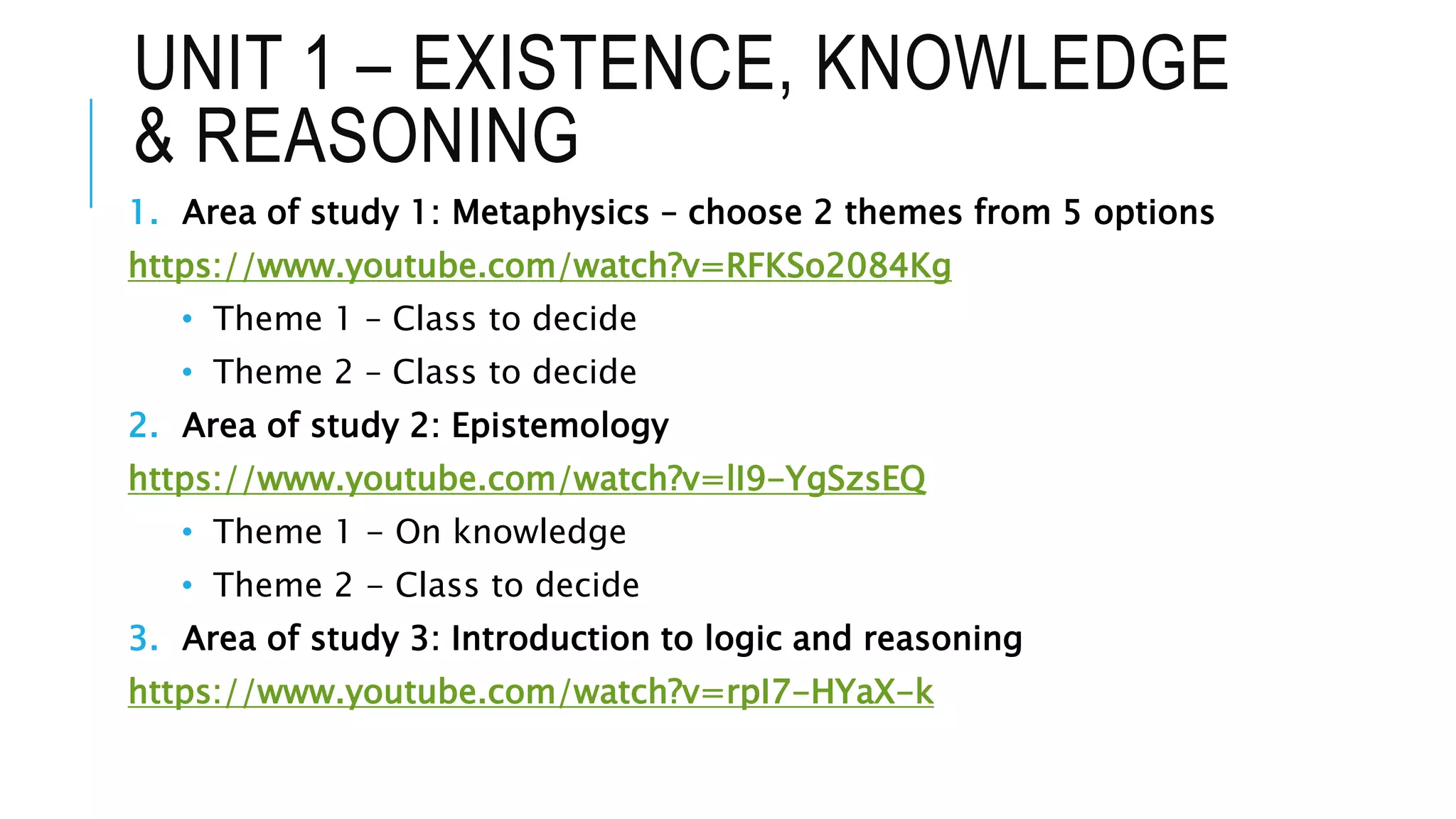
1. Area of study 1: Metaphysics – choose 2 themes from 5 options
https://www.youtube.com/watch?v=RFKSo2084Kg
• Theme 1 – Class to decide
• Theme 2 – Class to decide
2. Area of study 2: Epistemology
https://www.youtube.com/watch?v=lI9-YgSzsEQ
• Theme 1 - On knowledge
• Theme 2 - Class to decide
3. Area of study 3: Introduction to logic and reasoning
https://www.youtube.com/watch?v=rpI7-HYaX-k
AOS1 – METAPHYSICS
Themes to choose from include:
• Theme 1 – On the material mind
• Theme 2 – On the nature and existence of God
• Theme 3 – On materialism and idealism
• Theme 4 – On free will and determinism
• Theme 5 – On time
Choose 2 from the above 5.
AOS1: METAPHYSICS: THEME 1 - ON THE
MATERIAL MIND
Questions that may be explored in this theme include:
• What is the mind? What are thoughts? What is consciousness?
• What ontological commitments are made by dualism, materialism, and idealism,
respectively?
• In materialist philosophies of mind, what is meant by the following labels:
behaviourism, identity theory, functionalism, the computational theory of mind,
eliminativism, anomalous monism, realistic monism?
• Can reasons be causes?
• Does experience add anything to propositional knowledge?
• If we knew everything there was to know about the physics and physiology of colour,
would we know everything there is to know about colour?
• What must the physical universe be like for it to include experiences such as pain?
• What kinds of things are propositional attitudes such as beliefs and desires, especially
given they cannot be located in any specific part of the brain?
• Are mindless but animate human bodies conceivable? If so, are they therefore
metaphysically possible?
• Might computers have minds?
Thinkers: Rene Descartes, George Berkeley, David Armstrong, David Chalmers, Daniel
AOS1: METAPHYSICS – THEME 2
ON THE EXISTENCE AND NATURE OF GOD
Questions that may be explored in this theme include:
• What are the arguments for the existence of God?
• To what extent have developments in science and philosophy undermined
or reinforced traditional arguments for the existence of God?
• Is religious faith different from other kinds of faith?
• What can philosophy say about the attributes of God?
• Is human thought equal to the task of discussing the attributes of God?
• Is the concept of God consistent with traditional theistic beliefs (for
example, divine compassion, divine intervention in human life)?
• Does the existence of suffering constitute a refutation of the existence of
God?
Thinkers: Anselm, Thomas Aquinas, Blaise Pascal, William Paley, David Hume,
Simone Weil, John Mackie
AOS1: METAPHYSICS – THEME 3
ON MATERIALISM AND IDEALISM
Questions that may be explored in this theme include:
• Are material/physical objects the only things that exist?
• Does the world consist of ideas?
• To what extent does the mind make its world?
• What are secondary qualities? To what extent do they exist in the world?
• Can there be a materialist or physicalist account of conscious experience?
• Can idealism account for the apparent objectivity and persistence of
physical objects?
• In what ways is the contemporary realism/anti-realism debate distinct from
the historical materialism/idealism debate?
• How real is virtual reality?
Thinkers: Plato, John Locke, Rene Descartes, George Berkeley, David Papineau,
AOS1: METAPHYSICS – THEME 4
ON FREE WILL AND DETERMINISM
Questions that may be explored in this theme include:
• Can we be free if there are causes for all our actions?
• Is everything we do determined by forces beyond our control?
• What is indeterminism in nature? Does it help us to understand free will?
• Do theories of compatibilism or soft determinism successfully reconcile
freedom and determinism?
• How is determinism linked to materialism and freedom to dualism?
• How is freedom linked to notions of agency, responsibility, reward and
punishment?
Thinkers: Daniel Dennett, Bernard Williams, David Hume, Baron D’Holbach,
Arthur Schopenhauer, William James, Peter Strawson, Peter van Inwagen
AOS1: METAPHYSICS – THEME 5
ON TIME
Questions that may be explored in this theme include:
• What is time?
• Does it make sense to speak of time having a beginning or an end?
• Can there be a coherent time-travel story?
• What paradoxes arise when considering the possibility of time travel?
• On what basis could time travel be physically possible?
• What would have to be the nature of time for time travel to be possible?
Thinkers: Aristotle, Augustine, Friedrich Nietzsche, Martin Heidegger, David
Lewis, J.J.C. Smart, J.L. Borges, Albert Einstein, Paul Davies
UNIT 1 – EXISTENCE, KNOWLEDGE
& REASONING
OUTCOME
1. AOS1: Metaphysics outcome:
• On completion of this area of study, you should be
able to analyse metaphysical problems, evaluate
viewpoints and arguments arising from these, and
identify philosophical problems in relevant
contemporary debates.
AOS2: EPISTEMOLOGY – THEME 1
ON KNOWLEDGE
Questions that may be explored in this theme include:
• Is justified true belief the same as knowledge?
• Is certainty necessary for knowledge?
• What is the difference between knowledge and belief?
• If one of your firmly held beliefs is challenged, should you go about
justifying or modifying it, and, if so, how?
• What are the sources of our knowledge in areas such as history, the law,
forensics, evolutionary biology and the media? How reliable are they?
Thinkers: Plato, Rene Descartes, Edmund L. Gettier
AOS2: EPISTEMOLOGY – THEME 2
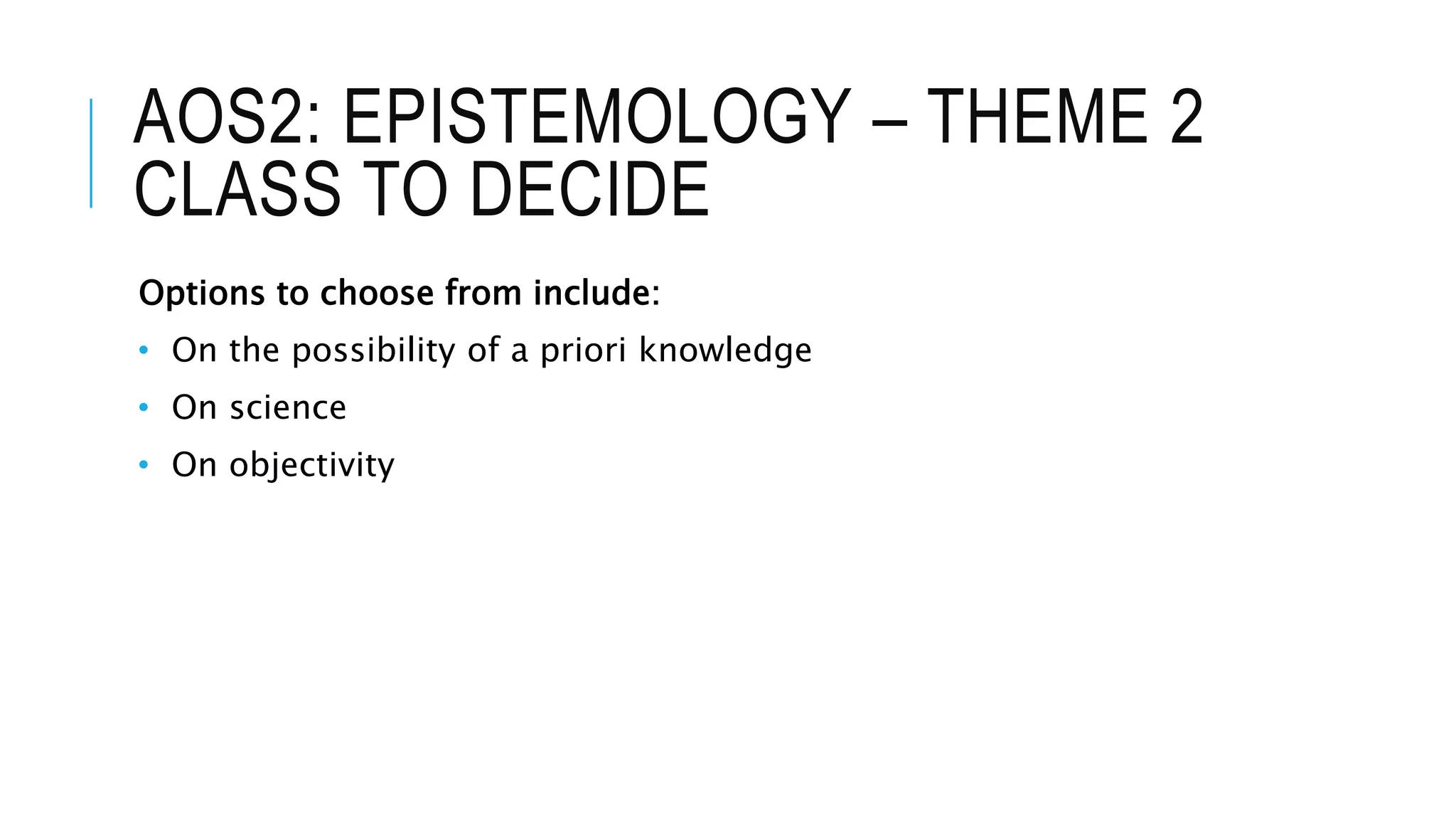
CLASS TO DECIDE
Options to choose from include:
• On the possibility of a priori knowledge
• On science
• On objectivity
AOS2: EPISTEMOLOGY –
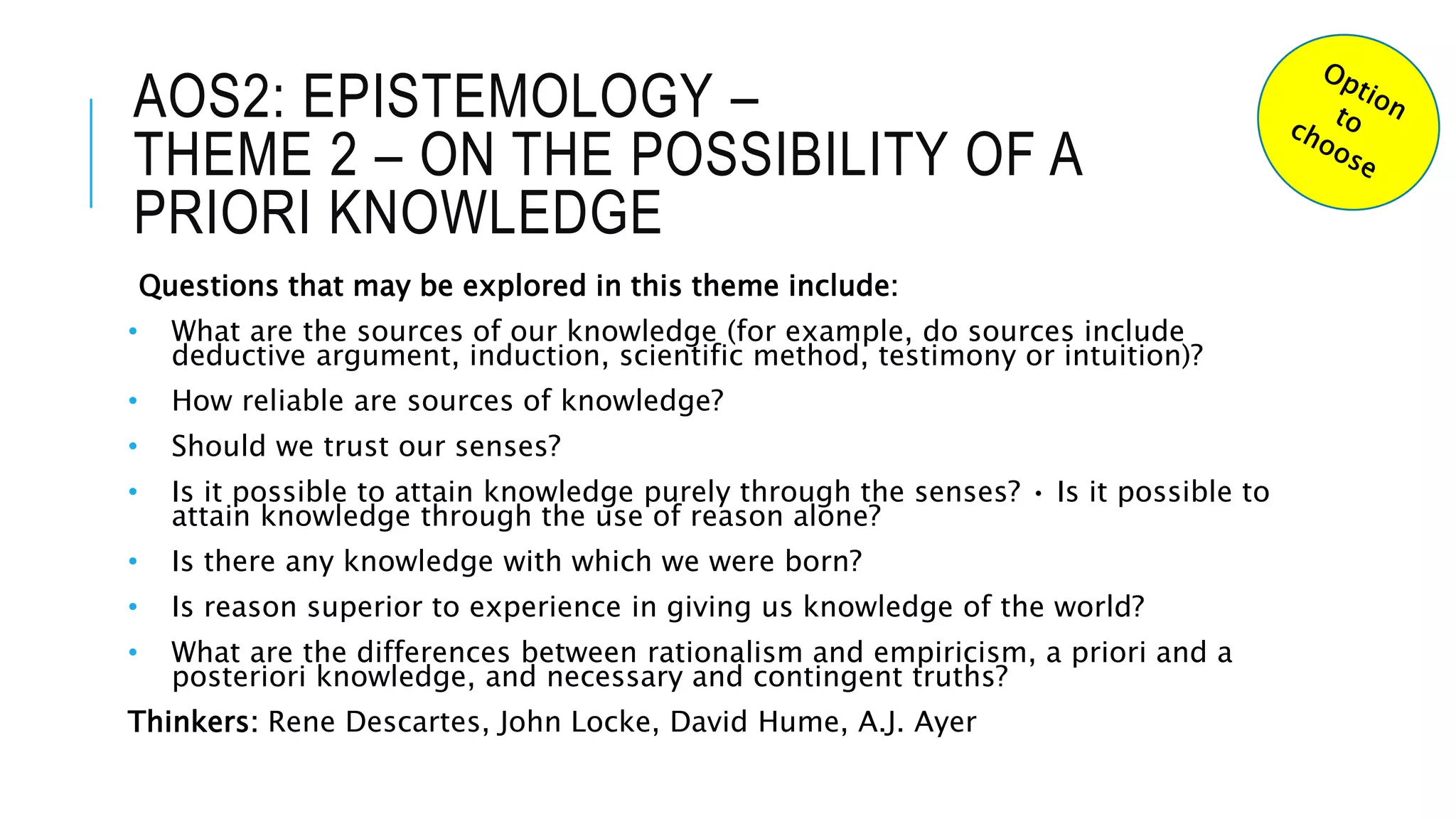
THEME 2 – ON THE POSSIBILITY OF A
PRIORI KNOWLEDGE
Questions that may be explored in this theme include:
• What are the sources of our knowledge (for example, do sources include
deductive argument, induction, scientific method, testimony or intuition)?
• How reliable are sources of knowledge?
• Should we trust our senses?
• Is it possible to attain knowledge purely through the senses? • Is it possible to
attain knowledge through the use of reason alone?
• Is there any knowledge with which we were born?
• Is reason superior to experience in giving us knowledge of the world?
• What are the differences between rationalism and empiricism, a priori and a
posteriori knowledge, and necessary and contingent truths?
Thinkers: Rene Descartes, John Locke, David Hume, A.J. Ayer
AOS2: EPISTEMOLOGY –
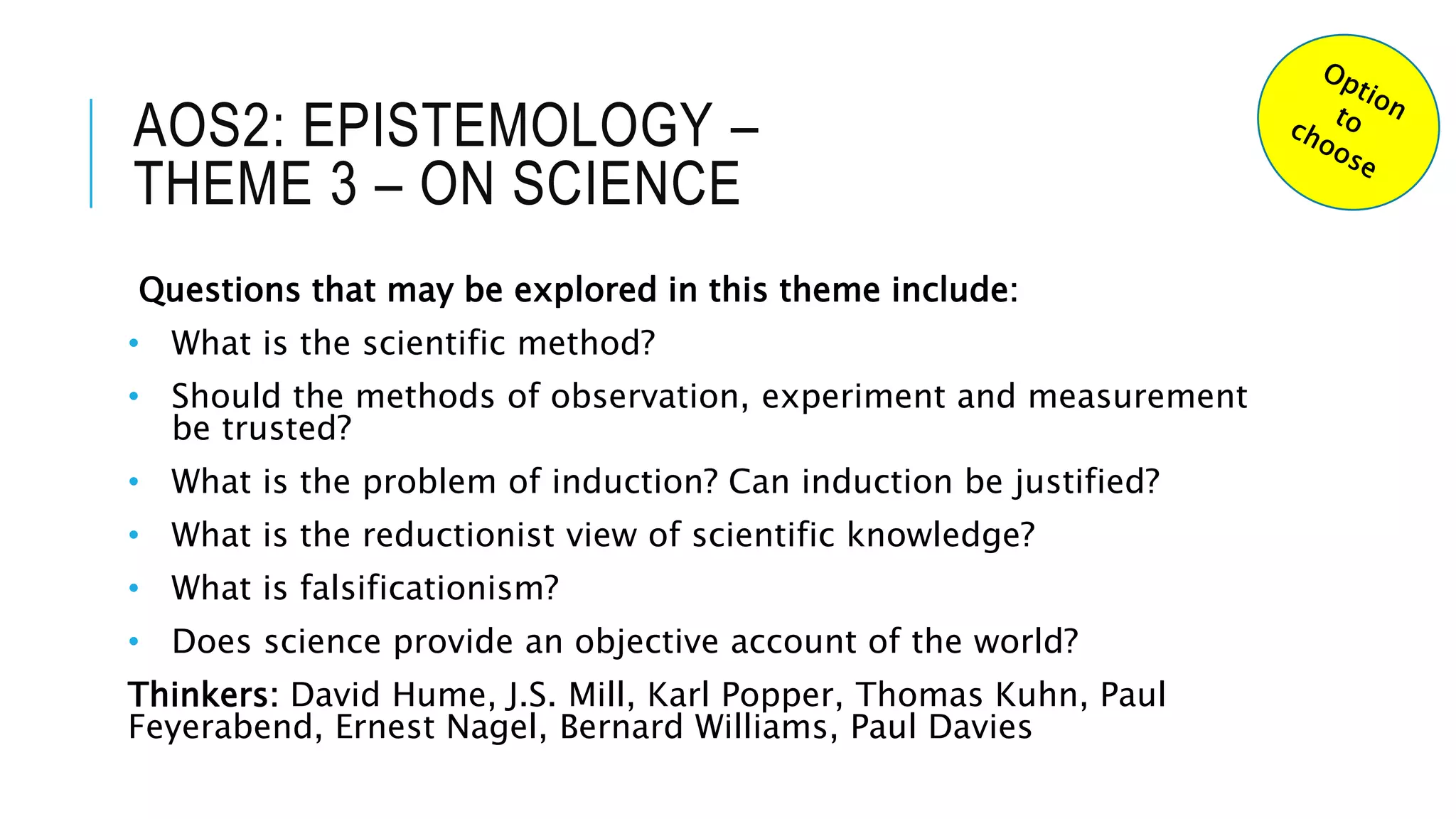
THEME 3 – ON SCIENCE
Questions that may be explored in this theme include:
• What is the scientific method?
• Should the methods of observation, experiment and measurement
be trusted?
• What is the problem of induction? Can induction be justified?
• What is the reductionist view of scientific knowledge?
• What is falsificationism?
• Does science provide an objective account of the world?
Thinkers: David Hume, J.S. Mill, Karl Popper, Thomas Kuhn, Paul
Feyerabend, Ernest Nagel, Bernard Williams, Paul Davies
AOS2: EPISTEMOLOGY –
THEME 4 – ON OBJECTIVITY
Questions that may be explored in this theme include:
• Are knowledge, belief and truth relative to different individuals or
cultures?
• Is truth subjective?
• Is objective truth possible or attainable by humans?
• Does mathematics offer a way to obtain truth?
• Does science offer objective truths?
• What is the role of emotion in knowledge?
• What is the status of knowledge from different sources such as mythology,
religion, the arts, sciences or mathematics? How should we compare such
knowledge?
Thinkers: William James, Richard Rorty, Hilary Putnam, Simon Blackburn,
Antonio Damasio, Nussbaum
UNIT 1 – EXISTENCE, KNOWLEDGE
& REASONING
OUTCOMES
2. AOS2: Epistemology outcome:
• On completion of this area of study, you should be
able to analyse epistemological problems, evaluate
viewpoints and arguments arising from these, and
analyse philosophical problems in relevant
contemporary debates.
AOS3: INTRODUCTION TO LOGIC &
REASONING• Philosophy is an activity as much as it is a body of thought,
and students of philosophy benefit not just from attaining
new knowledge, but through the development of their
reasoning faculties.
• Philosophy is the activity of considering central, contestable
problems, and attempting to develop good reasons for
holding one position rather than another. In analysing
concepts and clarifying positions, philosophers also discover
how ideas are logically and conceptually connected with each
other.
• Precise use of language is essential to these processes as a
means of supporting coherence and the rigorous testing of
ideas.
• This area of study introduces students to the distinctive nature of philosophical
thinking and a variety of approaches to philosophical inquiry.
• You will practise some basics of formal and informal logic and other techniques
of critical thinking, such as analogy, that are essential to the study of problems
in metaphysics and epistemology.
• You will explore cognitive biases and consider any implications for approaching
problems in epistemology and metaphysics, for example the relation between
confirmation bias, science and pseudo-science, and attribution bias and
questions of causality.
UNIT 1 – EXISTENCE, KNOWLEDGE
& REASONING
OUTCOME
3. AOS3: Introduction to logic and reasoning outcome:
• On completion of this area of study, you should be
able to apply methods of philosophical inquiry to
the analysis of philosophical viewpoints and
arguments, including those in metaphysics and
epistemology.

Philosophy -transition__2017_

  • 1.
  • 2.
    STRUCTURE – UNITS1 & 2 What is philosophy? https://www.youtube.com/watch?v=mIYdx6lDDhg This course is made up by two units: • Unit 1 – Existence, knowledge and reasoning • Unit 2 – Questions of value Assessment: • Unit 1 – 40% • Unit 2 – 40% • End of year exam – 20%
  • 3.
    UNIT 1 –EXISTENCE, KNOWLEDGE & REASONING Unit 1 is broken down into three areas of study: 1. Area of study 1: Metaphysics • Theme 1 – To be determined • Theme 2 – To be determined 2. Area of study 2: Epistemology • Theme 1 - On knowledge • Theme 2 – To be determined 3. Area of study 3: Introduction to logic and reasoning Metaphysics – study of the basic structures and categories of what exists, or of reality. It is the attempt to work out a logical account of everything that we know or believe about existence, including all our scientific reasoning Epistemology – derives from two Ancient Greek words: ‘episteme’: ‘knowledge’ & ‘logos’ meaning what is said about something. It is the difference between belief/opinion and the certainty associated with knowledge.Introduction to the distinctive nature of philosophical thinking and a variety of approaches to philosophical inquiry. In doing so, we will practise some basic formal and formal logic and other techniques of critical thinking, such as analogy, that are essential to the study of problems in metaphysics and
  • 4.
    UNIT 2 –QUESTIONS OF VALUE Unit 2 is broken down into three areas of study as follows: 1. Area of study 1: Ethics and moral philosophy • Theme 1 – TBC • Theme 2 - TBC 2. Area of study 2: Further problems in value theory • Theme 1 – TBC • Theme 2 - TBC 3. Area of study 3: Techniques of reasoning A contemplation of what is right and wrong. An exploration of the nature of morality and an examination how people should live their lives in relation to others. Value theory is a range of approaches to understanding how, why, and to what degree persons value things; whether the object or subject of valuing is a person, idea, object, or anything else. Reasoning is the process of using existing knowledge to draw conclusions, make predictions, or construct explanations. Examples of three methods of reasoning are the
  • 5.
  • 6.
    UNIT 1 –EXISTENCE, KNOWLEDGE & REASONING 1. Area of study 1: Metaphysics – choose 2 themes from 5 options https://www.youtube.com/watch?v=RFKSo2084Kg • Theme 1 – Class to decide • Theme 2 – Class to decide 2. Area of study 2: Epistemology https://www.youtube.com/watch?v=lI9-YgSzsEQ • Theme 1 - On knowledge • Theme 2 - Class to decide 3. Area of study 3: Introduction to logic and reasoning https://www.youtube.com/watch?v=rpI7-HYaX-k
  • 7.
    AOS1 – METAPHYSICS Themesto choose from include: • Theme 1 – On the material mind • Theme 2 – On the nature and existence of God • Theme 3 – On materialism and idealism • Theme 4 – On free will and determinism • Theme 5 – On time Choose 2 from the above 5.
  • 8.
    AOS1: METAPHYSICS: THEME1 - ON THE MATERIAL MIND Questions that may be explored in this theme include: • What is the mind? What are thoughts? What is consciousness? • What ontological commitments are made by dualism, materialism, and idealism, respectively? • In materialist philosophies of mind, what is meant by the following labels: behaviourism, identity theory, functionalism, the computational theory of mind, eliminativism, anomalous monism, realistic monism? • Can reasons be causes? • Does experience add anything to propositional knowledge? • If we knew everything there was to know about the physics and physiology of colour, would we know everything there is to know about colour? • What must the physical universe be like for it to include experiences such as pain? • What kinds of things are propositional attitudes such as beliefs and desires, especially given they cannot be located in any specific part of the brain? • Are mindless but animate human bodies conceivable? If so, are they therefore metaphysically possible? • Might computers have minds? Thinkers: Rene Descartes, George Berkeley, David Armstrong, David Chalmers, Daniel
  • 9.
    AOS1: METAPHYSICS –THEME 2 ON THE EXISTENCE AND NATURE OF GOD Questions that may be explored in this theme include: • What are the arguments for the existence of God? • To what extent have developments in science and philosophy undermined or reinforced traditional arguments for the existence of God? • Is religious faith different from other kinds of faith? • What can philosophy say about the attributes of God? • Is human thought equal to the task of discussing the attributes of God? • Is the concept of God consistent with traditional theistic beliefs (for example, divine compassion, divine intervention in human life)? • Does the existence of suffering constitute a refutation of the existence of God? Thinkers: Anselm, Thomas Aquinas, Blaise Pascal, William Paley, David Hume, Simone Weil, John Mackie
  • 10.
    AOS1: METAPHYSICS –THEME 3 ON MATERIALISM AND IDEALISM Questions that may be explored in this theme include: • Are material/physical objects the only things that exist? • Does the world consist of ideas? • To what extent does the mind make its world? • What are secondary qualities? To what extent do they exist in the world? • Can there be a materialist or physicalist account of conscious experience? • Can idealism account for the apparent objectivity and persistence of physical objects? • In what ways is the contemporary realism/anti-realism debate distinct from the historical materialism/idealism debate? • How real is virtual reality? Thinkers: Plato, John Locke, Rene Descartes, George Berkeley, David Papineau,
  • 11.
    AOS1: METAPHYSICS –THEME 4 ON FREE WILL AND DETERMINISM Questions that may be explored in this theme include: • Can we be free if there are causes for all our actions? • Is everything we do determined by forces beyond our control? • What is indeterminism in nature? Does it help us to understand free will? • Do theories of compatibilism or soft determinism successfully reconcile freedom and determinism? • How is determinism linked to materialism and freedom to dualism? • How is freedom linked to notions of agency, responsibility, reward and punishment? Thinkers: Daniel Dennett, Bernard Williams, David Hume, Baron D’Holbach, Arthur Schopenhauer, William James, Peter Strawson, Peter van Inwagen
  • 12.
    AOS1: METAPHYSICS –THEME 5 ON TIME Questions that may be explored in this theme include: • What is time? • Does it make sense to speak of time having a beginning or an end? • Can there be a coherent time-travel story? • What paradoxes arise when considering the possibility of time travel? • On what basis could time travel be physically possible? • What would have to be the nature of time for time travel to be possible? Thinkers: Aristotle, Augustine, Friedrich Nietzsche, Martin Heidegger, David Lewis, J.J.C. Smart, J.L. Borges, Albert Einstein, Paul Davies
  • 13.
    UNIT 1 –EXISTENCE, KNOWLEDGE & REASONING OUTCOME 1. AOS1: Metaphysics outcome: • On completion of this area of study, you should be able to analyse metaphysical problems, evaluate viewpoints and arguments arising from these, and identify philosophical problems in relevant contemporary debates.
  • 14.
    AOS2: EPISTEMOLOGY –THEME 1 ON KNOWLEDGE Questions that may be explored in this theme include: • Is justified true belief the same as knowledge? • Is certainty necessary for knowledge? • What is the difference between knowledge and belief? • If one of your firmly held beliefs is challenged, should you go about justifying or modifying it, and, if so, how? • What are the sources of our knowledge in areas such as history, the law, forensics, evolutionary biology and the media? How reliable are they? Thinkers: Plato, Rene Descartes, Edmund L. Gettier
  • 15.
    AOS2: EPISTEMOLOGY –THEME 2 CLASS TO DECIDE Options to choose from include: • On the possibility of a priori knowledge • On science • On objectivity
  • 16.
    AOS2: EPISTEMOLOGY – THEME2 – ON THE POSSIBILITY OF A PRIORI KNOWLEDGE Questions that may be explored in this theme include: • What are the sources of our knowledge (for example, do sources include deductive argument, induction, scientific method, testimony or intuition)? • How reliable are sources of knowledge? • Should we trust our senses? • Is it possible to attain knowledge purely through the senses? • Is it possible to attain knowledge through the use of reason alone? • Is there any knowledge with which we were born? • Is reason superior to experience in giving us knowledge of the world? • What are the differences between rationalism and empiricism, a priori and a posteriori knowledge, and necessary and contingent truths? Thinkers: Rene Descartes, John Locke, David Hume, A.J. Ayer
  • 17.
    AOS2: EPISTEMOLOGY – THEME3 – ON SCIENCE Questions that may be explored in this theme include: • What is the scientific method? • Should the methods of observation, experiment and measurement be trusted? • What is the problem of induction? Can induction be justified? • What is the reductionist view of scientific knowledge? • What is falsificationism? • Does science provide an objective account of the world? Thinkers: David Hume, J.S. Mill, Karl Popper, Thomas Kuhn, Paul Feyerabend, Ernest Nagel, Bernard Williams, Paul Davies
  • 18.
    AOS2: EPISTEMOLOGY – THEME4 – ON OBJECTIVITY Questions that may be explored in this theme include: • Are knowledge, belief and truth relative to different individuals or cultures? • Is truth subjective? • Is objective truth possible or attainable by humans? • Does mathematics offer a way to obtain truth? • Does science offer objective truths? • What is the role of emotion in knowledge? • What is the status of knowledge from different sources such as mythology, religion, the arts, sciences or mathematics? How should we compare such knowledge? Thinkers: William James, Richard Rorty, Hilary Putnam, Simon Blackburn, Antonio Damasio, Nussbaum
  • 19.
    UNIT 1 –EXISTENCE, KNOWLEDGE & REASONING OUTCOMES 2. AOS2: Epistemology outcome: • On completion of this area of study, you should be able to analyse epistemological problems, evaluate viewpoints and arguments arising from these, and analyse philosophical problems in relevant contemporary debates.
  • 20.
    AOS3: INTRODUCTION TOLOGIC & REASONING• Philosophy is an activity as much as it is a body of thought, and students of philosophy benefit not just from attaining new knowledge, but through the development of their reasoning faculties. • Philosophy is the activity of considering central, contestable problems, and attempting to develop good reasons for holding one position rather than another. In analysing concepts and clarifying positions, philosophers also discover how ideas are logically and conceptually connected with each other. • Precise use of language is essential to these processes as a means of supporting coherence and the rigorous testing of ideas. • This area of study introduces students to the distinctive nature of philosophical thinking and a variety of approaches to philosophical inquiry. • You will practise some basics of formal and informal logic and other techniques of critical thinking, such as analogy, that are essential to the study of problems in metaphysics and epistemology. • You will explore cognitive biases and consider any implications for approaching problems in epistemology and metaphysics, for example the relation between confirmation bias, science and pseudo-science, and attribution bias and questions of causality.
  • 21.
    UNIT 1 –EXISTENCE, KNOWLEDGE & REASONING OUTCOME 3. AOS3: Introduction to logic and reasoning outcome: • On completion of this area of study, you should be able to apply methods of philosophical inquiry to the analysis of philosophical viewpoints and arguments, including those in metaphysics and epistemology.