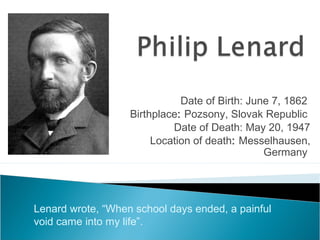
Date of Birth: June 7, 1862
Birthplace: Pozsony, Slovak Republic
Date of Death: May 20, 1947
Location of death: Messelhausen,
Germany
Lenard wrote, “When school days ended, a painful
void came into my life”.
Lenard was the son of a wealthy wine maker
and wholesaler. His mother Antonie Baumann
died young, and Lenard, an only child, was
raised by an aunt who subsequently married his
father. His family had originally come from the
Tyrol.
Lenard was at first educated at home, but when he was nine he
entered the cathedral school in Pressburg and the later the
Realschule. For him mathematics and physics were “oases in the
desert” of other subjects, and he studies these two subjects by
himself with the aid of college textbooks. In addition, he carried out
chemistry and physics experiments on his own. He once devoted
his summer vacation entirely to study of the new field of
photography. From 1892 he worked as a Privatdozent and assistant
to Professor Hertz at the University of Bonn and in 1894 was
appointed Professor Extraordinary at the University of Breslau. In
1895 he became Professor of Physics at Aix-la-Chapelle and in
1896 Professor of Theoretical Physics at the University of
Heidelberg. In 1898 he was appointed Professor Ordinarius at the
University of Kiel.
Philip’s Accomplishment
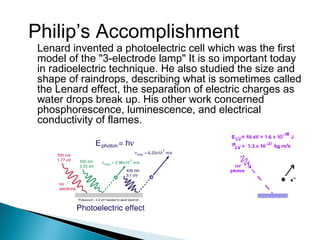
Lenard invented a photoelectric cell which was the first
model of the "3-electrode lamp" It is so important today
in radioelectric technique. He also studied the size and
shape of raindrops, describing what is sometimes called
the Lenard effect, the separation of electric charges as
water drops break up. His other work concerned
phosphorescence, luminescence, and electrical
conductivity of flames.
 
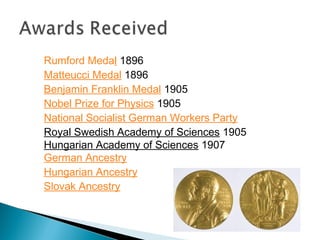
    Rumford Medal 1896
    Matteucci Medal 1896
    Benjamin Franklin Medal 1905
    Nobel Prize for Physics 1905
    National Socialist German Workers Party
    Royal Swedish Academy of Sciences 1905
    Hungarian Academy of Sciences 1907
    German Ancestry
    Hungarian Ancestry
    Slovak Ancestry
 http://www.encyclopedia.com/topic/Philipp_Lenard.aspx
 http://hyperphysics.phy-astr.gsu.edu/hbase/mod1.html
 http://www.nndb.com/people/441/000099144/
 http://nobelprize.org/nobel_prizes/physics/laureates/190
5/lenard-bio.html
Student I.D. 94213327
 http://www.encyclopedia.com/topic/Philipp_Lenard.aspx
 http://hyperphysics.phy-astr.gsu.edu/hbase/mod1.html
 http://www.nndb.com/people/441/000099144/
 http://nobelprize.org/nobel_prizes/physics/laureates/190
5/lenard-bio.html
Student I.D. 94213327

Philip lenard

  • 1.
    Date of Birth:June 7, 1862 Birthplace: Pozsony, Slovak Republic Date of Death: May 20, 1947 Location of death: Messelhausen, Germany Lenard wrote, “When school days ended, a painful void came into my life”.
  • 2.
    Lenard was theson of a wealthy wine maker and wholesaler. His mother Antonie Baumann died young, and Lenard, an only child, was raised by an aunt who subsequently married his father. His family had originally come from the Tyrol.
  • 3.
    Lenard was atfirst educated at home, but when he was nine he entered the cathedral school in Pressburg and the later the Realschule. For him mathematics and physics were “oases in the desert” of other subjects, and he studies these two subjects by himself with the aid of college textbooks. In addition, he carried out chemistry and physics experiments on his own. He once devoted his summer vacation entirely to study of the new field of photography. From 1892 he worked as a Privatdozent and assistant to Professor Hertz at the University of Bonn and in 1894 was appointed Professor Extraordinary at the University of Breslau. In 1895 he became Professor of Physics at Aix-la-Chapelle and in 1896 Professor of Theoretical Physics at the University of Heidelberg. In 1898 he was appointed Professor Ordinarius at the University of Kiel.
  • 4.
    Philip’s Accomplishment Lenard inventeda photoelectric cell which was the first model of the "3-electrode lamp" It is so important today in radioelectric technique. He also studied the size and shape of raindrops, describing what is sometimes called the Lenard effect, the separation of electric charges as water drops break up. His other work concerned phosphorescence, luminescence, and electrical conductivity of flames.  
  • 5.
        RumfordMedal 1896     Matteucci Medal 1896     Benjamin Franklin Medal 1905     Nobel Prize for Physics 1905     National Socialist German Workers Party     Royal Swedish Academy of Sciences 1905     Hungarian Academy of Sciences 1907     German Ancestry     Hungarian Ancestry     Slovak Ancestry
  • 6.
     http://www.encyclopedia.com/topic/Philipp_Lenard.aspx  http://hyperphysics.phy-astr.gsu.edu/hbase/mod1.html http://www.nndb.com/people/441/000099144/  http://nobelprize.org/nobel_prizes/physics/laureates/190 5/lenard-bio.html Student I.D. 94213327
  • 7.
     http://www.encyclopedia.com/topic/Philipp_Lenard.aspx  http://hyperphysics.phy-astr.gsu.edu/hbase/mod1.html http://www.nndb.com/people/441/000099144/  http://nobelprize.org/nobel_prizes/physics/laureates/190 5/lenard-bio.html Student I.D. 94213327