ΦΙΛΕΛΛΗΝΕΣ ΤΗΣ ΑΜΕΡΙΚΗΣPHILHELLENESOF THE UNITES STATES
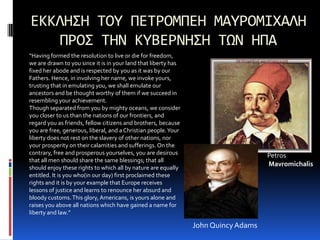
ΕΚΚΛΗΣΗ ΤΟΥ ΠΕΤΡΟΜΠΕΗ ΜΑΥΡΟΜΙΧΑΛΗΠΡΟΣ ΤΗΝ ΚΥΒΕΡΝΗΣΗ ΤΩΝ ΗΠΑ“Having formed the resolution to live or die for freedom, we are drawn to you since it is in your land that liberty has fixed her abode and is respected by you as it was by our Fathers. Hence, in involving her name, we invoke yours, trusting that in emulating you, we shall emulate our ancestors and be thought worthy of them if we succeed in resembling your achievement.Though separated from you by mighty oceans, we consider you closer to us than the nations of our frontiers, and regard you as friends, fellow citizens and brothers, because you are free, generous, liberal, and a Christian people. Your liberty does not rest on the slavery of other nations, nor your prosperity on their calamities and sufferings. On the contrary, free and prosperous yourselves, you are desirous that all men should share the same blessings; that all should enjoy these rights to which all by nature are equally entitled. It is you who(in our day) first proclaimed these rights and it is by your example that Europe receives lessons of justice and learns to renounce her absurd and bloody customs. This glory, Americans, is yours alone and raises you above all nations which have gained a name for liberty and law.”Petros MavromichalisJohn Quincy Adams
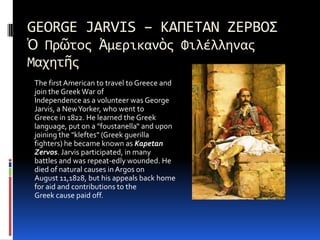
GEORGE JARVIS – ΚΑΠΕΤΑΝ ΖΕΡΒΟΣὉ ΠρῶτοςἈμερικανὸς Φιλέλληνας ΜαχητῆςThe first American to travel to Greece and join the Greek War ofIndependence as a volunteer was George Jarvis, a New Yorker, who went toGreece in 1822. He learned the Greek language, put on a "foustanella“ and upon joining the "kleftes" (Greek guerillafighters) he became known as KapetanZervos. Jarvis participated, in manybattles and was repeat­edly wounded. He died of natural causes in Argos onAugust 11,1828, but his appeals back home for aid and contributions to theGreek cause paid off.
Jarvis & MavrocordatosΓνωριμία του Γιαρβή με τον ΜαυροκορδᾶτοJarvis arrived in Greece in April 1822. He formed a long friendship with Greek statesman AlexandrosMavrocordatos  (photo).“[H]e was particularly kind to me and liked me the more, as he said, forbeing an American,” Jarvis wrote in his journal«Μοῦἔδειξεἰδιαίτερηκαλοσύνη καὶμὲ συμπάθησε ἀκόμη περισσότερο, καθὼςἔλεγε, ἐπειδὴἤμουνἈμερικανός», ἔγραφε ὁ Γιαρβὴςστὸἡμερολόγιό του.AlexandrosMavrocordatos
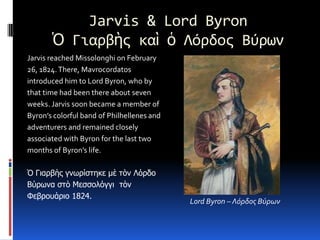
Jarvis & Lord ByronὉ Γιαρβὴςκαὶ ὁ Λόρδος ΒύρωνJarvis reached Missolonghi on February 26, 1824. There, Mavrocordatosintroduced him to Lord Byron, who by that time had been there about seven weeks.Jarvis soon became a member of Byron’s colorful band of Philhellenes and adventurersand remained closely associated with Byron for the last two months of Byron’s life.Ὁ Γιαρβὴς γνωρίστηκε μὲτὸν Λόρδο Βύρωνα στὸΜεσσολόγγιτὸν Φεβρουάριο 1824.Lord Byron – Λόρδος Βύρων
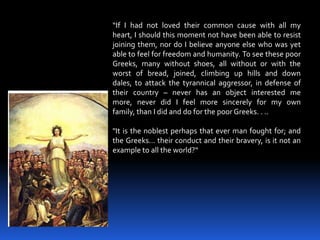
“If I had not loved their common cause with all my heart, I should this moment not have been able to resist joining them, nor do I believe anyone else who was yet able to feel for freedom and humanity. To see these poor Greeks, many without shoes, all without or with the worst of bread, joined, climbing up hills and down dales, to attack the tyrannical aggressor, in defense of their country – never has an object interested me more, never did I feel more sincerely for my own family, than I did and do for the poor Greeks. . .."It is the noblest perhaps that ever man fought for; and the Greeks... their conduct and their bravery, is it not an example to all the world?“
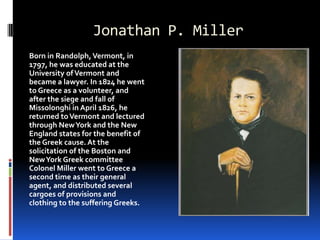
Jonathan P. MillerBorn in Randolph, Vermont, in 1797, he was educated at the University of Vermont and became a lawyer. In 1824 he went to Greece as a volunteer, and after the siege and fall of Missolonghi in April 1826, he returned to Vermont and lectured through New York and the New England states for the benefit of the Greek cause. At the solicitation of the Boston and New York Greek committee Colonel Miller went to Greece a second time as their general agent, and distributed several cargoes of provisions and clothing to the suffering Greeks.
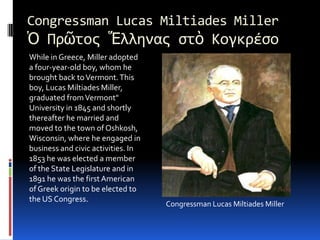
Congressman Lucas Miltiades MillerὉ ΠρῶτοςἝλληναςστὸ ΚογκρέσοWhile in Greece, Miller adopted a four-year-old boy, whom he brought back to Vermont. This boy, Lucas Miltiades Miller, graduated from Vermont"University in 1845 and shortly thereafter he married and moved to the town of Oshkosh, Wisconsin, where he engaged in business and civic activities. In1853 he was elected a member of the State Legislature and in 1891 he was the first American of Greek origin to be elected to the US Congress.Congressman Lucas Miltiades Miller
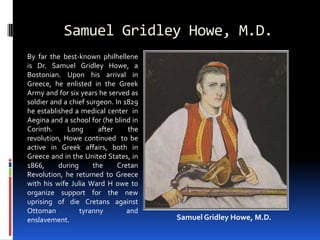
Samuel Gridley Howe, M.D.By far the best-known philhellene is Dr. Samuel Gridley Howe, a Bostonian. Upon his arrival in Greece, he enlisted in the Greek Army and for six years he served as soldier and a chief surgeon. In 1829 he established a medical center  in Aegina and a school for (he blind in Corinth. Long after the revolution, Howe continued  to be active in Greek affairs, both in Greece and in the United States, in 1866, during the Cretan Revolution, he returned to Greece with his wife Julia Ward Η owe to organize support for the new uprising of die Cretans against Ottoman tyranny and enslavement.Samuel Gridley Howe, M.D. 
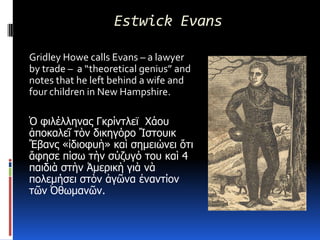
Estwick Evans Gridley Howe calls Evans – a lawyer by trade – a “theoretical genius” and notes that he left behind a wife and four children in New Hampshire. Ὁ φιλέλληνας ΓκρίντλεϊΧάουἀποκαλεῖτὸν δικηγόρο ἼστουικἜβανς «ἰδιοφυὴ» καὶ σημειώνει ὅτιἄφησε πίσω τὴν σύζυγό του καὶ 4 παιδιὰστὴνἈμερικὴγιὰνὰ πολεμήσει στὸνἀγῶναἐναντίοντῶνὈθωμανῶν.
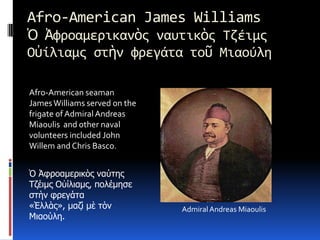
Afro-American James Williams Ὁ Ἀφροαμερικανὸςναυτικὸς Τζέιμς Οὐίλιαμςστὴν φρεγάτα τοῦ ΜιαούληAfro-American seaman James Williams served on the frigate of Admiral Andreas Miaoulis and other naval volunteers included John Willem and Chris Basco.Ὁ Ἀφροαμερικὸς ναύτης Τζέιμς Οὐίλιαμς, πολέμησε στὴν φρεγάτα «Ἑλλὰς», μαζὶμὲτὸν Μιαούλη.Admiral Andreas Miaoulis
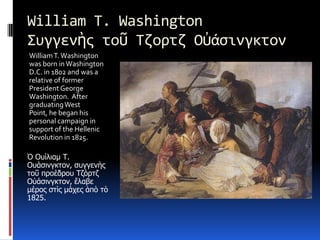
William T. Washington Συγγενὴςτοῦ Τζορτζ ΟὐάσινγκτονWilliam T. Washington was born in Washington D.C. in 1802 and was a relative of former President George Washington.  After graduating West Point, he began his personal campaign in support of the Hellenic Revolution in 1825. Ὁ Ουίλιαμ Τ. Ουάσινγκτον, συγγενὴςτοῦ προέδρου ΤζόρτζΟὐάσινγκτον, ἔλαβε μέρος στὶς μάχες ἀπὸτὸ 1825.
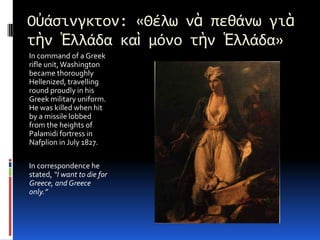
Οὐάσινγκτον: «Θέλω νὰ πεθάνω γιὰτὴνἙλλάδακαὶ μόνο τὴνἙλλάδα»In command of a Greek rifle unit, Washington became thoroughlyHellenized, travelling round proudly in his Greek military uniform. He was killed when hit by a missile lobbed from the heights of Palamidi fortress in Nafplion in July 1827.In correspondence he stated, “I want to die for Greece, and Greece only.”
Kolokotronis Appeals to AmericansὉ Κολοκοτρώνης γράφει στοὺς ΦιλέλληνεςTo rekindle the American philhellenic movement, the Greek revolutionary leader TheodorosKolokotronis, through George Jarvis, sent a letter to Edward Everett dated July 5, 1826, in which the great Greek leader explained the situation in Greece, pledged unity and appealed for further help and support. "Greece is forever grateful to the philanthropy of our Christian [American] brothers", wrote Kolokotronis, "who share her strug­gle and who also support with their funds her just war [for independence]... The Greeks, determined to live or die free, do not fear shedding their blood… or the killing of their old, their women and their children. .. and they are ready to accept death rather than slavery; and now, more than ever, enthusiastically and united they are 'moving forward against [the Turks]… The Greek nation is not ungrateful to its bene­factors. It is grateful to those who proclaim its epic struggle and their names will be recorded with indelible letters in the annals of the reborn Greece, in timeless display, for the respect of upcoming generations... Do not stop sending us your contributions... thus [you are] benefiting humanity and fulfilling Christ‘s will.”TheodorosKolokotronis
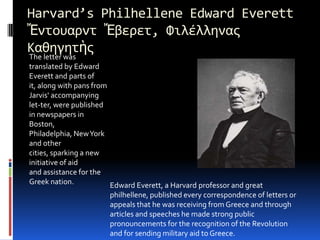
Harvard’s Philhellene Edward EverettἜντουαρντἜβερετ, Φιλέλληνας ΚαθηγητὴςThe letter was translated byEdward Everett and parts of it, along with pans fromJarvis' accompanying let­ter, were published in newspapers in Boston,Philadelphia, New York and other cities, sparking a new initiative of aidand assistance for the Greek nation.Edward Everett, a Harvard professor and great philhellene, published every correspondence of letters or appeals that he was receiving from Greece and through articles and speeches he made strong public pronouncements for the recognition of the Revolution and for sending military aid to Greece.
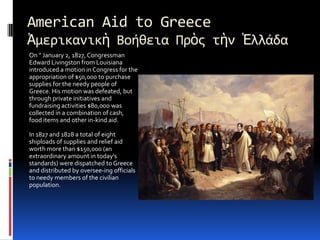
American Aid to GreeceἈμερικανικὴ Βοήθεια ΠρὸςτὴνἙλλάδαOn " January 2, 1827, Congressman Edward Livingston from Louisianaintroduced a motion in Congress for the appropriation of $50,000 to purchasesupplies for the needy people of Greece. His motion was defeated, butthrough private initiatives and fundraising activities $80,000 was collectedin a combination of cash, food items and other in-kind aid.In 1827 and 1828 a total of eight shiploads of supplies and relief aid worthmore than $150,000 (an extraordinary amount in today's standards) weredispatched to Greece and distributed by oversee­ing officials to needymembers of the civilian population.
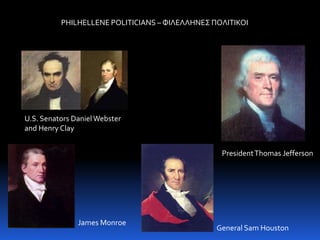
PHILHELLENE POLITICIANS – ΦΙΛΕΛΛΗΝΕΣ ΠΟΛΙΤΙΚΟΙU.S. Senators Daniel Webster and Henry ClayPresident Thomas JeffersonJames MonroeGeneral Sam Houston
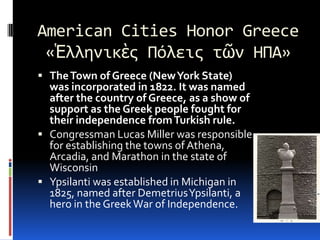
American Cities Honor Greece«Ἑλληνικὲς Πόλεις τῶν ΗΠΑ»The Town of Greece (New York State)was incorporated in 1822. It was named after the country of Greece, as a show of support as the Greek people fought for their independence from Turkish rule. Congressman Lucas Miller was responsible for establishing the towns of Athena, Arcadia, and Marathon in the state of WisconsinYpsilanti was established in Michigan in 1825, named afterDemetrius Ypsilanti, a hero in the Greek War of Independence.
CreditsSources: George C. ChryssisJames L. MarketosFrederiki Papas, Portraits of Historic American Philhellenes  Visit the American Philhellenes Society http://www.americanphilhellenessociety.com

Philhellenes presentation

  • 1.
  • 2.
    ΕΚΚΛΗΣΗ ΤΟΥ ΠΕΤΡΟΜΠΕΗΜΑΥΡΟΜΙΧΑΛΗΠΡΟΣ ΤΗΝ ΚΥΒΕΡΝΗΣΗ ΤΩΝ ΗΠΑ“Having formed the resolution to live or die for freedom, we are drawn to you since it is in your land that liberty has fixed her abode and is respected by you as it was by our Fathers. Hence, in involving her name, we invoke yours, trusting that in emulating you, we shall emulate our ancestors and be thought worthy of them if we succeed in resembling your achievement.Though separated from you by mighty oceans, we consider you closer to us than the nations of our frontiers, and regard you as friends, fellow citizens and brothers, because you are free, generous, liberal, and a Christian people. Your liberty does not rest on the slavery of other nations, nor your prosperity on their calamities and sufferings. On the contrary, free and prosperous yourselves, you are desirous that all men should share the same blessings; that all should enjoy these rights to which all by nature are equally entitled. It is you who(in our day) first proclaimed these rights and it is by your example that Europe receives lessons of justice and learns to renounce her absurd and bloody customs. This glory, Americans, is yours alone and raises you above all nations which have gained a name for liberty and law.”Petros MavromichalisJohn Quincy Adams
  • 3.
    GEORGE JARVIS –ΚΑΠΕΤΑΝ ΖΕΡΒΟΣὉ ΠρῶτοςἈμερικανὸς Φιλέλληνας ΜαχητῆςThe first American to travel to Greece and join the Greek War ofIndependence as a volunteer was George Jarvis, a New Yorker, who went toGreece in 1822. He learned the Greek language, put on a "foustanella“ and upon joining the "kleftes" (Greek guerillafighters) he became known as KapetanZervos. Jarvis participated, in manybattles and was repeat­edly wounded. He died of natural causes in Argos onAugust 11,1828, but his appeals back home for aid and contributions to theGreek cause paid off.
  • 4.
    Jarvis & MavrocordatosΓνωριμίατου Γιαρβή με τον ΜαυροκορδᾶτοJarvis arrived in Greece in April 1822. He formed a long friendship with Greek statesman AlexandrosMavrocordatos (photo).“[H]e was particularly kind to me and liked me the more, as he said, forbeing an American,” Jarvis wrote in his journal«Μοῦἔδειξεἰδιαίτερηκαλοσύνη καὶμὲ συμπάθησε ἀκόμη περισσότερο, καθὼςἔλεγε, ἐπειδὴἤμουνἈμερικανός», ἔγραφε ὁ Γιαρβὴςστὸἡμερολόγιό του.AlexandrosMavrocordatos
  • 5.
    Jarvis & LordByronὉ Γιαρβὴςκαὶ ὁ Λόρδος ΒύρωνJarvis reached Missolonghi on February 26, 1824. There, Mavrocordatosintroduced him to Lord Byron, who by that time had been there about seven weeks.Jarvis soon became a member of Byron’s colorful band of Philhellenes and adventurersand remained closely associated with Byron for the last two months of Byron’s life.Ὁ Γιαρβὴς γνωρίστηκε μὲτὸν Λόρδο Βύρωνα στὸΜεσσολόγγιτὸν Φεβρουάριο 1824.Lord Byron – Λόρδος Βύρων
  • 6.
    “If I hadnot loved their common cause with all my heart, I should this moment not have been able to resist joining them, nor do I believe anyone else who was yet able to feel for freedom and humanity. To see these poor Greeks, many without shoes, all without or with the worst of bread, joined, climbing up hills and down dales, to attack the tyrannical aggressor, in defense of their country – never has an object interested me more, never did I feel more sincerely for my own family, than I did and do for the poor Greeks. . .."It is the noblest perhaps that ever man fought for; and the Greeks... their conduct and their bravery, is it not an example to all the world?“
  • 7.
    Jonathan P. MillerBornin Randolph, Vermont, in 1797, he was educated at the University of Vermont and became a lawyer. In 1824 he went to Greece as a volunteer, and after the siege and fall of Missolonghi in April 1826, he returned to Vermont and lectured through New York and the New England states for the benefit of the Greek cause. At the solicitation of the Boston and New York Greek committee Colonel Miller went to Greece a second time as their general agent, and distributed several cargoes of provisions and clothing to the suffering Greeks.
  • 8.
    Congressman Lucas MiltiadesMillerὉ ΠρῶτοςἝλληναςστὸ ΚογκρέσοWhile in Greece, Miller adopted a four-year-old boy, whom he brought back to Vermont. This boy, Lucas Miltiades Miller, graduated from Vermont"University in 1845 and shortly thereafter he married and moved to the town of Oshkosh, Wisconsin, where he engaged in business and civic activities. In1853 he was elected a member of the State Legislature and in 1891 he was the first American of Greek origin to be elected to the US Congress.Congressman Lucas Miltiades Miller
  • 9.
    Samuel Gridley Howe,M.D.By far the best-known philhellene is Dr. Samuel Gridley Howe, a Bostonian. Upon his arrival in Greece, he enlisted in the Greek Army and for six years he served as soldier and a chief surgeon. In 1829 he established a medical center  in Aegina and a school for (he blind in Corinth. Long after the revolution, Howe continued  to be active in Greek affairs, both in Greece and in the United States, in 1866, during the Cretan Revolution, he returned to Greece with his wife Julia Ward Η owe to organize support for the new uprising of die Cretans against Ottoman tyranny and enslavement.Samuel Gridley Howe, M.D. 
  • 10.
    Estwick Evans GridleyHowe calls Evans – a lawyer by trade – a “theoretical genius” and notes that he left behind a wife and four children in New Hampshire. Ὁ φιλέλληνας ΓκρίντλεϊΧάουἀποκαλεῖτὸν δικηγόρο ἼστουικἜβανς «ἰδιοφυὴ» καὶ σημειώνει ὅτιἄφησε πίσω τὴν σύζυγό του καὶ 4 παιδιὰστὴνἈμερικὴγιὰνὰ πολεμήσει στὸνἀγῶναἐναντίοντῶνὈθωμανῶν.
  • 11.
    Afro-American James WilliamsὉ Ἀφροαμερικανὸςναυτικὸς Τζέιμς Οὐίλιαμςστὴν φρεγάτα τοῦ ΜιαούληAfro-American seaman James Williams served on the frigate of Admiral Andreas Miaoulis and other naval volunteers included John Willem and Chris Basco.Ὁ Ἀφροαμερικὸς ναύτης Τζέιμς Οὐίλιαμς, πολέμησε στὴν φρεγάτα «Ἑλλὰς», μαζὶμὲτὸν Μιαούλη.Admiral Andreas Miaoulis
  • 12.
    William T. WashingtonΣυγγενὴςτοῦ Τζορτζ ΟὐάσινγκτονWilliam T. Washington was born in Washington D.C. in 1802 and was a relative of former President George Washington. After graduating West Point, he began his personal campaign in support of the Hellenic Revolution in 1825. Ὁ Ουίλιαμ Τ. Ουάσινγκτον, συγγενὴςτοῦ προέδρου ΤζόρτζΟὐάσινγκτον, ἔλαβε μέρος στὶς μάχες ἀπὸτὸ 1825.
  • 13.
    Οὐάσινγκτον: «Θέλω νὰπεθάνω γιὰτὴνἙλλάδακαὶ μόνο τὴνἙλλάδα»In command of a Greek rifle unit, Washington became thoroughlyHellenized, travelling round proudly in his Greek military uniform. He was killed when hit by a missile lobbed from the heights of Palamidi fortress in Nafplion in July 1827.In correspondence he stated, “I want to die for Greece, and Greece only.”
  • 14.
    Kolokotronis Appeals toAmericansὉ Κολοκοτρώνης γράφει στοὺς ΦιλέλληνεςTo rekindle the American philhellenic movement, the Greek revolutionary leader TheodorosKolokotronis, through George Jarvis, sent a letter to Edward Everett dated July 5, 1826, in which the great Greek leader explained the situation in Greece, pledged unity and appealed for further help and support. "Greece is forever grateful to the philanthropy of our Christian [American] brothers", wrote Kolokotronis, "who share her strug­gle and who also support with their funds her just war [for independence]... The Greeks, determined to live or die free, do not fear shedding their blood… or the killing of their old, their women and their children. .. and they are ready to accept death rather than slavery; and now, more than ever, enthusiastically and united they are 'moving forward against [the Turks]… The Greek nation is not ungrateful to its bene­factors. It is grateful to those who proclaim its epic struggle and their names will be recorded with indelible letters in the annals of the reborn Greece, in timeless display, for the respect of upcoming generations... Do not stop sending us your contributions... thus [you are] benefiting humanity and fulfilling Christ‘s will.”TheodorosKolokotronis
  • 15.
    Harvard’s Philhellene EdwardEverettἜντουαρντἜβερετ, Φιλέλληνας ΚαθηγητὴςThe letter was translated byEdward Everett and parts of it, along with pans fromJarvis' accompanying let­ter, were published in newspapers in Boston,Philadelphia, New York and other cities, sparking a new initiative of aidand assistance for the Greek nation.Edward Everett, a Harvard professor and great philhellene, published every correspondence of letters or appeals that he was receiving from Greece and through articles and speeches he made strong public pronouncements for the recognition of the Revolution and for sending military aid to Greece.
  • 16.
    American Aid toGreeceἈμερικανικὴ Βοήθεια ΠρὸςτὴνἙλλάδαOn " January 2, 1827, Congressman Edward Livingston from Louisianaintroduced a motion in Congress for the appropriation of $50,000 to purchasesupplies for the needy people of Greece. His motion was defeated, butthrough private initiatives and fundraising activities $80,000 was collectedin a combination of cash, food items and other in-kind aid.In 1827 and 1828 a total of eight shiploads of supplies and relief aid worthmore than $150,000 (an extraordinary amount in today's standards) weredispatched to Greece and distributed by oversee­ing officials to needymembers of the civilian population.
  • 17.
    PHILHELLENE POLITICIANS –ΦΙΛΕΛΛΗΝΕΣ ΠΟΛΙΤΙΚΟΙU.S. Senators Daniel Webster and Henry ClayPresident Thomas JeffersonJames MonroeGeneral Sam Houston
  • 18.
    American Cities HonorGreece«Ἑλληνικὲς Πόλεις τῶν ΗΠΑ»The Town of Greece (New York State)was incorporated in 1822. It was named after the country of Greece, as a show of support as the Greek people fought for their independence from Turkish rule. Congressman Lucas Miller was responsible for establishing the towns of Athena, Arcadia, and Marathon in the state of WisconsinYpsilanti was established in Michigan in 1825, named afterDemetrius Ypsilanti, a hero in the Greek War of Independence.
  • 19.
    CreditsSources: George C.ChryssisJames L. MarketosFrederiki Papas, Portraits of Historic American Philhellenes  Visit the American Philhellenes Society http://www.americanphilhellenessociety.com