Presentation on
Phases of Internationalization
of a Business
Group Name
Eureka
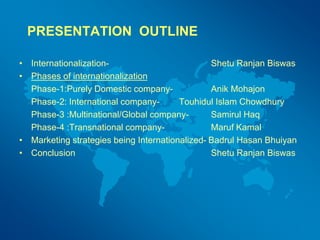
PRESENTATION OUTLINE
• Internationalization- Shetu Ranjan Biswas
• Phases of internationalization
Phase-1:Purely Domestic company- Anik Mohajon
Phase-2: International company- Touhidul Islam Chowdhury
Phase-3 :Multinational/Global company- Samirul Haq
Phase-4 :Transnational company- Maruf Kamal
• Marketing strategies being Internationalized- Badrul Hasan Bhuiyan
• Conclusion Shetu Ranjan Biswas
 Shetu Ranjan Biswas.
 4th year B.B.A.
Exam roll: 2006-12
Email : shetu_mscu@yahoo.com
 Mobile no: 01670105662
 Dept. of Management Studies.
 University of Chittagong.
1st year 2nd year 3rd year
3.97 3.98 3.95
Definition of Internationalization
The conversion of something in order to make it
international; the act or process of making a product
suitable for international markets.

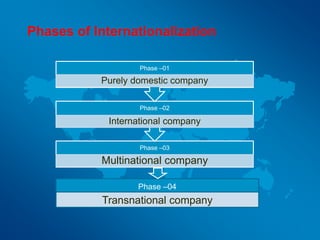
Phases of Internationalization
Phase –03
Multinational company
Phase –02
International company
Phase –01
Purely domestic company
Phase –04
Transnational company
• Anik Mohajon.
• 4th year B.B.A.
• Exam roll: 2006-09
• Email : anik_m@yahoo.com
• Mobile no: 01924688427
• Dept. of Management Studies.
• University of Chittagong.
1st year 2nd year 3rd year
3.75 3.56 3.68
Purely domestic company
• Definition
• Characteristics
• Marketing policy
• HR policy
Purely domestic company
Definition
Company that operates its business activities
within the same geographical territory, that is called
purely domestic company.
Purely domestic company
Characteristics
--Business operations are confined within the same
territory
--Products and services are the primary concern
--Business strategy is always concerned with the nation’s
culture, norms and values.
Purely domestic company
Characteristics
--Limited cultural diversity
--Limited business scope
--Very few competitors
--Limited resource
--Unique business strategy.
Purely domestic company
Marketing policy
• Domestic oriented product , price, place,
promotional strategy
• Market Excess domestic production
• Ethnocentric marketing approach
Purely domestic company
HR Management policy
--All key position filled by the home country
--Equal employment opportunity
--Motivation policy
• Md. Touhidul Alam Chowdhury
• 4th year B.B.A.
• Exam roll: 2006-10
• Email : Thdslm@yahoo.com
• Mobile no: 01917902541
• Dept. of Management Studies.
• University of Chittagong.
1st year 2nd year 3rd year
3.75 3.56 3.68
International company
• Definition
• Characteristics
• Marketing policy
• HR policy
International company
Definition
In the international organization, the structural
configuration of which is described as coordinated
federation, many assets, resources, responsibilities
and decisions are decentralized but controlled from
the headquarters. The overseas operations are
regarded essentially as appendages to a central
domestic corporation.
International company
Characteristics
• Sources of core competencies centralized, others
decentralized.
• Adapting and leveraging parent company
strategies.
• Knowledge developed at the centre and transferred
to overseas units.
• Concentration of resources and authority in the
parent
International company
Marketing policy
• Trade-off between localization and standardization.
• Primary market orientation
• Multi-domestic demand & supply identification
• JIT (Just -in -time delivery
International company
HR Management policy
--Similar criteria for selections
--Technical & communication skills
--Managed & staffed from host and/or home country’s
people.
Md. Samirul Haq.
4th year B.B.A.
Exam roll: 2006-07
Email : samirul_haq@yahoo.com
Mobile no: 01737175345
Dept. of Management Studies.
University of Chittagong.
1st year 2nd year 3rd year
3.56 3.55 3.48
Multinational company
• Definition
• Characteristics
• Marketing policy
• HR policy
Multinational company
Definition
An enterprise that operates on a global basis and
committing assets to operations or subsidiaries in
foreign countries.
Multinational company
Characteristic
• Decentralized and nationally self-sufficient
• Sensing and exploiting local opportunities.
• Knowledge developed and retained within each unit.
• Operates in several countries.
• Resources are limited.
• Financing available for growth is not sufficient.
• Adopts the new technologies very quickly.
• Routine daily tasks are outsourced to countries with
low cost technical labor.
Multinational company
Marketing policy
• Localization of marketing program
• Independent marketing program for each country
• Polycentric marketing program
• Market orientation on a country-by-country basis
Multinational company
HR Management policy
• International subsidiaries managed/staffed by personnel
from host country.
• Equal Employment Opportunities (EEO)
• Product and technical competence
• Md. Maruf Kamal
• 4th year B.B.A.
• Exam roll: 2006-11
• Email : maruf_A_kamal@yahoo.com
• Mobile no: 01553255014
• Dept. of Management Studies.
• University of Chittagong.
1st year 2nd year 3rd year
3.44 3. 35 3.53
Transnational company
• Definition
• Characteristics
• Marketing policy
• HR policy
Transnational company
 Definition
In a transnational, the specialized resources and
capabilities are dispersed among the various
operating units globally. These units are
interdependent and integrated and have large flows
of components, products, resources, people and
information among them. An important feature of
the transnational, therefore, is the complex process
of coordination and cooperation in an environment
of decision making.
Transnational company
Characteristics
--Dispersed, interdependent and specialized.
--Differentiated contributions by national units to
integrated worldwide operations.
--Knowledge developed jointly, and shared worldwide.
--interdependence and integration between the
overseas units.
Transnational company
• Marketing policy
-- Geocentric marketing approach
--Global standardization
--Application of standardized marketing mix strategies
Transnational company
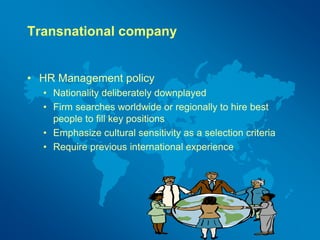
• HR Management policy
• Nationality deliberately downplayed
• Firm searches worldwide or regionally to hire best
people to fill key positions
• Emphasize cultural sensitivity as a selection criteria
• Require previous international experience
• Badrul Hasan Bhuiyan.
• 4th year B.B.A.
• Exam roll: 2006-08
• Email : rubel_bba_cu@yahoo.com
• Mobile no: 01711176606
• Dept. of Management Studies.
• University of Chittagong.
1st year 2nd year 3rd year
3.80 3.83 3.80
Marketing strategies being
Internationalized
Global Marketing Program
1.Standardized marketing mix
2.Adapted marketing mix
Marketing strategies being
Internationalized
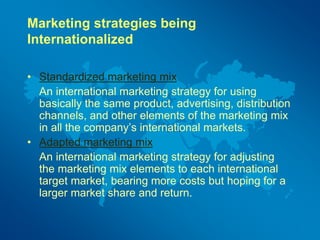
• Standardized marketing mix
An international marketing strategy for using
basically the same product, advertising, distribution
channels, and other elements of the marketing mix
in all the company’s international markets.
• Adapted marketing mix
An international marketing strategy for adjusting
the marketing mix elements to each international
target market, bearing more costs but hoping for a
larger market share and return.
Global Marketing Program
• Product
• Price
• Place
• Promotion
Global Marketing Program
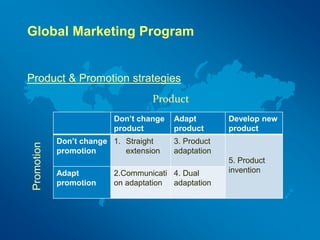
Product & Promotion strategies
Don’t change
product
Adapt
product
Develop new
product
Don’t change
promotion
1. Straight
extension
3. Product
adaptation
5. Product
invention
Adapt
promotion
2.Communicati
on adaptation
4. Dual
adaptation
Product
Promotion
Global Marketing Program
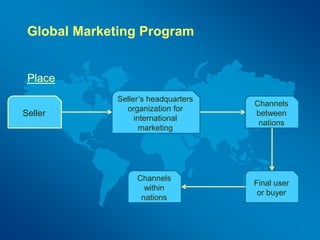
Place
Seller
Seller’s headquarters
organization for
international
marketing
Channels
between
nations
Channels
within
nations
Final user
or buyer
Global Marketing Program (Pricing)
Cost plus pricing
Markup pricing
Break –even pricing
Value based pricing competition
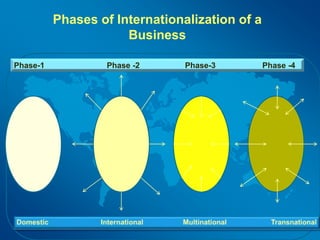
Phases of Internationalization of a
Business
Phase-1 Phase -2 Phase-3 Phase -4
????????
ANSWER
SESSION
•WHOLE –HEARTED
THANKS FOR
BEING WITH US.

Phases of Internatioinalisation.ppt

  • 1.
    Presentation on Phases ofInternationalization of a Business
  • 2.
  • 3.
    PRESENTATION OUTLINE • Internationalization-Shetu Ranjan Biswas • Phases of internationalization Phase-1:Purely Domestic company- Anik Mohajon Phase-2: International company- Touhidul Islam Chowdhury Phase-3 :Multinational/Global company- Samirul Haq Phase-4 :Transnational company- Maruf Kamal • Marketing strategies being Internationalized- Badrul Hasan Bhuiyan • Conclusion Shetu Ranjan Biswas
  • 4.
     Shetu RanjanBiswas.  4th year B.B.A. Exam roll: 2006-12 Email : shetu_mscu@yahoo.com  Mobile no: 01670105662  Dept. of Management Studies.  University of Chittagong. 1st year 2nd year 3rd year 3.97 3.98 3.95
  • 5.
    Definition of Internationalization Theconversion of something in order to make it international; the act or process of making a product suitable for international markets.
  • 6.
    Phases of Internationalization Phase–03 Multinational company Phase –02 International company Phase –01 Purely domestic company Phase –04 Transnational company
  • 7.
    • Anik Mohajon. •4th year B.B.A. • Exam roll: 2006-09 • Email : anik_m@yahoo.com • Mobile no: 01924688427 • Dept. of Management Studies. • University of Chittagong. 1st year 2nd year 3rd year 3.75 3.56 3.68
  • 8.
    Purely domestic company •Definition • Characteristics • Marketing policy • HR policy
  • 9.
    Purely domestic company Definition Companythat operates its business activities within the same geographical territory, that is called purely domestic company.
  • 10.
    Purely domestic company Characteristics --Businessoperations are confined within the same territory --Products and services are the primary concern --Business strategy is always concerned with the nation’s culture, norms and values.
  • 11.
    Purely domestic company Characteristics --Limitedcultural diversity --Limited business scope --Very few competitors --Limited resource --Unique business strategy.
  • 12.
    Purely domestic company Marketingpolicy • Domestic oriented product , price, place, promotional strategy • Market Excess domestic production • Ethnocentric marketing approach
  • 13.
    Purely domestic company HRManagement policy --All key position filled by the home country --Equal employment opportunity --Motivation policy
  • 14.
    • Md. TouhidulAlam Chowdhury • 4th year B.B.A. • Exam roll: 2006-10 • Email : Thdslm@yahoo.com • Mobile no: 01917902541 • Dept. of Management Studies. • University of Chittagong. 1st year 2nd year 3rd year 3.75 3.56 3.68
  • 15.
    International company • Definition •Characteristics • Marketing policy • HR policy
  • 16.
    International company Definition In theinternational organization, the structural configuration of which is described as coordinated federation, many assets, resources, responsibilities and decisions are decentralized but controlled from the headquarters. The overseas operations are regarded essentially as appendages to a central domestic corporation.
  • 17.
    International company Characteristics • Sourcesof core competencies centralized, others decentralized. • Adapting and leveraging parent company strategies. • Knowledge developed at the centre and transferred to overseas units. • Concentration of resources and authority in the parent
  • 18.
    International company Marketing policy •Trade-off between localization and standardization. • Primary market orientation • Multi-domestic demand & supply identification • JIT (Just -in -time delivery
  • 19.
    International company HR Managementpolicy --Similar criteria for selections --Technical & communication skills --Managed & staffed from host and/or home country’s people.
  • 20.
    Md. Samirul Haq. 4thyear B.B.A. Exam roll: 2006-07 Email : samirul_haq@yahoo.com Mobile no: 01737175345 Dept. of Management Studies. University of Chittagong. 1st year 2nd year 3rd year 3.56 3.55 3.48
  • 21.
    Multinational company • Definition •Characteristics • Marketing policy • HR policy
  • 22.
    Multinational company Definition An enterprisethat operates on a global basis and committing assets to operations or subsidiaries in foreign countries.
  • 23.
    Multinational company Characteristic • Decentralizedand nationally self-sufficient • Sensing and exploiting local opportunities. • Knowledge developed and retained within each unit. • Operates in several countries. • Resources are limited. • Financing available for growth is not sufficient. • Adopts the new technologies very quickly. • Routine daily tasks are outsourced to countries with low cost technical labor.
  • 24.
    Multinational company Marketing policy •Localization of marketing program • Independent marketing program for each country • Polycentric marketing program • Market orientation on a country-by-country basis
  • 25.
    Multinational company HR Managementpolicy • International subsidiaries managed/staffed by personnel from host country. • Equal Employment Opportunities (EEO) • Product and technical competence
  • 26.
    • Md. MarufKamal • 4th year B.B.A. • Exam roll: 2006-11 • Email : maruf_A_kamal@yahoo.com • Mobile no: 01553255014 • Dept. of Management Studies. • University of Chittagong. 1st year 2nd year 3rd year 3.44 3. 35 3.53
  • 27.
    Transnational company • Definition •Characteristics • Marketing policy • HR policy
  • 28.
    Transnational company  Definition Ina transnational, the specialized resources and capabilities are dispersed among the various operating units globally. These units are interdependent and integrated and have large flows of components, products, resources, people and information among them. An important feature of the transnational, therefore, is the complex process of coordination and cooperation in an environment of decision making.
  • 29.
    Transnational company Characteristics --Dispersed, interdependentand specialized. --Differentiated contributions by national units to integrated worldwide operations. --Knowledge developed jointly, and shared worldwide. --interdependence and integration between the overseas units.
  • 30.
    Transnational company • Marketingpolicy -- Geocentric marketing approach --Global standardization --Application of standardized marketing mix strategies
  • 31.
    Transnational company • HRManagement policy • Nationality deliberately downplayed • Firm searches worldwide or regionally to hire best people to fill key positions • Emphasize cultural sensitivity as a selection criteria • Require previous international experience
  • 32.
    • Badrul HasanBhuiyan. • 4th year B.B.A. • Exam roll: 2006-08 • Email : rubel_bba_cu@yahoo.com • Mobile no: 01711176606 • Dept. of Management Studies. • University of Chittagong. 1st year 2nd year 3rd year 3.80 3.83 3.80
  • 33.
    Marketing strategies being Internationalized GlobalMarketing Program 1.Standardized marketing mix 2.Adapted marketing mix
  • 34.
    Marketing strategies being Internationalized •Standardized marketing mix An international marketing strategy for using basically the same product, advertising, distribution channels, and other elements of the marketing mix in all the company’s international markets. • Adapted marketing mix An international marketing strategy for adjusting the marketing mix elements to each international target market, bearing more costs but hoping for a larger market share and return.
  • 35.
    Global Marketing Program •Product • Price • Place • Promotion
  • 36.
    Global Marketing Program Product& Promotion strategies Don’t change product Adapt product Develop new product Don’t change promotion 1. Straight extension 3. Product adaptation 5. Product invention Adapt promotion 2.Communicati on adaptation 4. Dual adaptation Product Promotion
  • 37.
    Global Marketing Program Place Seller Seller’sheadquarters organization for international marketing Channels between nations Channels within nations Final user or buyer
  • 38.
    Global Marketing Program(Pricing) Cost plus pricing Markup pricing Break –even pricing Value based pricing competition
  • 39.
    Phases of Internationalizationof a Business Phase-1 Phase -2 Phase-3 Phase -4
  • 40.
  • 41.