Topic 3
INTERNATIONALIZATION
PROCESS
BY- VIJYATA
STEPS IN INTERNATIONALISATION /GLOBALISATION
2
1
3
5
4
2
DOMESTIC
COMPANY
MULTINATIONA
L COMPANY
TRANSNATIONAL
COMPANY
INTERNATIONAL
COMPANY
GLOBAL
COMPANY
1. Domestic Company
“if it is not happening in the home country, it is not happening”
◈Limits its operations, mission and vision to the national political
boundaries.
◈Focuses its view on the domestic market opportunities, domestic
suppliers, domestic financial companies, domestic customers etc
◈Never thinks of growing globally
◈If it grows, beyond its present capacity, the company selects the
diversification strategy of entering into new domestic markets, new
products, technology
3
2. International Company
◈The focus of these companies is domestic but extends the wings to the
foreign countries.
◈Go for international trade either forced by domestic or foreign forces
◈Most of the companies follow this strategy due to limited resources and also
to learn from the foreign markets gradually before becoming a global
company without much risk.
◈Extends the domestic country marketing mix and business model and
practices to foreign countries
◈Believe that the practices adopted in domestic business the people and
products of domestic business are superior to those of other countries.
4
3. Multinational Company
◈Multinational company is also referred to as multi-domestic.
◈Multi-domestic company formulates different strategies for
different markets
◈The orientation shifts from ethnocentric to polycentric.
◈Under polycentric orientation the offices/branches/subsidiaries of a
multinational company work like domestic company in each country
where they operate with distinct policies and strategies suitable to
the country concerned.
5
4. Global Company
◈Global company either produces in home country or in a single
country and focuses on marketing these products globally, or
produces the products globally and focuses on marketing these
products domestically.
Example - Harley designs and produces super heavy weight motorcycles in the USA and
markets in the global market.
6
5. Transnational Company
◈Transnational company produces, markets, invests and operates
across the world.
◈ It is an integrated global enterprise that links global resources with
global markets at profit.
◈A transnational company is geocentric in its orientation.
◈This company thinks globally and acts locally.
◈This company allows adaptation to add value to its global offer
◈The assets of a transnational company are distributed throughout
the world, independent and specialised
7
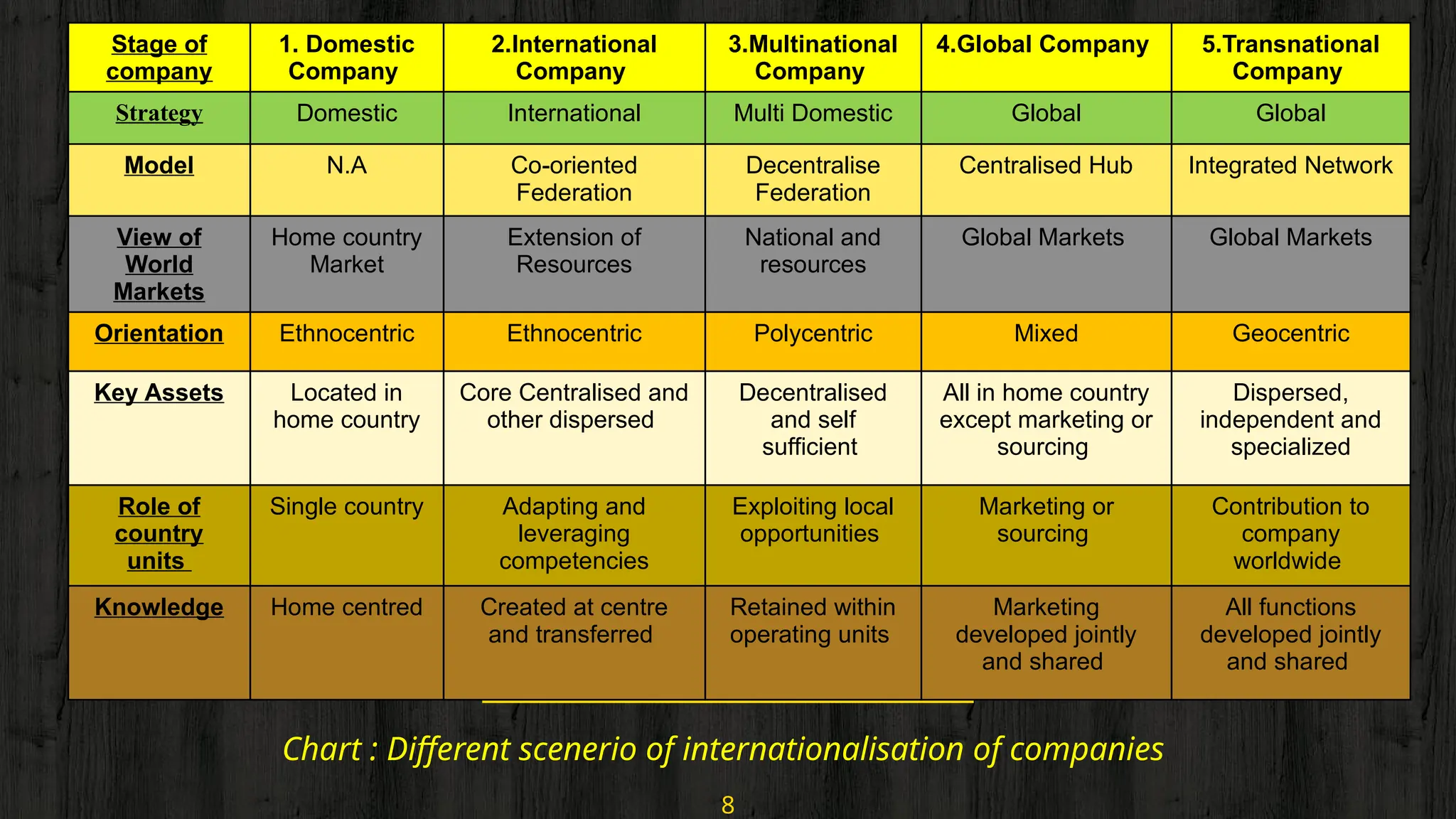
Chart : Different scenerio of internationalisation of companies
8
Stage of
company
1. Domestic
Company
2.International
Company
3.Multinational
Company
4.Global Company 5.Transnational
Company
Strategy Domestic International Multi Domestic Global Global
Model N.A Co-oriented
Federation
Decentralise
Federation
Centralised Hub Integrated Network
View of
World
Markets
Home country
Market
Extension of
Resources
National and
resources
Global Markets Global Markets
Orientation Ethnocentric Ethnocentric Polycentric Mixed Geocentric
Key Assets Located in
home country
Core Centralised and
other dispersed
Decentralised
and self
sufficient
All in home country
except marketing or
sourcing
Dispersed,
independent and
specialized
Role of
country
units
Single country Adapting and
leveraging
competencies
Exploiting local
opportunities
Marketing or
sourcing
Contribution to
company
worldwide
Knowledge Home centred Created at centre
and transferred
Retained within
operating units
Marketing
developed jointly
and shared
All functions
developed jointly
and shared

internationalizationprocess International Business Environment .pptx

  • 1.
  • 2.
    STEPS IN INTERNATIONALISATION/GLOBALISATION 2 1 3 5 4 2 DOMESTIC COMPANY MULTINATIONA L COMPANY TRANSNATIONAL COMPANY INTERNATIONAL COMPANY GLOBAL COMPANY
  • 3.
    1. Domestic Company “ifit is not happening in the home country, it is not happening” ◈Limits its operations, mission and vision to the national political boundaries. ◈Focuses its view on the domestic market opportunities, domestic suppliers, domestic financial companies, domestic customers etc ◈Never thinks of growing globally ◈If it grows, beyond its present capacity, the company selects the diversification strategy of entering into new domestic markets, new products, technology 3
  • 4.
    2. International Company ◈Thefocus of these companies is domestic but extends the wings to the foreign countries. ◈Go for international trade either forced by domestic or foreign forces ◈Most of the companies follow this strategy due to limited resources and also to learn from the foreign markets gradually before becoming a global company without much risk. ◈Extends the domestic country marketing mix and business model and practices to foreign countries ◈Believe that the practices adopted in domestic business the people and products of domestic business are superior to those of other countries. 4
  • 5.
    3. Multinational Company ◈Multinationalcompany is also referred to as multi-domestic. ◈Multi-domestic company formulates different strategies for different markets ◈The orientation shifts from ethnocentric to polycentric. ◈Under polycentric orientation the offices/branches/subsidiaries of a multinational company work like domestic company in each country where they operate with distinct policies and strategies suitable to the country concerned. 5
  • 6.
    4. Global Company ◈Globalcompany either produces in home country or in a single country and focuses on marketing these products globally, or produces the products globally and focuses on marketing these products domestically. Example - Harley designs and produces super heavy weight motorcycles in the USA and markets in the global market. 6
  • 7.
    5. Transnational Company ◈Transnationalcompany produces, markets, invests and operates across the world. ◈ It is an integrated global enterprise that links global resources with global markets at profit. ◈A transnational company is geocentric in its orientation. ◈This company thinks globally and acts locally. ◈This company allows adaptation to add value to its global offer ◈The assets of a transnational company are distributed throughout the world, independent and specialised 7
  • 8.
    Chart : Differentscenerio of internationalisation of companies 8 Stage of company 1. Domestic Company 2.International Company 3.Multinational Company 4.Global Company 5.Transnational Company Strategy Domestic International Multi Domestic Global Global Model N.A Co-oriented Federation Decentralise Federation Centralised Hub Integrated Network View of World Markets Home country Market Extension of Resources National and resources Global Markets Global Markets Orientation Ethnocentric Ethnocentric Polycentric Mixed Geocentric Key Assets Located in home country Core Centralised and other dispersed Decentralised and self sufficient All in home country except marketing or sourcing Dispersed, independent and specialized Role of country units Single country Adapting and leveraging competencies Exploiting local opportunities Marketing or sourcing Contribution to company worldwide Knowledge Home centred Created at centre and transferred Retained within operating units Marketing developed jointly and shared All functions developed jointly and shared