Pharo Smalltalk as Universal Development Platform
Dave Mason
Ryerson Universityi
©2019 Dave Mason
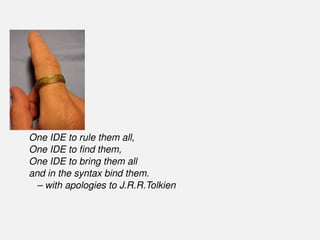
One IDE to rule them all,
One IDE to find them,
One IDE to bring them all
and in the syntax bind them.
– with apologies to J.R.R.Tolkien
Why Pharo? (or other modern Smalltalks)
want to program in Smalltalk
best-in-class IDE
live object debugging
All the things at this conference: GlamourousToolit Roassal DrTest
Seaside Scientific Workbench SwiftPlayground and so much
more....
including what Dave West said yesterday
What Pharo?
desktop
headless
configurable images
command line scripting
web with PharoJS
standalone with Illicium
How Pharo?
primitives/plug-ins Slang/Illicium
Foreign Function Interface - FFI
communication Python-Bridge
transpilation: PharoJS, Illicium, PharoJVM, Woden
embedded VM
Why Transpile?
convert from a friendly (Smalltalk) language to ugly one
deployment target limitations (GPU/Browser/cloud
provider/footprint)
How Transpile?
walk the compiler AST
typically translate to target AST
possible type-checking/type-inference - helped by target types
optional optimization of target AST
walk the target AST generating target code
Example: Why PharoJVM?
want to program in Smalltalk
sometimes need to deploy in enterprise (e.g. WebSphere)
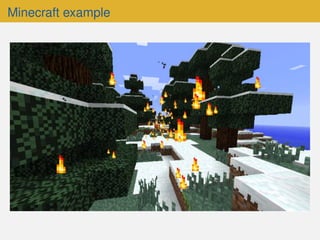
accessing Java frameworks - Minecraft, Yarn
possible performance advantage
may combine with PharoJS to target WebAssembly/native
might allow writing Android apps directly
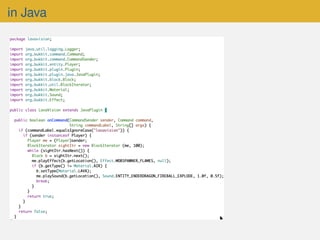
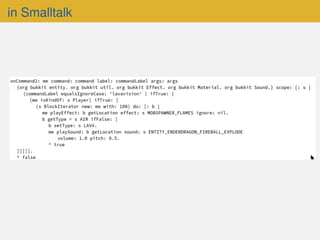
Minecraft example
in Java
in Smalltalk
Challenges - Block Closures
1 eg1: param
2 | x y z |
3 x := 0.
4 z := y := 42.
5 #(2 5 7) asOrderedCollection
6 do: [: each | | w |
7 w := y + param;
8 x := x + w.
9 x > 10 ifTrue: [↑ y].
10 ].
11 ↑ x + z
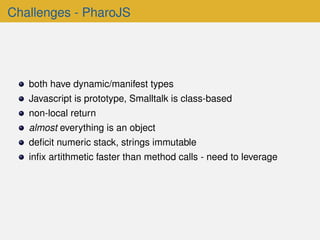
Challenges - PharoJS
both have dynamic/manifest types
Javascript is prototype, Smalltalk is class-based
non-local return
almost everything is an object
deficit numeric stack, strings immutable
infix artithmetic faster than method calls - need to leverage
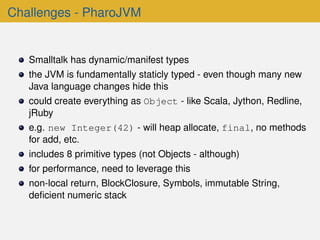
Challenges - PharoJVM
Smalltalk has dynamic/manifest types
the JVM is fundamentally staticly typed - even though many new
Java language changes hide this
could create everything as Object - like Scala, Jython, Redline,
jRuby
e.g. new Integer(42) - will heap allocate, final, no methods
for add, etc.
includes 8 primitive types (not Objects - although)
for performance, need to leverage this
non-local return, BlockClosure, Symbols, immutable String,
deficient numeric stack
Challenges - Python/Ruby
why bother?
can provide immediate access to libraries
similar enough that long-term should be to leverage FFI
non-local return, BlockClosure, missing fractions
Challenges - GPU/SQL/NoSQL
Smalltalk has dynamic/manifest types
targets are fundamentally staticly typed
probably useful with limited semantics
gain common environment, expressive syntax
Challenges - C/Wasm/native
Smalltalk has dynamic/manifest types
targets are fundamentally staticly typed
garbage collection
non-local return
could create everything as Object
for performance, need to avoid this
BlockClosure, deficient numeric stack
Conclusions
can leverage FFI
can leverage transpilation
for some applications don’t need full semantics
transpilation is quite popular - would be nice to create a common
infrastructure
contact me if you have ideas about what this would look like
Questions?
@dmasonrose @pharojs

Pharo Smalltalk as Universal Development Platform

  • 1.
    Pharo Smalltalk asUniversal Development Platform Dave Mason Ryerson Universityi ©2019 Dave Mason
  • 2.
    One IDE torule them all, One IDE to find them, One IDE to bring them all and in the syntax bind them. – with apologies to J.R.R.Tolkien
  • 3.
    Why Pharo? (orother modern Smalltalks) want to program in Smalltalk best-in-class IDE live object debugging All the things at this conference: GlamourousToolit Roassal DrTest Seaside Scientific Workbench SwiftPlayground and so much more.... including what Dave West said yesterday
  • 4.
    What Pharo? desktop headless configurable images commandline scripting web with PharoJS standalone with Illicium
  • 5.
    How Pharo? primitives/plug-ins Slang/Illicium ForeignFunction Interface - FFI communication Python-Bridge transpilation: PharoJS, Illicium, PharoJVM, Woden embedded VM
  • 6.
    Why Transpile? convert froma friendly (Smalltalk) language to ugly one deployment target limitations (GPU/Browser/cloud provider/footprint)
  • 7.
    How Transpile? walk thecompiler AST typically translate to target AST possible type-checking/type-inference - helped by target types optional optimization of target AST walk the target AST generating target code
  • 8.
    Example: Why PharoJVM? wantto program in Smalltalk sometimes need to deploy in enterprise (e.g. WebSphere) accessing Java frameworks - Minecraft, Yarn possible performance advantage may combine with PharoJS to target WebAssembly/native might allow writing Android apps directly
  • 9.
  • 10.
  • 11.
  • 12.
    Challenges - BlockClosures 1 eg1: param 2 | x y z | 3 x := 0. 4 z := y := 42. 5 #(2 5 7) asOrderedCollection 6 do: [: each | | w | 7 w := y + param; 8 x := x + w. 9 x > 10 ifTrue: [↑ y]. 10 ]. 11 ↑ x + z
  • 13.
    Challenges - PharoJS bothhave dynamic/manifest types Javascript is prototype, Smalltalk is class-based non-local return almost everything is an object deficit numeric stack, strings immutable infix artithmetic faster than method calls - need to leverage
  • 14.
    Challenges - PharoJVM Smalltalkhas dynamic/manifest types the JVM is fundamentally staticly typed - even though many new Java language changes hide this could create everything as Object - like Scala, Jython, Redline, jRuby e.g. new Integer(42) - will heap allocate, final, no methods for add, etc. includes 8 primitive types (not Objects - although) for performance, need to leverage this non-local return, BlockClosure, Symbols, immutable String, deficient numeric stack
  • 15.
    Challenges - Python/Ruby whybother? can provide immediate access to libraries similar enough that long-term should be to leverage FFI non-local return, BlockClosure, missing fractions
  • 16.
    Challenges - GPU/SQL/NoSQL Smalltalkhas dynamic/manifest types targets are fundamentally staticly typed probably useful with limited semantics gain common environment, expressive syntax
  • 17.
    Challenges - C/Wasm/native Smalltalkhas dynamic/manifest types targets are fundamentally staticly typed garbage collection non-local return could create everything as Object for performance, need to avoid this BlockClosure, deficient numeric stack
  • 18.
    Conclusions can leverage FFI canleverage transpilation for some applications don’t need full semantics transpilation is quite popular - would be nice to create a common infrastructure contact me if you have ideas about what this would look like
  • 19.