Parkinson's Disease
L6 Pharmcology 9th December 2022
Cedric A, Aleesa A, Megan D
Georgia G and Jasmine B
Case Study 2
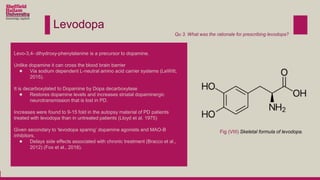
Levodopa
Levo-3,4- dihydroxy-phenylalanine is a precursor to dopamine.
Unlike dopamine it can cross the blood brain barrier
● Via sodium dependent L-neutral amino acid carrier systems (LeWitt,
2015).
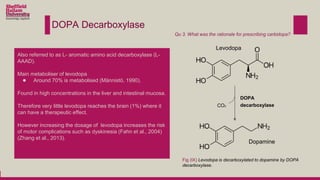
It is decarboxylated to Dopamine by Dopa decarboxylase
● Restores dopamine levels and increases striatal dopaminergic
neurotransmission that is lost in PD.
Increases were found to 9-15 fold in the autopsy material of PD patients
treated with levodopa than in untreated patients (Lloyd et al. 1975)
Given secondary to ‘levodopa sparing’ dopamine agonists and MAO-B
inhibitors.
● Delays side effects associated with chronic treatment (Bracco et al.,
2012) (Fox et al., 2018).
Qu 3. What was the rationale for prescribing levodopa?
Fig (VIII) Skeletal formula of levodopa.
DOPA Decarboxylase
Also referred to as L- aromatic amino acid decarboxylase (L-
AAAD).
Main metaboliser of levodopa
● Around 70% is metabolised (Männistö, 1990).
Found in high concentrations in the liver and intestinal mucosa.
Therefore very little levodopa reaches the brain (1%) where it
can have a therapeutic effect.
However increasing the dosage of levodopa increases the risk
of motor complications such as dyskinesia (Fahn et al., 2004)
(Zhang et al., 2013).
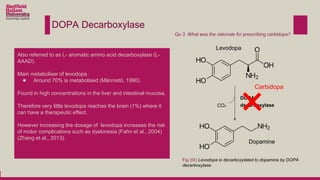
Fig (IX) Levodopa is decarboxylated to dopamine by DOPA
decarboxylase.
CO2
DOPA
decarboxylase
Levodopa
Dopamine
Qu 3. What was the rationale for prescribing carbidopa?
DOPA Decarboxylase
Fig (IX) Levodopa is decarboxylated to dopamine by DOPA
decarboxylase.
CO2
DOPA
decarboxylase
Levodopa
Dopamine
Carbidopa
Qu 3. What was the rationale for prescribing carbidopa?
Also referred to as L- aromatic amino acid decarboxylase (L-
AAAD).
Main metaboliser of levodopa
● Around 70% is metabolised (Männistö, 1990).
Found in high concentrations in the liver and intestinal mucosa.
Therefore very little levodopa reaches the brain (1%) where it
can have a therapeutic effect.
However increasing the dosage of levodopa increases the risk
of motor complications such as dyskinesia (Fahn et al., 2004)
(Zhang et al., 2013).
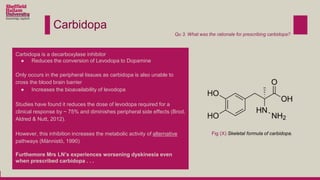
Carbidopa
Carbidopa is a decarboxylase inhibitor
● Reduces the conversion of Levodopa to Dopamine
Only occurs in the peripheral tissues as carbidopa is also unable to
cross the blood brain barrier
● Increases the bioavailability of levodopa
Studies have found it reduces the dose of levodopa required for a
clinical response by ~ 75% and diminishes peripheral side effects (Brod,
Aldred & Nutt, 2012).
However, this inhibition increases the metabolic activity of alternative
pathways (Männistö, 1990)
Furthemore Mrs LN’s experiences worsening dyskinesia even
when prescribed carbidopa . . .
Qu 3. What was the rationale for prescribing carbidopa?
Fig (X) Skeletal formula of carbidopa.
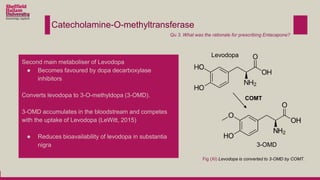
Catecholamine-O-methyltransferase
Second main metaboliser of Levodopa
● Becomes favoured by dopa decarboxylase
inhibitors
Converts levodopa to 3-O-methyldopa (3-OMD).
3-OMD accumulates in the bloodstream and competes
with the uptake of Levodopa (LeWitt, 2015)
● Reduces bioavailability of levodopa in substantia
nigra
COMT
Fig (XI) Levodopa is converted to 3-OMD by COMT.
Levodopa
3-OMD
Qu 3. What was the rationale for prescribing Entacapone?
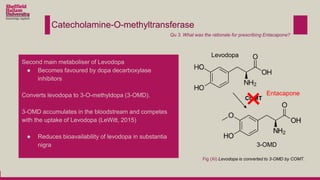
Catecholamine-O-methyltransferase
Second main metaboliser of Levodopa
● Becomes favoured by dopa decarboxylase
inhibitors
Converts levodopa to 3-O-methyldopa (3-OMD).
3-OMD accumulates in the bloodstream and competes
with the uptake of Levodopa (LeWitt, 2015)
● Reduces bioavailability of levodopa in substantia
nigra
COMT
Fig (XI) Levodopa is converted to 3-OMD by COMT.
Levodopa
3-OMD
Qu 3. What was the rationale for prescribing Entacapone?
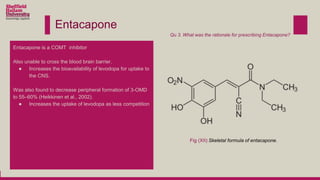
Entacapone
Entacapone
Entacapone is a COMT inhibitor
Also unable to cross the blood brain barrier.
● Increases the bioavailability of levodopa for uptake to
the CNS.
Was also found to decrease peripheral formation of 3-OMD
to 55–60% (Heikkinen et al., 2002).
● Increases the uptake of levodopa as less competition
Fig (XII) Skeletal formula of entacapone.
Qu 3. What was the rationale for prescribing Entacapone?
Entacapone
Entacapone is a COMT inhibitor
Also unable to cross the blood brain barrier.
● Increases the bioavailability of levodopa for uptake to
the CNS.
Was also found to decrease peripheral formation of 3-OMD
to 55–60% (Heikkinen et al., 2002).
● Increases the uptake of levodopa as less competition
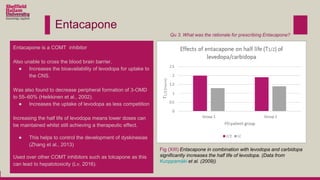
Increasing the half life of levodopa means lower doses can
be maintained whilst still achieving a therapeutic effect.
● This helps to control the development of dyskinesias
(Zhang et al., 2013)
Used over other COMT inhibitors such as tolcapone as this
can lead to hepatotoxicity (Lv, 2016).
Fig (XIII) Entacapone in combination with levodopa and carbidopa
significantly increases the half life of levodopa. (Data from
Kuoppamäki et al. (2009))
Qu 3. What was the rationale for prescribing Entacapone?

Pharmacology Presentation Slides

  • 1.
    Parkinson's Disease L6 Pharmcology9th December 2022 Cedric A, Aleesa A, Megan D Georgia G and Jasmine B Case Study 2
  • 2.
    Levodopa Levo-3,4- dihydroxy-phenylalanine isa precursor to dopamine. Unlike dopamine it can cross the blood brain barrier ● Via sodium dependent L-neutral amino acid carrier systems (LeWitt, 2015). It is decarboxylated to Dopamine by Dopa decarboxylase ● Restores dopamine levels and increases striatal dopaminergic neurotransmission that is lost in PD. Increases were found to 9-15 fold in the autopsy material of PD patients treated with levodopa than in untreated patients (Lloyd et al. 1975) Given secondary to ‘levodopa sparing’ dopamine agonists and MAO-B inhibitors. ● Delays side effects associated with chronic treatment (Bracco et al., 2012) (Fox et al., 2018). Qu 3. What was the rationale for prescribing levodopa? Fig (VIII) Skeletal formula of levodopa.
  • 3.
    DOPA Decarboxylase Also referredto as L- aromatic amino acid decarboxylase (L- AAAD). Main metaboliser of levodopa ● Around 70% is metabolised (Männistö, 1990). Found in high concentrations in the liver and intestinal mucosa. Therefore very little levodopa reaches the brain (1%) where it can have a therapeutic effect. However increasing the dosage of levodopa increases the risk of motor complications such as dyskinesia (Fahn et al., 2004) (Zhang et al., 2013). Fig (IX) Levodopa is decarboxylated to dopamine by DOPA decarboxylase. CO2 DOPA decarboxylase Levodopa Dopamine Qu 3. What was the rationale for prescribing carbidopa?
  • 4.
    DOPA Decarboxylase Fig (IX)Levodopa is decarboxylated to dopamine by DOPA decarboxylase. CO2 DOPA decarboxylase Levodopa Dopamine Carbidopa Qu 3. What was the rationale for prescribing carbidopa? Also referred to as L- aromatic amino acid decarboxylase (L- AAAD). Main metaboliser of levodopa ● Around 70% is metabolised (Männistö, 1990). Found in high concentrations in the liver and intestinal mucosa. Therefore very little levodopa reaches the brain (1%) where it can have a therapeutic effect. However increasing the dosage of levodopa increases the risk of motor complications such as dyskinesia (Fahn et al., 2004) (Zhang et al., 2013).
  • 5.
    Carbidopa Carbidopa is adecarboxylase inhibitor ● Reduces the conversion of Levodopa to Dopamine Only occurs in the peripheral tissues as carbidopa is also unable to cross the blood brain barrier ● Increases the bioavailability of levodopa Studies have found it reduces the dose of levodopa required for a clinical response by ~ 75% and diminishes peripheral side effects (Brod, Aldred & Nutt, 2012). However, this inhibition increases the metabolic activity of alternative pathways (Männistö, 1990) Furthemore Mrs LN’s experiences worsening dyskinesia even when prescribed carbidopa . . . Qu 3. What was the rationale for prescribing carbidopa? Fig (X) Skeletal formula of carbidopa.
  • 6.
    Catecholamine-O-methyltransferase Second main metaboliserof Levodopa ● Becomes favoured by dopa decarboxylase inhibitors Converts levodopa to 3-O-methyldopa (3-OMD). 3-OMD accumulates in the bloodstream and competes with the uptake of Levodopa (LeWitt, 2015) ● Reduces bioavailability of levodopa in substantia nigra COMT Fig (XI) Levodopa is converted to 3-OMD by COMT. Levodopa 3-OMD Qu 3. What was the rationale for prescribing Entacapone?
  • 7.
    Catecholamine-O-methyltransferase Second main metaboliserof Levodopa ● Becomes favoured by dopa decarboxylase inhibitors Converts levodopa to 3-O-methyldopa (3-OMD). 3-OMD accumulates in the bloodstream and competes with the uptake of Levodopa (LeWitt, 2015) ● Reduces bioavailability of levodopa in substantia nigra COMT Fig (XI) Levodopa is converted to 3-OMD by COMT. Levodopa 3-OMD Qu 3. What was the rationale for prescribing Entacapone? Entacapone
  • 8.
    Entacapone Entacapone is aCOMT inhibitor Also unable to cross the blood brain barrier. ● Increases the bioavailability of levodopa for uptake to the CNS. Was also found to decrease peripheral formation of 3-OMD to 55–60% (Heikkinen et al., 2002). ● Increases the uptake of levodopa as less competition Fig (XII) Skeletal formula of entacapone. Qu 3. What was the rationale for prescribing Entacapone?
  • 9.
    Entacapone Entacapone is aCOMT inhibitor Also unable to cross the blood brain barrier. ● Increases the bioavailability of levodopa for uptake to the CNS. Was also found to decrease peripheral formation of 3-OMD to 55–60% (Heikkinen et al., 2002). ● Increases the uptake of levodopa as less competition Increasing the half life of levodopa means lower doses can be maintained whilst still achieving a therapeutic effect. ● This helps to control the development of dyskinesias (Zhang et al., 2013) Used over other COMT inhibitors such as tolcapone as this can lead to hepatotoxicity (Lv, 2016). Fig (XIII) Entacapone in combination with levodopa and carbidopa significantly increases the half life of levodopa. (Data from Kuoppamäki et al. (2009)) Qu 3. What was the rationale for prescribing Entacapone?