MEASURING AND ESTIMATING COSTS
Lecture 2
Health spending is increasing worldwide due to epidemiological and demographic
changes and the emergence of new and increasingly expensive health
technologies.
Improving resource allocation and reducing waste can
help control costs while delivering better value.
Objectives
 Define different costing terms.
 Categorize types of costs.
 Determine the perspective of a study based on types of costs measured.
 Understand when adjusting for timing of costs is appropriate.
 Calculate net present value.
 Compare average costs with marginal or incremental costs.
 List common sources for obtaining cost data.
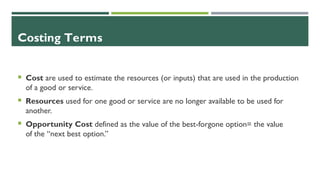
Costing Terms
 Cost are used to estimate the resources (or inputs) that are used in the production
of a good or service.
 Resources used for one good or service are no longer available to be used for
another.
 Opportunity Cost defined as the value of the best-forgone option= the value
of the “next best option.”
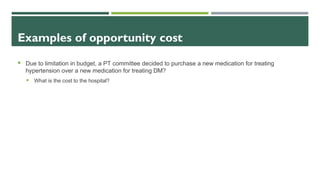
Examples of opportunity cost
 Due to limitation in budget, a PT committee decided to purchase a new medication for treating
hypertension over a new medication for treating DM?
 What is the cost to the hospital?
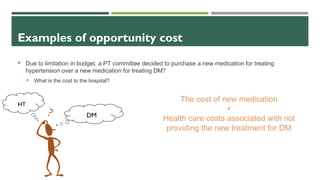
Examples of opportunity cost
 Due to limitation in budget, a PT committee decided to purchase a new medication for treating
hypertension over a new medication for treating DM?
 What is the cost to the hospital?
DM
HT
The cost of new medication
+
Health care costs associated with not
providing the new treatment for DM
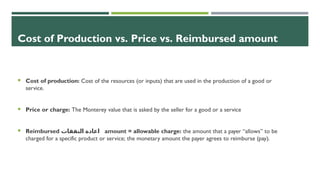
Cost of Production vs. Price vs. Reimbursed amount
 Cost of production: Cost of the resources (or inputs) that are used in the production of a good or
service.
 Price or charge: The Monterey value that is asked by the seller for a good or a service
 Reimbursed ‫النفقات‬ ‫اعادة‬ amount = allowable charge: the amount that a payer “allows” to be
charged for a specific product or service; the monetary amount the payer agrees to reimburse (pay).
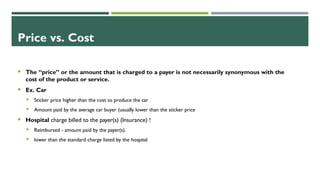
Price vs. Cost
 The “price” or the amount that is charged to a payer is not necessarily synonymous with the
cost of the product or service.
 Ex. Car
 Sticker price higher than the cost to produce the car
 Amount paid by the average car buyer (usually lower than the sticker price
 Hospital charge billed to the payer(s) (Insurance) !
 Reimbursed - amount paid by the payer(s).
 lower than the standard charge listed by the hospital
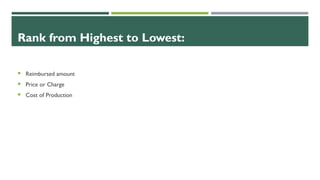
Rank from Highest to Lowest:
 Reimbursed amount
 Price or Charge
 Cost of Production
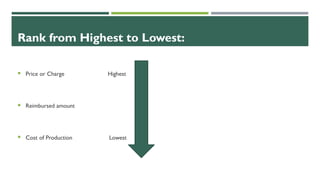
Rank from Highest to Lowest:
 Price or Charge Highest
 Reimbursed amount
 Cost of Production Lowest
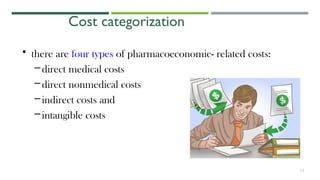
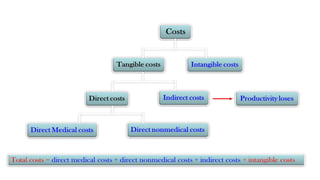
Cost categorization
• there are four types of pharmacoeconomic- related costs:
–direct medical costs
–direct nonmedical costs
–indirect costs and
–intangible costs
14
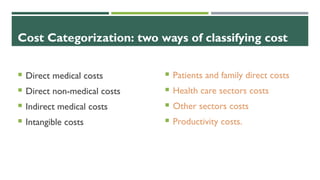
Cost Categorization: two ways of classifying cost
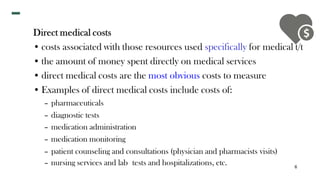
 Direct medical costs
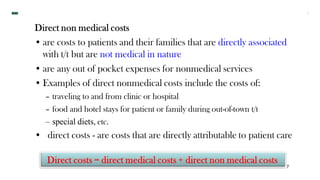
 Direct non-medical costs
 Indirect medical costs
 Intangible costs
 Patients and family direct costs
 Health care sectors costs
 Other sectors costs
 Productivity costs.
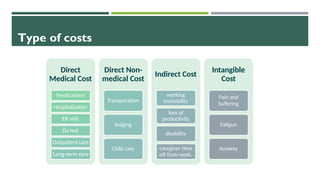
Type of costs
Direct
Medical Cost
Medications
Hospitalisation
ER visit
Dx test
Outpatient care
Long-term care
Direct Non-
medical Cost
Transporation
lodging
Child care
Indirect Cost
working
immobility
loss of
productivity
disability
caregiver time
off from work.
Intangible
Cost
Pain and
Suffering
Fatigue
Anixiety
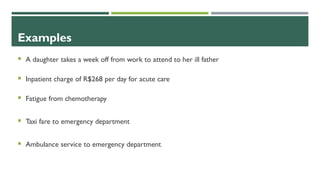
Examples
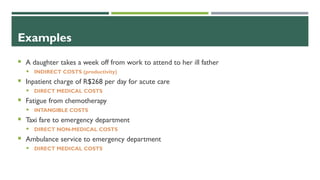
 A daughter takes a week off from work to attend to her ill father
 Inpatient charge of R$268 per day for acute care
 Fatigue from chemotherapy
 Taxi fare to emergency department
 Ambulance service to emergency department
Examples
 A daughter takes a week off from work to attend to her ill father
 INDIRECT COSTS (productivity)
 Inpatient charge of R$268 per day for acute care
 DIRECT MEDICAL COSTS
 Fatigue from chemotherapy
 INTANGIBLE COSTS
 Taxi fare to emergency department
 DIRECT NON-MEDICAL COSTS
 Ambulance service to emergency department
 DIRECT MEDICAL COSTS
Cost Categorization: two ways of classifying cost
 Direct medical costs
 Direct non-medical costs
 Indirect medical costs
 Intangible costs
 Patients and family direct costs
 Health care sectors costs
 Other sectors costs
 Productivity costs.
Productivity loss:
 Costs related to missing work or being less productive because of health conditions.
See Indirect costs.
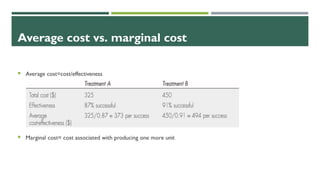
Average cost vs. marginal cost
 Average cost=cost/effectiveness
 Marginal cost= cost associated with producing one more unit
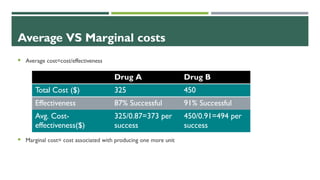
Average VS Marginal costs
 Average cost=cost/effectiveness
 Marginal cost= cost associated with producing one more unit
Drug A Drug B
Total Cost ($) 325 450
Effectiveness 87% Successful 91% Successful
Avg. Cost-
effectiveness($)
325/0.87=373 per
success
450/0.91=494 per
success
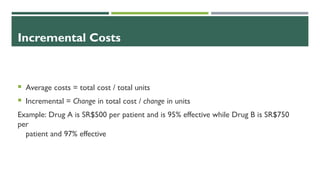
Incremental Costs
 Average costs = total cost / total units
 Incremental = Change in total cost / change in units
Example: Drug A is SR$500 per patient and is 95% effective while Drug B is SR$750
per
patient and 97% effective
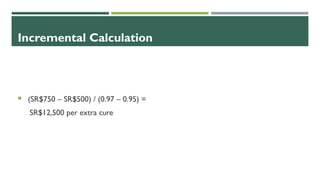
Incremental Calculation
 (SR$750 – SR$500) / (0.97 – 0.95) =
SR$12,500 per extra cure
Which Cost to measure?
 It depends on the perspective
 Perspective:
 An economic term that describes whose costs are relevant (being measured) based on
the
purpose of the study
 Types of perspectives:
 Patient
 Hospital or provider
 Payer (insurance company or employer)
 Society
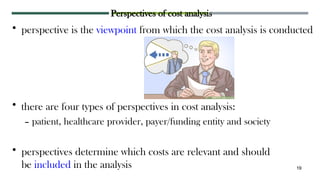
Perspectives of cost analysis
• perspective is the viewpoint from which the cost analysis is conducted
• there are four types of perspectives in cost analysis:
– patient, healthcare provider, payer/funding entity and society
• perspectives determine which costs are relevant and should
be included in the analysis 19
Patient perspective
• if the perspective of the analysis is the patient, only costs incurred
by patients/family are included
• all costs that only the patient would pay, not costs that third
party would cover
– Examples: out-of-pocket expenses, lost wages, and transportation
costs, would be used when estimating costs
20
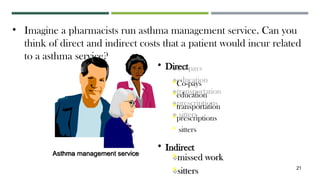
21
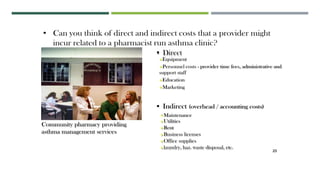
• Imagine a pharmacists run asthma management service. Can you
think of direct and indirect costs that a patient would incur related
to a asthma service?
• Direct
Co-pays
education
transportation
prescriptions
 sitters
• Indirect
missed work
sitters
Asthma management service
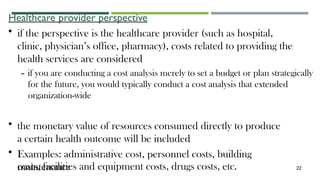
Healthcare provider perspective
• if the perspective is the healthcare provider (such as hospital,
clinic, physician’s office, pharmacy), costs related to providing the
health services are considered
– if you are conducting a cost analysis merely to set a budget or plan strategically
for the future, you would typically conduct a cost analysis that extended
organization-wide
• the monetary value of resources consumed directly to produce
a certain health outcome will be included
• Examples: administrative cost, personnel costs, building
maintenance
costs, facilities and equipment costs, drugs costs, etc. 22
38
Payer/funding entity perspective
• if the perspective is the payer/funding entity, only costs incurred by
entities responsible for financial costs of health services are
considered (e.g., insurance companies and employers), the amount
that is covered by the insurance or employer should be used when
estimating costs
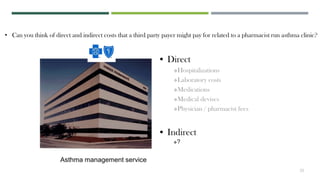
• costs a third party payer might cover
• these are almost always direct medical costs
39
40
41
• societal perspective is common in countries where the government
is the largest payer of health care benefits
• the choice of a perspective depends on who will be using the results
of the cost analysis
• as a general rule:
– CEA and CUA require only health care costs to be collected
– CBA requires all costs and benefits to be collected, no matter on whom they
fall
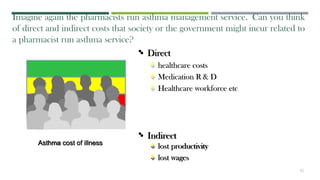
• Indirect
 lost productivity
 lost wages
Imagine again the pharmacists run asthma management service. Can you think
of direct and indirect costs that society or the government might incur related to
a pharmacist run asthma service?
• Direct
 healthcare costs
 Medication R & D
 Healthcare workforce etc
Asthma cost of illness
42
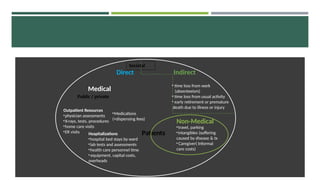
Indirect
• time loss from work
(absenteeism)
• time loss from usual activity
• early retirement or premature
death due to illness or injury
Medical
Public / private
Outpatient Resources
•physician assessments
•X-rays, tests, procedures
•home care visits
•ER visits Hospitalizations
•hospital bed stays by ward
•lab tests and assessments
•health care personnel time
• equipment, capital costs,
overheads
Non-Medical
•travel, parking
•intangibles (suffering
caused by disease & tx
• Caregiver( Informal
care costs)
•Medications
(+dispensing fees)
Societal
Direct
Patients
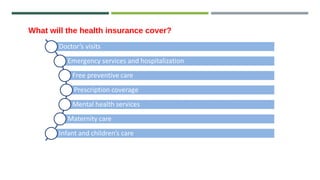
What will the health insurance cover?
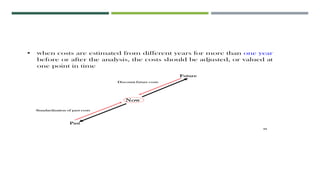
TIMING ADJUSTMENTS FOR COSTS
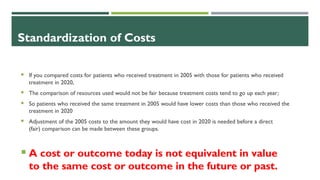
Standardization of Costs
 If you compared costs for patients who received treatment in 2005 with those for patients who received
treatment in 2020,
 The comparison of resources used would not be fair because treatment costs tend to go up each year;
 So patients who received the same treatment in 2005 would have lower costs than those who received the
treatment in 2020
 Adjustment of the 2005 costs to the amount they would have cost in 2020 is needed before a direct
(fair) comparison can be made between these groups.
 A cost or outcome today is not equivalent in value
to the same cost or outcome in the future or past.
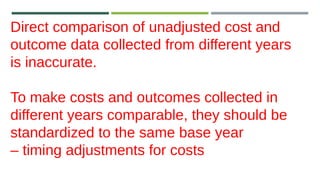
Direct comparison of unadjusted cost and
outcome data collected from different years
is inaccurate.
To make costs and outcomes collected in
different years comparable, they should be
standardized to the same base year
– timing adjustments for costs
Example
 If the objective of the study is to estimate the difference in the costs of chemotherapy regimens, information on
the past use of these two treatments might be collected from a review of medical records.
 If the retrospective review of these medical records dates back for more than 1 year, it may be necessary to
standardize the cost of both medications by calculating the number of units (doses) used per case and
multiplying this number by the current unit cost for each medication.
Adjusting for Time Differences
T
wo different concepts
 Inflation
 If data collected over more than one year
 Prices may be adjusted to uniform price
 Time Preference
 If program or therapy extends more than one year, “discounting” is
appropriate
 Used even if inflation rate is zero
Adjustment for Inflation
Can count number of services/ resources used and multiply by standard costs at one
point in time
OR
Use inflation rate for past years times cost from past years
Bringing Future Costs (Benefits) to the Present:
Discounting
 What Do you prefer?
 SR1000 after a year or SR950 today
Measuring Costs
 Costs are measured over a relevant time period such as a month or year.
 The length of time used depends on the typical span of the illness.
 Acute diseases such as the flu would have a short span; while chronic or long-
term illness such as depression or heart disease would span years.
Scarcity is the fundamental economic
problem that forces consumers and
producers to use resources wisely.
Unlimited Wants
NIPH & PNIPH – Budget Impact Analysis 57
Limit resources
Scarcity
Choices
For whom
to make it
What to
make
How to
make it
How does the concept of scarcity
apply to healthcare?
The fundamental economic problem
Recap
Sl ide from: Chola L, Heupink LF, Peacocke E, Sæterdal I (2020). Economic evaluation of public health interventions [PowerPoint
s l ides]. Norwegian Institute of Public Health, Oslo.
The ‘Health Economic’ problem
Recap
Unlimited healthcare “wants” with rapid growth in
health expenditure.
Insufficient health sector resources.
Choosing between ‘wants’ we can ‘afford’ given our
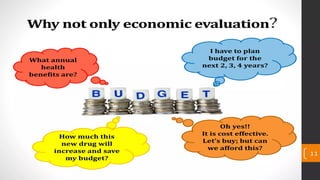
resource ‘budget’.
4
NIPH & PNIPH – Budget Impact Analysis
Sl ide from: Chola L, Heupink LF, Peacocke E, Sæterdal I (2020). Economic evaluation of public health interventions [PowerPoint
s l ides]. Norwegian Institute of Public Health, Os lo.
Sl ide from: Chola L, Heupink LF, Peacocke E, Sæterdal I (2020). Economic evaluation of public health interventions [PowerPoint
s l ides]. Norwegian Institute of Public Health, Oslo.
How HTA can inform policy and priorities
BIA can be a part of an HTA to inform on the financial impact of a ‘new’ intervention
Financial and non-financial
levers for quality improvement
Quality
standards
Clinical
guidelines
and
pathways
HTA
Health technology assessment
(HTA) to compare clinical and cost-
effectiveness of different
interventions
Clinical guidelines and
pathways distilled from HTA and
other evidence
Quality standards and indicators
from evidence-based guidelines
Health benefits plans (HBPs), pay-for-
performance, other levers (regulation,
accreditation, education…)
Evidence
NIPH 2020 - Lithuania Workshop 6
Source: International Decision Support Initiative (iDSI)
Sl ide from: Chola L, Heupink LF, Peacocke E, Sæterdal I (2020). Economic evaluation of public health interventions [PowerPoint
s l ides]. Norwegian Institute of Public Health, Oslo.
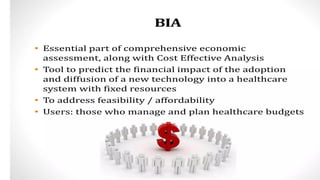
Budget impact analysis (BIA)
Definitions for BIA
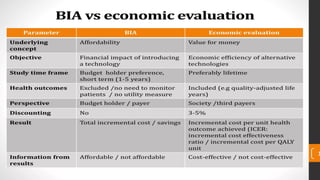
“An evaluation of the financial impact of the introduction of a technology or
service on the capital and operating budgets of a government or agency.” *
60
Budget impact analysis (BIA) is a relatively recent method
for economic evaluation (EE) in the field of health care. It
assesses the financial consequences of the introduction
of new technology in a specific setting in the short-to-
medium term.
The reason for interest in BIA seems to be the lack of
responsiveness and the complexity of CEA to the
needs of budget holders and decision-makers in
health care. According to best practice, CEA should
take a societal perspective and a long enough time
horizon to include all the benefits of a new technology,
and this often implies modelling for lifetime estimates.
To summarize, these issues show the limitations of CEA from the
budget holder’s viewpoint. BIA should provide useful information
to tackle the new hurdle of “affordability”, after having fulfilled
the better-known hurdles of “safety”, “efficacy”, and “added
value” of new treatments over existing ones
Another difference between CEA and BIA is the possibility
of using virtual populations in a CEA (e.g. theoretical
cohorts in Markov models), while BIA should be restricted
to real populations in national or local settings, in line with
the perspective chosen.
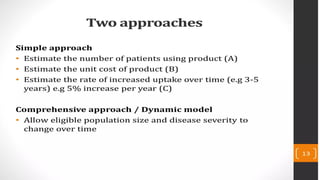
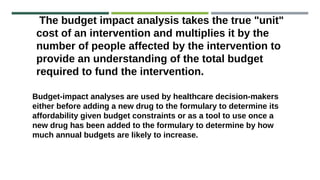
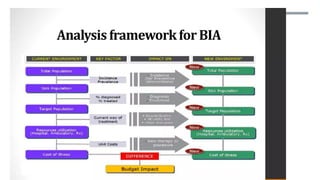
The budget impact analysis takes the true "unit"
cost of an intervention and multiplies it by the
number of people affected by the intervention to
provide an understanding of the total budget
required to fund the intervention.
Budget-impact analyses are used by healthcare decision-makers
either before adding a new drug to the formulary to determine its
affordability given budget constraints or as a tool to use once a
new drug has been added to the formulary to determine by how
much annual budgets are likely to increase.
6 Cost estimation pharmcy madtr 615.pptx

6 Cost estimation pharmcy madtr 615.pptx

  • 1.
    MEASURING AND ESTIMATINGCOSTS Lecture 2
  • 2.
    Health spending isincreasing worldwide due to epidemiological and demographic changes and the emergence of new and increasingly expensive health technologies. Improving resource allocation and reducing waste can help control costs while delivering better value.
  • 4.
    Objectives  Define differentcosting terms.  Categorize types of costs.  Determine the perspective of a study based on types of costs measured.  Understand when adjusting for timing of costs is appropriate.  Calculate net present value.  Compare average costs with marginal or incremental costs.  List common sources for obtaining cost data.
  • 7.
    Costing Terms  Costare used to estimate the resources (or inputs) that are used in the production of a good or service.  Resources used for one good or service are no longer available to be used for another.  Opportunity Cost defined as the value of the best-forgone option= the value of the “next best option.”
  • 8.
    Examples of opportunitycost  Due to limitation in budget, a PT committee decided to purchase a new medication for treating hypertension over a new medication for treating DM?  What is the cost to the hospital?
  • 9.
    Examples of opportunitycost  Due to limitation in budget, a PT committee decided to purchase a new medication for treating hypertension over a new medication for treating DM?  What is the cost to the hospital? DM HT The cost of new medication + Health care costs associated with not providing the new treatment for DM
  • 10.
    Cost of Productionvs. Price vs. Reimbursed amount  Cost of production: Cost of the resources (or inputs) that are used in the production of a good or service.  Price or charge: The Monterey value that is asked by the seller for a good or a service  Reimbursed ‫النفقات‬ ‫اعادة‬ amount = allowable charge: the amount that a payer “allows” to be charged for a specific product or service; the monetary amount the payer agrees to reimburse (pay).
  • 11.
    Price vs. Cost The “price” or the amount that is charged to a payer is not necessarily synonymous with the cost of the product or service.  Ex. Car  Sticker price higher than the cost to produce the car  Amount paid by the average car buyer (usually lower than the sticker price  Hospital charge billed to the payer(s) (Insurance) !  Reimbursed - amount paid by the payer(s).  lower than the standard charge listed by the hospital
  • 12.
    Rank from Highestto Lowest:  Reimbursed amount  Price or Charge  Cost of Production
  • 13.
    Rank from Highestto Lowest:  Price or Charge Highest  Reimbursed amount  Cost of Production Lowest
  • 14.
    Cost categorization • thereare four types of pharmacoeconomic- related costs: –direct medical costs –direct nonmedical costs –indirect costs and –intangible costs 14
  • 15.
    Cost Categorization: twoways of classifying cost  Direct medical costs  Direct non-medical costs  Indirect medical costs  Intangible costs  Patients and family direct costs  Health care sectors costs  Other sectors costs  Productivity costs.
  • 16.
    Type of costs Direct MedicalCost Medications Hospitalisation ER visit Dx test Outpatient care Long-term care Direct Non- medical Cost Transporation lodging Child care Indirect Cost working immobility loss of productivity disability caregiver time off from work. Intangible Cost Pain and Suffering Fatigue Anixiety
  • 17.
    Examples  A daughtertakes a week off from work to attend to her ill father  Inpatient charge of R$268 per day for acute care  Fatigue from chemotherapy  Taxi fare to emergency department  Ambulance service to emergency department
  • 18.
    Examples  A daughtertakes a week off from work to attend to her ill father  INDIRECT COSTS (productivity)  Inpatient charge of R$268 per day for acute care  DIRECT MEDICAL COSTS  Fatigue from chemotherapy  INTANGIBLE COSTS  Taxi fare to emergency department  DIRECT NON-MEDICAL COSTS  Ambulance service to emergency department  DIRECT MEDICAL COSTS
  • 19.
    Cost Categorization: twoways of classifying cost  Direct medical costs  Direct non-medical costs  Indirect medical costs  Intangible costs  Patients and family direct costs  Health care sectors costs  Other sectors costs  Productivity costs.
  • 20.
    Productivity loss:  Costsrelated to missing work or being less productive because of health conditions. See Indirect costs.
  • 28.
    Average cost vs.marginal cost  Average cost=cost/effectiveness  Marginal cost= cost associated with producing one more unit
  • 29.
    Average VS Marginalcosts  Average cost=cost/effectiveness  Marginal cost= cost associated with producing one more unit Drug A Drug B Total Cost ($) 325 450 Effectiveness 87% Successful 91% Successful Avg. Cost- effectiveness($) 325/0.87=373 per success 450/0.91=494 per success
  • 30.
    Incremental Costs  Averagecosts = total cost / total units  Incremental = Change in total cost / change in units Example: Drug A is SR$500 per patient and is 95% effective while Drug B is SR$750 per patient and 97% effective
  • 31.
    Incremental Calculation  (SR$750– SR$500) / (0.97 – 0.95) = SR$12,500 per extra cure
  • 32.
    Which Cost tomeasure?  It depends on the perspective  Perspective:  An economic term that describes whose costs are relevant (being measured) based on the purpose of the study  Types of perspectives:  Patient  Hospital or provider  Payer (insurance company or employer)  Society
  • 33.
    Perspectives of costanalysis • perspective is the viewpoint from which the cost analysis is conducted • there are four types of perspectives in cost analysis: – patient, healthcare provider, payer/funding entity and society • perspectives determine which costs are relevant and should be included in the analysis 19
  • 34.
    Patient perspective • ifthe perspective of the analysis is the patient, only costs incurred by patients/family are included • all costs that only the patient would pay, not costs that third party would cover – Examples: out-of-pocket expenses, lost wages, and transportation costs, would be used when estimating costs 20
  • 35.
    21 • Imagine apharmacists run asthma management service. Can you think of direct and indirect costs that a patient would incur related to a asthma service? • Direct Co-pays education transportation prescriptions  sitters • Indirect missed work sitters Asthma management service
  • 36.
    Healthcare provider perspective •if the perspective is the healthcare provider (such as hospital, clinic, physician’s office, pharmacy), costs related to providing the health services are considered – if you are conducting a cost analysis merely to set a budget or plan strategically for the future, you would typically conduct a cost analysis that extended organization-wide • the monetary value of resources consumed directly to produce a certain health outcome will be included • Examples: administrative cost, personnel costs, building maintenance costs, facilities and equipment costs, drugs costs, etc. 22
  • 38.
    38 Payer/funding entity perspective •if the perspective is the payer/funding entity, only costs incurred by entities responsible for financial costs of health services are considered (e.g., insurance companies and employers), the amount that is covered by the insurance or employer should be used when estimating costs • costs a third party payer might cover • these are almost always direct medical costs
  • 39.
  • 40.
  • 41.
    41 • societal perspectiveis common in countries where the government is the largest payer of health care benefits • the choice of a perspective depends on who will be using the results of the cost analysis • as a general rule: – CEA and CUA require only health care costs to be collected – CBA requires all costs and benefits to be collected, no matter on whom they fall
  • 42.
    • Indirect  lostproductivity  lost wages Imagine again the pharmacists run asthma management service. Can you think of direct and indirect costs that society or the government might incur related to a pharmacist run asthma service? • Direct  healthcare costs  Medication R & D  Healthcare workforce etc Asthma cost of illness 42
  • 43.
    Indirect • time lossfrom work (absenteeism) • time loss from usual activity • early retirement or premature death due to illness or injury Medical Public / private Outpatient Resources •physician assessments •X-rays, tests, procedures •home care visits •ER visits Hospitalizations •hospital bed stays by ward •lab tests and assessments •health care personnel time • equipment, capital costs, overheads Non-Medical •travel, parking •intangibles (suffering caused by disease & tx • Caregiver( Informal care costs) •Medications (+dispensing fees) Societal Direct Patients
  • 44.
    What will thehealth insurance cover?
  • 48.
  • 49.
    Standardization of Costs If you compared costs for patients who received treatment in 2005 with those for patients who received treatment in 2020,  The comparison of resources used would not be fair because treatment costs tend to go up each year;  So patients who received the same treatment in 2005 would have lower costs than those who received the treatment in 2020  Adjustment of the 2005 costs to the amount they would have cost in 2020 is needed before a direct (fair) comparison can be made between these groups.  A cost or outcome today is not equivalent in value to the same cost or outcome in the future or past.
  • 50.
    Direct comparison ofunadjusted cost and outcome data collected from different years is inaccurate. To make costs and outcomes collected in different years comparable, they should be standardized to the same base year – timing adjustments for costs
  • 52.
    Example  If theobjective of the study is to estimate the difference in the costs of chemotherapy regimens, information on the past use of these two treatments might be collected from a review of medical records.  If the retrospective review of these medical records dates back for more than 1 year, it may be necessary to standardize the cost of both medications by calculating the number of units (doses) used per case and multiplying this number by the current unit cost for each medication.
  • 53.
    Adjusting for TimeDifferences T wo different concepts  Inflation  If data collected over more than one year  Prices may be adjusted to uniform price  Time Preference  If program or therapy extends more than one year, “discounting” is appropriate  Used even if inflation rate is zero
  • 54.
    Adjustment for Inflation Cancount number of services/ resources used and multiply by standard costs at one point in time OR Use inflation rate for past years times cost from past years
  • 55.
    Bringing Future Costs(Benefits) to the Present: Discounting  What Do you prefer?  SR1000 after a year or SR950 today
  • 56.
    Measuring Costs  Costsare measured over a relevant time period such as a month or year.  The length of time used depends on the typical span of the illness.  Acute diseases such as the flu would have a short span; while chronic or long- term illness such as depression or heart disease would span years.
  • 57.
    Scarcity is thefundamental economic problem that forces consumers and producers to use resources wisely. Unlimited Wants NIPH & PNIPH – Budget Impact Analysis 57 Limit resources Scarcity Choices For whom to make it What to make How to make it How does the concept of scarcity apply to healthcare? The fundamental economic problem Recap Sl ide from: Chola L, Heupink LF, Peacocke E, Sæterdal I (2020). Economic evaluation of public health interventions [PowerPoint s l ides]. Norwegian Institute of Public Health, Oslo.
  • 58.
    The ‘Health Economic’problem Recap Unlimited healthcare “wants” with rapid growth in health expenditure. Insufficient health sector resources. Choosing between ‘wants’ we can ‘afford’ given our resource ‘budget’. 4 NIPH & PNIPH – Budget Impact Analysis Sl ide from: Chola L, Heupink LF, Peacocke E, Sæterdal I (2020). Economic evaluation of public health interventions [PowerPoint s l ides]. Norwegian Institute of Public Health, Os lo. Sl ide from: Chola L, Heupink LF, Peacocke E, Sæterdal I (2020). Economic evaluation of public health interventions [PowerPoint s l ides]. Norwegian Institute of Public Health, Oslo.
  • 59.
    How HTA caninform policy and priorities BIA can be a part of an HTA to inform on the financial impact of a ‘new’ intervention Financial and non-financial levers for quality improvement Quality standards Clinical guidelines and pathways HTA Health technology assessment (HTA) to compare clinical and cost- effectiveness of different interventions Clinical guidelines and pathways distilled from HTA and other evidence Quality standards and indicators from evidence-based guidelines Health benefits plans (HBPs), pay-for- performance, other levers (regulation, accreditation, education…) Evidence NIPH 2020 - Lithuania Workshop 6 Source: International Decision Support Initiative (iDSI) Sl ide from: Chola L, Heupink LF, Peacocke E, Sæterdal I (2020). Economic evaluation of public health interventions [PowerPoint s l ides]. Norwegian Institute of Public Health, Oslo.
  • 60.
    Budget impact analysis(BIA) Definitions for BIA “An evaluation of the financial impact of the introduction of a technology or service on the capital and operating budgets of a government or agency.” * 60 Budget impact analysis (BIA) is a relatively recent method for economic evaluation (EE) in the field of health care. It assesses the financial consequences of the introduction of new technology in a specific setting in the short-to- medium term.
  • 62.
    The reason forinterest in BIA seems to be the lack of responsiveness and the complexity of CEA to the needs of budget holders and decision-makers in health care. According to best practice, CEA should take a societal perspective and a long enough time horizon to include all the benefits of a new technology, and this often implies modelling for lifetime estimates.
  • 63.
    To summarize, theseissues show the limitations of CEA from the budget holder’s viewpoint. BIA should provide useful information to tackle the new hurdle of “affordability”, after having fulfilled the better-known hurdles of “safety”, “efficacy”, and “added value” of new treatments over existing ones
  • 64.
    Another difference betweenCEA and BIA is the possibility of using virtual populations in a CEA (e.g. theoretical cohorts in Markov models), while BIA should be restricted to real populations in national or local settings, in line with the perspective chosen.
  • 71.
    The budget impactanalysis takes the true "unit" cost of an intervention and multiplies it by the number of people affected by the intervention to provide an understanding of the total budget required to fund the intervention. Budget-impact analyses are used by healthcare decision-makers either before adding a new drug to the formulary to determine its affordability given budget constraints or as a tool to use once a new drug has been added to the formulary to determine by how much annual budgets are likely to increase.