02/05/2018
1
Aim
• Present key questions to allow you to interrogate the
evidence on HIV testing costs
• Support you to commission studies and define what cost
evidence you need to inform your decisions:
oPriority setting (economic evaluation) -Fern
oAffordability: budget impact analysis - Gesine
02/05/2018
2
Learning Outcomes
• By the end of this session you should be able to:
• Understand why HIV testing “costs” can vary so much
• Recognise differences in costs:
• Real resource use versus cost methods
• Interpret varying definitions of costs and analysis methods and their uses
• Understand the differences between costing for economic analysis and
costing for budgeting
• Define what type of analyses you need to address your key policy
questions and commission suitable studies
Costing HIV testing services:
Costing for economic analysis
Fern Terris-Prestholt, PhD
Department of Global Health & Development
London School of Hygiene & Tropical Medicine
UNITAID PSI
HIV SELF-TESTING AFRICA
02/05/2018
3
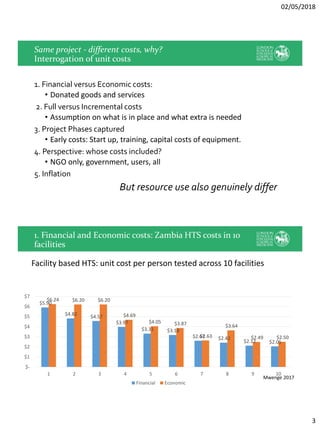
1. Financial versus Economic costs:
• Donated goods and services
2. Full versus Incremental costs
• Assumption on what is in place and what extra is needed
3. Project Phases captured
• Early costs: Start up, training, capital costs of equipment.
4. Perspective: whose costs included?
• NGO only, government, users, all
5. Inflation
But resource use also genuinely differ
Same project - different costs, why?
Interrogation of unit costs
1. Financial and Economic costs: Zambia HTS costs in 10
facilities
Mwenge 2017
$5.90
$4.82 $4.57
$3.97
$3.31 $3.18
$2.61 $2.42
$2.12 $2.05
$6.24 $6.20 $6.20
$4.69
$4.05 $3.87
$2.63
$3.64
$2.49 $2.50
$-
$1
$2
$3
$4
$5
$6
$7
1 2 3 4 5 6 7 8 9 10
Financial Economic
Facility based HTS: unit cost per person tested across 10 facilities
02/05/2018
4
1. Financial and Economic costs: Zambia HTS costs in 10
facilities
Mwenge 2017
$5.90
$4.82 $4.57
$3.97
$3.31 $3.18
$2.61 $2.42
$2.12 $2.05
$6.24 $6.20 $6.20
$4.69
$4.05 $3.87
$2.63
$3.64
$2.49 $2.50
$-
$1
$2
$3
$4
$5
$6
$7
1 2 3 4 5 6 7 8 9 10
Financial Economic
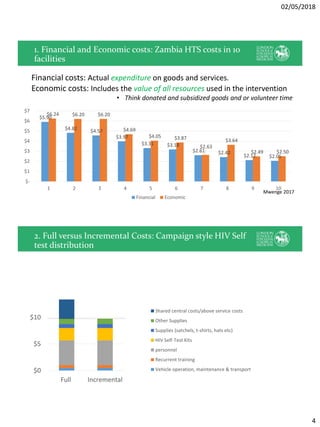
Financial costs: Actual expenditure on goods and services.
Economic costs: Includes the value of all resources used in the intervention
• Think donated and subsidized goods and or volunteer time
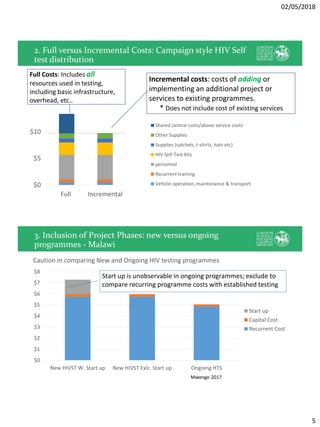
2. Full versus Incremental Costs: Campaign style HIV Self
test distribution
$0
$5
$10
Full Incremental
Shared central costs/above service costs
Other Supplies
Supplies (satchels, t-shirts, hats etc)
HIV Self-Test Kits
personnel
Recurrent training
Vehicle operation, maintenance & transport
02/05/2018
5
2. Full versus Incremental Costs: Campaign style HIV Self
test distribution
$0
$5
$10
Full Incremental
Shared central costs/above service costs
Other Supplies
Supplies (satchels, t-shirts, hats etc)
HIV Self-Test Kits
personnel
Recurrent training
Vehicle operation, maintenance & transport
Incremental costs: costs of adding or
implementing an additional project or
services to existing programmes.
* Does not include cost of existing services
Full Costs: Includes all
resources used in testing,
including basic infrastructure,
overhead, etc..
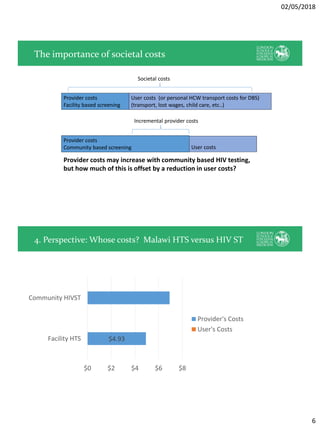
3. Inclusion of Project Phases: new versus ongoing
programmes - Malawi
$0
$1
$2
$3
$4
$5
$6
$7
$8
New HIVST W. Start up New HIVST Exlc. Start up Ongoing HTS
Caution in comparing New and Ongoing HIV testing programmes
Start up
Capital Cost
Recurrent Cost
Start up is unobservable in ongoing programmes; exclude to
compare recurring programme costs with established testing
Mwenge 2017
02/05/2018
6
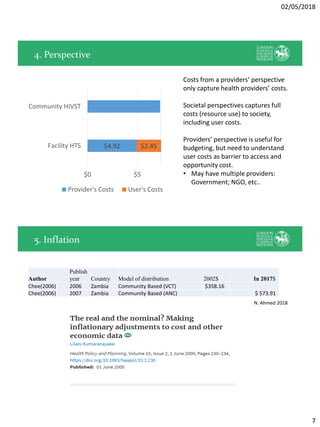
The importance of societal costs
User costs
Provider costs
Facility based screening
Provider costs
Community based screening
User costs (or personal HCW transport costs for DBS)
(transport, lost wages, child care, etc..)
Incremental provider costs
Societal costs
Provider costs may increase with community based HIV testing,
but how much of this is offset by a reduction in user costs?
4. Perspective: Whose costs? Malawi HTS versus HIV ST
$4.93
$0 $2 $4 $6 $8
Facility HTS
Community HIVST
Provider's Costs
User's Costs
02/05/2018
7
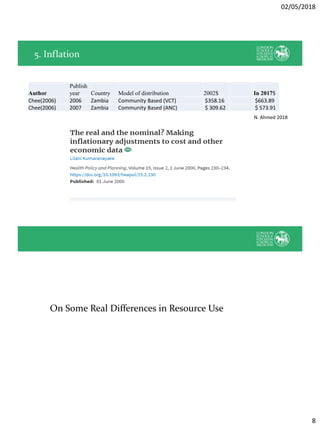
4. Perspective
$4.92 $2.45
$0 $5 $10
Facility HTS
Community HIVST
Provider's Costs User's Costs
Costs from a providers’ perspective
only capture health providers’ costs.
Societal perspectives captures full
costs (resource use) to society,
including user costs.
Providers’ perspective is useful for
budgeting, but need to understand
user costs as barrier to access and
opportunity cost.
• May have multiple providers:
Government; NGO, etc..
5. Inflation
Author
Publish
year Country Model of distribution 2002$ In 2017$
Chee(2006) 2006 Zambia Community Based (VCT) $358.16
Chee(2006) 2007 Zambia Community Based (ANC) $ 573.91
N. Ahmed 2018
02/05/2018
8
5. Inflation
Author
Publish
year Country Model of distribution 2002$ In 2017$
Chee(2006) 2006 Zambia Community Based (VCT) $358.16 $663.89
Chee(2006) 2007 Zambia Community Based (ANC) $ 309.62 $ 573.91
N. Ahmed 2018
On Some Real Differences in Resource Use
02/05/2018
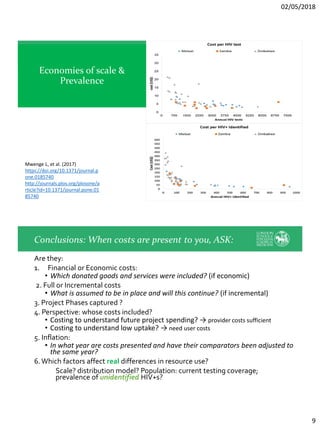
9
Economies of scale &
Prevalence
Mwenge L, et al. (2017)
https://doi.org/10.1371/journal.p
one.0185740
http://journals.plos.org/plosone/a
rticle?id=10.1371/journal.pone.01
85740
Are they:
1. Financial or Economic costs:
• Which donated goods and services were included? (if economic)
2. Full or Incremental costs
• What is assumed to be in place and will this continue? (if incremental)
3. Project Phases captured ?
4. Perspective: whose costs included?
• Costing to understand future project spending? → provider costs sufficient
• Costing to understand low uptake? → need user costs
5. Inflation:
• In what year are costs presented and have their comparators been adjusted to
the same year?
6.Which factors affect real differences in resource use?
Scale? distribution model? Population: current testing coverage;
prevalence of unidentified HIV+s?
Conclusions: When costs are present to you, ASK:
02/05/2018
10
Costing HIV testing:
Costing for budgets
Gesine Meyer-Rath
Health Economics and Epidemiology Research Office (HE2RO)
University of the Witwatersrand/
Boston University
Health Economics and Epidemiology Research Office
Wits Health Consortium
University of the Witwatersrand
HE RO
2
Health Economics and Epidemiology Research Office
Wits Health Consortium
University of the Witwatersrand
HE RO
2
Budget impact analysis – why?
• Economic analysis (cost effectiveness analysis) answers the question “Should we
do it?”
– often compared to other options
– always includes outcomes (LY, QALYs, DALYs, etc)
• Budget impact analysis answers the question “Can we afford it?”
– compared to an existing budget
– does not include outcomes (but includes cost impact)
• Affordability should never be the first, but will often be the second question to ask
before implementing a new intervention
02/05/2018
11
Health Economics and Epidemiology Research Office
Wits Health Consortium
University of the Witwatersrand
HE RO
2
Budget impact analysis: Uses
• Allows a government that has made up its mind about its priorities to
decide on the exact strategy for initiating or increasing coverage with a
new programme and commit the necessary resources
• The answer a BIA gives might be simple, but often it is exactly the answer
to the question that a government (or funder) has asked
Budget impact analysis: Principles
• Know the budget holder (government, Global Fund)
• Budget holder defines perspective, which cost items to include and time
frame (= budget period)
• Include all follow-on and replacement effects from introducing new
technology
– Follow-on: Increased uptake of ART and VMMC etc
– Replacement: Reduction in rapid testing due to increase in self testing
• No discounting; capital costs not annualised (current value of future
streams of money)
• Limited sensitivity analysis (consider scenario analysis); validation with
decision makers
Mauskopf JA et alT: Principles of Good Practice for Budget Impact Analysis: Report of the ISPOR Task Force on Good Research Practices - Budget Impact Analysis. Value Health 10(5):336-347 (2007)
Sullivan SD, et al: Budget impact analysis-principles of good practice: report of the ISPOR 2012 Budget Impact Analysis Good Practice II Task Force. Value Health. 2014 Jan-Feb;17(1):5-14. doi:
10.1016/j.jval.2013.08.2291. Epub 2013 Dec 13.
02/05/2018
12
Health Economics and Epidemiology Research Office
Wits Health Consortium
University of the Witwatersrand
HE RO
2
Example: Costing for economic evaluation
Total cost[2016 US$] Cost per test distributed [2016 US$]
Start-up costs
Training 8,349 $0.06
Sensitisation 64,586 $0.47
Start-up other 107,283 $0.78
Capital costs
Building & storage 12,662 $0.09
Equipment 16,660 $0.12
Vehicles and bicycles 3,095 $0.02
Total costs (capital and start-up) 212,635 $1.54
Recurrent costs
Personnel 217,519 $1.58
HIV self-test kits 347,038 $2.40
Supplies 33,685 $0.24
Vehicles 98,826 $0.72
Buildings 1,795 $0.01
Recurrent training 13,135 $0.10
Other recurrent 95,730 $0.69
Total costs (recurrent) 807,729 $5.74
Total HIVST costs 1,020,364 $7.28
Health Economics and Epidemiology Research Office
Wits Health Consortium
University of the Witwatersrand
HE RO
2
Assuming
• same target population
and coverage as in original
cost analysis
• Budget holder (government)
does not pay for test kits
• Initial training is repeated
every three years
• Other capital costs have a
useful life of 5 years
(beyond budget cycle)
Annual cost 2019/20 2020/21 2021/22 2022/23
Start-up costs
Training 10,019 30,057 - - 30,057
Sensitisation 77,504 232,511 - - -
Start-up other 128,739 386,218 - - -
Capital costs
Building & storage 15,194 75,970 - - -
Equipment 19,992 99,960 - - -
Vehicles and bicycles 3,714 18,568 - - -
Total capital/ start-up costs 255,162 843,286 - - 30,057
Recurrent costs
Personnel 261,023 261,023 261,023 261,023 261,023
HIV self-test kits 416,445 - - - -
Supplies 40,423 40,423 40,423 40,423 40,423
Vehicles 118,591 118,591 118,591 118,591 118,591
Buildings 2,155 2,155 2,155 2,155 2,155
Recurrent training 15,762 15,762 15,762 15,762 15,762
Other recurrent 114,876 114,876 114,876 114,876 114,876
Total costs (recurrent) 969,275 969,275 969,275 969,275 969,275
Total HIVST costs 1,224,437 1,812,560 969,275 969,275 999,332
Example: Costing for budget impact analysis
02/05/2018
13
Health Economics and Epidemiology Research Office
Wits Health Consortium
University of the Witwatersrand
HE RO
2
Summary:
Turning a cost estimate into a budget estimate
1. Decide on the budget holder → time period, cost items included
2. Start with annual costs from literature
3. De-annualise capital costs
4. Calculate cost per person covered/ tested
5. Estimate target population for new intervention, coverage and incremental annual cost
6. Estimate replacement or increased uptake of existing interventions
7. Estimate target population for old interventions, coverage and incremental annual cost, taking (6)
into account
8. Total budget needed for new intervention is incremental cost of new intervention (5) + incremental
cost of old interventions (7)
9. If you have a circumscript existing budget that will cover the new intervention, compare to this
10. DO NOT say “This is affordable”, unless you are the budget holder!
Costing Methods:
Vassal et al. 2018 Reference Case for Estimating the Costs ofGlobal Health Services and
Interventions https://ghcosting.org/pages/standards/reference_case
Reporting guidelines for economic evaluations, goes beyond costing, useful quality checklist:
Husereau 2013 https://www.bmj.com/content/bmj/346/bmj.f1049.full.pdf
Budget Impact Analysis Methods:
Mauskopf JA et al, Principles ofGood Practice for Budget ImpactAnalysis: Report of the
ISPORTask Force on Good Research Practices - Budget ImpactAnalysis.Value Health
10(5):336-347 (2007) https://www.valueinhealthjournal.com/article/S1098-3015(10)60471-
8/pdf?_returnURL=https%3A%2F%2Flinkinghub.elsevier.com%2Fretrieve%2Fpii%2FS1098301510604718%3Fshowall%3Dtrue
Sullivan SD, et al, Budget impact analysis-principles of good practice: report of the ISPOR
2012 Budget ImpactAnalysisGood Practice IITask Force.Value Health. 2014 Jan-Feb;17(1):5-
14. doi: 10.1016/j.jval.2013.08.2291. Epub 2013 Dec 13.
https://www.ispor.org/ValueInHealth/ShowValueInHealth.aspx?issue=84FAD6EE-C76A-4B83-92D2-8C4DC0746E55
Resources

Costing HIV testing services: understanding and using data for decision making

  • 1.
    02/05/2018 1 Aim • Present keyquestions to allow you to interrogate the evidence on HIV testing costs • Support you to commission studies and define what cost evidence you need to inform your decisions: oPriority setting (economic evaluation) -Fern oAffordability: budget impact analysis - Gesine
  • 2.
    02/05/2018 2 Learning Outcomes • Bythe end of this session you should be able to: • Understand why HIV testing “costs” can vary so much • Recognise differences in costs: • Real resource use versus cost methods • Interpret varying definitions of costs and analysis methods and their uses • Understand the differences between costing for economic analysis and costing for budgeting • Define what type of analyses you need to address your key policy questions and commission suitable studies Costing HIV testing services: Costing for economic analysis Fern Terris-Prestholt, PhD Department of Global Health & Development London School of Hygiene & Tropical Medicine UNITAID PSI HIV SELF-TESTING AFRICA
  • 3.
    02/05/2018 3 1. Financial versusEconomic costs: • Donated goods and services 2. Full versus Incremental costs • Assumption on what is in place and what extra is needed 3. Project Phases captured • Early costs: Start up, training, capital costs of equipment. 4. Perspective: whose costs included? • NGO only, government, users, all 5. Inflation But resource use also genuinely differ Same project - different costs, why? Interrogation of unit costs 1. Financial and Economic costs: Zambia HTS costs in 10 facilities Mwenge 2017 $5.90 $4.82 $4.57 $3.97 $3.31 $3.18 $2.61 $2.42 $2.12 $2.05 $6.24 $6.20 $6.20 $4.69 $4.05 $3.87 $2.63 $3.64 $2.49 $2.50 $- $1 $2 $3 $4 $5 $6 $7 1 2 3 4 5 6 7 8 9 10 Financial Economic Facility based HTS: unit cost per person tested across 10 facilities
  • 4.
    02/05/2018 4 1. Financial andEconomic costs: Zambia HTS costs in 10 facilities Mwenge 2017 $5.90 $4.82 $4.57 $3.97 $3.31 $3.18 $2.61 $2.42 $2.12 $2.05 $6.24 $6.20 $6.20 $4.69 $4.05 $3.87 $2.63 $3.64 $2.49 $2.50 $- $1 $2 $3 $4 $5 $6 $7 1 2 3 4 5 6 7 8 9 10 Financial Economic Financial costs: Actual expenditure on goods and services. Economic costs: Includes the value of all resources used in the intervention • Think donated and subsidized goods and or volunteer time 2. Full versus Incremental Costs: Campaign style HIV Self test distribution $0 $5 $10 Full Incremental Shared central costs/above service costs Other Supplies Supplies (satchels, t-shirts, hats etc) HIV Self-Test Kits personnel Recurrent training Vehicle operation, maintenance & transport
  • 5.
    02/05/2018 5 2. Full versusIncremental Costs: Campaign style HIV Self test distribution $0 $5 $10 Full Incremental Shared central costs/above service costs Other Supplies Supplies (satchels, t-shirts, hats etc) HIV Self-Test Kits personnel Recurrent training Vehicle operation, maintenance & transport Incremental costs: costs of adding or implementing an additional project or services to existing programmes. * Does not include cost of existing services Full Costs: Includes all resources used in testing, including basic infrastructure, overhead, etc.. 3. Inclusion of Project Phases: new versus ongoing programmes - Malawi $0 $1 $2 $3 $4 $5 $6 $7 $8 New HIVST W. Start up New HIVST Exlc. Start up Ongoing HTS Caution in comparing New and Ongoing HIV testing programmes Start up Capital Cost Recurrent Cost Start up is unobservable in ongoing programmes; exclude to compare recurring programme costs with established testing Mwenge 2017
  • 6.
    02/05/2018 6 The importance ofsocietal costs User costs Provider costs Facility based screening Provider costs Community based screening User costs (or personal HCW transport costs for DBS) (transport, lost wages, child care, etc..) Incremental provider costs Societal costs Provider costs may increase with community based HIV testing, but how much of this is offset by a reduction in user costs? 4. Perspective: Whose costs? Malawi HTS versus HIV ST $4.93 $0 $2 $4 $6 $8 Facility HTS Community HIVST Provider's Costs User's Costs
  • 7.
    02/05/2018 7 4. Perspective $4.92 $2.45 $0$5 $10 Facility HTS Community HIVST Provider's Costs User's Costs Costs from a providers’ perspective only capture health providers’ costs. Societal perspectives captures full costs (resource use) to society, including user costs. Providers’ perspective is useful for budgeting, but need to understand user costs as barrier to access and opportunity cost. • May have multiple providers: Government; NGO, etc.. 5. Inflation Author Publish year Country Model of distribution 2002$ In 2017$ Chee(2006) 2006 Zambia Community Based (VCT) $358.16 Chee(2006) 2007 Zambia Community Based (ANC) $ 573.91 N. Ahmed 2018
  • 8.
    02/05/2018 8 5. Inflation Author Publish year CountryModel of distribution 2002$ In 2017$ Chee(2006) 2006 Zambia Community Based (VCT) $358.16 $663.89 Chee(2006) 2007 Zambia Community Based (ANC) $ 309.62 $ 573.91 N. Ahmed 2018 On Some Real Differences in Resource Use
  • 9.
    02/05/2018 9 Economies of scale& Prevalence Mwenge L, et al. (2017) https://doi.org/10.1371/journal.p one.0185740 http://journals.plos.org/plosone/a rticle?id=10.1371/journal.pone.01 85740 Are they: 1. Financial or Economic costs: • Which donated goods and services were included? (if economic) 2. Full or Incremental costs • What is assumed to be in place and will this continue? (if incremental) 3. Project Phases captured ? 4. Perspective: whose costs included? • Costing to understand future project spending? → provider costs sufficient • Costing to understand low uptake? → need user costs 5. Inflation: • In what year are costs presented and have their comparators been adjusted to the same year? 6.Which factors affect real differences in resource use? Scale? distribution model? Population: current testing coverage; prevalence of unidentified HIV+s? Conclusions: When costs are present to you, ASK:
  • 10.
    02/05/2018 10 Costing HIV testing: Costingfor budgets Gesine Meyer-Rath Health Economics and Epidemiology Research Office (HE2RO) University of the Witwatersrand/ Boston University Health Economics and Epidemiology Research Office Wits Health Consortium University of the Witwatersrand HE RO 2 Health Economics and Epidemiology Research Office Wits Health Consortium University of the Witwatersrand HE RO 2 Budget impact analysis – why? • Economic analysis (cost effectiveness analysis) answers the question “Should we do it?” – often compared to other options – always includes outcomes (LY, QALYs, DALYs, etc) • Budget impact analysis answers the question “Can we afford it?” – compared to an existing budget – does not include outcomes (but includes cost impact) • Affordability should never be the first, but will often be the second question to ask before implementing a new intervention
  • 11.
    02/05/2018 11 Health Economics andEpidemiology Research Office Wits Health Consortium University of the Witwatersrand HE RO 2 Budget impact analysis: Uses • Allows a government that has made up its mind about its priorities to decide on the exact strategy for initiating or increasing coverage with a new programme and commit the necessary resources • The answer a BIA gives might be simple, but often it is exactly the answer to the question that a government (or funder) has asked Budget impact analysis: Principles • Know the budget holder (government, Global Fund) • Budget holder defines perspective, which cost items to include and time frame (= budget period) • Include all follow-on and replacement effects from introducing new technology – Follow-on: Increased uptake of ART and VMMC etc – Replacement: Reduction in rapid testing due to increase in self testing • No discounting; capital costs not annualised (current value of future streams of money) • Limited sensitivity analysis (consider scenario analysis); validation with decision makers Mauskopf JA et alT: Principles of Good Practice for Budget Impact Analysis: Report of the ISPOR Task Force on Good Research Practices - Budget Impact Analysis. Value Health 10(5):336-347 (2007) Sullivan SD, et al: Budget impact analysis-principles of good practice: report of the ISPOR 2012 Budget Impact Analysis Good Practice II Task Force. Value Health. 2014 Jan-Feb;17(1):5-14. doi: 10.1016/j.jval.2013.08.2291. Epub 2013 Dec 13.
  • 12.
    02/05/2018 12 Health Economics andEpidemiology Research Office Wits Health Consortium University of the Witwatersrand HE RO 2 Example: Costing for economic evaluation Total cost[2016 US$] Cost per test distributed [2016 US$] Start-up costs Training 8,349 $0.06 Sensitisation 64,586 $0.47 Start-up other 107,283 $0.78 Capital costs Building & storage 12,662 $0.09 Equipment 16,660 $0.12 Vehicles and bicycles 3,095 $0.02 Total costs (capital and start-up) 212,635 $1.54 Recurrent costs Personnel 217,519 $1.58 HIV self-test kits 347,038 $2.40 Supplies 33,685 $0.24 Vehicles 98,826 $0.72 Buildings 1,795 $0.01 Recurrent training 13,135 $0.10 Other recurrent 95,730 $0.69 Total costs (recurrent) 807,729 $5.74 Total HIVST costs 1,020,364 $7.28 Health Economics and Epidemiology Research Office Wits Health Consortium University of the Witwatersrand HE RO 2 Assuming • same target population and coverage as in original cost analysis • Budget holder (government) does not pay for test kits • Initial training is repeated every three years • Other capital costs have a useful life of 5 years (beyond budget cycle) Annual cost 2019/20 2020/21 2021/22 2022/23 Start-up costs Training 10,019 30,057 - - 30,057 Sensitisation 77,504 232,511 - - - Start-up other 128,739 386,218 - - - Capital costs Building & storage 15,194 75,970 - - - Equipment 19,992 99,960 - - - Vehicles and bicycles 3,714 18,568 - - - Total capital/ start-up costs 255,162 843,286 - - 30,057 Recurrent costs Personnel 261,023 261,023 261,023 261,023 261,023 HIV self-test kits 416,445 - - - - Supplies 40,423 40,423 40,423 40,423 40,423 Vehicles 118,591 118,591 118,591 118,591 118,591 Buildings 2,155 2,155 2,155 2,155 2,155 Recurrent training 15,762 15,762 15,762 15,762 15,762 Other recurrent 114,876 114,876 114,876 114,876 114,876 Total costs (recurrent) 969,275 969,275 969,275 969,275 969,275 Total HIVST costs 1,224,437 1,812,560 969,275 969,275 999,332 Example: Costing for budget impact analysis
  • 13.
    02/05/2018 13 Health Economics andEpidemiology Research Office Wits Health Consortium University of the Witwatersrand HE RO 2 Summary: Turning a cost estimate into a budget estimate 1. Decide on the budget holder → time period, cost items included 2. Start with annual costs from literature 3. De-annualise capital costs 4. Calculate cost per person covered/ tested 5. Estimate target population for new intervention, coverage and incremental annual cost 6. Estimate replacement or increased uptake of existing interventions 7. Estimate target population for old interventions, coverage and incremental annual cost, taking (6) into account 8. Total budget needed for new intervention is incremental cost of new intervention (5) + incremental cost of old interventions (7) 9. If you have a circumscript existing budget that will cover the new intervention, compare to this 10. DO NOT say “This is affordable”, unless you are the budget holder! Costing Methods: Vassal et al. 2018 Reference Case for Estimating the Costs ofGlobal Health Services and Interventions https://ghcosting.org/pages/standards/reference_case Reporting guidelines for economic evaluations, goes beyond costing, useful quality checklist: Husereau 2013 https://www.bmj.com/content/bmj/346/bmj.f1049.full.pdf Budget Impact Analysis Methods: Mauskopf JA et al, Principles ofGood Practice for Budget ImpactAnalysis: Report of the ISPORTask Force on Good Research Practices - Budget ImpactAnalysis.Value Health 10(5):336-347 (2007) https://www.valueinhealthjournal.com/article/S1098-3015(10)60471- 8/pdf?_returnURL=https%3A%2F%2Flinkinghub.elsevier.com%2Fretrieve%2Fpii%2FS1098301510604718%3Fshowall%3Dtrue Sullivan SD, et al, Budget impact analysis-principles of good practice: report of the ISPOR 2012 Budget ImpactAnalysisGood Practice IITask Force.Value Health. 2014 Jan-Feb;17(1):5- 14. doi: 10.1016/j.jval.2013.08.2291. Epub 2013 Dec 13. https://www.ispor.org/ValueInHealth/ShowValueInHealth.aspx?issue=84FAD6EE-C76A-4B83-92D2-8C4DC0746E55 Resources