PHARMACEUTICAL
MICROBIOLOGY
UNIT-III
Prepared by:- Ms. Akanksha Panjabrao
Dhoke
(Assistant Professor)
Nagpur College of Pharmacy, Nagpur.
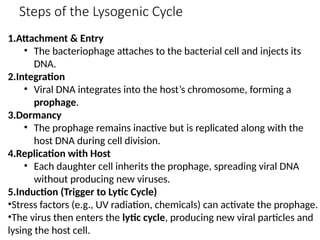
Steps of the Lysogenic Cycle
1.Attachment & Entry
• The bacteriophage attaches to the bacterial cell and injects its
DNA.
2.Integration
• Viral DNA integrates into the host’s chromosome, forming a
prophage.
3.Dormancy
• The prophage remains inactive but is replicated along with the
host DNA during cell division.
4.Replication with Host
• Each daughter cell inherits the prophage, spreading viral DNA
without producing new viruses.
5.Induction (Trigger to Lytic Cycle)
•Stress factors (e.g., UV radiation, chemicals) can activate the prophage.
•The virus then enters the lytic cycle, producing new viral particles and
lysing the host cell.
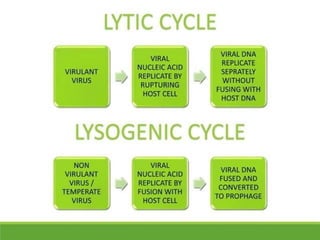
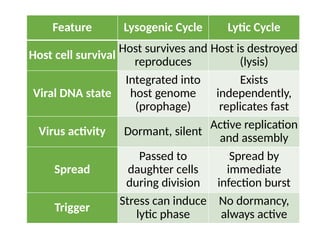
Feature Lysogenic Cycle Lytic Cycle
Host cell survival
Host survives and
reproduces
Host is destroyed
(lysis)
Viral DNA state
Integrated into
host genome
(prophage)
Exists
independently,
replicates fast
Virus activity Dormant, silent
Active replication
and assembly
Spread
Passed to
daughter cells
during division
Spread by
immediate
infection burst
Trigger
Stress can induce
lytic phase
No dormancy,
always active
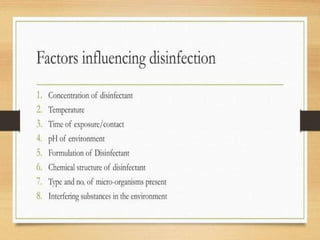
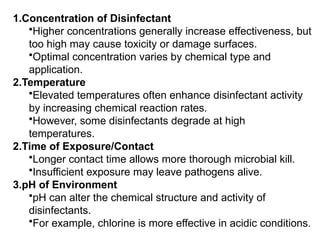
1.Concentration of Disinfectant
•Higher concentrations generally increase effectiveness, but
too high may cause toxicity or damage surfaces.
•Optimal concentration varies by chemical type and
application.
2.Temperature
•Elevated temperatures often enhance disinfectant activity
by increasing chemical reaction rates.
•However, some disinfectants degrade at high
temperatures.
2.Time of Exposure/Contact
•Longer contact time allows more thorough microbial kill.
•Insufficient exposure may leave pathogens alive.
3.pH of Environment
•pH can alter the chemical structure and activity of
disinfectants.
•For example, chlorine is more effective in acidic conditions.
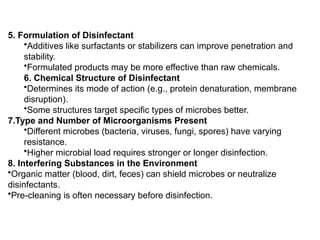
5. Formulation of Disinfectant
•Additives like surfactants or stabilizers can improve penetration and
stability.
•Formulated products may be more effective than raw chemicals.
6. Chemical Structure of Disinfectant
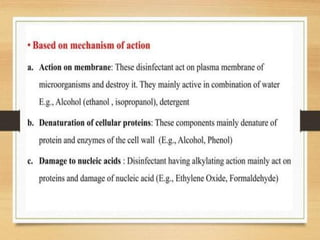
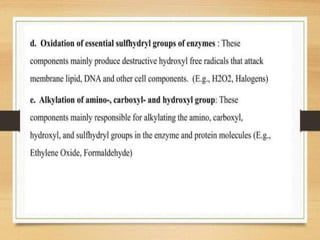
•Determines its mode of action (e.g., protein denaturation, membrane
disruption).
•Some structures target specific types of microbes better.
7.Type and Number of Microorganisms Present
•Different microbes (bacteria, viruses, fungi, spores) have varying
resistance.
•Higher microbial load requires stronger or longer disinfection.
8. Interfering Substances in the Environment
•Organic matter (blood, dirt, feces) can shield microbes or neutralize
disinfectants.
•Pre-cleaning is often necessary before disinfection.
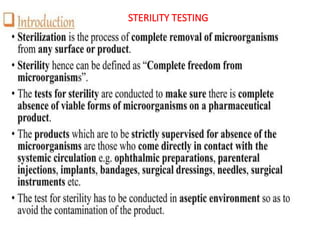
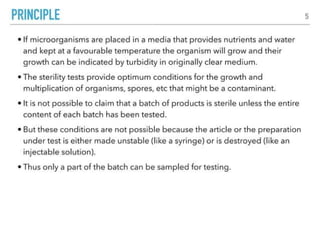
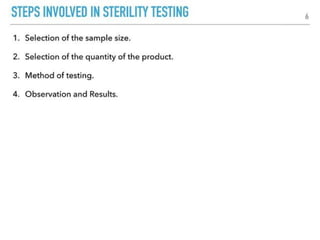
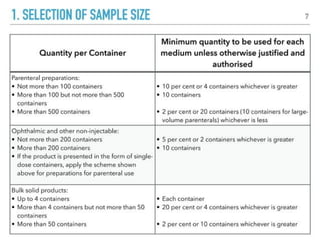
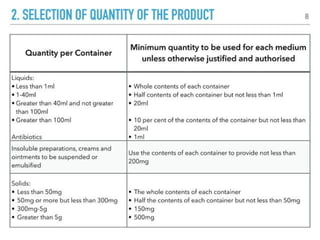
STERILITY TESTING
PHARMACEUTICAL MICROBIOLOGY UNIT 3 NOTES.pptx

PHARMACEUTICAL MICROBIOLOGY UNIT 3 NOTES.pptx

  • 1.
    PHARMACEUTICAL MICROBIOLOGY UNIT-III Prepared by:- Ms.Akanksha Panjabrao Dhoke (Assistant Professor) Nagpur College of Pharmacy, Nagpur.
  • 58.
    Steps of theLysogenic Cycle 1.Attachment & Entry • The bacteriophage attaches to the bacterial cell and injects its DNA. 2.Integration • Viral DNA integrates into the host’s chromosome, forming a prophage. 3.Dormancy • The prophage remains inactive but is replicated along with the host DNA during cell division. 4.Replication with Host • Each daughter cell inherits the prophage, spreading viral DNA without producing new viruses. 5.Induction (Trigger to Lytic Cycle) •Stress factors (e.g., UV radiation, chemicals) can activate the prophage. •The virus then enters the lytic cycle, producing new viral particles and lysing the host cell.
  • 59.
    Feature Lysogenic CycleLytic Cycle Host cell survival Host survives and reproduces Host is destroyed (lysis) Viral DNA state Integrated into host genome (prophage) Exists independently, replicates fast Virus activity Dormant, silent Active replication and assembly Spread Passed to daughter cells during division Spread by immediate infection burst Trigger Stress can induce lytic phase No dormancy, always active
  • 77.
    1.Concentration of Disinfectant •Higherconcentrations generally increase effectiveness, but too high may cause toxicity or damage surfaces. •Optimal concentration varies by chemical type and application. 2.Temperature •Elevated temperatures often enhance disinfectant activity by increasing chemical reaction rates. •However, some disinfectants degrade at high temperatures. 2.Time of Exposure/Contact •Longer contact time allows more thorough microbial kill. •Insufficient exposure may leave pathogens alive. 3.pH of Environment •pH can alter the chemical structure and activity of disinfectants. •For example, chlorine is more effective in acidic conditions.
  • 78.
    5. Formulation ofDisinfectant •Additives like surfactants or stabilizers can improve penetration and stability. •Formulated products may be more effective than raw chemicals. 6. Chemical Structure of Disinfectant •Determines its mode of action (e.g., protein denaturation, membrane disruption). •Some structures target specific types of microbes better. 7.Type and Number of Microorganisms Present •Different microbes (bacteria, viruses, fungi, spores) have varying resistance. •Higher microbial load requires stronger or longer disinfection. 8. Interfering Substances in the Environment •Organic matter (blood, dirt, feces) can shield microbes or neutralize disinfectants. •Pre-cleaning is often necessary before disinfection.
  • 92.