TABLE OF CONTENT
•INTRODUCTION
• PARENTERALS
• TYPES OF PARENTERALS
• FILLING OF PARENTERALS IN
PHARMACEUTICAL INDUSTRY
• TYPES OF FILLING MACHINE
• FILLING TECHNIQUES
• STERILIZATIONSTERILIZATION IN FILLING
PROCESS
• IMPORTANCE OF STERILIZATION
• METHODS OF STERILIZATION
• PACKAGING OF PARENTERAL
• TYPES OF PACKAGING USED
• PACKAGING TECHNIQUES
• LABELING AND CODING IMPORTANCE
3.
Parenterals:
Parenterals are pharmaceuticalproducts that are
administered through injection, infusion, or
implantation. They are sterile, pyrogen-free
preparations that are designed to be introduced
directly into the body, bypassing the digestive
system. Parenterals can be solutions, suspensions,
emulsions, or powders for reconstitution, and are
used to treat a wide range of diseases and
conditions.
INTRODUCTION
4.
Solutions: Homogeneous mixtures(e.g., normal saline, antibiotic solutions)
Suspensions: Mixtures with suspended particles (e.g., insulin, vaccine
suspensions)- Emulsions: Mixtures of immiscible liquids (e.g., TPN emulsions,
lipid emulsions)- Powders for Reconstitution: Dry powders reconstituted with a
solvent (e.g., antibiotic powders, vaccine powders)
Freeze-Dried Products (Lyophilized): Products frozen and subjected to vacuum
(e.g., vaccine lyophilizes, antibiotic lyophilizes).
TYPES OF PRENTERALS
5.
The filling processof parenterals involves filling sterile liquids or powders into clean, sterile
containers, which are then sealed and labeled. The process requires specialized equipment to
ensure sterility, accuracy, and precision. The equipment used includes filling machines,
sterilization tunnels, and environmental control systems.
These are some of the main types of filling machines used in the pharmaceutical industry. Each
type has its own advantages and disadvantages, and the choice of machine depends on the specific
application and production requrequirement
1. piston Fillers
2. Peristaltic Pumps
FILLING OF PARENTERALS IN PHARMACEUTICAL
INDUSTRY
TYPES OF FILLING
MACHINES
1. Piston Fillers
Principle:Use a piston and cylinder mechanism to fill liquids into
containers.- Operation: The piston moves up and down, creating a
suction effect that draws the liquid into the cylinder. The liquid is then
pushed into the container through a nozzle.
Advantages: Accurate filling, and suitable for thick or viscous liquids.
2. Peristaltic Pumps
Principle: Use a rotating roller to push liquid through a flexible tube, filling
containers accurately.
Operation: The roller compresses the tube, pushing the liquid through it
and into the container.
Advantages; low shear rate, and suitable for sensitive or fragile liquids.use
for the filling of ampule and vials.
8.
3. Time-Pressure Fillers
Principle:Fill containers using a combination of time and pressure.
Operation; The machine fills the container for a set time, and then applies
pressure to ensure accurate filling.
Advantages: Fast filling rates, accurate filling, and suitable for large-scale
production. Use for filling of ampules.
4. Volumetric Fillers
Principle: Fill containers using a precise volume measurement.
Operation: The machine fills the container with a precise volume of liquid,
using a measuring cylinder or piston.
Advantages: Accurate filling, easy to set up, and suitable for small-scale
production.
9.
5. Aseptic Fillers
Principle:Fill containers in a sterile environment, using RABS (Restricted
Access Barrier Systems).
Operation: The machine fills the container in a sterile environment, minimizing
the risk of contamination.
Advantages: Suitable for filling sterile liquids such as vials ampoules syringes
of insulin , reduces risk of contamination, and meets regulatory requirements.
6. Rotary Fillers
Principle: Fill containers using a rotating filling head.
Operation: The filling head rotates, filling multiple containers simultaneously.-
Advantages: Fast filling rates, accurate filling, and suitable for large-scale
production,Filling of vials.
10.
7. Linear Fillers
Principle:Fill containers using a linear filling head.
Operation: The filling head moves in a linear motion, filling containers one by
one. - Advantages:Accurate filling, easy to set up, and suitable for small-scale
production. Fills vials accurately.
8.Automatic Fillers
Principle: Fill containers automatically, using sensors and programmable logic
controllers (PLCs).
Operation: The machine fills containers automatically, using pre-set
parameters and sensors to detect container presence and filling levels.
Advantages: Fast filling rates, accurate filling, and reduces labor costs.filling of
ampules.
11.
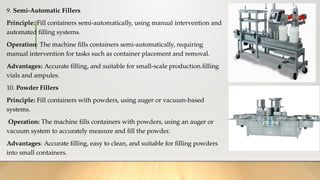
9. Semi-Automatic Fillers
Principle:Fill containers semi-automatically, using manual intervention and
automated filling systems.
Operation: The machine fills containers semi-automatically, requiring
manual intervention for tasks such as container placement and removal.
Advantages: Accurate filling, and suitable for small-scale production.filling
vials and ampules.
10. Powder Fillers
Principle: Fill containers with powders, using auger or vacuum-based
systems.
Operation: The machine fills containers with powders, using an auger or
vacuum system to accurately measure and fill the powder.
Advantages: Accurate filling, easy to clean, and suitable for filling powders
into small containers.
12.
1. Vacuum Filling
Principle:Uses a vacuum to create a pressure difference, allowing the liquid
to flow into the container.
Operation: The container is placed on a filling machine, and a vacuum is
created inside the container. The liquid is then drawn into the container
through a nozzle.-
2. Pressure Filling
Principle: Uses pressure to force the liquid into the container.
Operation: The liquid is pressurized, and then forced into the container
through a nozzle.
FILLING
TECHNIQUES
13.
3. Gravity Filling
Principle:Uses gravity to fill the container.
Operation: The liquid flows into the container under the influence of
gravity.
4. Pump Filling
Principle: Uses a pump to fill the container.
Operation: The pump creates a pressure difference, allowing the liquid to
flow into the container.
Advantages: Accurate filling, suitable for filling liquids with high
viscosity.
14.
5. Auger Filling
Principle:Uses an auger (a screw-like mechanism) to fill powders or granules
into containers.
Operation: The auger rotates, creating a flow of powder or granules into the
container.
Advantages: Accurate filling, suitable for filling powders or granules, and fast
filling rates.
6. Vacuum-Pressure Filling
Principle: Combines vacuum and pressure filling techniques to fill
containers.- Operation: The container is first evacuated using a vacuum, and
then filled using pressure.-
Advantages: Accurate filling, minimal foaming, and suitable for filling liquids
with low viscosity
15.
Sterilization is acritical step in the filling process of parenteral products. The primary goal of sterilization is to
eliminate all forms of microbial life, including bacteria, viruses, and fungi, from the product, container, and
equipment.
1. Ensures Product Safety: Sterilization ensures that the product is free from microbial contamination,
which can cause serious health risks to patients.
2. Prevents Contamination: Sterilization prevents contamination of the product during the filling process,
which can occur through equipment, containers, or personnel.
3. Meets Regulatory Requirements: Sterilization is a regulatory requirement for parenteral products, and
failure to comply can result in product recalls, fines, or even plant shutdowns.
4. Maintains Product Quality: Sterilization helps maintain the quality of the product by preventing
degradation or spoilage due to microbial contamination.
IMPORTANCE OF
STERILIZATION
STERILIZATION IN FILLING PROCESS
1 Moist heat
•Moist heat sterilization, a widely used method, employs saturated steam under pressure
(like in an autoclave) to kill microorganisms by denaturing their proteins, achieving
sterilization at lower temperatures and shorter durations.
18.
• Method :
•Autoclaving: This is the most common and reliable method, using a pressurized steam
chamber to achieve high temperatures (e.g., 121°C or 250°F) and pressures, ensuring effective
sterilization
• Advantages
• Moist heat sterilization is highly effective in killing a wide range of microorganisms,
including bacteria, viruses, and spores. It can be used for various materials, including vials
ampules.
19.
2 Dry heatsterilization
• Dry heat sterilization uses high temperatures (160-190°C) and dry air to kill
microorganisms, effectively destroying proteins and nucleic acids through oxidation, and
is suitable for heat-resistant items like glassware and metal instruments.
• Types
• Static-air sterilizers (oven-type)
• Forced-air sterilizers[ uses fans to distribute dry hot air ]
20.
3 Radiation sterilization
•Radiation sterilization uses high-energy ionizing radiation (like gamma rays or electron
beams) to kill microorganisms and ensure sterility in medical devices, pharmaceuticals,
and other products.
• Ionizing radiation damages the DNA of microorganisms, rendering them unable to
replicate and causing cell death.
21.
Types
• Gamma rays:Generated from radioactive sources like cobalt-60
• Electron beams: Produced by accelerators
• X-rays: Also generated by accelerators
• Application
• Sterilizing single-use medical devices like syringes, surgical gloves, and other
equipment.
• Radiation is highly effective at killing microorganisms. Used in pharmaceutical
industry mainly.
22.
4 Gas sterilization
•Gas sterilization, particularly using ethylene oxide (EtO), is a method for sterilizing heat-
and moisture-sensitive medical devices and other materials by exposing them to a gas in
a closed chamber, ensuring effective microbial inactivation without damaging the
materials. The gas sterilant reacts with cellular components of microorganisms, such as
nucleic acids and proteins, leading to their inactivation and cell death.
23.
1 Ethylene Oxide(EtO)
EtO is a colorless, flammable, and explosive gas that is used to sterilize heat- and
moisture-sensitive medical devices. EtO is effective against a wide range of
microorganisms, including bacteria, fungi, viruses, and spores
Uses ;
EtO sterilization can be used for heat-sensitive materials that cannot be sterilized
using high-temperature methods.
24.
2 Hydrogen PeroxideGas Plasma Sterilization:
• Hydrogen peroxide gas plasma involves converting hydrogen peroxide into a plasma
state, which is a highly reactive form of gas. The plasma reacts with the microorganisms,
killing them.
• Gas sterilization mainly used for heat sensitive products
25.
5 Filter sterilization
•Filter sterilization removes microorganisms from heat-sensitive liquids by passing them
through fine-pore membrane filters, trapping microbes on or within the filter material,
thus ensuring sterility without damaging the liquid.
• The process involves forcing a liquid through a filter with very small pores (typically 0.2
microns or smaller).
• Microorganisms, bacteria, mold, and yeast, which are larger than the pore size, are
trapped and cannot pass through the filter, leaving the filtrate sterile.
26.
Types of filters
•Various filter materials can be used, including nylon, polycarbonate, cellulose acetate,
polyvinylidene fluoride (PVDF), and polyethersulfone (PES).
• 1 Depth filters
• 2 Membrane filters
• 3 Neucleopore membranes
• 0.2 and 0.22 µm filters are considered "sterilizing-grade"
27.
Overview :
The packagingprocess of parenterals involves filling and sealing the product into a container, which is
then packaged with labeling and other ancillary materials. The packaging process requires careful
selection of materials to ensure the integrity and sterility of the product.
Packaging Process
1. Container Filling: The parenteral product is filled into a container, such as a vial, ampoule, or syringe.
2. Sealing: The container is sealed using a stopper, cap, or seal.
3. Labeling: The container is labeled with product information, including the name, strength, and
expiration date.
4. Packaging: The labeled container is packaged with ancillary materials, such as instructions for use,
packaging inserts, and outer packaging.
PACKAGING OF PARENTERALS
28.
Types of PackagingMaterials
1. Glass-
Advantages: Non-reactive, transparent, and can be sterilized by heat or radiation.- Disadvantages: Brittle,
prone to breakage, and can be heavy.
Uses : Vials, ampoules, and syringes.
2. Plastic
Advantages: Lightweight, flexible, and can be molded into various shapes.-Disadvantages: May react with
certain products, can be permeable to gases, and may degrade over time.
Uses: Bottles, vials, and syringes.
3. Rubber
Advantages: Flexible, impermeable to gases, and can be used for stoppers and seals.- Disadvantages: May react
with certain products, can be prone to degradation, and may require additional processing.
Uses: Stoppers, seals, and syringe plungers.
29.
4. Metal
Advantages: Strong,impermeable to gases, and can be used for containers and
equipment.
Disadvantages: May react with certain products, can be heavy, and may require
additional processing.
Uses: Containers, equipment, and packaging components.
5. Paper and Paperboard
Advantages: Inexpensive, lightweight, and can be used for packaging inserts and
labels.
Disadvantages: May not be suitable for high-moisture environments, can be prone to
degradation, and may not provide adequate protection.
Uses: Packaging inserts, labels, and outer packaging.*
30.
6. Foil andLaminates
Advantages: Impermeable to gases, can provide additional protection, and can be used for
packaging components.
Disadvantages: May be prone to pinholing, can be expensive, and may require additional
processing.
Uses: Packaging components, such as blister packs and pouches.
31.
1. Wire Crimping
Principle:Uses a wire to seal the container by crimping it around the neck of the container.
Operation: The wire is placed around the neck of the container and then crimped using a wire crimping
machine.
Advantages: Provides a secure seal, tamper-evident, suitable for filling liquids and powders.
2. Stopper Placement
Principle: Uses a stopper to seal the container by placing it on top of the container.
Operation: The stopper is placed on top of the container and then seated using a stopper placement
machine.
Advantages: Provides a secure seal, suitable for filling liquids and powders, and can be used for various
container sizes.
PACKAGING TECHNIQUES
32.
4. Tip CapFilling
Principle: Uses a tip cap to seal the container by placing it on top of the container.- Operation: The tip cap is placed on top of the container and then
seated using a tip cap filling machine
advantages: Provides a secure seal, tamper-evident, and suitable for filling liquids and powders.
5. Blow-Fill-Seal (BFS) Technology
Principle: Uses a combination of blowing, filling, and sealing to package liquids and powders.
Operation: The container is formed, filled, and sealed in a single operation using a BFS machine.- Advantages: Provides a secure seal, tamper-evident,
and suitable for filling liquids and powders.
6. Automatic Vial Filling and Sealing
Principle: Uses a machine to fill and seal vials with a precise volume of liquid.
Operation: The machine fills the vial with a precise volume of liquid and then seals it using a stopper or cap.- Advantages: Accurate filling, fast filling
rates, and suitable for filling liquids with high viscosity.
7. Syringe Filling and Assembly
Principle: Uses a machine to fill and assemble syringes with a precise volume of liquid.
Operation: The machine fills the syringe with a precise volume of liquid and then assembles the syringe components, including the plunger and needle.
Advantages: Accurate filling, fast filling rates, and suitable for filling liquids with high viscosity.These are some of the common packaging techniques
used for parenterals
33.
1. Product Identification:Labels provide essential information about the product, including its name, strength,
and expiration date.
2. Safety Information: Labels provide critical safety information, including warnings, precautions, and
contraindications.
3. Dosage Instructions: Labels provide instructions on how to use the product, including dosage, administration,
and storage.
4. Regulatory Compliance: Labels must comply with regulatory requirements, including those related to labeling
content, format, and language.
Importance of Coding
5. Product Tracking: Codes enable tracking of products throughout the supply chain, from manufacturing to
distribution.
6. Counterfeit Prevention: Codes help prevent counterfeiting by providing a unique identifier for each product.
7. Recall Management: Codes facilitate recall management by enabling quick identification of affected products.
Importance of Labeling
34.
1. Ensures ProductSafety: Quality control ensures that products meet safety standards,
reducing the risk of harm to patients.
2. Ensures Product Efficacy: Quality control ensures that products meet efficacy standards,
ensuring that they work as intended.
3. Prevents Recalls: Quality control helps prevent recalls by detecting defects or non-
conformities before products are released to the market.
4. Maintains Regulatory Compliance: Quality control ensures that products meet regulatory
requirements, maintaining compliance with laws and regulations.
Importance of Quality Control




![2 Dry heat sterilization
• Dry heat sterilization uses high temperatures (160-190°C) and dry air to kill
microorganisms, effectively destroying proteins and nucleic acids through oxidation, and
is suitable for heat-resistant items like glassware and metal instruments.
• Types
• Static-air sterilizers (oven-type)
• Forced-air sterilizers[ uses fans to distribute dry hot air ]](https://image.slidesharecdn.com/pharmaceuticalfillingandpackaging-250512044807-08f56f5e/85/Pharmaceutical-filing-and-packaging-pptx-19-320.jpg)