QUESTION
Whenever you wonder how the world is working?
Why we have to do thing in a specific way?
How is our society working?
 Could you name the common things in the following
example?
Car engine
Human body
University
Software
Manufacturer
MODULE 1:
INTRODUCTION TO
SYSTEM
Dr. Tuan Truong
SYSTEM STRUCTURES AND
BEHAVIORS
A SYSTEM IS A SET OF
THINGS INTERCONNECTED
IN SUCH A WAY THAT
THEY PRODUCE THEIR
OWN PATTERN OF
BEHAVIOUR OVER TIME
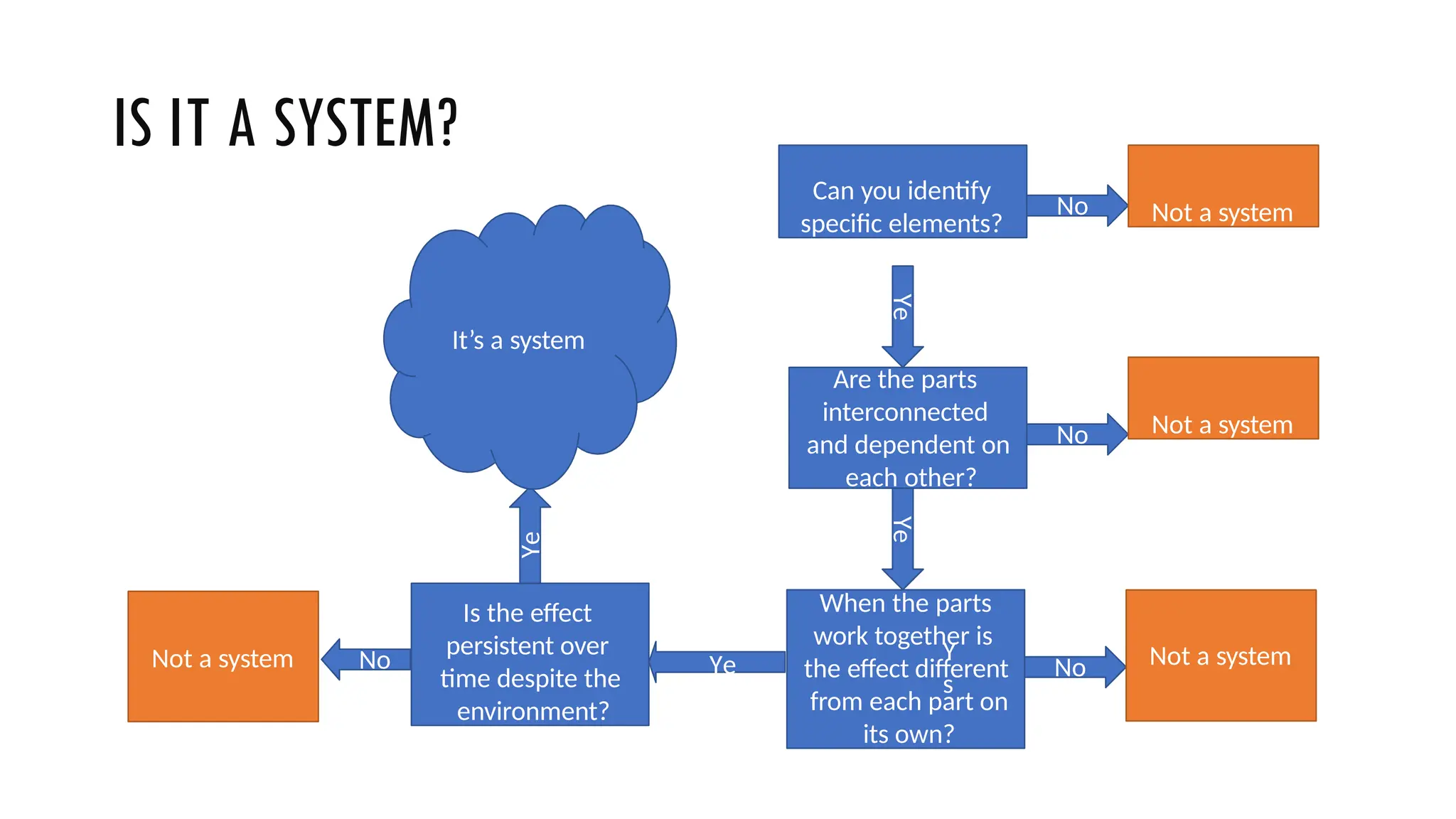
IS IT A SYSTEM?
Can you identify
specific elements?
No
Ye
s
Not a system
Are the parts
interconnected
and dependent on
each other?
No Not a system
Ye
s
When the parts
work together is
the effect different
from each part on
its own?
No Not a system
Ye
s
Is the effect
persistent over
time despite the
environment?
Ye
s
No
Not a system
It’s a system
Y
s
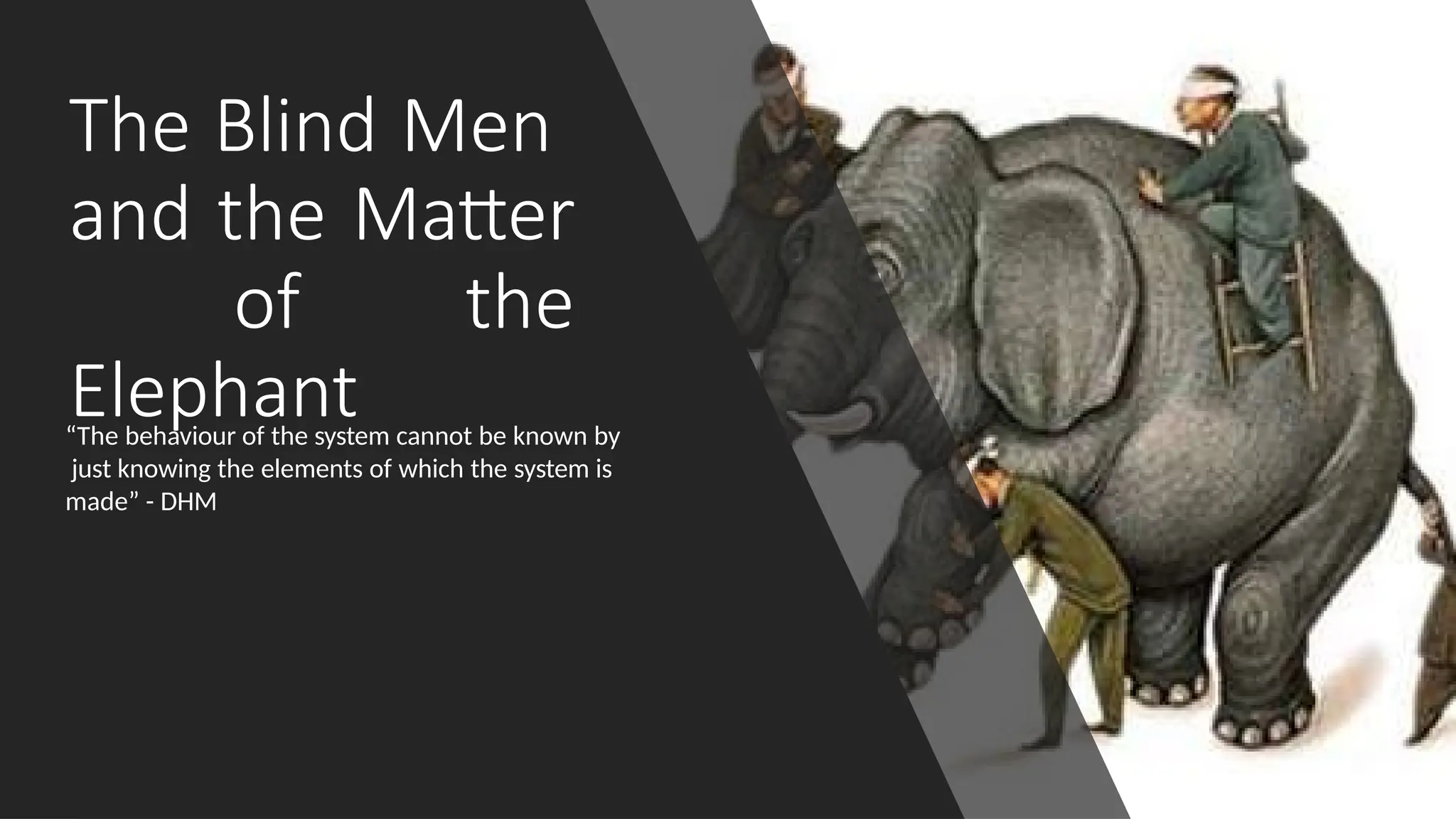
The Blind Men
and the Matter
of the
Elephant
“The behaviour of the system cannot be known by
just knowing the elements of which the system is
made” - DHM
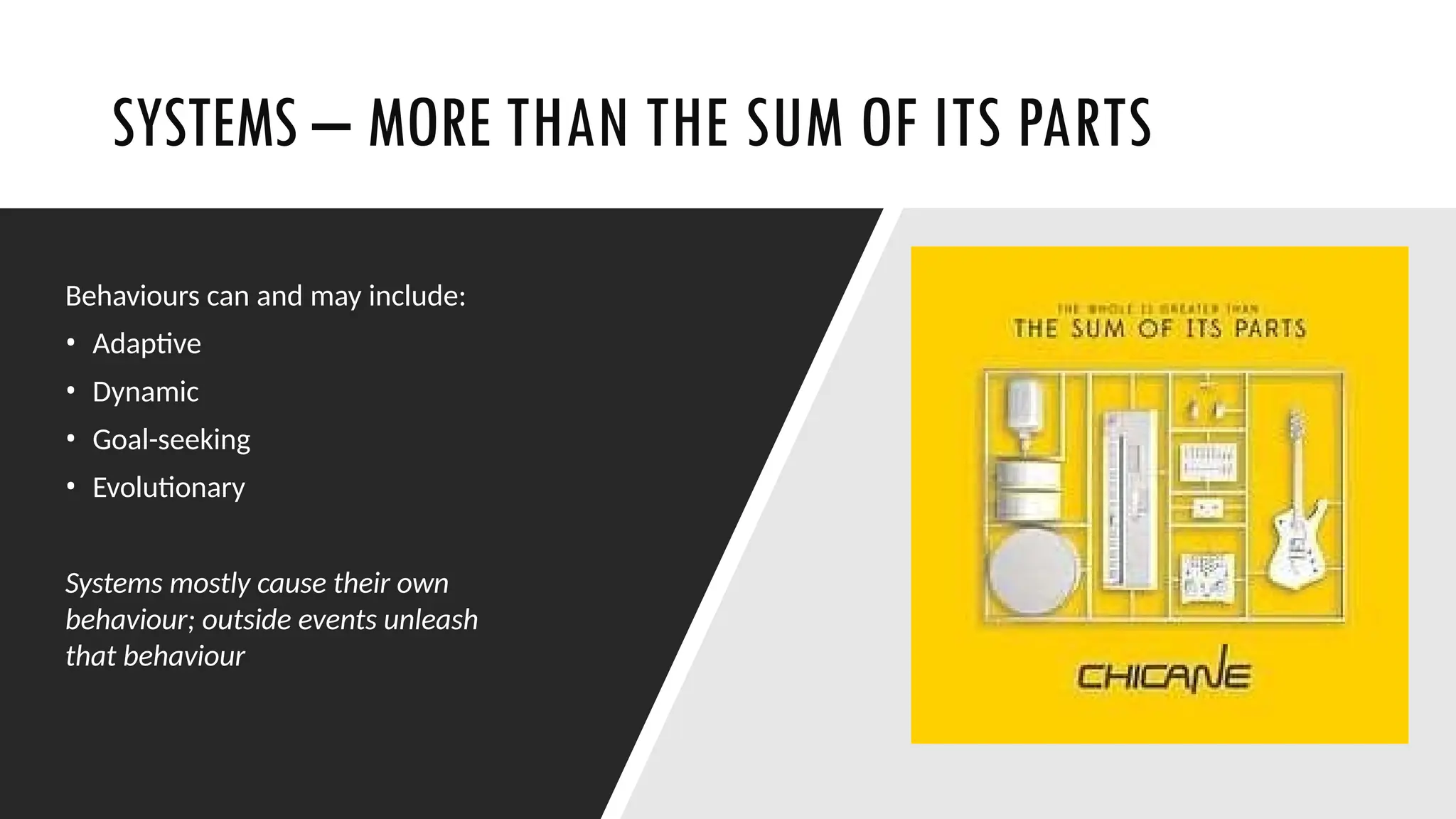
SYSTEMS – MORE THAN THE SUM OF ITS PARTS
Behaviours can and may include:
• Adaptive
• Dynamic
• Goal-seeking
• Evolutionary
Systems mostly cause their own
behaviour; outside events unleash
that behaviour
“EVERY SYSTEM IS
PERFECTLY DESIGNED TO
ACHIEVE THE RESULTS IT
GETS.”
DR. DON BERWICK
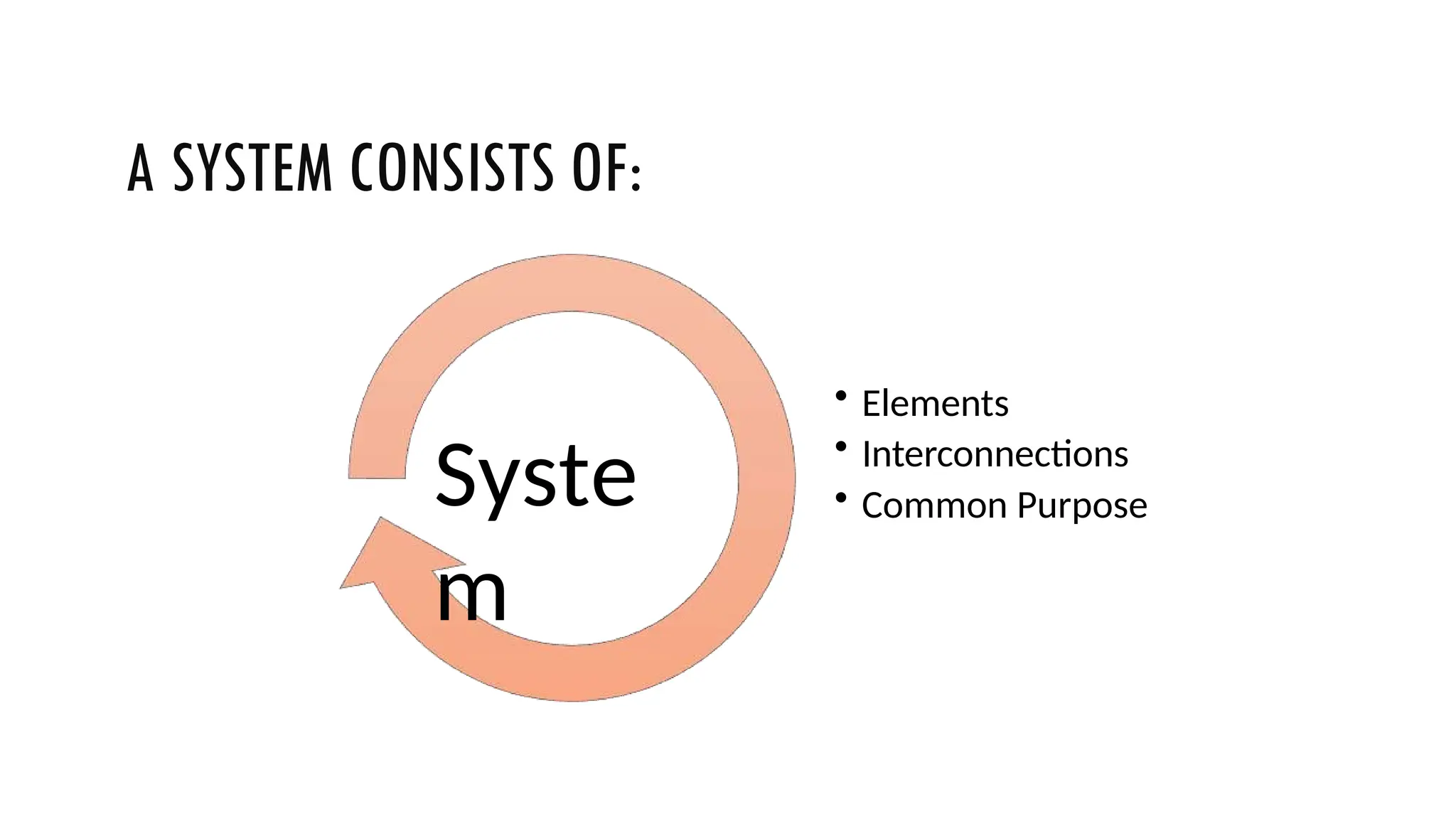
A SYSTEM CONSISTS OF:
• Elements
• Interconnections
• Common Purpose
Syste
m
EXAMPLES OF SYSTEMS
● Digestive system
● Sports team
● School
● City
● Factory
● Corporation
● National Economy
● Animal
● Tree
● Forest
● Earth
● Solar system
● Galaxy
● IT system
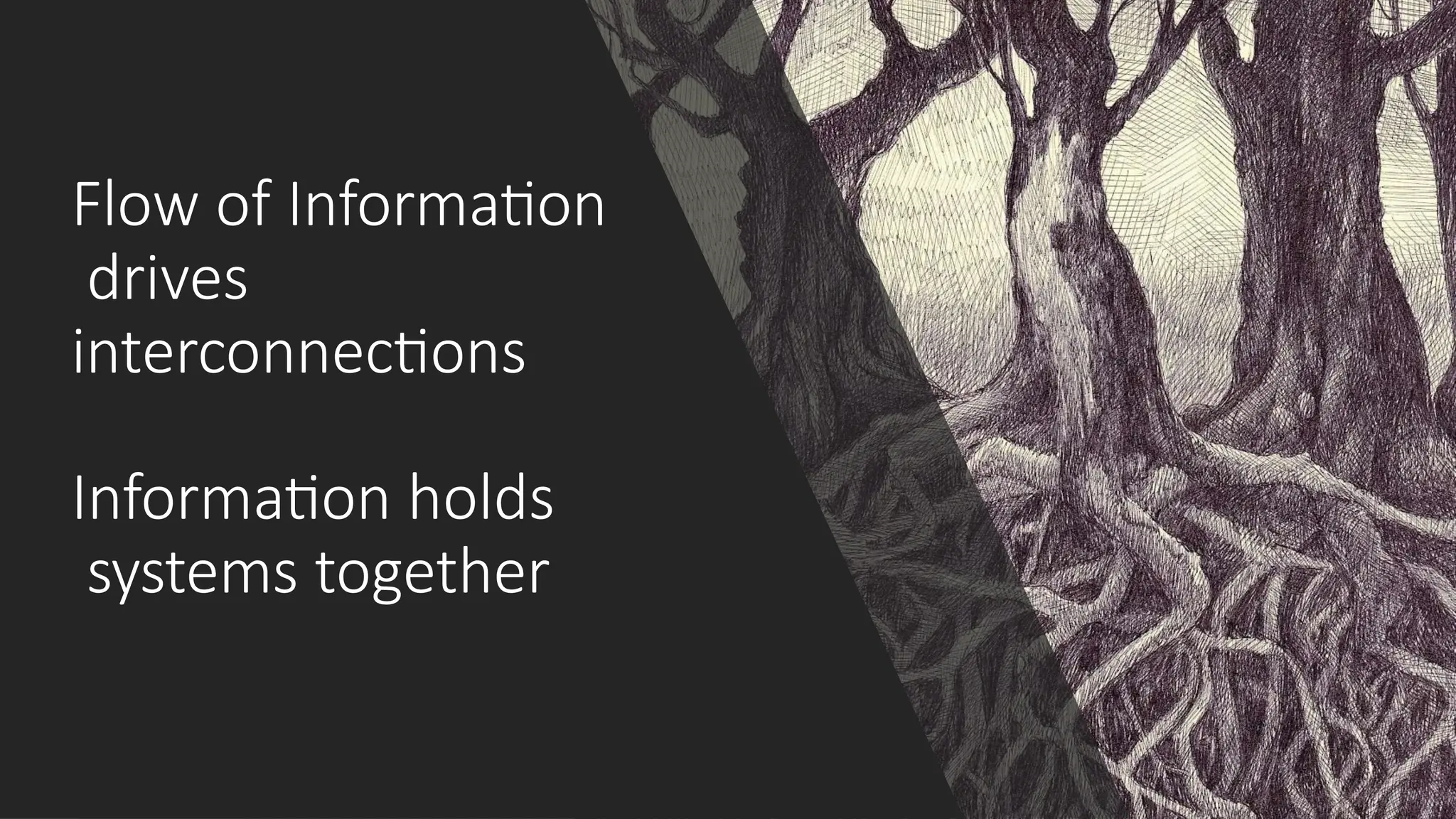
Flow of Information
drives
interconnections
Information holds
systems together
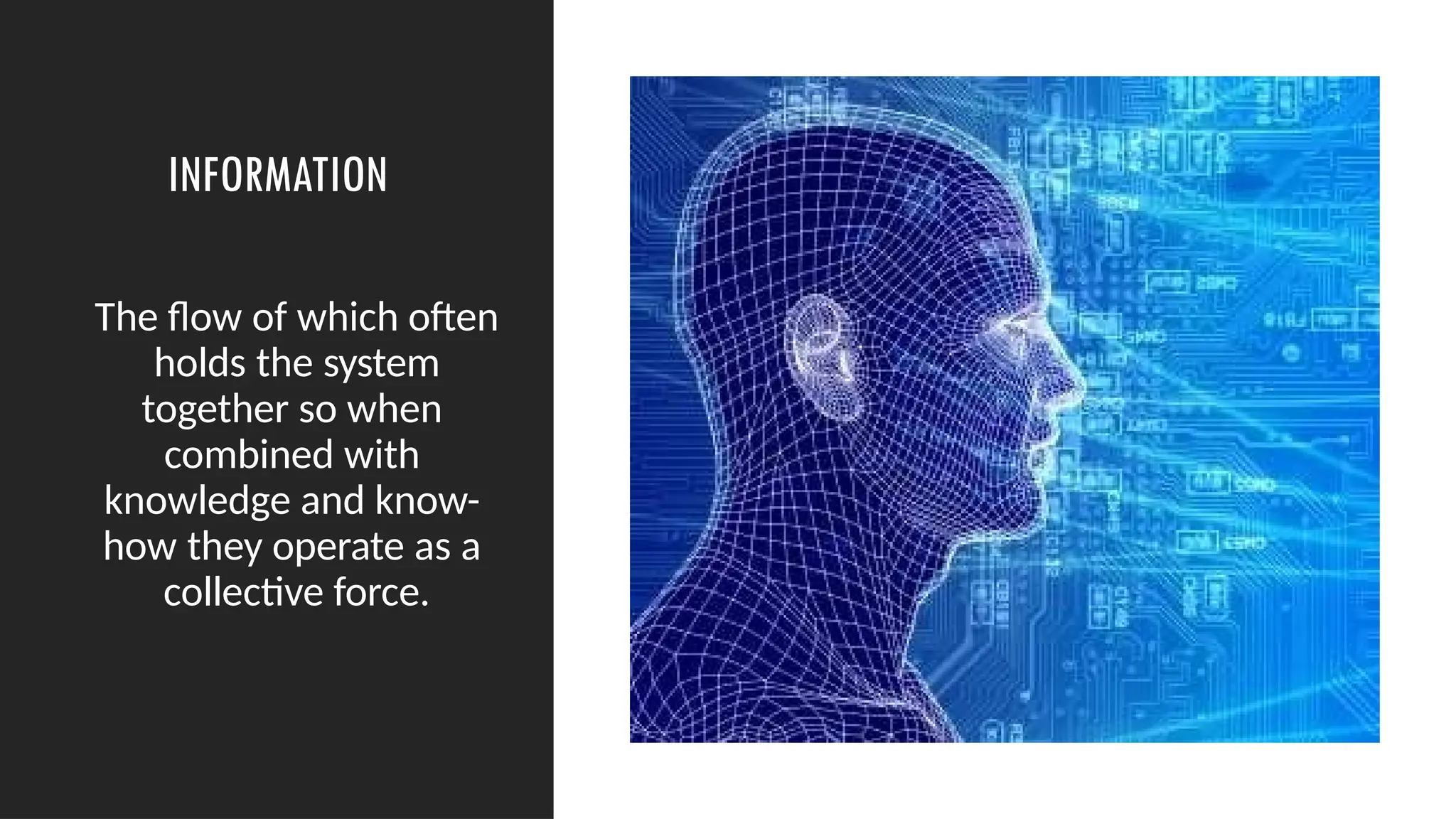
INFORMATION
The flow of which often
holds the system
together so when
combined with
knowledge and know-
how they operate as a
collective force.
WHAT CAN DETERMINE A SYSTEM’S BEHAVIOUR?
• Purpose & Function working n harmony
• Interconnections married to purpose
• Example:
• Teamwork
• Departments in an organization
AND DISCOURSE?
Changing relationships normally
changes a systems behavior.
WHY?
“To ask whether elements,
interconnections, or purpose are the
most important in a system is to ask
an unsystemic question” – DHM
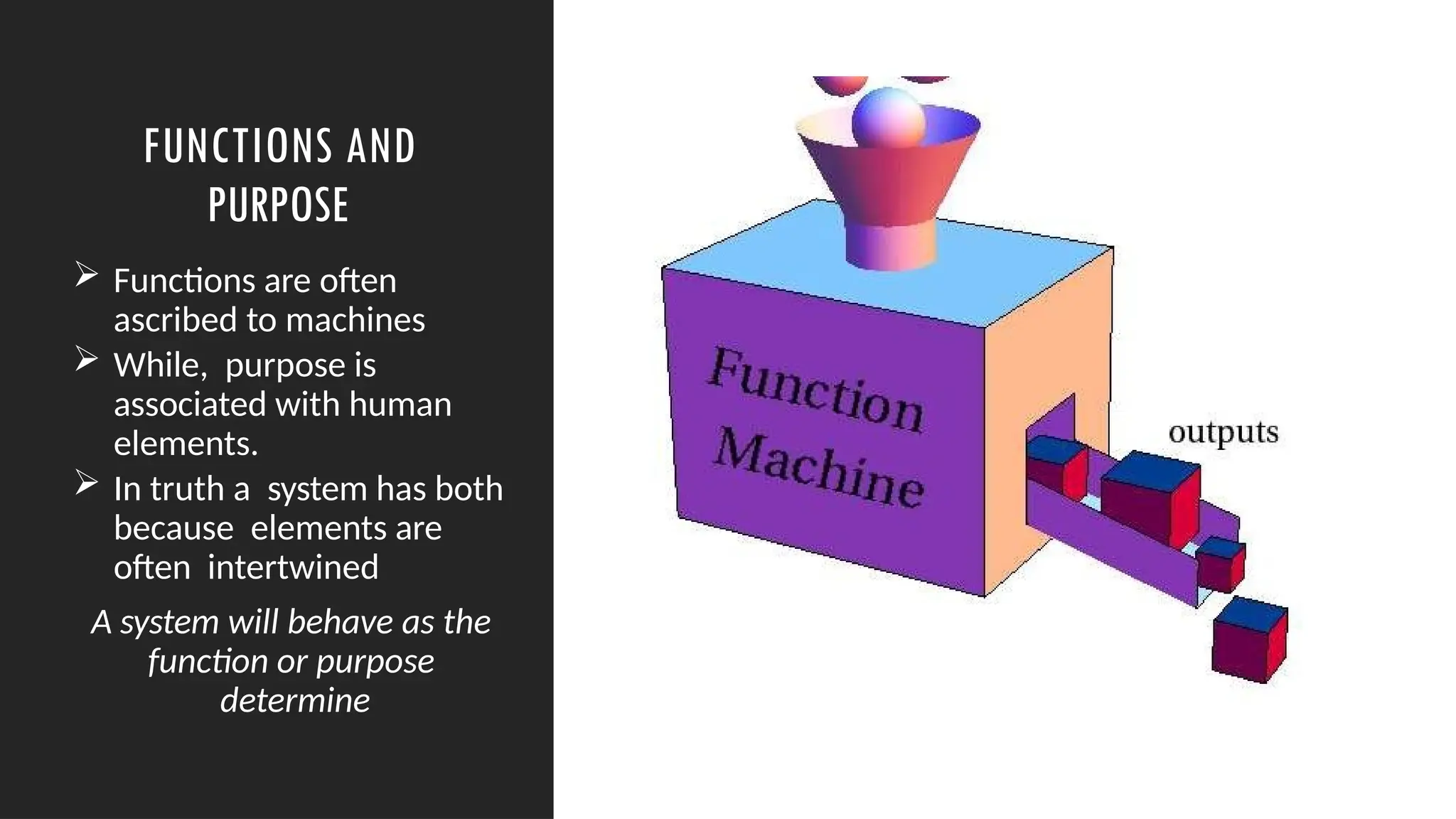
FUNCTIONS AND
PURPOSE
 Functions are often
ascribed to machines
 While, purpose is
associated with human
elements.
 In truth a system has both
because elements are
often intertwined
A system will behave as the
function or purpose
determine
CHANGING ELEMENTS
USUALLY HAS THE LEAST
EFFECT; CHANGING
INTERCONNECTIONS OR
PURPOSE IS USUALLY
MORE DRAMATIC
EXAMPLES
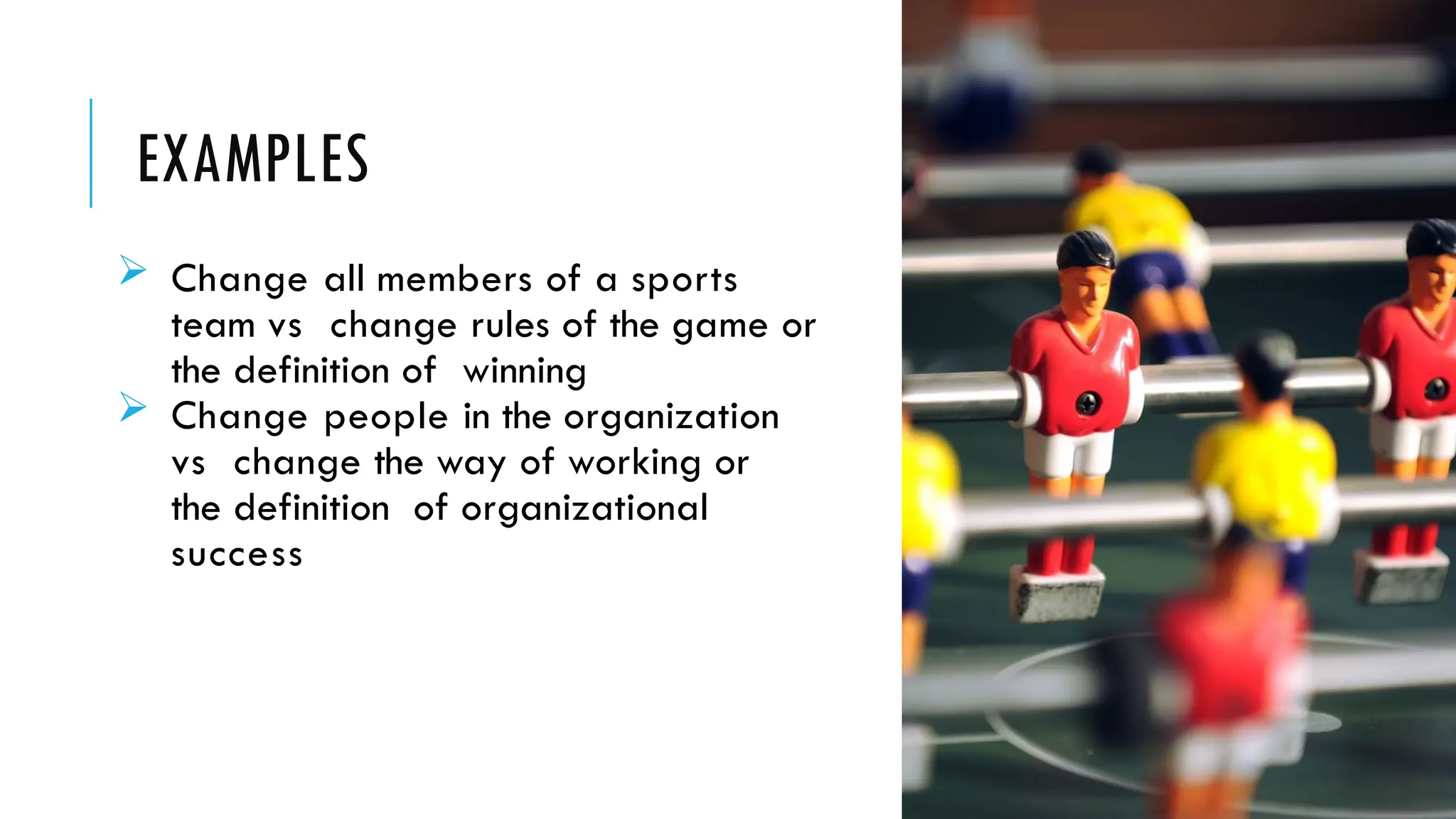
 Change all members of a sports
team vs change rules of the game or
the definition of winning
 Change people in the organization
vs change the way of working or
the definition of organizational
success
EXERCISE 1.1
Choose a system and identify the following:
Elements
Interconnections
Purpose - system behavior
Could your group also identify its inputs and outputs?
STOCKS AND FLOWS
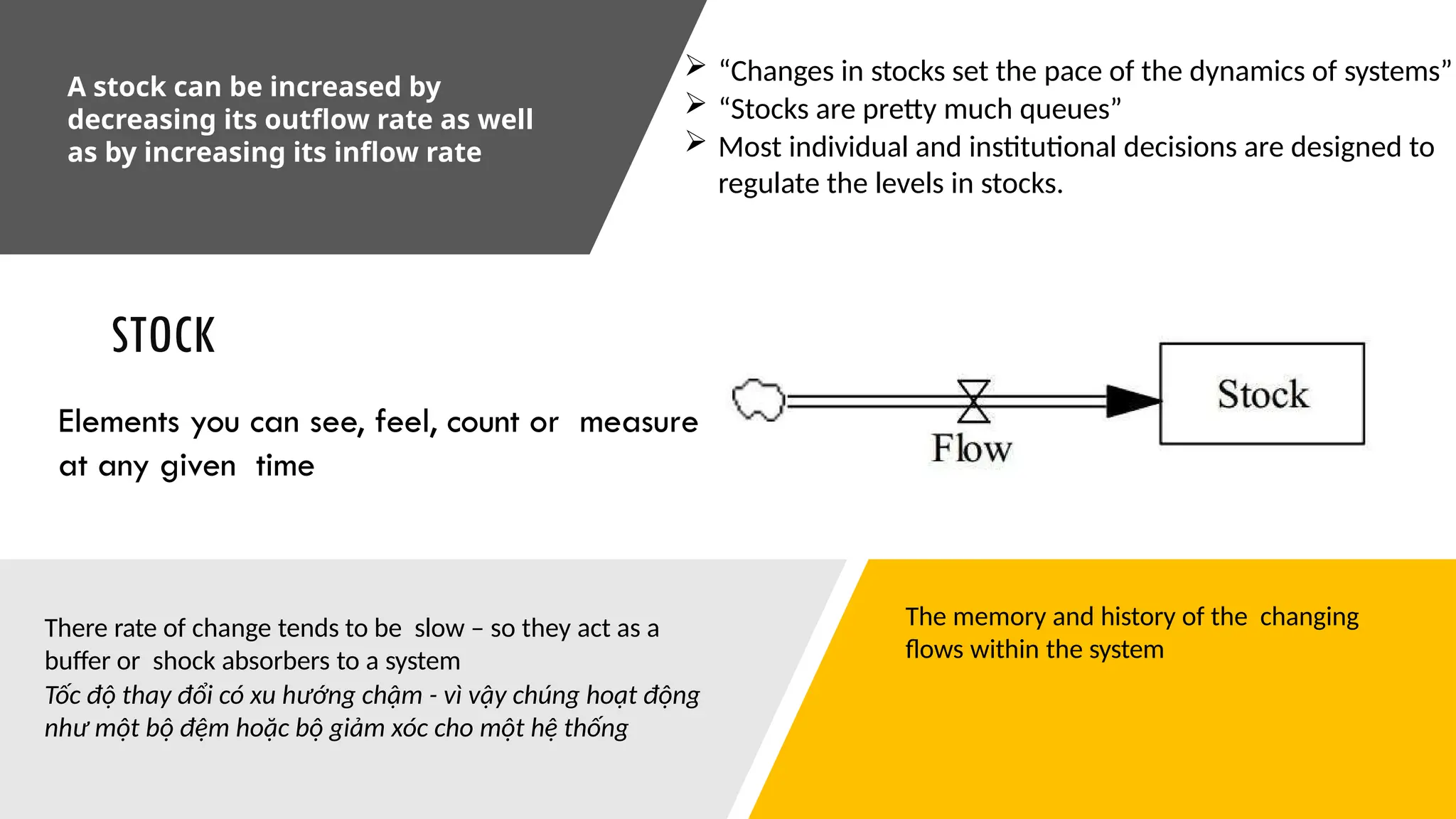
STOCK
Elements you can see, feel, count or measure
at any given time
The memory and history of the changing
flows within the system
 “Changes in stocks set the pace of the dynamics of systems”
 “Stocks are pretty much queues”
 Most individual and institutional decisions are designed to
regulate the levels in stocks.
There rate of change tends to be slow – so they act as a
buffer or shock absorbers to a system
Tốc độ thay đổi có xu hướng chậm - vì vậy chúng hoạt động
như một bộ đệm hoặc bộ giảm xóc cho một hệ thống
A stock can be increased by
decreasing its outflow rate as well
as by increasing its inflow rate
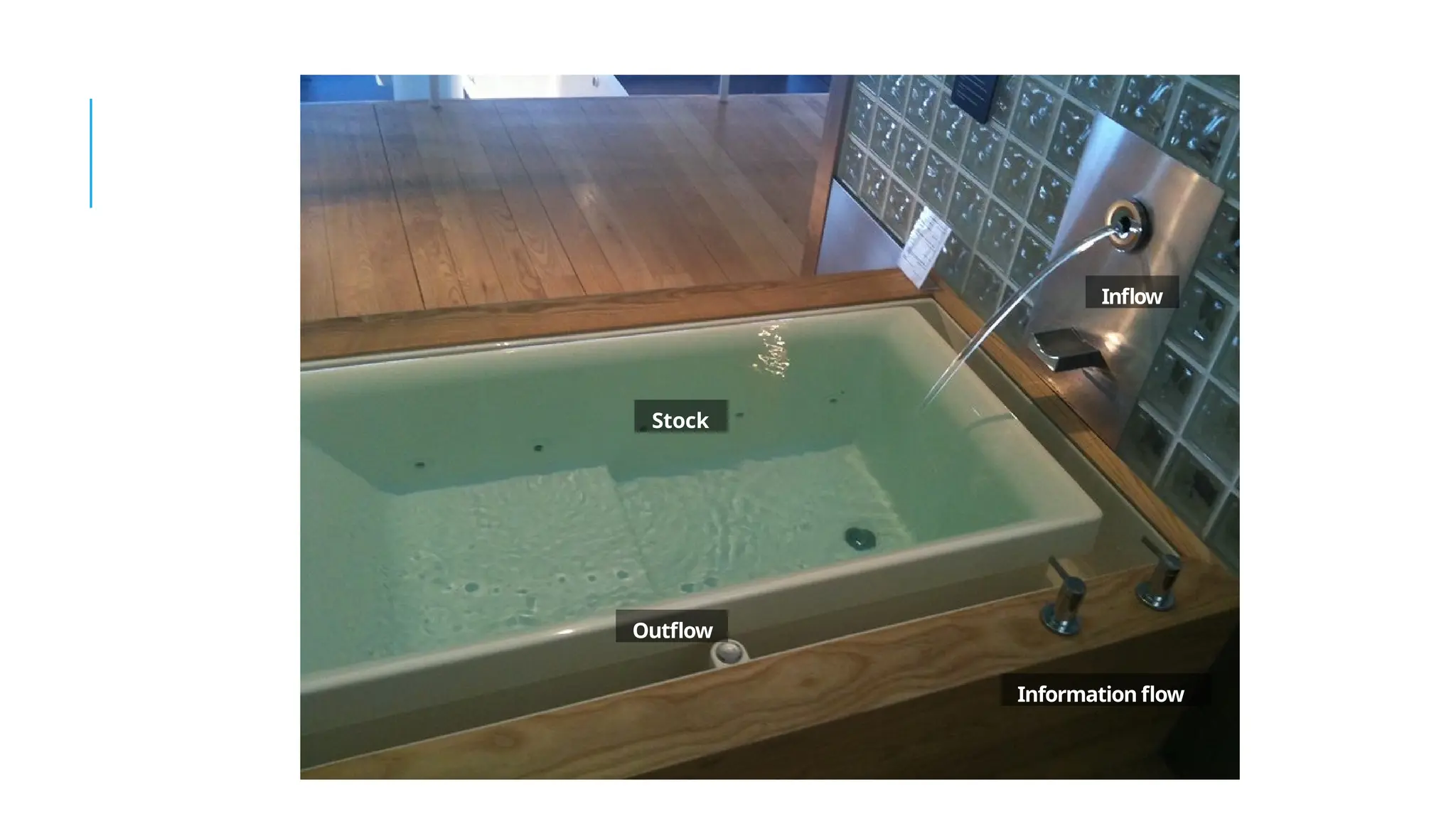
Inflow
Outflow
Stock
Information flow
EXAMPLES OF
STOCKS
 Water in a bathtub
 A population
 Books in a bookstore
 Wood in a tree
 Money in a bank
STOCKS CHANGE OVER TIME
VIA FLOWS
 Workflow
 Information flow
 Both inflow and outflow
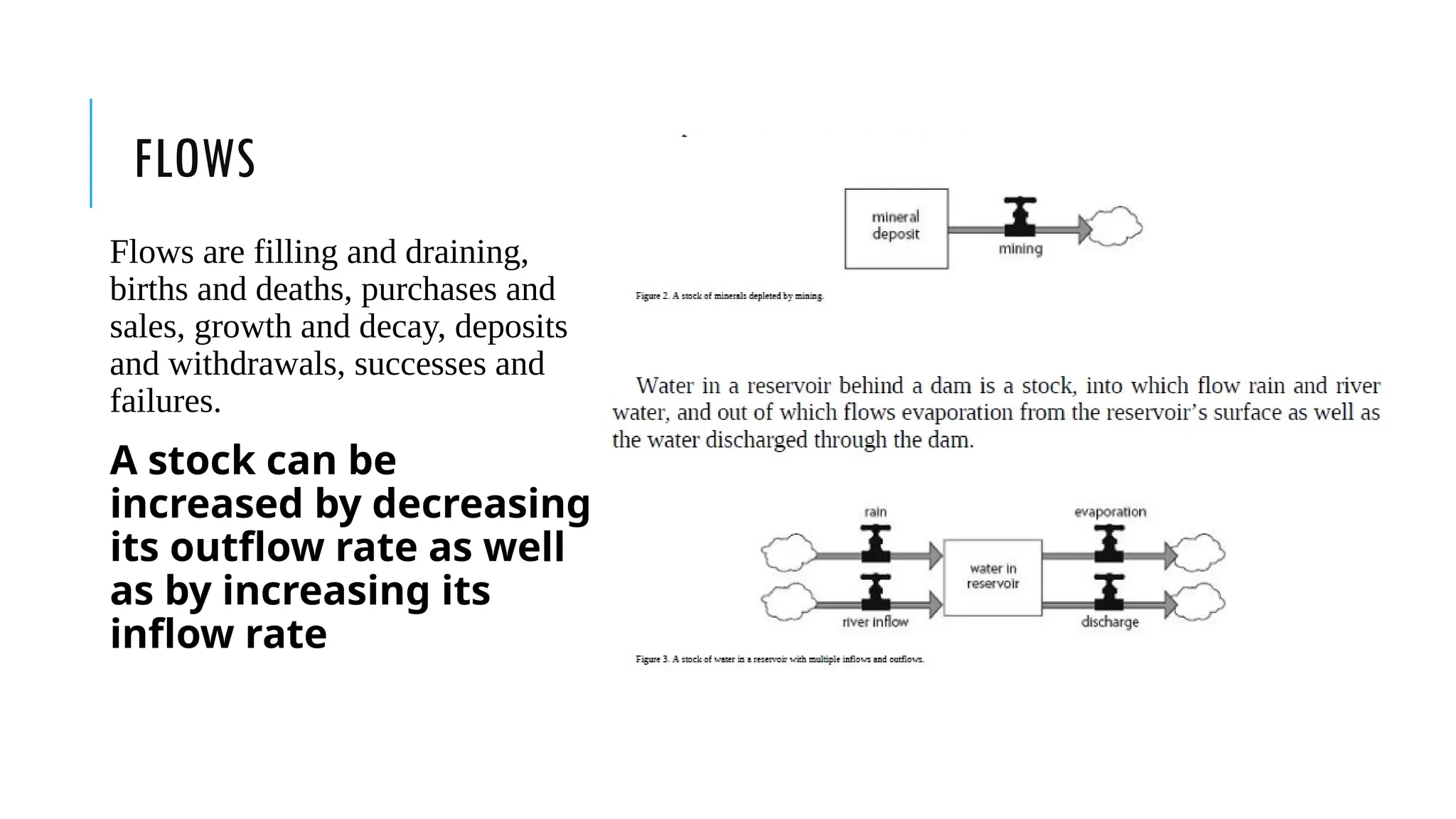
FLOWS
Flows are filling and draining,
births and deaths, purchases and
sales, growth and decay, deposits
and withdrawals, successes and
failures.
A stock can be
increased by decreasing
its outflow rate as well
as by increasing its
inflow rate
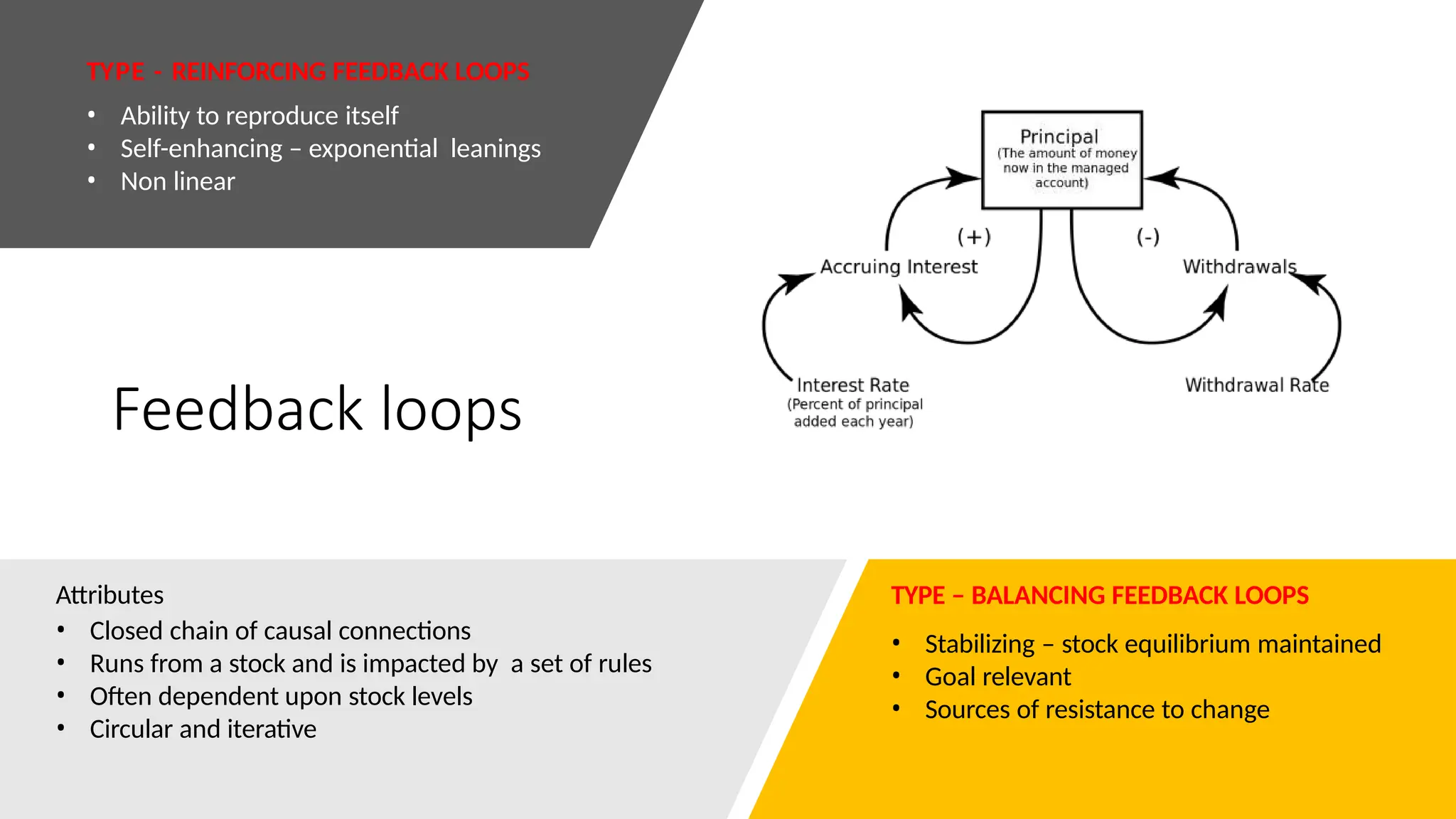
Feedback loops
Attributes
• Closed chain of causal connections
• Runs from a stock and is impacted by a set of rules
• Often dependent upon stock levels
• Circular and iterative
TYPE – BALANCING FEEDBACK LOOPS
• Stabilizing – stock equilibrium maintained
• Goal relevant
• Sources of resistance to change
TYPE - REINFORCING FEEDBACK LOOPS
• Ability to reproduce itself
• Self-enhancing – exponential leanings
• Non linear
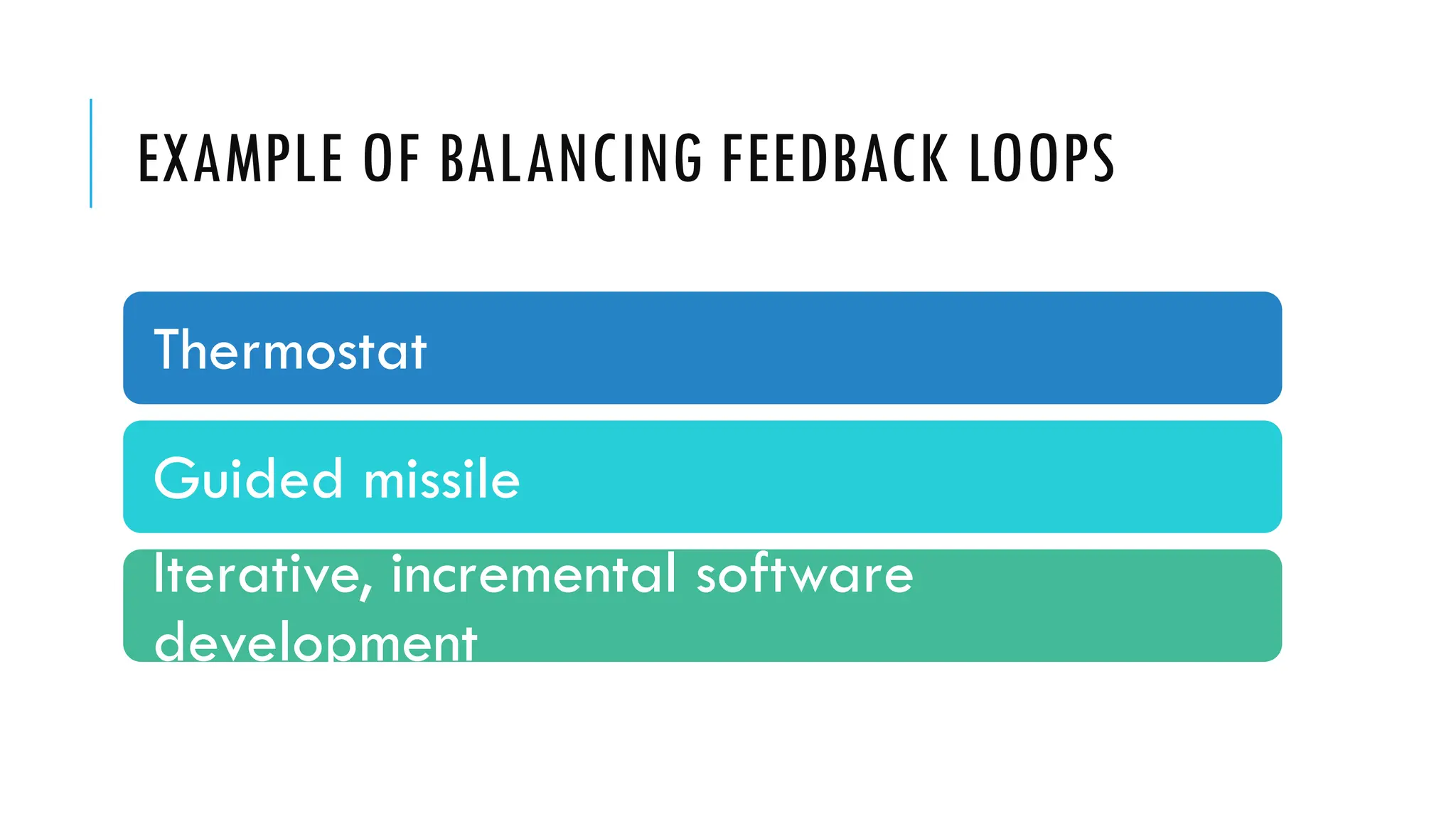
EXAMPLE OF BALANCING FEEDBACK LOOPS
Thermostat
Guided missile
Iterative, incremental software
development
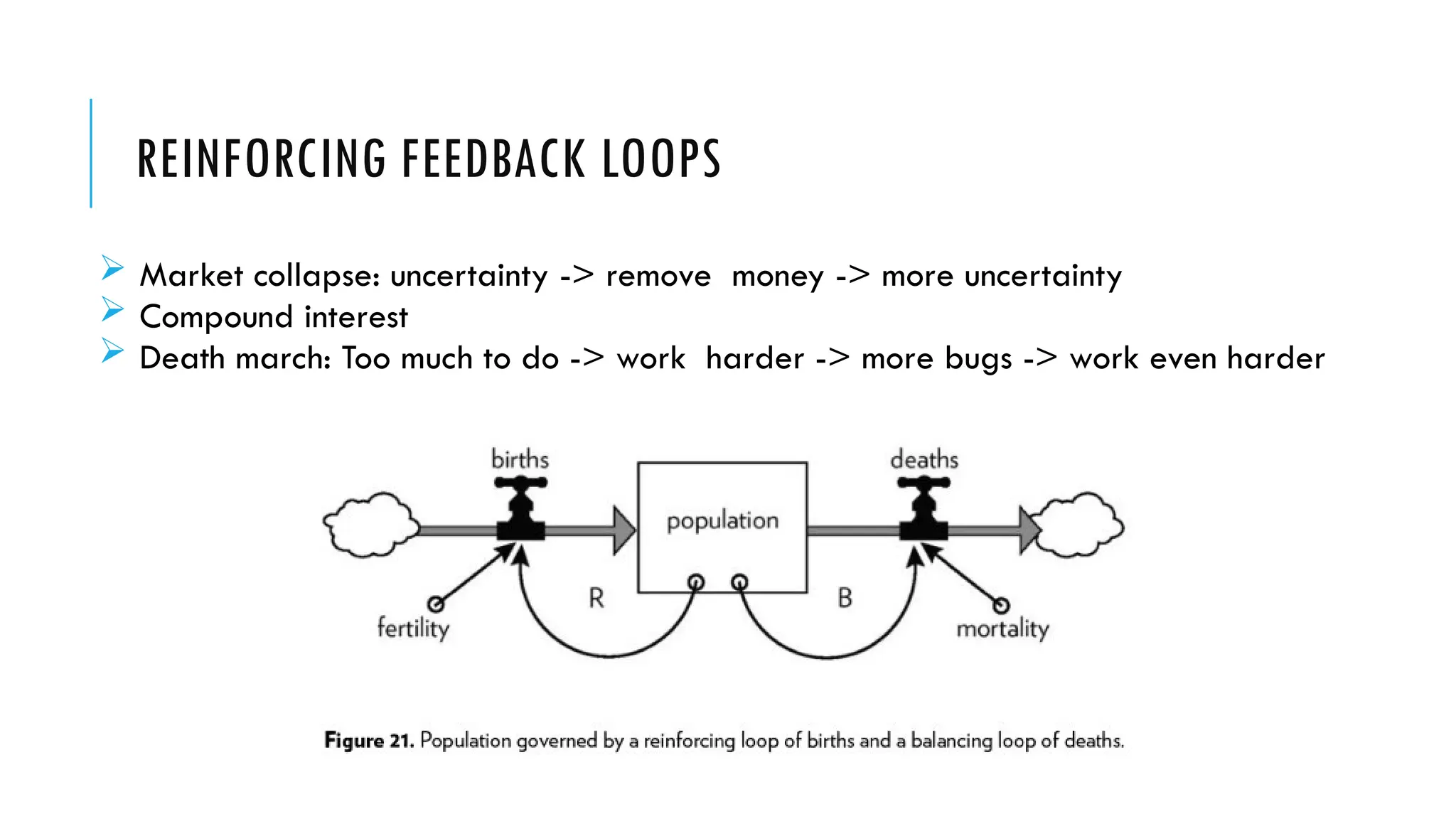
REINFORCING FEEDBACK LOOPS
 Market collapse: uncertainty -> remove money -> more uncertainty
 Compound interest
 Death march: Too much to do -> work harder -> more bugs -> work even harder
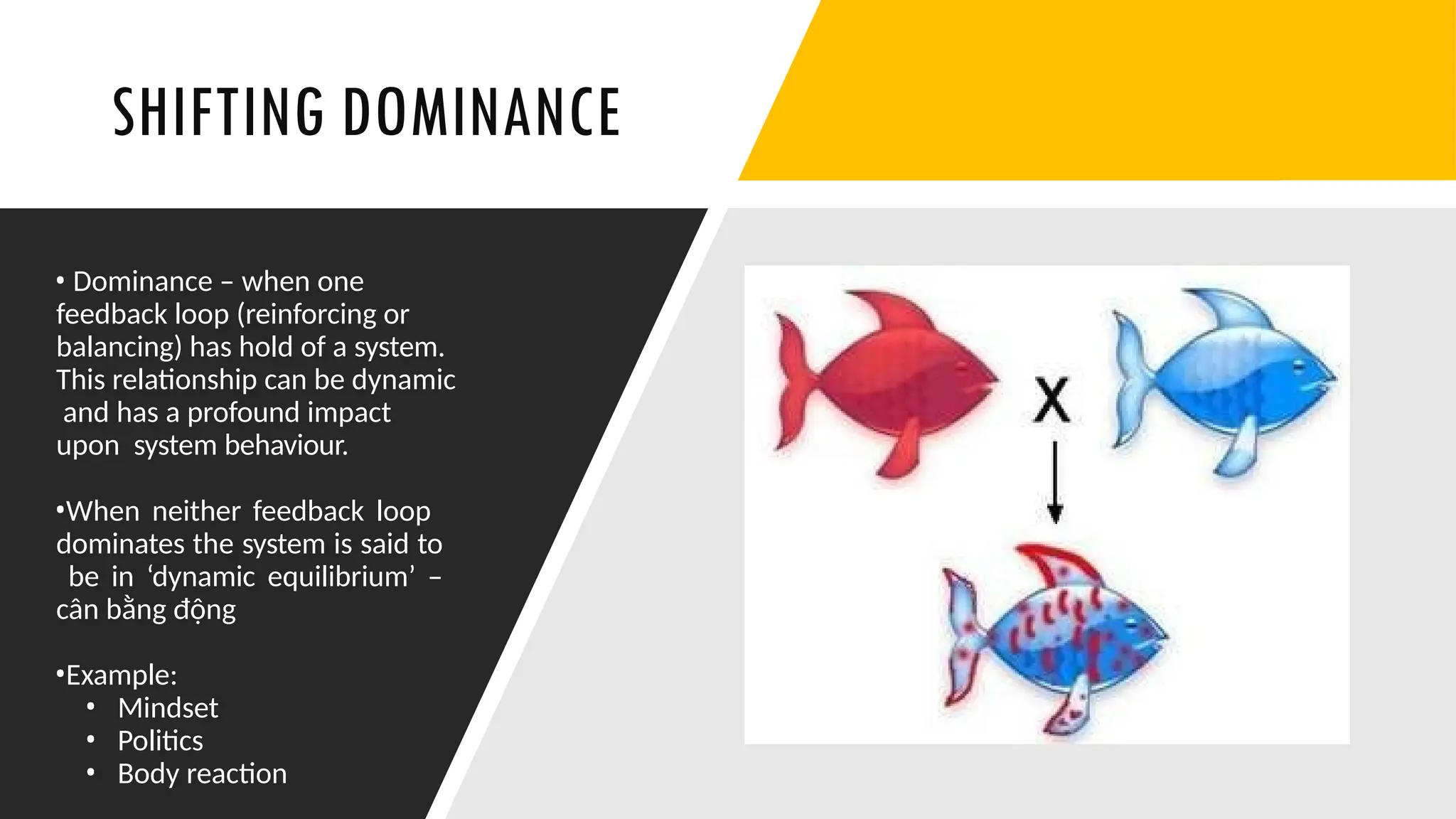
SHIFTING DOMINANCE
• Dominance – when one
feedback loop (reinforcing or
balancing) has hold of a system.
This relationship can be dynamic
and has a profound impact
upon system behaviour.
•When neither feedback loop
dominates the system is said to
be in ‘dynamic equilibrium’ –
cân bằng động
•Example:
• Mindset
• Politics
• Body reaction
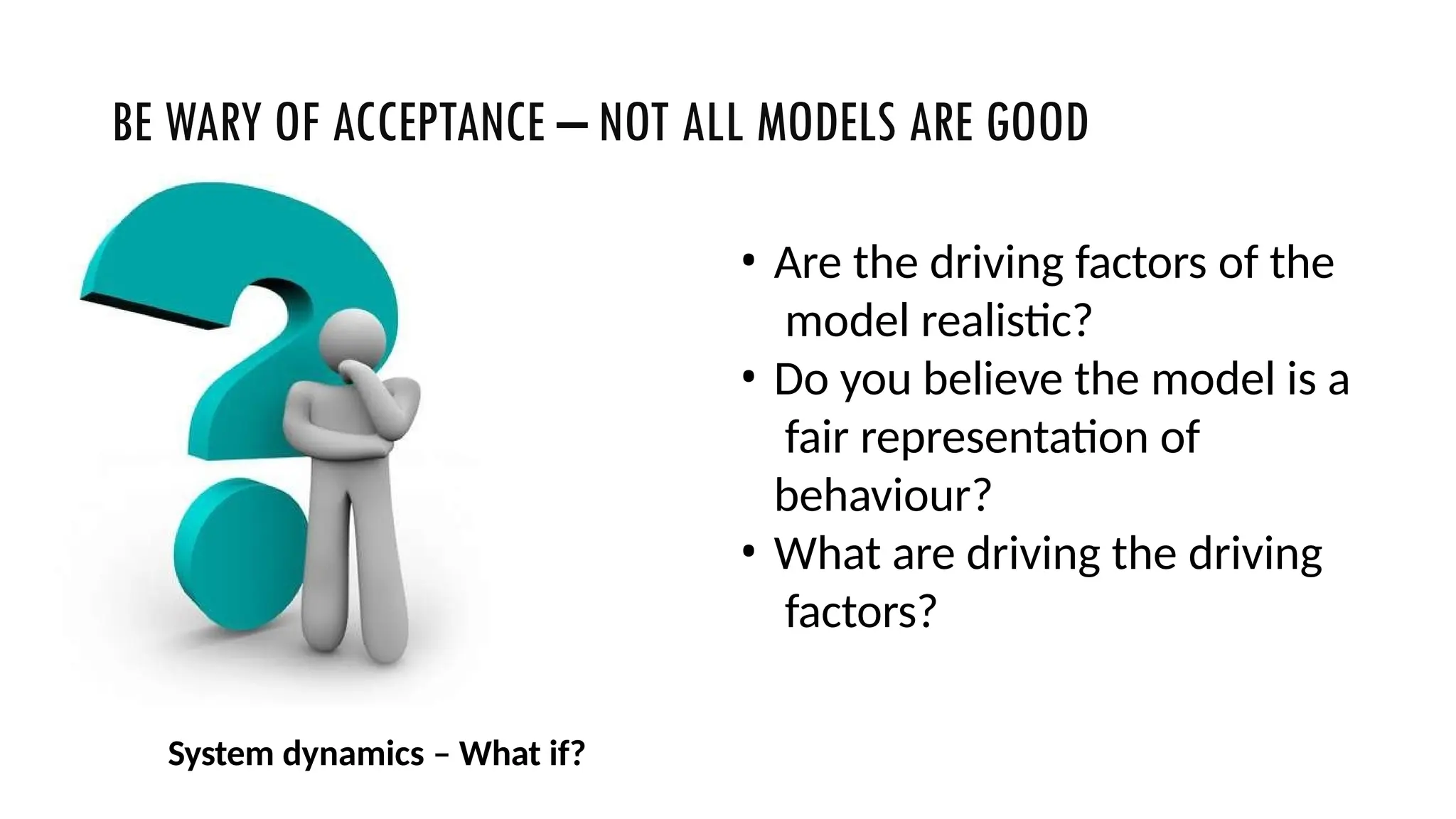
BE WARY OF ACCEPTANCE – NOT ALL MODELS ARE GOOD
• Are the driving factors of the
model realistic?
• Do you believe the model is a
fair representation of
behaviour?
• What are driving the driving
factors?
System dynamics – What if?
IF A CAUSES B, IS IT
POSSIBLE THAT B ALSO
CAUSES A?
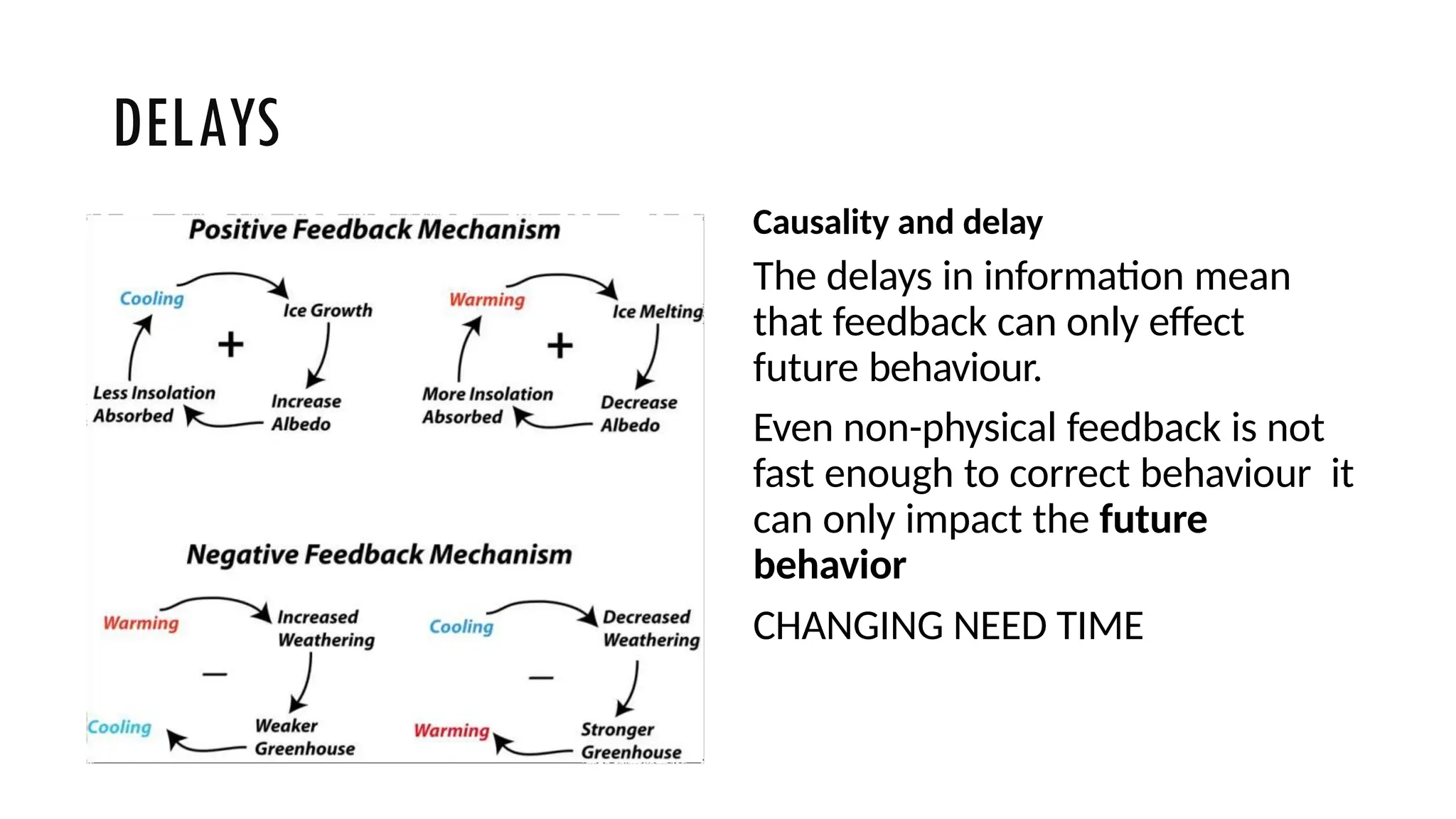
DELAYS
Causality and delay
The delays in information mean
that feedback can only effect
future behaviour.
Even non-physical feedback is not
fast enough to correct behaviour it
can only impact the future
behavior
CHANGING NEED TIME
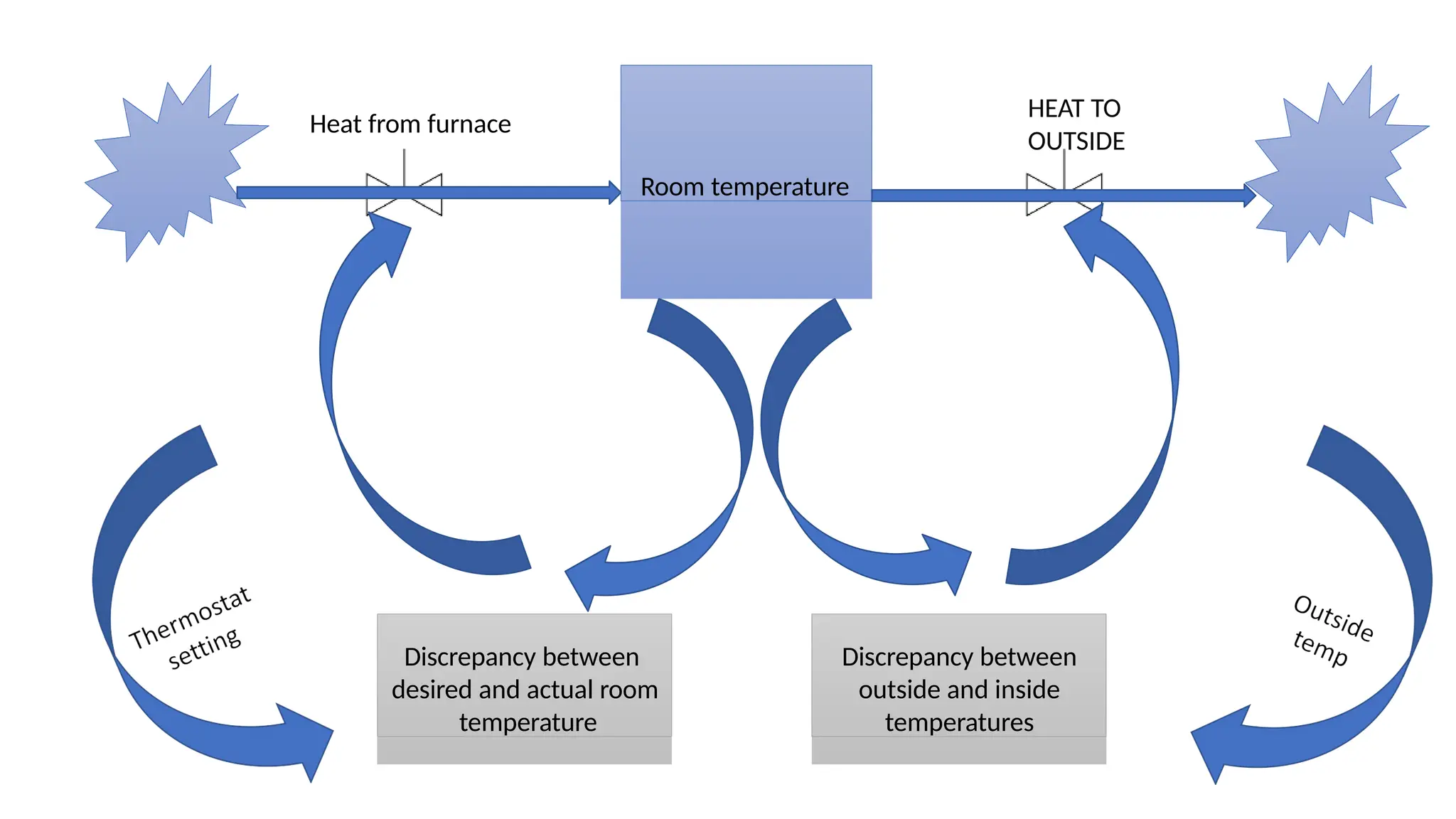
Room temperature
Heat from furnace
HEAT TO
OUTSIDE
Discrepancy between
desired and actual room
temperature
Discrepancy between
outside and inside
temperatures
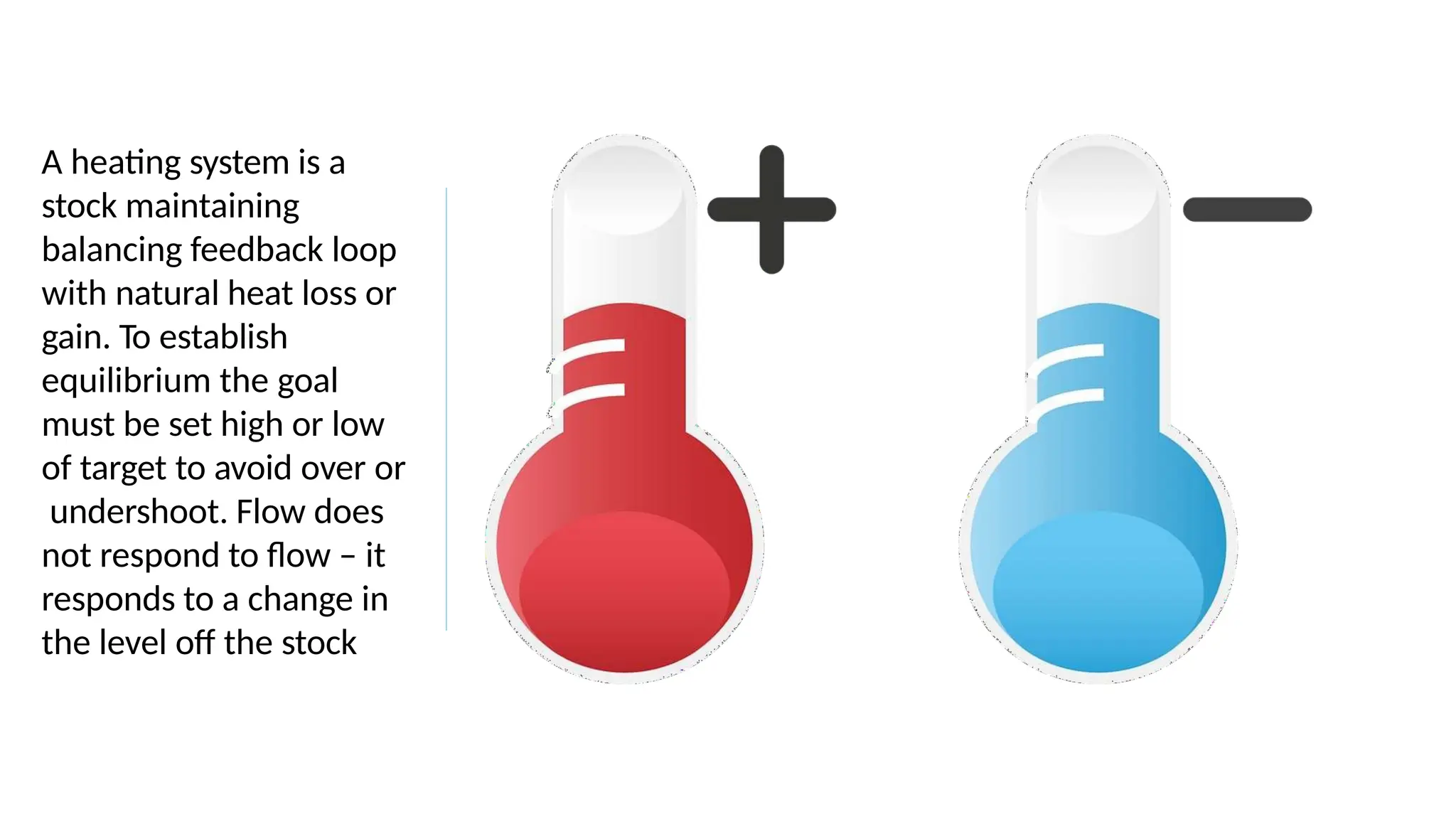
A heating system is a
stock maintaining
balancing feedback loop
with natural heat loss or
gain. To establish
equilibrium the goal
must be set high or low
of target to avoid over or
undershoot. Flow does
not respond to flow – it
responds to a change in
the level off the stock
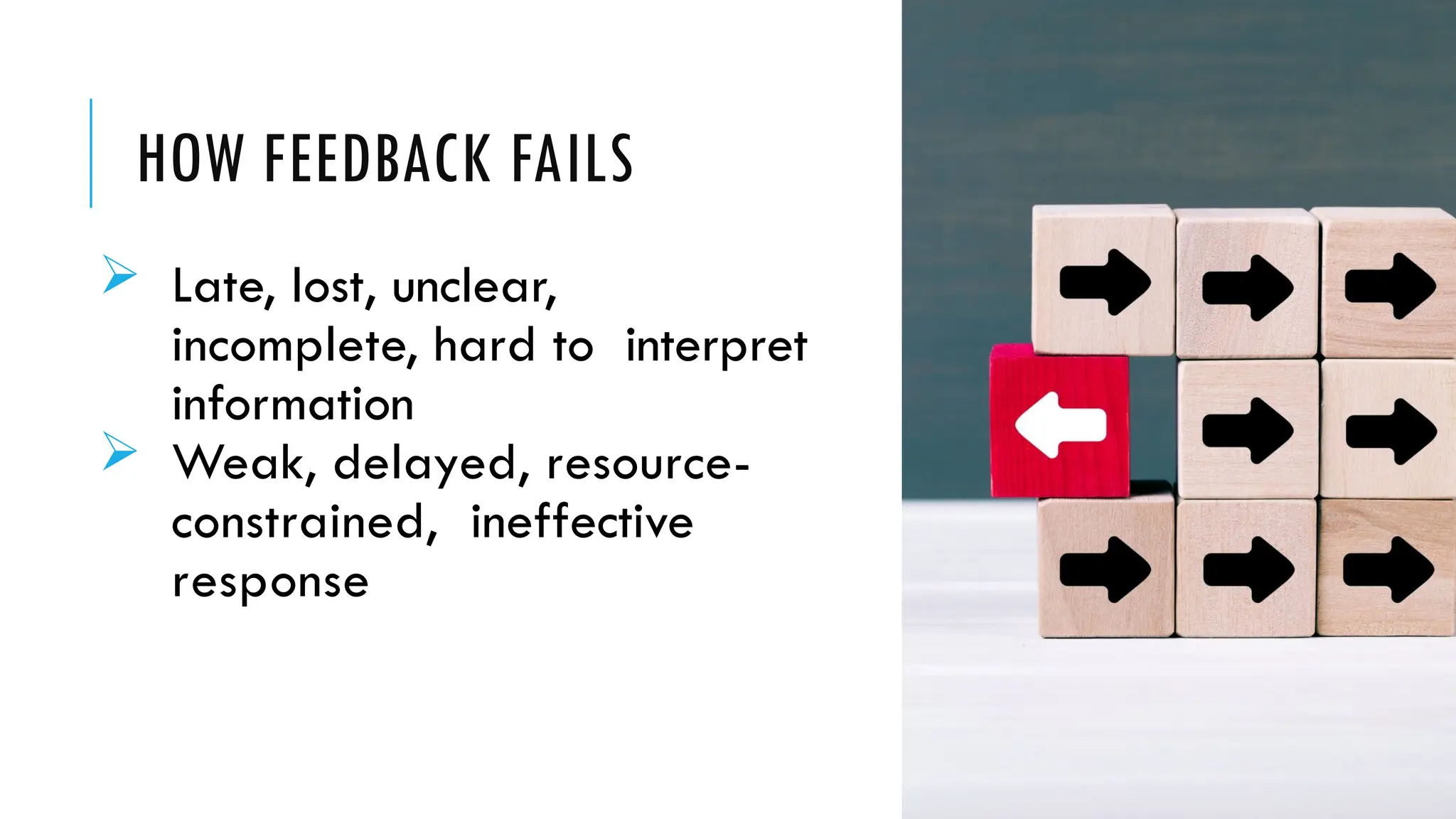
HOW FEEDBACK FAILS
 Late, lost, unclear,
incomplete, hard to interpret
information
 Weak, delayed, resource-
constrained, ineffective
response
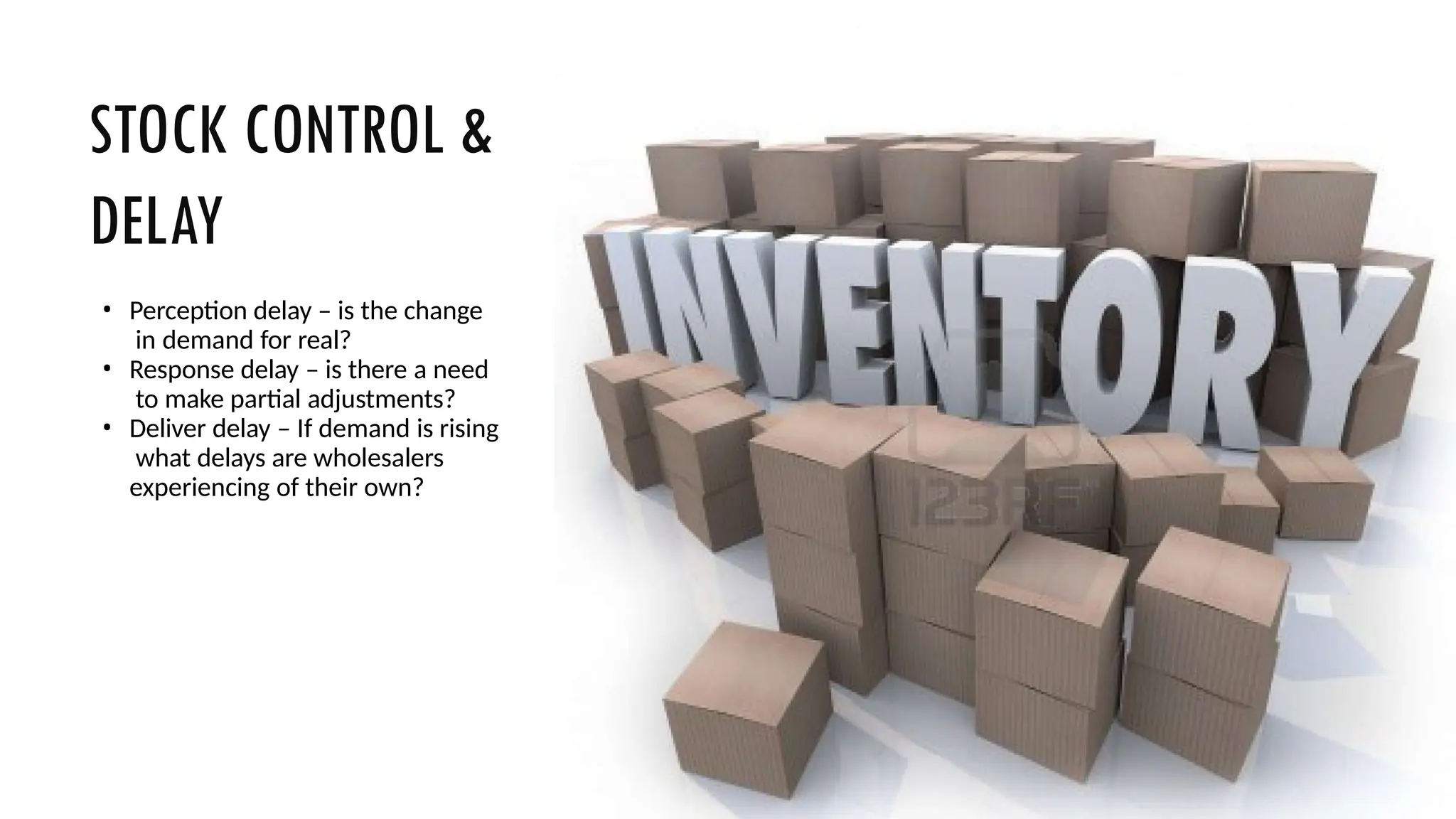
STOCK CONTROL &
DELAY
• Perception delay – is the change
in demand for real?
• Response delay – is there a need
to make partial adjustments?
• Deliver delay – If demand is rising
what delays are wholesalers
experiencing of their own?
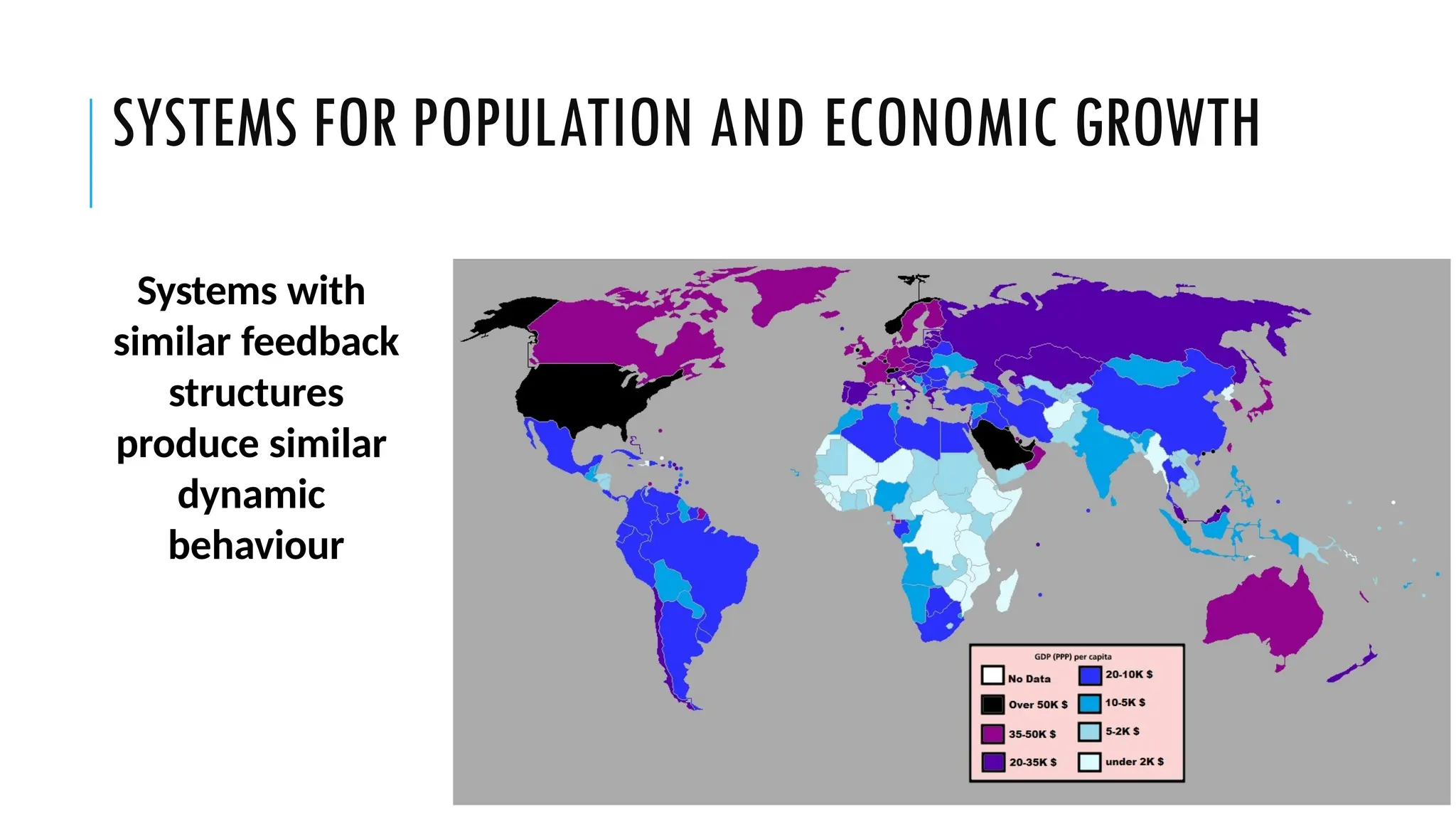
SYSTEMS FOR POPULATION AND ECONOMIC GROWTH
Systems with
similar feedback
structures
produce similar
dynamic
behaviour
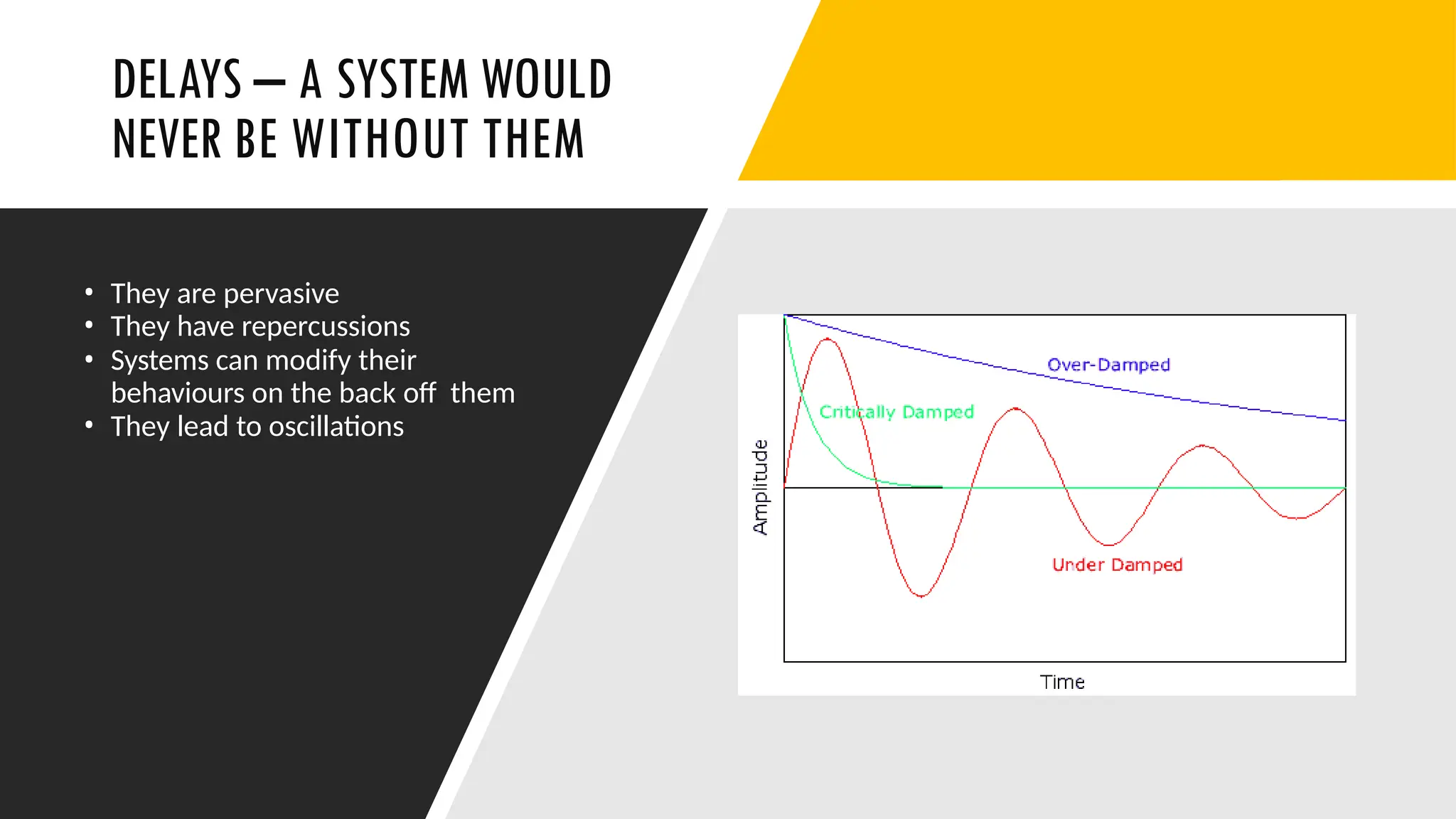
DELAYS – A SYSTEM WOULD
NEVER BE WITHOUT THEM
• They are pervasive
• They have repercussions
• Systems can modify their
behaviours on the back off them
• They lead to oscillations
LIMITS
• In any exponentially growing system with physical aspects
there must be a reinforcing feedback loop driving growth and
a balancing loop acting against this.
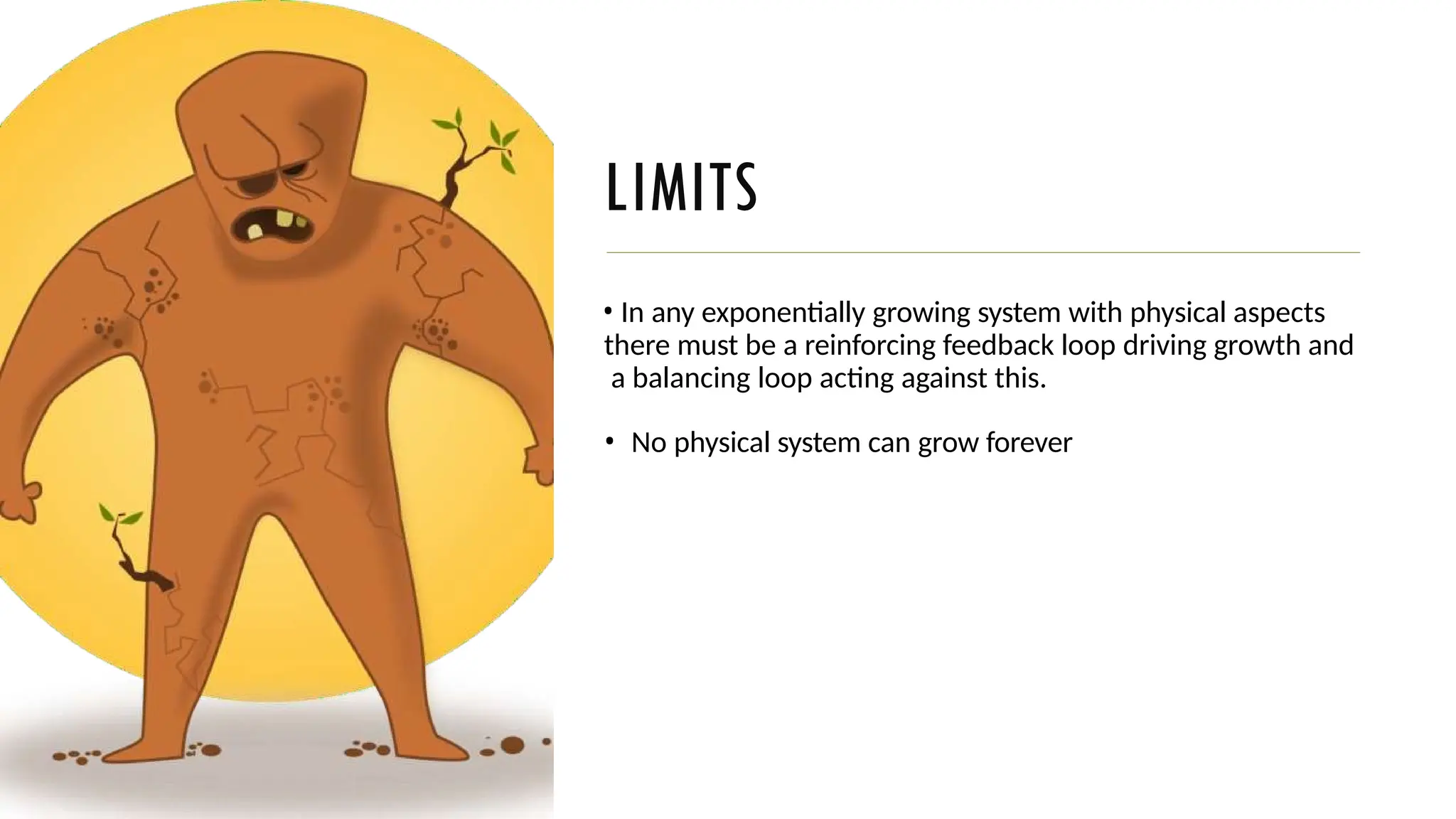
• No physical system can grow forever
REMIND -
SYSTEMS
CONSISTS OF
THREE THINGS
Elements
Interconnections
Function (non-human system)
or Purpose (human system)
SYSTEM INTERACTIONS
OPERATE THROUGH
INFORMATION FLOW
ADDRESS INCONGRUENT
PURPOSES
System purposes do
not necessarily
match the intention
of the designers or
actors within it
HOW MIGHT YOU
INTERVENE IN YOUR
SITUATION TO IMPROVE
THE SYSTEM?
EXERCISE 1.2
Use the system in the previous exercise and
identify its stocks, flow.
How would you change the system and
why?
ANY QUESTIONS?

Phân tích và thiết kế quy trình kinh doanh

  • 1.
    QUESTION Whenever you wonderhow the world is working? Why we have to do thing in a specific way? How is our society working?  Could you name the common things in the following example? Car engine Human body University Software Manufacturer
  • 2.
  • 3.
  • 4.
    A SYSTEM ISA SET OF THINGS INTERCONNECTED IN SUCH A WAY THAT THEY PRODUCE THEIR OWN PATTERN OF BEHAVIOUR OVER TIME
  • 5.
    IS IT ASYSTEM? Can you identify specific elements? No Ye s Not a system Are the parts interconnected and dependent on each other? No Not a system Ye s When the parts work together is the effect different from each part on its own? No Not a system Ye s Is the effect persistent over time despite the environment? Ye s No Not a system It’s a system Y s
  • 6.
    The Blind Men andthe Matter of the Elephant “The behaviour of the system cannot be known by just knowing the elements of which the system is made” - DHM
  • 7.
    SYSTEMS – MORETHAN THE SUM OF ITS PARTS Behaviours can and may include: • Adaptive • Dynamic • Goal-seeking • Evolutionary Systems mostly cause their own behaviour; outside events unleash that behaviour
  • 8.
    “EVERY SYSTEM IS PERFECTLYDESIGNED TO ACHIEVE THE RESULTS IT GETS.” DR. DON BERWICK
  • 9.
    A SYSTEM CONSISTSOF: • Elements • Interconnections • Common Purpose Syste m
  • 10.
    EXAMPLES OF SYSTEMS ●Digestive system ● Sports team ● School ● City ● Factory ● Corporation ● National Economy ● Animal ● Tree ● Forest ● Earth ● Solar system ● Galaxy ● IT system
  • 11.
  • 12.
    INFORMATION The flow ofwhich often holds the system together so when combined with knowledge and know- how they operate as a collective force.
  • 13.
    WHAT CAN DETERMINEA SYSTEM’S BEHAVIOUR? • Purpose & Function working n harmony • Interconnections married to purpose • Example: • Teamwork • Departments in an organization
  • 14.
    AND DISCOURSE? Changing relationshipsnormally changes a systems behavior. WHY? “To ask whether elements, interconnections, or purpose are the most important in a system is to ask an unsystemic question” – DHM
  • 15.
    FUNCTIONS AND PURPOSE  Functionsare often ascribed to machines  While, purpose is associated with human elements.  In truth a system has both because elements are often intertwined A system will behave as the function or purpose determine
  • 16.
    CHANGING ELEMENTS USUALLY HASTHE LEAST EFFECT; CHANGING INTERCONNECTIONS OR PURPOSE IS USUALLY MORE DRAMATIC
  • 17.
    EXAMPLES  Change allmembers of a sports team vs change rules of the game or the definition of winning  Change people in the organization vs change the way of working or the definition of organizational success
  • 18.
    EXERCISE 1.1 Choose asystem and identify the following: Elements Interconnections Purpose - system behavior Could your group also identify its inputs and outputs?
  • 19.
  • 20.
    STOCK Elements you cansee, feel, count or measure at any given time The memory and history of the changing flows within the system  “Changes in stocks set the pace of the dynamics of systems”  “Stocks are pretty much queues”  Most individual and institutional decisions are designed to regulate the levels in stocks. There rate of change tends to be slow – so they act as a buffer or shock absorbers to a system Tốc độ thay đổi có xu hướng chậm - vì vậy chúng hoạt động như một bộ đệm hoặc bộ giảm xóc cho một hệ thống A stock can be increased by decreasing its outflow rate as well as by increasing its inflow rate
  • 21.
  • 22.
    EXAMPLES OF STOCKS  Waterin a bathtub  A population  Books in a bookstore  Wood in a tree  Money in a bank
  • 23.
    STOCKS CHANGE OVERTIME VIA FLOWS  Workflow  Information flow  Both inflow and outflow
  • 24.
    FLOWS Flows are fillingand draining, births and deaths, purchases and sales, growth and decay, deposits and withdrawals, successes and failures. A stock can be increased by decreasing its outflow rate as well as by increasing its inflow rate
  • 25.
    Feedback loops Attributes • Closedchain of causal connections • Runs from a stock and is impacted by a set of rules • Often dependent upon stock levels • Circular and iterative TYPE – BALANCING FEEDBACK LOOPS • Stabilizing – stock equilibrium maintained • Goal relevant • Sources of resistance to change TYPE - REINFORCING FEEDBACK LOOPS • Ability to reproduce itself • Self-enhancing – exponential leanings • Non linear
  • 26.
    EXAMPLE OF BALANCINGFEEDBACK LOOPS Thermostat Guided missile Iterative, incremental software development
  • 27.
    REINFORCING FEEDBACK LOOPS Market collapse: uncertainty -> remove money -> more uncertainty  Compound interest  Death march: Too much to do -> work harder -> more bugs -> work even harder
  • 28.
    SHIFTING DOMINANCE • Dominance– when one feedback loop (reinforcing or balancing) has hold of a system. This relationship can be dynamic and has a profound impact upon system behaviour. •When neither feedback loop dominates the system is said to be in ‘dynamic equilibrium’ – cân bằng động •Example: • Mindset • Politics • Body reaction
  • 29.
    BE WARY OFACCEPTANCE – NOT ALL MODELS ARE GOOD • Are the driving factors of the model realistic? • Do you believe the model is a fair representation of behaviour? • What are driving the driving factors? System dynamics – What if?
  • 30.
    IF A CAUSESB, IS IT POSSIBLE THAT B ALSO CAUSES A?
  • 31.
    DELAYS Causality and delay Thedelays in information mean that feedback can only effect future behaviour. Even non-physical feedback is not fast enough to correct behaviour it can only impact the future behavior CHANGING NEED TIME
  • 32.
    Room temperature Heat fromfurnace HEAT TO OUTSIDE Discrepancy between desired and actual room temperature Discrepancy between outside and inside temperatures
  • 33.
    A heating systemis a stock maintaining balancing feedback loop with natural heat loss or gain. To establish equilibrium the goal must be set high or low of target to avoid over or undershoot. Flow does not respond to flow – it responds to a change in the level off the stock
  • 34.
    HOW FEEDBACK FAILS Late, lost, unclear, incomplete, hard to interpret information  Weak, delayed, resource- constrained, ineffective response
  • 35.
    STOCK CONTROL & DELAY •Perception delay – is the change in demand for real? • Response delay – is there a need to make partial adjustments? • Deliver delay – If demand is rising what delays are wholesalers experiencing of their own?
  • 36.
    SYSTEMS FOR POPULATIONAND ECONOMIC GROWTH Systems with similar feedback structures produce similar dynamic behaviour
  • 37.
    DELAYS – ASYSTEM WOULD NEVER BE WITHOUT THEM • They are pervasive • They have repercussions • Systems can modify their behaviours on the back off them • They lead to oscillations
  • 38.
    LIMITS • In anyexponentially growing system with physical aspects there must be a reinforcing feedback loop driving growth and a balancing loop acting against this. • No physical system can grow forever
  • 39.
    REMIND - SYSTEMS CONSISTS OF THREETHINGS Elements Interconnections Function (non-human system) or Purpose (human system)
  • 40.
  • 41.
    ADDRESS INCONGRUENT PURPOSES System purposesdo not necessarily match the intention of the designers or actors within it
  • 42.
    HOW MIGHT YOU INTERVENEIN YOUR SITUATION TO IMPROVE THE SYSTEM?
  • 43.
    EXERCISE 1.2 Use thesystem in the previous exercise and identify its stocks, flow. How would you change the system and why?
  • 44.

Editor's Notes

  • #4 Example on football team. Manchester United.
  • #7 Các hành vi có thể và có thể bao gồm: Thích nghi Năng động Tìm kiếm mục tiêu Tiến hóa
  • #15 Mục đích & Chức năng hoạt động hài hòa Các mối liên kết kết hợp với mục đích
  • #22 Thật khó để điều hành một công ty dầu nếu xăng phải được sản xuất tại nhà máy lọc dầu với tốc độ chính xác mà những chiếc xe đang đốt cháy nó. Việc khai thác rừng với tốc độ chính xác mà cây cối đang phát triển là không khả thi.
  • #25 Example of book in bookstore.
  • #26 w
  • #27 Khi một stock tăng trưởng nhảy vọt hoặc giảm nhanh chóng hoặc được giữ trong một phạm vi nhất định bất kể điều gì khác đang diễn ra xung quanh nó, rất có thể có một cơ chế kiểm soát đang hoạt động. Nói cách khác, nếu bạn thấy một hành vi tồn tại theo thời gian, rất có thể có một cơ chế tạo ra hành vi nhất quán đó. Cơ chế đó hoạt động thông qua một vòng phản hồi. Đó là mô hình hành vi nhất quán trong một khoảng thời gian dài là gợi ý đầu tiên về sự tồn tại của một vòng phản hồi. Chuỗi kết nối nhân quả khép kín Chạy từ một kho và bị ảnh hưởng bởi một bộ quy tắc Thường phụ thuộc vào lượng hàng dự trữ Tuần hoàn và lặp lại The more prices go up, the more wages have to go up if people are to maintain their standards of living. The more wages go up, the more prices have to go up to maintain profits. This means that wages have to go up again, so prices go up again. • The more rabbits there are, the more rabbit parents there are to make baby rabbits. The more baby rabbits there are, the
  • #32 Can anybody answer this question? Example: cooking example, ingredient and meal
  • #33 Car engine speed, Body reaction, inventory control If you want your room temperature to be at 18°C (65°F), you have to set the thermostat a little above the desired temperature. If you want to pay off your credit card (or the national debt), you have to raise your repayment rate high enough to cover the charges you incur while you’re paying (including interest). If you’re gearing up your work force to a higher level, you have to hire fast enough to correct for those who quit while you are hiring
  • #36 Malfunction, ví dụ: chích ngừa, bài giảng, giao tiếp&truyền đạt thông tin