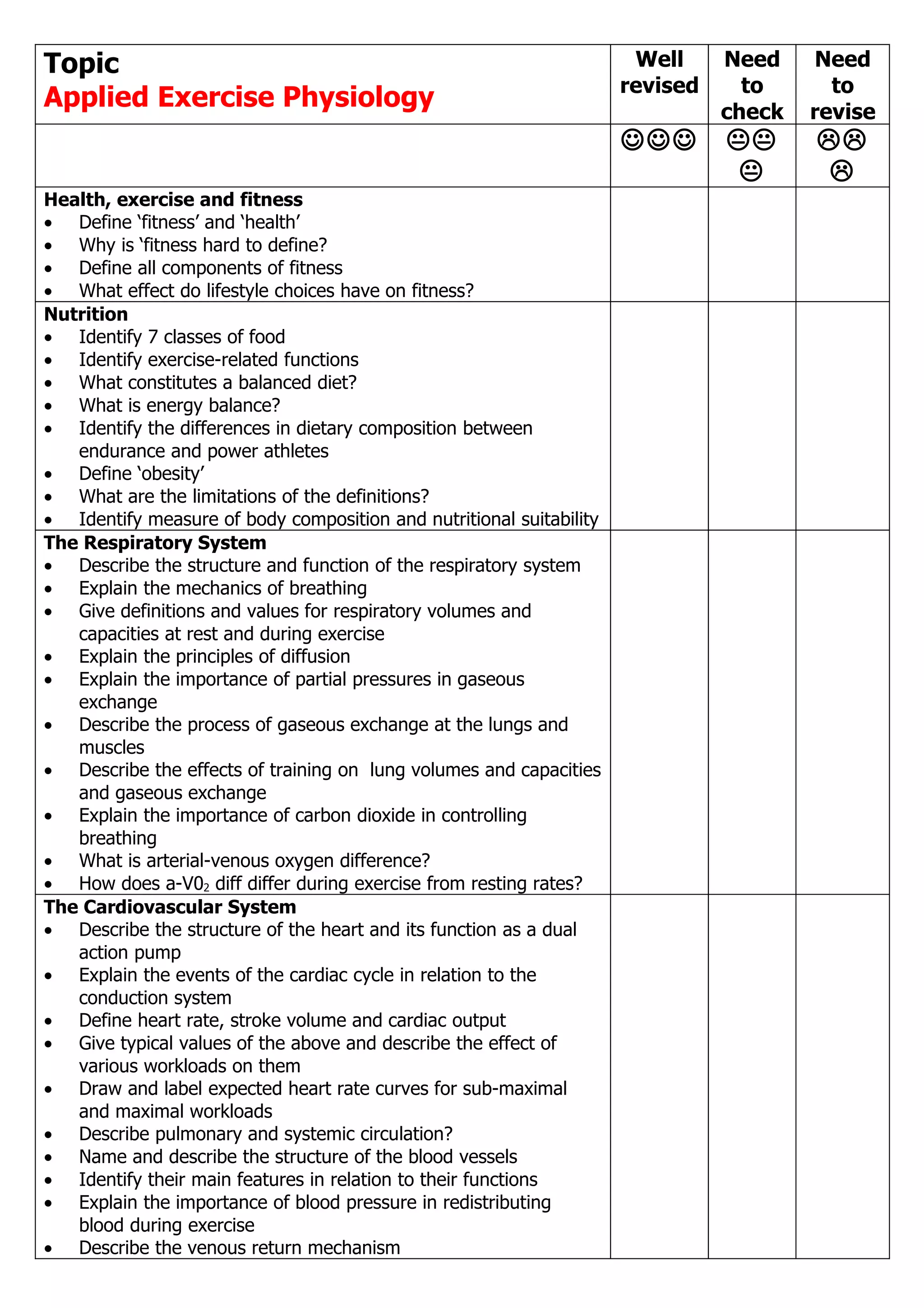
Topic                                                                 Well     Need    Need
                                                                     revised     to      to
Applied Exercise Physiology                                                    check   revise
                                                                                  
                                                                                       
Health, exercise and fitness
• Define ‘fitness’ and ‘health’
• Why is ‘fitness hard to define?
• Define all components of fitness
• What effect do lifestyle choices have on fitness?
Nutrition
• Identify 7 classes of food
• Identify exercise-related functions
• What constitutes a balanced diet?
• What is energy balance?
• Identify the differences in dietary composition between
   endurance and power athletes
• Define ‘obesity’
• What are the limitations of the definitions?
• Identify measure of body composition and nutritional suitability
The Respiratory System
• Describe the structure and function of the respiratory system
• Explain the mechanics of breathing
• Give definitions and values for respiratory volumes and
   capacities at rest and during exercise
• Explain the principles of diffusion
• Explain the importance of partial pressures in gaseous
   exchange
• Describe the process of gaseous exchange at the lungs and
   muscles
• Describe the effects of training on lung volumes and capacities
   and gaseous exchange
• Explain the importance of carbon dioxide in controlling
   breathing
• What is arterial-venous oxygen difference?
• How does a-V02 diff differ during exercise from resting rates?
The Cardiovascular System
• Describe the structure of the heart and its function as a dual
   action pump
• Explain the events of the cardiac cycle in relation to the
   conduction system
• Define heart rate, stroke volume and cardiac output
• Give typical values of the above and describe the effect of
   various workloads on them
• Draw and label expected heart rate curves for sub-maximal
   and maximal workloads
• Describe pulmonary and systemic circulation?
• Name and describe the structure of the blood vessels
• Identify their main features in relation to their functions
• Explain the importance of blood pressure in redistributing
   blood during exercise
• Describe the venous return mechanism
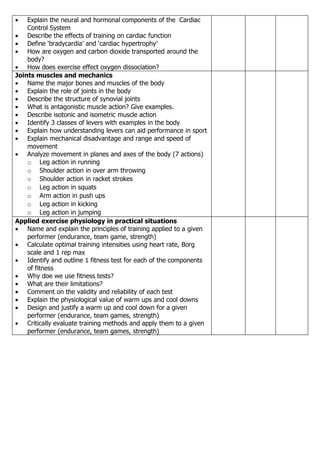
•   Explain the neural and hormonal components of the Cardiac
    Control System
• Describe the effects of training on cardiac function
• Define ‘bradycardia’ and ‘cardiac hypertrophy’
• How are oxygen and carbon dioxide transported around the
    body?
• How does exercise effect oxygen dissociation?
Joints muscles and mechanics
• Name the major bones and muscles of the body
• Explain the role of joints in the body
• Describe the structure of synovial joints
• What is antagonistic muscle action? Give examples.
• Describe isotonic and isometric muscle action
• Identify 3 classes of levers with examples in the body
• Explain how understanding levers can aid performance in sport
• Explain mechanical disadvantage and range and speed of
    movement
• Analyze movement in planes and axes of the body (7 actions)
    o Leg action in running
    o Shoulder action in over arm throwing
    o Shoulder action in racket strokes
    o Leg action in squats
    o Arm action in push ups
    o Leg action in kicking
    o Leg action in jumping
Applied exercise physiology in practical situations
• Name and explain the principles of training applied to a given
    performer (endurance, team game, strength)
• Calculate optimal training intensities using heart rate, Borg
    scale and 1 rep max
• Identify and outline 1 fitness test for each of the components
    of fitness
• Why doe we use fitness tests?
• What are their limitations?
• Comment on the validity and reliability of each test
• Explain the physiological value of warm ups and cool downs
• Design and justify a warm up and cool down for a given
    performer (endurance, team games, strength)
• Critically evaluate training methods and apply them to a given
    performer (endurance, team games, strength)
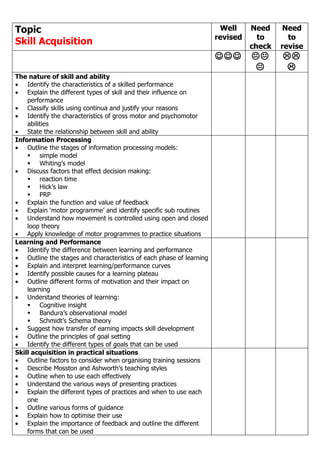
Topic                                                                 Well     Need    Need
                                                                     revised     to      to
Skill Acquisition                                                              check   revise
                                                                                  
                                                                                       
The nature of skill and ability
• Identify the characteristics of a skilled performance
• Explain the different types of skill and their influence on
    performance
• Classify skills using continua and justify your reasons
• Identify the characteristics of gross motor and psychomotor
    abilities
• State the relationship between skill and ability
Information Processing
• Outline the stages of information processing models:
     simple model
     Whiting’s model
• Discuss factors that effect decision making:
     reaction time
     Hick’s law
     PRP
• Explain the function and value of feedback
• Explain ‘motor programme’ and identify specific sub routines
• Understand how movement is controlled using open and closed
    loop theory
• Apply knowledge of motor programmes to practice situations
Learning and Performance
• Identify the difference between learning and performance
• Outline the stages and characteristics of each phase of learning
• Explain and interpret learning/performance curves
• Identify possible causes for a learning plateau
• Outline different forms of motivation and their impact on
    learning
• Understand theories of learning:
     Cognitive insight
     Bandura’s observational model
     Schmidt’s Schema theory
• Suggest how transfer of earning impacts skill development
• Outline the principles of goal setting
• Identify the different types of goals that can be used
Skill acquisition in practical situations
• Outline factors to consider when organising training sessions
• Describe Mosston and Ashworth’s teaching styles
• Outline when to use each effectively
• Understand the various ways of presenting practices
• Explain the different types of practices and when to use each
    one
• Outline various forms of guidance
• Explain how to optimise their use
• Explain the importance of feedback and outline the different
    forms that can be used
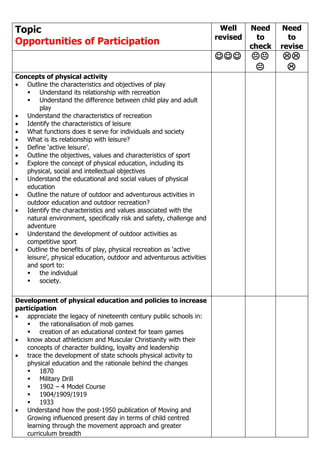
Topic                                                                  Well     Need    Need
                                                                      revised     to      to
Opportunities of Participation                                                  check   revise
                                                                                   
                                                                                        
Concepts of physical activity
• Outline the characteristics and objectives of play
    Understand its relationship with recreation
    Understand the difference between child play and adult
        play
• Understand the characteristics of recreation
• Identify the characteristics of leisure
• What functions does it serve for individuals and society
• What is its relationship with leisure?
• Define ‘active leisure’.
• Outline the objectives, values and characteristics of sport
• Explore the concept of physical education, including its
   physical, social and intellectual objectives
• Understand the educational and social values of physical
   education
• Outline the nature of outdoor and adventurous activities in
   outdoor education and outdoor recreation?
• Identify the characteristics and values associated with the
   natural environment, specifically risk and safety, challenge and
   adventure
• Understand the development of outdoor activities as
   competitive sport
• Outline the benefits of play, physical recreation as ‘active
   leisure’, physical education, outdoor and adventurous activities
   and sport to:
    the individual
    society.


Development of physical education and policies to increase
participation
• appreciate the legacy of nineteenth century public schools in:
     the rationalisation of mob games
     creation of an educational context for team games
• know about athleticism and Muscular Christianity with their
    concepts of character building, loyalty and leadership
• trace the development of state schools physical activity to
    physical education and the rationale behind the changes
     1870
     Military Drill
     1902 – 4 Model Course
     1904/1909/1919
     1933
• Understand how the post-1950 publication of Moving and
    Growing influenced present day in terms of child centred
    learning through the movement approach and greater
    curriculum breadth
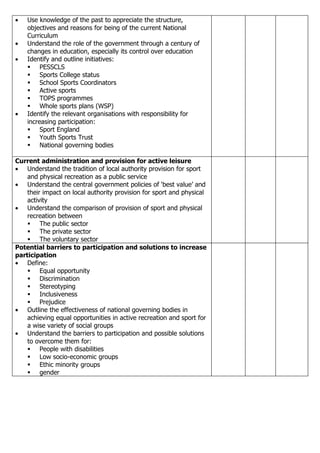
•   Use knowledge of the past to appreciate the structure,
    objectives and reasons for being of the current National
    Curriculum
•   Understand the role of the government through a century of
    changes in education, especially its control over education
•   Identify and outline initiatives:
     PESSCLS
     Sports College status
     School Sports Coordinators
     Active sports
     TOPS programmes
     Whole sports plans (WSP)
•   Identify the relevant organisations with responsibility for
    increasing participation:
     Sport England
     Youth Sports Trust
     National governing bodies

Current administration and provision for active leisure
• Understand the tradition of local authority provision for sport
    and physical recreation as a public service
• Understand the central government policies of ‘best value’ and
    their impact on local authority provision for sport and physical
    activity
• Understand the comparison of provision of sport and physical
    recreation between
     The public sector
     The private sector
     The voluntary sector
Potential barriers to participation and solutions to increase
participation
• Define:
     Equal opportunity
     Discrimination
     Stereotyping
     Inclusiveness
     Prejudice
• Outline the effectiveness of national governing bodies in
    achieving equal opportunities in active recreation and sport for
    a wise variety of social groups
• Understand the barriers to participation and possible solutions
    to overcome them for:
     People with disabilities
     Low socio-economic groups
     Ethic minority groups
     gender

PEShare.co.uk Shared Resource

  • 1.
    Topic Well Need Need revised to to Applied Exercise Physiology check revise      Health, exercise and fitness • Define ‘fitness’ and ‘health’ • Why is ‘fitness hard to define? • Define all components of fitness • What effect do lifestyle choices have on fitness? Nutrition • Identify 7 classes of food • Identify exercise-related functions • What constitutes a balanced diet? • What is energy balance? • Identify the differences in dietary composition between endurance and power athletes • Define ‘obesity’ • What are the limitations of the definitions? • Identify measure of body composition and nutritional suitability The Respiratory System • Describe the structure and function of the respiratory system • Explain the mechanics of breathing • Give definitions and values for respiratory volumes and capacities at rest and during exercise • Explain the principles of diffusion • Explain the importance of partial pressures in gaseous exchange • Describe the process of gaseous exchange at the lungs and muscles • Describe the effects of training on lung volumes and capacities and gaseous exchange • Explain the importance of carbon dioxide in controlling breathing • What is arterial-venous oxygen difference? • How does a-V02 diff differ during exercise from resting rates? The Cardiovascular System • Describe the structure of the heart and its function as a dual action pump • Explain the events of the cardiac cycle in relation to the conduction system • Define heart rate, stroke volume and cardiac output • Give typical values of the above and describe the effect of various workloads on them • Draw and label expected heart rate curves for sub-maximal and maximal workloads • Describe pulmonary and systemic circulation? • Name and describe the structure of the blood vessels • Identify their main features in relation to their functions • Explain the importance of blood pressure in redistributing blood during exercise • Describe the venous return mechanism
  • 2.
    Explain the neural and hormonal components of the Cardiac Control System • Describe the effects of training on cardiac function • Define ‘bradycardia’ and ‘cardiac hypertrophy’ • How are oxygen and carbon dioxide transported around the body? • How does exercise effect oxygen dissociation? Joints muscles and mechanics • Name the major bones and muscles of the body • Explain the role of joints in the body • Describe the structure of synovial joints • What is antagonistic muscle action? Give examples. • Describe isotonic and isometric muscle action • Identify 3 classes of levers with examples in the body • Explain how understanding levers can aid performance in sport • Explain mechanical disadvantage and range and speed of movement • Analyze movement in planes and axes of the body (7 actions) o Leg action in running o Shoulder action in over arm throwing o Shoulder action in racket strokes o Leg action in squats o Arm action in push ups o Leg action in kicking o Leg action in jumping Applied exercise physiology in practical situations • Name and explain the principles of training applied to a given performer (endurance, team game, strength) • Calculate optimal training intensities using heart rate, Borg scale and 1 rep max • Identify and outline 1 fitness test for each of the components of fitness • Why doe we use fitness tests? • What are their limitations? • Comment on the validity and reliability of each test • Explain the physiological value of warm ups and cool downs • Design and justify a warm up and cool down for a given performer (endurance, team games, strength) • Critically evaluate training methods and apply them to a given performer (endurance, team games, strength)
  • 3.
    Topic Well Need Need revised to to Skill Acquisition check revise      The nature of skill and ability • Identify the characteristics of a skilled performance • Explain the different types of skill and their influence on performance • Classify skills using continua and justify your reasons • Identify the characteristics of gross motor and psychomotor abilities • State the relationship between skill and ability Information Processing • Outline the stages of information processing models:  simple model  Whiting’s model • Discuss factors that effect decision making:  reaction time  Hick’s law  PRP • Explain the function and value of feedback • Explain ‘motor programme’ and identify specific sub routines • Understand how movement is controlled using open and closed loop theory • Apply knowledge of motor programmes to practice situations Learning and Performance • Identify the difference between learning and performance • Outline the stages and characteristics of each phase of learning • Explain and interpret learning/performance curves • Identify possible causes for a learning plateau • Outline different forms of motivation and their impact on learning • Understand theories of learning:  Cognitive insight  Bandura’s observational model  Schmidt’s Schema theory • Suggest how transfer of earning impacts skill development • Outline the principles of goal setting • Identify the different types of goals that can be used Skill acquisition in practical situations • Outline factors to consider when organising training sessions • Describe Mosston and Ashworth’s teaching styles • Outline when to use each effectively • Understand the various ways of presenting practices • Explain the different types of practices and when to use each one • Outline various forms of guidance • Explain how to optimise their use • Explain the importance of feedback and outline the different forms that can be used
  • 4.
    Topic Well Need Need revised to to Opportunities of Participation check revise      Concepts of physical activity • Outline the characteristics and objectives of play  Understand its relationship with recreation  Understand the difference between child play and adult play • Understand the characteristics of recreation • Identify the characteristics of leisure • What functions does it serve for individuals and society • What is its relationship with leisure? • Define ‘active leisure’. • Outline the objectives, values and characteristics of sport • Explore the concept of physical education, including its physical, social and intellectual objectives • Understand the educational and social values of physical education • Outline the nature of outdoor and adventurous activities in outdoor education and outdoor recreation? • Identify the characteristics and values associated with the natural environment, specifically risk and safety, challenge and adventure • Understand the development of outdoor activities as competitive sport • Outline the benefits of play, physical recreation as ‘active leisure’, physical education, outdoor and adventurous activities and sport to:  the individual  society. Development of physical education and policies to increase participation • appreciate the legacy of nineteenth century public schools in:  the rationalisation of mob games  creation of an educational context for team games • know about athleticism and Muscular Christianity with their concepts of character building, loyalty and leadership • trace the development of state schools physical activity to physical education and the rationale behind the changes  1870  Military Drill  1902 – 4 Model Course  1904/1909/1919  1933 • Understand how the post-1950 publication of Moving and Growing influenced present day in terms of child centred learning through the movement approach and greater curriculum breadth
  • 5.
    Use knowledge of the past to appreciate the structure, objectives and reasons for being of the current National Curriculum • Understand the role of the government through a century of changes in education, especially its control over education • Identify and outline initiatives:  PESSCLS  Sports College status  School Sports Coordinators  Active sports  TOPS programmes  Whole sports plans (WSP) • Identify the relevant organisations with responsibility for increasing participation:  Sport England  Youth Sports Trust  National governing bodies Current administration and provision for active leisure • Understand the tradition of local authority provision for sport and physical recreation as a public service • Understand the central government policies of ‘best value’ and their impact on local authority provision for sport and physical activity • Understand the comparison of provision of sport and physical recreation between  The public sector  The private sector  The voluntary sector Potential barriers to participation and solutions to increase participation • Define:  Equal opportunity  Discrimination  Stereotyping  Inclusiveness  Prejudice • Outline the effectiveness of national governing bodies in achieving equal opportunities in active recreation and sport for a wise variety of social groups • Understand the barriers to participation and possible solutions to overcome them for:  People with disabilities  Low socio-economic groups  Ethic minority groups  gender