PERUVIAN ARTCRAFT
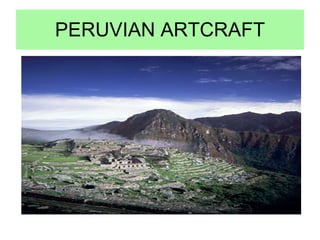
Peru boasts one of the largest varieties of arts and crafts on  Earth, as can be seen from the growing network of exporters who each year exhibit the skill of Peruvian craftsmen in Europe, Asia and North America. The diversity, color, creativity and multiple functions of Peru's folk art has made it a fundamental activity not just for Peru's cultural identity, but also as a way of life for thousands of families and even entire communities, such as Sarhua and Quinua in Ayacucho.   Works of art, both big and small, spark admiration amongst Peruvians and foreigners alike, are steeped in centuries of history, imbued with pre-Hispanic shapes and symbols which have merged with others brought over by the Spaniards. Peru has forged a multiple and complex identity which is paradoxically one of the reasons why Peruvian arts and crafts are tending to shift towards naïf art, lending their works a touch of innocence.
INTRODUCTION The excellence of Peruvian artisans can be seen in the harmony of the geometric designs in weavings, the minute portraits of peasant farming life on the carved gourds called mates burilados, the cultural mestizaje or blend in the colorful retablo boxed scenes. There are also the finely carved Huamanga stone sculptures, the complex Baroque nature of the wooden carvings, the beauty of gold and silver relics and the many forms that pottery has shaped the clay into pottery.   These works are just some of the cultural manifestations of a people who communicate mainly through art, using a language whose fundamental aspects are abundance, fertility and confidence in the future. The Center for Export, Transformation, Industry, Trade and Services in Tacna.. This provides a platform of services that facilitates and promotes local and foreign private investment aimed at production activities and foreign trade
Enterprise Mission statement Provide to ours clients a quality products and better cost for you our full satisfaction, exceeding yours expectatives Vision To be present in the minds of the Latin American consumers with better Peruvian artcrafts Values Integrity,, honesty, loyalty, perseverance and tenacity Objectives Import the best Peruvian artcfafts for all the Latin America
Objectives Objectives Manufacturing Eliminates safety hazards Insures supplies on hand Ensures condition of tools and equipment Inspects incoming materials Inspects outgoing work Objectives Marketing Conducts market research Devises compensation plans for salesmen Conducts sales contests takes telephone orders Solicits sales Prepares advertising and sales promotion material Objectives office Figures costs  Handles purchasing Dictates letters  Operates office machines Prepares budgets
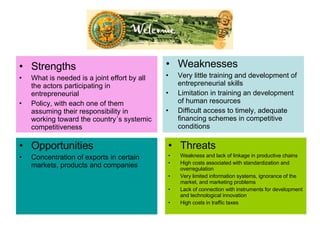
Strengths   What is needed is a joint effort by all the actors participating in entrepreneurial  Policy, with each one of them assuming their responsibility in working toward the country´s systemic competitiveness Weaknesses   Very little training and development of entrepreneurial skills Limitation in training an development of human resources Difficult access to timely, adequate financing schemes in competitive conditions Opportunities  Concentration of exports in certain markets, products and companies Threats  Weakness and lack of linkage in productive chains High costs associated with standardization and overregulation Very limited information systems, ignorance of the market, and marketing problems Lack of connection with instruments for development and technological innovation High costs in traffic taxes
RESEARCH: MARKETING STRATEGY APLICCATION OF CUESTIONARIES TO  10  PEOPLES DO YOU LIKE ART CRAFTS?   IN WICH PLACES DO YOU BUY THEM?   WHAT KIND DO YOU PREFER?   SI 10 NO 1 TIPICAL PLACES 7 STORES 3 CERAMIC AND JEWERLY 6 CLOTHE 4
GRAPHICS
RESULTS:IMPORT ARTCRAFTS THE BUSINESS IS AVAIBLE FHURTERMORE WE FIND AN ENTRERPRISE PERUVIAN FOR  BECAME A BRANCH, AND WE FIND THE NEXT:
KUKULI ALPACA PRODUCTS WINTER 2008-2009
The industrial facilities of Textiles Surandino are located in Lima, Perú.  It has a capacity of 8 metric tons of fabric per month, with the possibility of expanding it to 9 metric tons if necessary.
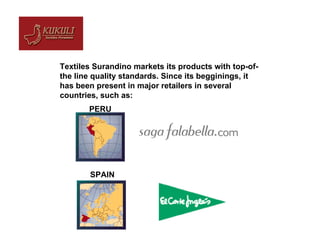
Textiles Surandino markets its products with top-of-the line quality standards. Since its begginings, it has been present in major retailers in several countries, such as:  PERU SPAIN
MEXICO GERMANY, NETHERLANDS BELGIUM  AND LUXEMBOURG
Who are we? Founded in Peru in 1980,  KUKULI  is still a family-run company. It’s founders are the Silva-Zegarra family who aim to produce a specialist line of clothing; a mix of new trends with native art from the people of the Andes. What do we make? KUKULI produce a complete line of traditional Alpaca knitwear and accessories including sweaters, ponchos, capes, coats and jackets.
Where do we export to? Our products are exported to many different countries. In 2003 we exported to the following countries:  México    40% United Kingdom      20 %  Australia     10 %  France  10% Netherlands  5% Unite States  15% Who do we currently sell to? Liverpool (México city) Palacio de Hierro ( México city) Sears Roebuck (México city) Costco (México city) Macy’s (New York) Mark’s & Spencer (UK) CH Collections (Australia)  Australian Alpacas (Australia)  Van Vuuren ( The Netherlands) Claudia Stratter ( The Netherlands)
PRODUCTS OF ALPACA
 
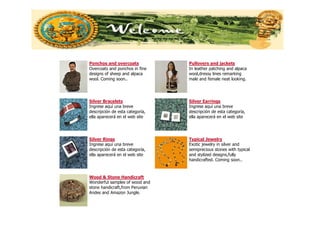
AVAILABLE  MERCHANDISE FASHION PARADE


EKEKO In the  mythology  and  folklore  of Perú the Ekeko is a fortune bearer god that has not lost prestige. It is used to offer him banknotes and/or coins to obtain money, grains for a good harvest, and some food to ensure prosperity in general. there his followers, who adopted him as a  superstition  more than as a folkloric  deity , consider him as some kind of beneficent patron.  In art he is depicted as a man, wearing traditional Bolivian clothes (especially the cap) and carrying bags and baskets with grain and food (compare with the  cornucopia  of some Greco-Roman deities); he is commonly found as a little statue to be put in some place of the house, preferably a comfortable one, but also as an amuleto holding from key rings; modern statues of the god include a circular opening in his mouth to place there a cigarette (better if lit) for Ekeko's pleasure.
CHICKEN CHILI
PUBLICITY WILL BE MAKE WHIT FLYERS IN METRO VISITING STORES IN DOWN TOWN TO SELL MERCHANDISE
DISTRIBUTION CHANNELS AND SELLS WITH RETAILER SELLERS SMALL FORCES ABOUT HIRING 30 IN THE PRINCIPAL CITYS

PERUVIAN ARTCRAFT

  • 1.
  • 2.
    Peru boasts oneof the largest varieties of arts and crafts on Earth, as can be seen from the growing network of exporters who each year exhibit the skill of Peruvian craftsmen in Europe, Asia and North America. The diversity, color, creativity and multiple functions of Peru's folk art has made it a fundamental activity not just for Peru's cultural identity, but also as a way of life for thousands of families and even entire communities, such as Sarhua and Quinua in Ayacucho.   Works of art, both big and small, spark admiration amongst Peruvians and foreigners alike, are steeped in centuries of history, imbued with pre-Hispanic shapes and symbols which have merged with others brought over by the Spaniards. Peru has forged a multiple and complex identity which is paradoxically one of the reasons why Peruvian arts and crafts are tending to shift towards naïf art, lending their works a touch of innocence.
  • 3.
    INTRODUCTION The excellenceof Peruvian artisans can be seen in the harmony of the geometric designs in weavings, the minute portraits of peasant farming life on the carved gourds called mates burilados, the cultural mestizaje or blend in the colorful retablo boxed scenes. There are also the finely carved Huamanga stone sculptures, the complex Baroque nature of the wooden carvings, the beauty of gold and silver relics and the many forms that pottery has shaped the clay into pottery.   These works are just some of the cultural manifestations of a people who communicate mainly through art, using a language whose fundamental aspects are abundance, fertility and confidence in the future. The Center for Export, Transformation, Industry, Trade and Services in Tacna.. This provides a platform of services that facilitates and promotes local and foreign private investment aimed at production activities and foreign trade
  • 4.
    Enterprise Mission statementProvide to ours clients a quality products and better cost for you our full satisfaction, exceeding yours expectatives Vision To be present in the minds of the Latin American consumers with better Peruvian artcrafts Values Integrity,, honesty, loyalty, perseverance and tenacity Objectives Import the best Peruvian artcfafts for all the Latin America
  • 5.
    Objectives Objectives ManufacturingEliminates safety hazards Insures supplies on hand Ensures condition of tools and equipment Inspects incoming materials Inspects outgoing work Objectives Marketing Conducts market research Devises compensation plans for salesmen Conducts sales contests takes telephone orders Solicits sales Prepares advertising and sales promotion material Objectives office Figures costs Handles purchasing Dictates letters Operates office machines Prepares budgets
  • 6.
    Strengths What is needed is a joint effort by all the actors participating in entrepreneurial Policy, with each one of them assuming their responsibility in working toward the country´s systemic competitiveness Weaknesses Very little training and development of entrepreneurial skills Limitation in training an development of human resources Difficult access to timely, adequate financing schemes in competitive conditions Opportunities Concentration of exports in certain markets, products and companies Threats Weakness and lack of linkage in productive chains High costs associated with standardization and overregulation Very limited information systems, ignorance of the market, and marketing problems Lack of connection with instruments for development and technological innovation High costs in traffic taxes
  • 7.
    RESEARCH: MARKETING STRATEGYAPLICCATION OF CUESTIONARIES TO 10 PEOPLES DO YOU LIKE ART CRAFTS?   IN WICH PLACES DO YOU BUY THEM?   WHAT KIND DO YOU PREFER?   SI 10 NO 1 TIPICAL PLACES 7 STORES 3 CERAMIC AND JEWERLY 6 CLOTHE 4
  • 8.
  • 9.
    RESULTS:IMPORT ARTCRAFTS THEBUSINESS IS AVAIBLE FHURTERMORE WE FIND AN ENTRERPRISE PERUVIAN FOR BECAME A BRANCH, AND WE FIND THE NEXT:
  • 10.
    KUKULI ALPACA PRODUCTSWINTER 2008-2009
  • 11.
    The industrial facilitiesof Textiles Surandino are located in Lima, Perú. It has a capacity of 8 metric tons of fabric per month, with the possibility of expanding it to 9 metric tons if necessary.
  • 12.
    Textiles Surandino marketsits products with top-of-the line quality standards. Since its begginings, it has been present in major retailers in several countries, such as: PERU SPAIN
  • 13.
    MEXICO GERMANY, NETHERLANDSBELGIUM AND LUXEMBOURG
  • 14.
    Who are we?Founded in Peru in 1980, KUKULI is still a family-run company. It’s founders are the Silva-Zegarra family who aim to produce a specialist line of clothing; a mix of new trends with native art from the people of the Andes. What do we make? KUKULI produce a complete line of traditional Alpaca knitwear and accessories including sweaters, ponchos, capes, coats and jackets.
  • 15.
    Where do weexport to? Our products are exported to many different countries. In 2003 we exported to the following countries: México 40% United Kingdom   20 % Australia  10 % France 10% Netherlands 5% Unite States 15% Who do we currently sell to? Liverpool (México city) Palacio de Hierro ( México city) Sears Roebuck (México city) Costco (México city) Macy’s (New York) Mark’s & Spencer (UK) CH Collections (Australia) Australian Alpacas (Australia) Van Vuuren ( The Netherlands) Claudia Stratter ( The Netherlands)
  • 16.
  • 17.
  • 18.
    AVAILABLE MERCHANDISEFASHION PARADE
  • 19.
  • 20.
  • 21.
  • 22.
    EKEKO In the mythology and folklore of Perú the Ekeko is a fortune bearer god that has not lost prestige. It is used to offer him banknotes and/or coins to obtain money, grains for a good harvest, and some food to ensure prosperity in general. there his followers, who adopted him as a superstition more than as a folkloric deity , consider him as some kind of beneficent patron. In art he is depicted as a man, wearing traditional Bolivian clothes (especially the cap) and carrying bags and baskets with grain and food (compare with the cornucopia of some Greco-Roman deities); he is commonly found as a little statue to be put in some place of the house, preferably a comfortable one, but also as an amuleto holding from key rings; modern statues of the god include a circular opening in his mouth to place there a cigarette (better if lit) for Ekeko's pleasure.
  • 23.
  • 24.
    PUBLICITY WILL BEMAKE WHIT FLYERS IN METRO VISITING STORES IN DOWN TOWN TO SELL MERCHANDISE
  • 25.
    DISTRIBUTION CHANNELS ANDSELLS WITH RETAILER SELLERS SMALL FORCES ABOUT HIRING 30 IN THE PRINCIPAL CITYS