Brigham &
Ehrhardt
1
© 2014 Cengage Learning. All Rights Reserved. May not be copied, scanned, or duplicated, in whole or in part, except for use
as
permitted in a license distributed with a certain product or service or otherwise on a password-protected website for classroom
Financial Management:
Theory and Practice
14e
CHAPTER
16
2
© 2014 Cengage Learning. All Rights Reserved. May not be copied, scanned, or duplicated, in whole or in part, except for use
as
permitted in a license distributed with a certain product or service or otherwise on a password-protected website for classroom
Supply Chains and Working
Capital Management
Topics in
Chapter
3
© 2014 Cengage Learning. All Rights Reserved. May not be copied, scanned, or duplicated, in whole or in part, except for use
as
permitted in a license distributed with a certain product or service or otherwise on a password-protected website for classroom
 Alternative current operating
assets investment and financing
policies
 Cash, inventory, and A/R
management
 Accounts payable management
 Short-term financing
 Bank loans, their costs, and
commercial paper
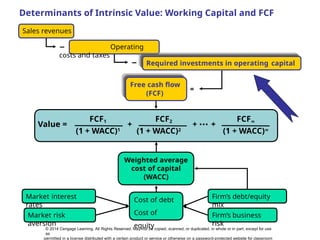
Value = + + ··· +
FCF1
(1 + WACC)1
FCF∞
(1 + WACC)∞
FCF2
(1 + WACC)2
Free cash flow
(FCF)
Market interest
rates
Firm’s business
risk
Market risk
aversion
Firm’s debt/equity
mix
Cost of debt
Cost of
equity
Weighted average
cost of capital
(WACC)
Required investments in operating capital
Sales revenues
− Operating
costs and taxes
−
=
Determinants of Intrinsic Value: Working Capital and FCF
© 2014 Cengage Learning. All Rights Reserved. May not be copied, scanned, or duplicated, in whole or in part, except for use
as
permitted in a license distributed with a certain product or service or otherwise on a password-protected website for classroom
Basic
Definitions
5
© 2014 Cengage Learning. All Rights Reserved. May not be copied, scanned, or duplicated, in whole or in part, except for use
as
permitted in a license distributed with a certain product or service or otherwise on a password-protected website for classroom
 Net operating working capital
(NOWC): Operating CA – Operating
CL =
(Cash + Inv. + A/R) – (Accruals +
A/P)
 Working capital:
Total current assets used in
operations.
 Net working capital:
Definitions
(Continued)
6
© 2014 Cengage Learning. All Rights Reserved. May not be copied, scanned, or duplicated, in whole or in part, except for use
as
permitted in a license distributed with a certain product or service or otherwise on a password-protected website for classroom
 Working capital management:
Includes both establishing working
capital policy and then the day-to-day
control of cash, inventories,
receivables, accruals, and accounts
payable.
 Working capital policy:

The level of each current asset.

How current assets are financed.
Selected Ratios for
RR
7
© 2014 Cengage Learning. All Rights Reserved. May not be copied, scanned, or duplicated, in whole or in part, except for use
as
permitted in a license distributed with a certain product or service or otherwise on a password-protected website for classroom
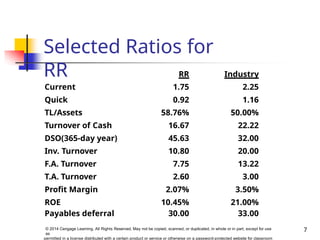
RR Industry
Current 1.75 2.25
Quick 0.92 1.16
TL/Assets 58.76% 50.00%
Turnover of Cash 16.67 22.22
DSO(365-day year) 45.63 32.00
Inv. Turnover 10.80 20.00
F.A. Turnover 7.75 13.22
T.A. Turnover 2.60 3.00
Profit Margin 2.07% 3.50%
ROE 10.45% 21.00%
Payables deferral 30.00 33.00
How does RR’s working capital
policy compare with the
industry?
8
© 2014 Cengage Learning. All Rights Reserved. May not be copied, scanned, or duplicated, in whole or in part, except for use
as
permitted in a license distributed with a certain product or service or otherwise on a password-protected website for classroom
 Working capital policy is reflected in a
firm’s current ratio, quick ratio,
turnover of cash and securities,
inventory turnover, and DSO.
 These ratios indicate R
R has large
amounts of working capital relative
to its level of sales. Thus, RR is
following a relaxed policy.
Is RR inefficient or just
conservative?
9
© 2014 Cengage Learning. All Rights Reserved. May not be copied, scanned, or duplicated, in whole or in part, except for use
as
permitted in a license distributed with a certain product or service or otherwise on a password-protected website for classroom
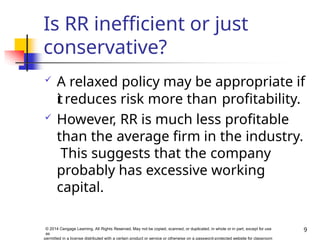
 A relaxed policy may be appropriate if
itreduces risk more than profitability.
 However, RR is much less profitable
than the average firm in the industry.
This suggests that the company
probably has excessive working
capital.
Cash Conversion
Cycle
10
© 2014 Cengage Learning. All Rights Reserved. May not be copied, scanned, or duplicated, in whole or in part, except for use
as
permitted in a license distributed with a certain product or service or otherwise on a password-protected website for classroom
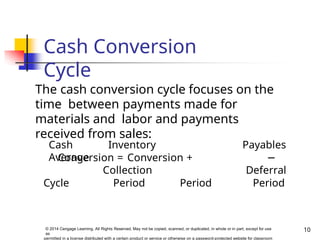
The cash conversion cycle focuses on the
time between payments made for
materials and labor and payments
received from sales:
Cash Inventory
Average
Conversion = Conversion +
Collection
Cycle Period Period
Payables
−
Deferral
Period
Cash Conversion Cycle
(Cont.)
11
© 2014 Cengage Learning. All Rights Reserved. May not be copied, scanned, or duplicated, in whole or in part, except for use
as
permitted in a license distributed with a certain product or service or otherwise on a password-protected website for classroom
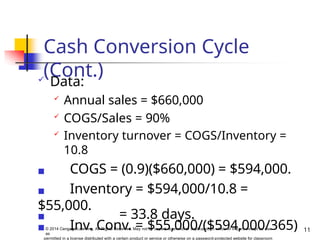
 Data:

Annual sales = $660,000

COGS/Sales = 90%
 Inventory turnover = COGS/Inventory =
10.8
◼ COGS = (0.9)($660,000) = $594,000.
◼ Inventory = $594,000/10.8 =
$55,000.
◼ Inv. Conv. = $55,000/($594,000/365)
◼ = 33.8 days.
Cash Conversion Cycle
(Cont.)
12
© 2014 Cengage Learning. All Rights Reserved. May not be copied, scanned, or duplicated, in whole or in part, except for use
as
permitted in a license distributed with a certain product or service or otherwise on a password-protected website for classroom
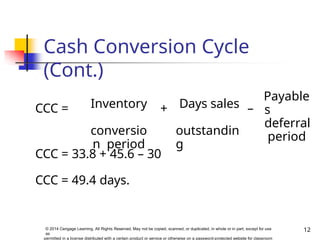
CCC = + –
CCC = 33.8 + 45.6 – 30
CCC = 49.4 days.
Inventory
conversio
n period
Payable
s
deferral
period
Days sales
outstandin
g
Cash Management: Cash doesn’t
earn
interest, so why hold it?
13
© 2014 Cengage Learning. All Rights Reserved. May not be copied, scanned, or duplicated, in whole or in part, except for use
as
permitted in a license distributed with a certain product or service or otherwise on a password-protected website for classroom
 Transactions (Routine): Must have some
cash to pay current bills.
 Essential that the firm have sufficient cash to
take
trade discounts.
 Transactions (Precaution): “Safety stock.”
 Not as much needed if company has credit line
or other holdings of short-term securities.
 Compensating balances: For loans
and/or services provided.
What’s the goal of
cash
management?
14
© 2014 Cengage Learning. All Rights Reserved. May not be copied, scanned, or duplicated, in whole or in part, except for use
as
permitted in a license distributed with a certain product or service or otherwise on a password-protected website for classroom
Minimize the cash amount the firm
must hold for conducting its normal
business activities, yet, at the same
time, have a sufficient cash reserve
to:
 Take trade discounts.
 Pay promptly and maintain its
credit rating.
 Meet any unexpected cash needs.
Ways to Minimize Cash
Holdings
15
© 2014 Cengage Learning. All Rights Reserved. May not be copied, scanned, or duplicated, in whole or in part, except for use
as
permitted in a license distributed with a certain product or service or otherwise on a password-protected website for classroom
 Use lockboxes.
 Insist on wire transfers or
automatic debit from customers.
 Synchronize inflows and outflows.
 Use float.
(More…)
Minimizing Cash
(Continued)
16
© 2014 Cengage Learning. All Rights Reserved. May not be copied, scanned, or duplicated, in whole or in part, except for use
as
permitted in a license distributed with a certain product or service or otherwise on a password-protected website for classroom
 Increase forecast accuracy to
reduce
the need for a cash “safety stock.”
 Hold marketable securities instead
of a
cash “safety stock.”
 Negotiate a line of credit (also
reduces
need for a “safety stock”).
Cash Budget: The Primary
Cash Management Tool
17
© 2014 Cengage Learning. All Rights Reserved. May not be copied, scanned, or duplicated, in whole or in part, except for use
as
permitted in a license distributed with a certain product or service or otherwise on a password-protected website for classroom
 Purpose: Uses forecasts of cash
inflows, outflows, and ending cash
balances to predict loan needs and funds
available for temporary investment.
 Timing:Daily, w
e
e
k
l
y
, or monthly, depending
upon budget’s purpose.
Monthly for annual planning,
daily for actual cash management.
Data Required for Cash
Budget
18
© 2014 Cengage Learning. All Rights Reserved. May not be copied, scanned, or duplicated, in whole or in part, except for use
as
permitted in a license distributed with a certain product or service or otherwise on a password-protected website for classroom
 Sales forecast.
 Information on collections delay.
 Forecast of purchases and
payment terms.
 Forecast of cash expenses:
wages, taxes, utilities, and so on.
 Initial cash on hand.
 Target cash balance.
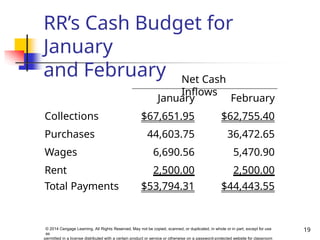
RR’s Cash Budget for
January
and February
19
© 2014 Cengage Learning. All Rights Reserved. May not be copied, scanned, or duplicated, in whole or in part, except for use
as
permitted in a license distributed with a certain product or service or otherwise on a password-protected website for classroom
January February
Collections $67,651.95 $62,755.40
Purchases 44,603.75 36,472.65
Wages 6,690.56 5,470.90
Rent 2,500.00 2,500.00
Total Payments $53,794.31 $44,443.55
Net Cash
Inflows
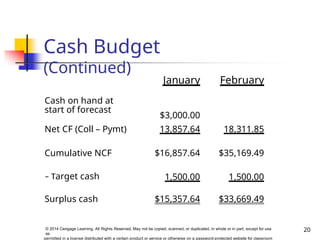
Cash Budget
(Continued)
20
© 2014 Cengage Learning. All Rights Reserved. May not be copied, scanned, or duplicated, in whole or in part, except for use
as
permitted in a license distributed with a certain product or service or otherwise on a password-protected website for classroom
January February
Cash on hand at
start of forecast
$3,000.00
Net CF (Coll – Pymt) 13,857.64 18,311.85
Cumulative NCF $16,857.64 $35,169.49
– Target cash 1,500.00 1,500.00
Surplus cash $15,357.64 $33,669.49
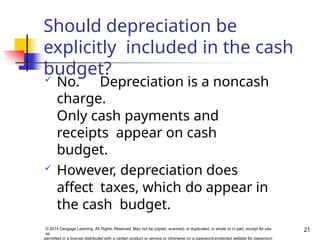
Should depreciation be
explicitly included in the cash
budget?
21
© 2014 Cengage Learning. All Rights Reserved. May not be copied, scanned, or duplicated, in whole or in part, except for use
as
permitted in a license distributed with a certain product or service or otherwise on a password-protected website for classroom
 No. Depreciation is a noncash
charge.
Only cash payments and
receipts appear on cash
budget.
 However, depreciation does
affect taxes, which do appear in
the cash budget.
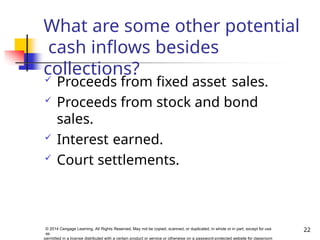
What are some other potential
cash inflows besides
collections?
22
© 2014 Cengage Learning. All Rights Reserved. May not be copied, scanned, or duplicated, in whole or in part, except for use
as
permitted in a license distributed with a certain product or service or otherwise on a password-protected website for classroom
 Proceeds from fixed asset sales.
 Proceeds from stock and bond
sales.
 Interest earned.
 Court settlements.
How can interest earned or paid on
short- term securities or loans be
incorporated in the cash budget?
23
© 2014 Cengage Learning. All Rights Reserved. May not be copied, scanned, or duplicated, in whole or in part, except for use
as
permitted in a license distributed with a certain product or service or otherwise on a password-protected website for classroom
 Interest earned: Add line in the
collections section.
 Interest paid: Add line in the
payments section.
 Found as interest rate x surplus/loan line
of cash budget for preceding month.
 Note: Interest on any other debt would
need to be incorporated as well.
How could bad debts be
worked into the cash
budget?
24
© 2014 Cengage Learning. All Rights Reserved. May not be copied, scanned, or duplicated, in whole or in part, except for use
as
permitted in a license distributed with a certain product or service or otherwise on a password-protected website for classroom
 Collections would be reduced by
the amount of bad debt losses.
 For example, if the firm had 3% bad
debt losses, collections would total
only 97% of sales.
 Lower collections would lead to
lower surpluses and higher
borrowing requirements.
Cash budget forecasts the company’s cash
holdings to exceed targeted cash balance
every month, except for October and
November.
25
© 2014 Cengage Learning. All Rights Reserved. May not be copied, scanned, or duplicated, in whole or in part, except for use
as
permitted in a license distributed with a certain product or service or otherwise on a password-protected website for classroom
◼ Cash budget indicates the
company probably is holding too
much cash.
◼ RR could improve its EVA by
either investing its excess cash in
more productive assets or by paying
it out to the firm’s shareholders.
Why might RR want to maintain
a relatively high amount of
cash?
26
© 2014 Cengage Learning. All Rights Reserved. May not be copied, scanned, or duplicated, in whole or in part, except for use
as
permitted in a license distributed with a certain product or service or otherwise on a password-protected website for classroom
 If sales turn out to be considerably less
than expected, RR could face a cash
shortfall.
 A company may choose to hold large
amounts of cash if it does not have
much faith in its sales forecast, or if it
is very conservative.
 The cash may be there, in part, to fund
aplanned fixed asset acquisition.
Is RR holding too much
inventory?
27
© 2014 Cengage Learning. All Rights Reserved. May not be copied, scanned, or duplicated, in whole or in part, except for use
as
permitted in a license distributed with a certain product or service or otherwise on a password-protected website for classroom
 RR’s inventory turnover (10.80) is
considerably lower than the industry
average (20.00).The firm is carrying a lot
of inventory per dollar of sales.
 By holding excessive inventory, t
h
e firm is
increasing its operating costs which
reduces its NOPAT. Moreover, the
excess inventory must be financed, so
EVA is further lowered.
If RR reduces its inventory, without
adversely affecting sales, what effect
will this have on its cash position?
 Short run: Cash will
increase as inventory
purchases decline.
 Long run: Company is likely to
then take steps to reduce its cash
holdings.
28
© 2014 Cengage Learning. All Rights Reserved. May not be copied, scanned, or duplicated, in whole or in part, except for use
as
permitted in a license distributed with a certain product or service or otherwise on a password-protected website for classroom
Accounts Receivable Management: Do
RR’s customers pay more or less
promptly than those of its
competitors?
◼ RR’s days’ sales outstanding (DSO)
of
45.6 days is well above the
industry average (32 days).
 RR’s customers are paying less
promptly.
 RR should consider tightening its
credit policy to reduce its DSO. 29
© 2014 Cengage Learning. All Rights Reserved. May not be copied, scanned, or duplicated, in whole or in part, except for use
as
permitted in a license distributed with a certain product or service or otherwise on a password-protected website for classroom
Elements of Credit
Policy
30
© 2014 Cengage Learning. All Rights Reserved. May not be copied, scanned, or duplicated, in whole or in part, except for use
as
permitted in a license distributed with a certain product or service or otherwise on a password-protected website for classroom
 Cash Discounts: Lowers price.
Attracts new customers and reduces
DSO.
 Credit Period: How long to pay?
Shorter period reduces DSO and
average A/R, but it may
discourage sales.
(More…)
Credit Policy
(Continued)
31
© 2014 Cengage Learning. All Rights Reserved. May not be copied, scanned, or duplicated, in whole or in part, except for use
as
permitted in a license distributed with a certain product or service or otherwise on a password-protected website for classroom
 Credit Standards: Tighter
standards reduce bad debt losses,
but may reduce sales. Fewer bad
debts reduces DSO.
 Collection Policy: Tougher
policy will reduce DSO, but may
damage customer relationships.
Does RR face any risk if it
tightens its credit policy?
32
© 2014 Cengage Learning. All Rights Reserved. May not be copied, scanned, or duplicated, in whole or in part, except for use
as
permitted in a license distributed with a certain product or service or otherwise on a password-protected website for classroom
◼ YES! A tighter credit policy m
a
y
discourage sales. Some customers
may choose to go elsewhere if they
are pressured to pay their bills
sooner.
If RR succeeds in reducing DSO
without adversely affecting sales,
what effect would this have on its
cash position?
 Short run: If customers pay
sooner, this increases cash
holdings.
 Long run: Over time, the company
would hopefully invest the cash in
more productive assets, or pay it out
to shareholders. Both of these
actions would increase EVA. 33
© 2014 Cengage Learning. All Rights Reserved. May not be copied, scanned, or duplicated, in whole or in part, except for use
as
permitted in a license distributed with a certain product or service or otherwise on a password-protected website for classroom
Is there a cost to accruals?
Can firms control accruals?
34
© 2014 Cengage Learning. All Rights Reserved. May not be copied, scanned, or duplicated, in whole or in part, except for use
as
permitted in a license distributed with a certain product or service or otherwise on a password-protected website for classroom
 Accruals are free in that no
explicit interest is charged.
 Firms have little control o
verthe level
of accruals. Levels are influenced
more by industry custom, economic
factors, and tax laws.
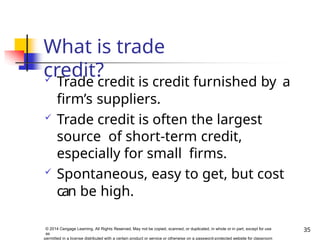
What is trade
credit?
35
© 2014 Cengage Learning. All Rights Reserved. May not be copied, scanned, or duplicated, in whole or in part, except for use
as
permitted in a license distributed with a certain product or service or otherwise on a password-protected website for classroom
 Trade credit is credit furnished by a
firm’s suppliers.
 Trade credit is often the largest
source of short-term credit,
especially for small firms.
 Spontaneous, easy to get, but cost
can be high.
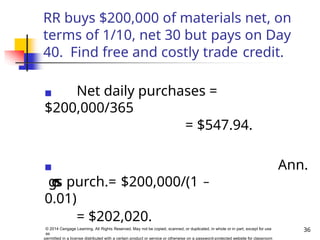
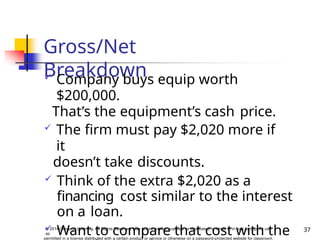
RR buys $200,000 of materials net, on
terms of 1/10, net 30 but pays on Day
40. Find free and costly trade credit.
◼ Net daily purchases =
$200,000/365
= $547.94.
◼ Ann.
g
r
o
s
s purch.= $200,000/(1 –
0.01)
= $202,020.
36
© 2014 Cengage Learning. All Rights Reserved. May not be copied, scanned, or duplicated, in whole or in part, except for use
as
permitted in a license distributed with a certain product or service or otherwise on a password-protected website for classroom
Gross/Net
Breakdown
37
© 2014 Cengage Learning. All Rights Reserved. May not be copied, scanned, or duplicated, in whole or in part, except for use
as
permitted in a license distributed with a certain product or service or otherwise on a password-protected website for classroom
 Company buys equip worth
$200,000.
That’s the equipment’s cash price.
 The firm must pay $2,020 more if
it
doesn’t take discounts.
 Think of the extra $2,020 as a
financing cost similar to the interest
on a loan.
 Want to compare that cost with the
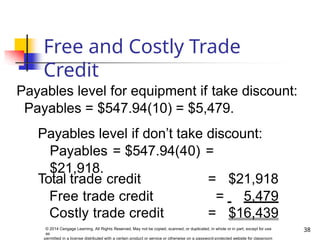
Payables level for equipment if take discount:
Payables = $547.94(10) = $5,479.
Payables level if don’t take discount:
Payables = $547.94(40) =
$21,918.
38
© 2014 Cengage Learning. All Rights Reserved. May not be copied, scanned, or duplicated, in whole or in part, except for use
as
permitted in a license distributed with a certain product or service or otherwise on a password-protected website for classroom
Total trade credit = $21,918
Free trade credit = 5,479
Costly trade credit = $16,439
Free and Costly Trade
Credit
Nominal Cost of Costly
Trade Credit, rNOM
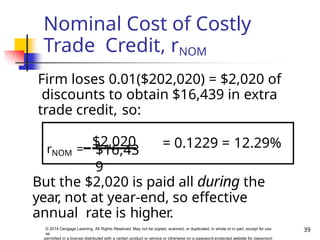
But the $2,020 is paid all during the
year, not at year-end, so effective
annual rate is higher.
Firm loses 0.01($202,020) = $2,020 of
discounts to obtain $16,439 in extra
trade credit, so:
= 0.1229 = 12.29%
39
© 2014 Cengage Learning. All Rights Reserved. May not be copied, scanned, or duplicated, in whole or in part, except for use
as
permitted in a license distributed with a certain product or service or otherwise on a password-protected website for classroom
rNOM =
$2,020
$16,43
9
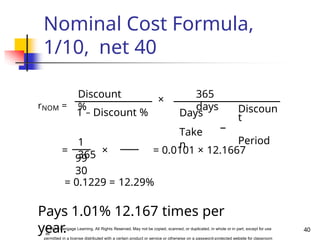
Nominal Cost Formula,
1/10, net 40
= 0.1229 = 12.29%
Pays 1.01% 12.167 times per
year.
rNOM =
Discount
%
1 – Discount %
×
365
days
Days
Take
n
Discoun
t
–
Period
=
1
365
99
30
× = 0.0101 × 12.1667
40
© 2014 Cengage Learning. All Rights Reserved. May not be copied, scanned, or duplicated, in whole or in part, except for use
as
permitted in a license distributed with a certain product or service or otherwise on a password-protected website for classroom
Effective Annual Rate (EAR),
1/10, net 40
41
© 2014 Cengage Learning. All Rights Reserved. May not be copied, scanned, or duplicated, in whole or in part, except for use
as
permitted in a license distributed with a certain product or service or otherwise on a password-protected website for classroom
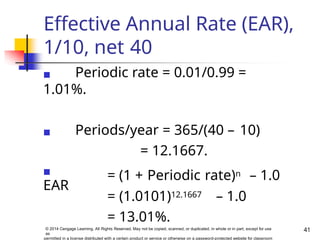
◼ Periodic rate = 0.01/0.99 =
1.01%.
◼ Periods/year = 365/(40 – 10)
= 12.1667.
◼
EAR
= (1 + Periodic rate)n – 1.0
= (1.0101)12.1667 – 1.0
= 13.01%.
Current Operating Assets
Financing Policies
42
© 2014 Cengage Learning. All Rights Reserved. May not be copied, scanned, or duplicated, in whole or in part, except for use
as
permitted in a license distributed with a certain product or service or otherwise on a password-protected website for classroom
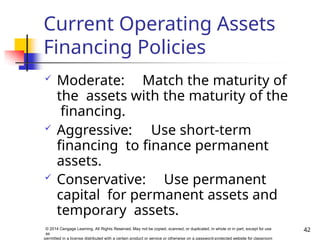
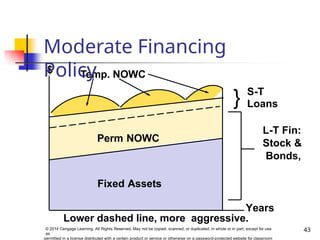
 Moderate: Match the maturity of
the assets with the maturity of the
financing.
 Aggressive: Use short-term
financing to finance permanent
assets.
 Conservative: Use permanent
capital for permanent assets and
temporary assets.
$
Perm NOWC
Fixed Assets
Temp. NOWC
Years
Lower dashed line, more aggressive.
} S-T
Loans
L-T Fin:
Stock &
Bonds,
43
© 2014 Cengage Learning. All Rights Reserved. May not be copied, scanned, or duplicated, in whole or in part, except for use
as
permitted in a license distributed with a certain product or service or otherwise on a password-protected website for classroom
Moderate Financing
Policy
What are the advantages of short-
term debt vs. long-term debt?
44
© 2014 Cengage Learning. All Rights Reserved. May not be copied, scanned, or duplicated, in whole or in part, except for use
as
permitted in a license distributed with a certain product or service or otherwise on a password-protected website for classroom
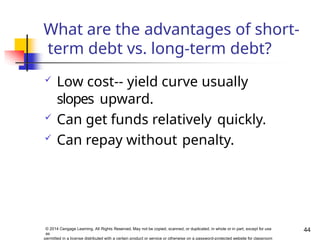
 Low cost-- yield curve usually
slopes upward.
 Can get funds relatively quickly.
 Can repay without penalty.
What are the disadvantages of
short- term debt vs. long-term
debt?
45
© 2014 Cengage Learning. All Rights Reserved. May not be copied, scanned, or duplicated, in whole or in part, except for use
as
permitted in a license distributed with a certain product or service or otherwise on a password-protected website for classroom
◼ Higher risk. The required
repayment comes quicker, and the
company may have trouble rolling
over loans.
Commercial Paper
(CP)
46
© 2014 Cengage Learning. All Rights Reserved. May not be copied, scanned, or duplicated, in whole or in part, except for use
as
permitted in a license distributed with a certain product or service or otherwise on a password-protected website for classroom
 Short term notes issued by l
a
r
g
e
, strong
companies. RR couldn’t issue CP--it’s
too small.
 CP trades in the market at rates
just above T-bill rate.
 CP is bought with surplus cash by
banks and other companies, then held
as a marketable security for liquidity
purposes.

Pertemuan 4 Working Capital ppt.pptxyxtx

  • 1.
    Brigham & Ehrhardt 1 © 2014Cengage Learning. All Rights Reserved. May not be copied, scanned, or duplicated, in whole or in part, except for use as permitted in a license distributed with a certain product or service or otherwise on a password-protected website for classroom Financial Management: Theory and Practice 14e
  • 2.
    CHAPTER 16 2 © 2014 CengageLearning. All Rights Reserved. May not be copied, scanned, or duplicated, in whole or in part, except for use as permitted in a license distributed with a certain product or service or otherwise on a password-protected website for classroom Supply Chains and Working Capital Management
  • 3.
    Topics in Chapter 3 © 2014Cengage Learning. All Rights Reserved. May not be copied, scanned, or duplicated, in whole or in part, except for use as permitted in a license distributed with a certain product or service or otherwise on a password-protected website for classroom  Alternative current operating assets investment and financing policies  Cash, inventory, and A/R management  Accounts payable management  Short-term financing  Bank loans, their costs, and commercial paper
  • 4.
    Value = ++ ··· + FCF1 (1 + WACC)1 FCF∞ (1 + WACC)∞ FCF2 (1 + WACC)2 Free cash flow (FCF) Market interest rates Firm’s business risk Market risk aversion Firm’s debt/equity mix Cost of debt Cost of equity Weighted average cost of capital (WACC) Required investments in operating capital Sales revenues − Operating costs and taxes − = Determinants of Intrinsic Value: Working Capital and FCF © 2014 Cengage Learning. All Rights Reserved. May not be copied, scanned, or duplicated, in whole or in part, except for use as permitted in a license distributed with a certain product or service or otherwise on a password-protected website for classroom
  • 5.
    Basic Definitions 5 © 2014 CengageLearning. All Rights Reserved. May not be copied, scanned, or duplicated, in whole or in part, except for use as permitted in a license distributed with a certain product or service or otherwise on a password-protected website for classroom  Net operating working capital (NOWC): Operating CA – Operating CL = (Cash + Inv. + A/R) – (Accruals + A/P)  Working capital: Total current assets used in operations.  Net working capital:
  • 6.
    Definitions (Continued) 6 © 2014 CengageLearning. All Rights Reserved. May not be copied, scanned, or duplicated, in whole or in part, except for use as permitted in a license distributed with a certain product or service or otherwise on a password-protected website for classroom  Working capital management: Includes both establishing working capital policy and then the day-to-day control of cash, inventories, receivables, accruals, and accounts payable.  Working capital policy:  The level of each current asset.  How current assets are financed.
  • 7.
    Selected Ratios for RR 7 ©2014 Cengage Learning. All Rights Reserved. May not be copied, scanned, or duplicated, in whole or in part, except for use as permitted in a license distributed with a certain product or service or otherwise on a password-protected website for classroom RR Industry Current 1.75 2.25 Quick 0.92 1.16 TL/Assets 58.76% 50.00% Turnover of Cash 16.67 22.22 DSO(365-day year) 45.63 32.00 Inv. Turnover 10.80 20.00 F.A. Turnover 7.75 13.22 T.A. Turnover 2.60 3.00 Profit Margin 2.07% 3.50% ROE 10.45% 21.00% Payables deferral 30.00 33.00
  • 8.
    How does RR’sworking capital policy compare with the industry? 8 © 2014 Cengage Learning. All Rights Reserved. May not be copied, scanned, or duplicated, in whole or in part, except for use as permitted in a license distributed with a certain product or service or otherwise on a password-protected website for classroom  Working capital policy is reflected in a firm’s current ratio, quick ratio, turnover of cash and securities, inventory turnover, and DSO.  These ratios indicate R R has large amounts of working capital relative to its level of sales. Thus, RR is following a relaxed policy.
  • 9.
    Is RR inefficientor just conservative? 9 © 2014 Cengage Learning. All Rights Reserved. May not be copied, scanned, or duplicated, in whole or in part, except for use as permitted in a license distributed with a certain product or service or otherwise on a password-protected website for classroom  A relaxed policy may be appropriate if itreduces risk more than profitability.  However, RR is much less profitable than the average firm in the industry. This suggests that the company probably has excessive working capital.
  • 10.
    Cash Conversion Cycle 10 © 2014Cengage Learning. All Rights Reserved. May not be copied, scanned, or duplicated, in whole or in part, except for use as permitted in a license distributed with a certain product or service or otherwise on a password-protected website for classroom The cash conversion cycle focuses on the time between payments made for materials and labor and payments received from sales: Cash Inventory Average Conversion = Conversion + Collection Cycle Period Period Payables − Deferral Period
  • 11.
    Cash Conversion Cycle (Cont.) 11 ©2014 Cengage Learning. All Rights Reserved. May not be copied, scanned, or duplicated, in whole or in part, except for use as permitted in a license distributed with a certain product or service or otherwise on a password-protected website for classroom  Data:  Annual sales = $660,000  COGS/Sales = 90%  Inventory turnover = COGS/Inventory = 10.8 ◼ COGS = (0.9)($660,000) = $594,000. ◼ Inventory = $594,000/10.8 = $55,000. ◼ Inv. Conv. = $55,000/($594,000/365) ◼ = 33.8 days.
  • 12.
    Cash Conversion Cycle (Cont.) 12 ©2014 Cengage Learning. All Rights Reserved. May not be copied, scanned, or duplicated, in whole or in part, except for use as permitted in a license distributed with a certain product or service or otherwise on a password-protected website for classroom CCC = + – CCC = 33.8 + 45.6 – 30 CCC = 49.4 days. Inventory conversio n period Payable s deferral period Days sales outstandin g
  • 13.
    Cash Management: Cashdoesn’t earn interest, so why hold it? 13 © 2014 Cengage Learning. All Rights Reserved. May not be copied, scanned, or duplicated, in whole or in part, except for use as permitted in a license distributed with a certain product or service or otherwise on a password-protected website for classroom  Transactions (Routine): Must have some cash to pay current bills.  Essential that the firm have sufficient cash to take trade discounts.  Transactions (Precaution): “Safety stock.”  Not as much needed if company has credit line or other holdings of short-term securities.  Compensating balances: For loans and/or services provided.
  • 14.
    What’s the goalof cash management? 14 © 2014 Cengage Learning. All Rights Reserved. May not be copied, scanned, or duplicated, in whole or in part, except for use as permitted in a license distributed with a certain product or service or otherwise on a password-protected website for classroom Minimize the cash amount the firm must hold for conducting its normal business activities, yet, at the same time, have a sufficient cash reserve to:  Take trade discounts.  Pay promptly and maintain its credit rating.  Meet any unexpected cash needs.
  • 15.
    Ways to MinimizeCash Holdings 15 © 2014 Cengage Learning. All Rights Reserved. May not be copied, scanned, or duplicated, in whole or in part, except for use as permitted in a license distributed with a certain product or service or otherwise on a password-protected website for classroom  Use lockboxes.  Insist on wire transfers or automatic debit from customers.  Synchronize inflows and outflows.  Use float. (More…)
  • 16.
    Minimizing Cash (Continued) 16 © 2014Cengage Learning. All Rights Reserved. May not be copied, scanned, or duplicated, in whole or in part, except for use as permitted in a license distributed with a certain product or service or otherwise on a password-protected website for classroom  Increase forecast accuracy to reduce the need for a cash “safety stock.”  Hold marketable securities instead of a cash “safety stock.”  Negotiate a line of credit (also reduces need for a “safety stock”).
  • 17.
    Cash Budget: ThePrimary Cash Management Tool 17 © 2014 Cengage Learning. All Rights Reserved. May not be copied, scanned, or duplicated, in whole or in part, except for use as permitted in a license distributed with a certain product or service or otherwise on a password-protected website for classroom  Purpose: Uses forecasts of cash inflows, outflows, and ending cash balances to predict loan needs and funds available for temporary investment.  Timing:Daily, w e e k l y , or monthly, depending upon budget’s purpose. Monthly for annual planning, daily for actual cash management.
  • 18.
    Data Required forCash Budget 18 © 2014 Cengage Learning. All Rights Reserved. May not be copied, scanned, or duplicated, in whole or in part, except for use as permitted in a license distributed with a certain product or service or otherwise on a password-protected website for classroom  Sales forecast.  Information on collections delay.  Forecast of purchases and payment terms.  Forecast of cash expenses: wages, taxes, utilities, and so on.  Initial cash on hand.  Target cash balance.
  • 19.
    RR’s Cash Budgetfor January and February 19 © 2014 Cengage Learning. All Rights Reserved. May not be copied, scanned, or duplicated, in whole or in part, except for use as permitted in a license distributed with a certain product or service or otherwise on a password-protected website for classroom January February Collections $67,651.95 $62,755.40 Purchases 44,603.75 36,472.65 Wages 6,690.56 5,470.90 Rent 2,500.00 2,500.00 Total Payments $53,794.31 $44,443.55 Net Cash Inflows
  • 20.
    Cash Budget (Continued) 20 © 2014Cengage Learning. All Rights Reserved. May not be copied, scanned, or duplicated, in whole or in part, except for use as permitted in a license distributed with a certain product or service or otherwise on a password-protected website for classroom January February Cash on hand at start of forecast $3,000.00 Net CF (Coll – Pymt) 13,857.64 18,311.85 Cumulative NCF $16,857.64 $35,169.49 – Target cash 1,500.00 1,500.00 Surplus cash $15,357.64 $33,669.49
  • 21.
    Should depreciation be explicitlyincluded in the cash budget? 21 © 2014 Cengage Learning. All Rights Reserved. May not be copied, scanned, or duplicated, in whole or in part, except for use as permitted in a license distributed with a certain product or service or otherwise on a password-protected website for classroom  No. Depreciation is a noncash charge. Only cash payments and receipts appear on cash budget.  However, depreciation does affect taxes, which do appear in the cash budget.
  • 22.
    What are someother potential cash inflows besides collections? 22 © 2014 Cengage Learning. All Rights Reserved. May not be copied, scanned, or duplicated, in whole or in part, except for use as permitted in a license distributed with a certain product or service or otherwise on a password-protected website for classroom  Proceeds from fixed asset sales.  Proceeds from stock and bond sales.  Interest earned.  Court settlements.
  • 23.
    How can interestearned or paid on short- term securities or loans be incorporated in the cash budget? 23 © 2014 Cengage Learning. All Rights Reserved. May not be copied, scanned, or duplicated, in whole or in part, except for use as permitted in a license distributed with a certain product or service or otherwise on a password-protected website for classroom  Interest earned: Add line in the collections section.  Interest paid: Add line in the payments section.  Found as interest rate x surplus/loan line of cash budget for preceding month.  Note: Interest on any other debt would need to be incorporated as well.
  • 24.
    How could baddebts be worked into the cash budget? 24 © 2014 Cengage Learning. All Rights Reserved. May not be copied, scanned, or duplicated, in whole or in part, except for use as permitted in a license distributed with a certain product or service or otherwise on a password-protected website for classroom  Collections would be reduced by the amount of bad debt losses.  For example, if the firm had 3% bad debt losses, collections would total only 97% of sales.  Lower collections would lead to lower surpluses and higher borrowing requirements.
  • 25.
    Cash budget forecaststhe company’s cash holdings to exceed targeted cash balance every month, except for October and November. 25 © 2014 Cengage Learning. All Rights Reserved. May not be copied, scanned, or duplicated, in whole or in part, except for use as permitted in a license distributed with a certain product or service or otherwise on a password-protected website for classroom ◼ Cash budget indicates the company probably is holding too much cash. ◼ RR could improve its EVA by either investing its excess cash in more productive assets or by paying it out to the firm’s shareholders.
  • 26.
    Why might RRwant to maintain a relatively high amount of cash? 26 © 2014 Cengage Learning. All Rights Reserved. May not be copied, scanned, or duplicated, in whole or in part, except for use as permitted in a license distributed with a certain product or service or otherwise on a password-protected website for classroom  If sales turn out to be considerably less than expected, RR could face a cash shortfall.  A company may choose to hold large amounts of cash if it does not have much faith in its sales forecast, or if it is very conservative.  The cash may be there, in part, to fund aplanned fixed asset acquisition.
  • 27.
    Is RR holdingtoo much inventory? 27 © 2014 Cengage Learning. All Rights Reserved. May not be copied, scanned, or duplicated, in whole or in part, except for use as permitted in a license distributed with a certain product or service or otherwise on a password-protected website for classroom  RR’s inventory turnover (10.80) is considerably lower than the industry average (20.00).The firm is carrying a lot of inventory per dollar of sales.  By holding excessive inventory, t h e firm is increasing its operating costs which reduces its NOPAT. Moreover, the excess inventory must be financed, so EVA is further lowered.
  • 28.
    If RR reducesits inventory, without adversely affecting sales, what effect will this have on its cash position?  Short run: Cash will increase as inventory purchases decline.  Long run: Company is likely to then take steps to reduce its cash holdings. 28 © 2014 Cengage Learning. All Rights Reserved. May not be copied, scanned, or duplicated, in whole or in part, except for use as permitted in a license distributed with a certain product or service or otherwise on a password-protected website for classroom
  • 29.
    Accounts Receivable Management:Do RR’s customers pay more or less promptly than those of its competitors? ◼ RR’s days’ sales outstanding (DSO) of 45.6 days is well above the industry average (32 days).  RR’s customers are paying less promptly.  RR should consider tightening its credit policy to reduce its DSO. 29 © 2014 Cengage Learning. All Rights Reserved. May not be copied, scanned, or duplicated, in whole or in part, except for use as permitted in a license distributed with a certain product or service or otherwise on a password-protected website for classroom
  • 30.
    Elements of Credit Policy 30 ©2014 Cengage Learning. All Rights Reserved. May not be copied, scanned, or duplicated, in whole or in part, except for use as permitted in a license distributed with a certain product or service or otherwise on a password-protected website for classroom  Cash Discounts: Lowers price. Attracts new customers and reduces DSO.  Credit Period: How long to pay? Shorter period reduces DSO and average A/R, but it may discourage sales. (More…)
  • 31.
    Credit Policy (Continued) 31 © 2014Cengage Learning. All Rights Reserved. May not be copied, scanned, or duplicated, in whole or in part, except for use as permitted in a license distributed with a certain product or service or otherwise on a password-protected website for classroom  Credit Standards: Tighter standards reduce bad debt losses, but may reduce sales. Fewer bad debts reduces DSO.  Collection Policy: Tougher policy will reduce DSO, but may damage customer relationships.
  • 32.
    Does RR faceany risk if it tightens its credit policy? 32 © 2014 Cengage Learning. All Rights Reserved. May not be copied, scanned, or duplicated, in whole or in part, except for use as permitted in a license distributed with a certain product or service or otherwise on a password-protected website for classroom ◼ YES! A tighter credit policy m a y discourage sales. Some customers may choose to go elsewhere if they are pressured to pay their bills sooner.
  • 33.
    If RR succeedsin reducing DSO without adversely affecting sales, what effect would this have on its cash position?  Short run: If customers pay sooner, this increases cash holdings.  Long run: Over time, the company would hopefully invest the cash in more productive assets, or pay it out to shareholders. Both of these actions would increase EVA. 33 © 2014 Cengage Learning. All Rights Reserved. May not be copied, scanned, or duplicated, in whole or in part, except for use as permitted in a license distributed with a certain product or service or otherwise on a password-protected website for classroom
  • 34.
    Is there acost to accruals? Can firms control accruals? 34 © 2014 Cengage Learning. All Rights Reserved. May not be copied, scanned, or duplicated, in whole or in part, except for use as permitted in a license distributed with a certain product or service or otherwise on a password-protected website for classroom  Accruals are free in that no explicit interest is charged.  Firms have little control o verthe level of accruals. Levels are influenced more by industry custom, economic factors, and tax laws.
  • 35.
    What is trade credit? 35 ©2014 Cengage Learning. All Rights Reserved. May not be copied, scanned, or duplicated, in whole or in part, except for use as permitted in a license distributed with a certain product or service or otherwise on a password-protected website for classroom  Trade credit is credit furnished by a firm’s suppliers.  Trade credit is often the largest source of short-term credit, especially for small firms.  Spontaneous, easy to get, but cost can be high.
  • 36.
    RR buys $200,000of materials net, on terms of 1/10, net 30 but pays on Day 40. Find free and costly trade credit. ◼ Net daily purchases = $200,000/365 = $547.94. ◼ Ann. g r o s s purch.= $200,000/(1 – 0.01) = $202,020. 36 © 2014 Cengage Learning. All Rights Reserved. May not be copied, scanned, or duplicated, in whole or in part, except for use as permitted in a license distributed with a certain product or service or otherwise on a password-protected website for classroom
  • 37.
    Gross/Net Breakdown 37 © 2014 CengageLearning. All Rights Reserved. May not be copied, scanned, or duplicated, in whole or in part, except for use as permitted in a license distributed with a certain product or service or otherwise on a password-protected website for classroom  Company buys equip worth $200,000. That’s the equipment’s cash price.  The firm must pay $2,020 more if it doesn’t take discounts.  Think of the extra $2,020 as a financing cost similar to the interest on a loan.  Want to compare that cost with the
  • 38.
    Payables level forequipment if take discount: Payables = $547.94(10) = $5,479. Payables level if don’t take discount: Payables = $547.94(40) = $21,918. 38 © 2014 Cengage Learning. All Rights Reserved. May not be copied, scanned, or duplicated, in whole or in part, except for use as permitted in a license distributed with a certain product or service or otherwise on a password-protected website for classroom Total trade credit = $21,918 Free trade credit = 5,479 Costly trade credit = $16,439 Free and Costly Trade Credit
  • 39.
    Nominal Cost ofCostly Trade Credit, rNOM But the $2,020 is paid all during the year, not at year-end, so effective annual rate is higher. Firm loses 0.01($202,020) = $2,020 of discounts to obtain $16,439 in extra trade credit, so: = 0.1229 = 12.29% 39 © 2014 Cengage Learning. All Rights Reserved. May not be copied, scanned, or duplicated, in whole or in part, except for use as permitted in a license distributed with a certain product or service or otherwise on a password-protected website for classroom rNOM = $2,020 $16,43 9
  • 40.
    Nominal Cost Formula, 1/10,net 40 = 0.1229 = 12.29% Pays 1.01% 12.167 times per year. rNOM = Discount % 1 – Discount % × 365 days Days Take n Discoun t – Period = 1 365 99 30 × = 0.0101 × 12.1667 40 © 2014 Cengage Learning. All Rights Reserved. May not be copied, scanned, or duplicated, in whole or in part, except for use as permitted in a license distributed with a certain product or service or otherwise on a password-protected website for classroom
  • 41.
    Effective Annual Rate(EAR), 1/10, net 40 41 © 2014 Cengage Learning. All Rights Reserved. May not be copied, scanned, or duplicated, in whole or in part, except for use as permitted in a license distributed with a certain product or service or otherwise on a password-protected website for classroom ◼ Periodic rate = 0.01/0.99 = 1.01%. ◼ Periods/year = 365/(40 – 10) = 12.1667. ◼ EAR = (1 + Periodic rate)n – 1.0 = (1.0101)12.1667 – 1.0 = 13.01%.
  • 42.
    Current Operating Assets FinancingPolicies 42 © 2014 Cengage Learning. All Rights Reserved. May not be copied, scanned, or duplicated, in whole or in part, except for use as permitted in a license distributed with a certain product or service or otherwise on a password-protected website for classroom  Moderate: Match the maturity of the assets with the maturity of the financing.  Aggressive: Use short-term financing to finance permanent assets.  Conservative: Use permanent capital for permanent assets and temporary assets.
  • 43.
    $ Perm NOWC Fixed Assets Temp.NOWC Years Lower dashed line, more aggressive. } S-T Loans L-T Fin: Stock & Bonds, 43 © 2014 Cengage Learning. All Rights Reserved. May not be copied, scanned, or duplicated, in whole or in part, except for use as permitted in a license distributed with a certain product or service or otherwise on a password-protected website for classroom Moderate Financing Policy
  • 44.
    What are theadvantages of short- term debt vs. long-term debt? 44 © 2014 Cengage Learning. All Rights Reserved. May not be copied, scanned, or duplicated, in whole or in part, except for use as permitted in a license distributed with a certain product or service or otherwise on a password-protected website for classroom  Low cost-- yield curve usually slopes upward.  Can get funds relatively quickly.  Can repay without penalty.
  • 45.
    What are thedisadvantages of short- term debt vs. long-term debt? 45 © 2014 Cengage Learning. All Rights Reserved. May not be copied, scanned, or duplicated, in whole or in part, except for use as permitted in a license distributed with a certain product or service or otherwise on a password-protected website for classroom ◼ Higher risk. The required repayment comes quicker, and the company may have trouble rolling over loans.
  • 46.
    Commercial Paper (CP) 46 © 2014Cengage Learning. All Rights Reserved. May not be copied, scanned, or duplicated, in whole or in part, except for use as permitted in a license distributed with a certain product or service or otherwise on a password-protected website for classroom  Short term notes issued by l a r g e , strong companies. RR couldn’t issue CP--it’s too small.  CP trades in the market at rates just above T-bill rate.  CP is bought with surplus cash by banks and other companies, then held as a marketable security for liquidity purposes.