Copyright © 2007 Washington Office of Superintendent of Public Instruction. All rights reserved.
Persuasive Introductions
Copyright © 2007 Washington Office of Superintendent of Public Instruction. All rights reserved.
Persuasive Introductions
What makes an effective introduction?
• It grabs the reader’s attention.
• It clearly implies an organizational structure of the paper.
• It effectively includes one or more of the following strategies:
 anecdote or scenario
 interesting fact or statistic
 question
• Its choice of support is specific and relevant, and provides a
clear, connected lead-in to the paper’s main idea or thesis.
• Position is clearly stated or implied.
Copyright © 2007 Washington Office of Superintendent of Public Instruction. All rights reserved.
Ineffective Persuasive
Introduction
Dear Mr. Fernando,
I’m going to tell you three reasons why it is
not good to turn in late homework.
Does this introduction do the following?
 Grab the reader’s attention
 Imply an organizational structure of the paper
 Include one or more of the following strategies:
 anecdote or scenario
 question
 interesting fact or statistic
 Give support that is specific and relevant, and provide a clear,
connected lead-in to paper’s main idea
 State or imply a clear position
Copyright © 2007 Washington Office of Superintendent of Public Instruction. All rights reserved.
Persuasive Introductions
Some persuasive strategies used in introductions
• Anecdote/ Scenario
 The writer provides a personal experience or made-
up situation to introduce the position.
• Questioning
 The writer asks thought-provoking questions to
capture the reader’s interest.
• Interesting fact or statistic
 The writer gives an interesting piece of information to
grab the reader’s attention.
Copyright © 2007 Washington Office of Superintendent of Public Instruction. All rights reserved.
Anecdote/Scenario
“Extra! Extra! Read all about it! New rule
has kids scared.” Those are the headlines
from The Seattle Times. The new rule is an
epidemic, spreading around the country and
making children cry. “No late work has a
devastating effect and needs to be stopped
now before it reaches other countries,” says
Bill Warren, a noted authority.
Copyright © 2007 Washington Office of Superintendent of Public Instruction. All rights reserved.
Questioning
Dear Principal,
“Three strikes and you’re out!” Yes, that is
baseball, but really everybody deserves a second
chance at things, right? In baseball you get three
chances at batting, why can’t you get just two at
school? I mean think of it this way. What if you just
had to go visit your grandpa in the hospital because
you just found out he has cancer? Shouldn’t you get
a second chance if you didn’t get to your homework
because it was too late by the time you got home? I
think that teachers should accept late work because
at least you tried and turned it in.
Copyright © 2007 Washington Office of Superintendent of Public Instruction. All rights reserved.
Interesting Fact or Statistic
Dear Mr. Johnson,
Did you know that a recent district
survey showed that four out of five school
kids do not have passing grades because
they do not turn their work in on time? This
could be changed by no longer allowing late
work. Late work should no longer be
accepted at Grant Middle School.
Introduction Samples
Identify the strategy or
strategies in the following
eight introductions.
Sample 1
Imagine an old, shaggy-haired adult walks into
the classroom full of young kids working. He
slowly shuffles his way to the teacher and says,
“Ummmm… Mr. Wilson… Here’s my
assignment.”
“It’s been thirty-seven years since I gave you that
assignment. I knew I should have voted yes for
the no late homework rule.”
This is what will happen if late homework is
accepted. I say yes for the No Late Homework
rule for three reasons.
Sample 2
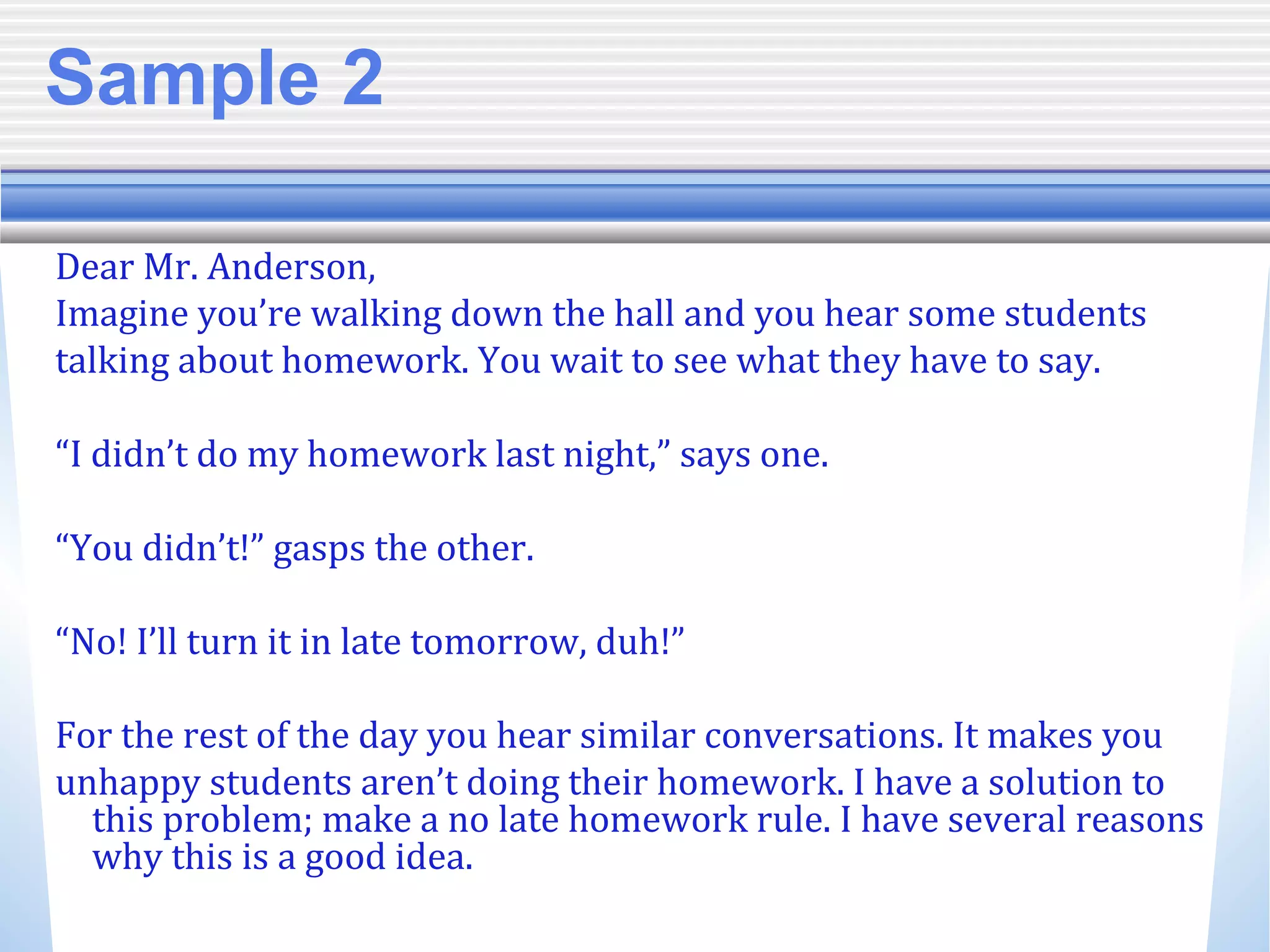
Dear Mr. Anderson,
Imagine you’re walking down the hall and you hear some students
talking about homework. You wait to see what they have to say.
“I didn’t do my homework last night,” says one.
“You didn’t!” gasps the other.
“No! I’ll turn it in late tomorrow, duh!”
For the rest of the day you hear similar conversations. It makes you
unhappy students aren’t doing their homework. I have a solution to
this problem; make a no late homework rule. I have several reasons
why this is a good idea.
Sample 3
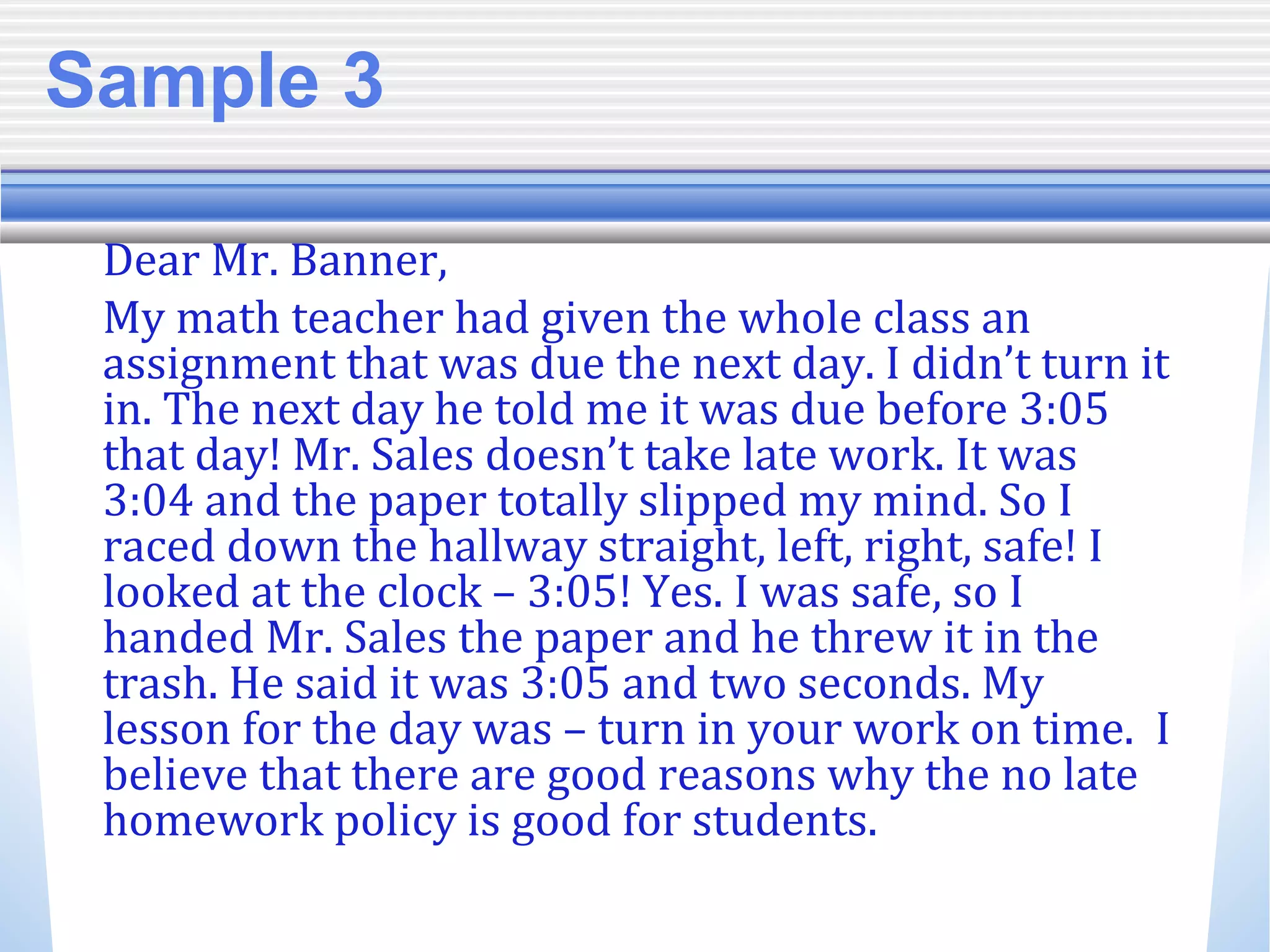
Dear Mr. Banner,
My math teacher had given the whole class an
assignment that was due the next day. I didn’t turn it
in. The next day he told me it was due before 3:05
that day! Mr. Sales doesn’t take late work. It was
3:04 and the paper totally slipped my mind. So I
raced down the hallway straight, left, right, safe! I
looked at the clock – 3:05! Yes. I was safe, so I
handed Mr. Sales the paper and he threw it in the
trash. He said it was 3:05 and two seconds. My
lesson for the day was – turn in your work on time. I
believe that there are good reasons why the no late
homework policy is good for students.
Sample 4
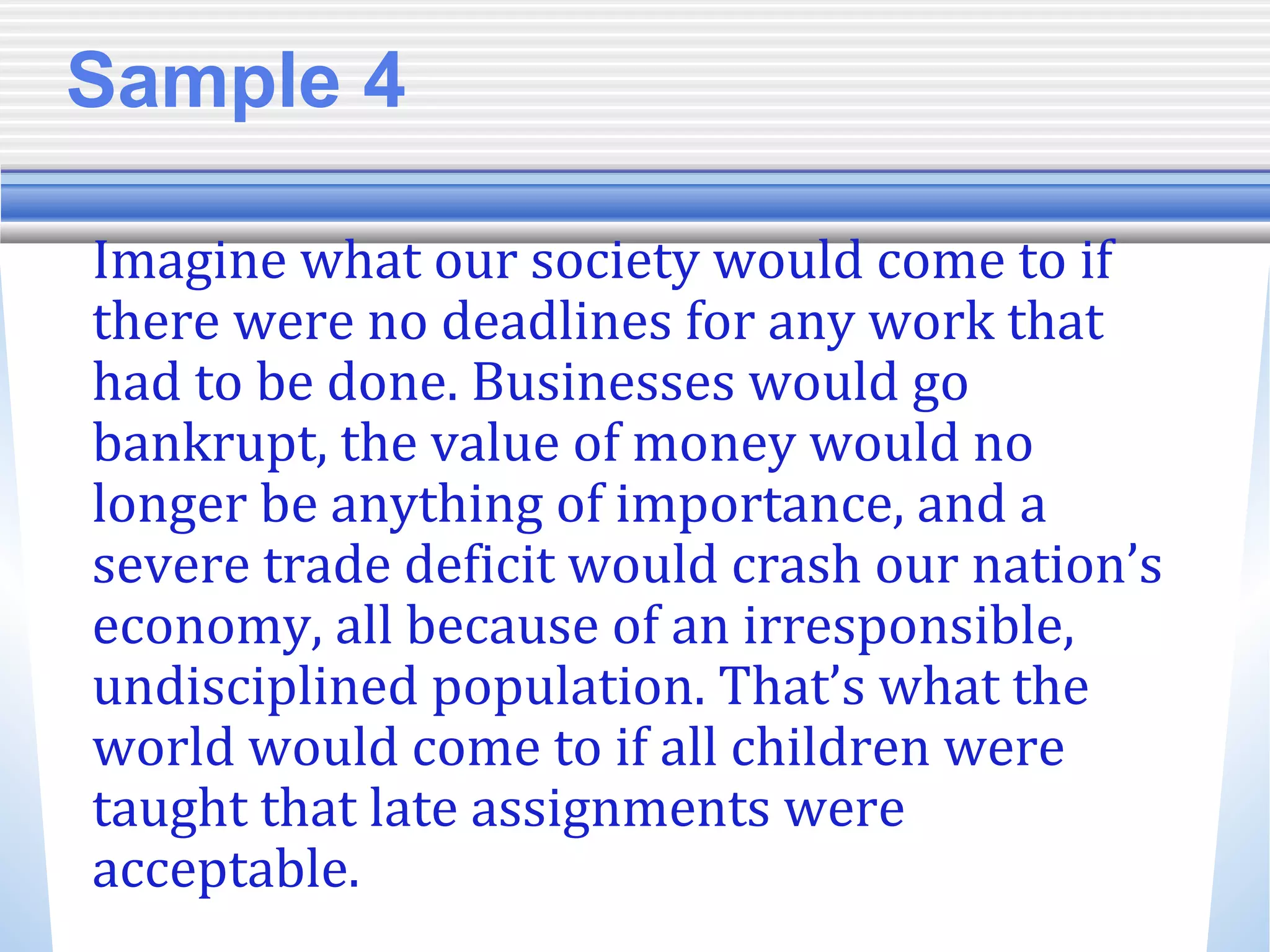
Imagine what our society would come to if
there were no deadlines for any work that
had to be done. Businesses would go
bankrupt, the value of money would no
longer be anything of importance, and a
severe trade deficit would crash our nation’s
economy, all because of an irresponsible,
undisciplined population. That’s what the
world would come to if all children were
taught that late assignments were
acceptable.
Sample 5
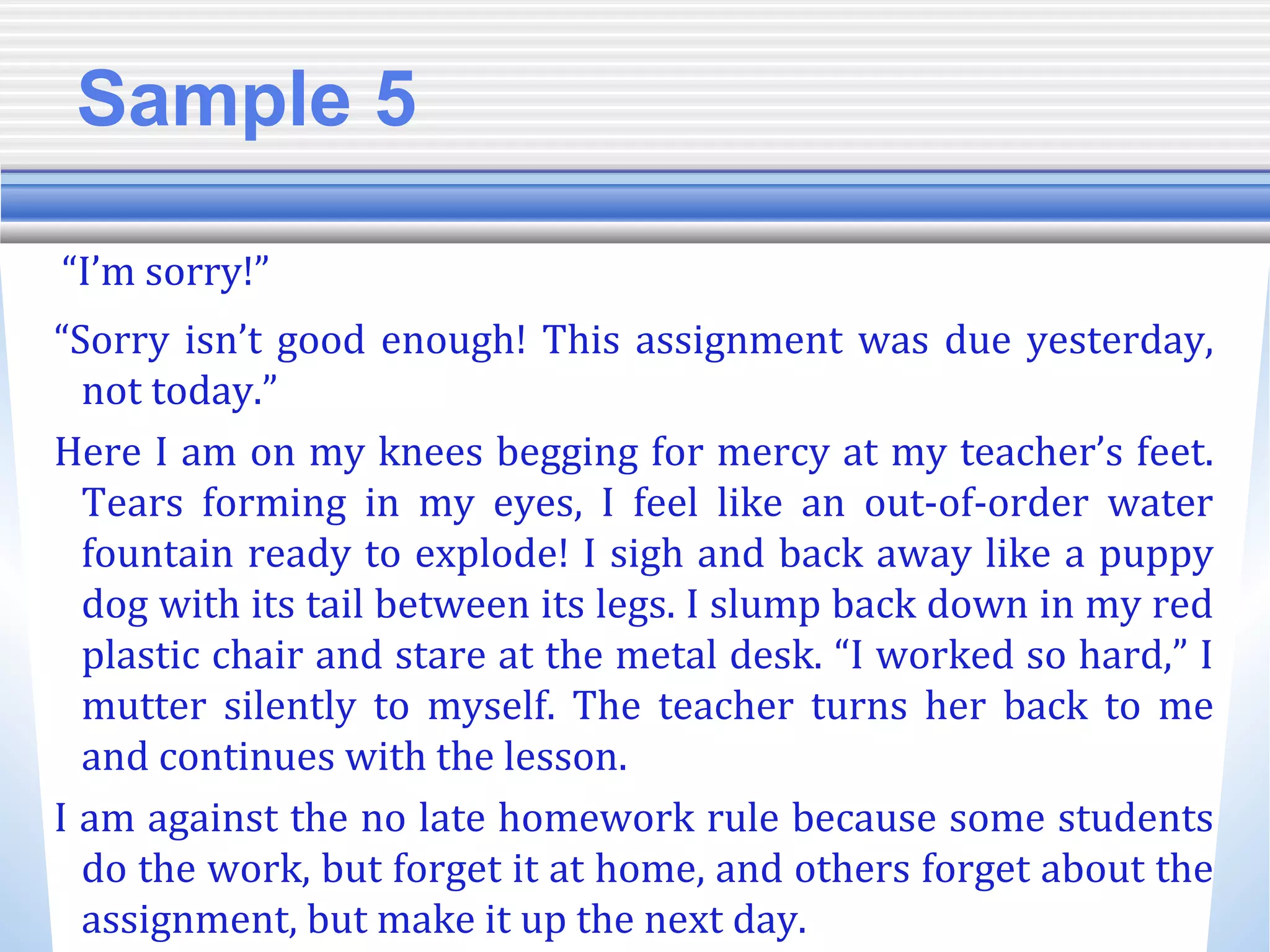
“I’m sorry!”
“Sorry isn’t good enough! This assignment was due yesterday,
not today.”
Here I am on my knees begging for mercy at my teacher’s feet.
Tears forming in my eyes, I feel like an out-of-order water
fountain ready to explode! I sigh and back away like a puppy
dog with its tail between its legs. I slump back down in my red
plastic chair and stare at the metal desk. “I worked so hard,” I
mutter silently to myself. The teacher turns her back to me
and continues with the lesson.
I am against the no late homework rule because some students
do the work, but forget it at home, and others forget about the
assignment, but make it up the next day.
Sample 6
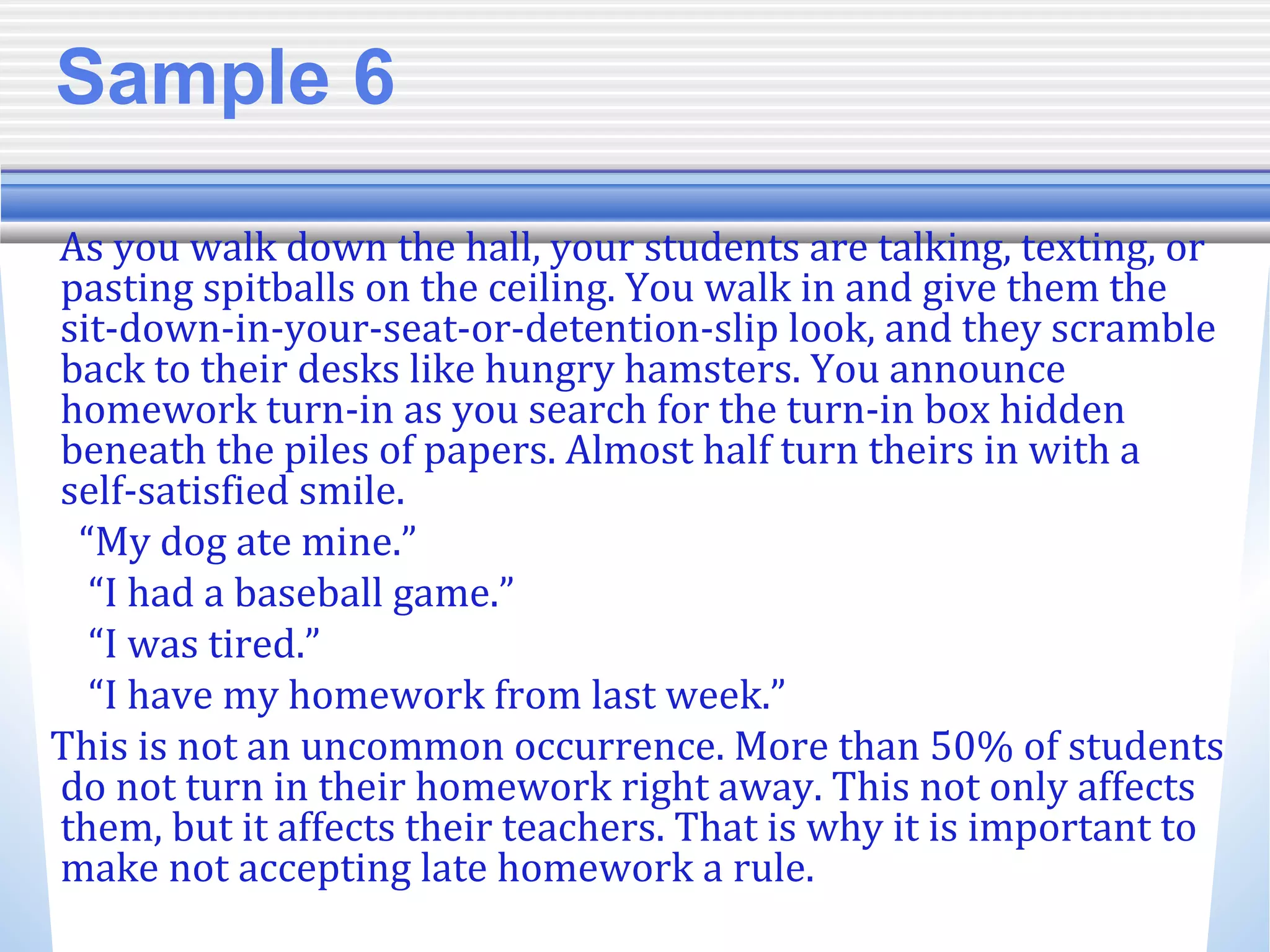
As you walk down the hall, your students are talking, texting, or
pasting spitballs on the ceiling. You walk in and give them the
sit-down-in-your-seat-or-detention-slip look, and they scramble
back to their desks like hungry hamsters. You announce
homework turn-in as you search for the turn-in box hidden
beneath the piles of papers. Almost half turn theirs in with a
self-satisfied smile.
“My dog ate mine.”
“I had a baseball game.”
“I was tired.”
“I have my homework from last week.”
This is not an uncommon occurrence. More than 50% of students
do not turn in their homework right away. This not only affects
them, but it affects their teachers. That is why it is important to
make not accepting late homework a rule.
Sample 7
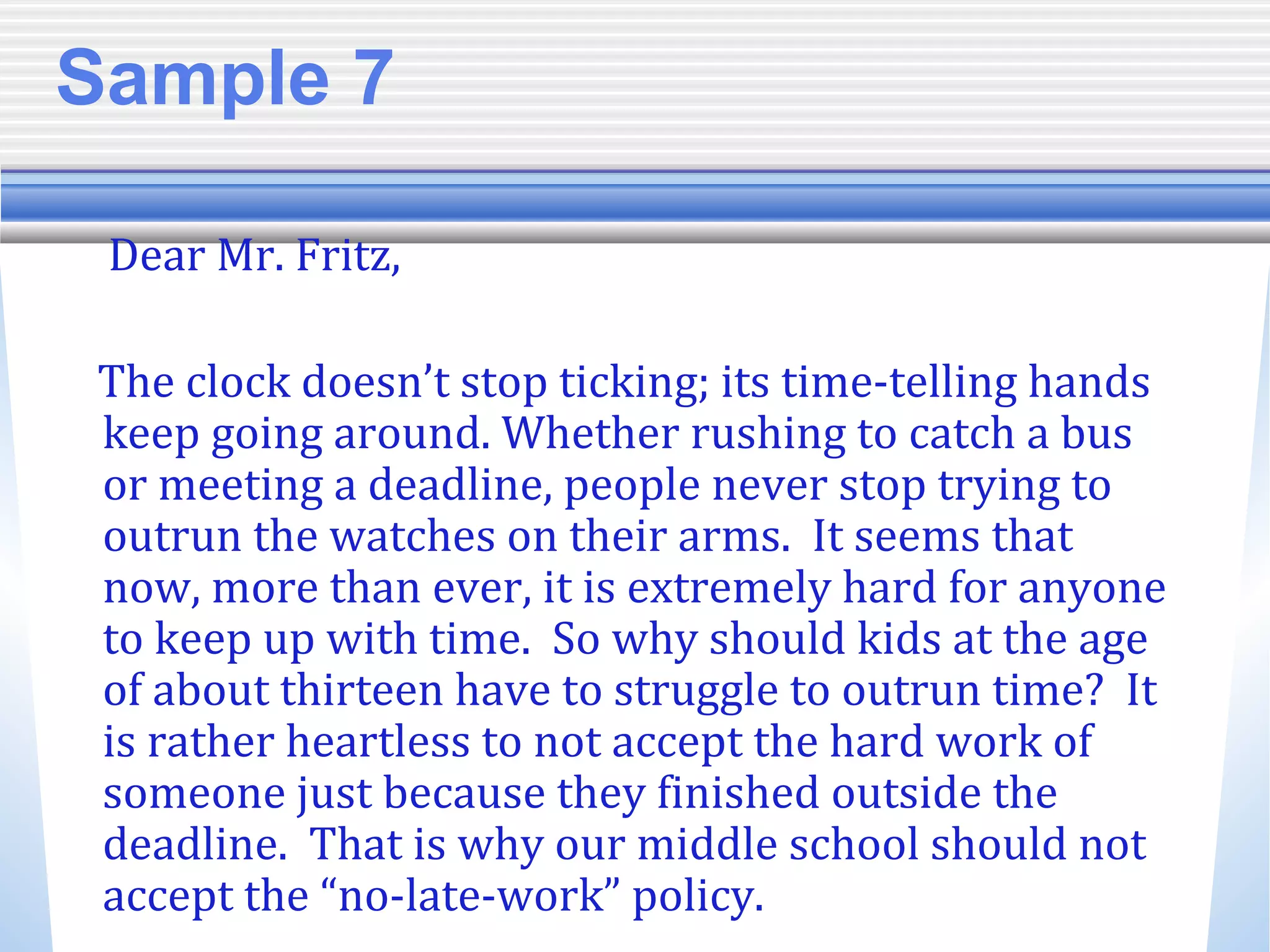
Dear Mr. Fritz,
The clock doesn’t stop ticking; its time-telling hands
keep going around. Whether rushing to catch a bus
or meeting a deadline, people never stop trying to
outrun the watches on their arms. It seems that
now, more than ever, it is extremely hard for anyone
to keep up with time. So why should kids at the age
of about thirteen have to struggle to outrun time? It
is rather heartless to not accept the hard work of
someone just because they finished outside the
deadline. That is why our middle school should not
accept the “no-late-work” policy.
Sample 8
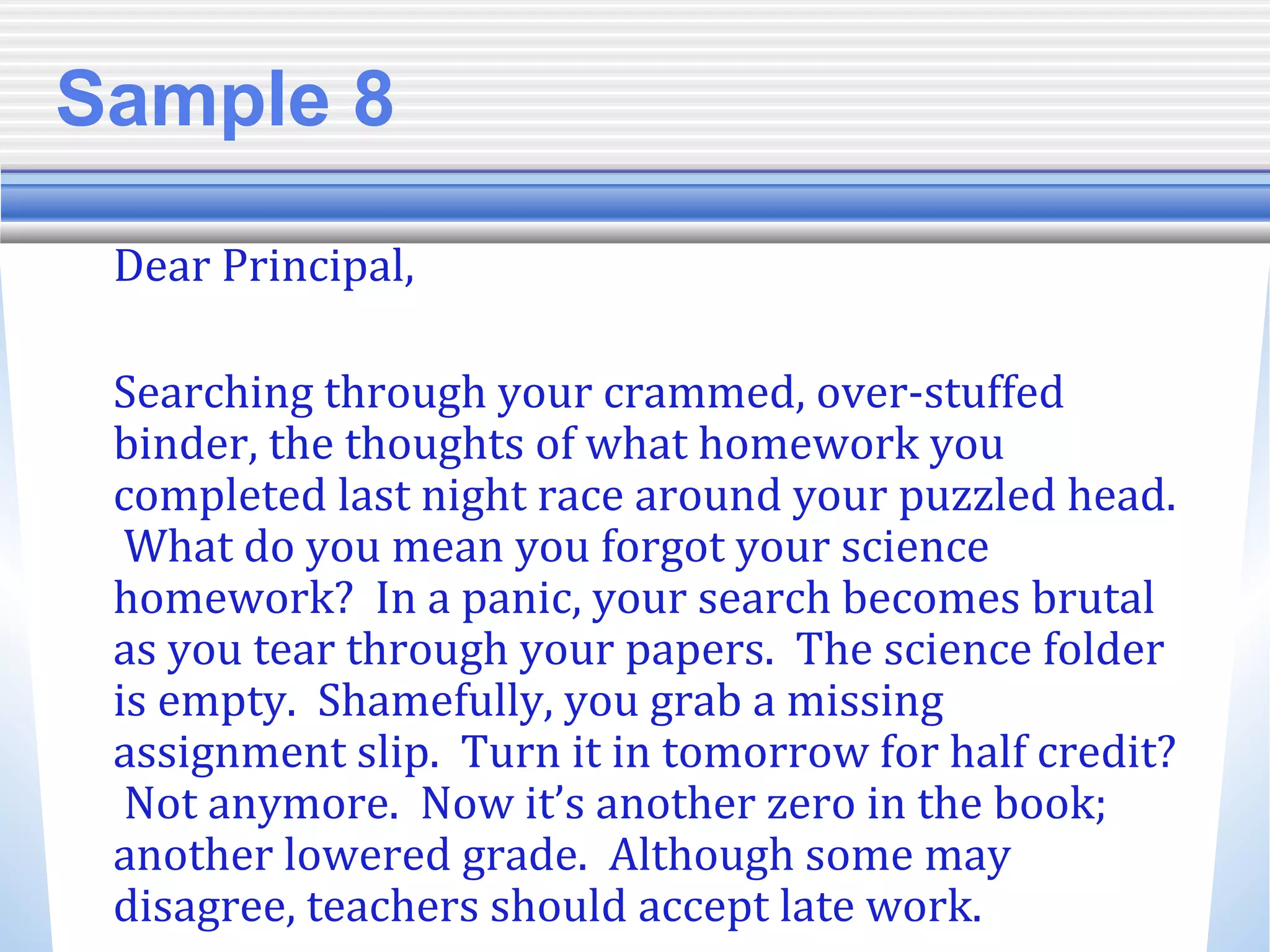
Dear Principal,
Searching through your crammed, over-stuffed
binder, the thoughts of what homework you
completed last night race around your puzzled head.
What do you mean you forgot your science
homework? In a panic, your search becomes brutal
as you tear through your papers. The science folder
is empty. Shamefully, you grab a missing
assignment slip. Turn it in tomorrow for half credit?
Not anymore. Now it’s another zero in the book;
another lowered grade. Although some may
disagree, teachers should accept late work.
Copyright © 2007 Washington Office of Superintendent of Public Instruction. All rights reserved.
Persuasive Conclusions
Copyright © 2007 Washington Office of Superintendent of Public Instruction. All rights reserved.
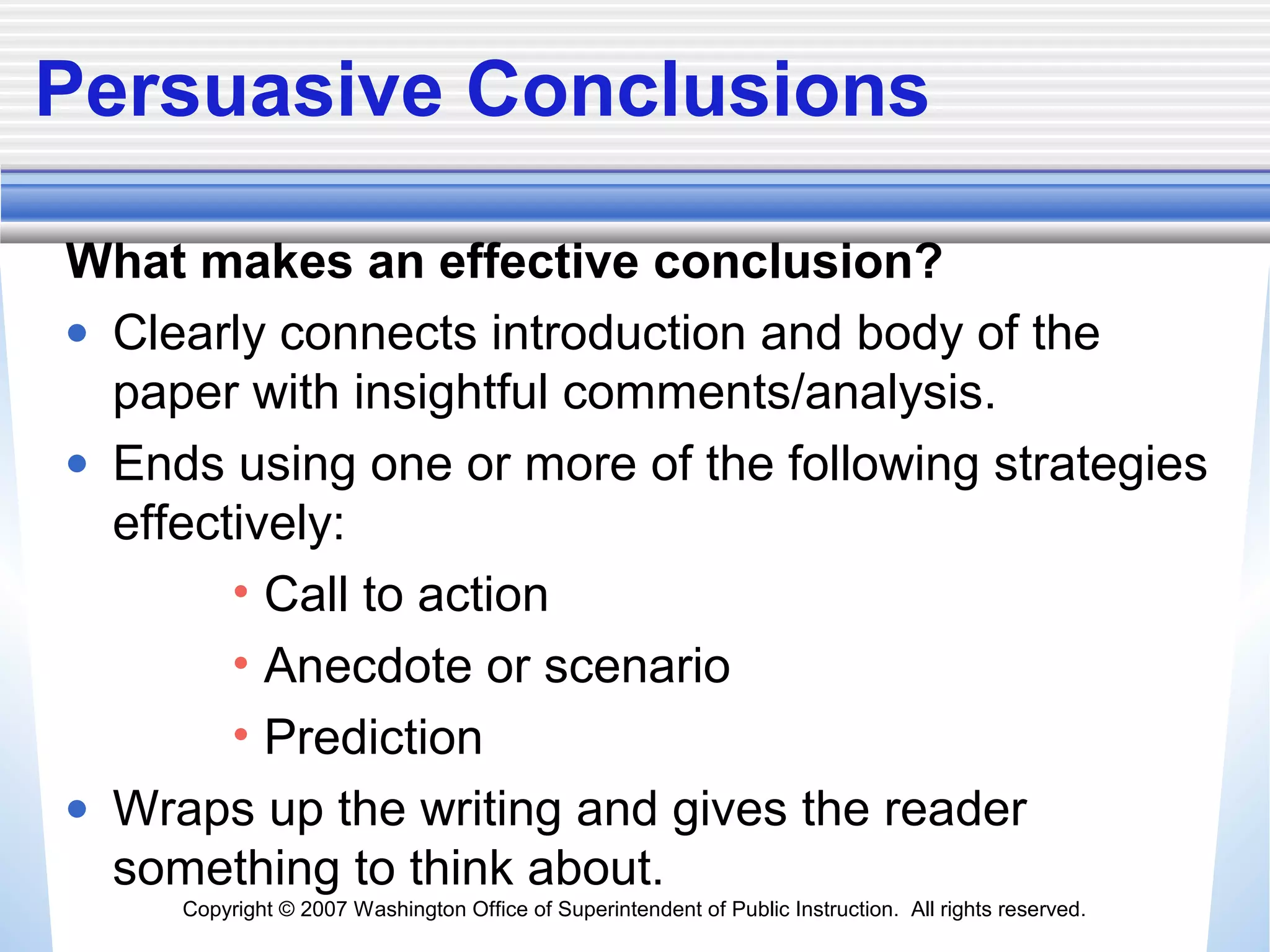
Persuasive Conclusions
What makes an effective conclusion?
• Clearly connects introduction and body of the
paper with insightful comments/analysis.
• Ends using one or more of the following strategies
effectively:
• Call to action
• Anecdote or scenario
• Prediction
• Wraps up the writing and gives the reader
something to think about.
Copyright © 2007 Washington Office of Superintendent of Public Instruction. All rights reserved.
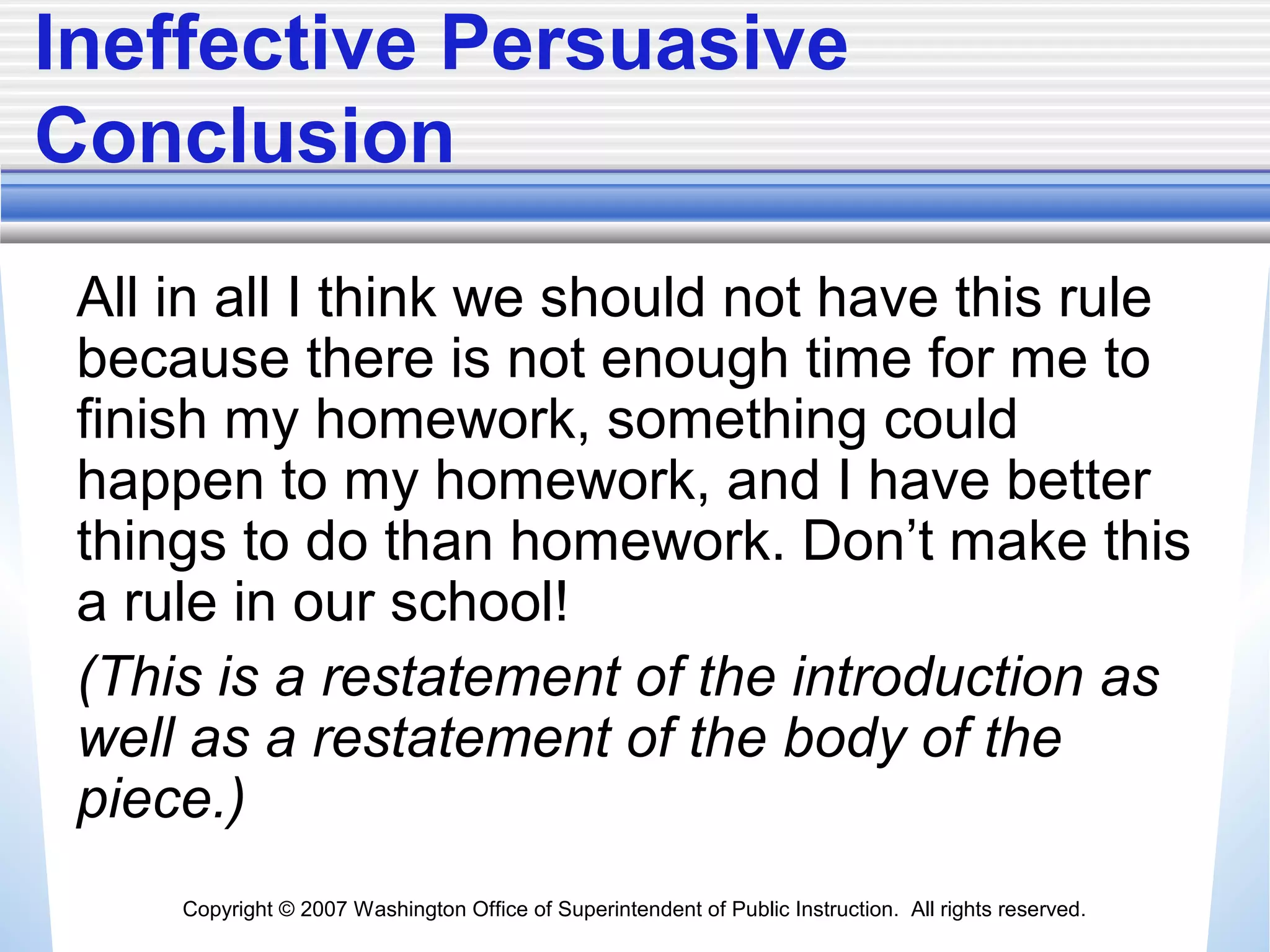
Ineffective Persuasive
Conclusion
All in all I think we should not have this rule
because there is not enough time for me to
finish my homework, something could
happen to my homework, and I have better
things to do than homework. Don’t make this
a rule in our school!
(This is a restatement of the introduction as
well as a restatement of the body of the
piece.)
Copyright © 2007 Washington Office of Superintendent of Public Instruction. All rights reserved.
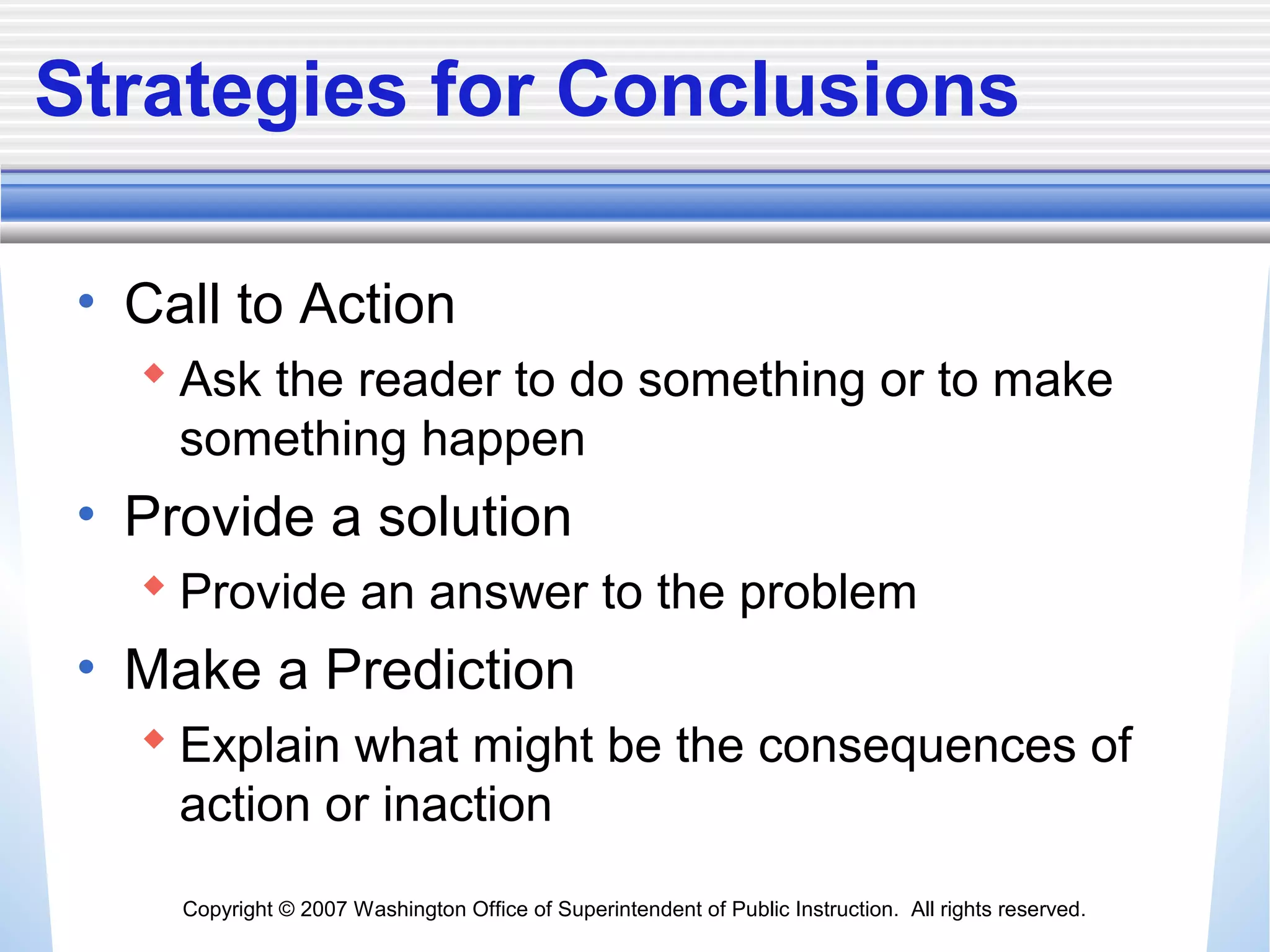
Strategies for Conclusions
• Call to Action
 Ask the reader to do something or to make
something happen
• Provide a solution
 Provide an answer to the problem
• Make a Prediction
 Explain what might be the consequences of
action or inaction
Copyright © 2007 Washington Office of Superintendent of Public Instruction. All rights reserved.
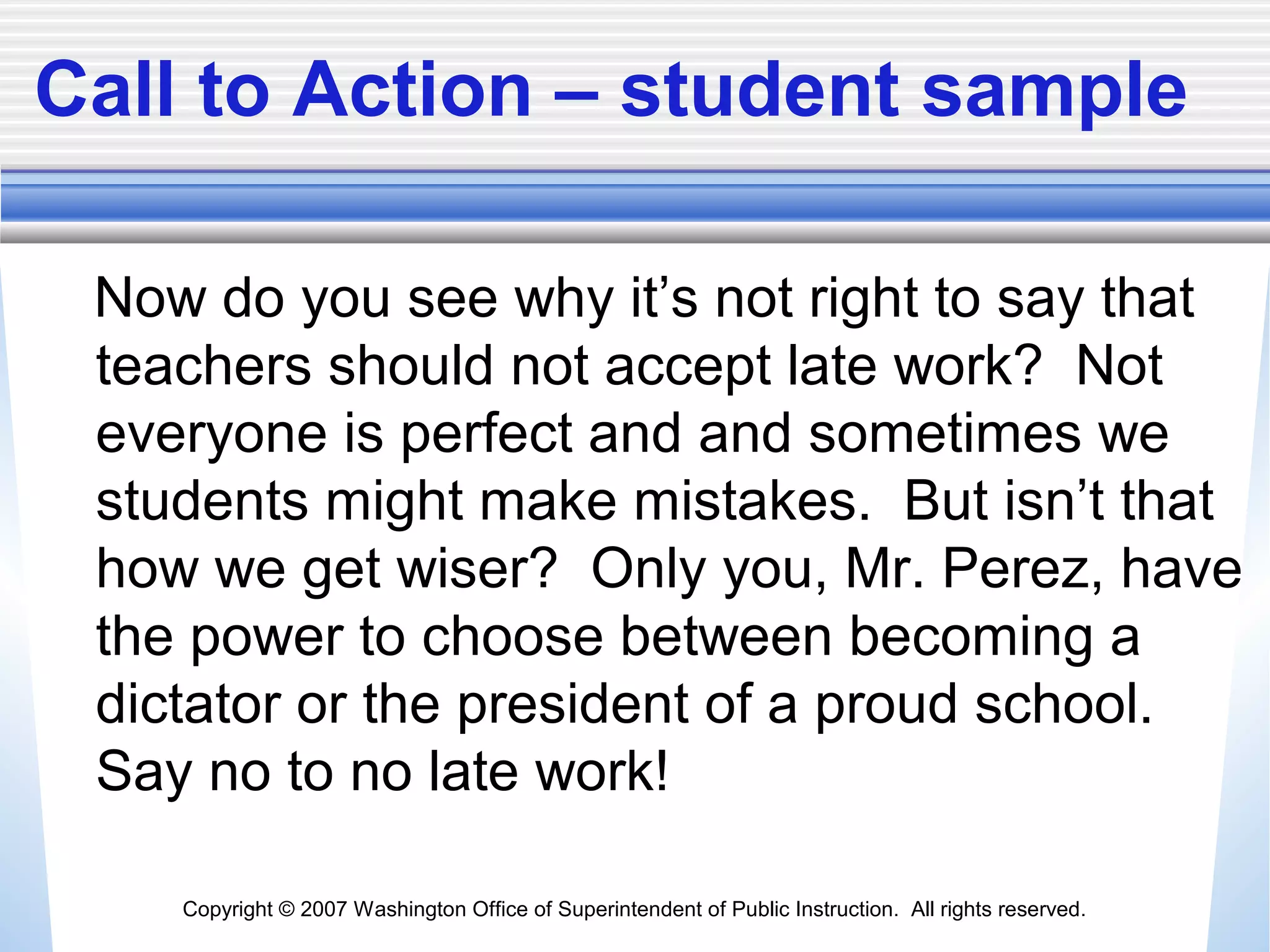
Call to Action – student sample
Now do you see why it’s not right to say that
teachers should not accept late work? Not
everyone is perfect and and sometimes we
students might make mistakes. But isn’t that
how we get wiser? Only you, Mr. Perez, have
the power to choose between becoming a
dictator or the president of a proud school.
Say no to no late work!
Copyright © 2007 Washington Office of Superintendent of Public Instruction. All rights reserved.
Solution – student sample
So accepting late work would be a good
idea. If you are concerned about students
that repeatedly don’t turn work in on time,
take some points off for late work or put a
limit on how late work can be turned in.
Accept late work for good reasons. Don’t
punish the innocent.
Copyright © 2007 Washington Office of Superintendent of Public Instruction. All rights reserved.
Prediction – student sample
“No late work” policies should be against the
law. They make students stressed out,
depressed, angry, and tired. If a rule as
such is adopted, no one will take part in
extra activities offered to them, the Honors
Programs will be lacking, students will be
falling asleep in class, and grades will begin
dropping. Is it really worth it?
Copyright © 2007 Washington Office of Superintendent of Public Instruction. All rights reserved.
Conclusion Samples: what’s the
technique being used?
Sample one
If we all take part in accepting this policy then it
would benefit the education experience of our
students greatly. Our children would be disciplined
to create the vital habit of taking responsibility by
finishing mandatory assignments by their due date.
Copyright © 2007 Washington Office of Superintendent of Public Instruction. All rights reserved.
Conclusion Samples: what’s the
technique being used?
Sample two
In conclusion, now imagine this. You see the same kids
talking about homework. This time one says, I didn’t
understand number thirteen, did you?”
The other says, “Yeah, this is how you do it. “
Throughout your day you hear similar conversations. You
swell with pride knowing your students do their homework. I
think that we should have a no late homework rule because
it will teach the student’s responsibility. In the future
teachers will not accept late homework; you will be taking a
burden off the staff.
Copyright © 2007 Washington Office of Superintendent of Public Instruction. All rights reserved.
Conclusion Samples: what’s the
technique being used?
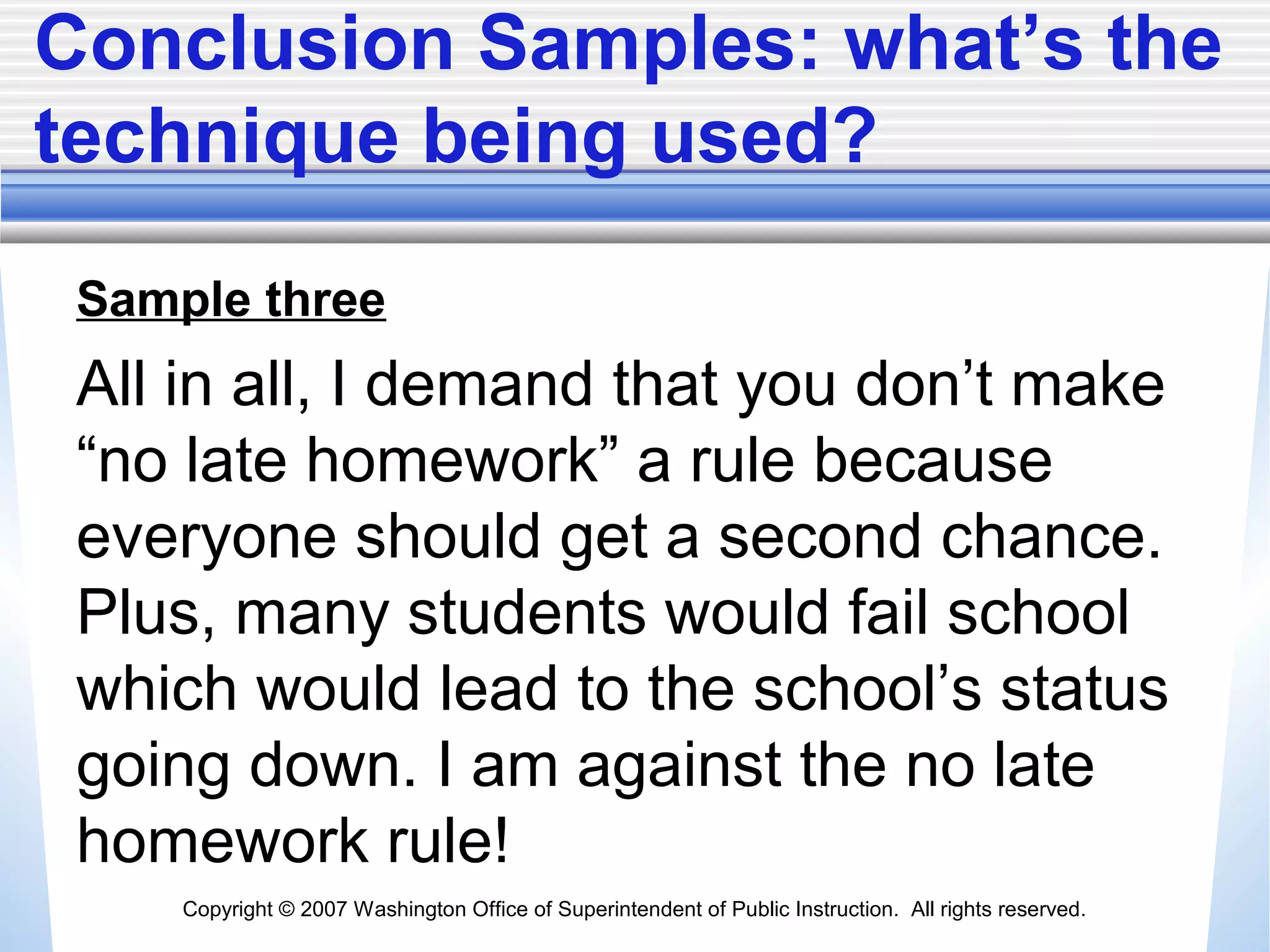
Sample three
All in all, I demand that you don’t make
“no late homework” a rule because
everyone should get a second chance.
Plus, many students would fail school
which would lead to the school’s status
going down. I am against the no late
homework rule!
Copyright © 2007 Washington Office of Superintendent of Public Instruction. All rights reserved.
Conclusion Samples: what’s the
technique being used?
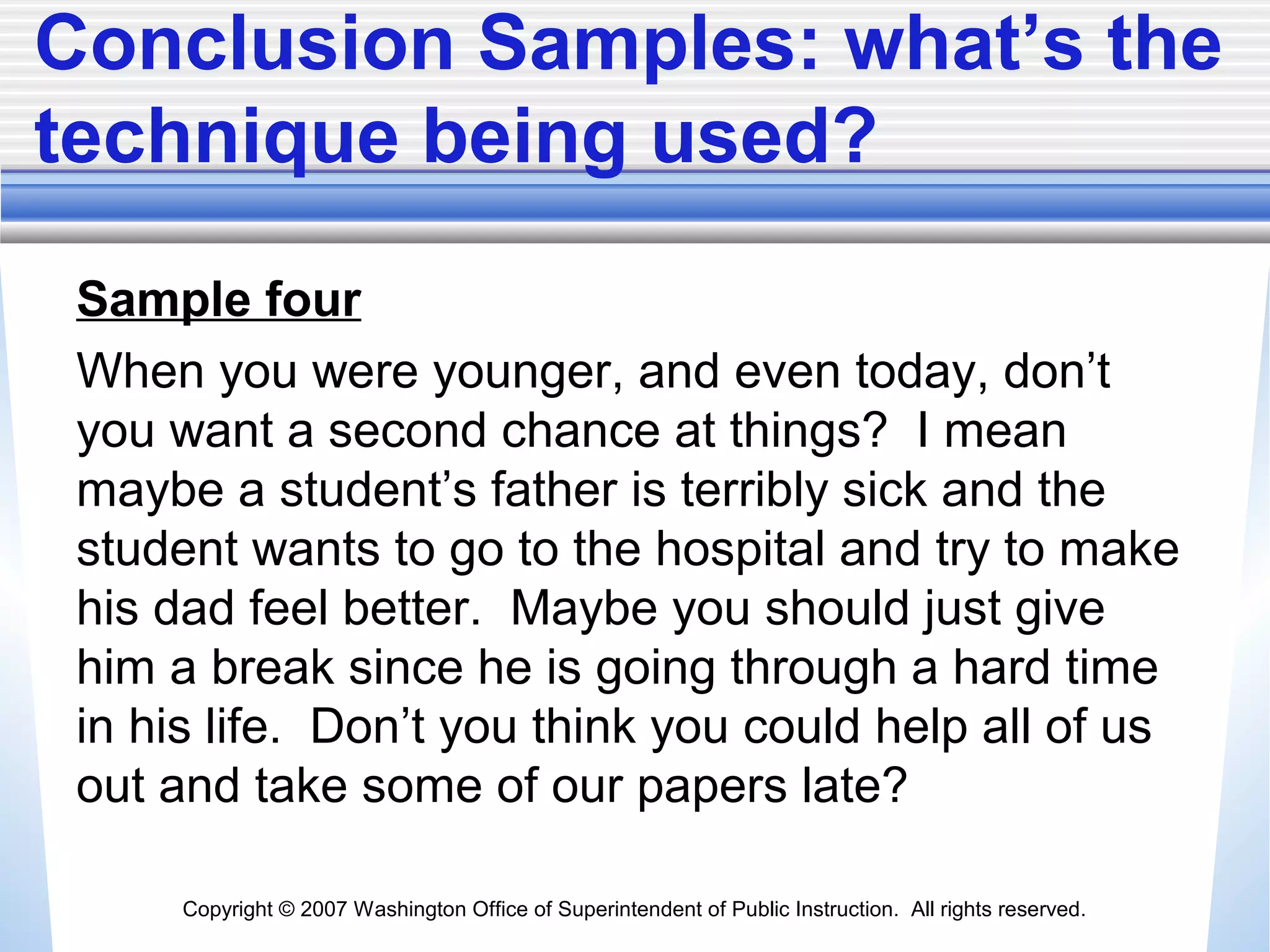
Sample four
When you were younger, and even today, don’t
you want a second chance at things? I mean
maybe a student’s father is terribly sick and the
student wants to go to the hospital and try to make
his dad feel better. Maybe you should just give
him a break since he is going through a hard time
in his life. Don’t you think you could help all of us
out and take some of our papers late?
Copyright © 2007 Washington Office of Superintendent of Public Instruction. All rights reserved.
Conclusion Samples: what’s the
technique being used?
Sample five
Quality work, good grades, a relaxed environment,
doesn’t that sound like a dream school? On the other
hand you could have a school with rushed work, poor
grades, and an anxious, stressful environment. I’m
sure, Mrs. O’Neill, that you can see the correct
decision very clearly. We shouldn’t have the no late
homework rule, it would completely destroy the
utopian school that we are working towards. The rule
would make us lean towards a dystopia, a school
without harmony or balance. A utopia is the way to go.
Copyright © 2007 Washington Office of Superintendent of Public Instruction. All rights reserved.
Conclusion Samples: what’s the
technique being used?
Sample three
All in all, I demand that you don’t make
“no late homework” a rule because
everyone should get a second chance.
Plus, many students would fail school
which would lead to the school’s status
going down. I am against the no late
homework rule!
Copyright © 2007 Washington Office of Superintendent of Public Instruction. All rights reserved.
Introduction – practice
• Get with a partner.
• You will receive a copy of a paper called
Ten Minute Break.
• It is missing its introduction and
conclusion.
• With your partner, discuss possible ideas
for what you might put in the introduction.
Refer to “Effective Introductions.”
Copyright © 2007 Washington Office of Superintendent of Public Instruction. All rights reserved.
Introductions – your turn
• Now, on your own, write an introduction for the
Ten Minute Break.
• You may use any of the ideas you discussed
with your partner or new ones of your own.
• Remember that you are writing to your principal.
Think of what would be effective in writing to him
or her.
• When you are finished compare your
introduction with that of your partner.
Copyright © 2007 Washington Office of Superintendent of Public Instruction. All rights reserved.
Conclusion – practice
• Get with a partner.
• Use your copy of the paper titled Ten
Minute Break.
• With your partner, discuss possible ideas
for what you might put in the conclusion.
Refer to Effective Conclusions.
Copyright © 2007 Washington Office of Superintendent of Public Instruction. All rights reserved.
Conclusions – your turn
• Now, on your own, write a conclusion for the Ten
Minute Break.
• You may use any of the ideas you discussed
with your partner or new ones of your own.
• Remember that you are writing to your principal.
Think of what would be effective in writing to him
or her.
• Also remember what you wrote in the
introduction and connect the conclusion without
restating the introduction.
• When you are finished compare your conclusion
with that of your partner.

Persuasive Introductions & Conclusions

  • 1.
    Copyright © 2007Washington Office of Superintendent of Public Instruction. All rights reserved. Persuasive Introductions
  • 2.
    Copyright © 2007Washington Office of Superintendent of Public Instruction. All rights reserved. Persuasive Introductions What makes an effective introduction? • It grabs the reader’s attention. • It clearly implies an organizational structure of the paper. • It effectively includes one or more of the following strategies:  anecdote or scenario  interesting fact or statistic  question • Its choice of support is specific and relevant, and provides a clear, connected lead-in to the paper’s main idea or thesis. • Position is clearly stated or implied.
  • 3.
    Copyright © 2007Washington Office of Superintendent of Public Instruction. All rights reserved. Ineffective Persuasive Introduction Dear Mr. Fernando, I’m going to tell you three reasons why it is not good to turn in late homework. Does this introduction do the following?  Grab the reader’s attention  Imply an organizational structure of the paper  Include one or more of the following strategies:  anecdote or scenario  question  interesting fact or statistic  Give support that is specific and relevant, and provide a clear, connected lead-in to paper’s main idea  State or imply a clear position
  • 4.
    Copyright © 2007Washington Office of Superintendent of Public Instruction. All rights reserved. Persuasive Introductions Some persuasive strategies used in introductions • Anecdote/ Scenario  The writer provides a personal experience or made- up situation to introduce the position. • Questioning  The writer asks thought-provoking questions to capture the reader’s interest. • Interesting fact or statistic  The writer gives an interesting piece of information to grab the reader’s attention.
  • 5.
    Copyright © 2007Washington Office of Superintendent of Public Instruction. All rights reserved. Anecdote/Scenario “Extra! Extra! Read all about it! New rule has kids scared.” Those are the headlines from The Seattle Times. The new rule is an epidemic, spreading around the country and making children cry. “No late work has a devastating effect and needs to be stopped now before it reaches other countries,” says Bill Warren, a noted authority.
  • 6.
    Copyright © 2007Washington Office of Superintendent of Public Instruction. All rights reserved. Questioning Dear Principal, “Three strikes and you’re out!” Yes, that is baseball, but really everybody deserves a second chance at things, right? In baseball you get three chances at batting, why can’t you get just two at school? I mean think of it this way. What if you just had to go visit your grandpa in the hospital because you just found out he has cancer? Shouldn’t you get a second chance if you didn’t get to your homework because it was too late by the time you got home? I think that teachers should accept late work because at least you tried and turned it in.
  • 7.
    Copyright © 2007Washington Office of Superintendent of Public Instruction. All rights reserved. Interesting Fact or Statistic Dear Mr. Johnson, Did you know that a recent district survey showed that four out of five school kids do not have passing grades because they do not turn their work in on time? This could be changed by no longer allowing late work. Late work should no longer be accepted at Grant Middle School.
  • 8.
    Introduction Samples Identify thestrategy or strategies in the following eight introductions.
  • 9.
    Sample 1 Imagine anold, shaggy-haired adult walks into the classroom full of young kids working. He slowly shuffles his way to the teacher and says, “Ummmm… Mr. Wilson… Here’s my assignment.” “It’s been thirty-seven years since I gave you that assignment. I knew I should have voted yes for the no late homework rule.” This is what will happen if late homework is accepted. I say yes for the No Late Homework rule for three reasons.
  • 10.
    Sample 2 Dear Mr.Anderson, Imagine you’re walking down the hall and you hear some students talking about homework. You wait to see what they have to say. “I didn’t do my homework last night,” says one. “You didn’t!” gasps the other. “No! I’ll turn it in late tomorrow, duh!” For the rest of the day you hear similar conversations. It makes you unhappy students aren’t doing their homework. I have a solution to this problem; make a no late homework rule. I have several reasons why this is a good idea.
  • 11.
    Sample 3 Dear Mr.Banner, My math teacher had given the whole class an assignment that was due the next day. I didn’t turn it in. The next day he told me it was due before 3:05 that day! Mr. Sales doesn’t take late work. It was 3:04 and the paper totally slipped my mind. So I raced down the hallway straight, left, right, safe! I looked at the clock – 3:05! Yes. I was safe, so I handed Mr. Sales the paper and he threw it in the trash. He said it was 3:05 and two seconds. My lesson for the day was – turn in your work on time. I believe that there are good reasons why the no late homework policy is good for students.
  • 12.
    Sample 4 Imagine whatour society would come to if there were no deadlines for any work that had to be done. Businesses would go bankrupt, the value of money would no longer be anything of importance, and a severe trade deficit would crash our nation’s economy, all because of an irresponsible, undisciplined population. That’s what the world would come to if all children were taught that late assignments were acceptable.
  • 13.
    Sample 5 “I’m sorry!” “Sorryisn’t good enough! This assignment was due yesterday, not today.” Here I am on my knees begging for mercy at my teacher’s feet. Tears forming in my eyes, I feel like an out-of-order water fountain ready to explode! I sigh and back away like a puppy dog with its tail between its legs. I slump back down in my red plastic chair and stare at the metal desk. “I worked so hard,” I mutter silently to myself. The teacher turns her back to me and continues with the lesson. I am against the no late homework rule because some students do the work, but forget it at home, and others forget about the assignment, but make it up the next day.
  • 14.
    Sample 6 As youwalk down the hall, your students are talking, texting, or pasting spitballs on the ceiling. You walk in and give them the sit-down-in-your-seat-or-detention-slip look, and they scramble back to their desks like hungry hamsters. You announce homework turn-in as you search for the turn-in box hidden beneath the piles of papers. Almost half turn theirs in with a self-satisfied smile. “My dog ate mine.” “I had a baseball game.” “I was tired.” “I have my homework from last week.” This is not an uncommon occurrence. More than 50% of students do not turn in their homework right away. This not only affects them, but it affects their teachers. That is why it is important to make not accepting late homework a rule.
  • 15.
    Sample 7 Dear Mr.Fritz, The clock doesn’t stop ticking; its time-telling hands keep going around. Whether rushing to catch a bus or meeting a deadline, people never stop trying to outrun the watches on their arms. It seems that now, more than ever, it is extremely hard for anyone to keep up with time. So why should kids at the age of about thirteen have to struggle to outrun time? It is rather heartless to not accept the hard work of someone just because they finished outside the deadline. That is why our middle school should not accept the “no-late-work” policy.
  • 16.
    Sample 8 Dear Principal, Searchingthrough your crammed, over-stuffed binder, the thoughts of what homework you completed last night race around your puzzled head. What do you mean you forgot your science homework? In a panic, your search becomes brutal as you tear through your papers. The science folder is empty. Shamefully, you grab a missing assignment slip. Turn it in tomorrow for half credit? Not anymore. Now it’s another zero in the book; another lowered grade. Although some may disagree, teachers should accept late work.
  • 17.
    Copyright © 2007Washington Office of Superintendent of Public Instruction. All rights reserved. Persuasive Conclusions
  • 18.
    Copyright © 2007Washington Office of Superintendent of Public Instruction. All rights reserved. Persuasive Conclusions What makes an effective conclusion? • Clearly connects introduction and body of the paper with insightful comments/analysis. • Ends using one or more of the following strategies effectively: • Call to action • Anecdote or scenario • Prediction • Wraps up the writing and gives the reader something to think about.
  • 19.
    Copyright © 2007Washington Office of Superintendent of Public Instruction. All rights reserved. Ineffective Persuasive Conclusion All in all I think we should not have this rule because there is not enough time for me to finish my homework, something could happen to my homework, and I have better things to do than homework. Don’t make this a rule in our school! (This is a restatement of the introduction as well as a restatement of the body of the piece.)
  • 20.
    Copyright © 2007Washington Office of Superintendent of Public Instruction. All rights reserved. Strategies for Conclusions • Call to Action  Ask the reader to do something or to make something happen • Provide a solution  Provide an answer to the problem • Make a Prediction  Explain what might be the consequences of action or inaction
  • 21.
    Copyright © 2007Washington Office of Superintendent of Public Instruction. All rights reserved. Call to Action – student sample Now do you see why it’s not right to say that teachers should not accept late work? Not everyone is perfect and and sometimes we students might make mistakes. But isn’t that how we get wiser? Only you, Mr. Perez, have the power to choose between becoming a dictator or the president of a proud school. Say no to no late work!
  • 22.
    Copyright © 2007Washington Office of Superintendent of Public Instruction. All rights reserved. Solution – student sample So accepting late work would be a good idea. If you are concerned about students that repeatedly don’t turn work in on time, take some points off for late work or put a limit on how late work can be turned in. Accept late work for good reasons. Don’t punish the innocent.
  • 23.
    Copyright © 2007Washington Office of Superintendent of Public Instruction. All rights reserved. Prediction – student sample “No late work” policies should be against the law. They make students stressed out, depressed, angry, and tired. If a rule as such is adopted, no one will take part in extra activities offered to them, the Honors Programs will be lacking, students will be falling asleep in class, and grades will begin dropping. Is it really worth it?
  • 24.
    Copyright © 2007Washington Office of Superintendent of Public Instruction. All rights reserved. Conclusion Samples: what’s the technique being used? Sample one If we all take part in accepting this policy then it would benefit the education experience of our students greatly. Our children would be disciplined to create the vital habit of taking responsibility by finishing mandatory assignments by their due date.
  • 25.
    Copyright © 2007Washington Office of Superintendent of Public Instruction. All rights reserved. Conclusion Samples: what’s the technique being used? Sample two In conclusion, now imagine this. You see the same kids talking about homework. This time one says, I didn’t understand number thirteen, did you?” The other says, “Yeah, this is how you do it. “ Throughout your day you hear similar conversations. You swell with pride knowing your students do their homework. I think that we should have a no late homework rule because it will teach the student’s responsibility. In the future teachers will not accept late homework; you will be taking a burden off the staff.
  • 26.
    Copyright © 2007Washington Office of Superintendent of Public Instruction. All rights reserved. Conclusion Samples: what’s the technique being used? Sample three All in all, I demand that you don’t make “no late homework” a rule because everyone should get a second chance. Plus, many students would fail school which would lead to the school’s status going down. I am against the no late homework rule!
  • 27.
    Copyright © 2007Washington Office of Superintendent of Public Instruction. All rights reserved. Conclusion Samples: what’s the technique being used? Sample four When you were younger, and even today, don’t you want a second chance at things? I mean maybe a student’s father is terribly sick and the student wants to go to the hospital and try to make his dad feel better. Maybe you should just give him a break since he is going through a hard time in his life. Don’t you think you could help all of us out and take some of our papers late?
  • 28.
    Copyright © 2007Washington Office of Superintendent of Public Instruction. All rights reserved. Conclusion Samples: what’s the technique being used? Sample five Quality work, good grades, a relaxed environment, doesn’t that sound like a dream school? On the other hand you could have a school with rushed work, poor grades, and an anxious, stressful environment. I’m sure, Mrs. O’Neill, that you can see the correct decision very clearly. We shouldn’t have the no late homework rule, it would completely destroy the utopian school that we are working towards. The rule would make us lean towards a dystopia, a school without harmony or balance. A utopia is the way to go.
  • 29.
    Copyright © 2007Washington Office of Superintendent of Public Instruction. All rights reserved. Conclusion Samples: what’s the technique being used? Sample three All in all, I demand that you don’t make “no late homework” a rule because everyone should get a second chance. Plus, many students would fail school which would lead to the school’s status going down. I am against the no late homework rule!
  • 30.
    Copyright © 2007Washington Office of Superintendent of Public Instruction. All rights reserved. Introduction – practice • Get with a partner. • You will receive a copy of a paper called Ten Minute Break. • It is missing its introduction and conclusion. • With your partner, discuss possible ideas for what you might put in the introduction. Refer to “Effective Introductions.”
  • 31.
    Copyright © 2007Washington Office of Superintendent of Public Instruction. All rights reserved. Introductions – your turn • Now, on your own, write an introduction for the Ten Minute Break. • You may use any of the ideas you discussed with your partner or new ones of your own. • Remember that you are writing to your principal. Think of what would be effective in writing to him or her. • When you are finished compare your introduction with that of your partner.
  • 32.
    Copyright © 2007Washington Office of Superintendent of Public Instruction. All rights reserved. Conclusion – practice • Get with a partner. • Use your copy of the paper titled Ten Minute Break. • With your partner, discuss possible ideas for what you might put in the conclusion. Refer to Effective Conclusions.
  • 33.
    Copyright © 2007Washington Office of Superintendent of Public Instruction. All rights reserved. Conclusions – your turn • Now, on your own, write a conclusion for the Ten Minute Break. • You may use any of the ideas you discussed with your partner or new ones of your own. • Remember that you are writing to your principal. Think of what would be effective in writing to him or her. • Also remember what you wrote in the introduction and connect the conclusion without restating the introduction. • When you are finished compare your conclusion with that of your partner.

Editor's Notes

  • #3 The strategies listed in this slide are those that will be addressed in the following lessons. However, there are many more possibilities that might be acceptable. (See the Introductions and Conclusions module on the OSPI website.)
  • #4 Discuss this introduction and which of the criteria it meets. In the following slides you will find examples of the strategies listed above. Note that these strategies are not the only possibilities. (It implies the organizational structure of the paper and states a clear position.)
  • #5 The next 3 slides will provide sample introductions. Read the samples out loud and identify with the class the characteristics of each and why they are effective for persuasive writing.
  • #6 Discuss with the class why this is an effective introduction (grabs the reader’s attention, contains a scenario, implies a clear position).
  • #7 Notice that this introduction includes a short scenario (visit your grandpa in the hospital) as well as several questions. Again, discuss the effective characteristics of the introduction (grabs the reader’s attention, takes a clear position, keeps the reader thinking by asking questions).
  • #8 This writer grabs our attention with an interesting statistics in the first sentence. It is followed by a clear position on late homework.
  • #19 The strategies listed in this slide are those that will be addressed in the following lesson. However, there are many more possibilities that might be acceptable. (See the Introductions and Conclusions module on the OSPI website.)
  • #20 Discuss this conclusion and which of the criteria it meets. (It is difficult to assess how well the conclusion connects with the body of the piece if you don’t have the body. In this instance we have given that information in parentheses.) The positive strategy in the conclusion is that there is a call to action. In the following slides you will find examples of the strategies for conclusions. Note that these strategies are not the only possibilities.
  • #21 The next 3 slides will provide sample conclusions. Read the samples out loud and identify with the class the characteristics of each and why they are effective for persuasive writing.
  • #22 The call to action is at the end (Say no to no late work). In addition, this conclusion includes audience awareness - directly addressing Mr. Perez, and also a rhetorical question (But isn’t that how we get wiser?). Discuss with your students.
  • #23 This conclusion proposes a compromise solution to deal with students who don’t turn work in on time. Discuss with your students.
  • #24 The prediction is in the center of the conclusion (If a rule as such is adopted, no one will take part in extra activities offered to them, the AP programs will be lacking, students will be falling asleep in class, and grades will begin dropping.) The position is clear and the author ends with a not so rhetorical question. Discuss with your students.
  • #25 You will find two documents in the document folder (Effective conclusions.doc and conclusion samples.doc). Copy both and distribute to students. Have them follow the directions on the slide, collect the papers, and check for understanding. You may use all of the examples or only some of them, dependent on how well your students are able to respond. There is an answer key for the conclusion samples for your use on the last two pages of the document. Notice that the prompt for these conclusions said to write a letter to your principal. Are there indications of who the audience was in the language used by the student(s)?
  • #26 You will find two documents in the document folder (Effective conclusions.doc and conclusion samples.doc). Copy both and distribute to students. Have them follow the directions on the slide, collect the papers, and check for understanding. You may use all of the examples or only some of them, dependent on how well your students are able to respond. There is an answer key for the conclusion samples for your use on the last two pages of the document. Notice that the prompt for these conclusions said to write a letter to your principal. Are there indications of who the audience was in the language used by the student(s)?
  • #27 You will find two documents in the document folder (Effective conclusions.doc and conclusion samples.doc). Copy both and distribute to students. Have them follow the directions on the slide, collect the papers, and check for understanding. You may use all of the examples or only some of them, dependent on how well your students are able to respond. There is an answer key for the conclusion samples for your use on the last two pages of the document. Notice that the prompt for these conclusions said to write a letter to your principal. Are there indications of who the audience was in the language used by the student(s)?
  • #28 You will find two documents in the document folder (Effective conclusions.doc and conclusion samples.doc). Copy both and distribute to students. Have them follow the directions on the slide, collect the papers, and check for understanding. You may use all of the examples or only some of them, dependent on how well your students are able to respond. There is an answer key for the conclusion samples for your use on the last two pages of the document. Notice that the prompt for these conclusions said to write a letter to your principal. Are there indications of who the audience was in the language used by the student(s)?
  • #29 You will find two documents in the document folder (Effective conclusions.doc and conclusion samples.doc). Copy both and distribute to students. Have them follow the directions on the slide, collect the papers, and check for understanding. You may use all of the examples or only some of them, dependent on how well your students are able to respond. There is an answer key for the conclusion samples for your use on the last two pages of the document. Notice that the prompt for these conclusions said to write a letter to your principal. Are there indications of who the audience was in the language used by the student(s)?
  • #30 You will find two documents in the document folder (Effective conclusions.doc and conclusion samples.doc). Copy both and distribute to students. Have them follow the directions on the slide, collect the papers, and check for understanding. You may use all of the examples or only some of them, dependent on how well your students are able to respond. There is an answer key for the conclusion samples for your use on the last two pages of the document. Notice that the prompt for these conclusions said to write a letter to your principal. Are there indications of who the audience was in the language used by the student(s)?
  • #31 Students should be with a partner. Pass out the 10 minute break.doc (found in the document folder). This document has no introduction but has a place for students to write their own. It also has no conclusion and students will use it again in the conclusions lessons. Partners discuss possibilities for introductions for this paper. Remind them to refer to the Effective Introductions sheet as they did previously.
  • #32 Students will now practice individually writing an introduction and comparing their work with another student. Think about the audience -- the principal -- for whom this is being written. (Prompt: Many students in your school feel that they should have a 10-minute break in the morning and afternoon. Decide if you agree or disagree with this proposal. Write a multiple-paragraph letter to your principal persuading him or her to support your position.) As a whole class, share some samples (document camera or read out loud) and debrief. Discuss what were effective strategies that various students used. Have students save their papers in their portfolios, as it will be used again when they write conclusions.
  • #33 Students should be with a partner Students should get out their copies of 10 minute break. Partners discuss possibilities for conclusions for this paper. Remind them to refer to the sheet Effective Conclusions as they did previously. This is a WASL paper from 2003.
  • #34 Students will now practice individually writing a conclusion and then comparing their work with another student. Think about the audience -- the principal -- for whom this is being written. (Prompt: Many students in your school feel that they should have a 10-minute break in the morning and afternoon. Decide if you agree or disagree with this proposal. Write a multiple-paragraph letter to your principal persuading him or her go support your position.) As a whole class, share some samples, (document camera or read out loud), and debrief. Discuss what were effective strategies that various students used. If you want to see the original version of the introduction and conclusion, it can be found in the document folder as 10 minute break-orig.doc. Students may be interested in comparing their own introductions and conclusions, as theirs could easily be better. On the other hand, they might want to revise their versions after seeing the original.