Direct Objects
What are Direct Objects? A direct object  is a noun or pronoun that receives the action of a verb or shows the result of the action. It answers the question "Who?" or "What?" after an action verb.  An action verb with a direct object is called a transitive verb.
How to Find Direct Objects Find the prepositional phrase(s) of the sentence and label it. Next, find the subject of the sentence and label it. Third, find the verb, and label it as either linking or action. Look for the noun that receives the action of the verb. Label it as the direct object. Remember that linking verbs CAN’T have direct OR indirect objects. They have predicate adjectives and nouns. A good  trick  to find out the direct object is to ask yourself, “what is being _______?” (insert verb here).
Example The boy gave Suzy apple baby food.
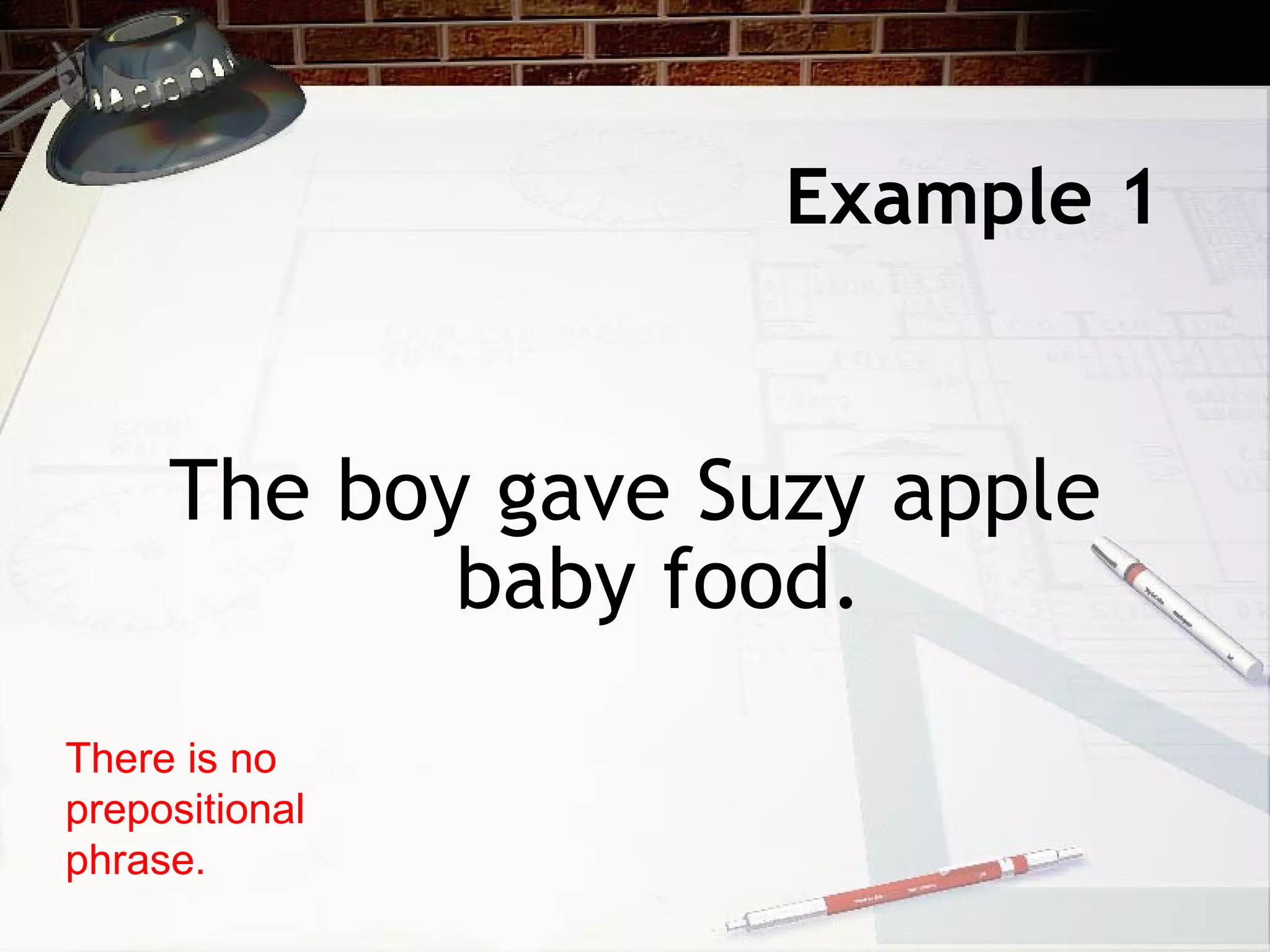
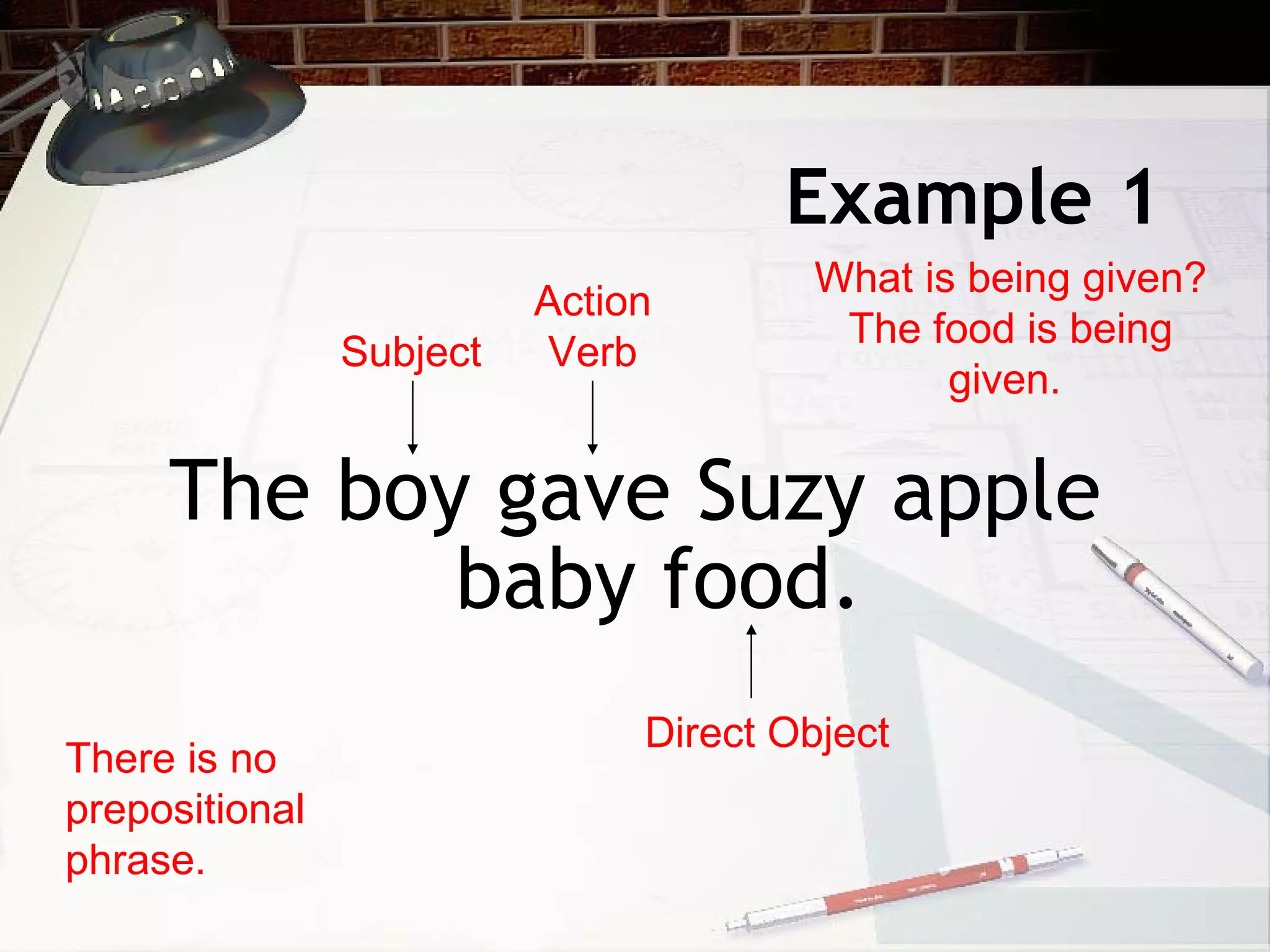
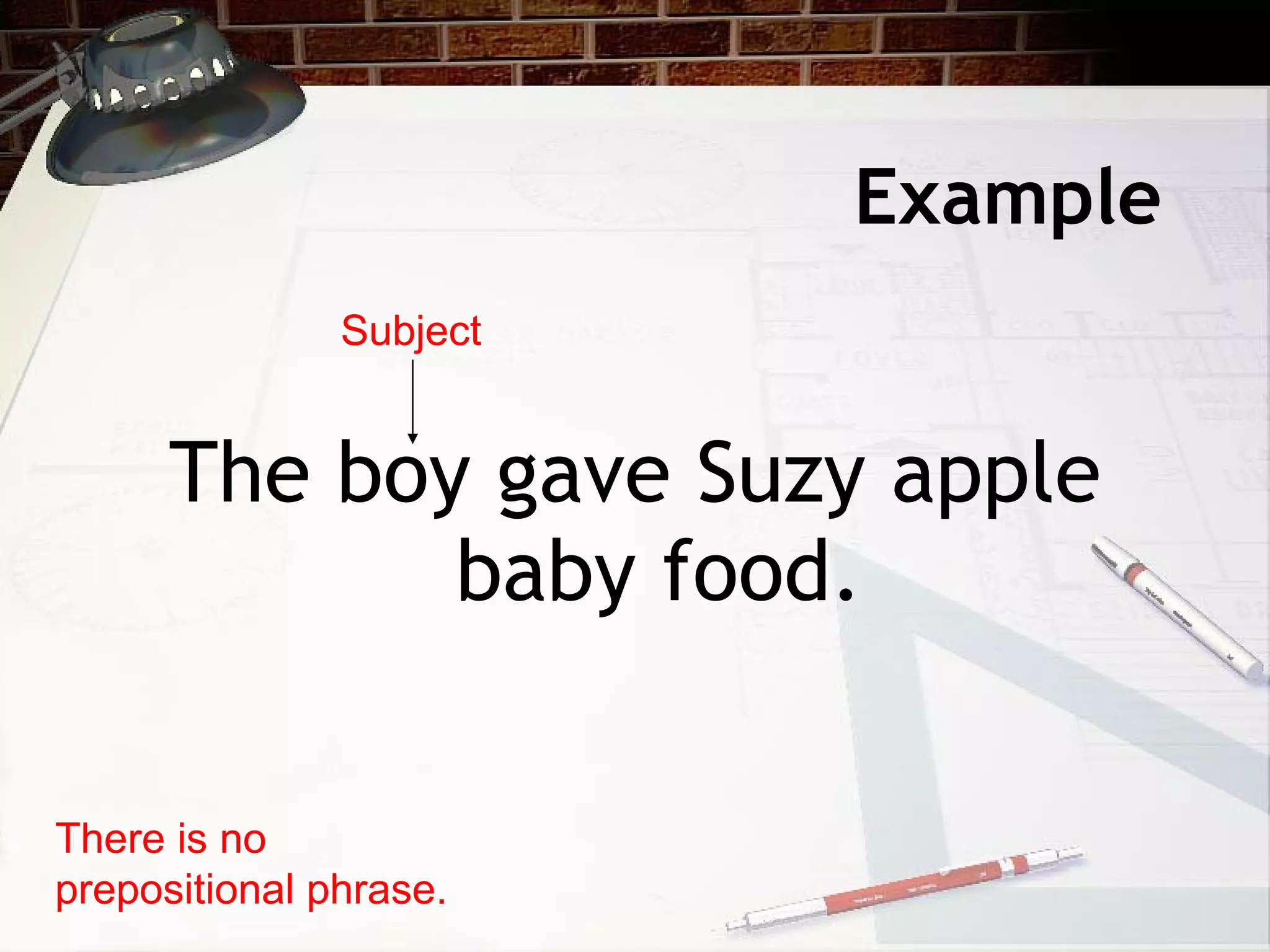
Example 1 The boy gave Suzy apple baby food. There is no prepositional phrase.
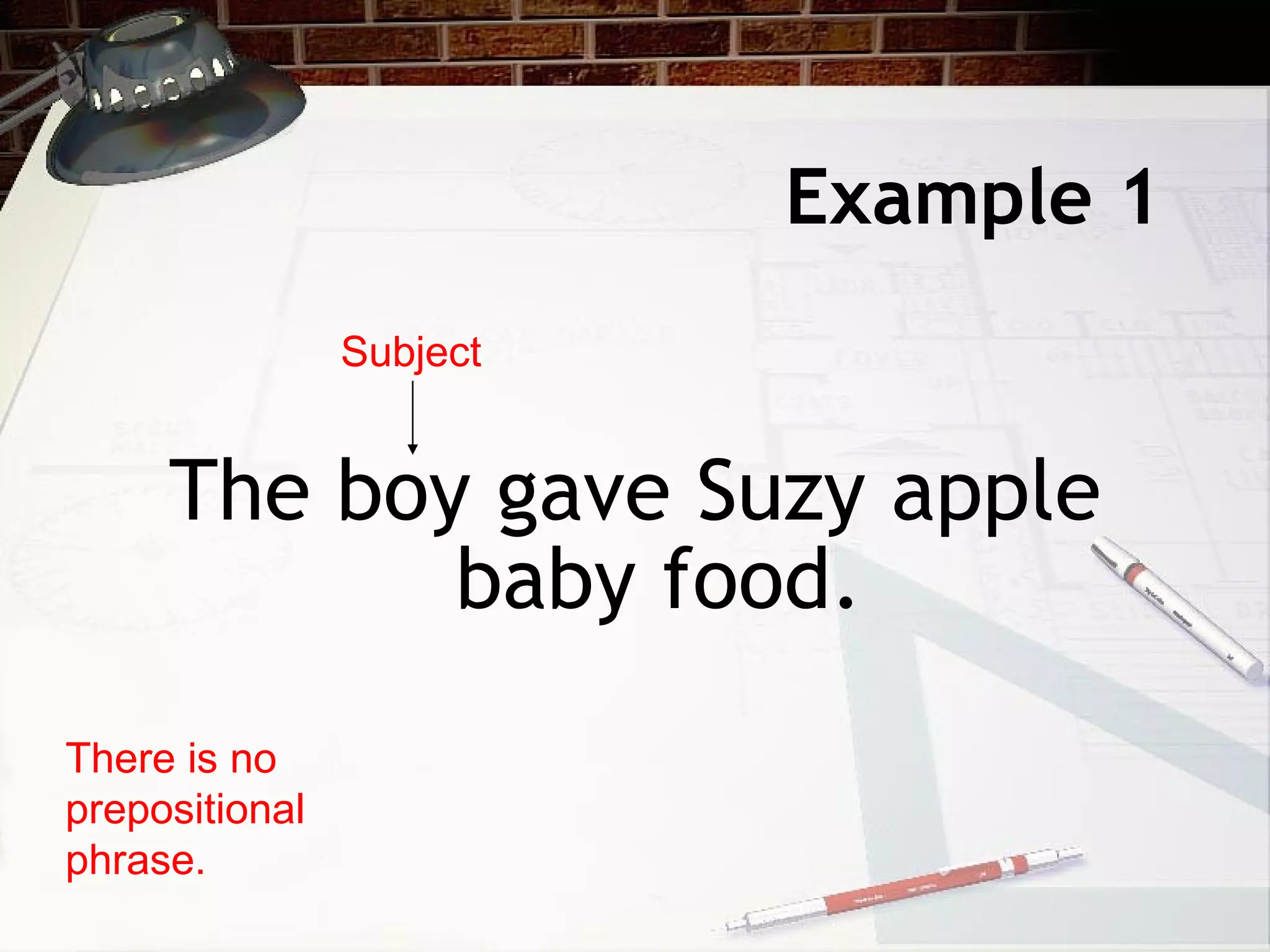
Example 1 The boy gave Suzy apple baby food. There is no prepositional phrase. Subject
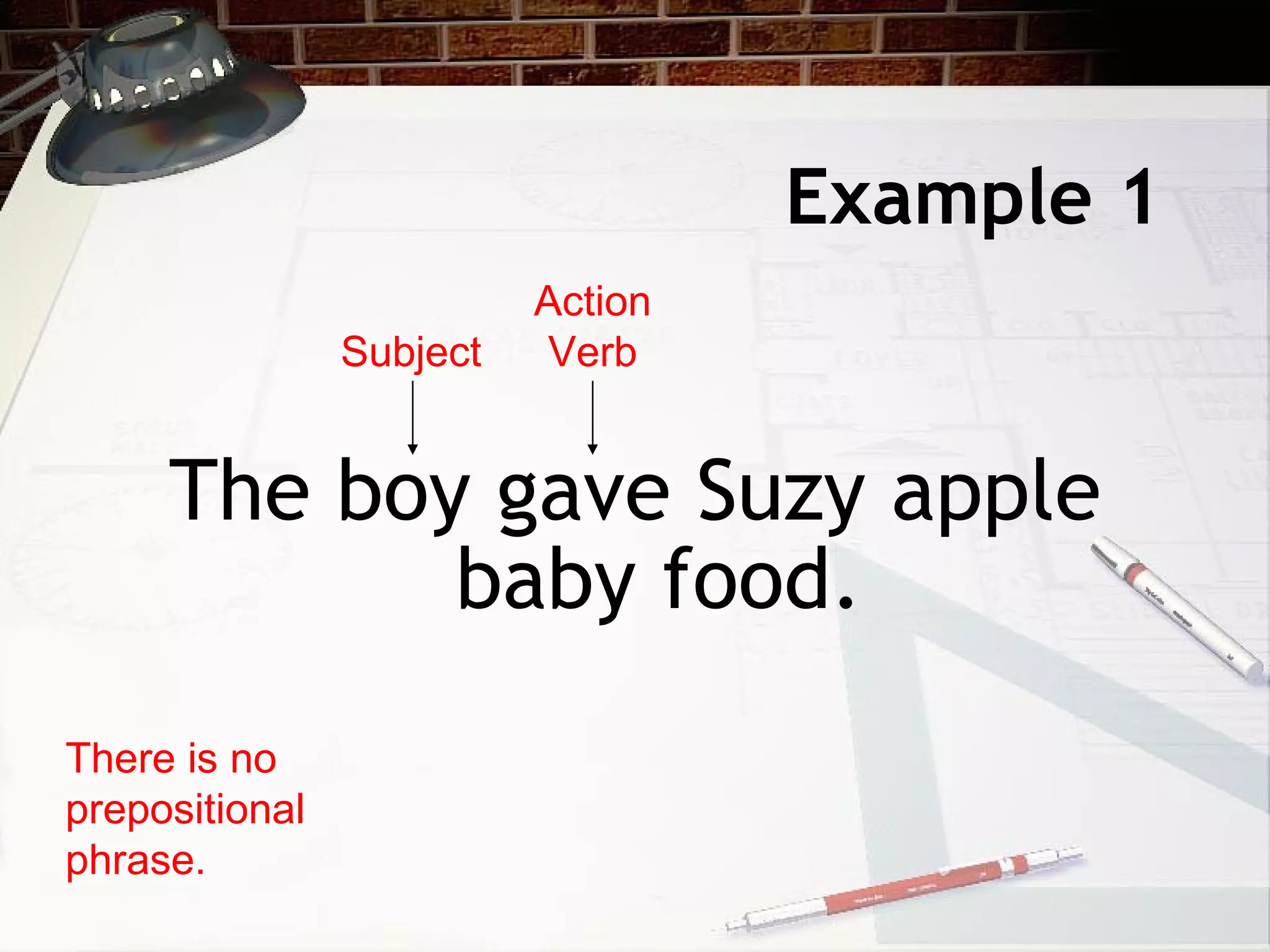
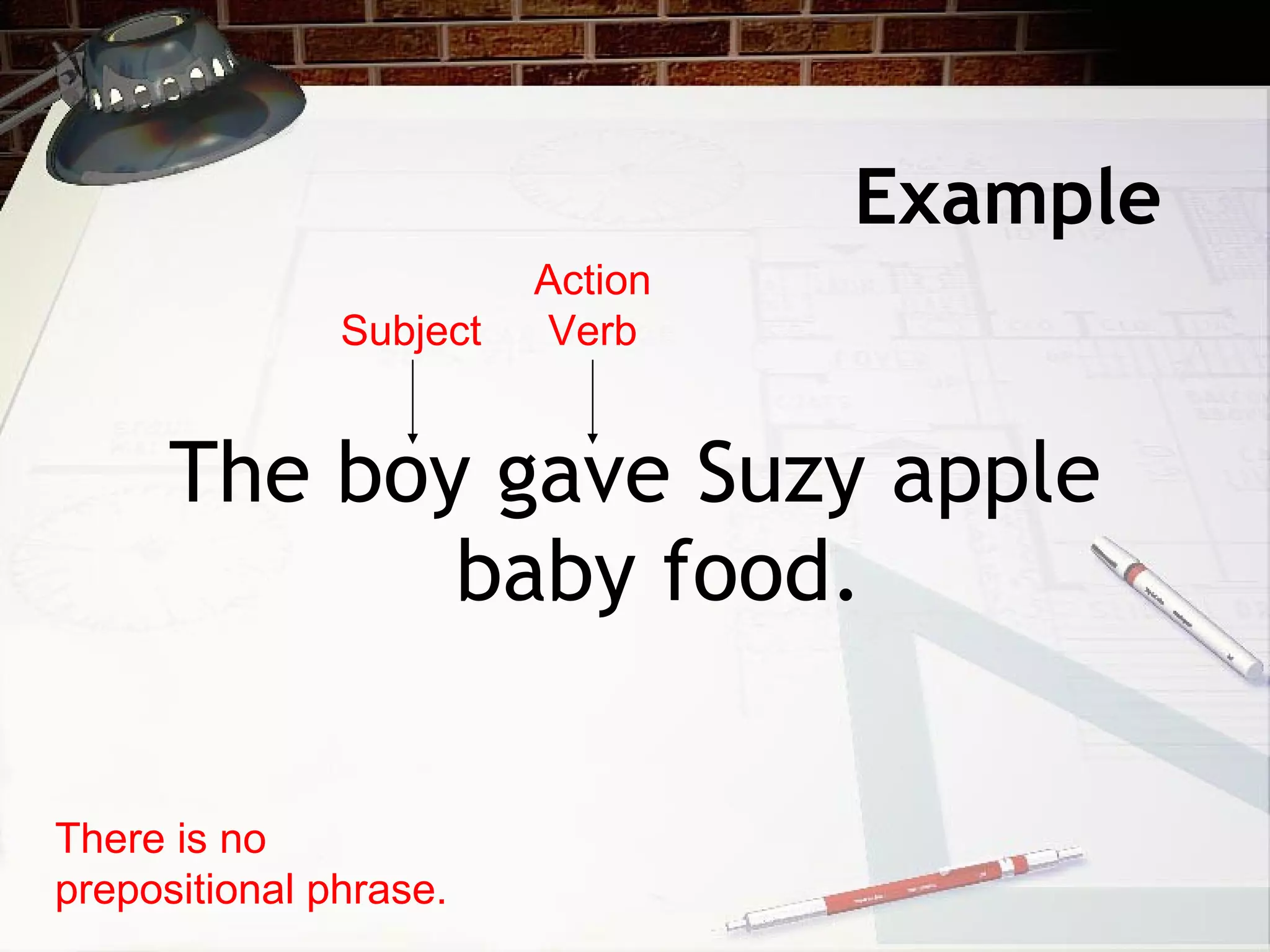
Example 1 The boy gave Suzy apple baby food. There is no prepositional phrase. Subject Action Verb
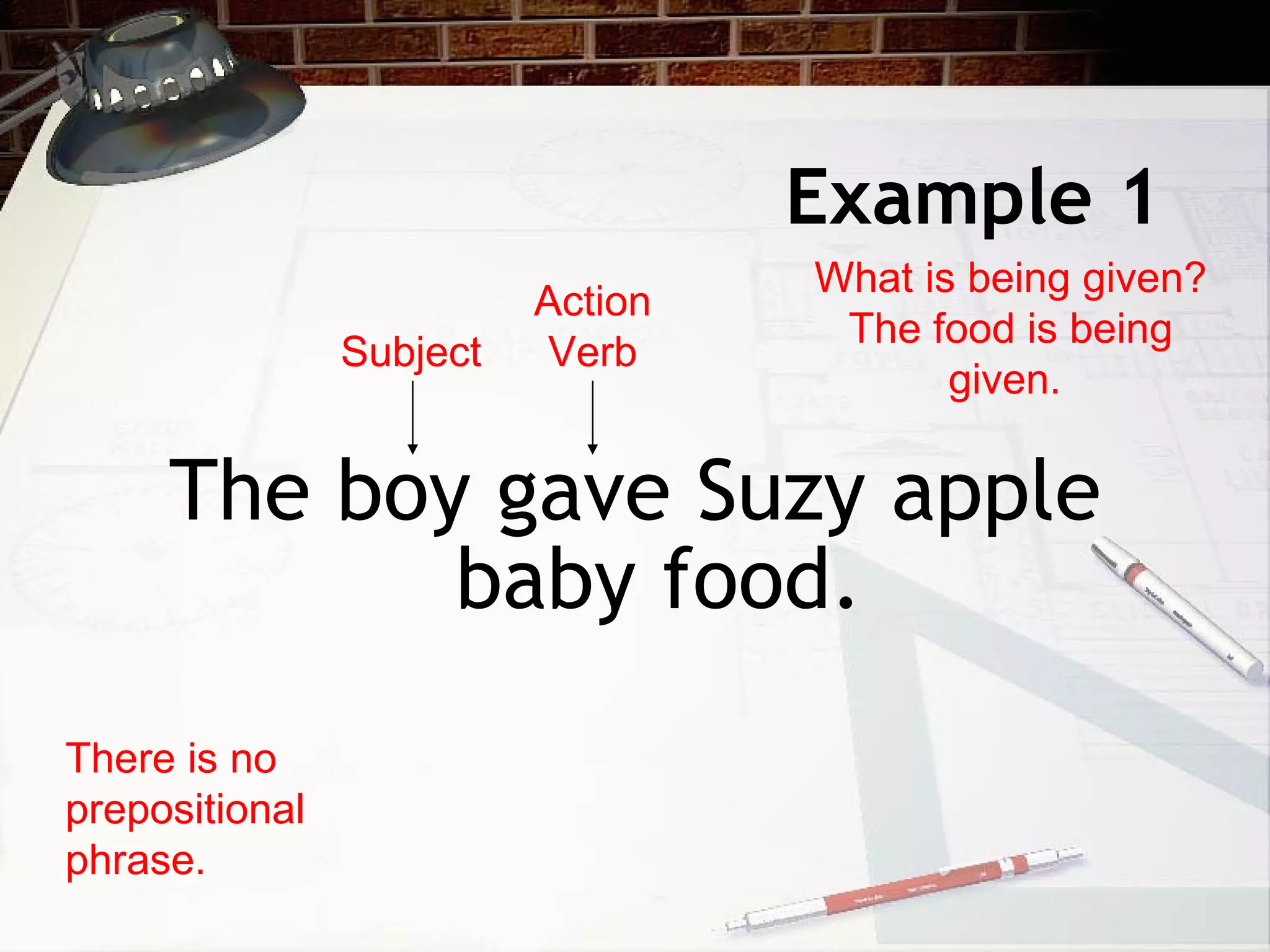
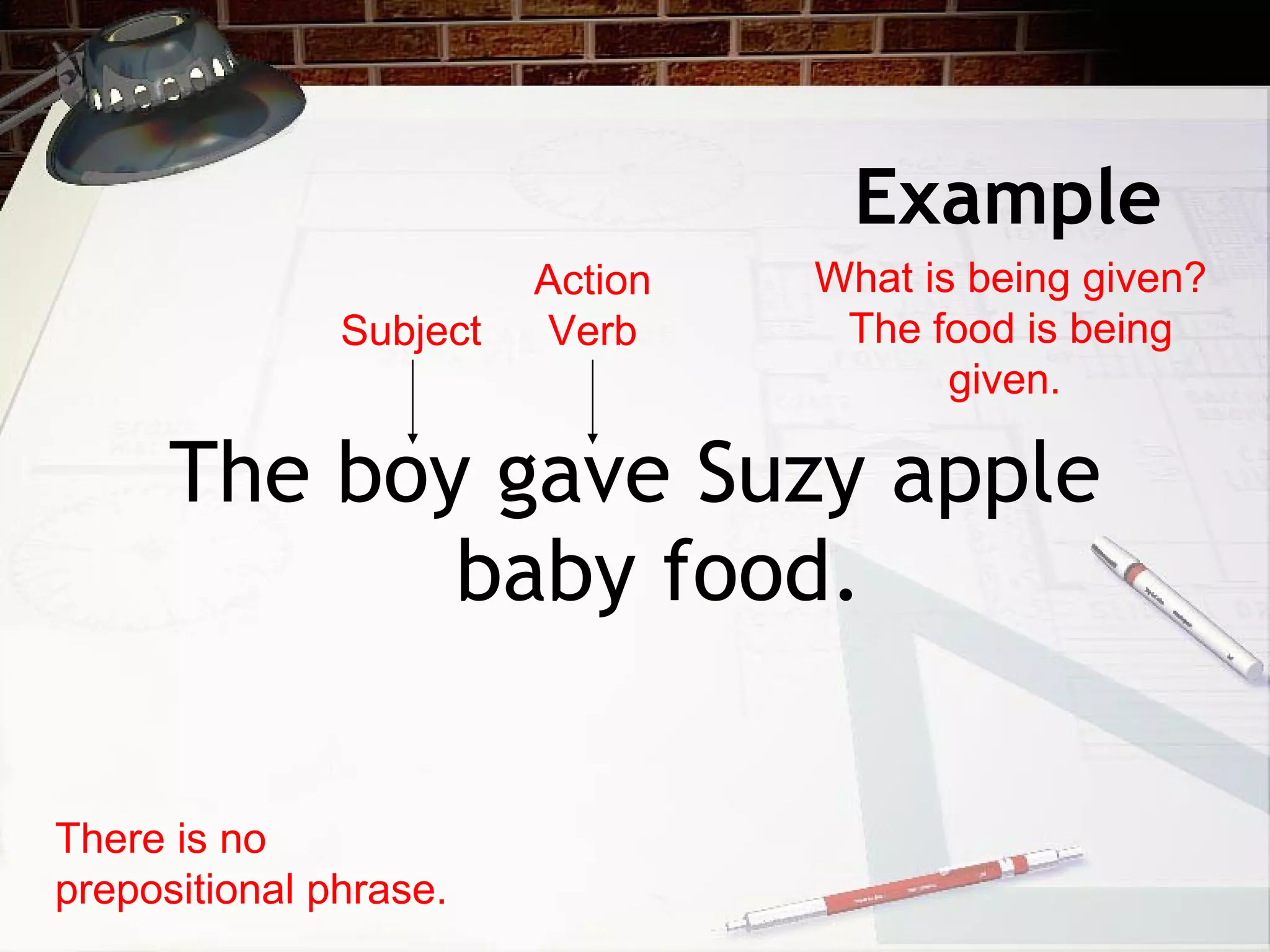
Example 1 The boy gave Suzy apple baby food. There is no prepositional phrase. Subject Action Verb What is being given? The food is being given.
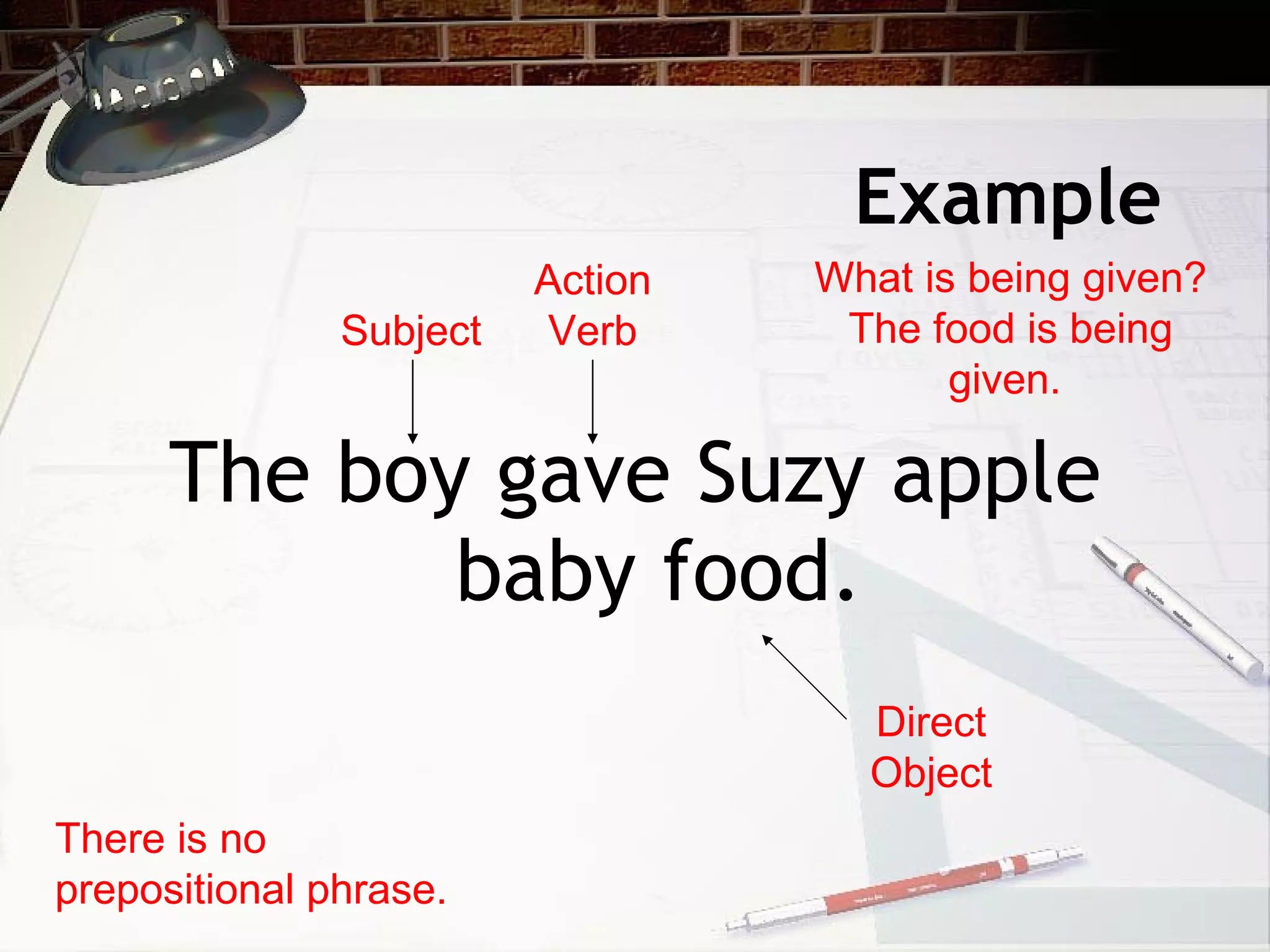
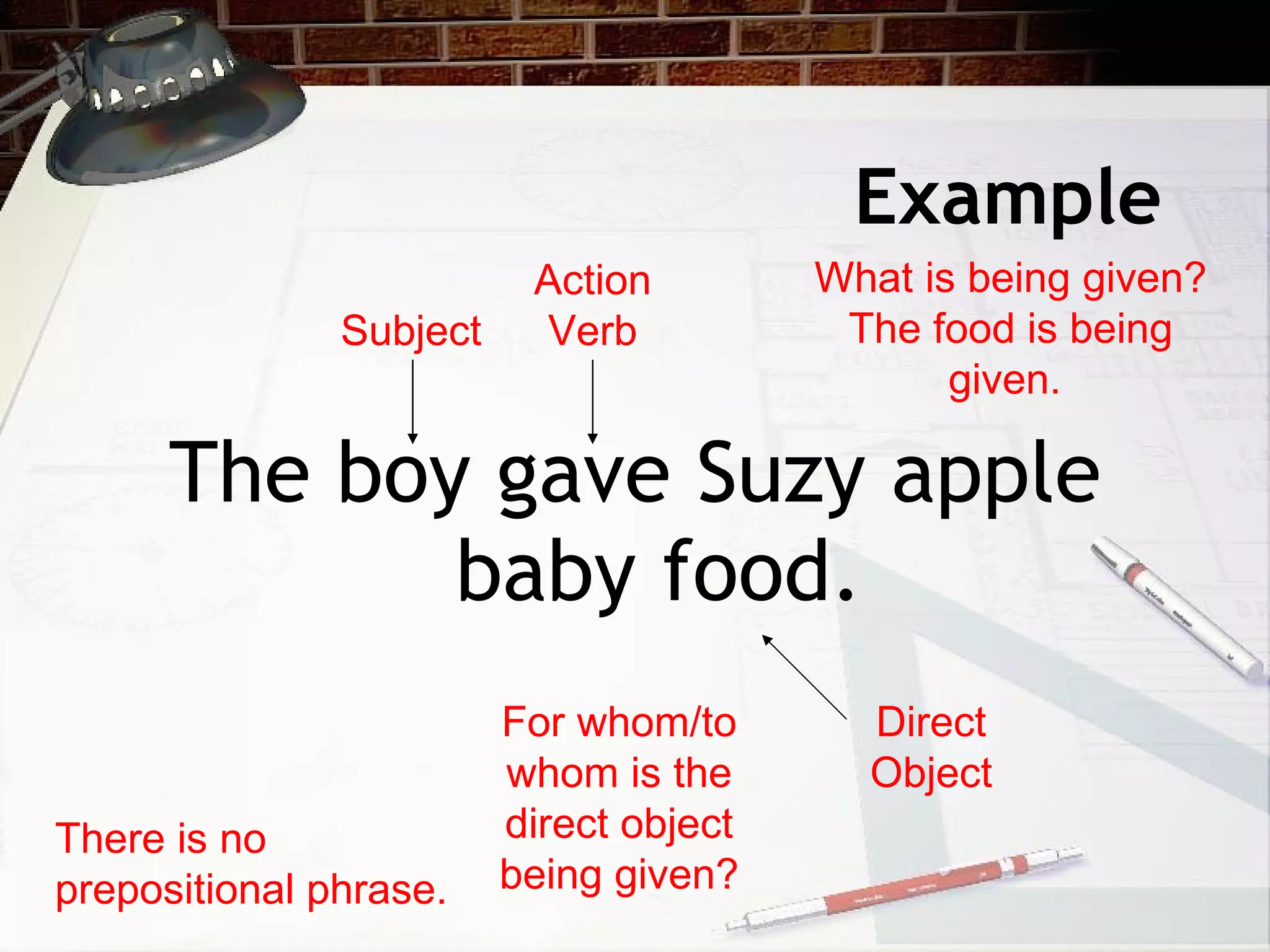
Example 1 The boy gave Suzy apple baby food. There is no prepositional phrase. Subject Action Verb What is being given? The food is being given.  Direct Object
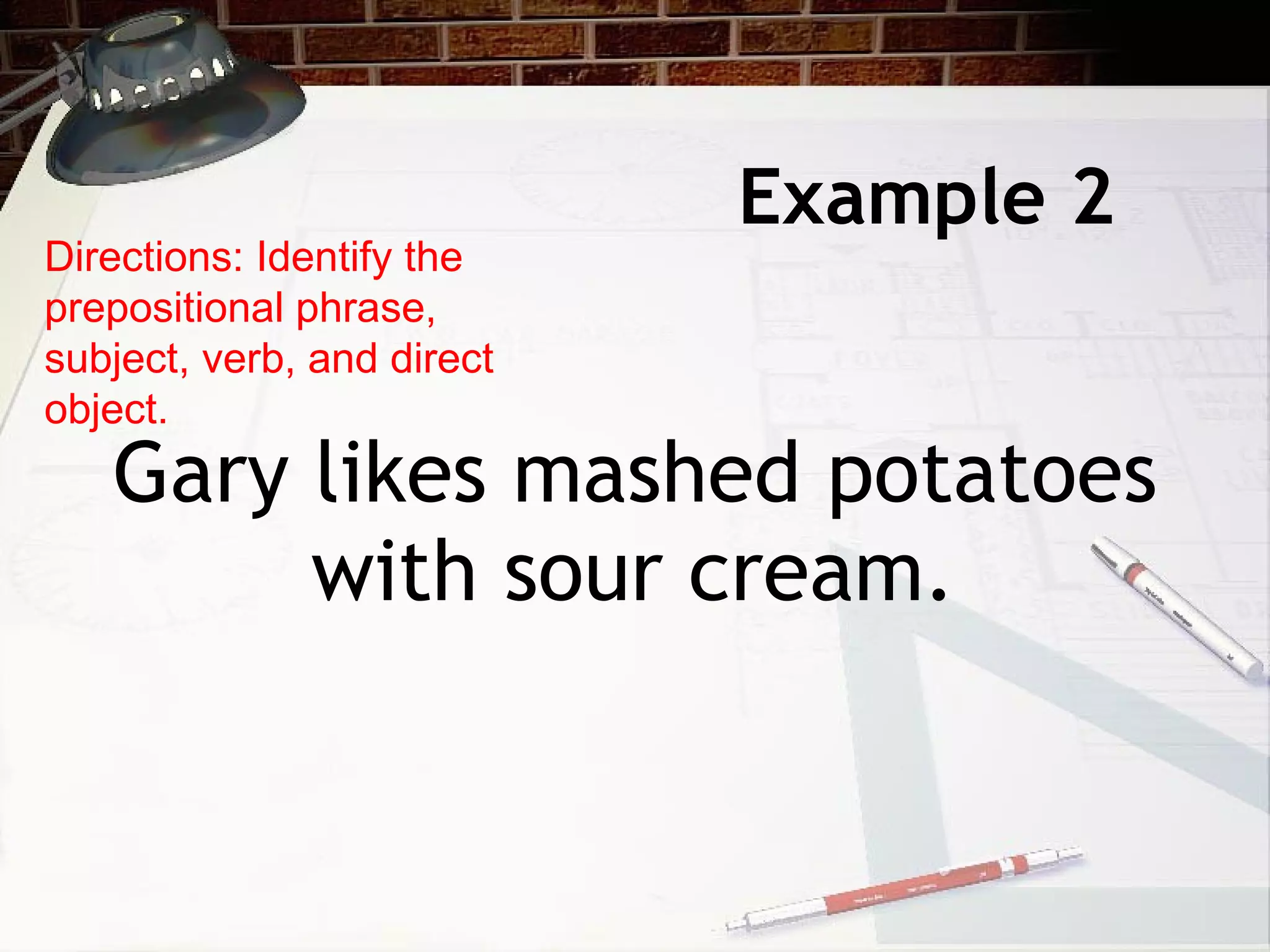
Example 2  Gary likes mashed potatoes with sour cream.  Directions: Identify the prepositional phrase, subject, verb, and direct object.
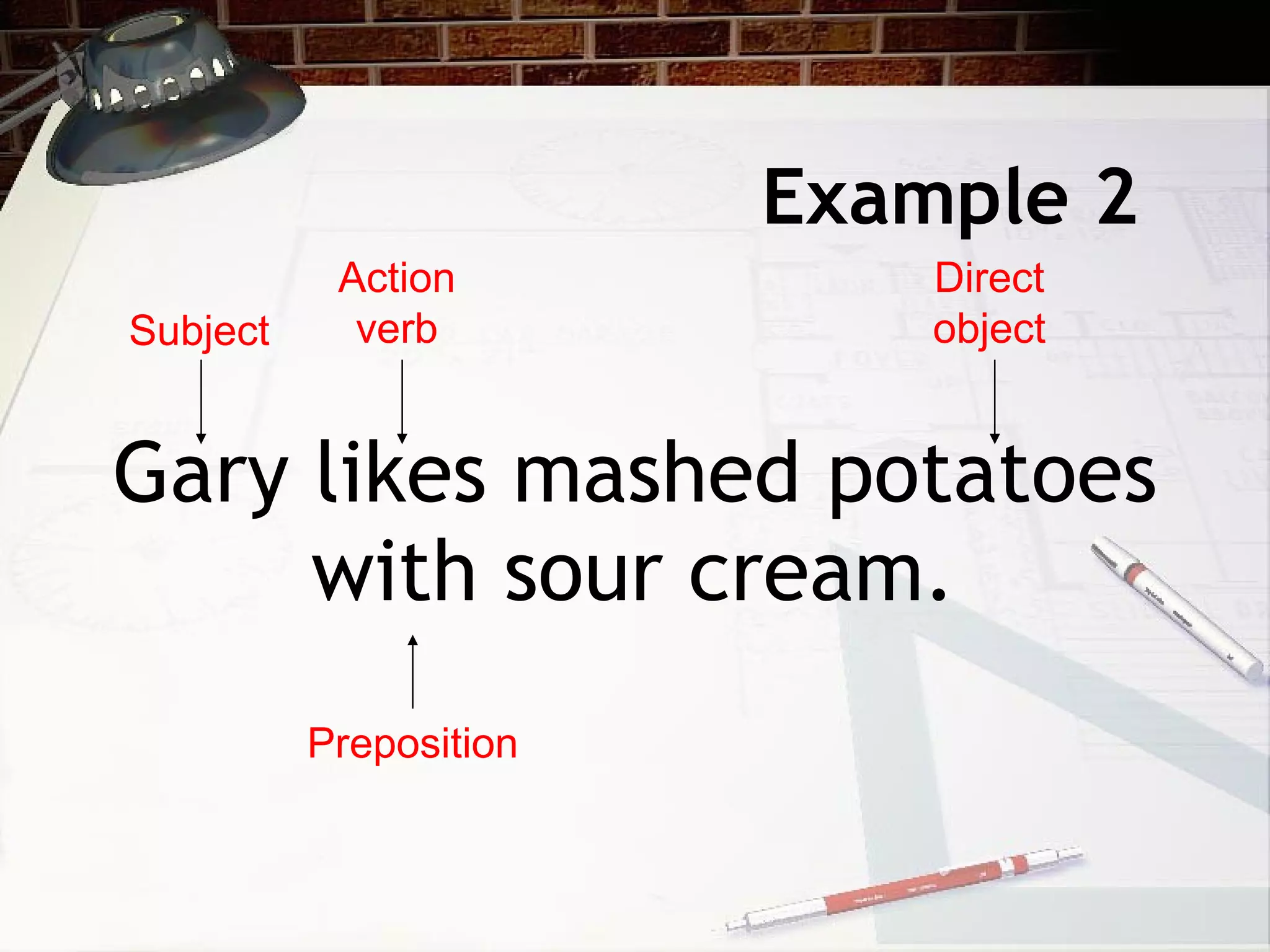
Example 2  Gary likes mashed potatoes with sour cream.  Subject  Action verb Direct object Preposition
Indirect Objects
What are indirect objects? An indirect object precedes the direct object and tells to whom or for whom the action of the verb is done and who is receiving the direct object. There must be a direct object to have an indirect object. Indirect objects are usually found with verbs of giving or communicating like give, bring, tell, show, take, or offer. An indirect object is always a noun or pronoun which is not part of a prepositional phrase.
How to Find Indirect Objects Find the prepositional phrase(s) of the sentence and label it. Next, find the subject of the sentence and label it. Third, find the verb, and label it as either linking or action. Look for the noun that receives the action of the verb. Label it as the direct object. Look for the noun that tells to whom or for whom the action of the verb is done and who is receiving the direct object.  Remember that linking verbs CAN’T have direct OR indirect objects. They have predicate adjectives and nouns. A good trick to find out the indirect object is to ask yourself for whom/to whom is the direct object being _______ (insert verb here).
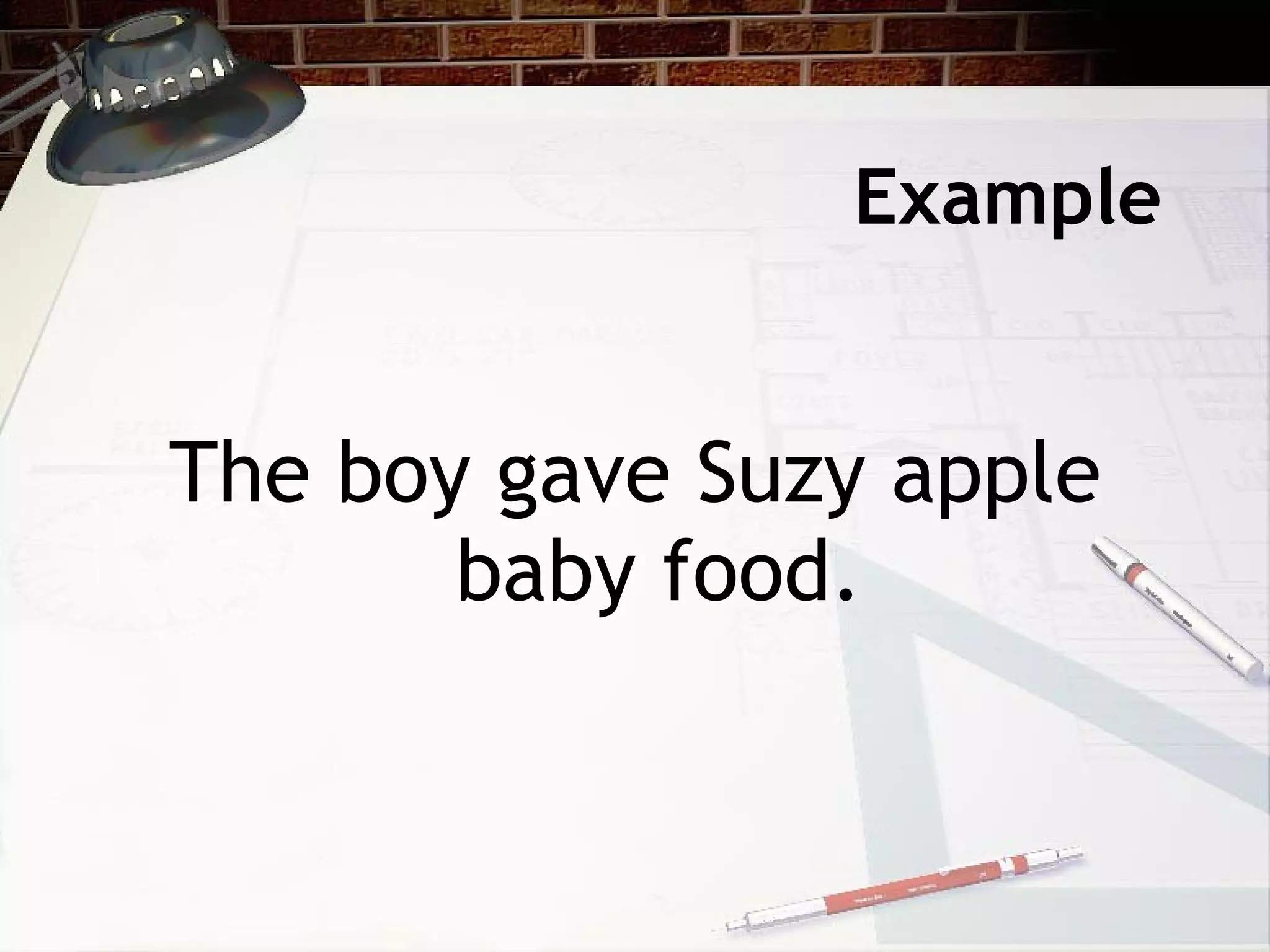
Example The boy gave Suzy apple baby food.
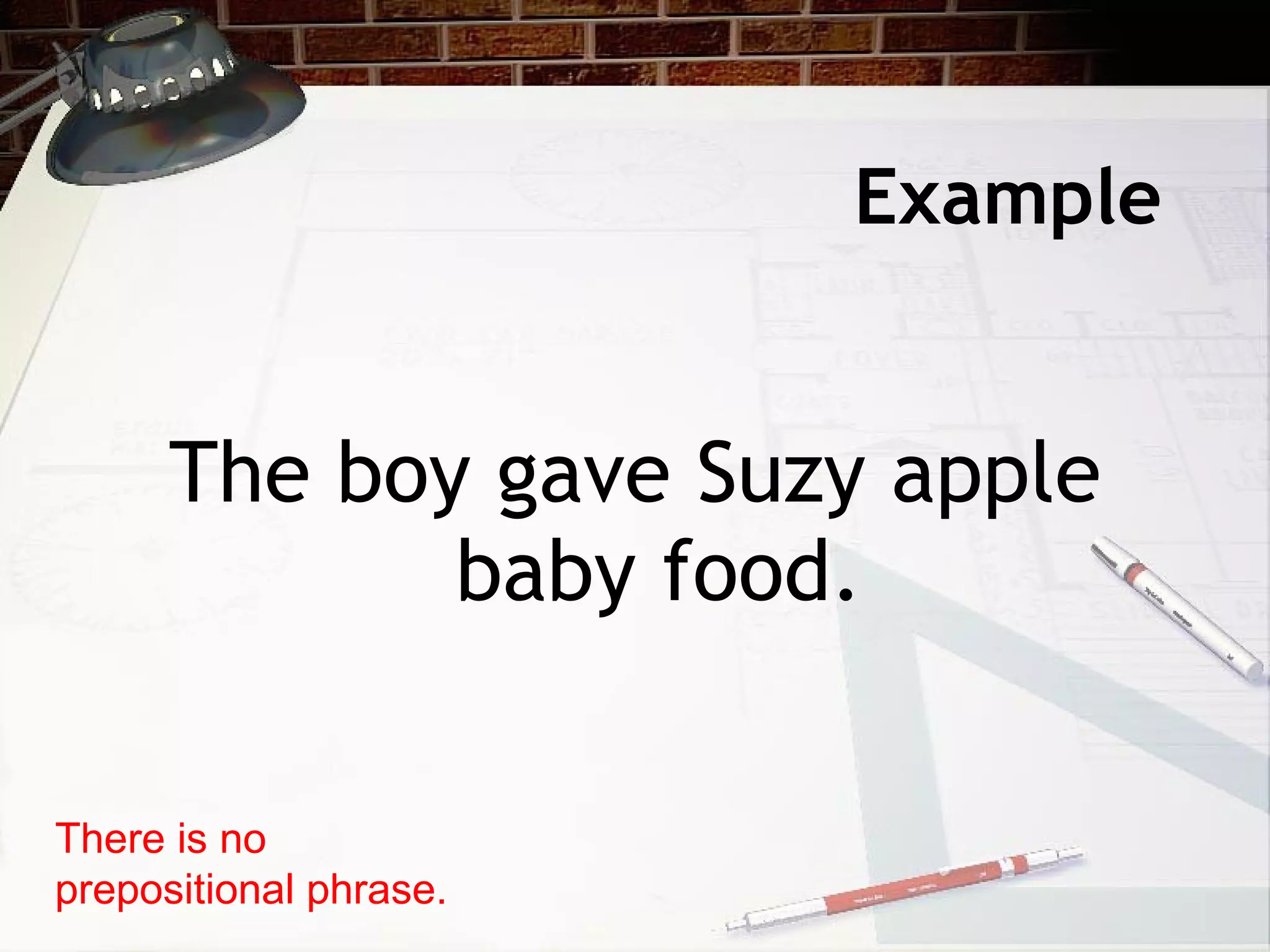
Example The boy gave Suzy apple baby food. There is no prepositional phrase.
Example The boy gave Suzy apple baby food. There is no prepositional phrase. Subject
Example The boy gave Suzy apple baby food. There is no prepositional phrase. Subject Action Verb
Example The boy gave Suzy apple baby food. There is no prepositional phrase. Subject Action Verb What is being given? The food is being given.
Example The boy gave Suzy apple baby food. There is no prepositional phrase. Subject Action Verb What is being given? The food is being given.  Direct Object
Example The boy gave Suzy apple baby food. There is no prepositional phrase. Subject Action Verb What is being given? The food is being given.  Direct Object For whom/to whom is the direct object being given?
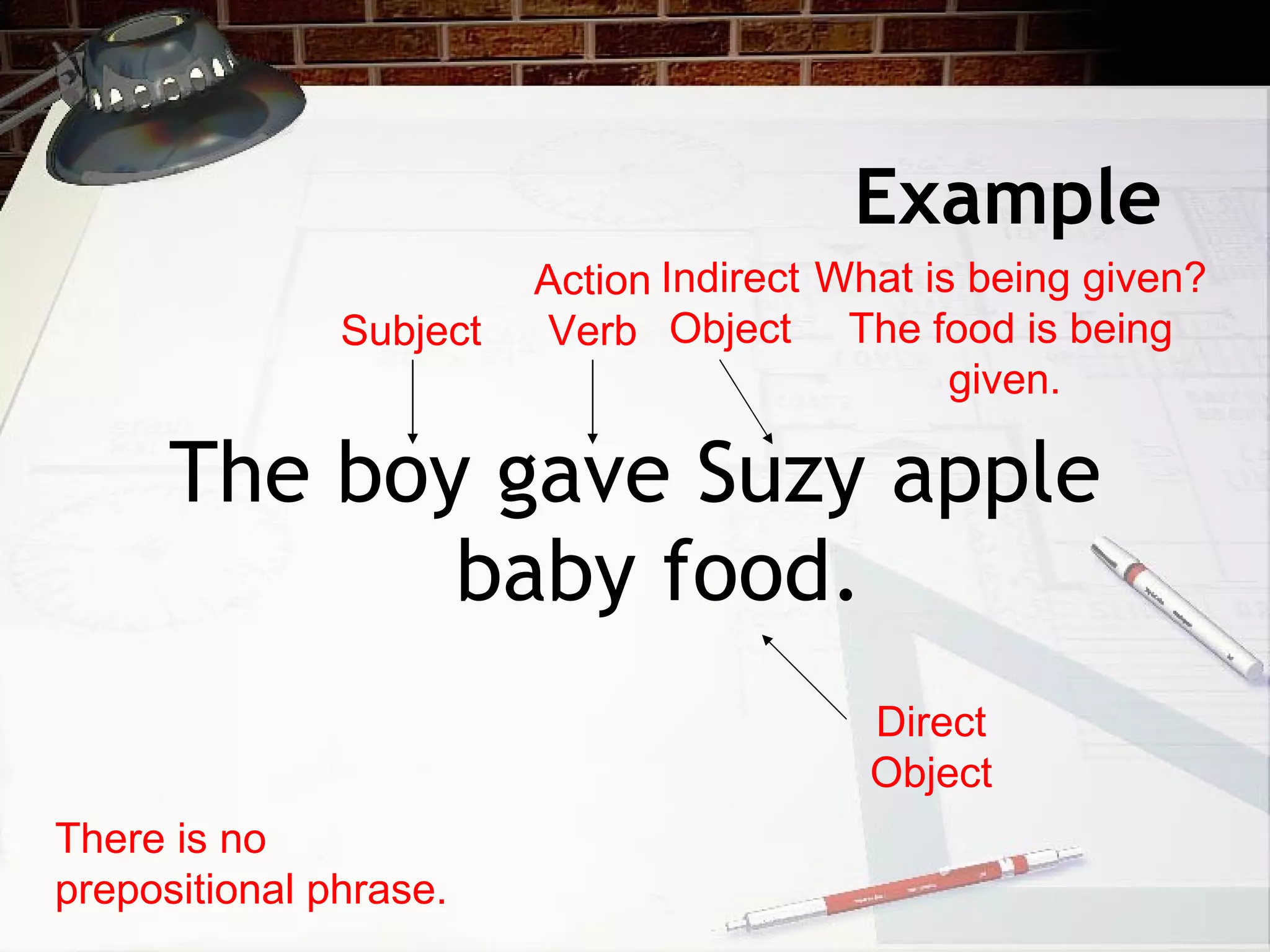
Example The boy gave Suzy apple baby food. There is no prepositional phrase. Subject Action Verb What is being given? The food is being given.  Direct Object Indirect Object
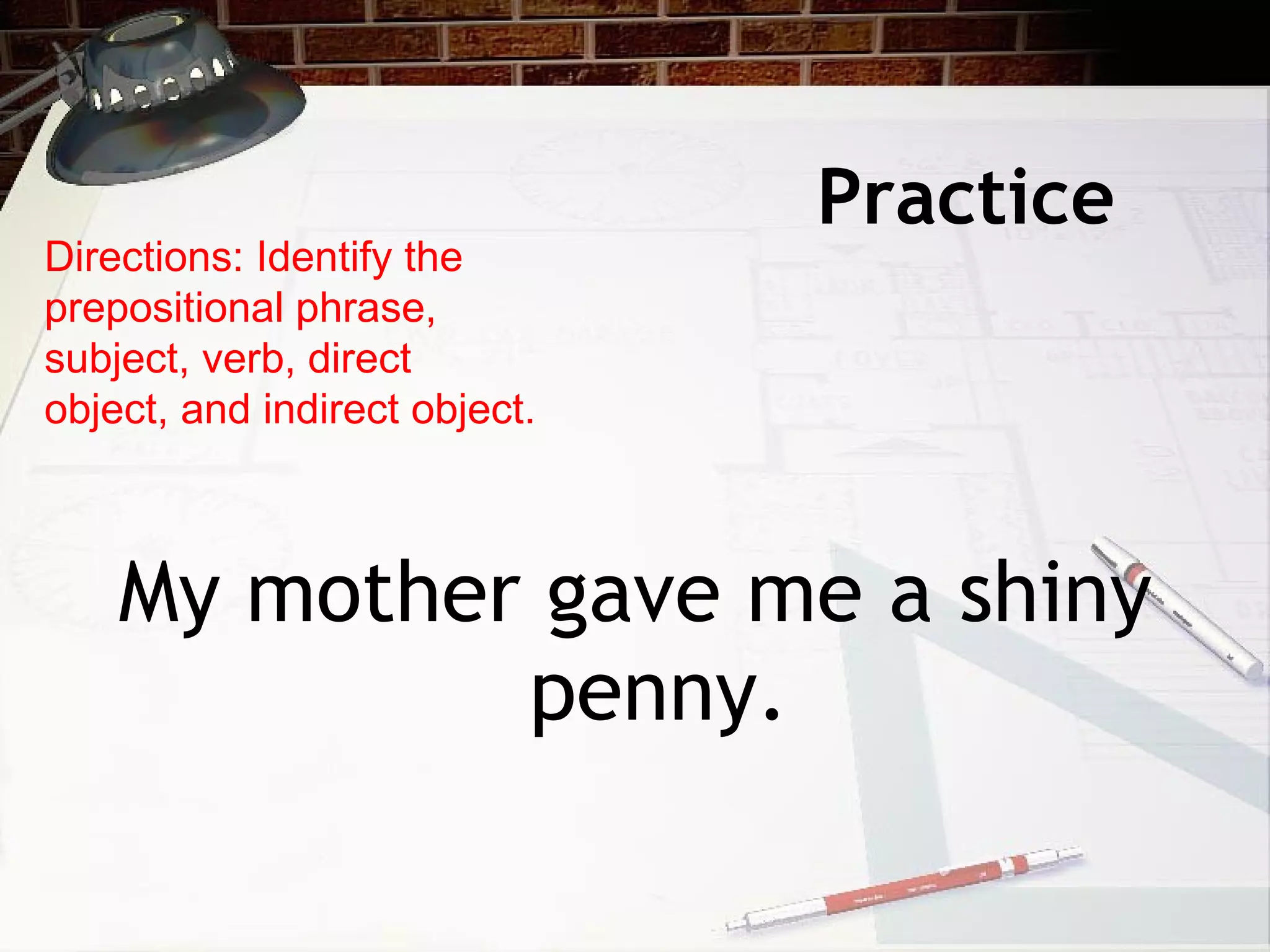
Practice  My mother gave me a shiny penny. Directions: Identify the prepositional phrase, subject, verb, direct object, and indirect object.
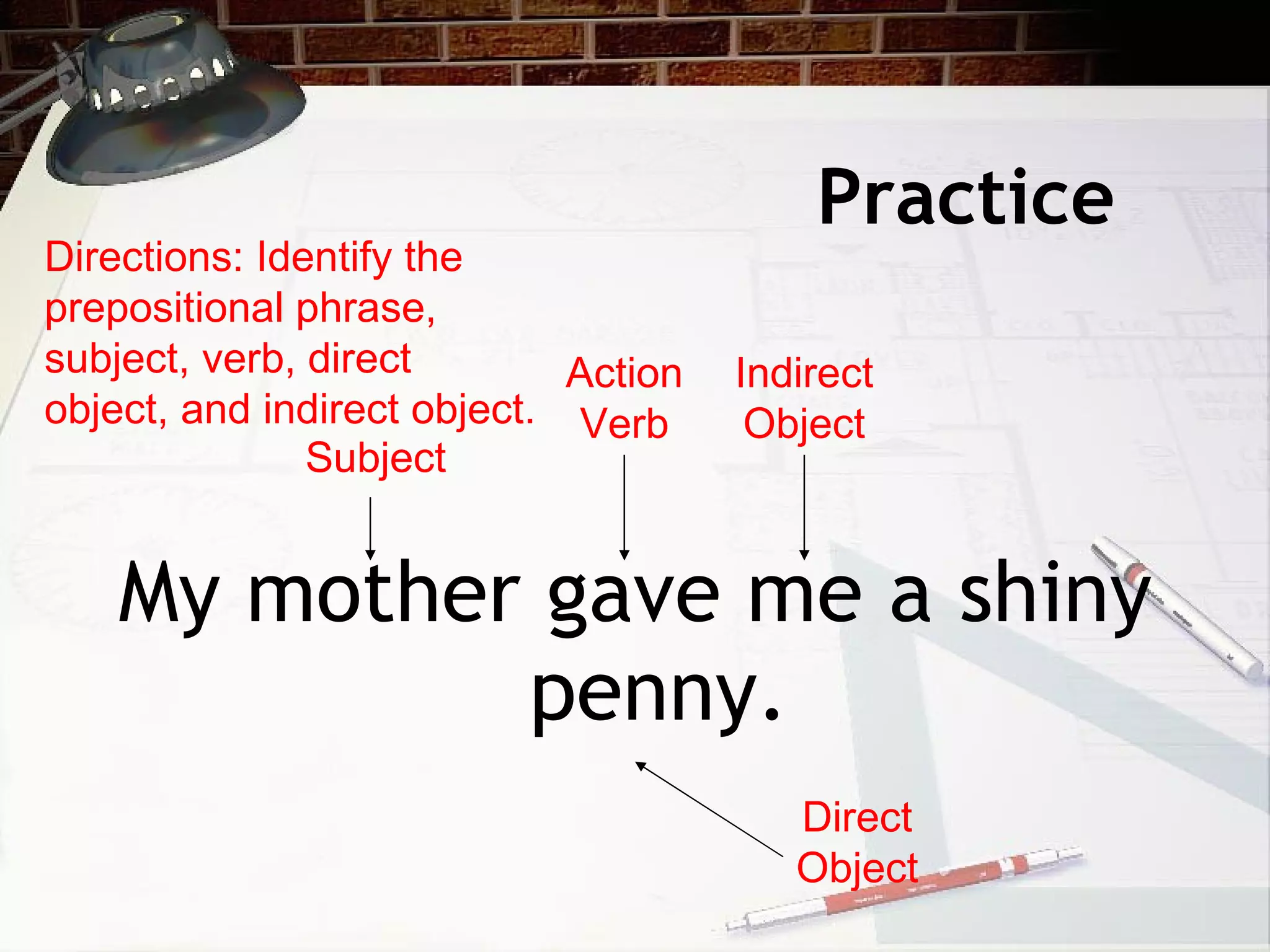
Practice  My mother gave me a shiny penny. Directions: Identify the prepositional phrase, subject, verb, direct object, and indirect object. Subject Action Verb Indirect Object Direct Object

Direct & indirect objects

  • 1.
  • 2.
    What are DirectObjects? A direct object is a noun or pronoun that receives the action of a verb or shows the result of the action. It answers the question "Who?" or "What?" after an action verb. An action verb with a direct object is called a transitive verb.
  • 3.
    How to FindDirect Objects Find the prepositional phrase(s) of the sentence and label it. Next, find the subject of the sentence and label it. Third, find the verb, and label it as either linking or action. Look for the noun that receives the action of the verb. Label it as the direct object. Remember that linking verbs CAN’T have direct OR indirect objects. They have predicate adjectives and nouns. A good trick to find out the direct object is to ask yourself, “what is being _______?” (insert verb here).
  • 4.
    Example The boygave Suzy apple baby food.
  • 5.
    Example 1 Theboy gave Suzy apple baby food. There is no prepositional phrase.
  • 6.
    Example 1 Theboy gave Suzy apple baby food. There is no prepositional phrase. Subject
  • 7.
    Example 1 Theboy gave Suzy apple baby food. There is no prepositional phrase. Subject Action Verb
  • 8.
    Example 1 Theboy gave Suzy apple baby food. There is no prepositional phrase. Subject Action Verb What is being given? The food is being given.
  • 9.
    Example 1 Theboy gave Suzy apple baby food. There is no prepositional phrase. Subject Action Verb What is being given? The food is being given. Direct Object
  • 10.
    Example 2 Gary likes mashed potatoes with sour cream. Directions: Identify the prepositional phrase, subject, verb, and direct object.
  • 11.
    Example 2 Gary likes mashed potatoes with sour cream. Subject Action verb Direct object Preposition
  • 12.
  • 13.
    What are indirectobjects? An indirect object precedes the direct object and tells to whom or for whom the action of the verb is done and who is receiving the direct object. There must be a direct object to have an indirect object. Indirect objects are usually found with verbs of giving or communicating like give, bring, tell, show, take, or offer. An indirect object is always a noun or pronoun which is not part of a prepositional phrase.
  • 14.
    How to FindIndirect Objects Find the prepositional phrase(s) of the sentence and label it. Next, find the subject of the sentence and label it. Third, find the verb, and label it as either linking or action. Look for the noun that receives the action of the verb. Label it as the direct object. Look for the noun that tells to whom or for whom the action of the verb is done and who is receiving the direct object. Remember that linking verbs CAN’T have direct OR indirect objects. They have predicate adjectives and nouns. A good trick to find out the indirect object is to ask yourself for whom/to whom is the direct object being _______ (insert verb here).
  • 15.
    Example The boygave Suzy apple baby food.
  • 16.
    Example The boygave Suzy apple baby food. There is no prepositional phrase.
  • 17.
    Example The boygave Suzy apple baby food. There is no prepositional phrase. Subject
  • 18.
    Example The boygave Suzy apple baby food. There is no prepositional phrase. Subject Action Verb
  • 19.
    Example The boygave Suzy apple baby food. There is no prepositional phrase. Subject Action Verb What is being given? The food is being given.
  • 20.
    Example The boygave Suzy apple baby food. There is no prepositional phrase. Subject Action Verb What is being given? The food is being given. Direct Object
  • 21.
    Example The boygave Suzy apple baby food. There is no prepositional phrase. Subject Action Verb What is being given? The food is being given. Direct Object For whom/to whom is the direct object being given?
  • 22.
    Example The boygave Suzy apple baby food. There is no prepositional phrase. Subject Action Verb What is being given? The food is being given. Direct Object Indirect Object
  • 23.
    Practice Mymother gave me a shiny penny. Directions: Identify the prepositional phrase, subject, verb, direct object, and indirect object.
  • 24.
    Practice Mymother gave me a shiny penny. Directions: Identify the prepositional phrase, subject, verb, direct object, and indirect object. Subject Action Verb Indirect Object Direct Object