What are Verbs?The verb is king in English. The shortest sentence contains a verb. You can make a one-word sentence with a verb, for example: "Stop!" You cannot make a one-word sentence with any other type of word.
VerbsVerbs are sometimes described as "action words".This is partly true. Many verbs give the idea of action, of "doing" something. For example, words like run, fight, do and work all convey action.
But some verbs do not give the idea of action; they give the idea of existence, of state, of "being". For example, verbs like be, exist, seem and belong all convey state.
VerbsA verb always has a subject. In simple terms, therefore, we can say that verbs are words that tell us what a subject does or is; they describe:action (Ram plays football.) state (Anthony seems kind.)
VerbsMost other words (adjectives, adverbs, prepositions etc) do not change in form (although nouns can have singular and plural forms). But almost all verbs change in form. The verb to work has five forms:to work, work, works, worked, working
VerbClassificationWe divide verbs into two broad classifications:1. Helping Verbs2. Main Verbs\
Helping verbsImagine that a stranger walks into your room and says:I can. People must. The Earth will. Do you understand anything?They "help" the main verb.
2. Main VerbsI teach. People eat. The Earth rotates. Do you understand something? Probably yes! Not a lot, but something. have meaning on their own. They tell us something.  
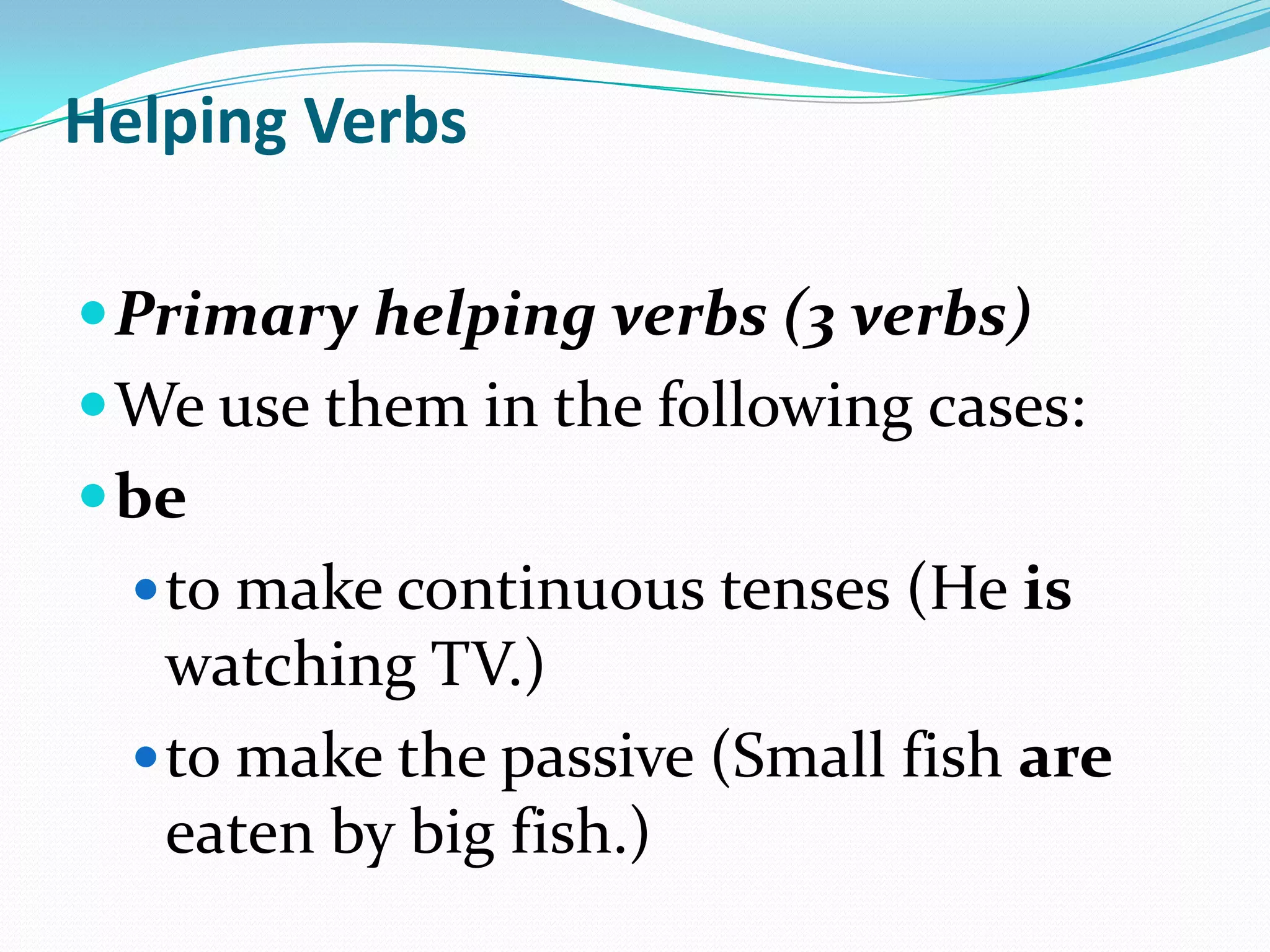
Helping VerbsPrimary helping verbs (3 verbs)Weuse them in thefollowing cases:beto make continuous tenses (He is watching TV.) to make the passive (Small fish are eaten by big fish.)
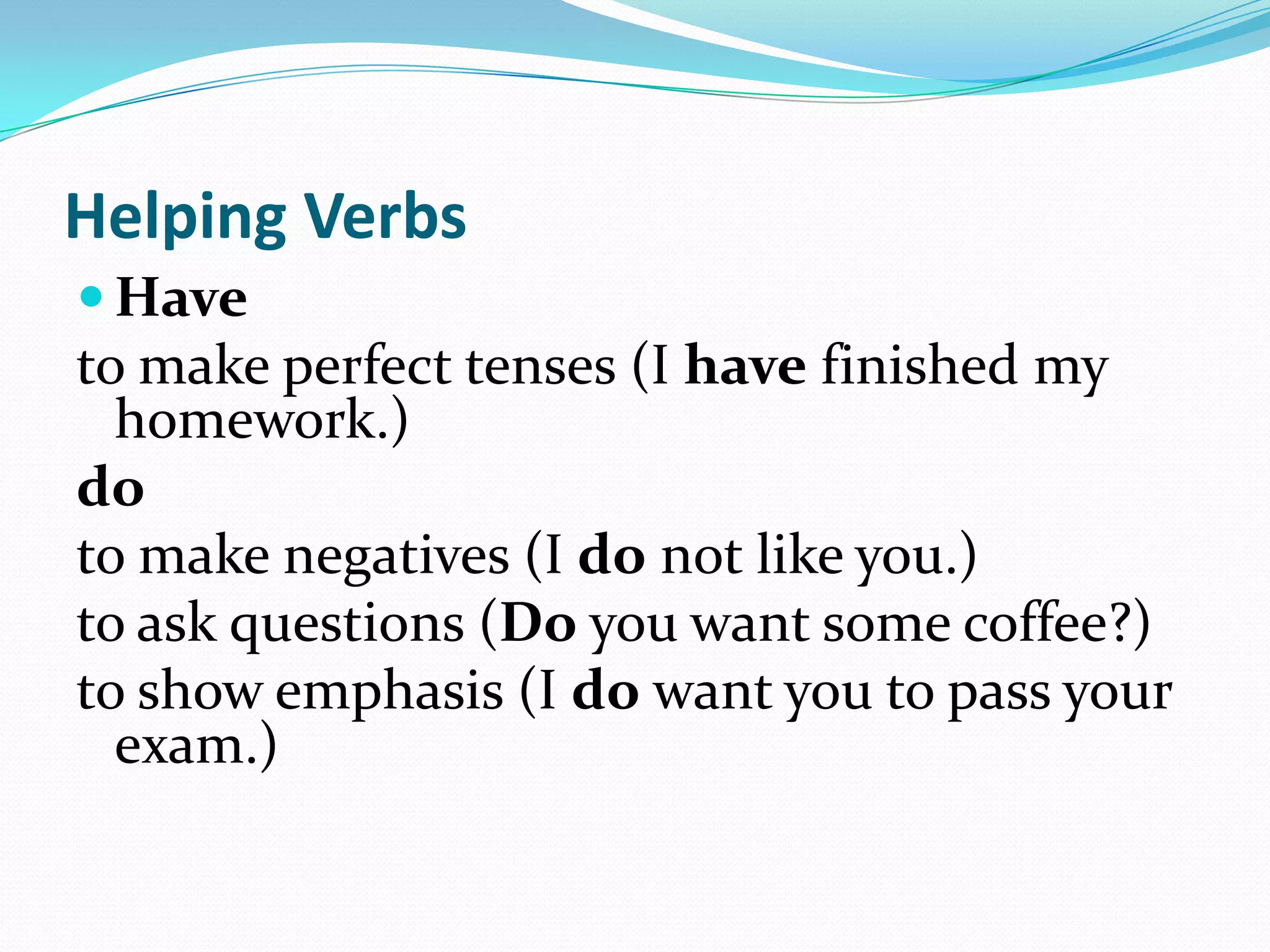
Helping VerbsHaveto make perfect tenses (I have finished my homework.) doto make negatives (I do not like you.) to ask questions (Do you want some coffee?)to show emphasis (I do want you to pass your exam.)
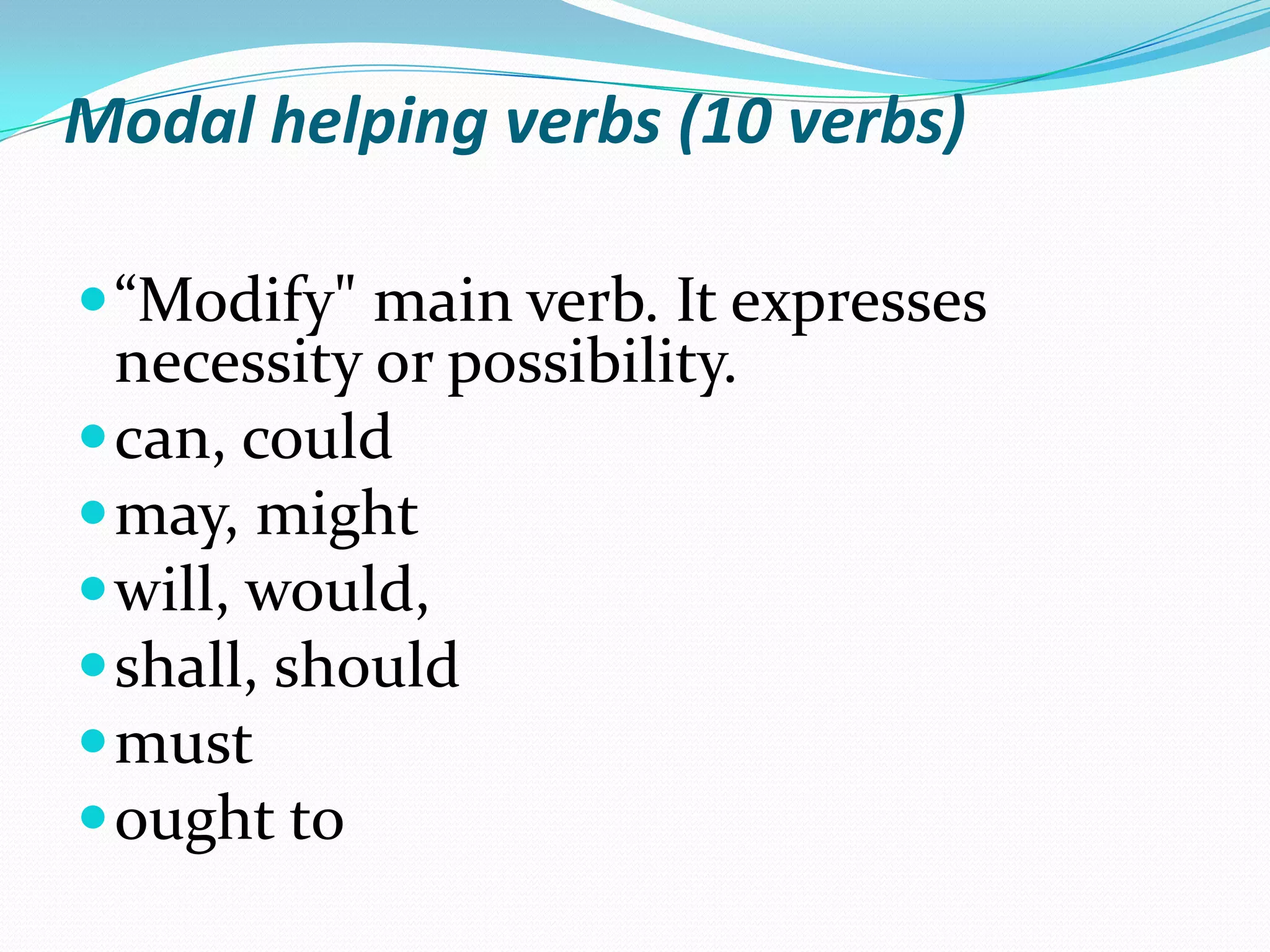
Modal helping verbs (10 verbs)“Modify" main verb. It expresses necessity or possibility.can, could may, might will, would, shall, should must ought to
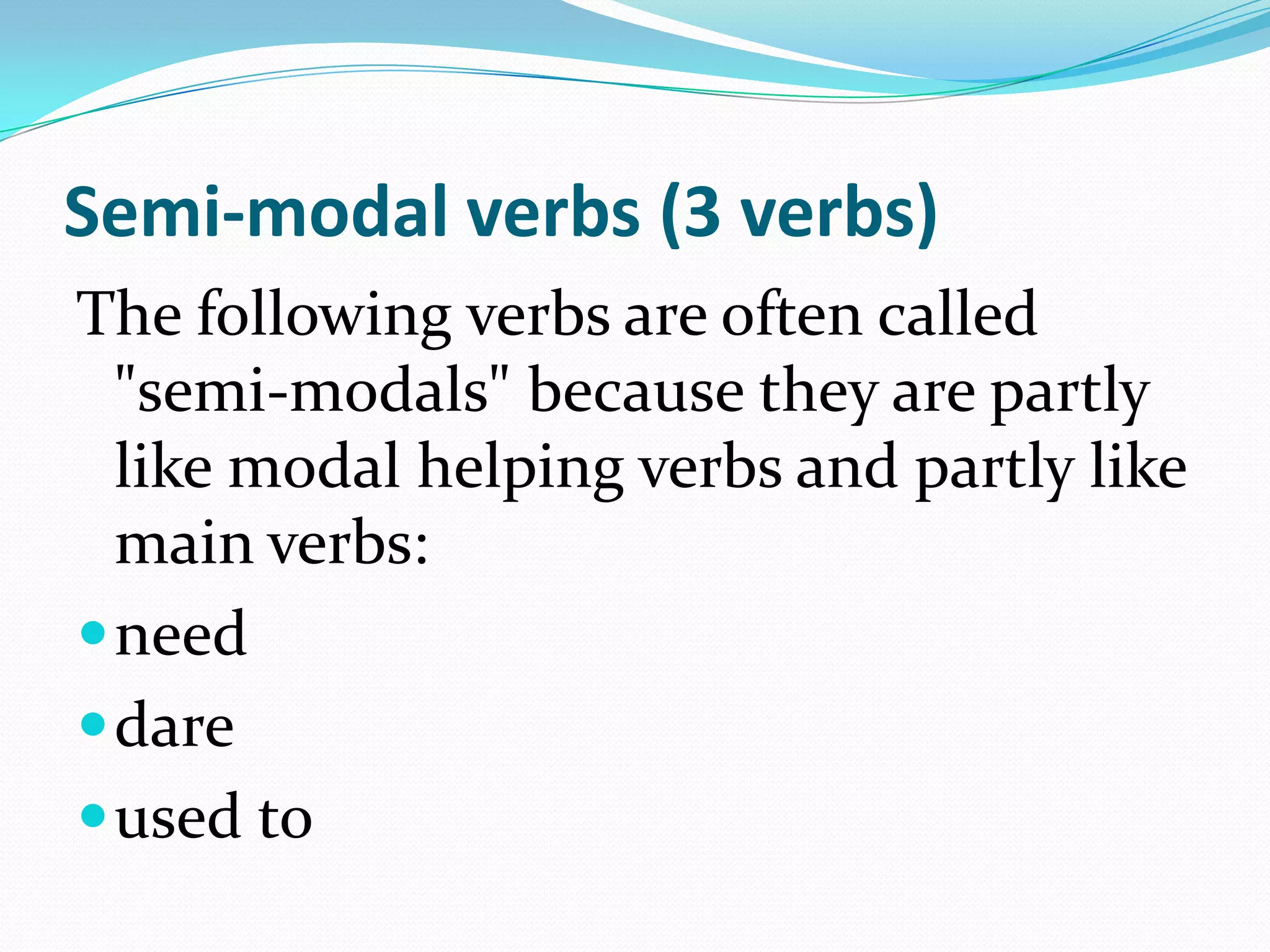
Semi-modal verbs (3 verbs)The following verbs are often called "semi-modals" because they are partly like modal helping verbs and partly like main verbs: need dare used to

What are verbs

  • 1.
    What are Verbs?Theverb is king in English. The shortest sentence contains a verb. You can make a one-word sentence with a verb, for example: "Stop!" You cannot make a one-word sentence with any other type of word.
  • 2.
    VerbsVerbs are sometimesdescribed as "action words".This is partly true. Many verbs give the idea of action, of "doing" something. For example, words like run, fight, do and work all convey action.
  • 3.
    But some verbsdo not give the idea of action; they give the idea of existence, of state, of "being". For example, verbs like be, exist, seem and belong all convey state.
  • 4.
    VerbsA verb alwayshas a subject. In simple terms, therefore, we can say that verbs are words that tell us what a subject does or is; they describe:action (Ram plays football.) state (Anthony seems kind.)
  • 5.
    VerbsMost other words(adjectives, adverbs, prepositions etc) do not change in form (although nouns can have singular and plural forms). But almost all verbs change in form. The verb to work has five forms:to work, work, works, worked, working
  • 6.
    VerbClassificationWe divide verbsinto two broad classifications:1. Helping Verbs2. Main Verbs\
  • 7.
    Helping verbsImagine thata stranger walks into your room and says:I can. People must. The Earth will. Do you understand anything?They "help" the main verb.
  • 8.
    2. Main VerbsIteach. People eat. The Earth rotates. Do you understand something? Probably yes! Not a lot, but something. have meaning on their own. They tell us something.  
  • 9.
    Helping VerbsPrimary helpingverbs (3 verbs)Weuse them in thefollowing cases:beto make continuous tenses (He is watching TV.) to make the passive (Small fish are eaten by big fish.)
  • 10.
    Helping VerbsHaveto makeperfect tenses (I have finished my homework.) doto make negatives (I do not like you.) to ask questions (Do you want some coffee?)to show emphasis (I do want you to pass your exam.)
  • 11.
    Modal helping verbs(10 verbs)“Modify" main verb. It expresses necessity or possibility.can, could may, might will, would, shall, should must ought to
  • 12.
    Semi-modal verbs (3verbs)The following verbs are often called "semi-modals" because they are partly like modal helping verbs and partly like main verbs: need dare used to