PERSUASIVE-COM-HADVANCE-COMPUTER-HANDOUT1.docx for gradeO-1-GE-104-.docx
1.
PURPOSIVE
COMMUNICATION
HAND OUT 1
NAME:___________________________________________
YR/SECTION: ____________________________________
PROFESSOR: MA’AM PRINCESS DIANE S. CARMONA, LPT
1 | P a g e
2.
INTRODUCTION
Communication is thevehicle used to express our thoughts, ideas, and attitudes. It is essential
in all aspects of our everyday lives. Effective communication enhances our personal, social and
career relationships and allows us to make connections with people from all walks of life and from
other cultures.
Communication helps us to make connections with each other and with the world. We
communicate with many people in a variety of situations, daily. We listen to professors, employers,
classmates, family members, friends and many others each hour. Whatever our cultural background,
learning style, or geographical location, we find that our communication proficiency can mean greater
academic success, better relationships, a better job, and greater satisfaction in our life
OBJECTIVES
At the end of this chapter, students will:
1. Understand how communication helps to make connections in life;
2. learn how competent communication can affect all aspects of life;
3. learn the essential components in the communication process;
4. know the different principles of communication;
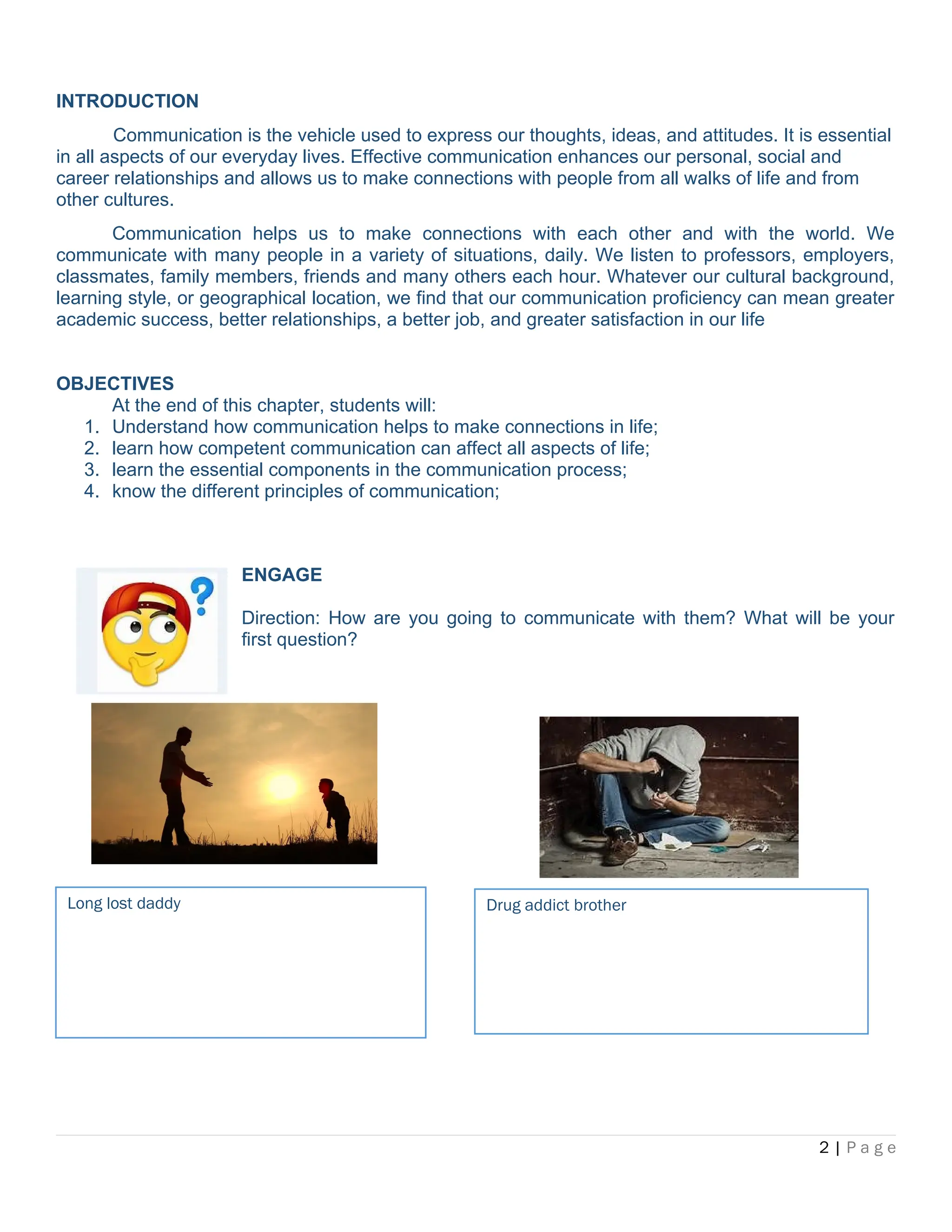
ENGAGE
Direction: How are you going to communicate with them? What will be your
first question?
2 | P a g e
Drug addict brother
Long lost daddy
3.
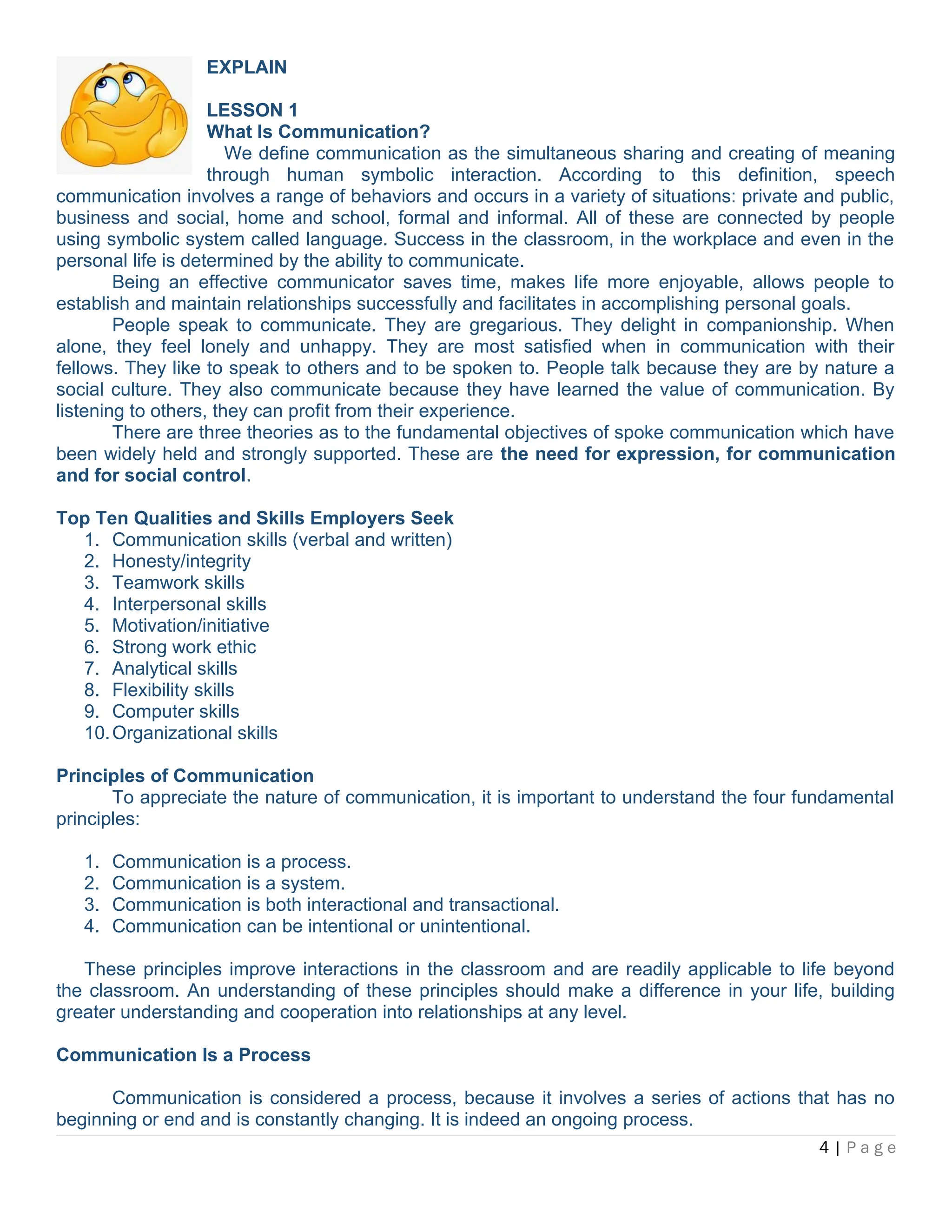
EXPLORE
Direction: Complete theconcept map. Write your previous knowledge about the 8
components of communication.
3 | P a g e
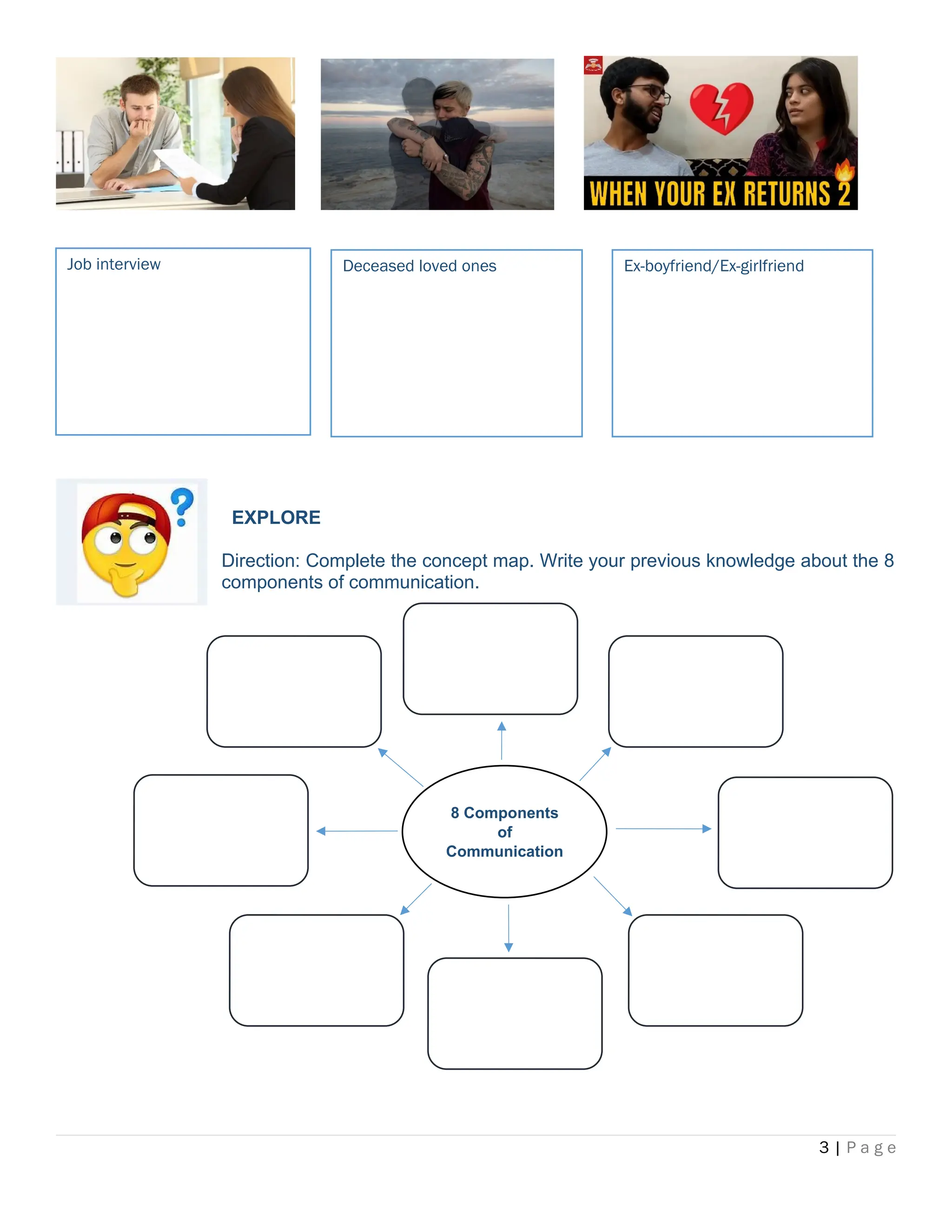
Job interview Deceased loved ones Ex-boyfriend/Ex-girlfriend
8 Components
of
Communication
4.
EXPLAIN
LESSON 1
What IsCommunication?
We define communication as the simultaneous sharing and creating of meaning
through human symbolic interaction. According to this definition, speech
communication involves a range of behaviors and occurs in a variety of situations: private and public,
business and social, home and school, formal and informal. All of these are connected by people
using symbolic system called language. Success in the classroom, in the workplace and even in the
personal life is determined by the ability to communicate.
Being an effective communicator saves time, makes life more enjoyable, allows people to
establish and maintain relationships successfully and facilitates in accomplishing personal goals.
People speak to communicate. They are gregarious. They delight in companionship. When
alone, they feel lonely and unhappy. They are most satisfied when in communication with their
fellows. They like to speak to others and to be spoken to. People talk because they are by nature a
social culture. They also communicate because they have learned the value of communication. By
listening to others, they can profit from their experience.
There are three theories as to the fundamental objectives of spoke communication which have
been widely held and strongly supported. These are the need for expression, for communication
and for social control.
Top Ten Qualities and Skills Employers Seek
1. Communication skills (verbal and written)
2. Honesty/integrity
3. Teamwork skills
4. Interpersonal skills
5. Motivation/initiative
6. Strong work ethic
7. Analytical skills
8. Flexibility skills
9. Computer skills
10.Organizational skills
Principles of Communication
To appreciate the nature of communication, it is important to understand the four fundamental
principles:
1. Communication is a process.
2. Communication is a system.
3. Communication is both interactional and transactional.
4. Communication can be intentional or unintentional.
These principles improve interactions in the classroom and are readily applicable to life beyond
the classroom. An understanding of these principles should make a difference in your life, building
greater understanding and cooperation into relationships at any level.
Communication Is a Process
Communication is considered a process, because it involves a series of actions that has no
beginning or end and is constantly changing. It is indeed an ongoing process.
4 | P a g e
5.
The interrelationships amongpeople, environments, skills, attitudes, status, experiences and
feelings all determine communication at any given moment. Think about a relationship you developed
with someone recently. How did it occur? It may have happened by chance (striking up a
conversation with someone you met while walking to class) or it may have been a prearranged
meeting (a business meeting with a prospective client). No two relationships are developed in the
same way. That’s Purposive Communication.
Communication is both ever changing and capable of effecting change. Saying something that
you wish you hadn't said is an excellent example of this principle. No matter how hard you try to take
back your comment, you cannot. It has made its impact and has, in all likelihood, affected your
relationship with another person in some way. The change might not be immediate or significant, but
it does take place as a result of your communication.
Communication Is a System
A system, is a combination of parts interdependently acting to form a whole. The human body
is an excellent example of a system. All parts of the body are interdependent and work to work
together to form one complex system. If something is not functioning correctly, some response
usually occurs either to correct what has gone wrong or to warn that something is going wrong. When
you have a headache, it affects not only yours head by also the rest of your body, including the thin
king process and emotions. You may find that you have trouble seeing and even walking. You may
not wish to eat, because your head ache seems to have taken over your body. If you have a severe
headache, you may have trouble thinking clearly because of the pounding in your head. You may
also have difficulty explaining something. Because each part of the system is connected, your ability
to think clearly, speak clearly, or listen effectively leads to ineffective communication.
Communication Is Both Interactional and Transactional
The interactional and transactional aspects of communication are closely related and should
be considered together. Interaction is an exchange of communication in which people take turns
sending and receiving messages.
Most face-to-face communication does not occur as a series of distinctly separate actions.
Thus, the term transaction is used to extend the concept of interaction to include simultaneous
actions. Persons involved in transaction engage in sending (encoding) and receiving (decoding)
messages at the same time.
5 | P a g e
6.
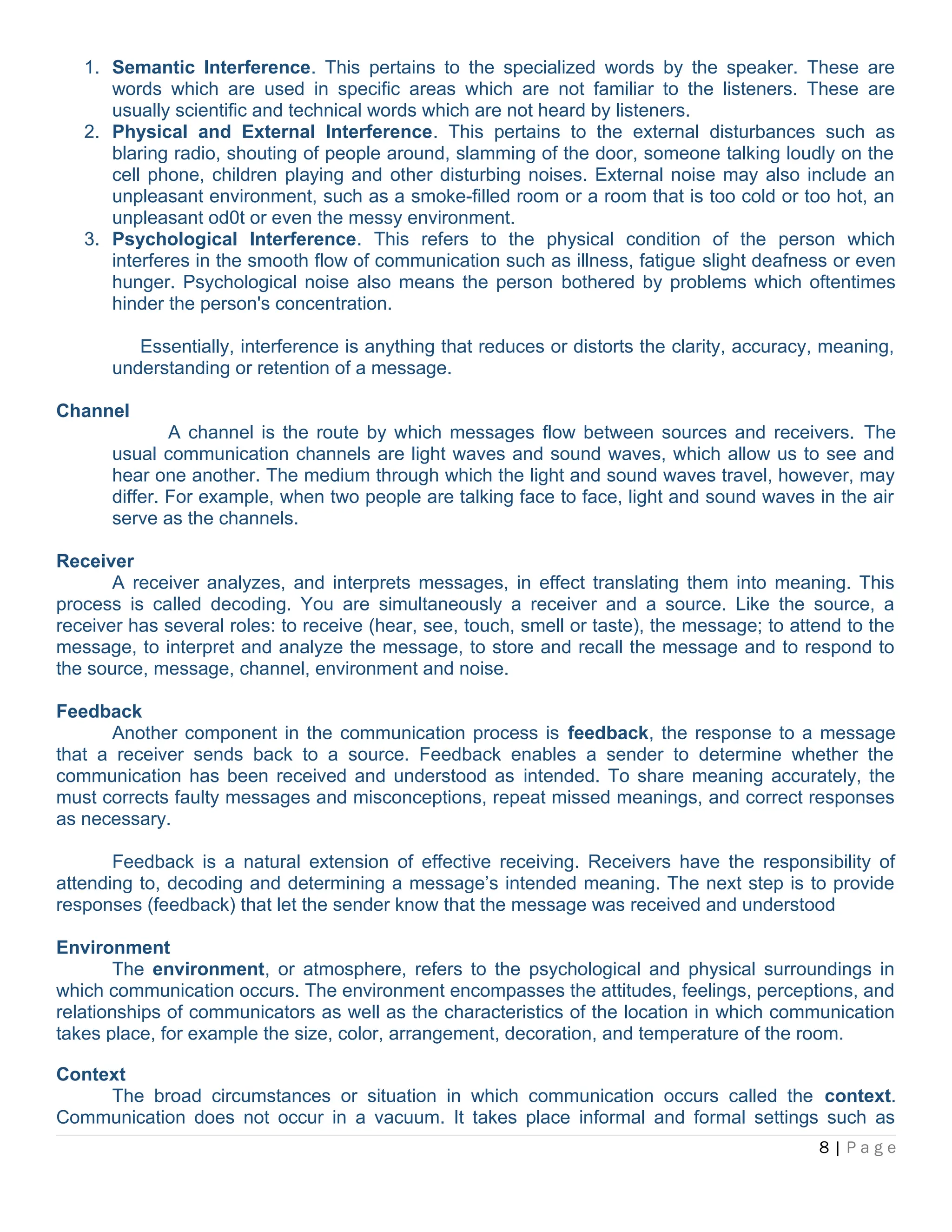
In face-to-face communication,each person affects the other and shares in the process
simultaneously. Thus, communication transaction can be seen as the simultaneous exchange by
which you share your reality with others.
Figure 1 Communication
The essential components of the transactional communication process are constantly changing,
ongoing, and dynamic, and they affect one another.
As shown in the figure, there is a direct exchange of communication between two persons. It is
both transactional and interactional since two persons are focused in exchanging ideas to one
another.
Communication Can Be Intentional or Unintentional
When one person communicates with another, he or she intends that specific messages with
specific purpose and meanings be received, that is intentional communication. Intentional
communication is a message that is purposely sent to a specific receiver. Unintentional
communication is a message that is not intended to be sent or was not intended for the individual who
received it. To understand this better four possible situations can illustrate further:
Situation 1 – There is an intentional communication taking place. Two persons are exchanging ideas
and simultaneously talk and listen to each other.
Situation 2 – This indicates a situation in which a person unintentionally communicates something to
someone who is intentionally trying to receive a message or messages. This situation occurs every
time someone reads more into a communication act than was intended by the source. For example,
when a student in a quiet classroom gets up to sharpen a pencil, the eyes of the other students
6 | P a g e
7.
immediately focus onthe moving student, who might have no specific intention of communicating
anything. The movement, however, provides an opportunity for observers to attribute varying
meanings to the message. For instance, one person might believe that the moving student is trying to
flirt with her; another might think he is trying to call attention to himself; and the instructor might think
he is trying to disrupt the classroom. Despite the student's lack of intention to communicate anything,
others have attached meaning to his action and he may have to deal with their interpretation.
Situation No. 3-This is the opposite situation. Here the person intends to send a message, but the
person tor whom the message is intended is not consciously or intentionally receiving it. Such a
situation happens in the classroom when students daydream while the instructor is lecturing.
Situation No. 4 - This shows that communication can be unintentional for both the source and the
receiver and can occur without anyone intentionally sending or receiving a message. Communication
that is not intended or that is at least not consciously sent and received is usually nonverbal.
Nonverbal communication is any information that is expressed without words. For example, the
clothing the person wears might not be worn to communicate any specific message but this has a
meaning to the observer. Each observer may attach different meaning to the clothing worn.
Essential Components of Communication
There are eight (8) components of communication:
1. Source/Speaker
2. Message
3. Interference/Noise
4. Channel
5. Receiver
6. Feedback
7. Environment
8. Context
Source/Sender
The source is the creator of the message. He or she wants to communicate his/ her
idea and determines the meaning of what is to be communicated, encodes the meaning into a
message, making sure he or she chooses the appropriate language that the listener
understands, sends the message, and perceives and reacts to a listener s response to a
message.
Once the source has chosen a meaning, she or he encodes it. In other words, the source translates
the thoughts or feelings into words, sounds and physical expressions which make up the actual
message that is to be sent. Then, the source must interpret the receiver's response to the message.
The source’s perception of the receiver's response in most communication situation is simultaneous
with the response.
Message
A message is the stimulus produced by the source. Messages are comprised of words,
grammar, organization of thoughts, physical appearance, body movement voice, personality, self-
concept and personal style. Each message is unique. Even if the same message were to be created
over and over again, it would differ in each instance because message cannot be repeated or
received in exactly the same way or in the same context.
Interference/Noise
Anything that changes the meaning of an intended message is called interference. There are
three types of noise which hinder the smooth flow of communication:
7 | P a g e
8.
1. Semantic Interference.This pertains to the specialized words by the speaker. These are
words which are used in specific areas which are not familiar to the listeners. These are
usually scientific and technical words which are not heard by listeners.
2. Physical and External Interference. This pertains to the external disturbances such as
blaring radio, shouting of people around, slamming of the door, someone talking loudly on the
cell phone, children playing and other disturbing noises. External noise may also include an
unpleasant environment, such as a smoke-filled room or a room that is too cold or too hot, an
unpleasant od0t or even the messy environment.
3. Psychological Interference. This refers to the physical condition of the person which
interferes in the smooth flow of communication such as illness, fatigue slight deafness or even
hunger. Psychological noise also means the person bothered by problems which oftentimes
hinder the person's concentration.
Essentially, interference is anything that reduces or distorts the clarity, accuracy, meaning,
understanding or retention of a message.
Channel
A channel is the route by which messages flow between sources and receivers. The
usual communication channels are light waves and sound waves, which allow us to see and
hear one another. The medium through which the light and sound waves travel, however, may
differ. For example, when two people are talking face to face, light and sound waves in the air
serve as the channels.
Receiver
A receiver analyzes, and interprets messages, in effect translating them into meaning. This
process is called decoding. You are simultaneously a receiver and a source. Like the source, a
receiver has several roles: to receive (hear, see, touch, smell or taste), the message; to attend to the
message, to interpret and analyze the message, to store and recall the message and to respond to
the source, message, channel, environment and noise.
Feedback
Another component in the communication process is feedback, the response to a message
that a receiver sends back to a source. Feedback enables a sender to determine whether the
communication has been received and understood as intended. To share meaning accurately, the
must corrects faulty messages and misconceptions, repeat missed meanings, and correct responses
as necessary.
Feedback is a natural extension of effective receiving. Receivers have the responsibility of
attending to, decoding and determining a message’s intended meaning. The next step is to provide
responses (feedback) that let the sender know that the message was received and understood
Environment
The environment, or atmosphere, refers to the psychological and physical surroundings in
which communication occurs. The environment encompasses the attitudes, feelings, perceptions, and
relationships of communicators as well as the characteristics of the location in which communication
takes place, for example the size, color, arrangement, decoration, and temperature of the room.
Context
The broad circumstances or situation in which communication occurs called the context.
Communication does not occur in a vacuum. It takes place informal and formal settings such as
8 | P a g e
9.
between friends, amongcolleagues, between a lawyer and a client, among students and class
adviser.
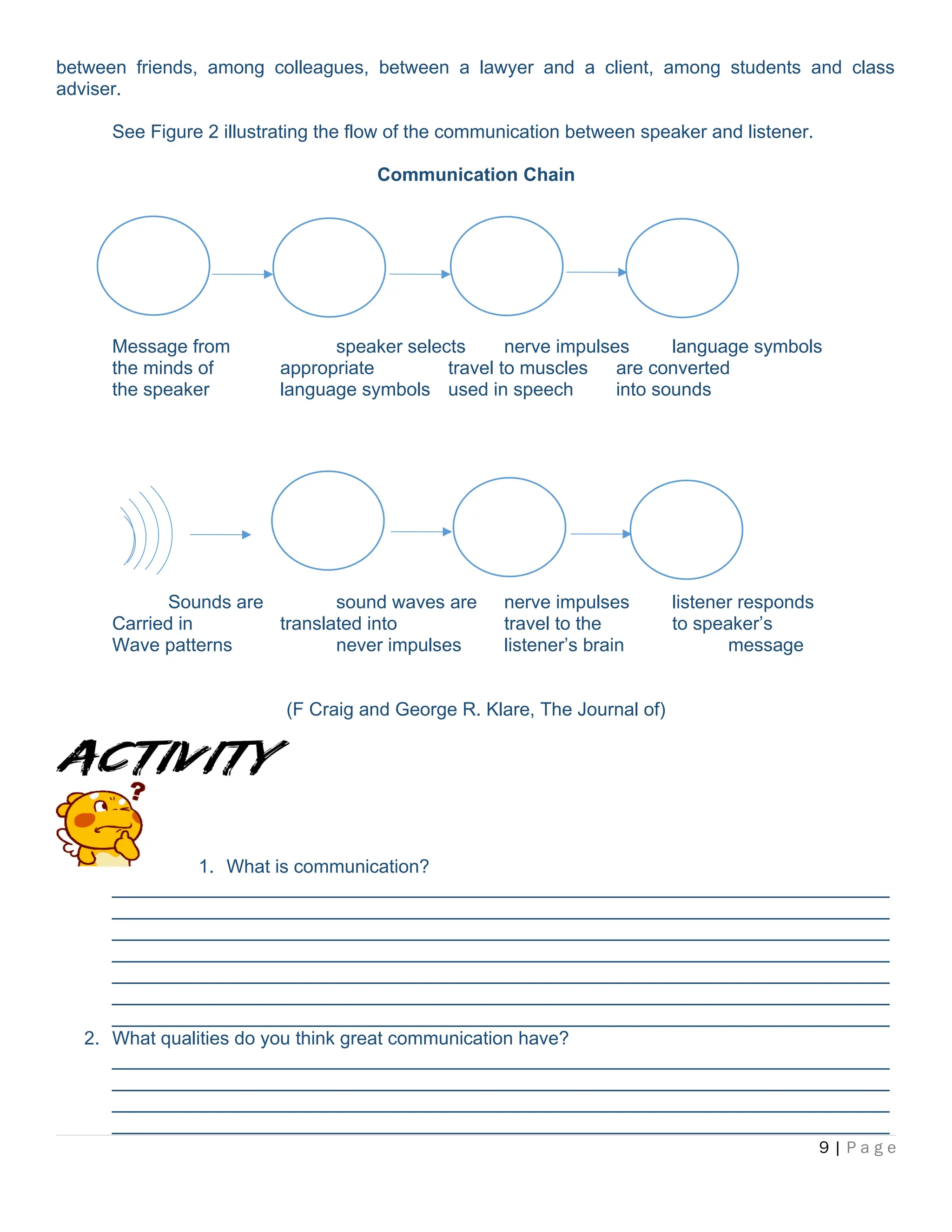
See Figure 2 illustrating the flow of the communication between speaker and listener.
Communication Chain
Message from speaker selects nerve impulses language symbols
the minds of appropriate travel to muscles are converted
the speaker language symbols used in speech into sounds
Sounds are sound waves are nerve impulses listener responds
Carried in translated into travel to the to speaker’s
Wave patterns never impulses listener’s brain message
(F Craig and George R. Klare, The Journal of)
1. What is communication?
___________________________________________________________________________
___________________________________________________________________________
___________________________________________________________________________
___________________________________________________________________________
___________________________________________________________________________
___________________________________________________________________________
___________________________________________________________________________
2. What qualities do you think great communication have?
___________________________________________________________________________
___________________________________________________________________________
___________________________________________________________________________
___________________________________________________________________________
9 | P a g e
10.
___________________________________________________________________________
___________________________________________________________________________
___________________________________________________________________________
_____________________
3. Who arethe people you have met whom you consider to be effective communicators? Why
are they effective?
___________________________________________________________________________
___________________________________________________________________________
___________________________________________________________________________
___________________________________________________________________________
___________________________________________________________________________
___________________________________________________________________________
LESSON 2
Intrapersonal Communication
To communicate with others, you must first understand how you communicate with
yourself. This process of understanding information within oneself is called personal
communication
Intrapersonal communication also occurs anytime you evaluate or attempt to
understand the interaction that occurs between you and anything that communicates message
to you. You are involved in intrapersonal communication as you receive, attend to, interpret
and analyze, store and recall, or respond in some fashion to any message.
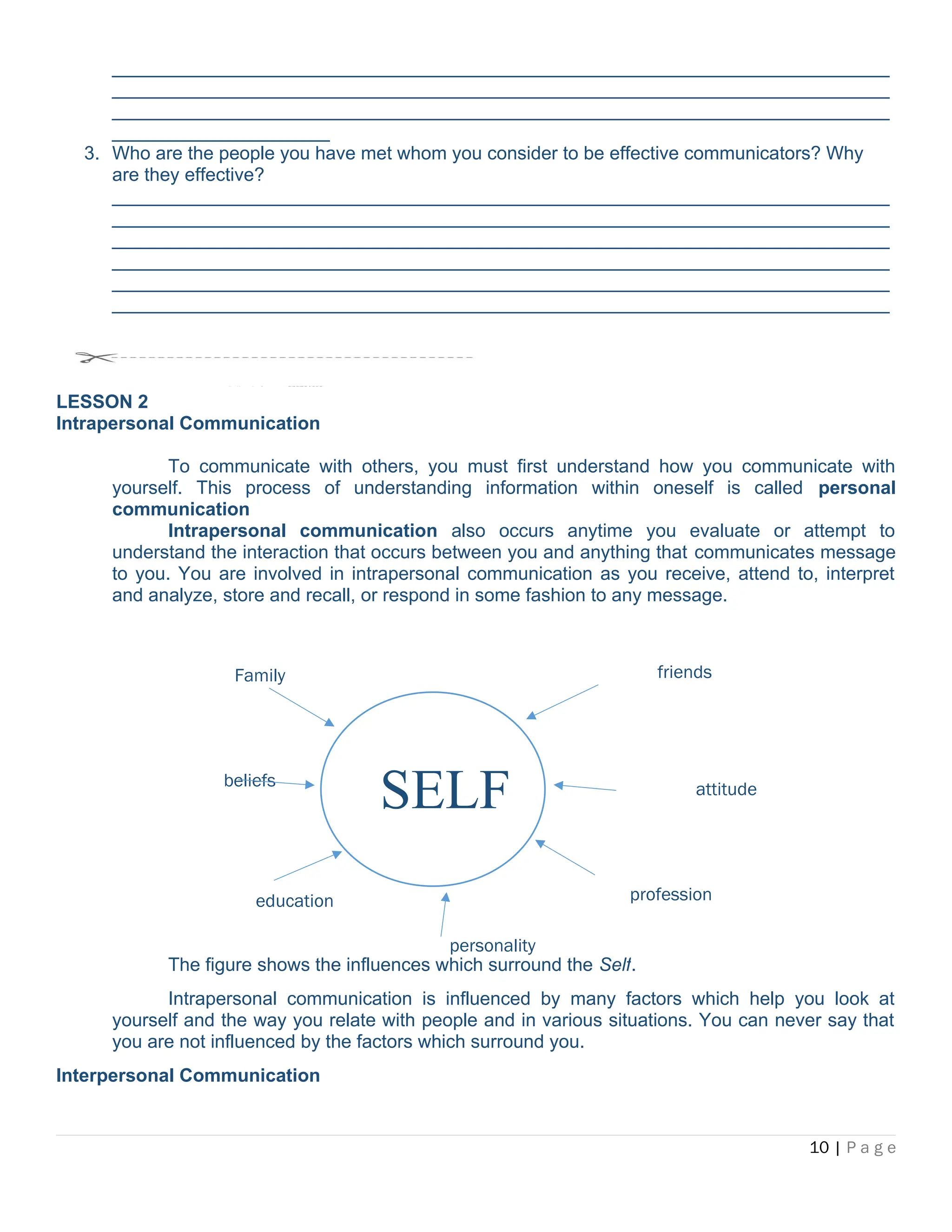
The figure shows the influences which surround the Self.
Intrapersonal communication is influenced by many factors which help you look at
yourself and the way you relate with people and in various situations. You can never say that
you are not influenced by the factors which surround you.
Interpersonal Communication
10 | P a g e
SELF
Family
beliefs
education
personality
profession
attitude
friends
11.
Interpersonal communication iscreating and sharing meaning between persons who
are in a relationship. It is similar to intrapersonal communication in that it helps you share
information, solve problems, resolve conflicts and establish relationship with others.
There are different types of interpersonal communication:
Conversation. Conversation is characterized by adaptability, enthusiasm, tact and
sensitivity. It is the most informal type of interpersonal communication since it can happen any
time, any place. No rules are to be observed nor prepared topics to be discussed. However,
there are simple guides you have to remember to make your conversation successful.
Interview. Another type of interpersonal communication is interview. This is the most
formal type of interpersonal communication because both the interviewer and the interviewee
have a definite place and time. An interview is purposive and formal.
There are three common types of interview:
1. Job interview.
2. Information interview..
3. Character interview
Small Group Communication. Group discussion is a process thinking which involves a
small group of people who talk over a problem order to arrive systematically, thus pooling their
experiences and judgments in order to arrive best solution. The ideal number of people in a
small group is from four to seven.Every participant in a group must be given an opportunity to
help shape the final decision and when the decision is reached, it should represent the best
understanding of the group as a whole.
In a discussion, whether you talk eloquently and easily is of less significance than whether you have
something worthwhile to contribute. Each member of a group should express his/her ideas as well as
he/she is able. If others see let the ideas, they will be shaped into final form by the combined abilities
or the group.
Requirements for Small Group Discussion
Group discussion requires planning. It has been demonstrated repeatedly that
judgments or decisions arrived at in group discussion are, as a whole, superior to Judgments
or decisions arrived at in solitary thinking. Here are some requirements needed for group
discussion.
1. Phrasing the question for discussion.
2. Preparing for fruitful discussion
3. Organizing a discussion
4. Participating in the discussion
Common Types of Small Group Discussion
1. Brainstorming
This type of small group discussion is usually used prior to the making of decision.
Members are gathered together to get ideas or probable solutions e problem/s. It is
expected so that members share their ideas without being impeded. All members are
11 | P a g e
12.
allowed to givetheir ideas without being criticized. The secretary simply records all ideas
given and sorting out of ideas comes later after everybody has given his/her share.
2. Buzz Group
Buzz group is used if there is a large number of people involved. This usually happens
in seminars when the facilitator would like a large number of people to participate. Usually
the facilitator divides the participants into smaller groups; each group is given a specific
task. After the time given to the groups has elapsed, the groups have to assemble again
and the leaders of each group has to report to the audience the outcome of the task.
This type of group discussion allows al participants to be part of a large group which has
shared in giving a solution to an existing problem or issue.
3. Panel Discussion
Sometimes a group must consider problems which audience is not informed or is barely
informed. Several experts sit upon the platform and discuss the question among
themselves, with the audience listening in. Usually each of the experts represents a definite
point of view about the topic. It is in this respect that the panel may differ from other group
discussions; simply because each member is definitely committed to some solutions before
the discussion commences. His/her purpose is to explain and defend his/her point of view
The panel members are actually addressing not one another but the audience. Their
aim is to influence the audience to agree with them. After the panel members have
consumed their allotted time, the audience is permitted to ask questions.
The moderator or chairperson who presides over the panel recognize the members of
the audience, receives their questions, and transmits them to the panel member for
answer.
The moderator or the chairman also has other functions: he/she introduces the topic to
the audience, the purpose of the discussion, interprets ideas if they seem vague to the
audience, controls the discussion so that panel members do not monopolize the
discussion, observes the time given to each member, and summarizes the various points of
view that have been presented.
4. Round Table or the Arthurian Type
This is the type usually used in companies and academic institutions. The leader
(president, vice president, director, etc.) calls for a meeting to solve a problem or problems
or plan activities. An agenda is usually given to those who are involved. The arrangement is
Round table or the Arthurian method because the leader and the members face each other;
and the leader is not identifiable. This is a democratic set-up since each member can
interact with the supposed. Leader and the other members freely.
5. Symposium
In a symposium, several people usually three or five, give short speeches, each
presenting a different point of view or each treating a different fact of the subject. The
symposium is a form of public discussion that is common at large conventions or
12 | P a g e
13.
conferences, where anumber of experts are invited to speak on the specific aspects of a
problem.
A symposium is also followed by an open forum in which speakers answer questions
asked by the audience.
6. Lecture Forum
The pattern is similar to the panel discussion. In this latter form, a speaker, usually an
expert is invited from the outside group, speaks on a topic and is then questioned by the
audience. The questioning may develop into a regular group discussion, with free
expression of opinion by members of the group.
With the advent of modern science and technology, discussion is indispensable. Most
businesses are run with frequent conferences, meetings and other forms of group
discussions among managerial staff. In classrooms, discussions have increasingly become
a favorable method to attain better understanding of the topic. Students actively participate
in the discussion not just a silent a passive recipient of knowledge and information.
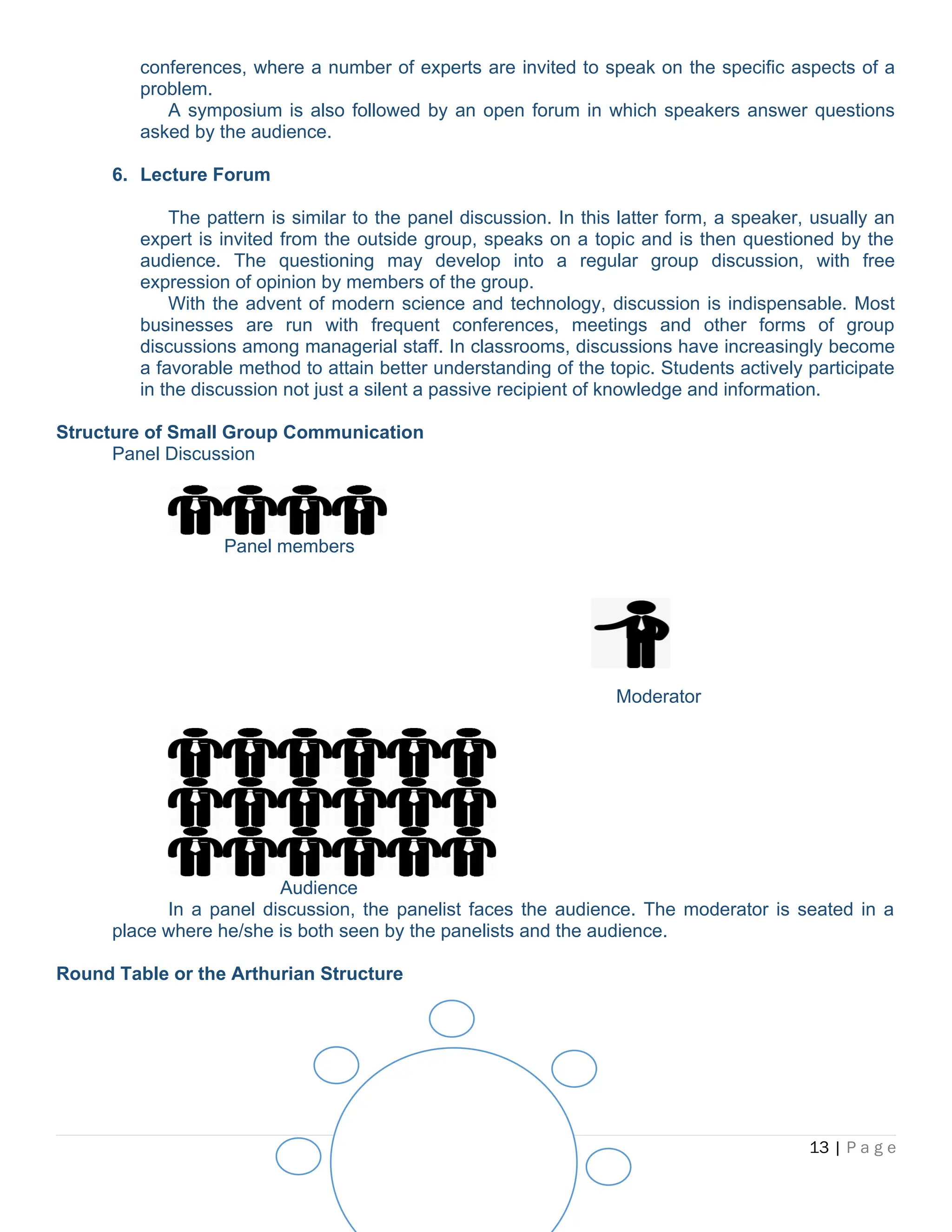
Structure of Small Group Communication
Panel Discussion
Panel members
Moderator
Audience
In a panel discussion, the panelist faces the audience. The moderator is seated in a
place where he/she is both seen by the panelists and the audience.
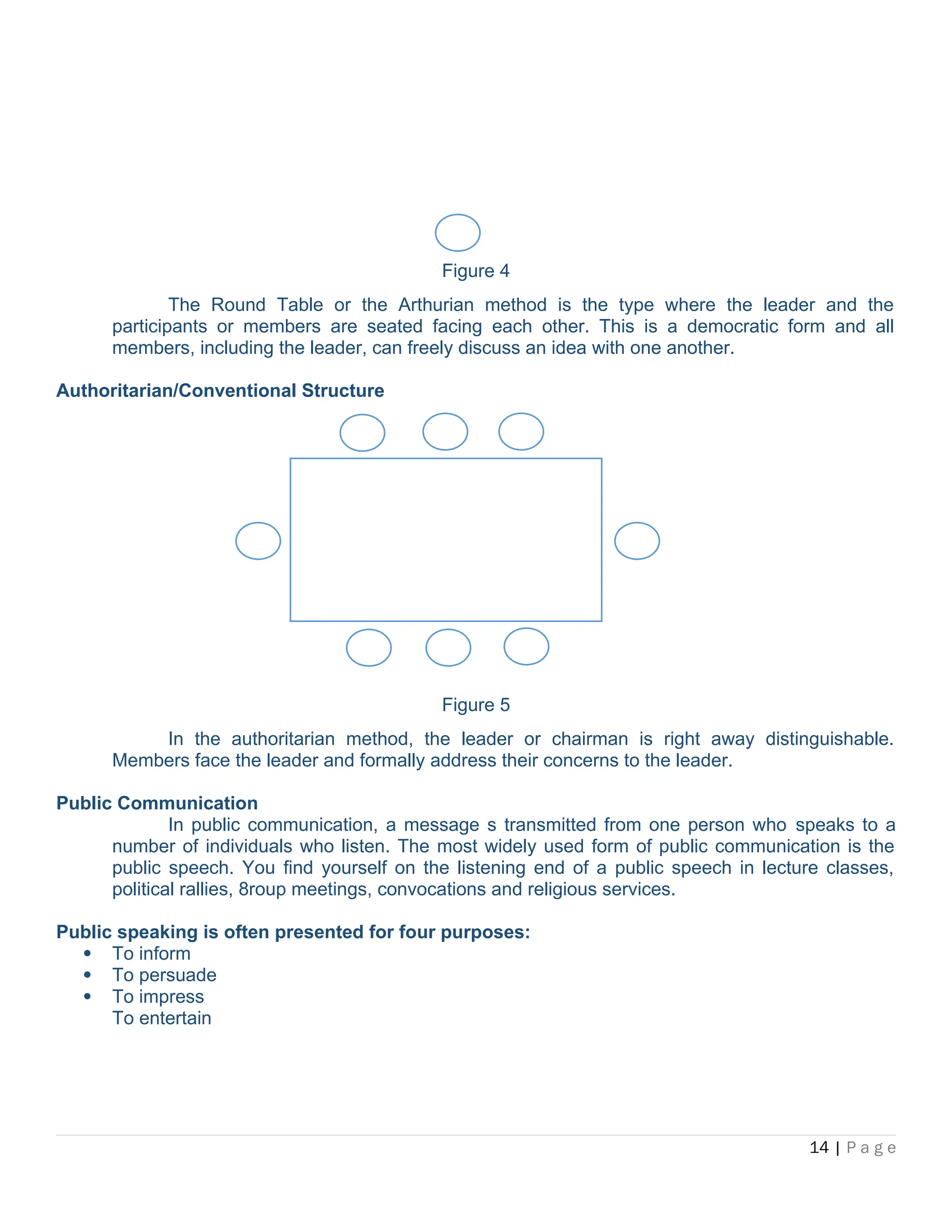
Round Table or the Arthurian Structure
13 | P a g e
14.
Figure 4
The RoundTable or the Arthurian method is the type where the leader and the
participants or members are seated facing each other. This is a democratic form and all
members, including the leader, can freely discuss an idea with one another.
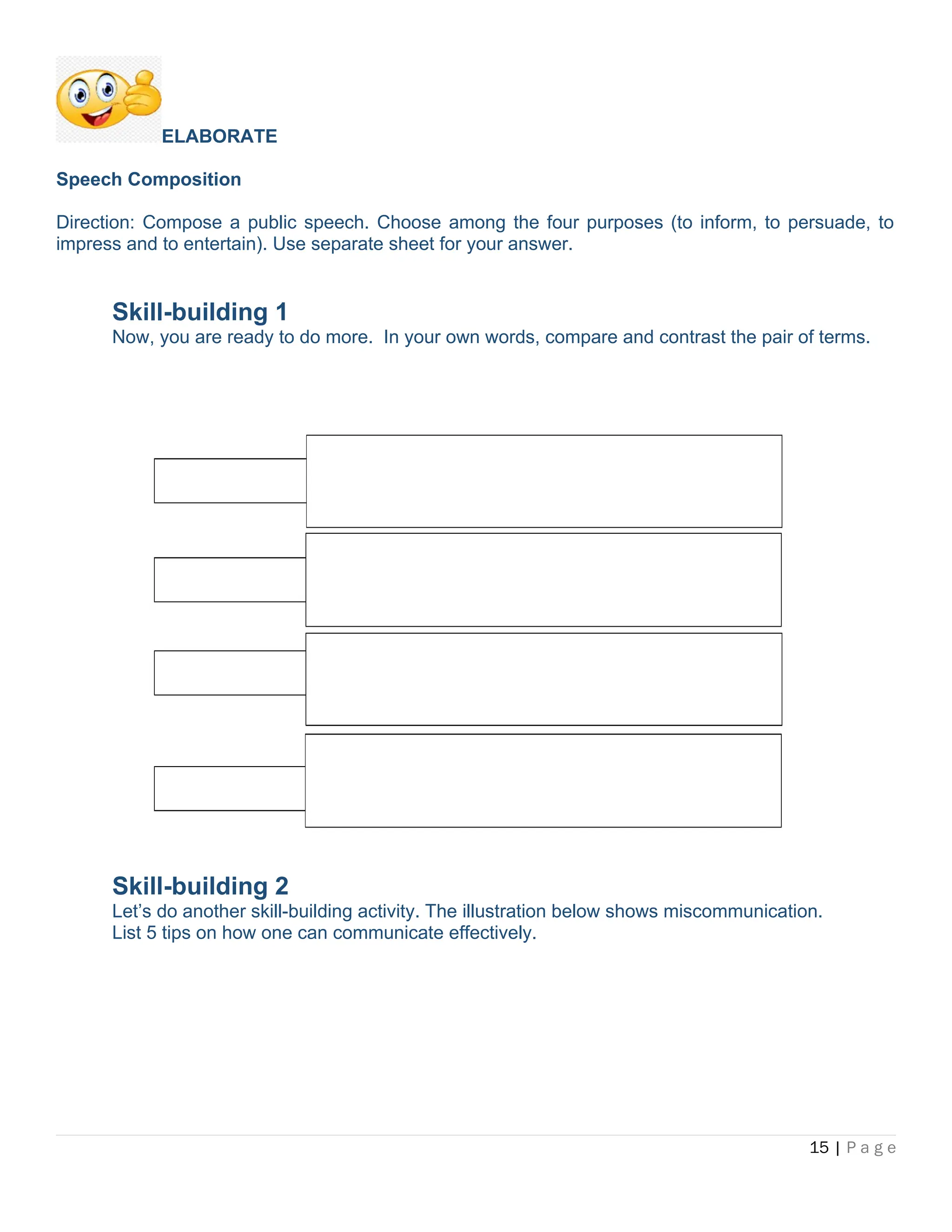
Authoritarian/Conventional Structure
Figure 5
In the authoritarian method, the leader or chairman is right away distinguishable.
Members face the leader and formally address their concerns to the leader.
Public Communication
In public communication, a message s transmitted from one person who speaks to a
number of individuals who listen. The most widely used form of public communication is the
public speech. You find yourself on the listening end of a public speech in lecture classes,
political rallies, 8roup meetings, convocations and religious services.
Public speaking is often presented for four purposes:
To inform
To persuade
To impress
To entertain
14 | P a g e
15.
ELABORATE
Speech Composition
Direction: Composea public speech. Choose among the four purposes (to inform, to persuade, to
impress and to entertain). Use separate sheet for your answer.
Skill-building 1
Now, you are ready to do more. In your own words, compare and contrast the pair of terms.
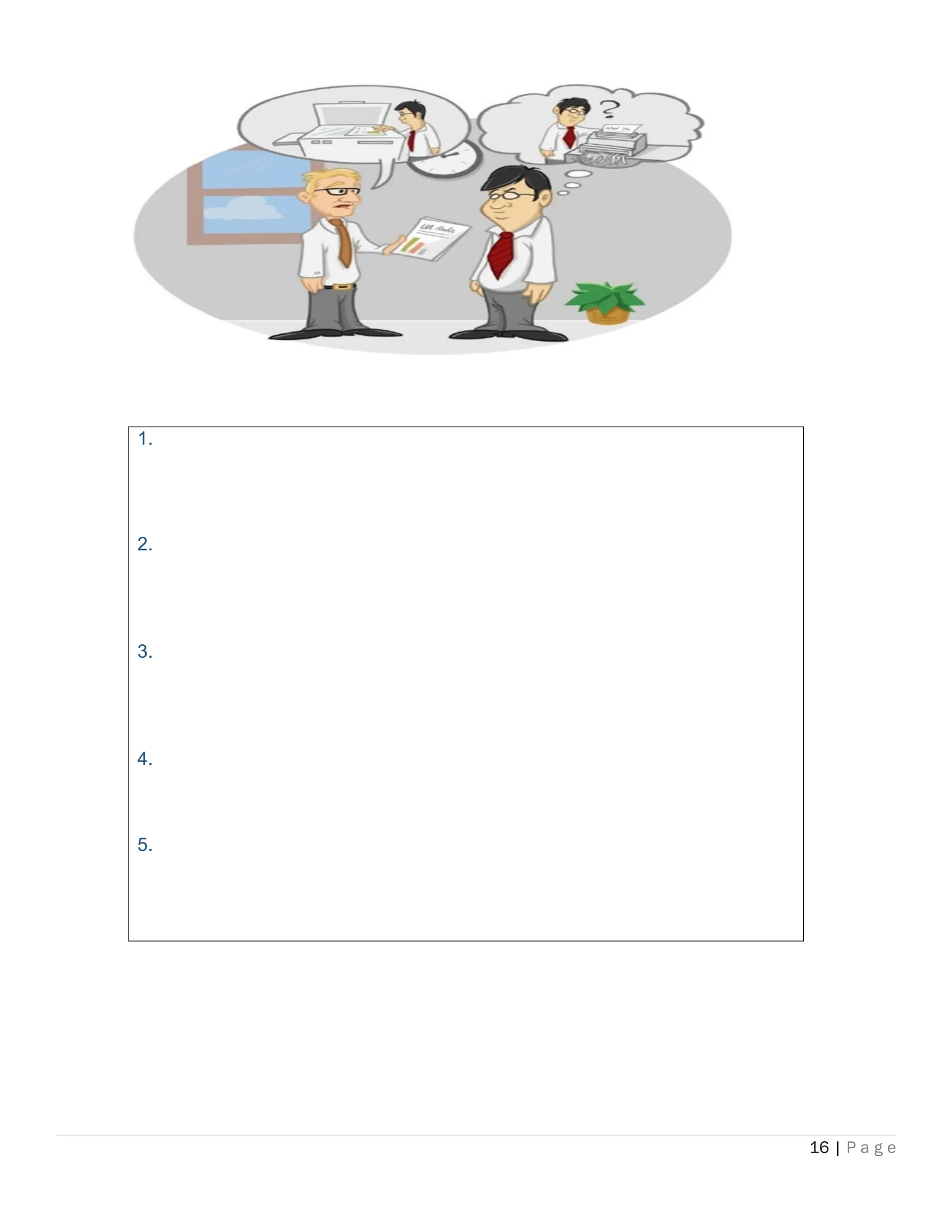
Skill-building 2
Let’s do another skill-building activity. The illustration below shows miscommunication.
List 5 tips on how one can communicate effectively.
15 | P a g e