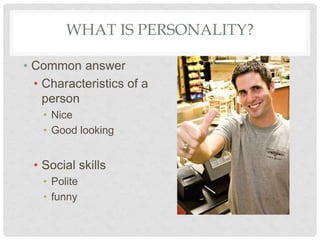
WHAT IS PERSONALITY?
• Common answer
• Characteristics of a
person
• Nice
• Good looking
• Social skills
• Polite
• funny
WHAT IS PERSONALITY?
• Sociologists say
• Sum total of behaviors, attitude, beliefs, and
values that are characteristic of an individual.
• Personality traits
• Determine how we adjust
• To our environment
• How we react in specific situations
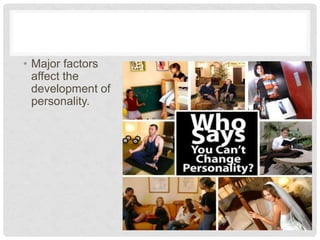
• Major factors
affect the
development of
personality.
PERSONALITIES OVER TIME
• Personalities constantly change during the first
half of a person’s life.
• Find new interests
• Like new things
• Personalities change for all sorts of reasons
• 2 largest reasons
• Nature
• Nurture
NURTURE VS. NATURE
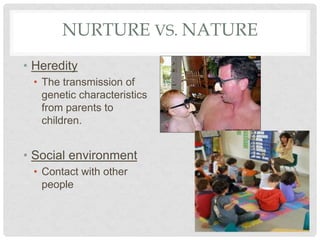
• Heredity
• The transmission of
genetic characteristics
from parents to
children.
• Social environment
• Contact with other
people
NURTURE’S ARGUMENT
• Most human behavior is instinct in origin.
• Instinct
• an unchanging, biologically inherited behavior pattern.
• Birds = building nests
• Birds = migrate in winter
• This leads to humans having 10,000 instincts:
• Laugh
• Smile
• breath
NATURE’S ARGUMENT
• A person’s behavior
and personality are the
result of his or her
social environment and
learning
• Pavlov’s Dog
experiment
• Developed an
unconditional response
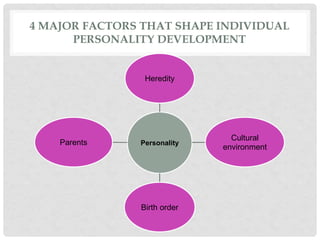
4 MAJOR FACTORS THAT SHAPE INDIVIDUAL
PERSONALITY DEVELOPMENT
Personality
Heredity
Cultural
environment
Birth order
Parents
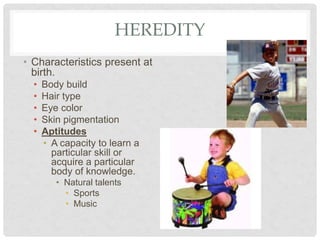
HEREDITY
• Characteristics present at
birth.
• Body build
• Hair type
• Eye color
• Skin pigmentation
• Aptitudes
• A capacity to learn a
particular skill or
acquire a particular
body of knowledge.
• Natural talents
• Sports
• Music
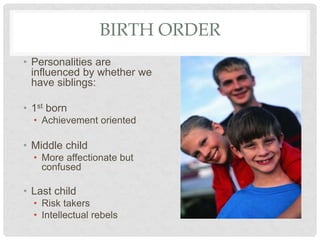
BIRTH ORDER
• Personalities are
influenced by whether we
have siblings:
• 1st born
• Achievement oriented
• Middle child
• More affectionate but
confused
• Last child
• Risk takers
• Intellectual rebels
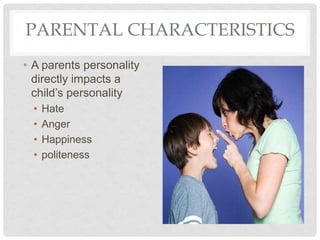
PARENTAL CHARACTERISTICS
• A parents personality
directly impacts a
child’s personality
• Hate
• Anger
• Happiness
• politeness
CULTURAL ENVIRONMENT
• Cultural environment
determines
• Basic types of
personalities found in
society.
• USA
• Competitiveness
• Assertiveness
• individualism
• China
• Competitiveness
• Family oriented
• Group oriented
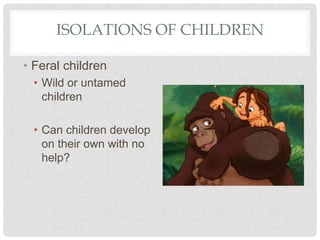
ISOLATIONS OF CHILDREN
• Feral children
• Wild or untamed
children
• Can children develop
on their own with no
help?
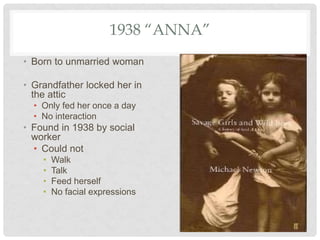
1938 “ANNA”
• Born to unmarried woman
• Grandfather locked her in
the attic
• Only fed her once a day
• No interaction
• Found in 1938 by social
worker
• Could not
• Walk
• Talk
• Feed herself
• No facial expressions
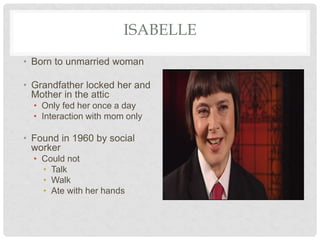
ISABELLE
• Born to unmarried woman
• Grandfather locked her and
Mother in the attic
• Only fed her once a day
• Interaction with mom only
• Found in 1960 by social
worker
• Could not
• Talk
• Walk
• Ate with her hands
GROOMING
“PEOPLE LEARN BEST NOT BY BEING
TOLD, BUT BY EXPERIENCING THE
CONSEQUENCES OF THEIR THOUGHTS
AND ACTIONS”
• It is the process of making yourself look neat
and attractive.
• The things which you do to make yourself and
your appearance tidy and pleasant.
• Grooming is important for a positive self-image
and to encourage and assist the resident to
maintain a pleasing and attractive appearance.
GROOMING AND ITS IMPORTANCE
• Individual Level – Personal grooming
• Group Level - Grooming of a team
• Organization Level – Grooming of a company
GROOMING FUNDAMENTALS &
LEVELS
• Professionalism
• Level of sophistication
• Intelligence
• Credibility or Reliability
• Respect
People Perceptions From Groomed
Appearance Of Professionals
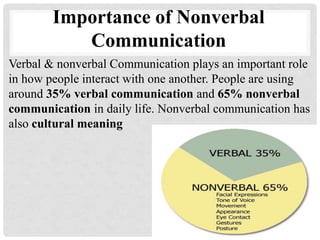
Importance of Nonverbal
Communication
Verbal & nonverbal Communication plays an important role
in how people interact with one another. People are using
around 35% verbal communication and 65% nonverbal
communication in daily life. Nonverbal communication has
also cultural meaning
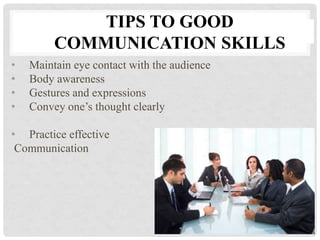
• Maintain eye contact with the audience
• Body awareness
• Gestures and expressions
• Convey one’s thought clearly
• Practice effective
Communication
TIPS TO GOOD
COMMUNICATION SKILLS
PROFESSIONALAPPEARANCE
• Grooming is fundamental
• Hair clean and styled appropriately
• Clean nails, skin and teeth
• Many professionals wear make-up
(depends on field)
• Check fragrance and clothing care
ETIQUETTE BASICS
CREATING A POSITIVE IMAGE
• Behavior:
• Exhibit a positive attitude and pleasant demeanor
• Maintain good eye contact
• Appropriate introductions – introduce someone by
their title and last name (Ms. Mrs. Mr. Dr. Smith),
unless otherwise specified
• Nonverbal communication is important
• Show common respect and consideration for others
ETIQUETTE
'Etiquette' is a French word which means a 'ticket', on
ceremonial or other important occasions a 'ticket' of
instructions was issued to visitors detailing what they
should do.
Thus the ticket enlists the rules of decorous behavior
observed in a polite society.
In a professional sense this includes behavior towards
clients and colleagues which is in their best interests.
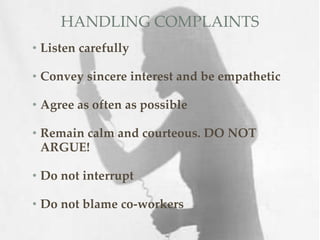
HANDLING COMPLAINTS
• Listen carefully
• Convey sincere interest and be empathetic
• Agree as often as possible
• Remain calm and courteous. DO NOT
ARGUE!
• Do not interrupt
• Do not blame co-workers
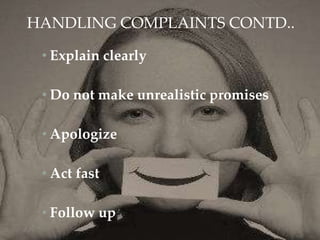
HANDLING COMPLAINTS CONTD..
• Explain clearly
• Do not make unrealistic promises
• Apologize
• Act fast
• Follow up
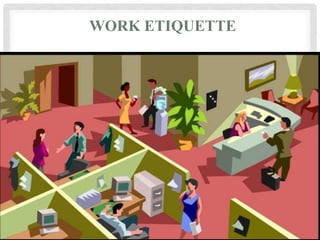
WORK ETIQUETTE
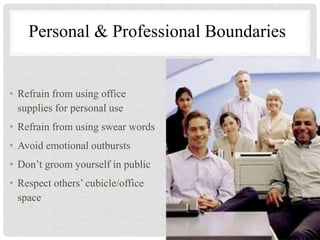
Personal & Professional Boundaries
• Refrain from using office
supplies for personal use
• Refrain from using swear words
• Avoid emotional outbursts
• Don’t groom yourself in public
• Respect others’ cubicle/office
space
Thank
You for
Listenin

Personality Development.ppt

  • 2.
    WHAT IS PERSONALITY? •Common answer • Characteristics of a person • Nice • Good looking • Social skills • Polite • funny
  • 3.
    WHAT IS PERSONALITY? •Sociologists say • Sum total of behaviors, attitude, beliefs, and values that are characteristic of an individual. • Personality traits • Determine how we adjust • To our environment • How we react in specific situations
  • 4.
    • Major factors affectthe development of personality.
  • 5.
    PERSONALITIES OVER TIME •Personalities constantly change during the first half of a person’s life. • Find new interests • Like new things • Personalities change for all sorts of reasons • 2 largest reasons • Nature • Nurture
  • 6.
    NURTURE VS. NATURE •Heredity • The transmission of genetic characteristics from parents to children. • Social environment • Contact with other people
  • 7.
    NURTURE’S ARGUMENT • Mosthuman behavior is instinct in origin. • Instinct • an unchanging, biologically inherited behavior pattern. • Birds = building nests • Birds = migrate in winter • This leads to humans having 10,000 instincts: • Laugh • Smile • breath
  • 8.
    NATURE’S ARGUMENT • Aperson’s behavior and personality are the result of his or her social environment and learning • Pavlov’s Dog experiment • Developed an unconditional response
  • 9.
    4 MAJOR FACTORSTHAT SHAPE INDIVIDUAL PERSONALITY DEVELOPMENT Personality Heredity Cultural environment Birth order Parents
  • 10.
    HEREDITY • Characteristics presentat birth. • Body build • Hair type • Eye color • Skin pigmentation • Aptitudes • A capacity to learn a particular skill or acquire a particular body of knowledge. • Natural talents • Sports • Music
  • 11.
    BIRTH ORDER • Personalitiesare influenced by whether we have siblings: • 1st born • Achievement oriented • Middle child • More affectionate but confused • Last child • Risk takers • Intellectual rebels
  • 12.
    PARENTAL CHARACTERISTICS • Aparents personality directly impacts a child’s personality • Hate • Anger • Happiness • politeness
  • 13.
    CULTURAL ENVIRONMENT • Culturalenvironment determines • Basic types of personalities found in society. • USA • Competitiveness • Assertiveness • individualism • China • Competitiveness • Family oriented • Group oriented
  • 14.
    ISOLATIONS OF CHILDREN •Feral children • Wild or untamed children • Can children develop on their own with no help?
  • 15.
    1938 “ANNA” • Bornto unmarried woman • Grandfather locked her in the attic • Only fed her once a day • No interaction • Found in 1938 by social worker • Could not • Walk • Talk • Feed herself • No facial expressions
  • 16.
    ISABELLE • Born tounmarried woman • Grandfather locked her and Mother in the attic • Only fed her once a day • Interaction with mom only • Found in 1960 by social worker • Could not • Talk • Walk • Ate with her hands
  • 17.
  • 18.
    “PEOPLE LEARN BESTNOT BY BEING TOLD, BUT BY EXPERIENCING THE CONSEQUENCES OF THEIR THOUGHTS AND ACTIONS”
  • 19.
    • It isthe process of making yourself look neat and attractive. • The things which you do to make yourself and your appearance tidy and pleasant. • Grooming is important for a positive self-image and to encourage and assist the resident to maintain a pleasing and attractive appearance. GROOMING AND ITS IMPORTANCE
  • 20.
    • Individual Level– Personal grooming • Group Level - Grooming of a team • Organization Level – Grooming of a company GROOMING FUNDAMENTALS & LEVELS
  • 21.
    • Professionalism • Levelof sophistication • Intelligence • Credibility or Reliability • Respect People Perceptions From Groomed Appearance Of Professionals
  • 23.
    Importance of Nonverbal Communication Verbal& nonverbal Communication plays an important role in how people interact with one another. People are using around 35% verbal communication and 65% nonverbal communication in daily life. Nonverbal communication has also cultural meaning
  • 24.
    • Maintain eyecontact with the audience • Body awareness • Gestures and expressions • Convey one’s thought clearly • Practice effective Communication TIPS TO GOOD COMMUNICATION SKILLS
  • 25.
    PROFESSIONALAPPEARANCE • Grooming isfundamental • Hair clean and styled appropriately • Clean nails, skin and teeth • Many professionals wear make-up (depends on field) • Check fragrance and clothing care
  • 26.
    ETIQUETTE BASICS CREATING APOSITIVE IMAGE • Behavior: • Exhibit a positive attitude and pleasant demeanor • Maintain good eye contact • Appropriate introductions – introduce someone by their title and last name (Ms. Mrs. Mr. Dr. Smith), unless otherwise specified • Nonverbal communication is important • Show common respect and consideration for others
  • 27.
    ETIQUETTE 'Etiquette' is aFrench word which means a 'ticket', on ceremonial or other important occasions a 'ticket' of instructions was issued to visitors detailing what they should do. Thus the ticket enlists the rules of decorous behavior observed in a polite society. In a professional sense this includes behavior towards clients and colleagues which is in their best interests.
  • 28.
    HANDLING COMPLAINTS • Listencarefully • Convey sincere interest and be empathetic • Agree as often as possible • Remain calm and courteous. DO NOT ARGUE! • Do not interrupt • Do not blame co-workers
  • 29.
    HANDLING COMPLAINTS CONTD.. •Explain clearly • Do not make unrealistic promises • Apologize • Act fast • Follow up
  • 30.
  • 31.
    Personal & ProfessionalBoundaries • Refrain from using office supplies for personal use • Refrain from using swear words • Avoid emotional outbursts • Don’t groom yourself in public • Respect others’ cubicle/office space
  • 32.