Personal Pronouns
Subject/Object Pronouns
Pronouns are words we use in the place of a full
noun.
We have both subject and object pronouns:
Subject/Object Pronouns
Subject Object
I me
you you
he him
she her
it it
we us
you you
they them
Subject/Object Pronouns
We use he/him to refer to men, and she/her
to refer to women. When we are not sure if
we are talking about a man or a woman we
use they/them.
● This is Jack. He’s my brother. I don’t think you
have met him.
● This is Angela. She’s my sister. Have you met
her before?
● Talk to a friend. Ask them to help you.
● You could go to a doctor. They might help you.
Subject Pronouns
We use subject pronouns as subject of the
verb:
● I like your dress.
● You are late.
● He is my friend
● It is raining
● She is on holiday
● We live in England.
● They come from London.
Warning!
Remember: English clauses always have a
subject:
● His father has just retired. Was a teacher. > He
was a teacher.
● I’m waiting for my wife. Is late. > She is late.
If there is no other subject we use it or there.
We call this a dummy subject.
Object pronouns
We use object pronouns as the object of the
verb:
● Can you help me please?
● I can see you.
● She doesn’t like him.
● I saw her in town today.
● We saw them in town yesterday, but they didn’t
see us.
Object pronouns
We use object pronouns after prepositions:
● She is waiting for me.
● I’ll get it for you.
● Give it to him.
● Why are you looking at her?
● Don’t take it from us.
● I’ll speak to them.
Exercises
Check if you have understood the lesson.
Please take a piece of paper and a pen.
Prepare your answer sheet
It should look like this:
1. 6.
2. 7.
3. 8.
4. 9.
5. 10.
Exercises
● Ready?
Exercises
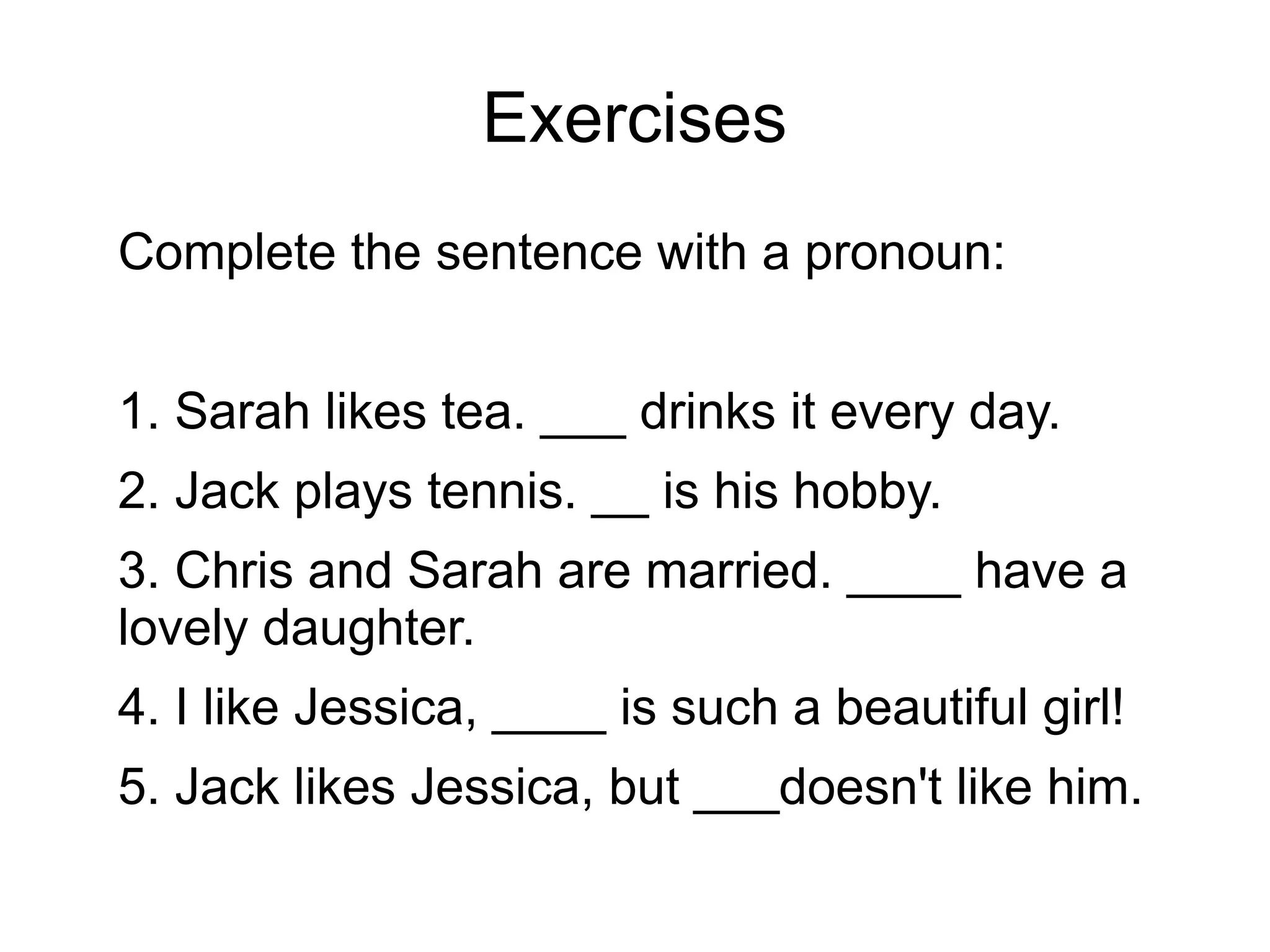
Complete the sentence with a pronoun:
1. Sarah likes tea. ___ drinks it every day.
2. Jack plays tennis. __ is his hobby.
3. Chris and Sarah are married. ____ have a
lovely daughter.
4. I like Jessica, ____ is such a beautiful girl!
5. Jack likes Jessica, but ___doesn't like him.
Exercises
Complete the sentence with a pronoun:
6.__ is difficult to understand English
sometimes.
7. Jeremy works in a bank. __ is a manager.
8. They live in London, but I have never met __.
9. Sarah and __ are going out tonight.
10. Jessica can't swim, but Jack will teach __.
Let's check your answers
● Ready?
The correct answers are
1.She 6.It
2.It 7. He
3.They 8. Them
4. She 9. I
5. She 10. Her
Exercise 2
Complete the table.
Ready?
Complete the table
Subject Object
me
you
he
her
it
you
them
Let's check your answers
● Ready?
Subject/Object Pronouns
Subject Object
I me
you you
he him
she her
it it
we us
you you
they them
Exercise 3
Complete the table.
Ready?
Complete the table
Subject Object
he
you
Let's check your answers
● Ready?
Subject/Object Pronouns
Subject Object
I me
you you
he him
she her
it it
we us
you you
they them
The end
Well done- you can use personal pronouns
now.
If you think you are ready, take a test at West
Cliff Academy to get your points.

Personal pronouns

  • 1.
  • 2.
    Subject/Object Pronouns Pronouns arewords we use in the place of a full noun. We have both subject and object pronouns:
  • 3.
    Subject/Object Pronouns Subject Object Ime you you he him she her it it we us you you they them
  • 4.
    Subject/Object Pronouns We usehe/him to refer to men, and she/her to refer to women. When we are not sure if we are talking about a man or a woman we use they/them. ● This is Jack. He’s my brother. I don’t think you have met him. ● This is Angela. She’s my sister. Have you met her before? ● Talk to a friend. Ask them to help you. ● You could go to a doctor. They might help you.
  • 5.
    Subject Pronouns We usesubject pronouns as subject of the verb: ● I like your dress. ● You are late. ● He is my friend ● It is raining ● She is on holiday ● We live in England. ● They come from London.
  • 6.
    Warning! Remember: English clausesalways have a subject: ● His father has just retired. Was a teacher. > He was a teacher. ● I’m waiting for my wife. Is late. > She is late. If there is no other subject we use it or there. We call this a dummy subject.
  • 7.
    Object pronouns We useobject pronouns as the object of the verb: ● Can you help me please? ● I can see you. ● She doesn’t like him. ● I saw her in town today. ● We saw them in town yesterday, but they didn’t see us.
  • 8.
    Object pronouns We useobject pronouns after prepositions: ● She is waiting for me. ● I’ll get it for you. ● Give it to him. ● Why are you looking at her? ● Don’t take it from us. ● I’ll speak to them.
  • 9.
    Exercises Check if youhave understood the lesson. Please take a piece of paper and a pen.
  • 10.
    Prepare your answersheet It should look like this: 1. 6. 2. 7. 3. 8. 4. 9. 5. 10.
  • 11.
  • 12.
    Exercises Complete the sentencewith a pronoun: 1. Sarah likes tea. ___ drinks it every day. 2. Jack plays tennis. __ is his hobby. 3. Chris and Sarah are married. ____ have a lovely daughter. 4. I like Jessica, ____ is such a beautiful girl! 5. Jack likes Jessica, but ___doesn't like him.
  • 13.
    Exercises Complete the sentencewith a pronoun: 6.__ is difficult to understand English sometimes. 7. Jeremy works in a bank. __ is a manager. 8. They live in London, but I have never met __. 9. Sarah and __ are going out tonight. 10. Jessica can't swim, but Jack will teach __.
  • 14.
    Let's check youranswers ● Ready?
  • 15.
    The correct answersare 1.She 6.It 2.It 7. He 3.They 8. Them 4. She 9. I 5. She 10. Her
  • 16.
  • 17.
    Complete the table SubjectObject me you he her it you them
  • 18.
    Let's check youranswers ● Ready?
  • 19.
    Subject/Object Pronouns Subject Object Ime you you he him she her it it we us you you they them
  • 20.
  • 21.
  • 22.
    Let's check youranswers ● Ready?
  • 23.
    Subject/Object Pronouns Subject Object Ime you you he him she her it it we us you you they them
  • 24.
    The end Well done-you can use personal pronouns now. If you think you are ready, take a test at West Cliff Academy to get your points.