
11/18/2018 1
IF YOU DON’T DESIGN YOUR OWN LIFE, SOMEONE ELSE WILL.
IT’S YOUR DAY!
Personal Development
Framework
and
Professionalism
ABU ZAFOR MD. SHALEAH
Manager (HR)
Unique Group
Dhaka, Bangladesh
Focus Areas
• Personal Development Framework
– Personal Development
– Personal Knowledge
– Types of workplace learning
– The Conceptual evaluation among organizations
– Finding Self
• Professionalism
– Profession, Professional, Professionalism, Professionalization
– Scope of the Profession
– Causes of Lack of Professionalism
– Things to think about!
– Writing Thank-You Notes
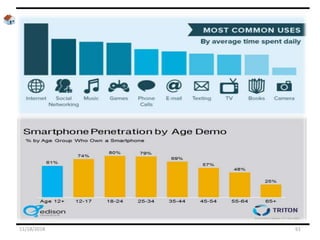
– Seven (07) manners for Smartphone use
– Seven (07) Tips for e-mail communication
– Top ten (10) Business Etiquette behavior
– Five (05) keys to be a true professional
11/18/2018 3
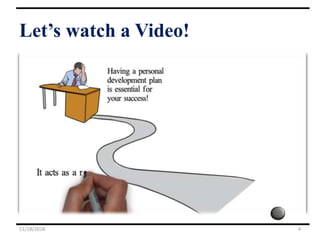
Let’s watch a Video!
11/18/2018 4
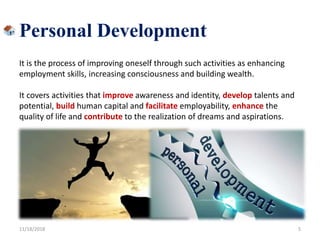
Personal Development
It is the process of improving oneself through such activities as enhancing
employment skills, increasing consciousness and building wealth.
It covers activities that improve awareness and identity, develop talents and
potential, build human capital and facilitate employability, enhance the
quality of life and contribute to the realization of dreams and aspirations.
11/18/2018 5
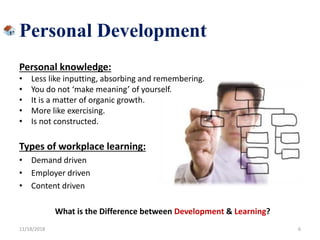
Personal Development
Personal knowledge:
• Less like inputting, absorbing and remembering.
• You do not ‘make meaning’ of yourself.
• It is a matter of organic growth.
• More like exercising.
• Is not constructed.
Types of workplace learning:
• Demand driven
• Employer driven
• Content driven
What is the Difference between Development & Learning?
11/18/2018 6
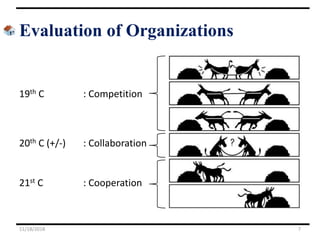
Evaluation of Organizations
19th C : Competition
20th C (+/-) : Collaboration
21st C : Cooperation
11/18/2018 7
Personal Development
Choose your Path!
11/18/2018 8
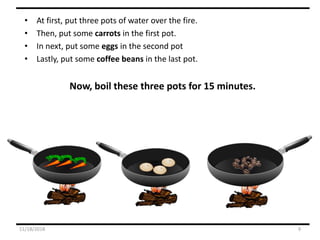
• At first, put three pots of water over the fire.
• Then, put some carrots in the first pot.
• In next, put some eggs in the second pot
• Lastly, put some coffee beans in the last pot.
Now, boil these three pots for 15 minutes.
11/18/2018 9
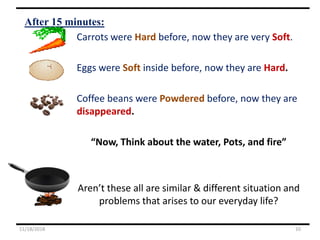
After 15 minutes:
Carrots were Hard before, now they are very Soft.
Eggs were Soft inside before, now they are Hard.
Coffee beans were Powdered before, now they are
disappeared.
“Now, Think about the water, Pots, and fire”
Aren’t these all are similar & different situation and
problems that arises to our everyday life?
11/18/2018 10
Think about our life …
• Life is not always easy.
• Life is not always comfortable.
• Sometimes life is very hard.
• Things don’t happen like we wish.
• People don’t treat us like we hope.
• We work very hard but get few
results.
• What happens when we face
difficulties?
11/18/2018 11
Will you Be like Carrot?
• We go in tough and strong.
• We come out soft and weak.
• We get very tired, We fail, We lose
hope, We give up.
• There is no more fighting spirit.
Don’t be like carrot !
11/18/2018 12
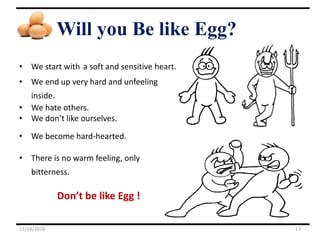
Will you Be like Egg?
• We start with a soft and sensitive heart.
• We end up very hard and unfeeling
inside.
• We hate others.
• We don’t like ourselves.
• We become hard-hearted.
• There is no warm feeling, only
bitterness.
Don’t be like Egg !
11/18/2018 13
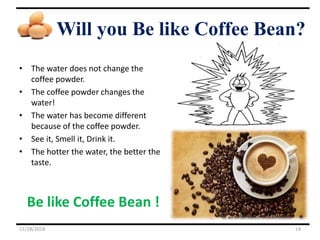
Will you Be like Coffee Bean?
• The water does not change the
coffee powder.
• The coffee powder changes the
water!
• The water has become different
because of the coffee powder.
• See it, Smell it, Drink it.
• The hotter the water, the better the
taste.
Be like Coffee Bean !
11/18/2018 14
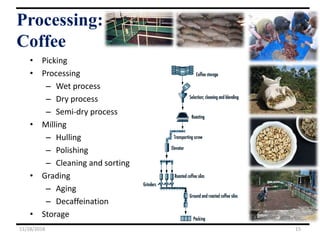
Processing:
Coffee
11/18/2018 15
• Picking
• Processing
– Wet process
– Dry process
– Semi-dry process
• Milling
– Hulling
– Polishing
– Cleaning and sorting
• Grading
– Aging
– Decaffeination
• Storage
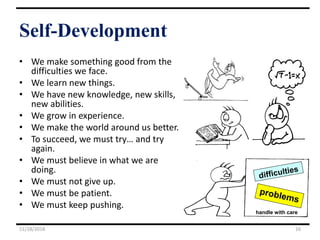
Self-Development
• We make something good from the
difficulties we face.
• We learn new things.
• We have new knowledge, new skills,
new abilities.
• We grow in experience.
• We make the world around us better.
• To succeed, we must try… and try
again.
• We must believe in what we are
doing.
• We must not give up.
• We must be patient.
• We must keep pushing.
11/18/2018 16
handle with care
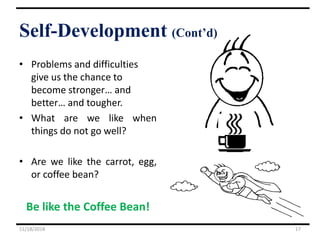
• Problems and difficulties
give us the chance to
become stronger… and
better… and tougher.
• What are we like when
things do not go well?
• Are we like the carrot, egg,
or coffee bean?
Be like the Coffee Bean!
11/18/2018 17
Self-Development (Cont’d)
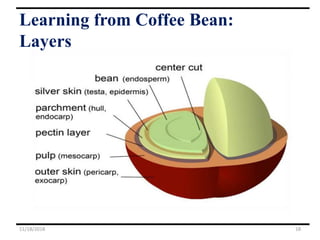
Learning from Coffee Bean:
Layers
11/18/2018 18
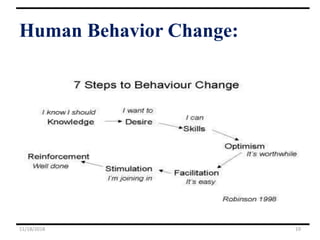
Human Behavior Change:
11/18/2018 19
11/18/2018 20
Self Evolution:
Personal Area
General:
• What do you like on a personal level?
• What are 10 things you most enjoy doing?
• What motivates you?
• What makes you excited?
• What are your most important values?
Specialization:
• What are the talents you have?
• What is your passion?
11/18/2018 21
Self Evolution:
Personal Area
Life areas: To have balance in life certainly is one of the most
important overall aims to reach. Set a goal for each area in your
life:
• Family & Social Relationship
• Physical/Health
• Fun
• Spiritual
• Work/Career
• Financial Security
11/18/2018 22
Self Evolution:
Personal Area
Think:
• If you never had to work another day in your life, how would you
spend your time instead of working?
• When your life is ending, what will you regret not doing, not seeing,
or not achieving?
Feedback:
• What other people says about you?
• What strengths do you see in yourself?
• What do you believe are your weaknesses?
• What are the strengths that others see in you?
• What weaknesses have other people commented on about you?
11/18/2018 23
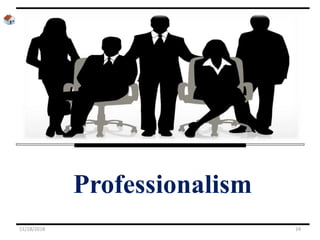
Professionalism
11/18/2018 24
Are you a Professional?
The following short quiz consists of 4 questions and
tells whether you are qualified to be a "professional".
The questions are not that difficult, so don’t cheat by
looking ahead!.
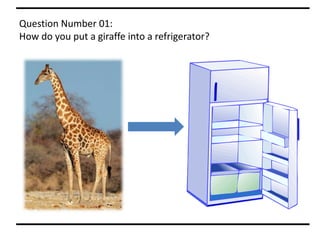
Question Number 01:
How do you put a giraffe into a refrigerator?
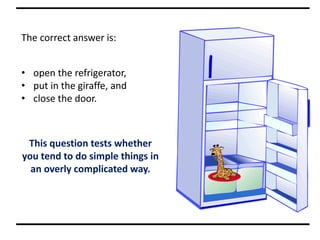
The correct answer is:
• open the refrigerator,
• put in the giraffe, and
• close the door.
This question tests whether
you tend to do simple things in
an overly complicated way.
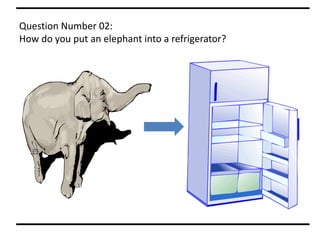
Question Number 02:
How do you put an elephant into a refrigerator?
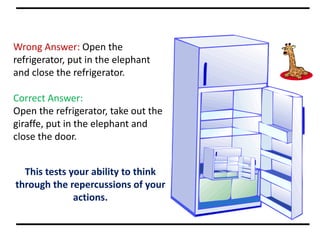
Wrong Answer: Open the
refrigerator, put in the elephant
and close the refrigerator.
Correct Answer:
Open the refrigerator, take out the
giraffe, put in the elephant and
close the door.
This tests your ability to think
through the repercussions of your
actions.
Question Number 03:
The Lion King is hosting an animal conference. All the animals
attend except one. Which animal does not attend?
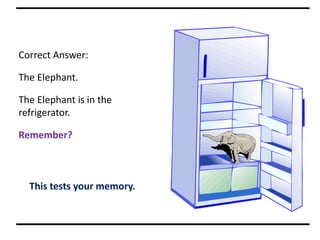
Correct Answer:
The Elephant.
The Elephant is in the
refrigerator.
Remember?
This tests your memory.
OK, even if you did not answer the first
three questions correctly, you still have
one more chance to show your
abilities.
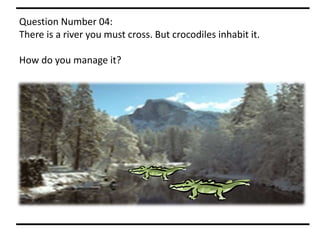
Question Number 04:
There is a river you must cross. But crocodiles inhabit it.
How do you manage it?
Correct Answer: You swim across. Why?
All the Crocodiles are attending the Animal Conference.
This tests whether you learn quickly from your mistakes.
According to Andersen Consulting Worldwide, around
90% of the professionals they tested got all questions
wrong.
But many pre-schoolers got several correct answers.
Anderson Consulting says this conclusively disproves the
theory that most professionals have the brains of a four
year old.
Professionalism:
What is it?
A profession is a disciplined group of individuals who adhere to ethical
standards.
A professional is a member of a profession. Professionals are governed by
codes of ethics, and profess commitment to competence, integrity and
morality, altruism, and the promotion of the public good within their
expert domain. Professionals are accountable to those served and to
society.
Professionalism comprises the personally held beliefs about one’s own
conduct as a professional. It’s often linked to the upholding of the
principles, laws, ethics and conventions of a profession as a way of
practice.
Professionalization is the pattern of how a profession develops, as well as the
process of becoming a profession.
11/18/2018 36
Scope of a Profession
• Workforce
• Challenge & Barriers
– Complexity
– Multidiscipline
– Advance technology
– Knowledge update
– Urbanization
– Globalization
• Changes
– Team approach
– Inter professional education
11/18/2018 37
Causes of
Lack of
Professionalism
(from “Lack of Motivation”)
11/18/2018 38
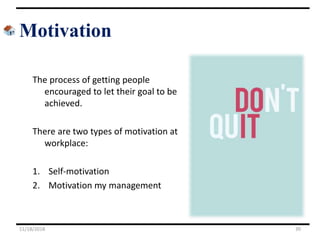
Motivation
The process of getting people
encouraged to let their goal to be
achieved.
There are two types of motivation at
workplace:
1. Self-motivation
2. Motivation my management
11/18/2018 39
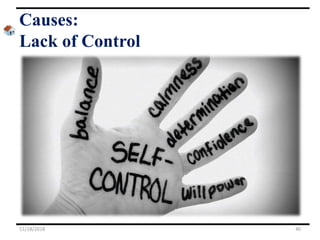
Causes:
Lack of Control
11/18/2018 40
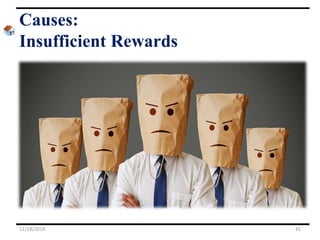
Causes:
Insufficient Rewards
11/18/2018 41
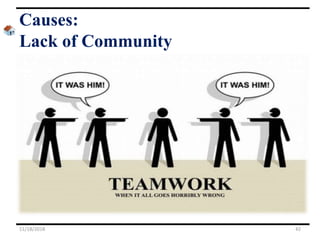
Causes:
Lack of Community
11/18/2018 42
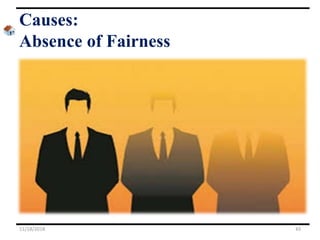
Causes:
Absence of Fairness
11/18/2018 43
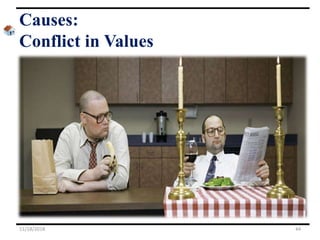
Causes:
Conflict in Values
11/18/2018 44
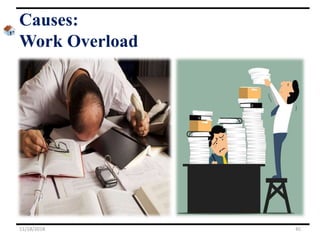
Causes:
Work Overload
11/18/2018 45
Ways to be self motivated at
work
Partnership Working:
- Asking to understand things
- Create relationship/Friendship
- Respect your supervisor
- Etc
Do all requirements of your Supervisor:
- Good respond
- Meet deadline
- Respect the timeline
- Be organized
What does
“Etiquette”
means to you?
11/18/2018 47
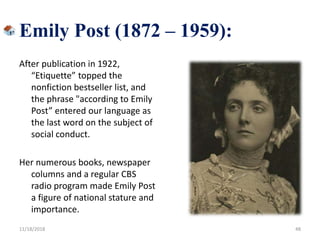
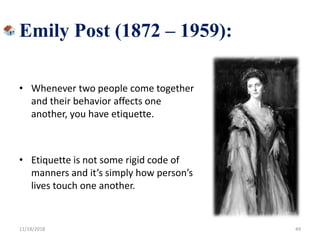
Emily Post (1872 – 1959):
After publication in 1922,
“Etiquette” topped the
nonfiction bestseller list, and
the phrase "according to Emily
Post” entered our language as
the last word on the subject of
social conduct.
Her numerous books, newspaper
columns and a regular CBS
radio program made Emily Post
a figure of national stature and
importance.
11/18/2018 48
Emily Post (1872 – 1959):
• Whenever two people come together
and their behavior affects one
another, you have etiquette.
• Etiquette is not some rigid code of
manners and it’s simply how person’s
lives touch one another.
11/18/2018 49
Ask yourself:
• Are you ruder today than 5 or 10 years ago?
• On a frequent/occasional basis, do you encounter people over phone
rudely?
• Have you used your cell phone in a loud or annoying manner in the past
few months?
Rudeness:
• It’s easier to see rudeness in others than in yourself.
• Rudeness isn’t always intentional.
•
Today’s Goal:
• Think before acting
• Make Choice that Builds Relationship, not breaks
• Do it Sincerely
11/18/2018 50
Etiquette
Etiquette = Manner + Principles
• Manners smooth the way to build better relationships by
telling us:
– what to do?
– what to expect of others?
• Principles help us:
– figure out how to interact when there is no set manner?
– resolve relationship situations?
11/18/2018 51
Etiquette: Principles
The Principles  Etiquette in action
Consideration  Think before acting
(thinking, empathy)
Respect  Make Choice that Builds
Relationship, not breaks
(Recognizing the worth of others. Having care for others, self and things.)
Honesty  Do it Sincerely
(acting sincerely, being truthful)
11/18/2018 52
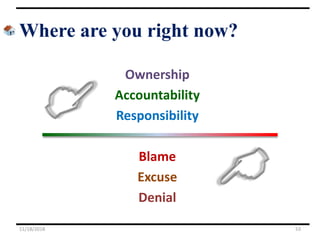
Where are you right now?
Ownership
Accountability
Responsibility
Blame
Excuse
Denial
11/18/2018 53
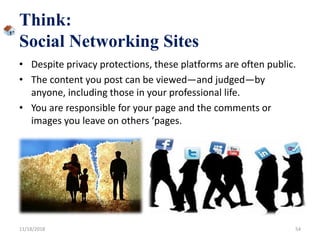
Think:
Social Networking Sites
• Despite privacy protections, these platforms are often public.
• The content you post can be viewed—and judged—by
anyone, including those in your professional life.
• You are responsible for your page and the comments or
images you leave on others ‘pages.
11/18/2018 54
Think:
Communication
Conversation Concept:
• Safe : Sports, weather, celebrities, etc.
• Risky : Politics, religion, dating, etc.
• Personal : Family and finance, etc.
Communication:
• Think: Public vs. Private
• If you can’t put it on a bulletin board for anyone to read, don’t
email it, text it, IM it, leave it on a voicemail, tweet it, or blog
it.
11/18/2018 55
Think:
When Words Alone Are Your Image
The Who, What, When, Where Rule:
• Pick up the phone or visit someone in person if email or IM
communication becomes tense or strained.
• In the absence of facial expressions or tone of voice,
interpretation defaults to the negative.
• Don’t use email or IM or texting to avoid a difficult situation.
11/18/2018 56
Think:
Charming Words does Work!
• “Please” Soften a request
• “Thank you” Show appreciation
• “You’re Welcome” Acknowledge appreciation
• “Sorry” Indicates regret
• “Excuse me” Asks for forgiveness
• “Pardon me” Acknowledges mistake
11/18/2018 57
• Email, phone call, or handwritten
• Choose handwritten thank-you notes for:
– Gifts, substantial favors, special meals
– Major opportunities
– Relationship milestones
• Use the date and a salutation.
• State your thanks or appreciation, especially for a gift or meal.
• Mention something specific to the situation or conversation.
• Indicate your next actions, if appropriate.
• Thank again and use a closing.
11/18/2018 58
Writing “Thank you” Note
July 19, 2014
Dear Mr. Jones,
Thank you very much for meeting with me. I enjoyed having the
opportunity to find out more about your company. I am very
excited by your employment opportunity, especially the
potential to work on web design. I look forward to getting
started. Thank you again.
Sincerely,
Carla Ramirez
11/18/2018 59
Sample “Thank you” Note
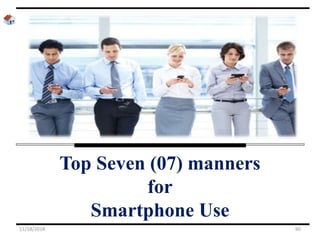
Top Seven (07) manners
for
Smartphone Use
11/18/2018 60
11/18/2018 61
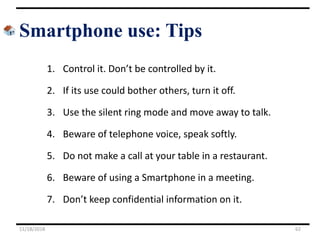
1. Control it. Don’t be controlled by it.
2. If its use could bother others, turn it off.
3. Use the silent ring mode and move away to talk.
4. Beware of telephone voice, speak softly.
5. Do not make a call at your table in a restaurant.
6. Beware of using a Smartphone in a meeting.
7. Don’t keep confidential information on it.
11/18/2018 62
Smartphone use: Tips
Seven (07) Tips
for
E-mail
Communications
11/18/2018 63
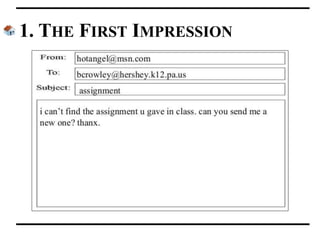
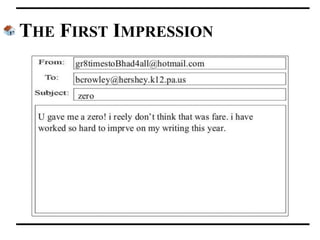
1. THE FIRST IMPRESSION
THE FIRST IMPRESSION
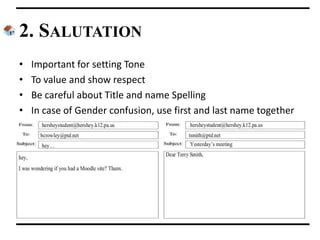
2. SALUTATION
• Important for setting Tone
• To value and show respect
• Be careful about Title and name Spelling
• In case of Gender confusion, use first and last name together
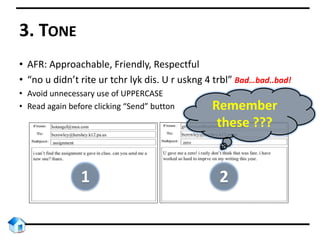
3. TONE
• AFR: Approachable, Friendly, Respectful
• “no u didn’t rite ur tchr lyk dis. U r uskng 4 trbl” Bad…bad..bad!
• Avoid unnecessary use of UPPERCASE
• Read again before clicking “Send” button Remember
these ???
1 2
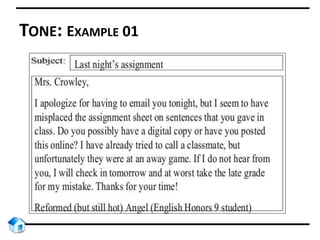
TONE: EXAMPLE 01
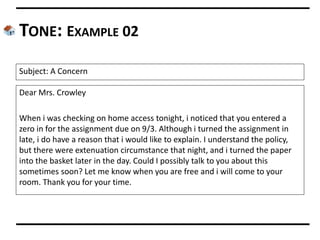
TONE: EXAMPLE 02
Dear Mrs. Crowley
When i was checking on home access tonight, i noticed that you entered a
zero in for the assignment due on 9/3. Although i turned the assignment in
late, i do have a reason that i would like to explain. I understand the policy,
but there were extenuation circumstance that night, and i turned the paper
into the basket later in the day. Could I possibly talk to you about this
sometimes soon? Let me know when you are free and i will come to your
room. Thank you for your time.
Subject: A Concern
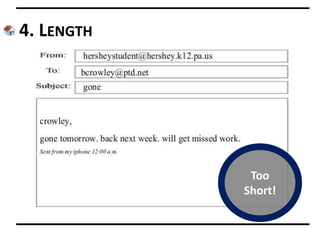
4. LENGTH
Too
Short!
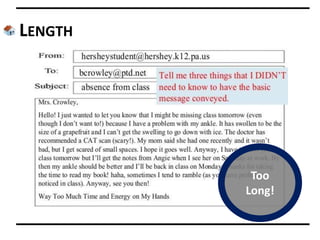
LENGTH
Too
Long!
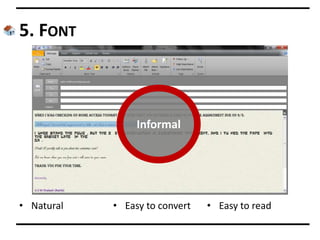
5. FONT
• Natural • Easy to convert • Easy to read
Informal
6. WORDING:
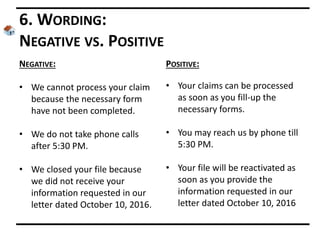
NEGATIVE VS. POSITIVE
NEGATIVE:
• We cannot process your claim
because the necessary form
have not been completed.
• We do not take phone calls
after 5:30 PM.
• We closed your file because
we did not receive your
information requested in our
letter dated October 10, 2016.
POSITIVE:
• Your claims can be processed
as soon as you fill-up the
necessary forms.
• You may reach us by phone till
5:30 PM.
• Your file will be reactivated as
soon as you provide the
information requested in our
letter dated October 10, 2016
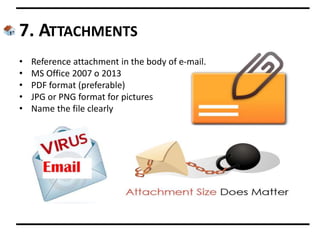
7. ATTACHMENTS
• Reference attachment in the body of e-mail.
• MS Office 2007 o 2013
• PDF format (preferable)
• JPG or PNG format for pictures
• Name the file clearly
Top Ten (10) Business
Etiquette Behavior
11/18/2018 75
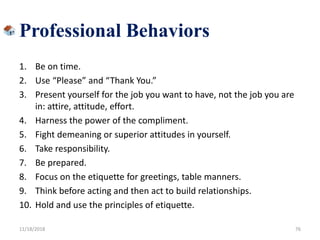
1. Be on time.
2. Use “Please” and “Thank You.”
3. Present yourself for the job you want to have, not the job you are
in: attire, attitude, effort.
4. Harness the power of the compliment.
5. Fight demeaning or superior attitudes in yourself.
6. Take responsibility.
7. Be prepared.
8. Focus on the etiquette for greetings, table manners.
9. Think before acting and then act to build relationships.
10. Hold and use the principles of etiquette.
11/18/2018 76
Professional Behaviors
Five (05) Keys to be a
True Professional
ABCDE
• Attitude: A settled way of thinking or feeling about someone or
something, typically one that is reflected in a person's behavior.
• Behavior: The way they act in general, especially in relation to the
situation they are in or the people they are with.
• Competency: The ability to do something successfully or efficiently.
• Demand (Appeal, Character): The mental and moral qualities distinctive to
an individual.
• Excellence: The quality of being outstanding or extremely good.
11/18/2018 77
Summary
• Personal Development Framework
– Personal Development
– Personal Knowledge
– Types of workplace learning
– The Conceptual evaluation among organizations
– Finding Self
• Professionalism
– Profession, Professional, Professionalism, Professionalization
– Scope of the Profession
– Causes of Lack of Professionalism
– Things to think about!
– Writing Thank-You Notes
– Seven (07) manners for Smartphone use
– Seven (07) Tips for e-mail communication
– Top ten (10) Business Etiquette behavior
– Five (05) keys to be a true professional
11/18/2018 78
References
• Causes of Professional Burnout. (n.d.). Retrieved on November 20, 2016 from URL:
http://www.forbes.com/sites/johnrampton/2015/05/13/the-6-causes-of-professional-burnout-
and-how-to-avoid-them/#3095c54d4726
• Statistics on smartphoneuse. (n.d.). Retrieved on November 20, 2016 from URL:
http://www.thinslices.com/smartphone-statistics-tablet-usage-patterns/
• Personal Development. (n.d.). Retrieved on November 20, 2016 from URL:
http://www.businessdictionary.com/definition/personal-development.html
• Definition from Professions Australia website http://www.professions.com.au/about-us/what-is-a-
professional, accessed 11/06/15
• Cruess, Sylvia R., Sharon Johnston, and Richard L. Cruess. ""Profession": a working definition for
medical educators." Teaching and learning in Medicine16.1 (2004): 74-76.
• Abbott, A., 1988. The System of Professions: An Essay on the Division of Expert Labour, Chicago: The
University of Chicago Press.
• The Profession. (n.d.). Retrieved on November 20, 2016 from URL: http://www.psc.gov.au/what-is-
a-profession
• Lack of Professionalism. (n.d.). Retrieved on November 20, 2016 from URL:
www.oxforddictionaries.com
• Way to Self-Motivation. (n.d.). Retrieved on November 20, 2016 from URL: www.goalsinstitute.com
• Professionalism at work. (n.d.). Retrieved on November 20, 2016 from URL: www.career-
advice.monster.ca
• Professionalism. (n.d.). Retrieved on November 20, 2016 from URL: www.smallbusiness.chron.com
11/18/2018 79
Thank you
11/18/2018 80

Personal Development and Professionalism

  • 1.
    11/18/2018 1 IF YOUDON’T DESIGN YOUR OWN LIFE, SOMEONE ELSE WILL. IT’S YOUR DAY!
  • 2.
    Personal Development Framework and Professionalism ABU ZAFORMD. SHALEAH Manager (HR) Unique Group Dhaka, Bangladesh
  • 3.
    Focus Areas • PersonalDevelopment Framework – Personal Development – Personal Knowledge – Types of workplace learning – The Conceptual evaluation among organizations – Finding Self • Professionalism – Profession, Professional, Professionalism, Professionalization – Scope of the Profession – Causes of Lack of Professionalism – Things to think about! – Writing Thank-You Notes – Seven (07) manners for Smartphone use – Seven (07) Tips for e-mail communication – Top ten (10) Business Etiquette behavior – Five (05) keys to be a true professional 11/18/2018 3
  • 4.
    Let’s watch aVideo! 11/18/2018 4
  • 5.
    Personal Development It isthe process of improving oneself through such activities as enhancing employment skills, increasing consciousness and building wealth. It covers activities that improve awareness and identity, develop talents and potential, build human capital and facilitate employability, enhance the quality of life and contribute to the realization of dreams and aspirations. 11/18/2018 5
  • 6.
    Personal Development Personal knowledge: •Less like inputting, absorbing and remembering. • You do not ‘make meaning’ of yourself. • It is a matter of organic growth. • More like exercising. • Is not constructed. Types of workplace learning: • Demand driven • Employer driven • Content driven What is the Difference between Development & Learning? 11/18/2018 6
  • 7.
    Evaluation of Organizations 19thC : Competition 20th C (+/-) : Collaboration 21st C : Cooperation 11/18/2018 7
  • 8.
  • 9.
    • At first,put three pots of water over the fire. • Then, put some carrots in the first pot. • In next, put some eggs in the second pot • Lastly, put some coffee beans in the last pot. Now, boil these three pots for 15 minutes. 11/18/2018 9
  • 10.
    After 15 minutes: Carrotswere Hard before, now they are very Soft. Eggs were Soft inside before, now they are Hard. Coffee beans were Powdered before, now they are disappeared. “Now, Think about the water, Pots, and fire” Aren’t these all are similar & different situation and problems that arises to our everyday life? 11/18/2018 10
  • 11.
    Think about ourlife … • Life is not always easy. • Life is not always comfortable. • Sometimes life is very hard. • Things don’t happen like we wish. • People don’t treat us like we hope. • We work very hard but get few results. • What happens when we face difficulties? 11/18/2018 11
  • 12.
    Will you Belike Carrot? • We go in tough and strong. • We come out soft and weak. • We get very tired, We fail, We lose hope, We give up. • There is no more fighting spirit. Don’t be like carrot ! 11/18/2018 12
  • 13.
    Will you Belike Egg? • We start with a soft and sensitive heart. • We end up very hard and unfeeling inside. • We hate others. • We don’t like ourselves. • We become hard-hearted. • There is no warm feeling, only bitterness. Don’t be like Egg ! 11/18/2018 13
  • 14.
    Will you Belike Coffee Bean? • The water does not change the coffee powder. • The coffee powder changes the water! • The water has become different because of the coffee powder. • See it, Smell it, Drink it. • The hotter the water, the better the taste. Be like Coffee Bean ! 11/18/2018 14
  • 15.
    Processing: Coffee 11/18/2018 15 • Picking •Processing – Wet process – Dry process – Semi-dry process • Milling – Hulling – Polishing – Cleaning and sorting • Grading – Aging – Decaffeination • Storage
  • 16.
    Self-Development • We makesomething good from the difficulties we face. • We learn new things. • We have new knowledge, new skills, new abilities. • We grow in experience. • We make the world around us better. • To succeed, we must try… and try again. • We must believe in what we are doing. • We must not give up. • We must be patient. • We must keep pushing. 11/18/2018 16 handle with care
  • 17.
    • Problems anddifficulties give us the chance to become stronger… and better… and tougher. • What are we like when things do not go well? • Are we like the carrot, egg, or coffee bean? Be like the Coffee Bean! 11/18/2018 17 Self-Development (Cont’d)
  • 18.
    Learning from CoffeeBean: Layers 11/18/2018 18
  • 19.
  • 20.
  • 21.
    Self Evolution: Personal Area General: •What do you like on a personal level? • What are 10 things you most enjoy doing? • What motivates you? • What makes you excited? • What are your most important values? Specialization: • What are the talents you have? • What is your passion? 11/18/2018 21
  • 22.
    Self Evolution: Personal Area Lifeareas: To have balance in life certainly is one of the most important overall aims to reach. Set a goal for each area in your life: • Family & Social Relationship • Physical/Health • Fun • Spiritual • Work/Career • Financial Security 11/18/2018 22
  • 23.
    Self Evolution: Personal Area Think: •If you never had to work another day in your life, how would you spend your time instead of working? • When your life is ending, what will you regret not doing, not seeing, or not achieving? Feedback: • What other people says about you? • What strengths do you see in yourself? • What do you believe are your weaknesses? • What are the strengths that others see in you? • What weaknesses have other people commented on about you? 11/18/2018 23
  • 24.
  • 25.
    Are you aProfessional? The following short quiz consists of 4 questions and tells whether you are qualified to be a "professional". The questions are not that difficult, so don’t cheat by looking ahead!.
  • 26.
    Question Number 01: Howdo you put a giraffe into a refrigerator?
  • 27.
    The correct answeris: • open the refrigerator, • put in the giraffe, and • close the door. This question tests whether you tend to do simple things in an overly complicated way.
  • 28.
    Question Number 02: Howdo you put an elephant into a refrigerator?
  • 29.
    Wrong Answer: Openthe refrigerator, put in the elephant and close the refrigerator. Correct Answer: Open the refrigerator, take out the giraffe, put in the elephant and close the door. This tests your ability to think through the repercussions of your actions.
  • 30.
    Question Number 03: TheLion King is hosting an animal conference. All the animals attend except one. Which animal does not attend?
  • 31.
    Correct Answer: The Elephant. TheElephant is in the refrigerator. Remember? This tests your memory.
  • 32.
    OK, even ifyou did not answer the first three questions correctly, you still have one more chance to show your abilities.
  • 33.
    Question Number 04: Thereis a river you must cross. But crocodiles inhabit it. How do you manage it?
  • 34.
    Correct Answer: Youswim across. Why? All the Crocodiles are attending the Animal Conference. This tests whether you learn quickly from your mistakes.
  • 35.
    According to AndersenConsulting Worldwide, around 90% of the professionals they tested got all questions wrong. But many pre-schoolers got several correct answers. Anderson Consulting says this conclusively disproves the theory that most professionals have the brains of a four year old.
  • 36.
    Professionalism: What is it? Aprofession is a disciplined group of individuals who adhere to ethical standards. A professional is a member of a profession. Professionals are governed by codes of ethics, and profess commitment to competence, integrity and morality, altruism, and the promotion of the public good within their expert domain. Professionals are accountable to those served and to society. Professionalism comprises the personally held beliefs about one’s own conduct as a professional. It’s often linked to the upholding of the principles, laws, ethics and conventions of a profession as a way of practice. Professionalization is the pattern of how a profession develops, as well as the process of becoming a profession. 11/18/2018 36
  • 37.
    Scope of aProfession • Workforce • Challenge & Barriers – Complexity – Multidiscipline – Advance technology – Knowledge update – Urbanization – Globalization • Changes – Team approach – Inter professional education 11/18/2018 37
  • 38.
    Causes of Lack of Professionalism (from“Lack of Motivation”) 11/18/2018 38
  • 39.
    Motivation The process ofgetting people encouraged to let their goal to be achieved. There are two types of motivation at workplace: 1. Self-motivation 2. Motivation my management 11/18/2018 39
  • 40.
  • 41.
  • 42.
  • 43.
  • 44.
  • 45.
  • 46.
    Ways to beself motivated at work Partnership Working: - Asking to understand things - Create relationship/Friendship - Respect your supervisor - Etc Do all requirements of your Supervisor: - Good respond - Meet deadline - Respect the timeline - Be organized
  • 47.
  • 48.
    Emily Post (1872– 1959): After publication in 1922, “Etiquette” topped the nonfiction bestseller list, and the phrase "according to Emily Post” entered our language as the last word on the subject of social conduct. Her numerous books, newspaper columns and a regular CBS radio program made Emily Post a figure of national stature and importance. 11/18/2018 48
  • 49.
    Emily Post (1872– 1959): • Whenever two people come together and their behavior affects one another, you have etiquette. • Etiquette is not some rigid code of manners and it’s simply how person’s lives touch one another. 11/18/2018 49
  • 50.
    Ask yourself: • Areyou ruder today than 5 or 10 years ago? • On a frequent/occasional basis, do you encounter people over phone rudely? • Have you used your cell phone in a loud or annoying manner in the past few months? Rudeness: • It’s easier to see rudeness in others than in yourself. • Rudeness isn’t always intentional. • Today’s Goal: • Think before acting • Make Choice that Builds Relationship, not breaks • Do it Sincerely 11/18/2018 50
  • 51.
    Etiquette Etiquette = Manner+ Principles • Manners smooth the way to build better relationships by telling us: – what to do? – what to expect of others? • Principles help us: – figure out how to interact when there is no set manner? – resolve relationship situations? 11/18/2018 51
  • 52.
    Etiquette: Principles The Principles Etiquette in action Consideration  Think before acting (thinking, empathy) Respect  Make Choice that Builds Relationship, not breaks (Recognizing the worth of others. Having care for others, self and things.) Honesty  Do it Sincerely (acting sincerely, being truthful) 11/18/2018 52
  • 53.
    Where are youright now? Ownership Accountability Responsibility Blame Excuse Denial 11/18/2018 53
  • 54.
    Think: Social Networking Sites •Despite privacy protections, these platforms are often public. • The content you post can be viewed—and judged—by anyone, including those in your professional life. • You are responsible for your page and the comments or images you leave on others ‘pages. 11/18/2018 54
  • 55.
    Think: Communication Conversation Concept: • Safe: Sports, weather, celebrities, etc. • Risky : Politics, religion, dating, etc. • Personal : Family and finance, etc. Communication: • Think: Public vs. Private • If you can’t put it on a bulletin board for anyone to read, don’t email it, text it, IM it, leave it on a voicemail, tweet it, or blog it. 11/18/2018 55
  • 56.
    Think: When Words AloneAre Your Image The Who, What, When, Where Rule: • Pick up the phone or visit someone in person if email or IM communication becomes tense or strained. • In the absence of facial expressions or tone of voice, interpretation defaults to the negative. • Don’t use email or IM or texting to avoid a difficult situation. 11/18/2018 56
  • 57.
    Think: Charming Words doesWork! • “Please” Soften a request • “Thank you” Show appreciation • “You’re Welcome” Acknowledge appreciation • “Sorry” Indicates regret • “Excuse me” Asks for forgiveness • “Pardon me” Acknowledges mistake 11/18/2018 57
  • 58.
    • Email, phonecall, or handwritten • Choose handwritten thank-you notes for: – Gifts, substantial favors, special meals – Major opportunities – Relationship milestones • Use the date and a salutation. • State your thanks or appreciation, especially for a gift or meal. • Mention something specific to the situation or conversation. • Indicate your next actions, if appropriate. • Thank again and use a closing. 11/18/2018 58 Writing “Thank you” Note
  • 59.
    July 19, 2014 DearMr. Jones, Thank you very much for meeting with me. I enjoyed having the opportunity to find out more about your company. I am very excited by your employment opportunity, especially the potential to work on web design. I look forward to getting started. Thank you again. Sincerely, Carla Ramirez 11/18/2018 59 Sample “Thank you” Note
  • 60.
    Top Seven (07)manners for Smartphone Use 11/18/2018 60
  • 61.
  • 62.
    1. Control it.Don’t be controlled by it. 2. If its use could bother others, turn it off. 3. Use the silent ring mode and move away to talk. 4. Beware of telephone voice, speak softly. 5. Do not make a call at your table in a restaurant. 6. Beware of using a Smartphone in a meeting. 7. Don’t keep confidential information on it. 11/18/2018 62 Smartphone use: Tips
  • 63.
  • 64.
    1. THE FIRSTIMPRESSION
  • 65.
  • 66.
    2. SALUTATION • Importantfor setting Tone • To value and show respect • Be careful about Title and name Spelling • In case of Gender confusion, use first and last name together
  • 67.
    3. TONE • AFR:Approachable, Friendly, Respectful • “no u didn’t rite ur tchr lyk dis. U r uskng 4 trbl” Bad…bad..bad! • Avoid unnecessary use of UPPERCASE • Read again before clicking “Send” button Remember these ??? 1 2
  • 68.
  • 69.
    TONE: EXAMPLE 02 DearMrs. Crowley When i was checking on home access tonight, i noticed that you entered a zero in for the assignment due on 9/3. Although i turned the assignment in late, i do have a reason that i would like to explain. I understand the policy, but there were extenuation circumstance that night, and i turned the paper into the basket later in the day. Could I possibly talk to you about this sometimes soon? Let me know when you are free and i will come to your room. Thank you for your time. Subject: A Concern
  • 70.
  • 71.
  • 72.
    5. FONT • Natural• Easy to convert • Easy to read Informal
  • 73.
    6. WORDING: NEGATIVE VS.POSITIVE NEGATIVE: • We cannot process your claim because the necessary form have not been completed. • We do not take phone calls after 5:30 PM. • We closed your file because we did not receive your information requested in our letter dated October 10, 2016. POSITIVE: • Your claims can be processed as soon as you fill-up the necessary forms. • You may reach us by phone till 5:30 PM. • Your file will be reactivated as soon as you provide the information requested in our letter dated October 10, 2016
  • 74.
    7. ATTACHMENTS • Referenceattachment in the body of e-mail. • MS Office 2007 o 2013 • PDF format (preferable) • JPG or PNG format for pictures • Name the file clearly
  • 75.
    Top Ten (10)Business Etiquette Behavior 11/18/2018 75
  • 76.
    1. Be ontime. 2. Use “Please” and “Thank You.” 3. Present yourself for the job you want to have, not the job you are in: attire, attitude, effort. 4. Harness the power of the compliment. 5. Fight demeaning or superior attitudes in yourself. 6. Take responsibility. 7. Be prepared. 8. Focus on the etiquette for greetings, table manners. 9. Think before acting and then act to build relationships. 10. Hold and use the principles of etiquette. 11/18/2018 76 Professional Behaviors
  • 77.
    Five (05) Keysto be a True Professional ABCDE • Attitude: A settled way of thinking or feeling about someone or something, typically one that is reflected in a person's behavior. • Behavior: The way they act in general, especially in relation to the situation they are in or the people they are with. • Competency: The ability to do something successfully or efficiently. • Demand (Appeal, Character): The mental and moral qualities distinctive to an individual. • Excellence: The quality of being outstanding or extremely good. 11/18/2018 77
  • 78.
    Summary • Personal DevelopmentFramework – Personal Development – Personal Knowledge – Types of workplace learning – The Conceptual evaluation among organizations – Finding Self • Professionalism – Profession, Professional, Professionalism, Professionalization – Scope of the Profession – Causes of Lack of Professionalism – Things to think about! – Writing Thank-You Notes – Seven (07) manners for Smartphone use – Seven (07) Tips for e-mail communication – Top ten (10) Business Etiquette behavior – Five (05) keys to be a true professional 11/18/2018 78
  • 79.
    References • Causes ofProfessional Burnout. (n.d.). Retrieved on November 20, 2016 from URL: http://www.forbes.com/sites/johnrampton/2015/05/13/the-6-causes-of-professional-burnout- and-how-to-avoid-them/#3095c54d4726 • Statistics on smartphoneuse. (n.d.). Retrieved on November 20, 2016 from URL: http://www.thinslices.com/smartphone-statistics-tablet-usage-patterns/ • Personal Development. (n.d.). Retrieved on November 20, 2016 from URL: http://www.businessdictionary.com/definition/personal-development.html • Definition from Professions Australia website http://www.professions.com.au/about-us/what-is-a- professional, accessed 11/06/15 • Cruess, Sylvia R., Sharon Johnston, and Richard L. Cruess. ""Profession": a working definition for medical educators." Teaching and learning in Medicine16.1 (2004): 74-76. • Abbott, A., 1988. The System of Professions: An Essay on the Division of Expert Labour, Chicago: The University of Chicago Press. • The Profession. (n.d.). Retrieved on November 20, 2016 from URL: http://www.psc.gov.au/what-is- a-profession • Lack of Professionalism. (n.d.). Retrieved on November 20, 2016 from URL: www.oxforddictionaries.com • Way to Self-Motivation. (n.d.). Retrieved on November 20, 2016 from URL: www.goalsinstitute.com • Professionalism at work. (n.d.). Retrieved on November 20, 2016 from URL: www.career- advice.monster.ca • Professionalism. (n.d.). Retrieved on November 20, 2016 from URL: www.smallbusiness.chron.com 11/18/2018 79
  • 80.