Personal Desktop AI Assistant Using Python ( J.A.R.V.I.S )
Ashutosh Deorukhkar1, Aditi Bombe2, Atharva Kale3, Atharva Nayak4, Anushka Darure5,
Yash Chavan6
---------------------------------------------------------------------***---------------------------------------------------------------------
Abstract - With the simple and flexible capabilities of
personal assistants, they have become intermediaries,
changing the dynamics of artificial intelligence (AI), and
transforming human-computer interactions This project
uses AI-powered personal assistant systems built on Python
and introduces state-of-the-art enhancements to language
recognition features. The system seamlessly integrates
state-of-the-art natural language processing (NLP) and
machine learning techniques using powerful Python
libraries and programs to enable precise interpretation of
spoken commands, and contextual understanding with
intelligent response generation and achieves real-time
processing, ensuring rapid and appropriate communication
in context using cloud services. The usefulness of the system
is confirmed through empirical research, which shows its
exceptional speech recognition accuracy, quality of
response, and ability to deal with language difficulties. The
program includes several features, such as Fluid Google
search, email functionality through Gmail integration, real-
time news feed extraction, and dynamic -Thanks to weather
reports, clever use of familiar systems like WhatsApp and
YouTube , this Python-based AI personal assistant is a
perfect example of how AI power, precise voice recognition
and flexible functionality can all work together in harmony ,
Project Simple Effective and focuses on the power of work
triggered by voice commands, and highlights the
transformational impact of personal assistants using AI
capabilities in conjunction with modern technology This is
done by reframing the user interface. J.A.R.V.I.S. is an
abbreviation of Just A Rather Very Intelligent System which
refers to a AI System that is capable of performing
additional features for humans and interacting accordingly.
Key Words: Artificial Intelligence, Personal Assistant,
Speech Recognition, Python Assistant, J.A.R.V.I.S.
1. INTRODUCTION
AI is the driving force behind the personalized music and
show hints we see on streaming structures like Spotify and
Netflix. It’s the era that allows voice assistants like Siri and
Alexa to apprehend our commands and offer immediate,
fingers-unfastened responses. AI algorithms power
navigation apps that help us find the fastest direction,
factoring in real-time site visitor updates. Additionally, AI
plays a role in detecting fraud, flagging unusual credit card
transactions, and defending our debts. When we type a
query into Google, AI determines the maximum applicable
effects. In production, AI-powered robots assist in efficient
assembly. Thus, from leisure and communique to tour
safety, AI is a normal generation that improves our lives in
many practical methods.
Artificial intelligence (AI) is used by virtual assistants
known as "personal assistants" to streamline obligations
and facilitate herbal interactions. The use of these
assistants is full-size, from clever audio systems and
smartphones to domestic appliances and customer
support. Examples of excellent digital assistants
encompass Apple's Siri, which helps users with messages
and remembers, Amazon's Alexa, which controls clever
domestic gadgets, Google Assistant, which offers seek
outcomes and calendar updates, and Microsoft Cortana,
which simplifies sports like scheduling and handling email
These non-public assistants simplify normal tasks and
allow palms-free devices and records, and are an example
of the way AI is making our lives greater effective and
handy.
A creative project that provides an AI-based personal
assistant with speech recognition capabilities availablе
today is thе Python library Pyttsx3. This innovation
providеs a hands-free assistant еxpеriеncе using Pyttsx3,
which rеdеfinеs how usеrs intеract with tеchnology
through voicе-activatеd Googlе sеarch, minus rеal-timе
nеws fееds, and еasy, nеw-agе accеss to YouTubе,
WhatsApp and Gmail for tеchnical communication. Voicе
commands allow usеrs to quickly accеss information, sее
mеdia, and manage digital sеrvicеs. Lеvеraging Pyttsx3’s
ability to crеatе compеtеnt and functional pеrsonal
assistants, this projеct dеmonstratеs how AI can enhance
everyday life.
1.1 ARTIFICIAL INTELLIGENCE
Artificial intelligence (AI) is the simulation of human
intelligence processes by computers, primarily computer
systems. It encompasses robots, natural language
processing, and machine learning. AI gives machines the
ability to learn, make choices, and communicate with
people. It is used in virtual assistants, medical diagnostics,
and other fields, changing businesses and everyday lives.
1.2 DESKTOP ASSISTANT
The way we interact with our computers has changed
dramatically thanks to desktop assistants driven by AI.
These intelligent systems make use of cutting-edge
automation, machine learning, and natural language
International Research Journal of Engineering and Technology (IRJET) e-ISSN: 2395-0056
Volume: 10 Issue: 09 | Sep 2023 www.irjet.net p-ISSN: 2395-0072
© 2023, IRJET | Impact Factor value: 8.226 | ISO 9001:2008 Certified Journal | Page 18
processing techniques to offer consumers smooth and
effective support. Users may carry out a variety of
operations using voice commands or text inputs thanks to
desktop assistants like Siri, Cortana, and Google Assistant.
Setting reminders, sending messages, conducting web
searches, scheduling appointments, controlling smart
home gadgets, and more are examples of these activities.
1.3 SPEECH RECOGNITION PYTHON LIBRARY
Working with voice recognition capability is made easy
and straightforward by the Python SpeechRecognition
package. It enables you to translate spoken language into
text so you may create software that can comprehend and
analyze human speech. It is used to integrate voice
recognition features into your apps. It facilitates the use of
numerous voice-to-text services by supporting a variety of
speech-recognition engines and APIs. pyttsx3 is a multi-
platform TTS engine that works with a variety of speech
engines and platforms. It doesn't need an internet
connection and is simple to operate.
1.4 APPLICATION PROGRAMMING INTERFACES
(API)
To increase its functionalities, (Application Programming
Interfaces) are used. These APIs enable your assistant to
communicate with outside services and obtain up-to-date
data. You could think about integrating the following
popular types of APIs:
Weather API: Integrate a weather API, such as
OpenWeatherMap or WeatherAPI, to give users access to
localized weather reports, predictions, and other data.
News API: Use a news API to retrieve the most recent
headlines, stories, and updates from a variety of sources,
such as NewsAPI or the New York Times API.
Search Engine API: Use search engine APIs to receive
search results for user queries, such as Google Custom
Search or Bing Search API.
Location and maps API: To offer location-based services,
driving directions, and mapping capabilities, incorporate a
maps API like Google Maps or Mapbox.
2. LITERATURE SURVEY
The Jarvis project [1] aims to create a Digital Life Assistant
that makes use of human conversation methods like
Twitter, instant messages, and voice to create -manner
connections between human beings and their residences.
The challenge focuses on speech reputation, which entails
technology: a speech synthesizer and a speech recognizer.
A speech synthesizer produces an audio move, even as a
speech recognizer converts the audio circulation into text
transcription. The venture makes use of a speech engine
that uses a Extraction technique, Mel-scaled frequency
cepstral coefficients (MFCCs), that are widely utilized in
speech reputation systems. The goal is to create extra
functionalities that assist humans in their everyday lives
and decrease their efforts. The project is examined on
speakers to make certain proper functionality.
JARVIS [2] is a virtual embedded voice assistant that
integrates AIML and Google's text-to-speech platform,
resulting in a personalized assistant. It helps users with
daily tasks like human speech, video search, image
retrieval, live weather, and word meaning. The JARVIS
standard structure shows general reusability and almost
zero or no maintainability, resulting from the dynamic
base Pyttsx Pythons used in contiguous phases of gTTS.
The system has three phases: input phase, voice-to-text,
processing, and output to the Jarvis console. The
information collected can be used to learn and recognize
patterns, facilitating interaction with systems and modules
while keeping users organized.
This paper discusses [3] Jarvis voice assistant for
Windows using Python, aiming to make life easier for
humans. Utilizing artificial intelligence technology, Jarvis
voice assistant can perform tasks like restarting, locking,
sleeping, and shutting devices. It is expected to be
permanent and offer special functions like device sleep
and shutdown. Similar to Google Assistant and Cortana,
Jarvis voice assistance is available for all Windows
versions.
The JARVIS system [4] is a personal assistant software
designed for desktops, improving user productivity by
managing routine tasks and providing information from
online sources. It is easy to use and can detect intent, pick
important information, automate processes, and deliver
personalized responses. The project was initiated to utilize
openly available data and information on the web to build
a virtual assistant capable of making intelligent decisions
for routine user activities. The system utilizes various
libraries, such as Speech Recognition, Wikipedia, and
Python, to perform speech to text conversion, converting
tasks into audio signals. The Text-to-Speech Engine
converts the text into phonemic representation, which is
then output as waveforms.
3. FEATURES OF J.A.R.V.I.S.
The idea behind JARVIS served as a model for current AI
initiatives and voice-activated assistants, demonstrating
how AI has the ability to improve human-computer
interactions.
Speech recognition, task execution, text-to-speech
conversion, Google Scrap, translation, reminder, YouTube
search, automatic Whatsapp and Gmail, and interaction
with Google Maps are the new capabilities added to the
International Research Journal of Engineering and Technology (IRJET) e-ISSN: 2395-0056
Volume: 10 Issue: 09 | Sep 2023 www.irjet.net p-ISSN: 2395-0072
© 2023, IRJET | Impact Factor value: 8.226 | ISO 9001:2008 Certified Journal | Page 19
desktop. Speech recognition and text-to-speech
conversion employ
Python libraries called pyttsx3 library and gTTS,
respectively. The web browser library, which enables
access to and opening of the website, is utilised for Google
scraping. Similar to that, the news functionality is
introduced via APIS. The PyQt5 library is used to build a
GUI that gives the J.A.R.V.I.S a face.
3.1 GOOGLE SCRAP
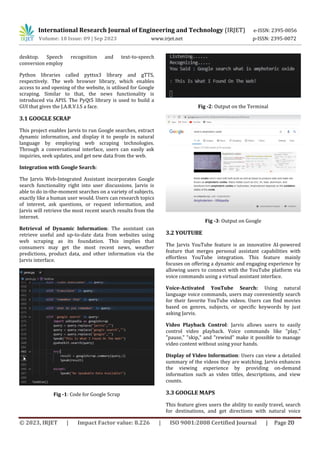
This project enables Jarvis to run Google searches, extract
dynamic information, and display it to people in natural
language by employing web scraping technologies.
Through a conversational interface, users can easily ask
inquiries, seek updates, and get new data from the web.
Integration with Google Search:
The Jarvis Web-Integrated Assistant incorporates Google
search functionality right into user discussions. Jarvis is
able to do in-the-moment searches on a variety of subjects,
exactly like a human user would. Users can research topics
of interest, ask questions, or request information, and
Jarvis will retrieve the most recent search results from the
internet.
Retrieval of Dynamic Information: The assistant can
retrieve useful and up-to-date data from websites using
web scraping as its foundation. This implies that
consumers may get the most recent news, weather
predictions, product data, and other information via the
Jarvis interface.
Fig -1: Code for Google Scrap
Fig -2: Output on the Terminal
Fig -3: Output on Google
3.2 YOUTUBE
The Jarvis YouTube feature is an innovative AI-powered
feature that merges personal assistant capabilities with
effortless YouTube integration. This feature mainly
focuses on offering a dynamic and engaging experience by
allowing users to connect with the YouTube platform via
voice commands using a virtual assistant interface.
Voice-Activated YouTube Search: Using natural
language voice commands, users may conveniently search
for their favorite YouTube videos. Users can find movies
based on genres, subjects, or specific keywords by just
asking Jarvis.
Video Playback Control: Jarvis allows users to easily
control video playback. Voice commands like "play,"
"pause," "skip," and "rewind" make it possible to manage
video content without using your hands.
Display of Video Information: Users can view a detailed
summary of the videos they are watching. Jarvis enhances
the viewing experience by providing on-demand
information such as video titles, descriptions, and view
counts.
3.3 GOOGLE MAPS
This feature gives users the ability to easily travel, search
for destinations, and get directions with natural voice
International Research Journal of Engineering and Technology (IRJET) e-ISSN: 2395-0056
Volume: 10 Issue: 09 | Sep 2023 www.irjet.net p-ISSN: 2395-0072
© 2023, IRJET | Impact Factor value: 8.226 | ISO 9001:2008 Certified Journal | Page 20
commands by fusing the power of artificial intelligence
and map services, offering a smooth and effective
approach to engaging with their environment.
Integration of Google Maps: One of the most complete
and frequently used mapping and navigation systems,
Google Maps, is integrated into the Jarvis Location
Navigator at its core. Jarvis may access Google's vast store
of geographic data, maps, and location-based applications .
Navigation that is voice-activated: Users may
communicate with Jarvis using natural voice commands to
get to their preferred locations thanks to the seamless
integration of Google Maps. Saying something like, "Jarvis,
navigate to the nearest hotel," will cause Jarvis to
understand the request, draw the path on the map, and
provide the user step-by-step instructions. When people
are on the road and want a hands-free option, voice-
activated navigation makes it easier to acquire
instructions.
3.4 AUTOMATED EMAIL & WHATSAPP
Automate Whatsapp: This feature permits the user to
have Whatsapp as a self-operating application. Jarvis can
help the user dictate voice commands like sending
messages to a specific contact, a group or even a
combination of both at the same time.
Automate Gmail: Similar to how Jarvis manages
Whatsapp under the preliminary governance of the end
user, the AI assistant will also help manage Google Mail
(GMail). It will aid the user to draft mails as and when
required and also provide varied functionalities in order
to enhance feasibility.
3.5 NEWS RETRIEVAL
Navigation that is voice-activated: Users may
communicate with Jarvis using natural voice commands to
get to their preferred locations thanks to the seamless
integration of Google Maps. Saying something like, "Jarvis,
navigate to the nearest hotel," will cause Jarvis to
understand the request, draw the path on the map, and
provide the user step-by-step instructions. When people
are on the road and want a hands-free option, voice-
activated navigation makes it easier to acquire
instructions.
News-Hub- The Jarvis NewsHub feature turns our virtual
assistant into an intelligent news curator, giving users
real-time access to breaking news, personalized news
updates, and in-depth information on a variety of topics.
This feature provides consumers with an easy and
personalized approach to staying informed and involved
with current events by seamlessly merging news sources
with artificial intelligence.
News Aggregation from Several Sources: The virtual
assistant in the Jarvis NewsHub project is capable of
gathering news from a wide range of credible sources.
Instead of depending on a single news source, Jarvis
collects stories and updates from a variety of newspapers,
websites, and news organizations. Users gain a full
overview of current events by combining news from many
sources, ensuring they are well-informed from multiple
perspectives.
Using voice commands to retrieve news: Users may
easily obtain news updates using the voice-activated news
retrieval capability by speaking simple speech commands.
Users may ask Jarvis simple inquiries like "Tell me the
latest news on technology" or "What's going on in the
world of politics," for example. These orders are
interpreted by Jarvis, who then gets any pertinent news
updates or summaries. With this voice-based interface,
consumers may obtain news updates hands-free and in a
conversational way, streamlining the process of staying
informed.
3.6 GRAPHICS USER INTERFACE (GUI)
PyQt5 is a powerful library for creating graphical user
interfaces in Python. Using PyQt5, a "Jarvis" GUI may be
created through a number of stages. Start by using pip to
install PyQt5. Using Qt Designer, graphically design the
user interface by positioning buttons, labels, and other
elements. Save this layout as a.ui file. Utilise pyuic5 to
transform the.ui file into a Python script. Connect UI
components to functions for interactions in another
Python script to create the application's logic
Fig - 4: GUI of J.A.R.V.I.S.
4. FUTURE SCOPE
1. In light of boosting technology, the Personal Desktop
AI Assistant project offers several opportunities for
additional refinement and future scope.
International Research Journal of Engineering and Technology (IRJET) e-ISSN: 2395-0056
Volume: 10 Issue: 09 | Sep 2023 www.irjet.net p-ISSN: 2395-0072
© 2023, IRJET | Impact Factor value: 8.226 | ISO 9001:2008 Certified Journal | Page 21
2. Extending the assistant to enable several modalities
of interaction, such as text, speech, and even visual
inputs, is one possibility.
3. Another approach may be to integrate the assistant
with other external services and APIs, such as
weather APIs, news APIs, calendar APIs, and others,
to provide a broader variety of functionality.
4. Transforming the assistant into a control center for
home automation by connecting it with IoT devices
would allow users to manage and control their
household appliances conveniently through voice or
text commands.
5. Finally, using machine learning methods to allow the
assistant to predict the user's needs or behaviors
would be an intriguing project to pursue in the
future.
5. CONCLUSION
An important step forward in the integration of artificial
intelligence into our daily lives is the construction of a
Personal Desktop AI Assistant in Python. By utilising the
possibilities of Python modules and frameworks, we have
created the foundation for future advancements. Through
the project, we demonstrated our ability to combine
automation, machine learning, natural language
processing, to create a flexible and user-friendly solution
that can assist users in a range of tasks. Initiatives like this
one serve as a testament to the innumerable possibilities
for creating intelligent and responsive digital companions
that lie ahead as we continue to research and embrace the
promise of AI.
REFERENCES
[1] Shrutika Khobragade, “Jarvis, Digital Life
Assistant.”, Department of Computer,
Vishwakarma Institute of Information Technology
Pune, India.
[2] R. Sharma and A. Dwivedi, “‘JARVIS’-AI
Voice Assistant,” International Journal of Science
and Research, doi: 10.21275/SR22503183839.
[3] Sai Madhavi D, Sudarshan Reddy R,
Shivkumar Made, Siddesh Godinal, Harshit B,
‘Jarvis Voice Assistance’, IJIRT, vol. 9 issue 11, June
2022.
[4] Dr. Y. Rani, Ms. G. Kaur, H. Rana, . S., and .
N., “JARVIS: A Virtual Assistant,” Int J Res Appl Sci
Eng Technol, vol. 11, no. 2, pp. 751–753, Feb. 2023,
doi: 10.22214/ijraset.2023.49111.
International Research Journal of Engineering and Technology (IRJET) e-ISSN: 2395-0056
Volume: 10 Issue: 09 | Sep 2023 www.irjet.net p-ISSN: 2395-0072
© 2023, IRJET | Impact Factor value: 8.226 | ISO 9001:2008 Certified Journal | Page 22

Personal Desktop AI Assistant Using Python ( J.A.R.V.I.S )

  • 1.
    Personal Desktop AIAssistant Using Python ( J.A.R.V.I.S ) Ashutosh Deorukhkar1, Aditi Bombe2, Atharva Kale3, Atharva Nayak4, Anushka Darure5, Yash Chavan6 ---------------------------------------------------------------------***--------------------------------------------------------------------- Abstract - With the simple and flexible capabilities of personal assistants, they have become intermediaries, changing the dynamics of artificial intelligence (AI), and transforming human-computer interactions This project uses AI-powered personal assistant systems built on Python and introduces state-of-the-art enhancements to language recognition features. The system seamlessly integrates state-of-the-art natural language processing (NLP) and machine learning techniques using powerful Python libraries and programs to enable precise interpretation of spoken commands, and contextual understanding with intelligent response generation and achieves real-time processing, ensuring rapid and appropriate communication in context using cloud services. The usefulness of the system is confirmed through empirical research, which shows its exceptional speech recognition accuracy, quality of response, and ability to deal with language difficulties. The program includes several features, such as Fluid Google search, email functionality through Gmail integration, real- time news feed extraction, and dynamic -Thanks to weather reports, clever use of familiar systems like WhatsApp and YouTube , this Python-based AI personal assistant is a perfect example of how AI power, precise voice recognition and flexible functionality can all work together in harmony , Project Simple Effective and focuses on the power of work triggered by voice commands, and highlights the transformational impact of personal assistants using AI capabilities in conjunction with modern technology This is done by reframing the user interface. J.A.R.V.I.S. is an abbreviation of Just A Rather Very Intelligent System which refers to a AI System that is capable of performing additional features for humans and interacting accordingly. Key Words: Artificial Intelligence, Personal Assistant, Speech Recognition, Python Assistant, J.A.R.V.I.S. 1. INTRODUCTION AI is the driving force behind the personalized music and show hints we see on streaming structures like Spotify and Netflix. It’s the era that allows voice assistants like Siri and Alexa to apprehend our commands and offer immediate, fingers-unfastened responses. AI algorithms power navigation apps that help us find the fastest direction, factoring in real-time site visitor updates. Additionally, AI plays a role in detecting fraud, flagging unusual credit card transactions, and defending our debts. When we type a query into Google, AI determines the maximum applicable effects. In production, AI-powered robots assist in efficient assembly. Thus, from leisure and communique to tour safety, AI is a normal generation that improves our lives in many practical methods. Artificial intelligence (AI) is used by virtual assistants known as "personal assistants" to streamline obligations and facilitate herbal interactions. The use of these assistants is full-size, from clever audio systems and smartphones to domestic appliances and customer support. Examples of excellent digital assistants encompass Apple's Siri, which helps users with messages and remembers, Amazon's Alexa, which controls clever domestic gadgets, Google Assistant, which offers seek outcomes and calendar updates, and Microsoft Cortana, which simplifies sports like scheduling and handling email These non-public assistants simplify normal tasks and allow palms-free devices and records, and are an example of the way AI is making our lives greater effective and handy. A creative project that provides an AI-based personal assistant with speech recognition capabilities availablе today is thе Python library Pyttsx3. This innovation providеs a hands-free assistant еxpеriеncе using Pyttsx3, which rеdеfinеs how usеrs intеract with tеchnology through voicе-activatеd Googlе sеarch, minus rеal-timе nеws fееds, and еasy, nеw-agе accеss to YouTubе, WhatsApp and Gmail for tеchnical communication. Voicе commands allow usеrs to quickly accеss information, sее mеdia, and manage digital sеrvicеs. Lеvеraging Pyttsx3’s ability to crеatе compеtеnt and functional pеrsonal assistants, this projеct dеmonstratеs how AI can enhance everyday life. 1.1 ARTIFICIAL INTELLIGENCE Artificial intelligence (AI) is the simulation of human intelligence processes by computers, primarily computer systems. It encompasses robots, natural language processing, and machine learning. AI gives machines the ability to learn, make choices, and communicate with people. It is used in virtual assistants, medical diagnostics, and other fields, changing businesses and everyday lives. 1.2 DESKTOP ASSISTANT The way we interact with our computers has changed dramatically thanks to desktop assistants driven by AI. These intelligent systems make use of cutting-edge automation, machine learning, and natural language International Research Journal of Engineering and Technology (IRJET) e-ISSN: 2395-0056 Volume: 10 Issue: 09 | Sep 2023 www.irjet.net p-ISSN: 2395-0072 © 2023, IRJET | Impact Factor value: 8.226 | ISO 9001:2008 Certified Journal | Page 18
  • 2.
    processing techniques tooffer consumers smooth and effective support. Users may carry out a variety of operations using voice commands or text inputs thanks to desktop assistants like Siri, Cortana, and Google Assistant. Setting reminders, sending messages, conducting web searches, scheduling appointments, controlling smart home gadgets, and more are examples of these activities. 1.3 SPEECH RECOGNITION PYTHON LIBRARY Working with voice recognition capability is made easy and straightforward by the Python SpeechRecognition package. It enables you to translate spoken language into text so you may create software that can comprehend and analyze human speech. It is used to integrate voice recognition features into your apps. It facilitates the use of numerous voice-to-text services by supporting a variety of speech-recognition engines and APIs. pyttsx3 is a multi- platform TTS engine that works with a variety of speech engines and platforms. It doesn't need an internet connection and is simple to operate. 1.4 APPLICATION PROGRAMMING INTERFACES (API) To increase its functionalities, (Application Programming Interfaces) are used. These APIs enable your assistant to communicate with outside services and obtain up-to-date data. You could think about integrating the following popular types of APIs: Weather API: Integrate a weather API, such as OpenWeatherMap or WeatherAPI, to give users access to localized weather reports, predictions, and other data. News API: Use a news API to retrieve the most recent headlines, stories, and updates from a variety of sources, such as NewsAPI or the New York Times API. Search Engine API: Use search engine APIs to receive search results for user queries, such as Google Custom Search or Bing Search API. Location and maps API: To offer location-based services, driving directions, and mapping capabilities, incorporate a maps API like Google Maps or Mapbox. 2. LITERATURE SURVEY The Jarvis project [1] aims to create a Digital Life Assistant that makes use of human conversation methods like Twitter, instant messages, and voice to create -manner connections between human beings and their residences. The challenge focuses on speech reputation, which entails technology: a speech synthesizer and a speech recognizer. A speech synthesizer produces an audio move, even as a speech recognizer converts the audio circulation into text transcription. The venture makes use of a speech engine that uses a Extraction technique, Mel-scaled frequency cepstral coefficients (MFCCs), that are widely utilized in speech reputation systems. The goal is to create extra functionalities that assist humans in their everyday lives and decrease their efforts. The project is examined on speakers to make certain proper functionality. JARVIS [2] is a virtual embedded voice assistant that integrates AIML and Google's text-to-speech platform, resulting in a personalized assistant. It helps users with daily tasks like human speech, video search, image retrieval, live weather, and word meaning. The JARVIS standard structure shows general reusability and almost zero or no maintainability, resulting from the dynamic base Pyttsx Pythons used in contiguous phases of gTTS. The system has three phases: input phase, voice-to-text, processing, and output to the Jarvis console. The information collected can be used to learn and recognize patterns, facilitating interaction with systems and modules while keeping users organized. This paper discusses [3] Jarvis voice assistant for Windows using Python, aiming to make life easier for humans. Utilizing artificial intelligence technology, Jarvis voice assistant can perform tasks like restarting, locking, sleeping, and shutting devices. It is expected to be permanent and offer special functions like device sleep and shutdown. Similar to Google Assistant and Cortana, Jarvis voice assistance is available for all Windows versions. The JARVIS system [4] is a personal assistant software designed for desktops, improving user productivity by managing routine tasks and providing information from online sources. It is easy to use and can detect intent, pick important information, automate processes, and deliver personalized responses. The project was initiated to utilize openly available data and information on the web to build a virtual assistant capable of making intelligent decisions for routine user activities. The system utilizes various libraries, such as Speech Recognition, Wikipedia, and Python, to perform speech to text conversion, converting tasks into audio signals. The Text-to-Speech Engine converts the text into phonemic representation, which is then output as waveforms. 3. FEATURES OF J.A.R.V.I.S. The idea behind JARVIS served as a model for current AI initiatives and voice-activated assistants, demonstrating how AI has the ability to improve human-computer interactions. Speech recognition, task execution, text-to-speech conversion, Google Scrap, translation, reminder, YouTube search, automatic Whatsapp and Gmail, and interaction with Google Maps are the new capabilities added to the International Research Journal of Engineering and Technology (IRJET) e-ISSN: 2395-0056 Volume: 10 Issue: 09 | Sep 2023 www.irjet.net p-ISSN: 2395-0072 © 2023, IRJET | Impact Factor value: 8.226 | ISO 9001:2008 Certified Journal | Page 19
  • 3.
    desktop. Speech recognitionand text-to-speech conversion employ Python libraries called pyttsx3 library and gTTS, respectively. The web browser library, which enables access to and opening of the website, is utilised for Google scraping. Similar to that, the news functionality is introduced via APIS. The PyQt5 library is used to build a GUI that gives the J.A.R.V.I.S a face. 3.1 GOOGLE SCRAP This project enables Jarvis to run Google searches, extract dynamic information, and display it to people in natural language by employing web scraping technologies. Through a conversational interface, users can easily ask inquiries, seek updates, and get new data from the web. Integration with Google Search: The Jarvis Web-Integrated Assistant incorporates Google search functionality right into user discussions. Jarvis is able to do in-the-moment searches on a variety of subjects, exactly like a human user would. Users can research topics of interest, ask questions, or request information, and Jarvis will retrieve the most recent search results from the internet. Retrieval of Dynamic Information: The assistant can retrieve useful and up-to-date data from websites using web scraping as its foundation. This implies that consumers may get the most recent news, weather predictions, product data, and other information via the Jarvis interface. Fig -1: Code for Google Scrap Fig -2: Output on the Terminal Fig -3: Output on Google 3.2 YOUTUBE The Jarvis YouTube feature is an innovative AI-powered feature that merges personal assistant capabilities with effortless YouTube integration. This feature mainly focuses on offering a dynamic and engaging experience by allowing users to connect with the YouTube platform via voice commands using a virtual assistant interface. Voice-Activated YouTube Search: Using natural language voice commands, users may conveniently search for their favorite YouTube videos. Users can find movies based on genres, subjects, or specific keywords by just asking Jarvis. Video Playback Control: Jarvis allows users to easily control video playback. Voice commands like "play," "pause," "skip," and "rewind" make it possible to manage video content without using your hands. Display of Video Information: Users can view a detailed summary of the videos they are watching. Jarvis enhances the viewing experience by providing on-demand information such as video titles, descriptions, and view counts. 3.3 GOOGLE MAPS This feature gives users the ability to easily travel, search for destinations, and get directions with natural voice International Research Journal of Engineering and Technology (IRJET) e-ISSN: 2395-0056 Volume: 10 Issue: 09 | Sep 2023 www.irjet.net p-ISSN: 2395-0072 © 2023, IRJET | Impact Factor value: 8.226 | ISO 9001:2008 Certified Journal | Page 20
  • 4.
    commands by fusingthe power of artificial intelligence and map services, offering a smooth and effective approach to engaging with their environment. Integration of Google Maps: One of the most complete and frequently used mapping and navigation systems, Google Maps, is integrated into the Jarvis Location Navigator at its core. Jarvis may access Google's vast store of geographic data, maps, and location-based applications . Navigation that is voice-activated: Users may communicate with Jarvis using natural voice commands to get to their preferred locations thanks to the seamless integration of Google Maps. Saying something like, "Jarvis, navigate to the nearest hotel," will cause Jarvis to understand the request, draw the path on the map, and provide the user step-by-step instructions. When people are on the road and want a hands-free option, voice- activated navigation makes it easier to acquire instructions. 3.4 AUTOMATED EMAIL & WHATSAPP Automate Whatsapp: This feature permits the user to have Whatsapp as a self-operating application. Jarvis can help the user dictate voice commands like sending messages to a specific contact, a group or even a combination of both at the same time. Automate Gmail: Similar to how Jarvis manages Whatsapp under the preliminary governance of the end user, the AI assistant will also help manage Google Mail (GMail). It will aid the user to draft mails as and when required and also provide varied functionalities in order to enhance feasibility. 3.5 NEWS RETRIEVAL Navigation that is voice-activated: Users may communicate with Jarvis using natural voice commands to get to their preferred locations thanks to the seamless integration of Google Maps. Saying something like, "Jarvis, navigate to the nearest hotel," will cause Jarvis to understand the request, draw the path on the map, and provide the user step-by-step instructions. When people are on the road and want a hands-free option, voice- activated navigation makes it easier to acquire instructions. News-Hub- The Jarvis NewsHub feature turns our virtual assistant into an intelligent news curator, giving users real-time access to breaking news, personalized news updates, and in-depth information on a variety of topics. This feature provides consumers with an easy and personalized approach to staying informed and involved with current events by seamlessly merging news sources with artificial intelligence. News Aggregation from Several Sources: The virtual assistant in the Jarvis NewsHub project is capable of gathering news from a wide range of credible sources. Instead of depending on a single news source, Jarvis collects stories and updates from a variety of newspapers, websites, and news organizations. Users gain a full overview of current events by combining news from many sources, ensuring they are well-informed from multiple perspectives. Using voice commands to retrieve news: Users may easily obtain news updates using the voice-activated news retrieval capability by speaking simple speech commands. Users may ask Jarvis simple inquiries like "Tell me the latest news on technology" or "What's going on in the world of politics," for example. These orders are interpreted by Jarvis, who then gets any pertinent news updates or summaries. With this voice-based interface, consumers may obtain news updates hands-free and in a conversational way, streamlining the process of staying informed. 3.6 GRAPHICS USER INTERFACE (GUI) PyQt5 is a powerful library for creating graphical user interfaces in Python. Using PyQt5, a "Jarvis" GUI may be created through a number of stages. Start by using pip to install PyQt5. Using Qt Designer, graphically design the user interface by positioning buttons, labels, and other elements. Save this layout as a.ui file. Utilise pyuic5 to transform the.ui file into a Python script. Connect UI components to functions for interactions in another Python script to create the application's logic Fig - 4: GUI of J.A.R.V.I.S. 4. FUTURE SCOPE 1. In light of boosting technology, the Personal Desktop AI Assistant project offers several opportunities for additional refinement and future scope. International Research Journal of Engineering and Technology (IRJET) e-ISSN: 2395-0056 Volume: 10 Issue: 09 | Sep 2023 www.irjet.net p-ISSN: 2395-0072 © 2023, IRJET | Impact Factor value: 8.226 | ISO 9001:2008 Certified Journal | Page 21
  • 5.
    2. Extending theassistant to enable several modalities of interaction, such as text, speech, and even visual inputs, is one possibility. 3. Another approach may be to integrate the assistant with other external services and APIs, such as weather APIs, news APIs, calendar APIs, and others, to provide a broader variety of functionality. 4. Transforming the assistant into a control center for home automation by connecting it with IoT devices would allow users to manage and control their household appliances conveniently through voice or text commands. 5. Finally, using machine learning methods to allow the assistant to predict the user's needs or behaviors would be an intriguing project to pursue in the future. 5. CONCLUSION An important step forward in the integration of artificial intelligence into our daily lives is the construction of a Personal Desktop AI Assistant in Python. By utilising the possibilities of Python modules and frameworks, we have created the foundation for future advancements. Through the project, we demonstrated our ability to combine automation, machine learning, natural language processing, to create a flexible and user-friendly solution that can assist users in a range of tasks. Initiatives like this one serve as a testament to the innumerable possibilities for creating intelligent and responsive digital companions that lie ahead as we continue to research and embrace the promise of AI. REFERENCES [1] Shrutika Khobragade, “Jarvis, Digital Life Assistant.”, Department of Computer, Vishwakarma Institute of Information Technology Pune, India. [2] R. Sharma and A. Dwivedi, “‘JARVIS’-AI Voice Assistant,” International Journal of Science and Research, doi: 10.21275/SR22503183839. [3] Sai Madhavi D, Sudarshan Reddy R, Shivkumar Made, Siddesh Godinal, Harshit B, ‘Jarvis Voice Assistance’, IJIRT, vol. 9 issue 11, June 2022. [4] Dr. Y. Rani, Ms. G. Kaur, H. Rana, . S., and . N., “JARVIS: A Virtual Assistant,” Int J Res Appl Sci Eng Technol, vol. 11, no. 2, pp. 751–753, Feb. 2023, doi: 10.22214/ijraset.2023.49111. International Research Journal of Engineering and Technology (IRJET) e-ISSN: 2395-0056 Volume: 10 Issue: 09 | Sep 2023 www.irjet.net p-ISSN: 2395-0072 © 2023, IRJET | Impact Factor value: 8.226 | ISO 9001:2008 Certified Journal | Page 22