Persistent Data
  Structures and
Managed References
Clojure’s approach to Identity and State

               Rich Hickey
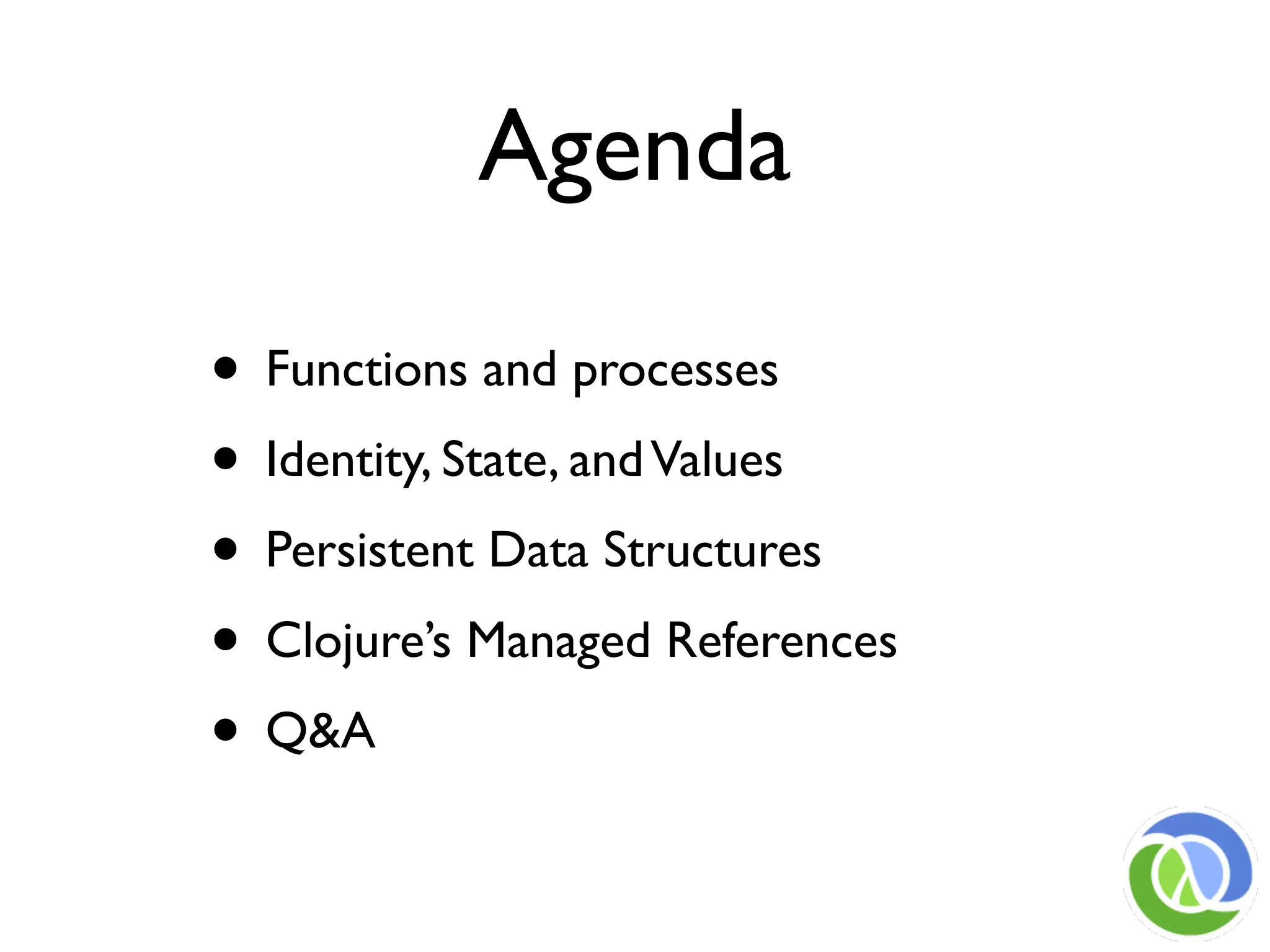
Agenda

• Functions and processes
• Identity, State, and Values
• Persistent Data Structures
• Clojure’s Managed References
• Q&A
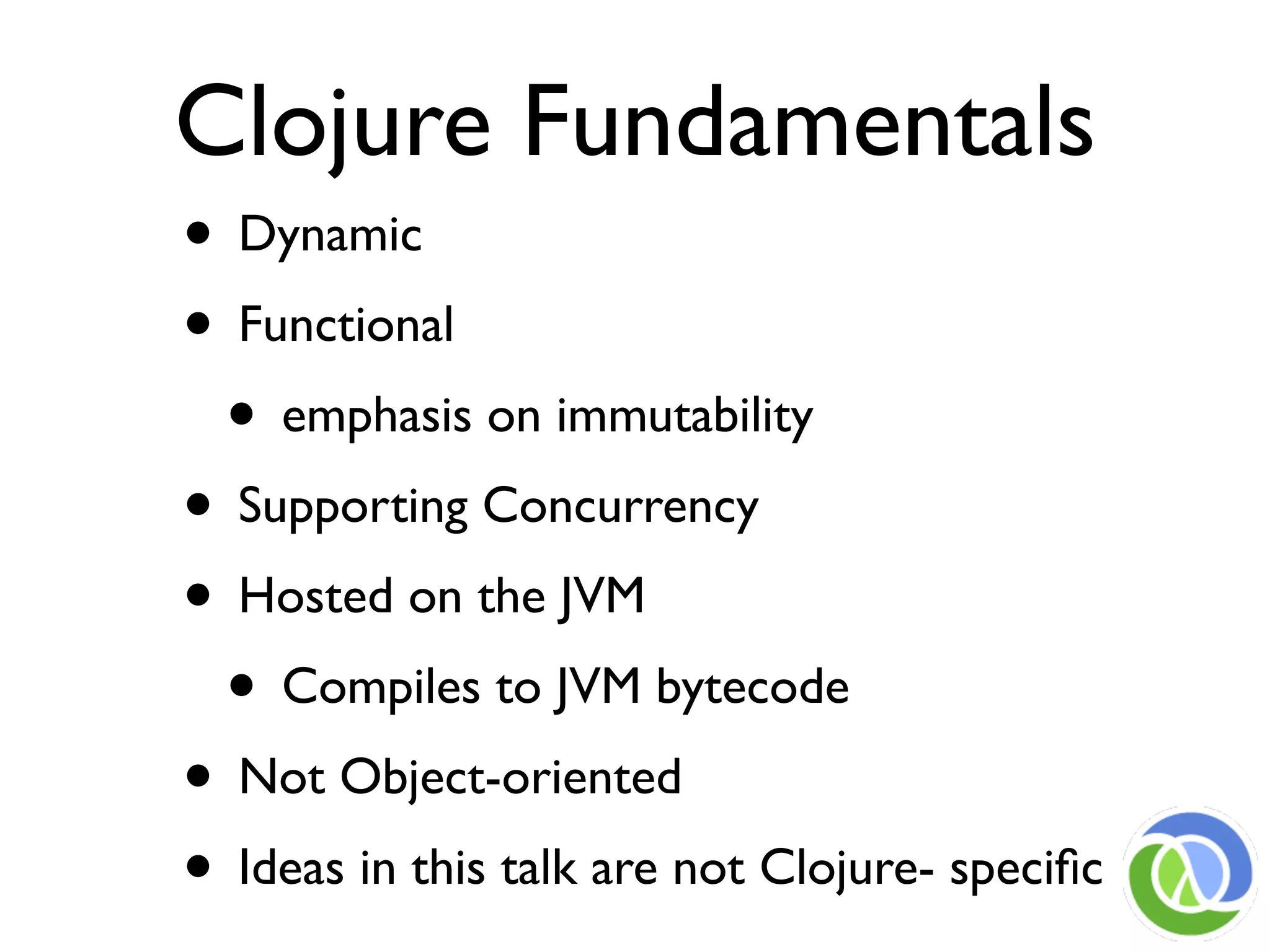
Clojure Fundamentals
• Dynamic
• Functional
 • emphasis on immutability
• Supporting Concurrency
• Hosted on the JVM
 • Compiles to JVM bytecode
• Not Object-oriented
• Ideas in this talk are not Clojure- specific
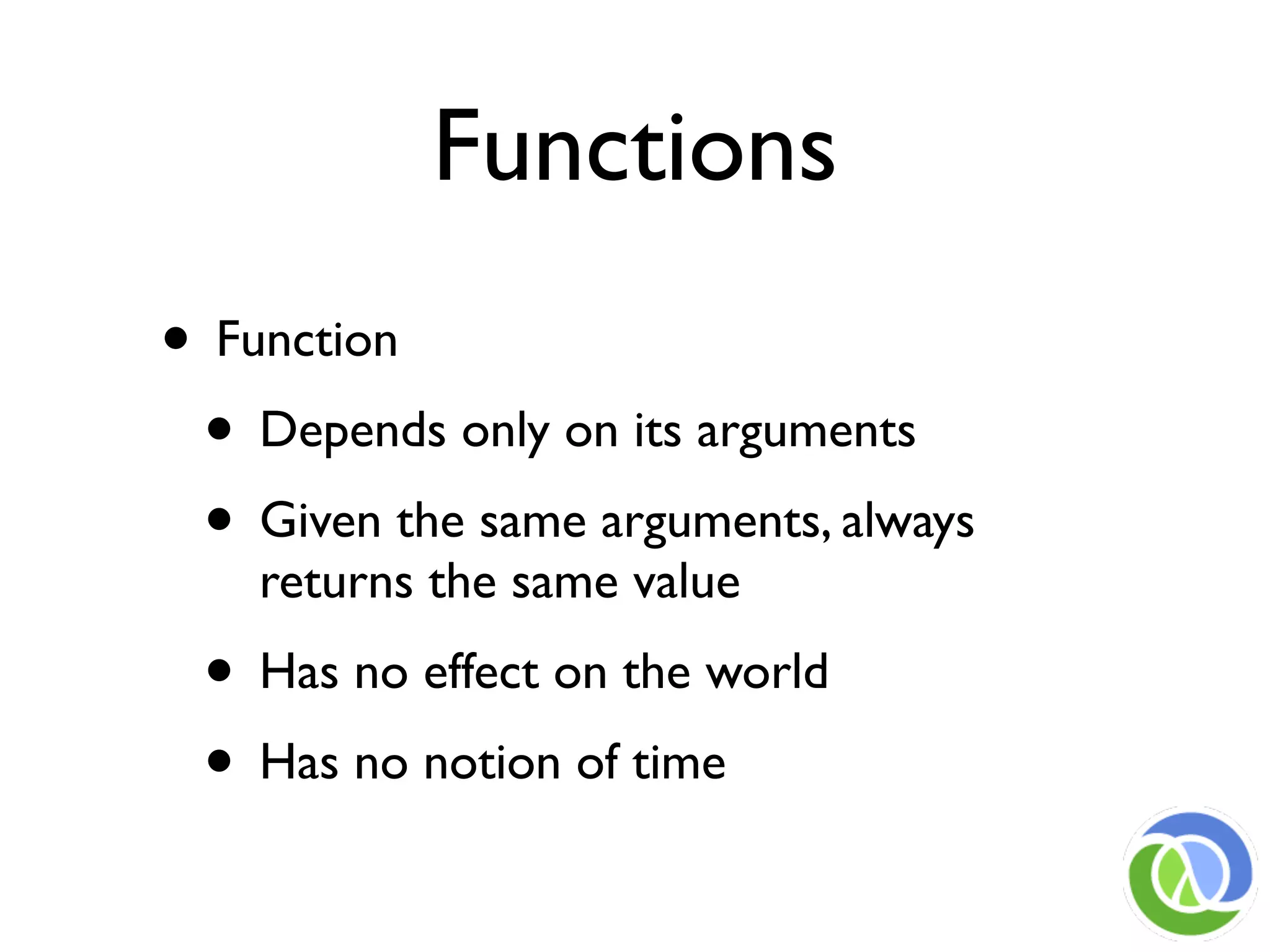
Functions
• Function
 • Depends only on its arguments
 • Given the same arguments, always
    returns the same value
 • Has no effect on the world
 • Has no notion of time
Functional Programming
• Emphasizes functions
 • Tremendous benefits
• But - most programs are not functions
 • Maybe compilers, theorem provers?
   • But - They execute on a machine
   • Observably consume compute resources
Processes
• Include some notion of change over time
• Might have effects on the world
• Might wait for external events
• Might produce different answers at different
  times (i.e. have state)
• Many real/interesting programs are processes
• This talk is about one way to deal with state
  and time in the local context
State
• Value of an identity at a time
• Sounds like a variable/field?
 • Name that takes on successive ‘values’
• Not quite:
 • i=0
 • i = 42
 • j=i
 • j is 42? - depends
Variables
• Variables (and fields) in traditional
  languages are predicated on a single thread
  of control, one timeline
• Adding concurrency breaks them badly
 • Non-atomicity (e.g. of longs)
 • volatile, write visibility
 • Composite operations require locks
 • All workarounds for lack of a time model
Time
• When things happen
 • Before/after
 • Later
 • At the same time (concurrency)
 • Now
• Inherently relative
Value
• An immutable magnitude, quantity,
  number... or composite thereof
• 42 - easy to understand as value
• But traditional OO tends to make us think
  of composites as something other than
  values
 • Big mistake
  • aDate.setMonth(“January”) - ugh!
 • Dates, collections etc are all values
Identity
• A logical entity we associate with a series
  of causally related values (states) over time
• Not a name, but can be named
 • I call my mom ‘Mom’, but you wouldn’t
• Can be composite - the NY Yankees
• Programs that are processes need identity
State
• Value of an identity at a time
• Why not use variables for state?
 • Variable might not refer to a proper
    value
 • Sets of variables/fields never constitute a
    proper composite value
 • No state transition management
  • I.e., no time coordination model
Philosophy
• Things don't change in place
• Becomes obvious once you incorporate
  time as a dimension
  • Place includes time
• The future is a function of the past, and
  doesn’t change it
• Co-located entities can observe each other
  without cooperation
• Coordination is desirable in local context
Race-walker foul
      detector
• Get left foot position
 • off the ground
• Get right foot position
 • off the ground
• Must be a foul, right?
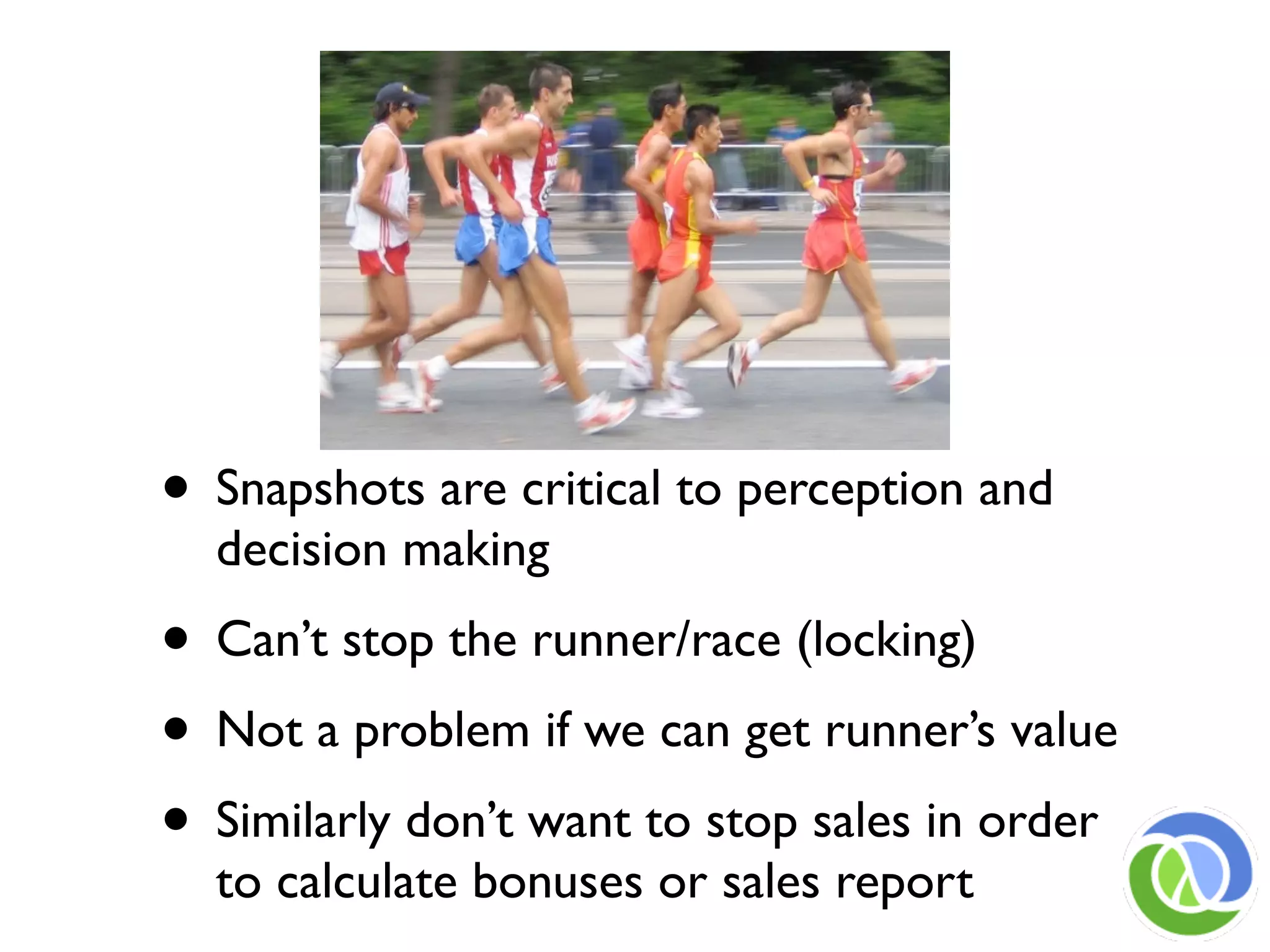
• Snapshots are critical to perception and
  decision making
• Can’t stop the runner/race (locking)
• Not a problem if we can get runner’s value
• Similarly don’t want to stop sales in order
  to calculate bonuses or sales report
Approach
• Programming with values is critical
• By eschewing morphing in place, we just
  need to manage the succession of values
  (states) of an identity
• A timeline coordination problem
 • Several semantics possible
• Managed references
 • Variable-like cells with coordination
    semantics
Persistent Data Structures
• Composite values - immutable
• ‘Change’ is merely a function, takes one value and
  returns another, ‘changed’ value
• Collection maintains its performance guarantees
  • Therefore new versions are not full copies
• Old version of the collection is still available after
  'changes', with same performance
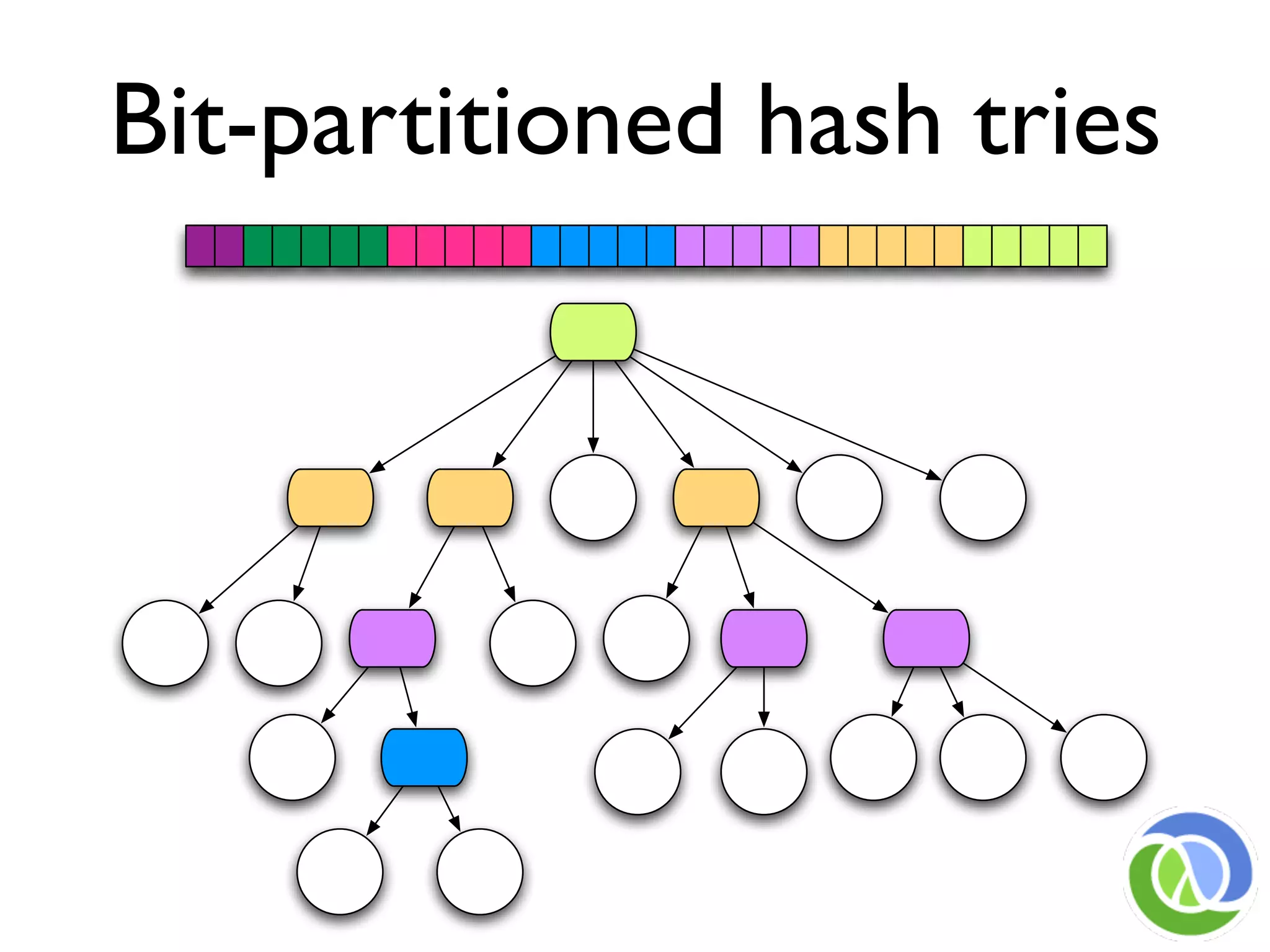
• Example - hash map/set and vector based upon
  array mapped hash tries (Bagwell)
Bit-partitioned hash tries
Structural Sharing
• Key to efficient ‘copies’ and therefore
  persistence
• Everything is immutable so no chance of
  interference
• Thread safe
• Iteration safe
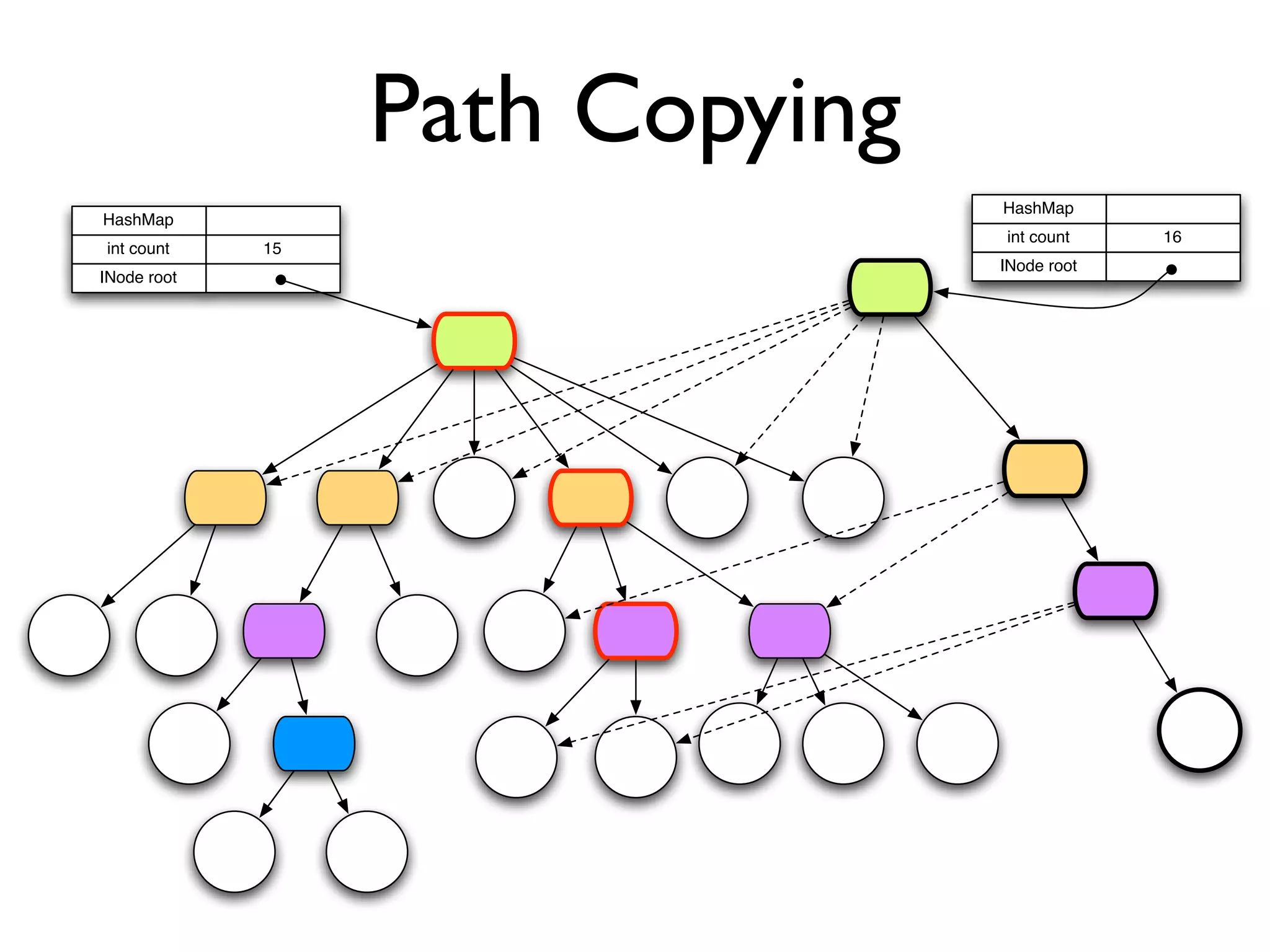
Path Copying
                                 HashMap
HashMap
                                 int count    16
int count    15
                                 INode root
INode root
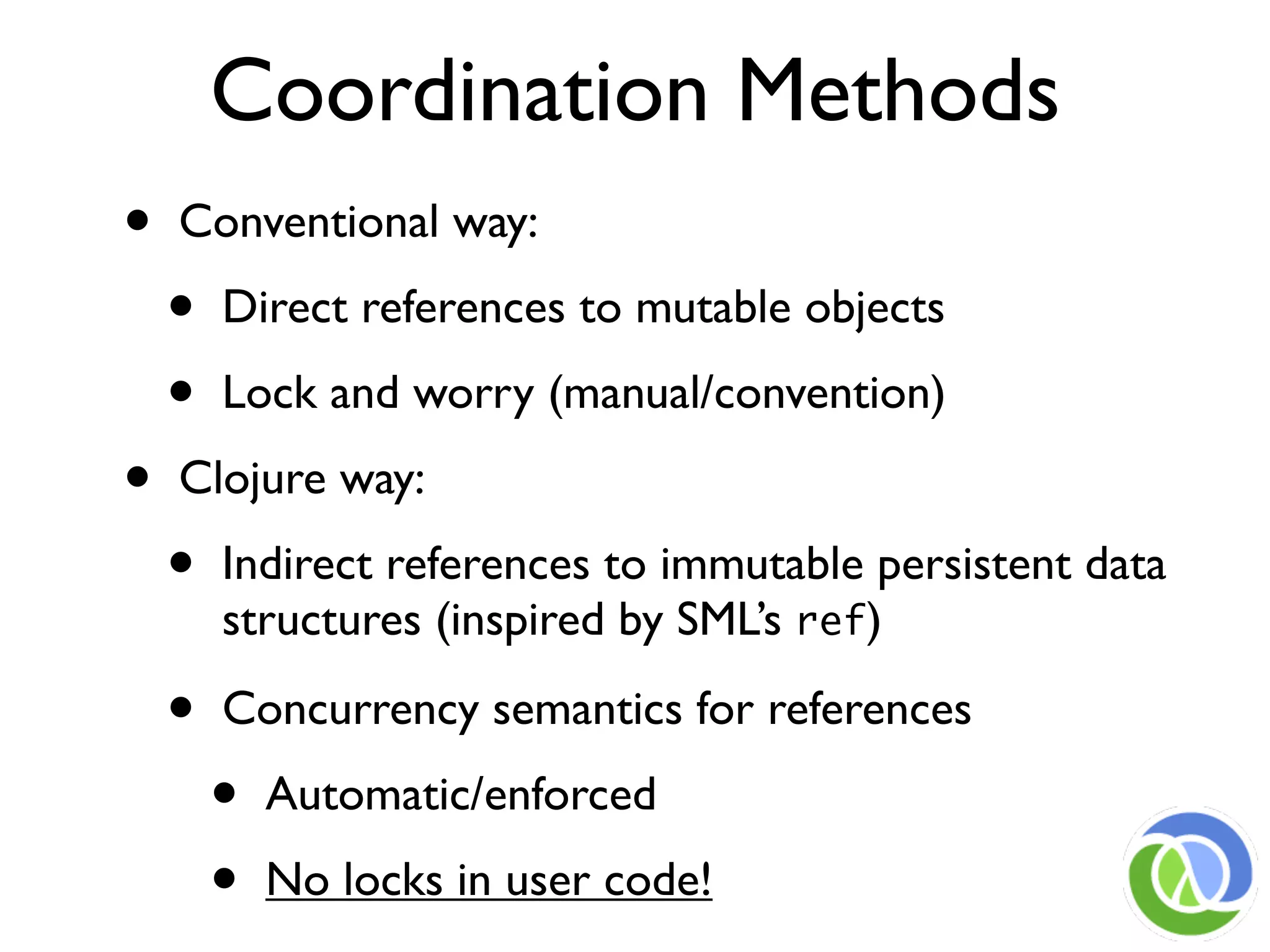
Coordination Methods
•   Conventional way:

    •   Direct references to mutable objects

    •   Lock and worry (manual/convention)

•   Clojure way:

    •   Indirect references to immutable persistent data
        structures (inspired by SML’s ref)

    •   Concurrency semantics for references

        •   Automatic/enforced

        •   No locks in user code!
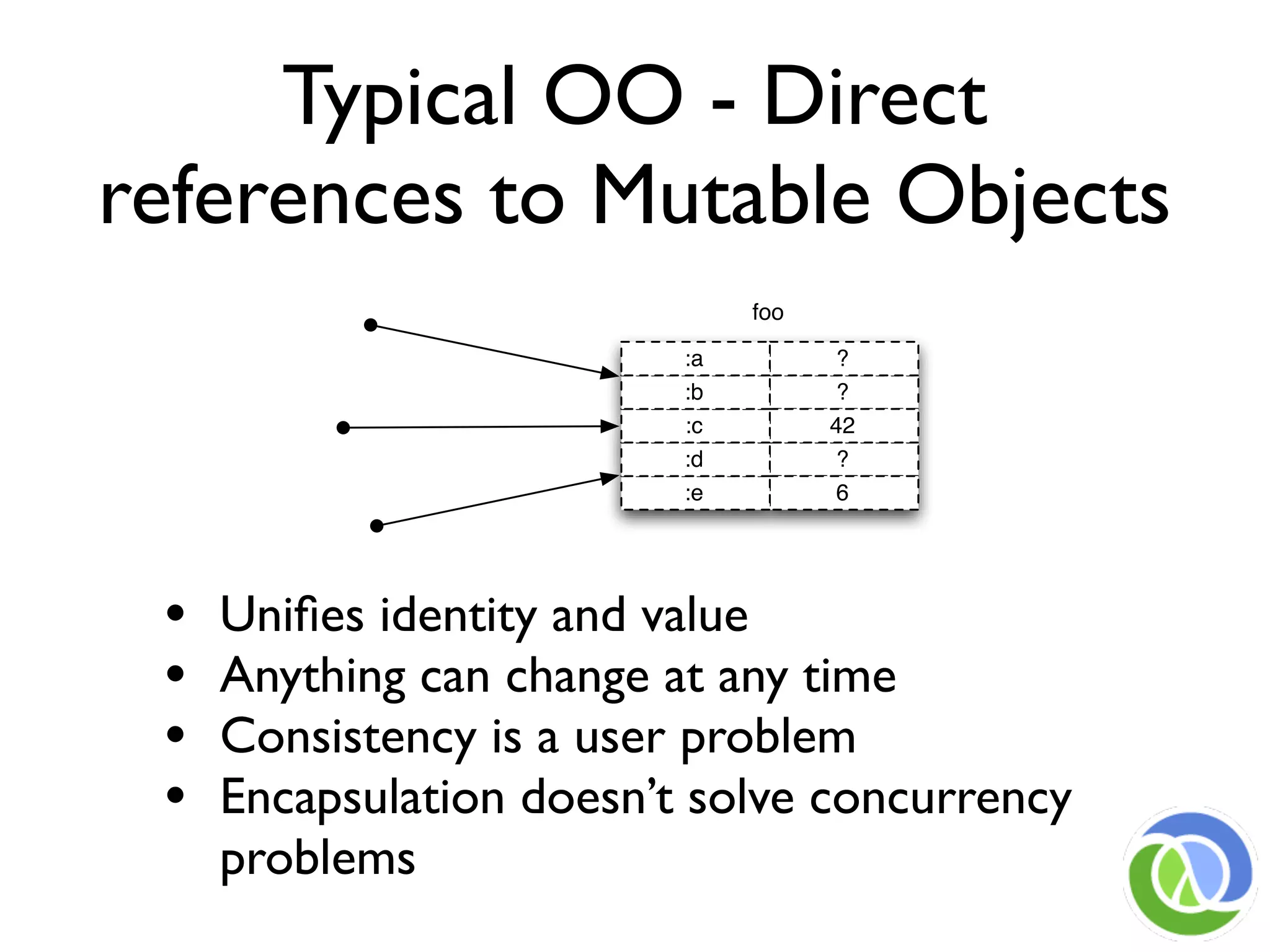
Typical OO - Direct
references to Mutable Objects
                               foo

                          :a          ?
                          :b          ?
                          :c         42
                          :d          ?
                          :e          6


 •   Unifies identity and value
 •   Anything can change at any time
 •   Consistency is a user problem
 •   Encapsulation doesn’t solve concurrency
     problems
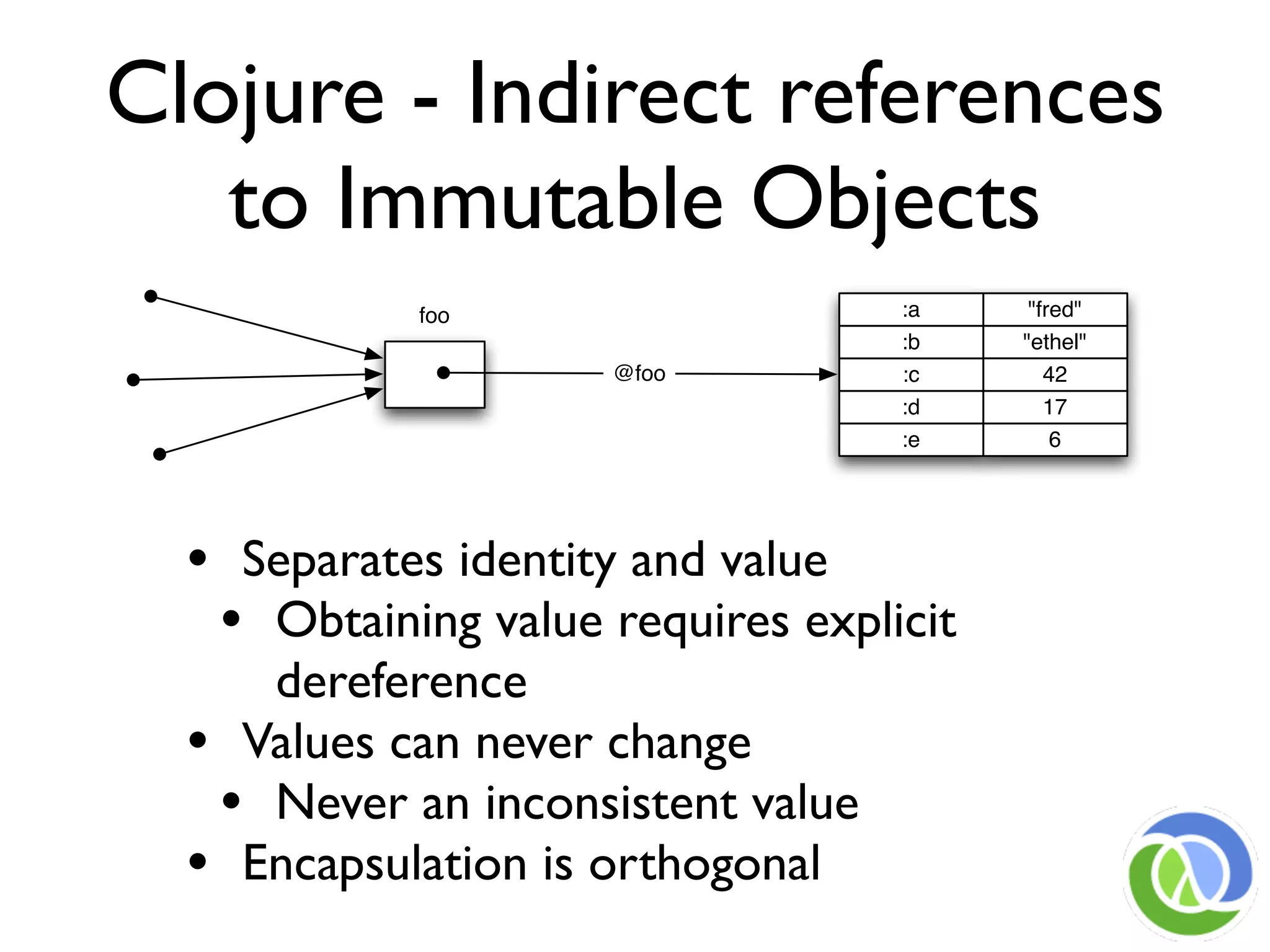
Clojure - Indirect references
   to Immutable Objects
            foo                    :a     "fred"
                                   :b    "ethel"
                     @foo          :c       42
                                   :d       17
                                   :e        6


  • Separates identity and value
   • Obtaining value requires explicit
     dereference
  • Values can never change
   • Never an inconsistent value
  • Encapsulation is orthogonal
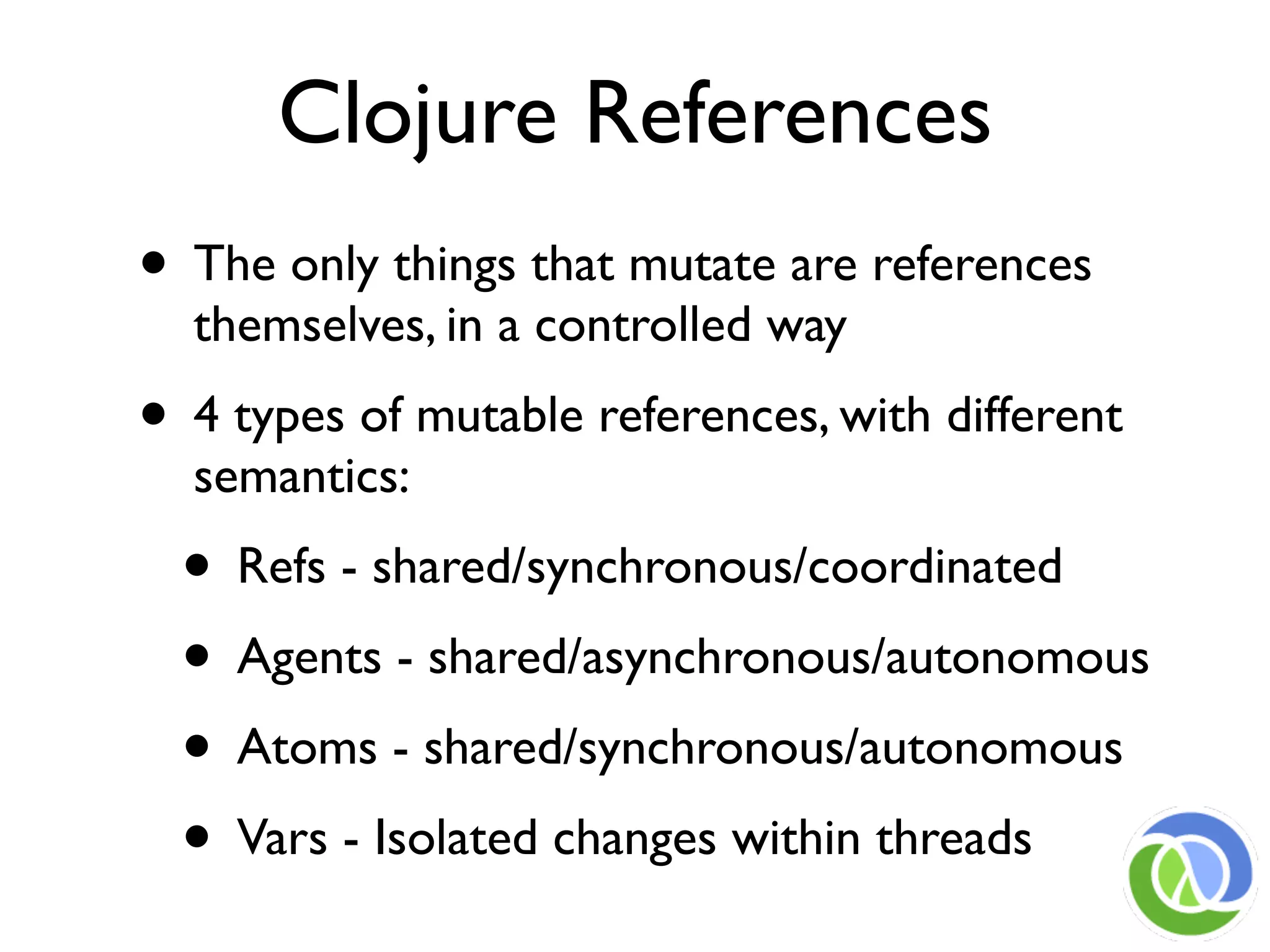
Clojure References
• The only things that mutate are references
  themselves, in a controlled way
• 4 types of mutable references, with different
  semantics:
  • Refs - shared/synchronous/coordinated
  • Agents - shared/asynchronous/autonomous
  • Atoms - shared/synchronous/autonomous
  • Vars - Isolated changes within threads
Uniform state transition
        model
 • (‘change-state’ reference function [args*])
 • function will be passed current state of the
   reference (plus any args)
 • Return value of function will be the next
   state of the reference
 • Snapshot of ‘current’ state always available
   with deref
 • No user locking, no deadlocks
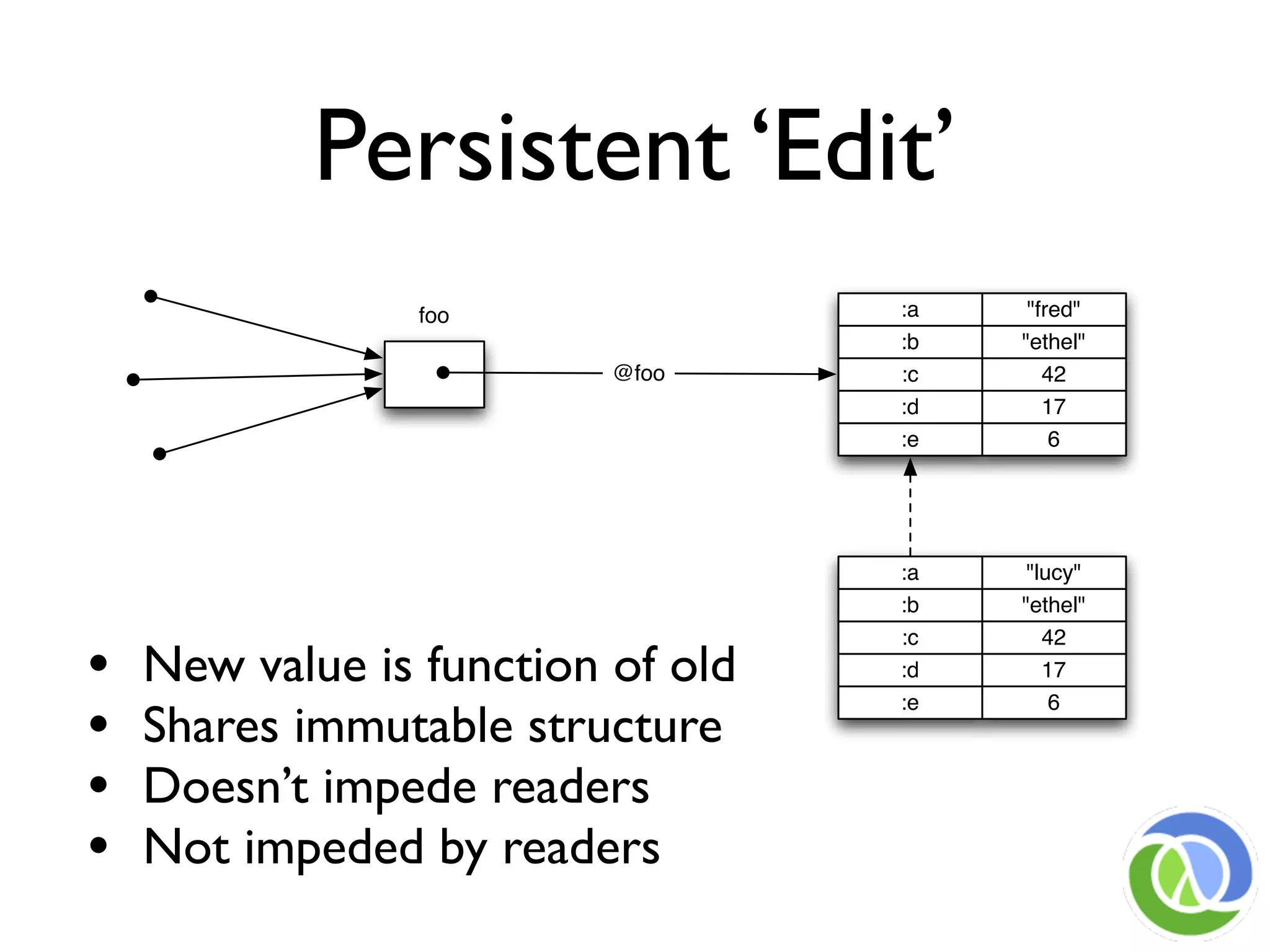
Persistent ‘Edit’
                 foo               :a    "fred"
                                   :b   "ethel"
                          @foo     :c      42
                                   :d      17
                                   :e       6


                                   :a    "lucy"
                                   :b   "ethel"


•
                                   :c      42
    New value is function of old   :d      17


•
                                   :e       6
    Shares immutable structure
•   Doesn’t impede readers
•   Not impeded by readers
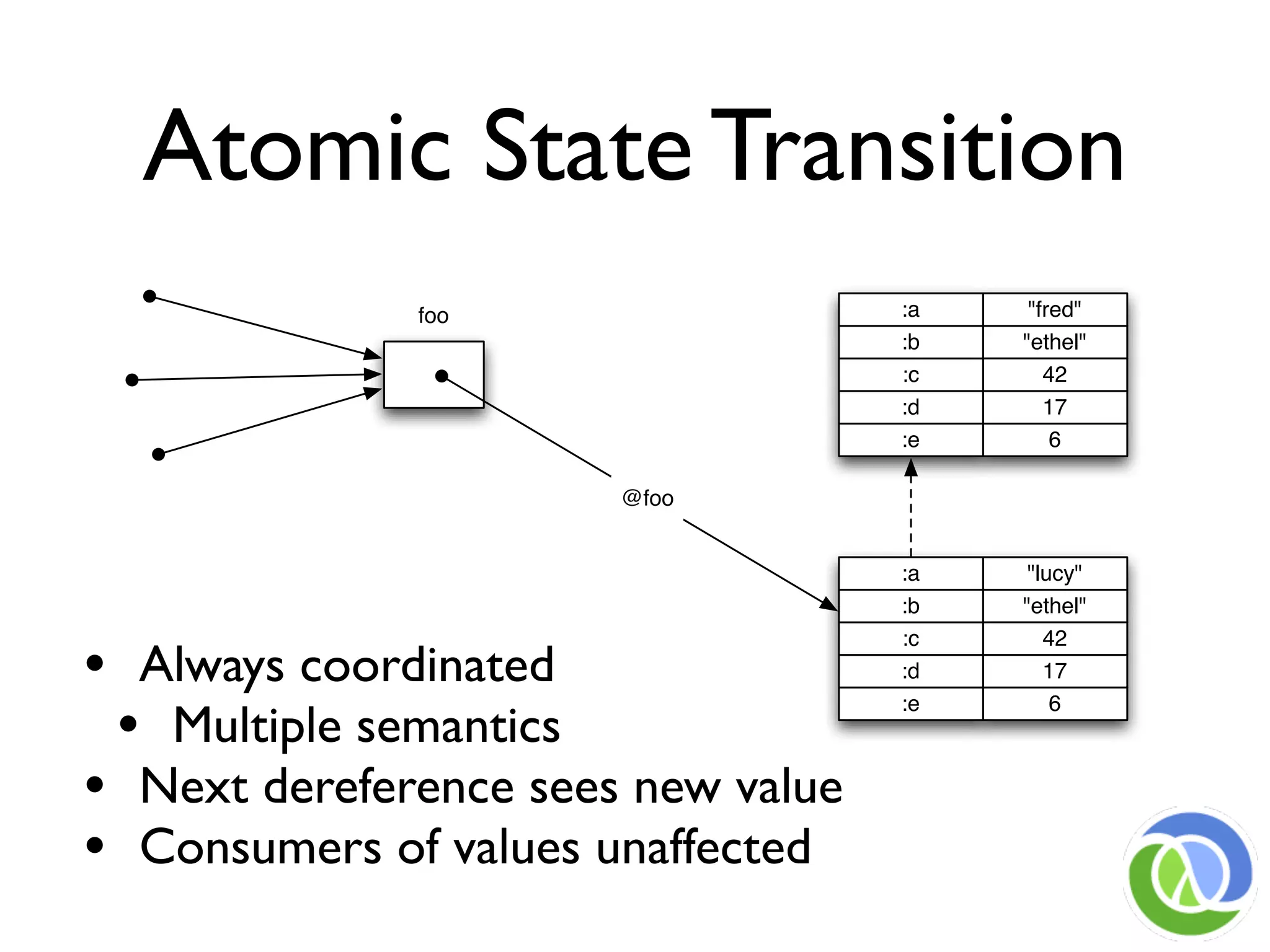
Atomic State Transition
              foo                   :a    "fred"
                                    :b   "ethel"
                                    :c      42
                                    :d      17
                                    :e       6

                       @foo


                                    :a    "lucy"
                                    :b   "ethel"


• Always coordinated
                                    :c      42
                                    :d      17


 • Multiple semantics
                                    :e       6


• Next dereference sees new value
• Consumers of values unaffected
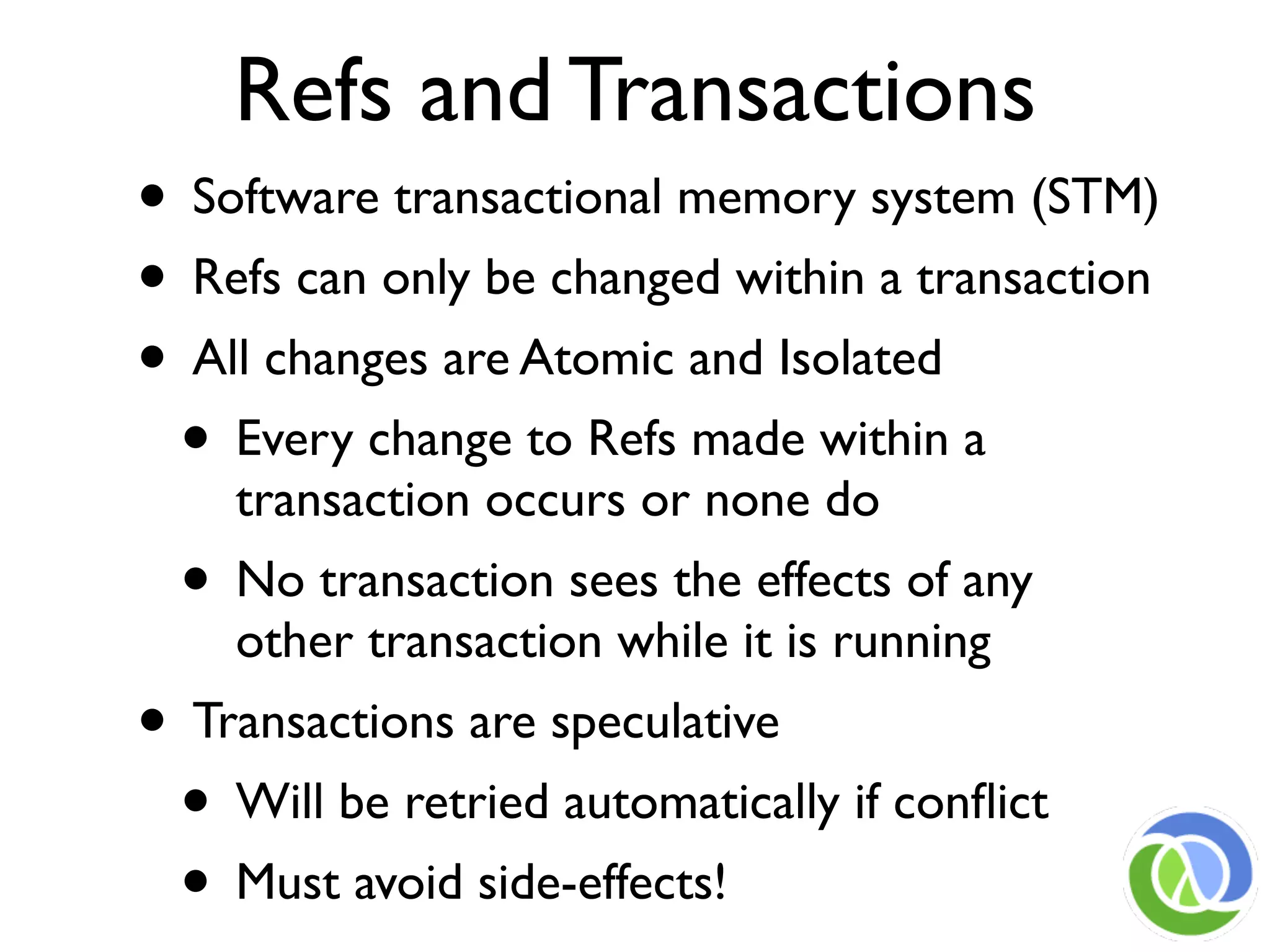
Refs and Transactions
• Software transactional memory system (STM)
• Refs can only be changed within a transaction
• All changes are Atomic and Isolated
 • Every change to Refs made within a
    transaction occurs or none do
  • No transaction sees the effects of any
    other transaction while it is running
• Transactions are speculative
 • Will be retried automatically if conflict
 • Must avoid side-effects!
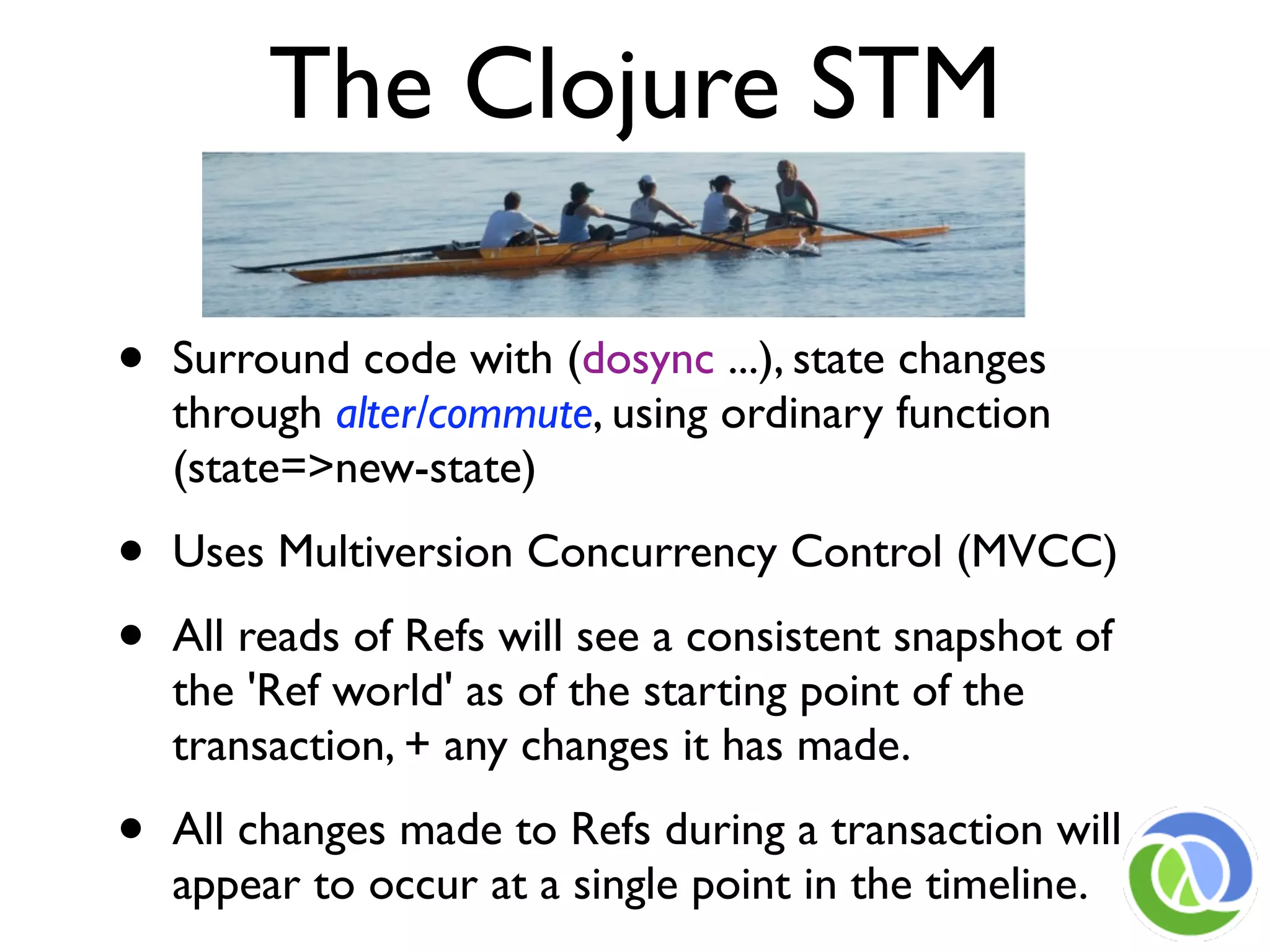
The Clojure STM

•   Surround code with (dosync ...), state changes
    through alter/commute, using ordinary function
    (state=>new-state)

•   Uses Multiversion Concurrency Control (MVCC)

•   All reads of Refs will see a consistent snapshot of
    the 'Ref world' as of the starting point of the
    transaction, + any changes it has made.

•   All changes made to Refs during a transaction will
    appear to occur at a single point in the timeline.
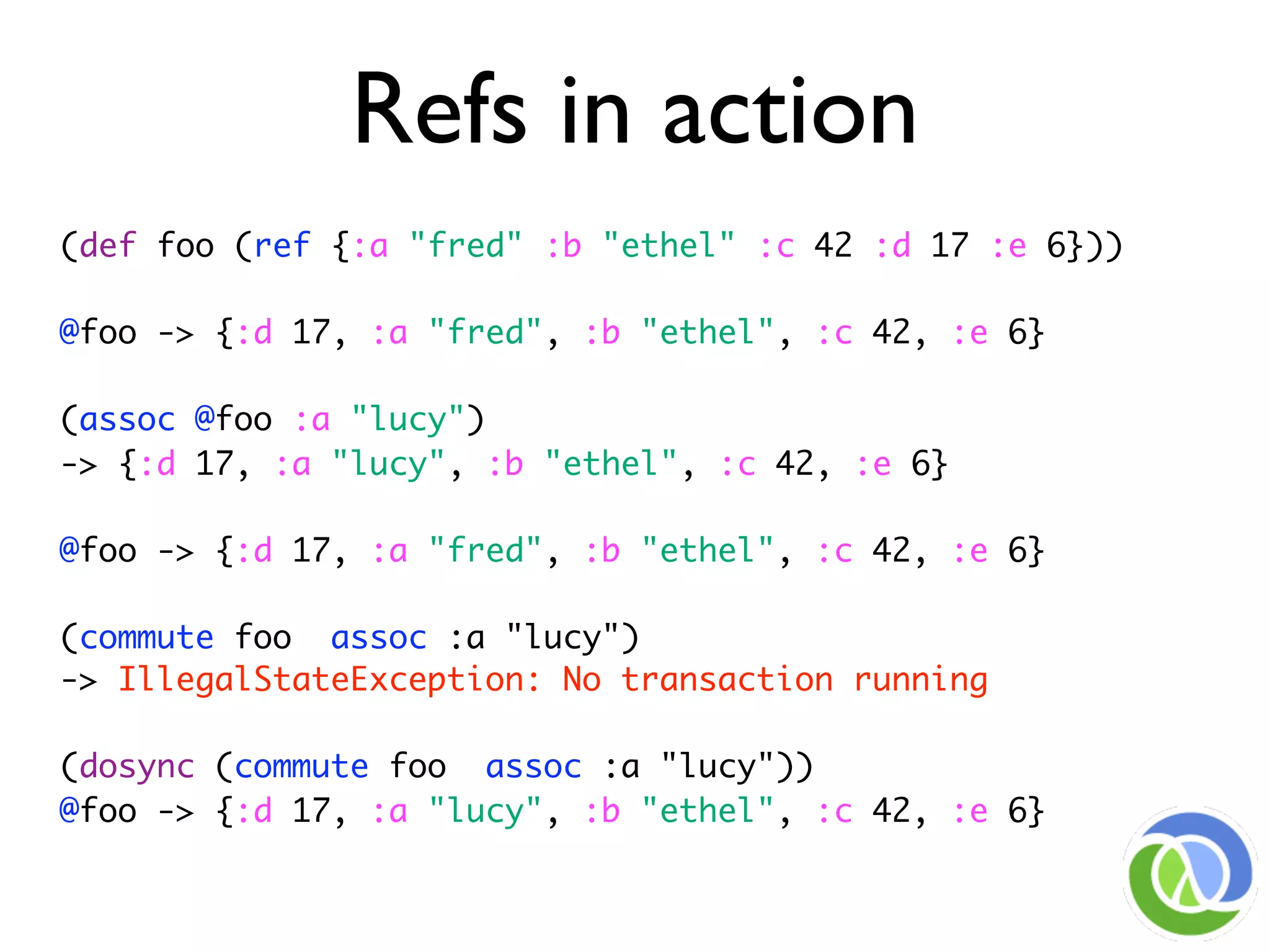
Refs in action
(def foo (ref {:a "fred" :b "ethel" :c 42 :d 17 :e 6}))

@foo -> {:d 17, :a "fred", :b "ethel", :c 42, :e 6}

(assoc @foo :a "lucy")
-> {:d 17, :a "lucy", :b "ethel", :c 42, :e 6}

@foo -> {:d 17, :a "fred", :b "ethel", :c 42, :e 6}

(commute foo assoc :a "lucy")
-> IllegalStateException: No transaction running

(dosync (commute foo assoc :a "lucy"))
@foo -> {:d 17, :a "lucy", :b "ethel", :c 42, :e 6}
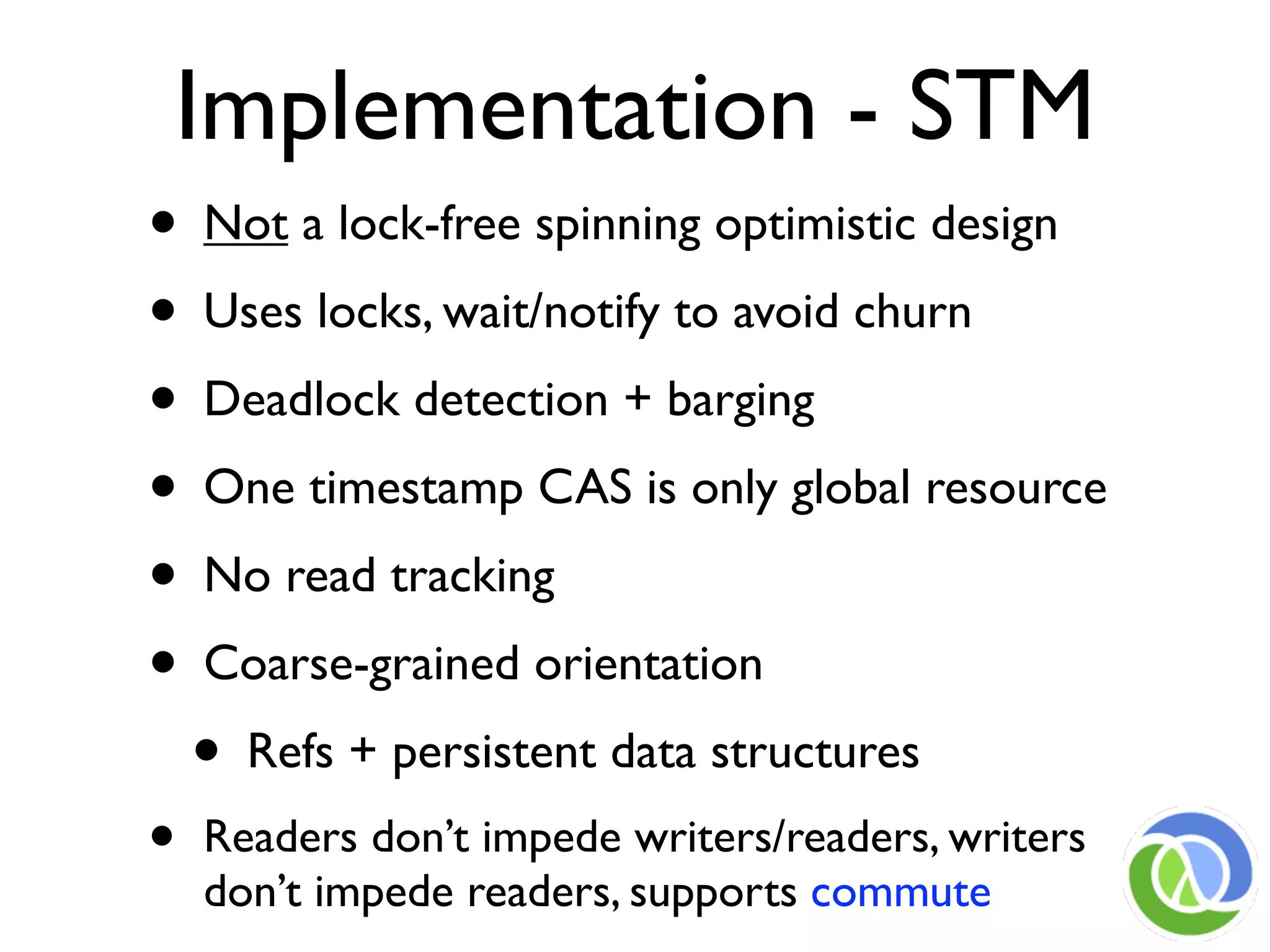
Implementation - STM
• Not a lock-free spinning optimistic design
• Uses locks, wait/notify to avoid churn
• Deadlock detection + barging
• One timestamp CAS is only global resource
• No read tracking
• Coarse-grained orientation
  • Refs + persistent data structures
•   Readers don’t impede writers/readers, writers
    don’t impede readers, supports commute
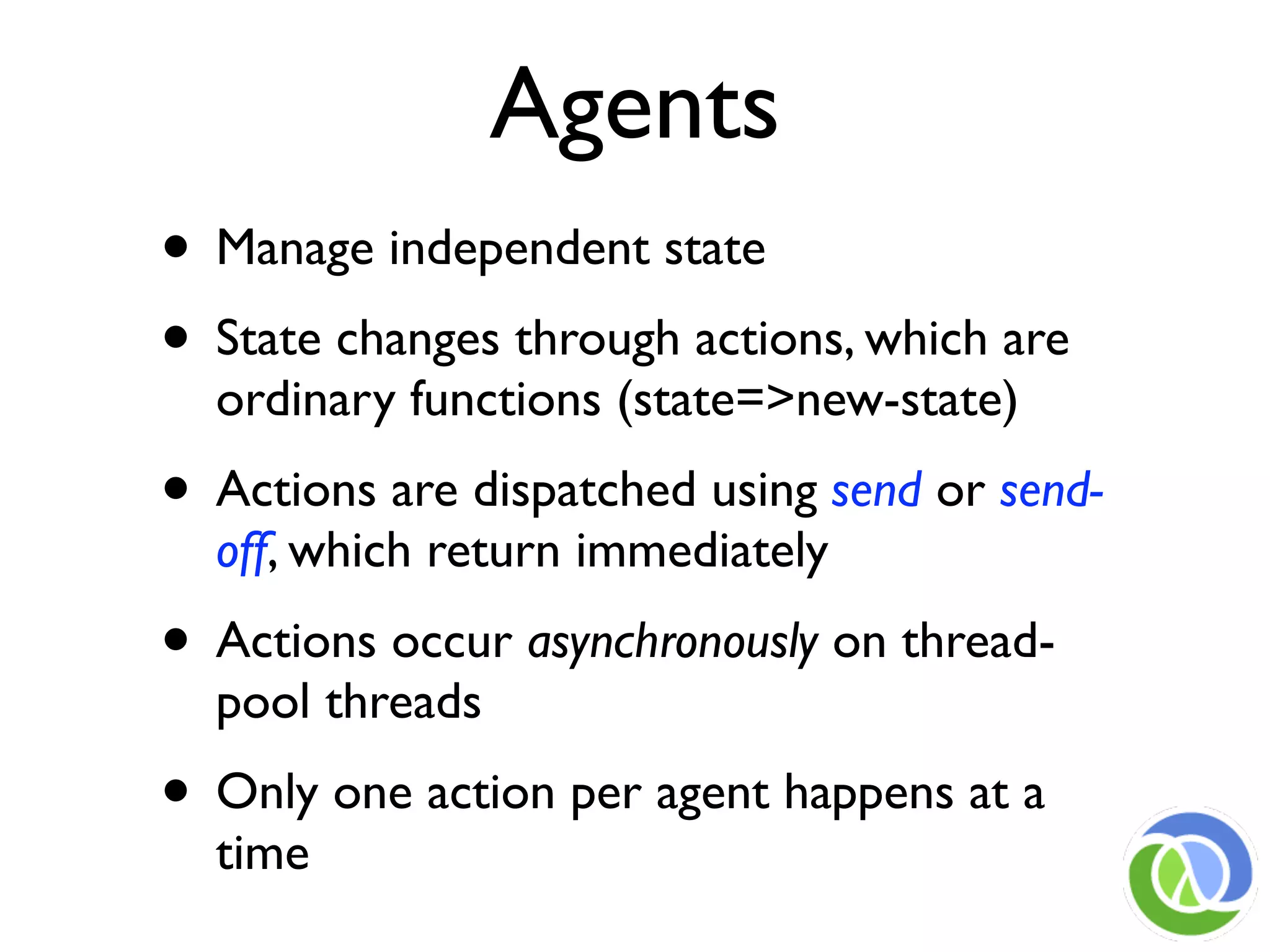
Agents
• Manage independent state
• State changes through actions, which are
  ordinary functions (state=>new-state)
• Actions are dispatched using send or send-
  off, which return immediately
• Actions occur asynchronously on thread-
  pool threads
• Only one action per agent happens at a
  time
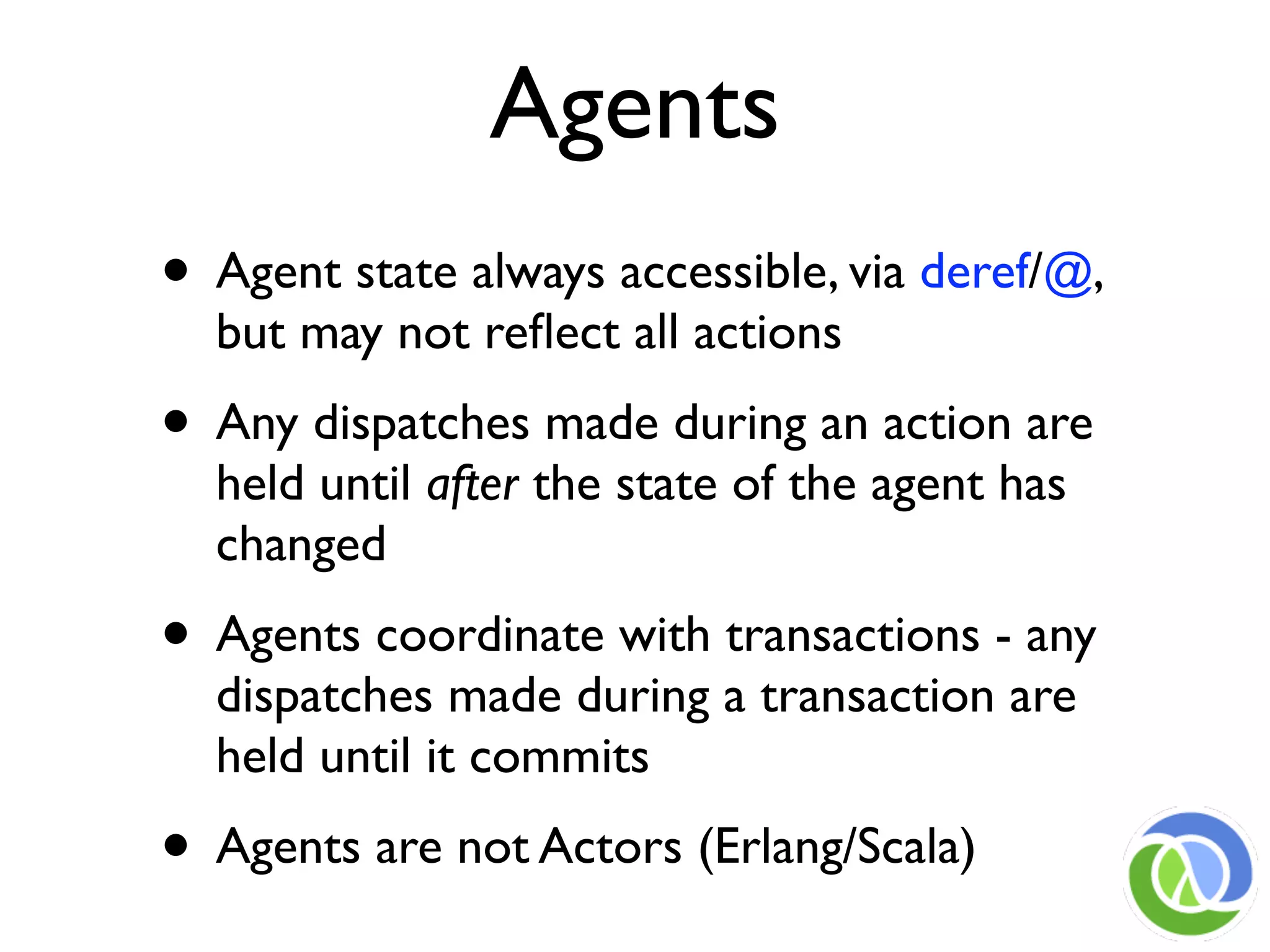
Agents
• Agent state always accessible, via deref/@,
  but may not reflect all actions
• Any dispatches made during an action are
  held until after the state of the agent has
  changed
• Agents coordinate with transactions - any
  dispatches made during a transaction are
  held until it commits
• Agents are not Actors (Erlang/Scala)
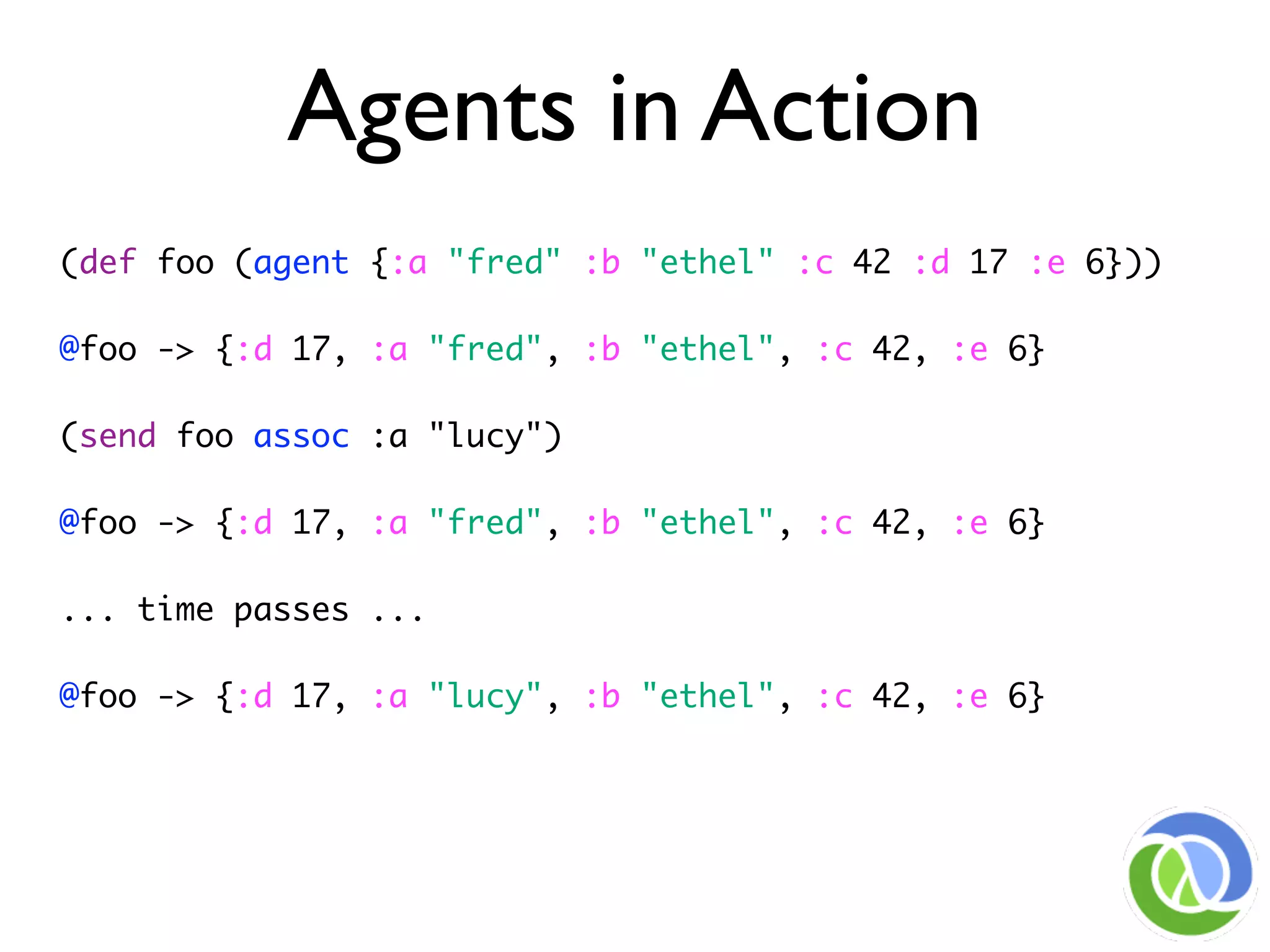
Agents in Action
(def foo (agent {:a "fred" :b "ethel" :c 42 :d 17 :e 6}))

@foo -> {:d 17, :a "fred", :b "ethel", :c 42, :e 6}

(send foo assoc :a "lucy")

@foo -> {:d 17, :a "fred", :b "ethel", :c 42, :e 6}

... time passes ...

@foo -> {:d 17, :a "lucy", :b "ethel", :c 42, :e 6}
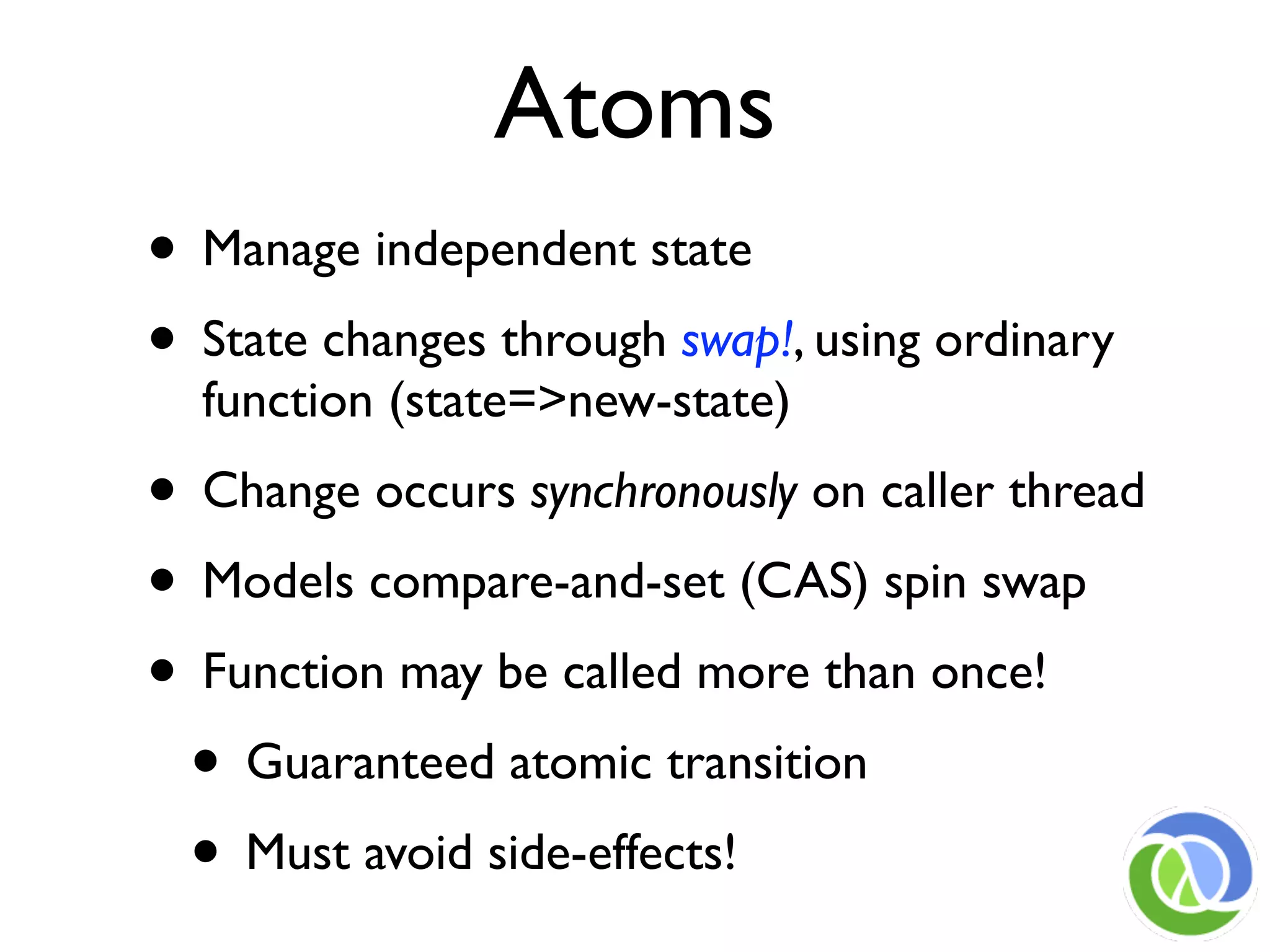
Atoms
• Manage independent state
• State changes through swap!, using ordinary
  function (state=>new-state)
• Change occurs synchronously on caller thread
• Models compare-and-set (CAS) spin swap
• Function may be called more than once!
 • Guaranteed atomic transition
 • Must avoid side-effects!
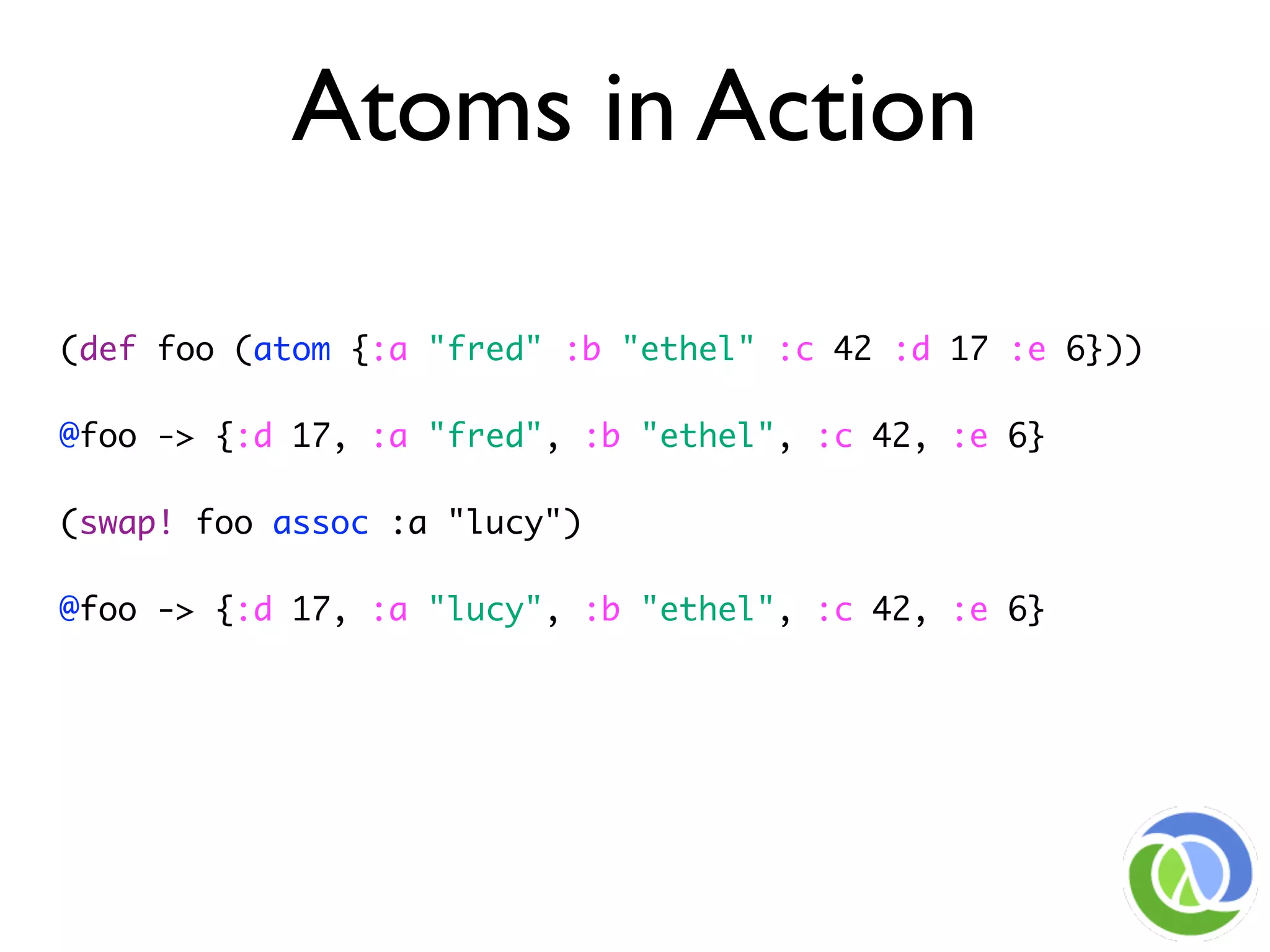
Atoms in Action

(def foo (atom {:a "fred" :b "ethel" :c 42 :d 17 :e 6}))

@foo -> {:d 17, :a "fred", :b "ethel", :c 42, :e 6}

(swap! foo assoc :a "lucy")

@foo -> {:d 17, :a "lucy", :b "ethel", :c 42, :e 6}
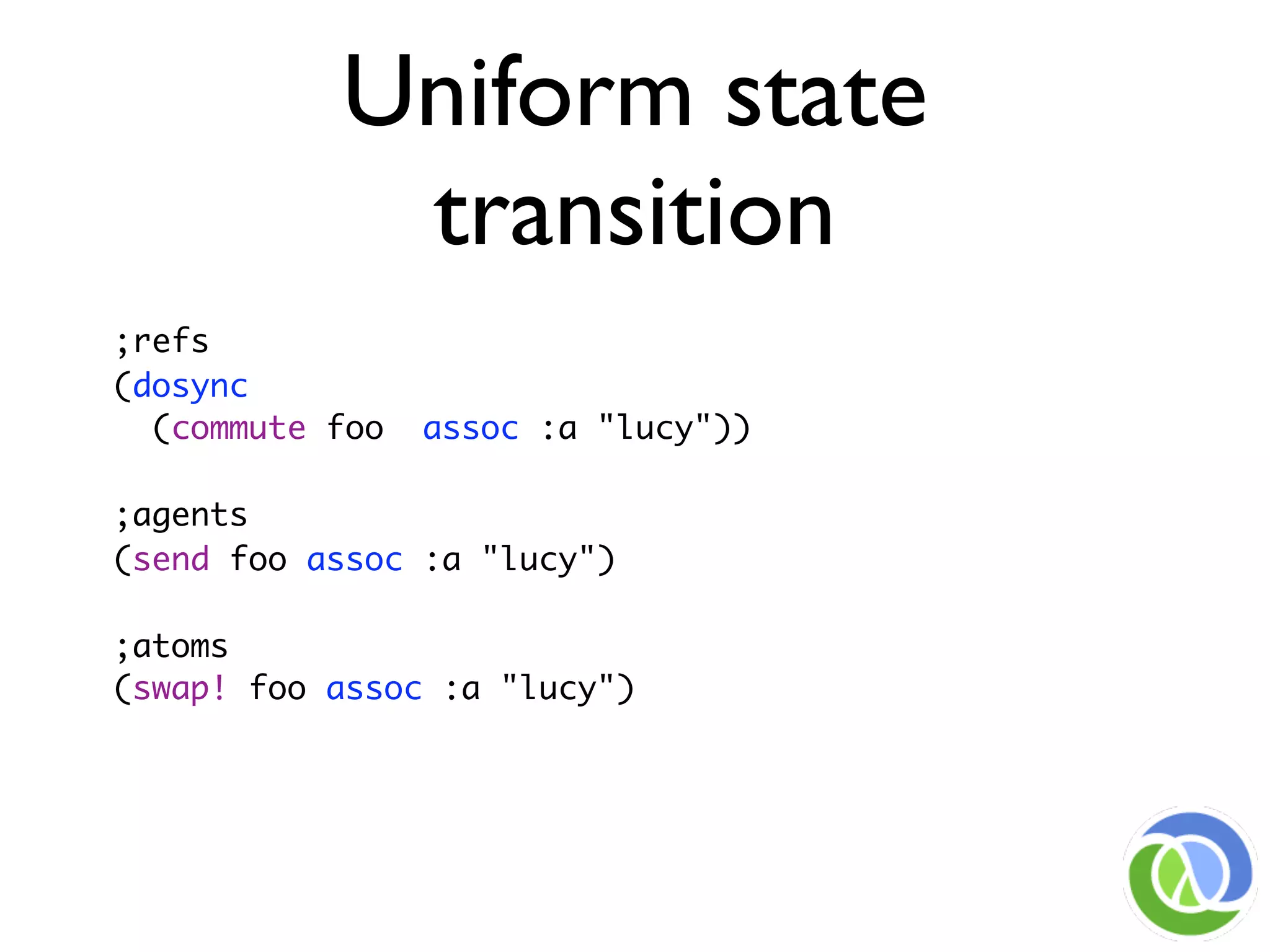
Uniform state
            transition
;refs
(dosync
  (commute foo   assoc :a "lucy"))

;agents
(send foo assoc :a "lucy")

;atoms
(swap! foo assoc :a "lucy")
Summary
• Immutable values, a feature of the functional
  parts of our programs, are a critical
  component of the parts that deal with time
• Persistent data structures provide efficient
  immutable composite values
• Once you accept immutability, you can
  separate time management, and swap in
  various concurrency semantics
• Managed references provide easy to use and
  understand time coordination
Thanks for listening!


      http://clojure.org

       Questions?

Persistent Data Structures And Managed References

  • 1.
    Persistent Data Structures and Managed References Clojure’s approach to Identity and State Rich Hickey
  • 2.
    Agenda • Functions andprocesses • Identity, State, and Values • Persistent Data Structures • Clojure’s Managed References • Q&A
  • 3.
    Clojure Fundamentals • Dynamic •Functional • emphasis on immutability • Supporting Concurrency • Hosted on the JVM • Compiles to JVM bytecode • Not Object-oriented • Ideas in this talk are not Clojure- specific
  • 4.
    Functions • Function •Depends only on its arguments • Given the same arguments, always returns the same value • Has no effect on the world • Has no notion of time
  • 5.
    Functional Programming • Emphasizesfunctions • Tremendous benefits • But - most programs are not functions • Maybe compilers, theorem provers? • But - They execute on a machine • Observably consume compute resources
  • 6.
    Processes • Include somenotion of change over time • Might have effects on the world • Might wait for external events • Might produce different answers at different times (i.e. have state) • Many real/interesting programs are processes • This talk is about one way to deal with state and time in the local context
  • 7.
    State • Value ofan identity at a time • Sounds like a variable/field? • Name that takes on successive ‘values’ • Not quite: • i=0 • i = 42 • j=i • j is 42? - depends
  • 8.
    Variables • Variables (andfields) in traditional languages are predicated on a single thread of control, one timeline • Adding concurrency breaks them badly • Non-atomicity (e.g. of longs) • volatile, write visibility • Composite operations require locks • All workarounds for lack of a time model
  • 9.
    Time • When thingshappen • Before/after • Later • At the same time (concurrency) • Now • Inherently relative
  • 10.
    Value • An immutablemagnitude, quantity, number... or composite thereof • 42 - easy to understand as value • But traditional OO tends to make us think of composites as something other than values • Big mistake • aDate.setMonth(“January”) - ugh! • Dates, collections etc are all values
  • 11.
    Identity • A logicalentity we associate with a series of causally related values (states) over time • Not a name, but can be named • I call my mom ‘Mom’, but you wouldn’t • Can be composite - the NY Yankees • Programs that are processes need identity
  • 12.
    State • Value ofan identity at a time • Why not use variables for state? • Variable might not refer to a proper value • Sets of variables/fields never constitute a proper composite value • No state transition management • I.e., no time coordination model
  • 13.
    Philosophy • Things don'tchange in place • Becomes obvious once you incorporate time as a dimension • Place includes time • The future is a function of the past, and doesn’t change it • Co-located entities can observe each other without cooperation • Coordination is desirable in local context
  • 14.
    Race-walker foul detector • Get left foot position • off the ground • Get right foot position • off the ground • Must be a foul, right?
  • 15.
    • Snapshots arecritical to perception and decision making • Can’t stop the runner/race (locking) • Not a problem if we can get runner’s value • Similarly don’t want to stop sales in order to calculate bonuses or sales report
  • 16.
    Approach • Programming withvalues is critical • By eschewing morphing in place, we just need to manage the succession of values (states) of an identity • A timeline coordination problem • Several semantics possible • Managed references • Variable-like cells with coordination semantics
  • 17.
    Persistent Data Structures •Composite values - immutable • ‘Change’ is merely a function, takes one value and returns another, ‘changed’ value • Collection maintains its performance guarantees • Therefore new versions are not full copies • Old version of the collection is still available after 'changes', with same performance • Example - hash map/set and vector based upon array mapped hash tries (Bagwell)
  • 18.
  • 19.
    Structural Sharing • Keyto efficient ‘copies’ and therefore persistence • Everything is immutable so no chance of interference • Thread safe • Iteration safe
  • 20.
    Path Copying HashMap HashMap int count 16 int count 15 INode root INode root
  • 21.
    Coordination Methods • Conventional way: • Direct references to mutable objects • Lock and worry (manual/convention) • Clojure way: • Indirect references to immutable persistent data structures (inspired by SML’s ref) • Concurrency semantics for references • Automatic/enforced • No locks in user code!
  • 22.
    Typical OO -Direct references to Mutable Objects foo :a ? :b ? :c 42 :d ? :e 6 • Unifies identity and value • Anything can change at any time • Consistency is a user problem • Encapsulation doesn’t solve concurrency problems
  • 23.
    Clojure - Indirectreferences to Immutable Objects foo :a "fred" :b "ethel" @foo :c 42 :d 17 :e 6 • Separates identity and value • Obtaining value requires explicit dereference • Values can never change • Never an inconsistent value • Encapsulation is orthogonal
  • 24.
    Clojure References • Theonly things that mutate are references themselves, in a controlled way • 4 types of mutable references, with different semantics: • Refs - shared/synchronous/coordinated • Agents - shared/asynchronous/autonomous • Atoms - shared/synchronous/autonomous • Vars - Isolated changes within threads
  • 25.
    Uniform state transition model • (‘change-state’ reference function [args*]) • function will be passed current state of the reference (plus any args) • Return value of function will be the next state of the reference • Snapshot of ‘current’ state always available with deref • No user locking, no deadlocks
  • 26.
    Persistent ‘Edit’ foo :a "fred" :b "ethel" @foo :c 42 :d 17 :e 6 :a "lucy" :b "ethel" • :c 42 New value is function of old :d 17 • :e 6 Shares immutable structure • Doesn’t impede readers • Not impeded by readers
  • 27.
    Atomic State Transition foo :a "fred" :b "ethel" :c 42 :d 17 :e 6 @foo :a "lucy" :b "ethel" • Always coordinated :c 42 :d 17 • Multiple semantics :e 6 • Next dereference sees new value • Consumers of values unaffected
  • 28.
    Refs and Transactions •Software transactional memory system (STM) • Refs can only be changed within a transaction • All changes are Atomic and Isolated • Every change to Refs made within a transaction occurs or none do • No transaction sees the effects of any other transaction while it is running • Transactions are speculative • Will be retried automatically if conflict • Must avoid side-effects!
  • 29.
    The Clojure STM • Surround code with (dosync ...), state changes through alter/commute, using ordinary function (state=>new-state) • Uses Multiversion Concurrency Control (MVCC) • All reads of Refs will see a consistent snapshot of the 'Ref world' as of the starting point of the transaction, + any changes it has made. • All changes made to Refs during a transaction will appear to occur at a single point in the timeline.
  • 30.
    Refs in action (deffoo (ref {:a "fred" :b "ethel" :c 42 :d 17 :e 6})) @foo -> {:d 17, :a "fred", :b "ethel", :c 42, :e 6} (assoc @foo :a "lucy") -> {:d 17, :a "lucy", :b "ethel", :c 42, :e 6} @foo -> {:d 17, :a "fred", :b "ethel", :c 42, :e 6} (commute foo assoc :a "lucy") -> IllegalStateException: No transaction running (dosync (commute foo assoc :a "lucy")) @foo -> {:d 17, :a "lucy", :b "ethel", :c 42, :e 6}
  • 31.
    Implementation - STM •Not a lock-free spinning optimistic design • Uses locks, wait/notify to avoid churn • Deadlock detection + barging • One timestamp CAS is only global resource • No read tracking • Coarse-grained orientation • Refs + persistent data structures • Readers don’t impede writers/readers, writers don’t impede readers, supports commute
  • 32.
    Agents • Manage independentstate • State changes through actions, which are ordinary functions (state=>new-state) • Actions are dispatched using send or send- off, which return immediately • Actions occur asynchronously on thread- pool threads • Only one action per agent happens at a time
  • 33.
    Agents • Agent statealways accessible, via deref/@, but may not reflect all actions • Any dispatches made during an action are held until after the state of the agent has changed • Agents coordinate with transactions - any dispatches made during a transaction are held until it commits • Agents are not Actors (Erlang/Scala)
  • 34.
    Agents in Action (deffoo (agent {:a "fred" :b "ethel" :c 42 :d 17 :e 6})) @foo -> {:d 17, :a "fred", :b "ethel", :c 42, :e 6} (send foo assoc :a "lucy") @foo -> {:d 17, :a "fred", :b "ethel", :c 42, :e 6} ... time passes ... @foo -> {:d 17, :a "lucy", :b "ethel", :c 42, :e 6}
  • 35.
    Atoms • Manage independentstate • State changes through swap!, using ordinary function (state=>new-state) • Change occurs synchronously on caller thread • Models compare-and-set (CAS) spin swap • Function may be called more than once! • Guaranteed atomic transition • Must avoid side-effects!
  • 36.
    Atoms in Action (deffoo (atom {:a "fred" :b "ethel" :c 42 :d 17 :e 6})) @foo -> {:d 17, :a "fred", :b "ethel", :c 42, :e 6} (swap! foo assoc :a "lucy") @foo -> {:d 17, :a "lucy", :b "ethel", :c 42, :e 6}
  • 37.
    Uniform state transition ;refs (dosync (commute foo assoc :a "lucy")) ;agents (send foo assoc :a "lucy") ;atoms (swap! foo assoc :a "lucy")
  • 38.
    Summary • Immutable values,a feature of the functional parts of our programs, are a critical component of the parts that deal with time • Persistent data structures provide efficient immutable composite values • Once you accept immutability, you can separate time management, and swap in various concurrency semantics • Managed references provide easy to use and understand time coordination
  • 39.
    Thanks for listening! http://clojure.org Questions?