1
Permutations and
Combinations
CS/APMA 202
Epp section 6.4
Aaron Bloomfield
2
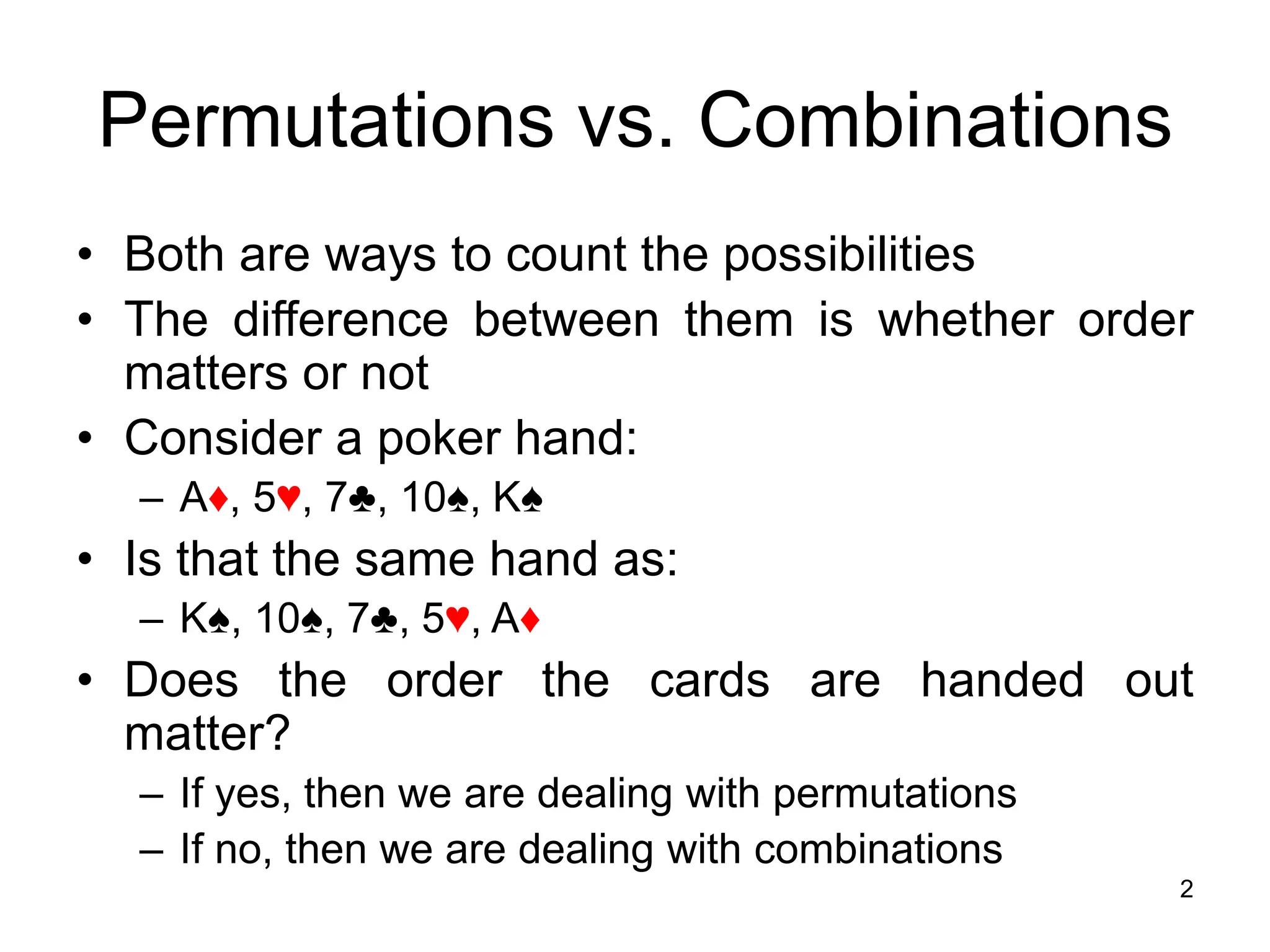
Permutations vs. Combinations
• Both are ways to count the possibilities
• The difference between them is whether order
matters or not
• Consider a poker hand:
– A♦, 5♥, 7♣, 10♠, K♠
• Is that the same hand as:
– K♠, 10♠, 7♣, 5♥, A♦
• Does the order the cards are handed out
matter?
– If yes, then we are dealing with permutations
– If no, then we are dealing with combinations
3
Permutations
• A permutation is an ordered arrangement of the
elements of some set S
– Let S = {a, b, c}
– c, b, a is a permutation of S
– b, c, a is a different permutation of S
• An r-permutation is an ordered arrangement of r
elements of the set
– A♦, 5♥, 7♣, 10♠, K♠ is a 5-permutation of the set of
cards
• The notation for the number of r-permutations:
P(n,r)
– The poker hand is one of P(52,5) permutations
4
Permutations
• Number of poker hands (5 cards):
– P(52,5) = 52*51*50*49*48 = 311,875,200
• Number of (initial) blackjack hands (2 cards):
– P(52,2) = 52*51 = 2,652
• r-permutation notation: P(n,r)
– The poker hand is one of P(52,5) permutations
)
1
)...(
2
)(
1
(
)
,
( 



 r
n
n
n
n
r
n
P
)!
(
!
r
n
n






n
r
n
i
i
1
5
r-permutations example
• How many ways are there for 5 people in
this class to give presentations?
• There are 27 students in the class
– P(27,5) = 27*26*25*24*23 = 9,687,600
– Note that the order they go in does matter in
this example!
6
Permutation formula proof
• There are n ways to choose the first
element
– n-1 ways to choose the second
– n-2 ways to choose the third
– …
– n-r+1 ways to choose the rth element
• By the product rule, that gives us:
P(n,r) = n(n-1)(n-2)…(n-r+1)
7
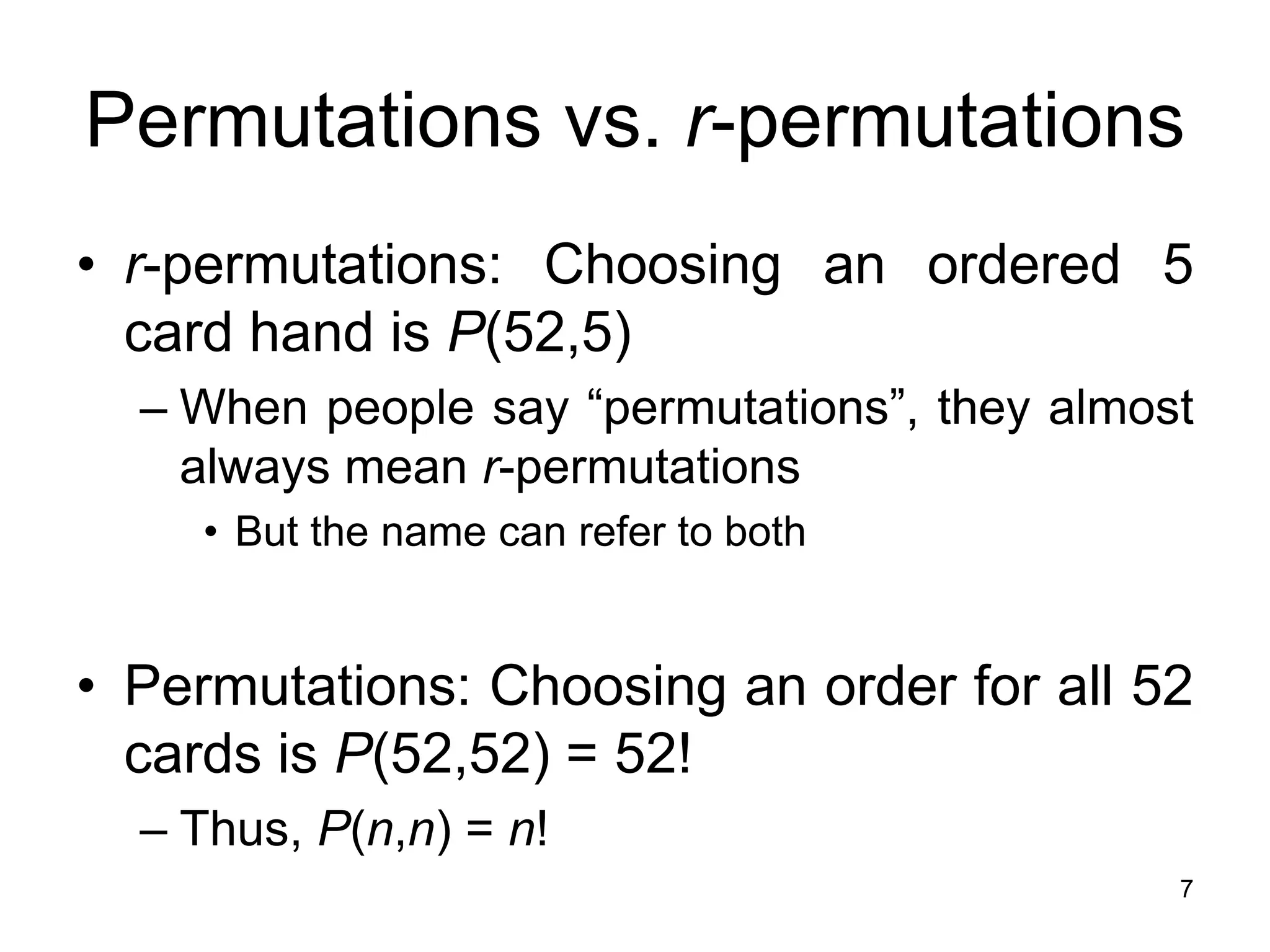
Permutations vs. r-permutations
• r-permutations: Choosing an ordered 5
card hand is P(52,5)
– When people say “permutations”, they almost
always mean r-permutations
• But the name can refer to both
• Permutations: Choosing an order for all 52
cards is P(52,52) = 52!
– Thus, P(n,n) = n!
8
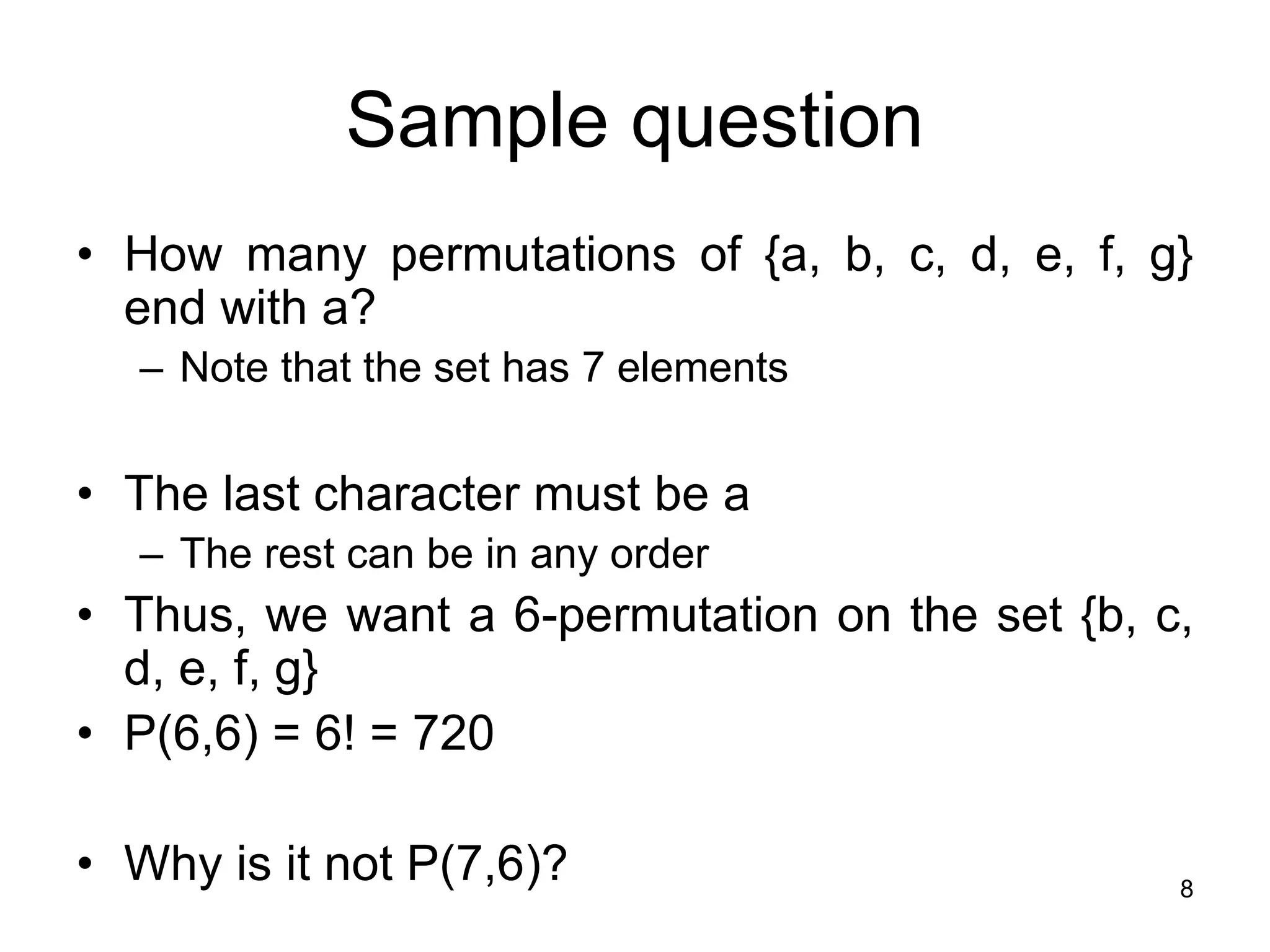
Sample question
• How many permutations of {a, b, c, d, e, f, g}
end with a?
– Note that the set has 7 elements
• The last character must be a
– The rest can be in any order
• Thus, we want a 6-permutation on the set {b, c,
d, e, f, g}
• P(6,6) = 6! = 720
• Why is it not P(7,6)?
10
Combinations
• What if order doesn’t matter?
• In poker, the following two hands are equivalent:
– A♦, 5♥, 7♣, 10♠, K♠
– K♠, 10♠, 7♣, 5♥, A♦
• The number of r-combinations of a set with n
elements, where n is non-negative and 0≤r≤n is:
)!
(
!
!
)
,
(
r
n
r
n
r
n
C


11
Combinations example
• How many different poker hands are there
(5 cards)?
• How many different (initial) blackjack
hands are there?
2,598,960
!
47
*
1
*
2
*
3
*
4
*
5
!
47
*
48
*
49
*
50
*
51
*
52
!
47
!
5
!
52
)!
5
52
(
!
5
!
52
)
5
,
52
( 




C
1,326
1
*
2
51
*
52
!
50
!
2
!
52
)!
2
52
(
!
2
!
52
)
2
,
52
( 




C
12
Combination formula proof
• Let C(52,5) be the number of ways to generate
unordered poker hands
• The number of ordered poker hands is P(52,5) =
311,875,200
• The number of ways to order a single poker
hand is P(5,5) = 5! = 120
• The total number of unordered poker hands is
the total number of ordered hands divided by the
number of ways to order each hand
• Thus, C(52,5) = P(52,5)/P(5,5)
13
Combination formula proof
• Let C(n,r) be the number of ways to generate
unordered combinations
• The number of ordered combinations (i.e. r-
permutations) is P(n,r)
• The number of ways to order a single one of
those r-permutations P(r,r)
• The total number of unordered combinations is
the total number of ordered combinations (i.e. r-
permutations) divided by the number of ways to
order each combination
• Thus, C(n,r) = P(n,r)/P(r,r)
14
Combination formula proof
)!
(
!
!
)!
/(
!
)!
/(
!
)
,
(
)
,
(
)
,
(
r
n
r
n
r
r
r
r
n
n
r
r
P
r
n
P
r
n
C






15
Bit strings
• How many bit strings of length 10 contain:
a) exactly four 1’s?
Find the positions of the four 1’s
Does the order of these positions matter?
• Nope!
• Positions 2, 3, 5, 7 is the same as positions 7, 5, 3, 2
Thus, the answer is C(10,4) = 210
b) at most four 1’s?
There can be 0, 1, 2, 3, or 4 occurrences of 1
Thus, the answer is:
• C(10,0) + C(10,1) + C(10,2) + C(10,3) + C(10,4)
• = 1+10+45+120+210
• = 386
16
Bit strings
• How many bit strings of length 10 contain:
c) at least four 1’s?
There can be 4, 5, 6, 7, 8, 9, or 10 occurrences of 1
Thus, the answer is:
• C(10,4) + C(10,5) + C(10,6) + C(10,7) + C(10,8) + C(10,9)
+ C(10,10)
• = 210+252+210+120+45+10+1
• = 848
Alternative answer: subtract from 210 the number of
strings with 0, 1, 2, or 3 occurrences of 1
d) an equal number of 1’s and 0’s?
Thus, there must be five 0’s and five 1’s
Find the positions of the five 1’s
Thus, the answer is C(10,5) = 252
17
 !
)
(
)!
(
!
)
,
(
r
n
n
r
n
n
r
n
n
C





)!
(
!
!
r
n
r
n


)!
(
!
!
)
,
(
r
n
r
n
r
n
C


Corollary 1
• Let n and r be non-negative integers with
r ≤ n. Then C(n,r) = C(n,n-r)
• Proof:
18
Corollary example
• There are C(52,5) ways to pick a 5-card poker
hand
• There are C(52,47) ways to pick a 47-card hand
• P(52,5) = 2,598,960 = P(52,47)
• When dealing 47 cards, you are picking 5 cards
to not deal
– As opposed to picking 5 card to deal
– Again, the order the cards are dealt in does matter
19
Combinatorial proof
• A combinatorial proof is a proof that uses counting
arguments to prove a theorem
– Rather than some other method such as algebraic techniques
• Essentially, show that both sides of the proof manage to
count the same objects
• Most of the questions in this section are phrased as,
“find out how many possibilities there are if …”
– Instead, we could phrase each question as a theorem:
– “Prove there are x possibilities if …”
– The same answer could be modified to be a combinatorial proof
to the theorem
20
Circular seatings
• How many ways are there to sit 6 people around a circular table,
where seatings are considered to be the same if they can be
obtained from each other by rotating the table?
• First, place the first person in the north-most chair
– Only one possibility
• Then place the other 5 people
– There are P(5,5) = 5! = 120 ways to do that
• By the product rule, we get 1*120 =120
• Alternative means to answer this:
• There are P(6,6)=720 ways to seat the 6 people around the table
• For each seating, there are 6 “rotations” of the seating
• Thus, the final answer is 720/6 = 120
21
Horse races
• How many ways are there for 4 horses to finish if ties are allowed?
– Note that order does matter!
• Solution by cases
– No ties
• The number of permutations is P(4,4) = 4! = 24
– Two horses tie
• There are C(4,2) = 6 ways to choose the two horses that tie
• There are P(3,3) = 6 ways for the “groups” to finish
– A “group” is either a single horse or the two tying horses
• By the product rule, there are 6*6 = 36 possibilities for this case
– Two groups of two horses tie
• There are C(4,2) = 6 ways to choose the two winning horses
• The other two horses tie for second place
– Three horses tie with each other
• There are C(4,3) = 4 ways to choose the two horses that tie
• There are P(2,2) = 2 ways for the “groups” to finish
• By the product rule, there are 4*2 = 8 possibilities for this case
– All four horses tie
• There is only one combination for this
– By the sum rule, the total is 24+36+6+8+1 = 75
22
• An alternative (and more common) way to
denote an r-combination:
• I’ll use C(n,r) whenever possible, as it is
easier to write in PowerPoint









r
n
r
n
C )
,
(
A last note on combinations

permutations and combinations 0000000000

  • 1.
  • 2.
    2 Permutations vs. Combinations •Both are ways to count the possibilities • The difference between them is whether order matters or not • Consider a poker hand: – A♦, 5♥, 7♣, 10♠, K♠ • Is that the same hand as: – K♠, 10♠, 7♣, 5♥, A♦ • Does the order the cards are handed out matter? – If yes, then we are dealing with permutations – If no, then we are dealing with combinations
  • 3.
    3 Permutations • A permutationis an ordered arrangement of the elements of some set S – Let S = {a, b, c} – c, b, a is a permutation of S – b, c, a is a different permutation of S • An r-permutation is an ordered arrangement of r elements of the set – A♦, 5♥, 7♣, 10♠, K♠ is a 5-permutation of the set of cards • The notation for the number of r-permutations: P(n,r) – The poker hand is one of P(52,5) permutations
  • 4.
    4 Permutations • Number ofpoker hands (5 cards): – P(52,5) = 52*51*50*49*48 = 311,875,200 • Number of (initial) blackjack hands (2 cards): – P(52,2) = 52*51 = 2,652 • r-permutation notation: P(n,r) – The poker hand is one of P(52,5) permutations ) 1 )...( 2 )( 1 ( ) , (      r n n n n r n P )! ( ! r n n       n r n i i 1
  • 5.
    5 r-permutations example • Howmany ways are there for 5 people in this class to give presentations? • There are 27 students in the class – P(27,5) = 27*26*25*24*23 = 9,687,600 – Note that the order they go in does matter in this example!
  • 6.
    6 Permutation formula proof •There are n ways to choose the first element – n-1 ways to choose the second – n-2 ways to choose the third – … – n-r+1 ways to choose the rth element • By the product rule, that gives us: P(n,r) = n(n-1)(n-2)…(n-r+1)
  • 7.
    7 Permutations vs. r-permutations •r-permutations: Choosing an ordered 5 card hand is P(52,5) – When people say “permutations”, they almost always mean r-permutations • But the name can refer to both • Permutations: Choosing an order for all 52 cards is P(52,52) = 52! – Thus, P(n,n) = n!
  • 8.
    8 Sample question • Howmany permutations of {a, b, c, d, e, f, g} end with a? – Note that the set has 7 elements • The last character must be a – The rest can be in any order • Thus, we want a 6-permutation on the set {b, c, d, e, f, g} • P(6,6) = 6! = 720 • Why is it not P(7,6)?
  • 9.
    10 Combinations • What iforder doesn’t matter? • In poker, the following two hands are equivalent: – A♦, 5♥, 7♣, 10♠, K♠ – K♠, 10♠, 7♣, 5♥, A♦ • The number of r-combinations of a set with n elements, where n is non-negative and 0≤r≤n is: )! ( ! ! ) , ( r n r n r n C  
  • 10.
    11 Combinations example • Howmany different poker hands are there (5 cards)? • How many different (initial) blackjack hands are there? 2,598,960 ! 47 * 1 * 2 * 3 * 4 * 5 ! 47 * 48 * 49 * 50 * 51 * 52 ! 47 ! 5 ! 52 )! 5 52 ( ! 5 ! 52 ) 5 , 52 (      C 1,326 1 * 2 51 * 52 ! 50 ! 2 ! 52 )! 2 52 ( ! 2 ! 52 ) 2 , 52 (      C
  • 11.
    12 Combination formula proof •Let C(52,5) be the number of ways to generate unordered poker hands • The number of ordered poker hands is P(52,5) = 311,875,200 • The number of ways to order a single poker hand is P(5,5) = 5! = 120 • The total number of unordered poker hands is the total number of ordered hands divided by the number of ways to order each hand • Thus, C(52,5) = P(52,5)/P(5,5)
  • 12.
    13 Combination formula proof •Let C(n,r) be the number of ways to generate unordered combinations • The number of ordered combinations (i.e. r- permutations) is P(n,r) • The number of ways to order a single one of those r-permutations P(r,r) • The total number of unordered combinations is the total number of ordered combinations (i.e. r- permutations) divided by the number of ways to order each combination • Thus, C(n,r) = P(n,r)/P(r,r)
  • 13.
  • 14.
    15 Bit strings • Howmany bit strings of length 10 contain: a) exactly four 1’s? Find the positions of the four 1’s Does the order of these positions matter? • Nope! • Positions 2, 3, 5, 7 is the same as positions 7, 5, 3, 2 Thus, the answer is C(10,4) = 210 b) at most four 1’s? There can be 0, 1, 2, 3, or 4 occurrences of 1 Thus, the answer is: • C(10,0) + C(10,1) + C(10,2) + C(10,3) + C(10,4) • = 1+10+45+120+210 • = 386
  • 15.
    16 Bit strings • Howmany bit strings of length 10 contain: c) at least four 1’s? There can be 4, 5, 6, 7, 8, 9, or 10 occurrences of 1 Thus, the answer is: • C(10,4) + C(10,5) + C(10,6) + C(10,7) + C(10,8) + C(10,9) + C(10,10) • = 210+252+210+120+45+10+1 • = 848 Alternative answer: subtract from 210 the number of strings with 0, 1, 2, or 3 occurrences of 1 d) an equal number of 1’s and 0’s? Thus, there must be five 0’s and five 1’s Find the positions of the five 1’s Thus, the answer is C(10,5) = 252
  • 16.
  • 17.
    18 Corollary example • Thereare C(52,5) ways to pick a 5-card poker hand • There are C(52,47) ways to pick a 47-card hand • P(52,5) = 2,598,960 = P(52,47) • When dealing 47 cards, you are picking 5 cards to not deal – As opposed to picking 5 card to deal – Again, the order the cards are dealt in does matter
  • 18.
    19 Combinatorial proof • Acombinatorial proof is a proof that uses counting arguments to prove a theorem – Rather than some other method such as algebraic techniques • Essentially, show that both sides of the proof manage to count the same objects • Most of the questions in this section are phrased as, “find out how many possibilities there are if …” – Instead, we could phrase each question as a theorem: – “Prove there are x possibilities if …” – The same answer could be modified to be a combinatorial proof to the theorem
  • 19.
    20 Circular seatings • Howmany ways are there to sit 6 people around a circular table, where seatings are considered to be the same if they can be obtained from each other by rotating the table? • First, place the first person in the north-most chair – Only one possibility • Then place the other 5 people – There are P(5,5) = 5! = 120 ways to do that • By the product rule, we get 1*120 =120 • Alternative means to answer this: • There are P(6,6)=720 ways to seat the 6 people around the table • For each seating, there are 6 “rotations” of the seating • Thus, the final answer is 720/6 = 120
  • 20.
    21 Horse races • Howmany ways are there for 4 horses to finish if ties are allowed? – Note that order does matter! • Solution by cases – No ties • The number of permutations is P(4,4) = 4! = 24 – Two horses tie • There are C(4,2) = 6 ways to choose the two horses that tie • There are P(3,3) = 6 ways for the “groups” to finish – A “group” is either a single horse or the two tying horses • By the product rule, there are 6*6 = 36 possibilities for this case – Two groups of two horses tie • There are C(4,2) = 6 ways to choose the two winning horses • The other two horses tie for second place – Three horses tie with each other • There are C(4,3) = 4 ways to choose the two horses that tie • There are P(2,2) = 2 ways for the “groups” to finish • By the product rule, there are 4*2 = 8 possibilities for this case – All four horses tie • There is only one combination for this – By the sum rule, the total is 24+36+6+8+1 = 75
  • 21.
    22 • An alternative(and more common) way to denote an r-combination: • I’ll use C(n,r) whenever possible, as it is easier to write in PowerPoint          r n r n C ) , ( A last note on combinations