People for Health: Advancing Human
    Resources for Public Health
         “Capacity Building”

            3rd Feb. 2012
            Bhubaneswar


                   Dr Saurabh Jain
                      MD, PGD-Health Econ, MPH
           State Health Resource Centre, Raipur
                       Chhattisgarh               1
“capacity building refers to the creation,
  expansion or upgrading of a stock of desired
  qualities and features called capabilities that
  could be continually drawn upon over time. . .
  The focus of capacity building therefore tends
  to be on improving the stock rather than on
  managing whatever is available.”
                                     - Paul (1995),
             Capacity building for health sector reform, WHO


                                                           2
Capacity building
          vs
       Training
          vs
Human resource development


                             3
Chhattisgarh, ninth largest state of India -25.5   *(census

               2011)   million population


                                                     4
80% of people living in villages/hamlets
32% of Population are Tribal- 7 of India’s primitive tribal groups live here
    (Abujhmaria, Baiga, Bharia Saharia, Hill Korwa, Kamar , Birhor)
Lush green Forests-44% of land area- is our asset and liability
               with Mines –Tin,Coal,Iron
State Profile
• Population of the State = 2.5 Crore          No of Districts =27

• No of Blocks = 146            No of villages = 20,126

Health Facilities      Number of functioning   Population covered per
                       facilities              facility
Sub-centres                     5,076                   3,862

PHC                              741                    26,400

CHC level hospitals      148 CHC +17 CH=165           1.54 Lakh

District Hospitals                17                 15.02 Lakh

Medical colleges                  3                  85.13 Lakh

                                                                        7
Health systems framework
                                                                                                             Interaction with context:
                                                                                                         * with national policies, culture, values
           Leadership & governance:                                                                             * with international context
                   * policy – making                                                                         * with other sectors and actors
                       * regulation
                     * coordination        3                                                                                10


Organisation of resources:                                                   8
                                                                                                                                              1
                                                         Organisation and delivery of                                       Outcomes:
                                                                                                                        * universal access
     human           financing                              health care services:
                                                                                                                          * quality of care
   resources                                              * primary health care – specialised
               4    5                                    * health problem specific – general
                                                              * prevention – curative care
               6   7Monitoring &                      * public – private, for profit – not for profit,
Medical supplies
                    evaluation /                                    formal - informat
& technologies
                    information
                                                                                                                             Goals:           1
                                                                                                                       * improved health
                                                                                                                        * responsiveness
                                 Interaction with population:                                                          * social & financial
                                       * demand generation                                                                  protection
                                                                                             9
                        * participation of individuals and groups in community
                                             * accountability


                                               Guiding by values and principles:
                                                          * health care as a right
                                                         * autonomy <> security
                                       * protection of public <> response to individual suffering
                                                      * effectiveness <> efficiency
                                                  * participation, accountability, trust                                2
                                                        * social justice and equity
                                                      * global social responsibility
                                                    * sustainability: at which level?


                                                              Source: Josefien et al, Inst. Trop. Med., Antwerp
Training norms of GoI
Sn. Category Training programme         Duration                    GoI Norm
                                     Maternal Health
1   Medical LSAS (*)               18 weeks            One anaesthetist per FRU
    Officers EmOC/CEmOC(*)         16 weeks            One Ob./Gy. per FRU
    (doctors) Management.       Of 15 days             One doctor per 24x7 PHC and CHC
              Common Obstetric
              Complications
              (SBA)(*)
              Blood Storage (*)    3 days              One Doctor per FRU
              MTP (*)              15 days             One doctor per 24x7 PHC and CHC
              RTI/STI (*)          2 days              One doctor per 24x7 PHC and CHC
2   ANM and SBA (**)               15 days             All ANMs and Staff Nurses per 24x7
    SNs                                                PHC(all sanctioned post of ANM’s &
                                                       SN’s taken in account for calculation)
3   LTs       Blood Storage(*)    3 days               All LT's posted at FRU


                                                                                           9
Training norms of GoI (contd.)
Sn.    Category        Training       Duration                     GoI Norm
                     programme

                                         Child Health
4      Medical     F- IMNCI (**)      11 days    One trained doctor per PHC and CHC
       Officers    FBNC(*)             3 days    One Trained doctor per dist hospital
       (doctors)   NSSK (**)           2 days    All doctors at PHC
                   Immunisation (*)    2 days    One trained doctor per PHC and CHC
5      ANM/    IMNCI (*)               8 days    All ANMs, Staff Nurses, AWW(all sanctioned
       LHV and                                   post of ANM’s, SN & AWW taken in account
       SNs                                       for calculation)
               FBNC (*)                3 days    All staff nurses
                   NSSK (*)            2 days    All ANM's, LHV & SN(all sanctioned post of
                                                 ANM’s, LHV & SN taken into account for
                                                 calculation)
                   Immunisation        2 days    All ANM's
                   (***)

    Family Planning, ARSH, IMEP, and Disease Control Programmes……………………so on and so forth
                                                                                         10
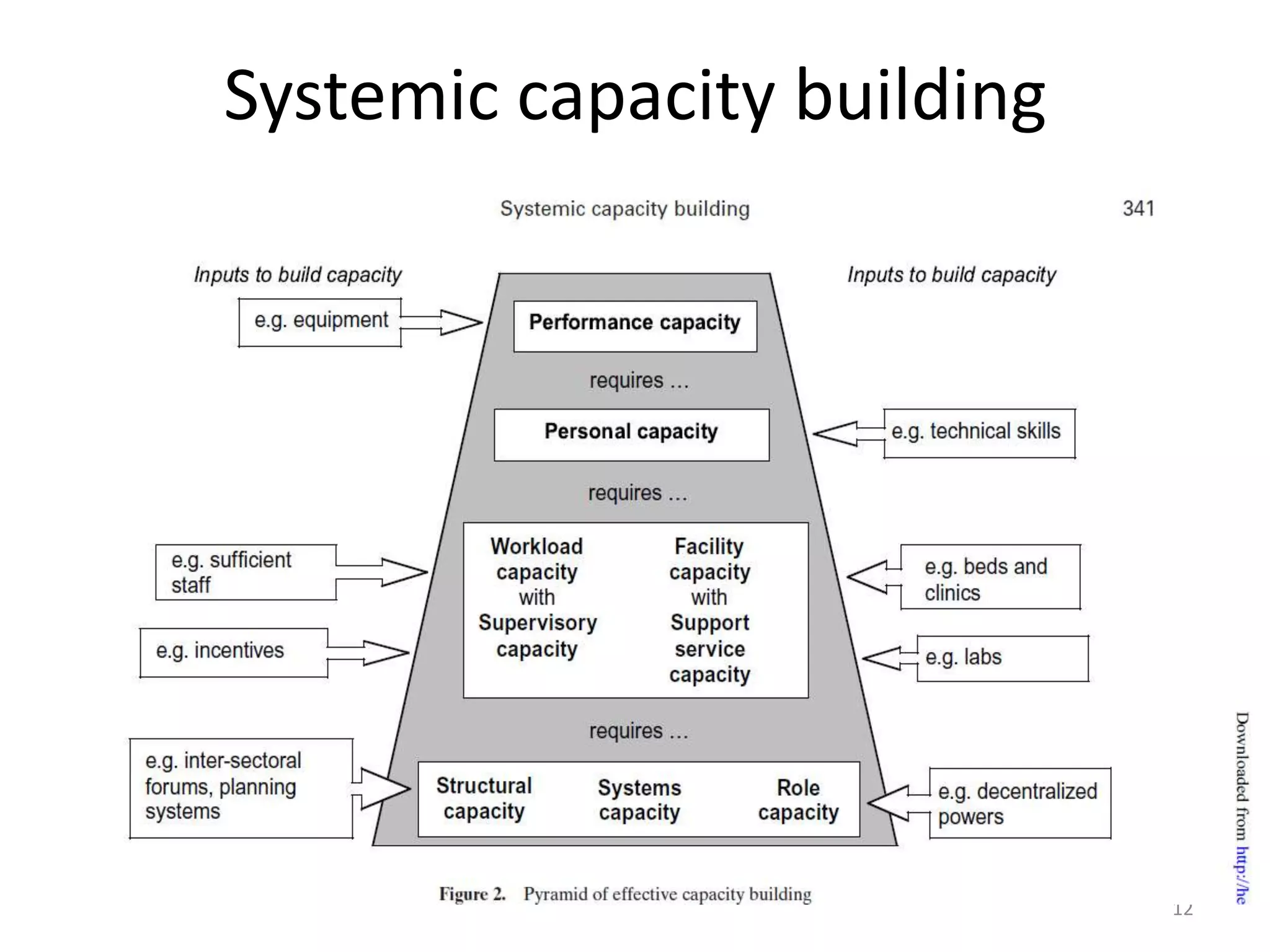
Capacity building pyramid


                                                                          11
Source: Christopher Potter, Systemic capacity building, Health Pol and Planning
Systemic capacity building


                             12
13
Issues & Challenges
• Training capacity/infrastructure- state/dist.
• Training need assessment
• Quality
  – functional status
  – faculty/resource pool
  – training plan
  – database


                                                  14
Issues & Challenges (contd.)
• Quality
  – rationalization of trained HRH
  – training material in local language
  – fund flow
  – tapping other resources (medical college..)
  – monitoring tools
  – evaluation


                                                  15
Policy decisions
• Efforts to strengthen SIHFW & RIHFW
• Focus pvt          public (nursing training)
• Private sector allowed to use public health
  facilities for training
• RMA             MBBS bridge course
• Bridge course for AYUSH


                                                 16
Policy decisions (contd.)
• PHRN engaged for ‘fast-track’ training of MOs
  and others
• Mapping under MCH plan
• EmOC and LSAS initiated for MOs
• RMAs being trained for BEmOC and others
• Mitanins promoted for ANM and B.Sc nursing
  course


                                                  17
Policy decisions (contd.)
• ANMs promoted for B.SC nursing course
• MOs working in hardest areas given
  preference in PG seats


                                          18
Training institutions in the State
   Facility             2007-08                  Current Status
                Govt.   Pvt.   Total   Seats   Govt.   Pvt.   Tota Seats
                                                              l
SIHFW             1       0       1     NA       1       0        1   NA

HFW-TC            1       0       1     NA       1       0        1   NA

Dist.TC           6       0       6     NA       14      0    14      NA

B.Sc. Nursing     1      10       11    450      6      41    47      2220

GNM-TC            4       2       6     161      4      25    29      981

ANM-TC            7       1       8     320      13     57    70      2404

MPW(Male)         3       0       3     180      3      41    44      2450

TC                                                                    19
Health Indicators: (as per *SRS and AHS 2011)
                               India                    Chhattisgarh
 Indicators     2000    2008    2011
                                       Changes
                                        (2000-   2000   2008   2011
                                                                      Changes
                                                                       (2000-
                                        2011)                          2011)
   IMR Total     68     55       50              88      59    51
                                        -18                           -37
   IMR Rural     74     61       55              94      61    55
                                        -19                           -39
  IMR Urban      43     37       34              54      49    40
                                         -9                           -14
Birth Rate Total 25.8   23.1    22.5
                                        -3.3     31.2   26.5   23.9
                                                                      -7.3
Birth Rate Rural 27.5   24.7    24.1
                                        -3.4     33.2    28    24.8
                                                                      -8.4
Birth Rate Urban 20.7   18.6    18.3
                                        -2.4     23.5   19.9   20.6
                                                                      -2.9
Death Rate Total 8.5    7.4      7.3
                                        -1.2     10.2    8.5   7.6
                                                                      -2.6
  Death Rate     9.3     8       7.8             11      8.5    8
                                        -1.5                           -3
    Rural
  Death Rate     6.3     6       5.8             7.5     6.5   6.2
                                        -0.5                          -1.3
                                                                         20
    Urban
Thanks
         21

People for health capacity building-final

  • 1.
    People for Health:Advancing Human Resources for Public Health “Capacity Building” 3rd Feb. 2012 Bhubaneswar Dr Saurabh Jain MD, PGD-Health Econ, MPH State Health Resource Centre, Raipur Chhattisgarh 1
  • 2.
    “capacity building refersto the creation, expansion or upgrading of a stock of desired qualities and features called capabilities that could be continually drawn upon over time. . . The focus of capacity building therefore tends to be on improving the stock rather than on managing whatever is available.” - Paul (1995), Capacity building for health sector reform, WHO 2
  • 3.
    Capacity building vs Training vs Human resource development 3
  • 4.
    Chhattisgarh, ninth largeststate of India -25.5 *(census 2011) million population 4
  • 5.
    80% of peopleliving in villages/hamlets 32% of Population are Tribal- 7 of India’s primitive tribal groups live here (Abujhmaria, Baiga, Bharia Saharia, Hill Korwa, Kamar , Birhor)
  • 6.
    Lush green Forests-44%of land area- is our asset and liability with Mines –Tin,Coal,Iron
  • 7.
    State Profile • Populationof the State = 2.5 Crore No of Districts =27 • No of Blocks = 146 No of villages = 20,126 Health Facilities Number of functioning Population covered per facilities facility Sub-centres 5,076 3,862 PHC 741 26,400 CHC level hospitals 148 CHC +17 CH=165 1.54 Lakh District Hospitals 17 15.02 Lakh Medical colleges 3 85.13 Lakh 7
  • 8.
    Health systems framework Interaction with context: * with national policies, culture, values Leadership & governance: * with international context * policy – making * with other sectors and actors * regulation * coordination 3 10 Organisation of resources: 8 1 Organisation and delivery of Outcomes: * universal access human financing health care services: * quality of care resources * primary health care – specialised 4 5 * health problem specific – general * prevention – curative care 6 7Monitoring & * public – private, for profit – not for profit, Medical supplies evaluation / formal - informat & technologies information Goals: 1 * improved health * responsiveness Interaction with population: * social & financial * demand generation protection 9 * participation of individuals and groups in community * accountability Guiding by values and principles: * health care as a right * autonomy <> security * protection of public <> response to individual suffering * effectiveness <> efficiency * participation, accountability, trust 2 * social justice and equity * global social responsibility * sustainability: at which level? Source: Josefien et al, Inst. Trop. Med., Antwerp
  • 9.
    Training norms ofGoI Sn. Category Training programme Duration GoI Norm Maternal Health 1 Medical LSAS (*) 18 weeks One anaesthetist per FRU Officers EmOC/CEmOC(*) 16 weeks One Ob./Gy. per FRU (doctors) Management. Of 15 days One doctor per 24x7 PHC and CHC Common Obstetric Complications (SBA)(*) Blood Storage (*) 3 days One Doctor per FRU MTP (*) 15 days One doctor per 24x7 PHC and CHC RTI/STI (*) 2 days One doctor per 24x7 PHC and CHC 2 ANM and SBA (**) 15 days All ANMs and Staff Nurses per 24x7 SNs PHC(all sanctioned post of ANM’s & SN’s taken in account for calculation) 3 LTs Blood Storage(*) 3 days All LT's posted at FRU 9
  • 10.
    Training norms ofGoI (contd.) Sn. Category Training Duration GoI Norm programme Child Health 4 Medical F- IMNCI (**) 11 days One trained doctor per PHC and CHC Officers FBNC(*) 3 days One Trained doctor per dist hospital (doctors) NSSK (**) 2 days All doctors at PHC Immunisation (*) 2 days One trained doctor per PHC and CHC 5 ANM/ IMNCI (*) 8 days All ANMs, Staff Nurses, AWW(all sanctioned LHV and post of ANM’s, SN & AWW taken in account SNs for calculation) FBNC (*) 3 days All staff nurses NSSK (*) 2 days All ANM's, LHV & SN(all sanctioned post of ANM’s, LHV & SN taken into account for calculation) Immunisation 2 days All ANM's (***) Family Planning, ARSH, IMEP, and Disease Control Programmes……………………so on and so forth 10
  • 11.
    Capacity building pyramid 11 Source: Christopher Potter, Systemic capacity building, Health Pol and Planning
  • 12.
  • 13.
  • 14.
    Issues & Challenges •Training capacity/infrastructure- state/dist. • Training need assessment • Quality – functional status – faculty/resource pool – training plan – database 14
  • 15.
    Issues & Challenges(contd.) • Quality – rationalization of trained HRH – training material in local language – fund flow – tapping other resources (medical college..) – monitoring tools – evaluation 15
  • 16.
    Policy decisions • Effortsto strengthen SIHFW & RIHFW • Focus pvt public (nursing training) • Private sector allowed to use public health facilities for training • RMA MBBS bridge course • Bridge course for AYUSH 16
  • 17.
    Policy decisions (contd.) •PHRN engaged for ‘fast-track’ training of MOs and others • Mapping under MCH plan • EmOC and LSAS initiated for MOs • RMAs being trained for BEmOC and others • Mitanins promoted for ANM and B.Sc nursing course 17
  • 18.
    Policy decisions (contd.) •ANMs promoted for B.SC nursing course • MOs working in hardest areas given preference in PG seats 18
  • 19.
    Training institutions inthe State Facility 2007-08 Current Status Govt. Pvt. Total Seats Govt. Pvt. Tota Seats l SIHFW 1 0 1 NA 1 0 1 NA HFW-TC 1 0 1 NA 1 0 1 NA Dist.TC 6 0 6 NA 14 0 14 NA B.Sc. Nursing 1 10 11 450 6 41 47 2220 GNM-TC 4 2 6 161 4 25 29 981 ANM-TC 7 1 8 320 13 57 70 2404 MPW(Male) 3 0 3 180 3 41 44 2450 TC 19
  • 20.
    Health Indicators: (asper *SRS and AHS 2011) India Chhattisgarh Indicators 2000 2008 2011 Changes (2000- 2000 2008 2011 Changes (2000- 2011) 2011) IMR Total 68 55 50 88 59 51 -18 -37 IMR Rural 74 61 55 94 61 55 -19 -39 IMR Urban 43 37 34 54 49 40 -9 -14 Birth Rate Total 25.8 23.1 22.5 -3.3 31.2 26.5 23.9 -7.3 Birth Rate Rural 27.5 24.7 24.1 -3.4 33.2 28 24.8 -8.4 Birth Rate Urban 20.7 18.6 18.3 -2.4 23.5 19.9 20.6 -2.9 Death Rate Total 8.5 7.4 7.3 -1.2 10.2 8.5 7.6 -2.6 Death Rate 9.3 8 7.8 11 8.5 8 -1.5 -3 Rural Death Rate 6.3 6 5.8 7.5 6.5 6.2 -0.5 -1.3 20 Urban
  • 21.