2plan.com
What is the British Pound worth vs. Euro?
1.6
1.4
1.2
1.0
2011 2012 2013 2014 2015
What is the British Pound worth vs. Dollar?
1.8
1.6
1.4
1.2
2011 2012 2013 2014 2015
Newsletter
financial
Edition 16
UK economy showing promise
The latest estimate (30 June 2015) on economic growth in the UK by the
Office for National Statistics (ONS) has revealed the UK economy grew by
0.4% from January to March 2015, revised up slightly from the last published
figure of 0.3%. Growth on the year has also seen a big upwards revision,
taking it to 2.9%, up from 2.5%. The ONS figures have revealed disposable
incomes in the UK have been rising at the fastest pace since 2001.
Base rate remains stable
The Bank of England’s Monetary Policy Committee
has again voted to again keep base rate at 0.5%.
Inflation
• Transport costs helped the UK’s inflation rate
turn positive in May 2015 after one month of
negative inflation.
• Inflation, as measured by Consumer Prices Index
(CPI), rose to 0.1% in May, up from -0.1% in April.
• The biggest contribution to the rise came from
transport, notably air fares, the Office for National
Statistics said.
• In April, CPI inflation turned negative for the first
time since 1960, mainly due to a drop in air and
sea fares.
UK unemployment falls as wages rise
• The number of people out of work between
February and April fell by 43,000 to 1.81 million,
the Office for National Statistics said.
• The jobless rate held steady at 5.5%, the lowest
level since August 2008.
• Meanwhile wage rises grew at their fastest rate
since August 2011, rising 2.7%, both including
and excluding bonuses.
• The total number of people now in work is 31.05
million people, which is 114,000 more than in
the previous three month period.
Performance Line Chart
3 July 2015
Pricing Spread: Bid-Bid ● Data Frequency: Weekly
The value of units can fall as well as rise.
Past performance should not be seen as an indication of future performance
World stock market performance over last ten years.
Jul
‘05
-25%
0%
50%
100%
150%
200%
Jul
‘14
Jul
‘15
Jul
‘13
Jul
‘12
Jul
‘11
Jul
‘09
Jul
‘07
Jul
‘10
Jul
‘08
Jul
‘06
A - SP 500 TR in
US [104.40%]
B - FTSE 100 TR
in GB [91.35%]
C - Nikkei 225 in
JP [79.48%]
A
B
C
24/06/2005 - 26/06/2015
Data from FE 2015
Agenda
1 Key economic and market update
2 With great power, comes great
responsibility
3 The appointment of Dr Ros Altmann
4 Keep calm and invest!
5 Summer Budget 2015
6 2plan wealth management
- looking after your best interests
KEY FACTS  FIGURES – The UK Economy
BoE Base Rate 0.5% Jul 2015
Unemployment 5.5% Mar – Jul 2015
Inflation (CPI) 0.1% Jun 2015
safety in numbers 2plan.com
With great power,
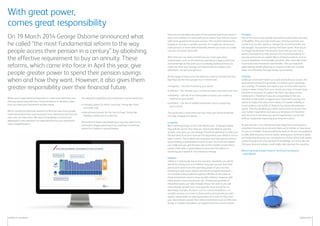
comes great responsibility
When you’re approaching retirement it’s now more vital than ever
that you spend time with your financial adviser to develop a plan
that can meet your retirement income needs.
We’ve conducted extensive research to find out how much people
understand what they need and want from retirement and how the
new rules can help them. We took this feedback on board and
developed a new approach to make planning for your retirement
more straightforward.
Our approach separates your retirement income needs into:
• essential spend: for those ‘must pay’ things like food
and utility bills
• discretionary spend: for the ‘nice to have’ things like
holidays, eating out or a new car.
At the end of these calculations you may also want to try
and build in legacy planning to try and leave something
behind for children or grandchildren.
On 19 March 2014 George Osborne announced what
he called “the most fundamental reform to the way
people access their pension in a century” by abolishing
the effective requirement to buy an annuity. These
reforms, which came into force in April this year, give
people greater power to spend their pension savings
when and how they want. However, it also gives them
greater responsibility over their financial future.
Once you’ve identified the level of the essential spend you need to
meet, your adviser can work with you to secure that level of income
with some guaranteed income sources. This could be achieved by
buying an annuity or variable annuity, or it might be met by your
state pension or some defined benefit pension you have, but make
sure you can cover these bills.
After that you can start to think how you meet your other
requirements, such as discretionary spending or legacy planning;
and remember at this point you’re probably looking at how you
could use all of your savings and investments to support your
retirement, not just your pension.
At this stage of the process we think you need to consider the four
big financial risks that people face in retirement:
• longevity – the risk of outliving your assets
• inflation – the risk that your income can fall in real value over time
• flexibility – the risk of not being able to access your assets as
required or upon death
• volatility – the risk of volatile investment returns impacting
your income.
The good news is that there are ways that your financial adviser
can help mitigate the above:
Longevity
We’re all living longer, in fact over 80 per cent of people believe
they will die sooner than they are statistically likely to and the
statistic only gives you an average! Therefore planning to make sure
the last drop of income runs out the day before your death is not an
exact science. This is where securing your essential spend comes in
by purchasing a guaranteed income source. Your financial adviser
can make sure you get the best rate on the market or even find a
product that gives a guaranteed income with the option of
accessing your capital if circumstances change.
Inflation
Inflation is historically low at the moment. Hopefully you will be
retired for a long time and inflation may pick up over that time
period and could erode the spending power of your income.
Investing in real assets (stocks and shares, property funds etc.)
can provide some protection against inflation as the value of
these investments tend to keep up with inflation. However with
these assets comes investment risk. A balanced portfolio of
diversified assets can help mitigate these risks and as you will
have already secured your must pay bills there should be no
doomsday scenario. Products such as income drawdown or a
variable annuity can invest in these assets and provide you with
regular withdrawals (or even guarantees at a cost) to help meet
your discretionary spend. Your other investments such as ISAs and
bonds, if suitably diversified, can supplement this income stream.
Flexibility
One of the main issues people had with annuities was their lack
of flexibility. Once you had made your annuity purchase you
couldn’t access the capital or change the income benefits you
had bought. Your pension savings had been spent. Now you’re
no longer forced down the annuity route and you can mix a
variety of products to help give you the necessary balance of
security and access to capital. Many of these products, such as
income drawdown and variable annuities, also come with both
income tax and inheritance tax benefits. This can help with
generational wealth planning as unspent funds can cascade
down tax efficiently through family’s generations.
Volatility
Unlike pre-retirement where you save and build your assets, the
post-retirement world is generally one where you’re spending
your savings. If markets turn against you at times when you’re
trying to draw money from your assets you may no longer have
the time or resources to replace the fall in the value of your
investments. Therefore if you are using products that are
invested in real assets to support your retirement journey one
option to reduce the short-term impact of market volatility is
to put aside a cash buffer of three to four years discretionary
spend. This should allow your other assets time to recover from
any market movements and give you the peace of mind that
your short-term discretionary spend requirement can be met
without negatively impacting your long-term plans.
As you can see, if you decide to move away from securing your
retirement income via an annuity there are a number of new issues
for you to consider. Understanding the level of risk you are prepared
to take, planning your income needs, setting your retirement goals
and understanding any tax consequences of your actions all require
careful thought and a broad level of knowledge. It’s times like this
that your financial adviser could really help improve the outcome.
Written by Andy Zanelli, Head of Technical Consultancy
– AXA Wealth.
2plan.comsafety in numbers
Keep calm
and invest!
There is a common
attitude in the UK that
very low inflation is
something to be feared
because many feel it
will ultimately lead to
an economic slump.
It is interesting to note, then, that many leading economists
believe that low inflation or even deflation are not empirically
linked to economic depression.
Nevertheless, the Bank of England governor, Mark Carney, recently
felt impelled to come forward and tell British businesses, workers,
investors and savers that low inflation is temporary and will return
to its 2% target within two years.
Inflation reached 0.3% in January – and, in May, we even had
a short-lived period of deflation for the first time since 1960.
“What’s important is that workers and businesses understand this
is a temporary phenomenon,” Carney told MPs.
Carney said the Monetary Policy Committee would “bring it back
to the target in a reasonable horizon”, which he said would be within
two years before adding that “A temporary period of falling prices
should not be mistaken for a damaging spiral of deflation.”
This low inflation (and that period of deflation) understandably
brings with it some obvious causes for concern, including a slowing
down of economic activity which, in turn, could lead to smaller pay
cheques for families and fewer profits for companies long-term.
But our economic system is well equipped to deal with falling
rates and there is no cause for British savers to panic or change
their long-term financial planning strategy, although 2plan
wealth management and its IFAs are always at pains to explain
to its clients how important it is to review those plans on an
ongoing basis.
Writing at the time of that short, newsworthy period of deflation,
Phil Oakley of Money Week said: ‘Put simply, deflation means £1 in
the future will buy less than it does today… you need to earn a ‘real’
return.’ He and the rest of the Money Week team are agreed that it
is therefore important to look to the long-term with a well thought
through diversified portfolio.
We agree that the same applies in regards to low inflation.
So, what does this all mean for you – the potential investor?
If you’re not in debt, you have some savings and a steady job,
deflation doesn’t need to be a consideration.
If, however, you are a heavily indebted individual or company,
deflation or low inflation is a potential problem that needs to be
tackled strategically. Phil Oakley says ‘Falling prices often mean
lower profits, lower wages, and therefore lower taxes. That makes
it harder to pay the interest bills on borrowed money.’
We are still set for another couple of years of low inflation (who
knows – we may even enter deflation again), but the fact is that
we don’t know for absolute sure. Your 2plan wealth management
IFA will therefore advise you to continue to invest and keep
to your long-term investment plans. Building an investment
portfolio can help you to realise your long-term financial goals.
Remember that a savings account can offer quick access and
guaranteed capital, but the returns can be very disappointing.
Investing wisely and sensibly in the stock market can provide
stronger returns over the long-term. All-in-all, we recommend that
you talk to your 2plan wealth management IFA about potentially
building some ‘low inflation protection’ into your diversified
investment portfolio, just in case.
Overall though, our message is to KEEP CALM and continue
to invest for the long-term!
The appointment of Dr Ros Altmann
as Pensions Minister has been largely
welcomed by the financial services sector,
as she is seen to be someone who
understands both the business and
consumer issues surrounding pensions.
All of her skill and experience is likely to
be called into play in managing one of
the most difficult portfolios in the lifetime
of the new government.
Dr Altmann was appointed to replace
Liberal Democrat Steve Webb who lost his
seat in the recent General Election. Webb
– so far the longest-serving Pensions
Minister – was the architect of the pension
freedom reforms designed to enable over-
55s to cash in their entire pension pots to
spend, save or invest as they choose.
Ros Altmann isn’t an MP and was raised to
the Peerage on 19 May 2015 as Baroness
Altmann of Tottenham to enable her to
take up the ministerial post.
She has a distinguished pedigree for the
job, being a former director-general of
over-50s specialist Saga, a fund manager
at Chase Manhattan and Rothschild and
a renowned consumer champion having
campaigned for the rights of pensioners
since 2002. A long-time supporter of
pension freedom, Altmann intends to
ensure that the new system beds in
successfully. Alongside this, there are
two other major reforms to oversee: the
continued roll-out of auto-enrolment
pension saving to businesses; and an
overhaul and simplification of the state
pension starting next year.
This is already starting to look like a huge
challenge. Within weeks of the pension
freedom reforms coming into force,
individuals were complaining in their
thousands about being forced to pay for
financial advice, long delays in accessing
their cash, and firms refusing withdrawals
for fear of being sued for negligence in
years to come, fearing that people will fall
back on the state when their pension pots
are spent.
Inevitably, each side is blaming the other
with pension providers being criticised for
being unprepared and providers, in turn,
accusing the government of rushing
through the reforms pre-election.
So where does this leave those wishing
to access their pension pots? More
than ever before, this is a situation that
calls not for catch-all ‘guidance’ but
for professional advice based on an
individual’s specific circumstances.
Annuities may still be the right option
for some whilst for others, drawdown
of a pension pot to invest elsewhere
will be the best choice or a combination
of the two may be most appropriate.
Decisions made now will have a major
impact in the future, so discussing all
the options with your IFA will provide the
best basis to make the right choice.
New pensions minister ‘welcomed’
as reforms hit problems.
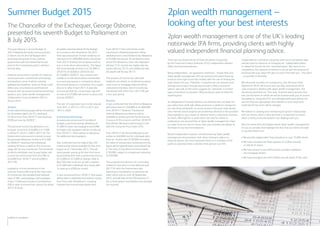
2plan wealth management –
looking after your best interests
2plan wealth management is one of the UK’s leading
nationwide IFA firms, providing clients with highly
valued independent financial planning advice.
There are two distinct kinds of financial adviser recognised
by the Financial Conduct Authority (FCA): independent advisers
(IFAs) and restricted advisers.
Being independent – as opposed to restricted – means that your
2plan wealth management IFA can research and select financial
products from right across the market, with the aim of finding the
right solution for you. Therefore, if required, we can research and
arrange any product through any provider; unlike a restricted
adviser, who will, as the name suggests be ’restricted’ to limited
types of products or providers. Why would you want to settle for
anything less?
As Independent Financial Advisers, we will drive the cost down for
you rather than artificially inflate premiums or platform charges for
our own financial benefit. As recent stories in the press have shown,
even internet search engines are sometimes selective in the providers
they highlight to you, based on whether there is a financial incentive
for them. Although this is quite often not clear for clients to
understand, rest assured that at 2plan wealth management, there
is a clear focus on costs to ensure that your interests are always at
the heart of any recommendations.
Recent independent research commissioned by 2plan wealth
management demonstrates that, when looking to take on a
financial adviser, the most important factor to a member of the
public or potential client is whether that adviser is an IFA.
Independence is therefore valued by both client and adviser alike
and we have no intention of changing our ’independent status’
or indeed be forced into the ‘restricted space’ like many of our
competitors. Our network of advisers is set-up with the purpose of
ensuring that your 2plan IFA gets as much time with you – the client
– as possible or desirable.
We also pride ourselves on transparency. Our Personal Client
Agreement (PCA) will ensure that you fully understand all the
costs involved in dealing with 2plan wealth management. The
document promotes our ‘four-step’ financial advice process and
sets out the terms on which we will do business with you, to ensure
transparency. Using the PCA, you will agree with your adviser the
services that are appropriate and relevant to your needs and
understand how much will be charged.
We believe in creating and maintaining long-term relationships
with our clients, which is why we think it is important to ensure
there is clarity across the board in our dealings with you.
Here are some facts and figures about 2plan wealth management
for you to consider that highlight the fact that our clients are right
to put their faith in us:
• We provide independent financial advice to over 75,000 clients
• We have invested over three quarters of a billion pounds
on behalf of clients
• We have access to over 630 product providers, platforms
and mortgage lenders
• We have arranged over half a billion pounds worth of life cover
Summer Budget 2015
The Chancellor of the Exchequer, George Osborne,
presented his seventh Budget to Parliament on
8 July 2015.
This was Osborne’s second Budget of
2015 following the earlier announcement
in March, but his first full Budget after
previously being part of the coalition
government with the Liberal Democrats
prior to the Conservative party’s election
win last May.
Osborne announced a number of measures
around pensions, investments and savings
and taxation, some of which certainly
grabbed the headlines. Some of these could
affect your circumstances and financial
situation and we would recommend that you
speak to your 2plan wealth management
Independent Financial Adviser (IFA) to
discuss them.
Taxation
A new national living wage will be introduced
for all workers aged over 25, starting at
£7.20 an hour from 2016/17 and reaching
£9.00 per hour by 2020/21.
The personal income tax allowance is to
increase, rising from £10,600 to £11,000
in 2016/17 and £11,200 in 2017/18. The
Government announced it intends to raise
the personal allowance further to £12,500
by 2020/21 meaning that individuals
working 30 hours a week on the minimum
wage will not pay income tax. The threshold
at which individuals start to pay higher rate
income tax will increase from £42,385 to
£43,000 from 2016/17 and £43,600 in
2017/18.
Legislation is to be introduced in the
Summer Finance Bill to limit the main rates
of income tax, the standard and reduced
rates of VAT, and employer and employee
(Class 1) National Insurance Contributions
(NICs) rates to ensure they cannot rise above
2015/16 levels.
As widely reported ahead of the Budget,
an increase in the Inheritance Tax (IHT)
limit was announced. A main residence nil
rate band of £1,000,000 will be introduced
from 2017/18 where the property is left to
one or more direct descendants. This figure
will incrementally increase to £125,000 in
2018/19, £150,000 in 2019/20 and
£175,000 in 2020/21. Any unused main
residence nil rate band will be transferable
to a surviving spouse or civil partner where
the second spouse or civil partner of a couple
dies on or after 6 April 2017. It was also
announced that the current basic rate IHT
nil rate of £325,000 will remain in place until
at least 2020/21.
The rate of corporation tax is to be reduced
from 20% in 2015, to 19% in 2017 and
18% in 2020.
Investments and savings
As previously announced in the March
budget, a personal savings allowance of
£1,000 for basic rate taxpayers and £500
for higher rate taxpayers will be introduced
from 2016/17. There will be no allowance
for additional rate taxpayers.
Also confirmed was the Help to Buy ISA
initiative that will be available for first time
buyers as of 1 December 2015. This will
assist people saving up for their first home
by providing them with a government bonus
of £3,000 on £12,000 of savings. Help to
Buy ISAs have to be set up with a deposit
of £1,000 with individuals then being able
to save up to £200 per month.
It was announced from 2016/17 that savers
will be able to withdraw and replace money
from their cash ISA without I counting
towards their annual subscription limit.
From 2016/17 the notional tax credit
attaching to dividend payments will be
abolished and a new Dividend Tax Allowance
of £5,000 introduced. On dividend income
above this allowance, basic rate taxpayers
will pay 7.5% income tax, higher rate tax
payers will pay 32.5% and additional rate
tax payers will be pay 38.1%.
The amount of income tax relief that
landlords can obtain on residential property
costs (such as mortgage interest) will be
restricted to the basic rate of income tax,
introduced with effect from 2017/18 over
a four year period.
Pensions
It was confirmed that the Lifetime Allowance
will reduce from £1,250,000 to £1,000,000
from 2016/17. However, Transitional
Lifetime Allowance protection will be
available to protect pension funds that are
in excess of this amount and from 2018/19
the Lifetime Allowance will increase in line
with the Consumer Price Index (CPI).
From 2016/17 the Annual Allowance will
remain at £40,000, but for individuals who
have an income over £150,000 (including
the value of any pension contributions) this
figure will be tapered down and reduced by
£1 for every £2 by which income exceeds
£150,000, subject to a maximum reduction
of £30,000.
The proposed introduction of a secondary
market for annuities is to be deferred until
2017/18, with the Government also
launching a consultation on pensions tax
relief, which will run until 30 September
2015, and will look at the effectiveness of
the current system and whether any changes
are required.
2plan.comsafety in numbers
safety in numbers
The information contained in this newsletter is based on 2plan wealth management Ltd’s
current understanding of tax laws as at July 2015. These laws are subject to change
at any time and 2plan wealth management Ltd cannot be held responsible for any
decisions made as a result of this newsletter. Tax advice is not regulated by the Financial
Conduct Authority.
safety in numbers
2plan.com
2plan wealth management Ltd is authorised and regulated by the Financial Conduct Authority.
It is entered on the Financial Services Register (www.fca.org.uk/register) under reference 461598.
Registered Office: 3rd Floor, Bridgewater Place, Water Lane, Leeds, LS11 5BZ.
Telephone: 0113 302 1369. Registered in England and Wales: 05998270
© 2plan wealth management Ltd. All rights reserved.
If you would like to discuss any of these topics in more
detail, please feel free to contact me to make an
appointment. If you have friends, family members or
colleagues who you think would be interested in these
topics, please pass this newsletter to them.

2plan_Edition16_Newsletter

  • 1.
    2plan.com What is theBritish Pound worth vs. Euro? 1.6 1.4 1.2 1.0 2011 2012 2013 2014 2015 What is the British Pound worth vs. Dollar? 1.8 1.6 1.4 1.2 2011 2012 2013 2014 2015 Newsletter financial Edition 16 UK economy showing promise The latest estimate (30 June 2015) on economic growth in the UK by the Office for National Statistics (ONS) has revealed the UK economy grew by 0.4% from January to March 2015, revised up slightly from the last published figure of 0.3%. Growth on the year has also seen a big upwards revision, taking it to 2.9%, up from 2.5%. The ONS figures have revealed disposable incomes in the UK have been rising at the fastest pace since 2001. Base rate remains stable The Bank of England’s Monetary Policy Committee has again voted to again keep base rate at 0.5%. Inflation • Transport costs helped the UK’s inflation rate turn positive in May 2015 after one month of negative inflation. • Inflation, as measured by Consumer Prices Index (CPI), rose to 0.1% in May, up from -0.1% in April. • The biggest contribution to the rise came from transport, notably air fares, the Office for National Statistics said. • In April, CPI inflation turned negative for the first time since 1960, mainly due to a drop in air and sea fares. UK unemployment falls as wages rise • The number of people out of work between February and April fell by 43,000 to 1.81 million, the Office for National Statistics said. • The jobless rate held steady at 5.5%, the lowest level since August 2008. • Meanwhile wage rises grew at their fastest rate since August 2011, rising 2.7%, both including and excluding bonuses. • The total number of people now in work is 31.05 million people, which is 114,000 more than in the previous three month period. Performance Line Chart 3 July 2015 Pricing Spread: Bid-Bid ● Data Frequency: Weekly The value of units can fall as well as rise. Past performance should not be seen as an indication of future performance World stock market performance over last ten years. Jul ‘05 -25% 0% 50% 100% 150% 200% Jul ‘14 Jul ‘15 Jul ‘13 Jul ‘12 Jul ‘11 Jul ‘09 Jul ‘07 Jul ‘10 Jul ‘08 Jul ‘06 A - SP 500 TR in US [104.40%] B - FTSE 100 TR in GB [91.35%] C - Nikkei 225 in JP [79.48%] A B C 24/06/2005 - 26/06/2015 Data from FE 2015 Agenda 1 Key economic and market update 2 With great power, comes great responsibility 3 The appointment of Dr Ros Altmann 4 Keep calm and invest! 5 Summer Budget 2015 6 2plan wealth management - looking after your best interests KEY FACTS FIGURES – The UK Economy BoE Base Rate 0.5% Jul 2015 Unemployment 5.5% Mar – Jul 2015 Inflation (CPI) 0.1% Jun 2015
  • 2.
    safety in numbers2plan.com With great power, comes great responsibility When you’re approaching retirement it’s now more vital than ever that you spend time with your financial adviser to develop a plan that can meet your retirement income needs. We’ve conducted extensive research to find out how much people understand what they need and want from retirement and how the new rules can help them. We took this feedback on board and developed a new approach to make planning for your retirement more straightforward. Our approach separates your retirement income needs into: • essential spend: for those ‘must pay’ things like food and utility bills • discretionary spend: for the ‘nice to have’ things like holidays, eating out or a new car. At the end of these calculations you may also want to try and build in legacy planning to try and leave something behind for children or grandchildren. On 19 March 2014 George Osborne announced what he called “the most fundamental reform to the way people access their pension in a century” by abolishing the effective requirement to buy an annuity. These reforms, which came into force in April this year, give people greater power to spend their pension savings when and how they want. However, it also gives them greater responsibility over their financial future. Once you’ve identified the level of the essential spend you need to meet, your adviser can work with you to secure that level of income with some guaranteed income sources. This could be achieved by buying an annuity or variable annuity, or it might be met by your state pension or some defined benefit pension you have, but make sure you can cover these bills. After that you can start to think how you meet your other requirements, such as discretionary spending or legacy planning; and remember at this point you’re probably looking at how you could use all of your savings and investments to support your retirement, not just your pension. At this stage of the process we think you need to consider the four big financial risks that people face in retirement: • longevity – the risk of outliving your assets • inflation – the risk that your income can fall in real value over time • flexibility – the risk of not being able to access your assets as required or upon death • volatility – the risk of volatile investment returns impacting your income. The good news is that there are ways that your financial adviser can help mitigate the above: Longevity We’re all living longer, in fact over 80 per cent of people believe they will die sooner than they are statistically likely to and the statistic only gives you an average! Therefore planning to make sure the last drop of income runs out the day before your death is not an exact science. This is where securing your essential spend comes in by purchasing a guaranteed income source. Your financial adviser can make sure you get the best rate on the market or even find a product that gives a guaranteed income with the option of accessing your capital if circumstances change. Inflation Inflation is historically low at the moment. Hopefully you will be retired for a long time and inflation may pick up over that time period and could erode the spending power of your income. Investing in real assets (stocks and shares, property funds etc.) can provide some protection against inflation as the value of these investments tend to keep up with inflation. However with these assets comes investment risk. A balanced portfolio of diversified assets can help mitigate these risks and as you will have already secured your must pay bills there should be no doomsday scenario. Products such as income drawdown or a variable annuity can invest in these assets and provide you with regular withdrawals (or even guarantees at a cost) to help meet your discretionary spend. Your other investments such as ISAs and bonds, if suitably diversified, can supplement this income stream. Flexibility One of the main issues people had with annuities was their lack of flexibility. Once you had made your annuity purchase you couldn’t access the capital or change the income benefits you had bought. Your pension savings had been spent. Now you’re no longer forced down the annuity route and you can mix a variety of products to help give you the necessary balance of security and access to capital. Many of these products, such as income drawdown and variable annuities, also come with both income tax and inheritance tax benefits. This can help with generational wealth planning as unspent funds can cascade down tax efficiently through family’s generations. Volatility Unlike pre-retirement where you save and build your assets, the post-retirement world is generally one where you’re spending your savings. If markets turn against you at times when you’re trying to draw money from your assets you may no longer have the time or resources to replace the fall in the value of your investments. Therefore if you are using products that are invested in real assets to support your retirement journey one option to reduce the short-term impact of market volatility is to put aside a cash buffer of three to four years discretionary spend. This should allow your other assets time to recover from any market movements and give you the peace of mind that your short-term discretionary spend requirement can be met without negatively impacting your long-term plans. As you can see, if you decide to move away from securing your retirement income via an annuity there are a number of new issues for you to consider. Understanding the level of risk you are prepared to take, planning your income needs, setting your retirement goals and understanding any tax consequences of your actions all require careful thought and a broad level of knowledge. It’s times like this that your financial adviser could really help improve the outcome. Written by Andy Zanelli, Head of Technical Consultancy – AXA Wealth.
  • 3.
    2plan.comsafety in numbers Keepcalm and invest! There is a common attitude in the UK that very low inflation is something to be feared because many feel it will ultimately lead to an economic slump. It is interesting to note, then, that many leading economists believe that low inflation or even deflation are not empirically linked to economic depression. Nevertheless, the Bank of England governor, Mark Carney, recently felt impelled to come forward and tell British businesses, workers, investors and savers that low inflation is temporary and will return to its 2% target within two years. Inflation reached 0.3% in January – and, in May, we even had a short-lived period of deflation for the first time since 1960. “What’s important is that workers and businesses understand this is a temporary phenomenon,” Carney told MPs. Carney said the Monetary Policy Committee would “bring it back to the target in a reasonable horizon”, which he said would be within two years before adding that “A temporary period of falling prices should not be mistaken for a damaging spiral of deflation.” This low inflation (and that period of deflation) understandably brings with it some obvious causes for concern, including a slowing down of economic activity which, in turn, could lead to smaller pay cheques for families and fewer profits for companies long-term. But our economic system is well equipped to deal with falling rates and there is no cause for British savers to panic or change their long-term financial planning strategy, although 2plan wealth management and its IFAs are always at pains to explain to its clients how important it is to review those plans on an ongoing basis. Writing at the time of that short, newsworthy period of deflation, Phil Oakley of Money Week said: ‘Put simply, deflation means £1 in the future will buy less than it does today… you need to earn a ‘real’ return.’ He and the rest of the Money Week team are agreed that it is therefore important to look to the long-term with a well thought through diversified portfolio. We agree that the same applies in regards to low inflation. So, what does this all mean for you – the potential investor? If you’re not in debt, you have some savings and a steady job, deflation doesn’t need to be a consideration. If, however, you are a heavily indebted individual or company, deflation or low inflation is a potential problem that needs to be tackled strategically. Phil Oakley says ‘Falling prices often mean lower profits, lower wages, and therefore lower taxes. That makes it harder to pay the interest bills on borrowed money.’ We are still set for another couple of years of low inflation (who knows – we may even enter deflation again), but the fact is that we don’t know for absolute sure. Your 2plan wealth management IFA will therefore advise you to continue to invest and keep to your long-term investment plans. Building an investment portfolio can help you to realise your long-term financial goals. Remember that a savings account can offer quick access and guaranteed capital, but the returns can be very disappointing. Investing wisely and sensibly in the stock market can provide stronger returns over the long-term. All-in-all, we recommend that you talk to your 2plan wealth management IFA about potentially building some ‘low inflation protection’ into your diversified investment portfolio, just in case. Overall though, our message is to KEEP CALM and continue to invest for the long-term! The appointment of Dr Ros Altmann The appointment of Dr Ros Altmann as Pensions Minister has been largely welcomed by the financial services sector, as she is seen to be someone who understands both the business and consumer issues surrounding pensions. All of her skill and experience is likely to be called into play in managing one of the most difficult portfolios in the lifetime of the new government. Dr Altmann was appointed to replace Liberal Democrat Steve Webb who lost his seat in the recent General Election. Webb – so far the longest-serving Pensions Minister – was the architect of the pension freedom reforms designed to enable over- 55s to cash in their entire pension pots to spend, save or invest as they choose. Ros Altmann isn’t an MP and was raised to the Peerage on 19 May 2015 as Baroness Altmann of Tottenham to enable her to take up the ministerial post. She has a distinguished pedigree for the job, being a former director-general of over-50s specialist Saga, a fund manager at Chase Manhattan and Rothschild and a renowned consumer champion having campaigned for the rights of pensioners since 2002. A long-time supporter of pension freedom, Altmann intends to ensure that the new system beds in successfully. Alongside this, there are two other major reforms to oversee: the continued roll-out of auto-enrolment pension saving to businesses; and an overhaul and simplification of the state pension starting next year. This is already starting to look like a huge challenge. Within weeks of the pension freedom reforms coming into force, individuals were complaining in their thousands about being forced to pay for financial advice, long delays in accessing their cash, and firms refusing withdrawals for fear of being sued for negligence in years to come, fearing that people will fall back on the state when their pension pots are spent. Inevitably, each side is blaming the other with pension providers being criticised for being unprepared and providers, in turn, accusing the government of rushing through the reforms pre-election. So where does this leave those wishing to access their pension pots? More than ever before, this is a situation that calls not for catch-all ‘guidance’ but for professional advice based on an individual’s specific circumstances. Annuities may still be the right option for some whilst for others, drawdown of a pension pot to invest elsewhere will be the best choice or a combination of the two may be most appropriate. Decisions made now will have a major impact in the future, so discussing all the options with your IFA will provide the best basis to make the right choice. New pensions minister ‘welcomed’ as reforms hit problems.
  • 4.
    2plan wealth management– looking after your best interests 2plan wealth management is one of the UK’s leading nationwide IFA firms, providing clients with highly valued independent financial planning advice. There are two distinct kinds of financial adviser recognised by the Financial Conduct Authority (FCA): independent advisers (IFAs) and restricted advisers. Being independent – as opposed to restricted – means that your 2plan wealth management IFA can research and select financial products from right across the market, with the aim of finding the right solution for you. Therefore, if required, we can research and arrange any product through any provider; unlike a restricted adviser, who will, as the name suggests be ’restricted’ to limited types of products or providers. Why would you want to settle for anything less? As Independent Financial Advisers, we will drive the cost down for you rather than artificially inflate premiums or platform charges for our own financial benefit. As recent stories in the press have shown, even internet search engines are sometimes selective in the providers they highlight to you, based on whether there is a financial incentive for them. Although this is quite often not clear for clients to understand, rest assured that at 2plan wealth management, there is a clear focus on costs to ensure that your interests are always at the heart of any recommendations. Recent independent research commissioned by 2plan wealth management demonstrates that, when looking to take on a financial adviser, the most important factor to a member of the public or potential client is whether that adviser is an IFA. Independence is therefore valued by both client and adviser alike and we have no intention of changing our ’independent status’ or indeed be forced into the ‘restricted space’ like many of our competitors. Our network of advisers is set-up with the purpose of ensuring that your 2plan IFA gets as much time with you – the client – as possible or desirable. We also pride ourselves on transparency. Our Personal Client Agreement (PCA) will ensure that you fully understand all the costs involved in dealing with 2plan wealth management. The document promotes our ‘four-step’ financial advice process and sets out the terms on which we will do business with you, to ensure transparency. Using the PCA, you will agree with your adviser the services that are appropriate and relevant to your needs and understand how much will be charged. We believe in creating and maintaining long-term relationships with our clients, which is why we think it is important to ensure there is clarity across the board in our dealings with you. Here are some facts and figures about 2plan wealth management for you to consider that highlight the fact that our clients are right to put their faith in us: • We provide independent financial advice to over 75,000 clients • We have invested over three quarters of a billion pounds on behalf of clients • We have access to over 630 product providers, platforms and mortgage lenders • We have arranged over half a billion pounds worth of life cover Summer Budget 2015 The Chancellor of the Exchequer, George Osborne, presented his seventh Budget to Parliament on 8 July 2015. This was Osborne’s second Budget of 2015 following the earlier announcement in March, but his first full Budget after previously being part of the coalition government with the Liberal Democrats prior to the Conservative party’s election win last May. Osborne announced a number of measures around pensions, investments and savings and taxation, some of which certainly grabbed the headlines. Some of these could affect your circumstances and financial situation and we would recommend that you speak to your 2plan wealth management Independent Financial Adviser (IFA) to discuss them. Taxation A new national living wage will be introduced for all workers aged over 25, starting at £7.20 an hour from 2016/17 and reaching £9.00 per hour by 2020/21. The personal income tax allowance is to increase, rising from £10,600 to £11,000 in 2016/17 and £11,200 in 2017/18. The Government announced it intends to raise the personal allowance further to £12,500 by 2020/21 meaning that individuals working 30 hours a week on the minimum wage will not pay income tax. The threshold at which individuals start to pay higher rate income tax will increase from £42,385 to £43,000 from 2016/17 and £43,600 in 2017/18. Legislation is to be introduced in the Summer Finance Bill to limit the main rates of income tax, the standard and reduced rates of VAT, and employer and employee (Class 1) National Insurance Contributions (NICs) rates to ensure they cannot rise above 2015/16 levels. As widely reported ahead of the Budget, an increase in the Inheritance Tax (IHT) limit was announced. A main residence nil rate band of £1,000,000 will be introduced from 2017/18 where the property is left to one or more direct descendants. This figure will incrementally increase to £125,000 in 2018/19, £150,000 in 2019/20 and £175,000 in 2020/21. Any unused main residence nil rate band will be transferable to a surviving spouse or civil partner where the second spouse or civil partner of a couple dies on or after 6 April 2017. It was also announced that the current basic rate IHT nil rate of £325,000 will remain in place until at least 2020/21. The rate of corporation tax is to be reduced from 20% in 2015, to 19% in 2017 and 18% in 2020. Investments and savings As previously announced in the March budget, a personal savings allowance of £1,000 for basic rate taxpayers and £500 for higher rate taxpayers will be introduced from 2016/17. There will be no allowance for additional rate taxpayers. Also confirmed was the Help to Buy ISA initiative that will be available for first time buyers as of 1 December 2015. This will assist people saving up for their first home by providing them with a government bonus of £3,000 on £12,000 of savings. Help to Buy ISAs have to be set up with a deposit of £1,000 with individuals then being able to save up to £200 per month. It was announced from 2016/17 that savers will be able to withdraw and replace money from their cash ISA without I counting towards their annual subscription limit. From 2016/17 the notional tax credit attaching to dividend payments will be abolished and a new Dividend Tax Allowance of £5,000 introduced. On dividend income above this allowance, basic rate taxpayers will pay 7.5% income tax, higher rate tax payers will pay 32.5% and additional rate tax payers will be pay 38.1%. The amount of income tax relief that landlords can obtain on residential property costs (such as mortgage interest) will be restricted to the basic rate of income tax, introduced with effect from 2017/18 over a four year period. Pensions It was confirmed that the Lifetime Allowance will reduce from £1,250,000 to £1,000,000 from 2016/17. However, Transitional Lifetime Allowance protection will be available to protect pension funds that are in excess of this amount and from 2018/19 the Lifetime Allowance will increase in line with the Consumer Price Index (CPI). From 2016/17 the Annual Allowance will remain at £40,000, but for individuals who have an income over £150,000 (including the value of any pension contributions) this figure will be tapered down and reduced by £1 for every £2 by which income exceeds £150,000, subject to a maximum reduction of £30,000. The proposed introduction of a secondary market for annuities is to be deferred until 2017/18, with the Government also launching a consultation on pensions tax relief, which will run until 30 September 2015, and will look at the effectiveness of the current system and whether any changes are required. 2plan.comsafety in numbers
  • 5.
    safety in numbers Theinformation contained in this newsletter is based on 2plan wealth management Ltd’s current understanding of tax laws as at July 2015. These laws are subject to change at any time and 2plan wealth management Ltd cannot be held responsible for any decisions made as a result of this newsletter. Tax advice is not regulated by the Financial Conduct Authority. safety in numbers 2plan.com 2plan wealth management Ltd is authorised and regulated by the Financial Conduct Authority. It is entered on the Financial Services Register (www.fca.org.uk/register) under reference 461598. Registered Office: 3rd Floor, Bridgewater Place, Water Lane, Leeds, LS11 5BZ. Telephone: 0113 302 1369. Registered in England and Wales: 05998270 © 2plan wealth management Ltd. All rights reserved. If you would like to discuss any of these topics in more detail, please feel free to contact me to make an appointment. If you have friends, family members or colleagues who you think would be interested in these topics, please pass this newsletter to them.