International Journal of Electrical and Computer Engineering (IJECE)
Vol. 13, No. 2, April 2023, pp. 2356~2362
ISSN: 2088-8708, DOI: 10.11591/ijece.v13i2.pp2356-2362  2356
Journal homepage: http://ijece.iaescore.com
Peer-to-peer media streaming with HTML5
Ali Tariq Kalil Al-Khayyat1
, Sanabil A. Mahmood2
1
College of Dentistry, Mosul University, Mosul, Iraq
2
College of Computers Sciences and Mathematics, Mosul University, Mosul, Iraq
Article Info ABSTRACT
Article history:
Received Jan 15, 2022
Revised Oct 7, 2022
Accepted Nov 3, 2022
The knowledge of web real-time communication (WebRTC) and how its
customers and server operations are defined in this study. However, the
world wide web consortium (W3C) and the internet engineering task force
(IETF) have not yet approved an absolute signaling protocol or a complete
application programming interface (API) protocol to implement WebRTC
and control communication planning. WebRTC requires some type of
signaling mechanism. With Chrome, Firefox, and Opera, the primary
objective is to create and implement a WebRTC video call across two clients
(peers) in the real world while employing local area network (LAN) and
wide area network (WAN). This study also demonstrated the design of the
server (as an intermediary) and graphical user interface (GUI). Additionally,
a signaling method for the peer-to-peer browser connection on the Node.js
platform has been developed and successfully put into use. This paper will
provide an understanding of web development and an ability to understand
WebRTC technology. It will also discuss how to create WebRTC signaling
mechanisms and build video conferencing, as well as how to increase design
quality using quality of experience (QoE) techniques.
Keywords:
Local area network
Quality of experience
Screen monitoring
System controlling
Web real-time communication
This is an open access article under the CC BY-SA license.
Corresponding Author:
Ali Tariq Kalil Al-Khayyat
College of Dentistry, Mosul University
Mosul, Iraq
Email: ali.khalil987@uomosul.edu.iq
1. INTRODUCTION
Web real-time communication (WebRTC) is a new benchmark created by the world wide web
consortium (W3C) and the internet engineering task force (IETF) agencies [1]. WebRTC is a techniques
project that includes archives, JavaScript Programming, and principles for audio, video, and data
communication [2]. It also has several advantages, including no external software, installation, ease of use,
and free [3]. The WebRTC was begun in May of 2011 when Google announced an open-source initiative at
the time to provide browser-based real-time communications [4]. In other clarification, Rhinow et al. [5]
explained that WebRTC is a peer-to-peer (P2P) protocol instead a client-server procedure. JavaScript
language is straight used in WebRTC aimed at communicating, and it can be used in a variety of industries,
such as web conferencing, video streaming, and voice and video chatting [6]. Moreover, WebRTC differs
from other video conferencing apps in that it is a set of application programming interfaces (APIs) rather than
a service that allows WWW developers to construct their applications using conventional WWW approaches
[7]. On the other hand, WebRTC has no signaling mechanism because of many excuses, such as to escape
idleness and maximize compatibility with existing knowledge [8], or for a novel use case. Signaling like the
peer identification mechanism, which finds peers and arranges communication between them, relies heavily
on it.
WebRTC supports the establishment of by enabling the interchange of data through channels, user
communication is enhanced [1]. The session description protocol (SDP), which mixes the network addresses
Int J Elec & Comp Eng ISSN: 2088-8708 
Peer-to-peer media streaming with HTML5 (Ali Tariq Kalil Al-Khayyat)
2357
and destination port for the browser, is supported by signaling, which also links the browser to a server and
enables other peers to communicate with it. Signaling is therefore utilized to start announcements among
several operators. WebRTC, therefore, needs some sort of signaling mechanism or protocol support [9].
However, the WebRTC group do not spread an arrangement on a definitive signaling appliance or API
conventions to test WebRTC and govern communication architecture [10], [11]. As long as WebRTC's major
important implementation problem is signaling [12]. The peer discovery mechanism's key component,
signaling, locates any existing peers and then orchestrates the interaction between the sites. The essential
modules of the WebRTC API are listed in [8] are:
 “MediaStream: it allows a web browser to access the camera and microphone”.
 “RTCPeerConnection: it allows browser-to-browser to communicate directly”.
 “RTCDataChannel: it allows browsers to send data connections and enables the exchange of arbitrary
data between them”. Figure 1 shows the WebRTC MediaStream structure.
Figure 1. The structure of WebRTC MediaStream [8]
Joint science education project (JSEP) provides tools for creating and applying offers and responses
to a session. However, it is completely disconnected from the actual process through which these offers and
responses are conveyed to the remote side [13]. As a result of the JSEP technique, the application is solely
responsible for driving the signaling state machine [5]. Furthermore, it allows web applications to bear the
signaling or negotiation state, allowing genuine indicating etiquettes like (session initiation protocol (SIP)
and Jingle) to function on the upper of it [14]. Simply one thing is needed: a mechanism for the app to send a
native demand and negotiate distant conference facts, as well as a way to interact with the interactive
connectivity establishment (ICE) [15].
The foremost idea of this research is to enterprise WebRTC video calls in an actual application with
the Node.js platform. In-depth elaborations of this research will assist anxious customers to produce a
consideration of WebRTC technology and communication between the client and server. This design is
helpful for concerned employees who purpose to use WebRTC video conferencing for many
communications, such as communication presentations, and games. This work is prepared as mentioned: the
WebRTC-related exertion is assumed in section 2. The method is given in section 3. Results and discussion
are obtainable in section 4. The conclusion is in section 5.
2. RELATED WORK
There are various applications, propositions and work related to a signaling mechanism. But several
designers struggled to generate or advance a signaling mechanism for WebRTC. Nonetheless, more of them
have been challenged with many issues as the following:
2.1. Signaling issues
The IETF and the W3C group have not yet agreed on the last signing appliance, so they have not
established signaling channel standards [16]. Even if WebRTC uses the "RTCPeerConnection" API to
convey data flowing between users, nonetheless a signaling tool is not a chunk of it [17]. As a result, the
developer must supply the signaling protocol at the application level [18], and it is necessary to be decided
upon by the two entities, either with the central node or with the other user. Thus, the client-server
architecture does not appear to be a viable WebRTC solution [19]. WebRTC applications require signaling to
start up a call, and clients require signaling to communicate different forms of facts. Furthermore, Chatterjee
et al. [20] stated that the most perplexing aspect of learning WebRTC is signaling, which is often used in
statement schemes to communicate that establishing a call is accomplished through information.
 ISSN: 2088-8708
Int J Elec & Comp Eng, Vol. 13, No. 2, April 2023: 2356-2362
2358
2.2. Specifications of the common signaling mechanisms and servers
Socket.io Protocol is a JavaScript-based transference protocol that allows web browsers and servers
to communicate in real-time [21]. Socket.io began in Node.js and has remained a primary backend in Node.js
ever since [22]. Google Chrome created Nore.js to provide a high-performance JavaScript engine.
Accordingly, it provides an HTTP server to aid the development of web applications, but it is neither a web
server nor an application server like Apache HTTP [23]. In [24], demonstrates that socket.io enables
designers to use WebSockets and decide on many synchronized communication methods governed by the
client's browser; a notion for WebSockets with XHR, Flash, and JSON is also described. On the other hand,
it makes use of Adobe Flash Sockets, AJAX long polling, and JSON polling. Furthermore, socket.io provides
a simple server and client library for supporting real-time bi-directional communication.
2.3. XMLHttpRequest signaling protocol (known as XHR)
In [25] stated that XHR does not support all current browser features and is more difficult than
Jingle and XMPP. There are mentioned in [26] that XHR has a lesser throughput than WebSocket and is
affected by overhead. Besides, extensible messaging and presence protocol (XMPP): XMPP is an open-
source system for real-time messaging, multi-party chat, audio, and video calls. However, it is a slow text-
based protocol that causes tremendous Internet traffic. In [27] describes that XMPP uses data transit between
two network components. Besides, presented that XMPP connection is built on XML streams, which are
made up of unidirectional elements. The XMPP restrictions have been amended, proving that XMPP is
limited to a single TCP connection for client-to-server XML transmission. Additionally, Owesen-Lein [26]
demonstrated the following XMPP criteria: i) it is utilized for data transmission rather than signaling and ii) it
has a client-server architecture rather than a peer-to-peer architecture. In general, no important browsers
support the XMPP protocol [10]. Likewise, due to XMPP's limits on many web pages, Vucic et al. [27]
claimed that the user must restart the execution after each load.
2.4. General limitations
No tools or interfaces have been provided by WebRTC to monitor P2P structures [6]. WebRTC
ethics are quiet in the development phase, and they might take some time to be full-grown [26]. Besides,
Vucic et al. [27] demonstrated that choosing the appropriate network topology is regarded to be one of the
challenging issues in the design and architecture of the WebRTC presentation; as a result, it would have to
take infrastructure for the program whereas working with a combined audio/video conversation in WebRTC.
Not only that but also, Ludwig et al. [21] emphasized that there are execution difficulties among peers as a
result of their alpha or beta position; consequently, they have several bugs; for example, the present WebRTC
draft is not applied within every browser due to interoperability matters between them. Too, established that
WebRTC is not performed with all browsers. An instantaneous WebRTC video conferencing structure using
multipoint conferencing units (MCU) is discovered in [3]. The proposed test was dependent on an exhausted
MCU, which can be realistically accomplished using a single connection, whereas this situation does not
deliberate any meaningful signaling. Additionally, used the Licode-Erizo (MCU) across the local area
network (LAN) network to take part in a WebRTC video-conferencing application. On the other hand, García
et al. [24] emphasized how expensive it is to use MCU, and indicated that MCU is expensive and can only be
purchased from facility suppliers for a meeting. Furthermore, notes that MCU uses a significant quantity of
bandwidth. based on the many items from the relevant study as shown directly above. It is clear that with
WebRTC, signaling between peers and servers differs [1], [2].
3. METHOD
3.1. Implementation
An experiment lab was established to implement a WebRTC-based video conferencing system over
dissimilar networks. As well as, LAN and wide area network (WAN) networks, Chrome and Firefox were
used. This execution can be separated into two kinds: user application and signaling as defined below:
3.1.1. User application
To develop WebRTC video chat apps as clients and servers, a test-bed lab was established. The
internet was used to establish the link. The main home page of this solution has been prepared and set up for
a variety of structures, including pausing audio and video, employing full-screen, and establishing a
connection between two peers (laptop computers) through Chrome. A connection was identified in advance,
and the exchange of local and distant descriptions was successful (the audio and video media data). The
exchange of signaling offers and responses using the SDP is described in the following (session description
protocol). First, web page (Peer) 1 arrangement the local description using the “setLocalDescription()”
Int J Elec & Comp Eng ISSN: 2088-8708 
Peer-to-peer media streaming with HTML5 (Ali Tariq Kalil Al-Khayyat)
2359
technique and goes the “RTCPeerConnection create Offer()” approach, and then uses the signaling server to
route this conference definition to the website page (Peer) 2. Second, Peer 2 employs the
"setRemoteDescription()" technique to group the information that Peer 1 gave as a remote description. Peer 2
sets up the local description using the "setLocalDescription()" process, then uses the RTCPeerConnection
createAnswer() procedure to run the "createAnswer()" function on the connection. Peer 2 then gives Peer 1
this session description. When Peer 1 receives the "Peer 2 session description," it uses the
"setRemoteDescription()" method to set that as the distant description via (//localhost:5555/).
3.1.2. Signaling protocol
The WebSocket mechanism is used for the signaling operation. Four different switch message types
were developed for this study solution: initiator, receiving broadcasting, peerChannel, and exchange SDP.
Peer 1 will initiate the "request" in the foundation, and once the server receives the switch communication
and access broadcasting stream, the situation will produce the operator media. Peer 1 then pauses till Peer 2
responds. Peer 2 will transmit a reaction signaling message up until the process has begun, and when it
realizes it is not the originator, it will initially get "peer Channel" before getting access to the media stream.
Then, both parties can twitch to establish a link between peers. In the SDP setup, which accepts information
regarding multimedia categories, codecs, real-time transport protocol (RTP), and all linked possessions that
can be used during the media session, the offer and answers messages are distributed. When Peer 1 submits a
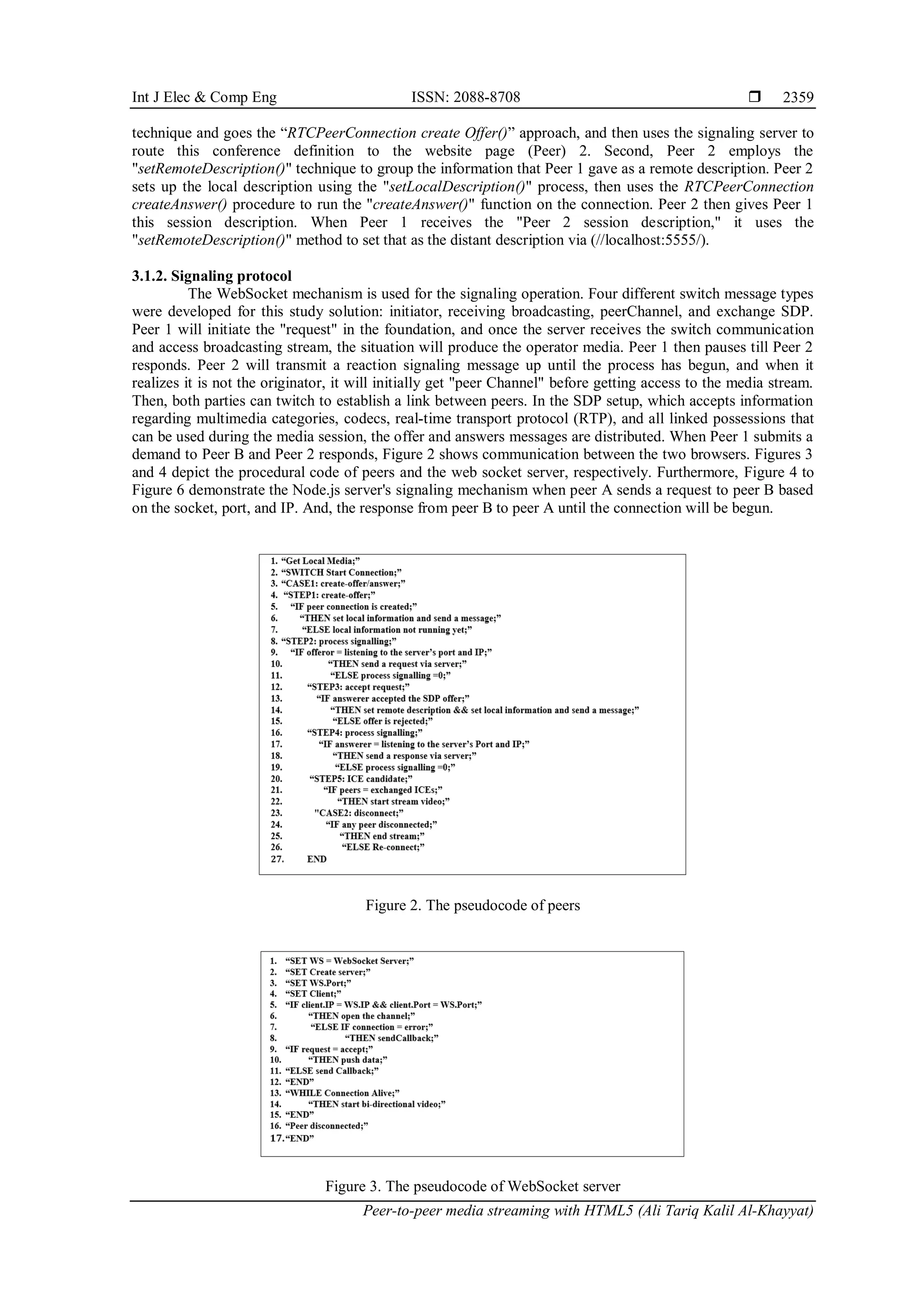
demand to Peer B and Peer 2 responds, Figure 2 shows communication between the two browsers. Figures 3
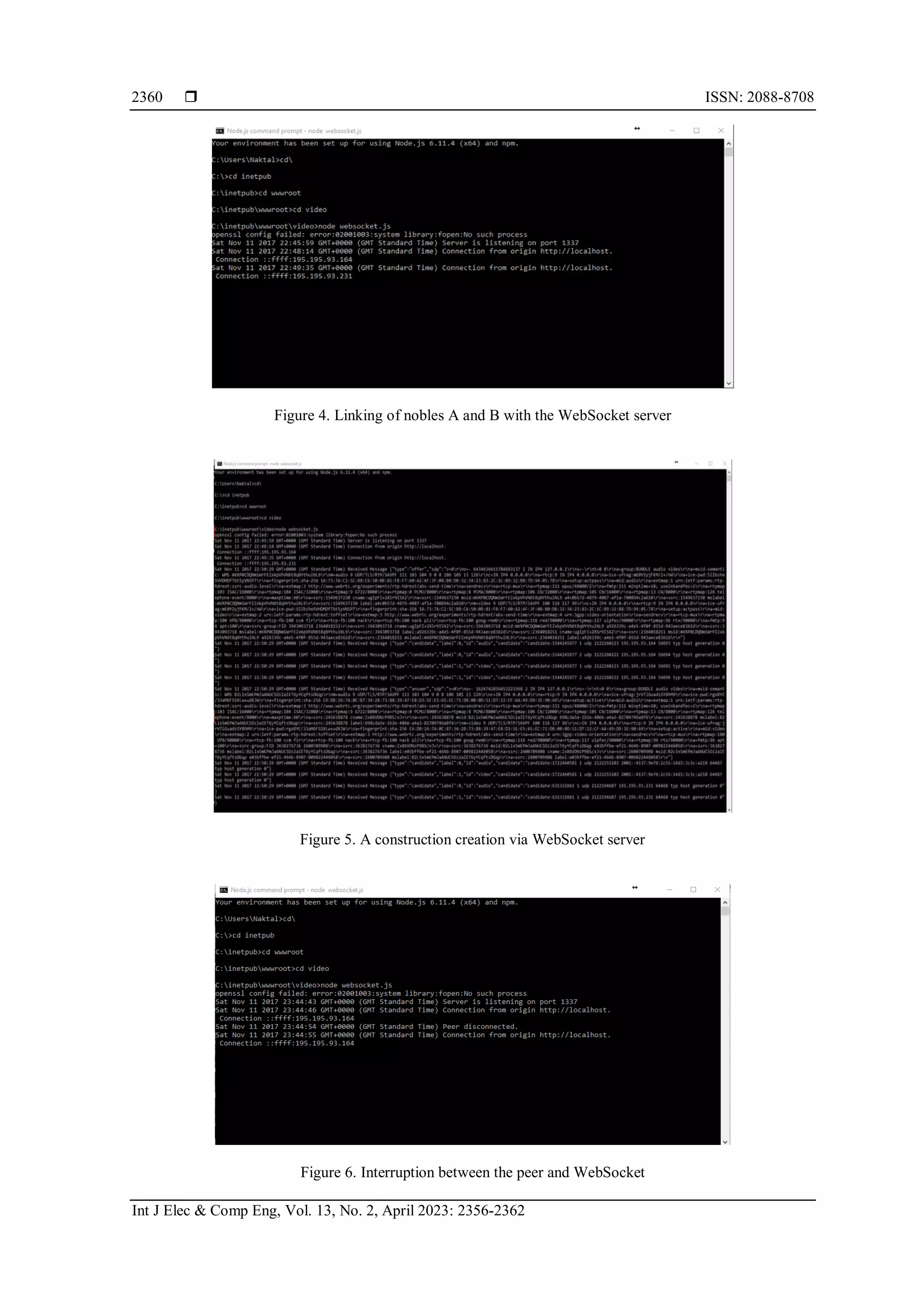
and 4 depict the procedural code of peers and the web socket server, respectively. Furthermore, Figure 4 to
Figure 6 demonstrate the Node.js server's signaling mechanism when peer A sends a request to peer B based
on the socket, port, and IP. And, the response from peer B to peer A until the connection will be begun.
Figure 2. The pseudocode of peers
Figure 3. The pseudocode of WebSocket server
 ISSN: 2088-8708
Int J Elec & Comp Eng, Vol. 13, No. 2, April 2023: 2356-2362
2360
Figure 4. Linking of nobles A and B with the WebSocket server
Figure 5. A construction creation via WebSocket server
Figure 6. Interruption between the peer and WebSocket
Int J Elec & Comp Eng ISSN: 2088-8708 
Peer-to-peer media streaming with HTML5 (Ali Tariq Kalil Al-Khayyat)
2361
3.2. Quality of experience (QoE)
In this research quality of experience (QoE) has been used through 15 (fifteen) actual users. In this
application, they provide their specific views on the supposed user skill through the usage of surveys. The
value of audio and video has been measured; hence they remained brilliant as shown in Table 1.
Table 1. Shows the QoE based on 15 users
Questions Very Bad Bad Annoying Fair Good Excellent
Rate the ease of using the application 15
Rate the quality of audio 2 13
Rate the quality of the video 1 14
Rate the resilience of the connection 1 3 11
Does the app convince you to use WebRTC in the future 1 14
4. RESULTS AND DISCUSSION
The user interface shows how two browsers can communicate via video conferencing. There are
real-time connections between the users. Consequently, there is a direct link between the peers. The video
has played in both browsers without the assistance of any third-party plug-ins or downloadable software,
such as flash. The "getUserMedia()" method provides access to the microphones and cameras making the
connection possible. After users turn on the video conferencing feature, WebRTC requires them to obtain
authorization before they may connect media devices. Google Chrome, Opera, and Firefox were used to test
the application. Usage of WebRTC on modern browsers generally receives media production and
adaptability. When two peers have an established channel of communication. A brand also successfully
established real-time video calls between
5. CONCLUSION
The biggest challenge with using WebRTC is that it does not define the standard form of
communication between browsers, which prevents it from operating as intended because it is difficult to link
several browsers. This study used the Socket technology as a host to communicate two, unlike browsers to
solve the aforementioned difficulty. Additionally, it developed and implemented WebRTC video
conferencing, which unlike networks LAN and WAN networking may support bidirectional communication.
The examination of the physical application's central processing unit (CPU) efficiency, bandwidth usage, and
quality of the experience was completed.
REFERENCES
[1] J. Jang-Jaccard, S. Nepal, B. Celler, and B. Yan, “WebRTC-based video conferencing service for telehealth,” Computing, vol. 98,
no. 1–2, pp. 169–193, Jan. 2016, doi: 10.1007/s00607-014-0429-2.
[2] G. Carullo, M. Tambasco, M. Di Mauro, and M. Longo, “A performance evaluation of WebRTC over LTE,” in 2016 12th
Annual
Conference on Wireless On-Demand Network Systems and Services, 2016, pp. 170–175.
[3] E. Fosser and L. O. D. Nedberg, “Quality of experience of WebRTC based video communication.” M.S. thesis, Department of
Telematics, Norwegian University of Science and Technology, 2016.
[4] X. L. Calpe, “Study, design and implementation of WebRTC for a real-time multimedia messaging application.” M.S. thesis,
Master in Science in Telecommunication Engineering and Management, Universitat Politècnica de Catalunya, 2017.
[5] F. Rhinow, P. P. Veloso, C. Puyelo, S. Barrett, and E. O. Nuallain, “P2P live video streaming in WebRTC,” in 2014 World
Congress on Computer Applications and Information Systems (WCCAIS), Jan. 2014, pp. 1–6, doi:
10.1109/WCCAIS.2014.6916588.
[6] H. Patil and A. Buchade, “Review and study of real time video collaboration framework WebRTC,” International Journal of
Computer Science and Information Technologies, vol. 5, no. 1, pp. 108–111, 2014.
[7] L. López-Fernández, B. García, M. Gallego, and F. Gortázar, “Designing and evaluating the usability of an API for real-time
multimedia services in the Internet,” Multimedia Tools and Applications, vol. 76, no. 12, pp. 14247–14304, Jun. 2017, doi:
10.1007/s11042-016-3729-z.
[8] B. Sredojev, D. Samardzija, and D. Posarac, “WebRTC technology overview and signaling solution design and implementation,”
in 2015 38th
International Convention on Information and Communication Technology, Electronics and Microelectronics
(MIPRO), May 2015, pp. 1006–1009, doi: 10.1109/MIPRO.2015.7160422.
[9] M. Deshpande and S. P. Mohani, “Integration of WebRTC with SIP – current trends,” International Journal of Innovations in
Engineering and Technology, vol. 6, no. 2, pp. 92–96, 2015.
[10] C. Cola and H. Valean, “On multi-user web conference using WebRTC,” in 2014 18th
International Conference on System
Theory, Control and Computing (ICSTCC), Oct. 2014, pp. 430–433, doi: 10.1109/ICSTCC.2014.6982454.
[11] Á. A. Sánchez, “WebRTC.” Treball Final de Grau, UPC, Escola Superior d’Enginyeries Industrial, Aeroespacial i Audiovisual de
Terrassa, Departament d’Enginyeria Telemàtica, 2016.
[12] S. N. Malik and M. U. Saeed. Kamran, Sabir. Hussain, “A comparison of SIP with IAX an efficient new IP telephony protocol,”
in International Conference of Engineering and Emerging Technology, 2015.
[13] J. K. Nurminen, A. J. R. Meyn, E. Jalonen, Y. Raivio, and R. Garcıa Marrero, “P2P media streaming with HTML5 and
 ISSN: 2088-8708
Int J Elec & Comp Eng, Vol. 13, No. 2, April 2023: 2356-2362
2362
WebRTC,” in 2013 IEEE Conference on Computer Communications Workshops (INFOCOM WKSHPS), Apr. 2013, pp. 63–64,
doi: 10.1109/INFCOMW.2013.6970739.
[14] A. S. Karl. Bissereth, Billy B. L. Lim, “An interactive video conferencing module for e-learning using WebRTC,” in
International Conferences, 2014, pp. 1–4.
[15] A. Johnston, J. Yoakum, and K. Singh, “Taking on webRTC in an enterprise,” IEEE Communications Magazine, vol. 51, no. 4,
pp. 48–54, Apr. 2013, doi: 10.1109/MCOM.2013.6495760.
[16] J. Uberti, C. Jennings, and E. Rescorla, “JavaScript session establishment protocol,” draft-ietf-rtcweb-jsep-14, Internet
Engineering Task Force (IETF), 2016
[17] S. Vashishth, Y. Sinha, and K. H. Babu, “Addressing challenges in browser based P2P content sharing framework using
WebRTC,” in 2016 IEEE 30th
International Conference on Advanced Information Networking and Applications (AINA), Mar.
2016, pp. 850–857, doi: 10.1109/AINA.2016.143.
[18] J. Khalid, “Comparison between VoIP clients.” M.S. thesis, Department of Telecommunication Engineering, Politecnico DI
Milano, 2014.
[19] R. Rai, Socket.IO real-time web application development. Packt Publishing, 2013.
[20] S. Chatterjee, T. Abhichandani, Haiqing Li, B. TuIu, and Jongbok Byun, “Instant messaging and presence technologies for
college campuses,” IEEE Network, vol. 19, no. 3, pp. 4–13, May 2005, doi: 10.1109/MNET.2005.1453393.
[21] S. Ludwig, J. Beda, P. Saint-Andre, R. McQueen, S. Egan, and J. Hildebrand, “XEP-0166: Jingle,” XMPP Standards Foundation,
2016. Accessed: Sep 22, 2021. [Online]. Available: https://xmpp.org/extensions/xep-0166.html#schemaerrors
[22] H. Rocha and R. L. Pereira, “Hyper-linked communications: WebRTC enabled asynchronous collaboration,” in 2017 IEEE
International Conference on Communications (ICC), May 2017, pp. 1–7, doi: 10.1109/ICC.2017.7996702.
[23] M. Schindler, C. Von Harscher, J. Kinzig, and S. Alekseev, “Evaluating framework for monitoring and analyzing WebRTC peer-
to-peer applications,” in Proceedings of the 11th
International Network Conference, 2016, pp. 171–175.
[24] B. García, L. López-Fernández, F. Gortázar, and M. Gallego, “Practical evaluation of VMAF perceptual video quality for
WebRTC applications,” Electronics, vol. 8, no. 8, Jul. 2019, doi: 10.3390/electronics8080854.
[25] Schahin Rajab, “Comparing different network topologies for WebRTC conferencing.” KTH Royal Institute of Technology, 2015.
[26] S. Owesen-Lein, “Unified communication and WebRTC.” B.S. thesis, Faculty of Information Technology and Electrical
Engineering, Norwegian University of Science and Technology, 2015.
[27] D. Vucic, L. Skorin-Kapov, and M. Suznjevic, “The impact of bandwidth limitations and video resolution size on QoE for
WebRTC-based mobile multi-party video conferencing,” in 5th
ISCA/DEGA Workshop on Perceptual Quality of Systems (PQS
2016), Aug. 2016, pp. 59–63, doi: 10.21437/PQS.2016-13.
BIOGRAPHIES OF AUTHORS
Ali Tariq Kalil Al-Khayyat has a master's degree in electrical and computer
engineering from Istanbul Altinbash University and he has an assistant lecturer in the Basic
Science Department in the College of the Dentistry University of Mosul and works in the
same College, he has a B.Sc. in computer technology engineering from the university of
Mosul. and he can be contacted at email: ali.khalil987@uomosul.edu.iq.
Sanabil A. Mahmood has been assistant literature at the Department of
Computer Sciences, College of Computer Science and Mathematics, the University of Mosul,
Iraq since 2022, graduated from the Computer Engineering College at the University of
Mosul, Iraq in 1997 and worked as Engineering in the same Collage until 2016 when she also
started studying Masters of Engineering I, then she finished M.Sc. Degree in 2018 General
expertise in computer science, and my specialty is in the area of artificial intelligence and
image processing. She has a research gate account under the name Sanabil Ahmed Mahmood.
She can be contacted at email: sanabil_2000.uomosul.edu.iq.

Peer-to-peer media streaming with HTML5

  • 1.
    International Journal ofElectrical and Computer Engineering (IJECE) Vol. 13, No. 2, April 2023, pp. 2356~2362 ISSN: 2088-8708, DOI: 10.11591/ijece.v13i2.pp2356-2362  2356 Journal homepage: http://ijece.iaescore.com Peer-to-peer media streaming with HTML5 Ali Tariq Kalil Al-Khayyat1 , Sanabil A. Mahmood2 1 College of Dentistry, Mosul University, Mosul, Iraq 2 College of Computers Sciences and Mathematics, Mosul University, Mosul, Iraq Article Info ABSTRACT Article history: Received Jan 15, 2022 Revised Oct 7, 2022 Accepted Nov 3, 2022 The knowledge of web real-time communication (WebRTC) and how its customers and server operations are defined in this study. However, the world wide web consortium (W3C) and the internet engineering task force (IETF) have not yet approved an absolute signaling protocol or a complete application programming interface (API) protocol to implement WebRTC and control communication planning. WebRTC requires some type of signaling mechanism. With Chrome, Firefox, and Opera, the primary objective is to create and implement a WebRTC video call across two clients (peers) in the real world while employing local area network (LAN) and wide area network (WAN). This study also demonstrated the design of the server (as an intermediary) and graphical user interface (GUI). Additionally, a signaling method for the peer-to-peer browser connection on the Node.js platform has been developed and successfully put into use. This paper will provide an understanding of web development and an ability to understand WebRTC technology. It will also discuss how to create WebRTC signaling mechanisms and build video conferencing, as well as how to increase design quality using quality of experience (QoE) techniques. Keywords: Local area network Quality of experience Screen monitoring System controlling Web real-time communication This is an open access article under the CC BY-SA license. Corresponding Author: Ali Tariq Kalil Al-Khayyat College of Dentistry, Mosul University Mosul, Iraq Email: ali.khalil987@uomosul.edu.iq 1. INTRODUCTION Web real-time communication (WebRTC) is a new benchmark created by the world wide web consortium (W3C) and the internet engineering task force (IETF) agencies [1]. WebRTC is a techniques project that includes archives, JavaScript Programming, and principles for audio, video, and data communication [2]. It also has several advantages, including no external software, installation, ease of use, and free [3]. The WebRTC was begun in May of 2011 when Google announced an open-source initiative at the time to provide browser-based real-time communications [4]. In other clarification, Rhinow et al. [5] explained that WebRTC is a peer-to-peer (P2P) protocol instead a client-server procedure. JavaScript language is straight used in WebRTC aimed at communicating, and it can be used in a variety of industries, such as web conferencing, video streaming, and voice and video chatting [6]. Moreover, WebRTC differs from other video conferencing apps in that it is a set of application programming interfaces (APIs) rather than a service that allows WWW developers to construct their applications using conventional WWW approaches [7]. On the other hand, WebRTC has no signaling mechanism because of many excuses, such as to escape idleness and maximize compatibility with existing knowledge [8], or for a novel use case. Signaling like the peer identification mechanism, which finds peers and arranges communication between them, relies heavily on it. WebRTC supports the establishment of by enabling the interchange of data through channels, user communication is enhanced [1]. The session description protocol (SDP), which mixes the network addresses
  • 2.
    Int J Elec& Comp Eng ISSN: 2088-8708  Peer-to-peer media streaming with HTML5 (Ali Tariq Kalil Al-Khayyat) 2357 and destination port for the browser, is supported by signaling, which also links the browser to a server and enables other peers to communicate with it. Signaling is therefore utilized to start announcements among several operators. WebRTC, therefore, needs some sort of signaling mechanism or protocol support [9]. However, the WebRTC group do not spread an arrangement on a definitive signaling appliance or API conventions to test WebRTC and govern communication architecture [10], [11]. As long as WebRTC's major important implementation problem is signaling [12]. The peer discovery mechanism's key component, signaling, locates any existing peers and then orchestrates the interaction between the sites. The essential modules of the WebRTC API are listed in [8] are:  “MediaStream: it allows a web browser to access the camera and microphone”.  “RTCPeerConnection: it allows browser-to-browser to communicate directly”.  “RTCDataChannel: it allows browsers to send data connections and enables the exchange of arbitrary data between them”. Figure 1 shows the WebRTC MediaStream structure. Figure 1. The structure of WebRTC MediaStream [8] Joint science education project (JSEP) provides tools for creating and applying offers and responses to a session. However, it is completely disconnected from the actual process through which these offers and responses are conveyed to the remote side [13]. As a result of the JSEP technique, the application is solely responsible for driving the signaling state machine [5]. Furthermore, it allows web applications to bear the signaling or negotiation state, allowing genuine indicating etiquettes like (session initiation protocol (SIP) and Jingle) to function on the upper of it [14]. Simply one thing is needed: a mechanism for the app to send a native demand and negotiate distant conference facts, as well as a way to interact with the interactive connectivity establishment (ICE) [15]. The foremost idea of this research is to enterprise WebRTC video calls in an actual application with the Node.js platform. In-depth elaborations of this research will assist anxious customers to produce a consideration of WebRTC technology and communication between the client and server. This design is helpful for concerned employees who purpose to use WebRTC video conferencing for many communications, such as communication presentations, and games. This work is prepared as mentioned: the WebRTC-related exertion is assumed in section 2. The method is given in section 3. Results and discussion are obtainable in section 4. The conclusion is in section 5. 2. RELATED WORK There are various applications, propositions and work related to a signaling mechanism. But several designers struggled to generate or advance a signaling mechanism for WebRTC. Nonetheless, more of them have been challenged with many issues as the following: 2.1. Signaling issues The IETF and the W3C group have not yet agreed on the last signing appliance, so they have not established signaling channel standards [16]. Even if WebRTC uses the "RTCPeerConnection" API to convey data flowing between users, nonetheless a signaling tool is not a chunk of it [17]. As a result, the developer must supply the signaling protocol at the application level [18], and it is necessary to be decided upon by the two entities, either with the central node or with the other user. Thus, the client-server architecture does not appear to be a viable WebRTC solution [19]. WebRTC applications require signaling to start up a call, and clients require signaling to communicate different forms of facts. Furthermore, Chatterjee et al. [20] stated that the most perplexing aspect of learning WebRTC is signaling, which is often used in statement schemes to communicate that establishing a call is accomplished through information.
  • 3.
     ISSN: 2088-8708 IntJ Elec & Comp Eng, Vol. 13, No. 2, April 2023: 2356-2362 2358 2.2. Specifications of the common signaling mechanisms and servers Socket.io Protocol is a JavaScript-based transference protocol that allows web browsers and servers to communicate in real-time [21]. Socket.io began in Node.js and has remained a primary backend in Node.js ever since [22]. Google Chrome created Nore.js to provide a high-performance JavaScript engine. Accordingly, it provides an HTTP server to aid the development of web applications, but it is neither a web server nor an application server like Apache HTTP [23]. In [24], demonstrates that socket.io enables designers to use WebSockets and decide on many synchronized communication methods governed by the client's browser; a notion for WebSockets with XHR, Flash, and JSON is also described. On the other hand, it makes use of Adobe Flash Sockets, AJAX long polling, and JSON polling. Furthermore, socket.io provides a simple server and client library for supporting real-time bi-directional communication. 2.3. XMLHttpRequest signaling protocol (known as XHR) In [25] stated that XHR does not support all current browser features and is more difficult than Jingle and XMPP. There are mentioned in [26] that XHR has a lesser throughput than WebSocket and is affected by overhead. Besides, extensible messaging and presence protocol (XMPP): XMPP is an open- source system for real-time messaging, multi-party chat, audio, and video calls. However, it is a slow text- based protocol that causes tremendous Internet traffic. In [27] describes that XMPP uses data transit between two network components. Besides, presented that XMPP connection is built on XML streams, which are made up of unidirectional elements. The XMPP restrictions have been amended, proving that XMPP is limited to a single TCP connection for client-to-server XML transmission. Additionally, Owesen-Lein [26] demonstrated the following XMPP criteria: i) it is utilized for data transmission rather than signaling and ii) it has a client-server architecture rather than a peer-to-peer architecture. In general, no important browsers support the XMPP protocol [10]. Likewise, due to XMPP's limits on many web pages, Vucic et al. [27] claimed that the user must restart the execution after each load. 2.4. General limitations No tools or interfaces have been provided by WebRTC to monitor P2P structures [6]. WebRTC ethics are quiet in the development phase, and they might take some time to be full-grown [26]. Besides, Vucic et al. [27] demonstrated that choosing the appropriate network topology is regarded to be one of the challenging issues in the design and architecture of the WebRTC presentation; as a result, it would have to take infrastructure for the program whereas working with a combined audio/video conversation in WebRTC. Not only that but also, Ludwig et al. [21] emphasized that there are execution difficulties among peers as a result of their alpha or beta position; consequently, they have several bugs; for example, the present WebRTC draft is not applied within every browser due to interoperability matters between them. Too, established that WebRTC is not performed with all browsers. An instantaneous WebRTC video conferencing structure using multipoint conferencing units (MCU) is discovered in [3]. The proposed test was dependent on an exhausted MCU, which can be realistically accomplished using a single connection, whereas this situation does not deliberate any meaningful signaling. Additionally, used the Licode-Erizo (MCU) across the local area network (LAN) network to take part in a WebRTC video-conferencing application. On the other hand, García et al. [24] emphasized how expensive it is to use MCU, and indicated that MCU is expensive and can only be purchased from facility suppliers for a meeting. Furthermore, notes that MCU uses a significant quantity of bandwidth. based on the many items from the relevant study as shown directly above. It is clear that with WebRTC, signaling between peers and servers differs [1], [2]. 3. METHOD 3.1. Implementation An experiment lab was established to implement a WebRTC-based video conferencing system over dissimilar networks. As well as, LAN and wide area network (WAN) networks, Chrome and Firefox were used. This execution can be separated into two kinds: user application and signaling as defined below: 3.1.1. User application To develop WebRTC video chat apps as clients and servers, a test-bed lab was established. The internet was used to establish the link. The main home page of this solution has been prepared and set up for a variety of structures, including pausing audio and video, employing full-screen, and establishing a connection between two peers (laptop computers) through Chrome. A connection was identified in advance, and the exchange of local and distant descriptions was successful (the audio and video media data). The exchange of signaling offers and responses using the SDP is described in the following (session description protocol). First, web page (Peer) 1 arrangement the local description using the “setLocalDescription()”
  • 4.
    Int J Elec& Comp Eng ISSN: 2088-8708  Peer-to-peer media streaming with HTML5 (Ali Tariq Kalil Al-Khayyat) 2359 technique and goes the “RTCPeerConnection create Offer()” approach, and then uses the signaling server to route this conference definition to the website page (Peer) 2. Second, Peer 2 employs the "setRemoteDescription()" technique to group the information that Peer 1 gave as a remote description. Peer 2 sets up the local description using the "setLocalDescription()" process, then uses the RTCPeerConnection createAnswer() procedure to run the "createAnswer()" function on the connection. Peer 2 then gives Peer 1 this session description. When Peer 1 receives the "Peer 2 session description," it uses the "setRemoteDescription()" method to set that as the distant description via (//localhost:5555/). 3.1.2. Signaling protocol The WebSocket mechanism is used for the signaling operation. Four different switch message types were developed for this study solution: initiator, receiving broadcasting, peerChannel, and exchange SDP. Peer 1 will initiate the "request" in the foundation, and once the server receives the switch communication and access broadcasting stream, the situation will produce the operator media. Peer 1 then pauses till Peer 2 responds. Peer 2 will transmit a reaction signaling message up until the process has begun, and when it realizes it is not the originator, it will initially get "peer Channel" before getting access to the media stream. Then, both parties can twitch to establish a link between peers. In the SDP setup, which accepts information regarding multimedia categories, codecs, real-time transport protocol (RTP), and all linked possessions that can be used during the media session, the offer and answers messages are distributed. When Peer 1 submits a demand to Peer B and Peer 2 responds, Figure 2 shows communication between the two browsers. Figures 3 and 4 depict the procedural code of peers and the web socket server, respectively. Furthermore, Figure 4 to Figure 6 demonstrate the Node.js server's signaling mechanism when peer A sends a request to peer B based on the socket, port, and IP. And, the response from peer B to peer A until the connection will be begun. Figure 2. The pseudocode of peers Figure 3. The pseudocode of WebSocket server
  • 5.
     ISSN: 2088-8708 IntJ Elec & Comp Eng, Vol. 13, No. 2, April 2023: 2356-2362 2360 Figure 4. Linking of nobles A and B with the WebSocket server Figure 5. A construction creation via WebSocket server Figure 6. Interruption between the peer and WebSocket
  • 6.
    Int J Elec& Comp Eng ISSN: 2088-8708  Peer-to-peer media streaming with HTML5 (Ali Tariq Kalil Al-Khayyat) 2361 3.2. Quality of experience (QoE) In this research quality of experience (QoE) has been used through 15 (fifteen) actual users. In this application, they provide their specific views on the supposed user skill through the usage of surveys. The value of audio and video has been measured; hence they remained brilliant as shown in Table 1. Table 1. Shows the QoE based on 15 users Questions Very Bad Bad Annoying Fair Good Excellent Rate the ease of using the application 15 Rate the quality of audio 2 13 Rate the quality of the video 1 14 Rate the resilience of the connection 1 3 11 Does the app convince you to use WebRTC in the future 1 14 4. RESULTS AND DISCUSSION The user interface shows how two browsers can communicate via video conferencing. There are real-time connections between the users. Consequently, there is a direct link between the peers. The video has played in both browsers without the assistance of any third-party plug-ins or downloadable software, such as flash. The "getUserMedia()" method provides access to the microphones and cameras making the connection possible. After users turn on the video conferencing feature, WebRTC requires them to obtain authorization before they may connect media devices. Google Chrome, Opera, and Firefox were used to test the application. Usage of WebRTC on modern browsers generally receives media production and adaptability. When two peers have an established channel of communication. A brand also successfully established real-time video calls between 5. CONCLUSION The biggest challenge with using WebRTC is that it does not define the standard form of communication between browsers, which prevents it from operating as intended because it is difficult to link several browsers. This study used the Socket technology as a host to communicate two, unlike browsers to solve the aforementioned difficulty. Additionally, it developed and implemented WebRTC video conferencing, which unlike networks LAN and WAN networking may support bidirectional communication. The examination of the physical application's central processing unit (CPU) efficiency, bandwidth usage, and quality of the experience was completed. REFERENCES [1] J. Jang-Jaccard, S. Nepal, B. Celler, and B. Yan, “WebRTC-based video conferencing service for telehealth,” Computing, vol. 98, no. 1–2, pp. 169–193, Jan. 2016, doi: 10.1007/s00607-014-0429-2. [2] G. Carullo, M. Tambasco, M. Di Mauro, and M. Longo, “A performance evaluation of WebRTC over LTE,” in 2016 12th Annual Conference on Wireless On-Demand Network Systems and Services, 2016, pp. 170–175. [3] E. Fosser and L. O. D. Nedberg, “Quality of experience of WebRTC based video communication.” M.S. thesis, Department of Telematics, Norwegian University of Science and Technology, 2016. [4] X. L. Calpe, “Study, design and implementation of WebRTC for a real-time multimedia messaging application.” M.S. thesis, Master in Science in Telecommunication Engineering and Management, Universitat Politècnica de Catalunya, 2017. [5] F. Rhinow, P. P. Veloso, C. Puyelo, S. Barrett, and E. O. Nuallain, “P2P live video streaming in WebRTC,” in 2014 World Congress on Computer Applications and Information Systems (WCCAIS), Jan. 2014, pp. 1–6, doi: 10.1109/WCCAIS.2014.6916588. [6] H. Patil and A. Buchade, “Review and study of real time video collaboration framework WebRTC,” International Journal of Computer Science and Information Technologies, vol. 5, no. 1, pp. 108–111, 2014. [7] L. López-Fernández, B. García, M. Gallego, and F. Gortázar, “Designing and evaluating the usability of an API for real-time multimedia services in the Internet,” Multimedia Tools and Applications, vol. 76, no. 12, pp. 14247–14304, Jun. 2017, doi: 10.1007/s11042-016-3729-z. [8] B. Sredojev, D. Samardzija, and D. Posarac, “WebRTC technology overview and signaling solution design and implementation,” in 2015 38th International Convention on Information and Communication Technology, Electronics and Microelectronics (MIPRO), May 2015, pp. 1006–1009, doi: 10.1109/MIPRO.2015.7160422. [9] M. Deshpande and S. P. Mohani, “Integration of WebRTC with SIP – current trends,” International Journal of Innovations in Engineering and Technology, vol. 6, no. 2, pp. 92–96, 2015. [10] C. Cola and H. Valean, “On multi-user web conference using WebRTC,” in 2014 18th International Conference on System Theory, Control and Computing (ICSTCC), Oct. 2014, pp. 430–433, doi: 10.1109/ICSTCC.2014.6982454. [11] Á. A. Sánchez, “WebRTC.” Treball Final de Grau, UPC, Escola Superior d’Enginyeries Industrial, Aeroespacial i Audiovisual de Terrassa, Departament d’Enginyeria Telemàtica, 2016. [12] S. N. Malik and M. U. Saeed. Kamran, Sabir. Hussain, “A comparison of SIP with IAX an efficient new IP telephony protocol,” in International Conference of Engineering and Emerging Technology, 2015. [13] J. K. Nurminen, A. J. R. Meyn, E. Jalonen, Y. Raivio, and R. Garcıa Marrero, “P2P media streaming with HTML5 and
  • 7.
     ISSN: 2088-8708 IntJ Elec & Comp Eng, Vol. 13, No. 2, April 2023: 2356-2362 2362 WebRTC,” in 2013 IEEE Conference on Computer Communications Workshops (INFOCOM WKSHPS), Apr. 2013, pp. 63–64, doi: 10.1109/INFCOMW.2013.6970739. [14] A. S. Karl. Bissereth, Billy B. L. Lim, “An interactive video conferencing module for e-learning using WebRTC,” in International Conferences, 2014, pp. 1–4. [15] A. Johnston, J. Yoakum, and K. Singh, “Taking on webRTC in an enterprise,” IEEE Communications Magazine, vol. 51, no. 4, pp. 48–54, Apr. 2013, doi: 10.1109/MCOM.2013.6495760. [16] J. Uberti, C. Jennings, and E. Rescorla, “JavaScript session establishment protocol,” draft-ietf-rtcweb-jsep-14, Internet Engineering Task Force (IETF), 2016 [17] S. Vashishth, Y. Sinha, and K. H. Babu, “Addressing challenges in browser based P2P content sharing framework using WebRTC,” in 2016 IEEE 30th International Conference on Advanced Information Networking and Applications (AINA), Mar. 2016, pp. 850–857, doi: 10.1109/AINA.2016.143. [18] J. Khalid, “Comparison between VoIP clients.” M.S. thesis, Department of Telecommunication Engineering, Politecnico DI Milano, 2014. [19] R. Rai, Socket.IO real-time web application development. Packt Publishing, 2013. [20] S. Chatterjee, T. Abhichandani, Haiqing Li, B. TuIu, and Jongbok Byun, “Instant messaging and presence technologies for college campuses,” IEEE Network, vol. 19, no. 3, pp. 4–13, May 2005, doi: 10.1109/MNET.2005.1453393. [21] S. Ludwig, J. Beda, P. Saint-Andre, R. McQueen, S. Egan, and J. Hildebrand, “XEP-0166: Jingle,” XMPP Standards Foundation, 2016. Accessed: Sep 22, 2021. [Online]. Available: https://xmpp.org/extensions/xep-0166.html#schemaerrors [22] H. Rocha and R. L. Pereira, “Hyper-linked communications: WebRTC enabled asynchronous collaboration,” in 2017 IEEE International Conference on Communications (ICC), May 2017, pp. 1–7, doi: 10.1109/ICC.2017.7996702. [23] M. Schindler, C. Von Harscher, J. Kinzig, and S. Alekseev, “Evaluating framework for monitoring and analyzing WebRTC peer- to-peer applications,” in Proceedings of the 11th International Network Conference, 2016, pp. 171–175. [24] B. García, L. López-Fernández, F. Gortázar, and M. Gallego, “Practical evaluation of VMAF perceptual video quality for WebRTC applications,” Electronics, vol. 8, no. 8, Jul. 2019, doi: 10.3390/electronics8080854. [25] Schahin Rajab, “Comparing different network topologies for WebRTC conferencing.” KTH Royal Institute of Technology, 2015. [26] S. Owesen-Lein, “Unified communication and WebRTC.” B.S. thesis, Faculty of Information Technology and Electrical Engineering, Norwegian University of Science and Technology, 2015. [27] D. Vucic, L. Skorin-Kapov, and M. Suznjevic, “The impact of bandwidth limitations and video resolution size on QoE for WebRTC-based mobile multi-party video conferencing,” in 5th ISCA/DEGA Workshop on Perceptual Quality of Systems (PQS 2016), Aug. 2016, pp. 59–63, doi: 10.21437/PQS.2016-13. BIOGRAPHIES OF AUTHORS Ali Tariq Kalil Al-Khayyat has a master's degree in electrical and computer engineering from Istanbul Altinbash University and he has an assistant lecturer in the Basic Science Department in the College of the Dentistry University of Mosul and works in the same College, he has a B.Sc. in computer technology engineering from the university of Mosul. and he can be contacted at email: ali.khalil987@uomosul.edu.iq. Sanabil A. Mahmood has been assistant literature at the Department of Computer Sciences, College of Computer Science and Mathematics, the University of Mosul, Iraq since 2022, graduated from the Computer Engineering College at the University of Mosul, Iraq in 1997 and worked as Engineering in the same Collage until 2016 when she also started studying Masters of Engineering I, then she finished M.Sc. Degree in 2018 General expertise in computer science, and my specialty is in the area of artificial intelligence and image processing. She has a research gate account under the name Sanabil Ahmed Mahmood. She can be contacted at email: sanabil_2000.uomosul.edu.iq.