Seeking Comprehensive Public Participation in Irelands National Energy
Transition Plans - A story of Timing
Theresa O’Donohoe May 2020
TINI is the Irish hub of the global Transition Movement
Building community resilience and sustainability in the face of
climate change, resource depletion and financial contraction.
https://www.facebook.com/TINIreland/
Originating in Kinsale, Co Cork, Transition is
a movement of communities coming together
to reimagine and rebuild our world.
It’s a no blame, problem solving, solutions
focused, community response!
https://transitionnetwork.org/about-the-movement/what-is-transition/
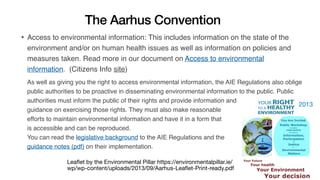
The Aarhus Convention
Leaflet by the Environmental Pillar https://environmentalpillar.ie/
wp/wp-content/uploads/2013/09/Aarhus-Leaflet-Print-ready.pdf
• Access to environmental information: This includes information on the state of the
environment and/or on human health issues as well as information on policies and
measures taken. Read more in our document on Access to environmental
information. (Citizens Info site)
As well as giving you the right to access environmental information, the AIE Regulations also oblige
public authorities to be proactive in disseminating environmental information to the public. Public
authorities must inform the public of their rights and provide information and
guidance on exercising those rights. They must also make reasonable
efforts to maintain environmental information and have it in a form that
is accessible and can be reproduced.
You can read the legislative background to the AIE Regulations and the
guidance notes (pdf) on their implementation.
2013
• Public participation in environmental decision making: Members of the public have a right to participate
in a range of decisions where there may be an environmental impact. These include planning matters
and other environmental licensing decisions, such as foreshore licences, waste licences and Integrated
Pollution Prevention Control licences. Public authorities responsible for decision making on such
licences are obliged to publish notices on specific licence applications, which must inform the public on
how they may participate. Comments submitted by the public are to be taken into consideration in the
decision-making process.
• Access to justice in environmental matters: Members of the public and environmental non-
governmental organisations have the right to seek a review of decisions that have been made which
may affect the environment. The review procedures must provide “adequate and effective remedies ...
and be fair, equitable, timely and not prohibitively expensive”.
https://www.citizensinformation.ie/en/environment/environmental_law/aarhus_convention.html
Aarhus Compliance Committee
Article 15 of the Aarhus Convention established arrangements for reviewing
compliance with the Convention. For that purpose a Compliance Committee
has been established to discuss and decide on possible breaches of the
Convention. Ireland has been subject to the compliance mechanism since 18
September 2013, one year after the date the agreement came into effect.
Find more information about the Committee and its work.
National Renewable Energy Action Plan

Ireland lacked Public Participation - but consulted the wind industry
ACCC/C/2010/54 European Union - ruling against the EU in 2012
http://www.unece.org/env/pp/compliance/Compliancecommittee/54TableEU.html
November 9th 2013 in a hotel in Portalaoise …….

after years of seeking transition conversations!
Wind industry

Climate activists

Solar advocates

Community energy

Anti wind activists

Climate deniers

Microgrids

Biomass

Farmers

Environmentalists 

NGOs & more
Slideshow of feedback from the event https://www.slideshare.net/
LaoisLeaf/peoples-charter-on-renewable-energy-report-courtesy-of-conor
Comprehensive Public Participation
in National Energy Transition Plans 
Follow up meeting in February 2014 to form PEC with one binding demand
Our common ground
***** PRESS RELEASE ***** March 2014

Call for Comprehensive Public Participation in
National Energy Plans

Following the news that there has been a delay to the
intergovernmental agreement on energy trading
between Ireland and Britain, the People’s Energy
Charter calls for comprehensive public participation
in the development of a national energy transition
plan.
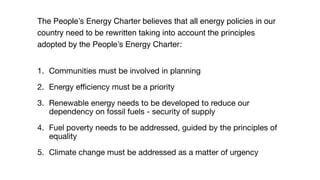
The People’s Energy Charter believes that all energy policies in our
country need to be rewritten taking into account the principles
adopted by the People’s Energy Charter:
1. Communities must be involved in planning

2. Energy efficiency must be a priority

3. Renewable energy needs to be developed to reduce our
dependency on fossil fuels - security of supply

4. Fuel poverty needs to be addressed, guided by the principles of
equality

5. Climate change must be addressed as a matter of urgency
Within a couple of months The People’s Energy Charter was supported
by the following groups, NGO’s & networks:
• An Taisce

• CEF – Cork Environmental Forum 

• COF – Claiming our Future is a national non-party-political civil society network

• Energy Co-ops Ireland

• Environmental Pillar

• FOE – Friends of the Earth Ireland 

• GEAI – Good Energies Alliance Ireland 

• Kilcommon and Upperchurch Wind Awareness Group

• LEAF – Laois Environmental Action Forum. 

• LEN – Laois Environmental Network 

• POW – People Over Wind 

• Presentation Justice Network Ireland 

• Ratheniska, Timahoe,Spink Substation Action

• TINI – Transition Ireland and Northern Ireland 

• Transition Kerry – Southwest Transition Hub

• Tipperary Energy Agency

• Wind Aware Ireland

• And more
We met with government officials in March. We proposed that:

1. educating and engaging the community sector is a fundamental pre-requisite to our
common aim of decarbonising the energy system and economy while reducing energy
demand as rapidly as possible;  

2. this is a medium-term process that requires multiple perspectives to optimise outcomes;

3. there is a need to build relationships and mutual understanding that will enable relevant
actors to be co-creative; 

4. there is a need to build skills and capacity to assist actors on all sides to break out of set
patterns and evolve new responses;

5. the process of educating and engaging the community sector needs to be resourced
realistically to attain our common objectives.        
https://theresaod.com/2014/05/12/where-were-the-public-at-the-
launch-of-the-green-paper-on-energy-policy-in-ireland/
“I was invited by association and I want
to believe that the lack of a direct invite to the
People’s Energy Charter was an oversight by
department officials and not intentional. It would
be very ironic that the first priority addressed in
the green paper is “Empowering Energy
Citizens”. One would think that empowering
them may actually be helped by inviting them to
the launch”
Where were the “Public” at the launch of the
Green Paper on Energy Policy in Ireland?
Posted on May 12, 2014 by Theresa OD
https://www.dccae.gov.ie/en-ie/energy/consultations/Documents/19/
submissions/Transition%20Ireland%20and%20Northern%20Ireland.pdf
NESC recommendations suggests that “At national level, an
energy transition process would seem to have three
overlapping features.”
It must be:
•Intentional
•Participatory
•Problem-solving
Launch of National Economic and Social Council NESC report
“Wind Energy in Ireland : Building Community Engagement and
Social Support” July 2014
https://theresaod.com/2014/07/04/launch-of-national-economic-and-social-council-nesc-
report-wind-energy-in-ireland-building-community-engagement-and-social-support/
September 24th I attended the launch of the next phase of the National Energy Policy. This was
my first event with Alex White, the new Minister at the Department of Communication, Energy and
Natural Resources. My impression was very positive and I feel he is intent on ensuring this policy
can work.

The policy document is being worked around 6 priorities which continue to shape proceedings:

Priority 1. Empowering Energy Citizens

Priority 2. Markets, Regulation, Prices

Priority 3. Planning and Implementing Essential Energy Infrastructure

Priority 4. Ensuring a balanced and secure energy mix

Priority 5. Putting the energy system on a sustainable pathway

Priority 6. Driving economic opportunity
https://theresaod.com/2014/09/27/national-energy-policy-next-phase/
The intention was to host 6 seminars, based on the 6 priorities, within months and Minister
White would chair a Steering Group to advise on the finalisation of the Energy Policy.

The end result was

• 12 workshops, 4 were regional

• All live streamed & interactive

• Additional year of consultation

This was all very new territory for Irish policy consultations. It has never been repeated :(
***** Then followed a “Ministerial Steer”! *****
Within a couple of months The People’s Energy Charter
was supported by the following groups, NGO’s &
networks:
• An Taisce

• CEF – Cork Environmental Forum 

• COF – Claiming our Future is a national non-party-political civil
society network

• Energy Co-ops Ireland

• Environmental Pillar

• FOE – Friends of the Earth Ireland 

• GEAI – Good Energies Alliance Ireland 

• Kilcommon and Upperchurch Wind Awareness Group

• LEAF – Laois Environmental Action Forum. 

• LEN – Laois Environmental Network 

• POW – People Over Wind 

• Presentation Justice Network Ireland 

• Ratheniska, Timahoe,Spink Substation Action

• TINI – Transition Ireland and Northern Ireland 

• Transition Kerry – Southwest Transition Hub

• Tipperary Energy Agency

• Wind Aware Ireland

• And more
Remember all of these groups, NGOs etc?
Throughout the policy consultation process we
collaborated on submissions. We all repeatedly
sought comprehensive public participation in the
national energy transition plan as well as what we
were seeking independently.
We had a Facebook page, email
group, some met at events. We kept
in touch throughout the whole 2
years from the initial event until the
launch of the national policy.
We had one consistent shared demand
https://theresaod.com/changing-the-system/
A few years of policy absorption; conferences on
energy, climate, sustainable development &
economic development; inside information;
whistleblowing; agitation; participation and
eventually - one year later than planned ………
A national energy policy to address climate
change
Including a national energy forum
Launched in December 2015 - upon Ministers
return from Paris for COP15
July 2014 - NESC recommendations 

December 2015 - White Paper announcing National Energy Forum

May 2016 - Programme for Government renames NEF to Climate Dialogue

September 2017 - Citizens Assembly

July 2018 - Joint Oireachtas Committee on Climate Action
5yrs of talk without meaningful action
The following excerpt on Climate Change and Energy is from A Programme for a
Partnership Government in May 2016

“Public Consultation on the Future of Energy Policy

It is clear that there is a need for much better engagement with citizens and
communities about the energy policy decisions that affect them. We must ensure, as
part of our transition to a low carbon society, that citizens and communities are active
participants in the energy transition, with robust public and stakeholder engagement in
energy policy, and effective community consultation on energy infrastructure
developments………..
…….We will establish a National Dialogue on Climate Change that
will involve extensive public consultation. This will incorporate the
key infrastructural, land use and economic issues to be considered
in our long-term transition to a new low carbon future.” A Programme for a
Partnership Government in May 2016
Climate Action Regional Offices - I haven’t seen or heard ours in Clare

Climate Dialogue Advisory Group - Frustrates Action

Climate Ambassador programme - has absolutely no teeth, tokenistic
My report from Climate Dialogue event in
Tralee in November 2018

https://www.facebook.com/theresa.carter.549/videos/
vb.1357915964/10217868877617762/?type=2&video_source=user_video_tab

The departments overview

https://www.dccae.gov.ie/en-ie/climate-action/topics/national-dialogue-on-
climate-action/regional-gatherings/tralee-november-2018/Pages/default.aspx

Includes their video report 

https://www.youtube.com/watch?v=ufnNPcbnEQM&feature=youtu.be
This turned out to be a consultation on how to run the climate dialogue

I spoke with the guardians of the dialogue and they made it very clear that the
civil servants were controlling everything 

What I think…..

The feedback scares the life out of them - a new vision

Neoliberal capitalism is too integral to society to challenge

Lobby groups have waaaay too much power - back door policy

They obviously DO NOT understand the implications of climate breakdown or…

Seriously believe that there is enough time to leave it to the next government
The energy agencies work on efficiency in local authority premises.

A recent proposal seems to have suggested there should be one person in
every Local Authority on climate. Their role would include the LA transition as
well as responsibility for the entire county and citizens. 

Public Participation in the transition requires a whole team of staff in
every local authority. Much like Covid19 response teams.

• Massive awareness and validation of the facts is essential from the start

• Assistance with retrofitting and lifestyle changes for everyone

• Facilitation of engagement with SEAI including matched funding

• Energy retrofit workforce in every county - including LA employees
https://theresaod.com/2016/09/10/proposal-for-comprehensive-public-participation-in-
irelands-national-energy-transition-plan/
• The question everybody asks me “What is comprehensive public participation and how do we
do it?” This blog contains my answer based on 10 years of work at community, national and
international level in the transition and participation processes. The fact that I live in rural
Ireland also offers real insights and experience of the challenges to participation
• Comprehensive public participation in the national energy transition plan is vital so that its
implementation will be widely accepted at least and actively participated in at best. We need a
collaborative national vision and implementation strategy. Working together we can create a
shared vision and commitment to its success.
Proposal for Comprehensive Public Participation in Irelands National
Energy Transition Plan
Posted on September 10, 2016 by Theresa OD
You can read my proposal here …

Pec intro

  • 1.
    Seeking Comprehensive PublicParticipation in Irelands National Energy Transition Plans - A story of Timing Theresa O’Donohoe May 2020
  • 2.
    TINI is theIrish hub of the global Transition Movement Building community resilience and sustainability in the face of climate change, resource depletion and financial contraction. https://www.facebook.com/TINIreland/
  • 3.
    Originating in Kinsale,Co Cork, Transition is a movement of communities coming together to reimagine and rebuild our world. It’s a no blame, problem solving, solutions focused, community response! https://transitionnetwork.org/about-the-movement/what-is-transition/
  • 4.
    The Aarhus Convention Leafletby the Environmental Pillar https://environmentalpillar.ie/ wp/wp-content/uploads/2013/09/Aarhus-Leaflet-Print-ready.pdf • Access to environmental information: This includes information on the state of the environment and/or on human health issues as well as information on policies and measures taken. Read more in our document on Access to environmental information. (Citizens Info site) As well as giving you the right to access environmental information, the AIE Regulations also oblige public authorities to be proactive in disseminating environmental information to the public. Public authorities must inform the public of their rights and provide information and guidance on exercising those rights. They must also make reasonable efforts to maintain environmental information and have it in a form that is accessible and can be reproduced. You can read the legislative background to the AIE Regulations and the guidance notes (pdf) on their implementation. 2013
  • 5.
    • Public participationin environmental decision making: Members of the public have a right to participate in a range of decisions where there may be an environmental impact. These include planning matters and other environmental licensing decisions, such as foreshore licences, waste licences and Integrated Pollution Prevention Control licences. Public authorities responsible for decision making on such licences are obliged to publish notices on specific licence applications, which must inform the public on how they may participate. Comments submitted by the public are to be taken into consideration in the decision-making process. • Access to justice in environmental matters: Members of the public and environmental non- governmental organisations have the right to seek a review of decisions that have been made which may affect the environment. The review procedures must provide “adequate and effective remedies ... and be fair, equitable, timely and not prohibitively expensive”. https://www.citizensinformation.ie/en/environment/environmental_law/aarhus_convention.html
  • 6.
    Aarhus Compliance Committee Article15 of the Aarhus Convention established arrangements for reviewing compliance with the Convention. For that purpose a Compliance Committee has been established to discuss and decide on possible breaches of the Convention. Ireland has been subject to the compliance mechanism since 18 September 2013, one year after the date the agreement came into effect. Find more information about the Committee and its work. National Renewable Energy Action Plan Ireland lacked Public Participation - but consulted the wind industry ACCC/C/2010/54 European Union - ruling against the EU in 2012 http://www.unece.org/env/pp/compliance/Compliancecommittee/54TableEU.html
  • 7.
    November 9th 2013in a hotel in Portalaoise ……. after years of seeking transition conversations! Wind industry Climate activists Solar advocates Community energy Anti wind activists Climate deniers Microgrids Biomass Farmers Environmentalists NGOs & more Slideshow of feedback from the event https://www.slideshare.net/ LaoisLeaf/peoples-charter-on-renewable-energy-report-courtesy-of-conor
  • 8.
    Comprehensive Public Participation inNational Energy Transition Plans  Follow up meeting in February 2014 to form PEC with one binding demand Our common ground
  • 9.
    ***** PRESS RELEASE***** March 2014 Call for Comprehensive Public Participation in National Energy Plans Following the news that there has been a delay to the intergovernmental agreement on energy trading between Ireland and Britain, the People’s Energy Charter calls for comprehensive public participation in the development of a national energy transition plan.
  • 10.
    The People’s EnergyCharter believes that all energy policies in our country need to be rewritten taking into account the principles adopted by the People’s Energy Charter: 1. Communities must be involved in planning 2. Energy efficiency must be a priority 3. Renewable energy needs to be developed to reduce our dependency on fossil fuels - security of supply 4. Fuel poverty needs to be addressed, guided by the principles of equality 5. Climate change must be addressed as a matter of urgency
  • 11.
    Within a coupleof months The People’s Energy Charter was supported by the following groups, NGO’s & networks: • An Taisce • CEF – Cork Environmental Forum  • COF – Claiming our Future is a national non-party-political civil society network • Energy Co-ops Ireland • Environmental Pillar • FOE – Friends of the Earth Ireland  • GEAI – Good Energies Alliance Ireland  • Kilcommon and Upperchurch Wind Awareness Group • LEAF – Laois Environmental Action Forum.  • LEN – Laois Environmental Network  • POW – People Over Wind  • Presentation Justice Network Ireland  • Ratheniska, Timahoe,Spink Substation Action • TINI – Transition Ireland and Northern Ireland  • Transition Kerry – Southwest Transition Hub • Tipperary Energy Agency • Wind Aware Ireland • And more
  • 12.
    We met withgovernment officials in March. We proposed that: 1. educating and engaging the community sector is a fundamental pre-requisite to our common aim of decarbonising the energy system and economy while reducing energy demand as rapidly as possible;   2. this is a medium-term process that requires multiple perspectives to optimise outcomes; 3. there is a need to build relationships and mutual understanding that will enable relevant actors to be co-creative;  4. there is a need to build skills and capacity to assist actors on all sides to break out of set patterns and evolve new responses; 5. the process of educating and engaging the community sector needs to be resourced realistically to attain our common objectives.        
  • 13.
    https://theresaod.com/2014/05/12/where-were-the-public-at-the- launch-of-the-green-paper-on-energy-policy-in-ireland/ “I was invitedby association and I want to believe that the lack of a direct invite to the People’s Energy Charter was an oversight by department officials and not intentional. It would be very ironic that the first priority addressed in the green paper is “Empowering Energy Citizens”. One would think that empowering them may actually be helped by inviting them to the launch” Where were the “Public” at the launch of the Green Paper on Energy Policy in Ireland? Posted on May 12, 2014 by Theresa OD https://www.dccae.gov.ie/en-ie/energy/consultations/Documents/19/ submissions/Transition%20Ireland%20and%20Northern%20Ireland.pdf
  • 14.
    NESC recommendations suggeststhat “At national level, an energy transition process would seem to have three overlapping features.” It must be: •Intentional •Participatory •Problem-solving Launch of National Economic and Social Council NESC report “Wind Energy in Ireland : Building Community Engagement and Social Support” July 2014 https://theresaod.com/2014/07/04/launch-of-national-economic-and-social-council-nesc- report-wind-energy-in-ireland-building-community-engagement-and-social-support/
  • 15.
    September 24th Iattended the launch of the next phase of the National Energy Policy. This was my first event with Alex White, the new Minister at the Department of Communication, Energy and Natural Resources. My impression was very positive and I feel he is intent on ensuring this policy can work. The policy document is being worked around 6 priorities which continue to shape proceedings: Priority 1. Empowering Energy Citizens Priority 2. Markets, Regulation, Prices Priority 3. Planning and Implementing Essential Energy Infrastructure Priority 4. Ensuring a balanced and secure energy mix Priority 5. Putting the energy system on a sustainable pathway Priority 6. Driving economic opportunity https://theresaod.com/2014/09/27/national-energy-policy-next-phase/
  • 16.
    The intention wasto host 6 seminars, based on the 6 priorities, within months and Minister White would chair a Steering Group to advise on the finalisation of the Energy Policy. The end result was • 12 workshops, 4 were regional • All live streamed & interactive • Additional year of consultation This was all very new territory for Irish policy consultations. It has never been repeated :( ***** Then followed a “Ministerial Steer”! *****
  • 17.
    Within a coupleof months The People’s Energy Charter was supported by the following groups, NGO’s & networks: • An Taisce • CEF – Cork Environmental Forum  • COF – Claiming our Future is a national non-party-political civil society network • Energy Co-ops Ireland • Environmental Pillar • FOE – Friends of the Earth Ireland  • GEAI – Good Energies Alliance Ireland  • Kilcommon and Upperchurch Wind Awareness Group • LEAF – Laois Environmental Action Forum.  • LEN – Laois Environmental Network  • POW – People Over Wind  • Presentation Justice Network Ireland  • Ratheniska, Timahoe,Spink Substation Action • TINI – Transition Ireland and Northern Ireland  • Transition Kerry – Southwest Transition Hub • Tipperary Energy Agency • Wind Aware Ireland • And more Remember all of these groups, NGOs etc? Throughout the policy consultation process we collaborated on submissions. We all repeatedly sought comprehensive public participation in the national energy transition plan as well as what we were seeking independently. We had a Facebook page, email group, some met at events. We kept in touch throughout the whole 2 years from the initial event until the launch of the national policy. We had one consistent shared demand
  • 18.
    https://theresaod.com/changing-the-system/ A few yearsof policy absorption; conferences on energy, climate, sustainable development & economic development; inside information; whistleblowing; agitation; participation and eventually - one year later than planned ……… A national energy policy to address climate change Including a national energy forum Launched in December 2015 - upon Ministers return from Paris for COP15
  • 19.
    July 2014 -NESC recommendations December 2015 - White Paper announcing National Energy Forum May 2016 - Programme for Government renames NEF to Climate Dialogue September 2017 - Citizens Assembly July 2018 - Joint Oireachtas Committee on Climate Action 5yrs of talk without meaningful action
  • 20.
    The following excerpton Climate Change and Energy is from A Programme for a Partnership Government in May 2016 “Public Consultation on the Future of Energy Policy It is clear that there is a need for much better engagement with citizens and communities about the energy policy decisions that affect them. We must ensure, as part of our transition to a low carbon society, that citizens and communities are active participants in the energy transition, with robust public and stakeholder engagement in energy policy, and effective community consultation on energy infrastructure developments………..
  • 21.
    …….We will establisha National Dialogue on Climate Change that will involve extensive public consultation. This will incorporate the key infrastructural, land use and economic issues to be considered in our long-term transition to a new low carbon future.” A Programme for a Partnership Government in May 2016 Climate Action Regional Offices - I haven’t seen or heard ours in Clare Climate Dialogue Advisory Group - Frustrates Action Climate Ambassador programme - has absolutely no teeth, tokenistic
  • 22.
    My report fromClimate Dialogue event in Tralee in November 2018 https://www.facebook.com/theresa.carter.549/videos/ vb.1357915964/10217868877617762/?type=2&video_source=user_video_tab The departments overview https://www.dccae.gov.ie/en-ie/climate-action/topics/national-dialogue-on- climate-action/regional-gatherings/tralee-november-2018/Pages/default.aspx Includes their video report https://www.youtube.com/watch?v=ufnNPcbnEQM&feature=youtu.be
  • 23.
    This turned outto be a consultation on how to run the climate dialogue I spoke with the guardians of the dialogue and they made it very clear that the civil servants were controlling everything What I think….. The feedback scares the life out of them - a new vision Neoliberal capitalism is too integral to society to challenge Lobby groups have waaaay too much power - back door policy They obviously DO NOT understand the implications of climate breakdown or… Seriously believe that there is enough time to leave it to the next government
  • 24.
    The energy agencieswork on efficiency in local authority premises. A recent proposal seems to have suggested there should be one person in every Local Authority on climate. Their role would include the LA transition as well as responsibility for the entire county and citizens. Public Participation in the transition requires a whole team of staff in every local authority. Much like Covid19 response teams. • Massive awareness and validation of the facts is essential from the start • Assistance with retrofitting and lifestyle changes for everyone • Facilitation of engagement with SEAI including matched funding • Energy retrofit workforce in every county - including LA employees
  • 25.
    https://theresaod.com/2016/09/10/proposal-for-comprehensive-public-participation-in- irelands-national-energy-transition-plan/ • The questioneverybody asks me “What is comprehensive public participation and how do we do it?” This blog contains my answer based on 10 years of work at community, national and international level in the transition and participation processes. The fact that I live in rural Ireland also offers real insights and experience of the challenges to participation • Comprehensive public participation in the national energy transition plan is vital so that its implementation will be widely accepted at least and actively participated in at best. We need a collaborative national vision and implementation strategy. Working together we can create a shared vision and commitment to its success. Proposal for Comprehensive Public Participation in Irelands National Energy Transition Plan Posted on September 10, 2016 by Theresa OD You can read my proposal here …