MANAGEMENT UPDATE IN
PULMONARY EMBOLISM
Dr: Ahmed Mohammed Elbeny, MD
Lecturer of cardiology
Al-Azhar university
Agenda
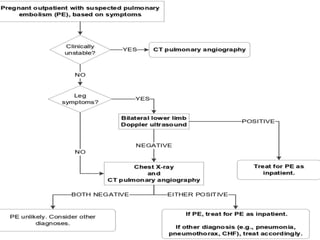
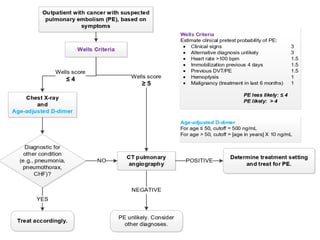
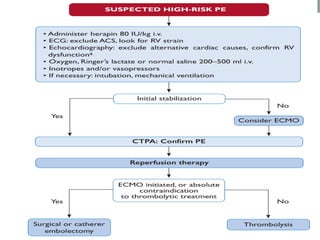
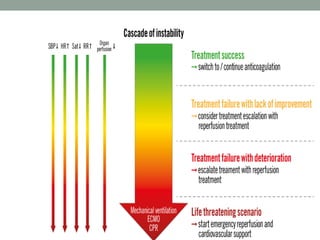
General Algorithm.
 Shock in pulmonary embolism
 one size not fit to all
Non pharmacological management
 catheter directed therapy with or without thrombolysis
 surgical embolectomy
Change according to resources and local expertise .
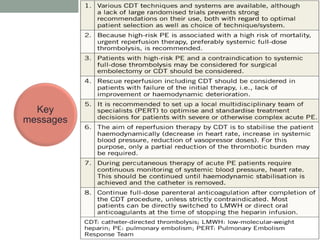
Key massages
Non-pregnant adults
without cancer
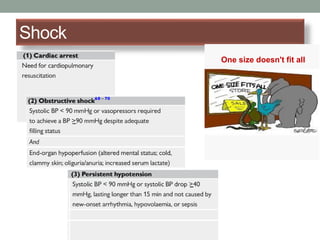
Shock
One size doesn't fit all
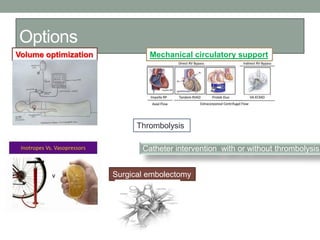
Options
Thrombolysis
Catheter intervention with or without thrombolysis
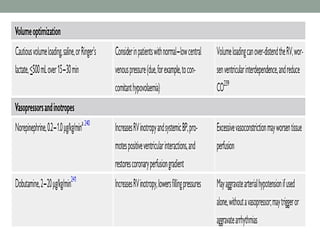
Volume optimization Mechanical circulatory support
Surgical embolectomy
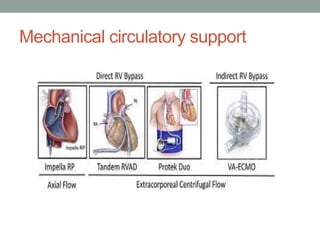
Mechanical circulatory support
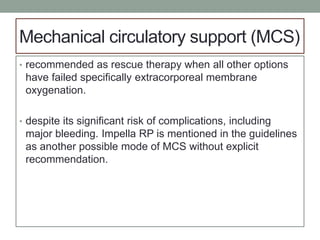
Mechanical circulatory support (MCS)
• recommended as rescue therapy when all other options
have failed specifically extracorporeal membrane
oxygenation.
• despite its significant risk of complications, including
major bleeding. Impella RP is mentioned in the guidelines
as another possible mode of MCS without explicit
recommendation.
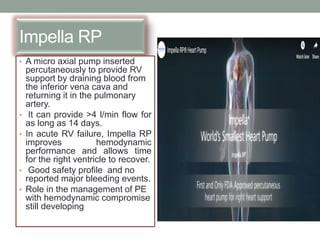
Impella RP
• A micro axial pump inserted
percutaneously to provide RV
support by draining blood from
the inferior vena cava and
returning it in the pulmonary
artery.
• It can provide >4 l/min flow for
as long as 14 days.
• In acute RV failure, Impella RP
improves hemodynamic
performance and allows time
for the right ventricle to recover.
• Good safety profile and no
reported major bleeding events.
• Role in the management of PE
with hemodynamic compromise
still developing
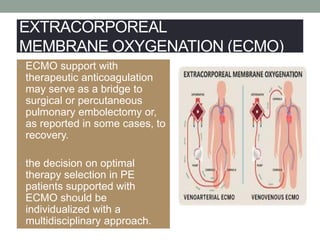
EXTRACORPOREAL
MEMBRANE OXYGENATION (ECMO)
• ECMO support with
therapeutic anticoagulation
may serve as a bridge to
surgical or percutaneous
pulmonary embolectomy or,
as reported in some cases, to
recovery.
• the decision on optimal
therapy selection in PE
patients supported with
ECMO should be
individualized with a
multidisciplinary approach.
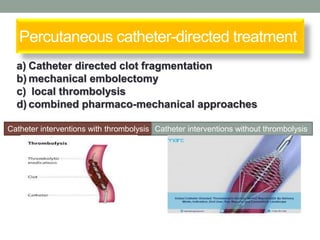
Percutaneous catheter-directed treatment
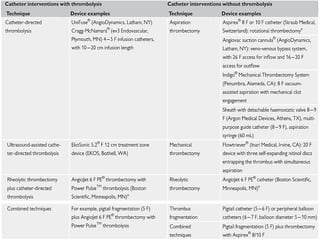
Catheter interventions with thrombolysis Catheter interventions without thrombolysis
a) Catheter directed clot fragmentation
b) mechanical embolectomy
c) local thrombolysis
d) combined pharmaco-mechanical approaches
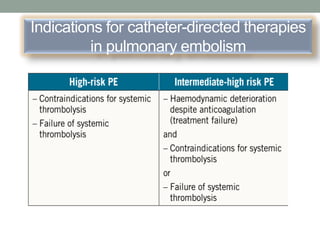
Indications for catheter-directed therapies
in pulmonary embolism
Catheter interventions with thrombolysis
Catheter-directed thrombolysis
Ultrasound-assisted catheter-
directed thrombolysis
Rheolytic thrombectomyplus
catheter-directed thrombolysis
Combined techniques
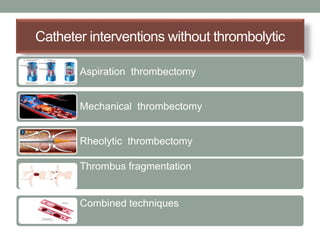
Catheter interventions without thrombolytic
Aspiration thrombectomy
Mechanical thrombectomy
Rheolytic thrombectomy
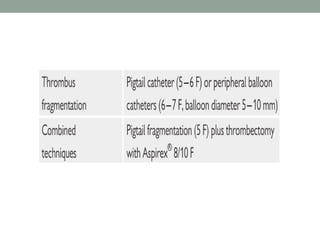
Thrombus fragmentation
Combined techniques
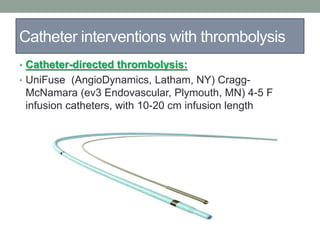
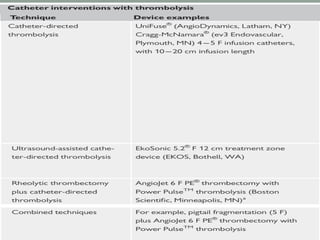
Catheter interventions with thrombolysis
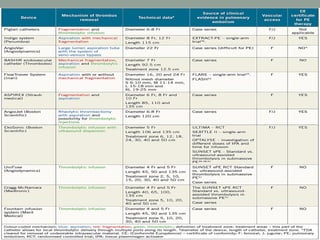
• Catheter-directed thrombolysis:
• UniFuse (AngioDynamics, Latham, NY) Cragg-
McNamara (ev3 Endovascular, Plymouth, MN) 4-5 F
infusion catheters, with 10-20 cm infusion length
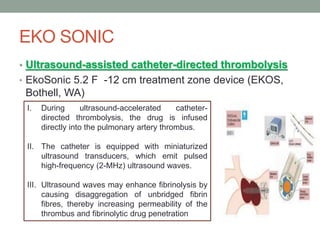
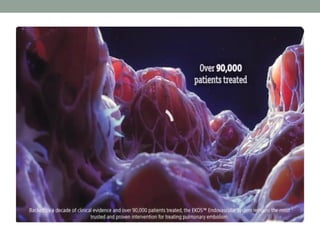
EKO SONIC
• Ultrasound-assisted catheter-directed thrombolysis
• EkoSonic 5.2 F -12 cm treatment zone device (EKOS,
Bothell, WA)
I. During ultrasound-accelerated catheter-
directed thrombolysis, the drug is infused
directly into the pulmonary artery thrombus.
II. The catheter is equipped with miniaturized
ultrasound transducers, which emit pulsed
high-frequency (2-MHz) ultrasound waves.
III. Ultrasound waves may enhance fibrinolysis by
causing disaggregation of unbridged fibrin
fibres, thereby increasing permeability of the
thrombus and fibrinolytic drug penetration
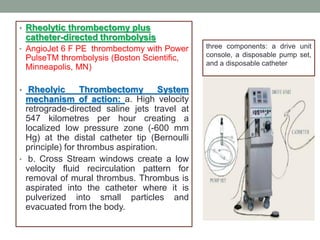
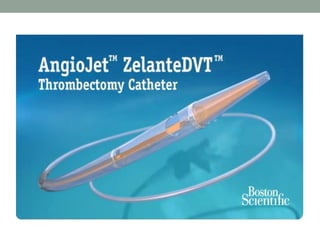
• Rheolytic thrombectomy plus
catheter-directed thrombolysis
• AngioJet 6 F PE thrombectomy with Power
PulseTM thrombolysis (Boston Scientific,
Minneapolis, MN)
• Rheolyic Thrombectomy System
mechanism of action: a. High velocity
retrograde-directed saline jets travel at
547 kilometres per hour creating a
localized low pressure zone (-600 mm
Hg) at the distal catheter tip (Bernoulli
principle) for thrombus aspiration.
• b. Cross Stream windows create a low
velocity fluid recirculation pattern for
removal of mural thrombus. Thrombus is
aspirated into the catheter where it is
pulverized into small particles and
evacuated from the body.
three components: a drive unit
console, a disposable pump set,
and a disposable catheter
Combined techniques
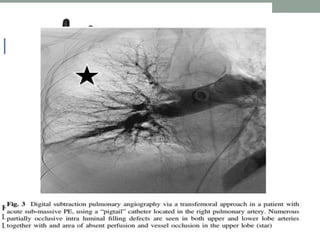
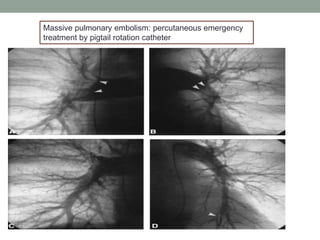
• For example, pigtail fragmentation (5 F) plus AngioJet 6 F
PE@R thrombectomy with Power Pulse TM thrombolysis.
• Interestingly, mechanical fragmentation with pigtail
catheters is currently still the most commonly used
catheterbased therapy for acute PE (Roik M et al. Current
use of catheter directed treatment of acute PE in Europe:
results of survey of EAPCI and ESC Working Group on
Pulmonary Circulation and Right Ventricular Function.
Presented at the ESC Congress 2021)
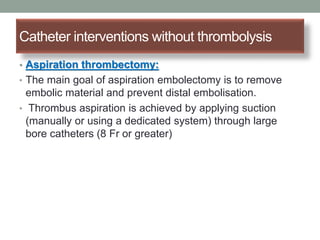
Catheter interventions without thrombolysis
• Aspiration thrombectomy:
• The main goal of aspiration embolectomy is to remove
embolic material and prevent distal embolisation.
• Thrombus aspiration is achieved by applying suction
(manually or using a dedicated system) through large
bore catheters (8 Fr or greater)
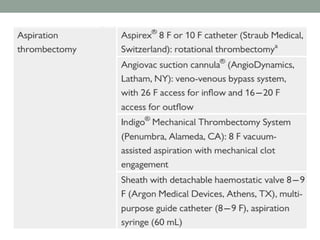
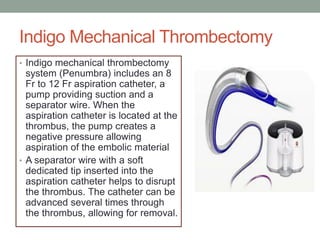
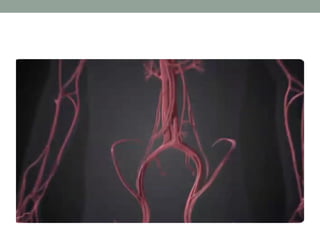
Indigo Mechanical Thrombectomy
• Indigo mechanical thrombectomy
system (Penumbra) includes an 8
Fr to 12 Fr aspiration catheter, a
pump providing suction and a
separator wire. When the
aspiration catheter is located at the
thrombus, the pump creates a
negative pressure allowing
aspiration of the embolic material
• A separator wire with a soft
dedicated tip inserted into the
aspiration catheter helps to disrupt
the thrombus. The catheter can be
advanced several times through
the thrombus, allowing for removal.
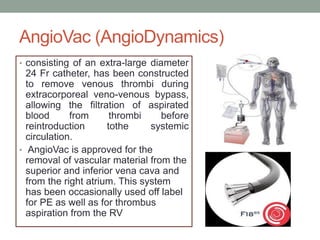
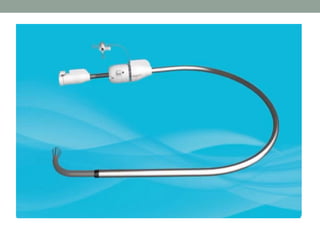
AngioVac (AngioDynamics)
• consisting of an extra-large diameter
24 Fr catheter, has been constructed
to remove venous thrombi during
extracorporeal veno-venous bypass,
allowing the filtration of aspirated
blood from thrombi before
reintroduction tothe systemic
circulation.
• AngioVac is approved for the
removal of vascular material from the
superior and inferior vena cava and
from the right atrium. This system
has been occasionally used off label
for PE as well as for thrombus
aspiration from the RV
Mechanical thrombectomy
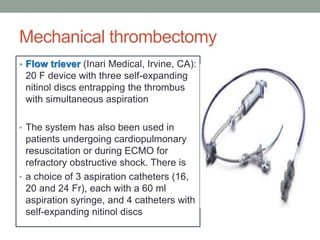
• Flow triever (Inari Medical, Irvine, CA):
20 F device with three self-expanding
nitinol discs entrapping the thrombus
with simultaneous aspiration
• The system has also been used in
patients undergoing cardiopulmonary
resuscitation or during ECMO for
refractory obstructive shock. There is
• a choice of 3 aspiration catheters (16,
20 and 24 Fr), each with a 60 ml
aspiration syringe, and 4 catheters with
self-expanding nitinol discs
Rheolytic thrombectomy
• The high-pressure saline jet generated by an AngioJet PE
catheter (Boston Scientific) creates a pressure gradient,
according to Bernoulli’s law, allowing the disruption and
removal of thrombus fragments. This device also allows
for the local administration of thrombolytic drugs (Power
Pulse option) that directly penetrate the thrombus.
• The US Food and Drug Administration (FDA) has issued a
“black box” warning due to reports of asystole and
haemodynamic decompensation during rheolytic
thrombectomy of pulmonary artery thrombus
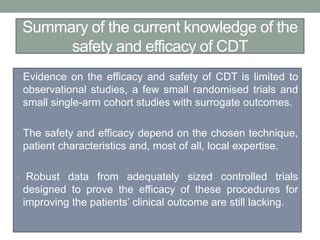
Summary of the current knowledge of the
safety and efficacy of CDT
• Evidence on the efficacy and safety of CDT is limited to
observational studies, a few small randomised trials and
small single-arm cohort studies with surrogate outcomes.
• The safety and efficacy depend on the chosen technique,
patient characteristics and, most of all, local expertise.
• Robust data from adequately sized controlled trials
designed to prove the efficacy of these procedures for
improving the patients’ clinical outcome are still lacking.
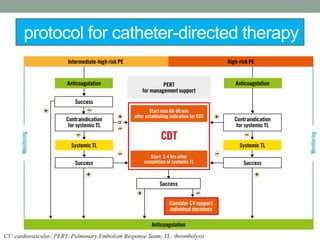
protocol for catheter-directed therapy
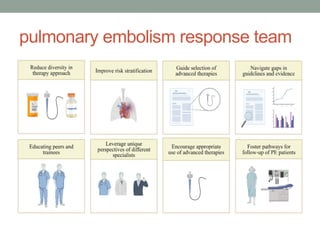
pulmonary embolism response team
PERT
pulmonary embolism response team
PE IMAGING BEFORE INTERVENTION
It is advised, when possible, to review CTPA images before deciding
on invasive therapy. Assessment of the embolic load and the
localization of clots in the pulmonary arteries will help for proper CDT
planning.
The majority of patients with PE and RV dysfunction have
thromboemboli lodged in lobar or more proximal pulmonary arteries;
such thrombi are easily accessible for percutaneous therapies.
In contrast, patients with isolated clots at the segmental or more distal
level are less suitable for CDT, In such cases, local thrombolysis
might be preferred.
unstable patients with a high clinical probability of PE (for example,
after major orthopaedic or oncological surgery) with RVD detected at
bedside echocardiography and a high risk of bleeding, in whom CTPA
cannot be immediately performed, may be directly transported to a
cath lab for CDT preceded by standard pulmonary angiography.
Proposed steps of CDT
1) Management and medical therapy of PE, including
anticoagulation and thrombolysis, should follow current
guidelines.
2) Consider indications and potential contraindications for
CDT and for local low-dose thrombolysis, preferably in
collaboration with the local or regionally active PERT.
Assess technical CDT feasibility and technique/device.
This requires assessment of the haemodynamic
condition of the patients and risk of bleeding, as well as
localisation of pulmonary emboli at the CTPA if
available.
3) Prepare the patient in the same way as for standard
interventional procedures (informed consent is
required).
Proposed steps of CDT
4. Monitor systemic arterial pressure, heart rate, oxygen
saturation, and respiratory rate before and after the
procedure, at least until 2-4 hours after haemodynamic
stabilization has been achieved.
5. Obtain vascular access through the internal jugular or
common femoral vein using ultrasound guidance.
6. Obtain invasive pressure and oxygen saturation from
the pulmonary artery.
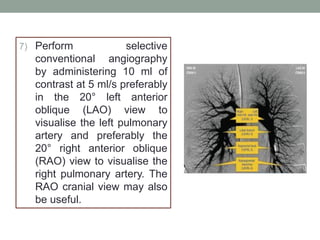
7) Perform selective
conventional angiography
by administering 10 ml of
contrast at 5 ml/s preferably
in the 20° left anterior
oblique (LAO) view to
visualise the left pulmonary
artery and preferably the
20° right anterior oblique
(RAO) view to visualise the
right pulmonary artery. The
RAO cranial view may also
be useful.
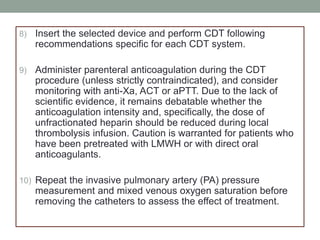
8) Insert the selected device and perform CDT following
recommendations specific for each CDT system.
9) Administer parenteral anticoagulation during the CDT
procedure (unless strictly contraindicated), and consider
monitoring with anti-Xa, ACT or aPTT. Due to the lack of
scientific evidence, it remains debatable whether the
anticoagulation intensity and, specifically, the dose of
unfractionated heparin should be reduced during local
thrombolysis infusion. Caution is warranted for patients who
have been pretreated with LMWH or with direct oral
anticoagulants.
10) Repeat the invasive pulmonary artery (PA) pressure
measurement and mixed venous oxygen saturation before
removing the catheters to assess the effect of treatment.
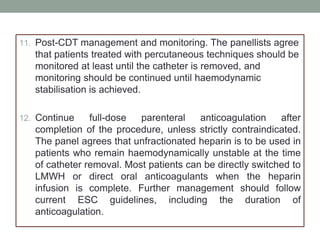
11. Post-CDT management and monitoring. The panellists agree
that patients treated with percutaneous techniques should be
monitored at least until the catheter is removed, and
monitoring should be continued until haemodynamic
stabilisation is achieved.
12. Continue full-dose parenteral anticoagulation after
completion of the procedure, unless strictly contraindicated.
The panel agrees that unfractionated heparin is to be used in
patients who remain haemodynamically unstable at the time
of catheter removal. Most patients can be directly switched to
LMWH or direct oral anticoagulants when the heparin
infusion is complete. Further management should follow
current ESC guidelines, including the duration of
anticoagulation.
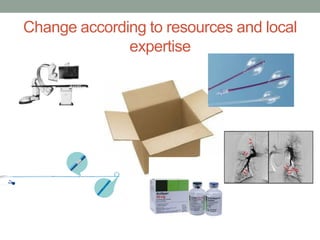
Change according to resources and local
expertise
Change according to resources and local
expertise
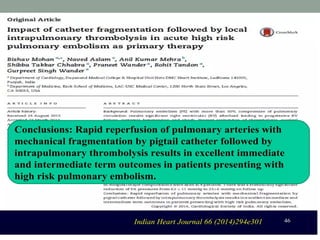
Massive pulmonary embolism: percutaneous emergency
treatment by pigtail rotation catheter
Key
messages
pe recent updates in dealing with pe .pdf

pe recent updates in dealing with pe .pdf

  • 1.
    MANAGEMENT UPDATE IN PULMONARYEMBOLISM Dr: Ahmed Mohammed Elbeny, MD Lecturer of cardiology Al-Azhar university
  • 2.
    Agenda General Algorithm.  Shockin pulmonary embolism  one size not fit to all Non pharmacological management  catheter directed therapy with or without thrombolysis  surgical embolectomy Change according to resources and local expertise . Key massages
  • 3.
  • 6.
  • 9.
    Options Thrombolysis Catheter intervention withor without thrombolysis Volume optimization Mechanical circulatory support Surgical embolectomy
  • 11.
  • 12.
    Mechanical circulatory support(MCS) • recommended as rescue therapy when all other options have failed specifically extracorporeal membrane oxygenation. • despite its significant risk of complications, including major bleeding. Impella RP is mentioned in the guidelines as another possible mode of MCS without explicit recommendation.
  • 13.
    Impella RP • Amicro axial pump inserted percutaneously to provide RV support by draining blood from the inferior vena cava and returning it in the pulmonary artery. • It can provide >4 l/min flow for as long as 14 days. • In acute RV failure, Impella RP improves hemodynamic performance and allows time for the right ventricle to recover. • Good safety profile and no reported major bleeding events. • Role in the management of PE with hemodynamic compromise still developing
  • 14.
    EXTRACORPOREAL MEMBRANE OXYGENATION (ECMO) •ECMO support with therapeutic anticoagulation may serve as a bridge to surgical or percutaneous pulmonary embolectomy or, as reported in some cases, to recovery. • the decision on optimal therapy selection in PE patients supported with ECMO should be individualized with a multidisciplinary approach.
  • 15.
    Percutaneous catheter-directed treatment Catheterinterventions with thrombolysis Catheter interventions without thrombolysis a) Catheter directed clot fragmentation b) mechanical embolectomy c) local thrombolysis d) combined pharmaco-mechanical approaches
  • 16.
    Indications for catheter-directedtherapies in pulmonary embolism
  • 17.
    Catheter interventions withthrombolysis Catheter-directed thrombolysis Ultrasound-assisted catheter- directed thrombolysis Rheolytic thrombectomyplus catheter-directed thrombolysis Combined techniques
  • 18.
    Catheter interventions withoutthrombolytic Aspiration thrombectomy Mechanical thrombectomy Rheolytic thrombectomy Thrombus fragmentation Combined techniques
  • 20.
    Catheter interventions withthrombolysis • Catheter-directed thrombolysis: • UniFuse (AngioDynamics, Latham, NY) Cragg- McNamara (ev3 Endovascular, Plymouth, MN) 4-5 F infusion catheters, with 10-20 cm infusion length
  • 22.
    EKO SONIC • Ultrasound-assistedcatheter-directed thrombolysis • EkoSonic 5.2 F -12 cm treatment zone device (EKOS, Bothell, WA) I. During ultrasound-accelerated catheter- directed thrombolysis, the drug is infused directly into the pulmonary artery thrombus. II. The catheter is equipped with miniaturized ultrasound transducers, which emit pulsed high-frequency (2-MHz) ultrasound waves. III. Ultrasound waves may enhance fibrinolysis by causing disaggregation of unbridged fibrin fibres, thereby increasing permeability of the thrombus and fibrinolytic drug penetration
  • 24.
    • Rheolytic thrombectomyplus catheter-directed thrombolysis • AngioJet 6 F PE thrombectomy with Power PulseTM thrombolysis (Boston Scientific, Minneapolis, MN) • Rheolyic Thrombectomy System mechanism of action: a. High velocity retrograde-directed saline jets travel at 547 kilometres per hour creating a localized low pressure zone (-600 mm Hg) at the distal catheter tip (Bernoulli principle) for thrombus aspiration. • b. Cross Stream windows create a low velocity fluid recirculation pattern for removal of mural thrombus. Thrombus is aspirated into the catheter where it is pulverized into small particles and evacuated from the body. three components: a drive unit console, a disposable pump set, and a disposable catheter
  • 26.
    Combined techniques • Forexample, pigtail fragmentation (5 F) plus AngioJet 6 F PE@R thrombectomy with Power Pulse TM thrombolysis. • Interestingly, mechanical fragmentation with pigtail catheters is currently still the most commonly used catheterbased therapy for acute PE (Roik M et al. Current use of catheter directed treatment of acute PE in Europe: results of survey of EAPCI and ESC Working Group on Pulmonary Circulation and Right Ventricular Function. Presented at the ESC Congress 2021)
  • 29.
    Catheter interventions withoutthrombolysis • Aspiration thrombectomy: • The main goal of aspiration embolectomy is to remove embolic material and prevent distal embolisation. • Thrombus aspiration is achieved by applying suction (manually or using a dedicated system) through large bore catheters (8 Fr or greater)
  • 31.
    Indigo Mechanical Thrombectomy •Indigo mechanical thrombectomy system (Penumbra) includes an 8 Fr to 12 Fr aspiration catheter, a pump providing suction and a separator wire. When the aspiration catheter is located at the thrombus, the pump creates a negative pressure allowing aspiration of the embolic material • A separator wire with a soft dedicated tip inserted into the aspiration catheter helps to disrupt the thrombus. The catheter can be advanced several times through the thrombus, allowing for removal.
  • 33.
    AngioVac (AngioDynamics) • consistingof an extra-large diameter 24 Fr catheter, has been constructed to remove venous thrombi during extracorporeal veno-venous bypass, allowing the filtration of aspirated blood from thrombi before reintroduction tothe systemic circulation. • AngioVac is approved for the removal of vascular material from the superior and inferior vena cava and from the right atrium. This system has been occasionally used off label for PE as well as for thrombus aspiration from the RV
  • 35.
    Mechanical thrombectomy • Flowtriever (Inari Medical, Irvine, CA): 20 F device with three self-expanding nitinol discs entrapping the thrombus with simultaneous aspiration • The system has also been used in patients undergoing cardiopulmonary resuscitation or during ECMO for refractory obstructive shock. There is • a choice of 3 aspiration catheters (16, 20 and 24 Fr), each with a 60 ml aspiration syringe, and 4 catheters with self-expanding nitinol discs
  • 37.
    Rheolytic thrombectomy • Thehigh-pressure saline jet generated by an AngioJet PE catheter (Boston Scientific) creates a pressure gradient, according to Bernoulli’s law, allowing the disruption and removal of thrombus fragments. This device also allows for the local administration of thrombolytic drugs (Power Pulse option) that directly penetrate the thrombus. • The US Food and Drug Administration (FDA) has issued a “black box” warning due to reports of asystole and haemodynamic decompensation during rheolytic thrombectomy of pulmonary artery thrombus
  • 39.
    Summary of thecurrent knowledge of the safety and efficacy of CDT • Evidence on the efficacy and safety of CDT is limited to observational studies, a few small randomised trials and small single-arm cohort studies with surrogate outcomes. • The safety and efficacy depend on the chosen technique, patient characteristics and, most of all, local expertise. • Robust data from adequately sized controlled trials designed to prove the efficacy of these procedures for improving the patients’ clinical outcome are still lacking.
  • 41.
  • 42.
  • 43.
  • 44.
    PE IMAGING BEFOREINTERVENTION It is advised, when possible, to review CTPA images before deciding on invasive therapy. Assessment of the embolic load and the localization of clots in the pulmonary arteries will help for proper CDT planning. The majority of patients with PE and RV dysfunction have thromboemboli lodged in lobar or more proximal pulmonary arteries; such thrombi are easily accessible for percutaneous therapies. In contrast, patients with isolated clots at the segmental or more distal level are less suitable for CDT, In such cases, local thrombolysis might be preferred. unstable patients with a high clinical probability of PE (for example, after major orthopaedic or oncological surgery) with RVD detected at bedside echocardiography and a high risk of bleeding, in whom CTPA cannot be immediately performed, may be directly transported to a cath lab for CDT preceded by standard pulmonary angiography.
  • 45.
    Proposed steps ofCDT 1) Management and medical therapy of PE, including anticoagulation and thrombolysis, should follow current guidelines. 2) Consider indications and potential contraindications for CDT and for local low-dose thrombolysis, preferably in collaboration with the local or regionally active PERT. Assess technical CDT feasibility and technique/device. This requires assessment of the haemodynamic condition of the patients and risk of bleeding, as well as localisation of pulmonary emboli at the CTPA if available. 3) Prepare the patient in the same way as for standard interventional procedures (informed consent is required).
  • 46.
    Proposed steps ofCDT 4. Monitor systemic arterial pressure, heart rate, oxygen saturation, and respiratory rate before and after the procedure, at least until 2-4 hours after haemodynamic stabilization has been achieved. 5. Obtain vascular access through the internal jugular or common femoral vein using ultrasound guidance. 6. Obtain invasive pressure and oxygen saturation from the pulmonary artery.
  • 47.
    7) Perform selective conventionalangiography by administering 10 ml of contrast at 5 ml/s preferably in the 20° left anterior oblique (LAO) view to visualise the left pulmonary artery and preferably the 20° right anterior oblique (RAO) view to visualise the right pulmonary artery. The RAO cranial view may also be useful.
  • 49.
    8) Insert theselected device and perform CDT following recommendations specific for each CDT system. 9) Administer parenteral anticoagulation during the CDT procedure (unless strictly contraindicated), and consider monitoring with anti-Xa, ACT or aPTT. Due to the lack of scientific evidence, it remains debatable whether the anticoagulation intensity and, specifically, the dose of unfractionated heparin should be reduced during local thrombolysis infusion. Caution is warranted for patients who have been pretreated with LMWH or with direct oral anticoagulants. 10) Repeat the invasive pulmonary artery (PA) pressure measurement and mixed venous oxygen saturation before removing the catheters to assess the effect of treatment.
  • 50.
    11. Post-CDT managementand monitoring. The panellists agree that patients treated with percutaneous techniques should be monitored at least until the catheter is removed, and monitoring should be continued until haemodynamic stabilisation is achieved. 12. Continue full-dose parenteral anticoagulation after completion of the procedure, unless strictly contraindicated. The panel agrees that unfractionated heparin is to be used in patients who remain haemodynamically unstable at the time of catheter removal. Most patients can be directly switched to LMWH or direct oral anticoagulants when the heparin infusion is complete. Further management should follow current ESC guidelines, including the duration of anticoagulation.
  • 51.
    Change according toresources and local expertise
  • 52.
    Change according toresources and local expertise
  • 53.
    Massive pulmonary embolism:percutaneous emergency treatment by pigtail rotation catheter
  • 54.