PAGE 1
The
Patient-Centered
Medical Home’s
Impact on Cost
and Quality
Annual
Review of
Evidence
2013-2014
Authors:
Marci Nielsen, PhD, MPH
Amy Gibson, RN, MS
Lisabeth Buelt
Paul Grundy, MD, MPH
Kevin Grumbach, MD
Published January 2015
Made possible with
support from the
Milbank Memorial Fund
The Patient-
Centered
Medical Home’s
Impact on Cost
and Quality
Authors:
Marci Nielsen, PhD, MPH
Amy Gibson, RN, MS
Lisbeth Buelt
Paul Grundy, MD, MPH
Kevin Grumbach, MD
Nwando Olayiwola, MD, MPH
Published January 2015
Made possible with
support from the
Milbank Memorial Fund
Review of
Evidence
2013-2014
PAGE 2
PAGE 1
About the
Patient-Centered Primary Care Collaborative
Founded in 2006, the Patient-Centered Primary Care Collaborative (PCPCC) is dedicated to
advancing an effective and efficient health care system built on a strong foundation of primary care
and the patient-centered medical home (PCMH). The PCPCC achieves its mission through the
work of its five Stakeholder Centers, experts and thought leaders focused on key issues of delivery
reform, payment reform, patient engagement, and employer benefit redesign to drive health system
transformation. For more information visit www.pcpcc.org.
About the Milbank Memorial Fund
The Milbank Memorial Fund is an endowed operating foundation that works to improve the
health of populations by connecting leaders and decision makers with the best available evidence
and experience. Founded in 1905, the Fund engages in nonpartisan analysis, collaboration, and
communication on significant issues in health policy. It does this work in three ways: publishing
high-quality, evidence-based reports, books, and The Milbank Quarterly, a peer-reviewed journal
of population health and health policy; convening state health policy decision makers on issues
they identify as important; and building communities of health policymakers to enhance their
effectiveness. www.milbank.org.
Authors
Marci Nielsen, PhD, MPH
Chief Executive Officer, PCPCC
Amy Gibson, RN, MS
Chief Operating Officer, PCPCC
Lisabeth Buelt
Program Analyst, PCPCC
Paul Grundy, MD, MPH
President, PCPCC
Global Director, Healthcare Transformation, IBM
Kevin Grumbach, MD
Professor and Chair, Department of Family and Community Medicine
University of California, San Francisco
San Francisco General Hospital
The Patient-Centered Medical Home’s Impact on
Cost and Quality
Annual Review of Evidence 2013-2014
Patient-Centered Primary Care Collaborative
Milbank Memorial Fund
January 2015
PAGE 2
Acknowledgments
The PCPCC and the Milbank Memorial Fund gratefully acknowledge the following individuals for
their time and thoughtful review of this publication:
Guest Authors
Marie Abraham, MA
Senior Policy and Program Specialist, Institute for Patient-and Family-Centered Care
Barbara Brandt, PhD, MS, MA
Director, National Center for Interprofessional Practice and Education
Associate Vice President for Education, University of Minnesota Academic Health Center
Professor, Pharmaceutical Care and Health Systems
Beverly H. Johnson
President and Chief Executive Officer, Institute for Patient- and Family-Centered Care
Jonathan Niloff, MD
Vice President and Chief Medical Officer, McKesson Connected Care & Analytics
Kavita Patel, MD
Managing Director for Clinical Transformation and Delivery, Engelberg Center for Health Care Reform
Fellow, Economic Studies, The Brookings Institution
Len Nichols, PhD
Director, Center for Health Policy Research and Ethics, George Mason University
Mary Minniti, BS, CPHQ
Program and Resource Specialist, Institute for Patient- and Family-Centered Care
Matt Longjohn, MD
National Health Officer, YMCA of the USA
Invited Reviewers
Asaf Bitton, MD, MPH
Assistant Professor of Medicine, Division of General Medicine, Brigham and Women’s Hospital;
Assistant Professor of Health Care Policy, Department of Health Care Policy, Harvard Medical School;
Core Faculty Lead for Practice Transformation, Center for Primary Care, Harvard Medical School
Bob Phillips, MD, MPH
Vice President of Research and Policy, American Board of Family Medicine
Farzad Mostashari, MD, ScM
Founder/Chief Executive Officer, Aledade, Inc.
Jean Malouin, MD
Clinical Assistant Professor, Family Medicine, University of Michigan
Lisa Dulsky Watkins, MD
Director, Milbank Memorial Fund Multi-State Collaborative
Michael Bailit, MBA
President, Bailit Health Purchasing
PAGE 3
PCPCC Staff
Marci Nielsen, PhD, MPH
Chief Executive Officer
Amy Gibson, RN, MS
Chief Operating Officer
Tara Hacker, MSPH
Director of Programs
Lisabeth Buelt
Program Analyst
Staci GoldbergBelle, MPA
Senior Analyst, Strategy & Development
Caroline DeLaney
Communications Manager
Reviewer Disclaimer: Although the reviewers listed above provided many constructive comments
and suggestions, they were not asked to endorse the report’s conclusions or recommendations, nor
did they see the final draft of the report before its release. Responsibility for the final content of this
report rests entirely with the authors and the PCPCC.
A number of PCPCC staff played instrumental roles in coordinating the research and review of
this paper, including Caroline DeLaney, Staci GoldbergBelle and Tara Hacker. The PCPCC would
also like to thank its Board of Directors, Executive Membership, and Stakeholder Centers for
providing incredible expertise and advice throughout the development of this report.
Additionally, we would like to thank Christopher Koller, President of the Milbank Memorial Fund,
and his staff for their guidance and assistance in reviewing this publication and their ongoing suport
of its broad dissemination.
PAGE 4
PCPCC Board of Directors
Douglas Henley, MD, FAAFP, Chair
Executive Vice President & Chief Executive Officer, American Academy of
Family Physicians
Jill Rubin Hummel, JD, Chair-Elect
President and General Manager, Anthem Blue Cross and Blue Shield of Connecicut
Paul Grundy, MD, MPH, FACOEM, President
Global Director, Healthcare Transformation, IBM
Andrew Webber, Treasurer
Chief Executive Officer, Maine Health Management Coalition
Errol Alden, MD, FAAP
Executive Director & Chief Executive Officer, American Academy of Pediatrics
Susan Edgman-Levitan, PA-C
Executive Director, John D. Stoeckle Center for Primary Care Innovation,
Massachusetts General Hospital
Elizabeth J. Fowler, PhD, JD
Vice President, Global Health Policy, Johnson & Johnson
Beverley H. Johnson
President & Chief Executive Officer,
Institute for Patient- and Family-Centered Care
Hal C. Lawrence III, MD
Executive Vice President & Chief Executive Officer, The American College of
Obstetricians and Gynecologists
David K. Nace, MD
Vice President, Clinical Development, McKesson
Marci Nielsen, PhD, MPH
Chief Executive Officer, PCPCC
Steven E. Weinberger, MD, FACP
Executive Vice President & Chief Executive Officer, American College of Physicians
Adrienne White-Faines, MPA
Executive Director & Chief Executive Officer, American Osteopathic Association
PAGE 5
TABLE OF CONTENTS
EXECUTIVE SUMMARY..........................................................................6
SECTION ONE
A Snapshot of the PCMH and Innovations in Primary Care.....................8
The Current Health Care Marketplace: The Need for Better Primary Care..............................8
PCMH and Primary Care Innovations – Growing in Size and Scope..............................................9
History of PCMH and Primary Care: Public and Private Sector....................................................10
Same Medical Home Concept, New Terms...........................................................................................11
SECTION TWO
New Evidence Regarding Primary Care PCMH Interventions.................12
Methods...........................................................................................................................................................12
Table 1. Peer-Reviewed Studies...............................................................................................................13
Table 1 Results...........................................................................................................................................19
Table 2. State Government Reports........................................................................................................19
Table 2 Results...........................................................................................................................................23
Table 3. Industry Reports............................................................................................................................23
Table 3 Results...........................................................................................................................................26
Discussion of Findings.................................................................................................................................27
Peer-Reviewed Studies............................................................................................................................27
State Government Program Evaluations (Non Peer-Reviewed).....................................................27
Industry Reports (Non Peer-Reviewed)................................................................................................28
Challenges in Evaluating Primary Care PCMH Interventions........................................................28
SECTION THREE
The Future of the PCMH and Enhanced Primary Care.................................29
Integration within Primary Care and Across the Medical Neighborhood..................................29
Integration into Medical Neighborhoods and Accountable Care Organizations.......................30
Consumer and Public Engagement: The Future of the Patient-Centered Medical Home.........32
Financial Support for Enhanced Primary Care.....................................................................................33
Financial Support for Primary Care and the PCMH..........................................................................33
Development of the Team-based Health Professions Workforce................................................34
Training an Interprofessional Workforce.............................................................................................35
Consumer and Public Engagement..........................................................................................................36
Partnerships with Patients and Families in Improving Primary Care and the PCMH...............36
Technology and Population Health Management..............................................................................37
Role of Technology in the PCMH and Primary Care..........................................................................38
CONCLUSION......................................................................................39
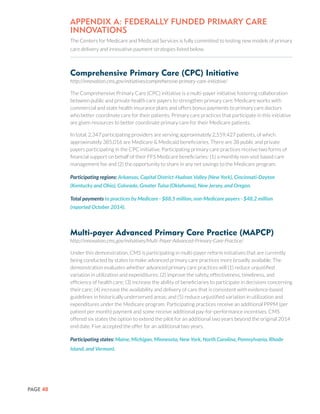
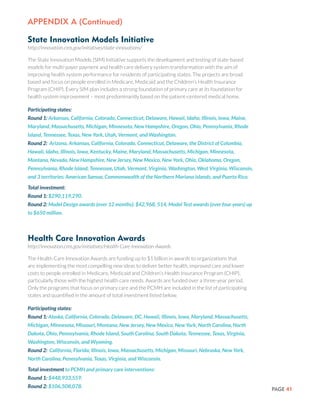
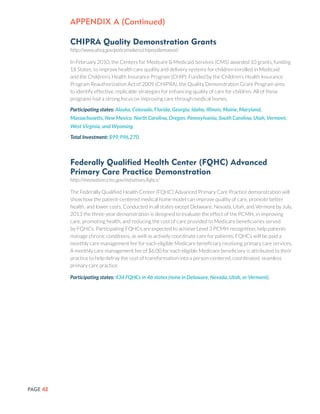
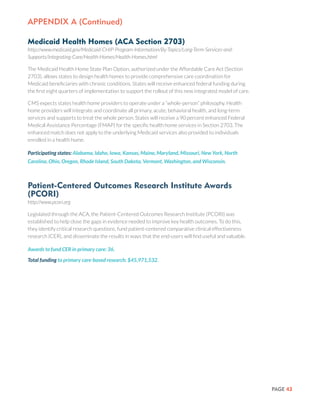
APPENDIX A: Federally Funded Primary Care Innovations...................40
REFERENCES.......................................................................................44
PAGE 6
EXECUTIVE SUMMARY
This year’s Patient-Centered Primary Care Collaborative (PCPCC) Annual Review of the Evidence
summarizes new results from primary care patient-centered medical home (PCMH) initiatives
published from September 2013 through November 2014 (since the publication of the previous
Annual Review). Selected cost and utilization outcomes from a combination of peer-reviewed
studies, state program evaluations, and industry publications are aggregated to present an overview
of PCMH and primary care innovations happening across the country.
The evidence for the PCMH described here underscores the impressive and growing trends that tie
the medical home model of care with reductions in health care costs and unnecessary utilization of
services; improvements in population health and preventive services; increased access to primary
care; and growing satisfaction among patients and clinicians. This is positive news for stakeholders
of the PCMH and primary care and runs counter to one widely publicized study of an early PCMH
pilot,1
which found no cost or utilization reductions (included and analyzed in this report). The call for
increasing collaboration across the medical neighborhood and into communities where patients and
consumers live and work is also growing, as described by our guest authors in Section 3 (page 29).
Key points from this year’s report include:
New evidence underscores improvements in cost and utilization
associated with the PCMH.
Since the inception of the PCPCC in 2006, the body of evidence associating the primary care PCMH
with reductions in health care costs and unnecessary utilization of services continues to expand. This
report builds on the existing evidence base and includes the largest number of PCMH evaluations
in a single year, for a total of 28 publications. These publications come from a combination of peer-
reviewed literature (n=14), state PCMH program evaluations (n=7), and industry reports (n=7). The
data summarized here support the assertion that the PCMH model can lead to a reduction in health
care costs, inappropriate emergency department utilization, and inpatient hospitalizations.
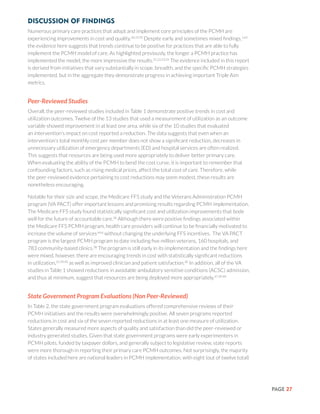
•	Peer-reviewed scholarly publications. Of the 10 peer-reviewed studies that examined
whether the PCMH was associated with a reduction in costs, six reported reductions (60
percent). Of the 13 studies that investigated the association between the PCMH and
unnecessary utilization, 12 found a reduction in one or more measure (92 percent).
•	State government reports (non peer-reviewed). All seven state government evaluations
reported reductions in at least one cost metric (100 percent) and six reported improvement in
one or more measurement of utilization (86 percent).
•	Industry reports (non peer-reviewed). Six of the seven industry publications reported
reductions in at least one utilization metric (86 percent) and four reported reductions in one or
more cost metric (57 percent).
•	Quality and/or satisfaction measures. Although our inclusion criteria centered on cost
and utilization measures associated with primary care PCMHs, several of these studies also
reported statistically significant improvements in quality of care metrics, access to primary care
services, and patient or clinician satisfaction (as noted in the tables beginning on page 13).
PAGE 7
The health care marketplace must invest in primary care in new
ways to achieve the Triple Aim.
Medical home initiatives have grown substantially since 2009. In five years, the number of initiatives
and patients served by PCMHs that incorporate substantial payment incentives has quadrupled and
the number of states embracing PCMH transformation has more than doubled.2
Still, payments
to primary care providers represent only four to seven percent of total health care spending. 3, 4, 5
For the medical home model to be sustainable, we must not only increase the total financial
investment in primary care, but these higher payments must be fundamentally restructured
to support enhanced primary care services, especially those related to care coordination and
asynchronous communication. We need to increase and sustain streams of funding toward primary
care in order to achieve care delivery transformation. Various approaches to PCMH payment show
potential, particularly forms of global payment. One such example is a monthly payment that covers
all primary care services including care coordination services, patient communication, telephone and
email encounters, population health management, and quality improvement.6
Future directions for PCMH and primary care: a view from
the experts.
Sparked both by numerous state and federal policy initiatives as well as economic necessity, the
health care landscape is rapidly changing, and primary care and the PCMH offer a proven means to
improve the system. While we are in the process of identifying which innovations in primary care
work best, evidence increasingly demonstrates it is not a question of whether to increase investment
in primary care, but how best to do so. There is still substantial work to be done, including increasing
collaboration between primary care and other sectors both inside the health care delivery system
and in non-traditional, non-medical disciplines. This report includes the perspective of several guest
experts on key areas integral to the future development of enhanced primary care and the PCMH.
These areas include:
•	Integrating services both inside and outside primary care practices. Examples include
integrating behavioral and oral health into PCMHs and integrating PCMHs into Accountable
Care Organizations (ACO) and various community based organizations and services;
•	Providing financial support for enhanced primary care that helps control the total cost of care
while maintaining or improving quality for patients;
•	Developing the primary care health professions workforce to embrace all members of the
team, including the patient and their family/caregiver;
•	Engaging patients, consumers, and the public particularly in PCMH transformation and
quality improvement activity; and
•	Embracing the potential of technology to support this model of care.
11
found
improvements
in quality
10
found
improvements
in access
8
found
improvements
in satisfaction
24
found
improvements
in utilization
17
found
improvements
in cost
Aggregated outcomes from the 28 peer-reviewed studies, state government program
evaluations, and industry reports:
PAGE 8
SECTION ONE
A Snapshot of the PCMH and Innovations in
Primary Care
This section provides an overview of the current state of the PCMH. This “snapshot” includes an
examination of spending on primary care, and outlines current investments made by states, industry,
and the federal government. It also focuses on the need for further resources to achieve health
system transformation, which requires a decisive departure from the current fragmented and
inefficient fee-for-service (FFS) reimbursement system. Readers are pointed to the PCPCC’s new
searchable online Primary Care Innovations and PCMH Map that reflects the cumulative evidence
generated to date and describes specific partnerships, payment strategies, and public and private
initiatives associated with improved outcomes. Finally, an explanation of the new terms used in
today’s health care marketplace to describe the PCMH is provided.
The Current Health Care Marketplace: The Need for Better Primary Care
For many patients and families, accessing health care services in the United States is intimidating, often
difficult to navigate, disconnected, and for countless Americans, expensive and even unaffordable.8
For too many health care providers, the delivery of effective yet compassionate care feels harried,
overregulated, and undervalued. For employers and policymakers, health care constitutes a significant
expense without clear demonstration of the return on investment (ROI). The current system’s
fragmented, episodic, and volume-driven design is wreaking havoc on health care expenditures and the
overall economy of our nation.9
Experts estimate that the overuse, underuse, and misuse of health care
resources is roughly 30 percent of the total U.S. health care spend;10
the equivalent of about $2,000
per employee per year resulting in nearly 45 million avoidable sick days per year.11
Although the United States spent over 2.9 trillion dollars on health care in 2013,12
just four to
seven percent of that total spend is dedicated to primary care.3,4,5
Despite this very modest dollar
outlay, primary care visits in the United States account for more than half (55 percent) of physician
office visits each year.13
After more than 30 years of academic study, research findings demonstrate
that countries and health systems that heavily invest in primary care have better health outcomes
at lower total cost.7,14
Given that the delivery of primary care influences significant “downstream
spending” in both hospital and specialty care settings,7,15
enhanced primary care in the form of the
PCMH can serve as a catalyst for shifting the quality and cost of health care in America. In a recent
review of high performing primary care practices, study authors identify ten distinguishing features
that fall into three categories — each consistent with the PCMH: deeper patient relationships;
broader interactions with the health care system; and a team-based approach to delivering care.16
The PCMH model embraces the relationship between primary care providers and their patients,
families, and care-givers; promotes authentic communication and patient engagement; and
coordinates whole-person, compassionate, comprehensive, and continuous team-based care; all
of which are crucial to achieving meaningful health system transformation. The PCPCC actively
promotes the medical home as defined by the Agency for Healthcare Research and Quality.17
The five core attributes of the PCMH are:
•	Patient-centered: The PCMH supports patients in learning to manage and organize their own
care based on their preferences, and ensures that patients, families, and caregivers are fully
included in the development of their care plans as well as participants in quality improvement,
research, and health policy efforts.
•	Comprehensive: The PCMH offers whole-person care from a team of providers that is
accountable for a patient’s physical and mental health needs, including prevention and wellness,
acute care, and chronic care.
PAGE 9
•	Coordinated: The PCMH ensures that care is organized across all elements of the broader
health care system, including specialty care, hospitals, home health care, and community
services and supports.
•	Accessible: The PCMH delivers accessible services with shorter waiting times, enhanced in-
person hours, 24/7 electronic or telephone access, and alternative methods of communication
through health information technology (HIT) innovations.
•	Committed to Quality and Safety: The PCMH demonstrates commitment to quality
improvement and the use of data, HIT and other tools to guide patients and families to make
informed decisions about their health.
PCMH and Primary Care Innovations — Growing in Size and Scope
Based on our review, the pace of primary care practices transforming to become PCMHs is
accelerating. When the PCPCC began tracking these programs in 2009, only a few local and regional
PCMH initiatives had been operational long enough to evaluate improved health outcomes and
lower costs of care.18,19,20
Even fewer of the early PCMH pilots received on-going financial support
to help drive transformation. Both adequate time for implementation and financial investment to
support the PCMH model are critical to its long-term success.21,22,23,24
A recent nationwide study of
PCMH initiatives found that between 2009 and 2013, PCMHs supported by payment incentives had
increased in number (from 26 to 114), patients served (from nearly five million to almost 21 million),
and states embracing PCMH transformation expanded from 18 to 44.2
Many of these programs have
gone beyond the implementation phase to include dedicated PCMH payment support from both
public and private health plans.2
In 2014, the PCPCC unveiled the Primary Care Innovations and PCMH Map, a new searchable,
publicly available database that tracks the growing number of primary care innovations and PCMH
initiatives taking place across the country (www.pcpcc.org/initiatives). Today there are nearly
500 programs dedicated to improving the health system through enhanced primary care. The map
identifies active programs and initiatives built on a strong foundation of PCMH principles including
but not limited to payment reform and quality improvement. The map also includes information about
payment models, reported outcomes, location, and participating public and commercial health plans.
In order to meet the needs of the diverse range of PCPCC members and partners, information on
these programs and initiatives can be viewed in several different ways.
•	 The “State View” provides a summary of public and commercial payer activity supporting
primary care in the state, PCMH legislation and regulation, state facts, and participation
in federal health care reform programs. Each state page also includes a list of primary care
programs in that state grouped by payer type (public, multi-payer, or private/commercial).
•	 The “National View” geographically identifies these programs by location across the country.
•	 The “List View” provides a list of PCMH and primary care innovation programs by name,
location, and type of publicly reported outcomes.
•	 The “Outcomes View” summarizes PCMH program evaluation data from various industry
reports and peer-reviewed sources.
PAGE 10
History of PCMH and Primary Care: Public and Private Sector
Background on Types of Payers. The delivery and payment of health care services is local and varies
by region. However, with few exceptions like the Veterans Administration (VA), primary care practices
are generally paid from a mix of public and private payers, such as Medicare, Medicaid, commercial
insurance, and self-pay. Depending on the patients that a practice serves and the health care
marketplace in which it is located, primary care practices differ in their “payer mix” and most payment
is based on a FFS model (described more on page 33 in Section 3). Payer mix is important to a practice
in that the more types of payers that invest in and support a PCMH model of care, the more a practice
can invest in PCMH infrastructure. This includes electronic health records (EHRs), care coordinators/
health coaches, population health management tools, and administrative costs associated with
implementation, such as practice coaching or facilitation, changing work flow, dedicated time for
training, certification or recognition program fees, and other on-going quality improvement efforts.24
When only one payer is supporting the medical home model, it limits the investment that a practice
can make and impedes the pace of PCMH transformation. Many early PCMH initiatives began as
pilots with support from a single source, such as a foundation24
or state agency with time-limited grant
funding.25
Many of these initiatives were bolstered by federal grant support. Examples include the
Multi-payer Advanced Primary Care Practice (MAPCP) Demonstration, and later the State Innovation
Model (SIM) and Health Home initiatives (described in more detail below and in appendix A).
State Leadership. States have long been leaders in the PCMH movement through their Medicaid,
Children’s Health Insurance Program (CHIP), and state employee health programs. As of April 2014,
44 states had included PCMH as a model of care delivery in their Medicaid program26
and seven
states included the PCMH in their state insurance exchange standards for Qualified Health Plans
(QHP).27
Because states are uniquely positioned with economies of scale and the ability to convene
stakeholders without fear of anti-trust violations, they have the ability to lead “all-payer” or “multi-
payer” PCMH initiatives.28
These multi-state collaboratives typically include Medicaid, commercial
health plans, employers and/or labor unions, and sometimes Medicare. Multi-payer collaboratives
are particularly valuable to practices because different types of payers agree to use the same set
of payment methods and quality metrics. These multi-payer arrangements, as demonstrated by
the MAPCP states, assuage health care providers’ concerns that the daunting task of redesigning
their clinical practice is worth the time, effort, and investment because a majority of their payer-mix
supports the redesign.29,30
The initial MAPCP states are providing useful lessons for health system
transformation and early evaluations of each state’s program have been highlighted in a recent
Milbank Memorial Fund report.29
Private Sector Leadership. At the same time that states began adopting the PCMH, a number
of “early innovator” employers, local coalitions, and health plans were also experimenting with the
model.11
Although the total financial investment by the private sector is difficult to quantify, nearly
every major health plan in the country is currently supporting at least one new program of innovative
primary care delivery based on the PCMH.31
In many states and regions, private health plans are
leading efforts to improve patient engagement and health outcomes through enhanced payments for
chronic condition management, care coordination, and population health management. Some health
plans remain in a “testing phase” for these new primary care arrangements, however, many more
have demonstrated such significant improvements in care and cost savings that they are expanding
access to these services to all of their members. To ensure program participation, several plans have
established additional patient incentives to help drive their members to these enhanced primary care
services.
Federal Leadership. The Affordable Care Act (ACA) includes a number of important provisions
that seek to strengthen and improve the delivery of primary care services and the PCMH.26
Several
provisions will expire without Congressional action, these include: providing a targeted 10 percent
PAGE 11
Medicare fee increase to primary care requiring state Medicaid programs to reimburse primary care
physicians at the same rate as Medicare for primary care and preventive health services; expanding
and improving low interest student loan, scholarship, and loan repayment programs for students who
choose primary care as a career; and increased funding for the National Health Services Corps and
the Teaching Health Center Graduate Medical Education program to train primary care residents and
dentists in community-based settings.
In addition, the ACA established the Innovation Center within the Centers for Medicare and Medicaid
Services (CMS) to test demonstration and pilot projects as alternatives to the current fragmented
and inefficient FFS payment model. The Innovation Center is testing a number of payment and
practice transformation models that include the PCMH and enhanced primary care as a foundational
element.33
Such initiatives include the Comprehensive Primary Care (CPC) Initiative, the Federally
Qualified Health Center (FQHC) Advanced Primary Care Practice Demonstration, the Independence
at Home Demonstration, and Graduate Nurse Education Demonstration programs as well as various
models of ACOs. While CMS has not yet released final program evaluation results for many of these
interventions, stakeholders anxiously await the results and anticipate learning important lessons in
how to achieve scalable cost savings and improvements in population health. For a description of these
programs, refer to Appendix A.
Same Medical Home Concept, New Terms
Although the term “patient-centered medical home” is recognized by many primary care clinicians and
interested stakeholders, it is not always easily understood by patients, families, and consumers.34
In
fact, new terms are being used to describe the medical home model of care as it continues to evolve in
the marketplace. For example, ACOs, which are comprised of a “medical neighborhood” of health care
providers — including primary care, specialty care, hospitals, and others — (described in more detail
in Section 3 by Dr. Kavita Patel on page 30) are responsible for a given population’s health and total
cost of care. Because many ACOs are building their network of providers on a foundation of advanced
primary care,15
some health plans supporting both ACOs and PCMHs are using the terms almost
synonymously (for example Anthem, Aetna, and Cigna). Other organizations have branded their
PCMH programs with their own moniker. For example, the Veterans Administration (VA) refers to
their PCMH practices as “patient-aligned care teams” or PACT. In an effort to help clarify which terms
are generally the same or similar to the PCMH, a list of common phrases is provided below.
Regardless of the terminology, when primary care practices implement the core
attributes of the PCMH, improvements in cost, population health, and personal
experience of care — the Triple Aim — is realized.35
Terms below describe programs
and concepts that are similar, if not identical, to the PCMH.
Advanced or Enhanced Primary Care
Complex Care Management
Complex Primary Care Teams
Comprehensive Primary Care
Connected Care
Coordinated Primary Care
Enhanced Care Coordination
Enhanced Personal Health Care
High-Intensity Primary Care Person-
Centered Medical Home
Patient-Centered Health Homes
Health Homes
Integrated Primary Care
Patient-Centered Primary Care Homes
Intensive Outpatient Care
Medical Coordination
Patient-Aligned Care Teams
Patient-Centered Health Homes
Personalized Primary Care
Transitional Primary Care
PAGE 12
Section TWo
New Evidence Regarding Primary Care PCMH
interventions
This section highlights selected new results from primary care PCMH initiatives taking place
throughout the United States. The collection of data below includes evidence from peer-reviewed
studies, state government program evaluations, and industry reports published between September
2013 and November 2014. The section ends with a discussion of the evidence and its implications.
Methods
Similar to past PCPCC Annual Review of the Evidence reports, our analysis was limited to those
publications where authors examined the relationship between a primary care PCMH intervention
and cost and utilization outcomes.18,19,20,31
Specifically, we searched for publications that included the
terms “patient-centered medical home”, “medical home,” “advanced primary care”, and “health home” as
predictor variables and “cost” or “utilization” as outcome variables. It is important to note that not all
PMCHs are alike, either in their definition or their implementation. The PMCH initiatives included
here are those that are self-reported as primary care PCMHs.
To reflect the disparate approaches to research and evaluation taken by academics, state leaders, and
industry, the outcomes are categorized in three separate tables: (Table 1) selected cost and utilization
results from published peer-reviewed scholarly articles; (Table 2) selected cost and utilization results
from state government reports (which may or may not have included an independent evaluator); and
(Table 3) selected cost and utilization self-reported results from industry, not-for-profit organizations,
or private payers. We used the PubMed search engine to gather evidence from peer-reviewed
scholarly journals. For industry reports from not-for-profit associations, think-tanks, and government-
funded programs, we used various Internet search engines.
Within each table described above, the outcomes are categorized into four columns. Cost & Utilization
includes the initiative’s reported impact on emergency department (ED) use, inpatient admissions,
readmissions, expenditures, or other reported outcomes directly related to health care
cost or utilization measures. Every intervention included in Tables 1-3 reported on at least one
measure of cost or utilization. Recognizing the importance of tracking metrics for the entire Triple
Aim, we also identify improvements in three additional outcome categories: Population Health
& Preventive Services, which includes the reported impact on quality of care measures, clinical
screenings, appropriate medication use, behavioral health metrics, or preventive services; Access to
Primary Care Services, which includes measures related to overall access to primary care clinicians
and services, as well as non-face-to-faces visits; and Patient or Clinician Satisfaction, which includes
survey data reported by patients, staff, and clinicians. A blank space within a table is an indication that
no information on that outcome (positive or negative) was reported and should not be interpreted as a
failure to achieve improvement within that metric.
Numerous peer-reviewed studies and industry reports published this year did not address cost or
utilization, but focused on other aspects of the Triple Aim. These reports did not satisfy the inclusion
criteria and thus are NOT included in this report. Reports that were targeted to disease specific non-
primary care medical home interventions (asthma, diabetes, oncology) were also not included. The
PCPCC tracks and compiles these additional types of studies in the online Primary Care Innovations and
PCMH Map, which can be viewed in the Outcomes View on our website (www.pcpcc.org/initiatives).
Finally, unlike a formal meta-analysis, the evidence for this report summarized in Tables 1-3 generally
does not include null findings or outcomes that failed to reach statistical significance. For outcomes
that achieved statistical significance, we include corresponding p-values when provided. In addition,
PAGE 13
Location/Initiative Population Health &
Preventive Services
Patient or Clinician
Satisfaction
Cost & Utilization Access to Primary
Care Services
the PCPCC attempted to honor the original language of the study authors and therefore minimized
taking liberties in summarizing results or making calculations in the tables. Acronyms denoted with an
asterisk (*) can be found in a glossary on page 39.
Table 1. PEER-REVIEWED STUDIES: Primary Care/PCMH Interventions That
Assessed Cost or Utilization, Selected Outcomes by Location, 2013-2014
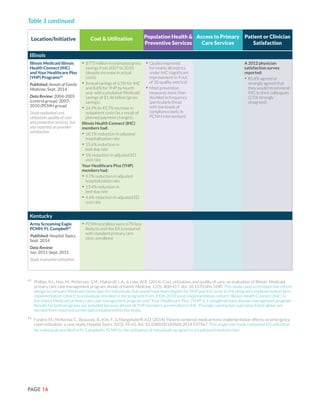
A blank space within a column indicates that no information (positive or negative) was reported on that metric.
National
Medicare Fee-for-
Service beneficiaries
in NCQA-recognized
PCMHs36
Published: Health Services
Research, July 2014
Data Review: July 2007-
June 2008 (comparison
group); July 2007-June
2010 (PCMH group)
Study evaluated cost and
utilization
•	4.9% reduction in total annual
Medicare payment trend
for PCMHs v. comparison
group (62% due to decline
in payments to acute care
hospitals, p<.05)
•	Decline in rate of ED visits for
ACSCs* (p<.001) and for any
condition (p<.001)
•	Decline in rate of ED visits for
patients in PCMHs across all 3
measured risk score groups
Among primary care practices,
PCMH recognition was
associated with a reduction in:
•	Total Medicare payments
($325 per practice, p<.01)
•	Rate of visits to surgical
specialists (p<.05)
•	Rate of ED visits for any
condition (p<.001)
•	Rate of ED visits for ACSCs
(p<.001)
Veterans Health
Administration Primary
Care Clinics with Medical
Home Features37
Published: Journal of
General Internal Medicine,
Sept. 2014
Data Review: Oct. 2009-
Sept. 2010 (comparison
group); Oct. 2010-Sept.
2011 (PCMH group)
Study evaluated cost and
utilization, but also reported
on access
•	Marginally statistically
significant relationship
between medical home
features and cost of ACSC*
hospitalizations (p=.074),
however average-sized clinics
with “maximum” medical home
adoption estimated to save as
much as $83,000 annually
•	A “medical home adoption
score” increase of 10 points
associated with a 3% decreased
odds of ACSC* hospitalization
(p=.032)
•	17% lower odds of
ACSC* admission for
patients seen in clinics
with highest access
and scheduling scores
(p=.004)
•	Lower risk of
hospitalizations for
patients in clinics
with medium care
coordination/
transitions scores
(p=0.020)
36 	
Van Hasselt, M., McCall, N., Keyes, V., Wensky, S.G., & Smith, K.W. (2014). Total cost of care lower among Medicare fee-for-service beneficiaries
receiving care from patient-centered medical homes. Health Services Research, doi: 10.1111/1475-6773.12217 This study used a longitudinal,
nonexperimental design to compare cost and utilization outcomes for Medicare FFS beneficiaries served by NCQA-recognized PCMHs to
beneficiaries served in practices without such recognition.
37 	
Yoon, J., Rose, D.E., Canelo, I., Upadhyay, A.S., Schectman, G., Stark, R., Rubenstein, L.V., & Yano, E.M. (2013). Medical home features of VHA primary
care clinics and avoidable hospitalizations. Journal of General Internal Medicine, 28(9), 1188-94. This study used a cross-sectional design to evaluate
data from 814 primary care clinics. Findings from this study were based on clinics’ self-assessment of medical home features prior to nationwide
rollout of the Patient Aligned Care Teams (PACT) implementation across all VHA clinics. “Medical home components” are defined by authors as “1)
access and scheduling, 2) care coordination and transitions in care, 3) organization of practice, 4) patient-centered care and
communication, 5) population management, 6) quality improvement and performance improvement and 7) use of technology.”
PAGE 14
Location/Initiative Population Health &
Preventive Services
Patient or Clinician
Satisfaction
Cost & Utilization Access to Primary
Care Services
Table 1 continued
38 	
Werner, R.M., Canamucia, A., Shea, J.A., & True, G. (2014). The medical home transformation in the Veterans Health Administration: an evaluation
of early changes in primary care delivery. Health Services Research, 49(4), 1329-1347. doi: 10.1111/1475-6773.12155 This study linked “detailed
interview-based qualitative data on PACT implementation to quantitative outcomes from VHA clinical encounter data” to measure the impact of
the intervention on organizational processes of care and patient outcomes.
39	
Chaiyachati, K.H., Gordon, K., Long, T., Levin, W., Khan, A., Meyer, E., Justice, A., & Brienza, R. (2014). Continuity in a VA patient-centered medical
home reduces emergency department visits. PLoS One, 9(8). doi: 10.1371/journal.pone.0096356 This study used a retrospective, observational
cohort study design to determine the impact of continuity of care in PACT teams on ED utilization in one large VA clinic. The authors defined
continuity of care as “a patient seeing their assigned primary care provider (PCP) or trainee” and a continuity index was used to assess the dose-
effect of continuity.
40	
Nelson, K.M., Helfrich, C., Sun, H., Herbert, P.L., Liu, C.F., Dolan, E., Taylor, L., Wong, E., Maynard, C., Hernandez, S.E., Sanders, W., Randall, I., Curtis,
I., Schectman, G., Stark, R., & Fihn, S.D. (2014). Implementation of the patient-centered medical home in the Veterans Health Administration
associations with patient satisfaction, quality of care, staff burnout, and hospital and emergency department use. JAMA Internal Medicine. 174(8),
1350-1358. This study used an observational design to measure “the extent of PCMH implementation” and examine “the association between
the implementation (using the PACT Implementation Progress index) and examined “the association between the implementation index and key
outcomes.”
National (continued)
Veterans Health
Administration Patient
Aligned Care Team
(PACT)38
Published: Health Services
Research, Aug. 2014
Data Review:
July 2010-June 2012
Study evaluated utilization
and access
•	Slight decline in rates of ED
visits among PACT providers
(9.7% to 8.0%) while rates
increased for non-PACT
providers (7.5% to 8.8%)
•	Statistically significant
improvements in 2-day post-
hospital discharge contact
associated with:
•	being a PACT provider
(p<.01)
•	effectiveness of PACT
implementation (p<.01)
•	Specific structural
changes resulted
in mixed findings
although use of high
risk registries was
associated with an
increase in telephone
visits (p<.05) and
team communication
was associated
with obtaining an
appointment within 3
days of desired date
(p<.05)
Veterans Health
Administration Patient
Aligned Care Team
(PACT)39
Published: Plos One,
May 2014
Data Review:
March 2011-Feb. 2012
Study evaluated utilization
•	46%lowerEDutilizationfor
patientswithatleastonePCP
“continuity”visitcomparedto
thosewithoutcontinuity(p<.001)
Veterans Health
Administration Patient
Aligned Care Team
(PACT)40
Published: JAMA Internal
Medicine, June 2014
Data Review:
June 2012-Dec. 2012
Study evaluated utilization,
quality of care, patient
satisfaction and provider
burnout
•	Statistically significant
reduction in ED use (p<.001)
•	Lower hospitalization rates
for ACSCs* for veterans age
65 and older (p<.001) and
veterans age 65 and younger
(p<.001, a 13.4% decrease)
•	Higher performance
on 41 of 48 measures
of clinical quality
(19 measures were
statistically significant)
•	Statistically significant
improvements in
9 quality-of-care
indicators for veterans
with chronic diseases
•	Clinician satisfaction:
lower staff burnout
in PCMH sites v. non-
PCMH sites (emotional
exhaustion subscale
p=.02)
•	Patient satisfaction
was significantly
higher among sites
that effectively
implemented PACT
v. those that did not
(p<.001)
PAGE 15
Location/Initiative Population Health &
Preventive Services
Patient or Clinician
Satisfaction
Cost & Utilization Access to Primary
Care Services
Table 1 continued
National (continued)
Veterans Health
Administration Patient
Aligned Care Team
(PACT)41
Published: Health Affairs,
June 2014
Data Review:
April 2010-Sept. 2012
Study evaluated cost,
utilization and access
•	No ROI* in study period, but
authors note “trends in use and
costs appear to be [moving] in a
favorable direction”
•	1.7% reduction in
hospitalizations for ACSCs*
across VHA system; 4.2%
reduction for veterans under
age 65 (p<.05)
•	7.3% reduction in outpatient
visits with mental health
specialists across VHA system
(likely due to integration of
mental health in primary care)
(p<.05)
•	3.5% increase in
primary care visits for
veterans over age 65
(p<0.05)
•	1% increase in primary
care visits across VHA
system
Florida
Florida Medicaid
Provider Service
Networks (PSN)42
Published: Health Services
Research, June 2014
Data Review: 2004-
2006 (comparison
group); 2006-2010
(demonstration group)
Study evaluated cost, but
also reported on patient
satisfaction
•	$153 PMPM* reduction in
expenditures for Medicaid
enrollees who were SSI*
recipients (have a disability) v.
non-demonstration sites
•	$4 PMPM* reduction in
expenditures for Medicaid
enrollees who were TANF*
recipients (receive welfare cash
support) (v. increase of $28
PMPM* in control)
•	Patients had slightly
greater levels of
satisfaction with health
care, health plan,
personal doctor, and
specialty care
41	
Herbert, H.L., Liu, C.F., Wong, E.S., Hernandez, S.E., Batten, A., Lo, S., Lemon, J.M., Conrad, D.A., Grembowski, D., Nelson, K., & Fihn, S.D. (2014).
Patient-centered medical home initiative produced modest economic results for Veterans Health Administration, 2010–12. Health Affairs, 33(6),
980-987. doi: 10.1377/hlthaff.2013.0893 This study evaluated “the associations between the implementation of PACT and trends in health care
use and costs between April 2010 and September 2012.”
42	
Harmen, J.S., Hall, A.G., Lemak, C.H., & Duncan, P.R. (2014). Do Provider Service Networks result in lower expenditures compared with HMOs
or primary care case management in Florida’s Medicaid program? Health Services Research. 49(3), 858-77. doi: 10.1111/1475-6773.12129 This
study compares two payment reform initiatives (PSNs and Medicaid HMOs with risk-adjusted premiums) with non-demonstration sites to assess
how different payment mechanisms affect PMPM expenditures. Florida Provider Service Networks (PSN) operate similar to an Accountable Care
Organization (ACO) and their parent organizations are either safety-net hospitals or large physician group practices that predominately serve
Medicaid patient. PSNs offer “… provision of care across a continuum to a defined population, the ability to support comprehensive performance
measurement, the identification of specific performance targets, payment mechanisms that encourage quality improvements and cost reduction,
strong primary care medical home base, prospective planning, and health information technology to support care coordination and quality
improvement.”
PAGE 16
43	
Phillips, R.L, Han, M., Petterson, S.M., Makaroff, L.A., & Liaw, W.R. (2014). Cost, utilization, and quality of care: an evaluation of Illinois’ Medicaid
primary care case management program. Annals of Family Medicine, 12(5), 408-417. doi: 10.1370/afm.1690 This study used a retrospective cohort
design to compare Medicaid claims data for individuals that would have been eligible for YHP and IHC prior to the program’s implementation (pre-
implementation cohort) to individuals enrolled in the programs from 2006-2010 (post-implementation cohort). Illinois Health Connect (IHC) is
the state’s Medicaid primary care case management program and “Your Healthcare Plus” (YHP) is a complementary disease management program.
Results for both programs are included because almost all YHP members are enrolled in IHC. Provider satisfaction outcomes listed above are
derived from reported survey data included within the study.
44	
Fandre, M., McKenna, C., Beauvasi, B., Kim, F., & Mangelsdorff, A.D. (2014). Patient-centered medical home implementation effects on emergency
room utilization: a case study. Hospital Topics, 92(3), 59-65. doi: 10.1080/00185868.2014.937967 This single-site study compared ED utilization
for individuals enrolled in Ft. Campbell’s PCMH to the utilization of individuals assigned to a traditional medical clinic.
Table 1 continued
Location/Initiative Population Health &
Preventive Services
Patient or Clinician
Satisfaction
Cost & Utilization Access to Primary
Care Services
Illinois
Illinois Medicaid Illinois
Health Connect (IHC)
and Your Healthcare Plus
(YHP) Programs43
Published: Annals of Family
Medicine, Sept. 2014
Data Review: 2004-2005
(control group); 2007-
2010 (PCMH group)
Study evaluated cost,
utilization, quality of care
and preventive services, but
also reported on provider
satisfaction
•	$775 million in estimated gross
savings from 2007 to 2010
(despite increase in actual
costs)
•	Annual savings of 6.5% for IHC
and 8.6% for YHP by fourth
year with cumulative Medicaid
savings of $1.46 billion (gross
savings).
•	24.9% to 45.7% increase in
outpatient costs (as a result of
planned payment changes).
Illinois Health Connect (IHC)
members had:
•	18.1% reduction in adjusted
hospitalization rate
•	15.6% reduction in
bed-day rate
•	5% reduction in adjusted ED
visit rate
Your Healthcare Plus (YHP)
members had:
•	9.7% reduction in adjusted
hospitalization rate
•	13.4% reduction in
bed-day rate
•	4.6% reduction in adjusted ED
visit rate
•	Quality improved
for nearly all metrics
under IHC (significant
improvement in 9 out
of 10 quality metrics)
•	Most prevention
measures more than
doubled in frequency
(particularly those
with low levels of
compliance early in
PCMH intervention)
A 2012 physician
satisfaction survey
reported:
•	85.8% agreed or
strongly agreed that
they would recommend
IHC to their colleagues
(2.5% strongly
disagreed)
Kentucky
Army Screaming Eagle
PCMH: Ft. Campbell44
Published: Hospital Topics,
Sept. 2014
Data Review:
Jan. 2011-Sept. 2011
Study evaluated utilization
•	PCMH enrollees were 67% less
likely to visit the ER (compared
with standard primary care
clinic enrollees)
PAGE 17
45	
Carrillo, J.E., Carrillo, V.A., Guimento, R., Mucaria, J., & Leiman, J. (2014). The New York-Presbyterian Regional Health Collaborative: A Three-
Year Progress Report. Health Affairs, 33(11), 1985-1992. doi: 10.1377/hlthaff.2014.0408 This study used a pre and post-intervention design
and evaluated patients with a combination of diabetes, asthma, and congestive heart failure who were served by one of seven medical homes.
All reported outcomes compare the three-year intervention to baseline. Patient experience was captured through the Press Ganey patient
satisfaction survey. New York-Presbyterian Regional Health Collaborative medical homes provide care through interdisciplinary community
health teams led by primary care physicians.
46	
Fillmore, H. DuBard, C.A., Ritter, G.A., & Jackson, C.T. (2013). Health care savings with the patient-centered medical home: Community Care of
North Carolina’s experience. Population Health Management, 17(3), 141-8. doi: 10.1089/pop.2013.0055 This study used pre-post and matched
cohort comparison models and focused on non-elderly Medicaid enrollees with a disability or multiple chronic conditions. Utilization and access
outcomes included above were derived from Model 1; cost findings are from Model 2 due to the authors’ assertion that it may “represent a
more accurate picture of program impact” because it “better addresses the threat to validity” by matching CCNC enrollees with non-enrolled
recipients.
Table 1 continued
Location/Initiative Population Health &
Preventive Services
Patient or Clinician
Satisfaction
Cost & Utilization Access to Primary
Care Services
New York
New York-Presbyterian
Regional Health
Collaborative45
Published: Health Affairs,
Nov. 2014
Data Review: 2009
(baseline); Oct. 2010-
Oct. 2013 (PCMH
intervention)
Study evaluated utilization
and patient satisfaction, but
also reported on cost
•	Short-term ROI of 11%
(related to reduction in ED
visits and increased PCMH
reimbursements from New
York State)
Among chronically ill patient
population:
•	29.7% reduction in ED visits
(p<.001)
•	28.5% reduction in
hospitalizations (p<.001)
•	36.7% decline in 30-day
readmissions (p<.001)
•	4.9% decline in average length-
of-stay (p <.001)
•	Patient satisfaction
scores improved across
all measures
North Carolina
Community Care of
North Carolina (CCNC)46
Published: Population
Health Management,
Sept. 2013
Data Review: Jan. 2007-
Sept. 2011
Study evaluated cost,
utilization and access
•	Statistically significant cost
savings:
•	2008: $52.54 PMPM*
(p=.005)
•	2009: $80.75 PMPM*
(p<.0001)
•	2010: $72.65 PMPM*
(p<.0001)
•	2011: $120.69 PMPM*
(p<.0001)
•	Statistically significant
reduction in rate of
hospitalizations from 2008-
2011 (despite higher risk
score), while rate increased for
non-enrolled (p<.001)
•	Increase in access to
ambulatory physician
services (p<.001)
PAGE 18
Table 1 continued
47	
Higgins, S., Chawla, R., Colombo, C., Snyder, S., & Nigam, S. (2014). Medical homes and cost and utilization among high-risk patients. American
Journal of Managed Care. 20(3), 61-71. This study used longitudinal, case-control design to compare PCMH and non-PCMH practices and evaluate
the effects of the PCMH model on costs and utilization among high-risk patients.
48	
David, G., Gunnarsson, C., Saynisch, P.A., Chawla, R., & Nigam, S. (2014). Do patient-centered medical homes reduce emergency department visits?
Health Services Research, doi: 10.1111/1475-6773.12218 This study compared PCMH-certified practices with non PCMH-certified practices to
assess the impact of the adoption of the PCMH model on ED utilization among patients with and without chronic illness.
1	
Friedberg, M.W., Schneider, E.C., Rosenthal, M.B., Volpp, K.G., Werner, R.M. (2014). Association between participation in a multipayer medical
home intervention and changes in quality, utilization, and costs of care. JAMA, 311(8), 815-825, doi:10.1001/jama.2014.353 This study surveyed
32 participating NCQA-recognized PCMH pilot practices “to compare their structural capabilities at the pilot’s beginning and end” and evaluate 	
	 the impact of the PCMH model in quality, utilization, and costs of care. While the study measured cost and utilization, it evaluated the 	
	 overall patient population and did not take into account high-risk, chronically ill patients, which often have a substantial impact on cost.
Location/Initiative Population Health &
Preventive Services
Patient or Clinician
Satisfaction
Cost & Utilization Access to Primary
Care Services
Pennsylvania
Independence Blue
Cross Blue Shield PCMH
practices47
Published: American
Journal of Managed Care,
March 2014
Data Review: 2009-2011
Study evaluated cost and
utilization
•	No statistically significant cost
or utilization differences for
overall population
Among high-risk patient
population:
•	Adjusted total savings:
•	11.2% in 2009 ($107 PMPM*,
p=.004)
•	7.9% in 2010 ($75 PMPM*,
p=.06)
•	Reduction in inpatient
admissions:
•	10.8% fewer in 2009 (p=.02)
•	8.6% fewer in 2010 (p=.03)
•	16.6% fewer in 2011 (p=.08)
Independence Blue
Cross Blue Shield PCMH
Practices48
Published: Health Services
Research, Aug. 2014
Data Review: 2008-2012
Study evaluated cost and
utilization
•	No statistically significant
cost or utilization differences
for patients without chronic
disease
Amongpatientswithchronic
illnesstransitioningtoamedical
home:
•	Change in ED expenditures
did not reach statistical
significance
•	5-8% reduction in ED
utilization
•	9.5-12% reduction in ED
utilization for patients with
diabetes
•	3.5-9.6% reduction in avoidable
ED visits
Pennsylvania Chronic
Care Initiative1
Published: Journal of
the American Medical
Association, Feb. 2014
Data Review: June 2008-
May 2011
Study evaluated cost,
utilization and quality of
care
•	No statistically significant
change in utilization or cost
of care for overall population
studied
•	Statistically significant
improvement in 1 of
11 investigated quality
measures: increased
nephropathy screening
in diabetes (82.7% v.
71.7% p<.001)
•	Improved performance
among other diabetes
measures and colorectal
cancer screening
(although not statistically
significant)
PAGE 19
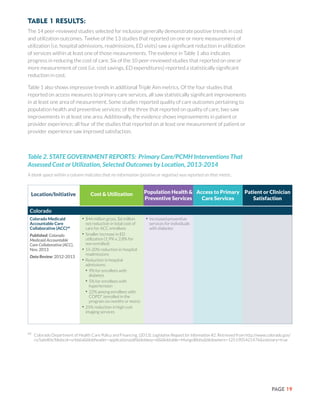
Table 1 Results:
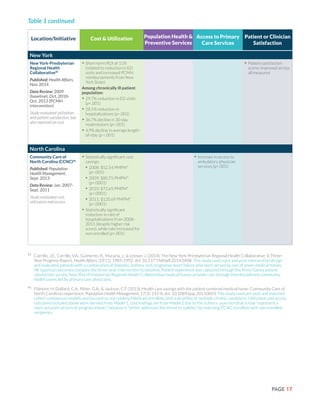
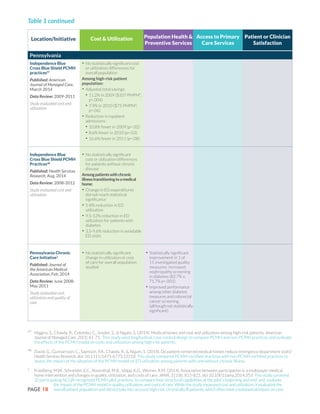
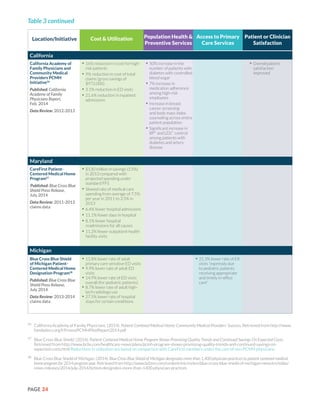
The 14 peer-reviewed studies selected for inclusion generally demonstrate positive trends in cost
and utilization outcomes. Twelve of the 13 studies that reported on one or more measurement of
utilization (i.e. hospital admissions, readmissions, ED visits) saw a significant reduction in utilization
of services within at least one of those measurements. The evidence in Table 1 also indicates
progress in reducing the cost of care. Six of the 10 peer-reviewed studies that reported on one or
more measurement of cost (i.e. cost savings, ED expenditures) reported a statistically significant
reduction in cost.
Table 1 also shows impressive trends in additional Triple Aim metrics. Of the four studies that
reported on access measures to primary care services, all saw statistically significant improvements
in at least one area of measurement. Some studies reported quality of care outcomes pertaining to
population health and preventive services; of the three that reported on quality of care, two saw
improvements in at least one area. Additionally, the evidence shows improvements in patient or
provider experience; all four of the studies that reported on at least one measurement of patient or
provider experience saw improved satisfaction.
49	
Colorado Department of Health Care Policy and Financing. (2013). Legislative Request for Information #2. Retrieved from http://www.colorado.gov/
cs/Satellite?blobcol=urldata&blobheader=application/pdf&blobkey=id&blobtable=MungoBlobs&blobwhere=1251905421476&ssbinary=true
Location/Initiative Population Health &
Preventive Services
Patient or Clinician
Satisfaction
Cost & Utilization Access to Primary
Care Services
Table 2. STATE GOVERNMENT REPORTS: Primary Care/PCMH Interventions That
Assessed Cost or Utilization, Selected Outcomes by Location, 2013-2014
A blank space within a column indicates that no information (positive or negative) was reported on that metric.
Colorado
Colorado Medicaid
Accountable Care
Collaborative (ACC)49
Published: Colorado
Medicaid Accountable
Care Collaborative (ACC),
Nov. 2013
Data Review: 2012-2013
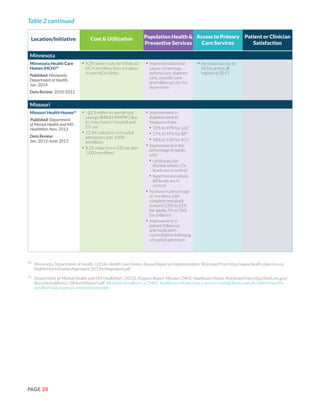
•	$44 million gross, $6 million
net reduction in total cost of
care for ACC enrollees
•	Smaller increase in ED
utilization (1.9% v. 2.8% for
non-enrolled)
•	15-20% reduction in hospital
readmissions
•	Reduction in hospital
admissions:
•	9% for enrollees with
diabetes
•	5% for enrollees with
hypertension
•	22% among enrollees with
COPD* (enrolled in the
program six months or more)
•	25% reduction in high cost
imaging services
•	Increased preventive
services for individuals
with diabetes
PAGE 20
50	
Minnesota Department of Health. (2014). Health Care Homes: Annual Report on Implementation. Retrieved from http://www.health.state.mn.us/
healthreform/homes/legreport/2013hchlegreport.pdf
51	
Department of Mental Health and MO HealthNet. (2013). Progress Report: Missouri CMHC Healthcare Homes. Retrieved from http://dmh.mo.gov/
docs/mentalillness/18MonthReport.pdf All adults enrolled in a CMHC Healthcare Home have a serious mental illness and all children/youths
enrolled have a serious emotional disorder.
Table 2 continued
Location/Initiative Population Health &
Preventive Services
Patient or Clinician
Satisfaction
Cost & Utilization Access to Primary
Care Services
Minnesota
Minnesota Health Care
Homes (HCH)50
Published: Minnesota
Department of Health,
Jan. 2014
Data Review: 2010-2012
•	9.2% lower costs for Medicaid
HCH enrollees than enrollees
in non-HCH clinics
•	Improved colorectal
cancer screenings,
asthma care, diabetes
care, vascular care
and follow up care for
depression
•	Increased access to
HCHs across all
regions in 2013
Missouri
Missouri Health Homes51
Published: Department
of Mental Health and MO
HealthNet, Nov. 2013
Data Review:
Jan. 2012-June 2013
•	~$2.9 million in overall cost
savings ($48.81 PMPM*) due
to reductions in hospital and
ED use
•	12.8% reduction in hospital
admissions (per 1,000
enrollees)
•	8.2% reduction in ED use (per
1,000 enrollees)
•	Improvement in
diabetes control
measures from:
•	22% to 47% for LDL*
•	27% to 59% for BP*
•	18% to 53% for A1c*
•	Improvement in the
percentage of adults
with:
•	cardiovascular
disease whose LDL
levels are in control
•	hypertension whose
BP levels are in
control
•	Increase in percentage
of enrollees with
complete metabolic
screens (12% to 61%
for adults, 9% to 56%
for children)
•	Improvement in
patient follow-up
and medication
reconciliation following
a hospital admission
PAGE 21
Location/Initiative Population Health &
Preventive Services
Patient or Clinician
Satisfaction
Cost & Utilization Access to Primary
Care Services
Table 2 continued
52	
Oklahoma Health Care Authority. (2014). SoonerCare Choice Program Independent Evaluation. Retrieved from http://www.okhca.org/WorkArea/
linkit.aspx?LinkIdentifier=id&ItemID=16471&libID=15453
53	
Oregon Health Authority. (2014). Oregon Health System Transformation 2013 Performance Report. Retrieved from http://www.oregon.gov/oha/
Metrics/Documents/2013%20Performance%20Report.pdf
Oklahoma
SoonerCare Choice
Program18
Published: Oklahoma
Health Care Authority,
Sept. 2014
Data Review: Jan. 2009-
June 2013
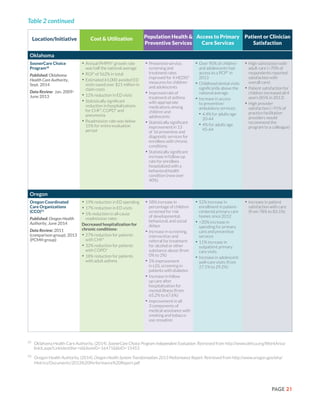
•	Annual PMPM* growth rate
was half the national average
•	ROI* of 562% in total
•	Estimated 61,000 avoided ED
visits saved over $21 million in
claim costs
•	12% reduction in ED visits
•	Statistically significant
reduction in hospitalizations
for CHF*, COPD* and
pneumonia
•	Readmission rate was below
15% for entire evaluation
period
•	Preventive service,
screening and
treatment rates
improved for 4 HEDIS*
measures for children
and adolescents
•	Improved rate of
treatment of asthma
with appropriate
medications among
children and
adolescents
•	Statistically significant
improvement in 13
of 16 preventive and
diagnostic services for
enrollees with chronic
conditions
•	Statistically significant
increase in follow-up
rate for enrollees
hospitalized with a
behavioral health
condition (now over
40%)
•	Over 90% of children
and adolescents had
access to a PCP* in
2013
•	Childhood dental visits
significantly above the
national average
•	Increase in access
to preventive/
ambulatory services:
•	4.4% for adults age
20-44
•	4% for adults age
45-64
•	High satisfaction with
adult care (>70% of
respondents reported
satisfaction with
overall care)
•	Patient satisfaction for
children increased all 4
years (85% in 2013)
•	High provider
satisfaction (~91% of
practice facilitation
providers would
recommend the
program to a colleague)
Oregon
Oregon Coordinated
Care Organizations
(CCO)53
Published: Oregon Health
Authority, June 2014
Data Review: 2011
(comparison group); 2013
(PCMH group)
•	19% reduction in ED spending
•	17% reduction in ED visits
•	5% reduction in all-cause
readmission rates
Decreased hospitalization for
chronic conditions:
•	27% reduction for patients
with CHF*
•	32% reduction for patients
with COPD*
•	18% reduction for patients
with adult asthma
•	58% increase in
percentage of children
screened for risk
of developmental,
behavioral, and social
delays
•	Increase in screening,
intervention and
referral for treatment
for alcohol or other
substance abuse (from
0% to 2%)
•	5% improvement
in LDL screening in
patients with diabetes
•	Increase in follow
up care after
hospitalization for
mental illness (from
65.2% to 67.6%)
•	Improvement in all
3 components of
medical assistance with
smoking and tobacco
use cessation
•	52% increase in
enrollment in patient-
centered primary care
homes since 2012
•	>20% increase in
spending for primary
care and preventive
services
•	11% increase in
outpatient primary
care visits
•	Increase in adolescent
well-care visits (from
27.1% to 29.2%)
•	Increase in patient
satisfaction with care
(from 78% to 83.1%)
PAGE 22
Table 2 continued
54	
Rhode Island Chronic Care Sustainability Initiative (2013). A Year of Progress Transforming Primary Care in Rhode Island. Retrieved from https://
www.pcmhri.org/files/uploads/CSI-RI%202013%20Annual%20Report_FINAL.pdf
55	
Department of Vermont Health Access. (2014). Vermont Blueprint for Health 2013 Annual Report. Retrieved from http://hcr.vermont.gov/sites/hcr/
files/pdfs/VTBlueprintforHealthAnnualReport2013.pdf PCPCC only included statistically significant outcomes from this report.
Location/Initiative Population Health &
Preventive Services
Patient or Clinician
Satisfaction
Cost & Utilization Access to Primary
Care Services
Rhode Island
Rhode Island Chronic
Care Sustainability
Initiative (CSI-RI)54
Published: Rhode Island
Chronic Care Sustainability
Initiative, May 2014
Data Review: Jan. 2013 –
Dec. 2013
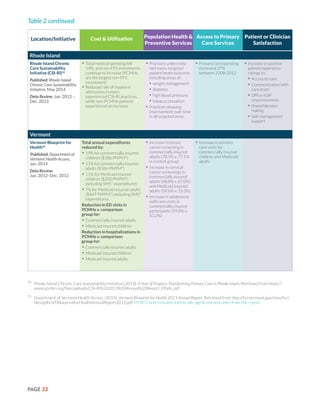
•	Total medical spending fell
14%, and non-FFS investments
continue to increase (PCMHs
are the largest non-FFS
investment)
•	Reduced rate of inpatient
admissions in more
experienced CSI-RI practices,
while non-PCMHs patients
experienced an increase
•	Practices collectively
met every targeted
patient heath outcome,
including areas of:
•	weight management
•	diabetes
•	high blood pressure
•	tobacco cessation
•	Practices showing
improvement over time
in all targeted areas
•	Primary care spending
increased 37%
between 2008-2012
•	Increase in positive
patient experience
ratings in:
•	Access to care
•	Communication with
care team
•	Office staff
responsiveness
•	Shareddecision
making
•	Self-management
support
Vermont
Vermont Blueprint for
Health55
Published: Department of
Vermont Health Access,
Jan. 2014
Data Review:
Jan. 2012- Dec. 2012
Total annual expenditures
reduced by:
•	19% for commercially insured
children ($386 PMPM*)
•	11% for commercially insured
adults ($586 PMPM*)
•	11% for Medicaid insured
children ($200 PMPM*)
excluding SMS* expenditures
•	7% for Medicaid insured adults
($447 PMPM*) excluding SMS*
expenditures
Reduction in ED visits in
PCMHs v. comparison
group for:
•	Commercially insured adults
•	Medicaid insured children
Reduction in hospitalizations in
PCMHs v. comparison
group for:
•	Commercially insured adults
•	Medicaid insured children
•	Medicaid insured adults
•	Increase in breast
cancer screening in
commercially insured
adults (78.5% v. 77.1%
in control group)
•	Increase in cervical
cancer screenings in
commercially insured
adults (68.8% v. 67.0%)
and Medicaid insured
adults (59.6% v. 55.3%)
•	Increase in adolescent
well-care visits in
commercially insured
participants (59.8% v.
53.2%)
•	Increase in primary
care visits for
commercially insured
children and Medicaid
adults
PAGE 23
Table 2 Results:
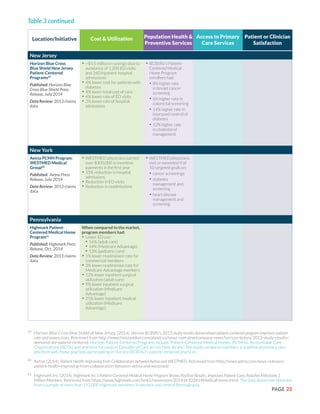
Table 2 includes outcomes from seven state government reports that are uniformly positive across
cost and utilization metrics. All seven of the programs reported reduction in at least one cost metric.
Of the six programs that reported on utilization, all showed reduction in at least one metric. The
evaluation of the Minnesota Health Care Homes program is a preliminary report and did not report
on any utilization metrics. A complete evaluation of the program is expected in early 2015.
The state government reports include a robust evaluation of primary care medical home
interventions and many reported on additional Triple Aim metrics including quality of care, access
to primary care services, and patient or provider experience. Six of the state programs reported
on quality of care measures (population health/preventive services) and all saw improvements.
Of the five of the programs that reported on metrics of access to primary care services, all saw
improvements. The three programs that reported on patient or provider experience all noted
improvement in patient or provider satisfaction.
15	
UnitedHealth Group. (2014). Advancing Primary Care Delivery: Practical, Proven, and Scalable solutions. Retrieved from http://www.
unitedhealthgroup.com/~/media/UHG/PDF/2014/UNH-Primary-Care-Report-Advancing-Primary-Care-Delivery.ashx UnitedHeathcare
operates 13 medical home programs in 10 states. The results included above are derived from an actuarial evaluation of the programs in Arizona,
Colorado, Ohio, and Rhode Island based on three full years of operation. The report also mentions independent third-party evaluations completed
for four medical home programs in RI, CO, and OH, which showed improvement on quality measures for preventive and chronic care, access, care
coordination, use of HIT, and patient satisfaction.
Location/Initiative Population Health &
Preventive Services
Patient or Clinician
Satisfaction
Cost & Utilization
Access to Primary
Care Services
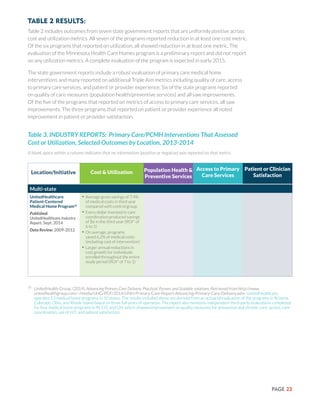
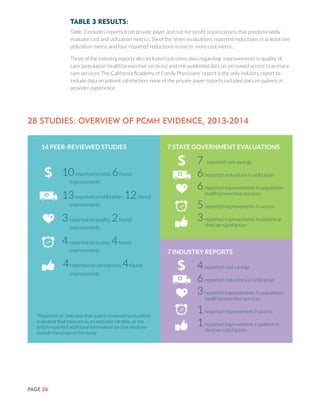
Table 3. INDUSTRY REPORTS: Primary Care/PCMH Interventions That Assessed
Cost or Utilization, Selected Outcomes by Location, 2013-2014
A blank space within a column indicates that no information (positive or negative) was reported on that metric.
Multi-state
UnitedHealthcare
Patient-Centered
Medical Home Program22
Published:
UnitedHealthcare Industry
Report, Sept. 2014
Data Review: 2009-2012
•	Average gross savings of 7.4%
of medical costs in third year
compared with control group
•	Every dollar invested in care
coordination produced savings
of $6 in the third year (ROI* of
6 to 1)
•	On average, programs
saved 6.2% of medical costs
(including cost of intervention)
•	Larger annual reductions in
cost growth for individuals
enrolled throughout the entire
study period (ROI* of 7 to 1)
PAGE 24
Table 3 continued
56	
California Academy of Family Physicians. (2014). Patient-Centered Medical Home: Community Medical Providers’ Success. Retrieved from http://www.
familydocs.org/f/FresnoPCMHPilotReport2014.pdf
57	
Blue Cross Blue Shield. (2014). Patient-Centered Medical Home Program Shows Promising Quality Trends and Continued Savings On Expected Costs.
Retrieved from http://www.bcbs.com/healthcare-news/plans/pcmh-program-shows-promising-quality-trends-and-continued-savings-on-
expected-costs.html Reductions in utilization are based on comparison with CareFirst members under the care of non-PCMH physicians.
58	
Blue Cross Blue Shield of Michigan. (2014). Blue Cross Blue Shield of Michigan designates more than 1,400 physician practices to patient-centered medical
home program for 2014 program year. Retrieved from http://www.bcbsm.com/content/microsites/blue-cross-blue-shield-of-michigan-news/en/index/
news-releases/2014/july-2014/bcbsm-designates-more-than-1400-physician-practices
Location/Initiative Population Health &
Preventive Services
Patient or Clinician
Satisfaction
Cost & Utilization Access to Primary
Care Services
California
California Academy of
Family Physicians and
Community Medical
Providers PCMH
Initiative56
Published: California
Academy of Family
Physicians Report,
Feb. 2014
Data Review: 2012-2013
•	16% reduction in cost for high-
risk patients
•	9% reduction in cost of total
claims (gross savings of
$972,000)
•	3.1% reduction in ED visits
•	21.6% reduction in inpatient
admissions
•	50% increase in the
number of patients with
diabetes with controlled
blood sugar
•	7% increase in
medication adherence
among high-risk
employees
•	Increase in breast
cancer screening
and body mass index
counseling across entire
patient population
•	Significant increase in
BP* and LDL* control
among patients with
diabetes and artery
disease
•	Overall patient
satisfaction
improved
Maryland
CareFirst Patient-
Centered Medical Home
Program57
Published: Blue Cross Blue
Shield Press Release,
July 2014
Data Review: 2011-2013
claims data
•	$130 million in savings (3.5%)
in 2013 compared with
projected spending under
standard FFS
•	Slowed rate of medical care
spending from average of 7.5%
per year in 2011 to 3.5% in
2013
•	6.4% fewer hospital admissions
•	11.1% fewer days in hospital
•	8.1% fewer hospital
readmissions for all causes
•	11.3% fewer outpatient health
facility visits
Michigan
Blue Cross Blue Shield
of Michigan Patient-
Centered Medical Home
Designation Program58
Published: Blue Cross Blue
Shield Press Release,
July 2014
Data Review: 2013-2014
claims data
•	11.8% lower rate of adult
primary care sensitive ED visits
•	9.9% lower rate of adult ED
visits
•	14.9% lower rate of ED visits
overall (for pediatric patients)
•	8.7% lower rate of adult high-
tech radiology use
•	27.5% lower rate of hospital
stays for certain conditions
•	21.3% lower rate of ER
visits “expressly due
to pediatric patients
receiving appropriate
and timely in-office
care”
PAGE 25
Table 3 continued
59	
Horizon Blue Cross Blue Shield of New Jersey. (2014). Horizon BCBSNJ’s 2013 study results demonstrate patient-centered program improves patient
care and lowers costs. Retrieved from http://www.horizonblue.com/about-us/news-overview/company-news/horizon-bcbsnj-2013-study-results-
demonstrate-patient-centered Horizon Patient-Centered Programs include “Patient-Centered Medical Homes (PCMHs), Accountable Care
Organizations (ACOs) and practices focused on Episodes of Care across New Jersey”. The study compares members in traditional primary care
practices with those practices participating in Horizon BCBSNJ’s patient-centered practices.
60	
Aetna. (2014). Patient Health Improving from Collaboration between Aetna and WESTMED. Retrieved from http://news.aetna.com/news-releases/
patient-health-improving-from-collaboration-between-aetna-and-westmed/
61	
Highmark Inc. (2014). Highmark Inc.’s Patient-Centered Medical Home Program Shows Positive Results, Improves Patient Care, Reaches Milestone 1
Million Members. Retrieved from https://www.highmark.com/hmk2/newsroom/2014/pr102814MedicalHome.shtml The data above was obtained
from a sample of more than 152,000 Highmark members in western and central Pennsylvania.
Location/Initiative Population Health &
Preventive Services
Patient or Clinician
Satisfaction
Cost & Utilization Access to Primary
Care Services
New Jersey
Horizon Blue Cross
Blue Shield New Jersey
Patient-Centered
Programs59
Published: Horizon Blue
Cross Blue Shield Press
Release, July 2014
Data Review: 2013 claims
data
•	~$4.5 million in savings (due to
avoidance of 1,200 ED visits
and 260 inpatient hospital
admissions)
•	4% lower cost for patients with
diabetes
•	4% lower total cost of care
•	4% lower rate of ED visits
•	2% lower rate of hospital
admissions
•	BCBSNJ’s Patient-
Centered Medical
Home Program
enrollees had:
•	8% higher rate
in breast cancer
screening
•	6% higher rate in
colorectal screening
•	14% higher rate in
improved control of
diabetes
•	12% higher rate
in cholesterol
management
New York
Aetna PCMH Program:
WESTMED Medical
Group60
Published: Aetna Press
Release, July 2014
Data Review: 2013 claims
data
•	WESTMED physicians earned
over $300,000 in incentive
payments in the first year
•	35% reduction in hospital
admissions
•	Reduction in ED visits
•	Reduction in readmissions
•	WESTMED physicians
met or exceeded 9 of
10 targeted goals on:
•	cancer screenings
•	diabetes
management and
screening
•	heart disease
management and
screening
Pennsylvania
Highmark Patient-
Centered Medical Home
Program61
Published: Highmark Press
Release, Oct. 2014
Data Review: 2013 claims
data
When compared to the market,
program members had:
•	Lower ED use:
•	16% (adult care)
•	14% (Medicare Advantage)
•	13% (pediatric care)
•	1% lower readmission rate for
commercial members
•	2% lower readmission rate for
Medicare Advantage members
•	12% lower inpatient surgical
utilization (adult care)
•	9% lower inpatient surgical
utilization (Medicare
Advantage)
•	25% lower inpatient medical
utilization (Medicare
Advantage)
PAGE 26
Table 3 Results:
Table 3 includes reports from private payer and not-for-profit organizations that predominately
evaluate cost and utilization metrics. Six of the seven evaluations reported reductions in at least one
utilization metric and four reported reductions in one or more cost metric.
Three of the industry reports also included outcomes data regarding improvements in quality of
care (population health/preventive services) and one published data on increased access to primary
care services. The California Academy of Family Physicians’ report is the only industry report to
include data on patient satisfaction; none of the private payer reports included data on patient or
provider experience.
28 Studies: Overview of PCMH Evidence, 2013-2014
7	reported cost savings
6	reported reductions in utilization
6	reported improvements in population
health/preventive services
5	reported improvements in access
3	reported improvements in patient or 	
clinician satisfaction
10reported on cost, 6found
improvements
13reported on utilization, 12 found
improvements
3	reported on quality, 2found
improvements
4	reported on access, 4found
improvements
4reported on satisfaction, 4found
improvements
4	reported cost savings
6	reported reductions in utilization
3	reported improvements in population
health/preventive services
1	reported improvement in access
1	reported improvement in patient or
clinician satisfaction
7 State Government Evaluations14 Peer-reviewed studies
7 Industry Reports
“Reported on” indicates that a peer-reviewed study either
evaluated that measure as an outcome variable, or the
article reported additional information on that measure
outside the scope of the study.
PAGE 27
Discussion of Findings
Numerous primary care practices that adopt and implement core principles of the PCMH are
experiencing improvements in cost and quality.18,19,20
Despite early and sometimes mixed findings,1,62
the evidence here suggests that trends continue to be positive for practices that are able to fully
implement the PCMH model of care. As highlighted previously, the longer a PCMH practice has
implemented the model, the more impressive the results.21,22,23,24
The evidence included in this report
is derived from initiatives that vary substantially in scope, breadth, and the specific PCMH strategies
implemented, but in the aggregate they demonstrate progress in achieving important Triple Aim
metrics.
Peer-Reviewed Studies
Overall, the peer-reviewed studies included in Table 1 demonstrate positive trends in cost and
utilization outcomes. Twelve of the 13 studies that used a measurement of utilization as an outcome
variable showed improvement in at least one area, while six of the 10 studies that evaluated
an intervention’s impact on cost reported a reduction. The data suggests that even when an
intervention’s total monthly cost per member does not show a significant reduction, decreases in
unnecessary utilization of emergency departments (ED) and hospital services are often realized.
This suggests that resources are being used more appropriately to deliver better primary care.
When evaluating the ability of the PCMH to bend the cost curve, it is important to remember that
confounding factors, such as rising medical prices, affect the total cost of care. Therefore, while
the peer-reviewed evidence pertaining to cost reductions may seem modest, these results are
nonetheless encouraging.
Notable for their size and scope, the Medicare FFS study and the Veterans Administration PCMH
program (VA PACT) offer important lessons and promising results regarding PCMH implementation.
The Medicare FFS study found statistically significant cost and utilization improvements that bode
well for the future of accountable care.36
Although there were positive findings associated within
the Medicare FFS PCMH program, health care providers will continue to be financially motivated to
increase the volume of services64,6
without changing the underlying FFS incentives. The VA PACT
program is the largest PCMH program to date including five million veterans, 160 hospitals, and
783 community-based clinics.38
The program is still early in its implementation and the findings here
were mixed, however, there are encouraging trends in cost with statistically significant reductions
in utilization,37,39,40
as well as improved clinician and patient satisfaction.40
In addition, all of the VA
studies in Table 1 showed reductions in avoidable ambulatory sensitive conditions (ACSC) admission,
and thus at minimum, suggest that resources are being deployed more appropriately.37,39,40
State Government Program Evaluations (Non Peer-Reviewed)
In Table 2, the state government program evaluations offered comprehensive reviews of their
PCMH initiatives and the results were overwhelmingly positive. All seven programs reported
reductions in cost and six of the seven reported reductions in at least one measure of utilization.
States generally measured more aspects of quality and satisfaction than did the peer-reviewed or
industry generated studies. Given that state government programs were early experimenters in
PCMH pilots, funded by taxpayer dollars, and generally subject to legislative review, state reports
were more thorough in reporting their primary care PCMH outcomes. Not surprisingly, the majority
of states included here are national leaders in PCMH implementation, with eight (out of twelve total)
PAGE 28
states being an original participant in the MAPCP Demonstration (NC, PA, MN, RI, VT, MI, NJ, NY).29
These multi-payer initiatives are showcasing the importance of alignment across payers in order to
incentivize primary care practices to embrace the challenging work necessary to transform primary
care services and improve patient outcomes.
Industry Reports (Non Peer-Reviewed)
Table 3 contains reports published by private payers and not-for-profit pilot programs that continue
to demonstrate more sizable reductions in cost and utilization. Four of seven industry publications
reported on improvements in cost metrics, with one program due to report later this year. Trends
in utilization are also encouraging with six of seven interventions reporting improvement on at
least one metric. Reductions in cost and utilization are fueling private primary care PCMH program
expansion nationwide. Major health plans included here — such as Anthem, CareFirst Blue Cross
Blue Shield, Blue Cross Blue Shield Michigan, Horizon Blue Cross Blue Shield New Jersey, and
Aetna — have all demonstrated positive outcomes as well as an on-going commitment to the PCMH
movement.
Challenges in Evaluating Primary Care PCMH Interventions
While we are still learning about which features of the PCMH are most impactful, the evidence for
the PCMH described here underscores the impressive trends that tie the medical home model of
care to: reductions in health care costs and unnecessary utilization; improvements in population
health and preventive services; increased access to primary care; and growing satisfaction among
patients and clinicians. This positive news for stakeholders of PCMH and primary care contrasts with
some studies that report more mixed findings.65,1
A 2014 Health Affairs study evaluated the VA PACT program and found no return on investment in
the first two years following the initial program implementation. Despite the program’s inability to
achieve cost savings during the study period, however, the authors suggest that the cost and quality
trends are moving in the right direction and that resources are being deployed more appropriately.41
Another widely cited study was published in the Journal of the American Medical Association (JAMA)
in February 2014. The study evaluated 32 practices participating in the Pennsylvania Chronic Care
Initiative and found no significant reductions in cost or utilization.1
Participants in the Pennsylvania
initiative have argued, however, that their project was designed to build practice infrastructure
and lacked financial incentives designed to control costs; used older NCQA recognition standards
that, for example, did not include the use of weekend and evening hours; and the authors did not
separately analyze the effects that the PCMH practices had on chronically ill patients, which was the
intention of the initiative.66,67
Two subsequent studies of the Pennsylvania program included in Table
1 did find improvements in cost and utilization for chronically ill patients.47,48
Both of these examples
provide an opportunity to glean important lessons about implementation, accreditation, and financial
incentives for cost control. Although they can vary in quality and comprehensiveness, no single
evaluation of a health services intervention can be deemed authoritative. Researchers, practitioners,
and policy makers alike must learn from each evaluation, as well as the accumulated evidence.
Although this year’s review of the evidence demonstrates notable reductions in cost and utilization,
other Triple Aim metrics continue to be under-reported. With no single set of outcome measures
consistently used to assess the PCMH, evaluations vary in size, scope, and generalizability. For
example, measures that assess “patient-centeredness” (such as patient engagement or activation),
team-based care, or integration of behavioral and mental health are becoming more common, but
Although
they can vary
in quality and
comprehensiveness,
no single evaluation
of a health services
intervention
can be deemed
authoritative.
Researchers,
practitioners, and
policy makers alike
must learn from
each evaluation,
as well as the
accumulated
evidence.
“
”
PAGE 29
often go unreported in cost and utilization outcome studies.68
This makes understanding the value of
the PCMH to patients and payers more challenging. Another major challenge in evaluating primary
care PCMH interventions is selecting an appropriate study design that accurately reflects patient
outcomes attributable to PCMH implementation. PCMH interventions often take time to reach
maturation and cannot be solely evaluated on the results from early studies of implementation;
recent evaluations suggest that transformation can take a minimum of two to four years.24
Finally, as the number of primary care practices seeking to become PCMHs continues to grow,
payers, policymakers, and patients have expressed concerns regarding the various ways in which the
marketplace is currently defining the medical home and the criteria by which they are establishing
medical home certification/recognition programs. Evidence suggests that there may be substantial
differences and even tension between the achievement of medical home “recognition” and
meaningful transformation.69,24
Although very useful as a roadmap for practices to operationalize
PCMH features, the recognition process has recently been criticized for being too administratively
burdensome, too focused on process rather than outcomes, and too focused on “box checking”
rather than meaningful transformation. As the model evolves and becomes increasingly outcomes
focused, so too should the recognition/certification process designed to measure it.
SECTION THREE
The Future of the PCMH and Enhanced
Primary Care
As described earlier, the goal of this report is to provide the reader with a comprehensive overview
of the recent evidence for the PCMH that are associated with outcomes consistent with the Triple
Aim. It is equally important to demonstrate the growing consensus for the PCMH’s key role in
delivery system reform, especially as part of ACOs and the medical neighborhood. Faced with an
economic imperative to control health spending, substantial health system redesign is warranted.
Employers, payers, and policymakers are looking for solutions that eliminate the well-documented
system inefficiencies that are estimated to account for 30 percent of U.S. health care costs.65
Better, stronger primary care — codified as the PCMH — is necessary for any solution, but not
sufficient. In this last section, we will share what we believe to be the critical future efforts for PCMH
development.
Integration within Primary Care and Across the Medical Neighborhood
PCMH integration can be viewed from two perspectives: the integration of various health care
services within the primary care practice — such as pharmacy, behavioral/mental health and oral
health — and integration of primary care into the “medical neighborhood” or ACOs as well as the
local community.
Integration Internal to Primary Care Practice. One of the most distinguishing characteristics
of the PCMH is the capacity to provide comprehensive, team-based care that is responsive to the
needs of patients. As medical care becomes more complex and we better recognize the dynamic
interplay between physical, social, and cultural impacts on health, the PCMH works to bring together
a team of health professionals to address all of these components. Many practices have added
staff such as health coaches, dieticians, psychologists, care coordinators, care navigators, chronic
care managers, pharmacists, and community health workers.70
The PCMH encourages primary
care teams to “share the care” by more fully engaging all members of the practice in care delivery,
providing training to enhance teamwork and ensure each member of the team is practicing at the
top of their license and skill set, and promoting shared accountability for quality of care and patient
experience. 71
PAGE 30
As part of integrating health services within primary care, many practices are beginning to
address glaring gaps in comprehensive care: two such examples are behavioral health and oral
health. Integration of team members that support the mental and behavioral health needs of patients
has become a fundamental component to the PCMH. Most patients with chronic conditions require
some type of coaching or guidance to support behavior change necessary to maintain or improve
their quality of life. Conditions such as depression, anxiety, substance abuse, and eating disorders
often present in the primary care setting; health care costs for patients with conditions such as
diabetes and heart disease are much higher when patients have behavioral health conditions that
have not been adequately addressed and managed.
In addition, primary care practices are increasingly becoming more focused on the importance
of oral health. Many chronic conditions, either by virtue of the condition itself or as a side effect
of prescribed medications, are associated with higher risk for dental disease. As the evidence
demonstrating the impact of oral health on patients’ overall health increases, members of the care
team are working to educate patients and the importance of good oral hygiene and helping them
access dental services when needed. Primary care practices serving children are integrating basic
preventive oral health services into routine well-child visits, such as application of fluoride varnish
to prevent childhood caries.72
Regardless of the type of training, having all team members operating
at the top of their training and ability is associated with improved effectiveness and even joy for the
team members73
but integrating and appropriately paying for these types of services is difficult in a
purely volume-based payment model.
Integrating Into the Medical Neighborhood and Local Community. Integration external to
the primary care setting includes coordinating care between the medical home and the medical
neighborhood.74
A typical primary care clinician caring for Medicare patients interacts with as
many as 229 other providers in 117 different practices.75
The advent of hospitalists and decreasing
presence of primary care providers in the hospital suggests that more attention should be focused
on coordinating care between the hospital and primary care practice. Just 17 to 20 percent of
primary care physicians report that they are routinely notified of hospital discharges; 20 to 40
percent say they receive discharge summaries two weeks or more after their patient leaves the
hospital.76
Expectations for better communication from hospital staff to the primary care practice
are being met by practices ensuring that they are accountable for scheduling patients for timely
follow-up appointments after discharge from the hospital.77
As the corresponding commentary from
Dr. Kavita Patel underscores, the role of primary care in the medical neighborhood is expanding with
the growth of ACOs, which are collectively accountable for quality and total per capita costs across
the full continuum of care for a population of patients.78
Integration into Medical Neighborhoods and
Accountable Care Organizations
Kavita Patel, MD
Managing Director for Clinical Transformation and Delivery, Engelberg Center for Health Care Reform
Fellow, Economic Studies, The Brookings Institution
Patient-centered medical homes (PCMH) currently provide important foundational aspects for the
movement towards greater provider accountability and coordination, which promotes transitions
from a PCMH to a medical neighborhood and/or an Accountable Care Organization (ACO). A medical
neighborhood shares similar principles to the PCMH but also advances the necessary constructs for
As part of
integrating health
services within
primary care,
many practices are
beginning to
address
glaring gaps in
comprehensive
care: two such
examples are
behavioral health
and oral health.
“
”
PAGE 31
improved coordination with specialty care as well as the important drivers of health care which often
reside outside of traditional medical care silos such as social supports, community-based resources, and
oral health. Facilitation of such coordinated care is difficult and often requires additional infrastructure
investments to promote shared communication, actionable/timely data, and improved workflow
management. Advanced PCMHs have usually made such investments, or at least are well positioned to
build on current ones, provided that there is alignment with a payment model that can help the medical
neighborhood be sustainable financially. Often medical neighborhoods rely on per beneficiary per month
payments (PBPM) or more global payments to a pool of providers including primary care and specialists.
ACOs offer another important opportunity for PCMHs to be meaningfully integrated into an advanced
delivery model with a greater degree of financial and clinical risk for providers. ACOs, to date, have
largely been primary care centered with aligned financial incentives aimed at enhanced quality
performance, improved care coordination and population health level interventions. PCMHs share these
very tenets but often differ in the attribution and financial arrangements; ACOs usually involve some
form of patient attribution along with shared savings and PCMHs involve attribution but with a PBPM
model for financial alignment that tends to still focus on one beneficiary rather than care for an overall
population. The ACO model allows for primary care providers especially to transition to increased risk
while still managing a plurality of patients that had been in FFS models. ACOs need to earmark funding
for PCMH practices. Newer models of ACOs have also been targeted at specialties such as oncology and
cardiology, again offering an opportunity for lessons learned in advanced PCMHs to inform all aspects of
patient care.
Whether you are an ACO or a medical neighborhood, one thing is certain: the building blocks of the
PCMH are essential to any delivery reform. The challenge will be in transitioning providers and patients
as the financial incentives, performance measures and clinical workflows change to adapt to the various
models. Ultimately, the ability to evolve the delivery reforms to match the needs of patients will be the
hardest task (current models of ACOs or medical neighborhoods are certainly not ideal or meant to be
final) but never before has there been such a keen focus on how providers can work together and break
down traditional silos of care.
In addition to the medical neighborhood, practices are also deploying innovative, pragmatic
strategies to better link practices or clinics with community-based services and resources like
YMCAs and Meals on Wheels, and address other social and environmental determinants of health
such as housing instability, food insecurity, unemployment, and transportation barriers.79
An
example of a state that fully embraced its commitment to the community through multi-disciplinary,
locally based health teams is found in Vermont. The Vermont Blueprint for Health uses community
health teams — comprised of nurse coordinators, behavioral health providers, and social workers —
to support patients, families, and communities.29
As a result and demonstrated in Table 2, Vermont
reported considerable improvements in population health as well as cost, utilization, quality, and
access in both the publicly and privately insured health plans.55
Whether
you are an ACO
or a medical
neighborhood,
one thing is
certain: the
building blocks
of the PCMH are
essential to
any delivery
reform.
“
”
PAGE 32
Consumer and Public Engagement: The Future of the
Patient-Centered Medical Home
Matt Longjohn, MD, MPH
National Health Officer, YMCA of the USA
While efforts to validate and promote the PCMH are taking root and paying dividends amongst
policymakers and primary care providers alike, they are still limited by the largely clinically-centered
view taken by even the most progressive clinicians and advocates. Continued expansion of these efforts
is needed if health care providers are to reach people where they live, learn, work, play, and pray;
and to provide them with accessible and affordable evidence-based preventive services. Compelling
opportunities for more state and national advocacy to support clinic-to-community linkages exist, and
for broader and more sustained engagement of community health assets by clinical providers.
Clinic-to-community linkages are included in the NCQA’s definition of a PCMH, in State Innovation
Models (SIM), and in an increasing number of Medicaid expansion and redesign plans. The intent is to
incentivize increased inclusion of community resources into population health management strategies
of health care providers, and to increase access, affordability, and utilization of clinical preventive
services and primary care. These are the right goals, especially when more than 100 million people in
the United States are at-risk for multiple preventable chronic diseases that can be prevented outside
of the traditional clinical milieu. However, there is much more work to be done in order to clarify and
standardize definitions pertaining to clinic-to-community linkages. To bring patient-centered practice
to scale, overly generalized definitions need to be specified and applied across community and state
borders with clearer evidence-informed operational guidance to both clinical and community-based
organizations.
Community-based organizations are anxious to play a role in solving community needs, but do not often
feel valued as parts of the PCMH model. Non-clinical organizations are working to hire, train, retain
and integrate staff members who address community health needs, and much evidence supports the
case for this lay health workforce (e.g., Community Health Workers, promotoras, lifestyle coaches, etc.).
But this community-health capacity is not frequently leveraged by our local health systems. Even the
most evidence-based services are infrequently generating referrals. For example, Diabetes Prevention
Programs have garnered a ‘B’ rating as a clinical preventive service by the United States Preventive
Services Task Force, and are offered in thousands of locations across the country. But referrals are
relatively rare, and any cost savings realized by providers and/or payors are not commonly reinvested
into partnerships with community-based providers.
Without more meaningful engagement by clinical partners, the capacity of community-based providers
of ancillary health services will be at-risk whenever the most recent grant funding the community service
provider has run its course. Consequently, the potential to sustain patient-centered connections to the
population for the specific advancement of Triple Aim objectives is frequently squandered, and the full
potential of the Patient-Centered Medical Neighborhood is not realized.
PAGE 33
Financial Support for Enhanced Primary Care
Primary care constitutes just four to seven percent of overall health care spending in the United
States, a small proportion relative to the overall spend.3,4,5
Despite this, primary care visits in the
United States account for more than half (55 percent) of physician office visits13
and influences
“downstream spending” in both hospital and specialty care settings.7,15
Accordingly, investing in
enhanced primary care has the potential to improve the overall quality of health care in America
without increasing the total cost of care.
For the medical home model to be sustainable, two changes are needed in payment: 1) a greater
overall share of resources devoted to and invested in primary care, and 2) a change in the method
of payment, with less reliance on pure FFS reimbursement.64,6
Resources are needed to strengthen
the medical home infrastructure, including additional team personnel and HIT. Because advanced
primary care models call for more of the care to be delivered outside of traditional face-to-face office
visits, FFS is not a sufficient mode of payment if health system transformation is the goal.64,4,15
The
current FFS payment system does not reimburse for time spent communicating with patients (for
email and phone encounters) or coordinating care across the medical neighborhood (personnel like
health coaches have not traditionally been eligible to bill for their services). Although recent changes
to chronic care management (CCM) coordination codes are a short term solution for helping to
reimburse for these important services,80
broader payment reform is still imperative if Triple Aim
outcomes are to be fully realized.81
The 28 PCMH initiatives highlighted in Section 2 included diverse payment models. Most payment
models maintain FFS as a central feature, but supplement FFS with additional per beneficiary
per month (PBPM) payments. Some models risk-adjust these payments to provide additional
compensation for providers caring for patients with complex needs. More ambitious payment
models discard FFS entirely. Large, integrated medical groups are able to use global capitation and
other similar risk-sharing models, which are more onerous for smaller, independent practices. For
these practices, another option is the Direct Primary Care model, which is a capitation payment that
only covers primary care services. As Dr. Len Nichols notes in his accompanying commentary, some
health plans are directly providing the medical home infrastructure, hiring care coordinators or
other personnel that function as shared resources for several independent practices. For the PCMH
model to be sustainable in the long term, programs that are proven to successfully move away from
the current volume-based payment system and promote aligned incentives for population health
outcomes and total cost of care reductions should be scaled and deployed as quickly as is feasible.
Financial Support for Primary Care and the PCMH
Len M. Nichols, PhD
Director, Center for Health Policy Research and Ethics, George Mason University
Very few dispute that a foundational element of America’s “bend the cost curve” strategy must be
to strengthen primary care. Even fewer dispute that financing the care coordination and chronic
condition management infrastructure that defines a truly PCMH is a necessary pre-condition for that
strengthening to be accomplished and maintained. Given broad agreement with these points, however,
the “ideal” mechanism for financing the construction and maintenance of this essential infrastructure
has not emerged in the marketplace, nor is it clear that a single dominant model will ever emerge.
PAGE 34
Five types of infrastructure financing models have been observed in public, private, and shared
initiatives: (1) global budgets, which effectively share both “upside and downside risk” with the physician
and physician group; (2) non-FFS upfront payments, typically in the form of per member per month
(PMPM) payments; (3) enhanced FFS billing rates, which allow the practice to earn more for services
rendered over time; (4) shared savings, adjusted for risk and quality; and (5) in-kind provision of
infrastructure elements, both personnel and information, provided by the payer.
Some of these models are often combined. Shared savings for example are frequently added to either
PMPMs or enhanced FFS rates.
On closer examination, some models are more similar than they may at first appear. PMPM payments, for
example, the most common form of infrastructure support in the early experiments transitioning away
from FFS, are inherently attractive to clinicians. Practices paid via PMPM are able to buy things up front
that other practices must finance some other way, if at all. But in a profound way, PMPM payments shift
downside risk to the practice, much like global budgets do, precisely because they are expected to buy
and manage the infrastructure that is necessary to perform well out of the existing PMPM payment. If the
cost of implementing the PCMH (meeting the conditions set by the payer) exceeds the set total amount
received as PMPM, then converting to a PCMH can cost the practice money. Provider aversion to this
risk, especially among those in relatively small practices, is partly the reason that in-kind infrastructure
programs are such frequent elements of Blue Cross Blue Shield PCMH programs. These plans tend to be
the dominant where large group practices capable of bearing more risk are least likely to exist.
In-kind infrastructure programs, which provide care coordination nurses and data analytics to
participating practices, allow providers to avoid risk, but at the cost of ceding an important degree of
control to the payer, and away from the practice. There is no heaven on earth: all payment models entail
trade-offs. In addition to rigorously answering the important question of “whether PCMHs work” to
lower costs and improve quality directly, analysts should begin planning meta-analyses to offer guidance
about which combinations of financing models, paired with which local conditions, seem to perform best
in relative terms. The question is not just, “is model A better than model B,” rather it is, “is model A better
than model B and is it feasible where I live?”
Development of the Team-based Health Professions Workforce
A hallmark of the PCMH is team-based care. No health professional working alone as a primary
care provider can meet the comprehensive needs of a population without a trusted team to share
the care.82
Team-based care consists of several elements. One aspect is incorporating workers with
different skills into the medical home, such as health coaches, pharmacists, and behavioral health
professionals. Another component is supporting every worker in the medical home to practice at
the top of their license and skills. A final element is promoting teamwork, so that all team members
understand each other’s roles and responsibilities, have regular communication regarding patient
care goals, and mutual accountability toward a shared care plan agreed upon by the patient.83,84
Good teamwork in primary care has been shown to improve both quality of care for patients and the
quality of the work environment for practitioners, with less burnout experienced by clinicians and
staff when working in practices with a culture of teamwork.85,86
Creating this paradigm shift to team-based care cannot happen overnight; it requires innovation in
training for health professionals. Experience shows that health care professionals work better with
others on collaborative, interprofessional teams when they understand and appreciate each person’s
Creating this
paradigm shift to
team-based care
cannot happen
overnight;
it requires
innovation in
training for health
professionals.
“
”
PAGE 35
role and how these roles fit together in a PCMH.87,75
New models of interprofessional training within
the PCMH are being developed88
and incorporating the experience of patients and families into the
education and training of health professionals is needed if we seek to promote truly compassionate
patient-centered care.89
Groups like the Interprofessional Education Collaborative and the National
Center for Interprofessional Practice and Education include representatives of medical, dental,
nursing, pharmacy, and other health professions, and are tackling PCMH practice dynamics head
on by identifying competencies and training goals for team-based care. In December 2014, the
PCPCC released a publication that highlights seven exemplar interprofessional team-based training
programs across the United States and offers important lessons in health professions training.90
Training an Interprofessional Workforce
Barbara Brandt, PhD, MS, MA
Director, National Center for Interprofessional Practice and Education
Associate Vice President for Education, University of Minnesota Academic Health Center
Professor, Pharmaceutical Care and Health Systems
Primary care innovations such as the PCMH are moving from emphasizing care delivery to focusing on
patients, families and communities and what matters: health. With the shift and greater emphasis on
the social determinants of health, population health, complex medication management, integration of
mental and behavioral health into primary care, new incentives, to name a few, practices are deploying
teams with new members to bring expertise to address complex issues. The array of health workers
goes beyond the “traditional” professions to incorporate patient navigators, community health workers,
medical assistants, social workers, and public health professionals. As we incorporate even more
innovations in the future such as the science of personalized health care and technology innovations for
prevention, there are opportunities for new members to join the team, such as genetic counselors, clinical
bioethicists, health coaches, technologists and even librarians.
Practices all over the United States are embracing rapid cycle change and cultural transformation in
health care. These changes are palpable in team huddles, physical space redesign, walls of goals and
metrics, new technologies, and call centers. Amidst significant culture change in practice, however, is a
lack of alignment with the education and training of the next generation of health professionals into the
transformed system. In fact, many of the most innovative practices no longer train students or residents
because of the costs to productivity.
The health professions education system needs to transform together with practice. In the National
Center for Interprofessional Practice and Education, we call this the “Nexus”. These clinical practices
in transforming health care systems partner with health professions education programs to think and
act differently because they support continuous professional development while educating the next
generation of health workers. If we do not change both systems together, primary care will always be
bearing the costs of retooling and retraining new health professionals just entering the workforce. We
advocate for new approaches where the two systems are learning together. We need to be collecting
the data and evidence to demonstrate what works for not only the health of patients, families and
communities, but also for practices as evolving learning organizations.
PAGE 36
The good news is that across the country more health systems, universities, and colleges recognize the
importance of the task at hand and are indeed working together on multiple levels. Systems are aligning
to drive even more change: new national competencies focused on teamwork and collaborations, new
accreditation requirements, and new incentives. The National Center is pleased with our work with the
Patient-Centered Primary Care Collaborative over the past year interviewing exemplary PCMHs that
are committed to teaching. This effort will help us all learn more about what has become a national
imperative to transform not only health care but also the education of health professionals.90
Consumer and Public Engagement
If the guiding concept for primary care reform is the PCMH, it is fair to ask whether patients are
now truly at the center of this movement. How well have primary care practices been engaging
patients as partners in the transformation of primary care? A useful definition of patient and
family engagement is “patients, families, their representatives, and health professionals working
in active partnership at various levels across the health care system—direct care, organizational
design and governance, and policy making—to improve health and health care.”91
Considerable
effort is occurring to engage patients at the level of direct care, for example, by promoting shared
decision-making, self-management of chronic illness, and electronic health record patient portals.
Less progress has been made in engaging patients at other levels. Consumers are interested and
beginning to demand more transparency, convenience, and new ways to engage providers outside
of traditional office visits.15
Few primary care practices have established patient advisory councils
that involve patients as partners in working with clinicians and staff on practice improvement
programs. The Institute for Patient- and Family-Centered Care has developed valuable toolkits for
implementing patient advisory councils for primary care practices;92
the State of Minnesota uses
consumers as practice auditors; and the 2014 version of the NCQA PCMH recognition standards
now include an item assessing involvement of patients and families in quality improvement activities
and advisory councils. Patient engagement at this level of organizational change will need to
become a much more earnest part of primary care reform if practices are truly going to transform
into patient-centered medical homes. Engaging the public — as consumers and employees in the
communities where they live, work and play — is also critical to employer investment in the PCMH.
Partnerships with Patients and Families in Improving
Primary Care and the PCMH
Beverly H. Johnson
President and Chief Executive Officer, Institute for Patient- and Family-Centered Care
Mary M. Minniti, BS, CPHQ
Program and Resource Specialist, Institute for Patient- and Family-Centered Care
Marie Abraham, MA
Senior Policy and Program Specialist, Institute for Patient- and Family-Centered Care
Despite the inclusion of “patient-centered” in the patient-centered medical home vernacular, few practices
are leveraging the unique perspectives that patients and families contribute to the transformation
of the primary care model. Notably less than a third of PCMH practices surveyed across the nation
utilize patients in quality improvement efforts. Practices that engage patients and families in quality
improvement have found the feedback to be valuable and that the subsequent changes made based on
these collaborative partnerships promote more effective ways to activate patients in their own care.
PAGE 37
To create robust and meaningful partnerships with patients and families requires a cultural shift that
changes the underlying assumptions of how we approach the design and evaluation of PCMH efforts. It
requires that health care professionals embrace the idea that patients are the most important member of
the care team, and that they are the experts on their own experience. Without patient insight, we often
create solutions that are costly, do not improve care, and fail to better health outcomes. When we listen,
patients share valuable information that we need to hear and act on. As primary care looks to achieve
the Triple Aim, families, who often are the primary partners helping patients promote health and manage
chronic conditions, become essential allies for quality and safety.
There is a growing number of both large and small practices that have utilized patients and families
as improvement advisors in the PCMH transformation. In Oregon, California, Maine, and Minnesota,
these partnerships have achieved cost-savings, improved patient portal functionality, developed clear
messaging about the PCMH, and created information and tools that are engaging to patients and others.
Over time, the new delivery models informed through these improvement partnerships have reported
reductions in emergency room use, improved blood pressure control, and increased patient activation.
Equally as important are the experiences of clinicians working with patients and families to improve the
primary care practice. Many report that partnering with patients and families in quality improvement
has reduced their burden to solve problems alone. Through these partnerships, they have rediscovered
the joy they had lost as health care professionals. As one primary care physician said, “It is refreshing to
be in partnerships with patients and families as advisors. Together, we have worked on policies, programs
and services that touch patients. It is the most meaningful improvement work I have ever done.”
Technology and Population Health Management
Many successful PCMH programs have embraced population management strategies aided by HIT
and are able to expand and contract the care team as needed. Patients with complex care needs
often need a multi-faceted care team to address not only medical and behavioral health issues,
but larger socioeconomic concerns that adversely impact the patient’s ability to manage chronic
conditions and overall health.71
Highly-activated patients may only need a strong, trusted connection
with one member of the care team to help them navigate and coordinate care in their home and the
community. Others might only need automated reminders for periodic screening and medication
refills. Using information technology to share data across the health care team and with the patient
allows the health system to meet each patient’s unique needs.
Implementing an electronic health record (EHR) and other technologies that can help practices
identify the needs of the population being cared for is critical, but technology alone is not
sufficient.95,96
Although EHR adoption rates are currently at 70 percent among primary care
physicians, a recent survey found two-thirds of primary care physicians practicing internal medicine
(65 percent) and family medicine (63 percent) reported that investing in EHRs had led to revenue
losses for their practices.97
Health systems and practices must utilize a combination of technology
to provide data for population management along with practice changes that will enable the
allocation of resources and personnel to patients when needed.98
Moreover, there is a critical lack
of interoperable population management technology. There is sizable demand in the health care
marketplace for the development of compatible and functional products to meet these needs.
There is a
growing number
of both large and
small practices
that have
utilized patients
and families as
improvement
advisors in
the PCMH
transformation.
“
”
PAGE 38
Role of Technology in the PCMH and Primary Care
Jonathan M. Niloff, MD, MBA
Vice President & Chief Medical Officer, McKesson Connected Care & Analytics
Technology is a foundational enabler of the PCMH care model. However, with the growing importance of
population health, primary care practices cannot function in isolation. They are now often components
of progressively larger networks. PCMH IT strategies must, therefore, be aligned with those of their
networks.
An IT strategy that addresses the needs of the practice and the network includes: (1) clinical
documentation and workflow; (2) coordinated management of preventive and chronic care guidelines;
(3) management of high risk patients and transitions in care; and (4) management of the risk associated
with value-based contracts. Electronic health records (EHR) are the foundational documentation and
work flow tools in ambulatory practices. However, many PCMH practices are in networks with multiple
EHRs. The data acquisition and interoperability challenges in such heterogeneous networks, and the
lack in most, if not all, EHRs of sophisticated population health functionality results in the need for other
complementary solutions.
Unlike the health maintenance reminders in an EHR, a network registry solution gathers data from
across the network and serves as a collaboration platform among providers across the continuum to
drive compliance with preventive and chronic care guidelines and, most importantly, serves as a single
source of “truth”. It is leveraged at the point of care and as a population management tool for proactive
patient engagement. Building off the rich data in the network registry, an integrated care management
solution can identify and manage high risk patients and those experiencing transitions in care. Clinical
data from EHRs is optimal but, given data acquisition challenges, an opportunistic and pragmatic
approach leveraging practice management system data (pre-adjudicated claims) and lab data provides
an opportunity to get started. Admission, Discharge, and Transfer (ADT) data is useful for transitions in
care. A local Health Information Exchange (HIE) may be helpful, assuming structured data capabilities.
Optimal management of the financial risk in value-based contracts and, indeed, optimal clinical
management requires knowledge of all care that patients receive. Out of network care can only be
identified with paid claims data. Claims data populates both specific solutions focused on managing cost
and utilization as well as the clinical solutions described above.
As the PCMH evolves to a network and population-based model, start by establishing a solid foundation.
Create an incremental roadmap and strategy focused initially on available data sources and the metrics
most important to the PCMH and network’s programs. As Voltaire wrote, “perfect is the enemy of good”.
We should not fall into the trap of letting potential advances languish while waiting for the ultimate
solution.
PAGE 39
CONCLUSION
A majority of the studies released over the course of the last year indicate positive trends in cost and
utilization for primary care PCMH interventions, with 28 publications highlighting improvements
since September, 2013. In addition to the growing cost and quality evidence, the sheer increase
in the size and scope of PCMH initiatives — increasing fourfold in just five years — is heartening.
Greater investment in primary care — now just four to seven percent of the total health care
spend — is critical for ensuring that the window of opportunity for health reform created by
states, progressive employers and purchasers, and the ACA achieves the Triple Aim. In addition to
increasing our investment, payment models must be reformed to rely less heavily on FFS and adopt
alternative payment models that reward and support enhanced patient-centered primary care and
population health.
As highlighted by our guest authors, there is an ongoing need for increased collaboration from
those inside and outside of health care delivery. This includes collaborating with communities on
population health; with academic health centers on training our next generation’s workforce; with
local, state, and federal policymakers to build support for payment reform; and with health care
industry on leadership, innovation and technology that supports and enhances this model of care and
meets the patient’s needs and expectations of a modern day health system.
While the health care marketplace seems to be embracing the term “patient-centered care”, the
engagement of patients in their own health, in quality improvement efforts, in patient and family-
centered research, and in promoting public policy change that benefits patients and consumers has
a long way to go to meet Triple Aim aspirations. Since patients and their families are also consumers
of care, engaging them as buyers of health care with expectations about the cost and quality of
health care will become increasingly important, as we are learning through the state and federal
health insurance exchanges. Finally, because primary care provides first contact and continuous,
compassionate care for patients and families, investing in primary care is critical to ongoing health
system transformation. As we compile the annual evidence of the PCMH, we at the PCPCC are
encouraged that the trends are pointing in the right direction — directly at the Triple Aim of lower
total cost of care, better population health outcomes, and an improved experience of care for
patients and their families.
ACSC ambulatory care sensitive condition
BP blood pressure
CHF congestive heart failure
COPD chronic obstructive pulmonary
disease
HEDIS “Healthcare Effectiveness Data and
Information Set” is a resource for measuring
performance on dimensions of care and
service
LDL low-density lipoprotein
PCP primary care provider
PMPM per member per month
ROI return on Investment
SMS “Special Medicaid services” are typically
non-medical services covered by Medicaid,
but not usually covered by commercial
plans including: transportation, home and
community-based services, school-based,
and Department of Education Services, etc.
SSI “Supplemental Security Income” is a
federal income assistance program funded by
general tax revenues that provides cash for
basic needs to eligible individuals
TANF “Temporary Assistance for Needy
Families” is a federal assistance program
that provides supplemental cash to indigent
American families with dependent children
GLOSSARY
PAGE 40
APPENDIX A: Federally Funded Primary Care
Innovations
The Centers for Medicare and Medicaid Services is fully committed to testing new models of primary
care delivery and innovative payment strategies listed below.
Comprehensive Primary Care (CPC) Initiative
http://innovation.cms.gov/initiatives/comprehensive-primary-care-initiative/
The Comprehensive Primary Care (CPC) initiative is a multi-payer initiative fostering collaboration
between public and private health care payers to strengthen primary care. Medicare works with
commercial and state health insurance plans and offers bonus payments to primary care doctors
who better coordinate care for their patients. Primary care practices that participate in this initiative
are given resources to better coordinate primary care for their Medicare patients.
In total, 2,347 participating providers are serving approximately 2,559,427 patients, of which
approximately 385,016 are Medicare & Medicaid beneficiaries. There are 38 public and private
payers participating in the CPC initiative. Participating primary care practices receive two forms of
financial support on behalf of their FFS Medicare beneficiaries: (1) a monthly non-visit based care
management fee and (2) the opportunity to share in any net savings to the Medicare program.
Participating regions: Arkansas, Capital District-Hudson Valley (New York), Cincinnati-Dayton
(Kentucky and Ohio), Colorado, Greater Tulsa (Oklahoma), New Jersey, and Oregon.
Total payments to practices by Medicare - $88.5 million, non-Medicare payers - $48.2 million
(reported October 2014).
Multi-payer Advanced Primary Care Practice (MAPCP)
http://innovation.cms.gov/initiatives/Multi-Payer-Advanced-Primary-Care-Practice/
Under this demonstration, CMS is participating in multi-payer reform initiatives that are currently
being conducted by states to make advanced primary care practices more broadly available. The
demonstration evaluates whether advanced primary care practices will (1) reduce unjustified
variation in utilization and expenditures; (2) improve the safety, effectiveness, timeliness, and
efficiency of health care; (3) increase the ability of beneficiaries to participate in decisions concerning
their care; (4) increase the availability and delivery of care that is consistent with evidence-based
guidelines in historically underserved areas; and (5) reduce unjustified variation in utilization and
expenditures under the Medicare program. Participating practices receive an additional PPPM (per
patient per month) payment and some receive additional pay-for-performance incentives. CMS
offered six states the option to extend the pilot for an additional two years beyond the original 2014
end date. Five accepted the offer for an additional two years.
Participating states: Maine, Michigan, Minnesota, New York, North Carolina, Pennsylvania, Rhode
Island, and Vermont.
PAGE 41
State Innovation Models Initiative
http://innovation.cms.gov/initiatives/state-innovations/
The State Innovation Models (SIM) Initiative supports the development and testing of state-based
models for multi-payer payment and health care delivery system transformation with the aim of
improving health system performance for residents of participating states. The projects are broad
based and focus on people enrolled in Medicare, Medicaid and the Children’s Health Insurance
Program (CHIP). Every SIM plan includes a strong foundation of primary care at its foundation for
health system improvement – most predominantly based on the patient-centered medical home.
Participating states:
Round 1: Arkansas, California, Colorado, Connecticut, Delaware, Hawaii, Idaho, Illinois, Iowa, Maine,
Maryland, Massachusetts, Michigan, Minnesota, New Hampshire, Oregon, Ohio, Pennsylvania, Rhode
Island, Tennessee, Texas, New York, Utah, Vermont, and Washington.
Round 2: Arizona, Arkansas, California, Colorado, Connecticut, Delaware, the District of Columbia,
Hawaii, Idaho, Illinois, Iowa, Kentucky, Maine, Maryland, Massachusetts, Michigan, Minnesota,
Montana, Nevada, New Hampshire, New Jersey, New Mexico, New York, Ohio, Oklahoma, Oregon,
Pennsylvania, Rhode Island, Tennessee, Utah, Vermont, Virginia, Washington, West Virginia, Wisconsin,
and 3 territories: American Samoa, Commonwealth of the Northern Mariana Islands, and Puerto Rico.
Total investment:
Round 1: $290,119,290.
Round 2: Model Design awards (over 12 months): $42,968, 514, Model Test awards (over four years) up
to $650 million.
Health Care Innovation Awards
http://innovation.cms.gov/initiatives/Health-Care-Innovation-Awards
The Health Care Innovation Awards are funding up to $1 billion in awards to organizations that
are implementing the most compelling new ideas to deliver better health, improved care and lower
costs to people enrolled in Medicare, Medicaid and Children’s Health Insurance Program (CHIP),
particularly those with the highest health care needs. Awards are funded over a three-year period.
Only the programs that focus on primary care and the PCMH are included in the list of participating
states and quantified in the amount of total investment listed below.
Participating states:
Round 1: Alaska, California, Colorado, Delaware, DC, Hawaii, Illinois, Iowa, Maryland, Massachusetts,
Michigan, Minnesota, Missouri, Montana, New Jersey, New Mexico, New York, North Carolina, North
Dakota, Ohio, Pennsylvania, Rhode Island, South Carolina, South Dakota, Tennessee, Texas, Virginia,
Washington, Wisconsin, and Wyoming.
Round 2: California, Florida, Illinois, Iowa, Massachusetts, Michigan, Missouri, Nebraska, New York,
North Carolina, Pennsylvania, Texas, Virginia, and Wisconsin.
Total investment to PCMH and primary care interventions:
Round 1: $448,933,559.
Round 2: $106,508,078.
Appendix a (Continued)
PAGE 42
CHIPRA Quality Demonstration Grants
http://www.ahrq.gov/policymakers/chipra/demoeval/
In February 2010, the Centers for Medicare & Medicaid Services (CMS) awarded 10 grants, funding
18 States, to improve health care quality and delivery systems for children enrolled in Medicaid
and the Children’s Health Insurance Program (CHIP). Funded by the Children’s Health Insurance
Program Reauthorization Act of 2009 (CHIPRA), the Quality Demonstration Grant Program aims
to identify effective, replicable strategies for enhancing quality of care for children. All of these
programs had a strong focus on improving care through medical homes.
Participating states: Alaska, Colorado, Florida, Georgia, Idaho, Illinois, Maine, Maryland,
Massachusetts, New Mexico, North Carolina, Oregon, Pennsylvania, South Carolina, Utah, Vermont,
West Virginia, and Wyoming.
Total Investment: $99,996,270.
Federally Qualified Health Center (FQHC) Advanced
Primary Care Practice Demonstration
http://innovation.cms.gov/initiatives/fqhcs/
The Federally Qualified Health Center (FQHC) Advanced Primary Care Practice demonstration will
show how the patient-centered medical home model can improve quality of care, promote better
health, and lower costs. Conducted in all states except Delaware, Nevada, Utah, and Vermont by July,
2013 the three-year demonstration is designed to evaluate the effect of the PCMH, in improving
care, promoting health, and reducing the cost of care provided to Medicare beneficiaries served
by FQHCs. Participating FQHCs are expected to achieve Level 3 PCMH recognition, help patients
manage chronic conditions, as well as actively coordinate care for patients. FQHCs will be paid a
monthly care management fee for each eligible Medicare beneficiary receiving primary care services.
A monthly care management fee of $6.00 for each eligible Medicare beneficiary is attributed to their
practice to help defray the cost of transformation into a person-centered, coordinated, seamless
primary care practice.
Participating states: 434 FQHCs in 46 states (none in Delaware, Nevada, Utah, or Vermont).
Appendix a (Continued)
PAGE 43
Medicaid Health Homes (ACA Section 2703)
http://www.medicaid.gov/Medicaid-CHIP-Program-Information/By-Topics/Long-Term-Services-and-
Supports/Integrating-Care/Health-Homes/Health-Homes.html
The Medicaid Health Home State Plan Option, authorized under the Affordable Care Act (Section
2703), allows states to design health homes to provide comprehensive care coordination for
Medicaid beneficiaries with chronic conditions. States will receive enhanced federal funding during
the first eight quarters of implementation to support the rollout of this new integrated model of care.
CMS expects states health home providers to operate under a “whole-person” philosophy. Health
home providers will integrate and coordinate all primary, acute, behavioral health, and long-term
services and supports to treat the whole person. States will receive a 90 percent enhanced Federal
Medical Assistance Percentage (FMAP) for the specific health home services in Section 2703. The
enhanced match does not apply to the underlying Medicaid services also provided to individuals
enrolled in a health home.
Participating states: Alabama, Idaho, Iowa, Kansas, Maine, Maryland, Missouri, New York, North
Carolina, Ohio, Oregon, Rhode Island, South Dakota, Vermont, Washington, and Wisconsin.
Patient-Centered Outcomes Research Institute Awards
(PCORI)
http://www.pcori.org
Legislated through the ACA, the Patient-Centered Outcomes Research Institute (PCORI) was
established to help close the gaps in evidence needed to improve key health outcomes. To do this,
they identify critical research questions, fund patient-centered comparative clinical effectiveness
research (CER), and disseminate the results in ways that the end-users will find useful and valuable.
Awards to fund CER in primary care: 36.
Total funding to primary care-based research: $45,971,532.
Appendix a (Continued)
PAGE 44
References
1
	 Friedberg, M.W., Schneider, E.C., Rosenthal, M.B., Volpp, K.G., & Werner, R.M. (2014). Association between participation
in a multipayer medical home intervention and changes in quality, utilization, and costs of care. JAMA, 311(8), 815-825.
doi:10.1001/jama.2014.353
2
	 Edwards, S. T., Bitton, A., Hong, J., & Landon, B. (2014). Patient-centered medical home initiatives expanded in 2009-13:
providers, patients, and payment incentives increased. Health Affairs, 33(10) 1823-1831. doi: 10.1377/hlthaff.2014.0351
3
	 Goroll, A.H., Berenson, R.A., Schoenbaum, S.C., & Gardner, L.B. (2007). Fundamental reform of payment for adult primary
care: comprehensive payment for comprehensive care. Journal of General Internal Medicine, 22(3), 410–415. doi: 10.1007/
s11606-006-0083-2
4
	 Phillips, R. L., Jr., & Bazemore, A.W. (2010). Primary care and why it matters for U.S. health system reform. Health Affairs,
29(5), 806-10. doi: 10.1377/hlthaff.2010.0020.
5
	 Health Care Cost Institute. (2014). 2013 Health care cost and utilization report appendix, table A1: expenditures per capita by
service category and region (2011-2013). Retrieved from http://www.healthcostinstitute.org/files/2013%20HCCUR%20
10-28-14.pdf
6
	 Song, Z., Rose, S., Safran, D.G., Landon, B.E., Day, M.P. and Chernew, M.E. (2014). Changes in health care spending and
quality 4 years into global payment. New England Journal of Medicine, 371(18), 1704-14. doi: 10.1056/NEJMsa1404026
7
	 Starfield, B. Shi, L., & Macinko, J. (2005). Contribution of Primary Care to Health Systems and Health. The Milbank
Quarterly, 83(3), 457–502. Retrieved from http://onlinelibrary.wiley.com/doi/10.1111/j.1468-0009.2005.00409.x/full
8
	 National Quality Forum. (2014). Measuring affordability from the patient’s perspective. Retrieved from http://www.
qualityforum.org/Publications/2014/09/Measuring_Affordability_from_the_Patient_s_Perspective.aspx
9
	 Goodman, L., & Norbeck, T. (2013, April 3). Who’s to blame for our rising healthcare costs?. Forbes. Retrieved from: http://
www.forbes.com
10
	 Berwick, D.M., & Hackbarth, A.D. (2012). Eliminating waste in US health care. JAMA, 307(14), 1513-6. doi: 10.1001/
jama.2012.362
11
	 Aligning Forces for Quality. (2013). How employers can improve value and quality in health care. Robert Wood Johnson
Foundation. Retrieved from http://www.rwjf.org/content/dam/farm/reports/issue_briefs/2013/rwjf403361
12
	 Centers for Medicare & Medicaid Services. (2014). NHE Projections 2013 – 2023 – Tables. Retrieved from http://
www.cms.gov/Research-Statistics-Data-and-Systems/Statistics-Trends-and-Reports/NationalHealthExpendData/
NationalHealthAccountsProjected.html
13
	 U.S. Centers for Disease Control and Prevention. (2010). National ambulatory medical care survey: 2010 summary tables,
table 1. Retrieved from http://www.cdc.gov/nchs/data/ahcd/namcs_summary/2010_namcs_web_tables.pdf
14
	 Friedberg, M.W., Hussey, P.S., & Schneider, E.C. (2010). Primary care: a critical review of the evidence on quality and costs
of health care. Health Affairs, 29(5), 766-772. doi: 10.1377/hlthaff.2010.0025
15
	 UnitedHealthcare. (2014). Advancing Primary Care Delivery: Practical, Proven, and Scalable solutions. Retrieved from http://
www.unitedhealthgroup.com/~/media/UHG/PDF/2014/UNH-Primary-Care-Report-Advancing-Primary-Care-Delivery.
ashx
16
	 Peterson Center on Healthcare. Standford Clinical Excellence Research Center. (2014). Uncovering America’s most valuable
care. Retrieved from http://live-pch-v1.pantheon.io/sites/default/files/images/media_library/Peterson%20Center%20
on%20Healthcare_Stanford%20Executive%20Summary.pdf
17
	 Taylor, E.F., Lake, T., Nysenbaum, J., Peterson, G., & Meyers, D. (2011). Coordinating care in the medical neighborhood:
critical components and available mechanisms. Agency for Healthcare Research and Quality. Retrieved from http://pcmh.
ahrq.gov/sites/default/files/attachments/Coordinating%20Care%20in%20the%20Medical%20Neighborhood.pdf
18
	 Grumbach, K., Bodenheimer, T., & Grundy, P. (2009). The outcomes of implementing patient-centered medical home
interventions: a review of the evidence on quality, access and costs from recent prospective evaluation studies, August 2009.
Retrieved from http://pcmh.ahrq.gov/sites/default/files/attachments/The%20Outcomes%20of%20Implementing%20
Patient-Centered%20Medical%20Home%20Interventions.pdf
19
	 Grumbach, K., & Grundy, P. (2010). Outcomes of implementing patient centered medical home interventions: a review of
the evidence from the prospective evaluation studies in the United States. Retrieved from http://www.cms.org/uploads/
GrumbachGrundy2010OutcomesPCPCC.pdf
20
	 Nielsen, M., Langner, B., Zema, C., Hacker, T., & Grundy, P. (2012). Benefits of implementing the primary care patient-centered
medical home: a review of cost & quality results, 2012. Retrieved from https://www.pcpcc.org/sites/default/files/media/
benefits_of_implementing_the_primary_care_pcmh.pdf
PAGE 45
21
	 Reid, R. J., Coleman, K., Johnson, E.A., Fishman, P.A., Hsu, C., Soman, M.P., Trescott, C.E., Erikson, M., & Larson, E.B. (2010)
The Group Health medical home at year two: cost savings, higher patient satisfaction, and less burnout for providers.
Health Affairs, 29(5), 835-843.
22
	 Maeng, D.D., Graham, J., Graf, T.R., Liberman, J.N., Dermes, N.B., Tomcavage, J., & Steele, G.D. (2012). Reducing long-term
cost by transforming primary care: evidence from Geisinger’s medical home model. American Journal of Managed Care,
18(3), 149-155.
23
	 Paustian, M.L., Alexander, J.A., El Reda, D.K., Wise, C.G., Green, L.A., & Fetters, M.D. (2013). Partial and incremental PCMH
practice transformation: implications for quality and costs. Health Services Research, 49(1), 52-74. doi: 10.1111/1475-
6773.12085
24
	 Sugarman, J.R., Phillips, K.E., Wagner, E.H., Coleman, K., Abrams, M.K. (2014). The Safety Net Medical Home Initiative.
Medical Care, (52)11.
25
	 Takach, M. (2012). About half of the states are implementing patient-centered medical homes for their Medicaid
populations. Health Affairs, 31(11), 2432-2440. doi: 10.1377/hlthaff.2012.0447
26
	 National Academy for State Health Policy. (2013). Medical home activity states with medical home activity for Medicaid/CHIP
since 2006. Retrieved from http://nashp.org/state-accountable-care-activity-map
27
	 State Reforum. (2014). Health insurance exchanges and patient-centered medical home initiatives. Retrieved from https://
www.statereforum.org/exchanges-medical-home-initiatives
28
	 Wirth, B., & Takach, M. (2013). Issue brief: state strategies to avoid antitrust concerns in multipayer medical home initiatives.
Retrieved from http://www.nashp.org/sites/default/files/1694_Wirth_state_strategies_avoid_antitrust_ib.pdf
29
	 Dulsky Watkins, L.M. (2014). Aligning payers and practices to transform primary care: a report from the multi-state collaborative.
Retrieved from http://www.milbank.org/uploads/documents/papers/Milbank%20-%20Aligning%20Payers%20and%20
Practices.pdf
30
	 Yalowich, R., Wirth, B., & Takach, M. (2014). Matching patients with their providers: lessons on attribution and enrollment from
four multi-payer patient-centered medical home initiatives. Retrieved from http://www.nashp.org/sites/default/files/PCMH_
Attribution_and_Enrollment.pdf
31
	 Nielsen, M., Olayiwola, J.N., Grundy, P., & Grumbach, K. (2014). The patient-centered medical home’s impact on cost & quality:
an annual update of the evidence, 2012-2013. Retrieved http://www.pcpcc.org/resource/medical-homes-impact-cost-
quality
32
	 The Patient Protection and Affordable Care Act, H.R. 3590, 111 Congress. (2010)
33
	 Centers for Medicare & Medicaid Innovation. (2014). Our Innovation Models. Retrieved from http://innovation.cms.gov/
34
	 Grant, R., & Greene, D. (2012). The health care home model: primary health care meeting public health goals. American
Journal of Public Health, 102(6), 1096–1103.
35
	 Institute for Healthcare Improvement Triple Aim Measures. (2014). Retrieved from http://www.ihi.org/Engage/Initiatives/
TripleAim/Pages/MeasuresResults.aspx
36
	 Van Hasselt, M., McCall, N., Keyes, V., Wensky, S.G., & Smith, K.W. (2014). Total cost of care lower among Medicare fee-for-
service beneficiaries receiving care from patient-centered medical homes. Health Services Research. doi: 10.1111/1475-
6773.12217
37
	 Yoon, J., Rose, D.E., Canelo, I., Upadhyay, A.S., Schectman, G., Stark, R., Rubenstein, L.V., & Yano, E.M. (2013). Medical home
features of VHA primary care clinics and avoidable hospitalizations. Journal of General Internal Medicine, 28(9), 1188-94.
38
	 Werner, R.M., Canamucia, A., Shea, J.A., & True, G. (2014). The medical home transformation in the Veterans Health
Administration: an evaluation of early changes in primary care delivery. Health Services Research, 49(4), 1329-1347. doi:
10.1111/1475-6773.12155
39
	 Chaiyachati, K.H., Gordon, K., Long, T., Levin, W., Khan, A., Meyer, E., Justice, A., & Brienza, R. (2014). Continuity in a VA
patient-centered medical home reduces emergency department visits. PLoS One, 9(8). doi: 10.1371/journal.pone.0096356
40
	 Nelson, K.M., Helfrich, C., Sun, H., Herbert, P.L., Liu, C.F., Dolan, E., Taylor, L., Wong, E., Maynard, C., Hernandez, S.E.,
Sanders, W., Randall, I., Curtis, I., Schectman, G., Stark, R., & Fihn, S.D. (2014). Implementation of the patient-centered
medical home in the Veterans Health Administration associations with patient satisfaction, quality of care, staff
burnout, and hospital and emergency department use. JAMA Internal Medicine, 174(8), 1350-1358. doi:10.1001/
jamainternmed.2014.2488
References (Continued)
PAGE 46
References (Continued)
41
	 Herbert, H.L., Liu, C.F., Wong, E.S., Hernandez, S.E., Batten, A., Lo, S., Lemon, J.M., Conrad, D.A., Grembowski, D., Nelson,
K., & Fihn, S.D. (2014). Patient-centered medical home initiative produced modest economic results for Veterans Health
Administration, 2010–12. Health Affairs, 33(6), 980-987. doi: 10.1377/hlthaff.2013.0893
42
	 Harmen, J.S., Hall, A.G., Lemak, C.H., & Duncan, P.R. (2014). Do Provider Service Networks result in lower expenditures
compared with HMOs or primary care case management in Florida’s Medicaid program? Health Services Research, 49(3),
858-77. doi: 10.1111/1475-6773.12129
43
	 Phillips, R.L, Han, M., Petterson, S.M., Makaroff, L.A., & Liaw, W.R. (2014). Cost, utilization, and quality of care: an
evaluation of Illinois’ Medicaid primary care case management program. Annals of Family Medicine, 12(5), 408-417. doi:
10.1370/afm.1690
44
	 Fandre, M., McKenna, C., Beauvasi, B., Kim, F., & Mangelsdorff, A.D. (2014). Patient-centered medical home
implementation effects on emergency room utilization: a case study. Hospital Topics. 92(3), 59-65. doi:
10.1080/00185868.2014.937967
45
	 Carrillo, J.E., Carrillo, V.A., Guimento, R., Mucaria, J., & Leiman, J. (2014). The New York-Presbyterian Regional Health
Collaborative: a three-year progress report. Health Affairs, 33(11), 1985-1992. doi: 10.1377/hlthaff.2014.0408
46
	 Fillmore, H., DuBard, C.A., Ritter, G.A., & Jackson, C.T. (2013). Health care savings with the patient-centered medical
home: Community Care of North Carolina’s experience. Population Health Management, 17(3), 141-8. doi: 10.1089/
pop.2013.0055
47
	 Higgins, S., Chawla, R., Colombo, C., Snyder, S., & Nigam, S. (2014). Medical homes and cost and utilization among high-risk
patients. American Journal of Managed Care, 20(3), 61-71
48
	 David, G., Gunnarsson, C., Saynisch, P.A., Chawla, R., & Nigam, S. (2014). Do patient-centered medical homes reduce
emergency department visits? Health Services Research. doi: 10.1111/1475-6773.12218
49
	 Colorado Department of Health Care Policy and Financing. (2013). Legislative Request for Information
#2. Retrieved from http://www.colorado.gov/cs/Satellite?blobcol=urldata&blobheader=application/
pdf&blobkey=id&blobtable=MungoBlobs&blobwhere=1251905421476&ssbinary=true
50
	 Minnesota Department of Health. (2014). Health Care Homes: Annual Report on Implementation. Retrieved from http://
www.health.state.mn.us/healthreform/homes/legreport/2013hchlegreport.pdf
51
	 Department of Mental Health and MO HealthNet. (2013). Progress Report: Missouri CMHC Healthcare Homes. Retrieved
from http://dmh.mo.gov/docs/mentalillness/18MonthReport.pdf
52
	 Oklahoma Health Care Authority. (2014). SoonerCare Choice Program Independent Evaluation. Retrieved from http://www.
okhca.org/WorkArea/linkit.aspx?LinkIdentifier=id&ItemID=16471&libID=15453
53
	 Oregon Health Authority. (2014). Oregon Health System Transformation 2013 Performance Report. Retrieved from http://
www.oregon.gov/oha/Metrics/Documents/2013%20Performance%20Report.pdf
54
	 Rhode Island Chronic Care Sustainability Initiative (2013). A Year of Progress Transforming Primary Care in Rhode Island.
Retrieved from https://www.pcmhri.org/files/uploads/CSI-RI%202013%20Annual%20Report_FINAL.pdf
55
	 Department of Vermont Health Access. (2014). Vermont Blueprint for Health 2013 Annual Report. Retrieved from http://hcr.
vermont.gov/sites/hcr/files/pdfs/VTBlueprintforHealthAnnualReport2013.pdf
56
	 California Academy of Family Physicians. (2014). Patient-Centered Medical Home: Community Medical Providers’ Success.
Retrieved from http://www.familydocs.org/f/FresnoPCMHPilotReport2014.pdf
57
	 Blue Cross Blue Shield. (2014). Patient-Centered Medical Home Program Shows Promising Quality Trends and Continued
Savings On Expected Costs. Retrieved from http://www.bcbs.com/healthcare-news/plans/pcmh-program-shows-promising-
quality-trends-and-continued-savings-on-expected-costs.html
58
	 Blue Cross Blue Shield of Michigan. (2014). Blue Cross Blue Shield of Michigan designates more than 1,400 physician
practices to patient-centered medical home program for 2014 program year. Retrieved from http://www.bcbsm.com/content/
microsites/blue-cross-blue-shield-of-michigan-news/en/index/news-releases/2014/july-2014/bcbsm-designates-more-
than-1400-physician-practices
59
	 Horizon Blue Cross Blue Shield of New Jersey. (2014). Horizon BCBSNJ’s 2013 study results demonstrate patient-centered
program improves patient care and lowers costs. Retrieved from http://www.horizonblue.com/about-us/news-overview/
company-news/horizon-bcbsnj-2013-study-results-demonstrate-patient-centered
60
	 Aetna. (2014). Patient Health Improving from Collaboration between Aetna and WESTMED. Retrieved from http://news.aetna.
com/news-releases/patient-health-improving-from-collaboration-between-aetna-and-westmed/
PAGE 47
61
	 Highmark Inc. (2014). Highmark Inc.’s Patient-Centered Medical Home Program Shows Positive Results, Improves Patient
Care, Reaches Milestone 1 Million Members. Retrieved from https://www.highmark.com/hmk2/newsroom/2014/
pr102814MedicalHome.shtml
62
	 Jackson, G.L., Powers, B.J., Chatterjee, R., Bettger, J.P., Kemper, A.R., Hasselblad, V., Dolor, R.J., Irvine, R.J., Heidenfelder,
B.L., Kendrick, A.S., Gray, R., & Williams, J. W., Jr. (2013). The patient-centered medical home: a systematic review. Annals of
Family Medicine, 158(3), 169-78. doi:10.7326/0003-4819-158-3-201302050-00579
63
	 Thompson, S., Kohli, R., Jones, C., Lovejoy, N., McGraves-Lloyd, K. and Finison, K. (2014). Evaluating health care delivery
reform initiatives in the face of “cost disease.” Population Health Management, 1-9. doi: 10.1089/pop.2014.0019
64
	 Bitton A, Martin C, Landon, B.E. (2010). A nationwide survey of patient centered medical home demonstration projects.
Journal of General Internal Medicine, 25(6), 584–92.
65
	 Peikes, D., Zutshi, A., Genevro, J., Smith, K., Parchman, M., Meyers, D. (2012). Early Evidence on the Patient-Centered Medical
Home. Retrieved from http://pcmh.ahrq.gov/sites/default/files/attachments/Early%20Evidence%20on%20the%20
PCMH%202%2028%2012.pdf
66
	 Crimm, A., & Liss, D. (2014, May 21). Patient-centered medical home’s evaluations: let’s keep them all in context [Web log
post]. Retrieved from http://healthaffairs.org/blog/2014/05/21/patient-centered-medical-home-evaluations-lets-keep-
them-all-in-context/
67
	 Bailit, M. (2014, October). The evidence base for PCMH and evolving strategies for measuring success. Medical home evaluations:
past, present & future. Conducted at the conference of the Patient-Centered Primary Care Collaborative, Washington, D.C.
68
	 Noel, P.H., Lanham, H.J., Palmer. R.F., Leykum, L.K. & Parchman, M.L. (2013). The importance of relational coordination
and reciprocal learning for chronic illness care within primary care teams. Health Care Manage Review 38(1), 20–28.
doi:10.1097/HMR.0b013e3182497262
69
	 Stout, S., & Weeng, S. (2014). The practice perspective on transformation: experience and learning from the frontlines.
Medical Care, 52(11). doi: 10.1097/MLR.0000000000000239
70
	 Gilfillan, R.J., Tomcavage, J., Rosenthal, M.B., Davis, D.E., Graham, J., Roy, J.A., & Steele, G.D. (2010). Value and the medical
home: effects of transformed primary care. American Journal of Managed Care, 16(8), 607-14.
71
	 Ghorob, A., & Bodenheimer, T. (2012). Sharing the care to improve access to primary care. New England Journal of Medicine,
366, 1955-1957. doi: 10.1056/NEJMp1202775
72
	 Slade, G.D., Rozier, R.G., Zeldin, L.P., & Margolis, P.A. (2007). Training pediatric health care providers in prevention of dental
decay: results from a randomized controlled trial. BMC Health Services Research, 7, 176-186. doi:10.1186/1472-6963-7-
176
73
	 Sinsky, C.A., Willard-Grace, R., Schutzbank, A.M., Sinsky, T.A., Margolis, D., & Bodenheimer, T. (2013). In search of joy in
practice: a report of 23 high-functioning primary care practices. Annals of Family Medicine, 11(3), 272-278.
74
	 Olayiwola, J.N., Bodenheimer, T., Dubé, K., Willard-Grace, R., & Grumbach, K. (2014). Facilitating integration in Community
Health Centers. UCSF Center for Excellence in Primary Care. Retrieved from http://www.blueshieldcafoundation.org/sites/
default/files/publications/downloadable/BSCF_Facilitating_Care_Integration_Mar_2014.pdf
75
	 Pham, H.H., O’Malley, A.S., Bach P.B., Saiontz-Martinez, C., & Schrag, D. (2009). Primary care physicians’ link to other
physicians through Medicare patients: the scope of care coordination. Annals of Internal Medicine, 150(4), 236-242.
doi:10.7326/0003-4819-150-4-200902170-00004
76
	 Kripalani, S. LeFevre, F., Phillips, C.O., Williams, M.V., Basaviah, P., & Baker, D.W. (2007). Deficits in community and
information transfer between hospital-based and primary care physicians: implications for patient safety and continuity of
care. JAMA, 297(8), 831-841.
77
	 Misky, G.J., Wald, H.L., Coleman, E.A. (2010). Post-hospitalization transitions: Examining the effects of timing of primary
care provider follow-up. Journal of Hospital Medicine, 5(7), 392-397. doi: 10.1002/jhm.666
78
	 Centers for Medicaid and Medicare Services. (2013). Accountable Care Organizations (ACO). Retrieved from http://www.
cms.gov/Medicare/Medicare-Fee-for-Service-Payment/ACO/index.html?redirect=/aco/
79
	 Vanderboom, C.E., Holland, D.E., Targonski, P.V., Madigan, E. (2013). Developing a community care team: lessons learned
from the community connections program, a health care home-community care team partnership. Journal of Managed Care,
14(3), 150-7.
References (Continued)
PAGE 48
80
	 Centers for Medicare & Medicaid Services. (2014). Fact sheets: proposed policy and payment changes to the Medicare
physician fee schedule for calendar year 2015. Retrieved from http://www.cms.gov/Newsroom/MediaReleaseDatabase/
Fact-sheets/2014-Fact-sheets-items/2014-07-03-1.html
81
	 Edwards, S., & Landon, B.E. Medicare’s chronic care management payment: payment for care coordination through non-
visit based chronic care management. New England Journal of Medicine, 371(22), 2049 – 2051.
82
	 Altschuler, J., Margolius, D., Bodenheimer, T., & Grumbach, K. (2012). Estimating a reasonable patient panel size for
primary care physicians with team-based task delegation. Annals of Family Medicine, 10(5), 396-400. doi: 10.1370/
afm.1400
83
	 Goetz Goldberg, D., Mick, S.S., Kuzel, A.J., Bo Feng, L., & Love, L.E. (2013). Why do some primary care practices engage in
practice improvement efforts whereas others do not? Health Services Research. doi: 10.1111/1475-6773.12000
84
	 Roblin, D. W., Howard, D.H., Ren, J., & Becker, E.R. (2011). An evaluation of the influence of primary care team
functioning on the health of Medicare beneficiaries. Medical Care Research and Review, 68(2), 177-201. doi:
10.1177/1077558710374619
85
	 Grumbach, K, & Bodenheimer, T. (2004). Can health care teams improve primary care practice? JAMA, 291(10), 1246-51.
86
	 Willard-Grace, R., Hessler, D., Rogers, E., Dubé, K., Bodenheimer, T., & Grumbach, K. (2014). Team structure and culture
are associated with lower burnout in primary care. Journal of the American Board of Family Medicine, 27(2), 229-38.
doi:10.3122/jabfm.2014.02.130215
87
	 Interprofessional Education Collaborative Expert Panel. (2011). Core competencies for interprofessional collaborative
practice: Report of an expert panel. Washington, D.C.: Interprofessional Education Collaborative.
88
	 Bitton, A., Pereira, A.G., Smith, C.S., Babbott, S.F., & Bowen, J.L. (2013). The EFECT framework for interprofessional
education in the patient centered medical home. Elsevier, 1(3-4), 63-68. doi:10.1016/j.hjdsi.2013.08.003
89
	 Weinberger, S.E., Johnson, B.H., & Ness, D.L. (2014). Patient- and family-centered medical education: the next revolution
in medical education? Annals of Internal Medicine, 161(1), 73-5. doi:10.7326/M13-2993
90	
Patient-Centered Primary Care Collaborative. (2014). Progress and promise: interprofessional health training to deliver
patient-centered primary care. Retrieved from http://www.pcpcc.org/publications
91
	 Carman, K. L., Dardess, P., Maurer, M., Sofaer, S., Adams, K., Bechtel, C., & Sweeney, J. (2013). Patient and family
engagement: a framework for understanding the elements and developing interventions and policies. Health Affairs, 32(2),
223-231. doi: 10.1377/hlthaff.2012.1133
92	
Institute for Patient- and Family-Centered Care. (2014). Free downloads: tools/checklist. Retrieved from http://www.ipfcc.
org/tools/downloads.html
93	
Han, E., Hudson Scholle, S., Morton, S., Bechtel, C., & Kessler, R. (2013). Survey Shows That Fewer Than A Third Of Patient-
Centered Medical Home Practices Engage Patients In Quality Improvement. Health Affairs, 32(2), 368-375. doi: 10.1377/
hlthaff.2012.1183
94	
Hibbard J, Minniti M. (2012). An Evidence-based Approach to Engaging Patients. In D. Nash, J, Clarke, A. Skoufalos, & M.
Horowitz (Eds.), Health Care Quality: The Clinician’s Primer (pp.245-262). Location: American College of Physician
Executives.
95	
Romano, M.J., & Stafford, R.S. (2011). Electronic health records and clinical decision support systems: impact on national
ambulatory care quality. JAMA Internal Medicine, 171(10), 897-903. doi: 10.1001/archinternmed.2010.527
96	
Holroyd-Leduc, J.M., Lorenzetti, D., Straus, S.E., Sykes, L., & Quan, H. (2011). The impact of the electronic medical record
on structure, process, and outcomes within primary care: a systematic review of the evidence. Journal of American Medical
Informatics Association, 18(6), 732–737, doi: 10.1136/amiajnl-2010-000019
97	
Verdon, D.R. (2014, February 10). Physician outcry on EHR functionality, cost will shake the health information technology
sector. Medical Economics. Retrieved from http://medicaleconomics.modernmedicine.com
98	
Kern, L.M., Edwards, A., & Kaushal, R. (2014). The patient-centered medical home, electronic health records, and quality of
care. Annals of Internal Medicine, 160(11), 741–49. doi: 10.7326/M13-1798
References (Continued)
PAGE 49
601 13th Street NW
Suite 430 N
Washington, DC 20005
www.pcpcc.org

PCPCC 2015 Evidence Report

  • 1.
    PAGE 1 The Patient-Centered Medical Home’s Impacton Cost and Quality Annual Review of Evidence 2013-2014 Authors: Marci Nielsen, PhD, MPH Amy Gibson, RN, MS Lisabeth Buelt Paul Grundy, MD, MPH Kevin Grumbach, MD Published January 2015 Made possible with support from the Milbank Memorial Fund The Patient- Centered Medical Home’s Impact on Cost and Quality Authors: Marci Nielsen, PhD, MPH Amy Gibson, RN, MS Lisbeth Buelt Paul Grundy, MD, MPH Kevin Grumbach, MD Nwando Olayiwola, MD, MPH Published January 2015 Made possible with support from the Milbank Memorial Fund Review of Evidence 2013-2014
  • 2.
  • 3.
    PAGE 1 About the Patient-CenteredPrimary Care Collaborative Founded in 2006, the Patient-Centered Primary Care Collaborative (PCPCC) is dedicated to advancing an effective and efficient health care system built on a strong foundation of primary care and the patient-centered medical home (PCMH). The PCPCC achieves its mission through the work of its five Stakeholder Centers, experts and thought leaders focused on key issues of delivery reform, payment reform, patient engagement, and employer benefit redesign to drive health system transformation. For more information visit www.pcpcc.org. About the Milbank Memorial Fund The Milbank Memorial Fund is an endowed operating foundation that works to improve the health of populations by connecting leaders and decision makers with the best available evidence and experience. Founded in 1905, the Fund engages in nonpartisan analysis, collaboration, and communication on significant issues in health policy. It does this work in three ways: publishing high-quality, evidence-based reports, books, and The Milbank Quarterly, a peer-reviewed journal of population health and health policy; convening state health policy decision makers on issues they identify as important; and building communities of health policymakers to enhance their effectiveness. www.milbank.org. Authors Marci Nielsen, PhD, MPH Chief Executive Officer, PCPCC Amy Gibson, RN, MS Chief Operating Officer, PCPCC Lisabeth Buelt Program Analyst, PCPCC Paul Grundy, MD, MPH President, PCPCC Global Director, Healthcare Transformation, IBM Kevin Grumbach, MD Professor and Chair, Department of Family and Community Medicine University of California, San Francisco San Francisco General Hospital The Patient-Centered Medical Home’s Impact on Cost and Quality Annual Review of Evidence 2013-2014 Patient-Centered Primary Care Collaborative Milbank Memorial Fund January 2015
  • 4.
    PAGE 2 Acknowledgments The PCPCCand the Milbank Memorial Fund gratefully acknowledge the following individuals for their time and thoughtful review of this publication: Guest Authors Marie Abraham, MA Senior Policy and Program Specialist, Institute for Patient-and Family-Centered Care Barbara Brandt, PhD, MS, MA Director, National Center for Interprofessional Practice and Education Associate Vice President for Education, University of Minnesota Academic Health Center Professor, Pharmaceutical Care and Health Systems Beverly H. Johnson President and Chief Executive Officer, Institute for Patient- and Family-Centered Care Jonathan Niloff, MD Vice President and Chief Medical Officer, McKesson Connected Care & Analytics Kavita Patel, MD Managing Director for Clinical Transformation and Delivery, Engelberg Center for Health Care Reform Fellow, Economic Studies, The Brookings Institution Len Nichols, PhD Director, Center for Health Policy Research and Ethics, George Mason University Mary Minniti, BS, CPHQ Program and Resource Specialist, Institute for Patient- and Family-Centered Care Matt Longjohn, MD National Health Officer, YMCA of the USA Invited Reviewers Asaf Bitton, MD, MPH Assistant Professor of Medicine, Division of General Medicine, Brigham and Women’s Hospital; Assistant Professor of Health Care Policy, Department of Health Care Policy, Harvard Medical School; Core Faculty Lead for Practice Transformation, Center for Primary Care, Harvard Medical School Bob Phillips, MD, MPH Vice President of Research and Policy, American Board of Family Medicine Farzad Mostashari, MD, ScM Founder/Chief Executive Officer, Aledade, Inc. Jean Malouin, MD Clinical Assistant Professor, Family Medicine, University of Michigan Lisa Dulsky Watkins, MD Director, Milbank Memorial Fund Multi-State Collaborative Michael Bailit, MBA President, Bailit Health Purchasing
  • 5.
    PAGE 3 PCPCC Staff MarciNielsen, PhD, MPH Chief Executive Officer Amy Gibson, RN, MS Chief Operating Officer Tara Hacker, MSPH Director of Programs Lisabeth Buelt Program Analyst Staci GoldbergBelle, MPA Senior Analyst, Strategy & Development Caroline DeLaney Communications Manager Reviewer Disclaimer: Although the reviewers listed above provided many constructive comments and suggestions, they were not asked to endorse the report’s conclusions or recommendations, nor did they see the final draft of the report before its release. Responsibility for the final content of this report rests entirely with the authors and the PCPCC. A number of PCPCC staff played instrumental roles in coordinating the research and review of this paper, including Caroline DeLaney, Staci GoldbergBelle and Tara Hacker. The PCPCC would also like to thank its Board of Directors, Executive Membership, and Stakeholder Centers for providing incredible expertise and advice throughout the development of this report. Additionally, we would like to thank Christopher Koller, President of the Milbank Memorial Fund, and his staff for their guidance and assistance in reviewing this publication and their ongoing suport of its broad dissemination.
  • 6.
    PAGE 4 PCPCC Boardof Directors Douglas Henley, MD, FAAFP, Chair Executive Vice President & Chief Executive Officer, American Academy of Family Physicians Jill Rubin Hummel, JD, Chair-Elect President and General Manager, Anthem Blue Cross and Blue Shield of Connecicut Paul Grundy, MD, MPH, FACOEM, President Global Director, Healthcare Transformation, IBM Andrew Webber, Treasurer Chief Executive Officer, Maine Health Management Coalition Errol Alden, MD, FAAP Executive Director & Chief Executive Officer, American Academy of Pediatrics Susan Edgman-Levitan, PA-C Executive Director, John D. Stoeckle Center for Primary Care Innovation, Massachusetts General Hospital Elizabeth J. Fowler, PhD, JD Vice President, Global Health Policy, Johnson & Johnson Beverley H. Johnson President & Chief Executive Officer, Institute for Patient- and Family-Centered Care Hal C. Lawrence III, MD Executive Vice President & Chief Executive Officer, The American College of Obstetricians and Gynecologists David K. Nace, MD Vice President, Clinical Development, McKesson Marci Nielsen, PhD, MPH Chief Executive Officer, PCPCC Steven E. Weinberger, MD, FACP Executive Vice President & Chief Executive Officer, American College of Physicians Adrienne White-Faines, MPA Executive Director & Chief Executive Officer, American Osteopathic Association
  • 7.
    PAGE 5 TABLE OFCONTENTS EXECUTIVE SUMMARY..........................................................................6 SECTION ONE A Snapshot of the PCMH and Innovations in Primary Care.....................8 The Current Health Care Marketplace: The Need for Better Primary Care..............................8 PCMH and Primary Care Innovations – Growing in Size and Scope..............................................9 History of PCMH and Primary Care: Public and Private Sector....................................................10 Same Medical Home Concept, New Terms...........................................................................................11 SECTION TWO New Evidence Regarding Primary Care PCMH Interventions.................12 Methods...........................................................................................................................................................12 Table 1. Peer-Reviewed Studies...............................................................................................................13 Table 1 Results...........................................................................................................................................19 Table 2. State Government Reports........................................................................................................19 Table 2 Results...........................................................................................................................................23 Table 3. Industry Reports............................................................................................................................23 Table 3 Results...........................................................................................................................................26 Discussion of Findings.................................................................................................................................27 Peer-Reviewed Studies............................................................................................................................27 State Government Program Evaluations (Non Peer-Reviewed).....................................................27 Industry Reports (Non Peer-Reviewed)................................................................................................28 Challenges in Evaluating Primary Care PCMH Interventions........................................................28 SECTION THREE The Future of the PCMH and Enhanced Primary Care.................................29 Integration within Primary Care and Across the Medical Neighborhood..................................29 Integration into Medical Neighborhoods and Accountable Care Organizations.......................30 Consumer and Public Engagement: The Future of the Patient-Centered Medical Home.........32 Financial Support for Enhanced Primary Care.....................................................................................33 Financial Support for Primary Care and the PCMH..........................................................................33 Development of the Team-based Health Professions Workforce................................................34 Training an Interprofessional Workforce.............................................................................................35 Consumer and Public Engagement..........................................................................................................36 Partnerships with Patients and Families in Improving Primary Care and the PCMH...............36 Technology and Population Health Management..............................................................................37 Role of Technology in the PCMH and Primary Care..........................................................................38 CONCLUSION......................................................................................39 APPENDIX A: Federally Funded Primary Care Innovations...................40 REFERENCES.......................................................................................44
  • 8.
    PAGE 6 EXECUTIVE SUMMARY Thisyear’s Patient-Centered Primary Care Collaborative (PCPCC) Annual Review of the Evidence summarizes new results from primary care patient-centered medical home (PCMH) initiatives published from September 2013 through November 2014 (since the publication of the previous Annual Review). Selected cost and utilization outcomes from a combination of peer-reviewed studies, state program evaluations, and industry publications are aggregated to present an overview of PCMH and primary care innovations happening across the country. The evidence for the PCMH described here underscores the impressive and growing trends that tie the medical home model of care with reductions in health care costs and unnecessary utilization of services; improvements in population health and preventive services; increased access to primary care; and growing satisfaction among patients and clinicians. This is positive news for stakeholders of the PCMH and primary care and runs counter to one widely publicized study of an early PCMH pilot,1 which found no cost or utilization reductions (included and analyzed in this report). The call for increasing collaboration across the medical neighborhood and into communities where patients and consumers live and work is also growing, as described by our guest authors in Section 3 (page 29). Key points from this year’s report include: New evidence underscores improvements in cost and utilization associated with the PCMH. Since the inception of the PCPCC in 2006, the body of evidence associating the primary care PCMH with reductions in health care costs and unnecessary utilization of services continues to expand. This report builds on the existing evidence base and includes the largest number of PCMH evaluations in a single year, for a total of 28 publications. These publications come from a combination of peer- reviewed literature (n=14), state PCMH program evaluations (n=7), and industry reports (n=7). The data summarized here support the assertion that the PCMH model can lead to a reduction in health care costs, inappropriate emergency department utilization, and inpatient hospitalizations. • Peer-reviewed scholarly publications. Of the 10 peer-reviewed studies that examined whether the PCMH was associated with a reduction in costs, six reported reductions (60 percent). Of the 13 studies that investigated the association between the PCMH and unnecessary utilization, 12 found a reduction in one or more measure (92 percent). • State government reports (non peer-reviewed). All seven state government evaluations reported reductions in at least one cost metric (100 percent) and six reported improvement in one or more measurement of utilization (86 percent). • Industry reports (non peer-reviewed). Six of the seven industry publications reported reductions in at least one utilization metric (86 percent) and four reported reductions in one or more cost metric (57 percent). • Quality and/or satisfaction measures. Although our inclusion criteria centered on cost and utilization measures associated with primary care PCMHs, several of these studies also reported statistically significant improvements in quality of care metrics, access to primary care services, and patient or clinician satisfaction (as noted in the tables beginning on page 13).
  • 9.
    PAGE 7 The healthcare marketplace must invest in primary care in new ways to achieve the Triple Aim. Medical home initiatives have grown substantially since 2009. In five years, the number of initiatives and patients served by PCMHs that incorporate substantial payment incentives has quadrupled and the number of states embracing PCMH transformation has more than doubled.2 Still, payments to primary care providers represent only four to seven percent of total health care spending. 3, 4, 5 For the medical home model to be sustainable, we must not only increase the total financial investment in primary care, but these higher payments must be fundamentally restructured to support enhanced primary care services, especially those related to care coordination and asynchronous communication. We need to increase and sustain streams of funding toward primary care in order to achieve care delivery transformation. Various approaches to PCMH payment show potential, particularly forms of global payment. One such example is a monthly payment that covers all primary care services including care coordination services, patient communication, telephone and email encounters, population health management, and quality improvement.6 Future directions for PCMH and primary care: a view from the experts. Sparked both by numerous state and federal policy initiatives as well as economic necessity, the health care landscape is rapidly changing, and primary care and the PCMH offer a proven means to improve the system. While we are in the process of identifying which innovations in primary care work best, evidence increasingly demonstrates it is not a question of whether to increase investment in primary care, but how best to do so. There is still substantial work to be done, including increasing collaboration between primary care and other sectors both inside the health care delivery system and in non-traditional, non-medical disciplines. This report includes the perspective of several guest experts on key areas integral to the future development of enhanced primary care and the PCMH. These areas include: • Integrating services both inside and outside primary care practices. Examples include integrating behavioral and oral health into PCMHs and integrating PCMHs into Accountable Care Organizations (ACO) and various community based organizations and services; • Providing financial support for enhanced primary care that helps control the total cost of care while maintaining or improving quality for patients; • Developing the primary care health professions workforce to embrace all members of the team, including the patient and their family/caregiver; • Engaging patients, consumers, and the public particularly in PCMH transformation and quality improvement activity; and • Embracing the potential of technology to support this model of care. 11 found improvements in quality 10 found improvements in access 8 found improvements in satisfaction 24 found improvements in utilization 17 found improvements in cost Aggregated outcomes from the 28 peer-reviewed studies, state government program evaluations, and industry reports:
  • 10.
    PAGE 8 SECTION ONE ASnapshot of the PCMH and Innovations in Primary Care This section provides an overview of the current state of the PCMH. This “snapshot” includes an examination of spending on primary care, and outlines current investments made by states, industry, and the federal government. It also focuses on the need for further resources to achieve health system transformation, which requires a decisive departure from the current fragmented and inefficient fee-for-service (FFS) reimbursement system. Readers are pointed to the PCPCC’s new searchable online Primary Care Innovations and PCMH Map that reflects the cumulative evidence generated to date and describes specific partnerships, payment strategies, and public and private initiatives associated with improved outcomes. Finally, an explanation of the new terms used in today’s health care marketplace to describe the PCMH is provided. The Current Health Care Marketplace: The Need for Better Primary Care For many patients and families, accessing health care services in the United States is intimidating, often difficult to navigate, disconnected, and for countless Americans, expensive and even unaffordable.8 For too many health care providers, the delivery of effective yet compassionate care feels harried, overregulated, and undervalued. For employers and policymakers, health care constitutes a significant expense without clear demonstration of the return on investment (ROI). The current system’s fragmented, episodic, and volume-driven design is wreaking havoc on health care expenditures and the overall economy of our nation.9 Experts estimate that the overuse, underuse, and misuse of health care resources is roughly 30 percent of the total U.S. health care spend;10 the equivalent of about $2,000 per employee per year resulting in nearly 45 million avoidable sick days per year.11 Although the United States spent over 2.9 trillion dollars on health care in 2013,12 just four to seven percent of that total spend is dedicated to primary care.3,4,5 Despite this very modest dollar outlay, primary care visits in the United States account for more than half (55 percent) of physician office visits each year.13 After more than 30 years of academic study, research findings demonstrate that countries and health systems that heavily invest in primary care have better health outcomes at lower total cost.7,14 Given that the delivery of primary care influences significant “downstream spending” in both hospital and specialty care settings,7,15 enhanced primary care in the form of the PCMH can serve as a catalyst for shifting the quality and cost of health care in America. In a recent review of high performing primary care practices, study authors identify ten distinguishing features that fall into three categories — each consistent with the PCMH: deeper patient relationships; broader interactions with the health care system; and a team-based approach to delivering care.16 The PCMH model embraces the relationship between primary care providers and their patients, families, and care-givers; promotes authentic communication and patient engagement; and coordinates whole-person, compassionate, comprehensive, and continuous team-based care; all of which are crucial to achieving meaningful health system transformation. The PCPCC actively promotes the medical home as defined by the Agency for Healthcare Research and Quality.17 The five core attributes of the PCMH are: • Patient-centered: The PCMH supports patients in learning to manage and organize their own care based on their preferences, and ensures that patients, families, and caregivers are fully included in the development of their care plans as well as participants in quality improvement, research, and health policy efforts. • Comprehensive: The PCMH offers whole-person care from a team of providers that is accountable for a patient’s physical and mental health needs, including prevention and wellness, acute care, and chronic care.
  • 11.
    PAGE 9 • Coordinated: ThePCMH ensures that care is organized across all elements of the broader health care system, including specialty care, hospitals, home health care, and community services and supports. • Accessible: The PCMH delivers accessible services with shorter waiting times, enhanced in- person hours, 24/7 electronic or telephone access, and alternative methods of communication through health information technology (HIT) innovations. • Committed to Quality and Safety: The PCMH demonstrates commitment to quality improvement and the use of data, HIT and other tools to guide patients and families to make informed decisions about their health. PCMH and Primary Care Innovations — Growing in Size and Scope Based on our review, the pace of primary care practices transforming to become PCMHs is accelerating. When the PCPCC began tracking these programs in 2009, only a few local and regional PCMH initiatives had been operational long enough to evaluate improved health outcomes and lower costs of care.18,19,20 Even fewer of the early PCMH pilots received on-going financial support to help drive transformation. Both adequate time for implementation and financial investment to support the PCMH model are critical to its long-term success.21,22,23,24 A recent nationwide study of PCMH initiatives found that between 2009 and 2013, PCMHs supported by payment incentives had increased in number (from 26 to 114), patients served (from nearly five million to almost 21 million), and states embracing PCMH transformation expanded from 18 to 44.2 Many of these programs have gone beyond the implementation phase to include dedicated PCMH payment support from both public and private health plans.2 In 2014, the PCPCC unveiled the Primary Care Innovations and PCMH Map, a new searchable, publicly available database that tracks the growing number of primary care innovations and PCMH initiatives taking place across the country (www.pcpcc.org/initiatives). Today there are nearly 500 programs dedicated to improving the health system through enhanced primary care. The map identifies active programs and initiatives built on a strong foundation of PCMH principles including but not limited to payment reform and quality improvement. The map also includes information about payment models, reported outcomes, location, and participating public and commercial health plans. In order to meet the needs of the diverse range of PCPCC members and partners, information on these programs and initiatives can be viewed in several different ways. • The “State View” provides a summary of public and commercial payer activity supporting primary care in the state, PCMH legislation and regulation, state facts, and participation in federal health care reform programs. Each state page also includes a list of primary care programs in that state grouped by payer type (public, multi-payer, or private/commercial). • The “National View” geographically identifies these programs by location across the country. • The “List View” provides a list of PCMH and primary care innovation programs by name, location, and type of publicly reported outcomes. • The “Outcomes View” summarizes PCMH program evaluation data from various industry reports and peer-reviewed sources.
  • 12.
    PAGE 10 History ofPCMH and Primary Care: Public and Private Sector Background on Types of Payers. The delivery and payment of health care services is local and varies by region. However, with few exceptions like the Veterans Administration (VA), primary care practices are generally paid from a mix of public and private payers, such as Medicare, Medicaid, commercial insurance, and self-pay. Depending on the patients that a practice serves and the health care marketplace in which it is located, primary care practices differ in their “payer mix” and most payment is based on a FFS model (described more on page 33 in Section 3). Payer mix is important to a practice in that the more types of payers that invest in and support a PCMH model of care, the more a practice can invest in PCMH infrastructure. This includes electronic health records (EHRs), care coordinators/ health coaches, population health management tools, and administrative costs associated with implementation, such as practice coaching or facilitation, changing work flow, dedicated time for training, certification or recognition program fees, and other on-going quality improvement efforts.24 When only one payer is supporting the medical home model, it limits the investment that a practice can make and impedes the pace of PCMH transformation. Many early PCMH initiatives began as pilots with support from a single source, such as a foundation24 or state agency with time-limited grant funding.25 Many of these initiatives were bolstered by federal grant support. Examples include the Multi-payer Advanced Primary Care Practice (MAPCP) Demonstration, and later the State Innovation Model (SIM) and Health Home initiatives (described in more detail below and in appendix A). State Leadership. States have long been leaders in the PCMH movement through their Medicaid, Children’s Health Insurance Program (CHIP), and state employee health programs. As of April 2014, 44 states had included PCMH as a model of care delivery in their Medicaid program26 and seven states included the PCMH in their state insurance exchange standards for Qualified Health Plans (QHP).27 Because states are uniquely positioned with economies of scale and the ability to convene stakeholders without fear of anti-trust violations, they have the ability to lead “all-payer” or “multi- payer” PCMH initiatives.28 These multi-state collaboratives typically include Medicaid, commercial health plans, employers and/or labor unions, and sometimes Medicare. Multi-payer collaboratives are particularly valuable to practices because different types of payers agree to use the same set of payment methods and quality metrics. These multi-payer arrangements, as demonstrated by the MAPCP states, assuage health care providers’ concerns that the daunting task of redesigning their clinical practice is worth the time, effort, and investment because a majority of their payer-mix supports the redesign.29,30 The initial MAPCP states are providing useful lessons for health system transformation and early evaluations of each state’s program have been highlighted in a recent Milbank Memorial Fund report.29 Private Sector Leadership. At the same time that states began adopting the PCMH, a number of “early innovator” employers, local coalitions, and health plans were also experimenting with the model.11 Although the total financial investment by the private sector is difficult to quantify, nearly every major health plan in the country is currently supporting at least one new program of innovative primary care delivery based on the PCMH.31 In many states and regions, private health plans are leading efforts to improve patient engagement and health outcomes through enhanced payments for chronic condition management, care coordination, and population health management. Some health plans remain in a “testing phase” for these new primary care arrangements, however, many more have demonstrated such significant improvements in care and cost savings that they are expanding access to these services to all of their members. To ensure program participation, several plans have established additional patient incentives to help drive their members to these enhanced primary care services. Federal Leadership. The Affordable Care Act (ACA) includes a number of important provisions that seek to strengthen and improve the delivery of primary care services and the PCMH.26 Several provisions will expire without Congressional action, these include: providing a targeted 10 percent
  • 13.
    PAGE 11 Medicare feeincrease to primary care requiring state Medicaid programs to reimburse primary care physicians at the same rate as Medicare for primary care and preventive health services; expanding and improving low interest student loan, scholarship, and loan repayment programs for students who choose primary care as a career; and increased funding for the National Health Services Corps and the Teaching Health Center Graduate Medical Education program to train primary care residents and dentists in community-based settings. In addition, the ACA established the Innovation Center within the Centers for Medicare and Medicaid Services (CMS) to test demonstration and pilot projects as alternatives to the current fragmented and inefficient FFS payment model. The Innovation Center is testing a number of payment and practice transformation models that include the PCMH and enhanced primary care as a foundational element.33 Such initiatives include the Comprehensive Primary Care (CPC) Initiative, the Federally Qualified Health Center (FQHC) Advanced Primary Care Practice Demonstration, the Independence at Home Demonstration, and Graduate Nurse Education Demonstration programs as well as various models of ACOs. While CMS has not yet released final program evaluation results for many of these interventions, stakeholders anxiously await the results and anticipate learning important lessons in how to achieve scalable cost savings and improvements in population health. For a description of these programs, refer to Appendix A. Same Medical Home Concept, New Terms Although the term “patient-centered medical home” is recognized by many primary care clinicians and interested stakeholders, it is not always easily understood by patients, families, and consumers.34 In fact, new terms are being used to describe the medical home model of care as it continues to evolve in the marketplace. For example, ACOs, which are comprised of a “medical neighborhood” of health care providers — including primary care, specialty care, hospitals, and others — (described in more detail in Section 3 by Dr. Kavita Patel on page 30) are responsible for a given population’s health and total cost of care. Because many ACOs are building their network of providers on a foundation of advanced primary care,15 some health plans supporting both ACOs and PCMHs are using the terms almost synonymously (for example Anthem, Aetna, and Cigna). Other organizations have branded their PCMH programs with their own moniker. For example, the Veterans Administration (VA) refers to their PCMH practices as “patient-aligned care teams” or PACT. In an effort to help clarify which terms are generally the same or similar to the PCMH, a list of common phrases is provided below. Regardless of the terminology, when primary care practices implement the core attributes of the PCMH, improvements in cost, population health, and personal experience of care — the Triple Aim — is realized.35 Terms below describe programs and concepts that are similar, if not identical, to the PCMH. Advanced or Enhanced Primary Care Complex Care Management Complex Primary Care Teams Comprehensive Primary Care Connected Care Coordinated Primary Care Enhanced Care Coordination Enhanced Personal Health Care High-Intensity Primary Care Person- Centered Medical Home Patient-Centered Health Homes Health Homes Integrated Primary Care Patient-Centered Primary Care Homes Intensive Outpatient Care Medical Coordination Patient-Aligned Care Teams Patient-Centered Health Homes Personalized Primary Care Transitional Primary Care
  • 14.
    PAGE 12 Section TWo NewEvidence Regarding Primary Care PCMH interventions This section highlights selected new results from primary care PCMH initiatives taking place throughout the United States. The collection of data below includes evidence from peer-reviewed studies, state government program evaluations, and industry reports published between September 2013 and November 2014. The section ends with a discussion of the evidence and its implications. Methods Similar to past PCPCC Annual Review of the Evidence reports, our analysis was limited to those publications where authors examined the relationship between a primary care PCMH intervention and cost and utilization outcomes.18,19,20,31 Specifically, we searched for publications that included the terms “patient-centered medical home”, “medical home,” “advanced primary care”, and “health home” as predictor variables and “cost” or “utilization” as outcome variables. It is important to note that not all PMCHs are alike, either in their definition or their implementation. The PMCH initiatives included here are those that are self-reported as primary care PCMHs. To reflect the disparate approaches to research and evaluation taken by academics, state leaders, and industry, the outcomes are categorized in three separate tables: (Table 1) selected cost and utilization results from published peer-reviewed scholarly articles; (Table 2) selected cost and utilization results from state government reports (which may or may not have included an independent evaluator); and (Table 3) selected cost and utilization self-reported results from industry, not-for-profit organizations, or private payers. We used the PubMed search engine to gather evidence from peer-reviewed scholarly journals. For industry reports from not-for-profit associations, think-tanks, and government- funded programs, we used various Internet search engines. Within each table described above, the outcomes are categorized into four columns. Cost & Utilization includes the initiative’s reported impact on emergency department (ED) use, inpatient admissions, readmissions, expenditures, or other reported outcomes directly related to health care cost or utilization measures. Every intervention included in Tables 1-3 reported on at least one measure of cost or utilization. Recognizing the importance of tracking metrics for the entire Triple Aim, we also identify improvements in three additional outcome categories: Population Health & Preventive Services, which includes the reported impact on quality of care measures, clinical screenings, appropriate medication use, behavioral health metrics, or preventive services; Access to Primary Care Services, which includes measures related to overall access to primary care clinicians and services, as well as non-face-to-faces visits; and Patient or Clinician Satisfaction, which includes survey data reported by patients, staff, and clinicians. A blank space within a table is an indication that no information on that outcome (positive or negative) was reported and should not be interpreted as a failure to achieve improvement within that metric. Numerous peer-reviewed studies and industry reports published this year did not address cost or utilization, but focused on other aspects of the Triple Aim. These reports did not satisfy the inclusion criteria and thus are NOT included in this report. Reports that were targeted to disease specific non- primary care medical home interventions (asthma, diabetes, oncology) were also not included. The PCPCC tracks and compiles these additional types of studies in the online Primary Care Innovations and PCMH Map, which can be viewed in the Outcomes View on our website (www.pcpcc.org/initiatives). Finally, unlike a formal meta-analysis, the evidence for this report summarized in Tables 1-3 generally does not include null findings or outcomes that failed to reach statistical significance. For outcomes that achieved statistical significance, we include corresponding p-values when provided. In addition,
  • 15.
    PAGE 13 Location/Initiative PopulationHealth & Preventive Services Patient or Clinician Satisfaction Cost & Utilization Access to Primary Care Services the PCPCC attempted to honor the original language of the study authors and therefore minimized taking liberties in summarizing results or making calculations in the tables. Acronyms denoted with an asterisk (*) can be found in a glossary on page 39. Table 1. PEER-REVIEWED STUDIES: Primary Care/PCMH Interventions That Assessed Cost or Utilization, Selected Outcomes by Location, 2013-2014 A blank space within a column indicates that no information (positive or negative) was reported on that metric. National Medicare Fee-for- Service beneficiaries in NCQA-recognized PCMHs36 Published: Health Services Research, July 2014 Data Review: July 2007- June 2008 (comparison group); July 2007-June 2010 (PCMH group) Study evaluated cost and utilization • 4.9% reduction in total annual Medicare payment trend for PCMHs v. comparison group (62% due to decline in payments to acute care hospitals, p<.05) • Decline in rate of ED visits for ACSCs* (p<.001) and for any condition (p<.001) • Decline in rate of ED visits for patients in PCMHs across all 3 measured risk score groups Among primary care practices, PCMH recognition was associated with a reduction in: • Total Medicare payments ($325 per practice, p<.01) • Rate of visits to surgical specialists (p<.05) • Rate of ED visits for any condition (p<.001) • Rate of ED visits for ACSCs (p<.001) Veterans Health Administration Primary Care Clinics with Medical Home Features37 Published: Journal of General Internal Medicine, Sept. 2014 Data Review: Oct. 2009- Sept. 2010 (comparison group); Oct. 2010-Sept. 2011 (PCMH group) Study evaluated cost and utilization, but also reported on access • Marginally statistically significant relationship between medical home features and cost of ACSC* hospitalizations (p=.074), however average-sized clinics with “maximum” medical home adoption estimated to save as much as $83,000 annually • A “medical home adoption score” increase of 10 points associated with a 3% decreased odds of ACSC* hospitalization (p=.032) • 17% lower odds of ACSC* admission for patients seen in clinics with highest access and scheduling scores (p=.004) • Lower risk of hospitalizations for patients in clinics with medium care coordination/ transitions scores (p=0.020) 36 Van Hasselt, M., McCall, N., Keyes, V., Wensky, S.G., & Smith, K.W. (2014). Total cost of care lower among Medicare fee-for-service beneficiaries receiving care from patient-centered medical homes. Health Services Research, doi: 10.1111/1475-6773.12217 This study used a longitudinal, nonexperimental design to compare cost and utilization outcomes for Medicare FFS beneficiaries served by NCQA-recognized PCMHs to beneficiaries served in practices without such recognition. 37 Yoon, J., Rose, D.E., Canelo, I., Upadhyay, A.S., Schectman, G., Stark, R., Rubenstein, L.V., & Yano, E.M. (2013). Medical home features of VHA primary care clinics and avoidable hospitalizations. Journal of General Internal Medicine, 28(9), 1188-94. This study used a cross-sectional design to evaluate data from 814 primary care clinics. Findings from this study were based on clinics’ self-assessment of medical home features prior to nationwide rollout of the Patient Aligned Care Teams (PACT) implementation across all VHA clinics. “Medical home components” are defined by authors as “1) access and scheduling, 2) care coordination and transitions in care, 3) organization of practice, 4) patient-centered care and communication, 5) population management, 6) quality improvement and performance improvement and 7) use of technology.”
  • 16.
    PAGE 14 Location/Initiative PopulationHealth & Preventive Services Patient or Clinician Satisfaction Cost & Utilization Access to Primary Care Services Table 1 continued 38 Werner, R.M., Canamucia, A., Shea, J.A., & True, G. (2014). The medical home transformation in the Veterans Health Administration: an evaluation of early changes in primary care delivery. Health Services Research, 49(4), 1329-1347. doi: 10.1111/1475-6773.12155 This study linked “detailed interview-based qualitative data on PACT implementation to quantitative outcomes from VHA clinical encounter data” to measure the impact of the intervention on organizational processes of care and patient outcomes. 39 Chaiyachati, K.H., Gordon, K., Long, T., Levin, W., Khan, A., Meyer, E., Justice, A., & Brienza, R. (2014). Continuity in a VA patient-centered medical home reduces emergency department visits. PLoS One, 9(8). doi: 10.1371/journal.pone.0096356 This study used a retrospective, observational cohort study design to determine the impact of continuity of care in PACT teams on ED utilization in one large VA clinic. The authors defined continuity of care as “a patient seeing their assigned primary care provider (PCP) or trainee” and a continuity index was used to assess the dose- effect of continuity. 40 Nelson, K.M., Helfrich, C., Sun, H., Herbert, P.L., Liu, C.F., Dolan, E., Taylor, L., Wong, E., Maynard, C., Hernandez, S.E., Sanders, W., Randall, I., Curtis, I., Schectman, G., Stark, R., & Fihn, S.D. (2014). Implementation of the patient-centered medical home in the Veterans Health Administration associations with patient satisfaction, quality of care, staff burnout, and hospital and emergency department use. JAMA Internal Medicine. 174(8), 1350-1358. This study used an observational design to measure “the extent of PCMH implementation” and examine “the association between the implementation (using the PACT Implementation Progress index) and examined “the association between the implementation index and key outcomes.” National (continued) Veterans Health Administration Patient Aligned Care Team (PACT)38 Published: Health Services Research, Aug. 2014 Data Review: July 2010-June 2012 Study evaluated utilization and access • Slight decline in rates of ED visits among PACT providers (9.7% to 8.0%) while rates increased for non-PACT providers (7.5% to 8.8%) • Statistically significant improvements in 2-day post- hospital discharge contact associated with: • being a PACT provider (p<.01) • effectiveness of PACT implementation (p<.01) • Specific structural changes resulted in mixed findings although use of high risk registries was associated with an increase in telephone visits (p<.05) and team communication was associated with obtaining an appointment within 3 days of desired date (p<.05) Veterans Health Administration Patient Aligned Care Team (PACT)39 Published: Plos One, May 2014 Data Review: March 2011-Feb. 2012 Study evaluated utilization • 46%lowerEDutilizationfor patientswithatleastonePCP “continuity”visitcomparedto thosewithoutcontinuity(p<.001) Veterans Health Administration Patient Aligned Care Team (PACT)40 Published: JAMA Internal Medicine, June 2014 Data Review: June 2012-Dec. 2012 Study evaluated utilization, quality of care, patient satisfaction and provider burnout • Statistically significant reduction in ED use (p<.001) • Lower hospitalization rates for ACSCs* for veterans age 65 and older (p<.001) and veterans age 65 and younger (p<.001, a 13.4% decrease) • Higher performance on 41 of 48 measures of clinical quality (19 measures were statistically significant) • Statistically significant improvements in 9 quality-of-care indicators for veterans with chronic diseases • Clinician satisfaction: lower staff burnout in PCMH sites v. non- PCMH sites (emotional exhaustion subscale p=.02) • Patient satisfaction was significantly higher among sites that effectively implemented PACT v. those that did not (p<.001)
  • 17.
    PAGE 15 Location/Initiative PopulationHealth & Preventive Services Patient or Clinician Satisfaction Cost & Utilization Access to Primary Care Services Table 1 continued National (continued) Veterans Health Administration Patient Aligned Care Team (PACT)41 Published: Health Affairs, June 2014 Data Review: April 2010-Sept. 2012 Study evaluated cost, utilization and access • No ROI* in study period, but authors note “trends in use and costs appear to be [moving] in a favorable direction” • 1.7% reduction in hospitalizations for ACSCs* across VHA system; 4.2% reduction for veterans under age 65 (p<.05) • 7.3% reduction in outpatient visits with mental health specialists across VHA system (likely due to integration of mental health in primary care) (p<.05) • 3.5% increase in primary care visits for veterans over age 65 (p<0.05) • 1% increase in primary care visits across VHA system Florida Florida Medicaid Provider Service Networks (PSN)42 Published: Health Services Research, June 2014 Data Review: 2004- 2006 (comparison group); 2006-2010 (demonstration group) Study evaluated cost, but also reported on patient satisfaction • $153 PMPM* reduction in expenditures for Medicaid enrollees who were SSI* recipients (have a disability) v. non-demonstration sites • $4 PMPM* reduction in expenditures for Medicaid enrollees who were TANF* recipients (receive welfare cash support) (v. increase of $28 PMPM* in control) • Patients had slightly greater levels of satisfaction with health care, health plan, personal doctor, and specialty care 41 Herbert, H.L., Liu, C.F., Wong, E.S., Hernandez, S.E., Batten, A., Lo, S., Lemon, J.M., Conrad, D.A., Grembowski, D., Nelson, K., & Fihn, S.D. (2014). Patient-centered medical home initiative produced modest economic results for Veterans Health Administration, 2010–12. Health Affairs, 33(6), 980-987. doi: 10.1377/hlthaff.2013.0893 This study evaluated “the associations between the implementation of PACT and trends in health care use and costs between April 2010 and September 2012.” 42 Harmen, J.S., Hall, A.G., Lemak, C.H., & Duncan, P.R. (2014). Do Provider Service Networks result in lower expenditures compared with HMOs or primary care case management in Florida’s Medicaid program? Health Services Research. 49(3), 858-77. doi: 10.1111/1475-6773.12129 This study compares two payment reform initiatives (PSNs and Medicaid HMOs with risk-adjusted premiums) with non-demonstration sites to assess how different payment mechanisms affect PMPM expenditures. Florida Provider Service Networks (PSN) operate similar to an Accountable Care Organization (ACO) and their parent organizations are either safety-net hospitals or large physician group practices that predominately serve Medicaid patient. PSNs offer “… provision of care across a continuum to a defined population, the ability to support comprehensive performance measurement, the identification of specific performance targets, payment mechanisms that encourage quality improvements and cost reduction, strong primary care medical home base, prospective planning, and health information technology to support care coordination and quality improvement.”
  • 18.
    PAGE 16 43 Phillips, R.L,Han, M., Petterson, S.M., Makaroff, L.A., & Liaw, W.R. (2014). Cost, utilization, and quality of care: an evaluation of Illinois’ Medicaid primary care case management program. Annals of Family Medicine, 12(5), 408-417. doi: 10.1370/afm.1690 This study used a retrospective cohort design to compare Medicaid claims data for individuals that would have been eligible for YHP and IHC prior to the program’s implementation (pre- implementation cohort) to individuals enrolled in the programs from 2006-2010 (post-implementation cohort). Illinois Health Connect (IHC) is the state’s Medicaid primary care case management program and “Your Healthcare Plus” (YHP) is a complementary disease management program. Results for both programs are included because almost all YHP members are enrolled in IHC. Provider satisfaction outcomes listed above are derived from reported survey data included within the study. 44 Fandre, M., McKenna, C., Beauvasi, B., Kim, F., & Mangelsdorff, A.D. (2014). Patient-centered medical home implementation effects on emergency room utilization: a case study. Hospital Topics, 92(3), 59-65. doi: 10.1080/00185868.2014.937967 This single-site study compared ED utilization for individuals enrolled in Ft. Campbell’s PCMH to the utilization of individuals assigned to a traditional medical clinic. Table 1 continued Location/Initiative Population Health & Preventive Services Patient or Clinician Satisfaction Cost & Utilization Access to Primary Care Services Illinois Illinois Medicaid Illinois Health Connect (IHC) and Your Healthcare Plus (YHP) Programs43 Published: Annals of Family Medicine, Sept. 2014 Data Review: 2004-2005 (control group); 2007- 2010 (PCMH group) Study evaluated cost, utilization, quality of care and preventive services, but also reported on provider satisfaction • $775 million in estimated gross savings from 2007 to 2010 (despite increase in actual costs) • Annual savings of 6.5% for IHC and 8.6% for YHP by fourth year with cumulative Medicaid savings of $1.46 billion (gross savings). • 24.9% to 45.7% increase in outpatient costs (as a result of planned payment changes). Illinois Health Connect (IHC) members had: • 18.1% reduction in adjusted hospitalization rate • 15.6% reduction in bed-day rate • 5% reduction in adjusted ED visit rate Your Healthcare Plus (YHP) members had: • 9.7% reduction in adjusted hospitalization rate • 13.4% reduction in bed-day rate • 4.6% reduction in adjusted ED visit rate • Quality improved for nearly all metrics under IHC (significant improvement in 9 out of 10 quality metrics) • Most prevention measures more than doubled in frequency (particularly those with low levels of compliance early in PCMH intervention) A 2012 physician satisfaction survey reported: • 85.8% agreed or strongly agreed that they would recommend IHC to their colleagues (2.5% strongly disagreed) Kentucky Army Screaming Eagle PCMH: Ft. Campbell44 Published: Hospital Topics, Sept. 2014 Data Review: Jan. 2011-Sept. 2011 Study evaluated utilization • PCMH enrollees were 67% less likely to visit the ER (compared with standard primary care clinic enrollees)
  • 19.
    PAGE 17 45 Carrillo, J.E.,Carrillo, V.A., Guimento, R., Mucaria, J., & Leiman, J. (2014). The New York-Presbyterian Regional Health Collaborative: A Three- Year Progress Report. Health Affairs, 33(11), 1985-1992. doi: 10.1377/hlthaff.2014.0408 This study used a pre and post-intervention design and evaluated patients with a combination of diabetes, asthma, and congestive heart failure who were served by one of seven medical homes. All reported outcomes compare the three-year intervention to baseline. Patient experience was captured through the Press Ganey patient satisfaction survey. New York-Presbyterian Regional Health Collaborative medical homes provide care through interdisciplinary community health teams led by primary care physicians. 46 Fillmore, H. DuBard, C.A., Ritter, G.A., & Jackson, C.T. (2013). Health care savings with the patient-centered medical home: Community Care of North Carolina’s experience. Population Health Management, 17(3), 141-8. doi: 10.1089/pop.2013.0055 This study used pre-post and matched cohort comparison models and focused on non-elderly Medicaid enrollees with a disability or multiple chronic conditions. Utilization and access outcomes included above were derived from Model 1; cost findings are from Model 2 due to the authors’ assertion that it may “represent a more accurate picture of program impact” because it “better addresses the threat to validity” by matching CCNC enrollees with non-enrolled recipients. Table 1 continued Location/Initiative Population Health & Preventive Services Patient or Clinician Satisfaction Cost & Utilization Access to Primary Care Services New York New York-Presbyterian Regional Health Collaborative45 Published: Health Affairs, Nov. 2014 Data Review: 2009 (baseline); Oct. 2010- Oct. 2013 (PCMH intervention) Study evaluated utilization and patient satisfaction, but also reported on cost • Short-term ROI of 11% (related to reduction in ED visits and increased PCMH reimbursements from New York State) Among chronically ill patient population: • 29.7% reduction in ED visits (p<.001) • 28.5% reduction in hospitalizations (p<.001) • 36.7% decline in 30-day readmissions (p<.001) • 4.9% decline in average length- of-stay (p <.001) • Patient satisfaction scores improved across all measures North Carolina Community Care of North Carolina (CCNC)46 Published: Population Health Management, Sept. 2013 Data Review: Jan. 2007- Sept. 2011 Study evaluated cost, utilization and access • Statistically significant cost savings: • 2008: $52.54 PMPM* (p=.005) • 2009: $80.75 PMPM* (p<.0001) • 2010: $72.65 PMPM* (p<.0001) • 2011: $120.69 PMPM* (p<.0001) • Statistically significant reduction in rate of hospitalizations from 2008- 2011 (despite higher risk score), while rate increased for non-enrolled (p<.001) • Increase in access to ambulatory physician services (p<.001)
  • 20.
    PAGE 18 Table 1continued 47 Higgins, S., Chawla, R., Colombo, C., Snyder, S., & Nigam, S. (2014). Medical homes and cost and utilization among high-risk patients. American Journal of Managed Care. 20(3), 61-71. This study used longitudinal, case-control design to compare PCMH and non-PCMH practices and evaluate the effects of the PCMH model on costs and utilization among high-risk patients. 48 David, G., Gunnarsson, C., Saynisch, P.A., Chawla, R., & Nigam, S. (2014). Do patient-centered medical homes reduce emergency department visits? Health Services Research, doi: 10.1111/1475-6773.12218 This study compared PCMH-certified practices with non PCMH-certified practices to assess the impact of the adoption of the PCMH model on ED utilization among patients with and without chronic illness. 1 Friedberg, M.W., Schneider, E.C., Rosenthal, M.B., Volpp, K.G., Werner, R.M. (2014). Association between participation in a multipayer medical home intervention and changes in quality, utilization, and costs of care. JAMA, 311(8), 815-825, doi:10.1001/jama.2014.353 This study surveyed 32 participating NCQA-recognized PCMH pilot practices “to compare their structural capabilities at the pilot’s beginning and end” and evaluate the impact of the PCMH model in quality, utilization, and costs of care. While the study measured cost and utilization, it evaluated the overall patient population and did not take into account high-risk, chronically ill patients, which often have a substantial impact on cost. Location/Initiative Population Health & Preventive Services Patient or Clinician Satisfaction Cost & Utilization Access to Primary Care Services Pennsylvania Independence Blue Cross Blue Shield PCMH practices47 Published: American Journal of Managed Care, March 2014 Data Review: 2009-2011 Study evaluated cost and utilization • No statistically significant cost or utilization differences for overall population Among high-risk patient population: • Adjusted total savings: • 11.2% in 2009 ($107 PMPM*, p=.004) • 7.9% in 2010 ($75 PMPM*, p=.06) • Reduction in inpatient admissions: • 10.8% fewer in 2009 (p=.02) • 8.6% fewer in 2010 (p=.03) • 16.6% fewer in 2011 (p=.08) Independence Blue Cross Blue Shield PCMH Practices48 Published: Health Services Research, Aug. 2014 Data Review: 2008-2012 Study evaluated cost and utilization • No statistically significant cost or utilization differences for patients without chronic disease Amongpatientswithchronic illnesstransitioningtoamedical home: • Change in ED expenditures did not reach statistical significance • 5-8% reduction in ED utilization • 9.5-12% reduction in ED utilization for patients with diabetes • 3.5-9.6% reduction in avoidable ED visits Pennsylvania Chronic Care Initiative1 Published: Journal of the American Medical Association, Feb. 2014 Data Review: June 2008- May 2011 Study evaluated cost, utilization and quality of care • No statistically significant change in utilization or cost of care for overall population studied • Statistically significant improvement in 1 of 11 investigated quality measures: increased nephropathy screening in diabetes (82.7% v. 71.7% p<.001) • Improved performance among other diabetes measures and colorectal cancer screening (although not statistically significant)
  • 21.
    PAGE 19 Table 1Results: The 14 peer-reviewed studies selected for inclusion generally demonstrate positive trends in cost and utilization outcomes. Twelve of the 13 studies that reported on one or more measurement of utilization (i.e. hospital admissions, readmissions, ED visits) saw a significant reduction in utilization of services within at least one of those measurements. The evidence in Table 1 also indicates progress in reducing the cost of care. Six of the 10 peer-reviewed studies that reported on one or more measurement of cost (i.e. cost savings, ED expenditures) reported a statistically significant reduction in cost. Table 1 also shows impressive trends in additional Triple Aim metrics. Of the four studies that reported on access measures to primary care services, all saw statistically significant improvements in at least one area of measurement. Some studies reported quality of care outcomes pertaining to population health and preventive services; of the three that reported on quality of care, two saw improvements in at least one area. Additionally, the evidence shows improvements in patient or provider experience; all four of the studies that reported on at least one measurement of patient or provider experience saw improved satisfaction. 49 Colorado Department of Health Care Policy and Financing. (2013). Legislative Request for Information #2. Retrieved from http://www.colorado.gov/ cs/Satellite?blobcol=urldata&blobheader=application/pdf&blobkey=id&blobtable=MungoBlobs&blobwhere=1251905421476&ssbinary=true Location/Initiative Population Health & Preventive Services Patient or Clinician Satisfaction Cost & Utilization Access to Primary Care Services Table 2. STATE GOVERNMENT REPORTS: Primary Care/PCMH Interventions That Assessed Cost or Utilization, Selected Outcomes by Location, 2013-2014 A blank space within a column indicates that no information (positive or negative) was reported on that metric. Colorado Colorado Medicaid Accountable Care Collaborative (ACC)49 Published: Colorado Medicaid Accountable Care Collaborative (ACC), Nov. 2013 Data Review: 2012-2013 • $44 million gross, $6 million net reduction in total cost of care for ACC enrollees • Smaller increase in ED utilization (1.9% v. 2.8% for non-enrolled) • 15-20% reduction in hospital readmissions • Reduction in hospital admissions: • 9% for enrollees with diabetes • 5% for enrollees with hypertension • 22% among enrollees with COPD* (enrolled in the program six months or more) • 25% reduction in high cost imaging services • Increased preventive services for individuals with diabetes
  • 22.
    PAGE 20 50 Minnesota Departmentof Health. (2014). Health Care Homes: Annual Report on Implementation. Retrieved from http://www.health.state.mn.us/ healthreform/homes/legreport/2013hchlegreport.pdf 51 Department of Mental Health and MO HealthNet. (2013). Progress Report: Missouri CMHC Healthcare Homes. Retrieved from http://dmh.mo.gov/ docs/mentalillness/18MonthReport.pdf All adults enrolled in a CMHC Healthcare Home have a serious mental illness and all children/youths enrolled have a serious emotional disorder. Table 2 continued Location/Initiative Population Health & Preventive Services Patient or Clinician Satisfaction Cost & Utilization Access to Primary Care Services Minnesota Minnesota Health Care Homes (HCH)50 Published: Minnesota Department of Health, Jan. 2014 Data Review: 2010-2012 • 9.2% lower costs for Medicaid HCH enrollees than enrollees in non-HCH clinics • Improved colorectal cancer screenings, asthma care, diabetes care, vascular care and follow up care for depression • Increased access to HCHs across all regions in 2013 Missouri Missouri Health Homes51 Published: Department of Mental Health and MO HealthNet, Nov. 2013 Data Review: Jan. 2012-June 2013 • ~$2.9 million in overall cost savings ($48.81 PMPM*) due to reductions in hospital and ED use • 12.8% reduction in hospital admissions (per 1,000 enrollees) • 8.2% reduction in ED use (per 1,000 enrollees) • Improvement in diabetes control measures from: • 22% to 47% for LDL* • 27% to 59% for BP* • 18% to 53% for A1c* • Improvement in the percentage of adults with: • cardiovascular disease whose LDL levels are in control • hypertension whose BP levels are in control • Increase in percentage of enrollees with complete metabolic screens (12% to 61% for adults, 9% to 56% for children) • Improvement in patient follow-up and medication reconciliation following a hospital admission
  • 23.
    PAGE 21 Location/Initiative PopulationHealth & Preventive Services Patient or Clinician Satisfaction Cost & Utilization Access to Primary Care Services Table 2 continued 52 Oklahoma Health Care Authority. (2014). SoonerCare Choice Program Independent Evaluation. Retrieved from http://www.okhca.org/WorkArea/ linkit.aspx?LinkIdentifier=id&ItemID=16471&libID=15453 53 Oregon Health Authority. (2014). Oregon Health System Transformation 2013 Performance Report. Retrieved from http://www.oregon.gov/oha/ Metrics/Documents/2013%20Performance%20Report.pdf Oklahoma SoonerCare Choice Program18 Published: Oklahoma Health Care Authority, Sept. 2014 Data Review: Jan. 2009- June 2013 • Annual PMPM* growth rate was half the national average • ROI* of 562% in total • Estimated 61,000 avoided ED visits saved over $21 million in claim costs • 12% reduction in ED visits • Statistically significant reduction in hospitalizations for CHF*, COPD* and pneumonia • Readmission rate was below 15% for entire evaluation period • Preventive service, screening and treatment rates improved for 4 HEDIS* measures for children and adolescents • Improved rate of treatment of asthma with appropriate medications among children and adolescents • Statistically significant improvement in 13 of 16 preventive and diagnostic services for enrollees with chronic conditions • Statistically significant increase in follow-up rate for enrollees hospitalized with a behavioral health condition (now over 40%) • Over 90% of children and adolescents had access to a PCP* in 2013 • Childhood dental visits significantly above the national average • Increase in access to preventive/ ambulatory services: • 4.4% for adults age 20-44 • 4% for adults age 45-64 • High satisfaction with adult care (>70% of respondents reported satisfaction with overall care) • Patient satisfaction for children increased all 4 years (85% in 2013) • High provider satisfaction (~91% of practice facilitation providers would recommend the program to a colleague) Oregon Oregon Coordinated Care Organizations (CCO)53 Published: Oregon Health Authority, June 2014 Data Review: 2011 (comparison group); 2013 (PCMH group) • 19% reduction in ED spending • 17% reduction in ED visits • 5% reduction in all-cause readmission rates Decreased hospitalization for chronic conditions: • 27% reduction for patients with CHF* • 32% reduction for patients with COPD* • 18% reduction for patients with adult asthma • 58% increase in percentage of children screened for risk of developmental, behavioral, and social delays • Increase in screening, intervention and referral for treatment for alcohol or other substance abuse (from 0% to 2%) • 5% improvement in LDL screening in patients with diabetes • Increase in follow up care after hospitalization for mental illness (from 65.2% to 67.6%) • Improvement in all 3 components of medical assistance with smoking and tobacco use cessation • 52% increase in enrollment in patient- centered primary care homes since 2012 • >20% increase in spending for primary care and preventive services • 11% increase in outpatient primary care visits • Increase in adolescent well-care visits (from 27.1% to 29.2%) • Increase in patient satisfaction with care (from 78% to 83.1%)
  • 24.
    PAGE 22 Table 2continued 54 Rhode Island Chronic Care Sustainability Initiative (2013). A Year of Progress Transforming Primary Care in Rhode Island. Retrieved from https:// www.pcmhri.org/files/uploads/CSI-RI%202013%20Annual%20Report_FINAL.pdf 55 Department of Vermont Health Access. (2014). Vermont Blueprint for Health 2013 Annual Report. Retrieved from http://hcr.vermont.gov/sites/hcr/ files/pdfs/VTBlueprintforHealthAnnualReport2013.pdf PCPCC only included statistically significant outcomes from this report. Location/Initiative Population Health & Preventive Services Patient or Clinician Satisfaction Cost & Utilization Access to Primary Care Services Rhode Island Rhode Island Chronic Care Sustainability Initiative (CSI-RI)54 Published: Rhode Island Chronic Care Sustainability Initiative, May 2014 Data Review: Jan. 2013 – Dec. 2013 • Total medical spending fell 14%, and non-FFS investments continue to increase (PCMHs are the largest non-FFS investment) • Reduced rate of inpatient admissions in more experienced CSI-RI practices, while non-PCMHs patients experienced an increase • Practices collectively met every targeted patient heath outcome, including areas of: • weight management • diabetes • high blood pressure • tobacco cessation • Practices showing improvement over time in all targeted areas • Primary care spending increased 37% between 2008-2012 • Increase in positive patient experience ratings in: • Access to care • Communication with care team • Office staff responsiveness • Shareddecision making • Self-management support Vermont Vermont Blueprint for Health55 Published: Department of Vermont Health Access, Jan. 2014 Data Review: Jan. 2012- Dec. 2012 Total annual expenditures reduced by: • 19% for commercially insured children ($386 PMPM*) • 11% for commercially insured adults ($586 PMPM*) • 11% for Medicaid insured children ($200 PMPM*) excluding SMS* expenditures • 7% for Medicaid insured adults ($447 PMPM*) excluding SMS* expenditures Reduction in ED visits in PCMHs v. comparison group for: • Commercially insured adults • Medicaid insured children Reduction in hospitalizations in PCMHs v. comparison group for: • Commercially insured adults • Medicaid insured children • Medicaid insured adults • Increase in breast cancer screening in commercially insured adults (78.5% v. 77.1% in control group) • Increase in cervical cancer screenings in commercially insured adults (68.8% v. 67.0%) and Medicaid insured adults (59.6% v. 55.3%) • Increase in adolescent well-care visits in commercially insured participants (59.8% v. 53.2%) • Increase in primary care visits for commercially insured children and Medicaid adults
  • 25.
    PAGE 23 Table 2Results: Table 2 includes outcomes from seven state government reports that are uniformly positive across cost and utilization metrics. All seven of the programs reported reduction in at least one cost metric. Of the six programs that reported on utilization, all showed reduction in at least one metric. The evaluation of the Minnesota Health Care Homes program is a preliminary report and did not report on any utilization metrics. A complete evaluation of the program is expected in early 2015. The state government reports include a robust evaluation of primary care medical home interventions and many reported on additional Triple Aim metrics including quality of care, access to primary care services, and patient or provider experience. Six of the state programs reported on quality of care measures (population health/preventive services) and all saw improvements. Of the five of the programs that reported on metrics of access to primary care services, all saw improvements. The three programs that reported on patient or provider experience all noted improvement in patient or provider satisfaction. 15 UnitedHealth Group. (2014). Advancing Primary Care Delivery: Practical, Proven, and Scalable solutions. Retrieved from http://www. unitedhealthgroup.com/~/media/UHG/PDF/2014/UNH-Primary-Care-Report-Advancing-Primary-Care-Delivery.ashx UnitedHeathcare operates 13 medical home programs in 10 states. The results included above are derived from an actuarial evaluation of the programs in Arizona, Colorado, Ohio, and Rhode Island based on three full years of operation. The report also mentions independent third-party evaluations completed for four medical home programs in RI, CO, and OH, which showed improvement on quality measures for preventive and chronic care, access, care coordination, use of HIT, and patient satisfaction. Location/Initiative Population Health & Preventive Services Patient or Clinician Satisfaction Cost & Utilization Access to Primary Care Services Table 3. INDUSTRY REPORTS: Primary Care/PCMH Interventions That Assessed Cost or Utilization, Selected Outcomes by Location, 2013-2014 A blank space within a column indicates that no information (positive or negative) was reported on that metric. Multi-state UnitedHealthcare Patient-Centered Medical Home Program22 Published: UnitedHealthcare Industry Report, Sept. 2014 Data Review: 2009-2012 • Average gross savings of 7.4% of medical costs in third year compared with control group • Every dollar invested in care coordination produced savings of $6 in the third year (ROI* of 6 to 1) • On average, programs saved 6.2% of medical costs (including cost of intervention) • Larger annual reductions in cost growth for individuals enrolled throughout the entire study period (ROI* of 7 to 1)
  • 26.
    PAGE 24 Table 3continued 56 California Academy of Family Physicians. (2014). Patient-Centered Medical Home: Community Medical Providers’ Success. Retrieved from http://www. familydocs.org/f/FresnoPCMHPilotReport2014.pdf 57 Blue Cross Blue Shield. (2014). Patient-Centered Medical Home Program Shows Promising Quality Trends and Continued Savings On Expected Costs. Retrieved from http://www.bcbs.com/healthcare-news/plans/pcmh-program-shows-promising-quality-trends-and-continued-savings-on- expected-costs.html Reductions in utilization are based on comparison with CareFirst members under the care of non-PCMH physicians. 58 Blue Cross Blue Shield of Michigan. (2014). Blue Cross Blue Shield of Michigan designates more than 1,400 physician practices to patient-centered medical home program for 2014 program year. Retrieved from http://www.bcbsm.com/content/microsites/blue-cross-blue-shield-of-michigan-news/en/index/ news-releases/2014/july-2014/bcbsm-designates-more-than-1400-physician-practices Location/Initiative Population Health & Preventive Services Patient or Clinician Satisfaction Cost & Utilization Access to Primary Care Services California California Academy of Family Physicians and Community Medical Providers PCMH Initiative56 Published: California Academy of Family Physicians Report, Feb. 2014 Data Review: 2012-2013 • 16% reduction in cost for high- risk patients • 9% reduction in cost of total claims (gross savings of $972,000) • 3.1% reduction in ED visits • 21.6% reduction in inpatient admissions • 50% increase in the number of patients with diabetes with controlled blood sugar • 7% increase in medication adherence among high-risk employees • Increase in breast cancer screening and body mass index counseling across entire patient population • Significant increase in BP* and LDL* control among patients with diabetes and artery disease • Overall patient satisfaction improved Maryland CareFirst Patient- Centered Medical Home Program57 Published: Blue Cross Blue Shield Press Release, July 2014 Data Review: 2011-2013 claims data • $130 million in savings (3.5%) in 2013 compared with projected spending under standard FFS • Slowed rate of medical care spending from average of 7.5% per year in 2011 to 3.5% in 2013 • 6.4% fewer hospital admissions • 11.1% fewer days in hospital • 8.1% fewer hospital readmissions for all causes • 11.3% fewer outpatient health facility visits Michigan Blue Cross Blue Shield of Michigan Patient- Centered Medical Home Designation Program58 Published: Blue Cross Blue Shield Press Release, July 2014 Data Review: 2013-2014 claims data • 11.8% lower rate of adult primary care sensitive ED visits • 9.9% lower rate of adult ED visits • 14.9% lower rate of ED visits overall (for pediatric patients) • 8.7% lower rate of adult high- tech radiology use • 27.5% lower rate of hospital stays for certain conditions • 21.3% lower rate of ER visits “expressly due to pediatric patients receiving appropriate and timely in-office care”
  • 27.
    PAGE 25 Table 3continued 59 Horizon Blue Cross Blue Shield of New Jersey. (2014). Horizon BCBSNJ’s 2013 study results demonstrate patient-centered program improves patient care and lowers costs. Retrieved from http://www.horizonblue.com/about-us/news-overview/company-news/horizon-bcbsnj-2013-study-results- demonstrate-patient-centered Horizon Patient-Centered Programs include “Patient-Centered Medical Homes (PCMHs), Accountable Care Organizations (ACOs) and practices focused on Episodes of Care across New Jersey”. The study compares members in traditional primary care practices with those practices participating in Horizon BCBSNJ’s patient-centered practices. 60 Aetna. (2014). Patient Health Improving from Collaboration between Aetna and WESTMED. Retrieved from http://news.aetna.com/news-releases/ patient-health-improving-from-collaboration-between-aetna-and-westmed/ 61 Highmark Inc. (2014). Highmark Inc.’s Patient-Centered Medical Home Program Shows Positive Results, Improves Patient Care, Reaches Milestone 1 Million Members. Retrieved from https://www.highmark.com/hmk2/newsroom/2014/pr102814MedicalHome.shtml The data above was obtained from a sample of more than 152,000 Highmark members in western and central Pennsylvania. Location/Initiative Population Health & Preventive Services Patient or Clinician Satisfaction Cost & Utilization Access to Primary Care Services New Jersey Horizon Blue Cross Blue Shield New Jersey Patient-Centered Programs59 Published: Horizon Blue Cross Blue Shield Press Release, July 2014 Data Review: 2013 claims data • ~$4.5 million in savings (due to avoidance of 1,200 ED visits and 260 inpatient hospital admissions) • 4% lower cost for patients with diabetes • 4% lower total cost of care • 4% lower rate of ED visits • 2% lower rate of hospital admissions • BCBSNJ’s Patient- Centered Medical Home Program enrollees had: • 8% higher rate in breast cancer screening • 6% higher rate in colorectal screening • 14% higher rate in improved control of diabetes • 12% higher rate in cholesterol management New York Aetna PCMH Program: WESTMED Medical Group60 Published: Aetna Press Release, July 2014 Data Review: 2013 claims data • WESTMED physicians earned over $300,000 in incentive payments in the first year • 35% reduction in hospital admissions • Reduction in ED visits • Reduction in readmissions • WESTMED physicians met or exceeded 9 of 10 targeted goals on: • cancer screenings • diabetes management and screening • heart disease management and screening Pennsylvania Highmark Patient- Centered Medical Home Program61 Published: Highmark Press Release, Oct. 2014 Data Review: 2013 claims data When compared to the market, program members had: • Lower ED use: • 16% (adult care) • 14% (Medicare Advantage) • 13% (pediatric care) • 1% lower readmission rate for commercial members • 2% lower readmission rate for Medicare Advantage members • 12% lower inpatient surgical utilization (adult care) • 9% lower inpatient surgical utilization (Medicare Advantage) • 25% lower inpatient medical utilization (Medicare Advantage)
  • 28.
    PAGE 26 Table 3Results: Table 3 includes reports from private payer and not-for-profit organizations that predominately evaluate cost and utilization metrics. Six of the seven evaluations reported reductions in at least one utilization metric and four reported reductions in one or more cost metric. Three of the industry reports also included outcomes data regarding improvements in quality of care (population health/preventive services) and one published data on increased access to primary care services. The California Academy of Family Physicians’ report is the only industry report to include data on patient satisfaction; none of the private payer reports included data on patient or provider experience. 28 Studies: Overview of PCMH Evidence, 2013-2014 7 reported cost savings 6 reported reductions in utilization 6 reported improvements in population health/preventive services 5 reported improvements in access 3 reported improvements in patient or clinician satisfaction 10reported on cost, 6found improvements 13reported on utilization, 12 found improvements 3 reported on quality, 2found improvements 4 reported on access, 4found improvements 4reported on satisfaction, 4found improvements 4 reported cost savings 6 reported reductions in utilization 3 reported improvements in population health/preventive services 1 reported improvement in access 1 reported improvement in patient or clinician satisfaction 7 State Government Evaluations14 Peer-reviewed studies 7 Industry Reports “Reported on” indicates that a peer-reviewed study either evaluated that measure as an outcome variable, or the article reported additional information on that measure outside the scope of the study.
  • 29.
    PAGE 27 Discussion ofFindings Numerous primary care practices that adopt and implement core principles of the PCMH are experiencing improvements in cost and quality.18,19,20 Despite early and sometimes mixed findings,1,62 the evidence here suggests that trends continue to be positive for practices that are able to fully implement the PCMH model of care. As highlighted previously, the longer a PCMH practice has implemented the model, the more impressive the results.21,22,23,24 The evidence included in this report is derived from initiatives that vary substantially in scope, breadth, and the specific PCMH strategies implemented, but in the aggregate they demonstrate progress in achieving important Triple Aim metrics. Peer-Reviewed Studies Overall, the peer-reviewed studies included in Table 1 demonstrate positive trends in cost and utilization outcomes. Twelve of the 13 studies that used a measurement of utilization as an outcome variable showed improvement in at least one area, while six of the 10 studies that evaluated an intervention’s impact on cost reported a reduction. The data suggests that even when an intervention’s total monthly cost per member does not show a significant reduction, decreases in unnecessary utilization of emergency departments (ED) and hospital services are often realized. This suggests that resources are being used more appropriately to deliver better primary care. When evaluating the ability of the PCMH to bend the cost curve, it is important to remember that confounding factors, such as rising medical prices, affect the total cost of care. Therefore, while the peer-reviewed evidence pertaining to cost reductions may seem modest, these results are nonetheless encouraging. Notable for their size and scope, the Medicare FFS study and the Veterans Administration PCMH program (VA PACT) offer important lessons and promising results regarding PCMH implementation. The Medicare FFS study found statistically significant cost and utilization improvements that bode well for the future of accountable care.36 Although there were positive findings associated within the Medicare FFS PCMH program, health care providers will continue to be financially motivated to increase the volume of services64,6 without changing the underlying FFS incentives. The VA PACT program is the largest PCMH program to date including five million veterans, 160 hospitals, and 783 community-based clinics.38 The program is still early in its implementation and the findings here were mixed, however, there are encouraging trends in cost with statistically significant reductions in utilization,37,39,40 as well as improved clinician and patient satisfaction.40 In addition, all of the VA studies in Table 1 showed reductions in avoidable ambulatory sensitive conditions (ACSC) admission, and thus at minimum, suggest that resources are being deployed more appropriately.37,39,40 State Government Program Evaluations (Non Peer-Reviewed) In Table 2, the state government program evaluations offered comprehensive reviews of their PCMH initiatives and the results were overwhelmingly positive. All seven programs reported reductions in cost and six of the seven reported reductions in at least one measure of utilization. States generally measured more aspects of quality and satisfaction than did the peer-reviewed or industry generated studies. Given that state government programs were early experimenters in PCMH pilots, funded by taxpayer dollars, and generally subject to legislative review, state reports were more thorough in reporting their primary care PCMH outcomes. Not surprisingly, the majority of states included here are national leaders in PCMH implementation, with eight (out of twelve total)
  • 30.
    PAGE 28 states beingan original participant in the MAPCP Demonstration (NC, PA, MN, RI, VT, MI, NJ, NY).29 These multi-payer initiatives are showcasing the importance of alignment across payers in order to incentivize primary care practices to embrace the challenging work necessary to transform primary care services and improve patient outcomes. Industry Reports (Non Peer-Reviewed) Table 3 contains reports published by private payers and not-for-profit pilot programs that continue to demonstrate more sizable reductions in cost and utilization. Four of seven industry publications reported on improvements in cost metrics, with one program due to report later this year. Trends in utilization are also encouraging with six of seven interventions reporting improvement on at least one metric. Reductions in cost and utilization are fueling private primary care PCMH program expansion nationwide. Major health plans included here — such as Anthem, CareFirst Blue Cross Blue Shield, Blue Cross Blue Shield Michigan, Horizon Blue Cross Blue Shield New Jersey, and Aetna — have all demonstrated positive outcomes as well as an on-going commitment to the PCMH movement. Challenges in Evaluating Primary Care PCMH Interventions While we are still learning about which features of the PCMH are most impactful, the evidence for the PCMH described here underscores the impressive trends that tie the medical home model of care to: reductions in health care costs and unnecessary utilization; improvements in population health and preventive services; increased access to primary care; and growing satisfaction among patients and clinicians. This positive news for stakeholders of PCMH and primary care contrasts with some studies that report more mixed findings.65,1 A 2014 Health Affairs study evaluated the VA PACT program and found no return on investment in the first two years following the initial program implementation. Despite the program’s inability to achieve cost savings during the study period, however, the authors suggest that the cost and quality trends are moving in the right direction and that resources are being deployed more appropriately.41 Another widely cited study was published in the Journal of the American Medical Association (JAMA) in February 2014. The study evaluated 32 practices participating in the Pennsylvania Chronic Care Initiative and found no significant reductions in cost or utilization.1 Participants in the Pennsylvania initiative have argued, however, that their project was designed to build practice infrastructure and lacked financial incentives designed to control costs; used older NCQA recognition standards that, for example, did not include the use of weekend and evening hours; and the authors did not separately analyze the effects that the PCMH practices had on chronically ill patients, which was the intention of the initiative.66,67 Two subsequent studies of the Pennsylvania program included in Table 1 did find improvements in cost and utilization for chronically ill patients.47,48 Both of these examples provide an opportunity to glean important lessons about implementation, accreditation, and financial incentives for cost control. Although they can vary in quality and comprehensiveness, no single evaluation of a health services intervention can be deemed authoritative. Researchers, practitioners, and policy makers alike must learn from each evaluation, as well as the accumulated evidence. Although this year’s review of the evidence demonstrates notable reductions in cost and utilization, other Triple Aim metrics continue to be under-reported. With no single set of outcome measures consistently used to assess the PCMH, evaluations vary in size, scope, and generalizability. For example, measures that assess “patient-centeredness” (such as patient engagement or activation), team-based care, or integration of behavioral and mental health are becoming more common, but Although they can vary in quality and comprehensiveness, no single evaluation of a health services intervention can be deemed authoritative. Researchers, practitioners, and policy makers alike must learn from each evaluation, as well as the accumulated evidence. “ ”
  • 31.
    PAGE 29 often gounreported in cost and utilization outcome studies.68 This makes understanding the value of the PCMH to patients and payers more challenging. Another major challenge in evaluating primary care PCMH interventions is selecting an appropriate study design that accurately reflects patient outcomes attributable to PCMH implementation. PCMH interventions often take time to reach maturation and cannot be solely evaluated on the results from early studies of implementation; recent evaluations suggest that transformation can take a minimum of two to four years.24 Finally, as the number of primary care practices seeking to become PCMHs continues to grow, payers, policymakers, and patients have expressed concerns regarding the various ways in which the marketplace is currently defining the medical home and the criteria by which they are establishing medical home certification/recognition programs. Evidence suggests that there may be substantial differences and even tension between the achievement of medical home “recognition” and meaningful transformation.69,24 Although very useful as a roadmap for practices to operationalize PCMH features, the recognition process has recently been criticized for being too administratively burdensome, too focused on process rather than outcomes, and too focused on “box checking” rather than meaningful transformation. As the model evolves and becomes increasingly outcomes focused, so too should the recognition/certification process designed to measure it. SECTION THREE The Future of the PCMH and Enhanced Primary Care As described earlier, the goal of this report is to provide the reader with a comprehensive overview of the recent evidence for the PCMH that are associated with outcomes consistent with the Triple Aim. It is equally important to demonstrate the growing consensus for the PCMH’s key role in delivery system reform, especially as part of ACOs and the medical neighborhood. Faced with an economic imperative to control health spending, substantial health system redesign is warranted. Employers, payers, and policymakers are looking for solutions that eliminate the well-documented system inefficiencies that are estimated to account for 30 percent of U.S. health care costs.65 Better, stronger primary care — codified as the PCMH — is necessary for any solution, but not sufficient. In this last section, we will share what we believe to be the critical future efforts for PCMH development. Integration within Primary Care and Across the Medical Neighborhood PCMH integration can be viewed from two perspectives: the integration of various health care services within the primary care practice — such as pharmacy, behavioral/mental health and oral health — and integration of primary care into the “medical neighborhood” or ACOs as well as the local community. Integration Internal to Primary Care Practice. One of the most distinguishing characteristics of the PCMH is the capacity to provide comprehensive, team-based care that is responsive to the needs of patients. As medical care becomes more complex and we better recognize the dynamic interplay between physical, social, and cultural impacts on health, the PCMH works to bring together a team of health professionals to address all of these components. Many practices have added staff such as health coaches, dieticians, psychologists, care coordinators, care navigators, chronic care managers, pharmacists, and community health workers.70 The PCMH encourages primary care teams to “share the care” by more fully engaging all members of the practice in care delivery, providing training to enhance teamwork and ensure each member of the team is practicing at the top of their license and skill set, and promoting shared accountability for quality of care and patient experience. 71
  • 32.
    PAGE 30 As partof integrating health services within primary care, many practices are beginning to address glaring gaps in comprehensive care: two such examples are behavioral health and oral health. Integration of team members that support the mental and behavioral health needs of patients has become a fundamental component to the PCMH. Most patients with chronic conditions require some type of coaching or guidance to support behavior change necessary to maintain or improve their quality of life. Conditions such as depression, anxiety, substance abuse, and eating disorders often present in the primary care setting; health care costs for patients with conditions such as diabetes and heart disease are much higher when patients have behavioral health conditions that have not been adequately addressed and managed. In addition, primary care practices are increasingly becoming more focused on the importance of oral health. Many chronic conditions, either by virtue of the condition itself or as a side effect of prescribed medications, are associated with higher risk for dental disease. As the evidence demonstrating the impact of oral health on patients’ overall health increases, members of the care team are working to educate patients and the importance of good oral hygiene and helping them access dental services when needed. Primary care practices serving children are integrating basic preventive oral health services into routine well-child visits, such as application of fluoride varnish to prevent childhood caries.72 Regardless of the type of training, having all team members operating at the top of their training and ability is associated with improved effectiveness and even joy for the team members73 but integrating and appropriately paying for these types of services is difficult in a purely volume-based payment model. Integrating Into the Medical Neighborhood and Local Community. Integration external to the primary care setting includes coordinating care between the medical home and the medical neighborhood.74 A typical primary care clinician caring for Medicare patients interacts with as many as 229 other providers in 117 different practices.75 The advent of hospitalists and decreasing presence of primary care providers in the hospital suggests that more attention should be focused on coordinating care between the hospital and primary care practice. Just 17 to 20 percent of primary care physicians report that they are routinely notified of hospital discharges; 20 to 40 percent say they receive discharge summaries two weeks or more after their patient leaves the hospital.76 Expectations for better communication from hospital staff to the primary care practice are being met by practices ensuring that they are accountable for scheduling patients for timely follow-up appointments after discharge from the hospital.77 As the corresponding commentary from Dr. Kavita Patel underscores, the role of primary care in the medical neighborhood is expanding with the growth of ACOs, which are collectively accountable for quality and total per capita costs across the full continuum of care for a population of patients.78 Integration into Medical Neighborhoods and Accountable Care Organizations Kavita Patel, MD Managing Director for Clinical Transformation and Delivery, Engelberg Center for Health Care Reform Fellow, Economic Studies, The Brookings Institution Patient-centered medical homes (PCMH) currently provide important foundational aspects for the movement towards greater provider accountability and coordination, which promotes transitions from a PCMH to a medical neighborhood and/or an Accountable Care Organization (ACO). A medical neighborhood shares similar principles to the PCMH but also advances the necessary constructs for As part of integrating health services within primary care, many practices are beginning to address glaring gaps in comprehensive care: two such examples are behavioral health and oral health. “ ”
  • 33.
    PAGE 31 improved coordinationwith specialty care as well as the important drivers of health care which often reside outside of traditional medical care silos such as social supports, community-based resources, and oral health. Facilitation of such coordinated care is difficult and often requires additional infrastructure investments to promote shared communication, actionable/timely data, and improved workflow management. Advanced PCMHs have usually made such investments, or at least are well positioned to build on current ones, provided that there is alignment with a payment model that can help the medical neighborhood be sustainable financially. Often medical neighborhoods rely on per beneficiary per month payments (PBPM) or more global payments to a pool of providers including primary care and specialists. ACOs offer another important opportunity for PCMHs to be meaningfully integrated into an advanced delivery model with a greater degree of financial and clinical risk for providers. ACOs, to date, have largely been primary care centered with aligned financial incentives aimed at enhanced quality performance, improved care coordination and population health level interventions. PCMHs share these very tenets but often differ in the attribution and financial arrangements; ACOs usually involve some form of patient attribution along with shared savings and PCMHs involve attribution but with a PBPM model for financial alignment that tends to still focus on one beneficiary rather than care for an overall population. The ACO model allows for primary care providers especially to transition to increased risk while still managing a plurality of patients that had been in FFS models. ACOs need to earmark funding for PCMH practices. Newer models of ACOs have also been targeted at specialties such as oncology and cardiology, again offering an opportunity for lessons learned in advanced PCMHs to inform all aspects of patient care. Whether you are an ACO or a medical neighborhood, one thing is certain: the building blocks of the PCMH are essential to any delivery reform. The challenge will be in transitioning providers and patients as the financial incentives, performance measures and clinical workflows change to adapt to the various models. Ultimately, the ability to evolve the delivery reforms to match the needs of patients will be the hardest task (current models of ACOs or medical neighborhoods are certainly not ideal or meant to be final) but never before has there been such a keen focus on how providers can work together and break down traditional silos of care. In addition to the medical neighborhood, practices are also deploying innovative, pragmatic strategies to better link practices or clinics with community-based services and resources like YMCAs and Meals on Wheels, and address other social and environmental determinants of health such as housing instability, food insecurity, unemployment, and transportation barriers.79 An example of a state that fully embraced its commitment to the community through multi-disciplinary, locally based health teams is found in Vermont. The Vermont Blueprint for Health uses community health teams — comprised of nurse coordinators, behavioral health providers, and social workers — to support patients, families, and communities.29 As a result and demonstrated in Table 2, Vermont reported considerable improvements in population health as well as cost, utilization, quality, and access in both the publicly and privately insured health plans.55 Whether you are an ACO or a medical neighborhood, one thing is certain: the building blocks of the PCMH are essential to any delivery reform. “ ”
  • 34.
    PAGE 32 Consumer andPublic Engagement: The Future of the Patient-Centered Medical Home Matt Longjohn, MD, MPH National Health Officer, YMCA of the USA While efforts to validate and promote the PCMH are taking root and paying dividends amongst policymakers and primary care providers alike, they are still limited by the largely clinically-centered view taken by even the most progressive clinicians and advocates. Continued expansion of these efforts is needed if health care providers are to reach people where they live, learn, work, play, and pray; and to provide them with accessible and affordable evidence-based preventive services. Compelling opportunities for more state and national advocacy to support clinic-to-community linkages exist, and for broader and more sustained engagement of community health assets by clinical providers. Clinic-to-community linkages are included in the NCQA’s definition of a PCMH, in State Innovation Models (SIM), and in an increasing number of Medicaid expansion and redesign plans. The intent is to incentivize increased inclusion of community resources into population health management strategies of health care providers, and to increase access, affordability, and utilization of clinical preventive services and primary care. These are the right goals, especially when more than 100 million people in the United States are at-risk for multiple preventable chronic diseases that can be prevented outside of the traditional clinical milieu. However, there is much more work to be done in order to clarify and standardize definitions pertaining to clinic-to-community linkages. To bring patient-centered practice to scale, overly generalized definitions need to be specified and applied across community and state borders with clearer evidence-informed operational guidance to both clinical and community-based organizations. Community-based organizations are anxious to play a role in solving community needs, but do not often feel valued as parts of the PCMH model. Non-clinical organizations are working to hire, train, retain and integrate staff members who address community health needs, and much evidence supports the case for this lay health workforce (e.g., Community Health Workers, promotoras, lifestyle coaches, etc.). But this community-health capacity is not frequently leveraged by our local health systems. Even the most evidence-based services are infrequently generating referrals. For example, Diabetes Prevention Programs have garnered a ‘B’ rating as a clinical preventive service by the United States Preventive Services Task Force, and are offered in thousands of locations across the country. But referrals are relatively rare, and any cost savings realized by providers and/or payors are not commonly reinvested into partnerships with community-based providers. Without more meaningful engagement by clinical partners, the capacity of community-based providers of ancillary health services will be at-risk whenever the most recent grant funding the community service provider has run its course. Consequently, the potential to sustain patient-centered connections to the population for the specific advancement of Triple Aim objectives is frequently squandered, and the full potential of the Patient-Centered Medical Neighborhood is not realized.
  • 35.
    PAGE 33 Financial Supportfor Enhanced Primary Care Primary care constitutes just four to seven percent of overall health care spending in the United States, a small proportion relative to the overall spend.3,4,5 Despite this, primary care visits in the United States account for more than half (55 percent) of physician office visits13 and influences “downstream spending” in both hospital and specialty care settings.7,15 Accordingly, investing in enhanced primary care has the potential to improve the overall quality of health care in America without increasing the total cost of care. For the medical home model to be sustainable, two changes are needed in payment: 1) a greater overall share of resources devoted to and invested in primary care, and 2) a change in the method of payment, with less reliance on pure FFS reimbursement.64,6 Resources are needed to strengthen the medical home infrastructure, including additional team personnel and HIT. Because advanced primary care models call for more of the care to be delivered outside of traditional face-to-face office visits, FFS is not a sufficient mode of payment if health system transformation is the goal.64,4,15 The current FFS payment system does not reimburse for time spent communicating with patients (for email and phone encounters) or coordinating care across the medical neighborhood (personnel like health coaches have not traditionally been eligible to bill for their services). Although recent changes to chronic care management (CCM) coordination codes are a short term solution for helping to reimburse for these important services,80 broader payment reform is still imperative if Triple Aim outcomes are to be fully realized.81 The 28 PCMH initiatives highlighted in Section 2 included diverse payment models. Most payment models maintain FFS as a central feature, but supplement FFS with additional per beneficiary per month (PBPM) payments. Some models risk-adjust these payments to provide additional compensation for providers caring for patients with complex needs. More ambitious payment models discard FFS entirely. Large, integrated medical groups are able to use global capitation and other similar risk-sharing models, which are more onerous for smaller, independent practices. For these practices, another option is the Direct Primary Care model, which is a capitation payment that only covers primary care services. As Dr. Len Nichols notes in his accompanying commentary, some health plans are directly providing the medical home infrastructure, hiring care coordinators or other personnel that function as shared resources for several independent practices. For the PCMH model to be sustainable in the long term, programs that are proven to successfully move away from the current volume-based payment system and promote aligned incentives for population health outcomes and total cost of care reductions should be scaled and deployed as quickly as is feasible. Financial Support for Primary Care and the PCMH Len M. Nichols, PhD Director, Center for Health Policy Research and Ethics, George Mason University Very few dispute that a foundational element of America’s “bend the cost curve” strategy must be to strengthen primary care. Even fewer dispute that financing the care coordination and chronic condition management infrastructure that defines a truly PCMH is a necessary pre-condition for that strengthening to be accomplished and maintained. Given broad agreement with these points, however, the “ideal” mechanism for financing the construction and maintenance of this essential infrastructure has not emerged in the marketplace, nor is it clear that a single dominant model will ever emerge.
  • 36.
    PAGE 34 Five typesof infrastructure financing models have been observed in public, private, and shared initiatives: (1) global budgets, which effectively share both “upside and downside risk” with the physician and physician group; (2) non-FFS upfront payments, typically in the form of per member per month (PMPM) payments; (3) enhanced FFS billing rates, which allow the practice to earn more for services rendered over time; (4) shared savings, adjusted for risk and quality; and (5) in-kind provision of infrastructure elements, both personnel and information, provided by the payer. Some of these models are often combined. Shared savings for example are frequently added to either PMPMs or enhanced FFS rates. On closer examination, some models are more similar than they may at first appear. PMPM payments, for example, the most common form of infrastructure support in the early experiments transitioning away from FFS, are inherently attractive to clinicians. Practices paid via PMPM are able to buy things up front that other practices must finance some other way, if at all. But in a profound way, PMPM payments shift downside risk to the practice, much like global budgets do, precisely because they are expected to buy and manage the infrastructure that is necessary to perform well out of the existing PMPM payment. If the cost of implementing the PCMH (meeting the conditions set by the payer) exceeds the set total amount received as PMPM, then converting to a PCMH can cost the practice money. Provider aversion to this risk, especially among those in relatively small practices, is partly the reason that in-kind infrastructure programs are such frequent elements of Blue Cross Blue Shield PCMH programs. These plans tend to be the dominant where large group practices capable of bearing more risk are least likely to exist. In-kind infrastructure programs, which provide care coordination nurses and data analytics to participating practices, allow providers to avoid risk, but at the cost of ceding an important degree of control to the payer, and away from the practice. There is no heaven on earth: all payment models entail trade-offs. In addition to rigorously answering the important question of “whether PCMHs work” to lower costs and improve quality directly, analysts should begin planning meta-analyses to offer guidance about which combinations of financing models, paired with which local conditions, seem to perform best in relative terms. The question is not just, “is model A better than model B,” rather it is, “is model A better than model B and is it feasible where I live?” Development of the Team-based Health Professions Workforce A hallmark of the PCMH is team-based care. No health professional working alone as a primary care provider can meet the comprehensive needs of a population without a trusted team to share the care.82 Team-based care consists of several elements. One aspect is incorporating workers with different skills into the medical home, such as health coaches, pharmacists, and behavioral health professionals. Another component is supporting every worker in the medical home to practice at the top of their license and skills. A final element is promoting teamwork, so that all team members understand each other’s roles and responsibilities, have regular communication regarding patient care goals, and mutual accountability toward a shared care plan agreed upon by the patient.83,84 Good teamwork in primary care has been shown to improve both quality of care for patients and the quality of the work environment for practitioners, with less burnout experienced by clinicians and staff when working in practices with a culture of teamwork.85,86 Creating this paradigm shift to team-based care cannot happen overnight; it requires innovation in training for health professionals. Experience shows that health care professionals work better with others on collaborative, interprofessional teams when they understand and appreciate each person’s Creating this paradigm shift to team-based care cannot happen overnight; it requires innovation in training for health professionals. “ ”
  • 37.
    PAGE 35 role andhow these roles fit together in a PCMH.87,75 New models of interprofessional training within the PCMH are being developed88 and incorporating the experience of patients and families into the education and training of health professionals is needed if we seek to promote truly compassionate patient-centered care.89 Groups like the Interprofessional Education Collaborative and the National Center for Interprofessional Practice and Education include representatives of medical, dental, nursing, pharmacy, and other health professions, and are tackling PCMH practice dynamics head on by identifying competencies and training goals for team-based care. In December 2014, the PCPCC released a publication that highlights seven exemplar interprofessional team-based training programs across the United States and offers important lessons in health professions training.90 Training an Interprofessional Workforce Barbara Brandt, PhD, MS, MA Director, National Center for Interprofessional Practice and Education Associate Vice President for Education, University of Minnesota Academic Health Center Professor, Pharmaceutical Care and Health Systems Primary care innovations such as the PCMH are moving from emphasizing care delivery to focusing on patients, families and communities and what matters: health. With the shift and greater emphasis on the social determinants of health, population health, complex medication management, integration of mental and behavioral health into primary care, new incentives, to name a few, practices are deploying teams with new members to bring expertise to address complex issues. The array of health workers goes beyond the “traditional” professions to incorporate patient navigators, community health workers, medical assistants, social workers, and public health professionals. As we incorporate even more innovations in the future such as the science of personalized health care and technology innovations for prevention, there are opportunities for new members to join the team, such as genetic counselors, clinical bioethicists, health coaches, technologists and even librarians. Practices all over the United States are embracing rapid cycle change and cultural transformation in health care. These changes are palpable in team huddles, physical space redesign, walls of goals and metrics, new technologies, and call centers. Amidst significant culture change in practice, however, is a lack of alignment with the education and training of the next generation of health professionals into the transformed system. In fact, many of the most innovative practices no longer train students or residents because of the costs to productivity. The health professions education system needs to transform together with practice. In the National Center for Interprofessional Practice and Education, we call this the “Nexus”. These clinical practices in transforming health care systems partner with health professions education programs to think and act differently because they support continuous professional development while educating the next generation of health workers. If we do not change both systems together, primary care will always be bearing the costs of retooling and retraining new health professionals just entering the workforce. We advocate for new approaches where the two systems are learning together. We need to be collecting the data and evidence to demonstrate what works for not only the health of patients, families and communities, but also for practices as evolving learning organizations.
  • 38.
    PAGE 36 The goodnews is that across the country more health systems, universities, and colleges recognize the importance of the task at hand and are indeed working together on multiple levels. Systems are aligning to drive even more change: new national competencies focused on teamwork and collaborations, new accreditation requirements, and new incentives. The National Center is pleased with our work with the Patient-Centered Primary Care Collaborative over the past year interviewing exemplary PCMHs that are committed to teaching. This effort will help us all learn more about what has become a national imperative to transform not only health care but also the education of health professionals.90 Consumer and Public Engagement If the guiding concept for primary care reform is the PCMH, it is fair to ask whether patients are now truly at the center of this movement. How well have primary care practices been engaging patients as partners in the transformation of primary care? A useful definition of patient and family engagement is “patients, families, their representatives, and health professionals working in active partnership at various levels across the health care system—direct care, organizational design and governance, and policy making—to improve health and health care.”91 Considerable effort is occurring to engage patients at the level of direct care, for example, by promoting shared decision-making, self-management of chronic illness, and electronic health record patient portals. Less progress has been made in engaging patients at other levels. Consumers are interested and beginning to demand more transparency, convenience, and new ways to engage providers outside of traditional office visits.15 Few primary care practices have established patient advisory councils that involve patients as partners in working with clinicians and staff on practice improvement programs. The Institute for Patient- and Family-Centered Care has developed valuable toolkits for implementing patient advisory councils for primary care practices;92 the State of Minnesota uses consumers as practice auditors; and the 2014 version of the NCQA PCMH recognition standards now include an item assessing involvement of patients and families in quality improvement activities and advisory councils. Patient engagement at this level of organizational change will need to become a much more earnest part of primary care reform if practices are truly going to transform into patient-centered medical homes. Engaging the public — as consumers and employees in the communities where they live, work and play — is also critical to employer investment in the PCMH. Partnerships with Patients and Families in Improving Primary Care and the PCMH Beverly H. Johnson President and Chief Executive Officer, Institute for Patient- and Family-Centered Care Mary M. Minniti, BS, CPHQ Program and Resource Specialist, Institute for Patient- and Family-Centered Care Marie Abraham, MA Senior Policy and Program Specialist, Institute for Patient- and Family-Centered Care Despite the inclusion of “patient-centered” in the patient-centered medical home vernacular, few practices are leveraging the unique perspectives that patients and families contribute to the transformation of the primary care model. Notably less than a third of PCMH practices surveyed across the nation utilize patients in quality improvement efforts. Practices that engage patients and families in quality improvement have found the feedback to be valuable and that the subsequent changes made based on these collaborative partnerships promote more effective ways to activate patients in their own care.
  • 39.
    PAGE 37 To createrobust and meaningful partnerships with patients and families requires a cultural shift that changes the underlying assumptions of how we approach the design and evaluation of PCMH efforts. It requires that health care professionals embrace the idea that patients are the most important member of the care team, and that they are the experts on their own experience. Without patient insight, we often create solutions that are costly, do not improve care, and fail to better health outcomes. When we listen, patients share valuable information that we need to hear and act on. As primary care looks to achieve the Triple Aim, families, who often are the primary partners helping patients promote health and manage chronic conditions, become essential allies for quality and safety. There is a growing number of both large and small practices that have utilized patients and families as improvement advisors in the PCMH transformation. In Oregon, California, Maine, and Minnesota, these partnerships have achieved cost-savings, improved patient portal functionality, developed clear messaging about the PCMH, and created information and tools that are engaging to patients and others. Over time, the new delivery models informed through these improvement partnerships have reported reductions in emergency room use, improved blood pressure control, and increased patient activation. Equally as important are the experiences of clinicians working with patients and families to improve the primary care practice. Many report that partnering with patients and families in quality improvement has reduced their burden to solve problems alone. Through these partnerships, they have rediscovered the joy they had lost as health care professionals. As one primary care physician said, “It is refreshing to be in partnerships with patients and families as advisors. Together, we have worked on policies, programs and services that touch patients. It is the most meaningful improvement work I have ever done.” Technology and Population Health Management Many successful PCMH programs have embraced population management strategies aided by HIT and are able to expand and contract the care team as needed. Patients with complex care needs often need a multi-faceted care team to address not only medical and behavioral health issues, but larger socioeconomic concerns that adversely impact the patient’s ability to manage chronic conditions and overall health.71 Highly-activated patients may only need a strong, trusted connection with one member of the care team to help them navigate and coordinate care in their home and the community. Others might only need automated reminders for periodic screening and medication refills. Using information technology to share data across the health care team and with the patient allows the health system to meet each patient’s unique needs. Implementing an electronic health record (EHR) and other technologies that can help practices identify the needs of the population being cared for is critical, but technology alone is not sufficient.95,96 Although EHR adoption rates are currently at 70 percent among primary care physicians, a recent survey found two-thirds of primary care physicians practicing internal medicine (65 percent) and family medicine (63 percent) reported that investing in EHRs had led to revenue losses for their practices.97 Health systems and practices must utilize a combination of technology to provide data for population management along with practice changes that will enable the allocation of resources and personnel to patients when needed.98 Moreover, there is a critical lack of interoperable population management technology. There is sizable demand in the health care marketplace for the development of compatible and functional products to meet these needs. There is a growing number of both large and small practices that have utilized patients and families as improvement advisors in the PCMH transformation. “ ”
  • 40.
    PAGE 38 Role ofTechnology in the PCMH and Primary Care Jonathan M. Niloff, MD, MBA Vice President & Chief Medical Officer, McKesson Connected Care & Analytics Technology is a foundational enabler of the PCMH care model. However, with the growing importance of population health, primary care practices cannot function in isolation. They are now often components of progressively larger networks. PCMH IT strategies must, therefore, be aligned with those of their networks. An IT strategy that addresses the needs of the practice and the network includes: (1) clinical documentation and workflow; (2) coordinated management of preventive and chronic care guidelines; (3) management of high risk patients and transitions in care; and (4) management of the risk associated with value-based contracts. Electronic health records (EHR) are the foundational documentation and work flow tools in ambulatory practices. However, many PCMH practices are in networks with multiple EHRs. The data acquisition and interoperability challenges in such heterogeneous networks, and the lack in most, if not all, EHRs of sophisticated population health functionality results in the need for other complementary solutions. Unlike the health maintenance reminders in an EHR, a network registry solution gathers data from across the network and serves as a collaboration platform among providers across the continuum to drive compliance with preventive and chronic care guidelines and, most importantly, serves as a single source of “truth”. It is leveraged at the point of care and as a population management tool for proactive patient engagement. Building off the rich data in the network registry, an integrated care management solution can identify and manage high risk patients and those experiencing transitions in care. Clinical data from EHRs is optimal but, given data acquisition challenges, an opportunistic and pragmatic approach leveraging practice management system data (pre-adjudicated claims) and lab data provides an opportunity to get started. Admission, Discharge, and Transfer (ADT) data is useful for transitions in care. A local Health Information Exchange (HIE) may be helpful, assuming structured data capabilities. Optimal management of the financial risk in value-based contracts and, indeed, optimal clinical management requires knowledge of all care that patients receive. Out of network care can only be identified with paid claims data. Claims data populates both specific solutions focused on managing cost and utilization as well as the clinical solutions described above. As the PCMH evolves to a network and population-based model, start by establishing a solid foundation. Create an incremental roadmap and strategy focused initially on available data sources and the metrics most important to the PCMH and network’s programs. As Voltaire wrote, “perfect is the enemy of good”. We should not fall into the trap of letting potential advances languish while waiting for the ultimate solution.
  • 41.
    PAGE 39 CONCLUSION A majorityof the studies released over the course of the last year indicate positive trends in cost and utilization for primary care PCMH interventions, with 28 publications highlighting improvements since September, 2013. In addition to the growing cost and quality evidence, the sheer increase in the size and scope of PCMH initiatives — increasing fourfold in just five years — is heartening. Greater investment in primary care — now just four to seven percent of the total health care spend — is critical for ensuring that the window of opportunity for health reform created by states, progressive employers and purchasers, and the ACA achieves the Triple Aim. In addition to increasing our investment, payment models must be reformed to rely less heavily on FFS and adopt alternative payment models that reward and support enhanced patient-centered primary care and population health. As highlighted by our guest authors, there is an ongoing need for increased collaboration from those inside and outside of health care delivery. This includes collaborating with communities on population health; with academic health centers on training our next generation’s workforce; with local, state, and federal policymakers to build support for payment reform; and with health care industry on leadership, innovation and technology that supports and enhances this model of care and meets the patient’s needs and expectations of a modern day health system. While the health care marketplace seems to be embracing the term “patient-centered care”, the engagement of patients in their own health, in quality improvement efforts, in patient and family- centered research, and in promoting public policy change that benefits patients and consumers has a long way to go to meet Triple Aim aspirations. Since patients and their families are also consumers of care, engaging them as buyers of health care with expectations about the cost and quality of health care will become increasingly important, as we are learning through the state and federal health insurance exchanges. Finally, because primary care provides first contact and continuous, compassionate care for patients and families, investing in primary care is critical to ongoing health system transformation. As we compile the annual evidence of the PCMH, we at the PCPCC are encouraged that the trends are pointing in the right direction — directly at the Triple Aim of lower total cost of care, better population health outcomes, and an improved experience of care for patients and their families. ACSC ambulatory care sensitive condition BP blood pressure CHF congestive heart failure COPD chronic obstructive pulmonary disease HEDIS “Healthcare Effectiveness Data and Information Set” is a resource for measuring performance on dimensions of care and service LDL low-density lipoprotein PCP primary care provider PMPM per member per month ROI return on Investment SMS “Special Medicaid services” are typically non-medical services covered by Medicaid, but not usually covered by commercial plans including: transportation, home and community-based services, school-based, and Department of Education Services, etc. SSI “Supplemental Security Income” is a federal income assistance program funded by general tax revenues that provides cash for basic needs to eligible individuals TANF “Temporary Assistance for Needy Families” is a federal assistance program that provides supplemental cash to indigent American families with dependent children GLOSSARY
  • 42.
    PAGE 40 APPENDIX A:Federally Funded Primary Care Innovations The Centers for Medicare and Medicaid Services is fully committed to testing new models of primary care delivery and innovative payment strategies listed below. Comprehensive Primary Care (CPC) Initiative http://innovation.cms.gov/initiatives/comprehensive-primary-care-initiative/ The Comprehensive Primary Care (CPC) initiative is a multi-payer initiative fostering collaboration between public and private health care payers to strengthen primary care. Medicare works with commercial and state health insurance plans and offers bonus payments to primary care doctors who better coordinate care for their patients. Primary care practices that participate in this initiative are given resources to better coordinate primary care for their Medicare patients. In total, 2,347 participating providers are serving approximately 2,559,427 patients, of which approximately 385,016 are Medicare & Medicaid beneficiaries. There are 38 public and private payers participating in the CPC initiative. Participating primary care practices receive two forms of financial support on behalf of their FFS Medicare beneficiaries: (1) a monthly non-visit based care management fee and (2) the opportunity to share in any net savings to the Medicare program. Participating regions: Arkansas, Capital District-Hudson Valley (New York), Cincinnati-Dayton (Kentucky and Ohio), Colorado, Greater Tulsa (Oklahoma), New Jersey, and Oregon. Total payments to practices by Medicare - $88.5 million, non-Medicare payers - $48.2 million (reported October 2014). Multi-payer Advanced Primary Care Practice (MAPCP) http://innovation.cms.gov/initiatives/Multi-Payer-Advanced-Primary-Care-Practice/ Under this demonstration, CMS is participating in multi-payer reform initiatives that are currently being conducted by states to make advanced primary care practices more broadly available. The demonstration evaluates whether advanced primary care practices will (1) reduce unjustified variation in utilization and expenditures; (2) improve the safety, effectiveness, timeliness, and efficiency of health care; (3) increase the ability of beneficiaries to participate in decisions concerning their care; (4) increase the availability and delivery of care that is consistent with evidence-based guidelines in historically underserved areas; and (5) reduce unjustified variation in utilization and expenditures under the Medicare program. Participating practices receive an additional PPPM (per patient per month) payment and some receive additional pay-for-performance incentives. CMS offered six states the option to extend the pilot for an additional two years beyond the original 2014 end date. Five accepted the offer for an additional two years. Participating states: Maine, Michigan, Minnesota, New York, North Carolina, Pennsylvania, Rhode Island, and Vermont.
  • 43.
    PAGE 41 State InnovationModels Initiative http://innovation.cms.gov/initiatives/state-innovations/ The State Innovation Models (SIM) Initiative supports the development and testing of state-based models for multi-payer payment and health care delivery system transformation with the aim of improving health system performance for residents of participating states. The projects are broad based and focus on people enrolled in Medicare, Medicaid and the Children’s Health Insurance Program (CHIP). Every SIM plan includes a strong foundation of primary care at its foundation for health system improvement – most predominantly based on the patient-centered medical home. Participating states: Round 1: Arkansas, California, Colorado, Connecticut, Delaware, Hawaii, Idaho, Illinois, Iowa, Maine, Maryland, Massachusetts, Michigan, Minnesota, New Hampshire, Oregon, Ohio, Pennsylvania, Rhode Island, Tennessee, Texas, New York, Utah, Vermont, and Washington. Round 2: Arizona, Arkansas, California, Colorado, Connecticut, Delaware, the District of Columbia, Hawaii, Idaho, Illinois, Iowa, Kentucky, Maine, Maryland, Massachusetts, Michigan, Minnesota, Montana, Nevada, New Hampshire, New Jersey, New Mexico, New York, Ohio, Oklahoma, Oregon, Pennsylvania, Rhode Island, Tennessee, Utah, Vermont, Virginia, Washington, West Virginia, Wisconsin, and 3 territories: American Samoa, Commonwealth of the Northern Mariana Islands, and Puerto Rico. Total investment: Round 1: $290,119,290. Round 2: Model Design awards (over 12 months): $42,968, 514, Model Test awards (over four years) up to $650 million. Health Care Innovation Awards http://innovation.cms.gov/initiatives/Health-Care-Innovation-Awards The Health Care Innovation Awards are funding up to $1 billion in awards to organizations that are implementing the most compelling new ideas to deliver better health, improved care and lower costs to people enrolled in Medicare, Medicaid and Children’s Health Insurance Program (CHIP), particularly those with the highest health care needs. Awards are funded over a three-year period. Only the programs that focus on primary care and the PCMH are included in the list of participating states and quantified in the amount of total investment listed below. Participating states: Round 1: Alaska, California, Colorado, Delaware, DC, Hawaii, Illinois, Iowa, Maryland, Massachusetts, Michigan, Minnesota, Missouri, Montana, New Jersey, New Mexico, New York, North Carolina, North Dakota, Ohio, Pennsylvania, Rhode Island, South Carolina, South Dakota, Tennessee, Texas, Virginia, Washington, Wisconsin, and Wyoming. Round 2: California, Florida, Illinois, Iowa, Massachusetts, Michigan, Missouri, Nebraska, New York, North Carolina, Pennsylvania, Texas, Virginia, and Wisconsin. Total investment to PCMH and primary care interventions: Round 1: $448,933,559. Round 2: $106,508,078. Appendix a (Continued)
  • 44.
    PAGE 42 CHIPRA QualityDemonstration Grants http://www.ahrq.gov/policymakers/chipra/demoeval/ In February 2010, the Centers for Medicare & Medicaid Services (CMS) awarded 10 grants, funding 18 States, to improve health care quality and delivery systems for children enrolled in Medicaid and the Children’s Health Insurance Program (CHIP). Funded by the Children’s Health Insurance Program Reauthorization Act of 2009 (CHIPRA), the Quality Demonstration Grant Program aims to identify effective, replicable strategies for enhancing quality of care for children. All of these programs had a strong focus on improving care through medical homes. Participating states: Alaska, Colorado, Florida, Georgia, Idaho, Illinois, Maine, Maryland, Massachusetts, New Mexico, North Carolina, Oregon, Pennsylvania, South Carolina, Utah, Vermont, West Virginia, and Wyoming. Total Investment: $99,996,270. Federally Qualified Health Center (FQHC) Advanced Primary Care Practice Demonstration http://innovation.cms.gov/initiatives/fqhcs/ The Federally Qualified Health Center (FQHC) Advanced Primary Care Practice demonstration will show how the patient-centered medical home model can improve quality of care, promote better health, and lower costs. Conducted in all states except Delaware, Nevada, Utah, and Vermont by July, 2013 the three-year demonstration is designed to evaluate the effect of the PCMH, in improving care, promoting health, and reducing the cost of care provided to Medicare beneficiaries served by FQHCs. Participating FQHCs are expected to achieve Level 3 PCMH recognition, help patients manage chronic conditions, as well as actively coordinate care for patients. FQHCs will be paid a monthly care management fee for each eligible Medicare beneficiary receiving primary care services. A monthly care management fee of $6.00 for each eligible Medicare beneficiary is attributed to their practice to help defray the cost of transformation into a person-centered, coordinated, seamless primary care practice. Participating states: 434 FQHCs in 46 states (none in Delaware, Nevada, Utah, or Vermont). Appendix a (Continued)
  • 45.
    PAGE 43 Medicaid HealthHomes (ACA Section 2703) http://www.medicaid.gov/Medicaid-CHIP-Program-Information/By-Topics/Long-Term-Services-and- Supports/Integrating-Care/Health-Homes/Health-Homes.html The Medicaid Health Home State Plan Option, authorized under the Affordable Care Act (Section 2703), allows states to design health homes to provide comprehensive care coordination for Medicaid beneficiaries with chronic conditions. States will receive enhanced federal funding during the first eight quarters of implementation to support the rollout of this new integrated model of care. CMS expects states health home providers to operate under a “whole-person” philosophy. Health home providers will integrate and coordinate all primary, acute, behavioral health, and long-term services and supports to treat the whole person. States will receive a 90 percent enhanced Federal Medical Assistance Percentage (FMAP) for the specific health home services in Section 2703. The enhanced match does not apply to the underlying Medicaid services also provided to individuals enrolled in a health home. Participating states: Alabama, Idaho, Iowa, Kansas, Maine, Maryland, Missouri, New York, North Carolina, Ohio, Oregon, Rhode Island, South Dakota, Vermont, Washington, and Wisconsin. Patient-Centered Outcomes Research Institute Awards (PCORI) http://www.pcori.org Legislated through the ACA, the Patient-Centered Outcomes Research Institute (PCORI) was established to help close the gaps in evidence needed to improve key health outcomes. To do this, they identify critical research questions, fund patient-centered comparative clinical effectiveness research (CER), and disseminate the results in ways that the end-users will find useful and valuable. Awards to fund CER in primary care: 36. Total funding to primary care-based research: $45,971,532. Appendix a (Continued)
  • 46.
    PAGE 44 References 1 Friedberg,M.W., Schneider, E.C., Rosenthal, M.B., Volpp, K.G., & Werner, R.M. (2014). Association between participation in a multipayer medical home intervention and changes in quality, utilization, and costs of care. JAMA, 311(8), 815-825. doi:10.1001/jama.2014.353 2 Edwards, S. T., Bitton, A., Hong, J., & Landon, B. (2014). Patient-centered medical home initiatives expanded in 2009-13: providers, patients, and payment incentives increased. Health Affairs, 33(10) 1823-1831. doi: 10.1377/hlthaff.2014.0351 3 Goroll, A.H., Berenson, R.A., Schoenbaum, S.C., & Gardner, L.B. (2007). Fundamental reform of payment for adult primary care: comprehensive payment for comprehensive care. Journal of General Internal Medicine, 22(3), 410–415. doi: 10.1007/ s11606-006-0083-2 4 Phillips, R. L., Jr., & Bazemore, A.W. (2010). Primary care and why it matters for U.S. health system reform. Health Affairs, 29(5), 806-10. doi: 10.1377/hlthaff.2010.0020. 5 Health Care Cost Institute. (2014). 2013 Health care cost and utilization report appendix, table A1: expenditures per capita by service category and region (2011-2013). Retrieved from http://www.healthcostinstitute.org/files/2013%20HCCUR%20 10-28-14.pdf 6 Song, Z., Rose, S., Safran, D.G., Landon, B.E., Day, M.P. and Chernew, M.E. (2014). Changes in health care spending and quality 4 years into global payment. New England Journal of Medicine, 371(18), 1704-14. doi: 10.1056/NEJMsa1404026 7 Starfield, B. Shi, L., & Macinko, J. (2005). Contribution of Primary Care to Health Systems and Health. The Milbank Quarterly, 83(3), 457–502. Retrieved from http://onlinelibrary.wiley.com/doi/10.1111/j.1468-0009.2005.00409.x/full 8 National Quality Forum. (2014). Measuring affordability from the patient’s perspective. Retrieved from http://www. qualityforum.org/Publications/2014/09/Measuring_Affordability_from_the_Patient_s_Perspective.aspx 9 Goodman, L., & Norbeck, T. (2013, April 3). Who’s to blame for our rising healthcare costs?. Forbes. Retrieved from: http:// www.forbes.com 10 Berwick, D.M., & Hackbarth, A.D. (2012). Eliminating waste in US health care. JAMA, 307(14), 1513-6. doi: 10.1001/ jama.2012.362 11 Aligning Forces for Quality. (2013). How employers can improve value and quality in health care. Robert Wood Johnson Foundation. Retrieved from http://www.rwjf.org/content/dam/farm/reports/issue_briefs/2013/rwjf403361 12 Centers for Medicare & Medicaid Services. (2014). NHE Projections 2013 – 2023 – Tables. Retrieved from http:// www.cms.gov/Research-Statistics-Data-and-Systems/Statistics-Trends-and-Reports/NationalHealthExpendData/ NationalHealthAccountsProjected.html 13 U.S. Centers for Disease Control and Prevention. (2010). National ambulatory medical care survey: 2010 summary tables, table 1. Retrieved from http://www.cdc.gov/nchs/data/ahcd/namcs_summary/2010_namcs_web_tables.pdf 14 Friedberg, M.W., Hussey, P.S., & Schneider, E.C. (2010). Primary care: a critical review of the evidence on quality and costs of health care. Health Affairs, 29(5), 766-772. doi: 10.1377/hlthaff.2010.0025 15 UnitedHealthcare. (2014). Advancing Primary Care Delivery: Practical, Proven, and Scalable solutions. Retrieved from http:// www.unitedhealthgroup.com/~/media/UHG/PDF/2014/UNH-Primary-Care-Report-Advancing-Primary-Care-Delivery. ashx 16 Peterson Center on Healthcare. Standford Clinical Excellence Research Center. (2014). Uncovering America’s most valuable care. Retrieved from http://live-pch-v1.pantheon.io/sites/default/files/images/media_library/Peterson%20Center%20 on%20Healthcare_Stanford%20Executive%20Summary.pdf 17 Taylor, E.F., Lake, T., Nysenbaum, J., Peterson, G., & Meyers, D. (2011). Coordinating care in the medical neighborhood: critical components and available mechanisms. Agency for Healthcare Research and Quality. Retrieved from http://pcmh. ahrq.gov/sites/default/files/attachments/Coordinating%20Care%20in%20the%20Medical%20Neighborhood.pdf 18 Grumbach, K., Bodenheimer, T., & Grundy, P. (2009). The outcomes of implementing patient-centered medical home interventions: a review of the evidence on quality, access and costs from recent prospective evaluation studies, August 2009. Retrieved from http://pcmh.ahrq.gov/sites/default/files/attachments/The%20Outcomes%20of%20Implementing%20 Patient-Centered%20Medical%20Home%20Interventions.pdf 19 Grumbach, K., & Grundy, P. (2010). Outcomes of implementing patient centered medical home interventions: a review of the evidence from the prospective evaluation studies in the United States. Retrieved from http://www.cms.org/uploads/ GrumbachGrundy2010OutcomesPCPCC.pdf 20 Nielsen, M., Langner, B., Zema, C., Hacker, T., & Grundy, P. (2012). Benefits of implementing the primary care patient-centered medical home: a review of cost & quality results, 2012. Retrieved from https://www.pcpcc.org/sites/default/files/media/ benefits_of_implementing_the_primary_care_pcmh.pdf
  • 47.
    PAGE 45 21 Reid,R. J., Coleman, K., Johnson, E.A., Fishman, P.A., Hsu, C., Soman, M.P., Trescott, C.E., Erikson, M., & Larson, E.B. (2010) The Group Health medical home at year two: cost savings, higher patient satisfaction, and less burnout for providers. Health Affairs, 29(5), 835-843. 22 Maeng, D.D., Graham, J., Graf, T.R., Liberman, J.N., Dermes, N.B., Tomcavage, J., & Steele, G.D. (2012). Reducing long-term cost by transforming primary care: evidence from Geisinger’s medical home model. American Journal of Managed Care, 18(3), 149-155. 23 Paustian, M.L., Alexander, J.A., El Reda, D.K., Wise, C.G., Green, L.A., & Fetters, M.D. (2013). Partial and incremental PCMH practice transformation: implications for quality and costs. Health Services Research, 49(1), 52-74. doi: 10.1111/1475- 6773.12085 24 Sugarman, J.R., Phillips, K.E., Wagner, E.H., Coleman, K., Abrams, M.K. (2014). The Safety Net Medical Home Initiative. Medical Care, (52)11. 25 Takach, M. (2012). About half of the states are implementing patient-centered medical homes for their Medicaid populations. Health Affairs, 31(11), 2432-2440. doi: 10.1377/hlthaff.2012.0447 26 National Academy for State Health Policy. (2013). Medical home activity states with medical home activity for Medicaid/CHIP since 2006. Retrieved from http://nashp.org/state-accountable-care-activity-map 27 State Reforum. (2014). Health insurance exchanges and patient-centered medical home initiatives. Retrieved from https:// www.statereforum.org/exchanges-medical-home-initiatives 28 Wirth, B., & Takach, M. (2013). Issue brief: state strategies to avoid antitrust concerns in multipayer medical home initiatives. Retrieved from http://www.nashp.org/sites/default/files/1694_Wirth_state_strategies_avoid_antitrust_ib.pdf 29 Dulsky Watkins, L.M. (2014). Aligning payers and practices to transform primary care: a report from the multi-state collaborative. Retrieved from http://www.milbank.org/uploads/documents/papers/Milbank%20-%20Aligning%20Payers%20and%20 Practices.pdf 30 Yalowich, R., Wirth, B., & Takach, M. (2014). Matching patients with their providers: lessons on attribution and enrollment from four multi-payer patient-centered medical home initiatives. Retrieved from http://www.nashp.org/sites/default/files/PCMH_ Attribution_and_Enrollment.pdf 31 Nielsen, M., Olayiwola, J.N., Grundy, P., & Grumbach, K. (2014). The patient-centered medical home’s impact on cost & quality: an annual update of the evidence, 2012-2013. Retrieved http://www.pcpcc.org/resource/medical-homes-impact-cost- quality 32 The Patient Protection and Affordable Care Act, H.R. 3590, 111 Congress. (2010) 33 Centers for Medicare & Medicaid Innovation. (2014). Our Innovation Models. Retrieved from http://innovation.cms.gov/ 34 Grant, R., & Greene, D. (2012). The health care home model: primary health care meeting public health goals. American Journal of Public Health, 102(6), 1096–1103. 35 Institute for Healthcare Improvement Triple Aim Measures. (2014). Retrieved from http://www.ihi.org/Engage/Initiatives/ TripleAim/Pages/MeasuresResults.aspx 36 Van Hasselt, M., McCall, N., Keyes, V., Wensky, S.G., & Smith, K.W. (2014). Total cost of care lower among Medicare fee-for- service beneficiaries receiving care from patient-centered medical homes. Health Services Research. doi: 10.1111/1475- 6773.12217 37 Yoon, J., Rose, D.E., Canelo, I., Upadhyay, A.S., Schectman, G., Stark, R., Rubenstein, L.V., & Yano, E.M. (2013). Medical home features of VHA primary care clinics and avoidable hospitalizations. Journal of General Internal Medicine, 28(9), 1188-94. 38 Werner, R.M., Canamucia, A., Shea, J.A., & True, G. (2014). The medical home transformation in the Veterans Health Administration: an evaluation of early changes in primary care delivery. Health Services Research, 49(4), 1329-1347. doi: 10.1111/1475-6773.12155 39 Chaiyachati, K.H., Gordon, K., Long, T., Levin, W., Khan, A., Meyer, E., Justice, A., & Brienza, R. (2014). Continuity in a VA patient-centered medical home reduces emergency department visits. PLoS One, 9(8). doi: 10.1371/journal.pone.0096356 40 Nelson, K.M., Helfrich, C., Sun, H., Herbert, P.L., Liu, C.F., Dolan, E., Taylor, L., Wong, E., Maynard, C., Hernandez, S.E., Sanders, W., Randall, I., Curtis, I., Schectman, G., Stark, R., & Fihn, S.D. (2014). Implementation of the patient-centered medical home in the Veterans Health Administration associations with patient satisfaction, quality of care, staff burnout, and hospital and emergency department use. JAMA Internal Medicine, 174(8), 1350-1358. doi:10.1001/ jamainternmed.2014.2488 References (Continued)
  • 48.
    PAGE 46 References (Continued) 41 Herbert, H.L., Liu, C.F., Wong, E.S., Hernandez, S.E., Batten, A., Lo, S., Lemon, J.M., Conrad, D.A., Grembowski, D., Nelson, K., & Fihn, S.D. (2014). Patient-centered medical home initiative produced modest economic results for Veterans Health Administration, 2010–12. Health Affairs, 33(6), 980-987. doi: 10.1377/hlthaff.2013.0893 42 Harmen, J.S., Hall, A.G., Lemak, C.H., & Duncan, P.R. (2014). Do Provider Service Networks result in lower expenditures compared with HMOs or primary care case management in Florida’s Medicaid program? Health Services Research, 49(3), 858-77. doi: 10.1111/1475-6773.12129 43 Phillips, R.L, Han, M., Petterson, S.M., Makaroff, L.A., & Liaw, W.R. (2014). Cost, utilization, and quality of care: an evaluation of Illinois’ Medicaid primary care case management program. Annals of Family Medicine, 12(5), 408-417. doi: 10.1370/afm.1690 44 Fandre, M., McKenna, C., Beauvasi, B., Kim, F., & Mangelsdorff, A.D. (2014). Patient-centered medical home implementation effects on emergency room utilization: a case study. Hospital Topics. 92(3), 59-65. doi: 10.1080/00185868.2014.937967 45 Carrillo, J.E., Carrillo, V.A., Guimento, R., Mucaria, J., & Leiman, J. (2014). The New York-Presbyterian Regional Health Collaborative: a three-year progress report. Health Affairs, 33(11), 1985-1992. doi: 10.1377/hlthaff.2014.0408 46 Fillmore, H., DuBard, C.A., Ritter, G.A., & Jackson, C.T. (2013). Health care savings with the patient-centered medical home: Community Care of North Carolina’s experience. Population Health Management, 17(3), 141-8. doi: 10.1089/ pop.2013.0055 47 Higgins, S., Chawla, R., Colombo, C., Snyder, S., & Nigam, S. (2014). Medical homes and cost and utilization among high-risk patients. American Journal of Managed Care, 20(3), 61-71 48 David, G., Gunnarsson, C., Saynisch, P.A., Chawla, R., & Nigam, S. (2014). Do patient-centered medical homes reduce emergency department visits? Health Services Research. doi: 10.1111/1475-6773.12218 49 Colorado Department of Health Care Policy and Financing. (2013). Legislative Request for Information #2. Retrieved from http://www.colorado.gov/cs/Satellite?blobcol=urldata&blobheader=application/ pdf&blobkey=id&blobtable=MungoBlobs&blobwhere=1251905421476&ssbinary=true 50 Minnesota Department of Health. (2014). Health Care Homes: Annual Report on Implementation. Retrieved from http:// www.health.state.mn.us/healthreform/homes/legreport/2013hchlegreport.pdf 51 Department of Mental Health and MO HealthNet. (2013). Progress Report: Missouri CMHC Healthcare Homes. Retrieved from http://dmh.mo.gov/docs/mentalillness/18MonthReport.pdf 52 Oklahoma Health Care Authority. (2014). SoonerCare Choice Program Independent Evaluation. Retrieved from http://www. okhca.org/WorkArea/linkit.aspx?LinkIdentifier=id&ItemID=16471&libID=15453 53 Oregon Health Authority. (2014). Oregon Health System Transformation 2013 Performance Report. Retrieved from http:// www.oregon.gov/oha/Metrics/Documents/2013%20Performance%20Report.pdf 54 Rhode Island Chronic Care Sustainability Initiative (2013). A Year of Progress Transforming Primary Care in Rhode Island. Retrieved from https://www.pcmhri.org/files/uploads/CSI-RI%202013%20Annual%20Report_FINAL.pdf 55 Department of Vermont Health Access. (2014). Vermont Blueprint for Health 2013 Annual Report. Retrieved from http://hcr. vermont.gov/sites/hcr/files/pdfs/VTBlueprintforHealthAnnualReport2013.pdf 56 California Academy of Family Physicians. (2014). Patient-Centered Medical Home: Community Medical Providers’ Success. Retrieved from http://www.familydocs.org/f/FresnoPCMHPilotReport2014.pdf 57 Blue Cross Blue Shield. (2014). Patient-Centered Medical Home Program Shows Promising Quality Trends and Continued Savings On Expected Costs. Retrieved from http://www.bcbs.com/healthcare-news/plans/pcmh-program-shows-promising- quality-trends-and-continued-savings-on-expected-costs.html 58 Blue Cross Blue Shield of Michigan. (2014). Blue Cross Blue Shield of Michigan designates more than 1,400 physician practices to patient-centered medical home program for 2014 program year. Retrieved from http://www.bcbsm.com/content/ microsites/blue-cross-blue-shield-of-michigan-news/en/index/news-releases/2014/july-2014/bcbsm-designates-more- than-1400-physician-practices 59 Horizon Blue Cross Blue Shield of New Jersey. (2014). Horizon BCBSNJ’s 2013 study results demonstrate patient-centered program improves patient care and lowers costs. Retrieved from http://www.horizonblue.com/about-us/news-overview/ company-news/horizon-bcbsnj-2013-study-results-demonstrate-patient-centered 60 Aetna. (2014). Patient Health Improving from Collaboration between Aetna and WESTMED. Retrieved from http://news.aetna. com/news-releases/patient-health-improving-from-collaboration-between-aetna-and-westmed/
  • 49.
    PAGE 47 61 HighmarkInc. (2014). Highmark Inc.’s Patient-Centered Medical Home Program Shows Positive Results, Improves Patient Care, Reaches Milestone 1 Million Members. Retrieved from https://www.highmark.com/hmk2/newsroom/2014/ pr102814MedicalHome.shtml 62 Jackson, G.L., Powers, B.J., Chatterjee, R., Bettger, J.P., Kemper, A.R., Hasselblad, V., Dolor, R.J., Irvine, R.J., Heidenfelder, B.L., Kendrick, A.S., Gray, R., & Williams, J. W., Jr. (2013). The patient-centered medical home: a systematic review. Annals of Family Medicine, 158(3), 169-78. doi:10.7326/0003-4819-158-3-201302050-00579 63 Thompson, S., Kohli, R., Jones, C., Lovejoy, N., McGraves-Lloyd, K. and Finison, K. (2014). Evaluating health care delivery reform initiatives in the face of “cost disease.” Population Health Management, 1-9. doi: 10.1089/pop.2014.0019 64 Bitton A, Martin C, Landon, B.E. (2010). A nationwide survey of patient centered medical home demonstration projects. Journal of General Internal Medicine, 25(6), 584–92. 65 Peikes, D., Zutshi, A., Genevro, J., Smith, K., Parchman, M., Meyers, D. (2012). Early Evidence on the Patient-Centered Medical Home. Retrieved from http://pcmh.ahrq.gov/sites/default/files/attachments/Early%20Evidence%20on%20the%20 PCMH%202%2028%2012.pdf 66 Crimm, A., & Liss, D. (2014, May 21). Patient-centered medical home’s evaluations: let’s keep them all in context [Web log post]. Retrieved from http://healthaffairs.org/blog/2014/05/21/patient-centered-medical-home-evaluations-lets-keep- them-all-in-context/ 67 Bailit, M. (2014, October). The evidence base for PCMH and evolving strategies for measuring success. Medical home evaluations: past, present & future. Conducted at the conference of the Patient-Centered Primary Care Collaborative, Washington, D.C. 68 Noel, P.H., Lanham, H.J., Palmer. R.F., Leykum, L.K. & Parchman, M.L. (2013). The importance of relational coordination and reciprocal learning for chronic illness care within primary care teams. Health Care Manage Review 38(1), 20–28. doi:10.1097/HMR.0b013e3182497262 69 Stout, S., & Weeng, S. (2014). The practice perspective on transformation: experience and learning from the frontlines. Medical Care, 52(11). doi: 10.1097/MLR.0000000000000239 70 Gilfillan, R.J., Tomcavage, J., Rosenthal, M.B., Davis, D.E., Graham, J., Roy, J.A., & Steele, G.D. (2010). Value and the medical home: effects of transformed primary care. American Journal of Managed Care, 16(8), 607-14. 71 Ghorob, A., & Bodenheimer, T. (2012). Sharing the care to improve access to primary care. New England Journal of Medicine, 366, 1955-1957. doi: 10.1056/NEJMp1202775 72 Slade, G.D., Rozier, R.G., Zeldin, L.P., & Margolis, P.A. (2007). Training pediatric health care providers in prevention of dental decay: results from a randomized controlled trial. BMC Health Services Research, 7, 176-186. doi:10.1186/1472-6963-7- 176 73 Sinsky, C.A., Willard-Grace, R., Schutzbank, A.M., Sinsky, T.A., Margolis, D., & Bodenheimer, T. (2013). In search of joy in practice: a report of 23 high-functioning primary care practices. Annals of Family Medicine, 11(3), 272-278. 74 Olayiwola, J.N., Bodenheimer, T., Dubé, K., Willard-Grace, R., & Grumbach, K. (2014). Facilitating integration in Community Health Centers. UCSF Center for Excellence in Primary Care. Retrieved from http://www.blueshieldcafoundation.org/sites/ default/files/publications/downloadable/BSCF_Facilitating_Care_Integration_Mar_2014.pdf 75 Pham, H.H., O’Malley, A.S., Bach P.B., Saiontz-Martinez, C., & Schrag, D. (2009). Primary care physicians’ link to other physicians through Medicare patients: the scope of care coordination. Annals of Internal Medicine, 150(4), 236-242. doi:10.7326/0003-4819-150-4-200902170-00004 76 Kripalani, S. LeFevre, F., Phillips, C.O., Williams, M.V., Basaviah, P., & Baker, D.W. (2007). Deficits in community and information transfer between hospital-based and primary care physicians: implications for patient safety and continuity of care. JAMA, 297(8), 831-841. 77 Misky, G.J., Wald, H.L., Coleman, E.A. (2010). Post-hospitalization transitions: Examining the effects of timing of primary care provider follow-up. Journal of Hospital Medicine, 5(7), 392-397. doi: 10.1002/jhm.666 78 Centers for Medicaid and Medicare Services. (2013). Accountable Care Organizations (ACO). Retrieved from http://www. cms.gov/Medicare/Medicare-Fee-for-Service-Payment/ACO/index.html?redirect=/aco/ 79 Vanderboom, C.E., Holland, D.E., Targonski, P.V., Madigan, E. (2013). Developing a community care team: lessons learned from the community connections program, a health care home-community care team partnership. Journal of Managed Care, 14(3), 150-7. References (Continued)
  • 50.
    PAGE 48 80 Centersfor Medicare & Medicaid Services. (2014). Fact sheets: proposed policy and payment changes to the Medicare physician fee schedule for calendar year 2015. Retrieved from http://www.cms.gov/Newsroom/MediaReleaseDatabase/ Fact-sheets/2014-Fact-sheets-items/2014-07-03-1.html 81 Edwards, S., & Landon, B.E. Medicare’s chronic care management payment: payment for care coordination through non- visit based chronic care management. New England Journal of Medicine, 371(22), 2049 – 2051. 82 Altschuler, J., Margolius, D., Bodenheimer, T., & Grumbach, K. (2012). Estimating a reasonable patient panel size for primary care physicians with team-based task delegation. Annals of Family Medicine, 10(5), 396-400. doi: 10.1370/ afm.1400 83 Goetz Goldberg, D., Mick, S.S., Kuzel, A.J., Bo Feng, L., & Love, L.E. (2013). Why do some primary care practices engage in practice improvement efforts whereas others do not? Health Services Research. doi: 10.1111/1475-6773.12000 84 Roblin, D. W., Howard, D.H., Ren, J., & Becker, E.R. (2011). An evaluation of the influence of primary care team functioning on the health of Medicare beneficiaries. Medical Care Research and Review, 68(2), 177-201. doi: 10.1177/1077558710374619 85 Grumbach, K, & Bodenheimer, T. (2004). Can health care teams improve primary care practice? JAMA, 291(10), 1246-51. 86 Willard-Grace, R., Hessler, D., Rogers, E., Dubé, K., Bodenheimer, T., & Grumbach, K. (2014). Team structure and culture are associated with lower burnout in primary care. Journal of the American Board of Family Medicine, 27(2), 229-38. doi:10.3122/jabfm.2014.02.130215 87 Interprofessional Education Collaborative Expert Panel. (2011). Core competencies for interprofessional collaborative practice: Report of an expert panel. Washington, D.C.: Interprofessional Education Collaborative. 88 Bitton, A., Pereira, A.G., Smith, C.S., Babbott, S.F., & Bowen, J.L. (2013). The EFECT framework for interprofessional education in the patient centered medical home. Elsevier, 1(3-4), 63-68. doi:10.1016/j.hjdsi.2013.08.003 89 Weinberger, S.E., Johnson, B.H., & Ness, D.L. (2014). Patient- and family-centered medical education: the next revolution in medical education? Annals of Internal Medicine, 161(1), 73-5. doi:10.7326/M13-2993 90 Patient-Centered Primary Care Collaborative. (2014). Progress and promise: interprofessional health training to deliver patient-centered primary care. Retrieved from http://www.pcpcc.org/publications 91 Carman, K. L., Dardess, P., Maurer, M., Sofaer, S., Adams, K., Bechtel, C., & Sweeney, J. (2013). Patient and family engagement: a framework for understanding the elements and developing interventions and policies. Health Affairs, 32(2), 223-231. doi: 10.1377/hlthaff.2012.1133 92 Institute for Patient- and Family-Centered Care. (2014). Free downloads: tools/checklist. Retrieved from http://www.ipfcc. org/tools/downloads.html 93 Han, E., Hudson Scholle, S., Morton, S., Bechtel, C., & Kessler, R. (2013). Survey Shows That Fewer Than A Third Of Patient- Centered Medical Home Practices Engage Patients In Quality Improvement. Health Affairs, 32(2), 368-375. doi: 10.1377/ hlthaff.2012.1183 94 Hibbard J, Minniti M. (2012). An Evidence-based Approach to Engaging Patients. In D. Nash, J, Clarke, A. Skoufalos, & M. Horowitz (Eds.), Health Care Quality: The Clinician’s Primer (pp.245-262). Location: American College of Physician Executives. 95 Romano, M.J., & Stafford, R.S. (2011). Electronic health records and clinical decision support systems: impact on national ambulatory care quality. JAMA Internal Medicine, 171(10), 897-903. doi: 10.1001/archinternmed.2010.527 96 Holroyd-Leduc, J.M., Lorenzetti, D., Straus, S.E., Sykes, L., & Quan, H. (2011). The impact of the electronic medical record on structure, process, and outcomes within primary care: a systematic review of the evidence. Journal of American Medical Informatics Association, 18(6), 732–737, doi: 10.1136/amiajnl-2010-000019 97 Verdon, D.R. (2014, February 10). Physician outcry on EHR functionality, cost will shake the health information technology sector. Medical Economics. Retrieved from http://medicaleconomics.modernmedicine.com 98 Kern, L.M., Edwards, A., & Kaushal, R. (2014). The patient-centered medical home, electronic health records, and quality of care. Annals of Internal Medicine, 160(11), 741–49. doi: 10.7326/M13-1798 References (Continued)
  • 51.
  • 52.
    601 13th StreetNW Suite 430 N Washington, DC 20005 www.pcpcc.org