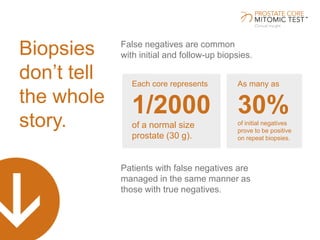
False negatives are common
with initial and follow-up biopsies.
Patients with false negatives are
managed in the same manner as
those with true negatives.
Biopsies
don’t tell
the whole
story.
Each core represents
1/2000
of a normal size
prostate (30 g).
As many as
30%of initial negatives
prove to be positive
on repeat biopsies.
What if you could determine
the difference between a false
negative and a true negative?
Now you can with the
Prostate Core Mitomic Test.
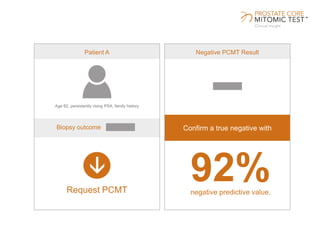
Negative PCMT Result
Confirm a true negative with
Patient A
Request PCMT
Age 62, persistently rising PSA, family history
Biopsy outcome
92%negative predictive value.
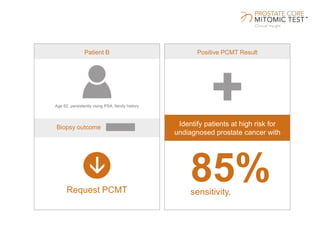
Patient B
Request PCMT
Age 62, persistently rising PSA, family history
Positive PCMT Result
85%sensitivity.
Identify patients at high risk for
undiagnosed prostate cancer with
Biopsy outcome
Confidently stratify
your patients.
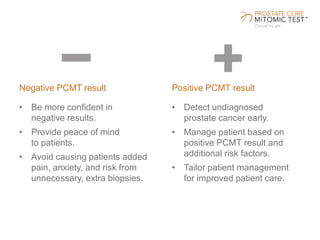
Negative PCMT result
• Be more confident in
negative results.
• Provide peace of mind
to patients.
• Avoid causing patients added
pain, anxiety, and risk from
unnecessary, extra biopsies.
• Detect undiagnosed
prostate cancer early.
• Manage patient based on
positive PCMT result and
additional risk factors.
• Tailor patient management
for improved patient care.
Positive PCMT result
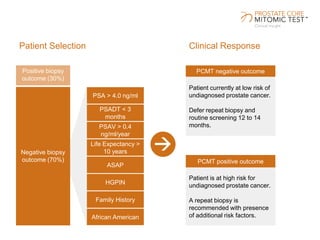
Patient Selection Clinical Response
Positive biopsy
outcome (30%)
Negative biopsy
outcome (70%)
PSA > 4.0 ng/ml
PSADT < 3
months
PSAV > 0.4
ng/ml/year
Life Expectancy >
10 years
ASAP
HGPIN
Family History
African American
PCMT negative outcome
Patient currently at low risk of
undiagnosed prostate cancer.
Defer repeat biopsy and
routine screening 12 to 14
months.
PCMT positive outcome
Patient is at high risk for
undiagnosed prostate cancer.
A repeat biopsy is
recommended with presence
of additional risk factors.
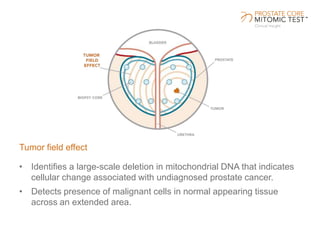
Tumor field effect
Tumor field effect
• Identifies a large-scale deletion in mitochondrial DNA that indicates
cellular change associated with undiagnosed prostate cancer.
• Detects presence of malignant cells in normal appearing tissue
across an extended area.
Why mitochondrial DNA?
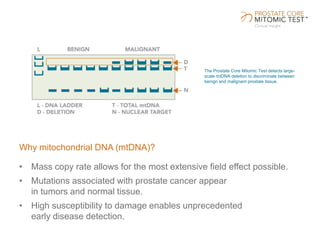
Why mitochondrial DNA (mtDNA)?
• Mass copy rate allows for the most extensive field effect possible.
• Mutations associated with prostate cancer appear
in tumors and normal tissue.
• High susceptibility to damage enables unprecedented
early disease detection.
The Prostate Core Mitomic Test detects large-
scale mtDNA deletion to discriminate between
benign and malignant prostate tissue.
Data Review
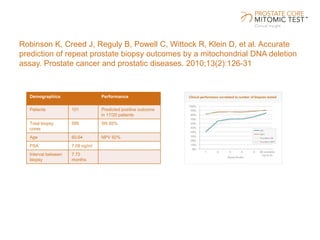
Robinson K, Creed J, Reguly B, Powell C, Wittock R, Klein D, et al. Accurate
prediction of repeat prostate biopsy outcomes by a mitochondrial DNA deletion
assay. Prostate cancer and prostatic diseases. 2010;13(2):126-31
Demographics Performance
Patients 101 Predicted positive outcome
in 17/20 patients
Total biopsy
cores
595 SN 85%
Age 60.64 NPV 92%
PSA 7.09 ng/ml
Interval between
biopsy
7.72
months
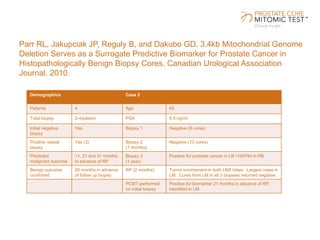
Parr RL, Jakupciak JP, Reguly B, and Dakubo GD. 3.4kb Mitochondrial Genome
Deletion Serves as a Surrogate Predictive Biomarker for Prostate Cancer in
Histopathologically Benign Biopsy Cores. Canadian Urological Association
Journal. 2010.
Demographics Case 2
Patients 4 Age 65
Total biopsy 2-4/patient PSA 8.9 ng/ml
Initial negative
biopsy
Yes Biopsy 1 Negative (9 cores)
Positive repeat
biopsy
Yes (3) Biopsy 2
(7 months)
Negative (10 cores)
Predicted
malignant outcome
11, 21 and 31 months
in advance of RP
Biopsy 3
(1 year)
Positive for prostate cancer in LB / HGPIN in RB
Benign outcome
confirmed
60 months in advance
of follow up biopsy
RP (2 months) Tumor involvement in both L&R lobes. Largest mass in
LM. Cores from LM in all 3 biopsies returned negative.
PCMT performed
on initial biopsy
Positive for biomarker 21 months in advance of RP.
Identified in LM.
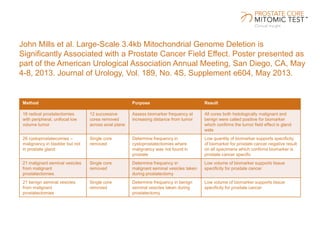
John Mills et al. Large-Scale 3.4kb Mitochondrial Genome Deletion is
Significantly Associated with a Prostate Cancer Field Effect. Poster presented as
part of the American Urological Association Annual Meeting, San Diego, CA, May
4-8, 2013. Journal of Urology, Vol. 189, No. 4S, Supplement e604, May 2013.
Method Purpose Result
16 radical prostatectomies
with peripheral, unifocal low
volume tumor
12 successive
cores removed
across axial plane
Assess biomarker frequency at
increasing distance from tumor
All cores both histologically malignant and
benign were called positive for biomarker
which confirms the tumor field effect is gland
wide
26 cystoprostatecomies –
malignancy in bladder but not
in prostate gland
Single core
removed
Determine frequency in
cystoprostatectomies where
malignancy was not found in
prostate
Low quantity of biomarker supports specificity
of biomarker for prostate cancer negative result
on all specimens which confirms biomarker is
prostate cancer specific
21 malignant seminal vesicles
from malignant
prostatectomies
Single core
removed
Determine frequency in
malignant seminal vesicles taken
during prostatectomy
Low volume of biomarker supports tissue
specificity for prostate cancer
21 benign seminal vesicles
from malignant
prostatectomies
Single core
removed
Determine frequency in benign
seminal vesicles taken during
prostatectomy
Low volume of biomarker supports tissue
specificity for prostate cancer
Appendix
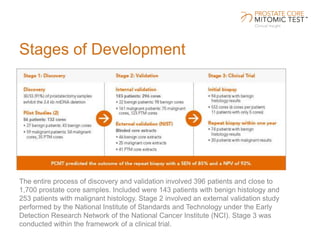
Stages of Development
The entire process of discovery and validation involved 396 patients and close to
1,700 prostate core samples. Included were 143 patients with benign histology and
253 patients with malignant histology. Stage 2 involved an external validation study
performed by the National Institute of Standards and Technology under the Early
Detection Research Network of the National Cancer Institute (NCI). Stage 3 was
conducted within the framework of a clinical trial.
Published data
• John Mills, Luis Martin, François Guimont, Brian Reguly, Andrew Harbottle, John
Pedersen, Jennifer Creed, Ryan Parr. Large-Scale 3.4kb Mitochondrial Genome Deletion is
Significantly Associated with a Prostate Cancer Field Effect. Poster presented as part of the
American Urological Association Annual Meeting, San Diego, CA, May 4-8, 2013. Abstract
published in Journal of Urology, Vol. 189, No. 4S, Supplement e604, May 2013.
• Ryan Parr, John Mills, Andrew Harbottle, Jennifer Creed, Gregory Crewdson, Brian
Reguly, Francois Guimont. Mitochondria, Prostate Cancer and Biopsy Sampling Error. Discovery
Medicine, Volume 15, Number 83, April 2013.
• Parr and Martin: Mitochondrial and nuclear genomics and the emergence of personalized
medicine. Human Genomics 2012 6:3.
• Kent Froberg, Laurence Klotz, Kerry Robinson, Jennifer Creed, Brian Reguly, Cortney
Powell, Daniel Klein, Andrea Maggrah, Roy Wittock, Ryan Parr. Large-scale mitochondrial genome
deletion as an aid for negative prostate biopsy uncertainty. Poster presented as a part of the
American Urological Association Annual Meeting, Washington, D.C., May 14-19, 2011. Abstract
published in The Journal of Urology, Vol. 185 No. 4S, e 764, Supplement, May 2011.
• Ryan Parr, Jennifer Creed, Brian Reguly, Cortney Powell, Roy Wittock, Daniel Klein, Andrea
Maggrah, Kerry Robinson* Large-scale mitochondrial genome deletion as an aid for negative
prostate biopsy uncertainty. Poster presented as part of the Society of Urologic Oncology Annual
Meeting, Bethesda, MD, Dec. 8-10, 2010.
Published data
• Parr RL, Jakupciak JP, Reguly B, and Dakubo GD. 3.4kb “Mitochondrial Genome Deletion Serves
as a Surrogate Predictive Biomarker for Prostate Cancer in Histopathologically Benign Biopsy
Cores.” Canadian Urological Association Journal. 2010.
• Robinson K, Creed J, Reguly B, Powell C, Wittock R, Klein D, et al. Accurate prediction of repeat
prostate biopsy outcomes by a mitochondrial DNA deletion assay. Prostate cancer and prostatic
diseases. 2010;13(2):126-31. Epub 2010/01/20.
• Parr RL, Jakupciak JP, Birch-Machin MA, Dakubo GD. The Mitochondrial Genome: A Biosensor for
Early Cancer Detection? Expert Opin Med Diagn. 2007;1(2):169-82.
• Maki J, Robinson K, Reguly B, Alexander J, Wittock R, Aguirre A, et al. Mitochondrial genome
deletion aids in the identification of false- and true-negative prostate needle core biopsy
specimens. American journal of clinical pathology. 2008;129(1):57-66. Epub 2007/12/20.
• Dakubo GD, Jakupciak JP, Birch-Machin MA, Parr RL. Clinical Implications and Utility of Field
Cancerization. Cancer Cell International. 2007;7(2).
• Parr RL, Dakubo GD, Crandall KA, Maki J, Reguly B, Aguirre A, et al. Somatic mitochondrial DNA
mutations in prostate cancer and normal appearing adjacent glands in comparison to age-matched
prostate samples without malignant histology. The Journal of molecular diagnostics : JMD.
2006;8(3):312-9. Epub 2006/07/11.
• Parr RLM, J.; Reguly, B.; Dakubo, G.D.; Aguirre, A.; Wittock, R.; Robinson, K.;
Jakupciak,J.P.;Thayer, R.E. The pseudo-mitochondrial genome influences mistakes in
heteroplasmy interpretation. BMC Genomics. 2006;21(7).
Thank you
Prostate Core Mitomic Test or one or more of its components was developed and its performance characteristics determined by Mitomics. It has not been approved by the Food and Drug Administrative
(FDA). Mitomics has determined that such approval is not necessary. This test is used for clinical purposes. It should not be regarded as investigational or for research purposes. Mitomics is regulated
under the Clinical Laboratory Improvement Act of 1988 as qualified to perform high-complexity clinical testing.
Prostate Core Mitomic Test, Mitomics, Mitomic Technology, Now You Can Know and Empowering Clinical Insight are trademarks of Mitomics Inc.
© 2013 Mitomics Inc. All rights reserved.

PCMT PowerPoint September 2013

  • 2.
    False negatives arecommon with initial and follow-up biopsies. Patients with false negatives are managed in the same manner as those with true negatives. Biopsies don’t tell the whole story. Each core represents 1/2000 of a normal size prostate (30 g). As many as 30%of initial negatives prove to be positive on repeat biopsies.
  • 3.
    What if youcould determine the difference between a false negative and a true negative?
  • 4.
    Now you canwith the Prostate Core Mitomic Test.
  • 5.
    Negative PCMT Result Confirma true negative with Patient A Request PCMT Age 62, persistently rising PSA, family history Biopsy outcome 92%negative predictive value.
  • 6.
    Patient B Request PCMT Age62, persistently rising PSA, family history Positive PCMT Result 85%sensitivity. Identify patients at high risk for undiagnosed prostate cancer with Biopsy outcome
  • 7.
  • 8.
    Negative PCMT result •Be more confident in negative results. • Provide peace of mind to patients. • Avoid causing patients added pain, anxiety, and risk from unnecessary, extra biopsies. • Detect undiagnosed prostate cancer early. • Manage patient based on positive PCMT result and additional risk factors. • Tailor patient management for improved patient care. Positive PCMT result
  • 9.
    Patient Selection ClinicalResponse Positive biopsy outcome (30%) Negative biopsy outcome (70%) PSA > 4.0 ng/ml PSADT < 3 months PSAV > 0.4 ng/ml/year Life Expectancy > 10 years ASAP HGPIN Family History African American PCMT negative outcome Patient currently at low risk of undiagnosed prostate cancer. Defer repeat biopsy and routine screening 12 to 14 months. PCMT positive outcome Patient is at high risk for undiagnosed prostate cancer. A repeat biopsy is recommended with presence of additional risk factors.
  • 10.
  • 11.
    Tumor field effect •Identifies a large-scale deletion in mitochondrial DNA that indicates cellular change associated with undiagnosed prostate cancer. • Detects presence of malignant cells in normal appearing tissue across an extended area.
  • 12.
  • 13.
    Why mitochondrial DNA(mtDNA)? • Mass copy rate allows for the most extensive field effect possible. • Mutations associated with prostate cancer appear in tumors and normal tissue. • High susceptibility to damage enables unprecedented early disease detection. The Prostate Core Mitomic Test detects large- scale mtDNA deletion to discriminate between benign and malignant prostate tissue.
  • 14.
  • 15.
    Robinson K, CreedJ, Reguly B, Powell C, Wittock R, Klein D, et al. Accurate prediction of repeat prostate biopsy outcomes by a mitochondrial DNA deletion assay. Prostate cancer and prostatic diseases. 2010;13(2):126-31 Demographics Performance Patients 101 Predicted positive outcome in 17/20 patients Total biopsy cores 595 SN 85% Age 60.64 NPV 92% PSA 7.09 ng/ml Interval between biopsy 7.72 months
  • 16.
    Parr RL, JakupciakJP, Reguly B, and Dakubo GD. 3.4kb Mitochondrial Genome Deletion Serves as a Surrogate Predictive Biomarker for Prostate Cancer in Histopathologically Benign Biopsy Cores. Canadian Urological Association Journal. 2010. Demographics Case 2 Patients 4 Age 65 Total biopsy 2-4/patient PSA 8.9 ng/ml Initial negative biopsy Yes Biopsy 1 Negative (9 cores) Positive repeat biopsy Yes (3) Biopsy 2 (7 months) Negative (10 cores) Predicted malignant outcome 11, 21 and 31 months in advance of RP Biopsy 3 (1 year) Positive for prostate cancer in LB / HGPIN in RB Benign outcome confirmed 60 months in advance of follow up biopsy RP (2 months) Tumor involvement in both L&R lobes. Largest mass in LM. Cores from LM in all 3 biopsies returned negative. PCMT performed on initial biopsy Positive for biomarker 21 months in advance of RP. Identified in LM.
  • 17.
    John Mills etal. Large-Scale 3.4kb Mitochondrial Genome Deletion is Significantly Associated with a Prostate Cancer Field Effect. Poster presented as part of the American Urological Association Annual Meeting, San Diego, CA, May 4-8, 2013. Journal of Urology, Vol. 189, No. 4S, Supplement e604, May 2013. Method Purpose Result 16 radical prostatectomies with peripheral, unifocal low volume tumor 12 successive cores removed across axial plane Assess biomarker frequency at increasing distance from tumor All cores both histologically malignant and benign were called positive for biomarker which confirms the tumor field effect is gland wide 26 cystoprostatecomies – malignancy in bladder but not in prostate gland Single core removed Determine frequency in cystoprostatectomies where malignancy was not found in prostate Low quantity of biomarker supports specificity of biomarker for prostate cancer negative result on all specimens which confirms biomarker is prostate cancer specific 21 malignant seminal vesicles from malignant prostatectomies Single core removed Determine frequency in malignant seminal vesicles taken during prostatectomy Low volume of biomarker supports tissue specificity for prostate cancer 21 benign seminal vesicles from malignant prostatectomies Single core removed Determine frequency in benign seminal vesicles taken during prostatectomy Low volume of biomarker supports tissue specificity for prostate cancer
  • 18.
  • 19.
    Stages of Development Theentire process of discovery and validation involved 396 patients and close to 1,700 prostate core samples. Included were 143 patients with benign histology and 253 patients with malignant histology. Stage 2 involved an external validation study performed by the National Institute of Standards and Technology under the Early Detection Research Network of the National Cancer Institute (NCI). Stage 3 was conducted within the framework of a clinical trial.
  • 20.
    Published data • JohnMills, Luis Martin, François Guimont, Brian Reguly, Andrew Harbottle, John Pedersen, Jennifer Creed, Ryan Parr. Large-Scale 3.4kb Mitochondrial Genome Deletion is Significantly Associated with a Prostate Cancer Field Effect. Poster presented as part of the American Urological Association Annual Meeting, San Diego, CA, May 4-8, 2013. Abstract published in Journal of Urology, Vol. 189, No. 4S, Supplement e604, May 2013. • Ryan Parr, John Mills, Andrew Harbottle, Jennifer Creed, Gregory Crewdson, Brian Reguly, Francois Guimont. Mitochondria, Prostate Cancer and Biopsy Sampling Error. Discovery Medicine, Volume 15, Number 83, April 2013. • Parr and Martin: Mitochondrial and nuclear genomics and the emergence of personalized medicine. Human Genomics 2012 6:3. • Kent Froberg, Laurence Klotz, Kerry Robinson, Jennifer Creed, Brian Reguly, Cortney Powell, Daniel Klein, Andrea Maggrah, Roy Wittock, Ryan Parr. Large-scale mitochondrial genome deletion as an aid for negative prostate biopsy uncertainty. Poster presented as a part of the American Urological Association Annual Meeting, Washington, D.C., May 14-19, 2011. Abstract published in The Journal of Urology, Vol. 185 No. 4S, e 764, Supplement, May 2011. • Ryan Parr, Jennifer Creed, Brian Reguly, Cortney Powell, Roy Wittock, Daniel Klein, Andrea Maggrah, Kerry Robinson* Large-scale mitochondrial genome deletion as an aid for negative prostate biopsy uncertainty. Poster presented as part of the Society of Urologic Oncology Annual Meeting, Bethesda, MD, Dec. 8-10, 2010.
  • 21.
    Published data • ParrRL, Jakupciak JP, Reguly B, and Dakubo GD. 3.4kb “Mitochondrial Genome Deletion Serves as a Surrogate Predictive Biomarker for Prostate Cancer in Histopathologically Benign Biopsy Cores.” Canadian Urological Association Journal. 2010. • Robinson K, Creed J, Reguly B, Powell C, Wittock R, Klein D, et al. Accurate prediction of repeat prostate biopsy outcomes by a mitochondrial DNA deletion assay. Prostate cancer and prostatic diseases. 2010;13(2):126-31. Epub 2010/01/20. • Parr RL, Jakupciak JP, Birch-Machin MA, Dakubo GD. The Mitochondrial Genome: A Biosensor for Early Cancer Detection? Expert Opin Med Diagn. 2007;1(2):169-82. • Maki J, Robinson K, Reguly B, Alexander J, Wittock R, Aguirre A, et al. Mitochondrial genome deletion aids in the identification of false- and true-negative prostate needle core biopsy specimens. American journal of clinical pathology. 2008;129(1):57-66. Epub 2007/12/20. • Dakubo GD, Jakupciak JP, Birch-Machin MA, Parr RL. Clinical Implications and Utility of Field Cancerization. Cancer Cell International. 2007;7(2). • Parr RL, Dakubo GD, Crandall KA, Maki J, Reguly B, Aguirre A, et al. Somatic mitochondrial DNA mutations in prostate cancer and normal appearing adjacent glands in comparison to age-matched prostate samples without malignant histology. The Journal of molecular diagnostics : JMD. 2006;8(3):312-9. Epub 2006/07/11. • Parr RLM, J.; Reguly, B.; Dakubo, G.D.; Aguirre, A.; Wittock, R.; Robinson, K.; Jakupciak,J.P.;Thayer, R.E. The pseudo-mitochondrial genome influences mistakes in heteroplasmy interpretation. BMC Genomics. 2006;21(7).
  • 22.
    Thank you Prostate CoreMitomic Test or one or more of its components was developed and its performance characteristics determined by Mitomics. It has not been approved by the Food and Drug Administrative (FDA). Mitomics has determined that such approval is not necessary. This test is used for clinical purposes. It should not be regarded as investigational or for research purposes. Mitomics is regulated under the Clinical Laboratory Improvement Act of 1988 as qualified to perform high-complexity clinical testing. Prostate Core Mitomic Test, Mitomics, Mitomic Technology, Now You Can Know and Empowering Clinical Insight are trademarks of Mitomics Inc. © 2013 Mitomics Inc. All rights reserved.