mitomicsinc.com | 1
Prostate cancer: Removing the uncertainty
Conventional management of PCa relies primarily on digital rectal exams (DREs), blood tests
for elevated and rising levels of prostate-specific antigen (PSA), and prostate gland needle
biopsies (cores). Each of these tests has limitations that may be unrelated to PCa, or that
falsely indicate the presence of malignancy. For example, elevated levels of PSA can be
caused by other disorders such as a prostate infection, and needle biopsies that rely on
histology (visual examination under a microscope) will only detect PCa if the needle collects
prostate core samples from actual tumor tissue, which can easily be missed.
The uncertainty of conventional testing often leads to patient anxiety that PCa may be
present; conversely, the apparent absence of disease results in a false sense of security,
when, in fact, the needle biopsies may have missed the cancerous tissue. The Prostate Core
Mitomic Test
™
(PCMT™) closes this gap in conventional management of PCa. The ability to
detect large-scale mitochondrial DNA (mtDNA) deletions in prostate biopsy samples enables
clinicians to accurately discriminate between benign and malignant prostate tissue. Using the
same initial biopsy samples that are collected for histology, PCMT utilizes the tumor field
effect to identify the molecular signature of elevated levels of mtDNA genomic mutations
in histologically benign cells adjacent to tumor tissue.
1, 2
This significantly reduces the
risk of needle biopsy sampling error that might otherwise return a false-negative result
to the patient.
Ideal biomarkers predict the onset of disease at the earliest possible point and reduce the
need for additional invasive and often painful testing. In addition to meeting this expectation,
PCMT also has a sensitivity of 85% and a negative predictive value of 92% at first biopsy.
mitomicsinc.com | 2
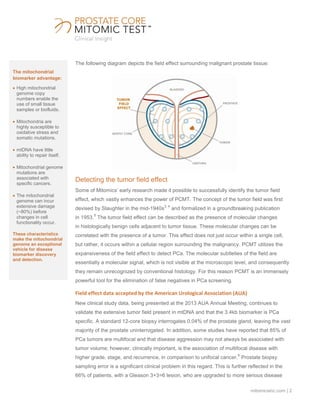
The following diagram depicts the field effect surrounding malignant prostate tissue:
Detecting the tumor field effect
Some of Mitomics’ early research made it possible to successfully identify the tumor field
effect, which vastly enhances the power of PCMT. The concept of the tumor field was first
devised by Slaughter in the mid-1940s
3, 4
and formalized in a groundbreaking publication
in 1953.
5
The tumor field effect can be described as the presence of molecular changes
in histologically benign cells adjacent to tumor tissue. These molecular changes can be
correlated with the presence of a tumor. This effect does not just occur within a single cell,
but rather, it occurs within a cellular region surrounding the malignancy. PCMT utilizes the
expansiveness of the field effect to detect PCa. The molecular subtleties of the field are
essentially a molecular signal, which is not visible at the microscopic level, and consequently
they remain unrecognized by conventional histology. For this reason PCMT is an immensely
powerful tool for the elimination of false negatives in PCa screening.
Field effect data accepted by the American Urological Association (AUA)
New clinical study data, being presented at the 2013 AUA Annual Meeting, continues to
validate the extensive tumor field present in mtDNA and that the 3.4kb biomarker is PCa
specific. A standard 12-core biopsy interrogates 0.04% of the prostate gland, leaving the vast
majority of the prostate uninterrogated. In addition, some studies have reported that 85% of
PCa tumors are multifocal and that disease aggression may not always be associated with
tumor volume; however, clinically important, is the association of multifocal disease with
higher grade, stage, and recurrence, in comparison to unifocal cancer.
6
Prostate biopsy
sampling error is a significant clinical problem in this regard. This is further reflected in the
66% of patients, with a Gleason 3+3=6 lesion, who are upgraded to more serious disease
The mitochondrial
biomarker advantage:
High mitochondrial
genome copy
numbers enable the
use of small tissue
samples or biofluids.
Mitochondria are
highly susceptible to
oxidative stress and
somatic mutations.
mtDNA have little
ability to repair itself.
Mitochondrial genome
mutations are
associated with
specific cancers.
The mitochondrial
genome can incur
extensive damage
(~80%) before
changes in cell
functionality occur.
These characteristics
make the mitochondrial
genome an exceptional
vehicle for disease
biomarker discovery
and detection.
mitomicsinc.com | 3
following a prostatectomy. Furthermore, nearly 25% of patients with Gleason 3+4=7 were
elevated to 4+3=7 or higher
7
following a radical prostatectomy. Similarly, a study conducted
at the Cleveland Clinic found that a 12-core biopsy pattern indicated unilateral disease in 179
patients. However, following prostatectomy, 129 patients were upgraded to bilateral disease,
and clinically significant tumors were missed in 40% of these patients.
8
This published data supports the fact that conventional methods such as traditional biopsy
and histology are challenged to accurately detect all malignancies including significant
disease, which is missed in 40% to 66% of all cases.
PCMT mtDNA deletion: Stages of discovery and validation
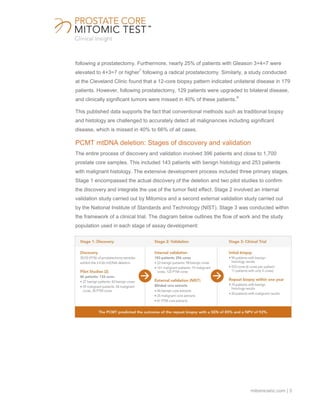
The entire process of discovery and validation involved 396 patients and close to 1,700
prostate core samples. This included 143 patients with benign histology and 253 patients
with malignant histology. The extensive development process included three primary stages.
Stage 1 encompassed the actual discovery of the deletion and two pilot studies to confirm
the discovery and integrate the use of the tumor field effect. Stage 2 involved an internal
validation study carried out by Mitomics and a second external validation study carried out
by the National Institute of Standards and Technology (NIST). Stage 3 was conducted within
the framework of a clinical trial. The diagram below outlines the flow of work and the study
population used in each stage of assay development:
mitomicsinc.com | 4
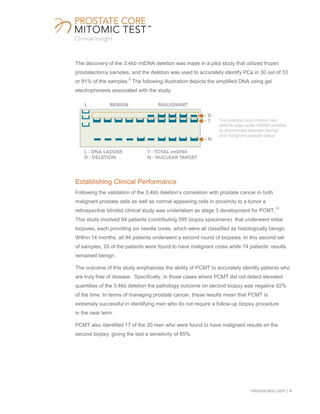
The discovery of the 3.4kb mtDNA deletion was made in a pilot study that utilized frozen
prostatectomy samples, and the deletion was used to accurately identify PCa in 30 out of 33
or 91% of the samples.
9
The following illustration depicts the amplified DNA using gel
electrophoresis associated with the study:
Establishing Clinical Performance
Following the validation of the 3.4kb deletion’s correlation with prostate cancer in both
malignant prostate cells as well as normal appearing cells in proximity to a tumor a
retrospective blinded clinical study was undertaken as stage 3 development for PCMT.
10
This study involved 94 patients (contributing 595 biopsy specimens) that underwent initial
biopsies, each providing six needle cores, which were all classified as histologically benign.
Within 14 months, all 94 patients underwent a second round of biopsies. In this second set
of samples, 20 of the patients were found to have malignant cores while 74 patients’ results
remained benign.
The outcome of this study emphasizes the ability of PCMT to accurately identify patients who
are truly free of disease. Specifically, in those cases where PCMT did not detect elevated
quantities of the 3.4kb deletion the pathology outcome on second biopsy was negative 92%
of the time. In terms of managing prostate cancer, these results mean that PCMT is
extremely successful in identifying men who do not require a follow-up biopsy procedure
in the near term.
PCMT also identified 17 of the 20 men who were found to have malignant results on the
second biopsy, giving the test a sensitivity of 85%.
mitomicsinc.com | 5
Since PCMT requires only 20ng of mtDNA, molecular detection of the field effect can be
carried out on the same samples used for histology. Not only does this ensure continuity in
the patient’s results, it greatly reduces the risk of missing a tumor since the results are not
reliant solely on histology of the needle biopsy. The ability to use existing (or previously
collected) histology samples for PCMT evaluation also reduces patient stress and risk of
infection since no additional biopsies are required.
The economic reality of PCa
Due to the subtle nature of PCa and the extremely small tumor cross-section that is collected
with a needle biopsy, the histological identification of prostate cancer is one of the most
difficult diagnoses in pathology.
11
PCMT effectively expands the detection perimeter of the
biopsy needle by utilizing the tumor field effect. This not only makes the prostate core biopsy
a more effective screening method for the patient, it also adds value to the process by
increasing its accuracy.
The North American population demographic over the age of 65 has been steadily growing in
recent decades. This, coupled with the fact that over 60% of PCa diagnoses occur in men
65 years and older, makes it readily apparent that the economic impact of PCa is steadily
growing. Screening programs for PCa have been developing since the mid-1970s, resulting
in earlier detection of the disease. This has contributed significantly to an increased incidence
of PCa (due to better detection) and long-term survivability of those diagnosed with PCa.
The most immediate impact of a diagnosis of PCa is the impact on a man’s quality of life,
and this is directly related to the overall long-term survivability of the disease. The longer
it takes to diagnose PCa, the less chance there is to arrest or cure the disease, resulting
in the need for much more aggressive and extreme treatment for a longer period of time.
Ultimately this means that more cost-effective strategies are needed to detect the onset
of PCa to ensure the greatest number of men have the best access to treatment and
a potential cure for the disease.
Specific health economic benefits of PCMT
When patients undergo a prostate needle biopsy and the outcome is deemed to have a
negative pathology, these same biopsy samples should be assayed with PCMT. The 92%
negative predictive value, coupled with 85% sensitivity for PCa, adds an essential component
of assuredness to the negative pathology.
mitomicsinc.com | 6
Reconfirmation of a negative pathology report places the patient in a position to proceed
with an annual follow-up to monitor the status of his prostate, rather than enduring multiple
visits within a one-year time period that are normally associated with active surveillance.
The average cost of a prostate biopsy procedure and standard ancillary care administered
within a clinical setting is about US$4,200.
12
Taking into account a negative PCMT result
along with other clinical signs may delay or even circumvent the need for an additional visit
to a urologist to undergo a second biopsy procedure within that year, resulting in an annual
savings of at least $4,200.
By removing the need for a continual loop of screening, biopsies, and uncertain diagnoses,
PCMT provides the following economic benefits:
A reduction or elimination of unnecessary screening tests
A reduction or elimination of repeat biopsies
Elimination of complications associated with the biopsy procedure for those patients
who no longer require repeat biopsies
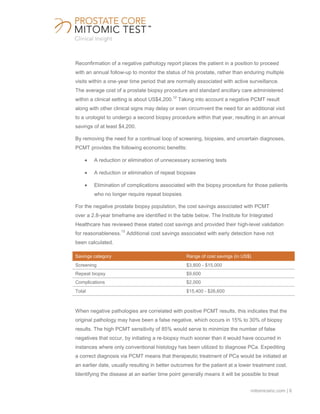
For the negative prostate biopsy population, the cost savings associated with PCMT
over a 2.8-year timeframe are identified in the table below. The Institute for Integrated
Healthcare has reviewed these stated cost savings and provided their high-level validation
for reasonableness.
13
Additional cost savings associated with early detection have not
been calculated.
Savings category Range of cost savings (in US$)
Screening $3,800 - $15,000
Repeat biopsy $9,600
Complications $2,000
Total $15,400 - $26,600
When negative pathologies are correlated with positive PCMT results, this indicates that the
original pathology may have been a false negative, which occurs in 15% to 30% of biopsy
results. The high PCMT sensitivity of 85% would serve to minimize the number of false
negatives that occur, by initiating a re-biopsy much sooner than it would have occurred in
instances where only conventional histology has been utilized to diagnose PCa. Expediting
a correct diagnosis via PCMT means that therapeutic treatment of PCa would be initiated at
an earlier date, usually resulting in better outcomes for the patient at a lower treatment cost.
Identifying the disease at an earlier time point generally means it will be possible to treat
mitomicsinc.com | 7
PCa with less aggressive regimens such as radiation therapy alone instead of the more
aggressive combined treatment of hormonal and radiation therapy, or prostatectomy.
The monetary savings within the first year alone runs into several thousands of dollars,
and over time, may ultimately mean a savings into the tens of thousands.
14
Clearly, PCMT
represents a substantial and practical economical savings to the patient.
Optimizing patient outcome, minimizing the impact of PCa
From the clinician’s perspective, ensuring the best possible outcome for the patient is the
primary goal. Though a biopsy may come back negative, the clinician is well aware that
current screening methodologies can miss a significant portion of actual incidents of PCa.
PCMT offers the clinician an invaluable additional means of being sure of the diagnosis
and helps determine the best way forward in managing patient outcome through increased
clinical insight.
Increased clinical insight also benefits the patient by affording greater confidence in the
decisions that have to be made regarding their treatment. For men who have just received
news that they must undergo screening for PCa, some of the most worrisome issues they
must face include whether or not their diagnosis will be accurate; and, if their diagnosis is
positive, what strategy for managing the disease will best suit their needs. Accuracy of
diagnosis does not only pertain to whether or not the cancer will be detected, but also to the
possibly that the PCa will be incorrectly diagnosed as positive. For worried patients awaiting
the outcomes of their tests, knowing that every measure has been taken to ensure their
results are correct provides the greatest comfort. This is the peace of mind they receive when
their biopsies undergo PCMT in addition to conventional histological examination.
In 2006 there were approximately 1.4 million prostate biopsies performed,
15
with the number
of biopsies expected to increase 6 to 9% by 2011. In Canada and the U.S., the estimated
number of new PCa diagnoses for 2010 was 242,330.
16, 17
Nearly 75% of the time histological
examinations of prostate core biopsies do not identify cancer. In these instances, enlarged
prostate and elevated PSA levels are attributed to other prostate conditions such as benign
prostate hypertrophy or prostatitis.
18
This translates into nearly 1,050,000 benign diagnoses
in North American men who were screened for PCa in 2010.
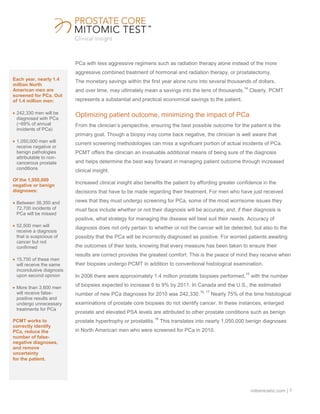
Each year, nearly 1.4
million North
American men are
screened for PCa. Out
of 1.4 million men:
242,330 men will be
diagnosed with PCa
(~69% of annual
incidents of PCa)
1,050,000 men will
receive negative or
benign pathologies
attributable to non-
cancerous prostate
conditions
Of the 1,050,000
negative or benign
diagnoses:
Between 36,350 and
72,700 incidents of
PCa will be missed
52,500 men will
receive a diagnosis
that is suspicious of
cancer but not
confirmed
15,750 of these men
will receive the same
inconclusive diagnosis
upon second opinion
More than 3,600 men
will receive false-
positive results and
undergo unnecessary
treatments for PCa
PCMT works to
correctly identify
PCa, reduce the
number of false-
negative diagnoses,
and remove
uncertainty
for the patient.
mitomicsinc.com | 8
The Mitomic Technology™
advantage: Empowering clinical insight™
In addition to completing design and development of the assay, Mitomics has developed
state of the art, 11,500 square foot high complexity CLIA-compliant laboratory in the U.S.
With this CLIA laboratory capability, Mitomics is firmly established for commercial availability
of PCMT in the North American marketplace.
The commercial launch of PCMT represents a culmination of an extensive body of research
that stands to revolutionize the diagnosis and management of PCa, from both the clinician
and patient perspectives. The fact that PCMT can be done on the same tissues collected for
conventional histological screening – and that it uses well-established and economical high-
throughput RT-PCR methodology – makes this test highly accessible and easy to implement.
The efficient use of extant biopsy tissue also minimizes both risk and stress for the patient.
The Prostate Core Mitomic Test was developed using Mitomic Technology, a highly
advanced proprietary technology for detecting and comparing novel discoveries of mtDNA
deletions against a library of known mitochondrial genomic deletions. The assay detects PCa
by identifying underlying molecular alterations that have occurred in normal-appearing tissue
that is adjacent to a malignancy. These molecular alterations, known as the tumor field effect,
enhance tumor detection in instances where biopsy cores appear histologically benign
because they have failed to collect tumor tissue from patients with PCa. As a result,
PCMT provides the clinician with insights far surpassing those of conventional screening.
The concurrent high sensitivity of 85% and negative predictive value of 92% contribute
unprecedented strength to this assay through its ability to identify PCa.
The economic reality of PCMT is that it provides a much more accurate stratification of the
patient population. By increasing confidence in the identification of true-negative outcomes,
a substantial number of men will avoid PCa treatment. Other men whose cancer would have
previously gone undetected before reaching a more advanced stage will now receive earlier
treatment. The number of men receiving results that are suspicious of cancer will also be
minimized as the clinician will have an extra screening test available to identify PCa. For all
of these groups, the end result of having PCMT will be quite optimal, as both their health
management and outcomes will be delivered with the highest level of confidence available.
From the clinical standpoint of saving lives, the decision to use the PCMT is a simple one.
mitomicsinc.com | 9
___________________________________________________________________________________________
1
Robinson K, Creed J, Reguly B, Powell C, Wittock R, Klein D, et al. Accurate prediction of repeat prostate biopsy outcomes by a mitochondrial
DNA deletion assay. Prostate cancer and prostatic diseases. 2010;13(2):126-31. Epub 2010/01/20.
2
Haaland CM, Heaphy CM, Butler KS, Fischer EG, Griffith JK, Bisoffi M. Differential gene expression in tumor adjacent histologically normal
prostatic tissue indicates field cancerization. International journal of oncology. 2009;35(3):537-46. Epub 2009/07/30.
3
Slaughter D. The Multiplicity of Origin of Malignant Tumors: Collective Review. Internat Abstr Surg. 1944;79:89-98.
4
Slaughter D. Multicentric Origin of Intraoral Carcinoma. Surgury. 1946;20:133-46.
5
Slaughter D, Southwick H, Smejkal W. Field Cancerization in Oral Stratified Squamous Epithelium: Clinical Implications of Multicentric Origin.
Cancer. 1953;6:963-8.
6
Meiers I, Waters DJ, Bostwick DG. Preoperative prediction of multifocal prostate cancer and application of focal therapy: review 2007.
Urology. 2007 Dec; 70(6 Suppl):3-8.
7
Corcoran NM, Hovens CM, Hong MK, Pedersen J, Casey RG, Connolly S, Peters J, Harewood L, Gleave ME, Goldenberg SL, Costello AJ.
Underestimation of Gleason score at prostate biopsy reflects sampling error in lower volume tumours. BJU Int. 2012 Mar; 109(5):660-4.
doi: 10.1111/j.1464-410X.2011.10543.x. Epub 2011 Sep 2
8
Sinnott M, Falzarano SM, Hernandez AV, Jones JS, Klein EA, Zhou M, Magi-Galluzzi C. Discrepancy in prostate cancer localization between
biopsy and prostatectomy specimens in patients with unilateral positive biopsy: implications for focal therapy. Prostate. 2012 Aug 1;
72(11):1179-86
9
Maki J, Robinson K, Reguly B, Alexander J, Wittock R, Aguirre A, et al. Mitochondrial genome deletion aids in the identification of false- and
true-negative prostate needle core biopsy specimens. American journal of clinical pathology. 2008;129(1):57-66. Epub 2007/12/20.
10
Robinson K, Creed J, Reguly B, Powell C, Wittock R, Klein D, et al. Accurate prediction of repeat prostate biopsy outcomes by a mitochondrial
DNA deletion assay. Prostate cancer and prostatic diseases. 2010;13(2):126-31. Epub 2010/01/20.
11
Johns Hopkins Medicine. Guide to Your Gleason Score: Special Report. New York: MediZine LLC: John Hopkins Medicine, 2009.
12
Snyder CF FK, Blackford AL, Herbert RJ, Neville BA, Carducci MA, Earle CC. How does initial treatment choice affect short-term and long-term
costs for clinically localized prostate cancer? Cancer. 2010;116(23):5391-9.
13
F.R. Vogenberg, PhD.; L. Pizzi, PharmD, MPH
14
Snyder CF FK, Blackford AL, Herbert RJ, Neville BA, Carducci MA, Earle CC. How does initial treatment choice affect short-term and long-term
costs for clinically localized prostate cancer? Cancer. 2010;116(23):5391-9.
15
Klipp J. The U.S. Anatomic Pathology Market Forecasts & Trends 2007. Poughkeepsie: Laboratory Economics LLC, 2006.
16
Prostate Cancer Canada. Prostate Cancer Statistics. 2010; Available from:
http://www.prostatecancer.ca/Prostate-Cancer/Prostate-Cancer/Statistics.
17
American Cancer Society. Cancer Facts & Figures. Atlanta, GA: American Cancer Society, 2009.
18
Johns Hopkins Medicine. Guide to Your Gleason Score: Special Report. New York: MediZine LLC: John Hopkins Medicine, 2009.

PCMT Technical Summary Whitepaper April 2013

  • 1.
    mitomicsinc.com | 1 Prostatecancer: Removing the uncertainty Conventional management of PCa relies primarily on digital rectal exams (DREs), blood tests for elevated and rising levels of prostate-specific antigen (PSA), and prostate gland needle biopsies (cores). Each of these tests has limitations that may be unrelated to PCa, or that falsely indicate the presence of malignancy. For example, elevated levels of PSA can be caused by other disorders such as a prostate infection, and needle biopsies that rely on histology (visual examination under a microscope) will only detect PCa if the needle collects prostate core samples from actual tumor tissue, which can easily be missed. The uncertainty of conventional testing often leads to patient anxiety that PCa may be present; conversely, the apparent absence of disease results in a false sense of security, when, in fact, the needle biopsies may have missed the cancerous tissue. The Prostate Core Mitomic Test ™ (PCMT™) closes this gap in conventional management of PCa. The ability to detect large-scale mitochondrial DNA (mtDNA) deletions in prostate biopsy samples enables clinicians to accurately discriminate between benign and malignant prostate tissue. Using the same initial biopsy samples that are collected for histology, PCMT utilizes the tumor field effect to identify the molecular signature of elevated levels of mtDNA genomic mutations in histologically benign cells adjacent to tumor tissue. 1, 2 This significantly reduces the risk of needle biopsy sampling error that might otherwise return a false-negative result to the patient. Ideal biomarkers predict the onset of disease at the earliest possible point and reduce the need for additional invasive and often painful testing. In addition to meeting this expectation, PCMT also has a sensitivity of 85% and a negative predictive value of 92% at first biopsy.
  • 2.
    mitomicsinc.com | 2 Thefollowing diagram depicts the field effect surrounding malignant prostate tissue: Detecting the tumor field effect Some of Mitomics’ early research made it possible to successfully identify the tumor field effect, which vastly enhances the power of PCMT. The concept of the tumor field was first devised by Slaughter in the mid-1940s 3, 4 and formalized in a groundbreaking publication in 1953. 5 The tumor field effect can be described as the presence of molecular changes in histologically benign cells adjacent to tumor tissue. These molecular changes can be correlated with the presence of a tumor. This effect does not just occur within a single cell, but rather, it occurs within a cellular region surrounding the malignancy. PCMT utilizes the expansiveness of the field effect to detect PCa. The molecular subtleties of the field are essentially a molecular signal, which is not visible at the microscopic level, and consequently they remain unrecognized by conventional histology. For this reason PCMT is an immensely powerful tool for the elimination of false negatives in PCa screening. Field effect data accepted by the American Urological Association (AUA) New clinical study data, being presented at the 2013 AUA Annual Meeting, continues to validate the extensive tumor field present in mtDNA and that the 3.4kb biomarker is PCa specific. A standard 12-core biopsy interrogates 0.04% of the prostate gland, leaving the vast majority of the prostate uninterrogated. In addition, some studies have reported that 85% of PCa tumors are multifocal and that disease aggression may not always be associated with tumor volume; however, clinically important, is the association of multifocal disease with higher grade, stage, and recurrence, in comparison to unifocal cancer. 6 Prostate biopsy sampling error is a significant clinical problem in this regard. This is further reflected in the 66% of patients, with a Gleason 3+3=6 lesion, who are upgraded to more serious disease The mitochondrial biomarker advantage: High mitochondrial genome copy numbers enable the use of small tissue samples or biofluids. Mitochondria are highly susceptible to oxidative stress and somatic mutations. mtDNA have little ability to repair itself. Mitochondrial genome mutations are associated with specific cancers. The mitochondrial genome can incur extensive damage (~80%) before changes in cell functionality occur. These characteristics make the mitochondrial genome an exceptional vehicle for disease biomarker discovery and detection.
  • 3.
    mitomicsinc.com | 3 followinga prostatectomy. Furthermore, nearly 25% of patients with Gleason 3+4=7 were elevated to 4+3=7 or higher 7 following a radical prostatectomy. Similarly, a study conducted at the Cleveland Clinic found that a 12-core biopsy pattern indicated unilateral disease in 179 patients. However, following prostatectomy, 129 patients were upgraded to bilateral disease, and clinically significant tumors were missed in 40% of these patients. 8 This published data supports the fact that conventional methods such as traditional biopsy and histology are challenged to accurately detect all malignancies including significant disease, which is missed in 40% to 66% of all cases. PCMT mtDNA deletion: Stages of discovery and validation The entire process of discovery and validation involved 396 patients and close to 1,700 prostate core samples. This included 143 patients with benign histology and 253 patients with malignant histology. The extensive development process included three primary stages. Stage 1 encompassed the actual discovery of the deletion and two pilot studies to confirm the discovery and integrate the use of the tumor field effect. Stage 2 involved an internal validation study carried out by Mitomics and a second external validation study carried out by the National Institute of Standards and Technology (NIST). Stage 3 was conducted within the framework of a clinical trial. The diagram below outlines the flow of work and the study population used in each stage of assay development:
  • 4.
    mitomicsinc.com | 4 Thediscovery of the 3.4kb mtDNA deletion was made in a pilot study that utilized frozen prostatectomy samples, and the deletion was used to accurately identify PCa in 30 out of 33 or 91% of the samples. 9 The following illustration depicts the amplified DNA using gel electrophoresis associated with the study: Establishing Clinical Performance Following the validation of the 3.4kb deletion’s correlation with prostate cancer in both malignant prostate cells as well as normal appearing cells in proximity to a tumor a retrospective blinded clinical study was undertaken as stage 3 development for PCMT. 10 This study involved 94 patients (contributing 595 biopsy specimens) that underwent initial biopsies, each providing six needle cores, which were all classified as histologically benign. Within 14 months, all 94 patients underwent a second round of biopsies. In this second set of samples, 20 of the patients were found to have malignant cores while 74 patients’ results remained benign. The outcome of this study emphasizes the ability of PCMT to accurately identify patients who are truly free of disease. Specifically, in those cases where PCMT did not detect elevated quantities of the 3.4kb deletion the pathology outcome on second biopsy was negative 92% of the time. In terms of managing prostate cancer, these results mean that PCMT is extremely successful in identifying men who do not require a follow-up biopsy procedure in the near term. PCMT also identified 17 of the 20 men who were found to have malignant results on the second biopsy, giving the test a sensitivity of 85%.
  • 5.
    mitomicsinc.com | 5 SincePCMT requires only 20ng of mtDNA, molecular detection of the field effect can be carried out on the same samples used for histology. Not only does this ensure continuity in the patient’s results, it greatly reduces the risk of missing a tumor since the results are not reliant solely on histology of the needle biopsy. The ability to use existing (or previously collected) histology samples for PCMT evaluation also reduces patient stress and risk of infection since no additional biopsies are required. The economic reality of PCa Due to the subtle nature of PCa and the extremely small tumor cross-section that is collected with a needle biopsy, the histological identification of prostate cancer is one of the most difficult diagnoses in pathology. 11 PCMT effectively expands the detection perimeter of the biopsy needle by utilizing the tumor field effect. This not only makes the prostate core biopsy a more effective screening method for the patient, it also adds value to the process by increasing its accuracy. The North American population demographic over the age of 65 has been steadily growing in recent decades. This, coupled with the fact that over 60% of PCa diagnoses occur in men 65 years and older, makes it readily apparent that the economic impact of PCa is steadily growing. Screening programs for PCa have been developing since the mid-1970s, resulting in earlier detection of the disease. This has contributed significantly to an increased incidence of PCa (due to better detection) and long-term survivability of those diagnosed with PCa. The most immediate impact of a diagnosis of PCa is the impact on a man’s quality of life, and this is directly related to the overall long-term survivability of the disease. The longer it takes to diagnose PCa, the less chance there is to arrest or cure the disease, resulting in the need for much more aggressive and extreme treatment for a longer period of time. Ultimately this means that more cost-effective strategies are needed to detect the onset of PCa to ensure the greatest number of men have the best access to treatment and a potential cure for the disease. Specific health economic benefits of PCMT When patients undergo a prostate needle biopsy and the outcome is deemed to have a negative pathology, these same biopsy samples should be assayed with PCMT. The 92% negative predictive value, coupled with 85% sensitivity for PCa, adds an essential component of assuredness to the negative pathology.
  • 6.
    mitomicsinc.com | 6 Reconfirmationof a negative pathology report places the patient in a position to proceed with an annual follow-up to monitor the status of his prostate, rather than enduring multiple visits within a one-year time period that are normally associated with active surveillance. The average cost of a prostate biopsy procedure and standard ancillary care administered within a clinical setting is about US$4,200. 12 Taking into account a negative PCMT result along with other clinical signs may delay or even circumvent the need for an additional visit to a urologist to undergo a second biopsy procedure within that year, resulting in an annual savings of at least $4,200. By removing the need for a continual loop of screening, biopsies, and uncertain diagnoses, PCMT provides the following economic benefits: A reduction or elimination of unnecessary screening tests A reduction or elimination of repeat biopsies Elimination of complications associated with the biopsy procedure for those patients who no longer require repeat biopsies For the negative prostate biopsy population, the cost savings associated with PCMT over a 2.8-year timeframe are identified in the table below. The Institute for Integrated Healthcare has reviewed these stated cost savings and provided their high-level validation for reasonableness. 13 Additional cost savings associated with early detection have not been calculated. Savings category Range of cost savings (in US$) Screening $3,800 - $15,000 Repeat biopsy $9,600 Complications $2,000 Total $15,400 - $26,600 When negative pathologies are correlated with positive PCMT results, this indicates that the original pathology may have been a false negative, which occurs in 15% to 30% of biopsy results. The high PCMT sensitivity of 85% would serve to minimize the number of false negatives that occur, by initiating a re-biopsy much sooner than it would have occurred in instances where only conventional histology has been utilized to diagnose PCa. Expediting a correct diagnosis via PCMT means that therapeutic treatment of PCa would be initiated at an earlier date, usually resulting in better outcomes for the patient at a lower treatment cost. Identifying the disease at an earlier time point generally means it will be possible to treat
  • 7.
    mitomicsinc.com | 7 PCawith less aggressive regimens such as radiation therapy alone instead of the more aggressive combined treatment of hormonal and radiation therapy, or prostatectomy. The monetary savings within the first year alone runs into several thousands of dollars, and over time, may ultimately mean a savings into the tens of thousands. 14 Clearly, PCMT represents a substantial and practical economical savings to the patient. Optimizing patient outcome, minimizing the impact of PCa From the clinician’s perspective, ensuring the best possible outcome for the patient is the primary goal. Though a biopsy may come back negative, the clinician is well aware that current screening methodologies can miss a significant portion of actual incidents of PCa. PCMT offers the clinician an invaluable additional means of being sure of the diagnosis and helps determine the best way forward in managing patient outcome through increased clinical insight. Increased clinical insight also benefits the patient by affording greater confidence in the decisions that have to be made regarding their treatment. For men who have just received news that they must undergo screening for PCa, some of the most worrisome issues they must face include whether or not their diagnosis will be accurate; and, if their diagnosis is positive, what strategy for managing the disease will best suit their needs. Accuracy of diagnosis does not only pertain to whether or not the cancer will be detected, but also to the possibly that the PCa will be incorrectly diagnosed as positive. For worried patients awaiting the outcomes of their tests, knowing that every measure has been taken to ensure their results are correct provides the greatest comfort. This is the peace of mind they receive when their biopsies undergo PCMT in addition to conventional histological examination. In 2006 there were approximately 1.4 million prostate biopsies performed, 15 with the number of biopsies expected to increase 6 to 9% by 2011. In Canada and the U.S., the estimated number of new PCa diagnoses for 2010 was 242,330. 16, 17 Nearly 75% of the time histological examinations of prostate core biopsies do not identify cancer. In these instances, enlarged prostate and elevated PSA levels are attributed to other prostate conditions such as benign prostate hypertrophy or prostatitis. 18 This translates into nearly 1,050,000 benign diagnoses in North American men who were screened for PCa in 2010. Each year, nearly 1.4 million North American men are screened for PCa. Out of 1.4 million men: 242,330 men will be diagnosed with PCa (~69% of annual incidents of PCa) 1,050,000 men will receive negative or benign pathologies attributable to non- cancerous prostate conditions Of the 1,050,000 negative or benign diagnoses: Between 36,350 and 72,700 incidents of PCa will be missed 52,500 men will receive a diagnosis that is suspicious of cancer but not confirmed 15,750 of these men will receive the same inconclusive diagnosis upon second opinion More than 3,600 men will receive false- positive results and undergo unnecessary treatments for PCa PCMT works to correctly identify PCa, reduce the number of false- negative diagnoses, and remove uncertainty for the patient.
  • 8.
    mitomicsinc.com | 8 TheMitomic Technology™ advantage: Empowering clinical insight™ In addition to completing design and development of the assay, Mitomics has developed state of the art, 11,500 square foot high complexity CLIA-compliant laboratory in the U.S. With this CLIA laboratory capability, Mitomics is firmly established for commercial availability of PCMT in the North American marketplace. The commercial launch of PCMT represents a culmination of an extensive body of research that stands to revolutionize the diagnosis and management of PCa, from both the clinician and patient perspectives. The fact that PCMT can be done on the same tissues collected for conventional histological screening – and that it uses well-established and economical high- throughput RT-PCR methodology – makes this test highly accessible and easy to implement. The efficient use of extant biopsy tissue also minimizes both risk and stress for the patient. The Prostate Core Mitomic Test was developed using Mitomic Technology, a highly advanced proprietary technology for detecting and comparing novel discoveries of mtDNA deletions against a library of known mitochondrial genomic deletions. The assay detects PCa by identifying underlying molecular alterations that have occurred in normal-appearing tissue that is adjacent to a malignancy. These molecular alterations, known as the tumor field effect, enhance tumor detection in instances where biopsy cores appear histologically benign because they have failed to collect tumor tissue from patients with PCa. As a result, PCMT provides the clinician with insights far surpassing those of conventional screening. The concurrent high sensitivity of 85% and negative predictive value of 92% contribute unprecedented strength to this assay through its ability to identify PCa. The economic reality of PCMT is that it provides a much more accurate stratification of the patient population. By increasing confidence in the identification of true-negative outcomes, a substantial number of men will avoid PCa treatment. Other men whose cancer would have previously gone undetected before reaching a more advanced stage will now receive earlier treatment. The number of men receiving results that are suspicious of cancer will also be minimized as the clinician will have an extra screening test available to identify PCa. For all of these groups, the end result of having PCMT will be quite optimal, as both their health management and outcomes will be delivered with the highest level of confidence available. From the clinical standpoint of saving lives, the decision to use the PCMT is a simple one.
  • 9.
    mitomicsinc.com | 9 ___________________________________________________________________________________________ 1 RobinsonK, Creed J, Reguly B, Powell C, Wittock R, Klein D, et al. Accurate prediction of repeat prostate biopsy outcomes by a mitochondrial DNA deletion assay. Prostate cancer and prostatic diseases. 2010;13(2):126-31. Epub 2010/01/20. 2 Haaland CM, Heaphy CM, Butler KS, Fischer EG, Griffith JK, Bisoffi M. Differential gene expression in tumor adjacent histologically normal prostatic tissue indicates field cancerization. International journal of oncology. 2009;35(3):537-46. Epub 2009/07/30. 3 Slaughter D. The Multiplicity of Origin of Malignant Tumors: Collective Review. Internat Abstr Surg. 1944;79:89-98. 4 Slaughter D. Multicentric Origin of Intraoral Carcinoma. Surgury. 1946;20:133-46. 5 Slaughter D, Southwick H, Smejkal W. Field Cancerization in Oral Stratified Squamous Epithelium: Clinical Implications of Multicentric Origin. Cancer. 1953;6:963-8. 6 Meiers I, Waters DJ, Bostwick DG. Preoperative prediction of multifocal prostate cancer and application of focal therapy: review 2007. Urology. 2007 Dec; 70(6 Suppl):3-8. 7 Corcoran NM, Hovens CM, Hong MK, Pedersen J, Casey RG, Connolly S, Peters J, Harewood L, Gleave ME, Goldenberg SL, Costello AJ. Underestimation of Gleason score at prostate biopsy reflects sampling error in lower volume tumours. BJU Int. 2012 Mar; 109(5):660-4. doi: 10.1111/j.1464-410X.2011.10543.x. Epub 2011 Sep 2 8 Sinnott M, Falzarano SM, Hernandez AV, Jones JS, Klein EA, Zhou M, Magi-Galluzzi C. Discrepancy in prostate cancer localization between biopsy and prostatectomy specimens in patients with unilateral positive biopsy: implications for focal therapy. Prostate. 2012 Aug 1; 72(11):1179-86 9 Maki J, Robinson K, Reguly B, Alexander J, Wittock R, Aguirre A, et al. Mitochondrial genome deletion aids in the identification of false- and true-negative prostate needle core biopsy specimens. American journal of clinical pathology. 2008;129(1):57-66. Epub 2007/12/20. 10 Robinson K, Creed J, Reguly B, Powell C, Wittock R, Klein D, et al. Accurate prediction of repeat prostate biopsy outcomes by a mitochondrial DNA deletion assay. Prostate cancer and prostatic diseases. 2010;13(2):126-31. Epub 2010/01/20. 11 Johns Hopkins Medicine. Guide to Your Gleason Score: Special Report. New York: MediZine LLC: John Hopkins Medicine, 2009. 12 Snyder CF FK, Blackford AL, Herbert RJ, Neville BA, Carducci MA, Earle CC. How does initial treatment choice affect short-term and long-term costs for clinically localized prostate cancer? Cancer. 2010;116(23):5391-9. 13 F.R. Vogenberg, PhD.; L. Pizzi, PharmD, MPH 14 Snyder CF FK, Blackford AL, Herbert RJ, Neville BA, Carducci MA, Earle CC. How does initial treatment choice affect short-term and long-term costs for clinically localized prostate cancer? Cancer. 2010;116(23):5391-9. 15 Klipp J. The U.S. Anatomic Pathology Market Forecasts & Trends 2007. Poughkeepsie: Laboratory Economics LLC, 2006. 16 Prostate Cancer Canada. Prostate Cancer Statistics. 2010; Available from: http://www.prostatecancer.ca/Prostate-Cancer/Prostate-Cancer/Statistics. 17 American Cancer Society. Cancer Facts & Figures. Atlanta, GA: American Cancer Society, 2009. 18 Johns Hopkins Medicine. Guide to Your Gleason Score: Special Report. New York: MediZine LLC: John Hopkins Medicine, 2009.