PCI Compliance in the Cloud: 
A working example
John Knoll
jpknoll@ucdavis.edu
https://github.com/jpknoll
UC Computing Systems Conference
July 10-12 2016
University of California Santa Cruz
Scott Kirkland
srkirland@ucdavis.edu
https://github.com/srkirland
Adam Getchell
acgetchell@ucdavis.edu
https://github.com/acgetchell
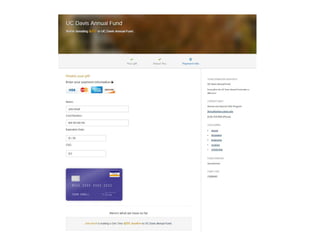
Goal: Give to UC Davis
• Hired for Centralized Gift Processing
• UC PCI Audit Starts
• Priority Changes: Compliant Website that can take Credit 
Cards
Why a complete redesign?
• Replace an onsite Windows Server 2003
• Oracle Forms Driven
• Difficult Impossible to bring into compliance
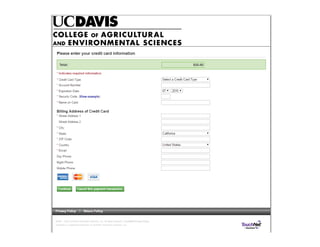
• Switch credit card processors
• TouchNet to CyberSource
• Modernize look and feel
• Professional mockups & design 
• Be ready before the on site audit (less one year)
• Agile or Bust!
Investigate Payment Processors
• TouchNet
• PayPal
• Stripe
• CyberSource / Authorize.Net
Give to UC Davis
• Demo
What is PCI?
• Set of standards designed to make payment card processing 
security the responsibility of all parties involved.
• Merchant ‐> Processor ‐> Bank
• Contractually Enforceable via Bank’s Merchant Account
• Fines, Fee, or Account Termination
• Applies to anyone that accepts credit card payments, even if 
you don’t store cc details.
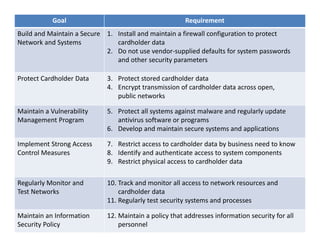
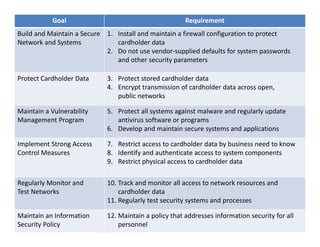
Goal Requirement
Build and Maintain a Secure 
Network and Systems
1. Install and maintain a firewall configuration to protect 
cardholder data
2. Do not use vendor‐supplied defaults for system passwords 
and other security parameters
Protect Cardholder Data 3. Protect stored cardholder data
4. Encrypt transmission of cardholder data across open, 
public networks
Maintain a Vulnerability 
Management Program
5. Protect all systems against malware and regularly update 
antivirus software or programs 
6. Develop and maintain secure systems and applications
Implement Strong Access 
Control Measures
7. Restrict access to cardholder data by business need to know 
8. Identify and authenticate access to system components 
9. Restrict physical access to cardholder data
Regularly Monitor and 
Test Networks
10. Track and monitor all access to network resources and 
cardholder data 
11. Regularly test security systems and processes
Maintain an Information 
Security Policy
12. Maintain a policy that addresses information security for all 
personnel
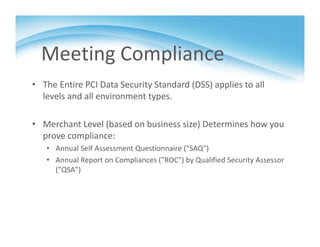
Meeting Compliance
• The Entire PCI Data Security Standard (DSS) applies to all 
levels and all environment types.
• Merchant Level (based on business size) Determines how you 
prove compliance:
• Annual Self Assessment Questionnaire ("SAQ")
• Annual Report on Compliances ("ROC") by Qualified Security Assessor 
("QSA")
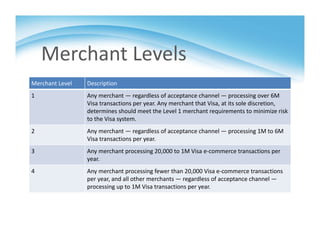
Merchant Levels
Merchant Level Description
1 Any merchant — regardless of acceptance channel — processing over 6M 
Visa transactions per year. Any merchant that Visa, at its sole discretion, 
determines should meet the Level 1 merchant requirements to minimize risk 
to the Visa system.
2 Any merchant — regardless of acceptance channel — processing 1M to 6M 
Visa transactions per year.
3 Any merchant processing 20,000 to 1M Visa e‐commerce transactions per 
year.
4 Any merchant processing fewer than 20,000 Visa e‐commerce transactions 
per year, and all other merchants — regardless of acceptance channel —
processing up to 1M Visa transactions per year.
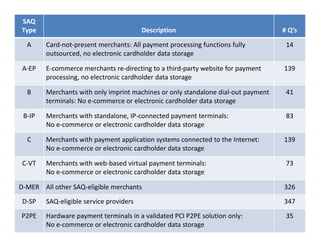
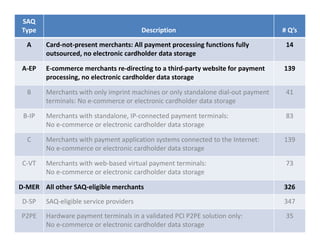
SAQ 
Type Description # Q’s
A Card‐not‐present merchants: All payment processing functions fully 
outsourced, no electronic cardholder data storage
14
A‐EP E‐commerce merchants re‐directing to a third‐party website for payment 
processing, no electronic cardholder data storage
139
B Merchants with only imprint machines or only standalone dial‐out payment 
terminals: No e‐commerce or electronic cardholder data storage
41
B‐IP Merchants with standalone, IP‐connected payment terminals: 
No e‐commerce or electronic cardholder data storage
83
C Merchants with payment application systems connected to the Internet: 
No e‐commerce or electronic cardholder data storage
139
C‐VT Merchants with web‐based virtual payment terminals: 
No e‐commerce or electronic cardholder data storage
73
D‐MER All other SAQ‐eligible merchants 326
D‐SP SAQ‐eligible service providers 347
P2PE Hardware payment terminals in a validated PCI P2PE solution only: 
No e‐commerce or electronic cardholder data storage
35
SAQ 
Type Description # Q’s
A Card‐not‐present merchants: All payment processing functions fully 
outsourced, no electronic cardholder data storage
14
A‐EP E‐commerce merchants re‐directing to a third‐party website for payment 
processing, no electronic cardholder data storage
139
B Merchants with only imprint machines or only standalone dial‐out payment 
terminals: No e‐commerce or electronic cardholder data storage
41
B‐IP Merchants with standalone, IP‐connected payment terminals: 
No e‐commerce or electronic cardholder data storage
83
C Merchants with payment application systems connected to the Internet: 
No e‐commerce or electronic cardholder data storage
139
C‐VT Merchants with web‐based virtual payment terminals: 
No e‐commerce or electronic cardholder data storage
73
D‐MER All other SAQ‐eligible merchants 326
D‐SP SAQ‐eligible service providers 347
P2PE Hardware payment terminals in a validated PCI P2PE solution only: 
No e‐commerce or electronic cardholder data storage
35
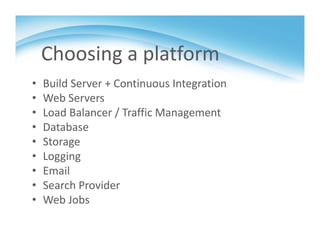
Choosing a platform
• Build Server + Continuous Integration
• Web Servers
• Load Balancer / Traffic Management
• Database
• Storage
• Logging
• Email
• Search Provider
• Web Jobs
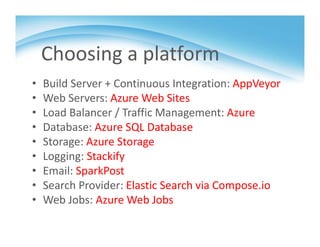
Choosing a platform
• Build Server + Continuous Integration: AppVeyor
• Web Servers: Azure Web Sites
• Load Balancer / Traffic Management: Azure
• Database: Azure SQL Database
• Storage: Azure Storage
• Logging: Stackify
• Email: SparkPost
• Search Provider: Elastic Search via Compose.io
• Web Jobs: Azure Web Jobs
Why the Cloud?
•Better
•Faster
•Cheaper
•Stronger
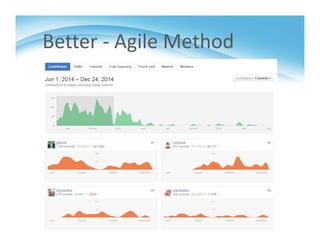
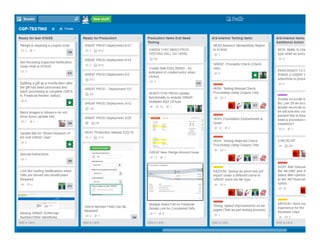
Better ‐ Agile Method
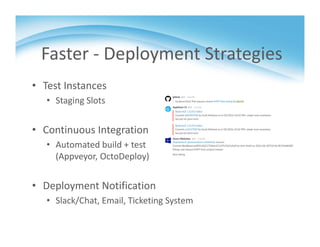
Faster ‐ Deployment Strategies
• Test Instances
• Staging Slots
• Continuous Integration
• Automated build + test 
(Appveyor, OctoDeploy)
• Deployment Notification
• Slack/Chat, Email, Ticketing System
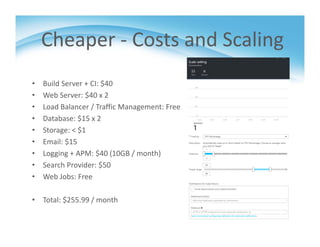
Cheaper ‐ Costs and Scaling
• Build Server + CI: $40
• Web Server: $40 x 2
• Load Balancer / Traffic Management: Free
• Database: $15 x 2
• Storage: < $1
• Email: $15
• Logging + APM: $40 (10GB / month)
• Search Provider: $50
• Web Jobs: Free
• Total: $255.99 / month
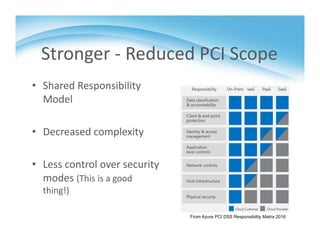
Stronger ‐ Reduced PCI Scope
• Shared Responsibility 
Model
• Decreased complexity
• Less control over security 
modes (This is a good 
thing!)
From Azure PCI DSS Responsibility Matrix 2016
Physical Security
• No access;
Fully managed
Patch Management
• Infrastructure Patching & Configuration
• OS, Framework, WebServer
• Managed by Azure, secure by default
• Application Development
• Secure SDLC
• 3rd Party Libraries
• Package management
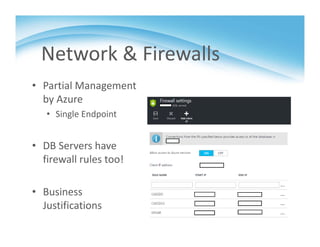
Network & Firewalls
• Partial Management 
by Azure
• Single Endpoint
• DB Servers have 
firewall rules too!
• Business 
Justifications
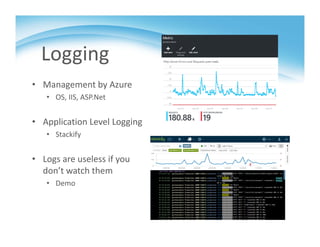
Logging
• Management by Azure
• OS, IIS, ASP.Net
• Application Level Logging
• Stackify
• Logs are useless if you 
don’t watch them
• Demo
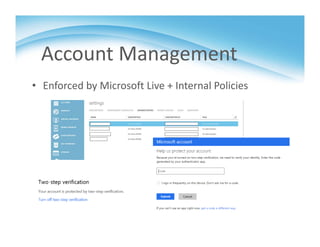
Account Management
• Enforced by Microsoft Live + Internal Policies
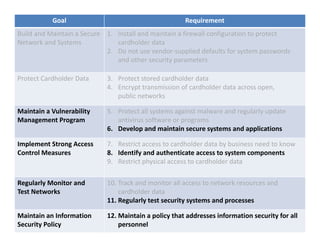
Goal Requirement
Build and Maintain a Secure 
Network and Systems
1. Install and maintain a firewall configuration to protect 
cardholder data
2. Do not use vendor‐supplied defaults for system passwords 
and other security parameters
Protect Cardholder Data 3. Protect stored cardholder data
4. Encrypt transmission of cardholder data across open, 
public networks
Maintain a Vulnerability 
Management Program
5. Protect all systems against malware and regularly update 
antivirus software or programs 
6. Develop and maintain secure systems and applications
Implement Strong Access 
Control Measures
7. Restrict access to cardholder data by business need to know 
8. Identify and authenticate access to system components 
9. Restrict physical access to cardholder data
Regularly Monitor and 
Test Networks
10. Track and monitor all access to network resources and 
cardholder data 
11. Regularly test security systems and processes
Maintain an Information 
Security Policy
12. Maintain a policy that addresses information security for all 
personnel
Goal Requirement
Build and Maintain a Secure 
Network and Systems
1. Install and maintain a firewall configuration to protect 
cardholder data
2. Do not use vendor‐supplied defaults for system passwords 
and other security parameters
Protect Cardholder Data 3. Protect stored cardholder data
4. Encrypt transmission of cardholder data across open, 
public networks
Maintain a Vulnerability 
Management Program
5. Protect all systems against malware and regularly update 
antivirus software or programs 
6. Develop and maintain secure systems and applications
Implement Strong Access 
Control Measures
7. Restrict access to cardholder data by business need to know 
8. Identify and authenticate access to system components 
9. Restrict physical access to cardholder data
Regularly Monitor and 
Test Networks
10. Track and monitor all access to network resources and 
cardholder data 
11. Regularly test security systems and processes
Maintain an Information 
Security Policy
12. Maintain a policy that addresses information security for all 
personnel
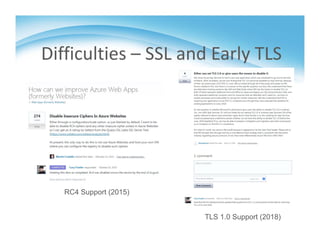
Difficulties – SSL and Early TLS
RC4 Support (2015)
TLS 1.0 Support (2018)
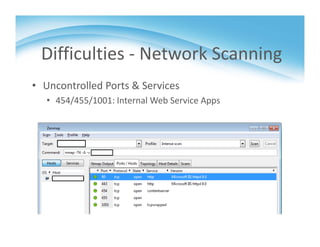
Difficulties ‐ Network Scanning
• Uncontrolled Ports & Services
• 454/455/1001: Internal Web Service Apps
Difficulties ‐ Penetration Test
• Advanced Notice Required
• Disruptive to Cloud Platform
• Unknown protective measures, responses, reactions
• Black Box by default
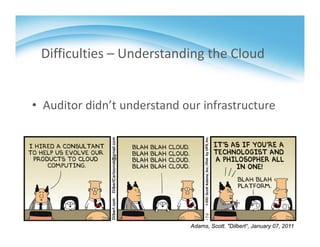
Difficulties – Understanding the Cloud
• Auditor didn’t understand our infrastructure
Adams, Scott. "Dilbert“, January 07, 2011
Results
• Passed our Audit!
• Started our SAQ‐A‐EP last week
Results
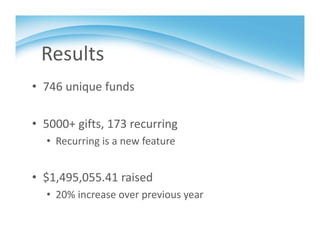
• 746 unique funds
• 5000+ gifts, 173 recurring
• Recurring is a new feature
• $1,495,055.41 raised
• 20% increase over previous year
Reference
• PCI FAQs: 
– https://www.pcicomplianceguide.org/pci‐faqs‐2/
– http://www.pkfavantedge.com/it‐compliance/pci‐dss‐and‐the‐saqs‐that‐sucks/
• Microsoft Trust Center
– https://www.microsoft.com/en‐us/TrustCenter/Compliance/PCI
– Azure PCI DSS Responsibility Matrix 2016
• Amazon Web Services (AWS) Clour Security
– https://aws.amazon.com/compliance/pci‐dss‐level‐1‐faqs/
• Azure UserVoice
– https://feedback.azure.com/forums/169385‐web‐apps‐formerly‐websites/suggestions/7091994‐
disable‐insecure‐ciphers‐in‐azure‐websites
– https://feedback.azure.com/forums/169385‐web‐apps‐formerly‐websites/suggestions/13097865‐
either‐sun‐set‐tls‐1‐0‐or‐give‐users‐the‐means‐to

PCI Compliance in the Cloud: A working example