Pc Format July 2011uk Volume 09 Issue 07 Alan Dexter
Pc Format July 2011uk Volume 09 Issue 07 Alan Dexter
Pc Format July 2011uk Volume 09 Issue 07 Alan Dexter
Pc Format July 2011uk Volume 09 Issue 07 Alan Dexter
Pc Format July 2011uk Volume 09 Issue 07 Alan Dexter
1.
Pc Format July2011uk Volume 09 Issue 07 Alan
Dexter download
https://ebookbell.com/product/pc-format-july-2011uk-
volume-09-issue-07-alan-dexter-2424452
Explore and download more ebooks at ebookbell.com
2.
Here are somerecommended products that we believe you will be
interested in. You can click the link to download.
Pc Format August 2011uk Volume 09 Issue 08 Alan Dexter
https://ebookbell.com/product/pc-format-august-2011uk-
volume-09-issue-08-alan-dexter-2363738
Pc Format June 2011uk Volume 09 Issue 06 Alan Dexter
https://ebookbell.com/product/pc-format-june-2011uk-
volume-09-issue-06-alan-dexter-2392136
Pc Format May 2011uk Volume 09 Issue 05 Alan Dexter
https://ebookbell.com/product/pc-format-may-2011uk-
volume-09-issue-05-alan-dexter-2428426
Hci Remixed Essays On Works That Have Influenced The Hci Community Pc
https://ebookbell.com/product/hci-remixed-essays-on-works-that-have-
influenced-the-hci-community-pc-56635814
3.
3adouw1 Pc
https://ebookbell.com/product/3adouw1-pc-11727226
Hegel AndSchelling In Early Nineteenthcentury France Volume 2 Studies
International Archives Of The History Of Ideas Archives
Internationales Dhistoire Des Ides 247 Pc
https://ebookbell.com/product/hegel-and-schelling-in-early-
nineteenthcentury-france-volume-2-studies-international-archives-of-
the-history-of-ideas-archives-internationales-dhistoire-des-
ides-247-pc-115910616
Pc Worlds Political Correctness And Rising Elites At The End Of
Hegemony Jonathan Friedman
https://ebookbell.com/product/pc-worlds-political-correctness-and-
rising-elites-at-the-end-of-hegemony-jonathan-friedman-51750130
Pc Hardware A Beginners Guide 1st Ron Gilster
https://ebookbell.com/product/pc-hardware-a-beginners-guide-1st-ron-
gilster-2013772
Pc Magazine Fighting Spyware Viruses And Malware 1st Edition Ed Tittel
https://ebookbell.com/product/pc-magazine-fighting-spyware-viruses-
and-malware-1st-edition-ed-tittel-2015150
And the verygreatest of all the problems which the inventors and
scientists of coming generations must solve is the question—
seemingly commonplace—of food.
We who live in this age of plenty can hardly realise that food could
ever be a problem. But far-sighted scientists have already begun to
look forward to the time when there will be so many people on the
earth that the farms and fields will not supply food for every one. It
is a well-known fact that the population of the world is increasing
enormously. Think how America has been expanding; a whole
continent overrun and settled almost within a century and a half!
Nearly all the land that can be successfully farmed has already been
taken up, and the land in some of the older settled localities, like
Virginia and the New England States, has been so steadily cropped
that it is failing in fertility, so that it will not raise as much as it would
years ago. In Europe no crop at all can be raised without quantities
of fertiliser.
While there was yet new country to open up, while America and
Australia were yet virgin soil, there was no immediate cause for
alarm; but, as no less an authority than Sir William Crookes pointed
out a few years ago in a lecture before the British Association, the
new land has now for the most part been opened and tamed to the
plough or utilised for grazing purposes. And already we are hearing
of worn-out land in Dakota—the paradise of the wheat producer. The
problem, therefore, is simple enough: the world is reaching the limits
of its capacity for food production, while the population continues to
increase enormously: how soon will starvation begin? Sir William
Crookes has prophesied, I believe, that the acute stage of the
problem will be reached within the next fifty years, a time when the
call of the world for food cannot be supplied. If it were not for our
coming inventors and scientists it would certainly be a gloomy
outlook for the human race.
But science has already foreseen this problem. When Sir William
Crookes gave his address he based his arguments on modern
agricultural methods; he did not look forward into the future, he did
20.
not show anyfaith in the scientists and inventors who are to come,
who are now boys, perhaps. He did not even take cognisance of the
work that had already been done. For inventors and scientists are
already grappling with this problem of food.
In a nutshell, the question of food production is a question of
nitrogen.
This must be explained. A crop of wheat, for instance, takes from
the soil certain elements to help make up the wheat berry, the straw,
the roots. And the most important of all the elements it takes is
nitrogen. When we eat bread we take this nitrogen that the wheat
has gathered from the soil into our own bodies to build up our
bones, muscles, brains. Each wheat crop takes more nitrogen from
the soil, and finally, if this nitrogen is not given back to the earth in
some way, wheat will no longer grow in the fields. In other words,
we say the farm is "worn out," "cropped to death." The soil is there,
but the precious life-giving nitrogen is gone. And so it becomes
necessary every year to put back the nitrogen and the other
elements which the crop takes from the soil. This purpose is
accomplished by the use of fertilisers. Manure, ground bone,
nitrates, guano, are put in fields to restore the nitrogen and other
plant foods. In short, we are compelled to feed the soil that the soil
may feed the wheat, that the wheat may feed us. You will see that it
is a complete circle—like all life.
Now, the trouble, the great problem, lies right here: in the
difficulty of obtaining a sufficient amount of fertiliser—in other
words, in getting food enough to keep the soil from nitrogen
starvation. Already we ship guano—the droppings of sea-birds—from
South America and the far islands of the sea to put on our lands,
and we mine nitrates (which contain nitrogen) at large expense and
in great quantities for the same purpose. And while we go to such
lengths to get nitrogen we are wasting it every year in enormous
quantities. Gunpowder and explosives are most made up of nitrogen
—saltpetre and nitro-glycerin—so that every war wastes vast
quantities of this precious substance. Every discharge of a 13-inch
21.
gun liberates enoughnitrogen to raise many bushels of wheat. Thus
we see another reason for the disarmament of the nations.
A prediction has been made that barely thirty years hence the
wheat required to feed the world will be 3,260,000,000 bushels
annually, and that to raise this about 12,000,000 tons of nitrate of
soda yearly for the area under cultivation will be needed over and
above the 1,250,000 tons now used by mankind. But the nitrates
now in sight and available are estimated good for only another fifty
years, even at the present low rate of consumption. Hence, even if
famine does not immediately impend, the food problem is far more
serious than is generally supposed.
Now nitrogen, it will be seen, is one of the most precious and
necessary of all substances to human life, and it is one of the most
common. If the world ever starves for the lack of nitrogen it will
starve in a very world of nitrogen. For there is not one of the
elements more common than nitrogen, not one present around us in
larger quantities. Four-fifths of every breath of air we breathe is pure
nitrogen—four-fifths of all the earth's atmosphere is nitrogen.
But, unfortunately, most plants are unable to take up nitrogen in
its gaseous form as it appears in the air. It must be combined with
hydrogen in the form of ammonia or in some nitrate. Ammonia and
the nitrates are, therefore, the basis of all fertilisers.
Now, the problem for the scientist and inventor takes this form:
Here is the vast store-house of life-giving nitrogen in the air; how
can it be caught, fixed, reduced to the purpose of men, spread on
the hungry wheat-fields? The problem, therefore, is that of "fixing"
the nitrogen, taking the gas out of the air and reducing it to a form
in which it can be handled and used.
Two principal methods for doing this have already been devised,
both of which are of fascinating interest. One of these ways, that of
a clever American inventor, is purely a machinery process, the
utilisation of power by means of which the nitrogen is literally sucked
22.
out of theair and combined with soda so that it produces nitrate of
soda, a high-class fertiliser. The water power of Niagara Falls is used
to do this work—it seems odd enough that Niagara should be used
for food production!
The other method, that of a hard-working German professor, is
the cunning utilisation of one of nature's marvellous processes of
taking the nitrogen from the air and depositing it in the soil—for
nature has its own beautiful way of doing it. I will describe the
second method first because it will help to clear up the whole
subject and lead up to the work of the American inventor and his
extraordinary machinery.
Nearly every farmer, without knowing it, employs nature's method
of fixing nitrogen every year. It is a simple process which he has
learned from experience. He knows that when land is worn out by
overcropping with wheat or other products which draw heavily on
the earth's nitrogen supply certain crops will still grow luxuriantly
upon the worn-out land, and that if these crops are left and
ploughed in, the fertility of the soil will be restored, and it will again
produce large yields of wheat and other nitrogen-demanding plants.
These restorative crops are clover, lupin, and other leguminous
plants, including beans and peas. Every one who is at all familiar
with farming operations has heard of seeding down an old field to
clover and then ploughing in the crop, usually in the second year.
The great importance of this bit of the wisdom of experience was
not appreciated by science for many years. Then several German
experimenters began to ask why clover and lupin and beans should
flourish on worn-out land when other crops failed. All of these plants
are especially rich in nitrogen, and yet they grew well on soil which
had been robbed of its nitrogen. Why was this so?
It was a hard problem to solve, but science was undaunted.
Botanists had already discovered that the roots of the leguminous
plants—that is, clover, lupin, beans, peas, and so on—were usually
covered with small round swellings, or tumors, to which were given
23.
the name nodules.The exact purpose of these swellings being
unknown, they were set down as a condition, possibly, of disease,
and no further attention was paid to them until Professor Hellriegel,
of Burnburg, in Anhalt, Germany, took up the work. After much
experimenting, he made the important discovery that lupins which
had nodules would grow in soil devoid of nitrogen, and that lupins
which had no nodules would not grow in the same soil. It was plain,
therefore, that the nodules must play an important, though
mysterious, part in enabling the plant to utilise the free nitrogen of
the air. That was early in the '80s. His discovery at once started
other investigators to work, and it was not long before the
announcement came—and it came, curiously enough, at a time
when Dr. Koch was making his greatest contributions to the world's
knowledge of the germ theory of disease—that these nodules were
the result of minute bacteria found in the soil. Professor Beyerinck,
of Münster, gave the bacteria the name Radiocola.
It was at this time that Professor Nobbe took up the work with
vigour. If these nodules were produced by bacteria, he argued that
the bacteria must be present in the soil; and if they were not
present, would it not be possible to supply them by artificial means?
In other words, if soil, say worn-out farm-soil or, indeed, pure sand
like that of the sea-shore could thus be inoculated, as a physician
inoculates a guinea-pig with diphtheria germs, would not beans and
peas planted there form nodules and draw their nourishment from
the air? It was a somewhat startling idea, but all radically new ideas
are startling; and, after thinking it over, Professor Nobbe began, in
1888, a series of most remarkable experiments, having as their
purpose the discovery of a practical method of soil inoculation. He
gathered the nodule-covered roots of beans and peas, dried and
crushed them, and made an extract of them in water. Then he
prepared a gelatine solution with a little sugar, asparagine, and other
materials, and added the nodule-extract. In this medium colonies of
bacteria at once began to grow—bacteria of many kinds. Professor
Nobbe separated the Radiocola—which are oblong in shape—and
made what is known as a "clear culture," that is, a culture in
24.
gelatine, consisting ofbillions of these particular germs, and no
others. When he had succeeded in producing these clear cultures he
was ready for his actual experiments in growing plants. He took a
quantity of pure sand, and, in order to be sure that it contained no
nitrogen or bacteria in any form, he heated it at a high temperature
three different times for six hours, thereby completely sterilising it.
This sand he placed in three jars. To each of these he added a small
quantity of mineral food—the required phosphorus, potassium, iron,
sulphur, and so on. To the first he supplied no nitrogen at all in any
form; the second he fertilised with saltpetre, which is largely
composed of nitrogen in a form in which plants may readily absorb it
through their roots; the third of the jars he inoculated with some of
his bacteria culture. Then he planted beans in all three jars, and
awaited the results, as may be imagined, somewhat anxiously.
Perfectly pure sterilised water was supplied to each jar in equal
amounts and the seeds sprouted, and for a week the young shoots
in the three jars were almost identical in appearance. But soon after
that there was a gradual but striking change. The beans in the first
jar, having no nitrogen and no inoculation, turned pale and refused
to grow, finally dying down completely, starved for want of
nitrogenous food, exactly as a man would starve for the lack of the
same kind of nourishment. The beans in the second jar, with the
fertilised soil, grew about as they would in the garden, all of the
nourishment having been artificially supplied. But the third jar, which
had been jealously watched, showed really a miracle of growth. It
must be remembered that the soil in this jar was as absolutely free
of nitrogen as the soil in the first jar, and yet the beans flourished
greatly, and when some of the plants were analysed they were
found to be rich in nitrogen. Nodules had formed on the roots of the
beans in the third or inoculated jar only, thereby proving beyond the
hope of the experimenter that soil inoculation was a possibility, at
least in the laboratory.
With this favourable beginning Professor Nobbe went forward with
his experiments with renewed vigour. He tried inoculating the soil for
peas, clover, lupin, vetch, acacia, robinia, and so on, and in every
25.
case the rootsformed nodules, and although there was absolutely
no nitrogen in the soil, the plants invariably flourished. Then
Professor Nobbe tried great numbers of difficult test experiments,
such as inoculating the soil with clover bacteria and then planting it
with beans or peas, or vice versa, to see whether the bacteria from
the nodules of any one leguminous plant could be used for all or any
of the others. He also tried successive cultures; that is, bean
bacteria for beans for several years, to see if better results could be
obtained by continued use. Even an outline description of all the
experiments which Professor Nobbe made in the course of these
investigations would fill a small volume, and it will be best to set
down here only his general conclusions.
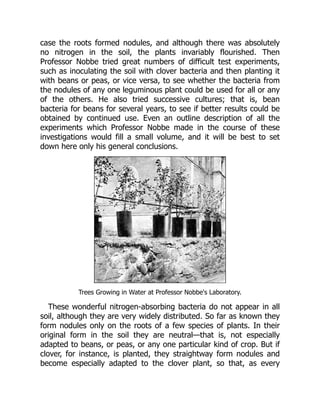
Trees Growing in Water at Professor Nobbe's Laboratory.
These wonderful nitrogen-absorbing bacteria do not appear in all
soil, although they are very widely distributed. So far as known they
form nodules only on the roots of a few species of plants. In their
original form in the soil they are neutral—that is, not especially
adapted to beans, or peas, or any one particular kind of crop. But if
clover, for instance, is planted, they straightway form nodules and
become especially adapted to the clover plant, so that, as every
26.
farmer knows, thesecond crop of clover on worn-out land is much
better than the first. And, curiously enough, when once the bacteria
have become thoroughly adapted to one of the crops, say beans,
they will not affect peas or clover, or only feebly.
Another strange feature of the life of these little creatures, which
has a marvellous suggestion of intelligence, is their activities in
various kinds of soil. When the ground is very rich—that is, when it
contains plenty of nitrogenous matter—they are what Professor
Nobbe calls "lazy." They do not readily form nodules on the roots of
the plants, seeming almost to know that there is no necessity for it.
But when once the nitrogenous matter in the soil begins to fail, then
they work more sharply, and when it has gone altogether they are at
the very height of activity. Consequently, unless the soil is really
worn out, or very poor to begin with, there is no use in inoculating it
—it would be like "taking owls to Athens," as Professor Nobbe says.
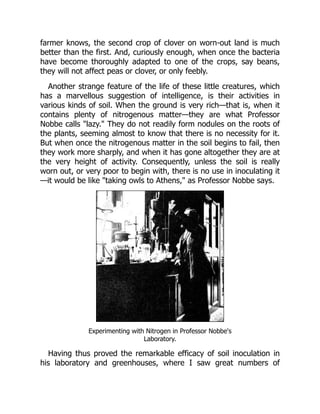
Experimenting with Nitrogen in Professor Nobbe's
Laboratory.
Having thus proved the remarkable efficacy of soil inoculation in
his laboratory and greenhouses, where I saw great numbers of
27.
experiments still goingforward, Professor Nobbe set himself to make
his discoveries of practical value. He gave to his bacteria cultures the
name "Nitragen"—spelled with an "a"—and he produced separate
cultures for each of the important crops—peas, beans, vetch, lupin,
and clover. In 1894 the first of these were placed on the market, and
they have had a steadily increasing sale, although such a radical
innovation as this, so far out of the ordinary run of agricultural
operation, and so almost unbelievably wonderful, cannot be
expected to spread very rapidly. The cultures are now manufactured
at one of the great commercial chemical laboratories on the river
Main. I saw some of them in Professor Nobbe's laboratory. They
come in small glass bottles, each marked with the name of the crop
for which it is especially adapted. The bottle is partly filled with the
yellow gelatinous substance in which the bacteria grow. On the
surface of this there is a mossy-like growth, resembling mould. This
consists of innumerable millions of the little oblong bacteria. A bottle
costs about fifty cents and contains enough bacteria for inoculating
half an acre of land. It must be used within a certain number of
weeks after it is obtained, while it is still fresh. The method of
applying it is very simple. The contents of the bottle are diluted with
warm water. Then the seeds of the beans, clover, or peas, which
have previously been mixed with a little soil, are treated with this
solution and thoroughly mixed with the soil. After that the mass is
partially dried so that the seeds may be readily sown. The bacteria
at once begin to propagate in the soil, which is their natural home,
and by the time the beans or peas have put out roots they are
present in vast numbers and ready to begin the active work of
forming nodules. It is not known exactly how the bacteria absorb the
free nitrogen from the air, but they do it successfully, and that is the
main thing. Many German farmers have tried Nitragen. One, who
was sceptical of its virtues, wrote to Professor Nobbe that he sowed
the bacteria-inoculated seeds in the form of a huge letter N in the
midst of his field, planting the rest in the ordinary way. Before a
month had passed that N showed up green and big over all the field,
the plants composing it being so much larger and healthier than
those around it.
28.
The United StatesGovernment has recently been experimenting
along the same lines and has produced a new form of dry
preparation of the bacteria in some cakes somewhat resembling a
yeast-cake.
The possibilities of such a discovery as this seem almost limitless.
Science predicts the exhaustion of nitrogen and consequent failure
of the food supply, and science promptly finds a way of making
plants draw nitrogen from the boundless supplies of the air. The time
may come when every farmer will send for his bottles or cakes of
bacteria culture every spring as regularly as he sends for his seed,
and when the work of inoculating the soil will be a familiar
agricultural process, with discussions in the farmers' papers as to
whether two bottles or one is best for a field of sandy loam with a
southern exposure. Stranger things have happened. But it must be
remembered, also, that the work is in its infancy as yet, and that
there are vast unexplored fields and innumerable possibilities yet to
fathom.
Wonderful as this discovery is, and much as it promises in the
future, its efficacy, as soon as it becomes generally known, is certain
to be overestimated, as all new discoveries are. Professor Nobbe
himself says that it has its own limited serviceability. It will produce a
bounteous crop of beans in the pure sand of the sea-shore if (and
this is an important if) that sand also contains enough of the mineral
substances—phosphorus, potassium, and so on—and if it is kept
properly watered. A man with a worn-out farm cannot go ahead
blindly and inoculate his soil and expect certain results. He must
know the exact disease from which his land is suffering before he
applies the remedy. If it is deficient in the phosphates, bacteria
cultures will not help it, whereas if it is deficient in nitrogen, bacteria
are just what it needs. And so agricultural education must go hand
in hand with the introduction of these future preservers of the
human race. It is safe to say that by the time there is a serious
failure of the earth's soil for lack of nitrogen, science, with this
29.
wonderful beginning, willhave ready a new system of cultivation,
which will gradually, easily, and perfectly take the place of the old.
Before leaving this wonderful subject of soil inoculation, a word
about Professor Nobbe himself will surely be of interest. I visited his
laboratory and saw his experiments.
Tharandt, in Saxony, where Professor Nobbe has carried on his
investigations for over thirty years, is a little village set picturesquely
among the Saxon hills, about half an hour's ride by railroad from the
city of Dresden. Here is located the Forest Academy of the Kingdom,
with which Professor Nobbe is prominently connected, and here also
is the agricultural experiment station of which he is director. He has
been for more than forty years the editor of one of the most
important scientific publications in Germany; he is chairman of the
Imperial Society of Agricultural Station Directors, and he has been
the recipient of many honours.
We now come to a consideration of the other method—the fixing
of nitrogen by machinery: a practical problem for the inventor.
Every one has noticed the peculiar fresh smell of the air which
follows a thunderstorm; the same pungent odour appears in the
vicinity of a frictional electric machine when in operation. This smell
has been attributed to ozone, but it is now thought that it may be
due to oxides of nitrogen; in other words, the electric discharges of
lightning or of the frictional machine have burned the air—that is,
combined the nitrogen and oxygen of the air, forming oxides of
nitrogen.
30.
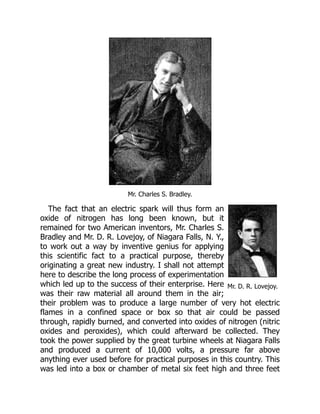
Mr. D. R.Lovejoy.
Mr. Charles S. Bradley.
The fact that an electric spark will thus form an
oxide of nitrogen has long been known, but it
remained for two American inventors, Mr. Charles S.
Bradley and Mr. D. R. Lovejoy, of Niagara Falls, N. Y.,
to work out a way by inventive genius for applying
this scientific fact to a practical purpose, thereby
originating a great new industry. I shall not attempt
here to describe the long process of experimentation
which led up to the success of their enterprise. Here
was their raw material all around them in the air;
their problem was to produce a large number of very hot electric
flames in a confined space or box so that air could be passed
through, rapidly burned, and converted into oxides of nitrogen (nitric
oxides and peroxides), which could afterward be collected. They
took the power supplied by the great turbine wheels at Niagara Falls
and produced a current of 10,000 volts, a pressure far above
anything ever used before for practical purposes in this country. This
was led into a box or chamber of metal six feet high and three feet
31.
in diameter—the boxhaving openings to admit the air. By means of
a revolving cylinder the electric current is made to produce a rapid
continuance of very brilliant arcs, exactly like the glaring white arc of
the arc-lamp, only much more intense, a great deal hotter. The air
driven in through and around these hot arcs is at once burned,
combining the oxygen and nitrogen of which it is composed and
producing the desired oxides of nitrogen. These are led along to a
chamber where they are combined with water, producing nitric or
nitrous acid; or if the gases are brought into contact with caustic
potash, saltpetre is the result; if with caustic soda, nitrate of soda is
the product—a very valuable fertiliser. And the inventors have been
able to produce these various results at an expense so low that they
can sell their output at a profit in competition with nitrates from
other sources, thus giving the world a new source of fertiliser at a
moderate price.
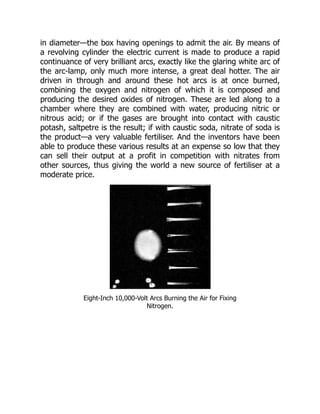
Eight-Inch 10,000-Volt Arcs Burning the Air for Fixing
Nitrogen.
32.
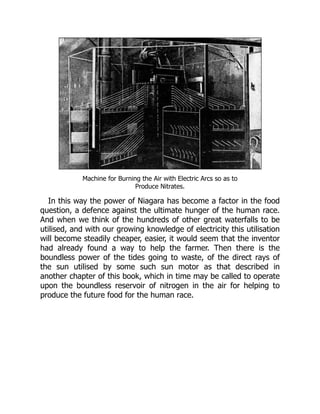
Machine for Burningthe Air with Electric Arcs so as to
Produce Nitrates.
In this way the power of Niagara has become a factor in the food
question, a defence against the ultimate hunger of the human race.
And when we think of the hundreds of other great waterfalls to be
utilised, and with our growing knowledge of electricity this utilisation
will become steadily cheaper, easier, it would seem that the inventor
had already found a way to help the farmer. Then there is the
boundless power of the tides going to waste, of the direct rays of
the sun utilised by some such sun motor as that described in
another chapter of this book, which in time may be called to operate
upon the boundless reservoir of nitrogen in the air for helping to
produce the future food for the human race.
33.
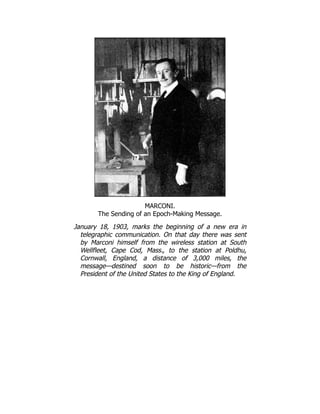
MARCONI.
The Sending ofan Epoch-Making Message.
January 18, 1903, marks the beginning of a new era in
telegraphic communication. On that day there was sent
by Marconi himself from the wireless station at South
Wellfleet, Cape Cod, Mass., to the station at Poldhu,
Cornwall, England, a distance of 3,000 miles, the
message—destined soon to be historic—from the
President of the United States to the King of England.
34.
CHAPTER VII
MARCONI ANDHIS GREAT ACHIEVEMENTS
New Experiments in Wireless Telegraphy
No invention of modern times, perhaps, comes so near to being
what we call a miracle as the new system of telegraphy without
wires. The very thought of communicating across the hundreds of
miles of blue ocean between Europe and America with no
connection, no wires, nothing but air, sunshine, space, is almost
inconceivably wonderful. A few years ago the mere suggestion of
such a thing would have been set down as the wildest flight of
imagination, unbelievable, perfectly impossible. And yet it has come
to pass!
Think for a moment of sitting here on the shore of America and
quietly listening to words sent through space across some 3,000
miles of ocean from the edge of Europe! A cable, marvellous as it is,
maintains a real connection between speaker and hearer. We feel
that it is a road along which our speech can travel; we can grasp its
meaning. But in telegraphing without wires we have nothing but
space, poles with pendent wires on one side of the broad, curving
ocean, and similar poles and wires (or perhaps only a kite struggling
in the air) on the other—and thought passing between!
35.
I have toldin the first "Boys' Book of Inventions" of Guglielmo
Marconi's early experiments. That was a chapter of uncertain
beginnings, of great hopes, of prophecy. This is the sequel, a
chapter of achievement and success. What was only a scientific and
inventive novelty a few years ago has become a great practical
enterprise, giving promise of changing the whole world of men,
drawing nations more closely together, making us near neighbours
to the English and the Germans and the French—in short, shrinking
our earth. There may come a time when we will think no more of
sending a Marconigram, or an etheragram, or whatever is to be the
name of the message by wireless telegraphy, to an acquaintance in
England than we now think of calling up our neighbour on the
telephone.
Every one will recall the astonishment that swept over the country
in December, 1901, when there came the first meagre reports of
Marconi's success in telegraphing across the Atlantic Ocean between
England and Newfoundland. At first few would believe the reports,
but when Thomas A. Edison, Graham Bell, and other great inventors
and scientists had expressed their confidence in Marconi's
achievement, the whole country, was ready to hail the young
inventor with honours. And his successes since those December days
have been so pronounced—for he had now sent messages both
ways across the Atlantic and at much greater distances—have more
than borne out the promise then made. Wireless telegrams can now
be sent directly from the shore of Massachusetts to England, and
ocean-going ships are being rapidly equipped with the Marconi
apparatus so that they can keep in direct communication with both
continents during every day of the voyage. On some of the great
ships a little newspaper is published, giving the world's news as
received from day to day.
It was the good fortune of the writer to arrive in St. John's,
Newfoundland, during Mr. Marconi's experiments in December, 1901,
only a short time after the famous first message across the Atlantic
had been received. Three months later it was also the writer's
36.
privilege to visitthe Marconi station at Poldhu, in Cornwall, England,
from which the message had been sent, Mr. Marconi being then
planning his greater work of placing his invention on a practical basis
so that his company could enter the field of commercial telegraphy.
It was the writer's fortune to have many talks with Mr. Marconi, both
in America and in England, to see him at his experiments, and to
write some of the earliest accounts of his successes. The story here
told is the result of these talks.
Mr. Marconi kept his own counsel regarding his plans in coming to
Newfoundland in December, 1901. He told nobody, except his
assistants, that he was going to attempt the great feat of
communicating across the Atlantic Ocean. Though feeling very
certain of success, he knew that the world would not believe him,
would perhaps only laugh at him for his great plans. The project was
entirely too daring for public announcement. Something might
happen, some accident to the apparatus, that would cause a delay;
people would call this failure, and it would be more difficult another
time to get any one to put confidence in the work. So Marconi very
wisely held his peace, only announcing what he had done when
success was assured.
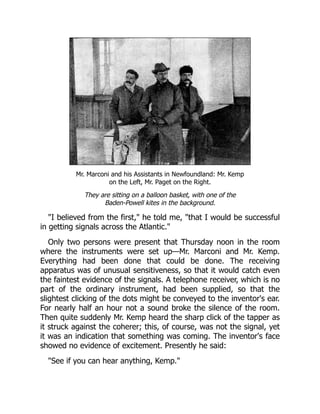
Mr. Marconi landed at St. John's, Newfoundland, on December 6,
1901, with his two assistants, Mr. Kemp and Mr. Paget.
He set up his instruments in a low room of the old barracks on
Signal Hill, which stands sentinel at the harbour mouth half a mile
from the city of St. John's. So simple and easily arranged is the
apparatus that in three days' time the inventor was prepared to
begin his experiments. On Wednesday, the 11th, as a preliminary
test of the wind velocity, he sent up one of his kites, a huge
hexagonal affair of bamboo and silk nine feet high, built on the
Baden-Powell model: the wind promptly snapped the wire and blew
the kite out to sea. He then filled a 14-foot hydrogen balloon, and
sent it upward through a thick fog bank. Hardly had it reached the
limit of its tetherings, however, when the aërial wire on which he
had depended for receiving his messages fell to the earth, the
37.
balloon broke away,and was never seen again. On Thursday, the
12th, a day destined to be important in the annals of invention,
Marconi tried another kite, and though the weather was so blustery
that it required the combined strength of the inventor and his
assistants to manage the tetherings, they succeeded in holding the
kite at an elevation of about 400 feet. Marconi was now prepared for
the crucial test. Before leaving England he had given detailed
instructions to his assistants for the transmission of a certain signal,
the Morse telegraphic S, represented by three dots (...), at a fixed
time each day, beginning as soon as they received word that
everything at St. John's was in readiness. This signal was to be
clicked out on the transmitting instruments near Poldhu, Cornwall,
the southwestern tip of England, and radiated from a number of
aërial wires pendent from masts 210 feet high. If the inventor could
receive on his kite-wire in Newfoundland some of the electrical
waves thus produced, he knew that he held the solution of the
problem of transoceanic wireless telegraphy. He had cabled his
assistants to begin sending the signals at three o'clock in the
afternoon, English time, continuing until six o'clock; that is, from
about 11.30 to 2.30 o'clock in St. John's.
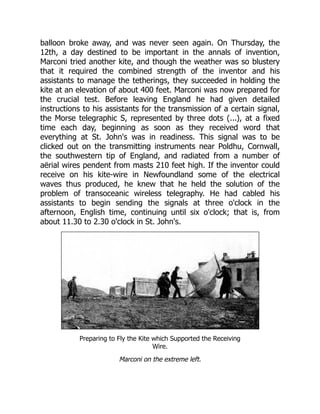
Preparing to Fly the Kite which Supported the Receiving
Wire.
Marconi on the extreme left.
38.
At noon onThursday (December 12, 1901) Marconi sat waiting, a
telephone receiver at his ear, in a room of the old barracks on Signal
Hill. To him it must have been a moment of painful stress and
expectation. Arranged on the table before him, all its parts within
easy reach of his hand, was the delicate receiving instrument, the
supreme product of years of the inventor's life, now to be submitted
to a decisive test. A wire ran out through the window, thence to a
pole, thence upward to the kite which could be seen swaying high
overhead. It was a bluff, raw day; at the base of the cliff 300 feet
below thundered a cold sea; oceanward through the mist rose dimly
the rude outlines of Cape Spear, the easternmost reach of the North
American Continent. Beyond that rolled the unbroken ocean, nearly
2,000 miles to the coast of the British Isles. Across the harbour the
city of St. John's lay on its hillside wrapped in fog: no one had taken
enough interest in the experiments to come up here through the
snow to Signal Hill. Even the ubiquitous reporter was absent. In
Cabot Tower, near at hand, the old signalman stood looking out to
sea, watching for ships, and little dreaming of the mysterious
messages coming that way from England. Standing on that bleak hill
and gazing out over the waste of water to the eastward, one finds it
difficult indeed to realise that this wonder could have become a
reality. The faith of the inventor in his creation, in the kite-wire, and
in the instruments which had grown under his hand, was unshaken.
39.
Mr. Marconi andhis Assistants in Newfoundland: Mr. Kemp
on the Left, Mr. Paget on the Right.
They are sitting on a balloon basket, with one of the
Baden-Powell kites in the background.
"I believed from the first," he told me, "that I would be successful
in getting signals across the Atlantic."
Only two persons were present that Thursday noon in the room
where the instruments were set up—Mr. Marconi and Mr. Kemp.
Everything had been done that could be done. The receiving
apparatus was of unusual sensitiveness, so that it would catch even
the faintest evidence of the signals. A telephone receiver, which is no
part of the ordinary instrument, had been supplied, so that the
slightest clicking of the dots might be conveyed to the inventor's ear.
For nearly half an hour not a sound broke the silence of the room.
Then quite suddenly Mr. Kemp heard the sharp click of the tapper as
it struck against the coherer; this, of course, was not the signal, yet
it was an indication that something was coming. The inventor's face
showed no evidence of excitement. Presently he said:
"See if you can hear anything, Kemp."
40.
Mr. Kemp tookthe receiver, and a moment later, faintly and yet
distinctly and unmistakably, came the three little clicks—the dots of
the letter S, tapped out an instant before in England. At ten minutes
past one, more signals came, and both Mr. Marconi and Mr. Kemp
assured themselves again and again that there could be no mistake.
During this time the kite gyrated so wildly in the air that the
receiving wire was not maintained at the same height, as it should
have been; but again, at twenty minutes after two, other repetitions
of the signal were received.
Thus the problem was solved. One of the great wonders of
science had been wrought. But the inventor went down the hill
toward the city, now bright with lights, feeling depressed and
disheartened—the rebound from the stress of the preceding days.
On the following afternoon, Friday, he succeeded in getting other
repetitions of the signal from England, but on Saturday, though he
made an effort, he was unable to hear anything. The signals were,
of course, sent continuously, but the inventor was unable to obtain
continuous results, owing, as he explains, to the fluctuations of the
height of the kite as it was blown about by the wind, and to the
extreme delicacy of his instruments, which required constant
adjustment during the experiments.
Even now that he had been successful, the inventor hesitated to
make his achievement public, lest it seem too extraordinary for
belief. Finally, after withholding the great news for two days,
certainly an evidence of self-restraint, he gave out a statement to
the press, and on Sunday morning the world knew and doubted; on
Monday it knew more and believed. Many, like Mr. Edison, awaited
the inventor's signed announcement before they would credit the
news. Sir Cavendish Boyle, the Governor of Newfoundland, reported
at once to King Edward; and the cable company which has exclusive
rights in Newfoundland, alarmed at an achievement which
threatened the very existence of its business, demanded that he
desist from further experiments within its territory, truly an evidence
of the belief of practical men in the future commercial importance of
41.
the invention. Itis not a little significant of the increased willingness
of the world, born of expanding knowledge, to accept a new
scientific wonder, that Mr. Marconi's announcement should have
been so eagerly and so generally believed, and that the popular
imagination should have been so fired with its possibilities. One
cannot but recall the struggle against doubt, prejudice, and disbelief
in which the promoters of the first transatlantic cable were forced to
engage. Even after the first cable was laid (in 1858), and messages
had actually been transmitted, there were many who denied that it
had ever been successfully operated, and would hardly be convinced
even by the affidavits of those concerned in the work. But in the
years since then, Edison, Bell, Röntgen, and many other famous
inventors and scientists have taught the world to be chary of its
disbelief. Outside of this general disposition to friendliness, however,
Marconi on his own part had well earned the credit of the careful
and conservative scientist; his previous successes made it the more
easy to credit his new achievement. For, as an Englishman (Mr. Flood
Page), in defending Mr. Marconi's announcement, has pointed out,
the inventor has never made any statement in public until he has
been absolutely certain of the fact; he has never had to withdraw
any statement that he has made as to his progress in the past. And
these facts unquestionably carried great weight in convincing Mr.
Edison, Mr. Graham Bell, and others of equal note of the literal truth
of his report. It was astonishing how overwhelmingly credit came
from every quarter of the world, from high and low alike, from
inventors, scientists, statesmen, royalty. Before Marconi left St.
John's he was already in receipt of a large mail—the inevitable
letters of those who would offer congratulations, give advice, or ask
favours. He received offers to lecture, to write articles, to visit this,
that, and the other place—and all within a week after the news of
his success. The people of the "ancient colony" of Newfoundland,
famed for their hospitality, crowned him with every honour in their
power. I accompanied Mr. Marconi across the island on his way to
Nova Scotia, and it seemed as if every fisher and farmer in that wild
country had heard of him, for when the train stopped they came
crowding to look in at the window. From the comments I heard, they
42.
wondered most atthe inventor's youthful appearance. Though he
was only twenty-seven years old, his experience as an inventor
covered many years, for he began experimenting in wireless
telegraphy before he was twenty. At twenty-two he came to London
from his Italian home, and convinced the British Post-Office
Department that he had an important idea; at twenty-three he was
famous the world over.
Following this epoch-making success Mr. Marconi returned to
England, where he continued most vigorously the work of perfecting
his invention, installing more powerful transmitters, devising new
receivers, all the time with the intention of following up his
Newfoundland experiments with the inauguration of a complete
system of wireless transmission between America and Europe. In the
latter part of the year 1902 he succeeded in opening regular
communication between Nova Scotia and England, and January 18,
1903, marked another epoch in his work. On that day there was sent
by Marconi himself from the wireless station at South Wellfleet, Cape
Cod, Mass., to the station at Poldhu, Cornwall, England, a distance of
3,000 miles, the message—destined to be historic—from the
President of the United States to the King of England.
It will be interesting to know something of the inventor himself.
He is somewhat above medium height, and, though of a highly
strung temperament, he is deliberate in his movements. Unlike the
inventor of tradition, he dresses with scrupulous neatness, and, in
spite of being a prodigious worker, he finds time to enjoy a limited
amount of club and social life. The portrait published with this
chapter, taken at St. John's a few days after the experiments, gives a
very good idea of the inventor's face, though it cannot convey the
peculiar lustre of his eyes when he is interested or excited—and
perhaps it makes him look older than he really is. One of the first
and strongest impressions that the man conveys is that of intense
nervous activity and mental absorption; he has a way of pouncing
upon a knotty question as if he could not wait to solve it. He talks
little, is straightforward and unassuming, submitting good-naturedly,
43.
although with evidentunwillingness, to being lionised. In his public
addresses he has been clear and sensible; he has never written for
any publication; nor has he engaged in scientific disputes, and even
when violently attacked he has let his work prove his point. And he
has accepted his success with calmness, almost unconcern; he
certainly expected it. The only elation I saw him express was over
the attack of the cable monopoly in Newfoundland, which he
regarded as the greatest tribute that could have been paid his
achievement. During all his life, opposition has been his keenest spur
to greater effort.
Though he was born and educated in Italy, his mother was of
British birth, and he speaks English as perfectly as he does Italian.
Indeed, his blue eyes, light hair, and fair complexion give him
decidedly the appearance of an Englishman, so that a stranger
meeting him for the first time would never suspect his Italian
parentage. His parents are still living, spending part of their time on
their estate in Italy and part of the time in London. One of the first
messages conveying the news of his success at St. John's went to
them. He embarked in experimental research because he loved it,
and no amount of honour or money tempts him from the pursuit of
the great things in electricity which he sees before him. Besides
being an inventor, he is also a shrewd business man, with a clear
appreciation of the value of his inventions and of their possibilities
when generally introduced. What is more, he knows how to go
about the task of introducing them.
No sooner had Marconi announced the success of his
Newfoundland experiments than critics began to raise objections.
Might not the signals which he received have been sent from some
passing ship fitted with wireless-telegraphy apparatus? Or, might
they not have been the result of electrical disturbances in the
atmosphere? Or, granting his ability to communicate across seas,
how could he preserve the secrecy of his messages? If they were
transmitted into space, why was it not possible for any one with a
receiving instrument to take them? And was not his system of
44.
transmission too slowto make it useful, or was it not rendered
uncertain by storms? And so on indefinitely. An acquaintance with
some of the principles which Marconi considers fundamental, and on
which his work has been based, will help to clear away these
objections and give some conception of the real meaning and
importance of the work at St. John's and of the plans for the future
development of the inventor's system.
In the first place, Mr. Marconi makes no claim to being the first to
experiment along the lines which led to wireless telegraphy, or the
first to signal for short distances without wires. He is prompt with his
acknowledgment to other workers in his field, and to his assistants.
Professor S. F. B. Morse, the inventor of telegraphy; Dr. Oliver Lodge
and Sir William Preece, of England; Edison, Tesla, and Professors
Trowbridge and Dolbear, of America, and others had experimented
along these lines, but it remained for Marconi to perfect a system
and put it into practical working order. He took the coherer of
Branley and Calzecchi, the oscillator of Righi, he used the discoveries
of Henry and Hertz, but his creation, like that of the poet who
gathers the words of men in a perfect lyric, was none the less
brilliant and original.
45.
Marconi Transatlantic Stationat
South Wellfleet, Cape Cod, Mass.
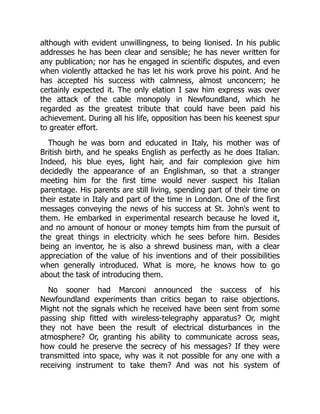
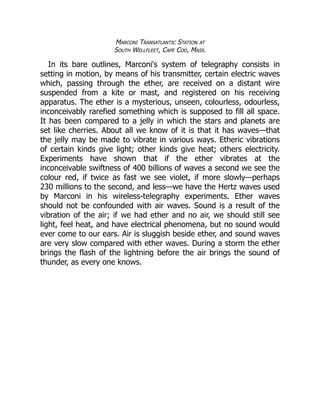
In its bare outlines, Marconi's system of telegraphy consists in
setting in motion, by means of his transmitter, certain electric waves
which, passing through the ether, are received on a distant wire
suspended from a kite or mast, and registered on his receiving
apparatus. The ether is a mysterious, unseen, colourless, odourless,
inconceivably rarefied something which is supposed to fill all space.
It has been compared to a jelly in which the stars and planets are
set like cherries. About all we know of it is that it has waves—that
the jelly may be made to vibrate in various ways. Etheric vibrations
of certain kinds give light; other kinds give heat; others electricity.
Experiments have shown that if the ether vibrates at the
inconceivable swiftness of 400 billions of waves a second we see the
colour red, if twice as fast we see violet, if more slowly—perhaps
230 millions to the second, and less—we have the Hertz waves used
by Marconi in his wireless-telegraphy experiments. Ether waves
should not be confounded with air waves. Sound is a result of the
vibration of the air; if we had ether and no air, we should still see
light, feel heat, and have electrical phenomena, but no sound would
ever come to our ears. Air is sluggish beside ether, and sound waves
are very slow compared with ether waves. During a storm the ether
brings the flash of the lightning before the air brings the sound of
thunder, as every one knows.
46.
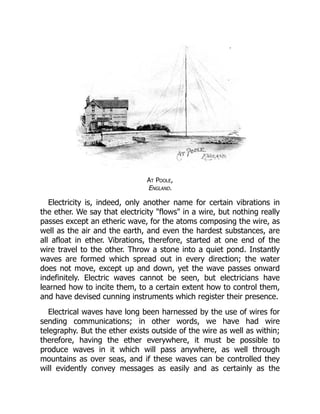
At Poole,
England.
Electricity is,indeed, only another name for certain vibrations in
the ether. We say that electricity "flows" in a wire, but nothing really
passes except an etheric wave, for the atoms composing the wire, as
well as the air and the earth, and even the hardest substances, are
all afloat in ether. Vibrations, therefore, started at one end of the
wire travel to the other. Throw a stone into a quiet pond. Instantly
waves are formed which spread out in every direction; the water
does not move, except up and down, yet the wave passes onward
indefinitely. Electric waves cannot be seen, but electricians have
learned how to incite them, to a certain extent how to control them,
and have devised cunning instruments which register their presence.
Electrical waves have long been harnessed by the use of wires for
sending communications; in other words, we have had wire
telegraphy. But the ether exists outside of the wire as well as within;
therefore, having the ether everywhere, it must be possible to
produce waves in it which will pass anywhere, as well through
mountains as over seas, and if these waves can be controlled they
will evidently convey messages as easily and as certainly as the
47.
ether within wires.So argued Mr. Marconi. The difficulty lay in
making an instrument which would produce a peculiar kind of wave,
and in receiving and registering this wave in a second apparatus
located at a distance from the first. It was, therefore, a practical
mechanical problem which Marconi had to meet. Beginning with
crude tin boxes set up on poles on the grounds of his father's estate
in Italy, he finally devised an apparatus from which a current
generated by a battery and passing in brilliant sparks between two
brass balls was radiated from a wire suspended on a tall pole. By
shutting off and turning on this peculiar current, by means of a
device similar to the familiar telegrapher's key, the waves could be
so divided as to represent dashes and dots, and spell out letters in
the Morse alphabet. This was the transmitter. It was, indeed, simple
enough to start these waves travelling through space, to jar the
etheric jelly, so to speak; but it was far more difficult to devise an
apparatus to receive and register them. For this purpose Marconi
adopted a device invented by an Italian, Calzecchi, and improved by
a Frenchman, M. Branley, called the coherer, and the very crux of
the system, without which there could be no wireless telegraphy.
This coherer, which he greatly improved, is merely a little tube of
glass as big around as a lead-pencil, and perhaps two inches long. It
is plugged at each end with silver, the plugs nearly meeting within
the tube. The narrow space between them is filled with finely
powdered fragments of nickel and silver, which possess the strange
property of being alternately very good and very bad conductors of
electrical waves. The waves which come from the transmitter,
perhaps 2,000 miles away, are received on a suspended kite-wire,
exactly similar to the wire used in the transmitter, but they are so
weak that they could not of themselves operate an ordinary
telegraph instrument. They do, however, possess strength enough to
draw the little particles of silver and nickel in the coherer together in
a continuous metal path. In other words, they make these particles
"cohere," and the moment they cohere they become a good
conductor for electricity, and a current from a battery near at hand
rushes through, operates the Morse instrument, and causes it to
print a dot or a dash; then a little tapper, actuated by the same
48.
current, strikes againstthe coherer, the particles of metal are jarred
apart or "decohered," becoming instantly a poor conductor, and thus
stopping the strong current from the home battery. Another wave
comes through space, down the suspended kite-wire, into the
coherer, there drawing the particles again together, and another dot
or dash is printed. All these processes are continued rapidly, until a
complete message is ticked out on the tape. Thus Mr. Kemp knew
when he heard the tapper strike the coherer that a signal was
coming, though he could not hear the click of the receiver itself. And
this is in bare outline Mr. Marconi's invention—this is the combination
of devices which has made wireless telegraphy possible, the
invention on which he has taken out more than 132 patents in every
civilised country of the world. Of course his instruments contain
much of intricate detail, of marvellously ingenious adaptation to the
needs of the work, but these are interesting chiefly to expert
technicians.
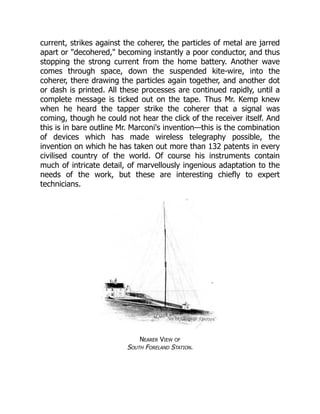
Nearer View of
South Foreland Station.
49.
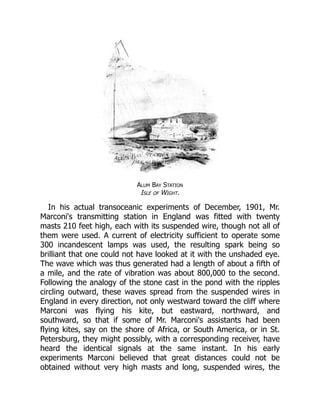
Alum Bay Station
Isleof Wight.
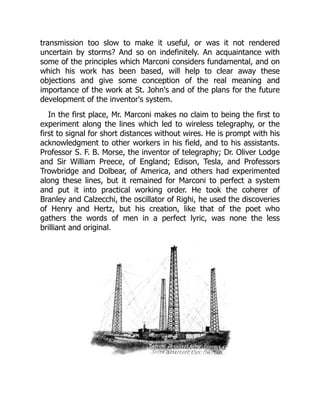
In his actual transoceanic experiments of December, 1901, Mr.
Marconi's transmitting station in England was fitted with twenty
masts 210 feet high, each with its suspended wire, though not all of
them were used. A current of electricity sufficient to operate some
300 incandescent lamps was used, the resulting spark being so
brilliant that one could not have looked at it with the unshaded eye.
The wave which was thus generated had a length of about a fifth of
a mile, and the rate of vibration was about 800,000 to the second.
Following the analogy of the stone cast in the pond with the ripples
circling outward, these waves spread from the suspended wires in
England in every direction, not only westward toward the cliff where
Marconi was flying his kite, but eastward, northward, and
southward, so that if some of Mr. Marconi's assistants had been
flying kites, say on the shore of Africa, or South America, or in St.
Petersburg, they might possibly, with a corresponding receiver, have
heard the identical signals at the same instant. In his early
experiments Marconi believed that great distances could not be
obtained without very high masts and long, suspended wires, the
50.
greater the distancethe taller the mast, on the theory that the
waves were hindered by the curvature of the earth; but his later
theory, substantiated by his Newfoundland experiments, is that the
waves somehow follow around the earth, conforming to its curve,
and the next station he establishes in America will not be set high on
a cliff, as at St. John's, but down close to the water on level land. His
Newfoundland experiments have also convinced him that one of the
secrets of successful long-distance transmission is the use of a more
powerful current in his transmitter, and this he will test in his next
trials between the continents.
And now we come to the most important part of Mr. Marconi's
work, the part least known even to science, and the field of almost
illimitable future development. This is the system of "tuning," as the
inventor calls it, the construction of a certain receiver so that it will
respond only to the message sent by a certain transmitter. When
Marconi's discoveries were first announced in 1896, there existed no
method of tuning, though the inventor had its necessity clearly in
mind. Accordingly the public inquired, "How are you going to keep
your messages secret? Supposing a warship wishes to communicate
with another of the fleet, what is to prevent the enemy from reading
your message? How are private business despatches to be secured
against publicity?" Here, indeed, was a problem. Without secrecy no
system of wireless telegraphy could ever reach great commercial
importance, or compete with the present cable communication. The
inventor first tried using a parabolic copper reflector, by means of
which he could radiate the electric waves exactly as light—which, it
will be borne in mind, is only another kind of etheric wave—is
reflected by a mirror. This reflector could be faced in any desired
direction, and only a receiver located in that direction would respond
to the message. But there were grave objections to the reflector; an
enemy might still creep in between the sending and receiving
stations, and, moreover, it was found that the curvature of the earth
interfered with the transmission of reflected messages, thereby
limiting their usefulness to short distances.
51.
Welcome to ourwebsite – the perfect destination for book lovers and
knowledge seekers. We believe that every book holds a new world,
offering opportunities for learning, discovery, and personal growth.
That’s why we are dedicated to bringing you a diverse collection of
books, ranging from classic literature and specialized publications to
self-development guides and children's books.
More than just a book-buying platform, we strive to be a bridge
connecting you with timeless cultural and intellectual values. With an
elegant, user-friendly interface and a smart search system, you can
quickly find the books that best suit your interests. Additionally,
our special promotions and home delivery services help you save time
and fully enjoy the joy of reading.
Join us on a journey of knowledge exploration, passion nurturing, and
personal growth every day!
ebookbell.com