| http://online.mcphs.edu
PBH815 Mass Communication and Health
Week 1
Introduction to
Public Health
Communication
Module 1:
Why It Matters
| http://online.mcphs.edu
Introduction
 Public Health Communication: What is it?
 Why Health Communication Matters
 Who Does Health Communication?
 Health Communication: A Core Competency
| http://online.mcphs.edu
Public Health Communication
"The study and use of communication strategies
to inform and influence individual and community
decisions that enhance health."
Source: Centers for Disease Control and Prevention
| http://online.mcphs.edu
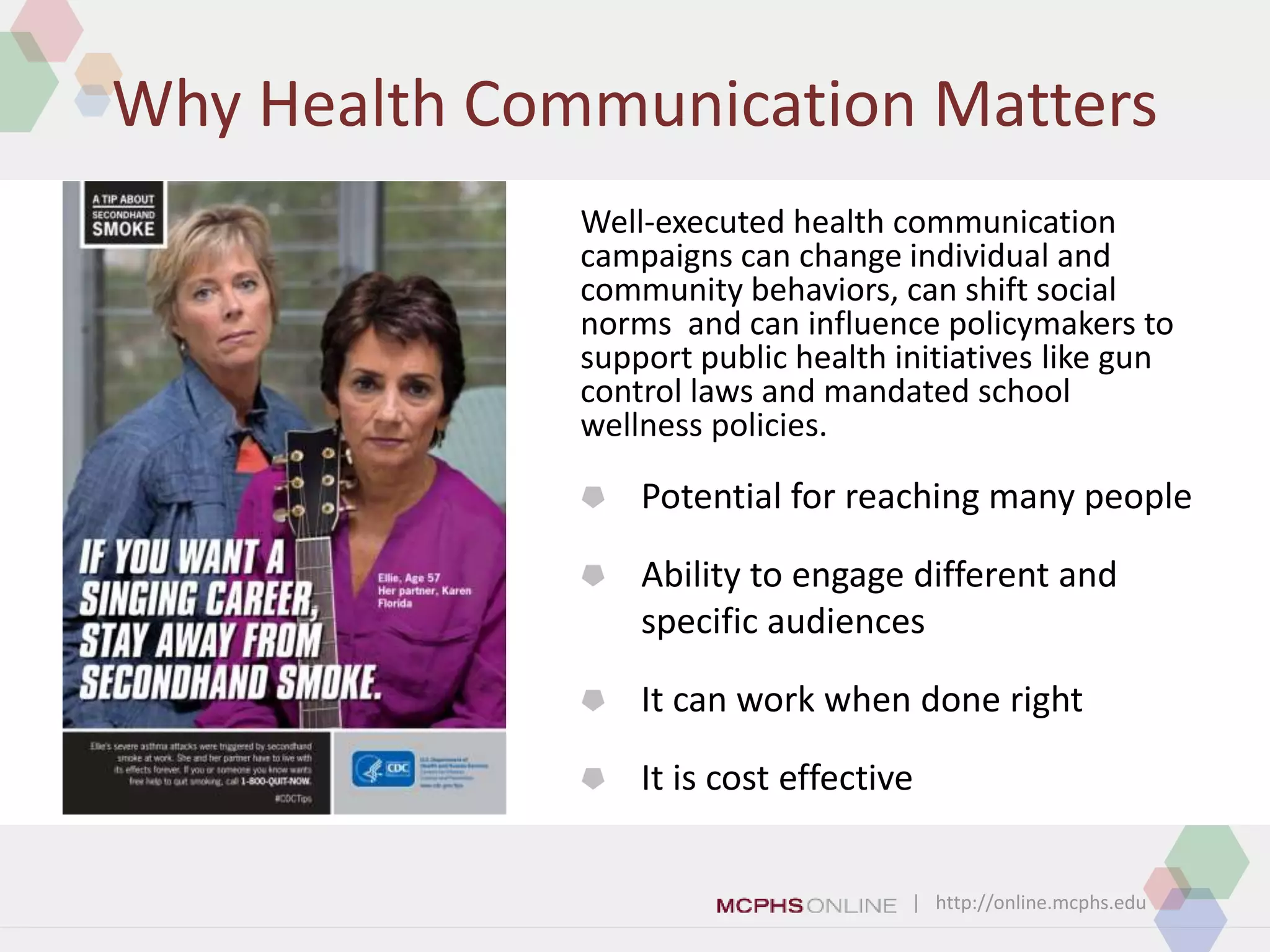
Why Health Communication Matters
 Potential for reaching many people
 Ability to engage different and
specific audiences
 It can work when done right
 It is cost effective
Well-executed health communication
campaigns can change individual and
community behaviors, can shift social
norms and can influence policymakers to
support public health initiatives like gun
control laws and mandated school
wellness policies.
| http://online.mcphs.edu
Why Health Communication Matters
 Increases the intended audience’s
knowledge and awareness of a health issue,
problem, or solution
 Influences perceptions, beliefs, and
attitudes that may change social norms
 Prompts action
 Demonstrates or illustrates healthy
skills
 Reinforces knowledge, attitudes, or
behavior
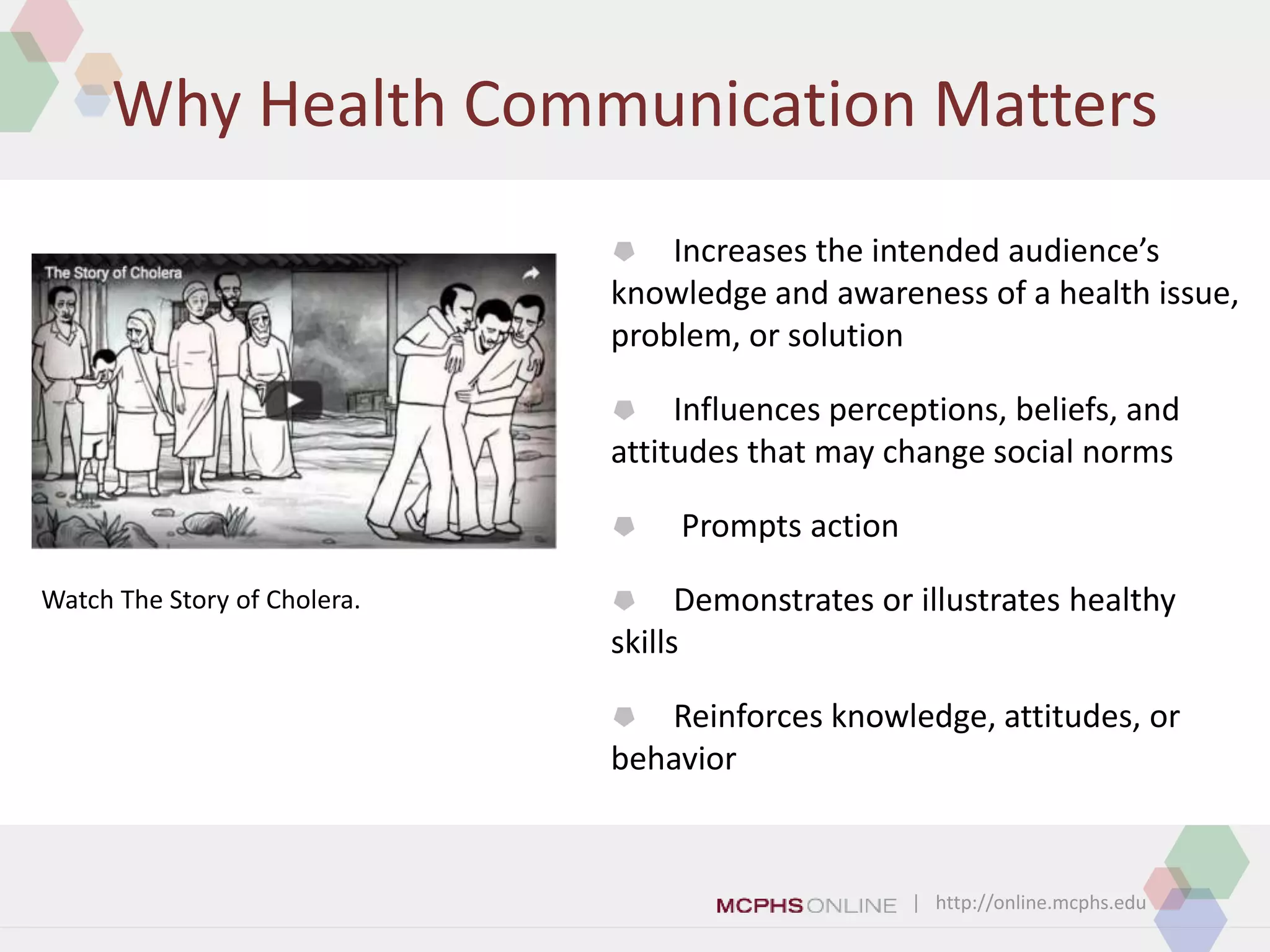
Watch The Story of Cholera.
| http://online.mcphs.edu
Why Health Communication Matters
 Shows the benefit of behavior
change
 Advocates a position on a health
issue or policy
 Increases demand or support for
health services
 Refute myths and misconceptions
 Strengthens organizational
relationships
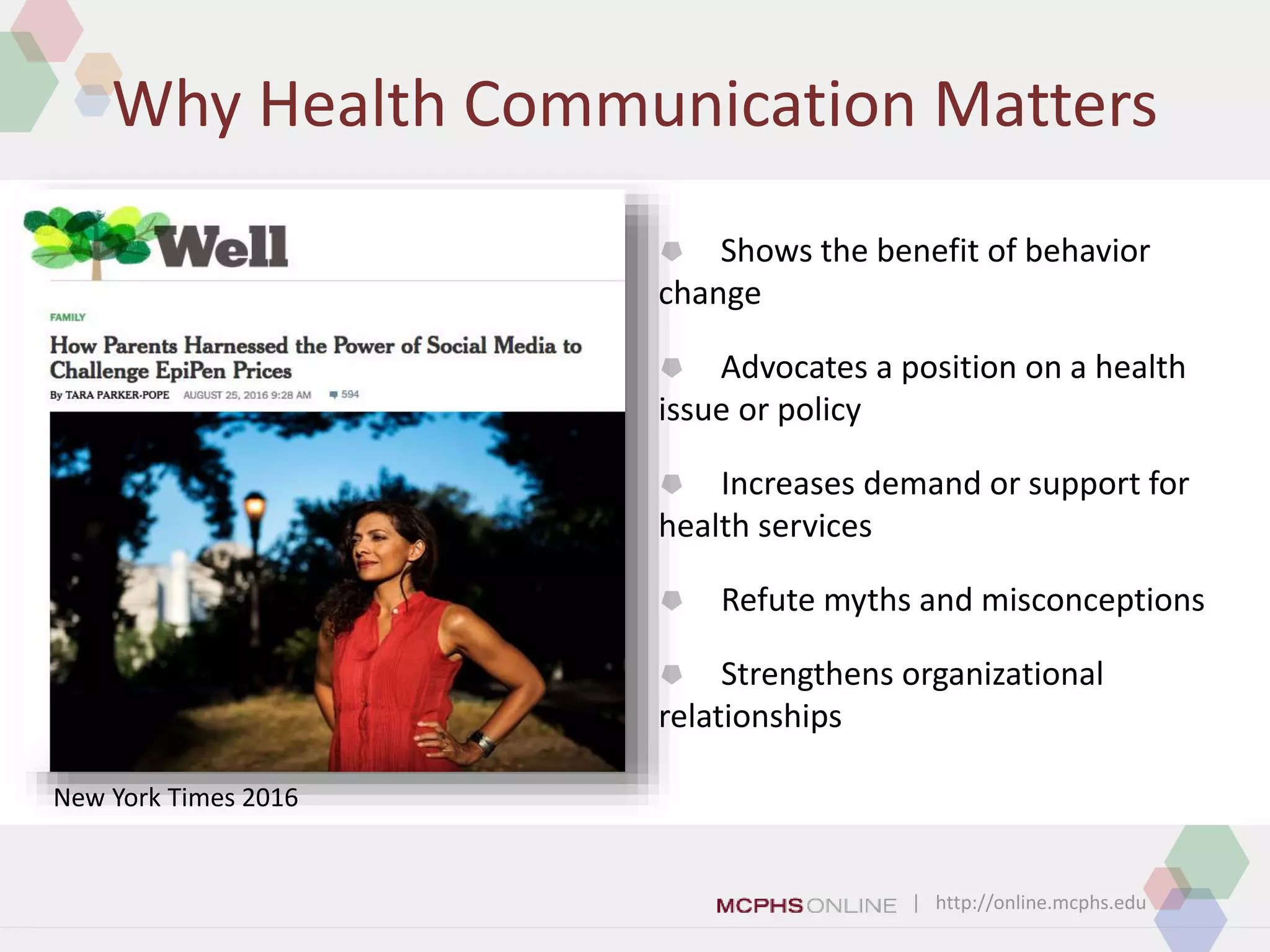
New York Times 2016
| http://online.mcphs.edu
Health Misinformation Costs Lives
 According to the Surgeon General, health
misinformation is a public health crisis
 Health misinformation targets the users’ emotional
response and triggers fear, anxiety, and confirmation
bias
 It’s spreading at an extremely rapid pace due to the
ubiquitous nature of social media
 Algorithms are outsmarting users, forcing them
toward content that favors misinformation over facts
| http://online.mcphs.edu
Health Communication Can Affect Change
on Many Levels
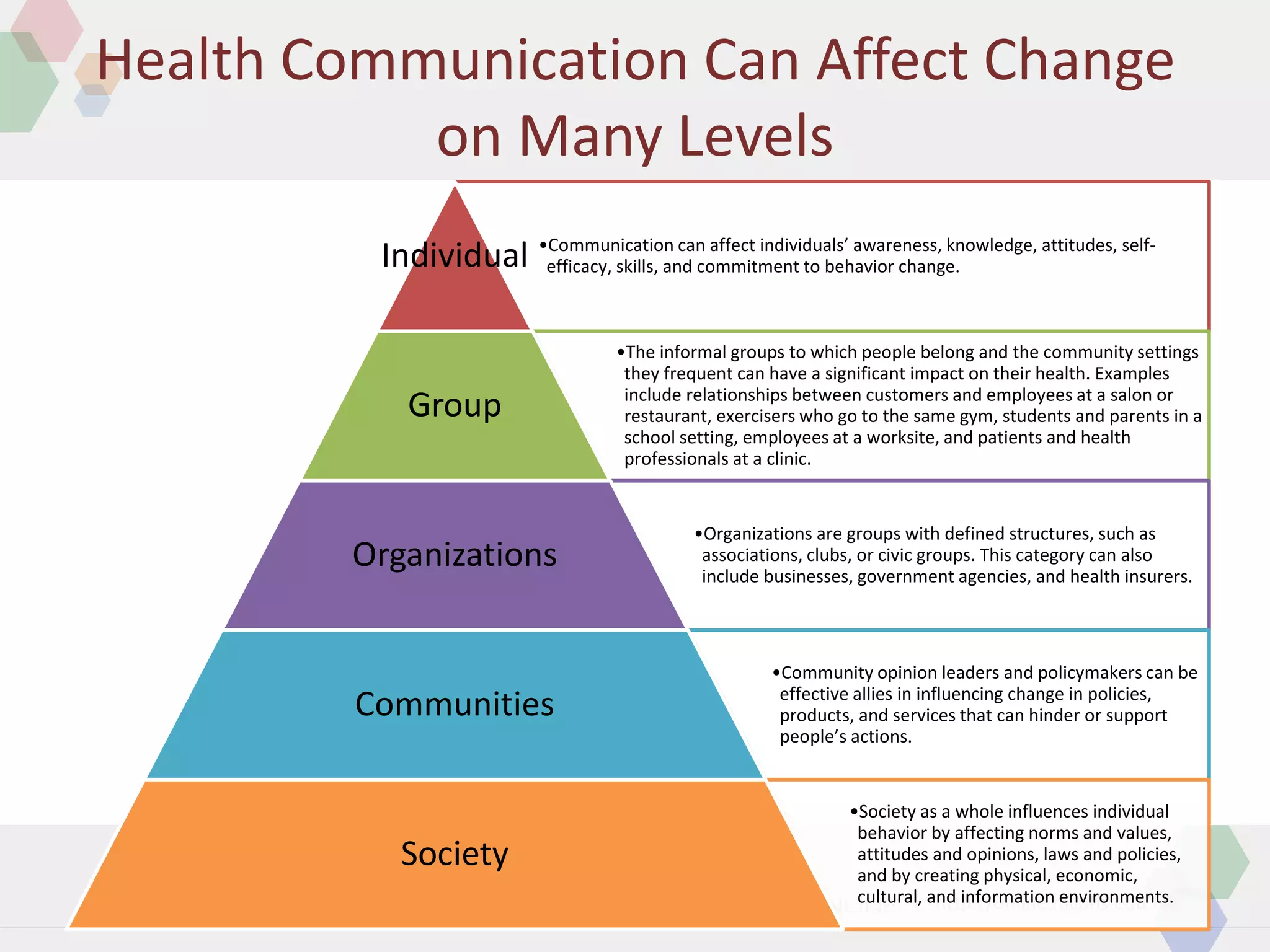
•Communication can affect individuals’ awareness, knowledge, attitudes, self-
efficacy, skills, and commitment to behavior change.
Individual
•The informal groups to which people belong and the community settings
they frequent can have a significant impact on their health. Examples
include relationships between customers and employees at a salon or
restaurant, exercisers who go to the same gym, students and parents in a
school setting, employees at a worksite, and patients and health
professionals at a clinic.
Group
•Organizations are groups with defined structures, such as
associations, clubs, or civic groups. This category can also
include businesses, government agencies, and health insurers.
Organizations
•Community opinion leaders and policymakers can be
effective allies in influencing change in policies,
products, and services that can hinder or support
people’s actions.
Communities
•Society as a whole influences individual
behavior by affecting norms and values,
attitudes and opinions, laws and policies,
and by creating physical, economic,
cultural, and information environments.
Society
| http://online.mcphs.edu
Why Does Health Communication Matter
to You?
A basic mastery of health communication will become increasingly
important to anyone going into the health or allied health professions
 If you deal directly with patients, you will need to be able to communicate
clearly and appropriately to an increasingly diverse and non-English
speaking population.
 If you become a hospital administrator or public health official you will
need to communicate effectively with the media and funders, and of
course, your patients.
 If you end up working in governmental public health or in the community
health department of a hospital, you’ll most likely find yourself engaged in
health marketing campaigns and producing communication materials.
Many students may not plan to pursue health communication as a career…
HOWEVER!
| http://online.mcphs.edu
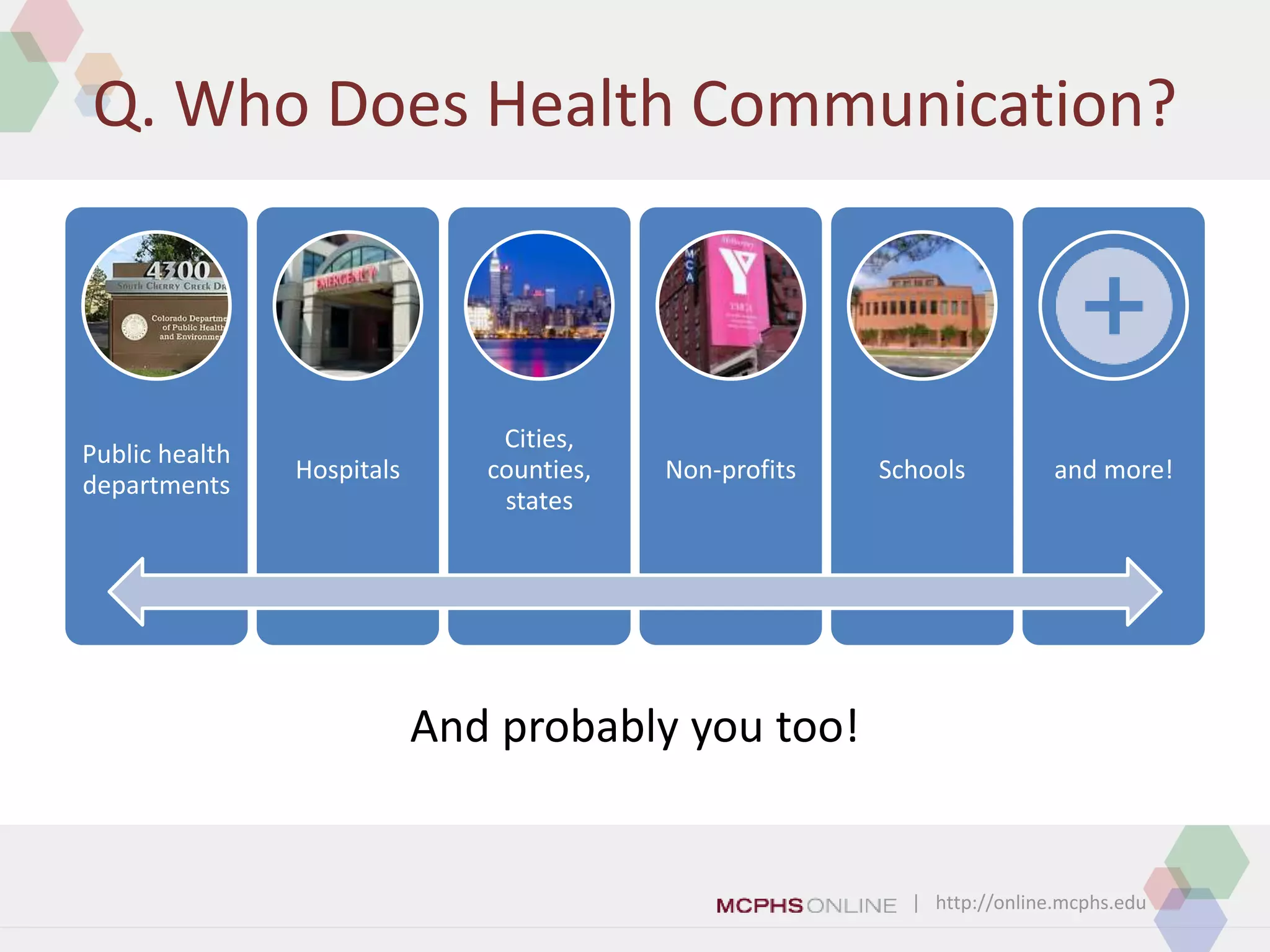
Q. Who Does Health Communication?
Public health
departments
Hospitals
Cities,
counties,
states
Non-profits Schools and more!
And probably you too!
| http://online.mcphs.edu
Communication Core Competencies
Essential Skills For MPH Students:
 Apply theory and strategy-based communication
principles across different settings and audiences.
 Collaborate with communication specialists in designing,
implementing, and evaluating public health programs.
 Demonstrate effective written and oral skills for
communicating with different audiences.
 Use communication methods to advocate for public
health issues and programs.
| http://online.mcphs.edu
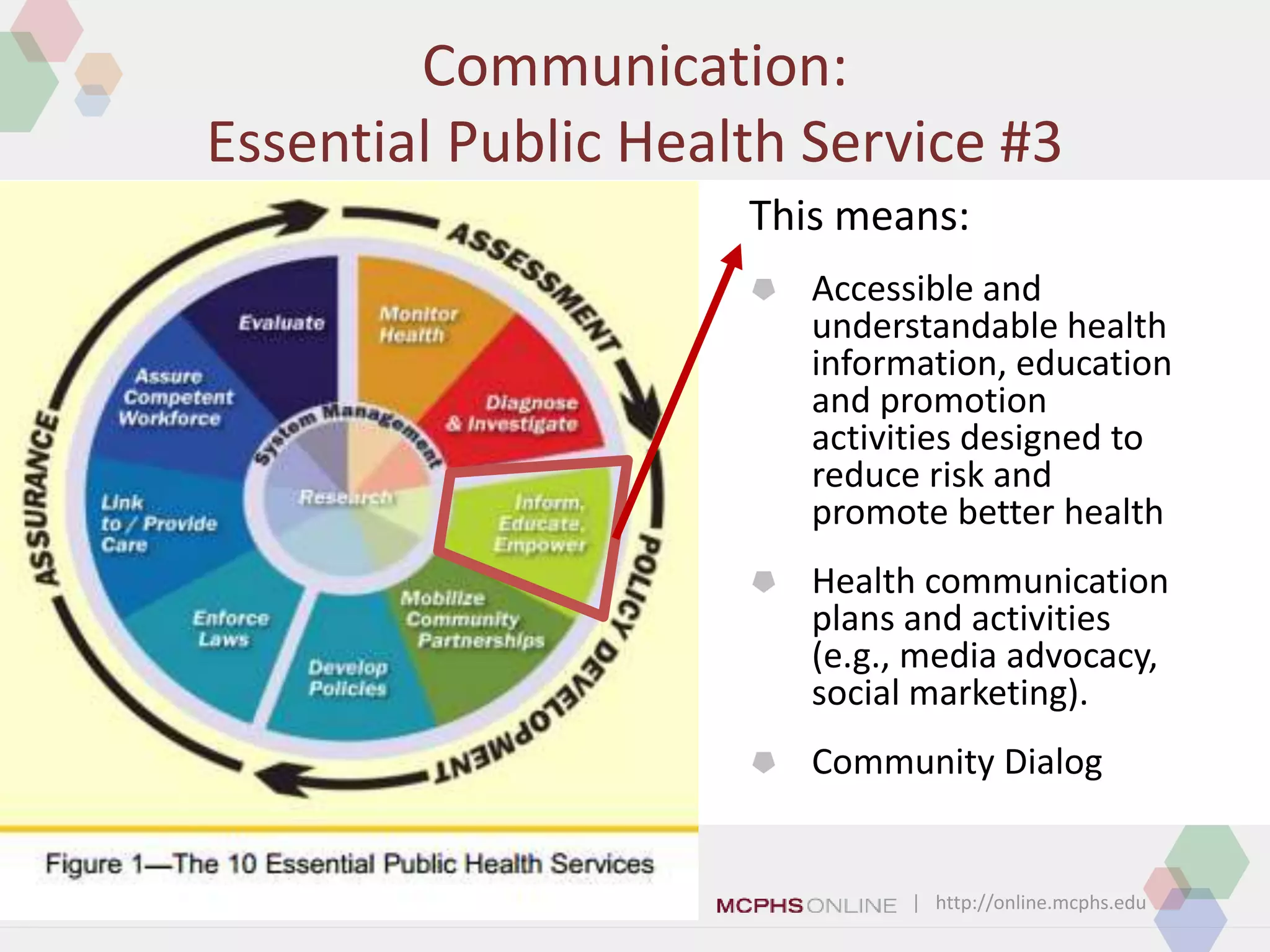
Communication:
Essential Public Health Service #3
This means:
 Accessible and
understandable health
information, education
and promotion
activities designed to
reduce risk and
promote better health
 Health communication
plans and activities
(e.g., media advocacy,
social marketing).
 Community Dialog
| http://online.mcphs.edu
Summary
 Health communication is an important tool and it
encompasses many strategies and vehicles to enhance
health.
 Health communication can impact change on multiple
levels.
 Health communication is an important area of expertise in
public health, performed by and for a variety of public and
private agencies.
 How can you improve health or reduce or eliminate
disease without communicating effectively?

PBH.815: Week 1 Lecture Slides

  • 1.
    | http://online.mcphs.edu PBH815 MassCommunication and Health Week 1 Introduction to Public Health Communication Module 1: Why It Matters
  • 2.
    | http://online.mcphs.edu Introduction  PublicHealth Communication: What is it?  Why Health Communication Matters  Who Does Health Communication?  Health Communication: A Core Competency
  • 3.
    | http://online.mcphs.edu Public HealthCommunication "The study and use of communication strategies to inform and influence individual and community decisions that enhance health." Source: Centers for Disease Control and Prevention
  • 4.
    | http://online.mcphs.edu Why HealthCommunication Matters  Potential for reaching many people  Ability to engage different and specific audiences  It can work when done right  It is cost effective Well-executed health communication campaigns can change individual and community behaviors, can shift social norms and can influence policymakers to support public health initiatives like gun control laws and mandated school wellness policies.
  • 5.
    | http://online.mcphs.edu Why HealthCommunication Matters  Increases the intended audience’s knowledge and awareness of a health issue, problem, or solution  Influences perceptions, beliefs, and attitudes that may change social norms  Prompts action  Demonstrates or illustrates healthy skills  Reinforces knowledge, attitudes, or behavior Watch The Story of Cholera.
  • 6.
    | http://online.mcphs.edu Why HealthCommunication Matters  Shows the benefit of behavior change  Advocates a position on a health issue or policy  Increases demand or support for health services  Refute myths and misconceptions  Strengthens organizational relationships New York Times 2016
  • 7.
    | http://online.mcphs.edu Health MisinformationCosts Lives  According to the Surgeon General, health misinformation is a public health crisis  Health misinformation targets the users’ emotional response and triggers fear, anxiety, and confirmation bias  It’s spreading at an extremely rapid pace due to the ubiquitous nature of social media  Algorithms are outsmarting users, forcing them toward content that favors misinformation over facts
  • 8.
    | http://online.mcphs.edu Health CommunicationCan Affect Change on Many Levels •Communication can affect individuals’ awareness, knowledge, attitudes, self- efficacy, skills, and commitment to behavior change. Individual •The informal groups to which people belong and the community settings they frequent can have a significant impact on their health. Examples include relationships between customers and employees at a salon or restaurant, exercisers who go to the same gym, students and parents in a school setting, employees at a worksite, and patients and health professionals at a clinic. Group •Organizations are groups with defined structures, such as associations, clubs, or civic groups. This category can also include businesses, government agencies, and health insurers. Organizations •Community opinion leaders and policymakers can be effective allies in influencing change in policies, products, and services that can hinder or support people’s actions. Communities •Society as a whole influences individual behavior by affecting norms and values, attitudes and opinions, laws and policies, and by creating physical, economic, cultural, and information environments. Society
  • 9.
    | http://online.mcphs.edu Why DoesHealth Communication Matter to You? A basic mastery of health communication will become increasingly important to anyone going into the health or allied health professions  If you deal directly with patients, you will need to be able to communicate clearly and appropriately to an increasingly diverse and non-English speaking population.  If you become a hospital administrator or public health official you will need to communicate effectively with the media and funders, and of course, your patients.  If you end up working in governmental public health or in the community health department of a hospital, you’ll most likely find yourself engaged in health marketing campaigns and producing communication materials. Many students may not plan to pursue health communication as a career… HOWEVER!
  • 10.
    | http://online.mcphs.edu Q. WhoDoes Health Communication? Public health departments Hospitals Cities, counties, states Non-profits Schools and more! And probably you too!
  • 11.
    | http://online.mcphs.edu Communication CoreCompetencies Essential Skills For MPH Students:  Apply theory and strategy-based communication principles across different settings and audiences.  Collaborate with communication specialists in designing, implementing, and evaluating public health programs.  Demonstrate effective written and oral skills for communicating with different audiences.  Use communication methods to advocate for public health issues and programs.
  • 12.
    | http://online.mcphs.edu Communication: Essential PublicHealth Service #3 This means:  Accessible and understandable health information, education and promotion activities designed to reduce risk and promote better health  Health communication plans and activities (e.g., media advocacy, social marketing).  Community Dialog
  • 13.
    | http://online.mcphs.edu Summary  Healthcommunication is an important tool and it encompasses many strategies and vehicles to enhance health.  Health communication can impact change on multiple levels.  Health communication is an important area of expertise in public health, performed by and for a variety of public and private agencies.  How can you improve health or reduce or eliminate disease without communicating effectively?

Editor's Notes

  • #3 In this course we will be looking at many facets of public health communication—from creating health campaigns that inspire communities and individuals to make healthy choices to the elements of effective writing. A quick heads up: For the purposes of this course, I will be using the terms “public health communication” and “health communication” interchangeably.
  • #4 As the textbook authors point out, health communication is a relatively new field that emerged in the 1970s. The groups that pioneered this field were the U.S. Agency for International Development, the National Cancer Institute, and Porter Novelli, a global public relations firm. The Centers for Disease Control and Prevention became a major proponent of health communication in the early 1990s. People at these federal agencies took their cues from the advertising world. They realized that marketing techniques being used so successfully by Madison Avenue to sell sugary drinks, fast food, and cigarettes could be co-opted to save lives and promote good health in the U.S. and abroad. The decision to market health is somewhat of a David and Goliath story – The Food Industry and Big Tobacco pour billions every year into marketing their products. Contrast this to Center for Science in the Public Interest, widely regarded as the lead lobbying force for healthier food. CSPI has an annual lobbying budget of around $70,000. Likewise, a local health department might be lucky if it had $15,000 to spend on a communication campaign. It’s important to remember that health communication is not a one-way, top-down exercise where experts tell the public what to do. Instead, it is interactive, where information is “communicated TO AND FROM intended audiences.” We’ll be going back to this throughout this course.
  • #5 The good news is that well-executed health communication campaigns can change individual and community behaviors, can shift social norms and can influence policymakers to support public health initiatives like gun control laws and mandated school wellness policies. From an administrative perspective, health communication campaigns are attractive because they have the potential for reaching many people in a community, because it’s possible to engage different audiences, and because it doesn’t necessarily require a large staff or big budget to create or maintain a local or targeted campaign.
  • #6  There are many reasons that health communication matters, and is effective. The following video, is from Global Health Media. Which of the bullets, above, does it achieve Cholera: https://globalhealthmedia.org/portfolio-items/the-story-of-cholera/?portfolioID=5623
  • #7  Social media can be used to advocate for a policy or position. Please read the following article about how consumer advocates challenged the price gouging of the EpiPen. (We will have a section on social media later in the semester). http://well.blogs.nytimes.com/2016/08/25/how-parents-harnessed-the-power-of-social-media-to-challenge-epipen-prices/
  • #8 Adapted from https://www.hhs.gov/sites/default/files/surgeon-general-misinformation-advisory.pdf
  • #9 Health Communication can affect change on many levels: Individual: Communication can affect individuals’ awareness, knowledge, attitudes, self-efficacy, skills, and commitment to behavior change. Group: The informal groups to which people belong and the community settings they frequent can have a significant impact on their health. Examples include relationships between customers and employees at a salon or restaurant, exercisers who go to the same gym, students and parents in a school setting, employees at a worksite, and patients and health professionals at a clinic. Organizations: Organizations are groups with defined structures, such as associations, clubs, or civic groups. This category can also include businesses, government agencies, and health insurers. Communities: Community opinion leaders and policymakers can be effective allies in influencing change in policies, products, and services that can hinder or support people’s actions. 5. Society: Society as a whole influences individual behavior by affecting norms and values, attitudes and opinions, laws and policies, and by creating physical, economic, cultural, and information environments.
  • #11 I would imagine that most of you don’t plan to pursue health communication as a career— and if that’s the case, you may be wondering how this course will benefit you. Well, here’s my two cents. I think a basic mastery of health communication will become increasingly important to anyone going into the health or allied health professions.  If you deal directly with patients, you will need to be able to communicate clearly and appropriately to an increasingly diverse and non-English speaking population. If you become a hospital administrator or public health official you will need to communicate effectively with the media and funders, and of course, your patients. If you end up working in governmental public health or in the community health department of a hospital, you’ll most likely find yourself engaged in health marketing campaigns and producing communication materials. For instance the Massachusetts Department of Public Health initiated a campaign to increase recognition of the signs and symptoms of Stroke, and the importance of responding instantly by calling 911. They initiated a creative campaign using animation. The animation has been adapted in several languages, and 34 other states are now using the campaign. Here’s the link to the website that describes the project. Click on the video in English, and then see how it was adapted for different formats and cultures: http://www.geovisiononline.com/social-marketing/stroke/
  • #12 Of the 10 core competencies developed by the Association of Schools of Public Health in the area of communication and informatics, here are what I believe are the four essential skills that will be important for many of you to master in your future careers in public health. This course is designed to introduce you to this exciting field, and we will be looking at each of these four competencies in-depth this semester.
  • #13 The role of communication in public health is captured in the CDC’s 10 Essential Public Health Service as essential service #3: To inform, educate, and empower people about health issues.
  • #14 Health communication is a growing specialty area within public health. Often eliminated as “unnecessary”, it is in fact, extremely necessary. How can you improve health or reduce or eliminate disease without communicating effectively?