© Centers for Better Insurance, LLC 2020 Version 1.0
Centers for Better Insurance (CBI) is an independent organization focused on supporting the insurance industry to optimize the value it delivers to all
stakeholders (including policyholders, employees and society at large). CBI does so by making available unbiased analysis and insights about key regulatory
issues facing the industry for use by insurance professionals, regulators and policymakers.
THE MATERIAL AS WELL AS ANY OTHER INFORMATION PROVIDED BY CBI IS PROVIDED ON AN "AS IS" AND "AS AVAILABLE" BASIS. CBI does not
guarantee the accuracy or completeness of this material or any other information and may add, remove, discontinue, change, improve, or update this material
or any other information without notice. Under no circumstances shall CBI be liable for any loss, damage, liability or expense claimed to result from use of this
material or any other information.
Centers for
Better Insurance
Policyholders
Employees
Shareholders
Society
Supporting value creation for all stakeholders through
beneficial purpose, sound governance and effective controls www.betterins.org
CBI-PAN-20-07
Paycheck Protection Program (PPP)
vs.
Pandemic Risk Insurance Act (PRIA)
Pandemic Response Options
CBI
© Centers for Better Insurance, LLC 2020 Version 1.0 2www.betterins.org
Centers for
Better Insurance
Policyholders
Employees
Shareholders
Society
PPP vs. PRIA
Executive Summary
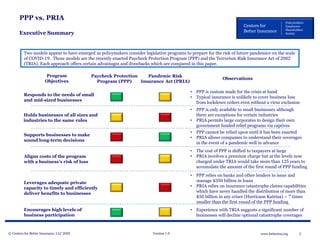
Two models appear to have emerged as policymakers consider legislative programs to prepare for the risk of future pandemics on the scale
of COVID-19. Those models are the recently enacted Paycheck Protection Program (PPP) and the Terrorism Risk Insurance Act of 2002
(TRIA). Each approach offers certain advantages and drawbacks which are compared in this paper.
Observations
Responds to the needs of small
and mid-sized businesses
• PPP is custom made for the crisis at hand
• Typical insurance is unlikely to cover business loss
from lockdown orders even without a virus exclusion
Holds businesses of all sizes and
industries to the same rules
• PPP is only available to small businesses although
there are exceptions for certain industries
• PRIA permits large corporates to design their own
government funded relief programs via captives
Supports businesses to make
sound long-term decisions
• PPP cannot be relied upon until it has been enacted
• PRIA allows companies to understand their coverages
in the event of a pandemic well in advance
Aligns costs of the program
with a business’s risk of loss
• The cost of PPP is shifted to taxpayers at large
• PRIA involves a premium charge but at the levels now
charged under TRIA would take more than 125 years to
accumulate the amount of the first round of PPP funding
Leverages adequate private
capacity to timely and efficiently
deliver benefits to businesses
• PPP relies on banks and other lenders to issue and
manage $350 billion in loans
• PRIA relies on insurance catastrophe claims capabilities
which have never handled the distribution of more than
$50 billion in any crises (Hurricane Katrina) – 7 times
smaller than the first round of the PPP funding
Encourages high levels of
business participation
Paycheck Protection
Program (PPP)
Pandemic Risk
Insurance Act (PRIA)
• Experience with TRIA suggests a significant number of
businesses will decline optional catastrophe coverages
Program
Objectives
© Centers for Better Insurance, LLC 2020 Version 1.0 3www.betterins.org
Centers for
Better Insurance
Policyholders
Employees
Shareholders
Society
PPP vs. PRIA
Overview of the Paycheck Protection Program (PPP)
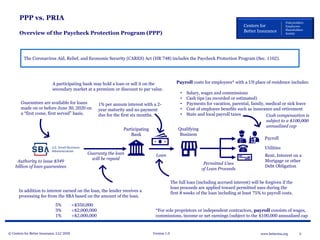
The Coronavirus Aid, Relief, and Economic Security (CARES) Act (HR 748) includes the Paycheck Protection Program (Sec. 1102).
LoanGuaranty the loan
will be repaid
Participating
Bank
Qualifying
Business
Payroll
Utilities
Rent, Interest on a
Mortgage or other
Debt Obligation
Authority to issue $349
billion of loan guarantees
1% per annum interest with a 2-
year maturity and no payment
due for the first six months.
Permitted Uses
of Loan Proceeds
Guarantees are available for loans
made on or before June 30, 2020 on
a “first come, first served” basis.
The full loan (including accrued interest) will be forgiven if the
loan proceeds are applied toward permitted uses during the
first 8 weeks of the loan including at least 75% to payroll costs.
In addition to interest earned on the loan, the lender receives a
processing fee from the SBA based on the amount of the loan.
5% <$350,000
3% <$2,000,000
1% >$2,000,000
A participating bank may hold a loan or sell it on the
secondary market at a premium or discount to par value.
Payroll costs for employees* with a US place of residence includes:
• Salary, wages and commissions
• Cash tips (as recorded or estimated)
• Payments for vacation, parental, family, medical or sick leave
• Cost of employee benefits such as insurance and retirement
• State and local payroll taxes
*For sole proprietors or independent contractors, payroll consists of wages,
commissions, income or net earnings (subject to the $100,000 annualized cap
Cash compensation is
subject to a $100,000
annualized cap
© Centers for Better Insurance, LLC 2020 Version 1.0 4www.betterins.org
Centers for
Better Insurance
Policyholders
Employees
Shareholders
Society
PPP vs. PRIA
Paycheck Protection Program (PPP) Qualification Criteria
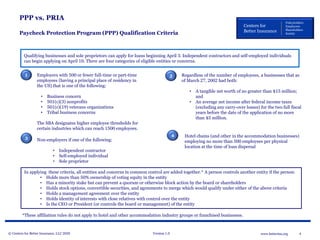
Qualifying businesses and sole proprietors can apply for loans beginning April 3. Independent contractors and self-employed individuals
can begin applying on April 10. There are four categories of eligible entities or concerns.
Non-employers if one of the following:
• Independent contractor
• Self-employed individual
• Sole proprietor
Employers with 500 or fewer full-time or part-time
employees (having a principal place of residency in
the US) that is one of the following:
• Business concern
• 501(c)(3) nonprofits
• 501(c)(19) veterans organizations
• Tribal business concerns
The SBA designates higher employee thresholds for
certain industries which can reach 1500 employees.
Regardless of the number of employees, a businesses that as
of March 27, 2002 had both:
• A tangible net worth of no greater than $15 million;
and
• An average net income after federal income taxes
(excluding any carry-over losses) for the two full fiscal
years before the date of the application of no more
than $5 million.
1 2
3
Hotel chains (and other in the accommodation businesses)
employing no more than 500 employees per physical
location at the time of loan dispersal
4
In applying these criteria, all entities and concerns in common control are added together.* A person controls another entity if the person:
• Holds more than 50% ownership of voting equity in the entity
• Has a minority stake but can prevent a quorum or otherwise block action by the board or shareholders
• Holds stock options, convertible securities, and agreements to merge which would qualify under either of the above criteria
• Holds a management agreement over the entity
• Holds identity of interests with close relatives with control over the entity
• Is the CEO or President (or controls the board or management) of the entity
*These affiliation rules do not apply to hotel and other accommodation industry groups or franchised businesses.
© Centers for Better Insurance, LLC 2020 Version 1.0 5www.betterins.org
Centers for
Better Insurance
Policyholders
Employees
Shareholders
Society
PPP vs. PRIA
Pandemic Risk Insurance Act (PRIA) – Make Available Requirement
Offer of a Policy without a Virus Exclusion
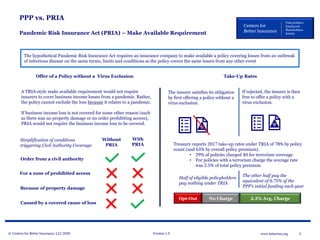
The hypothetical Pandemic Risk Insurance Act requires an insurance company to make available a policy covering losses from an outbreak
of infectious disease on the same terms, limits and conditions as the policy covers the same losses from any other event
A TRIA-style make available requirement would not require
insurers to cover business income losses from a pandemic. Rather,
the policy cannot exclude the loss because it relates to a pandemic.
If business income loss is not covered for some other reason (such
as there was no property damage or no order prohibiting access),
PRIA would not require the business income loss to be covered.
The insurer satisfies its obligation
by first offering a policy without a
virus exclusion.
If rejected, the insurer is then
free to offer a policy with a
virus exclusion.
Treasury reports 2017 take-up rates under TRIA of 78% by policy
count (and 63% by overall policy premium).
• 29% of policies charged $0 for terrorism coverage
• For policies with a terrorism charge the average rate
was 2.5% of total policy premium
Take-Up Rates
Order from a civil authority
Caused by a covered cause of loss
For a zone of prohibited access
Because of property damage
With
PRIA
Without
PRIA
Simplification of conditions
triggering Civil Authority Coverage
No Charge 2.5% Avg. ChargeOpt-Out
Half of eligible policyholders
pay nothing under TRIA
The other half pay the
equivalent of 0.75% of the
PPP’s initial funding each year
© Centers for Better Insurance, LLC 2020 Version 1.0 6www.betterins.org
Centers for
Better Insurance
Policyholders
Employees
Shareholders
Society
PPP vs. PRIA
Pandemic Risk Insurance Act (PRIA) – The Backstop
The Backstop Competitive Dislocation
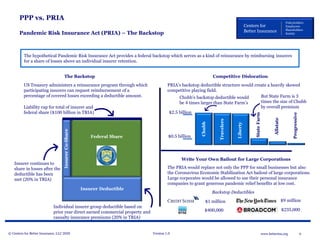
The hypothetical Pandemic Risk Insurance Act provides a federal backstop which serves as a kind of reinsurance by reimbursing insurers
for a share of losses above an individual insurer retention.
Liability cap for total of insurer and
federal share ($100 billion in TRIA)
Individual insurer group deductible based on
prior year direct earned commercial property and
casualty insurance premiums (20% in TRIA)
Insurer Deductible
InsurerCo-Share
Federal Share
Insurer continues to
share in losses after the
deductible has been
met (20% in TRIA)
US Treasury administers a reinsurance program through which
participating insurers can request reimbursement of a
percentage of covered losses exceeding a deductible amount.
PRIA’s backstop deductible structure would create a heavily skewed
competitive playing field.
AXA
Chubb
Travelers
StateFarm
Liberty
Allstate
Progressive
$2.5 billion
$0.5 billion
But State Farm is 3
times the size of Chubb
by overall premium
Chubb’s backstop deductible would
be 4 times larger than State Farm’s
The PRIA would replace not only the PPP for small businesses but also
the Coronavirus Economic Stabilization Act bailout of large corporations.
Large corporates would be allowed to use their personal insurance
companies to grant generous pandemic relief benefits at low cost.
Write Your Own Bailout for Large Corporations
$1 million
Backstop Deductibles
$400,000
$9 million
$235,000
© Centers for Better Insurance, LLC 2020 Version 1.0 7www.betterins.org
Centers for
Better Insurance
Policyholders
Employees
Shareholders
Society
PPP vs. PRIA
Pandemic Risk Insurance Act (PRIA) – Overwhelming Scale
PPP Initial Funding
10 largest US property insurance losses in 2018 dollars
(Insurance Information Institute)
TRIA Claims Capacity
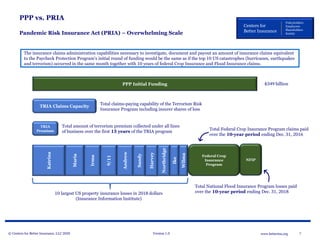
Total National Flood Insurance Program losses paid
over the 10-year period ending Dec. 31, 2018
The insurance claims administration capabilities necessary to investigate, document and payout an amount of insurance claims equivalent
to the Paycheck Protection Program’s initial round of funding would be the same as if the top 10 US catastrophes (hurricanes, earthquakes
and terrorism) occurred in the same month together with 10 years of federal Crop Insurance and Flood Insurance claims.
Total claims-paying capability of the Terrorism Risk
Insurance Program including insurer shares of loss
$349 billion
TRIA
Premium
Total amount of terrorism premium collected under all lines
of business over the first 15 years of the TRIA program
Katrina
Maria
Irma
9/11
Andrew
Sandy
Harvey
Northridge
Ike
Wilma
NFIP
Federal Crop
Insurance
Program
Total Federal Crop Insurance Program claims paid
over the 10-year period ending Dec. 31, 2016
© Centers for Better Insurance, LLC 2020 Version 1.0 8www.betterins.org
Centers for
Better Insurance
Policyholders
Employees
Shareholders
Society
PPP vs. PRIA
Comparison of Conditions for Coverage
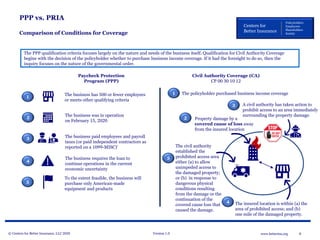
The PPP qualification criteria focuses largely on the nature and needs of the business itself. Qualification for Civil Authority Coverage
begins with the decision of the policyholder whether to purchase business income coverage. If it had the foresight to do so, then the
inquiry focuses on the nature of the governmental order.
Civil Authority Coverage (CA)
CP 00 30 10 12
2
3
4
Property damage by a
covered cause of loss away
from the insured location
A civil authority has taken action to
prohibit access to an area immediately
surrounding the property damage.
The insured location is within (a) the
area of prohibited access; and (b)
one mile of the damaged property.
5
The civil authority
established the
prohibited access area
either (a) to allow
unimpeded access to
the damaged property;
or (b) in response to
dangerous physical
conditions resulting
from the damage or the
continuation of the
covered cause loss that
caused the damage.
Paycheck Protection
Program (PPP)
To the extent feasible, the business will
purchase only American-made
equipment and products
2
4
5
The business was in operation
on February 15, 2020
3 The business paid employees and payroll
taxes (or paid independent contractors as
reported on a 1099-MISC)’
The business requires the loan to
continue operations in the current
economic uncertainty
1
The business has 500 or fewer employees
or meets other qualifying criteria
1 The policyholder purchased business income coverage
© Centers for Better Insurance, LLC 2020 Version 1.0 9www.betterins.org
Centers for
Better Insurance
Policyholders
Employees
Shareholders
Society
PPP vs. PRIA
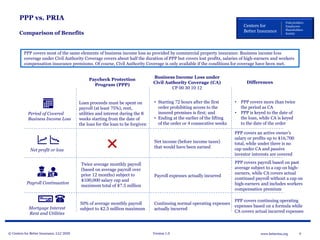
Comparison of Benefits
PPP covers most of the same elements of business income loss as provided by commercial property insurance. Business income loss
coverage under Civil Authority Coverage covers about half the duration of PPP but covers lost profits, salaries of high-earners and workers
compensation insurance premiums. Of course, Civil Authority Coverage is only available if the conditions for coverage have been met.
Paycheck Protection
Program (PPP)
Twice average monthly payroll
(based on average payroll over
prior 12 months) subject to
$100,000 salary cap and
maximum total of $7.5 million
50% of average monthly payroll
subject to $2.5 million maximum
Loan proceeds must be spent on
payroll (at least 75%), rent,
utilities and interest during the 8
weeks starting from the date of
the loan for the loan to be forgiven
Business Income Loss under
Civil Authority Coverage (CA)
CP 00 30 10 12
Payroll expenses actually incurred
Continuing normal operating expenses
actually incurred
Net income (before income taxes)
that would have been earned
• Starting 72 hours after the first
order prohibiting access to the
insured premises is first; and
• Ending at the earlier of the lifting
of the order or 4 consecutive weeks
Payroll Continuation
Mortgage Interest
Rent and Utilities
Net profit or loss
Period of Covered
Business Income Loss
Differences
• PPP covers more than twice
the period as CA
• PPP is keyed to the date of
the loan, while CA is keyed
to the date of the order
PPP covers an active owner’s
salary or profits up to $16,700
total, while under there is no
cap under CA and passive
investor interests are covered
PPP covers payroll based on past
average subject to a cap on high-
earners, while CA covers actual
continued payroll without a cap on
high-earners and includes workers
compensation premium
PPP covers continuing operating
expenses based on a formula while
CA covers actual incurred expenses
© Centers for Better Insurance, LLC 2020 Version 1.0 10www.betterins.org
Centers for
Better Insurance
Policyholders
Employees
Shareholders
Society
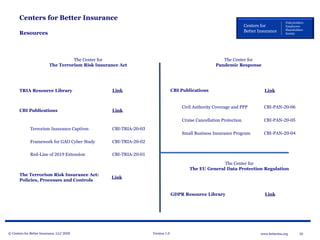
Centers for Better Insurance
Resources
The Terrorism Risk Insurance Act:
Policies, Processes and Controls
The Center for
The Terrorism Risk Insurance Act
TRIA Resource Library Link
CBI Publications Link
Terrorism Insurance Captives CBI-TRIA-20-03
Framework for GAO Cyber Study CBI-TRIA-20-02
Red-Line of 2019 Extension CBI-TRIA-20-01
Link
The Center for
Pandemic Response
CBI Publications Link
Civil Authority Coverage and PPP CBI-PAN-20-06
Cruise Cancellation Protection CBI-PAN-20-05
Small Business Insurance Program CBI-PAN-20-04
The Center for
The EU General Data Protection Regulation
GDPR Resource Library Link

Paycheck Protection rogram v Pandemic Risk Insurance Act

  • 1.
    © Centers forBetter Insurance, LLC 2020 Version 1.0 Centers for Better Insurance (CBI) is an independent organization focused on supporting the insurance industry to optimize the value it delivers to all stakeholders (including policyholders, employees and society at large). CBI does so by making available unbiased analysis and insights about key regulatory issues facing the industry for use by insurance professionals, regulators and policymakers. THE MATERIAL AS WELL AS ANY OTHER INFORMATION PROVIDED BY CBI IS PROVIDED ON AN "AS IS" AND "AS AVAILABLE" BASIS. CBI does not guarantee the accuracy or completeness of this material or any other information and may add, remove, discontinue, change, improve, or update this material or any other information without notice. Under no circumstances shall CBI be liable for any loss, damage, liability or expense claimed to result from use of this material or any other information. Centers for Better Insurance Policyholders Employees Shareholders Society Supporting value creation for all stakeholders through beneficial purpose, sound governance and effective controls www.betterins.org CBI-PAN-20-07 Paycheck Protection Program (PPP) vs. Pandemic Risk Insurance Act (PRIA) Pandemic Response Options CBI
  • 2.
    © Centers forBetter Insurance, LLC 2020 Version 1.0 2www.betterins.org Centers for Better Insurance Policyholders Employees Shareholders Society PPP vs. PRIA Executive Summary Two models appear to have emerged as policymakers consider legislative programs to prepare for the risk of future pandemics on the scale of COVID-19. Those models are the recently enacted Paycheck Protection Program (PPP) and the Terrorism Risk Insurance Act of 2002 (TRIA). Each approach offers certain advantages and drawbacks which are compared in this paper. Observations Responds to the needs of small and mid-sized businesses • PPP is custom made for the crisis at hand • Typical insurance is unlikely to cover business loss from lockdown orders even without a virus exclusion Holds businesses of all sizes and industries to the same rules • PPP is only available to small businesses although there are exceptions for certain industries • PRIA permits large corporates to design their own government funded relief programs via captives Supports businesses to make sound long-term decisions • PPP cannot be relied upon until it has been enacted • PRIA allows companies to understand their coverages in the event of a pandemic well in advance Aligns costs of the program with a business’s risk of loss • The cost of PPP is shifted to taxpayers at large • PRIA involves a premium charge but at the levels now charged under TRIA would take more than 125 years to accumulate the amount of the first round of PPP funding Leverages adequate private capacity to timely and efficiently deliver benefits to businesses • PPP relies on banks and other lenders to issue and manage $350 billion in loans • PRIA relies on insurance catastrophe claims capabilities which have never handled the distribution of more than $50 billion in any crises (Hurricane Katrina) – 7 times smaller than the first round of the PPP funding Encourages high levels of business participation Paycheck Protection Program (PPP) Pandemic Risk Insurance Act (PRIA) • Experience with TRIA suggests a significant number of businesses will decline optional catastrophe coverages Program Objectives
  • 3.
    © Centers forBetter Insurance, LLC 2020 Version 1.0 3www.betterins.org Centers for Better Insurance Policyholders Employees Shareholders Society PPP vs. PRIA Overview of the Paycheck Protection Program (PPP) The Coronavirus Aid, Relief, and Economic Security (CARES) Act (HR 748) includes the Paycheck Protection Program (Sec. 1102). LoanGuaranty the loan will be repaid Participating Bank Qualifying Business Payroll Utilities Rent, Interest on a Mortgage or other Debt Obligation Authority to issue $349 billion of loan guarantees 1% per annum interest with a 2- year maturity and no payment due for the first six months. Permitted Uses of Loan Proceeds Guarantees are available for loans made on or before June 30, 2020 on a “first come, first served” basis. The full loan (including accrued interest) will be forgiven if the loan proceeds are applied toward permitted uses during the first 8 weeks of the loan including at least 75% to payroll costs. In addition to interest earned on the loan, the lender receives a processing fee from the SBA based on the amount of the loan. 5% <$350,000 3% <$2,000,000 1% >$2,000,000 A participating bank may hold a loan or sell it on the secondary market at a premium or discount to par value. Payroll costs for employees* with a US place of residence includes: • Salary, wages and commissions • Cash tips (as recorded or estimated) • Payments for vacation, parental, family, medical or sick leave • Cost of employee benefits such as insurance and retirement • State and local payroll taxes *For sole proprietors or independent contractors, payroll consists of wages, commissions, income or net earnings (subject to the $100,000 annualized cap Cash compensation is subject to a $100,000 annualized cap
  • 4.
    © Centers forBetter Insurance, LLC 2020 Version 1.0 4www.betterins.org Centers for Better Insurance Policyholders Employees Shareholders Society PPP vs. PRIA Paycheck Protection Program (PPP) Qualification Criteria Qualifying businesses and sole proprietors can apply for loans beginning April 3. Independent contractors and self-employed individuals can begin applying on April 10. There are four categories of eligible entities or concerns. Non-employers if one of the following: • Independent contractor • Self-employed individual • Sole proprietor Employers with 500 or fewer full-time or part-time employees (having a principal place of residency in the US) that is one of the following: • Business concern • 501(c)(3) nonprofits • 501(c)(19) veterans organizations • Tribal business concerns The SBA designates higher employee thresholds for certain industries which can reach 1500 employees. Regardless of the number of employees, a businesses that as of March 27, 2002 had both: • A tangible net worth of no greater than $15 million; and • An average net income after federal income taxes (excluding any carry-over losses) for the two full fiscal years before the date of the application of no more than $5 million. 1 2 3 Hotel chains (and other in the accommodation businesses) employing no more than 500 employees per physical location at the time of loan dispersal 4 In applying these criteria, all entities and concerns in common control are added together.* A person controls another entity if the person: • Holds more than 50% ownership of voting equity in the entity • Has a minority stake but can prevent a quorum or otherwise block action by the board or shareholders • Holds stock options, convertible securities, and agreements to merge which would qualify under either of the above criteria • Holds a management agreement over the entity • Holds identity of interests with close relatives with control over the entity • Is the CEO or President (or controls the board or management) of the entity *These affiliation rules do not apply to hotel and other accommodation industry groups or franchised businesses.
  • 5.
    © Centers forBetter Insurance, LLC 2020 Version 1.0 5www.betterins.org Centers for Better Insurance Policyholders Employees Shareholders Society PPP vs. PRIA Pandemic Risk Insurance Act (PRIA) – Make Available Requirement Offer of a Policy without a Virus Exclusion The hypothetical Pandemic Risk Insurance Act requires an insurance company to make available a policy covering losses from an outbreak of infectious disease on the same terms, limits and conditions as the policy covers the same losses from any other event A TRIA-style make available requirement would not require insurers to cover business income losses from a pandemic. Rather, the policy cannot exclude the loss because it relates to a pandemic. If business income loss is not covered for some other reason (such as there was no property damage or no order prohibiting access), PRIA would not require the business income loss to be covered. The insurer satisfies its obligation by first offering a policy without a virus exclusion. If rejected, the insurer is then free to offer a policy with a virus exclusion. Treasury reports 2017 take-up rates under TRIA of 78% by policy count (and 63% by overall policy premium). • 29% of policies charged $0 for terrorism coverage • For policies with a terrorism charge the average rate was 2.5% of total policy premium Take-Up Rates Order from a civil authority Caused by a covered cause of loss For a zone of prohibited access Because of property damage With PRIA Without PRIA Simplification of conditions triggering Civil Authority Coverage No Charge 2.5% Avg. ChargeOpt-Out Half of eligible policyholders pay nothing under TRIA The other half pay the equivalent of 0.75% of the PPP’s initial funding each year
  • 6.
    © Centers forBetter Insurance, LLC 2020 Version 1.0 6www.betterins.org Centers for Better Insurance Policyholders Employees Shareholders Society PPP vs. PRIA Pandemic Risk Insurance Act (PRIA) – The Backstop The Backstop Competitive Dislocation The hypothetical Pandemic Risk Insurance Act provides a federal backstop which serves as a kind of reinsurance by reimbursing insurers for a share of losses above an individual insurer retention. Liability cap for total of insurer and federal share ($100 billion in TRIA) Individual insurer group deductible based on prior year direct earned commercial property and casualty insurance premiums (20% in TRIA) Insurer Deductible InsurerCo-Share Federal Share Insurer continues to share in losses after the deductible has been met (20% in TRIA) US Treasury administers a reinsurance program through which participating insurers can request reimbursement of a percentage of covered losses exceeding a deductible amount. PRIA’s backstop deductible structure would create a heavily skewed competitive playing field. AXA Chubb Travelers StateFarm Liberty Allstate Progressive $2.5 billion $0.5 billion But State Farm is 3 times the size of Chubb by overall premium Chubb’s backstop deductible would be 4 times larger than State Farm’s The PRIA would replace not only the PPP for small businesses but also the Coronavirus Economic Stabilization Act bailout of large corporations. Large corporates would be allowed to use their personal insurance companies to grant generous pandemic relief benefits at low cost. Write Your Own Bailout for Large Corporations $1 million Backstop Deductibles $400,000 $9 million $235,000
  • 7.
    © Centers forBetter Insurance, LLC 2020 Version 1.0 7www.betterins.org Centers for Better Insurance Policyholders Employees Shareholders Society PPP vs. PRIA Pandemic Risk Insurance Act (PRIA) – Overwhelming Scale PPP Initial Funding 10 largest US property insurance losses in 2018 dollars (Insurance Information Institute) TRIA Claims Capacity Total National Flood Insurance Program losses paid over the 10-year period ending Dec. 31, 2018 The insurance claims administration capabilities necessary to investigate, document and payout an amount of insurance claims equivalent to the Paycheck Protection Program’s initial round of funding would be the same as if the top 10 US catastrophes (hurricanes, earthquakes and terrorism) occurred in the same month together with 10 years of federal Crop Insurance and Flood Insurance claims. Total claims-paying capability of the Terrorism Risk Insurance Program including insurer shares of loss $349 billion TRIA Premium Total amount of terrorism premium collected under all lines of business over the first 15 years of the TRIA program Katrina Maria Irma 9/11 Andrew Sandy Harvey Northridge Ike Wilma NFIP Federal Crop Insurance Program Total Federal Crop Insurance Program claims paid over the 10-year period ending Dec. 31, 2016
  • 8.
    © Centers forBetter Insurance, LLC 2020 Version 1.0 8www.betterins.org Centers for Better Insurance Policyholders Employees Shareholders Society PPP vs. PRIA Comparison of Conditions for Coverage The PPP qualification criteria focuses largely on the nature and needs of the business itself. Qualification for Civil Authority Coverage begins with the decision of the policyholder whether to purchase business income coverage. If it had the foresight to do so, then the inquiry focuses on the nature of the governmental order. Civil Authority Coverage (CA) CP 00 30 10 12 2 3 4 Property damage by a covered cause of loss away from the insured location A civil authority has taken action to prohibit access to an area immediately surrounding the property damage. The insured location is within (a) the area of prohibited access; and (b) one mile of the damaged property. 5 The civil authority established the prohibited access area either (a) to allow unimpeded access to the damaged property; or (b) in response to dangerous physical conditions resulting from the damage or the continuation of the covered cause loss that caused the damage. Paycheck Protection Program (PPP) To the extent feasible, the business will purchase only American-made equipment and products 2 4 5 The business was in operation on February 15, 2020 3 The business paid employees and payroll taxes (or paid independent contractors as reported on a 1099-MISC)’ The business requires the loan to continue operations in the current economic uncertainty 1 The business has 500 or fewer employees or meets other qualifying criteria 1 The policyholder purchased business income coverage
  • 9.
    © Centers forBetter Insurance, LLC 2020 Version 1.0 9www.betterins.org Centers for Better Insurance Policyholders Employees Shareholders Society PPP vs. PRIA Comparison of Benefits PPP covers most of the same elements of business income loss as provided by commercial property insurance. Business income loss coverage under Civil Authority Coverage covers about half the duration of PPP but covers lost profits, salaries of high-earners and workers compensation insurance premiums. Of course, Civil Authority Coverage is only available if the conditions for coverage have been met. Paycheck Protection Program (PPP) Twice average monthly payroll (based on average payroll over prior 12 months) subject to $100,000 salary cap and maximum total of $7.5 million 50% of average monthly payroll subject to $2.5 million maximum Loan proceeds must be spent on payroll (at least 75%), rent, utilities and interest during the 8 weeks starting from the date of the loan for the loan to be forgiven Business Income Loss under Civil Authority Coverage (CA) CP 00 30 10 12 Payroll expenses actually incurred Continuing normal operating expenses actually incurred Net income (before income taxes) that would have been earned • Starting 72 hours after the first order prohibiting access to the insured premises is first; and • Ending at the earlier of the lifting of the order or 4 consecutive weeks Payroll Continuation Mortgage Interest Rent and Utilities Net profit or loss Period of Covered Business Income Loss Differences • PPP covers more than twice the period as CA • PPP is keyed to the date of the loan, while CA is keyed to the date of the order PPP covers an active owner’s salary or profits up to $16,700 total, while under there is no cap under CA and passive investor interests are covered PPP covers payroll based on past average subject to a cap on high- earners, while CA covers actual continued payroll without a cap on high-earners and includes workers compensation premium PPP covers continuing operating expenses based on a formula while CA covers actual incurred expenses
  • 10.
    © Centers forBetter Insurance, LLC 2020 Version 1.0 10www.betterins.org Centers for Better Insurance Policyholders Employees Shareholders Society Centers for Better Insurance Resources The Terrorism Risk Insurance Act: Policies, Processes and Controls The Center for The Terrorism Risk Insurance Act TRIA Resource Library Link CBI Publications Link Terrorism Insurance Captives CBI-TRIA-20-03 Framework for GAO Cyber Study CBI-TRIA-20-02 Red-Line of 2019 Extension CBI-TRIA-20-01 Link The Center for Pandemic Response CBI Publications Link Civil Authority Coverage and PPP CBI-PAN-20-06 Cruise Cancellation Protection CBI-PAN-20-05 Small Business Insurance Program CBI-PAN-20-04 The Center for The EU General Data Protection Regulation GDPR Resource Library Link