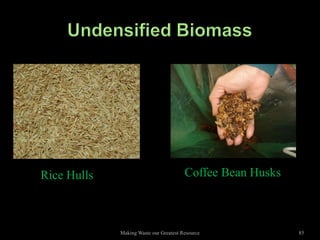
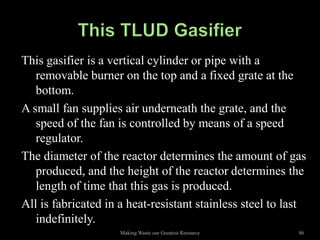
Rice Hulls                              Coffee Bean Husks


             Making Waste our Greatest Resource             85
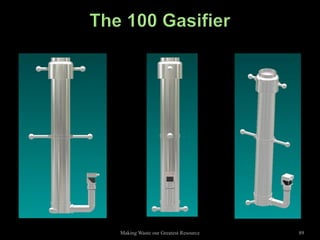
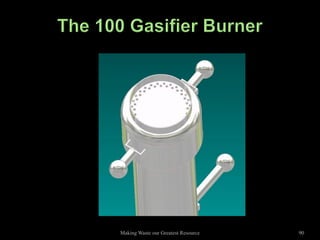
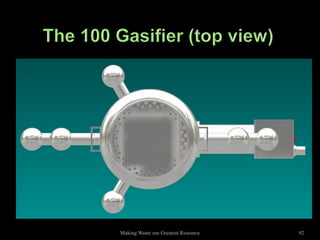
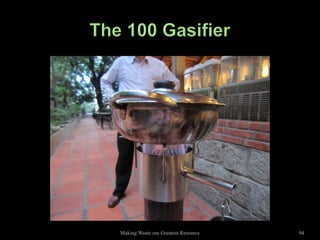
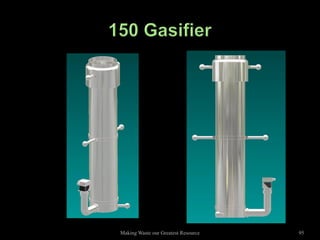
This gasifier is a vertical cylinder or pipe with a
   removable burner on the top and a fixed grate at the
   bottom.
A small fan supplies air underneath the grate, and the
   speed of the fan is controlled by means of a speed
   regulator.
The diameter of the reactor determines the amount of gas
   produced, and the height of the reactor determines the
   length of time that this gas is produced.
All is fabricated in a heat-resistant stainless steel to last
   indefinitely.
                     Making Waste our Greatest Resource    86
In starting the process, the burner is removed and the
   reactor is filled with biomass.
The fan is turned on, and paper is placed on the top of the
   biomass and lit by means of a match or cigarette lighter.
 Once the paper burns over the entire surface of the
   biomass, it only takes seconds for the biomass to ignite.
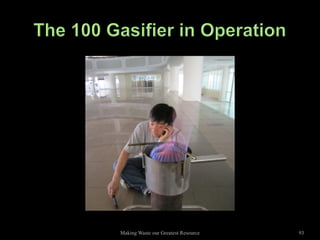
The burner is then placed on the reactor, and the gasifier is
   in full gasification mode.
The lid of the gasifier and the burner are the same.
Here there is none of the inefficiency or loss of heat
   associated with remote burners.
                                                          87
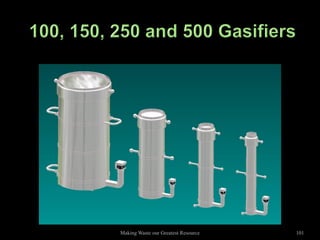
Four models of gasifiers are now being fabricated:

1.   model 100 = 1 kg to 2 kg of biomass per hour
2.   model 150 = 2 kg to 4 kg of biomass per hour
3.   model 250 = 5 to 10 kg of biomass per hour
4.   model 500 = 20 to 40 kg of biomass per hour


                     Making Waste our Greatest Resource   88
Making Waste our Greatest Resource   89
Making Waste our Greatest Resource   90
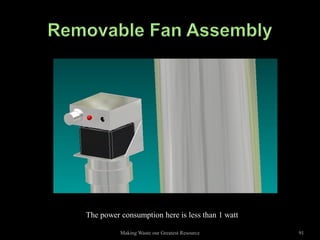
The power consumption here is less than 1 watt

          Making Waste our Greatest Resource     91
Making Waste our Greatest Resource   92
Making Waste our Greatest Resource   93
Making Waste our Greatest Resource   94
Making Waste our Greatest Resource   95
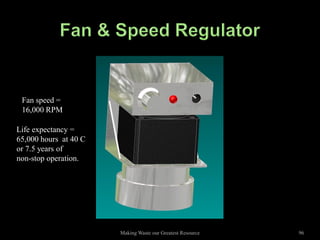
Fan speed =
 16,000 RPM

Life expectancy =
65,000 hours at 40 C
or 7.5 years of
non-stop operation.


                       Making Waste our Greatest Resource   96
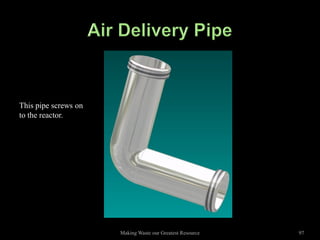
This pipe screws on
to the reactor.


                      Making Waste our Greatest Resource   97
Making Waste our Greatest Resource   98
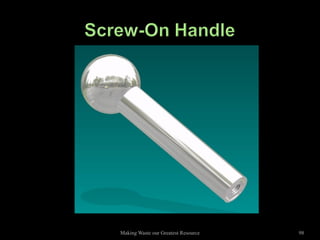
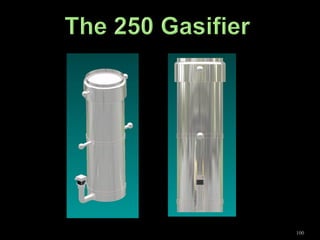
The 100, 150 and 250 gasifiers make use of the same
   air delivery pipe, the same fan and speed regulator
   and the same handles.
All appendages screw on to the reactor and are
   removable.
This greatly reduces the shipping volume of gasifiers.


                   Making Waste our Greatest Resource    99
100
Making Waste our Greatest Resource   101
Making Waste our Greatest Resource   102
Making Waste our Greatest Resource   103
1.   the 100 gasifier = $30 USD (1.5 kW)
2.   the 150 gasifier = $50 USD (3.5 kW)
3.   the 250 gasifier = $100 USD (10 kW)
4.   the 500 gasifier = $250 USD (40 kW)

These prices will drop considerably when these gasifiers
     are produced in large numbers.
If there is no electricity from the mains, the speed
     regulator can be connected to any 12-volt battery,
     even the battery within a motorbike.

                   Making Waste our Greatest Resource   104
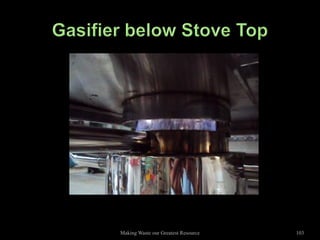
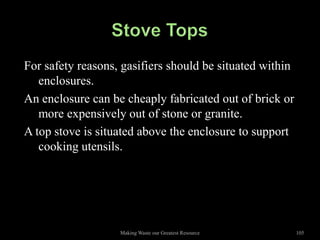
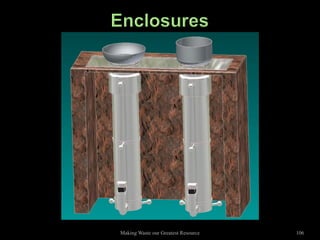
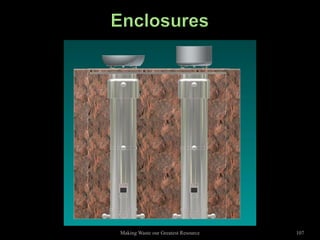
For safety reasons, gasifiers should be situated within
   enclosures.
An enclosure can be cheaply fabricated out of brick or
   more expensively out of stone or granite.
A top stove is situated above the enclosure to support
   cooking utensils.


                   Making Waste our Greatest Resource     105
Making Waste our Greatest Resource   106
Making Waste our Greatest Resource   107
Wood, branches and other waste of a high cellulosic
  content can be shredded by means of low-cost
  shredders, as designed by the SPIN organization in
  Hanoi.
One model of shredder costs about $35 US or 735,000
  VND, and can process up to 600 kg’s of waste per
  hour.
The shredded material can be composted or gasified.


                 Making Waste our Greatest Resource   108
Biochar locks carbon in the soil for over a 1,000 years.
Like worm castings, it promotes the growth of beneficial
     soil microbes and greatly reduces the need for
     chemical fertilizers.
It often increases plant yields in a dramatic way.
Dr. Boun Suy Tan of Cambodia recently did a study
    where he mixed into the soil 5 tons of compost and 40
    tons of biochar per hectare.
He obtained a 3-fold increase in the yield of rice.

                    Making Waste our Greatest Resource   109
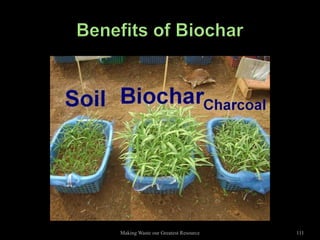
Next we see the results of an experiment carried out in
    Laos in April, 2011, on water spinach.
All three treatments received the same amount of
    fertilizer.
The biochar used in this experiment was rice hull biochar
    from our TLUD gasifier.


                    Making Waste our Greatest Resource   110
Making Waste our Greatest Resource   111
In Vietnam many forms of biomass such as rice straw and
   rice hulls are simply dumped or uselessly burned.
In most cases they are available free-of-charge.
About half of the weight of this biomass can be converted
   through gasification into a biochar worth at least $50
   USD/ton when incorporated into compost,
or about $500 USD/ton when incorporated into vermi-
   compost.
Rice hull biochar is easily activated, and activated carbon
   currently sells from $500 to $ 2,000 per ton.
                    Making Waste our Greatest Resource   112
The gasification of roughly 90 kg’s of rice hulls can
    deliver a gas of the same calorific value as 12 kg’s of
    propane.
12 kg’s of propane cost 350,000 VND ($16.66 USD).
If so, then one kg of rice hulls will produce about 3,889
    VND ($0.18 USD) in gas.
As we have seen, one kg of rice hulls will also produce
    about a half kg of biochar.
At a value of 1,050 VND ($0.05 USD)/kg, this half kg of
    biochar has a value of 525 VND or ($0.025 USD).

                    Making Waste our Greatest Resource   113
Therefore one kg of rice hulls has a combined value in
  gas and biochar of 4,400 VND ($0.21 USD).
One ton of rice hulls has a combined value of $210 or
  4.4 M VND (roughly the same value of a ton of
  paddy rice).
Vietnam produces yearly about 7,900,000 tons of rice
  hulls, which, if gasified, would have a value of
  $1.659 billion USD.
Vietnam produces more than 75 million tons of rice
  straw each year, which, if gasified, would have a
  value in gas and biochar of over $15.5 billion USD.

                   Making Waste our Greatest Resource    114
There are thousands of small-scale commercial
  activities with a high demand for heat.
For example, brick kilns can use gasifier heat and
  would produce no smoke or other pollutants in
  making bricks.
The brick kiln can sell both bricks and biochar.
Noodle shops and pho shops, for example, can sell food
  and biochar.
The list goes on and on.


                  Making Waste our Greatest Resource   115
Food waste can be sterilized with gasifier heat and fed
  to pigs.
Rice wine can be distilled with gasifier heat, and the
  mash can be fed to pigs.
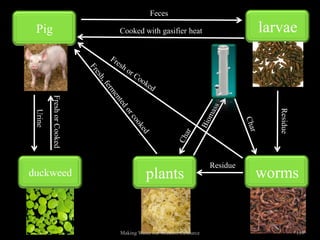
The feces of the pig is then fed to BSF larvae, and the
  residue of the larvae is fed to red worms.
Biochar can be added to the BSF residue fed to red
  worms, and this accelerates their growth and
  produces more worms.
Biochar, compost and vermi-compost all work together
  in reducing the need for fertilizers.
                   Making Waste our Greatest Resource   116
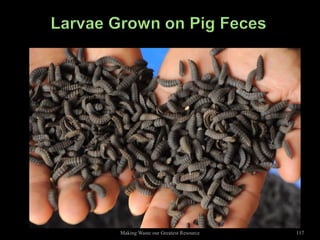
Making Waste our Greatest Resource   117
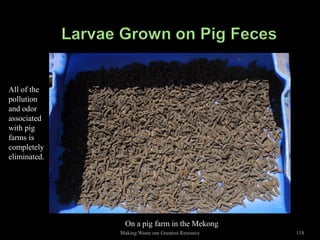
All of the
pollution
and odor
associated
with pig
farms is
completely
eliminated.


                On a pig farm in the Mekong
              Making Waste our Greatest Resource   118
Feces

 Pig                       Cooked with gasifier heat                      larvae
         Fresh or Cooked


                                                                             Residue
 Urine


                                                                Residue
duckweed                             plants                               worms


                           Making Waste our Greatest Resource                          119
This same gasification technology can be used to generate
  electricity via a gen-set or an ORC unit.
Gasifier gas can also be converted into methanol to power
  automobiles and motorbikes.
Gasifier heat can be directed to an adsorption refrigeration
  unit to make ice.
This is the cheapest way to make ice, and it requires no
  electricity.


                     Making Waste our Greatest Resource   120
To make a good thermophilic compost, we need
  carbon, nitrogen, water and oxygen in the right
  proportions, and soon temperatures reach as high as
  65 C.
But if it rains on the compost pile, if the material dries
  out, or if there is no exchange of gases, then the
  composting process stops.
We might try to house this process in a building, or put
  a roof over it, but this generally is too expensive.


                    Making Waste our Greatest Resource   121
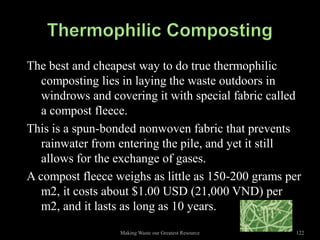
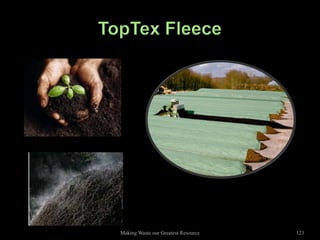
The best and cheapest way to do true thermophilic
   composting lies in laying the waste outdoors in
   windrows and covering it with special fabric called
   a compost fleece.
This is a spun-bonded nonwoven fabric that prevents
   rainwater from entering the pile, and yet it still
   allows for the exchange of gases.
A compost fleece weighs as little as 150-200 grams per
   m2, it costs about $1.00 USD (21,000 VND) per
   m2, and it lasts as long as 10 years.
                  Making Waste our Greatest Resource   122
Making Waste our Greatest Resource   123
For less than $50 USD (1 M VND), a scavenger could
  be equipped with all of the fleece needed to earn a
  good living.
She could collect and transport waste down a street
  where a small composting site could be made
  available to her by the city.
She could collect compostable materials from markets,
  and could be provided with a site nearby where she
  could compost these materials.


                  Making Waste our Greatest Resource   124
Composting sites could be set up throughout the city
    wherever waste transfer stations are currently
    located, or they could even be set up on empty city
    lots.
If a scavenger could sell 5 or 6 tons of compost per
    month at a value between $25 and $50/ton, she
    could make far more money than she makes
    collecting and selling recyclables.


                   Making Waste our Greatest Resource     125
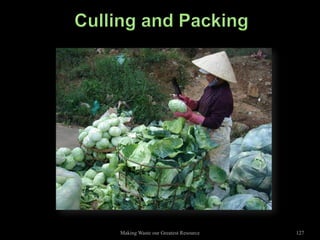
There is a lot of fruit and vegetable waste coming from
    markets and packing houses that is highly nutritious
    and is far too valuable to compost.
It can be fed directly to poultry, animals and even
    certain fish.
But the direct feeding of such waste is limited, since it
    quickly degrades.


                    Making Waste our Greatest Resource      126
Making Waste our Greatest Resource   127
Of course a lot of this waste could be sterilized and
   cooked using gasifier heat, but it often turns bad
   before it can be cooked and sterilized.
Cooking demands time and space, and also why use
   heat, if heat is not required?
A lot of this waste could be fed to BSF larvae and red
   worms, but in this case we would be integrating this
   waste back into the food chain at a low trophic
   level.


                   Making Waste our Greatest Resource   128
The best solution for certain types of fruit and
  vegetable waste is lactic acid fermentation.
Here lactic acid bacteria consume water-soluble
  carbohydrates and produce lactic acid.
As the pH drops below 4.2, (sometimes as low as 3.2)
  the waste is thoroughly sterilized, and nutrients can
  be preserved for an indefinite period of time.


                   Making Waste our Greatest Resource     129
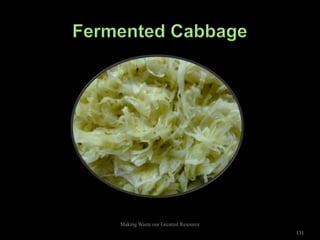
All it takes, for example, is a bit of molasses (5% of
   total mix) and rice bran (10% of total mix) to
   transform one kg of cabbage waste into a nutritious
   pig feed.
The nutrients in the molasses and rice bran are not lost,
   and often they would have been fed in any case to
   the pig.
The chopped cabbage, molasses and rice bran are
   simply put into a sealed plastic bag or drum.
A starter culture is not required.


                   Making Waste our Greatest Resource   130
Making Waste our Greatest Resource
                                     131
The market or packing house would have two products
  to sell: fruit and vegetables for humans and silage for
  pigs.
Fermented cabbage, for example, can be sold to pig
  farmers for as much as $100 USD (2 M VND) per
  ton.


                    Making Waste our Greatest Resource   132
An exciting new study conducted in Brazil indicates
  that shrimp heads and tails can be fermented by
  means of Lactobacillus plantarum 541 in a simple
  drum reactor to extract of chitin.*
This fermentation method is surprisingly just as
  efficient in the extraction of chitin as the chemical
  method.
Chitin can be refined and deacetylated into a multi-
  purpose biopolymer called chitosan.
http://ecosyseng.wetpaint.com/page/Clean+Green+Technology+for+Shrim+Biowaste

                           Making Waste our Greatest Resource                  133
Some grades of chitosan sell from $10,000 to $100,000
    US per ton.
The liquor by-product from this fermentation process is
    high in essential amino acids and could be processed
    into a protein powder fit for human consumption.
The same fermentation technology can be applied to
    the shells of crab and other crustaceans.
It can even be applied to the exoskeleton of BSF
    larvae.

                   Making Waste our Greatest Resource   134
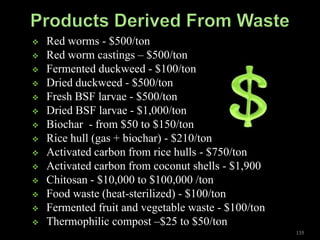
   Red worms - $500/ton
   Red worm castings – $500/ton
   Fermented duckweed - $100/ton
   Dried duckweed - $500/ton
   Fresh BSF larvae - $500/ton
   Dried BSF larvae - $1,000/ton
   Biochar - from $50 to $150/ton
   Rice hull (gas + biochar) - $210/ton
   Activated carbon from rice hulls - $750/ton
   Activated carbon from coconut shells - $1,900
   Chitosan - $10,000 to $100,000 /ton
   Food waste (heat-sterilized) - $100/ton
   Fermented fruit and vegetable waste - $100/ton
   Thermophilic compost –$25 to $50/ton
                                                     135
A waste resource center, as its name suggests, is a
   center that helps manage resources derived from
   waste.
It would be staffed by experts highly skilled in the
   above technologies.
These experts would train, certify and advise
   scavengers.
Also the center would organize and manage
   cooperatives on behalf of scavengers so that they
   would obtain the highest prices for their
                   Making Waste our Greatest Resource   136
recyclables and waste-derived products.
The waste resource center would handle all aspects of
   waste collection, preparation, processing and
   recycling (with the exception of anything relating to
   landfills).
It would function under contract to government as a
   social enterprise that is both private and non-profit.
It would be funded from two sources:


                    Making Waste our Greatest Resource   137
1.  The center would sell all that is collected and
    processed by the cooperatives, and for this service,
    it would collect a small fee.
2. The center would handle the administration of
    carbon credit certification, and for this, it would
    also collect a small fee.
With the exception of these two fees, all revenue from
   the sale of goods and from carbon credits should go
   entirely to the cooperatives.


                   Making Waste our Greatest Resource      138
The waste resource center and the cooperatives would
   be exempt from any form of taxation.
In exchange for this tax exempt status, neither the
   waste resource center nor its cooperatives would
   charge local government anything for the collection
   and processing of waste.


                  Making Waste our Greatest Resource   139
The waste resource center would be staffed by social
  and environmental entrepreneurs.
Managing a waste resource center that works with
  scavengers means recruiting people who truly care
  about the poor and are willing to work with them in
  creative ways.
These recruits should be equally passionate about
  sustainability in all aspects of how humans relate to
  the natural world.


                  Making Waste our Greatest Resource   140
   Waste resource centers could be set up
    throughout Vietnam.
   They would handle the sale of hundreds of
    millions of dollars in recyclables and
    waste-derived products per year.
   The cooperatives that they manage would
    provide jobs to several million people.
   Virtually nothing would end up in landfill.
   No country in Asia, Europe or the
    Americas would be able to rival Vietnam in
    the sustainable management of waste.
                Making Waste our Greatest Resource   141

TLUD Gasifier in Vietnam by Paul Oliver

  • 1.
    Rice Hulls Coffee Bean Husks Making Waste our Greatest Resource 85
  • 2.
    This gasifier isa vertical cylinder or pipe with a removable burner on the top and a fixed grate at the bottom. A small fan supplies air underneath the grate, and the speed of the fan is controlled by means of a speed regulator. The diameter of the reactor determines the amount of gas produced, and the height of the reactor determines the length of time that this gas is produced. All is fabricated in a heat-resistant stainless steel to last indefinitely. Making Waste our Greatest Resource 86
  • 3.
    In starting theprocess, the burner is removed and the reactor is filled with biomass. The fan is turned on, and paper is placed on the top of the biomass and lit by means of a match or cigarette lighter. Once the paper burns over the entire surface of the biomass, it only takes seconds for the biomass to ignite. The burner is then placed on the reactor, and the gasifier is in full gasification mode. The lid of the gasifier and the burner are the same. Here there is none of the inefficiency or loss of heat associated with remote burners. 87
  • 4.
    Four models ofgasifiers are now being fabricated: 1. model 100 = 1 kg to 2 kg of biomass per hour 2. model 150 = 2 kg to 4 kg of biomass per hour 3. model 250 = 5 to 10 kg of biomass per hour 4. model 500 = 20 to 40 kg of biomass per hour Making Waste our Greatest Resource 88
  • 5.
    Making Waste ourGreatest Resource 89
  • 6.
    Making Waste ourGreatest Resource 90
  • 7.
    The power consumptionhere is less than 1 watt Making Waste our Greatest Resource 91
  • 8.
    Making Waste ourGreatest Resource 92
  • 9.
    Making Waste ourGreatest Resource 93
  • 10.
    Making Waste ourGreatest Resource 94
  • 11.
    Making Waste ourGreatest Resource 95
  • 12.
    Fan speed = 16,000 RPM Life expectancy = 65,000 hours at 40 C or 7.5 years of non-stop operation. Making Waste our Greatest Resource 96
  • 13.
    This pipe screwson to the reactor. Making Waste our Greatest Resource 97
  • 14.
    Making Waste ourGreatest Resource 98
  • 15.
    The 100, 150and 250 gasifiers make use of the same air delivery pipe, the same fan and speed regulator and the same handles. All appendages screw on to the reactor and are removable. This greatly reduces the shipping volume of gasifiers. Making Waste our Greatest Resource 99
  • 16.
  • 17.
    Making Waste ourGreatest Resource 101
  • 18.
    Making Waste ourGreatest Resource 102
  • 19.
    Making Waste ourGreatest Resource 103
  • 20.
    1. the 100 gasifier = $30 USD (1.5 kW) 2. the 150 gasifier = $50 USD (3.5 kW) 3. the 250 gasifier = $100 USD (10 kW) 4. the 500 gasifier = $250 USD (40 kW) These prices will drop considerably when these gasifiers are produced in large numbers. If there is no electricity from the mains, the speed regulator can be connected to any 12-volt battery, even the battery within a motorbike. Making Waste our Greatest Resource 104
  • 21.
    For safety reasons,gasifiers should be situated within enclosures. An enclosure can be cheaply fabricated out of brick or more expensively out of stone or granite. A top stove is situated above the enclosure to support cooking utensils. Making Waste our Greatest Resource 105
  • 22.
    Making Waste ourGreatest Resource 106
  • 23.
    Making Waste ourGreatest Resource 107
  • 24.
    Wood, branches andother waste of a high cellulosic content can be shredded by means of low-cost shredders, as designed by the SPIN organization in Hanoi. One model of shredder costs about $35 US or 735,000 VND, and can process up to 600 kg’s of waste per hour. The shredded material can be composted or gasified. Making Waste our Greatest Resource 108
  • 25.
    Biochar locks carbonin the soil for over a 1,000 years. Like worm castings, it promotes the growth of beneficial soil microbes and greatly reduces the need for chemical fertilizers. It often increases plant yields in a dramatic way. Dr. Boun Suy Tan of Cambodia recently did a study where he mixed into the soil 5 tons of compost and 40 tons of biochar per hectare. He obtained a 3-fold increase in the yield of rice. Making Waste our Greatest Resource 109
  • 26.
    Next we seethe results of an experiment carried out in Laos in April, 2011, on water spinach. All three treatments received the same amount of fertilizer. The biochar used in this experiment was rice hull biochar from our TLUD gasifier. Making Waste our Greatest Resource 110
  • 27.
    Making Waste ourGreatest Resource 111
  • 28.
    In Vietnam manyforms of biomass such as rice straw and rice hulls are simply dumped or uselessly burned. In most cases they are available free-of-charge. About half of the weight of this biomass can be converted through gasification into a biochar worth at least $50 USD/ton when incorporated into compost, or about $500 USD/ton when incorporated into vermi- compost. Rice hull biochar is easily activated, and activated carbon currently sells from $500 to $ 2,000 per ton. Making Waste our Greatest Resource 112
  • 29.
    The gasification ofroughly 90 kg’s of rice hulls can deliver a gas of the same calorific value as 12 kg’s of propane. 12 kg’s of propane cost 350,000 VND ($16.66 USD). If so, then one kg of rice hulls will produce about 3,889 VND ($0.18 USD) in gas. As we have seen, one kg of rice hulls will also produce about a half kg of biochar. At a value of 1,050 VND ($0.05 USD)/kg, this half kg of biochar has a value of 525 VND or ($0.025 USD). Making Waste our Greatest Resource 113
  • 30.
    Therefore one kgof rice hulls has a combined value in gas and biochar of 4,400 VND ($0.21 USD). One ton of rice hulls has a combined value of $210 or 4.4 M VND (roughly the same value of a ton of paddy rice). Vietnam produces yearly about 7,900,000 tons of rice hulls, which, if gasified, would have a value of $1.659 billion USD. Vietnam produces more than 75 million tons of rice straw each year, which, if gasified, would have a value in gas and biochar of over $15.5 billion USD. Making Waste our Greatest Resource 114
  • 31.
    There are thousandsof small-scale commercial activities with a high demand for heat. For example, brick kilns can use gasifier heat and would produce no smoke or other pollutants in making bricks. The brick kiln can sell both bricks and biochar. Noodle shops and pho shops, for example, can sell food and biochar. The list goes on and on. Making Waste our Greatest Resource 115
  • 32.
    Food waste canbe sterilized with gasifier heat and fed to pigs. Rice wine can be distilled with gasifier heat, and the mash can be fed to pigs. The feces of the pig is then fed to BSF larvae, and the residue of the larvae is fed to red worms. Biochar can be added to the BSF residue fed to red worms, and this accelerates their growth and produces more worms. Biochar, compost and vermi-compost all work together in reducing the need for fertilizers. Making Waste our Greatest Resource 116
  • 33.
    Making Waste ourGreatest Resource 117
  • 34.
    All of the pollution andodor associated with pig farms is completely eliminated. On a pig farm in the Mekong Making Waste our Greatest Resource 118
  • 35.
    Feces Pig Cooked with gasifier heat larvae Fresh or Cooked Residue Urine Residue duckweed plants worms Making Waste our Greatest Resource 119
  • 36.
    This same gasificationtechnology can be used to generate electricity via a gen-set or an ORC unit. Gasifier gas can also be converted into methanol to power automobiles and motorbikes. Gasifier heat can be directed to an adsorption refrigeration unit to make ice. This is the cheapest way to make ice, and it requires no electricity. Making Waste our Greatest Resource 120
  • 37.
    To make agood thermophilic compost, we need carbon, nitrogen, water and oxygen in the right proportions, and soon temperatures reach as high as 65 C. But if it rains on the compost pile, if the material dries out, or if there is no exchange of gases, then the composting process stops. We might try to house this process in a building, or put a roof over it, but this generally is too expensive. Making Waste our Greatest Resource 121
  • 38.
    The best andcheapest way to do true thermophilic composting lies in laying the waste outdoors in windrows and covering it with special fabric called a compost fleece. This is a spun-bonded nonwoven fabric that prevents rainwater from entering the pile, and yet it still allows for the exchange of gases. A compost fleece weighs as little as 150-200 grams per m2, it costs about $1.00 USD (21,000 VND) per m2, and it lasts as long as 10 years. Making Waste our Greatest Resource 122
  • 39.
    Making Waste ourGreatest Resource 123
  • 40.
    For less than$50 USD (1 M VND), a scavenger could be equipped with all of the fleece needed to earn a good living. She could collect and transport waste down a street where a small composting site could be made available to her by the city. She could collect compostable materials from markets, and could be provided with a site nearby where she could compost these materials. Making Waste our Greatest Resource 124
  • 41.
    Composting sites couldbe set up throughout the city wherever waste transfer stations are currently located, or they could even be set up on empty city lots. If a scavenger could sell 5 or 6 tons of compost per month at a value between $25 and $50/ton, she could make far more money than she makes collecting and selling recyclables. Making Waste our Greatest Resource 125
  • 42.
    There is alot of fruit and vegetable waste coming from markets and packing houses that is highly nutritious and is far too valuable to compost. It can be fed directly to poultry, animals and even certain fish. But the direct feeding of such waste is limited, since it quickly degrades. Making Waste our Greatest Resource 126
  • 43.
    Making Waste ourGreatest Resource 127
  • 44.
    Of course alot of this waste could be sterilized and cooked using gasifier heat, but it often turns bad before it can be cooked and sterilized. Cooking demands time and space, and also why use heat, if heat is not required? A lot of this waste could be fed to BSF larvae and red worms, but in this case we would be integrating this waste back into the food chain at a low trophic level. Making Waste our Greatest Resource 128
  • 45.
    The best solutionfor certain types of fruit and vegetable waste is lactic acid fermentation. Here lactic acid bacteria consume water-soluble carbohydrates and produce lactic acid. As the pH drops below 4.2, (sometimes as low as 3.2) the waste is thoroughly sterilized, and nutrients can be preserved for an indefinite period of time. Making Waste our Greatest Resource 129
  • 46.
    All it takes,for example, is a bit of molasses (5% of total mix) and rice bran (10% of total mix) to transform one kg of cabbage waste into a nutritious pig feed. The nutrients in the molasses and rice bran are not lost, and often they would have been fed in any case to the pig. The chopped cabbage, molasses and rice bran are simply put into a sealed plastic bag or drum. A starter culture is not required. Making Waste our Greatest Resource 130
  • 47.
    Making Waste ourGreatest Resource 131
  • 48.
    The market orpacking house would have two products to sell: fruit and vegetables for humans and silage for pigs. Fermented cabbage, for example, can be sold to pig farmers for as much as $100 USD (2 M VND) per ton. Making Waste our Greatest Resource 132
  • 49.
    An exciting newstudy conducted in Brazil indicates that shrimp heads and tails can be fermented by means of Lactobacillus plantarum 541 in a simple drum reactor to extract of chitin.* This fermentation method is surprisingly just as efficient in the extraction of chitin as the chemical method. Chitin can be refined and deacetylated into a multi- purpose biopolymer called chitosan. http://ecosyseng.wetpaint.com/page/Clean+Green+Technology+for+Shrim+Biowaste Making Waste our Greatest Resource 133
  • 50.
    Some grades ofchitosan sell from $10,000 to $100,000 US per ton. The liquor by-product from this fermentation process is high in essential amino acids and could be processed into a protein powder fit for human consumption. The same fermentation technology can be applied to the shells of crab and other crustaceans. It can even be applied to the exoskeleton of BSF larvae. Making Waste our Greatest Resource 134
  • 51.
    Red worms - $500/ton  Red worm castings – $500/ton  Fermented duckweed - $100/ton  Dried duckweed - $500/ton  Fresh BSF larvae - $500/ton  Dried BSF larvae - $1,000/ton  Biochar - from $50 to $150/ton  Rice hull (gas + biochar) - $210/ton  Activated carbon from rice hulls - $750/ton  Activated carbon from coconut shells - $1,900  Chitosan - $10,000 to $100,000 /ton  Food waste (heat-sterilized) - $100/ton  Fermented fruit and vegetable waste - $100/ton  Thermophilic compost –$25 to $50/ton 135
  • 52.
    A waste resourcecenter, as its name suggests, is a center that helps manage resources derived from waste. It would be staffed by experts highly skilled in the above technologies. These experts would train, certify and advise scavengers. Also the center would organize and manage cooperatives on behalf of scavengers so that they would obtain the highest prices for their Making Waste our Greatest Resource 136
  • 53.
    recyclables and waste-derivedproducts. The waste resource center would handle all aspects of waste collection, preparation, processing and recycling (with the exception of anything relating to landfills). It would function under contract to government as a social enterprise that is both private and non-profit. It would be funded from two sources: Making Waste our Greatest Resource 137
  • 54.
    1. Thecenter would sell all that is collected and processed by the cooperatives, and for this service, it would collect a small fee. 2. The center would handle the administration of carbon credit certification, and for this, it would also collect a small fee. With the exception of these two fees, all revenue from the sale of goods and from carbon credits should go entirely to the cooperatives. Making Waste our Greatest Resource 138
  • 55.
    The waste resourcecenter and the cooperatives would be exempt from any form of taxation. In exchange for this tax exempt status, neither the waste resource center nor its cooperatives would charge local government anything for the collection and processing of waste. Making Waste our Greatest Resource 139
  • 56.
    The waste resourcecenter would be staffed by social and environmental entrepreneurs. Managing a waste resource center that works with scavengers means recruiting people who truly care about the poor and are willing to work with them in creative ways. These recruits should be equally passionate about sustainability in all aspects of how humans relate to the natural world. Making Waste our Greatest Resource 140
  • 57.
    Waste resource centers could be set up throughout Vietnam.  They would handle the sale of hundreds of millions of dollars in recyclables and waste-derived products per year.  The cooperatives that they manage would provide jobs to several million people.  Virtually nothing would end up in landfill.  No country in Asia, Europe or the Americas would be able to rival Vietnam in the sustainable management of waste. Making Waste our Greatest Resource 141