Patterns for
Successful Data Science
Projects
Bill Chambers
@bllchmbrs 2018-04-24
2
Introductions
3
About Me
4
About you
• Data Scientists?
• Data engineers?
• Data team leads?
Scoping Initiatives Looking to Grow
The Context of Your Org/Team
•Your company has a dozen or so
models in production, but now you
want to scale to hundreds/
thousands in the next year.
•Your company is scoping ML
initiatives right now, with little (if
any) ML in production.
Organizational Patterns Technical Patterns
6 Patterns for DS Projects
•Hierarchy of Needs
•Simple
•Track
•Value
•Alignment
•Discipline
Deep dive into each pattern and
apply it to data science projects
Organizational Patterns
in Data Science Projects
8
Value
n. the regard that something is held to deserve;
the importance, worth,
or usefulness of something
9
“Data science isn’t woven into our culture;
it is our culture. We started with it at the heart of
the business, rather than adding it to a traditional
organizational structure, and built the company’s
algorithms around our clients and their needs.”
Katrina Lake
CEO Stitch Fix
- HBR
10
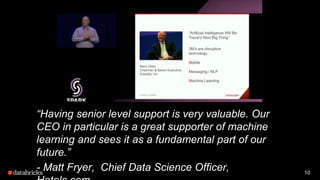
“Having senior level support is very valuable. Our
CEO in particular is a great supporter of machine
learning and sees it as a fundamental part of our
future.”
- Matt Fryer, Chief Data Science Officer,
11
Alignment
n. arrangement in a straight line, or in correct or
appropriate relative positions
n. a position of agreement or alliance
Theory (job description)
•PhD in Computer Science, Computer Engineering, Mathematics...
•5 years of real world or research experience in data science
•Experience with Big Data technologies such as Hadoop, Cassandra etc.
•Experience in model development and life-cycle-management
•Programming skills in various languages (C++, Scala, Java, R) with
proficiency in Python and/or C++
•Understanding of Machine Learning, e.g.: linear/logistics regression
discriminant analysis, bagging, random forest, SVM, neural nets
•Knowledge and skills in the use of current state of the art machine
learning frameworks such as Scikit-Learn, H2O, Keras, TensorFlow and
Spark, etc.
Practice (on the job)
•How many daily active users do we
have?
•What’s our monthly churn?
•How many people are using
_______ feature?
•Can you build a data pipeline?
•We’re considering A/B testing, can
you write up a report on it?
Alignment in the context of DS
projects•The project is formally prioritized
–Funded and staffed appropriately
•You have the infrastructural resources to achieve the mission
•You have runway and cover from your leadership to get where you need
to go
The organization has alignment on
the value data science provides.
15
Discipline
n. a rule or system of rules governing conduct or
activity
Discipline in data science…
•Figure out what you’re going to do and execute at a high standard.
•focus on the results, not just on the tasks.
•Define phases and demonstrate results along the way.
•Don’t just stir the data to get the answer you want.
Make data science a discipline.
Technical Patterns
in Data Science Projects
19
• Defines a theory for
human motivation
(Abraham Maslow, 1943)
• Each base in the pyramid
must be supported
before one can move
onto the next
Maslow’s Hierarchy of Needs
20
Data-Driven Company Hierarchy of
Needs • stable and repeatable
• trackable
• parts of the workflow are automated
production
data science
• simple use cases
• done as one-offs
• little repeatability
ad hoc data science
• stable and repeatable
• high level of abstraction
data pipelines
• ad hoc
• no centralization of data
• little repeatability
data access
• low cognitive load for infra
• simple for end users & devs
• line of sight to automation
data infrastructure
21
Data Science Hierarchy of Needs
Source - Monica Rogati
22
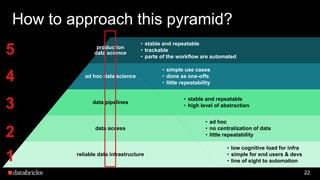
How to approach this pyramid?
• stable and repeatable
• trackable
• parts of the workflow are automated
production
data science
• simple use cases
• done as one-offs
• little repeatability
ad hoc data science
• stable and repeatable
• high level of abstraction
data pipelines
• ad hoc
• no centralization of data
• little repeatability
data access
• low cognitive load for infra
• simple for end users & devs
• line of sight to automation
reliable data infrastructure
1
2
3
4
5
23
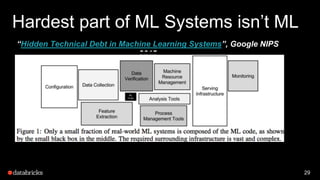
ML-System Anti-Patterns
“Hidden Technical Debt in Machine Learning Systems”, Google NIPS
2015
• Glue Code
• Lots of glue code to tie OSS/generic components together.
• Pipeline Jungles
• When pipelines evolve organically, they can become hard to
maintain.
• Abstraction Debt
• A general problem in ML, lots of different abstractions.
24
Simple
n. plain, basic, or uncomplicated in form, nature, or
design; without much decoration or ornamentation
25
KISS Principle
Keep it simple stupid
Kelly Johnson
1910-1990
F-117 Nighthawk
U2 Spy Plane
SR-71 Blackbird
26
Keeping it Simple in ML
Rules of Machine Learning: Best
Practices for ML Engineering
- Martin Zinkevich, Research Scientist @
Google
Rule #1: (Before Machine Learning)
Don’t be afraid to launch a product without
machine learning
Rule #4: (Your First Pipeline)
Keep the first model SIMPLE and get the
infrastructure right
27
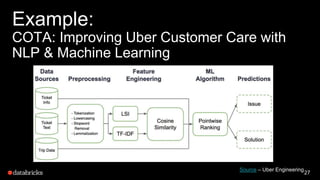
Source – Uber Engineering
Example:
COTA: Improving Uber Customer Care with
NLP & Machine Learning
28
Track
n.
the act or process of following something or someone
n. Precise and continuous position-
finding of targets by radar, optical, or other means.
29
Hardest part of ML Systems isn’t ML
“Hidden Technical Debt in Machine Learning Systems”, Google NIPS
2015
30
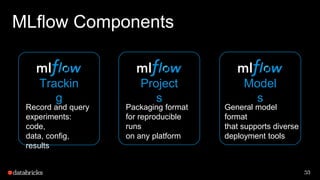
MLflow Components
30
Trackin
g
Record and query
experiments:
code,
data, config,
results
Project
s
Packaging format
for reproducible
runs
on any platform
Model
s
General model
format
that supports diverse
deployment tools
Notebooks
Local Apps
Cloud Jobs
Tracking Server
UI
API
MLflow Tracking
Python or
REST API
Organizational Patterns Technical Patterns
6 Patterns for DS Projects
•Hierarchy of Needs
•Simplify
•Track
•Value
•Alignment
•Discipline
Thank you

Patterns for Successful Data Science Projects (Spark AI Summit)

  • 1.
    Patterns for Successful DataScience Projects Bill Chambers @bllchmbrs 2018-04-24
  • 2.
  • 3.
  • 4.
    4 About you • DataScientists? • Data engineers? • Data team leads?
  • 5.
    Scoping Initiatives Lookingto Grow The Context of Your Org/Team •Your company has a dozen or so models in production, but now you want to scale to hundreds/ thousands in the next year. •Your company is scoping ML initiatives right now, with little (if any) ML in production.
  • 6.
    Organizational Patterns TechnicalPatterns 6 Patterns for DS Projects •Hierarchy of Needs •Simple •Track •Value •Alignment •Discipline Deep dive into each pattern and apply it to data science projects
  • 7.
  • 8.
    8 Value n. the regardthat something is held to deserve; the importance, worth, or usefulness of something
  • 9.
    9 “Data science isn’twoven into our culture; it is our culture. We started with it at the heart of the business, rather than adding it to a traditional organizational structure, and built the company’s algorithms around our clients and their needs.” Katrina Lake CEO Stitch Fix - HBR
  • 10.
    10 “Having senior levelsupport is very valuable. Our CEO in particular is a great supporter of machine learning and sees it as a fundamental part of our future.” - Matt Fryer, Chief Data Science Officer,
  • 11.
    11 Alignment n. arrangement ina straight line, or in correct or appropriate relative positions n. a position of agreement or alliance
  • 12.
    Theory (job description) •PhDin Computer Science, Computer Engineering, Mathematics... •5 years of real world or research experience in data science •Experience with Big Data technologies such as Hadoop, Cassandra etc. •Experience in model development and life-cycle-management •Programming skills in various languages (C++, Scala, Java, R) with proficiency in Python and/or C++ •Understanding of Machine Learning, e.g.: linear/logistics regression discriminant analysis, bagging, random forest, SVM, neural nets •Knowledge and skills in the use of current state of the art machine learning frameworks such as Scikit-Learn, H2O, Keras, TensorFlow and Spark, etc.
  • 13.
    Practice (on thejob) •How many daily active users do we have? •What’s our monthly churn? •How many people are using _______ feature? •Can you build a data pipeline? •We’re considering A/B testing, can you write up a report on it?
  • 14.
    Alignment in thecontext of DS projects•The project is formally prioritized –Funded and staffed appropriately •You have the infrastructural resources to achieve the mission •You have runway and cover from your leadership to get where you need to go The organization has alignment on the value data science provides.
  • 15.
    15 Discipline n. a ruleor system of rules governing conduct or activity
  • 17.
    Discipline in datascience… •Figure out what you’re going to do and execute at a high standard. •focus on the results, not just on the tasks. •Define phases and demonstrate results along the way. •Don’t just stir the data to get the answer you want. Make data science a discipline.
  • 18.
  • 19.
    19 • Defines atheory for human motivation (Abraham Maslow, 1943) • Each base in the pyramid must be supported before one can move onto the next Maslow’s Hierarchy of Needs
  • 20.
    20 Data-Driven Company Hierarchyof Needs • stable and repeatable • trackable • parts of the workflow are automated production data science • simple use cases • done as one-offs • little repeatability ad hoc data science • stable and repeatable • high level of abstraction data pipelines • ad hoc • no centralization of data • little repeatability data access • low cognitive load for infra • simple for end users & devs • line of sight to automation data infrastructure
  • 21.
    21 Data Science Hierarchyof Needs Source - Monica Rogati
  • 22.
    22 How to approachthis pyramid? • stable and repeatable • trackable • parts of the workflow are automated production data science • simple use cases • done as one-offs • little repeatability ad hoc data science • stable and repeatable • high level of abstraction data pipelines • ad hoc • no centralization of data • little repeatability data access • low cognitive load for infra • simple for end users & devs • line of sight to automation reliable data infrastructure 1 2 3 4 5
  • 23.
    23 ML-System Anti-Patterns “Hidden TechnicalDebt in Machine Learning Systems”, Google NIPS 2015 • Glue Code • Lots of glue code to tie OSS/generic components together. • Pipeline Jungles • When pipelines evolve organically, they can become hard to maintain. • Abstraction Debt • A general problem in ML, lots of different abstractions.
  • 24.
    24 Simple n. plain, basic,or uncomplicated in form, nature, or design; without much decoration or ornamentation
  • 25.
    25 KISS Principle Keep itsimple stupid Kelly Johnson 1910-1990 F-117 Nighthawk U2 Spy Plane SR-71 Blackbird
  • 26.
    26 Keeping it Simplein ML Rules of Machine Learning: Best Practices for ML Engineering - Martin Zinkevich, Research Scientist @ Google Rule #1: (Before Machine Learning) Don’t be afraid to launch a product without machine learning Rule #4: (Your First Pipeline) Keep the first model SIMPLE and get the infrastructure right
  • 27.
    27 Source – UberEngineering Example: COTA: Improving Uber Customer Care with NLP & Machine Learning
  • 28.
    28 Track n. the act orprocess of following something or someone n. Precise and continuous position- finding of targets by radar, optical, or other means.
  • 29.
    29 Hardest part ofML Systems isn’t ML “Hidden Technical Debt in Machine Learning Systems”, Google NIPS 2015
  • 30.
    30 MLflow Components 30 Trackin g Record andquery experiments: code, data, config, results Project s Packaging format for reproducible runs on any platform Model s General model format that supports diverse deployment tools
  • 31.
    Notebooks Local Apps Cloud Jobs TrackingServer UI API MLflow Tracking Python or REST API
  • 32.
    Organizational Patterns TechnicalPatterns 6 Patterns for DS Projects •Hierarchy of Needs •Simplify •Track •Value •Alignment •Discipline
  • 33.