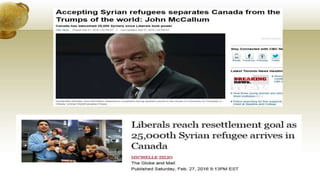
Refugee Health:
Imagining Our Future
North American Refugee Health Conference
Niagara Falls, New York
June 12, 2016
Patricia F Walker, MD, DTM&H, FASTMH
Professor, Division of Infectious Disease and International Medicine
Dept. of Internal Medicine, University of Minnesota
Medical Director, HealthPartners
Travel and Tropical Medicine Center
Disclosure
I receive royalties for the following
educational products:
o Elsevier Publishing for sales of Immigrant
Medicine
o UpToDate for publication of Guidelines for
Care of Adult Immigrants
o Critical Measures, Inc. for on line cross
cultural case studies
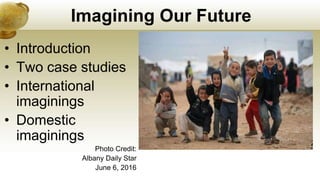
Imagining Our Future
• Introduction
• Two case studies
• International
imaginings
• Domestic
imaginings
Photo Credit:
Albany Daily Star
June 6, 2016
Imagining Our Future/
Khalil Gibran, On Children
“Your children are not your
children...they are the sons
and daughters of Life’s
longing for itself…you may
house their bodies, but not
their souls, for their souls
dwell in the house of
tomorrow, which you
cannot visit, not even in
your dreams”
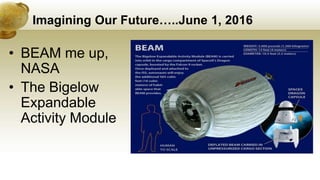
Imagining Our Future…..June 1, 2016
• BEAM me up,
NASA
• The Bigelow
Expandable
Activity Module
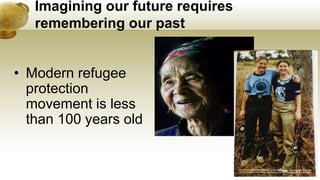
Imagining our future requires
remembering our past
• Modern refugee
protection
movement is less
than 100 years old
Imagining our future requires
remembering our past
• Protection of refugees has
occurred since antiquity
• International protection
began with the League of
Nations (1921-1946)
https://www.icrc.org/eng/assets/files/ot
her/727_738_jaeger.pdf
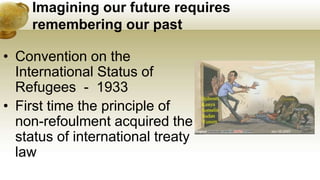
Imagining our future requires
remembering our past
• Convention on the
International Status of
Refugees - 1933
• First time the principle of
non-refoulment acquired the
status of international treaty
law
Imagining our future requires
remembering our past
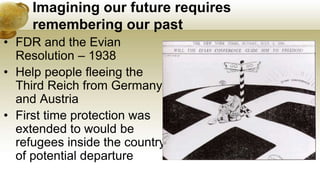
• FDR and the Evian
Resolution – 1938
• Help people fleeing the
Third Reich from Germany
and Austria
• First time protection was
extended to would be
refugees inside the country
of potential departure
Imagining our future requires
remembering our past
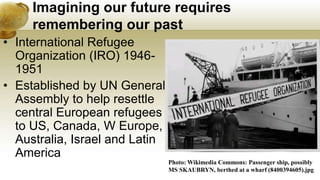
• International Refugee
Organization (IRO) 1946-
1951
• Established by UN General
Assembly to help resettle
central European refugees
to US, Canada, W Europe,
Australia, Israel and Latin
America
Photo: Wikimedia Commons: Passenger ship, possibly
MS SKAUBRYN, berthed at a wharf (8400394605).jpg
Imagining our future requires
remembering our past
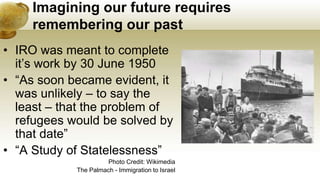
• IRO was meant to complete
it’s work by 30 June 1950
• “As soon became evident, it
was unlikely – to say the
least – that the problem of
refugees would be solved by
that date”
• “A Study of Statelessness”
Photo Credit: Wikimedia
The Palmach - Immigration to Israel
Imagining our future requires
remembering our past
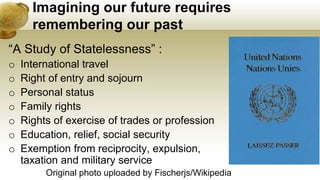
“A Study of Statelessness” :
o International travel
o Right of entry and sojourn
o Personal status
o Family rights
o Rights of exercise of trades or profession
o Education, relief, social security
o Exemption from reciprocity, expulsion,
taxation and military service
Original photo uploaded by Fischerjs/Wikipedia
Imagining our future requires
remembering our past
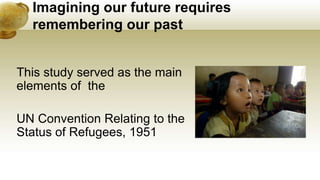
This study served as the main
elements of the
UN Convention Relating to the
Status of Refugees, 1951
Imagining our future requires
remembering our past
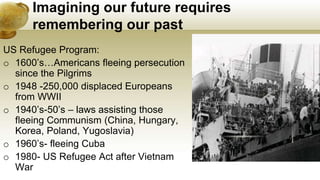
US Refugee Program:
o 1600’s…Americans fleeing persecution
since the Pilgrims
o 1948 -250,000 displaced Europeans
from WWII
o 1940’s-50’s – laws assisting those
fleeing Communism (China, Hungary,
Korea, Poland, Yugoslavia)
o 1960’s- fleeing Cuba
o 1980- US Refugee Act after Vietnam
War
Imagining Our Future/International
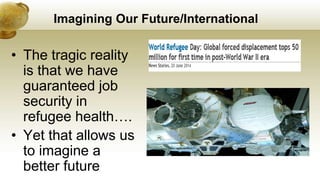
• The tragic reality
is that we have
guaranteed job
security in
refugee health….
• Yet that allows us
to imagine a
better future
Case study number 1
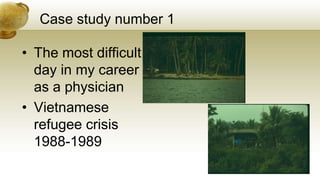
• The most difficult
day in my career
as a physician
• Vietnamese
refugee crisis
1988-1989
Imagining Our Future/International
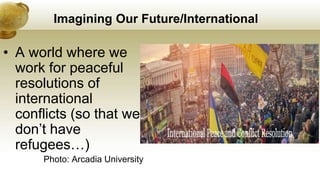
• A world where we
work for peaceful
resolutions of
international
conflicts (so that we
don’t have
refugees…)
Photo: Arcadia University
Imagining Our Future/International
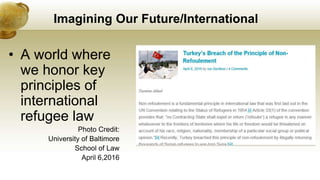
• A world where
we honor key
principles of
international
refugee law
Photo Credit:
University of Baltimore
School of Law
April 6,2016
Imagining Our Future/International
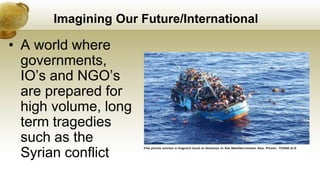
• A world where
governments,
IO’s and NGO’s
are prepared for
high volume, long
term tragedies
such as the
Syrian conflict
Imagining Our Future/International
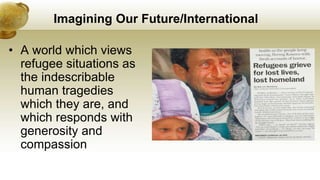
• A world which views
refugee situations as
the indescribable
human tragedies
which they are, and
which responds with
generosity and
compassion
Imagining Our Future/International
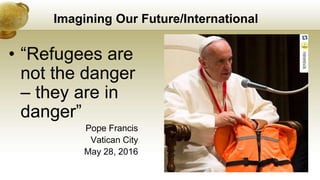
• “Refugees are
not the danger
– they are in
danger”
Pope Francis
Vatican City
May 28, 2016
Imagining Our Future/International
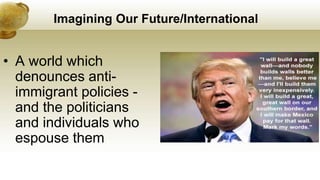
• A world which
denounces anti-
immigrant policies -
and the politicians
and individuals who
espouse them
Imagining Our Future/International
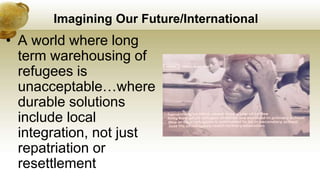
• A world where long
term warehousing of
refugees is
unacceptable…where
durable solutions
include local
integration, not just
repatriation or
resettlement
Imagining Our Future/International
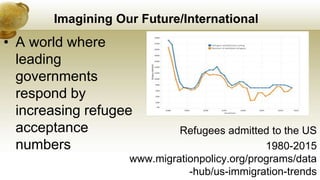
• A world where
leading
governments
respond by
increasing refugee
acceptance
numbers
Refugees admitted to the US
1980-2015
www.migrationpolicy.org/programs/data
-hub/us-immigration-trends
Imagining Our Future/International
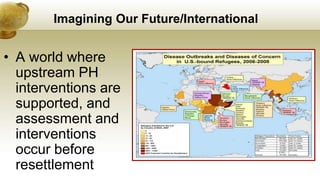
• A world where
upstream PH
interventions are
supported, and
assessment and
interventions
occur before
resettlement
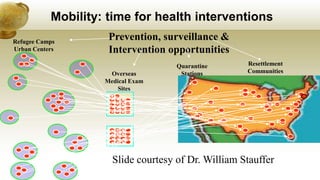
Overseas
Medical Exam
Sites
Refugee Camps
Urban Centers
Resettlement
Communities
Mobility: time for health interventions
Prevention, surveillance &
Intervention opportunities
Quarantine
Stations
Slide courtesy of Dr. William Stauffer
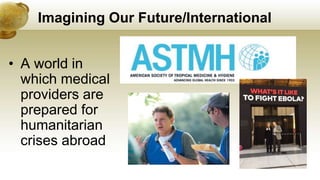
Imagining Our Future/International
• A world in
which medical
providers are
prepared for
humanitarian
crises abroad
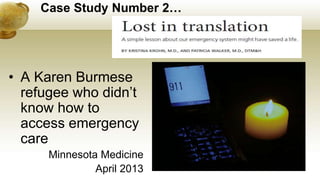
Case Study Number 2…
• A Karen Burmese
refugee who didn’t
know how to
access emergency
care
Minnesota Medicine
April 2013
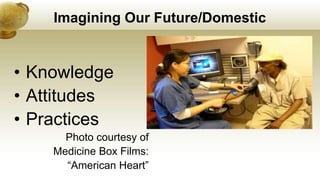
Imagining Our Future/Domestic
• Knowledge
• Attitudes
• Practices
Photo courtesy of
Medicine Box Films:
“American Heart”
Imagining Our Future
Lyudmila Brukhis, CMA
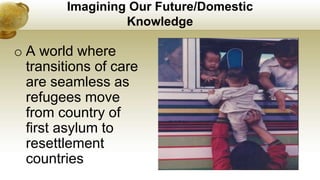
Imagining Our Future/Domestic
Knowledge
o A world where
transitions of care
are seamless as
refugees move
from country of
first asylum to
resettlement
countries
Imagining Our Future/Domestic
Knowledge
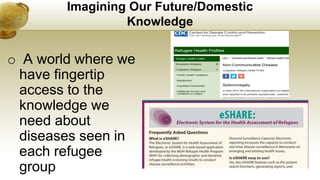
o A world where we
have fingertip
access to the
knowledge we
need about
diseases seen in
each refugee
group
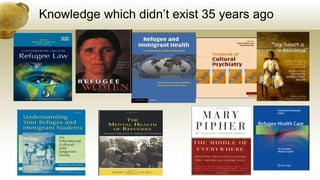
Knowledge which didn’t exist 35 years ago
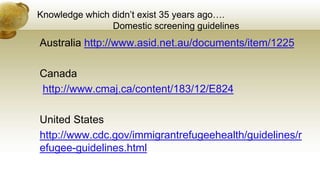
Knowledge which didn’t exist 35 years ago….
Domestic screening guidelines
Australia http://www.asid.net.au/documents/item/1225
Canada
http://www.cmaj.ca/content/183/12/E824
United States
http://www.cdc.gov/immigrantrefugeehealth/guidelines/r
efugee-guidelines.html
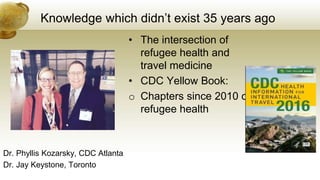
Knowledge which didn’t exist 35 years ago
Dr. Phyllis Kozarsky, CDC Atlanta
Dr. Jay Keystone, Toronto
• The intersection of
refugee health and
travel medicine
• CDC Yellow Book:
o Chapters since 2010 on
refugee health
Imagining Our Future
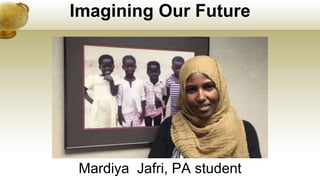
Mardiya Jafri, PA student
Imagining Our Future/Domestic
Knowledge
o A world where
we have the
demographic
data we need to
provide best
care
Vietnam,
1876, 16%
Thailand,
1332, 12%
Nepal,
1144,
10%
Cambodia,
1123, 10%
United States,
1061, 9%
Other, 982, 9%
Somalia, 982,
9%
Ethiopia, 910,
8%
Russia, 798, 7%
Laos, 629, 6%
Unknown, 174,
2%
Mexico, 157, 1%
Eritrea, 152, 1%
Liberia, 25, 0% Kenya, 6, 0%
Center for International Health
Country of Origin
Jan-Oct 2014
Vietnam
Thailand
Nepal
Cambodia
United States
Other
Somalia
Ethiopia
Russia
Laos
Unknown
Mexico
Eritrea
Liberia
Kenya
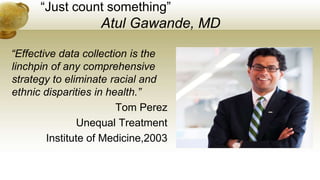
“Just count something”
Atul Gawande, MD
“Effective data collection is the
linchpin of any comprehensive
strategy to eliminate racial and
ethnic disparities in health.”
Tom Perez
Unequal Treatment
Institute of Medicine,2003
Just count something:
Data Collection at HealthPartners*
• Language 99%
• Interpreter Needed 99%
• Race/ethnicity 98%
• Country of Origin 40-98%
*Integrated care delivery system
(hospitals, medical group with >40 clinics, insurance provider)
in the Upper Midwest, US
86% 86%
73.5% 78.4%
0%
20%
40%
60%
80%
100%
1st Qtr 2007 3rd Qtr 2009
white patients patients of color
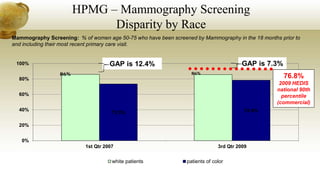
Mammography Screening: % of women age 50-75 who have been screened by Mammography in the 18 months prior to
and including their most recent primary care visit.
HPMG – Mammography Screening
Disparity by Race
GAP is 7.3%GAP is 12.4%
76.8%
2009 HEDIS
national 90th
percentile
(commercial)
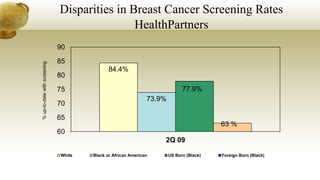
84.4%
73.9%
77.9%
63 %
60
65
70
75
80
85
90
2Q 09
%up-to-datewithscreening
White Black or African American US Born (Black) Foreign Born (Black)
Disparities in Breast Cancer Screening Rates
HealthPartners
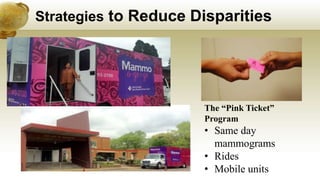
Strategies to Reduce Disparities
The “Pink Ticket”
Program
• Same day
mammograms
• Rides
• Mobile units
Imagining Our Future
Dr. Steven Richmond, Internal medicine intern
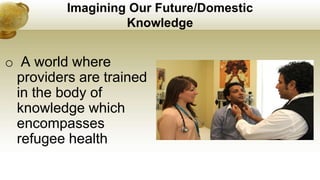
Imagining Our Future/Domestic
Knowledge
o A world where
providers are trained
in the body of
knowledge which
encompasses
refugee health
Imagining Our Future
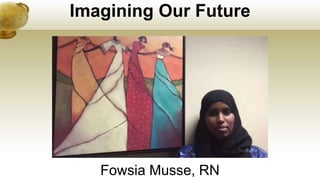
Fowsia Musse, RN
Imagining Our Future/Domestic
Knowledge
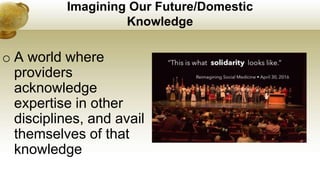
o A world where
providers
acknowledge
expertise in other
disciplines, and avail
themselves of that
knowledge
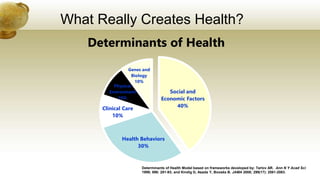
What Really Creates Health?
Social and
Economic Factors
40%
Health Behaviors
30%
Clinical Care
10%
Physical
Environment
10%
Genes and
Biology
10%
Determinants of Health
Determinants of Health Model based on frameworks developed by: Tarlov AR. Ann N Y Acad Sci
1999; 896: 281-93; and Kindig D, Asada Y, Booske B. JAMA 2008; 299(17): 2081-2083.
Imagining Our Future
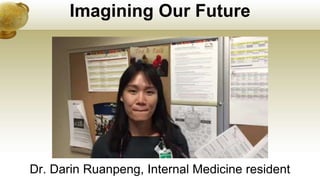
Dr. Darin Ruanpeng, Internal Medicine resident
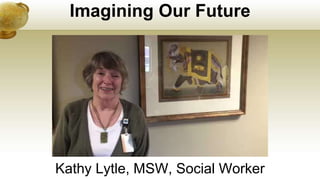
Imagining Our Future
Kathy Lytle, MSW, Social Worker
Imagining Our Future/Domestic
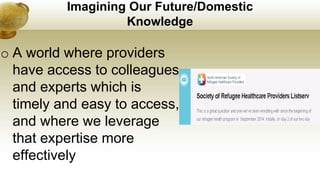
Knowledge
o A world where providers
have access to colleagues
and experts which is
timely and easy to access,
and where we leverage
that expertise more
effectively
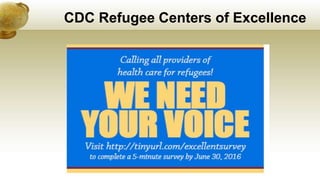
CDC Refugee Centers of Excellence
Imagining Our Future/Domestic
Knowledge
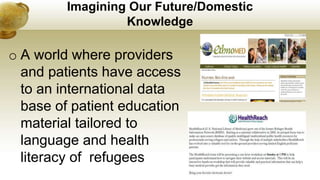
o A world where providers
and patients have access
to an international data
base of patient education
material tailored to
language and health
literacy of refugees
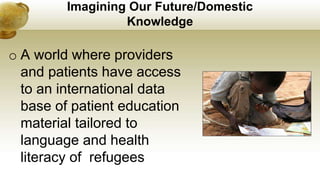
Imagining Our Future/Domestic
Knowledge
o A world where providers
and patients have access
to an international data
base of patient education
material tailored to
language and health
literacy of refugees
Imagining Our Future/Domestic
Knowledge
o A world where
refugee health care
providers do more
science – clinical
research and
publishing
Imagining Our Future/Domestic
Knowledge
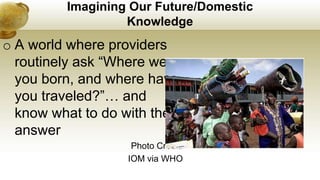
o A world where providers
routinely ask “Where were
you born, and where have
you traveled?”… and
know what to do with the
answer
Photo Credit:
IOM via WHO
Imagining Our Future/Domestic
Knowledge
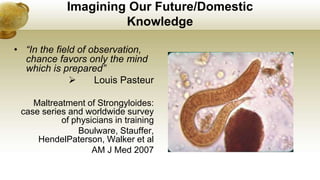
• “In the field of observation,
chance favors only the mind
which is prepared”
 Louis Pasteur
Maltreatment of Strongyloides:
case series and worldwide survey
of physicians in training
Boulware, Stauffer,
HendelPaterson, Walker et al
AM J Med 2007
Imagining Our Future/Domestic
Knowledge
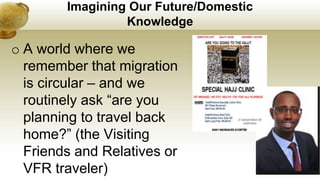
o A world where we
remember that migration
is circular – and we
routinely ask “are you
planning to travel back
home?” (the Visiting
Friends and Relatives or
VFR traveler)
Imagining Our Future/Domestic
Attitudes
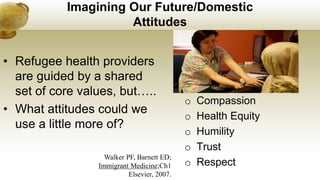
• Refugee health providers
are guided by a shared
set of core values, but…..
• What attitudes could we
use a little more of?
o Compassion
o Health Equity
o Humility
o Trust
o Respect
Walker PF, Barnett ED;
Immigrant Medicine;Ch1
Elsevier, 2007.
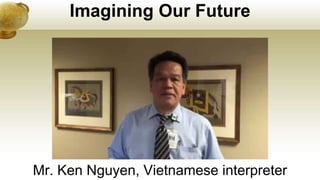
Imagining Our Future
Mr. Ken Nguyen, Vietnamese interpreter
Imagining Our Future/Domestic
Attitudes we need more of…
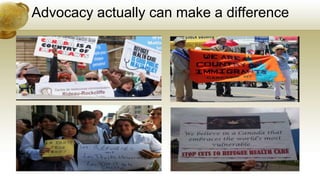
Advocacy/calm outrage
o About anti-immigrant attitudes
o About health disparities
Leading by example:
o Academic excellence
o Mentorship and feedback
Imagining Our Future/Domestic
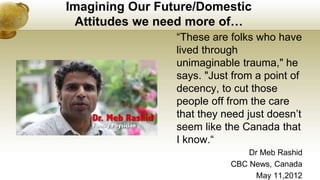
Attitudes we need more of…
“These are folks who have
lived through
unimaginable trauma," he
says. "Just from a point of
decency, to cut those
people off from the care
that they need just doesn’t
seem like the Canada that
I know.“
Dr Meb Rashid
CBC News, Canada
May 11,2012
Advocacy actually can make a difference
Imagining Our Future/
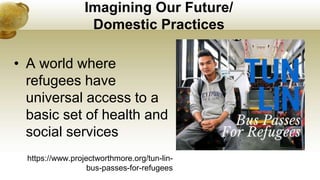
Domestic Practices
• A world where
refugees have
universal access to a
basic set of health and
social services
https://www.projectworthmore.org/tun-lin-
bus-passes-for-refugees
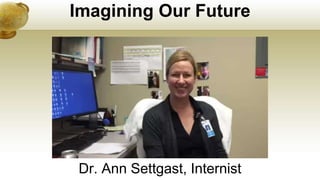
Imagining Our Future
Dr. Ann Settgast, Internist
Imagining Our Future/
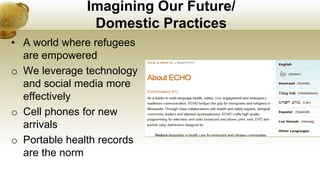
Domestic Practices
• A world where refugees
are empowered
o We leverage technology
and social media more
effectively
o Cell phones for new
arrivals
o Portable health records
are the norm
Imagining Our Future/
Domestic Practices
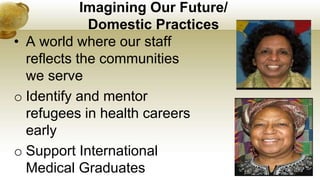
• A world where our staff
reflects the communities
we serve
o Identify and mentor
refugees in health careers
early
o Support International
Medical Graduates
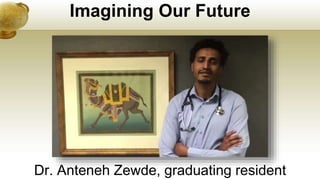
Imagining Our Future
Dr. Anteneh Zewde, graduating resident
Imagining Our Future/
Domestic Practices
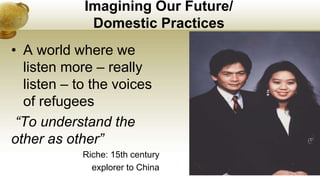
• A world where we
listen more – really
listen – to the voices
of refugees
“To understand the
other as other”
Riche: 15th century
explorer to China
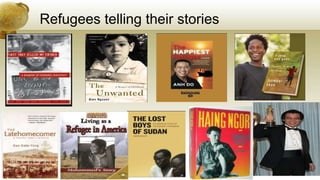
Refugees telling their stories
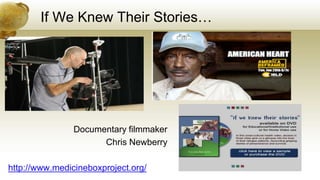
If We Knew Their Stories…
Documentary filmmaker
Chris Newberry
http://www.medicineboxproject.org/
Imagining Our Future/
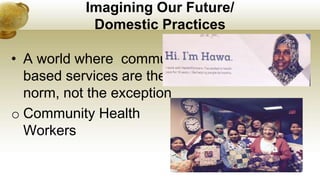
Domestic Practices
• A world where community
based services are the
norm, not the exception
o Community Health
Workers
Imagining Our Future/
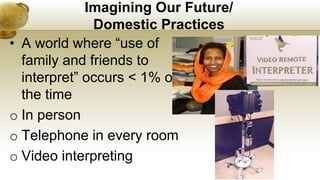
Domestic Practices
• A world where “use of
family and friends to
interpret” occurs < 1% of
the time
o In person
o Telephone in every room
o Video interpreting
Imagining Our Future
Shashi Dahal, RN
Imagining Our Future/
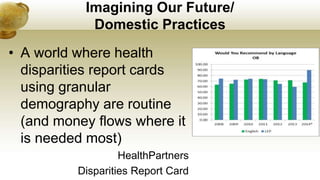
Domestic Practices
• A world where health
disparities report cards
using granular
demography are routine
(and money flows where it
is needed most)
HealthPartners
Disparities Report Card
Imagining Our Future/
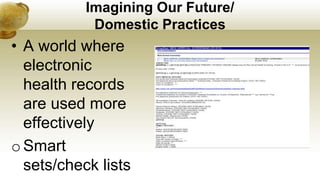
Domestic Practices
• A world where
electronic
health records
are used more
effectively
o Smart
sets/check lists
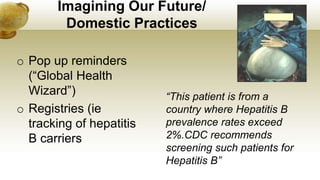
Imagining Our Future/
Domestic Practices
o Pop up reminders
(“Global Health
Wizard”)
o Registries (ie
tracking of hepatitis
B carriers
“This patient is from a
country where Hepatitis B
prevalence rates exceed
2%.CDC recommends
screening such patients for
Hepatitis B”
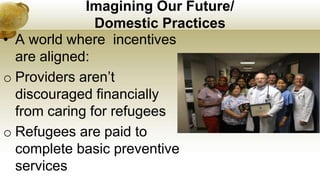
Imagining Our Future/
Domestic Practices
• A world where incentives
are aligned:
o Providers aren’t
discouraged financially
from caring for refugees
o Refugees are paid to
complete basic preventive
services
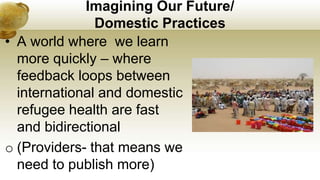
Imagining Our Future/
Domestic Practices
• A world where we learn
more quickly – where
feedback loops between
international and domestic
refugee health are fast
and bidirectional
o (Providers- that means we
need to publish more)
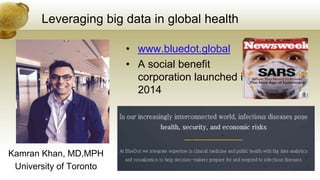
Leveraging big data in global health
Kamran Khan, MD,MPH
University of Toronto
• www.bluedot.global
• A social benefit
corporation launched in
2014
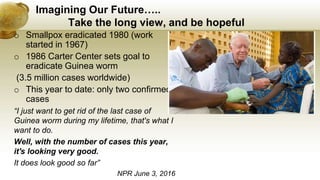
Imagining Our Future…..
Take the long view, and be hopeful
o Smallpox eradicated 1980 (work
started in 1967)
o 1986 Carter Center sets goal to
eradicate Guinea worm
(3.5 million cases worldwide)
o This year to date: only two confirmed
cases
“I just want to get rid of the last case of
Guinea worm during my lifetime, that's what I
want to do.
Well, with the number of cases this year,
it's looking very good.
It does look good so far”
NPR June 3, 2016
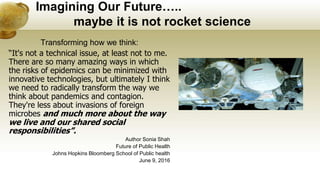
Imagining Our Future…..
maybe it is not rocket science
Transforming how we think:
“It's not a technical issue, at least not to me.
There are so many amazing ways in which
the risks of epidemics can be minimized with
innovative technologies, but ultimately I think
we need to radically transform the way we
think about pandemics and contagion.
They're less about invasions of foreign
microbes and much more about the way
we live and our shared social
responsibilities”.
Author Sonia Shah
Future of Public Health
Johns Hopkins Bloomberg School of Public health
June 9, 2016
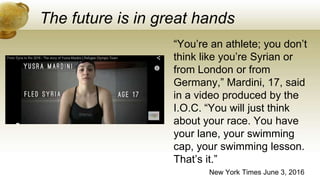
The future is in great hands
New York Times June 3, 2016
‘Symbol of Hope’: Refugee Team Named for
Rio Olympics
The future is in great hands
New York Times June 3, 2016
“You’re an athlete; you don’t
think like you’re Syrian or
from London or from
Germany,” Mardini, 17, said
in a video produced by the
I.O.C. “You will just think
about your race. You have
your lane, your swimming
cap, your swimming lesson.
That’s it.”
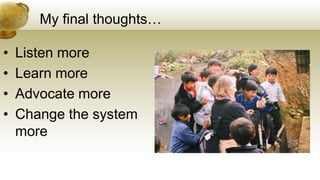
My final thoughts…
• Listen more
• Learn more
• Advocate more
• Change the system
more
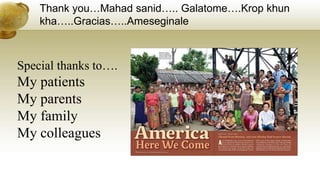
Thank you…Mahad sanid….. Galatome….Krop khun
kha…..Gracias…..Ameseginale
Special thanks to….
My patients
My parents
My family
My colleagues

Patricia Walker_NARCH Keynote_June 2016

  • 1.
    Refugee Health: Imagining OurFuture North American Refugee Health Conference Niagara Falls, New York June 12, 2016 Patricia F Walker, MD, DTM&H, FASTMH Professor, Division of Infectious Disease and International Medicine Dept. of Internal Medicine, University of Minnesota Medical Director, HealthPartners Travel and Tropical Medicine Center
  • 2.
    Disclosure I receive royaltiesfor the following educational products: o Elsevier Publishing for sales of Immigrant Medicine o UpToDate for publication of Guidelines for Care of Adult Immigrants o Critical Measures, Inc. for on line cross cultural case studies
  • 3.
    Imagining Our Future •Introduction • Two case studies • International imaginings • Domestic imaginings Photo Credit: Albany Daily Star June 6, 2016
  • 4.
    Imagining Our Future/ KhalilGibran, On Children “Your children are not your children...they are the sons and daughters of Life’s longing for itself…you may house their bodies, but not their souls, for their souls dwell in the house of tomorrow, which you cannot visit, not even in your dreams”
  • 5.
    Imagining Our Future…..June1, 2016 • BEAM me up, NASA • The Bigelow Expandable Activity Module
  • 6.
    Imagining our futurerequires remembering our past • Modern refugee protection movement is less than 100 years old
  • 7.
    Imagining our futurerequires remembering our past • Protection of refugees has occurred since antiquity • International protection began with the League of Nations (1921-1946) https://www.icrc.org/eng/assets/files/ot her/727_738_jaeger.pdf
  • 8.
    Imagining our futurerequires remembering our past • Convention on the International Status of Refugees - 1933 • First time the principle of non-refoulment acquired the status of international treaty law
  • 9.
    Imagining our futurerequires remembering our past • FDR and the Evian Resolution – 1938 • Help people fleeing the Third Reich from Germany and Austria • First time protection was extended to would be refugees inside the country of potential departure
  • 10.
    Imagining our futurerequires remembering our past • International Refugee Organization (IRO) 1946- 1951 • Established by UN General Assembly to help resettle central European refugees to US, Canada, W Europe, Australia, Israel and Latin America Photo: Wikimedia Commons: Passenger ship, possibly MS SKAUBRYN, berthed at a wharf (8400394605).jpg
  • 11.
    Imagining our futurerequires remembering our past • IRO was meant to complete it’s work by 30 June 1950 • “As soon became evident, it was unlikely – to say the least – that the problem of refugees would be solved by that date” • “A Study of Statelessness” Photo Credit: Wikimedia The Palmach - Immigration to Israel
  • 12.
    Imagining our futurerequires remembering our past “A Study of Statelessness” : o International travel o Right of entry and sojourn o Personal status o Family rights o Rights of exercise of trades or profession o Education, relief, social security o Exemption from reciprocity, expulsion, taxation and military service Original photo uploaded by Fischerjs/Wikipedia
  • 13.
    Imagining our futurerequires remembering our past This study served as the main elements of the UN Convention Relating to the Status of Refugees, 1951
  • 14.
    Imagining our futurerequires remembering our past US Refugee Program: o 1600’s…Americans fleeing persecution since the Pilgrims o 1948 -250,000 displaced Europeans from WWII o 1940’s-50’s – laws assisting those fleeing Communism (China, Hungary, Korea, Poland, Yugoslavia) o 1960’s- fleeing Cuba o 1980- US Refugee Act after Vietnam War
  • 15.
    Imagining Our Future/International •The tragic reality is that we have guaranteed job security in refugee health…. • Yet that allows us to imagine a better future
  • 16.
    Case study number1 • The most difficult day in my career as a physician • Vietnamese refugee crisis 1988-1989
  • 17.
    Imagining Our Future/International •A world where we work for peaceful resolutions of international conflicts (so that we don’t have refugees…) Photo: Arcadia University
  • 18.
    Imagining Our Future/International •A world where we honor key principles of international refugee law Photo Credit: University of Baltimore School of Law April 6,2016
  • 19.
    Imagining Our Future/International •A world where governments, IO’s and NGO’s are prepared for high volume, long term tragedies such as the Syrian conflict
  • 20.
    Imagining Our Future/International •A world which views refugee situations as the indescribable human tragedies which they are, and which responds with generosity and compassion
  • 21.
    Imagining Our Future/International •“Refugees are not the danger – they are in danger” Pope Francis Vatican City May 28, 2016
  • 22.
    Imagining Our Future/International •A world which denounces anti- immigrant policies - and the politicians and individuals who espouse them
  • 23.
    Imagining Our Future/International •A world where long term warehousing of refugees is unacceptable…where durable solutions include local integration, not just repatriation or resettlement
  • 24.
    Imagining Our Future/International •A world where leading governments respond by increasing refugee acceptance numbers Refugees admitted to the US 1980-2015 www.migrationpolicy.org/programs/data -hub/us-immigration-trends
  • 26.
    Imagining Our Future/International •A world where upstream PH interventions are supported, and assessment and interventions occur before resettlement
  • 27.
    Overseas Medical Exam Sites Refugee Camps UrbanCenters Resettlement Communities Mobility: time for health interventions Prevention, surveillance & Intervention opportunities Quarantine Stations Slide courtesy of Dr. William Stauffer
  • 28.
    Imagining Our Future/International •A world in which medical providers are prepared for humanitarian crises abroad
  • 29.
    Case Study Number2… • A Karen Burmese refugee who didn’t know how to access emergency care Minnesota Medicine April 2013
  • 30.
    Imagining Our Future/Domestic •Knowledge • Attitudes • Practices Photo courtesy of Medicine Box Films: “American Heart”
  • 31.
  • 32.
    Imagining Our Future/Domestic Knowledge oA world where transitions of care are seamless as refugees move from country of first asylum to resettlement countries
  • 33.
    Imagining Our Future/Domestic Knowledge oA world where we have fingertip access to the knowledge we need about diseases seen in each refugee group
  • 34.
    Knowledge which didn’texist 35 years ago
  • 35.
    Knowledge which didn’texist 35 years ago…. Domestic screening guidelines Australia http://www.asid.net.au/documents/item/1225 Canada http://www.cmaj.ca/content/183/12/E824 United States http://www.cdc.gov/immigrantrefugeehealth/guidelines/r efugee-guidelines.html
  • 36.
    Knowledge which didn’texist 35 years ago Dr. Phyllis Kozarsky, CDC Atlanta Dr. Jay Keystone, Toronto • The intersection of refugee health and travel medicine • CDC Yellow Book: o Chapters since 2010 on refugee health
  • 37.
  • 38.
    Imagining Our Future/Domestic Knowledge oA world where we have the demographic data we need to provide best care Vietnam, 1876, 16% Thailand, 1332, 12% Nepal, 1144, 10% Cambodia, 1123, 10% United States, 1061, 9% Other, 982, 9% Somalia, 982, 9% Ethiopia, 910, 8% Russia, 798, 7% Laos, 629, 6% Unknown, 174, 2% Mexico, 157, 1% Eritrea, 152, 1% Liberia, 25, 0% Kenya, 6, 0% Center for International Health Country of Origin Jan-Oct 2014 Vietnam Thailand Nepal Cambodia United States Other Somalia Ethiopia Russia Laos Unknown Mexico Eritrea Liberia Kenya
  • 39.
    “Just count something” AtulGawande, MD “Effective data collection is the linchpin of any comprehensive strategy to eliminate racial and ethnic disparities in health.” Tom Perez Unequal Treatment Institute of Medicine,2003
  • 40.
    Just count something: DataCollection at HealthPartners* • Language 99% • Interpreter Needed 99% • Race/ethnicity 98% • Country of Origin 40-98% *Integrated care delivery system (hospitals, medical group with >40 clinics, insurance provider) in the Upper Midwest, US
  • 41.
    86% 86% 73.5% 78.4% 0% 20% 40% 60% 80% 100% 1stQtr 2007 3rd Qtr 2009 white patients patients of color Mammography Screening: % of women age 50-75 who have been screened by Mammography in the 18 months prior to and including their most recent primary care visit. HPMG – Mammography Screening Disparity by Race GAP is 7.3%GAP is 12.4% 76.8% 2009 HEDIS national 90th percentile (commercial)
  • 42.
    84.4% 73.9% 77.9% 63 % 60 65 70 75 80 85 90 2Q 09 %up-to-datewithscreening WhiteBlack or African American US Born (Black) Foreign Born (Black) Disparities in Breast Cancer Screening Rates HealthPartners
  • 43.
    Strategies to ReduceDisparities The “Pink Ticket” Program • Same day mammograms • Rides • Mobile units
  • 44.
    Imagining Our Future Dr.Steven Richmond, Internal medicine intern
  • 45.
    Imagining Our Future/Domestic Knowledge oA world where providers are trained in the body of knowledge which encompasses refugee health
  • 46.
  • 47.
    Imagining Our Future/Domestic Knowledge oA world where providers acknowledge expertise in other disciplines, and avail themselves of that knowledge
  • 48.
    What Really CreatesHealth? Social and Economic Factors 40% Health Behaviors 30% Clinical Care 10% Physical Environment 10% Genes and Biology 10% Determinants of Health Determinants of Health Model based on frameworks developed by: Tarlov AR. Ann N Y Acad Sci 1999; 896: 281-93; and Kindig D, Asada Y, Booske B. JAMA 2008; 299(17): 2081-2083.
  • 49.
    Imagining Our Future Dr.Darin Ruanpeng, Internal Medicine resident
  • 50.
    Imagining Our Future KathyLytle, MSW, Social Worker
  • 51.
    Imagining Our Future/Domestic Knowledge oA world where providers have access to colleagues and experts which is timely and easy to access, and where we leverage that expertise more effectively
  • 52.
    CDC Refugee Centersof Excellence
  • 53.
    Imagining Our Future/Domestic Knowledge oA world where providers and patients have access to an international data base of patient education material tailored to language and health literacy of refugees
  • 54.
    Imagining Our Future/Domestic Knowledge oA world where providers and patients have access to an international data base of patient education material tailored to language and health literacy of refugees
  • 55.
    Imagining Our Future/Domestic Knowledge oA world where refugee health care providers do more science – clinical research and publishing
  • 56.
    Imagining Our Future/Domestic Knowledge oA world where providers routinely ask “Where were you born, and where have you traveled?”… and know what to do with the answer Photo Credit: IOM via WHO
  • 57.
    Imagining Our Future/Domestic Knowledge •“In the field of observation, chance favors only the mind which is prepared”  Louis Pasteur Maltreatment of Strongyloides: case series and worldwide survey of physicians in training Boulware, Stauffer, HendelPaterson, Walker et al AM J Med 2007
  • 58.
    Imagining Our Future/Domestic Knowledge oA world where we remember that migration is circular – and we routinely ask “are you planning to travel back home?” (the Visiting Friends and Relatives or VFR traveler)
  • 59.
    Imagining Our Future/Domestic Attitudes •Refugee health providers are guided by a shared set of core values, but….. • What attitudes could we use a little more of? o Compassion o Health Equity o Humility o Trust o Respect Walker PF, Barnett ED; Immigrant Medicine;Ch1 Elsevier, 2007.
  • 60.
    Imagining Our Future Mr.Ken Nguyen, Vietnamese interpreter
  • 61.
    Imagining Our Future/Domestic Attitudeswe need more of… Advocacy/calm outrage o About anti-immigrant attitudes o About health disparities Leading by example: o Academic excellence o Mentorship and feedback
  • 62.
    Imagining Our Future/Domestic Attitudeswe need more of… “These are folks who have lived through unimaginable trauma," he says. "Just from a point of decency, to cut those people off from the care that they need just doesn’t seem like the Canada that I know.“ Dr Meb Rashid CBC News, Canada May 11,2012
  • 63.
    Advocacy actually canmake a difference
  • 64.
    Imagining Our Future/ DomesticPractices • A world where refugees have universal access to a basic set of health and social services https://www.projectworthmore.org/tun-lin- bus-passes-for-refugees
  • 65.
    Imagining Our Future Dr.Ann Settgast, Internist
  • 66.
    Imagining Our Future/ DomesticPractices • A world where refugees are empowered o We leverage technology and social media more effectively o Cell phones for new arrivals o Portable health records are the norm
  • 67.
    Imagining Our Future/ DomesticPractices • A world where our staff reflects the communities we serve o Identify and mentor refugees in health careers early o Support International Medical Graduates
  • 68.
    Imagining Our Future Dr.Anteneh Zewde, graduating resident
  • 69.
    Imagining Our Future/ DomesticPractices • A world where we listen more – really listen – to the voices of refugees “To understand the other as other” Riche: 15th century explorer to China
  • 70.
  • 71.
    If We KnewTheir Stories… Documentary filmmaker Chris Newberry http://www.medicineboxproject.org/
  • 72.
    Imagining Our Future/ DomesticPractices • A world where community based services are the norm, not the exception o Community Health Workers
  • 73.
    Imagining Our Future/ DomesticPractices • A world where “use of family and friends to interpret” occurs < 1% of the time o In person o Telephone in every room o Video interpreting
  • 74.
  • 75.
    Imagining Our Future/ DomesticPractices • A world where health disparities report cards using granular demography are routine (and money flows where it is needed most) HealthPartners Disparities Report Card
  • 76.
    Imagining Our Future/ DomesticPractices • A world where electronic health records are used more effectively o Smart sets/check lists
  • 77.
    Imagining Our Future/ DomesticPractices o Pop up reminders (“Global Health Wizard”) o Registries (ie tracking of hepatitis B carriers “This patient is from a country where Hepatitis B prevalence rates exceed 2%.CDC recommends screening such patients for Hepatitis B”
  • 78.
    Imagining Our Future/ DomesticPractices • A world where incentives are aligned: o Providers aren’t discouraged financially from caring for refugees o Refugees are paid to complete basic preventive services
  • 79.
    Imagining Our Future/ DomesticPractices • A world where we learn more quickly – where feedback loops between international and domestic refugee health are fast and bidirectional o (Providers- that means we need to publish more)
  • 80.
    Leveraging big datain global health Kamran Khan, MD,MPH University of Toronto • www.bluedot.global • A social benefit corporation launched in 2014
  • 81.
    Imagining Our Future….. Takethe long view, and be hopeful o Smallpox eradicated 1980 (work started in 1967) o 1986 Carter Center sets goal to eradicate Guinea worm (3.5 million cases worldwide) o This year to date: only two confirmed cases “I just want to get rid of the last case of Guinea worm during my lifetime, that's what I want to do. Well, with the number of cases this year, it's looking very good. It does look good so far” NPR June 3, 2016
  • 82.
    Imagining Our Future….. maybeit is not rocket science Transforming how we think: “It's not a technical issue, at least not to me. There are so many amazing ways in which the risks of epidemics can be minimized with innovative technologies, but ultimately I think we need to radically transform the way we think about pandemics and contagion. They're less about invasions of foreign microbes and much more about the way we live and our shared social responsibilities”. Author Sonia Shah Future of Public Health Johns Hopkins Bloomberg School of Public health June 9, 2016
  • 83.
    The future isin great hands New York Times June 3, 2016 ‘Symbol of Hope’: Refugee Team Named for Rio Olympics
  • 84.
    The future isin great hands New York Times June 3, 2016 “You’re an athlete; you don’t think like you’re Syrian or from London or from Germany,” Mardini, 17, said in a video produced by the I.O.C. “You will just think about your race. You have your lane, your swimming cap, your swimming lesson. That’s it.”
  • 85.
    My final thoughts… •Listen more • Learn more • Advocate more • Change the system more
  • 86.
    Thank you…Mahad sanid…..Galatome….Krop khun kha…..Gracias…..Ameseginale Special thanks to…. My patients My parents My family My colleagues