Download to read offline
![International Research Journal of Engineering and Technology (IRJET) e-ISSN: 2395-0056
Volume: 09 Issue: 06 | Jun 2022 www.irjet.net p-ISSN: 2395-0072
© 2022, IRJET | Impact Factor value: 7.529 | ISO 9001:2008 Certified Journal | Page 2525
Path Optimization for Mobile Robot Using Genetic Algorithm
Vinitha Reddy Chirra1, Gudibandi Lavanya2, Palla Veera Venkata Durga Ganapathi3
1,2,3 Student, Dept. of Computer Science and Engineering, Lovely Professional University, Punjab, India
---------------------------------------------------------------------***---------------------------------------------------------------------
Abstract – This study presents the concept of using the
Genetic Algorithm approach to resolve the mobile robot path
planning problem in a static environment with predictable
terrain. We present our initial Idea for using genetic
algorithms to assist a controllable mobile robottohuntout an
optimal path between a starting and ending point in an
exceedingly grid environment. The two problemsthatoccur in
an exceedingly very mobile robot's path planning are finding
the shortest path and a collision-free path. These should be
achieved during a static environmentofobstacles. Thisworkis
different from other works within the aspect of stationing the
obstacles and running the genetic algorithm with user input
iterations. This work ensures that the goal position is the
global minimum path of the total potential. During this work,
anytime the obstacles keep changing the positions. This work
is finished in an environment that's modeled inspace-timeand
collision-free path by a variation of the Genetic algorithm. A
genetic algorithm is capable of competing with every other
learning algorithm in terms of accuracy and high
performance. Because the number of iterations keeps on
increasing, the algorithm draws the shortestandcollision-free
path. When the obstacles, the initial and destination points, so
the number of iterations are set theultimatewordresultthat's
the shortest and collision-free path is acquired.
Key Words: Path Planning, Genetic Algorithm, Mobile
Robot, Static Environment, Optimization.
1. INTRODUCTION
Robots are being introduced into practically every sector
throughout the planet to attain error-free and optimum
results. Every one of the challenges preventing mankind
from deploying robots for transportation services is their
mobility and navigation, robots, unlike humans, are unable
to form optimal path planning without training. This
research paper intends to work outthemost effectivethanks
to solving the problem of path navigation.
The goal of robot path planning is to find a path that has a
reasonable chance of leading from a starting point to a
destination point without colliding with any obstacles.
However, this navigation challenge has multiple tough
phases that have to be overcome, like obstacle avoidance,
location identification, and so on. A reliable and efficient
navigation system must be ready to identify the robot's
present location, avoid collisions, and determine a path to
the destination. As a result, the mobile robot navigation
problem could be a complicated challenge,andseveral other
sorts of research are performed, yielding a considerable
number of solutions[1][2]. Efficiency, safety, and accuracy are
three important considerations when it involves robot
navigation challenges. The algorithm'sefficiencyisregarded
as crucial because of one of the primary considerations in
locating the destination in a short period. As a result,
avoiding superfluous steps or being stuck in local minimum
positions by the robot should lead to an honest course.
A perfect approach should also avoid all known barriers.
Another key aspect of the algorithm is its safety. Once the
optimal collision-free path has been identified, the robot
must follow the pre-defined path precisely. The key scopeof
the path-finding problem is anxiousexpeditiouslyandsafety
considerations. Lots of efforts are made to beat these two
critical difficulties[3].
Various conventional methods, like cell decomposition,road
maps, and potential fields, are developed to unravel the trail
planning problem[4][5]. The bulk of those solutions was built
around the concept of spatial arrangement[5]. These
approaches demonstrate an absence of adaptation and
robustness. Tohandletheshortcomingsofthoseapproaches,
researchers investigated a spread of alternatives. For
complex and ill-behaved optimization problems, Genetic
Algorithms are considered one of the most robust methods
available [6].
A Genetic Algorithm could be a prominent approach that
seeks the optimum solution from a group of alternatives.
Consider through points as genes in an exceeding
chromosome, which will provide a variety of various
possibilities on a grid mapof pathways.Duringthissituation,
the trail distances created by each chromosome are
considered a fitness measure for that chromosome. An
answer path may cross an obstruction in some instances. If
the obstruction is formed sort of a rectangle, such random
solutions are easily removed by putting in place a
straightforward equation between the road formed by two
through points and therefore the obstacle. To address the
problem of determining robot path planning in a static
environment with predictable topography and known
obstacles, this paper used the Genetic Algorithm. We
presented a simplified fitness functionthatcreatesuseof the
trail length. The proposed study examined the evolutionary
process's performance with varying numbers ofobstaclesat
various positions on the terrain. A preliminary test suggests
that the proposed method is effective and efficientindealing
with a wide range of tasks in static environments.](https://image.slidesharecdn.com/irjet-v9i6464-221017063430-5675e0c7/85/Path-Optimization-for-Mobile-Robot-Using-Genetic-Algorithm-1-320.jpg)
![International Research Journal of Engineering and Technology (IRJET) e-ISSN: 2395-0056
Volume: 09 Issue: 06 | Jun 2022 www.irjet.net p-ISSN: 2395-0072
© 2022, IRJET | Impact Factor value: 7.529 | ISO 9001:2008 Certified Journal | Page 2525
Path Optimization for Mobile Robot Using Genetic Algorithm
Vinitha Reddy Chirra1, Gudibandi Lavanya2, Palla Veera Venkata Durga Ganapathi3
1,2,3 Student, Dept. of Computer Science and Engineering, Lovely Professional University, Punjab, India
---------------------------------------------------------------------***---------------------------------------------------------------------
Abstract – This study presents the concept of using the
Genetic Algorithm approach to resolve the mobile robot path
planning problem in a static environment with predictable
terrain. We present our initial Idea for using genetic
algorithms to assist a controllable mobile robottohuntout an
optimal path between a starting and ending point in an
exceedingly grid environment. The two problemsthatoccur in
an exceedingly very mobile robot's path planning are finding
the shortest path and a collision-free path. These should be
achieved during a static environmentofobstacles. Thisworkis
different from other works within the aspect of stationing the
obstacles and running the genetic algorithm with user input
iterations. This work ensures that the goal position is the
global minimum path of the total potential. During this work,
anytime the obstacles keep changing the positions. This work
is finished in an environment that's modeled inspace-timeand
collision-free path by a variation of the Genetic algorithm. A
genetic algorithm is capable of competing with every other
learning algorithm in terms of accuracy and high
performance. Because the number of iterations keeps on
increasing, the algorithm draws the shortestandcollision-free
path. When the obstacles, the initial and destination points, so
the number of iterations are set theultimatewordresultthat's
the shortest and collision-free path is acquired.
Key Words: Path Planning, Genetic Algorithm, Mobile
Robot, Static Environment, Optimization.
1. INTRODUCTION
Robots are being introduced into practically every sector
throughout the planet to attain error-free and optimum
results. Every one of the challenges preventing mankind
from deploying robots for transportation services is their
mobility and navigation, robots, unlike humans, are unable
to form optimal path planning without training. This
research paper intends to work outthemost effectivethanks
to solving the problem of path navigation.
The goal of robot path planning is to find a path that has a
reasonable chance of leading from a starting point to a
destination point without colliding with any obstacles.
However, this navigation challenge has multiple tough
phases that have to be overcome, like obstacle avoidance,
location identification, and so on. A reliable and efficient
navigation system must be ready to identify the robot's
present location, avoid collisions, and determine a path to
the destination. As a result, the mobile robot navigation
problem could be a complicated challenge,andseveral other
sorts of research are performed, yielding a considerable
number of solutions[1][2]. Efficiency, safety, and accuracy are
three important considerations when it involves robot
navigation challenges. The algorithm'sefficiencyisregarded
as crucial because of one of the primary considerations in
locating the destination in a short period. As a result,
avoiding superfluous steps or being stuck in local minimum
positions by the robot should lead to an honest course.
A perfect approach should also avoid all known barriers.
Another key aspect of the algorithm is its safety. Once the
optimal collision-free path has been identified, the robot
must follow the pre-defined path precisely. The key scopeof
the path-finding problem is anxiousexpeditiouslyandsafety
considerations. Lots of efforts are made to beat these two
critical difficulties[3].
Various conventional methods, like cell decomposition,road
maps, and potential fields, are developed to unravel the trail
planning problem[4][5]. The bulk of those solutions was built
around the concept of spatial arrangement[5]. These
approaches demonstrate an absence of adaptation and
robustness. Tohandletheshortcomingsofthoseapproaches,
researchers investigated a spread of alternatives. For
complex and ill-behaved optimization problems, Genetic
Algorithms are considered one of the most robust methods
available [6].
A Genetic Algorithm could be a prominent approach that
seeks the optimum solution from a group of alternatives.
Consider through points as genes in an exceeding
chromosome, which will provide a variety of various
possibilities on a grid mapof pathways.Duringthissituation,
the trail distances created by each chromosome are
considered a fitness measure for that chromosome. An
answer path may cross an obstruction in some instances. If
the obstruction is formed sort of a rectangle, such random
solutions are easily removed by putting in place a
straightforward equation between the road formed by two
through points and therefore the obstacle. To address the
problem of determining robot path planning in a static
environment with predictable topography and known
obstacles, this paper used the Genetic Algorithm. We
presented a simplified fitness functionthatcreatesuseof the
trail length. The proposed study examined the evolutionary
process's performance with varying numbers ofobstaclesat
various positions on the terrain. A preliminary test suggests
that the proposed method is effective and efficientindealing
with a wide range of tasks in static environments.](https://image.slidesharecdn.com/irjet-v9i6464-221017063430-5675e0c7/75/Path-Optimization-for-Mobile-Robot-Using-Genetic-Algorithm-1-2048.jpg)
![International Research Journal of Engineering and Technology (IRJET) e-ISSN: 2395-0056
Volume: 09 Issue: 06 | Jun 2022 www.irjet.net p-ISSN: 2395-0072
© 2022, IRJET | Impact Factor value: 7.529 | ISO 9001:2008 Certified Journal | Page 2526
2. LITERATURE REVIEW
Table -1: A literature review of the references
S. No AUTHOR & YEAR TECHNIQUES/ METHODS RESULTS FUTURE SCOPE
1 C. Alexopoulos &
P.M. Griffin 1992[7]
V* graph algorithm, E* graph
Algorithm
Used two algorithms for mobile robot
path planning. In the presence of
stationary obstacles, we can compute
the shortest timecollision-freepathfor
mobile robots.
2 Margrit Betke&
Leonid Gurvits
1997[8]
Navigation of landmarks, map
algorithms, localization of
mobile robots, robotics,
triangulation.
In terms of landmarks, the algorithmis
linear. It gives a position estimation
that is very close to how the robot is
actuallypositioned.However,thereare
errors in some of the lengths.
3 S.S. Ge & Y.J. Cui
2000[4]
GNRON problem, New repulsive
potential function, a potential
field.
They used the GNRON algorithm in
order to ensure the robot would not
collide with the goal during its journey
using the topic of mobile robot path
planning to determine the distance
between the robot and the goal.
4 Yonrong Hu & Simon
X. Yang 2004[9]
Genetic algorithm The genetic algorithm used here uses
grids and coordinates to represent the
environment when planning a pathfor
a mobile robot. In addition to
providing good solutions from
infeasible solutions, a genetic
algorithm is developed with the use of
an efficient method.
when domain
knowledge is used in
the geneticalgorithm,a
more viable solution
will be given for the
initial population of
the future study. This
is more desirable in
the future.
5 Ismail AL-Taharwa,
Alaa Shetha &
Mohammed Al-
Weshah2008[10]
Path planning, genetic
algorithm, robotics.
In the case of a mobile robot working
in a static environment, the paper
describes using a genetic algorithmfor
path planning and also exposed the
performanceofevolutionaryprocesses
with different sizes of population and
different types of tasks in the static
environment.
6 Michael Brand & Xiao-
Hua Yu2013[1]
Glow warm swarm
optimization, robot path
planning, Firefly algorithm.
In both static and dynamicrobotparks,
firefly algorithm approaches are
employed to determine the shortest
path in the two-dimensional
workspace without colliding with
other objects.
The parameters of this
algorithm may be
further explored in
future works,including
the minimum number
of fireflies needed for
real-time
implementation.](https://image.slidesharecdn.com/irjet-v9i6464-221017063430-5675e0c7/85/Path-Optimization-for-Mobile-Robot-Using-Genetic-Algorithm-2-320.jpg)
![International Research Journal of Engineering and Technology (IRJET) e-ISSN: 2395-0056
Volume: 09 Issue: 06 | Jun 2022 www.irjet.net p-ISSN: 2395-0072
© 2022, IRJET | Impact Factor value: 7.529 | ISO 9001:2008 Certified Journal | Page 2527
7 Nadia Adnan Shiltagh
& Lana Dalawr Jalal
2013[3]
Global path planning, mobile
robots with intelligence, genetic
algorithms with modification,
optimal path.
Through the application of the
Modified Genetic Algorithm (MGA), a
path planning algorithm for mobile
robots is explored in this study.
8 Rajat Kumar Panda &
B.B. Choudhury
2015[6]
Mobile robot, path planning,
Genetic Algorithm
Throughout the paper, we will
examine the design of a battery-
operated mobile robot and its path
planning.
9 Xuewu Wang, Lika
Xue,Yixin Yan & Xing
sheng Gu 2017[5]
An ant colony algorithm used in
welding robots, co-operative
traveling, particle swarm
optimization algorithm
In this optimization problem, finding
the shortest path length is the
objective, while avoiding obstacles is
the constraint. After optimization, the
shortest collision-free path was
obtained. The global welding collision-
free path-planning was optimized
using the particle swarm optimization
algorithm.
10 ChaymaaLamini, Said
Benhlim & Ali Elbekri
2018[11]
Genetic algorithm, path
planning, crossover
operator, navigation, mobile
robot.
This article proposes a fitness function
for the genetic algorithm, which
minimizes the number of turns
required in reaching the goal, which
will help optimize the energy
consumption of the robot.
11 HyeokSoo Lee &
JongpilJeong 2021[2]
Warehouse environment,
Reinforcement learning, mobile
robot path- optimization.
This reviewed the use of
reinforcement learning as a path
optimization techniqueinawarehouse
environment. By avoiding inventory
pads, they were able to find the
optimal path to the target position.
3. RESEARCH METHODOLOGY
These procedures were taken into consideration whenusing
Genetic Algorithms to resolve the trial planning challenge.
These are:
First, create a grid graph within the search
environment(Figure 3). As a result, the robot will travel
during a step pattern on the proposed grid, as it
would in the real world.
Second, we want to reset the obstacles within the
environment (The obstacles we modify vary from time
to time).
Then we would like to specify the starting and ending point
for the trail to be drawn by using the parameters start x,
start y, end x, end y(start x, start y indicates the place to
begin and end x, end y indicates endingpoint)(Figure4).The
iteration values should be specified only in numbers/digits
format. The obstacles are set then comestheinitial pointand
goal point setting. Finally, the iterations and number of runs
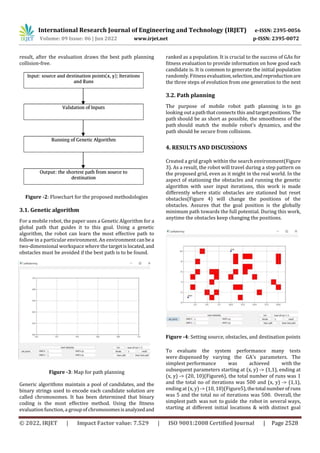
are set. The setpoints are validated(Figure1). The robot
performs the function of finding the path to the goal within
the grid environment by employing a genetic algorithm.Asa
Figure -1: Validation of inputs](https://image.slidesharecdn.com/irjet-v9i6464-221017063430-5675e0c7/85/Path-Optimization-for-Mobile-Robot-Using-Genetic-Algorithm-3-320.jpg)
![International Research Journal of Engineering and Technology (IRJET) e-ISSN: 2395-0056
Volume: 09 Issue: 06 | Jun 2022 www.irjet.net p-ISSN: 2395-0072
© 2022, IRJET | Impact Factor value: 7.529 | ISO 9001:2008 Certified Journal | Page 2529
points. To induce the most effective shortest path and
therefore the collision-free path the iterations should be
more. Figure 5 and Figure 6 are two cases. Figure 5 is
a scenario where the goal point is among the obstacles and
therefore the path drawn between the actual points.
Secondly, Figure 6 is a scenario where the goal point is after
the ending of obstacles i.e., the place to begin the x-axis, y-
axis, and ending point of the x-axis, y-axis, and therefore the
path drawn between these points. As may be verified by
Figure 5 and Figure 6, the robot tends to maneuver towards
the placement of the goal, traveling consistently with a
minimum distance direction between the starting and also
arrival positions.
Figure -5: Path planning for scenario 1
Figure -6: Path planning for scenario 2
5. CONCLUSION
The results obtained showed that the utilization of the
Genetic Algorithm for the mobile robot produced extremely
smooth path planning. The robot usually travels and
successfully finds the varied goal points from distinct
starting points and environments and at the identical time
avoids obstacles. Becausethenumberofiterationsincreases,
the robot will take you to the shortest distance, by reducing
the number of turns in its path to realizing the goal. The
results prove that the proposed Genetic algorithm method
finds the optimal path. The typical no of run values and also
the common iteration numbers of the proposed method are
more optimal compared to other methods. To induce
accurate results while setting the points on the x-axis and y-
axis true during this work is handled in such the simplest
way that non-numerical characters cannot be taken as input
if do that the system warns the user saying that this can't be
given as an input to line initial and goal points, Thishandling
of non-numerical characters is additionally through with
other input values. The algorithm during this work doesn't
use information about the motion of the mobile robot: the
history of position estimates, the commands that make the
robot move, and also the uncertainties in these commands.
The Genetic Algorithms complexity is O(g(nm + nm + n))
with g the number of generations, n the population
size(obstacles), and m the scale of the mutants(possible
ways). Hence, the complexity of the genetic algorithm inthis
work is on the order of O(gnm)). Future research can
undergo the performance of Geneticalgorithmsina dynamic
environment. Another future direction is to test the
effectiveness of Genetic Algorithms with physical robots
during a real-world application. This work has limitations,
where the points given are static and obstacles, are
generated randomly by the program so in future scope we
are able to manually or use a cursor to pick the points and
shapes of the obstacles on the map.
6. REFERENCES
[1] M. Brand, X. H. Yu, “Autonomous Robot Path
Optimization Using Firefly Algorithm”, Proceedings of
the 2013 International ConferenceonMachineLearning
and Cybernetics, Tianjin, 14-17 July 2013.
[2] H. S. Lee and J. Jeong, “Mobile Robot Path Optimization
Technique Based on Reinforcement LearningAlgorithm
in Warehouse Environment”, Appl. Sci. 2021.
[3] N. A. Shiltagh and L. D. Jalal, “Path Planning of Intelligent
Mobile Robot Using Modified Genetic Algorithm”,
International Journal ofSoft ComputingandEngineering
(IJSCE) ISSN: 2231-2307, Volume-3, Issue-2, May 2013.
[4] S. S. Ge and Y. J. Cui, “New Potential Functions forMobile
Robot Path Planning”, IEEE transactionson roboticsand
automation, vol. 16, no. 5, October 2000.](https://image.slidesharecdn.com/irjet-v9i6464-221017063430-5675e0c7/85/Path-Optimization-for-Mobile-Robot-Using-Genetic-Algorithm-5-320.jpg)
![International Research Journal of Engineering and Technology (IRJET) e-ISSN: 2395-0056
Volume: 09 Issue: 06 | Jun 2022 www.irjet.net p-ISSN: 2395-0072
© 2022, IRJET | Impact Factor value: 7.529 | ISO 9001:2008 Certified Journal | Page 2530
[5] X. Wang, L. Xue, Y. Yan, and X. Gu, “Welding Robot
Collision-Free Path Optimization”, Appl. Sci.:8February
2017.
[6] R. K. Panda and B. B. Choudhury, “An Effective Path
Planning of Mobile Robot Using Genetic Algorithm”,
IEEE International Conference on Computational
Intelligence & Communication Technology, 2015.
[7] C. Alexopoulos and P. M. Griffin, “Path Planning for a
Mobile Robot”, IEEE transactions on systems, man, and
cybernetics, vol. 22, no. 2, March/April 1992.
[8] 8.M. Betke and L. Gurvits, “Mobile Robot Localization
Using Landmark”, IEEE transactions on robotics and
automation, vol. 13, no. 2, April 1997.
[9] Y. Hu and S. X. Yang, "A Knowledge-Based Genetic
A1gorithm for Path Planning of a Mobile Robot",
Proceedings of the 2004 IEEE International Conference
on Robotics 8 Automation New Orleans LA April 2004.[
[10] 10. I. AL-Taharwa, A. Sheta,andM.Al-Weshah,“AMobile
Robot Path Planning Using Genetic Algorithm in Static
Environment”, Journal of Computer Science 4 (4): 341-
344, 2008.
[11] 11. C. Laminia, S. Benhlimab, A. Elbekria,b, “Genetic
Algorithm Based Approach for Autonomous Mobile
Robot Path Planning,” The First International
Conference On Intelligent Computing in Data Sciences,
2018.](https://image.slidesharecdn.com/irjet-v9i6464-221017063430-5675e0c7/85/Path-Optimization-for-Mobile-Robot-Using-Genetic-Algorithm-6-320.jpg)

This document summarizes research on using a genetic algorithm to optimize the path planning of a mobile robot in a static environment with predictable terrain and obstacles. A genetic algorithm was used to help the robot find the shortest and collision-free path between a starting and ending point in a grid environment. The genetic algorithm represents possible paths as chromosomes and evaluates their fitness based on path length. Testing showed the genetic algorithm was effective at finding optimal paths for robots as the number of iterations increased, even when obstacle positions changed. The approach ensured the goal position was the global minimum path while maintaining collision-free movement.


