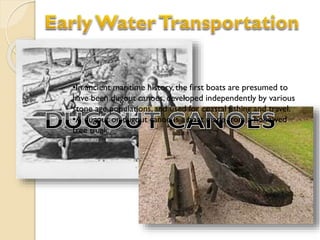

•In ancient maritime history, the first boats are presumed to
have been dugout canoes, developed independently by various
stone age populations, and used for coastal fishing and travel.
•A dugout or dugout canoe is a boat made from a hollowed
tree trunk.
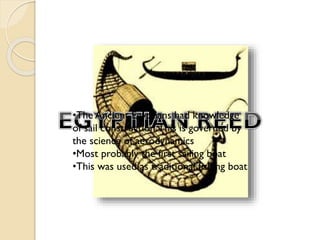
•The Ancient Egyptians had knowledge
of sail construction.This is governed by
the science of aerodynamics
•Most probably the first sailing boat
•This was used as traditional fishing boat
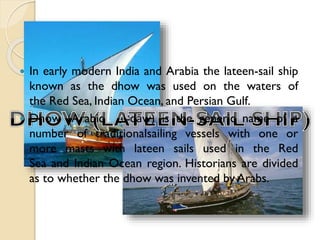
In early modern India and Arabia the lateen-sail ship
known as the dhow was used on the waters of
the Red Sea, Indian Ocean, and Persian Gulf.
 Dhow (Arabic ‫داو‬dāw) is the generic name of a
number of traditionalsailing vessels with one or
more masts with lateen sails used in the Red
Sea and Indian Ocean region. Historians are divided
as to whether the dhow was invented by Arabs.





There were also Southeast
Asian Seafarers and Polynesians, and the
Northern European Vikings, developed
oceangoing vessels and depended heavily upon
them for travel and population movements prior
to 1000 AD.
China's ships in the medieval period were
particularly massive; multi-mast sailing junks were
carrying over 200 people as early as 200 AD.
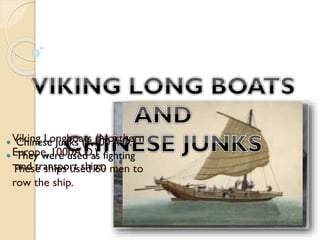
 Viking Longboats (Northern
Chinese Junks (1,100 A.D.)
 Europe, 1000A.D.) fighting
They were used as

and transport ships.
These ships used 60 men to
row the ship.
A knarr is a type
of Norse merchant ship famously used
by the Vikings.
 The name knarr is the Old Norse term
for a type of ship built for long sea
voyages. The knarr was a cargo ship.





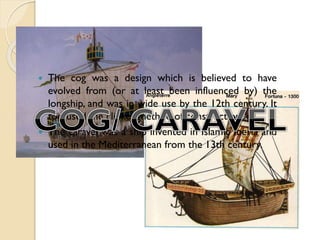
The cog was a design which is believed to have
evolved from (or at least been influenced by) the
longship, and was in wide use by the 12th century. It
too used the clinker method of construction.
The caravel was a ship invented in Islamic Iberia and
used in the Mediterranean from the 13th century.
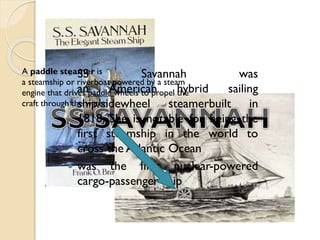
A paddle steamer is
 SS
Savannah
was
a steamship or riverboat powered by a steam
an
American
sailing
engine that drives paddle wheels to propel hybrid
the
craft through the water
ship/sidewheel steamerbuilt in

1818. She is notable for being the
first steamship in the world to
cross the Atlantic Ocean
 was the first nuclear-powered
cargo-passenger ship


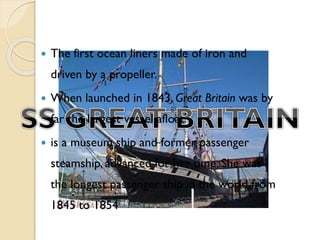
The first ocean liners made of iron and

driven by a propeller.


When launched in 1843, Great Britain was by
far the largest vessel afloat.



is a museum ship and former passenger
steamship, advanced for her time. She was

the longest passenger ship in the world from
1845 to 1854




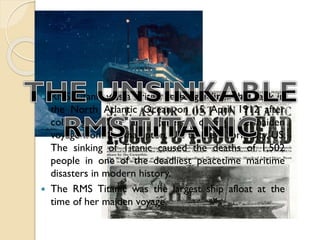
RMS Titanic was a British passenger liner that sank in
the North Atlantic Ocean on 15 April 1912 after
colliding with an iceberg during hermaiden
voyage from Southampton, UK to New York City, US.
The sinking of Titanic caused the deaths of 1,502
people in one of the deadliest peacetime maritime
disasters in modern history.
The RMS Titanic was the largest ship afloat at the
time of her maiden voyage.
•Passenger and fashion writer Edith Rosenbaum cabled her secretary in
Paris that she had "a premonition of trouble" about the Titanic. (She
survived.)
• Governess Elizabeth Shutes was so unnerved by the smell of the night
air on April 14 that she could not fall asleep. She told fellow passengers
that the smell reminded her of the air inside an ice cave she had visited.
(She survived.)
•William Edward Minahan, a doctor from Fond du Lac, Wis., had his
fortune read shortly before the voyage. The fortune teller predicted his
death aboard the ship. She was right.
•The plot of Morgan Robertson's novel "Futility" bears an uncanny
resemblance to the Titanic disaster. The novel tells the story of the Titan,
the largest ship ever built, billed as "unsinkable," which strikes an iceberg
in April and sinks. In the book, more than half the passengers die in the
North Atlantic because of a lifeboat shortage. The book was published 14
years before the Titanic sank.
Past Water Transportation

Past Water Transportation

  • 2.
    •In ancient maritimehistory, the first boats are presumed to have been dugout canoes, developed independently by various stone age populations, and used for coastal fishing and travel. •A dugout or dugout canoe is a boat made from a hollowed tree trunk.
  • 3.
    •The Ancient Egyptianshad knowledge of sail construction.This is governed by the science of aerodynamics •Most probably the first sailing boat •This was used as traditional fishing boat
  • 4.
    In early modernIndia and Arabia the lateen-sail ship known as the dhow was used on the waters of the Red Sea, Indian Ocean, and Persian Gulf.  Dhow (Arabic ‫داو‬dāw) is the generic name of a number of traditionalsailing vessels with one or more masts with lateen sails used in the Red Sea and Indian Ocean region. Historians are divided as to whether the dhow was invented by Arabs. 
  • 5.
      There were alsoSoutheast Asian Seafarers and Polynesians, and the Northern European Vikings, developed oceangoing vessels and depended heavily upon them for travel and population movements prior to 1000 AD. China's ships in the medieval period were particularly massive; multi-mast sailing junks were carrying over 200 people as early as 200 AD.
  • 6.
     Viking Longboats(Northern Chinese Junks (1,100 A.D.)  Europe, 1000A.D.) fighting They were used as and transport ships. These ships used 60 men to row the ship.
  • 7.
    A knarr isa type of Norse merchant ship famously used by the Vikings.  The name knarr is the Old Norse term for a type of ship built for long sea voyages. The knarr was a cargo ship. 
  • 8.
      The cog wasa design which is believed to have evolved from (or at least been influenced by) the longship, and was in wide use by the 12th century. It too used the clinker method of construction. The caravel was a ship invented in Islamic Iberia and used in the Mediterranean from the 13th century.
  • 10.
    A paddle steameris  SS Savannah was a steamship or riverboat powered by a steam an American sailing engine that drives paddle wheels to propel hybrid the craft through the water ship/sidewheel steamerbuilt in 1818. She is notable for being the first steamship in the world to cross the Atlantic Ocean  was the first nuclear-powered cargo-passenger ship
  • 11.
     The first oceanliners made of iron and driven by a propeller.  When launched in 1843, Great Britain was by far the largest vessel afloat.  is a museum ship and former passenger steamship, advanced for her time. She was the longest passenger ship in the world from 1845 to 1854
  • 12.
      RMS Titanic wasa British passenger liner that sank in the North Atlantic Ocean on 15 April 1912 after colliding with an iceberg during hermaiden voyage from Southampton, UK to New York City, US. The sinking of Titanic caused the deaths of 1,502 people in one of the deadliest peacetime maritime disasters in modern history. The RMS Titanic was the largest ship afloat at the time of her maiden voyage.
  • 13.
    •Passenger and fashionwriter Edith Rosenbaum cabled her secretary in Paris that she had "a premonition of trouble" about the Titanic. (She survived.) • Governess Elizabeth Shutes was so unnerved by the smell of the night air on April 14 that she could not fall asleep. She told fellow passengers that the smell reminded her of the air inside an ice cave she had visited. (She survived.) •William Edward Minahan, a doctor from Fond du Lac, Wis., had his fortune read shortly before the voyage. The fortune teller predicted his death aboard the ship. She was right. •The plot of Morgan Robertson's novel "Futility" bears an uncanny resemblance to the Titanic disaster. The novel tells the story of the Titan, the largest ship ever built, billed as "unsinkable," which strikes an iceberg in April and sinks. In the book, more than half the passengers die in the North Atlantic because of a lifeboat shortage. The book was published 14 years before the Titanic sank.