THE PAST SIMPLE
2 types of verbs


• REGULAR
• IRREGULAR
Regular verbs form
• -ed for all persons
Play  played
Work  worked
Stay  stayed
Listen  listened
Spelling
• 1) Double the consonant if the consonant
  is stressed
  stop – stopped
  swap - swapped

• 2)Add only –d, when the verb ends with –e
  love – loved
  save – saved

• 3)Verbs ending in 'y' preceded by a consonant:
  Change 'y' to 'i' Then add -ed.
  hurry - he hurried (watch out! play – played)
Irregular verbs form

• The form CHANGES from infinitives,
  usually with a vowel change.
• Can be grouped according to certain
  change patterns, which helps to
  memorize them.
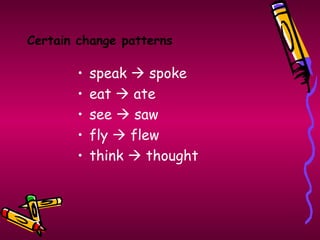
Certain change patterns

       •   speak  spoke
       •   eat  ate
       •   see  saw
       •   fly  flew
       •   think  thought
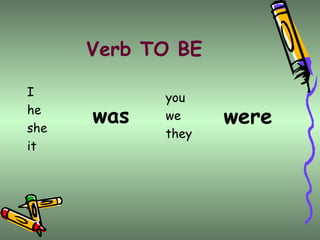
Verb TO BE

I           you
he
she
      was   we     were
            they
it
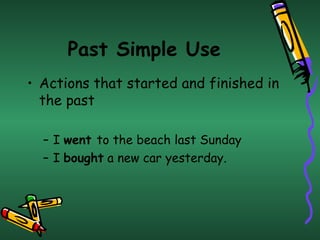
Past Simple Use
• Actions that started and finished in
  the past

  – I went to the beach last Sunday
  – I bought a new car yesterday.
Past Simple Use
• Actions that happened one after the other
  in the past (like in a story)

  – He came in, took off his coat and sat
    down.
  – I went into the disco and I saw my
    favourite girl, then I asked her to
    dance,...
Negative Sentences

    DID NOT + VERB (base form)

Example: I did not work yesterday

                 or

       I didn’t work yesterday
More examples:


- I didn’t go on holiday last year
Negative Sentences
             verb TO BE
            WAS / WERE + NOT
Examples:
    I was not at school yesterday afternoon
          or
        I wasn’t at school yesterday
 afternoon
        They were not at home last
 weekend
        They weren’t at home last
 weekend
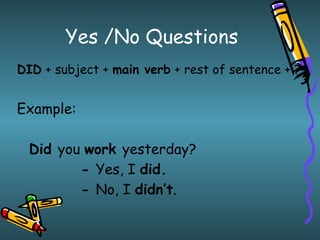
Yes /No Questions
DID + subject + main verb + rest of sentence + ?


Example:

  Did you work yesterday?
         - Yes, I did.
         - No, I didn’t.
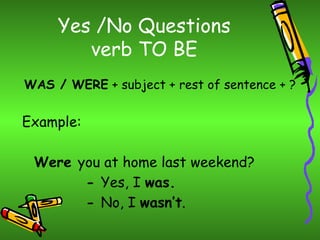
Yes /No Questions
        verb TO BE
WAS / WERE + subject + rest of sentence + ?


Example:

 Were you at home last weekend?
       - Yes, I was.
       - No, I wasn’t.
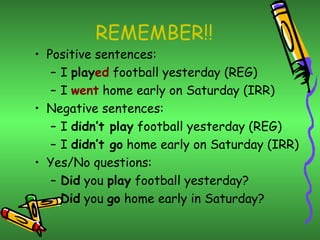
REMEMBER!!
• Positive sentences:
   – I played football yesterday (REG)
   – I went home early on Saturday (IRR)
• Negative sentences:
   – I didn’t play football yesterday (REG)
   – I didn’t go home early on Saturday (IRR)
• Yes/No questions:
   – Did you play football yesterday?
   – Did you go home early in Saturday?
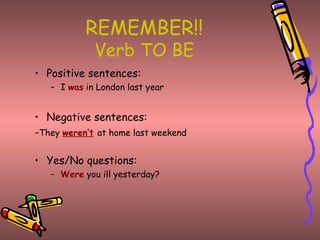
REMEMBER!!
             Verb TO BE
• Positive sentences:
   – I was in London last year


• Negative sentences:
-They weren’t at home last weekend

• Yes/No questions:
   – Were you ill yesterday?
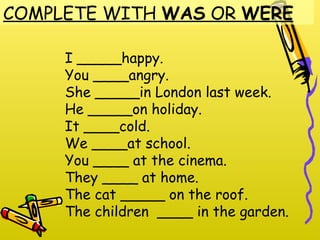
COMPLETE WITH WAS OR WERE

     I _____happy.
     You ____angry.
     She _____in London last week.
     He _____on holiday.
     It ____cold.
     We ____at school.
     You ____ at the cinema.
     They ____ at home.
     The cat _____ on the roof.
     The children ____ in the garden.
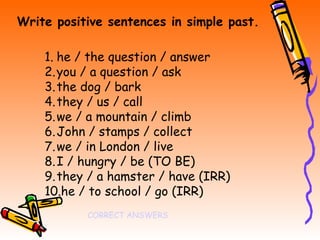
Write positive sentences in simple past.

    1. he / the question / answer
    2. you / a question / ask
    3. the dog / bark
    4. they / us / call
    5. we / a mountain / climb
    6. John / stamps / collect
    7. we / in London / live
    8. I / hungry / be (TO BE)
    9. they / a hamster / have (IRR)
    10.he / to school / go (IRR)
           CORRECT ANSWERS
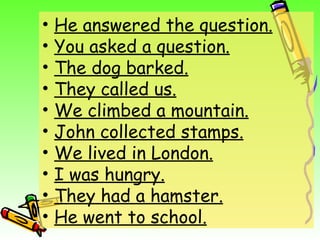
•   He answered the question.
•   You asked a question.
•   The dog barked.
•   They called us.
•   We climbed a mountain.
•   John collected stamps.
•   We lived in London.
•   I was hungry.
•   They had a hamster.
•   He went to school.

Past Simple

  • 1.
  • 2.
    2 types ofverbs • REGULAR • IRREGULAR
  • 3.
    Regular verbs form •-ed for all persons Play  played Work  worked Stay  stayed Listen  listened
  • 4.
    Spelling • 1) Doublethe consonant if the consonant is stressed stop – stopped swap - swapped • 2)Add only –d, when the verb ends with –e love – loved save – saved • 3)Verbs ending in 'y' preceded by a consonant: Change 'y' to 'i' Then add -ed. hurry - he hurried (watch out! play – played)
  • 5.
    Irregular verbs form •The form CHANGES from infinitives, usually with a vowel change. • Can be grouped according to certain change patterns, which helps to memorize them.
  • 6.
    Certain change patterns • speak  spoke • eat  ate • see  saw • fly  flew • think  thought
  • 7.
    Verb TO BE I you he she was we were they it
  • 8.
    Past Simple Use •Actions that started and finished in the past – I went to the beach last Sunday – I bought a new car yesterday.
  • 9.
    Past Simple Use •Actions that happened one after the other in the past (like in a story) – He came in, took off his coat and sat down. – I went into the disco and I saw my favourite girl, then I asked her to dance,...
  • 10.
    Negative Sentences DID NOT + VERB (base form) Example: I did not work yesterday or I didn’t work yesterday
  • 11.
    More examples: - Ididn’t go on holiday last year
  • 12.
    Negative Sentences verb TO BE WAS / WERE + NOT Examples: I was not at school yesterday afternoon or I wasn’t at school yesterday afternoon They were not at home last weekend They weren’t at home last weekend
  • 13.
    Yes /No Questions DID+ subject + main verb + rest of sentence + ? Example: Did you work yesterday? - Yes, I did. - No, I didn’t.
  • 14.
    Yes /No Questions verb TO BE WAS / WERE + subject + rest of sentence + ? Example: Were you at home last weekend? - Yes, I was. - No, I wasn’t.
  • 15.
    REMEMBER!! • Positive sentences: – I played football yesterday (REG) – I went home early on Saturday (IRR) • Negative sentences: – I didn’t play football yesterday (REG) – I didn’t go home early on Saturday (IRR) • Yes/No questions: – Did you play football yesterday? – Did you go home early in Saturday?
  • 16.
    REMEMBER!! Verb TO BE • Positive sentences: – I was in London last year • Negative sentences: -They weren’t at home last weekend • Yes/No questions: – Were you ill yesterday?
  • 17.
    COMPLETE WITH WASOR WERE I _____happy. You ____angry. She _____in London last week. He _____on holiday. It ____cold. We ____at school. You ____ at the cinema. They ____ at home. The cat _____ on the roof. The children ____ in the garden.
  • 18.
    Write positive sentencesin simple past. 1. he / the question / answer 2. you / a question / ask 3. the dog / bark 4. they / us / call 5. we / a mountain / climb 6. John / stamps / collect 7. we / in London / live 8. I / hungry / be (TO BE) 9. they / a hamster / have (IRR) 10.he / to school / go (IRR) CORRECT ANSWERS
  • 19.
    He answered the question. • You asked a question. • The dog barked. • They called us. • We climbed a mountain. • John collected stamps. • We lived in London. • I was hungry. • They had a hamster. • He went to school.