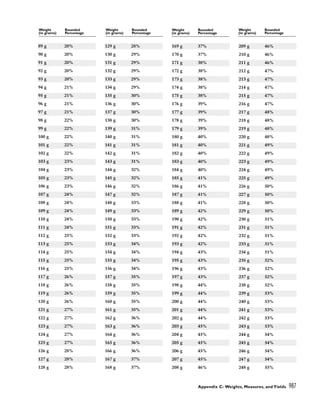
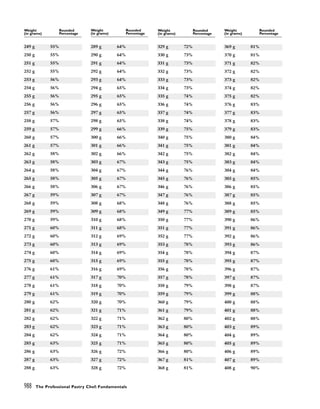
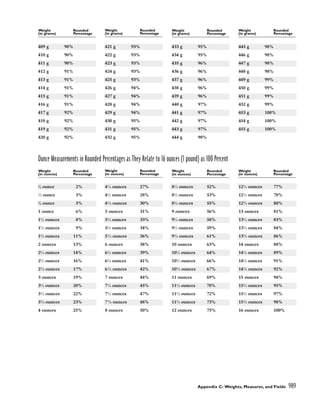
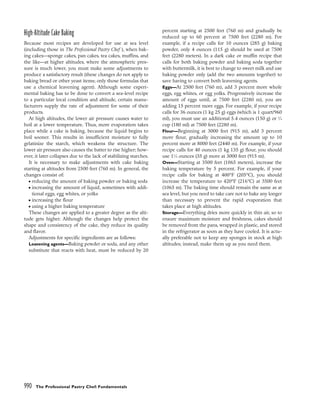
The Professional Pastry Chef
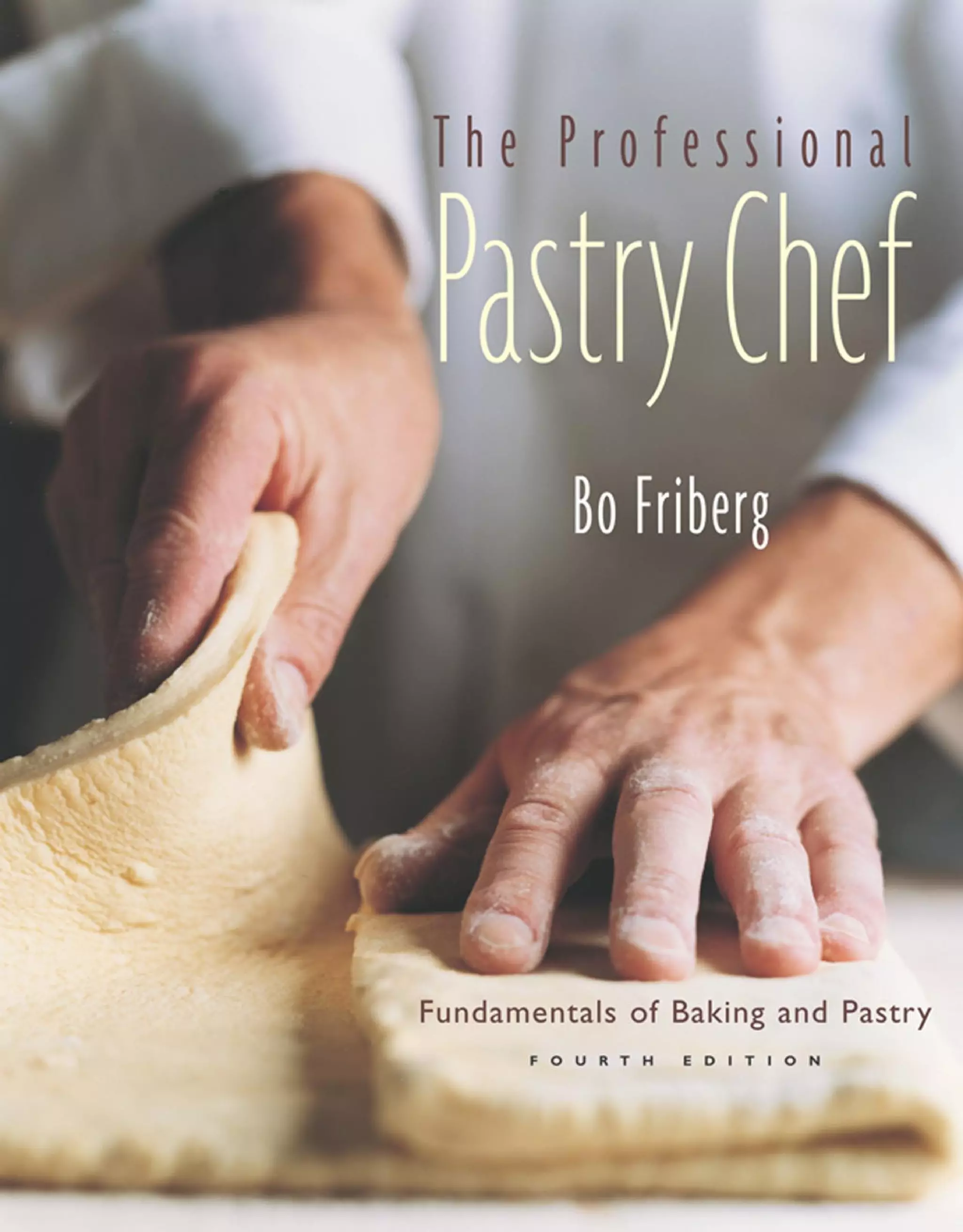
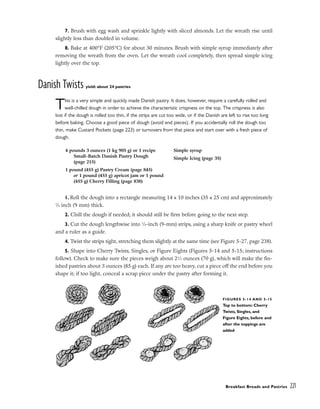
The Professional
Pastry Chef
F O U R T H E D I T I O N
Fundamentals of Baking and Pastry
BoFriberg
with Amy Kemp Friberg
J O H N W I L E Y & S O N S , I N C .
Charts, cake decorating designs, chocolate figurines, marzipan designs, and templates drawn and copyrighted
by Bo Friberg.
All other illustrations designed by Bo Friberg and Amy Kemp Friberg and drawn by Joyce Hasselbeck
Fowler; copyrighted by John Wiley & Sons, Inc.
Front cover photo, case cover photos, and halftones produced and copyrighted by Amos Chan.
All other color photographs produced and copyrighted by Bo Friberg with food-styling by Bo Friberg and
Amy Kemp Friberg.
This book is printed on acid-free paper. ∞
Copyright © 2002 by John Wiley & Sons, Inc., New York. All rights reserved.
Published simultaneously in Canada.
No part of this publication may be reproduced, stored in a retrieval system or transmitted in any form or
by any means, electronic, mechanical, photocopying, recording, scanning or otherwise, except as permitted
under Sections 107 or 108 of the 1976 United States Copyright Act, without either the prior written per-
mission of the Publisher, or authorization through payment of the appropriate per-copy fee to the Copyright
Clearance Center, 222 Rosewood Drive, Danvers, MA 01923, (978) 750-8400, fax (978) 646-8600. Requests
to the Publisher for permission should be addressed to the Permissions Department, John Wiley & Sons,
Inc., 111 River Street, Hoboken, NJ 07030, (201) 748-6011, fax (201) 748-6008, or online at
http://www.wiley.com/go/permissions.
This publication is designed to provide accurate and authoritative information in regard to the subject mat-
ter covered. It is sold with the understanding that the publisher is not engaged in rendering professional
services. If professional advice or other expert assistance is required, the services of a competent profes-
sional person should be sought.
Library of Congress Cataloging-in-Publication Data
Friberg, Bo, 1940–
The professional pastry chef : fundamentals of baking and pastry / Bo Friberg.-- 4th ed.
p. cm.
Includes bibliographical references and index.
ISBN-13 978-0-471-35925-8 (cloth : alk. paper)
ISBN 0-471-35925-4 (cloth : alk. paper)
1. Pastry. I.Title
TX773 .F75 2001
641.8’65--dc21
2001046952
Printed in the United States of America.
Book deisgn by Richard Oriolo
20 19 18 17 16 15 14 13
C O N T E N T S
Preface vii
Introduction xiii
Chapter 1 Mise en Place 3
Chapter 2 Basic Doughs 59
Chapter 3 Yeast Breads 89
Chapter 4 Flatbreads, Crackers, and Rolls 163
Chapter 5 Breakfast Breads and Pastries 207
Chapter 6 Cookies 259
Chapter 7 Tarts, Pies, Cobblers, and Crisps 323
Chapter 8 Tea Cakes, Pound Cakes, Muffins, and Other 383
Quick Breads
Chapter 9 Sponge Cakes and Cake Bases 429
Chapter 10 Basic Chocolate Work and Decorating 451
Techniques
Chapter 11 Decorated Cakes 485
Chapter 12 Individual Pastries 539
Chapter 13 Plated Desserts 603
Chapter 14 Ice Cream and Sorbets 711
Chapter 15 Custards, Puddings, Mousses, Charlottes, and Bavarian 755
Creams
Chapter 16 Sauces, Syrups, and Fillings 807
Appendix A: Ingredients 847
Appendix B: Equipment 937
Appendix C: Weights, Measures, and Yields 971
Index 994
P R E F A C E
In a sense, the fourth edition of The Professional Pastry Chef
began as soon as the third edition was published. Right
away I started to jot down ideas for new recipes, make
notes regarding up-to-the-minute techniques, and consider
ways in which I could improve the text. When it came
time to begin the actual revision, it became clear rather
quickly that there was more than enough material for two
books rather than one. This book, Fundamentals of Baking
and Pastry, is the first of a two-volume set. It covers all the
techniques and recipes needed to complete a basic baking
and pastry-making course.
Included here are all of my well-tested recipes for yeast
breads, decorated cakes, tea cakes, cookies, plated
desserts, ice creams, custards, sauces, fillings, and more––
all of the classics from the first three editions that have
stood the test of time. In addition, dozens of new recipes,
illustrations, templates, and color photographs have been
added to reflect the latest industry trends. For example, a
new section is dedicated to today’s popular Mediterranean-style flatbreads. Recipes for favorites
such as ciabatta and lavash address consumers’ growing demand for authentic artisan breads.
Notable is that each of the appendices––Ingredients, Equipment, and Weights, Measures,
and Yields––has been greatly expanded. The ingredient and equipment sections combined are
virtually “a book within a book” with over 1,000 and 500 entries, respectively.
Thanks to the teamwork of several people at John Wiley & Sons––publisher Rob Garber,
who went out on a limb for me more than once to support this volume; my editor Susan Wyler,
who treated the manuscript as if it were her own; Andrea Johnson, who never tired of my con-
stant changes and additions; and the art and production departments, which offered great cre-
ative ideas and made the concept a reality––this edition has a brand new look and a contempo-
rary, modular design. The recipes in each chapter are organized in a way that will make them
easier to use whether you are a student, teacher, professional chef or amateur-cooking enthusi-
ast. Among the many new design features are Chef’s Tips and informational sidebars. These,
along with the recipe introductions, point out potential challenges, give specific hints and advice,
convey general information about the ingredients used, discuss the history of the dish, or offer
an alternative presentation or usage. Subrecipes have been moved to follow a main recipe when-
ever possible to make them easier to access.
This new edition also contains innovative ideas for impressive plate presentations and
incorporates techniques that utilize the tools that are needed to produce the latest novel cre-
ations. In the six years since the third edition was published, a multitude of new equipment has
emerged in the baking and pastry field. Flexipan forms, made from special silicone-based com-
pounds, are used more and more in place of tinned steel for baking everything from cake bases,
to teacakes, madeleines and individual pastries. These pans are also used to mold custards, par-
faits and other chilled or frozen creations. While the initial cost is higher than for metal forms,
the expense is more than offset by the tremendous advantages they offer. The forms do not
require greasing before use, they are easy to keep clean, the baked or frozen products are a cinch
to unmold and, perhaps most importantly, these pans produce items that are perfectly consis-
tent in appearance. Many other tools that were once made from metal are now made from com-
posites that are heatproof, rustproof, and resistant to bacteria. Silpats (silicone baking mats),
decorating stencils, plastic strips (acetate or polyurethane), transfer sheets for use with both
chocolate and sponges, decorating combs used to create patterned sponge sheets, and, to some
degree, dough sheeters, are no longer considered specialized equipment used only in large oper-
ations, but are now a must in any establishment that wants to keep up with the latest industry
trends. These tools and others like them are discussed and utilized throughout both volumes.
Another big change in the pastry field over the past two decades is the ever increasing avail-
ability of reasonably priced imported produce, such as tropical fruits, and excellent quality
“halfway” products like frozen fruit purees, gianduja, florentina mix, praline paste, chocolate
truffle shells, and candy fillings. Other examples of new products that make our lives easier and
allow today’s pastry chefs much more creativity are food-grade coolant in an aerosol spray,
specifically designed for rapid cooling and setting of melted chocolate and hot sugar when mak-
ing decorations, and powdered gold leaf, also in aerosol form, to make precise application much
easier.
A greater number of the recipes in this edition include alternative versions that produce a
smaller yield, aptly titled “Small-Batch.” This was done in an effort to make the book accessible
to a wider range of readers and to both large and small professional operations. Recipes that do
viii Preface
not include a small batch ingredient list are still easy to scale up or down as needed. Because
none of the cake, tart, and pie recipes yield more than two, it is equally convenient for anyone
to either multiply this amount as needed, depending on the occasion and/or demands, or for the
home chef to divide the ingredients in half to make, for example, one birthday cake. As before,
all of the recipes that produce individual servings, namely the plated desserts, custards, pud-
dings, mousses, charlottes, and Bavarians, yield either eight, twelve, or sixteen servings, which
again makes it easy to divide the ingredients to serve four, six, or eight.
The third edition of The Professional Pastry Chef was, I am pleased to say, a huge success for
many reasons: the main one being that all the recipes work, period. This, of course, is the point
of any cookbook, but unfortunately it is not always the case. Professional chefs especially, who
work in an environment where not only are the cost and waste of ingredients significant, but
time is of the essence, must have workable formulas they can rely on. Readers will be pleased to
note that all of the recipes and procedures in my books have been tested by literally thousands
of students in my classes and have been improved on over the course of many years. In the
Chef’s Tips and the recipe instructions, I point out typical pitfalls and explain why certain steps
must be completed in a particular order or manner. I also offer suggestions for using more than
one type of form or mold when applicable, knowing that not only does every operation not have
the same equipment, but also that these items are not always readily available when needed. In
several instances, instructions, complete with illustrations, are given for making your own forms
and molds.
This book differs from many other cookbooks in several significant ways. My background
allows me to approach the subject matter from numerous angles. This book is written by a
working Certified Master Pastry Chef with forty-five years of professional experience in the
industry. I have worked in both small shops and large retail and wholesale operations in the
United States and in Europe. I worked for the Swedish-American cruise ship line, and I have
demonstrated the art of pastry making in a number of instructional videos and television shows.
I have spent half of my career teaching all levels of students at three different culinary schools:
the California Culinary Academy in San Francisco, the Culinary Institute of America at
Greystone, and the San Diego Culinary Institute, where I teach presently.
In writing this book, I have drawn from all of these experiences to create a comprehensive
guide notably for those who aspire to make baking and pastry their career and for instructors
who, like me, are guiding their students along this path. Additionally, this book is for working
professionals who are looking for doable recipes for both the basics and more modern innova-
tions. One is frequently called upon to prepare this or that as a special request or for a particu-
lar occasion, and a reference with numerous recipes and ideas is certainly a great help.
Some Thoughts On Teaching
Upon graduating from any culinary school, it is not enough that a student is simply able to per-
form; he or she must also be able to produce at a reasonable speed to make a living. These
recipes are not designed just for practice or for all-day student projects where labor cost is not
an issue. Instead, they are workable, practical recipes to be used in the real world of pastry and
baking production. Students will certainly want to carry this text with them into the industry
after graduation.
Preface ix
Depending on the institution and its curriculum, an instructor may want to use this book
in different ways. Although the chapters follow a logical succession of procedures that is in
keeping with students’ skill development, this sequence does not necessarily need to be fol-
lowed. However, it is imperative that students first learn to work with fundamental ingredients
and practice preparing and handling formulas such as short dough, yeast doughs, laminated
doughs, spongecakes and basic fillings before moving on to more complicated tasks. Even
though the illustrations are of great help in showing students the particular steps for a given
item, the instructor should still follow up a lecture on puff pastry, for example, by demonstrat-
ing how the turns are made, rolling and cutting the dough, making bouchées, and so on.
Although these techniques are explained in this book in the way that I do them (and I do from
time to time explain a variation), instructors are encouraged to give the students their own input.
As a teacher, as is true of anyone in a position of authority, it is important to realize that our
students are observing and learning from us all the time––our demeanor, appearance, attitude,
tone of voice, sense of humor, and our overall disposition all send a message. The knowledge we
share and the lessons we teach are not limited to schoolwork assignments and our classroom or
kitchen demonstrations.
To possess a skill and also have the ability to teach that skill to others is a gift that is not
given to everyone. Most people working in a kitchen have at one time or another shown a sub-
ordinate, a fellow student, or a coworker how to perform a certain task or the accepted method
used for a job in that particular workplace. I see and hear this everyday in my classes: the first
student to successfully make pastry cream, for example, will then drop some little hint to
whomever is in line to prepare the next batch. Working together, helping one another, and shar-
ing information is a great thing provided that the information being shared is accurate.
As teachers, it is important that we not only possess the knowledge and the technical skills
that relate to our subject matter, but also that we are able to convey information in a way that
our students can comprehend and assimilate. Before you can teach, you must have the atten-
tion and the respect of your students. You must present the details and instructions in an inter-
esting and entertaining way, and the students must feel motivated to learn. In other words, they
must believe that what you are explaining or demonstrating will be of use to them.
I have found that a little humor goes a long way in keeping the attention focused and the
class interested. Obviously, some subjects are much more appealing than others are. It is not
hard to keep the class excited while they are watching a demonstration on pulled sugar or work-
ing with chocolate, but a lecture on the varying percentages of protein found in different types
of flour is a bit more of a challenge. Again, students must know why they need this information
and how it might be of use to them in the future. Another way to add interest to a lecture and
to help the students retain the information more thoroughly is through visual effects. Students
will retain more knowledge as more of their senses come into play. In the case of the aforemen-
tioned flour lecture, a chart or graph can be used to list the different ways that a particular type
of dough or batter reacts when it is made with various types of flour. Or, better yet, combine the
lecture and the graph or chart with samples of the food product. For example, make the same
bread recipe using several different flours that vary in protein content so that the students can
see, touch, and taste the bread. This way you have moved from engaging only one sense (hear-
ing) to two (hearing and seeing) to all five (hearing, seeing, touching, smelling and tasting). Your
boring flour lecture has not only become exciting, but the information has greater meaning and
is far more likely to be remembered.
x Preface
In a teaching kitchen, the instructor has a duty to point out a student’s mistakes and to
demonstrate the proper way that the procedure should have been performed. Even though it
might be easier to “look the other way” or you may be afraid of hurting the student’s feelings or
might be concerned that they will become disappointed and give up, if you do not address the
problem, you are not doing your job. In Scandinavia there is an expression that roughly trans-
lated says “The nail that sticks up will be hammered down.” The meaning is that just because
you did not trip over the nail doesn’t mean someone else won’t and if you simply walk around
a problem; it is still going to be there later. One of the reasons that I like this expression is that
building and woodworking are my hobby, but I also appreciate the underlying implication that
a loose nail not only poses an immediate threat in that someone could trip or be cut, but it also
has the potential to eventually bring down an entire structure. To me, the lesson here is to take
care of small problems before they become larger.
As I said, a teacher must let his or her students know when they have made a mistake, but
it is equally important that the message is conveyed in a diplomatic and professional manner.
First of all, a teacher should never be condescending, rude, or cause embarrassment. Criticism
can and must be constructive and should be done with a smile and a friendly reminder that
“after all, you are here to learn.” Explain what went wrong and show the student or the class the
proper technique, even if you are doing so for the tenth time that day! If at all possible, try to
find something positive to mention about the item in question at the same time. For example,
let’s say an apple tart is not acceptable for service because once it has been unmolded the crust
falls apart. However, the filling was properly prepared and the tart was baked perfectly. By start-
ing with comments about what was done right before moving into a discussion on what needs
improvement, the student has something they can feel good about and be proud of. You can
think of this as the “first the good news” technique.
I have always told my students that I will evaluate their technical skills based on how hard
they try and how seriously they take their work. I emphasize that they must not be afraid of mak-
ing a mistake and I tell them over and over “better to make a mistake here in school than when
you are out working in the industry.” Often a so-called mistake is the very best learning tool
there is, provided that the student understands what went wrong and why. Another quote I par-
ticularly like is this one by F. P. Jones: “Experience is that wonderful thing that enables you to
recognize a mistake when you make it again.”
Two skills that are key to being successful in our industry are the ability to work as part of
a team and to work efficiently in order to meet deadlines. In a lab setting, I divide the students
into teams and assign each team at least as many projects as there are team members. I then
leave it to the team as a group to “make a plan of attack” and to divide the assignments between
them. Some of the projects are general mise en place, some are not needed until the next day
but must be started right away, and others must be completed by the end of class. This exercise
provides an excellent opportunity for the students to practice planning, delegating, and working
with others, and to learn efficient production methods.
A sample of each project or recipe is set aside for review at the end of the day. I talk to the
class about each item discussing what was done correctly and also how the item could be
improved if applicable. As mentioned earlier, it is very important to find something good to say
about each project and each student’s efforts. Positive reinforcement is without question the
best tool any teacher or manager can use. The desire to please and be recognized for one’s efforts
is a very basic part of human nature. Encouraging and recognizing a student’s accomplishments
Preface xi
in any situation––from a technical achievement, such as preparing a recipe correctly, to display-
ing a cooperative attitude toward classmates or coworkers, to simply trying one’s best even if not
entirely successful––will make any teacher or leader more productive.
In using this book I wish every reader––professional, nonprofessional, student, instructor,
beginner, or experienced master––great success.
Please visit my web site www.ChefBo.com for inquiries, updates, and information.
Bo Friberg
xii The Professional Pastry Chef: Fundamentals
I N T R O D U C T I O N
I started the first edition of this book twenty years ago
when I returned from a trip to Europe, full of inspiration
and new ideas. I began to catalog my new recipes along
with the other recipes I was teaching. This fourth edition,
like the first three, is a little different from other cook-
books in that it tells you not only what you should do, but
also what not to do, based on common mistakes that I
have observed in working with students.
Some of the selections are classic recipes made my
way. Some date back to when I was an apprentice. A few I
have adapted from restaurants and pastry shops in the
United States and around Europe, where I would order
something that looked interesting, pick it apart, literally
and mentally, and then try to duplicate or even improve it.
I developed many of the recipes by knowing what goes well
together and what the American palate prefers. In addi-
tion to the classics, this fourth edition continues to expand
on recipes and techniques that are in keeping with current
trends in the industry. An old colleague once said to me, “Don’t be concerned about someone
stealing your ideas; show them all your cards, but always be working on something new.”
Pastry is distinct from other types of cooking because you cannot just stick your spoon (or
finger) in for a taste and then add a pinch of this and a pinch of that as you might when mak-
ing a pot of soup. Most ingredients must be measured accurately because many formulas work
on scientific principles. For this reason, the pastry chef must learn how different ingredients
react with others and how and why ingredients respond to temperature, friction, and storage
before he or she can create new recipes or troubleshoot existing recipes.
A competent chef’s most important assets are common sense, self-confidence, and experience.
These are the three things that cannot be taught. In the book Siddhartha by the German-born
Swiss author Hermann Hesse, the wise sage tells his friend: “Wisdom is not communicable.
Knowledge can be communicated, but not wisdom. One can find it, live it, be fortified by it, do
wonders through it, but one cannot communicate and teach it.”
To be a first-rate pastry chef, you must have some artistic talent, a good sense of coordina-
tion and taste, and a steady hand. You must also possess some people skills and earn the respect
of those working with you. You must be able to solve problems and hire the right people. A good
chef must be born with at least some of these talents, but keen interest and a lot of practice will
improve these skills over the years. When you love what you are doing, believe in yourself, and
believe that you can do the job, you will give everything your best effort. If the result is less than
perfect, at least you will have learned something, and the next time you will try a little harder.
My first experiment with cooking took place in my mother’s kitchen when I was eleven years
old. When I came home from school and found the house empty, I attempted some kind of
candy. I don’t remember exactly what it was supposed to be, but I do remember my poor moth-
er had great difficulty cleaning up the sticky pots and pans. We both learned something from
this: my mom, to time her trips to the grocery store better; and I, to clean up my messes.
After graduating from school at fourteen, I started as an apprentice at one of the local kon-
ditoris (pastry shops). It was quite small––just two commis, the pastry chef, and myself. Without
knowing it, I was lucky to have picked the best: my master and teacher for the next five years
was a dedicated and skilled craftsman. When I began, I was a young boy who, of course, knew
everything already. However, I soon found out about the real world, and especially how to take
constructive criticism and learn from my mistakes. I remember his words: “One mistake is no
mistake. But two mistakes are one too many.”
I spent my first six months of training practicing the three Ls: listening, looking, and learn-
ing. While I was helping a little here and cleaning up a little there, I saw the breads and pastries
being made. I had helped in making the dough for rye bread, but I had not done it on my own
from start to finish. One morning when I arrived at work, my master said, “Bo! We are short-
handed today. Make up the rye bread!” I was startled and said, “I can’t do that!” My master
angrily replied, “Do not ever use that word here again! You can do anything you want to do if
you want to do it badly enough. The least you can do is give it your very best try.” I have always
remembered and tried to live by those words. It is one of the philosophies that I try to instill in
all of my students.
After I had become a regular on rye bread, the retired owner of the pastry shop used to come
down to check me out. (At that time most bakeries in Sweden were in the cellar with small win-
dows level with the street, so when the bakers looked out all they could see were shoes. Of
course, to a young apprentice, some pairs of shoes were much more interesting than others.)
xiv Introduction
After a few lectures about the loaves that were not perfectly formed, I noticed that he would
always walk in a straight line from the door to the shelves where the breads cooled and pick up
a loaf in the center of one particular shelf to examine. After I started placing the almost-perfect
loaves in this place, I could practice and improve in peace. But if I happened to pay too much
attention to those shoes outside the windows, I used to hear from across the room, “Bo, throw
some sheet pans on the floor. I don’t see you doing anything, so at least let me hear you!” (And
I have to admit the first time I did just that!) In the end my “yes-I-know-that” attitude must have
improved too, for my master named his first and only son Bo, which I claimed as the ultimate
victory. He assured me, however, that naming his son had nothing to do with a certain appren-
tice. I have a lot to thank John Håkanson for, and later on, Curt Anderson: two great Swedish
Master Confectioners, who not only had the patience and craft to teach me what they knew of
their profession, but also taught me a lot about life.
Unfortunately, very few restaurants and bakeries today can afford to train an apprentice
thoroughly, because it costs too much in time and materials. Trade schools now provide the
training that small businesses cannot, and this allows an employer to hire a graduate who has
received instructions and experience in the basics.
Once the fundamentals are mastered, you can start to create, improve, and put your own
style into the dishes you prepare. In our industry today, I am pleased to see more creativity and
that “bit of self” going into dessert menus, and more recognition being given to the pastry chef
and pastry kitchen. Ten years ago it was unheard of for a pastry chef to have his or her name on
the menu; these days, many restaurants feature separate dessert menus, with written credit given
to the pastry chef.
The first and last impressions of a meal are especially important. I do not expect anything
of a meal if the kitchen cannot make a decent salad or serve the soup hot. However, even if the
meal is mediocre, a dessert that looks and tastes terrific will leave the guest with a positive last
impression. I have noted with pleasure the rebirth of interest in great desserts. And, of course,
it is especially rewarding for me when I realize, glancing at a restaurant menu or tasting a dessert,
that one of my former students is in the kitchen.
This book is about making desserts and baked goods that are both delicious and exciting.
It is not meant to impress or to set any particular standards. The methods described and used
in the recipes are not the only ones possible or necessarily the best methods. There are differ-
ent ways to form a loaf of bread, frost a cake, or hold a pastry bag. One way is good for one per-
son, another way better for someone else.
In this book I offer the best of my knowledge and experience, as I give it to my students. It
is my hope that this knowledge will be useful to you as you seek to better yourself in our cre-
ative and honorable profession.
Before You Use This Book
Certain ingredient information is standard throughout the book. Please note the following con-
ventions:
■ Salt used in these recipes is common granulated salt. If you prefer using kosher salt see page 922.
■ Butter is always specified as “unsalted butter.” Salted butter can be substituted if the salt in
Introduction xv
the recipe is reduced by about 1
⁄5 ounce (6 g) for every pound of butter. However, you cannot
substitute salted butter if the recipe contains little salt or if the main ingredient is butter.
■ The number of eggs specified in each recipe is based on 2-ounce (55-g) eggs (graded large).
If you use eggs of a different size, adjust the number accordingly. For convenience in
kitchens where a supply of separated egg yolks and whites is available, a volume measure is
given when yolks or whites are used independently. The quantity of yolks, whites, and whole
eggs per cup has been rounded to twelve, eight, and four, respectively, for these measures.
■ Raw eggs: When egg yolks, whites, or whole eggs are included in a recipe in which they are
not cooked, e.g. in a mousse or gelatin-fortified cake filling, they are first heated to at least
140°F (60°C) to pasteurize them (see page 883). This is done using different procedures
depending on the recipe; often it involves whisking a hot syrup into the eggs or whipping
the eggs over a bain-marie with another ingredient.
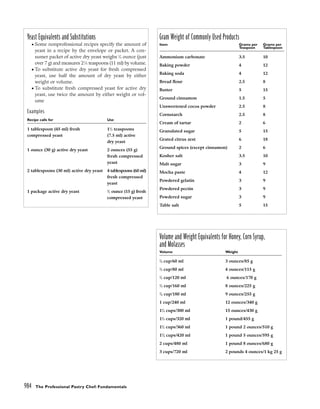
■ Yeast is always specified as “fresh compressed yeast.” To substitute dry yeast for fresh, reduce
the amount called for by half. “Fast rising” yeast should be avoided. It is treated with condi-
tioners that accelerate the yeast and give the chef less control. Furthermore, it impairs the
flavor of baked goods in most cases.
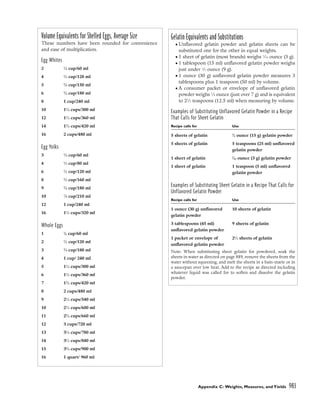
■ Gelatin is called for as unflavored powdered gelatin. To substitute sheet gelatin, see page
982, and also pages 889-890.
■ The unsweetened cocoa powder called for in the recipes in this book refers to the alkalized
(Dutch-process) type, preferred for its darker color and smoother flavor, and also because it
dissolves more easily. Natural cocoa powder, which is somewhat acidic, may be substituted
provided it is used in a recipe that contains a sweetener. However, it should not be used to
sift on top of a pastry or to coat a truffle, because it can be bitter eaten alone.
■ When recipes in this text call for both sweet dark chocolate and unsweetened chocolate, the
combined weight of these two can be replaced with either semisweet or bittersweet choco-
late, depending on the original ratio of sweet to unsweetened.
■ Both metric and U.S. units are given throughout. However, to avoid unmeasurable fractions,
metric amounts have been rounded to the nearest even number. The equivalent for 1 ounce,
for instance, is given as 30 grams rather than 28.35 grams.
■ When 1 ounce or less of an ingredient, dry or liquid, is needed, the quantity is always given
in teaspoons or tablespoons and is based on an exact measurement. Hedges like “scant” or
“heaping” are not used in this book.
■ Avoid the temptation to convert ingredients into cups and tablespoons. Weight measure-
ments are used in professional recipes for better accuracy, and a good scale can be purchased
inexpensively. Make certain that your scale (old or new) is properly calibrated.
■ Sheet pans are the standard American size. Full size is 16 x 24 inches (40 x 60 cm), and half
size is 12 x 16 inches (30 x 40 cm). Both have a 1-inch (2.5-cm) slightly slanted border.
■ In some recipes, instructions are given to spread a batter (most often a sponge batter) over
a sheet of baking paper set on the work surface and then to drag the paper onto a sheet pan.
xvi Introduction
This is done to facilitate spreading the batter evenly without the sides of the sheet pan get-
ting in the way, as the standard industry sheet pans in the United States have 1-inch (2.5-
cm) sides. Readers throughout Europe and in other countries where regular sheet pans con-
tain raised sides only on the short ends may eliminate this step.
■ Some recipes in this text include instructions for making templates. Thin cardboard is one
possibility because it is readily available and easy to work with; however, plain cardboard
templates are intended for one-time use only. (A simple method to extend the life of a tem-
plate is to spray or brush 2 or 3 layers of food-grade lacquer on both sides, so the template
can be cleaned and reused.) A sturdier and more practical template can be made from 1
⁄16-
inch (2-mm) plastic. These take a bit more effort to construct, but they can be used over and
over. I prefer the laminated type of plastic (the type often used to cover office files or docu-
ments) since it will lie perfectly flat and will not tear, but polyurethane sheets also work well.
■ Any recipe in this book can be scaled up or down in direct proportions as long as it is not
multiplied or divided by any number greater than four. In calculating ingredients that do not
divide straight across, e.g. to divide in half a recipe calling for 3 eggs or 11
⁄3 cups of a liquid,
round the number up (using 2 eggs or 51
⁄2 ounces of liquid for the examples given).
■ When a weight yield is given for baked goods (for example, four 1-pound, 4-ounce [570 g]
loaves), it relates to the product before being baked. As a general rule, ten percent of the
weight is lost in steam during the baking process of any item. When a large amount of liquid
is part of the ingredients (such as for bread), up to 2 ounces (55 g) for every pound (455 g) of
dough will expire.
■ A properly calibrated thermometer is of great importance for both safe food handling and
to obtain desired results whenever the exact temperature of the ingredients determines the
outcome. Refer to page 967 for instructions on how to calibrate a thermometer.
■ The ingredients and equipment used to produce these recipes are discussed in detail in the
appendixes and the recipe introductions, sidebars, and chef’s tips. These sections contain a
tremendous amount of information, and I strongly urge readers to thoroughly familiarize
themselves with the products used to make a particular item, not simply for the sake of
curiosity, but to ensure the best possible result in the safest manner.
■ When white flour is used in recipes in this book, cake flour, bread flour, or high-gluten flour
is specified. All-purpose flour, pastry flour, and the dozens of other specialty white flours are
not used. Many recipes combine cake flour and bread flour to create the desired protein
content. If you do not have cake flour or bread flour, all-purpose flour may be substituted
with a good result in most cases. When high-gluten flour is unavailable, bread flour may be
used instead. The protein content of cake flour is generally around 7 percent. Bread flour
has a protein content of approximately 12 percent, and high-gluten flour about 14 percent.
When cake flour and bread flour are combined in equal amounts, they essentially create all-
purpose flour, which has a protein content of approximately 9 to 10 percent. All of these
protein percentages vary depending on the manufacturer.
Introduction xvii
The Professional Pastry Chef
Almond Paste 4
Apricot Glaze 5
Beet Juice 5
Blanched and Toasted Nuts 6
Beurre Noisette 7
Butter and Flour Mixture 7
Candied Chestnuts 8
Caramel Coloring 8
Caramelized Sugar 9
Caramelized Sugar, Dry Method 10
Caramelized Sugar with Water 11
Caramelized Sugar for Decorations 11
Chestnut Puree 12
Cinnamon Sugar 13
Citrus Segments from Oranges or 13
Grapefruits
Clarified Butter 14
Coffee Reduction 14
Crepes 14
Crystallized Ginger 15
Egg Wash 16
Whole-Egg Egg Wash 16
Yolks-Only Egg Wash 17
Egg Wash for Spraying 17
Fondant 18
Graham Crackers and Crumbs 19
Hazelnut Paste 20
Marzipan 21
Mascarpone Cheese 22
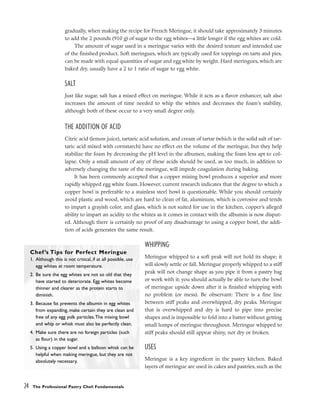
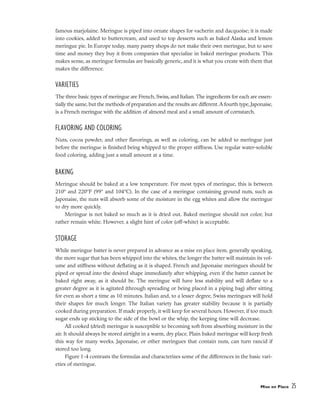
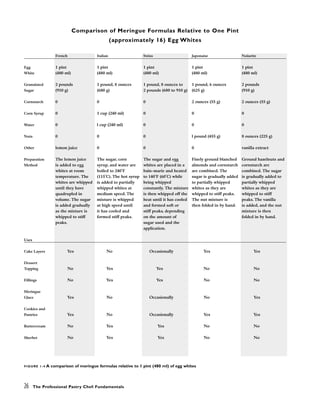
Meringue 23
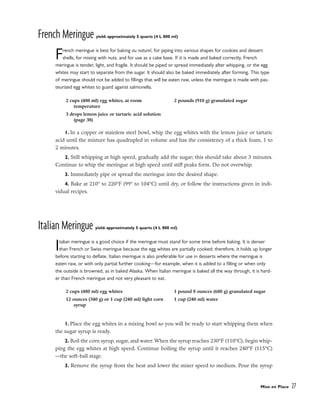
French Meringue 27
Italian Meringue 27
Japonaise Meringue Batter 28
Meringue Noisette 29
Swiss Meringue 29
Orange Glaze 30
Pectin Glaze 30
Plain Cake Syrup 31
Plain Mirror Glaze 31
Plain Poaching Syrup 31
SPICED POACHING SYRUP 32
Instructions for Poaching Fruit 32
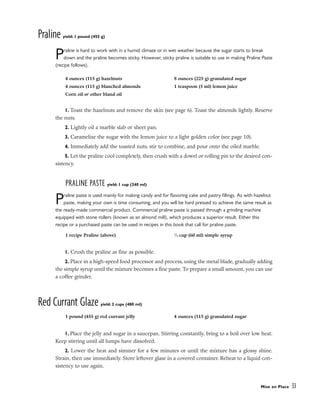
Praline 33
Red Currant Glaze 33
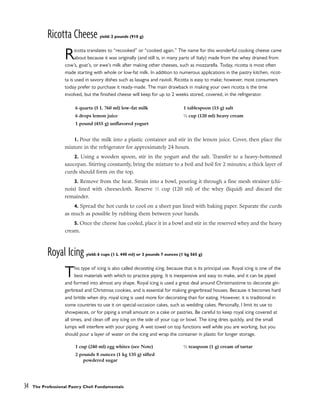
Ricotta Cheese 34
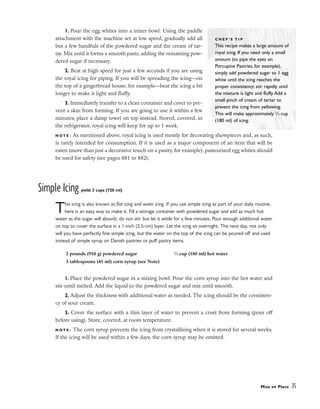
Royal Icing 34
Simple Icing 35
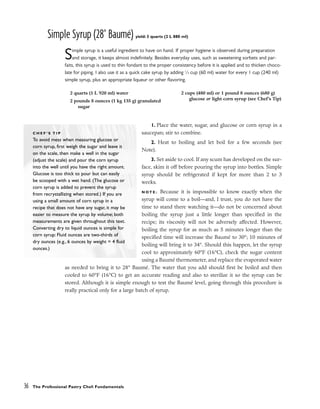
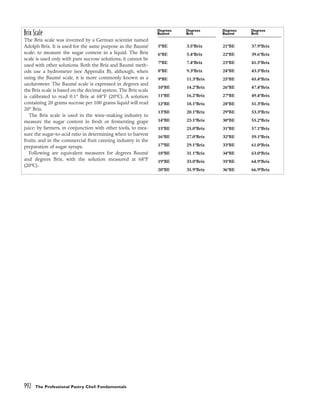
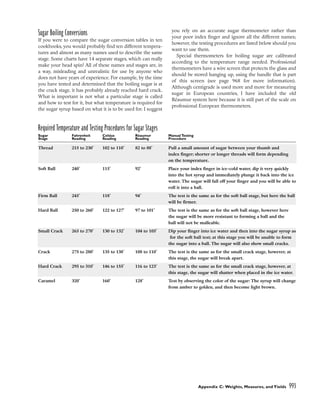
Simple Syrup (28° Baumé) 36
Streusel Topping 37
HAZELNUT STREUSEL 37
Sweetened Condensed Milk 37
Tartaric Acid Solution 38
Unflavored Yogurt 38
Vanilla Extract 39
Vanilla Sugar 39
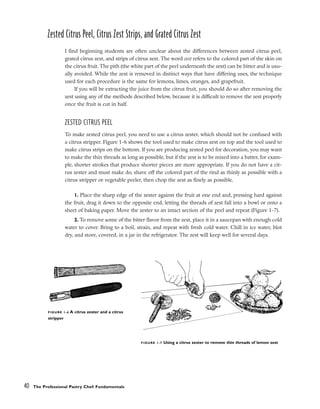
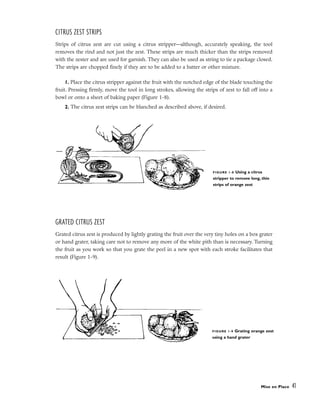
Zested Citrus Peel, Citrus Zest Strips, 40
and Grated Citrus Zest
SAVORY RECIPES
Anchovy Sticks 42
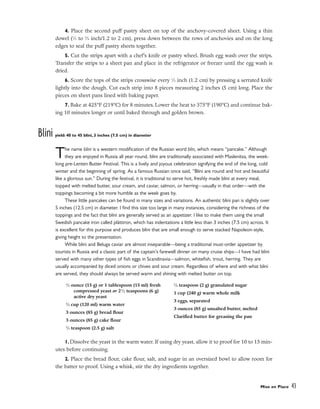
Blini 43
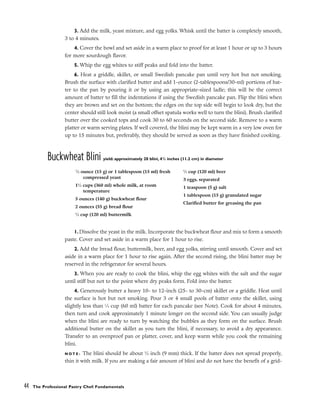
Buckwheat Blini 44
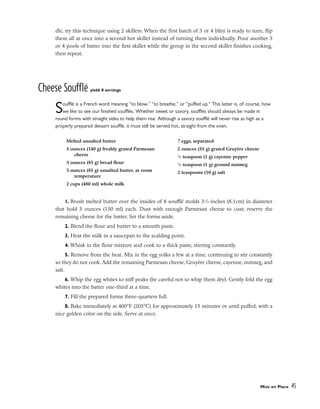
Cheese Soufflé 45
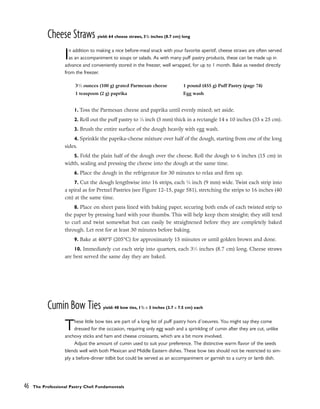
Cheese Straws 46
Cumin Bow Ties 46
Gougères 47
Ham or Cheese Croissants 48
Quiche Lorraine 48
Sausage Cuts in Puff Pastry 49
Special Reward Dog Biscuits 50
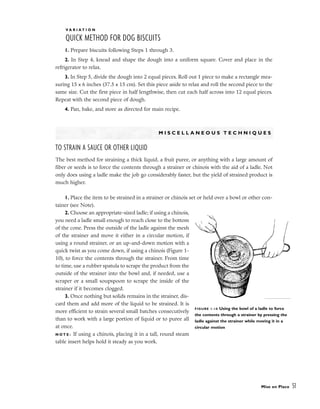
QUICK METHOD FOR DOG BISCUITS 51
MISCELLANEOUS TECHNIQUES
I N T H I S C H A P T E R
O N E
C
H
A
P
T
E
R
getting ready
the things we
need to prepare
ahead of time
Mise en Place
The literal translation of mise en place is “to put in place.” In
the professional kitchen, the term means getting ready the
things we need to prepare ahead of time, or prep work.
Preparation is an important factor for the professional pastry
chef. In the pastry kitchen, many jobs should be done at the
end of the day in anticipation of the next morning, such as
making pastry cream and other fillings and removing butter
from the freezer so it can thaw and soften.
Advance Planning and Stock Items
Before starting any project, the professional will make a plan
of attack, first going through the recipe mentally and making
sure all of the ingredients needed to complete it smoothly are
at hand, then thinking through how to accomplish each step
most efficiently. If toasted sliced almonds are called for to dec-
orate the sides of poppy seed cake, they should be prepared
first thing so they are cold by the time they are used. If melt-
ed chocolate is needed to finish a pastry, it can be placed over
hot water and stirred from time to time while you complete the other steps. If you need to melt
the butter and flour mixture so you can brush it on cake pans, there is no reason to put it on
the top of the stove if the oven is closer; just put the pot in there for a few seconds.
Items that are used regularly should always be accessible. If you make croissants every
morning, there is no reason to make fresh egg wash each day. Instead, make enough to last three
or four days and store it, covered, in the refrigerator (in fact, egg wash actually works better if it
is a day or more old). When going to the refrigerator for milk to make pastry cream, think about
what you are making next, and if, for example, that happens to be apple filling, take out the
apples at the same time instead of making two trips. If you can think one or two steps ahead,
you will get a lot more done in less time. It is a bit like the old saying, “Don’t walk across the
river to fetch water,” or, as my master used to tell me when I was an apprentice, “What you do
not have in your head, you have to make up for with your feet.”
Almond Paste yield: 1 pound 14 ounces (855 g)
Although it is simple to make almond paste if you have an almond mill (see page 937), the time
involved does not justify the cost savings in today’s industry, so it is rarely made in the pastry shop
nowadays. The only disadvantage to purchasing a commercial brand is that consistency varies from one
brand to another, and you will need to compensate for that in some recipes. Also, there can be tiny
specks of brown skin from almonds that were not blanched properly in some batches. If you find that you
cannot produce the specified powdery consistency in Step 1, very finely ground almonds will suffice. The
quality of the finished product will not be as good, but the only recipe in which it will be noticeable is
Marzipan.
1. Place the almonds in a high-speed food processor and process to a powder (see Note).
2. Add the powdered sugar; then, with the machine running, gradually add the simple syrup
until the mixture forms a paste. The amount of simple syrup needed will vary depending on how
dry the almonds are. Freshly blanched almonds will need less syrup. Store the almond paste,
tightly covered, for up to 1 week at room temperature. Refrigerate for longer storage.
N O T E : If the almonds are not completely dry, you will get a paste at this point rather than a pow-
der. This is fine, provided that the paste is smooth.
4 The Professional Pastry Chef: Fundamentals
10 ounces (285 g) dry blanched almonds
10 ounces (285 g) powdered sugar
11
⁄4 cups (300 ml) simple syrup
Apricot Glaze yield: 2 cups (480 ml)
Melted sugar is extremely hot and can cause serious burns, so unless you have a chef’s brass fingers,
take great care in testing the glaze against your skin. Using two spoons is a safer bet.
1. Place the jam, sugar, and water in a heavy-bottomed saucepan. Bring to a boil over medi-
um heat, stirring constantly.
2. Lower the heat and continue cooking until the mixture can be pulled into a 1
⁄4-inch (6-
mm) thread between your thumb and index finger or with the back of two spoons.
3. Quickly remove the pan from the heat, strain (discard the solids), and use immediately.
Store the leftover glaze at room temperature. Reheat the glaze to use again; if it is too thick, add
a small amount of water.
N O T E : If you overcook the glaze, it will become too thick to use properly. Unless it has started
to caramelize, you can correct this by adding a small amount of water and cooking to the thread
test again.
Beet Juice yield: approximately 11
/4 cups (300 ml)
Beets are among the few red vegetables. They get their color from a group of pigments called antho-
cyanins. These are the same elements responsible for most of the color in red, purple, and blue fruits
and flowers. Extracted beet juice can be used to color food products as an alternative to artificial red
dyes. If added to foods that are too alkaline, the color will change from red to purple and begin to fade.
Adding an acid will prevent this and will even reverse the effect after it has occurred, changing the purple
color back to red.
1. Wash and peel the beets, then process using a juice extractor (see Note).
2. Store the juice in a plastic squeeze bottle in the refrigerator. The juice will keep for sev-
eral months.
N O T E : If you do not have a juice extractor, chop the beets and grind in a food processor or grate
the beets fine and press the juice through a fine sieve. Using a food processor is not as desir-
able, as the yield of juice is much lower and both alternatives take more time. The freshness of
the beets also affects the yield.
Mise en Place 5
1 pound (455 g) apricot jam
3 ounces (85 g) granulated sugar
1
⁄3 cup (80 ml) water
1 pound (455 g) red beets
Blanched and Toasted Nuts
BLANCHED ALMONDS
To remove the brown skin from almonds, pour boiling water over the nuts, cover, and let them
soak for 5 minutes. Drain the water and immediately pinch the almonds between your fingers
to remove the skin. Another method is to place the almonds in a saucepan and add enough
water to cover. Bring to a boil and simmer for 3 minutes. Strain off the water and remove the
skin immediately. With both methods, do not forget and leave the almonds sitting in the water
too long; the skin could stain the almond meat and turn it brownish.
TO REMOVE THE SKIN FROM HAZELNUTS
The skin on hazelnuts is easier to remove after they are toasted. Place the nuts in a 400°F
(205°C) oven for about 10 minutes, or until they start to turn golden. Let cool, then rub the nuts
between your hands or in a kitchen towel to remove the skin. This method will not remove all
of the skin on all of the nuts. For recipes where that is necessary, one option is to toast more
nuts than you will need, allowing you to pick out the better-looking ones and use the others
where a little remaining skin does not matter.
To remove all of the skin from hazelnuts, or for recipes where the nuts are needed untoast-
ed, pour boiling water with a little added baking soda (1 teaspoon/4 g to 1 quart/960 ml) over
the nuts, let stand 5 minutes, drain, and remove the skins.
BLANCHED PISTACHIOS
Using a little salt in the blanching water for pistachios will accentuate their green color and allow
you to remove the skin easily. Use approximately 1
⁄2 teaspoon (2.5 g) salt per quart (960 ml)
water. Pour the boiling salted water over the pistachios and let stand a few minutes. Drain, then
rub the nuts in a towel.
CHESTNUTS: SHELLED OR ROASTED
To remove the shells from fresh chestnuts, cut a small X on the flat side of each shell and either
roast in a 375°F (190°C) oven for 10 to 15 minutes or cook in boiling water for 5 to 15 minutes,
depending on whether or not the chestnuts will be cooked further. Chestnuts are easier to peel
while they are still warm.
GENERAL INSTRUCTIONS FOR TOASTING NUTS
Toasted shelled nuts––almonds in many forms, hazelnuts, walnuts, and pecans, for example––are
frequently used in the pastry shop. All nuts should be toasted in a single layer (or a shallow layer,
in the case of sliced hazelnuts and sliced or slivered almonds) at medium heat (350° to
375°F/175° to 190°C) for about 15 minutes for sliced hazelnuts or almonds, slightly longer for
whole, broken, or slivered nuts. Nuts can become too dark very quickly, so it is important to
keep an eye on them and move them about on the pan periodically while they are cooking.
6 The Professional Pastry Chef: Fundamentals
Shake the pan to redistribute them and keep them in a single layer. The nuts nearest the edge
of the pan will toast more rapidly and, in fact, due to their high oil content, it is quite possible
to burn pine nuts that are close to the edge of the pan before those in the middle are even toast-
ed. Sliced and slivered almonds also need extra attention and will continue to darken a bit after
they are removed from the oven. If you are toasting nuts with the skin on, remove one or two
before you think they are done, remove the skin, and check their progress.
Beurre Noisette
Also known simply as brown butter, this French term literally translates to “hazelnut butter.”
The word noisette, or hazelnut, refers to both the color and fragrance of the finished product. As
the butter is cooked over low heat, the milk solids caramelize, turning the butter light brown and
giving it a nutty flavor and aroma––hence the name.
To prepare beurre noisette, cook butter over low heat until it reaches a light brown color
and is fragrant. Be careful not to burn the butter.
Butter and Flour Mixture
Using a butter and flour mixture is a quick and easy way to prepare cake pans, forms, and molds in
any recipe that directs you to grease and flour the pan. Rather than applying the two separately, you
brush on the flour at the same time you grease the pan. This method can save a great deal of time when
the task is done over and over throughout the day. Many establishments use the commercially produced
pan sprays instead, and these work fine as well. Although today more equipment is being made from
nonstick material, there will always be a need for this old-fashioned method.
1. Stir together 4 parts melted butter or margarine with 1 part bread flour by volume until
blended.
2. Apply the mixture with a brush.
N O T E : The combination can be left at room temperature for up to 1 week. If the mixture is
refrigerated, warm it before using (but do not boil) and stir to combine.
Mise en Place 7
Candied Chestnuts yield: 1 pound 4 ounces (570 g)
Candied chestnuts are expensive to purchase, so preparing your own can be economical, assuming
you can justify the labor needed to remove the shells. If you want perfect whole candied chestnuts
for garnish, start with more than you need, because some will break when you shell them; and don’t let
the chestnuts boil vigorously in the syrup, or all of them will break into small pieces. Broken pieces can, of
course, be used in fillings and for chestnut puree. Pay close attention toward the end of the cooking
process, as the thick syrup can burn easily.
1. Cut a small X in the flat side of the shell on each chestnut, using the tip of a paring knife.
2. Place the chestnuts on a sheet pan and roast at 375° (190°C) for approximately 15 min-
utes. (Or place in a saucepan with enough water to cover, simmer for the same length of time,
and drain.)
3. While the nuts are still hot, remove the shells and the dark papery skin around the meat.
4. Place the chestnuts in a saucepan with the water and sugar. Bring to a boil, stirring gen-
tly, then simmer for approximately 45 minutes, or until the liquid has reduced to a thick syrup.
Let cool.
5. Store the candied chestnuts in the syrup, covered, in the refrigerator. They will keep for
several weeks.
Caramel Coloring yield: 3 cups (720 ml)
When I learned my trade in Europe, this was known as blackjack. It is basically just burned sugar,
which, when cooked to 392°F (200°C), turns completely black. Once the mixture has cooled, a
small amount is used to color baked goods, mainly breads. Caramel coloring will last indefinitely and does
not need to be refrigerated.
I find many students do not cook the sugar long enough, especially when they make caramel coloring
for the first time. There is probably some guilt involved in burning something intentionally, and no doubt
they assume something must have gone wrong when they smell it, as sugar, when cooked to this extreme
temperature, produces an aroma that should bring any executive chef worth his or her title into the
kitchen in a hurry!
1. Combine the sugar, the first measurement of water, and the lemon juice in a heavy
saucepan. Cook over medium heat without stirring until the sugar begins to caramelize, brush-
ing down the sides of the pan with water from time to time. Continue to cook, stirring frequently
8 The Professional Pastry Chef: Fundamentals
1 pound (455 g) fresh chestnuts
4 cups (960 ml) water
8 ounces (225 g) granulated sugar
2 pounds (910 g) granulated sugar
1
⁄2 cup (120 ml) water
4 drops of lemon juice
11
⁄2 cups (360 ml) water
so that the sugar colors evenly, to 392°F (200°C)––blackjack stage. The sugar will be burned, and
there will be smoke coming from the pan. Remove the pan from the heat, stand back, and very
carefully pour in the second measurement of water. Stir until the mixture is smooth.
2. Let cool. Pour into a jar and store, covered, at room temperature.
Caramelized Sugar
Sugar starts to turn from golden to light brown in color and begins to caramelize when its tem-
perature reaches 320°F (160°C). There are two ways of bringing sugar to this temperature: the
dry method and the wet method. Caramelizing sugar dry takes about half the time, and you do
not have to worry about recrystallization. It does, however, require more attention, as the sugar
must be stirred constantly to prevent it from caramelizing too fast––that is, before all of the sugar
granules have melted––or worse, from burning. If you use the dry method, do not use a skillet
or pan that is any larger than necessary, or you will have a larger area to cover when stirring, and
you may not be able to keep the sugar from getting too dark. With the wet method, a small
amount of water added to the sugar means the caramel does not need to be stirred during the
entire cooking process, but it takes longer to caramelize because you must wait for the water to
evaporate.
Either way is much faster and easier if you use a sugar pan, an unlined copper pan made
especially for cooking sugar. The acidity of the copper reacts with the sugar in such a way that
some of the sugar breaks down into invert sugar, which is resistant to recrystallization. Invert
sugar is a mixture of equal parts glucose and fructose. Be careful, though; because the copper is
almost the same color as the caramelized sugar, the exact moment the pan should be pulled off
the heat and placed in cold water to stop the cooking process is harder to identify. To be able
to see the color of the sugar more clearly, use a folded piece of baking paper (do not use waxed
paper) and dip the point of the folded paper in the sugar syrup. Remove and check the color.
Another option is to pour a few small test puddles on a silicone mat or a sheet of baking
paper to determine the color more accurately. If the sugar is heated much above 320°F (160°C)
and you are not using it immediately, you cannot stop it right there; the sugar will continue to
darken, even as it sits in the water off the stove, from its own residual heat. This problem is
intensified by using a copper pan. With caramelized sugar, you do not need to use a sugar ther-
mometer, as the color of the sugar will tell you when it is done.
Mise en Place 9
Caramelized Sugar, Dry Method yield: 21
/4 cups (540 ml)
The addition of lemon juice or tartaric acid not only makes the sugar softer, it also delays the
caramelization process, allowing more time to properly melt all of the sugar.
1. Fill a bowl that is large enough to hold the pan used for cooking the sugar with enough
cold water to reach halfway up the sides of the pan. Set the bowl aside.
2. Place the sugar and lemon juice in a copper or stainless-steel pan (see Note). Cook over
low heat, stirring constantly, until the sugar is completely melted.
3. Continue to cook until the sugar has caramelized to just a shade lighter than the desired
color.
4. Remove from the heat and immediately place the bottom of the pan in the bowl of cold
water to stop the cooking process. Use the caramel as directed in individual recipes. If you need
to reheat the caramel, stir the sugar constantly over low heat to prevent the sugar from getting
any darker than necessary.
N O T E : You can help eliminate lumps of unmelted sugar by using the following procedure: Place
the granulated sugar on a sheet pan lined with baking paper. Pour the lemon juice or tartaric
acid solution on top of the sugar. Using your hands, rub the lemon juice or tartaric acid into the
sugar as thoroughly as possible; take 2 or 3 minutes to incorporate it. Place this mixture in the
saucepan and continue as directed in the second part of Step 2.
10 The Professional Pastry Chef: Fundamentals
2 pounds (910 g) granulated sugar 1 teaspoon (5 ml) lemon juice or 12 drops
tartaric acid solution (page 38)
Caramelizing Sugar in Larger Quantities
If you are caramelizing more than 2 pounds (910 g) sugar at one time, it is easier if you do not add all of it at the begin-
ning. Instead, start with about one-quarter of the total amount. Once it has melted but not changed color, add one-
quarter more and repeat, adding the remaining sugar in the same way.This way, you do not have to stir the entire amount
from the start.
If lumps of unmelted sugar remain when the rest of the sugar has caramelized, the temperature was too high and/or
the sugar was not stirred properly, which is especially important once it begins to liquefy.These lumps cannot be melted
without darkening the rest of the sugar, and it is not practical to strain them out unless the caramel is to be used for a
sauce (in that case, strain after adding the water).Therefore, the best thing to do is pick them out of the syrup.
Caramelized Sugar with Water yield: 21
/4 cups (540 ml)
While the sugar syrup here should not boil wildly at the start, you do want to reach the desired
temperature as quickly as possible to reduce the chances of recrystallization (when this happens,
we say in the industry that the sugar has died). Cooking as rapidly as possible is important in any situation
where you are reducing a sugar syrup close to or all the way to the point of caramelization. Cooking
quickly is not an issue when you are boiling a sugar syrup to a lower degree, such as for Italian meringue
or simple syrup.
1. Fill a bowl that is large enough to hold the pan used for cooking the sugar with enough
cold water to reach halfway up the sides of the pan. Set the bowl aside.
2. Place the water and sugar in a copper or stainless-steel pan. Stir to combine and dissolve
the sugar in the water over low heat. Wash down the sides of the pan with water using a brush
dedicated to sugar boiling.
3. Bring the mixture to a rolling boil, add the glucose or corn syrup, then lower the heat to
ensure that the liquid will not boil too hard at the beginning. Do not stir once the sugar starts
boiling. Instead, brush down the sides of the pan with water as needed until the sugar reaches
280°F (138°C)––the crack stage. Keep boiling until the sugar has caramelized to the desired color.
4. Quickly remove the pan from the heat and place the bottom of the pan in the reserved
cold water to stop the cooking process. Use as directed in individual recipes.
Caramelized Sugar for Decorations yield: 21
/4 cups (660 ml)
The old-fashioned dry method for caramelizing sugar is still the fastest and easiest way when only a
small amount of caramel is needed, for a few ornaments or a batch of Crème Caramel, for example.
If necessary, you can speed the process in the following recipe in a similar way by cutting both the water
and glucose or corn syrup in half, provided you are very careful. By using the full amount of water and
glucose or corn syrup called for, there will be plenty of liquid to help the sugar dissolve properly and pre-
vent it from recrystallizing. If you are working during rainy weather or when there is a high level of humid-
ity, you would be better off not taking the shortcut.
The most convenient way to caramelize sugar for decorations is to keep a stock of sugar syrup on
hand (as described in Step 3 below). Simply pour off whatever amount is needed at the time and contin-
ue cooking it to the desired stage.
1. Fill a bowl that is large enough to hold the cooking pan with enough cold water to reach
halfway up the sides of the pan. Set the bowl aside.
2. Place the water and sugar in a copper or stainless steel pan. Dissolve the sugar in the
Mise en Place 11
1 cup (240 ml) water
2 pounds (910 g) granulated sugar
1
⁄4 cup (60 ml) glucose or light corn syrup
(see Note, page 12)
2 cups (480 ml) cold water (see Chef’s Tip)
2 pounds (910 g) granulated sugar
7 ounces (200 g) glucose or light corn syrup
(see Note)
water over low heat. Bring to a boil, stirring constantly, and skim off any scum that accumulates
on the surface.
3. Add the glucose or corn syrup. Return the syrup to a boil. Wash down the sides of the
pan with a clean brush dedicated to sugar boiling that is dipped in water. Remove any addition-
al scum from the surface if necessary. If you are making sugar syrup for general mise en place,
pour it into a clean container at this point (or just pour off the excess) and store until needed.
4. Continue cooking the sugar syrup, washing down the sides of the pan as long as sugar
crystals are accumulating; do not stir from this point on. When the sugar begins to change from
clear to light amber, watch it closely, as it will turn to golden brown very
quickly because most of the water has evaporated at this point and the
temperature is now around 315°F (157°C).
5. When the syrup just starts to show a hint of golden brown, remove
the pan from the stove and set it in the bowl of cold water. Hold it there
until all of the bubbles have subsided. Remove the pan from the water,
wipe the bottom, and let the sugar cool at room temperature as neces-
sary, depending on the intended use.
N O T E : Because glucose is not readily available in the United States, I use
light corn syrup most of the time, and it works fine. Try to get the thicker
44° Baumé corn syrup if possible.
Chestnut Puree yield: 21
/2 cups (600 ml)
1. Cut a small X in the flat side of each nut using the point of a paring knife.
2. Place the chestnuts in a saucepan with enough water to cover. Bring to a boil, reduce the
heat, and simmer for 15 to 30 minutes, or until soft inside. Be careful not to overcook the chest-
nuts. Peel one and check the inside; it should be dry and have a mealy texture, something like a
baked potato.
3. Drain the chestnuts and let them cool until they can be handled comfortably. Do not cool
completely, or they will be much more difficult to peel. Remove the shells and skin and puree
the chestnuts in a food processor just until smooth. Do not overprocess, or the chestnuts will
become gummy.
12 The Professional Pastry Chef: Fundamentals
C H E F ’ S T I P
If you experience the problem of
the sugar recrystallizing despite
taking all of the suggested precau-
tions, it may be the fault of the tap
water in your area.To eliminate the
problem, use bottled water or distill
your water first, including the water
used for washing down the sides of
the pan.
2 pounds 8 ounces (1 kg 135 g) fresh
chestnuts in the shell
Cinnamon Sugar yield: 21
/2 cups (600 ml)
1. Combine the ground cinnamon and sugar.
2. Store in a tightly covered container at room temperature.
N O T E : To make a smaller quantity, use 1 part ground cinnamon to 4 parts granulated sugar,
measured by volume.
Citrus Segments from Oranges or Grapefruit
1. Cut the top and bottom off the fruit and set it, cut side down, on a cutting board.
2. Cut away the skin on the sides, slicing from top to bottom, removing all of the white pith
and following the natural curved shape of the fruit (Figure 1-1).
3. Hold the fruit in your hand over a bowl to catch the juice. With a small, sharp paring
knife, cut between the inside membranes to remove the segments (Figure 1-2), letting them fall
into the dish.
Mise en Place 13
11
⁄2 ounces (40 g) ground cinnamon 1 pound (455 g) granulated sugar
FIGURE 1-1 Cutting the peel and all of the
white pith away from the orange flesh, mak-
ing slightly rounded cuts to keep the natural
shape of the orange
FIGURE 1-2 Cutting between the mem-
branes to release the orange segments,
with the orange held over a bowl to
catch the juice
Clarified Butter
Clarified butter is butter with the milk solids removed. It has a higher burning point than whole butter,
which makes it preferable for sauté work or any time you are cooking foods at a high temperature.
Depending on the moisture content of the brand of butter you are using, the yield of clarified butter will
be about 20 to 25 percent less than the amount of whole butter you start with. In other words, if you
start with 16 ounces (455 g) butter, you will end up with 12 to 13 ounces (340 to 370 g) clarified butter.
1. Melt butter over low heat; let it bubble for a few minutes, but do not let it brown.
2. Remove the pan from the heat and let it stand for about 10 minutes.
3. Without moving or disturbing the pan, skim off all of the foamy solids that have risen to
the top. This is easiest to do using a ladle.
4. Carefully spoon or pour the clear butterfat into a clean container, watching carefully so
you do not add any of the milky portion that will have collected on the bottom.
5. Discard the milky residue in the bottom of the pan.
Coffee Reduction
This simple method of developing a good, strong coffee flavor can, of course, be modified to your
own taste. Start with fresh coffee brewed from top-quality beans; do not use instant coffee.
1. Make coffee 10 times the normal strength.
2. Bring the coffee to a boil in a saucepan and reduce by half.
3. Let cool and use as needed. Coffee reduction can be stored at room temperature for a few
days; it should be refrigerated if it is to be kept any longer.
Crepes yield: about 40 crepes, 6 inches (15 cm) in diameter
1. Sift the cake flour and bread flour together. Combine with the sugar and salt in a mixing
bowl.
2. Lightly beat the whole eggs with the egg yolks just to mix. Gradually stir the eggs into the
dry ingredients. Add the melted butter, milk, and brandy. Stir until smooth. If the batter appears
broken, the milk was probably too cool. To remedy this, warm the batter over simmering water,
stirring constantly until smooth. Let the batter rest at room temperature for 1 hour.
14 The Professional Pastry Chef: Fundamentals
6 ounces (170 g) cake flour
6 ounces (170 g) bread flour
3 ounces (85 g) granulated sugar
2 teaspoons (10 g) salt
6 whole eggs
6 egg yolks (1
⁄2 cup/120 ml)
6 ounces (170 g) unsalted butter, melted
3 cups (720 ml) warm whole milk
1
⁄3 cup (80 ml) brandy
Clarified unsalted butter
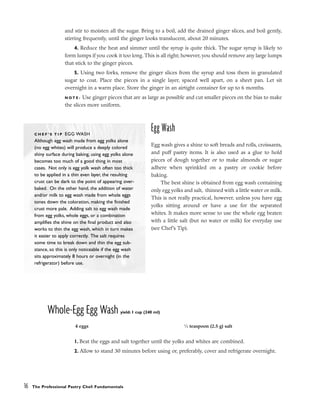
3. Heat 2 crepe pans, each 6 inches (15 cm) in diameter. Brush
with clarified butter (see Note); do not use a nylon brush. Using a
small ladle, cover the bottom of the pans with a thin film of batter by
quickly tilting and rotating them (Figure 1-3). Try to avoid making the
batter run up the sides of the pans. Pour any excess batter back into
the bowl. With practice, you should be able to add just the right
amount of batter each time.
4. When the bottoms of the crepes have a nice golden brown
color, flip them over using a spatula and the fingers of one hand, or
flip them in the air, if you have the knack. The second side need cook
for only a few seconds, until it is no longer sticky; overcooking the
crepes will make them dry.
5. Slide the crepes out of the pans and stack them on a plate to prevent their drying out as
you make the remaining crepes. Cover once you have a large stack. After you have made a few
crepes, adjust the batter, if necessary. If large bubbles form as the crepes cook, the batter is prob-
ably too thin (or the pan may be too hot). Thicken the batter by whipping in additional flour. If
the batter is too thick and does not pour in a thin film, add milk to thin it. Once you have the
batter and the heat adjusted correctly, making a few dozen crepes is easy. If they will not be used
within several hours, wrap and store in the refrigerator. Leftover refrigerated crepes are suitable
for use in dishes where they will be served hot, but they should not be used in cold dishes
because they tend to be a bit rubbery. Wipe the crepe pans clean with a towel; do not use water
under any circumstances.
N O T E : If you are using properly seasoned crepe pans, you probably will have to grease them for
the first few crepes only. In any case, avoid using too much butter, as this saturates the crepes
and adds excess calories.
Crystallized Ginger yield: about 10 ounces (285 g)
Crystallizing ginger is rarely done in the professional bakeshop, although it is quite easy and not very
time consuming. As with many homemade foodstuffs, which are free from artificial ingredients such
as coloring, bleaching, and preservatives, the finished product will not look like the commercial product
with which you are familiar. This crystallized ginger has a much darker color than the commercial golden
or tan product you buy.
1. Peel the ginger and slice 1
⁄4 inch (6 mm) thick.
2. Place the ginger slices in a saucepan and add enough water to cover. Simmer over low
heat until the ginger is tender, approximately 40 minutes. Drain, discarding the liquid.
3. Place 1 pound (455 g) granulated sugar in the empty saucepan. Add 1
⁄3 cup (80 ml) water
Mise en Place 15
FIGURE 1-3 Rotating the pan to distribute
the crepe batter
1 pound (455 g) fresh ginger (see Note)
1 pound (455 g) granulated sugar, plus more
for coating
1
⁄3 cup (80 ml) water
and stir to moisten all the sugar. Bring to a boil, add the drained ginger slices, and boil gently,
stirring frequently, until the ginger looks translucent, about 20 minutes.
4. Reduce the heat and simmer until the syrup is quite thick. The sugar syrup is likely to
form lumps if you cook it too long. This is all right; however, you should remove any large lumps
that stick to the ginger pieces.
5. Using two forks, remove the ginger slices from the syrup and toss them in granulated
sugar to coat. Place the pieces in a single layer, spaced well apart, on a sheet pan. Let sit
overnight in a warm place. Store the ginger in an airtight container for up to 6 months.
N O T E : Use ginger pieces that are as large as possible and cut smaller pieces on the bias to make
the slices more uniform.
Egg Wash
Egg wash gives a shine to soft breads and rolls, croissants,
and puff pastry items. It is also used as a glue to hold
pieces of dough together or to make almonds or sugar
adhere when sprinkled on a pastry or cookie before
baking.
The best shine is obtained from egg wash containing
only egg yolks and salt, thinned with a little water or milk.
This is not really practical, however, unless you have egg
yolks sitting around or have a use for the separated
whites. It makes more sense to use the whole egg beaten
with a little salt (but no water or milk) for everyday use
(see Chef’s Tip).
Whole-Egg Egg Wash yield: 1 cup (240 ml)
1. Beat the eggs and salt together until the yolks and whites are combined.
2. Allow to stand 30 minutes before using or, preferably, cover and refrigerate overnight.
16 The Professional Pastry Chef: Fundamentals
4 eggs 1
⁄2 teaspoon (2.5 g) salt
C H E F ’ S T I P EGG WASH
Although egg wash made from egg yolks alone
(no egg whites) will produce a deeply colored
shiny surface during baking, using egg yolks alone
becomes too much of a good thing in most
cases. Not only is egg yolk wash often too thick
to be applied in a thin even layer, the resulting
crust can be dark to the point of appearing over-
baked. On the other hand, the addition of water
and/or milk to egg wash made from whole eggs
tones down the coloration, making the finished
crust more pale. Adding salt to egg wash made
from egg yolks, whole eggs, or a combination
amplifies the shine on the final product and also
works to thin the egg wash, which in turn makes
it easier to apply correctly. The salt requires
some time to break down and thin the egg sub-
stance, so this is only noticeable if the egg wash
sits approximately 8 hours or overnight (in the
refrigerator) before use.
Yolks-Only Egg Wash yield: 3
/4 cup (180 ml)
1. Beat the egg yolks, salt, and water or milk together until well combined.
2. Cover and refrigerate overnight. If this is not possible, allow the egg wash to stand a min-
imum of 30 minutes before using.
N O T E : This egg wash might be too strong for items that are baked at temperatures above 400°F
(205°C). The color will be too dark, giving the crust an overbaked appearance. If so, thin further
or use whole-egg egg wash.
Egg Wash for Spraying yield: 2 cups (480 ml)
Applying egg wash with a spray bottle powered by compressed air, electricity, or elbow grease instead
of a brush (the more typical and time-consuming method) has been common in European bakeries
since the early 1960s. The spray technique makes a lot of sense. Not only is it faster, but it also produces
a smooth, even application. Moreover, because you do not actually touch the product, you do not risk
damaging the soft dough. The only disadvantage is that you will, of course, be applying egg wash to the
sheet pan or baking paper around the items you are spraying, but this small amount of waste is offset by
the advantages.
It is a good idea to designate an easy-to-clean area in the kitchen for spraying, or be sure to place
a few sheets of baking paper around where you are working to aid in cleanup. For the best result, egg
wash for use in a spray bottle should be prepared a day ahead to give the salt time to make the eggs less
viscous.
1. Combine whole eggs, egg yolks, and salt. Process for 10 to 15 seconds in a food proces-
sor. Strain through a fine mesh strainer (chinois) to remove the chalazae (the thick white cords
attached to the yolk).
2. Cover the mixture and refrigerate for a minimum of 12 hours.
3. Pour the egg wash into a spray bottle set to fine mist.
4. Spray the item to be baked, holding the bottle about 10 inches (25 cm) above it and turn-
ing the sheet pan as necessary to ensure even coverage all over.
5. To achieve the maximum amount of shine, let the egg wash dry for a few minutes, then
apply a second coat.
Mise en Place 17
8 egg yolks (2
⁄3 cup/160 ml)
1
⁄2 teaspoon (2.5 g) salt
2 to 3 tablespoons (30 to 45 ml) water or milk
6 whole eggs
4 egg yolks (1
⁄3 cup/80 ml)
1
⁄2 teaspoon (2.5 g) salt
Fondant yield: 2 quarts (1 L 920 ml)
Fondant is sugar syrup that is recrystallized to a creamy white paste. It is widely used in the pastry shop
for glazing and decorating. If properly applied, fondant dries to a silky-smooth icing that not only
enhances the appearance of a pastry, but preserves it as well by sealing it from the air. Glucose and cream
of tartar are used to invert part of the sugar to achieve the proper amount of recrystallization. Without
these ingredients, the cooked sugar will harden and be impossible to work with. Conversely, if too much
glucose or cream of tartar is used, there will not be enough recrystallization, and the fondant will be soft
and runny.
Although fondant is inexpensive and relatively easy to make (once you get the hang of it), it is almost
always purchased in a professional kitchen either ready to use or as a powder to which you add water. To
make your own fondant, you will need a precise sugar thermometer (test in boiling water to determine
accuracy), a sugar pan (see page 966) or heavy saucepan, a wide spatula or bench scraper, a marble slab
(2 x 2 feet/60 x 60 cm for this recipe), 4 steel or aluminum bars, and, as in all sugar work, quick reaction
time when the sugar has reached the proper temperature.
1. Clean, dry, and lightly oil the marble slab and metal bars with vegetable oil. Place the bars
at the edge of the marble to make a frame to hold the hot syrup when it is poured on the slab.
Oil a stainless-steel scraper and place 1 cup (240 ml) cold water close by.
2. Combine 2 cups (480 ml) water and the granulated sugar in a saucepan. Bring to a boil,
stirring to dissolve the sugar. Reduce the heat to medium, stop stirring, and brush the sides of
the pan with additional water. Be sure to brush down all of the crystals. It takes only a few par-
ticles of sugar left on the sides to make the mixture recrystallize (before you want it to) when the
sugar becomes hotter.
3. When the temperature reaches 225°F (108°C), add the warm glucose or corn syrup and
the cream of tartar dissolved in a little hot water. Continue boiling until the syrup reaches 238°
to 240°F (114° to 115°C). Pay close attention; the syrup will reach this temperature quicker than
you might think.
4. Immediately pour the syrup onto the prepared surface and sprinkle about 2 tablespoons
(30 ml) of the cold water on top. It is critical that the temperature not exceed 240°F (115°C), so
if your marble is not right next to the stove, place the saucepan in a bowl of cold water for a few
seconds first to prevent overcooking. Insert the sugar thermometer into the thickest part of the
puddle and let the sugar cool to 110°F (43°C).
5. Remove the metal bars and start to incorporate air into the sugar mixture: Using the oiled
stainless-steel scraper, work the sugar by sliding the scraper under the edge of the puddle, lift-
ing it, and folding in toward the center. After awhile, the sugar will start to turn white and
become firmer. Continue to work the fondant slowly, either by hand or in a mixing bowl (see
Note), until it has a smooth and creamy consistency.
18 The Professional Pastry Chef: Fundamentals
Vegetable oil for the equipment
3 cups (720 ml) cold water
4 pounds (1 kg 820 g) granulated sugar
2
⁄3 cup (160 ml) glucose or light corn syrup,
warmed
1
⁄2 teaspoon (1 g) cream of tartar
6. Pack the fondant against the bottom of a plastic container and pour the remaining cold
water on top to prevent a crust from forming. Store at room temperature. The fondant must rest
about 24 hours before it is soft enough to use. Fondant will keep for weeks if covered properly.
Pour off the water before using and keep the bowl covered with plastic wrap while you are work-
ing. Add a new layer of water, then cover to store until the next use.
N O T E : If you are making a large batch of fondant, you can work the sugar in a mixer instead of
by hand. Carefully pour the cooled syrup into the mixing bowl. Do not get any on the sides of
the bowl (hold the bowl next to the table and scrape the mixture in with the bench scraper). Use
the paddle and mix on low speed until the fondant is smooth and creamy. You may need to
scrape down the sides of the bowl to ensure that all of the fondant is mixed evenly. Scoop the
fondant into a container and cover with the cold water, as above.
Graham Crackers and Crumbs
yield: 70 crackers, 2 x 2 inches (5 x 5 cm), or 1 pound 8 ounces (680 g) crumbs
I’m sure many of us have, on occasion, found that the pantry was fresh out of graham cracker crumbs
when they were needed for cheesecake. While it is less convenient to make the crackers and crumbs
the old-fashioned way, doing so sets you back only about 30 minutes (in an emergency, keep the dough
fairly firm to speed the baking and drying process). Once you try these, I think you will find producing
your own to be an advantage in both cost and quality. It is a good idea to keep the crumbs on hand as
part of your regular mise en place so they are available when needed. Graham cracker crumbs can be
stored at room temperature for several weeks.
G R A H A M C R A C K E R S
1. Thoroughly combine the bread flour, cake flour, whole wheat flour, brown sugar, baking
soda, and salt in the bowl of an electric mixer.
2. Using the dough hook attachment, incorporate the butter, honey, vanilla extract, and
water. Mix until a smooth and pliable dough has formed, adding additional water if necessary.
Do not overmix.
3. Roll the dough out to a rectangle, 10 x 14 inches (25 x 35 cm), using flour to prevent it
from sticking. Mark the dough with a docker or the tines of a fork.
4. Cut the rectangle into 2-inch (5-cm) squares. Transfer the squares to a sheet pan lined
with baking paper.
5. Bake at 325°F (163°C) for approximately 15 minutes, or until dry.
6. Store in an airtight container.
Mise en Place 19
6 ounces (170 g) bread flour
6 ounces (170 g) cake flour
2 ounces (55 g) whole wheat flour
2 ounces (55 g) dark brown sugar
1 teaspoon (4 g) baking soda
1 teaspoon (5 g) salt
3 ounces (85 g) unsalted butter, at room
temperature
1
⁄2 cup (120 ml) or 6 ounces (170 g) honey
1 teaspoon (5 ml) vanilla extract
1
⁄3 cup (80 ml) water
G R A H A M C R A C K E R C R U M B S
1. Prepare the dough as for Graham Crackers (above), but roll the dough out 1
⁄8 inch (3 mm)
thick.
2. Cut into small pieces; it is not necessary to measure them. Transfer to a sheet pan lined
with baking paper.
3. Bake at 325°F (163°C) until dark golden brown.
4. When cold, grind the pieces in a food processor to make fine crumbs. Store in an airtight
container.
Hazelnut Paste yield: 1 cup (240 ml)
In most professional operations, this product is typically purchased rather than made. The commercial
product is more concentrated, so if you substitute purchased paste you may need to decrease the
amount specified in the recipes.
1. Toast the hazelnuts and remove the skins (see page 6).
2. Process the hazelnuts and simple syrup together in a food processor until the mixture
becomes a thick paste.
3. Store in an airtight container at room temperature to use as needed.
20 The Professional Pastry Chef: Fundamentals
History of the Graham Cracker
The original graham cracker was a thin whole wheat cracker developed in the 1830s. It was named for Dr.
Sylvester Graham, the developer of the coarse grade of whole wheat flour (graham flour), also named after
him. Dr. Graham, a Presbyterian minister, believed that eating meat and fat led to sinful behavior.The unre-
fined flour was part of his overall regime of healthy eating, which included a strict vegetarian diet and no
alcohol. Dr. Graham further cautioned that consuming ketchup and mustard could to lead to insanity. In an
effort to cash in on his popular teachings, the graham cracker was developed and marketed as a healthy
snack.
One of Graham’s followers was Dr. Caleb Jackson, who invented a breakfast cereal made from bran
and dubbed it granula, a combination of the word bran with the name of his teacher, Graham. Some 50
years later, another doctor with a well-known food name, Dr. John Kellogg (yes, the same as Kellogg’s Corn
Flakes), who was also a great believer in the power of graham crackers and was said to eat seven every
morning, invented his own breakfast cereal, which he named granola.
Today, graham crackers are widely produced commercially and are popular as a snack food for chil-
dren.Their other primary use is for graham cracker crusts for pies and cheesecakes.
8 ounces (225 g) hazelnuts 1
⁄3 cup (80 ml) simple syrup
Marzipan yield: approximately 4 pounds 6 ounces (1 kg 990 g)
Marzipan is used extensively in European pastry shops. It will keep almost indefinitely if you take
proper care in mixing and handling it. It should be stored in airtight containers in a very cool place
or in the refrigerator. It can also be stored in the freezer, should you need to keep it for a long time. If the
oil separates from the marzipan after it thaws, add a small amount of water and some powdered sugar.
Continue to knead until smooth and elastic.
1. In a stainless steel mixing bowl, use the hook attachment to mix the almond paste with
the glucose or corn syrup at low speed until combined.
2. Start adding the sugar, scraping the sides of the bowl down as necessary. Add enough of
the powdered sugar to make a fairly firm yet malleable dough.
3. Store the marzipan, wrapped in plastic, inside an airtight container in a cold place.
N O T E : The amount of powdered sugar needed depends on the consistency of the almond paste.
Always mix at low speed and take care not to overmix. The friction will make the marzipan
warm, thereby softening it, and you will end up adding too much powdered sugar.
Mise en Place 21
2 pounds (910 g) almond paste
1
⁄2 cup (120 ml) glucose or light corn syrup
2 pounds (910 g) sifted powdered sugar
All About Marzipan
Due to its high sugar content (60 to 70 percent), marzipan dries quickly when exposed to air and should be
kept covered at all times. If it dries reconstitute by kneading in a little water. Use a stainless steel bowl to pre-
vent discoloration. Keep your tools and workplace scrupulously clean, and always wash your hands.The
almond oil brought to the surface will absorb even a small trace of dirt, which not only ruins the off-white
color of the marzipan, but can lead to spoilage.
Marzipan is rolled out in the same manner as pastry dough, except powdered sugar is used instead of
flour to prevent the paste from sticking. It can be left smooth or may be textured before being used to cover
cakes, petits fours, and pastries. It is an ideal surface to decorate and pipe on. It is also used on petits fours
and pastries that are to be coated with fondant or chocolate; the marzipan keeps the coating from soaking
into the sponge and helps achieve an even surface.A thin layer of marzipan on a bûche de Noël or chocolate
cake prevents the thin layer of chocolate coating from mixing with the buttercream. Not only does the marzi-
pan make a smooth finish possible, but the combination of chocolate and marzipan also gives the pastry a dis-
tinctive flavor.With few exceptions, marzipan should not be rolled out thicker than 1
⁄8 inch (3 mm), or it can
look clumsy and unattractive and may be overwhelming in flavor.
Water-soluble food coloring can be used to tint marzipan, but add it with discretion to keep the colors
soft. Green (such as for Princess Cake [page 530]) should usually be toned down with the addition of yellow.
When adding color to a small amount of marzipan, or when you need only a hint of color, put a drop on a
piece of baking paper and add some of it to the marzipan with the tip of a knife. Knead the marzipan until the
color is completely worked in. Unsweetened cocoa powder can be used to produce brown in various shades,
unless for some reason you do not want the chocolate flavor.Work the desired amount of cocoa powder into
the marzipan, kneading it until you have a smooth, evenly colored marzipan. If you are adding a large amount of
cocoa powder, you may have to compensate by working in some simple syrup or water to prevent the marzi-
pan from getting too dry.To color marzipan bright white for decoration only, use 4 to 6 drops titanium diox-
ide for every 1 ounce (30 g) untinted marzipan.This should be done only for pieces that will not be eaten.
Mascarpone Cheese yield: 1 pound 8 ounces (680 g)
Mascarpone cheese is made from fresh cream derived from cow’s milk. The cream is reduced to near
triple-cream consistency to give the cheese its soft, smooth, rich texture. This cream cheese origi-
nated in the Lombardy region of Italy but is now made throughout the country. The flavor of mascarpone
blends beautifully with other food, especially fruit. Fresh figs with mascarpone is a classic combination,
although tiramisu is probably the dessert that most people think of first when it comes to mascarpone.
Uses for mascarpone are certainly not limited to sweets. A mixture of mascarpone, anchovies, mus-
tard, and spices is a specialty of Trieste, in the northeast corner of Italy. Another popular appetizer
preparation is a layered torte alternating mascarpone with pesto or smoked salmon. Because mascarpone
is highly perishable and the imported product is expensive, the time involved in making it yourself is
worthwhile.
1. Bring the cream to a boil in a heavy oversized saucepan. Boil over medium heat until
reduced by one-third to about 51
⁄4 cups (1 L 260 ml). As the cream is reducing, it should be bub-
bling but not boiling hard; if it reduces too quickly, the fat can separate as it cools (see Note).
2. Remove the pan from the heat, place in an ice bath, and stir the reduced cream until it is
cold.
3. Stir in the tartaric acid solution, return the saucepan to the heat, and bring the mixture
to 118°F (48°C). Remove from the heat.
4. Line a strainer with a triple layer of cheesecloth. Set the strainer over a bowl or pan to
catch the liquid. Pour the cream mixture into the strainer. Refrigerate overnight.
5. Remove the thickened mascarpone from the cheesecloth and discard the liquid. If the
cheese has not thickened properly, add another 1
⁄2 teaspoon (2.5 ml) tartaric acid solution, reheat
to 118°F (48°C), and repeat Steps 4 and 5. Store, covered, in the refrigerator.
N O T E : If the fat should separate (accumulate on top) while the mixture is draining, let the mas-
carpone sit at room temperature for 1 to 2 hours, then blend until smooth in a food processor.
22 The Professional Pastry Chef: Fundamentals
2 quarts (1 L 920 ml) heavy cream 1 teaspoon (5 ml) tartaric acid solution
(page 38)
Meringue
Meringue can be loosely defined as a mixture of beaten egg whites and granulated sugar. While
the name is French, its origin is not documented, although history tells us that meringue may
have been named for either the Swiss town of Meringen or the German city of Mehrinyghen.
We do know that meringue has been around since the early sixteenth century.
COMPOSITION
Meringue is made of egg whites and sugar whipped together to incorporate air and form soft or
stiff peaks. Egg whites whipped without sugar are not meringue; they are simply beaten egg
whites.
In the recipes that follow, egg whites are measured by volume rather than by number. This
measurement is not only more precise, but also easier to apply in professional kitchens, where
a supply of egg whites is usually on hand. There are 7 to 8 egg whites in 1 cup (240 ml). Using
the even number (8) makes it easier to divide when measuring fractions of a cup and is simple
to remember, as are 4 whole eggs and 12 egg yolks per cup.
HOW EGG WHITES EXPAND
The white portion of the egg is referred to scientifically as albumen. The protein found in the
egg white, or albumen, is albumin. Egg whites have excellent foaming ability. When egg yolks,
which contain a fatty substance that destroys the albumen’s ability to foam, are removed, egg
whites alone can increase in volume by up to 8 times. This is possible through close teamwork
by the two proteins albumin and ovalbumin. When the egg whites are beaten, the albumin pro-
tein forms a stable mass of tiny air bubbles, while some of the protein molecules bond and form
a fragile network that holds the moisture in place (an egg white contains about 85 percent
water). This alone would suffice if the beaten egg whites were not to be cooked, but because air
expands when it is heated, the network of denatured proteins on the surface would be destroyed
and immediately collapse if it were not for the ovalbumin protein. While the ovalbumin does not
play an important role when the egg whites are simply beaten, it coagulates when heated, form-
ing its own network in the meringue and making it resistant to collapse as the water evaporates.
In other words, the ovalbumin protein makes it possible to change a liquid foam into a solid dry
mass with heat.
THE EFFECTS OF SUGAR
Meringue would be bland without the addition of sugar, which also helps stabilize the foam,
especially in the oven. Its addition, however, is something of a mixed blessing, as sugar also
delays the foaming process and decreases the volume and lightness of the meringue. This is
especially noticeable when meringue is whipped by hand, but even when using an electric mixer,
the granulated sugar must be introduced gradually and, in most cases, never before the whipped
egg whites have increased approximately 4 times in volume, so that the sugar will not prevent
the albumin from working to stiffen the foam. As an example of what it means to add the sugar
Mise en Place 23
gradually, when making the recipe for French Meringue, it should take approximately 3 minutes
to add the 2 pounds (910 g) of sugar to the egg whites––a little longer if the egg whites are cold.
The amount of sugar used in a meringue varies with the desired texture and intended use
of the finished product. Soft meringues, which are typically used for toppings on tarts and pies,
can be made with equal quantities of sugar and egg white by weight. Hard meringues, which are
baked dry, usually have a 2 to 1 ratio of sugar to egg white.
SALT
Just like sugar, salt has a mixed effect on meringue. While it acts as a flavor enhancer, salt also
increases the amount of time needed to whip the whites and decreases the foam’s stability,
although both of these occur to a very small degree only.
THE ADDITION OF ACID
Citric acid (lemon juice), tartaric acid solution, and cream of tartar (which is the solid salt of tar-
taric acid mixed with cornstarch) have no effect on the volume of the meringue, but they help
stabilize the foam by decreasing the pH level in the albumen, making the foam less apt to col-
lapse. Only a small amount of any of these acids should be used, as too much, in addition to
adversely changing the taste of the meringue, will impede coagulation during baking.
It has been commonly accepted that a copper mixing bowl produces a superior and more
rapidly whipped egg white foam. However, current research indicates that the degree to which a
copper bowl is preferable to a stainless steel bowl is questionable. While you should certainly
avoid plastic and wood, which are hard to clean of fat, aluminum, which is corrosive and tends
to impart a grayish color, and glass, which is not suited for use in the kitchen, copper’s alleged
ability to impart an acidity to the whites as it comes in contact with the albumin is now disput-
ed. Although there is certainly no proof of any disadvantage to using a copper bowl, the addi-
tion of acids generates the same result.
WHIPPING
Meringue whipped to a soft peak will not hold its shape; it
will slowly settle or fall. Meringue properly whipped to a stiff
peak will not change shape as you pipe it from a pastry bag
or work with it; you should actually be able to turn the bowl
of meringue upside down after it is finished whipping with
no problem (or mess). Be observant: There is a fine line
between stiff peaks and overwhipped, dry peaks. Meringue
that is overwhipped and dry is hard to pipe into precise
shapes and is impossible to fold into a batter without getting
small lumps of meringue throughout. Meringue whipped to
stiff peaks should still appear shiny, not dry or broken.
USES
Meringue is a key ingredient in the pastry kitchen. Baked
layers of meringue are used in cakes and pastries, such as the
24 The Professional Pastry Chef: Fundamentals
Chef ’s Tips for Perfect Meringue
1. Although this is not critical, if at all possible, use
egg whites at room temperature.
2. Be sure the egg whites are not so old that they
have started to deteriorate. Egg whites become
thinner and clearer as the protein starts to
diminish.
3. Because fat prevents the albumin in egg whites
from expanding, make certain they are clean and
free of any egg yolk particles.The mixing bowl
and whip or whisk must also be perfectly clean.
4. Make sure there are no foreign particles (such
as flour) in the sugar.
5. Using a copper bowl and a balloon whisk can be
helpful when making meringue, but they are not
absolutely necessary.
famous marjolaine. Meringue is piped into ornate shapes for vacherin and dacquoise; it is made
into cookies, added to buttercream, and used to top desserts such as baked Alaska and lemon
meringue pie. In Europe today, many pastry shops do not make their own meringue, but to save
time and money they buy it from companies that specialize in baked meringue products. This
makes sense, as meringue formulas are basically generic, and it is what you create with them that
makes the difference.
VARIETIES
The three basic types of meringue are French, Swiss, and Italian.The ingredients for each are essen-
tially the same, but the methods of preparation and the results are different.A fourth type, Japonaise,
is a French meringue with the addition of almond meal and a small amount of cornstarch.
FLAVORING AND COLORING
Nuts, cocoa powder, and other flavorings, as well as coloring, can be added to meringue just
before the meringue is finished being whipped to the proper stiffness. Use regular water-soluble
food coloring, adding just a small amount at a time.
BAKING
Meringue should be baked at a low temperature. For most types of meringue, this is between
210º and 220°F (99° and 104°C). In the case of a meringue containing ground nuts, such as
Japonaise, the nuts will absorb some of the moisture in the egg whites and allow the meringue
to dry more quickly.
Meringue is not baked so much as it is dried out. Baked meringue should not color, but
rather remain white. However, a slight hint of color (off-white) is acceptable.
STORAGE
While meringue batter is never prepared in advance as a mise en place item, generally speaking,
the more sugar that has been whipped into the whites, the longer the batter will maintain its vol-
ume and stiffness without deflating as it is shaped. French and Japonaise meringues should be
piped or spread into the desired shape immediately after whipping, even if the batter cannot be
baked right away, as it should be. The meringue will have less stability and will deflate to a
greater degree as it is agitated (through spreading or being placed in a piping bag) after sitting
for even as short a time as 10 minutes. Italian and, to a lesser degree, Swiss meringues will hold
their shapes for much longer. The Italian variety has greater stability because it is partially
cooked during preparation. If made properly, it will keep for several hours. However, if too much
sugar ends up sticking to the side of the bowl or the whip, the keeping time will decrease.
All cooked (dried) meringue is susceptible to becoming soft from absorbing moisture in the
air. It should always be stored airtight in a warm, dry place. Plain baked meringue will keep fresh
this way for many weeks. Japonaise, or other meringues that contain nuts, can turn rancid if
stored too long.
Figure 1-4 contrasts the formulas and characterizes some of the differences in the basic vari-
eties of meringue.
Mise en Place 25
26 The Professional Pastry Chef: Fundamentals
FIGURE 1-4 A comparison of meringue formulas relative to 1 pint (480 ml) of egg whites
Comparison of Meringue Formulas Relative to One Pint
(approximately 16) Egg Whites
French Italian Swiss Japonaise Noisette
Egg 1 pint 1 pint 1 pint 1 pint 1 pint
White (480 ml) (480 ml) (480 ml) (480 ml) (480 ml)
Granulated 2 pounds 1 pound, 8 ounces 1 pound, 8 ounces to 1 pound, 6 ounces 2 pounds
Sugar (910 g) (680 g) 2 pounds (680 to 910 g) (625 g) (910 g)
Cornstarch 0 0 0 2 ounces (55 g) 2 ounces (55 g)
Corn Syrup 0 1 cup (240 ml) 0 0 0
Water 0 l cup (240 ml) 0 0 0
Nuts 0 0 0 l pound (455 g) 8 ounces (225 g)
Other lemon juice 0 0 0 vanilla extract
Preparation The lemon juice The sugar, corn The sugar and egg Finely ground blanched Ground hazelnuts and
Method is added to egg syrup, and water are whites are placed in a almonds and cornstarch cornstarch are
whites at room boiled to 240˚F bain-marie and heated are combined. The combined. The sugar
temperature. The (115˚C). The hot syrup to 140˚F (60˚C) while sugar is gradually added is gradually added to
whites are whipped is added to partially being whipped to partially whipped partially whipped
until they have whipped whites at constantly. The mixture whites as they are whites as they are
quadrupled in medium speed. The is then whipped off the whipped to stiff peaks. whipped to stiff
volume. The sugar mixture is whipped heat until it has cooled The nut mixture is peaks. The vanilla
is added gradually at high speed until and formed soft or then folded in by hand. is added, and the nut
as the mixture is it has cooled and stiff peaks, depending mixture is then
whipped to stiff formed stiff peaks. on the amount of folded in by hand.
peaks. sugar used and the
application.
Uses
Cake Layers Yes No Occasionally Yes Yes
Dessert
Topping No Yes Yes No No
Fillings No Yes Yes No No
Meringue
Glace Yes No Occasionally No Yes
Cookies and
Pastries Yes No Occasionally Yes Yes
Buttercream No Yes Yes No No
Sherbet No Yes Yes No No
French Meringue yield: approximately 5 quarts (4 L 800 ml)
French meringue is best for baking au naturel, for piping into various shapes for cookies and dessert
shells, for mixing with nuts, and for use as a cake base. If it is made and baked correctly, French
meringue is tender, light, and fragile. It should be piped or spread immediately after whipping, or the egg
whites may start to separate from the sugar. It should also be baked immediately after forming. This type
of meringue should not be added to fillings that will be eaten raw, unless the meringue is made with pas-
teurized egg whites to guard against salmonella.
1. In a copper or stainless steel bowl, whip the egg whites with the lemon juice or tartaric
acid until the mixture has quadrupled in volume and has the consistency of a thick foam, 1 to
2 minutes.
2. Still whipping at high speed, gradually add the sugar; this should take about 3 minutes.
Continue to whip the meringue at high speed until stiff peaks form. Do not overwhip.
3. Immediately pipe or spread the meringue into the desired shape.
4. Bake at 210° to 220°F (99° to 104°C) until dry, or follow the instructions given in indi-
vidual recipes.
Italian Meringue yield: approximately 5 quarts (4 L 800 ml)
Italian meringue is a good choice if the meringue must stand for some time before baking. It is denser
than French or Swiss meringue because the egg whites are partially cooked; therefore, it holds up longer
before starting to deflate. Italian meringue is also preferable for use in desserts where the meringue is
eaten raw, or with only partial further cooking––for example, when it is added to a filling or when only
the outside is browned, as in baked Alaska. When Italian meringue is baked all the way through, it is hard-
er than French meringue and not very pleasant to eat.
1. Place the egg whites in a mixing bowl so you will be ready to start whipping them when
the sugar syrup is ready.
2. Boil the corn syrup, sugar, and water. When the syrup reaches 230°F (110°C), begin whip-
ping the egg whites at high speed. Continue boiling the syrup until it reaches 240°F (115°C)
––the soft-ball stage.
3. Remove the syrup from the heat and lower the mixer speed to medium. Pour the syrup
Mise en Place 27
2 cups (480 ml) egg whites, at room
temperature
3 drops lemon juice or tartaric acid solution
(page 38)
2 pounds (910 g) granulated sugar
2 cups (480 ml) egg whites
12 ounces (340 g) or 1 cup (240 ml) light corn
syrup
1 pound 8 ounces (680 g) granulated sugar
1 cup (240 ml) water
into the egg whites in a thin, steady stream between the whip and the side of the bowl (if the
syrup hits the whip, it will splatter and cause lumps). Return the mixer to high speed and con-
tinue to whip the meringue until it has cooled completely and has formed stiff peaks.
N O T E : If you do not have a sugar thermometer, boil the sugar to the soft-ball stage using the
following directions for determining this level without a thermometer. When a drop of the sugar
syrup can be formed into a soft, pliable ball after being dropped into ice water, it has reached the
soft-ball stage. If the sugar dissolves and cannot be formed, it has not cooked long enough. If it
becomes hard once it has cooled in the water, it is overcooked.
Japonaise Meringue Batter
yield: 4 shells, 10 inches (25 cm) in diameter, or 90 shells, 21
/2 inches (5.6 cm) in diameter
1. Prepare your sheet pans, pastry bag, and a template, if you are using one.
2. Combine the ground almonds and cornstarch; reserve.
3. Whip the egg whites to a foam; they should quadruple in volume. Gradually add the sugar
and whip to stiff peaks.
4. Gently fold the almond mixture into the egg whites by hand. Pipe or spread into the
desired shape immediately.
5. Bake as directed in individual recipes.
N O T E : If you do not have blanched almonds already ground (almond meal), combine 8 ounces
(225 g) whole or sliced blanched almonds with one-third of the sugar and grind together in a
food processor to a fine consistency. Process by pulsing on and off to prevent the mixture from
heating up and sticking together.
28 The Professional Pastry Chef: Fundamentals
8 ounces (225 g) finely ground blanched
almonds (see Note)
1 ounce (30 g) cornstarch
1 cup (240 ml) egg whites
11 ounces (310 g) granulated sugar
Meringue Noisette
yield: 4 shells, 10 inches (25 cm) in diameter, or about 60 shells, 3 inches (7.5 cm) in diameter
1. Draw 4 circles, 10 inches (25 cm) in diameter, on 2 sheets of baking paper. Place the
papers upside down on sheet pans and set aside.
2. Remove as much skin from the toasted hazelnuts as comes off
easily, then grind the nuts to a fine consistency. Combine with the corn-
starch.
3. Whip the egg whites to a thick foam; they should quadruple in
volume. Still whipping, gradually add the sugar, taking 3 to 4 minutes to
add all of it. Continue to whip the meringue until it forms stiff peaks.
Add the vanilla. Gently fold the nut and cornstarch mixture into the
meringue by hand.
4. Place the batter in a pastry bag with a No. 4 (8-mm) plain tip (use
a No. 3 [6-mm] tip if making the smaller size). Pipe the batter in a spi-
ral within the 4 circles drawn on the papers, starting in the center and
working to the outside (Figure 1-5).
5. Bake immediately at 250°F (122°C) for approximately 1 hour or
until dry.
Swiss Meringue yield: 2 to 3 quarts (1 L 920 ml to 2 L 880 ml)
Swiss meringue could be described as a mixture of French and Italian meringues. It can be eaten raw, as
the egg whites are pasteurized by being heated to 140°F (60°C) with the sugar. Swiss meringue is quicker
and easier to produce than its Italian counterpart, but it is not as stable and should be used fairly soon once
it has been prepared. It is typically used in buttercream and fillings, but it can also be piped into cookies or
made into other shapes, then baked or dried in the same way as French meringue. However, for this use,
Swiss meringue should be made with less sugar to ensure better volume and stiff peaks.
1. Combine the egg whites and sugar in a mixing bowl. Place the bowl over simmering water
and heat to 140°F (60°C), whipping constantly to avoid cooking the egg whites.
2. Remove from the heat and whip the mixture at high speed until it has cooled completely.
N O T E : If the meringue is to be piped or spread on top of a dessert, or if it will be dried in the
oven, less sugar should be used to ensure a stiffer and lighter meringue. If the meringue is to be
added to a filling or used to make buttercream, use the full amount of sugar.
Mise en Place 29
4 ounces (115 g) hazelnuts, toasted
1 ounce (30 g) cornstarch
1 cup (240 ml) egg whites
1 pound (455 g) granulated sugar
1 teaspoon (5 ml) vanilla extract
FIGURE 1-5 Piping meringue noisette
batter into a spiral within the circle
drawn on a sheet of baking paper
2 cups (480 ml) egg whites 1 pound 4 ounces to 1 pound 12 ounces (570
to 795 g) granulated sugar (see Note)
Orange Glaze yield: approximately 1 cup (240 ml)
1. Place the preserves or marmalade, sugar, and water in a heavy-bottomed saucepan. Bring
to a boil over medium heat, stirring constantly.
2. Reduce the heat to low and continue to cook, stirring from time to time, until the mix-
ture has reduced sufficiently to hold a thread 1
⁄4 inch (6 mm) long when pulled between your
thumb and index finger or the backs of 2 spoons.
3. Quickly remove the pan from the heat and strain the glaze. Discard the solids in the
strainer. Use the glaze immediately. Store leftover glaze at room temperature. To reuse, add a
small amount of water and heat to boiling.
Pectin Glaze yield: approximately 3 cups (720 ml)
Pectin glaze is used in combination with tartaric acid solution, which acts as a catalyst to make the glaze
gel and also gives it a slightly tart flavor that is especially complementary to fruit. The ability to gel
quickly prevents the glaze from soaking into the fruit; instead, it leaves a thin, shiny coat on the top.
1. Heat the water to the scalding point in a saucepan.
2. In the meantime, mix the pectin powder with 3 ounces (85 g) of the sugar. Whisk into the
scalded water, making sure it is thoroughly combined. Bring the mixture to a boil, then stir in the
remaining sugar. Return to a boil, but this time check to see exactly when the mixture begins to boil,
then reduce the heat and boil for 8 to 12 minutes (see Note). Remove from the heat and let cool.
3. Skim off any foam or scum that appears on the surface. Pectin glaze will keep for months
at this stage if stored, covered, in the refrigerator.
4. To set (gel) the glaze, use approximately 4 drops tartaric acid solution for every 1 ounce
(30 ml) pectin glaze; stir in the tartaric acid quickly and use the glaze immediately. The amount
required will vary with the consistency of the glaze. The flavor should definitely be tart, but not
to the point where it is unpleasant; also, adding too much liquid can prevent the glaze from set-
ting. Add tartaric acid only to the amount of glaze you are ready to use at the moment, because
it will not work as well if it has to be softened again once it has set. You can keep the glaze from
setting up while you are working by stirring it every few seconds.
N O T E : For a quick test, remove 1 to 2 tablespoons (15 to 30 ml) glaze and chill it. Add the
appropriate amount of tartaric acid as described in Step 4. If the glaze does not set properly,
return the solution to a boil and cook for 1 to 2 minutes. If the glaze sets up too fast or too thick,
add a small amount of water. Always make a small test portion of glaze first before applying it to
the food.
30 The Professional Pastry Chef: Fundamentals
1 cup (240 ml) orange preserves or
marmalade
3 ounces (85 g) granulated sugar
1
⁄3 cup (80 ml) water
3 cups (720 ml) water
1 tablespoon (9 g) pure pectin powder
(grade USP-NF)
1 pound 6 ounces (625 g) granulated sugar
Tartaric acid solution (page 38)
Plain Cake Syrup yield: 5 cups (1 L 200 ml)
Plain cake syrup is basically plain poaching syrup without any citric acid. If you have leftover poaching
syrup after cooking fruit, keep it on hand to use as cake syrup instead; the subtle flavor from the fruit
is a bonus. If the liquid has been reduced significantly during the poaching process, add water accordingly
before using. Leftover poaching liquid must be stored in the refrigerator. If you have simple syrup made
up, you may use that as a substitute for cake syrup as well. Add 1
⁄4 cup (60 ml) water to 1 cup (240 ml)
simple syrup. Dilute only the amount required for each use.
1. Place the water and sugar in a saucepan and bring to a boil. Remove from the heat and
let cool.
2. Store, covered, to use as needed. This syrup does not need to be refrigerated; it can be
kept at room temperature for several weeks.
Plain Mirror Glaze yield: 1 cup (240 ml)
1. Sprinkle the gelatin over the cold water and set aside until softened. Heat the mixture over
a bain-marie until dissolved; do not overheat.
2. Stir the simple syrup into the gelatin mixture. Use the glaze as soon as it begins to thick-
en. If the glaze becomes too thick before you can apply it, warm it to liquefy and let it thicken
again.
Plain Poaching Syrup yield: 5 cups (1L, 200 ml)
The basic ratio in poaching liquid is 2 parts water to 1 part sugar by weight. This can be modified
depending on the desired sweetness of the finished product. After the first use, the syrup can be
used again to poach fruit (you may need to replace the evaporated water), or as cake syrup. After poach-
ing, any fruit that is susceptible to browning should be kept in the syrup until needed to prevent oxidation.
Apricots are especially delicate and turn brown quickly. To keep the fruit submerged, place a towel or a
sheet of baking paper on top and place a plate on top of that.
1. Combine all of the ingredients in a saucepan and bring to a boil.
2. Proceed as directed in individual recipes or see directions on page 32.
Mise en Place 31
1 quart (960 ml) water 1 pound (455 g) granulated sugar
1 quart (960 ml) water
1 pound (455 g) granulated sugar
1
⁄2 lemon, cut into wedges
1 teaspoon (5 ml) vanilla extract
1 tablespoon (9 g) unflavored gelatin powder
1
⁄2 cup (120 ml) cold water
1
⁄2 cup (120 ml) simple syrup
V A R I A T I O N
SPICED POACHING SYRUP
Follow the preceding recipe but in Step 1, add 6 whole cloves and 1 cinnamon stick.
Instructions for Poaching Fruit
TO POACH PEARS OR APPLES
1. Peel and core apples or pears. Cut in half, if desired, and add to the poaching syrup in
the saucepan. Place a lid or plate that fits down inside the saucepan on top of the fruit to keep
it submerged; otherwise, the fruit will bob on top of the syrup and the exposed part will oxidize,
turn brown, and not cook.
2. Boil gently for about 5 minutes. Even if the fruit is fairly ripe, the poaching syrup should
be brought to a boil so the center of the fruit will cook through and will not become brown.
3. Lower the heat and simmer very slowly until the fruit is tender and cooked all the way
through. Do not poach the fruit too rapidly, or it will become overcooked on the outside and
remain raw inside.
4. To check if pears or apples are done, pinch them gently with your fingers. They should
feel soft but not mushy, having about the same amount of resistance as the fleshy part of your
hand.
TO POACH PLUMS, PEACHES, APRICOTS, CHERRIES, AND OTHER FRAGILE FRUITS
1. Bring the syrup to a boil, add the fruit, and lower the heat immediately to simmer very
gently; do not boil.
2. Cook the fruit until it is tender.
N O T E : Remove peaches after they have cooked for a few minutes, peel off the skin using a small
pointed knife, then return them to the syrup and continue cooking until soft.
TO POACH OR RECONSTITUTE DRIED FRUIT
Allow the fruit to soak in cold water overnight, then add the appropriate amounts of sugar and
lemon to make a poaching liquid. Poach as directed for fresh fruit.
32 The Professional Pastry Chef: Fundamentals
Praline yield: 1 pound (455 g)
Praline is hard to work with in a humid climate or in wet weather because the sugar starts to break
down and the praline becomes sticky. However, sticky praline is suitable to use in making Praline Paste
(recipe follows).
1. Toast the hazelnuts and remove the skin (see page 6). Toast the almonds lightly. Reserve
the nuts.
2. Lightly oil a marble slab or sheet pan.
3. Caramelize the sugar with the lemon juice to a light golden color (see page 10).
4. Immediately add the toasted nuts, stir to combine, and pour onto the oiled marble.
5. Let the praline cool completely, then crush with a dowel or rolling pin to the desired con-
sistency.
PRALINE PASTE yield: 1 cup (240 ml)
Praline paste is used mainly for making candy and for flavoring cake and pastry fillings. As with hazelnut
paste, making your own is time consuming, and you will be hard pressed to achieve the same result as
the ready-made commercial product. Commercial praline paste is passed through a grinding machine
equipped with stone rollers (known as an almond mill), which produces a superior result. Either this
recipe or a purchased paste can be used in recipes in this book that call for praline paste.
1. Crush the praline as fine as possible.
2. Place in a high-speed food processor and process, using the metal blade, gradually adding
the simple syrup until the mixture becomes a fine paste. To prepare a small amount, you can use
a coffee grinder.
Red Currant Glaze yield: 2 cups (480 ml)
1. Place the jelly and sugar in a saucepan. Stirring constantly, bring to a boil over low heat.
Keep stirring until all lumps have dissolved.
2. Lower the heat and simmer for a few minutes or until the mixture has a glossy shine.
Strain, then use immediately. Store leftover glaze in a covered container. Reheat to a liquid con-
sistency to use again.
Mise en Place 33
4 ounces (115 g) hazelnuts
4 ounces (115 g) blanched almonds
Corn oil or other bland oil
8 ounces (225 g) granulated sugar
1 teaspoon (5 ml) lemon juice
1 recipe Praline (above) 1
⁄4 cup (60 ml) simple syrup
1 pound (455 g) red currant jelly 4 ounces (115 g) granulated sugar
Ricotta Cheese yield: 2 pounds (910 g)
Ricotta translates to “recooked” or “cooked again.” The name for this wonderful cooking cheese came
about because it was originally (and still is, in many parts of Italy) made from the whey drained from
cow’s, goat’s, or ewe’s milk after making other cheeses, such as mozzarella. Today, ricotta is most often
made starting with whole or low-fat milk. In addition to numerous applications in the pastry kitchen, ricot-
ta is used in savory dishes such as lasagna and ravioli. Ricotta is easy to make; however, most consumers
today prefer to purchase it ready-made. The main drawback in making your own ricotta is the time
involved, but the finished cheese will keep for up to 2 weeks stored, covered, in the refrigerator.
1. Pour the milk into a plastic container and stir in the lemon juice. Cover, then place the
mixture in the refrigerator for approximately 24 hours.
2. Using a wooden spoon, stir in the yogurt and the salt. Transfer to a heavy-bottomed
saucepan. Stirring constantly, bring the mixture to a boil and boil for 2 minutes; a thick layer of
curds should form on the top.
3. Remove from the heat. Strain into a bowl, pouring it through a fine mesh strainer (chi-
nois) lined with cheesecloth. Reserve 1
⁄2 cup (120 ml) of the whey (liquid) and discard the
remainder.
4. Spread the hot curds to cool on a sheet pan lined with baking paper. Separate the curds
as much as possible by rubbing them between your hands.
5. Once the cheese has cooled, place it in a bowl and stir in the reserved whey and the heavy
cream.
Royal Icing yield: 6 cups (1 L 440 ml) or 3 pounds 7 ounces (1 kg 565 g)
This type of icing is also called decorating icing, because that is its principal use. Royal icing is one of the
best materials with which to practice piping. It is inexpensive and easy to make, and it can be piped
and formed into almost any shape. Royal icing is used a great deal around Christmastime to decorate gin-
gerbread and Christmas cookies, and is essential for making gingerbread houses. Because it becomes hard
and brittle when dry, royal icing is used more for decorating than for eating. However, it is traditional in
some countries to use it on special-occasion cakes, such as wedding cakes. Personally, I limit its use to
showpieces, or for piping a small amount on a cake or pastries. Be careful to keep royal icing covered at
all times, and clean off any icing on the side of your cup or bowl. The icing dries quickly, and the small
lumps will interfere with your piping. A wet towel on top functions well while you are working, but you
should pour a layer of water on the icing and wrap the container in plastic for longer storage.
34 The Professional Pastry Chef: Fundamentals
6 quarts (5 L 760 ml) low-fat milk
6 drops lemon juice
1 pound (455 g) unflavored yogurt
1 tablespoon (15 g) salt
1
⁄2 cup (120 ml) heavy cream
1 cup (240 ml) egg whites (see Note)
2 pounds 8 ounces (1 kg 135 g) sifted
powdered sugar
1
⁄2 teaspoon (1 g) cream of tartar
1. Pour the egg whites into a mixer bowl. Using the paddle
attachment with the machine set at low speed, gradually add all
but a few handfuls of the powdered sugar and the cream of tar-
tar. Mix until it forms a smooth paste, adding the remaining pow-
dered sugar if necessary.
2. Beat at high speed for just a few seconds if you are using
the royal icing for piping. If you will be spreading the icing––on
the top of a gingerbread house, for example––beat the icing a bit
longer to make it light and fluffy.
3. Immediately transfer to a clean container and cover to pre-
vent a skin from forming. If you are going to use it within a few
minutes, place a damp towel on top instead. Stored, covered, in
the refrigerator, royal icing will keep for up to 1 week.
N O T E : As mentioned above, royal icing is used mostly for decorating showpieces and, as such,
is rarely intended for consumption. If it is used as a major component of an item that will be
eaten (more than just a decorative touch on a pastry, for example), pasteurized egg whites should
be used for safety (see pages 881 to 882).
Simple Icing yield: 3 cups (720 ml)
This icing is also known as flat icing and water icing. If you use simple icing as part of your daily routine,
here is an easy way to make it. Fill a storage container with powdered sugar and add as much hot
water as the sugar will absorb; do not stir, but let it settle for a few minutes. Pour enough additional water
on top to cover the surface in a 1-inch (2.5-cm) layer. Let the icing sit overnight. The next day, not only
will you have perfectly fine simple icing, but the water on the top of the icing can be poured off and used
instead of simple syrup on Danish pastries or puff pastry items.
1. Place the powdered sugar in a mixing bowl. Pour the corn syrup into the hot water and
stir until melted. Add the liquid to the powdered sugar and mix until smooth.
2. Adjust the thickness with additional water as needed. The icing should be the consisten-
cy of sour cream.
3. Cover the surface with a thin layer of water to prevent a crust from forming (pour off
before using). Store, covered, at room temperature.
N O T E : The corn syrup prevents the icing from crystallizing when it is stored for several weeks.
If the icing will be used within a few days, the corn syrup may be omitted.
Mise en Place 35
C H E F ’ S T I P
This recipe makes a large amount of
royal icing. If you need only a small
amount (to pipe the eyes on
Porcupine Pastries, for example),
simply add powdered sugar to 1 egg
white until the icing reaches the
proper consistency; stir rapidly until
the mixture is light and fluffy.Add a
small pinch of cream of tartar to
prevent the icing from yellowing.
This will make approximately 3
⁄4 cup
(180 ml) of icing.
2 pounds (910 g) powdered sugar
3 tablespoons (45 ml) corn syrup (see Note)
3
⁄4 cup (180 ml) hot water
Simple Syrup (28° Baumé) yield: 3 quarts (2 L 880 ml)
Simple syrup is a useful ingredient to have on hand. If proper hygiene is observed during preparation
and storage, it keeps almost indefinitely. Besides everyday uses, such as sweetening sorbets and par-
faits, this syrup is used to thin fondant to the proper consistency before it is applied and to thicken choco-
late for piping. I also use it as a quick cake syrup by adding 1
⁄4 cup (60 ml) water for every 1 cup (240 ml)
simple syrup, plus an appropriate liqueur or other flavoring.
1. Place the water, sugar, and glucose or corn syrup in a
saucepan; stir to combine.
2. Heat to boiling and let boil for a few seconds (see
Note).
3. Set aside to cool. If any scum has developed on the sur-
face, skim it off before pouring the syrup into bottles. Simple
syrup should be refrigerated if kept for more than 2 to 3
weeks.
N O T E : Because it is impossible to know exactly when the
syrup will come to a boil––and, I trust, you do not have the
time to stand there watching it––do not be concerned about
boiling the syrup just a little longer than specified in the
recipe; its viscosity will not be adversely affected. However,
boiling the syrup for as much as 5 minutes longer than the
specified time will increase the Baumé to 30°; 10 minutes of
boiling will bring it to 34°. Should this happen, let the syrup
cool to approximately 60°F (16°C), check the sugar content
using a Baumé thermometer, and replace the evaporated water
as needed to bring it to 28° Baumé. The water that you add should first be boiled and then
cooled to 60°F (16°C) to get an accurate reading and also to sterilize it so the syrup can be
stored. Although it is simple enough to test the Baumé level, going through this procedure is
really practical only for a large batch of syrup.
36 The Professional Pastry Chef: Fundamentals
2 quarts (1 L 920 ml) water
2 pounds 8 ounces (1 kg 135 g) granulated
sugar
2 cups (480 ml) or 1 pound 8 ounces (680 g)
glucose or light corn syrup (see Chef’s Tip)
C H E F ’ S T I P
To avoid mess when measuring glucose or
corn syrup, first weigh the sugar and leave it
on the scale, then make a well in the sugar
(adjust the scale) and pour the corn syrup
into the well until you have the right amount.
Glucose is too thick to pour but can easily
be scooped with a wet hand. (The glucose or
corn syrup is added to prevent the syrup
from recrystallizing when stored.) If you are
using a small amount of corn syrup in a
recipe that does not have any sugar, it may be
easier to measure the syrup by volume; both
measurements are given throughout this text.
Converting dry to liquid ounces is simple for
corn syrup: Fluid ounces are two-thirds of
dry ounces (e.g., 6 ounces by weight = 4 fluid
ounces.)
Streusel Topping yield: 2 pounds 10 ounces (1 kg 195 g)
This topping, as the name suggests, was originally intended for sprinkling on top of the German
delicacy Streusel Kuchen; streusel means “to sprinkle” or “to strew” in German. You will find that I
have borrowed it for use in a number of recipes throughout the book––Danish pastries, tarts, muffins,
and apple mazarins, to name a few. The crunch of the baked topping adds a nice contrast in each case.
1. Mix the brown sugar, granulated sugar, butter, cinnamon, salt, and vanilla.
2. Stir in the flour. The mixture should be crumbly and should not come together like a
dough; you may need to add extra flour.
3. Store, covered, in the refrigerator to prevent the topping from drying out.
V A R I A T I O N
HAZELNUT STREUSEL
Add 10 ounces (285 g) chopped or coarsely crushed untoasted hazelnuts when you add the
flour.
Sweetened Condensed Milk yield: 11
/4 cups (300 ml)
As with so many other stock ingredients or mise en place products used in the industry (and some-
times at home also), condensed milk is easy to make––it simply takes time. Because of the long
cooking process and the fact that the canned product is inexpensive, widely available, and does not
require refrigeration, in most cases, it makes sense to go ahead and buy it in cans. However, for those
times when Plan B has to be put into action (you run out, or you forgot to order or buy it), here are the
instructions. Another reason to consider making your own sweetened condensed milk is that you can
make it less sweet than the commercial product, which may be too sweet for your taste or for a particu-
lar application. You can also use nonfat milk to make a fat-free version. If using nonfat milk, reduce the
sugar to 2 ounces (55 g).
1. Pour the milk into an oversized heavy-bottomed saucepan. Add the sugar and stir to
incorporate.
2. Bring the mixture to a boil, then reduce the heat so the liquid is just simmering. Cook for
40 to 50 minutes, stirring occasionally, until the liquid is reduced to 11
⁄2 cups (360 ml).
3. Strain through a fine mesh strainer (you should have 11
⁄4 cups/300 ml after straining) and
let cool completely before using. Store, covered and refrigerated, for up to 5 days.
Mise en Place 37
6 ounces (170 g) light brown sugar
6 ounces (170 g) granulated sugar
11 ounces (310 g) unsalted butter
1 tablespoon (5 g) ground cinnamon
2 teaspoons (10 g) salt
1 teaspoon (5 ml) vanilla extract
1 pound 2 ounces (510 g) bread flour
31
⁄2 cups (840 ml) whole milk 8 ounces (225 g) granulated sugar
Tartaric Acid Solution yield: approximately 3
/4 cup (180 ml)
1. Mix hot water and tartaric acid until all of the granules are dissolved.
2. Pour the liquid into an eyedropper bottle (available in pharmacies and through profes-
sional pastry supply stores).
Unflavored Yogurt yield: 4 cups (960 ml)
Making your own yogurt will take only about five minutes away from your other work while you
monitor the temperature of the milk in Step 1. The incubation takes care of itself, thanks to the
bacteria cultures lactobacillus bulgaricus and streptococcus thermophilous. Basically, they consume lactose as
a source of energy, thereby producing lactic acid during the incubation period, which, after the pH has
reached 4 to 4.5, sets the liquid.
Fermented milk is nothing new. Yogurt was almost certainly consumed in some form as early as 6000
B.C., invented most likely by accident and then used as a convenient way to preserve milk. Yogurt made its
way to Europe as early as the fifteenth century, but it was not until well into the 1900s that it became fash-
ionable as a health food. Later, plain yogurt was mixed with fruits and flavorings to balance the sourness,
and it became a popular commercial product. Frozen yogurt, which is similar in texture to soft ice cream
but generally lower in fat, has been a big seller over the last decade or so. Just how healthy yogurt really is
has been the source of debate for a long time. It is, no doubt, a good source of vitamin B, calcium, and
protein, but it is, of course, only low in fat if made from low-fat milk to begin with.
1. In a heavy-bottomed saucepan, heat the milk to a simmer, about 185°F (85°C), while stir-
ring frequently. Remove from the heat and let cool to 110°F (43°C) (see Note).
2. Place the yogurt in a mixing bowl that measures about 9 inches (22.5 cm) in diameter.
Gradually stir in the cooled milk, continuing to stir until the mixture is smooth before adding
the next portion. Cover the bowl with a plate, wrap two or three towels around the bowl and the
lid, and set aside in a warm location to set the yogurt. This usually takes about 5 hours, depend-
ing on the temperature in your kitchen. If this is not 80°F (26°C) or above, and I sincerely hope
it is not, place the bowl in a 90° to 100°F (32° to 38°C) oven. You can usually achieve this tem-
perature by turning the oven off and on a few times during the first hour. Be careful not to let
the oven get too hot or you will kill the bacteria.
3. Remove the towels and the plate and cover the bowl with plastic wrap. Store the yogurt
in the refrigerator. Use part of this batch to make the next batch, and so on.
N O T E : If you do not have a dairy thermometer that can be placed in the saucepan, you can
make a convenient holder by laying a large spoon across the center of the pan. Place an invert-
ed dinner fork at a 90-degree angle to the spoon with the tines of the fork balanced on the spoon
handle. You can now insert your instant-read pocket thermometer through the tines of the fork
and let it hang in the milk.
38 The Professional Pastry Chef: Fundamentals
1
⁄2 cup (120 ml) hot water 4 ounces (115 g) tartaric acid
5 cups (1 L 200 ml) milk, whole or nonfat 1
⁄4 cup (60 ml) unflavored yogurt
YOGURT CHEESE yield: 13
/4 cups (420 ml)
While not a true cheese, yogurt (homemade or store-bought) thickened to the consistency of mas-
carpone can be substituted in some recipes for sour cream, crème fraîche, and cream cheese to
reduce fat and calories. The substitution can be made in an equal quantity in recipes where the ingredient
is not cooked––for example, Sour Cream Mixture for Piping, Romanoff Sauce, or when crème fraîche is
used to accompany a dessert. You will get a better result if you drain some of the liquid out of the yogurt
before you use it, as this thickens it and improves the texture.
1. Place yogurt in a strainer lined with cheesecloth and set the strainer over a bowl to catch
the liquid. Cover and refrigerate for 24 hours.
2. Discard the liquid and store the yogurt cheese as you would yogurt.
Vanilla Extract yield: 1 quart (960 ml)
Making your own vanilla extract is as easy as 1, 2, 3––it merely requires advance planning. The two
whole beans added at the end are purely for decoration, but the extract does make a great place to
store them.
1. Split 6 of the beans lengthwise, then cut them into small pieces.
2. Put the vanilla pieces and the vodka in a jar with a lid and seal tightly.
3. Let stand in a dark, cool place for about 1 month, shaking the bottle from time to time.
4. Strain the liquid through a fine-mesh strainer lined with a double thickness of cheese-
cloth.
5. Clean the bottle and return the vanilla extract to the bottle.
6. Add the 2 remaining whole vanilla beans. Store tightly sealed.
Vanilla Sugar
There are a number of recipes for making vanilla sugar. A simple way that also protects the beans from
drying out when stored is to place split or whole vanilla beans in a jar of granulated sugar. The jar
should be tall enough to hold the beans standing up and allow room for plenty of sugar around them.
Make sure the jar is tightly sealed. Shake it once a day to circulate the sugar and increase the fragrance.
After 1 week, the vanilla sugar is ready. As you use the vanilla sugar and the beans, keep adding to the jar.
Naturally, the more beans you store in the jar in relation to the amount of sugar, the stronger the flavor
and fragrance.
Mise en Place 39
2 cups (480 ml) yogurt
8 long, soft vanilla beans 1 quart (960 ml) good-quality vodka
Zested Citrus Peel, Citrus Zest Strips, and Grated Citrus Zest
I find beginning students are often unclear about the differences between zested citrus peel,
grated citrus zest, and strips of citrus zest. The word zest refers to the colored part of the skin on
the citrus fruit. The pith (the white part of the peel underneath the zest) can be bitter and is usu-
ally avoided. While the zest is removed in distinct ways that have differing uses, the technique
used for each procedure is the same for lemons, limes, oranges, and grapefruit.
If you will be extracting the juice from the citrus fruit, you should do so after removing the
zest using any of the methods described below, because it is difficult to remove the zest properly
once the fruit is cut in half.
ZESTED CITRUS PEEL
To make zested citrus peel, you need to use a citrus zester, which should not be confused with
a citrus stripper. Figure 1-6 shows the tool used to make citrus zest on top and the tool used to
make citrus strips on the bottom. If you are producing zested peel for decoration, you may want
to make the thin threads as long as possible, but if the zest is to be mixed into a batter, for exam-
ple, shorter strokes that produce shorter pieces are more appropriate. If you do not have a cit-
rus zester and must make do, shave off the colored part of the rind as thinly as possible with a
citrus stripper or vegetable peeler, then chop the zest as finely as possible.
1. Place the sharp edge of the zester against the fruit at one end and, pressing hard against
the fruit, drag it down to the opposite end, letting the threads of zest fall into a bowl or onto a
sheet of baking paper. Move the zester to an intact section of the peel and repeat (Figure 1-7).
2. To remove some of the bitter flavor from the zest, place it in a saucepan with enough cold
water to cover. Bring to a boil, strain, and repeat with fresh cold water. Chill in ice water, blot
dry, and store, covered, in a jar in the refrigerator. The zest will keep well for several days.
40 The Professional Pastry Chef: Fundamentals
FIGURE 1-6 A citrus zester and a citrus
stripper
FIGURE 1-7 Using a citrus zester to remove thin threads of lemon zest
CITRUS ZEST STRIPS
Strips of citrus zest are cut using a citrus stripper––although, accurately speaking, the tool
removes the rind and not just the zest. These strips are much thicker than the strips removed
with the zester and are used for garnish. They can also be used as string to tie a package closed.
The strips are chopped finely if they are to be added to a batter or other mixture.
1. Place the citrus stripper against the fruit with the notched edge of the blade touching the
fruit. Pressing firmly, move the tool in long strokes, allowing the strips of zest to fall off into a
bowl or onto a sheet of baking paper (Figure 1-8).
2. The citrus zest strips can be blanched as described above, if desired.
GRATED CITRUS ZEST
Grated citrus zest is produced by lightly grating the fruit over the very tiny holes on a box grater
or hand grater, taking care not to remove any more of the white pith than is necessary. Turning
the fruit as you work so that you grate the peel in a new spot with each stroke facilitates that
result (Figure 1-9).
Mise en Place 41
FIGURE 1-8 Using a citrus
stripper to remove long, thin
strips of orange zest
FIGURE 1-9 Grating orange zest
using a hand grater
S A V O R Y R E C I P E S
The following recipes don’t really fit into any of the other chapters in this book. They are included
here because, in my experience, the pastry department is usually called upon to help with the
preparation and baking of such items as quiches, cheese puffs, and puff pastries like ham or
cheese croissants and cheese straws. This, of course, makes sense, as these items are all varia-
tions on basic pastry doughs and products, and we usually have much better ovens in which to
bake them. Also, in the old classical menus (which typically consisted of as many as 14 courses,
each accompanied by the appropriate wine), a savory dish was always served between the sweet,
which could be just about anything sweet that did not interfere with the dessert, and the actual
dessert. Typical favorites for the sweet course were blancmange, Bavarian creams, and ices. Then
a savory such as cheese straws was served, followed by the final dessert course.
Many of the puff pastry hors d’oeuvres in this chapter, such as Anchovy Sticks, Cheese
Straws, Cumin Bow Ties, Ham or Cheese Croissants, and Sausage Cuts, can be made up in
advance and frozen to bake as needed.
Anchovy Sticks yield: 56 pieces, 2 inches (5 cm) long
Anchovy sticks, together with cheese straws, ham or cheese croissants, and cumin bow ties, are
always included in European assortments of puff pastry hors d’oeuvres. Anchovies should be used
with restraint, as their salty flavor is an acquired taste; it almost seems as if you have to be raised in
Europe to fully appreciate the salted fillets of these small silvery fish.
There are many species of anchovy; all are members of the herring family and bear a strong resem-
blance to the English sprat fish. In fact, the Norwegian anchovy is actually a young sprat. The true anchovy
is found along the southern European coastline, most abundantly in the Mediterranean. Anchovies are a
must in Caesar salad and are most popular in the cuisine of southern Europe, in such classics as salade
Niçoise, pissaladière, and, of course, pizza––at least on the pizza of yours truly. Anchovies have also
found their way to many other countries; an extremely popular dish in Sweden, for example, is Janson’s
Frestelse (Janson’s Temptation), which is a gratin of anchovies and potatoes.
1. Roll the puff pastry out to a rectangle measuring 21 x 16 inches (52.5 x 40 cm). If the
dough shrinks back excessively as you roll it, do this in two stages, letting the dough relax for
30 minutes in the refrigerator in between.
2. Cut the sheet in half lengthwise to make 2 pieces measuring 16 x 101
⁄2 inches (40 x 26.2
cm) each. Measure and mark (without cutting through the dough) both short ends of one piece
every 11
⁄2 inches (3.7 cm). Use the back of a chef’s knife to draw lines lengthwise between the
marks.
3. Cut the anchovy fillets in half lengthwise. Brush egg wash over the entire marked sheet of
puff pastry. Place a row of anchovies lengthwise down the center of each of the 7 marked rows.
42 The Professional Pastry Chef: Fundamentals
1 pound 10 ounces (740 g) Puff Pastry
(page 74)
14 ounces (400 g) canned anchovy fillets
Egg wash
4. Place the second puff pastry sheet on top of the anchovy-covered sheet. Using a thin
dowel (1
⁄2 to 3
⁄4 inch/1.2 to 2 cm), press down between the rows of anchovies and on the long
edges to seal the puff pastry sheets together.
5. Cut the strips apart with a chef’s knife or pastry wheel. Brush egg wash over the strips.
Transfer the strips to a sheet pan and place in the refrigerator or freezer until the egg wash is
dried.
6. Score the tops of the strips crosswise every 1
⁄2 inch (1.2 cm) by pressing a serrated knife
lightly into the dough. Cut each strip into 8 pieces measuring 2 inches (5 cm) long. Place the
pieces on sheet pans lined with baking paper.
7. Bake at 425°F (219°C) for 8 minutes. Lower the heat to 375°F (190°C) and continue bak-
ing 10 minutes longer or until baked through and golden brown.
Blini yield: 40 to 45 blini, 3 inches (7.5 cm) in diameter
The name blini is a western modification of the Russian word blin, which means “pancake.” Although
they are enjoyed in Russia all year round, blini are traditionally associated with Maslenitsa, the week-
long pre-Lenten Butter Festival. This is a lively and joyous celebration signifying the end of the long, cold
winter and the beginning of spring. As a famous Russian once said, “Blini are round and hot and beautiful
like a glorious sun.” During the festival, it is traditional to serve hot, freshly made blini at every meal,
topped with melted butter, sour cream, and caviar, salmon, or herring––usually in that order––with the
toppings becoming a bit more humble as the week goes by.
These little pancakes can be found in many sizes and variations. An authentic blini pan is slightly over
5 inches (12.5 cm) in diameter. I find this size too large in many instances, considering the richness of the
toppings and the fact that blini are generally served as an appetizer. I like to make them using the small
Swedish pancake iron called plättiron, which has indentations a little less than 3 inches (7.5 cm) across. It
is excellent for this purpose and produces blini that are small enough to serve stacked Napoleon-style,
giving height to the presentation.
While blini and Beluga caviar are almost inseparable––being a traditional must-order appetizer by
tourists in Russia and a classic part of the captain’s farewell dinner on many cruise ships––I have had blini
served with many other types of fish eggs in Scandinavia––salmon, whitefish, trout, herring. They are
usually accompanied by diced onions or chives and sour cream. Regardless of where and with what blini
are served, they should always be served warm and shining with melted butter on top.
1. Dissolve the yeast in the warm water. If using dry yeast, allow it to proof for 10 to 15 min-
utes before continuing.
2. Place the bread flour, cake flour, salt, and sugar in an oversized bowl to allow room for
the batter to proof. Using a whisk, stir the dry ingredients together.
Mise en Place 43
1
⁄2 ounce (15 g) or 1 tablespoon (15 ml) fresh
compressed yeast or 21
⁄2 teaspoons (6 g)
active dry yeast
1
⁄2 cup (120 ml) warm water
3 ounces (85 g) bread flour
3 ounces (85 g) cake flour
1
⁄2 teaspoon (2.5 g) salt
1
⁄4 teaspoon (2 g) granulated sugar
1 cup (240 g) warm whole milk
3 eggs, separated
3 ounces (85 g) unsalted butter, melted
Clarified butter for greasing the pan
3. Add the milk, yeast mixture, and egg yolks. Whisk until the batter is completely smooth,
3 to 4 minutes.
4. Cover the bowl and set aside in a warm place to proof for at least 1 hour or up to 3 hours
for more sourdough flavor.
5. Whip the egg whites to stiff peaks and fold into the batter.
6. Heat a griddle, skillet, or small Swedish pancake pan until very hot but not smoking.
Brush the surface with clarified butter and add 1-ounce (2-tablespoons/30-ml) portions of bat-
ter to the pan by pouring it or by using an appropriate-sized ladle; this will be the correct
amount of batter to fill the indentations if using the Swedish pancake pan. Flip the blini when
they are brown and set on the bottom; the edges on the top side will begin to look dry, but the
center should still look moist (a small offset spatula works well to turn the blini). Brush clarified
butter over the cooked tops and cook 30 to 60 seconds on the second side. Remove to a warm
platter or warm serving plates. If well covered, the blini may be kept warm in a very low oven for
up to 15 minutes but, preferably, they should be served as soon as they have finished cooking.
Buckwheat Blini yield: approximately 20 blini, 41
/2 inches (11.2 cm) in diameter
1. Dissolve the yeast in the milk. Incorporate the buckwheat flour and mix to form a smooth
paste. Cover and set aside in a warm place for 1 hour to rise.
2. Add the bread flour, buttermilk, beer, and egg yolks, stirring until smooth. Cover and set
aside in a warm place for 1 hour to rise again. After the second rising, the blini batter may be
reserved in the refrigerator for several hours.
3. When you are ready to cook the blini, whip the egg whites with the salt and the sugar
until stiff but not to the point where dry peaks form. Fold into the batter.
4. Generously butter a heavy 10- to 12-inch (25- to 30-cm) skillet or a griddle. Heat until
the surface is hot but not smoking. Pour 3 or 4 small pools of batter onto the skillet, using
slightly less than 1
⁄4 cup (60 ml) batter for each pancake (see Note). Cook for about 4 minutes,
then turn and cook approximately 1 minute longer on the second side. You can usually judge
when the blini are ready to turn by watching the bubbles as they form on the surface. Brush
additional butter on the skillet as you turn the blini, if necessary, to avoid a dry appearance.
Transfer to an ovenproof pan or platter, cover, and keep warm while you cook the remaining
blini.
N O T E : The blini should be about 3
⁄8 inch (9 mm) thick. If the batter does not spread properly,
thin it with milk. If you are making a fair amount of blini and do not have the benefit of a grid-
44 The Professional Pastry Chef: Fundamentals
1
⁄2 ounce (15 g) or 1 tablespoon (15 ml) fresh
compressed yeast
11
⁄2 cups (360 ml) whole milk, at room
temperature
5 ounces (140 g) buckwheat flour
2 ounces (55 g) bread flour
1
⁄2 cup (120 ml) buttermilk
1
⁄2 cup (120 ml) beer
3 eggs, separated
1 teaspoon (5 g) salt
1 tablespoon (15 g) granulated sugar
Clarified butter for greasing the pan
dle, try this technique using 2 skillets: When the first batch of 3 or 4 blini is ready to turn, flip
them all at once into a second hot skillet instead of turning them individually. Pour another 3
or 4 pools of batter into the first skillet while the group in the second skillet finishes cooking,
then repeat.
Cheese Soufflé yield: 8 servings
Soufflé is a French word meaning “to blow,” “to breathe,” or “puffed up.” This latter is, of course, how
we like to see our finished soufflés. Whether sweet or savory, soufflés should always be made in
round forms with straight sides to help them rise. Although a savory soufflé will never rise as high as a
properly prepared dessert soufflé, it must still be served hot, straight from the oven.
1. Brush melted butter over the insides of 8 soufflé molds 31
⁄4 inches (8.1cm) in diameter
that hold 5 ounces (150 ml) each. Dust with enough Parmesan cheese to coat; reserve the
remaining cheese for the batter. Set the forms aside.
2. Blend the flour and butter to a smooth paste.
3. Heat the milk in a saucepan to the scalding point.
4. Whisk in the flour mixture and cook to a thick paste, stirring constantly.
5. Remove from the heat. Mix in the egg yolks a few at a time, continuing to stir constantly
so they do not cook. Add the remaining Parmesan cheese, Gruyère cheese, cayenne, nutmeg, and
salt.
6. Whip the egg whites to stiff peaks (be careful not to whip them dry). Gently fold the egg
whites into the batter one-third at a time.
7. Fill the prepared forms three-quarters full.
8. Bake immediately at 400°F (205°C) for approximately 15 minutes or until puffed, with a
nice golden color on the side. Serve at once.
Mise en Place 45
Melted unsalted butter
5 ounces (140 g) freshly grated Parmesan
cheese
3 ounces (85 g) bread flour
3 ounces (85 g) unsalted butter, at room
temperature
2 cups (480 ml) whole milk
7 eggs, separated
2 ounces (55 g) grated Gruyère cheese
1
⁄4 teaspoon (1 g) cayenne pepper
1
⁄4 teaspoon (1 g) ground nutmeg
2 teaspoons (10 g) salt
Cheese Straws yield: 64 cheese straws, 31
/2 inches (8.7 cm) long
In addition to making a nice before-meal snack with your favorite aperitif, cheese straws are often served
as an accompaniment to soups or salads. As with many puff pastry products, these can be made up in
advance and conveniently stored in the freezer, well wrapped, for up to 1 month. Bake as needed directly
from the freezer.
1. Toss the Parmesan cheese and paprika until evenly mixed; set aside.
2. Roll out the puff pastry to 1
⁄8 inch (3 mm) thick in a rectangle 14 x 10 inches (35 x 25 cm).
3. Brush the entire surface of the dough heavily with egg wash.
4. Sprinkle the paprika-cheese mixture over half of the dough, starting from one of the long
sides.
5. Fold the plain half of the dough over the cheese. Roll the dough to 6 inches (15 cm) in
width, sealing and pressing the cheese into the dough at the same time.
6. Place the dough in the refrigerator for 30 minutes to relax and firm up.
7. Cut the dough lengthwise into 16 strips, each 3
⁄8 inch (9 mm) wide. Twist each strip into
a spiral as for Pretzel Pastries (see Figure 12-15, page 581), stretching the strips to 16 inches (40
cm) at the same time.
8. Place on sheet pans lined with baking paper, securing both ends of each twisted strip to
the paper by pressing hard with your thumbs. This will help keep them straight; they still tend
to curl and twist somewhat but can easily be straightened before they are completely baked
through. Let rest for at least 30 minutes before baking.
9. Bake at 400°F (205°C) for approximately 15 minutes or until golden brown and done.
10. Immediately cut each strip into quarters, each 31
⁄2 inches (8.7 cm) long. Cheese straws
are best served the same day they are baked.
Cumin Bow Ties yield: 48 bow ties, 11
/2 x 3 inches (3.7 x 7.5 cm) each
These little bow ties are part of a long list of puff pastry hors d’oeuvres. You might say they come
dressed for the occasion, requiring only egg wash and a sprinkling of cumin after they are cut, unlike
anchovy sticks and ham and cheese croissants, which are a bit more involved.
Adjust the amount of cumin used to suit your preference. The distinctive warm flavor of the seeds
blends well with both Mexican and Middle Eastern dishes. These bow ties should not be restricted to sim-
ply a before-dinner tidbit but could be served as an accompaniment or garnish to a curry or lamb dish.
46 The Professional Pastry Chef: Fundamentals
31
⁄2 ounces (100 g) grated Parmesan cheese
1 teaspoon (2 g) paprika
1 pound (455 g) Puff Pastry (page 74)
Egg wash
1. Roll out the puff pastry, using flour to prevent the dough from sticking, to make a rec-
tangle that is slightly larger than 12 x 18 inches (30 x 45 cm). Place the dough in the refrigera-
tor to chill and become firm.
2. Trim the sides of the dough to make them even and make the rectangle exactly 12 x 18
inches (30 x 45 cm). Cut 4 strips lengthwise, then cut across into 11
⁄2-inch (3.7-cm) pieces to
make 48 rectangles measuring 11
⁄2 x 3 inches (3.7 x 7.5 cm).
3. Leaving the pieces in place, brush egg wash over the dough. Immediately sprinkle the
cumin seeds evenly over the cut pieces. Lightly sprinkle salt on top.
4. Twist each piece twice in the center to form a bow-tie shape. The side of the dough with
the cumin seeds will be facing up on both ends. Place the pieces on sheet pans lined with bak-
ing paper.
5. Bake at 400°F (205°C) for approximately 15 minutes or until golden brown and baked
through. Let cool completely, then store in a dry place. The bow ties taste best the day they are
baked. If needed, you can refresh them by placing them in a hot oven for a few minutes.
Gougères yield: approximately 50 pieces, 1 inch (2.5 cm) in diameter
These savory French cheese puffs from Burgundy make a quick and easy hors d’oeuvre, excellent with,
of course, red wine. Traditionally, the dough is piped into a large ring shape, but individual gougères
are more common and, perhaps, more practical. The addition of cheese greatly affects the ability of the
paste to puff, so do not expect that these will increase in volume to the extent of profiteroles piped the
same size. If you must substitute another cheese for either of the two listed in the recipe, Parmesan adds
a nice flavor, but you probably should not suggest it to a French chef.
1. Draw 2 circles, 10 inches (25 cm) in diameter, on a sheet of baking paper. Invert the paper
on a sheet pan and set aside.
2. Reserve 1
⁄4 cup (60 ml) cheese. Mix the remaining cheese into the pâte à choux. Place in
a pastry bag with a No. 6 (12-mm) plain tip.
3. Pipe approximately 25 mounds around each circle to form a ring. If you have pâte à choux
left over, pipe it into individual mounds inside the ring; do not pipe on top of the ring. Sprinkle
the reserved cheese over the mounds.
4. Bake immediately at 400°F (205°C) for approximately 25 minutes or until fully baked and
golden brown. Gougères should be eaten the same day they are baked.
Mise en Place 47
1 pound 10 ounces (740 g) Puff Pastry
(page 74)
Egg wash
2 tablespoons (14 g) whole cumin seed
5 ounces (140 g) Gruyère or Emmenthaler
cheese, finely diced or grated
1
⁄4 recipe Pâte à Choux (page 83)
Ham or Cheese Croissants yield: approximately 50
These hors d’oeuvres can, and often seem to be, made into a full meal. Be forewarned––you would
be wise to bake a few extra, as these savory croissants have a tendency to disappear. If they are
made ahead and frozen, bake the croissants directly from the freezer; they will require a slightly longer
baking time.
1. Process the ham in a food processor to make a puree (this makes it easier to roll the crois-
sants). If using cheese and ham, finely dice or grate the cheese and mix it with the ham. If using
cheese alone, grate it and mix in enough milk to make a paste, or the cheese will fall off when
you roll the croissants.
2. Roll the puff pastry out to a rectangle measuring 16 x 18 inches (40 x 45 cm), which
should be slightly thinner than 1
⁄8 inch (3 mm). Let rest, then cut into 4 strips, each 4 inches (10
cm) wide. Cut 3-inch (7.5-cm) triangles from the strips.
3. Place a small amount of filling on top of the puff pastry at the wide end of each triangle.
Roll up tightly, stretching and pinching the ends underneath to prevent them from unrolling,
and place on sheet pans lined with baking paper. Shape each croissant into a crescent as you set
it down.
4. Brush with egg wash. Bake at 400°F (205°C) for about 20 minutes or until golden brown
and baked through. Serve the croissants the same day they are baked.
Quiche Lorraine yield: 2 quiches, 11 inches (27.5 cm) in diameter
Quiche, which originated in Lorraine, took its name from the German word Kuchen, which means
“little cake.” Quiches can be loosely defined as unsweetened custards with various fillings. In some
areas of Lorraine, any dish containing custard (eggs and cream), onion, and/or cheese is called a quiche.
1. Roll out pie dough 1
⁄8 inch (3 mm) thick and line 2 false-bottomed tart pans, 11 inches
(27.5 cm) in diameter (see Figure 7-1, page 325). Prick the bottom of the shells lightly and let
rest for at least 30 minutes.
2. Combine the cream, salt, pepper, nutmeg, and egg yolks; blend thoroughly. Distribute the
bacon and cheese evenly over the bottom of the shells. Pour the custard on top, dividing it
between the two pans.
48 The Professional Pastry Chef: Fundamentals
6 ounces (170 g) ham and/or Swiss cheese
Whole milk
1 pound (455 g) Puff Pastry (page 74)
Egg wash
1 recipe Flaky Pie Dough (page 62)
3 cups (720 ml) heavy cream
1
⁄2 teaspoon (2.5 g) salt (see Note)
Pinch white pepper
Pinch ground nutmeg
12 egg yolks (1 cup/240 ml)
14 ounces (400 g) bacon, cut in small pieces,
cooked, and drained
14 ounces (400 g) diced Gruyère cheese
3. If you are using a conventional oven, place the pans on the lowest rack. If using a deck
oven, place them directly on the hearth. Do not use a sheet pan. Bake at 375°F (190°C) for
approximately 30 minutes or until the custard is set. Serve warm.
N O T E : You can substitute diced ham for the bacon. Adjust the amount of salt according to the
saltiness of the ham or bacon.
Sausage Cuts in Puff Pastry yield: 54 pieces, approximately 11
/4 inches (3.1cm) long
These great-tasting tidbits are a welcome addition to an assortment of passed hors d’oeuvres at any
gathering. Sausage cuts are often referred to as pigs in a blanket, although the term is probably more
commonly used for cocktail sausages wrapped in pastry or for small breakfast sausages wrapped in pan-
cakes. If you make the sausage cuts ahead of time, or if you freeze part of the recipe, wait to apply the
egg wash until you are ready to bake the pastries.
1. Roll out the puff pastry to a rectangle measuring 131
⁄2 x 24 inches (33.7 x 60 cm), using
flour to prevent the dough from sticking. The dough should be about 1
⁄8 inch (3 mm) thick.
Refrigerate the sheet to relax and firm the dough.
2. Combine the spices, then thoroughly mix them into the ground pork together with the
garlic and the eggs.
3. Cut the puff pastry sheet lengthwise into 3 strips, each 41
⁄2 inches (11.2 cm) wide. Brush
egg wash over the strips.
4. Place the pork mixture in a pastry bag with a No. 7 (14-mm) plain tip. Pipe a rope of fill-
ing next to one long edge on each strip, dividing the filling evenly among the strips. Roll the
dough around the filling, enclosing it in a spiral of dough.
5. Place the finished ropes seam-side down on a sheet pan lined with baking paper. Press
lightly with the palm of your hand to flatten the ropes slightly. Brush egg wash over the tops.
6. Bake at 375°F (190°C) for approximately 35 minutes or until light brown and baked
through. Cool slightly, then cut each strip into 18 equal pieces using a serrated knife. Serve
warm.
Mise en Place 49
1 pound 8 ounces (680 g) Puff Pastry
(page 74)
1
⁄2 teaspoon (1 g) dried oregano
1
⁄2 teaspoon (1 g) dried thyme
1
⁄2 teaspoon (1 g) fennel seeds, chopped
1
⁄4 teaspoon (.5 g) ground cloves
1
⁄4 teaspoon (.5 g) cayenne pepper
1 pound 8 ounces (680 g) ground pork
(not too lean)
3 medium cloves of garlic, finely chopped
2 eggs
Egg wash
Special Reward Dog Biscuits yield: 30 dog biscuits, 3 x 11
/2 inches (7.5 x 3.7 cm)
You may be a bit surprised to find this recipe in a pastry book, but it is important to me. I am sure that
anyone who has been fortunate enough to share their life with a dog (they truly are man’s or
woman’s best friend) will understand why I am including it.
Any close reading of this text will reveal that I was lucky enough to grow up on a farm; it was rather
small, but it still had a nice assortment of animals. The only drawback was that I was never allowed to
have a dog because there were always several cats close at hand to keep the mice in check. I did a lot of
traveling as a young adult, and it was not until I was 30 years old that I was ready to settle down and buy
a house, but it did not take very long after that for me to get my first Akita puppy.
While I was writing the third edition of this book, the two Akitas that were part of the family––Kuma
(also known as Mama Dog) and her son Shiro (also known as The Baby even though he weighs 140
pounds!)––received a dog-bone cookie cutter as a gift from one of my classes. Anyone who takes my
classes is bound to hear my dog stories sooner or later. Once this recipe was developed, Kuma and Shiro
would have nothing more to do with store-bought biscuits, given the choice! I am sure the same thing will
happen at your house, should you decide to reward your best friend with these treats.
As you will see, these biscuits are fairly large (perhaps because I have large dogs). If you have a small
dog, you should make the biscuits quite a bit smaller and roll the dough out thinner as well. If you do not
have a bone-shaped cutter or you are short on time, use the quick biscuit method that follows. Although
we dog lovers can tell the difference, our doggie friends understand that we can be pressed for time.
1. Combine the whole wheat flour, bread
flour, wheat germ, salt, and brown sugar in a
large mixing bowl. Stir in the eggs and the veg-
etable oil.
2. Dissolve the milk powder in the water,
then incorporate the mixture.
3. Mix to form a very firm dough that is
smooth and workable. Adjust by adding a lit-
tle extra flour or water as required.
4. Cover the dough and set it aside to relax
for 15 to 20 minutes.
5. Roll the dough out to 1
⁄2 inch (1.2 cm) thick. Cut out biscuits,
using a bone-shaped cutter measuring 3 x 11
⁄2 inches (7.5 x 3.7 cm).
Place the biscuits on sheet pans lined with baking paper.
6. Bake at 375°F (190°C) for approximately 40 minutes or until the bones are brown and,
more importantly, rock-hard. Let the bones cool, then store them in a covered container 5 to 6
feet off the floor. Use as needed to reward your four-legged friends.
50 The Professional Pastry Chef: Fundamentals
12 ounces (340 g) whole wheat flour
12 ounces (340 g) bread flour
2 ounces (55 g) wheat germ
1 teaspoon (5 g) salt
2 tablespoons (30 g) brown sugar
3 eggs
1 cup (240 ml) vegetable oil
3 ounces (85 g) powdered dry milk
1 cup (240 ml) water
“Shiro”
“Kuma”
8-15-87 to 7-24-99
V A R I A T I O N
QUICK METHOD FOR DOG BISCUITS
1. Prepare biscuits following Steps 1 through 3.
2. In Step 4, knead and shape the dough into a uniform square. Cover and place in the
refrigerator to relax.
3. In Step 5, divide the dough into 2 equal pieces. Roll out 1 piece to make a rectangle mea-
suring 15 x 6 inches (37.5 x 15 cm). Set this piece aside to relax and roll the second piece to the
same size. Cut the first piece in half lengthwise, then cut each half across into 12 equal pieces.
Repeat with the second piece of dough.
4. Pan, bake, and store as directed for main recipe.
M I S C E L L A N E O U S T E C H N I Q U E S
TO STRAIN A SAUCE OR OTHER LIQUID
The best method for straining a thick liquid, a fruit puree, or anything with a large amount of
fiber or seeds is to force the contents through a strainer or chinois with the aid of a ladle. Not
only does using a ladle make the job go considerably faster, but the yield of strained product is
much higher.
1. Place the item to be strained in a strainer or chinois set or held over a bowl or other con-
tainer (see Note).
2. Choose an appropriate-sized ladle; if using a chinois,
you need a ladle small enough to reach close to the bottom
of the cone. Press the outside of the ladle against the mesh
of the strainer and move it either in a circular motion, if
using a round strainer, or an up-and-down motion with a
quick twist as you come down, if using a chinois (Figure 1-
10), to force the contents through the strainer. From time
to time, use a rubber spatula to scrape the product from the
outside of the strainer into the bowl and, if needed, use a
scraper or a small soupspoon to scrape the inside of the
strainer if it becomes clogged.
3. Once nothing but solids remains in the strainer, dis-
card them and add more of the liquid to be strained. It is
more efficient to strain several small batches consecutively
than to work with a large portion of liquid or to puree all
at once.
N O T E : If using a chinois, placing it in a tall, round steam
table insert helps hold it steady as you work.
Mise en Place 51
FIGURE 1-10 Using the bowl of a ladle to force
the contents through a strainer by pressing the
ladle against the strainer while moving it in a
circular motion
FILLING AND PIPING WITH A PASTRY BAG
Use a pastry bag that is large enough to allow you to fill the bag only half to two-thirds full. This
will prevent the contents from being forced out through both ends.
1. Cut the opening of a new bag so that the point of your largest piping tip just barely shows
through; this ensures that the opening will not be too large for the smaller tips.
2. Fold open the top half or third of the empty bag.
3. Place the tip in the bag. Turn the bag upside down and force a small part of it, closest to
the tip, inside the tip to lock the bag and prevent the filling from running out (Figure 1-11). This
is a good habit all of the time but essential when you are piping a thin or runny filling.
4. Use one hand to hold the bag under the folded section and place the filling in the bag
with the other (Figure 1-12).
5. Straighten out the fold and slide the top of the bag between your thumb and forefinger
from the top to where the filling is, on both sides of the bag, to move the filling away from the
top and remove any air pockets. Twist the bag closed at the top. Turn the bag upside down and
pull the tip up to release the inverted (locked) bag. Twist to temporarily relock it before point-
ing the bag down to pipe (Figure 1-13).
6. Hold the bag by resting the top between your thumb and fingers and apply pressure to
the top of the bag with the palm of your hand only. Use your other hand to guide the tip or to
hold onto the item being filled or decorated; do not apply pressure with this hand.
7. Squeeze some of the filling back into the bowl to make sure there are no air pockets near
the tip before piping on the item you are decorating. When you are ready to pipe, untwist to
open the flow, then twist again as you move between items so that the filling does not continue
to run out (Figure 1-14). This is not necessary with a thick filling, such as cookie dough, that
will stay in the bag without running.
52 The Professional Pastry Chef: Fundamentals
FIGURE 1-11 Pushing the top of the pastry
bag inside the tip to prevent the filling
from leaking out as it is added
FIGURE 1-12 Adding the filling to the pastry bag
PASTRY BAG SANITATION
Because pastry bags are used for so many dairy items––buttercream, pastry cream, and whipped
cream––that are susceptible to food-borne illness, they must be washed after each use in warm,
soapy water. The piping tip should be removed and washed separately, and the bag should be
turned inside out to clean the inside thoroughly. Never wash the bag with the piping tip inside;
there is almost always some amount of foodstuff trapped between the tip and the bag. Rinse the
bag and wipe dry before turning right-side out and drying the outside of the bag. Hang the bag
on a pastry bag rack or invert over a bottle so that air can circulate around the bag until it is
completely dry. To sanitize pastry bags after washing them, submerge them in water that is at
least 180°F (82°C) or in water containing a chemical sanitizing solution. While it is not practi-
cal to go through this procedure after each use in a busy shop, it is important to do at the end
of each workday. Not only are these rules important from a health and safety standpoint, but
your bags will last longer if cared for properly.
Mise en Place 53
FIGURE 1-13 Releasing the portion of the bag that was pushed
inside after adding the filling; twisting the bag below the tip to
temporarily relock the opening
FIGURE 1-14 Untwisting the top while piping; twisting again to
close and stop the flow while moving between items
TO MAKE A PAPER PASTRY BAG
What constitutes a pastry bag versus a piping bag, by definition, is that a pastry bag, being larg-
er, must be held in your hands when piping, while a piping bag is held with the fingers only.
Therefore, technically speaking, the size determines the name. However, in general, people refer-
ring to a pastry bag are speaking of a reusable bag made of canvas or other material; a piping
bag is usually a handmade paper cone meant for a single use. These directions, combining the
two, are for making a disposable pastry bag from baking paper. This is fast and easy to do and is
a practical solution in many instances. I simply tear a sheet of baking paper in half when I need
a bag, but you could certainly cut sheets ahead of time so you always have 12- x 16-inch (30- x
40-cm) pieces handy. In several European countries, including my own, Sweden, professionals
are required by law to use disposable pastry bags when working with dairy products.
1. Tear a full sheet (16 x 24 inches/40 x 60 cm) of baking paper in half crosswise against the
edge of a table. The cut edge will be a bit ragged, but this doesn’t matter. Set one piece of paper
aside to use another time.
2. Hold the paper so that the rough edge is at the top (the opening of the bag) and fold the
paper into a cone as you do to make a piping bag (Figures 1-15 and 1-16). See Figures 1-22 to
1-25 (page 55) for a more detailed example.
3. To keep the bag from coming apart, fold up about 2 inches (2.5 cm) of the tip.
N O T E : Moist fillings, such as whipped cream, pastry cream, and some jams, must be piped out
within 5 to 10 minutes after filling the bag or the paper may burst.
54 The Professional Pastry Chef: Fundamentals
FIGURE 1-15 Tearing the paper in half; starting to form a disposable pastry bag
FIGURE 1-16 Completing the pastry bag; folding the tip to prevent the bag from coming apart
TO MAKE A PIPING BAG
1. Cut a standard full-size sheet (24 x 16 inches/60 x 40 cm) of baking paper into 6 pieces,
each 8 inches (20 cm) square. Fold each square diagonally and cut into 2 triangles.
2. Start by holding a triangle horizontally so that the longest side is in front of you. Fold into
a cone shape so that the long side becomes the tip and the point of the original triangle (the
opposite side) becomes the opening of the cone (Figures 1-17 through 1-20). Fold the top into
the cone to secure the shape (Figure 1-21). Fill the cone only halfway. Close the top securely and
cut the tip into the desired size opening.
Mise en Place 55
FIGURE 1-21 Securing the top of the cone inside the
piping bag to prevent the bag from unfolding
FIGURE 1-17 FIGURE 1-18
FIGURE 1-19 FIGURE 1-20
FIGURES 1-22, through 1-25 Making a piping bag from baking paper
TO LINE DEEP SQUARE OR RECTANGULAR PANS WITH BAKING PAPER
1. Place the pan in the center of a square or rectangle of baking paper large enough so that
the paper that extends beyond the pan will cover the sides.
2. Place a ruler against one side of the pan and draw a line along the edge next to the pan,
continuing to the end of the paper. Repeat on all 4 sides of the pan to create intersecting lines
with a box the same size as the bottom of the pan in the center. Take into consideration that you
are drawing on the outside of the pan, so make the square or rectangle slightly smaller.
3. Cut away the corner squares (Figure 1-22), leaving a cross-shaped piece of paper (Figure
1-23).
4. Place the paper in the pan.
56 The Professional Pastry Chef: Fundamentals
FIGURE 1-22 Cutting baking
paper to line the inside of a
rectangular pan
FIGURE 1-23 The paper ready to
line the pan
Mise en Place 57
FIGURE 1-26 Cutting the folded paper to make it as long as half the diameter of the pan; the
circle after unfolding, ready to place in the pan
FIGURE 1-25 Folding again in the same direction
FIGURE 1-24 Folding a rectangle of baking paper to
create a circle for lining a cake pan
TO LINE THE BOTTOM OF ROUND PANS WITH BAKING PAPER
It is fast and easy to cut a circle of paper to fit in the bottom of a round pan. Describing it
actually takes more time than doing it.
1. Start with a rectangle of baking paper; if you are lining a 10-inch (25-cm) round cake pan,
half of a standard sheet of baking paper will suffice. Fold the paper in half by bringing the short
sides together and in half again the same way. Fold the 2 short folded edges in toward the long
folded edge (Figure 1-24). Fold again in the same direction (Figure 1-25). The point of the tri-
angle should be in the center of the original rectangle. You may need to fold 1 or 2 more times
in the same direction, depending on the size of the circle you are creating. The more times you
fold the paper, the more rounded the finished edge will be because each straight cut you make
later will be shorter.
2. Hold the folded cone over the pan with the pointed end in the center. Cut the opposite
end of the paper even with the edge of the pan.
3. Unfold the paper; you should have a circle the same size as the bottom of the pan (Figure
1-26). If the paper circle is too large, refold and cut again.
Flaky Pie Dough 62
Pâte Brisée 64
Cream Cheese Pie Dough 64
Linzer Dough 65
Short Dough 66
Short Dough 67
Cocoa Short Dough 68
Hazelnut Short Dough 68
Short Dough Cake Bottoms 69
Short Dough Cookies 70
Semolina Dough 71
Cornmeal Crust 71
Puff Pastry 72
Puff Pastry 74
Quick Puff Pastry 77
Fleurons 78
Vol-au-Vents 79
Individual Vol-au-Vents 80
Bouchées 81
Pâte à Choux 83
Pasta Dough 84
Salt Dough 85
Unbaked Salt Dough 86
Weaver’s Dough 86
Whole Wheat Weaver’s Dough 87
I N T H I S C H A P T E R
T W O
C
H
A
P
T
E
R
follow
the proper
procedures for
preparation
Basic Doughs
Basic Doughs
A mastery of dough making is critical to the success of a pro-
fessional pastry kitchen. Different techniques are required to
create short dough, puff pastry, pâte à choux, pâte brisée, and
flaky pie dough. However, in making any basic dough, it is
important to use a good, workable recipe and to follow the
proper procedures for preparation.
SHORT DOUGH
Short dough, along with its many variations, such as Linzer
dough and cornmeal crust, is, without question, the dough
used most frequently in the majority of pastry shops. A
proficient pastry chef will always keep a supply of short dough
in the refrigerator, ready to use as a base for cakes and
pastries or to line tart pans. Short dough is also irreplaceable
for preparing what I call nothing-left-in-the-showcase cookies.
With one basic dough, you can make a variety of cookies and
pastries quickly and efficiently.
60 The Professional Pastry Chef: Fundamentals
FIGURE 2-1 A comparison of basic dough formulas relative to 1 pound (455 g) flour
Ingredient Ratios in Basic Doughs Relative to One Pound of Flour
(Percentages of the other ingredients are expressed in relation to the flour weight which is calculated as 100 percent,
not as a percentage of the total recipe weight)
Puff Pastry Quick Puff Pastry Pie Dough Danish Dough Croissant Dough
Flour 1 pound 100% 1 pound 100% 1 pound 100% 1 pound 100% 1 pound 100%
(455 g) (455 g) (455 g) (455 g) (455 g)
Butter 1 pound 100% 1 pound 100% 10 ounces 63% 17 ounces 106% 111
⁄2 ounces 72%
(margarine (455 g) (455 g) (285 g) (485 g) (325 g)
in Danish)
Fresh Yeast 0 0 0 0 0 0 11
⁄2 ounces 9% 11
⁄4 ounces 8%
(40 g) (37 g)
Sugar 0 0 0 0 0 0 11
⁄2 ounces 9% 7 teaspoons 7.5%
(40 g) (35 g)
Eggs 0 0 0 0 0 0 two 22% 0 0
(100 g)
Water 61
⁄2 ounces 41% 3 ounces 19% 3 ounces 19% 0 0 0 0
(195 ml) (90 ml) (90 ml)
Milk 0 0 0 0 0 0 61
⁄2 ounces 41% 9 ounces 56%
(195 ml) (270 ml)
Salt 21
⁄2 teasp. 3% 21
⁄2 teasp. 3% 21
⁄2 teasp. 3% 2
⁄3 teasp. 0.7% 21
⁄2 teasp. 3%
(12.5 g) (12.5 g) (12.5 g) (3 g) (12.5 g)
Other 11
⁄2 teasp. 2% 0 0 3 ounces 19% 2
⁄3 teasp. 0.3% Few drops n/a
(7.5 ml) (85 g) lard cardamom lemon juice
lemon juice
Mixing/ The majority of the The flour and salt are The flour and salt are The margarine is The lemon juice,
Production butter is mixed with combined. The butter combined. The butter shaped into a block. butter and a portion
Method the lemon juice and is cut into large and lard are added and The yeast is dissolved of the flour are
one-third of the flour, chunks, which are mixed until the fat in the cold milk and formed into a block.
and the mixture is added to the flour pieces are the size of eggs. Salt, sugar, and The yeast is
formed into a block. mixture but are not marbles. Water is added, cardamom are added, dissolved in the milk.
The remainder of the fully incorporated. and the dough is mixed and the flour is The sugar, salt, and
flour is mixed with the The water is mixed in only until it holds incorporated to form a the balance of the
water, salt, and the just until the dough together. dough. The margarine flour are kneaded
balance of the butter holds together. The block is layered with in with the dough
to form a dough. The dough is given three the dough. The dough hook. The butter
butter block is layered single turns followed is given four single block is layered with
with the dough. The by one double turn. turns. the dough. The
dough is given four dough is given
double turns. three single turns.
Comparison of Doughs
Figure 2-1 (pages 60 and 61) compares the formulas of several of the doughs in this chapter, as
well as other basic dough recipes throughout the text, relative to 1 pound (455 g) flour.
Basic Doughs 61
Ingredient Ratios in Basic Doughs Relative to One Pound of Flour
(Percentages of the other ingredients are expressed in relation to the flour weight which is calculated as 100 percent,
not as a percentage of the total recipe weight)
Brioche Dough One-Step White Pre-Ferment Style Short Dough Pâte à Choux
Bread Dough Bread Dough
Flour 1 pound 100% 1 pound 100% 1 pound 100% 1 pound 100% 1 pound 100%
(455 g) (455 g) (455 g) (455 g) (455 g)
Butter 5 ounces 31% 2 ounces 12% 1
⁄2 ounce 3.5% 14 ounces 88% 61
⁄2 ounces 41%
(margarine (140 g) (55 g) (15 g) (400 g) (185 g)
in Danish)
Fresh Yeast 1 ounce 6% 1 ounce 6% 1
⁄2 ounce 3.5% 0 0 0 0
(30 g) (30 g) (l5 g)
Sugar 21
⁄2 ounces 16% 1 ounce 6% 21
⁄2 teasp. 3% 6 ounces 38% 0 0
(70 g) (30 g) (12.5 g) (170 g)
Eggs four 44% 0 0 0 0 one 11% 14 154%
(200 g) (50 g) (700 g)
Water 0 0 0 0 11
⁄4 cups 63% 0 0 31
⁄3 cups 163%
(300 ml) (800 ml)
Milk 11
⁄2 ounces 9% 1 cup 50% 0 0 0 0 0 0
(45 ml) (240 ml)
Salt 2 teasp. 2% 21
⁄4 teasp. 2.5% 13
⁄4 teasp. 1.8% 0 0 11
⁄4 teasp. 1.4%
(l0 g) (11.25 g) (8 g) (6.25 g)
Other 0 0 0 0 0 0 1 teasp. (5 ml) 1% 0 0
vanilla extract
Mixing/ The yeast is dissolved The yeast is dissolved A pre-dough is made Sugar, soft butter, egg, The water, butter and
Production in the milk. The sugar, in the milk. Salt, flour, with one-third of the and vanilla are mixed salt are brought to a
Method salt, and eggs are added. and sugar are water, 20 percent of the for a few minutes at boil. The flour is
The flour, and then the incorporated using the yeast, a touch of sugar low speed. The flour is stirred in over the
butter, are incorporated. dough hook. Butter is and one-third of the added, and the dough heat. The roux is
The dough is kneaded mixed in, and the flour. It is kneaded for is mixed only until cooked for a few
with the dough hook dough is kneaded for 10 minutes then left to the flour is fully minutes and then
and then proofed in the 10 minutes. The dough proof 12 to 24 hours. incorporated. cooled slightly. The
refrigerator. The dough is proofed, formed, and The remaining yeast, eggs are incorporated
is formed and then proofed a second time water, salt, sugar, and gradually off the heat.
proofed a second time before baking. butter are added, The paste is
prior to baking. followed by the remaining immediately piped
flour, and the dough is into the desired
kneaded for 10-15 shape and baked.
minutes. The dough is
proofed, punched down
and proofed again before
forming. Once formed,
the dough is proofed
again and then baked.
PUFF PASTRY
Another basic dough used continually in the pastry kitchen is puff pastry. It is one of the most
exciting and also one of the most challenging doughs to work with. The use of puff pastry dates
back many centuries; cookbooks and food reference books are filled with theories about its ori-
gin. It is impossible to say which story is accurate, but the one that I particularly like (having
once been a 15-year-old apprentice myself) tells of a pastry apprentice in France. The young man
was given the responsibility of making up all of the pastry doughs for use the following day.
When he was finished, he realized that he had forgotten to add the butter in one of the recipes.
Knowing that the master would certainly find out, but not wanting to start over, he quickly
mixed in the missing butter, flattening and turning the dough over several times in an effort to
hide his mistake. The next day, the master let it be known that he intended to have a few words
with the apprentice. The apprentice, fearing he was to be scolded for ruining the dough, ran
away. When he was found at last and brought trembling before the master, he was astonished to
find out that rather than intending to punish him, the master wanted to praise him and learn
the secret of the wonderful new flaky dough he had invented!
PÂTE À CHOUX
Pâte à choux, also known as éclair paste, is a basic and versatile paste used to make many items in
the pastry kitchen, including cream puffs or profiteroles, swans, croquembouche, and, of course,
éclairs. Like short dough, pâte à choux is also used in combination with puff pastry to make deli-
cious sweets such as Gâteau Saint-Honoré and Choux Surprise. The translation of pâte à choux
is “cabbage paste,” referring to the baked cream puff’s resemblance to a small cabbage head.
SIMPLE AND DECORATIVE DOUGHS
Pie dough, pizza dough, and pasta dough are much quicker and less complicated to master than
puff pastry and pâte à choux. This chapter also contains four recipes for decorative doughs. Of
these, only the Whole Wheat Weaver’s Dough is intended for consumption. The salt doughs and
the weaver’s dough are used for purely decorative purposes.
Flaky Pie Dough yield: approximately 3 pounds 4 ounces (1 kg 480 g), or 4 shells, 10 inches (25 cm) in diameter
Making pie dough is quick and easy as long as the ingredients are kept cold and they are mixed only
until just combined. In a good pie dough, most of the fat should still be visible in small, separate
lumps. Overmixing or using soft fat will cause too much fat to be blended into the flour instead of
remaining in separate pieces. The result is a dough that is hard to work with––and worse, a baked crust
that is tough instead of flaky. The flakiness of pie crust also depends a great deal on the flour-to-fat ratio.
As with short dough, the more flour in the dough, the harder the finished shell. Therefore, you should use
the smallest amount of flour possible when rolling out a pie dough.
Scraps from pie dough should be treated with the same care as puff pastry. They should be layered
on top of each other to roll out a second time; never knead the scraps together. These precautions will
help to keep the dough from becoming rubbery and hard to work with.
62 The Professional Pastry Chef: Fundamentals
While some chefs insist on the exclusive use of lard in their pie crust, I feel that even though it does
produce a beautiful, flaky crust, its flavor of the lard can be overwhelming, especially when the pie has a
sweet fruit filling. In my opinion, a compromise using both lard and butter gives the best overall result. If
you prefer not to use lard, it is preferable to substitute margarine or vegetable shortening rather than to
make the dough with all butter. Because of butter’s high water content and low melting point, a pie dough
made using 100 percent butter is very hard to work with, and the texture of the baked crust can be mealy.
1. Combine the flour and salt in a bowl. Add the firm butter and lard to the flour and pinch
the fat to the size of hazelnuts with your fingertips.
2. Add the ice water and mix with your hands just until the dough comes together; the but-
ter should still be lumpy. Gather the dough into a ball. Flatten into a disc to help it chill faster.
3. Cover the pie dough and allow it to rest in the refrigerator for at least 1 to 2 hours before
using. This step is important to allow the dough to hydrate; the flour absorbs some of the mois-
ture in the dough.
N O T E : Unless you are making a large amount, always mix pie dough by hand, because it is easy
to overmix the dough by machine. The pie dough should rest for an additional 30 minutes after
it has been rolled out to prevent shrinkage as it is baked.
Basic Doughs 63
1 pound 9 ounces (710 g) bread flour
2 teaspoons (10 g) salt
1 pound (455 g) cold unsalted butter
5 ounces (140 g) cold lard
2
⁄3 cup (160 ml) ice water
To Make a Decorative Fluted Edge
If it is important that your decorative edge hold a precise shape after baking, use Cream Cheese Pie Dough or Pâte Brisée
rather than Flaky Pie Dough. The chunks of butter in the Flaky Pie Dough can cause small holes in the decorative edge.
Roll the dough out 1
⁄8 inch (3 mm) thick, large enough so that it will extend about 1 inch (2.5 cm) beyond the edge of
the pie pan. Roll the dough up on a dowel and unroll over the pan (see Figure 7-1, page 325). Fold the edge under and
form it into a 1
⁄2-inch (1.2-cm) lip standing up around the edge of the pan.
Method I: Use the knuckle of your right index finger and the tips of your left thumb and index finger to bend the lip
of dough into an evenly spaced fluted design (Figure 2-2).
Method II: Pinch the lip of dough between your thumb and the side of your bent index finger and twist to make the
fluted pattern (Figure 2-3).
FIGURE 2-2 Method I: Creating a fluted edge
using the knuckle and fingertips
FIGURE 2-3 Method II: Creating a fluted
edge by pinching and twisting the dough
Pâte Brisée yield: approximately 3 pounds 8 ounces (1 kg 540 g), or 4 shells, 10 inches (25 cm) in diameter
The French term pâte brisée refers to a type of pie dough or tart dough that is made without any
sugar; in English, this is sometimes called mealy pie dough. Pâte sucrée, on the other hand, is a sugar
dough, or short dough, that is used for the same applications. Both are known as 1, 2, 3 doughs, although
the formulas differ. Pâte sucrée is made with 1 part sugar, 2 parts fat, and 3 parts flour by weight. Pâte
brisée is made with 1 part liquid (typically water), 2 parts fat, and 3 parts flour by weight. Both doughs
generally contain 1 egg for every 1 pound of flour and may include additional flavoring ingredients, such as
salt, lemon juice, or vanilla extract.
Pâte brisée is often confused with traditional flaky pie dough, as both are used to create tart and pie
shells. The difference between the two is in the way that the ingredients are mixed––specifically, the distri-
bution of the fat. Pie dough is made to be flaky. The desired texture is achieved by cutting the cold fat
into the flour, being certain that it remains in small lumps, then binding the dough with ice-cold water. A
true pâte brisée has the same consistency as short dough. It is produced by mixing the soft fat with the
flour on low speed using the paddle attachment. The liquid is then incorporated and the ingredients are
mixed just until a dough has formed. Just as with pie dough, it is important not to overmix and to let the
dough rest, covered, in the refrigerator for at least 2 hours. Pâte brisée, or mealy pie dough, is preferable
to flaky pie dough for use with a moist filling, such as a custard. Because the fat particles are evenly dis-
persed throughout the dough (the opposite of a flaky pie dough), they create a barrier that helps prevent
the crust from becoming soggy. Pâte brisée is also a good choice when making a decorative fluted edge.
1. Using the paddle attachment on the mixer, blend together the bread flour, cake flour, salt,
butter, and lard at low speed, scraping down the bowl as necessary.
2. Combine the eggs, water, and lemon juice. Incorporate the liquid and blend only until the
mixture forms a dough; do not overmix.
3. Cover the dough and refrigerate for a minimum of 2 hours.
Cream Cheese Pie Dough
yield: 2 pounds 4 ounces (1 kg 25 g), or 3 shells, 11 inches (27.5 cm) in diameter
This fast, uncomplicated pie dough was one I used frequently in the mid-1980s and was included in my
first book. Why I dropped it from the second and third editions I do not remember. I had all but for-
gotten about this technique until a chef from one of the country’s top restaurants happened to be at
Greystone to do a plated dessert demonstration that included his version of this dough. Here, then, is my
version, born again.
64 The Professional Pastry Chef: Fundamentals
1 pound 4 ounces (570 g) bread flour
12 ounces (340 g) cake flour
1 tablespoon (15 g) salt
12 ounces (340 g) unsalted butter, at room
temperature
4 ounces (115 g) lard, at room temperature
2 eggs
1
⁄3 cup (80 ml) ice water
1 tablespoon (15 ml) lemon juice
1. Slowly combine the butter, cream cheese, salt, and lemon juice, using the hook attach-
ment.
2. Incorporate the flour, scraping down the sides of the bowl once or twice and mixing just
until the dough comes together.
3. Refrigerate, covered, and use as you would traditional pie dough.
Linzer Dough yield: 1 pound 14 ounces (855 g)
At first glance, this dough appears fairly simple, and although that is true, for the most part, Linzer
dough is a bit deceiving in that it can become unusable if you are not careful. It is critical that the
hazelnuts are ground to a fine consistency. (If this is done in a food processor, add half of the sugar to the
nuts while grinding to absorb the oil and keep the nuts from turning into a paste.) When the ground nuts
are too coarse, it becomes virtually impossible to move a rolled sheet of dough without it falling apart.
Overmixing the dough will cause the same problem––in this case, a result of incorporating too much air.
In addition to this recipe, see the one for piped linzer dough on page 335. The piped method works
especially well if you are making a large quantity of tarts.
1. Combine the sugar, butter, and egg yolks in a mixer bowl, using the dough hook on low
speed.
2. Sift the flour with the cinnamon and cloves.
3. Add the flour mixture, hazelnuts, and lemon zest to the butter mixture; mix just until all
ingredients are incorporated and smooth. Overmixing will make this dough very hard to work
with.
4. Cover the dough and refrigerate on a paper-lined sheet pan.
Basic Doughs 65
13 ounces (370 g) unsalted butter, at room
temperature
11 ounces (310 g) cream cheese, at room
temperature
11
⁄2 teaspoons (7.5 g) salt
1 teaspoon (5 ml) lemon juice
13 ounces (370 g) bread flour
6 ounces (170 g) granulated sugar
8 ounces (225 g) unsalted butter, at room
temperature
3 egg yolks (1
⁄4 cup/60 ml)
8 ounces (225 g) bread flour
2 teaspoons (3 g) ground cinnamon
1
⁄2 teaspoon (1 g) ground cloves
6 ounces (170 g) finely ground hazelnuts
2 teaspoons (12 g) grated lemon zest
Short Dough
The name short dough makes more sense if you realize that short refers to its crumbly quality,
which is produced by the shortening (butter or margarine).
BUTTER VERSUS MARGARINE
Short dough can be prepared with butter, margarine, or a combination of the two. Although but-
ter produces the best flavor, it makes the dough hard to manage. Because the temperature range
when butter is just the right consistency is so narrow, the butter in the dough will be rock-hard
if the dough is stored in the refrigerator and too soft if the dough is left at room temperature.
Another disadvantage to using butter is that if too much flour is worked into the dough while
it is being rolled out, the dough will not only crumble and be harder to work with, but also will
become rubbery and shrink when it is baked. In cold climates, all or part butter can be used
more successfully.
A short dough made with high-quality margarine may not be as tasty, but it is less compli-
cated to handle. By comparison, if you work too much flour into a dough made with margarine,
the dough will crumble and be hard to work with, but it will not shrink during baking.
Margarine is often a better choice if you are in a hurry, because it may be used straight from the
refrigerator, whereas butter must first be brought to room temperature to soften. A compromise
is to use half butter and half margarine to benefit from the advantages of each. When using both
butter and margarine in a short dough, it is essential that they have the same consistency before
mixing the dough. If the butter is harder than the margarine, you will end up with small lumps
of butter in the finished dough.
MIXING THE DOUGH
If short dough is overmixed, mixed using the wrong tool, mixed at the wrong speed, or if any
combination of these occurs, too much air will be incorporated into the dough. This will result
in a soft product that could well, in the worst scenario, be piped out using a pastry bag. When
this happens, you can imagine the problems and frustrations the baker has attempting to roll
the “dough” into a thin sheet to line tart pans, for example. However, trying to compensate for
the softness by adding too much flour to the short dough, either when making the dough or
while rolling it out, will make the baked crust unpleasantly tough and hard instead of crumbly.
(The best way to salvage a dough that has been improperly mixed is to combine it with a larger
portion of properly prepared dough.)
Being cautious about working in excess flour is especially important when working with a
short dough made with butter. The toughness that can occur is the result of hydration and the
development of insoluble proteins in a gluten-rich flour. The water contained in the butter,
together with that in the eggs, forms a gluten structure when combined with flour. The strength
of the gluten structure is proportionate to the amount of flour used and the amount of time the
dough is worked. A short dough in which the gluten structure has been allowed to develop will
also shrink when baked. When used properly, the butter (or other fat) insulates the insoluble
proteins and keeps them from coming into contact with the water. If the dough is overmixed or
handled in a rough manner, the water is forced through the fat instead.
66 The Professional Pastry Chef: Fundamentals
WORKING WITH SHORT DOUGH
To work at a reasonable production speed, the dough should be somewhat elastic so that it does
not break as it is molded and fit into pans, but, as previously discussed, it should not be too soft.
When making the dough, use the dough hook of the mixer at low speed and mix just until com-
bined. Remember, overmixing will incorporate too much air. Before you start working with
chilled short dough, knead it with your hands until it is smooth. This will minimize cracking
around the edges when you roll it out and help prevent it from breaking as it is shaped. Use
bread flour to roll out the dough, but only the minimum amount needed to prevent the dough
from sticking to the table. Add new dough, cold and firm from the refrigerator, as needed to the
scraps from the batch you are working with.
STORAGE
Short dough can be stored in the refrigerator for several weeks and can be frozen for up to 2
months if well wrapped.
BAKING
A short dough that has been made correctly does not need to rest before it is baked, and it
should neither shrink nor puff during baking. It is not essential to prick short dough before bak-
ing, but doing so will deflate any air pockets that may have formed. Short dough can be baked
at any temperature between 325° and 425°F (163° and 219°C), but 375°F (190°C) is ideal. Short
dough made according to this recipe is one of the few doughs where simply looking at the color
of the baked product will tell you if it is done (provided the dough was rolled out to the proper
thickness). This is not necessarily true of other short dough recipes, some of which contain a
different proportion of sugar. But if you use this recipe and follow the directions as given, you
can be certain baking is complete when the dough turns golden brown.
Short Dough
yield: 4 pounds 14 ounces (2 kg 220 g), or enough to line about 90 tartlet pans, 21
/2 inches (6.2 cm) in diameter, or 6 tart
pans, 11 inches (27.5 cm) in diameter
1. Place the sugar, butter or margarine, eggs, and vanilla in a mixing bowl; mix at low speed
with the dough hook just until combined.
2. Add the flour and mix only until the dough is smooth.
Basic Doughs 67
12 ounces (340 g) granulated sugar
1 pound 12 ounces (795 g) unsalted butter, at
room temperature, or margarine
2 eggs
2 teaspoons (10 ml) vanilla extract
2 pounds 2 ounces (970 g) bread flour
Small-Batch Short Dough
yield: 2 pounds 6 ounces (1 kg 80 g)
6 ounces (170 g) granulated sugar
14 ounces (400 g) unsalted butter, at room
temperature, or margarine
1 egg
1 teaspoon (5 ml) vanilla extract
1 pound (455 g) bread flour
3. Place the dough on a paper-lined sheet pan; press out as flat as possible so that the dough
takes up less space and cools quickly.
4. Cover and refrigerate until firm enough to work with, about 30 minutes.
Note: If overmixed, the dough will be much harder to roll out. This is especially true if you use
all butter or a large percentage of butter.
Cocoa Short Dough yield: 4 pounds 12 ounces (2 kg 160 g)
1. Place the sugar, butter or margarine, eggs, and vanilla in a mixing bowl. Mix on low speed
using the dough hook, just until the ingredients are combined.
2. Sift the flour with the cocoa powder; add to the dough and mix only until smooth.
3. Place the dough on a paper-lined sheet pan; press the dough as flat as possible.
4. Cover and refrigerate.
Hazelnut Short Dough yield: 3 pounds (1 kg 365 g)
1. Place the sugar, butter or margarine, egg, and vanilla in a mixing bowl; mix on low speed
using the dough hook, just long enough to incorporate the ingredients.
2. Add the flour and hazelnuts and mix just until the dough is smooth.
3. Place the dough on a paper-lined sheet pan; press out as flat as possible so that the dough
takes up less space and cools quickly.
4. Cover and refrigerate.
68 The Professional Pastry Chef: Fundamentals
8 ounces (225 g) granulated sugar
1 pound 12 ounces (795 g) unsalted butter, at
room temperature, or margarine
2 eggs
2 teaspoons (10 ml) vanilla extract
2 pounds 4 ounces (1 kg 25 g) bread flour
1 ounce (30 g) unsweetened cocoa powder
Small-Batch Cocoa Short Dough
yield: 2 pounds 6 ounces (1 kg 80 g)
4 ounces (115 g) granulated sugar
14 ounces (400 g) unsalted butter, at room
temperature, or margarine
1 egg
1 teaspoon (5 ml) vanilla extract
1 pound 2 ounces (510 g) bread flour
2 tablespoons (16 g) unsweetened cocoa
powder
8 ounces (225 g) granulated sugar
1 pound (455 g) unsalted butter, at room
temperature, or margarine
1 egg
1
⁄2 teaspoon (2.5 ml) vanilla extract
1 pound 2 ounces (510 g) bread flour
4 ounces (115 g) hazelnuts, finely ground
Short Dough Cake Bottoms yield: 1 cake bottom, 10 inches (25 cm) in diameter
1. Work the short dough smooth with your hands, shaping it to a thick circle in the process.
2. Start to roll out the dough to 1
⁄8 inch (3 mm) thick and slightly larger than the size you
need. Sprinkle just enough bread flour on the board to keep it from sticking. Keep moving and
turning the dough over as you roll it, first with your hands and then, as the dough gets thinner,
by rolling it up on a dowel. Look closely at the dough as you roll it out. If only the edge of the
dough is moving and not the middle, the middle is sticking to the table. Try to roll the dough
into the general shape of what you plan to make. Trim the ragged edge that always develops
when the dough starts to get thin; this edge often tears away from the dough when you are pick-
ing it up or rolling it.
3. When the short dough is 1
⁄8 inch (3 mm) thick, roll it up on a dowel (avoid using a rolling
pin) and place on a sheet pan lined with baking paper or a Silpat.
4. Place a 10-inch (25-cm) cake ring or template on top of the short dough and cut around the out-
side edge; remove the leftover dough. If you cut the dough circle first and then transfer it to the sheet
pan, you will probably stretch the dough as you move it, resulting in an oval rather than a circle.
5. Prick the dough lightly so that any trapped air can escape.
6. Bake at 375°F (190°C) for about 10 minutes.
Lining Small Individual Forms
1. Prepare the dough and roll out as instructed for Short Dough Cake Bottoms, rolling the
dough into a rectangle 1
⁄8 inch (3 mm) thick. If you are lining forms that are very small, roll the
dough slightly thinner so as to leave room in the forms for the filling.
2. Stagger the forms, 1 to 2 inches (2.5 to 5 cm) apart, in the approximate shape of the dough.
The taller the forms, the more space you need to leave between them, so the dough will line the sides.
3. Roll the dough up on a dowel and unroll over the forms (Figure 2-4).
4. Push the forms together with your hands to create enough slack for the dough to fall into
the forms without overstretching and breaking (Figure 2-5).
Basic Doughs 69
9 ounces (255 g) Short Dough (page 67)
FIGURE 2-4 The first step in lining small forms with short dough:
rolling the dough up on a dowel and unrolling it over the forms
FIGURE 2-5 Pushing the forms together to
make the dough fall into the forms
5. Dust the dough lightly with bread flour and using a ball of dough about the same size as
the inside of the forms, gently pound the dough in place (Figure 2-6).
6. When all the air pockets are eliminated, roll the rolling pin over the forms to trim away
the excess dough (Figure 2-7). You can also press down on the forms with the palm of your hand
to achieve the same result. Place the finished forms on a sheet pan. Bake as directed in the indi-
vidual recipes.
N O T E : For instructions on lining large tart shells, see page 325.
Short Dough Cookies
1. Prepare and roll the dough as for Short Dough Cake Bottoms, rolling it into a rectangle
1
⁄8 inch (3 mm) thick. Make sure the dough does not stick to the table.
2. Cut the cookies with a plain or fluted cutter, holding your other hand next to where you
are cutting.
3. As you cut each cookie, flip the dough in one
smooth motion into your waiting palm (Figure 2-8).
Smaller cookies are the easiest to flip but, with a little
practice, this method works well with sizes up to 31
⁄2 inch-
es (8.7 cm). If you are doing this for a living, you simply
must learn this technique to save time.
4. When you have about 6 cookies in your hand,
place them on a sheet pan lined with baking paper or a
Silpat. Continue to cut the remaining cookies in the same
manner. Stagger the cutting and the placing of the cook-
ies for the least amount of wasted dough and space.
5. Bake the cookies at 375°F (190°C) until golden brown, 10 to 12 minutes, depending on
their size.
70 The Professional Pastry Chef: Fundamentals
FIGURE 2-6 Using the ball of dough to
press the dough into place
FIGURE 2-7 Rolling over the top of the lined forms
with a rolling pin to trim away the excess dough
FIGURE 2-8 Flipping Short Dough
Cookies into the palm of the hand as
they are cut
Semolina Dough yield: approximately 3 pounds 12 ounces (1 kg 705 g)
In making semolina dough, as in producing flaky pie dough, it is of the utmost importance that you start
with cold butter and that the butter remain cold and in small chunks as the dough is mixed. If you are
making the dough when the weather is warm, or if you are working in a warm kitchen, do not ignore the
suggestion in Step 1. If this dough is mixed improperly, it can become tough and hard. Semolina dough is
particularly useful for pies and tarts with a moist filling.
1. Combine the cake flour, bread flour, semolina flour, and salt in a bowl. Add the butter in
1
⁄2-inch (1.2-cm) chunks; stir to mix well. (If the butter feels soft, spread the mixture on a paper
lined sheet pan and refrigerate until firm before proceeding.)
2. Using the paddle attachment of a mixer or your hands, slowly incorporate the cold water,
adding only enough to form a dough. Do not overmix; pieces of butter should be visible in the
dough when you are finished. Cover and refrigerate until needed.
Cornmeal Crust
yield: 4 pounds 10 ounces (2 kg 105 g), or enough to line 6 tart pans, 11 inches (27.5 cm) in diameter
Yellow cornmeal gives this type of short dough a great robust texture and a rich buttery color. It also
makes the dough easy to work with. I use a medium-textured grind in this recipe, but fine or coarsely
ground cornmeal can be used as well. Very coarsely ground cornmeal (the type used to make authentic
polenta) makes the crust exceptionally crisp, but some people do not care for it, finding it unpleasant to
eat the hard grains. I previously called this recipe Polenta Short Dough until I was informed by an Italian
colleague that polenta is the name of the cooked cornmeal mush, not the grain. His exact words were, “It
isn’t polenta until your Italian grandmother stirs it on top of the stove.”
12 ounces (340 g) cake flour
12 ounces (340 g) bread flour
6 ounces (170 g) semolina flour
1 tablespoon (15 g) salt
1 pound 6 ounces (625 g) cold unsalted butter
11
⁄2 cups (360 ml) cold water
1 pound 6 ounces (625 g) unsalted butter, at
room temperature
1 pound (455 g) granulated sugar
8 ounces (225 g) pine nuts, finely ground
(optional)
1 teaspoon (5 g) salt
2 teaspoons (10 ml) vanilla extract
1
⁄2 cup (120 ml) or 5 ounces (140 g) honey
6 egg yolks (1
⁄2 cup/120 ml)
Grated zest of 2 lemons
1 pound (455 g) bread flour
1 pound (455 g) yellow cornmeal
Small-Batch Cornmeal Crust
yield: 2 pounds 5 ounces (1 kg 50 g)
12 ounces (340 g) unsalted butter, at room
temperature
8 ounces (225 g) granulated sugar
4 ounces (115 g) pine nuts, finely ground
(optional)
1
⁄2 teaspoon (2.5 g) salt
1 teaspoon (5 ml) vanilla extract
1
⁄4 cup (60 ml) or 21
⁄2 ounces (70 g) honey
3 egg yolks (1
⁄4 cup/60 ml)
Grated zest of 1 lemon
8 ounces (225 g) bread flour
8 ounces (225 g) yellow cornmeal
Basic Doughs 71
1. Using the dough hook in a mixer set on low speed, thoroughly combine the butter, sugar,
pine nuts (if using), salt, vanilla extract, honey, egg yolks, and lemon zest.
2. Blend in the flour and cornmeal, mixing only until the ingredients are combined.
3. Chill the dough before using.
Puff Pastry
The preparation of puff pastry demands great care. To produce a light, flaky product, everything
must be done properly start to finish, or the results will be disappointing.
BASIC DOUGH
Making the basic dough correctly (the flour and water mixture also commonly referred to as
détrempe) is extremely important. If you add too much flour or work the dough too long, it does
not matter how carefully you roll in the butter; the paste will be glutenous and rubbery, hard to
work with, and will shrink when baked. When the dough shrinks to this extent, not only are the
texture and appearance affected, but the baked dough can taste salty as well because the same
amount of salt is now concentrated within a smaller portion of product.
CREATING THE LAYER STRUCTURE
Great care must also be taken when rolling in the butter and turning the dough to get the opti-
mum rise, or puff. If rolled in properly, each layer of dough is separated by a layer of butter. In
a hot oven, the moisture in the dough layers produces steam that, if properly sealed in by the
butter, will push up as it evaporates. This is how puff pastry rises without the addition of a leav-
ening agent.
Creating an even layer structure can be accomplished only if the butter and the dough have
the same consistency, which is why a small amount of flour must first be worked into the but-
ter. As in a bread dough, gluten is formed when flour and water (here, the water in the butter)
are combined and agitated. Although not necessary, adding a small amount of citric acid (lemon
juice, for example) to both the butter and the dough is beneficial for two reasons: (1) it gives the
butter an extra measure of pliability to ensure that it will stretch with the dough as the two are
rolled out together; and (2) it tightens the gluten that has formed, as explained above––which in
turn helps prevent the finished dough from shrinking.
BUTTER
Many fats specially designed for puff pastry are on the market, but none stands up to butter
when it comes to taste. Also, because butter has a much lower melting point, it will not leave an
unappetizing film in one’s mouth the way some shortening products do.
NUMBER OF LAYERS
There are actually 513 layers of butter and dough in puff pastry made with 4 double turns, as
directed in the following recipe. When the dough is given 6 single turns, which is the classic
72 The Professional Pastry Chef: Fundamentals
French technique, the finished dough has almost 1,500 layers of dough and butter combined.
The French word for puff pastry is feuilletage, from feuilles, meaning “leaves”; the pastry we call a
napoleon is known as mille-feuille, or “a thousand leaves.”
FREEZING PUFF PASTRY
Puff pastry freezes well both as a dough and made up, ready to be baked. However, it should not
be stored in the refrigerator for more than 5 days after it is finished. If held longer than that, the
flour and water in the dough will start to ferment, eventually causing the dough to turn gray. It
will gradually become darker, and both taste and appearance will suffer. The ideal way to use
puff pastry, provided you have the freezer space, is to make up as many apple turnovers or fleu-
rons (or whatever items you are making) as you will need for the week and freeze them to take
out and bake fresh every day. If this is not practical, freeze the dough, divided into suitably sized
pieces, to use as required. Puff pastry dough must be kept well covered at all times, especially in
the freezer, to prevent the top from drying and forming a skin (freezer burn).
USING SCRAP DOUGH
Scraps from puff pastry dough (as with any other flaky dough, such as Danish, pie, and crois-
sant) will not be as good rolled out the second time, but they can be used successfully in some
recipes. Puff pastry scraps are actually preferable to fresh dough for pastries that should not puff
up much. Scrap pieces can be frozen until needed or combined with fresh dough. Never knead
Basic Doughs 73
Working with Puff Pastry
Even after you have made perfect puff pastry, there are many things to watch for as you work with it:
• Be careful not to damage the layer structure when rolling the dough. Never let your rolling pin
roll over the edge of the dough, which mashes down the sides, and always apply even pressure as
you are rolling so that the butter is evenly distributed.
• As a general rule, puff pastry dough should rest 5 to 10 minutes between rolling out and cutting.
It should then rest an additional 15 minutes after it has been made up (for example, into
turnovers) before baking to eliminate shrinkage. (If the dough seems particularly rubbery and
shrinks back a lot as you roll it, it will need to rest a bit longer.)
• As you cut the dough, hold the knife at a sharp 90-degree angle, so the edges of the dough are
perfectly straight.This way, the dough will rise straight up in the oven.
• When using egg wash on a product made with puff pastry dough, take care not to let any drip on
the side.This can seal the dough to the pan and prevent it from rising.
• Start baking puff pastry in a hot oven. If the oven is not hot enough, you will lose the effect of the
steam, and the butter will run out of the dough.
• Ideally, puff pastry made according to the recipe in this book should be ready to use the day after
it is started, with all four turns having been made before it is placed in the refrigerator overnight.
If the situation demands, the dough can be given two turns only, then finished the following day to
be ready for use on day three. Puff pastry should not be started if there is time to make only one
turn before leaving it overnight.The butter layer will be too thick and will break when the dough
is rolled out the following day.
the scraps together to form a larger piece; lay them on top of each other and roll to retain the
layered structure. Scraps from puff pastry can also be used for Butter-Wheat Bread (page 114).
N O T E : In the recipes for Fleurons, Vol-au-Vents, and Bouchées, the amount of dough required
and the thickness specified for rolling out assume you are using properly layered puff pastry
dough freshly made according to the recipe in this book. If you are using another recipe or a
dough that you know (or suspect) is getting old––more than 5 days in the refrigerator––you may
need to adjust the thickness of the dough when rolling it out. Bake a few samples before mak-
ing a large batch. A good puff pastry dough should rise to 4 times its original height.
Puff Pastry yield: approximately 11 pounds (5 kg)
T O M A K E T H E B U T T E R B L O C K
1. Work the cold butter into the proper consistency (see Note) with the warmth of your
hand. Dissolve the salt in the lemon juice. Mix into the butter together with the bread flour.
2. Shape into a 12-inch (30-cm) square (6-inch/15-cm for the small-batch recipe) and
refrigerate until firm.
N O T E : The butter block should not be so soft that it is hard to handle; you should be able to
transfer the finished block easily from one hand to the other. It should not be so firm that it
cracks or breaks if you press on it. Ideally, the dough and the butter block should have the same
consistency. A dough that is softer than the butter will be forced to the sides by the firmer but-
ter; a dough that is too firm will force the butter out on the sides. Either will result in poor-qual-
ity puff pastry. Take into consideration that the dough needs to rest for 30 minutes and try to
time your work so that both the dough and the butter block are ready at the same time.
T O M A K E T H E D O U G H U S I N G A M I X E R ( P R O D U C T I O N M E T H O D )
1. Using the dough hook in a mixer on low or medium speed, dissolve the salt in the water.
Add the melted butter, lemon juice, cake flour, and enough of the bread flour to make a soft,
74 The Professional Pastry Chef: Fundamentals
B U T T E R B L O C K
4 pounds 6 ounces (1 kg 990 g) cold unsalted
butter
1 teaspoon (5 g) salt
3 tablespoons (45 ml) lemon juice
1 pound 2 ounces (510 g) bread flour
D O U G H
3 tablespoons (45 g) salt
1 quart (960 ml) water
7 ounces (200 g) unsalted butter, melted
1 tablespoon (15 ml) lemon juice
14 ounces (400 g) cake flour
2 pounds 4 ounces (1 kg 25 g) bread flour
Small-Batch Puff Pastry
yield: approximately 2 pounds 12 ounces (1 kg 250 g)
B U T T E R B L O C K
1 pound 2 ounces (510 g) cold unsalted butter
Pinch of salt
2 teaspoons (10 ml) lemon juice
41
⁄2 ounces (130 g) bread flour
D O U G H
2 teaspoons (10 g) salt
1 cup (240 ml) water
2 ounces (55 g) unsalted butter, melted
1 teaspoon (15 ml) lemon juice
31
⁄2 ounces (100 g) cake flour
11 ounces (310 g) bread flour
smooth dough. Do not overmix. If you add too much flour, the dough will be too glutenous and
rubbery.
2. Shape the dough into a tight ball. With a sharp knife, cut a cross halfway into the ball.
Let rest for 30 minutes, covered, in the refrigerator.
T O M A K E T H E D O U G H B Y H A N D ( C L A S S I C E U R O P E A N M E T H O D )
In this preparation method, the order of the ingredients is reversed. You start by using the full measure-
ment of both flours and, instead of adjusting the consistency of the dough with bread flour, adjust the
amount of water added at the end. The butter should be firm rather than soft. The dough is worked
much less and, when finished, should be not soft, smooth, and elastic but quite the opposite.
1. Sift both flours together onto your work surface––preferably a marble slab or table. Cut
the firm butter into chunks, place on top of the flour, and, using your fingertips, cut it into the
flour, pinching it down until the mixture resembles coarse crumbs.
2. Shape into a mound, make a well in the center, and add the salt and most of the cold
water to the well. Stir to dissolve the salt. Gradually mix the flour and butter into the water, using
the fingers of both hands. If necessary, gradually add more water to form a dough that holds
together but is fairly sticky and rough looking.
3. Form the dough into a ball, kneading it as little as possible. Flatten the dough a little and
cut a cross halfway into the ball. Cover and let rest for 30 minutes in the refrigerator.
T O A S S E M B L E
1. Pull the corners of the cuts out to make the dough square-shaped (Figure 2-9).
2. Roll the opened dough out to a square slightly thicker in the center than on the sides and
slightly larger than the butter block.
3. Place the butter block diagonally within the square so there are 4 triangles around the
sides (Figure 2-10). Fold the dough triangles in so they meet in the center. Pinch the edges
together to seal in the butter block (Figure 2-11).
4. Roll the dough into a rectangle 1
⁄2 inch (1.2 cm) thick. Do not roll the dough wider than
a sheet pan is long.
Basic Doughs 75
FIGURE 2-9 Opening the cut ball of dough
to make it square
FIGURE 2-10 Positioning the butter block
diagonally on the dough square
FIGURE 2-11 Sealing the butter block
inside the dough
5. Give the dough 4 double turns (instructions follow), refrigerating it for approximately 30
minutes between each turn. Be sure the dough is well covered at all times.
6. After the last turn, roll the puff pastry out to approximately 3
⁄4 inch (2 cm) thick. If this is
difficult to do, refrigerate the dough for a few minutes to relax the gluten. Place the dough on a
sheet pan lined with baking paper, cover, and refrigerate or freeze. Remember that you should
not keep puff pastry dough in the refrigerator more than 5 days.
T O M A K E A D O U B L E T U R N
1. As carefully and evenly as possible, roll out the
dough to a rectangle 30 x 20 inches (75 x 50 cm), or 15 x
10 inches (37.5 x 25 cm) for the small-batch recipe (see
Chef’s Tip). Arrange the dough rectangle with a long side
closest to you.
2. Make a vertical mark in the center of the rectangle.
Fold both ends of the dough in to this mark (Figure 2-12).
3. Brush excess flour from the top of the dough and
fold once more, as if you were closing a book (Figure 2-13).
The dough now has one double turn.
4. Carefully place the dough on a sheet pan, cover, and
refrigerate for 30 minutes.
5. When you begin the second double turn, place the
dough in front of you so that the short ends of the rectan-
gle are on your left and right, opposite to the way the
dough lay when you “closed the book” with the first turn.
Roll out and turn as above; repeat as you make the remain-
ing turns.
76 The Professional Pastry Chef: Fundamentals
FIGURE 2-12 The first step of a double turn: fold-
ing both short edges in to meet in the center
FIGURE 2-13 Completing a double turn: folding
the dough in half as if closing a book
C H E F ’ S T I P
When rolling the dough for the small-batch recipe
to make a double turn, it is difficult to avoid it
becoming so thin that the layer structure is com-
pressed and the dough’s ability to rise is signifi-
cantly decreased.A better option is to give the
dough 5 single turns, as it does not have to be
rolled out as large for a single turn as it does for
a double turn.The single turns take slightly less
time to complete and you can be assured of a
high-puffing dough at the end. See page 212 for
instructions on making a single turn.
Start by rolling the dough to 16 x 12 inches
(40 x 30 cm), then make 5 single turns, resting
the dough between each turn (the dough does
not have to rest as long as for a double turn,
however).When the dough is finished, it will have
487 layers of butter and dough––slightly less than
with 4 double turns, but more than adequate.
Quick Puff Pastry yield: 11 pounds 2 ounces (5 kg 60 g)
If you do not have time to make traditional puff pastry, quick puff pastry (also known as blitz puff pas-
try) is an efficient compromise. You will not get the height of the authentic version, but this recipe can
easily be made––from scaling through baking––in 2 hours. It is perfect for lining tart pans or making fleu-
rons and napoleons, when the dough must not puff up too much. In Europe, this type of dough is known
as American puff pastry. The name has nothing to do with the lesser quality of dough you get from mixing
all of the ingredients together in a rapid fashion but simply came about because this method resembles
the technique used to make pie dough, and in Europe pies are synonymous with America.
1. Place the flour in a mixer bowl.
2. Cut the butter, which should be firm but not hard, into 2-inch (5-cm) pieces (or about
half this size for the small-batch recipe). Add to the flour while mixing on low speed with the
dough hook; be careful not to knead.
3. Dissolve the salt in the water. Add to the flour and butter mixture and mix only until the
dough can be handled. Mix carefully and for only a short time so that lumps of butter remain
whole; the dough should look like well-made pie dough.
4. Shape the dough into a square and allow it to rest for 10 minutes. If it is warm in your
kitchen, place the dough on a sheet pan lined with baking paper and let it rest in the refrigera-
tor until it becomes firm enough to work with.
5. Roll the dough out 1
⁄2 inch (1.2 cm) thick and in the shape of a rectangle. Give the dough
3 single turns, followed by 1 double turn (see single-turn instructions on page 212 and double-
turn instructions on page 76). If the dough feels rubbery after you have completed the 3 single
turns, let it rest for a few minutes and finish with a fourth single turn rather than making a dou-
ble turn at the end. Cover and refrigerate.
N O T E : This dough does not need to rest between turns and is ready to use immediately after
the last turn. However, after the dough has been rolled, it must rest 20 to 30 minutes before bak-
ing to prevent it from shrinking.
Basic Doughs 77
5 pounds (2 kg 275 g) bread flour
5 pounds (2 kg 275 g) cold unsalted butter
2 tablespoons (30 g) salt
3 cups (720 ml) cold water
Small-Batch Quick Puff Pastry
yield: 2 pounds 12 ounces (1 kg 250 g)
1 pound 4 ounces (570 g) bread flour
1 pound 4 ounces (570 g) cold unsalted butter
11
⁄2 teaspoons (7.5 g) salt
3
⁄4 cup (180 ml) cold water
Fleurons yield: 28 pieces
Fleurons are small crescent-shaped puff pastry garnishes. They are used in classic French cooking,
usually as a garnish with seafood and as an accompaniment to soup.
1. Roll out the puff pastry to a 12-inch (27.5-cm) square about 1
⁄8 inch (3 mm) thick (see
Note). Prick the dough lightly.
2. Place the dough on a sheet of cardboard or an inverted sheet pan. Brush with egg wash.
3. Using the back of a chef’s knife, mark a diamond pattern in the egg wash.
4. Refrigerate or freeze the dough until firm. The egg wash will dry slightly. It is much eas-
ier to brush on the egg wash and mark the dough before you cut it than to try to do each fleu-
ron individually.
5. Starting from the bottom edge of the square on the left side, cut away a little less than a
half-circle of dough using a 3-inch (7.5-cm) fluted cookie cutter dipped occasionally in oil. Cut
straight down and do not twist the cutter. Make a second cut parallel to the first and 11
⁄2 inch-
es (3.7 cm) higher to form a crescent (Figure 2-14). The cut that makes the top of one crescent
becomes the bottom of the next. Continue cutting until you have made the first row of 7 fleu-
rons. Cut 3 more rows of 7 fleurons each in the same way. The only scraps of dough will be at
the beginning and at the end of each row. Place the individual pieces on a sheet pan lined with
baking paper.
6. Bake at 400°F (205°C) for about 10 minutes or until golden brown and baked through.
You may need to lower the heat and leave the fleurons in a few minutes longer to finish drying
(Figure 2-15). Fleurons can be frozen before baking; bake directly from the freezer for about 12
minutes following the same procedure.
N O T E : If you are making a great many fleurons and you are not sure about the quality of the
dough, make a few samples so you can adjust the thickness as necessary.
78 The Professional Pastry Chef: Fundamentals
1 pound (455 g) Puff Pastry (page 74)
Egg wash
Vegetable oil
FIGURE 2-14 Cutting crescents to create fleu-
rons
FIGURE 2-15 The fleurons before and after
baking
Vol-au-Vents yield: 1 shell, 10 inches (25 cm) in diameter, for 10 to 12 servings
You could say that a vol-au-vent is a big bouchée or, conversely, that a bouchée is a small vol-au-vent;
in principle, they are the same thing. Vol-au-vents (the term literally means “flying in the wind,” a refer-
ence to the delicate nature of the baked puff pastry) were invented by the famous French chef Antoine
Carême, who according to history is said to have proclaimed, “s’envola au vent,” referring to the lightness
of his creation as he removed it from the oven. These pastry shells can be made around 8 to 10 inches
(20 to 25 cm) in diameter for multiple servings, 4 to 5 inches (10 to 12.5 cm) for individual servings. Ten
inches is the largest shell it is practical to make. If this is not large enough for the number of servings
needed, it is best to make two smaller shells.
1. Roll out the puff pastry to a square slightly larger
than 10 inches (25 cm) and approximately 1
⁄2 inch (1.2
cm) thick (see Note, page 74).
2. Refrigerate the dough first if it has become soft;
then, using a 10-inch (25-cm) template as a guide (a
cake pan is a good choice), cut out a circle of dough. Be
sure to cut at a 90-degree angle to prevent the vol-au-
vent from falling to one side as it puffs up in the oven.
3. Place an 81
⁄2-inch (21.2-cm) template in the cen-
ter of the circle and cut again. Carefully transfer the
ring-shaped piece of dough to a sheet pan, cover, and
place in the refrigerator.
4. Roll out the remaining circle of dough to 1
⁄8 inch
(3 mm) thick and to a shape that will allow you to cut
one circle, 10 inches (25 cm) in diameter, which will be
the bottom, and a smaller circle, 81
⁄2 inches (21.2 cm) in
diameter, to use for the lid of the vol-au-vent (if
desired). Cut out the circles, prick the dough thorough-
ly, and refrigerate for approximately 30 minutes. (If you
have enough scrap dough on hand, you can roll and cut
these circles first, then allow them to rest in the refrig-
erator while you make the ring.)
5. Place the 10-inch (25-cm) circle on an even sheet
pan. Brush the outer 1 inch (2.5 cm) with egg wash;
place the chilled ring on top so it sticks to the egg wash.
Adjust to make the vol-au-vent perfectly round.
6. With the back side of a knife held vertically, mark
the vol-au-vent every 11
⁄2 inches (3.7 cm) around the outside, pressing from the bottom to the
top and pushing in just a little to create a scallop pattern (Figure 2-16). Prick the top of the ring
and brush lightly with egg wash; do not let any drip down the sides.
Basic Doughs 79
1 pound 8 ounces (680 g) Puff Pastry
(page 74)
Egg wash
C H E F ’ S T I P
One of the best ways to keep the sides of a
vol-au-vent from falling in as it puffs up is to
arrange a cake cooling rack above the vol-au-
vent on baking forms or coffee cups set at the
edges of the baking pan. Place them at a height
slightly below the point to which you expect,
or want, the dough to puff.This acts as a mold,
preventing the vol-au-vent from puffing too
high and helping keep the edges straight.
To make a smaller vol-au-vent, follow the
same directions using whatever size is required
for the outside template; just use a ring 1 inch
(2.5 cm) smaller to create the frame.
FIGURE 2-16 Pressing the back of a knife into the dough
to create vertical marks and a scalloped edge on a vol-
au-vent
7. Remove the 81
⁄2-inch (21.2-cm) circle from the refrigerator and place it on the pan next
to the vol-au-vent. Brush the lid with egg wash and mark it with a diamond pattern using the
back of a chef’s knife.
8. Bake at 400°F (205°C), double-panned to prevent the bottom from getting too dark, for
about 15 minutes or until puffed. Reduce the temperature to 375°F (190°C) and continue bak-
ing until dry and golden, 30 to 35 minutes. If the top gets too dark before it is dried through,
cover it with a piece of baking paper or aluminum foil. The lid will, of course, be finished bak-
ing long before the case of the vol-au-vent; remove it carefully.
Individual Vol-au-Vents yield: 15 shells, 31
/4 inches (8.1 cm) in diameter
There are two basic ways of making individual vol-au-vents: the production method and the classic
method. If you use the production method, they won’t get quite as high, but they can be made very
quickly, and you can be sure that the sides will not fall in as they bake. The classic method produces
higher and more elegant vol-au-vents, but they take a little longer to finish.
C L A S S I C M E T H O D
1. Roll out the puff pastry to a rectangle measuring 7 x 10 inches (17.5 x 25 cm) and slight-
ly less than 1
⁄2 inch (1.2 cm) thick (see Note, page 74). Place the dough in the refrigerator for a
few minutes to relax and firm.
2. Using a 31
⁄4-inch (8.1-cm) plain or fluted cookie cutter, cut out 15 circles of dough. Dip
the edge of the cutter in oil periodically and push the cutter straight down without twisting.
3. Using a 2-inch (5-cm) cutter, cut a circle out of each round to form rings. Carefully place
the rings on a sheet pan and refrigerate.
4. Layer the scrap dough, including the circles cut out of the centers, and roll out to 1
⁄8 inch
(3 mm) thick. Prick the dough and place in the refrigerator to firm and relax.
5. Cut out 15 circles (not rings), 31
⁄4 inches (8.1 cm) in diameter, from the sheet of rolled
scrap dough, plus 15 circles, 2 inches (5 cm) in diameter, to use as lids if desired.
6. Brush egg wash on the larger circles and place the reserved rings on top. If you wish,
brush the top of the rings with egg wash, but be careful not to let any run down the sides.
7. Bake the vol-au-vents and the lids at 400°F (205°C) until puffed, about 10 minutes.
Reduce the heat to 375°F (190°C) and bake until they are dry enough to hold their shape, about
30 minutes. (You might have to use a second pan underneath to prevent the bottoms from
becoming too dark, and you may need to remove the vol-au-vents on the edges of the pan if
they are done before those in the middle. The lids will finish baking sooner.)
P R O D U C T I O N M E T H O D
1. Roll out the puff pastry to a rectangle measuring 7 x 10 inches (17.5 x 25 cm) and slight-
ly less than 1
⁄2 inch (1.2 cm) thick (see Note, page 74). Place the dough in the refrigerator for a
few minutes to relax and firm.
80 The Professional Pastry Chef: Fundamentals
2 pounds (910 g) Puff Pastry (page 74)
Vegetable oil
Egg wash
2. Using a 31
⁄4-inch (8.1-cm) plain or fluted cookie cutter, cut out 15 circles of dough. Dip
the edge of the cutter in oil periodically and push the cutter straight down without twisting.
3. Place the circles on a sheet pan about 3
⁄4 inch (2 cm) apart. Rather than cutting all the way
through the dough and removing the 2-inch (5-cm) center, as in the classic method, cut only
two-thirds of the way through the dough (Figure 2-17). Do not forget to continue dipping the
cutter in oil as you work to produce a clean cut.
4. Thoroughly prick the 2-inch (5-cm) center of the circles.
5. Bake the vol-au-vents and the lids at 400°F
(205°C) until puffed, 10 minutes or more. Reduce
the heat to 375°F (190°C) and bake until they are
dry enough to hold their shape, 30 minutes or
more. (You might have to use a second pan
underneath to prevent the bottoms from becom-
ing too dark, and you may need to remove the
vol-au-vents on the edges of the pan if they are
done before those in the middle. The lids will fin-
ish baking sooner.)
6. When the vol-au-vents have cooled slight-
ly, lift off the lids and use a fork to scrape out the
unbaked dough inside. If necessary, put the shells
back in the oven to dry further.
Bouchées yield: 24 shells, 11
/2 inches (3.7 cm) in diameter
Bouchée is a French word that means “mouth-size” or “mouthful.” These petite pastry shells are usual-
ly made with savory fillings and served as hors d’oeuvres. It is best to use the production method
described in the recipe for individual vol-au-vents to make these bouchées.
1. Follow the instructions given in the production method for individual vol-au-vents, using
a 11
⁄2-inch (3.7-cm) cutter to cut out 24 circles of dough. Then use a 1-inch (2.5-cm) cutter to
cut two-thirds of the way through the center. Continue as directed; these will require a shorter
baking time.
Basic Doughs 81
FIGURE 2-17 Using a small plain cookie cutter to cut halfway
into the puff pastry circles for the production method of mak-
ing vol-au-vents. In the bottom row on the sheet pan, these
smaller circles have already been cut and the dough has been
pricked within the small circles. Three baked vol-au-vents are
shown on the side; the lids have been removed from the two
in the front.
2 pounds (910 g) Puff Pastry (page 74) Vegetable oil
Pâte à Choux
Pâte à choux, or choux paste, is not really a dough in the strictest sense, but rather a thick paste
that could be described as a roux with the addition of eggs. There are many different recipes and
philosophies to choose from when it comes to making this classic pastry. However, the one fac-
tor that holds true in each case is that the more eggs you are able to add to the base mixture
(without causing it to lose its shape when piped), the higher and lighter your finished product
will be, ideally becoming just a hollow shell.
COMPOSITION AND PREPARATION OF THE BATTER
Pâte à choux begins as a cooked mixture of water or milk, fat (usually butter), and flour, with a
small amount of salt added if sweet butter is used. Sifted flour is added to the boiling water and
fat and stirred in quickly. The resulting roux is then cooked for a few minutes while being stirred
constantly to allow as much liquid as possible to evaporate so that the maximum number of eggs
can be incorporated. Although some chefs use a slightly different formula that incorporates a
stronger flour (especially for larger items, such as Paris-Brest, as opposed to profiteroles), I find
it satisfactory to compromise and use a combination of bread and cake flours (in a sense, creat-
ing an all-purpose flour).
You should add as many eggs as the paste can absorb and still stay in a precise shape once
it is piped out; the paste will have a slightly shiny appearance if the correct amount of eggs has
been added. On the other hand, if not enough eggs are used, the baked pastries will be low and
heavy with a gluey mass inside that must be removed before the pastries can be filled. Add the
eggs a few at a time; you can then mix them in more easily and also avoid accidentally adding
too many. Add a small amount of ammonium carbonate with the eggs to give an extra lift. The
ammonium gas released during baking helps increase the volume; the strong-smelling gas
quickly dissipates as the pastry cools. If you do not have ammonium carbonate, you need not
substitute another leavener; simply leave it out.
ADVANCE PREPARATION OF INDIVIDUAL PIECES
Pâte à choux is never prepared ahead of time and refrigerated or frozen in batter or dough form
before being shaped, as is, for example, puff pastry dough. It must be piped out first, then either
baked or frozen immediately, before the paste develops a skin.
BAKING
The formed paste is put into a hot (425°F/219°C) oven (directly from the freezer without thaw-
ing, if frozen) to produce the maximum amount of steam, which rapidly expands the paste and
leaves a large, empty space in the center. The heat coagulates the gluten and proteins that set the
structure and make a firm shell. After approximately 10 minutes, the heat is reduced
(375°F/190°C) to finish baking and allow the shells to become firm and dry without getting too
dark. Simply turning the thermostat control will not lower the heat quickly enough. Open the
oven door partway as well to reduce the temperature, but do not open it fully; a sudden drop in
temperature at this stage can cause the shells to collapse.
82 The Professional Pastry Chef: Fundamentals
As long as you do not let it become too brown, you cannot overbake pâte à choux, so make
sure that the shells have been baked long enough to hold their shape and not fall. The baked
shells––for éclairs and profiteroles, for example––can be stored covered for a day or so before
being filled, but once filled, they should be served the same day.
Pâte à Choux
yield: 5 pounds 8 ounces (2 kg 500 g), or enough for approximately 70 to 100 profiteroles, 11
/2 to 2 inches (3.7 to 5 cm)
in diameter, or about 60 éclairs, 4 to 5 inches (10 to 12.5 cm) long
1. Sift the flours together on a sheet of baking paper and reserve.
2. Heat the water, butter, and salt to a full rolling boil, so that the fat is not just floating on
the top but is dispersed throughout the liquid.
3. Form the ends of the baking paper into a pouring spout. Then, using a heavy wooden
spoon, stir the flour into the liquid, adding it as fast as it can be absorbed. Avoid adding all of
the flour at once, as this can make the paste lumpy.
4. Cook, stirring constantly and breaking up the inevitable lumps by pressing them against
the side of the pan with the back of the spoon, until the mixture forms a mass and pulls away
from the sides of the pan, about 2 to 3 minutes.
5. Transfer the paste to a mixer bowl. (If you are making the small recipe, adding the eggs
by hand is quite easy; use the spoon and leave the paste in the saucepan.) Let the paste cool
slightly so the eggs will not cook when they are added.
6. Mix in the eggs, 2 at a time, using the paddle attachment on low or medium speed. After
Basic Doughs 83
Using Egg Wash
It isn’t necessary to brush pâte à choux pastries with egg wash before baking.The egg wash usually dries
before the pastries have finished expanding, which gives them an unattractive cracked appearance. In most
applications, the pastries are to be finished with a glaze or powdered sugar on top and, provided that the
roux was cooked properly and an adequate number of eggs was added, plain pâte à choux (without egg
wash) will have a shiny surface.
8 ounces (225 g) cake flour
11 ounces (310 g) bread flour
1 quart (960 ml) water
12 ounces (340 g) unsalted butter
11
⁄2 teaspoons (7.5 g) salt
1 quart (960 ml) eggs
1 teaspoon (3.5 g) ammonium carbonate
Small-Batch Pâte à Choux
yield: 2 pounds 12 ounces (1 kg 250 g), or enough
for approximately 35 to 50 profiteroles, 11
⁄2 to 2
inches (3.7 to 5 cm) in diameter, or about 30
éclairs, 4 to 5 inches (10 to 12.5 cm) long
4 ounces (115 g) cake flour
51
⁄2 ounces (155 g) bread flour
1 pint (480 ml) water
6 ounces (170 g) unsalted butter
1
⁄2 teaspoon (2.5 g) salt
1 pint (480 ml) eggs
1
⁄4 teaspoon (1 g) ammonium carbonate
the first few eggs are incorporated, add the ammonium carbonate. Add as many eggs as the paste
can absorb and still hold its shape when piped.
7. Pipe the paste into the desired shape according to the individual recipe.
8. Bake at 425°F (219°C) until fully puffed and starting to show some color, about 10 min-
utes. Reduce the heat to 375°F (190°C) and bake about 10 to 12 minutes longer, depending on
size.
9. Let the pastries cool at room temperature. Speeding the process by placing them in the
refrigerator or freezer can cause them to collapse.
Pasta Dough yield: approximately 1 pound (455 g)
Ihave included a basic pasta recipe not so much because I love pasta, but because the bakeshop is often
asked to make the dough when a large amount is required. I use semolina flour, which, in my opinion,
produces a far superior pasta dough to one made with bread flour. It gives the dough a much better
color, makes it easier to work with, and gives the cooked pasta a slightly chewy bite. You can, however,
replace all or part of the semolina flour with bread flour or even all-purpose flour if desired. Try to use
the least amount of water possible at the start; then, if the dough can not be formed into a ball, add
more drop by drop. Eggs are considered optional; they give the pasta a more appealing color and a richer
texture, but they can be replaced with an additional 1
⁄4 cup (60 ml) of water. This recipe gives you a fun-
damental, plain pasta dough. Many ingredients, such as vegetables or vegetable juices and fresh or dried
herbs, can be added to change the flavor of the pasta.
T O M I X U S I N G A F O O D P R O C E S S O R
1. Combine all of the ingredients in the food processor bowl with the steel blade. Process
until the dough forms a crumbly mass, 2 or 3 minutes. The dough should hold together when
you gather it into a ball with your hands but should not feel sticky. Add more flour or water (only
a few drops at a time) if required. It is best to keep the dough as dry as possible while still hav-
ing it hold together. The texture of a pasta dough made with semolina flour is coarse and sandy
compared to pasta dough made with bread or all-purpose flour.
2. Cover the dough and let it rest for 1 hour before rolling it out.
T O M I X U S I N G A N E L E C T R I C M I X E R
1. Place all of the ingredients in the mixer bowl. Mix at medium speed, using the dough
hook, for about 3 minutes. Add more flour or water as required. The dough should form a
smooth ball that pulls away cleanly from the sides of the bowl.
2. Cover the dough and let it rest for 1 hour before rolling it out.
T O M I X B Y H A N D
1. Place the dry ingredients on your work surface in a mound and make a well in the cen-
84 The Professional Pastry Chef: Fundamentals
12 ounces (340 g) semolina flour
1
⁄2 teaspoon (2.5 g) salt
2 eggs
1 teaspoon (5 ml) olive oil
2 tablespoons (30 ml) water
ter. Pour the remaining ingredients into the well. Working quickly, incorporate the eggs, water,
and oil into the flour until the mixture forms a crumbly mass. Knead the dough against the table
until it becomes smooth and pliable, about 6 to 10 minutes.
2. Cover the dough and let it rest for 1 hour before rolling it out.
Salt Dough yield: approximately 4 pounds 6 ounces (1 kg 990 g)
This is an inexpensive and easy-to-make dough used for bread ornaments or to practice braiding. Try
to keep the dough as firm as possible, as there is no gluten structure and the dough will therefore
stretch and fall apart easily if the consistency is too soft. Because of the nonexistent gluten structure, salt
dough is excellent for patterns that are assembled after they are baked. The pieces will not shrink or
change shape.
1. Combine the flour and salt.
2. Mix in just enough water to make a fairly stiff dough.
3. Roll out to the desired thickness––1
⁄4 inch (6 mm) for most uses. Should the dough seem
to drag as you cut around your templates, refrigerate it until firm. Dipping the tip of the knife
in oil from time to time will also help prevent a ragged finish.
4. Brush the pieces with egg wash.
5. Bake at 375°F (190°C) until the pieces have a pleasant light-brown color.
N O T E : When making large pieces, check to be sure they are dry
enough not to break before removing them from the oven. Keep
the dough covered at all times while working. Store, covered, in
the refrigerator no longer than 3 days. For a sturdier dough, use
up to a 1-to-1 ratio of flour and salt. To color the dough, see
Chef’s Tip.
Basic Doughs 85
2 pounds (910 g) bread flour
1 pound (455 g) salt
1 pint (480 ml) water
Egg wash
C H E F ’ S T I P
You can add food coloring to the
dough or apply color to the finished
pieces using a brush or a fixative
syringe. If coloring the dough, try
to use natural sources as much as
possible. Ground cinnamon, nutmeg,
and unsweetened cocoa powder
make nice shades of brown; cayenne
pepper and paprika are good for
creating russet tones.Avoid harsh
and bright colors.
Unbaked Salt Dough yield: 4 pounds 5 ounces (1 kg 960 g)
This dough is ideal for small, intricate showpieces, as it is pliable and easy to work with. Figures made
with this dough are not baked; they are left to air-dry instead. Typically, pieces take up to 3 days to
dry completely, so you must allow more time than usual to complete your project. If the figure you are
making is more than 1
⁄4 inch (6 mm) thick, it should be made in layers, letting each layer dry before adding
the next, or the dough will shrivel from the moisture trapped inside. The drying process may be accelerat-
ed by placing the finished pieces in a gas oven, using the heat from the pilot light only, or by placing the
pieces outside to dry in the sun.
The ingredients in this recipe can alternatively be measured by volume, using 1 part each cornstarch
and water and 2 parts salt.
1. Mix the cornstarch and water in a saucepan. Heat the mixture over medium heat, stirring
constantly with a heavy spoon, until it starts to gelatinize, approximately 10 minutes. As the
mixture thickens, it will be rather difficult to stir, and you may need help during the last few
minutes.
2. Remove the mixture from the heat and transfer the paste to a mixer bowl. Using the
dough hook on low speed, incorporate the salt plus 1 to 2 tablespoons (15 to 30 ml) additional
water as needed to make a stiff but pliable dough. Mix until the dough is completely smooth,
about 5 minutes. Store the dough, covered, in the refrigerator.
N O T E : Popcorn salt is a very finely ground salt. If it is not available, use an almond mill to grind
table salt to a very fine consistency. A coffee grinder can also be used, but it makes the job rather
time-consuming.
Weaver’s Dough yield: 8 pounds 2 ounces (3 kg 695 g) dough
Like salt dough, weaver’s dough is used to make ornaments and decorations, but because this dough
has some elasticity, it is better suited to long pieces––making a bread basket, for example. Because the
dough does not contain yeast, baked ornaments look exactly as you shaped them. For the same reason,
the ornaments are quite hard and not very appetizing. They are intended for purely decorative purposes.
1. Add the oil, eggs, salt, and sugar to the water. Incorporate all but a handful of the flour.
Using the dough hook, knead for approximately 10 minutes to make a smooth and elastic
dough. Adjust with additional flour as needed.
2. Cover the dough and let it rest for about 1 hour before using. Weaver’s dough can be
stored, covered, in the refrigerator for up to 4 days without deteriorating and can be kept frozen
for months.
86 The Professional Pastry Chef: Fundamentals
1
⁄4 cup (60 ml) vegetable oil
2 eggs
1
⁄4 cup (60 g) salt
2 ounces (55 g) granulated sugar
41
⁄2 cups (1 L 80 ml) water
5 pounds 12 ounces (2 kg 615 g) bread flour
Egg wash
9 ounces (255 g) cornstarch
2 cups (480 ml) water
2 pounds 12 ounces (1 kg 250 g) popcorn salt
(see Note)
3. Shape as desired. Before baking the ornaments, brush with egg wash (if you let the first layer
dry, then brush a second time, you will get the maximum amount of shine on the finished pieces).
4. Bake at 350°F (175°C) until the ornaments have a nice deep golden color.
Whole Wheat Weaver’s Dough yield: 6 pounds 2 ounces (2 kg 785 g)
This is another dough intended for ornaments and decorating pieces, but because it contains a small
amount of yeast, the baked goods are soft enough to be pleasant to eat. Whole wheat weaver’s
dough is especially suitable for rolled, cut-out flat pieces. To make nice clean edges, place the rolled dough
in the freezer for a few minutes to harden so it won’t drag as you cut it.
1. In a mixer bowl, dissolve the yeast in the water. Add the malt extract or honey, granulat-
ed sugar, and salt. Incorporate about half of the flour using the dough hook. Add the soft but-
ter, then the remaining flour.
2. Knead until the dough is smooth and elastic, approximately 8 to 10 minutes. Adjust with addi-
tional flour as necessary. Do not overknead or the dough will become too soft to work with.
3. Cover the dough and let rest for 1 hour in the refrigerator. Punch the dough down and
form as desired. If the pieces are to be eaten, allow them to proof in a warm, draft-free location
until slightly less than doubled in volume.
4. Brush the pieces with egg wash and bake at 375°F (190°C) until they are golden brown.
Basic Doughs 87
1
⁄2 ounce (15 g) fresh compressed yeast
1 quart (960 ml) cold water
1
⁄2 ounce (15 g) granulated malt extract or 2
tablespoons (30 ml) honey
2 ounces (55 g) granulated sugar
2 tablespoons (30 g) salt
3 pounds 8 ounces (1 kg 590 g) finely ground
whole wheat flour
6 ounces (170 g) unsalted butter, at room
temperature
Egg wash
F R E N C H , I TA L I A N , A N D
S O U R D O U G H B R E A D S
Baguettes 99
Epi Baguettes 102
Sicilian White Bread 103
Mediterranean Olive Bread 104
Sourdough Starter 106
Natural Sourdough Starter 107
San Francisco Sourdough Bread 107
Sourdough Multigrain Bread 109
I N T E R N AT I O N A L A N D
F L A V O R E D B R E A D S
Basil Baguettes Stuffed with Spinach and 111
Cheese
Black Forest Bread with Cocoa and Dried 113
Cherries
Butter-Wheat Bread with Dutch Crunch 114
Topping
Challah 117
Chocolate Apricot Bread 118
Dill Bread with Quark Cheese 119
Farmer’s Rye Rings 120
Garlic-Herb Bread 121
Honey-Wheat Bread 122
Italian Easter Bread 124
Multigrain Bread with Walnuts 125
Potato Bread 126
Pullman Loaves 127
Pumpernickel Bread 129
Russian Rolled-Wheat Bread 130
Swedish Joggar Bread 131
Onion-Walnut Bread 133
Raisin Bread 135
Rosemary Bread 136
Rosemary-Potato Bread 137
Southwestern Corn and Cheese Bread 138
Sun-Dried Tomato and Onion Bread 140
Swedish Limpa Rye 142
Swedish Orange Rye Bread 143
Swedish Peasant Bread 145
B R A I D E D B R E A D S A N D F I G U R E S
Braided White Bread 147
One-String Braid 150
Two-String Braid 150
Three-String Braid 150
Four-String Braids I, II, and III 151
Five-String Braids I, II, and III 152
Six-String Braid 153
Seven-String Braid 153
Eight String Braid 153
Star or Sunburst Braid 154
Eight-String Four-Braid Loaf 156
Simple Bread Basket 157
Crown Bread Wreath 159
Winter Dough Figure 160
I N T H I S C H A P T E R
T H R E E
C
H
A
P
T
E
R
the aroma of
warm, freshly
baked loaves
Yeast Breads
Fundamental Procedures in Bread Baking
The preparation and baking of yeast breads can be summa-
rized in 12 basic steps, as follows. Each of these steps is dis-
cussed in greater detail following this list.
■ Step 1––Selecting the raw ingredients. Because bread doughs
are composed of relatively few ingredients, each is significant.
Use the best possible flours, grains, and salt (kosher salt is
ideal), be certain your yeast is viable, and pay close attention to
the temperature of liquids.
■ Step 2––Weighing the ingredients. Accuracy of measurement is
essential to producing a balanced and workable formula, to
creating consistency in quality, and to controlling cost. Digital
scales are particularly accurate.
■ Step 3––Mixing and kneading. The order in which the ingredi-
ents are combined and the way they are mixed together influ-
ence both the flavor and texture of the baked bread. If these
jobs are done improperly, the yeast may be damaged to the
point where the bread will not rise. The different objectives for
choosing among the sponge, straight-dough, old-dough, and
sourdough starter methods are discussed below.
Once all of the ingredients are combined, the gluten in the
dough must be developed through kneading. The kneading
process also distributes the yeast cells evenly throughout the
dough so they are able to receive proper nutrition and expand
the dough uniformly.
■ Step 4––Fermentation. Yeast fermentation is an ongoing process
that begins as soon as the yeast is added to the dough and ends
during baking when the bread reaches approximately 145°F
(63°C) and the yeast is killed. Either underproofing or over-
proofing will have a negative effect on the finished product.
■ Step 5––Punching down the dough. When using the straight-dough method, the dough is
punched down after it has reached its maximum volume during the proofing/fermentation
stage. By flattening the expanded dough and kneading it gently for a few seconds, the yeast
cells are redistributed, which allows them to find a new food supply, and the trapped gas is
expelled, which equalizes the temperature and prevents the dough from developing a sour
flavor.
■ Step 6––Portioning. The bread dough must be accurately divided into equal portions for
bread loaves or rolls so that the finished pieces will bake uniformly and have a professional
appearance. This step must also be completed quickly to prevent the yeast from overreact-
ing and/or the dough from forming a skin. This step should be completed in no more than
20 minutes.
■ Step 7––Bench proofing. This resting period allows the gluten in the dough to relax before
the dough is formed into a particular shape; 10 to 15 minutes is generally sufficient. The
dough should be covered to prevent a skin from forming, and it should be protected from
drafts.
■ Step 8––Shaping. In this step, the relaxed, pliable dough is formed into the desired shape for
loaves or rolls.
■ Step 9––Panning. The dough is placed on or in its baking pan, which may be lined with bak-
ing paper, greased with butter or oil, or dusted with cornmeal. If bannetons (special woven
baskets) are to be used to form a pattern on the loaves as they rise, the dough is placed in
them at this stage.
■ Step 10––Final proofing. The dough is left to rise in a warm, humid proof box (or other loca-
tion) so that it can expand without forming a hard crust on the surface.
■ Step 11––Baking. The application of heat at the proper rate transforms the well-risen dough
into a pleasant and digestible product.
■ Step 12––Cooling. It is essential that the bread be allowed to cool completely before it is
sliced or stored.
History
The baking of bread dates back to the Stone Age, when people first learned to grind seeds
––probably barley and millet––in mills made from stone. It was not a huge leap from the first
porridge to bread. Early bread, heavy and unleavened, was cooked on heated stones (this peri-
od was not called the Stone Age for nothing). Over the centuries, the process of milling grain
was improved. With the aid of wind-powered fans and sieves, people developed a way to remove
parts of the chaff and bran. The Romans and Greeks further advanced cultivation and milling
methods and produced different kinds of flour in various stages of refinement.
Baking bread has always had an important place in the European home. Local regions of
various countries produce breads that differ not only in flavor, but also in shape. Although today
most bread is baked commercially, home baking is still a favorite hobby of many.
90 The Professional Pastry Chef: Fundamentals
Basically, there are four types of bread products:
1. loaf breads made with yeast
2. breakfast items, such as croissants and Danish pastries, made with laminated doughs
3. quick breads, which are leavened with baking powder or baking soda
4. flatbreads, which may or may not be leavened
This chapter pertains to those in the first category.
Effects of Ingredients
Baking with yeast demands that ingredients be in proper proportion. Yeast needs sugar to grow,
but too much sugar can slow the process to the point where it stops altogether. As it melts and
caramelizes, sugar adds color and flavor to the bread. Salt is used in yeast dough to add color
and flavor and to retard the action of the yeast just a little. When I see a loaf of baked bread that
is pale instead of a healthy brown color, I know that the loaf was either baked at too low a tem-
perature or that the salt was left out.
Yeast
Yeast fermentation is damaged in temperatures above 115°F (46°C), and yeast is killed at 145°F
(63°C). At the other end of the scale, yeast fermentation is slowed but not damaged at temper-
atures below 65°F (19°C) and becomes nonexistent at 40°F (4°C) or lower. Although fermenta-
tion ceases, this does not mean that the yeast is killed. Once the dough is thawed and warmed,
the yeast becomes active again. In certain types of yeast dough, such as for Danish pastry, braided
white bread, and croissants, it is essential that the yeast be kept cold to prevent fermentation
while the dough is being shaped.
The easiest bread to make is plain white bread, which contains all white glutenous flour and
only the amount of sugar that is healthy for the yeast. White bread can, therefore, be made with
cold milk, which slows the fermentation long enough to allow time to braid the dough into var-
ious shapes. In breads with a high proportion of sugar or a sweet flour, such as rye, that has lit-
tle or no useable gluten structure, it is important to keep the dough from getting too cold.
RISING TEMPERATURE
The ideal temperature for yeast to develop is between 78° and 82°F (25° and 27°C), with 85 per-
cent humidity. The dough should be kept as close to this temperature as possible by starting
with a warm liquid, 105° to 115°F (40° to 46°C). However, if the liquid is too hot, the yeast will
be damaged or killed. Use a thermometer until you know your judgment is accurate. Take care
to keep the dough covered and away from drafts at all times.
Yeast Breads 91
YEAST FERMENTATION
There are two basic methods of fermenting the yeast in bread dough: the one-step or straight-
dough method, and the pre-ferment method, in which the dough is produced in stages. The pre-
ferment category includes the sponge-method, the pre-dough method, the use of sours and
starters, and the use of old dough.
Straight-Dough or One-Step Method
In the straight-dough method, all of the ingredients, including the yeast, are mixed together at
the beginning and, in most cases, are kneaded to form a gluten structure. The dough is then
given one or two periods to rise before being punched down for the last time and formed into
loaves or rolls.
Pre-Ferment Sponge Method
In the sponge method, a very soft dough or paste is made using a small amount of flour, water,
sugar (although sugar is not necessary if milk is used because milk contains lactose, which is
natural milk sugar), and, most of the time, all of the yeast. This sponge rises in a warm place,
covered, until it has doubled in volume. The sponge is then mixed with all of the remaining
ingredients to make the dough. This method allows the yeast to ferment in peace and develop
strength without interference from other ingredients. The flavor from the alcohol (produced by
the fermented yeast) also becomes stronger during the longer time this method requires. In
breads with a high sugar content, such as Swedish Orange Rye, the sponge method is essential
for a satisfactory result.
Pre-Ferment Pre-Dough Method
A pre-dough is used for primarily the same reasons as the sponge method, but the pre-dough is
intentionally made firmer to allow the dough a longer time in which to develop a fremented fla-
vor and to soften the gluten, giving the final product increased volume. To make the pre-dough,
a small percentage of the yeast is mixed with the liquid (usually water) and flour to form a stiff,
smooth dough. The firmness of the dough depends on the planned length of time for the rising
period and the conditions under which it is left to rise. The stiffer the dough, the longer it will
take for the yeast to leaven it. The mixture is then covered and left to rise for 12 to 24 hours.
Pre-Ferment Sours and Starters
Sours and starters are used for the same reasons as sponges and pre-doughs, but here the mix-
ture is soft and somewhat fluid, and it is left to develop for an extended period to produce a
much stronger fermented or sour flavor.
Terminology
• Autolysis––A process that occurs when the initial ingredients in a bread dough (typically a mixture
of flour and water only) are allowed to rest. During this time, the flour is able to absorb the max-
imum amount of water before any preferments (sponge, pre-dough, old dough) are incorporat-
ed. Autolysis allows the gluten to develop and shortens the final mixing period, reducing the
chances of oxidation that may occur if too much air is incorporated into the dough.
92 The Professional Pastry Chef: Fundamentals
• Barm––The English name for a sourdough starter made from wild yeast using the sponge
method, except that the starter is left to ferment for several days. Most often made using
whole wheat flour.
• Biga––The biga is a firm pre-ferment, like the pre-dough described above. The term is Italian.
• Leavened breads––Breads made using a natural or wild yeast starter for leavening.
• Levain––A starter made from wild yeast; also a type of sourdough bread. Levain means “leav-
en” in French, and the bread pain au levain is made by using the starter to leaven the loaf.
Levain is milder in flavor than either the barm-style starter or the traditional sourdough
starter used, for example, to make San Francisco–style sourdough bread. Country-style
levain is made with the addition of whole grains.
• Old dough––The method of incorporating a piece of fermented dough from a previous batch
of bread into a new bread dough to add both flavor and leavening. The old dough, or pâte
fermentée, is mixed in after the dough is formed, giving this method the ease of the straight-
dough method (with no waiting time, although some variations retard the dough further)
combined with the added flavor that comes from the pre-ferment techniques.
• Pâte fermentée––The French name for old dough.
• Poolish––A French word for a type of pre-ferment made using the sponge method. It may be
left to ferment for several hours or even a full day to develop a sour flavor. The poolish is
named in honor of Polish bakers who are said (confusingly enough) to have first developed
the technique to make French-style breads in Vienna. A poolish is very soft––in some cases,
almost a batter.
• Pre-ferment––Any procedure where the bread dough is produced in stages by starting with a
fermented yeast mixture that is made separately, ahead of time, from the bread dough itself.
• Rustic breads––Also known as stretch breads, these are made from a very wet dough with only a
small amount of yeast. Well-known examples are Ciabatta (page 165) and Pugliese. The
moist, pastelike dough cannot be formed into a conventional loaf, hence the rustic appear-
ance of the finished bread. The large amount of hydration in combination with a long fer-
mentation period (sometimes lasting several days) produces loaves with large, irregular holes.
• Scalding method––In principle, this is the same as autolysis. The difference is that in the scald-
ing method the water is heated before it is mixed with the flour or, in recipes where the
scalding method is used with whole or cracked grains, before it is poured over the grains and
left to sit without mixing. The purpose is to allow the flour or grain to absorb a greater
amount of water than it would if the water was not heated or the mixture was not allowed
to stand.
• Sourdough starter––This term is often shortened to simply sour or starter. A sourdough starter
technically is made using wild yeast only. It is a mixture of flour, preferably organic, and
water that is used to trap air-borne yeast and left to ferment for many days to produce a
strong sour flavor (see “About Sourdough Breads,” page 106).
• Yeasted breads––Breads made using commercial yeast instead of, or in addition to, a pre-
ferment of any kind.
Yeast Breads 93
Forming Freestanding Loaves of Bread
To make round or oval loaves of bread, put the required weight of dough on the table in front
of you and cup your hand around it. Using primarily the section of your palm at the base of the
thumb, knead and move the dough around counterclockwise as you lift one section at a time
from the outside and press it down in the center, forming a tight skin around the dough (Figure
3-1). When you have worked all the way around the circle a few times and the dough is tight,
gradually turn it upside-down, using the same movements, so that the seam is now on the bot-
tom. Hold the side of your hand against the table and form the loaf into a round or oval as
desired (Figure 3-2).
You can form two loaves of bread simultaneously by working a second piece of dough with
your other hand in the same way, moving this one clockwise so that the two loaves press up
against each other in the center. This technique also is used to form and tighten the skin around
individual rolls, but here the kneading motion is reversed. With rolls, the kneading motion
moves clockwise with your right hand and counterclockwise with your left––both hands mov-
ing to the outside. With loaves, it is the opposite: your hands move in circles toward the center
and each other.
FORMING BAGUETTES
Baguettes are formed using the same method as for bread strings used for braided loaves. The
oblong piece of dough is repeatedly folded and pounded with the heel of the hand to remove air
bubbles and form a tight skin. The loaves are then rolled against the table to the desired length
(see Figures 3-16 to 3-18, page 148).
Shaping Loaves for Bread Pans
Forming loaves that are to be baked in bread pans is a little different––and much easier––than
forming freestanding loaves, because the pan helps develop the shape during proofing and bak-
ing. Start by punching down each piece of dough with the heels of both hands to flatten. Tuck
in stray end pieces and roll the dough against the table to form a tight, wrinkle-free cylinder. At
the same time, stretch the loaf, if necessary, to make it the same length as the pan. Place seam-
side down in the prepared pan.
94 The Professional Pastry Chef: Fundamentals
FIGURE 3-1˙Forming a tight skin around the bread dough
by lifting the outer edges and pressing them into the
center with the palm of the hand
FIGURE 3-2 Forming the loaf into a round or oval
shape using the palm of the hand, after the
dough has been turned seam-side down
Proofing
Most bread doughs should rise to double in volume, but this includes the rising that will occur
in the oven before the bread reaches 145°F (63°C), when the yeast is killed. Therefore, prior to
baking, the bread should rise to just before it doubles in volume (approximately 11
/2 times the
original size) to allow for the final rise in the oven. Test by pressing the dough lightly with your
fingertip; a slight indentation should remain. A loaf that has risen too much is crumbly, dries
out faster because of the extra air, and has less flavor. On the other hand, if the bread is not
allowed to rise long enough, the gluten will not have formed all the elasticity it needs to expand
and, as a result, the loaf will crack (usually on the side) and will be compact and heavy. Not
enough rising time for Danish pastry and croissants will cause some of the butter in the dough
to run out onto the pan simply because there is not enough dough volume to absorb the fat as
it melts. This results in a drier and heavier pastry. Last, but certainly not least, it is important that
the proof box (the box where the yeast ferments in a dough in industrial baking) or other rising
area is not too hot. Ideally, the temperature should be about 80°F (26°C), with 85 percent
humidity.
Slashing
Slashes are cut on the top of breads and rolls before baking not simply for appearance, but as
an aid to relieving pressure. The product increases in volume at a greatly accelerated speed dur-
ing the first 5 minutes of baking. This can cause the surface to break or crack at any weak point.
By slashing the skin into decorative patterns, these points become predetermined, and the
expansion is uniform and controlled. In most cases, the cuts are made just under the skin of the
loaf and not deep toward the center. The slashes can be made with a small serrated knife
designed especially for this purpose or with a razor blade. Thin, narrow strips of metal may be
purchased that are specifically designed to provide a handle for a standard razor blade and at the
same time, force the blade into a slight curve, which is desirable. These handles are often referred
to by the French name, lamis. The metal strip is woven in and out through the openings in the
center of the blade; a thin piece of wood (like a miniature popsicle stick) can be used for the
same purpose. Several slashing tools are pictured in Figure 3-7, page 120. Figure 3-3 shows var-
Yeast Breads 95
FIGURE 3-3 Designs for
slashing round and oval
bread loaves
ious ways to slash the tops of round and oval loaves. Other slashing designs are shown in
Figures 3-5, 3-7, 3-9, 3-10, and 3-14 (all included in this chapter). Bread will occasionally devel-
op cracks around the base despite being slashed. As stated previously, this is generally related to
the bread not having proofed long enough.
The Baking Process
The baking of bread (and of most other yeast-leavened products) is a three-stage process that
ultimately transforms the raw dough into a digestible product that is pleasant to eat. The first
part of this process is the rapid rise that takes place when the partially proofed loaf (referred to
in this text as slightly less than doubled in volume) is placed in a hot oven, typically 375° to
425°F (190° to 219°C). This expansion occurs during the first 5 minutes or so of baking and
stops when the interior of the loaf has reached about 145°F (63°C) and all of the yeast cells are
dead.
This first stage is commonly referred to as the oven-spring. Because this phenomenon can-
not be altered or eliminated, it must be anticipated and is the reason that the loaf is allowed to
expand only partially during the proofing stage. The oven-spring is caused by a temporary
increase in the production of carbon dioxide as well as the rapid expansion of the carbon diox-
ide that was created during the proofing process.
Baking temperature is an important consideration. It must be selected to balance the effects
of three processes that take place within the dough at almost the same time: the expansion of
gas cells, as previously discussed; the gelatinization of the starch, and the coagulation of the
gluten. If the oven temperature is too low, the gas cells––and therefore the loaf––will expand
before the gluten and starch are set. Without the necessary structure, this loaf will fall. Too high
a temperature will cause the outer crust to form prematurely and prevent maximum expansion.
As a general rule, doughs with a high sugar content must be baked at a lower temperature, or
the surface may become too brown before the interior has gelatinized.
In the second stage, the interior of the loaf reaches its maximum temperature of 212°F
(100°C). Due to the evaporation of moisture and alcohol, this internal temperature is not
exceeded, and the starches and gluten complete their coagulation. The coagulating process
begins at 140°F (60°C) in the case of the starches and at 160°F (71°C) for proteins and contin-
ues until the bread is fully baked. The interior temperature of a baked loaf is 180° to 200°F (82°
to 94°C) in the case of a loaf made using the straight-dough or any of the pre-ferment methods,
or 210°F (99°C) for a loaf made with a sourdough starter.
In the final stage, the crust formed from starch and sugar on the surface of the dough
becomes brown due to a chemical reaction known scientifically as the “Malliard browning reac-
tion,” named for the scientist who first described it. This browning process involves the effect of
sugars reacting with proteins. To obtain a surface crust that has a glossy shine in addition to a
pleasant color, egg wash is applied before baking or, in the case of loaves baked with steam, not
at all since moisture is added during the initial phase of the baking process. The starch on the
surface in conjunction with the applied moisture (steam) gelatinizes into a glossy thin coat.
When baked loaves of bread are removed from the oven, the composition throughout is far
from homogenous. The outside is dry, brown, and close to the temperature of the oven, while
the interior is moist and even sticky. The internal temperature, as described above, is about half
96 The Professional Pastry Chef: Fundamentals
that of the outside. As moisture from the interior of the loaf escapes and the room temperature
cools the outside, the difference in temperature begins to stabilize, and simultaneously the
starches begin to solidify. This is why it is not possible to cut into a loaf of bread to check for
doneness; instead, one must rely on feel and the customary method of tapping the bread sharply
on the bottom to check for a hollow sound. To be absolutely certain, a thermometer can be
inserted to check the temperature using the guidelines on the previous page.
Pan breads should be unmolded at once after they are removed from the oven and placed
on a cooling rack to allow air to circulate around all sides. The loaves are still exhausting their
moisture as they finish the baking process. If left in the pans, the moisture will have nowhere to
go, which will result in a wet surface on the loaf where it touches the pan.
Baking with Steam
Some of the recipes in this chapter give baking instructions for ovens with steam injectors. Steam
creates a moist environment that prevents the dough from forming a crust too soon. After a speci-
fied length of time, a damper is opened to let the steam out, and the bread finishes baking. The
resulting crust is much thinner and crisper, fragile enough to crack and break. The steam also pro-
duces a glossy surface. As explained above, sugar is present in any bread dough. The moisture from
the steam mixes with the sugar on the surface of the dough, which then caramelizes and turns gold-
en brown as it bakes. For this reason, breads and rolls that are baked with steam need not––and
should not––be brushed with egg wash. It takes some experimenting with a steam oven to deter-
mine the proper length of time for the steam period. If too much steam is used, almost no crust will
form. If the steam is not left in the oven long enough, you will not achieve the desired effect either.
The trick is to use exactly enough steam for the correct length of time in combination with the
proper temperature, so that the crust is thick enough to stay crisp and dry after the bread is removed
from the oven but is not so thick that it will not crack from the sudden change in temperature.
CREATING STEAM WITHOUT STEAM INJECTORS
If your oven is not equipped with steam injectors, you can keep bread moist for the prescribed
length of time by quickly opening the oven door every 1 or 2 minutes during this period and
spritzing water into the oven or onto the bread using a spray bottle. In this case, start baking the
loaves at a higher temperature to compensate for the heat loss from the open door. An alterna-
tive method is to place a pan containing 4 or 5 ice cubes in the oven and to add more ice cubes,
a few at a time, to create steam during the initial baking period. After the length of time speci-
fied in the individual recipe, remove the pan and continue baking as directed.
INDIVIDUAL BREAD PANS FOR STEAM BAKING
Several bread pans available on the market today were created so that the home baker can pro-
duce a lean bread, such as a baguette, with the same thin, crisp, glossy, and crackling crust that
a professional baker creates in a steam injection oven. These pans are a much easier alternative
to the old tricks of spraying water or placing a pan of ice cubes in the oven during the initial
baking stage. The science and the intention, however, are the same: to keep the surface of the
Yeast Breads 97
bread moist and prevent it from developing a crust during the early stages of baking. These pans
are designed to bake only one loaf per pan, so their use in a commercial operation is unlikely,
but they do produce a very good result.
The bread pan comprises three sections: a shallow base with reservoirs to hold a precisely
measured amount of water, a perforated pan that fits on top and holds the formed bread dough
in a long, shallow indentation to help shape the loaf, and a tight-fitting lid. The bread loaf proofs
and bakes in the covered pan. The water in the bottom evaporates and passes through the per-
forations to create moisture and steam in the sealed upper chamber. At a certain time during the
baking process (calculated scientifically by the manufacturer of the pan based on the amount of
water used and the thickness of the pan), all of the water will have evaporated, and the bread fin-
ishes baking with dry heat in the same way that it does when the damper of a steam injection
oven is opened after a specified time.
Staling and Storage
Our common sense might lead us to believe that bread will start to become stale as soon as it
has cooled. This is not so; unfortunately, the process is already at work even before the starch
has solidified to the point that the bread can be sliced! Exactly how and why bread and other
baked goods become stale has been studied by researchers for ages. One study showed that even
if bread is hermetically sealed, it still loses moisture––that is, becomes stale. The crust becomes
stale at a different rate than the interior. As moisture from the body of the loaf moves outward,
it transforms the dry crust into a chewy, leathery, and tough skin, far from the crisp covering it
was when freshly baked. The interior, or body, of the bread becomes dry at a slower rate because
it is protected by the crust. If the staling process has not progressed too far, it can be remedied
temporarily by reheating the loaf, which will make the body soft and pleasant to eat; the crust,
however, will remain tough.
Baked bread is best preserved by freezing. The bread should be properly wrapped and placed
in the freezer as soon as possible once it has cooled. Bread that is not to be frozen should be
stored, wrapped, at room temperature. Baked loaves should not be stored in the refrigerator.
Wrapped or not, refrigerating the bread will actually accelerate the staling process up to 6 times.
REDUCING STALING
Specially formulated emulsifying agents that act as preservatives have been added to bread made
by commercial bakers for years. Granulated malt extract or malt syrup, milk powder, and soy-
bean oil have all been found to retard the staling process. Increasing the fat content is also ben-
eficial but is not possible with certain types of bread. Durum and other high-gluten flours aid
in absorbing a larger percentage of moisture during the kneading process, which produces a loaf
that stays moist longer. Bread that is made by the scalding method or with the inclusion of the
autolysis step during mixing will also have a higher moisture content. Lastly, correct proofing is
essential. Bread that is overproofed or left to dry and form a skin will get old much faster than
properly fermented and cared-for bread.
If you keep to all of these rules and guidelines, I can assure you that you will be satisfied
with the results of the following recipes.
98 The Professional Pastry Chef: Fundamentals
Yeast Breads 99
F R E N C H , I T A L I A N , A N D S O U R D O U G H B R E A D S
Baguettes yield: 6 loaves, 12 ounces (340 g) each, or 4 loaves, 1 pound (455 g) each
The word baguette literally translates as “small rod”; however, most people today would immediately
identify it as a French type of chewy white bread with a crisp crust. Baguettes are far and away the
most popular bread in France––or in any other French-speaking country for that matter. Currently, about
25 million baguettes are sold in France each day. Baguette loaves are long, thin, and crusty, usually weigh-
ing between 10 ounces and 1 pound. When I travel to France by car, a baguette is always one of the first
things I buy after crossing the border and I never have to look too far. It seems that even the smallest vil-
lage in France has a church, a city hall, a pâtisserie, and a boulangerie. If I am able to buy a baguette freshly
baked first thing in the morning, I need nothing else for breakfast but a good cup of coffee.
When you make the small-batch recipe, follow the instructions as given but scale the dough
into 11-ounce (310-g) pieces and roll each piece to 20 inches (50 cm) in length.
1. Place 5 cups (1 L 200 ml) water (21
⁄2 cups /600 ml for the
small recipe), all but a handful of the bread flour, the cake flour,
and the salt in a mixer bowl. Combine the mixture, using the
dough hook attachment at low speed, and continue mixing until
smooth. Allow the dough to rest for 15 minutes (the process that
occurs during this step is called autolysis; see Chef’s Tip).
2. Add the pâte fermenté to the contents of the mixer bowl.
Dissolve the yeast in the remaining water, then add it along with
the remaining handful of flour. Knead for 4 to 6 minutes; the
ingredients should be well incorporated, and the dough should
have a smooth texture.
3. Lightly oil the top of the dough or use pan spray. Cover
and set aside to rise for 11
⁄2 hours; this is known as bulk rising.
4. Divide the dough into pieces weighing 12 ounces (340 g)
C H E F ’ S T I P
Autolysis occurs during one of the
first steps in making a bread dough
before mixing and kneading. It
involves allowing a well-combined
mixture of flour and water to rest
for 15 to 30 minutes so that the
flour has time to fully absorb the
water. It has the same effect as the
scalding method, the only difference
being that with autolysis, the water is
not heated. See page 92 for further
information. If you are pressed for
time, this step can be left out.
6 cups (1 L 440 ml) cold water
3 pounds (1 kg 365 g) bread flour
1 pound 6 ounces (625 g) cake flour
3 tablespoons (45 g) salt
1 recipe or 1 pound (455 g) Baguette Pâte
Fermenté (recipe follows)
1 ounce (30 g) fresh compressed yeast
Vegetable oil or pan spray
Cornmeal
Small-Batch Baguettes
yield: 3 loaves, 12 ounces (340 g) each, or 2 loaves,
1 pound (455 g) each
3 cups (720 ml) cold water
1 pound 8 ounces (680 g) bread flour
11 ounces (315 g) cake flour
11
⁄2 tablespoons (22 g) salt
1
⁄2 ounce (15 g) fresh compressed yeast
1
⁄2 recipe or 8 ounces (225 g) Baguette Pâte
Fermenté (recipe follows)
Vegetable oil or pan spray
Cornmeal
or 1 pound (455 g). Pound, fold, and roll each piece against the table to form short torpedo-
shaped loaves, 6 to 8 inches (15 to 20 cm) long. Line the loaves up on the workbench as you set
them down. Very lightly spray vegetable oil (or pan spray) over the loaves. Cover the loaves and
let them rest for 30 minutes to 1 hour on the worktable; this is known as bench resting or bench
proofing.
5. Using the same method as for forming bread strings (see Figures 3-16 to 3-18, page 148),
pound and roll each piece into a 23-inch (57.5-cm) baguette. Place the baguettes on floured
breadboards or sheet pans lined with baking paper (see Note). Spray the tops of the baguettes
lightly with water and let them rise until slightly less than doubled in size.
6. Dust a baker’s peel with cornmeal and carefully transfer the baguettes, 2 or 3 at a time,
onto the peel. Using a baker’s blade, a dough cutter, or a serrated knife, cut well-defined slits, 4
100 The Professional Pastry Chef: Fundamentals
The Baguette of France
The French government has regulated the size and price of baguette loaves produced and sold in France
since the end of World War II. Unfortunately, once the size and price were fixed, the quality of the bread
itself suffered in many of the high-production bakeries. In an effort to circumvent the regulations, some bak-
ers began adding flavorings, such as nuts, herbs, dried fruits, olives, and onions, and selling their breads
labeled as something other than baguettes.These breads were not new; they were simply not as well
known in the cities and were at that time more of a homemade or provincial specialty. Ironically, when
these flavored breads were brought to the markets in Paris and other big cities, they became immensely
popular and are the moving force behind much of the current interest in flavored breads found in the
United States and elsewhere today.
As a perfect example of how seriously the French take their baguettes, a decree was issued in 1993
that called for specific labeling of all baguette loaves sold. A 1912 law already stated that baguettes must
contain nothing other than flour, water, salt, and yeast.The new decree took the matter a step further and
specified that if the bread is kneaded and baked on the seller’s premises, it shall be labeled pain maison
(homemade bread). If it is labeled de tradition française (traditional French), this means that no additives
were used and the dough was never frozen; however, it may be baked in one location and sold in another.
Sizes and Shapes of Baguettes and Other French-Style Loaves
• The classic baguette loaf weighs 8 ounces (225 g) and is 30 inches (75 cm) long by comparison, a typical baguette in
the United States is likely to weigh about 12 ounces (340 g) and be 24 inches (60 cm) long.
• The bâtard loaf is also 8 ounces (225 g) like the classic, but only 24 inches (60 cm) long.The word literally means “bas-
tard,” referring to the loaf not being the standard size.
• The ficelle is a 4-ounce (115-g) loaf that is 30 inches (75 cm) long, the same as the classic baguette.This makes it quite
thin, almost like a bread stick, and it is eaten in much the same way.
• The parisienne is 16 ounces (455 g) by weight and, like the classic baguette and the ficelle, 30 inches (75 cm) long.
• The largest of all is the marchand du vin (literally,“merchant of wine”), a 16-ounce (455-g) loaf that is 42 inches (1 m 5
cm) long.These breads are served in wine bars cut in half lengthwise, filled, then cut across into small sandwiches for
guests to consume with wine.
to 5 inches (10 to 12.5 cm) long and approximately 3 inches (7.5 cm) apart, at a sharp angle on
top of each baguette. Transfer the baguettes to the hearth of a deck oven preheated to 450°F
(230°C). Repeat slashing and transferring the remaining baguettes in the same manner.
7. Bake the baguettes, using steam for the first 6 to 10 minutes; depending on your oven,
you may need to have the injector open the whole time or just for 15 to 20 seconds to fill the
oven with steam. Open the damper to let the steam out and continue baking approximately 10
minutes longer or until the loaves are golden brown and have a hard crust.
8. Transfer the loaves to racks to cool. Do not slice the bread until it has cooled to room
temperature. Wrap and freeze any loaves that will not be served the same day.
N O T E : If you do not have a hearth oven, there is no reason to place the baguettes on bread-
boards in Step 5 nor do you need to use a peel to transfer them to the oven. Although the
difference will be noticeable, a good result can still be obtained by baking the baguettes on
paper-lined sheet pans.
BAGUETTE PÂTE FERMENTÉ yield: 1 pound (455 g)
1. In a mixer bowl, dissolve the yeast in the water. Add the flour and the salt. Knead at medi-
um speed, using the dough hook attachment, until the dough is soft and pliable; scraping down
the dough a few times, and, if it seems necessary, dust a little flour around the bowl. It will be
somewhat tacky without being sticky and will take aproximately 10 minutes.
2. Pinch off a small amount of dough and stretch it between your hands until very thin. If
the dough has been kneaded long enough, it will form a thin, translucent sheet that does not
tear; this is known as the windowpane test.
3. Lightly oil the dough or use pan spray, cover, and set aside to proof at room temperature
until doubled in size, approximately 1 hour.
4. Punch the dough down, you will see it has “matured” (the dough feels firmer now) knead
it into a tight, firm ball, and place it back in the bowl. Oil lightly or use pan spray, cover, and
refrigerate overnight. The refrigeration step is known as retarding the pre-dough (see Note).
Ideally, you should remove the pre-dough from the refrigerator 1 hour before using it in the
baguette dough.
N O T E : If you have no other dough and do not have time to wait for this to fully develop, retard
the páte fermanté as long as possible, or as a last resort, skip this step and instead double the
yeast and use water at 105° to 115°F (40° to 46°C). Follow the directions as given but, after fer-
menting the dough at room temperature for 1 hour (you have to punch down the dough once
or twice), add it to the baguette recipe rather than retarding overnight as directed. Please note
that even though both shortcuts will produce a good result the baguettes will lack the oven-
spring of the slow retardation.
Yeast Breads 101
1
⁄2 teaspoon (2.5 ml) fresh compressed yeast
(see Note)
3
⁄4 cup (180 ml) water, at room temperature
10 ounces (285 g) bread flour
1 teaspoon (5 g) salt
Vegetable oil or pan spray
Epi Baguettes yield: 4 loaves, about 1 pound (455 g) each
If you have the opportunity to drive through farm country in the fall, you may be lucky enough to see
the beautiful golden ripe wheat sheaves bending into shallow waves in the wind. This picture-perfect dis-
play of nature’s bounty inspires the shape of these loaves.
Epi is the French word for an ear of wheat––the top part of the wheat sheaf. Forming the baguettes
in this shape is not only fitting, but also attractive. Epi baguettes add visual appeal to a bread display on a
buffet table or in a shop window. The shape is also practical for use in bread baskets, as it allows the
guests to break off individual rolls as they please. The épi design can be made using any gluten-rich bread
dough in this book with excellent results.
I first came across these shapely baguettes in a small restaurant in Provence, which served an individ-
ual épi loaf to each diner, placing it directly on the tablecloth next to the plate. To make the individual
size, divide the dough into 4-ounce (115-g) pieces. Shape them as described for the larger size, but make
them 5 inches (12.5 cm) long. The individual loaves will require less time in the oven.
Although it is not necessary to start this dough with ice-cold water (this is usually done when making
a large batch so that the dough will not get too warm from friction during the kneading process), using
cold water generates a slower and longer proofing period, which allows the dough to absorb more flavor
from the alcohol produced by the yeast. This, and the use of old bread dough, give these baguettes their
special taste and character (see page 92 for more information on the use of pre-doughs).
1. Dissolve the yeast in the cold water. Add the bread dough scraps and all but a handful of
the bread flour. Knead with the dough hook on low speed for 8 minutes, adjusting the consis-
tency if necessary by adding the remaining bread flour. The dough should be soft but not sticky.
2. Incorporate the salt and the ascorbic acid. Knead 4 minutes longer on low speed.
3. Cover the dough and let it rest in a warm place for 30 minutes.
4. Reserve 1 pound (455 g) dough to use in the next
batch (see Note 3). Divide the remaining dough into 4
equal pieces, about 1 pound (455 g) each.
5. Form the pieces into baguette loaves 16 inches
(40 cm) in length (see Figures 3-16 to 3-18, page 148).
Place on sheet pans that have been lightly greased with
olive oil; do not place more than 3 per full sheet pan.
6. Hold scissors at a 45-degree angle and cut an épi
or wheat sheaf design into the loaves, alternating left
and right (Figure 3-4). Let the loaves rise until doubled
in volume.
7. Bake the loaves at 425°F (219°C), using steam
for the first 10 minutes. Open the damper (or the oven
102 The Professional Pastry Chef: Fundamentals
11
⁄2 ounces (40 g) fresh compressed yeast
21
⁄2 cups (600 ml) ice-cold water
1 pound (455 g) bread dough scraps
(see Note 1)
2 pounds 6 ounces (1 kg 80 g) bread flour
1 tablespoon plus 2 teaspoons (25 g) salt
1 teaspoon (4 g) ascorbic acid (see Note 2)
Olive oil
FIGURE 3-4 Cutting the épi design in the
loaves before baking
door) to let the moisture out, then continue baking approximately 10 minutes longer or until
the baguettes are baked through (see Note 4).
N O T E 1 : You can use either dough left over from a previous batch of this recipe or any white
bread dough. If you do not have any suitable bread dough scraps, use the following recipe for
Epi Baguette Pre-Dough.
N O T E 2 : Ascorbic acid is pure vitamin C. Although it is destroyed on exposure to high heat in
the oven, it is beneficial as the yeast is growing. The microorganisms seem to thrive on it and
grow stronger. If you do not have this ingredient on hand, simply leave it out of the recipe; in
that case, increase the salt by 1 teaspoon (5 g).
N O T E 3 : If properly covered, the leftover dough can be stored in the refrigerator for up to 3
days. If you do not plan to make another batch of épi baguettes within this time, either make a
fifth loaf or freeze the dough until needed.
N O T E 4 : If your oven is not equipped with steam injectors, see “Creating Steam Without Steam
Injectors,” page 97.
EPI BAGUETTE PRE-DOUGH yield: 1 pound (455 g)
1. Dissolve the yeast in the water. Add the flour and ground cumin, if desired, and mix until
smooth.
2. Cover and refrigerate overnight.
N O T E : The cumin is added to enhance the fermentation. If you do not care for the flavor, it may
be omitted.
Sicilian White Bread yield: 4 loaves, 1 pound 6 ounces (625 g) each
This gluten-rich bread from Italy brings back memories of my first visit to the spectacular island of
Sicily. I was in my early twenties and working in the pastry department on board the Swedish
American Lines proud ship MS Kungsholm. Having never been to that part of the world before, my palate
was unaccustomed to tasting bread without any salt (what I referred to, with the arrogance of youth, as
“tasteless bread”). I later learned that the bakers of Sicily have a very good reason for not adding salt to
some of their breads: the milder taste complements the richly flavored, often spicy cuisine.
Yes, there is salt in this bread, and I have added garlic for more flavor, though it can be omitted if you
want. This dough makes up well into traditional baguette-shaped loaves, scaled to half the normal size.
The gluten generates a pronounced oven-spring, which is attractive on the slashed baguettes and also on
rolls formed as for Rustica rolls (page 203). Try proofing the rolls in fine or medium semolina flour instead
of bread flour. The appearance and flavor are wonderful.
Yeast Breads 103
1
⁄4 ounce (7.5 g) or 1 slightly rounded
teaspoon (5 ml) fresh compressed yeast
or 1
⁄2 teaspoon (2.5 ml) active dry yeast
3
⁄4 cup (180 ml) warm water (105° to 115°F/40°
to 46°C)
10 ounces (285 g) bread flour
1 teaspoon (2 g) ground cumin (optional)
1. Dissolve the yeast in the warm water. Using the dough hook, mix in the malt extract or
honey, bread flour, olive oil, salt, garlic powder or pureed garlic, and all but a handful of the
semolina flour. Once the ingredients have formed a dough, continue kneading for about 10
minutes, adding the remaining semolina flour as necessary to form a smooth, soft dough.
2. Place the dough in an oiled bowl and turn to coat with oil. Cover and let it rise in a warm
place until doubled in volume.
3. Punch the dough down. Let rise again until it has doubled in volume a second time.
4. Divide the dough into 4 equal pieces (2 for the smaller recipe), approximately 1 pound 6
ounces (625 g) each. Shape the pieces into round loaves (see Figures 3-1 and 3-2, page 94).
5. Let the loaves rise until they are 11
/2 times the original size.
6. Bake at 410°F (210°C), using steam for the first 10 minutes, until the loaves are golden
brown and baked through, about 40 minutes total.
N O T E : If your oven is not equipped with steam injectors, see “Creating Steam Without Steam
Injectors,” page 97.
Mediterranean Olive Bread yield: 4 loaves, 1 pound 4 ounces (570 g) each
This bread is marbled throughout with flavorful brine-cured Greek kalamata olives. It goes well with
antipasto or carpaccio, or try it toasted, topped with creamy goat cheese and fresh basil, and served
with a glass of chardonnay. I have not had good results when substituting other olives for the kalamatas.
The Greek-style California olives lose all of their flavor after being baked in the bread. If the kalamata
olives you are using are very salty, reduce the amount of salt in the recipe by 1 to 2 teaspoons.
When making the dough, be sure not to add too much flour. If the dough is too firm, you will find it
hard, if not impossible, to incorporate all of the olives––and kalamata olives are too good, and too
expensive, to end up burned on the sheet pan next to the loaves. If you find it difficult to incorporate the
olives into the dough, bake the loaves in greased, paper-lined bread pans, to avoid losing the olives. Due
to the moisture in the olives, this bread will keep fresh longer than the average loaf.
104 The Professional Pastry Chef: Fundamentals
2 ounces (55 g) fresh compressed yeast
1 quart (960 ml) warm water (105° to
115°F/40° to 46°C)
2 tablespoons (18 g) granulated malt extract
or 1
⁄4 cup (60 ml) or 3 ounces (85 g) honey
1 pound (455 g) bread flour
1
⁄4 cup (60 ml) olive oil
3 tablespoons (45 g) salt
4 teaspoons (12 g) garlic powder or 2
tablespoons (30 ml) pureed fresh garlic
2 pounds 8 ounces (1 kg 135 g) finely milled
semolina flour (durum wheat)
Small-Batch Sicilian White Bread
yield: 2 loaves, 1 pound 6 ounces (625 g) each
1 ounce (30 g) fresh compressed yeast
2 cups (480 ml) warm water (105° to
115°F/40° to 46°C)
1 tablespoon (9 g) granulated malt extract or
2 tablespoons (40 g) honey
8 ounces (225 g) bread flour
2 tablespoons (30 ml) olive oil
4 teaspoons (20 g) salt
2 teaspoons (6 g) garlic powder or 1
tablespoon (15 ml) pureed fresh garlic
1 pound 6 ounces (625 g) finely milled
semolina flour (durum wheat)
1. Start the pre-dough by dissolving the yeast in the warm water. Add the sugar and high-
gluten flour. Knead for about 5 minutes using the dough hook. Let the pre-dough rise in a warm
place just until it starts to fall.
2. Add the remaining warm water, olive oil, sugar, salt, high-gluten flour, and all but a hand-
ful of the bread flour to the pre-dough. Knead until the dough is smooth and elastic, adding the
last handful of flour if necessary. Cover the dough and let rise in a warm place until it has dou-
bled in volume.
3. Add the olives to the dough and knead by hand just until they are incorporated. Do not
mix so long at this step that the olives break up completely and turn the dough an unpleasant
gray color. However, the dough should have a slightly marbled look from the olives. This not
only enhances the appearance, but also adds to the flavor of the finished bread. Cover the dough
and let it rise a second time until it has doubled in bulk.
4. Punch the dough down and divide it into 4 equal pieces, approximately 1 pound 4 ounces
(570 g) each. Shape the pieces into oval loaves (see Figure 3-13, page 143). Let the loaves rise
until they are 11
⁄2 times their original size.
5. Bake at 375°F (190°C), using steam and leaving the damper closed for the first 10 min-
utes. Open the damper, lower the heat slightly, and continue to bake approximately 35 minutes
longer or until baked through.
N O T E : Should you prefer not to use steam, or do not have a steam oven, baking this bread in a reg-
ular dry-heat oven will produce a very good soft-crust loaf. The baking time will be a little shorter,
about 35 minutes. If you use this method, brush the loaves with olive oil immediately after remov-
ing them from the oven. To add steam, see “Creating Steam Without Steam Injectors,” page 97.
Yeast Breads 105
About Olives
Olives are found all over the Mediterranean, where more than 90 percent of the world’s cultivated olives
are grown.The ragged-looking trees are among the heartiest of species and can live to be hundreds of
years old.Their main harvest, of course, is olive oil, but what would we do without the popular small pitted
fruit? It is hard to imagine a salade Niçoise without the dark olives of Provence, or a martini without a
pimento-stuffed Spanish green olive, or my favorite martini olive––stuffed with anchovies.The dozens of
varieties, sizes, and colors have one thing in common: they are all green before they are ripe and turn black
when left on the tree to ripen. Either way, when first picked, olives are very bitter, and if they are not
pressed for oil, they are always cured in brine or oil before they are eaten.
P R E - D O U G H
11
⁄2 ounces (40 g) fresh compressed yeast
1 cup (240 ml) warm water (105° to 115°F/40°
to 46°C)
1 tablespoon (15 g) granulated sugar
10 ounces (285 g) high-gluten flour
D O U G H
21
⁄4 cups (540 ml) warm water (105° to
115°F/40° to 46°C)
1
⁄3 cup (80 ml) olive oil
2 ounces (55 g) granulated sugar
2 tablespoons (30 g) salt
1 pound (455 g) high-gluten flour
1 pound (455 g) bread flour
1 pound 8 ounces (680 g) kalamata olives,
pitted and coarsely chopped, or 1 pound 3
ounces (540 g) pitted kalamata olives (23
⁄4
cups/660 ml)
Olive oil (optional; see Note)
Sourdough Starter yield: approximately 3 pounds (1 kg 365 g)
If you do not use starter very often, replenishing may present a small problem, as the volume grows
with each feeding. A way around this is to remove the starter from its container, discard half (or give it
to a friend––one who will appreciate it and not think it is some kind of bad joke), wash and rinse the con-
tainer, place the remaining starter back inside, and feed as directed.
1. In a plastic or crockery container with a large opening and plenty of room for expansion,
dissolve the yeast in the water, then add the sugar. Stir in the flour using a wooden spoon; keep
stirring until you have a smooth paste.
2. Cover loosely to allow gases to escape and let stand at approximately 80°F (26°C) for at
least 2 to 3 days, preferably a little longer. The mixture should bubble and have a strong sour
smell. Stir down the starter once a day during the time it is fermenting, also stirring in any crust
that forms on top. After that, the starter should be stored in the refrigerator (see Note). The
starter, or part of it, may also be frozen; before using, allow it to slowly thaw and start to bubble
again at room temperature.
106 The Professional Pastry Chef: Fundamentals
About Sourdough Breads
Although making sourdough bread using your own starter is a lengthy and sometimes frustrating proce-
dure, that just makes it all the more rewarding to sample the finished product when you succeed.
Sourdough starters provide a unique flavor as they leaven the bread.The starter, a fermented mixture of
flour––ideally organic––and water, is used to trap the natural wild yeast present in the air. Natural airborne
yeast is abundant in a kitchen or bakery where bread has been baked for many years.To assure a pre-
dictable result, especially in a kitchen where these organisms are less plentiful, a small amount of fresh yeast
is used to help the starter develop. Even then, the performance of the starter will be affected by tempera-
ture and climate, and it requires careful tending to achieve the desired result. As you will see, making bread
with a sourdough starter is not completed in a few hours like most other types of bread. Instead, it
requires several days while the starter, affectionately referred to as the mother, ferments.You may replace
the water called for in the starter recipe with water left after boiling potatoes; the starch and sugar from
the potatoes can enhance the starter’s development.
If you are a purist who refuses to use anything other than natural wild yeast in your sourdough, you
can try making a natural starter (directions follow), but unfortunately, that is the one recipe in this book I
cannot guarantee will always work. However, if you have the time and the patience and you are up for a
real challenge, give it a try.As a third option, commercial starters are available to make life a little easier; just
follow the directions on the package.
Using sourdough starter alone to leaven the bread will produce a reasonably good but fairly dense
product.The bread will take much longer to proof than other breads, making this technique impractical,
especially in a commercial operation.Therefore, we again help the starter along by including fresh or dry
yeast in the recipe to guarantee a light and flavorful bread.
11
⁄2 ounces (40 g) fresh compressed yeast
3 cups (720 ml) warm water (105° to
115°F/40° to 46°C)
1 ounce (30 g) granulated sugar
1 pound 8 ounces (680 g) unbleached bread
flour
N O T E : The starter should always be replenished after each use. Even if not used, it must be fed
every 10 days or so. If left alone too long, it will perish in its own residue. To feed the starter, add
half as much flour and water as in the original recipe relative to the amount of starter you are
feeding. For example, if the full amount of the recipe above was left unused and had to be fed,
you would add 12 ounces (340 g) unbleached bread flour and 11
⁄2 cups (360 ml) water stirring
until completely smooth again. If you are replenishing the starter after using about half of it for
the sourdough bread recipe, you would add 3
⁄4 cup (180 ml) water and 6 ounces (170 g) flour.
Let the starter proof, loosely covered, in a warm place for 24 hours before refrigerating again.
Natural Sourdough Starter yield: approximately 3 pounds (1 kg 365 g)
Remember, this will not work unless natural yeast is present in the air of your kitchen from recent
bread baking.
1. Follow the preceding directions for Sourdough Starter.
2. When ready to replenish, add 1 cup (240 ml) warm milk, 8 ounces (225 g) bread flour,
and 1 ounce (30 g) granulated sugar.
San Francisco Sourdough Bread yield: 4 loaves, 1 pound 2 ounces (510 g) each
Producing a bread with a sour flavor was long looked upon as a serious fault––a bread fit only for peas-
ants, whose rye bread commonly had a sour taste, not necessarily by choice. While sourdough bread,
made from either rye or wheat, is still regarded as a country-style bread, its characteristic flavor is now
popular in Scandinavia and other parts of Europe. In France, they call their sourdough wheat bread pain
de campagne.
First the pioneers and later on, the gold miners of California and the Yukon (whose sharing of sour-
dough starter was considered the ultimate act of friendship) made sourdough bread popular in the United
States. As there was little access to fresh supplies, and certainly not to yeast, they utilized the method of
including a piece of leftover dough to start a new fermentation. The leftover starter became known as the
mother dough.
Much has been written about the renowned San Francisco sourdough bread; many say it simply can-
not be made to taste the same (read as good) anywhere else. Some give the famous San Francisco fog all
the credit. The basic explanation is this: Because the yeast present in the starter is dependent on the type
or characteristics of the microflora of the area, and as this, of course, is not the same in, for instance,
New York as in San Francisco, then even if the starter is transferred to another part of the country, the
bread baked with it naturally will not taste the same. This is the reason the bakers in San Francisco get
away with saying that their bread cannot be duplicated. I say they also have a few tricks up their sleeve
that they are not telling. To be fair, while I haven’t really tried that hard, I must admit I can’t copy that
wonderful aroma––and I lived and worked in the San Francisco Bay Area for over 30 years!
Yeast Breads 107
3 cups (720 ml) milk, at body temperature
2 ounces (55 g) granulated sugar
1 pound 8 ounces (680 g) bread flour
1. In a mixer bowl, dissolve the yeast in the warm water. Add the salt, malt extract or honey,
and the starter. Kneading with the dough hook at low speed, incorporate enough of the bread
flour to make a dough that is quite firm but not sticky. Continue kneading at medium speed for
about 8 minutes, until the dough is elastic and pliable.
2. Place in a lightly oiled bowl and turn to coat with oil. Cover and let rise in a warm place
for 2 hours.
3. Punch the dough down and scale into 4 equal pieces (2 for the smaller recipe), approxi-
mately 1 pound 2 ounces (510 g) each.
4. Pound and roll each piece into a 16-inch (40-cm) loaf (see Figures 3-16 to 3-18, page 148,
but do not taper the ends; also, see Note).
5. Let rise until slightly less than doubled in volume. Be patient here; the loaves will take
quite a bit longer to rise than regular bread. While proofing, spray the loaves with water to pre-
vent a crust from forming on the top. Before baking, spray the loaves again, then dust with corn-
meal. Slash the tops of the loaves using a sharp serrated knife or razor blade, cutting lengthwise
at a slight angle as for baguettes.
6. Bake at 425°F (219°C) with steam, leaving the damper closed for the first 10 minutes.
Open the damper and bake approximately 30 minutes longer or until done. Allow the bread to
cool on a rack.
N O T E : In addition to long oval loaves, sourdough bread is also typically made in a large, flat,
round shape in San Francisco. Scale the dough into 2 equal pieces, approximately 2 pounds 4
ounces (1 kg 25 g) each, then form the pieces into tight round loaves (see Figures 3-1 and 3-2,
page 94). Let relax for a few minutes, then flatten them to approximately 9 inches (22.5 cm) in
diameter. Proof and spray as for the long loaves. Dust heavily with bread flour so that it shows
after baking. Slash the tops of the loaves first in a series of parallel lines, then with additional
parallel lines at a 45-degree angle to the first set to form a diamond pattern (see Figure 3-10,
page 132). Bake as directed in Step 6 for approximately 35 minutes.
108 The Professional Pastry Chef: Fundamentals
1 ounce (30 g) fresh compressed yeast
2 cups (480 ml) warm water (105° to
115°F/41° to 46°C)
2 tablespoons (30 g) salt
2 tablespoons (18 g) granulated malt extract
or 1
⁄4 cup (60 ml) or 3 ounces (85 g) honey
1 pound 4 ounces (570 g) Sourdough Starter
(page 106)
2 pounds 6 ounces (1 kg 80 g) bread flour
Cornmeal
Small-Batch San Francisco Sourdough
Bread
yield: 2 loaves, 1 pound 2 ounces (510 g) each
3
⁄4 ounce (22 g) fresh compressed yeast
1 cup (240 ml) warm water (105° to 115°F/41°
to 46°C)
2 teaspoons (10 g) salt
1 tablespoon (9 g) granulated malt extract or
2 tablespoons (30 ml) or 11
⁄2 ounces (40 g)
honey
10 ounces (285 g) Sourdough Starter
(page 106)
1 pound 3 ounces (540 g) bread flour
Cornmeal
Sourdough Multigrain Bread yield: 6 loaves, 1 pound 6 ounces (625 g) each
As you will see when you read through the instructions, this recipe must be started 2 to 3 days before
you can enjoy the finished product. To use an old, tired phrase, though, it really is well worth waiting
for. Admittedly, a fair amount of prep work is involved. Besides soaking the grains (which should not
scare anyone off, as this is simple and takes just a few minutes), you have to make both the starter and a
baguette dough. However, once you (or the bakeshop you are working in) make the necessary mise en
place for producing pre-fermented bread part of your regular routine, you will already have these items
on hand. Once this happens, adding these ingredients to the dough becomes as effortless as adding flour
or water. The starter––all or part of it––can be frozen, and the same goes for the pre-fermented dough;
thaw the dough slowly in the refrigerator.
Because this recipe is rather involved and requires quite a few steps if you are starting from scratch, it
intentionally produces a fairly large yield. If you do not need the full amount, the recipe can, of course, be
scaled down to make a half-recipe or even one-third. A better choice would be to produce the full
amount of bread dough following the recipe through Step 4, omitting the proofing step, then freeze part
of it to thaw, form, and bake another time. If you do this, scale the dough so you are freezing a quantity
that will produce a loaf or loaves of the proper size. Press the dough flat before you freeze it so it will
freeze quickly and thaw evenly.
1. Make the Sour Wheat Starter and the Fermented Dough.
2. Combine the rye flour, cracked wheat, rolled oats, and sunflower seeds. Stir the salt into
the hot water, then pour over the dry ingredients and stir to combine. Let the grains stand, cov-
ered, at room temperature for 24 hours.
3. To make the dough, in a mixer bowl with a dough hook, add the water and the yeast. Mix
to dissolve, combine the sour wheat starter, and the soaked grain mixture, mixing at low speed
for 1 minute. Hold back a handful of the bread flour and add the remainder to the mixer, togeth-
er with the molasses. Mix until all the ingredients are fully combined.
4. Add the fermented dough. Knead the dough on medium speed, adding the reserved and
additional bread flour as necessary until you have a fully developed, soft, and elastic dough.
Cover the dough and proof in a warm location for 1 hour.
5. Divide the dough into 6 equal pieces, approximately 1 pound 8 ounces (680 g) each.
Cover the pieces and bench proof for 20 minutes.
Yeast Breads 109
1 pound 2 ounces (510 g) Sour Wheat Starter
(recipe follows)
2 pounds (910 g) Fermented Dough (recipe
follows)
6 ounces (170 g) rye flour
6 ounces (170 g) cracked wheat
6 ounces (170 g) rolled oats
4 ounces (115 g) sunflower seeds
1 ounce (30 g) salt
3 cups (720 ml) hot water
D O U G H
1 cup (240 ml) water, at room temperature
1 ounce (30 g) fresh yeast
2 pounds 6 ounces (1 kg 80 g) bread flour
1
⁄4 cup (60 ml) molasses
Mixed grains and seeds, such as cracked
wheat, rolled oats, and sunflower seeds
6. Shape the dough pieces into rounds or oblongs as desired. Place them seam-side up in
bannetons dusted with mixed grains and seeds. Proof until the loaves are 11
/2 times their origi-
nal size, approximately 1 hour.
7. Carefully invert the loaves onto sheet pans lined with baking paper and remove the
baskets. Make 4 to 5 slashes on top of the loaves.
8. Bake at 425°F (219°C) using steam for the first 15 minutes (see Note). Open the damper
and continue baking approximately 45 minutes longer or until baked through.
N O T E : If your oven does not have steam injectors, see “Creating Steam Without Steam
Injectors,” page 97.
SOUR WHEAT STARTER yield: 1 pound 2 ounces (510 g)
1. In a plastic or crockery container with a large opening and plenty of room for expansion,
dissolve the yeast in the water, then add the sugar. Stir in the flour using a wooden spoon; keep
stirring until you have a smooth paste.
2. Cover loosely to allow gases to escape and let stand at approximately 80°F (26°C) for at
least 2 to 3 days, preferably a little longer. The mixture should bubble and have a strong sour
smell. Stir down the starter once a day during the time it is fermenting, also stirring in any crust
that forms on top. After that, the starter should be stored in the refrigerator. The starter, or part
of it, can be frozen; before using, allow it to thaw and start to bubble again at room temperature.
N O T E : See note on feeding (page 107). For more information on starters see page 106.
FERMENTED DOUGH yield: 2 pounds (910 g)
1. In a mixer bowl, dissolve the yeast in the water. Add the flour and salt. Knead at low speed,
using the dough hook attachment, until the dough is soft and pliable; it will be somewhat tacky
without being sticky.
2. Pinch off a small amount of dough and stretch it between your hands until very thin. If
the dough has been kneaded long enough, it will form a thin, translucent sheet that does not
tear; this is known as the windowpane test.
3. Lightly oil the dough or use pan spray, cover, and set aside to proof at room temperature
until doubled in size, approximately 1 hour.
4. Punch the dough down, knead it into a tight, firm ball. Place it back in the bowl and
refrigerate overnight.
110 The Professional Pastry Chef: Fundamentals
1
⁄2 ounce (15 g) fresh yeast
1 cup (240 ml) warm water (105° to 115°F/40°
to 46°C)
1 ounce (30 g) granulated sugar
8 ounces (225 g) whole wheat flour
1 teaspoon (5 ml) fresh compressed yeast
11
⁄2 cups (360 ml) water, at room temperature
1 pound (455 g) bread flour
2 teaspoons (10 g) salt
Vegetable oil or pan spray
I N T E R N A T I O N A L A N D F L A V O R E D B R E A D S
Basil Baguettes Stuffed with Spinach and Cheese
yield: 2 loaves, approximately 2 pounds 5 ounces (1 kg 50 g) each
This delicious bread can be served as a snack or as an hors d’oeuvre. The cut slices are attractive due
to the spiral design of the filling, and the taste is similar to a cheesy vegetarian pizza. Be sure to heed
the instructions when it comes to removing as much moisture as possible from the spinach. If the filling is
too wet, the interior of the loaf will not bake properly and the bread swirls around the filling will be
soggy. The same thing can happen if the bread is not allowed to cool sufficiently (see Step 10).
1. Place all of the pre-dough ingredients in the bowl of a mixer. Stir to combine thoroughly
and dissolve the yeast. Some grains of the coarse semolina will still be visible in the liquid. Cover
the bowl and set aside in a warm place for a minimum of 45 minutes and no longer than 2 hours
while you make the filling.
2. Add the salt to the pre-dough. Place on the mixer and mix with the dough hook attach-
ment for 2 or 3 minutes, stopping the machine and scraping down the sides of the bowl 3 or 4
times to thoroughly dissolve the salt. Incorporate the bread flour; the dough should form a ball.
Knead the dough for approximately 8 minutes, until soft and elastic.
3. Place the dough on a work surface (you should not need to use any flour) and knead in
the chopped basil by hand. It will take 3 or 4 minutes to incorporate it evenly. Do not knead the
basil in using the mixer or the dough will become green and sticky.
4. Return the dough to the bowl, cover, and let sit at warm room temperature for about 45
minutes or until the dough has doubled in volume.
5. Punch down and scale the dough into 2 equal pieces. Using a rolling pin and shaping the
dough with your hands, form 1 piece of dough into a rectangle measuring 16 x 8 inches (40 x
20 cm).
6. Spread half of the chilled filling over the dough in an even layer, spreading it to within 1
/2
inch (1.2 cm) of the edge on all sides. Fold the uncovered portion on the short ends of the dough
rectangle in on top of the filling. Press these edges down so that the rectangle has an even thick-
ness. Starting from the top of the rectangle (the long edge farthest away from you), roll the
dough into a tight spiral, keeping the short edges lined up evenly. When you get to the bottom,
pinch the seam closed as tightly as possible to prevent the filling from leaking out during bak-
ing; it is very important to get a good seal here.
Yeast Breads 111
P R E - D O U G H
3 ounces (85 g) semolina flour
11
⁄2 cups (360 ml) warm water (105° to
115°F/40° to 46°C)
3
⁄4 ounce (22 g) fresh compressed yeast
1
⁄2 teaspoon (2 g) granulated sugar
1
⁄2 teaspoon (1 g) dried thyme
D O U G H
21
⁄2 teaspoons (12 g) salt
15 ounces (430 g) bread flour
1
⁄4 cup (60 ml) finely chopped fresh basil,
loosely packed
Spinach and Cheese Filling (recipe follows)
7. Lightly flour the work surface and roll the loaf between your palms and the table to make
it even and about 16 inches (40 cm) in length. Form and fill the second loaf in the same way.
8. Place the loaves, seam-side down, on a sheet pan lined with baking paper. Stretch the
loaves a little bit as needed to keep them 16 inches (40 cm) long. Let the loaves rise to 11
⁄2 times
their original size. Cut 3 slashes on top of each loaf.
9. Bake the loaves for 30 to 35 minutes at 375°F (190°C), using steam for the first 15 min-
utes (if your oven is not equipped with steam injectors, see page 97). The loaves should be dark
golden brown. Be careful not to underbake, or the moist filling will cause the loaves to sag as
they cool.
10. Let the loaves cool at room temperature. Because the filling is moist, the crust will soft-
en as the bread cools and the steam from the filling is trapped inside. Once the bread is com-
pletely cool and the filling has solidified (this takes 45 minutes to 1 hour), it will slice easily, but
if you attempt to slice it while it is still warm, you will compress the loaves, making the interior
doughy and ruining the attractive spiral appearance of the filling.
SPINACH AND CHEESE FILLING
yield: 2 pounds 10 ounces (1 kg 195 g), enough for 2 loaves, 16 inches (40 cm) long
Frozen chopped spinach works fine in this recipe. If you use fresh, you will need 2 or 3 bunches,
depending on their size. Cook the fresh spinach or thaw frozen spinach, weigh out the amount
needed, then squeeze all of the water out and blot it dry with paper towels before adding it to the filling.
1. Melt the butter in a large skillet over medium heat. Add the onions and cook, stirring from
time to time, for about 5 minutes or until they are soft and translucent; do not let them brown.
2. Add the spinach to the skillet and stir to combine. Cook for 2 to 3 minutes, stirring to
prevent the spinach from sticking to the skillet.
3. Place the spinach and onion mixture in a bowl and let cool to room temperature. Do not
skip this cooling step, or the cheese will melt when you add it and the texture of the filling will
not be as pleasant.
4. Add the remaining ingredients to the spinach and onions and mix thoroughly. Refrigerate
the filling until needed.
112 The Professional Pastry Chef: Fundamentals
2 ounces (55 g) unsalted butter
1 medium yellow onion, finely chopped
(5 ounces/140 g or about 1 cup /240 ml
after chopping)
1 pound (455 g) cooked chopped spinach,
thawed if frozen, blotted dry
1
⁄4 teaspoon (1 g) garlic powder
11
⁄2 teaspoons (7 g) salt
1
⁄2 teaspoon (2.5 ml) freshly ground black
pepper
1
⁄4 teaspoon (1 g) ground nutmeg
1
⁄4 teaspoon (1 g) dried marjoram
3 ounces (85 g) pine nuts, lightly toasted
3
⁄4 cup (180 ml) chopped fresh basil, loosely
packed
6 ounces (170 g) cream cheese, at room
temperature
10 ounces (285 g) mozzarella cheese, grated
Black Forest Bread with Cocoa and Dried Cherries
yield: 4 loaves, 1 pound 14 ounces (855 g) each
This wholesome multigrain bread takes a little longer to knead than most breads. You may find it diffi-
cult to judge when the loaves are baked through, because the bread dough is so dark to begin with.
To be absolutely certain the loaves are baked, you can check the internal temperature using a thin probe-
style thermometer. The temperature should read 180° to 200°F (82° to 94°C). If you do not use a ther-
mometer and, after removing the loaves from the pans, you find that the bread is still soft on the sides or
bottom, place the loaves directly on a sheet pan and return them to the oven for 5 to 10 minutes. If nec-
essary, cover the tops of the loaves with a sheet of baking paper or foil to keep them from overbaking.
Black Forest bread can also be made into freestanding loaves (baked without using bread pans). In that
case, make a firmer dough, to support the shape of the loaves until the crust has formed.
I like to use European Montmorency dried cherries in this bread because of their distinctive tart fla-
vor. Unfortunately, I sometimes have trouble getting them from the suppliers. The sweeter variety is more
readily available commercially. These taste and even look like miniature prunes, and because they are
about 3 times more expensive than prunes, you might as well just go ahead and use prunes, cut into
smaller pieces; or try substituting dried cranberries, which taste good and are easy to come by.
1. Combine the dried cherries and apple cider and set aside for 30 minutes to soften and
plump the cherries. Strain, reserving the cider and cherries separately.
2. Dissolve the yeast in the warm coffee. Add the salt, molasses, reserved apple cider, and
eggs.
3. Thoroughly combine the unsweetened cocoa powder and the first measurement of high-
gluten flour. Add to the coffee mixture.
Yeast Breads 113
10 ounces (285 g) dried cherries, preferably
tart
1 cup (240 ml) apple cider
2 ounces (55 g) fresh compressed yeast
31
⁄2 cups (840 ml) warm coffee (105° to
115°F/40° to 46°C) (see Note 1)
2 tablespoons plus 2 teaspoons (40 g) salt
1
⁄2 cup (120 ml) or 6 ounces (170 g) molasses
4 eggs
4 ounces (115 g) unsweetened cocoa powder
1 pound 12 ounces (795 g) high-gluten flour
5 ounces (140 g) whole wheat flour
5 ounces (140 g) pumpernickel flour
5 ounces (140 g) multigrain flour (see Note 2)
3 ounces (85 g) cornmeal
3
⁄4 cup (180 ml) vegetable oil
1 pound (455 g) high-gluten flour
Small-Batch Black Forest Bread with
Cocoa and Dried Cherries
yield: 2 loaves, 1 pound 8 ounces (680 g) each
4 ounces (115 g) dried cherries, preferably
tart
1
⁄2 cup (120 ml) apple cider
11
⁄2 ounces (40 g) fresh compressed yeast
11
⁄2 cups (360 ml) warm coffee (105° to
115°F/40° to 46°C; see Note 1)
1 tablespoon (15 g) salt
1
⁄4 cup (60 ml) or 3 ounces (85 g) molasses
1 egg
11
⁄2 ounces (40 g) unsweetened cocoa powder
10 ounces (285 g) high-gluten flour
2 ounces (55 g) whole wheat flour
2 ounces (55 g) pumpernickel flour
2 ounces (55 g) multigrain flour (see Note 2)
1 ounce (30 g) cornmeal
1
⁄4 cup (60 ml) vegetable oil
6 ounces (170 g) high-gluten flour
4. Using the dough hook at medium speed, mix in the whole wheat flour, pumpernickel
flour, multigrain flour, and the cornmeal. Add the vegetable oil and mix until incorporated.
5. Reserve a few handfuls of the remaining high-gluten flour, then add the rest to the dough.
Once it is incorporated, turn the mixer to medium speed and knead for about 12 minutes. The
dough should be smooth, quite soft, and elastic. Adjust by adding the reserved flour as neces-
sary while kneading.
6. Place the dough in an oiled bowl and turn to coat it completely with oil. Cover and let
rise in a warm place until doubled in volume.
7. Knead the reserved cherries into the dough by hand. Let rise again until it is doubled in
volume.
8. Scale the dough into 4 pieces, 1-pound 14 ounces (855 g) each (2 pieces, 1 pound 8
ounces/680 g each for the small recipe). Form the pieces into rectangular loaves as described in
“Shaping Loaves for Bread Pans,” page 94; if you prefer to make freestanding loaves, see Figures
3-1 and 3-2, also on page 94.
9. Place the loaves in oiled bread pans measuring approximately 10 x 41
⁄2 x 3 inches (25 x
11.2 x 7.5 cm). Let rise until slightly less than doubled in volume.
10. Make 3 slashes lengthwise in the center of each loaf.
11. Bake at 350°F (175°C) with steam, leaving the damper closed for the first 10 minutes (If
your oven is not equipped with steam injectors, see page 97.) Open the damper and continue to
bake approximately 30 minutes longer or until baked through. Take the bread out of the pans
as soon as possible to prevent the sides and bottom from becoming soggy from trapped mois-
ture. Finish cooling on racks.
N O T E 1 : It is not necessary to use freshly brewed coffee here. This is a good way to utilize left-
over coffee (regular or decaffeinated), which would otherwise be wasted.
N O T E 2 : This is a special flour containing a mixture of whole grains. It is often found in health-
food stores. If it is not available, substitute an additional 21
⁄2 ounces (70 g) each of pumpernickel
flour and whole wheat flour (1 ounce/30 g each for the small recipe).
Butter-Wheat Bread with Dutch Crunch Topping
yield: 6 loaves, 1 pound 4 ounces (570 g) each
This is a great way to use up puff pastry, croissant, or Danish dough scraps that might otherwise go to
waste; you might call it the baker’s version of rum balls. I put pieces of scrap dough in the freezer
until I have enough scraps to make a batch. The scraps freeze well for several weeks. To use this dough
for braiding, start with cold water, keep the dough rather firm, and, instead of letting it rise until doubled
in volume, just let it relax for 10 minutes before you begin to form it.
114 The Professional Pastry Chef: Fundamentals
1. In a mixer bowl, dissolve the yeast in the warm water. Add the whole wheat and bread
flours and mix 3 minutes on medium speed using the dough hook.
2. Add the salt and dough scraps. Knead until the dough is smooth and elastic, about 5 min-
utes. Add more bread flour if needed to make a medium-firm dough.
3. Place the dough on a sheet pan and let rise in a warm place, covered, until the doubled
in volume, about 45 minutes.
4. Divide the dough into pieces weighing 1 pound 4 ounces (570 g), keeping them covered
as you weigh them to prevent a skin from forming.
5. Knead each piece between your palm and the table until the loaf is tight and round and
the dough has enough tension to spring back when pressed (see Figures 3-1 and 3-2, page 94).
If kneaded too much, the skin will break, giving the loaf a ragged look.
6. After kneading each loaf, flatten it slightly with your hand, brush
with egg wash, and invert it in whole wheat flour. Shake off the excess. If
using Dutch Crunch topping, skip the egg wash and flour coating.
7. Place the loaves, flour-side up, on sheet pans, 4 to a pan.
8. Using a sharp paring knife, cut a fan pattern 1
⁄8 inch (3 mm) deep
by first making 1 vertical slash in the center, then 3 fanned slashes on
either side, all joining at the bottom (Figure 3-5). Do not slash if using the
Dutch Crunch topping.
9. Let the loaves rise until slightly less than doubled in volume.
Spread the Dutch crunch topping, if using, over the proofed loaves, fol-
lowing the directions with the topping recipe.
10. Bake at 400°F (205°C) until the loaves have a healthy brown color
and test done (they should feel light when you pick them up and sound hollow when tapped),
about 50 minutes. Place on racks to cool.
N O T E : If you are using all croissant and/or Danish dough scraps (no puff pastry scraps), reduce
the amount of yeast in the dough by 10 percent. Conversely, if you do not have any dough scraps
to use, add 1 pound (455 g) unsalted butter and an additional 10 ounces (285 g) bread flour.
Yeast Breads 115
3 ounces (85 g) fresh compressed yeast
1 quart (960 ml) warm water (105° to
115°F/40° to 46°C)
1 pound (455 g) whole wheat flour
2 pounds 8 ounces (1 kg 135 g) bread flour
3 tablespoons (45 g) salt
2 pounds (910 g) puff pastry, croissant, or
Danish dough scraps (see Note)
Egg wash
Whole wheat flour or Dutch Crunch Bread
Topping (optional; recipe follows)
Small-Batch Butter-Wheat Bread
with Dutch Crunch Topping
yield: 2 loaves, 1 pound 4 ounces (570 g) each
11
⁄4 ounces (35 g) fresh compressed yeast
11
⁄3 cups (320 ml) warm water (105° to
115°F/40° to 46°C)
5 ounces (140 g) whole wheat flour
13 ounces (370 g) bread flour
1 tablespoon (15 g) salt
11 ounces (310 g) puff pastry, croissant, or
Danish dough scraps (see Note)
Egg wash
Whole wheat flour or Dutch Crunch Bread
Topping (optional; recipe follows)
FIGURE 3-5 Slashing the tops of the
butter-wheat loaves before baking
DUTCH CRUNCH BREAD TOPPING yield: 21
/2 cups (600 ml)
If you have traveled much in Europe, you most likely have enjoyed breads or rolls with this baked-on
crackled, crunchy topping. Breads baked with Dutch crunch topping are also known as mottled bread.
These breads originated in Holland and have been popular there and in the northern part of Germany for
many years. Other countries such as France and Italy have also adopted this style of bread topping.
After baking, Dutch crunch topping is similar in appearance to the short dough crust found on the
Swedish pâte à choux pastries known as Maria Puffs (or Swedish Profiteroles), as well as the topping on
the Swiss Triestine Bread. Another example along the same lines is the topping found on the Mexican
breakfast buns known as Conchas. In each case, the topping cracks and pulls apart during the baking
process due to the expansion of the product underneath, giving the finished item both an interesting and
attractive appearance and an appealing contrasting crunchy texture. The topping is made in a dough form
in the recipes for the profiteroles and the conchas, in which case it is rolled out or flattened, then pressed
on top of the pâte à choux or the bun dough. The Triestine bread topping, like the following recipe, has
the consistency of a paste, and both of these are applied with a brush. In trying to describe to my stu-
dents the final appearance of the topping, I tell them it should resemble a dried-up riverbed in the middle
of the summer.
1. Dissolve the yeast in the water. Stir in the sugar, rice flour, salt, and oil.
2. Cover and let rise until doubled in volume. Stir to deflate the mixture.
3. Brush or spread over proofed rolls or breads before baking (Figure 3-6). The baked loaves
will have a crackled topping, as shown in the drawing.
116 The Professional Pastry Chef: Fundamentals
2 ounces (55 g) fresh compressed yeast
1 cup (240 ml) warm water
11
⁄2 ounces (40 g) granulated sugar
8 ounces (225 g) rice flour
1 teaspoon (5 g) salt
1
⁄4 cup (60 ml) vegetable oil
FIGURE 3-6 Brushing the Dutch Crunch Bread Topping over a raw loaf of bread; the baked loaf with the
crackled topping
Challah yield: 5 loaves, 1 pound 8 ounces (680 g) each
This traditional Jewish egg bread is usually made in a 3-string braid when served at the Sabbath but is
formed into other braids for specific holidays. The large quantity of eggs in the dough provides rich-
ness, high volume, and a long shelf life. It also gives the bread a pleasant golden color. Challah dough can
be shaped following the instructions given for any of the braids described in the recipe for Braided White
Bread (page 147), but keep in mind that it will rise much faster and therefore tends to dry out faster as
well. After applying the egg wash, try dusting the center of the loaf with bread flour, using a small sifter so
that the flour goes only in the center and the rest of the loaf keeps the shine from the egg wash. The
flour will keep the strings separate during the oven-spring and give the challah an appetizing rustic look.
1. Dissolve the yeast in the cold milk. Add the vanilla extract, vanilla sugar, salt, whole eggs,
and egg yolks. Using the dough hook, mix in all but a few handfuls of the flour.
2. Add the olive oil and knead the dough on low speed for 15 minutes, adding the reserved
flour, if necessary, to correct the consistency.
3. Cover the dough and let it rise in a warm place until it has doubled in volume.
4. Punch the dough down. Cover and let rise again until the dough doubles in volume a sec-
ond time.
5. Punch the dough down and weigh it into 8-ounce (225-g) pieces.
6. Using 3 pieces for each braid, pound and roll the pieces into strings (see Figures 3-16 to
3-18, page 148), then braid them following the directions for a 3-string braid on page 150.
7. Transfer the braids to sheet pans and let them rise until they are 11
⁄2 times their original
size. Brush with egg wash, then sprinkle with poppy and/or sesame seeds, if desired.
8. Bake at 350°F (175°C) for approximately 35 minutes. The loaves should be a deep gold-
en brown and sound hollow when tapped on the bottom.
N O T E : If you do not have vanilla sugar, substitute granulated sugar and increase the vanilla
extract by 1 tablespoon (15 ml) for the large recipe, 1 teaspoon (5 ml) for the small recipe.
Yeast Breads 117
11
⁄2 ounces (40 g) fresh compressed yeast
1 quart (960 ml) cold milk (see Note)
1 tablespoon (15 ml) vanilla extract
3 ounces (85 g) vanilla sugar (see Note)
2 tablespoons (30 g) salt
6 whole eggs
6 egg yolks (1
⁄2 cup/120 ml)
4 pounds 8 ounces (2 kg 45 g) bread flour
1 cup (240 ml) mild olive oil
Egg wash
Poppy and/or sesame seeds (optional)
Small-Batch Challah
yield: 2 loaves, 1 pound 8 ounces (680 g) each
1 ounce (30 g) fresh compressed yeast
11
⁄2 cups (360 ml) cold milk (see Note)
1 teaspoon (5 ml) vanilla extract
1 ounce (30 g) vanilla sugar (see Note)
1 tablespoon (15 g) salt
2 whole eggs
2 egg yolks
1 pound 8 ounces (680 g) bread flour
1
⁄3 cup (80 ml) mild olive oil
Egg wash
Poppy and/or sesame seeds (optional)
Traditionally, challah does not contain vanilla or milk, but I find they give the bread a more well-
rounded flavor and added depth. To produce a more authentic bread, use granulated sugar, omit
the vanilla extract, and use water rather than milk.
Chocolate Apricot Bread yield: 3 loaves, 1 pound 6 ounces (625 g) each
Although this may not be the best choice of bread to serve on the dinner table, it is a great addition
to a cheese and fruit platter and an ideal selection for a ham and cheese sandwich. Chocolate apricot
bread is also the ultimate option for Chocolate Bread and Butter Pudding Kungsholm (page 769). Many
other dried fruits, such as pears and cherries, can be used in combination with the dried apricots or as a
substitution.
This bread is a bit difficult when it comes to judging if it is done, because the color does not give you
any clue. You can check the internal temperature using a thin probe-style thermometer. The temperature
will read 180° to 200°F (82° to 94°C) when the loaves are done. If you are more experienced, pick up
the loaves to feel for lightness and tap them sharply on the bottom to check for a hollow sound.
1. Pour the boiling water over the apricots and set aside for 30 minutes to soften.
2. Drain the apricots, reserving the water in a bowl. Cut the apricots into large chunks,
reserve.
3. Make a sponge by dissolving the yeast in the water drained from the apricots (first warm
it to 105° to 115°F/40° to 46°C if it has cooled beyond that point), then mixing in the honey and
half of the bread flour until the mixture is smooth. Cover and allow to rise until more than dou-
bled in volume.
4. Place the sponge in a mixer bowl. Add the salt, melted chocolate, and all but a handful of
the remaining bread flour. Scrape down the sides of the bowl and knead with the dough hook
for 8 to 10 minutes, adjusting the consistency by adding the reserved flour, if necessary. The
dough should be soft and glutenous. Add the reserved apricots, mixing just long enough to
incorporate them.
5. Cover the dough and let it rise in a warm place until it has doubled in volume.
6. Divide the dough into 3 equal pieces, about 1 pound 6 ounces (625 g) each. Form the
pieces into oval loaves (see Figure 3-13, page 143). Place the loaves on sheet pans lined with bak-
ing paper. Brush water lightly over the top of the loaves, then dust with bread flour. Let rise until
11
⁄2 times the original size.
7. Make 3 slashes lengthwise on the top of each loaf (see Figure 3-14, page 143). Bake at
375°F (190°C) for approximately 40 minutes or until baked through.
118 The Professional Pastry Chef: Fundamentals
21
⁄2 cups (600 ml) boiling water
8 ounces (225 g) dried apricots
2 ounces (55 g) fresh compressed yeast
1
⁄3 cup (80 ml) or 4 ounces (115 g) honey
1 pound 12 ounces (795 g) bread flour
1 tablespoon (15 g) salt
8 ounces (225 g) sweet dark chocolate,
melted
Bread flour
Dill Bread with Quark Cheese yield: 3 loaves, 1 pound 8 ounces (680 g) each
Iwas somewhat surprised at the enthusiastic reception this bread received when I first made it with my
class. The student who baked the first batch was quite proud when the three loaves he produced disap-
peared rather quickly.
Dill plays a big role in Scandinavian cooking and, to some degree, in the cuisine of many German-
speaking countries as well. It is most often associated with seafood presentations; however, dill is also
used in the Swedish kitchen to flavor lamb and veal dishes. The popularity of dill in Scandinavia can be
compared to that of rosemary in Southern Europe. Its decorative, feathery green fronds dot the famous
Swedish Smörgȧsbord, and it is a must when cooking crawfish (crawdads). For crawfish, the crown con-
taining the seeds must also be included to obtain the proper flavor.
As you might guess, this bread is a wonderful accompaniment to seafood and is especially good with
smoked fish.
1.Peel the onions and chop into small pieces. Sauté the onions in a small portion of the olive
oil until they are soft. Remove from the heat and add the remaining oil, the dried dill, and the
salt; reserve.
2. In a mixer bowl, dissolve the yeast in the warm water, then add the granulated sugar, eggs,
and quark or cottage cheese. Using the dough hook, incorporate enough of the bread flour to
form a soft dough.
3. Add the reserved onion mixture and adjust the consistency by adding enough of the
remaining flour to make a fairly firm dough. Knead at medium speed for 8 to 10 minutes; the
dough should be elastic but not sticky. Cover and set aside in a warm place until it is doubled
in volume.
4. Punch the dough down, cover, and allow to proof a second time until doubled in volume.
5. Divide the dough into 3 pieces, approximately 1 pound 8 ounces (680 g) each. Shape the
pieces into smooth, round loaves (see Figures 3-1 and 3-2, page 94). Allow the loaves to rise
until slightly less than doubled in volume.
6. Bake at 400°F (205°C), using steam for the first 10 minutes. Open the damper to remove
the steam and continue baking approximately 20 minutes longer. The loaves should feel light
and sound hollow when tapped sharply on the bottom. Let cool completely before slicing.
N O T E : If your oven is not equipped with steam injectors, see “Creating Steam Without Steam
Injectors,” page 97.
Yeast Breads 119
8 ounces (225 g) fresh yellow onions
3
⁄4 cup (180 ml) olive oil
3 tablespoons (10 g) dried dill weed
4 teaspoons (20 g) salt
11
⁄2 ounces (40 g) fresh compressed yeast
11
⁄2 cups (360 ml) warm water (105° to
115°F/40° to 46°C)
1 ounce (30 g) granulated sugar
3 eggs
6 ounces (170 g) quark or cottage cheese
2 pounds 10 ounces (1 kg 195 g) bread flour
Farmer’s Rye Rings yield: 4 loaves, 1 pound 3 ounces (540 g) each
As late as just a century ago, rye bread was a significant part of the peasant diet in Northern Europe.
Not only is rye easier to grow in poor soil than other grains, it retains moisture better, which made
it possible to store the breads longer. A hearty slice of rye bread blended well with the simple peasant
fare. Preparing the loaves in a ring shape had a practical purpose in the old days. The rings could be hung
up high on dowels, where they stayed dry and were protected from pests. Today, the design is more an
aesthetic touch than anything else.
The protein in rye flour forms a weak gluten structure. Therefore, unless you want a dense, flat
bread, the amount of rye flour in any rye bread dough should not exceed 30 to 35 percent of the total
flour weight. The following recipe contains 32 percent rye flour. This lack of gluten-producing help from
the rye flour gives extra responsibility to the wheat flour, so it is especially important to pay close atten-
tion to the dough’s temperature and consistency.
1. Dissolve the yeast in the warm milk in a mixer bowl. Add the vinegar, honey, and salt. Mix
in the rye and whole wheat flours using the dough hook.
2. Reserve one handful of the bread flour. Mix in the remainder and knead for 4 to 5 min-
utes until you have a smooth, elastic dough. Adjust the consistency, if required, by adding the
reserved flour.
3. Place the dough in an oiled bowl, turn to coat both sides with oil, cover, and let rise in a
warm place until it has doubled in volume.
120 The Professional Pastry Chef: Fundamentals
2 ounces (55 g) fresh compressed yeast
1 quart (960 ml) warm milk (105° to 115°F/40°
to 46°C)
2 tablespoons (30 ml) white vinegar
3 tablespoons (45 ml) or 2 ounces (55 g)
honey
2 tablespoons (30 g) salt
1 pound (455 g) medium rye flour
8 ounces (225 g) whole wheat flour
1 pound 10 ounces (740 g) bread flour
Water
Medium rye flour
FIGURE 3-7 Making the hole in the center of a loaf
for Farmer’s Rye Rings; stretching the ring to
enlarge the hole; slashing the top of the loaves; the
various tools used to slash bread loaves
4. Punch down the dough. Divide into 4 equal pieces, approximately 1 pound 3 ounces (540
g) each. Form the pieces into tight, round loaves (see Figures 3-1 and 3-2, page 94). Flatten the
loaves to about 11
⁄2 inches (3.7 cm).
5. Using a thick dowel, make a hole in the center of each loaf, cutting all the way through
the dough. (The original technique for making the holes was to use your bare elbow; feel free
to try this approach if it seems appropriate in your workplace.) Let the rings relax for a few min-
utes, then widen the holes by placing your fingers in the center and stretching the dough around
the holes until the opening is approximately 6 inches (15 cm) in diameter.
6. Place the rings on sheet pans lined with baking paper. Spray or brush with water. Dust
the top of the rings with enough rye flour to cover. Let rise until doubled in volume.
7. Using a sharp knife, make 3 evenly spaced slashes on top of each ring (Figure 3-7).
8. Bake at 425°F (219°C) with steam, leaving the damper closed for the first 10 minutes.
Open the damper and bake approximately 20 minutes longer or until baked through.
N O T E : If your oven is not equipped with steam injectors, see “Creating Steam Without Steam
Injectors,” page 97.
Garlic-Herb Bread yield: 6 loaves, 1 pound 2 ounces (510 g) each
This is one of the most popular breads that I make with my students. Everyone loves the wonderful
aroma and flavor of garlic. California produces 80 percent of the garlic grown in the United States.
The annual garlic festival held in Gilroy, California (just south of San Francisco), draws tens of thousands
of garlic worshipers eager to sample not only savory dishes but such oddities as garlic ice cream and gar-
lic-flavored chocolate mousse.
Yeast Breads 121
2 ounces (55 g) minced fresh garlic (about 10
medium cloves)
3 tablespoons (45 ml) olive oil
2 ounces (55 g) fresh compressed yeast
1 quart (960 ml) warm water (105° to
115°F/40° to 46°C)
2 egg whites (1
/4 cup/60 ml)
2 ounces (55 g) unsalted butter, at room
temperature
2 ounces (55 g) granulated sugar
4 tablespoons (60g) salt
21
⁄2 tablespoons (15 g) ground dried oregano
21
⁄2 tablespoons (15 g) ground dried basil
4 pounds 4 ounces (1 kg 935 g) bread flour
Water
Whole wheat flour
Small-Batch Garlic-Herb Bread
yield: 3 loaves, 1 pound 2 ounces (510 g) each
1 ounce (30 g) minced fresh garlic (about 5
medium cloves)
11
⁄2 tablespoons (22 ml) olive oil
11
⁄4 ounces (35 g) fresh compressed yeast
1 pint (480 ml) warm water (105° to 115°F/40°
to 46°C)
1 egg white
1 ounce (30 g) unsalted butter, at room
temperature
1 ounce (30 g) granulated sugar
2 tablespoons (30 g) salt
4 teaspoons (8 g) ground dried oregano
4 teaspoons (8 g) ground dried basil
2 pounds 2 ounces (970 g) bread flour
Water
Whole wheat flour
1. Saute
´ the garlic in olive oil over low heat to soften the flavor; do not allow the garlic to
brown. If the garlic is very strong, reduce the amount. Set the cooked garlic in the oil aside to
cool.
2. Dissolve the yeast in the warm water. Stir in the egg whites, butter, sugar, salt, oregano,
basil, cooked garlic, and all but a few ounces of the bread flour. Using the dough hook on medium
speed, knead the dough, adding the reserved bread flour as required, until the dough is fairly
stiff and smooth.
3. Place the dough in an oiled bowl, turn to coat both sides with oil, cover, and let rise for
1 hour.
4. Punch down the dough and divide into 6 equal pieces (3 for the smaller recipe), approx-
imately 1 pound 2 ounces (510 g) each. Shape each piece into a round loaf (see Figures 3-1 and
3-2, page 94). Starting with the loaf formed first, shape each into a tight oval loaf. The loaves
should spring back when pressed lightly.
5. Place the loaves seam-side down on sheet pans lined with baking paper. Brush with water
and sprinkle lightly with whole wheat flour. Make diagonal slashes across each loaf, about 1
/4 inch
(6 mm) deep. Let rise until doubled in volume.
6. Bake at 375°F (190°C) for about 30 minutes. Cool on racks.
Honey-Wheat Bread yield: 4 loaves, 1 pound 4 ounces (570g) each
The combination of whole wheat and honey produces a wonderful, richly flavored bread that I fre-
quently enjoyed as a child with nothing more than a spread of comb honey on top. As a variation, try
substituting molasses for the honey in this recipe. It produces a heartier, more robust loaf. You can also
add 1
⁄3 cup (80 ml) chopped fresh parsley and 1 tablespoon (15 ml) chopped fresh rosemary (with either
the honey or the molasses variation) for an herb bread that is delicious, especially with lamb dishes.Use a
medium grade of whole wheat flour or, if not available, a coarse flour will do. Finely milled whole wheat
flour will not produce the proper texture.
122 The Professional Pastry Chef: Fundamentals
About Garlic
The history of the bulb dates back to ancient times, when it was treasured as a medicine and an antidote
to poison. In folklore, garlic is used to repel vampires. The Egyptians fed garlic to the slaves who built the
pyramids with the idea that it would increase their strength. Research continues to this day regarding gar-
lic’s healing capacity. Some people believe garlic has antibacterial properties and, because it thins the blood
and slows clotting, it may be useful for some heart conditions. Garlic is rich in minerals and vitamins C and
B1. Garlic was introduced to Europe from the Middle East during the Crusades in the eleventh century.
Today it is popular all over the world, with the major exceptions of Japan, Scandinavia, and, to some degree,
England.
1. In a small saucepan, combine the milk, salt, honey, and butter. Heat to 115°F (46°C), then
set aside.
2. In a mixer bowl, dissolve the yeast in the warm water. Add the milk mixture, the whole
wheat flour, and all but a handful of the bread flour. Knead, using the dough hook at low speed,
until the dough has developed a smooth, elastic, glutinous consistency. Add the reserved bread
flour while kneading if necessary.
3. Cover the dough and let rise in a warm place until it has doubled in volume.
4. Punch the dough down, cover again , and proof a second time until doubled in volume.
5. Punch the dough down and scale into 4 equal pieces, approximately 1 pound 4 ounces
(570 g) each.
6. Form each piece into an oval loaf (see Figure 3-13, page 143). Brush egg wash on the
loaves, then invert them in wheat bran. Place them, bran-side up, on sheet pans.
7. Let the loaves rise until they have slightly less than doubled in volume.
8. Using a sharp knife or a razor blade, slash 3 deep lines lengthwise on each loaf (see Figure
3-14, page 143).
9. Bake at 400°F (205°C), using steam and leaving the damper closed for 10 minutes. Open
the damper and continue baking approximately 30 minutes longer or until dark golden brown
and baked through.
N O T E : If your oven is not equipped with steam injectors, see “Creating Steam Without Steam
Injectors,” page 97.
Yeast Breads 123
13
/4 cups (420 ml) milk
4 teaspoons (20 g) salt
1 cup (240 ml) or 12 ounces (340 g) honey
7 ounces (200 g) unsalted butter, at room
temperature
1 ounce (30 g) fresh compressed yeast
1 cup (240 ml) warm water (105° to 115°F/40°
to 46°C)
1 pound 4 ounces (570 g) whole wheat flour
1 pound 4 ounces (570 g) bread flour
Egg wash
Wheat bran
About Honey
Honey has been used as a sweetener in cooking far longer than sugar. Before the nineteenth century, sugar
was considered a luxury for the masses, and honey was one of the most commonly used substitutes.As is
true with molasses and other sweetening agents, the darker the color of the honey, the stronger the flavor.
There are hundreds of types of honey; most are named for the flower from which the honey derives its
fragrance.Two of the most common varieties in the United States are clover and orange blossom. Most
types of honey are interchangeable, with the exception of the most strongly scented.
Italian Easter Bread yield: 4 loaves, 1 pound 2 ounces (510 g) each
This sweet Italian bread, also called Columba Pasquale or Easter Doves, is made from a dough very
much like panettone. The shape, however, differs a great deal. Veiled with crystallized sugar and stud-
ded with whole almonds, these loaves are formed to resemble a dove in flight.
As is often the case when one travels far back in history, several stories can be found regarding the
origin of this bread. One places it in Milan around 1176 and says the bread was created to celebrate a vic-
tory over a Roman general. Another story says the Columba was first made in the city of Pavia during the
conquest over Albion. A woman who had been captured made a sweet bread in the shape of a dove to
symbolize peace. When the bread was brought to the villain who had abducted her, he was so touched
he granted her freedom.
Today, Columba Pasquale is offered in bakeries at Easter. Special baking pans are available to shape
the dough into a rounded cross design. It is important that this bread is allowed to proof long enough to
be light and airy; compared to a standard bread, it would actually be considered overproofed.
1. Reserve 32 almonds to use for decoration. Lightly toast the remaining almonds, chop
finely, and reserve separately.
2. Dissolve the yeast in the warm milk. Add the salt and approximately two-thirds of the
flour, or enough for a soft, spongelike consistency. Mix until smooth. Cover the sponge and let
rise in a warm place until it has doubled in volume.
3. Mix the butter and the remaining flour into the sponge. Knead with the dough hook at
medium speed until the dough is smooth and elastic, approximately 10 minutes.
4. Combine the egg yolks, fiori di sicilia or orange flower water, and sugar. Incorporate this
mixture into the dough in 4 additions, letting the dough completely absorb each portion before
adding the next. Add additional flour if required to make a fairly soft but workable dough.
5. Combine the lemon zest, candied orange peel, and reserved chopped almonds. Mix into
the dough. Place the dough in an oiled bowl, turn to coat with oil, cover, and let rise in a warm
place for 1 hour, punching the dough down twice during that period.
6. Divide the dough into 8 equal pieces, approximately 9 ounces (255 g) each. Working with
2 pieces at a time, pound and roll them into 8-inch (20-cm) ropes (see Figures 3-16 to 3-18,
page 148), not tapered on the ends but shaped instead like sausages.
7. Place 1 piece on a sheet pan lined with baking paper. Using the side of your hand, make
an indentation across and slightly off center. Lay the second piece in the indentation and bend
124 The Professional Pastry Chef: Fundamentals
10 ounces (285 g) whole blanched almonds
2 ounces (55 g) fresh compressed yeast
11
/4 cups (300 ml) warm milk (105° to
115°F/40° to 46°C)
11
/2 tablespoons (22 g) salt
1 pound 8 ounces (680 g) bread flour
7 ounces (200 g) unsalted butter, at room
temperature
10 egg yolks (7
⁄8 cup/210 ml)
1
/2 teaspoon (2.5 ml) fiori di sicilia or orange
flower water
3 ounces (85 g) granulated sugar
Grated zest of 1 lemon
6 ounces (170 g) candied orange peel,
finely diced
Simple syrup
Granulated sugar
Powdered sugar
both ends back slightly to form the wings of the dove (Figure 3-8). Repeat with the remaining
pieces to form 3 more loaves. Let the loaves rise until doubled in volume.
8. Brush the top and sides of the loaves with simple syrup. Sprinkle with granulated sugar,
then dust heavily with powdered sugar. Place 8 almonds, evenly spaced, on the top of each loaf,
pressing them in so they adhere tightly.
9. Bake at 375°F (190°C) for about 20 minutes or until baked through. Remove the loaves
from the pans and cool on racks.
Multigrain Bread with Walnuts yield: 3 loaves, 1 pound 10 ounces (740 g) each
Toasted walnuts set this bread apart from the run-of-the-mill health-food breads that are found every-
where these days––many of which, unfortunately, sound more interesting than they taste. The
instructions call for making fairly large loaves, so you can still form two normal-sized loaves from half of
the recipe. Because of its high sugar content, this bread proofs very slowly. Do not worry; just be patient
(see Chef’s Tip). The higher proportion of sugar makes this multigrain bread a great match for smoked
meats and fish.
Yeast Breads 125
FIGURE 3-8 Using the edge of the hand to make an indentation across a dough rope; placing the second rope in the
indentation and bending the ends back slightly; the formed Easter Doves before baking
10 ounces (285 g) walnuts
2 ounces (55 g) fresh compressed yeast
13
/4 cups (420 ml) warm water (105° to
115°F/40° to 46°C)
4 ounces (115 g) light brown sugar
1
/3 cup (80 ml) or 4 ounces (115 g) honey
3
/4 cup (180 ml) buttermilk
4 teaspoons (20 g) salt
4 ounces (115 g) rolled oats
4 ounces (115 g) coarse rye flour (pumper-
nickel flour)
4 ounces (115 g) wheat bran
1 pound 12 ounces (795 g) high-gluten flour
Olive oil
1. Chop the walnuts coarsely without crushing. Toast lightly and
reserve.
2. In a mixer bowl, dissolve the yeast in the warm water. Mix in the
brown sugar, honey, buttermilk, and salt. Incorporate the rolled oats,
rye flour, wheat bran, and most of the high-gluten flour; reserve a
handful or so to add if necessary as you knead the dough. Knead at low
speed using the dough hook for 5 minutes. Add the chopped walnuts
and the reserved flour, if necessary, and continue kneading until the
dough is smooth and elastic, 5 to 7 minutes longer.
3. Cover the dough and let rise in a warm place until it has dou-
bled in volume.
4. Scale the dough into 3 equal pieces, approximately 1 pound 10
ounces (740 g) each. Form the pieces into round loaves (see Figures 3-
1 and 3-2, page 94). Place the loaves on sheet pans and let rise until
they have slightly less than doubled in volume.
5. Bake at 375°F (190°C) for approximately 40 minutes or until
golden brown and baked through. Brush olive oil over the loaves as
soon as they are removed from the oven.
Potato Bread yield: 4 loaves, 1 pound 2 ounces (510 g) each
This is another peasant-style bread, distinctive in its use of potatoes, which keep the dough nice and
moist and contribute a pleasingly chewy texture. Because of the moisture, the baked loaves stay
fresh longer than other breads. If you are not in a hurry, try Rosemary-Potato Bread (page 137). It
requires slow rising––overnight in the refrigerator––but is well worth the wait.
126 The Professional Pastry Chef: Fundamentals
C H E F ’ S T I P
If you have reason to believe that some-
thing other than the high sugar content
and/or the cold liquid is keeping the
dough from rising (for example, you may
have let the dough get too hot), you can
do a quick test to see if the yeast is still
viable.Take a small piece of dough and
shape it into a ring. Place the dough ring
in a bowl of warm water, no hotter than
115°F (46°C).The dough ring will sink to
the bottom of the bowl. If it remains on
the bottom of the bowl after 10 minutes,
the yeast is dead. If the yeast is growing,
the dough ring will float near the top of
the water after 10 minutes time. If the
dough does not pass the test, you will
know to start over and not waste any-
more time waiting for the dough to
progress.
S P O N G E
1 cup warm water (105° to 115°F/40° to 46°C)
2 tablespoons (30 ml) or 11
/2 ounces (40 g)
light corn syrup
1
/2 ounce (15 g) fresh compressed yeast
8 ounces (225 g) bread flour
D O U G H
10 ounces (285 g) russet potatoes
2 ounces (55 g) fresh compressed yeast
1 pint (480 ml) warm milk (105° to 115°F/40°
to 46°C)
11
/2 tablespoons (22 g) salt
1 ounce (30 g) granulated malt extract or 3
tablespoons (45 ml) or 2 ounces (55 g)
honey
6 ounces (170 g) whole wheat flour
1 pound 14 ounces (855 g) bread flour
Egg wash
T O M A K E T H E S P O N G E
1. Combine the water and corn syrup and dissolve the yeast in the liquid.
2. Add the bread flour and mix until you have a very soft, smooth sponge.
3. Cover and let rise in a warm place until the sponge starts to fall.
T O M A K E T H E D O U G H
1. Peel, cook, and mash the potatoes. Set aside to cool.
2. Dissolve the yeast in the warm milk. Add the salt, malt extract or honey, and the whole
wheat flour. Mix the mashed potatoes and the sponge into the dough.
3. Reserve a handful of the bread flour, then mix in the remainder. Knead with the dough
hook for about 8 minutes at medium speed, then adjust with the reserved flour if necessary. The
dough will be smooth and elastic but not sticky. Cover the dough and let rest for 1 hour in a
warm place, punching it down after 30 minutes.
4. Divide the dough into 4 equal pieces, approximately 1 pound 2 ounces (510 g) each.
Pound each piece into a tapered oval loaf about 10 inches (25 cm) long (see Figure 3-13, page
143). The loaves should be thicker in the center and thinner on the ends.
5. Brush the loaves with egg wash, invert in whole wheat flour, and place right-side up on
sheet pans lined with baking paper. Let the loaves rise until slightly less than doubled in volume.
6. With a sharp knife, make 3 slashes at a 45-degree angle across each loaf. Cut deep enough
to go through the skin only.
7. Bake at 400°F (205°C), using steam and leaving the damper closed for the first 10 min-
utes. Open the damper and continue baking approximately 20 minutes longer.
N O T E : If your oven is not equipped with steam injectors, see “Creating Steam Without Steam
Injectors,” page 97.
Pullman Loaves
yield: 2 loaves, 4 x 4 x 16 inches (10 x 10 x 40 cm) each, or 3 loaves, 4 x 4 x 12 inches (10 x 10 x 30 cm) each
In lending his name to the Pullman railroad car, George Pullman inspired the name for this bread, so
dubbed because of the loaf’s resemblance to the long box shape of the car. The basic difference
between a regular loaf of bread and a pullman loaf is that pullman loaves are baked in pans that are
enclosed on all sides so the top of the loaf is flat rather than rounded. The top of the pan slides into
place after the dough is put inside. Pullman bread pans have a larger capacity than the average bread pan.
Pullman loaves are used primarily for sandwiches or toast in commercial food establishments.
If you do not have pans of the precise size specified here, adjust the amount of dough used accord-
ingly. Because the dough cannot escape from the enclosed pan, you will be able to determine quite easily
if you use too much by the dead dough trapped under the lid. This can also happen to a properly scaled
loaf during the oven-spring if the bread has been overproofed.
Yeast Breads 127
128 The Professional Pastry Chef: Fundamentals
S P O N G E
2 ounces (55 g) fresh compressed yeast
21
/2 cups (600 ml) warm water (105° to
115°F/40° to 46°C)
1 ounce (30 g) granulated malt extract or 3
tablespoons (45 ml) or 2 ounces (55 g)
honey
2 pounds (910 g) bread flour
Melted unsalted butter
D O U G H
2 ounces (55 g) dry milk powder
11
/2 cups (360 ml) warm water (105° to
115°F/40° to 46°C)
2 ounces (55 g) granulated sugar
2 tablespoons (30 g) salt
1 pound 8 ounces (680 g) bread flour
3 ounces (85 g) unsalted butter, at room
temperature
1. To make the sponge, dissolve the yeast in the first measurement of warm water. Add the
malt extract or honey and the first measurement of bread flour. Mix for a few minutes until you
have a smooth dough. Cover and let rise in a warm place until the sponge starts to fall.
2. Butter the inside and the underside of the lids of 2 pullman loaf pans measuring 4 x 4 x
16 inches (10 x 10 x 40 cm), 3 pans measuring 4 x 4 x 12 inches (10 x 10 x 30 cm), or other suit-
able bread pans (see Note).
3. To make the dough, dissolve the milk powder in the remaining warm water. Add the gran-
ulated sugar, salt, the prepared sponge, and all but a handful of the remaining bread flour.
Incorporate the soft butter. Knead the dough with the dough hook for approximately 8 minutes,
adjusting the consistency by adding the reserved flour, if necessary, to develop a soft but not
sticky dough. Cover and let the dough rise until it has doubled in volume.
4. Divide the dough into 2 equal pieces, approximately 3 pounds (1 kg 365 g) each, for the
larger loaves, or 3 equal pieces, approximately 2 pounds (910 g) each, for the smaller loaves.
Form each piece into a tight round loaf (see Figures 3-1 and 3-2, page 94). Allow the loaves to
relax on the table for a few minutes.
5. Form the loaves into thick ropes the length of the pans, using the same technique as for
shaping baguettes (see Figures 3-16 to 3-18, page 148), but do not taper the ends. Place the
ropes in the pans. Slide the tops of the pans in place, leaving them partially open so you will be
able to check the loaves as they proof. Let proof until doubled in volume; the pans should be
approximately three-quarters full.
6. Close the tops of the pans. Bake the loaves at 400°F (205°C) for 30 minutes. Slide the tops
of the pans open partially to allow steam to escape. If the top sticks, bake a few minutes longer,
then remove the tops completely. Remember that for every 1 pound (455 g) of bread dough,
2 ounces (55 g) are lost in steam during baking. Continue baking 15 minutes longer or until
the loaves are baked through. Turn the loaves out onto a rack and let cool completely before
slicing.
N O T E : Instead of pullman pans, you can use regular bread pans and cover the tops with a flat
sheet pan as a lid. Weigh the pan down with a minimum of 16 pounds (7 kg 280 g) of weight on
top to prevent the dough from seeping out during the oven-spring. Two 8-pound (3-kg 640-g)
weights from a balance scale are a good choice.
Pumpernickel Bread yield: 4 loaves, 1 pound 8 ounces (680 g) each
This is my version of the well-known German dark bread. The name pumpernickel comes from two
German words. The first, pumper, means “to break wind,” and the second, nickel, which means
“demon,” are probably both references to the old-fashioned pumpernickel bread, which was unleavened,
dense, and slightly sour. The small amount of yeast added to this recipe gives the bread a lighter texture,
but it will still take much longer to proof than other breads. Pumpernickel bread is wonderful with cheese,
especially a sharp cheese like Stilton or a sharp white cheddar.
1. In a mixer bowl, dissolve the yeast in the warm water. Add the salt and caramel coloring
and mix to combine.
2. Incorporate the sourdough starter, caraway seeds, and rye flour. Reserve a few handfuls of
the bread flour and knead in the remaining flour using the dough hook. Continue kneading the
dough, adding the reserved flour as required, for approximately 8 minutes. The dough should
be smooth yet somewhat sticky.
3. Place the dough, covered, in a warm place and let rise until it has doubled in volume.
4. Punch the dough down, cover, and let rise again until it has doubled in volume.
5. Scale the dough into 4 equal pieces, approximately 1 pound 8 ounces (680 g) each. Line
the insides of 4 loaf pans (approximately 10 x 4 x 3 inches/25 x 10 x 7.5 cm) with baking paper
(see Figures 1-22 and 1-23, page 56), or brush the pans with Butter and Flour Mixture (page 7).
Fold the dough pieces into tight rectangles that will fit inside the pans. Place the dough in the
pans, seam-side down, and let rise until the loaves have doubled in volume.
6. Bake at 350°F (175°C) for approximately 45 minutes or until baked through. The baked
loaves should feel light when you pick them up and sound hollow when tapped sharply on the
bottom. Turn out onto a cooling rack immediately.
N O T E : To make this recipe without a sourdough starter, see page 130.
Yeast Breads 129
1 ounce (30 g) fresh compressed yeast
3 cups (720 ml) warm water (105° to
115°F/40° to 46°C)
2 tablespoons (30 g) salt
1
⁄3 cup (80 ml) Caramel Coloring (page 8)
1 pound (455 g) Sourdough Starter (page 106)
3 tablespoons (24 g) caraway seeds
1 pound 12 ounces (795 g) coarse rye flour
(pumpernickel flour)
2 pounds (910 g) bread flour
PUMPERNICKEL BREAD WITHOUT A SOURDOUGH STARTER
Substitute the following for the 1 pound (455 g) sourdough starter called for in the recipe. The bread
will not have the same flavor but will suffice.
1. Dissolve the yeast in the warm water (see Note).Add the caramel coloring and vinegar. Using
the dough hook, knead in the bread flour. Continue kneading until the sponge is smooth, approx-
imately 10 minutes. The sponge will be quite soft, which helps the yeast react more rapidly.
2. Place the sponge, covered, in a warm place and let rise until it bubbles and starts to fall.
N O T E : For a much better flavor, start with cold water and let the sponge rise, covered, overnight
in the refrigerator.
Russian Rolled-Wheat Bread yield: 4 loaves, 1 pound 4 ounces (570 g) each
This robust Russian peasant bread is one of my personal favorites, probably because it is one of the
breads I ate while I was growing up. We called it Ryskt Matbröd, and it was very popular in Sweden at
that time. Try serving Russian rolled-wheat bread spread with sweet butter and topped with Swedish
herrgårdsost cheese (roughly translated, “estate or mansion cheese”) or fontina cheese.
This bread is made using the scalding method: Boiling water is poured over the grain and the mixture
left to sit overnight. This allows the grain to absorb the maximum amount of moisture and ensures the
bread will stay moist longer.
A special cutter is available to mark the decorative pattern on the top of the loaves. It can be pur-
chased from bakery suppliers.
1 ounce (30 g) fresh compressed yeast
1 cup (240 ml) warm water (110° to 115°F/40°
to 46°C)
1 teaspoon (5 ml) Caramel Coloring (page 8)
1 teaspoon (5 ml) distilled white vinegar
8 ounces (225 g) bread flour
2 cups (480 ml) water
1
/2 cup (120 ml) or 6 ounces (170 g) light corn
syrup
9 ounces (255 g) rolled wheat
2 cups (480 ml) warm water (105° to
115°F/40° to 46°C)
21
/2 ounces (70 g) fresh compressed yeast
1 tablespoon plus 2 teaspoons (25 g) salt
2 ounces (55 g) unsalted butter, at room
temperature
8 ounces (225 g) whole wheat flour
2 pounds (910 g) bread flour
Egg wash
Rolled wheat
Small-Batch Russian Rolled-Wheat
Bread
yield: 2 loaves, 1 pound 4 ounces (570 g) each
1 cup (240 ml) water
1
/4 cup (60 ml) or 3 ounces (85 g) light corn
syrup
41
/2 ounces (130 g) rolled wheat
1 cup (240 ml) warm water (105° to 115°F/40°
to 46°C)
11
/2 ounces (40 g) fresh compressed yeast
2 teaspoons (10 g) salt
1 ounce (30 g) unsalted butter, at room
temperature
4 ounces (115 g) whole wheat flour
1 pound (455 g) bread flour
Egg wash
Rolled wheat
130 The Professional Pastry Chef: Fundamentals
1. Heat the first measurement of water and the corn
syrup to boiling; pour over the rolled wheat. Do not stir. Let
stand overnight.
2. Pour the second measurement of warm water into a
mixer bowl, add the yeast, and mix to dissolve. Add the
rolled-wheat mixture, salt, butter, whole wheat flour, and all
but a handful of the bread flour. Knead the mixture with the
dough hook at medium speed for 6 to 8 minutes, adding the
reserved handful of bread flour if needed to make a smooth,
elastic dough. Let the dough rest, covered, in a warm place
for 30 minutes.
3. Divide the dough into 4 equal pieces (2 for the smaller
recipe), approximately 1 pound 4 ounces (570 g) each. Shape
each piece into a smooth, round loaf (see Figures 3-1 and
3-2, page 94). Flatten lightly with your hand. Place the loaves
on sheet pans lined with baking paper.
4. Brush egg wash over the loaves and sprinkle rolled
wheat on top. Using a 3-inch (7.5-cm) plain cookie cutter,
cut a circle 1
⁄8 inch (3 mm) deep in the center of each loaf. Cut
about 10 slashes to the same depth radiating from the circle
(Figure 3-9). Let the loaves rise until they are slightly less
than doubled in volume.
5. Bake at 400°F (205°C) for approximately 35 minutes.
Place on racks to cool.
Swedish Joggar Bread yield: 4 loaves, 1 pound 7 ounces (655 g) each
The name of this bread is a good example of how the English language is infiltrating Sweden. Joggar is
the adopted Swedish word for “jogger.” I have to admit it sounds more appealing than the proper
Swedish word lunka, meaning “to run slowly at a steady pace.” On a trip to China several years ago, I was
doing my best to keep up with my exercise program by running when I had a chance. During one of these
sessions, I happened to be wearing a Swedish t-shirt that had been given to me by a company that pro-
duces bread mixes. It said “Joggar Bröd” in big letters across the front. I was in a rural part of China
where very few people spoke English, so I got a big kick out of it when an older Chinese gentleman
looked at me running along, read my t-shirt, and said very carefully with a smile, “Jogger: running slowly!”
This bread is appropriately named, as it tastes great and is rich in fiber and carbohydrates, our bod-
ies’ preferred energy source.
Yeast Breads 131
FIGURE 3-9 Slashing lines
on the top of Russian
Rolled Wheat loaves
before proofing
C H E F ’ S T I P
This bread can be made with good
results even if the resting time in
Step 1 is reduced to 3 or 4 hours.
The loaves will just not be as moist
as they would be if the rolled
wheat were given the full length of
time to absorb the maximum
amount of liquid.
1. Combine the water and milk in a mixer bowl. Add the yeast and mix to dissolve.
2. Combine the eggs, honey, and molasses. Add to the liquid in the bowl, together with the
salt, bran, cornmeal, rolled wheat, and whole wheat flour.
3. Using the dough hook, knead in the butter and the bread flour at medium speed, adjust-
ing the amount of bread flour as necessary for a fairly stiff dough. Continue kneading until the
dough is smooth and elastic, approximately 8 minutes.
4. Place the dough in an oiled bowl, turn to coat both sides with oil, cover, and let rise until
doubled in volume.
5. Punch the dough down, then cover and let rise a second time until doubled in volume.
6. Punch the dough down and divide into 4 equal pieces, approximately 1 pound 7 ounces
(655 g) each. Form the pieces into round loaves (see Figures 3-1 and 3-2, page 94). Flatten the
loaves lightly. Spray or brush with water, then sprinkle enough whole wheat flour over the loaves
to cover the tops.
7. Place on sheet pans lined with baking paper. Slash the tops of the loaves, cutting just deep
enough to penetrate the skin, making a series of parallel lines approximately 3
/4 inch (2 cm) apart,
first in one direction, then at a 45-degree angle, to create a diamond pattern (Figure 3-10). Let
rise until slightly less than doubled in volume.
8. Bake at 400°F (205°C), using steam and leaving the damper closed for the first 10 min-
utes. Open the damper and bake approximately 30 minutes longer or until the loaves are baked
through.
N O T E : If your oven is not equipped with steam injectors, see “Creating Steam Without Steam
Injectors,” page 97.
132 The Professional Pastry Chef: Fundamentals
1 cup (240 ml) warm water (105° to 115°F/40°
to 46°C)
2 cups (480 ml) warm milk (105° to 115°F/40°
to 46°C)
2 ounces (55 g) fresh compressed yeast
2 eggs
1
/4 cup (60 ml) or 3 ounces (85 g) honey
1
/4 cup (60 ml) or 3 ounces (85 g) molasses
2 tablespoons (30 g) salt
3 ounces (85 g) unprocessed wheat bran
6 ounces (170 g) cornmeal
4 ounces (115 g) rolled wheat
1 pound (455 g) whole wheat flour
3 ounces (85 g) unsalted butter, at room
temperature
1 pound 8 ounces (680 g) bread flour
Water
Whole wheat flour
FIGURE 3-10 Slashing the top of
Joggar Bread loaves with 2 sets of
parallel lines to form a diamond
pattern
Onion-Walnut Bread yield: 6 loaves, 1 pound 5 ounces (595 g) each
The Spanish introduced both yellow onions and walnuts to California in the 1700s. Today, California
produces about 90 percent of the world’s supply of the most common commercial walnut, the
English variety.
Through the interaction of the tannin in their skins with the other ingredients and the metal in the
mixing bowl, walnuts create a lavender-colored dough. If this is not desired, add the walnuts at the end,
after most of the kneading is done. A stainless-steel bowl will also minimize the coloring. These loaves are
proofed in round bannetons to mark a ring pattern. In the absence of these, follow the alternate direc-
tions in the Note.
1. Sauté the onions in the butter or olive oil in a skillet over medium heat until soft and
golden, about 5 minutes. Set aside to cool to lukewarm.
2. Use a stainless steel bowl (or one made of another noncorrosive material) to mix the
dough. Dissolve the yeast in the warm milk in the mixer bowl. Stir in the sugar, the salt, and the
olive oil.
3. Mix in half of the bread flour using the dough hook. Mix in the walnuts and onions.
Incorporate enough of the remaining bread flour to make quite a firm dough. Knead until
smooth, at low or medium speed, approximately
8 to 10 minutes. Place the dough in an oiled
bowl, turn to coat with oil, cover, and let rise
until doubled in volume.
4. Dust the inside of bannetons heavily with
whole wheat flour, but not so heavily that you
obscure the ring pattern; reserve (see Note).
5. Divide the dough into 6 equal pieces,
approximately 1 pound 5 ounces (595 g) each (2
equal pieces, about 1 pound/455 g each, for the
smaller recipe). Knead the pieces into firm
round loaves (see Figures 3-1 and 3-2, page 94).
Yeast Breads 133
8 ounces (225 g) yellow onions, minced
3 tablespoons (45 ml) butter or olive oil
2 ounces (55 g) fresh compressed yeast
5 cups (1 L 200 ml) warm milk (105° to
115°F/40° to 46°C)
2 ounces (55 g) granulated sugar
4 tablespoons (60 g) salt
1 cup (240 ml) olive oil
4 pounds 6 ounces (1 kg 990 g) bread flour
8 ounces (225 g) finely chopped walnuts
Whole wheat flour
Small-Batch Onion-Walnut Bread
yield: 2 loaves, 1 pound (455 g) each
2 ounces (55 g) yellow onions, minced
1 tablespoon (15 ml) butter or olive oil
3
/4 ounce (22 g) fresh compressed yeast
11
/4 cups (300 ml) warm milk (105° to
115°F/40° to 46°C
1 tablespoon (15 g) granulated sugar
1 tablespoon (15 g) salt
1
/4 cup (60 ml) olive oil
1 pound (455 g) bread flour
2 ounces (55 g) finely chopped walnuts
Whole wheat flour
FIGURE 3-11 Unmolding a loaf of Onion-Walnut Bread from a
banneton after proofing the loaf in the basket; a baked loaf; an
empty banneton
Invert the loaves in the prepared bannetons so that the smooth sides of the loaves are against
the baskets. Cover and let the loaves rise in the baskets until they have doubled in volume.
6. Invert the loaves onto paper-lined sheet pans, dislodging them carefully from the baskets.
Remove the baskets (Figure 3-11, page 133).
7. Bake at 400°F (205°C) for about 35 minutes. Cool on racks.
N O T E : If you do not have these baskets, you can create the same rustic-looking beehive pattern
in the following way. Form the loaves as directed at the start of Step 5. Instead of placing the
loaves in bannetons, brush with egg wash, then invert in whole wheat flour, completely cover-
ing the tops of the loaves with flour. Turn right-side up and immediately mark the top with 4
plain cookie cutters, using the back of the cutters so you can press firmly and leave a distinct
mark without cutting the skin of the loaf (Figure 3-12). Start with a 5-inch (12.5-cm) cutter for
the outside ring, then mark 3 additional rings in descending size using cutters approximately
33
⁄4, 21
⁄2, and 11
⁄2 inches (9.3, 6.2, and 3.7 cm) in diameter, depending on the spacing of the par-
ticular set of cutters you are using. Let the loaves rise until they have doubled in volume. Bake
as directed in Step 7.
ONION-WALNUT ROLLS
Although, in principle, all bread doughs can be made into rolls, this dough makes a particularly pretty
and unusual roll when shaped as described below.
1. Divide each 1-pound 5-ounce (595-g) piece of dough into 10 equal pieces.
2. Shape into rolls (see Figure 4-2, page 186) and finish as instructed in the Note, using 3
cutters approximately 21
⁄2, 11
⁄2, and 3
⁄4 inches (6.2, 3.7, and 2 cm) in diameter to mark the pattern.
3. Bake at 400°F (205°C) for about 20 minutes.
134 The Professional Pastry Chef: Fundamentals
About Onions
Onions are now grown in every part of the world; the United States is one of the top producers. Onions
are sometimes referred to as the king of vegetables, in part because of their widespread use, versatility, and
year-round availability but also because of their distinctive, pungent, and sometimes overpowering flavor.
Because the taste can be so strong (and lingering), it is important to avoid chopping the onions on a board
or table where you will be working with other products later. Ideally, designate a cutting board for onions
only.This is not as crucial in kitchens where the next item to be chopped might be carrots for a stock, but
in the pastry kitchen or bakeshop, where the next task might be chopping chocolate for chocolate chip
cookies, the lingering scent of onions could be a real disaster!
FIGURE 3-12 Using cookie cutters to
mark the top of Onion-Walnut
loaves if bannetons are not available
Raisin Bread yield: 4 loaves, 1 pound (455 g) each
The addition of raisins to baked goods will retard staling, since raisins, which are high in sugar, retain
moisture. I do not soften the raisins before adding them to the dough because I have found that very
soft raisins tend to crush or mash, leaving unpleasant dark streaks in the bread. However, if the raisins
you are using are dry and hard, soak them in warm water for about 30 minutes, then drain well before
adding them. Try thick slices of raisin bread toasted at breakfast, or use raisin bread to make French toast.
1. Brush the inside of bread pans measuring 8 x 4 x 21
⁄2 inches (20 x 10 x 6.2 cm) with melt-
ed butter to coat.
2. Dissolve the yeast in the warm milk. Stir in the salt and the honey. Reserve a few ounces
of the bread flour, then add the remainder. Mix in the soft butter.
3. Knead, using the dough hook, for 8 to 10 minutes to make a smooth, soft dough. Adjust
the consistency by adding the reserved bread flour if necessary. Do not overknead or tighten the
dough, or it will be difficult to work in the raisins later. Place the dough, covered, in a warm place
and let rise until it has doubled in volume, about 1 hour.
4. Turn the dough out onto the workbench but do not punch it down. Incorporate the
raisins by hand. Let the dough rest, covered, for 10 minutes.
5. Divide the dough into 8 equal pieces (4 for the smaller recipe), approximately 8 ounces
(225 g) each. Keep the pieces covered. Starting with the first one weighed, pound and roll each
piece into a 10-inch (25-cm) string (see Figures 3-16 to 3-18, page 148); do not taper the ends.
6. Twist 2 strings together loosely and place in one of the prepared pans. Repeat with the
remaining strings.
7. Brush the loaves with egg wash and sprinkle heavily with cinnamon sugar. Let the loaves
rise until just under doubled in volume.
8. Bake at 375°F (190°C) for about 40 minutes. Unmold and cool on racks.
N O T E : Due to the large amount of sugar in this bread, you must protect the dough from cool-
ing below 75°F (24°C), or the capability of the yeast will be severely reduced.
Yeast Breads 135
Melted unsalted butter
11
/2 ounces (40 g) fresh compressed yeast
2 cups (480 ml) warm milk (105° to 115°F/40°
to 46°C)
1 tablespoon (15 g) salt
1
/2 cup (120 ml) or 6 ounces (170 g) honey
1 pound 8 ounces (680 g) bread flour
2 ounces (55 g) unsalted butter, at room
temperature
12 ounces (340 g) dark raisins
Egg wash
Cinnamon sugar
Small-Batch Raisin Bread
yield: 2 loaves, 1 pound (455 g) each
Melted unsalted butter
3
/4 ounce (22 g) fresh compressed yeast
1 cup (240 ml) warm milk (105° to 115°F/40°
to 46°C)
11
/2 teaspoons (8 g) salt
1
/4 cup (60 ml) or 3 ounces (85 g) honey
12 ounces (340 g) bread flour
1 ounce (30 g) unsalted butter, at room
temperature
6 ounces (170 g) dark raisins
Egg wash
Cinnamon sugar
Rosemary Bread yield: 6 loaves, 1 pound (455 g) each
The flavor of rosemary, a bushy herb native to the Mediterranean, where it grows wild, is a mixture of
lemon and pine. While rosemary is used in many types of cooking, I think you will find its flavor espe-
cially pleasing in this classic Italian bread. Try reserving some rosemary bread dough to use for a pizza
crust. If it is well wrapped, the bread dough can be stored in the freezer for several weeks.
1. Dissolve the yeast in the warm water. Stir in the sugar, oil, rosemary, salt, and enough of
the flour to make a smooth, nonsticky dough.
2. Knead, using the dough hook, at medium speed for 6 to 8 minutes to develop the gluten
structure. The dough will get a little looser as it becomes smoother.
3. Place the dough in an oiled bowl and turn to coat with oil. Cover and let rise for 30 min-
utes. Punch down the dough, then let it rise 30 minutes longer.
4. Punch the dough down again and divide into 6 equal pieces (2 pieces for the small-batch
recipe), approximately 1 pound (455 g) each. Shape the pieces into tight oval loaves (see Figures
3-1 and 3-2, page 94) that spring back when lightly pressed but are not so taut that the skin on
the dough breaks. Place the loaves on sheet pans lined with baking paper.
5. Brush egg wash over the loaves. Let rise until slightly less than doubled in volume.
6. Using a serrated knife and starting in the center, cut halfway into each loaf at a 45-degree
angle.
7. Bake at 400°F (205°C) until the loaves sound hollow when tapped, about 35 minutes.
Place the loaves on racks to cool.
136 The Professional Pastry Chef: Fundamentals
2 ounces (55 g) fresh compressed yeast
1 quart (960 ml) warm water (105° to
115°F/40° to 46°C)
2 ounces (55 g) granulated sugar
1 cup (240 ml) olive oil
6 tablespoons (30 g) fresh rosemary, finely
chopped
3 tablespoons (45 g) salt
3 pounds 12 ounces (1 kg 705 g) bread flour
Egg wash
Small-Batch Rosemary Bread
yield: 2 loaves, 1 pound (455 g) each
3
/4 ounce (22 g) fresh compressed yeast
11
/2 cups (360 ml) warm water (105° to
115°F/40° to 46°C)
1 1
/2 tablespoons (22 g) granulated sugar
1
/3 cup (80 ml) olive oil
2 tablespoons (10 g) fresh rosemary, finely
chopped
1 tablespoon (15 g) salt
1 pound 4 ounces (570 g) bread flour
Egg wash
Rosemary-Potato Bread yield: 5 loaves, 1 pound 10 ounces (740 g) each
Potatoes are not high on the list of culinary ingredients associated with Italy; however, they are plentiful
all over the southern region (Puglia and Basilica in particular), and while it is certainly more common
to find a baker in Northern or Eastern Europe adding this popular vegetable to bread, you will find it in
Italy as well. This tuber, which is a member of the same family as tomatoes and eggplants, is added to the
bread not for flavoring, but to retain moisture. The starch released by the potato helps trap liquid, pro-
ducing, in turn, a soft, moist, long-lasting bread. One caution, however: Because of its high starch content,
the bread will brown quickly, so it requires close attention during baking. For a traditional potato bread,
omit the rosemary or try the Potato Bread recipe on page 126.
When the uncovered loaves are allowed a long, slow rising in the refrigerator overnight, the outside
forms a crust. Once the loaves have proofed to their maximum potential, the interior creates irregular air
pockets that give this bread its characteristic rustic appearance. The air pockets will be lost if the dough is
too firm when it is shaped into loaves. If you cannot wait until the following day to bake––and taste––this
absolutely delicious bread, you can let it rise as you would any other bread dough in a proof box, but the
bread will not have the desired unusual-looking cross section when sliced.
1. To start the sponge, add the malt extract or honey to the warm water. Dissolve the yeast
in this mixture. Add the high-gluten flour and mix with the dough hook until the sponge is
smooth, about 5 minutes. Cover and let rise in a warm place until doubled in bulk.
2. Wash the potatoes, cut any large ones in half, and arrange in a single layer on a sheet pan
or hotel pan. Cover with foil and bake at 400°F (205°C) for approximately 30 minutes or until
somewhat softened; do not overbake. Once they have cooled, cut the potatoes into olive-sized
Yeast Breads 137
S P O N G E
1 ounce (30 g) granulated malt extract or 3
tablespoons (45 ml) or 2 ounces (55 g)
honey
1 cup (240 ml) warm water (105° to 115°F/40°
to 46°C)
2 ounces (55 g) fresh compressed yeast
12 ounces (340 g) high-gluten flour
D O U G H
2 pounds (910 g) red potatoes
1 quart (960 ml) cold water
3 pounds (1 kg 365 g) bread flour
12 ounces (340 g) high-gluten flour
1 teaspoon (4 g) ascorbic acid (see Note 2 on
page 103 in the recipe for Epi Baguettes)
11
/2 ounces (40 g) salt
11
/2 ounces (40 g) fresh rosemary, finely
chopped
1 cup (240 ml) olive oil
Small-Batch Rosemary-Potato Bread
yield: 2 loaves, 1 pound 12 ounces (795 g) each
S P O N G E
2 tablespoons (18 g) granulated malt extract
or 1 tablespoon plus 2 teaspoons (25 ml)
honey
1
/2 cup (120 ml) warm water (105° to 115°F/40°
to 46°C)
1 ounce (30 g) fresh compressed yeast
4 ounces (115 g) high-gluten flour
D O U G H
12 ounces (360 g) red potatoes
11
/2 cups (360 ml) cold water
1 pound (455 g) bread flour
10 ounces (285 g) high-gluten flour
1
/2 teaspoon (2 g) ascorbic acid (see Note 2 on
page 103 in the recipe for Epi Baguettes)
1 tablespoon (15 g) salt
1
/2 ounce (15 g) fresh rosemary, finely chopped
1
/3 cup (80 ml) olive oil
chunks. Do not cut the pieces too small, as they will become smaller as they are worked into the
dough; reserve.
3. Add the cold water, bread flour, high-gluten flour, and ascorbic acid to the sponge. Knead
for 6 minutes using the dough hook at low speed. Add the salt, rosemary, and olive oil. Knead
6 minutes longer, then incorporate the potatoes. Knead just long enough to mix in the potato
chunks. Do not mash them into the dough; whole pieces of potato should be visible in the fin-
ished bread. This Italian country-style bread dough will be soft and may seem too sticky at first.
After the resting and punching-down periods, it will firm up considerably as the gluten matures.
4. Cover the dough and let it rest in a warm place for 30 minutes.
5. Punch the dough down, then let it rise again for 30 minutes.
6. Punch the dough down and weigh it into 5 equal pieces, approximately 1 pound 10
ounces (740 g) each (2 pieces, approximately 1 pound 12 ounces [795 g] each, for the smaller
recipe). Form the pieces into tight round loaves (see Figures 3-1 and 3-2, page 94). Place on
sheet pans and leave in the refrigerator overnight to rise and form a natural crust.
7. Remove the loaves from the refrigerator. They should be 11
⁄2 times their original size. Let
rise further at room temperature if necessary.
8. Bake at 475°F (246°C) directly on the floor of a deck oven or on the bottom rack of a rack
oven, using steam for the first 10 minutes. Open the damper to remove the steam and lower the
temperature to 375°F (190°C). Continue baking 20 to 25 minutes longer or until the bread is
baked through and has a dark golden crust.
N O T E : If your oven is not equipped with steam injectors, see “Creating Steam Without Steam
Injectors,” page 97.
Southwestern Corn and Cheese Bread yield: 6 loaves, 11
/2 pounds (680 g) each
To prepare the fresh corn kernels for this recipe, remove the corn husks, then cut the kernels away
from the cob using a serrated knife. Blanch the kernels in boiling water (to cook the starch) for
approximately 1 minute, refresh under cold water, and dry on paper towels. When corn is not in season,
substitute thawed frozen corn kernels. You may want to consider sprinkling the peppers over half of the
dough only so that you will have some cheese bread for those who would prefer it less spicy, or you can
use roasted mild green chilies instead.
As with cinnamon rolls, the finished appearance of these loaves depends on how tightly you roll the
logs. If they are rolled tightly, as instructed, the oven-spring will force the center of the coil up and into an
attractive peak. If rolled too loosely, they will flatten as they bake, with the energy directed outward
instead.
138 The Professional Pastry Chef: Fundamentals
1. Combine the warm water and buttermilk in a mixer bowl. Dissolve the yeast in this mix-
ture. Add the eggs, sugar, cornmeal, first measurement of bread flour, garlic powder, paprika,
cumin seed, ground cumin, salt, and olive oil. Mix until well blended, about 2 minutes.
2. Reserve a few handfuls of the second measurement of bread flour (1 handful, if making
the smaller recipe). Add the remainder and knead with the dough hook for 6 to 8 minutes. While
kneading, add as much of the remaining bread flour as required to make a smooth, elastic
dough. Add the corn kernels and mix just until incorporated.
3. Form the dough into a ball. It will be a little sticky at this point; use flour as necessary.
Cut an X halfway through the ball of dough using a sharp knife. Pull the cuts out a little to make
a rough square (see Figure 2-9, page 75); this will make it easier to roll the dough into a rectan-
gle later. Cover the dough and let rest for 30 minutes.
4. Roll out the dough into a rectangle measuring 15 x 20 inches (37.5 x 50 cm) (15 x 10 inch-
es/37.5 x 25 cm for the smaller recipe). Brush egg wash over the dough. Sprinkle the minced
jalapeño peppers and cubed cheddar cheese evenly over the top. Roll the dough into a tight log
starting from the top.
5. Cut the dough into 6 equal slices (3 for the smaller recipe). Place the pieces on 2 paper-
lined sheet pans cut-side down (all 3 will fit on a single pan if you are making the smaller recipe).
Yeast Breads 139
1 cup (240 ml) warm water (105° to 115°F/40°
to 46°C)
2 cups (480 ml) warm buttermilk (105° to
115°F/40° to 46°C)
2 ounces (55 g) fresh compressed yeast
2 eggs
6 ounces (170 g) granulated sugar
10 ounces (285 g) yellow cornmeal
12 ounces (340 g) bread flour
2 tablespoons (10 g) garlic powder
2 teaspoons (4 g) ground paprika
2 teaspoons (4 g) cumin seed
2 teaspoons (4 g) ground cumin
4 teaspoons (20 g) salt
1
/2 cup (120 ml) olive oil
2 pounds (910 g) bread flour
1 pound 2 ounces (510 g) fresh corn kernels
(from about 5 ears), blanched and well
drained
Egg wash
4 ounces (115 g) fresh jalapeño peppers,
seeded and minced
1 pound 6 ounces (625 g) cheddar cheese, cut
into 1
/2-inch (1.2-cm) cubes
Small-Batch Southwestern Corn and
Cheese Bread
yield: 3 loaves, 1 pound 8 ounces (680 g) each
1
/2 cup (120 ml) warm water (105° to 115°F/40°
to 46°C)
1 cup (240 ml) warm buttermilk (105° to
115°F/40° to 46°C)
11
/4 ounces (37 g) fresh compressed yeast
1 egg
3 ounces (85 g) granulated sugar
5 ounces (140 g) yellow cornmeal
6 ounces (170 g) bread flour
1 tablespoon (5 g) garlic powder
1 teaspoon (2 g) ground paprika
1 teaspoon (2 g) cumin seed
1 teaspoon (2 g) ground cumin
2 teaspoons (10 g) salt
1
/4 cup (60 ml) olive oil
1 pound (455 g) bread flour
10 ounces (285 g) fresh corn kernels (from 2
to 3 ears), blanched and well drained
Egg wash
2 ounces (55 g) fresh jalapeño peppers,
seeded and minced
12 ounces (340 g) cheddar cheese, cut in
1
/2-inch (1.2-cm) cubes
Using your fingers, spread the spirals apart, pushing down and out, to open up the loaves. Let
proof until 11
⁄2 times the original size.
6. Brush the loaves with egg wash.
7. Bake at 375°F (190°C) for approximately 30 minutes.
Sun-Dried Tomato and Onion Bread yield: 4 loaves, 1 pound 6 ounces (625 g) each
This wonderfully distinctive bread gets its incomparable tang and meatiness from pieces of sun-dried
tomatoes. Unfortunately, their terrific flavor does not come cheap. I have reduced the expense a bit
by using plain sun-dried tomatoes rather than the oil-packed variety. If cost is not an issue, or if you
already have oil-packed sun-dried tomatoes on hand, skip the ingredients and procedure in Step 1 and use
12 ounces (340 g) oil-packed tomatoes (including some of the oil) instead. If you have the time and space
and use a lot of these, drying your own tomatoes in the oven makes a lot of sense. Directions follow the
recipe.
If you prefer not to use steam when baking (or if you do not have a steam oven), brush the warm
loaves just out of the oven with reserved olive oil from Step 1.
1. Cut the sun-dried tomatoes into 1
⁄2-inch (1.2-cm) pieces. Combine with the olive oil in a
small saucepan. Bring to a boil, remove from the heat, and set aside. When cool, strain and
reserve the oil and tomatoes separately.
2. Dissolve the yeast in the warm water. Add the onion, garlic, salt, reserved oil from the
tomatoes, and all but a handful of the bread flour. Mix on low speed using the dough hook for
about 1 minute.
3. When the flour has been incorporated, turn the mixer to medium speed and knead for
approximately 6 minutes or until the dough is smooth and elastic. Adjust the consistency dur-
ing the kneading process, if necessary, by adding additional flour, turning the mixer back to low
speed before each addition. Incorporate the reserved tomatoes on low speed.
4. Place the dough in an oiled bowl and turn to coat completely. Cover and let rise in a warm
place until doubled in volume.
5. Without punching it down, turn the dough onto a lightly floured workbench. Divide into
4 equal pieces, about 1 pound 6 ounces (625 g) each.
6. Shape the pieces into round loaves (see Figures 3-1 and 3-2, page 94). Place on a sheet
pan lined with baking paper.
7. Let proof in a warm place until just doubled in volume. Use a serrated paring knife or a
razor blade to cut decorative slashes on top of the loaves.
140 The Professional Pastry Chef: Fundamentals
8 ounces (225 g) moist or reconstituted
sun-dried tomatoes (see “About Sun-
Dried Tomatoes”)
1
/2 cup (120 ml) olive oil
2 ounces (55 g) fresh compressed yeast
21
/2 cups (600 ml) warm water (105° to
115°F/40° to 46°C)
5 ounces (140 g) yellow onion, finely chopped
1 tablespoon (15 ml) minced fresh garlic
(about 5 medium cloves)
2 tablespoons (30 g) salt
3 pounds (1 kg 365 g) bread flour
8. Bake at 400°F (205°C), using steam for the first 10 minutes. Open the damper to remove
the steam and continue baking approximately 20 minutes longer. Let the loaves cool complete-
ly before slicing.
N O T E : If your oven does not have steam injectors, see “Creating Steam Without Steam
Injectors,” page 97.
OVEN-DRIED TOMATOES
yield: approximately 4 ounces (115 g) if dried through; 8 ounces (225 g) if left moist
There is no excuse for not drying your own tomatoes because, after you have spent a few minutes
slicing and sprinkling them with salt, they need little attention other than turning the pans from time
to time and making sure the oven temperature does not creep over 200°F (94°C). If you have a food
dehydrator, you don’t even have to worry about that. In a professional kitchen, the sliced tomatoes can
be dried under the heat lamp when the space is not occupied by plates to be delivered to the dining
room. This is probably the next best thing to utilizing the hot sun because, just as out in the open, this
shelf allows plenty of air circulation.
1. Wash the tomatoes. Dry them thoroughly. Remove the cores and stems, if necessary.
2. Slice the tomatoes in half lengthwise. Arrange them cut-sides up on wire racks set on 3
half-size sheet pans or 1 full-size pan, if you crowd them a bit. Lightly sprinkle salt over the
tomatoes, if desired. The salt helps to draw out moisture.
Yeast Breads 141
Preparing Sun-Dried Tomatoes in Oil
Soak dried tomatoes (either the moist or the completely dry variety) in a mixture of equal parts distilled
white vinegar and water long enough for the tomatoes to become perfectly soft, about 1 hour. Drain the
liquid and discard. Pat the tomatoes dry on paper towels. Place in a jar; add a few bay leaves and add
enough olive oil to cover.The tomatoes will keep for many weeks stored, covered, in the refrigerator.
About Sun-Dried Tomatoes
In addition to oil-packed sun-dried tomatoes, two types of plain dried tomatoes are sold.The moist type is
similar in texture to dried fruit and is generally sold in a sealed package.The other type is completely dried
out and crisp; it is often available in bulk at a lower cost.The latter must be reconstituted before using.You
will need only 6 ounces (170 g) for this recipe. Soak the tomatoes in about 3 cups (720 ml) hot water (but
no vinegar, as is used to make the oil-packed tomatoes).When they are soft, drain the tomatoes and save
the water to use as part or all of the warm water called for in the recipe when you make the bread.
Drying Tomatoes Outdoors
You may have seen pictures from around the Mediterranean showing clusters of tomatoes hanging outside
to dry slowly in the sun. But even if you live in Florida or the Southwest, drying tomatoes this way will
take much longer due to the cooler and sometimes damp nights. If you want to try it, arrange the toma-
toes just as you would for drying inside, but you must cover them with netting to prevent insects from
landing on them. I dry my homegrown Italian prune plums this way in wooden frames covered with plastic
screening (the same material used for screen doors) made to fit the size of a full sheet pan.
6 pounds (2 kg 730 g) plum tomatoes, such as
Roma
2 tablespoons (30 g) salt (optional)
3. Place the tomatoes in a 170° to 200°F (77° to 94°C) oven; a convection oven is preferable.
If you are using a conventional oven, convection or not, without the air vent found in commer-
cial ovens, prop the door ajar slightly with a wooden spoon to increase air circulation.
4. The amount of time necessary to dry the tomatoes will vary considerably depending on
the oven, the relative humidity, and how dry you want them. This quantity of tomatoes should
take 12 to 20 hours to dry. If you plan to store the tomatoes for any length of time, they must
be completely dry, actually brittle, or they can mold. If you will be using the tomatoes fairly soon,
dry them just until leathery, then pack in olive oil to store. The tomatoes will become much
darker in color after drying.
Swedish Limpa Rye yield: 4 loaves, 1 pound 4 ounces (570 g) each
The Swedish word limpa refers to a loaf of bread that is formed into an oblong shape, slightly tapered
at the ends, and baked free-form without a bread pan. (The dough can be baked in a conventional
rectangular bread pan, if you prefer.) Limpa breads usually contain spices and rye flour. This particular
limpa is flavored with the popular Scandinavian spices fennel, anise, and caraway as well as orange peel.
For a lighter taste and color, light corn syrup or golden syrup can be used in place of the molasses, or you
can replace both the molasses and brown sugar with 1 cup (240 ml) or 12 ounces (40 g) of either light
corn syrup or golden syrup. The golden syrup produces an authentic Swedish limpa.
1. Dissolve the yeast in the warm water. Add the rye flour and mix to make a smooth, sticky
paste. Cover and let stand in a warm place until the sponge has doubled in bulk.
2. Crush the fennel, caraway, and anise seeds with a mortar and pestle. If one is not avail-
able, wrap the spices in a kitchen towel and crush them with a rolling pin.
3. Place the sponge in a mixer bowl and using the dough hook attachment at low speed,
blend in the milk, molasses, vegetable oil, brown sugar, salt, and orange zest.
4. Add the crushed spices and enough of the bread flour to form a dough. Knead for 8 to
10 minutes, adding the remaining flour as necessary, to make a smooth and elastic yet fairly stiff
dough.
5. Place the dough in a lightly oiled bowl and turn to coat it with oil. Let rise in a warm place
until doubled in bulk.
6. Without punching the dough, turn it out onto a worktable. Divide into 4 equal pieces,
approximately 1 pound 4 ounces (570 g) each. Pound and form each piece into an oval limpa
142 The Professional Pastry Chef: Fundamentals
11
/2 ounces (40 g) fresh compressed yeast
11
/2 cups (360 ml) warm water (105° to
115°F/40° to 46°C)
8 ounces (225 g) medium rye flour
1 tablespoon (6 g) fennel seed
1 tablespoon (6 g) caraway seed
4 teaspoons (8 g) anise seed
11
/2 cups (360 ml) warm milk (105° to
115°F/40° to 46°C)
1
/2 cup (120 ml) or 6 ounces (170 g) molasses
3
/4 cup (180 ml) vegetable oil
4 ounces (115 g) light brown sugar
1 tablespoon (15 g) salt
Grated zest of 2 oranges
2 pounds (910 g) bread flour
Water
Rye flour
loaf, slightly tapered on both ends (Figure 3-13). Place the loaves on a sheet pan lined with bak-
ing paper. Let the loaves rise until they have slightly less than doubled in volume.
7. Spray or brush the loaves with water. Dust heavily with rye flour. Use a razor blade or a
small serrated knife to score the loaves lengthwise down the center (Figure 3-14).
8. Bake at 375°F (190°C) for approximately 35 minutes or until baked through. The loaves
should sound hollow when tapped on the bottom. Let cool, then store the loaves covered.
Swedish Orange Rye Bread yield: 6 loaves, 1 pound 2 ounces (510 g) each
Because of the high amount of sugar in this recipe, the yeast needs a warm dough in order to work
properly. It is very important that the temperature of the dough does not fall below 75°F (24°C).
This bread differs from most in that the dough is not kneaded to develop the gluten. Do not be tempted
to add extra flour. Just keep your hands and the table well floured and the dough will be manageable.
Because the dough is so soft, I bake the loaves in bread pans. They can be baked free-form as limpa-style
loaves, but they will be a little flat. The reduced flour and gluten structure make for a tender, moist bread
with a distinctive flavor that combines molasses, orange, and rye.
Yeast Breads 143
FIGURE 3-13 Shaping slightly tapered oval loaves for
Swedish Limpa Rye by folding and pounding the dough;
the final shape after rolling the dough against the table
FIGURE 3-14 Slashing the tops of Swedish Limpa Rye
loaves before baking, making 3 cuts lengthwise
1. For the sponge, combine the molasses and warm water in a mixer, pouring some of the
water into the measuring cup used for the molasses to rinse all of the molasses out. Add the
yeast, bread flour, and rye flour. Mix with the dough hook to form a smooth sponge (for the
small recipe, you can simply mix the sponge with a wooden spoon). Cover and let rise in a warm
place until the sponge just starts to fall, about 1 hour.
2. Chop the orange peel to the size of currants and set aside.
3. To make the dough, add the candied orange peel to the sponge along with the rye flour,
salt, vegetable oil, and all but a handful of the bread flour. Mix using the dough hook just until
the ingredients are incorporated and the dough is smooth, adding the reserved flour if needed;
do not overmix. The dough should be sticky and cling to the side of the bowl. Cover and let rest
for 10 minutes.
4. Butter the inside of rectangular bread pans measuring 8 x 4 x 4 inches (20 x 10 x 10 cm).
5. Divide the dough into 6 equal pieces (2 for the smaller recipe), approximately 1 pound 2
ounces (510 g) each. Roll each piece into a tight circle and form into an oval loaf (see Figure 3-
13, page 143). The dough should spring back when pressed lightly. Place the loaves in the pre-
pared pans. Let rise until doubled in volume.
6. Bake at 375°F (190°C) for about 45 minutes. You may need to protect the loaves from
overbrowning by placing a second pan underneath or by covering the tops with baking paper.
Brush the loaves with vegetable oil as soon as they come out of the oven. Unmold and cool on
racks.
144 The Professional Pastry Chef: Fundamentals
S P O N G E
11
/2 cups (360 ml) or 1 pound 2 ounces (510 g)
molasses
33
/4 cups (900 ml) warm water (105° to
115°F/40° to 46°C)
21
/2 ounces (70 g) fresh compressed yeast
1 pound 8 ounces (680 g) bread flour
3 ounces (85 g) medium rye flour
D O U G H
71
/2 ounces (215 g) candied orange peel
12 ounces (340 g) medium rye flour
2 tablespoons (30 g) salt
1
/4 cup (60 ml) vegetable oil
1 pound (455 g) bread flour
Unsalted butter, at room temperature
Vegetable oil
Small-Batch Swedish Orange Rye
Bread
yield: 2 loaves, 1 pound 2 ounces (510 g) each
S P O N G E
1
/2 cup (120 ml) or 6 ounces (170 g) molasses
11
/4 cups (300 ml) warm water (105° to
115°F/40° to 46°C)
1 ounce (30 g) fresh compressed yeast
1 ounce (30 g) medium rye flour
8 ounces (225 g) bread flour
D O U G H
21
/2 ounces (70 g) candied orange peel
4 ounces (115 g) medium rye flour
2 teaspoons (10 g) salt
2 tablespoons (30 ml) vegetable oil
5 ounces (140 g) bread flour
Unsalted butter, at room temperature
Vegetable oil
Swedish Peasant Bread yield: 6 loaves, 1 pound 8 ounces (680 g) each
Breads made by the scalding method have been eaten for centuries by peasant farmers all over
Europe. The shape, texture, and taste of the bread differ within as well as between countries, making
each representative of a particular region. The common characteristics are that the breads are robust
multigrain loaves made to last for several weeks. Years ago, this was necessary, as freezing food as we
know it today was not an option. Peasant bread was traditionally stored in the bread chest that was cen-
tral to every farmer’s kitchen. Swedish peasant bread rings were threaded onto sticks and stored hung
from the rafters.
1. For the scalding mixture, combine the boiling water with the salt, whole wheat flour, and
rye flour. Mix until smooth and let stand, covered, for 1 hour.
2. For the dough, combine the warm water, vinegar, and corn syrup in a mixer bowl. Add
the yeast and mix to dissolve. Stir in the scalding mixture, malt extract or honey, butter, cumin,
and fennel.
3. Reserve a few ounces of the bread flour; add the remainder and knead for about 2 min-
utes using the dough hook at medium speed. Adjust with the reserved bread flour as required
to make a dough that is not sticky. Knead until smooth, 2 to 4 minutes longer. Turn the dough
onto a floured table and let rest, covered, for 10 minutes.
4. Divide the dough into 6 equal pieces (2 for the smaller recipe), approximately 1 pound 8
Yeast Breads 145
S C A L D I N G M I X T U R E
3 cups (720 ml) boiling water
2 tablespoons (30 g) salt
9 ounces (255 g) whole wheat flour
9 ounces (255 g) medium rye flour
D O U G H
21
/2 cups (600 ml) warm water (105° to
115°F/40° to 46°C)
2 tablespoons (30 ml) distilled white vinegar
1 cup (240 ml) or 12 ounces (340 g) light corn
syrup
21
/2 ounces (70 g) fresh compressed yeast
1 ounce (30 g) granulated malt extract or 3
tablespoons (45 ml) or 2 ounces (55 g)
honey
6 ounces (170 g) unsalted butter, at room
temperature
2 tablespoons (12 g) ground cumin
2 tablespoons (12 g) ground fennel
4 pounds (1 kg 820 g) bread flour
Egg wash
Whole wheat flour
Small-Batch Swedish Peasant Bread
yield: 2 loaves, 1 pound 8 ounces (680 g) each
S C A L D I N G M I X T U R E
1 cup (240 ml) boiling water
2 teaspoons (10 g) salt
3 ounces (85 g) whole wheat flour
3 ounces (85 g) medium rye flour
D O U G H
3
/4 cup (180 ml) warm water (105° to 115°F/40°
to 46°C)
2 teaspoons (10 ml) distilled white vinegar
1
/3 cup (80 ml) or 4 ounces (115 g) light corn
syrup
1 ounce (30 g) fresh compressed yeast
1 tablespoon (9 g) granulated malt extract or
2 tablespoons (40 g) honey
2 ounces (55 g) unsalted butter, at room
temperature
2 teaspoons (4 g) ground cumin
2 teaspoons (4 g) ground fennel
1 pound 4 ounces (570 g) bread flour
Egg wash
Whole wheat flour
ounces (680 g) each. Roll each piece into a firm round loaf (see Figures 3-1 and 3-2, page 94).
The formed loaves should spring back immediately when you press lightly.
5. Using the side of your hand, press down on the center of each loaf and roll the loaf back
and forth until you have almost severed the 2 halves (Figure 3-15).
6. Brush the loaves with egg wash, invert in whole wheat flour, and place flour-side up on
sheet pans lined with baking paper. Slash a few lines across the top of each loaf with a sharp
knife. Let rise until doubled in volume.
7. Bake at 375°F (190°C) for about 35 minutes. Cool on racks.
146 The Professional Pastry Chef: Fundamentals
FIGURE 3-15 Using the side
of the hand to form
Swedish Peasant Bread
loaves in a double rounded
shape; the loaves after
slashing the tops
B R A I D E D B R E A D S A N D F I G U R E S
Braided White Bread yield: 6 loaves, 1 pound 2 ounces (510 g) each
Braided breads are found all over continental Europe, especially in Germany and Switzerland. There,
you can find some version in virtually every bakery and in many pastry shops as well, even those that
do not specialize in bread. These shops usually make a small quantity just to look–-and smell–-good on
display. The braids you find most often are the two-string, four-string, and five-string, because they are
quick and easy to make but appear just the opposite.
Basically, any firm bread dough that can be made with a cold liquid can be used for braiding. The fol-
lowing recipe is a firmer version of the dough for Milk Rolls (page 198) and is also used to make Knots
(page 196). Egg bread and challah are the types of dough most commonly used, but try braiding Butter-
Wheat Bread (page 114) and Honey-Wheat Bread (page 122) as well. For an unusual effect, combine
strings of white and wheat breads in the same loaf.
1. Dissolve the yeast in the milk. Add the bread flour, cake flour, sugar, and salt. Mix, using
the dough hook, until the dough forms a ball. Incorporate the butter.
2. Knead at medium speed until a fine gluten structure develops, 8 to 10 minutes. Test by
pulling off a small piece of dough and stretching it lightly; if it forms an almost translucent
membrane, the dough has been kneaded enough. Do not overknead. If the dough is overkneaded,
the gluten structure will be permanently damaged, resulting in a loose and hard-to-work dough
that will not rise properly, if at all, because the damaged gluten cannot trap enough air.
3. Place the dough in an oiled bowl, turn to coat both sides with oil, cover, and let rise until
doubled in volume (see Note).
4. Punch the dough down. Place it on a sheet pan lined with baking paper and flatten it.
Cover and chill for 30 minutes to 1 hour. If you will not be forming the braids until the fol-
lowing day, freeze the dough at this point.
N O T E : If your kitchen is unusually warm, or if you are inexperienced in braiding, skip Step 3
and chill the dough right after mixing it.
Yeast Breads 147
4 ounces (115 g) fresh compressed yeast
1 quart (960 ml) cold milk
2 pounds (910 g) bread flour
2 pounds (910 g) cake flour
4 ounces (115 g) granulated sugar
21
/2 tablespoons (38 g) salt
8 ounces (225 g) unsalted butter, at room
temperature
Egg wash
Poppy or sesame seeds (optional)
Small-Batch Braided White Bread
yield: 2 loaves, 1 pound 4 ounces (570 g) each
11
/2 ounces (40 g) fresh compressed yeast
11
/2 cups (360 ml) cold milk
12 ounces (340 g) bread flour
12 ounces (340 g) cake flour
11
/2 ounces (40 g) granulated sugar
1 tablespoon (15 g) salt
3 ounces (85 g) unsalted butter, at room
temperature
Egg wash
Poppy or sesame seeds (optional)
Instructions for Braided Loaves
1. Punch down the dough and divide it into
pieces for braiding. The total weight of each braid-
ed loaf should be about 18 ounces (510 g). The
weight and length of the pieces depend on how
many strings are used. For example, if you want 3
strings per braid, make each piece 6 ounces (170 g);
if you want 6 strings, make each piece 3 ounces (85
g). The length of the strings must be increased with
the number of strings used to compensate for the
greater number of turns and complexity. Weights
and lengths of the strings for each braid are speci-
fied in the instructions that follow. Keep the pieces
covered to prevent a skin from forming.
2. Form the pieces into strings by repeatedly
folding the dough and pounding with the heel of
your hand to remove any air bubbles or pockets
(Figures 3-16 and 3-17). Then gently roll the string
between your hands and the table until it has
reached the desired length (Figure 3-18).
3. Pound and roll enough pieces for 1 loaf into
tapered strings, thicker at the centers and thinner
on the ends. (In most cases, it is possible to use
strings of a uniform thickness instead of tapered
strings, except when the instructions specify
tapered strings). It is better not to roll all the dough
into strings at once but to braid each loaf after
rolling out 1 set of strings.
4. Lay the strings in front of you and join them
at the top; for the braids that allow you to do so, it
is preferable to start braiding in the center, then
turn the loaf 180 degrees to braid the other side.
Braid according to the instructions that follow. Take
care not to braid too tightly and try not to stretch
the strings any more than is necessary. This is usu-
ally a problem only if the dough has been
overkneaded.
5. In following the numbers in the instructions
for the different braids, count from left to right:
when you move string number 1 in a 5-string braid
over numbers 2 and 3, number 1 becomes number
3 and number 2 becomes number 1 (Figure 3-19).
148 The Professional Pastry Chef: Fundamentals
FIGURES 3-16 AND 3-17 Forming the dough
strings by folding and pounding with the palm of
the hand
FIGURE 3-18 Rolling the dough string against
the table to create the desired length
FIGURE 3-20 Moving
string number 5 over
string number 4 and
string number 3
FIGURE 3-19 Moving string number 1 over string
number 2 and string number 3
In Figure 3-20, number 5 is being moved over numbers 4 and 3; num-
ber 5 becomes number 3, and number 4 becomes number 5. Doing it
is not as complicated as reading about it––give it a try!
6. As you come to the end of the braid, pinch the strings together
and tuck underneath. When making a braided loaf with a large num-
ber of strings, it is often necessary to stop braiding before reaching the
end because some of the strings may become too short to be usable. If
this is the case, trim all of the remaining strings evenly and tuck the
pieces underneath.
7. Place the braided loaves on sheet pans lined with baking paper,
placing a maximum of 4 to a pan. If the loaves have shrunk during the
braiding, which will happen in a 6- or 8-string braid, gently stretch
them to about 14 inches (35 cm) as you put them on the pan. This will
give you more attractive, uniform loaves.
8. Brush the loaves with egg wash and let rise until slightly less
than doubled in volume (see Chef’s Tip). For extra shine, brush the
braids with egg wash again prior to baking. Sprinkle with poppy or
sesame seeds if desired. Figure 3-21 shows some braided breads before
baking.
9. Bake at 400°F (205°C) for about 25 minutes. Cool on racks.
Yeast Breads 149
C H E F ’ S T I P
Try this for a pretty and appe-
tizing effect: Brush the braids
with egg wash and proof them
a little less than specified. Egg
wash the braids a second time,
then place the sheet pan in the
freezer long enough for the
loaves to become firm on the
outside, 15 to 20 minutes. Bake
directly from the freezer.The
temperature change from the
freezer to the hot oven, com-
bined with the underproofing,
makes the bread develop more
oven-spring.This shows up
between the strings as a
lighter-colored area (without
egg wash) and gives the pat-
tern more definition.
FIGURE 3-21 The braided breads before baking. Top row, from left to right: Seven-String
Braid, Five-String Braid,Three-String Braid, Eight-String Four-Braid Loaf, Four-String Braid
II, and Two-String Braid. Bottom row: Six-String Braid, Eight-String Braid
ONE-STRING BRAID
Refer to the technique shown for Double Knots, Figure 4-6, page 197. Because the string used for this
braid is much larger, the loop will be much bigger than shown in the roll illustration, and the twisting
motion is repeated several times to make the loaf. These instructions will produce a 12-inch (30-cm) loaf.
However, this method can be used with a string as short as a few inches (as is done to make the Double
Knot roll) or up to many feet to produce a wreath, for example.
1. Weigh out a 1-pound 2-ounce (510-g) piece of dough.
2. Pound and roll the dough out to make a 28-inch (70-cm) string that is tapered at both
ends.
3. Place the string in front of you vertically.
4. Pick up the end closer to you and, forming a loop to the right, cross it over the top of the
string just below the tip, so that one-third of the length is now in a straight line pointing to the
left. The loop and the straight piece should be the same length.
5. In one continuous motion, twist the bottom of the loop one-half turn to the right and
tuck the opposite end underneath and up through the opening.
6. Twist the bottom of the loop one-half turn to the left and tuck the opposite end under-
neath and up through the opening.
7. Repeat Steps 5 and 6 until the braid is finished.
TWO-STRING BRAID
1. Weigh the dough into 2 pieces, 9 ounces (255 g) each.
2. Pound and roll the pieces out to make 20-inch (50-cm) strings that are tapered at both
ends.
3. Place the strings in a wide X shape in front of you.
4. Pick up the ends of the bottom string and move them straight across the other string so
they change sides but do not cross over each other.
5. Repeat the procedure with the other string and repeat until the braid is finished.
THREE-STRING BRAID
1. Weigh the dough into 3 pieces, 6 ounces (170 g) each.
2. Pound and roll out to make 12-inch (30-cm) strings.
3. Braid 1 over 2. Braid 3 over 2.
4. Repeat braiding sequence.
N O T E : I find it much easier to start this braid in the center. I braid the bottom half first, then
flip the loaf over to braid the other half. With any of the braids that use an odd number of
strings, it is possible to either flip the loaf over in this manner or simply turn the loaf around
180 degrees, keeping it right-side up. There is no difference in the outcome.
150 The Professional Pastry Chef: Fundamentals
FOUR-STRING BRAID I
1. Weigh the dough into 4 pieces, 41
⁄2 ounces (130 g) each.
2. Pound and roll out to make 12-inch (30-cm) strings.
3. Braid 2 over 3.
4. Braid 4 over 3 and 2.
5. Braid 1 over 2 and 3.
6. Repeat braiding sequence.
FOUR-STRING BRAID II
1. Weigh the dough into 4 pieces, 41
⁄2 ounces (130 g) each.
2. Pound and roll out to make 12-inch (30-cm) strings.
3. Line the strings up next to one another and start braiding in the center, working toward
you.
4. Braid 4 over 3.
5. Braid 2 over 3.
6. Braid 1 under 2.
7. Repeat braiding sequence.
8. Squeeze the end pieces together and tuck underneath. Turn the braid around on its own
axis (keeping it right-side up) and repeat the braiding sequence to braid the other half.
FOUR-STRING BRAID III
This variation folds two strings over each other to create four strands. It gives you the same pattern as
the Four-String Braid I but uses the technique of the Two-String Braid.
1. Weigh the dough into 2 pieces, 9 ounces (255 g) each.
2. Pound and roll out to make 24-inch (60-cm) strings that are tapered on both ends.
3. Place the strings perpendicular to each other in front of you to form a + shape, with the
vertical string underneath the horizontal string. Fold the top vertical string down and place it to
the right of the bottom vertical string.
4. Braid 4 (the right horizontal string) over 3 and
under 2 (Figure 3-22).
5. Braid 1 under 2.
6. Repeat from Step 4.
Yeast Breads 151
FIGURE 3-22 The fourth step in forming the Four-String
Braid III
FIVE-STRING BRAID I
1. Weigh the dough into 5 pieces, 31
⁄2 ounces (100 g) each.
2. Pound and roll out to make 12-inch (30-cm) strings.
3. Braid 2 over 3.
4. Braid 5 over 4, 3, and 2.
5. Braid 1 over 2 and 3.
6. Repeat braiding sequence.
7. When the braid is finished, roll the whole loaf one-quarter turn to the left (on its side)
before proofing and baking.
FIVE-STRING BRAID II
1. Weigh the dough into 5 pieces, 31
⁄2 ounces (100 g) each.
2. Pound and roll out to make 12-inch (30-cm) strings.
3. Braid 5 over 4.
4. Braid 2 over 3 and 4.
5. Braid 2 over 1.
6. Braid 5 over 4 and under 3.
7. Braid 2 over 1.
8. Repeat braiding sequence.
FIVE-STRING BRAID III
1. Weigh the dough into 5 pieces, 31
⁄2 ounces (100 g) each.
2. Pound and roll out to make 12-inch (30-cm) strings.
3. Braid 1 over 2.
4. Braid 3 over 2.
5. Braid 5 over 4.
6. Braid 3 over 4.
7. Braid 2 under 3.
8. Braid 4 under 3.
9. Repeat braiding sequence.
152 The Professional Pastry Chef: Fundamentals
SIX-STRING BRAID
1. Weigh the dough into 6 pieces, 3 ounces (85 g) each.
2. Pound and roll out to make 14-inch (35-cm) strings.
3. Braid 1 over 2, 3, 4, 5, and 6.
4. Braid 5 over 4, 3, 2, and 1.
5. Braid 2 over 3, 4, 5, and 6.
6. Braid 5 over 4 and 3.
7. Braid 5 over 4, 3, 2, and 1.
8. Braid 2 over 3 and 4.
9. Repeat from Step 5.
SEVEN-STRING BRAID
1. Weigh the dough into 7 pieces, 21
⁄2 ounces (70 g) each.
2. Pound and roll out to make 14-inch (35-cm) strings.
3. Braid 7 over 6, 5, and 4.
4. Braid 1 over 2, 3, and 4.
5. Repeat braiding sequence. This is the same general procedure as is used for the Three-
String Braid and can be used for any odd number of strings. Always place the odd string in the
center (over half of the remainder), alternating between left and right.
N O T E : As with the Three-String Braid and Four-String Braid II, the Seven-String Braid not only
looks better, but is easier to produce if you start braiding from the center. After you braid the
first half and flip the loaf over, it is necessary to gently unfold the remaining strings before braid-
ing the second half.
EIGHT-STRING BRAID
1. Weigh the dough into 8 pieces, 2 ounces (55 g) each.
2. Pound and roll out to make 14-inch (35-cm) strings.
3. Braid 2 under 3 and over 8.
4. Braid 1 over 2, 3, and 4.
5. Braid 7 under 6 and over 1.
6. Braid 8 over 7, 6, and 5.
7. Repeat braiding sequence.
Yeast Breads 153
Star or Sunburst Braid yield: 1 braid, 2 pounds 8 ounces (1 kg 135 g) in weight
This bread makes a striking centerpiece for any table. The recipe makes a star 15 inches (37.5 cm) in
diameter. If you want a smaller star, reduce the weight and length of the pieces. Although you need
only know how to make a four-string braid to make this loaf, you should not attempt it before you are
fairly successful in rolling out and forming the strings. If you take too long, the first string will have risen
while you are still shaping the last one. If you are not yet up to speed, or when the weather is warm, keep
the dough in the refrigerator as you are forming the strings. It is also a good idea to place the completed
outside of the loaf in the refrigerator while you are braiding the center.
1. Make the bread dough and weigh out 16 pieces, just over 21
⁄2 ounces (70 g) each. (Twelve
pieces will be used for the points and 4 pieces for the center of the star.) Keep the pieces you are
not working with covered to prevent a skin from forming.
2. Pound and roll 12 pieces into 12-inch (30-cm) strings that are tapered at both ends (see
Figures 3-16 to 3-18, page 148).
3. Bend each string in a upside down U-shape and place them, overlapping, on a paper-lined
inverted sheet pan in a wreath shape with the ends pointing out. Space each string one-third of
the distance between the two halves of the previous string. When you add the last string, tuck
one side under the first string (Figure 3-23). Place the strings so that you leave a 5-inch (12.5-
cm) opening in the center. An easy way to do this is to arrange them around a cookie cutter or
other round object of the proper size.
4. Divide the strings into 6 sections of 4 strings each (Figure 3-24), and form each section
in a Four-String Braid II (Figure 3-25): Braid 4 over 3, braid 2 over 3, braid 1 under 2; repeat
from the beginning. For more information on braiding, see pages 148 and 149.
154 The Professional Pastry Chef: Fundamentals
Small-Batch Braided White Bread dough or 2
pounds 8 ounces (1 kg 135 g) (page 147)
Egg wash
Poppy and sunflower seeds (optional)
FIGURE 3-23 Positioning the strings for out-
side of the Star Braid
FIGURE 3-24 Dividing the strings into 6
sections of 4 strings each
FIGURE 3-25 Braiding each of the 6 sections,
using the Four-String Braid II method
5. As you come to the end of each braid, pinch the ends
together and tuck underneath (Figure 3-26). If the opening in the
center becomes too large, move the sections closer together after
you have finished braiding.
6. Pound and roll the remaining 4 pieces into 30-inch (75-cm)
strings. Do this in sequence to give the gluten a chance to relax.
Roll each string partway (keeping them in order), then go back and
extend each one a little farther, and so on.
7. Place the strings next to each other and cut in half (Figure
3-27). Cut both resulting pieces in half again. The strings will
shrink as you do this and will probably end up different lengths,
but this will not show in the finished shape. You should now have
4 pieces, each consisting of 4 strings approximately 7 inches (17.5
cm) long.
8. Place the pieces next to each other and braid, following the
directions for the Four-String Braid II in Step 4, braiding from the
center out to one end (Figure 3-28). Turn the pieces around so the
opposite side is facing you and braid from the center again, mak-
ing sure that the pieces in each group remain together. Leave both
ends of the braid open.
9. Pick up the braid with both hands and push the two ends
under so that you form a round loaf (Figure 3-29). Place the loaf
in the center opening of the star (Figure 3-30). Brush with egg
wash. Let rise until slightly less than doubled in volume.
10. For a good shine, brush a second time with egg wash;
sprinkle with poppy and/or sunflower seeds if you wish.
11. Bake at 375°F (190°C) until golden brown, about 40 minutes.
Yeast Breads 155
FIGURE 3-26 The outside of the Star
Braid before adding the center
FIGURE 3-27 Cutting the group of 4 strings in
half to use for braiding the center of the star
FIGURE 3-29 Pushing both ends of the braid
underneath to form a round loaf for the
center of the star
FIGURE 3-30 Placing the center of the star
within the outside frame; the completed
Star Braid before baking
FIGURE 3-28 Braiding the 4 groups of 4
strings each, using the Four-String
Braid II method
Eight-String Four-Braid Loaf yield: 1 loaf, 1 pound (455 g) in weight
This loaf is impressive looking and is easier to produce than it sounds. It uses four thin bread strings to
form each of the two main strings; these are then braided using the Four-String III method, where the
two long pieces are arranged at the start in a + shape. The bread can be made into a rectangular loaf, as
shown in Figure 3-21, page 149, or a round loaf, as shown in the center of the Sunburst Braid (see Figure
3-30, page 155). These variations take a bit more time, but they are well worth it. In the case of the
round loaf, very few people will be able to figure out how it was done.
1. Weigh the dough into 8 pieces, 2 ounces (55 g) each.
2. Pound and roll the pieces out to make 20-inch (50-cm) strings. Work on the strings in
sequence, rolling each out partway, then allowing the gluten to relax before going back and
rolling it a bit further. Keep the pieces in the same order as you roll them out. If your kitchen is
warm, it may be necessary to refrigerate some of the strings as you work on the others.
3. Place the strings touching, side by side, in two groups of four; each of these groups will
now be treated as a single string. Place the two strings in front of you in a + shape, with the ver-
tical string underneath the horizontal string.
4. Keeping it right-side up, bring the top portion of the vertical string down and place it to
the right of the bottom portion of the same string. Do not simply flip it forward; turn it clock-
wise to keep it right side up. Continue to use this technique of keeping the pieces facing up as
you continue braiding.
5. Braid 4 (the right side of the horizontal string) over 3 and under 2 (see Figure 3-22, page
151).
6. Braid 1 under 2.
7. Repeat from Step 5.
8. To make a rectangular loaf, pinch the ends together and tuck underneath, as specified in
the general directions for braiding. To make a round loaf, it is not necessary to pinch the ends
together. Simply turn the braid so that it is in front of you horizontally, pick up each end in one
hand and push the two ends together underneath, as shown in Figure 3-29, page 155). Shape
and pinch the ends underneath as required to make the loaf round.
156 The Professional Pastry Chef: Fundamentals
1 pound (455 g) Braided White Bread dough
(page 147)
Simple Bread Basket
yield: 1 basket, approximately 12 inches (30 cm) in diameter and 15 inches (37.5 cm) tall
This basket may appear to be more difficult than the name implies as you first look through the
instructions. However, when you consider that it does not require the use of a form such as the type
used to make a sugar basket, you will agree that it is a comparatively quick and easy project.
Because this basket is made with a yeast dough, the strings will proof as you form and work with
them, so you must work quickly. You should be fairly proficient in rolling dough into even ropes in order
to produce a neat and professional-looking finished basket. The yeast does, however, actually make the
braided white bread dough easier to work with in terms of stretching the strings.
The instructions suggest drying the pieces for 1 day before assembly. If you place the bowl and the
other pieces in a low-temperature oven for approximately 1 hour after baking, however, the basket can
be finished in a single day. In this case, glue the handle pieces together after drying them in the oven.
1. Make the braided bread dough using only half the amount of yeast specified in the recipe.
Weigh out 12 pieces, 3 ounces (85 g) each. Divide the remaining dough into 2-ounce (55-g)
pieces; you will get about 35. Cover and refrigerate the 2 groups of pieces separately.
2. Butter the outside of an inverted mixing bowl approximately 12 inches in diameter and 5
inches high (30 x 12.5 cm).
3. Draw a 16-inch (40-cm) circle on a sheet of baking paper; invert on a sheet pan. Draw 3
additional circles 1 inch (2.5 cm) larger in diameter than the mixing bowl you set aside (i.e., if
the bowl is 12 inches/30 cm in diameter, the circles will be 13 inches/32.5 cm in diameter), on
3 sheets of baking paper. Invert these papers on separate sheet pans.
4. Pound and roll the 2-ounce (55-g) dough pieces into 20-inch (50-cm) strings (see Figures
3-16 to 3-18, page 148). Do these in sequence by rolling out a few partway, working on the next
group, then returning to the first strings; this allows the gluten to relax and avoids breaking the
strings. When about half of the strings have been rolled out to the final length, place them in
the refrigerator while you complete the remainder.
5. When you have finished forming the strings, place 20 strings in straight horizontal rows,
about 1
⁄2 inch (1.2 mm) apart, centered over the 16-inch (40-cm) drawn circle. Fold every other
horizontal string back halfway. Place a vertical string in the center and cross the folded hori-
zontal strings over the vertical string to start weaving (see Figure 7-7, page 368). Add vertical
strings 1
⁄2 inch (1.2 mm) apart in the same manner, placing the vertical strings so that they alter-
nate over and under the center horizontal string, until the circle is covered with woven strings
(see Figure 7-8, page 368). As you come to the edges of the circle, you can cut the strings short-
er, but they should still extend about 2 inches (5 cm) beyond the drawn circle on all sides. Push
the ends of the strings together where they extend beyond the circle to keep the pattern from
unraveling. Place in the refrigerator for 30 minutes to firm the woven dough.
Yeast Breads 157
1 recipe Braided White Bread Dough
(page 147) (see Step 1)
Unsalted butter, at room temperature
Egg wash
Royal Icing (page 34)
1
⁄4 recipe Caramelized Sugar for Decorations
(page 11)
6. Place the buttered bowl right side up in the center of the woven circle. Place a sheet of
baking paper and a sheet pan on top. Firmly hold both sheet pans and invert to transfer the
dough to the outside of the bowl. The bowl should now be inverted on a sheet pan lined with
baking paper. Adjust the dough as needed to center it over the bowl, then trim the excess dough
around the rim. Brush the dough lightly with egg wash. If you apply too much, it will accumu-
late in the dimples between the woven strings and detract from the finished appearance.
7. It is not necessary to let the dough rise before baking, because it will have proofed the
small amount that is required during the weaving process. Bake at 375°F (190°C) for approxi-
mately 40 minutes or until the crust is a rich, dark brown. Wait until the basket and the bowl
are cool enough to pick up with your bare hands, then carefully turn the basket right side up,
place it in a larger bowl to support the outside, and remove the bowl from the interior (see Note).
Place the basket back in the oven for 15 minutes to dry and brown the interior. Set the basket
aside to cool.
8. Roll out the reserved 12 pieces of dough, 4 at a time, to strings measuring 44 inches (1 m
10 cm) long. Braid 4 of the strings following the instructions for Four-String Braid I on page 51.
Because this braid must be started at an end rather than in the center, it takes a little more effort.
You must untangle the opposite end as you work. Place the finished braid in a ring on top of
one of the reserved circles drawn on baking paper. Join the ends together and pinch to secure.
9. To make the first half of the two-part handle, braid the next set of 4 strings following the
instructions for Four-String Braid II on page 151. Place this braid on another of the reserved cir-
cles, arranging it so that the ends of the braid are at the widest point of the edges of the circle
and the braid forms a handle that is 14 inches (35 cm) tall. Bring both ends to the outside of the
circle to widen the base slightly. Place in the refrigerator. Repeat to make an identical handle with
the remaining 4 strings and place on the last drawn circle.
10. Remove the first section of the handle from the refrigerator; it should be firm. Leaving
it on the baking paper, lift it off the sheet pan and place the first section on top of the second
section, adjusting the two pieces to make them the same shape and size. Return the first section
on its paper to its original sheet pan.
11. Brush egg wash over the 3 braided pieces. Refrigerate for 5 minutes, then brush with egg
wash a second time.
12. Bake at 400°F (205°C) for approximately 20 minutes or until dark golden brown. Set
aside to cool.
13. Place the royal icing in a pastry bag with a No. 2 (4-mm) plain tip. Turn one of the cooled
handle pieces over and pipe a string of icing down the center, along the full length of the han-
dle. Place the second half of the handle on top and press down firmly so that the pieces are glued
together. Reserve the remaining royal icing. Set all of the pieces of the basket aside to dry
overnight.
14. To assemble the basket: Trim the top of the basket, if necessary, so that it is even. Cut 2
notches on opposite sides of the basket the same width as the width of the assembled handle.
Adjust the handle to fit by trimming the ends as needed so they are flush with the inside of the
bowl. Using a palette knife, spread some caramelized sugar inside, just below the notches, where
the ends of the handle will touch the inside of the basket. Quickly put the handle in place, hold-
ing it straight and firmly pressing the ends against the inside of the basket. It is helpful to have
158 The Professional Pastry Chef: Fundamentals
some assistance at this point. Hold the handle in place until the sugar hardens and the handle
can support itself.
15. Place the remaining royal icing in a pastry bag with a No. 2 (4-mm) plain tip. Pipe icing
around the ends of the handle inside the basket for additional support.
16. Cut the ring braid in half. Trim the ends of each half so that the pieces will fit snugly
against the handles when placed on top of the bowl. Attach the pieces to the bowl with royal icing.
N O T E : It is not absolutely necessary, but a good idea, to have a second larger bowl 15 to 16 inches
(37.5 to 40 cm) in diameter available when you invert the partially baked basket, just in case it
is not ready to stand on its own.
Crown Bread Wreath yield: 1 wreath, 2 pounds 8 ounces (1 kg 135 g) in weight
To make this intriguing “now-how-did-they-do-that?” bread wreath, you will need a ring-mold style of
banneton approximately 11 inches in diameter and 31
/2 inches deep (27.5 x 8.7 cm). It looks some-
thing like an oversized savarin mold, but the center is covered (not open like a tube pan), and this portion
extends only halfway up the depth of the mold. The wreath is known as Les Couronne Lyonnaise in France,
which means “Crown of Lyon.” You can prepare the wreath using a rich dough, as is done here, or with a
leaner dough, such as baguette dough. In fact, any of the dough formulas in this book that are shaped by
kneading the dough into a loaf will work. You may also experiment by using more than one type of bread
dough in the same wreath. A combination that works well is the braided bread dough used here with
Butter-Wheat Bread dough (page 114). Alternating three loaves of each in the basket produces an attrac-
tive wreath. When selecting two or more types of dough, choose bread recipes with approximately the
same rising and baking times.
1. Make the bread dough and weigh out one 7-ounce (200-g) piece. Weigh the remaining
dough into 6 equal pieces; they will weigh approximately 51
⁄2 ounces (155 g) each.
2. Refer to Figure 3-31 in forming the wreath. Roll the 6-ounce (170 g) piece of dough into
a round 8 inches (20 cm) in diameter. Place this piece over the center mound in a banneton ring,
11 inches (27.5 cm) in diameter and dusted lightly with flour; the dough will extend over the
mound and cover part of the bottom of the basket as well. Brush vegetable oil lightly over the
Yeast Breads 159
1 Small-Batch Braided White Bread dough or
2 pounds 8 ounces (1 kg 135 g) (page 147)
Vegetable oil
Egg wash
Poppy seeds and/or sesame seeds (optional)
FIGURE 3-31 The sequence of steps in making the Crown Bread Wreath:A piece of dough placed over the center
mound in a ring-shaped banneton; 6 round loaves spaced on top of the center dough piece, which is then cut into 6
wedges; the wedges folded back on top of the round loaves; the wreath after being inverted onto a sheet pan
outer 4 inches (10 cm) of the dough round, but do not brush oil in the center (the part cover-
ing the top of the mound).
3. Knead and roll the remaining pieces of dough into tight round loaves and arrange them
in the basket, evenly spaced, on top of the oiled dough, placing the smooth side of each loaf
touching the dough (facing down).
4. Cut the exposed center dough piece into 6 wedges (like a pie), extending the cuts only as
far as the dough loaves. Brush egg wash over the wedges. Fold 1 wedge on top of each loaf and
press to secure. Let the wreath rise until just under doubled in volume.
5. Carefully invert the wreath onto a sheet pan lined with baking paper. Remove the basket.
Brush egg wash over the top and sides of the wreath and sprinkle poppy and/or sesame seeds
on top if desired.
6. Bake at 375°F (190°C) until golden brown and baked through, about 50 minutes.
Winter Dough Figure yield: 4 dough figures, 12 inches (30 cm) long (Photo 60)
Forming these charming little bread figures is fairly straightforward and easy. However, because there
are so many steps, if you are working in a hot climate or steamy kitchen, it is a good idea to decrease
the yeast by one-fourth to allow more working time before the dough proofs. The same is true if you are
producing a large number of figures in one batch.
If you prefer, the figures can be made to hold a fresh twig from an olive or redwood branch, for
example, instead of the bare sticks, which will get a bit dark in the oven. The fresh twigs are inserted after
the figures have baked rather than baked with the figures like the bare branches. Grease a narrow piping
tip and insert it into the raw dough where the sticks will be placed to create a small hole. After the figures
have baked and cooled, you can insert your choice of greenery.
By rolling the dough as long as directed (which will seem too long at first), you will end up with fig-
ures that are 12 inches (30 cm) tall once the legs and arms have been cut and stretched out.
Consequently, all four will fit in a neat row on a full-size sheet pan if they are evenly spaced. Try to place
each figure in his or her baking spot from the outset, as moving the figures once they have started to
proof can easily damage and wrinkle the dough.
1. Follow the recipe for the braided bread dough, but in Step 3, do not allow the dough to
double in volume. Instead, refrigerate the dough or place it on the worktable and begin to weigh
it out for the figures. Weigh out 6 ounces (170 g) of dough and divide this into 4 equal pieces.
Cover and reserve them for use later. Divide the remaining dough into 4 equal pieces; they will
weigh slightly over 12 ounces (340 g) each. Place all of the dough pieces on a paper-lined sheet
pan, cover with plastic, and refrigerate for a minimum of 30 minutes.
2. Refer to Figure 3-32 in making the dough figures. Remove the dough pieces from the
refrigerator (if the conditions are unusually warm where you are working, remove and work with
only one set of dough pieces at a time––one large and one small for each figure). Pound, fold,
and roll one of the large dough pieces into a 14-inch (35-cm) log, slightly tapered at both ends.
160 The Professional Pastry Chef: Fundamentals
1
⁄2 full recipe Braided White Bread dough
(page 147) (see Step 1)
32 golden and/or dark raisins
Small sticks from bare branches
Egg wash
Sesame and/or poppy seeds
Holding your hand vertically with your fingers together at a 90-degree angle to
the dough, use a back-and-forth motion to almost sever the log 31
⁄2 inches (8.7
cm) inches from the top, creating both the head and the neck of the dough per-
son (see Figure 5-1, page 209, as an example). Tilt the head at a slight angle to
the right and, using your fingers, pinch to narrow the top portion of the head,
which will become a hat.
3. Place the log on a paper-lined sheet pan. Use the palm of your hand to
flatten the head and the body portions to about 1
⁄2 inch (1.2 cm) thickness; the
body should be 4 inches (10 cm) wide in the center. Make a cut from the bot-
tom halfway toward the neck, in the center of the dough, to create the legs.
4. Make a slit 1
⁄4 inch (6 mm) wide on either side of the chest, starting right
below the neck and ending on opposite sides of the slit you made to create the
legs. Spread the arms well apart, as if the elbows are sticking out or as if the
hands were on the hips or in pants pockets; there are no actual hands.
5. Spread the legs apart. Cut short slits 1
⁄2 inch (1.2 cm) up from the bottom
on the inside of both legs. Turn the feet out to the left and right to create the
look of boots, as shown in Figure 3-32.
6. Roll one of the reserved small dough pieces into a string 1
⁄4 inch (6 mm)
thick and approximately 20 inches (50 cm) in length. Cut off about one-third of
the rope and roll it against the table to make it about one-third thinner. Shape
the top of the head according to the kind of dough figure you plan to create:
Stretch the top to a point with a small ball at the end if you want the figure to
resemble a Santa or a skier, or you can shape the top into a chef’s toque. Use
pieces from the thinner dough string to form a band for the hat (or the vertical
stripes of a chef’s hat) and to make the tops of the boots.
7. Brush egg wash over the entire top of the dough figure. Cut the 1
⁄4-inch
(6-mm) rope in half. Secure one end of each resulting length behind the neck
on either side. Twist the 2 pieces together down the chest to the waist, then tuck
them under to the back, just below the end of the arms. Brush with egg wash
again. Apply poppy and/or sesame seeds if desired.
8. Push some small, short sticks of wood into the body below the right
armpit. (They should be no more than 6 inches/15 cm long). Firmly (or they will
pop up during baking) push 2 raisins into the head for the eyes and 3 raisins on
either side of the jacket front (see note).
9. Repeat with the other dough pieces to make the rest of the figures. If the
dough figures have not already started to proof slightly, proof just a little before
baking (see introduction).
10. Bake the figures at 375°F (190°C) until they have a healthy golden brown color and are
baked through, about 30 minutes.
N O T E : You may leave out the raisins for the eyes and instead make two deep indentations with
your finger. After the figures are baked and cooled, follow the instructions for piping the eyes in
the recipe for porcupines, page 580 step 5.
Yeast Breads 161
FIGURE 3-32 The sequence
of steps in making the
Winter Dough Figure
F L AT B R E A D S
Ciabatta 165
Crisp Rosemary Flatbread 167
Focaccia 168
Potato-Topped Focaccia 169
Lavash 170
Naan 171
Norwegian Potato Lefse 172
Pita Bread 174
Pizza Dough 175
Sesame Crackers 176
Swedish Peasant Rings 177
Vegetable-Topped Cracker Sheets 178
C R A C K E R S
Bread Sticks 180
Lemon Thyme–Sesame Butter Crackers 181
Swedish Thin Bread 182
Swedish Whole-Grain Crisp Rolls 183
WHEAT CRISP ROLLS 184
Zwieback 184
MELBA TOAST 186
R O L L S
Bagels 187
EGG BAGELS 188
Conchas 189
Crumpets 191
English Muffins 192
ENGLISH MUFFIN LOAVES 193
Hamburger Buns 193
HOT DOG BUNS 194
Kaiser Rolls 195
Knots 196
Milk Rolls 198
CLOVERLEAF ROLLS 200
BUTTERFLAKE ROLLS 200
PARKER HOUSE ROLLS 200
Pretzels 201
TWISTED PRETZEL STICKS 203
Rustica 203
Tessiner Rolls 204
I N T H I S C H A P T E R
F O U R
C
H
A
P
T
E
R
simple tortillas,
crisp crackers,
and more complex
creations
Flatbreads, Crackers,
and Rolls
FLATBREADS
Flatbreads are the most popular type of bread worldwide.
They are also the oldest, having been made for more than
6,000 years.The original flatbreads were unleavened––nothing
more than a paste made of ground grain and water cooked on
a heated stone.Today, the term flatbread encompasses every-
thing from simple pancake-style wrappers and tortillas made
with nothing more than flour, water, and salt to crisp, paper-
thin crackers and more complex creations that are leavened
with yeast and filled or topped with grilled vegetables, olives,
or herbs.
Many flatbreads contain only the four essential ingredients
of water, salt, leavening (unless they are the unleavened type),
and grain.Wheat, corn, sorghum, millet, barley, and rice are
among the grains most commonly used. Flatbreads can also
be made from starchy root vegetables, such as potatoes, or from legumes, such as lentils and
chickpeas. In most cases, the type of grain used is indigenous to a particular region or country.
For example, naan, a typical flatbread from India and Afghanistan, uses wheat flour. Because the
wheat grown in that area is low in protein and uneven in quality, it would be difficult to create
a large European loaf-style bread of good quality with it. Naan, however, being small and flat,
makes use of the local wheat with a better outcome.
In addition to efficiently using products that are available locally, native flatbreads are sim-
ple, nourishing, and easier to prepare than most baked bread loaves. Also, many flatbreads can
be made on the stovetop or over a fire and do not require a traditional oven––a convenience that
most of us take for granted in the United States, but one that is not as widely available in other
parts of the world. Even today, in many regions of the Third World, flatbreads are cooked on a
sheet of metal heated over an open fire. Of course, the most popular cooking vessel used for flat-
breads across Asia and in neighboring regions is the tandoor oven. Very different than the oven
we are used to, tandoor ovens do not have racks. They are deep, ceramic ovens that are heated
extremely hot. Thin pieces of bread dough are simply slapped onto the inside walls of the oven
using a special protective mitten. The fact that these types of bread cook quickly and therefore
require a minimum of heat also contributes to their popularity in countries where obtaining fuel
for heating and cooking can be difficult.
Flatbreads are not limited to Asia, Africa, and Latin America; they have been popular in
Europe and in the United States for a long time as well. Familiar flatbreads include the Italian
ciabatta, focaccia, and pizza; Britain’s English muffins and crumpets; Scandinavian unleavened
crisp breads in many shapes and flavors; Norwegian lefse; and Mexican corn and flour tortillas.
The pocket bread we know as pita, which is the most widely consumed bread in the Middle East,
has become so popular in the United States that it is now available in most grocery stores and
is even on the menu at many fast-food restaurants. And let’s not forget the varieties of pancakes,
crepes, waffles, blini, and blintzes––also technically categorized as flatbreads––that are made
from a batter rather than a dough.
With the ever-increasing popularity of the so-called Mediterranean diet creating a small
culinary revolution––or perhaps we should say evolution––we are continuously exposed to new
types and flavors of flatbread. Naan and lavash, both of which are made in a multitude of vari-
ations, are cracker-style flatbreads commonly served as part of the bread-basket assortment in a
growing number of restaurants today. In some cases, they are made on the premises and, in oth-
ers, purchased from purveyors. The Culinary Institute of America at Greystone in the Napa
Valley is a Mediterranean-influenced cooking school, and the five years I spent teaching there
opened up a whole new world to me with respect to the many products that regional and eth-
nic groups around the world call their daily bread.
164 The Professional Pastry Chef: Fundamentals
Ciabatta yield: 4 loaves, 1 pound (455 g) each (Photo 27)
The Italian word ciabatta literally translates to “slippers,” and one look at the stubby, flattened shape of
these bread loaves will tell you why they carry that name. Breads that are made from a very sticky
dough, such as this one, are often categorized as rustic due to their rugged appearance. Because the con-
sistency of what you are working with is closer to a paste than a dough (similar to that of a firm pâte à
choux), the shape is a result of the baker’s decreased control over forming these loaves compared to tra-
ditional bread dough. The first time you make this type of dough, you may feel a natural tendency to con-
tinue to add more flour, because it is so sticky. But if you do so, you will take away from the fabulous
moist texture and unusual taste of this one-of-a-kind bread from the Lake Como region of Italy.
To give you an idea of the relatively high level of moisture in this dough, a typical bread––such as
olive, whole wheat, or plain white bread––is made with 50 to 65 percent hydration, while ciabatta can
have up to 80 percent. (This is using the bakers’ percentage system for comparison, in which the flour
always equals 100 percent and the other ingredients are calculated as a percentage of the weight of the
flour.) To illustrate further, in a typical baguette dough, 10 pounds (4 kg 550g) of flour can be hydrated
with 6 pounds (2 kg 730 g) of water for 60 percent hydration.
The ciabatta’s wonderful flavor comes not only from the moist dough, but also from the long retar-
dation in combination with a very small amount of yeast. With a little bit of practice and patience, you will
find that handling this sticky dough is not as difficult as it seems in the beginning. Ciabatta dough can also
be used to make great focaccias and pizzas by adding a few ingredients to the top and, of course, shaping
the dough a little differently.
1. To make the poolish, in a bowl large enough to hold both the poolish and the bread
dough mixture once it expands, dissolve the yeast in the water. Stir in the flour by hand (see
Note 1). Cover with plastic wrap and let stand at room temperature for 15 to 24 hours.
2. To make the dough, dissolve the yeast in the water. Add the dissolved yeast to the poolish
in the bowl. Mix by hand until combined. Mix in the salt. Gradually add the cake flour and bread
flour and continue mixing by hand until the flour is well incorporated. The dough will be very
wet and sticky. Do not work the dough, just mix until blended.
3. Let the dough proof in the bowl at room temperature for approximately 1 hour; it should
double in size.
4. With the dough still in the bowl, flour your hands and picking up the dough from the
bottom, fold the 2 opposite sides in toward the center. Repeat, this time folding from the other
2 sides toward the center. Cover and proof for 30 minutes.
5. Turn out the dough onto a heavily floured work surface. Fold all 4 sides in toward the
center the same way as you did when the dough was in the bowl. Clean and oil the inside of the
bowl and place the folded dough back inside. Cover and proof for 30 minutes.
Flatbreads, Crackers, and Rolls 165
P O O L I S H
1
⁄2 teaspoon (2.5 ml) fresh compressed yeast
11
⁄2 cups (360 ml) water, at room temperature
12 ounces (340 g) bread flour
D O U G H
1 teaspoon (5 ml) fresh compressed yeast
1 pint (480 ml) water, at room temperature
1 tablespoon plus 2 teaspoons (25 g) salt
8 ounces (225 g) cake flour
1 pound (455 g) bread flour
Coarsely ground cornmeal
6. Prepare 2 bread boards or sheet pans by covering them with canvas and dusting the can-
vas with flour. If you do not have canvas, cut a full sheet of baking paper crosswise to make 4
pieces 16 x 6 inches (40 x 15 cm) each. Place the papers 2 to a sheet pan and dust the papers
heavily with flour.
7. Turn the dough back out onto the floured surface. Be sure to use enough flour to keep
the dough from sticking. Using your hands, carefully stretch the dough into a rectangle approx-
imately 8 x 16 inches (20 x 40 cm). The dough will be very sticky and full of air bubbles; be care-
ful not to release the air as you shape the dough.
8. Dip a pastry wheel or a knife into water and cut the dough rectangle crosswise into 4
equal pieces. Gently pull the pieces apart and flour all of the sides, including the cut ends. Flour
your hands and lift the pieces, one at a time, stretching them lengthwise (and, if it seems neces-
sary, crosswise as well); place them on a well-floured surface. They may shrink somewhat as you
move them, but be certain they are oblong in shape. Using well-floured hands, move the pieces,
one at a time, to the prepared bread boards or sheet pans (or to the cut pieces of baking paper,
if used), at the same time stretching the dough pieces to the desired length and thickness.
9. Place the ciabatta in the proof box or cover them with towels or canvas and let proof in
a warm location until doubled in size, approximately 30 minutes. Make sure your oven has been
preheated to 425°F (219°C); see Note 3.
10. Sprinkle cornmeal lightly over a wooden peel and invert 2 ciabatta on top (remove the
pieces of baking paper, if used). Transfer the loaves directly to the hearth of the oven by either
sliding them off the peel (cornmeal-side down) or inverting them once again to place them corn-
meal-side up. Repeat with the remaining loaves, transferring them 2 at a time.
11. Turn on the steam injectors and leave them on to steam the bread for 15 seconds with
the damper closed. Bake with the steam in the oven for 15 minutes, then open the damper to
let the steam out. Continue to bake approximately 20 minutes longer or until the ciabatta are
golden brown and baked through.
N O T E 1 : This works fine for both the poolish and dough for this size recipe. For a larger batch,
use a mixer with the dough hook attachment, but take care not to overwork the dough.
N O T E 2 : As ciabatta tastes best if eaten within the first 3 or 4 hours after baking (and absolute-
ly should be enjoyed the same day it is baked), freeze any loaves that will not be eaten within 24
hours. The texture will still be acceptable, though not as good.
N O T E 3 : If you do not have an oven with a hearth and/or steam injectors, place a baking or pizza
stone in the oven and heat the oven at 425°F (219°C) for at least 1 hour before you bake the
bread (see Note 4). One at a time, invert each loaf onto a cornmeal-dusted peel, remove the
paper, and transfer the bread to the hot baking stone, cornmeal-side down. Quickly spray the
sides of the oven using a plastic spray bottle filled with ice-cold water. Spray again every 5 min-
utes for the first 15 minutes. Bake until deep golden brown, about 30 minutes in total or until
baked through. Cool on a rack.
N O T E 4 : If you do not have a baking stone and need to bake the ciabatta on sheet pans, pre-
heat the pans in the oven as directed for the stone before placing the loaves on the pans. Work
as quickly as possible to return the pans to the oven after transferring the loaves, as immediate
direct heat is necessary for the best result.
166 The Professional Pastry Chef: Fundamentals
Crisp Rosemary Flatbread
yield: 12 pieces, 10 inches (25 cm) in diameter and 7 ounces (200 g) in weight, plus cutouts
This is a cracker-style flatbread with an interesting ring shape and the popular flavor of rosemary. The
rings and cutouts make an attractive display when served with rectangular or wedge-shaped crackers,
such as Sesame Crackers (page 176). Crisp rosemary flatbread is delicious topped or served with a soft
goat’s-milk cheese, sun-dried tomatoes and olives, or, for that matter, any of the toppings usually associat-
ed with pizza. Fresh mozzarella marinated in olive oil with garlic, basil, and more rosemary is another
great combination.
1. Dissolve the yeast in the warm water. Stir in the sugar, oil, salt, rosemary, and all but a
handfull of the flour to make a smooth, nonsticky dough.
2. Knead, using the dough hook, at medium speed for 6 to 8 minutes to develop the gluten
structure. The dough will get a little looser as it becomes smoother, add remaining flour as needed.
3. Place the dough in an oiled bowl and turn to coat with oil. Cover and let rise for 30 min-
utes in a warm place.
4. Punch down the dough, then let it rise 30 minutes longer.
5. Punch the dough down again and weigh into eight pieces, approximately 8-ounce (225-
g) each. Form into loose round loaves. Let stand a few minutes to relax the dough.
6. Starting with the loaf you formed first, roll each out to a 10-inch (25-cm) circle. If the
dough is still rubbery, let it rest some more by rolling all the circles halfway, then coming back
to finish.
7. Cut a 3-inch (7.5-cm) hole in the center of each circle.
8. Place the rings and the cutouts on sheet pans, brush with olive oil, and sprinkle lightly
with kosher salt. Let rise until one-quarter larger in height, prick the rings well.
9. Bake at 375°F (190°C) for about 30 minutes or until golden brown and baked through.
Flatbreads, Crackers, and Rolls 167
2 ounces (55 g) fresh compressed yeast
31
⁄2 cups (840 ml) warm water (105° to
115°F/40° to 46°C)
2 ounces (55 g) granulated sugar
1 cup (240 ml) olive oil
3 tablespoons (45 g) salt
6 tablespoons (30 g) finely chopped fresh
rosemary
3 pounds 8 ounces (1 kg 590 g) bread flour
Olive oil
Kosher salt
Focaccia yield: 1 sheet, 16 x 24 inches (40 x 60 cm)
This Italian flatbread is a close cousin of the better-known pizza and has long been found all over the
Italian Riviera; it is said to have originated in Genoa. Focaccia has become a popular bakery offering in
both Europe and the United States, though sometimes in rather disguised variations. The original version
started as a simple, unpretentious bread, traditionally flavored using the herbs and olive oil indigenous to
the region where it was made. It was often topped with olives, sweet onions, potatoes, and/or anchovies.
Use your imagination to suit your taste and requirements in choosing flavors and toppings, but keep in
mind that without the herbed garlic oil to begin with, you are not making an authentic focaccia.
Focaccia is good as a snack or as an accompaniment to soups or salads. If you prefer to make the
focaccia round, this recipe will yield 2 disks, 14 inches (35 cm) in diameter, or 15 individual rounds, 5 inch-
es (12.5 cm) in diameter. The individual servings will bake in much less time.
1. To make the sponge, dissolve the yeast in the warm water. Add the sugar and high-gluten
flour, and knead, using the dough hook, until the dough is smooth and elastic, about 5 minutes.
2. Cover and let rise in a warm place until the sponge starts to fall.
3. To make the dough, add the warm water to the sponge together with the olive oil, sugar,
salt, and high-gluten flour. Start kneading with the dough hook and then add enough of the
bread flour to develop a very soft, smooth, yet still elastic dough.
4. Form the dough into a ball, place on a floured surface, and cut an X halfway through it.
Pull the cuts out slightly to form a rough square (see Figure 2-9, page 75); this will make it eas-
ier to shape the dough into a rectangle later. Cover and let rest for 30 minutes.
5. Using 1
⁄4 cup (60 ml) olive oil, coat the bottom and sides of a full sheet pan (do not use
baking paper). Place the dough in the center of the pan. Oil your hands, then stretch out the
dough as far as you can. Let rise in a warm place until the dough has doubled in bulk.
6. Use your hands to stretch the dough until it covers the entire sheet pan. Let the dough
relax a few minutes if needed. Press your fingertips into the top to mark it with dimples.
7. Let the dough rise until it is 11
⁄2 times the original size.
8. Using your hand, very gently spread three-quarters of the herbed garlic oil evenly over
the surface of the dough. Sprinkle the kosher salt evenly over the top.
9. Place the bread in an oven preheated to 475°F (246°C). Immediately reduce the heat to
375°F (190°C) and bake for 25 to 30 minutes or until baked through. Remove from the pan by
168 The Professional Pastry Chef: Fundamentals
S P O N G E
11
⁄2 ounces (40 g) fresh compressed yeast
3
⁄4 cup (180 ml) warm water (105° to 115°F/40°
to 46°C)
1 tablespoon (15 g) granulated sugar
8 ounces (225 g) high-gluten flour
D O U G H
2 cups (480 ml) warm water (105° to
115°F/40° to 46°C)
3
⁄4 cup (180 ml) olive oil
3 ounces (85 g) granulated sugar
2 tablespoons (30 g) salt
1 pound (455 g) high-gluten flour
14 ounces (400 g) bread flour
1
⁄4 cup (60 ml) olive oil
T O P P I N G
Herbed Garlic Oil (recipe follows)
1 teaspoon (5 g) kosher salt
placing a second sheet pan on top and inverting. This will keep the bottom of the focaccia from
becoming soggy. Place another inverted pan on top and invert again to place the focaccia on the
underside of the sheet pan (so that the sides do not hold in any steam). Immediately brush the
remainder of the herbed olive oil on top. Allow to cool, then cut into pieces of the desired size.
HERBED GARLIC OIL yield: approximately 11
/4 cups (300 ml)
1. Finely chop the herbs. Add to the heated olive oil along with the garlic.
2. Let stand for at least 1 hour or overnight.
N O T E : If there is no roasted garlic in the kitchen, cut off the tops of the garlic heads to reveal
the individual cloves, which will look a little like a honeycomb. Rub the cut sides with oil and
wrap the garlic heads in aluminum foil. Roast in a 350°F (175°C) oven for 30 to 45 minutes, until
the garlic is soft and ivory colored but not browned. To use, simply squeeze the soft garlic out
of the skin.
Potato-Topped Focaccia yield: 1 sheet, 16 x 24 inches (40 x 60 cm)
1. Bake the potatoes until they are cooked through but still firm. Slice them thinly and toss
them with the herbed garlic oil.
2. Follow the recipe for focaccia (at left) through Step 7.
3. Drain the herbed oil from the potatoes and brush it over the surface of the dough.
Distribute the sliced potatoes and herbs evenly on top. Sprinkle the kosher salt over the potatoes.
4. Bake and unmold as directed in Step 9 of the focaccia recipe.
Flatbreads, Crackers, and Rolls 169
1 ounce (30 g) fresh rosemary
1 ounce (30 g) fresh sage
1 ounce (30 g) fresh basil
1 cup (240 ml) olive oil, heated
2 heads of garlic, roasted and pureed (see
Note)
1 pound (455 g) small red potatoes
1 recipe Herbed Garlic Oil (above)
1 recipe Focaccia (page 168) (see Step 2
below)
Lavash yield: 4 full sheet pans; approximately 150 wedge-shaped crackers
Lavash is a very thin variety of flatbread, most strongly associated with Armenia but made in other
countries as well. Both the thin, single-layer lavash and its cousin, the softer two-layer pocket, or pita
bread, have made their way into the mainstream of the American culinary world and are now offered in
many restaurants and grocery stores. Lavash, in numerous sizes and shapes, is a staple bread in most
parts of the Middle and Far East. Because it is so thin, it dries out very quickly and is pliable only when
freshly made. In some cases, huge baked sheets of lavash––as large as 4 to 6 feet––are hung to dry on
lines, just like clothing. This preserves the bread for many months, just as drying fruit or a meat product
like beef jerky is a traditional way of conserving food for the winter. In some recipes, such as this one, the
lavash is initially baked until crisp and dried like a cracker in the first place, so the further drying process is
not necessary. To stay crisp, the crackers simply need to be stored in airtight containers.
Baking lavash on regular sheet pans in what we think of as a regular oven is unheard of in the regions
of the world where this bread originated. In Armenia, it is typically made in a tandoor oven, which looks
like a large, round ceramic planter. The thin pieces are placed on a special cushion and pressed against the
extremely hot inside wall of the tandoor, which cooks the thin sheets in a matter of seconds. In other
areas, a sajj, which is a large, slightly concave iron plate that is heated over an open fire, is used.
Lavash is traditionally baked without a topping or with just a small sprinkling of sesame seeds and/or
salt, but it in the United States, it has become popular to brush the dough with olive oil and sprinkle a
topping over it made from a mixture of nuts and seeds. Lavash, in one variation or another, is added to
the bread basket in many restaurants today. The sheets may be broken into suitably sized pieces after
baking, or the thinly rolled dough can be cut into rectangles or wedges, as in this recipe, before baking.
Wedges and large irregular broken pieces are great for adding height to a bread basket or bread display.
1. Dissolve the yeast in the warm water. Mix in the milk. Add the durum flour, cake flour,
and whole wheat flour. Mix until combined. Incorporate the salt and molasses.
2. Reserve a handful of the bread flour and add the remainder to the dough. Knead until the
dough is elastic and fairly firm, adding the reserved bread flour as necessary place the dough in
a lightly oiled bowl. Turn to coat with oil. Cover and let it proof at room temperature for 11
⁄2
hours.
3. Punch down the dough and allow it to rest for at least 15 minutes.
4. Divide the dough into 10-ounce (285-g) pieces. Flatten them and reserve the pieces you
are not working on in the refrigerator to make them more manageable. Roll out each piece to
make it close to the size of a full sheet pan, 16 x 24 inches (40 x 60 cm). This must be complet-
ed in several steps because the dough will be very glutinous. (If you have a dough sheeter, or
even a manual pasta machine for small pieces, use it instead of rolling the pieces by hand.)
5. Place each sheet of dough on a sheet pan lined with baking paper. Brush olive oil over the
170 The Professional Pastry Chef: Fundamentals
3
/4 ounce (22 g) fresh compressed yeast
1 cup (240 ml) warm water (105° to 115°F/40°
to 46°C)
1 cup (240 ml) whole milk, at room
temperature
4 ounces (115 g) durum flour
4 ounces (115 g) cake flour
4 ounces (115 g) whole wheat flour
2 tablespoons (30 g) salt
1
/4 cup (60 ml) molasses
10 ounces (285 g) bread flour
Olive oil
Lavash Topping (recipe follows)
sheets and then sprinkle the lavash topping over them. Gently press the topping into the dough
using a rolling pin. Let the sheets relax at room temperature for 30 minutes.
6. Prick the dough lightly over the top of each sheet. Use a rolling cutter to cut each sheet
lengthwise into 5 strips (about 41
⁄2 inches/11.2 cm each), then cut the strips into wedges.
7. Bake at 425°F (219°C) for approximately 10 minutes or until the crackers are golden
brown. Store in airtight containers.
LAVASH TOPPING yield: enough for 4 full-sized sheet pans
Combine all ingredients. Use as directed in the recipe.
Naan yield: 12 flatbreads, approximately 6 ounces (170 g) each
This soft, puffy flatbread, native to East India and popular in many neighboring countries, especially
Afghanistan, is also known as nan and nane in the Hindu language. In these countries, it is as custom-
ary to serve naan (and/or any of the similar flatbread varieties) during a meal as it is for us to expect a
basket of bread to be placed on the table when we are seated in a restaurant. In fact, because this type of
bread is such a large part of the staple diet, it is often enriched with vitamin- and protein-rich grains, such
as whole wheat, wheat germ and/or bran, soy flour, and coarse cornmeal. In addition to adding nutrition-
al value, these variations also change the texture and flavor of the finished product; you may want to
experiment with the formula given here. Baked naan have a soft, pliable texture and are usually eaten
rolled around a filling of some type, see “About Lavash.”
Traditionally, naan are baked in a tandoor oven, where the shaped pieces of dough are quickly
slapped against the inside walls. In just moments, the high heat cooks the dough and the slightly puffed
bread is speared with a skewer, peeled off the side of the oven, and served warm.
Flatbreads, Crackers, and Rolls 171
About Lavash
Freshly made lavash is traditionally served with thick soups and stews, where the bread itself is used as a
spoon to scoop up the contents of the meal and absorb the sauces and juices. Crisp or dried lavash is
served like a cracker with dips or spreads, or it can be softened by sprinkling water over the sheets and
wrapping them in damp towels for several hours or overnight.The softened sheets are consumed as
described for the fresh bread.They also may be topped with any number of vegetable or bean purees or
pastes (a Westernized variation made with cream cheese is very popular in this country), along with thinly
sliced meats, grilled vegetables, sliced tomatoes, lettuce, and fresh herbs, rolled up jelly roll style, and sliced
crosswise into sandwiches. Softened lavash is also served with any of the aforementioned toppings offered
separately for the guests to pile on the bread, roll up, and eat out of hand.
1 ounce (30 g) pistachio nuts, finely chopped
1 ounce (30 g) poppy seeds
1 ounce (30 g) black sesame seeds
1 ounce (30 g) white sesame seeds
1 ounce (30 g) sumac seeds
1. To make the sponge, dissolve the yeast in the warm water. Stir in the malt extract or honey.
2. Incorporate the bread flour and mix to form a smooth dough. Cover and set aside in a
warm place until the dough has proofed and starts to fall.
3. To make the dough, place the sponge in a mixer bowl with the dough hook attachment.
Add the sugar, salt, and water as well as the soy flour and wheat germ, if you are using them.
Mix for a few minutes, incorporating all but a handful of the bread flour, until a dough has
formed.
4. Add the shortening and the reserved flour, plus additional if necessary. Knead until you
have developed a smooth, soft, elastic dough. Cover and let the dough rest for a few minutes.
5. Divide the dough into 12 equal pieces approximately 6 ounces (170 g) each. Roll each
piece into a round, using flour to prevent the dough from sticking. Flatten each piece and roll
it out to form a rectangle 8 ⫻ 6 inches (20 ⫻ 5 cm) and about 1
⁄4 inch (6 mm) thick.
6. Place on paper-lined sheet pans, cover, and allow to proof until 11
/2 times the original size.
7. Dock the dough pieces and let them proof slightly a second time.
8. Slide a baker’s peel under each piece and transfer directly onto the hearth of the oven or
onto preheated sheet pans (see Note). Bake at 450°F (230°C) for approximately 6 minutes or
until the naan are golden brown and baked through. Transfer to a bread rack and repeat with
the remaining pieces until you have finished baking all of them.
N O T E : If you do not have a hearth oven, place a pizza stone in a conventional oven and preheat
at 450°F (230°C) for at least 30 minutes before baking. If you have to use sheet pans, preheat
them at the same temperature before placing the naan on the pans, then quickly return the pans
to the ovens. Immediate high heat is necessary to simulate the heat of a tandoor oven to achieve
the desired effect.
Norwegian Potato Lefse yield: 30 lefse, 8 inches (20 cm) in diameter
Lefse are generally eaten for breakfast or for an afternoon snack. They are spread with butter, sprinkled
with sugar, and folded into quarters, or served flat on a plate with butter, honey, or jam as accompani-
ments. Lefse are also served rolled around a filling of smoked meat and/or cheese.
For best results, the lefse dough should be prepared the day before cooking the breads, unless you
have a specially made lefse skillet or a flattop griddle on your stove. If not, a well-seasoned cast-iron skil-
let is the next best thing, but any heavy skillet with even heat will do.
172 The Professional Pastry Chef: Fundamentals
S P O N G E
1 ounce (30 g) fresh compressed yeast
2 cups (480 ml) warm water (105° to
115°F/40° to 46°C)
2 tablespoons (18 g) granulated malt extract
or 2 tablespoons or 11
⁄2 ounces (60 ml/40 g)
honey
1 pound 12 ounces (795 g) bread flour
D O U G H
1 ounce (30 g) granulated sugar
4 teaspoons (20 g) salt
1 cup (240 ml) water
1 ounce (30 g) soy flour (optional)
1 ounce (30 g) wheat germ (optional)
1 pound 2 ounces (510 g) bread flour
1 ounce (30 g) shortening, at room temperature
1. Peel the potatoes and cut into chunks. Place the pieces in a saucepan and add just enough
water to cover. Bring to a boil, cover the pan, reduce the heat, and cook until the potatoes are
soft and cooked through, about 20 minutes.
2. Drain the potatoes and return to the pan. Place the pan back on the stove and shake the
potatoes in the pan over the heat for 1 or 2 minutes to evaporate excess moisture. Add the salt
and mash until smooth. Stir in the butter and cream. Remove from the heat.
3. Gradually incorporate the flour into the potatoes, mixing until the dough forms a ball.
Add more flour if necessary; the dough should be soft but not sticky.
4. Place the dough in a bowl and cover tightly. Refrigerate for a minimum of 12 hours or
overnight.
5. Divide the dough into 2 equal pieces. Using flour to prevent the dough from sticking to
your worktable, roll each piece into a rope and cut each rope into 15 equal pieces. Roll the pieces
into balls.
6. To form each piece, begin by flattening a ball with the palm of your hand, flipping it over,
back and forth, between your palms a few times, using flour to keep it from sticking. Place the
flattened pieces on a sheet pan lined with baking paper and refrigerate for 10 to 15 minutes to
firm the dough before proceeding to roll out the breads.
7. Using light pressure, use a rolling pin to roll each lefse into an 8-inch (20-cm) circle, con-
tinuing to pick it up and turn it as you are rolling to be certain it is not sticking.
8. Place the round on a sheet pan lined with baking paper and lightly dusted with flour.
Continue to form the remaining balls of dough. If the lefse are very soft at this point, refriger-
ate them until firm before cooking.
Flatbreads, Crackers, and Rolls 173
About Lefse
Every village in Norway––or for that matter, just about every family––seems to have its own version of this
tortilla-style flatbread.The name is spelled lefser in Norwegian.The bread is made in numerous varieties.
Some lefse are served only in the summertime; others are for special occasions, holidays, or weddings. Lefse
vary in size from that of a small saucer to 12 to 14 inches (30 to 35 cm) in diameter, and from 1
⁄16 inch to
1
/2 inch (2 mm to 1.2 cm) in thickness. Depending on the recipe, the ingredient list might contain a dozen
different items or just two: cooked potatoes and flour. Some lefse are served with toppings and some made
with fillings. If you are traveling in Norway, you will no doubt find some variation year round. Potatoes are a
staple food throughout Scandinavia, and I remember the Swedish version of this treat as being one of my
favorites.The breads were usually made when my mom had leftover mashed potatoes. She served them for
lunch or dinner with thin slices of smoked pork and lingonberries.
2 pounds 8 ounces (1 kg 135 g) russet
potatoes
2 teaspoons (10 g) salt
4 ounces (115 g) unsalted butter, at room
temperature
1
⁄2 cup (120 ml) heavy cream
1 pound (455 g) sifted bread flour
Granulated sugar
Lingonberry or other jam
9. To cook the lefse, heat a skillet over medium heat and cook the breads, 1 at a time, for
about 1 minute on each side or until lightly browned. If they stick to the skillet, you can use a
little clarified butter in the pan; however, the butter in the dough is usually sufficient.
10. Place the cooked lefse on a sheet pan lined with baking paper, or transfer them directly
to a serving plate or platter. Once you get a feel for working with the dough, you will be able to
roll them out and cook them at the same time. Serve warm, sprinkled with sugar, and topped
with a dollop of jam.
11. To store cooked lefse, wrap tightly and refrigerate. Reheat in a skillet over medium heat.
Pita Bread yield: 16 breads, 7 inches (17.5 cm) in diameter
The most widely consumed bread in the Middle East is this classic pita, or flatbread, referred to in
Arabic simply as khubz, meaning “bread.” It is a bread with very little leavening that puffs up spectacu-
larly, like an odd-looking balloon, after a few minutes in a hot oven. Throughout the Middle East, pita is
served with meals whole, or cut or broken into wedges for dipping into local dishes, such as baba
ghanoush or hummus. Sometimes the pocket breads are stuffed with meats, falafel topped with tahini
sauce, or other ingredients to create a sandwich.
If your baked pita breads feel tough and cardboardlike, as so many store-bought pitas do, replace the
bread flour with all-purpose flour or use 1
⁄3 cake flour with 2
⁄3 bread flour to reduce the gluten and make
the bread more tender. As a variation, replace up to half of the bread flour with whole wheat flour. In any
case, it is preferable to use unbleached bread flour.
1. To make the sponge, dissolve the yeast and sugar in the warm water, then add the bread
flour. Mix until well blended and smooth, then cover and let stand in a warm place until the
sponge has doubled in bulk, approximately 30 minutes.
2. To make the dough, add the warm water to the sponge together with the salt, olive oil,
and all but a handful of the bread flour. Knead, using the dough hook on low speed, until the
dough forms a smooth and elastic ball, about 8 minutes.
3. Place the dough on a worktable and knead in as much of the reserved flour by hand as
needed to prevent the dough from being sticky. Work the dough into a firm ball and place in a
lightly oiled bowl. Turn to coat with oil, then cover and let proof in a warm place for 11
⁄2 hours.
4. Punch down the dough and divide into 16 equal pieces about 4 ounces (115 g) each.
Shape the pieces into tight round balls (see Figure 4-2, page 186). Cover and set aside on a
floured surface for 30 minutes to let the dough proof and the gluten relax.
5. Before starting to form the breads, preheat the oven to 475°F (246°C). Flatten and roll out
each ball of dough to a 7-inch (17.5-cm) disk, using flour to prevent it from sticking. There
174 The Professional Pastry Chef: Fundamentals
S P O N G E
1
⁄2 ounce (15 g) or 2 tablespoons (30 ml) fresh
compressed yeast
1 tablespoon (15 g) granulated sugar
11
⁄2 cups (360 ml) warm water (105° to
115°F/40° to 46°C)
14 ounces (400 g) bread flour
D O U G H
11
⁄2 cups (360 ml) warm water (105° to
115°F/40° to 46°C)
4 teaspoons (20 g) salt
1
⁄3 cup (80 ml) olive oil
1 pound 4 ounces (570 g) bread flour
should not be any wrinkles or cuts in the dough that can prevent the pitas from forming pock-
ets as they bake. Lay the dough rounds on floured towels or baking pans after rolling them. Let
stand at room temperature until they have puffed slightly.
6. Starting with the breads rolled out first, use a floured peel to slide 4 pitas at a time direct-
ly onto the hearth of the oven (see Note). Bake for approximately 4 minutes or until light gold-
en brown on the bottom. The breads should puff up halfway through baking. If the breads
become too dark on the bottom before they are firm on the top, lower the heat slightly. Place on
wire racks to cool. Cover with a dry towel if you would like to keep the crust soft. Bake the
remaining pita breads in the same way.
7. Once the breads have cooled, if they are not to be served right away, wrap them in plas-
tic to keep them flexible. Freeze for longer storage.
N O T E : If you are using a noncommercial oven that does not have a hearth, use a homemade
one (see page 949) or use a baking stone. Place the stone in the oven well ahead of time so it
will be very hot when you are ready to bake the pitas. A nonstick or well-seasoned sheet pan can
be used as well in a pinch. When you use sheet pans, the breads will require longer to bake, and
the pitas will not be as crunchy on the bottom.
Pizza Dough yield: approximately 1 pound (455 g), or 2 pizza crusts, 10 to 12 inches (25 to 30 cm) in diameter
The Italian word pizza translates, of course, as “pie.” It is unclear exactly where pizza originated, but
the similarity of the name and the product to the French pissaladière (a provincial specialty typically
topped with olives, onions, and anchovies) suggests that the Italians may have borrowed the idea they
later made famous––especially in Naples, which is recognized for popularizing traditional Italian pizza.
Another theory says that Italian pizza evolved from Middle Eastern flatbread. Who is to say, really, which
came first hundreds, if not thousands, of years ago? One can certainly imagine that the idea of taking
some raw dough from the daily bread, flattening it, and topping it with whatever was on hand before plac-
ing it in the oven would come naturally. Today, pizza has become a popular American fast food with so
many changes and variations that the Neapolitans might not link it to their original creation.
Flatbreads, Crackers, and Rolls 175
Chef Bo’s First Encounter with Pita Bread
My first exposure to pita bread (although I did not know what it was at the time) was in Cairo, Egypt,
where the local pita is known as baladi, in the days when I worked on cruise ships.As usual, I was ready
with my camera hung around my neck looking for unusual local photos. On this occasion, I saw a man run-
ning down the street with a large board balanced on top of his head. It was covered with something that
looked like flat loaves of bread, so I naturally pointed my camera and shot, then followed him to see what
this was about.After I had run behind him for a few blocks, trying not to lose him in the crowded streets
(although the big board on his head made him easy to spot), he stopped at what was literally a hole in the
wall on the outside of a building on a street corner.This turned out to be an extremely hot brick oven and
apparently a thriving business someone had set up solely for baking pitas and other types of flatbreads for
the locals. I later learned that most households did not have ovens of their own.The process was quick and
simple.A customer would deliver his tray of baladi or other bread dough rounds, which had, shall we say,
already gotten a running start as far as proofing.The breads were slid into the oven for just the few min-
utes required, and the freshly baked pitas were carried back home.
1. In a mixer bowl, dissolve the yeast in the water (help it along by squeezing it with your
fingers).
2. Mix in the sugar, olive oil, salt, and honey.
3. Add the flour and knead with the dough hook until the dough has a smooth, elastic con-
sistency, about 10 minutes.
4. Place the dough in an oiled bowl, turn to coat both sides with oil, cover, and let rise until
slightly less than doubled in volume.
5. Place the dough, covered, in the refrigerator for at least 2 hours. Return to room temper-
ature before proceeding.
6. Divide the dough in half. On a floured board, roll and stretch the dough with your hands
to make each piece into a circle, 10 to 12 inches (25 to 30 cm) in diameter.
7. Top as desired and bake at 450°F (230°C) on a heated pizza stone or a thin sheet pan
placed in the bottom of the oven to allow the crust to brown on the bottom.
Sesame Crackers yield: variable, depending on size
This recipe was given to me by a baker at the Ahwahnee Hotel in Yosemite National Park. At the
hotel, they place one huge cracker wedge standing tall in the center of the bread assortment served
to each table. When I first saw these crackers at dinner, I was impressed by how precise and evenly they
were rolled out. During the many times I had worked in the Ahwahnee kitchen as a guest chef during
their “Chef’s Holidays” program, I had never seen a sheeter, and frankly, these were just too perfect to
have been done by hand. Sure enough, when I checked the next day, there was, indeed, a sheeter hiding
in the corner.
If you do not have access to a sheeter, try using a pasta machine to roll the crackers. You will need to
start them by hand, rolling the dough to about 1
⁄4 inch (6 mm) thick with a rolling pin. Then pass the
dough through the pasta rollers in succession to make it as thin as possible without tearing. If you have to,
use a rolling pin to do the job; it will take a bit longer and the crackers will not look quite as professional,
but the flavor will still be great as long as you make them very thin.
176 The Professional Pastry Chef: Fundamentals
1
⁄2 ounce (15 g) fresh yeast
3
⁄4 cup (180 ml) water, at room temperature
1 teaspoon (5 g) granulated sugar
2 tablespoons (30 ml) olive oil
1 teaspoon (5 g) salt
1 tablespoon (15 ml) honey
10 ounces (285 g) bread flour
11
⁄2 ounces (40 g) fresh compressed yeast
31
⁄2 cups (840 ml) warm water (105° to
115°F/40° to 46°C)
1 tablespoon (15 ml) diastatic malt or 1 table-
spoon (15 ml) honey
1 ounce (30 g) salt
1
⁄3 cup (80 ml) Asian sesame oil
12 ounces (340 g) whole wheat flour
2 pounds 8 ounces (1 kg 135 g) bread flour
1 pound (455 g) sesame seeds, a mixture of
black and white
1. In the bowl of an electric mixer, dissolve the yeast in the warm water. Mix in the malt or
honey, salt, and sesame oil. Using the dough hook attachment, incorporate the whole wheat flour
and all but a handful of the bread flour. Knead until a smooth, elastic dough develops, scraping
down the sides of the bowl and adding the reserved flour if necessary. Incorporate the sesame seeds.
2. Cover and allow to proof in a warm location for 1 hour.
3. Divide the dough into 6 equal pieces. Roll the pieces into tight round balls (see Figure 4-
2, page 186). Cover the balls of dough and allow them to relax for 15 minutes.
4. Roll each ball out to 1
⁄16 inch (2 mm) thick, preferably by using a dough sheeter.
5. Cut the dough sheets into crackers of the desired size and shape. Large triangles or
wedges work particularly well.
6. Place on sheet pans lined with baking paper and bake immediately (do not let them rise,
or the crackers will be thick instead of thin and crisp) at 375°F (190°C) until deep golden brown.
Store in airtight containers.
Swedish Peasant Rings
yield: 3 ring-shaped loaves, 9 inches (22.5 cm) in diameter and 1 pound (455 g) in weight, plus cutouts
This recipe contains a comparatively small amount of rye flour, so if you are looking for a heartier fla-
vor, try the Farmer’s Rye Rings in Chapter 3. They, too, are made in the same ring shape, which was
long ago done for purposes of storage. The rings could be hung from a dowel, allowing air to circulate
and prevent spoilage, and also to keep the breads safe from rodents.
1. Heat the first measurement of water to boiling. Add the salt, whole wheat flour, and rye
flour. Mix until smooth. Let stand, covered, for 1 hour.
2. Combine the corn syrup, warm water, and vinegar in a mixer bowl. Add the yeast and stir
to dissolve. Blend in the flour-water mixture, malt extract or honey, butter, cumin, and fennel.
3. Reserve a few ounces of the bread flour; add the remainder to the mixer bowl and knead
for about 2 minutes, using the dough hook at medium speed. Adjust with the reserved bread
flour as required to make a dough that is not sticky. Knead until smooth, 2 to 4 minutes longer.
Turn the dough onto a floured table and let rest, covered, for 10 minutes.
4. Scale the dough into 3 equal pieces, approximately 1 pound (455 g) each. Form into
round loaves (see Figures 3-1 and 3-2, page 94), cover, and let the dough relax for a few minutes.
Flatbreads, Crackers, and Rolls 177
1 cup (240 ml) water
11
⁄2 teaspoons (8 g) salt
3 ounces (85 g) whole wheat flour
3 ounces (85 g) medium rye flour
1
⁄3 cup (80 ml) or 4 ounces (115 g) light corn
syrup
3
⁄4 cup (180 ml) warm water (105° to 115°F/40°
to 46°C)
2 teaspoons (10 ml) distilled white vinegar
1 ounce (30 g) fresh compressed yeast
1 tablespoon (9 g) granulated malt extract or
2 tablespoons (40 g) honey
2 ounces (55 g) unsalted butter, at room
temperature
2 teaspoons (4 g) ground cumin
2 teaspoons (4 g) crushed fennel seeds
1 pound 4 ounces (570 g) bread flour
Egg wash
Whole wheat flour
5. Flatten the loaves by rolling them to 9-inch (22.5-cm) circles. Do this in sequence, rolling
each one just part of the way each time, so the gluten in pieces you are not working on has time
to relax while you work on the others. Cut a 3-inch (7.5-cm) hole in the center of each circle.
6. Brush the rings and the cutouts with egg wash, invert in whole wheat flour, and place
flour-side up on sheet pans lined with baking paper. Prick all over with a docker. Let rise until
doubled in volume.
7. Bake the rings and the cutouts at 400°F (205°C) for approximately 25 minutes. The
cutouts will be done a little sooner than the rings.
Vegetable-Topped Cracker Sheets
yield: 10 cracker sheets, approximately 6 x 15 inches (15 x 37.5 cm) each
These cracker sheets are not only delicious, they are very attractive and make a wonderful choice for a
buffet presentation. They can be presented whole standing up in baskets or in a single layer lined up
on a napkin-lined platter as a centerpiece. The flavors are especially nice to accompany an antipasto or
cheese assortment. The herb and vegetable toppings can be varied to suit what you have on hand, but the
suggested combination works particularly well. If you are looking for individual-size crackers, one of the
other recipes in this chapter would make a better choice, as the special charm of these comes from pre-
senting them whole as little pieces of artwork and allowing guests to break off their own servings.
178 The Professional Pastry Chef: Fundamentals
About Rye
Rye has an interesting history. It was once known as “the wheat of the peasant” because it could be grown
in inferior soil, which was, of course, about all the impoverished farmers of Eastern Europe had to work
with. Rye was considered nothing more than a weed to be removed and destroyed each time it sprang up
in the fields. But as all of us who garden know, sometimes the weeds do better than whatever it is we are
attempting to grow in the first place. In this instance, the crop was wheat, and after a time the farmers sim-
ply gave up trying to remove all the rye “weeds” from their wheat fields.They began to harvest this persis-
tent and rather unusual-looking plant along with their wheat crop.The milled combination was called rye
flour.Today, rye is cultivated on its own to produce 100 percent rye flour in various grades.
21
⁄2 teaspoons (12.5 ml) fresh compressed
yeast
11
⁄4 cups (300 ml) warm water (105° to
115°F/40° to 46°C)
1
⁄2 teaspoon (2.5 g) granulated sugar
8 ounces (225 g) bread flour
7 ounces (200 g) cake flour
2 ounces (55 g) yellow cornmeal
2 tablespoons (30 ml) minced fresh rosemary
11
⁄2 teaspoons (7.5 g) salt
1
⁄2 teaspoon (2.5 ml) freshly ground black
pepper
1
⁄4 cup (60 ml) plus 2 tablespoons olive oil
1 or 2 small red onions
4 fresh tomatillos, husked
30 red and/or yellow cherry tomatoes
1 small fresh zucchini, crookneck, or patty
pan squash
1 or 2 bunches fresh sage (see Chef’s Tip)
Small sprigs fresh rosemary
Kosher salt
1.Dissolve the yeast in the water. Add the sugar and set aside
for 10 minutes.
2. Place the bread flour, cake flour, cornmeal, rosemary, salt,
and pepper in the bowl of an electric mixer. Stir to thoroughly
combine the dry ingredients. Using the dough hook with the
mixer on low speed, add the yeast mixture and the 1
/4 cup (60 ml)
of the olive oil. Knead at low speed, scraping down the sides of
the bowl and adding a small amount of either additional water or
bread flour as needed, to form a dough that pulls sway from the
sides of the bowl. Knead at medium speed for 5 to 6 minutes,
until the dough is smooth and elastic.
3. Place the dough in an oiled bowl, turn the dough to coat, cover, and set aside in a warm
location until doubled in volume.
4. Transfer the dough to a worktable and scale into 10 equal pieces just over 3 ounces (85
g) ounces each. Roll each of the pieces into a ball and cover the balls with plastic wrap to keep
them from forming a skin.
5. Roll out each ball of dough to make a very thin oval, approximately 6 x 15 inches (15 x
37.5 cm). Because the dough is rolled very thin, it is important that the thickness is even
throughout, or the sheets will not bake evenly. If you have a dough sheeter, you may want to use
it, but rolling the crackers by hand is fairly simple if you work on several pieces at the same time,
rolling each one partway, then letting it relax for a few moments while you work on another.
6. Place the ovals on sheet pans; it is not necessary to grease them and you should not use
baking paper, as it makes the thin dough buckle. Brush the surface of the dough sheets thor-
oughly with the remaining olive oil.
7. Slice the red onions lengthwise in half, cutting from the top to the root end. Slice the
onions lengthwise as thinly as possible, leaving the pieces connected at the root end. Slice the
tomatillos crosswise into very thin slices. Slice the cherry tomatoes in half and squeeze out some
of the excess juice. Slice the zucchini or crookneck squash into rounds as thin as possible. If
using patty pan squash, first cut in half crosswise, then place it cut-side down and slice very
thinly to show the scalloped edge on the half slices.
8. Arrange the onion, fanning the slices, tomato
halves (cut-side down), tomatillo slices, squash, sage
leaves, and rosemary sprigs in a decorative pattern on
each dough sheet (Figure 4-1). The cracker sheets are
designed to be presented whole, so each one should be
created as an individual display of artwork. Lightly dab
additional olive oil over the herbs and vegetables.
Sprinkle kosher salt and additional freshly ground pep-
per over the crackers.
9. Bake at 400°F ( 205°C) for 12 to 15 minutes or until golden brown and baked through.
Lightly brush olive oil over the crackers, being careful not to loosen the toppings after they come
out of the oven.
Flatbreads, Crackers, and Rolls 179
C H E F ’ S T I P
If the sage leaves are not extremely
fresh and moist, they will not stick
to the crackers and instead will
curl up and fall off.To remedy this,
soak the leaves in water for a few
minutes to rehydrate them, then
blot dry before arranging them
firmly on the dough sheets.
FIGURE 4-1 Vegetable-Topped Cracker Sheets ready to
be baked
180 The Professional Pastry Chef: Fundamentals
C R A C K E R S
Bread Sticks yield: 24 bread sticks, each 16 inches (40 cm) long
Bread sticks are a popular addition to a bread basket and also make a great snack. They are known as
grissini in Italy, where the long, thin crackers seem to be included on the table at almost every meal.
Instead of sesame seeds, the dough can be coated with chopped fresh rosemary, fennel seeds, poppy
seeds, cracked black pepper, or a combination. For a more nutritious bread stick, use the dough from
Swedish Whole-Grain Crisp Rolls (page 183), formed and baked as directed here.
1. In a mixer bowl, dissolve the yeast in the warm water. Add the malt extract or honey and
the salt. Incorporate about three-quarters of the flour. Add the olive oil and knead, using the
dough hook, for 6 to 8 minutes, adding as much of the reserved flour as required to make a
smooth, elastic dough.
2. Place the dough in a bowl oiled with olive oil and turn the dough to coat with the oil.
Cover and let rise in a warm place until doubled in volume.
3. Punch down the dough and form into a rectangle measuring 10 x 6 inches (25 x 15 cm).
Cover the dough and let it relax for 30 minutes.
4. Cut the dough lengthwise in half. Cut each half lengthwise into 12 equal strips.
5. Pound and roll the pieces into strings (see Figures 3-16 to 3-18, page 148) without using
any flour. Roll and stretch the strings to make them 16 inches (40 cm) long.
6. Line up the pieces and spray lightly with water. Sprinkle sesame seeds or semolina flour
on top, then roll each piece a half turn and sprinkle again to cover them all over. (If you want
the bread sticks heavily coated with sesame seeds, place the seeds on a sheet pan and roll the
bread strings on top.)
7. Place the bread sticks on sheet pans lined with baking paper, spacing them a few inches
apart.
8. Bake immediately (without allowing the bread sticks to rise first) at 425°F (219°C) for
approximately 10 minutes or until golden brown. They will still be soft inside. To dry them com-
pletely, reduce the oven temperature to 300°F (149°C) and bake about 20 minutes longer. If they
are dried all the way through and stored in airtight containers, the bread sticks will stay crisp for
several weeks.
1 ounce (30 g) fresh compressed yeast
21
⁄2 cups (600 ml) warm water (105° to
115°F/40° to 46°C)
1 ounce (30 g) granulated malt extract or 3
tablespoons (45 ml) or 2 ounces (55 g)
honey
1 tablespoon (15 g) salt
2 pounds 4 ounces (1 kg 25 g) bread flour
1
⁄4 cup (60 ml) olive oil
Sesame seeds or semolina flour
Lemon Thyme–Sesame Butter Crackers yield: variable, depending on size
These crackers acquire an excellent and refreshing flavor from the combination of lemon thyme and
lemon zest, but you could certainly vary the recipe by using another herb, such as fresh basil or sage.
The dough is basically mixed like a pie dough, which makes the finished texture of the crackers short and
flaky. For a faster production method, cut into squares or rectangles, instead of rounds, with a multiple-
wheel pastry cutter.
1. Place the bread flour, cake flour, semolina, lemon zest, thyme, salt, pepper, cayenne, and
sesame seeds in the bowl of a food processor. Mix to thoroughly combine. Add the frozen but-
ter and pulse a few times until the butter is reduced to tiny but still visible pieces, about the size
of rice grains. With the machine running, add the cold water and mix only until the dough
comes together; do not overmix.
2. Transfer to a worktable and, working with a portion of the dough a time, roll it out to
about 1
⁄4 inch (6 mm) thick, then pass it through a dough sheeter or the rollers of a pasta
machine to make it as thin as possible without tearing. If neither of these options is available to
you, finish rolling the dough by hand, making it as thin and even as possible. Prick the dough
all over with a docker.
3. Line sheet pans with baking paper and brush the paper generously with olive oil.
4. Using a round plain or fluted cutter, cut out rounds from the cracker dough and place
the crackers on the pans. Reroll the scraps, adding some of the fresh dough, and continue
rolling, docking, and cutting the crackers until you have used all of the dough.
5. Brush olive oil lightly over the crackers; then lightly sprinkle kosher salt or Parmesan
cheese on top (as Parmesan is fairly high in salt, it is not necessary to use both).
6. Bake at 375°F (190°C) until deep golden brown and baked though. Store the crackers in
airtight containers.
Flatbreads, Crackers, and Rolls 181
4 ounces (115 g) bread flour
3 ounces (85 g) cake flour
2 ounces (55 g) semolina flour
Finely chopped zest of 1 lemon
1 tablespoon (15 ml) minced fresh lemon
thyme leaves, firmly packed
1 teaspoon (5 g) salt
1 teaspoon (2 g) freshly ground black pepper
1
⁄8 teaspoon (.25 g) cayenne pepper
1
⁄2 cup (120 ml) or 3 ounces (85 g) white
sesame seeds
21
⁄2 ounces (70 g) unsalted butter, cut into
small chunks and frozen
1
⁄2 cup (120 ml) ice-cold water
Olive oil
Kosher salt or freshly grated Parmesan
cheese
Swedish Thin Bread yield: 112 crackers, 2 x 3 inches (5 x 7.5 cm)
This type of cracker, called Knäckebröd in Swedish––hard, crisp, and healthy––is included in the daily
diet of the majority of Scandinavians. The crackers are delicious eaten plain as a quick snack, or they
can be cut into a larger size before baking and served topped with cheese or pâté as an appetizer.
1. Cream the shortening, butter, and sugar, using the paddle until the mixture is light and
fluffy.
2. Combine the rolled oats, flour, salt, and baking soda.
3. On low speed, incorporate the dry ingredients into the butter mixture in 2 additions,
alternating with the buttermilk. Do not overmix; the dough will be fairly sticky. Adjust with a lit-
tle additional flour if necessary to be able to roll the dough out very thin. Keep in mind, how-
ever, that the softer the dough, the crisper the finished product.
4. Divide the dough into 4 pieces, 12 ounces (340 g) each. Cover and place 3 pieces in the
refrigerator (see Note).
5. Roll the remaining piece into a rectangle measuring 14 x 12 inches (35 x 30 cm), using
flour to prevent sticking. The dough will be very thin.
6. Mark the top of the rolled sheet with a waffle roller or, if not available, prick well.
7. Roll up the dough on a dowel and transfer to a sheet pan lined with baking paper. Score
the top, cutting approximately halfway through, marking 28 rectangles measuring 2 x 3 inches
(5 x 7.5 cm)––7 rectangles on the long side by 4 on the short side. Repeat Steps 5, 6, and 7 with
the 3 remaining pieces of dough.
8. Bake at 325°F (163°C) for approximately 30 minutes or until completely dry. Let the
crackers cool on the pan. Break apart on the scored lines. Stored in airtight containers, the
crackers will stay fresh and crisp for several weeks.
N O T E : If you do not need the full amount of crackers all at once, place the extra dough pieces
in the freezer after Step 4. They will keep for several weeks.
182 The Professional Pastry Chef: Fundamentals
4 ounces (115 g) vegetable shortening
2 ounces (55 g) unsalted butter, at room
temperature
2 ounces (55 g) granulated sugar
6 ounces (170 g) rolled oats
1 pound 5 ounces (595 g) bread flour
1 teaspoon (5 g) salt
1 teaspoon (4 g) baking soda
11
⁄2 cups (360 ml) buttermilk
Swedish Whole-Grain Crisp Rolls yield: 96 crackers, approximately 31
/2 x 11
/2 inches (8.7 x 3.7 cm)
Crisp rolls, or skorpor, as they are called in Scandinavia, are a delicious and hearty snack eaten plain,
dipped in coffee or tea, or topped with butter, cheese, or marmalade. They are a type of cracker
and should not be mistaken for dried leftover rolls. The characteristic fragile and crunchy texture, which is
the trademark of a real crisp roll, is obtained only by making sure the dough as been prepared and
proofed properly.
1. Pour the boiling water over the cracked wheat and stir to combine. Cover and set aside
until soft, 2 to 3 hours, or, preferably, overnight.
2. Dissolve the yeast in the warm milk. Mix in the honey and salt, then incorporate the bread
flour, half of the whole wheat flour, and the reserved cracked wheat. Add the lard and knead,
using the dough hook, for 6 to 8 minutes at low to medium speed, adding enough of the
remaining whole wheat flour to make a fairly firm and elastic dough.
3. Place the dough in an oiled bowl, turn to coat with oil, cover, and let rise in a warm place
until doubled in volume.
4. Punch down the dough and repeat Step 3 twice.
5. After the third rising, punch down the dough and divide it into 2 equal pieces approxi-
mately 1 pound 12 ounces (795 g) each. Roll each into a 24-inch (60-cm) string and cut the
strings into 24 equal pieces each. Form the pieces into 21
⁄2-inch (6.2-cm) ovals, slightly tapered
at the ends (see Figure 4-2, page 186).
6. Place the rolls on sheet pans lined with baking paper and let rise until doubled in volume.
7. Bake at 400°F (205°C) until light brown and baked through, approximately 15 minutes.
Let cool.
8. Break the rolls in half horizontally in the traditional way, using a large fork (see Note).
Return the pieces to the sheet pans, cut-side up.
9. Toast the roll halves at 400°F (205°C) until they have browned lightly. Reduce the oven
temperature to 300°F (149°C) and leave the rolls in the oven until they are completely dried
through. If stored in airtight containers, these crackers will keep fresh for many weeks.
N O T E : Avoid cutting the rolls with a serrated knife. This not only ruins their rustic look, but,
more important, it will also make them less crispy.
Flatbreads, Crackers, and Rolls 183
1 cup (240 ml) boiling water
8 ounces (225 g) cracked wheat
11
⁄2 ounces (40 g) fresh compressed yeast
1 pint (480 ml) warm whole milk (105° to
115°F/40° to 46°C)
2 tablespoons (30 ml) or 11
⁄2 ounces (40 g)
honey
1 tablespoon (15 g) salt
4 ounces (115 g) bread flour
1 pound (455 g) whole wheat flour
3 ounces (85 g) soft lard
V A R I A T I O N
WHEAT CRISP ROLLS yield: 80 crackers, approximately 21
/2 inches (6.2 cm) in diameter
1. Dissolve the yeast in the warm milk. Add the sugar, salt, and cardamom.
2. Incorporate about two-thirds of the flour.
3. Add the lard and knead, using the dough hook, for approximately 6 minutes, adding
enough of the remaining flour to make a smooth, elastic dough.
4. Place the dough in a lightly oiled bowl, turn over to coat with oil, cover, and let rise in a
warm place until doubled in volume.
5. Punch down the dough and repeat Step 4 twice.
6. After the third rising, punch down the dough and divide it into 2 equal pieces approxi-
mately 1 pound 8 ounces (680 g) each. Roll each one into 20-inch (50-cm) strings and cut each
string into 20 pieces. Shape the pieces into tight rounds.
7. Proceed with the directions for Swedish Whole-Grain Crisp Rolls, Steps 6 through 9.
Zwieback yield: about 70 toasts, 5 x 21
/2 x 3
/4 inches (12.5 x 6.2 x 2 cm)
Literally translated from German, zwieback means “twice baked.” It is basically a breakfast bread dough
that is baked, cut in half or sliced, and toasted until dry and pleasingly crunchy, like biscotti. When I
was growing up, zwieback were made not only in factories and larger bakeries but even in the smallest
pastry shop. Today, with few exceptions, zwieback are mass-produced exclusively in factories.
There are many ways to vary this basic recipe. By increasing or decreasing the amounts of sugar
and/or eggs, you can produce differing flavors and textures. Zwieback are also made with a special highly
nutritious flour for those on special diets and for infants and toddlers; these are especially popular for
youngsters who are teething. My mother was a great believer in the theory that hard or stale bread was
good for children (although all through my early childhood, I felt it was just an excuse to use up old
bread). Zwieback make great croutons for soups, salads, and canapés.
To achieve the desired texture in the finished cracker, it is crucial to keep the dough a little firmer
than you might expect and to take the time to allow the dough to mature fully, punching it down and let-
ting it proof 3 times. Use a low oven for the final toasting to dry the crackers all the way through.
184 The Professional Pastry Chef: Fundamentals
11
⁄2 ounces (40 g) fresh compressed yeast
1 pint (480 ml) warm whole milk (105° to
115°F/40° to 46°C)
4 ounces (115 g) granulated sugar
1 tablespoon (15 g) salt
1 tablespoon (6 g) ground cardamom
1 pound 10 ounces (740 g) bread flour
2 ounces (55 g) lard, at room temperature
S P O N G E
2 ounces (55 g) fresh compressed yeast
2 cups (480 ml) warm whole milk (105° to
115°F/40° to 46°C)
14 ounces (400 g) bread flour
D O U G H
1 cup (240 ml) warm whole milk (105° to
115°F/40° to 46°C)
3 ounces (85 g) granulated sugar
1 tablespoon (15 g) salt
3 eggs
2 pounds 6 ounces (1 kg 80 g) bread flour
5 ounces (140 g) unsalted butter
Potato Starch Solution (recipe follows)
1. To make the sponge, dissolve the yeast in the warm milk, then stir in the flour, mixing
until you have a smooth paste. Cover and let stand in a warm place until the sponge has risen
to its maximum volume. When the sponge is fully mature, it first begins to bubble on the sur-
face and then gradually starts to fall; this takes approximately 30 minutes.
2. To make the dough, mix the milk, sugar, salt, and eggs into the sponge. Hold back a hand-
ful of the remaining flour and incorporate the rest. Knead in the butter and enough of the
reserved flour to make quite a firm dough. Continue to knead at low speed until the dough is
smooth and elastic, about 6 minutes.
3. Place the dough in a lightly oiled bowl, turn over to coat with oil, cover, and let rise in a
warm place until doubled in volume.
4. Punch down the dough, then cover and let rise again until doubled in volume.
5. Punch down the dough and let rise once more, for a total of 3 risings.
6. Divide the dough into 3 equal pieces, approximately 1 pound 12 ounces (795 g) each.
Pound and roll each piece into a 16-inch (40-cm) rope (see Figures 3-16 to 3-18, page 148); do
not taper the ends as shown.
7. Cut each rope into 12 equal pieces. Form the small pieces into mini-loaves. Place the
pieces side by side on sheet pans lined with baking paper, as shown for Tessiner Rolls (see Figure
4-15, page 205; do not cut these as shown in the drawing). Let rise to just under 11
⁄2 times the
original size. Do not overproof. Brush the potato starch solution over the loaves.
8. Bake at 400°F (205°C) for approximately 25 minutes or until completely baked through.
Remove from the oven and brush again with the potato starch solution. Set the zwieback loaves
aside at room temperature until the following day.
9. Cut the loaves lengthwise into slices 3
⁄4 inch (2cm) thick. Place the slices cut-side down
on sheet pans lined with baking paper.
10. Toast the slices at 325°F (163°C) until they are light golden brown on top, about 20 min-
utes. Turn the slices over and continue baking for about 20 minutes longer or until golden
brown on the second side as well. Adjust the oven temperature if necessary. If the oven is too
hot, the zwieback will not have a chance to dry properly in the center by the time they are brown
on the outside, which will cause them to become chewy after just a few days of storage. Properly
baked and stored in airtight containers, they will stay crisp for many weeks.
POTATO STARCH SOLUTION
1. Stir the water into the potato starch.
2. Heat, stirring constantly, to just under boiling.
3. Use hot or cold.
Flatbreads, Crackers, and Rolls 185
1 cup (240 ml) cold water 1 ounce (30 g) potato starch
V A R I A T I O N
MELBA TOAST
This is the lesser known of the culinary creations named for the opera singer Nellie Melba, the
most famous being the dessert peach Melba, which is accompanied by Melba sauce. All were
composed in her honor by the great chef Auguste Escoffier. History has it that having returned
from a tour exhausted and in poor health, Nellie Melba was put on a strict diet which included
thin slices of toasted bread. Chef Escoffier’s plain dried bread then became known as Melba
toast.
Although any rich bread can be used, zwieback is ideal due to its fine, crumbly texture. To
make Melba toast, slice the baked zwieback loaves 1
⁄4 inch (6 mm) thick. Cut the slices into
rounds, triangles, or squares as desired. Toast the slices as instructed in the main recipe; how-
ever, the thinner Melba toasts will require only about 10 minutes on each side.
R O L L S
With a few exceptions, virtually any bread dough can be made into rolls or knots and, con-
versely, the opposite is also true. Rolls can be defined simply as bread dough that is portioned
into individual servings, usually around 2 ounces (55 g) each, before it is baked. Rolls, especial-
ly knots, take longer to form than loaves, but the results are worthwhile. Rolls look much more
elegant served in a bread basket on the lunch or dinner table than do slices of bread, and rolls
do not become stale as quickly as sliced bread. In many European countries, a kaiser roll or
other type of crusty roll is considered an absolute must at breakfast.
TO FORM ROLLS
Forming a perfectly round, smooth, tight roll with the palm of your hand is easy if you use the
right technique. As when forming bread loaves, your objective is to create a tight skin around
the mass of dough. Place two balls of dough on the table with your hands cupped on top, fin-
gers clenched like claws. Press down fairly hard on the dough as you move both hands simul-
taneously in tight circles. Move your left hand counterclockwise and your right hand clockwise,
so both are moving toward the outside (Figure 4-2). As you press down, forming the dough into
a tight round ball, let the dough stick to the table just a little, or it will not form a skin. For this
186 The Professional Pastry Chef: Fundamentals
FIGURE 4-2 Forming rolls by
moving the hands in circular
directions, at the same time
pressing the balls of dough
against the table; a round roll and
a roll made into an oval shape
reason, as little flour as possible should be used, and if the dough just slides and doesn’t stick
at all, try rubbing the table with a wet towel. If you are making oval rolls, such as Milk Rolls, first
roll the dough round. Then, without lifting your hands, which remain cupped around the
dough, move them away and back toward you a few times in a straight line.
An easier instructional method is to practice with just one hand. If you are right-handed,
use the palm of your left hand as the tabletop, holding it flat, and work the dough into a round
ball by cupping your right hand on top and moving it in a circle.
Bagels yield: 36 bagels, approximately 4 inches (10 cm) in diameter
The Yiddish word bagel comes from the German word boug, meaning “ring.” These doughnut-shaped
bread rolls are poached in a sweetened water solution before they are placed on sheet pans and
baked in the oven. This reduces the starch, which, in combination with the gluten-rich flour and the
absence of fat, gives bagels their characteristic chewy texture. Poaching also contributes to the bagel’s
glossy finish. Bagels are a traditional Jewish breakfast food served topped with cream cheese and smoked
salmon (lox). Smaller cocktail-sized bagels are popular for hors d’oeuvres and snacks. As a variation,
replace one-third of the flour with whole wheat or rye flour.
1. Dissolve the yeast in the warm water. Mixing with the dough hook, add the honey, sugar,
salt, and enough of the flour to make a stiff, smooth dough.
2. Cover tightly to prevent a skin from forming, then let the dough rest in a warm place for
about 1 hour.
3. Punch down and divide the dough into 3 equal pieces, approximately 2 pounds 4 ounces
(1 kg 25 g) each. Roll each piece into a 16-inch (40-cm) rope. Do not use any flour while form-
ing the ropes. The dough should be stiff and elastic enough to form without flour.
4. Cut 12 equal pieces from each rope. Form and roll each of the smaller pieces into ropes
about 9 inches (22.5 cm) long. Overlap the ends of the ropes about 1
⁄2 inch (1.2 cm) and press
them together firmly against the table, rocking the dough back and forth with your palm to seal
the edges together. Try to make the rings a uniform thickness throughout.
5. Place the bagels on a sheet pan lined with cloth; canvas is ideal. Let the bagels rise until
they have slightly less than doubled in volume.
6. Bring the poaching liquid to a boil, reduce the heat to a simmer, then carefully drop the
bagels into the liquid and poach for about 2 minutes. They will sink in the liquid and then slow-
ly rise to the surface. Once the bagels float to the top, remove them with a slotted spoon or skim-
mer. Place them 11
⁄2 inches (3.7 cm) apart on sheet pans lined with baking paper. If desired, brush
with egg wash and top with poppy, sesame, or caraway seeds; kosher salt; or chopped onion.
Flatbreads, Crackers, and Rolls 187
11
⁄2 ounces (40 g) fresh compressed yeast
1 quart (960 ml) warm water (105° to
115°F/40° to 46°C)
3 tablespoons (45 ml) or 2 ounces (55 g)
honey
2 ounces (55 g) granulated sugar
2 tablespoons (30 g) salt
4 pounds 4 ounces (1 kg 935 g) high-gluten
flour
Poaching Liquid for Bagels (recipe follows)
Egg wash (optional)
Poppy, sesame, or caraway seeds, kosher salt,
or chopped onion (optional; see Note)
7. Bake at 450°F (230°C) until the bagels are light brown, approximately 12 minutes. Flip
the bagels over and continue baking about 10 minutes longer, until baked through and browned
on the second side.
N O T E : Chop the onion fine, blanch in boiling water, then pat dry with paper towels.
POACHING LIQUID FOR BAGELS
This may seem like a lot of water and honey to use for poaching the bagels only 2 minutes. The large
quantity is necessary to be able to poach a greater number at the same time. If this were not done,
the bagels waiting their turn would overproof. If kept in the refrigerator, the poaching liquid can be reused
many times.
1. Combine the water and honey in a large pan and bring to a boil.
2. Reduce the heat to a simmer to use for poaching.
V A R I A T I O N
EGG BAGELS yield: 24 bagels, approximately 4 inches (10 cm) in diameter
Egg bagels are less chewy than regular bagels and are not poached prior to baking. They have a lighter
texture that is similar to challah. After they are fully proofed, egg bagels are often topped with poppy,
sesame, or caraway seeds, or kosher salt before being placed in the oven. If you would like to top the
bagels with onion, follow the directions in the note with the bagel recipe above.
1. Dissolve the yeast in the warm water. Add the sugar, salt, and olive oil. Mix in enough of
the flour to form a pasty dough. Mix in the egg and egg yolk separately, blending after each addi-
tion. Incorporate all but a few handfuls of the remaining flour.
2. Knead for about 8 minutes, using the dough hook at medium speed and adding the
reserved handfuls of flour if necessary, to make a stiff, smooth dough.
3. Place the dough in an oiled bowl and invert it to coat with oil. Cover and leave in a warm
place until doubled in volume, about 40 minutes.
4. Divide the dough into 2 equal pieces approximately 1 pound 8 ounces (680 g) each.
5. Proceed as directed for traditional bagels, omitting the poaching step and placing the
bagels directly on paper-lined sheet pans as you form them. Let the bagels rise until 11
⁄2 times
the original size.
188 The Professional Pastry Chef: Fundamentals
1 gallon (3 L 840 ml) water 11
⁄2 cups (360 ml) or 1 pound 2 ounces (510 g)
honey
1 ounce (30 g) fresh compressed yeast
11
⁄2 cups (360 ml) warm water (105° to
115°F/40° to 46°C)
2 ounces (55 g) granulated sugar
1 tablespoon (15 g) salt
1
⁄4 cup (60 ml) olive oil
1 pound 12 ounces (795 g) high-gluten flour
1 whole egg
1 egg yolk
Egg wash
Caraway, sesame, or poppy seeds, or kosher
salt
6. Brush the bagels with egg wash. Sprinkle with caraway seeds, poppy seeds, or kosher salt.
7. Bake as directed in the recipe for Bagels on pages 187 to 188.
Conchas yield: 40 buns, approximately 31
/2 inches (8.7 cm) in diameter
You will notice quite a few south-of-border influences in this new edition of my book––from cookies,
desserts, and garnishes to these ever-popular conchas. During the five years that I worked for The
Culinary Institute of America, I was dispatched to Mexico City on numerous occasions to teach classes at
an adjunct facility. I also taught classes privately and conducted seminars at what is, in my opinion, the top
cooking school in Mexico City, Gastronomía Maricu, run by the wonderful Señora Maricu Ortiz and her
devoted crew.
Conchas, which translates to “shells,” made their way to Mexico from Spain. These round sugar-
topped buns are found everywhere from the fanciest pastelería (pastry shop) to the supermarket and just
about any place in between. Conchas are often served for merienda, an afternoon snack.
The dough resembles a cross between a challah dough and a brioche dough. After proofing, the buns
are topped with a sugar paste, which is etched into a spiral design using a special cutter. As the rolls bake
and expand, the topping forms the spiral shell pattern for which the rolls are named. You will also see
conchas made with a crisscross design on top, though I was told that, in this case, they should be called
chicharrones (which is also the name for a fried pork skin snack). If you do not have a concha cutter to
mark the topping, you can use three or four plain cookie cutters in descending sizes to imprint the paste,
or you can use a knife to score a crosshatch pattern, in which case you will be making chicharrones.
1. To make the starter, dissolve the yeast in the water. Add the eggs and mix for a few
moments. Gradually incorporate most of the cake flour, continuing to mix until you have a
dough that is fairly sticky, yet is elastic enough to pull away from the sides of the bowl; add more
flour if needed. Cover and let the starter rest in a warm location until doubled in volume.
2. To make the dough, place the starter in a mixer bowl with the dough hook attachment.
Add the eggs, water, butter, salt, and half of the sugar. Hold back a handful of the bread flour;
add the remainder together with the cake flour.
3. Knead the dough at medium speed for 6 to 8 minutes. Add the remaining sugar and con-
tinue to knead for another 5 minutes, adding some or all of the reserved flour as needed to cre-
Flatbreads, Crackers, and Rolls 189
S T A R T E R
1 ounce (30 g) fresh compressed yeast
3
⁄4 cup (180 ml) water, at room temperature
2 eggs, beaten slightly
10 ounces (285 g) cake flour
D O U G H
6 eggs
1
⁄2 cup (120 ml) warm water (115°F/46°C)
4 ounces (115 g) unsalted butter, at room
temperature
1 teaspoon (5 g) salt
12 ounces (340 g) granulated sugar
1 pound (455 g) bread flour
1 pound (455 g) cake flour
T O P P I N G
6 ounces (170 g) unsalted butter, at room
temperature
1 teaspoon (5 ml) vanilla extract
5 ounces (140 g) cake flour
6 ounces (170 g) powdered sugar
1 ounce (30 g) ground cinnamon or sifted
unsweetened cocoa powder
Egg wash
ate a soft, shiny, elastic dough. Place the dough in an oiled bowl; turn to coat. Cover with plas-
tic and set in a warm location to proof for 1 hour.
4. To make the topping, work the butter smooth in a mixer bowl and, at the same time,
incorporate the vanilla extract. Sift together the cake flour and powdered sugar and gradually
add this mixture to the butter. Continue mixing until you have a smooth, pliable paste you can
work with in your hands. Flavor the mixture with the cinnamon or cocoa powder. If desired,
both the cocoa powder and cinnamon may be omitted, which will highlight the flavor of the
vanilla.
5. Divide the dough into 4 equal pieces approximately 1 pound 3 ounces (540 g) each.
Pound and roll each piece into a rope 16 inches (40 cm) long, using flour to prevent the dough
from sticking to the table. Divide each rope into 10 equal pieces. Roll each piece into a smooth,
round ball (see Figure 4-2, page 186), keeping the pieces you are not working with covered so
they do not dry out or form a skin.
6. Place the balls of dough on sheet pans lined with baking paper or Silpats, spacing them
about 3 inches (7.5 cm) apart. Use the palm of your hand to flatten the balls, making them
approximately 3 inches (7.5 cm) in diameter.
7. Divide the topping into 4 equal pieces. Roll out each one to a 12-inch (30-cm) rope. Cut
each rope into 10 equal pieces, then roll each small piece into a ball. Flatten the balls by press-
ing each one into the palm of your hand to make a 3-inch (7.5-cm) disk. Brush egg wash over
the dough rounds, then press the topping disks on top, making sure they are well attached. Cut
a curved pattern in the sugar topping with a small knife or razor blade, or use a concha cutter
dipped in flour (Figure 4-3). Let the conchas proof until 11
/2 times their original size.
8. Bake at 375°F (190°C) until golden brown and baked through, about 20 minutes.
190 The Professional Pastry Chef: Fundamentals
FIGURE 4-3 Making Conchas. Left to right:A flattened disk of the topping mixture; balls of dough before
being flattened; flattened balls of dough with the topping disks in place; the rolls after marking the topping
with a Concha cutter; a close up of the tool
Crumpets yield: approximately 30 crumpets, 3 inches (7.5 cm) in diameter
One can hardly mention crumpets without thinking of English tea. In fact, the phrase “tea and
crumpets” is about as commonplace in the food world as “coffee and doughnuts” or “soup and a
sandwich.”
Crumpets can be enjoyed for breakfast as well as afternoon tea. Afternoon tea can be a very simple
affair or, at the other end of the scale, it can be a significant social ritual governed by strict rules of eti-
quette and protocol. In addition to small sweets, an ornate afternoon tea menu features savory items that
could include tiny crustless sandwiches filled with shrimp paste, thinly sliced cucumber and cream cheese,
or finely minced chicken salad, and a selection of cheeses with crackers and fresh fruit. Rounding out the
assortment might be scones served with jam and clotted cream and these freshly made crumpets offered
with whipped sweet butter and lemon curd or orange marmalade.
1. In the bowl of an electric mixer, dissolve the yeast in the warm milk. Stir in the sugar and
salt. Place the bowl on the mixer and, using the paddle attachment, incorporate the butter, eggs,
and cake flour. Reserve a handful of the bread flour and mix in the remainder, beating until a
smooth soft batter has formed; add the reserved flour if necessary. The batter should be fluid
and approximately the same consistency as a buttermilk pancake batter. Cover the bowl and
allow the batter to proof in a warm place until it has doubled in volume.
2. When you are ready to cook the crumpets, brush the inside of 6 to 8 crumpet rings, 3
inches (7.5 cm) in diameter, with clarified butter and heat a large skillet with a flat, even surface
(or a griddle) until very hot but not smoking.
3. Stir down the batter. Brush clarified butter over the skillet or griddle and place the rings
on top. Ladle 2 tablespoons (1 ounce/30 ml) batter into each ring. The batter will flow out and
fill the rings and should start to bubble in less than 1 minute. When the bottoms of the crum-
pets begin to turn golden brown, lift off the rings and turn the crumpets over with a wide spat-
ula. Continue cooking until the second side is also light brown, then transfer to warm platter or
sheet pan. Keep the cooked crumpets covered and warm as you cook the remainder in the same
way, adding more clarified butter to the rings and the cooking surface as needed.
4. Serve the crumpets warm with any of the accompaniments suggested in the ingredient
list.
Flatbreads, Crackers, and Rolls 191
2 ounces (55 g) fresh compressed yeast
21
⁄2 cups (600 ml) warm whole milk (105° to
115°F/40° to 46°C)
1 ounce (30 g) granulated sugar
1 teaspoon (5 g) salt
2 ounces (55 g) melted unsalted butter
4 eggs, at room temperature
8 ounces (225 g) cake flour
8 ounces (225 g) bread flour
Clarified butter
Accompaniments such as maple or golden
syrup; marmalade, jam or jelly; Lemon
Curd (page 844); clotted cream and/or
whipped butter
English Muffins yield: 25 muffins, 31
/2 inches (8.7 cm) in diameter
English muffins are a breed apart from the sweet, cupcake-like American muffin traditionally baked in a
paper cup. English muffins are flat, barely sweetened yeast-leavened buns, closely resembling crum-
pets. Both English muffins and crumpets are baked on a griddle on top of the stove within small ring
forms, usually about 3 inches (7.5 cm) in diameter. Crumpets are made with a softer dough––almost a
batter––that cannot be rolled out and is instead poured into the rings. The softer crumpet dough pro-
duces larger air pockets (holes) than the English muffin dough does when baked.
1. In a mixer bowl, dissolve the yeast in the warm water. Add the sugar, salt, and egg.
Incorporate about two-thirds of the flour and mix with a wooden spoon to form a smooth paste.
2. Cover and let the sponge rise in a warm place until it has reached its maximum size and
has started to fall.
3. Mix in the butter and the remaining flour, using the dough hook or paddle on your elec-
tric mixer. Adjust with additional flour if necessary; the dough should be soft and smooth but,
because it is not kneaded, it will remain slightly sticky. Cover the dough and let rise in a warm
place until doubled in volume.
4. Punch the dough down and let it rest for 10 minutes.
5. Roll out the dough 1
⁄4 inch (6 mm) thick, using flour to prevent sticking. Cut out 31
⁄2-inch
(8.7-cm) circles, using a plain cookie cutter. If the dough shrinks as you cut the first few, let it
relax for a few minutes before continuing, or you will end up with ovals instead of circles.
6. Line a sheet pan with baking paper. Sprinkle cornmeal lightly over the paper. Grease the
inside of 31
⁄2-inch (8.7-cm) crumpet rings (or other metal rings) and set the rings on the corn-
meal. Place the dough rounds inside the rings. (If you do not have crumpet rings or other suit-
able rings, you can make the muffins free-form. They will not be quite as high nor will they be
perfectly round, but the taste will be the same.)
7. Stack the dough scraps, then roll out and cut more rounds until all of the dough is used.
Let the muffins rise until doubled in volume.
8. Use a metal spatula to transfer the muffins (including the rings) to a hot, greased griddle
(see Note). Remove the rings and cook the muffins for 2 minutes. Turn them over and cook for
2 minutes on the other side. Lower the heat and continue cooking for approximately 12 min-
utes or until baked through, turning the muffins again halfway through cooking. Carefully
transfer the muffins to a cake rack to cool.
9. To split the muffins, pierce them horizontally all around the sides with a large fork, then
break the halves apart. You should never cut an English muffin in half with a knife. Not only
will they no longer look the way they are supposed to, they will not be as crisp after they are
toasted.
192 The Professional Pastry Chef: Fundamentals
1 ounce (30 g) fresh compressed yeast
11
⁄2 cups (360 ml) warm water (105° to
115°F/40° to 46°C)
2 ounces (55 g) granulated sugar
2 teaspoons (10 g) salt
1 egg
1 pound 8 ounces (680 g) bread flour
3 ounces (85 g) unsalted butter, at room
temperature
Cornmeal
10. Store leftover muffins in the freezer. The muffins will start to taste like the store-bought
variety after a few days in the refrigerator.
N O T E : Although English muffins should be baked on a griddle, they can also, if necessary, be
baked in the oven. Leave the muffins on the sheet pan after proofing. Bake at 450°F (230°C) for
2 minutes on each side. Remove the rings and lower the oven temperature to 400°F (205°C).
Bake approximately 14 minutes longer or until done.
V A R I A T I O N
ENGLISH MUFFIN LOAVES
Try making half of the English muffin dough into loaf bread. It is great sliced and toasted,
although this challenges the rule that says an English muffin must be pierced with a fork and
pulled apart. The full recipe will yield 2 large loaves, about 1 pound 6 ounces (625 g) each before
baking. Grease the inside of bread pans measuring 10 x 4 x 21
⁄2 inches (25 x 10 x 6.2 cm), form
the dough to fit, let proof until doubled in volume, then bake at 375°F (190°C) until golden and
baked through. Let cool slightly before unmolding.
Hamburger Buns yield: 24 buns
Hamburger, the small grilled or fried beef patty we are so familiar with today, comes from the city of
Hamburg, Germany. The burger, as it is often called, became firmly established and synonymous
with American cooking at the St. Louis World’s Fair in 1904, and America never looked back––the fast-
food chains made sure of that. Enclosing the cooked meat between toasted bun halves was popularized
around 1940 with the birth of what is currently the oldest and largest of these establishments. From my
point of view, at least, you could say, “It’s the bun that makes the burger.”
This recipe for hamburger or hot dog buns is not for the most common type, but I personally like
them better. If you yearn for tradition, make the buns from the Milk Roll dough (page 198) instead, fol-
lowing the instructions below to form them.
1. To make the sponge, dissolve the yeast in the warm milk. Using the dough hook, mix in the
granulated sugar, malt extract or honey, and the flour. Continue mixing until the sponge has a smooth,
pastelike consistency, about 2 to 3 minutes. Cover and let rise in a warm place for 1 to 2 hours.
2. To make the dough, reserve 2 handfuls of the flour and mix the salt with the remainder.
Add this to the sponge and knead for 1 minute or so to combine well. Add the oil and contin-
ue kneading for 8 to 10 minutes, adjusting the consistency by adding the reserved flour as
required to make a medium-stiff dough that is smooth and elastic.
Flatbreads, Crackers, and Rolls 193
S P O N G E
11
⁄2 ounces (40 g) fresh compressed yeast
1 quart (960 ml) warm low-fat milk (105° to
115°F/40° to 46°C)
1 ounce (30 g) granulated sugar
3 tablespoons (27 g) granulated malt extract
or 3 tablespoons (45 ml) or 2 ounces
(55 g) honey
2 pounds 2 ounces (970 g) bread flour
D O U G H
1 pound 4 ounces (570 g) bread flour
2 tablespoons (30 g) salt
1
⁄3 cup (80 ml) vegetable oil
Poppy or sesame seeds
3. Place the dough in a lightly oiled bowl. Turn the dough to coat with oil, place a damp
towel on top, and set aside to rise in a warm location until the dough has doubled in volume.
4. Punch down the dough, cover, and let rise a second time until doubled in volume.
5. Divide the dough into 3 equal pieces, approximately 1 pound 14 ounces (855 g) each (do
not punch down the dough or otherwise tighten the gluten). Form the pieces into even strings.
6. Cut each string into 8 equal pieces. Form the pieces into round rolls (see Figure 4-2, page
186). Set the rolls on sheet pans lined with baking paper, leaving about 3 inches (7.5 cm)
between them. Set aside in a warm place until the dough has relaxed and the rolls have just start-
ed to rise, about 10 minutes.
7. Using a flat, round object about 4 to 6 inches (10 to 15 cm) in diameter, flatten the rolls
to make them 4 inches (10 cm) in diameter. Spray or brush with water, then sprinkle poppy or
sesame seeds over the tops. Let rise until slightly less than doubled in volume.
8. Bake at 400°F (205°C) for approximately 15 minutes or until baked through and golden
brown.
V A R I A T I O N
HOT DOG BUNS yield: 36 buns
When I was an apprentice in Sweden, the sausage, or hot dog, was king of what was the equivalent
of today’s takeout or fast-food outlets. (The burger had not yet arrived.) Every village in
Scandinavia and the German-speaking countries of the continent––especially Germany itself, which is
unsurpassed when it comes to making delicious wurst or frankfurters––had a hot dog stand, a mini-street
kitchen serving various sausages and other quickly made specialties. The hot dog stand in the small village
where I did my apprenticeship usually received its buns from the local bakery but would, in an emergency,
order 100 or so from the pastry shop where I was one of several young trainees. Reporting to work and
being told that part of your job was to make hot dog buns was considered just about as low as you could
sink. You would, of course, respectfully reply “Yes, chef!” but at the same time try to figure out what you
had done wrong to be handed this degrading task.
1. Prepare dough as for Hamburger Buns (above) through Step 5.
2. In Step 6, cut each of the 3 strings into 12 equal pieces instead of 8.
3. Pound and form each of the small pieces into 6-inch (15-cm) ropes, using the same tech-
nique as for baguettes (see Figures 3-16 to 3-18, page 148; do not taper the ends as shown).
4. Spray or brush with water. Let rise until slightly less than doubled in volume.
5. Bake at 400°F (205°C) for 12 to 15 minutes or until baked through and golden brown.
194 The Professional Pastry Chef: Fundamentals
Kaiser Rolls yield: 60 rolls, approximately 2 ounces (55 g) each
Kaiser Franz Joseph I, emperor of Austria from 1848 to 1916 (and king of Hungary from 1867 to
1916), lent his name to many culinary creations, including the desserts Kaiser Schmarren and Franz
Joseph Torte, as well as kaiser rolls, which are also known as Vienna rolls. Although the rolls can be
formed by hand, most commercial operations mark the pattern on top using a special cutter with a fan-
shaped blade, or they use a kaiser roll machine. You cannot have missed seeing these great-looking crusty
rolls if you have walked into a deli almost anywhere in the world. In Germany and Austria, they are
always on the breakfast table with cheese, cold cuts, and marmalade––what a way to start the day! I like
them best the way the way I grew up with them in Europe––with plenty of poppy seeds on top.
1. Dissolve the yeast in the warm water. Mix in the salt and the malt extract or honey. Add
the butter and pre-dough. Using the dough hook at low to medium speed, mix in enough of the
bread flour to form a dough. Knead until smooth and elastic, 10 to 15 minutes.
2. Place the dough in an oiled bowl. Turn to coat with oil, cover, and let rise for 30 minutes.
3. Punch the dough down to remove all air. Cover and let rise an additional 30 minutes.
4. Divide the dough into 3 equal
pieces, approximately 3 pounds (1 kg 365
g) each. Form each piece into an even
rope about 20 inches (50 cm) long, then
cut each rope into 20 equal pieces. (For
the smaller recipe, divide the dough in
half evenly, roll each piece to a rope 16
inches (40 cm) long, and cut each rope
into 10 equal pieces.) Form the small
pieces into round rolls (see Figure 4-2,
page 186). Place the rolls on sheet pans
lined with baking paper. Sprinkle with
poppy seeds, if desired.
Flatbreads, Crackers, and Rolls 195
2 ounces (55 g) fresh compressed yeast
1 quart (960 ml) warm water (105° to
115°F/40° to 46°C)
3 tablespoons (45 g) salt
2 ounces (55 g) granulated malt extract or 1
⁄3
cup (80 ml) or 4 ounces (115 g) honey
3 ounces (85 g) unsalted butter, at room
temperature
Kaiser Roll Pre-Dough (recipe follows; see
Note 1)
3 pounds 5 ounces (1 kg 505 g) bread flour
Poppy seeds (optional)
Small-Batch Kaiser Rolls
yield: 20 rolls, approximately 2 ounces (55 g) each
11
⁄2 cups (360 ml) warm water (105° to
115°F/40° to 46°C)
3
⁄4 ounce (22 g) fresh compressed yeast
1 tablespoon (15 g) salt
1 ounce (30 g) granulated malt extract or 2
tablespoons (30 ml) honey
1 ounce (30 g) unsalted butter, at room
temperature
Small-Batch Kaiser Roll Pre-Dough (recipe
follows; see Note 1)
1 pound 3 ounces (540 g) bread flour
Poppy seeds (optional)
FIGURE 4-4 Using a kaiser-roll cutter to flatten and mark the tops of
kaiser rolls. The bottom row shows 3 rolls topped with the optional
poppy seeds; the rolls on the far left have not yet been marked and flat-
tened with the cutter.
5. Mark the rolls with a kaiser cutter (Figure 4-4, page 195), or cut an X on the tops using
a razor blade. Let the rolls rise until slightly less than doubled in volume.
6. Bake the rolls at 400°F (205°C), with steam, leaving the damper closed for the first 10
minutes. Open the damper and continue baking approximately 10 minutes longer or until done.
N O T E 1 : To make kaiser rolls without pre-dough, increase the yeast to 21
⁄2 ounces (70 g) and
decrease the salt to 2 tablespoons (30 g). This will yield 45 rolls. For the small-batch recipe,
increase the yeast to 1 ounce (30 g) and decrease the salt to 2 teaspoons (10 g). The small-batch
recipe will then yield 12 rolls.
N O T E 2 : If your oven is not equipped with steam injectors, see “Creating Steam Without Steam
Injectors,” page 97.
KAISER ROLL PRE-DOUGH yield: 2 pounds 12 ounces (1 kg 250 g)
1. Dissolve the yeast and the sugar in the water (see Note).
2. Add all of the bread flour at once, mixing with the dough hook at low speed. Knead until
the dough has developed a smooth consistency, about 10 minutes. The dough will be quite firm,
which makes the yeast react more slowly and allows the dough to develop properly.
3. Cover the dough and leave at room temperature overnight.
N O T E : For a quick pre-dough, use warm water (105° to 115°F/40° to 46°C) and increase the
yeast to 1 ounce (30 g) (11
⁄2 teaspoons/5 g for the small-batch recipe); let rise in a warm place
until the dough begins to bubble and fall.
Knots yield: 27 rolls, 2 ounces (55 g) each
Knots, also called twisted rolls, always start out in the form of a string, which is then crossed or
twisted in a wide variety of ways. (Simply joining the two ends of the string would not be considered
a knot; it is simply a loop, or circle.) The single knot shown here is the fastest, easiest knot one can make.
It is basically a circle that winds through itself, making 3 crossings along the way. I call these production
knots because they can be formed quickly in midair on their way down to the sheet pan. Single knots are
the most advantageous choice when you have to produce several hundred.
196 The Professional Pastry Chef: Fundamentals
1
⁄2 ounce (15 g) fresh compressed yeast
1 teaspoon (5 g) granulated sugar
1 pint (480 ml) cold water
1 pound 12 ounces (795 g) bread flour
Small-Batch Kaiser Roll Pre-Dough
yield: 14 ounces (400 g)
1 tablespoon (9 g) fresh compressed yeast
1
⁄2 teaspoon (2.5 g) granulated sugar
3
⁄4 cup (180 ml) cold water
8 ounces (225 g) bread flour
There are many more elaborate choices available if you are making a fairly small quantity. These
fancier shapes are not necessarily more complicated; they are just more time-consuming because they
must be formed on the tabletop after the string has been rolled out. Whichever shape you choose, a knot
will always take more time than a plain round or oval roll because you can produce only one at a time, in
contrast to the rolls that are made two at a time using both hands (see page 186).
A nice assortment of knots in a bread basket, shining from egg wash, always makes an impressive
addition to a buffet table or display case. If you think any of these knots look complicated, consider this:
Knot theorists have determined that almost 13,000 different knots contain 12 or fewer crossings!
S I N G L E K N O T S
1. Punch down the dough and divide it into 2-ounce (55-
g) pieces. Keep the pieces you are not using covered to pre-
vent a skin from forming.
2. Roll one piece at a time into a 9-inch (22.5-cm) rope
and tie it into a loose knot so that the ends protrude just
slightly beyond the body of the roll (Figure 4-5).
3. Place the knots on a sheet pan lined with baking paper.
4. Let the knots rise until slightly less than doubled in
volume.
5. Brush with egg wash and bake at 400°F (205°C) for
approximately 15 minutes.
D O U B L E K N O T S
1. Punch down the dough and divide it into 2-
ounce (55-g) pieces. Keep the pieces you are not using
covered to prevent a skin from forming.
2. Roll one piece at a time into an 11-inch (27.5-
cm) rope and place it in front of you vertically.
3. Pick up the end closest to you and, forming a
loop on the right, cross it over the top of the rope just
below the tip, so that one-third of the length is now in
a straight line pointing to the left.
4. In one continuous motion, twist the bottom of
the loop one-half turn to the right and tuck the top end
underneath and up through the opening (Figure 4-6).
5. Place the knots on a sheet pan lined with baking
paper.
6. Let the knots rise until slightly less than doubled in volume.
7. Brush with egg wash and bake at 400°F (205°C) for about 15 minutes.
Flatbreads, Crackers, and Rolls 197
1 recipe Braided White Bread dough (page
147)
Egg wash
FIGURE 4-5 Forming a single knot
FIGURE 4-6 Forming a double knot
T W I S T E D K N O T S
1. Punch down the dough and divide it into 2-ounce
(55-g) pieces. Keep the pieces you are not using covered
to prevent a skin from forming.
2. Roll one piece at a time into a 16-inch (40-cm)
rope and place it in front of you in a U shape, with the
inner edges touching.
3. Fold up the bottom to about 3
⁄4 inch (2 cm) from
the top.
4. Using both hands, twist the sides in opposite direc-
tions as if you were opening a book. Repeat this motion
(Figure 4-7).
5. Place the knots on a sheet pan lined with baking
paper.
6. Let the knots rise until slightly less than doubled
in volume.
7. Brush with egg wash and bake at 400°F (205°C) for
approximately 15 minutes.
Milk Rolls yield: 48 rolls, approximately 2 ounces (55 g) each
Given the current favor shown toward so-called health breads made with whole grains and multiple
grains, plain white bread and rolls seem to have dropped in rank to secondary status lately. Whole
grain purists refuse to eat white bread, rationalizing that the nutritious part of the wheat kernel has been
milled out, and there is some truth to that argument. There are times, however, when only buttery white
bread or rolls will do. It may go against today’s trend for the rustic and hearty types, but I feel that plain
white bread rolls––with a hard crust like kaiser rolls, or these softer milk rolls––will never go out of style.
They make such a good accompaniment to a meal because their flavor doesn’t compete with other dish-
es, and what could be better for mopping up that last bit of gravy?
This basic recipe can be formed into several classic American dinner roll shapes, such as cloverleaf,
butterflake, and Parker House, enabling you to offer an assortment in the bread basket. Soft-crust rolls
are always a better choice if you plan to make the rolls ahead of time to freeze. If properly thawed and
warmed before service, it is almost impossible to tell them from freshly baked. Rolls with a hard crust, on
the other hand, tend to become a bit chewy after freezing because there is little or no fat in the dough.
198 The Professional Pastry Chef: Fundamentals
FIGURE 4-7 Forming a twisted knot
1. Dissolve the yeast in the milk. Add the bread flour, cake flour, sugar, and salt. Mix, using
the dough hook, until the dough forms a ball. Incorporate the butter. Knead the dough for 6 to
8 minutes, until it is smooth and elastic.
2. Place the dough, covered, in a warm place and let it rise until it has doubled in volume.
3. Punch down the dough and let rise until it has doubled a second time.
4. Divide the dough into 4 equal pieces approximately 1 pound
10 ounces (740 g) each. Pound and roll each piece into an 18-inch
(45-cm) rope. Cut each rope into 12 equal pieces. Form the pieces
into oval rolls (see Figure 4-2, page 186).
5. Place the rolls on sheet pans lined with baking paper. Let the
rolls rise until slightly less than doubled in volume.
6. Brush with egg wash and sprinkle with poppy seeds if desired.
Cut 4 shark’s teeth on the top of each roll with a pair of scissors
(Figure 4-8).
7. Bake the rolls at 425°F (219°C) for approximately 12 minutes
or until golden brown.
N O T E : Refer to Figure 4-9 in making the three variations that follow.
Flatbreads, Crackers, and Rolls 199
FIGURE 4-8 Cutting the shark’s-tooth
design on the top of Milk Rolls before
baking
FIGURE 4-9 Milk Roll variations: Butterflake and Cloverleaf Rolls in a baking pan; brushing melted butter on
top of Parker House Rolls. The center of the drawing shows the stacked layers of dough that are sliced for
Parker House Rolls; the small balls of dough to be grouped in threes to make Cloverleaf Rolls; and dough balls
for the Parker House Rolls, one rolled round and one flattened and creased in the center.
4 ounces (115 g) fresh compressed yeast
1 quart (960 ml) cold whole milk
2 pounds (910 g) bread flour
1 pound 10 ounces (740 g) cake flour
4 ounces (115 g) granulated sugar
3 tablespoons (45 g) salt
8 ounces (225 g) unsalted butter, at room
temperature
Egg wash
Poppy seeds (optional)
200 The Professional Pastry Chef: Fundamentals
V A R I A T I O N S
CLOVERLEAF ROLLS
1. Brush melted butter over the inside of 48 cups in standard-sized muffin tins.
2. Follow the recipe for Milk Rolls (page 198) through Step 3.
3. After dividing the dough into 48 pieces in Step 4, divide each piece again into 3 equal
pieces. Roll the small pieces into smooth round balls.
4. Cluster 3 balls in each cup of the muffin tins.
5. Proof, brush with egg wash, and bake as directed in Step 7.
BUTTERFLAKE ROLLS
1. Brush melted butter over the inside of 48 cups in standard-sized muffin tins.
2. Follow the recipe for Milk Rolls (page 198) through Step 3. Divide the dough into 4 pieces
as directed in Step 4, but do not form the pieces into ropes.
3. Roll each of the 4 pieces of dough into a 14 x 18-inch (35 x 45-cm) rectangle approxi-
mately 1
⁄8 inch (3 mm) thick, using flour to prevent the dough from sticking. Transfer each rec-
tangle to a sheet pan and place in the refrigerator while you are working on the next one.
4. Cut the sheet of dough that was rolled out first in half lengthwise. Brush melted butter
over one half. Place the other half on top. Cut the stacked sheet lengthwise into 3 equal strips.
Brush butter on top of 2 strips and stack again, placing the unbuttered piece on the top. The
dough stack should now have 6 layers and measure 18 inches long and a little over 2 inches wide
(45 x 5 cm).
5. Cut the strip across into 12 equal pieces. Place the pieces in the prepared muffin pans
with the cut edges facing up.
6. Repeat Steps 4 and 5 with the remaining 3 dough rectangles.
7. Proof and bake as directed for Milk Rolls, but do not use egg wash. Instead, brush the
tops of the rolls with butter as soon as they come out of the oven.
PARKER HOUSE ROLLS
1. Brush melted butter over the inside of 48 cups in standard-sized muffin tins.
2. Follow the recipe for Milk Rolls (page 198) through Step 3. After dividing the dough into
48 pieces in Step 4, roll each piece into a ball and set the pieces aside to relax for a few minutes
on a lightly floured area of your worktable.
3. Using a dowel, press down on the center of each round and roll it into a 4-inch (10-cm)
oval, keeping the ends thick and shaping the middle section flat.
4. Brush melted butter over the tops of the ovals. Fold one thick edge on top of the other,
placing the top edge slightly behind the bottom edge. Press lightly with your palm to make the
edges adhere.
5. Proof and bake as directed for Milk Rolls, brushing the rolls with melted butter rather
than egg wash prior to baking.
Pretzels yield: 30 traditional pretzels, 3 ounces (85 g) each, or 60 twisted pretzel sticks, 8 inches (20 cm) long
Pretzels are made in two variations, both from the same dough. The thicker soft pretzels are boiled
before baking in the same way as bagels, which kills the yeast immediately and eliminates any oven-
spring. This, in combination with the dough not proofing very much, produces a fairly dense and chewy
pretzel of the type typically sold garnished with mustard by street vendors, especially in cities on the East
Coast.
The other pretzel, the hard type, is proofed and baked in the oven just like any ordinary bread. These
are generally made much smaller than the chewy pretzels and are a popular snack to accompany drinks.
Both varieties are formed in either the traditional pretzel shape or in sticks. Due to the absence of fat in
the pretzel dough, the finished pretzels will keep fresh for many weeks.
If you prefer not to make this number of pretzels or sticks at one time, the dough can be divided and
frozen for several weeks if properly wrapped. Thaw the dough as needed and shape as desired.
1. Dissolve the yeast in the warm water. Add the salt, sugar,
and caraway seeds if desired. Gradually mix in enough of the
bread flour to make a stiff dough. Knead at medium speed with
the dough hook, adding the remaining flour if necessary, until the
dough is smooth and elastic, about 8 minutes.
2. Place the dough in a well-buttered bowl. Turn the dough to
coat all over. Cover and set aside in a warm place until doubled in
volume, approximately 45 minutes.
3. Brush melted butter over 3 full-size sheet pans or line the
pans with Silpats, which do not need to be buttered.
4. Punch down the dough and divide it into 3 equal pieces
approximately 2 pounds (910 g) each. Roll each piece into a rope
20 inches (50 cm) long. Cut each rope into 10 equal pieces.
5. Pound and roll each of the smaller pieces into a 20-inch
(50-cm) tapered string, as instructed for Braided Bread (see
Figures 3-16 to 3-18, page 148). A helpful guide in judging the
length is to compare the strings to the sheet pans: a full-size pan
is 16 inches (40 cm) wide and a half-size pan is 16 inches (40 cm)
long. Form the strings into twisted pretzel shapes (Figures 4-10
and 4-11) and place them on a lightly floured board or sheet pan.
Let the gluten in the pretzels relax for 1 or 2 minutes, then stretch
each one to make it approximately 7 x 4 inches (17.5 x 10 cm)
(Figure 4-12).
Flatbreads, Crackers, and Rolls 201
1 ounce (30 g) fresh compressed yeast
1 quart (960 ml) warm water (105° to
115°F/40° to 46°C)
4 teaspoons (20 g) salt
2 tablespoons (30 g) granulated sugar
4 tablespoons (30 g) caraway seeds (optional)
3 pounds 12 ounces (1 kg 705 g) bread flour
Melted butter
Baking Soda Solution (recipe follows)
Coarse salt
Caraway seeds (optional)
FIGURE 4-10 Starting the pretzel shape by
crossing and twisting the string
202 The Professional Pastry Chef: Fundamentals
History of the Pretzel Knot
You would be hard pressed to find a shape that can symbolize the baker’s art better than the pretzel.The
name comes from a Germanic word meaning “bracelet.” Some sources say this twisted knot dates back to
the sixth century; others suggest that the pretzel goes back to the Romans. I particularly like the story that
tells of the heroic bakers of Vienna.While the city was held under siege by the Turks during the Ottoman
reign, this group, upon seeing the enemy’s flag raised above the cathedral, battled their way to the top and
put their own flag in its place.With the Turkish flag torn down, the Viennese defenders gained new strength,
rallied, and saved the city.The emperor rewarded these brave bakers with the royal coat of arms.The pret-
zel––which was the symbol of the bakers’ guild––had been incorporated into the design.
6. Bring the baking soda solution to a boil. Drop 2 or 3
pretzels at a time into the liquid. Boil for 1 minute after they
float to the surface. Remove them carefully with a slotted
spoon and transfer to the buttered sheet pans. Use a razor
blade to cut 4 or 5 small slits randomly on each pretzel.
7. As each sheet pan is filled, sprinkle coarse salt and car-
away seeds, if desired, over the pretzels.
8. Bake at 475°F (246°C) until dark brown, approximate-
ly 20 minutes. Remove from the baking sheets and let cool on
racks. Stored in an airtight container, the pretzels will keep
for several weeks.
N O T E 1 : Because this no-butter, no-egg dough can be very
rubbery and hard to work with, a good method is to partial-
ly roll out 10 of the strings, then go back and finish stretch-
ing them to their full length, working on the strings in the
same order. This will allow the gluten time to relax and make
the job easier. Repeat this procedure twice with the remain-
ing dough. It should not be necessary to use any flour in
shaping the strings and pretzels. If you find you must use flour, this indicates the dough is too
soft.
N O T E 2 : Pretzels are traditionally dipped in a 5 percent solution of sodium hydroxide (caustic
soda) and water, which creates a beautiful deep brown color on the baked pretzels. To use this
method, follow the instructions with the following changes:
1. In Step 3, brush butter on 3 paper-lined pans instead of directly on the sheet pans (or use
Silpats).
2. In Step 6, omit the baking soda solution and boiling.
3. Instead, dissolve 11
⁄2 ounces (40 g) sodium hydroxide U.S.P.-N.F. in 1 quart (960 ml) hot
water. Keep the solution as hot as your hands can take and dip the pretzels into this solution,
wearing latex food handling gloves to protect your hands and goggles to protect your eyes.
4. Transfer the dipped pretzels to the prepared pans and continue as directed.
WA R N I N G : Sodium hydroxide is harmful when not properly diluted and baked. Store it in a
safe place.
FIGURE 4-12 Stretching the pretzel after the
gluten has relaxed
FIGURE 4-11 Pressing the ends of the string firmly
into the dough
Flatbreads, Crackers, and Rolls 203
V A R I A T I O N
TWISTED PRETZEL STICKS
1. Follow the instructions in the main recipe
through Step 4. However, cut each of the 3 ropes
into 20 pieces rather than 10.
2. Pound and roll each of the small pieces
into a 16-inch (40-cm) tapered string (see
Figures 3-16 to 3-18, page 148). Work in batches
to allow the gluten to relax (see Note 1, page 202).
3. Fold the strings in half. Hold the thicker
folded end steady with one hand, then use the
other hand to roll and twist the bottom of the
stick (Figures 4-13 and 4-14).
4. Place on sheet pans lined with baking
paper, pinching the ends together firmly as you
place them to prevent the pretzels from unwind-
ing.
5. Poach and bake as directed in the main
recipe.
BAKING SODA SOLUTION
1. Bring the ingredients to a boil in a large saucepan or sauté pan.
2. Use as directed in the Pretzels recipe on pages 201 and 202.
Rustica yield: 36 rolls, approximately 2 ounces (55 g) each
Chances are good that you will be served these homey-looking rolls in any small village in Switzerland;
there they are known as Schlumbergerli. Rustica are simple to make and do not require any special
cutter or form. The finished rolls have a very appetizing appearance. Because they are rolled in olive oil,
the dough does not seal completely; consequently, the oven-spring causes the rolls to open up slightly as
they bake. The contrast between the newly revealed crust and the flour-coated top looks great. As for
most baking techniques, it may take some practice before you are able to form the rolls so they open up
just right. Generally, if too much oil is used in shaping the rolls, they will open up too far. If not enough oil
is used or if you overwork the dough as you form them, they will stay closed.
FIGURES 4-13 AND 4-14 Forming Twisted Pretzel Sticks
by holding the folded end of the string steady while twist-
ing the opposite end with the other hand
2 quarts (1 L 920 ml) water
3 tablespoons (36 g) baking soda
1 tablespoon (15 g) salt
204 The Professional Pastry Chef: Fundamentals
1. Dissolve the yeast in the warm water. Mix in the salt, malt extract or honey, and pre-
dough. Incorporate approximately three-quarters of the flour. Mix in the olive oil together with
most of the remaining flour. Knead, using the dough hook at low speed, for 8 to 10 minutes,
adding the reserved flour if necessary for a smooth, elastic dough.
2. Place the dough in an oiled bowl, turn the coat with oil, and allow to rise in a warm loca-
tion until the dough has doubled in volume.
3. Punch down the dough and divide into 2 equal pieces approximately 2 pounds 4 ounces
(1 kg 25 g) each.
4. Roll each piece into a rope approximately 24 inches (60 cm) in length, then cut each rope
into 18 equal pieces.
5. Lightly oil the area of the worktable where you are forming the rolls. Roll the dough
pieces into round rolls (see Figure 4-2, page 186). Keep the table oiled as needed so that the rolls
do not stick to the table and therefore do not close completely on the bottom.
6. Place the rolls bottom- (wrinkled) side up on the table next to you and spray them
lightly with water.
7. Fill 2 sheet pans almost to the top with bread flour. Invert the rolls into the flour, leaving
enough room around them for expansion. Let the rolls rise in the flour until slightly less than
doubled in volume.
8. Gently transfer the rolls, inverting each one flour-side up, to a sheet pan.
9. Bake at 400°F (205°C) using steam and leaving the damper closed for 10 minutes. Open
the damper and continue baking approximately 10 minutes longer or until baked through.
N O T E : If your oven is not equipped with steam injectors, see “Creating Steam Without Steam
Injectors,” page 97.
Tessiner Rolls yield: 60 rolls, approximately 2 ounces (55 g) each
These unusual Swiss pull-apart rolls borrowed their name from the Italian-influenced region (or canton,
as it is called there) of Tessin (Ticino in Italian), which is located in the southern part of Switzerland at
the Italian border. The restaurants in Tessin serve a whole “loaf” of these rolls in their bread baskets,
which not only looks interesting, but keeps the rolls from drying out.
Malt, which is extracted from barley, is used as a powerful food for the yeast in a bread dough. It
adds flavor to the finished product and color to the crust. Replacing part of the liquid in this recipe with
beer in combination with the use of malt extract amplifies this effect. If you prefer not to use beer, 3 cups
(720 ml) water can be used instead for a total of 6 cups (1 L 440 ml).
1
⁄2 ounce (15 g) fresh compressed yeast
2 cups (480 ml) warm water (105° to
115°F/40° to 46°C)
2 tablespoons (30 g) salt
11
⁄2 ounces (40 g) granulated malt extract or 1
⁄4
cup (60 ml) or 3 ounces (85 g) honey
1
⁄2 recipe or 1 pound 6 ounces (625 g) Kaiser
Roll Pre-Dough (page 196)
1 pound 14 ounces (855 g) bread flour
3 tablespoons (45 ml) olive oil
Olive oil
Water
Bread flour
Flatbreads, Crackers, and Rolls 205
1.Combine the water and beer. Dissolve the yeast in the warm liquid. Mix in the malt extract
or honey, salt, and pre-dough. Incorporate approximately three-quarters of the flour. Mix in the
olive oil together with most of the remaining flour. Knead with the dough hook at low to medi-
um speed for 8 to 10 minutes, adding the remaining flour as needed for a smooth, elastic dough.
2. Place the dough in an oiled bowl, turn to coat with oil, cover, and let rise in a warm place
for 30 minutes.
3. Punch down the dough to remove all air, then let rise again for 30 minutes.
4. Punch down the dough and divide it into 3 equal pieces approximately 3 pounds (1 kg
365 g) each. Roll these out to 24-inch (60-cm) strings and cut each string into 20 equal pieces.
5. Form the pieces into round balls, then roll into tapered ovals 3 inches (7.5 cm) long (see
Figure 4-2, page 186).
6. Place in rows of 6, with the long sides touching, on sheet pans lined with baking paper.
Let rise until slightly less than doubled in volume.
7. Using a sharp, thin knife or a razor blade, make a cut down the full length of each loaf (6
rolls). Start the cut at one-third of the width of the rolls, and cut 1
⁄2 inch (1.2 cm) deep at a 45-
degree angle toward the center of each loaf (Figure 4-15).
8. Bake at 400°F (205°C) with steam, leaving the damper closed for 10 minutes. Open the
damper and continue baking approximately 10 minutes longer or until done.
N O T E : If your oven is not equipped with steam injectors, see “Creating Steam Without Steam
Injectors,” page 97.
3 cups (720 ml) warm water (105° to
115°F/40° to 46°C)
3 cups (720 ml) warm beer (105° to 115°F/40°
to 46°C)
1 ounce (30 g) fresh compressed yeast
3 ounces (85 g) granulated malt extract or 1
⁄2
cup (120 ml) or 6 ounces (170 g) honey
2 tablespoons (30 g) salt
1 recipe or 2 pounds 12 ounces (1 kg 250 g)
Kaiser Roll Pre-Dough (page 196)
3 pounds 12 ounces (1 kg 705 g) bread flour
1
⁄3 cup (80 ml) olive oil
FIGURE 4-15 Cutting a deep slash in the top of Tessiner Rolls before baking
Brioche 208
Croissants 210
German Butter Crescents 213
D A N I S H PA S T R I E S
Danish Pastry Dough 215
Danish Filling I 217
Danish Filling II 217
Cream Cheese Filling for Danish 217
Bear Claws 218
Butterhorns 219
Danish Cinnamon Wreath 220
Danish Twists 221
Double Curls 222
Custard Pockets 223
Honey-Raisin Snails 224
Mayor’s Wreath 225
Sister’s Pull-Apart Coffee Cake 226
Sugar Buns 227
P U F F PA S T RY B R E A K F A S T I T E M S
Apple Pastries with Almond Cream 228
Apple Turnovers 230
CHERRY TURNOVERS 231
Flaky Cherry Coffee Cake Strips 231
Choux Surprise 232
Parisiennes 233
Puff Pastry Diamonds 234
Puff Pastry Pinwheels 236
Raspberry Choux Strips 237
B R E A K F A S T B U N S A N D O T H E R
S W E E T B R E A D S
Cinnamon Knots 238
Cinnamon Loaves and Wreaths 239
Cinnamon Swirls 241
Cream-Filled Coffee Cake Squares 242
Gugelhupf 244
Honey-Pecan Sticky Buns 245
Hot Cross Buns 246
Orange-Almond Twists 247
Swedish Lenten Buns 249
Toffee-Coated Hazelnut Spirals 250
D O U G H N U T S A N D F R I T T E R S
Berliners 252
KLENÄTER 254
Viennese Apple Fritters 255
Yeast-Leavened Doughnuts 256
I N T H I S C H A P T E R
F I V E
C
H
A
P
T
E
R
a welcome
opportunity to
enjoy sweets
Breakfast Breads
and Pastries
Unfortunately, breakfast, for a lot of us, simply means a cup of
coffee gulped down on the run.This habit really is a shame
because a good hearty breakfast is the most important meal
of the day. Because our bodies have been without food for 10
hours or so, our brains need sugar. Breakfast can be a wel-
come opportunity to enjoy sweets, whether in the form of
fruit or oat bran muffins, for the health-conscious, or the deli-
cious indulgence of a pastry.
I grew up eating a big breakfast.There were always two
or three types of home-baked bread on the table: rye bread, a
whole grain bread, and white bread to toast (try toasting the
Raisin Bread on page 135).We spread the bread with fresh
sweet butter and piled on an abundance of wonderful things
like ham, cheeses, and smoked fish.
Although an old-fashioned big breakfast is still available in many countries, travelers unfor-
tunately often end up with the so-called continental breakfast, which does not provide much
opportunity to try the local specialties. The typical restaurant breakfast in Scandinavia is served
on a large buffet and contains everything from scrambled eggs to herring, caviar, and pâtés. It
also includes, of course, the famous Wienerbröd, known in the United States as Danish pastries.
Wienerbröd translates to “bread from Vienna.” The story goes that long ago the bakers in
Denmark, specifically in Copenhagen, went on strike, and the Danish shopowners hired
replacement bakers from Germany and Austria. These chefs produced wonderful crisp, light,
buttery pastries with a delicious variety of fillings and toppings. The pastries proved so popular
that even when the Danish bakers returned to work, the pastries were still referred to as
Wienerbröd, Wien being the German-Austrian name for Vienna, the capital of Austria and a city
long associated with fine baked goods.
In Germany, you can have a breakfast sweet very familiar to American doughnuts. Called
Berliners, German doughnuts have a different round shape and no hole, but basically they are the
same pastry. And in France, you will naturally want to try the croissants. Fresh out of the oven,
their taste and crispness are found nowhere else, and, plain or topped with sweet butter and
marmalade, they are a wonderful breakfast treat.
Brioche
yield: 36 individual brioche, approximately 2 ounces (55 g) each, or 4 loaves, 1 pound 3 ounces (540 g) each
This light French specialty, so rich in butter and eggs, is said to have gotten its name from the French
word brier, which means “to pound.” I assume this relates to the dough’s lengthy kneading process,
which long ago, before electric mixers, simply meant pounding the dough until it reached the desired con-
sistency.
The most typical shape for brioche is a round fluted base with slightly sloping sides and a round knot
on top. This shape can be used for individual servings or for larger sizes equivalent to a standard loaf. For
the classic shape, the dough is baked in fluted round brioche molds, which can be made of metal or
ceramic, the latter being mostly for the larger sizes. Brioche can also be made into rectangular loaves.
Brioche dough is versatile and is used frequently for encasing other foods. It can be wrapped around a
wheel of cheese and is used for boeuf en croûte and in the Russian classic kulebiaka (often known by the
French spelling coulibiac), where the dough is filled with layers of salmon, rice, eggs, and herbs. Individual
baked brioche are sometimes hollowed out and filled with savory stews or with fruit and cream for
dessert.
208 The Professional Pastry Chef: Fundamentals
S P O N G E
2 ounces (55 g) fresh compressed yeast
1 cup (240 ml) warm whole milk (105° to
115°F/40° to 46°C; see Note)
1
⁄4 cup (60 ml) or 3 ounces (85 g) honey
10 ounces (285 g) bread flour
D O U G H
4 ounces (115 g) granulated sugar
4 teaspoons (20 g) salt
8 eggs
1 pound (455 g) cake flour
1 pound (455 g) bread flour
8 ounces (225 g) unsalted butter, at room
temperature
Egg wash
1. To make the sponge, dissolve the yeast in the warm milk in a mixer bowl, then add the
honey and bread flour on low speed. Mix until soft and smooth. Cover the sponge and let it rise
until it has doubled in volume.
2. To make the dough, add the granulated sugar, salt, and eggs to the sponge. Mix in the
cake flour and all but a handful of the bread flour. Gradually mix in the butter, adding it in small
pieces.
3. Knead with the dough hook until the dough forms a ball. Adjust the consistency by
adding the reserved bread flour if necessary. The dough should not stick to the sides of the bowl
and should have a slightly shiny appearance.
4. Cover the dough and set aside until doubled in volume. If you are not going to shape the
dough until the following day, refrigerate it at this point (before it has proofed) so that the large
amount of yeast does not make the dough sour.
5. Punch down the dough.
T O M A K E B R I O C H E
1. Divide the dough into 3 equal pieces, approximately 1 pound 10 ounces (740 g) each. Roll
each piece into a 16-inch (40-cm) rope, then cut each rope into 12 equal pieces. Roll each piece
into a firm ball (see Figure 4-2, page 186); set the balls to the side in order so you can form them
in the same order they were rolled.
2. Place the ball of dough you rolled first in front of you and hold your hand above it. With
your fingers held tightly together and your hand completely vertical, press down on the ball at
one-third of the width, and move your hand back and forth in a sawing motion until you almost
sever the ball into 2 portions (Figure 5-1).
3. You should now have 2 round balls of dough, one twice the size of the other, connected
by a very thin string of dough. Gently pinch the connecting string between the thumbs and
index fingers of both hands and, still holding it, force your thumbs and fingers straight down
into the top of the larger ball, all the way to the bottom. Open your fingers slightly to create a
hole, and let the smaller ball drop into it (Figure 5-2). Be sure the smaller ball of dough sits well
inside the larger, or it can fall off as the dough expands in the proof box and, later, in the oven.
Form the remaining brioche in the same way.
Breakfast Breads and Pastries 209
FIGURE 5-1 Using the side of the
hand with a sawing motion to form 2
connected balls of dough for brioche
FIGURE 5-2 Pushing the smaller ball of
dough inside the larger one
FIGURE 5-3 Placing the brioche into
the baking form
4. Place the shaped brioche into buttered forms (Figure 5-3) and let them rise until slightly
less than doubled in volume.
5. Brush the brioche with egg wash, being careful not to let any drip between the dough and
the form, as this will make it difficult to remove the brioche after baking.
6. Bake at 400°F (205°C) for about 18 minutes. Unmold before completely cool and finish
cooling on racks. A faster cooling method, and one that is more typically used in the industry,
is to quickly turn each brioche on its side (leaving them in the forms) to allow air to circulate
underneath.
N O T E : Do not overheat the milk. If the temperature is hotter than specified the yeast will be
killed. This mistake happens frequently for two reasons: it is easy to overheat such a small
quantity of milk, and the high fat content of the dough also makes the yeast more vulnerable.
T O M A K E L O A V E S
1. Divide the dough into 4 equal pieces approximately 1 pound 3 ounces (540 g) each.
Pound the pieces into tight loaves (see Figure 3-13, page 143) and place in buttered or paper-
lined loaf pans measuring 8 x 4 x 4 inches (20 x 10 x 10 cm). Let rise until doubled in volume.
2. Bake the loaves at 375°F (190°C) until they have a healthy brown color and are baked
through, about 40 minutes. Unmold and let cool on racks.
Croissants yield: 44 croissants, approximately 3 ounces (85 g) each
Today, croissants are one of the most popular yeast-leavened breakfast pastries anywhere in the world
south of Scandinavia (there, the Wienerbröd or Danish pastry still reigns). In addition to the classic
plain croissant, the French also bake them filled with chocolate, soft almond paste, or pastry cream.
Instead of curving these pastries into the crescent shape, they are often left straight to signify that they are
filled. In Austria, Germany, and Switzerland, bakers make a pastry called Plunder, which is sort of a cross
between a croissant and a Danish pastry. The main distinction between Plunder, filled croissants, and
Danish pastries is the amount of fat rolled into the dough. Genuine Danish pastry dough contains about
twice as much fat as croissant dough and about twice as much fat as what I call the American-style Danish
pastry. Most American-made Danish pastries are actually closer to Plunder than to the Scandinavian ver-
sion of Danish. Another difference between these three is that a true croissant dough does not contain
eggs, as a Danish pastry or Plunder dough does.
F O R M I N G C R O I S S A N T S : P R O D U C T I O N S C H E D U L E
Croissant dough is easier to work with if it is allowed to rest several hours between giving the dough 3
single turns and forming the croissants. Because you generally want to bake croissants early in the morn-
ing, here are two possible game plans, neither of which requires starting in the middle of the night. Make
the dough in the morning a day ahead, leave it to rest until early afternoon, form the croissants, leave
them overnight in the refrigerator, then proof and bake the next morning. An even better method is to
prepare the dough the afternoon before, let the dough rest overnight in the refrigerator, then form, proof,
and bake the croissants in the morning.
If your refrigerator does not keep a consistent temperature below 40°F (4°C)––in other words, a lot
of traffic goes in and out––store the dough in the freezer instead. This is important to keep the yeast dor-
mant; otherwise, the dough will start to proof in the refrigerator, lowering the quality of the finished
product and possibly making it taste sour.
210 The Professional Pastry Chef: Fundamentals
The instructions that follow assume that you will be making up all of the dough at once. If this is not
the case and you want to freeze part of the dough to use later, roll the amount you are working with into
a strip 10 inches (25 cm) wide, 1
⁄8 inch (3 mm) thick, and as long as needed. After the dough has relaxed,
cut triangles every 41
⁄2 inches (11.2 cm).
1.Work the lemon juice and 4 ounces (115 g) flour (1 ounce/30 g for the smaller recipe) into
the chilled butter by kneading it against the table or in a bowl with your hand. Do not use a
mixer.
2. Shape the butter into a 10-inch (25-cm) square (5-inch/12.5-cm for the smaller recipe).
Place the butter on a piece of baking paper and set aside. If the room is warm, place it in the
refrigerator, but do not let it get too firm. If this happens, rework and reshape the butter back to
the original consistency.
3. Dissolve the yeast in the cold milk. Add the granulated sugar, malt extract or honey, and
the salt. Mix for a few seconds, using the dough hook, then start adding the remaining flour.
Mix in enough flour to make a dough that is slightly firm but not rubbery. Take care not to mix
any longer than necessary.
4. Place the dough on a table dusted lightly with flour; roll it out to a 14-inch (35-cm) square
(7-inch/17.5-cm for the smaller recipe).
5. Check the butter to be sure that it is smooth and at the same consistency as the dough;
adjust if necessary. Place the butter square on the dough diagonally so that there are 4 triangles
on the sides, fold in the sides, and seal in the butter (see Figures 2-10 and 2-11, page 75).
6. Give the dough 3 single turns (directions follow). Refrigerate, covered, for at least 2 hours.
7. Roll the dough into a rectangle measuring 491
⁄2 x 30 inches (123.7 x 75 cm), slightly thin-
ner than 1
⁄4 inch (6 mm) and as even as possible. (If you are making the smaller recipe, roll out
the dough following the instructions given below.) Let the dough rest 5 minutes so that it will
not shrink when you cut it, then cut it lengthwise into 3 strips, 10 inches (25 cm) wide.
8. On the bottom edge of the strip closest to you, start at the left corner, measure 41
⁄2 inches
(11.2 cm), and make a mark in the dough. Continue making marks every 41
⁄2 inches (11.2 cm)
from that point. Do the same on the top edge of the top strip.
Breakfast Breads and Pastries 211
2 teaspoons (10 ml) lemon juice
3 pounds 4 ounces (1 kg 480 g) bread flour
2 pounds 8 ounces (1 kg 135 g) chilled
unsalted butter
3 ounces (85 g) fresh compressed yeast
1 quart (960 ml) cold whole milk
3 ounces (85 g) granulated sugar
1 ounce (30 g) granulated malt extract or 2
ounces (55 g) or 3 tablespoons (45 ml)
honey
3 tablespoons (45 g) salt
Egg wash or whole milk
Small-Batch Croissants
yield: about 15 croissants, 2 ounces (55 g) each
Few drops of lemon juice
12 ounces (340 g) bread flour
10 ounces (285 g) chilled unsalted butter
1 ounce (30 g) fresh compressed yeast
1 cup (240 ml) cold whole milk
4 teaspoons (20 g) granulated sugar
21
⁄4 teaspoons (7 g) granulated malt extract or
1 tablespoon (15 ml) honey
2 teaspoons (10 g) salt
Egg wash or whole milk
9. Place a ruler from the lower left corner up to
the first mark on the top strip (41
⁄2 inches/11.2 cm
from the left edge) and cut the dough, using a knife
or pastry wheel, following the ruler through the
top strip. Then cut from the first mark on the bot-
tom strip (41
⁄2 inches/11.2 cm from the left edge) to
the second mark (9 inches/22.5 cm from the left
edge) on the top strip. Repeat, cutting every 41
⁄2
inches (11.2 cm) for the length of the dough.
10. Beginning at the opposite end, follow the
same pattern and cut from right to left (Figure 5-
4). Form 2 or 3 croissants from the scrap dough or
save for the next batch of Butter-Wheat Bread
(page 114).
11. Make a 1
⁄2-inch (1.2-cm) cut in the center
of the short side on each croissant (Figure 5-5).
Pull the cuts apart a little, then form the croissants
by rolling the triangles toward you. Roll them up
tightly, but do not stretch the dough too much.
12. Form each croissant into a crescent shape
as you place it on a sheet pan lined with baking
paper or a Silpat. The tip of the croissant should be
inside the center curve and tucked underneath so
that it does not unroll. Do not put more than 16 to 18 on a full-sized pan, to ensure that they
bake evenly. If too crowded, they will get overdone on the ends before they are fully baked in the
middle.
13. Let the croissants rise until slightly less than doubled in volume in a proof box at 78° to
82°F (25° to 27°C) with 80 percent humidity. If the proof box gets too hot, the butter will start
to leak out. (This can also happen while the croissants are baking if they have not proofed
enough.)
14. Brush the croissants with egg wash (or milk, which is typical in France).
15. Bake at 425°F (219°C) until golden and baked through, about 25 minutes.
T O F O R M C R O I S S A N T S F O R T H E S M A L L - B A T C H R E C I P E
1. Roll out the dough to 18 x 311
⁄2 inches (45 x 78.7 cm) and 1
⁄8 inch (3 mm) thick. Let the
dough relax for a few minutes, then cut in half lengthwise to make 2 strips, 9 inches (22.5 cm)
wide.
2. Continue as directed in the main recipe.
I N S T R U C T I O N S F O R M A K I N G A S I N G L E T U R N
1. Roll the dough into a rectangle 1
⁄2 inch (1.2 cm) thick, as carefully and evenly as possible.
2. Divide the rectangle crosswise into thirds by sight alone or mark the dough lightly with
the edge of your hand.
212 The Professional Pastry Chef: Fundamentals
FIGURE 5-4 Cutting the dough into triangles for
croissants
FIGURE 5-5 Cutting a small slit in the base of
each dough triangle. Because the dough is elas-
tic, the slit opens up into a wedge shape
3. Fold one-third of the dough over the middle section (Figure 5-6), then fold the remain-
ing one-third over both of them (Figure 5-7), brushing away the excess flour from the inside as
you fold. The dough now has one single turn.
4. Refrigerate, covered, for 30 minutes.
5. Position the dough so that the long sides run horizontally, roll the dough to the same size
rectangle as before, and make the second single turn.
6. Chill the dough, covered, for 30 minutes; then make the last single turn.
German Butter Crescents yield: 48 pastries, about 31
/2 ounces (100 g) each
This variation on croissants is made in Germany and Switzerland, where the pastries are known as
Butter Gipfels. Because they have a more pronounced crescent shape, almost circular, they require a
different, slightly slower rolling technique. Although their fat content is almost the same as croissants,
German butter crescents are lighter in texture due to much thinner layers as well as a greater number of
layers, both of which are produced by stretching the dough while rolling up the triangles. Another con-
tributing factor, and one that is quite unusual when working with a laminated dough, is that the crescents
are baked using steam at the beginning. This gives a more rapid oven-spring, trapping additional air, so the
pastries rise higher. They may also be baked without steam (as is typical for croissants) with excellent
results.
1. Melt the 8 ounces (225 g) cold butter and brown lightly (see beurre noisette, page 7).
Remove from the heat and set aside to cool to room temperature.
Breakfast Breads and Pastries 213
FIGURE 5-6 The first step in making a single turn:
folding one-third of the dough toward the center
FIGURE 5-7 Completing the single turn: folding
the remaining one-third over the folded section
8 ounces (225 g) cold unsalted butter plus 2
pounds 4 ounces (1 kg 25 g) unsalted
butter, at room temperature
5 ounces (140 g) lard
4 ounces (115 g) bread flour
4 teaspoons (20 ml) lemon juice
3 ounces (85 g) fresh compressed yeast
3 cups (720 ml) cold water
2 ounces (55 g) granulated malt extract or 1
⁄3
cup (80 ml) or 4 ounces (115 g) honey
1
⁄4 cup (60 g) salt
6 ounces (170 g) granulated sugar
4 eggs
3 pounds 6 ounces (1 kg 535 g) bread flour
Egg wash
2. Combine the remaining soft butter, lard, 4 ounces (115 g) bread flour, and the lemon
juice. Shape the mixture into a rectangle, 14 x 12 inches (35 x 30 cm), on a sheet of baking paper
and reserve; place in the refrigerator if necessary.
3. Dissolve the yeast in the cold water in a mixer bowl. Add the malt extract or honey, salt,
granulated sugar, eggs, and browned butter. Reserve a handful of the remaining bread flour and
add the rest. Mix for approximately 1 minute until a smooth soft dough forms. Adjust by adding
the reserved flour as needed. Cover the dough and place in the refrigerator for 30 minutes.
4. Roll out the dough to a rectangle measuring 14 x 18 inches (35 x 45 cm). Place the but-
ter block on top of the dough, covering two-thirds of the rectangle. The butter block should
have the same consistency as the dough.
5. Fold the uncovered third of the dough over half of the butter block. Fold the remaining
butter-covered piece on top of the dough (Figure 5-8).
6. Roll out the dough to a rectangle 1
⁄2 inch (1.2 cm) thick. Give the dough a single turn (see
Figures 5-6 and 5-7, page 213). Cover and refrigerate for 30 minutes.
7. Make 2 additional single turns, refrigerating the dough for 30 minutes between them.
8. After completing the third turn, roll out the dough to the size of a full sheet pan, 16 x 24
inches (40 x 60 cm); refrigerate to relax the dough first if necessary. Cover the dough and place
in the refrigerator or freezer for at least 2 to 3 hours or, preferably, overnight.
9. Cut the dough in half crosswise. Roll out one piece at a time to a rectangle measuring 16
x 42 inches (40 cm x 1 m 5 cm) and about 1
⁄16 inch (2 mm) thick.
10. Let the dough relax for a few minutes (roll the second piece in the meantime), then cut
lengthwise into 2 strips, 8 inches (20 cm) wide.
11. Cut each strip into 12 triangles measuring 7 inches (17.5 cm) across the base. You will
need to miter the 2 end pieces together to make a total of 12 crescents. Cut a slit in the center
of the base of each triangle, as for croissants (see Figure 5-5, page 212).
12. Roll the triangles tightly by holding the pointed end still with one hand while using the
palm of the other hand to curl up the dough, lightly stretching it as you roll (Figure 5-9).
214 The Professional Pastry Chef: Fundamentals
FIGURE 5-8 Folding the butter block into the German Butter Crescent
dough: the butter is positioned to cover two-thirds of the dough; the dough is
folded in thirds, folding the uncovered portion first
FIGURE 5-9 Forming German Butter Crescents
by holding the tip of the triangle steady and
stretching the dough while rolling the wide end
toward you with the other hand
13. Roll each piece between your palms and the table to make it about 9 inches (22.5 cm)
long and very tapered at the ends.
14. Place on sheet pans lined with baking paper or Silpats and curl each crescent into a full
circle so that the ends meet. Pinch the ends together. Let the crescents rise until slightly less
than doubled in volume.
15. Brush with egg wash and bake at 400°F (205°C) with steam, leaving the damper closed
for 5 minutes. Open the damper and continue baking approximately 10 minutes longer or until
baked through.
N O T E : If your oven is not equipped with steam injectors, see “Creating Steam Without Steam
Injectors,” page 97.
D A N I S H P A S T R I E S
Danish Pastry Dough yield: 12 pounds 8 ounces (5 kg 680 g), or about 90 pastries, 3 ounces (85 g) each
In making Danish dough, it is crucial that all of the ingredients be cold. On very hot days, you may want
to decrease the amount of yeast slightly so that the dough does not rise too fast. Due to the limited
amount of sugar, absence of fat, and soft consistency of the dough, these precautions keep the yeast from
taking over before you have a chance to roll in the margarine. Margarine is used for this dough because it
produces a lighter and flakier texture than butter. Also, because the fat and the dough need to be at the
same consistency to give the best layered structure and margarine has a higher melting point than butter,
margarine is preferable with such a soft dough. You may need to adjust the amount of salt called for in
the recipe, depending on the salt content of the margarine you are using.
Breakfast Breads and Pastries 215
1 quart (960 ml) cold whole milk
8 eggs
5 pounds (2 kg 275 g) cold margarine
5 ounces (140 g) fresh compressed yeast
6 ounces (170 g) granulated sugar
1 tablespoon (15 g) salt
1 tablespoon (6 g) ground cardamom
4 pounds (1 kg 820 g) bread flour
Small-Batch Danish Pastry Dough
yield: 4 pounds 3 ounces (1 kg 905 g), or about 30
pastries, 3 ounces (85 g) each
11
⁄3 cups (320 ml) cold whole milk
3 eggs
1 pound 6 ounces (625 g) cold margarine
2 ounces (55 g) fresh compressed yeast
2 ounces (55 g) granulated sugar
1 teaspoon (5 g) salt
1 teaspoon (2 g) ground cardamom
1 pound 6 ounces (625 g) bread flour
1. Mix the milk and the eggs, then refrigerate the mixture, and the
flour, for at least 1 hour before making the dough (see Note 1).
2. Shape the cold margarine into a 10-inch (25-cm) square (5-
inch/12.5-cm for the small-batch recipe) and place in refrigerator so it
will be firm when the dough is ready.
3. Dissolve the yeast in the milk and egg mixture (use your hand to
speed this up, as yeast dissolves slowly in cold liquid). Stir in the sugar,
salt, and cardamom. Reserve a handful of the flour and mix in the
remainder. Add enough of the reserved flour to make a soft, sticky
dough.
4. Place the dough on a floured table and shape it into a 14-inch (35-
cm) square (7-inch/17.5-cm for the small-batch recipe). Place the chilled
margarine square diagonally on the dough so that 4 dough triangles are
showing. Fold in the triangles toward the center and seal in the mar-
garine (see Figures 2-10 and 2-11, page 75).
5. Roll the dough as carefully and evenly as possible into a rectangle
measuring 30 x 20 inches (75 x 50 cm) (12 x 8 inches/30 x 20 cm for the
small-batch recipe). Use plenty of flour to prevent the dough from stick-
ing to the table and the rolling pin.
6. Give the dough a single turn (see Figures 5-6 and 5-7, page 213)
(see Note 2). Cover and refrigerate 30 minutes.
7. Roll the dough to the same size as before and make 3 additional
single turns, resting the dough in the refrigerator for 30 minutes in
between.
8. Roll out the dough to about 1
⁄2 inch (1.2 cm) thick, cover with plastic
wrap, and place it in the refrigerator or freezer, depending on how hot the
room is where you are working and when you are going to make up the
Danish. In either case, the dough should chill at least 30 minutes.
9. Make up the Danish according to the individual recipes and let
the pieces rise until slightly less than doubled in volume. Watch carefully
to check on their rising. If they rise too long, they will lose their flakiness
and get spongy; if they do not rise enough, the fat will run out when they
are baked.
N O T E 1 : If you are working in an air-conditioned kitchen, the refrigeration time in Step 1 can
be shortened or possibly even eliminated.
N O T E 2 : If the dough does not seem to be rubbery after making the first turn, it does not have
to rest between the first turn and the second turn. This is such a soft dough that it has less
gluten structure than other laminated doughs, such as croissant and puff pastry, and is there-
fore more pliable.
216 The Professional Pastry Chef: Fundamentals
C H E F ’ S T I P
Individual pieces of formed Danish
and Danish dough can be prepared
ahead and stored unbaked in the
freezer with excellent results.
However, the pieces should never
be frozen after baking.To use
frozen Danish made up in individ-
ual pieces, let them thaw slowly,
preferably in the refrigerator,
before placing them in the proof
box to rise. Use frozen dough as
soon as it has thawed enough to
be workable.
C H E F ’ S T I P
Do not brush the Danish with egg
wash before baking unless you are
covering them with a nut or
streusel topping. Instead, brush the
pastries with simple syrup as soon
they are removed from the oven,
then let cool completely and ice
lightly with white fondant or sim-
ple icing. Specific instructions are
given in the individual recipes.
Danish Filling I yield: 5 pounds (2 kg 275 g)
This filling will keep fresh at room temperature for several days. If stored longer, it should be refriger-
ated.
1. Place the scraps in a mixer bowl and start mixing using the paddle. Mix in just enough
water to make a firm paste and continue mixing until smooth.
2. Add the almond paste and sugar.
3. Incorporate the butter gradually and beat until smooth.
N O T E : Use any non-chocolate sponge cake, coffee cake, or cookie scraps that do not contain
perishable filling or decoration.
Danish Filling II yield: 3 pounds (1 kg 365 g)
1.Mix the butter into the almond paste, adding it gradually to avoid lumps. Mix in the hazel-
nuts.
2. Stir in enough pastry cream to reach the desired consistency. If the filling is to be piped
on the dough, it needs to be a little firmer than if it is to be spread; for spreading, you want it
loose enough that you can apply it easily.
3. Store in the refrigerator.
Cream Cheese Filling for Danish yield: 2 pounds 9 ounces (1 kg 165 g)
1. Place the cream cheese and sugar in a mixer bowl. Blend, using the paddle at medium
speed. Add the butter gradually and mix until smooth.
2. Mix in the eggs and flour, then add the vanilla, raisins, and enough milk so that the mix-
ture can be piped.
3. Store, covered, in the refrigerator.
Breakfast Breads and Pastries 217
1 pound 4 ounces (570 g) cake or cookie
scraps (see Note)
3
⁄4 cup (180 ml) water
2 pounds (910 g) almond paste
8 ounces (225 g) granulated sugar
1 pound (455 g) unsalted butter, at room
temperature
10 ounces (285 g) unsalted butter, at room
temperature
2 pounds (910 g) almond paste
4 ounces (115 g) finely ground hazelnuts
6 ounces (170 g) Pastry Cream (page 845)
1 pound 6 ounces (625 g) cream cheese, at
room temperature
31
⁄2 ounces (100 g) sugar
31
⁄2 ounces (100 g) unsalted butter, at room
temperature
3 eggs
11
⁄2 ounces (40 g) bread flour
1
⁄2 teaspoon (2.5 ml) vanilla extract
4 ounces (115 g) dark raisins
1
⁄4 cup (60 ml) whole milk
Bear Claws yield: 30 pastries
These are by far the most well known and probably the most popular of all the Danish pastry vari-
eties. In Scandinavia, these pastries are called kamm, which translates to “comb” and refers to a
cock’s comb (the fleshy red decoration on the head of a rooster), not the type you use on your hair. The
method for making the pastries is different in Scandinavia as well. There, the slits are cut with a special
knife instead of the rolling cutter used in the United States.
1. Roll the dough into a rectangle measuring 55 x 12 inches (1 m 37.5 cm x 30 cm) and
approximately 1
⁄8 inch (3 mm) thick. Allow the dough to relax for a minute or so, then cut length-
wise into 3 strips, 4 inches (10 cm) long. Leave the strips in place.
2. Place the Danish filling in a pastry bag with a No. 6 (12-mm) plain tip. Beginning 1
⁄4 inch
(6 mm) down from the top edge, pipe a ribbon of filling along the complete length of each strip.
3. Brush egg wash on the entire lower part of each strip below the filling. Fold the top edge
down, over, and past the filling, and press the 1
⁄4-inch (6-mm) borders into the egg wash, just
below the filling, to seal.
4. Fold up the lower part of the strip past the sealed point to just below the filling so the
seam is in approximately the center of the strip; press
again to secure (Figure 5-10). Lightly flatten and shape
the strips with your palm.
5. Roll a bear-claw cutter along the unfilled edge to
create the claw pattern (Figure 5-11). Be careful not to
cut into the filling or it will leak out. Turn the strips over
so the seams are underneath. Push the strips together
next to each other with a ruler or a dowel.
6. Brush the strips with egg wash and sprinkle gen-
erously with sliced almonds (see Note 2). If you are
making only one strip, it is more convenient to do this
before cutting the claws, as shown in the illustration.
7. Cut each strip into 10 pieces, 51
⁄2 inches (13.7 cm)
long. The pieces will weigh approximately 3 ounces (85
g) each.
8. One at a time, pick up the bear claws, shake off
any almonds that are not stuck to the egg wash, stretch
the pastries slightly, and place them on paper-lined
sheet pans, bending each strip into a half-circle so that
the cuts open up. Let rise until slightly less than doubled
in volume.
218 The Professional Pastry Chef: Fundamentals
4 pounds 3 ounces (1 kg 905 g) or 1 recipe
Small-Batch Danish Pastry Dough
(page 215)
1 pound (455 g) Danish Filling I (page 217)
Egg wash
12 ounces (340 g) sliced almonds
Simple syrup
Simple Icing (page 35)
FIGURE 5-10 Folding the lower edge of
the dough strip up to seal in the filling
FIGURE 5-11 Rolling the bear claw cutter
along the unfilled edge of the strip
9. Bake at 410°F (210°C) for about 15 minutes. Brush the pastries with simple syrup as soon
as you remove them from the oven. Let cool completely, then ice lightly with simple icing.
N O T E 1 : If you do not have a bear-claw cutter, which looks like a miniature waterwheel with a
handle, use a multiple pastry wheel with the wheels pushed together. If you do not have either
of these tools, a chef’s knife will do; it just takes a little longer. Make cuts 3
⁄4 inch (2 cm) long
and 1
⁄4 inch (6 mm) apart along the length of each strip.
N O T E 2 : The quantity of sliced almonds is specified because it is a fairly large amount. However,
a faster and more practical method in a professional kitchen is to work with a greater amount
of almonds, sprinkle them on top, and simply return the leftovers to the almond supply.
Butterhorns yield: about 30 pastries
This pastry is the one that my students seem to have the most success with when making Danish pas-
tries for the first time. (Maybe this is the reason it is the teacher’s favorite.) As butterhorns do not
have any filling in the conventional sense, be sure you apply plenty of egg wash––enough so the dough is
quite wet––and use all of the cinnamon sugar. When the sugar melts and mixes with the egg wash as the
pastries bake, it creates a moist interior. The streusel topping contributes not only to the taste but also
gives the Danish a nice finished appearance.
1. Roll the dough into a rectangle measuring 24 x 14 inches (60 x 35 cm) and approximately
1
⁄4 inch (6 mm) thick. If necessary, trim the edges of the strip to make them even.
2. Brush the entire surface of the dough heavily with egg wash. Sprinkle the cinnamon sugar
over the dough.
3. Fold the long sides in to meet in the center. Brush again with egg wash, then fold in half
in the same direction (double turn). Even the top by gently rolling with a rolling pin.
4. Cut the folded strip into pieces 3
⁄4 inch (2 cm) wide and, at the same time, use the knife
to turn them over a quarter-turn so that the cut sides face up (Figure 5-12).
Breakfast Breads and Pastries 219
4 pounds 3 ounces (1 kg 905 g) or 1 recipe
Small-Batch Danish Pastry Dough
(page 215)
Egg wash
6 ounces (170 g) cinnamon sugar
1 pound 5 ounces (595 g) or 1
⁄2 recipe Streusel
Topping (page 37)
Simple Icing (page 35)
FIGURE 5-12 Slicing the
Butterhorns and turning
each piece cut-side up at
the same time
5. Brush the top (cut sides) of the pieces with egg wash and sprinkle the streusel topping
over them; be sure to use all of the topping. Press the streusel with the palm of your hand to
help keep it in place.
6. Carefully place the pieces on sheet pans lined with baking paper or Silpats and let rise
until slightly less than doubled in volume.
7. Bake at 425°F (219°C) until golden brown, about 15 minutes. Let the pastries cool com-
pletely, then spread a small amount of simple icing on top.
Danish Cinnamon Wreath yield: 1 wreath, 10 inches (25 cm) in diameter
Making breads and pastries in a wreath shape is very popular in Scandinavia. It makes sense for the
customer who wants more than half a dozen Danish or rolls at the same time, and because forming
wreaths is faster for the baker than making individual pieces, it is less expensive. A wreath also looks good
displayed alone or on a tray with other rolls or pastries. The épi (wheat sheaves) design is definitely the
most common. This shape can be made very quickly and looks appealing.
1. Roll the dough into a strip 22 inches (55 cm) long, 7 inches (17.5 cm) wide, and approx-
imately 1
⁄8 inch (3 mm) thick.
2. Spread the Danish filling over the dough. (It is a common misconception that spreading
on a little extra filling will make the wreath especially tasty, but this is not so! The filling will
overpower the dough in the flavor of the baked wreath, and part of the filling will run out and
burn on the sheet pan while the wreath is baking.)
3. Sprinkle cinnamon sugar over the filling and roll the strip into a tight string, starting from
the top.
4. Roll the coiled string between your palms and the
table to make it even and about 24 inches (60 cm) long.
5. Place the string on a sheet pan lined with baking
paper or a Silpat and shape it into a ring 10 inches (25
cm) in diameter, making sure the seam is on the bottom.
Seal the ends by pushing one inside the other.
6. Holding scissors at a 45-degree angle from the
wreath, make cuts 1
/2 inch (1.2 mm) wide, cutting almost
to the bottom of the wreath. As you cut, use your free
hand to turn these cuts to the side (Figure 5-13), alter-
nating between left and right.
220 The Professional Pastry Chef: Fundamentals
1 pound (455 g) Danish Pastry Dough
(page 215)
6 ounces (170 g) Danish Filling I (page 217)
or II (page 217)
4 tablespoons (48 g) cinnamon sugar
Egg wash
Sliced almonds
Simple syrup
Simple Icing (page 35)
FIGURE 5-13 Cutting the filled coil of
dough and turning each cut piece to the
side to form the Danish Cinnamon
Wreath
7. Brush with egg wash and sprinkle lightly with sliced almonds. Let the wreath rise until
slightly less than doubled in volume.
8. Bake at 400°F (205°C) for about 30 minutes. Brush with simple syrup immediately after
removing the wreath from the oven. Let the wreath cool completely, then spread simple icing
lightly over the top.
Danish Twists yield: about 24 pastries
This is a very simple and quickly made Danish pastry. It does, however, require a carefully rolled and
well-chilled dough in order to achieve the characteristic crispness on the top. The crispness is also
lost if the dough is rolled too thin, if the strips are cut too wide, or if the Danish are left to rise too long
before baking. Choose a good piece of dough (avoid end pieces). If you accidentally roll the dough too
thin, make Custard Pockets (page 223) or turnovers from that piece and start over with a fresh piece of
dough.
1. Roll the dough into a rectangle measuring 14 x 10 inches (35 x 25 cm) and approximately
3
⁄8 inch (9 mm) thick.
2. Chill the dough if needed; it should still be firm before going to the next step.
3. Cut the dough lengthwise into 3
⁄8-inch (9-mm) strips, using a sharp knife or pastry wheel
and a ruler as a guide.
4. Twist the strips tight, stretching them slightly at the same time (see Figure 5-27, page 238).
5. Shape into Cherry Twists, Singles, or Figure Eights (Figures 5-14 and 5-15; instructions
follow). Check to make sure the pieces weigh about 21
⁄2 ounces (70 g), which will make the fin-
ished pastries about 3 ounces (85 g) each. If any are too heavy, cut a piece off the end before you
shape it; if too light, conceal a scrap piece under the pastry after forming it.
Breakfast Breads and Pastries 221
4 pounds 3 ounces (1 kg 905 g) or 1 recipe
Small-Batch Danish Pastry Dough
(page 215)
1 pound (455 g) Pastry Cream (page 845)
or 1 pound (455 g) apricot jam or 1 pound
(455 g) Cherry Filling (page 838)
Simple syrup
Simple Icing (page 35)
FIGURES 5-14 AND 5-15
Top to bottom: Cherry
Twists, Singles, and
Figure Eights, before and
after the toppings are
added
6. Place the pastries on sheet pans lined with baking paper or Silpats and let rise until slight-
ly less than doubled in volume.
7. Bake at 425°F (219°C) until golden brown, about 15 minutes. Brush the pastries with sim-
ple syrup as soon as they are out of the oven. Let them cool completely, then ice with a small
amount of simple icing.
C H E R R Y T W I S T S
Twist the strips and shape into loose spirals. Secure the end piece underneath as you place each
one on paper-lined sheet pans. Top with a small amount of cherry filling (1 generous table-
spoon/15 ml) in the center of each twist.
S I N G L E S
Twist the strips and fold them in thirds, as in a single turn. Place them on paper-lined sheet pans
and, at the same time, tuck the end piece underneath. Pipe a ribbon of pastry cream lengthwise
down the center of each pastry.
F I G U R E E I G H T S
Twist the strips and form into figure eights. Overlap both end pieces enough to protrude into
the center and cover the openings in the eight. Invert onto paper-lined sheet pans. Pipe a dot of
apricot jam into both indentations on the eight.
Double Curls yield: 30 pastries
These pastries are known as Glasögon in Swedish, which translates to “glasses” in English. Interestingly,
they are fashioned after the distinctive marking––a double spiral design––found on the head of a
cobra. This pattern resembles a pair of eyeglasses. For a different twist (literally) on this shape, omit
brushing the egg wash between the two cylinders after rolling them. After slicing the pieces, turn one curl
on each piece over to make an S shape as you place them on the pan.
1.Roll out the Danish pastry dough, using flour to prevent the dough from sticking, to make
a rectangle measuring 36 x 18 inches (90 x 45 cm); the dough should be about 1
⁄8 inch (3 mm)
thick.
2. Check the consistency of the filling to be certain it is soft enough to spread easily, then
spread the filling evenly over the surface of the dough.
3. Starting with the long side farthest away from you (the top), roll the dough toward you,
forming a tight spiral; stop when you reach the center of the dough. Repeat the procedure with
the bottom half of the dough, rolling it away from you toward the center until it meets the other
222 The Professional Pastry Chef: Fundamentals
4 pounds 3 ounces (1 kg 905 g) or 1 recipe
Small-Batch Danish Pastry Dough
(page 215)
1 pound 4 ounces (570 g) Danish Filling I
(page 217), softened
Egg wash
12 ounces (340 g) Pastry Cream (page 845)
Sliced almonds
Simple syrup
Simple Icing (page 35)
coil. Stretch the ropes as needed so that they are the same length and thickness. Brush egg wash
on the dough where the 2 coils meet and push them together firmly.
4. Place the double rope at the edge of the table, keeping it right-side up. Using a sharp
knife, cut 30 equal pieces, each about 11
⁄4 inches (3.1 cm) wide. The individual pieces should
weigh 3 ounces (85 g). Place the pastries cut-side up on sheet pans lined with baking paper or
Silpats.
5. Pipe 2 dots of pastry cream on each pastry, placing them in the center of each spiral.
Sprinkle sliced almonds lightly over the pastries. Let rise until the pastries are slightly less than
doubled in volume.
6. Bake the double curls at 425°F (219°C) for about 15 minutes or until golden brown.
Brush simple syrup over the pastries immediately after removing them from the oven. After the
Danish have cooled, spread a small amount of simple icing over the tops.
Custard Pockets yield: 30 pastries
These envelope-shaped pastries are known as Kuverts in Sweden and Spandaurs in Denmark. Making an
envelope––folding all 4 sides of a square in to meet in the center––is an excellent and convenient way
to enclose a filling. These pastries are fast to produce and because you start by cutting squares, you don’t
have any scrap dough left over. Try these two variations on the same theme: Fold two opposite corners
in to the center and leave two flat. Or fold as directed in the recipe, but invert the pastries as you place
them on the sheet pans and pipe the jam or pastry cream on top of the bottom, so to speak.
1. Roll the dough into a rectangle measuring 20 x 16 inches (50 x 40 cm) and approximately
1
⁄4 inch (6 mm) thick.
2. Let the dough rest for a few minutes before you cut the squares so that they will not
shrink and become rectangles. Mark and cut the dough into 4-inch (10-cm) squares, using a
ruler as a guide, or use a multiple pastry wheel adjusted to 4 inches (10 cm). The pieces will
weigh approximately 21
⁄2 ounces (70 g) each.
3. Lightly brush egg wash along the cuts to cover all 4 edges of each square.
4. Place Danish or cream cheese filling in a pastry bag. Pipe a dot of filling the size of a cher-
ry in the center of each square.
5. Fold all 4 corners of each square in to meet in the center (see Figure 5-31, page 243). Press
the center down firmly with your thumb, pushing all the way down to the pan to prevent the
dough from unfolding.
6. Place the pastries on sheet pans lined with baking paper or Silpats. Pipe a dot of either
Breakfast Breads and Pastries 223
4 pounds 3 ounces (1 kg 905 g) or 1 recipe
Small-Batch Danish Pastry Dough
(page 215)
Egg wash
8 ounces (225 g) Danish Filling I (page 217)
or II (page 217) or Cream Cheese Filling
(page 217)
8 ounces (225 g) Pastry Cream (page 845) or
apricot jam
Sliced almonds
Simple syrup
Simple Icing (page 35)
pastry cream or jam the size of a cherry on top of the pastries in the indentation created by your
thumb. Or, if you used cream cheese filling inside, you can use it on top as well, to indicate what
is inside.
7. Lightly sprinkle sliced almonds on the pastries; they will stick to the topping. Let rise until
slightly less than doubled in volume.
8. Bake at 425°F (219°C) until golden brown, about 15 minutes. Brush the pastries with sim-
ple syrup immediately after removing them from the oven. Once the pastries have cooled, spread
a small amount of simple icing on top.
Honey-Raisin Snails yield: 30 pastries
Brushing honey butter over the dough gives these snails a distinctive taste. Do not skimp on the
raisins––no one likes a raisin snail when they can count the raisins using the fingers on one hand!
Although you can use regular dry raisins in the snails, soaked raisins provide additional moisture for the
pastries, which lack filling. The raisins should soak until they are nice and plump––several hours or, prefer-
ably, overnight. You can speed up the process by starting with hot water.
1. Roll the dough into a rectangle measuring 48 x 14 inches (1 m 20 cm x 35 cm) and
approximately 1
⁄8 inch (3 mm) thick.
2. Brush the surface of the dough with the honey butter, leaving a 1-inch (2.5-cm) strip
uncovered along the bottom edge. Evenly distribute the soft raisins over the honey butter; do
not discriminate against the ends. Sprinkle the cinnamon sugar on top. Roll over the top with a
rolling pin to make the raisins stick to the dough.
3. Starting at the top, roll up the dough evenly, stretching it if necessary to make a tight rope.
Place the rope at the edge of the table with the seam underneath.
4. Using a sharp knife, cut the rope into 30 pieces weighing approximately 3 ounces (85 g)
each.
5. Place the snails on sheet pans lined with baking paper or Silpats, cut sides up, tucking the
ends underneath so they will not unroll while baking. Let rise until slightly less than doubled in
volume.
6. Bake at 425°F (219°C) until golden brown, about 15 minutes. Brush the pastries with sim-
ple syrup immediately after removing them from the oven. When the snails have cooled, spread
a small amount of simple icing on the top of each one.
224 The Professional Pastry Chef: Fundamentals
4 pounds 3 ounces (1 kg 905 g) or 1 recipe
Small-Batch Danish Pastry Dough
(page 215)
Honey Butter (recipe follows)
1 pound 8 ounces (680 g) dark raisins, soaked
in water, then well drained
6 ounces (170 g) cinnamon sugar
Simple syrup
Simple Icing (page 35)
HONEY BUTTER yield: approximately 1 pound (455 g)
1. Combine all of the ingredients in a heavy-bottomed saucepan. Stir over medium heat
until the mixture comes to a boil. Remove from the heat.
2. Cool before using.
Mayor’s Wreath yield: 1 wreath, 10 inches (25 cm) in diameter
The name suggests that this wreath is something special, and I think you will agree after your first bite.
But there is a price to pay: The filling is made with a high percentage of almond paste, and the braid-
ing is quite labor intensive. However, its elegant appearance and great taste have always made this pastry
very popular, especially with anyone who doesn’t care for cinnamon, as this is one of the few Danish pas-
tries without it.
1. Roll out the dough to a strip 8 inches (20 cm) wide, 18 inches (45 cm) long, and 1
⁄8 inch
(3 mm) thick. Cut the strip lengthwise into 3 equal pieces.
2. Check the Danish filling to be sure it is not too soft, as the strips will be braided later;
adjust if needed. Place the filling in a pastry bag with a No. 3 (6-mm) plain tip. Pipe a ribbon of
filling along the length of each strip approximately 1
⁄2 inch (1.2 cm) from the top.
3. Brush egg wash along the bottom of the strips, then roll each one into a spiral, rolling
from the top to the bottom.
4. Roll out each coiled strip to 20 inches (50 cm) in length by rolling it between your palms
and the table.
5. Place the 3 strings, seam-side down, next to each other on the table. Braid them into a
Three-String Braid (see page 150), starting from the middle and working to each end to avoid
stretching the dough any more than necessary.
6. Carefully place the braided loaf on a sheet pan lined with baking paper or a Silpat. If nec-
essary, stretch the braid slightly to make it 24 inches (60 cm) long.
7. Shape into a ring that is 10 inches (25 cm) in diameter. Fold the ends together so that the
seam shows as little as possible.
8. Brush with egg wash and sprinkle lightly with sliced almonds. Let rise until slightly less
than doubled in volume.
9. Bake at 375°F (190°C) about 30 minutes. Brush with simple syrup immediately after
removing the wreath from the oven. Let cool completely, then lightly spread simple icing over
the top.
Breakfast Breads and Pastries 225
6 ounces (170 g) unsalted butter
2 ounces (55 g) light brown sugar
1
⁄3 cup (80 ml) or 4 ounces (115 g) honey
1
⁄2 cup (120 ml) half-and-half
1 pound (455 g) Danish Pastry Dough
(page 215)
6 ounces (170 g) Danish Filling II (page 217)
Egg wash
Sliced almonds
Simple syrup
Simple Icing (page 35)
Sister’s Pull-Apart Coffee Cake yield: 1 cake, 10 inches (25 cm) in diameter
If you are wondering about this title, there is an explanation. In Sweden, whenever you pay a visit, you
are always served coffee with some kind of coffee cake or Danish and also cookies. During one of my
frequent visits to my sister’s house, I jokingly remarked, “Isn’t this the same type of coffee cake you
served last time and the time before that? I hope it’s not the same one!” She said that because this cake
turned out great every time she made it, she figured why take a chance when her critical and always hun-
gry brother was invited. This cake is traditionally known simply as Buttercake.
1. Roll the dough into a strip 22 inches (55 cm) long, 7 inches (17.5 cm) wide, and 1
⁄8 inch
(3 mm) thick. Cut a 7-inch (17.5-cm) square from one end and set this piece aside.
2. Spread the Danish filling over the larger piece of dough.
3. Starting from the top, roll up the strip into a tight string. Roll the string between your
palms and the table to make it even. Cut the strip into 12 equal pieces.
4. Roll and shape the reserved square of dough into a 10-inch (25-cm) circle. Place it on a
sheet pan lined with baking paper or a Silpat.
5. Put about one-third of the pastry cream in a pastry bag with a No. 3 (6-mm) plain tip. Set
aside. Using a metal spatula, spread the remainder of the pastry cream over the dough, covering
the entire surface. Place a 10-inch (25-cm) adjustable cake ring around the dough (or use the
ring from a springform pan).
6. Arrange the 12 pieces, cut-side up, on the cream. Press them in lightly with your knuck-
les. Pipe a dot of pastry cream about the size of a hazelnut on top and partially inside each piece.
Sprinkle with sliced almonds. Let the cake rise until slightly less than doubled in volume.
7. Bake at 375°F (190°C) for about 35 minutes. Brush the cake with simple syrup as soon as
you remove it from the oven. When the cake has cooled, remove the ring and ice lightly with
simple icing.
226 The Professional Pastry Chef: Fundamentals
1 pound 4 ounces (570 g) Danish Pastry
Dough (page 215)
6 ounces (170 g) Danish Filling I (page 217)
or II (page 217)
6 ounces (170 g) Pastry Cream (page 845)
Sliced almonds
Simple syrup
Simple Icing (page 35)
Sugar Buns yield: 30 pastries
This is my number one favorite Danish pastry. One good reason I never get tired of sugar buns is that
I so seldom get to enjoy one, as this is not a pastry that you are likely to find at most bakeries. They
are a little delicate and time consuming to produce, but you are guaranteed plenty of favorable comments
when you make them. The pastry cream inside bubbles up as the pastries bake, coating the inside of the
shell and leaving the center hollow. The initial sensation of biting into thin air is fabulous.
1. Roll the dough into a rectangle measuring 24 x 20 inches (60 x 50 cm) and approximately
1
⁄8 inch (3 mm) thick.
2. Mark and cut the dough into 4-inch (10-cm) squares, using a ruler as a guide, or use a
multiple pastry wheel adjusted to 4 inches (10 cm). The pieces will weigh just under 21
⁄2 ounces
(70 g) each.
3. Lightly brush egg wash along the cuts to cover all 4 edges of each square.
4. Place the pastry cream in a pastry bag. Pipe a mound about the size of an unshelled walnut
in the middle of each square. You should use all the pastry cream. Be sure to divide it evenly. If you
use too much, it will be difficult to seal the pastries; if you use too little, it will be absorbed into
the dough and leave the inside dry.
5. Pick up the corners, stretch them if necessary to cover the filling, and fold in to meet in
the center. Pinch the seams closed so the pastry cream will not leak out.
6. Place the buns, seam-side down, on sheet pans lined with baking paper or Silpats. Let rise
in a warm place until slightly less than doubled in volume.
7. Bake at 400°F (205°C) until golden brown, about 20 minutes. Because of the pastry cream
inside, the buns will puff up as high as a large profiterole, so they must bake long enough to hold
their shape once removed from the oven. Let the buns cool completely.
8. Brush the tops and sides of the buns with melted butter. Fill a bowl with enough sugar
to make a well in it deep enough to fit a bun without flattening it. Dip each bun into the sugar
well; the sugar should stick to the melted butter.
Breakfast Breads and Pastries 227
4 pounds 3 ounces (1 kg 905 g) or 1 recipe
Small-Batch Danish Pastry Dough
(page 215)
Egg wash
1 pound 6 ounces (625 g) Pastry Cream
(page 845)
Melted unsalted butter
Granulated sugar
P U F F P A S T R Y B R E A K F A S T I T E M S
Apple Pastries with Almond Cream yield: 24 pastries (Photo 19)
You can purchase special cutters to cut out the dough for the following apple-shaped pastries or use
the template at right, as suggested. These pastries can also be made using Danish pastry dough
instead of puff pastry. Either way, they make a great addition to a selection of breakfast items. However,
made with puff pastry, they can really be enjoyed any time of the day and can even be turned into a plated
dessert by adding a sauce and garnish. See Small Pear Tartlets with Caramel Sauce (page 679) for presenta-
tion ideas. Conversely, the pear-shaped tarts on that page can be served as a simple pastry, just like these.
1. Peel the apples, using a swivel-bladed vegetable peeler to keep them as smooth and round
as possible. Place the peeled apples into acidulated water as you work to prevent them from
becoming brown. If the apples will be too tall to fit within the frame of the template (shown as
a broken line in the drawing) after they are cut in half lengthwise, peel them down to size, keep-
ing a natural rounded shape. This will produce a more attractive finished pastry than will trim-
ming a flat piece from one end later. Core the apples and cut them in half.
2. Poach the apple halves in the poaching syrup until they begin to soften but are still shapely
and intact. Avoid overcooking at this stage and keep in mind that the apples will cook further as
they bake on the pastries. Let the apples cool in the syrup.
3. Trace the drawing shown in Figure 5-16, following the outside solid line, then cut the
template out of cardboard that is 1
⁄16 inch (2 mm) thick.
4. Divide the puff pastry in half. Roll out one piece at a time into a rectangle measuring 16
x 22 inches (55 x 40 cm). Place the dough rectangles on flat, even sheet pans lined with baking
paper. Cover and refrigerate for approximately 30 minutes to relax and firm the dough.
5. Using the tip of a sharp paring knife and the template as your guide, cut 12 apple-shaped
pieces of dough from each sheet of chilled puff pastry, spacing the pieces a few inches apart on
sheet pans lined with baking paper as you cut them. Return the cut pieces to the refrigerator
until the dough is chilled and firm. Gather the scrap pieces of dough, cover, and reserve for
another use.
6. Again using the tip of a paring knife, cut halfway through the dough on each “apple” 1
⁄4
inch (6 mm) from the edge around the perimeter with the exception of the stem (shown as a
broken line in the template). In order to create a neat frame, it is important that the dough be
very cold and firm as you do this. Keep the pieces you are not working on in the refrigerator so
they do not become soft. After cutting the borders, prick the dough inside the frame very well.
228 The Professional Pastry Chef: Fundamentals
12 small to medium apples
2 recipes Plain Poaching Syrup (page 31)
5 pounds 8 ounces (2 kg 500 g) or 1
⁄2 recipe
Puff Pastry (page 74)
10 ounces (285 g) Pastry Cream (page 845)
8 ounces (225 g) almond paste
Cinnamon sugar
Simple syrup
Pectin Glaze (page 30) or Apricot Glaze
(page 5) (optional)
7. Mix the pastry cream into the almond paste, adding just a small amount at first to soften
the paste so you do not create lumps. Place the mixture in a pastry bag with a No. 4 (8-mm) plain
tip. Pipe a thin layer of filling over the puff pastry pieces, covering the pricked dough within the
border only.
8. Remove the apple halves from the poaching syrup and pat them dry. Starting just below
the stem end on each apple (leaving the stem end intact), slice the apple halves lengthwise, mak-
ing the slices approximately 1
⁄8 inch (3 mm) thick. Press down to fan out the slices. Transfer each
apple half to a puff pastry piece, placing the stem end of the apple at the stem end of the dough
and being careful to keep the slices and the filling within the cut frame. Sprinkle cinnamon sugar
lightly over the apple slices.
9. Bake the pastries at 375°F (190°C) for about 35 minutes or until the apples are tender and
the puff pastry is golden brown and baked all the way through. Brush simple syrup over the top
of the pastries––both the dough and the apples––as soon as the pastries are removed from the
oven. Once they have cooled, decorate with apricot glaze or pectin glaze, if desired.
Breakfast Breads and Pastries 229
FIGURE 5-16 The template used as a guide to cut the puff pastry for Apple Pastries with Almond Cream
Apple Turnovers yield: 20 pastries
Few pastries can compete with a well-made apple turnover to go with morning coffee. Ideally,
turnovers should have a slightly tart, moist filling surrounded by very flaky puff pastry. The key is to
have the baked puff pastry as dry and crumbly as possible. If the dough is rolled too thick or if the oven
temperature is too high, you may very well produce a tall, golden brown pastry that looks great on the
outside, but the inside will contain a thick layer of heavy, unbaked dough. Some soft dough is impossible
to avoid due to the moisture in the apples, but the proper dough thickness and oven temperature will
minimize the problem.
A more labor-intensive solution is to fold the puff pastry squares into triangles and prebake them
(bake them blind without the filling) until they are almost done. Remove them from the oven, carefully lift
up or cut off the top of each shell, and add the filling. Continue baking until done.
Served with Vanilla Ice Cream (page 734) or Créme Anglaise (page 817), turnovers can also make a
lovely simple dessert. For variation, try Sour Apple and Cheese Turnovers (page 686).
1. Roll out the puff pastry to 1
⁄8 inch (3 mm) thick, 221
⁄2 inches (56.2 cm) long, and 18 inch-
es (45 cm) wide. Let it rest 5 to 10 minutes to relax.
2. Cut the dough into 5 rows of 4 squares each, making 20 squares, 41
⁄2 inches (11.2 cm)
each.
3. Brush 2 adjoining sides of each square with egg wash.
4. Pipe a mound of apple filling in the center of each square, dividing it evenly, and sprinkle
cinnamon sugar on the apple filling.
5. Fold the upper part of the squares onto the part brushed with egg wash to make trian-
gles, making sure that apple filling does not get on the egg wash. Press the edges together with
your fingers.
6. Mix equal amounts of crystal sugar and almonds. Brush the tops of the triangles with egg
wash, invert into the sugar-nut mixture, then place the turnovers sugar-side up on sheet pans
lined with baking paper or Silpats. Do not put more than 16 turnovers on a full-sized sheet pan.
7. Cut a small slit in the center of each turnover.
8. Bake at 375°F (190°C) until golden and completely baked through, about 25 minutes. You
may need to use a second pan underneath and/or baking paper on the top to prevent the
turnovers from overbrowning.
9. Brush the pastries lightly with simple syrup as soon as they come out of the oven to pro-
duce a light glaze.
N O T E : Apple turnovers are excellent to make up ahead and freeze. When needed, bake them
directly from the freezer.
230 The Professional Pastry Chef: Fundamentals
2 pounds 8 ounces (1 kg 135 g) Puff Pastry
(page 74)
Egg wash
1 pound (455 g) Chunky Apple Filling
(page 840)
Cinnamon sugar
Crystal sugar
Sliced almonds, lightly crushed
Simple syrup
V A R I A T I O N
CHERRY TURNOVERS
Make the turnovers as directed above, substituting Cherry Filling (page 838) for the Chunky
Apple Filling.
Flaky Cherry Coffee Cake Strips yield: 2 strips, 24 inches (60 cm) long, or 16 pastries
Back in the mid-1960s, when I worked on cruise ships, we used to make these with apple filling and call
them apple strudel. The braided strips were faster to assemble than the real thing, and we got away
with it because they resemble German apple strudel. Try making this recipe with Chunky Apple Filling
(page xx) and sprinkle some cinnamon sugar on the filling before braiding the top. The assembled coffee
cake strips freeze very well; bake as needed directly from the freezer.
1. Roll the puff pastry dough out to 1
⁄8 inch (3 mm) thick, 23
inches (57.5 cm) long, and 16 inches (40 cm) wide. Cut the dough
in half to make 2 strips, 23 inches x 8 inches (57.5 x 20 cm).
2. Fold each strip lengthwise over a 1-inch (2.5-cm) dowel so
that the long cut edges meet and are closest to you. (The dough
should be firm for easy handling; reserve the second strip in the
refrigerator while you are working on the first if necessary).
3. Using the back of a chef’s knife, lightly mark, but do not
cut, a line about 2 inches (5 cm) away from and parallel to the long
cut edges.
4. With the sharp edge of the knife, cut 1
⁄4-inch (6-mm) strips,
up to the mark, along the entire length of the dough, leaving the
folded edge uncut (Figure 5-17).
5. Use the dowel to lift the strip and place it to one side on an
inverted sheet pan lined with baking paper or a Silpat (2 strips will
fit per pan). Remove the dowel carefully and separate the fringed
edges so that the dough lies flat and open. Repeat with the second
strip of dough.
6. Divide the cherry filling between the 2 strips, placing it
down the uncut center of the strips. Spread the filling even with a
small metal spatula, but do not let it get on or close to the cut
strips.
7. Fold the left and right strips alternately over the filling,
using both of your hands in an even rhythm (Figure 5-18). Make
Breakfast Breads and Pastries 231
2 pounds (910 g) Puff Pastry (page 74)
2 pounds (910 g) Cherry Filling (page 838)
Crystal sugar
Sliced almonds, lightly crushed
Egg wash
Simple syrup
Simple Icing (page 35)
FIGURE 5-17 Cutting the short edges of
the dough into strips, 1
⁄4 inch (6 mm) wide
FIGURE 5-18 Alternating the left and right
strips over the filling
sure each left strip is folded on top of the right and each right is folded on top of the left so that
they lock each other in place.
8. Place the dowel in the middle of each fin-
ished strip and press down hard enough to be
sure the strips will not unfold in the oven
(Figure 5-19). You will leave a small indentation,
but you do not want to press the filling out.
9. Mix equal amounts of crystal sugar and
almonds. Brush the pastries lightly with egg
wash, then sprinkle the sugar-nut mixture on
top.
10. Bake, double-panned, at 375°F (190°C) for about 35 minutes. You may need to protect
the top with baking paper to give the dough time to bake through completely.
11. Brush the strips with simple syrup as soon as they come out of the oven. When cool, ice
with simple icing. Slice each strip into 8 pieces at an angle.
Choux Surprise yield: 24 pastries
These delicious pastries rank very high on my list of favorites, not only because of the wonderful com-
bination of the main ingredients–-puff pastry, pâte à choux, and pastry cream––but also for their
practicality. Choux Surprise can be fully assembled and frozen, then plunged directly into a preheated
oven (not only is it not necessary to thaw them, it is preferable not to do so). So in less than half the time
it takes to proof and bake some of the more common breakfast pastries, such as Danish pastries and
croissants, Choux Surprise are ready to eat.
In Sweden, we call these breakfast treats Franska Wienerbröd, which, translated into English, means
“French Danish”. Of course, the French elements are the puff pastry and the pâte à choux. As with most
baked goods that comprise a combination of doughs, Choux Surprise can be a little tricky to bake cor-
rectly. In general, it is better to let them get a bit dark. If underbaked, the pastries become doughy and
heavy.
1. Roll the puff pastry dough to a rectangle measuring 221
⁄2 x 15 inches (56.2 x 37.5 cm) and
1
⁄8 inch (3 mm) thick. Cut into 24 squares, 33
⁄4 inches (9.5 cm) each (4 strips cut into 6 pieces
each).
2. Divide the pâte à choux evenly among the puff pastry squares by piping a small mound
about the size of a prune in the center of each. Brush the sides of each square with egg wash.
Fold in the points to meet in the center like an envelope. With your thumb, press firmly, all the
way down to the pan, in the spot where the points come together (see Note).
232 The Professional Pastry Chef: Fundamentals
FIGURE 5-19 Pressing a dowel lengthwise in the
center of the assembled Flaky Cherry Coffee Cake
Strip to prevent the woven strips from unfolding
2 pounds 4 ounces (1 kg 25 g) Puff Pastry
(page 74)
10 ounces (285 g) Pâte à Choux (page 83)
Egg wash
Crystal sugar
Sliced almonds, lightly crushed
6 ounces (170 g) Pastry Cream (page 845)
Simple syrup
Simple Icing (page 35)
3. Mix equal amounts of crystal sugar and almonds. Brush the squares with egg wash, invert
onto the sugar-nut mixture, then place right-side up on a sheet pan lined with baking paper or
a Silpat.
4. Divide the pastry cream evenly between the pastries by piping a small amount of pastry
cream in each indentation left by your thumb.
5. Bake, double-panned, at 375°F (190°C) for about 40 minutes. Be certain that the pastries
are done. If the pâte à choux inside is not thoroughly baked, the pastries will collapse, becom-
ing heavy and dense.
6. Brush the pastries with a small amount of simple syrup as soon as they come out of the
oven. When cool, spread simple icing on top.
N O T E : It is important that you press firmly when you make the indentation for the pastry
cream. You want to push all the pâte à choux underneath out of the way. Otherwise, as it bakes,
the pâte à choux will puff up and force the pastry cream off the pastry and onto the pan.
Parisiennes yield: 24 pastries
Parisiennes cannot be produced as quickly as some of the more commonplace breakfast pastries,
such as bear claws and cheese Danish, but the fact that they are a bit more original is a smart reason to
include them in your selection of offerings. These pastries are also an excellent way to use up good puff
pastry scraps. However, this makes sense only if you have the scrap dough stored in the refrigerator or
freezer, previously rolled out and ready to use, as freshly rolled or sheeted scrap dough must be left to
relax at least several hours or, better still, until the following day to avoid having the dough shrink.
Parisiennes can also be made by substituting croissant dough for the Danish dough to add more variety.
1. Roll the puff pastry out to a rectangle measuring 12 x 16
inches (30 x 40 cm) and about 1
⁄8 inch (3 mm) thick. Place in the
bottom of a half-sheet pan lined with baking paper or a Silpat.
Prick the dough well and allow it to rest for at least 30 minutes
in the refrigerator.
2. Bake the puff pastry sheet at 400°F (205°C) until light
brown and baked through, approximately 20 minutes. Let cool.
3. Spread 12 ounces (340 g) pastry cream on top of the puff
pastry sheet (leaving the sheet in the pan).
4. Roll the Danish dough out to a rectangle measuring 12 x
18 inches (30 x 45 cm). Spread the Danish filling over the dough.
Starting from the long edge away from you, roll the dough
Breakfast Breads and Pastries 233
12 ounces (340 g) Quick Puff Pastry (page 77)
or Puff Pastry (page 74)
1 pound 2 ounces (510 g) Pastry Cream
(page 845)
2 pounds 8 ounces (1 kg 135 g) Danish Pastry
Dough (page 215)
8 ounces (225 g) Danish Filling II (page 217)
11
⁄2 ounces (40 g) sliced almonds
Simple syrup
Simple Icing (page 35)
C H E F ’ S T I P
If you have a hearth oven and
can therefore place the sheet
pan with the assembled pastries
directly on the bottom of the
oven during baking, you don’t have
to prebake the puff pastry and
can skip Step 2. In this case, also
disregard the instructions for
double panning in Step 8. Note,
though, that the baking time will
be slightly longer.
toward you to make a tight rope. Cut the
rope into 24 equal slices.
5. Arrange the slices, evenly spaced and
cut-side up, in straight rows over the pastry
cream, placing 4 across and 6 lengthwise
(see Note). As you place each slice, tuck the
end piece of the dough underneath. Using
your thumbs and index fingers on both
hands, spread the top of each pastry apart a
little (Figure 5-20).
6. Let the pastries rise until they have
slightly less than doubled in volume.
7. Place the remaining 6 ounces (170 g)
pastry cream in a pastry bag with a No. 3 (6-
mm) plain tip. Pipe about 1 tablespoon (15 ml) pastry cream in the center of, and partially inside,
each pastry using all of the cream. Sprinkle the sliced almonds over the pastries.
8. Bake, double-panned, at 400°F (205°C) for about 35 minutes or until rich golden brown
and baked through. Immediately brush simple syrup over the pastries. Let cool. Run a knife
around the inside perimeter of the pan to loosen the sheet. Unmold, turn right-side up, and ice
with simple icing. Cut the sheet into 24 pastries.
N O T E : When you cut the sheet after it is baked, you will appreciate the fact that you lined up
the pastries evenly. The round snails will rise and bake together into squares. When you cut
them apart, you should be able to cut straight lines that fall between the pastries without cut-
ting into the snails. If they are not spaced evenly to begin with, the cut pieces will be different
sizes, and you will have to cut into some snails to cut straight lines. If you have trouble, try this:
Mark the pastry cream into 24 equal squares before you add the snails, then center a snail in
each square.
Puff Pastry Diamonds yield: 20 pastries
This is a great versatile pastry shell for a breakfast treat, dessert, or to use with a savory filling. I have
used this shape many times instead of individual vol-au-vents for large banquets (or when a cus-
tomer’s taste exceeded his or her budget). The diamonds are less costly to produce, because you can just
about eliminate any scrap dough and being much faster to assemble, your labor cost is lower. Because
they look good on top of all that––why not?
Instead of decorating with fresh fruit after baking, the pastries can be baked topped with apples or
pears (see Sugar-Glazed Puff Pastry Waffles, page 592, to prepare the fruit; top with cinnamon sugar
before baking). Or bake the pastries with fresh apricots or plums. Cut the fruit in half, remove the pits,
slice, and fan the fruit over the pastry cream. Bake and glaze as directed in the recipe.
234 The Professional Pastry Chef: Fundamentals
FIGURE 5-20 Using the thumb and index finger on both
hands to open up the spirals by pushing the dough gently
to the outside
2 pounds (910 g) Puff Pastry (page 74)
Egg wash
14 ounces (400 g) Pastry Cream (page 845)
Fresh fruit
1 recipe Apricot Glaze (page 5)
1. Roll out the puff pastry to 1
⁄8 inch (3 mm) thick and into a
rectangle measuring 16 x 20 inches (40 x 50 cm). Refrigerate,
covered, for a few minutes to firm and relax the dough.
2. Cut lengthwise into 4 strips, 4 inches (10 cm) wide, then
cut across the strips every 4 inches (10 cm) to make 20 squares,
4 inches (10 cm) each. Refrigerate the dough again if necessary.
Do not attempt to cut and fold the squares when soft.
3. Fold the firm squares into triangles with the folded side
toward you. Cut through 1
/4 inch (6 mm) from the edge on both
the left and right sides, ending the cuts 1
⁄4 inch (6 mm) from the
top (Figure 5-21). Do not cut all the way to the top so you cut
the sides off; the dough should still be in one piece.
4. Unfold the triangles; the square will now have an L shape
on each side (Figure 5-22). Brush egg wash over the squares. Prick the center of each square.
5. Cross the right L to the left side and the left L to the right side to form a frame (Figure 5-
23). Brush egg wash lightly over the top of the frame, being careful not to get any on the sides.
6. Using a No. 4 (8-mm) plain tip, pipe an even layer of pastry cream on the inside of the
frame.
7. Bake at 400°F (205°C) for about 20 minutes or until baked through and golden brown
(Figure 5-24). Let the diamonds cool completely.
8. Decorate the pastry cream, staying inside the frame, with fresh fruit (see “Decorating with
Fruit,” page 564). Brush the entire pastry with apricot glaze.
N O T E : Puff pastry diamonds can be prepared up to the point of baking, then frozen to bake and
decorate as needed; bake directly from the freezer.
Breakfast Breads and Pastries 235
FIGURE 5-21 The folded square of
puff pastry dough after making 2
cuts, starting from the folded edge
FIGURE 5-22 The square after
unfolding
FIGURE 5-23 After moving the right cut
edge to the left side, crossing the left cut
edge over the top to form a frame
FIGURE 5-24 A Puff Pastry
Diamond after baking
Puff Pastry Pinwheels yield: 16 pastries
The pinwheel shape is a classic and can be produced from either croissant dough or Danish dough fol-
lowing the same directions given here for this puff pastry version; you must allow either of those to
proof to about doubled in volume before applying the second coat of egg wash and any of the
toppings/fillings. Made with any of the three doughs, pinwheels baked with pastry cream or cream cheese
filling on top can be decorated after they have cooled with sliced fresh fruit or berries arranged on top of
the filling.
If the pinwheels are baked blind (without any filling), you can pipe pastry cream or whipped cream in
the center on top of the cooled pastries and again decorate with fresh fruit, or you can add either of the
fruit fillings to the baked shells as well. Because the cream cheese filling contains raw eggs, it must be
baked with the dough.
1. Roll out the puff pastry to 1
⁄8 inch (3 mm) thick and into a square just slightly larger than
16 x 16 inches (40 x 40 cm). Place the dough on a sheet pan lined with baking paper, cover,
and refrigerate for a few minutes to firm and relax the dough (if you only have a half-sheet pan,
fold the dough in half very gently to fit the pan).
2. Place the dough on your work surface and trim the sides of the square to make it exactly
16 x 16 inches (40 x 40 cm). Cut the square into 4 strips, 4 inches (10 cm) wide in one direction,
then cut across the strips every 4 inches (10 cm) to make 16 squares, 4 inches (10 cm) each.
Refrigerate the dough again if necessary before continuing; do not attempt to cut and fold the
squares when the dough is soft.
3. Cut 4 slits in each square starting
from each corner and extending 11
⁄2
inches (3.7 cm) toward the center. Place
the squares on sheet pans lined with
baking paper or Silpats, keeping the
shape perfectly even.
4. Brush egg wash lightly over the
squares of dough. Fold in every other
corner to meet in the center to form a
pinwheel. Press the points down firmly
to make sure they adhere (Figure 5-25).
Brush egg wash over the dough a sec-
ond time. Invert the pinwheels into
granulated sugar if desired (see Note),
then return them right-side up to the
baking pan.
236 The Professional Pastry Chef: Fundamentals
1 pound 12 ounces (795 g) Puff Pastry
(page 74)
Egg wash
12 ounces (340 g) Pastry Cream (page 845);
Cherry Filling (page 838); Chunky Apple
Filling (page 840); or Cream Cheese
Filling for Danish (page 217)
Fresh fruit and/or berries, if using pastry
cream or cream cheese filling
Granulated sugar (optional, see Note)
Apricot Glaze (page 5) (optional, see Note)
FIGURE 5-25 Forming Puff Pastry Pinwheels and firmly
pressing the 4 ends down in the center to prevent the dough
from unfolding as it bakes
5. Pipe pastry cream, cherry filling, apple filling, or cream cheese filling in the center of each
pinwheel. Alternatively, you can blind bake the pinwheels and fill/decorate them after they have
cooled, as discussed above.
6. Bake at 400°F (205°C) for approximately 12 minutes or until golden brown and baked
through. Let cool. Brush the pastries with apricot glaze if desired (see Note).
N O T E : If the pinwheels are baked at the specified temperature, the coating of granulated sugar
will caramelize and leave a nice shine on the dough, and it will add some sweetness and crunch
as well. However, if you prefer to use apricot glaze after the pastries have cooled, omit the sugar.
Raspberry Choux Strips yield: 2 strips, 24 x 4 inches (60 x 10 cm) each (Photo 47)
Like Choux Surprise (page 232), these are nice, light pastries to try as a change of pace from the usual
Danish or cinnamon rolls. Raspberry Choux Strips provide an excellent use for leftover scrap puff pas-
try dough. If you are using virgin puff pastry, be sure to prick the dough well or it will puff too high.
1. Roll out the puff pastry dough to a strip measuring 24 x 8 inches (60 x 20 cm). Let the
puff pastry rest for a few minutes to avoid shrinkage. Cut into 2 strips, 4 inches (10 cm) wide.
2. Place the strips on a sheet pan lined with baking paper
or a Silpat. Spread the pastry cream out evenly on top of the
strips, spreading it almost all the way to the edges.
3. Place the pâte à choux in a pastry bag with a No. 3 (6-
mm) plain tip. Pipe the pâte àchoux in a figure-eight pattern,
with the loops of the eights touching the long sides of the
puff pastry rectangles, to cover each strip (Figure 5-26).
4. Place the raspberry jam in a pastry bag with a No. 3 (6-
mm) plain tip. Pipe the jam in a line lengthwise down the
center of each strip. Combine equal amounts of crystal sugar
and almonds (measured by volume), and sprinkle on top.
5. Bake, double-panned, at 375°F (190°C) for about 45
minutes. Be sure the pâte à choux is baked through or it will
fall after the pastries have been removed from the oven.
Immediately brush simple syrup over the top of the strips.
Let cool.
6. Ice with simple icing, then cut into the desired num-
ber of pieces.
Breakfast Breads and Pastries 237
1 pound (455 g) Puff Pastry (page 74)
10 ounces (285 g) Pastry Cream (page 845)
1 pound (455 g) Pâte à Choux (page 83)
4 ounces (115 g) raspberry jam
Crystal sugar
Sliced almonds
Simple syrup
Simple Icing (page 35)
FIGURE 5-26 Piping the pâte à choux over the
puff pastry dough in a figure-eight pattern. The
strip on the left shows the jam and sliced
almonds added.
B R E A K F A S T B U N S A N D O T H E R S W E E T B R E A D S
Cinnamon Knots yield: 30 pastries, 31
/2 ounces (100 g) each
As you will see if you make or look through the recipe for Cinnamon Swirls (page 241), Cinnamon
Knots contain exactly the same ingredients, but the way that the pastries are formed is much more
unusual. Making the knots does require additional time, but they look very appetizing and taste great as
well. Plus it is always a good idea to be able to offer something that isn’t going to be found in every other
shop in town.
Make sure that the filling is not too soft; it should be just spreadable, so refrigerate it if needed. If the
filling is too soft, you will not be able to slice the narrow strips as easily or as neatly. It is better to refrig-
erate the filling alone, however, than to chill the dough after it has been filled.
1.Roll the dough into a rectangle measuring 14 x 36 inches (35 x 90 cm). Arrange the dough
so that the long edges of the rectangle are on the top and bottom.
2. Spread the Danish filling over the left half of the dough only. Sprinkle cinnamon sugar
over the filling.
3. Brush egg wash over the uncovered side of the dough and fold it over the filling. The
dough should now measure 14 x 18 inches (35 x 45 cm).
4. Roll out to a rectangle measuring 16 x 24 inches (40 x 60 cm), dusting with flour under-
neath to prevent sticking. Cut into 30 strips, 16 inches (40 cm) long.
5. One at a time, place each strip in front of you horizontally. With one hand on top of each
end of the strip, quickly move one hand up and the other hand down simultaneously to twist
the strip (Figure 5-27). Wind the twists into a knot shape in the same way you would roll up a
ball of yarn; each turn should cross over the previous one and hold it in place (Figure 5-28). As
238 The Professional Pastry Chef: Fundamentals
1 recipe Rich Cardamom Yeast Dough
(page 242)
1 pound 8 ounces (680 g) or 1
⁄2 recipe Danish
Filling II (page 217)
Cinnamon sugar
Egg wash
Crystal sugar
Sliced almonds, lightly crushed
FIGURE 5-28 Winding the twisted
strip into a ball
FIGURE 5-27 Twisting the strip of filled dough by
quickly moving the hands in opposite directions
FIGURE 5-29 Tucking the end under-
neath the assembled Cinnamon Knot
you finish each knot, tuck the end underneath (Figure 5-29) and place it on a sheet pan lined
with baking paper or a Silpat. Let the knots rise until slightly less than doubled in volume.
6. Combine equal parts crystal sugar and sliced almonds by volume. Brush egg wash over
the pastries, then sprinkle the sugar-nut mixture on top.
7. Bake at 375°F (190°C) for approximately 25 minutes or until light brown and baked
through. You may need to use a second pan underneath to keep the pastries from getting too
brown on the bottom before they are baked through.
Cinnamon Loaves and Wreaths
yield: 6 loaves, 10 inches (25 cm) long, or 4 wreaths, 10 inches (25 cm) in diameter
These braided loaf and wreath shapes have always been very popular with both consumers and bakers
in my part of Scandinavia. The simple reasons are that they are quick and easy for us to produce, and
customers are attracted to the unusual, appetizing look of the exposed baked filling drizzled with sugar
and almonds. They not only look and taste good, but the braids will stay fresh much longer than their
close relatives, the individual Cinnamon Knots and Cinnamon Swirls. When I was in the retail business, I
would make up either or both the loaves and wreaths to the point of rolling the dough and filling into
(short or long) ropes. Because they could be placed close together on a sheet pan, storing the ropes in
the refrigerator or freezer took up very little of my precious space and it was then no trouble at all to
thaw, slice, form, proof, and bake fresh loaves or wreaths every day.
When making either the loaves or the wreaths, the same suggestions and warnings apply as men-
tioned at the end of the introduction to Cinnamon Knots (page 238). The consistency of the filling is key
to a satisfactory result.
Breakfast Breads and Pastries 239
1 recipe Rich Cardamom Yeast Dough
(page 242)
3 pounds (1 kg 365 g) or 1 recipe Danish
Filling II (page 217)
Cinnamon sugar
Egg wash
Crystal sugar
Sliced almonds, lightly crushed
N O T E : If making the small-batch recipe,
make the dough following the instructions
for Rich Cardamom Yeast Dough on page
242.
Small-Batch Cinnamon Loaves and
Wreaths
Yield: 3 loaves, 10 inches (25 cm), or 2 wreaths, 10
inches (25 cm) in diameter
1 ounce (30 g) fresh compressed yeast
1 cup (240 ml) warm whole milk (105° to
115°F/40° to 46°C) (see Note, page 210)
21
⁄2 ounces (70 g) granulated sugar
11
⁄2 teaspoons (7.5 g) salt
1 tablespoon (6 g) ground cardamom
2 eggs
1 pound 5 ounces (595 g) bread flour
31
⁄2 ounces (100 g) melted unsalted butter
1 pound 8 ounces (680 g) or 1
⁄2 recipe Danish
Filling II (page 217)
Cinnamon sugar
Egg wash
Crystal sugar
Sliced almonds, lightly crushed
T O M A K E L O A V E S
1. Divide the dough into 6 equal pieces (3 for the small-batch recipe) weighing approxi-
mately 13 ounces (370 g) each. Roll out each piece to make a 12-inch (30-cm) square, working
in stages so that each partially rolled piece of dough has time to relax while you work on the
others.
2. Divide the Danish filling evenly between the dough squares and spread it out over the
dough, leaving 1
⁄2 inch (1.2 cm) of dough uncovered along the bottom edges (closest to you).
Sprinkle cinnamon sugar over the filling. Brush egg wash over the uncovered edges of dough.
Use a palette knife to gently press the cinnamon sugar into the filling in a spreading motion.
3. Starting at the top of one square, roll the dough toward the uncovered edge, pressing it
together as you move down, to make a tight coil. Repeat with the remaining pieces.
4. Place the ropes in front of you vertically, seam-side down. Cut them in half lengthwise,
using a sharp knife or a large pastry wheel. Refrigerate the pieces for a few minutes at this stage
if they feel very soft.
5. Place 2 halves on your work surface
side by side with the cut edges facing up.
Join the pieces together by alternating one
on top of the other, keeping the cut sides
facing up the entire time (Figure 5-30).
Pinch the ends together and tuck under-
neath. Repeat with the remaining pieces.
6. Transfer the loaves to sheet pans
lined with baking paper or Silpats, at the
same time stretching the loaves if neces-
sary to make them about 10 inches (25 cm)
in length. Let the loaves rise until slightly less than doubled in volume.
7. Combine equal parts crystal sugar and almonds by volume. Brush egg wash over the
loaves and sprinkle the sugar-nut mixture over the top.
8. Bake at 375°F (190°C) for approximately 25 minutes or until brown and baked through.
You may need to use a second pan underneath to protect the loaves from becoming too dark
before they are baked through.
T O M A K E W R E A T H S
1. Divide the dough into 4 equal pieces (2 for the small-batch recipe) weighing approxi-
mately 1 pound 4 ounces (570 g) each. Roll out each piece of dough to a rectangle measuring 8
x 22 inches (20 x 55 cm), working in stages so that each partially rolled piece of dough has time
to relax as you work on the others.
2. Divide the Danish filling evenly between the dough squares and spread it out over the
dough, leaving 1
⁄2 inch (1.2 cm) of dough uncovered along the bottom edges (closest to you).
Sprinkle cinnamon sugar over the filling. Brush egg wash over the uncovered edges of dough.
Use a palette knife to gently press the cinnamon sugar into the filling in a spreading motion.
240 The Professional Pastry Chef: Fundamentals
FIGURE 5-30 After slicing the filled dough coil lengthwise,
braiding the two halves to make a Cinnamon Loaf; on the
left side of the pan are a braided loaf and a braided
wreath ready to proof.
3. Starting at the top of one square, roll the dough toward the uncovered edge, pressing it
together as you move down, to make a tight coil. Repeat with the remaining pieces.
4. Place the ropes in front of you vertically, seam-side down. Cut them in half lengthwise,
using a sharp knife or a large pastry wheel. Refrigerate the pieces for a few minutes at this stage
if they feel very soft.
5. Place 2 halves on your work surface side by side with the cut edges facing up. Join the 2
pieces together by starting in the center and alternating one piece on top of the other, keeping
the cut sides facing up the entire time. Rotate the rope and repeat to braid the other side.
6. Transfer to a sheet pan lined with baking paper or a Silpat and join the ends together to
form a 10-inch (25-cm) circle, stretching and forming the dough as needed, and disguising the
seam as best as possible. Repeat to form the remaining wreaths. Let the wreaths rise until they
have just under doubled in volume.
7. Combine equal parts crystal sugar and almonds by volume. Brush egg wash over the
wreaths and sprinkle the sugar-nut mixture over the top.
8. Bake at 375°F (190°C) for approximately 25 minutes or until brown and baked through.
You may need to use a second pan underneath to protect the wreaths from becoming too dark
before they are baked through.
Cinnamon Swirls yield: 30 pastries, 31
/2 ounces (100 g) each
These spiraled pastries are made with a not-too-sweet, butter-enriched egg bread dough that comple-
ments the filling nicely. To avoid ending up with dry pastries, make sure the dough is not too firm,
add all of the filling, use a heavy hand with the cinnamon sugar (no one buys a Cinnamon Swirl if they
don’t like cinnamon), and, finally, make certain that the oven is hot enough.
1. Roll the dough into a rectangle measuring 14 x 36 inches (35 x 90 cm). Spread the filling
over the dough, leaving a 1-inch (2.5-cm) strip uncovered along the bottom (long) edge.
Sprinkle cinnamon sugar heavily over the filling. Roll up the rectangle from the top toward you,
making a tight rope.
2. Cut the rope evenly into 30 slices. Place on paper-lined sheet pans, cut-side up, tucking
the ends underneath to prevent the pastries from unrolling as they expand. Let rise until slightly
less than doubled in volume.
3. Brush the pastries with egg wash. Sprinkle with a mixture of equal parts crystal sugar and
sliced almonds (measured by volume).
4. Bake at 410°F (210°C) for approximately 15 minutes or until golden brown and baked
through. Use a second pan underneath to prevent them from becoming too brown on the
bottom.
Breakfast Breads and Pastries 241
Rich Cardamom Yeast Dough (recipe follows)
1 pound 8 ounces (680 g) or 1
⁄2 recipe Danish
Filling II (page 217)
Cinnamon sugar
Egg wash
Crystal sugar
Sliced almonds, lightly crushed
RICH CARDAMOM YEAST DOUGH yield: 5 pounds (2 kg 275 g)
1. In a mixer bowl, dissolve the yeast in the warm milk. Add the sugar, salt, cardamom, and
eggs. Reserve a few ounces of the flour and mix in the remainder. Mix in the butter (it is impor-
tant that the butter does not come in contact with the yeast before the yeast has had a chance
to start expanding).
2. Using the dough hook, knead the dough for a few minutes, then adjust by adding the
reserved flour, if required, to make the dough firm enough to roll out. Continue to knead until
the dough is smooth and elastic, approximately 6 minutes. Cover and let rest 10 minutes before
using.
Cream-Filled Coffee Cake Squares yield: 3 cakes, approximately 9 inches (22.5 cm) square (Photo 28)
These coffee cakes feature the delicious combination of rich cardamom dough and moist custard filling,
but perhaps just as important, their shape is unusual, so they are not going to be found in every other
pastry shop in town. The opposite is true in Denmark and Sweden, where this folded style is quite popu-
lar and is also made using Danish dough and an almond-based filling. If you substitute Danish dough,
reduce the filling by about one-third, as it is so rich. Note: The small-batch version of this recipe is shaped
into a rectangle rather than a square.
1. Divide the dough into 3 equal portions approximately 12 ounces (340 g) each. Roll each
piece of dough into a 12-inch (30-cm) square. Trim the edges if necessary. Place the dough
squares on sheet pans lined with baking paper or Silpats.
2. Place about 1 cup (240 ml) pastry cream in a pastry bag with a medium-size plain tip (or
use a paper pastry bag and cut a 1
⁄2-inch (1.2-cm) opening. Set aside.
3. Divide the remaining pastry cream evenly between the dough squares; you will use about
12 ounces (340 g) per square. Spread the cream out evenly over the squares, leaving a 1
⁄2-inch
(1.2-cm) uncovered edge on all 4 sides of each piece.
4. Fold all 4 corners of each square in to meet in the center and press down firmly in the
center to attach the corners to the dough beneath (Figure 5-31). The folded pieces will measure
81
⁄2 inches (21.2 cm) square.
242 The Professional Pastry Chef: Fundamentals
2 ounces (55 g) fresh compressed yeast
1 pint (480 ml) warm whole milk (105° to
115°F/40° to 46°C) (see Note, page 210)
6 ounces (170 g) granulated sugar
1 tablespoon (15 g) salt
2 tablespoons (12 g) ground cardamom
4 eggs
2 pounds 10 ounces (1 kg 195 g) bread flour
7 ounces (200 g) melted unsalted butter
1
⁄2 recipe Rich Cardamom Yeast Dough
(above)
3 pounds (1 kg 165 g) or 1
⁄2 recipe Pastry
Cream (page 845)
Egg wash
1 ounce (30 g) sliced almonds (optional)
5. Brush egg wash over the tops of the cakes. Pipe the reserved pastry cream into the 4 open
seams of each cake, piping from corner to corner. Sprinkle the sliced almonds over the cakes if
desired. Let proof until 11
⁄2 times the original size.
6. Bake the cakes at 375°F (190°C) for approximately 35 minutes or until deep golden brown
and baked through.
1. Roll out the dough to a rectangle measuring 12 x 14 inches (30 x 35 cm), using as little
flour as possible to keep the dough from sticking. Trim the edges if necessary to make them even
(press the trimmings into the center of the rectangle where they will not show). Place the dough
on a sheet pan lined with baking paper or a Silpat.
2. Make a small paper pastry bag (see page 54) and place approximately 1
⁄4 cup (60 ml) pas-
try cream in the bag; reserve. Spread the remaining pastry cream over the dough, leaving 1
⁄2 inch
(1.2 cm) of dough uncovered on all 4 edges.
3. Brush egg wash lightly over the uncovered edges of dough. Fold the short edges in 1
⁄4 inch
(6 mm) so they are next to but not on top of the pastry cream, doubling the thickness of the
dough on the short sides. Press the folded edges with your fingers to help the folds adhere.
Brush egg wash over the folded short edges.
4. One at a time, fold the long edges in toward the center leaving a 1
⁄2-inch (1.2-cm) gap
between them running the length of the envelope. Press lightly on top of the short ends to seal
the sides well.
5. Brush egg wash lightly over the top of the cake. Cut a small opening in the pastry bag and
pipe the pastry cream in a line all along the uncovered center. Sprinkle the sliced almonds over
the cake if desired.
6. Proof and bake as directed in the main recipe.
Breakfast Breads and Pastries 243
FIGURE 5-31 Making the first fold to form the Cream-Filled Coffee Cake Squares after spreading pastry cream
over the dough; piping additional pastry cream along the seams after completing the folds
Small-Batch Cream-Filled Coffee
Cake Squares
yield: 1 cake, approximately 6 x 12 inches
(15 x 30 cm)
1 pound 2 ounces (510 g) or 1
⁄4 recipe Rich
Cardamom Yeast Dough (page 242)
1 pound 8 ounces (680 g) or Small-Batch
Pastry Cream (page 845)
Egg wash
1
⁄2 ounce (15 g) sliced almonds (optional)
Gugelhupf yield: 4 loaves, 15 ounces (430 g) each
Anumber of rather interesting stories credit people from Austria to France with the invention of this
yeasted coffee cake. One theory says it was first made in Vienna in the seventeenth century and was
modeled after the turban headdress of a sultan to celebrate Austria’s defeat of the Turkish invaders. The
cake is also closely associated with the French Alsace region. There it is called Kugelhopf, from two
German words: kugel, meaning “ball” and hopf, which translates to “hump.” Both are references to the
rounded, fluted bundt-style pan that the cakes are baked in. In addition to being good as a snack or with a
coffee break, Gugelhupf slices are excellent toasted. See also Chocolate Gugelhupf (page 388).
1. Macerate (soak) the raisins in the rum.
2. Dissolve the yeast in the warm water in a mixer bowl. Add the malt extract or honey and
the first measurement of flour. Mix with a wooden spoon to make a smooth sponge. Cover and
let rise in a warm place until doubled in volume.
3. Grease 4 Gugelhupf forms, 1 quart (960 ml) in capacity, or other similar molds. Place 10
whole almonds in the bottom of each form, spacing them evenly around the ring.
4. Incorporate the milk, salt, and sugar into the sponge, using the paddle attachment. Mix
in the butter, eggs, and lemon zest.
5. Hold back a handful of the second measurement of flour, mix the remainder into the
dough, then adjust the consistency as needed with the reserved flour to make a smooth, soft
dough. Cover and let rise in a warm place for 1 hour, punching down the dough once during
that time.
6. Knead in the raisin-rum mixture by hand.
7. Divide the dough into 4 equal pieces approximately 15 ounces (430 g) each. Form the
pieces into round loaves (see Figures 3-1 and 3-2, page 94).
8. Let the loaves relax for a few minutes, then use a thick dowel to punch a hole in the cen-
ter of each (see Figure 3-7, page 120).
9. Place the loaves in the reserved pans, pressing the dough firmly into the forms. Let rise
until slightly less than doubled in volume.
10. Bake at 375°F (190°C) for approximately 20 minutes or until baked through. Invert
immediately onto a cake rack and remove the forms. When cool, dust very lightly with powdered
sugar.
244 The Professional Pastry Chef: Fundamentals
6 ounces (170 g) dark raisins
1
⁄4 cup (60 ml) dark rum
3
⁄4 ounce (22 g) fresh compressed yeast
1 cup (240 ml) warm water (105° to 115°F/40°
to 46°C)
1
⁄2 ounce (15 g) granulated malt extract or 2
tablespoons (30 ml) honey
8 ounces (225 g) bread flour
40 whole blanched almonds
3
⁄4 cup (180 ml) warm whole milk (105° to
115°F/40° to 46°C; see Note, page 210)
1 tablespoon (15 g) salt
4 ounces (115 g) granulated sugar
4 ounces (115 g) unsalted butter, at room
temperature
2 eggs
Finely diced zest of 1 lemon
1 pound (455 g) bread flour
Powdered sugar
Honey-Pecan Sticky Buns
yield: 16 individual buns, or 2 pull-apart cakes, 9 inches (22.5 cm) in diameter
More than one American pastry chef has built a thriving business on some variation of these sticky,
gooey, and irresistible buns. It is said that they originated in Philadelphia during the nineteenth cen-
tury. I make my version (which I do not claim to be anything like the authentic Philadelphia bun) with Rich
Cardamom Yeast Dough, but croissant or Danish dough works fine as well. The crucial parts here are the
filling and, of course, the topping. If you can’t invert the baked buns immediately, put the pan back in the
oven to reheat the glaze before doing so, or the sticky part of their name will have a whole new meaning.
1. Brush the glaze on the inside of 16 large muffin tins or 2 cake pans, 9 inches (22.5 cm) in
diameter (see Note). Be sure the glaze is not too cold and thick, or you risk losing bristles from
your pastry brush. Most of the glaze will settle at the bottom––this is okay. Sprinkle the pecans
evenly over the glaze.
2. Roll the dough into a rectangle measuring 18 x 15 inches (45 x 37.5 cm), using the min-
imum amount of flour needed to prevent it from sticking. Spread the filling evenly over the
dough. Starting from the top, roll lengthwise into a tight rope. Roll the rope against the table,
stretching it at the same time, to make it 24 inches (60 cm) long.
3. With the seam underneath, cut the rope into 16 equal pieces. Place the pieces cut-side up
in the prepared muffin tins or cake pans. Let rise until slightly less than doubled in volume.
4. Bake at 375°F (190°C) for approximately 35 minutes for the individual buns or 45 min-
utes for the cake pans. The top and bottom should have a pleasant brown color. Because the top
will brown faster than the bottom, which is moist with glaze, use a fork to lift one of the buns
out of the pan to check the color.
5. Remove from the oven, place a sheet pan large enough to cover over the top, and imme-
diately invert. Be very careful of the hot glaze; it should run down the sides of the buns, but it
could also end up on your hands. Use a palette knife to scoop up any excess glaze or nuts that
fall onto the sheet pan and place back on the buns. Let the sticky buns cool for about 10 min-
utes. The glaze will set up quite fast on the outside, but any that has seeped inside can easily
burn a too-eager taster.
N O T E : You should use up all of the glaze when you coat the pans. If you do, however, have any
left over, spread (or brush) it over the dough before topping with the filling.
Breakfast Breads and Pastries 245
Honey Glaze (recipe follows)
3 ounces (85 g) coarsely chopped pecans
1
⁄2 recipe Rich Cardamom Yeast Dough
(page 242)
8 ounces (225 g) or 1
⁄3 recipe Toffee-Coated
Hazelnut Spirals filling (page 250)
HONEY GLAZE yield: 2 cups (480 ml)
1. Combine all of the ingredients in a heavy-bottomed saucepan. Stir over medium heat
until the mixture just comes to a boil.
2. Cool to thicken slightly before using.
Hot Cross Buns yield: 36 buns, approximately 2 ounces (55 g) each
These lightly spiced buns filled with currants and, sometimes, dried fruit are slashed on top in the out-
line of a cross. The English institutionalized the custom of serving Hot Cross Buns, with their symbol-
ic design, at Easter, specifically on Good Friday, at the beginning of the 1700s. Like Fat Tuesday Buns (also
called Lenten Buns), Hot Cross Buns originated as part of the Lenten festivities celebrated by the Roman
Catholic Church and some western Christian churches. Shrove Tuesday, or Fat Tuesday, marks the last
day to enjoy the rich foods that will be given up during Lent. Don’t forget––Hot Cross Buns should be
served hot.
1. In a mixer bowl, dissolve the yeast in the warm milk. Stir in the salt and the honey.
2. Combine the flour with the cinnamon, nutmeg, and cloves. Mix into the yeast and milk
mixture, using the dough hook at low speed. Incorporate the soft butter.
3. Knead at medium speed for 8 to 10 minutes, adding bread flour if necessary. The dough
should be smooth and soft. Do not overknead the dough, or it will be difficult to incorporate
the fruit later. Place the dough, covered, in a warm place and let it rise until it has doubled in
volume, about 1 hour.
4. Knead in the currants and lemon zest by hand, kneading until the dough is smooth and
glutenous. Let the dough rest, covered, for 10 minutes.
5. Divide the dough into 2 pieces approximately 2 pounds (910 g) each. Roll the pieces into
18-inch (45-cm) ropes, then cut each rope into 18 equal pieces. Roll the small pieces against the
246 The Professional Pastry Chef: Fundamentals
4 ounces (115 g) unsalted butter
10 ounces (285 g) light brown sugar
3 tablespoons (45 ml) or 2 ounces (55 g)
honey
1
⁄4 cup (60 ml) or 3 ounces (85 g) light corn
syrup
2 tablespoons (30 ml) water
2 ounces (55 g) fresh compressed yeast
2 cups (480 ml) warm whole milk (105° to
115°F/40° to 46°C; see Note, page 210)
1 tablespoon (15 g) salt
1
⁄2 cup (120 ml) or 6 ounces (170 g) honey
1 pound 12 ounces (795 g) bread flour
2 teaspoons (3 g) ground cinnamon
11
⁄2 teaspoons (3 g) ground nutmeg
1
⁄2 teaspoon (1 g) ground cloves
6 ounces (170 g) unsalted butter, at room
temperature
12 ounces (360 g) dried currants
Finely chopped zest of 2 lemons
Egg wash
12 ounces (360 g) or 1
⁄2 recipe Small-Batch
Pastry Cream (page 845)
Simple Icing (page 35)
Vanilla extract
table into tight round buns (see Figure 4-2, page 186). Place
approximately 11
⁄2 inches (3.7 cm) apart on sheet pans lined with
baking paper or Silpats.
6. Using a sharp knife or razor blade, cut a cross on top of
each bun just deep enough to penetrate the skin. Let the buns
rise until slightly less than doubled in volume.
7. Brush the buns with egg wash.
8. Place the pastry cream in a pastry bag with a No. 3 (6-mm)
plain tip. Pipe a cross of pastry cream in the opened cut on top
of each bun.
9. Bake at 400°F (205°C) for approximately 20 minutes or
until done. Let cool slightly.
10. Flavor the simple icing with vanilla extract. Use a spatu-
la to drizzle the icing on the buns.
Orange-Almond Twists yield: 4 loaves, 1 pound 14 ounces (855 g) each
This recipe was given to me by a Hungarian colleague from Budapest. I haven’t seen this particular
shape of brioche-like dough stuffed with orange-almond filling anywhere else, though the idea of
braiding plain and chocolate doughs, batter, or sponges for contrast is nothing new. These two-toned
twists will keep fresh for several days.
1. In a mixer bowl, dissolve the yeast in the cold milk. Add the malt extract or honey and the
granulated sugar. Reserve a few ounces of the flour and mix the remainder into the yeast and
milk mixture.
2. Combine the salt, lemon zest, vanilla, and eggs. Add to the dough. Mix in the butter.
3. Knead the dough 8 to 10 minutes, using the dough hook. Halfway through the knead-
ing, add more flour, if necessary, to make a fairly soft and elastic dough.
4. Divide the dough into 2 unequal parts, one 4 ounces (115 g) lighter than the other.
5. Combine the cocoa powder and the water and add to the lighter piece of dough, mixing
Breakfast Breads and Pastries 247
C H E F ’ S T I P
Try spacing the buns just 1
⁄2 inch
(1.2 cm) apart on the baking pan.
They will push up next to one
another once they are fully proofed
and baked, creating a square, slightly
moister bun with soft edges.This
method is helpful when making a
large quantity because not only do
more buns fit on each pan but also
the process of cutting the crosses
and piping on the pastry cream is
speeded up, as both jobs can be
done making straight lines across
the pan instead of working on each
bun individually.
2 ounces (55 g) fresh compressed yeast
1 pint (480 ml) cold whole milk
1 ounce (30 g) granulated malt extract or 3
tablespoons (45 ml) or 2 ounces (55 g)
honey
3 ounces (85 g) granulated sugar
2 pounds 4 ounces (1 kg 25 g) bread flour
2 tablespoons (30 g) salt
Grated zest of 1 lemon
1 teaspoon (5 ml) vanilla extract
2 eggs
5 ounces (140 g) unsalted butter, at room
temperature
1 ounce (30 g) unsweetened cocoa powder
1
⁄3 cup (80 ml) water
Orange-Almond Filling (recipe follows)
Egg wash
Sliced almonds
well so it is uniform in color. Cover both pieces of dough and let them rest for approximately 10
minutes.
6. Divide the chocolate dough and the plain dough into 4 equal pieces, approximately 9
ounces (255 g) each. Form each piece into a rectangle without kneading or overworking it; cover
the pieces.
7. Starting with the piece you formed first, roll out each piece to approximately 15 x 4 inches
(37.5 x 10 cm).
8. Spread the filling out evenly over the 8 rectangles, leaving a 1
⁄2-inch (1.2-cm) border on
the bottom long sides.
9. Brush the borders with egg wash and roll the
dough toward you (starting from the top long side)
in a very tight spiral. Press the egg-washed border
on the outside to seal the rolls.
10. Roll each rope between your hands and the
table to make it 20 inches (50 cm) long.
11. Place a plain and a chocolate rope next to
each other in an upside-down U shape, with the
plain piece on the inside. Braid by twisting each side
of the U 4 times toward the outside (Figure 5-32)
(hold the pair of ropes on each side of the U in your
hands and turn your hands as if you are opening a
book). Make sure the chocolate and the plain dough line up evenly in the finished twist.
12. Place the twists on sheet pans, brush with egg wash, and sprinkle lightly with sliced
almonds. Let rise until slightly less than doubled in volume.
13. Bake, double-panned, at 375°F (190°C) for about 40 minutes.
ORANGE-ALMOND FILLING yield: 3 pounds (1 kg 365 g)
1. Incorporate the egg whites into the almond paste, adding them gradually so you do not
create lumps.
2. Add the nuts, sugar, and orange peel.
3. If the filling feels too firm to spread (this will usually be the case if it is left overnight,
as nuts absorb moisture), add enough additional egg whites to thin it to a spreadable consistency.
248 The Professional Pastry Chef: Fundamentals
FIGURE 5-32 Twisting the filled ropes of light
and chocolate dough together to form
Orange-Almond Twists
8 egg whites (1 cup/240 ml)
5 ounces (140 g) almond paste
1 pound 6 ounces (625 g) blanched almonds
or hazelnuts, finely ground
8 ounces (225 g) granulated sugar
5 ounces (140 g) candied orange peel,
finely chopped
Swedish Lenten Buns yield: 32 buns
If you didn’t grow up with these treats, your first reaction may be the same as that of my students, who
wondered, “What’s so special about these?” But that was only before they tasted them––the buns might
seem simple, but they are simply delicious! To be at their best, Swedish Lenten Buns should be served the
same day they are baked, but they can be stored, covered, in a cool place (but not refrigerated) until the
next day before they are filled. If they are then served with warm milk, none of their appeal will be lost.
1. After it has rested, divide the dough into 2 pieces, about 2 pounds 4 ounces (1 kg 25 g)
each. Form each piece into a rope about 20 inches (50 cm) long. Cut each rope into 16 pieces.
Form the pieces into round rolls (see instructions and Figure 4-2 on page 186).
2. Place the rolls, staggered, on sheet pans lined with baking paper or Silpats. Let rise until
doubled in volume.
3. Bake at 400°F (205°C) until brown and baked through, about 15 minutes. Set aside to
cool.
4. Soften the almond paste by gradually mixing in the pastry cream; the mixture should be
spreadable.
5. Whip the heavy cream and the granulated sugar until stiff peaks form. Place in a pastry
bag with a No. 7 (14-mm) star tip.
6. Using a serrated knife, slice the top 1
⁄2 inch (1.2 cm) off the buns, leaving a flat, even sur-
face. You can also use scissors held at a 45-degree angle to remove the top of the buns in a tri-
Breakfast Breads and Pastries 249
1 recipe Rich Cardamom Yeast Dough
(page 242)
12 ounces (340 g) almond paste
2 ounces (55 g) Pastry Cream (page 845;
see Note)
3 cups (720 ml) heavy cream
4 teaspoons (20 g) granulated sugar
Powdered sugar
Warm whole milk (optional)
Cinnamon sugar (optional)
Fastlags Bullar
Fastlags Bullar is what these cream-filled buns are called in Swedish.They were originally created for Fat
Tuesday, the day before Ash Wednesday, when fasting for Lent begins. Fat Tuesday (Fet Tisdag) is the day peo-
ple traditionally eat large quantities of the goodies that will be off limits until Easter. In the old days, Fastlags
Bullar (“fasting buns”) were always made in the Swedish pastry shops beginning a few weeks before Lent.
Then they became available a little earlier year by year, and of course, once one shop started making them,
the others had to follow suit, until today, when you can enjoy these delicacies when the Christmas decora-
tions have barely left the store windows.
Although they are filled with whipped cream, these buns are traditionally eaten with your hands as you
would a Danish pastry or a cinnamon roll.The way I remember eating them with my friends as a child is
first using the lid to scoop out some of the cream before biting into the rest of the bun. Even so, we would
usually end up with a mustache from the remaining cream.A conventional presentation on Fat Tuesday is to
serve a bun in a deep bowl with cinnamon sugar and warm milk.
angular cut. Point the scissors toward the center of the bun and cut about 3
⁄4 inch (2 cm) deep.
Spread the almond paste mixture over the cut surface. Pipe a ring of the whipped cream around
the edge on top of the almond paste. Replace the tops of the rolls, setting them on the whipped
cream ring. Sift powdered sugar lightly over the buns. Serve with warm milk and cinnamon
sugar if desired. If the buns are not served at once, refrigerate until needed.
N O T E : The amount of pastry cream required depends on the starting consistency of the almond
paste. If you do not have pastry cream on hand, you can soften the almond paste to a spread-
able consistency with water. Conversely, if you do not care for almond paste, using all pastry
cream tastes good combined with the roll and the whipped cream.
Toffee-Coated Hazelnut Spirals yield: 36 pastries, approximately 2 ounces (55 g) each
Iacquired this recipe from an old Danish pastry chef (or so he seemed at the time) when I was a young
apprentice. The pastries are made with a soft brioche-type dough and a cinnamon-hazelnut filling, and
they are covered with a toffee mixture before baking. Toffee-Coated Hazelnut Spirals are baked in muffin
cups or Flexipans so that none of the goodies are lost on this very special breakfast pastry.
T O M A K E T H E D O U G H
1. Dissolve the yeast in the milk; stir in the eggs, sugar, and salt.
2. Mix in enough of the flour, using the dough hook or the paddle, to make a sponge with
the consistency of soft butter, then mix in the remaining flour and the butter. This method
ensures that you will not get lumps of butter from adding it to a cold dough. Mix the dough
until smooth; it will be very soft and will not come away from the sides of the bowl.
3. Place the dough on a sheet pan, press it flat and even, and refrigerate (or freeze, if you are
in a hurry) until the dough is firm enough to roll out.
250 The Professional Pastry Chef: Fundamentals
D O U G H
11
⁄2 ounces (40 g) fresh compressed yeast
1 cup (240 ml) cold whole milk
3 eggs
3 ounces (85 g) granulated sugar
2 teaspoons (10 g) salt
1 pound 8 ounces (680 g) bread flour
10 ounces (285 g) unsalted butter, at room
temperature
F I L L I N G
10 ounces (285 g) unsalted butter, at room
temperature
6 ounces (170 g) light brown sugar
6 ounces (170 g) granulated sugar
4 ounces (115 g) toasted hazelnuts, finely
ground
11
⁄2 tablespoons (7 g) ground cinnamon
T O P P I N G
5 ounces (140 g) unsalted butter
2 tablespoons (30 ml) heavy cream
4 ounces (115 g) granulated sugar
2 tablespoons (30 ml) or 11
⁄2 ounces (40 g)
light corn syrup
2 ounces (55 g) coarsely chopped or crushed
hazelnuts
T O M A K E T H E F I L L I N G
1. Cream the butter with the brown sugar and granulated sugar.
2. Add the hazelnuts and cinnamon. Blend well.
N O T E : If the filling is left overnight, the nuts will absorb much of the moisture and it may be
necessary to soften the thickened filling to a spreadable consistency by adding some pastry
cream or an egg.
T O M A K E T H E T O P P I N G
1. Place the butter and cream in a saucepan over low heat. When the butter starts to melt,
add the sugar and corn syrup.
2. Boil to 215°F (102°C), then add the hazelnuts.
3. Boil 5 minutes longer over medium heat. The hotter the sugar mixture gets (as it is being
reduced), the smaller and slower the bubbles will become; with some experience, you will be able
to judge the temperature by the appearance.
4. Remove the topping from the heat and let cool until it is firm enough to be spread with
a spatula. If the topping becomes too hard, or if it is made ahead, you will need to reheat it.
When you reheat it, the butter will separate; stir in 1 tablespoon (15 ml) heavy cream to bring it
back together.
A S S E M B L Y
1. Roll the dough to 14 inches (35 cm) wide, 3 feet (90 cm) long, and 1
⁄8 inch (3 mm) thick.
2. Spread the filling evenly over the dough. If you are not making the spirals in paper cups
or Flexipans, leave a 1
⁄2-inch (1.2-cm) strip at the bottom without filling and brush it with egg
wash; this will prevent the spirals from unrolling as they rise.
3. Starting from the top edge, roll the strip up tightly.
4. Cut the roll into 36 equal pieces. An easy way to ensure that the pieces will be uniform is
to cut the roll into quarters and then cut each quarter into 9 pieces.
5. Place the spirals level in muffin-size paper cups; you can place the paper cups in muffin
pans to keep the spirals from spreading too flat if desired.
6. Let the spirals rise until slightly less than doubled in volume; be careful not to let them
rise too long or, when they expand in the oven, a lot of the topping will fall off onto the sheet
pan and be lost.
7. Spread the topping on the spirals using a small spatula.
8. Bake at 375°F (190°C) until golden brown, about 40 minutes.
N O T E : The spirals can be made in Flexipan No. 3051. Place the pastries into the indenta-
tions of the pan as in Step 5, but omit the paper muffin cups. Allow the baked pastries to cool
before unmolding them.
Breakfast Breads and Pastries 251
D O U G H N U T S A N D F R I T T E R S
Berliners yield: 40 buns
ABerliner is simply a filled doughnut. But unlike traditional American-style doughnuts, which are always
cooked first if they are to be filled, Berliners can be filled before or after cooking. The latter is more
practical for commercial operations. The trademark of a perfectly prepared Berliner is a light-colored ring
around the center where the dough was not in the oil as long. In addition to adding to the overall appear-
ance, it shows that the oil was hot enough to make the pastry rise up high before the yeast was killed (the
same as oven-spring for baked yeast products).
1. To make the sponge, dissolve the yeast in the warm milk, then add the flour and mix to a
smooth consistency. Let the sponge rise, covered, in a warm place until it starts to fall.
2. Start making the dough by dissolving the yeast in the warm milk in a mixer bowl. Add the
sponge and start kneading with the dough hook.
3. Add the sugar, salt, lemon zest, egg yolks, and butter as you continue to knead the dough.
Knead in enough of the flour to make a medium-soft dough, kneading for a total of 5 to 10 min-
utes. The dough should not be too firm, so do not add all the flour at once.
4. Refrigerate the dough, covered, for 1 hour to relax it.
5. Divide the dough into 4 equal pieces, approximately 1 pound (455 g) each. Roll each piece
into a rope, then cut each rope into 10 equal pieces.
6. Roll the small pieces into smooth, round buns (see Figure 4-2, page 186). Place them on
a sheet pan covered with a cloth or towel. Try not to use any flour at all when working with
Berliners, as it will burn when they are fried, making the outside too dark.
7. Let the buns rise in a warm place, around 80°F (26°C), until slightly less than doubled in
volume (this will happen fairly quickly due to the softness of the dough).
8. Preheat the frying oil to 360°F (183°C). Use a frying thermometer to test the temperature,
and try to time it so the oil is ready when the Berliners have risen. You should have at least 4
inches (10 cm) of oil. Use a good-quality vegetable oil or, better yet, an oil specifically made for
deep frying. It is very important that the oil is at the correct temperature. If it is not hot enough,
252 The Professional Pastry Chef: Fundamentals
S P O N G E
2 ounces (55 g) fresh compressed yeast
11
⁄2 cups (360 ml) warm whole milk (105° to
115°F/40° to 46°C; see Note, page 210)
12 ounces (340 g) bread flour
D O U G H
11
⁄2 ounces (40 g) fresh compressed yeast
1
⁄2 cup (120 ml) warm whole milk (105° to
115°F/40° to 46°C)
4 ounces (115 g) granulated sugar
1 teaspoon (5 g) salt
Grated zest of 1
⁄2 lemon
6 egg yolks (1
⁄2 cup/120 ml)
6 ounces (170 g) unsalted butter, at room
temperature
1 pound 2 ounces (510 g) bread flour
Vegetable oil or deep-frying oil
Cinnamon sugar
Chunky Apple Filling (page 840) or Cherry
Filling (page 838), pureed
the buns will absorb too much oil and be heavy and unappetizing. If the oil is hotter than it
should be, the Berliners will brown before they are cooked through, the flavor will not be as
good, and the oil will darken so that you will not be able to use it a second time. See “About
Deep Frying,” page 257.
9. Pick up the Berliners one at a time and quickly add them to the oil, seam-side up. Do not
fill up the pan completely, because the Berliners will increase in volume as they cook.
10. When they are golden brown, in about 5 minutes, turn them over and cook about 4 min-
utes longer on the other side. Try to turn them all over at about the same time so they are uni-
form in color.
11. As you remove the Berliners from the frying pan, place them on a rack or paper towels
to drain.
12. While the buns are still hot, roll them in cinnamon sugar.
13. After the Berliners have cooled down a bit, inject them with chunky apple or cherry fill-
ing, using a special plain pastry bag tip made for that purpose, and pushing the sharp end of the
tip halfway into the side of the Berliner. If you do not have a tip made for filling, use a No. 3 (6-
mm) plain tip and be careful not to make the opening in the bun any larger than necessary.
Berliners should be served the same day they are made.
Breakfast Breads and Pastries 253
V A R I A T I O N
KLENÄTER yield: 36 pastries, 11
⁄4 x 4 inches (3.1 x 10 cm) each
Known as Schüferli in Germany and Switzerland, these pastries are very popular there and are consid-
ered a must at Christmastime in Sweden. They are traditionally leavened with baking powder rather
than yeast but are even better made with Berliner dough, as they are here. Klenäter are served as part of
a cookie or pastry assortment.
1. Make 1
⁄2 recipe Berliners (page 252), preparing the dough through Step 4 with the fol-
lowing changes:
• Replace 1
⁄4 cup (60 ml) of the milk in the dough (not the sponge) with an equal amount
of brandy.
• Add 1
⁄2 teaspoon (1 g) ground cardamom with the flour.
• Omit Chunky Apple or Cherry Filling.
2. Roll the dough to a rectangle measuring 12 x 16 inches (30 x 40 cm), using as little flour
as possible. (Let the dough relax for a few minutes as needed to keep it from shrinking.) Brush
off any excess flour from the top and the bottom.
3. Preheat the frying oil to 360°F (183°C).
4. Cut the dough into 3 strips, 4 inches (10 cm) long, using a fluted pastry wheel. Leave the
strips in place. Using the same tool and cutting crosswise, cut 12 pieces, approximately 11
⁄4 inch-
es (3.1 cm) wide, in each strip. Cut a 2-inch (5-cm) slit lengthwise in the center of each piece.
5. Pick up one piece and pull one end of
the strip through the slit. Then, holding the
rectangle by two diagonal corners, stretch light-
ly so it takes on a slight diamond-shape (Figure
5-33).
6. Repeat with the remaining pieces and
place them on a sheet pan covered with a cloth
or towel. They are ready to cook immediately
and do not require additional proofing.
7. Carefully drop the pieces one at time
into the hot frying oil. Cook approximately 2
minutes or until nicely browned; then turn and
cook about 1 minute longer on the other side.
8. Remove from the oil with a slotted
spoon or skimmer and place on paper towels
or napkins for a few seconds to drain. While
still warm, turn in cinnamon sugar to coat
thoroughly.
254 The Professional Pastry Chef: Fundamentals
FIGURE 5-33 The dough for Klenäter after cutting
the strips with a fluted pastry wheel; one piece
turned inside out; a piece after stretching the
diagonal corners
Viennese Apple Fritters yield: approximately 24 pastries
This type of fritter is called Krapfen in Austria, a name that translates from the German language to
“doughnut.” The fritters make a delicious breakfast pastry or, in my opinion, an enjoyable treat any-
time of the day. As you will see, Krapfen are quite simple to make, and they contain only a few ingredi-
ents. The only trick is to be certain that your frying oil is at the correct temperature to be sure that the
pastries will be cooked all the way through. If the oil is too hot, the fritters will become browned and
cooked on the outside (and will appear done) even though the center may still contain raw pâte à choux,
which is not too pleasant to eat, even in a small quantity. As is true for any type of fried pastry, the fritters
should be served and enjoyed while still warm or, at the outside, within a few hours of frying. You can use
all raisins or all apples rather than a combination of the two, should you desire.
1. Peel and core the apple; cut into 1
⁄4-inch (6-mm) cubes. Place the cubes in a bowl, squeeze
the lemon juice over the top, and toss the cubes to ensure they are all coated with lemon juice
to prevent browning. Cover and set aside while you prepare the pâte à choux.
2. Stir the reserved apples and the raisins into the pâte à choux.
3. Heat the frying oil to 360°F (183°C). Using a 2-ounce (60-ml) ice cream scoop (No. 24),
add scoops of the dough to the hot oil in batches. Do not crowd the frying pan to avoid lower-
ing the temperature of the oil below 350°F (175°C). Cook the fritters for about 10 minutes, turn-
ing them as necessary to brown evenly (because of their round shape they tend to turn on their
own) or until they are deep golden brown and cooked all the way through.
4. Use a slotted spoon to transfer the cooked fritters to sheet pans lined with paper towels
to drain. While they are still warm, roll the balls in cinnamon sugar and/or sift powdered sugar
over the tops. The fritters are best eaten warm but are almost as good at room temperature.
Breakfast Breads and Pastries 255
1 small Granny Smith or other similar
cooking apple (approximately 5
ounces/140 g)
1
⁄4 lemon
1
⁄2 recipe Pâte à Choux (page 83)
4 ounces (115 g) dark raisins
Vegetable oil or deep-frying oil
Cinnamon sugar and/or powdered sugar
Yeast-Leavened Doughnuts yield: 30 doughnuts
True to my word in the recipe for Berliners, which I describe as “simply a doughnut without the hole,”
I am using an only slightly modified version of that dough here. To form the traditional doughnut
shape, you will need either a doughnut cutter or two plain cookie cutters, one approximately 3 inches
(7.5 cm) in diameter and the other about 1 inch (2.5 cm) for cutting out the holes. Because fried dough-
nut holes are a favorite of many (especially kids), you may want to fry the cutout holes for a special treat.
If you do decide to fry the holes instead of rerolling them to cut out more doughnuts, this recipe will yield
only about 24 doughnuts instead of 30. I enjoy my doughnuts just like my Berliners––rolled in cinnamon
sugar after frying.
1. To make the sponge, dissolve the yeast in the warm milk, then add the flour and mix to a
smooth consistency. Let the sponge rise, covered, in a warm place until it starts to fall, approx-
imately 30 minutes.
2. To make the dough, dissolve the yeast in the warm milk in the bowl of a mixer. Add the
sponge. Using the dough hook, start mixing and incorporate the sugar, salt, lemon zest, egg
yolks, and butter. Gradually add the flour and knead for 5 to 10 minutes, scraping down the bowl
occasionally and incorporating additional flour if needed. The dough should be soft, but you
must be able to roll it out.
3. Using enough flour on your hands and on your work surface to keep the dough from
sticking, form the dough into a square or rectangle. Line a sheet pan with baking paper and dust
flour over the paper. Place the dough on top, cover, and refrigerate for 1 hour to relax and firm.
4. Roll the dough out to 1
⁄2 inch (1.2 cm) thick, using as little flour as possible (an excess of
flour on the surface of the doughnuts will burn during the frying process, detracting from both
the flavor and the appearance of the finished product). Cut out doughnuts using a doughnut
cutter or 2 plain cookie cutters. If using cookie cutters, use a 3-inch (7.5-cm) cutter to cut the
outside rings and a 1-inch (2.5-cm) cutter to cut out the holes. Place the doughnuts on sheet
pans covered with a cloth or towel. Combine and reroll the scraps (with or without the holes)
and continue cutting out doughnuts until you have used all the dough. You may need to let it
rest and relax a bit while you are rerolling.
5. Set the doughnuts aside to proof in a warm location (ideally 80°F/26°C) until they have
just about doubled in volume. This will happen fairly quickly due to the comparatively large
256 The Professional Pastry Chef: Fundamentals
S P O N G E
2 ounces (55 g) fresh compressed yeast
11
⁄2 cups (360 ml) warm whole milk (105° to
115°F/40° to 46°C; see Note, page 210)
12 ounces (340 g) bread flour
D O U G H
11
/2 ounces (40 g) fresh compressed yeast
1
⁄2 cup (120 ml) warm whole milk (105° to
115°F/40° to 46°C; see Note, page 210)
4 ounces (115 g) granulated sugar
1 teaspoon (5 g) salt
Grated zest of 1 lemon
6 egg yolks (1
⁄2 cup/120 ml)
4 ounces (115 g) unsalted butter, at room
temperature
1 pound (455 g) bread flour
Vegetable oil or deep-frying oil
Cinnamon sugar or powdered sugar
amount of yeast and the softness of the dough, so be sure to have the frying oil preheated to the
correct temperature when the doughnuts have finished proofing.
6. Heat the frying oil to 360°F (183°C), using a deep-frying thermometer to accurately test
the temperature. You should have a minimum of 4 inches (10 cm) of oil in the pan. Use a good-
quality vegetable oil or, better yet, an oil specifically made for deep-frying. It is very important
that the oil is at the correct temperature. If it is not hot enough, the doughnuts will absorb too
much oil and be heavy and unappetizing. If the oil is hotter than it should be, the doughnuts
will brown before they are cooked through, the flavor will not be as good, and the oil will dark-
en so that you will not be able to use it a second time.
7. Quickly add the doughnuts to the oil one at a time. Do not fill up the pan completely
because the doughnuts will increase in volume as they cook and adding too many will lower the
temperature of the oil.
8. When the doughnuts are cooked halfway, about 2 minutes, turn them over and finish
cooking.
9. Remove the doughnuts with a slotted spoon or skimmer and place them on paper tow-
els to absorb excess oil. While they are still warm, roll in cinnamon sugar or in powdered sugar,
if you prefer.
Breakfast Breads and Pastries 257
About Deep Frying
As is true when preparing any deep-fried item, you should use a fat made especially for this purpose. It will
have a high smoking point and will give you the best result. Never use solid shortening for deep frying. Be
certain to keep the oil clean during the frying process by skimming off any small bits of dough that would
otherwise burn and affect the flavor of the fat.
When you are finished frying, allow the fat to cool in a safe place, strain it, and store it covered.While
the fat can be reused several times, it will not last forever; once it shows signs of darkening or breaking
down, discard it. Old fat can become rancid and even if it is not, it tends to cause the items being cooked
to brown excessively once it has been heated several times. Lastly, be sure the fat or oil you are using for
deep-frying pastries is not being used for any other purpose, especially for cooking any savory items.
E U R O P E A N B U T T E R C O O K I E S
Almond Horseshoes 263
Austrian Hazelnut-Almond Cookies 264
Butter Crescents 265
Hazelnut Butter Cookies 265
Hazelnut-Almond Squares 266
Heide Sand Cookies 267
Marzipan Almond Cookies 268
Spritz Rings 269
Strassburger Cookies 270
Vanilla Butter Cookies 271
Checkerboard Cookies 271
Marble Butter Cookies 272
Vanilla Dreams 273
Walnut Bites 274
A M E R I C A N - S T Y L E C O O K I E S
Chewy Trail Mix Cookies 275
Chocolate Chip Cookies 276
Chunky White-Chocolate Chip Cookies 277
Triple Chocolate Indulgence 277
Cocoa Cuts 278
Cornmeal-Currant Cookies 279
CORNMEAL-CURRANT COOKIES WITH PISTACHIOS 280
Cornmeal-Lime Cookies 280
Gingersnaps 281
Honey-Oatmeal Cookies 282
Macadamia Nut Cookies 283
Oat and Date Chews 283
Peanut Butter Cookies 284
B A R C O O K I E S , B I S C O T T I , A N D
S H O R T B R E A D
Brownies 285
White Chocolate–Pecan Brownies 285
Date Bars 286
Meyer Lemon Bars 287
Biscotti 288
Chocolate-Walnut Biscotti 289
Almond Shortbread 290
Scottish Shortbread 291
M A C A R O O N S A N D M A D E L E I N E S
Almond Macaroons 292
Apple-Coconut Points 293
Coconut Haystack Cookies 294
Coconut Macaroons 295
Orange Macaroons 297
Madeleines 298
LEMON MADELEINES 298
Gianduja Madeleines 299
Lemon Verbena Madeleines 300
White Chocolate–Almond Madeleines 301
S P E C I A LT Y C O O K I E S
Brutti ma Buoni à la Venetia 302
BRUTTI MA BUONI A LA MILANESE 302
Nut Kisses 303
Chinese Sesame Seed Cookies 303
CHINESE ALMOND COOKIES 304
Florentinas 305
FLORENTINAS WITH CANDIED FRUIT 307
Florentina Cups 307
COCOA NIB FLORENTINA CUPS 309
Layered Florentina Squares 309
Mexican Wedding Cookies 310
Moravian Spice Cookies 311
Oat Flakes 312
Palm Leaves 313
Tuiles 314
COCOA TUILES 316
Pirouettes 316
Hamantaschen 317
Cream Cheese Hamantaschen Cookies 319
Chocolate-Orange Pillows 319
Raspberry Turnovers 320
Rugelach 321
I N T H I S C H A P T E R
S I X
C
H
A
P
T
E
R
more varieties
than any other
baked good
Cookies
It is a tradition in Sweden to serve cookies and coffee at 3
o’clock each afternoon––our equivalent of English afternoon
tea. Seven kinds of cookies are neatly lined up on trays. If it is
not possible to have seven types, the custom is to serve another
odd number of varieties such as five.When someone dropped
by to visit during the day, we always served coffee and cookies.
Cookies are also great for after-dinner treats. It has become
popular in some restaurants to serve a platter of assorted
small cookies when the check is presented, perhaps to cushion
the shock a little.
Cookie comes from the Dutch word koekje, which
translates to “small cake,” as do both the Swedish name for
cookies, smȧkakor, and the German klein gebäck. In England,
cookies are known, of course, as biscuits.There are more
varieties of these small, irresistible sweets than any other
baked good––largely because so many variations in shape,
flavor, texture, and size fall under this one heading.There are
drop cookies, refrigerator cookies, meringue-type cookies,
petit four sec, bar cookies, piped cookies, cookie-cutter cookies, cakelike cookies, twice-baked
varieties (such as biscotti), and so on. Add to each of these seasonal and international modifica-
tions, and the list goes on indefinitely.
Texture
Some cookies are crisp; others are intentionally soft and/or chewy. Some cookies spread out flat
during the baking process; others hold their shape. In order to produce the desired texture, to
correct mistakes, or to modify cookie recipes, it is of the utmost importance that you have an
understanding of the role played by each ingredient.
CHEWY TEXTURE
A chewy cookie needs a high moisture content, which is provided by eggs and other liquids.
Eggs must be in higher proportion to the other ingredients, while the fat content must be lower.
You should use a high-gluten flour and be certain that there is some gluten development when
mixing the dough.
CRISP TEXTURE
For a cookie to be crisp, the dough must be relatively low in moisture. The cookies should be
small and thin to allow them to dry properly as they bake. Most important, these cookies must
be high in both fat and sugar. Crisp cookies can become soft if stored improperly, especially if
they contain hygroscopic ingredients, such as ground nuts, that absorb moisture from the air.
Crisp cookies must be stored in an airtight container.
SOFT (CAKELIKE) TEXTURE
Naturally, soft cookies are found at the opposite end of the scale from crisp cookies. They
require a dough with a high proportion of liquid and a low sugar and fat content. Soft cookies
are generally thick and comparatively large, which allows retention of the additional moisture
during baking. They usually contain either corn syrup, honey, or molasses, which are hygro-
scopic (moisture-absorbing) sweeteners. Soft cookies should be slightly underbaked and must
be stored in a covered container, or they will dry out. Storing moist or chewy cookies in the same
container with a few slices of apple or quince will greatly prolong their shelf life.
Altering the Shape in the Baking Process
With any of the previous texture traits, you may want the cookies to spread out flat during bak-
ing, or it may be highly undesirable for the cookie to change shape at all. When the latter is
preferable, the cookie dough generally will not contain any baking powder or baking soda, and
the dough should be mixed only until the ingredients are well incorporated. Beating or cream-
ing will incorporate air and cause the cookies to puff and fall as they bake. Using a chlorinated
flour will also reduce spreading. Granulated sugar acts as an aid to incorporating air into fat, so
a high sugar content can contribute to spreading when combined with overmixing. If the sugar
and fat are mixed to a paste without incorporating air, however, this effect will not occur. In gen-
260 The Professional Pastry Chef: Fundamentals
eral, the higher the sugar content, the more the cookies will spread. Using powdered sugar or
even a very fine granulated sugar, such as castor sugar, will reduce this tendency. Additional
sugar will also make baked cookies harder. An overgreased baking pan and/or a soft dough will
further cause cookies to spread.
If the cookies are intended to spread out, the dough should contain baking soda, baking pow-
der, ammonium carbonate, potash, or a combination of these leaveners. Increased spread is also
obtained by creaming the ingredients during mixing and by adding tenderizers such as fat, honey,
molasses, and corn syrup. These can have an adverse effect if used in a quantity that disrupts the
balance of the strengtheners (also called the binding ingredients) in the recipe: the eggs and flour.
Appearance
Cookies should look as good as they taste. You want to create petite, bite-sized morsels that your
guests just can’t resist, even if they are not hungry. With few exceptions, cookies should be small.
They should always be uniform in size and thickness. Not only will they bake more evenly, your
cookies will create an elegant presentation when displayed on a tray or mirror. Pay special atten-
tion when the following recipes call for chilling the dough at various stages in the preparation;
skipping this important step will result in misshapen, unprofessional-looking cookies.
DECORATING
Cookies can be decorated and made more delicious by piping jam on top, dipping them in
chocolate (completely or in part), sandwiching them together with preserves or buttercream,
dipping them in fondant, or topping them with sifted, powdered sugar or an icing.
FORMING
Cookie dough is shaped in several ways. Some cookies, such as Coconut Macaroons and Spritz
Rings, are piped out using a pastry bag with a specific tip. In other recipes, the dough is divided
into equal portions; which are rolled into ropes of uniform thickness and cut into cookies. These
are known as icebox cookies, and this technique is used with Macadamia Nut, Hazelnut Butter,
and all variations of Vanilla Butter Cookies. This method not only gives you cookies of uniform
size, but also makes storage easier. If well wrapped, the logs can be refrigerated for days or frozen
for weeks. The cookies can be baked and finished as needed, allowing you to produce fresh
cookies with a minimum of effort. A third way of forming cookies is to spread the dough in
sheets on a pan or roll it into ropes and press these on the pan. The cookies are cut to size as
soon as the baked dough comes out of the oven.
Baking
Most cookies have a high sugar content, which makes them susceptible to overbrowning. It is
usually a good idea to bake them double-panned to prevent them from becoming too dark on
the bottom before they have a chance to reach an appetizing golden brown color on the top.
Generally, cookies should be baked around 375°F (190°C), except macaroons, which need high
heat, 425°F (219°C), to ensure softness.
Cookies 261
Storage
In most instances, there is no reason to use anything but butter in cookie doughs. The buttery
flavor is irreplaceable, and cookies baked with butter will taste fresh for at least 3 to 4 days if they
are stored properly. Cookies baked with jam stay at their best for the shortest amount of time,
as the jam tends to become rubbery. To keep cookies crisp, store them in a jar with a little air
262 The Professional Pastry Chef: Fundamentals
Cookie Recipes Categorized by Texture, Production Method, and Storage Capability
Soft Cookies Chewy Cookies Crisp Cookies Pastry-like Cookies Piped Cookies Icebox Cookies Good for Storage
Almond Almond Almond Almond Almond Almond Biscotti
Macaroons Macaroons Shortbread Horseshoes Macaroons Shortbread
Brownies Brutti ma Buoni Biscotti Apple-Coconut Coconut Austrian Hazelnut- Butter
Points Haystack Cookies Almond Cookies Crescents
Chewy Trail Chewy Trail Mix Chinese Sesame Butter Crescents Coconut Chewy Trail Mix Chinese Sesame
Mix Cookies Cookies Seed/Almond Macaroons Cookies Seed/Almond
Cookies Cookies
Chocolate Chip Chunky White- Cornmeal-Lime Coconut Haystack Oat Flakes Chocolate Chip Cocoa Cuts
Cookies Chocolate Chip Cookies Cookies Cookies
Chunky White- Coconut Cocoa Cuts Florentinas Spritz Rings Chunky White- Florentinas
Chocolate Chip Haystack Cookies Chocolate Chip
Cookies Cookies
Coconut Coconut Florentinas Layered Florentina Strassburger Cornmeal-Lime Hazelnut
Haystack Cookies Macaroons Squares Cookies Cookies Squares
Coconut Date Bars Hazelnut-Almond Madeleines Hazelnut Butter Heide Sand
Macaroons Squares Cookies Cookies
Gingersnaps Gingersnaps Heide Sand Meyer Macadamia Nut Honey Oatmeal
Cookies Lemon Bars Cookies Cookies
Macadamia Nut Oat and Date Honey-Oatmeal Palm Leaves Marzipan Almond Marzipan Almond
Cookies Chews Cookies Cookies Cookies
Madeleines Orange Marzipan Pirouettes Oat and Date Mexican Wedding
Macaroons Almond Cookies Chews Cookies
Oat and Date Triple Chocolate Moravian Spice Spritz Rings Peanut Butter Moravian Spice
Chews Indulgence Cookies Cookies Cookies
Orange Oat Flakes Strassburger Vanilla Butter Scottish
Macaroons Cookies Cookies and Shortbread
variations
Palm Leaves Spritz Rings
Peanut Butter Vanilla Butter
Cookies Cookies and
variations
Pirouettes
Spritz Rings
Scottish Shortbread
Vanilla Butter
Cookies and
variations
FIGURE 6-1 Cookie recipes throughout the text categorized by texture, production method, and storage capability
Bar Cookies
Brownies
Cocoa Cuts
Date Bars
Hazelnut
Squares
Meyer Lemon
Bars
Scottish
Shortbread
Cookies 263
for circulation; or keep the cover on loosely. If cookies become soft anyway, due to high humid-
ity or rain, dry them in a 200°F (94°C) oven, providing they are not iced, dipped, or filled. Other
cookies, such as macaroons, need to be kept soft; store these in an airtight container. If they get
a little dry, take them out of the container and place them on a sheet pan in the refrigerator
overnight. The old-fashioned method mentioned previously of putting a few apple or quince
slices in the jar is helpful with macaroons as well.
E U R O P E A N B U T T E R C O O K I E S
Almond Horseshoes yield: 48 cookies, 21
/2 inches (6.2 cm) in diameters
Horseshoe, or crescent, shapes are used for a number of cookie recipes, and they add variety to the
more common round selections. They are easy to pipe out, as is done with Strassburger Cookies,
or to form by hand, as here and in the recipe for Butter Crescents. All of these look especially nice when
the open ends are dipped into chocolate. In this recipe, a semisweet or even bittersweet chocolate tastes
best in contrast with the sweet almond flavor. To use one of these you will, of course, have to use tem-
pered chocolate, as coating chocolate is not available in these variations.
1. Combine the almond paste and sugar in a mixing bowl using the paddle attachment.
Gradually, to avoid lumps, incorporate the egg whites. Continue to mix at medium speed, scrap-
ing down the sides of the bowl as needed, until you have a smooth, soft paste.
2. Lightly flour the baking table and your hands. Divide the paste into 3 equal pieces. Roll
each piece into a 20-inch (50-cm) log, using just enough flour to keep the paste from sticking
to the table. Cut each log into 16 equal pieces.
3. Place the almonds on a sheet of baking paper or on a half-sheet pan. Roll each of the
small dough pieces in the almonds, at the same time shaping them into small logs. Be sure that
the almonds adhere all around; you might have to roll the pieces in your hands first to elimi-
nate excess flour, which will prevent the almonds from sticking. Transfer the logs to the table
and continue rolling the pieces between your palms and the table to make each one 5 inches
(12.5 cm) long, with slightly tapered ends.
4. Bend the pieces into horseshoe shapes 21
⁄2 inches (6.2 cm) wide as you place them on a
sheet pan lined with baking paper or a Silpat. Allow the cookies to dry at room temperature for
a few hours.
5. Bake, double-panned, at 375°F (190°C) for approximately 15 minutes or until golden
brown and baked through. Brush simple syrup over the cookies immediately after removing
them from the oven. After they have cooled completely, dip the ends into dark chocolate.
N O T E : The exact quantity of egg whites required will depend on the consistency of the almond
paste.
2 pounds (910 g) almond paste
8 ounces (225 g) granulated sugar
4 to 6 egg whites (1
⁄2 to 3
⁄4 cup/120 to 180 ml;
see Note)
Bread flour
8 ounces (225 g) thinly sliced almonds
(natural or blanched), slightly crushed
Simple syrup
Dark coating chocolate or tempered
semisweet chocolate
Austrian Hazelnut-Almond Cookies
yield: approximately 50 cookies, 2 inches (5 cm) in diameter
Bad Ischler was once a famous Austrian resort, located in a region where hazelnuts, almonds, and wal-
nuts grew in abundance. It has given its name to a number of special miniature nut-flavored tidbits,
including these cookies, also known as Ischler Toertchen, and the Nuss Busserln, or Nut Kisses, which you’ll
find on page 303.
When making the following recipe, take care to press the decorative whole almonds firmly into the
tops of the cookies––all the way down to the sheet pan––or they will push up during baking and fall off as
you handle the baked cookies. In the worst-case scenario, they will fall into the chocolate as you dip
them. You can, of course, skip the dipping step, but it adds a nice touch, appropriate to the luxurious
location where the cookies originated.
1. Using the paddle attachment, cream the soft butter for approximately 1 minute.
2. Sift together the powdered sugar, cake flour, and bread flour. Mix this into the butter, fol-
lowed by the hazelnuts. Mix to form a smooth dough.
3. Place the dough on a sheet pan lined with baking paper, flatten it to help it cool down
more rapidly, and refrigerate until firm.
4. Knead the dough against the worktable, using just enough flour to keep it from sticking,
until it is smooth and pliable. Roll out the dough to 1
⁄4 inch (6 mm) thick, turning the dough
and dusting flour underneath as needed to prevent sticking.
5. Using a 2-inch (5-cm) plain round cutter, cut out cookies and place them on sheet pans
lined with baking paper or Silpats. Combine the dough scraps, reroll, and continue cutting the
cookies until you have used all of the dough.
6. Press 1 blanched almond, flat side down, firmly in the center of each cookie. You must
press the nuts in firmly, or they will fall off after the cookies are baked.
7. Bake at 375°F (190°C) until the cookies become golden brown, 15 to 18 minutes. Let cool
completely.
8. Dip each cookie into the melted chocolate, coating it halfway, so that the chocolate edge
ends right next to the almond.
264 The Professional Pastry Chef: Fundamentals
7 ounces (200 g) unsalted butter, at room
temperature
31
⁄2 ounces (100 g) powdered sugar
5 ounces (140 g) cake flour
5 ounces (140 g) bread flour
5 ounces (140 g) finely ground hazelnuts
50 whole blanched almonds
Melted dark coating chocolate
Butter Crescents yield: 72 cookies, 21
/4 inches (5.6 cm) in diameter
These pretty little cookies start with the same ingredients as Mexican Wedding Cookies (page 310),
the differences being that here the nuts are ground instead of chopped and the cookies are shaped
differently. Butter Crescents are also very similar to Viennese Crescents, which are formed the same way
but use almonds rather than pecans. Any and all of these rich butter and nut confections can be positively
addictive. While forming the individual crescent shape does take more time than producing a slice-and-
bake cookie, the finished appearance adds an elegant touch to your cookie or pastry assortment. To melt
the decorative powdered sugar into a glaze on top of the cookies, place the pan back in the oven for just
a minute or so after applying the sugar.
1. Place half of the measured powdered sugar and all of the pecans in the bowl of a food
processor and grind together to a very fine consistency. Combine this mixture with the bread
flour, cake flour, and salt; reserve.
2. Using the paddle attachment, cream the butter with the remaining 2 ounces (55 g) pow-
dered sugar and the vanilla. Incorporate the nut and flour mixture at low speed, scraping down
the sides of the mixing bowl as needed and mixing just until the ingredients are combined.
Refrigerate the dough until it is firm enough to work with.
3. Divide the dough into 3 equal pieces; they will weigh about 12 ounces (340 g) each. Roll
out each piece to make a rope 16 inches (40 cm) long. Cut each rope into 24 equal pieces. Roll
each small piece into a 3-inch (7.5-cm) log that is slightly tapered on each end. Bend each cook-
ie into a crescent shape as you place it on a sheet pan lined with baking paper or a Silpat. The
cookies do not change shape much during baking, so you can place them fairly close together.
4. Bake at 375°F (190°C) for approximately 12 minutes or until golden brown and baked
through. As soon as the cookies come out of the oven, sift powdered sugar over the tops, con-
tinuing to sift the sugar until it no longer melts into the cookies but instead leaves a white coat-
ing. Store the cookies in airtight containers; they will stay fresh for up to 1 week.
Hazelnut Butter Cookies yield: approximately 110 cookies, 2 inches (5 cm) in diameter (Photo 17)
This cookie is one of my personal favorites, and it is the one most frequently requested by my col-
leagues. Depending on your taste, walnuts, cashews, or pecans can be used in place of the hazelnuts,
or you can combine different types of nuts for a more complex flavor.
One word of warning: Be sure to press the hazelnuts all the way to the bottom of the pan, or they
will bake loose in the oven and fall off. I got into a little trouble with these cookies myself as an appren-
tice. My boss told me that half of the cookies in the showcase had just an empty hole in the center where
the hazelnut used to be. He instructed me to “push the nuts down firmly,” so I did. A few days later, it
Cookies 265
4 ounces (115 g) powdered sugar
6 ounces (170 g) pecans
8 ounces (225 g) bread flour
8 ounces (225 g) cake flour
1 teaspoon (5 g) salt
12 ounces (340 g) unsalted butter, at room
temperature
1 tablespoon (15 ml) vanilla extract
Powdered sugar
was the same story all over again, except this time, naturally, my boss was a bit angry. Because I knew for
certain that I had pressed those nuts down all the way to the metal (yes, I’m afraid there was no baking
paper way back then), I got a little suspicious and decided to conduct an investigation. The next time I
made the cookies, I walked up to the shop a few moments after the counterperson had picked up the
sheet pan and peeked around the corner. Sure enough, while transferring the cookies to the showcase
tray, she was picking the nuts off and eating them as fast as she could chew.
1. Using the dough hook at low to medium speed, mix the butter and sugar together. Add
the ground nuts.
2. Sift the flour with the baking soda. Blend into the butter mixture on low speed, mixing
only until just combined. Refrigerate the dough if necessary.
3. Divide the dough into 3 pieces; this can be done by eye, as it need not be exact. Roll each
piece into a rope 11
⁄2 inches (3.7 cm) in diameter. Refrigerate the ropes until firm.
4. Slice the ropes into 3
⁄8-inch (9-mm) cookies. Place the cookies,
staggered, on sheet pans lined with baking paper or Silpats. Leave the
cookies at room temperature until they are fairly soft.
5. Push a hazelnut, point up, into the center of each cookie. Push the
nuts all the way down to the sheet pan so they will not fall off after the
cookies are baked. If you try to do this while the dough is still firm, it will
crack.
6. Bake at 375°F (190°C) for about 12 minutes or until the cookies
are golden brown. Store the cookies in an airtight container to prevent
softening.
Hazelnut-Almond Squares yield: 96 cookies, 2 inches (5 cm) each (Photo 18)
Here is another of my favorites, partly because I don’t get to have them very often. I think you too
will find it impossible to eat just one cookie, but try not to feel guilty, because at least the cookies
are small and thin. Although not the best production cookie, because you have to stand by and cut them
as soon as the sheet comes out of the oven, these are a good choice when you want an unusual addition
to your assortment.
266 The Professional Pastry Chef: Fundamentals
1 pound 5 ounces (595 g) unsalted butter, at
room temperature
11 ounces (310 g) granulated sugar
12 ounces (340 g) hazelnuts, lightly toasted
and finely ground
1 pound 5 ounces (595 g) bread flour
1
⁄2 teaspoon (2 g) baking soda
5 ounces (140 g) whole hazelnuts
C H E F ’ S T I P
For a slightly more elegant look,
lightly toast enough hazelnuts to
use for both the dough and for
decoration (1 pound 1 ounce/
485 g) total. Rub off the skin,
select the nicest-looking hazelnuts
to use on top of the cookies,
then grind the remainder for
the dough.
6 ounces (170 g) hazelnuts
15 ounces (430 g) granulated sugar
10 ounces (285 g) unsalted butter, at room
temperature
3 eggs
1 teaspoon (5 ml) vanilla extract
8 ounces (225 g) bread flour
2 tablespoons (16 g) unsweetened cocoa
powder
1 tablespoon (12 g) baking powder
11
⁄2 ounces (40 g) sliced almonds
1. Toast the hazelnuts and remove the skin (see page 6). Crush coarsely, using a rolling pin,
and reserve.
2. Beat the sugar and butter together until light and creamy, using the paddle at medium
speed. Add the eggs and vanilla.
3. Sift the flour, cocoa powder, and baking powder together. Mix into the batter together
with the reserved hazelnuts.
4. Spread the batter evenly over a sheet of baking paper measuring 24 x 16 inches (60 x 40
cm). You will have to spread back and forth a few extra times to fill in the lines made by the
crushed nuts as you drag them across. Sprinkle the sliced almonds over the batter.
5. Drag the baking paper onto a sheet pan (see Figure 9-4, page 443).
6. Bake at 375°F (190°C) for about 20 minutes. When the sliced almonds on top start to
brown, it is a pretty good indication that the cookies are done.
7. Cut the sheet into 2-inch (5-cm) squares as soon as it comes out of the oven. Store the
cookies in airtight containers so that they remain crisp.
Heide Sand Cookies yield: 75 cookies, approximately 21
/2 inches (62 cm) long (Photo 18)
Lünburger Heide is an area in northern Germany near the town of Bremen. It is flat, sandy, and deso-
late, with little vegetation other than shrubs and brushes. The closest English translation of the word
heide is probably “prairie.” While Heide Sand Cookies take their name from this region, they are made
throughout Germany and also by the Scandinavian neighbors to the north.
After forming the ropes, you can store the dough in the freezer, or for up to 1 week in the refrigera-
tor; then slice and bake as needed. Leave the ropes at room temperature for about 5 minutes before
rolling them in decorating sugar.
1.Sift the flour with the powdered sugar. Place in a mixing bowl with the butter, lemon juice,
and vanilla. Mix, using the dough hook at low speed, until smooth. Refrigerate the dough if nec-
essary to make it easier to handle.
2. Divide the dough into 3 pieces, about 1 pound 2 ounces (510 g)
each. Roll the pieces into 10-inch (25-cm) ropes, pressing the dough
together to compact it. Do not use any flour as you roll, as it will pre-
vent the colored sugar from sticking.
3. Place the ropes in the colored sugar and roll to make them 12
inches (30 cm) long. Remove the ropes from the sugar.
4. Using the palm of your hand, flatten the side nearest you to form
a smooth teardrop shape (Figure 6-2). Refrigerate the ropes until firm.
Cookies 267
1 pound 10 ounces (740 g) bread flour
7 ounces (200 g) powdered sugar
1 pound 5 ounces (595 g) unsalted butter, at
room temperature
Few drops of lemon juice
1
⁄2 teaspoon (2.5 ml) vanilla extract
Pale pink decorating sugar (see “Making Your
Own Decorating Sugar”)
8 ounces (225 g) smooth apricot jam
FIGURE 6-2 Using the palm of the
hand to flatten 1 side of the cookie
dough rope to form Heide Sand
Cookies into a teardrop shape
5. Cut each rope into 25 slices. Arrange the pieces on sheet pans lined with baking paper or
Silpats. Let the cookie slices sit at room temperature until softened.
6. Make an indentation in the wider part of the cookies and fill it with apricot jam.
7. Bake at 375°F (190°C) for about 15 minutes or until the cookies are golden brown. Store
the baked cookies in airtight containers to keep them crisp.
Marzipan Almond Cookies yield: 105 cookies, 23
/4 inches (7 cm) each
If you are not able to purchase finely ground blanched almonds (also known as almond meal), place 7
ounces (200 g) of the blanched almonds from the recipe in a food processor along with a handful of
sugar (removed from the recipe as well) and process to a very fine consistency. The sugar is added to
absorb some of the oil from the nuts and prevent the mixture from caking.
If you find that you enjoy the flavor, crunchy texture, and ease of making these cookies, as I do, you
may want to consider doubling the recipe, even if you do not need all of the cookies at once. Half of the
shaped dough can be wrapped and placed in the refrigerator or freezer to slice and bake as needed.
To mold a double recipe, press the dough into a half-sheet pan (12 x 16 inches/30 x 40 cm) in Step
3. To form the cookies in Step 4, cut 4 equal strips lengthwise, then cut across each strip to obtain 48
cookies per strip, making the slices approximately 3
⁄8 inch (9 mm) thick. A double recipe molded and cut
in this fashion will yield 192 cookies.
1. Place the butter, sugar, and eggs in a mixing bowl. Using the dough-hook attachment,
thoroughly mix the ingredients at low speed.
2. Combine the bread flour, cake flour, baking powder, and ground almonds. Add to the but-
ter mixture together with the vanilla and whole almonds, mixing until well combined.
3. Remove the dough from the bowl and shape into a rectangle measuring 71
⁄2 x 10 inches
(18.7 x 25 cm) on a sheet pan lined with baking paper. Cover and refrigerate until firm, at least
2 hours or, preferably, overnight. The dough must be very firm to be able to slice cleanly through
the whole almonds.
4. Using a serrated knife, cut the rectangle of dough lengthwise into 3 strips. Cut each strip
268 The Professional Pastry Chef: Fundamentals
Making Your Own Decorating Sugar
Of course, you can buy pink decorating sugar, but to tint it to your exact specification, add drops of red
food coloring to granulated sugar and rub between the palms of your hands to mix the color into the
sugar. Add more color gradually until the desired shade has been achieved.
14 ounces (400 g) unsalted butter, at room
temperature
14 ounces (400 g) granulated sugar
2 eggs
8 ounces (225 g) bread flour
6 ounces (170 g) cake flour
11
⁄2 teaspoons (6 g) baking powder
7 ounces (200 g) finely ground blanched
almonds (almond meal)
1 teaspoon (5 ml) vanilla extract
9 ounces (255 g) whole natural almonds
(skin on)
into 35 cookies slightly thinner than 1
⁄4 inch (6 mm). Place the cookies on sheet pans lined with
baking paper or Silpats.
5. Bake at 375°F (190°C) for approximately 10 minutes or until light golden brown. Store
the cookies in airtight containers to keep them crisp.
Spritz Rings yield: about 100 rings, 21
/4 inches (5.6 cm) in diameter, or 100 S shapes, 23
/4 inches (7 cm) long (Photo 17)
In Scandinavia, these are considered an absolute must on an assorted cookie tray. Spritz in both Swedish
and German refers to the fact that the cookies are piped out; the more literal translation is closer to
“spray.” While basically a plain sugar and butter cookie, it is the ring shape that makes these so pretty and
decorative. If you are making lots of Spritz Rings all the time, a fast and easy production method is to pipe
out several long strips of dough parallel to one another on top of the table. Cut through the strips every
6 or 7 inches (15 to 17.5 cm), then pick up the short pieces one at a time and quickly twist them into a
circle around two fingers as you move them to the sheet pan.
1. The butter must be quite soft, or you will have
trouble piping out the dough. Beat the butter and sugar
for a few minutes with the paddle at medium speed. Mix
in the egg yolks and vanilla. Add the flour and mix until
you have a smooth, pliable dough.
2. Place the dough in a pastry bag with a No. 4
(8-mm) star tip. Do not put too much dough in the bag
at one time, or it will be much more difficult to pipe
out. Pipe out 2-inch (5-cm) rings or 21
⁄2-inch (6.2-cm)
S shapes on sheet pans lined with baking paper or
Silpats. If you make the S shape, the ends should curl in
and close.
3. Make an indentation in each curled part of the S.
Place the jam in a disposable pastry bag and pipe a small
amount into the indentations (Figure 6-3).
4. Bake at 375°F (190°C) until golden brown, about
15 minutes. Store Spritz Rings in airtight containers to
keep them crisp.
Cookies 269
1 pound 5 ounces (595 g) unsalted butter, at
room temperature
10 ounces (285 g) powdered sugar
3 egg yolks (1
⁄4 cup/60 ml)
1 teaspoon (5 ml) vanilla extract
1 pound 11 ounces (765 g) bread flour
Raspberry jam (optional)
FIGURE 6-3 Spritz Rings dough piped into rings and S
shapes; piping 2 dots of jam onto the S-shaped cookies
Strassburger Cookies yield: about 80 cookies, 21
/2 to 31
/2 inches (6.2 to 8.7 cm) each
This is one of the most common cookies found in Europe and also one of the most versatile.
Strassburger Cookies can be piped out in an array of shapes, and two cookies may be sandwiched
together with jam or another filling before they are dipped in chocolate.
1. Beat the butter and sugar together using the paddle attachment at medium speed until
light and creamy, approximately 5 minutes. Mix in the eggs and egg yolks a few at a time. Add
the vanilla. Add the flour and cardamom and stir on low speed until well combined.
2. Place the cookie dough (a por-
tion at a time) in a pastry bag with a No.
6 (12-mm) star tip. Pipe the dough into
one of the following shapes on sheet
pans lined with baking paper (Figure 6-
4). Attach the paper to the pan with a
pea-sized piece of dough in each corner
to keep the paper from moving as you
pipe and draw parallel lines on the
paper (invert the paper before attaching
it to the pan) to serve as a guide in mak-
ing the cookies the correct size.
3. Bake the cookies at 375°F
(190°C) for approximately 12 minutes.
Store in airtight containers.
C O N E S
Pipe out cone-shaped cookies, 21
⁄2 inches (6.2 cm) long and wider at the top narrowing to
a point at the bottom. Bake and cool, then dip the tips of the cookies into melted coating
chocolate.
P L E A T E D R I B B O N S
Pipe the cookies in 31
⁄2-inch (8.7-cm) flattened ribbons, holding the pastry bag close to the sheet
pan so that the width of the dough is piped out flatter than the width of the tip. As you pipe,
wiggle the tip back and forth a little so the dough forms pleats or gathers. Bake and cool the
cookies, then dip half of each cookie into melted coating chocolate.
H O R S E S H O E S
Pipe 3-inch (7.5-cm) lengths bent in a half circle. Bake and cool, then dip both ends in melted
coating chocolate.
270 The Professional Pastry Chef: Fundamentals
1 pound 8 ounces (680 g) unsalted butter, at
room temperature
1 pound (455 g) powdered sugar
6 whole eggs
3 egg yolks (1
⁄4 cup/60 ml)
2 teaspoons (10 ml) vanilla extract
2 pounds 8 ounces (1 kg 135 g) cake flour
2 teaspoons (4 g) ground cardamom
Dark coating chocolate, melted
FIGURE 6-4 Piping Strassburger Cookies into, top to bottom:
Cones, Pleated Ribbons, and Horseshoes
V A R I A T I O N
COCOA STRASSBURGER COOKIES yield: about 80 cookies, 21
/2 to 31
/2 inches (6.2 to 8.7 cm) each
Replace 2 ounces (55 g) cake flour with an equal amount of sifted unsweetened cocoa powder.
Vanilla Butter Cookies yield: about 100 cookies, approximately 2 inches (5 cm) in diameter
These are also known as Brysselkex in the Scandinavian countries, sablès in some parts of Europe, and
Dutch biscuits in others. It reminds me of the Swedish saying “kärt barn har många namn,” which
means “a loved child has many names.” Many varieties of cookies can be made from this one basic dough;
the most common are vanilla, marble, and checkerboard. Like most cookies that are divided into pieces
from ropes, these can be refrigerated or frozen, well wrapped, then sliced and baked as needed.
1. Using the dough hook at low to medium speed, mix the butter, vanilla, sugar, and flour
to make a smooth dough.
2. Divide the dough into 3 equal pieces, 1 pound 8 ounces (680 g) each. Chill if needed.
3. Roll each piece into a rope 2 inches (5 cm) in diameter, using as little flour as possible.
4. If needed, brush excess flour from the ropes, then roll them in the tinted sugar to coat.
5. Transfer the ropes to a sheet pan. Roll them so they are even and just slightly thinner.
Refrigerate until firm.
6. Cut the ropes into 1
⁄4-inch (6-mm) slices. Place the cookies on sheet pans lined with bak-
ing paper or Silpats.
7. Bake at 375°F (190°C) until golden brown, about 15 minutes.
Checkerboard Cookies yield: about 150 cookies, approximately 13
/4 inches (4.5 cm) square (Photo 18)
1. Divide the dough in half. Mix the cocoa powder into one half. Chill the dough until it is
firm enough to work with.
2. Roll out the plain and chocolate doughs into rectangles of equal size, 5
⁄8 inch (1.5 cm)
thick.
3. Brush egg wash on the chocolate dough and place the plain dough on top. Refrigerate
until firm.
Cookies 271
1 pound 11 ounces (765 g) unsalted butter, at
room temperature
1 teaspoon (5 ml) vanilla extract
10 ounces (285 g) powdered sugar
2 pounds 3 ounces (1 kg) bread flour
Pale Pink Decorating Sugar (see “Making
Your Own Decorating Sugar,” page 268)
1 recipe Vanilla Butter Cookies (above),
prepared through Step 1
1 ounce (30 g) unsweetened cocoa powder
2 pounds 10 ounces (1 kg 195 g) Short Dough
(page 67) or Cocoa Short Dough (page 68)
Egg wash
4. Cut the rectangle into 5
⁄8-inch (1.5-cm) strips (Figure 6-5). Lay half of the strips on their
sides; brush with egg wash.
5. Arrange the remaining strips on top of the egg-washed strips, stacking them so that the
chocolate dough is on top of the plain dough and vice
versa, to create a checkerboard effect.
6. Roll out the short dough 1
⁄8 inch (3 mm) thick and
the same length as the strips. Brush the short dough with
egg wash.
7. Place one of the stacked cookie strips on top and
roll to enclose all 4 sides in short dough. Cut away the
excess dough. Repeat with the remaining strips. You can
omit wrapping the logs in short dough, or stack 3 or 4
strips together to create different patterns and sizes
(Figures 6-6 and 6-7). Refrigerate the logs until firm.
8. Slice and bake as directed for Vanilla Butter
Cookies (page 271).
Marble Butter Cookies yield: about 100 cookies, approximately 2 inches (5 cm) in diameter (Photo 17)
1. Divide the cookie dough in half. Mix the cocoa powder into one half. Chill the dough
until it is firm enough to work with.
2. Divide the plain and chocolate doughs into 3 portions each; this can be done by eye, as
the pieces need not be exactly equal.
3. Roll all 6 pieces separately into ropes about 10 inches (25 cm) long.
272 The Professional Pastry Chef: Fundamentals
FIGURE 6-5 Slicing the stacked rectangle
of plain and chocolate doughs into strips,
and laying half of the strips on their sides
FIGURES 6-6 and 6-7 Examples of marble and checkerboard Vanilla Butter Cookies
1 recipe Vanilla Butter Cookies (page 271),
prepared through Step 1
1 ounce (30 g) unsweetened cocoa powder
4. Arrange the ropes in 3 groups, with 1 plain and 1 chocolate
rope in each (Figure 6-8). Cut each pair into thirds, to yield 3 small
chocolate and 3 small plain in each group (Figure 6-9).
5. Working with one group at a time, gently press the 6 pieces on
top of one another, alternating plain and chocolate (Figure 6-10);
keep each group separate.
6. Roll each group of stacked dough into a log 2 inches (5 cm) in
diameter (Figure 6-11), twisting the logs as you form them to create a
marbled effect (Figure 6-12).
7. Carefully transfer the logs to a sheet pan and refrigerate until
firm. Slice and bake as directed for Vanilla Butter Cookies (page 271).
Vanilla Dreams yield: 75 cookies, approximately 21
/4 inches (5.6 cm) in diameter
Isuspect that these simple but unusual cookies got their name because they have a mysterious hollow
center, not because cookie lovers can’t get them out of their thoughts, although this would certainly be
easy to understand. I loved to eat these cookies when I was a kid. We would dip them in milk or even
water, so that the hollow space would fill up with liquid. Because of its high sugar content, the surround-
ing cookie would remain crisp, allowing us to suck the milk or water out of the center before we ate the
cookie (it did not take very much to entertain kids in those days).
Ammonium carbonate, while not readily available in your local supermarket, can be obtained from
the pharmacist. Alternatively, these cookies can be made using 1 teaspoon (4 g) baking powder, but only
a tiny hollow center will form.
Cookies 273
FIGURE 6-8 A plain rope and a
chocolate rope in 1 group
FIGURE 6-9 One pair of
ropes cut into thirds
FIGURE 6-10 Alternating 3 pieces of
plain dough with 3 pieces of chocolate
dough from 1 group, to form a stack
FIGURE 6-11 Starting to roll the
stacked pieces of dough into a log
FIGURE 6-12 The
marbled log after
rolling while twisting
1. Combine the sugar, butter, and vanilla, mixing until well blended.
2. Sift the flour with the ammonium carbonate and incorporate into the butter mixture.
3. Divide the dough into 3 pieces, 19 ounces (540 g) each. Roll each piece into a 20-inch
(50-cm) rope. Cut each rope into 25 equal slices and roll the slices into round balls.
4. Place the balls of dough on sheet pans lined with baking paper or Silpats. Flatten each
piece slightly, using the palm of your hand.
5. Bake at 300°F (149°C) until the cookies are a light golden brown, about 30 minutes.
N O T E : The ammonium carbonate causes the cookies to puff up, which creates a hollow space
in the center, but they will fall easily if they are removed from the oven before they are done or
if the oven door is opened early while they are baking.
Walnut Bites yield: 90 cookies, 23
/4 x 11
/4 inches (7 x 3.1 cm) each (Photo 17)
It doesn’t get much easier than this! The few ingredients, which by coincidence are all measured using
the numerals 1 and 2, are a cinch to remember; and just one step is required to combine them. How
you shape the dough and the size to which you slice the cookies are both fairly flexible. The size given
here produces a relatively small butter cookie, which is probably just as well, as it is hard to stop eating
these crumbly little morsels.
Walnut Bites are among the few cookies that can be baked at any temperature between 325° and
425°F (163° to 219°C). The only difference is that they will take a little longer at a lower temperature.
You can gauge when they are done simply by looking at the color. Keep the dough wrapped in the refrig-
erator to slice and bake as needed. The dough must be firm when it is sliced so that you can cut cleanly
through the walnuts without dragging them through the dough.
1. Cream the butter, sugar, vanilla, and salt together, using the paddle. Mix in the flour, then
the walnuts.
2. Press the dough into a one-quarter sheet pan (12 x 8 inches/30 x 20 cm) lined with bak-
ing paper. It should be approximately 1 inch (2.5 cm) thick. Chill until firm.
3. Unmold and cut the dough lengthwise into 3 strips. Slice each strip across into 30 pieces.
Place the cookies cut-side down on sheet pans lined with baking paper or Silpats. They will
spread out slightly as they bake.
4. Bake at 375°F (190°C) for approximately 15 minutes or until golden brown.
274 The Professional Pastry Chef: Fundamentals
1 pound 10 ounces (740 g) granulated sugar
1 pound (455 g) unsalted butter, at room
temperature
2 teaspoons (10 ml) vanilla extract
1 pound (455 g) bread flour
1 teaspoon (3.5 g) ammonium carbonate
1 pound 12 ounces (795 g) unsalted butter, at
room temperature
1 pound (455 g) granulated sugar
1 tablespoon (15 ml) vanilla extract
1 teaspoon (5 g) salt
2 pounds (910 g) bread flour
12 ounces (340 g) walnut halves or pieces
A M E R I C A N - S T Y L E C O O K I E S
Chewy Trail Mix Cookies yield: 64 cookies, approximately 3 inches (7.5 cm) in diameter (Photo 18)
These cookies are a favorite of many––colorful, crunchy, and chewy at the same time. They make a
great snack with a glass of cold milk, even if you are not out hiking in the woods but just moving
along in the kitchen or around the house. As with most refrigerator-type cookies, these are very practical,
so I suggest that you don’t bother to cut down the recipe even if you do not need the entire batch imme-
diately. The dough will keep well in the refrigerator for a week and in the freezer for much longer.
1. Chop the cashews and walnuts into raisin-sized pieces and reserve.
2. In a mixing bowl and using the paddle attachment, mix the butter, brown sugar, granu-
lated sugar, and honey just until combined; do not overmix or cream. Add the dissolved ammo-
nium carbonate to the eggs, then incorporate the eggs in the butter mixture, 2 at a time. Add the
vanilla extract.
3. Sift together the flour, baking soda, cinnamon, and salt.
Mix into the batter together with half the pumpkin seeds, the
sunflower seeds, and the reserved cashews and walnuts.
Incorporate the rolled oats and the raisins, mixing until just
combined. Place the dough on a sheet pan lined with baking
paper and refrigerate until firm.
4. Divide the dough into 4 equal pieces, about 2 pounds
(910 g) each. Roll each piece into a 16-inch (40-cm) rope, using
flour to prevent the dough from sticking. Cut each rope into 16
slices and roll the pieces into round balls.
5. Place the balls of dough on top of the remaining pump-
kin seeds. Flatten the cookies lightly with the palm of your hand.
Place the cookies, seed-side up, staggered, on sheet pans lined
with baking paper or Silpats. Flatten the cookies slightly with the
palm of your hand to secure the seeds on top.
Cookies 275
6 ounces (170 g) cashews
6 ounces (170 g) walnuts
14 ounces (400 g) unsalted butter, at room
temperature
12 ounces (340 g) light brown sugar
12 ounces (340 g) granulated sugar
1
⁄2 cup (120 ml) or 6 ounces (170 g) honey
2 teaspoons (7 g) ammonium carbonate
dissolved in a small amount of water (see
Note 1)
4 eggs
1 tablespoon (15 ml) vanilla extract
1 pound 8 ounces (680 g) bread flour
2 teaspoons (8 g) baking soda
1 teaspoon (1.5 g) ground cinnamon
2 teaspoons (10 g) salt
12 ounces (340 g) pumpkin seeds
6 ounces (170 g) sunflower seeds
8 ounces (225 g) rolled oats
1 pound 8 ounces (680 g) raisins, preferably
moluka (see Note 2)
C H E F ’ S T I P If you want to vary
the flavor, use any nuts or seeds
that you like instead of the vari-
eties specified. Or try omitting the
salt in the recipe and substitute
lightly salted pumpkin seeds or
cashews. If the unthinkable should
happen and the cookies become
overbaked and dry, place them in a
covered container with an apple
(or better yet, if you have one, a
quince) cut into wedges; the cook-
ies will become soft and chewy
again overnight.
6. Bake at 300°F (149°C) for approximately 20 minutes or until the cookies are light brown
and done.
N O T E 1 : If you do not have ammonium carbonate, double the amount of baking soda to 4 tea-
spoons (16 g) total.
N O T E 2 : If you are not able to locate the large juicy moluka raisins, use any other dark seedless
raisin, such as Thompson.
Chocolate Chip Cookies yield: 48 cookies, approximately 23
/4 inches (7 cm) in diameter
These all-American favorites were invented by a woman in Massachusetts, who had the brilliant idea of
mixing small chunks of chocolate into her cookie dough. They are irresistible when eaten warm, fresh
out of the oven, the way you get them at those little hole-in-the-wall cookie shops in the shopping cen-
ters––the ones that lure you in with their enticing aroma to make you an easy target. Chocolate chip
cookies should be slightly underbaked so they stay soft and chewy. While ordinarily that would be a sign
of a stale or improperly stored butter cookie, these are the exception to the rule.
1. Beat the butter, brown sugar, and granulated sugar together, using the dough hook at
medium speed. Add the eggs and vanilla.
2. Sift the flour, baking soda, and salt together; mix into the batter. Stir in the chocolate
chips and walnuts.
3. Divide the dough into 3 equal pieces, approximately 1 pound 2 ounces (510 g) each. Roll
each piece into a rope 16 inches (40 cm) long and cut each rope into 16 equal pieces.
4. Place the pieces, cut-side up (it is not necessary to roll the pieces round), on sheet pans
lined with baking paper or Silpats; stagger the cookies so they do not bake together.
5. Bake the cookies at 375°F (190°C) until just done, about 10 minutes. The cookies should
still be a bit sticky in the middle and just slightly brown at the edges.
276 The Professional Pastry Chef: Fundamentals
Giant Chocolate Chip Cookies
To make the currently popular oversized chocolate chip cookies, use a 2-ounce (60 ml) ice cream scoop to
portion the dough, evenly spacing 12 cookies on a full-size sheet pan. Bake at 350°F (175°C) for approxi-
mately 15 minutes.This recipe will make 24 cookies, 4 inches (10 cm) in diameter.
9 ounces (255 g) unsalted butter, at room
temperature
6 ounces (170 g) light brown sugar
6 ounces (170 g) granulated sugar
2 eggs
1 teaspoon (5 ml) vanilla extract
13 ounces (370 g) bread flour
1 teaspoon (4 g) baking soda
1 teaspoon (5 g) salt
12 ounces (340 g) dark chocolate chips
6 ounces (170 g) chopped walnuts
Chunky White-Chocolate Chip Cookies
yield: 60 cookies, approximately 23
/4 inches (7 cm) in diameter
This variation tastes distinctively different from regular chocolate chip cookies, and the chunks of
melted white chocolate on top give the cookies lots of visual appeal. Every once in a while, one of
my students will produce a batch of white chocolate chip cookies in which the chunks of white chocolate
have vanished. These always appear normal going into the oven, but they come out extremely flat with
no visible chunks of chocolate left. What invariably causes this mysterious disappearance is that the stu-
dent has accidentally chopped up chunks of cocoa butter instead of white chocolate (in all fairness, they
do look very much alike, as “white” chocolate is actually an ivory color) and, of course, the cocoa butter
just melts away in the oven. This reinforces the doctrine we teachers preach over and over: Always taste
to be sure.
1. Chop the white chocolate and the walnuts into raisin-sized pieces and set aside.
2. Using the dough hook at low to medium speed, mix together the butter, brown sugar,
granulated sugar, and salt until well combined. Add the eggs, honey, and vanilla.
3. Sift together the flour and baking soda. Add to the butter mixture. Stir in the chopped
walnuts and white chocolate. Chill the dough if it is too soft to form.
4. Divide the dough into 3 equal pieces, approximately 1 pound 9 ounces (710 g) each. Roll
each piece into a 20-inch (50-cm) rope; use flour as needed to prevent the dough from sticking.
5. Cut each rope into 20 pieces and place them, staggered, on sheet pans lined with baking
paper or Silpats.
6. Bake the cookies at 350°F (175°C) just until they start to color, about 15 minutes. They
taste best if still somewhat soft in the center.
Triple Chocolate Indulgence yield: 80 cookies, approximately 2 inches (5 cm) in diameter (Photo 17)
Here is the ultimate chocolate cookie–-something like a fudgy brownie in the shape of a cookie. As
with brownies, it can be tricky to know when to remove them from the oven the first time you try
the recipe. Because looking at the color of a chocolate cookie doesn’t tell you anything (unless they are
burned!), you must rely on the oven temperature and the approximate baking time given, then touch the
cookies to judge if they are baked. The edges should just feel firm, and the center should stay soft and
gooey. Be careful not to overbake, or you will lose the fudgy quality.
Cookies 277
14 ounces (400 g) white chocolate
12 ounces (340 g) walnuts
8 ounces (225 g) unsalted butter, at room
temperature
8 ounces (225 g) light brown sugar
6 ounces (170 g) granulated sugar
1 teaspoon (5 g) salt
3 eggs
1
⁄4 cup (60 ml) or 3 ounces (85 g) honey
2 teaspoons (10 ml) vanilla extract
1 pound 2 ounces (510 g) bread flour
11
⁄2 teaspoons (6 g) baking soda
1. Chop the dark and unsweetened chocolates into small pieces. Place in a bowl with the
butter and melt together over simmering water.
2. Whip the eggs and granulated sugar at high speed until light and fluffy. Blend in the
mocha paste or coffee reduction and the vanilla. Fold the egg mixture into the melted chocolate.
3. Combine the flour, baking powder, salt, chocolate chips, chopped white chocolate, and
walnuts. Add to the chocolate and egg mixture and stir just until combined. Refrigerate the
dough until it is firm enough to handle.
4. Divide the dough into 4 equal pieces, approximately 1 pound 2 ounces (510 g) each. Roll
each piece into a rope 16 inches (40 cm) long, using powdered sugar on your work surface to
prevent the dough from sticking. Refrigerate the ropes until they are firm.
5. Using a sharp serrated knife, cut each rope into 20 equal pieces. Place the cookies, cut-
side down, on sheet pans lined with baking paper or Silpats.
6. Bake the cookies, double-panned, at 375°F (190°C) for about 10 to 12 minutes.
Cocoa Cuts yield: about 60 cookies, approximately 3 x 11
/4 inches (7.5 x 3.1 cm) each (Photo 17)
These are a typical Swedish cookie. I like to include them on cookie trays because their unusual shape
contrasts with all of the other round cookies. Another plus is that because they are not shaped indi-
vidually, they can be produced very quickly. If you do not have ammonium carbonate, use twice as much
baking soda instead.
1. Using the dough hook at medium speed, beat the butter and sugar together until well
combined. Mix in the dissolved ammonium carbonate and the honey.
2. Sift the flour and cocoa powder together and blend into the butter mixture. Mix until
smooth.
278 The Professional Pastry Chef: Fundamentals
1 pound (455 g) sweet dark chocolate
6 ounces (170 g) unsweetened chocolate
3 ounces (85 g) unsalted butter
5 eggs
14 ounces (400 g) granulated sugar
1
⁄2 teaspoon (3 g) mocha paste or 2
tablespoons (30 ml) Coffee Reduction
(page 14)
1 teaspoon (5 ml) vanilla extract
3 ounces (85 g) cake flour
2 teaspoons (8 g) baking powder
1 teaspoon (5 g) salt
8 ounces (225 g) dark chocolate chips
8 ounces (225 g) white chocolate, coarsely
chopped
6 ounces (170 g) chopped walnuts
Powdered sugar
12 ounces (340 g) unsalted butter, at room
temperature
7 ounces (200 g) granulated sugar
1
⁄2 teaspoon (2 g) ammonium carbonate,
dissolved in a small amount of water
3 tablespoons (45 ml) honey
14 ounces (400 g) bread flour
2 tablespoons (16 g) unsweetened cocoa
powder
Egg wash
Crystal sugar
Sliced almonds
3. Divide the dough into 4 equal pieces, about 8 ounces (225 g) each. Refrigerate the dough,
if necessary, to make it easier to handle.
4. Roll each piece of dough into a 20-inch (50-cm) rope. Transfer the ropes to full-size sheet
pans lined with baking paper; the cookies will bake out slightly, so do not put more than 3 ropes
on a pan if you are increasing the recipe.
5. Roll the ropes on the pans to make them the full length of the pan, 24 inches (60 cm).
Flatten the ropes slightly, using the palm of your hand.
6. Brush egg wash over the dough.
7. Combine equal parts of crystal sugar and sliced
almonds. Sprinkle the mixture over the cookie dough.
8. Bake at 375°F (190°C) for about 12 minutes or until
baked through. Because its color makes it hard to judge when
chocolate dough is baked, look at the almonds; when they start
to turn light brown, the cookies should be almost done.
9. As soon as the strips come out of the oven, cut them on
a slight angle into 11
⁄4-inch (3.1-cm) cookies using a metal
dough scraper (Figure 6-13). If you are making several pans of
these cookies, stagger the baking so you will have time to cut
each pan before the cookies become crisp.
Cornmeal-Currant Cookies yield: 100 cookies, 3 x 11
/2 inches (7.5 x 3.7 cm) each
These delightful cookies dotted with currants are popular all over northern Italy, especially in Venice
where they are known as zaletti (or zalettini, when they are made in a miniature version). The addi-
tion of cornmeal to the cookie dough produces a great crunchy texture that contrasts beautifully with the
soft, sweet currants.
Cookies 279
FIGURE 6-13 Using a metal dough scraper to
cut Cocoa Cuts while they are soft right after
baking
About Currants
Currants are miniature raisins, produced by drying a very small grape known as the Zante variety. Zante
grapes originated in the eastern part of the Mediterranean in Corinth, Greece. In fact, the word currant
comes from the name Corinth.The tiny purple grapes are available fresh in the late summer and fall, and
small clusters on the stem make a very attractive decoration on fruit tarts and whole cakes.The fresh
grapes are also called champagne grapes. Dried into currants, these sugar-rich raisins have been used in the
kitchen for many, many years, mostly in sweet baked goods but, to a lesser extent, in savory dishes as well.
Currants, like other dried fruits, are often macerated in a spirit or liqueur, or plumped in boiling water,
before they are combined with the other ingredients in a recipe, to impart a particular flavor and/or to
soften them.
1. Macerate the currants in the rum for 30 minutes.
2. Combine the sugar and butter and beat until light and creamy. Incorporate the egg yolks.
3. Sift together the flour, baking powder, and salt. Stir into the butter mixture together with
the cornmeal. Add the currant and rum mixture.
4. Divide the dough into 4 pieces, 1 pound 2 ounces (510 g) each. Roll each piece into a 12-
inch (30-cm) log. Flatten the logs so that the sliced cookies will be rectangular with rounded
corners. Refrigerate until firm; wrap in baking paper if storing to bake at a later date.
5. Slice each log into 25 equal pieces. Place the cookies on sheet pans lined with baking
paper or Silpats.
6. Bake at 350°F (175°C) for approximately 12 minutes.
V A R I A T I O N
CORNMEAL-CURRANT COOKIES WITH PISTACHIOS
yield: 120 cookies, 21
/2 x 11
/2 inches (6.2 x 3.7 cm) each
Mix 6 ounces (170 g) blanched and coarsely chopped pistachio nuts into the dough at the end
of Step 3. Shape the dough into a 10-inch (25-cm) square and refrigerate. Cut the firm chilled
dough into 4 equal strips. Slice each strip crosswise into 30 equal pieces. The sliced green nuts
and dark currants look especially attractive together in the finished cookies.
Cornmeal-Lime Cookies yield: 48 cookies, approximately 21
/2 inches (6.2 cm) in diameter
These crisp, buttery cookies feature the nonstandard additions of crunchy cornmeal, a generous
amount of citrus zest, chopped pistachios, and a refreshing tart-sweet lime glaze. They provide a nice
contrast served alongside the more typical chocolate and vanilla butter cookies. To achieve the best
result, it is important to use fresh lime juice and zest in both the cookies and the glaze.
280 The Professional Pastry Chef: Fundamentals
7 ounces (200 g) dried currants
1
⁄2 cup (120 ml) dark rum
14 ounces (400 g) granulated sugar
14 ounces (400 g) unsalted butter, at room
temperature
2 egg yolks, at room temperature
14 ounces (400 g) bread flour
2 teaspoons (8 g) baking powder
1
⁄2 teaspoon (2.5 g) salt
1 pound 2 ounces (510 g) yellow cornmeal
8 ounces (225 g) unsalted butter, at room
temperature
7 ounces (200 g) granulated sugar
1 egg
1 tablespoon (15 ml) freshly grated lime zest
2 tablespoons (30 ml) fresh lime juice
1 tablespoon (15 ml) freshly grated orange
zest
1 teaspoon (5 ml) vanilla extract
4 ounces (115 g) bread flour
3 ounces (85 g) cake flour
5 ounces (140 g) finely ground yellow corn
meal
2 ounces (55 g) granulated sugar
2 ounces (55 g) finely chopped pistachios
Margarita Glaze (recipe follows)
1. Using the paddle attachment, cream the butter and the first measurement of sugar together
for about 5 minutes, until light in color and texture. Add the egg, lime zest, lime juice, orange
zest, and vanilla extract; mix until fully incorporated.
2. Add the bread flour, cake flour, and cornmeal. Mix at low speed until well blended.
Remove the dough and transfer to a sheet pan lined with baking paper. Press it flat to help it
chill faster, cover, and refrigerate for at least 2 hours, or longer if desired.
3. Divide the cookie dough into 3 equal pieces, 10 ounces (285 g) each. Roll the pieces into
logs; cut 16 equal pieces from each log. Roll the pieces into round balls.
4. Combine the remaining 2 ounces (55 g) sugar and the pistachios. Place the mixture on a
large plate or on a piece of baking paper. Pick up the balls of cookie dough, press them into the
sugar-nut mixture and then invert them onto a sheet pan lined with baking paper or a Silpat,
sugar-side up. Press each cookie into a round approximately 21
⁄2 inches (6.2 cm) in diameter,
using your fingertips or a flat tool.
5. Bake at 375°F (190°C) for approximately 12 minutes or until the cookies are golden
brown around the edges. Transfer the cookies to a rack to cool.
6. Leave the cookies on the cooling racks and place the racks on sheets of baking paper.
Spoon or pipe the glaze on top of each cookie, letting the excess drip off the sides onto the paper.
The cookies will stay crisp longer without the glaze, so you should glaze only as many as will be
served or eaten the same day. Store the cookies, glazed or unglazed, in airtight containers.
MARGARITA GLAZE yield: approximately 1
/2 cup (120 ml)
1. Combine all the ingredients and mix until fully incorporated.
2. Apply as directed in the main recipe.
Gingersnaps yield: 120 cookies, approximately 21
/2 inches (6.2 cm) in diameter
As the name implies, these cookies should be dry and crisp. Nonetheless, I actually prefer them soft
and chewy, which is how they get when they are left uncovered overnight. Be careful to mix the but-
ter and sugar together just to combine. If you cream or beat them together, you will incorporate too
much air, which causes the cookies to spread out too far as they bake, making them thin and unpleasant-
looking. These are great refrigerator cookies. Form the dough into ropes, then slice and bake as needed.
Cookies 281
6 ounces (170 g) sifted powdered sugar
1
⁄4 cup (60 ml) fresh lime juice
2 teaspoons (10 ml) finely grated lime zest
8 ounces (225 g) unsalted butter, at room
temperature
1 pound 6 ounces (625 g) granulated sugar
3 eggs
1 cup (240 ml) or 12 ounces (340 g) molasses
2 tablespoons (30 ml) distilled white vinegar
1 pound 12 ounces (795 g) bread flour
2 tablespoons (24 g) baking soda
4 teaspoons (8 g) ground ginger
1 teaspoon (1.5 g) ground cinnamon
1 teaspoon (2 g) ground cloves
1 teaspoon (2 g) ground cardamom
Crystal sugar
1. Using the dough hook at low speed, mix the butter and sugar together until well com-
bined. Incorporate the eggs, molasses, and vinegar.
2. Sift together the flour, baking soda, ginger, cinnamon, cloves, and cardamom. Add to the
butter mixture and mix on low speed just until combined. Cover and refrigerate until firm.
3. Divide the dough into 4 equal pieces, approximately 1 pound 2 ounces (510 g) each. Roll
each piece into a rope 18 inches (45 cm) long and cut each rope into 30 pieces.
4. Form the pieces into round balls and press the balls in crystal sugar to cover the tops.
Place the cookies sugar-side up on sheet pans lined with baking paper or Silpats.
5. Bake at 375°F (190°C) until light brown on top but still soft in the center, approximately
10 minutes.
Honey-Oatmeal Cookies yield: 80 cookies, approximately 2 inches (5 cm) in diameter
While American kids grow up with peanut butter and chocolate chip cookies, their counterparts in
Sweden enjoy oatmeal cookies with the same degree of enthusiasm. These cookies continue to
be irresistible to me. The baked cookies don’t really spread out much; they hold their shape and are crisp
like shortbread. For a soft oatmeal cookie, try the recipe for Chewy Trail Mix Cookies (page 275) or Oat
and Date Chews (page 283).
1. Beat the butter and sugar together lightly. Add the raisins, rolled oats, vanilla, and honey;
mix until combined.
2. Sift the baking soda with the flour; mix into the batter. Refrigerate the dough if necessary.
3. Divide the dough into 4 equal pieces, about 1 pound 2 ounces (510 g) each. Roll each
piece into a rope 16 inches (40 cm) long. Refrigerate the ropes until firm.
4. Cut each rope into 20 pieces. To save time, try placing 2 ropes together and cutting them
simultaneously.
5. Place the slices, staggered, cut-side down, on sheet pans lined with baking paper or
Silpats. If necessary, let the dough soften at room temperature so it will not crack when it is flat-
tened. Flatten the cookies with a fork to about 2 inches (5 cm) in diameter while marking the
tops at the same time.
6. Bake at 375°F (190°C) until golden brown, about 15 minutes. Keep the baked cookies in
airtight containers to prevent them from getting soft.
282 The Professional Pastry Chef: Fundamentals
1 pound 3 ounces (540 g) unsalted butter, at
room temperature
8 ounces (225 g) granulated sugar
9 ounces (255 g) dark raisins
8 ounces (225 g) rolled oats
1 teaspoon (5 ml) vanilla extract
3
⁄4 cup (180 ml) or 9 ounces (255 g) honey
1 teaspoon (4 g) baking soda
1 pound 5 ounces (595 g) bread flour
Macadamia Nut Cookies yield: 80 cookies, approximately 21
/2 inches (6.2 cm) in diameter
Unfortunately, the scarcity of macadamia nuts keeps the price high, sometimes as much as 3 times
that of walnuts, almonds, and hazelnuts. You can substitute any of those––chopped or coarsely
crushed––for the macadamias, but I prefer pine nuts as an alternative. Leave them whole and toast them
before mixing into the dough.
1. Using the dough hook at low to medium speed, cream the granulated sugar, brown sugar,
and butter together until light and fluffy. Mix in the eggs and vanilla.
2. Sift the flour with the baking soda and incorporate into the batter at low speed, together
with the nuts and the coconut.
3. Divide the dough into 4 equal pieces, about 1 pound 2 ounces (510 g) each. Roll each
piece into a rope 10 inches (25 cm) long. Place the ropes in the refrigerator until firm.
4. Cut each rope into 20 equal pieces. Stagger the pieces cut-side down on sheet pans lined
with baking paper or Silpats.
5. Bake at 375°F (190°C) until the cookies are just starting to color at the edges, about 12
minutes. Like chocolate chip cookies, these cookies taste best if they are a little chewy.
Oat and Date Chews yield: 64 cookies, approximately 3 inches (7.5 cm) in diameter
These easy-to-make, wholesome cookies don’t require any fussy techniques. In fact, you don’t even
have to soften and cream the butter; it is actually preferable if a few small lumps of butter remain in
the dough. Try using soft Medjool dates, which are available in most grocery and health food stores. You
will have to pit them, but their flavor is well worth the extra effort. Lacking Medjool, use any packaged
dates that are convenient or, for a change, replace the dates with dried cherries or dried cranberries.
Cranberries not only provide color, they give the cookies a lively tangy flavor.
Cookies 283
14 ounces (400 g) granulated sugar
3 ounces (85 g) light brown sugar
12 ounces (340 g) unsalted butter, at room
temperature
3 eggs
1 teaspoon (5 ml) vanilla extract
1 pound 3 ounces (540 g) bread flour
1
⁄2 teaspoon (2 g) baking soda
9 ounces (255 g) chopped macadamia nuts
9 ounces (255 g) shredded coconut
12 ounces (340 g) pitted dates
12 ounces (340 g) light brown sugar
12 ounces (340 g) granulated sugar
1 pound (455 g) firm unsalted butter, cut into
chunks
1
⁄2 cup (120 ml) or 6 ounces (170 g) honey
5 eggs
2 tablespoons (30 ml) vanilla extract
2 teaspoons (7 g) ammonium carbonate,
dissolved in a small amount of water (see
Note)
1 pound 8 ounces (680 g) bread flour
2 teaspoons (8 g) baking soda
1 pound (455 g) rolled oats
12 ounces (340 g) dark raisins
1 pound 8 ounces (680 g) chopped walnuts
1. Chop the dates into raisin-sized pieces.
2. Combine the brown and granulated sugars in a mixing bowl. Add the butter and the
honey. Mix with the paddle attachment until combined. Do not cream the mixture together;
small lumps of butter should remain.
3. Beat the eggs with the vanilla extract in a separate bowl. Stir in the ammonium carbon-
ate. Add to the sugar mixture and mix to combine.
4. Sift together the flour and baking soda. Incorporate into the dough without overmixing.
Mix in the oats, then the raisins, dates, and half of the walnuts. Refrigerate the dough until it is
firm enough to work with.
5. Divide the dough into 4 equal pieces, approximately 2 pounds (910 g) each. Roll each
piece into a 16-inch (40-cm) log, and cut each log into 16 equal slices. Roll the pieces into balls,
then press the balls into the reserved chopped walnuts. Place the cookies walnut-side up on
sheet pans lined with baking paper or Silpats.
6. Bake at 350°F (175°C) for approximately 25 minutes.
N O T E : If you do not have ammonium carbonate, you can get a good result by using twice as
much baking soda (4 teaspoons/16 g) instead.
Peanut Butter Cookies yield: 60 cookies, approximately 21
/4 inches (5.6 cm) in diameter
These cookies are always a big hit with kids. Instead of currants or raisins, try adding dates chopped to
the same size. For something really special, dip the baked and cooled cookies halfway into melted
dark coating chocolate.
1. Using the paddle attachment, cream the butter, granulated sugar, brown sugar, and
peanut butter until fluffy. Add the eggs and vanilla.
2. Sift together the bread flour, baking powder, and salt. Add to the butter mixture along
with the chocolate, peanuts, and currants or raisins, mixing at low speed only until the ingredi-
ents are combined. Chill the dough until firm.
3. Divide the dough into 3 equal pieces, 1 pound 3 ounces (540 g) each. Roll each piece into
a rope 12 inches (30 cm) long and cut the ropes into 20 pieces each.
4. Place the small pieces on sheet pans lined with baking paper or Silpats. Flatten each cook-
ie with a fork.
5. Bake at 375°F (190°C) for about 10 minutes.
284 The Professional Pastry Chef: Fundamentals
8 ounces (225 g) unsalted butter, at room
temperature
8 ounces (225 g) granulated sugar
6 ounces (170 g) light brown sugar
9 ounces (255 g) chunky peanut butter
2 eggs
2 teaspoons (10 ml) vanilla extract
13 ounces (370 g) bread flour
4 teaspoons (16 g) baking powder
1
/2 teaspoon (3 g) salt
2 ounces (55 g) sweet dark chocolate, finely
chopped
4 ounces (115 g) toasted peanuts, coarsely
chopped
6 ounces (170 g) currants or raisins
B A R C O O K I E S , B I S C O T T I , A N D S H O R T B R E A D
Brownies yield: 1 half-sheet pan, 16 x 12 inches (40 x 30 cm)
Icertainly cannot call myself an expert on brownies, which are very much an American sweet. They
seem to come in all varieties, from fudgy and chewy to cakelike, and from tiny cookie-sized pieces to big
squares. It is up to you how to portion the baked sheet. These brownies hold together well if you cut
them small.
I happen to like raisins, so in the second edition of this book I added 6 ounces (170 g) raisins mixed
in with the nuts. I have not gotten into so much trouble since I used someone’s sewing scissors to cut
paper! The word I get from my students and the customers at the school is that adding raisins to brown-
ies is un-American. So, the raisins are now just an option.
1. Chop the walnuts into raisin-sized pieces and set aside.
2. Cut the chocolate into chunks, place in a bowl with the butter, and melt together over
simmering water. Set aside to cool.
3. Line the bottom of a half-sheet pan (16 x 12 inches /40 x 30 cm) with baking paper or a
Silpat.
4. Whip the sugar, eggs, and vanilla at high speed until light and fluffy. Fold into the cooled
chocolate mixture.
5. Sift the flour with baking powder and stir into the chocolate. Add 12 ounces (340 g) wal-
nuts and the raisins, if you are using them.
6. Spread the batter evenly in the prepared pan. Sprinkle the remaining 2 ounces (55 g) wal-
nuts over the top.
7. Bake at 400°F (205°C) for about 30 minutes or until the cake is completely set but still
slightly soft. Let cool, then slice into pieces of the desired size.
White Chocolate–Pecan Brownies yield: 1 half-sheet pan, 16 x 12 inches (40 x 30 cm)
These may not technically qualify as brownies because they are not brown, but I think they are much
more appealing than the other brownie hybrid, the butterscotch-flavored blondie, which always
seems to be too sweet. This white chocolate version has a slight caramel flavor, which pairs well with the
pecans without being cloying. To dress up the bars a bit, you can finish them by streaking melted white
chocolate over the cooled sheet before you cut it, or you can streak white or dark chocolate over the
individual pieces after portioning.
Cookies 285
14 ounces (400 g) walnuts
1 pound 8 ounces (680 g) sweet dark
chocolate
1 pound (455 g) unsalted butter
1 pound 12 ounces (795 g) granulated sugar
8 eggs
1 teaspoon (5 ml) vanilla extract
1 pound (455 g) bread flour
1
⁄2 teaspoon (2 g) baking powder
6 ounces (170 g) dark raisins (optional)
1. Cut the white chocolate into chunks. Reserve one-third of the chocolate and place the
remainder in a bowl with the butter. Melt the chocolate and the butter together over a bain-
marie, stirring frequently. Chop the reserved white chocolate into small pieces about the size of
raisins.
2. Line the bottom of a half-sheet pan with baking paper and brush melted butter over the
paper and the sides of the pan (or use pan spray). Set aside.
3. Beat the granulated sugar, brown sugar, eggs, and vanilla at high
speed until light and fluffy.
4. Sift together the bread flour, cake flour, and baking powder. Add
the flour to the sugar mixture and incorporate at low speed, scraping
down the sides of bowl as necessary. Stir in the melted chocolate and
butter mixture, followed by the reserved chopped white chocolate and
two thirds (4 ounces/115 g) of the chopped pecans.
5. Spread out the batter evenly in the prepared pan. Sprinkle the
remaining pecan pieces over the top.
6. Bake at 375°F (190°C) for 30 minutes or until the cake is set but
still soft. Let cool completely, then cut into pieces of the desired size.
Date Bars yield: 1 half-sheet pan, 16 x 12 inches (40 x 30 cm)
Bars, as the name suggests, are pastries or cookies cut into shapes–-usually squares, rectangles, or dia-
monds–-after baking. They can be crumbly or moist and chewy like brownies, lebkuchen, and these
date bars.
Try replacing the dates with other dried fruits, such as pears, prunes, or apricots, which are particu-
larly refreshing. Reconstitute first in water as needed. Served warm and topped with a scoop of ice
cream, date bars make a homey dessert. They are great to take along on picnics or outings.
286 The Professional Pastry Chef: Fundamentals
C H E F ’ S T I P
Be sure to chop the white choco-
late pieces that are added to the
batter to the small size specified in
the directions. If the chocolate
chunks are too large, they will sink
to the bottom of the pan and cre-
ate a layer of chocolate on the
base of the baked sheet instead of
being dispersed throughout like
chocolate chips, as they should be.
1 pound 4 ounces (570 g) white chocolate
7 ounces (200 g) unsalted butter, at room
temperature
Melted butter or pan spray
6 ounces (170 g) granulated sugar
6 ounces (170 g) brown sugar
4 eggs
1 tablespoon (15 ml) vanilla extract
7 ounces (200 g) bread flour
7 ounces (200 g) cake flour
2 teaspoons (8 g) baking powder
6 ounces (170 g) pecans, chopped to the size
of raisins
1 pound 10 ounces (740 g) dates, pitted, or 1
pound 8 ounces (680 g) pitted dates
11
⁄2 cups (360 ml) water
10 ounces (285 g) granulated sugar
3
⁄4 cup (180 ml) lemon juice
1 pound 4 ounces (570 g) light brown sugar
14 ounces (400 g) bread flour
12 ounces (340 g) rolled oats
1 teaspoon (4 g) baking soda
1 teaspoon (5 g) salt
1 pound 4 ounces (570 g) melted unsalted
butter
1. Combine the pitted dates and water in a saucepan. Cook over medium heat, stirring fre-
quently, for approximately 5 minutes, until the mixture forms a thick paste. Remove from the
heat and stir in the granulated sugar and lemon juice. Set the date filling aside.
2. Thoroughly combine the brown sugar, bread flour, rolled oats, baking soda, and salt. Stir
in the melted butter.
3. Press half of the oat mixture in an even layer over the bottom of a half-sheet pan, 16 x 12
inches (40 x 30 cm). Spread the date filling evenly on top. Crumble the remaining oat mixture
evenly over the date filling, then press it flat with your hands.
4. Bake at 350°F (175°C) for about 40 minutes. Let cool slightly, then cut into pieces of the
desired size.
Meyer Lemon Bars yield: 24 bars, approximately 3 x 23
/4 inches (7.5 x 7 cm) each
Lemon bars have a strong hold over some people, particularly those from the South. These cookies are
sweet enough to satisfy any dessert lover. If you prefer your lemon bars a bit more tangy, either
reduce the amount of sugar in the recipe by a few ounces or use an acid type of lemon and possibly
increase the sugar a little.
Cookies 287
Ice Cream Sandwiches
These chewy date bars can be made into ice cream sandwiches as follows: Cut the baked sheet in half
crosswise to make 2 rectangles, 8 x 12 inches (20 x 30 cm) each. Spread slightly softened ice cream over
one half in a layer about 1
⁄2 inch (1.2 cm) thick. Place the remaining date bar sheet on top and press down
firmly. Freeze until hard. Use a serrated knife to cut the sheet into sandwiches of the desired size.
About Lemons
There are two types of lemons: sweet and acid.The latter are the more popular of commercially grown
lemons, the bulk of which are either Eureka (recognizable by a short neck at the stem end) or Lisbon (on
which the blossom end appears as a pointed nipple). Lisbons are just about seedless as well, which is also
true of the sweet, roundish, thin-skinned Meyer lemon. Biologically not a true lemon, this hybrid was discov-
ered near Beijing, China, by Frank Meyer. It was introduced to the United States in the beginning of the
twentieth century and, since then, the compact size and shape of the tree has made this citrus variety the
most popular among homegrown lemons.
10 ounces (285 g) unsalted butter, at room
temperature
8 ounces (225 g) light brown sugar
1 egg
13 ounces (370 g) bread flour
Meyer Lemon Filling (recipe follows)
1.Place the butter, brown sugar, and egg in a mixing bowl. Mix at low speed using the dough
hook attachment until the ingredients are just combined. Add the flour and continue to mix
until the dough is smooth, scraping down the sides of the mixing bowl once or twice; do not
mix any longer than necessary. Refrigerate the dough until it is firm enough to work with.
2. Line the bottom of a half-sheet pan (12 x 16 inches/30 x 40 cm) with baking paper. Roll
out the chilled dough to a rectangle slightly larger than the pan and line the bottom and sides
of the pan with the dough; you should use up all of the dough. Prick the dough well over the
bottom of the pan. Cut a sheet of baking paper to cover the bottom and long sides of the dough
in the pan. Place the paper on top of the dough and fill with dried beans or pie weights.
3. Bake at 375°F (190°C) until the crust is golden brown around the top edges, approxi-
mately 15 minutes. Remove the beans or pie weights (be certain to get any that stick to the
dough on the short ends) and the baking paper, then return the shell to the oven to finish bak-
ing, about 5 minutes longer.
4. While the crust is baking, make the filling. Pour the filling over the hot crust as soon as
it is removed from the oven. Return to the oven and lower the oven temperature to 350°F
(175°C). Bake for about 25 minutes longer or until the filling has thickened and a very light
brown skin has formed on top.
5. Let cool completely. Cut lengthwise into 4 strips and crosswise into 6 pieces each to yield
24 bars.
MEYER LEMON FILLING yield: about 6 cups (1 L 440 ml)
1. Stir the cornstarch into the sugar. Mix in the eggs, egg yolks, lemon zest, and lemon juice,
stirring until the ingredients are well combined; do not whip or beat the mixture.
2. Place the lemon custard over a bain-marie and heat, stirring constantly, until the filling
has thickened; do not overcook.
Biscotti yield: about 120 cookies, approximately 4 inches x 1 inch (10 x 2.5 cm) each
This Italian specialty is part of an international group of cookies and crackers that are baked twice: the
French biscotte, the German zwieback, and the Swedish skorpor, which are known in America as rusks.
Some of these are unsweetened or, in the case of biscotti, sweetened and flavored with nuts. If you like
the flavor of anise, substitute 1 ounce (30 g) lightly crushed anise seed for the orange flower water; you
can also add some anisette liqueur.
These cookies are another example of where it would really be worthwhile to go through the
process of tempering real chocolate instead of using coating chocolate, which is sweeter. Just as with
Florentinas and Butter Crescents, the bittersweet flavor pairs exceptionally well.
288 The Professional Pastry Chef: Fundamentals
4 tablespoons (32 g) cornstarch
1 pound 8 ounces (680 g) granulated sugar
12 whole eggs
4 egg yolks (1
⁄3 cup/80 ml)
Finely grated zest of 4 Meyer lemons
21
⁄2 cups (600 ml) Meyer lemon juice
1. Sift the flour with the baking powder. Add the sugar and bread crumbs; combine, using
the dough hook at low to medium speed. Mix in the almonds and hazelnuts.
2. Combine the orange juice, orange flower water, vanilla, and eggs. Gradually add the liq-
uid to the dry ingredients and mix for approximately 1 minute, until you achieve a firm dough.
3. Divide the dough into 4 equal pieces, about 1 pound (455 g) each. Roll each piece into a
uniform rope 16 inches (40 cm) long. Place the ropes on sheet pans lined with baking paper.
Brush egg wash on top of the ropes, then sprinkle with the crystal sugar.
4. Bake at 350°F (175°C) for about 25 minutes or until golden brown. Let cool for at least
1 hour or, preferably, overnight.
5. Slice the ropes diagonally into cookies 3
⁄8 inch (9 mm) thick. Place the slices cut-side down
on sheet pans lined with baking paper or Silpats.
6. Bake at 375°F (190°C) until the cookies start to turn golden brown around the edges,
approximately 15 minutes.
7. When the cookies have cooled completely, dip them halfway into melted chocolate. Store
in airtight containers.
N O T E : If making more cookies than you will use within 1 week, it is better to store some of the
uncut baked ropes in the refrigerator (covered) to slice and dry as needed.
Chocolate-Walnut Biscotti yield: 90 cookies, approximately 4 x 11
/2 inches (10 x 3.7 cm)
This delicious version of biscotti, studded with raisins and toasted walnuts, differs a bit from tradition in
that it is made with chocolate-flavored dough. Depending on the brut, or strength, of the cocoa pow-
der you are using, you may want to adjust the quantity to suit your taste. The same holds true for the
hauntingly fragrant anise seed. Many people love it, but for chocolate purists, you can certainly leave it out.
An old-fashioned method used for the second baking, or drying, of biscotti cookies is to stand them
on end so the cookies develop an attractive uniform color on both sides. While some home cooks may
still use this method, it is obviously not practical in a professional kitchen. Another option is to turn the
cookies over once or twice during the second baking period to achieve the same result; this is by no means
essential. What is definitely important is to ensure the cookies are completely dried through. Because
properly made biscotti are dry and crisp, they are most often enjoyed dunked into a favorite fortified wine,
a steaming cappuccino, or a cup of tea. Biscotti, as they say in Italy, are “cookies made for dipping.”
Cookies 289
1 pound 4 ounces (570 g) bread flour
4 teaspoons (16 g) baking powder
12 ounces (340 g) granulated sugar
6 ounces (170 g) white bread crumbs
8 ounces (225 g) whole almonds, skin on
8 ounces (225 g) whole hazelnuts, skin on
1
/4 cup (60 ml) orange juice
1 teaspoon (5 ml) orange flower water
1 teaspoon (5 ml) vanilla extract
5 eggs
Egg wash
Crystal sugar
Melted dark coating chocolate or tempered
bittersweet chocolate
1. Sift together the bread flour, cake flour, baking powder, baking soda, cocoa powder, and
salt. Mix in the anise seeds. Reserve.
2. In a mixer bowl and using the paddle attachment, beat the eggs, vanilla, and sugar until
the mixture is thick and lighter in color, approximately 2 minutes.
3. Mix in the dry ingredients at low speed, followed by the walnuts and raisins.
4. Turn the dough out of the bowl onto a well-floured work surface; the dough will be quite
sticky. Knead the dough gently until smooth, approximately 2 minutes. Divide the dough into 2
equal portions, 1 pound 8 ounces (680 g) each.
5. Roll each piece against the table to make a uniform rope 16 inches (40 cm) long, using
flour as needed to keep the dough from sticking. Place the ropes, evenly spaced, on a full-size
sheet pan lined with baking paper or a Silpat. Use the palm of your hand to flatten the ropes
slightly. Brush egg wash on top of each rope.
6. Bake at 350°F (175°C) for approximately 30 minutes. The ropes should be firm to the
touch; if you press lightly, your fingertips should not leave an indentation. Allow the cookie
ropes to cool completely.
7. Using a serrated knife, cut each rope diagonally into slices 3
⁄8 inch (9 mm) thick. Place the
cookies, cut-side down (see introduction), on sheet pans lined with baking paper or Silpats.
8. Bake the sliced cookies at 350°F (175°C) for approximately 12 minutes or until dried
through. Allow the cookies to cool before storing or serving. Packaged in airtight containers, bis-
cotti can be kept for several weeks.
Almond Shortbread yield: 32 cookies, approximately 21
/4 inches (5.6 cm) in diameter
Just about everyone loves shortbread cookies—the buttery taste and crumbly texture are all but irre-
sistible. In this recipe, a portion of the butter has been replaced with almond paste. This makes it possi-
ble to roll the dough into logs and slice into cookies before baking, unlike the traditional bar-type of
shortbread cookie, in which the fragile dough is rolled out flat, scored, baked, then cut into individual
pieces after baking. Keep the logs of dough in the refrigerator and finish the cookies as needed. The
baked cookies will stay fresh for several days, but, unfortunately, as the moisture dissipates, the jam
becomes chewy and dry. If you do not have ammonium carbonate, this recipe works fine without it; the
cookies will just be a little less crumbly.
290 The Professional Pastry Chef: Fundamentals
10 ounces (285 g) bread flour
8 ounces (225 g) cake flour
1 tablespoon (12 g) baking powder
1 teaspoon (4 g) baking soda
2 ounces (55 g) unsweetened cocoa powder
1 teaspoon (5 g) salt
2 tablespoons (20 g) crushed anise seeds
4 eggs
1 tablespoon (15 ml) vanilla extract
10 ounces (285 g) granulated sugar
6 ounces (170 g) walnuts, coarsely chopped
5 ounces (140 g) dark raisins
Egg wash
1. Mix the eggs into the almond paste one at a time to avoid lumps. Incorporate the butter,
sugar, ammonium carbonate, and vanilla. Add the flour and mix only until combined.
Refrigerate the dough until it is workable.
2. Divide the dough into 2 equal pieces, about 1 pound 8 ounces (680 g) each. Roll each
piece into a 12-inch (30-cm) rope and cut 16 equal slices from each. Refrigerate the ropes first,
if necessary, to keep the slices round and even.
3. Place the slices on sheet pans lined with baking paper or Silpats. Make an indentation in
the center of each cookie, using your thumb or an appropriate tool. If the dough cracks when
you do this, let it soften at room temperature for a short time, then continue.
4. Place the strawberry jam in a disposable pastry bag made from a half-sheet of baking
paper (see Figures 1-15 and 1-16, page 53). Pipe the jam into the indentation on each cookie.
5. Bake at 375°F (190°C) for approximately 30 minutes or until golden brown.
Scottish Shortbread yield: 20 pieces, 31
/4 x 3 inches (8.1 x 7.5 cm)
This delicious, delicate cookie is made from a mixture of sugar and flour that has been shortened
(made soft and crumbly) by the addition of fat. In this case, butter is used, but lard, margarine, or oil
would have the same effect––although they would not produce the same wonderful flavor. These cookies
are the epitome of “buttery.”
Scotland is probably the country best known for shortbread. There, the cookies are traditionally made
around the Christmas and New Year’s holidays. The dough is typically baked in a round, shallow ovenproof
form, 8 to 10 inches (20 to 25 cm) in diameter. After baking, the circle is inverted, and the round is cut into
wedges. The problem with this method is that the fragile nature of the cookie makes for a lot of broken
pieces. A more practical alternative is to cut the cookies into squares, which are more durable.
The addition of rice flour gives this cookie a special crispness. If you do not have rice flour, cake flour
can be substituted with a good result. You would be hard put to improve on these cookies but, if you like,
try adding nuts or candied ginger to the dough. Scottish shortbread makes a perfect accompaniment to
ice cream, especially vanilla.
1. Place the butter, vanilla, and powdered sugar in a mixing bowl. Beat with the paddle
attachment until creamy. Incorporate the bread flour, rice flour, and salt at low speed. Place the
dough in the refrigerator until firm.
Cookies 291
2 eggs
7 ounces (200 g) almond paste
14 ounces (400 g) unsalted butter, at room
temperature
7 ounces (200 g) granulated sugar
1
⁄2 teaspoon (2 g) ammonium carbonate,
dissolved in a small amount of water
1 tablespoon (15 ml) vanilla extract
1 pound 2 ounces (510 g) bread flour
4 ounces (115 g) smooth strawberry jam
1 pound 2 ounces (510 g) unsalted butter, at
room temperature
1 tablespoon (15 ml) vanilla extract
6 ounces (170 g) powdered sugar
12 ounces (340 g) bread flour
6 ounces (170 g) rice flour
1
⁄2 teaspoon (2.5 g) salt
2. Briefly work the dough with your hands to make it pliable, then roll it out to a rectangle
measuring 16 x 12 inches (40 x 30 cm), using flour to prevent it from sticking. Roll up the dough
on a dowel and transfer it to a half-sheet pan lined with baking paper. Adjust the size of the rec-
tangle as needed if it becomes stretched in moving.
3. Mark the top of the dough with a pattern of wavy lines, using a fork. If the dough sticks
to the fork, dip the fork into vegetable oil as you work.
4. Bake at 400°F (205°C) for approximately 30 minutes or until the top is golden brown.
While the sheet is still warm, cut lengthwise into 4 strips, then crosswise into 5 pieces each.
Allow the shortbread to cool completely before removing the pieces from the pan. Store in air-
tight containers. Do not stack too high, as the cookies are quite fragile.
M A C A R O O N S A N D M A D E L E I N E S
Almond Macaroons yield: about 60 cookies, 2 inches (5 cm) in diameter
These small cookies, crunchy on the outside and soft inside, can be positively addictive. They originated
in Venice during the Renaissance and are still popular all over Europe. Numerous varieties are
made(flavored with chocolate or liqueur, or sandwiched together with ganache, buttercream, or jam. One
variety is sold still attached to its baking paper, an edible rice paper known as oblaten. A version of tiny
macaroons was my favorite candy as a kid. They were a little less than 1 inch (2.5 cm) in diameter and
sold in cellophane bags to prevent them from drying out.
1. Place the almond paste and sugar in a mixing bowl. Using the paddle at low speed, blend
in 1 egg white at a time, being careful not to get any lumps in the batter. Add as many egg whites
as the batter will absorb without getting runny; this will vary depending on the firmness of the
almond paste and, to some degree, the size of the egg whites.
2. Beat for a few minutes at high speed to a
creamy consistency.
3. Place the batter in a pastry bag with a No. 6
(12-mm) plain tip. Pipe the batter in 11
⁄2-inch (3.7-
cm) mounds onto sheet pans lined with baking
paper. They will spread slightly, so do not pipe
them too close together.
4. Bake the cookies, double-panned, at 410°F
(210°C) for about 10 minutes or until light brown.
5. Let the macaroons cool attached to the bak-
ing paper. To remove them from the paper, turn
292 The Professional Pastry Chef: Fundamentals
2 pounds (910 g) almond paste
1 pound (455 g) granulated sugar
6 to 8 egg whites (3
⁄4 to 1 cup/180 to 240 ml)
FIGURE 6-14 Peeling the baking paper away
from the baked Almond Macaroons with the
cookies turned upside down
them upside down and peel the paper away from the cookies rather than the cookies from the
paper (Figure 6-14). If they are difficult to remove, brush water on the back of the papers, turn
right-side up, wait a few minutes, then try again. For long-term storage, place the cookies in the
freezer still attached to the baking paper. Macaroons can be served as is or dipped in melted
coating chocolate.
V A R I A T I O N
MACAROON DECORATING PASTE
Make the recipe above, keeping the paste a bit firmer by using fewer egg whites. The paste
should be soft enough that you can pipe it out without monumental effort, but it should not
change shape at all when it is baked. It should always be baked in a hot oven; follow directions
in the individual recipes in which the paste is used.
Apple-Coconut Points yield: 40 pastries, 21
/4 inches (5.6 cm) in diameter and 2 inches (2.5 cm) high
Apple Coconut Points are a combination of Coconut Haystack Cookies and Coconut Macaroons,
with the addition of apple. My experience using different brands of desiccated coconut from various
countries and suppliers is that the amount of moisture the coconut will absorb can vary greatly depending
on how finely it was ground and how dry it is. In a recipe such as this, these factors affect the consistency
of the paste. The degree to which you reduce the apple puree will also influence the moisture level in the
paste. If the batter is too soft to shape, add additional coconut.
1. Roll out the dough to 1
⁄8 inch (3 mm) thick, using flour to prevent sticking. Cut out cook-
ies, using a 21
⁄4-inch (5.6-cm) fluted round cutter. Reroll the scrap pieces as needed to be able
to cut out 40 rounds. Place the dough rounds on sheet pans lined with baking paper or Silpats.
2. Combine the egg whites, sugar, and coconut. Stir in the apple puree. The paste will be
fairly soft but thick enough to work with.
3. Use a small ice cream scoop to distribute the paste over the dough rounds.
4. Wet your fingers lightly so that the paste will not stick, then pinch and shape the paste
into points with 4 distinct vertical ridges. Sprinkle granulated sugar over the pastries.
5. Bake at 375°F (190°C) for approximately 15 minutes or until the cookies are golden
brown. Lightly brush simple syrup over the tops as soon as the pastries are removed from the
oven. Allow to cool completely.
6. If desired, dip the base of the cookie (the short dough) into chocolate.
Cookies 293
1 pound (455 g) Short Dough (page 67)
8 egg whites (1 cup/240 ml)
8 ounces (225 g) granulated sugar
1 pound (455 g) unsweetened desiccated
coconut (see “About Desiccated
Coconut,” page 296)
Apple Puree (recipe follows)
Granulated sugar
Simple syrup
Melted dark coating chocolate or tempered
semisweet chocolate (optional)
APPLE PUREE yield: approximately 2 pounds (910 g)
If you do not have time to make the apple puree starting with fresh apples, you can substitute 4 cups
(960 ml) prepared unsweetened apple puree for both the apples and the poaching syrup and begin with
Step 2.
1. Peel and core the apples; cut them in half. Poach in the syrup until they become soft and
just start to fall apart. Strain the apples, reserving the syrup for another use if desired. Puree the
apples in a food processor until smooth.
2. Place the apple puree in a skillet together with the lemon juice, butter, and sugar. Split the
vanilla bean lengthwise and scrape the seeds into the apple mixture. Add the vanilla bean pod
as well.
3. Cook over medium heat, stirring constantly, until the puree has thickened and turned a
light golden, almost caramel color. Remove and discard the vanilla bean pods.
Coconut Haystack Cookies
yield: 36 cookies, 11
/4 inches (3.1 cm) in diameter, or approximately 100 cookies, 7
/8 inch (2.3 cm) in diameter, using
Flexipan No. 1562 (Photo 13)
Only one thing could possibly prevent you from gulping down these old-fashioned and absolutely
delicious chewy cookies: not liking coconut at all!
In the mid-1950s, when I was starting out as an apprentice, coconut was just becoming readily avail-
able again (at least in my part of the world) after a long drought that followed World War II.
Consequently, when we began making these cookies as well as the macaroon version that follows, they
seldom made it as far as the showcase––they were usually sold right from the sheet pan in the bakery to
customers who had been without these treats for a long time.
1. Place the butter and sugar in a saucepan and heat to 150°F (65°C) while stirring con-
stantly. Remove from the heat and beat in the eggs a few at a time. Stir in the coconut.
2. Return to the stove and cook, stirring constantly, until the mixture pulls away from the
sides of the pan. Let the batter cool to room temperature.
294 The Professional Pastry Chef: Fundamentals
2 pounds 8 ounces (1 kg 135 g) Granny Smith
apples (about 5 medium)
1 recipe Plain Poaching Syrup (page 31)
2 tablespoons (30 ml) lemon juice
4 ounces (115 g) unsalted butter
8 ounces (225 g) granulated sugar
1 vanilla bean
12 ounces (340 g) unsalted butter
1 pound (455 g) granulated sugar
6 eggs
1 pound 2 ounces (510 g) desiccated coconut
(see “About Desiccated Coconut,” page
296)
Simple syrup
Dark coating chocolate, melted (optional)
3. Place the cookie batter in a pastry bag with a No. 9 (18-mm) plain tip. Pipe out 36 tall
mounds of dough shaped like large chocolate kisses on a sheet pan lined with baking paper or
a Silpat.
4. Bake, double-panned, at 425°F (219°C) for approximately 15 minutes. Brush simple syrup
over the cookies as soon as they come out of the oven. If you would like to dress them up a bit,
dip the bottom of the cookies into chocolate, coating the base and just slightly up the sides (see
Figures 12-25 to 12-29, page 599), or streak melted chocolate over the top of the cookies. Allow
the cookies to cool completely before applying the chocolate.
D I R E C T I O N S F O R U S I N G A F L E X I P A N
1. Make the batter as directed in Steps 1 and 2.
2. In Step 3, pipe the batter into a No. 1562 (small pyramid shape) Flexipan, filling the forms
to the top. Using a palette knife, press the top of the filling flat so that when the cookies are
inverted, the bottom will be even. At the same time, this will help force the batter into the pre-
cise shape of the molds.
3. Bake at 425°F (219°C) for about 15 minutes, or just until the coconut starts to become
light brown on the sides; unmold one to check. Be careful not to let the cookies get too dark on
either the top or the bottom before they are baked through. Depending on your oven, you may
need to use a double pan or cover the top with foil if they are getting too dark.
4. Let cool before unmolding. The pastries do not need to be brushed with simple syrup
because they will develop a glossy surface from being baked in the Flexipan, provided they are
chilled in the pan before unmolding. Place in the refrigerator or, better yet, the freezer, and wait
until they are thoroughly chilled. The pastries will then pop right out of the form, and the exte-
rior will be as shiny as if you had brushed them with simple syrup. Decorate with chocolate if
desired, as described above.
Coconut Macaroons yield: 40 cookies, 2 inches (5 cm) in diameter
These cookies, which fall somewhere between a fancy cookie and a simple pastry, may be too labor-
intensive for some operations. But semantics aside, you can make a simplified version by omitting the
short dough bottom and piping the batter directly onto paper-lined sheet pans, either in a star shape, as
specified, or in small rosettes using a No. 6 (12-mm) star tip. In that case, also omit dipping the baked
cookies in chocolate. Coconut macaroons taste best when they are freshly baked and still soft inside, so
rather than baking more cookies than you can use right away, store the batter, covered, in the refrigerator
for up to 1 week, and bake fresh macaroons as needed. Bring the batter to room temperature before pip-
ing it out.
Cookies 295
6 ounces (170 g) almond paste
2 egg whites (1
⁄4 cup/60 ml)
5 ounces (140 g) unsalted butter
7 ounces (200 g) granulated sugar
12 ounces (340 g) unsweetened desiccated
coconut (see “About Desiccated
Coconut,” page 296)
3 whole eggs
1 pound (455 g) Short Dough (page 67)
6 ounces (170 g) raspberry jam
Simple syrup
Melted dark coating chocolate
1. Soften the almond paste by mixing in the egg whites; reserve.
2. Melt the butter in a saucepan. Add the sugar and bring to a boil.
3. Transfer to a mixing bowl and combine with the coconut. Gradually blend in the whole
eggs and the almond paste mixture; stir until smooth. Let the batter rest for a few minutes.
4. Roll out the short dough to 1
⁄8 inch (3 mm) thick. Cut out 40 cookies, using a 2-inch (5-
cm) fluted cookie cutter. Place the cookies on a sheet pan lined with baking paper or a Silpat.
5. Place the reserved coconut mixture in a pastry bag with a No. 8 (16-mm) star tip. Pipe the
coconut batter onto the short dough, holding the bag straight up above the cookies to make a
star design. If the batter seems difficult to pipe or is too runny, adjust with an additional egg or
extra ground coconut.
6. Make a small indentation in the top of the coconut batter on each cookie. Put the rasp-
berry jam into a piping bag and pipe it into the indentations.
7. Bake the cookies at 400°F (205°C) until the top of the coconut batter starts to brown and
the short dough is golden, about 15 minutes.
8. Brush simple syrup over the pastries as soon as they come out of the oven, taking care
not to soak them. Let cool completely.
9. Hold on to the baked coconut topping and dip the short dough, including the top of the
cookie, into melted dark coating chocolate. Allow the excess to drip back into the bowl, scrape
the bottom against the side of the bowl, and place the cookies on baking paper.
10. Move the cookies on the paper once or twice before the chocolate sets up completely to
remove excess chocolate. If you have trouble with this dipping method, set the cookie on top of
a dipping fork as you immerse it in the chocolate to prevent it from breaking and falling in the
chocolate.
11. Store, covered, in a cool, dry place.
296 The Professional Pastry Chef: Fundamentals
About Desiccated Coconut
Desiccated coconut is simply the term for ground, dried coconut. (Desiccate means “to dry up” or “to
become dried up”; a desiccant is a drying agent.) Sometimes called macaroon coconut, it is available from
baking suppliers. Dried coconut is made from the white portion of the coconut kernel after the brown skin
has been removed.The coconut is dried, processed, and sorted into various grades of coarseness.
Macaroon coconut, with a texture similar to that of coarse polenta, is the finest.
As a substitute for desiccated, if necessary, you can use flaked or shredded coconut, but it must first be
dried.To dry prepared coconut, spread it out in a thin layer on a sheet pan and leave it at room tempera-
ture for a few days.Alternatively, the coconut can be dried in a very low oven, but you must be careful not
to let it brown. Chop the dried coconut very fine or grind in a food processor. If you substitute sweetened
coconut, be sure to decrease the sugar in the recipe.
Orange Macaroons yield: 96 cookies, approximately 2 inches (5 cm) in diameter
This variety of macaroon cookie is convenient if you do not have almond paste on hand. It is a good
idea to bake a few test cookies to make sure they spread out properly before rolling all of the dough;
they should spread out fairly flat, like chocolate chip cookies. If the cookies do not spread enough, add
more egg white; if they spread too thin, add a small amount of flour.
1. Grind the blanched almonds and granulated sugar to a coarse consistency. Add the can-
died orange peel and continue grinding to a very fine consistency. Transfer to a mixing bowl.
2. Add the powdered sugar, flour, orange flower water, and egg whites. Blend until all of the
ingredients are incorporated.
3. Divide the dough into 6 equal pieces, approximately 1 pound (455 g) each. Roll each piece
into a rope 16 inches (40 cm) long, using powdered sugar on your work surface to prevent the
dough from sticking.
4. Cut each rope into 16 pieces. Roll the small pieces into balls, then roll the balls in pow-
dered sugar to coat them completely. Place on sheet pans lined with baking paper or Silpats.
5. Flatten the cookies just enough so that they do not roll. Press a whole almond on top of
each cookie in the center.
6. Bake at 325°F (163°C) for approximately 12 minutes or until very lightly browned. When
cool, store covered to prevent the macaroons from drying out.
Cookies 297
1 pound 8 ounces (680 g) blanched almonds
1 pound 6 ounces (625 g) granulated sugar
11 ounces (310 g) candied orange peel
1 pound 6 ounces (625 g) powdered sugar
4 ounces (115 g) bread flour
1
/2 teaspoon (2.5 ml) orange flower water
8 egg whites (1 cup/240 ml)
Powdered sugar
96 whole natural almonds (skin on), about 4
ounces (115 g)
Madeleines yield: 40 cookies, about 3 x 2 inches (7.5 x 5 cm)
These small scallop-shaped sponge cakes were made immortal by the French writer Marcel Proust
around 1912 in his celebrated novel Remembrance of Things Past, in which the protagonist recalls the
taste of a madeleine dunked in lime blossom tea, given to him by his aunt. I particularly like what food
writer A. J. Liebling had to say about the connection: “In the light of what Proust wrote with so mild a
stimulus, it is the world’s loss he did not have a heartier appetite; with a full meal he might have written a
masterpiece.”
Legend has it that these little cakes were named for their inventor, a French pastry chef from
Commercy, a small town in Lorraine. Madeleines are served much as any fancy cookie or petit four sec,
with the exception that dipping them in coffee or tea is more socially acceptable.
1. Brush the butter and flour mixture on the inside of 40 madeleine forms (see Note 1).
2. Sift the sugar, bread flour, and cake flour together. Mix in the ground almonds.
3. Whip the eggs and salt at high speed until foamy, about 2 minutes. Add the flour mixture
in 2 parts, alternating with the beurre noisette. Mix in the orange flower water and vanilla.
4. Cover the batter and let it rest in the refrigerator for 1 hour.
5. Place the batter in a pastry bag with a No. 5 (10-mm) plain tip. Pipe the batter into the
prepared forms, filling them to just below the rim.
6. Bake at 450°F (230°C) for approximately 8 minutes or until the tops are until golden
brown and spring back when pressed lightly in the center. Unmold and sift powdered sugar
lightly over the tops.
N O T E 1 : If you are using Flexipan No. 1511 (shaped for madeleines), omit the butter and flour
mixture and increase the baking time to approximately 15 minutes. Place the sheet pan directly
on the hearth of a deck oven or on the bottom rack of a rack oven. You may also need to cover
the top of the cookies with foil toward the end of baking if they become too brown.
N O T E 2 : For a crisper crust, try brushing the pans with melted butter, then coating them with
granulated sugar. Do not use this method if you are using Flexipans.
V A R I A T I O N
LEMON MADELEINES
Prepare madeleines as above, but use the grated zest of 2 lemons in place of the orange flower
water.
298 The Professional Pastry Chef: Fundamentals
Butter and Flour Mixture (page 7)
9 ounces (255 g) granulated sugar
4 ounces (115 g) bread flour
4 ounces (115 g) cake flour
4 ounces (115 g) finely ground blanched
almonds
6 eggs
1 teaspoon (5 g) salt
9 ounces (255 g) Beurre Noisette (page 7), at
room temperature
2 teaspoons (10 ml) orange flower water
2 teaspoons (10 ml) vanilla extract
Powdered sugar
Gianduja Madeleines yield: approximately 50 cookies, 3 x 2 inches (7.5 x 5 cm)
The addition of rich, creamy hazelnut-flavored gianduja chocolate not only imparts a wonderful flavor
to these madeleines, it also contributes to their moist texture. It is crucial that the hazelnuts are
ground very finely. If you do not have finely ground nuts on hand, grind them in a food processor togeth-
er with about one-third of the granulated sugar from the recipe to prevent the nuts from caking and
forming a paste. The remaining sugar will still be sufficient to whip the meringue.
1. Brush the butter and flour mixture over the inside of 50 madeleine forms, or coat them
with pan spray. If you are using Flexipans, disregard this step and simply place the Flexipan on
a flat and even full-size sheet pan (see Note). Reserve the prepared molds or pans.
2. Place the gianduja in a bain-marie and melt, using low heat and stirring from time to time.
Set aside but keep the chocolate warm.
3. Thoroughly combine the bread flour and the ground hazelnuts. Reserve.
4. In a mixer bowl, using the whip attachment at high speed, beat the egg whites with the
lemon juice or tartaric acid solution for 30 seconds. Gradually add the sugar and whip until the
egg whites just begin to form soft peaks, about 1 minute longer. Be careful not to overwhip, as
incorporating too much air will cause the cookies to overexpand during baking and lose the
classic madeleine outline that comes from baking the cakes in the forms.
5. Remove the mixer bowl from the machine. Using a spoon or rubber spatula, fold in the
hazelnut-flour mixture, followed by the beurre noisette. Stir in the melted gianduja and the
vanilla extract. If the batter is too soft to pipe out, refrigerate it for 5 to 10 minutes to firm the
consistency.
6. Place a portion of the batter at a time in a pastry bag with a No. 6 (12-mm) plain tip. Pipe
the batter into the prepared forms, filling them almost to the top.
7. Bake at 375°F (190°C) for approximately 15 minutes or until the cakes spring back when
pressed gently in the center. Allow the cookies to cool to room temperature before unmolding.
Serve the cookies inverted (rounded side up). If desired, dip the narrower half of the cookies in
chocolate after they have cooled completely. Stored in an airtight container, the madeleines will
stay fresh for up to 1 week.
N O T E : If you are using a Flexipan, place the sheet pan directly on the hearth of a deck oven or
on the bottom rack of a rack oven.
Cookies 299
Butter and Flour Mixture (page 7)
14 ounces (400 g) Beurre Noisette (page 7),
at room temperature
1 pound (455 g) gianduja chocolate, chopped
5 ounces (140 g) bread flour
5 ounces (140 g) finely ground hazelnuts (see
introduction)
8 egg whites (1 cup/240 ml)
3 drops of lemon juice or 3 drops Tartaric
Acid Solution (page 38)
8 ounces (225 g) granulated sugar
2 teaspoons (10 ml) vanilla extract
Tempered semisweet chocolate (optional)
Lemon Verbena Madeleines yield: approximately 40 cookies, 3 x 2 inches (7.5 x 5 cm)
One day, a student presented me with a tray of lovely looking, golden brown, freshly unmolded
madeleines made from this recipe. When I told her they looked great, she surprised me by
responding, “I don’t really care for them that much, Chef.” Although I personally have always found these
cookies to be delicious, especially so when they are warm right out of the oven, I told her, “Well, of
course, everyone has their own individual taste.” I went on to explain that this is a good thing; our busi-
ness would be boring if everyone had the same preferences, and so on. Then I tasted one of the cookies
myself, and I had to admit the flavor was lacking. “Are you sure you added all of the ingredients?” I asked.
“Yes, Chef,” she replied, “except for the lemon verbena, because I could not find any.” After I showed the
student where the citrusy herb could be found, I said, “So, you complain about the flavor of the cookies
even though you omitted the flavoring called for in the recipe? Have you ever heard the expression
‘Don’t complain about the government if you don’t vote?’”
If you don’t care for the flavor of lemon verbena, use lime zest instead or substitute 1 teaspoon (5
ml) vanilla extract and the seeds from 1 vanilla bean pod.
1. Brush melted butter over the inside of 40 small madeleine forms. Coat with almond meal
and shake off the excess. For a crisper crust, coat the forms with granulated sugar instead of
almond meal.
2. Whip the sugar and the eggs until the mixture is light, frothy, and doubled in size.
3. Sift together the flour, cornstarch, and baking powder. Stir into the egg mixture.
Incorporate the butter, rum, and lemon verbena or lime zest.
4. Pipe the batter into the prepared forms.
5. Bake at 450°F (230°C) for 2 minutes; the edges should begin to rise. Reduce the oven
temperature to 400°F (205°C) and continue baking until done. Invert the molds to remove the
madeleines as soon as possible. Sift powdered sugar lightly over the top of the inverted cakes
before serving.
N O T E : If you use Flexipan madeleine forms rather than metal forms, skip Step 1 and simply
place the Flexipan on a flat, even sheet pan. Place the sheet pan directly on the hearth of a deck
oven or on the bottom rack of a rack oven. The cookies will take a bit longer to bake, and you
may need to cover the top of the cookies with foil toward the end of baking if they become too
brown.
300 The Professional Pastry Chef: Fundamentals
Melted unsalted butter
Finely ground blanched almonds (almond
meal) or granulated sugar
5 ounces (140 g) granulated sugar
3 eggs, at room temperature
4 ounces (115 g) bread flour
1 ounce (30 g) cornstarch
11
⁄2 teaspoons (6 g) baking powder
5 ounces (140 g) unsalted butter, melted
2 tablespoons (30 ml) dark rum
1
⁄2 ounce finely chopped fresh lemon verbena
leaves (approximately 2 stalks, 12 inches
long, or about 60 leaves) or finely grated
zest of 2 limes
Powdered sugar
White Chocolate–Almond Madeleines yield: about 50 cookies, 3 x 2 inches (7.5 x 5 cm)
These delicious cookies came about as a variation of the Gianduja Madeleines. Here, white chocolate
and almonds, which always make a good match, replace the gianduja and ground hazelnuts. I cannot
stress enough to be cautious of overwhipping the egg whites. I have seen it happen too many times with
my students, and it can ruin both the appearance and the texture of the cookies. The oven temperature is
also critical; if you are not certain your oven is accurate, it is better to set the temperature a bit lower
than instructed. High heat will cause the cookies to expand too rapidly and crack.
1. Brush the inside of 50 madeleine forms with melted butter, then coat with finely ground
almonds. Shake off the excess almond meal that does not stick to the butter. Set the prepared
pan aside (see Note).
2. Place the chopped white chocolate in a bowl and set over a bain-marie. Melt the choco-
late over low heat, stirring frequently. Remove from the heat but keep warm.
3. Combine the flour and the 5-ounce (140-g) measurement of ground almonds. Reserve.
4. Whip the egg whites at high speed for 30 seconds, using the whip attachment. Gradually
add the sugar and beat approximately 1 minute longer, just until the egg whites begin to form
soft peaks. Do not overwhip; if you incorporate too much air, the cookies will puff up too much
during baking and lose their special shape.
5. Remove the mixer bowl from the machine. Using a spoon or rubber spatula, fold in the
almond and flour mixture, followed by the beurre noisette. Fold in the reserved white chocolate
and the vanilla extract. If the batter is too thin to pipe out, refrigerate for 5 to 10 minutes to
thicken.
6. Place the batter in a large pastry bag with a No. 6 (12-mm) plain tip. Pipe the batter into
the prepared forms, filling them to just below the rim.
7. Bake at 375°F (190°C) for approximately 15 minutes or until the cakes spring back when
pressed lightly in the center. Let the cookies cool for a few minutes before unmolding. Serve the
madeleines inverted (rounded-side up). Store the madeleines in an airtight container for up
to 1 week.
N O T E : If using a Flexipan, omit the unmeasured melted butter and almond meal as well as Step
1. Instead, place the Flexipan on a flat, even sheet pan (a perforated sheet pan is preferable) and
set aside while you make the batter. In Step 7, place the sheet pan directly on the hearth of a
deck oven or on the bottom rack of a rack oven.
Cookies 301
Melted unsalted butter
Finely ground almonds (almond meal)
1 pound (455 g) white chocolate, chopped
5 ounces (140 g) bread flour
5 ounces (140 g) finely ground almonds
(almond meal)
8 egg whites (1 cup/240 ml)
8 ounces (225 g) granulated sugar
14 ounces (400 g) Beurre Noisette (page 7),
at room temperature
2 teaspoons (10 ml) vanilla extract
S P E C I A L T Y C O O K I E S
Brutti ma Buoni à la Venetia yield: about 50 cookies, 11
/2 inches (3.7 cm) in diameter
The appearance of these cookies may not be particularly tempting, but the old saying “Don’t judge a
book by its cover” certainly applies here. These delicious nut and meringue confections have been
given a very appropriate name––brutti ma buoni translates to “ugly but good.” And though not particularly
fancy, good they are.
Brutti ma Buoni originated in the northern part of Italy, where the climate is cool and particularly well
suited to growing hazelnuts and almonds, but they are especially popular in Florence and numerous ver-
sions of this rather homely little cookie can be found all over Italy; one variation follows the main recipe
below.
Admittedly, the name Brutti ma Buoni is kind of fun to say and easy to remember, but please don’t
misuse it if you are traveling in Italy!
1. Toast the hazelnuts and remove the skins (see page 6). Grind the nuts and reserve.
2. Beat the egg whites until foamy; add the salt. Gradually incorporate the sugar and whip
to stiff peaks. Fold in the chopped nuts and vanilla extract by hand.
3. Transfer the nut meringue to a heavy saucepan. Cook over medium heat, stirring con-
stantly, until the mixture turns light golden brown and begins to thicken, about 15 minutes. Do
not overcook; if you are not sure if the batter is cooked, it is better to undercook it. Place in a
mixing bowl and let cool to room temperature. Stir in the chopped chocolates.
4. Using a small ice cream scoop (about 11
⁄2 tablespoons/25 ml in volume), scoop the batter onto
sheet pans lined with baking paper or Silpats, spacing the rounds 11
⁄2 inches (3.7 cm) apart. Dipping
the ice cream scoop into hot water from time to time will make this procedure much easier.
5. Bake at 325°F (163°C) for approximately 25 to 30 minutes. The cookies should feel firm
to the touch but still be soft and chewy inside.
V A R I A T I O N
BRUTTI MA BUONI A LA MILANESE yield: about 40 cookies, 11
/2 inches (3.7 cm) in diameter
1. Toast the hazelnuts and remove the skins (see page 6). Crush the nuts finely; the pieces
should be approximately the size of grains of rice.
302 The Professional Pastry Chef: Fundamentals
1 pound 4 ounces (570 g) hazelnuts
12 egg whites (11
⁄2 cups/360 ml)
1
⁄2 teaspoon (2.5 g) salt
1 pound 8 ounces (680 g) granulated sugar
1 tablespoon (15 ml) vanilla extract
6 ounces (170 g) sweet dark chocolate,
chopped into raisin-sized pieces
2 ounces (55 g) unsweetened chocolate,
chopped into raisin-sized pieces
14 ounces (400 g) hazelnuts or equal parts
hazelnuts and blanched almonds
16 egg whites (2 cups/480 ml)
1 pound (455 g) granulated sugar
2 teaspoons (10 ml) vanilla extract
2. Beat the egg whites until foamy. Gradually incorporate the sugar and continue to whip
until stiff peaks form; take care not to overwhip. Immediately stir in the vanilla and the reserved
nuts.
3. Transfer to a heavy-bottomed saucepan and cook over medium heat, stirring constantly,
until the mixture turns light golden brown and begins to thicken and pull away from the sides
of the pan. (When you first start cooking, the mixture will become looser before evaporation
occurs and it starts to thicken.) Transfer to a bowl and let cool to room temperature. If the mix-
ture seems dry and crumbly, incorporate a few more egg whites, 1 at a time, to make it soft.
4. Follow Steps 4 and 5 in the main recipe to shape and bake the cookies.
Nut Kisses yield: approximately 50 large cookies
These delightful little cookies, called Nuss Busserln in German, are, like Austrian Hazelnut-Almond
Cookies (page 264), originally from the Bad Ischler Alpine resort. Made from walnut meringue that is
very fast to put together, Nut Kisses have a distinctive crackled exterior that comes from a surprise step:
After the cookies are formed, they are placed in a proof box before baking to add moisture.
1. Chop the walnuts to a coarse consistency. Combine with the cake flour.
2. Place the egg whites and half of the sugar in a mixer bowl over a bain marie. Whipping
constantly, heat to 140°F (60°C). Place the bowl on a mixer and whip the egg whites to a thick
foam. Still whipping, gradually add the sugar, taking 3 to 4 minutes to add all of it. Continue to
whip the meringue until it forms stiff peaks. Add the vanilla extract. Carefully fold the nut mix-
ture into the meringue by hand.
3. Using 2 tablespoons dipped in water, drop oval portions of the meringue mixture approx-
imately 21
⁄2 inches long and 11
⁄2 inches wide (6.2 x 3.7cm), on a sheet pan lined with baking
paper or a Silpat. Space them fairly well apart, since they will expand as they bake.
4. Place the cookies in a proof box for 1 hour. If no proof box is available, place them in a
warm location and mist them lightly with water.
5. Bake at 200 to 225°F (94 to106°C) for 30 to 60 minutes, depending on size, until dried
through but not browned. Store in airtight containers.
Chinese Sesame Seed Cookies yield: 50 cookies, approximately 21
/2 inches (6.2 cm) in diameter
This simple recipe was given to me by an old Chinese baker in the small village of Qufu, which is located
northeast of Shanghai, off the main road on the way to Beijing. The village is famous as the birthplace
of Confucius. It was certainly the highlight of my trip during a three-week culinary exchange I was invited
to participate in, together with Jacques Pepin and Cindy Pawlcyn. We showed the Chinese chefs examples
of Western cooking, and they taught us their specialties.
Cookies 303
8 ounces (225 g) walnuts, toasted
2 ounces (55 g) cake flour
8 egg whites (1 cup/240 ml)
1 pound (455 g) granulated sugar
1 teaspoon (5 ml) vanilla extract
We were generally served litchi fruit, oranges, or cookies such as these almond or sesame cookies.
When I questioned the use of lard in this recipe, I was told very firmly (through an interpreter) that under
no circumstances should any fat other than lard be used. Lard is what gives the cookies their special char-
acter. Through my students, I have found that the average American does not care for this refined pork
fat; however, when given a cookie to try, they rarely wrinkle their noses.
1. Place the granulated sugar and the lard in a mixing bowl and beat until creamy. Mix in
the eggs 1 at a time.
2. Sift the bread flour. Add to the lard mixture together with the ammonium carbonate and
blend until incorporated.
3. Place the dough on a sheet pan lined with baking paper. Refrigerate until well chilled.
4. Divide the dough into 2 pieces, 1 pound 7 ounces (655 g) each. Roll the pieces out to 16-
inch (40-cm) ropes, using flour to prevent the dough from sticking.
5. Cut each rope into 25 equal pieces. Roll the small pieces between your hands to form
balls.
6. Roll the balls in sesame seeds to coat all over. Place the cookies 1 inch (2.5 cm) apart on
sheet pans lined with baking paper or Silpats. Press down on the top of each cookie just enough
so that it will not roll.
7. Bake at 350°F (175°C) for about 20 minutes or until golden brown.
N O T E : Make sure your oven is not too hot, or the cookies will flatten and become too dark
around the edges.
V A R I A T I O N
CHINESE ALMOND COOKIES
Prepare Chinese Sesame Cookies, but substitute whole natural almonds (skin on) for the sesame
seeds. Place the balls of dough about 2 inches (5 cm) apart on sheet pans lined with baking paper
or Silpats and press a whole almond firmly into the top of each cookie. Brush egg wash over the
top of the cookies, covering the almond as well. Bake as directed.
N O T E : It is not really necessary to use the egg wash on the almond cookies. The almonds will
stay in place without it, but the look of the glaze from the egg wash is traditional.
304 The Professional Pastry Chef: Fundamentals
10 ounces (285 g) granulated sugar
1 pound (455 g) soft lard (do not substitute
another fat)
3 eggs, at room temperature
1 pound (455 g) bread flour
1 teaspoon (3.5 g) ammonium carbonate,
dissolved in a small amount of water
Sesame seeds
Florentinas yield: 36 cookies, 31
/4 inches (8.1 cm) in diameter (Photo 18)
You will find these classic cookies in just about every pastry shop in continental Europe and
Scandinavia, often with the addition of chopped candied fruit. The cookies can be left flat or molded
into a curved shape by draping the soft cookies over a rolling pin and leaving them to set up, as in a Tuile.
Most often, they are just over 3 inches (7.5 cm) in diameter, round and flat, with chocolate on one side
combed into a wavy pattern. The chocolate is added not only because it looks and tastes good, but also
because it helps prevent the cookies from becoming soft. Florentinas are also made into cookie shells
shaped in the manner of pirouettes or in cones, and are used in many types of elegant desserts and filled
pastries.
1. Draw 36 circles, 31
⁄4 inches (8.1 cm) in diameter, on 2 full sheets of baking paper (18 cir-
cles per sheet), using a plain cookie cutter as a guide. Make 2 rows of 5 and 2 rows of 4 in a stag-
gered pattern on each sheet of paper so the circles are evenly spaced. Invert the papers, place them
on sheet pans, and set aside while you prepare the batter. If you are making a large number of
cookies or making them regularly, you may want to make one template and reuse it by placing
another sheet of paper on top, as described in Steps 3 and 4 of Florentina Cups (page 307).
2. Using 2 spoons, divide the batter between the circles, flattening and spreading it to within
1
⁄4 inch (6 mm) of the drawn lines. Wet the spoons to keep the batter from sticking. If the batter
was made ahead and is therefore cold and firm, you can portion it instead by dividing it in half,
rolling each half out to a rope, and cutting 18 equal pieces from each rope. In this case, simply
place the small portions, 1 per circle, on the papers and flatten the dough with your fingers.
3. Bake at 375°F (190°C) for about 8 minutes or until light brown. Stagger the baking so
you will have time to trim the edges of the cookies immediately as you take each pan from the
oven, as follows.
Cookies 305
Large-Scale Production Florentinas
The method used here for making the Florentinas perfectly round is practical only if you are making a small
quantity and you have a use for the scrap pieces––although, unless you hide them, they will be nibbled away
in record time.To produce these cookies in a large quantity and/or on a regular basis, you should purchase
special Florentina baking sheets.These are coated with silicone and feature very shallow, round indentations
in which the batter spreads out into perfect circles. Special sheets are also available for forming the choco-
late coating.These pans have round indentations with the same diameter as the cookie pans, but the inden-
tations are even thinner and have the classic wavy pattern on the bottom. Chocolate is spread in the inden-
tations and left to harden in the refrigerator; then the chocolate discs and the cookies are sandwiched
together with a little additional melted chocolate.The latest timesaving tool is the Flexipan made in just the
right size to shape and bake the batter (see page 307). If the chef is using one of these methods, he or she
is probably using one of the convenient––and foolproof––Florentina mixes that are also available.
Florentina Batter (recipe follows) Bittersweet chocolate, tempered (see Chef’s
Tip)
4. If the cookies are just a little uneven, place a plain round cookie cutter that is slightly larg-
er than the baked cookie around the cookie, not on top. Using a circular motion, push the soft
cookie into a nice even round shape. If the cookies are very uneven or have spread too far
beyond the lines, transfer the baking paper with the baked cookies on it to a piece of cardboard
or an even tabletop. Use a 31
⁄4-inch (8.1-cm) cookie cutter to cut out the center of the cookie to
the correct size. Pull the baking paper back on the pan, let the cookies cool, then break off the
excess from the outside (Figure 6-15).
5. When the cookies are cold, brush a thick layer of bittersweet
chocolate on the flat bottom side. For the classic Florentina look, use a
cake-decorating comb to spread the chocolate into a wavy pattern before
it hardens. Do not refrigerate Florentinas.
N O T E : To make a simplified Florentina cookie, just drop small portions
of batter directly onto the baking paper and flatten the batter slightly
before baking. Don’t bother with drawing the circles, cutting the baked
cookies, or coating them with chocolate. Do not bake more than you can
use in a day, however, because without the chocolate coating, the cook-
ies will become soft after 1 day.
FLORENTINA BATTER
1. Combine the butter, sugar, glucose or corn syrup, and heavy cream in a saucepan; bring
to a boil.
2. Add the almonds and cook over medium heat for 2 to 3 minutes. Remove the batter from
the heat.
3. Try baking a small piece of batter as a test. If the batter spreads out too thin, cook the bat-
306 The Professional Pastry Chef: Fundamentals
FIGURE 6-15 Cutting Florentinas while they are still soft to even the edges; breaking off the uneven
edges after they have hardened; a finished cookie with a clean edge
C H E F ’ S T I P
If you do not have time to temper
the chocolate, use melted dark
coating chocolate instead.Add
enough simple syrup to the coat-
ing chocolate to thicken it to the
consistency of tempered choco-
late, so the combed pattern will
hold its shape.
7 ounces (200 g) unsalted butter
7 ounces (200 g) granulated sugar
3 tablespoons (45 ml) or 2 ounces (55 g)
glucose or light corn syrup
1
⁄4 cup (60 ml) heavy cream
7 ounces (200 g) sliced almonds, lightly
crushed
ter in the saucepan a little longer. Conversely, if the batter does not spread enough, add a little
more cream and test again; you will need to warm the batter to mix in the cream.
N O T E : Although the batter can be portioned and baked immediately, it is easier to work with if
it is allowed to rest and become firmer in consistency; to speed this up, it can be refrigerated. If
the batter has set up and you are using it in a recipe where it must be spread out very thin (for
example, over the top of a cake or a sheet of pastries), you will need to reheat it. Reheating may
cause the butter to separate, but mixing in a small amount of cream will remedy this.
FLORENTINAS MADE IN FLEXIPANS
yield: 40 cookies, 31
/2 inches (8.7 cm) in diameter using Flexipan No. 1299
The Flexipan(s) must be placed on perfectly flat, even sheet pans or, as with anything liquid, the
batter will not bake evenly in the forms. If you have 3 Flexipans, you can bake all the cookies in
one batch; simply divide the batter evenly among 40 indentations. If you are making one pan at
a time, use approximately 1 rounded teaspoon of batter per cookie. Press the batter into the
indentations in the pan to flatten it just a little. The glossy, smooth surface of the Flexipan will
do the rest of the job of forming the cookies as they bake. The yield is slightly higher using the
Flexipans, because you do not have any scrap pieces. You also save the time it takes to cut the
cookies round using the traditional method.
V A R I A T I O N
FLORENTINAS WITH CANDIED FRUIT
Prepare Florentinas as directed on page 305, adding up to 6 ounces (170 g) diced candied and/or
dried fruit to the batter at the end of Step 2 after removing the batter from the heat. A colorful
combination is candied orange peel, candied angelica, and dried or candied cherries.
Florentina Cups yield: 20 to 24 cups
1. Make the batter, pour it into a bowl, and refrigerate.
2. Have ready 1 or, preferably, 2 ladles, 6 to 8 ounces each, 1 or 2 oranges or small grape-
fruit that will fit loosely inside the ladles (chilling the fruit will make the shells harden more
quickly), and a container that is close the same height as the length of the ladle handles (a round
bain-marie insert usually works great). Hook the ladles to the top of the container so that the
bowls of the ladles are resting on the table as level as possible (Figure 6-16). Set aside.
3. Make a template by drawing 10 circles, 51
⁄2 inches (13.7 cm) in diameter, on a sheet of
baking paper with a black marking pen (see Note 1). Space the circles evenly and arrange them
in a staggered pattern, making 3 rows and placing 3 rounds in both the top and bottom rows
and 4 rounds in the center row. This template can be reused many times.
4. Place a second sheet of baking paper on top of your template (tape the edges to the table
if necessary to keep the papers from sliding).
Cookies 307
1 recipe Florentina Batter (page 306), chilled
5. Divide the chilled (and thickened) batter into 2 equal pieces. Using a small amount of
flour, if necessary, to keep the dough from sticking to your hands and the table, roll out each
piece into a rope, then cut each rope into 10 equal pieces.
6. Place 10 of the small slices inside the circles on the baking paper
set over the template. Press each piece with your fingers to flatten it and
bring it to 1
⁄2 inch (1.2 cm) from the edge of the drawn circle. Remove the
paper from the template and place it on a perfectly flat sheet pan.
7. Place a new sheet of baking paper over your template and repeat
Step 5 with the remaining 10 slices of dough.
8. Bake 1 sheet pan of Florentinas at a time at 350°F (175°C) for
approximately 10 minutes or until they are golden brown. Remove the
pan from the oven and let the cookies cool for just a few minutes, until
firm enough to be lifted off the pan with a spatula. Working quickly,
transfer a cookie to the bowl of one of the ladles (right-side up) and press
the cookie into the ladle with one of the oranges to form the cup shape
(Figure 6-16). If you are using 2 ladles, as suggested, leave the first cup in
place, form a second cup in the other ladle, then go back and remove the
first one. Repeat until you have formed all 10 cups (see Note 2). If the
cookies on the pan become too firm to shape, return the pan to the oven
for 1 or 2 minutes to soften them again. Repeat Step 8 to form the
remaining 10 cups.
N O T E 1 : Alternatively, you can bake the Florentinas using Flexipan No.
2455. Follow the directions on page 307, then proceed to Step 8. This
will yield 24 cups.
N O T E 2 : If you want the top edge of the cups to be perfectly even, fol-
low the procedure for trimming the baked cookies as described in Step 4
on page 306 in the recipe for Florentina
Cookies, using a 51
⁄2-inch (13.7-cm) cookie
cutter to trim the cookies.
308 The Professional Pastry Chef: Fundamentals
FIGURE 6-16 Using an orange to press
a soft Florentina cookie into the bowl
of a ladle to form a Florentina Cup.
Left to right: 2 finished Florentina
Cups; a bain-marie supporting 2 ladles
in an upright position; a baked cookie
waiting to be formed
C H E F ’ S T I P
If you do not have the proper size
ladles or prefer not to use that
method to shape the cups, they can
also be formed in one of the following
two ways:
• As soon as the warm cookies are
firm enough to work with, immedi-
ately bend 1
⁄2 inch (1.2 cm) of the
edge of each cookie up 45 degrees
to form a shallow hexagon-shaped
basket (with the top of the cookie
facing out).
• Press the cookie between 2 large
brioche molds, or fold the warm,
soft cookies over the back of a
small bowl or jar and press into
shape with your hands (Figure 6-
17).
Shaping the cookies with the brioche
molds or over the back of a small
bowl will result in fairly uniform bas-
kets.The ladle method produces more
of a freeform shape.
FIGURE 6-17 Forming Florentina Cups by
pressing the soft cookies between 2 identical
molds; folding the soft cookie over the back of
a small inverted mold and shaping it by hand
V A R I A T I O N
COCOA NIB FLORENTINA CUPS
Add 4 ounces (115 g) cocoa nibs to the Florentina Batter in Step 1 before chilling the batter.
Layered Florentina Squares yield: 70 cookies, 11
/2 inches (3.7 cm) square
This is another version of chocolate-coated Florentinas. Layered Florentina Squares provide the same
well-liked combination of nuts, caramel, and candied fruit covered with chocolate, but, by sandwich-
ing a layer of short dough between them here, you introduce a whole new textural dimension. Take great
care not to overbake the sheet in Step 2 or 3, or it will become too brittle, and the cookies will be diffi-
cult to cut attractively.
Another method, which makes it easier to cut the pieces nicely but takes more time, is to cut the
cookies out as directed in Step 6 after baking the sheet and before spreading out the chocolate. Keep the
pieces in each row together. Spread out the chocolate and quickly place the cut Florentina squares, short
dough-side down on the chocolate, row by row in straight lines, keeping the pieces as close together as
possible and recreating the same shape that the sheet was in before it was cut. If you are working in a
cool location, you should do this in two steps, spreading the chocolate into a rectangle measuring 6 x 8
inches (15 x 20 cm) and placing 7 rows of 5 cookies on top, or the chocolate will set up before you have
time to place all of the cookies (see Note). Allow the chocolate to set, then cut through the chocolate
between each row, first in one direction and then in the other. Refrigerate briefly to make it easier to
remove the cookies from the paper.
1. Line the bottom of a half-sheet pan (12 x 16 inches/30 x 40 cm) with baking paper. Roll
the dough out to 1
⁄8 inch (3 mm) thick and cover the bottom of the pan with it. Trim away the
excess dough from the sides and reserve the scraps for another use.
2. Bake at 375°F (190°C) until baked halfway, about 10 minutes. Let cool.
3. Chop the candied orange peel and cherries to the size of currants and add them to the
batter. Spread the mixture evenly over the dough in the pan. Return to the 375°F (190°C) oven
and bake until the florentina has turned golden brown, about 15 minutes. Let the sheet cool.
4. Run the tip of a chef’s knife around the inside perimeter of the pan, then invert to unmold
the sheet. Remove the baking paper and turn the sheet right-side up onto a sheet of corrugated
cardboard or the back of a sheet pan.
5. Spread the tempered chocolate approximately 1
⁄16 inch (2 mm) thick into a rectangle
measuring 12 x 16 inches (30 x 40 cm) on a sheet of baking paper. Carefully slide the
Florentina–short dough sheet on top of the rectangle of chocolate. Place in the refrigerator to
allow the chocolate to set.
Cookies 309
1 pound 5 ounces (595 g) Short Dough
(page 67)
1
⁄2 recipe Florentina Batter (page 306)
2 ounces (55 g) candied orange peel
2 ounces (55 g) candied or dried cherries
12 ounces (340 g) Sweet dark chocolate,
tempered
6. Trim one long side to make it even. Starting from that side, cut the sheet lengthwise into
7 strips, each 11
⁄2 inches (3.7 cm) wide. Cut each strip across into 10 pieces. Store the cookies in
an airtight container; do not refrigerate.
N O T E : Another solution is to use coating chocolate rather than tempered dark chocolate. In this
case, you can spread it all out at once, as directed in Step 5, even if the weather is cool. If the
coating chocolate sets up too quickly, you have the option of rewarming it, using a low setting
on a hair dryer or heat gun.
Mexican Wedding Cookies yield: 60 cookies, approximately 11
/4 inches (3.1 cm) in diameter
These are known as pastelitos de boda (“small wedding pastries”) in Mexico and, as you might have
guessed, they are considered a must for inclusion among the treats served at a Mexican wedding. Just
about the same melt-in-your-mouth pecan-butter cookies are known as pecan butterballs in the southern
United States. As mentioned in the introduction to Butter Crescents on page 265, many variations on this
theme are made throughout the world.
1. Mix together the pecans, bread flour, cake flour, and salt.
2. Using the paddle attachment, cream the butter with the powdered sugar and the vanilla
until light in color and texture. Incorporate the flour-nut mixture at low speed, mixing just until
combined. Chill the dough until it is firm enough to work with.
3. Divide the dough into 3 equal pieces, about 12 ounces (360 g) each. Roll each piece into
a rope 16 inches (40 cm) in length and cut 20 equal pieces from each rope.
4. Roll the pieces between your palms to make round balls and place them on sheet pans
lined with baking paper or Silpats (see Note). Press down lightly to keep the balls of dough from
rolling, but do not flatten. The cookies will not spread or change shape very much during bak-
ing, so you can space them fairly close.
5. Bake at 350°F (175°C) for about 20 minutes or until the cookies are firm to the touch and
golden brown. While the cookies are still warm, roll them in powdered sugar to cover them
heavily. The sugar will form something close to a glaze as it coats the warm, buttery cookies.
Store in airtight containers.
N O T E : For a firmer crust on the cookies, roll the balls of dough in granulated sugar before bak-
ing. They should still be rolled in powdered sugar after they come out of the oven.
310 The Professional Pastry Chef: Fundamentals
6 ounces (170 g) finely chopped pecans
8 ounces (225 g) bread flour
8 ounces (225 g) cake flour
3
⁄4 teaspoon (3 g) salt
12 ounces (340 g) unsalted butter, at room
temperature
3 ounces (85 g) powdered sugar
1 tablespoon (15 ml) vanilla extract
Powdered sugar
Moravian Spice Cookies
yield: approximately 325 to 375 very thin cookies, 2 inches (5 cm) in diameter or 2 inches (5 cm) square
If you are cutting these cookies as instructed in the recipe––directly on a Silpat after you bake them––be
sure not to press too hard or you can damage the mat with the cutter. If you do not have any use for
the scrap pieces (other than eating them, which is hard not to do), an alternative is to cut the cookies
with a single- or multiple-blade pastry wheel, making 2-inch (5-cm) squares or rectangles. In this case, you
cannot cut directly on the mat without causing damage, so you must invert the baked sheet quickly onto a
sheet of cardboard. If you use a straightedge, such as a ruler or rolling pin, as a guide, don’t press down
too hard on the dough, or you will compress it and make the cookies tough.
A third way of cutting these cookies, and probably the most efficient, is to add a small amount of
additional flour to the dough to make it more manageable, roll it out, cut the cookies, and transfer the
cookies to sheet pans lined with Silpats or baking paper to bake. This way, you can reroll the scrap pieces
of raw dough instead of wasting the baked scraps, and, in turn, produce more cookies.
You must keep the dough very cold as you work with it and attempt to roll only a small portion at a
time. I have also had good success rolling out the dough between two Silpats, then placing them in the
freezer for a few minutes or in the refrigerator a bit longer before pulling them apart.
1. Sift together approximately one-fourth of the bread flour with the cinnamon, ginger, all-
spice, cloves, baking soda, and salt.
2. Beat the molasses and brown sugar together using the paddle attachment. Mix in the
shortening and butter. Gradually add the sifted dry ingredients, the remaining bread flour, and
the cake flour; mix to form a stiff dough. Press the dough flat and refrigerate overnight.
3. Weigh the dough into 8 equal pieces, approximately 7 ounces (200 g) each. Leave 1 piece
out to work with and keep the remainder chilled.
Cookies 311
1 pound 5 ounces (595 g) bread flour
1 tablespoon (5 g) ground cinnamon
1 tablespoon (6 g) ground ginger
1 teaspoon (2 g) ground allspice
1 teaspoon (2 g) ground cloves
2 teaspoons (8 g) baking soda
2 teaspoons (10 g) salt
11
/2 cups (360 ml) molasses
8 ounces (225 g) dark brown sugar
4 ounces (115 g) vegetable shortening, melted
4 ounces (115 g) unsalted butter, melted
9 ounces (255 g) cake flour
About Moravian Spice Cookies
These spicy, paper-thin treats made their way to the United States with the immigrants who arrived during
the 1800s from Moravia, at that time an independent country located in what is now the eastern part of
the Czech Republic. Moravian Spice Cookies are very similar to Swedish Gingerbread Cookies, not only in
the delightful mix of spices that fills the whole kitchen with an irresistible aroma as the cookies bake, but
also because of their round, fluted shape and the fact that it is absolutely crucial that they are rolled very
thin. Moravian cookies are actually even thinner than their Scandinavian cousins, and the addition of
molasses gives them their own distinct flavor as well as a darker color.
4. Roll out the piece of dough onto a Silpat the size of a half-sheet pan (12 x 16 inches/30
x 40 cm), using the minimal amount of flour necessary to keep the dough from sticking. Roll
the dough as thin as possible so it covers the entire mat; it will be almost translucent. Trim the
edges even as necessary.
5. Place the mat with the dough on a sheet pan and bake at 325°F (163°C) for approximate-
ly 10 minutes. The dough should not darken, but it should feel firm and baked through. (It is a
little hard to judge the color, as the dough is dark to begin with; however, it is likely you will have
a few thinner spots on the dough sheet and when these brown, you will know it is ready.) Remove
the pan from the oven and quickly cut out cookies in a staggered pattern to produce as few scrap
pieces as possible, using a 2-inch (5-cm) round, fluted cutter. Transfer the cut cookies to a rack
to cool as you cut them out. If the cookies curl after they are on the rack, flatten them with a flat-
bottomed drinking glass. If the dough sheet becomes too hard to cut out cookies, return the pan
to the oven for a few seconds. Repeat Steps 4 and 5 with the remaining dough pieces.
6. Store the cookies in an airtight container to preserve their crisp texture.
Oat Flakes yield: approximately 100 cookies, 21
/2 inches (6.2 cm) in diameter, or 60 cookies, 33
/4 inches (9.4 cm)
in diameter using Flexipan No. 1299 (Photo 51)
You might say that Oat Flakes are a peasant-style Florentina cookie, with less expensive oats replacing
the almonds. They are, however, extremely crisp and delicious, plus they are fairly unusual. The bat-
ter can be kept in the refrigerator to be baked off as needed, just as with the Oat Flakes’ more famous
cousin. They taste great plain or dipped halfway into dark chocolate. Oat Flakes stay crisp if kept in air-
tight containers or on sheet pans tightly wrapped with plastic. Be careful in handling them, though,
because part of their charm is that they are very fragile.
Another way to form these cookies is to pipe the batter on the bottom of small, buttered half-
sphere forms, about 2 inches (5 cm) in diameter. The batter will climb up the sides of the forms as it
bakes, as if you had lined the inside of the form. Mazarin forms or other shallow tartlet pans may also be
used with this method. Serve the baked cookies inverted. Oak Flake batter should be made the day
before it is used to allow the oats time to absorb moisture.
1. Combine the melted butter and oats. Blend in the eggs and sugar. Mix the flour and bak-
ing powder together, then incorporate into the batter. Refrigerate at least 4 hours, or overnight.
2. Place the batter in a pastry bag with a No. 6 (12-mm) plain tip. Pipe into cherry-sized
cookies on sheet pans lined with baking paper or Silpats (or into the indentations of a No. 1299
Flexipan); do not crowd the cookies if using sheet pans, as they will spread out quite a bit.
3. Bake at 375°F (190°C) about 8 minutes or until the whole surface of each cookie is gold-
en brown, not just the edges.
4. When the cookies have cooled completely, dip them halfway into dark chocolate if
desired. Store the cookies in an airtight container.
312 The Professional Pastry Chef: Fundamentals
9 ounces (255 g) melted unsalted butter
8 ounces (225 g) rolled oats
3 eggs
12 ounces (340 g) granulated sugar
1 ounce (30 g) bread flour
3 tablespoons (36 g) baking powder
Melted dark coating chocolate (optional)
Palm Leaves yield: about 45 cookies, 3 inches (7.5 cm) in diameter
These are most often known by their French name, palmiers, which literally translates as “palm trees.”
The distinctive shape of the baked cookies resembles the leaves of a palm. It is not documented who
first came up with the idea of rolling out puff pastry in sugar and giving it what amounts to a double-double
turn in the wrong direction, but research shows the cookies were invented in the beginning of the twenti-
eth century.
The granulated sugar not only takes the place of flour to prevent the dough from sticking, but also
makes the Palm Leaves crisp, shiny, and sweet, as the sugar caramelizes while the cookies are baking. You
may not use up all of the sugar in the recipe, but the more sugar you can roll into the puff pastry, the bet-
ter. Should you fail to roll enough sugar into the dough, the cookies will not only be less sweet, they will
spread out too far and lose their special shape.
1. Roll out the puff pastry in the granulated sugar to make a rectangle measuring 24 x 12
inches (60 x 30 cm) and about 1
⁄8 inch (3 mm) thick. If the dough is uneven or too large on any
side, trim it to the proper dimensions. Keep turning and moving the dough as you roll it out,
spreading the sugar evenly underneath and on top of the puff pastry at the same time to keep
the dough from sticking to the table.
2. Place the dough in front of you horizontally. Fold the long sides of the rectangle in to
meet in the center. Fold in half in the opposite direction (crosswise) to bring the 2 short sides
together at the right side.
3. Using a dowel about 1 inch (2.5 cm) in diameter, make a deep indentation horizontally
down the center of the folded dough; fold in half again on this line (the indentation makes it
possible to fold the dough again and still have the edges line up squarely). Do not press too hard
with the dowel or the puff pastry will become too thin and the cookies will break apart as they
expand in the oven. Refrigerate the strip until firm.
4. Cut the folded strip into slices 1
⁄8 inch (3 mm) thick (Figure 6-18). Place the slices, cut-
side up, on sheet pans lined with baking paper or Silpats. Keep in mind as you place them on
the pans that they will spread to about 3 times as wide while baking.
5. Bake at 425°F (219°C) until the sugar starts to caramelize
and turn golden on the bottoms, about 8 minutes.
6. Remove the pan from the oven and quickly turn each
cookie over on the pan, using a spatula or metal scraper. Return
the cookies to the oven and bake for a few minutes longer or
until as much sugar as possible has caramelized on the tops. Let
the cookies cool.
N O T E : Palm Leaves can be served as is, or you can dip the tip of
each cookie into melted dark coating chocolate. Two cookies
––with or without chocolate––can also be sandwiched together
with Vanilla Buttercream (Swiss Method) (page 477).
Cookies 313
2 pounds (910 g) Puff Pastry (page 74) 8 ounces (225 g) granulated sugar
FIGURE 6-18 Slicing Palm Leaves
Tuiles yield: approximately 100 cookies, 31
/4 inches (8.1 cm) in diameter
Tuile means “tile” in French; these thin, curved cookies are named after the clay roofing tiles that are
made in a half-sphere shape. The same shape cookie is known as tegolino in Italian and teja in Spanish.
This style of roofing construction is popular in the Mediterranean, where the curved ceramic tiles are laid
on the roof in an alternating up-and-down pattern that locks them into place. Perhaps it is not so strange
to name a cookie after a building material when you consider the following quote by the great Antoine
Carême: “The fine arts are five in number: namely painting, sculpture, poetry, music, and architecture
––the principal branch of the latter being pastry.”
1. Sift together the bread flour, cake flour, and powdered sugar; place in a mixer bowl with
the paddle attachment. Incorporate the egg whites, scraping down the sides of the bowl once or
twice, mixing just until the batter is smooth. Mix in the melted butter and the vanilla extract,
scrape down the sides of the bowl again, and blend until fully incorporated. The batter can be
stored in the refrigerator at this point for up to 1 week.
2. To form tuiles, you will need a template with a round opening 31
⁄4 inches (8.1 cm) in
diameter. To make one, copy the drawing in Figure 6-19, then cut the template out of 1
⁄16-inch
(2-mm) cardboard.
3. Spread the paste flat and even within the template, forming the cookies on Silpats or, if
not available, on the back of sheet pans that have been lightly greased and floured (see Figures
10-30, page 482). If desired, sprinkle almonds over the tops of the cookies.
4. Bake one pan at a time at 375°F (190°C) until the cookies start to brown lightly, about 5
minutes.
5. Leave the pan in the oven with the oven door open. Immediately form the cookies into
the classic tuile shape by draping them, almond-side up, over a rolling pin that is 3 to 4 inches
(7.5 to 10 cm) in diameter. Another way to form the cookies is to lay them into a baguette bak-
ing pan, almond-side down, to form the curved shape (Figure 6-20). Lastly, you can roll them
around a 1-inch (2.5-cm) dowel to make a pirouette shape. The latter must be done fairly quick-
ly, or the cookies will start to cool and break.
314 The Professional Pastry Chef: Fundamentals
3 ounces (85 g) bread flour
3 ounces (85 g) cake flour
6 ounces (170 g) powdered sugar
6 egg whites (3
⁄4 cup/180 ml), at room
temperature
4 ounces (115 g) melted unsalted butter
1 teaspoon (5 ml) vanilla extract
Sliced natural almonds (skin on) optional
FIGURE 6-20 Forming soft
tuiles into a rounded shape by
draping them, almond-side up,
over a rolling pin as soon as
they come out of the oven;
forming the same shape by
placing the soft cookies,
almond-side down, in a
baguette pan
Cookies 315
FIGURE 6-19 The template
used to form tuiles
V A R I A T I O N
COCOA TUILES yield: approximately 100 cookies, 31
/4 inches (8.1 cm) in diameter
Replace 1 ounce (30 g) cake flour with an equal amount of sifted unsweetened cocoa powder.
Pirouettes yield: about 80 cookies, 31
/4 inches (8.1 cm) in diameter
Pirouette is a ballet term that means “a rapid spin of the body on the point of the toe.” Here, it refers
to the way the just-baked cookie wafers are curled around a dowel, which also must be done rapidly.
Pirouettes can be served plain or with the ends dipped into melted coating chocolate. They may also be
filled and served as a pastry. Additionally, a portion of the batter can be colored with unsweetened cocoa
powder at the rate of 1 teaspoon (2.5 g) per 2 tablespoons (30 ml) batter. Use a piping bag with a very
small opening to decorate the plain batter with spirals or parallel lines of cocoa-colored batter after you
have spread the plain batter within the template. Bake as directed. Roll the striped cookies so that the
lines run diagonally rather than horizontally or vertically.
1. Combine 2 ounces (55 g) sugar with the flour. Gradually stir in the cream, melted butter,
and vanilla, and mix until smooth. Set aside to rest for about 30 minutes.
2. While the batter is resting, copy the drawing in Figure 6-19, page 315, and cut the tem-
plate out of cardboard that is 1
⁄16 inch (2 mm) thick. Grease and flour the inverted back of even
sheet pans or use Silpats, which do not need to be greased and floured.
3. Whip the egg whites to a foam. Gradually add the remaining 6 ounces (170 g) sugar and
whip to soft peaks. Gradually fold the meringue into the reserved batter.
4. Using the template, spread out thin wafers on the prepared sheet pans (see Figures 10-29
and 10-30, page 482).
5. Bake at 400°F (205°C) about 5 minutes, until light brown in a few spots; this ensures that
the cookies are cooked enough to turn crisp when they cool.
6. Immediately roll the hot wafers around a dowel that is just large enough in diameter to
allow the ends of the wafer to meet and overlap very slightly. Press the edges together to make
them stick. Push each finished pirouette to the opposite end of the dowel and leave it there until
it is firm. Continue forming the remaining wafers in the same way. If the cookies become too
brittle to bend easily, reheat until soft. Store the pirouettes in airtight containers to keep them
crisp and brittle.
316 The Professional Pastry Chef: Fundamentals
8 ounces (225 g) granulated sugar
5 ounces (140 g) cake flour
1
⁄2 cup (120 ml) heavy cream
4 ounces (115 g) melted unsalted butter
1 teaspoon (5 ml) vanilla extract
3 egg whites, at room temperature
Hamantaschen yield: approximately 100 cookies, 3 inches (7.5 cm) in diameter
Hamantaschen literally translates to “Haman’s pockets,” although these three-cornered filled cookies
are also said to represent Haman’s three-cornered hat. In either case, the cookies are named for
Haman, whose story is told in the biblical Book of Esther. Haman was the prime minister of Persia and
famous for his failed conspiracy to kill all of the Jews under his rule. His plan was prevented at the last
moment due to the intervention of the Israelites Esther and Mordecai, and this victory is celebrated at the
Jewish festival of Purim, during which these cookies are traditionally served. Esther, King Haman’s wife
and Mordecai’s niece, had kept her Jewish heritage a secret but revealed it to her husband when she
learned of his plot to kill her people.
Hamantaschen are made with poppy seed, prune, or apricot filling.
1. Using the paddle attachment, cream the butter and sugar together until light and fluffy, 4
or 5 minutes. Add the orange zest, orange juice, and vanilla, and mix to incorporate. Beat in the
eggs, one at a time.
2. Sift together the bread flour, cake flour, baking powder, and salt. Add the dry ingredients
to the butter mixture and mix just until combined. Press the dough flat and chill until firm.
3. Divide the dough into 4 equal pieces approximately 1 pound 3 ounces (540 g) each. Roll
the dough, one portion at a time, to 1
⁄8-inch (3-mm) thickness. Cut circles from the dough, using
a 3-inch (7.5-cm) fluted cutter. As you cut them, place the circles on sheet pans lined with
baking paper or Silpats. Continue until you have used all the dough. Chill the circles until they
are firm.
4. Brush egg wash over the dough
circles.
5. If you are using the apricot and/or
prune fillings, place them in pastry bags
with No. 6 (12-mm) plain tips. If you are
using the poppy seed filling, which has a
doughlike consistency, divide it into 2
pieces, roll the pieces into ropes, using
flour to prevent them from sticking, and
cut each rope into 25 equal pieces.
6. Pipe about 2 teaspoons of apricot
or prune filling in the center of each cir-
cle, or place a portion of poppy seed fill-
Cookies 317
1 pound (455 g) unsalted butter, at room
temperature
1 pound 4 ounces (570 g) granulated sugar
Finely grated zest of 2 oranges
1
⁄4 cup (60 ml) fresh orange juice
1 tablespoon (15 ml) vanilla extract
4 eggs
1 pound (455 g) bread flour
1 pound (455 g) cake flour
2 tablespoons (24 g) baking powder
1 teaspoon (5 g) salt
Egg wash
Apricot, Prune, and Poppy Seed Fillings
(recipes follow)
FIGURE 6-21 Folding in 3 sides of the cookie dough circle around the
filling to make triangle-shaped Hamantaschen
ing in the center. Fold the sides of the dough in toward the filling to make three-cornered pas-
tries with the filling exposed in the center (Figure 6-21). Pinch the corners to keep them from
unfolding.
7. Bake at 350°F for approximately 12 minutes or until the dough is golden.
APRICOT FILLING yield: approximately 2 pounds 4 ounces (1 kg 25 g), or enough for 100 cookies
1. Place the apricots, pineapple, orange juice, and water in a saucepan. Bring to a boil, then
reduce the heat. Cook over low heat, stirring occasionally, until approximately 1 cup (240 ml) of
liquid remains, about 15 minutes. Stir in the sugar.
2. Process in a food processor to make a coarse paste. Chill before using.
PRUNE FILLING yield: approximately 1 pound 4 ounces (570 g), or enough for 50 cookies
1. Place the prunes, orange juice, and cinnamon stick in a saucepan. Bring to a boil, then
reduce the heat. Cook over low heat, stirring from time to time, for about 15 minutes, or until
approximately 1
⁄2 cup (120 ml) of liquid remains. Remove the cinnamon stick. Stir in the sugar.
2. Process in a food processor to make a coarse paste. Chill before using.
POPPY SEED FILLING yield: approximately 1 pound 2 ounces (510 g), or enough for 50 cookies
1. Place the poppy seeds in a saucepan and add the milk and honey. Cook over low heat,
stirring occasionally, until enough moisture has evaporated to thicken the mixture. Stir in the
raisins and the lemon zest.
2. Remove from the heat and mix into the almond paste. Chill before using.
N O T E : If the almond paste is dry or hard, soften it by incorporating some water before mixing
in the poppy seed mixture.
318 The Professional Pastry Chef: Fundamentals
1 pound (455 g) pitted dried apricots
4 ounces (115 g) fresh pineapple, chopped
2 cups (480 ml) fresh orange juice
2 cups (480 ml) water
8 ounces (225 g) granulated sugar
12 ounces (340 g) soft pitted prunes
1 cup (240 ml) fresh orange juice
1 cinnamon stick
4 ounces (115 g) granulated sugar
5 ounces (140 g) poppy seeds
1
⁄2 cup (120 ml) whole milk
1
⁄3 cup (80 ml) or 4 ounces (115 g) honey
3 ounces (85 g) golden raisins
Grated zest of 1 lemon
6 ounces (170 g) soft almond paste (see Note)
Cream Cheese Hamantaschen Cookies yield: 55 cookies, 3 inches (7.5 cm) in diameter
This rich version of Hamantaschen features a simple filling of apricot jam. Note that the dough for these
cookies should be prepared in advance and allowed to rest in the refrigerator for at least 24 hours.
1. Place the cream cheese, butter, and shortening in a mixer bowl. Using the paddle attach-
ment at low speed, mix until smooth and fully combined. Incorporate the bread flour, cake flour,
and salt. Scrape down the sides of the bowl and mix a few moments longer.
2. Roll out the dough, using flour to prevent it from sticking, to make a rectangle approxi-
mately 1
⁄2 inch (1.2 cm) thick. Give the dough one single turn (see page 213). Place on a sheet
pan lined with baking paper, cover, and refrigerate for a minimum of 24 hours.
3. Divide the dough into 2 equal pieces, 1 pound 11 ounces (765 g) each. Roll out one piece
at a time to make it just slightly thicker than 1
⁄8 inch (3 mm), using flour to prevent it from stick-
ing. Cut out cookies, using a 3-inch (7.5-cm) plain round cutter. Place the cookies 1 inch (2.5
cm) apart on sheet pans lined with baking paper or a Silpat. Reroll the scrap dough as needed.
4. Brush egg wash over the dough circles. Fold 3 equal sides of each round in toward the
center and pinch the corners. Use your thumb to make a small indentation in the middle.
5. Place the jam in a pastry bag with a small opening. Pipe a small dot of jam, about the size
of a cranberry, in the indentation on each cookie.
6. Bake the cookies at 375°F (190°C) until light golden brown, about 15 minutes. Let the
cookies cool; sift powdered sugar lightly over the tops. Store in an airtight container.
Chocolate-Orange Pillows yield: 72 cookies (Photo 18)
Rolling the cookies in two kinds of sugar is a bit unusual, but do not skip the granulated sugar step—it
is there for a reason. Be sure that the dough is sticky so it will adhere. Without the granulated sugar
coating, most of the powdered sugar will be absorbed into the dough during baking, and the desired two-
tone finish will be lost.
1 pound (455 g) cream cheese, at room
temperature
1 pound (455 g) unsalted butter, at room
temperature
3 ounces (85 g) vegetable shortening, at room
temperature
12 ounces (340 g) bread flour
7 ounces (200 g) cake flour
1 teaspoon (5 g) salt
Egg wash
3 ounces (85 g) smooth apricot jam
Powdered sugar
1 pound 4 ounces (570 g) sweet dark
chocolate, chopped
4 ounces (115 g) unsweetened chocolate,
chopped
4 ounces (115 g) unsalted butter
7 ounces (200 g) bread flour
11
⁄2 teaspoons (6 g) baking powder
8 ounces (225 g) finely ground blanched
almonds (almond meal)
6 eggs
7 ounces (200 g) granulated sugar
1
⁄3 cup (80 ml) orange liqueur
Finely chopped zest of 4 oranges
Granulated sugar
Powdered sugar
Cookies 319
1. Place the dark and unsweetened chocolates and the butter in a bowl. Melt together over
simmering water. Set the mixture aside but keep warm.
2. Sift the bread flour and baking powder together. Stir in the ground almond meal and
reserve.
3. Whip the eggs and granulated sugar to the ribbon stage. Stir in the orange liqueur and
zest. Mixing with a spoon or with the paddle attachment, pour the melted chocolate mixture
into the eggs and combine. Stir in the reserved dry ingredients. The dough will be soft, even
runny. Refrigerate the dough for about 4 hours, or until firm.
4. Divide the dough into 6 equal pieces. Roll the pieces into 12-inch (30-cm) ropes, using
flour to prevent the dough from sticking. Cut each rope into 12 equal pieces.
5. Roll the pieces into balls; then roll the balls first in granulated sugar and then twice in
powdered sugar. The cookies must be thoroughly coated with powdered sugar in order to
remain white after baking. Place the balls on sheet pans lined with baking paper or a Silpat. Press
down on the top of each cookie just enough so that it will not roll.
6. Bake at 375˚F (190˚C) for approximately 20 minutes. The cookies will puff up, leaving a
cracked white crust on the outside.
Raspberry Turnovers yield: 24 cookies, 3 x 11
/2 inches (7.5 x 3.7 cm) each
These little Swedish cookies can double as a simple pastry. Use fresh short dough that has not been
rolled out previously; the dough will break as you fold it if too much flour has been mixed in. The jam
should be fairly thick so it will not run when you pipe it. These turnovers taste best served the same day
they are baked; the jam tends to dry out a little after a day or so. Raspberry Turnovers can be made up in
large batches and stored in the refrigerator or freezer. Bake as needed directly from the freezer.
1. Roll out the dough to 1
⁄8 inch (3 mm) thick. Cut out 24 cookies, using a 3-inch (7.5-cm)
fluted cookie cutter.
2. Place the raspberry jam in a pastry bag. Pipe the jam onto each circle, slightly off center
and toward you, dividing it evenly among the cookies.
3. Brush egg wash on the lower edge of the dough. Fold the top over the jam and onto the
lower half. Press the edges together with your fingers.
4. Combine equal parts crystal sugar and almonds. Brush the tops of the turnovers with egg
wash, then invert them into the almond-sugar mixture. Be sure not to get any egg wash or sugar
on the bottom of the turnovers, as it will burn. Place the turnovers, right-side up, on sheet pans
lined with baking paper or Silpats. Bake at 375°F (190°C) until golden brown, about 10 minutes.
320 The Professional Pastry Chef: Fundamentals
1 pound 2 ounces (510 g) Short Dough
(page 67)
5 ounces (140 g) raspberry jam
Egg wash
Crystal sugar
Sliced almonds, crushed
Rugelach yield: 48 cookies, approximately 21
/2 inches (6.2 cm) each
Rugelach (also spelled rugalach) are cookies from eastern Europe whose name derives from the
Yiddish word rugel, translating to “royal.” Good rugelach are more chewy than flaky, so it is impor-
tant that the dough not be too short. The cookies are made with several types of fillings, including various
jams, poppy seed paste, and chocolate. To replace the apricot filling with chocolate filling in this recipe,
combine 6 ounces (170 g) grated sweet dark chocolate, 2 ounces (55 g) grated unsweetened chocolate
(or use a total of 8 ounces/225 g semisweet chocolate), 1 egg, 2 ounces (55 g) granulated sugar, and 8
ounces (225 g) crystal sugar, mixing to form a paste. If necessary, add 1 more egg (or part of one) to
make the paste spreadable.
1. To make the dough, combine the butter, cream cheese, sugar, and salt in a mixing bowl.
Beat until light and fluffy. Blend in the vanilla and egg yolks. Gradually add the flour and mix
until just combined. Transfer the dough to a lightly floured baking table and knead gently until
the dough is smooth.
2. Divide the dough into 3 equal pieces, approximately 17 ounces (485 g) each. Form the
pieces into rounds, cover, and refrigerate for approximately 2 hours to relax the gluten.
3. To make the filling, place the walnuts, sugar, and cinnamon in a food processor and
process until the walnuts are finely chopped.
4. Roll one of the dough rounds into a 14-inch (35-cm) circle, using flour to prevent the
dough from sticking. Spread one-third of the jam over the dough. Sprinkle one-third of the nut
mixture evenly over the jam.
5. Use a plain pastry wheel or a chef’s knife to cut the circle into 16 equal wedges. Dip either
tool into water from time to time to keep it from sticking. Starting at the wide end, roll up each
wedge to the point as you would a croissant. Place the rugelach on sheet pans lined with bak-
ing paper or Silpats, placing them straight (do not bend them into half-circles like croissants).
6. Repeat Steps 4 and 5 with the remaining dough, jam, and nut mixture.
7. Brush egg wash lightly over the tops of the cookies. Bake, double-panned, at 350°F
(175°C) for approximately 30 minutes or until golden brown and baked through.
Cookies 321
D O U G H
12 ounces (340 g) unsalted butter, at room
temperature
12 ounces (340 g) cream cheese, at room
temperature
6 ounces (170 g) granulated sugar
1 teaspoon (5 g) salt
2 teaspoons (10 ml) vanilla extract
4 egg yolks (1
⁄3 cup/80 ml)
1 pound (455 g) bread flour
A P R I C O T- W A L N U T F I L L I N G
3 ounces (85 g) walnuts
2 ounces (55 g) granulated sugar
1
⁄2 teaspoon (.75 g) ground cinnamon
12 ounces (340 g) smooth apricot jam
Egg wash
TA R T S
Apple Tart Parisienne 327
Caramel Toffee Almond Tart 328
Cherry Meringue Tart with Rhubarb Sauce 330
Chocolate–Pine Nut Tart 331
Clafoutis with Cherries 333
Italian Pear, Almond, and Cranberry Tart 334
Linzer Tart 335
LINZER BARS 336
Mandarin Tart with Armagnac 336
Mandarin Tarts with Cointreau Custard 338
Mediterranean Tart with Chard and Apples 339
Meyer Lemon Tarts with Lemon-Verbena 341
Whipped Cream and Blood Orange Segments
Nectarine Meringue Tart with Rhubarb 342
Pear Tart with Cointreau Custard 344
APPLE TART WITH CALVADOS CUSTARD 345
Pear-Frangipane Tart 345
Pecan-Whiskey Tart 346
Pink Grapefruit and Orange Tart 347
Pizza-Style Apple Tart 348
Quince Custard Tart 349
Raspberry-Lemon Tart 350
FIG TART 351
Rustic Plum and Blueberry Tart 352
Strawberry-Kiwi Tart 352
Strawberry-Rhubarb Tart 354
STRAWBERRY-RHUBARB MERINGUE TART 355
Swedish Apple Tart 356
Swedish Hazelnut Tart 357
Tart Hollandaise 358
Tarte Tatin 359
Torta Ricotta 361
CHESTNUT TORTA RICOTTA 362
Vanilla Custard Tart with Rhubarb 362
Walnut-Caramel Tart 363
P I E S
Buttermilk Custard Pie 365
Caramelized Apple Pie with Lattice Crust 366
Traditional Key Lime Pie 369
Key Lime Chiffon Pie 370
Lemon Meringue Pie 371
Pumpkin Pie 373
Sweet Potato Pie 374
C O B B L E R S A N D C R I S P S
Blueberry Cobbler 376
STRAWBERRY COBBLER 376
RASPBERRY COBBLER 377
Cinnamon Peach Cobbler 377
Gingered Apple Cobbler 377
Rhubarb Cobbler 378
Fall Fruit Crisp with Cranberries 379
Peach and Berry Crisp 380
I N T H I S C H A P T E R
S E V E N
C
H
A
P
T
E
R
pies and tarts
are made of
crust and
filling
Tarts, Pies, Cobblers,
and Crisps
It is a common misconception that a tart is a European type
of pie, or nothing more than a pie with a fancy name. Pies and
tarts do have some similarities.They are both made of a crust
and a filling, and they are usually baked in a metal tin.
However, the baking pan itself sets the two apart.Tart pans
are not as deep as pie pans, so they hold less filling, they have
almost straight sides, the sides are usually fluted, and the pans
do not have a lip. A tart is removed in one piece from the
baking pan. A pie, on the other hand, is cut and served from
the baking pan. Because of its fragile crust and large, mound-
ed filling, it cannot be unmolded. Because a pie will fall apart if
you try to take it out of the pan whole, pie pans have slanted
sides to make serving easier. In most cases, pies are made
with a double crust, and tarts with a single, but, actually, both
can be made either way, and many of the tart and pie recipes in this chapter can be made in
either style of pan. Some tarts are also made free-form and do not use a pan.
The tart pan most often used professionally is an 11-inch (27.5-cm) round, but tarts are
also made in square or rectangular shapes. Tart pans can be one solid piece or two-piece false-
bottomed pans; the latter make removing the baked tart easier. The tart pan is usually lined with
short dough or a variation (pie dough and puff pastry are also used for some recipes). You will
have a small piece of dough left over after lining the tart pans when using the amount called for
in the individual recipes; it is unrealistic to work with precisely the amount of dough required,
and some must be trimmed from the edges after it is fitted in the pans. In a professional kitchen,
the doughs that are needed are kept as part of the regular mise en place, and the chef simply
takes an approximate amount and returns the leftover to the supply.
Because a tart pan is only about 1 inch (2.5 cm) deep, it is important that the dough not be
rolled out any thicker than 1
⁄8 inch (3 mm) to allow sufficient space for the filling. The shells are
sometimes baked blind, which means the shell is lined with baking paper, aluminum foil, or
commercial-grade plastic wrap; filled with dried beans or pie weights to prevent the dough from
puffing or distorting; and fully or partially baked, depending on the filling used (directions fol-
low). As a rule, the less time it takes to bake the filling, the longer the shells need to be prebaked.
In the case of a custard filling, the shells must be completely baked through before the custard
is added, even though they will go back in the oven later, because the custard is baked at such
a low temperature. For tarts that are assembled and finished in a completely baked crust, you
may want to waterproof the crust by coating the inside with a thin film of apricot glaze or melt-
ed coating chocolate. A thin layer of sponge cake or some leftover ladyfingers can also be placed
in the bottom to absorb excess juices from fruits or moisture from the filling.
When making tarts with pie dough or puff pastry, allow a sufficient amount of resting time
before baking the shells to keep the crust from shrinking. With short dough, the beans or weights
are not used to prevent puffing, but to keep the sides straight. If you want the sides absolutely
straight, place a circle of baking paper in the bottom of the pan only, so the beans come in con-
tact with the dough on the sides. (The beans will stick to the crust; carefully pick them out with
a fork.) Alternatively, use plastic wrap, as described on page 326. The wrap, being more flexible,
will allow you to press the beans into the indentations on the sides of the fluted pan.
Commercial-grade plastic wrap (the type sold for foodservice) must be used for this technique.
If you need to freeze unbaked tart shells, you can either store them frozen in the pans or
remove the shells once they are frozen solid. In either case, if they are properly covered, they can
be frozen for four to six weeks. If the pans are made of sheet metal (which they usually are), make
sure the coating has not worn off as the metal will stain the dough if left too long.
To remove a tart from a false-bottomed tart pan, first make sure the sides are not stuck any-
where. Use the tip of a paring knife, if needed, to loosen the edge, but never run the knife around
the sides. Remove the fluted ring by pushing the tart straight up from the bottom while holding
on to the ring. Run a thin knife all around between the crust and the metal bottom, then slide
the tart onto a serving platter or cardboard cake circle; do not attempt to lift it. If you use a one-
piece pan, treat the sides in the same manner, then place a cardboard circle over the top, hold
the tart with both hands, and invert it to unmold. Place your serving platter or a second card-
board circle on top (which is the bottom of the tart) and invert again. With either type of pan,
the dough has a tendency to stick when cold, because the butter acts as a sort of glue. To rem-
324 The Professional Pastry Chef: Fundamentals
edy this, place a hot sheet pan or hot, damp towels on the outside of the pan to warm the but-
ter and help loosen the crust.
In addition to being delicious, a freshly made tart looks beautiful, arranged, perhaps, with an
assortment of fresh, colorful glazed fruit shining on top. A tart is elegant, which makes it appro-
priate for almost any occasion: as a luncheon dessert, as one of the selections on a buffet (where
a fruit tart not only adds color, but offers a choice for the customer who wants something light),
or even after dinner, perhaps dressed up with a sauce and decoration. With the exception of cus-
tard fillings, which should be chilled, a tart may be served warm or at room temperature but
should never be served cold.
T A R T S
To Line a Tart Shell with Short Dough
You will need to start with 12 ounces (340 g) Short Dough (page 67) to line an 11-inch (27.5-
cm) tart pan. (Instructions for lining individual tartlet shells are on page 69 and 70.)
1. Work the short dough smooth with your hands, shaping it to a thick disk in the process.
2. Start to roll out the dough to 1
⁄8 inch (3 mm) thick and approximately 12 to 13 inches (30
to 32.5 cm) in diameter (an easy trick to check the size is to use a 12-inch (30-cm) cardboard
cake circle for comparison). Sprinkle just enough bread flour on the board to keep the dough
from sticking. Keep moving and turning the dough as you roll it, first with your hands and then,
as the dough gets thinner, by rolling it up on a dowel. Look closely at the dough as you roll it
out. If the edge of the dough is moving and not the mid-
dle, the middle is sticking to the table.
3. When the short dough is the correct size, roll the
dough up on a dowel (not a rolling pin), place the tart
pan in front of the dough, and, working as quickly as
possible, unroll the dough over the pan (Figure 7-1).
4. Pick up the edges of the dough all around to allow
the dough to fall into the pan where the sides meet the
bottom. Gently press the dough against the sides and
bottom of the pan. Take care not to stretch the dough;
when you have finished, it should still be 1
⁄8 inch (3 mm)
thick.
5. Roll your rolling pin over the top edge of the pan to trim away the excess dough.
6. Prick the dough lightly to be sure trapped air can escape.
Instructions for Prebaking or Blind Baking
1. After lining the pan as directed above, line the inside of the dough shell with a circle of
baking paper or a sheet of commercial-grade plastic wrap that extends well up and over the sides.
Tarts, Pies, Cobblers, and Crisps 325
FIGURE 7-1 Lining a large tart shell with short dough
by rolling up the dough sheet on a dowel and
unrolling it over the pan
2. Fill the shell with dried beans or pie weights (see Note 1), pressing them gently into the
crevices on the fluted sides of the pan (Figure 7-2A). If you use plastic wrap, which works much
better than baking paper because it conforms more precisely to the shape of the fluted edges,
fold the plastic back over the beans so that none of the plastic touches the metal pan (Figure 7-
2B). Again, you must use commercial-grade plastic wrap for this technique (see Note 2).
3. Prebake the shell at 375°F (190°C) for about 15 minutes or until it is just starting to
brown on the edges and is set (firm). Remove the beans or pie weights and the plastic or paper.
If using plastic, the oven heat will have caused it to shrink into a pouch that is easy to pick up
(Figure 7-2C) and can be reused two or three more times before the plastic begins to fall apart.
4. If the crust is to be baked fully (such as for a cream filling, where the tart will not be returned
to the oven), return it to the oven and bake 7 to 8 minutes longer to brown the bottom and finish
cooking the dough all the way through. Specific directions are given in the individual recipes.
N O T E 1 : It is not necessary to use pie weights if it does not matter that the sides will settle
slightly as the crust bakes. The dough settles because it is so thin and the sides of the form are
almost completely straight. Lining the forms with a thicker layer of dough will prevent settling,
but a thicker crust detracts from the taste of the filling in some recipes.
N O T E 2 : I have used this method with several brands of commercial-grade plastic wrap with no
problems. The same can not be said for some of the consumer brands which tend to melt when
exposed to high heat.
326 The Professional Pastry Chef: Fundamentals
FIGURE 7-2A Pressing the beans or pie weights
into the crevices on the fluted sides of a tart pan
with baking paper between the weights and the
uncooked dough
FIGURE 7-2B Pressing the beans or pie weights
into the crevices on the fluted sides of a tart pan
with a sheet of plastic wrap between the weights
and the uncooked dough; the plastic folded back
over the weights ensuring that it does not touch
the sides of the metal pan
FIGURE 7-2C Removing the plastic wrap and pie
weights after prebaking the tart shell.The plastic
has softened enough to form a casing around the
weights, creating a pouch that can be picked up
easily and reused.
A
B
C
To Prevent the Edges of the Tart Shell from Overbrowning
When prebaking a tart shell or when baking a tart with a filling, it is not uncommon for the top
edge of the tart shell to become brown and baked through before the unfilled interior is fully set
(this means you took the beans or pie weights out too late) or in the case of a filled shell, before
the filling and bottom of the crust are baked. If you see this happening, use strips of aluminum
foil to cover the edge of the crust, or invert the ring portion of the next larger size false-bottomed
tart pan over the tart (Figure 7-3). For example, if you are baking an 11-inch (27.5-cm) tart, you
would use the ring from a 12-inch (30-cm) pan; this is a quick and easy way to cover and pro-
tect the edges, provided you have several sizes of false-bottomed pans.
Apple Tart Parisienne yield: 2 tarts, 11 inches (27.5 cm) in diameter
Ablowtorch can be used to brown the tarts, but be very careful in directing the flame and hold the
torch far enough from the surface that you can control the browning process. Although it usually is
not necessary to use dried beans or pie weights with short dough, in this recipe you want to make sure
the sides do not settle during the prebaking, or you risk having the custard run between the crust and the
rim of the pan.
1. Roll the short dough to 1
⁄8 inch (3 mm) thick and use it to line 2 tart pans, 11 inches (27.5
cm) in diameter (see Figure 7-1, page 325). Line with baking paper or plastic wrap, then fill with
dried beans or pie weights (see page 326).
2. Bake at 400°F (205°C) for about 12 minutes or until the dough is set but not colored. Do
not use a double pan; place the pans directly on the oven rack. Set the shells aside to cool.
3. Peel and core the apples. Cut them into 10 wedges each.
Tarts, Pies, Cobblers, and Crisps 327
FIGURE 7-3 Placing the metal ring
from a false-bottomed tart pan over
a partially baked tart or tart shell to
protect the edges of the shell from
becoming too dark before the base
of the shell or filling are cooked
through
1 pound 8 ounces (680 g) Short Dough
(page 67)
3 pounds (1 kg 365 g) Granny Smith or
Pippin apples (about 8 medium)
3 ounces (85 g) granulated sugar
2 ounces (55 g) unsalted butter
4 ounces (115 g) smooth apricot jam
Calvados Custard (recipe follows)
Cinnamon sugar
Powdered sugar
Crème Fraîche (page 821)
Fanned strawberry halves
4. Sauté the apples with the sugar and butter in a large skillet over medium heat until they
begin to soften, about 10 minutes. If you do not have a skillet that is large enough to allow you
to cook the apples no more than 2 layers deep in the pan, cook them in 2 batches. Set the
cooked apples aside.
5. Remove the dried beans or pie weights from the cooled tart shells.
6. Divide the apricot jam between the shells and spread over the bottom. Arrange the apple
wedges in concentric circles on top of the jam. Pour the Calvados custard over the apples.
Sprinkle lightly with cinnamon sugar.
7. Bake the tarts at 350°F (175°C) for about 35 minutes or until the custard is set.
8. Let the tarts cool, then sift powdered sugar over the tops. Place the tarts under a sala-
mander or hot broiler just long enough to caramelize the sugar on the apples. Be careful not to
overbrown. Cut the tarts into the desired number of servings.
9. Presentation: Place a slice of tart off-center on a dessert plate. Spoon a small amount of
crème fraîche in front of the slice and place a fanned strawberry on the plate behind the tart.
CALVADOS CUSTARD yield: about 5 cups (1 L 200 ml)
1. Combine the flour and sugar. Mix in the eggs and stir to make a smooth paste.
2. Cut the vanilla bean in half lengthwise and scrape out the seeds. Add the pod halves and
the seeds to the half-and-half and bring the mixture to the scalding point. Remove the pod
halves. Add the Calvados and vanilla extract, if used.
3. Gradually whisk the half-and-half into the egg mixture.
Caramel Toffee Almond Tart yield: 2 tarts, 11 inches (27.5 cm) in diameter (Photo 2)
Like the Walnut-Caramel Tart (page 363), this dessert has a candylike filling; however, this one is more
thin and crisp––closer to toffee in texture, whereas the other is chewy. Both are quite popular served
unadorned or with a small scoop of ice cream or lightly whipped cream and fresh fruit.
To literally turn this into another dessert altogether, try this: Make the Soft Chocolate-Almond Glaze
recipe that follows. After the tarts have cooled, unmold, invert, and place them on an icing rack. Pour the
glaze over the back (bottom) of the tarts and decorate with concentric circles of small fresh raspberries.
You will need about 8 ounces (225 g) per tart. You can also use the glaze to cover just the top of the
tarts in the more conventional way; in that case, you will not need as much glaze.
328 The Professional Pastry Chef: Fundamentals
3 ounces (85 g) bread flour
7 ounces (200 g) granulated sugar
6 eggs
1 vanilla bean or 1 teaspoon (5 ml) vanilla
extract
21
⁄2 cups (600 ml) half-and-half
1
⁄4 cup (60 ml) Calvados
1. Roll out the short dough to 1
⁄8 inch (3 mm) thick and use it to line 2 tart pans, 11 inches
(27.5 cm) in diameter (see Figure 7-1, page 325).
2. Place a piece of baking paper or commercial-grade plastic wrap in each of the shells and
fill with dried beans or pie weights. If using plastic wrap, fold it back over the beans to be cer-
tain it is not touching any of the metal pan.
3. Bake at 375°F (190°C) for approximately 10 to 15 minutes. Remove the plastic or paper
and the weights and continue to bake about 5 to 8 minutes longer. The dough should be set and
golden brown (other than on the top edge, the rest of the shell will not brown further during
the time it bakes with the filling). Set the baked shells aside.
3. Combine the cream, sugar, almond liqueur, and corn syrup in an oversized saucepan (the
mixture will bubble up considerably). Bring to a boil and cook to
230°F (110°C), stirring and scraping down the sides of the pan
frequently; the mixture should be thickened and just beginning
to caramelize. Remove from the heat and stir in the almonds.
4. Immediately divide the filling between the shells and
spread it evenly using a metal spatula to flatten the surface and
make sure the almonds are evenly distributed.
5. Bake at 375°F (190°C) for 20 to 25 minutes using a dou-
ble pan. The tops of the tarts should be dark golden brown and
the filling should be bubbling in the center as well as around the
edges. Let cool to room temperature before serving.
SOFT CHOCOLATE-ALMOND GLAZE yield: about 3 cups (720 ml)
1. Melt the chocolate over a bain-marie. Remove from the heat and add the butter, stirring
until fully incorporated. Stir in the corn syrup and the almond liqueur.
2. Use immediately or cover and store until needed. If made ahead, reheat gently before
using.
Tarts, Pies, Cobblers, and Crisps 329
1 pound 8 ounces (680 g) Short Dough
(page 67)
31
⁄4 cups (780 ml) heavy cream
1 pound 5 ounces (595 g) granulated sugar
2 tablespoons (30 ml) almond liqueur
2 tablespoons (30 ml) light corn syrup
13 ounces (370 g) sliced natural almonds, very
lightly toasted
C H E F ’ S T I P
Just in case you get the same idea
that I had and consider making the
filling ahead to save time, I can save
you the trouble and tell you that it
does not give a good result.The
almonds become soggy and, instead
of crisp almonds floating in toffee,
you will end up with a one-dimen-
sional, gummy filling.
12 ounces (340 g) sweet dark chocolate,
chopped
8 ounces (225 g) clarified butter
1
⁄3 cup (80 ml) or 4 ounces (115 g) light corn
syrup
1 tablespoon (15 ml) almond liqueur
Cherry Meringue Tart with Rhubarb Sauce (Photo 45)
yield: 16 servings, 41
/2 x 21
/4 inches (11.2 x 5.6 cm) each
This is truly a case of the whole being greater than the sum of its parts––the relatively few ingredients
come together delectably. If you serve this dessert in late spring or early summer, when the first fresh
cherries become available, I guarantee rave reviews.
Preparing the tarts in 41
⁄2-inch (11.2-cm) forms and serving a half-tart per person allows you to
expose the filling in the presentation, which would not be the case if you made individual tarts and served
a whole tart to each guest. The other typical alternative, making standard 11-inch (27.5-cm) tarts and
serving a wedge on each plate, shows off the filling but is more commonplace. See Chef’s Tip for other
presentation ideas.
1. Roll out the short dough to 1
⁄8 inch (3 mm) thick and use it to line
8 tart pans, 41
⁄2 inches in diameter by 3
⁄4 inch high (11.2 x 2 cm) (see Figure
7-1, page 325). Pipe the apricot jam into the bottom of the shells, dividing
it equally among them. Spread the jam out to cover the base of the shells.
2. Cut the cherries into halves and quarters. Divide them evenly over
the bottom of the shells.
3. Place the almond kirsch filling in a pastry bag with a No. 4 (8-mm)
plain tip. Pipe the filling on top of the cherries, dividing it evenly among
the tarts.
4. Bake the tarts at 375°F (190°C) for approximately 25 minutes or
until light brown and baked through. Let the tarts cool completely.
5. Remove the tarts from the forms. Brush the apricot glaze over
the tops.
6. Place the meringue in a pastry bag with a No. 4 (8-mm) plain tip.
Pipe a spiral of meringue covering the top of each tart. Start the first ring
about 1
⁄8 inch (3 mm) from the outside edge and overlap each previous
ring halfway to mound the meringue slightly higher in the center. Brown
the meringue under a hot broiler or salamander or by very carefully using
a blowtorch.
7. Presentation: Cover the base of a dessert plate with rhubarb sauce.
Cut a tart in half, using a serrated knife dipped in hot water to keep the
meringue from sticking to the knife. Use a rocking motion as you cut to
prevent the crust from breaking. Place one half in the center of the plate.
330 The Professional Pastry Chef: Fundamentals
1 pound 8 ounces (680 g) Short Dough
(page 67)
3 ounces (85 g) smooth apricot jam
12 ounces (340 g) fresh cherries
(10 ounces/285 g pitted)
Almond-Kirsch Filling (recipe follows)
Apricot Glaze (page 5)
1
⁄4 recipe Italian Meringue (page 27)
(see Note)
Rhubarb Sauce (page 831)
70 fresh cherries, stems attached
C H E F ’ S T I P
The tarts can be prepared through
Step 3 one or two days in advance
and stored in the refrigerator. Bake
and top with meringue the day they
are to be served. Reserve at room
temperature after browning the
meringue. For a different presentation,
bake the tarts in 16 fluted tart pans,
31
⁄2 inches (8.7 cm) in diameter, and
use a whole tart for each serving.
Present the tart cut in half and gar-
nished with 5 or 6 fresh cherries (one
cut to expose the pit) arranged
between the pieces.The recipe can
also be used to make a single tart, 11
inches (27.5 cm) in diameter.The larg-
er tart will require about 15 minutes
longer baking time.When cutting the
large tart into the desired number of
serving pieces, do not forget to dip
your knife in hot water before each
cut so as to be able to slice cleanly
through the meringue.
Place 4 or 5 fresh cherries next to the cut side of the tart. Serve immediately to prevent the bot-
tom of the crust from becoming soft from the sauce.
N O T E : It is important to use a small pan when making only a quarter-recipe of Italian meringue,
or it becomes almost impossible to get an accurate reading from the sugar thermometer because
there is so little syrup in the pan. Easier still is to make 1
⁄2 recipe and discard half of the finished
meringue. The cost of the small amount of egg whites and sugar lost is not as valuable as your
time.
ALMOND-KIRSCH FILLING yield: 1 pound 10 ounces (740 g)
1. If the pastry cream is cold (right out of the refrigerator), warm it gently over a bain-marie,
stirring constantly, then pass it though a sieve. Set aside at room temperature. If you are making
pastry cream fresh for this recipe and it is still warm, skip this step.
2. Mix the butter and sugar together. Incorporate the egg yolks and kirschwasser. Beat at
medium speed until the mixture is light and fluffy.
3. Combine the cornstarch and ground almonds. Add to the butter mixture. Stir in the pas-
try cream.
Chocolate–Pine Nut Tart
yield: 2 tarts, 11 inches (27.5 cm) in diameter, or 60 miniature pastries, 15
/8 inches (4.2 cm) in diameter
Instead of making tarts, you can use this filling to make delicious, gooey, brownie-like bars. Pour the fill-
ing into a half-sheet pan lined with baking paper and spread it out evenly. Bake at 375°F (190°C) for
about 35 minutes; let cool, then cut into pieces of the desired size. This offers a good alternative to and a
change of pace from regular brownies.
Tarts, Pies, Cobblers, and Crisps 331
8 ounces (225 g) Pastry Cream (page 845)
5 ounces (140 g) unsalted butter, at room
temperature
4 ounces (115 g) granulated sugar
2 egg yolks
1
⁄4 cup (60 ml) kirschwasser
2 ounces (55 g) cornstarch
6 ounces (170 g) finely ground blanched
almonds
1 pound 8 ounces (680 g) Short Dough
(page 67)
12 ounces (340 g) sweet dark chocolate
3 ounces (85 g) unsweetened chocolate
8 ounces (225 g) unsalted butter
Grated zest of 2 oranges
6 ounces (170 g) toasted pine nuts
6 ounces (170 g) plus 2 teaspoons (10 g)
granulated sugar
6 egg yolks (1
⁄2 cup/120 ml)
1
⁄4 cup (60 ml) orange liqueur
6 egg whites (3
⁄4 cup/180 ml)
1 teaspoon (5 g) salt
4 ounces (115 g) smooth apricot jam
8 ounces (225 g) Ganache (page 842)
1 cup (240 ml) heavy cream
Orange Sauce (page 828)
Chocolate Sauce for Piping (page 820)
1. Roll out the short dough to 1
⁄8 inch (3 mm) thick and use it to line 2 tart pans, 11 inches
(27.5 cm) in diameter (see Figure 7-1, page 325). Reserve in the refrigerator.
2. Place the dark chocolate, unsweetened chocolate, butter, and orange zest in a bowl. Melt
together over simmering water. Set aside but keep warm.
3. Reserve 2 ounces (55 g) pine nuts for garnish. Grind the remainder with 3 ounces (85 g)
sugar to a fine flourlike consistency (be careful not to grind beyond this point or you will get an
oily paste).
4. Whip the egg yolks to the ribbon stage. Add the orange liqueur.
5. Whip the egg whites and the salt to a foam. Gradually add another 3 ounces (85 g) sugar
and whip to soft peaks. Do not overwhip, or the additional air will cause the tart to crack while
baking.
6. Combine the nut mixture with the chocolate. Add the egg yolks, then carefully fold in the
egg whites.
7. Spread the apricot jam over the bottom of the lined pans. Divide the chocolate filling
between them.
8. Bake at 350°F (175°C) for approximately 35 minutes. Let the tarts cool.
9. Carefully remove the tarts from the pans. Warm the ganache until it is melted and liquid,
then spread it quickly over the top of the tarts. Before it starts to set up, sprinkle the reserved
pine nuts on top. Chill briefly to set the ganache.
10. Slice the tarts into the desired number of pieces. Whip the heavy cream with the 2 tea-
spoons (10 g) sugar to stiff peaks. Place in a pastry bag with a No. 7 (14-mm) star tip and reserve
in the refrigerator.
11. Presentation: Pour a round pool of orange sauce on one side of a dessert plate. Pipe a
pea-sized dot of whipped cream on the opposite side of the plate and set a tart slice on the
whipped cream (to prevent it from sliding) so that the tip is in the sauce. Pipe a large rosette of
whipped cream on the wide end of the tart. Decorate the orange sauce with chocolate sauce for
piping, as shown on pages 809 to 814.
I N S T R U C T I O N S F O R U S I N G F L E X I P A N N O . 1 4 8 9 T O M A K E S M A L L P A S T R I E S
1. Omit the short dough and Step 1 of the above instructions.
2. Follow the directions for making the filling in Steps 2 through 6.
3. Sprinkle a few of the reserved pine nuts in each indentation of the Flexipan (you will need
additional pine nuts).
4. Place the filling in a pastry bag with a medium-size plain tip and pipe into the indenta-
tions of the pan (unless you have 2 pans, you will have batter left over to bake a second partial
batch, as the pan has only 48 indentations).
5. Bake at 350°F (175°C) for about 15 minutes. Be careful not to overbake. Let cool, then
place the Flexipan in the refrigerator or freezer before unmolding. Serve the pastries inverted to
expose the pine nuts.
332 The Professional Pastry Chef: Fundamentals
Clafoutis with Cherries yield: 2 tarts, 11 inches (27.5 cm) in diameter (Photo 10)
Clafoutis is a derivative of the French word clafir, which translates to “fill.” The dessert is famous in
the Limousin region of central France, where it originated. Clafoutis is actually a type of fruit pan-
cake and does not normally have a short dough crust. I have added a crust to make it more practical to
cut and serve, and to improve the taste by providing a contrasting texture. While cherries are the most
commonly used fruit for clafoutis, other fruits that are suitable for baking, such as apricots, blueberries,
and plums, can be substituted. Regardless, this tart should be served the same day it is baked, and there is
really no reason not to because it is so simple and quick to make, especially if the shell is prepped ahead.
Both cherries and blueberries will bleed and stain the custard around them if the tarts are left overnight.
1. Roll out the short dough 1
⁄8 inch (3 mm) thick and use it to line 2 tart pans, 11 inches
(27.5 cm) in diameter (see Figure 7-1, page 325). Prick the dough lightly and place a piece of
baking paper in each of the shells.
2. Fill the pastry shells with dried beans or pie weights and prebake at 375°F (190°C) for
approximately 10 minutes. Remove the paper and the weights and continue to bake about 2
minutes longer. The dough should be set and golden but not browned.
3. Combine the flour and sugar. Mix in the eggs and cream with a whisk.
4. Scald the milk, then gradually whisk the hot milk into the first mixture. Reserve.
5. Divide the cherries between the two shells, arranging them, cut-side up, on top of the
crust. Gently pour the custard over the cherries (see Note).
6. Bake the tarts at 350°F (175°C) for approximately 30 minutes or until the custard is set.
Cool at room temperature.
7. Remove the tarts from the pans and cut into serving pieces of the desired size, using a
serrated knife to cut through the cherries.
8. Presentation: Place a slice of clafoutis on a dessert plate. Pour Romanoff sauce over one-
third of the tart on the narrow end. Set 2 or 3 whole cherries next to the slice. Serve at room
temperature.
N O T E : It is best to place the tart shells next to the oven before you pour in the custard so you
will be moving them as little as possible after filling. If the custard runs between the crust and
the pan, the tarts will be difficult to remove later. One method that works well is to fill the shells
only partway with custard, set them in the oven, then top off with the remaining custard. All
custards shrink after they are baked, so the tarts should be filled as close to the top as practical
without overflowing.
Tarts, Pies, Cobblers, and Crisps 333
1 pound 8 ounces (680 g) Short Dough
(page 67)
1 ounce (30 g) flour
12 ounces (340 g) granulated sugar
6 eggs
1 cup (240 ml) heavy cream
11
⁄2 cups (360 ml) whole milk
1 pound 4 ounces (580 g) cherries, pitted and
halved
Romanoff Sauce (page 831)
Whole cherries, stems attached
ItalianPear,Almond,andCranberryTartyield: 2 tarts, 11 inches (27.5 cm) in diameter (Photo 42)
Acornmeal crust gives this tart its distinctive taste and provides a nice contrast to the soft, juicy pears
inside. If you do not plan to serve the tarts the same day they are baked, eliminate the top crust; the
pears will cause it to become soggy if left overnight. Alternatively, you can prep the tarts ahead of time
through Step 6, then bake them a few hours before they are to be served. If you opt to leave off the top
crust, slice the pear halves lengthwise and fan them slightly as you place them on the filling. Sprinkle the
cranberries between the pears. Let the baked tarts cool completely, then brush Apricot Glaze (page 5) or
Pectin Glaze (page 30) over the tops before slicing.
1. Peel the pears and cut them in half. Place the pears in acidulated water as you work to
keep them from browning (oxidizing).
2. Crush the peppercorns and add them to the poaching syrup. Add the pear halves and
poach until they begin to soften, but do not cook them all the way through. Remove from the
heat and set aside to steep for at least 30 minutes.
3. Roll a portion of the cornmeal crust to 1
⁄8 inch (3 mm) thick and use it to line 2 tart pans,
11 inches (27.5 cm) in diameter (they do not need to be false-bottomed; see Figure 7-1, page
325). Reserve the leftover dough. (See Note.)
4. Remove the pear halves from the poaching liquid. Remove the cores (I use a melon ball
cutter for this). At the same time, look for and discard any peppercorns that are stuck to the
pears. Blot the pears dry.
5. Divide the frangipane filling between the tart shells and spread it out evenly. Sprinkle the
dried cranberries over the filling. Arrange 10 pear halves, cut-side down, in a circle on each tart.
The stem end of the pears should point to the center of the circle, and the pears should be close,
but don’t force them together. Arrange the 4 remaining pear halves, 2 per tart, in the center of
the circles, with the stem end of one half next to the bottom end of the other.
6. Roll the remaining cornmeal crust to 1
⁄8 inch (3 mm) thick. Drape it over the top of the tarts
and press the edges together to make them adhere firmly. Cut away any excess dough from the edges.
7. Bake the tarts at 375°F (190°C) directly on the hearth for about 30 minutes or until they
are light brown on top. Let cool to room temperature. Remove from the pans, then cut into the
desired number of pieces.
8. Presentation: Sift powdered sugar lightly over a tart slice and place in the center of a
dessert plate. Pour a pool of cranberry coulis in front and sprinkle pistachios on top of the sauce.
Place an edible flower on the plate next to the tip of tart.
334 The Professional Pastry Chef: Fundamentals
12 medium pears (approximately 4 pounds/1
kg 820 g)
1 tablespoon (15 ml) whole black
peppercorns
11
⁄2 recipes Spiced Poaching Syrup (page 31)
2 pounds 12 ounces (1 kg 250 g) Cornmeal
Crust (page 71)
1 pound 12 ounces (795 g) Frangipane Filling
(page 842)
3 ounces (85 g) dried cranberries
Powdered sugar
1
⁄2 recipe Cranberry Coulis (page 821)
1 ounce (30 g) pistachios, blanched, skins
removed, and coarsely chopped
Edible flowers
N O T E : If your oven does not have a hearth, you should prebake the empty shells at this point.
However, if you are using baking paper to line the shells, you may need to refrigerate them
before placing the baking paper and adding the pie weights, depending on the texture of your
dough. If you line the shells with plastic wrap they will not need to be chilled (see page 325 and
326). Do not overbake the dough; it should be just set and not yet beginning to brown. Bake the
filled tart pans directly on the oven racks; do not set them on a sheet pan.
Linzer Tart yield: 2 tarts, 11 inches (27.5 cm) in diameter
The descent of this famous tart is somewhat obscure, but one can generally assume that it originated
in the town of Linz, which is located in upper Austria on the banks of the river Danube. The Danube,
which has inspired so many great pieces of music, majestically flows eastward, traveling through the birth-
places of two other well-known pastry creations: Vienna, home of the Sacher Torte, and Budapest,
where the Dobos Torte was introduced.
Ground nuts, spices, citrus peels, and jam magically combine in the irresistible Linzer tart. I use hazel-
nuts, but almonds and even walnuts are featured in many recipes. Distinctly, the dough is piped into the
pans, an eminently practical technique. Linzer tarts are great for making ahead and can be refrigerated or
frozen either baked or before baking. It is actually preferable to bake the tarts the day before they are to
be served, because the nuts in the crust, being hygroscopic, will not only absorb moisture from the air,
but also from the jam, making the pastry more moist the next day.
If you experience the problem of the jam filling boiling over on the sides, burning, and looking messy,
the best remedy (assuming you are not using too much jam) is to simply lower the heat so that the jam
does not boil so vigorously. The most important thing, though, is to use a high-quality raspberry preserve
to begin with.
1. Cream the butter and granulated sugar together until light and fluffy. Add the eggs, 1 at
a time.
2. Sift together the cocoa powder, cinnamon, cloves, and 1 pound (455 g) cake flour. Mix in
the ground hazelnuts and the lemon zest, then incorporate this mixture into the butter mixture.
3. Weigh out 2 pounds 4 ounces (1 kg 25 g) dough; mix in the remaining 2 ounces (55 g)
cake flour. Reserve this portion of the dough at room temperature.
4. Place the remaining dough in a pastry bag with a No. 3 (6-mm) plain tip. Pipe the dough
over the bottom of 2 tart pans, 11 inches (27.5 cm) in diameter, starting at the outside edge and
making concentric circles to cover the pans; use all of the paste (see Figure 1-5, page 29, as an
example).
Tarts, Pies, Cobblers, and Crisps 335
1 pound 6 ounces (625 g) unsalted butter, at
room temperature
1 pound 4 ounces (570 g) granulated sugar
3 eggs, at room temperature
1 tablespoon (8 g) unsweetened cocoa powder
2 teaspoons (3 g) ground cinnamon
1 teaspoon (2 g) ground cloves
1 pound (455 g) plus 2 ounces (55 g) cake flour
1 pound 6 ounces (625 g) finely ground
hazelnuts
1 tablespoon (18 g) grated lemon zest
1 pound 4 ounces (570 g) raspberry preserves
Powdered sugar
2 ounces (55 g) pistachios, blanched, skins
removed, and finely chopped
5. Bake at 375°F (190° C) for approximately 15 minutes, until the crust just starts to color.
Remove from the oven and let cool slightly.
6. Divide the raspberry preserves evenly between the pans and spread over the crust, leav-
ing a 1
⁄4-inch (6-mm) border uncovered around the outside.
7. Place the reserved dough in the pastry bag with the No. 3 (6-mm) plain tip. Pipe straight
parallel lines, 1
⁄2 inch (1.2 cm) apart, across each tart. Then pipe a second set of parallel lines at
a 45-degree angle to the first set. Lastly, pipe a pearl pattern (see Figure 10-28, page 480) around
the border of the tarts. Adjust the pattern to the amount of paste you have left; if necessary,
stretch the piping a bit.
8. Bake at 375°F (190°F) for approximately 25 minutes or until the tarts have a pleasant
brown color on top. Let cool.
9. Center a cardboard cake circle, 9 inches (22.5 cm) in diameter, on top of one tart. Sift
powdered sugar over the exposed edge of the tart. Remove the cardboard and sprinkle the
chopped pistachios around the inside edge of the powdered sugar. Repeat with the second tart.
V A R I A T I O N
LINZER BARS yield: 1 sheet, 12 x 16 inches (30 x 40 cm), or 48 bars, 4 x 1 inch (10 x 2.5 cm)
Follow the recipe and instructions above, making the following changes:
• Use only 11
⁄2 ounces (40 g) additional flour instead of 2 ounces (55 g) and add it to only
2 pounds (910 g) dough.
• Spread the remaining dough over the bottom of a half-sheet pan (12 x 16 inches/30 x 40
cm) lined with baking paper or a Silpat, evenly covering the entire pan.
• After baking the crust, spread the jam over the whole surface; do not leave a 1
⁄4-inch/6-
mm border uncovered.
• Do not pipe a pearl pattern border around the edge.
• Bake the sheet 5 to 10 minutes longer than the tarts.
• Omit the pistachios.
• When cool, trim the edges and cut into 48 individual pieces.
Mandarin Tart with Armagnac yield: 2 tarts, 11 inches (27.5 cm) in diameter
This is a tart that I make during the winter months, when fresh berries are scarce and expensive but
citrus fruits are plentiful, juicy, and reasonably priced. Because this recipe uses a thin layer of sponge
cake, it is a sensible choice should you have leftover sponge from another project. But don’t wait for that
to try this refreshing combination.
The Almond Sponge Cake is very quick to make, so rather than just making the amount needed for
the tarts, it is a good idea to make the full recipe and freeze the extra. It will keep for several weeks if
properly covered, and it is always good to have handy. I have on many occasions found myself out of
Armagnac and have substituted Cognac (or even brandy) without much noticeable difference in flavor,
but perhaps the name should be changed.
336 The Professional Pastry Chef: Fundamentals
1.Line the bottom of a cake pan, 10 inches (25 cm) in diameter, with a circle of baking paper.
Pour the sponge batter into the pan and spread it out evenly. (The diameter of the sponge will
be a little smaller than that of the tarts, but this is insignificant.)
2. Bake at 400°F (205°C) for about 10 minutes. Set aside to cool.
3. Roll out the hazelnut short dough to 1
⁄8 inch (3 mm) thick and use it to line 2 tart pans,
11 inches (27.5 cm) in diameter (see Figure 7-1, page 325). Cover the dough with baking paper
or commercial-grade plastic wrap and fill with dried beans or pie weights.
4. Bake at 375°F (190°C) for approximately 18 minutes or until the edges are golden brown.
Immediately remove the paper or plastic and the weights, then return to the oven to finish bak-
ing the bottom if necessary. Let the shells cool.
5. Brush red currant glaze over the base and slightly up the sides of the cooled shells; reserve
the remaining glaze.
6. Place one-quarter of the pastry cream in each of the shells and spread it out over the
glaze, covering the bottom of the shells.
7. Cut the top one-third of the cake, cutting it even at the same time, and reserve for another
use. Slice the remaining cake into 2 layers horizontally. Place 1 sponge in each shell on top of
the pastry cream.
8. Combine the Armagnac with the mandarin or orange juice. Brush the juice over the
sponges. Spread the remaining pastry cream evenly on top.
9. Peel and section the mandarins, taking great care to remove all of the white membrane.
Separate the segments by hand instead of cutting them out with a knife as you would oranges.
Make concentric circles of fruit, starting at the edge of the tarts (see Chef’s Tip).
10. Warm the reserved currant glaze (stir in a little water if it seems too thick) and brush on
top of the mandarin segments. Cut the tarts into the desired number of slices.
11. Presentation: Place a slice of tart slightly off-center on a
dessert plate. Pour a pool of raspberry sauce in front of the slice
and decorate the sauce with the sour cream mixture for piping
(see pages 809 to 814).
N O T E : If mandarins are not available, substitute seedless tanger-
ines or oranges; you will need about 8 oranges. For a quick and
colorful fruit tart, arrange other assorted fresh fruits (including
some mandarins as desired) in concentric circles on top of the
pastry cream; brush with glaze as directed.
Tarts, Pies, Cobblers, and Crisps 337
1
⁄2 recipe Almond Sponge Cake batter
(page 438)
1 pound 8 ounces (680 g) Hazelnut Short
Dough (page 68)
1 recipe Red Currant Glaze (page 33)
1 pound 8 ounces (680 g) Pastry Cream
(page 845)
1
⁄4 cup (60 ml) Armagnac
1
⁄3 cup (80 ml) mandarin or orange juice
12 Satsuma mandarins (see Note)
Raspberry Sauce (page 830)
Sour Cream Mixture for Piping (page 832)
C H E F ’ S T I P
If you know the number of servings
you will be cutting the tarts into,
mark the top of the custard accord-
ingly, then arrange the fruit on top
within the lines.This allows you to
avoid having to cut through the fruit
or possibly push it into the custard as
you cut the tarts.
Mandarin Tarts with Cointreau Custard yield: 12 tarts, 41
/2 inches (11.2 cm) in diameter
These little mandarin tarts are irresistible and a great winter alternative to tarts using berries when
they are out of season and so expensive. Satsuma mandarins are my favorite not only for eating out
of hand, but also for pastries. They are virtually seedless and their distinctive “zipper skin” pulls away easi-
ly, revealing the easy-to-separate segments. There is no such thing as a mandarin that is always completely
seedless, but Satsumas and clementines can have few or none. I have found, however, that clementines
can be quite unreliable.
As good as mandarins are, try replacing the mandarin segments with a poached and fanned pear half
(see Small Pear Tartlets with Caramel Sauce, page 680). The Cranberry Coulis is a fitting complement to
the pears as well. When plums and apricots come into season, they are also a great choice. By substitut-
ing fresh cherries for the mandarin segments, you are basically making my version of clafouti.
Because of their small size, the tart shells do not need to be blind baked initially, but it is important
that they receive proper bottom heat.
1. Line 12 false-bottomed tart pans, 41
⁄2 inches (11.2 cm) in diameter, with short dough
rolled 1
⁄8 inch (3 mm) thick (see Figures 2-4 to 2-7, pages 69 and 70).
2. Arrange 5 mandarin segments in a fan shape in the bottom of each form. Skim the foam
from the top of the Cointreau custard, then divide the custard among the forms, filling them
almost to the top. Place a cranberry in the center of each tart.
3. Carefully place the tarts in a 350°F (175°C) oven and bake for approximately 35 minutes
or until the custard is set and the short dough is light brown on the top and around the perime-
ter. Remove them from the oven and let cool.
4. Brush a thin layer of apricot glaze over the tops of the cooled tarts.
5. Decorate the number of dessert plates you anticipate needing by piping 4 straight lines
of piping chocolate, 1
⁄2 inch (1.2 cm) apart, across the center of each plate.
6. Presentation: Place the cranberry coulis in a piping bottle. Cover the lower half of one of
the prepared plates with sauce, being careful not to get any sauce beyond the chocolate border
(do not cover the chocolate lines with sauce). Place the sour cream mixture for piping in a pip-
ing bag and pipe 3 or 4 lines in the cranberry coulis parallel to the chocolate lines. Pull a small
wooden skewer through the lines at a 90-degree angle to make a wavy pattern (see Figure 6-4,
page 270). Place a tart above the sauce on the chocolate lines. Decorate with a mint leaf.
338 The Professional Pastry Chef: Fundamentals
2 pounds (910 g) Short Dough (page 67)
6 medium Satsuma mandarins, peeled,
seeded, and sectioned
1
⁄2 recipe Cointreau Custard (page 344)
12 fresh or frozen cranberries
Apricot Glaze (page 5)
Piping Chocolate (page 465), melted
Cranberry Coulis (page 821)
Sour Cream Mixture for Piping (page 832)
12 small mint leaves
Mediterranean Tart with Chard and Apples yield: 2 tarts, 11 inches (27.5 cm) in diameter
This is my version of a classic recipe from the south of France that I first tasted while working with
François Payard at the Culinary Institute of America at Greystone a few years back. You might also
want to try the more traditional French variation, substituting ricotta cheese for the pastry cream (or half
of each). If you do, you will have to add some sugar to the recipe. Admittedly, it is not all that common
to find a vegetable in a pastry filling, but when you think of the well-known and delicious pies and cakes
made with rhubarb, pumpkins, butternut squash, carrots, and beets, perhaps this will not seem quite as
unusual.
1. Combine the raisins with the rum, cover, and allow to macerate for a minimum of 2 hours
or, preferably, overnight.
2. Roll out a portion of the cornmeal dough to 1
⁄8 inch (3 mm) thick, using flour to prevent
the dough from sticking. Use the dough to line a tart pan, 11 inches (27.5 cm) in diameter.
Repeat rolling the dough and lining a second pan.
3. Divide the puff pastry into 2 equal pieces. Roll out each piece to a rectangle measuring
12 x 6 inches (30 x 15 cm) and approximately 1
⁄8 inch (3 mm) thick. Cover the dough pieces and
refrigerate.
4. Using a paring knife, remove the stems and the large center vein in the leaves from the
Swiss chard. Discard the veins and save the stems to use for another application. You should
have 8 to 10 ounces (225 to 285 g) leaves remaining. Wash the leaves, blanch in boiling water
for 3 minutes, shock in ice water, and squeeze out as much water as possible. Chop the chard
coarsely and reserve.
5. Peel the apples, core, and cut into 1
⁄4-inch (6 mm) dice.
6. Place the pastry cream in a bowl and stir in the almond flour. Fold in the diced apples,
Tarts, Pies, Cobblers, and Crisps 339
About Swiss Chard
Swiss chard is a member of the beet family but looks more like celery.There are three variations of chard,
all of which are also called Swiss chard: the so-called rhubarb chard, which has reddish stalks; ruby chard,
which has bright red stalks and leaves; and the type called for in this recipe (which is the one usually meant
by “Swiss chard”), which has silvery white stalks and dark green, crunchy leaves.This last and best-known
type also has a milder flavor than the other two varieties. Do not throw away the stalks; though they are
not needed here, they can certainly be put to use in the hot kitchen.
6 ounces (170 g) golden raisins, plumped
1
⁄4 cup (60 ml) dark rum
1 pound 6 ounces (625 g) Cornmeal Crust
(page 71)
10 ounces (285 g) Puff Pastry (page 74)
1 pound 8 ounces (680 g) fresh green-leaf
Swiss chard
4 medium Granny Smith apples (about 1
pound 8 ounces/680 g total)
2 pounds 4 ounces (1 kg 25 g) Pastry Cream
(page 845)
4 ounces (115 g) almond flour
4 ounces (115 g) pine nuts
Powdered sugar
followed by the pine nuts, the raisins with rum, and the Swiss chard. Divide the filling evenly
between the prepared tart shells.
7. Roll a lattice cutter lengthwise over the reserved puff pastry strips. Stretch them and use
them to cover the tops of the tarts (Figure 7-4). Trim and reserve the scraps for another use.
8. Bake the tarts at 325°F (163°C) for approximately 45 minutes or until the filling has
firmed somewhat and the dough has browned. Let cool.
9. Sift powdered sugar lightly over the tops and cut into the desired number of pieces.
N O T E : If you do not have a lattice cutter, follow the directions for making a lattice design on
page 368.
340 The Professional Pastry Chef: Fundamentals
FIGURE 7-4 Using a lattice cutter: rolling the tool over a sheet of dough; stretching the perforated dough
on top of a cardboard cake round; sliding the stretched dough sheet off of the cardboard and on top of
the tart; sealing the edges of the lattice top to the sides of the tart and pinching off the excess dough
Meyer Lemon Tarts with Lemon-Verbena Whipped Cream
and Blood Orange Segments
yield: 16 tartlets, 41
/2 inches (11.2 cm) in diameter, or 3 tarts, 10 inches (25 cm) in diameter
These Mediterranean-inspired tarts can easily be transformed into plated desserts by serving them
with a sauce or coulis made from blood oranges or raspberries and a crunchy garnish made from
Hippen paste or Florentina batter. When serving the 41
⁄2-inch (11.2-cm) tarts as part of an assortment for
afternoon tea or on a buffet display, cut them into 4 small wedges; decorate each wedge with whipped
cream, using the Saint-Honoré tip as directed, and one small orange segment (do not use blood oranges
for this type of display, because they will bleed into the whipped cream after a short time). As they say,
“Necessity is the mother of invention,” and as my students never seem to have enough tiny forms or
enough time to make the required number of miniature pastries, this technique solves both problems.
The tarts wedges should be cut, or at least plated or arranged, as close to serving time as possible
because, unlike a tart baked in a tartlet form, the cut sides are exposed and will dry out easily.
Both Meyer lemons and blood oranges are plentiful and popular in the Mediterranean, especially in
Spain, France, and Italy. Lemon verbena, as we usually refer to it in the United States, is also known sim-
ply as verbena. It is native to Chile and was brought back to Europe, like so many plants and spices, by
early explorers returning from sea voyages. Its currently increasing popularity will, I hope, restore this fra-
grant, lemon-flavored herb to its former glory.
1.Chop the lemon verbena leaves finely. Place in a saucepan with the cream and sugar. Bring
to a quick boil while stirring. Pour the mixture into a container, cover, and cool to room tem-
perature. Refrigerate for a minimum of 8 hours or, preferably, overnight.
2. Roll out the chilled brown sugar or cornmeal crust to slightly thicker than 1
⁄8 inch (3 mm)
and line the bottoms and sides of 16 round tart pans, 41
⁄2 inches in diameter by 3
⁄4 inch high (11.2
x 2 cm); lining 4 at a time works well. Prick the dough on the bottom of the pans. Place a small
piece of commercial-grade plastic wrap in each pan, then fill the pans with dried beans or pie
weights. Fold the excess plastic back toward the center of the pan on top of the beans or pie
weights, making certain that the plastic does not touch the metal pan.
3. Bake the tarts shells at 375°F (190°C) until the crust is golden brown around the edges,
approximately 12 minutes. Remove the beans or pie weights by picking up each plastic pouch.
Return the shells to the oven to finish baking the crust on the bottoms, about 5 minutes longer.
4. Make the filling while the crust is baking. Divide the filling equally among the tart shells
as soon as they come out of the oven. Return the tarts to the oven, lower the temperature to
350°F (175°C), and bake about 15 minutes longer or until the filling has thickened. Let cool
completely.
5. Strain the leaves from the reserved cream by passing the mixture through a coarse
Tarts, Pies, Cobblers, and Crisps 341
1 ounce (30 g) lemon verbena leaves
3 cups (720 ml) heavy cream
2 tablespoons (30 g) granulated sugar
Brown Sugar Crust (recipe follows) or 1
recipe Cornmeal Crust (page 71), chilled
Meyer Lemon Filling (recipe follows)
Segments from 5 blood oranges
strainer; small pieces of lemon verbena should be visible in the cream. Whip the cream to stiff
peaks. Place in a pastry bag with a Saint-Honoré tip. Pipe a curved design in the center of each
tart. Decorate each tart with 2 blood orange segments.
BROWN SUGAR CRUST yield: 2 pounds (910 g)
1. Place the butter, brown sugar, and egg in a mixing bowl. Mix at low speed, using the
dough hook attachment, until the ingredients are just combined.
2. Add the flour and continue to mix until the dough is smooth, scraping down the sides of
the mixing bowl once or twice. Do not mix any longer than necessary.
3. Refrigerate the dough until it is firm enough to work with.
MEYER LEMON FILLING yield: about 6 cups (1 L 440 ml)
1. Stir the cornstarch into the sugar. Mix in the eggs, egg yolks, lemon zest, and lemon juice,
stirring until the ingredients are well combined. Do not whip or beat the mixture.
2. Place the mixing bowl over a bain-marie and heat, stirring constantly, until the filling has
thickened; do not overheat.
Nectarine Meringue Tart with Rhubarb
yield: 12 servings, 41
/2 x 21
/4 inches (11.2 x 5.6 cm) each (Photo 53)
Here the word tart, which has two meanings––a type of pie and a sour flavor––applies both ways.
The slightly acidic, sour taste of rhubarb combines beautifully with sweet Italian meringue, providing
the base for this refreshing dessert. Nectarines have a fairly short season; try replacing them with either
plums or peaches when they are not available. My preference is to leave the skin on fruit whenever possi-
ble to provide color. Because most commercial peaches are gently scrubbed to remove their unwanted
fuzz before they are shipped, chances are you will not have to blanch them and remove the skin. When
none of the above are available, another excellent choice is strawberries, which are a classic accompani-
ment to rhubarb. If you do not have rectangular tart forms, use two 9-inch (22.5-cm) round false-bot-
tomed pans instead.
342 The Professional Pastry Chef: Fundamentals
10 ounces (285 g) unsalted butter, at room
temperature
8 ounces (225 g) light brown sugar
1 egg
13 ounces (370 g) bread flour
4 tablespoons (32 g) cornstarch
1 pound 8 ounces (680 g) granulated sugar
12 whole eggs
4 egg yolks (1
⁄3 cup/80 ml)
Finely grated zest of 4 Meyer or standard
lemons
21
⁄2 cups (600 ml) Meyer lemon juice
1.Line 2 false-bottomed tart pans, 14 x 41
⁄2 inches (35 x 11.2 cm), with hazelnut short dough
rolled to 1
⁄8 inch (3 mm) thick (see Figure 7-1, page 325). Cover the bottom and sides of pans
with baking paper or commercial-grade plastic wrap. Fill the pans with dried beans or pie weights.
2. Bake the tart shells at 375°F (190°C) until the dough starts to firm up and feel done,
approximately 15 minutes. Remove the paper or plastic and the beans. If necessary, return the
shells to the oven and continue baking until the bottoms of the shells are baked through.
3. Remove from the oven and let cool. Remove the shells from the pans. Brush apricot glaze
over the insides of the shells. Reserve the leftover glaze.
4. Wash the rhubarb and trim both ends off each stalk. Chop the stalks into small pieces
and place in a saucepan. Dissolve the cornstarch in the cold water and add it to the rhubarb
along with the sugar. Cook over medium heat until the rhubarb falls apart and the mixture
thickens to a jamlike consistency. This will take about 45 minutes; you should be left with 13
/4 to
2 cups (420 to 480 ml) reduced rhubarb.
5. Divide the rhubarb mixture between the tart shells. Spread the Italian meringue in an
even layer over the rhubarb. Use a serrated scraper or decorating comb to decorate the
meringue, forming a wavy pattern.
6. Brown the meringue lightly under a broiler or salamander, or use a torch. Cut each tart
across into 6 slices. Dip the knife in water before each cut to keep the meringue from sticking
to the knife.
7. Cut the nectarines in half (see Note). Cut each half into 5 or 6 small, neat wedges. Arrange
the wedges at an angle on top of each tart slice, using 1 nectarine half per serving. Adjust the
consistency of the remaining apricot glaze and brush over the nectarine wedges.
8. Presentation: Place the piping chocolate in a piping bag and pipe chocolate in a zigzag
pattern over half of the base of a dessert plate. Place a tart slice in the center of the plate so that
half of it is on the piped lines. Pour a pool of raspberry or strawberry sauce on the undecorated
part of the plate. Place edible flowers next to the sauce.
N O T E : Because in most cases nectarines are not a freestone fruit, cut them in the following
manner to produce precise, attractive wedges with clean edges. Start by cutting the halves away
from the center of the fruit by making 2 cuts about 1
⁄4 inch (6 mm) away from and parallel to the
natural crease in the center. This will leave the stone and the surrounding fruit in a separate
third piece. Trim the fruit away from the stone and use it for ice cream, sorbet, or nectarine-plum
crisp. The half-rounds can then be set flat-side down and cut into attractive wedges (do not
make slices).
Tarts, Pies, Cobblers, and Crisps 343
1 pound 8 ounces (680 g) Hazelnut Short
Dough (page 68)
1
/2 recipe Apricot Glaze (page 5)
1 pound 12 ounces (795 g) fresh rhubarb
stalks
1 ounce (30 g) cornstarch
1
/4 cup (60 ml) cold water
4 ounces (115 g) granulated sugar
1
/2 recipe Italian Meringue (page 27)
6 medium-sized ripe nectarines
(approximately 1 pound 12 ounces/ 795 g)
Piping Chocolate (page 465), melted
Raspberry Sauce (page 830) or Strawberry
Sauce (page 832)
Edible flowers
Pear Tart with Cointreau Custard yield: 2 tarts, 11 inches (27.5 cm) in diameter
Because the filling in these tarts is quite fluid, it is important that the shells are prebaked correctly. Too
much patching of the dough while lining the pans, or overbaking the shells, will make the dough suscep-
tible to cracks where the thin custard can run out during baking. Refer to the blind baking instructions on
page 325 and 326, and use commercial-grade plastic wrap rather than baking paper in the prebaking. If you
do need to make repairs, dab a little egg white over the crack, then press some fresh short dough on top
before you arrange the fruit or add the custard (see Note following Clafoutis with Cherries, page 333).
1. Line 2 false-bottomed tart pans, 11 inches (27.5 cm) in diameter, with short dough rolled
to 1
⁄8 inch (3 mm) thick (see Figure 7-1, page 325). Prick the dough lightly with a fork. Line the
bottom and sides of the shell with plastic wrap, fill with dried beans or pie weights, and fold the
edges of the plastic back over the weights so the plastic does not touch the metal pan.
2. Bake at 375°F (190°C) just until golden, about 12 minutes. Let cool, then remove the
plastic and the weights.
3. Peel and core the pears and cut them in half lengthwise; place them in acidulated water
to prevent them from becoming brown (oxidizing). Poach the pear halves in the poaching syrup
until they are tender (see page 32 for instructions).
4. When you are ready to assemble the tarts, slice the pears lengthwise, cutting them to
about 1
⁄2 inch (1.2 cm) from the stem end, leaving the stem intact. Fan the sliced pear halves and
arrange them on top of the crust in each shell with the stem ends in the center.
5. Gently pour the Cointreau custard around the fruit, dividing it evenly between the shells.
6. Sprinkle cinnamon sugar over 2 or 3 circles of the fruit, creating alternating rings.
7. Bake at 350°F (175°C) until the custard is set, about 30 minutes.
8. When the tarts have cooled enough so that they will not break when you handle them,
remove them from the pans and glaze with apricot or pectin glaze. Slice and serve at room tem-
perature. If you like, pipe whipped cream at the edge of each slice.
COINTREAU CUSTARD yield: 43
/4 cups (1 L 140 ml)
1. Beat the egg yolks and sugar by hand for a few seconds, just to combine.
2. Add the cream and Cointreau and blend thoroughly.
344 The Professional Pastry Chef: Fundamentals
1 pound 8 ounces (680 g) Short Dough
(page 67)
1 pound 8 ounces (680 g) pears (about 6
medium)
Cointreau Custard (recipe follows)
1 recipe Plain Poaching Syrup (page 31)
Cinnamon sugar
Apricot Glaze (page 5) or Pectin Glaze
(page 30)
Whipped cream (optional)
12 egg yolks (1 cup/240 ml)
7 ounces (200 g) granulated sugar
4 cups (960 ml) heavy cream
1
/4 cup (60 ml) Cointreau
V A R I A T I O N
APPLE TART WITH CALVADOS CUSTARD
Follow the directions in the main recipe, substituting apples for the pears and preparing the cus-
tard with Calvados instead of Cointreau. Slice the apple halves crosswise and cut all the way
through. (Do not leave the slices attached at one end.) Fan the apple slices and arrange them in
concentric circles within the shells, starting at the outside edge.
Pear-Frangipane Tart yield: 2 tarts, 11 inches (27.5 cm) in diameter (Photo 38)
The combination of poached pears or apples baked with creamy, almond-flavored frangipane filling in a
short dough crust is a French classic. You will find some variation––sometimes the pears are poached
in red wine, or the fruit might be sliced lengthwise instead of crosswise, for example––in just about every
pâtisserie in France. The French versions are usually topped with an apricot glaze, but I place the apricot
jam in the bottom of the tart instead to keep the crust from becoming soggy. This type of dessert origi-
nated in the Normandy region. A close relative is the classic Tarte Bourdaloue, which is itself a derivation
of the dessert Bourdaloue, which contains poached pears in vanilla frangipane covered in crushed maca-
roons.
The tarts should be sold or presented to the table whole before they are sliced (just as with the
Swedish Apple Tart, page 356), as quite a bit of the visual appeal is lost once the portions are cut.
Although it would make for the most attractive servings, cutting the tart into 6 pieces, so that each slice
contains a perfect pear half makes for a more than generous portion. I think going the other direction,
cutting through the center of each pear half to make 12 servings, is a better idea.
1. Peel the pears, cut in half lengthwise (including the stems),
and place in a saucepan with the poaching syrup. Place a plate on
top to keep the pears submerged and simmer until they are ten-
der (see page 32 for more information on poaching fruit).
Remove from the heat and let the pears cool in the syrup.
2. Line 2 false-bottomed tart pans, 11 inches (27.5 cm) in
diameter, with short dough rolled to 1
⁄8 inch (3 mm) thick (see
Figure 7-1, page 325).
3. Divide the jam between the tart shells and spread it out
evenly. Divide the frangipane on top and spread it out evenly over
the jam.
4. Remove the pears from the poaching liquid and blot dry.
Remove the cores and the inside portion of the stems with a
Tarts, Pies, Cobblers, and Crisps 345
6 Bartlett pears, stems intact
1 recipe Plain Poaching Syrup (page 31)
1 pound 8 ounces (680 g) Short Dough
(page 67)
5 ounces (140 g) apricot jam
2 pounds (910 g) Frangipane Filling (page 842)
1 ounce (30 g) thinly sliced natural almonds
Cinnamon sugar
Simple syrup
Powdered sugar
C H E F ’ S T I P
You cannot move the sliced pear
halves once you set them down on
the filling without making a mess,
and spacing them evenly is some-
times more difficult than you might
think. A little trick to help ensure
that the pears are evenly spaced is
to place the poached halves on top
of the filling before slicing them,
arranging them in their appropriate
positions.Then, one at a time, pick
up each pear half, slice and fan it,
slide a palette knife underneath,
and return it to its original spot.
melon ball tool, leaving the actual stems intact. Cut each pear half crosswise into thin slices and
arrange the sliced halves, slightly fanned, within the tarts (6 halves per tart), evenly spacing them on
the filling, flat-side down, alternating them stem-end up and stem-end down (see Chef’s Tip). Sprinkle
the sliced almonds around the pears and sprinkle a band of cinnamon sugar over each pear half.
5. Bake at 375°F (190°C) for 35 to 40 minutes. Cover the edges if they become too brown.
Brush simple syrup over the pear halves and let cool. Remove the tarts from the pans. Lightly
sift powdered sugar over the tops and brush the pears with syrup again if needed. Cut into the
desired number of serving pieces.
Pecan-Whiskey Tart yield: 2 tarts, 11 inches (27.5 cm) in diameter
This is basically an American pecan pie dressed up a little for restaurant service. It is fabulous served
warm with a scoop of vanilla ice cream, but as it is one of my favorites, I wouldn’t turn a piece down
at any temperature. If you prefer not to use alcohol, substitute orange juice for the whiskey.
1. Line 2 tart pans, 11 inches (27.5 cm) in diameter, with short dough rolled 1
⁄8 inch (3 mm)
thick (see Figure 7-1, page 325). Reserve the shells in the refrigerator while you make the filling.
2. Divide the pecan filling evenly between the shells.
3. Bake at 350°F (175°C) for approximately 35 minutes or until the filling is firmly set. Let
cool completely.
4. Unmold the tarts. Place a small amount of
melted coating chocolate in a piping bag (see page
56) and cut a very small opening. Decorate the tarts
by streaking the chocolate across in thin parallel
lines. Turn the tart 90 degrees and repeat the proce-
dure to create lines going in the opposite direction
(Figure 7-5). As you streak the chocolate across the
tarts, move quickly, alternating left to right and right
to left, overlapping the edge of the tart on both sides.
Cut the tarts into the desired number of pieces.
5. Whip the cream, sugar, and whiskey to very
soft peaks; reserve in the refrigerator.
6. Presentation: Place a tart slice on a dessert
plate. Spoon a small mound of cream onto the plate
next to the slice. Stand a pecan half in the cream and place a mint sprig next to it.
346 The Professional Pastry Chef: Fundamentals
1 pound 8 ounces (680 g) Short Dough
(page 67)
Pecan Filling (recipe follows)
Dark coating chocolate, melted
1 pint (480 ml) heavy cream
1 tablespoon (15 g) granulated sugar
2 tablespoons (30 ml) whiskey
Pecan halves
Mint sprigs
FIGURE 7-5 Streaking chocolate over Pecan-
Whiskey Tart by quickly moving back and forth
across the top in both directions, overlapping
the edges, to create decorative lines
PECAN FILLING yield: enough for 2 tart shells, 11 inches (27.5 cm) in diameter
1. Whisk the eggs just to break them up, about 1 minute.
2. Mix in the brown sugar, corn syrup, molasses, salt, vanilla, and whiskey.
3. Stir in the melted butter and the pecans.
Pink Grapefruit and Orange Tart yield: 2 tarts, 11 inches (27.5 cm) in diameter
Citrus is an excellent (and often necessary) choice when making a fresh fruit tart during the early
months of the year. In many establishments, strawberries are the only berry affordable (or available
at all), and many times their quality is way below par. Pink grapefruit, which can be found in the market
just about all year round, not only looks good but is very good for you, providing one of nature’s best
sources of vitamin C with very few calories. (I must point out, however, that to get the maximum amount
of vitamins you must eat the whole grapefruit segment, including the membrane, which is removed in this
recipe.) Look, or perhaps I should say feel, for grapefruit that are heavy and firm to the touch, with
smooth-textured skin. I prefer the Star Ruby to the March Pink and Ruby Red. They are all pretty much
free of seeds, but the Star has a deeper red (pink) flesh, and the reddish-gold peel is also very attractive.
Bear in mind that, just as with blood oranges, the color of the peel is not an indication of the color or
ripeness of the interior flesh in any of the grapefruit varieties.
Regular short dough can be used instead of the cornmeal crust and, if you have pastry cream sitting
around with nowhere to go, stir orange liqueur into it and use it instead of the orange custard.
1. Line 2 false-bottomed tart pans, 11 inches (27.5 cm) in diameter, with cornmeal crust
rolled to 1
⁄8 inch (3 mm) thick (see Figure 7-1, page 325). Prick the dough lightly over the bot-
tom of the pans. (If the dough has become soft at this point, place the shells in the freezer for a
few minutes until firm.) Place a circle of baking paper in each one to cover the bottom and the
sides of the crust (or use commercial-grade plastic wrap). Fill with dried beans or pie weights.
2. Bake the shells at 375°F (190°C) until the edges are golden, about 12 minutes. Remove
the baking paper or plastic and the weights. Place the shells back in the oven and continue bak-
ing for approximately 10 minutes or until the bottom is set.
Tarts, Pies, Cobblers, and Crisps 347
8 eggs, at room temperature
13 ounces (370 g) light brown sugar
1
⁄2 cup (120 ml) or 6 ounces (170 g) light corn
syrup
1
⁄2 cup (120 ml) or 6 ounces (170 g) molasses
1 teaspoon (5 g) salt
1 teaspoon (5 ml) vanilla extract
1
⁄4 cup (60 ml) whiskey
3 ounces (85 g) melted unsalted butter
1 pound 4 ounces (570 g) pecans, roughly
chopped
1 pound 8 ounces (680 g) Cornmeal Crust
(page 71)
Orange Custard Filling (recipe follows)
4 pink grapefruits, in segments (see Figure
1-2, page 13)
6 oranges, in segments (see Figure 1-2,
page 13)
Pectin Glaze (page 30) or Apricot Glaze
(page 5)
Dark coating chocolate, melted
Lime Cream (page 845)
Long strips of lime zest
3. Divide the orange custard filling evenly between the shells. They should be about two-
thirds full.
4. Bake at 350°F (175°C) until the custard is set, about 30 minutes. Let cool completely.
5. Remove the tarts from the pans and set them on cardboard cake circles. Cut or mark into
the desired number of serving pieces. Arrange the grapefruit and orange segments on the tarts,
placing the fruit at an angle within the marks for each slice. Brush pectin or apricot glaze over
the fruit.
6. Presentation: Place melted dark coating chocolate in a piping bag and streak lines of
chocolate over the upper half of a dessert plate. Place a tart slice on the other side of the plate
at a 45-degree angle to the lines, with the tip of the tart on the first few lines. Pour a small pool
of lime cream to the left of the tart. Twist a strip of lime zest into a spiral and set it on the cream.
ORANGE CUSTARD FILLING yield: 41
/2 cups (1 L 80 ml)
1. Beat the egg yolks and sugar together to combine.
2. Mix in the cream and liqueur.
Pizza-Style Apple Tart yield: 2 tarts, 11 inches (27.5 cm) in diameter
This is basically a galette in disguise (see page 562 for more information), and a wonderful, simple treat
that can be varied in many ways. You could, for example, substitute pears for the apples or spread a
thin layer of Pastry Cream (page 845) or Almond Macaroons batter (page 292), or a combination of the
two, over the dough before placing the fruit on top. To make individual pizzas, roll the puff pastry out to
make a rectangle measuring 12 x 24 inches (30 x 60 cm). Let the dough relax; then, using a 6-inch (15-cm)
cookie cutter or appropriately sized saucer as a guide, cut out 8 rounds. You will need a few extra apples
and, preferably, you should use smaller apples for the small tarts, which will make it easier to arrange the
slices attractively.
1. Divide the puff pastry into 2 equal pieces. Using flour to prevent the dough from stick-
ing, roll out one portion to make a 12-inch (30-cm) square, approximately 1
⁄8 inch (3 mm) thick.
Roll up the dough on a dowel and unroll on a sheet pan lined with baking paper or a Silpat
(place the square on one side of the pan so the second piece will fit as well). Use the fluted edge
of the ring from a false-bottomed tart pan, 11 inches (27.5 cm) in diameter to cut an 11-inch
(27.5-cm) circle out of the dough. Remove the scraps and reserve for another use. Repeat with
the remaining piece of dough so you have 2 circles on the pan. Prick the dough thoroughly and
place the pan in the refrigerator or freezer until the dough is very cold.
348 The Professional Pastry Chef: Fundamentals
12 egg yolks (1 cup/240 ml)
6 ounces (170 g) granulated sugar
31
⁄3 cups (800 ml) heavy cream
3 tablespoons (45 ml) orange liqueur
1 pound (455 g) Puff Pastry (page 74)
4 large Granny Smith apples, approximately 2
pounds 8 ounces (1 kg 135 g)
Granulated sugar
Cider Glaze (recipe follows)
2. Peel and core the apples. Using a mandoline, slice the apples as thinly as possible while
still keeping the slices intact. Place the apple slices in acidulated water as you are working to pre-
vent them from browning. When all the apples are sliced, place the slices on towels and quickly
blot them dry.
3. Remove the puff pastry from the refrigerator or freezer. Beginning 1
⁄2 inch (1.2 cm) from
the outside edge of one pastry circle, arrange apple slices in concentric circles, overlapping each
slice about halfway and just barely overlapping each row. Repeat with the second tart. Sprinkle
granulated sugar over the top of each tart.
4. Bake immediately at 450°F (230°C) for 10 to 15 minutes. Remove from the oven and
reduce the oven temperature to 375°F (190°C). Brush cider glaze lightly over the fruit; you will
not use all of it. If the pastry is becoming too brown around the edges, cover it with foil or place
an inverted ring from a false-bottomed tart pan on top to protect the edges.
5. Return the tarts to the oven and continue baking until the apples have caramelized on the
edges and the pastry is baked through. Brush the remaining glaze over the tarts as soon as you
remove them from the oven. Let cool at room temperature for 10 minutes. Cut into wedges to serve.
CIDER GLAZE yield: approximately 3
/4 cup (180 ml)
1. Place the cider and cinnamon stick pieces in a heavy saucepan. Split the vanilla bean
lengthwise. Scrape out the seeds and thoroughly combine with the sugar to break up lumps of
the seeds. Add the vanilla sugar and the pod to the cider mixture.
2. Cook over medium to low heat for 5 minutes, stirring frequently, or until the mixture
thickens to a syrupy consistency. Remove the vanilla bean pod and cinnamon stick pieces.
3. Warm the glaze before brushing it on the tarts if it is made ahead of time. It will be too
thick if it is at room temperature or chilled.
Quince Custard Tart yield: 2 tarts, 11 inches (27.5 cm) in diameter
It did not take me long to realize that most Americans do not care all that much for quince. Part of the
reason, I think, is that they have never been exposed to this fruit. When I talk about quince at school,
the majority of my students look somewhat bewildered, as if they are trying to figure out what it is I said
(they probably think they missed something because of my accent). I am hoping that, if nothing else, your
curiosity will tempt you to try this great dessert. The slightly tart custard filling contrasts perfectly with the
sweet meringue and, if you are like me, a scoop of vanilla or caramel ice cream completes the picture
beautifully.
As an alternative to a dressed-up tart, quince can also be enjoyed baked or caramelized as a simple
country-style dessert. To make baked quince, peel, and core 2 quinces and cut each one into 6 wedges.
Arrange in a single layer in a small baking dish. Add 1
⁄2 cup (120 ml) orange juice and 1 ounce (30 g) melt-
ed butter. Sprinkle 5 ounces (140 g) granulated sugar on top. Bake at 375°F (190°C) for about 40 minutes
or until tender. For caramelized quince, cut in half lengthwise after peeling and coring, then slice across 1
⁄4
Tarts, Pies, Cobblers, and Crisps 349
1 cup (240 ml) apple cider
1 cinnamon stick, broken in half
1 vanilla bean
4 ounces (115 g) granulated sugar
inch (6 mm) thick. Place the slices in a skillet with 5 ounces (140 g) granulated sugar, 1 ounce (30 g) but-
ter, and 1
⁄2 cup (120 ml) heavy cream. Cook over medium heat, turning the fruit frequently, until the
quince is tender and the liquid has been reduced to a caramel. Enjoy baked or caramelized quince with
your favorite ice cream.
1. Roll out the short dough to 1
⁄8 inch (3 mm) thick and line 2 false-bottomed tart pans, 11
inches (27.5 cm) in diameter (see Figure 7-1, page 325).
2. Peel, core, and quarter the quinces. Poach in the poaching syrup until tender. Remove the
fruit from the liquid and reserve the poaching liquid for another use, such as cake syrup. Puree
the cooked quinces; you should have about 2 cups (480 ml). Add the nutmeg, cinnamon, bread
flour, melted butter, and lemon juice to the puree.
3. Whip the egg yolks with the sugar until thick and foamy. Stir into the quince mixture
together with the half-and-half. Divide the filling between the prepared tart shells.
4. Bake at 425°F (219°C) for 10 minutes. Reduce the heat to 350°F (175°C) and continue
baking until the custard is set, approximately 30 minutes. Remove from the oven and set aside
to cool.
5. Divide the Italian meringue evenly between the tarts. Spread it out to cover the filling,
making swirls and tips by moving your spatula up and down. Brown the meringue using a sala-
mander, broiler, or blowtorch.
6. Cut the tarts into the desired number of pieces, using a thin chef’s knife. Dip the knife in
hot water to keep the meringue from sticking.
Raspberry-Lemon Tart yield: 2 tarts, 11 inches (27.5 cm) in diameter
Do not miss out on trying this very pretty tart when fresh raspberries are plentiful and inexpensive.
Fresh blueberries, ripe and bursting with flavor, make a great substitute. For a very colorful presen-
tation, use a combination of the two. When using blueberries alone, reserve 1
⁄4 cup (60 ml) lemon cream
and brush it over the top of the baked and cooled tarts before adding the blueberries, or they have a ten-
dency to roll off.
350 The Professional Pastry Chef: Fundamentals
1 pound 8 ounces (680 g) Short Dough
(page 67)
2 pounds 10 ounces (1 kg 195 g) quinces
(about 6 medium)
1 recipe Plain Poaching Syrup (page 31)
1
/2 teaspoon (1 g) grated nutmeg
1
/2 teaspoon (.75 g) ground cinnamon
2 ounces (55 g) bread flour
2 ounces (55 g) melted unsalted butter
2 teaspoons (10 ml) lemon juice
6 egg yolks (1
⁄2 cup/120 ml)
4 ounces (115 g) granulated sugar
2 cups (480 ml) half-and-half
1
⁄4 recipe Italian Meringue (page 27) (see Note,
page 331)
1 pound 8 ounces (680 g) Short Dough
(page 67)
1
⁄2 recipe or 31
⁄2 cups (840 ml) Lemon Cream
(page 844)
1 dry pint (480 ml) fresh raspberries
Softly whipped cream
Thin strips of lemon zest
1. Line 2 false-bottomed tart pans, 11 inches (27.5 cm) in diameter, with short dough rolled
to 1
⁄8 inch (3 mm) thick (see Figure 7-1, page 325). Place a circle of baking paper in each pan to
cover the bottom and sides (or use a sheet of commercial-grade plastic wrap) and fill with dried
beans or pie weights.
2. Bake at 375°F (190°C) to a light golden, not brown, color, about 12 minutes. Cool to room
temperature.
3. Remove the paper or plastic and the weights from the cooled tart shells. Divide the lemon
cream evenly between the shells.
4. Bake at 375°F (190°C) until the filling is just set, about 15 minutes; the filling will set a
little more as it cools.
5. Let the tarts cool completely, then remove them from the pans and slide onto cake card-
boards. Cut (or mark, if presenting whole) into the desired number of pieces.
6. Arrange the raspberries on the surface of each slice, placing them within the markings for
each piece so that they will not be cut when the tart is sliced. To preserve the natural satin look
of the raspberries, do not rinse or glaze them.
7. Presentation: Place a tart slice in the center of a dessert plate. Spoon softly whipped cream
over the tip of the slice and onto the plate. Place 2 or 3 strips of lemon zest on the cream.
V A R I A T I O N
FIG TART yield: 2 tarts, 11 inches (27.5 cm) in diameter
1. Follow the preceding directions in Steps 1, 2, and 3.
2. Arrange the figs on top of the lemon cream, cut-side up, making concentric circles and
spacing the fig quarters about 1
⁄4 inch (6 mm) apart.
3. Bake as instructed for Raspberry-Lemon Tart.
4. Presentation: Place a tart slice in the center of a dessert plate. Spoon softly whipped cream
over the tip of the slice and onto the plate.
N O T E : You can also make 12 tarts, 41
⁄2 inches (11.2-cm) in diameter, using the same amount of
dough and figs, but you will need only 1
⁄2 recipe or 31
⁄2 cups (840 ml) lemon cream.
Tarts, Pies, Cobblers, and Crisps 351
1 pound 8 ounces (680 g) Short Dough
(page 67)
3
⁄4 recipe or 51
⁄4 cups (1 L 20 ml) Lemon
Cream (page 844)
24 fresh green or black figs, quartered
lengthwise
Softly whipped cream
Rustic Plum and Blueberry Tart yield: 2 tarts, 10 inches (25 cm) in diameter
This rustic tart is basically another form of galette. It is a very quick-to-produce summer treat that you
can make using just about any variety of fruit you have on hand. And don’t be afraid to try another
type of dough; the recipe works equally well with puff pastry or pie dough. If you decide to use short
dough or cornmeal crust, you may want to skip chilling the dough circles in Step 1. If you must chill them
because the dough is overly soft, allow the dough circles to soften partially before you fold the edge back
against the fruit or the dough will break. In any event, it is important to bake the tarts (on the sheet pan)
directly on the hearth of the oven or, if this is not possible, place the sheet pan where it will get the maxi-
mum amount of bottom heat. Do not over bake as this will cause the fruit to expand and the tart will crack.
1. Divide the pie dough into 2 equal pieces. Form the pieces into rounds and roll them out,
1 at a time, to make 2 circles, 14 inches (35 cm) in diameter and approximately 1
⁄8 inch (3 mm)
thick. Leave the edges rough rather than trimming them into perfect circles. Place the dough
circles on a sheet pan lined with baking paper or a Silpat and place in the refrigerator.
2. Wash, pit, and quarter the plums (if you are using a particularly large variety, cut them
into eighths). Combine the plum pieces, blueberries, flour, sugar, nutmeg, lemon zest, lemon
juice, seeds from the vanilla bean, and the melted butter, mixing the filling thoroughly.
3. Remove the dough circles from the refrigerator. Allow to soften a bit if they are quite firm
so that the dough will not break when you fold it over. Place a 10 x 2-inch (25 x 5-cm) cake ring
in the center of one dough circle to serve as a guide. Mound half of the fruit filling in the ring,
then remove the ring. Fold the edges of dough in toward the filling, pleating the edges and leav-
ing the center uncovered. Repeat with the second dough circle and the remaining filling.
4. Bake at 400°F (205°C), preferably with the sheet pan directly on the hearth of the oven,
for approximately 40 minutes. Let cool slightly.
5. Sift powdered sugar over the top of the tarts. Serve warm.
Strawberry-Kiwi Tart yield: 2 tarts, 11 inches (27.5 cm) in diameter
Imade a version of this tart on the PBS series “Cooking at the Academy,” using a rainbow of fresh sea-
sonal fruit. I could have kicked myself later for not remembering to caution viewers about the different
ways of arranging fruit on a tart, taking into consideration whether the tarts are to be cut and plated or
presented whole. I often observe students arranging the fruit in a beautiful pattern without realizing what
is going to happen to that carefully assembled creation once the tart is cut into 12 or more pieces, which
is a typical buffet portion. Although cutting through the thin slices of kiwi in this tart may not pose a prob-
lem, it is always a good idea to plan ahead, and this extra step does not take much time or effort. It is
352 The Professional Pastry Chef: Fundamentals
1 recipe or 2 pounds 4 ounces (1 kg 25 g)
Cream Cheese Pie Dough (page 64)
4 pounds (1 kg 820 g) firm, dark red plums,
such as Santa Rosa
1 pound (455 g) fresh or frozen blueberries
3 ounces (85 g) bread flour
6 ounces (170 g) granulated sugar
1
⁄2 teaspoon (1 g) grated nutmeg
Finely chopped zest of 2 lemons
3 tablespoons (45 ml) lemon juice
Seeds from 1 vanilla bean
2 ounces (55 g) unsalted butter, melted
Powdered sugar
especially important when working with fruit that should not be cut, such as raspberries, blackberries, and
blueberries. First, mark the top of the custard into the number of slices desired. It is then easy to arrange
the fruit within the marks so that you can later cut the tart without cutting into or ruining the design.
To mark 16 servings on an 11-inch (27.5-cm) round tart, begin by marking a circle in the center of
the tart using a 5-inch (12.5-cm) plain cookie cutter. Next, mark the tart (including the center circle) into
quarters. Lastly, mark each of the quarters around the outside ring (excluding the circle) into 3 equal
pieces. You now have 16 pieces that, being short and wide, are easy to decorate. When you are ready to
cut the tart, use the cookie cutter as a guide for your paring knife to cut the center.
1. Line 2 false-bottomed tart pans, 11 inches (27.5 cm) in diameter, with short dough rolled to
1
⁄8 inch (3 mm) thick (see Figure 7-1, page 325). Line with circles of baking paper or sheets of com-
mercial-grade plastic wrap to cover the bottom and sides, then fill with dried beans or pie weights.
2. Bake at 375°F (190°C) until light golden, about 12 minutes. Remove the paper or plastic
and the weights. Place the shells back in the oven for about 6 to 8 minutes longer or until they
are pale brown on the bottom. Let cool.
3. Brush apricot glaze over the bottom and sides of the cooled
shells. Reserve the remaining glaze to use later.
4. Divide the pastry cream equally between the tart shells and
spread it out evenly. If possible, it is best to make the pastry cream
fresh so you can pour it into the shells while it is still warm (not hot).
It will adhere to the sides of the crust nicely. If you do use it warm,
let the pastry cream cool before adding the fruit.
5. Remove the tarts from the pans and place on serving platters
or on cardboard rounds for support. Arrange sliced kiwis in the cen-
ter and the strawberries around the edge. Reheat the apricot glaze
(you may need to add a small amount of water). Brush the glaze over
the top of the tarts. Cut the tarts into the desired number of slices.
I N S T R U C T I O N S F O R P E E L I N G K I W I F R U I T W I T H A
S P O O N
A great way to peel kiwis and still retain their oval shape is to use an
oval soupspoon, preferably one with a thin sharp edge. For this to
work properly, the fruit must be ripe but not soft. Cut off the top and
bottom of the kiwi. Carefully and gradually insert the spoon between
the skin and the flesh. Hold the kiwi in your palm and gradually
slide the spoon all the way around between the skin and the flesh,
making 2 or 3 turns as you push the spoon through to the bottom
of the kiwi. Pull the spoon out (Figure 7-6). You will have a perfect-
ly smooth kiwi with its natural shape and a minimum of wasted fruit
instead of a kiwi that resembles a potato peeled with a large knife.
Tarts, Pies, Cobblers, and Crisps 353
1 pound 8 ounces (680 g) Short Dough
(page 67)
Apricot Glaze (page 5)
3 pounds 14 ounces (1 kg 765 g) or 2
⁄3 recipe
Pastry Cream (page 845)
4 kiwis, peeled and thinly sliced crosswise
(instructions follow)
20 strawberries, cut in half lengthwise
FIGURE 7-6 Inserting a spoon between
the skin and the flesh of a kiwi; gradually
pushing the spoon to the bottom of the
kiwi while turning the kiwi at the same
time; after twisting the spoon all the way
around inside the skin, pulling the spoon
out to remove the peeled kiwi
Strawberry-Rhubarb Tart yield: 2 tarts, 11 inches (27.5 cm) in diameter
The combination of tangy rhubarb and sweet strawberries is not only delicious, but also looks pretty
framed with dough strips in a diamond pattern. The cornmeal crust adds a robust flavor to this coun-
try-style tart. Short dough could be used as well, however, flaky pie dough lacks the sweetness needed.
The use of cornstarch and pectin helps to keep the crust from getting soggy from the fruit juices, as does
the almond meal (go ahead and use cake crumbs if necessary). It is of utmost importance that the filling is
allowed to cool before adding it to the baked crust.
1. Trim off the top and bottom of the rhubarb stalks and discard. You might want to peel
the stalks at this point. I only feel this necessary if they are over 1 inch (2.5 cm) thick since I like
the color the skin provides. Cut the stalks into 1
⁄2-inch (1.2 cm) cubes.
2. Stir the cornstarch and pectin powder into the sugar. Add the rhubarb cubes and mix
well. Set aside for about half an hour to drain some of the juice out of the rhubarb.
3. Cook the rhubarb mixture over low heat until soft but not falling apart. Strain off the liq-
uid. You might want to save the liquid to make a sauce for a variation of this recipe (instructions
follow), use it for cake syrup, or discard it. Set the rhubarb aside to cool.
4. Roll out a portion of the cornmeal crust 1
⁄8 inch (3 mm) thick and use it to line 2 tart pans,
11 inches (27.5 cm) in diameter (see Figure 7-1, page 325). Reserve the remaining dough (see
Note). Line the pans with baking paper or commercial-grade plastic film and fill with dried
beans or pie weights. If using plastic, fold it back over the beans so that none of the plastic
touches the metal pan.
5. Bake at 375°F (190°C) until the dough is set but has not yet started to brown, approxi-
mately 8 minutes.
6. Roll the remaining cornmeal crust into a rectangle measuring 11 inches (27.5 cm) wide
and 1
⁄8 inch (3 mm) thick. Transfer the dough to a sheet pan or a piece of corrugated cardboard
and reserve in the refrigerator.
7. Remove the paper or plastic and the weights from the prebaked shells. Return the shells
to the oven a bit longer to bake the bottom of the crust. Allow them to cool. Sprinkle the fine-
ly ground almonds over the bottom of the shells, then divide the rhubarb evenly on top.
8. Cut 24 strips, 3
⁄8 inch (9 mm) wide, from the chilled refrigerated dough.
9. Arrange 12 strips, evenly spaced, on top of each tart, first placing 6 in one direction, then
6 on top at a 45-degree angle to the first set, to form a diamond pattern (see Figure 12-30, page
600). Brush egg wash on the first layer of strips before placing the second layer on top. Then
brush additional egg wash on the second layer.
354 The Professional Pastry Chef: Fundamentals
4 pounds (1 kg 820 g) rhubarb stalks
2 tablespoons (16 g) cornstarch
3 tablespoons (24 g) pectin powder
12 ounces (340 g) granulated sugar
2 pounds 8 ounces (1 kg 135 g) or 1
⁄2 recipe
Cornmeal Crust (page 71)
2 ounces (55 g) finely ground almonds or
almond meal
20 medium strawberries
Pectin Glaze (page 30)
Romanoff Sauce (page 831) or Crème Fraîche
(page 821)
10. Return the tarts to the oven and bake at 375°F (190°C) until the cornmeal crust strips
are golden brown, approximately 10 minutes. Let the tarts cool to room temperature.
11. Rinse the strawberries, trim off the tops (a melon ball tool is excellent for this), and slice
them lengthwise into 6 pieces each. Place the strawberry slices in the diamonds between the
cornmeal crust strips.
12. Brush the tops of the tarts with apricot glaze to preserve the fresh look of the berries.
Cut the tarts into the desired number of serving pieces.
13. Presentation: Place a slice in the center of a dessert plate. Spoon Romanoff sauce or crème
fraîche over the tip of the slice and let some run onto the plate. Serve at room temperature.
N O T E : If you have puff pastry available, try this variation for an even prettier finished look:
1. Roll 12 ounces (340 g) puff pastry out to the same size as specified for the remaining
cornmeal crust in Step 6.
2. Brush egg wash on top of the cornmeal crust and place the puff pastry rectangle on top.
Roll a dowel or rolling pin across the top to be certain the 2 sheets of dough are attached.
3. Continue as directed, cutting the decorative strips from the double layer of dough. Twist
the strips as shown in Figure 12-17 (page 584), before placing them on the tarts.
V A R I A T I O N
STRAWBERRY-RHUBARB MERINGUE TART yield: 2 tarts, 11 inches (27.5 cm) in diameter (Photo 10)
Topping fruit desserts with Italian meringue is classic in Europe. The meringue gives the dessert a clean,
finished look, and the sweet flavor contrasts beautifully with acidic fruits, especially rhubarb.
Browning the meringue adds to the visual appeal. Do not pipe and brown the meringue more than 3
hours prior to serving; ideally, it should be done to order––à la minute. If you are presenting the tarts
whole, glaze the rhubarb with pectin glaze, then pipe rosettes of meringue using a No. 6 (12-mm) star tip
around the perimeter only. Or for a distinctive modern look, use a Saint-Honoré tip, piping the wedges in
a curved pattern toward each other around the edge, so the rhubarb remains visible (see Photo 10).
Serve the rhubarb meringue tart warm or at room temperature.
1. Follow the directions for Strawberry Rhubarb Tart (page 354) through Step 5, using only
1 pound 8 ounces (680 g) cornmeal crust.
2. Remove the paper or plastic and the weights from the prebaked shells. Return the shells
to the oven a bit longer to bake the bottom of the crust. Allow them to cool.
3. Sprinkle the finely ground almonds over the bottom of the shells, then divide the rhubarb
evenly on top of the almonds. Set aside to cool.
4. Make 1
⁄2 recipe Italian Meringue (page 27).
5. Cut or mark the tarts into serving pieces.
6. Using a pastry bag with a No. 3 (6-mm) star tip, pipe the meringue on top of the rhubarb,
within the markings for each slice, starting at the tip of the slice and piping the strips of
meringue next to each other in a zigzag design (piping left to right then right to left) to the edge
(see Figure 11-16, page 529, as an example, only the lines here should be piped straight across
and touching).
Tarts, Pies, Cobblers, and Crisps 355
7. Caramelize (brown) the meringue using a salamander, in a very hot oven (450°F/230°C),
or with a propane torch.
8. Adjust the sweetness of the reserved rhubarb juice by adding either sugar or water as nec-
essary. Thicken with 1 tablespoon (8 g) cornstarch per pint (480 ml) liquid.
9. Presentation: Place the tart slice off-center on a dessert plate. Pour a pool of sauce on the
larger exposed part of the plate.
Swedish Apple Tart
yield: 2 tarts, 11 inches (27.5 cm) in diameter, or 16 individual tarts, 41
/2 inches (11.2 cm) in diameter
My mom made this popular Swedish country-style apple tart often enough when I was a kid that I
should have remembered it (unfortunately, my excuse is that it has been quite a while since then),
but I had forgotten this recipe until a few years back, when I was served a variation of it at Operakällaren,
an old and well-known restaurant in Stockholm. Prepared lingonberries are a staple found in every
Swedish pantry. You can substitute cranberry jam, if you wish, but if you use purchased cranberry jam, do
not put any on top of the apples. The type of jam sold commercially dries out instead of soaking into the
fruit. Another way to modify this recipe is to use poached pears instead of apples. They also taste great
baked in the nut filling.
This recipe can be used to make 16 individual tarts by making the following changes: Use 8 small
apples rather than 12 medium, double the amount of Short Dough, and increase the amount of lin-
gonberry jam slightly. Follow the directions, using 41
⁄2-inch (11.2-cm) tart pans. The individual tarts take
about 15 minutes to bake.
1. Peel, core, and cut the apples in half. Place the apples in a saucepan together with the
poaching syrup and simmer until the apples are soft. Remove from the heat and reserve.
2. Line 2 false-bottomed tart pans, 11 inches (27.5 cm) in diameter, with short dough rolled
to 1
⁄8 inch (3 mm) thick (see Figure 7-1, page 325). Spread half of the lingonberry jam over the
bottom of the tart shells.
3. Combine the Swedish hazelnut filling with the pastry cream. Divide between the shells.
4. Cut the apples into thin slices lengthwise, cutting from the round side without cutting all
the way through (leave the slices attached on the flat sides). Divide the apples evenly between
the tarts, placing them on the filling, flat-side down, leaving a 1
⁄2-inch (1.2-cm) space between
them. Press the apples down to fan the cuts out. Using all of the remaining jam, spoon a small
dot of jam on each apple. Sprinkle sliced almonds around the apples.
356 The Professional Pastry Chef: Fundamentals
4 pounds 8 ounces (2 kg 45 g) Red Delicious
apples (approximately 12 medium)
1
⁄2 recipe Spiced Poaching Syrup (page 31)
1 pound 8 ounces (680 g) Short Dough
(page 67)
1 cup (240 ml) lingonberry jam
1
⁄2 recipe Swedish Hazelnut Filling (page 358)
8 ounces (225 g) Pastry Cream (page 845)
1 ounce (30 g) thinly sliced natural almonds
Powdered sugar
1 cup (240 ml) heavy cream
1 teaspoon (5 ml) vanilla extract
Florentinas (page 305), cut in half
Edible flowers
5. Bake at 375°F (190°C) for 20 minutes. Remove from the oven and sift powdered sugar
over the tops of the tarts. Place the tarts back in the oven and bake until cooked through, about
15 minutes longer. Let cool. Remove the tarts from the pans and cut into the desired number
of serving pieces.
6. Whip the heavy cream and the vanilla until stiff peaks form. Place in a pastry bag with a
No. 7 (14-mm) star tip. Reserve in the refrigerator.
7. Presentation: Place a tart slice in the center of a dessert plate. Pipe a rosette of cream on
the plate next to the tart and stand a Florentina cookie in the cream. Place an edible flower next
to the cookie.
Swedish Hazelnut Tart yield: 2 tarts, 11 inches (27.5 cm) in diameter (Photo 10)
You may substitute any other nut in place of the hazelnuts or use a combination of several varieties in
this very adaptable recipe. I have even made the filling without the candied orange peel, substituting
grated orange rind, pastry cream, and even apricot jam with excellent results. Another great thing about
this recipe is that the baked tarts keep exceptionally well and taste even better, or I should say moister,
after a few days in the refrigerator. (Nuts tend to absorb moisture in baked goods; many times this works
to our disadvantage, as in cookies, but they are working with us here.) This tart has been a real lifesaver
for large banquet functions. You can easily make small, pretty buffet-size pieces by covering the bottom
only of a paper-lined sheet pan with short dough. Spread apricot jam over the short dough, then add the
filling. The filling recipe makes enough for one half-sheet pan. Bake the sheet a little longer than the round
tarts. Cool and cut into the desired size and shape pieces. Decorate each piece with a rosette of ganache
and a small orange wedge or strip of orange peel.
1. Line 2 tart pans (false-bottomed or solid), 11 inches (27.5 cm) in diameter, with short
dough rolled to 1
⁄8 inch (3 mm) thick (see Figure 7-1, page 325). Place the lined pans in the
refrigerator to firm the dough.
2. Soften the jam by working it in a bowl with a spoon until smooth. (You may need to add
a small amount of water if the jam is too firm.) Divide the jam between the shells and spread
out in a thin film on the bottom of each tart. Return the pans to the refrigerator while you make
the filling.
3. Divide the filling between the tart shells and spread it out, mounding it just slightly high-
er in the center.
4. Bake the tarts at 350°F (175°C) until the filling is firm in the middle and the shells are
golden brown, about 35 minutes. Let the tarts cool completely, then unmold.
5. Make a template that is 1
⁄2 inch (1.2 cm) smaller than the tarts and has a 4-inch (10-cm)
circle cut out of the center. Place the template on the tarts, 1 at a time, and sift powdered sugar
on top. Slice the tarts into the desired number of servings.
Tarts, Pies, Cobblers, and Crisps 357
1 pound 8 ounces (680 g) Short Dough
(page 67)
5 ounces (140 g) apricot jam
Swedish Hazelnut Filling (recipe follows)
Powdered sugar
Ganache (page 842)
Fresh orange slices
6. Warm the ganache until it develops a slight shine. Place in a pastry bag with a No. 4 (8-
mm) plain tip. Pipe the ganache in a heart design at the edge of each slice; decorate with a small
slice of fresh orange. (Unfortunately, the oranges will look fresh for a few hours only, so do not
decorate more tarts or slices than you will use within that time.)
N O T E : To get a precise and sharp contrast, use a plain cookie cutter as a guide for the center
circle when you cut your template, then place the cutter in the opening to act as a seal while you
sift the powdered sugar. Remove the cutter and the template carefully.
SWEDISH HAZELNUT FILLING yield: 3 pounds (1 kg 365 g)
1. Grind the hazelnuts, orange peel, and 6 ounces (170 g) sugar very finely, until almost a
paste.
2. Cream the butter with the remaining 6 ounces (170 g) sugar. Gradually mix in the whole
eggs, egg yolks, vanilla, and the nut mixture. Be careful not to overmix; if too much air is incor-
porated, the tarts will puff up while baking and then fall in the center, giving them an unattrac-
tive finished appearance.
Tart Hollandaise yield: 2 tarts, 11 inches (27.5 cm) in diameter
Puff pastry, short dough, and almonds, which combine so well and appear in many European pastries,
are featured in this old-fashioned Dutch tart. You can easily adapt this recipe to make a wonderful
apple or pear tart. Use a little less frangipane filling (make only 1
⁄2 recipe or 2 pounds 5 ounces/1 kg 50 g)
and press poached pears or apples halfway into the filling before baking. Sprinkle almonds over the fruit
(plus some cinnamon sugar, if you like) and eliminate the short dough strips.
1. Cut the puff pastry or pie dough in half. Roll out one piece at a time to 1
⁄8 inch (3 mm)
thick and line 2 tart pans (false-bottomed or solid), 11 inches (27.5 cm) in diameter. Using your
thumbs, press the dough up about 1
⁄4 inch (6 mm) above the edge of the pans to allow for shrink-
age. Place a circle of baking paper or a sheet of commercial-grade plastic wrap (see page 326) in
each pan to cover the bottom and sides, fill with dried beans or pie weights, and let rest for at
least 30 minutes in the refrigerator.
358 The Professional Pastry Chef: Fundamentals
12 ounces (340 g) hazelnuts
5 ounces (140 g) candied orange peel
12 ounces (340 g) granulated sugar
12 ounces (340 g) unsalted butter, at room
temperature
3 whole eggs
4 egg yolks (1
⁄3 cup/80 ml)
11
⁄2 teaspoons (7.5 ml) vanilla extract
1 pound 12 ounces (795 g) Quick Puff Pastry
(page 77) or Flaky Pie Dough (page 62)
5 ounces (140 g) apricot jam
3 pounds (1 kg 365 g) Frangipane Filling
(page 842)
2 ounces (55 g) sliced almonds
1 pound 6 ounces (625 g) Short Dough
(page 67)
Egg wash
Powdered sugar
2. Bake the shells at 375°F (190°C) for about 10 minutes. Let them cool until they can be
handled, then remove the paper or plastic wrap and the weights.
3. Spread the jam in a thin layer on the bottom of each shell. Place the frangipane filling in
a pastry bag with a No. 6 (12-mm) plain tip. Pipe the filling into the tart shells in an even layer
or just spread it out evenly using a metal spatula. Sprinkle sliced almonds evenly over the tops.
4. Roll out the short dough into a rectangle measuring 11 inches (27.5 cm) wide and 1
⁄8 inch
(3 mm) thick. Refrigerate the dough to make it easier to handle. Cut into strips, 1
⁄4 inch (6 mm)
wide, using a fluted pastry wheel.
5. Arrange the dough strips 1
⁄4 inch (6 mm) apart over the almonds; then arrange strips on
top in the other direction so they form a diamond pattern (see example in Figure 12-30, page
600). Press the strips lightly with your hand as you place them to make sure they stick togeth-
er. Carefully brush the strips with egg wash.
6. Bake the tarts at 375°F (190°C) until golden brown, about 45 minutes. Let cool to room
temperature.
7. Remove the tarts from the pans. Slice into the desired number of serving pieces and sift
powdered sugar lightly over the tops. Serve warm or at room temperature.
N O T E : You may have noticed that it takes more puff pastry or pie dough than short dough,
rolled out to the same thickness, to line the tart pans. The reason is this: After rolling out the
short dough to line one pan, I can reroll the scraps to line the second pan; with puff pastry or
pie dough, this is not practical, as the dough scraps would have to rest before being rolled out
again.
Tarte Tatin yield: 1 tart, 9 inches (22.5 cm) in diameter
This fabulous French upside-down apple tart was first made by the Tatin sisters at their restaurant in
the Loire Valley over 100 years ago. Still standing across from the station house in the little railroad
junction of Lamotte-Beuvron is the Hotel Tatin, where you can enjoy a warm slice of their famous
caramelized apple tart. I have seen many shortcuts in which baked puff pastry and cooked apples (and, in
some extreme cases, even a separate caramel sauce) are individually prepared ahead of time, and the
dessert (I cannot call it tarte Tatin) is assembled to order. This may taste good in some instances, but the
result is an entirely different dessert from a genuine tarte Tatin. The only way you can achieve the true
caramelized apple flavor is to cook the apples and sugar together. This creates a natural phenomenon in
which the apple halves release their juice into the sugar and butter mixture, flavoring and diluting the liquid
and, at the same time, keeping it from caramelizing too fast. This, in turn, allows the apples to become
partially cooked before the liquid is reduced and caramelized. Your job is to oversee the process, making
sure there are no hot spots and the heat is not too high.
The ingredients specify Red or Golden Delicious apples, and I mean it! I have not found any other
apples that will not fall apart into applesauce using this cooking method. (Red and Golden Delicious have
a higher starch content than other apples.) While I am sure some other varieties will work, do not try
substituting any of the standard green cooking apple variations.
Tarts, Pies, Cobblers, and Crisps 359
1. Roll the puff pastry into a square approximately 10 x 10 inches (25 x 25 cm) and slightly
thinner than 1
⁄8 inch (3 mm) thick. Place on a sheet pan, prick well, and reserve in the refriger-
ator.
2. Peel, core, and cut the apples in half lengthwise.
3. Put the butter in a 9-inch (22.5-cm) skillet (see Chef’s Tip) and melt over medium heat.
Sprinkle the sugar evenly over the melted butter. Quickly arrange as many of the apples as pos-
sible in the skillet, standing them on their stem ends and packing them tightly. You will not be
able to fit all of the pieces in the pan at the beginning, but, as the apples cook, release their juice,
and shrink, you will be able to squeeze in the remainder. It is important that the apples form a
tight layer in the pan or they will not hold together when the tart is inverted later.
4. Cook over medium heat, shaking the skillet gently to make sure the apples do not stick
to the bottom and pressing lightly on the top to form a compact layer. As the apples in the skil-
let shrink, add the apple pieces that you were not able to fit in at the start. Continue cooking,
still shaking the skillet and pressing the apples together, until the sugar turns a dark golden
brown, about 30 minutes, depending on the type of skillet and the temperature of the stove.
Remove from the heat and let cool for 10 minutes.
5. Cut a 10-inch (25-cm) circle from the reserved
puff pastry square (save the scraps for another use).
Cover the apples with the puff pastry, tucking the
dough between the apples and the skillet (or the apples
and the ring).
6. Bake at 375°F (190°C) for about 30 minutes or
until the puff pastry is baked through. Let the tart cool
until the caramelized sugar has thickened to a syrup.
If it cools to the point that the apples are stuck on
the bottom, place the skillet on the stove and warm
slightly.
7. Invert a platter on top of the tart and flip both
the platter and the tart over together to unmold the
tart onto the platter. Be careful of the hot caramel
as you do this. Cut the tart into the desired number of
slices.
8. Presentation: Place a tart slice on a dessert plate,
spoon crème fraîche over the tip, and sprinkle cinna-
mon sugar lightly over the top. Fan a strawberry half
and set on the plate next to the crème fraîche.
360 The Professional Pastry Chef: Fundamentals
6 ounces (170 g) Puff Pastry (page 74), Quick
Puff Pastry (page 77), or puff pastry
scraps
6 pounds (2 kg 730 g) Red or Golden
Delicious apples (approximately 12
medium)
5 ounces (140 g) unsalted butter
7 ounces (200 g) granulated sugar
11
⁄2 cups (360 ml) Crème Fraîche (page 821),
approximately
Cinnamon sugar
Strawberry halves
C H E F ’ S T I P A skillet that measures
10 inches (25 cm) across the top with
2- to 21
⁄2-inch (5- to 6.2-cm) sides
sloping down to 9 inches (22.5 cm)
across the bottom is ideal. If you use
a larger skillet, place an adjustable
ring made of stainless steel (the
anodized metal type will stain the
apples) adjusted to 10 inches (25 cm)
in the skillet, or use the ring from a
9-inch (22.5-cm) springform,
unclamped.The ring will sit high on
the sides of the skillet but, as the
apples cook and compact, you can
adjust it. I prefer to use a copper skil-
let lined with stainless steel (the
French make one designed specifically
for tarte Tatin), but any heavy skillet
will do as long as the handle is heat-
proof so that the skillet can be placed
in the oven.
N O T E : This tart is best served warm from the oven. If you must, serve it at room temperature,
but never cold. Tarte Tatin should be served the same day it is made. Crème fraîche is the clas-
sic accompaniment to tarte Tatin, but Chantilly Cream (page 838) will do as well, if you sweet-
en it less than is called for in the recipe; there is plenty of sugar from the caramel in the tart.
Alternatively, serve tarte Tatin the way I like it––with vanilla ice cream, either the old-fashioned
version or a slightly acid yogurt-based ice cream.
Torta Ricotta yield: 2 tarts, 11 inches (27.5 cm) in diameter
Ricotta is a curd cheese traditionally prepared from the residual whey left after making other cheeses.
It is quite easy to make your own ricotta, using the recipe on page 34. If you follow the recipe care-
fully, it will be well worth your time, as ricotta cheese purchased in the store often has a grainy feel in the
mouth and can be lacking in flavor. Making the pastry cream called for in this recipe will set you back only
slightly, and it gives the filling a lighter and more pleasant taste. But if you do not have any on hand and
don’t have time or want to make it, leave it out, increase the ricotta by 1 pound (455 g), double the
amount of sugar, and use whole eggs rather than egg yolks.
The cornmeal-based short dough provides a wonderful, crisp crust. However, if this dessert is not to
be eaten the same day it is made, it is better to use plain short dough. The cornmeal absorbs moisture
more quickly and the crust becomes soft after one day.
1. Line 2 tart pans, 11 inches (27.5 cm) in diameter, with cornmeal crust rolled to 1
⁄8 inch (3
mm) thick (see Figure 7-1, page 325). Save the scrap dough for another use.
2. Gradually mix the ricotta cheese into the soft cream cheese. Add the egg yolks, 6 ounces
(170 g) granulated sugar, lemon zest, and vanilla. Avoid mixing air into the filling. Fold in the
pastry cream. Divide the filling evenly between the prepared tart pans.
3. Bake at 350°F (175°C) for approximately 40 minutes or until the filling is set. To ensure
that the crust will bake properly, place the tarts directly on the oven racks; do not set them on a
sheet pan.
4. Whip the heavy cream with the remaining sugar until soft peaks form. Cut the tarts into
the desired number of servings. Serve with a large dollop of whipped cream and sliced fresh fruit.
N O T E : When using commercial ricotta, which is homogenized, the liquid separates from the
cheese during baking, leaking into the pastry shell and making it soggy. The solution is to first
cook the ricotta in a skillet over medium heat for about 20 minutes, stirring frequently, forcing
the liquid out and partially evaporating it. Then wrap the ricotta in cheesecloth and allow it to
hang and drain for 20 minutes. This will produce an almost dry cheese.
Tarts, Pies, Cobblers, and Crisps 361
1 pound 8 ounces (680 g) Cornmeal Crust
(page 71)
2 pounds 4 ounces (1 kg 25 g) ricotta cheese
(see Note)
12 ounces (340 g) cream cheese, at room
temperature
3 egg yolks (1
⁄4 cup/60 ml)
6 ounces (170 g) granulated sugar
Grated zest of 2 lemons
2 teaspoons (10 ml) vanilla extract
1
⁄3 recipe or 2 pounds (910 g) Pastry Cream
(page 845)
11
⁄2 cups (360 ml) heavy cream
1 tablespoon (15 g) granulated sugar
Fresh fruit
V A R I A T I O N
CHESTNUT TORTA RICOTTA
Follow the directions in the main recipe, making these changes:
• Increase the ricotta cheese to 3 pounds 4 ounces (1 kg 480 g).
• Omit the pastry cream.
• Add:
1. If you are using fresh chestnuts, prepare them as directed for Chestnut Puree (page 12)
but leave whole after cooking.
2. Chop the prepared or packaged chestnuts to about one-quarter of their original size.
Combine with the granulated sugar, dark rum, water, and butter in a small saucepan. Cook over
high heat, stirring frequently, until the liquid has thickened, about 5 minutes. Remove from the
heat and stir in the vanilla.
3. Stir the chestnut mixture into the completed ricotta filling so it is marbled throughout.
Do not overmix. Divide the filling between the shells.
Vanilla Custard Tart with Rhubarb yield: 2 tarts, 11 inches (27.5 cm) in diameter
1. Line 2 false-bottomed tart pans, 11 inches (27.5 cm) in diameter, with short dough rolled
to 1
⁄8 inch (3 mm) thick (see Figure 7-1, page 325). Prick the dough lightly with a fork. Line the
bottom and sides of the shell with commercial-grade plastic wrap, fill with dried beans or pie
weights, and fold the edges of the plastic back over the weights so the plastic does not touch the
metal pan.
2. Bake at 375°F (190°C) just until golden, about 12 minutes. Let cool, then remove the
plastic and the weights.
3. Cut the rhubarb stalks into pieces measuring 2 x 1
⁄2 inch (5 x 1.2 cm). Place them in a
stainless steel or other nonreactive pan and sprinkle 4 ounces (115 g) granulated sugar on top
to draw out some of the juice.
362 The Professional Pastry Chef: Fundamentals
1 pound (455 g) fresh chestnuts in the shell
or 12 ounces (340 g) whole roasted
shelled chestnuts
4 ounces (115 g) granulated sugar
1
⁄2 cup (120 ml) dark rum
1
⁄2 cup (120 ml) water
1 ounce (30 g) unsalted butter
2 tablespoons (30 ml) vanilla extract
1 pound 8 ounces (680 g) Short Dough
(page 67)
1 pound 8 ounces (680 g) rhubarb stalks
4 ounces (115 g) granulated sugar
Vanilla Custard Filling (recipe follows)
2 ounces (55 g) granulated sugar
Apricot Glaze (page 5) or Pectin Glaze
(page 30)
Whipped cream (optional)
4. Bake covered at 375°F (190°C) until slightly softened, about 8 minutes. If overcooked, the
rhubarb will turn into a puree. Arrange the rhubarb in the baked shells.
5. Gently pour the vanilla custard filling over the fruit, dividing it evenly between the shells.
Sprinkle the remaining granulated sugar over the top of the tarts.
6. Bake at 350°F (175°C) until the custard is set, about 30 minutes.
7. When the tarts have cooled enough so that they will not break when you handle them,
remove them from the pans and glaze with apricot or pectin glaze. Slice and serve at room tem-
perature. If you like, pipe whipped cream at the edge of each slice.
VANILLA CUSTARD FILLING yield: 43
/4 cups (1L 140 ml)
1. Split the vanilla beans lengthwise and scrape out the seeds. Rub the seeds into the sugar
to distribute them evenly and break up any clumps. Save the pod halves for another use or dis-
card.
2. Beat the egg yolks and the vanilla sugar by hand for a few seconds, just to combine.
3. Add the cream and lemon zest and blend thoroughly.
Walnut-Caramel Tart yield: 2 tarts, 11 inches (27.5 cm) in diameter (Photo 10)
You could argue that this is a candy disguised as a tart, but whatever you want to call it, it is a very
rich, delicious combination of buttery, chewy caramel with walnuts in a crisp short dough crust. Who
could resist?
Keep a watchful eye on the caramel when you make the filling, and have the cream ready. If you let
the caramel get too dark, don’t waste the cream and the butter––just start over. Not only will the filling
be bitter if the caramel is overcooked, but it will set up hard enough to pull the fillings right out of your
teeth! At the same time, keep in mind that if you play it too safe and do not caramelize the sugar enough,
the filling will not harden sufficiently.
1. Roll out a portion of the short dough to 1
⁄8 inch (3 mm) thick and use it to line 2 tart pans,
11 inches (27.5 cm) in diameter (see Figure 7-1, page 325). These do not have to be false-
bottomed pans. Reserve the remaining dough. Place circles of baking paper or sheets of com-
Tarts, Pies, Cobblers, and Crisps 363
2 vanilla beans
7 ounces (200 g) granulated sugar
12 egg yolks (1 cup/240)
4 cups (960 ml) heavy cream
1 teaspoon (5 ml) finely grated lemon zest
2 pounds 14 ounces (1 kg 310 g) Short
Dough (page 67)
Caramel Filling (recipe follows)
Egg wash
10 ounces (285 g) Ganache (page 836)
5 ounces (140 g) walnuts, finely chopped
Orange Sauce (page 828)
Chocolate Sauce for Piping (page 820)
Raspberries
mercial-grade plastic wrap in the pans to cover the bottom and sides and fill with dried beans
or pie weights.
2. Bake at 375°F (190°C) until set but not brown, about 12 minutes.
3. Remove the paper or plastic and the weights from the partially baked shells. Divide the
caramel filling evenly between the shells.
4. Roll out the remaining short dough to 1
⁄8 inch (3 mm) thick.
5. Brush the edge of the baked shells with egg wash, then cover with the dough. Press the
edges together to seal and trim away any excess dough. Prick the top lightly to let air escape.
6. Bake the tarts at 350°F (175°C) until golden brown, about 30 minutes. If the pastry bub-
bles, press it down with the bottom of a cake pan or any other flat object while the tart is still
hot from the oven. Let the tarts cool to room temperature. Remove the tarts from the pans.
7. Warm the ganache to a soft but not runny consistency; it should have a nice shine. Spread
a thin, even layer of warm ganache on top of one tart. Place a plain cookie cutter, 5 to 6 inches
(12.5 to 15 cm) in diameter (or anything with a rim around it so it will not damage the ganache),
in the center of the tart. Sprinkle the chopped walnuts around the ring before the ganache hard-
ens, taking care not to spill any in the middle. (Sprinkle the walnuts lightly; you should still be
able to see as much uncovered ganache as you do nuts.) Remove the cookie cutter and refriger-
ate the tart to firm the ganache. Repeat with the remaining tart.
8. Cut the tarts into the desired number of slices, using a sharp
knife dipped in hot water.
9. Presentation: Place a slice of tart slightly off-center on a
dessert plate. Pour a pool of orange sauce in the larger space and
decorate the sauce with chocolate sauce for piping (see pages 809
to 814). Place 3 raspberries on the opposite side of the plate.
N O T E : Walnut-Caramel Tart must be served at room temperature
because the caramelized sugar becomes too hard if refrigerated.
CARAMEL FILLING yield: 4 pounds 3 ounces (1 kg 905 g)
1. Caramelize the sugar with the lemon juice in a heavy-bottomed saucepan (see page 10).
2. Cook, stirring constantly with a wooden spoon, until the mixture reaches a light brown
color, 335°F (168°C). Remove from the heat.
3. Quickly add the cream and swirl it around to mix.
4. Stir in the butter, then the walnuts.
N O T E : If you make the filling ahead, you may need to warm it before spreading it in the tart
shells.
364 The Professional Pastry Chef: Fundamentals
C H E F ’ S T I P
Sift the chopped nuts to remove
the small flakes and particles that
are unavoidable when preparing
chopped nuts as they detract from
the appearance.
2 pounds (910 g) granulated sugar
4 teaspoons (20 ml) lemon juice
1 cup (240 ml) heavy cream, at room
temperature
10 ounces (285 g) unsalted butter
1 pound (455 g) walnuts, coarsely chopped
P I E S
Buttermilk Custard Pie
yield: 2 pies, 9 inches (22.5 cm) in diameter, or 2 tarts, 11 inches (27.5 cm) in diameter
Buttermilk has come a long way. In its natural form, it is the liquid that is forced out when cream is
churned into butter. This liquid resembles nonfat milk and has a slightly tangy flavor. Buttermilk has
been consumed for many centuries. It was especially popular during the Middle Ages, where at first it was
enjoyed only by shepherds or those persons on a farm who were churning butter; but later, the aristo-
cratic class came to look on it as a fashionable drink. The buttermilk you purchase today is likely to be
cultured buttermilk, made from nonfat milk that has been fermented slightly, using a culture similar to the
natural organism that coagulates heavy cream, allowing it to be churned into butter. The milk is then treat-
ed to kill any bacteria and stop the souring (fermentation) process. Buttermilk is a popular ingredient in
cooking and is used to make pancakes, scones, and, of course, buttermilk pie, which is a classic of the
American South.
1. Roll out the dough to 1
⁄8 inch (3 mm) thick. Line 2 pie pans, 9 inches (22.5 cm) in diam-
eter, and flute the edges (see Figures 7-1, page 325, and 2-2 and 2-3, page 63; see Note). Place
the pie shells on an even sheet pan and place in the refrigerator for about 30 minutes to firm
the dough and relax the gluten. Cover the dough scraps and reserve for another use.
2. Divide the buttermilk pie filling between the chilled shells.
3. Bake at 425°F (219°C) placing the sheet pan directly on the hearth of the oven. If your
oven does not have a hearth and you must place the pies on racks, do not set the pie pans on a
sheet pan. Bake for 15 minutes, then lower the heat to 350°F (175°C) and continue baking
approximately 35 minutes longer or until the filling is set. Remove from the oven and let cool
to room temperature.
4. If desired, whip the heavy cream and the sugar until stiff peaks form. Place in a pastry bag
with a No. 7 (14 mm) star tip. Pipe a shell border of cream around the inside edge of the pies
and slice into servings of the desired size.
N O T E : As another option, you can use 2 tart pans, 11 x 3
⁄4 inches (27.5 x 2 cm). In this case, omit
the instructions for fluting the edges of the dough. If you use tart pans, try piping the whipped
cream as shown in Key Lime Chiffon Pie (Photo 39).
Tarts, Pies, Cobblers, and Crisps 365
1 recipe Pâte Brisée (page 64)
Buttermilk Pie Filling (recipe follows)
2 cups (480 ml) heavy cream (optional)
1 tablespoon (15 ml) granulated sugar
(optional)
BUTTERMILK PIE FILLING
yield: enough for 2 pies, 9 inches (22.5 cm) in diameter, or 2 tarts, 11 inches (27.5 cm) in diameter
1. Thoroughly combine the sugar, flour, salt, and nutmeg.
2. Beat the eggs lightly and stir into the sugar mixture. Stir in the butter, buttermilk, lemon
zest and juice, and vanilla extract.
Caramelized Apple Pie with Lattice Crust yield: 1 pie, 10 inches (25 cm) in diameter
Although there is no question that apples were formed into tarts and baked between layers of dough
as long ago as the Middle Ages, the first recorded use of the name apple pie was in late sixteenth-
century England, with pie spelled “pye.”
The United States is now the country most strongly associated with pies, apple in particular, as evi-
denced by the common phrase “as American as apple pie.” My grandparents emigrated from Sweden to
America (separately) at the end of the 1800s. They met here, married, worked hard and saved their
money, and returned to southern Sweden, where they bought a small farm and, as was the norm, started
a large family. As a kid, I loved spending part of each summer at my grandparents’ house, where my two
favorite activities were sitting on my Farfar’s lap listening to stories about the big country of America and,
second, eating Farmor’s apple pies. The pies had a thick double crust (a trick she had no doubt picked up
in the States) and, to a hungry kid, they were just as delicious a few days after they were baked as they
were right out of the oven.
In this recipe, the apples are cooked in a rich caramel syrup flavored with bourbon and orange
liqueur before they are enclosed in the pie crust. Some of this liquid is drained off and becomes an instant
apple-flavored caramel sauce, the perfect accompaniment to the pie. If you do not have time to fuss with
a lattice top, the pie dough is ample for a solid top crust. Regardless of the style of crust, if possible, serve
this pie with a scoop of ice cream––Vanilla (page 734) or Cinnamon (page 720).
366 The Professional Pastry Chef: Fundamentals
1 pound 4 ounces (570 g) granulated sugar
2 ounces (55 g) bread flour
1 teaspoon (5 g) salt
1
⁄2 teaspoon (1 g) ground nutmeg
6 eggs, at room temperature
10 ounces (285 g) melted unsalted butter
3 cups (720 ml) buttermilk, at room
temperature
Finely grated zest and juice of 1 lemon
2 teaspoons (10 ml) vanilla extract
5 pounds (2 kg 275 g) cooking apples, such as
Pippin, Granny Smith, or Golden
Delicious (approximately 11 medium; see
Note)
10 ounces (285 g) unsalted butter
2 teaspoons (3 g) ground cinnamon
1 pound (455 g) granulated sugar
1 pound 2 ounces (510 g) Pâte Brisée
(page 64)
1 cup (240 ml) bourbon
1
⁄2 cup (120 ml) orange liqueur
1 cup (240 ml) heavy cream
2 ounces (55 g) melted unsalted butter
1. Peel, core, and halve the apples. Cut the halves into 1
⁄4-inch (6-mm) slices. Melt the first
measurement of butter in a large skillet or sauté pan. Add the apples and cook over medium
heat, stirring frequently, for 5 minutes. Mix the ground cinnamon into the sugar. Add this to the
apples, stirring until thoroughly combined. The juice released from the apples in combination
with the melted sugar will cause a large amount of liquid to collect in the pan. Continue cook-
ing the apples, still stirring frequently, until they are caramelized and translucent but still firm to
the touch. Depending on the apples used and their stage of ripeness, it may be necessary to
remove some of the liquid to expedite the caramelizing process and avoid overcooking the
apples. If so, boil the liquid in a separate pan until it is reduced to a thick syrup, then add it back
to the apples.
2. While the apples are cooking, roll out the pâte brisée to a rectangle measuring 11 inches
(27.5 cm) wide and 1
⁄8 inch (3 mm) thick, using flour to prevent the dough from sticking. Cut
the dough in half across. Cover one piece and place in the refrigerator. Use the remaining piece
to line a 10-inch (25-cm) pie pan. Reserve in the refrigerator.
3. Once the apples are caramelized, add the bourbon, orange liqueur, and cream. Continue
cooking until the mixture has reduced and thickened again. Remove from the heat and strain
the apples in a colander, reserving the liquid (see Chef’s Tip). Let the apples cool before pro-
ceeding.
4. Brush some of the melted butter over the bottom of the lined pie pan. Fill the crust with
the apples, shaping them into an even mound on the top. Cut the reserved pâte brisée into 3
⁄8-
inch (9-mm) strips and arrange on top of the apples in a lattice pattern (instructions follow).
Pinch the ends of the strips against the edge of the bottom crust. Cover the dough scraps and
save for another use. Brush the remainder of the melted butter (reheat if necessary) over the lat-
tice strips.
5. Bake at 375°F (190°C) for approximately 1 hour. Let cool
a bit, then serve with the reserved apple cooking liquid as a sauce.
If the liquid has cooled substantially, it may need to be warmed
to a pourable consistency.
N O T E : If you are in a hurry or making a fair number of pies, you
can simplify things by using the Chunky Apple Filling (page 840)
rather than cooking the apples and the other filling ingredients
according to the lengthier procedure used here. It will not pro-
duce a pie as complex in flavor as this one, but certainly one with
a great tart apple flavor. One recipe of filling is enough for 1 pie,
10 inches (25 cm) in diameter.
Tarts, Pies, Cobblers, and Crisps 367
C H E F ’ S T I P
You will have 1 to 11
⁄2 cups (240 to
360 ml) of liquid from draining the
apples. If you do not use all of it in
serving the apple pie, it makes a
great bourbon-apple flavored
caramel sauce for ice cream. It
pairs especially well with the ice
cream flavors mentioned in this
recipe introduction.
T O M A K E A L A T T I C E C R U S T
1. Evenly space strips of dough vertically across the pie, letting the ends hang over.
2. Starting with the strip on the left, lift up and fold back every other strip halfway.
3. Place a strip of dough horizontally across the center of the pie. Return the folded strips
to their original position so they cross over the horizontal strip (Figure 7-7).
4. Starting with the second strip from the left this time, fold back every other strip. Place a
second horizontal strip, evenly spaced, below the first. Return the folded strips to their original
position.
5. Repeat this pattern until you have covered the bottom half of the pie, then turn the pie
around and repeat with the other half (Figure 7-8).
368 The Professional Pastry Chef: Fundamentals
FIGURE 7-7 Strips of pie dough arranged vertically over the top of the filling; placing a strip of dough horizontally over
the filling after folding back every other vertical strip halfway; unfolding the vertical strips to return them to their orig-
inal position, now over and under the horizontal strip
FIGURE 7-8 Adding a second horizontal strip after folding back every other vertical strip again, but beginning with the
second strip from the left this time; unfolding the vertical strips to return them to their original position, now over and
under the second horizontal strip; unfolding the last vertical strip to return it to its original position after repeating the
pattern on both sides to cover the top of the pie
Traditional Key Lime Pie yield: 2 tarts, 11 inches (27.5 cm) in diameter
Both of the following pies can be made with Key lime juice or common lime juice with a good out-
come, although if you do not use Key limes, don’t call it Key Lime Pie. Whichever you use, the pies
will be yellowish in color, not green. Please resist any temptation to add green food coloring, should such
a thought occur to you. The zest of Key limes tends to be bitter and should not be used.
1. Combine the graham cracker crumbs and the melted butter thoroughly. Divide evenly
between 2 false-bottomed tart pans, 11 inches (27.5 cm) in diameter, and press the mixture
against the sides and the bottoms of the pans to form an even crust in each. Use the back of a
spoon to smooth the crust and help press it together tightly.
2. Bake the shells at 375°F (190°C) for 7 to 8 minutes until lightly browned and set. Set aside
to cool.
Tarts, Pies, Cobblers, and Crisps 369
1 pound 8 ounces (680 g) Graham Cracker
Crumbs (page 20)
8 ounces (225 g) melted unsalted butter
16 pasteurized egg yolks (11
⁄3 cups/320 ml;
see “about Key lime pie,” below)
4 cans (14 ounces/400 g each) sweetened
condensed milk, or 51
⁄3 cups (1 L 280 ml)
2 cups (480 ml) freshly squeezed Key lime or
common lime juice
1 tablespoon (15 ml) finely chopped grated
lime zest (not from Key limes)
Softly whipped cream (optional)
About Key Lime Pie
The Key lime pie is an American classic that originated in Florida in the late 1800s as a result of two inde-
pendent but concurrent events: the planting of the first Key lime groves in Florida and the invention of
canned sweetened condensed milk, which was especially welcome in remote tropical areas.The Key lime is
known botanically as Citrus aurantifolia. It is also known as Mexican lime and West Indian lime. Grown year
round in many temperate climates all over the world, Key limes are more yellow in color than the com-
mon Persian lime (Citrus latifolia), they are smaller, and they have a rounder shape.They originated in
Malaysia and were brought to North Africa, Europe, and the Caribbean by traders, explorers, and such. In
1835, a botanist named Henry Perrine planted the fruit trees in the Florida Keys, and the lime began to be
known as the Key lime in the United States.
The classic Key lime pie is not cooked or baked (other than the crust) and contains only lime juice,
sweetened condensed milk, and egg yolks.A chemical reaction between the egg yolks and the fresh lime
juice causes the filling to set up (similar to the process of “cooking” raw fish in lime juice to make ceviche).
Because raw eggs are frowned upon when cooking and serving food for the public, the traditional recipe
above calls for pasteurized egg yolks.While the filling does thicken, it remains rather soft, whereas the chif-
fon variation holds up a bit better for restaurant service. Either can be garnished with whipped cream as
desired.
The original Key lime pie was not served with whipped cream, of course, being that the whole point of
the recipe was that it could be made even where fresh dairy products were unavailable. However, a dollop
of cream on top provides a nice contrast to the sweet, rich filling, and serving it this way has become
something of a tradition. Some sources say that a meringue topping was used at the start, and there are
now many recipe variations with meringue folded into the filling and/or browned on the top.
3. Place the egg yolks in a mixer bowl. Whip for 3 or 4 minutes until they are lightened in
color. Stir in the condensed milk, the lime juice, and the lime zest by hand, mixing just long
enough to combine the ingredients.
4. Divide the filling evenly between the baked shells. Refrigerate for a minimum of 12 hours.
The mixture will thicken to the consistency of a thin custard and can be sliced neatly, provided
it is kept refrigerated. Serve with a dollop of whipped cream if desired (or follow the piping
instructions in Step 9 for Key Lime Chiffon Pie).
Key Lime Chiffon Pie yield: 2 tarts, 11 inches (27.5 cm) in diameter (Photo 39)
1. Combine the graham cracker crumbs and the melted butter thoroughly. Divide evenly
between 2 false-bottomed tart pans, 11 inches (27.5 cm) in diameter, and press the mixture
against the sides and the bottoms of the pans to form an even crust in each. Use the back of a
spoon to smooth the crust and help press it together tightly.
2. Bake the shells at 375°F (190°C) for 7 to 8 minutes until lightly browned and set. Set aside
to cool.
3. Place the egg yolks in a bowl and whip for 2 or 3 minutes. At the same time, bring the
simple syrup to a boil. Gradually pour the hot simple syrup into the yolks while whipping con-
stantly. Place the egg yolk mixture over a bain-marie and beat until it is thickened. Remove from
the heat.
4. Combine the rum and the orange juice. Sprinkle the gelatin over the top and set aside to
soften.
5. Whip the 2 cups (480 ml) heavy cream with the 3 tablespoons (45 g) granulated sugar to
soft peaks.
6. Stir the lime juice and lime zest into the egg yolks, followed by the condensed milk.
7. Heat the gelatin mixture to dissolve the gelatin, then stir this into the milk mixture. Fold
in the whipped cream.
8. Divide the filling evenly between the baked shells and refrigerate for at least 4 hours or
overnight.
9. Whip 11
⁄2 cups (360 ml) heavy cream and the 2 teaspoons sugar to form stiff peaks. Place
in a pastry bag with a Saint-Honoré tip and pipe a pattern of slightly curved lines around the
perimeter of each tart (see Photo 39).
370 The Professional Pastry Chef: Fundamentals
1 pound 8 ounces (680 g) Graham Cracker
Crumbs (page 20)
10 ounces (285 g) melted unsalted butter
8 egg yolks (2
⁄3 cup/160 ml)
1
⁄2 cup (120 ml) simple syrup
1
⁄4 cup (60 ml) dark or light rum
2 tablespoons (30 ml) freshly squeezed
orange juice
1 tablespoon (9 g) unflavored gelatin powder
2 cups (480 ml) plus 11
⁄2 cups (360 ml) heavy
cream
3 tablespoons (45 g) plus 2 teaspoons (10 ml)
granulated sugar
1 cup (240 ml) freshly squeezed Key lime or
common lime juice
1 tablespoon (15 ml) finely chopped grated
lime zest (not from Key limes)
2 cans (14 ounces/400 g each) sweetened
condensed milk, or 22
⁄3 cups (640 ml)
Lemon Meringue Pie yield: 2 pies, 10 inches (25 cm) in diameter
Like apple pie, lemon meringue pie is an American favorite and has been since the nineteenth century.
The sweet, billowy meringue topping perfectly offsets the slightly tart lemon base, which seems by far
to be the preferred portion of the pie, judging by the meringue often left on the dessert plate. The
meringue topping is definitely the trouble spot in this dessert. I am constantly asked by my students (often
prompted by the boss at their after-school jobs) how to prevent the meringue from weeping and separat-
ing from (sliding off) the filling. This really cannot be avoided in a pie that is more than 24 hours old, and
this is a well-known and easy gauge used by consumers to judge if they are being served a pie that is not
too fresh.
1. Roll out the pie dough to 1
⁄8 inch (3 mm) thick, line 2 pie pans, 10 inches (25 cm) in diam-
eter, and flute the edges (see Figure 7-1, page 325, and 2-2 and 2-3, page 63). Cover the dough
scraps and save for another use. Place the shells in the refrigerator until firm.
2. Prick the bottom of the pie shells. Cover the dough with rounds of baking paper and fill
with dried beans or pie weights. Bake at 375°F (190°C) until the dough begins to color around
the edges, about 15 minutes. Remove the weights and the baking papers and continue baking
until the shells are light brown and baked through, approximately 10 minutes longer. Set aside
to cool.
Tarts, Pies, Cobblers, and Crisps 371
1
⁄2 recipe Flaky Pie Dough (page 62)
3 ounces (85 g) cornstarch
1 pound 8 ounces (680 g) granulated sugar
1 teaspoon (5 g) salt
3 cups (720 ml) water
5 ounces (140 g) unsalted butter
10 egg yolks (7
⁄8 cup/200 ml)
3
⁄4 cup (180 ml) freshly squeezed lemon juice
1 tablespoon (18 g) finely grated lemon zest
Meringue Pie Topping (recipe follows)
About Meringue Topping
In making meringue, the baker must consider Mother Nature. Just as spun sugar is much more susceptible
to breaking down or weeping in rainy weather or if the humidity is high, the sugar in the meringue will
absorb moisture from the air and melt, releasing a liquid, under the same conditions. Some chefs emphasize
that the lemon filling should be cold when the meringue is placed on it, and others specify just the oppo-
site. Even though it does make sense to spread the meringue on a hot filling, as it has a better chance of
adhering to a soft surface rather than a slick, firm filling that has been refrigerated, this is not always practi-
cal. In my experience, it is usually sufficient if the filling is no cooler than room temperature, as long as it
has been covered to prevent a skin from forming.
A more important factor is the meringue itself. Proper procedure must be followed for whipping the
meringue, placing it on the pie, and baking. Overwhipped egg whites or meringues prepared without enough
sugar tend to break down and release moisture (weep) much faster after baking. Baking the topping at too
high a temperature (which generally results in not baking long enough) makes the meringue brown too
quickly before the structure of the egg whites has had time to fully gelatinize, which again will cause the
meringue to release moisture after it has cooled.To keep the meringue from shrinking away from the pie
shell, it is important to make certain that the meringue is touching the crust all around the edge, with no
gaps.The meringue topping used here includes a small amount of cooked cornstarch, which helps stabilize
the topping just as it does in the lemon filling. If it happens that your meringue still does not behave after
following all of these rules, you can take consolation in the fact that you are by no means alone.
3. Place the cornstarch, granulated sugar, and salt in a saucepan and mix until thoroughly
combined. Incorporate the water, stirring with a whisk. Cook over low heat, stirring constantly
with the whisk, until the mixture comes to a boil. Boil gently for several minutes. Add the but-
ter and stir until it is melted and incorporated. Remove from the heat.
4. Add a portion of the cornstarch mixture to the egg yolks to temper, then add this back to
the remaining cornstarch mixture and stir until combined. Add the lemon juice and grated
lemon zest. Place the saucepan back on the stove over low heat and cook the filling, stirring con-
stantly, until it has boiled for about 2 minutes.
5. Immediately divide the hot filling between the prepared pie shells. Cover to prevent a skin
from forming while you make the meringue pie topping. Evenly distribute the topping over the
filling, spreading it into peaks and swirls and making sure it is attached to the pie crust all
around the edges.
6. Place the pies on double sheet pans and bake at 375°F (190°C) for about 10 minutes or
until the meringue is nicely browned. The pies must be refrigerated for several hours before
serving to allow the filling to set.
MERINGUE PIE TOPPING yield: enough for 2 pies, 10 inches (25 cm) in diameter
It is important not to let the meringue mixture get to stiff peaks before you add the cornstarch mixture.
You can cook the cornstarch mixture before you whip the egg whites if it is difficult for you to do both
at the same time, but only just before (within a few minutes), and you must transfer the cornstarch mix-
ture from the hot pan to a bowl or it will continue to cook and thicken from the residual heat.
1. With the mixer at high speed, whip the egg whites with the lemon juice until tripled in
volume. Gradually add the sugar, lower the speed to medium, and continue whipping until soft
peaks form.
2. While the egg whites are whipping (keep an eye on them), place the cornstarch in a small
saucepan, gradually add the water, and stir until smooth. Bring to a simmer while stirring con-
stantly. Once the mixture becomes translucent, continue cooking about 30 seconds longer.
Remove from the heat and stir in the vanilla.
3. Immediately add the cornstarch mixture to the egg whites, turn the mixer back to high
speed, and whip the meringue to stiff peaks. Be careful not to overwhip.
372 The Professional Pastry Chef: Fundamentals
11
⁄4 cups (300 ml) egg whites (approximately
10)
2 or 3 drops lemon juice
10 ounces (285 g) granulated sugar
2 tablespoons (16 g) cornstarch
3
⁄4 cup (180 ml) water
2 teaspoons (10 ml) vanilla extract
Pumpkin Pie yield: 2 pies, 10 inches (25 cm) in diameter
Although pumpkins are indigenous to North America, pumpkin pie, as with so many foods in this rela-
tively young country, has an origin elsewhere as well. It is known to have existed in the early 1600s
in England, where it was called pompion or pompion pudding. Pumpkin pies and other open-faced pies with
soft fillings were referred to as pumpkin puddings early on in America. Even though it is easy enough to
make your own pumpkin puree, the time involved makes it prohibitive for most people, who prefer to
use canned, which in fact really tastes just about as good.
My first exposure to pumpkin was indeed making pumpkin pies, and it was certainly a memorable
experience, if not a very funny one at the time. I was working on the cruise ship MS Kungsholm, and we
were experiencing very rough weather in the Atlantic on our way from New York to the West Indies.
Not only did neither I nor my two German colleagues know anything about pumpkin pies, but the tossing
ship would have made it hard to prepare just about anything. The word from our executive chef was, “It
is Thanksgiving and we must have pumpkin pies for the Americans, storm or no storm.” He also cau-
tioned us not to fill the pie shells more than halfway. Once we made the very liquid filling, we knew right
away why that was and also that we were in for big trouble. The filling spilled out all over the ovens, caus-
ing smoke to pour out, the smell was horrible, and the portholes were all bolted shut due to the storm! I
do not think we ever got the ovens completely clean again. The only consolation in this mess was that
instead of needing dessert for 400 passengers, the storm caused a much smaller number to venture out
of their cabins or, for that matter, to have dinner at all.
1. Roll the pâte brisée out to 1
⁄8 inch (3 mm) thick. Line 2 pie pans, 10 inches (25 cm) in
diameter, and flute the edges (see Figures 7-1, page 325, and 2-2 and 2-3, page 63). Cover the
dough scraps and save for another use. Cover the dough in the pans with pieces of baking paper
or commercial-grade plastic wrap and fill the shells with dried beans or pie weights. Bake the
shells at 375°F (190°C) until the dough is set but has not yet started to color, about 12 minutes.
Let the shells cool completely, then remove the paper or plastic and beans or pie weights.
2. Beat the eggs lightly to mix. Stir in the pumpkin puree. Mix together the first measure of
granulated sugar, the salt, cinnamon, ginger, and cloves. Add this to the egg mixture. Stir in the
half-and-half. Divide the filling evenly between the pie shells.
3. Bake at 375°F (190°C) for approximately 50 minutes or until the filling has puffed slightly
and is firm around the edges. Let the pies cool.
4. Whip the heavy cream with the second measure of granulated sugar until stiff peaks form.
Place the cream in a pastry bag with a No. 7 (14-mm) star tip. Pipe a shell border of cream
around the edge of the pies (see Figure 10-28, page 480). Slice the pies into pieces of the desired
size. Serve at room temperature.
Tarts, Pies, Cobblers, and Crisps 373
1
⁄2 recipe Pâte Brisée (page 64)
5 eggs
3 cups (720 ml) cooked sugar pumpkin puree
(directions follow) or canned pumpkin
puree
12 ounces (340 g) granulated sugar
1 teaspoon (5 g) salt
2 teaspoons (3 g) ground cinnamon
1 teaspoon (2 g) ground ginger
1
⁄2 teaspoon (1 g) ground cloves
31
⁄2 cups (840 ml) half-and-half
1 pint (480 ml) heavy cream
1 tablespoon (15 g) granulated sugar
T O M A K E T H E P U M P K I N P U R E E
You will need a 3-pound (1-kg, 365-g) sugar pumpkin. Bake the pumpkin at 375°F (190°C) until
it feels soft when you press it with your thumb, about 11
⁄2 hours. Cool, peel or cut away the skin,
cut the pumpkin in half, and remove the seeds (save them and toast them for snacks). Puree or
mash the pumpkin flesh and pass it through a sieve.
Sweet Potato Pie yield: 2 pies, 10 inches (25 cm) in diameter
Sweet potatoes and sweet potato pie have deep ties to the American South and southern regional
cooking. Sweet potatoes are also an important agricultural crop in the southern states, though they
are also grown elsewhere in the country (New Jersey and California being the other top producers). The
flesh is naturally sweet due to an enzyme in the potato that converts the majority of its starches to sugar
as the potato matures. Still, most traditional American recipes call for generous quantities of additional
sweeteners such as maple syrup, brown sugar, molasses, and, of course, marshmallows for the odd, but
apparently essential, candied sweet potatoes served for Thanksgiving dinner. This strange combination
was popularized in the 1920s, and though it is doubtful that anyone other than young children actually like
it, is so ingrained in the holiday menu we will probably never be rid of it.
374 The Professional Pastry Chef: Fundamentals
About Sweet Potatoes
The sweet potato is not related to the common white potato but is part of the morning glory family.
Native to the Americas, it was brought back to Europe by Columbus in the late 1400s. By the middle of the
sixteenth century, the sweet potato was cultivated in Spain and had been introduced to England, and sweet
potato pie had became popular enough in England by the turn of the century to be mentioned by
Shakespeare in The Merry Wives of Windsor. Sweet potatoes were so widely cultivated by the American
colonists that this high-energy tuber was actually the main food source for some of the early settlers and
soldiers in the Revolutionary War. (Sweet potatoes are, in fact, one of the most nutritious of all vegetables,
containing only trace amounts of fat and approximately five times the recommended daily allowance of vita-
min A in a single small potato, as well as substantial amounts of the vitamins B6 and C.) The term sweet
potato was not used in America until the mid-1700s, at which time it came about as a means to distinguish
sweet potatoes from the white potatoes that had come to North America with the Irish immigrants.
There are two varieties of sweet potato.The moist orange-fleshed type has a darker skin and is longer
and narrower in shape.The dry-fleshed variety has a slightly lighter skin, closer to the color of a russet
potato, and is rounder, shaped something like a football. Darker moist-fleshed sweet potatoes are often
erroneously called yams. Genuine yams are from a different botanical family and are much larger––growing
up to 7 feet (2 m 10 cm) in length and up to 100 pounds (45 kg 500g)––and are found in Asia and Africa;
they are seldom available in this country. Because of its widespread usage, this misnomer has become gen-
erally accepted.
1
⁄2 recipe Flaky Pie Dough (page 62)
5 eggs
3 cups (720 ml) cooked sweet potato puree
(directions follow)
12 ounces (340 g) granulated sugar
1 teaspoon (5 g) salt
2 teaspoons (3 g) ground cinnamon
1 teaspoon (2 g) ground ginger
1
/2 teaspoon (1 g) ground cloves
31
/2 cups (840 ml) half-and-half
1 pint (480 ml) heavy cream
1 tablespoon (15 g) granulated sugar
Tarts, Pies, Cobblers, and Crisps 375
1.Roll out the pie dough to 1
⁄8 inch (3 mm) thick. Line 2 pie pans, 10 inches (25 cm) in diam-
eter, and flute the edges (see Figures 7-1, page 325, and 2-2 and 2-3, page 63). Cover the dough
scraps and save for another use. Cover the dough in the pans with rounds of baking paper or
sheets of commercial-grade plastic wrap and fill the shells with dried beans or pie weights. Bake
the shells at 375°F (190°C) until the dough is set but has not yet started to color, about 12 min-
utes. Let the shells cool completely, then remove the paper or plastic and beans or pie weights.
2. Beat the eggs lightly to mix. Stir in the sweet potato puree. Mix together the first measure
of granulated sugar, the salt, cinnamon, ginger, and cloves. Add this to the egg mixture. Stir in
the half-and-half. Divide the filling evenly between the pie shells.
3. Bake at 375°F (190°C) for approximately 50 minutes or until the filling has puffed slight-
ly and is firm around the edges. Let the pies cool.
4. Whip the heavy cream with the second measure of granulated sugar until stiff peaks form.
Slice the pies into pieces of the desired size. Serve at room temperature with a large dollop of
whipped cream.
T O M A K E T H E S W E E T P O T A T O P U R E E
Start with about 2 pounds (910 g) whole raw sweet potatoes (preferably the darker, moist-fleshed
variety) with the skin on. Boil them gently until soft (do not let the skin break), peel, and puree
or force through a fine sieve.
C O B B L E R S A N D C R I S P S
Cobblers are a very simple and quick way of using fresh seasonal fruit to create a delicious end-
ing to a meal. Peach cobbler is an American favorite and is probably the best-known version;
topped with homemade vanilla ice cream, it is almost synonymous with Fourth of July celebra-
tions for some people. The only thing I do not like about cobblers made in the traditional form
is that they really do not present very well and can often end up looking like a pie gone wrong!
But then, a cobbler that does not look a little disheveled is not the genuine article. If the cobbler
is not to be plated in the kitchen, use any presentable baking dish, such as an earthenware casse-
role, with a capacity of 2 quarts (1 L 920 ml). Cobblers are part of the “clump cake” category of
desserts, which includes slumps, grunts, buckles, and betties. The French call them poupeton,
which translates to “mess in the pan.” Though none of these names may sound particularly
appetizing, the continued popularity of these unaffected desserts after literally hundreds of years
is ample proof of how good they are.
You could easily argue that a crisp is nothing but a cobbler with a different topping, and you
would be absolutely right. Fruit crisps and cobblers are as traditional as the all-American fruit
pie. Like a pie, they have a thick fruit filling, are easy and quick to make, and they’re wonderful
served warm with ice cream. But unlike a pie, neither has a bottom crust. Do not feel bound to
use the exact types and proportions of fruit specified in fruit crisp recipes. These happen to be
two of my favorites, but a fruit crisp (like a pie or a cobbler) is a great way to improvise and cel-
ebrate the abundant harvest of fresh ripe fruit.
Cobbler, crisp, crunch, crumble––what is the difference, you ask? Basically, not much,
except for the topping. The biscuit-style topping of the cobbler is thick and soft. A crisp has a
thin and crunchy topping, a crunch has almost the same topping except it is put on the bottom
as well as the top, and a crumble is the name used more typically by the British for the same
thing as a crisp. Does this make sense to you? It doesn’t to me, but then, I did not grow up with
these wonderful fruit treats.
Blueberry Cobbler yield: 2 cobblers, 10 inches (25 cm) in diameter, or 16 servings
1. In a saucepan, combine the sugar, cornstarch, cinnamon, and nutmeg. Gradually stir in
the water. Bring the mixture to a full boil, stirring constantly. Remove from the heat.
2. Divide the berries between 2 cake pans, 10 inches (25 cm) in diameter. Pour the hot liq-
uid over the fruit.
3. Bake uncovered at 400°F (205°C) for 10 minutes.
4. Remove from the oven and dollop the cobbler topping over the fruit.
5. Continue baking until the topping is golden brown and baked through, about 15 min-
utes longer. Serve warm with crème fraîche, whipped cream, or ice cream.
COBBLER TOPPING yield: 3 pounds 6 ounces (1 kg 535 g)
1. Sift together the flour, salt, and baking powder. Cut the butter into small chunks, add, and
cut into the flour mixture to the size of peas.
2. Pour in the cream all at once and stir rapidly with your hand to form a soft dough.
3. Place on a floured work surface and pat out to a rectangle 11
⁄2 inches (3.7 cm) thick. Make
2 rough single turns (see page 213), shaping the dough with your hands and not a rolling pin.
N O T E : Do not make the cobbler topping until you are ready to use it.
V A R I A T I O N S
STRAWBERRY COBBLER
Follow the instructions for Blueberry Cobbler above substituting 3 pounds (1 kg 365 g), approx-
imately 3 quarts (2L 880 ml), of strawberries. Wash the berries, remove the hulls, and cut the
strawberries into quarters before weighing or measuring.
376 The Professional Pastry Chef: Fundamentals
1 pound 4 ounces (570 g) granulated sugar
2 ounces (55 g) cornstarch
1 teaspoon (1.5 g) ground cinnamon
1 teaspoon (2 g) ground nutmeg
1 cup (240 ml) water
2 quarts (1 L 920 ml) or 3 pounds (1 kg 365 g)
blueberries
Cobbler Topping (recipe follows)
Crème Fraîche (page 821), sweetened
whipped cream, or ice cream
1 pound 6 ounces (625 g) bread flour
1 teaspoon (5 g) salt
3 tablespoons (36 g) baking powder
4 ounces (115 g) cold unsalted butter
31
⁄4 cups (780 ml) heavy cream
RASPBERRY COBBLER
Follow the instructions for Blueberry Cobbler above, but substitute 2 quarts (1 L 920 ml) or 4
pounds (1 kg 820 g) raspberries for the blueberries.
Cinnamon Peach Cobbler yield: 2 cobblers, 10 inches (25 cm) in diameter, or 16 servings
1. Wash the peaches, remove the pits, and cut each into about 8 wedges, leaving the skin on.
Place in a bowl and toss with the cinnamon sugar. Divide between 2 cake pans, 10 inches (25
cm) in diameter, lightly pressing the fruit into the forms with your hands.
2. Use your hands or 2 spoons to place the cobbler topping on the peaches in random piles,
leaving 1 inch (2.5 cm) of peaches uncovered around the rim of the pans to allow the batter to
bake out. Do not smooth the batter top; it will not be an authentic cobbler if you do so.
3. Bake at 425°F (219°C) for approximately 40 minutes or until the topping is golden brown
and baked through. Set the cobblers aside for at least 30 minutes before serving to allow the
crust to absorb part of the liquid in the pan. Warm before serving, if necessary; cobbler should
be served warm or hot, never chilled. Divide each pan into 8 portions.
4. Presentation: Place a portion of cobbler on a dessert plate. Spoon mascarpone sauce over
one side of the cobbler, letting the sauce run onto the plate. Sprinkle cinnamon lightly on the
sauce.
Gingered Apple Cobbler yield: 2 cobblers, 10 inches (25 cm) in diameter, or 16 servings
Try serving with Calvados Cream (page 698); it is much quicker to prepare than the bitter orange
sauce, and it tastes great with the apples. Whipped cream flavored with bourbon is also good.
1. Finely chop the crystallized ginger and reserve.
2. Peel, core, and cut the apples into 1
⁄2-inch (1.2-cm) wedges. Place the wedges in a bowl
with the lemon juice as you cut them, tossing them in the juice to coat.
3. Transfer the apples to a skillet or saucepan and add the sugar and butter. Cook over medi-
um heat, stirring, until the apples are soft but not mushy. Mix in the ginger.
Tarts, Pies, Cobblers, and Crisps 377
5 pounds (2 kg 275 g) ripe peaches
(about 18 medium)
3 ounces (85 g) cinnamon sugar
1 recipe Cobbler Topping (page 376)
1 recipe Mascarpone-Amaretto Sauce
(page 826)
Ground cinnamon
11
⁄2 ounces (40 g) Crystallized Ginger
(page 15)
6 pounds 8 ounces (2 kg 955 g) tart cooking
apples, such as Pippin or Granny Smith
(approximately 15 medium)
1
⁄4 cup (60 ml) lemon juice
8 ounces (225 g) granulated sugar
4 ounces (115 g) unsalted butter
1 recipe Cobbler Topping (page 376)
Cinnamon sugar
1 recipe Bitter Orange Sauce (page 828)
Mint sprigs
4. Divide the apples, including all of the liquid, between 2 cake pans, 10 inches (25 cm) in
diameter and 2 inches (5 cm) high. Press the apples into the pans firmly.
5. Follow the instructions in Step 2 of Cinnamon Peach Cobbler (page 377) for adding the
cobbler topping. Sprinkle cinnamon sugar lightly over the top.
6. Bake at 425°F (219°C) for approximately 40 minutes or until the topping is golden brown
and baked through. Set the cobblers aside for at least 30 minutes before serving to allow the
crust to absorb part of the liquid in the pan. Warm before serving if necessary. Divide each pan
into 8 portions.
7. Presentation: Place a portion of cobbler on a dessert plate. Pour a pool of bitter orange
sauce on the side and decorate with a sprig of mint.
Rhubarb Cobbler yield: 2 cobblers, 10 inches (25 cm) in diameter, or 16 servings
Rhubarb cobbler is excellent served with Honey-Vanilla Frozen Yogurt (page 740) instead of Romanoff
sauce.
1. Wash and dry the rhubarb. Trim the top and bottom off each stalk and discard. If any
stalks are wider than 1 inch (2.5 cm), cut them in half lengthwise. Cut the stalks into 1
⁄2-inch
(1.2-cm) slices.
2. Place a stainless steel bowl in the oven until it is hot. Stir the cornstarch and sugar togeth-
er in the bowl, add the rhubarb pieces, and toss to coat them thoroughly. Mix in the honey and
set aside at room temperature for about 30 minutes.
3. Chop the ginger and add it to the cobbler topping, mixed with the dry ingredients.
4. Transfer the rhubarb with all of the liquid to a saucepan. Cook over low heat, stirring con-
stantly, until the rhubarb starts to turn a little soft. Do not overcook; the rhubarb will fall apart
very quickly at this point.
5. Divide the rhubarb mixture between 2 cake pans, 10 inches (25 cm) in diameter, lightly
pressing the fruit into the pans with your hands. Use 2 spoons or your hands to drop the cobbler
topping over the rhubarb in random piles, leaving 1 inch (2.5 cm) of rhubarb uncovered around
the outside of the pans to allow the topping to bake out. Do not smooth the batter over the top.
6. Bake at 425°F (219°C) for about 30 minutes or until the topping is golden brown and
baked through. Set the cobblers aside for at least 30 minutes before serving to allow the crust
to absorb part of the liquid in the pan. Warm before serving if necessary. Cobbler should be
served warm or hot, never chilled. Divide into 16 portions.
7. Presentation: Place a portion of cobbler on a dessert plate. Pour a pool of Romanoff sauce
on the side and decorate with a sprig of mint.
378 The Professional Pastry Chef: Fundamentals
5 pounds (2 kg 275 g) rhubarb stalks
2 ounces (55 g) cornstarch
12 ounces (340 g) granulated sugar
3
/4 cup (180 ml) or 9 ounces (225 g) honey
2 ounces (55 g) Crystallized Ginger (page 15)
1 recipe Cobbler Topping (page 376)
(see Step 3)
1 recipe Romanoff Sauce (page 831)
Mint sprigs
Fall Fruit Crisp with Cranberries yield: 1 crisp, 10 inches (25 cm) in diameter
This crisp makes a refreshing alternative to the pies that are traditionally served for Thanksgiving, and it
is most appropriate because cranberries (like blueberries) are native to the United States. I use dried
cranberries here to prevent the cranberry juice from staining the fruit filling, but if this is not a concern,
replacing the dried cranberries with fresh will work fine: Use 8 ounces (225 g) fresh cranberries and add 4
ounces (115 g) granulated sugar. Place in a saucepan over medium heat and cook, stirring constantly, until
the cranberries have popped open and the sugar is melted. Let cool a bit before combining with the apple
and pear mixture.
For a delicious and unusual combination, try substituting domestic feijoas––which are inexpensive and
available from late fall through the winter––for about 8 ounces (225 g) fruit mixture (1 pear or apple).
Use 8 ounces (225 g) or 2 medium feijoas. Remove the skin from the feijoas with a vegetable peeler. Cut
the flesh into 1
⁄2-inch (1.2-cm) cubes and combine with the apple and pear chunks.
1. Peel, core, and cut the apples and pears in half, or cut them in half after peeling and use
a melon ball cutter to cut out the core. Cut each half into 3
⁄4-inch (2-cm) chunks. Place the
apples, pears, and dried cranberries in a bowl and toss to combine.
2. Combine the flour and lemon juice. Add the honey, then combine with the fruit cubes
and cranberries, tossing to combine well. The lemon juice will help keep the fruit from turning
brown and add a nice accent to the flavor as well.
3. Press the fruit pieces into a cake pan, 10 inches (25 cm) in diameter, including any liquid.
4. Prepare the topping by combining the remaining flour, rolled oats, brown sugar, and cin-
namon. Cut the butter into small pieces and add to the flour mixture, mixing just until the top-
ping starts to come together; it should still be lumpy. Sprinkle the topping evenly over the fruit
mixture.
5. Bake at 375°F (190°C) for approximately 50 minutes. The apple and pear chunks should
be soft, and the liquid released by the fruit during the initial cooking stage should be reduced
to a small quantity of syrup. To check on the fruit and the amount of liquid, carefully lift off a
small piece of the topping (it should be crisp and brown) and look inside. If the fruit needs to
cook further and/or there is too much liquid, continue baking and check again. If the topping
is already brown, cover the pan loosely to protect the topping from becoming too dark. Serve
the crisp warm, accompanied by Bourbon Sauce (page 816) if desired.
Tarts, Pies, Cobblers, and Crisps 379
F I L L I N G
2 pounds (910 g) cooking apples, such as
Granny Smith or Pippin (approximately 5
medium)
2 pounds (910 g) Bartlett or Anjou pears
(approximately 4 medium)
4 ounces (115 g) dried cranberries
2 tablespoons (16 g) bread flour
3 tablespoons (45 ml) lemon juice
1
⁄4 cup (80 ml) or 3 ounces (85 g) honey
T O P P I N G
5 ounces (140 g) bread flour
3 ounces (85 g) rolled oats
5 ounces (140 g) light brown sugar
1 teaspoon (1.5 g) ground cinnamon
6 ounces (170 g) cold unsalted butter
Peach and Berry Crisp yield: 2 crisps, 10 inches (25 cm) in diameter, or 16 servings (Photo 14)
This unconventional way of serving a simple and humble fruit crisp transforms country-style fare into
an elegant dessert. You can use the same treatment for fruit cobblers as well. If you do not want to
be bothered with making handles for the Florentina baskets (I leave them out all the time for larger ban-
quets), make a single recipe of Florentina Batter. In this case, you can achieve height in your presentation
by piping the whipped cream rosette on the cookie that tops the dessert rather than on the plate in front.
Place the sliced fruit on the rosette as directed.
1. Divide the crisp filling evenly between 2 cake pans, 10 inches (25 cm) in diameter, or place
it in 1 small hotel pan (see Note). Cover the pans with aluminum foil and puncture a few holes
in the foil to allow steam to escape. Bake the filling at 375°F (190°C) until the fruit is soft and
cooked through, approximately 1 hour. Set aside to cool to room temperature.
2. If you are making handles for the baskets, reserve a little less than one-quarter of the
Florentina batter. Draw 16 circles, 5 inches (12.5 cm) in diameter, on a sheet of baking paper.
Invert the paper on top of a sheet pan. Divide the remaining Florentina batter among the cir-
cles. Spread out, bake, and trim the cookies following the instructions on pages 305 and 306,
using a 5-inch (12.5-cm) plain, round cookie cutter to trim them.
3. A few at a time, reheat the trimmed cookies to soften them. Using a shallow, round form
approximately 4 inches (10 cm) in diameter with straight sides, shape the cookies into shallow
bowls (see Figure 6-17, page 308). Reserve.
4. To make the handles, shape the reserved Florentina batter into a rectangle measuring 8 x
16 inches (20 x 40 cm) on a sheet pan lined with baking paper, patting it out with your hands.
Bake as for the cookies; the rectangle will take a little longer. Cut across into 20 strips, 3
⁄4 inch
(2 cm) wide (you only need 16, but chances are a few will break). The strips should be 7 to 8
inches (17.5 to 20 cm) long. Reheat the strips and form them into curved handles by draping
them over a rolling pin when they come out of the oven.
5. Whip the heavy cream with the ground ginger until stiff peaks form. Place the whipped
cream in a pastry bag with a No. 6 (12-mm) star tip. Reserve the cream in the refrigerator.
6. Presentation: Cover the base of a dessert plate with raspberry sauce. Place some of the
sour cream mixture in a piping bag and cut a small opening. Pipe the mixture on top of the sauce
in a spoke pattern, as if you were cutting a cake into 12 pieces. Drag a small wooden skewer
through the lines in a spiral (see Figure 16-8, page 812). Using 2 soupspoons, lift about 1
⁄3 cup
(80 ml) fruit filling and place it in a prepared Florentina baskets. Place 1 crisp topping cookie in
the center of the filling; the filling should be exposed around the sides. Sift powdered sugar
lightly over the top. Place the dessert in the center of the plate on top of the sauce. Pipe a rosette
of whipped cream in front of the dessert and decorate the cream with a slice of peach and a berry
380 The Professional Pastry Chef: Fundamentals
Peach and Berry Filling (recipe follows)
11
⁄4 recipes Florentina Batter (page 306)
1 cup (240 ml) heavy cream
1 teaspoon (2 g) ground ginger
1 recipe Raspberry Sauce (page 830)
Sour Cream Mixture for Piping (page 832)
Crisp Topping (recipe follows)
Powdered sugar
Berries and sliced peaches
(use the same type of berry you used in the filling). If you are using handles, set a handle in place,
pushing it gently into the filling to secure. Serve immediately.
N O T E : For a simple, traditional presentation, omit the Florentina cookie shells and bake the
topping on top of the fruit filling, using 1 or 2 pans, as described in the recipe, or individual
earthenware forms. Do not cover with foil when baking. Individual forms will take a shorter time.
PEACH AND BERRY FILLING yield: about 5 cups (1 L 200 ml) or 16 servings
1. Wash, stone, and cut the peaches into 1
⁄4-inch (6-mm) slices. Place the sliced peaches in
a mixing bowl and add the berries.
2. Sift together the cornstarch, cake flour, and sugar. Sprinkle on top of the fruit and com-
bine gently, using your hands.
CRISP TOPPING yield: 1 pound 12 ounces (795 g) or 16 portions
1. Mix the brown sugar and the butter together until just combined. Sift the flour with the
baking powder and baking soda. Stir the flour mixture into the butter and sugar mixture togeth-
er with the sliced almonds and salt. The mixture should be the consistency of streusel.
2. Divide the topping into 16 equal portions and form them into mounds, 11
⁄2 inches (3.7
cm) in diameter, on a sheet pan lined with baking paper.
3. Bake at 375°F (190°C) until lightly browned, about 12 minutes. The cookies should be
crisp throughout rather than soft and chewy.
Tarts, Pies, Cobblers, and Crisps 381
3 pounds (1 kg 365 g) firm, ripe peaches
1 pound 6 ounces (625 g) fresh berries
(blueberries and blackberries are best,
but raspberries or strawberries also
work)
2 tablespoons (16 g) cornstarch
11
⁄2 ounces (40 g) cake flour
4 ounces (115 g) granulated sugar
8 ounces (225 g) light brown sugar
7 ounces (200 g) unsalted butter, at room
temperature
7 ounces (200 g) cake flour
1
⁄2 teaspoon (2 g) baking powder
1
⁄2 teaspoon (2 g) baking soda
4 ounces (115 g) sliced almonds, lightly
crushed
1
⁄2 teaspoon (2.5 g) salt
T E A C A K E S
Apple Cinnamon Cake 384
Basque Cake 385
Butterless, Eggless, Milkless Spice Cake 386
Chocolate Chip Cake 387
Chocolate Gugelhupf 388
Cinnamon Lemon Cake 389
Flourless Carrot Tea Cake 390
Lemon Verbena Scented Fruitcake 391
Lingonberry Cake 392
Meyer Lemon Semolina Cake 393
Mom’s Apple Cake 394
Mustard Gingerbread 395
Orange and Cranberry Gugelhupf 396
Pear Upside-Down Cake 396
PINEAPPLE UPSIDE-DOWN CAKE 397
Poppy Seed Coffee Cake with Orange Glaze 398
Raisin Cake 399
Soft Gingerbread Cake 400
Streusel Kuchen 401
Swedish Jelly Roll 402
Tiger Cake 403
Walnut–Whipped Cream Cake 404
White Spice Buttermilk Cake 405
P O U N D C A K E S
Almond Pound Cake 406
Basil and Tarragon Pound Cake 407
Lemon-Buttermilk Pound Cake 408
Vanilla-Butter Pound Cake 409
M U F F I N S
Apple-Pecan Buttermilk Muffins 411
RAISIN AND PEAR MUFFINS 411
Blue Corn Muffins 412
Blueberry-Ginger Muffins 413
BANANA MUFFINS 413
Chocolate-Cherry Muffins 414
CHOCOLATE-CHERRY COFFEE CAKE 415
Chocolate Chip Muffins 415
Chocolate-Honey Muffins 416
Honey-Bran Muffins 417
Nutmeg Muffins 417
Oat Bran–Yogurt Muffins 418
Pumpkin Muffins 419
PERSIMMON MUFFINS 420
Zucchini-Walnut Muffins 420
ZUCCHINI-FIG MUFFINS 421
O T H E R Q U I C K B R E A D S , B I S C U I T S ,
A N D S C O N E S
Banana Bread 422
Buttermilk-Cream Biscuits 422
Cornbread 423
CORN MUFFINS 424
CORN STICKS 424
Sweet Irish Soda Bread 425
Savory Irish Soda Bread 426
Pumpkin Quick Bread 426
Scones 427
I N T H I S C H A P T E R
E I G H T
C
H
A
P
T
E
R
decoration
on a tea cake
is usually
kept simple
Tea Cakes, Pound
Cakes, Muffins, and
Other Quick Breads
TEA CAKES
Tea cakes are generally made from a richer and heavier batter
than sponge cakes.Therefore, they require a leavening agent,
such as baking powder or baking soda. Rather than adding the
filling after the cake is baked, a flavoring or filling is added
directly to the batter. For example, chopped nuts, sliced
apples, chocolate chips, raisins, bananas, and spices are used to
flavor the tea cakes in this chapter. Because the cakes are
heavier, they are baked in a tube pan, loaf pan, or other nar-
row form for even baking.The decoration, if any, on a tea cake
is usually kept very simple, often just a sprinkling of powdered
sugar or a plain glaze. This makes them quick and easy to prepare. Tea cakes will remain fresh
for several days in the refrigerator and actually become moister after a few days. Sliced tea cakes
are always included, along with an assortment of petits fours or cookies, at the traditional
3 o’clock coffee break in Sweden.
Apple Cinnamon Cake yield: 4 cakes, 1 pound 5 ounces (595 g) each
Try the following delicious variation on this classic tea cake: Instead of poaching the peeled and cored
apples, cut them into wedges and set aside. Place 2 ounces (55 g) unsalted butter and 5 ounces (140 g)
granulated sugar in a skillet. Heat, stirring constantly, until the mixture begins to bubble. Add the apple
wedges and cook, stirring frequently, until the apples are soft. Add half of the batter to the tube pans,
sprinkle cinnamon on top, arrange the apples over the batter, and top with the remaining batter.
1. Brush melted butter on the inside of 4 tube-style cake pans, 1 quart (960 ml) in capacity
(2 pans for the smaller recipe). Coat the pans with bread crumbs. Set aside.
2. Peel and core the apples. Poach them in the syrup until soft, about 15 minutes, remove
from the liquid, and let cool. Slice the apples into 1
⁄2-inch (1.2-cm) wedges. Toss the wedges in
cinnamon sugar to coat and arrange them evenly over the bottoms of the forms.
3. Whip the sugar, eggs, and vanilla together until light and foamy.
4. Sift together the flour, baking powder, cinnamon, cardam
pasrty chef Bo Friberg.pdf

pasrty chef Bo Friberg.pdf

  • 3.
  • 5.
    The Professional Pastry Chef FO U R T H E D I T I O N Fundamentals of Baking and Pastry BoFriberg with Amy Kemp Friberg J O H N W I L E Y & S O N S , I N C .
  • 6.
    Charts, cake decoratingdesigns, chocolate figurines, marzipan designs, and templates drawn and copyrighted by Bo Friberg. All other illustrations designed by Bo Friberg and Amy Kemp Friberg and drawn by Joyce Hasselbeck Fowler; copyrighted by John Wiley & Sons, Inc. Front cover photo, case cover photos, and halftones produced and copyrighted by Amos Chan. All other color photographs produced and copyrighted by Bo Friberg with food-styling by Bo Friberg and Amy Kemp Friberg. This book is printed on acid-free paper. ∞ Copyright © 2002 by John Wiley & Sons, Inc., New York. All rights reserved. Published simultaneously in Canada. No part of this publication may be reproduced, stored in a retrieval system or transmitted in any form or by any means, electronic, mechanical, photocopying, recording, scanning or otherwise, except as permitted under Sections 107 or 108 of the 1976 United States Copyright Act, without either the prior written per- mission of the Publisher, or authorization through payment of the appropriate per-copy fee to the Copyright Clearance Center, 222 Rosewood Drive, Danvers, MA 01923, (978) 750-8400, fax (978) 646-8600. Requests to the Publisher for permission should be addressed to the Permissions Department, John Wiley & Sons, Inc., 111 River Street, Hoboken, NJ 07030, (201) 748-6011, fax (201) 748-6008, or online at http://www.wiley.com/go/permissions. This publication is designed to provide accurate and authoritative information in regard to the subject mat- ter covered. It is sold with the understanding that the publisher is not engaged in rendering professional services. If professional advice or other expert assistance is required, the services of a competent profes- sional person should be sought. Library of Congress Cataloging-in-Publication Data Friberg, Bo, 1940– The professional pastry chef : fundamentals of baking and pastry / Bo Friberg.-- 4th ed. p. cm. Includes bibliographical references and index. ISBN-13 978-0-471-35925-8 (cloth : alk. paper) ISBN 0-471-35925-4 (cloth : alk. paper) 1. Pastry. I.Title TX773 .F75 2001 641.8’65--dc21 2001046952 Printed in the United States of America. Book deisgn by Richard Oriolo 20 19 18 17 16 15 14 13
  • 7.
    C O NT E N T S Preface vii Introduction xiii Chapter 1 Mise en Place 3 Chapter 2 Basic Doughs 59 Chapter 3 Yeast Breads 89 Chapter 4 Flatbreads, Crackers, and Rolls 163 Chapter 5 Breakfast Breads and Pastries 207 Chapter 6 Cookies 259 Chapter 7 Tarts, Pies, Cobblers, and Crisps 323 Chapter 8 Tea Cakes, Pound Cakes, Muffins, and Other 383 Quick Breads Chapter 9 Sponge Cakes and Cake Bases 429 Chapter 10 Basic Chocolate Work and Decorating 451 Techniques Chapter 11 Decorated Cakes 485 Chapter 12 Individual Pastries 539 Chapter 13 Plated Desserts 603 Chapter 14 Ice Cream and Sorbets 711 Chapter 15 Custards, Puddings, Mousses, Charlottes, and Bavarian 755 Creams Chapter 16 Sauces, Syrups, and Fillings 807 Appendix A: Ingredients 847 Appendix B: Equipment 937 Appendix C: Weights, Measures, and Yields 971 Index 994
  • 9.
    P R EF A C E In a sense, the fourth edition of The Professional Pastry Chef began as soon as the third edition was published. Right away I started to jot down ideas for new recipes, make notes regarding up-to-the-minute techniques, and consider ways in which I could improve the text. When it came time to begin the actual revision, it became clear rather quickly that there was more than enough material for two books rather than one. This book, Fundamentals of Baking and Pastry, is the first of a two-volume set. It covers all the techniques and recipes needed to complete a basic baking and pastry-making course. Included here are all of my well-tested recipes for yeast breads, decorated cakes, tea cakes, cookies, plated desserts, ice creams, custards, sauces, fillings, and more–– all of the classics from the first three editions that have stood the test of time. In addition, dozens of new recipes, illustrations, templates, and color photographs have been added to reflect the latest industry trends. For example, a
  • 10.
    new section isdedicated to today’s popular Mediterranean-style flatbreads. Recipes for favorites such as ciabatta and lavash address consumers’ growing demand for authentic artisan breads. Notable is that each of the appendices––Ingredients, Equipment, and Weights, Measures, and Yields––has been greatly expanded. The ingredient and equipment sections combined are virtually “a book within a book” with over 1,000 and 500 entries, respectively. Thanks to the teamwork of several people at John Wiley & Sons––publisher Rob Garber, who went out on a limb for me more than once to support this volume; my editor Susan Wyler, who treated the manuscript as if it were her own; Andrea Johnson, who never tired of my con- stant changes and additions; and the art and production departments, which offered great cre- ative ideas and made the concept a reality––this edition has a brand new look and a contempo- rary, modular design. The recipes in each chapter are organized in a way that will make them easier to use whether you are a student, teacher, professional chef or amateur-cooking enthusi- ast. Among the many new design features are Chef’s Tips and informational sidebars. These, along with the recipe introductions, point out potential challenges, give specific hints and advice, convey general information about the ingredients used, discuss the history of the dish, or offer an alternative presentation or usage. Subrecipes have been moved to follow a main recipe when- ever possible to make them easier to access. This new edition also contains innovative ideas for impressive plate presentations and incorporates techniques that utilize the tools that are needed to produce the latest novel cre- ations. In the six years since the third edition was published, a multitude of new equipment has emerged in the baking and pastry field. Flexipan forms, made from special silicone-based com- pounds, are used more and more in place of tinned steel for baking everything from cake bases, to teacakes, madeleines and individual pastries. These pans are also used to mold custards, par- faits and other chilled or frozen creations. While the initial cost is higher than for metal forms, the expense is more than offset by the tremendous advantages they offer. The forms do not require greasing before use, they are easy to keep clean, the baked or frozen products are a cinch to unmold and, perhaps most importantly, these pans produce items that are perfectly consis- tent in appearance. Many other tools that were once made from metal are now made from com- posites that are heatproof, rustproof, and resistant to bacteria. Silpats (silicone baking mats), decorating stencils, plastic strips (acetate or polyurethane), transfer sheets for use with both chocolate and sponges, decorating combs used to create patterned sponge sheets, and, to some degree, dough sheeters, are no longer considered specialized equipment used only in large oper- ations, but are now a must in any establishment that wants to keep up with the latest industry trends. These tools and others like them are discussed and utilized throughout both volumes. Another big change in the pastry field over the past two decades is the ever increasing avail- ability of reasonably priced imported produce, such as tropical fruits, and excellent quality “halfway” products like frozen fruit purees, gianduja, florentina mix, praline paste, chocolate truffle shells, and candy fillings. Other examples of new products that make our lives easier and allow today’s pastry chefs much more creativity are food-grade coolant in an aerosol spray, specifically designed for rapid cooling and setting of melted chocolate and hot sugar when mak- ing decorations, and powdered gold leaf, also in aerosol form, to make precise application much easier. A greater number of the recipes in this edition include alternative versions that produce a smaller yield, aptly titled “Small-Batch.” This was done in an effort to make the book accessible to a wider range of readers and to both large and small professional operations. Recipes that do viii Preface
  • 11.
    not include asmall batch ingredient list are still easy to scale up or down as needed. Because none of the cake, tart, and pie recipes yield more than two, it is equally convenient for anyone to either multiply this amount as needed, depending on the occasion and/or demands, or for the home chef to divide the ingredients in half to make, for example, one birthday cake. As before, all of the recipes that produce individual servings, namely the plated desserts, custards, pud- dings, mousses, charlottes, and Bavarians, yield either eight, twelve, or sixteen servings, which again makes it easy to divide the ingredients to serve four, six, or eight. The third edition of The Professional Pastry Chef was, I am pleased to say, a huge success for many reasons: the main one being that all the recipes work, period. This, of course, is the point of any cookbook, but unfortunately it is not always the case. Professional chefs especially, who work in an environment where not only are the cost and waste of ingredients significant, but time is of the essence, must have workable formulas they can rely on. Readers will be pleased to note that all of the recipes and procedures in my books have been tested by literally thousands of students in my classes and have been improved on over the course of many years. In the Chef’s Tips and the recipe instructions, I point out typical pitfalls and explain why certain steps must be completed in a particular order or manner. I also offer suggestions for using more than one type of form or mold when applicable, knowing that not only does every operation not have the same equipment, but also that these items are not always readily available when needed. In several instances, instructions, complete with illustrations, are given for making your own forms and molds. This book differs from many other cookbooks in several significant ways. My background allows me to approach the subject matter from numerous angles. This book is written by a working Certified Master Pastry Chef with forty-five years of professional experience in the industry. I have worked in both small shops and large retail and wholesale operations in the United States and in Europe. I worked for the Swedish-American cruise ship line, and I have demonstrated the art of pastry making in a number of instructional videos and television shows. I have spent half of my career teaching all levels of students at three different culinary schools: the California Culinary Academy in San Francisco, the Culinary Institute of America at Greystone, and the San Diego Culinary Institute, where I teach presently. In writing this book, I have drawn from all of these experiences to create a comprehensive guide notably for those who aspire to make baking and pastry their career and for instructors who, like me, are guiding their students along this path. Additionally, this book is for working professionals who are looking for doable recipes for both the basics and more modern innova- tions. One is frequently called upon to prepare this or that as a special request or for a particu- lar occasion, and a reference with numerous recipes and ideas is certainly a great help. Some Thoughts On Teaching Upon graduating from any culinary school, it is not enough that a student is simply able to per- form; he or she must also be able to produce at a reasonable speed to make a living. These recipes are not designed just for practice or for all-day student projects where labor cost is not an issue. Instead, they are workable, practical recipes to be used in the real world of pastry and baking production. Students will certainly want to carry this text with them into the industry after graduation. Preface ix
  • 12.
    Depending on theinstitution and its curriculum, an instructor may want to use this book in different ways. Although the chapters follow a logical succession of procedures that is in keeping with students’ skill development, this sequence does not necessarily need to be fol- lowed. However, it is imperative that students first learn to work with fundamental ingredients and practice preparing and handling formulas such as short dough, yeast doughs, laminated doughs, spongecakes and basic fillings before moving on to more complicated tasks. Even though the illustrations are of great help in showing students the particular steps for a given item, the instructor should still follow up a lecture on puff pastry, for example, by demonstrat- ing how the turns are made, rolling and cutting the dough, making bouchées, and so on. Although these techniques are explained in this book in the way that I do them (and I do from time to time explain a variation), instructors are encouraged to give the students their own input. As a teacher, as is true of anyone in a position of authority, it is important to realize that our students are observing and learning from us all the time––our demeanor, appearance, attitude, tone of voice, sense of humor, and our overall disposition all send a message. The knowledge we share and the lessons we teach are not limited to schoolwork assignments and our classroom or kitchen demonstrations. To possess a skill and also have the ability to teach that skill to others is a gift that is not given to everyone. Most people working in a kitchen have at one time or another shown a sub- ordinate, a fellow student, or a coworker how to perform a certain task or the accepted method used for a job in that particular workplace. I see and hear this everyday in my classes: the first student to successfully make pastry cream, for example, will then drop some little hint to whomever is in line to prepare the next batch. Working together, helping one another, and shar- ing information is a great thing provided that the information being shared is accurate. As teachers, it is important that we not only possess the knowledge and the technical skills that relate to our subject matter, but also that we are able to convey information in a way that our students can comprehend and assimilate. Before you can teach, you must have the atten- tion and the respect of your students. You must present the details and instructions in an inter- esting and entertaining way, and the students must feel motivated to learn. In other words, they must believe that what you are explaining or demonstrating will be of use to them. I have found that a little humor goes a long way in keeping the attention focused and the class interested. Obviously, some subjects are much more appealing than others are. It is not hard to keep the class excited while they are watching a demonstration on pulled sugar or work- ing with chocolate, but a lecture on the varying percentages of protein found in different types of flour is a bit more of a challenge. Again, students must know why they need this information and how it might be of use to them in the future. Another way to add interest to a lecture and to help the students retain the information more thoroughly is through visual effects. Students will retain more knowledge as more of their senses come into play. In the case of the aforemen- tioned flour lecture, a chart or graph can be used to list the different ways that a particular type of dough or batter reacts when it is made with various types of flour. Or, better yet, combine the lecture and the graph or chart with samples of the food product. For example, make the same bread recipe using several different flours that vary in protein content so that the students can see, touch, and taste the bread. This way you have moved from engaging only one sense (hear- ing) to two (hearing and seeing) to all five (hearing, seeing, touching, smelling and tasting). Your boring flour lecture has not only become exciting, but the information has greater meaning and is far more likely to be remembered. x Preface
  • 13.
    In a teachingkitchen, the instructor has a duty to point out a student’s mistakes and to demonstrate the proper way that the procedure should have been performed. Even though it might be easier to “look the other way” or you may be afraid of hurting the student’s feelings or might be concerned that they will become disappointed and give up, if you do not address the problem, you are not doing your job. In Scandinavia there is an expression that roughly trans- lated says “The nail that sticks up will be hammered down.” The meaning is that just because you did not trip over the nail doesn’t mean someone else won’t and if you simply walk around a problem; it is still going to be there later. One of the reasons that I like this expression is that building and woodworking are my hobby, but I also appreciate the underlying implication that a loose nail not only poses an immediate threat in that someone could trip or be cut, but it also has the potential to eventually bring down an entire structure. To me, the lesson here is to take care of small problems before they become larger. As I said, a teacher must let his or her students know when they have made a mistake, but it is equally important that the message is conveyed in a diplomatic and professional manner. First of all, a teacher should never be condescending, rude, or cause embarrassment. Criticism can and must be constructive and should be done with a smile and a friendly reminder that “after all, you are here to learn.” Explain what went wrong and show the student or the class the proper technique, even if you are doing so for the tenth time that day! If at all possible, try to find something positive to mention about the item in question at the same time. For example, let’s say an apple tart is not acceptable for service because once it has been unmolded the crust falls apart. However, the filling was properly prepared and the tart was baked perfectly. By start- ing with comments about what was done right before moving into a discussion on what needs improvement, the student has something they can feel good about and be proud of. You can think of this as the “first the good news” technique. I have always told my students that I will evaluate their technical skills based on how hard they try and how seriously they take their work. I emphasize that they must not be afraid of mak- ing a mistake and I tell them over and over “better to make a mistake here in school than when you are out working in the industry.” Often a so-called mistake is the very best learning tool there is, provided that the student understands what went wrong and why. Another quote I par- ticularly like is this one by F. P. Jones: “Experience is that wonderful thing that enables you to recognize a mistake when you make it again.” Two skills that are key to being successful in our industry are the ability to work as part of a team and to work efficiently in order to meet deadlines. In a lab setting, I divide the students into teams and assign each team at least as many projects as there are team members. I then leave it to the team as a group to “make a plan of attack” and to divide the assignments between them. Some of the projects are general mise en place, some are not needed until the next day but must be started right away, and others must be completed by the end of class. This exercise provides an excellent opportunity for the students to practice planning, delegating, and working with others, and to learn efficient production methods. A sample of each project or recipe is set aside for review at the end of the day. I talk to the class about each item discussing what was done correctly and also how the item could be improved if applicable. As mentioned earlier, it is very important to find something good to say about each project and each student’s efforts. Positive reinforcement is without question the best tool any teacher or manager can use. The desire to please and be recognized for one’s efforts is a very basic part of human nature. Encouraging and recognizing a student’s accomplishments Preface xi
  • 14.
    in any situation––froma technical achievement, such as preparing a recipe correctly, to display- ing a cooperative attitude toward classmates or coworkers, to simply trying one’s best even if not entirely successful––will make any teacher or leader more productive. In using this book I wish every reader––professional, nonprofessional, student, instructor, beginner, or experienced master––great success. Please visit my web site www.ChefBo.com for inquiries, updates, and information. Bo Friberg xii The Professional Pastry Chef: Fundamentals
  • 15.
    I N TR O D U C T I O N I started the first edition of this book twenty years ago when I returned from a trip to Europe, full of inspiration and new ideas. I began to catalog my new recipes along with the other recipes I was teaching. This fourth edition, like the first three, is a little different from other cook- books in that it tells you not only what you should do, but also what not to do, based on common mistakes that I have observed in working with students. Some of the selections are classic recipes made my way. Some date back to when I was an apprentice. A few I have adapted from restaurants and pastry shops in the United States and around Europe, where I would order something that looked interesting, pick it apart, literally and mentally, and then try to duplicate or even improve it. I developed many of the recipes by knowing what goes well together and what the American palate prefers. In addi- tion to the classics, this fourth edition continues to expand on recipes and techniques that are in keeping with current
  • 16.
    trends in theindustry. An old colleague once said to me, “Don’t be concerned about someone stealing your ideas; show them all your cards, but always be working on something new.” Pastry is distinct from other types of cooking because you cannot just stick your spoon (or finger) in for a taste and then add a pinch of this and a pinch of that as you might when mak- ing a pot of soup. Most ingredients must be measured accurately because many formulas work on scientific principles. For this reason, the pastry chef must learn how different ingredients react with others and how and why ingredients respond to temperature, friction, and storage before he or she can create new recipes or troubleshoot existing recipes. A competent chef’s most important assets are common sense, self-confidence, and experience. These are the three things that cannot be taught. In the book Siddhartha by the German-born Swiss author Hermann Hesse, the wise sage tells his friend: “Wisdom is not communicable. Knowledge can be communicated, but not wisdom. One can find it, live it, be fortified by it, do wonders through it, but one cannot communicate and teach it.” To be a first-rate pastry chef, you must have some artistic talent, a good sense of coordina- tion and taste, and a steady hand. You must also possess some people skills and earn the respect of those working with you. You must be able to solve problems and hire the right people. A good chef must be born with at least some of these talents, but keen interest and a lot of practice will improve these skills over the years. When you love what you are doing, believe in yourself, and believe that you can do the job, you will give everything your best effort. If the result is less than perfect, at least you will have learned something, and the next time you will try a little harder. My first experiment with cooking took place in my mother’s kitchen when I was eleven years old. When I came home from school and found the house empty, I attempted some kind of candy. I don’t remember exactly what it was supposed to be, but I do remember my poor moth- er had great difficulty cleaning up the sticky pots and pans. We both learned something from this: my mom, to time her trips to the grocery store better; and I, to clean up my messes. After graduating from school at fourteen, I started as an apprentice at one of the local kon- ditoris (pastry shops). It was quite small––just two commis, the pastry chef, and myself. Without knowing it, I was lucky to have picked the best: my master and teacher for the next five years was a dedicated and skilled craftsman. When I began, I was a young boy who, of course, knew everything already. However, I soon found out about the real world, and especially how to take constructive criticism and learn from my mistakes. I remember his words: “One mistake is no mistake. But two mistakes are one too many.” I spent my first six months of training practicing the three Ls: listening, looking, and learn- ing. While I was helping a little here and cleaning up a little there, I saw the breads and pastries being made. I had helped in making the dough for rye bread, but I had not done it on my own from start to finish. One morning when I arrived at work, my master said, “Bo! We are short- handed today. Make up the rye bread!” I was startled and said, “I can’t do that!” My master angrily replied, “Do not ever use that word here again! You can do anything you want to do if you want to do it badly enough. The least you can do is give it your very best try.” I have always remembered and tried to live by those words. It is one of the philosophies that I try to instill in all of my students. After I had become a regular on rye bread, the retired owner of the pastry shop used to come down to check me out. (At that time most bakeries in Sweden were in the cellar with small win- dows level with the street, so when the bakers looked out all they could see were shoes. Of course, to a young apprentice, some pairs of shoes were much more interesting than others.) xiv Introduction
  • 17.
    After a fewlectures about the loaves that were not perfectly formed, I noticed that he would always walk in a straight line from the door to the shelves where the breads cooled and pick up a loaf in the center of one particular shelf to examine. After I started placing the almost-perfect loaves in this place, I could practice and improve in peace. But if I happened to pay too much attention to those shoes outside the windows, I used to hear from across the room, “Bo, throw some sheet pans on the floor. I don’t see you doing anything, so at least let me hear you!” (And I have to admit the first time I did just that!) In the end my “yes-I-know-that” attitude must have improved too, for my master named his first and only son Bo, which I claimed as the ultimate victory. He assured me, however, that naming his son had nothing to do with a certain appren- tice. I have a lot to thank John Håkanson for, and later on, Curt Anderson: two great Swedish Master Confectioners, who not only had the patience and craft to teach me what they knew of their profession, but also taught me a lot about life. Unfortunately, very few restaurants and bakeries today can afford to train an apprentice thoroughly, because it costs too much in time and materials. Trade schools now provide the training that small businesses cannot, and this allows an employer to hire a graduate who has received instructions and experience in the basics. Once the fundamentals are mastered, you can start to create, improve, and put your own style into the dishes you prepare. In our industry today, I am pleased to see more creativity and that “bit of self” going into dessert menus, and more recognition being given to the pastry chef and pastry kitchen. Ten years ago it was unheard of for a pastry chef to have his or her name on the menu; these days, many restaurants feature separate dessert menus, with written credit given to the pastry chef. The first and last impressions of a meal are especially important. I do not expect anything of a meal if the kitchen cannot make a decent salad or serve the soup hot. However, even if the meal is mediocre, a dessert that looks and tastes terrific will leave the guest with a positive last impression. I have noted with pleasure the rebirth of interest in great desserts. And, of course, it is especially rewarding for me when I realize, glancing at a restaurant menu or tasting a dessert, that one of my former students is in the kitchen. This book is about making desserts and baked goods that are both delicious and exciting. It is not meant to impress or to set any particular standards. The methods described and used in the recipes are not the only ones possible or necessarily the best methods. There are differ- ent ways to form a loaf of bread, frost a cake, or hold a pastry bag. One way is good for one per- son, another way better for someone else. In this book I offer the best of my knowledge and experience, as I give it to my students. It is my hope that this knowledge will be useful to you as you seek to better yourself in our cre- ative and honorable profession. Before You Use This Book Certain ingredient information is standard throughout the book. Please note the following con- ventions: ■ Salt used in these recipes is common granulated salt. If you prefer using kosher salt see page 922. ■ Butter is always specified as “unsalted butter.” Salted butter can be substituted if the salt in Introduction xv
  • 18.
    the recipe isreduced by about 1 ⁄5 ounce (6 g) for every pound of butter. However, you cannot substitute salted butter if the recipe contains little salt or if the main ingredient is butter. ■ The number of eggs specified in each recipe is based on 2-ounce (55-g) eggs (graded large). If you use eggs of a different size, adjust the number accordingly. For convenience in kitchens where a supply of separated egg yolks and whites is available, a volume measure is given when yolks or whites are used independently. The quantity of yolks, whites, and whole eggs per cup has been rounded to twelve, eight, and four, respectively, for these measures. ■ Raw eggs: When egg yolks, whites, or whole eggs are included in a recipe in which they are not cooked, e.g. in a mousse or gelatin-fortified cake filling, they are first heated to at least 140°F (60°C) to pasteurize them (see page 883). This is done using different procedures depending on the recipe; often it involves whisking a hot syrup into the eggs or whipping the eggs over a bain-marie with another ingredient. ■ Yeast is always specified as “fresh compressed yeast.” To substitute dry yeast for fresh, reduce the amount called for by half. “Fast rising” yeast should be avoided. It is treated with condi- tioners that accelerate the yeast and give the chef less control. Furthermore, it impairs the flavor of baked goods in most cases. ■ Gelatin is called for as unflavored powdered gelatin. To substitute sheet gelatin, see page 982, and also pages 889-890. ■ The unsweetened cocoa powder called for in the recipes in this book refers to the alkalized (Dutch-process) type, preferred for its darker color and smoother flavor, and also because it dissolves more easily. Natural cocoa powder, which is somewhat acidic, may be substituted provided it is used in a recipe that contains a sweetener. However, it should not be used to sift on top of a pastry or to coat a truffle, because it can be bitter eaten alone. ■ When recipes in this text call for both sweet dark chocolate and unsweetened chocolate, the combined weight of these two can be replaced with either semisweet or bittersweet choco- late, depending on the original ratio of sweet to unsweetened. ■ Both metric and U.S. units are given throughout. However, to avoid unmeasurable fractions, metric amounts have been rounded to the nearest even number. The equivalent for 1 ounce, for instance, is given as 30 grams rather than 28.35 grams. ■ When 1 ounce or less of an ingredient, dry or liquid, is needed, the quantity is always given in teaspoons or tablespoons and is based on an exact measurement. Hedges like “scant” or “heaping” are not used in this book. ■ Avoid the temptation to convert ingredients into cups and tablespoons. Weight measure- ments are used in professional recipes for better accuracy, and a good scale can be purchased inexpensively. Make certain that your scale (old or new) is properly calibrated. ■ Sheet pans are the standard American size. Full size is 16 x 24 inches (40 x 60 cm), and half size is 12 x 16 inches (30 x 40 cm). Both have a 1-inch (2.5-cm) slightly slanted border. ■ In some recipes, instructions are given to spread a batter (most often a sponge batter) over a sheet of baking paper set on the work surface and then to drag the paper onto a sheet pan. xvi Introduction
  • 19.
    This is doneto facilitate spreading the batter evenly without the sides of the sheet pan get- ting in the way, as the standard industry sheet pans in the United States have 1-inch (2.5- cm) sides. Readers throughout Europe and in other countries where regular sheet pans con- tain raised sides only on the short ends may eliminate this step. ■ Some recipes in this text include instructions for making templates. Thin cardboard is one possibility because it is readily available and easy to work with; however, plain cardboard templates are intended for one-time use only. (A simple method to extend the life of a tem- plate is to spray or brush 2 or 3 layers of food-grade lacquer on both sides, so the template can be cleaned and reused.) A sturdier and more practical template can be made from 1 ⁄16- inch (2-mm) plastic. These take a bit more effort to construct, but they can be used over and over. I prefer the laminated type of plastic (the type often used to cover office files or docu- ments) since it will lie perfectly flat and will not tear, but polyurethane sheets also work well. ■ Any recipe in this book can be scaled up or down in direct proportions as long as it is not multiplied or divided by any number greater than four. In calculating ingredients that do not divide straight across, e.g. to divide in half a recipe calling for 3 eggs or 11 ⁄3 cups of a liquid, round the number up (using 2 eggs or 51 ⁄2 ounces of liquid for the examples given). ■ When a weight yield is given for baked goods (for example, four 1-pound, 4-ounce [570 g] loaves), it relates to the product before being baked. As a general rule, ten percent of the weight is lost in steam during the baking process of any item. When a large amount of liquid is part of the ingredients (such as for bread), up to 2 ounces (55 g) for every pound (455 g) of dough will expire. ■ A properly calibrated thermometer is of great importance for both safe food handling and to obtain desired results whenever the exact temperature of the ingredients determines the outcome. Refer to page 967 for instructions on how to calibrate a thermometer. ■ The ingredients and equipment used to produce these recipes are discussed in detail in the appendixes and the recipe introductions, sidebars, and chef’s tips. These sections contain a tremendous amount of information, and I strongly urge readers to thoroughly familiarize themselves with the products used to make a particular item, not simply for the sake of curiosity, but to ensure the best possible result in the safest manner. ■ When white flour is used in recipes in this book, cake flour, bread flour, or high-gluten flour is specified. All-purpose flour, pastry flour, and the dozens of other specialty white flours are not used. Many recipes combine cake flour and bread flour to create the desired protein content. If you do not have cake flour or bread flour, all-purpose flour may be substituted with a good result in most cases. When high-gluten flour is unavailable, bread flour may be used instead. The protein content of cake flour is generally around 7 percent. Bread flour has a protein content of approximately 12 percent, and high-gluten flour about 14 percent. When cake flour and bread flour are combined in equal amounts, they essentially create all- purpose flour, which has a protein content of approximately 9 to 10 percent. All of these protein percentages vary depending on the manufacturer. Introduction xvii
  • 21.
  • 22.
    Almond Paste 4 ApricotGlaze 5 Beet Juice 5 Blanched and Toasted Nuts 6 Beurre Noisette 7 Butter and Flour Mixture 7 Candied Chestnuts 8 Caramel Coloring 8 Caramelized Sugar 9 Caramelized Sugar, Dry Method 10 Caramelized Sugar with Water 11 Caramelized Sugar for Decorations 11 Chestnut Puree 12 Cinnamon Sugar 13 Citrus Segments from Oranges or 13 Grapefruits Clarified Butter 14 Coffee Reduction 14 Crepes 14 Crystallized Ginger 15 Egg Wash 16 Whole-Egg Egg Wash 16 Yolks-Only Egg Wash 17 Egg Wash for Spraying 17 Fondant 18 Graham Crackers and Crumbs 19 Hazelnut Paste 20 Marzipan 21 Mascarpone Cheese 22 Meringue 23 French Meringue 27 Italian Meringue 27 Japonaise Meringue Batter 28 Meringue Noisette 29 Swiss Meringue 29 Orange Glaze 30 Pectin Glaze 30 Plain Cake Syrup 31 Plain Mirror Glaze 31 Plain Poaching Syrup 31 SPICED POACHING SYRUP 32 Instructions for Poaching Fruit 32 Praline 33 Red Currant Glaze 33 Ricotta Cheese 34 Royal Icing 34 Simple Icing 35 Simple Syrup (28° Baumé) 36 Streusel Topping 37 HAZELNUT STREUSEL 37 Sweetened Condensed Milk 37 Tartaric Acid Solution 38 Unflavored Yogurt 38 Vanilla Extract 39 Vanilla Sugar 39 Zested Citrus Peel, Citrus Zest Strips, 40 and Grated Citrus Zest SAVORY RECIPES Anchovy Sticks 42 Blini 43 Buckwheat Blini 44 Cheese Soufflé 45 Cheese Straws 46 Cumin Bow Ties 46 Gougères 47 Ham or Cheese Croissants 48 Quiche Lorraine 48 Sausage Cuts in Puff Pastry 49 Special Reward Dog Biscuits 50 QUICK METHOD FOR DOG BISCUITS 51 MISCELLANEOUS TECHNIQUES I N T H I S C H A P T E R
  • 23.
    O N E C H A P T E R gettingready the things we need to prepare ahead of time Mise en Place The literal translation of mise en place is “to put in place.” In the professional kitchen, the term means getting ready the things we need to prepare ahead of time, or prep work. Preparation is an important factor for the professional pastry chef. In the pastry kitchen, many jobs should be done at the end of the day in anticipation of the next morning, such as making pastry cream and other fillings and removing butter from the freezer so it can thaw and soften. Advance Planning and Stock Items Before starting any project, the professional will make a plan of attack, first going through the recipe mentally and making sure all of the ingredients needed to complete it smoothly are at hand, then thinking through how to accomplish each step most efficiently. If toasted sliced almonds are called for to dec- orate the sides of poppy seed cake, they should be prepared first thing so they are cold by the time they are used. If melt- ed chocolate is needed to finish a pastry, it can be placed over
  • 24.
    hot water andstirred from time to time while you complete the other steps. If you need to melt the butter and flour mixture so you can brush it on cake pans, there is no reason to put it on the top of the stove if the oven is closer; just put the pot in there for a few seconds. Items that are used regularly should always be accessible. If you make croissants every morning, there is no reason to make fresh egg wash each day. Instead, make enough to last three or four days and store it, covered, in the refrigerator (in fact, egg wash actually works better if it is a day or more old). When going to the refrigerator for milk to make pastry cream, think about what you are making next, and if, for example, that happens to be apple filling, take out the apples at the same time instead of making two trips. If you can think one or two steps ahead, you will get a lot more done in less time. It is a bit like the old saying, “Don’t walk across the river to fetch water,” or, as my master used to tell me when I was an apprentice, “What you do not have in your head, you have to make up for with your feet.” Almond Paste yield: 1 pound 14 ounces (855 g) Although it is simple to make almond paste if you have an almond mill (see page 937), the time involved does not justify the cost savings in today’s industry, so it is rarely made in the pastry shop nowadays. The only disadvantage to purchasing a commercial brand is that consistency varies from one brand to another, and you will need to compensate for that in some recipes. Also, there can be tiny specks of brown skin from almonds that were not blanched properly in some batches. If you find that you cannot produce the specified powdery consistency in Step 1, very finely ground almonds will suffice. The quality of the finished product will not be as good, but the only recipe in which it will be noticeable is Marzipan. 1. Place the almonds in a high-speed food processor and process to a powder (see Note). 2. Add the powdered sugar; then, with the machine running, gradually add the simple syrup until the mixture forms a paste. The amount of simple syrup needed will vary depending on how dry the almonds are. Freshly blanched almonds will need less syrup. Store the almond paste, tightly covered, for up to 1 week at room temperature. Refrigerate for longer storage. N O T E : If the almonds are not completely dry, you will get a paste at this point rather than a pow- der. This is fine, provided that the paste is smooth. 4 The Professional Pastry Chef: Fundamentals 10 ounces (285 g) dry blanched almonds 10 ounces (285 g) powdered sugar 11 ⁄4 cups (300 ml) simple syrup
  • 25.
    Apricot Glaze yield:2 cups (480 ml) Melted sugar is extremely hot and can cause serious burns, so unless you have a chef’s brass fingers, take great care in testing the glaze against your skin. Using two spoons is a safer bet. 1. Place the jam, sugar, and water in a heavy-bottomed saucepan. Bring to a boil over medi- um heat, stirring constantly. 2. Lower the heat and continue cooking until the mixture can be pulled into a 1 ⁄4-inch (6- mm) thread between your thumb and index finger or with the back of two spoons. 3. Quickly remove the pan from the heat, strain (discard the solids), and use immediately. Store the leftover glaze at room temperature. Reheat the glaze to use again; if it is too thick, add a small amount of water. N O T E : If you overcook the glaze, it will become too thick to use properly. Unless it has started to caramelize, you can correct this by adding a small amount of water and cooking to the thread test again. Beet Juice yield: approximately 11 /4 cups (300 ml) Beets are among the few red vegetables. They get their color from a group of pigments called antho- cyanins. These are the same elements responsible for most of the color in red, purple, and blue fruits and flowers. Extracted beet juice can be used to color food products as an alternative to artificial red dyes. If added to foods that are too alkaline, the color will change from red to purple and begin to fade. Adding an acid will prevent this and will even reverse the effect after it has occurred, changing the purple color back to red. 1. Wash and peel the beets, then process using a juice extractor (see Note). 2. Store the juice in a plastic squeeze bottle in the refrigerator. The juice will keep for sev- eral months. N O T E : If you do not have a juice extractor, chop the beets and grind in a food processor or grate the beets fine and press the juice through a fine sieve. Using a food processor is not as desir- able, as the yield of juice is much lower and both alternatives take more time. The freshness of the beets also affects the yield. Mise en Place 5 1 pound (455 g) apricot jam 3 ounces (85 g) granulated sugar 1 ⁄3 cup (80 ml) water 1 pound (455 g) red beets
  • 26.
    Blanched and ToastedNuts BLANCHED ALMONDS To remove the brown skin from almonds, pour boiling water over the nuts, cover, and let them soak for 5 minutes. Drain the water and immediately pinch the almonds between your fingers to remove the skin. Another method is to place the almonds in a saucepan and add enough water to cover. Bring to a boil and simmer for 3 minutes. Strain off the water and remove the skin immediately. With both methods, do not forget and leave the almonds sitting in the water too long; the skin could stain the almond meat and turn it brownish. TO REMOVE THE SKIN FROM HAZELNUTS The skin on hazelnuts is easier to remove after they are toasted. Place the nuts in a 400°F (205°C) oven for about 10 minutes, or until they start to turn golden. Let cool, then rub the nuts between your hands or in a kitchen towel to remove the skin. This method will not remove all of the skin on all of the nuts. For recipes where that is necessary, one option is to toast more nuts than you will need, allowing you to pick out the better-looking ones and use the others where a little remaining skin does not matter. To remove all of the skin from hazelnuts, or for recipes where the nuts are needed untoast- ed, pour boiling water with a little added baking soda (1 teaspoon/4 g to 1 quart/960 ml) over the nuts, let stand 5 minutes, drain, and remove the skins. BLANCHED PISTACHIOS Using a little salt in the blanching water for pistachios will accentuate their green color and allow you to remove the skin easily. Use approximately 1 ⁄2 teaspoon (2.5 g) salt per quart (960 ml) water. Pour the boiling salted water over the pistachios and let stand a few minutes. Drain, then rub the nuts in a towel. CHESTNUTS: SHELLED OR ROASTED To remove the shells from fresh chestnuts, cut a small X on the flat side of each shell and either roast in a 375°F (190°C) oven for 10 to 15 minutes or cook in boiling water for 5 to 15 minutes, depending on whether or not the chestnuts will be cooked further. Chestnuts are easier to peel while they are still warm. GENERAL INSTRUCTIONS FOR TOASTING NUTS Toasted shelled nuts––almonds in many forms, hazelnuts, walnuts, and pecans, for example––are frequently used in the pastry shop. All nuts should be toasted in a single layer (or a shallow layer, in the case of sliced hazelnuts and sliced or slivered almonds) at medium heat (350° to 375°F/175° to 190°C) for about 15 minutes for sliced hazelnuts or almonds, slightly longer for whole, broken, or slivered nuts. Nuts can become too dark very quickly, so it is important to keep an eye on them and move them about on the pan periodically while they are cooking. 6 The Professional Pastry Chef: Fundamentals
  • 27.
    Shake the panto redistribute them and keep them in a single layer. The nuts nearest the edge of the pan will toast more rapidly and, in fact, due to their high oil content, it is quite possible to burn pine nuts that are close to the edge of the pan before those in the middle are even toast- ed. Sliced and slivered almonds also need extra attention and will continue to darken a bit after they are removed from the oven. If you are toasting nuts with the skin on, remove one or two before you think they are done, remove the skin, and check their progress. Beurre Noisette Also known simply as brown butter, this French term literally translates to “hazelnut butter.” The word noisette, or hazelnut, refers to both the color and fragrance of the finished product. As the butter is cooked over low heat, the milk solids caramelize, turning the butter light brown and giving it a nutty flavor and aroma––hence the name. To prepare beurre noisette, cook butter over low heat until it reaches a light brown color and is fragrant. Be careful not to burn the butter. Butter and Flour Mixture Using a butter and flour mixture is a quick and easy way to prepare cake pans, forms, and molds in any recipe that directs you to grease and flour the pan. Rather than applying the two separately, you brush on the flour at the same time you grease the pan. This method can save a great deal of time when the task is done over and over throughout the day. Many establishments use the commercially produced pan sprays instead, and these work fine as well. Although today more equipment is being made from nonstick material, there will always be a need for this old-fashioned method. 1. Stir together 4 parts melted butter or margarine with 1 part bread flour by volume until blended. 2. Apply the mixture with a brush. N O T E : The combination can be left at room temperature for up to 1 week. If the mixture is refrigerated, warm it before using (but do not boil) and stir to combine. Mise en Place 7
  • 28.
    Candied Chestnuts yield:1 pound 4 ounces (570 g) Candied chestnuts are expensive to purchase, so preparing your own can be economical, assuming you can justify the labor needed to remove the shells. If you want perfect whole candied chestnuts for garnish, start with more than you need, because some will break when you shell them; and don’t let the chestnuts boil vigorously in the syrup, or all of them will break into small pieces. Broken pieces can, of course, be used in fillings and for chestnut puree. Pay close attention toward the end of the cooking process, as the thick syrup can burn easily. 1. Cut a small X in the flat side of the shell on each chestnut, using the tip of a paring knife. 2. Place the chestnuts on a sheet pan and roast at 375° (190°C) for approximately 15 min- utes. (Or place in a saucepan with enough water to cover, simmer for the same length of time, and drain.) 3. While the nuts are still hot, remove the shells and the dark papery skin around the meat. 4. Place the chestnuts in a saucepan with the water and sugar. Bring to a boil, stirring gen- tly, then simmer for approximately 45 minutes, or until the liquid has reduced to a thick syrup. Let cool. 5. Store the candied chestnuts in the syrup, covered, in the refrigerator. They will keep for several weeks. Caramel Coloring yield: 3 cups (720 ml) When I learned my trade in Europe, this was known as blackjack. It is basically just burned sugar, which, when cooked to 392°F (200°C), turns completely black. Once the mixture has cooled, a small amount is used to color baked goods, mainly breads. Caramel coloring will last indefinitely and does not need to be refrigerated. I find many students do not cook the sugar long enough, especially when they make caramel coloring for the first time. There is probably some guilt involved in burning something intentionally, and no doubt they assume something must have gone wrong when they smell it, as sugar, when cooked to this extreme temperature, produces an aroma that should bring any executive chef worth his or her title into the kitchen in a hurry! 1. Combine the sugar, the first measurement of water, and the lemon juice in a heavy saucepan. Cook over medium heat without stirring until the sugar begins to caramelize, brush- ing down the sides of the pan with water from time to time. Continue to cook, stirring frequently 8 The Professional Pastry Chef: Fundamentals 1 pound (455 g) fresh chestnuts 4 cups (960 ml) water 8 ounces (225 g) granulated sugar 2 pounds (910 g) granulated sugar 1 ⁄2 cup (120 ml) water 4 drops of lemon juice 11 ⁄2 cups (360 ml) water
  • 29.
    so that thesugar colors evenly, to 392°F (200°C)––blackjack stage. The sugar will be burned, and there will be smoke coming from the pan. Remove the pan from the heat, stand back, and very carefully pour in the second measurement of water. Stir until the mixture is smooth. 2. Let cool. Pour into a jar and store, covered, at room temperature. Caramelized Sugar Sugar starts to turn from golden to light brown in color and begins to caramelize when its tem- perature reaches 320°F (160°C). There are two ways of bringing sugar to this temperature: the dry method and the wet method. Caramelizing sugar dry takes about half the time, and you do not have to worry about recrystallization. It does, however, require more attention, as the sugar must be stirred constantly to prevent it from caramelizing too fast––that is, before all of the sugar granules have melted––or worse, from burning. If you use the dry method, do not use a skillet or pan that is any larger than necessary, or you will have a larger area to cover when stirring, and you may not be able to keep the sugar from getting too dark. With the wet method, a small amount of water added to the sugar means the caramel does not need to be stirred during the entire cooking process, but it takes longer to caramelize because you must wait for the water to evaporate. Either way is much faster and easier if you use a sugar pan, an unlined copper pan made especially for cooking sugar. The acidity of the copper reacts with the sugar in such a way that some of the sugar breaks down into invert sugar, which is resistant to recrystallization. Invert sugar is a mixture of equal parts glucose and fructose. Be careful, though; because the copper is almost the same color as the caramelized sugar, the exact moment the pan should be pulled off the heat and placed in cold water to stop the cooking process is harder to identify. To be able to see the color of the sugar more clearly, use a folded piece of baking paper (do not use waxed paper) and dip the point of the folded paper in the sugar syrup. Remove and check the color. Another option is to pour a few small test puddles on a silicone mat or a sheet of baking paper to determine the color more accurately. If the sugar is heated much above 320°F (160°C) and you are not using it immediately, you cannot stop it right there; the sugar will continue to darken, even as it sits in the water off the stove, from its own residual heat. This problem is intensified by using a copper pan. With caramelized sugar, you do not need to use a sugar ther- mometer, as the color of the sugar will tell you when it is done. Mise en Place 9
  • 30.
    Caramelized Sugar, DryMethod yield: 21 /4 cups (540 ml) The addition of lemon juice or tartaric acid not only makes the sugar softer, it also delays the caramelization process, allowing more time to properly melt all of the sugar. 1. Fill a bowl that is large enough to hold the pan used for cooking the sugar with enough cold water to reach halfway up the sides of the pan. Set the bowl aside. 2. Place the sugar and lemon juice in a copper or stainless-steel pan (see Note). Cook over low heat, stirring constantly, until the sugar is completely melted. 3. Continue to cook until the sugar has caramelized to just a shade lighter than the desired color. 4. Remove from the heat and immediately place the bottom of the pan in the bowl of cold water to stop the cooking process. Use the caramel as directed in individual recipes. If you need to reheat the caramel, stir the sugar constantly over low heat to prevent the sugar from getting any darker than necessary. N O T E : You can help eliminate lumps of unmelted sugar by using the following procedure: Place the granulated sugar on a sheet pan lined with baking paper. Pour the lemon juice or tartaric acid solution on top of the sugar. Using your hands, rub the lemon juice or tartaric acid into the sugar as thoroughly as possible; take 2 or 3 minutes to incorporate it. Place this mixture in the saucepan and continue as directed in the second part of Step 2. 10 The Professional Pastry Chef: Fundamentals 2 pounds (910 g) granulated sugar 1 teaspoon (5 ml) lemon juice or 12 drops tartaric acid solution (page 38) Caramelizing Sugar in Larger Quantities If you are caramelizing more than 2 pounds (910 g) sugar at one time, it is easier if you do not add all of it at the begin- ning. Instead, start with about one-quarter of the total amount. Once it has melted but not changed color, add one- quarter more and repeat, adding the remaining sugar in the same way.This way, you do not have to stir the entire amount from the start. If lumps of unmelted sugar remain when the rest of the sugar has caramelized, the temperature was too high and/or the sugar was not stirred properly, which is especially important once it begins to liquefy.These lumps cannot be melted without darkening the rest of the sugar, and it is not practical to strain them out unless the caramel is to be used for a sauce (in that case, strain after adding the water).Therefore, the best thing to do is pick them out of the syrup.
  • 31.
    Caramelized Sugar withWater yield: 21 /4 cups (540 ml) While the sugar syrup here should not boil wildly at the start, you do want to reach the desired temperature as quickly as possible to reduce the chances of recrystallization (when this happens, we say in the industry that the sugar has died). Cooking as rapidly as possible is important in any situation where you are reducing a sugar syrup close to or all the way to the point of caramelization. Cooking quickly is not an issue when you are boiling a sugar syrup to a lower degree, such as for Italian meringue or simple syrup. 1. Fill a bowl that is large enough to hold the pan used for cooking the sugar with enough cold water to reach halfway up the sides of the pan. Set the bowl aside. 2. Place the water and sugar in a copper or stainless-steel pan. Stir to combine and dissolve the sugar in the water over low heat. Wash down the sides of the pan with water using a brush dedicated to sugar boiling. 3. Bring the mixture to a rolling boil, add the glucose or corn syrup, then lower the heat to ensure that the liquid will not boil too hard at the beginning. Do not stir once the sugar starts boiling. Instead, brush down the sides of the pan with water as needed until the sugar reaches 280°F (138°C)––the crack stage. Keep boiling until the sugar has caramelized to the desired color. 4. Quickly remove the pan from the heat and place the bottom of the pan in the reserved cold water to stop the cooking process. Use as directed in individual recipes. Caramelized Sugar for Decorations yield: 21 /4 cups (660 ml) The old-fashioned dry method for caramelizing sugar is still the fastest and easiest way when only a small amount of caramel is needed, for a few ornaments or a batch of Crème Caramel, for example. If necessary, you can speed the process in the following recipe in a similar way by cutting both the water and glucose or corn syrup in half, provided you are very careful. By using the full amount of water and glucose or corn syrup called for, there will be plenty of liquid to help the sugar dissolve properly and pre- vent it from recrystallizing. If you are working during rainy weather or when there is a high level of humid- ity, you would be better off not taking the shortcut. The most convenient way to caramelize sugar for decorations is to keep a stock of sugar syrup on hand (as described in Step 3 below). Simply pour off whatever amount is needed at the time and contin- ue cooking it to the desired stage. 1. Fill a bowl that is large enough to hold the cooking pan with enough cold water to reach halfway up the sides of the pan. Set the bowl aside. 2. Place the water and sugar in a copper or stainless steel pan. Dissolve the sugar in the Mise en Place 11 1 cup (240 ml) water 2 pounds (910 g) granulated sugar 1 ⁄4 cup (60 ml) glucose or light corn syrup (see Note, page 12) 2 cups (480 ml) cold water (see Chef’s Tip) 2 pounds (910 g) granulated sugar 7 ounces (200 g) glucose or light corn syrup (see Note)
  • 32.
    water over lowheat. Bring to a boil, stirring constantly, and skim off any scum that accumulates on the surface. 3. Add the glucose or corn syrup. Return the syrup to a boil. Wash down the sides of the pan with a clean brush dedicated to sugar boiling that is dipped in water. Remove any addition- al scum from the surface if necessary. If you are making sugar syrup for general mise en place, pour it into a clean container at this point (or just pour off the excess) and store until needed. 4. Continue cooking the sugar syrup, washing down the sides of the pan as long as sugar crystals are accumulating; do not stir from this point on. When the sugar begins to change from clear to light amber, watch it closely, as it will turn to golden brown very quickly because most of the water has evaporated at this point and the temperature is now around 315°F (157°C). 5. When the syrup just starts to show a hint of golden brown, remove the pan from the stove and set it in the bowl of cold water. Hold it there until all of the bubbles have subsided. Remove the pan from the water, wipe the bottom, and let the sugar cool at room temperature as neces- sary, depending on the intended use. N O T E : Because glucose is not readily available in the United States, I use light corn syrup most of the time, and it works fine. Try to get the thicker 44° Baumé corn syrup if possible. Chestnut Puree yield: 21 /2 cups (600 ml) 1. Cut a small X in the flat side of each nut using the point of a paring knife. 2. Place the chestnuts in a saucepan with enough water to cover. Bring to a boil, reduce the heat, and simmer for 15 to 30 minutes, or until soft inside. Be careful not to overcook the chest- nuts. Peel one and check the inside; it should be dry and have a mealy texture, something like a baked potato. 3. Drain the chestnuts and let them cool until they can be handled comfortably. Do not cool completely, or they will be much more difficult to peel. Remove the shells and skin and puree the chestnuts in a food processor just until smooth. Do not overprocess, or the chestnuts will become gummy. 12 The Professional Pastry Chef: Fundamentals C H E F ’ S T I P If you experience the problem of the sugar recrystallizing despite taking all of the suggested precau- tions, it may be the fault of the tap water in your area.To eliminate the problem, use bottled water or distill your water first, including the water used for washing down the sides of the pan. 2 pounds 8 ounces (1 kg 135 g) fresh chestnuts in the shell
  • 33.
    Cinnamon Sugar yield:21 /2 cups (600 ml) 1. Combine the ground cinnamon and sugar. 2. Store in a tightly covered container at room temperature. N O T E : To make a smaller quantity, use 1 part ground cinnamon to 4 parts granulated sugar, measured by volume. Citrus Segments from Oranges or Grapefruit 1. Cut the top and bottom off the fruit and set it, cut side down, on a cutting board. 2. Cut away the skin on the sides, slicing from top to bottom, removing all of the white pith and following the natural curved shape of the fruit (Figure 1-1). 3. Hold the fruit in your hand over a bowl to catch the juice. With a small, sharp paring knife, cut between the inside membranes to remove the segments (Figure 1-2), letting them fall into the dish. Mise en Place 13 11 ⁄2 ounces (40 g) ground cinnamon 1 pound (455 g) granulated sugar FIGURE 1-1 Cutting the peel and all of the white pith away from the orange flesh, mak- ing slightly rounded cuts to keep the natural shape of the orange FIGURE 1-2 Cutting between the mem- branes to release the orange segments, with the orange held over a bowl to catch the juice
  • 34.
    Clarified Butter Clarified butteris butter with the milk solids removed. It has a higher burning point than whole butter, which makes it preferable for sauté work or any time you are cooking foods at a high temperature. Depending on the moisture content of the brand of butter you are using, the yield of clarified butter will be about 20 to 25 percent less than the amount of whole butter you start with. In other words, if you start with 16 ounces (455 g) butter, you will end up with 12 to 13 ounces (340 to 370 g) clarified butter. 1. Melt butter over low heat; let it bubble for a few minutes, but do not let it brown. 2. Remove the pan from the heat and let it stand for about 10 minutes. 3. Without moving or disturbing the pan, skim off all of the foamy solids that have risen to the top. This is easiest to do using a ladle. 4. Carefully spoon or pour the clear butterfat into a clean container, watching carefully so you do not add any of the milky portion that will have collected on the bottom. 5. Discard the milky residue in the bottom of the pan. Coffee Reduction This simple method of developing a good, strong coffee flavor can, of course, be modified to your own taste. Start with fresh coffee brewed from top-quality beans; do not use instant coffee. 1. Make coffee 10 times the normal strength. 2. Bring the coffee to a boil in a saucepan and reduce by half. 3. Let cool and use as needed. Coffee reduction can be stored at room temperature for a few days; it should be refrigerated if it is to be kept any longer. Crepes yield: about 40 crepes, 6 inches (15 cm) in diameter 1. Sift the cake flour and bread flour together. Combine with the sugar and salt in a mixing bowl. 2. Lightly beat the whole eggs with the egg yolks just to mix. Gradually stir the eggs into the dry ingredients. Add the melted butter, milk, and brandy. Stir until smooth. If the batter appears broken, the milk was probably too cool. To remedy this, warm the batter over simmering water, stirring constantly until smooth. Let the batter rest at room temperature for 1 hour. 14 The Professional Pastry Chef: Fundamentals 6 ounces (170 g) cake flour 6 ounces (170 g) bread flour 3 ounces (85 g) granulated sugar 2 teaspoons (10 g) salt 6 whole eggs 6 egg yolks (1 ⁄2 cup/120 ml) 6 ounces (170 g) unsalted butter, melted 3 cups (720 ml) warm whole milk 1 ⁄3 cup (80 ml) brandy Clarified unsalted butter
  • 35.
    3. Heat 2crepe pans, each 6 inches (15 cm) in diameter. Brush with clarified butter (see Note); do not use a nylon brush. Using a small ladle, cover the bottom of the pans with a thin film of batter by quickly tilting and rotating them (Figure 1-3). Try to avoid making the batter run up the sides of the pans. Pour any excess batter back into the bowl. With practice, you should be able to add just the right amount of batter each time. 4. When the bottoms of the crepes have a nice golden brown color, flip them over using a spatula and the fingers of one hand, or flip them in the air, if you have the knack. The second side need cook for only a few seconds, until it is no longer sticky; overcooking the crepes will make them dry. 5. Slide the crepes out of the pans and stack them on a plate to prevent their drying out as you make the remaining crepes. Cover once you have a large stack. After you have made a few crepes, adjust the batter, if necessary. If large bubbles form as the crepes cook, the batter is prob- ably too thin (or the pan may be too hot). Thicken the batter by whipping in additional flour. If the batter is too thick and does not pour in a thin film, add milk to thin it. Once you have the batter and the heat adjusted correctly, making a few dozen crepes is easy. If they will not be used within several hours, wrap and store in the refrigerator. Leftover refrigerated crepes are suitable for use in dishes where they will be served hot, but they should not be used in cold dishes because they tend to be a bit rubbery. Wipe the crepe pans clean with a towel; do not use water under any circumstances. N O T E : If you are using properly seasoned crepe pans, you probably will have to grease them for the first few crepes only. In any case, avoid using too much butter, as this saturates the crepes and adds excess calories. Crystallized Ginger yield: about 10 ounces (285 g) Crystallizing ginger is rarely done in the professional bakeshop, although it is quite easy and not very time consuming. As with many homemade foodstuffs, which are free from artificial ingredients such as coloring, bleaching, and preservatives, the finished product will not look like the commercial product with which you are familiar. This crystallized ginger has a much darker color than the commercial golden or tan product you buy. 1. Peel the ginger and slice 1 ⁄4 inch (6 mm) thick. 2. Place the ginger slices in a saucepan and add enough water to cover. Simmer over low heat until the ginger is tender, approximately 40 minutes. Drain, discarding the liquid. 3. Place 1 pound (455 g) granulated sugar in the empty saucepan. Add 1 ⁄3 cup (80 ml) water Mise en Place 15 FIGURE 1-3 Rotating the pan to distribute the crepe batter 1 pound (455 g) fresh ginger (see Note) 1 pound (455 g) granulated sugar, plus more for coating 1 ⁄3 cup (80 ml) water
  • 36.
    and stir tomoisten all the sugar. Bring to a boil, add the drained ginger slices, and boil gently, stirring frequently, until the ginger looks translucent, about 20 minutes. 4. Reduce the heat and simmer until the syrup is quite thick. The sugar syrup is likely to form lumps if you cook it too long. This is all right; however, you should remove any large lumps that stick to the ginger pieces. 5. Using two forks, remove the ginger slices from the syrup and toss them in granulated sugar to coat. Place the pieces in a single layer, spaced well apart, on a sheet pan. Let sit overnight in a warm place. Store the ginger in an airtight container for up to 6 months. N O T E : Use ginger pieces that are as large as possible and cut smaller pieces on the bias to make the slices more uniform. Egg Wash Egg wash gives a shine to soft breads and rolls, croissants, and puff pastry items. It is also used as a glue to hold pieces of dough together or to make almonds or sugar adhere when sprinkled on a pastry or cookie before baking. The best shine is obtained from egg wash containing only egg yolks and salt, thinned with a little water or milk. This is not really practical, however, unless you have egg yolks sitting around or have a use for the separated whites. It makes more sense to use the whole egg beaten with a little salt (but no water or milk) for everyday use (see Chef’s Tip). Whole-Egg Egg Wash yield: 1 cup (240 ml) 1. Beat the eggs and salt together until the yolks and whites are combined. 2. Allow to stand 30 minutes before using or, preferably, cover and refrigerate overnight. 16 The Professional Pastry Chef: Fundamentals 4 eggs 1 ⁄2 teaspoon (2.5 g) salt C H E F ’ S T I P EGG WASH Although egg wash made from egg yolks alone (no egg whites) will produce a deeply colored shiny surface during baking, using egg yolks alone becomes too much of a good thing in most cases. Not only is egg yolk wash often too thick to be applied in a thin even layer, the resulting crust can be dark to the point of appearing over- baked. On the other hand, the addition of water and/or milk to egg wash made from whole eggs tones down the coloration, making the finished crust more pale. Adding salt to egg wash made from egg yolks, whole eggs, or a combination amplifies the shine on the final product and also works to thin the egg wash, which in turn makes it easier to apply correctly. The salt requires some time to break down and thin the egg sub- stance, so this is only noticeable if the egg wash sits approximately 8 hours or overnight (in the refrigerator) before use.
  • 37.
    Yolks-Only Egg Washyield: 3 /4 cup (180 ml) 1. Beat the egg yolks, salt, and water or milk together until well combined. 2. Cover and refrigerate overnight. If this is not possible, allow the egg wash to stand a min- imum of 30 minutes before using. N O T E : This egg wash might be too strong for items that are baked at temperatures above 400°F (205°C). The color will be too dark, giving the crust an overbaked appearance. If so, thin further or use whole-egg egg wash. Egg Wash for Spraying yield: 2 cups (480 ml) Applying egg wash with a spray bottle powered by compressed air, electricity, or elbow grease instead of a brush (the more typical and time-consuming method) has been common in European bakeries since the early 1960s. The spray technique makes a lot of sense. Not only is it faster, but it also produces a smooth, even application. Moreover, because you do not actually touch the product, you do not risk damaging the soft dough. The only disadvantage is that you will, of course, be applying egg wash to the sheet pan or baking paper around the items you are spraying, but this small amount of waste is offset by the advantages. It is a good idea to designate an easy-to-clean area in the kitchen for spraying, or be sure to place a few sheets of baking paper around where you are working to aid in cleanup. For the best result, egg wash for use in a spray bottle should be prepared a day ahead to give the salt time to make the eggs less viscous. 1. Combine whole eggs, egg yolks, and salt. Process for 10 to 15 seconds in a food proces- sor. Strain through a fine mesh strainer (chinois) to remove the chalazae (the thick white cords attached to the yolk). 2. Cover the mixture and refrigerate for a minimum of 12 hours. 3. Pour the egg wash into a spray bottle set to fine mist. 4. Spray the item to be baked, holding the bottle about 10 inches (25 cm) above it and turn- ing the sheet pan as necessary to ensure even coverage all over. 5. To achieve the maximum amount of shine, let the egg wash dry for a few minutes, then apply a second coat. Mise en Place 17 8 egg yolks (2 ⁄3 cup/160 ml) 1 ⁄2 teaspoon (2.5 g) salt 2 to 3 tablespoons (30 to 45 ml) water or milk 6 whole eggs 4 egg yolks (1 ⁄3 cup/80 ml) 1 ⁄2 teaspoon (2.5 g) salt
  • 38.
    Fondant yield: 2quarts (1 L 920 ml) Fondant is sugar syrup that is recrystallized to a creamy white paste. It is widely used in the pastry shop for glazing and decorating. If properly applied, fondant dries to a silky-smooth icing that not only enhances the appearance of a pastry, but preserves it as well by sealing it from the air. Glucose and cream of tartar are used to invert part of the sugar to achieve the proper amount of recrystallization. Without these ingredients, the cooked sugar will harden and be impossible to work with. Conversely, if too much glucose or cream of tartar is used, there will not be enough recrystallization, and the fondant will be soft and runny. Although fondant is inexpensive and relatively easy to make (once you get the hang of it), it is almost always purchased in a professional kitchen either ready to use or as a powder to which you add water. To make your own fondant, you will need a precise sugar thermometer (test in boiling water to determine accuracy), a sugar pan (see page 966) or heavy saucepan, a wide spatula or bench scraper, a marble slab (2 x 2 feet/60 x 60 cm for this recipe), 4 steel or aluminum bars, and, as in all sugar work, quick reaction time when the sugar has reached the proper temperature. 1. Clean, dry, and lightly oil the marble slab and metal bars with vegetable oil. Place the bars at the edge of the marble to make a frame to hold the hot syrup when it is poured on the slab. Oil a stainless-steel scraper and place 1 cup (240 ml) cold water close by. 2. Combine 2 cups (480 ml) water and the granulated sugar in a saucepan. Bring to a boil, stirring to dissolve the sugar. Reduce the heat to medium, stop stirring, and brush the sides of the pan with additional water. Be sure to brush down all of the crystals. It takes only a few par- ticles of sugar left on the sides to make the mixture recrystallize (before you want it to) when the sugar becomes hotter. 3. When the temperature reaches 225°F (108°C), add the warm glucose or corn syrup and the cream of tartar dissolved in a little hot water. Continue boiling until the syrup reaches 238° to 240°F (114° to 115°C). Pay close attention; the syrup will reach this temperature quicker than you might think. 4. Immediately pour the syrup onto the prepared surface and sprinkle about 2 tablespoons (30 ml) of the cold water on top. It is critical that the temperature not exceed 240°F (115°C), so if your marble is not right next to the stove, place the saucepan in a bowl of cold water for a few seconds first to prevent overcooking. Insert the sugar thermometer into the thickest part of the puddle and let the sugar cool to 110°F (43°C). 5. Remove the metal bars and start to incorporate air into the sugar mixture: Using the oiled stainless-steel scraper, work the sugar by sliding the scraper under the edge of the puddle, lift- ing it, and folding in toward the center. After awhile, the sugar will start to turn white and become firmer. Continue to work the fondant slowly, either by hand or in a mixing bowl (see Note), until it has a smooth and creamy consistency. 18 The Professional Pastry Chef: Fundamentals Vegetable oil for the equipment 3 cups (720 ml) cold water 4 pounds (1 kg 820 g) granulated sugar 2 ⁄3 cup (160 ml) glucose or light corn syrup, warmed 1 ⁄2 teaspoon (1 g) cream of tartar
  • 39.
    6. Pack thefondant against the bottom of a plastic container and pour the remaining cold water on top to prevent a crust from forming. Store at room temperature. The fondant must rest about 24 hours before it is soft enough to use. Fondant will keep for weeks if covered properly. Pour off the water before using and keep the bowl covered with plastic wrap while you are work- ing. Add a new layer of water, then cover to store until the next use. N O T E : If you are making a large batch of fondant, you can work the sugar in a mixer instead of by hand. Carefully pour the cooled syrup into the mixing bowl. Do not get any on the sides of the bowl (hold the bowl next to the table and scrape the mixture in with the bench scraper). Use the paddle and mix on low speed until the fondant is smooth and creamy. You may need to scrape down the sides of the bowl to ensure that all of the fondant is mixed evenly. Scoop the fondant into a container and cover with the cold water, as above. Graham Crackers and Crumbs yield: 70 crackers, 2 x 2 inches (5 x 5 cm), or 1 pound 8 ounces (680 g) crumbs I’m sure many of us have, on occasion, found that the pantry was fresh out of graham cracker crumbs when they were needed for cheesecake. While it is less convenient to make the crackers and crumbs the old-fashioned way, doing so sets you back only about 30 minutes (in an emergency, keep the dough fairly firm to speed the baking and drying process). Once you try these, I think you will find producing your own to be an advantage in both cost and quality. It is a good idea to keep the crumbs on hand as part of your regular mise en place so they are available when needed. Graham cracker crumbs can be stored at room temperature for several weeks. G R A H A M C R A C K E R S 1. Thoroughly combine the bread flour, cake flour, whole wheat flour, brown sugar, baking soda, and salt in the bowl of an electric mixer. 2. Using the dough hook attachment, incorporate the butter, honey, vanilla extract, and water. Mix until a smooth and pliable dough has formed, adding additional water if necessary. Do not overmix. 3. Roll the dough out to a rectangle, 10 x 14 inches (25 x 35 cm), using flour to prevent it from sticking. Mark the dough with a docker or the tines of a fork. 4. Cut the rectangle into 2-inch (5-cm) squares. Transfer the squares to a sheet pan lined with baking paper. 5. Bake at 325°F (163°C) for approximately 15 minutes, or until dry. 6. Store in an airtight container. Mise en Place 19 6 ounces (170 g) bread flour 6 ounces (170 g) cake flour 2 ounces (55 g) whole wheat flour 2 ounces (55 g) dark brown sugar 1 teaspoon (4 g) baking soda 1 teaspoon (5 g) salt 3 ounces (85 g) unsalted butter, at room temperature 1 ⁄2 cup (120 ml) or 6 ounces (170 g) honey 1 teaspoon (5 ml) vanilla extract 1 ⁄3 cup (80 ml) water
  • 40.
    G R AH A M C R A C K E R C R U M B S 1. Prepare the dough as for Graham Crackers (above), but roll the dough out 1 ⁄8 inch (3 mm) thick. 2. Cut into small pieces; it is not necessary to measure them. Transfer to a sheet pan lined with baking paper. 3. Bake at 325°F (163°C) until dark golden brown. 4. When cold, grind the pieces in a food processor to make fine crumbs. Store in an airtight container. Hazelnut Paste yield: 1 cup (240 ml) In most professional operations, this product is typically purchased rather than made. The commercial product is more concentrated, so if you substitute purchased paste you may need to decrease the amount specified in the recipes. 1. Toast the hazelnuts and remove the skins (see page 6). 2. Process the hazelnuts and simple syrup together in a food processor until the mixture becomes a thick paste. 3. Store in an airtight container at room temperature to use as needed. 20 The Professional Pastry Chef: Fundamentals History of the Graham Cracker The original graham cracker was a thin whole wheat cracker developed in the 1830s. It was named for Dr. Sylvester Graham, the developer of the coarse grade of whole wheat flour (graham flour), also named after him. Dr. Graham, a Presbyterian minister, believed that eating meat and fat led to sinful behavior.The unre- fined flour was part of his overall regime of healthy eating, which included a strict vegetarian diet and no alcohol. Dr. Graham further cautioned that consuming ketchup and mustard could to lead to insanity. In an effort to cash in on his popular teachings, the graham cracker was developed and marketed as a healthy snack. One of Graham’s followers was Dr. Caleb Jackson, who invented a breakfast cereal made from bran and dubbed it granula, a combination of the word bran with the name of his teacher, Graham. Some 50 years later, another doctor with a well-known food name, Dr. John Kellogg (yes, the same as Kellogg’s Corn Flakes), who was also a great believer in the power of graham crackers and was said to eat seven every morning, invented his own breakfast cereal, which he named granola. Today, graham crackers are widely produced commercially and are popular as a snack food for chil- dren.Their other primary use is for graham cracker crusts for pies and cheesecakes. 8 ounces (225 g) hazelnuts 1 ⁄3 cup (80 ml) simple syrup
  • 41.
    Marzipan yield: approximately4 pounds 6 ounces (1 kg 990 g) Marzipan is used extensively in European pastry shops. It will keep almost indefinitely if you take proper care in mixing and handling it. It should be stored in airtight containers in a very cool place or in the refrigerator. It can also be stored in the freezer, should you need to keep it for a long time. If the oil separates from the marzipan after it thaws, add a small amount of water and some powdered sugar. Continue to knead until smooth and elastic. 1. In a stainless steel mixing bowl, use the hook attachment to mix the almond paste with the glucose or corn syrup at low speed until combined. 2. Start adding the sugar, scraping the sides of the bowl down as necessary. Add enough of the powdered sugar to make a fairly firm yet malleable dough. 3. Store the marzipan, wrapped in plastic, inside an airtight container in a cold place. N O T E : The amount of powdered sugar needed depends on the consistency of the almond paste. Always mix at low speed and take care not to overmix. The friction will make the marzipan warm, thereby softening it, and you will end up adding too much powdered sugar. Mise en Place 21 2 pounds (910 g) almond paste 1 ⁄2 cup (120 ml) glucose or light corn syrup 2 pounds (910 g) sifted powdered sugar All About Marzipan Due to its high sugar content (60 to 70 percent), marzipan dries quickly when exposed to air and should be kept covered at all times. If it dries reconstitute by kneading in a little water. Use a stainless steel bowl to pre- vent discoloration. Keep your tools and workplace scrupulously clean, and always wash your hands.The almond oil brought to the surface will absorb even a small trace of dirt, which not only ruins the off-white color of the marzipan, but can lead to spoilage. Marzipan is rolled out in the same manner as pastry dough, except powdered sugar is used instead of flour to prevent the paste from sticking. It can be left smooth or may be textured before being used to cover cakes, petits fours, and pastries. It is an ideal surface to decorate and pipe on. It is also used on petits fours and pastries that are to be coated with fondant or chocolate; the marzipan keeps the coating from soaking into the sponge and helps achieve an even surface.A thin layer of marzipan on a bûche de Noël or chocolate cake prevents the thin layer of chocolate coating from mixing with the buttercream. Not only does the marzi- pan make a smooth finish possible, but the combination of chocolate and marzipan also gives the pastry a dis- tinctive flavor.With few exceptions, marzipan should not be rolled out thicker than 1 ⁄8 inch (3 mm), or it can look clumsy and unattractive and may be overwhelming in flavor. Water-soluble food coloring can be used to tint marzipan, but add it with discretion to keep the colors soft. Green (such as for Princess Cake [page 530]) should usually be toned down with the addition of yellow. When adding color to a small amount of marzipan, or when you need only a hint of color, put a drop on a piece of baking paper and add some of it to the marzipan with the tip of a knife. Knead the marzipan until the color is completely worked in. Unsweetened cocoa powder can be used to produce brown in various shades, unless for some reason you do not want the chocolate flavor.Work the desired amount of cocoa powder into the marzipan, kneading it until you have a smooth, evenly colored marzipan. If you are adding a large amount of cocoa powder, you may have to compensate by working in some simple syrup or water to prevent the marzi- pan from getting too dry.To color marzipan bright white for decoration only, use 4 to 6 drops titanium diox- ide for every 1 ounce (30 g) untinted marzipan.This should be done only for pieces that will not be eaten.
  • 42.
    Mascarpone Cheese yield:1 pound 8 ounces (680 g) Mascarpone cheese is made from fresh cream derived from cow’s milk. The cream is reduced to near triple-cream consistency to give the cheese its soft, smooth, rich texture. This cream cheese origi- nated in the Lombardy region of Italy but is now made throughout the country. The flavor of mascarpone blends beautifully with other food, especially fruit. Fresh figs with mascarpone is a classic combination, although tiramisu is probably the dessert that most people think of first when it comes to mascarpone. Uses for mascarpone are certainly not limited to sweets. A mixture of mascarpone, anchovies, mus- tard, and spices is a specialty of Trieste, in the northeast corner of Italy. Another popular appetizer preparation is a layered torte alternating mascarpone with pesto or smoked salmon. Because mascarpone is highly perishable and the imported product is expensive, the time involved in making it yourself is worthwhile. 1. Bring the cream to a boil in a heavy oversized saucepan. Boil over medium heat until reduced by one-third to about 51 ⁄4 cups (1 L 260 ml). As the cream is reducing, it should be bub- bling but not boiling hard; if it reduces too quickly, the fat can separate as it cools (see Note). 2. Remove the pan from the heat, place in an ice bath, and stir the reduced cream until it is cold. 3. Stir in the tartaric acid solution, return the saucepan to the heat, and bring the mixture to 118°F (48°C). Remove from the heat. 4. Line a strainer with a triple layer of cheesecloth. Set the strainer over a bowl or pan to catch the liquid. Pour the cream mixture into the strainer. Refrigerate overnight. 5. Remove the thickened mascarpone from the cheesecloth and discard the liquid. If the cheese has not thickened properly, add another 1 ⁄2 teaspoon (2.5 ml) tartaric acid solution, reheat to 118°F (48°C), and repeat Steps 4 and 5. Store, covered, in the refrigerator. N O T E : If the fat should separate (accumulate on top) while the mixture is draining, let the mas- carpone sit at room temperature for 1 to 2 hours, then blend until smooth in a food processor. 22 The Professional Pastry Chef: Fundamentals 2 quarts (1 L 920 ml) heavy cream 1 teaspoon (5 ml) tartaric acid solution (page 38)
  • 43.
    Meringue Meringue can beloosely defined as a mixture of beaten egg whites and granulated sugar. While the name is French, its origin is not documented, although history tells us that meringue may have been named for either the Swiss town of Meringen or the German city of Mehrinyghen. We do know that meringue has been around since the early sixteenth century. COMPOSITION Meringue is made of egg whites and sugar whipped together to incorporate air and form soft or stiff peaks. Egg whites whipped without sugar are not meringue; they are simply beaten egg whites. In the recipes that follow, egg whites are measured by volume rather than by number. This measurement is not only more precise, but also easier to apply in professional kitchens, where a supply of egg whites is usually on hand. There are 7 to 8 egg whites in 1 cup (240 ml). Using the even number (8) makes it easier to divide when measuring fractions of a cup and is simple to remember, as are 4 whole eggs and 12 egg yolks per cup. HOW EGG WHITES EXPAND The white portion of the egg is referred to scientifically as albumen. The protein found in the egg white, or albumen, is albumin. Egg whites have excellent foaming ability. When egg yolks, which contain a fatty substance that destroys the albumen’s ability to foam, are removed, egg whites alone can increase in volume by up to 8 times. This is possible through close teamwork by the two proteins albumin and ovalbumin. When the egg whites are beaten, the albumin pro- tein forms a stable mass of tiny air bubbles, while some of the protein molecules bond and form a fragile network that holds the moisture in place (an egg white contains about 85 percent water). This alone would suffice if the beaten egg whites were not to be cooked, but because air expands when it is heated, the network of denatured proteins on the surface would be destroyed and immediately collapse if it were not for the ovalbumin protein. While the ovalbumin does not play an important role when the egg whites are simply beaten, it coagulates when heated, form- ing its own network in the meringue and making it resistant to collapse as the water evaporates. In other words, the ovalbumin protein makes it possible to change a liquid foam into a solid dry mass with heat. THE EFFECTS OF SUGAR Meringue would be bland without the addition of sugar, which also helps stabilize the foam, especially in the oven. Its addition, however, is something of a mixed blessing, as sugar also delays the foaming process and decreases the volume and lightness of the meringue. This is especially noticeable when meringue is whipped by hand, but even when using an electric mixer, the granulated sugar must be introduced gradually and, in most cases, never before the whipped egg whites have increased approximately 4 times in volume, so that the sugar will not prevent the albumin from working to stiffen the foam. As an example of what it means to add the sugar Mise en Place 23
  • 44.
    gradually, when makingthe recipe for French Meringue, it should take approximately 3 minutes to add the 2 pounds (910 g) of sugar to the egg whites––a little longer if the egg whites are cold. The amount of sugar used in a meringue varies with the desired texture and intended use of the finished product. Soft meringues, which are typically used for toppings on tarts and pies, can be made with equal quantities of sugar and egg white by weight. Hard meringues, which are baked dry, usually have a 2 to 1 ratio of sugar to egg white. SALT Just like sugar, salt has a mixed effect on meringue. While it acts as a flavor enhancer, salt also increases the amount of time needed to whip the whites and decreases the foam’s stability, although both of these occur to a very small degree only. THE ADDITION OF ACID Citric acid (lemon juice), tartaric acid solution, and cream of tartar (which is the solid salt of tar- taric acid mixed with cornstarch) have no effect on the volume of the meringue, but they help stabilize the foam by decreasing the pH level in the albumen, making the foam less apt to col- lapse. Only a small amount of any of these acids should be used, as too much, in addition to adversely changing the taste of the meringue, will impede coagulation during baking. It has been commonly accepted that a copper mixing bowl produces a superior and more rapidly whipped egg white foam. However, current research indicates that the degree to which a copper bowl is preferable to a stainless steel bowl is questionable. While you should certainly avoid plastic and wood, which are hard to clean of fat, aluminum, which is corrosive and tends to impart a grayish color, and glass, which is not suited for use in the kitchen, copper’s alleged ability to impart an acidity to the whites as it comes in contact with the albumin is now disput- ed. Although there is certainly no proof of any disadvantage to using a copper bowl, the addi- tion of acids generates the same result. WHIPPING Meringue whipped to a soft peak will not hold its shape; it will slowly settle or fall. Meringue properly whipped to a stiff peak will not change shape as you pipe it from a pastry bag or work with it; you should actually be able to turn the bowl of meringue upside down after it is finished whipping with no problem (or mess). Be observant: There is a fine line between stiff peaks and overwhipped, dry peaks. Meringue that is overwhipped and dry is hard to pipe into precise shapes and is impossible to fold into a batter without getting small lumps of meringue throughout. Meringue whipped to stiff peaks should still appear shiny, not dry or broken. USES Meringue is a key ingredient in the pastry kitchen. Baked layers of meringue are used in cakes and pastries, such as the 24 The Professional Pastry Chef: Fundamentals Chef ’s Tips for Perfect Meringue 1. Although this is not critical, if at all possible, use egg whites at room temperature. 2. Be sure the egg whites are not so old that they have started to deteriorate. Egg whites become thinner and clearer as the protein starts to diminish. 3. Because fat prevents the albumin in egg whites from expanding, make certain they are clean and free of any egg yolk particles.The mixing bowl and whip or whisk must also be perfectly clean. 4. Make sure there are no foreign particles (such as flour) in the sugar. 5. Using a copper bowl and a balloon whisk can be helpful when making meringue, but they are not absolutely necessary.
  • 45.
    famous marjolaine. Meringueis piped into ornate shapes for vacherin and dacquoise; it is made into cookies, added to buttercream, and used to top desserts such as baked Alaska and lemon meringue pie. In Europe today, many pastry shops do not make their own meringue, but to save time and money they buy it from companies that specialize in baked meringue products. This makes sense, as meringue formulas are basically generic, and it is what you create with them that makes the difference. VARIETIES The three basic types of meringue are French, Swiss, and Italian.The ingredients for each are essen- tially the same, but the methods of preparation and the results are different.A fourth type, Japonaise, is a French meringue with the addition of almond meal and a small amount of cornstarch. FLAVORING AND COLORING Nuts, cocoa powder, and other flavorings, as well as coloring, can be added to meringue just before the meringue is finished being whipped to the proper stiffness. Use regular water-soluble food coloring, adding just a small amount at a time. BAKING Meringue should be baked at a low temperature. For most types of meringue, this is between 210º and 220°F (99° and 104°C). In the case of a meringue containing ground nuts, such as Japonaise, the nuts will absorb some of the moisture in the egg whites and allow the meringue to dry more quickly. Meringue is not baked so much as it is dried out. Baked meringue should not color, but rather remain white. However, a slight hint of color (off-white) is acceptable. STORAGE While meringue batter is never prepared in advance as a mise en place item, generally speaking, the more sugar that has been whipped into the whites, the longer the batter will maintain its vol- ume and stiffness without deflating as it is shaped. French and Japonaise meringues should be piped or spread into the desired shape immediately after whipping, even if the batter cannot be baked right away, as it should be. The meringue will have less stability and will deflate to a greater degree as it is agitated (through spreading or being placed in a piping bag) after sitting for even as short a time as 10 minutes. Italian and, to a lesser degree, Swiss meringues will hold their shapes for much longer. The Italian variety has greater stability because it is partially cooked during preparation. If made properly, it will keep for several hours. However, if too much sugar ends up sticking to the side of the bowl or the whip, the keeping time will decrease. All cooked (dried) meringue is susceptible to becoming soft from absorbing moisture in the air. It should always be stored airtight in a warm, dry place. Plain baked meringue will keep fresh this way for many weeks. Japonaise, or other meringues that contain nuts, can turn rancid if stored too long. Figure 1-4 contrasts the formulas and characterizes some of the differences in the basic vari- eties of meringue. Mise en Place 25
  • 46.
    26 The ProfessionalPastry Chef: Fundamentals FIGURE 1-4 A comparison of meringue formulas relative to 1 pint (480 ml) of egg whites Comparison of Meringue Formulas Relative to One Pint (approximately 16) Egg Whites French Italian Swiss Japonaise Noisette Egg 1 pint 1 pint 1 pint 1 pint 1 pint White (480 ml) (480 ml) (480 ml) (480 ml) (480 ml) Granulated 2 pounds 1 pound, 8 ounces 1 pound, 8 ounces to 1 pound, 6 ounces 2 pounds Sugar (910 g) (680 g) 2 pounds (680 to 910 g) (625 g) (910 g) Cornstarch 0 0 0 2 ounces (55 g) 2 ounces (55 g) Corn Syrup 0 1 cup (240 ml) 0 0 0 Water 0 l cup (240 ml) 0 0 0 Nuts 0 0 0 l pound (455 g) 8 ounces (225 g) Other lemon juice 0 0 0 vanilla extract Preparation The lemon juice The sugar, corn The sugar and egg Finely ground blanched Ground hazelnuts and Method is added to egg syrup, and water are whites are placed in a almonds and cornstarch cornstarch are whites at room boiled to 240˚F bain-marie and heated are combined. The combined. The sugar temperature. The (115˚C). The hot syrup to 140˚F (60˚C) while sugar is gradually added is gradually added to whites are whipped is added to partially being whipped to partially whipped partially whipped until they have whipped whites at constantly. The mixture whites as they are whites as they are quadrupled in medium speed. The is then whipped off the whipped to stiff peaks. whipped to stiff volume. The sugar mixture is whipped heat until it has cooled The nut mixture is peaks. The vanilla is added gradually at high speed until and formed soft or then folded in by hand. is added, and the nut as the mixture is it has cooled and stiff peaks, depending mixture is then whipped to stiff formed stiff peaks. on the amount of folded in by hand. peaks. sugar used and the application. Uses Cake Layers Yes No Occasionally Yes Yes Dessert Topping No Yes Yes No No Fillings No Yes Yes No No Meringue Glace Yes No Occasionally No Yes Cookies and Pastries Yes No Occasionally Yes Yes Buttercream No Yes Yes No No Sherbet No Yes Yes No No
  • 47.
    French Meringue yield:approximately 5 quarts (4 L 800 ml) French meringue is best for baking au naturel, for piping into various shapes for cookies and dessert shells, for mixing with nuts, and for use as a cake base. If it is made and baked correctly, French meringue is tender, light, and fragile. It should be piped or spread immediately after whipping, or the egg whites may start to separate from the sugar. It should also be baked immediately after forming. This type of meringue should not be added to fillings that will be eaten raw, unless the meringue is made with pas- teurized egg whites to guard against salmonella. 1. In a copper or stainless steel bowl, whip the egg whites with the lemon juice or tartaric acid until the mixture has quadrupled in volume and has the consistency of a thick foam, 1 to 2 minutes. 2. Still whipping at high speed, gradually add the sugar; this should take about 3 minutes. Continue to whip the meringue at high speed until stiff peaks form. Do not overwhip. 3. Immediately pipe or spread the meringue into the desired shape. 4. Bake at 210° to 220°F (99° to 104°C) until dry, or follow the instructions given in indi- vidual recipes. Italian Meringue yield: approximately 5 quarts (4 L 800 ml) Italian meringue is a good choice if the meringue must stand for some time before baking. It is denser than French or Swiss meringue because the egg whites are partially cooked; therefore, it holds up longer before starting to deflate. Italian meringue is also preferable for use in desserts where the meringue is eaten raw, or with only partial further cooking––for example, when it is added to a filling or when only the outside is browned, as in baked Alaska. When Italian meringue is baked all the way through, it is hard- er than French meringue and not very pleasant to eat. 1. Place the egg whites in a mixing bowl so you will be ready to start whipping them when the sugar syrup is ready. 2. Boil the corn syrup, sugar, and water. When the syrup reaches 230°F (110°C), begin whip- ping the egg whites at high speed. Continue boiling the syrup until it reaches 240°F (115°C) ––the soft-ball stage. 3. Remove the syrup from the heat and lower the mixer speed to medium. Pour the syrup Mise en Place 27 2 cups (480 ml) egg whites, at room temperature 3 drops lemon juice or tartaric acid solution (page 38) 2 pounds (910 g) granulated sugar 2 cups (480 ml) egg whites 12 ounces (340 g) or 1 cup (240 ml) light corn syrup 1 pound 8 ounces (680 g) granulated sugar 1 cup (240 ml) water
  • 48.
    into the eggwhites in a thin, steady stream between the whip and the side of the bowl (if the syrup hits the whip, it will splatter and cause lumps). Return the mixer to high speed and con- tinue to whip the meringue until it has cooled completely and has formed stiff peaks. N O T E : If you do not have a sugar thermometer, boil the sugar to the soft-ball stage using the following directions for determining this level without a thermometer. When a drop of the sugar syrup can be formed into a soft, pliable ball after being dropped into ice water, it has reached the soft-ball stage. If the sugar dissolves and cannot be formed, it has not cooked long enough. If it becomes hard once it has cooled in the water, it is overcooked. Japonaise Meringue Batter yield: 4 shells, 10 inches (25 cm) in diameter, or 90 shells, 21 /2 inches (5.6 cm) in diameter 1. Prepare your sheet pans, pastry bag, and a template, if you are using one. 2. Combine the ground almonds and cornstarch; reserve. 3. Whip the egg whites to a foam; they should quadruple in volume. Gradually add the sugar and whip to stiff peaks. 4. Gently fold the almond mixture into the egg whites by hand. Pipe or spread into the desired shape immediately. 5. Bake as directed in individual recipes. N O T E : If you do not have blanched almonds already ground (almond meal), combine 8 ounces (225 g) whole or sliced blanched almonds with one-third of the sugar and grind together in a food processor to a fine consistency. Process by pulsing on and off to prevent the mixture from heating up and sticking together. 28 The Professional Pastry Chef: Fundamentals 8 ounces (225 g) finely ground blanched almonds (see Note) 1 ounce (30 g) cornstarch 1 cup (240 ml) egg whites 11 ounces (310 g) granulated sugar
  • 49.
    Meringue Noisette yield: 4shells, 10 inches (25 cm) in diameter, or about 60 shells, 3 inches (7.5 cm) in diameter 1. Draw 4 circles, 10 inches (25 cm) in diameter, on 2 sheets of baking paper. Place the papers upside down on sheet pans and set aside. 2. Remove as much skin from the toasted hazelnuts as comes off easily, then grind the nuts to a fine consistency. Combine with the corn- starch. 3. Whip the egg whites to a thick foam; they should quadruple in volume. Still whipping, gradually add the sugar, taking 3 to 4 minutes to add all of it. Continue to whip the meringue until it forms stiff peaks. Add the vanilla. Gently fold the nut and cornstarch mixture into the meringue by hand. 4. Place the batter in a pastry bag with a No. 4 (8-mm) plain tip (use a No. 3 [6-mm] tip if making the smaller size). Pipe the batter in a spi- ral within the 4 circles drawn on the papers, starting in the center and working to the outside (Figure 1-5). 5. Bake immediately at 250°F (122°C) for approximately 1 hour or until dry. Swiss Meringue yield: 2 to 3 quarts (1 L 920 ml to 2 L 880 ml) Swiss meringue could be described as a mixture of French and Italian meringues. It can be eaten raw, as the egg whites are pasteurized by being heated to 140°F (60°C) with the sugar. Swiss meringue is quicker and easier to produce than its Italian counterpart, but it is not as stable and should be used fairly soon once it has been prepared. It is typically used in buttercream and fillings, but it can also be piped into cookies or made into other shapes, then baked or dried in the same way as French meringue. However, for this use, Swiss meringue should be made with less sugar to ensure better volume and stiff peaks. 1. Combine the egg whites and sugar in a mixing bowl. Place the bowl over simmering water and heat to 140°F (60°C), whipping constantly to avoid cooking the egg whites. 2. Remove from the heat and whip the mixture at high speed until it has cooled completely. N O T E : If the meringue is to be piped or spread on top of a dessert, or if it will be dried in the oven, less sugar should be used to ensure a stiffer and lighter meringue. If the meringue is to be added to a filling or used to make buttercream, use the full amount of sugar. Mise en Place 29 4 ounces (115 g) hazelnuts, toasted 1 ounce (30 g) cornstarch 1 cup (240 ml) egg whites 1 pound (455 g) granulated sugar 1 teaspoon (5 ml) vanilla extract FIGURE 1-5 Piping meringue noisette batter into a spiral within the circle drawn on a sheet of baking paper 2 cups (480 ml) egg whites 1 pound 4 ounces to 1 pound 12 ounces (570 to 795 g) granulated sugar (see Note)
  • 50.
    Orange Glaze yield:approximately 1 cup (240 ml) 1. Place the preserves or marmalade, sugar, and water in a heavy-bottomed saucepan. Bring to a boil over medium heat, stirring constantly. 2. Reduce the heat to low and continue to cook, stirring from time to time, until the mix- ture has reduced sufficiently to hold a thread 1 ⁄4 inch (6 mm) long when pulled between your thumb and index finger or the backs of 2 spoons. 3. Quickly remove the pan from the heat and strain the glaze. Discard the solids in the strainer. Use the glaze immediately. Store leftover glaze at room temperature. To reuse, add a small amount of water and heat to boiling. Pectin Glaze yield: approximately 3 cups (720 ml) Pectin glaze is used in combination with tartaric acid solution, which acts as a catalyst to make the glaze gel and also gives it a slightly tart flavor that is especially complementary to fruit. The ability to gel quickly prevents the glaze from soaking into the fruit; instead, it leaves a thin, shiny coat on the top. 1. Heat the water to the scalding point in a saucepan. 2. In the meantime, mix the pectin powder with 3 ounces (85 g) of the sugar. Whisk into the scalded water, making sure it is thoroughly combined. Bring the mixture to a boil, then stir in the remaining sugar. Return to a boil, but this time check to see exactly when the mixture begins to boil, then reduce the heat and boil for 8 to 12 minutes (see Note). Remove from the heat and let cool. 3. Skim off any foam or scum that appears on the surface. Pectin glaze will keep for months at this stage if stored, covered, in the refrigerator. 4. To set (gel) the glaze, use approximately 4 drops tartaric acid solution for every 1 ounce (30 ml) pectin glaze; stir in the tartaric acid quickly and use the glaze immediately. The amount required will vary with the consistency of the glaze. The flavor should definitely be tart, but not to the point where it is unpleasant; also, adding too much liquid can prevent the glaze from set- ting. Add tartaric acid only to the amount of glaze you are ready to use at the moment, because it will not work as well if it has to be softened again once it has set. You can keep the glaze from setting up while you are working by stirring it every few seconds. N O T E : For a quick test, remove 1 to 2 tablespoons (15 to 30 ml) glaze and chill it. Add the appropriate amount of tartaric acid as described in Step 4. If the glaze does not set properly, return the solution to a boil and cook for 1 to 2 minutes. If the glaze sets up too fast or too thick, add a small amount of water. Always make a small test portion of glaze first before applying it to the food. 30 The Professional Pastry Chef: Fundamentals 1 cup (240 ml) orange preserves or marmalade 3 ounces (85 g) granulated sugar 1 ⁄3 cup (80 ml) water 3 cups (720 ml) water 1 tablespoon (9 g) pure pectin powder (grade USP-NF) 1 pound 6 ounces (625 g) granulated sugar Tartaric acid solution (page 38)
  • 51.
    Plain Cake Syrupyield: 5 cups (1 L 200 ml) Plain cake syrup is basically plain poaching syrup without any citric acid. If you have leftover poaching syrup after cooking fruit, keep it on hand to use as cake syrup instead; the subtle flavor from the fruit is a bonus. If the liquid has been reduced significantly during the poaching process, add water accordingly before using. Leftover poaching liquid must be stored in the refrigerator. If you have simple syrup made up, you may use that as a substitute for cake syrup as well. Add 1 ⁄4 cup (60 ml) water to 1 cup (240 ml) simple syrup. Dilute only the amount required for each use. 1. Place the water and sugar in a saucepan and bring to a boil. Remove from the heat and let cool. 2. Store, covered, to use as needed. This syrup does not need to be refrigerated; it can be kept at room temperature for several weeks. Plain Mirror Glaze yield: 1 cup (240 ml) 1. Sprinkle the gelatin over the cold water and set aside until softened. Heat the mixture over a bain-marie until dissolved; do not overheat. 2. Stir the simple syrup into the gelatin mixture. Use the glaze as soon as it begins to thick- en. If the glaze becomes too thick before you can apply it, warm it to liquefy and let it thicken again. Plain Poaching Syrup yield: 5 cups (1L, 200 ml) The basic ratio in poaching liquid is 2 parts water to 1 part sugar by weight. This can be modified depending on the desired sweetness of the finished product. After the first use, the syrup can be used again to poach fruit (you may need to replace the evaporated water), or as cake syrup. After poach- ing, any fruit that is susceptible to browning should be kept in the syrup until needed to prevent oxidation. Apricots are especially delicate and turn brown quickly. To keep the fruit submerged, place a towel or a sheet of baking paper on top and place a plate on top of that. 1. Combine all of the ingredients in a saucepan and bring to a boil. 2. Proceed as directed in individual recipes or see directions on page 32. Mise en Place 31 1 quart (960 ml) water 1 pound (455 g) granulated sugar 1 quart (960 ml) water 1 pound (455 g) granulated sugar 1 ⁄2 lemon, cut into wedges 1 teaspoon (5 ml) vanilla extract 1 tablespoon (9 g) unflavored gelatin powder 1 ⁄2 cup (120 ml) cold water 1 ⁄2 cup (120 ml) simple syrup
  • 52.
    V A RI A T I O N SPICED POACHING SYRUP Follow the preceding recipe but in Step 1, add 6 whole cloves and 1 cinnamon stick. Instructions for Poaching Fruit TO POACH PEARS OR APPLES 1. Peel and core apples or pears. Cut in half, if desired, and add to the poaching syrup in the saucepan. Place a lid or plate that fits down inside the saucepan on top of the fruit to keep it submerged; otherwise, the fruit will bob on top of the syrup and the exposed part will oxidize, turn brown, and not cook. 2. Boil gently for about 5 minutes. Even if the fruit is fairly ripe, the poaching syrup should be brought to a boil so the center of the fruit will cook through and will not become brown. 3. Lower the heat and simmer very slowly until the fruit is tender and cooked all the way through. Do not poach the fruit too rapidly, or it will become overcooked on the outside and remain raw inside. 4. To check if pears or apples are done, pinch them gently with your fingers. They should feel soft but not mushy, having about the same amount of resistance as the fleshy part of your hand. TO POACH PLUMS, PEACHES, APRICOTS, CHERRIES, AND OTHER FRAGILE FRUITS 1. Bring the syrup to a boil, add the fruit, and lower the heat immediately to simmer very gently; do not boil. 2. Cook the fruit until it is tender. N O T E : Remove peaches after they have cooked for a few minutes, peel off the skin using a small pointed knife, then return them to the syrup and continue cooking until soft. TO POACH OR RECONSTITUTE DRIED FRUIT Allow the fruit to soak in cold water overnight, then add the appropriate amounts of sugar and lemon to make a poaching liquid. Poach as directed for fresh fruit. 32 The Professional Pastry Chef: Fundamentals
  • 53.
    Praline yield: 1pound (455 g) Praline is hard to work with in a humid climate or in wet weather because the sugar starts to break down and the praline becomes sticky. However, sticky praline is suitable to use in making Praline Paste (recipe follows). 1. Toast the hazelnuts and remove the skin (see page 6). Toast the almonds lightly. Reserve the nuts. 2. Lightly oil a marble slab or sheet pan. 3. Caramelize the sugar with the lemon juice to a light golden color (see page 10). 4. Immediately add the toasted nuts, stir to combine, and pour onto the oiled marble. 5. Let the praline cool completely, then crush with a dowel or rolling pin to the desired con- sistency. PRALINE PASTE yield: 1 cup (240 ml) Praline paste is used mainly for making candy and for flavoring cake and pastry fillings. As with hazelnut paste, making your own is time consuming, and you will be hard pressed to achieve the same result as the ready-made commercial product. Commercial praline paste is passed through a grinding machine equipped with stone rollers (known as an almond mill), which produces a superior result. Either this recipe or a purchased paste can be used in recipes in this book that call for praline paste. 1. Crush the praline as fine as possible. 2. Place in a high-speed food processor and process, using the metal blade, gradually adding the simple syrup until the mixture becomes a fine paste. To prepare a small amount, you can use a coffee grinder. Red Currant Glaze yield: 2 cups (480 ml) 1. Place the jelly and sugar in a saucepan. Stirring constantly, bring to a boil over low heat. Keep stirring until all lumps have dissolved. 2. Lower the heat and simmer for a few minutes or until the mixture has a glossy shine. Strain, then use immediately. Store leftover glaze in a covered container. Reheat to a liquid con- sistency to use again. Mise en Place 33 4 ounces (115 g) hazelnuts 4 ounces (115 g) blanched almonds Corn oil or other bland oil 8 ounces (225 g) granulated sugar 1 teaspoon (5 ml) lemon juice 1 recipe Praline (above) 1 ⁄4 cup (60 ml) simple syrup 1 pound (455 g) red currant jelly 4 ounces (115 g) granulated sugar
  • 54.
    Ricotta Cheese yield:2 pounds (910 g) Ricotta translates to “recooked” or “cooked again.” The name for this wonderful cooking cheese came about because it was originally (and still is, in many parts of Italy) made from the whey drained from cow’s, goat’s, or ewe’s milk after making other cheeses, such as mozzarella. Today, ricotta is most often made starting with whole or low-fat milk. In addition to numerous applications in the pastry kitchen, ricot- ta is used in savory dishes such as lasagna and ravioli. Ricotta is easy to make; however, most consumers today prefer to purchase it ready-made. The main drawback in making your own ricotta is the time involved, but the finished cheese will keep for up to 2 weeks stored, covered, in the refrigerator. 1. Pour the milk into a plastic container and stir in the lemon juice. Cover, then place the mixture in the refrigerator for approximately 24 hours. 2. Using a wooden spoon, stir in the yogurt and the salt. Transfer to a heavy-bottomed saucepan. Stirring constantly, bring the mixture to a boil and boil for 2 minutes; a thick layer of curds should form on the top. 3. Remove from the heat. Strain into a bowl, pouring it through a fine mesh strainer (chi- nois) lined with cheesecloth. Reserve 1 ⁄2 cup (120 ml) of the whey (liquid) and discard the remainder. 4. Spread the hot curds to cool on a sheet pan lined with baking paper. Separate the curds as much as possible by rubbing them between your hands. 5. Once the cheese has cooled, place it in a bowl and stir in the reserved whey and the heavy cream. Royal Icing yield: 6 cups (1 L 440 ml) or 3 pounds 7 ounces (1 kg 565 g) This type of icing is also called decorating icing, because that is its principal use. Royal icing is one of the best materials with which to practice piping. It is inexpensive and easy to make, and it can be piped and formed into almost any shape. Royal icing is used a great deal around Christmastime to decorate gin- gerbread and Christmas cookies, and is essential for making gingerbread houses. Because it becomes hard and brittle when dry, royal icing is used more for decorating than for eating. However, it is traditional in some countries to use it on special-occasion cakes, such as wedding cakes. Personally, I limit its use to showpieces, or for piping a small amount on a cake or pastries. Be careful to keep royal icing covered at all times, and clean off any icing on the side of your cup or bowl. The icing dries quickly, and the small lumps will interfere with your piping. A wet towel on top functions well while you are working, but you should pour a layer of water on the icing and wrap the container in plastic for longer storage. 34 The Professional Pastry Chef: Fundamentals 6 quarts (5 L 760 ml) low-fat milk 6 drops lemon juice 1 pound (455 g) unflavored yogurt 1 tablespoon (15 g) salt 1 ⁄2 cup (120 ml) heavy cream 1 cup (240 ml) egg whites (see Note) 2 pounds 8 ounces (1 kg 135 g) sifted powdered sugar 1 ⁄2 teaspoon (1 g) cream of tartar
  • 55.
    1. Pour theegg whites into a mixer bowl. Using the paddle attachment with the machine set at low speed, gradually add all but a few handfuls of the powdered sugar and the cream of tar- tar. Mix until it forms a smooth paste, adding the remaining pow- dered sugar if necessary. 2. Beat at high speed for just a few seconds if you are using the royal icing for piping. If you will be spreading the icing––on the top of a gingerbread house, for example––beat the icing a bit longer to make it light and fluffy. 3. Immediately transfer to a clean container and cover to pre- vent a skin from forming. If you are going to use it within a few minutes, place a damp towel on top instead. Stored, covered, in the refrigerator, royal icing will keep for up to 1 week. N O T E : As mentioned above, royal icing is used mostly for decorating showpieces and, as such, is rarely intended for consumption. If it is used as a major component of an item that will be eaten (more than just a decorative touch on a pastry, for example), pasteurized egg whites should be used for safety (see pages 881 to 882). Simple Icing yield: 3 cups (720 ml) This icing is also known as flat icing and water icing. If you use simple icing as part of your daily routine, here is an easy way to make it. Fill a storage container with powdered sugar and add as much hot water as the sugar will absorb; do not stir, but let it settle for a few minutes. Pour enough additional water on top to cover the surface in a 1-inch (2.5-cm) layer. Let the icing sit overnight. The next day, not only will you have perfectly fine simple icing, but the water on the top of the icing can be poured off and used instead of simple syrup on Danish pastries or puff pastry items. 1. Place the powdered sugar in a mixing bowl. Pour the corn syrup into the hot water and stir until melted. Add the liquid to the powdered sugar and mix until smooth. 2. Adjust the thickness with additional water as needed. The icing should be the consisten- cy of sour cream. 3. Cover the surface with a thin layer of water to prevent a crust from forming (pour off before using). Store, covered, at room temperature. N O T E : The corn syrup prevents the icing from crystallizing when it is stored for several weeks. If the icing will be used within a few days, the corn syrup may be omitted. Mise en Place 35 C H E F ’ S T I P This recipe makes a large amount of royal icing. If you need only a small amount (to pipe the eyes on Porcupine Pastries, for example), simply add powdered sugar to 1 egg white until the icing reaches the proper consistency; stir rapidly until the mixture is light and fluffy.Add a small pinch of cream of tartar to prevent the icing from yellowing. This will make approximately 3 ⁄4 cup (180 ml) of icing. 2 pounds (910 g) powdered sugar 3 tablespoons (45 ml) corn syrup (see Note) 3 ⁄4 cup (180 ml) hot water
  • 56.
    Simple Syrup (28°Baumé) yield: 3 quarts (2 L 880 ml) Simple syrup is a useful ingredient to have on hand. If proper hygiene is observed during preparation and storage, it keeps almost indefinitely. Besides everyday uses, such as sweetening sorbets and par- faits, this syrup is used to thin fondant to the proper consistency before it is applied and to thicken choco- late for piping. I also use it as a quick cake syrup by adding 1 ⁄4 cup (60 ml) water for every 1 cup (240 ml) simple syrup, plus an appropriate liqueur or other flavoring. 1. Place the water, sugar, and glucose or corn syrup in a saucepan; stir to combine. 2. Heat to boiling and let boil for a few seconds (see Note). 3. Set aside to cool. If any scum has developed on the sur- face, skim it off before pouring the syrup into bottles. Simple syrup should be refrigerated if kept for more than 2 to 3 weeks. N O T E : Because it is impossible to know exactly when the syrup will come to a boil––and, I trust, you do not have the time to stand there watching it––do not be concerned about boiling the syrup just a little longer than specified in the recipe; its viscosity will not be adversely affected. However, boiling the syrup for as much as 5 minutes longer than the specified time will increase the Baumé to 30°; 10 minutes of boiling will bring it to 34°. Should this happen, let the syrup cool to approximately 60°F (16°C), check the sugar content using a Baumé thermometer, and replace the evaporated water as needed to bring it to 28° Baumé. The water that you add should first be boiled and then cooled to 60°F (16°C) to get an accurate reading and also to sterilize it so the syrup can be stored. Although it is simple enough to test the Baumé level, going through this procedure is really practical only for a large batch of syrup. 36 The Professional Pastry Chef: Fundamentals 2 quarts (1 L 920 ml) water 2 pounds 8 ounces (1 kg 135 g) granulated sugar 2 cups (480 ml) or 1 pound 8 ounces (680 g) glucose or light corn syrup (see Chef’s Tip) C H E F ’ S T I P To avoid mess when measuring glucose or corn syrup, first weigh the sugar and leave it on the scale, then make a well in the sugar (adjust the scale) and pour the corn syrup into the well until you have the right amount. Glucose is too thick to pour but can easily be scooped with a wet hand. (The glucose or corn syrup is added to prevent the syrup from recrystallizing when stored.) If you are using a small amount of corn syrup in a recipe that does not have any sugar, it may be easier to measure the syrup by volume; both measurements are given throughout this text. Converting dry to liquid ounces is simple for corn syrup: Fluid ounces are two-thirds of dry ounces (e.g., 6 ounces by weight = 4 fluid ounces.)
  • 57.
    Streusel Topping yield:2 pounds 10 ounces (1 kg 195 g) This topping, as the name suggests, was originally intended for sprinkling on top of the German delicacy Streusel Kuchen; streusel means “to sprinkle” or “to strew” in German. You will find that I have borrowed it for use in a number of recipes throughout the book––Danish pastries, tarts, muffins, and apple mazarins, to name a few. The crunch of the baked topping adds a nice contrast in each case. 1. Mix the brown sugar, granulated sugar, butter, cinnamon, salt, and vanilla. 2. Stir in the flour. The mixture should be crumbly and should not come together like a dough; you may need to add extra flour. 3. Store, covered, in the refrigerator to prevent the topping from drying out. V A R I A T I O N HAZELNUT STREUSEL Add 10 ounces (285 g) chopped or coarsely crushed untoasted hazelnuts when you add the flour. Sweetened Condensed Milk yield: 11 /4 cups (300 ml) As with so many other stock ingredients or mise en place products used in the industry (and some- times at home also), condensed milk is easy to make––it simply takes time. Because of the long cooking process and the fact that the canned product is inexpensive, widely available, and does not require refrigeration, in most cases, it makes sense to go ahead and buy it in cans. However, for those times when Plan B has to be put into action (you run out, or you forgot to order or buy it), here are the instructions. Another reason to consider making your own sweetened condensed milk is that you can make it less sweet than the commercial product, which may be too sweet for your taste or for a particu- lar application. You can also use nonfat milk to make a fat-free version. If using nonfat milk, reduce the sugar to 2 ounces (55 g). 1. Pour the milk into an oversized heavy-bottomed saucepan. Add the sugar and stir to incorporate. 2. Bring the mixture to a boil, then reduce the heat so the liquid is just simmering. Cook for 40 to 50 minutes, stirring occasionally, until the liquid is reduced to 11 ⁄2 cups (360 ml). 3. Strain through a fine mesh strainer (you should have 11 ⁄4 cups/300 ml after straining) and let cool completely before using. Store, covered and refrigerated, for up to 5 days. Mise en Place 37 6 ounces (170 g) light brown sugar 6 ounces (170 g) granulated sugar 11 ounces (310 g) unsalted butter 1 tablespoon (5 g) ground cinnamon 2 teaspoons (10 g) salt 1 teaspoon (5 ml) vanilla extract 1 pound 2 ounces (510 g) bread flour 31 ⁄2 cups (840 ml) whole milk 8 ounces (225 g) granulated sugar
  • 58.
    Tartaric Acid Solutionyield: approximately 3 /4 cup (180 ml) 1. Mix hot water and tartaric acid until all of the granules are dissolved. 2. Pour the liquid into an eyedropper bottle (available in pharmacies and through profes- sional pastry supply stores). Unflavored Yogurt yield: 4 cups (960 ml) Making your own yogurt will take only about five minutes away from your other work while you monitor the temperature of the milk in Step 1. The incubation takes care of itself, thanks to the bacteria cultures lactobacillus bulgaricus and streptococcus thermophilous. Basically, they consume lactose as a source of energy, thereby producing lactic acid during the incubation period, which, after the pH has reached 4 to 4.5, sets the liquid. Fermented milk is nothing new. Yogurt was almost certainly consumed in some form as early as 6000 B.C., invented most likely by accident and then used as a convenient way to preserve milk. Yogurt made its way to Europe as early as the fifteenth century, but it was not until well into the 1900s that it became fash- ionable as a health food. Later, plain yogurt was mixed with fruits and flavorings to balance the sourness, and it became a popular commercial product. Frozen yogurt, which is similar in texture to soft ice cream but generally lower in fat, has been a big seller over the last decade or so. Just how healthy yogurt really is has been the source of debate for a long time. It is, no doubt, a good source of vitamin B, calcium, and protein, but it is, of course, only low in fat if made from low-fat milk to begin with. 1. In a heavy-bottomed saucepan, heat the milk to a simmer, about 185°F (85°C), while stir- ring frequently. Remove from the heat and let cool to 110°F (43°C) (see Note). 2. Place the yogurt in a mixing bowl that measures about 9 inches (22.5 cm) in diameter. Gradually stir in the cooled milk, continuing to stir until the mixture is smooth before adding the next portion. Cover the bowl with a plate, wrap two or three towels around the bowl and the lid, and set aside in a warm location to set the yogurt. This usually takes about 5 hours, depend- ing on the temperature in your kitchen. If this is not 80°F (26°C) or above, and I sincerely hope it is not, place the bowl in a 90° to 100°F (32° to 38°C) oven. You can usually achieve this tem- perature by turning the oven off and on a few times during the first hour. Be careful not to let the oven get too hot or you will kill the bacteria. 3. Remove the towels and the plate and cover the bowl with plastic wrap. Store the yogurt in the refrigerator. Use part of this batch to make the next batch, and so on. N O T E : If you do not have a dairy thermometer that can be placed in the saucepan, you can make a convenient holder by laying a large spoon across the center of the pan. Place an invert- ed dinner fork at a 90-degree angle to the spoon with the tines of the fork balanced on the spoon handle. You can now insert your instant-read pocket thermometer through the tines of the fork and let it hang in the milk. 38 The Professional Pastry Chef: Fundamentals 1 ⁄2 cup (120 ml) hot water 4 ounces (115 g) tartaric acid 5 cups (1 L 200 ml) milk, whole or nonfat 1 ⁄4 cup (60 ml) unflavored yogurt
  • 59.
    YOGURT CHEESE yield:13 /4 cups (420 ml) While not a true cheese, yogurt (homemade or store-bought) thickened to the consistency of mas- carpone can be substituted in some recipes for sour cream, crème fraîche, and cream cheese to reduce fat and calories. The substitution can be made in an equal quantity in recipes where the ingredient is not cooked––for example, Sour Cream Mixture for Piping, Romanoff Sauce, or when crème fraîche is used to accompany a dessert. You will get a better result if you drain some of the liquid out of the yogurt before you use it, as this thickens it and improves the texture. 1. Place yogurt in a strainer lined with cheesecloth and set the strainer over a bowl to catch the liquid. Cover and refrigerate for 24 hours. 2. Discard the liquid and store the yogurt cheese as you would yogurt. Vanilla Extract yield: 1 quart (960 ml) Making your own vanilla extract is as easy as 1, 2, 3––it merely requires advance planning. The two whole beans added at the end are purely for decoration, but the extract does make a great place to store them. 1. Split 6 of the beans lengthwise, then cut them into small pieces. 2. Put the vanilla pieces and the vodka in a jar with a lid and seal tightly. 3. Let stand in a dark, cool place for about 1 month, shaking the bottle from time to time. 4. Strain the liquid through a fine-mesh strainer lined with a double thickness of cheese- cloth. 5. Clean the bottle and return the vanilla extract to the bottle. 6. Add the 2 remaining whole vanilla beans. Store tightly sealed. Vanilla Sugar There are a number of recipes for making vanilla sugar. A simple way that also protects the beans from drying out when stored is to place split or whole vanilla beans in a jar of granulated sugar. The jar should be tall enough to hold the beans standing up and allow room for plenty of sugar around them. Make sure the jar is tightly sealed. Shake it once a day to circulate the sugar and increase the fragrance. After 1 week, the vanilla sugar is ready. As you use the vanilla sugar and the beans, keep adding to the jar. Naturally, the more beans you store in the jar in relation to the amount of sugar, the stronger the flavor and fragrance. Mise en Place 39 2 cups (480 ml) yogurt 8 long, soft vanilla beans 1 quart (960 ml) good-quality vodka
  • 60.
    Zested Citrus Peel,Citrus Zest Strips, and Grated Citrus Zest I find beginning students are often unclear about the differences between zested citrus peel, grated citrus zest, and strips of citrus zest. The word zest refers to the colored part of the skin on the citrus fruit. The pith (the white part of the peel underneath the zest) can be bitter and is usu- ally avoided. While the zest is removed in distinct ways that have differing uses, the technique used for each procedure is the same for lemons, limes, oranges, and grapefruit. If you will be extracting the juice from the citrus fruit, you should do so after removing the zest using any of the methods described below, because it is difficult to remove the zest properly once the fruit is cut in half. ZESTED CITRUS PEEL To make zested citrus peel, you need to use a citrus zester, which should not be confused with a citrus stripper. Figure 1-6 shows the tool used to make citrus zest on top and the tool used to make citrus strips on the bottom. If you are producing zested peel for decoration, you may want to make the thin threads as long as possible, but if the zest is to be mixed into a batter, for exam- ple, shorter strokes that produce shorter pieces are more appropriate. If you do not have a cit- rus zester and must make do, shave off the colored part of the rind as thinly as possible with a citrus stripper or vegetable peeler, then chop the zest as finely as possible. 1. Place the sharp edge of the zester against the fruit at one end and, pressing hard against the fruit, drag it down to the opposite end, letting the threads of zest fall into a bowl or onto a sheet of baking paper. Move the zester to an intact section of the peel and repeat (Figure 1-7). 2. To remove some of the bitter flavor from the zest, place it in a saucepan with enough cold water to cover. Bring to a boil, strain, and repeat with fresh cold water. Chill in ice water, blot dry, and store, covered, in a jar in the refrigerator. The zest will keep well for several days. 40 The Professional Pastry Chef: Fundamentals FIGURE 1-6 A citrus zester and a citrus stripper FIGURE 1-7 Using a citrus zester to remove thin threads of lemon zest
  • 61.
    CITRUS ZEST STRIPS Stripsof citrus zest are cut using a citrus stripper––although, accurately speaking, the tool removes the rind and not just the zest. These strips are much thicker than the strips removed with the zester and are used for garnish. They can also be used as string to tie a package closed. The strips are chopped finely if they are to be added to a batter or other mixture. 1. Place the citrus stripper against the fruit with the notched edge of the blade touching the fruit. Pressing firmly, move the tool in long strokes, allowing the strips of zest to fall off into a bowl or onto a sheet of baking paper (Figure 1-8). 2. The citrus zest strips can be blanched as described above, if desired. GRATED CITRUS ZEST Grated citrus zest is produced by lightly grating the fruit over the very tiny holes on a box grater or hand grater, taking care not to remove any more of the white pith than is necessary. Turning the fruit as you work so that you grate the peel in a new spot with each stroke facilitates that result (Figure 1-9). Mise en Place 41 FIGURE 1-8 Using a citrus stripper to remove long, thin strips of orange zest FIGURE 1-9 Grating orange zest using a hand grater
  • 62.
    S A VO R Y R E C I P E S The following recipes don’t really fit into any of the other chapters in this book. They are included here because, in my experience, the pastry department is usually called upon to help with the preparation and baking of such items as quiches, cheese puffs, and puff pastries like ham or cheese croissants and cheese straws. This, of course, makes sense, as these items are all varia- tions on basic pastry doughs and products, and we usually have much better ovens in which to bake them. Also, in the old classical menus (which typically consisted of as many as 14 courses, each accompanied by the appropriate wine), a savory dish was always served between the sweet, which could be just about anything sweet that did not interfere with the dessert, and the actual dessert. Typical favorites for the sweet course were blancmange, Bavarian creams, and ices. Then a savory such as cheese straws was served, followed by the final dessert course. Many of the puff pastry hors d’oeuvres in this chapter, such as Anchovy Sticks, Cheese Straws, Cumin Bow Ties, Ham or Cheese Croissants, and Sausage Cuts, can be made up in advance and frozen to bake as needed. Anchovy Sticks yield: 56 pieces, 2 inches (5 cm) long Anchovy sticks, together with cheese straws, ham or cheese croissants, and cumin bow ties, are always included in European assortments of puff pastry hors d’oeuvres. Anchovies should be used with restraint, as their salty flavor is an acquired taste; it almost seems as if you have to be raised in Europe to fully appreciate the salted fillets of these small silvery fish. There are many species of anchovy; all are members of the herring family and bear a strong resem- blance to the English sprat fish. In fact, the Norwegian anchovy is actually a young sprat. The true anchovy is found along the southern European coastline, most abundantly in the Mediterranean. Anchovies are a must in Caesar salad and are most popular in the cuisine of southern Europe, in such classics as salade Niçoise, pissaladière, and, of course, pizza––at least on the pizza of yours truly. Anchovies have also found their way to many other countries; an extremely popular dish in Sweden, for example, is Janson’s Frestelse (Janson’s Temptation), which is a gratin of anchovies and potatoes. 1. Roll the puff pastry out to a rectangle measuring 21 x 16 inches (52.5 x 40 cm). If the dough shrinks back excessively as you roll it, do this in two stages, letting the dough relax for 30 minutes in the refrigerator in between. 2. Cut the sheet in half lengthwise to make 2 pieces measuring 16 x 101 ⁄2 inches (40 x 26.2 cm) each. Measure and mark (without cutting through the dough) both short ends of one piece every 11 ⁄2 inches (3.7 cm). Use the back of a chef’s knife to draw lines lengthwise between the marks. 3. Cut the anchovy fillets in half lengthwise. Brush egg wash over the entire marked sheet of puff pastry. Place a row of anchovies lengthwise down the center of each of the 7 marked rows. 42 The Professional Pastry Chef: Fundamentals 1 pound 10 ounces (740 g) Puff Pastry (page 74) 14 ounces (400 g) canned anchovy fillets Egg wash
  • 63.
    4. Place thesecond puff pastry sheet on top of the anchovy-covered sheet. Using a thin dowel (1 ⁄2 to 3 ⁄4 inch/1.2 to 2 cm), press down between the rows of anchovies and on the long edges to seal the puff pastry sheets together. 5. Cut the strips apart with a chef’s knife or pastry wheel. Brush egg wash over the strips. Transfer the strips to a sheet pan and place in the refrigerator or freezer until the egg wash is dried. 6. Score the tops of the strips crosswise every 1 ⁄2 inch (1.2 cm) by pressing a serrated knife lightly into the dough. Cut each strip into 8 pieces measuring 2 inches (5 cm) long. Place the pieces on sheet pans lined with baking paper. 7. Bake at 425°F (219°C) for 8 minutes. Lower the heat to 375°F (190°C) and continue bak- ing 10 minutes longer or until baked through and golden brown. Blini yield: 40 to 45 blini, 3 inches (7.5 cm) in diameter The name blini is a western modification of the Russian word blin, which means “pancake.” Although they are enjoyed in Russia all year round, blini are traditionally associated with Maslenitsa, the week- long pre-Lenten Butter Festival. This is a lively and joyous celebration signifying the end of the long, cold winter and the beginning of spring. As a famous Russian once said, “Blini are round and hot and beautiful like a glorious sun.” During the festival, it is traditional to serve hot, freshly made blini at every meal, topped with melted butter, sour cream, and caviar, salmon, or herring––usually in that order––with the toppings becoming a bit more humble as the week goes by. These little pancakes can be found in many sizes and variations. An authentic blini pan is slightly over 5 inches (12.5 cm) in diameter. I find this size too large in many instances, considering the richness of the toppings and the fact that blini are generally served as an appetizer. I like to make them using the small Swedish pancake iron called plättiron, which has indentations a little less than 3 inches (7.5 cm) across. It is excellent for this purpose and produces blini that are small enough to serve stacked Napoleon-style, giving height to the presentation. While blini and Beluga caviar are almost inseparable––being a traditional must-order appetizer by tourists in Russia and a classic part of the captain’s farewell dinner on many cruise ships––I have had blini served with many other types of fish eggs in Scandinavia––salmon, whitefish, trout, herring. They are usually accompanied by diced onions or chives and sour cream. Regardless of where and with what blini are served, they should always be served warm and shining with melted butter on top. 1. Dissolve the yeast in the warm water. If using dry yeast, allow it to proof for 10 to 15 min- utes before continuing. 2. Place the bread flour, cake flour, salt, and sugar in an oversized bowl to allow room for the batter to proof. Using a whisk, stir the dry ingredients together. Mise en Place 43 1 ⁄2 ounce (15 g) or 1 tablespoon (15 ml) fresh compressed yeast or 21 ⁄2 teaspoons (6 g) active dry yeast 1 ⁄2 cup (120 ml) warm water 3 ounces (85 g) bread flour 3 ounces (85 g) cake flour 1 ⁄2 teaspoon (2.5 g) salt 1 ⁄4 teaspoon (2 g) granulated sugar 1 cup (240 g) warm whole milk 3 eggs, separated 3 ounces (85 g) unsalted butter, melted Clarified butter for greasing the pan
  • 64.
    3. Add themilk, yeast mixture, and egg yolks. Whisk until the batter is completely smooth, 3 to 4 minutes. 4. Cover the bowl and set aside in a warm place to proof for at least 1 hour or up to 3 hours for more sourdough flavor. 5. Whip the egg whites to stiff peaks and fold into the batter. 6. Heat a griddle, skillet, or small Swedish pancake pan until very hot but not smoking. Brush the surface with clarified butter and add 1-ounce (2-tablespoons/30-ml) portions of bat- ter to the pan by pouring it or by using an appropriate-sized ladle; this will be the correct amount of batter to fill the indentations if using the Swedish pancake pan. Flip the blini when they are brown and set on the bottom; the edges on the top side will begin to look dry, but the center should still look moist (a small offset spatula works well to turn the blini). Brush clarified butter over the cooked tops and cook 30 to 60 seconds on the second side. Remove to a warm platter or warm serving plates. If well covered, the blini may be kept warm in a very low oven for up to 15 minutes but, preferably, they should be served as soon as they have finished cooking. Buckwheat Blini yield: approximately 20 blini, 41 /2 inches (11.2 cm) in diameter 1. Dissolve the yeast in the milk. Incorporate the buckwheat flour and mix to form a smooth paste. Cover and set aside in a warm place for 1 hour to rise. 2. Add the bread flour, buttermilk, beer, and egg yolks, stirring until smooth. Cover and set aside in a warm place for 1 hour to rise again. After the second rising, the blini batter may be reserved in the refrigerator for several hours. 3. When you are ready to cook the blini, whip the egg whites with the salt and the sugar until stiff but not to the point where dry peaks form. Fold into the batter. 4. Generously butter a heavy 10- to 12-inch (25- to 30-cm) skillet or a griddle. Heat until the surface is hot but not smoking. Pour 3 or 4 small pools of batter onto the skillet, using slightly less than 1 ⁄4 cup (60 ml) batter for each pancake (see Note). Cook for about 4 minutes, then turn and cook approximately 1 minute longer on the second side. You can usually judge when the blini are ready to turn by watching the bubbles as they form on the surface. Brush additional butter on the skillet as you turn the blini, if necessary, to avoid a dry appearance. Transfer to an ovenproof pan or platter, cover, and keep warm while you cook the remaining blini. N O T E : The blini should be about 3 ⁄8 inch (9 mm) thick. If the batter does not spread properly, thin it with milk. If you are making a fair amount of blini and do not have the benefit of a grid- 44 The Professional Pastry Chef: Fundamentals 1 ⁄2 ounce (15 g) or 1 tablespoon (15 ml) fresh compressed yeast 11 ⁄2 cups (360 ml) whole milk, at room temperature 5 ounces (140 g) buckwheat flour 2 ounces (55 g) bread flour 1 ⁄2 cup (120 ml) buttermilk 1 ⁄2 cup (120 ml) beer 3 eggs, separated 1 teaspoon (5 g) salt 1 tablespoon (15 g) granulated sugar Clarified butter for greasing the pan
  • 65.
    dle, try thistechnique using 2 skillets: When the first batch of 3 or 4 blini is ready to turn, flip them all at once into a second hot skillet instead of turning them individually. Pour another 3 or 4 pools of batter into the first skillet while the group in the second skillet finishes cooking, then repeat. Cheese Soufflé yield: 8 servings Soufflé is a French word meaning “to blow,” “to breathe,” or “puffed up.” This latter is, of course, how we like to see our finished soufflés. Whether sweet or savory, soufflés should always be made in round forms with straight sides to help them rise. Although a savory soufflé will never rise as high as a properly prepared dessert soufflé, it must still be served hot, straight from the oven. 1. Brush melted butter over the insides of 8 soufflé molds 31 ⁄4 inches (8.1cm) in diameter that hold 5 ounces (150 ml) each. Dust with enough Parmesan cheese to coat; reserve the remaining cheese for the batter. Set the forms aside. 2. Blend the flour and butter to a smooth paste. 3. Heat the milk in a saucepan to the scalding point. 4. Whisk in the flour mixture and cook to a thick paste, stirring constantly. 5. Remove from the heat. Mix in the egg yolks a few at a time, continuing to stir constantly so they do not cook. Add the remaining Parmesan cheese, Gruyère cheese, cayenne, nutmeg, and salt. 6. Whip the egg whites to stiff peaks (be careful not to whip them dry). Gently fold the egg whites into the batter one-third at a time. 7. Fill the prepared forms three-quarters full. 8. Bake immediately at 400°F (205°C) for approximately 15 minutes or until puffed, with a nice golden color on the side. Serve at once. Mise en Place 45 Melted unsalted butter 5 ounces (140 g) freshly grated Parmesan cheese 3 ounces (85 g) bread flour 3 ounces (85 g) unsalted butter, at room temperature 2 cups (480 ml) whole milk 7 eggs, separated 2 ounces (55 g) grated Gruyère cheese 1 ⁄4 teaspoon (1 g) cayenne pepper 1 ⁄4 teaspoon (1 g) ground nutmeg 2 teaspoons (10 g) salt
  • 66.
    Cheese Straws yield:64 cheese straws, 31 /2 inches (8.7 cm) long In addition to making a nice before-meal snack with your favorite aperitif, cheese straws are often served as an accompaniment to soups or salads. As with many puff pastry products, these can be made up in advance and conveniently stored in the freezer, well wrapped, for up to 1 month. Bake as needed directly from the freezer. 1. Toss the Parmesan cheese and paprika until evenly mixed; set aside. 2. Roll out the puff pastry to 1 ⁄8 inch (3 mm) thick in a rectangle 14 x 10 inches (35 x 25 cm). 3. Brush the entire surface of the dough heavily with egg wash. 4. Sprinkle the paprika-cheese mixture over half of the dough, starting from one of the long sides. 5. Fold the plain half of the dough over the cheese. Roll the dough to 6 inches (15 cm) in width, sealing and pressing the cheese into the dough at the same time. 6. Place the dough in the refrigerator for 30 minutes to relax and firm up. 7. Cut the dough lengthwise into 16 strips, each 3 ⁄8 inch (9 mm) wide. Twist each strip into a spiral as for Pretzel Pastries (see Figure 12-15, page 581), stretching the strips to 16 inches (40 cm) at the same time. 8. Place on sheet pans lined with baking paper, securing both ends of each twisted strip to the paper by pressing hard with your thumbs. This will help keep them straight; they still tend to curl and twist somewhat but can easily be straightened before they are completely baked through. Let rest for at least 30 minutes before baking. 9. Bake at 400°F (205°C) for approximately 15 minutes or until golden brown and done. 10. Immediately cut each strip into quarters, each 31 ⁄2 inches (8.7 cm) long. Cheese straws are best served the same day they are baked. Cumin Bow Ties yield: 48 bow ties, 11 /2 x 3 inches (3.7 x 7.5 cm) each These little bow ties are part of a long list of puff pastry hors d’oeuvres. You might say they come dressed for the occasion, requiring only egg wash and a sprinkling of cumin after they are cut, unlike anchovy sticks and ham and cheese croissants, which are a bit more involved. Adjust the amount of cumin used to suit your preference. The distinctive warm flavor of the seeds blends well with both Mexican and Middle Eastern dishes. These bow ties should not be restricted to sim- ply a before-dinner tidbit but could be served as an accompaniment or garnish to a curry or lamb dish. 46 The Professional Pastry Chef: Fundamentals 31 ⁄2 ounces (100 g) grated Parmesan cheese 1 teaspoon (2 g) paprika 1 pound (455 g) Puff Pastry (page 74) Egg wash
  • 67.
    1. Roll outthe puff pastry, using flour to prevent the dough from sticking, to make a rec- tangle that is slightly larger than 12 x 18 inches (30 x 45 cm). Place the dough in the refrigera- tor to chill and become firm. 2. Trim the sides of the dough to make them even and make the rectangle exactly 12 x 18 inches (30 x 45 cm). Cut 4 strips lengthwise, then cut across into 11 ⁄2-inch (3.7-cm) pieces to make 48 rectangles measuring 11 ⁄2 x 3 inches (3.7 x 7.5 cm). 3. Leaving the pieces in place, brush egg wash over the dough. Immediately sprinkle the cumin seeds evenly over the cut pieces. Lightly sprinkle salt on top. 4. Twist each piece twice in the center to form a bow-tie shape. The side of the dough with the cumin seeds will be facing up on both ends. Place the pieces on sheet pans lined with bak- ing paper. 5. Bake at 400°F (205°C) for approximately 15 minutes or until golden brown and baked through. Let cool completely, then store in a dry place. The bow ties taste best the day they are baked. If needed, you can refresh them by placing them in a hot oven for a few minutes. Gougères yield: approximately 50 pieces, 1 inch (2.5 cm) in diameter These savory French cheese puffs from Burgundy make a quick and easy hors d’oeuvre, excellent with, of course, red wine. Traditionally, the dough is piped into a large ring shape, but individual gougères are more common and, perhaps, more practical. The addition of cheese greatly affects the ability of the paste to puff, so do not expect that these will increase in volume to the extent of profiteroles piped the same size. If you must substitute another cheese for either of the two listed in the recipe, Parmesan adds a nice flavor, but you probably should not suggest it to a French chef. 1. Draw 2 circles, 10 inches (25 cm) in diameter, on a sheet of baking paper. Invert the paper on a sheet pan and set aside. 2. Reserve 1 ⁄4 cup (60 ml) cheese. Mix the remaining cheese into the pâte à choux. Place in a pastry bag with a No. 6 (12-mm) plain tip. 3. Pipe approximately 25 mounds around each circle to form a ring. If you have pâte à choux left over, pipe it into individual mounds inside the ring; do not pipe on top of the ring. Sprinkle the reserved cheese over the mounds. 4. Bake immediately at 400°F (205°C) for approximately 25 minutes or until fully baked and golden brown. Gougères should be eaten the same day they are baked. Mise en Place 47 1 pound 10 ounces (740 g) Puff Pastry (page 74) Egg wash 2 tablespoons (14 g) whole cumin seed 5 ounces (140 g) Gruyère or Emmenthaler cheese, finely diced or grated 1 ⁄4 recipe Pâte à Choux (page 83)
  • 68.
    Ham or CheeseCroissants yield: approximately 50 These hors d’oeuvres can, and often seem to be, made into a full meal. Be forewarned––you would be wise to bake a few extra, as these savory croissants have a tendency to disappear. If they are made ahead and frozen, bake the croissants directly from the freezer; they will require a slightly longer baking time. 1. Process the ham in a food processor to make a puree (this makes it easier to roll the crois- sants). If using cheese and ham, finely dice or grate the cheese and mix it with the ham. If using cheese alone, grate it and mix in enough milk to make a paste, or the cheese will fall off when you roll the croissants. 2. Roll the puff pastry out to a rectangle measuring 16 x 18 inches (40 x 45 cm), which should be slightly thinner than 1 ⁄8 inch (3 mm). Let rest, then cut into 4 strips, each 4 inches (10 cm) wide. Cut 3-inch (7.5-cm) triangles from the strips. 3. Place a small amount of filling on top of the puff pastry at the wide end of each triangle. Roll up tightly, stretching and pinching the ends underneath to prevent them from unrolling, and place on sheet pans lined with baking paper. Shape each croissant into a crescent as you set it down. 4. Brush with egg wash. Bake at 400°F (205°C) for about 20 minutes or until golden brown and baked through. Serve the croissants the same day they are baked. Quiche Lorraine yield: 2 quiches, 11 inches (27.5 cm) in diameter Quiche, which originated in Lorraine, took its name from the German word Kuchen, which means “little cake.” Quiches can be loosely defined as unsweetened custards with various fillings. In some areas of Lorraine, any dish containing custard (eggs and cream), onion, and/or cheese is called a quiche. 1. Roll out pie dough 1 ⁄8 inch (3 mm) thick and line 2 false-bottomed tart pans, 11 inches (27.5 cm) in diameter (see Figure 7-1, page 325). Prick the bottom of the shells lightly and let rest for at least 30 minutes. 2. Combine the cream, salt, pepper, nutmeg, and egg yolks; blend thoroughly. Distribute the bacon and cheese evenly over the bottom of the shells. Pour the custard on top, dividing it between the two pans. 48 The Professional Pastry Chef: Fundamentals 6 ounces (170 g) ham and/or Swiss cheese Whole milk 1 pound (455 g) Puff Pastry (page 74) Egg wash 1 recipe Flaky Pie Dough (page 62) 3 cups (720 ml) heavy cream 1 ⁄2 teaspoon (2.5 g) salt (see Note) Pinch white pepper Pinch ground nutmeg 12 egg yolks (1 cup/240 ml) 14 ounces (400 g) bacon, cut in small pieces, cooked, and drained 14 ounces (400 g) diced Gruyère cheese
  • 69.
    3. If youare using a conventional oven, place the pans on the lowest rack. If using a deck oven, place them directly on the hearth. Do not use a sheet pan. Bake at 375°F (190°C) for approximately 30 minutes or until the custard is set. Serve warm. N O T E : You can substitute diced ham for the bacon. Adjust the amount of salt according to the saltiness of the ham or bacon. Sausage Cuts in Puff Pastry yield: 54 pieces, approximately 11 /4 inches (3.1cm) long These great-tasting tidbits are a welcome addition to an assortment of passed hors d’oeuvres at any gathering. Sausage cuts are often referred to as pigs in a blanket, although the term is probably more commonly used for cocktail sausages wrapped in pastry or for small breakfast sausages wrapped in pan- cakes. If you make the sausage cuts ahead of time, or if you freeze part of the recipe, wait to apply the egg wash until you are ready to bake the pastries. 1. Roll out the puff pastry to a rectangle measuring 131 ⁄2 x 24 inches (33.7 x 60 cm), using flour to prevent the dough from sticking. The dough should be about 1 ⁄8 inch (3 mm) thick. Refrigerate the sheet to relax and firm the dough. 2. Combine the spices, then thoroughly mix them into the ground pork together with the garlic and the eggs. 3. Cut the puff pastry sheet lengthwise into 3 strips, each 41 ⁄2 inches (11.2 cm) wide. Brush egg wash over the strips. 4. Place the pork mixture in a pastry bag with a No. 7 (14-mm) plain tip. Pipe a rope of fill- ing next to one long edge on each strip, dividing the filling evenly among the strips. Roll the dough around the filling, enclosing it in a spiral of dough. 5. Place the finished ropes seam-side down on a sheet pan lined with baking paper. Press lightly with the palm of your hand to flatten the ropes slightly. Brush egg wash over the tops. 6. Bake at 375°F (190°C) for approximately 35 minutes or until light brown and baked through. Cool slightly, then cut each strip into 18 equal pieces using a serrated knife. Serve warm. Mise en Place 49 1 pound 8 ounces (680 g) Puff Pastry (page 74) 1 ⁄2 teaspoon (1 g) dried oregano 1 ⁄2 teaspoon (1 g) dried thyme 1 ⁄2 teaspoon (1 g) fennel seeds, chopped 1 ⁄4 teaspoon (.5 g) ground cloves 1 ⁄4 teaspoon (.5 g) cayenne pepper 1 pound 8 ounces (680 g) ground pork (not too lean) 3 medium cloves of garlic, finely chopped 2 eggs Egg wash
  • 70.
    Special Reward DogBiscuits yield: 30 dog biscuits, 3 x 11 /2 inches (7.5 x 3.7 cm) You may be a bit surprised to find this recipe in a pastry book, but it is important to me. I am sure that anyone who has been fortunate enough to share their life with a dog (they truly are man’s or woman’s best friend) will understand why I am including it. Any close reading of this text will reveal that I was lucky enough to grow up on a farm; it was rather small, but it still had a nice assortment of animals. The only drawback was that I was never allowed to have a dog because there were always several cats close at hand to keep the mice in check. I did a lot of traveling as a young adult, and it was not until I was 30 years old that I was ready to settle down and buy a house, but it did not take very long after that for me to get my first Akita puppy. While I was writing the third edition of this book, the two Akitas that were part of the family––Kuma (also known as Mama Dog) and her son Shiro (also known as The Baby even though he weighs 140 pounds!)––received a dog-bone cookie cutter as a gift from one of my classes. Anyone who takes my classes is bound to hear my dog stories sooner or later. Once this recipe was developed, Kuma and Shiro would have nothing more to do with store-bought biscuits, given the choice! I am sure the same thing will happen at your house, should you decide to reward your best friend with these treats. As you will see, these biscuits are fairly large (perhaps because I have large dogs). If you have a small dog, you should make the biscuits quite a bit smaller and roll the dough out thinner as well. If you do not have a bone-shaped cutter or you are short on time, use the quick biscuit method that follows. Although we dog lovers can tell the difference, our doggie friends understand that we can be pressed for time. 1. Combine the whole wheat flour, bread flour, wheat germ, salt, and brown sugar in a large mixing bowl. Stir in the eggs and the veg- etable oil. 2. Dissolve the milk powder in the water, then incorporate the mixture. 3. Mix to form a very firm dough that is smooth and workable. Adjust by adding a lit- tle extra flour or water as required. 4. Cover the dough and set it aside to relax for 15 to 20 minutes. 5. Roll the dough out to 1 ⁄2 inch (1.2 cm) thick. Cut out biscuits, using a bone-shaped cutter measuring 3 x 11 ⁄2 inches (7.5 x 3.7 cm). Place the biscuits on sheet pans lined with baking paper. 6. Bake at 375°F (190°C) for approximately 40 minutes or until the bones are brown and, more importantly, rock-hard. Let the bones cool, then store them in a covered container 5 to 6 feet off the floor. Use as needed to reward your four-legged friends. 50 The Professional Pastry Chef: Fundamentals 12 ounces (340 g) whole wheat flour 12 ounces (340 g) bread flour 2 ounces (55 g) wheat germ 1 teaspoon (5 g) salt 2 tablespoons (30 g) brown sugar 3 eggs 1 cup (240 ml) vegetable oil 3 ounces (85 g) powdered dry milk 1 cup (240 ml) water “Shiro” “Kuma” 8-15-87 to 7-24-99
  • 71.
    V A RI A T I O N QUICK METHOD FOR DOG BISCUITS 1. Prepare biscuits following Steps 1 through 3. 2. In Step 4, knead and shape the dough into a uniform square. Cover and place in the refrigerator to relax. 3. In Step 5, divide the dough into 2 equal pieces. Roll out 1 piece to make a rectangle mea- suring 15 x 6 inches (37.5 x 15 cm). Set this piece aside to relax and roll the second piece to the same size. Cut the first piece in half lengthwise, then cut each half across into 12 equal pieces. Repeat with the second piece of dough. 4. Pan, bake, and store as directed for main recipe. M I S C E L L A N E O U S T E C H N I Q U E S TO STRAIN A SAUCE OR OTHER LIQUID The best method for straining a thick liquid, a fruit puree, or anything with a large amount of fiber or seeds is to force the contents through a strainer or chinois with the aid of a ladle. Not only does using a ladle make the job go considerably faster, but the yield of strained product is much higher. 1. Place the item to be strained in a strainer or chinois set or held over a bowl or other con- tainer (see Note). 2. Choose an appropriate-sized ladle; if using a chinois, you need a ladle small enough to reach close to the bottom of the cone. Press the outside of the ladle against the mesh of the strainer and move it either in a circular motion, if using a round strainer, or an up-and-down motion with a quick twist as you come down, if using a chinois (Figure 1- 10), to force the contents through the strainer. From time to time, use a rubber spatula to scrape the product from the outside of the strainer into the bowl and, if needed, use a scraper or a small soupspoon to scrape the inside of the strainer if it becomes clogged. 3. Once nothing but solids remains in the strainer, dis- card them and add more of the liquid to be strained. It is more efficient to strain several small batches consecutively than to work with a large portion of liquid or to puree all at once. N O T E : If using a chinois, placing it in a tall, round steam table insert helps hold it steady as you work. Mise en Place 51 FIGURE 1-10 Using the bowl of a ladle to force the contents through a strainer by pressing the ladle against the strainer while moving it in a circular motion
  • 72.
    FILLING AND PIPINGWITH A PASTRY BAG Use a pastry bag that is large enough to allow you to fill the bag only half to two-thirds full. This will prevent the contents from being forced out through both ends. 1. Cut the opening of a new bag so that the point of your largest piping tip just barely shows through; this ensures that the opening will not be too large for the smaller tips. 2. Fold open the top half or third of the empty bag. 3. Place the tip in the bag. Turn the bag upside down and force a small part of it, closest to the tip, inside the tip to lock the bag and prevent the filling from running out (Figure 1-11). This is a good habit all of the time but essential when you are piping a thin or runny filling. 4. Use one hand to hold the bag under the folded section and place the filling in the bag with the other (Figure 1-12). 5. Straighten out the fold and slide the top of the bag between your thumb and forefinger from the top to where the filling is, on both sides of the bag, to move the filling away from the top and remove any air pockets. Twist the bag closed at the top. Turn the bag upside down and pull the tip up to release the inverted (locked) bag. Twist to temporarily relock it before point- ing the bag down to pipe (Figure 1-13). 6. Hold the bag by resting the top between your thumb and fingers and apply pressure to the top of the bag with the palm of your hand only. Use your other hand to guide the tip or to hold onto the item being filled or decorated; do not apply pressure with this hand. 7. Squeeze some of the filling back into the bowl to make sure there are no air pockets near the tip before piping on the item you are decorating. When you are ready to pipe, untwist to open the flow, then twist again as you move between items so that the filling does not continue to run out (Figure 1-14). This is not necessary with a thick filling, such as cookie dough, that will stay in the bag without running. 52 The Professional Pastry Chef: Fundamentals FIGURE 1-11 Pushing the top of the pastry bag inside the tip to prevent the filling from leaking out as it is added FIGURE 1-12 Adding the filling to the pastry bag
  • 73.
    PASTRY BAG SANITATION Becausepastry bags are used for so many dairy items––buttercream, pastry cream, and whipped cream––that are susceptible to food-borne illness, they must be washed after each use in warm, soapy water. The piping tip should be removed and washed separately, and the bag should be turned inside out to clean the inside thoroughly. Never wash the bag with the piping tip inside; there is almost always some amount of foodstuff trapped between the tip and the bag. Rinse the bag and wipe dry before turning right-side out and drying the outside of the bag. Hang the bag on a pastry bag rack or invert over a bottle so that air can circulate around the bag until it is completely dry. To sanitize pastry bags after washing them, submerge them in water that is at least 180°F (82°C) or in water containing a chemical sanitizing solution. While it is not practi- cal to go through this procedure after each use in a busy shop, it is important to do at the end of each workday. Not only are these rules important from a health and safety standpoint, but your bags will last longer if cared for properly. Mise en Place 53 FIGURE 1-13 Releasing the portion of the bag that was pushed inside after adding the filling; twisting the bag below the tip to temporarily relock the opening FIGURE 1-14 Untwisting the top while piping; twisting again to close and stop the flow while moving between items
  • 74.
    TO MAKE APAPER PASTRY BAG What constitutes a pastry bag versus a piping bag, by definition, is that a pastry bag, being larg- er, must be held in your hands when piping, while a piping bag is held with the fingers only. Therefore, technically speaking, the size determines the name. However, in general, people refer- ring to a pastry bag are speaking of a reusable bag made of canvas or other material; a piping bag is usually a handmade paper cone meant for a single use. These directions, combining the two, are for making a disposable pastry bag from baking paper. This is fast and easy to do and is a practical solution in many instances. I simply tear a sheet of baking paper in half when I need a bag, but you could certainly cut sheets ahead of time so you always have 12- x 16-inch (30- x 40-cm) pieces handy. In several European countries, including my own, Sweden, professionals are required by law to use disposable pastry bags when working with dairy products. 1. Tear a full sheet (16 x 24 inches/40 x 60 cm) of baking paper in half crosswise against the edge of a table. The cut edge will be a bit ragged, but this doesn’t matter. Set one piece of paper aside to use another time. 2. Hold the paper so that the rough edge is at the top (the opening of the bag) and fold the paper into a cone as you do to make a piping bag (Figures 1-15 and 1-16). See Figures 1-22 to 1-25 (page 55) for a more detailed example. 3. To keep the bag from coming apart, fold up about 2 inches (2.5 cm) of the tip. N O T E : Moist fillings, such as whipped cream, pastry cream, and some jams, must be piped out within 5 to 10 minutes after filling the bag or the paper may burst. 54 The Professional Pastry Chef: Fundamentals FIGURE 1-15 Tearing the paper in half; starting to form a disposable pastry bag FIGURE 1-16 Completing the pastry bag; folding the tip to prevent the bag from coming apart
  • 75.
    TO MAKE APIPING BAG 1. Cut a standard full-size sheet (24 x 16 inches/60 x 40 cm) of baking paper into 6 pieces, each 8 inches (20 cm) square. Fold each square diagonally and cut into 2 triangles. 2. Start by holding a triangle horizontally so that the longest side is in front of you. Fold into a cone shape so that the long side becomes the tip and the point of the original triangle (the opposite side) becomes the opening of the cone (Figures 1-17 through 1-20). Fold the top into the cone to secure the shape (Figure 1-21). Fill the cone only halfway. Close the top securely and cut the tip into the desired size opening. Mise en Place 55 FIGURE 1-21 Securing the top of the cone inside the piping bag to prevent the bag from unfolding FIGURE 1-17 FIGURE 1-18 FIGURE 1-19 FIGURE 1-20 FIGURES 1-22, through 1-25 Making a piping bag from baking paper
  • 76.
    TO LINE DEEPSQUARE OR RECTANGULAR PANS WITH BAKING PAPER 1. Place the pan in the center of a square or rectangle of baking paper large enough so that the paper that extends beyond the pan will cover the sides. 2. Place a ruler against one side of the pan and draw a line along the edge next to the pan, continuing to the end of the paper. Repeat on all 4 sides of the pan to create intersecting lines with a box the same size as the bottom of the pan in the center. Take into consideration that you are drawing on the outside of the pan, so make the square or rectangle slightly smaller. 3. Cut away the corner squares (Figure 1-22), leaving a cross-shaped piece of paper (Figure 1-23). 4. Place the paper in the pan. 56 The Professional Pastry Chef: Fundamentals FIGURE 1-22 Cutting baking paper to line the inside of a rectangular pan FIGURE 1-23 The paper ready to line the pan
  • 77.
    Mise en Place57 FIGURE 1-26 Cutting the folded paper to make it as long as half the diameter of the pan; the circle after unfolding, ready to place in the pan FIGURE 1-25 Folding again in the same direction FIGURE 1-24 Folding a rectangle of baking paper to create a circle for lining a cake pan TO LINE THE BOTTOM OF ROUND PANS WITH BAKING PAPER It is fast and easy to cut a circle of paper to fit in the bottom of a round pan. Describing it actually takes more time than doing it. 1. Start with a rectangle of baking paper; if you are lining a 10-inch (25-cm) round cake pan, half of a standard sheet of baking paper will suffice. Fold the paper in half by bringing the short sides together and in half again the same way. Fold the 2 short folded edges in toward the long folded edge (Figure 1-24). Fold again in the same direction (Figure 1-25). The point of the tri- angle should be in the center of the original rectangle. You may need to fold 1 or 2 more times in the same direction, depending on the size of the circle you are creating. The more times you fold the paper, the more rounded the finished edge will be because each straight cut you make later will be shorter. 2. Hold the folded cone over the pan with the pointed end in the center. Cut the opposite end of the paper even with the edge of the pan. 3. Unfold the paper; you should have a circle the same size as the bottom of the pan (Figure 1-26). If the paper circle is too large, refold and cut again.
  • 78.
    Flaky Pie Dough62 Pâte Brisée 64 Cream Cheese Pie Dough 64 Linzer Dough 65 Short Dough 66 Short Dough 67 Cocoa Short Dough 68 Hazelnut Short Dough 68 Short Dough Cake Bottoms 69 Short Dough Cookies 70 Semolina Dough 71 Cornmeal Crust 71 Puff Pastry 72 Puff Pastry 74 Quick Puff Pastry 77 Fleurons 78 Vol-au-Vents 79 Individual Vol-au-Vents 80 Bouchées 81 Pâte à Choux 83 Pasta Dough 84 Salt Dough 85 Unbaked Salt Dough 86 Weaver’s Dough 86 Whole Wheat Weaver’s Dough 87 I N T H I S C H A P T E R
  • 79.
    T W O C H A P T E R follow theproper procedures for preparation Basic Doughs Basic Doughs A mastery of dough making is critical to the success of a pro- fessional pastry kitchen. Different techniques are required to create short dough, puff pastry, pâte à choux, pâte brisée, and flaky pie dough. However, in making any basic dough, it is important to use a good, workable recipe and to follow the proper procedures for preparation. SHORT DOUGH Short dough, along with its many variations, such as Linzer dough and cornmeal crust, is, without question, the dough used most frequently in the majority of pastry shops. A proficient pastry chef will always keep a supply of short dough in the refrigerator, ready to use as a base for cakes and pastries or to line tart pans. Short dough is also irreplaceable for preparing what I call nothing-left-in-the-showcase cookies. With one basic dough, you can make a variety of cookies and pastries quickly and efficiently.
  • 80.
    60 The ProfessionalPastry Chef: Fundamentals FIGURE 2-1 A comparison of basic dough formulas relative to 1 pound (455 g) flour Ingredient Ratios in Basic Doughs Relative to One Pound of Flour (Percentages of the other ingredients are expressed in relation to the flour weight which is calculated as 100 percent, not as a percentage of the total recipe weight) Puff Pastry Quick Puff Pastry Pie Dough Danish Dough Croissant Dough Flour 1 pound 100% 1 pound 100% 1 pound 100% 1 pound 100% 1 pound 100% (455 g) (455 g) (455 g) (455 g) (455 g) Butter 1 pound 100% 1 pound 100% 10 ounces 63% 17 ounces 106% 111 ⁄2 ounces 72% (margarine (455 g) (455 g) (285 g) (485 g) (325 g) in Danish) Fresh Yeast 0 0 0 0 0 0 11 ⁄2 ounces 9% 11 ⁄4 ounces 8% (40 g) (37 g) Sugar 0 0 0 0 0 0 11 ⁄2 ounces 9% 7 teaspoons 7.5% (40 g) (35 g) Eggs 0 0 0 0 0 0 two 22% 0 0 (100 g) Water 61 ⁄2 ounces 41% 3 ounces 19% 3 ounces 19% 0 0 0 0 (195 ml) (90 ml) (90 ml) Milk 0 0 0 0 0 0 61 ⁄2 ounces 41% 9 ounces 56% (195 ml) (270 ml) Salt 21 ⁄2 teasp. 3% 21 ⁄2 teasp. 3% 21 ⁄2 teasp. 3% 2 ⁄3 teasp. 0.7% 21 ⁄2 teasp. 3% (12.5 g) (12.5 g) (12.5 g) (3 g) (12.5 g) Other 11 ⁄2 teasp. 2% 0 0 3 ounces 19% 2 ⁄3 teasp. 0.3% Few drops n/a (7.5 ml) (85 g) lard cardamom lemon juice lemon juice Mixing/ The majority of the The flour and salt are The flour and salt are The margarine is The lemon juice, Production butter is mixed with combined. The butter combined. The butter shaped into a block. butter and a portion Method the lemon juice and is cut into large and lard are added and The yeast is dissolved of the flour are one-third of the flour, chunks, which are mixed until the fat in the cold milk and formed into a block. and the mixture is added to the flour pieces are the size of eggs. Salt, sugar, and The yeast is formed into a block. mixture but are not marbles. Water is added, cardamom are added, dissolved in the milk. The remainder of the fully incorporated. and the dough is mixed and the flour is The sugar, salt, and flour is mixed with the The water is mixed in only until it holds incorporated to form a the balance of the water, salt, and the just until the dough together. dough. The margarine flour are kneaded balance of the butter holds together. The block is layered with in with the dough to form a dough. The dough is given three the dough. The dough hook. The butter butter block is layered single turns followed is given four single block is layered with with the dough. The by one double turn. turns. the dough. The dough is given four dough is given double turns. three single turns. Comparison of Doughs Figure 2-1 (pages 60 and 61) compares the formulas of several of the doughs in this chapter, as well as other basic dough recipes throughout the text, relative to 1 pound (455 g) flour.
  • 81.
    Basic Doughs 61 IngredientRatios in Basic Doughs Relative to One Pound of Flour (Percentages of the other ingredients are expressed in relation to the flour weight which is calculated as 100 percent, not as a percentage of the total recipe weight) Brioche Dough One-Step White Pre-Ferment Style Short Dough Pâte à Choux Bread Dough Bread Dough Flour 1 pound 100% 1 pound 100% 1 pound 100% 1 pound 100% 1 pound 100% (455 g) (455 g) (455 g) (455 g) (455 g) Butter 5 ounces 31% 2 ounces 12% 1 ⁄2 ounce 3.5% 14 ounces 88% 61 ⁄2 ounces 41% (margarine (140 g) (55 g) (15 g) (400 g) (185 g) in Danish) Fresh Yeast 1 ounce 6% 1 ounce 6% 1 ⁄2 ounce 3.5% 0 0 0 0 (30 g) (30 g) (l5 g) Sugar 21 ⁄2 ounces 16% 1 ounce 6% 21 ⁄2 teasp. 3% 6 ounces 38% 0 0 (70 g) (30 g) (12.5 g) (170 g) Eggs four 44% 0 0 0 0 one 11% 14 154% (200 g) (50 g) (700 g) Water 0 0 0 0 11 ⁄4 cups 63% 0 0 31 ⁄3 cups 163% (300 ml) (800 ml) Milk 11 ⁄2 ounces 9% 1 cup 50% 0 0 0 0 0 0 (45 ml) (240 ml) Salt 2 teasp. 2% 21 ⁄4 teasp. 2.5% 13 ⁄4 teasp. 1.8% 0 0 11 ⁄4 teasp. 1.4% (l0 g) (11.25 g) (8 g) (6.25 g) Other 0 0 0 0 0 0 1 teasp. (5 ml) 1% 0 0 vanilla extract Mixing/ The yeast is dissolved The yeast is dissolved A pre-dough is made Sugar, soft butter, egg, The water, butter and Production in the milk. The sugar, in the milk. Salt, flour, with one-third of the and vanilla are mixed salt are brought to a Method salt, and eggs are added. and sugar are water, 20 percent of the for a few minutes at boil. The flour is The flour, and then the incorporated using the yeast, a touch of sugar low speed. The flour is stirred in over the butter, are incorporated. dough hook. Butter is and one-third of the added, and the dough heat. The roux is The dough is kneaded mixed in, and the flour. It is kneaded for is mixed only until cooked for a few with the dough hook dough is kneaded for 10 minutes then left to the flour is fully minutes and then and then proofed in the 10 minutes. The dough proof 12 to 24 hours. incorporated. cooled slightly. The refrigerator. The dough is proofed, formed, and The remaining yeast, eggs are incorporated is formed and then proofed a second time water, salt, sugar, and gradually off the heat. proofed a second time before baking. butter are added, The paste is prior to baking. followed by the remaining immediately piped flour, and the dough is into the desired kneaded for 10-15 shape and baked. minutes. The dough is proofed, punched down and proofed again before forming. Once formed, the dough is proofed again and then baked.
  • 82.
    PUFF PASTRY Another basicdough used continually in the pastry kitchen is puff pastry. It is one of the most exciting and also one of the most challenging doughs to work with. The use of puff pastry dates back many centuries; cookbooks and food reference books are filled with theories about its ori- gin. It is impossible to say which story is accurate, but the one that I particularly like (having once been a 15-year-old apprentice myself) tells of a pastry apprentice in France. The young man was given the responsibility of making up all of the pastry doughs for use the following day. When he was finished, he realized that he had forgotten to add the butter in one of the recipes. Knowing that the master would certainly find out, but not wanting to start over, he quickly mixed in the missing butter, flattening and turning the dough over several times in an effort to hide his mistake. The next day, the master let it be known that he intended to have a few words with the apprentice. The apprentice, fearing he was to be scolded for ruining the dough, ran away. When he was found at last and brought trembling before the master, he was astonished to find out that rather than intending to punish him, the master wanted to praise him and learn the secret of the wonderful new flaky dough he had invented! PÂTE À CHOUX Pâte à choux, also known as éclair paste, is a basic and versatile paste used to make many items in the pastry kitchen, including cream puffs or profiteroles, swans, croquembouche, and, of course, éclairs. Like short dough, pâte à choux is also used in combination with puff pastry to make deli- cious sweets such as Gâteau Saint-Honoré and Choux Surprise. The translation of pâte à choux is “cabbage paste,” referring to the baked cream puff’s resemblance to a small cabbage head. SIMPLE AND DECORATIVE DOUGHS Pie dough, pizza dough, and pasta dough are much quicker and less complicated to master than puff pastry and pâte à choux. This chapter also contains four recipes for decorative doughs. Of these, only the Whole Wheat Weaver’s Dough is intended for consumption. The salt doughs and the weaver’s dough are used for purely decorative purposes. Flaky Pie Dough yield: approximately 3 pounds 4 ounces (1 kg 480 g), or 4 shells, 10 inches (25 cm) in diameter Making pie dough is quick and easy as long as the ingredients are kept cold and they are mixed only until just combined. In a good pie dough, most of the fat should still be visible in small, separate lumps. Overmixing or using soft fat will cause too much fat to be blended into the flour instead of remaining in separate pieces. The result is a dough that is hard to work with––and worse, a baked crust that is tough instead of flaky. The flakiness of pie crust also depends a great deal on the flour-to-fat ratio. As with short dough, the more flour in the dough, the harder the finished shell. Therefore, you should use the smallest amount of flour possible when rolling out a pie dough. Scraps from pie dough should be treated with the same care as puff pastry. They should be layered on top of each other to roll out a second time; never knead the scraps together. These precautions will help to keep the dough from becoming rubbery and hard to work with. 62 The Professional Pastry Chef: Fundamentals
  • 83.
    While some chefsinsist on the exclusive use of lard in their pie crust, I feel that even though it does produce a beautiful, flaky crust, its flavor of the lard can be overwhelming, especially when the pie has a sweet fruit filling. In my opinion, a compromise using both lard and butter gives the best overall result. If you prefer not to use lard, it is preferable to substitute margarine or vegetable shortening rather than to make the dough with all butter. Because of butter’s high water content and low melting point, a pie dough made using 100 percent butter is very hard to work with, and the texture of the baked crust can be mealy. 1. Combine the flour and salt in a bowl. Add the firm butter and lard to the flour and pinch the fat to the size of hazelnuts with your fingertips. 2. Add the ice water and mix with your hands just until the dough comes together; the but- ter should still be lumpy. Gather the dough into a ball. Flatten into a disc to help it chill faster. 3. Cover the pie dough and allow it to rest in the refrigerator for at least 1 to 2 hours before using. This step is important to allow the dough to hydrate; the flour absorbs some of the mois- ture in the dough. N O T E : Unless you are making a large amount, always mix pie dough by hand, because it is easy to overmix the dough by machine. The pie dough should rest for an additional 30 minutes after it has been rolled out to prevent shrinkage as it is baked. Basic Doughs 63 1 pound 9 ounces (710 g) bread flour 2 teaspoons (10 g) salt 1 pound (455 g) cold unsalted butter 5 ounces (140 g) cold lard 2 ⁄3 cup (160 ml) ice water To Make a Decorative Fluted Edge If it is important that your decorative edge hold a precise shape after baking, use Cream Cheese Pie Dough or Pâte Brisée rather than Flaky Pie Dough. The chunks of butter in the Flaky Pie Dough can cause small holes in the decorative edge. Roll the dough out 1 ⁄8 inch (3 mm) thick, large enough so that it will extend about 1 inch (2.5 cm) beyond the edge of the pie pan. Roll the dough up on a dowel and unroll over the pan (see Figure 7-1, page 325). Fold the edge under and form it into a 1 ⁄2-inch (1.2-cm) lip standing up around the edge of the pan. Method I: Use the knuckle of your right index finger and the tips of your left thumb and index finger to bend the lip of dough into an evenly spaced fluted design (Figure 2-2). Method II: Pinch the lip of dough between your thumb and the side of your bent index finger and twist to make the fluted pattern (Figure 2-3). FIGURE 2-2 Method I: Creating a fluted edge using the knuckle and fingertips FIGURE 2-3 Method II: Creating a fluted edge by pinching and twisting the dough
  • 84.
    Pâte Brisée yield:approximately 3 pounds 8 ounces (1 kg 540 g), or 4 shells, 10 inches (25 cm) in diameter The French term pâte brisée refers to a type of pie dough or tart dough that is made without any sugar; in English, this is sometimes called mealy pie dough. Pâte sucrée, on the other hand, is a sugar dough, or short dough, that is used for the same applications. Both are known as 1, 2, 3 doughs, although the formulas differ. Pâte sucrée is made with 1 part sugar, 2 parts fat, and 3 parts flour by weight. Pâte brisée is made with 1 part liquid (typically water), 2 parts fat, and 3 parts flour by weight. Both doughs generally contain 1 egg for every 1 pound of flour and may include additional flavoring ingredients, such as salt, lemon juice, or vanilla extract. Pâte brisée is often confused with traditional flaky pie dough, as both are used to create tart and pie shells. The difference between the two is in the way that the ingredients are mixed––specifically, the distri- bution of the fat. Pie dough is made to be flaky. The desired texture is achieved by cutting the cold fat into the flour, being certain that it remains in small lumps, then binding the dough with ice-cold water. A true pâte brisée has the same consistency as short dough. It is produced by mixing the soft fat with the flour on low speed using the paddle attachment. The liquid is then incorporated and the ingredients are mixed just until a dough has formed. Just as with pie dough, it is important not to overmix and to let the dough rest, covered, in the refrigerator for at least 2 hours. Pâte brisée, or mealy pie dough, is preferable to flaky pie dough for use with a moist filling, such as a custard. Because the fat particles are evenly dis- persed throughout the dough (the opposite of a flaky pie dough), they create a barrier that helps prevent the crust from becoming soggy. Pâte brisée is also a good choice when making a decorative fluted edge. 1. Using the paddle attachment on the mixer, blend together the bread flour, cake flour, salt, butter, and lard at low speed, scraping down the bowl as necessary. 2. Combine the eggs, water, and lemon juice. Incorporate the liquid and blend only until the mixture forms a dough; do not overmix. 3. Cover the dough and refrigerate for a minimum of 2 hours. Cream Cheese Pie Dough yield: 2 pounds 4 ounces (1 kg 25 g), or 3 shells, 11 inches (27.5 cm) in diameter This fast, uncomplicated pie dough was one I used frequently in the mid-1980s and was included in my first book. Why I dropped it from the second and third editions I do not remember. I had all but for- gotten about this technique until a chef from one of the country’s top restaurants happened to be at Greystone to do a plated dessert demonstration that included his version of this dough. Here, then, is my version, born again. 64 The Professional Pastry Chef: Fundamentals 1 pound 4 ounces (570 g) bread flour 12 ounces (340 g) cake flour 1 tablespoon (15 g) salt 12 ounces (340 g) unsalted butter, at room temperature 4 ounces (115 g) lard, at room temperature 2 eggs 1 ⁄3 cup (80 ml) ice water 1 tablespoon (15 ml) lemon juice
  • 85.
    1. Slowly combinethe butter, cream cheese, salt, and lemon juice, using the hook attach- ment. 2. Incorporate the flour, scraping down the sides of the bowl once or twice and mixing just until the dough comes together. 3. Refrigerate, covered, and use as you would traditional pie dough. Linzer Dough yield: 1 pound 14 ounces (855 g) At first glance, this dough appears fairly simple, and although that is true, for the most part, Linzer dough is a bit deceiving in that it can become unusable if you are not careful. It is critical that the hazelnuts are ground to a fine consistency. (If this is done in a food processor, add half of the sugar to the nuts while grinding to absorb the oil and keep the nuts from turning into a paste.) When the ground nuts are too coarse, it becomes virtually impossible to move a rolled sheet of dough without it falling apart. Overmixing the dough will cause the same problem––in this case, a result of incorporating too much air. In addition to this recipe, see the one for piped linzer dough on page 335. The piped method works especially well if you are making a large quantity of tarts. 1. Combine the sugar, butter, and egg yolks in a mixer bowl, using the dough hook on low speed. 2. Sift the flour with the cinnamon and cloves. 3. Add the flour mixture, hazelnuts, and lemon zest to the butter mixture; mix just until all ingredients are incorporated and smooth. Overmixing will make this dough very hard to work with. 4. Cover the dough and refrigerate on a paper-lined sheet pan. Basic Doughs 65 13 ounces (370 g) unsalted butter, at room temperature 11 ounces (310 g) cream cheese, at room temperature 11 ⁄2 teaspoons (7.5 g) salt 1 teaspoon (5 ml) lemon juice 13 ounces (370 g) bread flour 6 ounces (170 g) granulated sugar 8 ounces (225 g) unsalted butter, at room temperature 3 egg yolks (1 ⁄4 cup/60 ml) 8 ounces (225 g) bread flour 2 teaspoons (3 g) ground cinnamon 1 ⁄2 teaspoon (1 g) ground cloves 6 ounces (170 g) finely ground hazelnuts 2 teaspoons (12 g) grated lemon zest
  • 86.
    Short Dough The nameshort dough makes more sense if you realize that short refers to its crumbly quality, which is produced by the shortening (butter or margarine). BUTTER VERSUS MARGARINE Short dough can be prepared with butter, margarine, or a combination of the two. Although but- ter produces the best flavor, it makes the dough hard to manage. Because the temperature range when butter is just the right consistency is so narrow, the butter in the dough will be rock-hard if the dough is stored in the refrigerator and too soft if the dough is left at room temperature. Another disadvantage to using butter is that if too much flour is worked into the dough while it is being rolled out, the dough will not only crumble and be harder to work with, but also will become rubbery and shrink when it is baked. In cold climates, all or part butter can be used more successfully. A short dough made with high-quality margarine may not be as tasty, but it is less compli- cated to handle. By comparison, if you work too much flour into a dough made with margarine, the dough will crumble and be hard to work with, but it will not shrink during baking. Margarine is often a better choice if you are in a hurry, because it may be used straight from the refrigerator, whereas butter must first be brought to room temperature to soften. A compromise is to use half butter and half margarine to benefit from the advantages of each. When using both butter and margarine in a short dough, it is essential that they have the same consistency before mixing the dough. If the butter is harder than the margarine, you will end up with small lumps of butter in the finished dough. MIXING THE DOUGH If short dough is overmixed, mixed using the wrong tool, mixed at the wrong speed, or if any combination of these occurs, too much air will be incorporated into the dough. This will result in a soft product that could well, in the worst scenario, be piped out using a pastry bag. When this happens, you can imagine the problems and frustrations the baker has attempting to roll the “dough” into a thin sheet to line tart pans, for example. However, trying to compensate for the softness by adding too much flour to the short dough, either when making the dough or while rolling it out, will make the baked crust unpleasantly tough and hard instead of crumbly. (The best way to salvage a dough that has been improperly mixed is to combine it with a larger portion of properly prepared dough.) Being cautious about working in excess flour is especially important when working with a short dough made with butter. The toughness that can occur is the result of hydration and the development of insoluble proteins in a gluten-rich flour. The water contained in the butter, together with that in the eggs, forms a gluten structure when combined with flour. The strength of the gluten structure is proportionate to the amount of flour used and the amount of time the dough is worked. A short dough in which the gluten structure has been allowed to develop will also shrink when baked. When used properly, the butter (or other fat) insulates the insoluble proteins and keeps them from coming into contact with the water. If the dough is overmixed or handled in a rough manner, the water is forced through the fat instead. 66 The Professional Pastry Chef: Fundamentals
  • 87.
    WORKING WITH SHORTDOUGH To work at a reasonable production speed, the dough should be somewhat elastic so that it does not break as it is molded and fit into pans, but, as previously discussed, it should not be too soft. When making the dough, use the dough hook of the mixer at low speed and mix just until com- bined. Remember, overmixing will incorporate too much air. Before you start working with chilled short dough, knead it with your hands until it is smooth. This will minimize cracking around the edges when you roll it out and help prevent it from breaking as it is shaped. Use bread flour to roll out the dough, but only the minimum amount needed to prevent the dough from sticking to the table. Add new dough, cold and firm from the refrigerator, as needed to the scraps from the batch you are working with. STORAGE Short dough can be stored in the refrigerator for several weeks and can be frozen for up to 2 months if well wrapped. BAKING A short dough that has been made correctly does not need to rest before it is baked, and it should neither shrink nor puff during baking. It is not essential to prick short dough before bak- ing, but doing so will deflate any air pockets that may have formed. Short dough can be baked at any temperature between 325° and 425°F (163° and 219°C), but 375°F (190°C) is ideal. Short dough made according to this recipe is one of the few doughs where simply looking at the color of the baked product will tell you if it is done (provided the dough was rolled out to the proper thickness). This is not necessarily true of other short dough recipes, some of which contain a different proportion of sugar. But if you use this recipe and follow the directions as given, you can be certain baking is complete when the dough turns golden brown. Short Dough yield: 4 pounds 14 ounces (2 kg 220 g), or enough to line about 90 tartlet pans, 21 /2 inches (6.2 cm) in diameter, or 6 tart pans, 11 inches (27.5 cm) in diameter 1. Place the sugar, butter or margarine, eggs, and vanilla in a mixing bowl; mix at low speed with the dough hook just until combined. 2. Add the flour and mix only until the dough is smooth. Basic Doughs 67 12 ounces (340 g) granulated sugar 1 pound 12 ounces (795 g) unsalted butter, at room temperature, or margarine 2 eggs 2 teaspoons (10 ml) vanilla extract 2 pounds 2 ounces (970 g) bread flour Small-Batch Short Dough yield: 2 pounds 6 ounces (1 kg 80 g) 6 ounces (170 g) granulated sugar 14 ounces (400 g) unsalted butter, at room temperature, or margarine 1 egg 1 teaspoon (5 ml) vanilla extract 1 pound (455 g) bread flour
  • 88.
    3. Place thedough on a paper-lined sheet pan; press out as flat as possible so that the dough takes up less space and cools quickly. 4. Cover and refrigerate until firm enough to work with, about 30 minutes. Note: If overmixed, the dough will be much harder to roll out. This is especially true if you use all butter or a large percentage of butter. Cocoa Short Dough yield: 4 pounds 12 ounces (2 kg 160 g) 1. Place the sugar, butter or margarine, eggs, and vanilla in a mixing bowl. Mix on low speed using the dough hook, just until the ingredients are combined. 2. Sift the flour with the cocoa powder; add to the dough and mix only until smooth. 3. Place the dough on a paper-lined sheet pan; press the dough as flat as possible. 4. Cover and refrigerate. Hazelnut Short Dough yield: 3 pounds (1 kg 365 g) 1. Place the sugar, butter or margarine, egg, and vanilla in a mixing bowl; mix on low speed using the dough hook, just long enough to incorporate the ingredients. 2. Add the flour and hazelnuts and mix just until the dough is smooth. 3. Place the dough on a paper-lined sheet pan; press out as flat as possible so that the dough takes up less space and cools quickly. 4. Cover and refrigerate. 68 The Professional Pastry Chef: Fundamentals 8 ounces (225 g) granulated sugar 1 pound 12 ounces (795 g) unsalted butter, at room temperature, or margarine 2 eggs 2 teaspoons (10 ml) vanilla extract 2 pounds 4 ounces (1 kg 25 g) bread flour 1 ounce (30 g) unsweetened cocoa powder Small-Batch Cocoa Short Dough yield: 2 pounds 6 ounces (1 kg 80 g) 4 ounces (115 g) granulated sugar 14 ounces (400 g) unsalted butter, at room temperature, or margarine 1 egg 1 teaspoon (5 ml) vanilla extract 1 pound 2 ounces (510 g) bread flour 2 tablespoons (16 g) unsweetened cocoa powder 8 ounces (225 g) granulated sugar 1 pound (455 g) unsalted butter, at room temperature, or margarine 1 egg 1 ⁄2 teaspoon (2.5 ml) vanilla extract 1 pound 2 ounces (510 g) bread flour 4 ounces (115 g) hazelnuts, finely ground
  • 89.
    Short Dough CakeBottoms yield: 1 cake bottom, 10 inches (25 cm) in diameter 1. Work the short dough smooth with your hands, shaping it to a thick circle in the process. 2. Start to roll out the dough to 1 ⁄8 inch (3 mm) thick and slightly larger than the size you need. Sprinkle just enough bread flour on the board to keep it from sticking. Keep moving and turning the dough over as you roll it, first with your hands and then, as the dough gets thinner, by rolling it up on a dowel. Look closely at the dough as you roll it out. If only the edge of the dough is moving and not the middle, the middle is sticking to the table. Try to roll the dough into the general shape of what you plan to make. Trim the ragged edge that always develops when the dough starts to get thin; this edge often tears away from the dough when you are pick- ing it up or rolling it. 3. When the short dough is 1 ⁄8 inch (3 mm) thick, roll it up on a dowel (avoid using a rolling pin) and place on a sheet pan lined with baking paper or a Silpat. 4. Place a 10-inch (25-cm) cake ring or template on top of the short dough and cut around the out- side edge; remove the leftover dough. If you cut the dough circle first and then transfer it to the sheet pan, you will probably stretch the dough as you move it, resulting in an oval rather than a circle. 5. Prick the dough lightly so that any trapped air can escape. 6. Bake at 375°F (190°C) for about 10 minutes. Lining Small Individual Forms 1. Prepare the dough and roll out as instructed for Short Dough Cake Bottoms, rolling the dough into a rectangle 1 ⁄8 inch (3 mm) thick. If you are lining forms that are very small, roll the dough slightly thinner so as to leave room in the forms for the filling. 2. Stagger the forms, 1 to 2 inches (2.5 to 5 cm) apart, in the approximate shape of the dough. The taller the forms, the more space you need to leave between them, so the dough will line the sides. 3. Roll the dough up on a dowel and unroll over the forms (Figure 2-4). 4. Push the forms together with your hands to create enough slack for the dough to fall into the forms without overstretching and breaking (Figure 2-5). Basic Doughs 69 9 ounces (255 g) Short Dough (page 67) FIGURE 2-4 The first step in lining small forms with short dough: rolling the dough up on a dowel and unrolling it over the forms FIGURE 2-5 Pushing the forms together to make the dough fall into the forms
  • 90.
    5. Dust thedough lightly with bread flour and using a ball of dough about the same size as the inside of the forms, gently pound the dough in place (Figure 2-6). 6. When all the air pockets are eliminated, roll the rolling pin over the forms to trim away the excess dough (Figure 2-7). You can also press down on the forms with the palm of your hand to achieve the same result. Place the finished forms on a sheet pan. Bake as directed in the indi- vidual recipes. N O T E : For instructions on lining large tart shells, see page 325. Short Dough Cookies 1. Prepare and roll the dough as for Short Dough Cake Bottoms, rolling it into a rectangle 1 ⁄8 inch (3 mm) thick. Make sure the dough does not stick to the table. 2. Cut the cookies with a plain or fluted cutter, holding your other hand next to where you are cutting. 3. As you cut each cookie, flip the dough in one smooth motion into your waiting palm (Figure 2-8). Smaller cookies are the easiest to flip but, with a little practice, this method works well with sizes up to 31 ⁄2 inch- es (8.7 cm). If you are doing this for a living, you simply must learn this technique to save time. 4. When you have about 6 cookies in your hand, place them on a sheet pan lined with baking paper or a Silpat. Continue to cut the remaining cookies in the same manner. Stagger the cutting and the placing of the cook- ies for the least amount of wasted dough and space. 5. Bake the cookies at 375°F (190°C) until golden brown, 10 to 12 minutes, depending on their size. 70 The Professional Pastry Chef: Fundamentals FIGURE 2-6 Using the ball of dough to press the dough into place FIGURE 2-7 Rolling over the top of the lined forms with a rolling pin to trim away the excess dough FIGURE 2-8 Flipping Short Dough Cookies into the palm of the hand as they are cut
  • 91.
    Semolina Dough yield:approximately 3 pounds 12 ounces (1 kg 705 g) In making semolina dough, as in producing flaky pie dough, it is of the utmost importance that you start with cold butter and that the butter remain cold and in small chunks as the dough is mixed. If you are making the dough when the weather is warm, or if you are working in a warm kitchen, do not ignore the suggestion in Step 1. If this dough is mixed improperly, it can become tough and hard. Semolina dough is particularly useful for pies and tarts with a moist filling. 1. Combine the cake flour, bread flour, semolina flour, and salt in a bowl. Add the butter in 1 ⁄2-inch (1.2-cm) chunks; stir to mix well. (If the butter feels soft, spread the mixture on a paper lined sheet pan and refrigerate until firm before proceeding.) 2. Using the paddle attachment of a mixer or your hands, slowly incorporate the cold water, adding only enough to form a dough. Do not overmix; pieces of butter should be visible in the dough when you are finished. Cover and refrigerate until needed. Cornmeal Crust yield: 4 pounds 10 ounces (2 kg 105 g), or enough to line 6 tart pans, 11 inches (27.5 cm) in diameter Yellow cornmeal gives this type of short dough a great robust texture and a rich buttery color. It also makes the dough easy to work with. I use a medium-textured grind in this recipe, but fine or coarsely ground cornmeal can be used as well. Very coarsely ground cornmeal (the type used to make authentic polenta) makes the crust exceptionally crisp, but some people do not care for it, finding it unpleasant to eat the hard grains. I previously called this recipe Polenta Short Dough until I was informed by an Italian colleague that polenta is the name of the cooked cornmeal mush, not the grain. His exact words were, “It isn’t polenta until your Italian grandmother stirs it on top of the stove.” 12 ounces (340 g) cake flour 12 ounces (340 g) bread flour 6 ounces (170 g) semolina flour 1 tablespoon (15 g) salt 1 pound 6 ounces (625 g) cold unsalted butter 11 ⁄2 cups (360 ml) cold water 1 pound 6 ounces (625 g) unsalted butter, at room temperature 1 pound (455 g) granulated sugar 8 ounces (225 g) pine nuts, finely ground (optional) 1 teaspoon (5 g) salt 2 teaspoons (10 ml) vanilla extract 1 ⁄2 cup (120 ml) or 5 ounces (140 g) honey 6 egg yolks (1 ⁄2 cup/120 ml) Grated zest of 2 lemons 1 pound (455 g) bread flour 1 pound (455 g) yellow cornmeal Small-Batch Cornmeal Crust yield: 2 pounds 5 ounces (1 kg 50 g) 12 ounces (340 g) unsalted butter, at room temperature 8 ounces (225 g) granulated sugar 4 ounces (115 g) pine nuts, finely ground (optional) 1 ⁄2 teaspoon (2.5 g) salt 1 teaspoon (5 ml) vanilla extract 1 ⁄4 cup (60 ml) or 21 ⁄2 ounces (70 g) honey 3 egg yolks (1 ⁄4 cup/60 ml) Grated zest of 1 lemon 8 ounces (225 g) bread flour 8 ounces (225 g) yellow cornmeal Basic Doughs 71
  • 92.
    1. Using thedough hook in a mixer set on low speed, thoroughly combine the butter, sugar, pine nuts (if using), salt, vanilla extract, honey, egg yolks, and lemon zest. 2. Blend in the flour and cornmeal, mixing only until the ingredients are combined. 3. Chill the dough before using. Puff Pastry The preparation of puff pastry demands great care. To produce a light, flaky product, everything must be done properly start to finish, or the results will be disappointing. BASIC DOUGH Making the basic dough correctly (the flour and water mixture also commonly referred to as détrempe) is extremely important. If you add too much flour or work the dough too long, it does not matter how carefully you roll in the butter; the paste will be glutenous and rubbery, hard to work with, and will shrink when baked. When the dough shrinks to this extent, not only are the texture and appearance affected, but the baked dough can taste salty as well because the same amount of salt is now concentrated within a smaller portion of product. CREATING THE LAYER STRUCTURE Great care must also be taken when rolling in the butter and turning the dough to get the opti- mum rise, or puff. If rolled in properly, each layer of dough is separated by a layer of butter. In a hot oven, the moisture in the dough layers produces steam that, if properly sealed in by the butter, will push up as it evaporates. This is how puff pastry rises without the addition of a leav- ening agent. Creating an even layer structure can be accomplished only if the butter and the dough have the same consistency, which is why a small amount of flour must first be worked into the but- ter. As in a bread dough, gluten is formed when flour and water (here, the water in the butter) are combined and agitated. Although not necessary, adding a small amount of citric acid (lemon juice, for example) to both the butter and the dough is beneficial for two reasons: (1) it gives the butter an extra measure of pliability to ensure that it will stretch with the dough as the two are rolled out together; and (2) it tightens the gluten that has formed, as explained above––which in turn helps prevent the finished dough from shrinking. BUTTER Many fats specially designed for puff pastry are on the market, but none stands up to butter when it comes to taste. Also, because butter has a much lower melting point, it will not leave an unappetizing film in one’s mouth the way some shortening products do. NUMBER OF LAYERS There are actually 513 layers of butter and dough in puff pastry made with 4 double turns, as directed in the following recipe. When the dough is given 6 single turns, which is the classic 72 The Professional Pastry Chef: Fundamentals
  • 93.
    French technique, thefinished dough has almost 1,500 layers of dough and butter combined. The French word for puff pastry is feuilletage, from feuilles, meaning “leaves”; the pastry we call a napoleon is known as mille-feuille, or “a thousand leaves.” FREEZING PUFF PASTRY Puff pastry freezes well both as a dough and made up, ready to be baked. However, it should not be stored in the refrigerator for more than 5 days after it is finished. If held longer than that, the flour and water in the dough will start to ferment, eventually causing the dough to turn gray. It will gradually become darker, and both taste and appearance will suffer. The ideal way to use puff pastry, provided you have the freezer space, is to make up as many apple turnovers or fleu- rons (or whatever items you are making) as you will need for the week and freeze them to take out and bake fresh every day. If this is not practical, freeze the dough, divided into suitably sized pieces, to use as required. Puff pastry dough must be kept well covered at all times, especially in the freezer, to prevent the top from drying and forming a skin (freezer burn). USING SCRAP DOUGH Scraps from puff pastry dough (as with any other flaky dough, such as Danish, pie, and crois- sant) will not be as good rolled out the second time, but they can be used successfully in some recipes. Puff pastry scraps are actually preferable to fresh dough for pastries that should not puff up much. Scrap pieces can be frozen until needed or combined with fresh dough. Never knead Basic Doughs 73 Working with Puff Pastry Even after you have made perfect puff pastry, there are many things to watch for as you work with it: • Be careful not to damage the layer structure when rolling the dough. Never let your rolling pin roll over the edge of the dough, which mashes down the sides, and always apply even pressure as you are rolling so that the butter is evenly distributed. • As a general rule, puff pastry dough should rest 5 to 10 minutes between rolling out and cutting. It should then rest an additional 15 minutes after it has been made up (for example, into turnovers) before baking to eliminate shrinkage. (If the dough seems particularly rubbery and shrinks back a lot as you roll it, it will need to rest a bit longer.) • As you cut the dough, hold the knife at a sharp 90-degree angle, so the edges of the dough are perfectly straight.This way, the dough will rise straight up in the oven. • When using egg wash on a product made with puff pastry dough, take care not to let any drip on the side.This can seal the dough to the pan and prevent it from rising. • Start baking puff pastry in a hot oven. If the oven is not hot enough, you will lose the effect of the steam, and the butter will run out of the dough. • Ideally, puff pastry made according to the recipe in this book should be ready to use the day after it is started, with all four turns having been made before it is placed in the refrigerator overnight. If the situation demands, the dough can be given two turns only, then finished the following day to be ready for use on day three. Puff pastry should not be started if there is time to make only one turn before leaving it overnight.The butter layer will be too thick and will break when the dough is rolled out the following day.
  • 94.
    the scraps togetherto form a larger piece; lay them on top of each other and roll to retain the layered structure. Scraps from puff pastry can also be used for Butter-Wheat Bread (page 114). N O T E : In the recipes for Fleurons, Vol-au-Vents, and Bouchées, the amount of dough required and the thickness specified for rolling out assume you are using properly layered puff pastry dough freshly made according to the recipe in this book. If you are using another recipe or a dough that you know (or suspect) is getting old––more than 5 days in the refrigerator––you may need to adjust the thickness of the dough when rolling it out. Bake a few samples before mak- ing a large batch. A good puff pastry dough should rise to 4 times its original height. Puff Pastry yield: approximately 11 pounds (5 kg) T O M A K E T H E B U T T E R B L O C K 1. Work the cold butter into the proper consistency (see Note) with the warmth of your hand. Dissolve the salt in the lemon juice. Mix into the butter together with the bread flour. 2. Shape into a 12-inch (30-cm) square (6-inch/15-cm for the small-batch recipe) and refrigerate until firm. N O T E : The butter block should not be so soft that it is hard to handle; you should be able to transfer the finished block easily from one hand to the other. It should not be so firm that it cracks or breaks if you press on it. Ideally, the dough and the butter block should have the same consistency. A dough that is softer than the butter will be forced to the sides by the firmer but- ter; a dough that is too firm will force the butter out on the sides. Either will result in poor-qual- ity puff pastry. Take into consideration that the dough needs to rest for 30 minutes and try to time your work so that both the dough and the butter block are ready at the same time. T O M A K E T H E D O U G H U S I N G A M I X E R ( P R O D U C T I O N M E T H O D ) 1. Using the dough hook in a mixer on low or medium speed, dissolve the salt in the water. Add the melted butter, lemon juice, cake flour, and enough of the bread flour to make a soft, 74 The Professional Pastry Chef: Fundamentals B U T T E R B L O C K 4 pounds 6 ounces (1 kg 990 g) cold unsalted butter 1 teaspoon (5 g) salt 3 tablespoons (45 ml) lemon juice 1 pound 2 ounces (510 g) bread flour D O U G H 3 tablespoons (45 g) salt 1 quart (960 ml) water 7 ounces (200 g) unsalted butter, melted 1 tablespoon (15 ml) lemon juice 14 ounces (400 g) cake flour 2 pounds 4 ounces (1 kg 25 g) bread flour Small-Batch Puff Pastry yield: approximately 2 pounds 12 ounces (1 kg 250 g) B U T T E R B L O C K 1 pound 2 ounces (510 g) cold unsalted butter Pinch of salt 2 teaspoons (10 ml) lemon juice 41 ⁄2 ounces (130 g) bread flour D O U G H 2 teaspoons (10 g) salt 1 cup (240 ml) water 2 ounces (55 g) unsalted butter, melted 1 teaspoon (15 ml) lemon juice 31 ⁄2 ounces (100 g) cake flour 11 ounces (310 g) bread flour
  • 95.
    smooth dough. Donot overmix. If you add too much flour, the dough will be too glutenous and rubbery. 2. Shape the dough into a tight ball. With a sharp knife, cut a cross halfway into the ball. Let rest for 30 minutes, covered, in the refrigerator. T O M A K E T H E D O U G H B Y H A N D ( C L A S S I C E U R O P E A N M E T H O D ) In this preparation method, the order of the ingredients is reversed. You start by using the full measure- ment of both flours and, instead of adjusting the consistency of the dough with bread flour, adjust the amount of water added at the end. The butter should be firm rather than soft. The dough is worked much less and, when finished, should be not soft, smooth, and elastic but quite the opposite. 1. Sift both flours together onto your work surface––preferably a marble slab or table. Cut the firm butter into chunks, place on top of the flour, and, using your fingertips, cut it into the flour, pinching it down until the mixture resembles coarse crumbs. 2. Shape into a mound, make a well in the center, and add the salt and most of the cold water to the well. Stir to dissolve the salt. Gradually mix the flour and butter into the water, using the fingers of both hands. If necessary, gradually add more water to form a dough that holds together but is fairly sticky and rough looking. 3. Form the dough into a ball, kneading it as little as possible. Flatten the dough a little and cut a cross halfway into the ball. Cover and let rest for 30 minutes in the refrigerator. T O A S S E M B L E 1. Pull the corners of the cuts out to make the dough square-shaped (Figure 2-9). 2. Roll the opened dough out to a square slightly thicker in the center than on the sides and slightly larger than the butter block. 3. Place the butter block diagonally within the square so there are 4 triangles around the sides (Figure 2-10). Fold the dough triangles in so they meet in the center. Pinch the edges together to seal in the butter block (Figure 2-11). 4. Roll the dough into a rectangle 1 ⁄2 inch (1.2 cm) thick. Do not roll the dough wider than a sheet pan is long. Basic Doughs 75 FIGURE 2-9 Opening the cut ball of dough to make it square FIGURE 2-10 Positioning the butter block diagonally on the dough square FIGURE 2-11 Sealing the butter block inside the dough
  • 96.
    5. Give thedough 4 double turns (instructions follow), refrigerating it for approximately 30 minutes between each turn. Be sure the dough is well covered at all times. 6. After the last turn, roll the puff pastry out to approximately 3 ⁄4 inch (2 cm) thick. If this is difficult to do, refrigerate the dough for a few minutes to relax the gluten. Place the dough on a sheet pan lined with baking paper, cover, and refrigerate or freeze. Remember that you should not keep puff pastry dough in the refrigerator more than 5 days. T O M A K E A D O U B L E T U R N 1. As carefully and evenly as possible, roll out the dough to a rectangle 30 x 20 inches (75 x 50 cm), or 15 x 10 inches (37.5 x 25 cm) for the small-batch recipe (see Chef’s Tip). Arrange the dough rectangle with a long side closest to you. 2. Make a vertical mark in the center of the rectangle. Fold both ends of the dough in to this mark (Figure 2-12). 3. Brush excess flour from the top of the dough and fold once more, as if you were closing a book (Figure 2-13). The dough now has one double turn. 4. Carefully place the dough on a sheet pan, cover, and refrigerate for 30 minutes. 5. When you begin the second double turn, place the dough in front of you so that the short ends of the rectan- gle are on your left and right, opposite to the way the dough lay when you “closed the book” with the first turn. Roll out and turn as above; repeat as you make the remain- ing turns. 76 The Professional Pastry Chef: Fundamentals FIGURE 2-12 The first step of a double turn: fold- ing both short edges in to meet in the center FIGURE 2-13 Completing a double turn: folding the dough in half as if closing a book C H E F ’ S T I P When rolling the dough for the small-batch recipe to make a double turn, it is difficult to avoid it becoming so thin that the layer structure is com- pressed and the dough’s ability to rise is signifi- cantly decreased.A better option is to give the dough 5 single turns, as it does not have to be rolled out as large for a single turn as it does for a double turn.The single turns take slightly less time to complete and you can be assured of a high-puffing dough at the end. See page 212 for instructions on making a single turn. Start by rolling the dough to 16 x 12 inches (40 x 30 cm), then make 5 single turns, resting the dough between each turn (the dough does not have to rest as long as for a double turn, however).When the dough is finished, it will have 487 layers of butter and dough––slightly less than with 4 double turns, but more than adequate.
  • 97.
    Quick Puff Pastryyield: 11 pounds 2 ounces (5 kg 60 g) If you do not have time to make traditional puff pastry, quick puff pastry (also known as blitz puff pas- try) is an efficient compromise. You will not get the height of the authentic version, but this recipe can easily be made––from scaling through baking––in 2 hours. It is perfect for lining tart pans or making fleu- rons and napoleons, when the dough must not puff up too much. In Europe, this type of dough is known as American puff pastry. The name has nothing to do with the lesser quality of dough you get from mixing all of the ingredients together in a rapid fashion but simply came about because this method resembles the technique used to make pie dough, and in Europe pies are synonymous with America. 1. Place the flour in a mixer bowl. 2. Cut the butter, which should be firm but not hard, into 2-inch (5-cm) pieces (or about half this size for the small-batch recipe). Add to the flour while mixing on low speed with the dough hook; be careful not to knead. 3. Dissolve the salt in the water. Add to the flour and butter mixture and mix only until the dough can be handled. Mix carefully and for only a short time so that lumps of butter remain whole; the dough should look like well-made pie dough. 4. Shape the dough into a square and allow it to rest for 10 minutes. If it is warm in your kitchen, place the dough on a sheet pan lined with baking paper and let it rest in the refrigera- tor until it becomes firm enough to work with. 5. Roll the dough out 1 ⁄2 inch (1.2 cm) thick and in the shape of a rectangle. Give the dough 3 single turns, followed by 1 double turn (see single-turn instructions on page 212 and double- turn instructions on page 76). If the dough feels rubbery after you have completed the 3 single turns, let it rest for a few minutes and finish with a fourth single turn rather than making a dou- ble turn at the end. Cover and refrigerate. N O T E : This dough does not need to rest between turns and is ready to use immediately after the last turn. However, after the dough has been rolled, it must rest 20 to 30 minutes before bak- ing to prevent it from shrinking. Basic Doughs 77 5 pounds (2 kg 275 g) bread flour 5 pounds (2 kg 275 g) cold unsalted butter 2 tablespoons (30 g) salt 3 cups (720 ml) cold water Small-Batch Quick Puff Pastry yield: 2 pounds 12 ounces (1 kg 250 g) 1 pound 4 ounces (570 g) bread flour 1 pound 4 ounces (570 g) cold unsalted butter 11 ⁄2 teaspoons (7.5 g) salt 3 ⁄4 cup (180 ml) cold water
  • 98.
    Fleurons yield: 28pieces Fleurons are small crescent-shaped puff pastry garnishes. They are used in classic French cooking, usually as a garnish with seafood and as an accompaniment to soup. 1. Roll out the puff pastry to a 12-inch (27.5-cm) square about 1 ⁄8 inch (3 mm) thick (see Note). Prick the dough lightly. 2. Place the dough on a sheet of cardboard or an inverted sheet pan. Brush with egg wash. 3. Using the back of a chef’s knife, mark a diamond pattern in the egg wash. 4. Refrigerate or freeze the dough until firm. The egg wash will dry slightly. It is much eas- ier to brush on the egg wash and mark the dough before you cut it than to try to do each fleu- ron individually. 5. Starting from the bottom edge of the square on the left side, cut away a little less than a half-circle of dough using a 3-inch (7.5-cm) fluted cookie cutter dipped occasionally in oil. Cut straight down and do not twist the cutter. Make a second cut parallel to the first and 11 ⁄2 inch- es (3.7 cm) higher to form a crescent (Figure 2-14). The cut that makes the top of one crescent becomes the bottom of the next. Continue cutting until you have made the first row of 7 fleu- rons. Cut 3 more rows of 7 fleurons each in the same way. The only scraps of dough will be at the beginning and at the end of each row. Place the individual pieces on a sheet pan lined with baking paper. 6. Bake at 400°F (205°C) for about 10 minutes or until golden brown and baked through. You may need to lower the heat and leave the fleurons in a few minutes longer to finish drying (Figure 2-15). Fleurons can be frozen before baking; bake directly from the freezer for about 12 minutes following the same procedure. N O T E : If you are making a great many fleurons and you are not sure about the quality of the dough, make a few samples so you can adjust the thickness as necessary. 78 The Professional Pastry Chef: Fundamentals 1 pound (455 g) Puff Pastry (page 74) Egg wash Vegetable oil FIGURE 2-14 Cutting crescents to create fleu- rons FIGURE 2-15 The fleurons before and after baking
  • 99.
    Vol-au-Vents yield: 1shell, 10 inches (25 cm) in diameter, for 10 to 12 servings You could say that a vol-au-vent is a big bouchée or, conversely, that a bouchée is a small vol-au-vent; in principle, they are the same thing. Vol-au-vents (the term literally means “flying in the wind,” a refer- ence to the delicate nature of the baked puff pastry) were invented by the famous French chef Antoine Carême, who according to history is said to have proclaimed, “s’envola au vent,” referring to the lightness of his creation as he removed it from the oven. These pastry shells can be made around 8 to 10 inches (20 to 25 cm) in diameter for multiple servings, 4 to 5 inches (10 to 12.5 cm) for individual servings. Ten inches is the largest shell it is practical to make. If this is not large enough for the number of servings needed, it is best to make two smaller shells. 1. Roll out the puff pastry to a square slightly larger than 10 inches (25 cm) and approximately 1 ⁄2 inch (1.2 cm) thick (see Note, page 74). 2. Refrigerate the dough first if it has become soft; then, using a 10-inch (25-cm) template as a guide (a cake pan is a good choice), cut out a circle of dough. Be sure to cut at a 90-degree angle to prevent the vol-au- vent from falling to one side as it puffs up in the oven. 3. Place an 81 ⁄2-inch (21.2-cm) template in the cen- ter of the circle and cut again. Carefully transfer the ring-shaped piece of dough to a sheet pan, cover, and place in the refrigerator. 4. Roll out the remaining circle of dough to 1 ⁄8 inch (3 mm) thick and to a shape that will allow you to cut one circle, 10 inches (25 cm) in diameter, which will be the bottom, and a smaller circle, 81 ⁄2 inches (21.2 cm) in diameter, to use for the lid of the vol-au-vent (if desired). Cut out the circles, prick the dough thorough- ly, and refrigerate for approximately 30 minutes. (If you have enough scrap dough on hand, you can roll and cut these circles first, then allow them to rest in the refrig- erator while you make the ring.) 5. Place the 10-inch (25-cm) circle on an even sheet pan. Brush the outer 1 inch (2.5 cm) with egg wash; place the chilled ring on top so it sticks to the egg wash. Adjust to make the vol-au-vent perfectly round. 6. With the back side of a knife held vertically, mark the vol-au-vent every 11 ⁄2 inches (3.7 cm) around the outside, pressing from the bottom to the top and pushing in just a little to create a scallop pattern (Figure 2-16). Prick the top of the ring and brush lightly with egg wash; do not let any drip down the sides. Basic Doughs 79 1 pound 8 ounces (680 g) Puff Pastry (page 74) Egg wash C H E F ’ S T I P One of the best ways to keep the sides of a vol-au-vent from falling in as it puffs up is to arrange a cake cooling rack above the vol-au- vent on baking forms or coffee cups set at the edges of the baking pan. Place them at a height slightly below the point to which you expect, or want, the dough to puff.This acts as a mold, preventing the vol-au-vent from puffing too high and helping keep the edges straight. To make a smaller vol-au-vent, follow the same directions using whatever size is required for the outside template; just use a ring 1 inch (2.5 cm) smaller to create the frame. FIGURE 2-16 Pressing the back of a knife into the dough to create vertical marks and a scalloped edge on a vol- au-vent
  • 100.
    7. Remove the81 ⁄2-inch (21.2-cm) circle from the refrigerator and place it on the pan next to the vol-au-vent. Brush the lid with egg wash and mark it with a diamond pattern using the back of a chef’s knife. 8. Bake at 400°F (205°C), double-panned to prevent the bottom from getting too dark, for about 15 minutes or until puffed. Reduce the temperature to 375°F (190°C) and continue bak- ing until dry and golden, 30 to 35 minutes. If the top gets too dark before it is dried through, cover it with a piece of baking paper or aluminum foil. The lid will, of course, be finished bak- ing long before the case of the vol-au-vent; remove it carefully. Individual Vol-au-Vents yield: 15 shells, 31 /4 inches (8.1 cm) in diameter There are two basic ways of making individual vol-au-vents: the production method and the classic method. If you use the production method, they won’t get quite as high, but they can be made very quickly, and you can be sure that the sides will not fall in as they bake. The classic method produces higher and more elegant vol-au-vents, but they take a little longer to finish. C L A S S I C M E T H O D 1. Roll out the puff pastry to a rectangle measuring 7 x 10 inches (17.5 x 25 cm) and slight- ly less than 1 ⁄2 inch (1.2 cm) thick (see Note, page 74). Place the dough in the refrigerator for a few minutes to relax and firm. 2. Using a 31 ⁄4-inch (8.1-cm) plain or fluted cookie cutter, cut out 15 circles of dough. Dip the edge of the cutter in oil periodically and push the cutter straight down without twisting. 3. Using a 2-inch (5-cm) cutter, cut a circle out of each round to form rings. Carefully place the rings on a sheet pan and refrigerate. 4. Layer the scrap dough, including the circles cut out of the centers, and roll out to 1 ⁄8 inch (3 mm) thick. Prick the dough and place in the refrigerator to firm and relax. 5. Cut out 15 circles (not rings), 31 ⁄4 inches (8.1 cm) in diameter, from the sheet of rolled scrap dough, plus 15 circles, 2 inches (5 cm) in diameter, to use as lids if desired. 6. Brush egg wash on the larger circles and place the reserved rings on top. If you wish, brush the top of the rings with egg wash, but be careful not to let any run down the sides. 7. Bake the vol-au-vents and the lids at 400°F (205°C) until puffed, about 10 minutes. Reduce the heat to 375°F (190°C) and bake until they are dry enough to hold their shape, about 30 minutes. (You might have to use a second pan underneath to prevent the bottoms from becoming too dark, and you may need to remove the vol-au-vents on the edges of the pan if they are done before those in the middle. The lids will finish baking sooner.) P R O D U C T I O N M E T H O D 1. Roll out the puff pastry to a rectangle measuring 7 x 10 inches (17.5 x 25 cm) and slight- ly less than 1 ⁄2 inch (1.2 cm) thick (see Note, page 74). Place the dough in the refrigerator for a few minutes to relax and firm. 80 The Professional Pastry Chef: Fundamentals 2 pounds (910 g) Puff Pastry (page 74) Vegetable oil Egg wash
  • 101.
    2. Using a31 ⁄4-inch (8.1-cm) plain or fluted cookie cutter, cut out 15 circles of dough. Dip the edge of the cutter in oil periodically and push the cutter straight down without twisting. 3. Place the circles on a sheet pan about 3 ⁄4 inch (2 cm) apart. Rather than cutting all the way through the dough and removing the 2-inch (5-cm) center, as in the classic method, cut only two-thirds of the way through the dough (Figure 2-17). Do not forget to continue dipping the cutter in oil as you work to produce a clean cut. 4. Thoroughly prick the 2-inch (5-cm) center of the circles. 5. Bake the vol-au-vents and the lids at 400°F (205°C) until puffed, 10 minutes or more. Reduce the heat to 375°F (190°C) and bake until they are dry enough to hold their shape, 30 minutes or more. (You might have to use a second pan underneath to prevent the bottoms from becom- ing too dark, and you may need to remove the vol-au-vents on the edges of the pan if they are done before those in the middle. The lids will fin- ish baking sooner.) 6. When the vol-au-vents have cooled slight- ly, lift off the lids and use a fork to scrape out the unbaked dough inside. If necessary, put the shells back in the oven to dry further. Bouchées yield: 24 shells, 11 /2 inches (3.7 cm) in diameter Bouchée is a French word that means “mouth-size” or “mouthful.” These petite pastry shells are usual- ly made with savory fillings and served as hors d’oeuvres. It is best to use the production method described in the recipe for individual vol-au-vents to make these bouchées. 1. Follow the instructions given in the production method for individual vol-au-vents, using a 11 ⁄2-inch (3.7-cm) cutter to cut out 24 circles of dough. Then use a 1-inch (2.5-cm) cutter to cut two-thirds of the way through the center. Continue as directed; these will require a shorter baking time. Basic Doughs 81 FIGURE 2-17 Using a small plain cookie cutter to cut halfway into the puff pastry circles for the production method of mak- ing vol-au-vents. In the bottom row on the sheet pan, these smaller circles have already been cut and the dough has been pricked within the small circles. Three baked vol-au-vents are shown on the side; the lids have been removed from the two in the front. 2 pounds (910 g) Puff Pastry (page 74) Vegetable oil
  • 102.
    Pâte à Choux Pâteà choux, or choux paste, is not really a dough in the strictest sense, but rather a thick paste that could be described as a roux with the addition of eggs. There are many different recipes and philosophies to choose from when it comes to making this classic pastry. However, the one fac- tor that holds true in each case is that the more eggs you are able to add to the base mixture (without causing it to lose its shape when piped), the higher and lighter your finished product will be, ideally becoming just a hollow shell. COMPOSITION AND PREPARATION OF THE BATTER Pâte à choux begins as a cooked mixture of water or milk, fat (usually butter), and flour, with a small amount of salt added if sweet butter is used. Sifted flour is added to the boiling water and fat and stirred in quickly. The resulting roux is then cooked for a few minutes while being stirred constantly to allow as much liquid as possible to evaporate so that the maximum number of eggs can be incorporated. Although some chefs use a slightly different formula that incorporates a stronger flour (especially for larger items, such as Paris-Brest, as opposed to profiteroles), I find it satisfactory to compromise and use a combination of bread and cake flours (in a sense, creat- ing an all-purpose flour). You should add as many eggs as the paste can absorb and still stay in a precise shape once it is piped out; the paste will have a slightly shiny appearance if the correct amount of eggs has been added. On the other hand, if not enough eggs are used, the baked pastries will be low and heavy with a gluey mass inside that must be removed before the pastries can be filled. Add the eggs a few at a time; you can then mix them in more easily and also avoid accidentally adding too many. Add a small amount of ammonium carbonate with the eggs to give an extra lift. The ammonium gas released during baking helps increase the volume; the strong-smelling gas quickly dissipates as the pastry cools. If you do not have ammonium carbonate, you need not substitute another leavener; simply leave it out. ADVANCE PREPARATION OF INDIVIDUAL PIECES Pâte à choux is never prepared ahead of time and refrigerated or frozen in batter or dough form before being shaped, as is, for example, puff pastry dough. It must be piped out first, then either baked or frozen immediately, before the paste develops a skin. BAKING The formed paste is put into a hot (425°F/219°C) oven (directly from the freezer without thaw- ing, if frozen) to produce the maximum amount of steam, which rapidly expands the paste and leaves a large, empty space in the center. The heat coagulates the gluten and proteins that set the structure and make a firm shell. After approximately 10 minutes, the heat is reduced (375°F/190°C) to finish baking and allow the shells to become firm and dry without getting too dark. Simply turning the thermostat control will not lower the heat quickly enough. Open the oven door partway as well to reduce the temperature, but do not open it fully; a sudden drop in temperature at this stage can cause the shells to collapse. 82 The Professional Pastry Chef: Fundamentals
  • 103.
    As long asyou do not let it become too brown, you cannot overbake pâte à choux, so make sure that the shells have been baked long enough to hold their shape and not fall. The baked shells––for éclairs and profiteroles, for example––can be stored covered for a day or so before being filled, but once filled, they should be served the same day. Pâte à Choux yield: 5 pounds 8 ounces (2 kg 500 g), or enough for approximately 70 to 100 profiteroles, 11 /2 to 2 inches (3.7 to 5 cm) in diameter, or about 60 éclairs, 4 to 5 inches (10 to 12.5 cm) long 1. Sift the flours together on a sheet of baking paper and reserve. 2. Heat the water, butter, and salt to a full rolling boil, so that the fat is not just floating on the top but is dispersed throughout the liquid. 3. Form the ends of the baking paper into a pouring spout. Then, using a heavy wooden spoon, stir the flour into the liquid, adding it as fast as it can be absorbed. Avoid adding all of the flour at once, as this can make the paste lumpy. 4. Cook, stirring constantly and breaking up the inevitable lumps by pressing them against the side of the pan with the back of the spoon, until the mixture forms a mass and pulls away from the sides of the pan, about 2 to 3 minutes. 5. Transfer the paste to a mixer bowl. (If you are making the small recipe, adding the eggs by hand is quite easy; use the spoon and leave the paste in the saucepan.) Let the paste cool slightly so the eggs will not cook when they are added. 6. Mix in the eggs, 2 at a time, using the paddle attachment on low or medium speed. After Basic Doughs 83 Using Egg Wash It isn’t necessary to brush pâte à choux pastries with egg wash before baking.The egg wash usually dries before the pastries have finished expanding, which gives them an unattractive cracked appearance. In most applications, the pastries are to be finished with a glaze or powdered sugar on top and, provided that the roux was cooked properly and an adequate number of eggs was added, plain pâte à choux (without egg wash) will have a shiny surface. 8 ounces (225 g) cake flour 11 ounces (310 g) bread flour 1 quart (960 ml) water 12 ounces (340 g) unsalted butter 11 ⁄2 teaspoons (7.5 g) salt 1 quart (960 ml) eggs 1 teaspoon (3.5 g) ammonium carbonate Small-Batch Pâte à Choux yield: 2 pounds 12 ounces (1 kg 250 g), or enough for approximately 35 to 50 profiteroles, 11 ⁄2 to 2 inches (3.7 to 5 cm) in diameter, or about 30 éclairs, 4 to 5 inches (10 to 12.5 cm) long 4 ounces (115 g) cake flour 51 ⁄2 ounces (155 g) bread flour 1 pint (480 ml) water 6 ounces (170 g) unsalted butter 1 ⁄2 teaspoon (2.5 g) salt 1 pint (480 ml) eggs 1 ⁄4 teaspoon (1 g) ammonium carbonate
  • 104.
    the first feweggs are incorporated, add the ammonium carbonate. Add as many eggs as the paste can absorb and still hold its shape when piped. 7. Pipe the paste into the desired shape according to the individual recipe. 8. Bake at 425°F (219°C) until fully puffed and starting to show some color, about 10 min- utes. Reduce the heat to 375°F (190°C) and bake about 10 to 12 minutes longer, depending on size. 9. Let the pastries cool at room temperature. Speeding the process by placing them in the refrigerator or freezer can cause them to collapse. Pasta Dough yield: approximately 1 pound (455 g) Ihave included a basic pasta recipe not so much because I love pasta, but because the bakeshop is often asked to make the dough when a large amount is required. I use semolina flour, which, in my opinion, produces a far superior pasta dough to one made with bread flour. It gives the dough a much better color, makes it easier to work with, and gives the cooked pasta a slightly chewy bite. You can, however, replace all or part of the semolina flour with bread flour or even all-purpose flour if desired. Try to use the least amount of water possible at the start; then, if the dough can not be formed into a ball, add more drop by drop. Eggs are considered optional; they give the pasta a more appealing color and a richer texture, but they can be replaced with an additional 1 ⁄4 cup (60 ml) of water. This recipe gives you a fun- damental, plain pasta dough. Many ingredients, such as vegetables or vegetable juices and fresh or dried herbs, can be added to change the flavor of the pasta. T O M I X U S I N G A F O O D P R O C E S S O R 1. Combine all of the ingredients in the food processor bowl with the steel blade. Process until the dough forms a crumbly mass, 2 or 3 minutes. The dough should hold together when you gather it into a ball with your hands but should not feel sticky. Add more flour or water (only a few drops at a time) if required. It is best to keep the dough as dry as possible while still hav- ing it hold together. The texture of a pasta dough made with semolina flour is coarse and sandy compared to pasta dough made with bread or all-purpose flour. 2. Cover the dough and let it rest for 1 hour before rolling it out. T O M I X U S I N G A N E L E C T R I C M I X E R 1. Place all of the ingredients in the mixer bowl. Mix at medium speed, using the dough hook, for about 3 minutes. Add more flour or water as required. The dough should form a smooth ball that pulls away cleanly from the sides of the bowl. 2. Cover the dough and let it rest for 1 hour before rolling it out. T O M I X B Y H A N D 1. Place the dry ingredients on your work surface in a mound and make a well in the cen- 84 The Professional Pastry Chef: Fundamentals 12 ounces (340 g) semolina flour 1 ⁄2 teaspoon (2.5 g) salt 2 eggs 1 teaspoon (5 ml) olive oil 2 tablespoons (30 ml) water
  • 105.
    ter. Pour theremaining ingredients into the well. Working quickly, incorporate the eggs, water, and oil into the flour until the mixture forms a crumbly mass. Knead the dough against the table until it becomes smooth and pliable, about 6 to 10 minutes. 2. Cover the dough and let it rest for 1 hour before rolling it out. Salt Dough yield: approximately 4 pounds 6 ounces (1 kg 990 g) This is an inexpensive and easy-to-make dough used for bread ornaments or to practice braiding. Try to keep the dough as firm as possible, as there is no gluten structure and the dough will therefore stretch and fall apart easily if the consistency is too soft. Because of the nonexistent gluten structure, salt dough is excellent for patterns that are assembled after they are baked. The pieces will not shrink or change shape. 1. Combine the flour and salt. 2. Mix in just enough water to make a fairly stiff dough. 3. Roll out to the desired thickness––1 ⁄4 inch (6 mm) for most uses. Should the dough seem to drag as you cut around your templates, refrigerate it until firm. Dipping the tip of the knife in oil from time to time will also help prevent a ragged finish. 4. Brush the pieces with egg wash. 5. Bake at 375°F (190°C) until the pieces have a pleasant light-brown color. N O T E : When making large pieces, check to be sure they are dry enough not to break before removing them from the oven. Keep the dough covered at all times while working. Store, covered, in the refrigerator no longer than 3 days. For a sturdier dough, use up to a 1-to-1 ratio of flour and salt. To color the dough, see Chef’s Tip. Basic Doughs 85 2 pounds (910 g) bread flour 1 pound (455 g) salt 1 pint (480 ml) water Egg wash C H E F ’ S T I P You can add food coloring to the dough or apply color to the finished pieces using a brush or a fixative syringe. If coloring the dough, try to use natural sources as much as possible. Ground cinnamon, nutmeg, and unsweetened cocoa powder make nice shades of brown; cayenne pepper and paprika are good for creating russet tones.Avoid harsh and bright colors.
  • 106.
    Unbaked Salt Doughyield: 4 pounds 5 ounces (1 kg 960 g) This dough is ideal for small, intricate showpieces, as it is pliable and easy to work with. Figures made with this dough are not baked; they are left to air-dry instead. Typically, pieces take up to 3 days to dry completely, so you must allow more time than usual to complete your project. If the figure you are making is more than 1 ⁄4 inch (6 mm) thick, it should be made in layers, letting each layer dry before adding the next, or the dough will shrivel from the moisture trapped inside. The drying process may be accelerat- ed by placing the finished pieces in a gas oven, using the heat from the pilot light only, or by placing the pieces outside to dry in the sun. The ingredients in this recipe can alternatively be measured by volume, using 1 part each cornstarch and water and 2 parts salt. 1. Mix the cornstarch and water in a saucepan. Heat the mixture over medium heat, stirring constantly with a heavy spoon, until it starts to gelatinize, approximately 10 minutes. As the mixture thickens, it will be rather difficult to stir, and you may need help during the last few minutes. 2. Remove the mixture from the heat and transfer the paste to a mixer bowl. Using the dough hook on low speed, incorporate the salt plus 1 to 2 tablespoons (15 to 30 ml) additional water as needed to make a stiff but pliable dough. Mix until the dough is completely smooth, about 5 minutes. Store the dough, covered, in the refrigerator. N O T E : Popcorn salt is a very finely ground salt. If it is not available, use an almond mill to grind table salt to a very fine consistency. A coffee grinder can also be used, but it makes the job rather time-consuming. Weaver’s Dough yield: 8 pounds 2 ounces (3 kg 695 g) dough Like salt dough, weaver’s dough is used to make ornaments and decorations, but because this dough has some elasticity, it is better suited to long pieces––making a bread basket, for example. Because the dough does not contain yeast, baked ornaments look exactly as you shaped them. For the same reason, the ornaments are quite hard and not very appetizing. They are intended for purely decorative purposes. 1. Add the oil, eggs, salt, and sugar to the water. Incorporate all but a handful of the flour. Using the dough hook, knead for approximately 10 minutes to make a smooth and elastic dough. Adjust with additional flour as needed. 2. Cover the dough and let it rest for about 1 hour before using. Weaver’s dough can be stored, covered, in the refrigerator for up to 4 days without deteriorating and can be kept frozen for months. 86 The Professional Pastry Chef: Fundamentals 1 ⁄4 cup (60 ml) vegetable oil 2 eggs 1 ⁄4 cup (60 g) salt 2 ounces (55 g) granulated sugar 41 ⁄2 cups (1 L 80 ml) water 5 pounds 12 ounces (2 kg 615 g) bread flour Egg wash 9 ounces (255 g) cornstarch 2 cups (480 ml) water 2 pounds 12 ounces (1 kg 250 g) popcorn salt (see Note)
  • 107.
    3. Shape asdesired. Before baking the ornaments, brush with egg wash (if you let the first layer dry, then brush a second time, you will get the maximum amount of shine on the finished pieces). 4. Bake at 350°F (175°C) until the ornaments have a nice deep golden color. Whole Wheat Weaver’s Dough yield: 6 pounds 2 ounces (2 kg 785 g) This is another dough intended for ornaments and decorating pieces, but because it contains a small amount of yeast, the baked goods are soft enough to be pleasant to eat. Whole wheat weaver’s dough is especially suitable for rolled, cut-out flat pieces. To make nice clean edges, place the rolled dough in the freezer for a few minutes to harden so it won’t drag as you cut it. 1. In a mixer bowl, dissolve the yeast in the water. Add the malt extract or honey, granulat- ed sugar, and salt. Incorporate about half of the flour using the dough hook. Add the soft but- ter, then the remaining flour. 2. Knead until the dough is smooth and elastic, approximately 8 to 10 minutes. Adjust with addi- tional flour as necessary. Do not overknead or the dough will become too soft to work with. 3. Cover the dough and let rest for 1 hour in the refrigerator. Punch the dough down and form as desired. If the pieces are to be eaten, allow them to proof in a warm, draft-free location until slightly less than doubled in volume. 4. Brush the pieces with egg wash and bake at 375°F (190°C) until they are golden brown. Basic Doughs 87 1 ⁄2 ounce (15 g) fresh compressed yeast 1 quart (960 ml) cold water 1 ⁄2 ounce (15 g) granulated malt extract or 2 tablespoons (30 ml) honey 2 ounces (55 g) granulated sugar 2 tablespoons (30 g) salt 3 pounds 8 ounces (1 kg 590 g) finely ground whole wheat flour 6 ounces (170 g) unsalted butter, at room temperature Egg wash
  • 108.
    F R EN C H , I TA L I A N , A N D S O U R D O U G H B R E A D S Baguettes 99 Epi Baguettes 102 Sicilian White Bread 103 Mediterranean Olive Bread 104 Sourdough Starter 106 Natural Sourdough Starter 107 San Francisco Sourdough Bread 107 Sourdough Multigrain Bread 109 I N T E R N AT I O N A L A N D F L A V O R E D B R E A D S Basil Baguettes Stuffed with Spinach and 111 Cheese Black Forest Bread with Cocoa and Dried 113 Cherries Butter-Wheat Bread with Dutch Crunch 114 Topping Challah 117 Chocolate Apricot Bread 118 Dill Bread with Quark Cheese 119 Farmer’s Rye Rings 120 Garlic-Herb Bread 121 Honey-Wheat Bread 122 Italian Easter Bread 124 Multigrain Bread with Walnuts 125 Potato Bread 126 Pullman Loaves 127 Pumpernickel Bread 129 Russian Rolled-Wheat Bread 130 Swedish Joggar Bread 131 Onion-Walnut Bread 133 Raisin Bread 135 Rosemary Bread 136 Rosemary-Potato Bread 137 Southwestern Corn and Cheese Bread 138 Sun-Dried Tomato and Onion Bread 140 Swedish Limpa Rye 142 Swedish Orange Rye Bread 143 Swedish Peasant Bread 145 B R A I D E D B R E A D S A N D F I G U R E S Braided White Bread 147 One-String Braid 150 Two-String Braid 150 Three-String Braid 150 Four-String Braids I, II, and III 151 Five-String Braids I, II, and III 152 Six-String Braid 153 Seven-String Braid 153 Eight String Braid 153 Star or Sunburst Braid 154 Eight-String Four-Braid Loaf 156 Simple Bread Basket 157 Crown Bread Wreath 159 Winter Dough Figure 160 I N T H I S C H A P T E R
  • 109.
    T H RE E C H A P T E R the aroma of warm, freshly baked loaves Yeast Breads Fundamental Procedures in Bread Baking The preparation and baking of yeast breads can be summa- rized in 12 basic steps, as follows. Each of these steps is dis- cussed in greater detail following this list. ■ Step 1––Selecting the raw ingredients. Because bread doughs are composed of relatively few ingredients, each is significant. Use the best possible flours, grains, and salt (kosher salt is ideal), be certain your yeast is viable, and pay close attention to the temperature of liquids. ■ Step 2––Weighing the ingredients. Accuracy of measurement is essential to producing a balanced and workable formula, to creating consistency in quality, and to controlling cost. Digital scales are particularly accurate. ■ Step 3––Mixing and kneading. The order in which the ingredi- ents are combined and the way they are mixed together influ- ence both the flavor and texture of the baked bread. If these jobs are done improperly, the yeast may be damaged to the point where the bread will not rise. The different objectives for choosing among the sponge, straight-dough, old-dough, and sourdough starter methods are discussed below. Once all of the ingredients are combined, the gluten in the dough must be developed through kneading. The kneading process also distributes the yeast cells evenly throughout the dough so they are able to receive proper nutrition and expand the dough uniformly. ■ Step 4––Fermentation. Yeast fermentation is an ongoing process that begins as soon as the yeast is added to the dough and ends during baking when the bread reaches approximately 145°F (63°C) and the yeast is killed. Either underproofing or over- proofing will have a negative effect on the finished product.
  • 110.
    ■ Step 5––Punchingdown the dough. When using the straight-dough method, the dough is punched down after it has reached its maximum volume during the proofing/fermentation stage. By flattening the expanded dough and kneading it gently for a few seconds, the yeast cells are redistributed, which allows them to find a new food supply, and the trapped gas is expelled, which equalizes the temperature and prevents the dough from developing a sour flavor. ■ Step 6––Portioning. The bread dough must be accurately divided into equal portions for bread loaves or rolls so that the finished pieces will bake uniformly and have a professional appearance. This step must also be completed quickly to prevent the yeast from overreact- ing and/or the dough from forming a skin. This step should be completed in no more than 20 minutes. ■ Step 7––Bench proofing. This resting period allows the gluten in the dough to relax before the dough is formed into a particular shape; 10 to 15 minutes is generally sufficient. The dough should be covered to prevent a skin from forming, and it should be protected from drafts. ■ Step 8––Shaping. In this step, the relaxed, pliable dough is formed into the desired shape for loaves or rolls. ■ Step 9––Panning. The dough is placed on or in its baking pan, which may be lined with bak- ing paper, greased with butter or oil, or dusted with cornmeal. If bannetons (special woven baskets) are to be used to form a pattern on the loaves as they rise, the dough is placed in them at this stage. ■ Step 10––Final proofing. The dough is left to rise in a warm, humid proof box (or other loca- tion) so that it can expand without forming a hard crust on the surface. ■ Step 11––Baking. The application of heat at the proper rate transforms the well-risen dough into a pleasant and digestible product. ■ Step 12––Cooling. It is essential that the bread be allowed to cool completely before it is sliced or stored. History The baking of bread dates back to the Stone Age, when people first learned to grind seeds ––probably barley and millet––in mills made from stone. It was not a huge leap from the first porridge to bread. Early bread, heavy and unleavened, was cooked on heated stones (this peri- od was not called the Stone Age for nothing). Over the centuries, the process of milling grain was improved. With the aid of wind-powered fans and sieves, people developed a way to remove parts of the chaff and bran. The Romans and Greeks further advanced cultivation and milling methods and produced different kinds of flour in various stages of refinement. Baking bread has always had an important place in the European home. Local regions of various countries produce breads that differ not only in flavor, but also in shape. Although today most bread is baked commercially, home baking is still a favorite hobby of many. 90 The Professional Pastry Chef: Fundamentals
  • 111.
    Basically, there arefour types of bread products: 1. loaf breads made with yeast 2. breakfast items, such as croissants and Danish pastries, made with laminated doughs 3. quick breads, which are leavened with baking powder or baking soda 4. flatbreads, which may or may not be leavened This chapter pertains to those in the first category. Effects of Ingredients Baking with yeast demands that ingredients be in proper proportion. Yeast needs sugar to grow, but too much sugar can slow the process to the point where it stops altogether. As it melts and caramelizes, sugar adds color and flavor to the bread. Salt is used in yeast dough to add color and flavor and to retard the action of the yeast just a little. When I see a loaf of baked bread that is pale instead of a healthy brown color, I know that the loaf was either baked at too low a tem- perature or that the salt was left out. Yeast Yeast fermentation is damaged in temperatures above 115°F (46°C), and yeast is killed at 145°F (63°C). At the other end of the scale, yeast fermentation is slowed but not damaged at temper- atures below 65°F (19°C) and becomes nonexistent at 40°F (4°C) or lower. Although fermenta- tion ceases, this does not mean that the yeast is killed. Once the dough is thawed and warmed, the yeast becomes active again. In certain types of yeast dough, such as for Danish pastry, braided white bread, and croissants, it is essential that the yeast be kept cold to prevent fermentation while the dough is being shaped. The easiest bread to make is plain white bread, which contains all white glutenous flour and only the amount of sugar that is healthy for the yeast. White bread can, therefore, be made with cold milk, which slows the fermentation long enough to allow time to braid the dough into var- ious shapes. In breads with a high proportion of sugar or a sweet flour, such as rye, that has lit- tle or no useable gluten structure, it is important to keep the dough from getting too cold. RISING TEMPERATURE The ideal temperature for yeast to develop is between 78° and 82°F (25° and 27°C), with 85 per- cent humidity. The dough should be kept as close to this temperature as possible by starting with a warm liquid, 105° to 115°F (40° to 46°C). However, if the liquid is too hot, the yeast will be damaged or killed. Use a thermometer until you know your judgment is accurate. Take care to keep the dough covered and away from drafts at all times. Yeast Breads 91
  • 112.
    YEAST FERMENTATION There aretwo basic methods of fermenting the yeast in bread dough: the one-step or straight- dough method, and the pre-ferment method, in which the dough is produced in stages. The pre- ferment category includes the sponge-method, the pre-dough method, the use of sours and starters, and the use of old dough. Straight-Dough or One-Step Method In the straight-dough method, all of the ingredients, including the yeast, are mixed together at the beginning and, in most cases, are kneaded to form a gluten structure. The dough is then given one or two periods to rise before being punched down for the last time and formed into loaves or rolls. Pre-Ferment Sponge Method In the sponge method, a very soft dough or paste is made using a small amount of flour, water, sugar (although sugar is not necessary if milk is used because milk contains lactose, which is natural milk sugar), and, most of the time, all of the yeast. This sponge rises in a warm place, covered, until it has doubled in volume. The sponge is then mixed with all of the remaining ingredients to make the dough. This method allows the yeast to ferment in peace and develop strength without interference from other ingredients. The flavor from the alcohol (produced by the fermented yeast) also becomes stronger during the longer time this method requires. In breads with a high sugar content, such as Swedish Orange Rye, the sponge method is essential for a satisfactory result. Pre-Ferment Pre-Dough Method A pre-dough is used for primarily the same reasons as the sponge method, but the pre-dough is intentionally made firmer to allow the dough a longer time in which to develop a fremented fla- vor and to soften the gluten, giving the final product increased volume. To make the pre-dough, a small percentage of the yeast is mixed with the liquid (usually water) and flour to form a stiff, smooth dough. The firmness of the dough depends on the planned length of time for the rising period and the conditions under which it is left to rise. The stiffer the dough, the longer it will take for the yeast to leaven it. The mixture is then covered and left to rise for 12 to 24 hours. Pre-Ferment Sours and Starters Sours and starters are used for the same reasons as sponges and pre-doughs, but here the mix- ture is soft and somewhat fluid, and it is left to develop for an extended period to produce a much stronger fermented or sour flavor. Terminology • Autolysis––A process that occurs when the initial ingredients in a bread dough (typically a mixture of flour and water only) are allowed to rest. During this time, the flour is able to absorb the max- imum amount of water before any preferments (sponge, pre-dough, old dough) are incorporat- ed. Autolysis allows the gluten to develop and shortens the final mixing period, reducing the chances of oxidation that may occur if too much air is incorporated into the dough. 92 The Professional Pastry Chef: Fundamentals
  • 113.
    • Barm––The Englishname for a sourdough starter made from wild yeast using the sponge method, except that the starter is left to ferment for several days. Most often made using whole wheat flour. • Biga––The biga is a firm pre-ferment, like the pre-dough described above. The term is Italian. • Leavened breads––Breads made using a natural or wild yeast starter for leavening. • Levain––A starter made from wild yeast; also a type of sourdough bread. Levain means “leav- en” in French, and the bread pain au levain is made by using the starter to leaven the loaf. Levain is milder in flavor than either the barm-style starter or the traditional sourdough starter used, for example, to make San Francisco–style sourdough bread. Country-style levain is made with the addition of whole grains. • Old dough––The method of incorporating a piece of fermented dough from a previous batch of bread into a new bread dough to add both flavor and leavening. The old dough, or pâte fermentée, is mixed in after the dough is formed, giving this method the ease of the straight- dough method (with no waiting time, although some variations retard the dough further) combined with the added flavor that comes from the pre-ferment techniques. • Pâte fermentée––The French name for old dough. • Poolish––A French word for a type of pre-ferment made using the sponge method. It may be left to ferment for several hours or even a full day to develop a sour flavor. The poolish is named in honor of Polish bakers who are said (confusingly enough) to have first developed the technique to make French-style breads in Vienna. A poolish is very soft––in some cases, almost a batter. • Pre-ferment––Any procedure where the bread dough is produced in stages by starting with a fermented yeast mixture that is made separately, ahead of time, from the bread dough itself. • Rustic breads––Also known as stretch breads, these are made from a very wet dough with only a small amount of yeast. Well-known examples are Ciabatta (page 165) and Pugliese. The moist, pastelike dough cannot be formed into a conventional loaf, hence the rustic appear- ance of the finished bread. The large amount of hydration in combination with a long fer- mentation period (sometimes lasting several days) produces loaves with large, irregular holes. • Scalding method––In principle, this is the same as autolysis. The difference is that in the scald- ing method the water is heated before it is mixed with the flour or, in recipes where the scalding method is used with whole or cracked grains, before it is poured over the grains and left to sit without mixing. The purpose is to allow the flour or grain to absorb a greater amount of water than it would if the water was not heated or the mixture was not allowed to stand. • Sourdough starter––This term is often shortened to simply sour or starter. A sourdough starter technically is made using wild yeast only. It is a mixture of flour, preferably organic, and water that is used to trap air-borne yeast and left to ferment for many days to produce a strong sour flavor (see “About Sourdough Breads,” page 106). • Yeasted breads––Breads made using commercial yeast instead of, or in addition to, a pre- ferment of any kind. Yeast Breads 93
  • 114.
    Forming Freestanding Loavesof Bread To make round or oval loaves of bread, put the required weight of dough on the table in front of you and cup your hand around it. Using primarily the section of your palm at the base of the thumb, knead and move the dough around counterclockwise as you lift one section at a time from the outside and press it down in the center, forming a tight skin around the dough (Figure 3-1). When you have worked all the way around the circle a few times and the dough is tight, gradually turn it upside-down, using the same movements, so that the seam is now on the bot- tom. Hold the side of your hand against the table and form the loaf into a round or oval as desired (Figure 3-2). You can form two loaves of bread simultaneously by working a second piece of dough with your other hand in the same way, moving this one clockwise so that the two loaves press up against each other in the center. This technique also is used to form and tighten the skin around individual rolls, but here the kneading motion is reversed. With rolls, the kneading motion moves clockwise with your right hand and counterclockwise with your left––both hands mov- ing to the outside. With loaves, it is the opposite: your hands move in circles toward the center and each other. FORMING BAGUETTES Baguettes are formed using the same method as for bread strings used for braided loaves. The oblong piece of dough is repeatedly folded and pounded with the heel of the hand to remove air bubbles and form a tight skin. The loaves are then rolled against the table to the desired length (see Figures 3-16 to 3-18, page 148). Shaping Loaves for Bread Pans Forming loaves that are to be baked in bread pans is a little different––and much easier––than forming freestanding loaves, because the pan helps develop the shape during proofing and bak- ing. Start by punching down each piece of dough with the heels of both hands to flatten. Tuck in stray end pieces and roll the dough against the table to form a tight, wrinkle-free cylinder. At the same time, stretch the loaf, if necessary, to make it the same length as the pan. Place seam- side down in the prepared pan. 94 The Professional Pastry Chef: Fundamentals FIGURE 3-1˙Forming a tight skin around the bread dough by lifting the outer edges and pressing them into the center with the palm of the hand FIGURE 3-2 Forming the loaf into a round or oval shape using the palm of the hand, after the dough has been turned seam-side down
  • 115.
    Proofing Most bread doughsshould rise to double in volume, but this includes the rising that will occur in the oven before the bread reaches 145°F (63°C), when the yeast is killed. Therefore, prior to baking, the bread should rise to just before it doubles in volume (approximately 11 /2 times the original size) to allow for the final rise in the oven. Test by pressing the dough lightly with your fingertip; a slight indentation should remain. A loaf that has risen too much is crumbly, dries out faster because of the extra air, and has less flavor. On the other hand, if the bread is not allowed to rise long enough, the gluten will not have formed all the elasticity it needs to expand and, as a result, the loaf will crack (usually on the side) and will be compact and heavy. Not enough rising time for Danish pastry and croissants will cause some of the butter in the dough to run out onto the pan simply because there is not enough dough volume to absorb the fat as it melts. This results in a drier and heavier pastry. Last, but certainly not least, it is important that the proof box (the box where the yeast ferments in a dough in industrial baking) or other rising area is not too hot. Ideally, the temperature should be about 80°F (26°C), with 85 percent humidity. Slashing Slashes are cut on the top of breads and rolls before baking not simply for appearance, but as an aid to relieving pressure. The product increases in volume at a greatly accelerated speed dur- ing the first 5 minutes of baking. This can cause the surface to break or crack at any weak point. By slashing the skin into decorative patterns, these points become predetermined, and the expansion is uniform and controlled. In most cases, the cuts are made just under the skin of the loaf and not deep toward the center. The slashes can be made with a small serrated knife designed especially for this purpose or with a razor blade. Thin, narrow strips of metal may be purchased that are specifically designed to provide a handle for a standard razor blade and at the same time, force the blade into a slight curve, which is desirable. These handles are often referred to by the French name, lamis. The metal strip is woven in and out through the openings in the center of the blade; a thin piece of wood (like a miniature popsicle stick) can be used for the same purpose. Several slashing tools are pictured in Figure 3-7, page 120. Figure 3-3 shows var- Yeast Breads 95 FIGURE 3-3 Designs for slashing round and oval bread loaves
  • 116.
    ious ways toslash the tops of round and oval loaves. Other slashing designs are shown in Figures 3-5, 3-7, 3-9, 3-10, and 3-14 (all included in this chapter). Bread will occasionally devel- op cracks around the base despite being slashed. As stated previously, this is generally related to the bread not having proofed long enough. The Baking Process The baking of bread (and of most other yeast-leavened products) is a three-stage process that ultimately transforms the raw dough into a digestible product that is pleasant to eat. The first part of this process is the rapid rise that takes place when the partially proofed loaf (referred to in this text as slightly less than doubled in volume) is placed in a hot oven, typically 375° to 425°F (190° to 219°C). This expansion occurs during the first 5 minutes or so of baking and stops when the interior of the loaf has reached about 145°F (63°C) and all of the yeast cells are dead. This first stage is commonly referred to as the oven-spring. Because this phenomenon can- not be altered or eliminated, it must be anticipated and is the reason that the loaf is allowed to expand only partially during the proofing stage. The oven-spring is caused by a temporary increase in the production of carbon dioxide as well as the rapid expansion of the carbon diox- ide that was created during the proofing process. Baking temperature is an important consideration. It must be selected to balance the effects of three processes that take place within the dough at almost the same time: the expansion of gas cells, as previously discussed; the gelatinization of the starch, and the coagulation of the gluten. If the oven temperature is too low, the gas cells––and therefore the loaf––will expand before the gluten and starch are set. Without the necessary structure, this loaf will fall. Too high a temperature will cause the outer crust to form prematurely and prevent maximum expansion. As a general rule, doughs with a high sugar content must be baked at a lower temperature, or the surface may become too brown before the interior has gelatinized. In the second stage, the interior of the loaf reaches its maximum temperature of 212°F (100°C). Due to the evaporation of moisture and alcohol, this internal temperature is not exceeded, and the starches and gluten complete their coagulation. The coagulating process begins at 140°F (60°C) in the case of the starches and at 160°F (71°C) for proteins and contin- ues until the bread is fully baked. The interior temperature of a baked loaf is 180° to 200°F (82° to 94°C) in the case of a loaf made using the straight-dough or any of the pre-ferment methods, or 210°F (99°C) for a loaf made with a sourdough starter. In the final stage, the crust formed from starch and sugar on the surface of the dough becomes brown due to a chemical reaction known scientifically as the “Malliard browning reac- tion,” named for the scientist who first described it. This browning process involves the effect of sugars reacting with proteins. To obtain a surface crust that has a glossy shine in addition to a pleasant color, egg wash is applied before baking or, in the case of loaves baked with steam, not at all since moisture is added during the initial phase of the baking process. The starch on the surface in conjunction with the applied moisture (steam) gelatinizes into a glossy thin coat. When baked loaves of bread are removed from the oven, the composition throughout is far from homogenous. The outside is dry, brown, and close to the temperature of the oven, while the interior is moist and even sticky. The internal temperature, as described above, is about half 96 The Professional Pastry Chef: Fundamentals
  • 117.
    that of theoutside. As moisture from the interior of the loaf escapes and the room temperature cools the outside, the difference in temperature begins to stabilize, and simultaneously the starches begin to solidify. This is why it is not possible to cut into a loaf of bread to check for doneness; instead, one must rely on feel and the customary method of tapping the bread sharply on the bottom to check for a hollow sound. To be absolutely certain, a thermometer can be inserted to check the temperature using the guidelines on the previous page. Pan breads should be unmolded at once after they are removed from the oven and placed on a cooling rack to allow air to circulate around all sides. The loaves are still exhausting their moisture as they finish the baking process. If left in the pans, the moisture will have nowhere to go, which will result in a wet surface on the loaf where it touches the pan. Baking with Steam Some of the recipes in this chapter give baking instructions for ovens with steam injectors. Steam creates a moist environment that prevents the dough from forming a crust too soon. After a speci- fied length of time, a damper is opened to let the steam out, and the bread finishes baking. The resulting crust is much thinner and crisper, fragile enough to crack and break. The steam also pro- duces a glossy surface. As explained above, sugar is present in any bread dough. The moisture from the steam mixes with the sugar on the surface of the dough, which then caramelizes and turns gold- en brown as it bakes. For this reason, breads and rolls that are baked with steam need not––and should not––be brushed with egg wash. It takes some experimenting with a steam oven to deter- mine the proper length of time for the steam period. If too much steam is used, almost no crust will form. If the steam is not left in the oven long enough, you will not achieve the desired effect either. The trick is to use exactly enough steam for the correct length of time in combination with the proper temperature, so that the crust is thick enough to stay crisp and dry after the bread is removed from the oven but is not so thick that it will not crack from the sudden change in temperature. CREATING STEAM WITHOUT STEAM INJECTORS If your oven is not equipped with steam injectors, you can keep bread moist for the prescribed length of time by quickly opening the oven door every 1 or 2 minutes during this period and spritzing water into the oven or onto the bread using a spray bottle. In this case, start baking the loaves at a higher temperature to compensate for the heat loss from the open door. An alterna- tive method is to place a pan containing 4 or 5 ice cubes in the oven and to add more ice cubes, a few at a time, to create steam during the initial baking period. After the length of time speci- fied in the individual recipe, remove the pan and continue baking as directed. INDIVIDUAL BREAD PANS FOR STEAM BAKING Several bread pans available on the market today were created so that the home baker can pro- duce a lean bread, such as a baguette, with the same thin, crisp, glossy, and crackling crust that a professional baker creates in a steam injection oven. These pans are a much easier alternative to the old tricks of spraying water or placing a pan of ice cubes in the oven during the initial baking stage. The science and the intention, however, are the same: to keep the surface of the Yeast Breads 97
  • 118.
    bread moist andprevent it from developing a crust during the early stages of baking. These pans are designed to bake only one loaf per pan, so their use in a commercial operation is unlikely, but they do produce a very good result. The bread pan comprises three sections: a shallow base with reservoirs to hold a precisely measured amount of water, a perforated pan that fits on top and holds the formed bread dough in a long, shallow indentation to help shape the loaf, and a tight-fitting lid. The bread loaf proofs and bakes in the covered pan. The water in the bottom evaporates and passes through the per- forations to create moisture and steam in the sealed upper chamber. At a certain time during the baking process (calculated scientifically by the manufacturer of the pan based on the amount of water used and the thickness of the pan), all of the water will have evaporated, and the bread fin- ishes baking with dry heat in the same way that it does when the damper of a steam injection oven is opened after a specified time. Staling and Storage Our common sense might lead us to believe that bread will start to become stale as soon as it has cooled. This is not so; unfortunately, the process is already at work even before the starch has solidified to the point that the bread can be sliced! Exactly how and why bread and other baked goods become stale has been studied by researchers for ages. One study showed that even if bread is hermetically sealed, it still loses moisture––that is, becomes stale. The crust becomes stale at a different rate than the interior. As moisture from the body of the loaf moves outward, it transforms the dry crust into a chewy, leathery, and tough skin, far from the crisp covering it was when freshly baked. The interior, or body, of the bread becomes dry at a slower rate because it is protected by the crust. If the staling process has not progressed too far, it can be remedied temporarily by reheating the loaf, which will make the body soft and pleasant to eat; the crust, however, will remain tough. Baked bread is best preserved by freezing. The bread should be properly wrapped and placed in the freezer as soon as possible once it has cooled. Bread that is not to be frozen should be stored, wrapped, at room temperature. Baked loaves should not be stored in the refrigerator. Wrapped or not, refrigerating the bread will actually accelerate the staling process up to 6 times. REDUCING STALING Specially formulated emulsifying agents that act as preservatives have been added to bread made by commercial bakers for years. Granulated malt extract or malt syrup, milk powder, and soy- bean oil have all been found to retard the staling process. Increasing the fat content is also ben- eficial but is not possible with certain types of bread. Durum and other high-gluten flours aid in absorbing a larger percentage of moisture during the kneading process, which produces a loaf that stays moist longer. Bread that is made by the scalding method or with the inclusion of the autolysis step during mixing will also have a higher moisture content. Lastly, correct proofing is essential. Bread that is overproofed or left to dry and form a skin will get old much faster than properly fermented and cared-for bread. If you keep to all of these rules and guidelines, I can assure you that you will be satisfied with the results of the following recipes. 98 The Professional Pastry Chef: Fundamentals
  • 119.
    Yeast Breads 99 FR E N C H , I T A L I A N , A N D S O U R D O U G H B R E A D S Baguettes yield: 6 loaves, 12 ounces (340 g) each, or 4 loaves, 1 pound (455 g) each The word baguette literally translates as “small rod”; however, most people today would immediately identify it as a French type of chewy white bread with a crisp crust. Baguettes are far and away the most popular bread in France––or in any other French-speaking country for that matter. Currently, about 25 million baguettes are sold in France each day. Baguette loaves are long, thin, and crusty, usually weigh- ing between 10 ounces and 1 pound. When I travel to France by car, a baguette is always one of the first things I buy after crossing the border and I never have to look too far. It seems that even the smallest vil- lage in France has a church, a city hall, a pâtisserie, and a boulangerie. If I am able to buy a baguette freshly baked first thing in the morning, I need nothing else for breakfast but a good cup of coffee. When you make the small-batch recipe, follow the instructions as given but scale the dough into 11-ounce (310-g) pieces and roll each piece to 20 inches (50 cm) in length. 1. Place 5 cups (1 L 200 ml) water (21 ⁄2 cups /600 ml for the small recipe), all but a handful of the bread flour, the cake flour, and the salt in a mixer bowl. Combine the mixture, using the dough hook attachment at low speed, and continue mixing until smooth. Allow the dough to rest for 15 minutes (the process that occurs during this step is called autolysis; see Chef’s Tip). 2. Add the pâte fermenté to the contents of the mixer bowl. Dissolve the yeast in the remaining water, then add it along with the remaining handful of flour. Knead for 4 to 6 minutes; the ingredients should be well incorporated, and the dough should have a smooth texture. 3. Lightly oil the top of the dough or use pan spray. Cover and set aside to rise for 11 ⁄2 hours; this is known as bulk rising. 4. Divide the dough into pieces weighing 12 ounces (340 g) C H E F ’ S T I P Autolysis occurs during one of the first steps in making a bread dough before mixing and kneading. It involves allowing a well-combined mixture of flour and water to rest for 15 to 30 minutes so that the flour has time to fully absorb the water. It has the same effect as the scalding method, the only difference being that with autolysis, the water is not heated. See page 92 for further information. If you are pressed for time, this step can be left out. 6 cups (1 L 440 ml) cold water 3 pounds (1 kg 365 g) bread flour 1 pound 6 ounces (625 g) cake flour 3 tablespoons (45 g) salt 1 recipe or 1 pound (455 g) Baguette Pâte Fermenté (recipe follows) 1 ounce (30 g) fresh compressed yeast Vegetable oil or pan spray Cornmeal Small-Batch Baguettes yield: 3 loaves, 12 ounces (340 g) each, or 2 loaves, 1 pound (455 g) each 3 cups (720 ml) cold water 1 pound 8 ounces (680 g) bread flour 11 ounces (315 g) cake flour 11 ⁄2 tablespoons (22 g) salt 1 ⁄2 ounce (15 g) fresh compressed yeast 1 ⁄2 recipe or 8 ounces (225 g) Baguette Pâte Fermenté (recipe follows) Vegetable oil or pan spray Cornmeal
  • 120.
    or 1 pound(455 g). Pound, fold, and roll each piece against the table to form short torpedo- shaped loaves, 6 to 8 inches (15 to 20 cm) long. Line the loaves up on the workbench as you set them down. Very lightly spray vegetable oil (or pan spray) over the loaves. Cover the loaves and let them rest for 30 minutes to 1 hour on the worktable; this is known as bench resting or bench proofing. 5. Using the same method as for forming bread strings (see Figures 3-16 to 3-18, page 148), pound and roll each piece into a 23-inch (57.5-cm) baguette. Place the baguettes on floured breadboards or sheet pans lined with baking paper (see Note). Spray the tops of the baguettes lightly with water and let them rise until slightly less than doubled in size. 6. Dust a baker’s peel with cornmeal and carefully transfer the baguettes, 2 or 3 at a time, onto the peel. Using a baker’s blade, a dough cutter, or a serrated knife, cut well-defined slits, 4 100 The Professional Pastry Chef: Fundamentals The Baguette of France The French government has regulated the size and price of baguette loaves produced and sold in France since the end of World War II. Unfortunately, once the size and price were fixed, the quality of the bread itself suffered in many of the high-production bakeries. In an effort to circumvent the regulations, some bak- ers began adding flavorings, such as nuts, herbs, dried fruits, olives, and onions, and selling their breads labeled as something other than baguettes.These breads were not new; they were simply not as well known in the cities and were at that time more of a homemade or provincial specialty. Ironically, when these flavored breads were brought to the markets in Paris and other big cities, they became immensely popular and are the moving force behind much of the current interest in flavored breads found in the United States and elsewhere today. As a perfect example of how seriously the French take their baguettes, a decree was issued in 1993 that called for specific labeling of all baguette loaves sold. A 1912 law already stated that baguettes must contain nothing other than flour, water, salt, and yeast.The new decree took the matter a step further and specified that if the bread is kneaded and baked on the seller’s premises, it shall be labeled pain maison (homemade bread). If it is labeled de tradition française (traditional French), this means that no additives were used and the dough was never frozen; however, it may be baked in one location and sold in another. Sizes and Shapes of Baguettes and Other French-Style Loaves • The classic baguette loaf weighs 8 ounces (225 g) and is 30 inches (75 cm) long by comparison, a typical baguette in the United States is likely to weigh about 12 ounces (340 g) and be 24 inches (60 cm) long. • The bâtard loaf is also 8 ounces (225 g) like the classic, but only 24 inches (60 cm) long.The word literally means “bas- tard,” referring to the loaf not being the standard size. • The ficelle is a 4-ounce (115-g) loaf that is 30 inches (75 cm) long, the same as the classic baguette.This makes it quite thin, almost like a bread stick, and it is eaten in much the same way. • The parisienne is 16 ounces (455 g) by weight and, like the classic baguette and the ficelle, 30 inches (75 cm) long. • The largest of all is the marchand du vin (literally,“merchant of wine”), a 16-ounce (455-g) loaf that is 42 inches (1 m 5 cm) long.These breads are served in wine bars cut in half lengthwise, filled, then cut across into small sandwiches for guests to consume with wine.
  • 121.
    to 5 inches(10 to 12.5 cm) long and approximately 3 inches (7.5 cm) apart, at a sharp angle on top of each baguette. Transfer the baguettes to the hearth of a deck oven preheated to 450°F (230°C). Repeat slashing and transferring the remaining baguettes in the same manner. 7. Bake the baguettes, using steam for the first 6 to 10 minutes; depending on your oven, you may need to have the injector open the whole time or just for 15 to 20 seconds to fill the oven with steam. Open the damper to let the steam out and continue baking approximately 10 minutes longer or until the loaves are golden brown and have a hard crust. 8. Transfer the loaves to racks to cool. Do not slice the bread until it has cooled to room temperature. Wrap and freeze any loaves that will not be served the same day. N O T E : If you do not have a hearth oven, there is no reason to place the baguettes on bread- boards in Step 5 nor do you need to use a peel to transfer them to the oven. Although the difference will be noticeable, a good result can still be obtained by baking the baguettes on paper-lined sheet pans. BAGUETTE PÂTE FERMENTÉ yield: 1 pound (455 g) 1. In a mixer bowl, dissolve the yeast in the water. Add the flour and the salt. Knead at medi- um speed, using the dough hook attachment, until the dough is soft and pliable; scraping down the dough a few times, and, if it seems necessary, dust a little flour around the bowl. It will be somewhat tacky without being sticky and will take aproximately 10 minutes. 2. Pinch off a small amount of dough and stretch it between your hands until very thin. If the dough has been kneaded long enough, it will form a thin, translucent sheet that does not tear; this is known as the windowpane test. 3. Lightly oil the dough or use pan spray, cover, and set aside to proof at room temperature until doubled in size, approximately 1 hour. 4. Punch the dough down, you will see it has “matured” (the dough feels firmer now) knead it into a tight, firm ball, and place it back in the bowl. Oil lightly or use pan spray, cover, and refrigerate overnight. The refrigeration step is known as retarding the pre-dough (see Note). Ideally, you should remove the pre-dough from the refrigerator 1 hour before using it in the baguette dough. N O T E : If you have no other dough and do not have time to wait for this to fully develop, retard the páte fermanté as long as possible, or as a last resort, skip this step and instead double the yeast and use water at 105° to 115°F (40° to 46°C). Follow the directions as given but, after fer- menting the dough at room temperature for 1 hour (you have to punch down the dough once or twice), add it to the baguette recipe rather than retarding overnight as directed. Please note that even though both shortcuts will produce a good result the baguettes will lack the oven- spring of the slow retardation. Yeast Breads 101 1 ⁄2 teaspoon (2.5 ml) fresh compressed yeast (see Note) 3 ⁄4 cup (180 ml) water, at room temperature 10 ounces (285 g) bread flour 1 teaspoon (5 g) salt Vegetable oil or pan spray
  • 122.
    Epi Baguettes yield:4 loaves, about 1 pound (455 g) each If you have the opportunity to drive through farm country in the fall, you may be lucky enough to see the beautiful golden ripe wheat sheaves bending into shallow waves in the wind. This picture-perfect dis- play of nature’s bounty inspires the shape of these loaves. Epi is the French word for an ear of wheat––the top part of the wheat sheaf. Forming the baguettes in this shape is not only fitting, but also attractive. Epi baguettes add visual appeal to a bread display on a buffet table or in a shop window. The shape is also practical for use in bread baskets, as it allows the guests to break off individual rolls as they please. The épi design can be made using any gluten-rich bread dough in this book with excellent results. I first came across these shapely baguettes in a small restaurant in Provence, which served an individ- ual épi loaf to each diner, placing it directly on the tablecloth next to the plate. To make the individual size, divide the dough into 4-ounce (115-g) pieces. Shape them as described for the larger size, but make them 5 inches (12.5 cm) long. The individual loaves will require less time in the oven. Although it is not necessary to start this dough with ice-cold water (this is usually done when making a large batch so that the dough will not get too warm from friction during the kneading process), using cold water generates a slower and longer proofing period, which allows the dough to absorb more flavor from the alcohol produced by the yeast. This, and the use of old bread dough, give these baguettes their special taste and character (see page 92 for more information on the use of pre-doughs). 1. Dissolve the yeast in the cold water. Add the bread dough scraps and all but a handful of the bread flour. Knead with the dough hook on low speed for 8 minutes, adjusting the consis- tency if necessary by adding the remaining bread flour. The dough should be soft but not sticky. 2. Incorporate the salt and the ascorbic acid. Knead 4 minutes longer on low speed. 3. Cover the dough and let it rest in a warm place for 30 minutes. 4. Reserve 1 pound (455 g) dough to use in the next batch (see Note 3). Divide the remaining dough into 4 equal pieces, about 1 pound (455 g) each. 5. Form the pieces into baguette loaves 16 inches (40 cm) in length (see Figures 3-16 to 3-18, page 148). Place on sheet pans that have been lightly greased with olive oil; do not place more than 3 per full sheet pan. 6. Hold scissors at a 45-degree angle and cut an épi or wheat sheaf design into the loaves, alternating left and right (Figure 3-4). Let the loaves rise until doubled in volume. 7. Bake the loaves at 425°F (219°C), using steam for the first 10 minutes. Open the damper (or the oven 102 The Professional Pastry Chef: Fundamentals 11 ⁄2 ounces (40 g) fresh compressed yeast 21 ⁄2 cups (600 ml) ice-cold water 1 pound (455 g) bread dough scraps (see Note 1) 2 pounds 6 ounces (1 kg 80 g) bread flour 1 tablespoon plus 2 teaspoons (25 g) salt 1 teaspoon (4 g) ascorbic acid (see Note 2) Olive oil FIGURE 3-4 Cutting the épi design in the loaves before baking
  • 123.
    door) to letthe moisture out, then continue baking approximately 10 minutes longer or until the baguettes are baked through (see Note 4). N O T E 1 : You can use either dough left over from a previous batch of this recipe or any white bread dough. If you do not have any suitable bread dough scraps, use the following recipe for Epi Baguette Pre-Dough. N O T E 2 : Ascorbic acid is pure vitamin C. Although it is destroyed on exposure to high heat in the oven, it is beneficial as the yeast is growing. The microorganisms seem to thrive on it and grow stronger. If you do not have this ingredient on hand, simply leave it out of the recipe; in that case, increase the salt by 1 teaspoon (5 g). N O T E 3 : If properly covered, the leftover dough can be stored in the refrigerator for up to 3 days. If you do not plan to make another batch of épi baguettes within this time, either make a fifth loaf or freeze the dough until needed. N O T E 4 : If your oven is not equipped with steam injectors, see “Creating Steam Without Steam Injectors,” page 97. EPI BAGUETTE PRE-DOUGH yield: 1 pound (455 g) 1. Dissolve the yeast in the water. Add the flour and ground cumin, if desired, and mix until smooth. 2. Cover and refrigerate overnight. N O T E : The cumin is added to enhance the fermentation. If you do not care for the flavor, it may be omitted. Sicilian White Bread yield: 4 loaves, 1 pound 6 ounces (625 g) each This gluten-rich bread from Italy brings back memories of my first visit to the spectacular island of Sicily. I was in my early twenties and working in the pastry department on board the Swedish American Lines proud ship MS Kungsholm. Having never been to that part of the world before, my palate was unaccustomed to tasting bread without any salt (what I referred to, with the arrogance of youth, as “tasteless bread”). I later learned that the bakers of Sicily have a very good reason for not adding salt to some of their breads: the milder taste complements the richly flavored, often spicy cuisine. Yes, there is salt in this bread, and I have added garlic for more flavor, though it can be omitted if you want. This dough makes up well into traditional baguette-shaped loaves, scaled to half the normal size. The gluten generates a pronounced oven-spring, which is attractive on the slashed baguettes and also on rolls formed as for Rustica rolls (page 203). Try proofing the rolls in fine or medium semolina flour instead of bread flour. The appearance and flavor are wonderful. Yeast Breads 103 1 ⁄4 ounce (7.5 g) or 1 slightly rounded teaspoon (5 ml) fresh compressed yeast or 1 ⁄2 teaspoon (2.5 ml) active dry yeast 3 ⁄4 cup (180 ml) warm water (105° to 115°F/40° to 46°C) 10 ounces (285 g) bread flour 1 teaspoon (2 g) ground cumin (optional)
  • 124.
    1. Dissolve theyeast in the warm water. Using the dough hook, mix in the malt extract or honey, bread flour, olive oil, salt, garlic powder or pureed garlic, and all but a handful of the semolina flour. Once the ingredients have formed a dough, continue kneading for about 10 minutes, adding the remaining semolina flour as necessary to form a smooth, soft dough. 2. Place the dough in an oiled bowl and turn to coat with oil. Cover and let it rise in a warm place until doubled in volume. 3. Punch the dough down. Let rise again until it has doubled in volume a second time. 4. Divide the dough into 4 equal pieces (2 for the smaller recipe), approximately 1 pound 6 ounces (625 g) each. Shape the pieces into round loaves (see Figures 3-1 and 3-2, page 94). 5. Let the loaves rise until they are 11 /2 times the original size. 6. Bake at 410°F (210°C), using steam for the first 10 minutes, until the loaves are golden brown and baked through, about 40 minutes total. N O T E : If your oven is not equipped with steam injectors, see “Creating Steam Without Steam Injectors,” page 97. Mediterranean Olive Bread yield: 4 loaves, 1 pound 4 ounces (570 g) each This bread is marbled throughout with flavorful brine-cured Greek kalamata olives. It goes well with antipasto or carpaccio, or try it toasted, topped with creamy goat cheese and fresh basil, and served with a glass of chardonnay. I have not had good results when substituting other olives for the kalamatas. The Greek-style California olives lose all of their flavor after being baked in the bread. If the kalamata olives you are using are very salty, reduce the amount of salt in the recipe by 1 to 2 teaspoons. When making the dough, be sure not to add too much flour. If the dough is too firm, you will find it hard, if not impossible, to incorporate all of the olives––and kalamata olives are too good, and too expensive, to end up burned on the sheet pan next to the loaves. If you find it difficult to incorporate the olives into the dough, bake the loaves in greased, paper-lined bread pans, to avoid losing the olives. Due to the moisture in the olives, this bread will keep fresh longer than the average loaf. 104 The Professional Pastry Chef: Fundamentals 2 ounces (55 g) fresh compressed yeast 1 quart (960 ml) warm water (105° to 115°F/40° to 46°C) 2 tablespoons (18 g) granulated malt extract or 1 ⁄4 cup (60 ml) or 3 ounces (85 g) honey 1 pound (455 g) bread flour 1 ⁄4 cup (60 ml) olive oil 3 tablespoons (45 g) salt 4 teaspoons (12 g) garlic powder or 2 tablespoons (30 ml) pureed fresh garlic 2 pounds 8 ounces (1 kg 135 g) finely milled semolina flour (durum wheat) Small-Batch Sicilian White Bread yield: 2 loaves, 1 pound 6 ounces (625 g) each 1 ounce (30 g) fresh compressed yeast 2 cups (480 ml) warm water (105° to 115°F/40° to 46°C) 1 tablespoon (9 g) granulated malt extract or 2 tablespoons (40 g) honey 8 ounces (225 g) bread flour 2 tablespoons (30 ml) olive oil 4 teaspoons (20 g) salt 2 teaspoons (6 g) garlic powder or 1 tablespoon (15 ml) pureed fresh garlic 1 pound 6 ounces (625 g) finely milled semolina flour (durum wheat)
  • 125.
    1. Start thepre-dough by dissolving the yeast in the warm water. Add the sugar and high- gluten flour. Knead for about 5 minutes using the dough hook. Let the pre-dough rise in a warm place just until it starts to fall. 2. Add the remaining warm water, olive oil, sugar, salt, high-gluten flour, and all but a hand- ful of the bread flour to the pre-dough. Knead until the dough is smooth and elastic, adding the last handful of flour if necessary. Cover the dough and let rise in a warm place until it has dou- bled in volume. 3. Add the olives to the dough and knead by hand just until they are incorporated. Do not mix so long at this step that the olives break up completely and turn the dough an unpleasant gray color. However, the dough should have a slightly marbled look from the olives. This not only enhances the appearance, but also adds to the flavor of the finished bread. Cover the dough and let it rise a second time until it has doubled in bulk. 4. Punch the dough down and divide it into 4 equal pieces, approximately 1 pound 4 ounces (570 g) each. Shape the pieces into oval loaves (see Figure 3-13, page 143). Let the loaves rise until they are 11 ⁄2 times their original size. 5. Bake at 375°F (190°C), using steam and leaving the damper closed for the first 10 min- utes. Open the damper, lower the heat slightly, and continue to bake approximately 35 minutes longer or until baked through. N O T E : Should you prefer not to use steam, or do not have a steam oven, baking this bread in a reg- ular dry-heat oven will produce a very good soft-crust loaf. The baking time will be a little shorter, about 35 minutes. If you use this method, brush the loaves with olive oil immediately after remov- ing them from the oven. To add steam, see “Creating Steam Without Steam Injectors,” page 97. Yeast Breads 105 About Olives Olives are found all over the Mediterranean, where more than 90 percent of the world’s cultivated olives are grown.The ragged-looking trees are among the heartiest of species and can live to be hundreds of years old.Their main harvest, of course, is olive oil, but what would we do without the popular small pitted fruit? It is hard to imagine a salade Niçoise without the dark olives of Provence, or a martini without a pimento-stuffed Spanish green olive, or my favorite martini olive––stuffed with anchovies.The dozens of varieties, sizes, and colors have one thing in common: they are all green before they are ripe and turn black when left on the tree to ripen. Either way, when first picked, olives are very bitter, and if they are not pressed for oil, they are always cured in brine or oil before they are eaten. P R E - D O U G H 11 ⁄2 ounces (40 g) fresh compressed yeast 1 cup (240 ml) warm water (105° to 115°F/40° to 46°C) 1 tablespoon (15 g) granulated sugar 10 ounces (285 g) high-gluten flour D O U G H 21 ⁄4 cups (540 ml) warm water (105° to 115°F/40° to 46°C) 1 ⁄3 cup (80 ml) olive oil 2 ounces (55 g) granulated sugar 2 tablespoons (30 g) salt 1 pound (455 g) high-gluten flour 1 pound (455 g) bread flour 1 pound 8 ounces (680 g) kalamata olives, pitted and coarsely chopped, or 1 pound 3 ounces (540 g) pitted kalamata olives (23 ⁄4 cups/660 ml) Olive oil (optional; see Note)
  • 126.
    Sourdough Starter yield:approximately 3 pounds (1 kg 365 g) If you do not use starter very often, replenishing may present a small problem, as the volume grows with each feeding. A way around this is to remove the starter from its container, discard half (or give it to a friend––one who will appreciate it and not think it is some kind of bad joke), wash and rinse the con- tainer, place the remaining starter back inside, and feed as directed. 1. In a plastic or crockery container with a large opening and plenty of room for expansion, dissolve the yeast in the water, then add the sugar. Stir in the flour using a wooden spoon; keep stirring until you have a smooth paste. 2. Cover loosely to allow gases to escape and let stand at approximately 80°F (26°C) for at least 2 to 3 days, preferably a little longer. The mixture should bubble and have a strong sour smell. Stir down the starter once a day during the time it is fermenting, also stirring in any crust that forms on top. After that, the starter should be stored in the refrigerator (see Note). The starter, or part of it, may also be frozen; before using, allow it to slowly thaw and start to bubble again at room temperature. 106 The Professional Pastry Chef: Fundamentals About Sourdough Breads Although making sourdough bread using your own starter is a lengthy and sometimes frustrating proce- dure, that just makes it all the more rewarding to sample the finished product when you succeed. Sourdough starters provide a unique flavor as they leaven the bread.The starter, a fermented mixture of flour––ideally organic––and water, is used to trap the natural wild yeast present in the air. Natural airborne yeast is abundant in a kitchen or bakery where bread has been baked for many years.To assure a pre- dictable result, especially in a kitchen where these organisms are less plentiful, a small amount of fresh yeast is used to help the starter develop. Even then, the performance of the starter will be affected by tempera- ture and climate, and it requires careful tending to achieve the desired result. As you will see, making bread with a sourdough starter is not completed in a few hours like most other types of bread. Instead, it requires several days while the starter, affectionately referred to as the mother, ferments.You may replace the water called for in the starter recipe with water left after boiling potatoes; the starch and sugar from the potatoes can enhance the starter’s development. If you are a purist who refuses to use anything other than natural wild yeast in your sourdough, you can try making a natural starter (directions follow), but unfortunately, that is the one recipe in this book I cannot guarantee will always work. However, if you have the time and the patience and you are up for a real challenge, give it a try.As a third option, commercial starters are available to make life a little easier; just follow the directions on the package. Using sourdough starter alone to leaven the bread will produce a reasonably good but fairly dense product.The bread will take much longer to proof than other breads, making this technique impractical, especially in a commercial operation.Therefore, we again help the starter along by including fresh or dry yeast in the recipe to guarantee a light and flavorful bread. 11 ⁄2 ounces (40 g) fresh compressed yeast 3 cups (720 ml) warm water (105° to 115°F/40° to 46°C) 1 ounce (30 g) granulated sugar 1 pound 8 ounces (680 g) unbleached bread flour
  • 127.
    N O TE : The starter should always be replenished after each use. Even if not used, it must be fed every 10 days or so. If left alone too long, it will perish in its own residue. To feed the starter, add half as much flour and water as in the original recipe relative to the amount of starter you are feeding. For example, if the full amount of the recipe above was left unused and had to be fed, you would add 12 ounces (340 g) unbleached bread flour and 11 ⁄2 cups (360 ml) water stirring until completely smooth again. If you are replenishing the starter after using about half of it for the sourdough bread recipe, you would add 3 ⁄4 cup (180 ml) water and 6 ounces (170 g) flour. Let the starter proof, loosely covered, in a warm place for 24 hours before refrigerating again. Natural Sourdough Starter yield: approximately 3 pounds (1 kg 365 g) Remember, this will not work unless natural yeast is present in the air of your kitchen from recent bread baking. 1. Follow the preceding directions for Sourdough Starter. 2. When ready to replenish, add 1 cup (240 ml) warm milk, 8 ounces (225 g) bread flour, and 1 ounce (30 g) granulated sugar. San Francisco Sourdough Bread yield: 4 loaves, 1 pound 2 ounces (510 g) each Producing a bread with a sour flavor was long looked upon as a serious fault––a bread fit only for peas- ants, whose rye bread commonly had a sour taste, not necessarily by choice. While sourdough bread, made from either rye or wheat, is still regarded as a country-style bread, its characteristic flavor is now popular in Scandinavia and other parts of Europe. In France, they call their sourdough wheat bread pain de campagne. First the pioneers and later on, the gold miners of California and the Yukon (whose sharing of sour- dough starter was considered the ultimate act of friendship) made sourdough bread popular in the United States. As there was little access to fresh supplies, and certainly not to yeast, they utilized the method of including a piece of leftover dough to start a new fermentation. The leftover starter became known as the mother dough. Much has been written about the renowned San Francisco sourdough bread; many say it simply can- not be made to taste the same (read as good) anywhere else. Some give the famous San Francisco fog all the credit. The basic explanation is this: Because the yeast present in the starter is dependent on the type or characteristics of the microflora of the area, and as this, of course, is not the same in, for instance, New York as in San Francisco, then even if the starter is transferred to another part of the country, the bread baked with it naturally will not taste the same. This is the reason the bakers in San Francisco get away with saying that their bread cannot be duplicated. I say they also have a few tricks up their sleeve that they are not telling. To be fair, while I haven’t really tried that hard, I must admit I can’t copy that wonderful aroma––and I lived and worked in the San Francisco Bay Area for over 30 years! Yeast Breads 107 3 cups (720 ml) milk, at body temperature 2 ounces (55 g) granulated sugar 1 pound 8 ounces (680 g) bread flour
  • 128.
    1. In amixer bowl, dissolve the yeast in the warm water. Add the salt, malt extract or honey, and the starter. Kneading with the dough hook at low speed, incorporate enough of the bread flour to make a dough that is quite firm but not sticky. Continue kneading at medium speed for about 8 minutes, until the dough is elastic and pliable. 2. Place in a lightly oiled bowl and turn to coat with oil. Cover and let rise in a warm place for 2 hours. 3. Punch the dough down and scale into 4 equal pieces (2 for the smaller recipe), approxi- mately 1 pound 2 ounces (510 g) each. 4. Pound and roll each piece into a 16-inch (40-cm) loaf (see Figures 3-16 to 3-18, page 148, but do not taper the ends; also, see Note). 5. Let rise until slightly less than doubled in volume. Be patient here; the loaves will take quite a bit longer to rise than regular bread. While proofing, spray the loaves with water to pre- vent a crust from forming on the top. Before baking, spray the loaves again, then dust with corn- meal. Slash the tops of the loaves using a sharp serrated knife or razor blade, cutting lengthwise at a slight angle as for baguettes. 6. Bake at 425°F (219°C) with steam, leaving the damper closed for the first 10 minutes. Open the damper and bake approximately 30 minutes longer or until done. Allow the bread to cool on a rack. N O T E : In addition to long oval loaves, sourdough bread is also typically made in a large, flat, round shape in San Francisco. Scale the dough into 2 equal pieces, approximately 2 pounds 4 ounces (1 kg 25 g) each, then form the pieces into tight round loaves (see Figures 3-1 and 3-2, page 94). Let relax for a few minutes, then flatten them to approximately 9 inches (22.5 cm) in diameter. Proof and spray as for the long loaves. Dust heavily with bread flour so that it shows after baking. Slash the tops of the loaves first in a series of parallel lines, then with additional parallel lines at a 45-degree angle to the first set to form a diamond pattern (see Figure 3-10, page 132). Bake as directed in Step 6 for approximately 35 minutes. 108 The Professional Pastry Chef: Fundamentals 1 ounce (30 g) fresh compressed yeast 2 cups (480 ml) warm water (105° to 115°F/41° to 46°C) 2 tablespoons (30 g) salt 2 tablespoons (18 g) granulated malt extract or 1 ⁄4 cup (60 ml) or 3 ounces (85 g) honey 1 pound 4 ounces (570 g) Sourdough Starter (page 106) 2 pounds 6 ounces (1 kg 80 g) bread flour Cornmeal Small-Batch San Francisco Sourdough Bread yield: 2 loaves, 1 pound 2 ounces (510 g) each 3 ⁄4 ounce (22 g) fresh compressed yeast 1 cup (240 ml) warm water (105° to 115°F/41° to 46°C) 2 teaspoons (10 g) salt 1 tablespoon (9 g) granulated malt extract or 2 tablespoons (30 ml) or 11 ⁄2 ounces (40 g) honey 10 ounces (285 g) Sourdough Starter (page 106) 1 pound 3 ounces (540 g) bread flour Cornmeal
  • 129.
    Sourdough Multigrain Breadyield: 6 loaves, 1 pound 6 ounces (625 g) each As you will see when you read through the instructions, this recipe must be started 2 to 3 days before you can enjoy the finished product. To use an old, tired phrase, though, it really is well worth waiting for. Admittedly, a fair amount of prep work is involved. Besides soaking the grains (which should not scare anyone off, as this is simple and takes just a few minutes), you have to make both the starter and a baguette dough. However, once you (or the bakeshop you are working in) make the necessary mise en place for producing pre-fermented bread part of your regular routine, you will already have these items on hand. Once this happens, adding these ingredients to the dough becomes as effortless as adding flour or water. The starter––all or part of it––can be frozen, and the same goes for the pre-fermented dough; thaw the dough slowly in the refrigerator. Because this recipe is rather involved and requires quite a few steps if you are starting from scratch, it intentionally produces a fairly large yield. If you do not need the full amount, the recipe can, of course, be scaled down to make a half-recipe or even one-third. A better choice would be to produce the full amount of bread dough following the recipe through Step 4, omitting the proofing step, then freeze part of it to thaw, form, and bake another time. If you do this, scale the dough so you are freezing a quantity that will produce a loaf or loaves of the proper size. Press the dough flat before you freeze it so it will freeze quickly and thaw evenly. 1. Make the Sour Wheat Starter and the Fermented Dough. 2. Combine the rye flour, cracked wheat, rolled oats, and sunflower seeds. Stir the salt into the hot water, then pour over the dry ingredients and stir to combine. Let the grains stand, cov- ered, at room temperature for 24 hours. 3. To make the dough, in a mixer bowl with a dough hook, add the water and the yeast. Mix to dissolve, combine the sour wheat starter, and the soaked grain mixture, mixing at low speed for 1 minute. Hold back a handful of the bread flour and add the remainder to the mixer, togeth- er with the molasses. Mix until all the ingredients are fully combined. 4. Add the fermented dough. Knead the dough on medium speed, adding the reserved and additional bread flour as necessary until you have a fully developed, soft, and elastic dough. Cover the dough and proof in a warm location for 1 hour. 5. Divide the dough into 6 equal pieces, approximately 1 pound 8 ounces (680 g) each. Cover the pieces and bench proof for 20 minutes. Yeast Breads 109 1 pound 2 ounces (510 g) Sour Wheat Starter (recipe follows) 2 pounds (910 g) Fermented Dough (recipe follows) 6 ounces (170 g) rye flour 6 ounces (170 g) cracked wheat 6 ounces (170 g) rolled oats 4 ounces (115 g) sunflower seeds 1 ounce (30 g) salt 3 cups (720 ml) hot water D O U G H 1 cup (240 ml) water, at room temperature 1 ounce (30 g) fresh yeast 2 pounds 6 ounces (1 kg 80 g) bread flour 1 ⁄4 cup (60 ml) molasses Mixed grains and seeds, such as cracked wheat, rolled oats, and sunflower seeds
  • 130.
    6. Shape thedough pieces into rounds or oblongs as desired. Place them seam-side up in bannetons dusted with mixed grains and seeds. Proof until the loaves are 11 /2 times their origi- nal size, approximately 1 hour. 7. Carefully invert the loaves onto sheet pans lined with baking paper and remove the baskets. Make 4 to 5 slashes on top of the loaves. 8. Bake at 425°F (219°C) using steam for the first 15 minutes (see Note). Open the damper and continue baking approximately 45 minutes longer or until baked through. N O T E : If your oven does not have steam injectors, see “Creating Steam Without Steam Injectors,” page 97. SOUR WHEAT STARTER yield: 1 pound 2 ounces (510 g) 1. In a plastic or crockery container with a large opening and plenty of room for expansion, dissolve the yeast in the water, then add the sugar. Stir in the flour using a wooden spoon; keep stirring until you have a smooth paste. 2. Cover loosely to allow gases to escape and let stand at approximately 80°F (26°C) for at least 2 to 3 days, preferably a little longer. The mixture should bubble and have a strong sour smell. Stir down the starter once a day during the time it is fermenting, also stirring in any crust that forms on top. After that, the starter should be stored in the refrigerator. The starter, or part of it, can be frozen; before using, allow it to thaw and start to bubble again at room temperature. N O T E : See note on feeding (page 107). For more information on starters see page 106. FERMENTED DOUGH yield: 2 pounds (910 g) 1. In a mixer bowl, dissolve the yeast in the water. Add the flour and salt. Knead at low speed, using the dough hook attachment, until the dough is soft and pliable; it will be somewhat tacky without being sticky. 2. Pinch off a small amount of dough and stretch it between your hands until very thin. If the dough has been kneaded long enough, it will form a thin, translucent sheet that does not tear; this is known as the windowpane test. 3. Lightly oil the dough or use pan spray, cover, and set aside to proof at room temperature until doubled in size, approximately 1 hour. 4. Punch the dough down, knead it into a tight, firm ball. Place it back in the bowl and refrigerate overnight. 110 The Professional Pastry Chef: Fundamentals 1 ⁄2 ounce (15 g) fresh yeast 1 cup (240 ml) warm water (105° to 115°F/40° to 46°C) 1 ounce (30 g) granulated sugar 8 ounces (225 g) whole wheat flour 1 teaspoon (5 ml) fresh compressed yeast 11 ⁄2 cups (360 ml) water, at room temperature 1 pound (455 g) bread flour 2 teaspoons (10 g) salt Vegetable oil or pan spray
  • 131.
    I N TE R N A T I O N A L A N D F L A V O R E D B R E A D S Basil Baguettes Stuffed with Spinach and Cheese yield: 2 loaves, approximately 2 pounds 5 ounces (1 kg 50 g) each This delicious bread can be served as a snack or as an hors d’oeuvre. The cut slices are attractive due to the spiral design of the filling, and the taste is similar to a cheesy vegetarian pizza. Be sure to heed the instructions when it comes to removing as much moisture as possible from the spinach. If the filling is too wet, the interior of the loaf will not bake properly and the bread swirls around the filling will be soggy. The same thing can happen if the bread is not allowed to cool sufficiently (see Step 10). 1. Place all of the pre-dough ingredients in the bowl of a mixer. Stir to combine thoroughly and dissolve the yeast. Some grains of the coarse semolina will still be visible in the liquid. Cover the bowl and set aside in a warm place for a minimum of 45 minutes and no longer than 2 hours while you make the filling. 2. Add the salt to the pre-dough. Place on the mixer and mix with the dough hook attach- ment for 2 or 3 minutes, stopping the machine and scraping down the sides of the bowl 3 or 4 times to thoroughly dissolve the salt. Incorporate the bread flour; the dough should form a ball. Knead the dough for approximately 8 minutes, until soft and elastic. 3. Place the dough on a work surface (you should not need to use any flour) and knead in the chopped basil by hand. It will take 3 or 4 minutes to incorporate it evenly. Do not knead the basil in using the mixer or the dough will become green and sticky. 4. Return the dough to the bowl, cover, and let sit at warm room temperature for about 45 minutes or until the dough has doubled in volume. 5. Punch down and scale the dough into 2 equal pieces. Using a rolling pin and shaping the dough with your hands, form 1 piece of dough into a rectangle measuring 16 x 8 inches (40 x 20 cm). 6. Spread half of the chilled filling over the dough in an even layer, spreading it to within 1 /2 inch (1.2 cm) of the edge on all sides. Fold the uncovered portion on the short ends of the dough rectangle in on top of the filling. Press these edges down so that the rectangle has an even thick- ness. Starting from the top of the rectangle (the long edge farthest away from you), roll the dough into a tight spiral, keeping the short edges lined up evenly. When you get to the bottom, pinch the seam closed as tightly as possible to prevent the filling from leaking out during bak- ing; it is very important to get a good seal here. Yeast Breads 111 P R E - D O U G H 3 ounces (85 g) semolina flour 11 ⁄2 cups (360 ml) warm water (105° to 115°F/40° to 46°C) 3 ⁄4 ounce (22 g) fresh compressed yeast 1 ⁄2 teaspoon (2 g) granulated sugar 1 ⁄2 teaspoon (1 g) dried thyme D O U G H 21 ⁄2 teaspoons (12 g) salt 15 ounces (430 g) bread flour 1 ⁄4 cup (60 ml) finely chopped fresh basil, loosely packed Spinach and Cheese Filling (recipe follows)
  • 132.
    7. Lightly flourthe work surface and roll the loaf between your palms and the table to make it even and about 16 inches (40 cm) in length. Form and fill the second loaf in the same way. 8. Place the loaves, seam-side down, on a sheet pan lined with baking paper. Stretch the loaves a little bit as needed to keep them 16 inches (40 cm) long. Let the loaves rise to 11 ⁄2 times their original size. Cut 3 slashes on top of each loaf. 9. Bake the loaves for 30 to 35 minutes at 375°F (190°C), using steam for the first 15 min- utes (if your oven is not equipped with steam injectors, see page 97). The loaves should be dark golden brown. Be careful not to underbake, or the moist filling will cause the loaves to sag as they cool. 10. Let the loaves cool at room temperature. Because the filling is moist, the crust will soft- en as the bread cools and the steam from the filling is trapped inside. Once the bread is com- pletely cool and the filling has solidified (this takes 45 minutes to 1 hour), it will slice easily, but if you attempt to slice it while it is still warm, you will compress the loaves, making the interior doughy and ruining the attractive spiral appearance of the filling. SPINACH AND CHEESE FILLING yield: 2 pounds 10 ounces (1 kg 195 g), enough for 2 loaves, 16 inches (40 cm) long Frozen chopped spinach works fine in this recipe. If you use fresh, you will need 2 or 3 bunches, depending on their size. Cook the fresh spinach or thaw frozen spinach, weigh out the amount needed, then squeeze all of the water out and blot it dry with paper towels before adding it to the filling. 1. Melt the butter in a large skillet over medium heat. Add the onions and cook, stirring from time to time, for about 5 minutes or until they are soft and translucent; do not let them brown. 2. Add the spinach to the skillet and stir to combine. Cook for 2 to 3 minutes, stirring to prevent the spinach from sticking to the skillet. 3. Place the spinach and onion mixture in a bowl and let cool to room temperature. Do not skip this cooling step, or the cheese will melt when you add it and the texture of the filling will not be as pleasant. 4. Add the remaining ingredients to the spinach and onions and mix thoroughly. Refrigerate the filling until needed. 112 The Professional Pastry Chef: Fundamentals 2 ounces (55 g) unsalted butter 1 medium yellow onion, finely chopped (5 ounces/140 g or about 1 cup /240 ml after chopping) 1 pound (455 g) cooked chopped spinach, thawed if frozen, blotted dry 1 ⁄4 teaspoon (1 g) garlic powder 11 ⁄2 teaspoons (7 g) salt 1 ⁄2 teaspoon (2.5 ml) freshly ground black pepper 1 ⁄4 teaspoon (1 g) ground nutmeg 1 ⁄4 teaspoon (1 g) dried marjoram 3 ounces (85 g) pine nuts, lightly toasted 3 ⁄4 cup (180 ml) chopped fresh basil, loosely packed 6 ounces (170 g) cream cheese, at room temperature 10 ounces (285 g) mozzarella cheese, grated
  • 133.
    Black Forest Breadwith Cocoa and Dried Cherries yield: 4 loaves, 1 pound 14 ounces (855 g) each This wholesome multigrain bread takes a little longer to knead than most breads. You may find it diffi- cult to judge when the loaves are baked through, because the bread dough is so dark to begin with. To be absolutely certain the loaves are baked, you can check the internal temperature using a thin probe- style thermometer. The temperature should read 180° to 200°F (82° to 94°C). If you do not use a ther- mometer and, after removing the loaves from the pans, you find that the bread is still soft on the sides or bottom, place the loaves directly on a sheet pan and return them to the oven for 5 to 10 minutes. If nec- essary, cover the tops of the loaves with a sheet of baking paper or foil to keep them from overbaking. Black Forest bread can also be made into freestanding loaves (baked without using bread pans). In that case, make a firmer dough, to support the shape of the loaves until the crust has formed. I like to use European Montmorency dried cherries in this bread because of their distinctive tart fla- vor. Unfortunately, I sometimes have trouble getting them from the suppliers. The sweeter variety is more readily available commercially. These taste and even look like miniature prunes, and because they are about 3 times more expensive than prunes, you might as well just go ahead and use prunes, cut into smaller pieces; or try substituting dried cranberries, which taste good and are easy to come by. 1. Combine the dried cherries and apple cider and set aside for 30 minutes to soften and plump the cherries. Strain, reserving the cider and cherries separately. 2. Dissolve the yeast in the warm coffee. Add the salt, molasses, reserved apple cider, and eggs. 3. Thoroughly combine the unsweetened cocoa powder and the first measurement of high- gluten flour. Add to the coffee mixture. Yeast Breads 113 10 ounces (285 g) dried cherries, preferably tart 1 cup (240 ml) apple cider 2 ounces (55 g) fresh compressed yeast 31 ⁄2 cups (840 ml) warm coffee (105° to 115°F/40° to 46°C) (see Note 1) 2 tablespoons plus 2 teaspoons (40 g) salt 1 ⁄2 cup (120 ml) or 6 ounces (170 g) molasses 4 eggs 4 ounces (115 g) unsweetened cocoa powder 1 pound 12 ounces (795 g) high-gluten flour 5 ounces (140 g) whole wheat flour 5 ounces (140 g) pumpernickel flour 5 ounces (140 g) multigrain flour (see Note 2) 3 ounces (85 g) cornmeal 3 ⁄4 cup (180 ml) vegetable oil 1 pound (455 g) high-gluten flour Small-Batch Black Forest Bread with Cocoa and Dried Cherries yield: 2 loaves, 1 pound 8 ounces (680 g) each 4 ounces (115 g) dried cherries, preferably tart 1 ⁄2 cup (120 ml) apple cider 11 ⁄2 ounces (40 g) fresh compressed yeast 11 ⁄2 cups (360 ml) warm coffee (105° to 115°F/40° to 46°C; see Note 1) 1 tablespoon (15 g) salt 1 ⁄4 cup (60 ml) or 3 ounces (85 g) molasses 1 egg 11 ⁄2 ounces (40 g) unsweetened cocoa powder 10 ounces (285 g) high-gluten flour 2 ounces (55 g) whole wheat flour 2 ounces (55 g) pumpernickel flour 2 ounces (55 g) multigrain flour (see Note 2) 1 ounce (30 g) cornmeal 1 ⁄4 cup (60 ml) vegetable oil 6 ounces (170 g) high-gluten flour
  • 134.
    4. Using thedough hook at medium speed, mix in the whole wheat flour, pumpernickel flour, multigrain flour, and the cornmeal. Add the vegetable oil and mix until incorporated. 5. Reserve a few handfuls of the remaining high-gluten flour, then add the rest to the dough. Once it is incorporated, turn the mixer to medium speed and knead for about 12 minutes. The dough should be smooth, quite soft, and elastic. Adjust by adding the reserved flour as neces- sary while kneading. 6. Place the dough in an oiled bowl and turn to coat it completely with oil. Cover and let rise in a warm place until doubled in volume. 7. Knead the reserved cherries into the dough by hand. Let rise again until it is doubled in volume. 8. Scale the dough into 4 pieces, 1-pound 14 ounces (855 g) each (2 pieces, 1 pound 8 ounces/680 g each for the small recipe). Form the pieces into rectangular loaves as described in “Shaping Loaves for Bread Pans,” page 94; if you prefer to make freestanding loaves, see Figures 3-1 and 3-2, also on page 94. 9. Place the loaves in oiled bread pans measuring approximately 10 x 41 ⁄2 x 3 inches (25 x 11.2 x 7.5 cm). Let rise until slightly less than doubled in volume. 10. Make 3 slashes lengthwise in the center of each loaf. 11. Bake at 350°F (175°C) with steam, leaving the damper closed for the first 10 minutes (If your oven is not equipped with steam injectors, see page 97.) Open the damper and continue to bake approximately 30 minutes longer or until baked through. Take the bread out of the pans as soon as possible to prevent the sides and bottom from becoming soggy from trapped mois- ture. Finish cooling on racks. N O T E 1 : It is not necessary to use freshly brewed coffee here. This is a good way to utilize left- over coffee (regular or decaffeinated), which would otherwise be wasted. N O T E 2 : This is a special flour containing a mixture of whole grains. It is often found in health- food stores. If it is not available, substitute an additional 21 ⁄2 ounces (70 g) each of pumpernickel flour and whole wheat flour (1 ounce/30 g each for the small recipe). Butter-Wheat Bread with Dutch Crunch Topping yield: 6 loaves, 1 pound 4 ounces (570 g) each This is a great way to use up puff pastry, croissant, or Danish dough scraps that might otherwise go to waste; you might call it the baker’s version of rum balls. I put pieces of scrap dough in the freezer until I have enough scraps to make a batch. The scraps freeze well for several weeks. To use this dough for braiding, start with cold water, keep the dough rather firm, and, instead of letting it rise until doubled in volume, just let it relax for 10 minutes before you begin to form it. 114 The Professional Pastry Chef: Fundamentals
  • 135.
    1. In amixer bowl, dissolve the yeast in the warm water. Add the whole wheat and bread flours and mix 3 minutes on medium speed using the dough hook. 2. Add the salt and dough scraps. Knead until the dough is smooth and elastic, about 5 min- utes. Add more bread flour if needed to make a medium-firm dough. 3. Place the dough on a sheet pan and let rise in a warm place, covered, until the doubled in volume, about 45 minutes. 4. Divide the dough into pieces weighing 1 pound 4 ounces (570 g), keeping them covered as you weigh them to prevent a skin from forming. 5. Knead each piece between your palm and the table until the loaf is tight and round and the dough has enough tension to spring back when pressed (see Figures 3-1 and 3-2, page 94). If kneaded too much, the skin will break, giving the loaf a ragged look. 6. After kneading each loaf, flatten it slightly with your hand, brush with egg wash, and invert it in whole wheat flour. Shake off the excess. If using Dutch Crunch topping, skip the egg wash and flour coating. 7. Place the loaves, flour-side up, on sheet pans, 4 to a pan. 8. Using a sharp paring knife, cut a fan pattern 1 ⁄8 inch (3 mm) deep by first making 1 vertical slash in the center, then 3 fanned slashes on either side, all joining at the bottom (Figure 3-5). Do not slash if using the Dutch Crunch topping. 9. Let the loaves rise until slightly less than doubled in volume. Spread the Dutch crunch topping, if using, over the proofed loaves, fol- lowing the directions with the topping recipe. 10. Bake at 400°F (205°C) until the loaves have a healthy brown color and test done (they should feel light when you pick them up and sound hollow when tapped), about 50 minutes. Place on racks to cool. N O T E : If you are using all croissant and/or Danish dough scraps (no puff pastry scraps), reduce the amount of yeast in the dough by 10 percent. Conversely, if you do not have any dough scraps to use, add 1 pound (455 g) unsalted butter and an additional 10 ounces (285 g) bread flour. Yeast Breads 115 3 ounces (85 g) fresh compressed yeast 1 quart (960 ml) warm water (105° to 115°F/40° to 46°C) 1 pound (455 g) whole wheat flour 2 pounds 8 ounces (1 kg 135 g) bread flour 3 tablespoons (45 g) salt 2 pounds (910 g) puff pastry, croissant, or Danish dough scraps (see Note) Egg wash Whole wheat flour or Dutch Crunch Bread Topping (optional; recipe follows) Small-Batch Butter-Wheat Bread with Dutch Crunch Topping yield: 2 loaves, 1 pound 4 ounces (570 g) each 11 ⁄4 ounces (35 g) fresh compressed yeast 11 ⁄3 cups (320 ml) warm water (105° to 115°F/40° to 46°C) 5 ounces (140 g) whole wheat flour 13 ounces (370 g) bread flour 1 tablespoon (15 g) salt 11 ounces (310 g) puff pastry, croissant, or Danish dough scraps (see Note) Egg wash Whole wheat flour or Dutch Crunch Bread Topping (optional; recipe follows) FIGURE 3-5 Slashing the tops of the butter-wheat loaves before baking
  • 136.
    DUTCH CRUNCH BREADTOPPING yield: 21 /2 cups (600 ml) If you have traveled much in Europe, you most likely have enjoyed breads or rolls with this baked-on crackled, crunchy topping. Breads baked with Dutch crunch topping are also known as mottled bread. These breads originated in Holland and have been popular there and in the northern part of Germany for many years. Other countries such as France and Italy have also adopted this style of bread topping. After baking, Dutch crunch topping is similar in appearance to the short dough crust found on the Swedish pâte à choux pastries known as Maria Puffs (or Swedish Profiteroles), as well as the topping on the Swiss Triestine Bread. Another example along the same lines is the topping found on the Mexican breakfast buns known as Conchas. In each case, the topping cracks and pulls apart during the baking process due to the expansion of the product underneath, giving the finished item both an interesting and attractive appearance and an appealing contrasting crunchy texture. The topping is made in a dough form in the recipes for the profiteroles and the conchas, in which case it is rolled out or flattened, then pressed on top of the pâte à choux or the bun dough. The Triestine bread topping, like the following recipe, has the consistency of a paste, and both of these are applied with a brush. In trying to describe to my stu- dents the final appearance of the topping, I tell them it should resemble a dried-up riverbed in the middle of the summer. 1. Dissolve the yeast in the water. Stir in the sugar, rice flour, salt, and oil. 2. Cover and let rise until doubled in volume. Stir to deflate the mixture. 3. Brush or spread over proofed rolls or breads before baking (Figure 3-6). The baked loaves will have a crackled topping, as shown in the drawing. 116 The Professional Pastry Chef: Fundamentals 2 ounces (55 g) fresh compressed yeast 1 cup (240 ml) warm water 11 ⁄2 ounces (40 g) granulated sugar 8 ounces (225 g) rice flour 1 teaspoon (5 g) salt 1 ⁄4 cup (60 ml) vegetable oil FIGURE 3-6 Brushing the Dutch Crunch Bread Topping over a raw loaf of bread; the baked loaf with the crackled topping
  • 137.
    Challah yield: 5loaves, 1 pound 8 ounces (680 g) each This traditional Jewish egg bread is usually made in a 3-string braid when served at the Sabbath but is formed into other braids for specific holidays. The large quantity of eggs in the dough provides rich- ness, high volume, and a long shelf life. It also gives the bread a pleasant golden color. Challah dough can be shaped following the instructions given for any of the braids described in the recipe for Braided White Bread (page 147), but keep in mind that it will rise much faster and therefore tends to dry out faster as well. After applying the egg wash, try dusting the center of the loaf with bread flour, using a small sifter so that the flour goes only in the center and the rest of the loaf keeps the shine from the egg wash. The flour will keep the strings separate during the oven-spring and give the challah an appetizing rustic look. 1. Dissolve the yeast in the cold milk. Add the vanilla extract, vanilla sugar, salt, whole eggs, and egg yolks. Using the dough hook, mix in all but a few handfuls of the flour. 2. Add the olive oil and knead the dough on low speed for 15 minutes, adding the reserved flour, if necessary, to correct the consistency. 3. Cover the dough and let it rise in a warm place until it has doubled in volume. 4. Punch the dough down. Cover and let rise again until the dough doubles in volume a sec- ond time. 5. Punch the dough down and weigh it into 8-ounce (225-g) pieces. 6. Using 3 pieces for each braid, pound and roll the pieces into strings (see Figures 3-16 to 3-18, page 148), then braid them following the directions for a 3-string braid on page 150. 7. Transfer the braids to sheet pans and let them rise until they are 11 ⁄2 times their original size. Brush with egg wash, then sprinkle with poppy and/or sesame seeds, if desired. 8. Bake at 350°F (175°C) for approximately 35 minutes. The loaves should be a deep gold- en brown and sound hollow when tapped on the bottom. N O T E : If you do not have vanilla sugar, substitute granulated sugar and increase the vanilla extract by 1 tablespoon (15 ml) for the large recipe, 1 teaspoon (5 ml) for the small recipe. Yeast Breads 117 11 ⁄2 ounces (40 g) fresh compressed yeast 1 quart (960 ml) cold milk (see Note) 1 tablespoon (15 ml) vanilla extract 3 ounces (85 g) vanilla sugar (see Note) 2 tablespoons (30 g) salt 6 whole eggs 6 egg yolks (1 ⁄2 cup/120 ml) 4 pounds 8 ounces (2 kg 45 g) bread flour 1 cup (240 ml) mild olive oil Egg wash Poppy and/or sesame seeds (optional) Small-Batch Challah yield: 2 loaves, 1 pound 8 ounces (680 g) each 1 ounce (30 g) fresh compressed yeast 11 ⁄2 cups (360 ml) cold milk (see Note) 1 teaspoon (5 ml) vanilla extract 1 ounce (30 g) vanilla sugar (see Note) 1 tablespoon (15 g) salt 2 whole eggs 2 egg yolks 1 pound 8 ounces (680 g) bread flour 1 ⁄3 cup (80 ml) mild olive oil Egg wash Poppy and/or sesame seeds (optional)
  • 138.
    Traditionally, challah doesnot contain vanilla or milk, but I find they give the bread a more well- rounded flavor and added depth. To produce a more authentic bread, use granulated sugar, omit the vanilla extract, and use water rather than milk. Chocolate Apricot Bread yield: 3 loaves, 1 pound 6 ounces (625 g) each Although this may not be the best choice of bread to serve on the dinner table, it is a great addition to a cheese and fruit platter and an ideal selection for a ham and cheese sandwich. Chocolate apricot bread is also the ultimate option for Chocolate Bread and Butter Pudding Kungsholm (page 769). Many other dried fruits, such as pears and cherries, can be used in combination with the dried apricots or as a substitution. This bread is a bit difficult when it comes to judging if it is done, because the color does not give you any clue. You can check the internal temperature using a thin probe-style thermometer. The temperature will read 180° to 200°F (82° to 94°C) when the loaves are done. If you are more experienced, pick up the loaves to feel for lightness and tap them sharply on the bottom to check for a hollow sound. 1. Pour the boiling water over the apricots and set aside for 30 minutes to soften. 2. Drain the apricots, reserving the water in a bowl. Cut the apricots into large chunks, reserve. 3. Make a sponge by dissolving the yeast in the water drained from the apricots (first warm it to 105° to 115°F/40° to 46°C if it has cooled beyond that point), then mixing in the honey and half of the bread flour until the mixture is smooth. Cover and allow to rise until more than dou- bled in volume. 4. Place the sponge in a mixer bowl. Add the salt, melted chocolate, and all but a handful of the remaining bread flour. Scrape down the sides of the bowl and knead with the dough hook for 8 to 10 minutes, adjusting the consistency by adding the reserved flour, if necessary. The dough should be soft and glutenous. Add the reserved apricots, mixing just long enough to incorporate them. 5. Cover the dough and let it rise in a warm place until it has doubled in volume. 6. Divide the dough into 3 equal pieces, about 1 pound 6 ounces (625 g) each. Form the pieces into oval loaves (see Figure 3-13, page 143). Place the loaves on sheet pans lined with bak- ing paper. Brush water lightly over the top of the loaves, then dust with bread flour. Let rise until 11 ⁄2 times the original size. 7. Make 3 slashes lengthwise on the top of each loaf (see Figure 3-14, page 143). Bake at 375°F (190°C) for approximately 40 minutes or until baked through. 118 The Professional Pastry Chef: Fundamentals 21 ⁄2 cups (600 ml) boiling water 8 ounces (225 g) dried apricots 2 ounces (55 g) fresh compressed yeast 1 ⁄3 cup (80 ml) or 4 ounces (115 g) honey 1 pound 12 ounces (795 g) bread flour 1 tablespoon (15 g) salt 8 ounces (225 g) sweet dark chocolate, melted Bread flour
  • 139.
    Dill Bread withQuark Cheese yield: 3 loaves, 1 pound 8 ounces (680 g) each Iwas somewhat surprised at the enthusiastic reception this bread received when I first made it with my class. The student who baked the first batch was quite proud when the three loaves he produced disap- peared rather quickly. Dill plays a big role in Scandinavian cooking and, to some degree, in the cuisine of many German- speaking countries as well. It is most often associated with seafood presentations; however, dill is also used in the Swedish kitchen to flavor lamb and veal dishes. The popularity of dill in Scandinavia can be compared to that of rosemary in Southern Europe. Its decorative, feathery green fronds dot the famous Swedish Smörgȧsbord, and it is a must when cooking crawfish (crawdads). For crawfish, the crown con- taining the seeds must also be included to obtain the proper flavor. As you might guess, this bread is a wonderful accompaniment to seafood and is especially good with smoked fish. 1.Peel the onions and chop into small pieces. Sauté the onions in a small portion of the olive oil until they are soft. Remove from the heat and add the remaining oil, the dried dill, and the salt; reserve. 2. In a mixer bowl, dissolve the yeast in the warm water, then add the granulated sugar, eggs, and quark or cottage cheese. Using the dough hook, incorporate enough of the bread flour to form a soft dough. 3. Add the reserved onion mixture and adjust the consistency by adding enough of the remaining flour to make a fairly firm dough. Knead at medium speed for 8 to 10 minutes; the dough should be elastic but not sticky. Cover and set aside in a warm place until it is doubled in volume. 4. Punch the dough down, cover, and allow to proof a second time until doubled in volume. 5. Divide the dough into 3 pieces, approximately 1 pound 8 ounces (680 g) each. Shape the pieces into smooth, round loaves (see Figures 3-1 and 3-2, page 94). Allow the loaves to rise until slightly less than doubled in volume. 6. Bake at 400°F (205°C), using steam for the first 10 minutes. Open the damper to remove the steam and continue baking approximately 20 minutes longer. The loaves should feel light and sound hollow when tapped sharply on the bottom. Let cool completely before slicing. N O T E : If your oven is not equipped with steam injectors, see “Creating Steam Without Steam Injectors,” page 97. Yeast Breads 119 8 ounces (225 g) fresh yellow onions 3 ⁄4 cup (180 ml) olive oil 3 tablespoons (10 g) dried dill weed 4 teaspoons (20 g) salt 11 ⁄2 ounces (40 g) fresh compressed yeast 11 ⁄2 cups (360 ml) warm water (105° to 115°F/40° to 46°C) 1 ounce (30 g) granulated sugar 3 eggs 6 ounces (170 g) quark or cottage cheese 2 pounds 10 ounces (1 kg 195 g) bread flour
  • 140.
    Farmer’s Rye Ringsyield: 4 loaves, 1 pound 3 ounces (540 g) each As late as just a century ago, rye bread was a significant part of the peasant diet in Northern Europe. Not only is rye easier to grow in poor soil than other grains, it retains moisture better, which made it possible to store the breads longer. A hearty slice of rye bread blended well with the simple peasant fare. Preparing the loaves in a ring shape had a practical purpose in the old days. The rings could be hung up high on dowels, where they stayed dry and were protected from pests. Today, the design is more an aesthetic touch than anything else. The protein in rye flour forms a weak gluten structure. Therefore, unless you want a dense, flat bread, the amount of rye flour in any rye bread dough should not exceed 30 to 35 percent of the total flour weight. The following recipe contains 32 percent rye flour. This lack of gluten-producing help from the rye flour gives extra responsibility to the wheat flour, so it is especially important to pay close atten- tion to the dough’s temperature and consistency. 1. Dissolve the yeast in the warm milk in a mixer bowl. Add the vinegar, honey, and salt. Mix in the rye and whole wheat flours using the dough hook. 2. Reserve one handful of the bread flour. Mix in the remainder and knead for 4 to 5 min- utes until you have a smooth, elastic dough. Adjust the consistency, if required, by adding the reserved flour. 3. Place the dough in an oiled bowl, turn to coat both sides with oil, cover, and let rise in a warm place until it has doubled in volume. 120 The Professional Pastry Chef: Fundamentals 2 ounces (55 g) fresh compressed yeast 1 quart (960 ml) warm milk (105° to 115°F/40° to 46°C) 2 tablespoons (30 ml) white vinegar 3 tablespoons (45 ml) or 2 ounces (55 g) honey 2 tablespoons (30 g) salt 1 pound (455 g) medium rye flour 8 ounces (225 g) whole wheat flour 1 pound 10 ounces (740 g) bread flour Water Medium rye flour FIGURE 3-7 Making the hole in the center of a loaf for Farmer’s Rye Rings; stretching the ring to enlarge the hole; slashing the top of the loaves; the various tools used to slash bread loaves
  • 141.
    4. Punch downthe dough. Divide into 4 equal pieces, approximately 1 pound 3 ounces (540 g) each. Form the pieces into tight, round loaves (see Figures 3-1 and 3-2, page 94). Flatten the loaves to about 11 ⁄2 inches (3.7 cm). 5. Using a thick dowel, make a hole in the center of each loaf, cutting all the way through the dough. (The original technique for making the holes was to use your bare elbow; feel free to try this approach if it seems appropriate in your workplace.) Let the rings relax for a few min- utes, then widen the holes by placing your fingers in the center and stretching the dough around the holes until the opening is approximately 6 inches (15 cm) in diameter. 6. Place the rings on sheet pans lined with baking paper. Spray or brush with water. Dust the top of the rings with enough rye flour to cover. Let rise until doubled in volume. 7. Using a sharp knife, make 3 evenly spaced slashes on top of each ring (Figure 3-7). 8. Bake at 425°F (219°C) with steam, leaving the damper closed for the first 10 minutes. Open the damper and bake approximately 20 minutes longer or until baked through. N O T E : If your oven is not equipped with steam injectors, see “Creating Steam Without Steam Injectors,” page 97. Garlic-Herb Bread yield: 6 loaves, 1 pound 2 ounces (510 g) each This is one of the most popular breads that I make with my students. Everyone loves the wonderful aroma and flavor of garlic. California produces 80 percent of the garlic grown in the United States. The annual garlic festival held in Gilroy, California (just south of San Francisco), draws tens of thousands of garlic worshipers eager to sample not only savory dishes but such oddities as garlic ice cream and gar- lic-flavored chocolate mousse. Yeast Breads 121 2 ounces (55 g) minced fresh garlic (about 10 medium cloves) 3 tablespoons (45 ml) olive oil 2 ounces (55 g) fresh compressed yeast 1 quart (960 ml) warm water (105° to 115°F/40° to 46°C) 2 egg whites (1 /4 cup/60 ml) 2 ounces (55 g) unsalted butter, at room temperature 2 ounces (55 g) granulated sugar 4 tablespoons (60g) salt 21 ⁄2 tablespoons (15 g) ground dried oregano 21 ⁄2 tablespoons (15 g) ground dried basil 4 pounds 4 ounces (1 kg 935 g) bread flour Water Whole wheat flour Small-Batch Garlic-Herb Bread yield: 3 loaves, 1 pound 2 ounces (510 g) each 1 ounce (30 g) minced fresh garlic (about 5 medium cloves) 11 ⁄2 tablespoons (22 ml) olive oil 11 ⁄4 ounces (35 g) fresh compressed yeast 1 pint (480 ml) warm water (105° to 115°F/40° to 46°C) 1 egg white 1 ounce (30 g) unsalted butter, at room temperature 1 ounce (30 g) granulated sugar 2 tablespoons (30 g) salt 4 teaspoons (8 g) ground dried oregano 4 teaspoons (8 g) ground dried basil 2 pounds 2 ounces (970 g) bread flour Water Whole wheat flour
  • 142.
    1. Saute ´ thegarlic in olive oil over low heat to soften the flavor; do not allow the garlic to brown. If the garlic is very strong, reduce the amount. Set the cooked garlic in the oil aside to cool. 2. Dissolve the yeast in the warm water. Stir in the egg whites, butter, sugar, salt, oregano, basil, cooked garlic, and all but a few ounces of the bread flour. Using the dough hook on medium speed, knead the dough, adding the reserved bread flour as required, until the dough is fairly stiff and smooth. 3. Place the dough in an oiled bowl, turn to coat both sides with oil, cover, and let rise for 1 hour. 4. Punch down the dough and divide into 6 equal pieces (3 for the smaller recipe), approx- imately 1 pound 2 ounces (510 g) each. Shape each piece into a round loaf (see Figures 3-1 and 3-2, page 94). Starting with the loaf formed first, shape each into a tight oval loaf. The loaves should spring back when pressed lightly. 5. Place the loaves seam-side down on sheet pans lined with baking paper. Brush with water and sprinkle lightly with whole wheat flour. Make diagonal slashes across each loaf, about 1 /4 inch (6 mm) deep. Let rise until doubled in volume. 6. Bake at 375°F (190°C) for about 30 minutes. Cool on racks. Honey-Wheat Bread yield: 4 loaves, 1 pound 4 ounces (570g) each The combination of whole wheat and honey produces a wonderful, richly flavored bread that I fre- quently enjoyed as a child with nothing more than a spread of comb honey on top. As a variation, try substituting molasses for the honey in this recipe. It produces a heartier, more robust loaf. You can also add 1 ⁄3 cup (80 ml) chopped fresh parsley and 1 tablespoon (15 ml) chopped fresh rosemary (with either the honey or the molasses variation) for an herb bread that is delicious, especially with lamb dishes.Use a medium grade of whole wheat flour or, if not available, a coarse flour will do. Finely milled whole wheat flour will not produce the proper texture. 122 The Professional Pastry Chef: Fundamentals About Garlic The history of the bulb dates back to ancient times, when it was treasured as a medicine and an antidote to poison. In folklore, garlic is used to repel vampires. The Egyptians fed garlic to the slaves who built the pyramids with the idea that it would increase their strength. Research continues to this day regarding gar- lic’s healing capacity. Some people believe garlic has antibacterial properties and, because it thins the blood and slows clotting, it may be useful for some heart conditions. Garlic is rich in minerals and vitamins C and B1. Garlic was introduced to Europe from the Middle East during the Crusades in the eleventh century. Today it is popular all over the world, with the major exceptions of Japan, Scandinavia, and, to some degree, England.
  • 143.
    1. In asmall saucepan, combine the milk, salt, honey, and butter. Heat to 115°F (46°C), then set aside. 2. In a mixer bowl, dissolve the yeast in the warm water. Add the milk mixture, the whole wheat flour, and all but a handful of the bread flour. Knead, using the dough hook at low speed, until the dough has developed a smooth, elastic, glutinous consistency. Add the reserved bread flour while kneading if necessary. 3. Cover the dough and let rise in a warm place until it has doubled in volume. 4. Punch the dough down, cover again , and proof a second time until doubled in volume. 5. Punch the dough down and scale into 4 equal pieces, approximately 1 pound 4 ounces (570 g) each. 6. Form each piece into an oval loaf (see Figure 3-13, page 143). Brush egg wash on the loaves, then invert them in wheat bran. Place them, bran-side up, on sheet pans. 7. Let the loaves rise until they have slightly less than doubled in volume. 8. Using a sharp knife or a razor blade, slash 3 deep lines lengthwise on each loaf (see Figure 3-14, page 143). 9. Bake at 400°F (205°C), using steam and leaving the damper closed for 10 minutes. Open the damper and continue baking approximately 30 minutes longer or until dark golden brown and baked through. N O T E : If your oven is not equipped with steam injectors, see “Creating Steam Without Steam Injectors,” page 97. Yeast Breads 123 13 /4 cups (420 ml) milk 4 teaspoons (20 g) salt 1 cup (240 ml) or 12 ounces (340 g) honey 7 ounces (200 g) unsalted butter, at room temperature 1 ounce (30 g) fresh compressed yeast 1 cup (240 ml) warm water (105° to 115°F/40° to 46°C) 1 pound 4 ounces (570 g) whole wheat flour 1 pound 4 ounces (570 g) bread flour Egg wash Wheat bran About Honey Honey has been used as a sweetener in cooking far longer than sugar. Before the nineteenth century, sugar was considered a luxury for the masses, and honey was one of the most commonly used substitutes.As is true with molasses and other sweetening agents, the darker the color of the honey, the stronger the flavor. There are hundreds of types of honey; most are named for the flower from which the honey derives its fragrance.Two of the most common varieties in the United States are clover and orange blossom. Most types of honey are interchangeable, with the exception of the most strongly scented.
  • 144.
    Italian Easter Breadyield: 4 loaves, 1 pound 2 ounces (510 g) each This sweet Italian bread, also called Columba Pasquale or Easter Doves, is made from a dough very much like panettone. The shape, however, differs a great deal. Veiled with crystallized sugar and stud- ded with whole almonds, these loaves are formed to resemble a dove in flight. As is often the case when one travels far back in history, several stories can be found regarding the origin of this bread. One places it in Milan around 1176 and says the bread was created to celebrate a vic- tory over a Roman general. Another story says the Columba was first made in the city of Pavia during the conquest over Albion. A woman who had been captured made a sweet bread in the shape of a dove to symbolize peace. When the bread was brought to the villain who had abducted her, he was so touched he granted her freedom. Today, Columba Pasquale is offered in bakeries at Easter. Special baking pans are available to shape the dough into a rounded cross design. It is important that this bread is allowed to proof long enough to be light and airy; compared to a standard bread, it would actually be considered overproofed. 1. Reserve 32 almonds to use for decoration. Lightly toast the remaining almonds, chop finely, and reserve separately. 2. Dissolve the yeast in the warm milk. Add the salt and approximately two-thirds of the flour, or enough for a soft, spongelike consistency. Mix until smooth. Cover the sponge and let rise in a warm place until it has doubled in volume. 3. Mix the butter and the remaining flour into the sponge. Knead with the dough hook at medium speed until the dough is smooth and elastic, approximately 10 minutes. 4. Combine the egg yolks, fiori di sicilia or orange flower water, and sugar. Incorporate this mixture into the dough in 4 additions, letting the dough completely absorb each portion before adding the next. Add additional flour if required to make a fairly soft but workable dough. 5. Combine the lemon zest, candied orange peel, and reserved chopped almonds. Mix into the dough. Place the dough in an oiled bowl, turn to coat with oil, cover, and let rise in a warm place for 1 hour, punching the dough down twice during that period. 6. Divide the dough into 8 equal pieces, approximately 9 ounces (255 g) each. Working with 2 pieces at a time, pound and roll them into 8-inch (20-cm) ropes (see Figures 3-16 to 3-18, page 148), not tapered on the ends but shaped instead like sausages. 7. Place 1 piece on a sheet pan lined with baking paper. Using the side of your hand, make an indentation across and slightly off center. Lay the second piece in the indentation and bend 124 The Professional Pastry Chef: Fundamentals 10 ounces (285 g) whole blanched almonds 2 ounces (55 g) fresh compressed yeast 11 /4 cups (300 ml) warm milk (105° to 115°F/40° to 46°C) 11 /2 tablespoons (22 g) salt 1 pound 8 ounces (680 g) bread flour 7 ounces (200 g) unsalted butter, at room temperature 10 egg yolks (7 ⁄8 cup/210 ml) 1 /2 teaspoon (2.5 ml) fiori di sicilia or orange flower water 3 ounces (85 g) granulated sugar Grated zest of 1 lemon 6 ounces (170 g) candied orange peel, finely diced Simple syrup Granulated sugar Powdered sugar
  • 145.
    both ends backslightly to form the wings of the dove (Figure 3-8). Repeat with the remaining pieces to form 3 more loaves. Let the loaves rise until doubled in volume. 8. Brush the top and sides of the loaves with simple syrup. Sprinkle with granulated sugar, then dust heavily with powdered sugar. Place 8 almonds, evenly spaced, on the top of each loaf, pressing them in so they adhere tightly. 9. Bake at 375°F (190°C) for about 20 minutes or until baked through. Remove the loaves from the pans and cool on racks. Multigrain Bread with Walnuts yield: 3 loaves, 1 pound 10 ounces (740 g) each Toasted walnuts set this bread apart from the run-of-the-mill health-food breads that are found every- where these days––many of which, unfortunately, sound more interesting than they taste. The instructions call for making fairly large loaves, so you can still form two normal-sized loaves from half of the recipe. Because of its high sugar content, this bread proofs very slowly. Do not worry; just be patient (see Chef’s Tip). The higher proportion of sugar makes this multigrain bread a great match for smoked meats and fish. Yeast Breads 125 FIGURE 3-8 Using the edge of the hand to make an indentation across a dough rope; placing the second rope in the indentation and bending the ends back slightly; the formed Easter Doves before baking 10 ounces (285 g) walnuts 2 ounces (55 g) fresh compressed yeast 13 /4 cups (420 ml) warm water (105° to 115°F/40° to 46°C) 4 ounces (115 g) light brown sugar 1 /3 cup (80 ml) or 4 ounces (115 g) honey 3 /4 cup (180 ml) buttermilk 4 teaspoons (20 g) salt 4 ounces (115 g) rolled oats 4 ounces (115 g) coarse rye flour (pumper- nickel flour) 4 ounces (115 g) wheat bran 1 pound 12 ounces (795 g) high-gluten flour Olive oil
  • 146.
    1. Chop thewalnuts coarsely without crushing. Toast lightly and reserve. 2. In a mixer bowl, dissolve the yeast in the warm water. Mix in the brown sugar, honey, buttermilk, and salt. Incorporate the rolled oats, rye flour, wheat bran, and most of the high-gluten flour; reserve a handful or so to add if necessary as you knead the dough. Knead at low speed using the dough hook for 5 minutes. Add the chopped walnuts and the reserved flour, if necessary, and continue kneading until the dough is smooth and elastic, 5 to 7 minutes longer. 3. Cover the dough and let rise in a warm place until it has dou- bled in volume. 4. Scale the dough into 3 equal pieces, approximately 1 pound 10 ounces (740 g) each. Form the pieces into round loaves (see Figures 3- 1 and 3-2, page 94). Place the loaves on sheet pans and let rise until they have slightly less than doubled in volume. 5. Bake at 375°F (190°C) for approximately 40 minutes or until golden brown and baked through. Brush olive oil over the loaves as soon as they are removed from the oven. Potato Bread yield: 4 loaves, 1 pound 2 ounces (510 g) each This is another peasant-style bread, distinctive in its use of potatoes, which keep the dough nice and moist and contribute a pleasingly chewy texture. Because of the moisture, the baked loaves stay fresh longer than other breads. If you are not in a hurry, try Rosemary-Potato Bread (page 137). It requires slow rising––overnight in the refrigerator––but is well worth the wait. 126 The Professional Pastry Chef: Fundamentals C H E F ’ S T I P If you have reason to believe that some- thing other than the high sugar content and/or the cold liquid is keeping the dough from rising (for example, you may have let the dough get too hot), you can do a quick test to see if the yeast is still viable.Take a small piece of dough and shape it into a ring. Place the dough ring in a bowl of warm water, no hotter than 115°F (46°C).The dough ring will sink to the bottom of the bowl. If it remains on the bottom of the bowl after 10 minutes, the yeast is dead. If the yeast is growing, the dough ring will float near the top of the water after 10 minutes time. If the dough does not pass the test, you will know to start over and not waste any- more time waiting for the dough to progress. S P O N G E 1 cup warm water (105° to 115°F/40° to 46°C) 2 tablespoons (30 ml) or 11 /2 ounces (40 g) light corn syrup 1 /2 ounce (15 g) fresh compressed yeast 8 ounces (225 g) bread flour D O U G H 10 ounces (285 g) russet potatoes 2 ounces (55 g) fresh compressed yeast 1 pint (480 ml) warm milk (105° to 115°F/40° to 46°C) 11 /2 tablespoons (22 g) salt 1 ounce (30 g) granulated malt extract or 3 tablespoons (45 ml) or 2 ounces (55 g) honey 6 ounces (170 g) whole wheat flour 1 pound 14 ounces (855 g) bread flour Egg wash
  • 147.
    T O MA K E T H E S P O N G E 1. Combine the water and corn syrup and dissolve the yeast in the liquid. 2. Add the bread flour and mix until you have a very soft, smooth sponge. 3. Cover and let rise in a warm place until the sponge starts to fall. T O M A K E T H E D O U G H 1. Peel, cook, and mash the potatoes. Set aside to cool. 2. Dissolve the yeast in the warm milk. Add the salt, malt extract or honey, and the whole wheat flour. Mix the mashed potatoes and the sponge into the dough. 3. Reserve a handful of the bread flour, then mix in the remainder. Knead with the dough hook for about 8 minutes at medium speed, then adjust with the reserved flour if necessary. The dough will be smooth and elastic but not sticky. Cover the dough and let rest for 1 hour in a warm place, punching it down after 30 minutes. 4. Divide the dough into 4 equal pieces, approximately 1 pound 2 ounces (510 g) each. Pound each piece into a tapered oval loaf about 10 inches (25 cm) long (see Figure 3-13, page 143). The loaves should be thicker in the center and thinner on the ends. 5. Brush the loaves with egg wash, invert in whole wheat flour, and place right-side up on sheet pans lined with baking paper. Let the loaves rise until slightly less than doubled in volume. 6. With a sharp knife, make 3 slashes at a 45-degree angle across each loaf. Cut deep enough to go through the skin only. 7. Bake at 400°F (205°C), using steam and leaving the damper closed for the first 10 min- utes. Open the damper and continue baking approximately 20 minutes longer. N O T E : If your oven is not equipped with steam injectors, see “Creating Steam Without Steam Injectors,” page 97. Pullman Loaves yield: 2 loaves, 4 x 4 x 16 inches (10 x 10 x 40 cm) each, or 3 loaves, 4 x 4 x 12 inches (10 x 10 x 30 cm) each In lending his name to the Pullman railroad car, George Pullman inspired the name for this bread, so dubbed because of the loaf’s resemblance to the long box shape of the car. The basic difference between a regular loaf of bread and a pullman loaf is that pullman loaves are baked in pans that are enclosed on all sides so the top of the loaf is flat rather than rounded. The top of the pan slides into place after the dough is put inside. Pullman bread pans have a larger capacity than the average bread pan. Pullman loaves are used primarily for sandwiches or toast in commercial food establishments. If you do not have pans of the precise size specified here, adjust the amount of dough used accord- ingly. Because the dough cannot escape from the enclosed pan, you will be able to determine quite easily if you use too much by the dead dough trapped under the lid. This can also happen to a properly scaled loaf during the oven-spring if the bread has been overproofed. Yeast Breads 127
  • 148.
    128 The ProfessionalPastry Chef: Fundamentals S P O N G E 2 ounces (55 g) fresh compressed yeast 21 /2 cups (600 ml) warm water (105° to 115°F/40° to 46°C) 1 ounce (30 g) granulated malt extract or 3 tablespoons (45 ml) or 2 ounces (55 g) honey 2 pounds (910 g) bread flour Melted unsalted butter D O U G H 2 ounces (55 g) dry milk powder 11 /2 cups (360 ml) warm water (105° to 115°F/40° to 46°C) 2 ounces (55 g) granulated sugar 2 tablespoons (30 g) salt 1 pound 8 ounces (680 g) bread flour 3 ounces (85 g) unsalted butter, at room temperature 1. To make the sponge, dissolve the yeast in the first measurement of warm water. Add the malt extract or honey and the first measurement of bread flour. Mix for a few minutes until you have a smooth dough. Cover and let rise in a warm place until the sponge starts to fall. 2. Butter the inside and the underside of the lids of 2 pullman loaf pans measuring 4 x 4 x 16 inches (10 x 10 x 40 cm), 3 pans measuring 4 x 4 x 12 inches (10 x 10 x 30 cm), or other suit- able bread pans (see Note). 3. To make the dough, dissolve the milk powder in the remaining warm water. Add the gran- ulated sugar, salt, the prepared sponge, and all but a handful of the remaining bread flour. Incorporate the soft butter. Knead the dough with the dough hook for approximately 8 minutes, adjusting the consistency by adding the reserved flour, if necessary, to develop a soft but not sticky dough. Cover and let the dough rise until it has doubled in volume. 4. Divide the dough into 2 equal pieces, approximately 3 pounds (1 kg 365 g) each, for the larger loaves, or 3 equal pieces, approximately 2 pounds (910 g) each, for the smaller loaves. Form each piece into a tight round loaf (see Figures 3-1 and 3-2, page 94). Allow the loaves to relax on the table for a few minutes. 5. Form the loaves into thick ropes the length of the pans, using the same technique as for shaping baguettes (see Figures 3-16 to 3-18, page 148), but do not taper the ends. Place the ropes in the pans. Slide the tops of the pans in place, leaving them partially open so you will be able to check the loaves as they proof. Let proof until doubled in volume; the pans should be approximately three-quarters full. 6. Close the tops of the pans. Bake the loaves at 400°F (205°C) for 30 minutes. Slide the tops of the pans open partially to allow steam to escape. If the top sticks, bake a few minutes longer, then remove the tops completely. Remember that for every 1 pound (455 g) of bread dough, 2 ounces (55 g) are lost in steam during baking. Continue baking 15 minutes longer or until the loaves are baked through. Turn the loaves out onto a rack and let cool completely before slicing. N O T E : Instead of pullman pans, you can use regular bread pans and cover the tops with a flat sheet pan as a lid. Weigh the pan down with a minimum of 16 pounds (7 kg 280 g) of weight on top to prevent the dough from seeping out during the oven-spring. Two 8-pound (3-kg 640-g) weights from a balance scale are a good choice.
  • 149.
    Pumpernickel Bread yield:4 loaves, 1 pound 8 ounces (680 g) each This is my version of the well-known German dark bread. The name pumpernickel comes from two German words. The first, pumper, means “to break wind,” and the second, nickel, which means “demon,” are probably both references to the old-fashioned pumpernickel bread, which was unleavened, dense, and slightly sour. The small amount of yeast added to this recipe gives the bread a lighter texture, but it will still take much longer to proof than other breads. Pumpernickel bread is wonderful with cheese, especially a sharp cheese like Stilton or a sharp white cheddar. 1. In a mixer bowl, dissolve the yeast in the warm water. Add the salt and caramel coloring and mix to combine. 2. Incorporate the sourdough starter, caraway seeds, and rye flour. Reserve a few handfuls of the bread flour and knead in the remaining flour using the dough hook. Continue kneading the dough, adding the reserved flour as required, for approximately 8 minutes. The dough should be smooth yet somewhat sticky. 3. Place the dough, covered, in a warm place and let rise until it has doubled in volume. 4. Punch the dough down, cover, and let rise again until it has doubled in volume. 5. Scale the dough into 4 equal pieces, approximately 1 pound 8 ounces (680 g) each. Line the insides of 4 loaf pans (approximately 10 x 4 x 3 inches/25 x 10 x 7.5 cm) with baking paper (see Figures 1-22 and 1-23, page 56), or brush the pans with Butter and Flour Mixture (page 7). Fold the dough pieces into tight rectangles that will fit inside the pans. Place the dough in the pans, seam-side down, and let rise until the loaves have doubled in volume. 6. Bake at 350°F (175°C) for approximately 45 minutes or until baked through. The baked loaves should feel light when you pick them up and sound hollow when tapped sharply on the bottom. Turn out onto a cooling rack immediately. N O T E : To make this recipe without a sourdough starter, see page 130. Yeast Breads 129 1 ounce (30 g) fresh compressed yeast 3 cups (720 ml) warm water (105° to 115°F/40° to 46°C) 2 tablespoons (30 g) salt 1 ⁄3 cup (80 ml) Caramel Coloring (page 8) 1 pound (455 g) Sourdough Starter (page 106) 3 tablespoons (24 g) caraway seeds 1 pound 12 ounces (795 g) coarse rye flour (pumpernickel flour) 2 pounds (910 g) bread flour
  • 150.
    PUMPERNICKEL BREAD WITHOUTA SOURDOUGH STARTER Substitute the following for the 1 pound (455 g) sourdough starter called for in the recipe. The bread will not have the same flavor but will suffice. 1. Dissolve the yeast in the warm water (see Note).Add the caramel coloring and vinegar. Using the dough hook, knead in the bread flour. Continue kneading until the sponge is smooth, approx- imately 10 minutes. The sponge will be quite soft, which helps the yeast react more rapidly. 2. Place the sponge, covered, in a warm place and let rise until it bubbles and starts to fall. N O T E : For a much better flavor, start with cold water and let the sponge rise, covered, overnight in the refrigerator. Russian Rolled-Wheat Bread yield: 4 loaves, 1 pound 4 ounces (570 g) each This robust Russian peasant bread is one of my personal favorites, probably because it is one of the breads I ate while I was growing up. We called it Ryskt Matbröd, and it was very popular in Sweden at that time. Try serving Russian rolled-wheat bread spread with sweet butter and topped with Swedish herrgårdsost cheese (roughly translated, “estate or mansion cheese”) or fontina cheese. This bread is made using the scalding method: Boiling water is poured over the grain and the mixture left to sit overnight. This allows the grain to absorb the maximum amount of moisture and ensures the bread will stay moist longer. A special cutter is available to mark the decorative pattern on the top of the loaves. It can be pur- chased from bakery suppliers. 1 ounce (30 g) fresh compressed yeast 1 cup (240 ml) warm water (110° to 115°F/40° to 46°C) 1 teaspoon (5 ml) Caramel Coloring (page 8) 1 teaspoon (5 ml) distilled white vinegar 8 ounces (225 g) bread flour 2 cups (480 ml) water 1 /2 cup (120 ml) or 6 ounces (170 g) light corn syrup 9 ounces (255 g) rolled wheat 2 cups (480 ml) warm water (105° to 115°F/40° to 46°C) 21 /2 ounces (70 g) fresh compressed yeast 1 tablespoon plus 2 teaspoons (25 g) salt 2 ounces (55 g) unsalted butter, at room temperature 8 ounces (225 g) whole wheat flour 2 pounds (910 g) bread flour Egg wash Rolled wheat Small-Batch Russian Rolled-Wheat Bread yield: 2 loaves, 1 pound 4 ounces (570 g) each 1 cup (240 ml) water 1 /4 cup (60 ml) or 3 ounces (85 g) light corn syrup 41 /2 ounces (130 g) rolled wheat 1 cup (240 ml) warm water (105° to 115°F/40° to 46°C) 11 /2 ounces (40 g) fresh compressed yeast 2 teaspoons (10 g) salt 1 ounce (30 g) unsalted butter, at room temperature 4 ounces (115 g) whole wheat flour 1 pound (455 g) bread flour Egg wash Rolled wheat 130 The Professional Pastry Chef: Fundamentals
  • 151.
    1. Heat thefirst measurement of water and the corn syrup to boiling; pour over the rolled wheat. Do not stir. Let stand overnight. 2. Pour the second measurement of warm water into a mixer bowl, add the yeast, and mix to dissolve. Add the rolled-wheat mixture, salt, butter, whole wheat flour, and all but a handful of the bread flour. Knead the mixture with the dough hook at medium speed for 6 to 8 minutes, adding the reserved handful of bread flour if needed to make a smooth, elastic dough. Let the dough rest, covered, in a warm place for 30 minutes. 3. Divide the dough into 4 equal pieces (2 for the smaller recipe), approximately 1 pound 4 ounces (570 g) each. Shape each piece into a smooth, round loaf (see Figures 3-1 and 3-2, page 94). Flatten lightly with your hand. Place the loaves on sheet pans lined with baking paper. 4. Brush egg wash over the loaves and sprinkle rolled wheat on top. Using a 3-inch (7.5-cm) plain cookie cutter, cut a circle 1 ⁄8 inch (3 mm) deep in the center of each loaf. Cut about 10 slashes to the same depth radiating from the circle (Figure 3-9). Let the loaves rise until they are slightly less than doubled in volume. 5. Bake at 400°F (205°C) for approximately 35 minutes. Place on racks to cool. Swedish Joggar Bread yield: 4 loaves, 1 pound 7 ounces (655 g) each The name of this bread is a good example of how the English language is infiltrating Sweden. Joggar is the adopted Swedish word for “jogger.” I have to admit it sounds more appealing than the proper Swedish word lunka, meaning “to run slowly at a steady pace.” On a trip to China several years ago, I was doing my best to keep up with my exercise program by running when I had a chance. During one of these sessions, I happened to be wearing a Swedish t-shirt that had been given to me by a company that pro- duces bread mixes. It said “Joggar Bröd” in big letters across the front. I was in a rural part of China where very few people spoke English, so I got a big kick out of it when an older Chinese gentleman looked at me running along, read my t-shirt, and said very carefully with a smile, “Jogger: running slowly!” This bread is appropriately named, as it tastes great and is rich in fiber and carbohydrates, our bod- ies’ preferred energy source. Yeast Breads 131 FIGURE 3-9 Slashing lines on the top of Russian Rolled Wheat loaves before proofing C H E F ’ S T I P This bread can be made with good results even if the resting time in Step 1 is reduced to 3 or 4 hours. The loaves will just not be as moist as they would be if the rolled wheat were given the full length of time to absorb the maximum amount of liquid.
  • 152.
    1. Combine thewater and milk in a mixer bowl. Add the yeast and mix to dissolve. 2. Combine the eggs, honey, and molasses. Add to the liquid in the bowl, together with the salt, bran, cornmeal, rolled wheat, and whole wheat flour. 3. Using the dough hook, knead in the butter and the bread flour at medium speed, adjust- ing the amount of bread flour as necessary for a fairly stiff dough. Continue kneading until the dough is smooth and elastic, approximately 8 minutes. 4. Place the dough in an oiled bowl, turn to coat both sides with oil, cover, and let rise until doubled in volume. 5. Punch the dough down, then cover and let rise a second time until doubled in volume. 6. Punch the dough down and divide into 4 equal pieces, approximately 1 pound 7 ounces (655 g) each. Form the pieces into round loaves (see Figures 3-1 and 3-2, page 94). Flatten the loaves lightly. Spray or brush with water, then sprinkle enough whole wheat flour over the loaves to cover the tops. 7. Place on sheet pans lined with baking paper. Slash the tops of the loaves, cutting just deep enough to penetrate the skin, making a series of parallel lines approximately 3 /4 inch (2 cm) apart, first in one direction, then at a 45-degree angle, to create a diamond pattern (Figure 3-10). Let rise until slightly less than doubled in volume. 8. Bake at 400°F (205°C), using steam and leaving the damper closed for the first 10 min- utes. Open the damper and bake approximately 30 minutes longer or until the loaves are baked through. N O T E : If your oven is not equipped with steam injectors, see “Creating Steam Without Steam Injectors,” page 97. 132 The Professional Pastry Chef: Fundamentals 1 cup (240 ml) warm water (105° to 115°F/40° to 46°C) 2 cups (480 ml) warm milk (105° to 115°F/40° to 46°C) 2 ounces (55 g) fresh compressed yeast 2 eggs 1 /4 cup (60 ml) or 3 ounces (85 g) honey 1 /4 cup (60 ml) or 3 ounces (85 g) molasses 2 tablespoons (30 g) salt 3 ounces (85 g) unprocessed wheat bran 6 ounces (170 g) cornmeal 4 ounces (115 g) rolled wheat 1 pound (455 g) whole wheat flour 3 ounces (85 g) unsalted butter, at room temperature 1 pound 8 ounces (680 g) bread flour Water Whole wheat flour FIGURE 3-10 Slashing the top of Joggar Bread loaves with 2 sets of parallel lines to form a diamond pattern
  • 153.
    Onion-Walnut Bread yield:6 loaves, 1 pound 5 ounces (595 g) each The Spanish introduced both yellow onions and walnuts to California in the 1700s. Today, California produces about 90 percent of the world’s supply of the most common commercial walnut, the English variety. Through the interaction of the tannin in their skins with the other ingredients and the metal in the mixing bowl, walnuts create a lavender-colored dough. If this is not desired, add the walnuts at the end, after most of the kneading is done. A stainless-steel bowl will also minimize the coloring. These loaves are proofed in round bannetons to mark a ring pattern. In the absence of these, follow the alternate direc- tions in the Note. 1. Sauté the onions in the butter or olive oil in a skillet over medium heat until soft and golden, about 5 minutes. Set aside to cool to lukewarm. 2. Use a stainless steel bowl (or one made of another noncorrosive material) to mix the dough. Dissolve the yeast in the warm milk in the mixer bowl. Stir in the sugar, the salt, and the olive oil. 3. Mix in half of the bread flour using the dough hook. Mix in the walnuts and onions. Incorporate enough of the remaining bread flour to make quite a firm dough. Knead until smooth, at low or medium speed, approximately 8 to 10 minutes. Place the dough in an oiled bowl, turn to coat with oil, cover, and let rise until doubled in volume. 4. Dust the inside of bannetons heavily with whole wheat flour, but not so heavily that you obscure the ring pattern; reserve (see Note). 5. Divide the dough into 6 equal pieces, approximately 1 pound 5 ounces (595 g) each (2 equal pieces, about 1 pound/455 g each, for the smaller recipe). Knead the pieces into firm round loaves (see Figures 3-1 and 3-2, page 94). Yeast Breads 133 8 ounces (225 g) yellow onions, minced 3 tablespoons (45 ml) butter or olive oil 2 ounces (55 g) fresh compressed yeast 5 cups (1 L 200 ml) warm milk (105° to 115°F/40° to 46°C) 2 ounces (55 g) granulated sugar 4 tablespoons (60 g) salt 1 cup (240 ml) olive oil 4 pounds 6 ounces (1 kg 990 g) bread flour 8 ounces (225 g) finely chopped walnuts Whole wheat flour Small-Batch Onion-Walnut Bread yield: 2 loaves, 1 pound (455 g) each 2 ounces (55 g) yellow onions, minced 1 tablespoon (15 ml) butter or olive oil 3 /4 ounce (22 g) fresh compressed yeast 11 /4 cups (300 ml) warm milk (105° to 115°F/40° to 46°C 1 tablespoon (15 g) granulated sugar 1 tablespoon (15 g) salt 1 /4 cup (60 ml) olive oil 1 pound (455 g) bread flour 2 ounces (55 g) finely chopped walnuts Whole wheat flour FIGURE 3-11 Unmolding a loaf of Onion-Walnut Bread from a banneton after proofing the loaf in the basket; a baked loaf; an empty banneton
  • 154.
    Invert the loavesin the prepared bannetons so that the smooth sides of the loaves are against the baskets. Cover and let the loaves rise in the baskets until they have doubled in volume. 6. Invert the loaves onto paper-lined sheet pans, dislodging them carefully from the baskets. Remove the baskets (Figure 3-11, page 133). 7. Bake at 400°F (205°C) for about 35 minutes. Cool on racks. N O T E : If you do not have these baskets, you can create the same rustic-looking beehive pattern in the following way. Form the loaves as directed at the start of Step 5. Instead of placing the loaves in bannetons, brush with egg wash, then invert in whole wheat flour, completely cover- ing the tops of the loaves with flour. Turn right-side up and immediately mark the top with 4 plain cookie cutters, using the back of the cutters so you can press firmly and leave a distinct mark without cutting the skin of the loaf (Figure 3-12). Start with a 5-inch (12.5-cm) cutter for the outside ring, then mark 3 additional rings in descending size using cutters approximately 33 ⁄4, 21 ⁄2, and 11 ⁄2 inches (9.3, 6.2, and 3.7 cm) in diameter, depending on the spacing of the par- ticular set of cutters you are using. Let the loaves rise until they have doubled in volume. Bake as directed in Step 7. ONION-WALNUT ROLLS Although, in principle, all bread doughs can be made into rolls, this dough makes a particularly pretty and unusual roll when shaped as described below. 1. Divide each 1-pound 5-ounce (595-g) piece of dough into 10 equal pieces. 2. Shape into rolls (see Figure 4-2, page 186) and finish as instructed in the Note, using 3 cutters approximately 21 ⁄2, 11 ⁄2, and 3 ⁄4 inches (6.2, 3.7, and 2 cm) in diameter to mark the pattern. 3. Bake at 400°F (205°C) for about 20 minutes. 134 The Professional Pastry Chef: Fundamentals About Onions Onions are now grown in every part of the world; the United States is one of the top producers. Onions are sometimes referred to as the king of vegetables, in part because of their widespread use, versatility, and year-round availability but also because of their distinctive, pungent, and sometimes overpowering flavor. Because the taste can be so strong (and lingering), it is important to avoid chopping the onions on a board or table where you will be working with other products later. Ideally, designate a cutting board for onions only.This is not as crucial in kitchens where the next item to be chopped might be carrots for a stock, but in the pastry kitchen or bakeshop, where the next task might be chopping chocolate for chocolate chip cookies, the lingering scent of onions could be a real disaster! FIGURE 3-12 Using cookie cutters to mark the top of Onion-Walnut loaves if bannetons are not available
  • 155.
    Raisin Bread yield:4 loaves, 1 pound (455 g) each The addition of raisins to baked goods will retard staling, since raisins, which are high in sugar, retain moisture. I do not soften the raisins before adding them to the dough because I have found that very soft raisins tend to crush or mash, leaving unpleasant dark streaks in the bread. However, if the raisins you are using are dry and hard, soak them in warm water for about 30 minutes, then drain well before adding them. Try thick slices of raisin bread toasted at breakfast, or use raisin bread to make French toast. 1. Brush the inside of bread pans measuring 8 x 4 x 21 ⁄2 inches (20 x 10 x 6.2 cm) with melt- ed butter to coat. 2. Dissolve the yeast in the warm milk. Stir in the salt and the honey. Reserve a few ounces of the bread flour, then add the remainder. Mix in the soft butter. 3. Knead, using the dough hook, for 8 to 10 minutes to make a smooth, soft dough. Adjust the consistency by adding the reserved bread flour if necessary. Do not overknead or tighten the dough, or it will be difficult to work in the raisins later. Place the dough, covered, in a warm place and let rise until it has doubled in volume, about 1 hour. 4. Turn the dough out onto the workbench but do not punch it down. Incorporate the raisins by hand. Let the dough rest, covered, for 10 minutes. 5. Divide the dough into 8 equal pieces (4 for the smaller recipe), approximately 8 ounces (225 g) each. Keep the pieces covered. Starting with the first one weighed, pound and roll each piece into a 10-inch (25-cm) string (see Figures 3-16 to 3-18, page 148); do not taper the ends. 6. Twist 2 strings together loosely and place in one of the prepared pans. Repeat with the remaining strings. 7. Brush the loaves with egg wash and sprinkle heavily with cinnamon sugar. Let the loaves rise until just under doubled in volume. 8. Bake at 375°F (190°C) for about 40 minutes. Unmold and cool on racks. N O T E : Due to the large amount of sugar in this bread, you must protect the dough from cool- ing below 75°F (24°C), or the capability of the yeast will be severely reduced. Yeast Breads 135 Melted unsalted butter 11 /2 ounces (40 g) fresh compressed yeast 2 cups (480 ml) warm milk (105° to 115°F/40° to 46°C) 1 tablespoon (15 g) salt 1 /2 cup (120 ml) or 6 ounces (170 g) honey 1 pound 8 ounces (680 g) bread flour 2 ounces (55 g) unsalted butter, at room temperature 12 ounces (340 g) dark raisins Egg wash Cinnamon sugar Small-Batch Raisin Bread yield: 2 loaves, 1 pound (455 g) each Melted unsalted butter 3 /4 ounce (22 g) fresh compressed yeast 1 cup (240 ml) warm milk (105° to 115°F/40° to 46°C) 11 /2 teaspoons (8 g) salt 1 /4 cup (60 ml) or 3 ounces (85 g) honey 12 ounces (340 g) bread flour 1 ounce (30 g) unsalted butter, at room temperature 6 ounces (170 g) dark raisins Egg wash Cinnamon sugar
  • 156.
    Rosemary Bread yield:6 loaves, 1 pound (455 g) each The flavor of rosemary, a bushy herb native to the Mediterranean, where it grows wild, is a mixture of lemon and pine. While rosemary is used in many types of cooking, I think you will find its flavor espe- cially pleasing in this classic Italian bread. Try reserving some rosemary bread dough to use for a pizza crust. If it is well wrapped, the bread dough can be stored in the freezer for several weeks. 1. Dissolve the yeast in the warm water. Stir in the sugar, oil, rosemary, salt, and enough of the flour to make a smooth, nonsticky dough. 2. Knead, using the dough hook, at medium speed for 6 to 8 minutes to develop the gluten structure. The dough will get a little looser as it becomes smoother. 3. Place the dough in an oiled bowl and turn to coat with oil. Cover and let rise for 30 min- utes. Punch down the dough, then let it rise 30 minutes longer. 4. Punch the dough down again and divide into 6 equal pieces (2 pieces for the small-batch recipe), approximately 1 pound (455 g) each. Shape the pieces into tight oval loaves (see Figures 3-1 and 3-2, page 94) that spring back when lightly pressed but are not so taut that the skin on the dough breaks. Place the loaves on sheet pans lined with baking paper. 5. Brush egg wash over the loaves. Let rise until slightly less than doubled in volume. 6. Using a serrated knife and starting in the center, cut halfway into each loaf at a 45-degree angle. 7. Bake at 400°F (205°C) until the loaves sound hollow when tapped, about 35 minutes. Place the loaves on racks to cool. 136 The Professional Pastry Chef: Fundamentals 2 ounces (55 g) fresh compressed yeast 1 quart (960 ml) warm water (105° to 115°F/40° to 46°C) 2 ounces (55 g) granulated sugar 1 cup (240 ml) olive oil 6 tablespoons (30 g) fresh rosemary, finely chopped 3 tablespoons (45 g) salt 3 pounds 12 ounces (1 kg 705 g) bread flour Egg wash Small-Batch Rosemary Bread yield: 2 loaves, 1 pound (455 g) each 3 /4 ounce (22 g) fresh compressed yeast 11 /2 cups (360 ml) warm water (105° to 115°F/40° to 46°C) 1 1 /2 tablespoons (22 g) granulated sugar 1 /3 cup (80 ml) olive oil 2 tablespoons (10 g) fresh rosemary, finely chopped 1 tablespoon (15 g) salt 1 pound 4 ounces (570 g) bread flour Egg wash
  • 157.
    Rosemary-Potato Bread yield:5 loaves, 1 pound 10 ounces (740 g) each Potatoes are not high on the list of culinary ingredients associated with Italy; however, they are plentiful all over the southern region (Puglia and Basilica in particular), and while it is certainly more common to find a baker in Northern or Eastern Europe adding this popular vegetable to bread, you will find it in Italy as well. This tuber, which is a member of the same family as tomatoes and eggplants, is added to the bread not for flavoring, but to retain moisture. The starch released by the potato helps trap liquid, pro- ducing, in turn, a soft, moist, long-lasting bread. One caution, however: Because of its high starch content, the bread will brown quickly, so it requires close attention during baking. For a traditional potato bread, omit the rosemary or try the Potato Bread recipe on page 126. When the uncovered loaves are allowed a long, slow rising in the refrigerator overnight, the outside forms a crust. Once the loaves have proofed to their maximum potential, the interior creates irregular air pockets that give this bread its characteristic rustic appearance. The air pockets will be lost if the dough is too firm when it is shaped into loaves. If you cannot wait until the following day to bake––and taste––this absolutely delicious bread, you can let it rise as you would any other bread dough in a proof box, but the bread will not have the desired unusual-looking cross section when sliced. 1. To start the sponge, add the malt extract or honey to the warm water. Dissolve the yeast in this mixture. Add the high-gluten flour and mix with the dough hook until the sponge is smooth, about 5 minutes. Cover and let rise in a warm place until doubled in bulk. 2. Wash the potatoes, cut any large ones in half, and arrange in a single layer on a sheet pan or hotel pan. Cover with foil and bake at 400°F (205°C) for approximately 30 minutes or until somewhat softened; do not overbake. Once they have cooled, cut the potatoes into olive-sized Yeast Breads 137 S P O N G E 1 ounce (30 g) granulated malt extract or 3 tablespoons (45 ml) or 2 ounces (55 g) honey 1 cup (240 ml) warm water (105° to 115°F/40° to 46°C) 2 ounces (55 g) fresh compressed yeast 12 ounces (340 g) high-gluten flour D O U G H 2 pounds (910 g) red potatoes 1 quart (960 ml) cold water 3 pounds (1 kg 365 g) bread flour 12 ounces (340 g) high-gluten flour 1 teaspoon (4 g) ascorbic acid (see Note 2 on page 103 in the recipe for Epi Baguettes) 11 /2 ounces (40 g) salt 11 /2 ounces (40 g) fresh rosemary, finely chopped 1 cup (240 ml) olive oil Small-Batch Rosemary-Potato Bread yield: 2 loaves, 1 pound 12 ounces (795 g) each S P O N G E 2 tablespoons (18 g) granulated malt extract or 1 tablespoon plus 2 teaspoons (25 ml) honey 1 /2 cup (120 ml) warm water (105° to 115°F/40° to 46°C) 1 ounce (30 g) fresh compressed yeast 4 ounces (115 g) high-gluten flour D O U G H 12 ounces (360 g) red potatoes 11 /2 cups (360 ml) cold water 1 pound (455 g) bread flour 10 ounces (285 g) high-gluten flour 1 /2 teaspoon (2 g) ascorbic acid (see Note 2 on page 103 in the recipe for Epi Baguettes) 1 tablespoon (15 g) salt 1 /2 ounce (15 g) fresh rosemary, finely chopped 1 /3 cup (80 ml) olive oil
  • 158.
    chunks. Do notcut the pieces too small, as they will become smaller as they are worked into the dough; reserve. 3. Add the cold water, bread flour, high-gluten flour, and ascorbic acid to the sponge. Knead for 6 minutes using the dough hook at low speed. Add the salt, rosemary, and olive oil. Knead 6 minutes longer, then incorporate the potatoes. Knead just long enough to mix in the potato chunks. Do not mash them into the dough; whole pieces of potato should be visible in the fin- ished bread. This Italian country-style bread dough will be soft and may seem too sticky at first. After the resting and punching-down periods, it will firm up considerably as the gluten matures. 4. Cover the dough and let it rest in a warm place for 30 minutes. 5. Punch the dough down, then let it rise again for 30 minutes. 6. Punch the dough down and weigh it into 5 equal pieces, approximately 1 pound 10 ounces (740 g) each (2 pieces, approximately 1 pound 12 ounces [795 g] each, for the smaller recipe). Form the pieces into tight round loaves (see Figures 3-1 and 3-2, page 94). Place on sheet pans and leave in the refrigerator overnight to rise and form a natural crust. 7. Remove the loaves from the refrigerator. They should be 11 ⁄2 times their original size. Let rise further at room temperature if necessary. 8. Bake at 475°F (246°C) directly on the floor of a deck oven or on the bottom rack of a rack oven, using steam for the first 10 minutes. Open the damper to remove the steam and lower the temperature to 375°F (190°C). Continue baking 20 to 25 minutes longer or until the bread is baked through and has a dark golden crust. N O T E : If your oven is not equipped with steam injectors, see “Creating Steam Without Steam Injectors,” page 97. Southwestern Corn and Cheese Bread yield: 6 loaves, 11 /2 pounds (680 g) each To prepare the fresh corn kernels for this recipe, remove the corn husks, then cut the kernels away from the cob using a serrated knife. Blanch the kernels in boiling water (to cook the starch) for approximately 1 minute, refresh under cold water, and dry on paper towels. When corn is not in season, substitute thawed frozen corn kernels. You may want to consider sprinkling the peppers over half of the dough only so that you will have some cheese bread for those who would prefer it less spicy, or you can use roasted mild green chilies instead. As with cinnamon rolls, the finished appearance of these loaves depends on how tightly you roll the logs. If they are rolled tightly, as instructed, the oven-spring will force the center of the coil up and into an attractive peak. If rolled too loosely, they will flatten as they bake, with the energy directed outward instead. 138 The Professional Pastry Chef: Fundamentals
  • 159.
    1. Combine thewarm water and buttermilk in a mixer bowl. Dissolve the yeast in this mix- ture. Add the eggs, sugar, cornmeal, first measurement of bread flour, garlic powder, paprika, cumin seed, ground cumin, salt, and olive oil. Mix until well blended, about 2 minutes. 2. Reserve a few handfuls of the second measurement of bread flour (1 handful, if making the smaller recipe). Add the remainder and knead with the dough hook for 6 to 8 minutes. While kneading, add as much of the remaining bread flour as required to make a smooth, elastic dough. Add the corn kernels and mix just until incorporated. 3. Form the dough into a ball. It will be a little sticky at this point; use flour as necessary. Cut an X halfway through the ball of dough using a sharp knife. Pull the cuts out a little to make a rough square (see Figure 2-9, page 75); this will make it easier to roll the dough into a rectan- gle later. Cover the dough and let rest for 30 minutes. 4. Roll out the dough into a rectangle measuring 15 x 20 inches (37.5 x 50 cm) (15 x 10 inch- es/37.5 x 25 cm for the smaller recipe). Brush egg wash over the dough. Sprinkle the minced jalapeño peppers and cubed cheddar cheese evenly over the top. Roll the dough into a tight log starting from the top. 5. Cut the dough into 6 equal slices (3 for the smaller recipe). Place the pieces on 2 paper- lined sheet pans cut-side down (all 3 will fit on a single pan if you are making the smaller recipe). Yeast Breads 139 1 cup (240 ml) warm water (105° to 115°F/40° to 46°C) 2 cups (480 ml) warm buttermilk (105° to 115°F/40° to 46°C) 2 ounces (55 g) fresh compressed yeast 2 eggs 6 ounces (170 g) granulated sugar 10 ounces (285 g) yellow cornmeal 12 ounces (340 g) bread flour 2 tablespoons (10 g) garlic powder 2 teaspoons (4 g) ground paprika 2 teaspoons (4 g) cumin seed 2 teaspoons (4 g) ground cumin 4 teaspoons (20 g) salt 1 /2 cup (120 ml) olive oil 2 pounds (910 g) bread flour 1 pound 2 ounces (510 g) fresh corn kernels (from about 5 ears), blanched and well drained Egg wash 4 ounces (115 g) fresh jalapeño peppers, seeded and minced 1 pound 6 ounces (625 g) cheddar cheese, cut into 1 /2-inch (1.2-cm) cubes Small-Batch Southwestern Corn and Cheese Bread yield: 3 loaves, 1 pound 8 ounces (680 g) each 1 /2 cup (120 ml) warm water (105° to 115°F/40° to 46°C) 1 cup (240 ml) warm buttermilk (105° to 115°F/40° to 46°C) 11 /4 ounces (37 g) fresh compressed yeast 1 egg 3 ounces (85 g) granulated sugar 5 ounces (140 g) yellow cornmeal 6 ounces (170 g) bread flour 1 tablespoon (5 g) garlic powder 1 teaspoon (2 g) ground paprika 1 teaspoon (2 g) cumin seed 1 teaspoon (2 g) ground cumin 2 teaspoons (10 g) salt 1 /4 cup (60 ml) olive oil 1 pound (455 g) bread flour 10 ounces (285 g) fresh corn kernels (from 2 to 3 ears), blanched and well drained Egg wash 2 ounces (55 g) fresh jalapeño peppers, seeded and minced 12 ounces (340 g) cheddar cheese, cut in 1 /2-inch (1.2-cm) cubes
  • 160.
    Using your fingers,spread the spirals apart, pushing down and out, to open up the loaves. Let proof until 11 ⁄2 times the original size. 6. Brush the loaves with egg wash. 7. Bake at 375°F (190°C) for approximately 30 minutes. Sun-Dried Tomato and Onion Bread yield: 4 loaves, 1 pound 6 ounces (625 g) each This wonderfully distinctive bread gets its incomparable tang and meatiness from pieces of sun-dried tomatoes. Unfortunately, their terrific flavor does not come cheap. I have reduced the expense a bit by using plain sun-dried tomatoes rather than the oil-packed variety. If cost is not an issue, or if you already have oil-packed sun-dried tomatoes on hand, skip the ingredients and procedure in Step 1 and use 12 ounces (340 g) oil-packed tomatoes (including some of the oil) instead. If you have the time and space and use a lot of these, drying your own tomatoes in the oven makes a lot of sense. Directions follow the recipe. If you prefer not to use steam when baking (or if you do not have a steam oven), brush the warm loaves just out of the oven with reserved olive oil from Step 1. 1. Cut the sun-dried tomatoes into 1 ⁄2-inch (1.2-cm) pieces. Combine with the olive oil in a small saucepan. Bring to a boil, remove from the heat, and set aside. When cool, strain and reserve the oil and tomatoes separately. 2. Dissolve the yeast in the warm water. Add the onion, garlic, salt, reserved oil from the tomatoes, and all but a handful of the bread flour. Mix on low speed using the dough hook for about 1 minute. 3. When the flour has been incorporated, turn the mixer to medium speed and knead for approximately 6 minutes or until the dough is smooth and elastic. Adjust the consistency dur- ing the kneading process, if necessary, by adding additional flour, turning the mixer back to low speed before each addition. Incorporate the reserved tomatoes on low speed. 4. Place the dough in an oiled bowl and turn to coat completely. Cover and let rise in a warm place until doubled in volume. 5. Without punching it down, turn the dough onto a lightly floured workbench. Divide into 4 equal pieces, about 1 pound 6 ounces (625 g) each. 6. Shape the pieces into round loaves (see Figures 3-1 and 3-2, page 94). Place on a sheet pan lined with baking paper. 7. Let proof in a warm place until just doubled in volume. Use a serrated paring knife or a razor blade to cut decorative slashes on top of the loaves. 140 The Professional Pastry Chef: Fundamentals 8 ounces (225 g) moist or reconstituted sun-dried tomatoes (see “About Sun- Dried Tomatoes”) 1 /2 cup (120 ml) olive oil 2 ounces (55 g) fresh compressed yeast 21 /2 cups (600 ml) warm water (105° to 115°F/40° to 46°C) 5 ounces (140 g) yellow onion, finely chopped 1 tablespoon (15 ml) minced fresh garlic (about 5 medium cloves) 2 tablespoons (30 g) salt 3 pounds (1 kg 365 g) bread flour
  • 161.
    8. Bake at400°F (205°C), using steam for the first 10 minutes. Open the damper to remove the steam and continue baking approximately 20 minutes longer. Let the loaves cool complete- ly before slicing. N O T E : If your oven does not have steam injectors, see “Creating Steam Without Steam Injectors,” page 97. OVEN-DRIED TOMATOES yield: approximately 4 ounces (115 g) if dried through; 8 ounces (225 g) if left moist There is no excuse for not drying your own tomatoes because, after you have spent a few minutes slicing and sprinkling them with salt, they need little attention other than turning the pans from time to time and making sure the oven temperature does not creep over 200°F (94°C). If you have a food dehydrator, you don’t even have to worry about that. In a professional kitchen, the sliced tomatoes can be dried under the heat lamp when the space is not occupied by plates to be delivered to the dining room. This is probably the next best thing to utilizing the hot sun because, just as out in the open, this shelf allows plenty of air circulation. 1. Wash the tomatoes. Dry them thoroughly. Remove the cores and stems, if necessary. 2. Slice the tomatoes in half lengthwise. Arrange them cut-sides up on wire racks set on 3 half-size sheet pans or 1 full-size pan, if you crowd them a bit. Lightly sprinkle salt over the tomatoes, if desired. The salt helps to draw out moisture. Yeast Breads 141 Preparing Sun-Dried Tomatoes in Oil Soak dried tomatoes (either the moist or the completely dry variety) in a mixture of equal parts distilled white vinegar and water long enough for the tomatoes to become perfectly soft, about 1 hour. Drain the liquid and discard. Pat the tomatoes dry on paper towels. Place in a jar; add a few bay leaves and add enough olive oil to cover.The tomatoes will keep for many weeks stored, covered, in the refrigerator. About Sun-Dried Tomatoes In addition to oil-packed sun-dried tomatoes, two types of plain dried tomatoes are sold.The moist type is similar in texture to dried fruit and is generally sold in a sealed package.The other type is completely dried out and crisp; it is often available in bulk at a lower cost.The latter must be reconstituted before using.You will need only 6 ounces (170 g) for this recipe. Soak the tomatoes in about 3 cups (720 ml) hot water (but no vinegar, as is used to make the oil-packed tomatoes).When they are soft, drain the tomatoes and save the water to use as part or all of the warm water called for in the recipe when you make the bread. Drying Tomatoes Outdoors You may have seen pictures from around the Mediterranean showing clusters of tomatoes hanging outside to dry slowly in the sun. But even if you live in Florida or the Southwest, drying tomatoes this way will take much longer due to the cooler and sometimes damp nights. If you want to try it, arrange the toma- toes just as you would for drying inside, but you must cover them with netting to prevent insects from landing on them. I dry my homegrown Italian prune plums this way in wooden frames covered with plastic screening (the same material used for screen doors) made to fit the size of a full sheet pan. 6 pounds (2 kg 730 g) plum tomatoes, such as Roma 2 tablespoons (30 g) salt (optional)
  • 162.
    3. Place thetomatoes in a 170° to 200°F (77° to 94°C) oven; a convection oven is preferable. If you are using a conventional oven, convection or not, without the air vent found in commer- cial ovens, prop the door ajar slightly with a wooden spoon to increase air circulation. 4. The amount of time necessary to dry the tomatoes will vary considerably depending on the oven, the relative humidity, and how dry you want them. This quantity of tomatoes should take 12 to 20 hours to dry. If you plan to store the tomatoes for any length of time, they must be completely dry, actually brittle, or they can mold. If you will be using the tomatoes fairly soon, dry them just until leathery, then pack in olive oil to store. The tomatoes will become much darker in color after drying. Swedish Limpa Rye yield: 4 loaves, 1 pound 4 ounces (570 g) each The Swedish word limpa refers to a loaf of bread that is formed into an oblong shape, slightly tapered at the ends, and baked free-form without a bread pan. (The dough can be baked in a conventional rectangular bread pan, if you prefer.) Limpa breads usually contain spices and rye flour. This particular limpa is flavored with the popular Scandinavian spices fennel, anise, and caraway as well as orange peel. For a lighter taste and color, light corn syrup or golden syrup can be used in place of the molasses, or you can replace both the molasses and brown sugar with 1 cup (240 ml) or 12 ounces (40 g) of either light corn syrup or golden syrup. The golden syrup produces an authentic Swedish limpa. 1. Dissolve the yeast in the warm water. Add the rye flour and mix to make a smooth, sticky paste. Cover and let stand in a warm place until the sponge has doubled in bulk. 2. Crush the fennel, caraway, and anise seeds with a mortar and pestle. If one is not avail- able, wrap the spices in a kitchen towel and crush them with a rolling pin. 3. Place the sponge in a mixer bowl and using the dough hook attachment at low speed, blend in the milk, molasses, vegetable oil, brown sugar, salt, and orange zest. 4. Add the crushed spices and enough of the bread flour to form a dough. Knead for 8 to 10 minutes, adding the remaining flour as necessary, to make a smooth and elastic yet fairly stiff dough. 5. Place the dough in a lightly oiled bowl and turn to coat it with oil. Let rise in a warm place until doubled in bulk. 6. Without punching the dough, turn it out onto a worktable. Divide into 4 equal pieces, approximately 1 pound 4 ounces (570 g) each. Pound and form each piece into an oval limpa 142 The Professional Pastry Chef: Fundamentals 11 /2 ounces (40 g) fresh compressed yeast 11 /2 cups (360 ml) warm water (105° to 115°F/40° to 46°C) 8 ounces (225 g) medium rye flour 1 tablespoon (6 g) fennel seed 1 tablespoon (6 g) caraway seed 4 teaspoons (8 g) anise seed 11 /2 cups (360 ml) warm milk (105° to 115°F/40° to 46°C) 1 /2 cup (120 ml) or 6 ounces (170 g) molasses 3 /4 cup (180 ml) vegetable oil 4 ounces (115 g) light brown sugar 1 tablespoon (15 g) salt Grated zest of 2 oranges 2 pounds (910 g) bread flour Water Rye flour
  • 163.
    loaf, slightly taperedon both ends (Figure 3-13). Place the loaves on a sheet pan lined with bak- ing paper. Let the loaves rise until they have slightly less than doubled in volume. 7. Spray or brush the loaves with water. Dust heavily with rye flour. Use a razor blade or a small serrated knife to score the loaves lengthwise down the center (Figure 3-14). 8. Bake at 375°F (190°C) for approximately 35 minutes or until baked through. The loaves should sound hollow when tapped on the bottom. Let cool, then store the loaves covered. Swedish Orange Rye Bread yield: 6 loaves, 1 pound 2 ounces (510 g) each Because of the high amount of sugar in this recipe, the yeast needs a warm dough in order to work properly. It is very important that the temperature of the dough does not fall below 75°F (24°C). This bread differs from most in that the dough is not kneaded to develop the gluten. Do not be tempted to add extra flour. Just keep your hands and the table well floured and the dough will be manageable. Because the dough is so soft, I bake the loaves in bread pans. They can be baked free-form as limpa-style loaves, but they will be a little flat. The reduced flour and gluten structure make for a tender, moist bread with a distinctive flavor that combines molasses, orange, and rye. Yeast Breads 143 FIGURE 3-13 Shaping slightly tapered oval loaves for Swedish Limpa Rye by folding and pounding the dough; the final shape after rolling the dough against the table FIGURE 3-14 Slashing the tops of Swedish Limpa Rye loaves before baking, making 3 cuts lengthwise
  • 164.
    1. For thesponge, combine the molasses and warm water in a mixer, pouring some of the water into the measuring cup used for the molasses to rinse all of the molasses out. Add the yeast, bread flour, and rye flour. Mix with the dough hook to form a smooth sponge (for the small recipe, you can simply mix the sponge with a wooden spoon). Cover and let rise in a warm place until the sponge just starts to fall, about 1 hour. 2. Chop the orange peel to the size of currants and set aside. 3. To make the dough, add the candied orange peel to the sponge along with the rye flour, salt, vegetable oil, and all but a handful of the bread flour. Mix using the dough hook just until the ingredients are incorporated and the dough is smooth, adding the reserved flour if needed; do not overmix. The dough should be sticky and cling to the side of the bowl. Cover and let rest for 10 minutes. 4. Butter the inside of rectangular bread pans measuring 8 x 4 x 4 inches (20 x 10 x 10 cm). 5. Divide the dough into 6 equal pieces (2 for the smaller recipe), approximately 1 pound 2 ounces (510 g) each. Roll each piece into a tight circle and form into an oval loaf (see Figure 3- 13, page 143). The dough should spring back when pressed lightly. Place the loaves in the pre- pared pans. Let rise until doubled in volume. 6. Bake at 375°F (190°C) for about 45 minutes. You may need to protect the loaves from overbrowning by placing a second pan underneath or by covering the tops with baking paper. Brush the loaves with vegetable oil as soon as they come out of the oven. Unmold and cool on racks. 144 The Professional Pastry Chef: Fundamentals S P O N G E 11 /2 cups (360 ml) or 1 pound 2 ounces (510 g) molasses 33 /4 cups (900 ml) warm water (105° to 115°F/40° to 46°C) 21 /2 ounces (70 g) fresh compressed yeast 1 pound 8 ounces (680 g) bread flour 3 ounces (85 g) medium rye flour D O U G H 71 /2 ounces (215 g) candied orange peel 12 ounces (340 g) medium rye flour 2 tablespoons (30 g) salt 1 /4 cup (60 ml) vegetable oil 1 pound (455 g) bread flour Unsalted butter, at room temperature Vegetable oil Small-Batch Swedish Orange Rye Bread yield: 2 loaves, 1 pound 2 ounces (510 g) each S P O N G E 1 /2 cup (120 ml) or 6 ounces (170 g) molasses 11 /4 cups (300 ml) warm water (105° to 115°F/40° to 46°C) 1 ounce (30 g) fresh compressed yeast 1 ounce (30 g) medium rye flour 8 ounces (225 g) bread flour D O U G H 21 /2 ounces (70 g) candied orange peel 4 ounces (115 g) medium rye flour 2 teaspoons (10 g) salt 2 tablespoons (30 ml) vegetable oil 5 ounces (140 g) bread flour Unsalted butter, at room temperature Vegetable oil
  • 165.
    Swedish Peasant Breadyield: 6 loaves, 1 pound 8 ounces (680 g) each Breads made by the scalding method have been eaten for centuries by peasant farmers all over Europe. The shape, texture, and taste of the bread differ within as well as between countries, making each representative of a particular region. The common characteristics are that the breads are robust multigrain loaves made to last for several weeks. Years ago, this was necessary, as freezing food as we know it today was not an option. Peasant bread was traditionally stored in the bread chest that was cen- tral to every farmer’s kitchen. Swedish peasant bread rings were threaded onto sticks and stored hung from the rafters. 1. For the scalding mixture, combine the boiling water with the salt, whole wheat flour, and rye flour. Mix until smooth and let stand, covered, for 1 hour. 2. For the dough, combine the warm water, vinegar, and corn syrup in a mixer bowl. Add the yeast and mix to dissolve. Stir in the scalding mixture, malt extract or honey, butter, cumin, and fennel. 3. Reserve a few ounces of the bread flour; add the remainder and knead for about 2 min- utes using the dough hook at medium speed. Adjust with the reserved bread flour as required to make a dough that is not sticky. Knead until smooth, 2 to 4 minutes longer. Turn the dough onto a floured table and let rest, covered, for 10 minutes. 4. Divide the dough into 6 equal pieces (2 for the smaller recipe), approximately 1 pound 8 Yeast Breads 145 S C A L D I N G M I X T U R E 3 cups (720 ml) boiling water 2 tablespoons (30 g) salt 9 ounces (255 g) whole wheat flour 9 ounces (255 g) medium rye flour D O U G H 21 /2 cups (600 ml) warm water (105° to 115°F/40° to 46°C) 2 tablespoons (30 ml) distilled white vinegar 1 cup (240 ml) or 12 ounces (340 g) light corn syrup 21 /2 ounces (70 g) fresh compressed yeast 1 ounce (30 g) granulated malt extract or 3 tablespoons (45 ml) or 2 ounces (55 g) honey 6 ounces (170 g) unsalted butter, at room temperature 2 tablespoons (12 g) ground cumin 2 tablespoons (12 g) ground fennel 4 pounds (1 kg 820 g) bread flour Egg wash Whole wheat flour Small-Batch Swedish Peasant Bread yield: 2 loaves, 1 pound 8 ounces (680 g) each S C A L D I N G M I X T U R E 1 cup (240 ml) boiling water 2 teaspoons (10 g) salt 3 ounces (85 g) whole wheat flour 3 ounces (85 g) medium rye flour D O U G H 3 /4 cup (180 ml) warm water (105° to 115°F/40° to 46°C) 2 teaspoons (10 ml) distilled white vinegar 1 /3 cup (80 ml) or 4 ounces (115 g) light corn syrup 1 ounce (30 g) fresh compressed yeast 1 tablespoon (9 g) granulated malt extract or 2 tablespoons (40 g) honey 2 ounces (55 g) unsalted butter, at room temperature 2 teaspoons (4 g) ground cumin 2 teaspoons (4 g) ground fennel 1 pound 4 ounces (570 g) bread flour Egg wash Whole wheat flour
  • 166.
    ounces (680 g)each. Roll each piece into a firm round loaf (see Figures 3-1 and 3-2, page 94). The formed loaves should spring back immediately when you press lightly. 5. Using the side of your hand, press down on the center of each loaf and roll the loaf back and forth until you have almost severed the 2 halves (Figure 3-15). 6. Brush the loaves with egg wash, invert in whole wheat flour, and place flour-side up on sheet pans lined with baking paper. Slash a few lines across the top of each loaf with a sharp knife. Let rise until doubled in volume. 7. Bake at 375°F (190°C) for about 35 minutes. Cool on racks. 146 The Professional Pastry Chef: Fundamentals FIGURE 3-15 Using the side of the hand to form Swedish Peasant Bread loaves in a double rounded shape; the loaves after slashing the tops
  • 167.
    B R AI D E D B R E A D S A N D F I G U R E S Braided White Bread yield: 6 loaves, 1 pound 2 ounces (510 g) each Braided breads are found all over continental Europe, especially in Germany and Switzerland. There, you can find some version in virtually every bakery and in many pastry shops as well, even those that do not specialize in bread. These shops usually make a small quantity just to look–-and smell–-good on display. The braids you find most often are the two-string, four-string, and five-string, because they are quick and easy to make but appear just the opposite. Basically, any firm bread dough that can be made with a cold liquid can be used for braiding. The fol- lowing recipe is a firmer version of the dough for Milk Rolls (page 198) and is also used to make Knots (page 196). Egg bread and challah are the types of dough most commonly used, but try braiding Butter- Wheat Bread (page 114) and Honey-Wheat Bread (page 122) as well. For an unusual effect, combine strings of white and wheat breads in the same loaf. 1. Dissolve the yeast in the milk. Add the bread flour, cake flour, sugar, and salt. Mix, using the dough hook, until the dough forms a ball. Incorporate the butter. 2. Knead at medium speed until a fine gluten structure develops, 8 to 10 minutes. Test by pulling off a small piece of dough and stretching it lightly; if it forms an almost translucent membrane, the dough has been kneaded enough. Do not overknead. If the dough is overkneaded, the gluten structure will be permanently damaged, resulting in a loose and hard-to-work dough that will not rise properly, if at all, because the damaged gluten cannot trap enough air. 3. Place the dough in an oiled bowl, turn to coat both sides with oil, cover, and let rise until doubled in volume (see Note). 4. Punch the dough down. Place it on a sheet pan lined with baking paper and flatten it. Cover and chill for 30 minutes to 1 hour. If you will not be forming the braids until the fol- lowing day, freeze the dough at this point. N O T E : If your kitchen is unusually warm, or if you are inexperienced in braiding, skip Step 3 and chill the dough right after mixing it. Yeast Breads 147 4 ounces (115 g) fresh compressed yeast 1 quart (960 ml) cold milk 2 pounds (910 g) bread flour 2 pounds (910 g) cake flour 4 ounces (115 g) granulated sugar 21 /2 tablespoons (38 g) salt 8 ounces (225 g) unsalted butter, at room temperature Egg wash Poppy or sesame seeds (optional) Small-Batch Braided White Bread yield: 2 loaves, 1 pound 4 ounces (570 g) each 11 /2 ounces (40 g) fresh compressed yeast 11 /2 cups (360 ml) cold milk 12 ounces (340 g) bread flour 12 ounces (340 g) cake flour 11 /2 ounces (40 g) granulated sugar 1 tablespoon (15 g) salt 3 ounces (85 g) unsalted butter, at room temperature Egg wash Poppy or sesame seeds (optional)
  • 168.
    Instructions for BraidedLoaves 1. Punch down the dough and divide it into pieces for braiding. The total weight of each braid- ed loaf should be about 18 ounces (510 g). The weight and length of the pieces depend on how many strings are used. For example, if you want 3 strings per braid, make each piece 6 ounces (170 g); if you want 6 strings, make each piece 3 ounces (85 g). The length of the strings must be increased with the number of strings used to compensate for the greater number of turns and complexity. Weights and lengths of the strings for each braid are speci- fied in the instructions that follow. Keep the pieces covered to prevent a skin from forming. 2. Form the pieces into strings by repeatedly folding the dough and pounding with the heel of your hand to remove any air bubbles or pockets (Figures 3-16 and 3-17). Then gently roll the string between your hands and the table until it has reached the desired length (Figure 3-18). 3. Pound and roll enough pieces for 1 loaf into tapered strings, thicker at the centers and thinner on the ends. (In most cases, it is possible to use strings of a uniform thickness instead of tapered strings, except when the instructions specify tapered strings). It is better not to roll all the dough into strings at once but to braid each loaf after rolling out 1 set of strings. 4. Lay the strings in front of you and join them at the top; for the braids that allow you to do so, it is preferable to start braiding in the center, then turn the loaf 180 degrees to braid the other side. Braid according to the instructions that follow. Take care not to braid too tightly and try not to stretch the strings any more than is necessary. This is usu- ally a problem only if the dough has been overkneaded. 5. In following the numbers in the instructions for the different braids, count from left to right: when you move string number 1 in a 5-string braid over numbers 2 and 3, number 1 becomes number 3 and number 2 becomes number 1 (Figure 3-19). 148 The Professional Pastry Chef: Fundamentals FIGURES 3-16 AND 3-17 Forming the dough strings by folding and pounding with the palm of the hand FIGURE 3-18 Rolling the dough string against the table to create the desired length FIGURE 3-20 Moving string number 5 over string number 4 and string number 3 FIGURE 3-19 Moving string number 1 over string number 2 and string number 3
  • 169.
    In Figure 3-20,number 5 is being moved over numbers 4 and 3; num- ber 5 becomes number 3, and number 4 becomes number 5. Doing it is not as complicated as reading about it––give it a try! 6. As you come to the end of the braid, pinch the strings together and tuck underneath. When making a braided loaf with a large num- ber of strings, it is often necessary to stop braiding before reaching the end because some of the strings may become too short to be usable. If this is the case, trim all of the remaining strings evenly and tuck the pieces underneath. 7. Place the braided loaves on sheet pans lined with baking paper, placing a maximum of 4 to a pan. If the loaves have shrunk during the braiding, which will happen in a 6- or 8-string braid, gently stretch them to about 14 inches (35 cm) as you put them on the pan. This will give you more attractive, uniform loaves. 8. Brush the loaves with egg wash and let rise until slightly less than doubled in volume (see Chef’s Tip). For extra shine, brush the braids with egg wash again prior to baking. Sprinkle with poppy or sesame seeds if desired. Figure 3-21 shows some braided breads before baking. 9. Bake at 400°F (205°C) for about 25 minutes. Cool on racks. Yeast Breads 149 C H E F ’ S T I P Try this for a pretty and appe- tizing effect: Brush the braids with egg wash and proof them a little less than specified. Egg wash the braids a second time, then place the sheet pan in the freezer long enough for the loaves to become firm on the outside, 15 to 20 minutes. Bake directly from the freezer.The temperature change from the freezer to the hot oven, com- bined with the underproofing, makes the bread develop more oven-spring.This shows up between the strings as a lighter-colored area (without egg wash) and gives the pat- tern more definition. FIGURE 3-21 The braided breads before baking. Top row, from left to right: Seven-String Braid, Five-String Braid,Three-String Braid, Eight-String Four-Braid Loaf, Four-String Braid II, and Two-String Braid. Bottom row: Six-String Braid, Eight-String Braid
  • 170.
    ONE-STRING BRAID Refer tothe technique shown for Double Knots, Figure 4-6, page 197. Because the string used for this braid is much larger, the loop will be much bigger than shown in the roll illustration, and the twisting motion is repeated several times to make the loaf. These instructions will produce a 12-inch (30-cm) loaf. However, this method can be used with a string as short as a few inches (as is done to make the Double Knot roll) or up to many feet to produce a wreath, for example. 1. Weigh out a 1-pound 2-ounce (510-g) piece of dough. 2. Pound and roll the dough out to make a 28-inch (70-cm) string that is tapered at both ends. 3. Place the string in front of you vertically. 4. Pick up the end closer to you and, forming a loop to the right, cross it over the top of the string just below the tip, so that one-third of the length is now in a straight line pointing to the left. The loop and the straight piece should be the same length. 5. In one continuous motion, twist the bottom of the loop one-half turn to the right and tuck the opposite end underneath and up through the opening. 6. Twist the bottom of the loop one-half turn to the left and tuck the opposite end under- neath and up through the opening. 7. Repeat Steps 5 and 6 until the braid is finished. TWO-STRING BRAID 1. Weigh the dough into 2 pieces, 9 ounces (255 g) each. 2. Pound and roll the pieces out to make 20-inch (50-cm) strings that are tapered at both ends. 3. Place the strings in a wide X shape in front of you. 4. Pick up the ends of the bottom string and move them straight across the other string so they change sides but do not cross over each other. 5. Repeat the procedure with the other string and repeat until the braid is finished. THREE-STRING BRAID 1. Weigh the dough into 3 pieces, 6 ounces (170 g) each. 2. Pound and roll out to make 12-inch (30-cm) strings. 3. Braid 1 over 2. Braid 3 over 2. 4. Repeat braiding sequence. N O T E : I find it much easier to start this braid in the center. I braid the bottom half first, then flip the loaf over to braid the other half. With any of the braids that use an odd number of strings, it is possible to either flip the loaf over in this manner or simply turn the loaf around 180 degrees, keeping it right-side up. There is no difference in the outcome. 150 The Professional Pastry Chef: Fundamentals
  • 171.
    FOUR-STRING BRAID I 1.Weigh the dough into 4 pieces, 41 ⁄2 ounces (130 g) each. 2. Pound and roll out to make 12-inch (30-cm) strings. 3. Braid 2 over 3. 4. Braid 4 over 3 and 2. 5. Braid 1 over 2 and 3. 6. Repeat braiding sequence. FOUR-STRING BRAID II 1. Weigh the dough into 4 pieces, 41 ⁄2 ounces (130 g) each. 2. Pound and roll out to make 12-inch (30-cm) strings. 3. Line the strings up next to one another and start braiding in the center, working toward you. 4. Braid 4 over 3. 5. Braid 2 over 3. 6. Braid 1 under 2. 7. Repeat braiding sequence. 8. Squeeze the end pieces together and tuck underneath. Turn the braid around on its own axis (keeping it right-side up) and repeat the braiding sequence to braid the other half. FOUR-STRING BRAID III This variation folds two strings over each other to create four strands. It gives you the same pattern as the Four-String Braid I but uses the technique of the Two-String Braid. 1. Weigh the dough into 2 pieces, 9 ounces (255 g) each. 2. Pound and roll out to make 24-inch (60-cm) strings that are tapered on both ends. 3. Place the strings perpendicular to each other in front of you to form a + shape, with the vertical string underneath the horizontal string. Fold the top vertical string down and place it to the right of the bottom vertical string. 4. Braid 4 (the right horizontal string) over 3 and under 2 (Figure 3-22). 5. Braid 1 under 2. 6. Repeat from Step 4. Yeast Breads 151 FIGURE 3-22 The fourth step in forming the Four-String Braid III
  • 172.
    FIVE-STRING BRAID I 1.Weigh the dough into 5 pieces, 31 ⁄2 ounces (100 g) each. 2. Pound and roll out to make 12-inch (30-cm) strings. 3. Braid 2 over 3. 4. Braid 5 over 4, 3, and 2. 5. Braid 1 over 2 and 3. 6. Repeat braiding sequence. 7. When the braid is finished, roll the whole loaf one-quarter turn to the left (on its side) before proofing and baking. FIVE-STRING BRAID II 1. Weigh the dough into 5 pieces, 31 ⁄2 ounces (100 g) each. 2. Pound and roll out to make 12-inch (30-cm) strings. 3. Braid 5 over 4. 4. Braid 2 over 3 and 4. 5. Braid 2 over 1. 6. Braid 5 over 4 and under 3. 7. Braid 2 over 1. 8. Repeat braiding sequence. FIVE-STRING BRAID III 1. Weigh the dough into 5 pieces, 31 ⁄2 ounces (100 g) each. 2. Pound and roll out to make 12-inch (30-cm) strings. 3. Braid 1 over 2. 4. Braid 3 over 2. 5. Braid 5 over 4. 6. Braid 3 over 4. 7. Braid 2 under 3. 8. Braid 4 under 3. 9. Repeat braiding sequence. 152 The Professional Pastry Chef: Fundamentals
  • 173.
    SIX-STRING BRAID 1. Weighthe dough into 6 pieces, 3 ounces (85 g) each. 2. Pound and roll out to make 14-inch (35-cm) strings. 3. Braid 1 over 2, 3, 4, 5, and 6. 4. Braid 5 over 4, 3, 2, and 1. 5. Braid 2 over 3, 4, 5, and 6. 6. Braid 5 over 4 and 3. 7. Braid 5 over 4, 3, 2, and 1. 8. Braid 2 over 3 and 4. 9. Repeat from Step 5. SEVEN-STRING BRAID 1. Weigh the dough into 7 pieces, 21 ⁄2 ounces (70 g) each. 2. Pound and roll out to make 14-inch (35-cm) strings. 3. Braid 7 over 6, 5, and 4. 4. Braid 1 over 2, 3, and 4. 5. Repeat braiding sequence. This is the same general procedure as is used for the Three- String Braid and can be used for any odd number of strings. Always place the odd string in the center (over half of the remainder), alternating between left and right. N O T E : As with the Three-String Braid and Four-String Braid II, the Seven-String Braid not only looks better, but is easier to produce if you start braiding from the center. After you braid the first half and flip the loaf over, it is necessary to gently unfold the remaining strings before braid- ing the second half. EIGHT-STRING BRAID 1. Weigh the dough into 8 pieces, 2 ounces (55 g) each. 2. Pound and roll out to make 14-inch (35-cm) strings. 3. Braid 2 under 3 and over 8. 4. Braid 1 over 2, 3, and 4. 5. Braid 7 under 6 and over 1. 6. Braid 8 over 7, 6, and 5. 7. Repeat braiding sequence. Yeast Breads 153
  • 174.
    Star or SunburstBraid yield: 1 braid, 2 pounds 8 ounces (1 kg 135 g) in weight This bread makes a striking centerpiece for any table. The recipe makes a star 15 inches (37.5 cm) in diameter. If you want a smaller star, reduce the weight and length of the pieces. Although you need only know how to make a four-string braid to make this loaf, you should not attempt it before you are fairly successful in rolling out and forming the strings. If you take too long, the first string will have risen while you are still shaping the last one. If you are not yet up to speed, or when the weather is warm, keep the dough in the refrigerator as you are forming the strings. It is also a good idea to place the completed outside of the loaf in the refrigerator while you are braiding the center. 1. Make the bread dough and weigh out 16 pieces, just over 21 ⁄2 ounces (70 g) each. (Twelve pieces will be used for the points and 4 pieces for the center of the star.) Keep the pieces you are not working with covered to prevent a skin from forming. 2. Pound and roll 12 pieces into 12-inch (30-cm) strings that are tapered at both ends (see Figures 3-16 to 3-18, page 148). 3. Bend each string in a upside down U-shape and place them, overlapping, on a paper-lined inverted sheet pan in a wreath shape with the ends pointing out. Space each string one-third of the distance between the two halves of the previous string. When you add the last string, tuck one side under the first string (Figure 3-23). Place the strings so that you leave a 5-inch (12.5- cm) opening in the center. An easy way to do this is to arrange them around a cookie cutter or other round object of the proper size. 4. Divide the strings into 6 sections of 4 strings each (Figure 3-24), and form each section in a Four-String Braid II (Figure 3-25): Braid 4 over 3, braid 2 over 3, braid 1 under 2; repeat from the beginning. For more information on braiding, see pages 148 and 149. 154 The Professional Pastry Chef: Fundamentals Small-Batch Braided White Bread dough or 2 pounds 8 ounces (1 kg 135 g) (page 147) Egg wash Poppy and sunflower seeds (optional) FIGURE 3-23 Positioning the strings for out- side of the Star Braid FIGURE 3-24 Dividing the strings into 6 sections of 4 strings each FIGURE 3-25 Braiding each of the 6 sections, using the Four-String Braid II method
  • 175.
    5. As youcome to the end of each braid, pinch the ends together and tuck underneath (Figure 3-26). If the opening in the center becomes too large, move the sections closer together after you have finished braiding. 6. Pound and roll the remaining 4 pieces into 30-inch (75-cm) strings. Do this in sequence to give the gluten a chance to relax. Roll each string partway (keeping them in order), then go back and extend each one a little farther, and so on. 7. Place the strings next to each other and cut in half (Figure 3-27). Cut both resulting pieces in half again. The strings will shrink as you do this and will probably end up different lengths, but this will not show in the finished shape. You should now have 4 pieces, each consisting of 4 strings approximately 7 inches (17.5 cm) long. 8. Place the pieces next to each other and braid, following the directions for the Four-String Braid II in Step 4, braiding from the center out to one end (Figure 3-28). Turn the pieces around so the opposite side is facing you and braid from the center again, mak- ing sure that the pieces in each group remain together. Leave both ends of the braid open. 9. Pick up the braid with both hands and push the two ends under so that you form a round loaf (Figure 3-29). Place the loaf in the center opening of the star (Figure 3-30). Brush with egg wash. Let rise until slightly less than doubled in volume. 10. For a good shine, brush a second time with egg wash; sprinkle with poppy and/or sunflower seeds if you wish. 11. Bake at 375°F (190°C) until golden brown, about 40 minutes. Yeast Breads 155 FIGURE 3-26 The outside of the Star Braid before adding the center FIGURE 3-27 Cutting the group of 4 strings in half to use for braiding the center of the star FIGURE 3-29 Pushing both ends of the braid underneath to form a round loaf for the center of the star FIGURE 3-30 Placing the center of the star within the outside frame; the completed Star Braid before baking FIGURE 3-28 Braiding the 4 groups of 4 strings each, using the Four-String Braid II method
  • 176.
    Eight-String Four-Braid Loafyield: 1 loaf, 1 pound (455 g) in weight This loaf is impressive looking and is easier to produce than it sounds. It uses four thin bread strings to form each of the two main strings; these are then braided using the Four-String III method, where the two long pieces are arranged at the start in a + shape. The bread can be made into a rectangular loaf, as shown in Figure 3-21, page 149, or a round loaf, as shown in the center of the Sunburst Braid (see Figure 3-30, page 155). These variations take a bit more time, but they are well worth it. In the case of the round loaf, very few people will be able to figure out how it was done. 1. Weigh the dough into 8 pieces, 2 ounces (55 g) each. 2. Pound and roll the pieces out to make 20-inch (50-cm) strings. Work on the strings in sequence, rolling each out partway, then allowing the gluten to relax before going back and rolling it a bit further. Keep the pieces in the same order as you roll them out. If your kitchen is warm, it may be necessary to refrigerate some of the strings as you work on the others. 3. Place the strings touching, side by side, in two groups of four; each of these groups will now be treated as a single string. Place the two strings in front of you in a + shape, with the ver- tical string underneath the horizontal string. 4. Keeping it right-side up, bring the top portion of the vertical string down and place it to the right of the bottom portion of the same string. Do not simply flip it forward; turn it clock- wise to keep it right side up. Continue to use this technique of keeping the pieces facing up as you continue braiding. 5. Braid 4 (the right side of the horizontal string) over 3 and under 2 (see Figure 3-22, page 151). 6. Braid 1 under 2. 7. Repeat from Step 5. 8. To make a rectangular loaf, pinch the ends together and tuck underneath, as specified in the general directions for braiding. To make a round loaf, it is not necessary to pinch the ends together. Simply turn the braid so that it is in front of you horizontally, pick up each end in one hand and push the two ends together underneath, as shown in Figure 3-29, page 155). Shape and pinch the ends underneath as required to make the loaf round. 156 The Professional Pastry Chef: Fundamentals 1 pound (455 g) Braided White Bread dough (page 147)
  • 177.
    Simple Bread Basket yield:1 basket, approximately 12 inches (30 cm) in diameter and 15 inches (37.5 cm) tall This basket may appear to be more difficult than the name implies as you first look through the instructions. However, when you consider that it does not require the use of a form such as the type used to make a sugar basket, you will agree that it is a comparatively quick and easy project. Because this basket is made with a yeast dough, the strings will proof as you form and work with them, so you must work quickly. You should be fairly proficient in rolling dough into even ropes in order to produce a neat and professional-looking finished basket. The yeast does, however, actually make the braided white bread dough easier to work with in terms of stretching the strings. The instructions suggest drying the pieces for 1 day before assembly. If you place the bowl and the other pieces in a low-temperature oven for approximately 1 hour after baking, however, the basket can be finished in a single day. In this case, glue the handle pieces together after drying them in the oven. 1. Make the braided bread dough using only half the amount of yeast specified in the recipe. Weigh out 12 pieces, 3 ounces (85 g) each. Divide the remaining dough into 2-ounce (55-g) pieces; you will get about 35. Cover and refrigerate the 2 groups of pieces separately. 2. Butter the outside of an inverted mixing bowl approximately 12 inches in diameter and 5 inches high (30 x 12.5 cm). 3. Draw a 16-inch (40-cm) circle on a sheet of baking paper; invert on a sheet pan. Draw 3 additional circles 1 inch (2.5 cm) larger in diameter than the mixing bowl you set aside (i.e., if the bowl is 12 inches/30 cm in diameter, the circles will be 13 inches/32.5 cm in diameter), on 3 sheets of baking paper. Invert these papers on separate sheet pans. 4. Pound and roll the 2-ounce (55-g) dough pieces into 20-inch (50-cm) strings (see Figures 3-16 to 3-18, page 148). Do these in sequence by rolling out a few partway, working on the next group, then returning to the first strings; this allows the gluten to relax and avoids breaking the strings. When about half of the strings have been rolled out to the final length, place them in the refrigerator while you complete the remainder. 5. When you have finished forming the strings, place 20 strings in straight horizontal rows, about 1 ⁄2 inch (1.2 mm) apart, centered over the 16-inch (40-cm) drawn circle. Fold every other horizontal string back halfway. Place a vertical string in the center and cross the folded hori- zontal strings over the vertical string to start weaving (see Figure 7-7, page 368). Add vertical strings 1 ⁄2 inch (1.2 mm) apart in the same manner, placing the vertical strings so that they alter- nate over and under the center horizontal string, until the circle is covered with woven strings (see Figure 7-8, page 368). As you come to the edges of the circle, you can cut the strings short- er, but they should still extend about 2 inches (5 cm) beyond the drawn circle on all sides. Push the ends of the strings together where they extend beyond the circle to keep the pattern from unraveling. Place in the refrigerator for 30 minutes to firm the woven dough. Yeast Breads 157 1 recipe Braided White Bread Dough (page 147) (see Step 1) Unsalted butter, at room temperature Egg wash Royal Icing (page 34) 1 ⁄4 recipe Caramelized Sugar for Decorations (page 11)
  • 178.
    6. Place thebuttered bowl right side up in the center of the woven circle. Place a sheet of baking paper and a sheet pan on top. Firmly hold both sheet pans and invert to transfer the dough to the outside of the bowl. The bowl should now be inverted on a sheet pan lined with baking paper. Adjust the dough as needed to center it over the bowl, then trim the excess dough around the rim. Brush the dough lightly with egg wash. If you apply too much, it will accumu- late in the dimples between the woven strings and detract from the finished appearance. 7. It is not necessary to let the dough rise before baking, because it will have proofed the small amount that is required during the weaving process. Bake at 375°F (190°C) for approxi- mately 40 minutes or until the crust is a rich, dark brown. Wait until the basket and the bowl are cool enough to pick up with your bare hands, then carefully turn the basket right side up, place it in a larger bowl to support the outside, and remove the bowl from the interior (see Note). Place the basket back in the oven for 15 minutes to dry and brown the interior. Set the basket aside to cool. 8. Roll out the reserved 12 pieces of dough, 4 at a time, to strings measuring 44 inches (1 m 10 cm) long. Braid 4 of the strings following the instructions for Four-String Braid I on page 51. Because this braid must be started at an end rather than in the center, it takes a little more effort. You must untangle the opposite end as you work. Place the finished braid in a ring on top of one of the reserved circles drawn on baking paper. Join the ends together and pinch to secure. 9. To make the first half of the two-part handle, braid the next set of 4 strings following the instructions for Four-String Braid II on page 151. Place this braid on another of the reserved cir- cles, arranging it so that the ends of the braid are at the widest point of the edges of the circle and the braid forms a handle that is 14 inches (35 cm) tall. Bring both ends to the outside of the circle to widen the base slightly. Place in the refrigerator. Repeat to make an identical handle with the remaining 4 strings and place on the last drawn circle. 10. Remove the first section of the handle from the refrigerator; it should be firm. Leaving it on the baking paper, lift it off the sheet pan and place the first section on top of the second section, adjusting the two pieces to make them the same shape and size. Return the first section on its paper to its original sheet pan. 11. Brush egg wash over the 3 braided pieces. Refrigerate for 5 minutes, then brush with egg wash a second time. 12. Bake at 400°F (205°C) for approximately 20 minutes or until dark golden brown. Set aside to cool. 13. Place the royal icing in a pastry bag with a No. 2 (4-mm) plain tip. Turn one of the cooled handle pieces over and pipe a string of icing down the center, along the full length of the han- dle. Place the second half of the handle on top and press down firmly so that the pieces are glued together. Reserve the remaining royal icing. Set all of the pieces of the basket aside to dry overnight. 14. To assemble the basket: Trim the top of the basket, if necessary, so that it is even. Cut 2 notches on opposite sides of the basket the same width as the width of the assembled handle. Adjust the handle to fit by trimming the ends as needed so they are flush with the inside of the bowl. Using a palette knife, spread some caramelized sugar inside, just below the notches, where the ends of the handle will touch the inside of the basket. Quickly put the handle in place, hold- ing it straight and firmly pressing the ends against the inside of the basket. It is helpful to have 158 The Professional Pastry Chef: Fundamentals
  • 179.
    some assistance atthis point. Hold the handle in place until the sugar hardens and the handle can support itself. 15. Place the remaining royal icing in a pastry bag with a No. 2 (4-mm) plain tip. Pipe icing around the ends of the handle inside the basket for additional support. 16. Cut the ring braid in half. Trim the ends of each half so that the pieces will fit snugly against the handles when placed on top of the bowl. Attach the pieces to the bowl with royal icing. N O T E : It is not absolutely necessary, but a good idea, to have a second larger bowl 15 to 16 inches (37.5 to 40 cm) in diameter available when you invert the partially baked basket, just in case it is not ready to stand on its own. Crown Bread Wreath yield: 1 wreath, 2 pounds 8 ounces (1 kg 135 g) in weight To make this intriguing “now-how-did-they-do-that?” bread wreath, you will need a ring-mold style of banneton approximately 11 inches in diameter and 31 /2 inches deep (27.5 x 8.7 cm). It looks some- thing like an oversized savarin mold, but the center is covered (not open like a tube pan), and this portion extends only halfway up the depth of the mold. The wreath is known as Les Couronne Lyonnaise in France, which means “Crown of Lyon.” You can prepare the wreath using a rich dough, as is done here, or with a leaner dough, such as baguette dough. In fact, any of the dough formulas in this book that are shaped by kneading the dough into a loaf will work. You may also experiment by using more than one type of bread dough in the same wreath. A combination that works well is the braided bread dough used here with Butter-Wheat Bread dough (page 114). Alternating three loaves of each in the basket produces an attrac- tive wreath. When selecting two or more types of dough, choose bread recipes with approximately the same rising and baking times. 1. Make the bread dough and weigh out one 7-ounce (200-g) piece. Weigh the remaining dough into 6 equal pieces; they will weigh approximately 51 ⁄2 ounces (155 g) each. 2. Refer to Figure 3-31 in forming the wreath. Roll the 6-ounce (170 g) piece of dough into a round 8 inches (20 cm) in diameter. Place this piece over the center mound in a banneton ring, 11 inches (27.5 cm) in diameter and dusted lightly with flour; the dough will extend over the mound and cover part of the bottom of the basket as well. Brush vegetable oil lightly over the Yeast Breads 159 1 Small-Batch Braided White Bread dough or 2 pounds 8 ounces (1 kg 135 g) (page 147) Vegetable oil Egg wash Poppy seeds and/or sesame seeds (optional) FIGURE 3-31 The sequence of steps in making the Crown Bread Wreath:A piece of dough placed over the center mound in a ring-shaped banneton; 6 round loaves spaced on top of the center dough piece, which is then cut into 6 wedges; the wedges folded back on top of the round loaves; the wreath after being inverted onto a sheet pan
  • 180.
    outer 4 inches(10 cm) of the dough round, but do not brush oil in the center (the part cover- ing the top of the mound). 3. Knead and roll the remaining pieces of dough into tight round loaves and arrange them in the basket, evenly spaced, on top of the oiled dough, placing the smooth side of each loaf touching the dough (facing down). 4. Cut the exposed center dough piece into 6 wedges (like a pie), extending the cuts only as far as the dough loaves. Brush egg wash over the wedges. Fold 1 wedge on top of each loaf and press to secure. Let the wreath rise until just under doubled in volume. 5. Carefully invert the wreath onto a sheet pan lined with baking paper. Remove the basket. Brush egg wash over the top and sides of the wreath and sprinkle poppy and/or sesame seeds on top if desired. 6. Bake at 375°F (190°C) until golden brown and baked through, about 50 minutes. Winter Dough Figure yield: 4 dough figures, 12 inches (30 cm) long (Photo 60) Forming these charming little bread figures is fairly straightforward and easy. However, because there are so many steps, if you are working in a hot climate or steamy kitchen, it is a good idea to decrease the yeast by one-fourth to allow more working time before the dough proofs. The same is true if you are producing a large number of figures in one batch. If you prefer, the figures can be made to hold a fresh twig from an olive or redwood branch, for example, instead of the bare sticks, which will get a bit dark in the oven. The fresh twigs are inserted after the figures have baked rather than baked with the figures like the bare branches. Grease a narrow piping tip and insert it into the raw dough where the sticks will be placed to create a small hole. After the figures have baked and cooled, you can insert your choice of greenery. By rolling the dough as long as directed (which will seem too long at first), you will end up with fig- ures that are 12 inches (30 cm) tall once the legs and arms have been cut and stretched out. Consequently, all four will fit in a neat row on a full-size sheet pan if they are evenly spaced. Try to place each figure in his or her baking spot from the outset, as moving the figures once they have started to proof can easily damage and wrinkle the dough. 1. Follow the recipe for the braided bread dough, but in Step 3, do not allow the dough to double in volume. Instead, refrigerate the dough or place it on the worktable and begin to weigh it out for the figures. Weigh out 6 ounces (170 g) of dough and divide this into 4 equal pieces. Cover and reserve them for use later. Divide the remaining dough into 4 equal pieces; they will weigh slightly over 12 ounces (340 g) each. Place all of the dough pieces on a paper-lined sheet pan, cover with plastic, and refrigerate for a minimum of 30 minutes. 2. Refer to Figure 3-32 in making the dough figures. Remove the dough pieces from the refrigerator (if the conditions are unusually warm where you are working, remove and work with only one set of dough pieces at a time––one large and one small for each figure). Pound, fold, and roll one of the large dough pieces into a 14-inch (35-cm) log, slightly tapered at both ends. 160 The Professional Pastry Chef: Fundamentals 1 ⁄2 full recipe Braided White Bread dough (page 147) (see Step 1) 32 golden and/or dark raisins Small sticks from bare branches Egg wash Sesame and/or poppy seeds
  • 181.
    Holding your handvertically with your fingers together at a 90-degree angle to the dough, use a back-and-forth motion to almost sever the log 31 ⁄2 inches (8.7 cm) inches from the top, creating both the head and the neck of the dough per- son (see Figure 5-1, page 209, as an example). Tilt the head at a slight angle to the right and, using your fingers, pinch to narrow the top portion of the head, which will become a hat. 3. Place the log on a paper-lined sheet pan. Use the palm of your hand to flatten the head and the body portions to about 1 ⁄2 inch (1.2 cm) thickness; the body should be 4 inches (10 cm) wide in the center. Make a cut from the bot- tom halfway toward the neck, in the center of the dough, to create the legs. 4. Make a slit 1 ⁄4 inch (6 mm) wide on either side of the chest, starting right below the neck and ending on opposite sides of the slit you made to create the legs. Spread the arms well apart, as if the elbows are sticking out or as if the hands were on the hips or in pants pockets; there are no actual hands. 5. Spread the legs apart. Cut short slits 1 ⁄2 inch (1.2 cm) up from the bottom on the inside of both legs. Turn the feet out to the left and right to create the look of boots, as shown in Figure 3-32. 6. Roll one of the reserved small dough pieces into a string 1 ⁄4 inch (6 mm) thick and approximately 20 inches (50 cm) in length. Cut off about one-third of the rope and roll it against the table to make it about one-third thinner. Shape the top of the head according to the kind of dough figure you plan to create: Stretch the top to a point with a small ball at the end if you want the figure to resemble a Santa or a skier, or you can shape the top into a chef’s toque. Use pieces from the thinner dough string to form a band for the hat (or the vertical stripes of a chef’s hat) and to make the tops of the boots. 7. Brush egg wash over the entire top of the dough figure. Cut the 1 ⁄4-inch (6-mm) rope in half. Secure one end of each resulting length behind the neck on either side. Twist the 2 pieces together down the chest to the waist, then tuck them under to the back, just below the end of the arms. Brush with egg wash again. Apply poppy and/or sesame seeds if desired. 8. Push some small, short sticks of wood into the body below the right armpit. (They should be no more than 6 inches/15 cm long). Firmly (or they will pop up during baking) push 2 raisins into the head for the eyes and 3 raisins on either side of the jacket front (see note). 9. Repeat with the other dough pieces to make the rest of the figures. If the dough figures have not already started to proof slightly, proof just a little before baking (see introduction). 10. Bake the figures at 375°F (190°C) until they have a healthy golden brown color and are baked through, about 30 minutes. N O T E : You may leave out the raisins for the eyes and instead make two deep indentations with your finger. After the figures are baked and cooled, follow the instructions for piping the eyes in the recipe for porcupines, page 580 step 5. Yeast Breads 161 FIGURE 3-32 The sequence of steps in making the Winter Dough Figure
  • 182.
    F L ATB R E A D S Ciabatta 165 Crisp Rosemary Flatbread 167 Focaccia 168 Potato-Topped Focaccia 169 Lavash 170 Naan 171 Norwegian Potato Lefse 172 Pita Bread 174 Pizza Dough 175 Sesame Crackers 176 Swedish Peasant Rings 177 Vegetable-Topped Cracker Sheets 178 C R A C K E R S Bread Sticks 180 Lemon Thyme–Sesame Butter Crackers 181 Swedish Thin Bread 182 Swedish Whole-Grain Crisp Rolls 183 WHEAT CRISP ROLLS 184 Zwieback 184 MELBA TOAST 186 R O L L S Bagels 187 EGG BAGELS 188 Conchas 189 Crumpets 191 English Muffins 192 ENGLISH MUFFIN LOAVES 193 Hamburger Buns 193 HOT DOG BUNS 194 Kaiser Rolls 195 Knots 196 Milk Rolls 198 CLOVERLEAF ROLLS 200 BUTTERFLAKE ROLLS 200 PARKER HOUSE ROLLS 200 Pretzels 201 TWISTED PRETZEL STICKS 203 Rustica 203 Tessiner Rolls 204 I N T H I S C H A P T E R
  • 183.
    F O UR C H A P T E R simple tortillas, crisp crackers, and more complex creations Flatbreads, Crackers, and Rolls FLATBREADS Flatbreads are the most popular type of bread worldwide. They are also the oldest, having been made for more than 6,000 years.The original flatbreads were unleavened––nothing more than a paste made of ground grain and water cooked on a heated stone.Today, the term flatbread encompasses every- thing from simple pancake-style wrappers and tortillas made with nothing more than flour, water, and salt to crisp, paper- thin crackers and more complex creations that are leavened with yeast and filled or topped with grilled vegetables, olives, or herbs. Many flatbreads contain only the four essential ingredients of water, salt, leavening (unless they are the unleavened type), and grain.Wheat, corn, sorghum, millet, barley, and rice are among the grains most commonly used. Flatbreads can also
  • 184.
    be made fromstarchy root vegetables, such as potatoes, or from legumes, such as lentils and chickpeas. In most cases, the type of grain used is indigenous to a particular region or country. For example, naan, a typical flatbread from India and Afghanistan, uses wheat flour. Because the wheat grown in that area is low in protein and uneven in quality, it would be difficult to create a large European loaf-style bread of good quality with it. Naan, however, being small and flat, makes use of the local wheat with a better outcome. In addition to efficiently using products that are available locally, native flatbreads are sim- ple, nourishing, and easier to prepare than most baked bread loaves. Also, many flatbreads can be made on the stovetop or over a fire and do not require a traditional oven––a convenience that most of us take for granted in the United States, but one that is not as widely available in other parts of the world. Even today, in many regions of the Third World, flatbreads are cooked on a sheet of metal heated over an open fire. Of course, the most popular cooking vessel used for flat- breads across Asia and in neighboring regions is the tandoor oven. Very different than the oven we are used to, tandoor ovens do not have racks. They are deep, ceramic ovens that are heated extremely hot. Thin pieces of bread dough are simply slapped onto the inside walls of the oven using a special protective mitten. The fact that these types of bread cook quickly and therefore require a minimum of heat also contributes to their popularity in countries where obtaining fuel for heating and cooking can be difficult. Flatbreads are not limited to Asia, Africa, and Latin America; they have been popular in Europe and in the United States for a long time as well. Familiar flatbreads include the Italian ciabatta, focaccia, and pizza; Britain’s English muffins and crumpets; Scandinavian unleavened crisp breads in many shapes and flavors; Norwegian lefse; and Mexican corn and flour tortillas. The pocket bread we know as pita, which is the most widely consumed bread in the Middle East, has become so popular in the United States that it is now available in most grocery stores and is even on the menu at many fast-food restaurants. And let’s not forget the varieties of pancakes, crepes, waffles, blini, and blintzes––also technically categorized as flatbreads––that are made from a batter rather than a dough. With the ever-increasing popularity of the so-called Mediterranean diet creating a small culinary revolution––or perhaps we should say evolution––we are continuously exposed to new types and flavors of flatbread. Naan and lavash, both of which are made in a multitude of vari- ations, are cracker-style flatbreads commonly served as part of the bread-basket assortment in a growing number of restaurants today. In some cases, they are made on the premises and, in oth- ers, purchased from purveyors. The Culinary Institute of America at Greystone in the Napa Valley is a Mediterranean-influenced cooking school, and the five years I spent teaching there opened up a whole new world to me with respect to the many products that regional and eth- nic groups around the world call their daily bread. 164 The Professional Pastry Chef: Fundamentals
  • 185.
    Ciabatta yield: 4loaves, 1 pound (455 g) each (Photo 27) The Italian word ciabatta literally translates to “slippers,” and one look at the stubby, flattened shape of these bread loaves will tell you why they carry that name. Breads that are made from a very sticky dough, such as this one, are often categorized as rustic due to their rugged appearance. Because the con- sistency of what you are working with is closer to a paste than a dough (similar to that of a firm pâte à choux), the shape is a result of the baker’s decreased control over forming these loaves compared to tra- ditional bread dough. The first time you make this type of dough, you may feel a natural tendency to con- tinue to add more flour, because it is so sticky. But if you do so, you will take away from the fabulous moist texture and unusual taste of this one-of-a-kind bread from the Lake Como region of Italy. To give you an idea of the relatively high level of moisture in this dough, a typical bread––such as olive, whole wheat, or plain white bread––is made with 50 to 65 percent hydration, while ciabatta can have up to 80 percent. (This is using the bakers’ percentage system for comparison, in which the flour always equals 100 percent and the other ingredients are calculated as a percentage of the weight of the flour.) To illustrate further, in a typical baguette dough, 10 pounds (4 kg 550g) of flour can be hydrated with 6 pounds (2 kg 730 g) of water for 60 percent hydration. The ciabatta’s wonderful flavor comes not only from the moist dough, but also from the long retar- dation in combination with a very small amount of yeast. With a little bit of practice and patience, you will find that handling this sticky dough is not as difficult as it seems in the beginning. Ciabatta dough can also be used to make great focaccias and pizzas by adding a few ingredients to the top and, of course, shaping the dough a little differently. 1. To make the poolish, in a bowl large enough to hold both the poolish and the bread dough mixture once it expands, dissolve the yeast in the water. Stir in the flour by hand (see Note 1). Cover with plastic wrap and let stand at room temperature for 15 to 24 hours. 2. To make the dough, dissolve the yeast in the water. Add the dissolved yeast to the poolish in the bowl. Mix by hand until combined. Mix in the salt. Gradually add the cake flour and bread flour and continue mixing by hand until the flour is well incorporated. The dough will be very wet and sticky. Do not work the dough, just mix until blended. 3. Let the dough proof in the bowl at room temperature for approximately 1 hour; it should double in size. 4. With the dough still in the bowl, flour your hands and picking up the dough from the bottom, fold the 2 opposite sides in toward the center. Repeat, this time folding from the other 2 sides toward the center. Cover and proof for 30 minutes. 5. Turn out the dough onto a heavily floured work surface. Fold all 4 sides in toward the center the same way as you did when the dough was in the bowl. Clean and oil the inside of the bowl and place the folded dough back inside. Cover and proof for 30 minutes. Flatbreads, Crackers, and Rolls 165 P O O L I S H 1 ⁄2 teaspoon (2.5 ml) fresh compressed yeast 11 ⁄2 cups (360 ml) water, at room temperature 12 ounces (340 g) bread flour D O U G H 1 teaspoon (5 ml) fresh compressed yeast 1 pint (480 ml) water, at room temperature 1 tablespoon plus 2 teaspoons (25 g) salt 8 ounces (225 g) cake flour 1 pound (455 g) bread flour Coarsely ground cornmeal
  • 186.
    6. Prepare 2bread boards or sheet pans by covering them with canvas and dusting the can- vas with flour. If you do not have canvas, cut a full sheet of baking paper crosswise to make 4 pieces 16 x 6 inches (40 x 15 cm) each. Place the papers 2 to a sheet pan and dust the papers heavily with flour. 7. Turn the dough back out onto the floured surface. Be sure to use enough flour to keep the dough from sticking. Using your hands, carefully stretch the dough into a rectangle approx- imately 8 x 16 inches (20 x 40 cm). The dough will be very sticky and full of air bubbles; be care- ful not to release the air as you shape the dough. 8. Dip a pastry wheel or a knife into water and cut the dough rectangle crosswise into 4 equal pieces. Gently pull the pieces apart and flour all of the sides, including the cut ends. Flour your hands and lift the pieces, one at a time, stretching them lengthwise (and, if it seems neces- sary, crosswise as well); place them on a well-floured surface. They may shrink somewhat as you move them, but be certain they are oblong in shape. Using well-floured hands, move the pieces, one at a time, to the prepared bread boards or sheet pans (or to the cut pieces of baking paper, if used), at the same time stretching the dough pieces to the desired length and thickness. 9. Place the ciabatta in the proof box or cover them with towels or canvas and let proof in a warm location until doubled in size, approximately 30 minutes. Make sure your oven has been preheated to 425°F (219°C); see Note 3. 10. Sprinkle cornmeal lightly over a wooden peel and invert 2 ciabatta on top (remove the pieces of baking paper, if used). Transfer the loaves directly to the hearth of the oven by either sliding them off the peel (cornmeal-side down) or inverting them once again to place them corn- meal-side up. Repeat with the remaining loaves, transferring them 2 at a time. 11. Turn on the steam injectors and leave them on to steam the bread for 15 seconds with the damper closed. Bake with the steam in the oven for 15 minutes, then open the damper to let the steam out. Continue to bake approximately 20 minutes longer or until the ciabatta are golden brown and baked through. N O T E 1 : This works fine for both the poolish and dough for this size recipe. For a larger batch, use a mixer with the dough hook attachment, but take care not to overwork the dough. N O T E 2 : As ciabatta tastes best if eaten within the first 3 or 4 hours after baking (and absolute- ly should be enjoyed the same day it is baked), freeze any loaves that will not be eaten within 24 hours. The texture will still be acceptable, though not as good. N O T E 3 : If you do not have an oven with a hearth and/or steam injectors, place a baking or pizza stone in the oven and heat the oven at 425°F (219°C) for at least 1 hour before you bake the bread (see Note 4). One at a time, invert each loaf onto a cornmeal-dusted peel, remove the paper, and transfer the bread to the hot baking stone, cornmeal-side down. Quickly spray the sides of the oven using a plastic spray bottle filled with ice-cold water. Spray again every 5 min- utes for the first 15 minutes. Bake until deep golden brown, about 30 minutes in total or until baked through. Cool on a rack. N O T E 4 : If you do not have a baking stone and need to bake the ciabatta on sheet pans, pre- heat the pans in the oven as directed for the stone before placing the loaves on the pans. Work as quickly as possible to return the pans to the oven after transferring the loaves, as immediate direct heat is necessary for the best result. 166 The Professional Pastry Chef: Fundamentals
  • 187.
    Crisp Rosemary Flatbread yield:12 pieces, 10 inches (25 cm) in diameter and 7 ounces (200 g) in weight, plus cutouts This is a cracker-style flatbread with an interesting ring shape and the popular flavor of rosemary. The rings and cutouts make an attractive display when served with rectangular or wedge-shaped crackers, such as Sesame Crackers (page 176). Crisp rosemary flatbread is delicious topped or served with a soft goat’s-milk cheese, sun-dried tomatoes and olives, or, for that matter, any of the toppings usually associat- ed with pizza. Fresh mozzarella marinated in olive oil with garlic, basil, and more rosemary is another great combination. 1. Dissolve the yeast in the warm water. Stir in the sugar, oil, salt, rosemary, and all but a handfull of the flour to make a smooth, nonsticky dough. 2. Knead, using the dough hook, at medium speed for 6 to 8 minutes to develop the gluten structure. The dough will get a little looser as it becomes smoother, add remaining flour as needed. 3. Place the dough in an oiled bowl and turn to coat with oil. Cover and let rise for 30 min- utes in a warm place. 4. Punch down the dough, then let it rise 30 minutes longer. 5. Punch the dough down again and weigh into eight pieces, approximately 8-ounce (225- g) each. Form into loose round loaves. Let stand a few minutes to relax the dough. 6. Starting with the loaf you formed first, roll each out to a 10-inch (25-cm) circle. If the dough is still rubbery, let it rest some more by rolling all the circles halfway, then coming back to finish. 7. Cut a 3-inch (7.5-cm) hole in the center of each circle. 8. Place the rings and the cutouts on sheet pans, brush with olive oil, and sprinkle lightly with kosher salt. Let rise until one-quarter larger in height, prick the rings well. 9. Bake at 375°F (190°C) for about 30 minutes or until golden brown and baked through. Flatbreads, Crackers, and Rolls 167 2 ounces (55 g) fresh compressed yeast 31 ⁄2 cups (840 ml) warm water (105° to 115°F/40° to 46°C) 2 ounces (55 g) granulated sugar 1 cup (240 ml) olive oil 3 tablespoons (45 g) salt 6 tablespoons (30 g) finely chopped fresh rosemary 3 pounds 8 ounces (1 kg 590 g) bread flour Olive oil Kosher salt
  • 188.
    Focaccia yield: 1sheet, 16 x 24 inches (40 x 60 cm) This Italian flatbread is a close cousin of the better-known pizza and has long been found all over the Italian Riviera; it is said to have originated in Genoa. Focaccia has become a popular bakery offering in both Europe and the United States, though sometimes in rather disguised variations. The original version started as a simple, unpretentious bread, traditionally flavored using the herbs and olive oil indigenous to the region where it was made. It was often topped with olives, sweet onions, potatoes, and/or anchovies. Use your imagination to suit your taste and requirements in choosing flavors and toppings, but keep in mind that without the herbed garlic oil to begin with, you are not making an authentic focaccia. Focaccia is good as a snack or as an accompaniment to soups or salads. If you prefer to make the focaccia round, this recipe will yield 2 disks, 14 inches (35 cm) in diameter, or 15 individual rounds, 5 inch- es (12.5 cm) in diameter. The individual servings will bake in much less time. 1. To make the sponge, dissolve the yeast in the warm water. Add the sugar and high-gluten flour, and knead, using the dough hook, until the dough is smooth and elastic, about 5 minutes. 2. Cover and let rise in a warm place until the sponge starts to fall. 3. To make the dough, add the warm water to the sponge together with the olive oil, sugar, salt, and high-gluten flour. Start kneading with the dough hook and then add enough of the bread flour to develop a very soft, smooth, yet still elastic dough. 4. Form the dough into a ball, place on a floured surface, and cut an X halfway through it. Pull the cuts out slightly to form a rough square (see Figure 2-9, page 75); this will make it eas- ier to shape the dough into a rectangle later. Cover and let rest for 30 minutes. 5. Using 1 ⁄4 cup (60 ml) olive oil, coat the bottom and sides of a full sheet pan (do not use baking paper). Place the dough in the center of the pan. Oil your hands, then stretch out the dough as far as you can. Let rise in a warm place until the dough has doubled in bulk. 6. Use your hands to stretch the dough until it covers the entire sheet pan. Let the dough relax a few minutes if needed. Press your fingertips into the top to mark it with dimples. 7. Let the dough rise until it is 11 ⁄2 times the original size. 8. Using your hand, very gently spread three-quarters of the herbed garlic oil evenly over the surface of the dough. Sprinkle the kosher salt evenly over the top. 9. Place the bread in an oven preheated to 475°F (246°C). Immediately reduce the heat to 375°F (190°C) and bake for 25 to 30 minutes or until baked through. Remove from the pan by 168 The Professional Pastry Chef: Fundamentals S P O N G E 11 ⁄2 ounces (40 g) fresh compressed yeast 3 ⁄4 cup (180 ml) warm water (105° to 115°F/40° to 46°C) 1 tablespoon (15 g) granulated sugar 8 ounces (225 g) high-gluten flour D O U G H 2 cups (480 ml) warm water (105° to 115°F/40° to 46°C) 3 ⁄4 cup (180 ml) olive oil 3 ounces (85 g) granulated sugar 2 tablespoons (30 g) salt 1 pound (455 g) high-gluten flour 14 ounces (400 g) bread flour 1 ⁄4 cup (60 ml) olive oil T O P P I N G Herbed Garlic Oil (recipe follows) 1 teaspoon (5 g) kosher salt
  • 189.
    placing a secondsheet pan on top and inverting. This will keep the bottom of the focaccia from becoming soggy. Place another inverted pan on top and invert again to place the focaccia on the underside of the sheet pan (so that the sides do not hold in any steam). Immediately brush the remainder of the herbed olive oil on top. Allow to cool, then cut into pieces of the desired size. HERBED GARLIC OIL yield: approximately 11 /4 cups (300 ml) 1. Finely chop the herbs. Add to the heated olive oil along with the garlic. 2. Let stand for at least 1 hour or overnight. N O T E : If there is no roasted garlic in the kitchen, cut off the tops of the garlic heads to reveal the individual cloves, which will look a little like a honeycomb. Rub the cut sides with oil and wrap the garlic heads in aluminum foil. Roast in a 350°F (175°C) oven for 30 to 45 minutes, until the garlic is soft and ivory colored but not browned. To use, simply squeeze the soft garlic out of the skin. Potato-Topped Focaccia yield: 1 sheet, 16 x 24 inches (40 x 60 cm) 1. Bake the potatoes until they are cooked through but still firm. Slice them thinly and toss them with the herbed garlic oil. 2. Follow the recipe for focaccia (at left) through Step 7. 3. Drain the herbed oil from the potatoes and brush it over the surface of the dough. Distribute the sliced potatoes and herbs evenly on top. Sprinkle the kosher salt over the potatoes. 4. Bake and unmold as directed in Step 9 of the focaccia recipe. Flatbreads, Crackers, and Rolls 169 1 ounce (30 g) fresh rosemary 1 ounce (30 g) fresh sage 1 ounce (30 g) fresh basil 1 cup (240 ml) olive oil, heated 2 heads of garlic, roasted and pureed (see Note) 1 pound (455 g) small red potatoes 1 recipe Herbed Garlic Oil (above) 1 recipe Focaccia (page 168) (see Step 2 below)
  • 190.
    Lavash yield: 4full sheet pans; approximately 150 wedge-shaped crackers Lavash is a very thin variety of flatbread, most strongly associated with Armenia but made in other countries as well. Both the thin, single-layer lavash and its cousin, the softer two-layer pocket, or pita bread, have made their way into the mainstream of the American culinary world and are now offered in many restaurants and grocery stores. Lavash, in numerous sizes and shapes, is a staple bread in most parts of the Middle and Far East. Because it is so thin, it dries out very quickly and is pliable only when freshly made. In some cases, huge baked sheets of lavash––as large as 4 to 6 feet––are hung to dry on lines, just like clothing. This preserves the bread for many months, just as drying fruit or a meat product like beef jerky is a traditional way of conserving food for the winter. In some recipes, such as this one, the lavash is initially baked until crisp and dried like a cracker in the first place, so the further drying process is not necessary. To stay crisp, the crackers simply need to be stored in airtight containers. Baking lavash on regular sheet pans in what we think of as a regular oven is unheard of in the regions of the world where this bread originated. In Armenia, it is typically made in a tandoor oven, which looks like a large, round ceramic planter. The thin pieces are placed on a special cushion and pressed against the extremely hot inside wall of the tandoor, which cooks the thin sheets in a matter of seconds. In other areas, a sajj, which is a large, slightly concave iron plate that is heated over an open fire, is used. Lavash is traditionally baked without a topping or with just a small sprinkling of sesame seeds and/or salt, but it in the United States, it has become popular to brush the dough with olive oil and sprinkle a topping over it made from a mixture of nuts and seeds. Lavash, in one variation or another, is added to the bread basket in many restaurants today. The sheets may be broken into suitably sized pieces after baking, or the thinly rolled dough can be cut into rectangles or wedges, as in this recipe, before baking. Wedges and large irregular broken pieces are great for adding height to a bread basket or bread display. 1. Dissolve the yeast in the warm water. Mix in the milk. Add the durum flour, cake flour, and whole wheat flour. Mix until combined. Incorporate the salt and molasses. 2. Reserve a handful of the bread flour and add the remainder to the dough. Knead until the dough is elastic and fairly firm, adding the reserved bread flour as necessary place the dough in a lightly oiled bowl. Turn to coat with oil. Cover and let it proof at room temperature for 11 ⁄2 hours. 3. Punch down the dough and allow it to rest for at least 15 minutes. 4. Divide the dough into 10-ounce (285-g) pieces. Flatten them and reserve the pieces you are not working on in the refrigerator to make them more manageable. Roll out each piece to make it close to the size of a full sheet pan, 16 x 24 inches (40 x 60 cm). This must be complet- ed in several steps because the dough will be very glutinous. (If you have a dough sheeter, or even a manual pasta machine for small pieces, use it instead of rolling the pieces by hand.) 5. Place each sheet of dough on a sheet pan lined with baking paper. Brush olive oil over the 170 The Professional Pastry Chef: Fundamentals 3 /4 ounce (22 g) fresh compressed yeast 1 cup (240 ml) warm water (105° to 115°F/40° to 46°C) 1 cup (240 ml) whole milk, at room temperature 4 ounces (115 g) durum flour 4 ounces (115 g) cake flour 4 ounces (115 g) whole wheat flour 2 tablespoons (30 g) salt 1 /4 cup (60 ml) molasses 10 ounces (285 g) bread flour Olive oil Lavash Topping (recipe follows)
  • 191.
    sheets and thensprinkle the lavash topping over them. Gently press the topping into the dough using a rolling pin. Let the sheets relax at room temperature for 30 minutes. 6. Prick the dough lightly over the top of each sheet. Use a rolling cutter to cut each sheet lengthwise into 5 strips (about 41 ⁄2 inches/11.2 cm each), then cut the strips into wedges. 7. Bake at 425°F (219°C) for approximately 10 minutes or until the crackers are golden brown. Store in airtight containers. LAVASH TOPPING yield: enough for 4 full-sized sheet pans Combine all ingredients. Use as directed in the recipe. Naan yield: 12 flatbreads, approximately 6 ounces (170 g) each This soft, puffy flatbread, native to East India and popular in many neighboring countries, especially Afghanistan, is also known as nan and nane in the Hindu language. In these countries, it is as custom- ary to serve naan (and/or any of the similar flatbread varieties) during a meal as it is for us to expect a basket of bread to be placed on the table when we are seated in a restaurant. In fact, because this type of bread is such a large part of the staple diet, it is often enriched with vitamin- and protein-rich grains, such as whole wheat, wheat germ and/or bran, soy flour, and coarse cornmeal. In addition to adding nutrition- al value, these variations also change the texture and flavor of the finished product; you may want to experiment with the formula given here. Baked naan have a soft, pliable texture and are usually eaten rolled around a filling of some type, see “About Lavash.” Traditionally, naan are baked in a tandoor oven, where the shaped pieces of dough are quickly slapped against the inside walls. In just moments, the high heat cooks the dough and the slightly puffed bread is speared with a skewer, peeled off the side of the oven, and served warm. Flatbreads, Crackers, and Rolls 171 About Lavash Freshly made lavash is traditionally served with thick soups and stews, where the bread itself is used as a spoon to scoop up the contents of the meal and absorb the sauces and juices. Crisp or dried lavash is served like a cracker with dips or spreads, or it can be softened by sprinkling water over the sheets and wrapping them in damp towels for several hours or overnight.The softened sheets are consumed as described for the fresh bread.They also may be topped with any number of vegetable or bean purees or pastes (a Westernized variation made with cream cheese is very popular in this country), along with thinly sliced meats, grilled vegetables, sliced tomatoes, lettuce, and fresh herbs, rolled up jelly roll style, and sliced crosswise into sandwiches. Softened lavash is also served with any of the aforementioned toppings offered separately for the guests to pile on the bread, roll up, and eat out of hand. 1 ounce (30 g) pistachio nuts, finely chopped 1 ounce (30 g) poppy seeds 1 ounce (30 g) black sesame seeds 1 ounce (30 g) white sesame seeds 1 ounce (30 g) sumac seeds
  • 192.
    1. To makethe sponge, dissolve the yeast in the warm water. Stir in the malt extract or honey. 2. Incorporate the bread flour and mix to form a smooth dough. Cover and set aside in a warm place until the dough has proofed and starts to fall. 3. To make the dough, place the sponge in a mixer bowl with the dough hook attachment. Add the sugar, salt, and water as well as the soy flour and wheat germ, if you are using them. Mix for a few minutes, incorporating all but a handful of the bread flour, until a dough has formed. 4. Add the shortening and the reserved flour, plus additional if necessary. Knead until you have developed a smooth, soft, elastic dough. Cover and let the dough rest for a few minutes. 5. Divide the dough into 12 equal pieces approximately 6 ounces (170 g) each. Roll each piece into a round, using flour to prevent the dough from sticking. Flatten each piece and roll it out to form a rectangle 8 ⫻ 6 inches (20 ⫻ 5 cm) and about 1 ⁄4 inch (6 mm) thick. 6. Place on paper-lined sheet pans, cover, and allow to proof until 11 /2 times the original size. 7. Dock the dough pieces and let them proof slightly a second time. 8. Slide a baker’s peel under each piece and transfer directly onto the hearth of the oven or onto preheated sheet pans (see Note). Bake at 450°F (230°C) for approximately 6 minutes or until the naan are golden brown and baked through. Transfer to a bread rack and repeat with the remaining pieces until you have finished baking all of them. N O T E : If you do not have a hearth oven, place a pizza stone in a conventional oven and preheat at 450°F (230°C) for at least 30 minutes before baking. If you have to use sheet pans, preheat them at the same temperature before placing the naan on the pans, then quickly return the pans to the ovens. Immediate high heat is necessary to simulate the heat of a tandoor oven to achieve the desired effect. Norwegian Potato Lefse yield: 30 lefse, 8 inches (20 cm) in diameter Lefse are generally eaten for breakfast or for an afternoon snack. They are spread with butter, sprinkled with sugar, and folded into quarters, or served flat on a plate with butter, honey, or jam as accompani- ments. Lefse are also served rolled around a filling of smoked meat and/or cheese. For best results, the lefse dough should be prepared the day before cooking the breads, unless you have a specially made lefse skillet or a flattop griddle on your stove. If not, a well-seasoned cast-iron skil- let is the next best thing, but any heavy skillet with even heat will do. 172 The Professional Pastry Chef: Fundamentals S P O N G E 1 ounce (30 g) fresh compressed yeast 2 cups (480 ml) warm water (105° to 115°F/40° to 46°C) 2 tablespoons (18 g) granulated malt extract or 2 tablespoons or 11 ⁄2 ounces (60 ml/40 g) honey 1 pound 12 ounces (795 g) bread flour D O U G H 1 ounce (30 g) granulated sugar 4 teaspoons (20 g) salt 1 cup (240 ml) water 1 ounce (30 g) soy flour (optional) 1 ounce (30 g) wheat germ (optional) 1 pound 2 ounces (510 g) bread flour 1 ounce (30 g) shortening, at room temperature
  • 193.
    1. Peel thepotatoes and cut into chunks. Place the pieces in a saucepan and add just enough water to cover. Bring to a boil, cover the pan, reduce the heat, and cook until the potatoes are soft and cooked through, about 20 minutes. 2. Drain the potatoes and return to the pan. Place the pan back on the stove and shake the potatoes in the pan over the heat for 1 or 2 minutes to evaporate excess moisture. Add the salt and mash until smooth. Stir in the butter and cream. Remove from the heat. 3. Gradually incorporate the flour into the potatoes, mixing until the dough forms a ball. Add more flour if necessary; the dough should be soft but not sticky. 4. Place the dough in a bowl and cover tightly. Refrigerate for a minimum of 12 hours or overnight. 5. Divide the dough into 2 equal pieces. Using flour to prevent the dough from sticking to your worktable, roll each piece into a rope and cut each rope into 15 equal pieces. Roll the pieces into balls. 6. To form each piece, begin by flattening a ball with the palm of your hand, flipping it over, back and forth, between your palms a few times, using flour to keep it from sticking. Place the flattened pieces on a sheet pan lined with baking paper and refrigerate for 10 to 15 minutes to firm the dough before proceeding to roll out the breads. 7. Using light pressure, use a rolling pin to roll each lefse into an 8-inch (20-cm) circle, con- tinuing to pick it up and turn it as you are rolling to be certain it is not sticking. 8. Place the round on a sheet pan lined with baking paper and lightly dusted with flour. Continue to form the remaining balls of dough. If the lefse are very soft at this point, refriger- ate them until firm before cooking. Flatbreads, Crackers, and Rolls 173 About Lefse Every village in Norway––or for that matter, just about every family––seems to have its own version of this tortilla-style flatbread.The name is spelled lefser in Norwegian.The bread is made in numerous varieties. Some lefse are served only in the summertime; others are for special occasions, holidays, or weddings. Lefse vary in size from that of a small saucer to 12 to 14 inches (30 to 35 cm) in diameter, and from 1 ⁄16 inch to 1 /2 inch (2 mm to 1.2 cm) in thickness. Depending on the recipe, the ingredient list might contain a dozen different items or just two: cooked potatoes and flour. Some lefse are served with toppings and some made with fillings. If you are traveling in Norway, you will no doubt find some variation year round. Potatoes are a staple food throughout Scandinavia, and I remember the Swedish version of this treat as being one of my favorites.The breads were usually made when my mom had leftover mashed potatoes. She served them for lunch or dinner with thin slices of smoked pork and lingonberries. 2 pounds 8 ounces (1 kg 135 g) russet potatoes 2 teaspoons (10 g) salt 4 ounces (115 g) unsalted butter, at room temperature 1 ⁄2 cup (120 ml) heavy cream 1 pound (455 g) sifted bread flour Granulated sugar Lingonberry or other jam
  • 194.
    9. To cookthe lefse, heat a skillet over medium heat and cook the breads, 1 at a time, for about 1 minute on each side or until lightly browned. If they stick to the skillet, you can use a little clarified butter in the pan; however, the butter in the dough is usually sufficient. 10. Place the cooked lefse on a sheet pan lined with baking paper, or transfer them directly to a serving plate or platter. Once you get a feel for working with the dough, you will be able to roll them out and cook them at the same time. Serve warm, sprinkled with sugar, and topped with a dollop of jam. 11. To store cooked lefse, wrap tightly and refrigerate. Reheat in a skillet over medium heat. Pita Bread yield: 16 breads, 7 inches (17.5 cm) in diameter The most widely consumed bread in the Middle East is this classic pita, or flatbread, referred to in Arabic simply as khubz, meaning “bread.” It is a bread with very little leavening that puffs up spectacu- larly, like an odd-looking balloon, after a few minutes in a hot oven. Throughout the Middle East, pita is served with meals whole, or cut or broken into wedges for dipping into local dishes, such as baba ghanoush or hummus. Sometimes the pocket breads are stuffed with meats, falafel topped with tahini sauce, or other ingredients to create a sandwich. If your baked pita breads feel tough and cardboardlike, as so many store-bought pitas do, replace the bread flour with all-purpose flour or use 1 ⁄3 cake flour with 2 ⁄3 bread flour to reduce the gluten and make the bread more tender. As a variation, replace up to half of the bread flour with whole wheat flour. In any case, it is preferable to use unbleached bread flour. 1. To make the sponge, dissolve the yeast and sugar in the warm water, then add the bread flour. Mix until well blended and smooth, then cover and let stand in a warm place until the sponge has doubled in bulk, approximately 30 minutes. 2. To make the dough, add the warm water to the sponge together with the salt, olive oil, and all but a handful of the bread flour. Knead, using the dough hook on low speed, until the dough forms a smooth and elastic ball, about 8 minutes. 3. Place the dough on a worktable and knead in as much of the reserved flour by hand as needed to prevent the dough from being sticky. Work the dough into a firm ball and place in a lightly oiled bowl. Turn to coat with oil, then cover and let proof in a warm place for 11 ⁄2 hours. 4. Punch down the dough and divide into 16 equal pieces about 4 ounces (115 g) each. Shape the pieces into tight round balls (see Figure 4-2, page 186). Cover and set aside on a floured surface for 30 minutes to let the dough proof and the gluten relax. 5. Before starting to form the breads, preheat the oven to 475°F (246°C). Flatten and roll out each ball of dough to a 7-inch (17.5-cm) disk, using flour to prevent it from sticking. There 174 The Professional Pastry Chef: Fundamentals S P O N G E 1 ⁄2 ounce (15 g) or 2 tablespoons (30 ml) fresh compressed yeast 1 tablespoon (15 g) granulated sugar 11 ⁄2 cups (360 ml) warm water (105° to 115°F/40° to 46°C) 14 ounces (400 g) bread flour D O U G H 11 ⁄2 cups (360 ml) warm water (105° to 115°F/40° to 46°C) 4 teaspoons (20 g) salt 1 ⁄3 cup (80 ml) olive oil 1 pound 4 ounces (570 g) bread flour
  • 195.
    should not beany wrinkles or cuts in the dough that can prevent the pitas from forming pock- ets as they bake. Lay the dough rounds on floured towels or baking pans after rolling them. Let stand at room temperature until they have puffed slightly. 6. Starting with the breads rolled out first, use a floured peel to slide 4 pitas at a time direct- ly onto the hearth of the oven (see Note). Bake for approximately 4 minutes or until light gold- en brown on the bottom. The breads should puff up halfway through baking. If the breads become too dark on the bottom before they are firm on the top, lower the heat slightly. Place on wire racks to cool. Cover with a dry towel if you would like to keep the crust soft. Bake the remaining pita breads in the same way. 7. Once the breads have cooled, if they are not to be served right away, wrap them in plas- tic to keep them flexible. Freeze for longer storage. N O T E : If you are using a noncommercial oven that does not have a hearth, use a homemade one (see page 949) or use a baking stone. Place the stone in the oven well ahead of time so it will be very hot when you are ready to bake the pitas. A nonstick or well-seasoned sheet pan can be used as well in a pinch. When you use sheet pans, the breads will require longer to bake, and the pitas will not be as crunchy on the bottom. Pizza Dough yield: approximately 1 pound (455 g), or 2 pizza crusts, 10 to 12 inches (25 to 30 cm) in diameter The Italian word pizza translates, of course, as “pie.” It is unclear exactly where pizza originated, but the similarity of the name and the product to the French pissaladière (a provincial specialty typically topped with olives, onions, and anchovies) suggests that the Italians may have borrowed the idea they later made famous––especially in Naples, which is recognized for popularizing traditional Italian pizza. Another theory says that Italian pizza evolved from Middle Eastern flatbread. Who is to say, really, which came first hundreds, if not thousands, of years ago? One can certainly imagine that the idea of taking some raw dough from the daily bread, flattening it, and topping it with whatever was on hand before plac- ing it in the oven would come naturally. Today, pizza has become a popular American fast food with so many changes and variations that the Neapolitans might not link it to their original creation. Flatbreads, Crackers, and Rolls 175 Chef Bo’s First Encounter with Pita Bread My first exposure to pita bread (although I did not know what it was at the time) was in Cairo, Egypt, where the local pita is known as baladi, in the days when I worked on cruise ships.As usual, I was ready with my camera hung around my neck looking for unusual local photos. On this occasion, I saw a man run- ning down the street with a large board balanced on top of his head. It was covered with something that looked like flat loaves of bread, so I naturally pointed my camera and shot, then followed him to see what this was about.After I had run behind him for a few blocks, trying not to lose him in the crowded streets (although the big board on his head made him easy to spot), he stopped at what was literally a hole in the wall on the outside of a building on a street corner.This turned out to be an extremely hot brick oven and apparently a thriving business someone had set up solely for baking pitas and other types of flatbreads for the locals. I later learned that most households did not have ovens of their own.The process was quick and simple.A customer would deliver his tray of baladi or other bread dough rounds, which had, shall we say, already gotten a running start as far as proofing.The breads were slid into the oven for just the few min- utes required, and the freshly baked pitas were carried back home.
  • 196.
    1. In amixer bowl, dissolve the yeast in the water (help it along by squeezing it with your fingers). 2. Mix in the sugar, olive oil, salt, and honey. 3. Add the flour and knead with the dough hook until the dough has a smooth, elastic con- sistency, about 10 minutes. 4. Place the dough in an oiled bowl, turn to coat both sides with oil, cover, and let rise until slightly less than doubled in volume. 5. Place the dough, covered, in the refrigerator for at least 2 hours. Return to room temper- ature before proceeding. 6. Divide the dough in half. On a floured board, roll and stretch the dough with your hands to make each piece into a circle, 10 to 12 inches (25 to 30 cm) in diameter. 7. Top as desired and bake at 450°F (230°C) on a heated pizza stone or a thin sheet pan placed in the bottom of the oven to allow the crust to brown on the bottom. Sesame Crackers yield: variable, depending on size This recipe was given to me by a baker at the Ahwahnee Hotel in Yosemite National Park. At the hotel, they place one huge cracker wedge standing tall in the center of the bread assortment served to each table. When I first saw these crackers at dinner, I was impressed by how precise and evenly they were rolled out. During the many times I had worked in the Ahwahnee kitchen as a guest chef during their “Chef’s Holidays” program, I had never seen a sheeter, and frankly, these were just too perfect to have been done by hand. Sure enough, when I checked the next day, there was, indeed, a sheeter hiding in the corner. If you do not have access to a sheeter, try using a pasta machine to roll the crackers. You will need to start them by hand, rolling the dough to about 1 ⁄4 inch (6 mm) thick with a rolling pin. Then pass the dough through the pasta rollers in succession to make it as thin as possible without tearing. If you have to, use a rolling pin to do the job; it will take a bit longer and the crackers will not look quite as professional, but the flavor will still be great as long as you make them very thin. 176 The Professional Pastry Chef: Fundamentals 1 ⁄2 ounce (15 g) fresh yeast 3 ⁄4 cup (180 ml) water, at room temperature 1 teaspoon (5 g) granulated sugar 2 tablespoons (30 ml) olive oil 1 teaspoon (5 g) salt 1 tablespoon (15 ml) honey 10 ounces (285 g) bread flour 11 ⁄2 ounces (40 g) fresh compressed yeast 31 ⁄2 cups (840 ml) warm water (105° to 115°F/40° to 46°C) 1 tablespoon (15 ml) diastatic malt or 1 table- spoon (15 ml) honey 1 ounce (30 g) salt 1 ⁄3 cup (80 ml) Asian sesame oil 12 ounces (340 g) whole wheat flour 2 pounds 8 ounces (1 kg 135 g) bread flour 1 pound (455 g) sesame seeds, a mixture of black and white
  • 197.
    1. In thebowl of an electric mixer, dissolve the yeast in the warm water. Mix in the malt or honey, salt, and sesame oil. Using the dough hook attachment, incorporate the whole wheat flour and all but a handful of the bread flour. Knead until a smooth, elastic dough develops, scraping down the sides of the bowl and adding the reserved flour if necessary. Incorporate the sesame seeds. 2. Cover and allow to proof in a warm location for 1 hour. 3. Divide the dough into 6 equal pieces. Roll the pieces into tight round balls (see Figure 4- 2, page 186). Cover the balls of dough and allow them to relax for 15 minutes. 4. Roll each ball out to 1 ⁄16 inch (2 mm) thick, preferably by using a dough sheeter. 5. Cut the dough sheets into crackers of the desired size and shape. Large triangles or wedges work particularly well. 6. Place on sheet pans lined with baking paper and bake immediately (do not let them rise, or the crackers will be thick instead of thin and crisp) at 375°F (190°C) until deep golden brown. Store in airtight containers. Swedish Peasant Rings yield: 3 ring-shaped loaves, 9 inches (22.5 cm) in diameter and 1 pound (455 g) in weight, plus cutouts This recipe contains a comparatively small amount of rye flour, so if you are looking for a heartier fla- vor, try the Farmer’s Rye Rings in Chapter 3. They, too, are made in the same ring shape, which was long ago done for purposes of storage. The rings could be hung from a dowel, allowing air to circulate and prevent spoilage, and also to keep the breads safe from rodents. 1. Heat the first measurement of water to boiling. Add the salt, whole wheat flour, and rye flour. Mix until smooth. Let stand, covered, for 1 hour. 2. Combine the corn syrup, warm water, and vinegar in a mixer bowl. Add the yeast and stir to dissolve. Blend in the flour-water mixture, malt extract or honey, butter, cumin, and fennel. 3. Reserve a few ounces of the bread flour; add the remainder to the mixer bowl and knead for about 2 minutes, using the dough hook at medium speed. Adjust with the reserved bread flour as required to make a dough that is not sticky. Knead until smooth, 2 to 4 minutes longer. Turn the dough onto a floured table and let rest, covered, for 10 minutes. 4. Scale the dough into 3 equal pieces, approximately 1 pound (455 g) each. Form into round loaves (see Figures 3-1 and 3-2, page 94), cover, and let the dough relax for a few minutes. Flatbreads, Crackers, and Rolls 177 1 cup (240 ml) water 11 ⁄2 teaspoons (8 g) salt 3 ounces (85 g) whole wheat flour 3 ounces (85 g) medium rye flour 1 ⁄3 cup (80 ml) or 4 ounces (115 g) light corn syrup 3 ⁄4 cup (180 ml) warm water (105° to 115°F/40° to 46°C) 2 teaspoons (10 ml) distilled white vinegar 1 ounce (30 g) fresh compressed yeast 1 tablespoon (9 g) granulated malt extract or 2 tablespoons (40 g) honey 2 ounces (55 g) unsalted butter, at room temperature 2 teaspoons (4 g) ground cumin 2 teaspoons (4 g) crushed fennel seeds 1 pound 4 ounces (570 g) bread flour Egg wash Whole wheat flour
  • 198.
    5. Flatten theloaves by rolling them to 9-inch (22.5-cm) circles. Do this in sequence, rolling each one just part of the way each time, so the gluten in pieces you are not working on has time to relax while you work on the others. Cut a 3-inch (7.5-cm) hole in the center of each circle. 6. Brush the rings and the cutouts with egg wash, invert in whole wheat flour, and place flour-side up on sheet pans lined with baking paper. Prick all over with a docker. Let rise until doubled in volume. 7. Bake the rings and the cutouts at 400°F (205°C) for approximately 25 minutes. The cutouts will be done a little sooner than the rings. Vegetable-Topped Cracker Sheets yield: 10 cracker sheets, approximately 6 x 15 inches (15 x 37.5 cm) each These cracker sheets are not only delicious, they are very attractive and make a wonderful choice for a buffet presentation. They can be presented whole standing up in baskets or in a single layer lined up on a napkin-lined platter as a centerpiece. The flavors are especially nice to accompany an antipasto or cheese assortment. The herb and vegetable toppings can be varied to suit what you have on hand, but the suggested combination works particularly well. If you are looking for individual-size crackers, one of the other recipes in this chapter would make a better choice, as the special charm of these comes from pre- senting them whole as little pieces of artwork and allowing guests to break off their own servings. 178 The Professional Pastry Chef: Fundamentals About Rye Rye has an interesting history. It was once known as “the wheat of the peasant” because it could be grown in inferior soil, which was, of course, about all the impoverished farmers of Eastern Europe had to work with. Rye was considered nothing more than a weed to be removed and destroyed each time it sprang up in the fields. But as all of us who garden know, sometimes the weeds do better than whatever it is we are attempting to grow in the first place. In this instance, the crop was wheat, and after a time the farmers sim- ply gave up trying to remove all the rye “weeds” from their wheat fields.They began to harvest this persis- tent and rather unusual-looking plant along with their wheat crop.The milled combination was called rye flour.Today, rye is cultivated on its own to produce 100 percent rye flour in various grades. 21 ⁄2 teaspoons (12.5 ml) fresh compressed yeast 11 ⁄4 cups (300 ml) warm water (105° to 115°F/40° to 46°C) 1 ⁄2 teaspoon (2.5 g) granulated sugar 8 ounces (225 g) bread flour 7 ounces (200 g) cake flour 2 ounces (55 g) yellow cornmeal 2 tablespoons (30 ml) minced fresh rosemary 11 ⁄2 teaspoons (7.5 g) salt 1 ⁄2 teaspoon (2.5 ml) freshly ground black pepper 1 ⁄4 cup (60 ml) plus 2 tablespoons olive oil 1 or 2 small red onions 4 fresh tomatillos, husked 30 red and/or yellow cherry tomatoes 1 small fresh zucchini, crookneck, or patty pan squash 1 or 2 bunches fresh sage (see Chef’s Tip) Small sprigs fresh rosemary Kosher salt
  • 199.
    1.Dissolve the yeastin the water. Add the sugar and set aside for 10 minutes. 2. Place the bread flour, cake flour, cornmeal, rosemary, salt, and pepper in the bowl of an electric mixer. Stir to thoroughly combine the dry ingredients. Using the dough hook with the mixer on low speed, add the yeast mixture and the 1 /4 cup (60 ml) of the olive oil. Knead at low speed, scraping down the sides of the bowl and adding a small amount of either additional water or bread flour as needed, to form a dough that pulls sway from the sides of the bowl. Knead at medium speed for 5 to 6 minutes, until the dough is smooth and elastic. 3. Place the dough in an oiled bowl, turn the dough to coat, cover, and set aside in a warm location until doubled in volume. 4. Transfer the dough to a worktable and scale into 10 equal pieces just over 3 ounces (85 g) ounces each. Roll each of the pieces into a ball and cover the balls with plastic wrap to keep them from forming a skin. 5. Roll out each ball of dough to make a very thin oval, approximately 6 x 15 inches (15 x 37.5 cm). Because the dough is rolled very thin, it is important that the thickness is even throughout, or the sheets will not bake evenly. If you have a dough sheeter, you may want to use it, but rolling the crackers by hand is fairly simple if you work on several pieces at the same time, rolling each one partway, then letting it relax for a few moments while you work on another. 6. Place the ovals on sheet pans; it is not necessary to grease them and you should not use baking paper, as it makes the thin dough buckle. Brush the surface of the dough sheets thor- oughly with the remaining olive oil. 7. Slice the red onions lengthwise in half, cutting from the top to the root end. Slice the onions lengthwise as thinly as possible, leaving the pieces connected at the root end. Slice the tomatillos crosswise into very thin slices. Slice the cherry tomatoes in half and squeeze out some of the excess juice. Slice the zucchini or crookneck squash into rounds as thin as possible. If using patty pan squash, first cut in half crosswise, then place it cut-side down and slice very thinly to show the scalloped edge on the half slices. 8. Arrange the onion, fanning the slices, tomato halves (cut-side down), tomatillo slices, squash, sage leaves, and rosemary sprigs in a decorative pattern on each dough sheet (Figure 4-1). The cracker sheets are designed to be presented whole, so each one should be created as an individual display of artwork. Lightly dab additional olive oil over the herbs and vegetables. Sprinkle kosher salt and additional freshly ground pep- per over the crackers. 9. Bake at 400°F ( 205°C) for 12 to 15 minutes or until golden brown and baked through. Lightly brush olive oil over the crackers, being careful not to loosen the toppings after they come out of the oven. Flatbreads, Crackers, and Rolls 179 C H E F ’ S T I P If the sage leaves are not extremely fresh and moist, they will not stick to the crackers and instead will curl up and fall off.To remedy this, soak the leaves in water for a few minutes to rehydrate them, then blot dry before arranging them firmly on the dough sheets. FIGURE 4-1 Vegetable-Topped Cracker Sheets ready to be baked
  • 200.
    180 The ProfessionalPastry Chef: Fundamentals C R A C K E R S Bread Sticks yield: 24 bread sticks, each 16 inches (40 cm) long Bread sticks are a popular addition to a bread basket and also make a great snack. They are known as grissini in Italy, where the long, thin crackers seem to be included on the table at almost every meal. Instead of sesame seeds, the dough can be coated with chopped fresh rosemary, fennel seeds, poppy seeds, cracked black pepper, or a combination. For a more nutritious bread stick, use the dough from Swedish Whole-Grain Crisp Rolls (page 183), formed and baked as directed here. 1. In a mixer bowl, dissolve the yeast in the warm water. Add the malt extract or honey and the salt. Incorporate about three-quarters of the flour. Add the olive oil and knead, using the dough hook, for 6 to 8 minutes, adding as much of the reserved flour as required to make a smooth, elastic dough. 2. Place the dough in a bowl oiled with olive oil and turn the dough to coat with the oil. Cover and let rise in a warm place until doubled in volume. 3. Punch down the dough and form into a rectangle measuring 10 x 6 inches (25 x 15 cm). Cover the dough and let it relax for 30 minutes. 4. Cut the dough lengthwise in half. Cut each half lengthwise into 12 equal strips. 5. Pound and roll the pieces into strings (see Figures 3-16 to 3-18, page 148) without using any flour. Roll and stretch the strings to make them 16 inches (40 cm) long. 6. Line up the pieces and spray lightly with water. Sprinkle sesame seeds or semolina flour on top, then roll each piece a half turn and sprinkle again to cover them all over. (If you want the bread sticks heavily coated with sesame seeds, place the seeds on a sheet pan and roll the bread strings on top.) 7. Place the bread sticks on sheet pans lined with baking paper, spacing them a few inches apart. 8. Bake immediately (without allowing the bread sticks to rise first) at 425°F (219°C) for approximately 10 minutes or until golden brown. They will still be soft inside. To dry them com- pletely, reduce the oven temperature to 300°F (149°C) and bake about 20 minutes longer. If they are dried all the way through and stored in airtight containers, the bread sticks will stay crisp for several weeks. 1 ounce (30 g) fresh compressed yeast 21 ⁄2 cups (600 ml) warm water (105° to 115°F/40° to 46°C) 1 ounce (30 g) granulated malt extract or 3 tablespoons (45 ml) or 2 ounces (55 g) honey 1 tablespoon (15 g) salt 2 pounds 4 ounces (1 kg 25 g) bread flour 1 ⁄4 cup (60 ml) olive oil Sesame seeds or semolina flour
  • 201.
    Lemon Thyme–Sesame ButterCrackers yield: variable, depending on size These crackers acquire an excellent and refreshing flavor from the combination of lemon thyme and lemon zest, but you could certainly vary the recipe by using another herb, such as fresh basil or sage. The dough is basically mixed like a pie dough, which makes the finished texture of the crackers short and flaky. For a faster production method, cut into squares or rectangles, instead of rounds, with a multiple- wheel pastry cutter. 1. Place the bread flour, cake flour, semolina, lemon zest, thyme, salt, pepper, cayenne, and sesame seeds in the bowl of a food processor. Mix to thoroughly combine. Add the frozen but- ter and pulse a few times until the butter is reduced to tiny but still visible pieces, about the size of rice grains. With the machine running, add the cold water and mix only until the dough comes together; do not overmix. 2. Transfer to a worktable and, working with a portion of the dough a time, roll it out to about 1 ⁄4 inch (6 mm) thick, then pass it through a dough sheeter or the rollers of a pasta machine to make it as thin as possible without tearing. If neither of these options is available to you, finish rolling the dough by hand, making it as thin and even as possible. Prick the dough all over with a docker. 3. Line sheet pans with baking paper and brush the paper generously with olive oil. 4. Using a round plain or fluted cutter, cut out rounds from the cracker dough and place the crackers on the pans. Reroll the scraps, adding some of the fresh dough, and continue rolling, docking, and cutting the crackers until you have used all of the dough. 5. Brush olive oil lightly over the crackers; then lightly sprinkle kosher salt or Parmesan cheese on top (as Parmesan is fairly high in salt, it is not necessary to use both). 6. Bake at 375°F (190°C) until deep golden brown and baked though. Store the crackers in airtight containers. Flatbreads, Crackers, and Rolls 181 4 ounces (115 g) bread flour 3 ounces (85 g) cake flour 2 ounces (55 g) semolina flour Finely chopped zest of 1 lemon 1 tablespoon (15 ml) minced fresh lemon thyme leaves, firmly packed 1 teaspoon (5 g) salt 1 teaspoon (2 g) freshly ground black pepper 1 ⁄8 teaspoon (.25 g) cayenne pepper 1 ⁄2 cup (120 ml) or 3 ounces (85 g) white sesame seeds 21 ⁄2 ounces (70 g) unsalted butter, cut into small chunks and frozen 1 ⁄2 cup (120 ml) ice-cold water Olive oil Kosher salt or freshly grated Parmesan cheese
  • 202.
    Swedish Thin Breadyield: 112 crackers, 2 x 3 inches (5 x 7.5 cm) This type of cracker, called Knäckebröd in Swedish––hard, crisp, and healthy––is included in the daily diet of the majority of Scandinavians. The crackers are delicious eaten plain as a quick snack, or they can be cut into a larger size before baking and served topped with cheese or pâté as an appetizer. 1. Cream the shortening, butter, and sugar, using the paddle until the mixture is light and fluffy. 2. Combine the rolled oats, flour, salt, and baking soda. 3. On low speed, incorporate the dry ingredients into the butter mixture in 2 additions, alternating with the buttermilk. Do not overmix; the dough will be fairly sticky. Adjust with a lit- tle additional flour if necessary to be able to roll the dough out very thin. Keep in mind, how- ever, that the softer the dough, the crisper the finished product. 4. Divide the dough into 4 pieces, 12 ounces (340 g) each. Cover and place 3 pieces in the refrigerator (see Note). 5. Roll the remaining piece into a rectangle measuring 14 x 12 inches (35 x 30 cm), using flour to prevent sticking. The dough will be very thin. 6. Mark the top of the rolled sheet with a waffle roller or, if not available, prick well. 7. Roll up the dough on a dowel and transfer to a sheet pan lined with baking paper. Score the top, cutting approximately halfway through, marking 28 rectangles measuring 2 x 3 inches (5 x 7.5 cm)––7 rectangles on the long side by 4 on the short side. Repeat Steps 5, 6, and 7 with the 3 remaining pieces of dough. 8. Bake at 325°F (163°C) for approximately 30 minutes or until completely dry. Let the crackers cool on the pan. Break apart on the scored lines. Stored in airtight containers, the crackers will stay fresh and crisp for several weeks. N O T E : If you do not need the full amount of crackers all at once, place the extra dough pieces in the freezer after Step 4. They will keep for several weeks. 182 The Professional Pastry Chef: Fundamentals 4 ounces (115 g) vegetable shortening 2 ounces (55 g) unsalted butter, at room temperature 2 ounces (55 g) granulated sugar 6 ounces (170 g) rolled oats 1 pound 5 ounces (595 g) bread flour 1 teaspoon (5 g) salt 1 teaspoon (4 g) baking soda 11 ⁄2 cups (360 ml) buttermilk
  • 203.
    Swedish Whole-Grain CrispRolls yield: 96 crackers, approximately 31 /2 x 11 /2 inches (8.7 x 3.7 cm) Crisp rolls, or skorpor, as they are called in Scandinavia, are a delicious and hearty snack eaten plain, dipped in coffee or tea, or topped with butter, cheese, or marmalade. They are a type of cracker and should not be mistaken for dried leftover rolls. The characteristic fragile and crunchy texture, which is the trademark of a real crisp roll, is obtained only by making sure the dough as been prepared and proofed properly. 1. Pour the boiling water over the cracked wheat and stir to combine. Cover and set aside until soft, 2 to 3 hours, or, preferably, overnight. 2. Dissolve the yeast in the warm milk. Mix in the honey and salt, then incorporate the bread flour, half of the whole wheat flour, and the reserved cracked wheat. Add the lard and knead, using the dough hook, for 6 to 8 minutes at low to medium speed, adding enough of the remaining whole wheat flour to make a fairly firm and elastic dough. 3. Place the dough in an oiled bowl, turn to coat with oil, cover, and let rise in a warm place until doubled in volume. 4. Punch down the dough and repeat Step 3 twice. 5. After the third rising, punch down the dough and divide it into 2 equal pieces approxi- mately 1 pound 12 ounces (795 g) each. Roll each into a 24-inch (60-cm) string and cut the strings into 24 equal pieces each. Form the pieces into 21 ⁄2-inch (6.2-cm) ovals, slightly tapered at the ends (see Figure 4-2, page 186). 6. Place the rolls on sheet pans lined with baking paper and let rise until doubled in volume. 7. Bake at 400°F (205°C) until light brown and baked through, approximately 15 minutes. Let cool. 8. Break the rolls in half horizontally in the traditional way, using a large fork (see Note). Return the pieces to the sheet pans, cut-side up. 9. Toast the roll halves at 400°F (205°C) until they have browned lightly. Reduce the oven temperature to 300°F (149°C) and leave the rolls in the oven until they are completely dried through. If stored in airtight containers, these crackers will keep fresh for many weeks. N O T E : Avoid cutting the rolls with a serrated knife. This not only ruins their rustic look, but, more important, it will also make them less crispy. Flatbreads, Crackers, and Rolls 183 1 cup (240 ml) boiling water 8 ounces (225 g) cracked wheat 11 ⁄2 ounces (40 g) fresh compressed yeast 1 pint (480 ml) warm whole milk (105° to 115°F/40° to 46°C) 2 tablespoons (30 ml) or 11 ⁄2 ounces (40 g) honey 1 tablespoon (15 g) salt 4 ounces (115 g) bread flour 1 pound (455 g) whole wheat flour 3 ounces (85 g) soft lard
  • 204.
    V A RI A T I O N WHEAT CRISP ROLLS yield: 80 crackers, approximately 21 /2 inches (6.2 cm) in diameter 1. Dissolve the yeast in the warm milk. Add the sugar, salt, and cardamom. 2. Incorporate about two-thirds of the flour. 3. Add the lard and knead, using the dough hook, for approximately 6 minutes, adding enough of the remaining flour to make a smooth, elastic dough. 4. Place the dough in a lightly oiled bowl, turn over to coat with oil, cover, and let rise in a warm place until doubled in volume. 5. Punch down the dough and repeat Step 4 twice. 6. After the third rising, punch down the dough and divide it into 2 equal pieces approxi- mately 1 pound 8 ounces (680 g) each. Roll each one into 20-inch (50-cm) strings and cut each string into 20 pieces. Shape the pieces into tight rounds. 7. Proceed with the directions for Swedish Whole-Grain Crisp Rolls, Steps 6 through 9. Zwieback yield: about 70 toasts, 5 x 21 /2 x 3 /4 inches (12.5 x 6.2 x 2 cm) Literally translated from German, zwieback means “twice baked.” It is basically a breakfast bread dough that is baked, cut in half or sliced, and toasted until dry and pleasingly crunchy, like biscotti. When I was growing up, zwieback were made not only in factories and larger bakeries but even in the smallest pastry shop. Today, with few exceptions, zwieback are mass-produced exclusively in factories. There are many ways to vary this basic recipe. By increasing or decreasing the amounts of sugar and/or eggs, you can produce differing flavors and textures. Zwieback are also made with a special highly nutritious flour for those on special diets and for infants and toddlers; these are especially popular for youngsters who are teething. My mother was a great believer in the theory that hard or stale bread was good for children (although all through my early childhood, I felt it was just an excuse to use up old bread). Zwieback make great croutons for soups, salads, and canapés. To achieve the desired texture in the finished cracker, it is crucial to keep the dough a little firmer than you might expect and to take the time to allow the dough to mature fully, punching it down and let- ting it proof 3 times. Use a low oven for the final toasting to dry the crackers all the way through. 184 The Professional Pastry Chef: Fundamentals 11 ⁄2 ounces (40 g) fresh compressed yeast 1 pint (480 ml) warm whole milk (105° to 115°F/40° to 46°C) 4 ounces (115 g) granulated sugar 1 tablespoon (15 g) salt 1 tablespoon (6 g) ground cardamom 1 pound 10 ounces (740 g) bread flour 2 ounces (55 g) lard, at room temperature S P O N G E 2 ounces (55 g) fresh compressed yeast 2 cups (480 ml) warm whole milk (105° to 115°F/40° to 46°C) 14 ounces (400 g) bread flour D O U G H 1 cup (240 ml) warm whole milk (105° to 115°F/40° to 46°C) 3 ounces (85 g) granulated sugar 1 tablespoon (15 g) salt 3 eggs 2 pounds 6 ounces (1 kg 80 g) bread flour 5 ounces (140 g) unsalted butter Potato Starch Solution (recipe follows)
  • 205.
    1. To makethe sponge, dissolve the yeast in the warm milk, then stir in the flour, mixing until you have a smooth paste. Cover and let stand in a warm place until the sponge has risen to its maximum volume. When the sponge is fully mature, it first begins to bubble on the sur- face and then gradually starts to fall; this takes approximately 30 minutes. 2. To make the dough, mix the milk, sugar, salt, and eggs into the sponge. Hold back a hand- ful of the remaining flour and incorporate the rest. Knead in the butter and enough of the reserved flour to make quite a firm dough. Continue to knead at low speed until the dough is smooth and elastic, about 6 minutes. 3. Place the dough in a lightly oiled bowl, turn over to coat with oil, cover, and let rise in a warm place until doubled in volume. 4. Punch down the dough, then cover and let rise again until doubled in volume. 5. Punch down the dough and let rise once more, for a total of 3 risings. 6. Divide the dough into 3 equal pieces, approximately 1 pound 12 ounces (795 g) each. Pound and roll each piece into a 16-inch (40-cm) rope (see Figures 3-16 to 3-18, page 148); do not taper the ends as shown. 7. Cut each rope into 12 equal pieces. Form the small pieces into mini-loaves. Place the pieces side by side on sheet pans lined with baking paper, as shown for Tessiner Rolls (see Figure 4-15, page 205; do not cut these as shown in the drawing). Let rise to just under 11 ⁄2 times the original size. Do not overproof. Brush the potato starch solution over the loaves. 8. Bake at 400°F (205°C) for approximately 25 minutes or until completely baked through. Remove from the oven and brush again with the potato starch solution. Set the zwieback loaves aside at room temperature until the following day. 9. Cut the loaves lengthwise into slices 3 ⁄4 inch (2cm) thick. Place the slices cut-side down on sheet pans lined with baking paper. 10. Toast the slices at 325°F (163°C) until they are light golden brown on top, about 20 min- utes. Turn the slices over and continue baking for about 20 minutes longer or until golden brown on the second side as well. Adjust the oven temperature if necessary. If the oven is too hot, the zwieback will not have a chance to dry properly in the center by the time they are brown on the outside, which will cause them to become chewy after just a few days of storage. Properly baked and stored in airtight containers, they will stay crisp for many weeks. POTATO STARCH SOLUTION 1. Stir the water into the potato starch. 2. Heat, stirring constantly, to just under boiling. 3. Use hot or cold. Flatbreads, Crackers, and Rolls 185 1 cup (240 ml) cold water 1 ounce (30 g) potato starch
  • 206.
    V A RI A T I O N MELBA TOAST This is the lesser known of the culinary creations named for the opera singer Nellie Melba, the most famous being the dessert peach Melba, which is accompanied by Melba sauce. All were composed in her honor by the great chef Auguste Escoffier. History has it that having returned from a tour exhausted and in poor health, Nellie Melba was put on a strict diet which included thin slices of toasted bread. Chef Escoffier’s plain dried bread then became known as Melba toast. Although any rich bread can be used, zwieback is ideal due to its fine, crumbly texture. To make Melba toast, slice the baked zwieback loaves 1 ⁄4 inch (6 mm) thick. Cut the slices into rounds, triangles, or squares as desired. Toast the slices as instructed in the main recipe; how- ever, the thinner Melba toasts will require only about 10 minutes on each side. R O L L S With a few exceptions, virtually any bread dough can be made into rolls or knots and, con- versely, the opposite is also true. Rolls can be defined simply as bread dough that is portioned into individual servings, usually around 2 ounces (55 g) each, before it is baked. Rolls, especial- ly knots, take longer to form than loaves, but the results are worthwhile. Rolls look much more elegant served in a bread basket on the lunch or dinner table than do slices of bread, and rolls do not become stale as quickly as sliced bread. In many European countries, a kaiser roll or other type of crusty roll is considered an absolute must at breakfast. TO FORM ROLLS Forming a perfectly round, smooth, tight roll with the palm of your hand is easy if you use the right technique. As when forming bread loaves, your objective is to create a tight skin around the mass of dough. Place two balls of dough on the table with your hands cupped on top, fin- gers clenched like claws. Press down fairly hard on the dough as you move both hands simul- taneously in tight circles. Move your left hand counterclockwise and your right hand clockwise, so both are moving toward the outside (Figure 4-2). As you press down, forming the dough into a tight round ball, let the dough stick to the table just a little, or it will not form a skin. For this 186 The Professional Pastry Chef: Fundamentals FIGURE 4-2 Forming rolls by moving the hands in circular directions, at the same time pressing the balls of dough against the table; a round roll and a roll made into an oval shape
  • 207.
    reason, as littleflour as possible should be used, and if the dough just slides and doesn’t stick at all, try rubbing the table with a wet towel. If you are making oval rolls, such as Milk Rolls, first roll the dough round. Then, without lifting your hands, which remain cupped around the dough, move them away and back toward you a few times in a straight line. An easier instructional method is to practice with just one hand. If you are right-handed, use the palm of your left hand as the tabletop, holding it flat, and work the dough into a round ball by cupping your right hand on top and moving it in a circle. Bagels yield: 36 bagels, approximately 4 inches (10 cm) in diameter The Yiddish word bagel comes from the German word boug, meaning “ring.” These doughnut-shaped bread rolls are poached in a sweetened water solution before they are placed on sheet pans and baked in the oven. This reduces the starch, which, in combination with the gluten-rich flour and the absence of fat, gives bagels their characteristic chewy texture. Poaching also contributes to the bagel’s glossy finish. Bagels are a traditional Jewish breakfast food served topped with cream cheese and smoked salmon (lox). Smaller cocktail-sized bagels are popular for hors d’oeuvres and snacks. As a variation, replace one-third of the flour with whole wheat or rye flour. 1. Dissolve the yeast in the warm water. Mixing with the dough hook, add the honey, sugar, salt, and enough of the flour to make a stiff, smooth dough. 2. Cover tightly to prevent a skin from forming, then let the dough rest in a warm place for about 1 hour. 3. Punch down and divide the dough into 3 equal pieces, approximately 2 pounds 4 ounces (1 kg 25 g) each. Roll each piece into a 16-inch (40-cm) rope. Do not use any flour while form- ing the ropes. The dough should be stiff and elastic enough to form without flour. 4. Cut 12 equal pieces from each rope. Form and roll each of the smaller pieces into ropes about 9 inches (22.5 cm) long. Overlap the ends of the ropes about 1 ⁄2 inch (1.2 cm) and press them together firmly against the table, rocking the dough back and forth with your palm to seal the edges together. Try to make the rings a uniform thickness throughout. 5. Place the bagels on a sheet pan lined with cloth; canvas is ideal. Let the bagels rise until they have slightly less than doubled in volume. 6. Bring the poaching liquid to a boil, reduce the heat to a simmer, then carefully drop the bagels into the liquid and poach for about 2 minutes. They will sink in the liquid and then slow- ly rise to the surface. Once the bagels float to the top, remove them with a slotted spoon or skim- mer. Place them 11 ⁄2 inches (3.7 cm) apart on sheet pans lined with baking paper. If desired, brush with egg wash and top with poppy, sesame, or caraway seeds; kosher salt; or chopped onion. Flatbreads, Crackers, and Rolls 187 11 ⁄2 ounces (40 g) fresh compressed yeast 1 quart (960 ml) warm water (105° to 115°F/40° to 46°C) 3 tablespoons (45 ml) or 2 ounces (55 g) honey 2 ounces (55 g) granulated sugar 2 tablespoons (30 g) salt 4 pounds 4 ounces (1 kg 935 g) high-gluten flour Poaching Liquid for Bagels (recipe follows) Egg wash (optional) Poppy, sesame, or caraway seeds, kosher salt, or chopped onion (optional; see Note)
  • 208.
    7. Bake at450°F (230°C) until the bagels are light brown, approximately 12 minutes. Flip the bagels over and continue baking about 10 minutes longer, until baked through and browned on the second side. N O T E : Chop the onion fine, blanch in boiling water, then pat dry with paper towels. POACHING LIQUID FOR BAGELS This may seem like a lot of water and honey to use for poaching the bagels only 2 minutes. The large quantity is necessary to be able to poach a greater number at the same time. If this were not done, the bagels waiting their turn would overproof. If kept in the refrigerator, the poaching liquid can be reused many times. 1. Combine the water and honey in a large pan and bring to a boil. 2. Reduce the heat to a simmer to use for poaching. V A R I A T I O N EGG BAGELS yield: 24 bagels, approximately 4 inches (10 cm) in diameter Egg bagels are less chewy than regular bagels and are not poached prior to baking. They have a lighter texture that is similar to challah. After they are fully proofed, egg bagels are often topped with poppy, sesame, or caraway seeds, or kosher salt before being placed in the oven. If you would like to top the bagels with onion, follow the directions in the note with the bagel recipe above. 1. Dissolve the yeast in the warm water. Add the sugar, salt, and olive oil. Mix in enough of the flour to form a pasty dough. Mix in the egg and egg yolk separately, blending after each addi- tion. Incorporate all but a few handfuls of the remaining flour. 2. Knead for about 8 minutes, using the dough hook at medium speed and adding the reserved handfuls of flour if necessary, to make a stiff, smooth dough. 3. Place the dough in an oiled bowl and invert it to coat with oil. Cover and leave in a warm place until doubled in volume, about 40 minutes. 4. Divide the dough into 2 equal pieces approximately 1 pound 8 ounces (680 g) each. 5. Proceed as directed for traditional bagels, omitting the poaching step and placing the bagels directly on paper-lined sheet pans as you form them. Let the bagels rise until 11 ⁄2 times the original size. 188 The Professional Pastry Chef: Fundamentals 1 gallon (3 L 840 ml) water 11 ⁄2 cups (360 ml) or 1 pound 2 ounces (510 g) honey 1 ounce (30 g) fresh compressed yeast 11 ⁄2 cups (360 ml) warm water (105° to 115°F/40° to 46°C) 2 ounces (55 g) granulated sugar 1 tablespoon (15 g) salt 1 ⁄4 cup (60 ml) olive oil 1 pound 12 ounces (795 g) high-gluten flour 1 whole egg 1 egg yolk Egg wash Caraway, sesame, or poppy seeds, or kosher salt
  • 209.
    6. Brush thebagels with egg wash. Sprinkle with caraway seeds, poppy seeds, or kosher salt. 7. Bake as directed in the recipe for Bagels on pages 187 to 188. Conchas yield: 40 buns, approximately 31 /2 inches (8.7 cm) in diameter You will notice quite a few south-of-border influences in this new edition of my book––from cookies, desserts, and garnishes to these ever-popular conchas. During the five years that I worked for The Culinary Institute of America, I was dispatched to Mexico City on numerous occasions to teach classes at an adjunct facility. I also taught classes privately and conducted seminars at what is, in my opinion, the top cooking school in Mexico City, Gastronomía Maricu, run by the wonderful Señora Maricu Ortiz and her devoted crew. Conchas, which translates to “shells,” made their way to Mexico from Spain. These round sugar- topped buns are found everywhere from the fanciest pastelería (pastry shop) to the supermarket and just about any place in between. Conchas are often served for merienda, an afternoon snack. The dough resembles a cross between a challah dough and a brioche dough. After proofing, the buns are topped with a sugar paste, which is etched into a spiral design using a special cutter. As the rolls bake and expand, the topping forms the spiral shell pattern for which the rolls are named. You will also see conchas made with a crisscross design on top, though I was told that, in this case, they should be called chicharrones (which is also the name for a fried pork skin snack). If you do not have a concha cutter to mark the topping, you can use three or four plain cookie cutters in descending sizes to imprint the paste, or you can use a knife to score a crosshatch pattern, in which case you will be making chicharrones. 1. To make the starter, dissolve the yeast in the water. Add the eggs and mix for a few moments. Gradually incorporate most of the cake flour, continuing to mix until you have a dough that is fairly sticky, yet is elastic enough to pull away from the sides of the bowl; add more flour if needed. Cover and let the starter rest in a warm location until doubled in volume. 2. To make the dough, place the starter in a mixer bowl with the dough hook attachment. Add the eggs, water, butter, salt, and half of the sugar. Hold back a handful of the bread flour; add the remainder together with the cake flour. 3. Knead the dough at medium speed for 6 to 8 minutes. Add the remaining sugar and con- tinue to knead for another 5 minutes, adding some or all of the reserved flour as needed to cre- Flatbreads, Crackers, and Rolls 189 S T A R T E R 1 ounce (30 g) fresh compressed yeast 3 ⁄4 cup (180 ml) water, at room temperature 2 eggs, beaten slightly 10 ounces (285 g) cake flour D O U G H 6 eggs 1 ⁄2 cup (120 ml) warm water (115°F/46°C) 4 ounces (115 g) unsalted butter, at room temperature 1 teaspoon (5 g) salt 12 ounces (340 g) granulated sugar 1 pound (455 g) bread flour 1 pound (455 g) cake flour T O P P I N G 6 ounces (170 g) unsalted butter, at room temperature 1 teaspoon (5 ml) vanilla extract 5 ounces (140 g) cake flour 6 ounces (170 g) powdered sugar 1 ounce (30 g) ground cinnamon or sifted unsweetened cocoa powder Egg wash
  • 210.
    ate a soft,shiny, elastic dough. Place the dough in an oiled bowl; turn to coat. Cover with plas- tic and set in a warm location to proof for 1 hour. 4. To make the topping, work the butter smooth in a mixer bowl and, at the same time, incorporate the vanilla extract. Sift together the cake flour and powdered sugar and gradually add this mixture to the butter. Continue mixing until you have a smooth, pliable paste you can work with in your hands. Flavor the mixture with the cinnamon or cocoa powder. If desired, both the cocoa powder and cinnamon may be omitted, which will highlight the flavor of the vanilla. 5. Divide the dough into 4 equal pieces approximately 1 pound 3 ounces (540 g) each. Pound and roll each piece into a rope 16 inches (40 cm) long, using flour to prevent the dough from sticking to the table. Divide each rope into 10 equal pieces. Roll each piece into a smooth, round ball (see Figure 4-2, page 186), keeping the pieces you are not working with covered so they do not dry out or form a skin. 6. Place the balls of dough on sheet pans lined with baking paper or Silpats, spacing them about 3 inches (7.5 cm) apart. Use the palm of your hand to flatten the balls, making them approximately 3 inches (7.5 cm) in diameter. 7. Divide the topping into 4 equal pieces. Roll out each one to a 12-inch (30-cm) rope. Cut each rope into 10 equal pieces, then roll each small piece into a ball. Flatten the balls by press- ing each one into the palm of your hand to make a 3-inch (7.5-cm) disk. Brush egg wash over the dough rounds, then press the topping disks on top, making sure they are well attached. Cut a curved pattern in the sugar topping with a small knife or razor blade, or use a concha cutter dipped in flour (Figure 4-3). Let the conchas proof until 11 /2 times their original size. 8. Bake at 375°F (190°C) until golden brown and baked through, about 20 minutes. 190 The Professional Pastry Chef: Fundamentals FIGURE 4-3 Making Conchas. Left to right:A flattened disk of the topping mixture; balls of dough before being flattened; flattened balls of dough with the topping disks in place; the rolls after marking the topping with a Concha cutter; a close up of the tool
  • 211.
    Crumpets yield: approximately30 crumpets, 3 inches (7.5 cm) in diameter One can hardly mention crumpets without thinking of English tea. In fact, the phrase “tea and crumpets” is about as commonplace in the food world as “coffee and doughnuts” or “soup and a sandwich.” Crumpets can be enjoyed for breakfast as well as afternoon tea. Afternoon tea can be a very simple affair or, at the other end of the scale, it can be a significant social ritual governed by strict rules of eti- quette and protocol. In addition to small sweets, an ornate afternoon tea menu features savory items that could include tiny crustless sandwiches filled with shrimp paste, thinly sliced cucumber and cream cheese, or finely minced chicken salad, and a selection of cheeses with crackers and fresh fruit. Rounding out the assortment might be scones served with jam and clotted cream and these freshly made crumpets offered with whipped sweet butter and lemon curd or orange marmalade. 1. In the bowl of an electric mixer, dissolve the yeast in the warm milk. Stir in the sugar and salt. Place the bowl on the mixer and, using the paddle attachment, incorporate the butter, eggs, and cake flour. Reserve a handful of the bread flour and mix in the remainder, beating until a smooth soft batter has formed; add the reserved flour if necessary. The batter should be fluid and approximately the same consistency as a buttermilk pancake batter. Cover the bowl and allow the batter to proof in a warm place until it has doubled in volume. 2. When you are ready to cook the crumpets, brush the inside of 6 to 8 crumpet rings, 3 inches (7.5 cm) in diameter, with clarified butter and heat a large skillet with a flat, even surface (or a griddle) until very hot but not smoking. 3. Stir down the batter. Brush clarified butter over the skillet or griddle and place the rings on top. Ladle 2 tablespoons (1 ounce/30 ml) batter into each ring. The batter will flow out and fill the rings and should start to bubble in less than 1 minute. When the bottoms of the crum- pets begin to turn golden brown, lift off the rings and turn the crumpets over with a wide spat- ula. Continue cooking until the second side is also light brown, then transfer to warm platter or sheet pan. Keep the cooked crumpets covered and warm as you cook the remainder in the same way, adding more clarified butter to the rings and the cooking surface as needed. 4. Serve the crumpets warm with any of the accompaniments suggested in the ingredient list. Flatbreads, Crackers, and Rolls 191 2 ounces (55 g) fresh compressed yeast 21 ⁄2 cups (600 ml) warm whole milk (105° to 115°F/40° to 46°C) 1 ounce (30 g) granulated sugar 1 teaspoon (5 g) salt 2 ounces (55 g) melted unsalted butter 4 eggs, at room temperature 8 ounces (225 g) cake flour 8 ounces (225 g) bread flour Clarified butter Accompaniments such as maple or golden syrup; marmalade, jam or jelly; Lemon Curd (page 844); clotted cream and/or whipped butter
  • 212.
    English Muffins yield:25 muffins, 31 /2 inches (8.7 cm) in diameter English muffins are a breed apart from the sweet, cupcake-like American muffin traditionally baked in a paper cup. English muffins are flat, barely sweetened yeast-leavened buns, closely resembling crum- pets. Both English muffins and crumpets are baked on a griddle on top of the stove within small ring forms, usually about 3 inches (7.5 cm) in diameter. Crumpets are made with a softer dough––almost a batter––that cannot be rolled out and is instead poured into the rings. The softer crumpet dough pro- duces larger air pockets (holes) than the English muffin dough does when baked. 1. In a mixer bowl, dissolve the yeast in the warm water. Add the sugar, salt, and egg. Incorporate about two-thirds of the flour and mix with a wooden spoon to form a smooth paste. 2. Cover and let the sponge rise in a warm place until it has reached its maximum size and has started to fall. 3. Mix in the butter and the remaining flour, using the dough hook or paddle on your elec- tric mixer. Adjust with additional flour if necessary; the dough should be soft and smooth but, because it is not kneaded, it will remain slightly sticky. Cover the dough and let rise in a warm place until doubled in volume. 4. Punch the dough down and let it rest for 10 minutes. 5. Roll out the dough 1 ⁄4 inch (6 mm) thick, using flour to prevent sticking. Cut out 31 ⁄2-inch (8.7-cm) circles, using a plain cookie cutter. If the dough shrinks as you cut the first few, let it relax for a few minutes before continuing, or you will end up with ovals instead of circles. 6. Line a sheet pan with baking paper. Sprinkle cornmeal lightly over the paper. Grease the inside of 31 ⁄2-inch (8.7-cm) crumpet rings (or other metal rings) and set the rings on the corn- meal. Place the dough rounds inside the rings. (If you do not have crumpet rings or other suit- able rings, you can make the muffins free-form. They will not be quite as high nor will they be perfectly round, but the taste will be the same.) 7. Stack the dough scraps, then roll out and cut more rounds until all of the dough is used. Let the muffins rise until doubled in volume. 8. Use a metal spatula to transfer the muffins (including the rings) to a hot, greased griddle (see Note). Remove the rings and cook the muffins for 2 minutes. Turn them over and cook for 2 minutes on the other side. Lower the heat and continue cooking for approximately 12 min- utes or until baked through, turning the muffins again halfway through cooking. Carefully transfer the muffins to a cake rack to cool. 9. To split the muffins, pierce them horizontally all around the sides with a large fork, then break the halves apart. You should never cut an English muffin in half with a knife. Not only will they no longer look the way they are supposed to, they will not be as crisp after they are toasted. 192 The Professional Pastry Chef: Fundamentals 1 ounce (30 g) fresh compressed yeast 11 ⁄2 cups (360 ml) warm water (105° to 115°F/40° to 46°C) 2 ounces (55 g) granulated sugar 2 teaspoons (10 g) salt 1 egg 1 pound 8 ounces (680 g) bread flour 3 ounces (85 g) unsalted butter, at room temperature Cornmeal
  • 213.
    10. Store leftovermuffins in the freezer. The muffins will start to taste like the store-bought variety after a few days in the refrigerator. N O T E : Although English muffins should be baked on a griddle, they can also, if necessary, be baked in the oven. Leave the muffins on the sheet pan after proofing. Bake at 450°F (230°C) for 2 minutes on each side. Remove the rings and lower the oven temperature to 400°F (205°C). Bake approximately 14 minutes longer or until done. V A R I A T I O N ENGLISH MUFFIN LOAVES Try making half of the English muffin dough into loaf bread. It is great sliced and toasted, although this challenges the rule that says an English muffin must be pierced with a fork and pulled apart. The full recipe will yield 2 large loaves, about 1 pound 6 ounces (625 g) each before baking. Grease the inside of bread pans measuring 10 x 4 x 21 ⁄2 inches (25 x 10 x 6.2 cm), form the dough to fit, let proof until doubled in volume, then bake at 375°F (190°C) until golden and baked through. Let cool slightly before unmolding. Hamburger Buns yield: 24 buns Hamburger, the small grilled or fried beef patty we are so familiar with today, comes from the city of Hamburg, Germany. The burger, as it is often called, became firmly established and synonymous with American cooking at the St. Louis World’s Fair in 1904, and America never looked back––the fast- food chains made sure of that. Enclosing the cooked meat between toasted bun halves was popularized around 1940 with the birth of what is currently the oldest and largest of these establishments. From my point of view, at least, you could say, “It’s the bun that makes the burger.” This recipe for hamburger or hot dog buns is not for the most common type, but I personally like them better. If you yearn for tradition, make the buns from the Milk Roll dough (page 198) instead, fol- lowing the instructions below to form them. 1. To make the sponge, dissolve the yeast in the warm milk. Using the dough hook, mix in the granulated sugar, malt extract or honey, and the flour. Continue mixing until the sponge has a smooth, pastelike consistency, about 2 to 3 minutes. Cover and let rise in a warm place for 1 to 2 hours. 2. To make the dough, reserve 2 handfuls of the flour and mix the salt with the remainder. Add this to the sponge and knead for 1 minute or so to combine well. Add the oil and contin- ue kneading for 8 to 10 minutes, adjusting the consistency by adding the reserved flour as required to make a medium-stiff dough that is smooth and elastic. Flatbreads, Crackers, and Rolls 193 S P O N G E 11 ⁄2 ounces (40 g) fresh compressed yeast 1 quart (960 ml) warm low-fat milk (105° to 115°F/40° to 46°C) 1 ounce (30 g) granulated sugar 3 tablespoons (27 g) granulated malt extract or 3 tablespoons (45 ml) or 2 ounces (55 g) honey 2 pounds 2 ounces (970 g) bread flour D O U G H 1 pound 4 ounces (570 g) bread flour 2 tablespoons (30 g) salt 1 ⁄3 cup (80 ml) vegetable oil Poppy or sesame seeds
  • 214.
    3. Place thedough in a lightly oiled bowl. Turn the dough to coat with oil, place a damp towel on top, and set aside to rise in a warm location until the dough has doubled in volume. 4. Punch down the dough, cover, and let rise a second time until doubled in volume. 5. Divide the dough into 3 equal pieces, approximately 1 pound 14 ounces (855 g) each (do not punch down the dough or otherwise tighten the gluten). Form the pieces into even strings. 6. Cut each string into 8 equal pieces. Form the pieces into round rolls (see Figure 4-2, page 186). Set the rolls on sheet pans lined with baking paper, leaving about 3 inches (7.5 cm) between them. Set aside in a warm place until the dough has relaxed and the rolls have just start- ed to rise, about 10 minutes. 7. Using a flat, round object about 4 to 6 inches (10 to 15 cm) in diameter, flatten the rolls to make them 4 inches (10 cm) in diameter. Spray or brush with water, then sprinkle poppy or sesame seeds over the tops. Let rise until slightly less than doubled in volume. 8. Bake at 400°F (205°C) for approximately 15 minutes or until baked through and golden brown. V A R I A T I O N HOT DOG BUNS yield: 36 buns When I was an apprentice in Sweden, the sausage, or hot dog, was king of what was the equivalent of today’s takeout or fast-food outlets. (The burger had not yet arrived.) Every village in Scandinavia and the German-speaking countries of the continent––especially Germany itself, which is unsurpassed when it comes to making delicious wurst or frankfurters––had a hot dog stand, a mini-street kitchen serving various sausages and other quickly made specialties. The hot dog stand in the small village where I did my apprenticeship usually received its buns from the local bakery but would, in an emergency, order 100 or so from the pastry shop where I was one of several young trainees. Reporting to work and being told that part of your job was to make hot dog buns was considered just about as low as you could sink. You would, of course, respectfully reply “Yes, chef!” but at the same time try to figure out what you had done wrong to be handed this degrading task. 1. Prepare dough as for Hamburger Buns (above) through Step 5. 2. In Step 6, cut each of the 3 strings into 12 equal pieces instead of 8. 3. Pound and form each of the small pieces into 6-inch (15-cm) ropes, using the same tech- nique as for baguettes (see Figures 3-16 to 3-18, page 148; do not taper the ends as shown). 4. Spray or brush with water. Let rise until slightly less than doubled in volume. 5. Bake at 400°F (205°C) for 12 to 15 minutes or until baked through and golden brown. 194 The Professional Pastry Chef: Fundamentals
  • 215.
    Kaiser Rolls yield:60 rolls, approximately 2 ounces (55 g) each Kaiser Franz Joseph I, emperor of Austria from 1848 to 1916 (and king of Hungary from 1867 to 1916), lent his name to many culinary creations, including the desserts Kaiser Schmarren and Franz Joseph Torte, as well as kaiser rolls, which are also known as Vienna rolls. Although the rolls can be formed by hand, most commercial operations mark the pattern on top using a special cutter with a fan- shaped blade, or they use a kaiser roll machine. You cannot have missed seeing these great-looking crusty rolls if you have walked into a deli almost anywhere in the world. In Germany and Austria, they are always on the breakfast table with cheese, cold cuts, and marmalade––what a way to start the day! I like them best the way the way I grew up with them in Europe––with plenty of poppy seeds on top. 1. Dissolve the yeast in the warm water. Mix in the salt and the malt extract or honey. Add the butter and pre-dough. Using the dough hook at low to medium speed, mix in enough of the bread flour to form a dough. Knead until smooth and elastic, 10 to 15 minutes. 2. Place the dough in an oiled bowl. Turn to coat with oil, cover, and let rise for 30 minutes. 3. Punch the dough down to remove all air. Cover and let rise an additional 30 minutes. 4. Divide the dough into 3 equal pieces, approximately 3 pounds (1 kg 365 g) each. Form each piece into an even rope about 20 inches (50 cm) long, then cut each rope into 20 equal pieces. (For the smaller recipe, divide the dough in half evenly, roll each piece to a rope 16 inches (40 cm) long, and cut each rope into 10 equal pieces.) Form the small pieces into round rolls (see Figure 4-2, page 186). Place the rolls on sheet pans lined with baking paper. Sprinkle with poppy seeds, if desired. Flatbreads, Crackers, and Rolls 195 2 ounces (55 g) fresh compressed yeast 1 quart (960 ml) warm water (105° to 115°F/40° to 46°C) 3 tablespoons (45 g) salt 2 ounces (55 g) granulated malt extract or 1 ⁄3 cup (80 ml) or 4 ounces (115 g) honey 3 ounces (85 g) unsalted butter, at room temperature Kaiser Roll Pre-Dough (recipe follows; see Note 1) 3 pounds 5 ounces (1 kg 505 g) bread flour Poppy seeds (optional) Small-Batch Kaiser Rolls yield: 20 rolls, approximately 2 ounces (55 g) each 11 ⁄2 cups (360 ml) warm water (105° to 115°F/40° to 46°C) 3 ⁄4 ounce (22 g) fresh compressed yeast 1 tablespoon (15 g) salt 1 ounce (30 g) granulated malt extract or 2 tablespoons (30 ml) honey 1 ounce (30 g) unsalted butter, at room temperature Small-Batch Kaiser Roll Pre-Dough (recipe follows; see Note 1) 1 pound 3 ounces (540 g) bread flour Poppy seeds (optional) FIGURE 4-4 Using a kaiser-roll cutter to flatten and mark the tops of kaiser rolls. The bottom row shows 3 rolls topped with the optional poppy seeds; the rolls on the far left have not yet been marked and flat- tened with the cutter.
  • 216.
    5. Mark therolls with a kaiser cutter (Figure 4-4, page 195), or cut an X on the tops using a razor blade. Let the rolls rise until slightly less than doubled in volume. 6. Bake the rolls at 400°F (205°C), with steam, leaving the damper closed for the first 10 minutes. Open the damper and continue baking approximately 10 minutes longer or until done. N O T E 1 : To make kaiser rolls without pre-dough, increase the yeast to 21 ⁄2 ounces (70 g) and decrease the salt to 2 tablespoons (30 g). This will yield 45 rolls. For the small-batch recipe, increase the yeast to 1 ounce (30 g) and decrease the salt to 2 teaspoons (10 g). The small-batch recipe will then yield 12 rolls. N O T E 2 : If your oven is not equipped with steam injectors, see “Creating Steam Without Steam Injectors,” page 97. KAISER ROLL PRE-DOUGH yield: 2 pounds 12 ounces (1 kg 250 g) 1. Dissolve the yeast and the sugar in the water (see Note). 2. Add all of the bread flour at once, mixing with the dough hook at low speed. Knead until the dough has developed a smooth consistency, about 10 minutes. The dough will be quite firm, which makes the yeast react more slowly and allows the dough to develop properly. 3. Cover the dough and leave at room temperature overnight. N O T E : For a quick pre-dough, use warm water (105° to 115°F/40° to 46°C) and increase the yeast to 1 ounce (30 g) (11 ⁄2 teaspoons/5 g for the small-batch recipe); let rise in a warm place until the dough begins to bubble and fall. Knots yield: 27 rolls, 2 ounces (55 g) each Knots, also called twisted rolls, always start out in the form of a string, which is then crossed or twisted in a wide variety of ways. (Simply joining the two ends of the string would not be considered a knot; it is simply a loop, or circle.) The single knot shown here is the fastest, easiest knot one can make. It is basically a circle that winds through itself, making 3 crossings along the way. I call these production knots because they can be formed quickly in midair on their way down to the sheet pan. Single knots are the most advantageous choice when you have to produce several hundred. 196 The Professional Pastry Chef: Fundamentals 1 ⁄2 ounce (15 g) fresh compressed yeast 1 teaspoon (5 g) granulated sugar 1 pint (480 ml) cold water 1 pound 12 ounces (795 g) bread flour Small-Batch Kaiser Roll Pre-Dough yield: 14 ounces (400 g) 1 tablespoon (9 g) fresh compressed yeast 1 ⁄2 teaspoon (2.5 g) granulated sugar 3 ⁄4 cup (180 ml) cold water 8 ounces (225 g) bread flour
  • 217.
    There are manymore elaborate choices available if you are making a fairly small quantity. These fancier shapes are not necessarily more complicated; they are just more time-consuming because they must be formed on the tabletop after the string has been rolled out. Whichever shape you choose, a knot will always take more time than a plain round or oval roll because you can produce only one at a time, in contrast to the rolls that are made two at a time using both hands (see page 186). A nice assortment of knots in a bread basket, shining from egg wash, always makes an impressive addition to a buffet table or display case. If you think any of these knots look complicated, consider this: Knot theorists have determined that almost 13,000 different knots contain 12 or fewer crossings! S I N G L E K N O T S 1. Punch down the dough and divide it into 2-ounce (55- g) pieces. Keep the pieces you are not using covered to pre- vent a skin from forming. 2. Roll one piece at a time into a 9-inch (22.5-cm) rope and tie it into a loose knot so that the ends protrude just slightly beyond the body of the roll (Figure 4-5). 3. Place the knots on a sheet pan lined with baking paper. 4. Let the knots rise until slightly less than doubled in volume. 5. Brush with egg wash and bake at 400°F (205°C) for approximately 15 minutes. D O U B L E K N O T S 1. Punch down the dough and divide it into 2- ounce (55-g) pieces. Keep the pieces you are not using covered to prevent a skin from forming. 2. Roll one piece at a time into an 11-inch (27.5- cm) rope and place it in front of you vertically. 3. Pick up the end closest to you and, forming a loop on the right, cross it over the top of the rope just below the tip, so that one-third of the length is now in a straight line pointing to the left. 4. In one continuous motion, twist the bottom of the loop one-half turn to the right and tuck the top end underneath and up through the opening (Figure 4-6). 5. Place the knots on a sheet pan lined with baking paper. 6. Let the knots rise until slightly less than doubled in volume. 7. Brush with egg wash and bake at 400°F (205°C) for about 15 minutes. Flatbreads, Crackers, and Rolls 197 1 recipe Braided White Bread dough (page 147) Egg wash FIGURE 4-5 Forming a single knot FIGURE 4-6 Forming a double knot
  • 218.
    T W IS T E D K N O T S 1. Punch down the dough and divide it into 2-ounce (55-g) pieces. Keep the pieces you are not using covered to prevent a skin from forming. 2. Roll one piece at a time into a 16-inch (40-cm) rope and place it in front of you in a U shape, with the inner edges touching. 3. Fold up the bottom to about 3 ⁄4 inch (2 cm) from the top. 4. Using both hands, twist the sides in opposite direc- tions as if you were opening a book. Repeat this motion (Figure 4-7). 5. Place the knots on a sheet pan lined with baking paper. 6. Let the knots rise until slightly less than doubled in volume. 7. Brush with egg wash and bake at 400°F (205°C) for approximately 15 minutes. Milk Rolls yield: 48 rolls, approximately 2 ounces (55 g) each Given the current favor shown toward so-called health breads made with whole grains and multiple grains, plain white bread and rolls seem to have dropped in rank to secondary status lately. Whole grain purists refuse to eat white bread, rationalizing that the nutritious part of the wheat kernel has been milled out, and there is some truth to that argument. There are times, however, when only buttery white bread or rolls will do. It may go against today’s trend for the rustic and hearty types, but I feel that plain white bread rolls––with a hard crust like kaiser rolls, or these softer milk rolls––will never go out of style. They make such a good accompaniment to a meal because their flavor doesn’t compete with other dish- es, and what could be better for mopping up that last bit of gravy? This basic recipe can be formed into several classic American dinner roll shapes, such as cloverleaf, butterflake, and Parker House, enabling you to offer an assortment in the bread basket. Soft-crust rolls are always a better choice if you plan to make the rolls ahead of time to freeze. If properly thawed and warmed before service, it is almost impossible to tell them from freshly baked. Rolls with a hard crust, on the other hand, tend to become a bit chewy after freezing because there is little or no fat in the dough. 198 The Professional Pastry Chef: Fundamentals FIGURE 4-7 Forming a twisted knot
  • 219.
    1. Dissolve theyeast in the milk. Add the bread flour, cake flour, sugar, and salt. Mix, using the dough hook, until the dough forms a ball. Incorporate the butter. Knead the dough for 6 to 8 minutes, until it is smooth and elastic. 2. Place the dough, covered, in a warm place and let it rise until it has doubled in volume. 3. Punch down the dough and let rise until it has doubled a second time. 4. Divide the dough into 4 equal pieces approximately 1 pound 10 ounces (740 g) each. Pound and roll each piece into an 18-inch (45-cm) rope. Cut each rope into 12 equal pieces. Form the pieces into oval rolls (see Figure 4-2, page 186). 5. Place the rolls on sheet pans lined with baking paper. Let the rolls rise until slightly less than doubled in volume. 6. Brush with egg wash and sprinkle with poppy seeds if desired. Cut 4 shark’s teeth on the top of each roll with a pair of scissors (Figure 4-8). 7. Bake the rolls at 425°F (219°C) for approximately 12 minutes or until golden brown. N O T E : Refer to Figure 4-9 in making the three variations that follow. Flatbreads, Crackers, and Rolls 199 FIGURE 4-8 Cutting the shark’s-tooth design on the top of Milk Rolls before baking FIGURE 4-9 Milk Roll variations: Butterflake and Cloverleaf Rolls in a baking pan; brushing melted butter on top of Parker House Rolls. The center of the drawing shows the stacked layers of dough that are sliced for Parker House Rolls; the small balls of dough to be grouped in threes to make Cloverleaf Rolls; and dough balls for the Parker House Rolls, one rolled round and one flattened and creased in the center. 4 ounces (115 g) fresh compressed yeast 1 quart (960 ml) cold whole milk 2 pounds (910 g) bread flour 1 pound 10 ounces (740 g) cake flour 4 ounces (115 g) granulated sugar 3 tablespoons (45 g) salt 8 ounces (225 g) unsalted butter, at room temperature Egg wash Poppy seeds (optional)
  • 220.
    200 The ProfessionalPastry Chef: Fundamentals V A R I A T I O N S CLOVERLEAF ROLLS 1. Brush melted butter over the inside of 48 cups in standard-sized muffin tins. 2. Follow the recipe for Milk Rolls (page 198) through Step 3. 3. After dividing the dough into 48 pieces in Step 4, divide each piece again into 3 equal pieces. Roll the small pieces into smooth round balls. 4. Cluster 3 balls in each cup of the muffin tins. 5. Proof, brush with egg wash, and bake as directed in Step 7. BUTTERFLAKE ROLLS 1. Brush melted butter over the inside of 48 cups in standard-sized muffin tins. 2. Follow the recipe for Milk Rolls (page 198) through Step 3. Divide the dough into 4 pieces as directed in Step 4, but do not form the pieces into ropes. 3. Roll each of the 4 pieces of dough into a 14 x 18-inch (35 x 45-cm) rectangle approxi- mately 1 ⁄8 inch (3 mm) thick, using flour to prevent the dough from sticking. Transfer each rec- tangle to a sheet pan and place in the refrigerator while you are working on the next one. 4. Cut the sheet of dough that was rolled out first in half lengthwise. Brush melted butter over one half. Place the other half on top. Cut the stacked sheet lengthwise into 3 equal strips. Brush butter on top of 2 strips and stack again, placing the unbuttered piece on the top. The dough stack should now have 6 layers and measure 18 inches long and a little over 2 inches wide (45 x 5 cm). 5. Cut the strip across into 12 equal pieces. Place the pieces in the prepared muffin pans with the cut edges facing up. 6. Repeat Steps 4 and 5 with the remaining 3 dough rectangles. 7. Proof and bake as directed for Milk Rolls, but do not use egg wash. Instead, brush the tops of the rolls with butter as soon as they come out of the oven. PARKER HOUSE ROLLS 1. Brush melted butter over the inside of 48 cups in standard-sized muffin tins. 2. Follow the recipe for Milk Rolls (page 198) through Step 3. After dividing the dough into 48 pieces in Step 4, roll each piece into a ball and set the pieces aside to relax for a few minutes on a lightly floured area of your worktable. 3. Using a dowel, press down on the center of each round and roll it into a 4-inch (10-cm) oval, keeping the ends thick and shaping the middle section flat. 4. Brush melted butter over the tops of the ovals. Fold one thick edge on top of the other, placing the top edge slightly behind the bottom edge. Press lightly with your palm to make the edges adhere. 5. Proof and bake as directed for Milk Rolls, brushing the rolls with melted butter rather than egg wash prior to baking.
  • 221.
    Pretzels yield: 30traditional pretzels, 3 ounces (85 g) each, or 60 twisted pretzel sticks, 8 inches (20 cm) long Pretzels are made in two variations, both from the same dough. The thicker soft pretzels are boiled before baking in the same way as bagels, which kills the yeast immediately and eliminates any oven- spring. This, in combination with the dough not proofing very much, produces a fairly dense and chewy pretzel of the type typically sold garnished with mustard by street vendors, especially in cities on the East Coast. The other pretzel, the hard type, is proofed and baked in the oven just like any ordinary bread. These are generally made much smaller than the chewy pretzels and are a popular snack to accompany drinks. Both varieties are formed in either the traditional pretzel shape or in sticks. Due to the absence of fat in the pretzel dough, the finished pretzels will keep fresh for many weeks. If you prefer not to make this number of pretzels or sticks at one time, the dough can be divided and frozen for several weeks if properly wrapped. Thaw the dough as needed and shape as desired. 1. Dissolve the yeast in the warm water. Add the salt, sugar, and caraway seeds if desired. Gradually mix in enough of the bread flour to make a stiff dough. Knead at medium speed with the dough hook, adding the remaining flour if necessary, until the dough is smooth and elastic, about 8 minutes. 2. Place the dough in a well-buttered bowl. Turn the dough to coat all over. Cover and set aside in a warm place until doubled in volume, approximately 45 minutes. 3. Brush melted butter over 3 full-size sheet pans or line the pans with Silpats, which do not need to be buttered. 4. Punch down the dough and divide it into 3 equal pieces approximately 2 pounds (910 g) each. Roll each piece into a rope 20 inches (50 cm) long. Cut each rope into 10 equal pieces. 5. Pound and roll each of the smaller pieces into a 20-inch (50-cm) tapered string, as instructed for Braided Bread (see Figures 3-16 to 3-18, page 148). A helpful guide in judging the length is to compare the strings to the sheet pans: a full-size pan is 16 inches (40 cm) wide and a half-size pan is 16 inches (40 cm) long. Form the strings into twisted pretzel shapes (Figures 4-10 and 4-11) and place them on a lightly floured board or sheet pan. Let the gluten in the pretzels relax for 1 or 2 minutes, then stretch each one to make it approximately 7 x 4 inches (17.5 x 10 cm) (Figure 4-12). Flatbreads, Crackers, and Rolls 201 1 ounce (30 g) fresh compressed yeast 1 quart (960 ml) warm water (105° to 115°F/40° to 46°C) 4 teaspoons (20 g) salt 2 tablespoons (30 g) granulated sugar 4 tablespoons (30 g) caraway seeds (optional) 3 pounds 12 ounces (1 kg 705 g) bread flour Melted butter Baking Soda Solution (recipe follows) Coarse salt Caraway seeds (optional) FIGURE 4-10 Starting the pretzel shape by crossing and twisting the string
  • 222.
    202 The ProfessionalPastry Chef: Fundamentals History of the Pretzel Knot You would be hard pressed to find a shape that can symbolize the baker’s art better than the pretzel.The name comes from a Germanic word meaning “bracelet.” Some sources say this twisted knot dates back to the sixth century; others suggest that the pretzel goes back to the Romans. I particularly like the story that tells of the heroic bakers of Vienna.While the city was held under siege by the Turks during the Ottoman reign, this group, upon seeing the enemy’s flag raised above the cathedral, battled their way to the top and put their own flag in its place.With the Turkish flag torn down, the Viennese defenders gained new strength, rallied, and saved the city.The emperor rewarded these brave bakers with the royal coat of arms.The pret- zel––which was the symbol of the bakers’ guild––had been incorporated into the design. 6. Bring the baking soda solution to a boil. Drop 2 or 3 pretzels at a time into the liquid. Boil for 1 minute after they float to the surface. Remove them carefully with a slotted spoon and transfer to the buttered sheet pans. Use a razor blade to cut 4 or 5 small slits randomly on each pretzel. 7. As each sheet pan is filled, sprinkle coarse salt and car- away seeds, if desired, over the pretzels. 8. Bake at 475°F (246°C) until dark brown, approximate- ly 20 minutes. Remove from the baking sheets and let cool on racks. Stored in an airtight container, the pretzels will keep for several weeks. N O T E 1 : Because this no-butter, no-egg dough can be very rubbery and hard to work with, a good method is to partial- ly roll out 10 of the strings, then go back and finish stretch- ing them to their full length, working on the strings in the same order. This will allow the gluten time to relax and make the job easier. Repeat this procedure twice with the remain- ing dough. It should not be necessary to use any flour in shaping the strings and pretzels. If you find you must use flour, this indicates the dough is too soft. N O T E 2 : Pretzels are traditionally dipped in a 5 percent solution of sodium hydroxide (caustic soda) and water, which creates a beautiful deep brown color on the baked pretzels. To use this method, follow the instructions with the following changes: 1. In Step 3, brush butter on 3 paper-lined pans instead of directly on the sheet pans (or use Silpats). 2. In Step 6, omit the baking soda solution and boiling. 3. Instead, dissolve 11 ⁄2 ounces (40 g) sodium hydroxide U.S.P.-N.F. in 1 quart (960 ml) hot water. Keep the solution as hot as your hands can take and dip the pretzels into this solution, wearing latex food handling gloves to protect your hands and goggles to protect your eyes. 4. Transfer the dipped pretzels to the prepared pans and continue as directed. WA R N I N G : Sodium hydroxide is harmful when not properly diluted and baked. Store it in a safe place. FIGURE 4-12 Stretching the pretzel after the gluten has relaxed FIGURE 4-11 Pressing the ends of the string firmly into the dough
  • 223.
    Flatbreads, Crackers, andRolls 203 V A R I A T I O N TWISTED PRETZEL STICKS 1. Follow the instructions in the main recipe through Step 4. However, cut each of the 3 ropes into 20 pieces rather than 10. 2. Pound and roll each of the small pieces into a 16-inch (40-cm) tapered string (see Figures 3-16 to 3-18, page 148). Work in batches to allow the gluten to relax (see Note 1, page 202). 3. Fold the strings in half. Hold the thicker folded end steady with one hand, then use the other hand to roll and twist the bottom of the stick (Figures 4-13 and 4-14). 4. Place on sheet pans lined with baking paper, pinching the ends together firmly as you place them to prevent the pretzels from unwind- ing. 5. Poach and bake as directed in the main recipe. BAKING SODA SOLUTION 1. Bring the ingredients to a boil in a large saucepan or sauté pan. 2. Use as directed in the Pretzels recipe on pages 201 and 202. Rustica yield: 36 rolls, approximately 2 ounces (55 g) each Chances are good that you will be served these homey-looking rolls in any small village in Switzerland; there they are known as Schlumbergerli. Rustica are simple to make and do not require any special cutter or form. The finished rolls have a very appetizing appearance. Because they are rolled in olive oil, the dough does not seal completely; consequently, the oven-spring causes the rolls to open up slightly as they bake. The contrast between the newly revealed crust and the flour-coated top looks great. As for most baking techniques, it may take some practice before you are able to form the rolls so they open up just right. Generally, if too much oil is used in shaping the rolls, they will open up too far. If not enough oil is used or if you overwork the dough as you form them, they will stay closed. FIGURES 4-13 AND 4-14 Forming Twisted Pretzel Sticks by holding the folded end of the string steady while twist- ing the opposite end with the other hand 2 quarts (1 L 920 ml) water 3 tablespoons (36 g) baking soda 1 tablespoon (15 g) salt
  • 224.
    204 The ProfessionalPastry Chef: Fundamentals 1. Dissolve the yeast in the warm water. Mix in the salt, malt extract or honey, and pre- dough. Incorporate approximately three-quarters of the flour. Mix in the olive oil together with most of the remaining flour. Knead, using the dough hook at low speed, for 8 to 10 minutes, adding the reserved flour if necessary for a smooth, elastic dough. 2. Place the dough in an oiled bowl, turn the coat with oil, and allow to rise in a warm loca- tion until the dough has doubled in volume. 3. Punch down the dough and divide into 2 equal pieces approximately 2 pounds 4 ounces (1 kg 25 g) each. 4. Roll each piece into a rope approximately 24 inches (60 cm) in length, then cut each rope into 18 equal pieces. 5. Lightly oil the area of the worktable where you are forming the rolls. Roll the dough pieces into round rolls (see Figure 4-2, page 186). Keep the table oiled as needed so that the rolls do not stick to the table and therefore do not close completely on the bottom. 6. Place the rolls bottom- (wrinkled) side up on the table next to you and spray them lightly with water. 7. Fill 2 sheet pans almost to the top with bread flour. Invert the rolls into the flour, leaving enough room around them for expansion. Let the rolls rise in the flour until slightly less than doubled in volume. 8. Gently transfer the rolls, inverting each one flour-side up, to a sheet pan. 9. Bake at 400°F (205°C) using steam and leaving the damper closed for 10 minutes. Open the damper and continue baking approximately 10 minutes longer or until baked through. N O T E : If your oven is not equipped with steam injectors, see “Creating Steam Without Steam Injectors,” page 97. Tessiner Rolls yield: 60 rolls, approximately 2 ounces (55 g) each These unusual Swiss pull-apart rolls borrowed their name from the Italian-influenced region (or canton, as it is called there) of Tessin (Ticino in Italian), which is located in the southern part of Switzerland at the Italian border. The restaurants in Tessin serve a whole “loaf” of these rolls in their bread baskets, which not only looks interesting, but keeps the rolls from drying out. Malt, which is extracted from barley, is used as a powerful food for the yeast in a bread dough. It adds flavor to the finished product and color to the crust. Replacing part of the liquid in this recipe with beer in combination with the use of malt extract amplifies this effect. If you prefer not to use beer, 3 cups (720 ml) water can be used instead for a total of 6 cups (1 L 440 ml). 1 ⁄2 ounce (15 g) fresh compressed yeast 2 cups (480 ml) warm water (105° to 115°F/40° to 46°C) 2 tablespoons (30 g) salt 11 ⁄2 ounces (40 g) granulated malt extract or 1 ⁄4 cup (60 ml) or 3 ounces (85 g) honey 1 ⁄2 recipe or 1 pound 6 ounces (625 g) Kaiser Roll Pre-Dough (page 196) 1 pound 14 ounces (855 g) bread flour 3 tablespoons (45 ml) olive oil Olive oil Water Bread flour
  • 225.
    Flatbreads, Crackers, andRolls 205 1.Combine the water and beer. Dissolve the yeast in the warm liquid. Mix in the malt extract or honey, salt, and pre-dough. Incorporate approximately three-quarters of the flour. Mix in the olive oil together with most of the remaining flour. Knead with the dough hook at low to medi- um speed for 8 to 10 minutes, adding the remaining flour as needed for a smooth, elastic dough. 2. Place the dough in an oiled bowl, turn to coat with oil, cover, and let rise in a warm place for 30 minutes. 3. Punch down the dough to remove all air, then let rise again for 30 minutes. 4. Punch down the dough and divide it into 3 equal pieces approximately 3 pounds (1 kg 365 g) each. Roll these out to 24-inch (60-cm) strings and cut each string into 20 equal pieces. 5. Form the pieces into round balls, then roll into tapered ovals 3 inches (7.5 cm) long (see Figure 4-2, page 186). 6. Place in rows of 6, with the long sides touching, on sheet pans lined with baking paper. Let rise until slightly less than doubled in volume. 7. Using a sharp, thin knife or a razor blade, make a cut down the full length of each loaf (6 rolls). Start the cut at one-third of the width of the rolls, and cut 1 ⁄2 inch (1.2 cm) deep at a 45- degree angle toward the center of each loaf (Figure 4-15). 8. Bake at 400°F (205°C) with steam, leaving the damper closed for 10 minutes. Open the damper and continue baking approximately 10 minutes longer or until done. N O T E : If your oven is not equipped with steam injectors, see “Creating Steam Without Steam Injectors,” page 97. 3 cups (720 ml) warm water (105° to 115°F/40° to 46°C) 3 cups (720 ml) warm beer (105° to 115°F/40° to 46°C) 1 ounce (30 g) fresh compressed yeast 3 ounces (85 g) granulated malt extract or 1 ⁄2 cup (120 ml) or 6 ounces (170 g) honey 2 tablespoons (30 g) salt 1 recipe or 2 pounds 12 ounces (1 kg 250 g) Kaiser Roll Pre-Dough (page 196) 3 pounds 12 ounces (1 kg 705 g) bread flour 1 ⁄3 cup (80 ml) olive oil FIGURE 4-15 Cutting a deep slash in the top of Tessiner Rolls before baking
  • 226.
    Brioche 208 Croissants 210 GermanButter Crescents 213 D A N I S H PA S T R I E S Danish Pastry Dough 215 Danish Filling I 217 Danish Filling II 217 Cream Cheese Filling for Danish 217 Bear Claws 218 Butterhorns 219 Danish Cinnamon Wreath 220 Danish Twists 221 Double Curls 222 Custard Pockets 223 Honey-Raisin Snails 224 Mayor’s Wreath 225 Sister’s Pull-Apart Coffee Cake 226 Sugar Buns 227 P U F F PA S T RY B R E A K F A S T I T E M S Apple Pastries with Almond Cream 228 Apple Turnovers 230 CHERRY TURNOVERS 231 Flaky Cherry Coffee Cake Strips 231 Choux Surprise 232 Parisiennes 233 Puff Pastry Diamonds 234 Puff Pastry Pinwheels 236 Raspberry Choux Strips 237 B R E A K F A S T B U N S A N D O T H E R S W E E T B R E A D S Cinnamon Knots 238 Cinnamon Loaves and Wreaths 239 Cinnamon Swirls 241 Cream-Filled Coffee Cake Squares 242 Gugelhupf 244 Honey-Pecan Sticky Buns 245 Hot Cross Buns 246 Orange-Almond Twists 247 Swedish Lenten Buns 249 Toffee-Coated Hazelnut Spirals 250 D O U G H N U T S A N D F R I T T E R S Berliners 252 KLENÄTER 254 Viennese Apple Fritters 255 Yeast-Leavened Doughnuts 256 I N T H I S C H A P T E R
  • 227.
    F I VE C H A P T E R a welcome opportunity to enjoy sweets Breakfast Breads and Pastries Unfortunately, breakfast, for a lot of us, simply means a cup of coffee gulped down on the run.This habit really is a shame because a good hearty breakfast is the most important meal of the day. Because our bodies have been without food for 10 hours or so, our brains need sugar. Breakfast can be a wel- come opportunity to enjoy sweets, whether in the form of fruit or oat bran muffins, for the health-conscious, or the deli- cious indulgence of a pastry. I grew up eating a big breakfast.There were always two or three types of home-baked bread on the table: rye bread, a whole grain bread, and white bread to toast (try toasting the Raisin Bread on page 135).We spread the bread with fresh sweet butter and piled on an abundance of wonderful things like ham, cheeses, and smoked fish.
  • 228.
    Although an old-fashionedbig breakfast is still available in many countries, travelers unfor- tunately often end up with the so-called continental breakfast, which does not provide much opportunity to try the local specialties. The typical restaurant breakfast in Scandinavia is served on a large buffet and contains everything from scrambled eggs to herring, caviar, and pâtés. It also includes, of course, the famous Wienerbröd, known in the United States as Danish pastries. Wienerbröd translates to “bread from Vienna.” The story goes that long ago the bakers in Denmark, specifically in Copenhagen, went on strike, and the Danish shopowners hired replacement bakers from Germany and Austria. These chefs produced wonderful crisp, light, buttery pastries with a delicious variety of fillings and toppings. The pastries proved so popular that even when the Danish bakers returned to work, the pastries were still referred to as Wienerbröd, Wien being the German-Austrian name for Vienna, the capital of Austria and a city long associated with fine baked goods. In Germany, you can have a breakfast sweet very familiar to American doughnuts. Called Berliners, German doughnuts have a different round shape and no hole, but basically they are the same pastry. And in France, you will naturally want to try the croissants. Fresh out of the oven, their taste and crispness are found nowhere else, and, plain or topped with sweet butter and marmalade, they are a wonderful breakfast treat. Brioche yield: 36 individual brioche, approximately 2 ounces (55 g) each, or 4 loaves, 1 pound 3 ounces (540 g) each This light French specialty, so rich in butter and eggs, is said to have gotten its name from the French word brier, which means “to pound.” I assume this relates to the dough’s lengthy kneading process, which long ago, before electric mixers, simply meant pounding the dough until it reached the desired con- sistency. The most typical shape for brioche is a round fluted base with slightly sloping sides and a round knot on top. This shape can be used for individual servings or for larger sizes equivalent to a standard loaf. For the classic shape, the dough is baked in fluted round brioche molds, which can be made of metal or ceramic, the latter being mostly for the larger sizes. Brioche can also be made into rectangular loaves. Brioche dough is versatile and is used frequently for encasing other foods. It can be wrapped around a wheel of cheese and is used for boeuf en croûte and in the Russian classic kulebiaka (often known by the French spelling coulibiac), where the dough is filled with layers of salmon, rice, eggs, and herbs. Individual baked brioche are sometimes hollowed out and filled with savory stews or with fruit and cream for dessert. 208 The Professional Pastry Chef: Fundamentals S P O N G E 2 ounces (55 g) fresh compressed yeast 1 cup (240 ml) warm whole milk (105° to 115°F/40° to 46°C; see Note) 1 ⁄4 cup (60 ml) or 3 ounces (85 g) honey 10 ounces (285 g) bread flour D O U G H 4 ounces (115 g) granulated sugar 4 teaspoons (20 g) salt 8 eggs 1 pound (455 g) cake flour 1 pound (455 g) bread flour 8 ounces (225 g) unsalted butter, at room temperature Egg wash
  • 229.
    1. To makethe sponge, dissolve the yeast in the warm milk in a mixer bowl, then add the honey and bread flour on low speed. Mix until soft and smooth. Cover the sponge and let it rise until it has doubled in volume. 2. To make the dough, add the granulated sugar, salt, and eggs to the sponge. Mix in the cake flour and all but a handful of the bread flour. Gradually mix in the butter, adding it in small pieces. 3. Knead with the dough hook until the dough forms a ball. Adjust the consistency by adding the reserved bread flour if necessary. The dough should not stick to the sides of the bowl and should have a slightly shiny appearance. 4. Cover the dough and set aside until doubled in volume. If you are not going to shape the dough until the following day, refrigerate it at this point (before it has proofed) so that the large amount of yeast does not make the dough sour. 5. Punch down the dough. T O M A K E B R I O C H E 1. Divide the dough into 3 equal pieces, approximately 1 pound 10 ounces (740 g) each. Roll each piece into a 16-inch (40-cm) rope, then cut each rope into 12 equal pieces. Roll each piece into a firm ball (see Figure 4-2, page 186); set the balls to the side in order so you can form them in the same order they were rolled. 2. Place the ball of dough you rolled first in front of you and hold your hand above it. With your fingers held tightly together and your hand completely vertical, press down on the ball at one-third of the width, and move your hand back and forth in a sawing motion until you almost sever the ball into 2 portions (Figure 5-1). 3. You should now have 2 round balls of dough, one twice the size of the other, connected by a very thin string of dough. Gently pinch the connecting string between the thumbs and index fingers of both hands and, still holding it, force your thumbs and fingers straight down into the top of the larger ball, all the way to the bottom. Open your fingers slightly to create a hole, and let the smaller ball drop into it (Figure 5-2). Be sure the smaller ball of dough sits well inside the larger, or it can fall off as the dough expands in the proof box and, later, in the oven. Form the remaining brioche in the same way. Breakfast Breads and Pastries 209 FIGURE 5-1 Using the side of the hand with a sawing motion to form 2 connected balls of dough for brioche FIGURE 5-2 Pushing the smaller ball of dough inside the larger one FIGURE 5-3 Placing the brioche into the baking form
  • 230.
    4. Place theshaped brioche into buttered forms (Figure 5-3) and let them rise until slightly less than doubled in volume. 5. Brush the brioche with egg wash, being careful not to let any drip between the dough and the form, as this will make it difficult to remove the brioche after baking. 6. Bake at 400°F (205°C) for about 18 minutes. Unmold before completely cool and finish cooling on racks. A faster cooling method, and one that is more typically used in the industry, is to quickly turn each brioche on its side (leaving them in the forms) to allow air to circulate underneath. N O T E : Do not overheat the milk. If the temperature is hotter than specified the yeast will be killed. This mistake happens frequently for two reasons: it is easy to overheat such a small quantity of milk, and the high fat content of the dough also makes the yeast more vulnerable. T O M A K E L O A V E S 1. Divide the dough into 4 equal pieces approximately 1 pound 3 ounces (540 g) each. Pound the pieces into tight loaves (see Figure 3-13, page 143) and place in buttered or paper- lined loaf pans measuring 8 x 4 x 4 inches (20 x 10 x 10 cm). Let rise until doubled in volume. 2. Bake the loaves at 375°F (190°C) until they have a healthy brown color and are baked through, about 40 minutes. Unmold and let cool on racks. Croissants yield: 44 croissants, approximately 3 ounces (85 g) each Today, croissants are one of the most popular yeast-leavened breakfast pastries anywhere in the world south of Scandinavia (there, the Wienerbröd or Danish pastry still reigns). In addition to the classic plain croissant, the French also bake them filled with chocolate, soft almond paste, or pastry cream. Instead of curving these pastries into the crescent shape, they are often left straight to signify that they are filled. In Austria, Germany, and Switzerland, bakers make a pastry called Plunder, which is sort of a cross between a croissant and a Danish pastry. The main distinction between Plunder, filled croissants, and Danish pastries is the amount of fat rolled into the dough. Genuine Danish pastry dough contains about twice as much fat as croissant dough and about twice as much fat as what I call the American-style Danish pastry. Most American-made Danish pastries are actually closer to Plunder than to the Scandinavian ver- sion of Danish. Another difference between these three is that a true croissant dough does not contain eggs, as a Danish pastry or Plunder dough does. F O R M I N G C R O I S S A N T S : P R O D U C T I O N S C H E D U L E Croissant dough is easier to work with if it is allowed to rest several hours between giving the dough 3 single turns and forming the croissants. Because you generally want to bake croissants early in the morn- ing, here are two possible game plans, neither of which requires starting in the middle of the night. Make the dough in the morning a day ahead, leave it to rest until early afternoon, form the croissants, leave them overnight in the refrigerator, then proof and bake the next morning. An even better method is to prepare the dough the afternoon before, let the dough rest overnight in the refrigerator, then form, proof, and bake the croissants in the morning. If your refrigerator does not keep a consistent temperature below 40°F (4°C)––in other words, a lot of traffic goes in and out––store the dough in the freezer instead. This is important to keep the yeast dor- mant; otherwise, the dough will start to proof in the refrigerator, lowering the quality of the finished product and possibly making it taste sour. 210 The Professional Pastry Chef: Fundamentals
  • 231.
    The instructions thatfollow assume that you will be making up all of the dough at once. If this is not the case and you want to freeze part of the dough to use later, roll the amount you are working with into a strip 10 inches (25 cm) wide, 1 ⁄8 inch (3 mm) thick, and as long as needed. After the dough has relaxed, cut triangles every 41 ⁄2 inches (11.2 cm). 1.Work the lemon juice and 4 ounces (115 g) flour (1 ounce/30 g for the smaller recipe) into the chilled butter by kneading it against the table or in a bowl with your hand. Do not use a mixer. 2. Shape the butter into a 10-inch (25-cm) square (5-inch/12.5-cm for the smaller recipe). Place the butter on a piece of baking paper and set aside. If the room is warm, place it in the refrigerator, but do not let it get too firm. If this happens, rework and reshape the butter back to the original consistency. 3. Dissolve the yeast in the cold milk. Add the granulated sugar, malt extract or honey, and the salt. Mix for a few seconds, using the dough hook, then start adding the remaining flour. Mix in enough flour to make a dough that is slightly firm but not rubbery. Take care not to mix any longer than necessary. 4. Place the dough on a table dusted lightly with flour; roll it out to a 14-inch (35-cm) square (7-inch/17.5-cm for the smaller recipe). 5. Check the butter to be sure that it is smooth and at the same consistency as the dough; adjust if necessary. Place the butter square on the dough diagonally so that there are 4 triangles on the sides, fold in the sides, and seal in the butter (see Figures 2-10 and 2-11, page 75). 6. Give the dough 3 single turns (directions follow). Refrigerate, covered, for at least 2 hours. 7. Roll the dough into a rectangle measuring 491 ⁄2 x 30 inches (123.7 x 75 cm), slightly thin- ner than 1 ⁄4 inch (6 mm) and as even as possible. (If you are making the smaller recipe, roll out the dough following the instructions given below.) Let the dough rest 5 minutes so that it will not shrink when you cut it, then cut it lengthwise into 3 strips, 10 inches (25 cm) wide. 8. On the bottom edge of the strip closest to you, start at the left corner, measure 41 ⁄2 inches (11.2 cm), and make a mark in the dough. Continue making marks every 41 ⁄2 inches (11.2 cm) from that point. Do the same on the top edge of the top strip. Breakfast Breads and Pastries 211 2 teaspoons (10 ml) lemon juice 3 pounds 4 ounces (1 kg 480 g) bread flour 2 pounds 8 ounces (1 kg 135 g) chilled unsalted butter 3 ounces (85 g) fresh compressed yeast 1 quart (960 ml) cold whole milk 3 ounces (85 g) granulated sugar 1 ounce (30 g) granulated malt extract or 2 ounces (55 g) or 3 tablespoons (45 ml) honey 3 tablespoons (45 g) salt Egg wash or whole milk Small-Batch Croissants yield: about 15 croissants, 2 ounces (55 g) each Few drops of lemon juice 12 ounces (340 g) bread flour 10 ounces (285 g) chilled unsalted butter 1 ounce (30 g) fresh compressed yeast 1 cup (240 ml) cold whole milk 4 teaspoons (20 g) granulated sugar 21 ⁄4 teaspoons (7 g) granulated malt extract or 1 tablespoon (15 ml) honey 2 teaspoons (10 g) salt Egg wash or whole milk
  • 232.
    9. Place aruler from the lower left corner up to the first mark on the top strip (41 ⁄2 inches/11.2 cm from the left edge) and cut the dough, using a knife or pastry wheel, following the ruler through the top strip. Then cut from the first mark on the bot- tom strip (41 ⁄2 inches/11.2 cm from the left edge) to the second mark (9 inches/22.5 cm from the left edge) on the top strip. Repeat, cutting every 41 ⁄2 inches (11.2 cm) for the length of the dough. 10. Beginning at the opposite end, follow the same pattern and cut from right to left (Figure 5- 4). Form 2 or 3 croissants from the scrap dough or save for the next batch of Butter-Wheat Bread (page 114). 11. Make a 1 ⁄2-inch (1.2-cm) cut in the center of the short side on each croissant (Figure 5-5). Pull the cuts apart a little, then form the croissants by rolling the triangles toward you. Roll them up tightly, but do not stretch the dough too much. 12. Form each croissant into a crescent shape as you place it on a sheet pan lined with baking paper or a Silpat. The tip of the croissant should be inside the center curve and tucked underneath so that it does not unroll. Do not put more than 16 to 18 on a full-sized pan, to ensure that they bake evenly. If too crowded, they will get overdone on the ends before they are fully baked in the middle. 13. Let the croissants rise until slightly less than doubled in volume in a proof box at 78° to 82°F (25° to 27°C) with 80 percent humidity. If the proof box gets too hot, the butter will start to leak out. (This can also happen while the croissants are baking if they have not proofed enough.) 14. Brush the croissants with egg wash (or milk, which is typical in France). 15. Bake at 425°F (219°C) until golden and baked through, about 25 minutes. T O F O R M C R O I S S A N T S F O R T H E S M A L L - B A T C H R E C I P E 1. Roll out the dough to 18 x 311 ⁄2 inches (45 x 78.7 cm) and 1 ⁄8 inch (3 mm) thick. Let the dough relax for a few minutes, then cut in half lengthwise to make 2 strips, 9 inches (22.5 cm) wide. 2. Continue as directed in the main recipe. I N S T R U C T I O N S F O R M A K I N G A S I N G L E T U R N 1. Roll the dough into a rectangle 1 ⁄2 inch (1.2 cm) thick, as carefully and evenly as possible. 2. Divide the rectangle crosswise into thirds by sight alone or mark the dough lightly with the edge of your hand. 212 The Professional Pastry Chef: Fundamentals FIGURE 5-4 Cutting the dough into triangles for croissants FIGURE 5-5 Cutting a small slit in the base of each dough triangle. Because the dough is elas- tic, the slit opens up into a wedge shape
  • 233.
    3. Fold one-thirdof the dough over the middle section (Figure 5-6), then fold the remain- ing one-third over both of them (Figure 5-7), brushing away the excess flour from the inside as you fold. The dough now has one single turn. 4. Refrigerate, covered, for 30 minutes. 5. Position the dough so that the long sides run horizontally, roll the dough to the same size rectangle as before, and make the second single turn. 6. Chill the dough, covered, for 30 minutes; then make the last single turn. German Butter Crescents yield: 48 pastries, about 31 /2 ounces (100 g) each This variation on croissants is made in Germany and Switzerland, where the pastries are known as Butter Gipfels. Because they have a more pronounced crescent shape, almost circular, they require a different, slightly slower rolling technique. Although their fat content is almost the same as croissants, German butter crescents are lighter in texture due to much thinner layers as well as a greater number of layers, both of which are produced by stretching the dough while rolling up the triangles. Another con- tributing factor, and one that is quite unusual when working with a laminated dough, is that the crescents are baked using steam at the beginning. This gives a more rapid oven-spring, trapping additional air, so the pastries rise higher. They may also be baked without steam (as is typical for croissants) with excellent results. 1. Melt the 8 ounces (225 g) cold butter and brown lightly (see beurre noisette, page 7). Remove from the heat and set aside to cool to room temperature. Breakfast Breads and Pastries 213 FIGURE 5-6 The first step in making a single turn: folding one-third of the dough toward the center FIGURE 5-7 Completing the single turn: folding the remaining one-third over the folded section 8 ounces (225 g) cold unsalted butter plus 2 pounds 4 ounces (1 kg 25 g) unsalted butter, at room temperature 5 ounces (140 g) lard 4 ounces (115 g) bread flour 4 teaspoons (20 ml) lemon juice 3 ounces (85 g) fresh compressed yeast 3 cups (720 ml) cold water 2 ounces (55 g) granulated malt extract or 1 ⁄3 cup (80 ml) or 4 ounces (115 g) honey 1 ⁄4 cup (60 g) salt 6 ounces (170 g) granulated sugar 4 eggs 3 pounds 6 ounces (1 kg 535 g) bread flour Egg wash
  • 234.
    2. Combine theremaining soft butter, lard, 4 ounces (115 g) bread flour, and the lemon juice. Shape the mixture into a rectangle, 14 x 12 inches (35 x 30 cm), on a sheet of baking paper and reserve; place in the refrigerator if necessary. 3. Dissolve the yeast in the cold water in a mixer bowl. Add the malt extract or honey, salt, granulated sugar, eggs, and browned butter. Reserve a handful of the remaining bread flour and add the rest. Mix for approximately 1 minute until a smooth soft dough forms. Adjust by adding the reserved flour as needed. Cover the dough and place in the refrigerator for 30 minutes. 4. Roll out the dough to a rectangle measuring 14 x 18 inches (35 x 45 cm). Place the but- ter block on top of the dough, covering two-thirds of the rectangle. The butter block should have the same consistency as the dough. 5. Fold the uncovered third of the dough over half of the butter block. Fold the remaining butter-covered piece on top of the dough (Figure 5-8). 6. Roll out the dough to a rectangle 1 ⁄2 inch (1.2 cm) thick. Give the dough a single turn (see Figures 5-6 and 5-7, page 213). Cover and refrigerate for 30 minutes. 7. Make 2 additional single turns, refrigerating the dough for 30 minutes between them. 8. After completing the third turn, roll out the dough to the size of a full sheet pan, 16 x 24 inches (40 x 60 cm); refrigerate to relax the dough first if necessary. Cover the dough and place in the refrigerator or freezer for at least 2 to 3 hours or, preferably, overnight. 9. Cut the dough in half crosswise. Roll out one piece at a time to a rectangle measuring 16 x 42 inches (40 cm x 1 m 5 cm) and about 1 ⁄16 inch (2 mm) thick. 10. Let the dough relax for a few minutes (roll the second piece in the meantime), then cut lengthwise into 2 strips, 8 inches (20 cm) wide. 11. Cut each strip into 12 triangles measuring 7 inches (17.5 cm) across the base. You will need to miter the 2 end pieces together to make a total of 12 crescents. Cut a slit in the center of the base of each triangle, as for croissants (see Figure 5-5, page 212). 12. Roll the triangles tightly by holding the pointed end still with one hand while using the palm of the other hand to curl up the dough, lightly stretching it as you roll (Figure 5-9). 214 The Professional Pastry Chef: Fundamentals FIGURE 5-8 Folding the butter block into the German Butter Crescent dough: the butter is positioned to cover two-thirds of the dough; the dough is folded in thirds, folding the uncovered portion first FIGURE 5-9 Forming German Butter Crescents by holding the tip of the triangle steady and stretching the dough while rolling the wide end toward you with the other hand
  • 235.
    13. Roll eachpiece between your palms and the table to make it about 9 inches (22.5 cm) long and very tapered at the ends. 14. Place on sheet pans lined with baking paper or Silpats and curl each crescent into a full circle so that the ends meet. Pinch the ends together. Let the crescents rise until slightly less than doubled in volume. 15. Brush with egg wash and bake at 400°F (205°C) with steam, leaving the damper closed for 5 minutes. Open the damper and continue baking approximately 10 minutes longer or until baked through. N O T E : If your oven is not equipped with steam injectors, see “Creating Steam Without Steam Injectors,” page 97. D A N I S H P A S T R I E S Danish Pastry Dough yield: 12 pounds 8 ounces (5 kg 680 g), or about 90 pastries, 3 ounces (85 g) each In making Danish dough, it is crucial that all of the ingredients be cold. On very hot days, you may want to decrease the amount of yeast slightly so that the dough does not rise too fast. Due to the limited amount of sugar, absence of fat, and soft consistency of the dough, these precautions keep the yeast from taking over before you have a chance to roll in the margarine. Margarine is used for this dough because it produces a lighter and flakier texture than butter. Also, because the fat and the dough need to be at the same consistency to give the best layered structure and margarine has a higher melting point than butter, margarine is preferable with such a soft dough. You may need to adjust the amount of salt called for in the recipe, depending on the salt content of the margarine you are using. Breakfast Breads and Pastries 215 1 quart (960 ml) cold whole milk 8 eggs 5 pounds (2 kg 275 g) cold margarine 5 ounces (140 g) fresh compressed yeast 6 ounces (170 g) granulated sugar 1 tablespoon (15 g) salt 1 tablespoon (6 g) ground cardamom 4 pounds (1 kg 820 g) bread flour Small-Batch Danish Pastry Dough yield: 4 pounds 3 ounces (1 kg 905 g), or about 30 pastries, 3 ounces (85 g) each 11 ⁄3 cups (320 ml) cold whole milk 3 eggs 1 pound 6 ounces (625 g) cold margarine 2 ounces (55 g) fresh compressed yeast 2 ounces (55 g) granulated sugar 1 teaspoon (5 g) salt 1 teaspoon (2 g) ground cardamom 1 pound 6 ounces (625 g) bread flour
  • 236.
    1. Mix themilk and the eggs, then refrigerate the mixture, and the flour, for at least 1 hour before making the dough (see Note 1). 2. Shape the cold margarine into a 10-inch (25-cm) square (5- inch/12.5-cm for the small-batch recipe) and place in refrigerator so it will be firm when the dough is ready. 3. Dissolve the yeast in the milk and egg mixture (use your hand to speed this up, as yeast dissolves slowly in cold liquid). Stir in the sugar, salt, and cardamom. Reserve a handful of the flour and mix in the remainder. Add enough of the reserved flour to make a soft, sticky dough. 4. Place the dough on a floured table and shape it into a 14-inch (35- cm) square (7-inch/17.5-cm for the small-batch recipe). Place the chilled margarine square diagonally on the dough so that 4 dough triangles are showing. Fold in the triangles toward the center and seal in the mar- garine (see Figures 2-10 and 2-11, page 75). 5. Roll the dough as carefully and evenly as possible into a rectangle measuring 30 x 20 inches (75 x 50 cm) (12 x 8 inches/30 x 20 cm for the small-batch recipe). Use plenty of flour to prevent the dough from stick- ing to the table and the rolling pin. 6. Give the dough a single turn (see Figures 5-6 and 5-7, page 213) (see Note 2). Cover and refrigerate 30 minutes. 7. Roll the dough to the same size as before and make 3 additional single turns, resting the dough in the refrigerator for 30 minutes in between. 8. Roll out the dough to about 1 ⁄2 inch (1.2 cm) thick, cover with plastic wrap, and place it in the refrigerator or freezer, depending on how hot the room is where you are working and when you are going to make up the Danish. In either case, the dough should chill at least 30 minutes. 9. Make up the Danish according to the individual recipes and let the pieces rise until slightly less than doubled in volume. Watch carefully to check on their rising. If they rise too long, they will lose their flakiness and get spongy; if they do not rise enough, the fat will run out when they are baked. N O T E 1 : If you are working in an air-conditioned kitchen, the refrigeration time in Step 1 can be shortened or possibly even eliminated. N O T E 2 : If the dough does not seem to be rubbery after making the first turn, it does not have to rest between the first turn and the second turn. This is such a soft dough that it has less gluten structure than other laminated doughs, such as croissant and puff pastry, and is there- fore more pliable. 216 The Professional Pastry Chef: Fundamentals C H E F ’ S T I P Individual pieces of formed Danish and Danish dough can be prepared ahead and stored unbaked in the freezer with excellent results. However, the pieces should never be frozen after baking.To use frozen Danish made up in individ- ual pieces, let them thaw slowly, preferably in the refrigerator, before placing them in the proof box to rise. Use frozen dough as soon as it has thawed enough to be workable. C H E F ’ S T I P Do not brush the Danish with egg wash before baking unless you are covering them with a nut or streusel topping. Instead, brush the pastries with simple syrup as soon they are removed from the oven, then let cool completely and ice lightly with white fondant or sim- ple icing. Specific instructions are given in the individual recipes.
  • 237.
    Danish Filling Iyield: 5 pounds (2 kg 275 g) This filling will keep fresh at room temperature for several days. If stored longer, it should be refriger- ated. 1. Place the scraps in a mixer bowl and start mixing using the paddle. Mix in just enough water to make a firm paste and continue mixing until smooth. 2. Add the almond paste and sugar. 3. Incorporate the butter gradually and beat until smooth. N O T E : Use any non-chocolate sponge cake, coffee cake, or cookie scraps that do not contain perishable filling or decoration. Danish Filling II yield: 3 pounds (1 kg 365 g) 1.Mix the butter into the almond paste, adding it gradually to avoid lumps. Mix in the hazel- nuts. 2. Stir in enough pastry cream to reach the desired consistency. If the filling is to be piped on the dough, it needs to be a little firmer than if it is to be spread; for spreading, you want it loose enough that you can apply it easily. 3. Store in the refrigerator. Cream Cheese Filling for Danish yield: 2 pounds 9 ounces (1 kg 165 g) 1. Place the cream cheese and sugar in a mixer bowl. Blend, using the paddle at medium speed. Add the butter gradually and mix until smooth. 2. Mix in the eggs and flour, then add the vanilla, raisins, and enough milk so that the mix- ture can be piped. 3. Store, covered, in the refrigerator. Breakfast Breads and Pastries 217 1 pound 4 ounces (570 g) cake or cookie scraps (see Note) 3 ⁄4 cup (180 ml) water 2 pounds (910 g) almond paste 8 ounces (225 g) granulated sugar 1 pound (455 g) unsalted butter, at room temperature 10 ounces (285 g) unsalted butter, at room temperature 2 pounds (910 g) almond paste 4 ounces (115 g) finely ground hazelnuts 6 ounces (170 g) Pastry Cream (page 845) 1 pound 6 ounces (625 g) cream cheese, at room temperature 31 ⁄2 ounces (100 g) sugar 31 ⁄2 ounces (100 g) unsalted butter, at room temperature 3 eggs 11 ⁄2 ounces (40 g) bread flour 1 ⁄2 teaspoon (2.5 ml) vanilla extract 4 ounces (115 g) dark raisins 1 ⁄4 cup (60 ml) whole milk
  • 238.
    Bear Claws yield:30 pastries These are by far the most well known and probably the most popular of all the Danish pastry vari- eties. In Scandinavia, these pastries are called kamm, which translates to “comb” and refers to a cock’s comb (the fleshy red decoration on the head of a rooster), not the type you use on your hair. The method for making the pastries is different in Scandinavia as well. There, the slits are cut with a special knife instead of the rolling cutter used in the United States. 1. Roll the dough into a rectangle measuring 55 x 12 inches (1 m 37.5 cm x 30 cm) and approximately 1 ⁄8 inch (3 mm) thick. Allow the dough to relax for a minute or so, then cut length- wise into 3 strips, 4 inches (10 cm) long. Leave the strips in place. 2. Place the Danish filling in a pastry bag with a No. 6 (12-mm) plain tip. Beginning 1 ⁄4 inch (6 mm) down from the top edge, pipe a ribbon of filling along the complete length of each strip. 3. Brush egg wash on the entire lower part of each strip below the filling. Fold the top edge down, over, and past the filling, and press the 1 ⁄4-inch (6-mm) borders into the egg wash, just below the filling, to seal. 4. Fold up the lower part of the strip past the sealed point to just below the filling so the seam is in approximately the center of the strip; press again to secure (Figure 5-10). Lightly flatten and shape the strips with your palm. 5. Roll a bear-claw cutter along the unfilled edge to create the claw pattern (Figure 5-11). Be careful not to cut into the filling or it will leak out. Turn the strips over so the seams are underneath. Push the strips together next to each other with a ruler or a dowel. 6. Brush the strips with egg wash and sprinkle gen- erously with sliced almonds (see Note 2). If you are making only one strip, it is more convenient to do this before cutting the claws, as shown in the illustration. 7. Cut each strip into 10 pieces, 51 ⁄2 inches (13.7 cm) long. The pieces will weigh approximately 3 ounces (85 g) each. 8. One at a time, pick up the bear claws, shake off any almonds that are not stuck to the egg wash, stretch the pastries slightly, and place them on paper-lined sheet pans, bending each strip into a half-circle so that the cuts open up. Let rise until slightly less than doubled in volume. 218 The Professional Pastry Chef: Fundamentals 4 pounds 3 ounces (1 kg 905 g) or 1 recipe Small-Batch Danish Pastry Dough (page 215) 1 pound (455 g) Danish Filling I (page 217) Egg wash 12 ounces (340 g) sliced almonds Simple syrup Simple Icing (page 35) FIGURE 5-10 Folding the lower edge of the dough strip up to seal in the filling FIGURE 5-11 Rolling the bear claw cutter along the unfilled edge of the strip
  • 239.
    9. Bake at410°F (210°C) for about 15 minutes. Brush the pastries with simple syrup as soon as you remove them from the oven. Let cool completely, then ice lightly with simple icing. N O T E 1 : If you do not have a bear-claw cutter, which looks like a miniature waterwheel with a handle, use a multiple pastry wheel with the wheels pushed together. If you do not have either of these tools, a chef’s knife will do; it just takes a little longer. Make cuts 3 ⁄4 inch (2 cm) long and 1 ⁄4 inch (6 mm) apart along the length of each strip. N O T E 2 : The quantity of sliced almonds is specified because it is a fairly large amount. However, a faster and more practical method in a professional kitchen is to work with a greater amount of almonds, sprinkle them on top, and simply return the leftovers to the almond supply. Butterhorns yield: about 30 pastries This pastry is the one that my students seem to have the most success with when making Danish pas- tries for the first time. (Maybe this is the reason it is the teacher’s favorite.) As butterhorns do not have any filling in the conventional sense, be sure you apply plenty of egg wash––enough so the dough is quite wet––and use all of the cinnamon sugar. When the sugar melts and mixes with the egg wash as the pastries bake, it creates a moist interior. The streusel topping contributes not only to the taste but also gives the Danish a nice finished appearance. 1. Roll the dough into a rectangle measuring 24 x 14 inches (60 x 35 cm) and approximately 1 ⁄4 inch (6 mm) thick. If necessary, trim the edges of the strip to make them even. 2. Brush the entire surface of the dough heavily with egg wash. Sprinkle the cinnamon sugar over the dough. 3. Fold the long sides in to meet in the center. Brush again with egg wash, then fold in half in the same direction (double turn). Even the top by gently rolling with a rolling pin. 4. Cut the folded strip into pieces 3 ⁄4 inch (2 cm) wide and, at the same time, use the knife to turn them over a quarter-turn so that the cut sides face up (Figure 5-12). Breakfast Breads and Pastries 219 4 pounds 3 ounces (1 kg 905 g) or 1 recipe Small-Batch Danish Pastry Dough (page 215) Egg wash 6 ounces (170 g) cinnamon sugar 1 pound 5 ounces (595 g) or 1 ⁄2 recipe Streusel Topping (page 37) Simple Icing (page 35) FIGURE 5-12 Slicing the Butterhorns and turning each piece cut-side up at the same time
  • 240.
    5. Brush thetop (cut sides) of the pieces with egg wash and sprinkle the streusel topping over them; be sure to use all of the topping. Press the streusel with the palm of your hand to help keep it in place. 6. Carefully place the pieces on sheet pans lined with baking paper or Silpats and let rise until slightly less than doubled in volume. 7. Bake at 425°F (219°C) until golden brown, about 15 minutes. Let the pastries cool com- pletely, then spread a small amount of simple icing on top. Danish Cinnamon Wreath yield: 1 wreath, 10 inches (25 cm) in diameter Making breads and pastries in a wreath shape is very popular in Scandinavia. It makes sense for the customer who wants more than half a dozen Danish or rolls at the same time, and because forming wreaths is faster for the baker than making individual pieces, it is less expensive. A wreath also looks good displayed alone or on a tray with other rolls or pastries. The épi (wheat sheaves) design is definitely the most common. This shape can be made very quickly and looks appealing. 1. Roll the dough into a strip 22 inches (55 cm) long, 7 inches (17.5 cm) wide, and approx- imately 1 ⁄8 inch (3 mm) thick. 2. Spread the Danish filling over the dough. (It is a common misconception that spreading on a little extra filling will make the wreath especially tasty, but this is not so! The filling will overpower the dough in the flavor of the baked wreath, and part of the filling will run out and burn on the sheet pan while the wreath is baking.) 3. Sprinkle cinnamon sugar over the filling and roll the strip into a tight string, starting from the top. 4. Roll the coiled string between your palms and the table to make it even and about 24 inches (60 cm) long. 5. Place the string on a sheet pan lined with baking paper or a Silpat and shape it into a ring 10 inches (25 cm) in diameter, making sure the seam is on the bottom. Seal the ends by pushing one inside the other. 6. Holding scissors at a 45-degree angle from the wreath, make cuts 1 /2 inch (1.2 mm) wide, cutting almost to the bottom of the wreath. As you cut, use your free hand to turn these cuts to the side (Figure 5-13), alter- nating between left and right. 220 The Professional Pastry Chef: Fundamentals 1 pound (455 g) Danish Pastry Dough (page 215) 6 ounces (170 g) Danish Filling I (page 217) or II (page 217) 4 tablespoons (48 g) cinnamon sugar Egg wash Sliced almonds Simple syrup Simple Icing (page 35) FIGURE 5-13 Cutting the filled coil of dough and turning each cut piece to the side to form the Danish Cinnamon Wreath
  • 241.
    7. Brush withegg wash and sprinkle lightly with sliced almonds. Let the wreath rise until slightly less than doubled in volume. 8. Bake at 400°F (205°C) for about 30 minutes. Brush with simple syrup immediately after removing the wreath from the oven. Let the wreath cool completely, then spread simple icing lightly over the top. Danish Twists yield: about 24 pastries This is a very simple and quickly made Danish pastry. It does, however, require a carefully rolled and well-chilled dough in order to achieve the characteristic crispness on the top. The crispness is also lost if the dough is rolled too thin, if the strips are cut too wide, or if the Danish are left to rise too long before baking. Choose a good piece of dough (avoid end pieces). If you accidentally roll the dough too thin, make Custard Pockets (page 223) or turnovers from that piece and start over with a fresh piece of dough. 1. Roll the dough into a rectangle measuring 14 x 10 inches (35 x 25 cm) and approximately 3 ⁄8 inch (9 mm) thick. 2. Chill the dough if needed; it should still be firm before going to the next step. 3. Cut the dough lengthwise into 3 ⁄8-inch (9-mm) strips, using a sharp knife or pastry wheel and a ruler as a guide. 4. Twist the strips tight, stretching them slightly at the same time (see Figure 5-27, page 238). 5. Shape into Cherry Twists, Singles, or Figure Eights (Figures 5-14 and 5-15; instructions follow). Check to make sure the pieces weigh about 21 ⁄2 ounces (70 g), which will make the fin- ished pastries about 3 ounces (85 g) each. If any are too heavy, cut a piece off the end before you shape it; if too light, conceal a scrap piece under the pastry after forming it. Breakfast Breads and Pastries 221 4 pounds 3 ounces (1 kg 905 g) or 1 recipe Small-Batch Danish Pastry Dough (page 215) 1 pound (455 g) Pastry Cream (page 845) or 1 pound (455 g) apricot jam or 1 pound (455 g) Cherry Filling (page 838) Simple syrup Simple Icing (page 35) FIGURES 5-14 AND 5-15 Top to bottom: Cherry Twists, Singles, and Figure Eights, before and after the toppings are added
  • 242.
    6. Place thepastries on sheet pans lined with baking paper or Silpats and let rise until slight- ly less than doubled in volume. 7. Bake at 425°F (219°C) until golden brown, about 15 minutes. Brush the pastries with sim- ple syrup as soon as they are out of the oven. Let them cool completely, then ice with a small amount of simple icing. C H E R R Y T W I S T S Twist the strips and shape into loose spirals. Secure the end piece underneath as you place each one on paper-lined sheet pans. Top with a small amount of cherry filling (1 generous table- spoon/15 ml) in the center of each twist. S I N G L E S Twist the strips and fold them in thirds, as in a single turn. Place them on paper-lined sheet pans and, at the same time, tuck the end piece underneath. Pipe a ribbon of pastry cream lengthwise down the center of each pastry. F I G U R E E I G H T S Twist the strips and form into figure eights. Overlap both end pieces enough to protrude into the center and cover the openings in the eight. Invert onto paper-lined sheet pans. Pipe a dot of apricot jam into both indentations on the eight. Double Curls yield: 30 pastries These pastries are known as Glasögon in Swedish, which translates to “glasses” in English. Interestingly, they are fashioned after the distinctive marking––a double spiral design––found on the head of a cobra. This pattern resembles a pair of eyeglasses. For a different twist (literally) on this shape, omit brushing the egg wash between the two cylinders after rolling them. After slicing the pieces, turn one curl on each piece over to make an S shape as you place them on the pan. 1.Roll out the Danish pastry dough, using flour to prevent the dough from sticking, to make a rectangle measuring 36 x 18 inches (90 x 45 cm); the dough should be about 1 ⁄8 inch (3 mm) thick. 2. Check the consistency of the filling to be certain it is soft enough to spread easily, then spread the filling evenly over the surface of the dough. 3. Starting with the long side farthest away from you (the top), roll the dough toward you, forming a tight spiral; stop when you reach the center of the dough. Repeat the procedure with the bottom half of the dough, rolling it away from you toward the center until it meets the other 222 The Professional Pastry Chef: Fundamentals 4 pounds 3 ounces (1 kg 905 g) or 1 recipe Small-Batch Danish Pastry Dough (page 215) 1 pound 4 ounces (570 g) Danish Filling I (page 217), softened Egg wash 12 ounces (340 g) Pastry Cream (page 845) Sliced almonds Simple syrup Simple Icing (page 35)
  • 243.
    coil. Stretch theropes as needed so that they are the same length and thickness. Brush egg wash on the dough where the 2 coils meet and push them together firmly. 4. Place the double rope at the edge of the table, keeping it right-side up. Using a sharp knife, cut 30 equal pieces, each about 11 ⁄4 inches (3.1 cm) wide. The individual pieces should weigh 3 ounces (85 g). Place the pastries cut-side up on sheet pans lined with baking paper or Silpats. 5. Pipe 2 dots of pastry cream on each pastry, placing them in the center of each spiral. Sprinkle sliced almonds lightly over the pastries. Let rise until the pastries are slightly less than doubled in volume. 6. Bake the double curls at 425°F (219°C) for about 15 minutes or until golden brown. Brush simple syrup over the pastries immediately after removing them from the oven. After the Danish have cooled, spread a small amount of simple icing over the tops. Custard Pockets yield: 30 pastries These envelope-shaped pastries are known as Kuverts in Sweden and Spandaurs in Denmark. Making an envelope––folding all 4 sides of a square in to meet in the center––is an excellent and convenient way to enclose a filling. These pastries are fast to produce and because you start by cutting squares, you don’t have any scrap dough left over. Try these two variations on the same theme: Fold two opposite corners in to the center and leave two flat. Or fold as directed in the recipe, but invert the pastries as you place them on the sheet pans and pipe the jam or pastry cream on top of the bottom, so to speak. 1. Roll the dough into a rectangle measuring 20 x 16 inches (50 x 40 cm) and approximately 1 ⁄4 inch (6 mm) thick. 2. Let the dough rest for a few minutes before you cut the squares so that they will not shrink and become rectangles. Mark and cut the dough into 4-inch (10-cm) squares, using a ruler as a guide, or use a multiple pastry wheel adjusted to 4 inches (10 cm). The pieces will weigh approximately 21 ⁄2 ounces (70 g) each. 3. Lightly brush egg wash along the cuts to cover all 4 edges of each square. 4. Place Danish or cream cheese filling in a pastry bag. Pipe a dot of filling the size of a cher- ry in the center of each square. 5. Fold all 4 corners of each square in to meet in the center (see Figure 5-31, page 243). Press the center down firmly with your thumb, pushing all the way down to the pan to prevent the dough from unfolding. 6. Place the pastries on sheet pans lined with baking paper or Silpats. Pipe a dot of either Breakfast Breads and Pastries 223 4 pounds 3 ounces (1 kg 905 g) or 1 recipe Small-Batch Danish Pastry Dough (page 215) Egg wash 8 ounces (225 g) Danish Filling I (page 217) or II (page 217) or Cream Cheese Filling (page 217) 8 ounces (225 g) Pastry Cream (page 845) or apricot jam Sliced almonds Simple syrup Simple Icing (page 35)
  • 244.
    pastry cream orjam the size of a cherry on top of the pastries in the indentation created by your thumb. Or, if you used cream cheese filling inside, you can use it on top as well, to indicate what is inside. 7. Lightly sprinkle sliced almonds on the pastries; they will stick to the topping. Let rise until slightly less than doubled in volume. 8. Bake at 425°F (219°C) until golden brown, about 15 minutes. Brush the pastries with sim- ple syrup immediately after removing them from the oven. Once the pastries have cooled, spread a small amount of simple icing on top. Honey-Raisin Snails yield: 30 pastries Brushing honey butter over the dough gives these snails a distinctive taste. Do not skimp on the raisins––no one likes a raisin snail when they can count the raisins using the fingers on one hand! Although you can use regular dry raisins in the snails, soaked raisins provide additional moisture for the pastries, which lack filling. The raisins should soak until they are nice and plump––several hours or, prefer- ably, overnight. You can speed up the process by starting with hot water. 1. Roll the dough into a rectangle measuring 48 x 14 inches (1 m 20 cm x 35 cm) and approximately 1 ⁄8 inch (3 mm) thick. 2. Brush the surface of the dough with the honey butter, leaving a 1-inch (2.5-cm) strip uncovered along the bottom edge. Evenly distribute the soft raisins over the honey butter; do not discriminate against the ends. Sprinkle the cinnamon sugar on top. Roll over the top with a rolling pin to make the raisins stick to the dough. 3. Starting at the top, roll up the dough evenly, stretching it if necessary to make a tight rope. Place the rope at the edge of the table with the seam underneath. 4. Using a sharp knife, cut the rope into 30 pieces weighing approximately 3 ounces (85 g) each. 5. Place the snails on sheet pans lined with baking paper or Silpats, cut sides up, tucking the ends underneath so they will not unroll while baking. Let rise until slightly less than doubled in volume. 6. Bake at 425°F (219°C) until golden brown, about 15 minutes. Brush the pastries with sim- ple syrup immediately after removing them from the oven. When the snails have cooled, spread a small amount of simple icing on the top of each one. 224 The Professional Pastry Chef: Fundamentals 4 pounds 3 ounces (1 kg 905 g) or 1 recipe Small-Batch Danish Pastry Dough (page 215) Honey Butter (recipe follows) 1 pound 8 ounces (680 g) dark raisins, soaked in water, then well drained 6 ounces (170 g) cinnamon sugar Simple syrup Simple Icing (page 35)
  • 245.
    HONEY BUTTER yield:approximately 1 pound (455 g) 1. Combine all of the ingredients in a heavy-bottomed saucepan. Stir over medium heat until the mixture comes to a boil. Remove from the heat. 2. Cool before using. Mayor’s Wreath yield: 1 wreath, 10 inches (25 cm) in diameter The name suggests that this wreath is something special, and I think you will agree after your first bite. But there is a price to pay: The filling is made with a high percentage of almond paste, and the braid- ing is quite labor intensive. However, its elegant appearance and great taste have always made this pastry very popular, especially with anyone who doesn’t care for cinnamon, as this is one of the few Danish pas- tries without it. 1. Roll out the dough to a strip 8 inches (20 cm) wide, 18 inches (45 cm) long, and 1 ⁄8 inch (3 mm) thick. Cut the strip lengthwise into 3 equal pieces. 2. Check the Danish filling to be sure it is not too soft, as the strips will be braided later; adjust if needed. Place the filling in a pastry bag with a No. 3 (6-mm) plain tip. Pipe a ribbon of filling along the length of each strip approximately 1 ⁄2 inch (1.2 cm) from the top. 3. Brush egg wash along the bottom of the strips, then roll each one into a spiral, rolling from the top to the bottom. 4. Roll out each coiled strip to 20 inches (50 cm) in length by rolling it between your palms and the table. 5. Place the 3 strings, seam-side down, next to each other on the table. Braid them into a Three-String Braid (see page 150), starting from the middle and working to each end to avoid stretching the dough any more than necessary. 6. Carefully place the braided loaf on a sheet pan lined with baking paper or a Silpat. If nec- essary, stretch the braid slightly to make it 24 inches (60 cm) long. 7. Shape into a ring that is 10 inches (25 cm) in diameter. Fold the ends together so that the seam shows as little as possible. 8. Brush with egg wash and sprinkle lightly with sliced almonds. Let rise until slightly less than doubled in volume. 9. Bake at 375°F (190°C) about 30 minutes. Brush with simple syrup immediately after removing the wreath from the oven. Let cool completely, then lightly spread simple icing over the top. Breakfast Breads and Pastries 225 6 ounces (170 g) unsalted butter 2 ounces (55 g) light brown sugar 1 ⁄3 cup (80 ml) or 4 ounces (115 g) honey 1 ⁄2 cup (120 ml) half-and-half 1 pound (455 g) Danish Pastry Dough (page 215) 6 ounces (170 g) Danish Filling II (page 217) Egg wash Sliced almonds Simple syrup Simple Icing (page 35)
  • 246.
    Sister’s Pull-Apart CoffeeCake yield: 1 cake, 10 inches (25 cm) in diameter If you are wondering about this title, there is an explanation. In Sweden, whenever you pay a visit, you are always served coffee with some kind of coffee cake or Danish and also cookies. During one of my frequent visits to my sister’s house, I jokingly remarked, “Isn’t this the same type of coffee cake you served last time and the time before that? I hope it’s not the same one!” She said that because this cake turned out great every time she made it, she figured why take a chance when her critical and always hun- gry brother was invited. This cake is traditionally known simply as Buttercake. 1. Roll the dough into a strip 22 inches (55 cm) long, 7 inches (17.5 cm) wide, and 1 ⁄8 inch (3 mm) thick. Cut a 7-inch (17.5-cm) square from one end and set this piece aside. 2. Spread the Danish filling over the larger piece of dough. 3. Starting from the top, roll up the strip into a tight string. Roll the string between your palms and the table to make it even. Cut the strip into 12 equal pieces. 4. Roll and shape the reserved square of dough into a 10-inch (25-cm) circle. Place it on a sheet pan lined with baking paper or a Silpat. 5. Put about one-third of the pastry cream in a pastry bag with a No. 3 (6-mm) plain tip. Set aside. Using a metal spatula, spread the remainder of the pastry cream over the dough, covering the entire surface. Place a 10-inch (25-cm) adjustable cake ring around the dough (or use the ring from a springform pan). 6. Arrange the 12 pieces, cut-side up, on the cream. Press them in lightly with your knuck- les. Pipe a dot of pastry cream about the size of a hazelnut on top and partially inside each piece. Sprinkle with sliced almonds. Let the cake rise until slightly less than doubled in volume. 7. Bake at 375°F (190°C) for about 35 minutes. Brush the cake with simple syrup as soon as you remove it from the oven. When the cake has cooled, remove the ring and ice lightly with simple icing. 226 The Professional Pastry Chef: Fundamentals 1 pound 4 ounces (570 g) Danish Pastry Dough (page 215) 6 ounces (170 g) Danish Filling I (page 217) or II (page 217) 6 ounces (170 g) Pastry Cream (page 845) Sliced almonds Simple syrup Simple Icing (page 35)
  • 247.
    Sugar Buns yield:30 pastries This is my number one favorite Danish pastry. One good reason I never get tired of sugar buns is that I so seldom get to enjoy one, as this is not a pastry that you are likely to find at most bakeries. They are a little delicate and time consuming to produce, but you are guaranteed plenty of favorable comments when you make them. The pastry cream inside bubbles up as the pastries bake, coating the inside of the shell and leaving the center hollow. The initial sensation of biting into thin air is fabulous. 1. Roll the dough into a rectangle measuring 24 x 20 inches (60 x 50 cm) and approximately 1 ⁄8 inch (3 mm) thick. 2. Mark and cut the dough into 4-inch (10-cm) squares, using a ruler as a guide, or use a multiple pastry wheel adjusted to 4 inches (10 cm). The pieces will weigh just under 21 ⁄2 ounces (70 g) each. 3. Lightly brush egg wash along the cuts to cover all 4 edges of each square. 4. Place the pastry cream in a pastry bag. Pipe a mound about the size of an unshelled walnut in the middle of each square. You should use all the pastry cream. Be sure to divide it evenly. If you use too much, it will be difficult to seal the pastries; if you use too little, it will be absorbed into the dough and leave the inside dry. 5. Pick up the corners, stretch them if necessary to cover the filling, and fold in to meet in the center. Pinch the seams closed so the pastry cream will not leak out. 6. Place the buns, seam-side down, on sheet pans lined with baking paper or Silpats. Let rise in a warm place until slightly less than doubled in volume. 7. Bake at 400°F (205°C) until golden brown, about 20 minutes. Because of the pastry cream inside, the buns will puff up as high as a large profiterole, so they must bake long enough to hold their shape once removed from the oven. Let the buns cool completely. 8. Brush the tops and sides of the buns with melted butter. Fill a bowl with enough sugar to make a well in it deep enough to fit a bun without flattening it. Dip each bun into the sugar well; the sugar should stick to the melted butter. Breakfast Breads and Pastries 227 4 pounds 3 ounces (1 kg 905 g) or 1 recipe Small-Batch Danish Pastry Dough (page 215) Egg wash 1 pound 6 ounces (625 g) Pastry Cream (page 845) Melted unsalted butter Granulated sugar
  • 248.
    P U FF P A S T R Y B R E A K F A S T I T E M S Apple Pastries with Almond Cream yield: 24 pastries (Photo 19) You can purchase special cutters to cut out the dough for the following apple-shaped pastries or use the template at right, as suggested. These pastries can also be made using Danish pastry dough instead of puff pastry. Either way, they make a great addition to a selection of breakfast items. However, made with puff pastry, they can really be enjoyed any time of the day and can even be turned into a plated dessert by adding a sauce and garnish. See Small Pear Tartlets with Caramel Sauce (page 679) for presenta- tion ideas. Conversely, the pear-shaped tarts on that page can be served as a simple pastry, just like these. 1. Peel the apples, using a swivel-bladed vegetable peeler to keep them as smooth and round as possible. Place the peeled apples into acidulated water as you work to prevent them from becoming brown. If the apples will be too tall to fit within the frame of the template (shown as a broken line in the drawing) after they are cut in half lengthwise, peel them down to size, keep- ing a natural rounded shape. This will produce a more attractive finished pastry than will trim- ming a flat piece from one end later. Core the apples and cut them in half. 2. Poach the apple halves in the poaching syrup until they begin to soften but are still shapely and intact. Avoid overcooking at this stage and keep in mind that the apples will cook further as they bake on the pastries. Let the apples cool in the syrup. 3. Trace the drawing shown in Figure 5-16, following the outside solid line, then cut the template out of cardboard that is 1 ⁄16 inch (2 mm) thick. 4. Divide the puff pastry in half. Roll out one piece at a time into a rectangle measuring 16 x 22 inches (55 x 40 cm). Place the dough rectangles on flat, even sheet pans lined with baking paper. Cover and refrigerate for approximately 30 minutes to relax and firm the dough. 5. Using the tip of a sharp paring knife and the template as your guide, cut 12 apple-shaped pieces of dough from each sheet of chilled puff pastry, spacing the pieces a few inches apart on sheet pans lined with baking paper as you cut them. Return the cut pieces to the refrigerator until the dough is chilled and firm. Gather the scrap pieces of dough, cover, and reserve for another use. 6. Again using the tip of a paring knife, cut halfway through the dough on each “apple” 1 ⁄4 inch (6 mm) from the edge around the perimeter with the exception of the stem (shown as a broken line in the template). In order to create a neat frame, it is important that the dough be very cold and firm as you do this. Keep the pieces you are not working on in the refrigerator so they do not become soft. After cutting the borders, prick the dough inside the frame very well. 228 The Professional Pastry Chef: Fundamentals 12 small to medium apples 2 recipes Plain Poaching Syrup (page 31) 5 pounds 8 ounces (2 kg 500 g) or 1 ⁄2 recipe Puff Pastry (page 74) 10 ounces (285 g) Pastry Cream (page 845) 8 ounces (225 g) almond paste Cinnamon sugar Simple syrup Pectin Glaze (page 30) or Apricot Glaze (page 5) (optional)
  • 249.
    7. Mix thepastry cream into the almond paste, adding just a small amount at first to soften the paste so you do not create lumps. Place the mixture in a pastry bag with a No. 4 (8-mm) plain tip. Pipe a thin layer of filling over the puff pastry pieces, covering the pricked dough within the border only. 8. Remove the apple halves from the poaching syrup and pat them dry. Starting just below the stem end on each apple (leaving the stem end intact), slice the apple halves lengthwise, mak- ing the slices approximately 1 ⁄8 inch (3 mm) thick. Press down to fan out the slices. Transfer each apple half to a puff pastry piece, placing the stem end of the apple at the stem end of the dough and being careful to keep the slices and the filling within the cut frame. Sprinkle cinnamon sugar lightly over the apple slices. 9. Bake the pastries at 375°F (190°C) for about 35 minutes or until the apples are tender and the puff pastry is golden brown and baked all the way through. Brush simple syrup over the top of the pastries––both the dough and the apples––as soon as the pastries are removed from the oven. Once they have cooled, decorate with apricot glaze or pectin glaze, if desired. Breakfast Breads and Pastries 229 FIGURE 5-16 The template used as a guide to cut the puff pastry for Apple Pastries with Almond Cream
  • 250.
    Apple Turnovers yield:20 pastries Few pastries can compete with a well-made apple turnover to go with morning coffee. Ideally, turnovers should have a slightly tart, moist filling surrounded by very flaky puff pastry. The key is to have the baked puff pastry as dry and crumbly as possible. If the dough is rolled too thick or if the oven temperature is too high, you may very well produce a tall, golden brown pastry that looks great on the outside, but the inside will contain a thick layer of heavy, unbaked dough. Some soft dough is impossible to avoid due to the moisture in the apples, but the proper dough thickness and oven temperature will minimize the problem. A more labor-intensive solution is to fold the puff pastry squares into triangles and prebake them (bake them blind without the filling) until they are almost done. Remove them from the oven, carefully lift up or cut off the top of each shell, and add the filling. Continue baking until done. Served with Vanilla Ice Cream (page 734) or Créme Anglaise (page 817), turnovers can also make a lovely simple dessert. For variation, try Sour Apple and Cheese Turnovers (page 686). 1. Roll out the puff pastry to 1 ⁄8 inch (3 mm) thick, 221 ⁄2 inches (56.2 cm) long, and 18 inch- es (45 cm) wide. Let it rest 5 to 10 minutes to relax. 2. Cut the dough into 5 rows of 4 squares each, making 20 squares, 41 ⁄2 inches (11.2 cm) each. 3. Brush 2 adjoining sides of each square with egg wash. 4. Pipe a mound of apple filling in the center of each square, dividing it evenly, and sprinkle cinnamon sugar on the apple filling. 5. Fold the upper part of the squares onto the part brushed with egg wash to make trian- gles, making sure that apple filling does not get on the egg wash. Press the edges together with your fingers. 6. Mix equal amounts of crystal sugar and almonds. Brush the tops of the triangles with egg wash, invert into the sugar-nut mixture, then place the turnovers sugar-side up on sheet pans lined with baking paper or Silpats. Do not put more than 16 turnovers on a full-sized sheet pan. 7. Cut a small slit in the center of each turnover. 8. Bake at 375°F (190°C) until golden and completely baked through, about 25 minutes. You may need to use a second pan underneath and/or baking paper on the top to prevent the turnovers from overbrowning. 9. Brush the pastries lightly with simple syrup as soon as they come out of the oven to pro- duce a light glaze. N O T E : Apple turnovers are excellent to make up ahead and freeze. When needed, bake them directly from the freezer. 230 The Professional Pastry Chef: Fundamentals 2 pounds 8 ounces (1 kg 135 g) Puff Pastry (page 74) Egg wash 1 pound (455 g) Chunky Apple Filling (page 840) Cinnamon sugar Crystal sugar Sliced almonds, lightly crushed Simple syrup
  • 251.
    V A RI A T I O N CHERRY TURNOVERS Make the turnovers as directed above, substituting Cherry Filling (page 838) for the Chunky Apple Filling. Flaky Cherry Coffee Cake Strips yield: 2 strips, 24 inches (60 cm) long, or 16 pastries Back in the mid-1960s, when I worked on cruise ships, we used to make these with apple filling and call them apple strudel. The braided strips were faster to assemble than the real thing, and we got away with it because they resemble German apple strudel. Try making this recipe with Chunky Apple Filling (page xx) and sprinkle some cinnamon sugar on the filling before braiding the top. The assembled coffee cake strips freeze very well; bake as needed directly from the freezer. 1. Roll the puff pastry dough out to 1 ⁄8 inch (3 mm) thick, 23 inches (57.5 cm) long, and 16 inches (40 cm) wide. Cut the dough in half to make 2 strips, 23 inches x 8 inches (57.5 x 20 cm). 2. Fold each strip lengthwise over a 1-inch (2.5-cm) dowel so that the long cut edges meet and are closest to you. (The dough should be firm for easy handling; reserve the second strip in the refrigerator while you are working on the first if necessary). 3. Using the back of a chef’s knife, lightly mark, but do not cut, a line about 2 inches (5 cm) away from and parallel to the long cut edges. 4. With the sharp edge of the knife, cut 1 ⁄4-inch (6-mm) strips, up to the mark, along the entire length of the dough, leaving the folded edge uncut (Figure 5-17). 5. Use the dowel to lift the strip and place it to one side on an inverted sheet pan lined with baking paper or a Silpat (2 strips will fit per pan). Remove the dowel carefully and separate the fringed edges so that the dough lies flat and open. Repeat with the second strip of dough. 6. Divide the cherry filling between the 2 strips, placing it down the uncut center of the strips. Spread the filling even with a small metal spatula, but do not let it get on or close to the cut strips. 7. Fold the left and right strips alternately over the filling, using both of your hands in an even rhythm (Figure 5-18). Make Breakfast Breads and Pastries 231 2 pounds (910 g) Puff Pastry (page 74) 2 pounds (910 g) Cherry Filling (page 838) Crystal sugar Sliced almonds, lightly crushed Egg wash Simple syrup Simple Icing (page 35) FIGURE 5-17 Cutting the short edges of the dough into strips, 1 ⁄4 inch (6 mm) wide FIGURE 5-18 Alternating the left and right strips over the filling
  • 252.
    sure each leftstrip is folded on top of the right and each right is folded on top of the left so that they lock each other in place. 8. Place the dowel in the middle of each fin- ished strip and press down hard enough to be sure the strips will not unfold in the oven (Figure 5-19). You will leave a small indentation, but you do not want to press the filling out. 9. Mix equal amounts of crystal sugar and almonds. Brush the pastries lightly with egg wash, then sprinkle the sugar-nut mixture on top. 10. Bake, double-panned, at 375°F (190°C) for about 35 minutes. You may need to protect the top with baking paper to give the dough time to bake through completely. 11. Brush the strips with simple syrup as soon as they come out of the oven. When cool, ice with simple icing. Slice each strip into 8 pieces at an angle. Choux Surprise yield: 24 pastries These delicious pastries rank very high on my list of favorites, not only because of the wonderful com- bination of the main ingredients–-puff pastry, pâte à choux, and pastry cream––but also for their practicality. Choux Surprise can be fully assembled and frozen, then plunged directly into a preheated oven (not only is it not necessary to thaw them, it is preferable not to do so). So in less than half the time it takes to proof and bake some of the more common breakfast pastries, such as Danish pastries and croissants, Choux Surprise are ready to eat. In Sweden, we call these breakfast treats Franska Wienerbröd, which, translated into English, means “French Danish”. Of course, the French elements are the puff pastry and the pâte à choux. As with most baked goods that comprise a combination of doughs, Choux Surprise can be a little tricky to bake cor- rectly. In general, it is better to let them get a bit dark. If underbaked, the pastries become doughy and heavy. 1. Roll the puff pastry dough to a rectangle measuring 221 ⁄2 x 15 inches (56.2 x 37.5 cm) and 1 ⁄8 inch (3 mm) thick. Cut into 24 squares, 33 ⁄4 inches (9.5 cm) each (4 strips cut into 6 pieces each). 2. Divide the pâte à choux evenly among the puff pastry squares by piping a small mound about the size of a prune in the center of each. Brush the sides of each square with egg wash. Fold in the points to meet in the center like an envelope. With your thumb, press firmly, all the way down to the pan, in the spot where the points come together (see Note). 232 The Professional Pastry Chef: Fundamentals FIGURE 5-19 Pressing a dowel lengthwise in the center of the assembled Flaky Cherry Coffee Cake Strip to prevent the woven strips from unfolding 2 pounds 4 ounces (1 kg 25 g) Puff Pastry (page 74) 10 ounces (285 g) Pâte à Choux (page 83) Egg wash Crystal sugar Sliced almonds, lightly crushed 6 ounces (170 g) Pastry Cream (page 845) Simple syrup Simple Icing (page 35)
  • 253.
    3. Mix equalamounts of crystal sugar and almonds. Brush the squares with egg wash, invert onto the sugar-nut mixture, then place right-side up on a sheet pan lined with baking paper or a Silpat. 4. Divide the pastry cream evenly between the pastries by piping a small amount of pastry cream in each indentation left by your thumb. 5. Bake, double-panned, at 375°F (190°C) for about 40 minutes. Be certain that the pastries are done. If the pâte à choux inside is not thoroughly baked, the pastries will collapse, becom- ing heavy and dense. 6. Brush the pastries with a small amount of simple syrup as soon as they come out of the oven. When cool, spread simple icing on top. N O T E : It is important that you press firmly when you make the indentation for the pastry cream. You want to push all the pâte à choux underneath out of the way. Otherwise, as it bakes, the pâte à choux will puff up and force the pastry cream off the pastry and onto the pan. Parisiennes yield: 24 pastries Parisiennes cannot be produced as quickly as some of the more commonplace breakfast pastries, such as bear claws and cheese Danish, but the fact that they are a bit more original is a smart reason to include them in your selection of offerings. These pastries are also an excellent way to use up good puff pastry scraps. However, this makes sense only if you have the scrap dough stored in the refrigerator or freezer, previously rolled out and ready to use, as freshly rolled or sheeted scrap dough must be left to relax at least several hours or, better still, until the following day to avoid having the dough shrink. Parisiennes can also be made by substituting croissant dough for the Danish dough to add more variety. 1. Roll the puff pastry out to a rectangle measuring 12 x 16 inches (30 x 40 cm) and about 1 ⁄8 inch (3 mm) thick. Place in the bottom of a half-sheet pan lined with baking paper or a Silpat. Prick the dough well and allow it to rest for at least 30 minutes in the refrigerator. 2. Bake the puff pastry sheet at 400°F (205°C) until light brown and baked through, approximately 20 minutes. Let cool. 3. Spread 12 ounces (340 g) pastry cream on top of the puff pastry sheet (leaving the sheet in the pan). 4. Roll the Danish dough out to a rectangle measuring 12 x 18 inches (30 x 45 cm). Spread the Danish filling over the dough. Starting from the long edge away from you, roll the dough Breakfast Breads and Pastries 233 12 ounces (340 g) Quick Puff Pastry (page 77) or Puff Pastry (page 74) 1 pound 2 ounces (510 g) Pastry Cream (page 845) 2 pounds 8 ounces (1 kg 135 g) Danish Pastry Dough (page 215) 8 ounces (225 g) Danish Filling II (page 217) 11 ⁄2 ounces (40 g) sliced almonds Simple syrup Simple Icing (page 35) C H E F ’ S T I P If you have a hearth oven and can therefore place the sheet pan with the assembled pastries directly on the bottom of the oven during baking, you don’t have to prebake the puff pastry and can skip Step 2. In this case, also disregard the instructions for double panning in Step 8. Note, though, that the baking time will be slightly longer.
  • 254.
    toward you tomake a tight rope. Cut the rope into 24 equal slices. 5. Arrange the slices, evenly spaced and cut-side up, in straight rows over the pastry cream, placing 4 across and 6 lengthwise (see Note). As you place each slice, tuck the end piece of the dough underneath. Using your thumbs and index fingers on both hands, spread the top of each pastry apart a little (Figure 5-20). 6. Let the pastries rise until they have slightly less than doubled in volume. 7. Place the remaining 6 ounces (170 g) pastry cream in a pastry bag with a No. 3 (6- mm) plain tip. Pipe about 1 tablespoon (15 ml) pastry cream in the center of, and partially inside, each pastry using all of the cream. Sprinkle the sliced almonds over the pastries. 8. Bake, double-panned, at 400°F (205°C) for about 35 minutes or until rich golden brown and baked through. Immediately brush simple syrup over the pastries. Let cool. Run a knife around the inside perimeter of the pan to loosen the sheet. Unmold, turn right-side up, and ice with simple icing. Cut the sheet into 24 pastries. N O T E : When you cut the sheet after it is baked, you will appreciate the fact that you lined up the pastries evenly. The round snails will rise and bake together into squares. When you cut them apart, you should be able to cut straight lines that fall between the pastries without cut- ting into the snails. If they are not spaced evenly to begin with, the cut pieces will be different sizes, and you will have to cut into some snails to cut straight lines. If you have trouble, try this: Mark the pastry cream into 24 equal squares before you add the snails, then center a snail in each square. Puff Pastry Diamonds yield: 20 pastries This is a great versatile pastry shell for a breakfast treat, dessert, or to use with a savory filling. I have used this shape many times instead of individual vol-au-vents for large banquets (or when a cus- tomer’s taste exceeded his or her budget). The diamonds are less costly to produce, because you can just about eliminate any scrap dough and being much faster to assemble, your labor cost is lower. Because they look good on top of all that––why not? Instead of decorating with fresh fruit after baking, the pastries can be baked topped with apples or pears (see Sugar-Glazed Puff Pastry Waffles, page 592, to prepare the fruit; top with cinnamon sugar before baking). Or bake the pastries with fresh apricots or plums. Cut the fruit in half, remove the pits, slice, and fan the fruit over the pastry cream. Bake and glaze as directed in the recipe. 234 The Professional Pastry Chef: Fundamentals FIGURE 5-20 Using the thumb and index finger on both hands to open up the spirals by pushing the dough gently to the outside 2 pounds (910 g) Puff Pastry (page 74) Egg wash 14 ounces (400 g) Pastry Cream (page 845) Fresh fruit 1 recipe Apricot Glaze (page 5)
  • 255.
    1. Roll outthe puff pastry to 1 ⁄8 inch (3 mm) thick and into a rectangle measuring 16 x 20 inches (40 x 50 cm). Refrigerate, covered, for a few minutes to firm and relax the dough. 2. Cut lengthwise into 4 strips, 4 inches (10 cm) wide, then cut across the strips every 4 inches (10 cm) to make 20 squares, 4 inches (10 cm) each. Refrigerate the dough again if necessary. Do not attempt to cut and fold the squares when soft. 3. Fold the firm squares into triangles with the folded side toward you. Cut through 1 /4 inch (6 mm) from the edge on both the left and right sides, ending the cuts 1 ⁄4 inch (6 mm) from the top (Figure 5-21). Do not cut all the way to the top so you cut the sides off; the dough should still be in one piece. 4. Unfold the triangles; the square will now have an L shape on each side (Figure 5-22). Brush egg wash over the squares. Prick the center of each square. 5. Cross the right L to the left side and the left L to the right side to form a frame (Figure 5- 23). Brush egg wash lightly over the top of the frame, being careful not to get any on the sides. 6. Using a No. 4 (8-mm) plain tip, pipe an even layer of pastry cream on the inside of the frame. 7. Bake at 400°F (205°C) for about 20 minutes or until baked through and golden brown (Figure 5-24). Let the diamonds cool completely. 8. Decorate the pastry cream, staying inside the frame, with fresh fruit (see “Decorating with Fruit,” page 564). Brush the entire pastry with apricot glaze. N O T E : Puff pastry diamonds can be prepared up to the point of baking, then frozen to bake and decorate as needed; bake directly from the freezer. Breakfast Breads and Pastries 235 FIGURE 5-21 The folded square of puff pastry dough after making 2 cuts, starting from the folded edge FIGURE 5-22 The square after unfolding FIGURE 5-23 After moving the right cut edge to the left side, crossing the left cut edge over the top to form a frame FIGURE 5-24 A Puff Pastry Diamond after baking
  • 256.
    Puff Pastry Pinwheelsyield: 16 pastries The pinwheel shape is a classic and can be produced from either croissant dough or Danish dough fol- lowing the same directions given here for this puff pastry version; you must allow either of those to proof to about doubled in volume before applying the second coat of egg wash and any of the toppings/fillings. Made with any of the three doughs, pinwheels baked with pastry cream or cream cheese filling on top can be decorated after they have cooled with sliced fresh fruit or berries arranged on top of the filling. If the pinwheels are baked blind (without any filling), you can pipe pastry cream or whipped cream in the center on top of the cooled pastries and again decorate with fresh fruit, or you can add either of the fruit fillings to the baked shells as well. Because the cream cheese filling contains raw eggs, it must be baked with the dough. 1. Roll out the puff pastry to 1 ⁄8 inch (3 mm) thick and into a square just slightly larger than 16 x 16 inches (40 x 40 cm). Place the dough on a sheet pan lined with baking paper, cover, and refrigerate for a few minutes to firm and relax the dough (if you only have a half-sheet pan, fold the dough in half very gently to fit the pan). 2. Place the dough on your work surface and trim the sides of the square to make it exactly 16 x 16 inches (40 x 40 cm). Cut the square into 4 strips, 4 inches (10 cm) wide in one direction, then cut across the strips every 4 inches (10 cm) to make 16 squares, 4 inches (10 cm) each. Refrigerate the dough again if necessary before continuing; do not attempt to cut and fold the squares when the dough is soft. 3. Cut 4 slits in each square starting from each corner and extending 11 ⁄2 inches (3.7 cm) toward the center. Place the squares on sheet pans lined with baking paper or Silpats, keeping the shape perfectly even. 4. Brush egg wash lightly over the squares of dough. Fold in every other corner to meet in the center to form a pinwheel. Press the points down firmly to make sure they adhere (Figure 5-25). Brush egg wash over the dough a sec- ond time. Invert the pinwheels into granulated sugar if desired (see Note), then return them right-side up to the baking pan. 236 The Professional Pastry Chef: Fundamentals 1 pound 12 ounces (795 g) Puff Pastry (page 74) Egg wash 12 ounces (340 g) Pastry Cream (page 845); Cherry Filling (page 838); Chunky Apple Filling (page 840); or Cream Cheese Filling for Danish (page 217) Fresh fruit and/or berries, if using pastry cream or cream cheese filling Granulated sugar (optional, see Note) Apricot Glaze (page 5) (optional, see Note) FIGURE 5-25 Forming Puff Pastry Pinwheels and firmly pressing the 4 ends down in the center to prevent the dough from unfolding as it bakes
  • 257.
    5. Pipe pastrycream, cherry filling, apple filling, or cream cheese filling in the center of each pinwheel. Alternatively, you can blind bake the pinwheels and fill/decorate them after they have cooled, as discussed above. 6. Bake at 400°F (205°C) for approximately 12 minutes or until golden brown and baked through. Let cool. Brush the pastries with apricot glaze if desired (see Note). N O T E : If the pinwheels are baked at the specified temperature, the coating of granulated sugar will caramelize and leave a nice shine on the dough, and it will add some sweetness and crunch as well. However, if you prefer to use apricot glaze after the pastries have cooled, omit the sugar. Raspberry Choux Strips yield: 2 strips, 24 x 4 inches (60 x 10 cm) each (Photo 47) Like Choux Surprise (page 232), these are nice, light pastries to try as a change of pace from the usual Danish or cinnamon rolls. Raspberry Choux Strips provide an excellent use for leftover scrap puff pas- try dough. If you are using virgin puff pastry, be sure to prick the dough well or it will puff too high. 1. Roll out the puff pastry dough to a strip measuring 24 x 8 inches (60 x 20 cm). Let the puff pastry rest for a few minutes to avoid shrinkage. Cut into 2 strips, 4 inches (10 cm) wide. 2. Place the strips on a sheet pan lined with baking paper or a Silpat. Spread the pastry cream out evenly on top of the strips, spreading it almost all the way to the edges. 3. Place the pâte à choux in a pastry bag with a No. 3 (6- mm) plain tip. Pipe the pâte àchoux in a figure-eight pattern, with the loops of the eights touching the long sides of the puff pastry rectangles, to cover each strip (Figure 5-26). 4. Place the raspberry jam in a pastry bag with a No. 3 (6- mm) plain tip. Pipe the jam in a line lengthwise down the center of each strip. Combine equal amounts of crystal sugar and almonds (measured by volume), and sprinkle on top. 5. Bake, double-panned, at 375°F (190°C) for about 45 minutes. Be sure the pâte à choux is baked through or it will fall after the pastries have been removed from the oven. Immediately brush simple syrup over the top of the strips. Let cool. 6. Ice with simple icing, then cut into the desired num- ber of pieces. Breakfast Breads and Pastries 237 1 pound (455 g) Puff Pastry (page 74) 10 ounces (285 g) Pastry Cream (page 845) 1 pound (455 g) Pâte à Choux (page 83) 4 ounces (115 g) raspberry jam Crystal sugar Sliced almonds Simple syrup Simple Icing (page 35) FIGURE 5-26 Piping the pâte à choux over the puff pastry dough in a figure-eight pattern. The strip on the left shows the jam and sliced almonds added.
  • 258.
    B R EA K F A S T B U N S A N D O T H E R S W E E T B R E A D S Cinnamon Knots yield: 30 pastries, 31 /2 ounces (100 g) each As you will see if you make or look through the recipe for Cinnamon Swirls (page 241), Cinnamon Knots contain exactly the same ingredients, but the way that the pastries are formed is much more unusual. Making the knots does require additional time, but they look very appetizing and taste great as well. Plus it is always a good idea to be able to offer something that isn’t going to be found in every other shop in town. Make sure that the filling is not too soft; it should be just spreadable, so refrigerate it if needed. If the filling is too soft, you will not be able to slice the narrow strips as easily or as neatly. It is better to refrig- erate the filling alone, however, than to chill the dough after it has been filled. 1.Roll the dough into a rectangle measuring 14 x 36 inches (35 x 90 cm). Arrange the dough so that the long edges of the rectangle are on the top and bottom. 2. Spread the Danish filling over the left half of the dough only. Sprinkle cinnamon sugar over the filling. 3. Brush egg wash over the uncovered side of the dough and fold it over the filling. The dough should now measure 14 x 18 inches (35 x 45 cm). 4. Roll out to a rectangle measuring 16 x 24 inches (40 x 60 cm), dusting with flour under- neath to prevent sticking. Cut into 30 strips, 16 inches (40 cm) long. 5. One at a time, place each strip in front of you horizontally. With one hand on top of each end of the strip, quickly move one hand up and the other hand down simultaneously to twist the strip (Figure 5-27). Wind the twists into a knot shape in the same way you would roll up a ball of yarn; each turn should cross over the previous one and hold it in place (Figure 5-28). As 238 The Professional Pastry Chef: Fundamentals 1 recipe Rich Cardamom Yeast Dough (page 242) 1 pound 8 ounces (680 g) or 1 ⁄2 recipe Danish Filling II (page 217) Cinnamon sugar Egg wash Crystal sugar Sliced almonds, lightly crushed FIGURE 5-28 Winding the twisted strip into a ball FIGURE 5-27 Twisting the strip of filled dough by quickly moving the hands in opposite directions FIGURE 5-29 Tucking the end under- neath the assembled Cinnamon Knot
  • 259.
    you finish eachknot, tuck the end underneath (Figure 5-29) and place it on a sheet pan lined with baking paper or a Silpat. Let the knots rise until slightly less than doubled in volume. 6. Combine equal parts crystal sugar and sliced almonds by volume. Brush egg wash over the pastries, then sprinkle the sugar-nut mixture on top. 7. Bake at 375°F (190°C) for approximately 25 minutes or until light brown and baked through. You may need to use a second pan underneath to keep the pastries from getting too brown on the bottom before they are baked through. Cinnamon Loaves and Wreaths yield: 6 loaves, 10 inches (25 cm) long, or 4 wreaths, 10 inches (25 cm) in diameter These braided loaf and wreath shapes have always been very popular with both consumers and bakers in my part of Scandinavia. The simple reasons are that they are quick and easy for us to produce, and customers are attracted to the unusual, appetizing look of the exposed baked filling drizzled with sugar and almonds. They not only look and taste good, but the braids will stay fresh much longer than their close relatives, the individual Cinnamon Knots and Cinnamon Swirls. When I was in the retail business, I would make up either or both the loaves and wreaths to the point of rolling the dough and filling into (short or long) ropes. Because they could be placed close together on a sheet pan, storing the ropes in the refrigerator or freezer took up very little of my precious space and it was then no trouble at all to thaw, slice, form, proof, and bake fresh loaves or wreaths every day. When making either the loaves or the wreaths, the same suggestions and warnings apply as men- tioned at the end of the introduction to Cinnamon Knots (page 238). The consistency of the filling is key to a satisfactory result. Breakfast Breads and Pastries 239 1 recipe Rich Cardamom Yeast Dough (page 242) 3 pounds (1 kg 365 g) or 1 recipe Danish Filling II (page 217) Cinnamon sugar Egg wash Crystal sugar Sliced almonds, lightly crushed N O T E : If making the small-batch recipe, make the dough following the instructions for Rich Cardamom Yeast Dough on page 242. Small-Batch Cinnamon Loaves and Wreaths Yield: 3 loaves, 10 inches (25 cm), or 2 wreaths, 10 inches (25 cm) in diameter 1 ounce (30 g) fresh compressed yeast 1 cup (240 ml) warm whole milk (105° to 115°F/40° to 46°C) (see Note, page 210) 21 ⁄2 ounces (70 g) granulated sugar 11 ⁄2 teaspoons (7.5 g) salt 1 tablespoon (6 g) ground cardamom 2 eggs 1 pound 5 ounces (595 g) bread flour 31 ⁄2 ounces (100 g) melted unsalted butter 1 pound 8 ounces (680 g) or 1 ⁄2 recipe Danish Filling II (page 217) Cinnamon sugar Egg wash Crystal sugar Sliced almonds, lightly crushed
  • 260.
    T O MA K E L O A V E S 1. Divide the dough into 6 equal pieces (3 for the small-batch recipe) weighing approxi- mately 13 ounces (370 g) each. Roll out each piece to make a 12-inch (30-cm) square, working in stages so that each partially rolled piece of dough has time to relax while you work on the others. 2. Divide the Danish filling evenly between the dough squares and spread it out over the dough, leaving 1 ⁄2 inch (1.2 cm) of dough uncovered along the bottom edges (closest to you). Sprinkle cinnamon sugar over the filling. Brush egg wash over the uncovered edges of dough. Use a palette knife to gently press the cinnamon sugar into the filling in a spreading motion. 3. Starting at the top of one square, roll the dough toward the uncovered edge, pressing it together as you move down, to make a tight coil. Repeat with the remaining pieces. 4. Place the ropes in front of you vertically, seam-side down. Cut them in half lengthwise, using a sharp knife or a large pastry wheel. Refrigerate the pieces for a few minutes at this stage if they feel very soft. 5. Place 2 halves on your work surface side by side with the cut edges facing up. Join the pieces together by alternating one on top of the other, keeping the cut sides facing up the entire time (Figure 5-30). Pinch the ends together and tuck under- neath. Repeat with the remaining pieces. 6. Transfer the loaves to sheet pans lined with baking paper or Silpats, at the same time stretching the loaves if neces- sary to make them about 10 inches (25 cm) in length. Let the loaves rise until slightly less than doubled in volume. 7. Combine equal parts crystal sugar and almonds by volume. Brush egg wash over the loaves and sprinkle the sugar-nut mixture over the top. 8. Bake at 375°F (190°C) for approximately 25 minutes or until brown and baked through. You may need to use a second pan underneath to protect the loaves from becoming too dark before they are baked through. T O M A K E W R E A T H S 1. Divide the dough into 4 equal pieces (2 for the small-batch recipe) weighing approxi- mately 1 pound 4 ounces (570 g) each. Roll out each piece of dough to a rectangle measuring 8 x 22 inches (20 x 55 cm), working in stages so that each partially rolled piece of dough has time to relax as you work on the others. 2. Divide the Danish filling evenly between the dough squares and spread it out over the dough, leaving 1 ⁄2 inch (1.2 cm) of dough uncovered along the bottom edges (closest to you). Sprinkle cinnamon sugar over the filling. Brush egg wash over the uncovered edges of dough. Use a palette knife to gently press the cinnamon sugar into the filling in a spreading motion. 240 The Professional Pastry Chef: Fundamentals FIGURE 5-30 After slicing the filled dough coil lengthwise, braiding the two halves to make a Cinnamon Loaf; on the left side of the pan are a braided loaf and a braided wreath ready to proof.
  • 261.
    3. Starting atthe top of one square, roll the dough toward the uncovered edge, pressing it together as you move down, to make a tight coil. Repeat with the remaining pieces. 4. Place the ropes in front of you vertically, seam-side down. Cut them in half lengthwise, using a sharp knife or a large pastry wheel. Refrigerate the pieces for a few minutes at this stage if they feel very soft. 5. Place 2 halves on your work surface side by side with the cut edges facing up. Join the 2 pieces together by starting in the center and alternating one piece on top of the other, keeping the cut sides facing up the entire time. Rotate the rope and repeat to braid the other side. 6. Transfer to a sheet pan lined with baking paper or a Silpat and join the ends together to form a 10-inch (25-cm) circle, stretching and forming the dough as needed, and disguising the seam as best as possible. Repeat to form the remaining wreaths. Let the wreaths rise until they have just under doubled in volume. 7. Combine equal parts crystal sugar and almonds by volume. Brush egg wash over the wreaths and sprinkle the sugar-nut mixture over the top. 8. Bake at 375°F (190°C) for approximately 25 minutes or until brown and baked through. You may need to use a second pan underneath to protect the wreaths from becoming too dark before they are baked through. Cinnamon Swirls yield: 30 pastries, 31 /2 ounces (100 g) each These spiraled pastries are made with a not-too-sweet, butter-enriched egg bread dough that comple- ments the filling nicely. To avoid ending up with dry pastries, make sure the dough is not too firm, add all of the filling, use a heavy hand with the cinnamon sugar (no one buys a Cinnamon Swirl if they don’t like cinnamon), and, finally, make certain that the oven is hot enough. 1. Roll the dough into a rectangle measuring 14 x 36 inches (35 x 90 cm). Spread the filling over the dough, leaving a 1-inch (2.5-cm) strip uncovered along the bottom (long) edge. Sprinkle cinnamon sugar heavily over the filling. Roll up the rectangle from the top toward you, making a tight rope. 2. Cut the rope evenly into 30 slices. Place on paper-lined sheet pans, cut-side up, tucking the ends underneath to prevent the pastries from unrolling as they expand. Let rise until slightly less than doubled in volume. 3. Brush the pastries with egg wash. Sprinkle with a mixture of equal parts crystal sugar and sliced almonds (measured by volume). 4. Bake at 410°F (210°C) for approximately 15 minutes or until golden brown and baked through. Use a second pan underneath to prevent them from becoming too brown on the bottom. Breakfast Breads and Pastries 241 Rich Cardamom Yeast Dough (recipe follows) 1 pound 8 ounces (680 g) or 1 ⁄2 recipe Danish Filling II (page 217) Cinnamon sugar Egg wash Crystal sugar Sliced almonds, lightly crushed
  • 262.
    RICH CARDAMOM YEASTDOUGH yield: 5 pounds (2 kg 275 g) 1. In a mixer bowl, dissolve the yeast in the warm milk. Add the sugar, salt, cardamom, and eggs. Reserve a few ounces of the flour and mix in the remainder. Mix in the butter (it is impor- tant that the butter does not come in contact with the yeast before the yeast has had a chance to start expanding). 2. Using the dough hook, knead the dough for a few minutes, then adjust by adding the reserved flour, if required, to make the dough firm enough to roll out. Continue to knead until the dough is smooth and elastic, approximately 6 minutes. Cover and let rest 10 minutes before using. Cream-Filled Coffee Cake Squares yield: 3 cakes, approximately 9 inches (22.5 cm) square (Photo 28) These coffee cakes feature the delicious combination of rich cardamom dough and moist custard filling, but perhaps just as important, their shape is unusual, so they are not going to be found in every other pastry shop in town. The opposite is true in Denmark and Sweden, where this folded style is quite popu- lar and is also made using Danish dough and an almond-based filling. If you substitute Danish dough, reduce the filling by about one-third, as it is so rich. Note: The small-batch version of this recipe is shaped into a rectangle rather than a square. 1. Divide the dough into 3 equal portions approximately 12 ounces (340 g) each. Roll each piece of dough into a 12-inch (30-cm) square. Trim the edges if necessary. Place the dough squares on sheet pans lined with baking paper or Silpats. 2. Place about 1 cup (240 ml) pastry cream in a pastry bag with a medium-size plain tip (or use a paper pastry bag and cut a 1 ⁄2-inch (1.2-cm) opening. Set aside. 3. Divide the remaining pastry cream evenly between the dough squares; you will use about 12 ounces (340 g) per square. Spread the cream out evenly over the squares, leaving a 1 ⁄2-inch (1.2-cm) uncovered edge on all 4 sides of each piece. 4. Fold all 4 corners of each square in to meet in the center and press down firmly in the center to attach the corners to the dough beneath (Figure 5-31). The folded pieces will measure 81 ⁄2 inches (21.2 cm) square. 242 The Professional Pastry Chef: Fundamentals 2 ounces (55 g) fresh compressed yeast 1 pint (480 ml) warm whole milk (105° to 115°F/40° to 46°C) (see Note, page 210) 6 ounces (170 g) granulated sugar 1 tablespoon (15 g) salt 2 tablespoons (12 g) ground cardamom 4 eggs 2 pounds 10 ounces (1 kg 195 g) bread flour 7 ounces (200 g) melted unsalted butter 1 ⁄2 recipe Rich Cardamom Yeast Dough (above) 3 pounds (1 kg 165 g) or 1 ⁄2 recipe Pastry Cream (page 845) Egg wash 1 ounce (30 g) sliced almonds (optional)
  • 263.
    5. Brush eggwash over the tops of the cakes. Pipe the reserved pastry cream into the 4 open seams of each cake, piping from corner to corner. Sprinkle the sliced almonds over the cakes if desired. Let proof until 11 ⁄2 times the original size. 6. Bake the cakes at 375°F (190°C) for approximately 35 minutes or until deep golden brown and baked through. 1. Roll out the dough to a rectangle measuring 12 x 14 inches (30 x 35 cm), using as little flour as possible to keep the dough from sticking. Trim the edges if necessary to make them even (press the trimmings into the center of the rectangle where they will not show). Place the dough on a sheet pan lined with baking paper or a Silpat. 2. Make a small paper pastry bag (see page 54) and place approximately 1 ⁄4 cup (60 ml) pas- try cream in the bag; reserve. Spread the remaining pastry cream over the dough, leaving 1 ⁄2 inch (1.2 cm) of dough uncovered on all 4 edges. 3. Brush egg wash lightly over the uncovered edges of dough. Fold the short edges in 1 ⁄4 inch (6 mm) so they are next to but not on top of the pastry cream, doubling the thickness of the dough on the short sides. Press the folded edges with your fingers to help the folds adhere. Brush egg wash over the folded short edges. 4. One at a time, fold the long edges in toward the center leaving a 1 ⁄2-inch (1.2-cm) gap between them running the length of the envelope. Press lightly on top of the short ends to seal the sides well. 5. Brush egg wash lightly over the top of the cake. Cut a small opening in the pastry bag and pipe the pastry cream in a line all along the uncovered center. Sprinkle the sliced almonds over the cake if desired. 6. Proof and bake as directed in the main recipe. Breakfast Breads and Pastries 243 FIGURE 5-31 Making the first fold to form the Cream-Filled Coffee Cake Squares after spreading pastry cream over the dough; piping additional pastry cream along the seams after completing the folds Small-Batch Cream-Filled Coffee Cake Squares yield: 1 cake, approximately 6 x 12 inches (15 x 30 cm) 1 pound 2 ounces (510 g) or 1 ⁄4 recipe Rich Cardamom Yeast Dough (page 242) 1 pound 8 ounces (680 g) or Small-Batch Pastry Cream (page 845) Egg wash 1 ⁄2 ounce (15 g) sliced almonds (optional)
  • 264.
    Gugelhupf yield: 4loaves, 15 ounces (430 g) each Anumber of rather interesting stories credit people from Austria to France with the invention of this yeasted coffee cake. One theory says it was first made in Vienna in the seventeenth century and was modeled after the turban headdress of a sultan to celebrate Austria’s defeat of the Turkish invaders. The cake is also closely associated with the French Alsace region. There it is called Kugelhopf, from two German words: kugel, meaning “ball” and hopf, which translates to “hump.” Both are references to the rounded, fluted bundt-style pan that the cakes are baked in. In addition to being good as a snack or with a coffee break, Gugelhupf slices are excellent toasted. See also Chocolate Gugelhupf (page 388). 1. Macerate (soak) the raisins in the rum. 2. Dissolve the yeast in the warm water in a mixer bowl. Add the malt extract or honey and the first measurement of flour. Mix with a wooden spoon to make a smooth sponge. Cover and let rise in a warm place until doubled in volume. 3. Grease 4 Gugelhupf forms, 1 quart (960 ml) in capacity, or other similar molds. Place 10 whole almonds in the bottom of each form, spacing them evenly around the ring. 4. Incorporate the milk, salt, and sugar into the sponge, using the paddle attachment. Mix in the butter, eggs, and lemon zest. 5. Hold back a handful of the second measurement of flour, mix the remainder into the dough, then adjust the consistency as needed with the reserved flour to make a smooth, soft dough. Cover and let rise in a warm place for 1 hour, punching down the dough once during that time. 6. Knead in the raisin-rum mixture by hand. 7. Divide the dough into 4 equal pieces approximately 15 ounces (430 g) each. Form the pieces into round loaves (see Figures 3-1 and 3-2, page 94). 8. Let the loaves relax for a few minutes, then use a thick dowel to punch a hole in the cen- ter of each (see Figure 3-7, page 120). 9. Place the loaves in the reserved pans, pressing the dough firmly into the forms. Let rise until slightly less than doubled in volume. 10. Bake at 375°F (190°C) for approximately 20 minutes or until baked through. Invert immediately onto a cake rack and remove the forms. When cool, dust very lightly with powdered sugar. 244 The Professional Pastry Chef: Fundamentals 6 ounces (170 g) dark raisins 1 ⁄4 cup (60 ml) dark rum 3 ⁄4 ounce (22 g) fresh compressed yeast 1 cup (240 ml) warm water (105° to 115°F/40° to 46°C) 1 ⁄2 ounce (15 g) granulated malt extract or 2 tablespoons (30 ml) honey 8 ounces (225 g) bread flour 40 whole blanched almonds 3 ⁄4 cup (180 ml) warm whole milk (105° to 115°F/40° to 46°C; see Note, page 210) 1 tablespoon (15 g) salt 4 ounces (115 g) granulated sugar 4 ounces (115 g) unsalted butter, at room temperature 2 eggs Finely diced zest of 1 lemon 1 pound (455 g) bread flour Powdered sugar
  • 265.
    Honey-Pecan Sticky Buns yield:16 individual buns, or 2 pull-apart cakes, 9 inches (22.5 cm) in diameter More than one American pastry chef has built a thriving business on some variation of these sticky, gooey, and irresistible buns. It is said that they originated in Philadelphia during the nineteenth cen- tury. I make my version (which I do not claim to be anything like the authentic Philadelphia bun) with Rich Cardamom Yeast Dough, but croissant or Danish dough works fine as well. The crucial parts here are the filling and, of course, the topping. If you can’t invert the baked buns immediately, put the pan back in the oven to reheat the glaze before doing so, or the sticky part of their name will have a whole new meaning. 1. Brush the glaze on the inside of 16 large muffin tins or 2 cake pans, 9 inches (22.5 cm) in diameter (see Note). Be sure the glaze is not too cold and thick, or you risk losing bristles from your pastry brush. Most of the glaze will settle at the bottom––this is okay. Sprinkle the pecans evenly over the glaze. 2. Roll the dough into a rectangle measuring 18 x 15 inches (45 x 37.5 cm), using the min- imum amount of flour needed to prevent it from sticking. Spread the filling evenly over the dough. Starting from the top, roll lengthwise into a tight rope. Roll the rope against the table, stretching it at the same time, to make it 24 inches (60 cm) long. 3. With the seam underneath, cut the rope into 16 equal pieces. Place the pieces cut-side up in the prepared muffin tins or cake pans. Let rise until slightly less than doubled in volume. 4. Bake at 375°F (190°C) for approximately 35 minutes for the individual buns or 45 min- utes for the cake pans. The top and bottom should have a pleasant brown color. Because the top will brown faster than the bottom, which is moist with glaze, use a fork to lift one of the buns out of the pan to check the color. 5. Remove from the oven, place a sheet pan large enough to cover over the top, and imme- diately invert. Be very careful of the hot glaze; it should run down the sides of the buns, but it could also end up on your hands. Use a palette knife to scoop up any excess glaze or nuts that fall onto the sheet pan and place back on the buns. Let the sticky buns cool for about 10 min- utes. The glaze will set up quite fast on the outside, but any that has seeped inside can easily burn a too-eager taster. N O T E : You should use up all of the glaze when you coat the pans. If you do, however, have any left over, spread (or brush) it over the dough before topping with the filling. Breakfast Breads and Pastries 245 Honey Glaze (recipe follows) 3 ounces (85 g) coarsely chopped pecans 1 ⁄2 recipe Rich Cardamom Yeast Dough (page 242) 8 ounces (225 g) or 1 ⁄3 recipe Toffee-Coated Hazelnut Spirals filling (page 250)
  • 266.
    HONEY GLAZE yield:2 cups (480 ml) 1. Combine all of the ingredients in a heavy-bottomed saucepan. Stir over medium heat until the mixture just comes to a boil. 2. Cool to thicken slightly before using. Hot Cross Buns yield: 36 buns, approximately 2 ounces (55 g) each These lightly spiced buns filled with currants and, sometimes, dried fruit are slashed on top in the out- line of a cross. The English institutionalized the custom of serving Hot Cross Buns, with their symbol- ic design, at Easter, specifically on Good Friday, at the beginning of the 1700s. Like Fat Tuesday Buns (also called Lenten Buns), Hot Cross Buns originated as part of the Lenten festivities celebrated by the Roman Catholic Church and some western Christian churches. Shrove Tuesday, or Fat Tuesday, marks the last day to enjoy the rich foods that will be given up during Lent. Don’t forget––Hot Cross Buns should be served hot. 1. In a mixer bowl, dissolve the yeast in the warm milk. Stir in the salt and the honey. 2. Combine the flour with the cinnamon, nutmeg, and cloves. Mix into the yeast and milk mixture, using the dough hook at low speed. Incorporate the soft butter. 3. Knead at medium speed for 8 to 10 minutes, adding bread flour if necessary. The dough should be smooth and soft. Do not overknead the dough, or it will be difficult to incorporate the fruit later. Place the dough, covered, in a warm place and let it rise until it has doubled in volume, about 1 hour. 4. Knead in the currants and lemon zest by hand, kneading until the dough is smooth and glutenous. Let the dough rest, covered, for 10 minutes. 5. Divide the dough into 2 pieces approximately 2 pounds (910 g) each. Roll the pieces into 18-inch (45-cm) ropes, then cut each rope into 18 equal pieces. Roll the small pieces against the 246 The Professional Pastry Chef: Fundamentals 4 ounces (115 g) unsalted butter 10 ounces (285 g) light brown sugar 3 tablespoons (45 ml) or 2 ounces (55 g) honey 1 ⁄4 cup (60 ml) or 3 ounces (85 g) light corn syrup 2 tablespoons (30 ml) water 2 ounces (55 g) fresh compressed yeast 2 cups (480 ml) warm whole milk (105° to 115°F/40° to 46°C; see Note, page 210) 1 tablespoon (15 g) salt 1 ⁄2 cup (120 ml) or 6 ounces (170 g) honey 1 pound 12 ounces (795 g) bread flour 2 teaspoons (3 g) ground cinnamon 11 ⁄2 teaspoons (3 g) ground nutmeg 1 ⁄2 teaspoon (1 g) ground cloves 6 ounces (170 g) unsalted butter, at room temperature 12 ounces (360 g) dried currants Finely chopped zest of 2 lemons Egg wash 12 ounces (360 g) or 1 ⁄2 recipe Small-Batch Pastry Cream (page 845) Simple Icing (page 35) Vanilla extract
  • 267.
    table into tightround buns (see Figure 4-2, page 186). Place approximately 11 ⁄2 inches (3.7 cm) apart on sheet pans lined with baking paper or Silpats. 6. Using a sharp knife or razor blade, cut a cross on top of each bun just deep enough to penetrate the skin. Let the buns rise until slightly less than doubled in volume. 7. Brush the buns with egg wash. 8. Place the pastry cream in a pastry bag with a No. 3 (6-mm) plain tip. Pipe a cross of pastry cream in the opened cut on top of each bun. 9. Bake at 400°F (205°C) for approximately 20 minutes or until done. Let cool slightly. 10. Flavor the simple icing with vanilla extract. Use a spatu- la to drizzle the icing on the buns. Orange-Almond Twists yield: 4 loaves, 1 pound 14 ounces (855 g) each This recipe was given to me by a Hungarian colleague from Budapest. I haven’t seen this particular shape of brioche-like dough stuffed with orange-almond filling anywhere else, though the idea of braiding plain and chocolate doughs, batter, or sponges for contrast is nothing new. These two-toned twists will keep fresh for several days. 1. In a mixer bowl, dissolve the yeast in the cold milk. Add the malt extract or honey and the granulated sugar. Reserve a few ounces of the flour and mix the remainder into the yeast and milk mixture. 2. Combine the salt, lemon zest, vanilla, and eggs. Add to the dough. Mix in the butter. 3. Knead the dough 8 to 10 minutes, using the dough hook. Halfway through the knead- ing, add more flour, if necessary, to make a fairly soft and elastic dough. 4. Divide the dough into 2 unequal parts, one 4 ounces (115 g) lighter than the other. 5. Combine the cocoa powder and the water and add to the lighter piece of dough, mixing Breakfast Breads and Pastries 247 C H E F ’ S T I P Try spacing the buns just 1 ⁄2 inch (1.2 cm) apart on the baking pan. They will push up next to one another once they are fully proofed and baked, creating a square, slightly moister bun with soft edges.This method is helpful when making a large quantity because not only do more buns fit on each pan but also the process of cutting the crosses and piping on the pastry cream is speeded up, as both jobs can be done making straight lines across the pan instead of working on each bun individually. 2 ounces (55 g) fresh compressed yeast 1 pint (480 ml) cold whole milk 1 ounce (30 g) granulated malt extract or 3 tablespoons (45 ml) or 2 ounces (55 g) honey 3 ounces (85 g) granulated sugar 2 pounds 4 ounces (1 kg 25 g) bread flour 2 tablespoons (30 g) salt Grated zest of 1 lemon 1 teaspoon (5 ml) vanilla extract 2 eggs 5 ounces (140 g) unsalted butter, at room temperature 1 ounce (30 g) unsweetened cocoa powder 1 ⁄3 cup (80 ml) water Orange-Almond Filling (recipe follows) Egg wash Sliced almonds
  • 268.
    well so itis uniform in color. Cover both pieces of dough and let them rest for approximately 10 minutes. 6. Divide the chocolate dough and the plain dough into 4 equal pieces, approximately 9 ounces (255 g) each. Form each piece into a rectangle without kneading or overworking it; cover the pieces. 7. Starting with the piece you formed first, roll out each piece to approximately 15 x 4 inches (37.5 x 10 cm). 8. Spread the filling out evenly over the 8 rectangles, leaving a 1 ⁄2-inch (1.2-cm) border on the bottom long sides. 9. Brush the borders with egg wash and roll the dough toward you (starting from the top long side) in a very tight spiral. Press the egg-washed border on the outside to seal the rolls. 10. Roll each rope between your hands and the table to make it 20 inches (50 cm) long. 11. Place a plain and a chocolate rope next to each other in an upside-down U shape, with the plain piece on the inside. Braid by twisting each side of the U 4 times toward the outside (Figure 5-32) (hold the pair of ropes on each side of the U in your hands and turn your hands as if you are opening a book). Make sure the chocolate and the plain dough line up evenly in the finished twist. 12. Place the twists on sheet pans, brush with egg wash, and sprinkle lightly with sliced almonds. Let rise until slightly less than doubled in volume. 13. Bake, double-panned, at 375°F (190°C) for about 40 minutes. ORANGE-ALMOND FILLING yield: 3 pounds (1 kg 365 g) 1. Incorporate the egg whites into the almond paste, adding them gradually so you do not create lumps. 2. Add the nuts, sugar, and orange peel. 3. If the filling feels too firm to spread (this will usually be the case if it is left overnight, as nuts absorb moisture), add enough additional egg whites to thin it to a spreadable consistency. 248 The Professional Pastry Chef: Fundamentals FIGURE 5-32 Twisting the filled ropes of light and chocolate dough together to form Orange-Almond Twists 8 egg whites (1 cup/240 ml) 5 ounces (140 g) almond paste 1 pound 6 ounces (625 g) blanched almonds or hazelnuts, finely ground 8 ounces (225 g) granulated sugar 5 ounces (140 g) candied orange peel, finely chopped
  • 269.
    Swedish Lenten Bunsyield: 32 buns If you didn’t grow up with these treats, your first reaction may be the same as that of my students, who wondered, “What’s so special about these?” But that was only before they tasted them––the buns might seem simple, but they are simply delicious! To be at their best, Swedish Lenten Buns should be served the same day they are baked, but they can be stored, covered, in a cool place (but not refrigerated) until the next day before they are filled. If they are then served with warm milk, none of their appeal will be lost. 1. After it has rested, divide the dough into 2 pieces, about 2 pounds 4 ounces (1 kg 25 g) each. Form each piece into a rope about 20 inches (50 cm) long. Cut each rope into 16 pieces. Form the pieces into round rolls (see instructions and Figure 4-2 on page 186). 2. Place the rolls, staggered, on sheet pans lined with baking paper or Silpats. Let rise until doubled in volume. 3. Bake at 400°F (205°C) until brown and baked through, about 15 minutes. Set aside to cool. 4. Soften the almond paste by gradually mixing in the pastry cream; the mixture should be spreadable. 5. Whip the heavy cream and the granulated sugar until stiff peaks form. Place in a pastry bag with a No. 7 (14-mm) star tip. 6. Using a serrated knife, slice the top 1 ⁄2 inch (1.2 cm) off the buns, leaving a flat, even sur- face. You can also use scissors held at a 45-degree angle to remove the top of the buns in a tri- Breakfast Breads and Pastries 249 1 recipe Rich Cardamom Yeast Dough (page 242) 12 ounces (340 g) almond paste 2 ounces (55 g) Pastry Cream (page 845; see Note) 3 cups (720 ml) heavy cream 4 teaspoons (20 g) granulated sugar Powdered sugar Warm whole milk (optional) Cinnamon sugar (optional) Fastlags Bullar Fastlags Bullar is what these cream-filled buns are called in Swedish.They were originally created for Fat Tuesday, the day before Ash Wednesday, when fasting for Lent begins. Fat Tuesday (Fet Tisdag) is the day peo- ple traditionally eat large quantities of the goodies that will be off limits until Easter. In the old days, Fastlags Bullar (“fasting buns”) were always made in the Swedish pastry shops beginning a few weeks before Lent. Then they became available a little earlier year by year, and of course, once one shop started making them, the others had to follow suit, until today, when you can enjoy these delicacies when the Christmas decora- tions have barely left the store windows. Although they are filled with whipped cream, these buns are traditionally eaten with your hands as you would a Danish pastry or a cinnamon roll.The way I remember eating them with my friends as a child is first using the lid to scoop out some of the cream before biting into the rest of the bun. Even so, we would usually end up with a mustache from the remaining cream.A conventional presentation on Fat Tuesday is to serve a bun in a deep bowl with cinnamon sugar and warm milk.
  • 270.
    angular cut. Pointthe scissors toward the center of the bun and cut about 3 ⁄4 inch (2 cm) deep. Spread the almond paste mixture over the cut surface. Pipe a ring of the whipped cream around the edge on top of the almond paste. Replace the tops of the rolls, setting them on the whipped cream ring. Sift powdered sugar lightly over the buns. Serve with warm milk and cinnamon sugar if desired. If the buns are not served at once, refrigerate until needed. N O T E : The amount of pastry cream required depends on the starting consistency of the almond paste. If you do not have pastry cream on hand, you can soften the almond paste to a spread- able consistency with water. Conversely, if you do not care for almond paste, using all pastry cream tastes good combined with the roll and the whipped cream. Toffee-Coated Hazelnut Spirals yield: 36 pastries, approximately 2 ounces (55 g) each Iacquired this recipe from an old Danish pastry chef (or so he seemed at the time) when I was a young apprentice. The pastries are made with a soft brioche-type dough and a cinnamon-hazelnut filling, and they are covered with a toffee mixture before baking. Toffee-Coated Hazelnut Spirals are baked in muffin cups or Flexipans so that none of the goodies are lost on this very special breakfast pastry. T O M A K E T H E D O U G H 1. Dissolve the yeast in the milk; stir in the eggs, sugar, and salt. 2. Mix in enough of the flour, using the dough hook or the paddle, to make a sponge with the consistency of soft butter, then mix in the remaining flour and the butter. This method ensures that you will not get lumps of butter from adding it to a cold dough. Mix the dough until smooth; it will be very soft and will not come away from the sides of the bowl. 3. Place the dough on a sheet pan, press it flat and even, and refrigerate (or freeze, if you are in a hurry) until the dough is firm enough to roll out. 250 The Professional Pastry Chef: Fundamentals D O U G H 11 ⁄2 ounces (40 g) fresh compressed yeast 1 cup (240 ml) cold whole milk 3 eggs 3 ounces (85 g) granulated sugar 2 teaspoons (10 g) salt 1 pound 8 ounces (680 g) bread flour 10 ounces (285 g) unsalted butter, at room temperature F I L L I N G 10 ounces (285 g) unsalted butter, at room temperature 6 ounces (170 g) light brown sugar 6 ounces (170 g) granulated sugar 4 ounces (115 g) toasted hazelnuts, finely ground 11 ⁄2 tablespoons (7 g) ground cinnamon T O P P I N G 5 ounces (140 g) unsalted butter 2 tablespoons (30 ml) heavy cream 4 ounces (115 g) granulated sugar 2 tablespoons (30 ml) or 11 ⁄2 ounces (40 g) light corn syrup 2 ounces (55 g) coarsely chopped or crushed hazelnuts
  • 271.
    T O MA K E T H E F I L L I N G 1. Cream the butter with the brown sugar and granulated sugar. 2. Add the hazelnuts and cinnamon. Blend well. N O T E : If the filling is left overnight, the nuts will absorb much of the moisture and it may be necessary to soften the thickened filling to a spreadable consistency by adding some pastry cream or an egg. T O M A K E T H E T O P P I N G 1. Place the butter and cream in a saucepan over low heat. When the butter starts to melt, add the sugar and corn syrup. 2. Boil to 215°F (102°C), then add the hazelnuts. 3. Boil 5 minutes longer over medium heat. The hotter the sugar mixture gets (as it is being reduced), the smaller and slower the bubbles will become; with some experience, you will be able to judge the temperature by the appearance. 4. Remove the topping from the heat and let cool until it is firm enough to be spread with a spatula. If the topping becomes too hard, or if it is made ahead, you will need to reheat it. When you reheat it, the butter will separate; stir in 1 tablespoon (15 ml) heavy cream to bring it back together. A S S E M B L Y 1. Roll the dough to 14 inches (35 cm) wide, 3 feet (90 cm) long, and 1 ⁄8 inch (3 mm) thick. 2. Spread the filling evenly over the dough. If you are not making the spirals in paper cups or Flexipans, leave a 1 ⁄2-inch (1.2-cm) strip at the bottom without filling and brush it with egg wash; this will prevent the spirals from unrolling as they rise. 3. Starting from the top edge, roll the strip up tightly. 4. Cut the roll into 36 equal pieces. An easy way to ensure that the pieces will be uniform is to cut the roll into quarters and then cut each quarter into 9 pieces. 5. Place the spirals level in muffin-size paper cups; you can place the paper cups in muffin pans to keep the spirals from spreading too flat if desired. 6. Let the spirals rise until slightly less than doubled in volume; be careful not to let them rise too long or, when they expand in the oven, a lot of the topping will fall off onto the sheet pan and be lost. 7. Spread the topping on the spirals using a small spatula. 8. Bake at 375°F (190°C) until golden brown, about 40 minutes. N O T E : The spirals can be made in Flexipan No. 3051. Place the pastries into the indenta- tions of the pan as in Step 5, but omit the paper muffin cups. Allow the baked pastries to cool before unmolding them. Breakfast Breads and Pastries 251
  • 272.
    D O UG H N U T S A N D F R I T T E R S Berliners yield: 40 buns ABerliner is simply a filled doughnut. But unlike traditional American-style doughnuts, which are always cooked first if they are to be filled, Berliners can be filled before or after cooking. The latter is more practical for commercial operations. The trademark of a perfectly prepared Berliner is a light-colored ring around the center where the dough was not in the oil as long. In addition to adding to the overall appear- ance, it shows that the oil was hot enough to make the pastry rise up high before the yeast was killed (the same as oven-spring for baked yeast products). 1. To make the sponge, dissolve the yeast in the warm milk, then add the flour and mix to a smooth consistency. Let the sponge rise, covered, in a warm place until it starts to fall. 2. Start making the dough by dissolving the yeast in the warm milk in a mixer bowl. Add the sponge and start kneading with the dough hook. 3. Add the sugar, salt, lemon zest, egg yolks, and butter as you continue to knead the dough. Knead in enough of the flour to make a medium-soft dough, kneading for a total of 5 to 10 min- utes. The dough should not be too firm, so do not add all the flour at once. 4. Refrigerate the dough, covered, for 1 hour to relax it. 5. Divide the dough into 4 equal pieces, approximately 1 pound (455 g) each. Roll each piece into a rope, then cut each rope into 10 equal pieces. 6. Roll the small pieces into smooth, round buns (see Figure 4-2, page 186). Place them on a sheet pan covered with a cloth or towel. Try not to use any flour at all when working with Berliners, as it will burn when they are fried, making the outside too dark. 7. Let the buns rise in a warm place, around 80°F (26°C), until slightly less than doubled in volume (this will happen fairly quickly due to the softness of the dough). 8. Preheat the frying oil to 360°F (183°C). Use a frying thermometer to test the temperature, and try to time it so the oil is ready when the Berliners have risen. You should have at least 4 inches (10 cm) of oil. Use a good-quality vegetable oil or, better yet, an oil specifically made for deep frying. It is very important that the oil is at the correct temperature. If it is not hot enough, 252 The Professional Pastry Chef: Fundamentals S P O N G E 2 ounces (55 g) fresh compressed yeast 11 ⁄2 cups (360 ml) warm whole milk (105° to 115°F/40° to 46°C; see Note, page 210) 12 ounces (340 g) bread flour D O U G H 11 ⁄2 ounces (40 g) fresh compressed yeast 1 ⁄2 cup (120 ml) warm whole milk (105° to 115°F/40° to 46°C) 4 ounces (115 g) granulated sugar 1 teaspoon (5 g) salt Grated zest of 1 ⁄2 lemon 6 egg yolks (1 ⁄2 cup/120 ml) 6 ounces (170 g) unsalted butter, at room temperature 1 pound 2 ounces (510 g) bread flour Vegetable oil or deep-frying oil Cinnamon sugar Chunky Apple Filling (page 840) or Cherry Filling (page 838), pureed
  • 273.
    the buns willabsorb too much oil and be heavy and unappetizing. If the oil is hotter than it should be, the Berliners will brown before they are cooked through, the flavor will not be as good, and the oil will darken so that you will not be able to use it a second time. See “About Deep Frying,” page 257. 9. Pick up the Berliners one at a time and quickly add them to the oil, seam-side up. Do not fill up the pan completely, because the Berliners will increase in volume as they cook. 10. When they are golden brown, in about 5 minutes, turn them over and cook about 4 min- utes longer on the other side. Try to turn them all over at about the same time so they are uni- form in color. 11. As you remove the Berliners from the frying pan, place them on a rack or paper towels to drain. 12. While the buns are still hot, roll them in cinnamon sugar. 13. After the Berliners have cooled down a bit, inject them with chunky apple or cherry fill- ing, using a special plain pastry bag tip made for that purpose, and pushing the sharp end of the tip halfway into the side of the Berliner. If you do not have a tip made for filling, use a No. 3 (6- mm) plain tip and be careful not to make the opening in the bun any larger than necessary. Berliners should be served the same day they are made. Breakfast Breads and Pastries 253
  • 274.
    V A RI A T I O N KLENÄTER yield: 36 pastries, 11 ⁄4 x 4 inches (3.1 x 10 cm) each Known as Schüferli in Germany and Switzerland, these pastries are very popular there and are consid- ered a must at Christmastime in Sweden. They are traditionally leavened with baking powder rather than yeast but are even better made with Berliner dough, as they are here. Klenäter are served as part of a cookie or pastry assortment. 1. Make 1 ⁄2 recipe Berliners (page 252), preparing the dough through Step 4 with the fol- lowing changes: • Replace 1 ⁄4 cup (60 ml) of the milk in the dough (not the sponge) with an equal amount of brandy. • Add 1 ⁄2 teaspoon (1 g) ground cardamom with the flour. • Omit Chunky Apple or Cherry Filling. 2. Roll the dough to a rectangle measuring 12 x 16 inches (30 x 40 cm), using as little flour as possible. (Let the dough relax for a few minutes as needed to keep it from shrinking.) Brush off any excess flour from the top and the bottom. 3. Preheat the frying oil to 360°F (183°C). 4. Cut the dough into 3 strips, 4 inches (10 cm) long, using a fluted pastry wheel. Leave the strips in place. Using the same tool and cutting crosswise, cut 12 pieces, approximately 11 ⁄4 inch- es (3.1 cm) wide, in each strip. Cut a 2-inch (5-cm) slit lengthwise in the center of each piece. 5. Pick up one piece and pull one end of the strip through the slit. Then, holding the rectangle by two diagonal corners, stretch light- ly so it takes on a slight diamond-shape (Figure 5-33). 6. Repeat with the remaining pieces and place them on a sheet pan covered with a cloth or towel. They are ready to cook immediately and do not require additional proofing. 7. Carefully drop the pieces one at time into the hot frying oil. Cook approximately 2 minutes or until nicely browned; then turn and cook about 1 minute longer on the other side. 8. Remove from the oil with a slotted spoon or skimmer and place on paper towels or napkins for a few seconds to drain. While still warm, turn in cinnamon sugar to coat thoroughly. 254 The Professional Pastry Chef: Fundamentals FIGURE 5-33 The dough for Klenäter after cutting the strips with a fluted pastry wheel; one piece turned inside out; a piece after stretching the diagonal corners
  • 275.
    Viennese Apple Frittersyield: approximately 24 pastries This type of fritter is called Krapfen in Austria, a name that translates from the German language to “doughnut.” The fritters make a delicious breakfast pastry or, in my opinion, an enjoyable treat any- time of the day. As you will see, Krapfen are quite simple to make, and they contain only a few ingredi- ents. The only trick is to be certain that your frying oil is at the correct temperature to be sure that the pastries will be cooked all the way through. If the oil is too hot, the fritters will become browned and cooked on the outside (and will appear done) even though the center may still contain raw pâte à choux, which is not too pleasant to eat, even in a small quantity. As is true for any type of fried pastry, the fritters should be served and enjoyed while still warm or, at the outside, within a few hours of frying. You can use all raisins or all apples rather than a combination of the two, should you desire. 1. Peel and core the apple; cut into 1 ⁄4-inch (6-mm) cubes. Place the cubes in a bowl, squeeze the lemon juice over the top, and toss the cubes to ensure they are all coated with lemon juice to prevent browning. Cover and set aside while you prepare the pâte à choux. 2. Stir the reserved apples and the raisins into the pâte à choux. 3. Heat the frying oil to 360°F (183°C). Using a 2-ounce (60-ml) ice cream scoop (No. 24), add scoops of the dough to the hot oil in batches. Do not crowd the frying pan to avoid lower- ing the temperature of the oil below 350°F (175°C). Cook the fritters for about 10 minutes, turn- ing them as necessary to brown evenly (because of their round shape they tend to turn on their own) or until they are deep golden brown and cooked all the way through. 4. Use a slotted spoon to transfer the cooked fritters to sheet pans lined with paper towels to drain. While they are still warm, roll the balls in cinnamon sugar and/or sift powdered sugar over the tops. The fritters are best eaten warm but are almost as good at room temperature. Breakfast Breads and Pastries 255 1 small Granny Smith or other similar cooking apple (approximately 5 ounces/140 g) 1 ⁄4 lemon 1 ⁄2 recipe Pâte à Choux (page 83) 4 ounces (115 g) dark raisins Vegetable oil or deep-frying oil Cinnamon sugar and/or powdered sugar
  • 276.
    Yeast-Leavened Doughnuts yield:30 doughnuts True to my word in the recipe for Berliners, which I describe as “simply a doughnut without the hole,” I am using an only slightly modified version of that dough here. To form the traditional doughnut shape, you will need either a doughnut cutter or two plain cookie cutters, one approximately 3 inches (7.5 cm) in diameter and the other about 1 inch (2.5 cm) for cutting out the holes. Because fried dough- nut holes are a favorite of many (especially kids), you may want to fry the cutout holes for a special treat. If you do decide to fry the holes instead of rerolling them to cut out more doughnuts, this recipe will yield only about 24 doughnuts instead of 30. I enjoy my doughnuts just like my Berliners––rolled in cinnamon sugar after frying. 1. To make the sponge, dissolve the yeast in the warm milk, then add the flour and mix to a smooth consistency. Let the sponge rise, covered, in a warm place until it starts to fall, approx- imately 30 minutes. 2. To make the dough, dissolve the yeast in the warm milk in the bowl of a mixer. Add the sponge. Using the dough hook, start mixing and incorporate the sugar, salt, lemon zest, egg yolks, and butter. Gradually add the flour and knead for 5 to 10 minutes, scraping down the bowl occasionally and incorporating additional flour if needed. The dough should be soft, but you must be able to roll it out. 3. Using enough flour on your hands and on your work surface to keep the dough from sticking, form the dough into a square or rectangle. Line a sheet pan with baking paper and dust flour over the paper. Place the dough on top, cover, and refrigerate for 1 hour to relax and firm. 4. Roll the dough out to 1 ⁄2 inch (1.2 cm) thick, using as little flour as possible (an excess of flour on the surface of the doughnuts will burn during the frying process, detracting from both the flavor and the appearance of the finished product). Cut out doughnuts using a doughnut cutter or 2 plain cookie cutters. If using cookie cutters, use a 3-inch (7.5-cm) cutter to cut the outside rings and a 1-inch (2.5-cm) cutter to cut out the holes. Place the doughnuts on sheet pans covered with a cloth or towel. Combine and reroll the scraps (with or without the holes) and continue cutting out doughnuts until you have used all the dough. You may need to let it rest and relax a bit while you are rerolling. 5. Set the doughnuts aside to proof in a warm location (ideally 80°F/26°C) until they have just about doubled in volume. This will happen fairly quickly due to the comparatively large 256 The Professional Pastry Chef: Fundamentals S P O N G E 2 ounces (55 g) fresh compressed yeast 11 ⁄2 cups (360 ml) warm whole milk (105° to 115°F/40° to 46°C; see Note, page 210) 12 ounces (340 g) bread flour D O U G H 11 /2 ounces (40 g) fresh compressed yeast 1 ⁄2 cup (120 ml) warm whole milk (105° to 115°F/40° to 46°C; see Note, page 210) 4 ounces (115 g) granulated sugar 1 teaspoon (5 g) salt Grated zest of 1 lemon 6 egg yolks (1 ⁄2 cup/120 ml) 4 ounces (115 g) unsalted butter, at room temperature 1 pound (455 g) bread flour Vegetable oil or deep-frying oil Cinnamon sugar or powdered sugar
  • 277.
    amount of yeastand the softness of the dough, so be sure to have the frying oil preheated to the correct temperature when the doughnuts have finished proofing. 6. Heat the frying oil to 360°F (183°C), using a deep-frying thermometer to accurately test the temperature. You should have a minimum of 4 inches (10 cm) of oil in the pan. Use a good- quality vegetable oil or, better yet, an oil specifically made for deep-frying. It is very important that the oil is at the correct temperature. If it is not hot enough, the doughnuts will absorb too much oil and be heavy and unappetizing. If the oil is hotter than it should be, the doughnuts will brown before they are cooked through, the flavor will not be as good, and the oil will dark- en so that you will not be able to use it a second time. 7. Quickly add the doughnuts to the oil one at a time. Do not fill up the pan completely because the doughnuts will increase in volume as they cook and adding too many will lower the temperature of the oil. 8. When the doughnuts are cooked halfway, about 2 minutes, turn them over and finish cooking. 9. Remove the doughnuts with a slotted spoon or skimmer and place them on paper tow- els to absorb excess oil. While they are still warm, roll in cinnamon sugar or in powdered sugar, if you prefer. Breakfast Breads and Pastries 257 About Deep Frying As is true when preparing any deep-fried item, you should use a fat made especially for this purpose. It will have a high smoking point and will give you the best result. Never use solid shortening for deep frying. Be certain to keep the oil clean during the frying process by skimming off any small bits of dough that would otherwise burn and affect the flavor of the fat. When you are finished frying, allow the fat to cool in a safe place, strain it, and store it covered.While the fat can be reused several times, it will not last forever; once it shows signs of darkening or breaking down, discard it. Old fat can become rancid and even if it is not, it tends to cause the items being cooked to brown excessively once it has been heated several times. Lastly, be sure the fat or oil you are using for deep-frying pastries is not being used for any other purpose, especially for cooking any savory items.
  • 278.
    E U RO P E A N B U T T E R C O O K I E S Almond Horseshoes 263 Austrian Hazelnut-Almond Cookies 264 Butter Crescents 265 Hazelnut Butter Cookies 265 Hazelnut-Almond Squares 266 Heide Sand Cookies 267 Marzipan Almond Cookies 268 Spritz Rings 269 Strassburger Cookies 270 Vanilla Butter Cookies 271 Checkerboard Cookies 271 Marble Butter Cookies 272 Vanilla Dreams 273 Walnut Bites 274 A M E R I C A N - S T Y L E C O O K I E S Chewy Trail Mix Cookies 275 Chocolate Chip Cookies 276 Chunky White-Chocolate Chip Cookies 277 Triple Chocolate Indulgence 277 Cocoa Cuts 278 Cornmeal-Currant Cookies 279 CORNMEAL-CURRANT COOKIES WITH PISTACHIOS 280 Cornmeal-Lime Cookies 280 Gingersnaps 281 Honey-Oatmeal Cookies 282 Macadamia Nut Cookies 283 Oat and Date Chews 283 Peanut Butter Cookies 284 B A R C O O K I E S , B I S C O T T I , A N D S H O R T B R E A D Brownies 285 White Chocolate–Pecan Brownies 285 Date Bars 286 Meyer Lemon Bars 287 Biscotti 288 Chocolate-Walnut Biscotti 289 Almond Shortbread 290 Scottish Shortbread 291 M A C A R O O N S A N D M A D E L E I N E S Almond Macaroons 292 Apple-Coconut Points 293 Coconut Haystack Cookies 294 Coconut Macaroons 295 Orange Macaroons 297 Madeleines 298 LEMON MADELEINES 298 Gianduja Madeleines 299 Lemon Verbena Madeleines 300 White Chocolate–Almond Madeleines 301 S P E C I A LT Y C O O K I E S Brutti ma Buoni à la Venetia 302 BRUTTI MA BUONI A LA MILANESE 302 Nut Kisses 303 Chinese Sesame Seed Cookies 303 CHINESE ALMOND COOKIES 304 Florentinas 305 FLORENTINAS WITH CANDIED FRUIT 307 Florentina Cups 307 COCOA NIB FLORENTINA CUPS 309 Layered Florentina Squares 309 Mexican Wedding Cookies 310 Moravian Spice Cookies 311 Oat Flakes 312 Palm Leaves 313 Tuiles 314 COCOA TUILES 316 Pirouettes 316 Hamantaschen 317 Cream Cheese Hamantaschen Cookies 319 Chocolate-Orange Pillows 319 Raspberry Turnovers 320 Rugelach 321 I N T H I S C H A P T E R
  • 279.
    S I X C H A P T E R morevarieties than any other baked good Cookies It is a tradition in Sweden to serve cookies and coffee at 3 o’clock each afternoon––our equivalent of English afternoon tea. Seven kinds of cookies are neatly lined up on trays. If it is not possible to have seven types, the custom is to serve another odd number of varieties such as five.When someone dropped by to visit during the day, we always served coffee and cookies. Cookies are also great for after-dinner treats. It has become popular in some restaurants to serve a platter of assorted small cookies when the check is presented, perhaps to cushion the shock a little. Cookie comes from the Dutch word koekje, which translates to “small cake,” as do both the Swedish name for cookies, smȧkakor, and the German klein gebäck. In England, cookies are known, of course, as biscuits.There are more varieties of these small, irresistible sweets than any other baked good––largely because so many variations in shape, flavor, texture, and size fall under this one heading.There are drop cookies, refrigerator cookies, meringue-type cookies,
  • 280.
    petit four sec,bar cookies, piped cookies, cookie-cutter cookies, cakelike cookies, twice-baked varieties (such as biscotti), and so on. Add to each of these seasonal and international modifica- tions, and the list goes on indefinitely. Texture Some cookies are crisp; others are intentionally soft and/or chewy. Some cookies spread out flat during the baking process; others hold their shape. In order to produce the desired texture, to correct mistakes, or to modify cookie recipes, it is of the utmost importance that you have an understanding of the role played by each ingredient. CHEWY TEXTURE A chewy cookie needs a high moisture content, which is provided by eggs and other liquids. Eggs must be in higher proportion to the other ingredients, while the fat content must be lower. You should use a high-gluten flour and be certain that there is some gluten development when mixing the dough. CRISP TEXTURE For a cookie to be crisp, the dough must be relatively low in moisture. The cookies should be small and thin to allow them to dry properly as they bake. Most important, these cookies must be high in both fat and sugar. Crisp cookies can become soft if stored improperly, especially if they contain hygroscopic ingredients, such as ground nuts, that absorb moisture from the air. Crisp cookies must be stored in an airtight container. SOFT (CAKELIKE) TEXTURE Naturally, soft cookies are found at the opposite end of the scale from crisp cookies. They require a dough with a high proportion of liquid and a low sugar and fat content. Soft cookies are generally thick and comparatively large, which allows retention of the additional moisture during baking. They usually contain either corn syrup, honey, or molasses, which are hygro- scopic (moisture-absorbing) sweeteners. Soft cookies should be slightly underbaked and must be stored in a covered container, or they will dry out. Storing moist or chewy cookies in the same container with a few slices of apple or quince will greatly prolong their shelf life. Altering the Shape in the Baking Process With any of the previous texture traits, you may want the cookies to spread out flat during bak- ing, or it may be highly undesirable for the cookie to change shape at all. When the latter is preferable, the cookie dough generally will not contain any baking powder or baking soda, and the dough should be mixed only until the ingredients are well incorporated. Beating or cream- ing will incorporate air and cause the cookies to puff and fall as they bake. Using a chlorinated flour will also reduce spreading. Granulated sugar acts as an aid to incorporating air into fat, so a high sugar content can contribute to spreading when combined with overmixing. If the sugar and fat are mixed to a paste without incorporating air, however, this effect will not occur. In gen- 260 The Professional Pastry Chef: Fundamentals
  • 281.
    eral, the higherthe sugar content, the more the cookies will spread. Using powdered sugar or even a very fine granulated sugar, such as castor sugar, will reduce this tendency. Additional sugar will also make baked cookies harder. An overgreased baking pan and/or a soft dough will further cause cookies to spread. If the cookies are intended to spread out, the dough should contain baking soda, baking pow- der, ammonium carbonate, potash, or a combination of these leaveners. Increased spread is also obtained by creaming the ingredients during mixing and by adding tenderizers such as fat, honey, molasses, and corn syrup. These can have an adverse effect if used in a quantity that disrupts the balance of the strengtheners (also called the binding ingredients) in the recipe: the eggs and flour. Appearance Cookies should look as good as they taste. You want to create petite, bite-sized morsels that your guests just can’t resist, even if they are not hungry. With few exceptions, cookies should be small. They should always be uniform in size and thickness. Not only will they bake more evenly, your cookies will create an elegant presentation when displayed on a tray or mirror. Pay special atten- tion when the following recipes call for chilling the dough at various stages in the preparation; skipping this important step will result in misshapen, unprofessional-looking cookies. DECORATING Cookies can be decorated and made more delicious by piping jam on top, dipping them in chocolate (completely or in part), sandwiching them together with preserves or buttercream, dipping them in fondant, or topping them with sifted, powdered sugar or an icing. FORMING Cookie dough is shaped in several ways. Some cookies, such as Coconut Macaroons and Spritz Rings, are piped out using a pastry bag with a specific tip. In other recipes, the dough is divided into equal portions; which are rolled into ropes of uniform thickness and cut into cookies. These are known as icebox cookies, and this technique is used with Macadamia Nut, Hazelnut Butter, and all variations of Vanilla Butter Cookies. This method not only gives you cookies of uniform size, but also makes storage easier. If well wrapped, the logs can be refrigerated for days or frozen for weeks. The cookies can be baked and finished as needed, allowing you to produce fresh cookies with a minimum of effort. A third way of forming cookies is to spread the dough in sheets on a pan or roll it into ropes and press these on the pan. The cookies are cut to size as soon as the baked dough comes out of the oven. Baking Most cookies have a high sugar content, which makes them susceptible to overbrowning. It is usually a good idea to bake them double-panned to prevent them from becoming too dark on the bottom before they have a chance to reach an appetizing golden brown color on the top. Generally, cookies should be baked around 375°F (190°C), except macaroons, which need high heat, 425°F (219°C), to ensure softness. Cookies 261
  • 282.
    Storage In most instances,there is no reason to use anything but butter in cookie doughs. The buttery flavor is irreplaceable, and cookies baked with butter will taste fresh for at least 3 to 4 days if they are stored properly. Cookies baked with jam stay at their best for the shortest amount of time, as the jam tends to become rubbery. To keep cookies crisp, store them in a jar with a little air 262 The Professional Pastry Chef: Fundamentals Cookie Recipes Categorized by Texture, Production Method, and Storage Capability Soft Cookies Chewy Cookies Crisp Cookies Pastry-like Cookies Piped Cookies Icebox Cookies Good for Storage Almond Almond Almond Almond Almond Almond Biscotti Macaroons Macaroons Shortbread Horseshoes Macaroons Shortbread Brownies Brutti ma Buoni Biscotti Apple-Coconut Coconut Austrian Hazelnut- Butter Points Haystack Cookies Almond Cookies Crescents Chewy Trail Chewy Trail Mix Chinese Sesame Butter Crescents Coconut Chewy Trail Mix Chinese Sesame Mix Cookies Cookies Seed/Almond Macaroons Cookies Seed/Almond Cookies Cookies Chocolate Chip Chunky White- Cornmeal-Lime Coconut Haystack Oat Flakes Chocolate Chip Cocoa Cuts Cookies Chocolate Chip Cookies Cookies Cookies Chunky White- Coconut Cocoa Cuts Florentinas Spritz Rings Chunky White- Florentinas Chocolate Chip Haystack Cookies Chocolate Chip Cookies Cookies Coconut Coconut Florentinas Layered Florentina Strassburger Cornmeal-Lime Hazelnut Haystack Cookies Macaroons Squares Cookies Cookies Squares Coconut Date Bars Hazelnut-Almond Madeleines Hazelnut Butter Heide Sand Macaroons Squares Cookies Cookies Gingersnaps Gingersnaps Heide Sand Meyer Macadamia Nut Honey Oatmeal Cookies Lemon Bars Cookies Cookies Macadamia Nut Oat and Date Honey-Oatmeal Palm Leaves Marzipan Almond Marzipan Almond Cookies Chews Cookies Cookies Cookies Madeleines Orange Marzipan Pirouettes Oat and Date Mexican Wedding Macaroons Almond Cookies Chews Cookies Oat and Date Triple Chocolate Moravian Spice Spritz Rings Peanut Butter Moravian Spice Chews Indulgence Cookies Cookies Cookies Orange Oat Flakes Strassburger Vanilla Butter Scottish Macaroons Cookies Cookies and Shortbread variations Palm Leaves Spritz Rings Peanut Butter Vanilla Butter Cookies Cookies and variations Pirouettes Spritz Rings Scottish Shortbread Vanilla Butter Cookies and variations FIGURE 6-1 Cookie recipes throughout the text categorized by texture, production method, and storage capability Bar Cookies Brownies Cocoa Cuts Date Bars Hazelnut Squares Meyer Lemon Bars Scottish Shortbread
  • 283.
    Cookies 263 for circulation;or keep the cover on loosely. If cookies become soft anyway, due to high humid- ity or rain, dry them in a 200°F (94°C) oven, providing they are not iced, dipped, or filled. Other cookies, such as macaroons, need to be kept soft; store these in an airtight container. If they get a little dry, take them out of the container and place them on a sheet pan in the refrigerator overnight. The old-fashioned method mentioned previously of putting a few apple or quince slices in the jar is helpful with macaroons as well. E U R O P E A N B U T T E R C O O K I E S Almond Horseshoes yield: 48 cookies, 21 /2 inches (6.2 cm) in diameters Horseshoe, or crescent, shapes are used for a number of cookie recipes, and they add variety to the more common round selections. They are easy to pipe out, as is done with Strassburger Cookies, or to form by hand, as here and in the recipe for Butter Crescents. All of these look especially nice when the open ends are dipped into chocolate. In this recipe, a semisweet or even bittersweet chocolate tastes best in contrast with the sweet almond flavor. To use one of these you will, of course, have to use tem- pered chocolate, as coating chocolate is not available in these variations. 1. Combine the almond paste and sugar in a mixing bowl using the paddle attachment. Gradually, to avoid lumps, incorporate the egg whites. Continue to mix at medium speed, scrap- ing down the sides of the bowl as needed, until you have a smooth, soft paste. 2. Lightly flour the baking table and your hands. Divide the paste into 3 equal pieces. Roll each piece into a 20-inch (50-cm) log, using just enough flour to keep the paste from sticking to the table. Cut each log into 16 equal pieces. 3. Place the almonds on a sheet of baking paper or on a half-sheet pan. Roll each of the small dough pieces in the almonds, at the same time shaping them into small logs. Be sure that the almonds adhere all around; you might have to roll the pieces in your hands first to elimi- nate excess flour, which will prevent the almonds from sticking. Transfer the logs to the table and continue rolling the pieces between your palms and the table to make each one 5 inches (12.5 cm) long, with slightly tapered ends. 4. Bend the pieces into horseshoe shapes 21 ⁄2 inches (6.2 cm) wide as you place them on a sheet pan lined with baking paper or a Silpat. Allow the cookies to dry at room temperature for a few hours. 5. Bake, double-panned, at 375°F (190°C) for approximately 15 minutes or until golden brown and baked through. Brush simple syrup over the cookies immediately after removing them from the oven. After they have cooled completely, dip the ends into dark chocolate. N O T E : The exact quantity of egg whites required will depend on the consistency of the almond paste. 2 pounds (910 g) almond paste 8 ounces (225 g) granulated sugar 4 to 6 egg whites (1 ⁄2 to 3 ⁄4 cup/120 to 180 ml; see Note) Bread flour 8 ounces (225 g) thinly sliced almonds (natural or blanched), slightly crushed Simple syrup Dark coating chocolate or tempered semisweet chocolate
  • 284.
    Austrian Hazelnut-Almond Cookies yield:approximately 50 cookies, 2 inches (5 cm) in diameter Bad Ischler was once a famous Austrian resort, located in a region where hazelnuts, almonds, and wal- nuts grew in abundance. It has given its name to a number of special miniature nut-flavored tidbits, including these cookies, also known as Ischler Toertchen, and the Nuss Busserln, or Nut Kisses, which you’ll find on page 303. When making the following recipe, take care to press the decorative whole almonds firmly into the tops of the cookies––all the way down to the sheet pan––or they will push up during baking and fall off as you handle the baked cookies. In the worst-case scenario, they will fall into the chocolate as you dip them. You can, of course, skip the dipping step, but it adds a nice touch, appropriate to the luxurious location where the cookies originated. 1. Using the paddle attachment, cream the soft butter for approximately 1 minute. 2. Sift together the powdered sugar, cake flour, and bread flour. Mix this into the butter, fol- lowed by the hazelnuts. Mix to form a smooth dough. 3. Place the dough on a sheet pan lined with baking paper, flatten it to help it cool down more rapidly, and refrigerate until firm. 4. Knead the dough against the worktable, using just enough flour to keep it from sticking, until it is smooth and pliable. Roll out the dough to 1 ⁄4 inch (6 mm) thick, turning the dough and dusting flour underneath as needed to prevent sticking. 5. Using a 2-inch (5-cm) plain round cutter, cut out cookies and place them on sheet pans lined with baking paper or Silpats. Combine the dough scraps, reroll, and continue cutting the cookies until you have used all of the dough. 6. Press 1 blanched almond, flat side down, firmly in the center of each cookie. You must press the nuts in firmly, or they will fall off after the cookies are baked. 7. Bake at 375°F (190°C) until the cookies become golden brown, 15 to 18 minutes. Let cool completely. 8. Dip each cookie into the melted chocolate, coating it halfway, so that the chocolate edge ends right next to the almond. 264 The Professional Pastry Chef: Fundamentals 7 ounces (200 g) unsalted butter, at room temperature 31 ⁄2 ounces (100 g) powdered sugar 5 ounces (140 g) cake flour 5 ounces (140 g) bread flour 5 ounces (140 g) finely ground hazelnuts 50 whole blanched almonds Melted dark coating chocolate
  • 285.
    Butter Crescents yield:72 cookies, 21 /4 inches (5.6 cm) in diameter These pretty little cookies start with the same ingredients as Mexican Wedding Cookies (page 310), the differences being that here the nuts are ground instead of chopped and the cookies are shaped differently. Butter Crescents are also very similar to Viennese Crescents, which are formed the same way but use almonds rather than pecans. Any and all of these rich butter and nut confections can be positively addictive. While forming the individual crescent shape does take more time than producing a slice-and- bake cookie, the finished appearance adds an elegant touch to your cookie or pastry assortment. To melt the decorative powdered sugar into a glaze on top of the cookies, place the pan back in the oven for just a minute or so after applying the sugar. 1. Place half of the measured powdered sugar and all of the pecans in the bowl of a food processor and grind together to a very fine consistency. Combine this mixture with the bread flour, cake flour, and salt; reserve. 2. Using the paddle attachment, cream the butter with the remaining 2 ounces (55 g) pow- dered sugar and the vanilla. Incorporate the nut and flour mixture at low speed, scraping down the sides of the mixing bowl as needed and mixing just until the ingredients are combined. Refrigerate the dough until it is firm enough to work with. 3. Divide the dough into 3 equal pieces; they will weigh about 12 ounces (340 g) each. Roll out each piece to make a rope 16 inches (40 cm) long. Cut each rope into 24 equal pieces. Roll each small piece into a 3-inch (7.5-cm) log that is slightly tapered on each end. Bend each cook- ie into a crescent shape as you place it on a sheet pan lined with baking paper or a Silpat. The cookies do not change shape much during baking, so you can place them fairly close together. 4. Bake at 375°F (190°C) for approximately 12 minutes or until golden brown and baked through. As soon as the cookies come out of the oven, sift powdered sugar over the tops, con- tinuing to sift the sugar until it no longer melts into the cookies but instead leaves a white coat- ing. Store the cookies in airtight containers; they will stay fresh for up to 1 week. Hazelnut Butter Cookies yield: approximately 110 cookies, 2 inches (5 cm) in diameter (Photo 17) This cookie is one of my personal favorites, and it is the one most frequently requested by my col- leagues. Depending on your taste, walnuts, cashews, or pecans can be used in place of the hazelnuts, or you can combine different types of nuts for a more complex flavor. One word of warning: Be sure to press the hazelnuts all the way to the bottom of the pan, or they will bake loose in the oven and fall off. I got into a little trouble with these cookies myself as an appren- tice. My boss told me that half of the cookies in the showcase had just an empty hole in the center where the hazelnut used to be. He instructed me to “push the nuts down firmly,” so I did. A few days later, it Cookies 265 4 ounces (115 g) powdered sugar 6 ounces (170 g) pecans 8 ounces (225 g) bread flour 8 ounces (225 g) cake flour 1 teaspoon (5 g) salt 12 ounces (340 g) unsalted butter, at room temperature 1 tablespoon (15 ml) vanilla extract Powdered sugar
  • 286.
    was the samestory all over again, except this time, naturally, my boss was a bit angry. Because I knew for certain that I had pressed those nuts down all the way to the metal (yes, I’m afraid there was no baking paper way back then), I got a little suspicious and decided to conduct an investigation. The next time I made the cookies, I walked up to the shop a few moments after the counterperson had picked up the sheet pan and peeked around the corner. Sure enough, while transferring the cookies to the showcase tray, she was picking the nuts off and eating them as fast as she could chew. 1. Using the dough hook at low to medium speed, mix the butter and sugar together. Add the ground nuts. 2. Sift the flour with the baking soda. Blend into the butter mixture on low speed, mixing only until just combined. Refrigerate the dough if necessary. 3. Divide the dough into 3 pieces; this can be done by eye, as it need not be exact. Roll each piece into a rope 11 ⁄2 inches (3.7 cm) in diameter. Refrigerate the ropes until firm. 4. Slice the ropes into 3 ⁄8-inch (9-mm) cookies. Place the cookies, staggered, on sheet pans lined with baking paper or Silpats. Leave the cookies at room temperature until they are fairly soft. 5. Push a hazelnut, point up, into the center of each cookie. Push the nuts all the way down to the sheet pan so they will not fall off after the cookies are baked. If you try to do this while the dough is still firm, it will crack. 6. Bake at 375°F (190°C) for about 12 minutes or until the cookies are golden brown. Store the cookies in an airtight container to prevent softening. Hazelnut-Almond Squares yield: 96 cookies, 2 inches (5 cm) each (Photo 18) Here is another of my favorites, partly because I don’t get to have them very often. I think you too will find it impossible to eat just one cookie, but try not to feel guilty, because at least the cookies are small and thin. Although not the best production cookie, because you have to stand by and cut them as soon as the sheet comes out of the oven, these are a good choice when you want an unusual addition to your assortment. 266 The Professional Pastry Chef: Fundamentals 1 pound 5 ounces (595 g) unsalted butter, at room temperature 11 ounces (310 g) granulated sugar 12 ounces (340 g) hazelnuts, lightly toasted and finely ground 1 pound 5 ounces (595 g) bread flour 1 ⁄2 teaspoon (2 g) baking soda 5 ounces (140 g) whole hazelnuts C H E F ’ S T I P For a slightly more elegant look, lightly toast enough hazelnuts to use for both the dough and for decoration (1 pound 1 ounce/ 485 g) total. Rub off the skin, select the nicest-looking hazelnuts to use on top of the cookies, then grind the remainder for the dough. 6 ounces (170 g) hazelnuts 15 ounces (430 g) granulated sugar 10 ounces (285 g) unsalted butter, at room temperature 3 eggs 1 teaspoon (5 ml) vanilla extract 8 ounces (225 g) bread flour 2 tablespoons (16 g) unsweetened cocoa powder 1 tablespoon (12 g) baking powder 11 ⁄2 ounces (40 g) sliced almonds
  • 287.
    1. Toast thehazelnuts and remove the skin (see page 6). Crush coarsely, using a rolling pin, and reserve. 2. Beat the sugar and butter together until light and creamy, using the paddle at medium speed. Add the eggs and vanilla. 3. Sift the flour, cocoa powder, and baking powder together. Mix into the batter together with the reserved hazelnuts. 4. Spread the batter evenly over a sheet of baking paper measuring 24 x 16 inches (60 x 40 cm). You will have to spread back and forth a few extra times to fill in the lines made by the crushed nuts as you drag them across. Sprinkle the sliced almonds over the batter. 5. Drag the baking paper onto a sheet pan (see Figure 9-4, page 443). 6. Bake at 375°F (190°C) for about 20 minutes. When the sliced almonds on top start to brown, it is a pretty good indication that the cookies are done. 7. Cut the sheet into 2-inch (5-cm) squares as soon as it comes out of the oven. Store the cookies in airtight containers so that they remain crisp. Heide Sand Cookies yield: 75 cookies, approximately 21 /2 inches (62 cm) long (Photo 18) Lünburger Heide is an area in northern Germany near the town of Bremen. It is flat, sandy, and deso- late, with little vegetation other than shrubs and brushes. The closest English translation of the word heide is probably “prairie.” While Heide Sand Cookies take their name from this region, they are made throughout Germany and also by the Scandinavian neighbors to the north. After forming the ropes, you can store the dough in the freezer, or for up to 1 week in the refrigera- tor; then slice and bake as needed. Leave the ropes at room temperature for about 5 minutes before rolling them in decorating sugar. 1.Sift the flour with the powdered sugar. Place in a mixing bowl with the butter, lemon juice, and vanilla. Mix, using the dough hook at low speed, until smooth. Refrigerate the dough if nec- essary to make it easier to handle. 2. Divide the dough into 3 pieces, about 1 pound 2 ounces (510 g) each. Roll the pieces into 10-inch (25-cm) ropes, pressing the dough together to compact it. Do not use any flour as you roll, as it will pre- vent the colored sugar from sticking. 3. Place the ropes in the colored sugar and roll to make them 12 inches (30 cm) long. Remove the ropes from the sugar. 4. Using the palm of your hand, flatten the side nearest you to form a smooth teardrop shape (Figure 6-2). Refrigerate the ropes until firm. Cookies 267 1 pound 10 ounces (740 g) bread flour 7 ounces (200 g) powdered sugar 1 pound 5 ounces (595 g) unsalted butter, at room temperature Few drops of lemon juice 1 ⁄2 teaspoon (2.5 ml) vanilla extract Pale pink decorating sugar (see “Making Your Own Decorating Sugar”) 8 ounces (225 g) smooth apricot jam FIGURE 6-2 Using the palm of the hand to flatten 1 side of the cookie dough rope to form Heide Sand Cookies into a teardrop shape
  • 288.
    5. Cut eachrope into 25 slices. Arrange the pieces on sheet pans lined with baking paper or Silpats. Let the cookie slices sit at room temperature until softened. 6. Make an indentation in the wider part of the cookies and fill it with apricot jam. 7. Bake at 375°F (190°C) for about 15 minutes or until the cookies are golden brown. Store the baked cookies in airtight containers to keep them crisp. Marzipan Almond Cookies yield: 105 cookies, 23 /4 inches (7 cm) each If you are not able to purchase finely ground blanched almonds (also known as almond meal), place 7 ounces (200 g) of the blanched almonds from the recipe in a food processor along with a handful of sugar (removed from the recipe as well) and process to a very fine consistency. The sugar is added to absorb some of the oil from the nuts and prevent the mixture from caking. If you find that you enjoy the flavor, crunchy texture, and ease of making these cookies, as I do, you may want to consider doubling the recipe, even if you do not need all of the cookies at once. Half of the shaped dough can be wrapped and placed in the refrigerator or freezer to slice and bake as needed. To mold a double recipe, press the dough into a half-sheet pan (12 x 16 inches/30 x 40 cm) in Step 3. To form the cookies in Step 4, cut 4 equal strips lengthwise, then cut across each strip to obtain 48 cookies per strip, making the slices approximately 3 ⁄8 inch (9 mm) thick. A double recipe molded and cut in this fashion will yield 192 cookies. 1. Place the butter, sugar, and eggs in a mixing bowl. Using the dough-hook attachment, thoroughly mix the ingredients at low speed. 2. Combine the bread flour, cake flour, baking powder, and ground almonds. Add to the but- ter mixture together with the vanilla and whole almonds, mixing until well combined. 3. Remove the dough from the bowl and shape into a rectangle measuring 71 ⁄2 x 10 inches (18.7 x 25 cm) on a sheet pan lined with baking paper. Cover and refrigerate until firm, at least 2 hours or, preferably, overnight. The dough must be very firm to be able to slice cleanly through the whole almonds. 4. Using a serrated knife, cut the rectangle of dough lengthwise into 3 strips. Cut each strip 268 The Professional Pastry Chef: Fundamentals Making Your Own Decorating Sugar Of course, you can buy pink decorating sugar, but to tint it to your exact specification, add drops of red food coloring to granulated sugar and rub between the palms of your hands to mix the color into the sugar. Add more color gradually until the desired shade has been achieved. 14 ounces (400 g) unsalted butter, at room temperature 14 ounces (400 g) granulated sugar 2 eggs 8 ounces (225 g) bread flour 6 ounces (170 g) cake flour 11 ⁄2 teaspoons (6 g) baking powder 7 ounces (200 g) finely ground blanched almonds (almond meal) 1 teaspoon (5 ml) vanilla extract 9 ounces (255 g) whole natural almonds (skin on)
  • 289.
    into 35 cookiesslightly thinner than 1 ⁄4 inch (6 mm). Place the cookies on sheet pans lined with baking paper or Silpats. 5. Bake at 375°F (190°C) for approximately 10 minutes or until light golden brown. Store the cookies in airtight containers to keep them crisp. Spritz Rings yield: about 100 rings, 21 /4 inches (5.6 cm) in diameter, or 100 S shapes, 23 /4 inches (7 cm) long (Photo 17) In Scandinavia, these are considered an absolute must on an assorted cookie tray. Spritz in both Swedish and German refers to the fact that the cookies are piped out; the more literal translation is closer to “spray.” While basically a plain sugar and butter cookie, it is the ring shape that makes these so pretty and decorative. If you are making lots of Spritz Rings all the time, a fast and easy production method is to pipe out several long strips of dough parallel to one another on top of the table. Cut through the strips every 6 or 7 inches (15 to 17.5 cm), then pick up the short pieces one at a time and quickly twist them into a circle around two fingers as you move them to the sheet pan. 1. The butter must be quite soft, or you will have trouble piping out the dough. Beat the butter and sugar for a few minutes with the paddle at medium speed. Mix in the egg yolks and vanilla. Add the flour and mix until you have a smooth, pliable dough. 2. Place the dough in a pastry bag with a No. 4 (8-mm) star tip. Do not put too much dough in the bag at one time, or it will be much more difficult to pipe out. Pipe out 2-inch (5-cm) rings or 21 ⁄2-inch (6.2-cm) S shapes on sheet pans lined with baking paper or Silpats. If you make the S shape, the ends should curl in and close. 3. Make an indentation in each curled part of the S. Place the jam in a disposable pastry bag and pipe a small amount into the indentations (Figure 6-3). 4. Bake at 375°F (190°C) until golden brown, about 15 minutes. Store Spritz Rings in airtight containers to keep them crisp. Cookies 269 1 pound 5 ounces (595 g) unsalted butter, at room temperature 10 ounces (285 g) powdered sugar 3 egg yolks (1 ⁄4 cup/60 ml) 1 teaspoon (5 ml) vanilla extract 1 pound 11 ounces (765 g) bread flour Raspberry jam (optional) FIGURE 6-3 Spritz Rings dough piped into rings and S shapes; piping 2 dots of jam onto the S-shaped cookies
  • 290.
    Strassburger Cookies yield:about 80 cookies, 21 /2 to 31 /2 inches (6.2 to 8.7 cm) each This is one of the most common cookies found in Europe and also one of the most versatile. Strassburger Cookies can be piped out in an array of shapes, and two cookies may be sandwiched together with jam or another filling before they are dipped in chocolate. 1. Beat the butter and sugar together using the paddle attachment at medium speed until light and creamy, approximately 5 minutes. Mix in the eggs and egg yolks a few at a time. Add the vanilla. Add the flour and cardamom and stir on low speed until well combined. 2. Place the cookie dough (a por- tion at a time) in a pastry bag with a No. 6 (12-mm) star tip. Pipe the dough into one of the following shapes on sheet pans lined with baking paper (Figure 6- 4). Attach the paper to the pan with a pea-sized piece of dough in each corner to keep the paper from moving as you pipe and draw parallel lines on the paper (invert the paper before attaching it to the pan) to serve as a guide in mak- ing the cookies the correct size. 3. Bake the cookies at 375°F (190°C) for approximately 12 minutes. Store in airtight containers. C O N E S Pipe out cone-shaped cookies, 21 ⁄2 inches (6.2 cm) long and wider at the top narrowing to a point at the bottom. Bake and cool, then dip the tips of the cookies into melted coating chocolate. P L E A T E D R I B B O N S Pipe the cookies in 31 ⁄2-inch (8.7-cm) flattened ribbons, holding the pastry bag close to the sheet pan so that the width of the dough is piped out flatter than the width of the tip. As you pipe, wiggle the tip back and forth a little so the dough forms pleats or gathers. Bake and cool the cookies, then dip half of each cookie into melted coating chocolate. H O R S E S H O E S Pipe 3-inch (7.5-cm) lengths bent in a half circle. Bake and cool, then dip both ends in melted coating chocolate. 270 The Professional Pastry Chef: Fundamentals 1 pound 8 ounces (680 g) unsalted butter, at room temperature 1 pound (455 g) powdered sugar 6 whole eggs 3 egg yolks (1 ⁄4 cup/60 ml) 2 teaspoons (10 ml) vanilla extract 2 pounds 8 ounces (1 kg 135 g) cake flour 2 teaspoons (4 g) ground cardamom Dark coating chocolate, melted FIGURE 6-4 Piping Strassburger Cookies into, top to bottom: Cones, Pleated Ribbons, and Horseshoes
  • 291.
    V A RI A T I O N COCOA STRASSBURGER COOKIES yield: about 80 cookies, 21 /2 to 31 /2 inches (6.2 to 8.7 cm) each Replace 2 ounces (55 g) cake flour with an equal amount of sifted unsweetened cocoa powder. Vanilla Butter Cookies yield: about 100 cookies, approximately 2 inches (5 cm) in diameter These are also known as Brysselkex in the Scandinavian countries, sablès in some parts of Europe, and Dutch biscuits in others. It reminds me of the Swedish saying “kärt barn har många namn,” which means “a loved child has many names.” Many varieties of cookies can be made from this one basic dough; the most common are vanilla, marble, and checkerboard. Like most cookies that are divided into pieces from ropes, these can be refrigerated or frozen, well wrapped, then sliced and baked as needed. 1. Using the dough hook at low to medium speed, mix the butter, vanilla, sugar, and flour to make a smooth dough. 2. Divide the dough into 3 equal pieces, 1 pound 8 ounces (680 g) each. Chill if needed. 3. Roll each piece into a rope 2 inches (5 cm) in diameter, using as little flour as possible. 4. If needed, brush excess flour from the ropes, then roll them in the tinted sugar to coat. 5. Transfer the ropes to a sheet pan. Roll them so they are even and just slightly thinner. Refrigerate until firm. 6. Cut the ropes into 1 ⁄4-inch (6-mm) slices. Place the cookies on sheet pans lined with bak- ing paper or Silpats. 7. Bake at 375°F (190°C) until golden brown, about 15 minutes. Checkerboard Cookies yield: about 150 cookies, approximately 13 /4 inches (4.5 cm) square (Photo 18) 1. Divide the dough in half. Mix the cocoa powder into one half. Chill the dough until it is firm enough to work with. 2. Roll out the plain and chocolate doughs into rectangles of equal size, 5 ⁄8 inch (1.5 cm) thick. 3. Brush egg wash on the chocolate dough and place the plain dough on top. Refrigerate until firm. Cookies 271 1 pound 11 ounces (765 g) unsalted butter, at room temperature 1 teaspoon (5 ml) vanilla extract 10 ounces (285 g) powdered sugar 2 pounds 3 ounces (1 kg) bread flour Pale Pink Decorating Sugar (see “Making Your Own Decorating Sugar,” page 268) 1 recipe Vanilla Butter Cookies (above), prepared through Step 1 1 ounce (30 g) unsweetened cocoa powder 2 pounds 10 ounces (1 kg 195 g) Short Dough (page 67) or Cocoa Short Dough (page 68) Egg wash
  • 292.
    4. Cut therectangle into 5 ⁄8-inch (1.5-cm) strips (Figure 6-5). Lay half of the strips on their sides; brush with egg wash. 5. Arrange the remaining strips on top of the egg-washed strips, stacking them so that the chocolate dough is on top of the plain dough and vice versa, to create a checkerboard effect. 6. Roll out the short dough 1 ⁄8 inch (3 mm) thick and the same length as the strips. Brush the short dough with egg wash. 7. Place one of the stacked cookie strips on top and roll to enclose all 4 sides in short dough. Cut away the excess dough. Repeat with the remaining strips. You can omit wrapping the logs in short dough, or stack 3 or 4 strips together to create different patterns and sizes (Figures 6-6 and 6-7). Refrigerate the logs until firm. 8. Slice and bake as directed for Vanilla Butter Cookies (page 271). Marble Butter Cookies yield: about 100 cookies, approximately 2 inches (5 cm) in diameter (Photo 17) 1. Divide the cookie dough in half. Mix the cocoa powder into one half. Chill the dough until it is firm enough to work with. 2. Divide the plain and chocolate doughs into 3 portions each; this can be done by eye, as the pieces need not be exactly equal. 3. Roll all 6 pieces separately into ropes about 10 inches (25 cm) long. 272 The Professional Pastry Chef: Fundamentals FIGURE 6-5 Slicing the stacked rectangle of plain and chocolate doughs into strips, and laying half of the strips on their sides FIGURES 6-6 and 6-7 Examples of marble and checkerboard Vanilla Butter Cookies 1 recipe Vanilla Butter Cookies (page 271), prepared through Step 1 1 ounce (30 g) unsweetened cocoa powder
  • 293.
    4. Arrange theropes in 3 groups, with 1 plain and 1 chocolate rope in each (Figure 6-8). Cut each pair into thirds, to yield 3 small chocolate and 3 small plain in each group (Figure 6-9). 5. Working with one group at a time, gently press the 6 pieces on top of one another, alternating plain and chocolate (Figure 6-10); keep each group separate. 6. Roll each group of stacked dough into a log 2 inches (5 cm) in diameter (Figure 6-11), twisting the logs as you form them to create a marbled effect (Figure 6-12). 7. Carefully transfer the logs to a sheet pan and refrigerate until firm. Slice and bake as directed for Vanilla Butter Cookies (page 271). Vanilla Dreams yield: 75 cookies, approximately 21 /4 inches (5.6 cm) in diameter Isuspect that these simple but unusual cookies got their name because they have a mysterious hollow center, not because cookie lovers can’t get them out of their thoughts, although this would certainly be easy to understand. I loved to eat these cookies when I was a kid. We would dip them in milk or even water, so that the hollow space would fill up with liquid. Because of its high sugar content, the surround- ing cookie would remain crisp, allowing us to suck the milk or water out of the center before we ate the cookie (it did not take very much to entertain kids in those days). Ammonium carbonate, while not readily available in your local supermarket, can be obtained from the pharmacist. Alternatively, these cookies can be made using 1 teaspoon (4 g) baking powder, but only a tiny hollow center will form. Cookies 273 FIGURE 6-8 A plain rope and a chocolate rope in 1 group FIGURE 6-9 One pair of ropes cut into thirds FIGURE 6-10 Alternating 3 pieces of plain dough with 3 pieces of chocolate dough from 1 group, to form a stack FIGURE 6-11 Starting to roll the stacked pieces of dough into a log FIGURE 6-12 The marbled log after rolling while twisting
  • 294.
    1. Combine thesugar, butter, and vanilla, mixing until well blended. 2. Sift the flour with the ammonium carbonate and incorporate into the butter mixture. 3. Divide the dough into 3 pieces, 19 ounces (540 g) each. Roll each piece into a 20-inch (50-cm) rope. Cut each rope into 25 equal slices and roll the slices into round balls. 4. Place the balls of dough on sheet pans lined with baking paper or Silpats. Flatten each piece slightly, using the palm of your hand. 5. Bake at 300°F (149°C) until the cookies are a light golden brown, about 30 minutes. N O T E : The ammonium carbonate causes the cookies to puff up, which creates a hollow space in the center, but they will fall easily if they are removed from the oven before they are done or if the oven door is opened early while they are baking. Walnut Bites yield: 90 cookies, 23 /4 x 11 /4 inches (7 x 3.1 cm) each (Photo 17) It doesn’t get much easier than this! The few ingredients, which by coincidence are all measured using the numerals 1 and 2, are a cinch to remember; and just one step is required to combine them. How you shape the dough and the size to which you slice the cookies are both fairly flexible. The size given here produces a relatively small butter cookie, which is probably just as well, as it is hard to stop eating these crumbly little morsels. Walnut Bites are among the few cookies that can be baked at any temperature between 325° and 425°F (163° to 219°C). The only difference is that they will take a little longer at a lower temperature. You can gauge when they are done simply by looking at the color. Keep the dough wrapped in the refrig- erator to slice and bake as needed. The dough must be firm when it is sliced so that you can cut cleanly through the walnuts without dragging them through the dough. 1. Cream the butter, sugar, vanilla, and salt together, using the paddle. Mix in the flour, then the walnuts. 2. Press the dough into a one-quarter sheet pan (12 x 8 inches/30 x 20 cm) lined with bak- ing paper. It should be approximately 1 inch (2.5 cm) thick. Chill until firm. 3. Unmold and cut the dough lengthwise into 3 strips. Slice each strip across into 30 pieces. Place the cookies cut-side down on sheet pans lined with baking paper or Silpats. They will spread out slightly as they bake. 4. Bake at 375°F (190°C) for approximately 15 minutes or until golden brown. 274 The Professional Pastry Chef: Fundamentals 1 pound 10 ounces (740 g) granulated sugar 1 pound (455 g) unsalted butter, at room temperature 2 teaspoons (10 ml) vanilla extract 1 pound (455 g) bread flour 1 teaspoon (3.5 g) ammonium carbonate 1 pound 12 ounces (795 g) unsalted butter, at room temperature 1 pound (455 g) granulated sugar 1 tablespoon (15 ml) vanilla extract 1 teaspoon (5 g) salt 2 pounds (910 g) bread flour 12 ounces (340 g) walnut halves or pieces
  • 295.
    A M ER I C A N - S T Y L E C O O K I E S Chewy Trail Mix Cookies yield: 64 cookies, approximately 3 inches (7.5 cm) in diameter (Photo 18) These cookies are a favorite of many––colorful, crunchy, and chewy at the same time. They make a great snack with a glass of cold milk, even if you are not out hiking in the woods but just moving along in the kitchen or around the house. As with most refrigerator-type cookies, these are very practical, so I suggest that you don’t bother to cut down the recipe even if you do not need the entire batch imme- diately. The dough will keep well in the refrigerator for a week and in the freezer for much longer. 1. Chop the cashews and walnuts into raisin-sized pieces and reserve. 2. In a mixing bowl and using the paddle attachment, mix the butter, brown sugar, granu- lated sugar, and honey just until combined; do not overmix or cream. Add the dissolved ammo- nium carbonate to the eggs, then incorporate the eggs in the butter mixture, 2 at a time. Add the vanilla extract. 3. Sift together the flour, baking soda, cinnamon, and salt. Mix into the batter together with half the pumpkin seeds, the sunflower seeds, and the reserved cashews and walnuts. Incorporate the rolled oats and the raisins, mixing until just combined. Place the dough on a sheet pan lined with baking paper and refrigerate until firm. 4. Divide the dough into 4 equal pieces, about 2 pounds (910 g) each. Roll each piece into a 16-inch (40-cm) rope, using flour to prevent the dough from sticking. Cut each rope into 16 slices and roll the pieces into round balls. 5. Place the balls of dough on top of the remaining pump- kin seeds. Flatten the cookies lightly with the palm of your hand. Place the cookies, seed-side up, staggered, on sheet pans lined with baking paper or Silpats. Flatten the cookies slightly with the palm of your hand to secure the seeds on top. Cookies 275 6 ounces (170 g) cashews 6 ounces (170 g) walnuts 14 ounces (400 g) unsalted butter, at room temperature 12 ounces (340 g) light brown sugar 12 ounces (340 g) granulated sugar 1 ⁄2 cup (120 ml) or 6 ounces (170 g) honey 2 teaspoons (7 g) ammonium carbonate dissolved in a small amount of water (see Note 1) 4 eggs 1 tablespoon (15 ml) vanilla extract 1 pound 8 ounces (680 g) bread flour 2 teaspoons (8 g) baking soda 1 teaspoon (1.5 g) ground cinnamon 2 teaspoons (10 g) salt 12 ounces (340 g) pumpkin seeds 6 ounces (170 g) sunflower seeds 8 ounces (225 g) rolled oats 1 pound 8 ounces (680 g) raisins, preferably moluka (see Note 2) C H E F ’ S T I P If you want to vary the flavor, use any nuts or seeds that you like instead of the vari- eties specified. Or try omitting the salt in the recipe and substitute lightly salted pumpkin seeds or cashews. If the unthinkable should happen and the cookies become overbaked and dry, place them in a covered container with an apple (or better yet, if you have one, a quince) cut into wedges; the cook- ies will become soft and chewy again overnight.
  • 296.
    6. Bake at300°F (149°C) for approximately 20 minutes or until the cookies are light brown and done. N O T E 1 : If you do not have ammonium carbonate, double the amount of baking soda to 4 tea- spoons (16 g) total. N O T E 2 : If you are not able to locate the large juicy moluka raisins, use any other dark seedless raisin, such as Thompson. Chocolate Chip Cookies yield: 48 cookies, approximately 23 /4 inches (7 cm) in diameter These all-American favorites were invented by a woman in Massachusetts, who had the brilliant idea of mixing small chunks of chocolate into her cookie dough. They are irresistible when eaten warm, fresh out of the oven, the way you get them at those little hole-in-the-wall cookie shops in the shopping cen- ters––the ones that lure you in with their enticing aroma to make you an easy target. Chocolate chip cookies should be slightly underbaked so they stay soft and chewy. While ordinarily that would be a sign of a stale or improperly stored butter cookie, these are the exception to the rule. 1. Beat the butter, brown sugar, and granulated sugar together, using the dough hook at medium speed. Add the eggs and vanilla. 2. Sift the flour, baking soda, and salt together; mix into the batter. Stir in the chocolate chips and walnuts. 3. Divide the dough into 3 equal pieces, approximately 1 pound 2 ounces (510 g) each. Roll each piece into a rope 16 inches (40 cm) long and cut each rope into 16 equal pieces. 4. Place the pieces, cut-side up (it is not necessary to roll the pieces round), on sheet pans lined with baking paper or Silpats; stagger the cookies so they do not bake together. 5. Bake the cookies at 375°F (190°C) until just done, about 10 minutes. The cookies should still be a bit sticky in the middle and just slightly brown at the edges. 276 The Professional Pastry Chef: Fundamentals Giant Chocolate Chip Cookies To make the currently popular oversized chocolate chip cookies, use a 2-ounce (60 ml) ice cream scoop to portion the dough, evenly spacing 12 cookies on a full-size sheet pan. Bake at 350°F (175°C) for approxi- mately 15 minutes.This recipe will make 24 cookies, 4 inches (10 cm) in diameter. 9 ounces (255 g) unsalted butter, at room temperature 6 ounces (170 g) light brown sugar 6 ounces (170 g) granulated sugar 2 eggs 1 teaspoon (5 ml) vanilla extract 13 ounces (370 g) bread flour 1 teaspoon (4 g) baking soda 1 teaspoon (5 g) salt 12 ounces (340 g) dark chocolate chips 6 ounces (170 g) chopped walnuts
  • 297.
    Chunky White-Chocolate ChipCookies yield: 60 cookies, approximately 23 /4 inches (7 cm) in diameter This variation tastes distinctively different from regular chocolate chip cookies, and the chunks of melted white chocolate on top give the cookies lots of visual appeal. Every once in a while, one of my students will produce a batch of white chocolate chip cookies in which the chunks of white chocolate have vanished. These always appear normal going into the oven, but they come out extremely flat with no visible chunks of chocolate left. What invariably causes this mysterious disappearance is that the stu- dent has accidentally chopped up chunks of cocoa butter instead of white chocolate (in all fairness, they do look very much alike, as “white” chocolate is actually an ivory color) and, of course, the cocoa butter just melts away in the oven. This reinforces the doctrine we teachers preach over and over: Always taste to be sure. 1. Chop the white chocolate and the walnuts into raisin-sized pieces and set aside. 2. Using the dough hook at low to medium speed, mix together the butter, brown sugar, granulated sugar, and salt until well combined. Add the eggs, honey, and vanilla. 3. Sift together the flour and baking soda. Add to the butter mixture. Stir in the chopped walnuts and white chocolate. Chill the dough if it is too soft to form. 4. Divide the dough into 3 equal pieces, approximately 1 pound 9 ounces (710 g) each. Roll each piece into a 20-inch (50-cm) rope; use flour as needed to prevent the dough from sticking. 5. Cut each rope into 20 pieces and place them, staggered, on sheet pans lined with baking paper or Silpats. 6. Bake the cookies at 350°F (175°C) just until they start to color, about 15 minutes. They taste best if still somewhat soft in the center. Triple Chocolate Indulgence yield: 80 cookies, approximately 2 inches (5 cm) in diameter (Photo 17) Here is the ultimate chocolate cookie–-something like a fudgy brownie in the shape of a cookie. As with brownies, it can be tricky to know when to remove them from the oven the first time you try the recipe. Because looking at the color of a chocolate cookie doesn’t tell you anything (unless they are burned!), you must rely on the oven temperature and the approximate baking time given, then touch the cookies to judge if they are baked. The edges should just feel firm, and the center should stay soft and gooey. Be careful not to overbake, or you will lose the fudgy quality. Cookies 277 14 ounces (400 g) white chocolate 12 ounces (340 g) walnuts 8 ounces (225 g) unsalted butter, at room temperature 8 ounces (225 g) light brown sugar 6 ounces (170 g) granulated sugar 1 teaspoon (5 g) salt 3 eggs 1 ⁄4 cup (60 ml) or 3 ounces (85 g) honey 2 teaspoons (10 ml) vanilla extract 1 pound 2 ounces (510 g) bread flour 11 ⁄2 teaspoons (6 g) baking soda
  • 298.
    1. Chop thedark and unsweetened chocolates into small pieces. Place in a bowl with the butter and melt together over simmering water. 2. Whip the eggs and granulated sugar at high speed until light and fluffy. Blend in the mocha paste or coffee reduction and the vanilla. Fold the egg mixture into the melted chocolate. 3. Combine the flour, baking powder, salt, chocolate chips, chopped white chocolate, and walnuts. Add to the chocolate and egg mixture and stir just until combined. Refrigerate the dough until it is firm enough to handle. 4. Divide the dough into 4 equal pieces, approximately 1 pound 2 ounces (510 g) each. Roll each piece into a rope 16 inches (40 cm) long, using powdered sugar on your work surface to prevent the dough from sticking. Refrigerate the ropes until they are firm. 5. Using a sharp serrated knife, cut each rope into 20 equal pieces. Place the cookies, cut- side down, on sheet pans lined with baking paper or Silpats. 6. Bake the cookies, double-panned, at 375°F (190°C) for about 10 to 12 minutes. Cocoa Cuts yield: about 60 cookies, approximately 3 x 11 /4 inches (7.5 x 3.1 cm) each (Photo 17) These are a typical Swedish cookie. I like to include them on cookie trays because their unusual shape contrasts with all of the other round cookies. Another plus is that because they are not shaped indi- vidually, they can be produced very quickly. If you do not have ammonium carbonate, use twice as much baking soda instead. 1. Using the dough hook at medium speed, beat the butter and sugar together until well combined. Mix in the dissolved ammonium carbonate and the honey. 2. Sift the flour and cocoa powder together and blend into the butter mixture. Mix until smooth. 278 The Professional Pastry Chef: Fundamentals 1 pound (455 g) sweet dark chocolate 6 ounces (170 g) unsweetened chocolate 3 ounces (85 g) unsalted butter 5 eggs 14 ounces (400 g) granulated sugar 1 ⁄2 teaspoon (3 g) mocha paste or 2 tablespoons (30 ml) Coffee Reduction (page 14) 1 teaspoon (5 ml) vanilla extract 3 ounces (85 g) cake flour 2 teaspoons (8 g) baking powder 1 teaspoon (5 g) salt 8 ounces (225 g) dark chocolate chips 8 ounces (225 g) white chocolate, coarsely chopped 6 ounces (170 g) chopped walnuts Powdered sugar 12 ounces (340 g) unsalted butter, at room temperature 7 ounces (200 g) granulated sugar 1 ⁄2 teaspoon (2 g) ammonium carbonate, dissolved in a small amount of water 3 tablespoons (45 ml) honey 14 ounces (400 g) bread flour 2 tablespoons (16 g) unsweetened cocoa powder Egg wash Crystal sugar Sliced almonds
  • 299.
    3. Divide thedough into 4 equal pieces, about 8 ounces (225 g) each. Refrigerate the dough, if necessary, to make it easier to handle. 4. Roll each piece of dough into a 20-inch (50-cm) rope. Transfer the ropes to full-size sheet pans lined with baking paper; the cookies will bake out slightly, so do not put more than 3 ropes on a pan if you are increasing the recipe. 5. Roll the ropes on the pans to make them the full length of the pan, 24 inches (60 cm). Flatten the ropes slightly, using the palm of your hand. 6. Brush egg wash over the dough. 7. Combine equal parts of crystal sugar and sliced almonds. Sprinkle the mixture over the cookie dough. 8. Bake at 375°F (190°C) for about 12 minutes or until baked through. Because its color makes it hard to judge when chocolate dough is baked, look at the almonds; when they start to turn light brown, the cookies should be almost done. 9. As soon as the strips come out of the oven, cut them on a slight angle into 11 ⁄4-inch (3.1-cm) cookies using a metal dough scraper (Figure 6-13). If you are making several pans of these cookies, stagger the baking so you will have time to cut each pan before the cookies become crisp. Cornmeal-Currant Cookies yield: 100 cookies, 3 x 11 /2 inches (7.5 x 3.7 cm) each These delightful cookies dotted with currants are popular all over northern Italy, especially in Venice where they are known as zaletti (or zalettini, when they are made in a miniature version). The addi- tion of cornmeal to the cookie dough produces a great crunchy texture that contrasts beautifully with the soft, sweet currants. Cookies 279 FIGURE 6-13 Using a metal dough scraper to cut Cocoa Cuts while they are soft right after baking About Currants Currants are miniature raisins, produced by drying a very small grape known as the Zante variety. Zante grapes originated in the eastern part of the Mediterranean in Corinth, Greece. In fact, the word currant comes from the name Corinth.The tiny purple grapes are available fresh in the late summer and fall, and small clusters on the stem make a very attractive decoration on fruit tarts and whole cakes.The fresh grapes are also called champagne grapes. Dried into currants, these sugar-rich raisins have been used in the kitchen for many, many years, mostly in sweet baked goods but, to a lesser extent, in savory dishes as well. Currants, like other dried fruits, are often macerated in a spirit or liqueur, or plumped in boiling water, before they are combined with the other ingredients in a recipe, to impart a particular flavor and/or to soften them.
  • 300.
    1. Macerate thecurrants in the rum for 30 minutes. 2. Combine the sugar and butter and beat until light and creamy. Incorporate the egg yolks. 3. Sift together the flour, baking powder, and salt. Stir into the butter mixture together with the cornmeal. Add the currant and rum mixture. 4. Divide the dough into 4 pieces, 1 pound 2 ounces (510 g) each. Roll each piece into a 12- inch (30-cm) log. Flatten the logs so that the sliced cookies will be rectangular with rounded corners. Refrigerate until firm; wrap in baking paper if storing to bake at a later date. 5. Slice each log into 25 equal pieces. Place the cookies on sheet pans lined with baking paper or Silpats. 6. Bake at 350°F (175°C) for approximately 12 minutes. V A R I A T I O N CORNMEAL-CURRANT COOKIES WITH PISTACHIOS yield: 120 cookies, 21 /2 x 11 /2 inches (6.2 x 3.7 cm) each Mix 6 ounces (170 g) blanched and coarsely chopped pistachio nuts into the dough at the end of Step 3. Shape the dough into a 10-inch (25-cm) square and refrigerate. Cut the firm chilled dough into 4 equal strips. Slice each strip crosswise into 30 equal pieces. The sliced green nuts and dark currants look especially attractive together in the finished cookies. Cornmeal-Lime Cookies yield: 48 cookies, approximately 21 /2 inches (6.2 cm) in diameter These crisp, buttery cookies feature the nonstandard additions of crunchy cornmeal, a generous amount of citrus zest, chopped pistachios, and a refreshing tart-sweet lime glaze. They provide a nice contrast served alongside the more typical chocolate and vanilla butter cookies. To achieve the best result, it is important to use fresh lime juice and zest in both the cookies and the glaze. 280 The Professional Pastry Chef: Fundamentals 7 ounces (200 g) dried currants 1 ⁄2 cup (120 ml) dark rum 14 ounces (400 g) granulated sugar 14 ounces (400 g) unsalted butter, at room temperature 2 egg yolks, at room temperature 14 ounces (400 g) bread flour 2 teaspoons (8 g) baking powder 1 ⁄2 teaspoon (2.5 g) salt 1 pound 2 ounces (510 g) yellow cornmeal 8 ounces (225 g) unsalted butter, at room temperature 7 ounces (200 g) granulated sugar 1 egg 1 tablespoon (15 ml) freshly grated lime zest 2 tablespoons (30 ml) fresh lime juice 1 tablespoon (15 ml) freshly grated orange zest 1 teaspoon (5 ml) vanilla extract 4 ounces (115 g) bread flour 3 ounces (85 g) cake flour 5 ounces (140 g) finely ground yellow corn meal 2 ounces (55 g) granulated sugar 2 ounces (55 g) finely chopped pistachios Margarita Glaze (recipe follows)
  • 301.
    1. Using thepaddle attachment, cream the butter and the first measurement of sugar together for about 5 minutes, until light in color and texture. Add the egg, lime zest, lime juice, orange zest, and vanilla extract; mix until fully incorporated. 2. Add the bread flour, cake flour, and cornmeal. Mix at low speed until well blended. Remove the dough and transfer to a sheet pan lined with baking paper. Press it flat to help it chill faster, cover, and refrigerate for at least 2 hours, or longer if desired. 3. Divide the cookie dough into 3 equal pieces, 10 ounces (285 g) each. Roll the pieces into logs; cut 16 equal pieces from each log. Roll the pieces into round balls. 4. Combine the remaining 2 ounces (55 g) sugar and the pistachios. Place the mixture on a large plate or on a piece of baking paper. Pick up the balls of cookie dough, press them into the sugar-nut mixture and then invert them onto a sheet pan lined with baking paper or a Silpat, sugar-side up. Press each cookie into a round approximately 21 ⁄2 inches (6.2 cm) in diameter, using your fingertips or a flat tool. 5. Bake at 375°F (190°C) for approximately 12 minutes or until the cookies are golden brown around the edges. Transfer the cookies to a rack to cool. 6. Leave the cookies on the cooling racks and place the racks on sheets of baking paper. Spoon or pipe the glaze on top of each cookie, letting the excess drip off the sides onto the paper. The cookies will stay crisp longer without the glaze, so you should glaze only as many as will be served or eaten the same day. Store the cookies, glazed or unglazed, in airtight containers. MARGARITA GLAZE yield: approximately 1 /2 cup (120 ml) 1. Combine all the ingredients and mix until fully incorporated. 2. Apply as directed in the main recipe. Gingersnaps yield: 120 cookies, approximately 21 /2 inches (6.2 cm) in diameter As the name implies, these cookies should be dry and crisp. Nonetheless, I actually prefer them soft and chewy, which is how they get when they are left uncovered overnight. Be careful to mix the but- ter and sugar together just to combine. If you cream or beat them together, you will incorporate too much air, which causes the cookies to spread out too far as they bake, making them thin and unpleasant- looking. These are great refrigerator cookies. Form the dough into ropes, then slice and bake as needed. Cookies 281 6 ounces (170 g) sifted powdered sugar 1 ⁄4 cup (60 ml) fresh lime juice 2 teaspoons (10 ml) finely grated lime zest 8 ounces (225 g) unsalted butter, at room temperature 1 pound 6 ounces (625 g) granulated sugar 3 eggs 1 cup (240 ml) or 12 ounces (340 g) molasses 2 tablespoons (30 ml) distilled white vinegar 1 pound 12 ounces (795 g) bread flour 2 tablespoons (24 g) baking soda 4 teaspoons (8 g) ground ginger 1 teaspoon (1.5 g) ground cinnamon 1 teaspoon (2 g) ground cloves 1 teaspoon (2 g) ground cardamom Crystal sugar
  • 302.
    1. Using thedough hook at low speed, mix the butter and sugar together until well com- bined. Incorporate the eggs, molasses, and vinegar. 2. Sift together the flour, baking soda, ginger, cinnamon, cloves, and cardamom. Add to the butter mixture and mix on low speed just until combined. Cover and refrigerate until firm. 3. Divide the dough into 4 equal pieces, approximately 1 pound 2 ounces (510 g) each. Roll each piece into a rope 18 inches (45 cm) long and cut each rope into 30 pieces. 4. Form the pieces into round balls and press the balls in crystal sugar to cover the tops. Place the cookies sugar-side up on sheet pans lined with baking paper or Silpats. 5. Bake at 375°F (190°C) until light brown on top but still soft in the center, approximately 10 minutes. Honey-Oatmeal Cookies yield: 80 cookies, approximately 2 inches (5 cm) in diameter While American kids grow up with peanut butter and chocolate chip cookies, their counterparts in Sweden enjoy oatmeal cookies with the same degree of enthusiasm. These cookies continue to be irresistible to me. The baked cookies don’t really spread out much; they hold their shape and are crisp like shortbread. For a soft oatmeal cookie, try the recipe for Chewy Trail Mix Cookies (page 275) or Oat and Date Chews (page 283). 1. Beat the butter and sugar together lightly. Add the raisins, rolled oats, vanilla, and honey; mix until combined. 2. Sift the baking soda with the flour; mix into the batter. Refrigerate the dough if necessary. 3. Divide the dough into 4 equal pieces, about 1 pound 2 ounces (510 g) each. Roll each piece into a rope 16 inches (40 cm) long. Refrigerate the ropes until firm. 4. Cut each rope into 20 pieces. To save time, try placing 2 ropes together and cutting them simultaneously. 5. Place the slices, staggered, cut-side down, on sheet pans lined with baking paper or Silpats. If necessary, let the dough soften at room temperature so it will not crack when it is flat- tened. Flatten the cookies with a fork to about 2 inches (5 cm) in diameter while marking the tops at the same time. 6. Bake at 375°F (190°C) until golden brown, about 15 minutes. Keep the baked cookies in airtight containers to prevent them from getting soft. 282 The Professional Pastry Chef: Fundamentals 1 pound 3 ounces (540 g) unsalted butter, at room temperature 8 ounces (225 g) granulated sugar 9 ounces (255 g) dark raisins 8 ounces (225 g) rolled oats 1 teaspoon (5 ml) vanilla extract 3 ⁄4 cup (180 ml) or 9 ounces (255 g) honey 1 teaspoon (4 g) baking soda 1 pound 5 ounces (595 g) bread flour
  • 303.
    Macadamia Nut Cookiesyield: 80 cookies, approximately 21 /2 inches (6.2 cm) in diameter Unfortunately, the scarcity of macadamia nuts keeps the price high, sometimes as much as 3 times that of walnuts, almonds, and hazelnuts. You can substitute any of those––chopped or coarsely crushed––for the macadamias, but I prefer pine nuts as an alternative. Leave them whole and toast them before mixing into the dough. 1. Using the dough hook at low to medium speed, cream the granulated sugar, brown sugar, and butter together until light and fluffy. Mix in the eggs and vanilla. 2. Sift the flour with the baking soda and incorporate into the batter at low speed, together with the nuts and the coconut. 3. Divide the dough into 4 equal pieces, about 1 pound 2 ounces (510 g) each. Roll each piece into a rope 10 inches (25 cm) long. Place the ropes in the refrigerator until firm. 4. Cut each rope into 20 equal pieces. Stagger the pieces cut-side down on sheet pans lined with baking paper or Silpats. 5. Bake at 375°F (190°C) until the cookies are just starting to color at the edges, about 12 minutes. Like chocolate chip cookies, these cookies taste best if they are a little chewy. Oat and Date Chews yield: 64 cookies, approximately 3 inches (7.5 cm) in diameter These easy-to-make, wholesome cookies don’t require any fussy techniques. In fact, you don’t even have to soften and cream the butter; it is actually preferable if a few small lumps of butter remain in the dough. Try using soft Medjool dates, which are available in most grocery and health food stores. You will have to pit them, but their flavor is well worth the extra effort. Lacking Medjool, use any packaged dates that are convenient or, for a change, replace the dates with dried cherries or dried cranberries. Cranberries not only provide color, they give the cookies a lively tangy flavor. Cookies 283 14 ounces (400 g) granulated sugar 3 ounces (85 g) light brown sugar 12 ounces (340 g) unsalted butter, at room temperature 3 eggs 1 teaspoon (5 ml) vanilla extract 1 pound 3 ounces (540 g) bread flour 1 ⁄2 teaspoon (2 g) baking soda 9 ounces (255 g) chopped macadamia nuts 9 ounces (255 g) shredded coconut 12 ounces (340 g) pitted dates 12 ounces (340 g) light brown sugar 12 ounces (340 g) granulated sugar 1 pound (455 g) firm unsalted butter, cut into chunks 1 ⁄2 cup (120 ml) or 6 ounces (170 g) honey 5 eggs 2 tablespoons (30 ml) vanilla extract 2 teaspoons (7 g) ammonium carbonate, dissolved in a small amount of water (see Note) 1 pound 8 ounces (680 g) bread flour 2 teaspoons (8 g) baking soda 1 pound (455 g) rolled oats 12 ounces (340 g) dark raisins 1 pound 8 ounces (680 g) chopped walnuts
  • 304.
    1. Chop thedates into raisin-sized pieces. 2. Combine the brown and granulated sugars in a mixing bowl. Add the butter and the honey. Mix with the paddle attachment until combined. Do not cream the mixture together; small lumps of butter should remain. 3. Beat the eggs with the vanilla extract in a separate bowl. Stir in the ammonium carbon- ate. Add to the sugar mixture and mix to combine. 4. Sift together the flour and baking soda. Incorporate into the dough without overmixing. Mix in the oats, then the raisins, dates, and half of the walnuts. Refrigerate the dough until it is firm enough to work with. 5. Divide the dough into 4 equal pieces, approximately 2 pounds (910 g) each. Roll each piece into a 16-inch (40-cm) log, and cut each log into 16 equal slices. Roll the pieces into balls, then press the balls into the reserved chopped walnuts. Place the cookies walnut-side up on sheet pans lined with baking paper or Silpats. 6. Bake at 350°F (175°C) for approximately 25 minutes. N O T E : If you do not have ammonium carbonate, you can get a good result by using twice as much baking soda (4 teaspoons/16 g) instead. Peanut Butter Cookies yield: 60 cookies, approximately 21 /4 inches (5.6 cm) in diameter These cookies are always a big hit with kids. Instead of currants or raisins, try adding dates chopped to the same size. For something really special, dip the baked and cooled cookies halfway into melted dark coating chocolate. 1. Using the paddle attachment, cream the butter, granulated sugar, brown sugar, and peanut butter until fluffy. Add the eggs and vanilla. 2. Sift together the bread flour, baking powder, and salt. Add to the butter mixture along with the chocolate, peanuts, and currants or raisins, mixing at low speed only until the ingredi- ents are combined. Chill the dough until firm. 3. Divide the dough into 3 equal pieces, 1 pound 3 ounces (540 g) each. Roll each piece into a rope 12 inches (30 cm) long and cut the ropes into 20 pieces each. 4. Place the small pieces on sheet pans lined with baking paper or Silpats. Flatten each cook- ie with a fork. 5. Bake at 375°F (190°C) for about 10 minutes. 284 The Professional Pastry Chef: Fundamentals 8 ounces (225 g) unsalted butter, at room temperature 8 ounces (225 g) granulated sugar 6 ounces (170 g) light brown sugar 9 ounces (255 g) chunky peanut butter 2 eggs 2 teaspoons (10 ml) vanilla extract 13 ounces (370 g) bread flour 4 teaspoons (16 g) baking powder 1 /2 teaspoon (3 g) salt 2 ounces (55 g) sweet dark chocolate, finely chopped 4 ounces (115 g) toasted peanuts, coarsely chopped 6 ounces (170 g) currants or raisins
  • 305.
    B A RC O O K I E S , B I S C O T T I , A N D S H O R T B R E A D Brownies yield: 1 half-sheet pan, 16 x 12 inches (40 x 30 cm) Icertainly cannot call myself an expert on brownies, which are very much an American sweet. They seem to come in all varieties, from fudgy and chewy to cakelike, and from tiny cookie-sized pieces to big squares. It is up to you how to portion the baked sheet. These brownies hold together well if you cut them small. I happen to like raisins, so in the second edition of this book I added 6 ounces (170 g) raisins mixed in with the nuts. I have not gotten into so much trouble since I used someone’s sewing scissors to cut paper! The word I get from my students and the customers at the school is that adding raisins to brown- ies is un-American. So, the raisins are now just an option. 1. Chop the walnuts into raisin-sized pieces and set aside. 2. Cut the chocolate into chunks, place in a bowl with the butter, and melt together over simmering water. Set aside to cool. 3. Line the bottom of a half-sheet pan (16 x 12 inches /40 x 30 cm) with baking paper or a Silpat. 4. Whip the sugar, eggs, and vanilla at high speed until light and fluffy. Fold into the cooled chocolate mixture. 5. Sift the flour with baking powder and stir into the chocolate. Add 12 ounces (340 g) wal- nuts and the raisins, if you are using them. 6. Spread the batter evenly in the prepared pan. Sprinkle the remaining 2 ounces (55 g) wal- nuts over the top. 7. Bake at 400°F (205°C) for about 30 minutes or until the cake is completely set but still slightly soft. Let cool, then slice into pieces of the desired size. White Chocolate–Pecan Brownies yield: 1 half-sheet pan, 16 x 12 inches (40 x 30 cm) These may not technically qualify as brownies because they are not brown, but I think they are much more appealing than the other brownie hybrid, the butterscotch-flavored blondie, which always seems to be too sweet. This white chocolate version has a slight caramel flavor, which pairs well with the pecans without being cloying. To dress up the bars a bit, you can finish them by streaking melted white chocolate over the cooled sheet before you cut it, or you can streak white or dark chocolate over the individual pieces after portioning. Cookies 285 14 ounces (400 g) walnuts 1 pound 8 ounces (680 g) sweet dark chocolate 1 pound (455 g) unsalted butter 1 pound 12 ounces (795 g) granulated sugar 8 eggs 1 teaspoon (5 ml) vanilla extract 1 pound (455 g) bread flour 1 ⁄2 teaspoon (2 g) baking powder 6 ounces (170 g) dark raisins (optional)
  • 306.
    1. Cut thewhite chocolate into chunks. Reserve one-third of the chocolate and place the remainder in a bowl with the butter. Melt the chocolate and the butter together over a bain- marie, stirring frequently. Chop the reserved white chocolate into small pieces about the size of raisins. 2. Line the bottom of a half-sheet pan with baking paper and brush melted butter over the paper and the sides of the pan (or use pan spray). Set aside. 3. Beat the granulated sugar, brown sugar, eggs, and vanilla at high speed until light and fluffy. 4. Sift together the bread flour, cake flour, and baking powder. Add the flour to the sugar mixture and incorporate at low speed, scraping down the sides of bowl as necessary. Stir in the melted chocolate and butter mixture, followed by the reserved chopped white chocolate and two thirds (4 ounces/115 g) of the chopped pecans. 5. Spread out the batter evenly in the prepared pan. Sprinkle the remaining pecan pieces over the top. 6. Bake at 375°F (190°C) for 30 minutes or until the cake is set but still soft. Let cool completely, then cut into pieces of the desired size. Date Bars yield: 1 half-sheet pan, 16 x 12 inches (40 x 30 cm) Bars, as the name suggests, are pastries or cookies cut into shapes–-usually squares, rectangles, or dia- monds–-after baking. They can be crumbly or moist and chewy like brownies, lebkuchen, and these date bars. Try replacing the dates with other dried fruits, such as pears, prunes, or apricots, which are particu- larly refreshing. Reconstitute first in water as needed. Served warm and topped with a scoop of ice cream, date bars make a homey dessert. They are great to take along on picnics or outings. 286 The Professional Pastry Chef: Fundamentals C H E F ’ S T I P Be sure to chop the white choco- late pieces that are added to the batter to the small size specified in the directions. If the chocolate chunks are too large, they will sink to the bottom of the pan and cre- ate a layer of chocolate on the base of the baked sheet instead of being dispersed throughout like chocolate chips, as they should be. 1 pound 4 ounces (570 g) white chocolate 7 ounces (200 g) unsalted butter, at room temperature Melted butter or pan spray 6 ounces (170 g) granulated sugar 6 ounces (170 g) brown sugar 4 eggs 1 tablespoon (15 ml) vanilla extract 7 ounces (200 g) bread flour 7 ounces (200 g) cake flour 2 teaspoons (8 g) baking powder 6 ounces (170 g) pecans, chopped to the size of raisins 1 pound 10 ounces (740 g) dates, pitted, or 1 pound 8 ounces (680 g) pitted dates 11 ⁄2 cups (360 ml) water 10 ounces (285 g) granulated sugar 3 ⁄4 cup (180 ml) lemon juice 1 pound 4 ounces (570 g) light brown sugar 14 ounces (400 g) bread flour 12 ounces (340 g) rolled oats 1 teaspoon (4 g) baking soda 1 teaspoon (5 g) salt 1 pound 4 ounces (570 g) melted unsalted butter
  • 307.
    1. Combine thepitted dates and water in a saucepan. Cook over medium heat, stirring fre- quently, for approximately 5 minutes, until the mixture forms a thick paste. Remove from the heat and stir in the granulated sugar and lemon juice. Set the date filling aside. 2. Thoroughly combine the brown sugar, bread flour, rolled oats, baking soda, and salt. Stir in the melted butter. 3. Press half of the oat mixture in an even layer over the bottom of a half-sheet pan, 16 x 12 inches (40 x 30 cm). Spread the date filling evenly on top. Crumble the remaining oat mixture evenly over the date filling, then press it flat with your hands. 4. Bake at 350°F (175°C) for about 40 minutes. Let cool slightly, then cut into pieces of the desired size. Meyer Lemon Bars yield: 24 bars, approximately 3 x 23 /4 inches (7.5 x 7 cm) each Lemon bars have a strong hold over some people, particularly those from the South. These cookies are sweet enough to satisfy any dessert lover. If you prefer your lemon bars a bit more tangy, either reduce the amount of sugar in the recipe by a few ounces or use an acid type of lemon and possibly increase the sugar a little. Cookies 287 Ice Cream Sandwiches These chewy date bars can be made into ice cream sandwiches as follows: Cut the baked sheet in half crosswise to make 2 rectangles, 8 x 12 inches (20 x 30 cm) each. Spread slightly softened ice cream over one half in a layer about 1 ⁄2 inch (1.2 cm) thick. Place the remaining date bar sheet on top and press down firmly. Freeze until hard. Use a serrated knife to cut the sheet into sandwiches of the desired size. About Lemons There are two types of lemons: sweet and acid.The latter are the more popular of commercially grown lemons, the bulk of which are either Eureka (recognizable by a short neck at the stem end) or Lisbon (on which the blossom end appears as a pointed nipple). Lisbons are just about seedless as well, which is also true of the sweet, roundish, thin-skinned Meyer lemon. Biologically not a true lemon, this hybrid was discov- ered near Beijing, China, by Frank Meyer. It was introduced to the United States in the beginning of the twentieth century and, since then, the compact size and shape of the tree has made this citrus variety the most popular among homegrown lemons. 10 ounces (285 g) unsalted butter, at room temperature 8 ounces (225 g) light brown sugar 1 egg 13 ounces (370 g) bread flour Meyer Lemon Filling (recipe follows)
  • 308.
    1.Place the butter,brown sugar, and egg in a mixing bowl. Mix at low speed using the dough hook attachment until the ingredients are just combined. Add the flour and continue to mix until the dough is smooth, scraping down the sides of the mixing bowl once or twice; do not mix any longer than necessary. Refrigerate the dough until it is firm enough to work with. 2. Line the bottom of a half-sheet pan (12 x 16 inches/30 x 40 cm) with baking paper. Roll out the chilled dough to a rectangle slightly larger than the pan and line the bottom and sides of the pan with the dough; you should use up all of the dough. Prick the dough well over the bottom of the pan. Cut a sheet of baking paper to cover the bottom and long sides of the dough in the pan. Place the paper on top of the dough and fill with dried beans or pie weights. 3. Bake at 375°F (190°C) until the crust is golden brown around the top edges, approxi- mately 15 minutes. Remove the beans or pie weights (be certain to get any that stick to the dough on the short ends) and the baking paper, then return the shell to the oven to finish bak- ing, about 5 minutes longer. 4. While the crust is baking, make the filling. Pour the filling over the hot crust as soon as it is removed from the oven. Return to the oven and lower the oven temperature to 350°F (175°C). Bake for about 25 minutes longer or until the filling has thickened and a very light brown skin has formed on top. 5. Let cool completely. Cut lengthwise into 4 strips and crosswise into 6 pieces each to yield 24 bars. MEYER LEMON FILLING yield: about 6 cups (1 L 440 ml) 1. Stir the cornstarch into the sugar. Mix in the eggs, egg yolks, lemon zest, and lemon juice, stirring until the ingredients are well combined; do not whip or beat the mixture. 2. Place the lemon custard over a bain-marie and heat, stirring constantly, until the filling has thickened; do not overcook. Biscotti yield: about 120 cookies, approximately 4 inches x 1 inch (10 x 2.5 cm) each This Italian specialty is part of an international group of cookies and crackers that are baked twice: the French biscotte, the German zwieback, and the Swedish skorpor, which are known in America as rusks. Some of these are unsweetened or, in the case of biscotti, sweetened and flavored with nuts. If you like the flavor of anise, substitute 1 ounce (30 g) lightly crushed anise seed for the orange flower water; you can also add some anisette liqueur. These cookies are another example of where it would really be worthwhile to go through the process of tempering real chocolate instead of using coating chocolate, which is sweeter. Just as with Florentinas and Butter Crescents, the bittersweet flavor pairs exceptionally well. 288 The Professional Pastry Chef: Fundamentals 4 tablespoons (32 g) cornstarch 1 pound 8 ounces (680 g) granulated sugar 12 whole eggs 4 egg yolks (1 ⁄3 cup/80 ml) Finely grated zest of 4 Meyer lemons 21 ⁄2 cups (600 ml) Meyer lemon juice
  • 309.
    1. Sift theflour with the baking powder. Add the sugar and bread crumbs; combine, using the dough hook at low to medium speed. Mix in the almonds and hazelnuts. 2. Combine the orange juice, orange flower water, vanilla, and eggs. Gradually add the liq- uid to the dry ingredients and mix for approximately 1 minute, until you achieve a firm dough. 3. Divide the dough into 4 equal pieces, about 1 pound (455 g) each. Roll each piece into a uniform rope 16 inches (40 cm) long. Place the ropes on sheet pans lined with baking paper. Brush egg wash on top of the ropes, then sprinkle with the crystal sugar. 4. Bake at 350°F (175°C) for about 25 minutes or until golden brown. Let cool for at least 1 hour or, preferably, overnight. 5. Slice the ropes diagonally into cookies 3 ⁄8 inch (9 mm) thick. Place the slices cut-side down on sheet pans lined with baking paper or Silpats. 6. Bake at 375°F (190°C) until the cookies start to turn golden brown around the edges, approximately 15 minutes. 7. When the cookies have cooled completely, dip them halfway into melted chocolate. Store in airtight containers. N O T E : If making more cookies than you will use within 1 week, it is better to store some of the uncut baked ropes in the refrigerator (covered) to slice and dry as needed. Chocolate-Walnut Biscotti yield: 90 cookies, approximately 4 x 11 /2 inches (10 x 3.7 cm) This delicious version of biscotti, studded with raisins and toasted walnuts, differs a bit from tradition in that it is made with chocolate-flavored dough. Depending on the brut, or strength, of the cocoa pow- der you are using, you may want to adjust the quantity to suit your taste. The same holds true for the hauntingly fragrant anise seed. Many people love it, but for chocolate purists, you can certainly leave it out. An old-fashioned method used for the second baking, or drying, of biscotti cookies is to stand them on end so the cookies develop an attractive uniform color on both sides. While some home cooks may still use this method, it is obviously not practical in a professional kitchen. Another option is to turn the cookies over once or twice during the second baking period to achieve the same result; this is by no means essential. What is definitely important is to ensure the cookies are completely dried through. Because properly made biscotti are dry and crisp, they are most often enjoyed dunked into a favorite fortified wine, a steaming cappuccino, or a cup of tea. Biscotti, as they say in Italy, are “cookies made for dipping.” Cookies 289 1 pound 4 ounces (570 g) bread flour 4 teaspoons (16 g) baking powder 12 ounces (340 g) granulated sugar 6 ounces (170 g) white bread crumbs 8 ounces (225 g) whole almonds, skin on 8 ounces (225 g) whole hazelnuts, skin on 1 /4 cup (60 ml) orange juice 1 teaspoon (5 ml) orange flower water 1 teaspoon (5 ml) vanilla extract 5 eggs Egg wash Crystal sugar Melted dark coating chocolate or tempered bittersweet chocolate
  • 310.
    1. Sift togetherthe bread flour, cake flour, baking powder, baking soda, cocoa powder, and salt. Mix in the anise seeds. Reserve. 2. In a mixer bowl and using the paddle attachment, beat the eggs, vanilla, and sugar until the mixture is thick and lighter in color, approximately 2 minutes. 3. Mix in the dry ingredients at low speed, followed by the walnuts and raisins. 4. Turn the dough out of the bowl onto a well-floured work surface; the dough will be quite sticky. Knead the dough gently until smooth, approximately 2 minutes. Divide the dough into 2 equal portions, 1 pound 8 ounces (680 g) each. 5. Roll each piece against the table to make a uniform rope 16 inches (40 cm) long, using flour as needed to keep the dough from sticking. Place the ropes, evenly spaced, on a full-size sheet pan lined with baking paper or a Silpat. Use the palm of your hand to flatten the ropes slightly. Brush egg wash on top of each rope. 6. Bake at 350°F (175°C) for approximately 30 minutes. The ropes should be firm to the touch; if you press lightly, your fingertips should not leave an indentation. Allow the cookie ropes to cool completely. 7. Using a serrated knife, cut each rope diagonally into slices 3 ⁄8 inch (9 mm) thick. Place the cookies, cut-side down (see introduction), on sheet pans lined with baking paper or Silpats. 8. Bake the sliced cookies at 350°F (175°C) for approximately 12 minutes or until dried through. Allow the cookies to cool before storing or serving. Packaged in airtight containers, bis- cotti can be kept for several weeks. Almond Shortbread yield: 32 cookies, approximately 21 /4 inches (5.6 cm) in diameter Just about everyone loves shortbread cookies—the buttery taste and crumbly texture are all but irre- sistible. In this recipe, a portion of the butter has been replaced with almond paste. This makes it possi- ble to roll the dough into logs and slice into cookies before baking, unlike the traditional bar-type of shortbread cookie, in which the fragile dough is rolled out flat, scored, baked, then cut into individual pieces after baking. Keep the logs of dough in the refrigerator and finish the cookies as needed. The baked cookies will stay fresh for several days, but, unfortunately, as the moisture dissipates, the jam becomes chewy and dry. If you do not have ammonium carbonate, this recipe works fine without it; the cookies will just be a little less crumbly. 290 The Professional Pastry Chef: Fundamentals 10 ounces (285 g) bread flour 8 ounces (225 g) cake flour 1 tablespoon (12 g) baking powder 1 teaspoon (4 g) baking soda 2 ounces (55 g) unsweetened cocoa powder 1 teaspoon (5 g) salt 2 tablespoons (20 g) crushed anise seeds 4 eggs 1 tablespoon (15 ml) vanilla extract 10 ounces (285 g) granulated sugar 6 ounces (170 g) walnuts, coarsely chopped 5 ounces (140 g) dark raisins Egg wash
  • 311.
    1. Mix theeggs into the almond paste one at a time to avoid lumps. Incorporate the butter, sugar, ammonium carbonate, and vanilla. Add the flour and mix only until combined. Refrigerate the dough until it is workable. 2. Divide the dough into 2 equal pieces, about 1 pound 8 ounces (680 g) each. Roll each piece into a 12-inch (30-cm) rope and cut 16 equal slices from each. Refrigerate the ropes first, if necessary, to keep the slices round and even. 3. Place the slices on sheet pans lined with baking paper or Silpats. Make an indentation in the center of each cookie, using your thumb or an appropriate tool. If the dough cracks when you do this, let it soften at room temperature for a short time, then continue. 4. Place the strawberry jam in a disposable pastry bag made from a half-sheet of baking paper (see Figures 1-15 and 1-16, page 53). Pipe the jam into the indentation on each cookie. 5. Bake at 375°F (190°C) for approximately 30 minutes or until golden brown. Scottish Shortbread yield: 20 pieces, 31 /4 x 3 inches (8.1 x 7.5 cm) This delicious, delicate cookie is made from a mixture of sugar and flour that has been shortened (made soft and crumbly) by the addition of fat. In this case, butter is used, but lard, margarine, or oil would have the same effect––although they would not produce the same wonderful flavor. These cookies are the epitome of “buttery.” Scotland is probably the country best known for shortbread. There, the cookies are traditionally made around the Christmas and New Year’s holidays. The dough is typically baked in a round, shallow ovenproof form, 8 to 10 inches (20 to 25 cm) in diameter. After baking, the circle is inverted, and the round is cut into wedges. The problem with this method is that the fragile nature of the cookie makes for a lot of broken pieces. A more practical alternative is to cut the cookies into squares, which are more durable. The addition of rice flour gives this cookie a special crispness. If you do not have rice flour, cake flour can be substituted with a good result. You would be hard put to improve on these cookies but, if you like, try adding nuts or candied ginger to the dough. Scottish shortbread makes a perfect accompaniment to ice cream, especially vanilla. 1. Place the butter, vanilla, and powdered sugar in a mixing bowl. Beat with the paddle attachment until creamy. Incorporate the bread flour, rice flour, and salt at low speed. Place the dough in the refrigerator until firm. Cookies 291 2 eggs 7 ounces (200 g) almond paste 14 ounces (400 g) unsalted butter, at room temperature 7 ounces (200 g) granulated sugar 1 ⁄2 teaspoon (2 g) ammonium carbonate, dissolved in a small amount of water 1 tablespoon (15 ml) vanilla extract 1 pound 2 ounces (510 g) bread flour 4 ounces (115 g) smooth strawberry jam 1 pound 2 ounces (510 g) unsalted butter, at room temperature 1 tablespoon (15 ml) vanilla extract 6 ounces (170 g) powdered sugar 12 ounces (340 g) bread flour 6 ounces (170 g) rice flour 1 ⁄2 teaspoon (2.5 g) salt
  • 312.
    2. Briefly workthe dough with your hands to make it pliable, then roll it out to a rectangle measuring 16 x 12 inches (40 x 30 cm), using flour to prevent it from sticking. Roll up the dough on a dowel and transfer it to a half-sheet pan lined with baking paper. Adjust the size of the rec- tangle as needed if it becomes stretched in moving. 3. Mark the top of the dough with a pattern of wavy lines, using a fork. If the dough sticks to the fork, dip the fork into vegetable oil as you work. 4. Bake at 400°F (205°C) for approximately 30 minutes or until the top is golden brown. While the sheet is still warm, cut lengthwise into 4 strips, then crosswise into 5 pieces each. Allow the shortbread to cool completely before removing the pieces from the pan. Store in air- tight containers. Do not stack too high, as the cookies are quite fragile. M A C A R O O N S A N D M A D E L E I N E S Almond Macaroons yield: about 60 cookies, 2 inches (5 cm) in diameter These small cookies, crunchy on the outside and soft inside, can be positively addictive. They originated in Venice during the Renaissance and are still popular all over Europe. Numerous varieties are made(flavored with chocolate or liqueur, or sandwiched together with ganache, buttercream, or jam. One variety is sold still attached to its baking paper, an edible rice paper known as oblaten. A version of tiny macaroons was my favorite candy as a kid. They were a little less than 1 inch (2.5 cm) in diameter and sold in cellophane bags to prevent them from drying out. 1. Place the almond paste and sugar in a mixing bowl. Using the paddle at low speed, blend in 1 egg white at a time, being careful not to get any lumps in the batter. Add as many egg whites as the batter will absorb without getting runny; this will vary depending on the firmness of the almond paste and, to some degree, the size of the egg whites. 2. Beat for a few minutes at high speed to a creamy consistency. 3. Place the batter in a pastry bag with a No. 6 (12-mm) plain tip. Pipe the batter in 11 ⁄2-inch (3.7- cm) mounds onto sheet pans lined with baking paper. They will spread slightly, so do not pipe them too close together. 4. Bake the cookies, double-panned, at 410°F (210°C) for about 10 minutes or until light brown. 5. Let the macaroons cool attached to the bak- ing paper. To remove them from the paper, turn 292 The Professional Pastry Chef: Fundamentals 2 pounds (910 g) almond paste 1 pound (455 g) granulated sugar 6 to 8 egg whites (3 ⁄4 to 1 cup/180 to 240 ml) FIGURE 6-14 Peeling the baking paper away from the baked Almond Macaroons with the cookies turned upside down
  • 313.
    them upside downand peel the paper away from the cookies rather than the cookies from the paper (Figure 6-14). If they are difficult to remove, brush water on the back of the papers, turn right-side up, wait a few minutes, then try again. For long-term storage, place the cookies in the freezer still attached to the baking paper. Macaroons can be served as is or dipped in melted coating chocolate. V A R I A T I O N MACAROON DECORATING PASTE Make the recipe above, keeping the paste a bit firmer by using fewer egg whites. The paste should be soft enough that you can pipe it out without monumental effort, but it should not change shape at all when it is baked. It should always be baked in a hot oven; follow directions in the individual recipes in which the paste is used. Apple-Coconut Points yield: 40 pastries, 21 /4 inches (5.6 cm) in diameter and 2 inches (2.5 cm) high Apple Coconut Points are a combination of Coconut Haystack Cookies and Coconut Macaroons, with the addition of apple. My experience using different brands of desiccated coconut from various countries and suppliers is that the amount of moisture the coconut will absorb can vary greatly depending on how finely it was ground and how dry it is. In a recipe such as this, these factors affect the consistency of the paste. The degree to which you reduce the apple puree will also influence the moisture level in the paste. If the batter is too soft to shape, add additional coconut. 1. Roll out the dough to 1 ⁄8 inch (3 mm) thick, using flour to prevent sticking. Cut out cook- ies, using a 21 ⁄4-inch (5.6-cm) fluted round cutter. Reroll the scrap pieces as needed to be able to cut out 40 rounds. Place the dough rounds on sheet pans lined with baking paper or Silpats. 2. Combine the egg whites, sugar, and coconut. Stir in the apple puree. The paste will be fairly soft but thick enough to work with. 3. Use a small ice cream scoop to distribute the paste over the dough rounds. 4. Wet your fingers lightly so that the paste will not stick, then pinch and shape the paste into points with 4 distinct vertical ridges. Sprinkle granulated sugar over the pastries. 5. Bake at 375°F (190°C) for approximately 15 minutes or until the cookies are golden brown. Lightly brush simple syrup over the tops as soon as the pastries are removed from the oven. Allow to cool completely. 6. If desired, dip the base of the cookie (the short dough) into chocolate. Cookies 293 1 pound (455 g) Short Dough (page 67) 8 egg whites (1 cup/240 ml) 8 ounces (225 g) granulated sugar 1 pound (455 g) unsweetened desiccated coconut (see “About Desiccated Coconut,” page 296) Apple Puree (recipe follows) Granulated sugar Simple syrup Melted dark coating chocolate or tempered semisweet chocolate (optional)
  • 314.
    APPLE PUREE yield:approximately 2 pounds (910 g) If you do not have time to make the apple puree starting with fresh apples, you can substitute 4 cups (960 ml) prepared unsweetened apple puree for both the apples and the poaching syrup and begin with Step 2. 1. Peel and core the apples; cut them in half. Poach in the syrup until they become soft and just start to fall apart. Strain the apples, reserving the syrup for another use if desired. Puree the apples in a food processor until smooth. 2. Place the apple puree in a skillet together with the lemon juice, butter, and sugar. Split the vanilla bean lengthwise and scrape the seeds into the apple mixture. Add the vanilla bean pod as well. 3. Cook over medium heat, stirring constantly, until the puree has thickened and turned a light golden, almost caramel color. Remove and discard the vanilla bean pods. Coconut Haystack Cookies yield: 36 cookies, 11 /4 inches (3.1 cm) in diameter, or approximately 100 cookies, 7 /8 inch (2.3 cm) in diameter, using Flexipan No. 1562 (Photo 13) Only one thing could possibly prevent you from gulping down these old-fashioned and absolutely delicious chewy cookies: not liking coconut at all! In the mid-1950s, when I was starting out as an apprentice, coconut was just becoming readily avail- able again (at least in my part of the world) after a long drought that followed World War II. Consequently, when we began making these cookies as well as the macaroon version that follows, they seldom made it as far as the showcase––they were usually sold right from the sheet pan in the bakery to customers who had been without these treats for a long time. 1. Place the butter and sugar in a saucepan and heat to 150°F (65°C) while stirring con- stantly. Remove from the heat and beat in the eggs a few at a time. Stir in the coconut. 2. Return to the stove and cook, stirring constantly, until the mixture pulls away from the sides of the pan. Let the batter cool to room temperature. 294 The Professional Pastry Chef: Fundamentals 2 pounds 8 ounces (1 kg 135 g) Granny Smith apples (about 5 medium) 1 recipe Plain Poaching Syrup (page 31) 2 tablespoons (30 ml) lemon juice 4 ounces (115 g) unsalted butter 8 ounces (225 g) granulated sugar 1 vanilla bean 12 ounces (340 g) unsalted butter 1 pound (455 g) granulated sugar 6 eggs 1 pound 2 ounces (510 g) desiccated coconut (see “About Desiccated Coconut,” page 296) Simple syrup Dark coating chocolate, melted (optional)
  • 315.
    3. Place thecookie batter in a pastry bag with a No. 9 (18-mm) plain tip. Pipe out 36 tall mounds of dough shaped like large chocolate kisses on a sheet pan lined with baking paper or a Silpat. 4. Bake, double-panned, at 425°F (219°C) for approximately 15 minutes. Brush simple syrup over the cookies as soon as they come out of the oven. If you would like to dress them up a bit, dip the bottom of the cookies into chocolate, coating the base and just slightly up the sides (see Figures 12-25 to 12-29, page 599), or streak melted chocolate over the top of the cookies. Allow the cookies to cool completely before applying the chocolate. D I R E C T I O N S F O R U S I N G A F L E X I P A N 1. Make the batter as directed in Steps 1 and 2. 2. In Step 3, pipe the batter into a No. 1562 (small pyramid shape) Flexipan, filling the forms to the top. Using a palette knife, press the top of the filling flat so that when the cookies are inverted, the bottom will be even. At the same time, this will help force the batter into the pre- cise shape of the molds. 3. Bake at 425°F (219°C) for about 15 minutes, or just until the coconut starts to become light brown on the sides; unmold one to check. Be careful not to let the cookies get too dark on either the top or the bottom before they are baked through. Depending on your oven, you may need to use a double pan or cover the top with foil if they are getting too dark. 4. Let cool before unmolding. The pastries do not need to be brushed with simple syrup because they will develop a glossy surface from being baked in the Flexipan, provided they are chilled in the pan before unmolding. Place in the refrigerator or, better yet, the freezer, and wait until they are thoroughly chilled. The pastries will then pop right out of the form, and the exte- rior will be as shiny as if you had brushed them with simple syrup. Decorate with chocolate if desired, as described above. Coconut Macaroons yield: 40 cookies, 2 inches (5 cm) in diameter These cookies, which fall somewhere between a fancy cookie and a simple pastry, may be too labor- intensive for some operations. But semantics aside, you can make a simplified version by omitting the short dough bottom and piping the batter directly onto paper-lined sheet pans, either in a star shape, as specified, or in small rosettes using a No. 6 (12-mm) star tip. In that case, also omit dipping the baked cookies in chocolate. Coconut macaroons taste best when they are freshly baked and still soft inside, so rather than baking more cookies than you can use right away, store the batter, covered, in the refrigerator for up to 1 week, and bake fresh macaroons as needed. Bring the batter to room temperature before pip- ing it out. Cookies 295 6 ounces (170 g) almond paste 2 egg whites (1 ⁄4 cup/60 ml) 5 ounces (140 g) unsalted butter 7 ounces (200 g) granulated sugar 12 ounces (340 g) unsweetened desiccated coconut (see “About Desiccated Coconut,” page 296) 3 whole eggs 1 pound (455 g) Short Dough (page 67) 6 ounces (170 g) raspberry jam Simple syrup Melted dark coating chocolate
  • 316.
    1. Soften thealmond paste by mixing in the egg whites; reserve. 2. Melt the butter in a saucepan. Add the sugar and bring to a boil. 3. Transfer to a mixing bowl and combine with the coconut. Gradually blend in the whole eggs and the almond paste mixture; stir until smooth. Let the batter rest for a few minutes. 4. Roll out the short dough to 1 ⁄8 inch (3 mm) thick. Cut out 40 cookies, using a 2-inch (5- cm) fluted cookie cutter. Place the cookies on a sheet pan lined with baking paper or a Silpat. 5. Place the reserved coconut mixture in a pastry bag with a No. 8 (16-mm) star tip. Pipe the coconut batter onto the short dough, holding the bag straight up above the cookies to make a star design. If the batter seems difficult to pipe or is too runny, adjust with an additional egg or extra ground coconut. 6. Make a small indentation in the top of the coconut batter on each cookie. Put the rasp- berry jam into a piping bag and pipe it into the indentations. 7. Bake the cookies at 400°F (205°C) until the top of the coconut batter starts to brown and the short dough is golden, about 15 minutes. 8. Brush simple syrup over the pastries as soon as they come out of the oven, taking care not to soak them. Let cool completely. 9. Hold on to the baked coconut topping and dip the short dough, including the top of the cookie, into melted dark coating chocolate. Allow the excess to drip back into the bowl, scrape the bottom against the side of the bowl, and place the cookies on baking paper. 10. Move the cookies on the paper once or twice before the chocolate sets up completely to remove excess chocolate. If you have trouble with this dipping method, set the cookie on top of a dipping fork as you immerse it in the chocolate to prevent it from breaking and falling in the chocolate. 11. Store, covered, in a cool, dry place. 296 The Professional Pastry Chef: Fundamentals About Desiccated Coconut Desiccated coconut is simply the term for ground, dried coconut. (Desiccate means “to dry up” or “to become dried up”; a desiccant is a drying agent.) Sometimes called macaroon coconut, it is available from baking suppliers. Dried coconut is made from the white portion of the coconut kernel after the brown skin has been removed.The coconut is dried, processed, and sorted into various grades of coarseness. Macaroon coconut, with a texture similar to that of coarse polenta, is the finest. As a substitute for desiccated, if necessary, you can use flaked or shredded coconut, but it must first be dried.To dry prepared coconut, spread it out in a thin layer on a sheet pan and leave it at room tempera- ture for a few days.Alternatively, the coconut can be dried in a very low oven, but you must be careful not to let it brown. Chop the dried coconut very fine or grind in a food processor. If you substitute sweetened coconut, be sure to decrease the sugar in the recipe.
  • 317.
    Orange Macaroons yield:96 cookies, approximately 2 inches (5 cm) in diameter This variety of macaroon cookie is convenient if you do not have almond paste on hand. It is a good idea to bake a few test cookies to make sure they spread out properly before rolling all of the dough; they should spread out fairly flat, like chocolate chip cookies. If the cookies do not spread enough, add more egg white; if they spread too thin, add a small amount of flour. 1. Grind the blanched almonds and granulated sugar to a coarse consistency. Add the can- died orange peel and continue grinding to a very fine consistency. Transfer to a mixing bowl. 2. Add the powdered sugar, flour, orange flower water, and egg whites. Blend until all of the ingredients are incorporated. 3. Divide the dough into 6 equal pieces, approximately 1 pound (455 g) each. Roll each piece into a rope 16 inches (40 cm) long, using powdered sugar on your work surface to prevent the dough from sticking. 4. Cut each rope into 16 pieces. Roll the small pieces into balls, then roll the balls in pow- dered sugar to coat them completely. Place on sheet pans lined with baking paper or Silpats. 5. Flatten the cookies just enough so that they do not roll. Press a whole almond on top of each cookie in the center. 6. Bake at 325°F (163°C) for approximately 12 minutes or until very lightly browned. When cool, store covered to prevent the macaroons from drying out. Cookies 297 1 pound 8 ounces (680 g) blanched almonds 1 pound 6 ounces (625 g) granulated sugar 11 ounces (310 g) candied orange peel 1 pound 6 ounces (625 g) powdered sugar 4 ounces (115 g) bread flour 1 /2 teaspoon (2.5 ml) orange flower water 8 egg whites (1 cup/240 ml) Powdered sugar 96 whole natural almonds (skin on), about 4 ounces (115 g)
  • 318.
    Madeleines yield: 40cookies, about 3 x 2 inches (7.5 x 5 cm) These small scallop-shaped sponge cakes were made immortal by the French writer Marcel Proust around 1912 in his celebrated novel Remembrance of Things Past, in which the protagonist recalls the taste of a madeleine dunked in lime blossom tea, given to him by his aunt. I particularly like what food writer A. J. Liebling had to say about the connection: “In the light of what Proust wrote with so mild a stimulus, it is the world’s loss he did not have a heartier appetite; with a full meal he might have written a masterpiece.” Legend has it that these little cakes were named for their inventor, a French pastry chef from Commercy, a small town in Lorraine. Madeleines are served much as any fancy cookie or petit four sec, with the exception that dipping them in coffee or tea is more socially acceptable. 1. Brush the butter and flour mixture on the inside of 40 madeleine forms (see Note 1). 2. Sift the sugar, bread flour, and cake flour together. Mix in the ground almonds. 3. Whip the eggs and salt at high speed until foamy, about 2 minutes. Add the flour mixture in 2 parts, alternating with the beurre noisette. Mix in the orange flower water and vanilla. 4. Cover the batter and let it rest in the refrigerator for 1 hour. 5. Place the batter in a pastry bag with a No. 5 (10-mm) plain tip. Pipe the batter into the prepared forms, filling them to just below the rim. 6. Bake at 450°F (230°C) for approximately 8 minutes or until the tops are until golden brown and spring back when pressed lightly in the center. Unmold and sift powdered sugar lightly over the tops. N O T E 1 : If you are using Flexipan No. 1511 (shaped for madeleines), omit the butter and flour mixture and increase the baking time to approximately 15 minutes. Place the sheet pan directly on the hearth of a deck oven or on the bottom rack of a rack oven. You may also need to cover the top of the cookies with foil toward the end of baking if they become too brown. N O T E 2 : For a crisper crust, try brushing the pans with melted butter, then coating them with granulated sugar. Do not use this method if you are using Flexipans. V A R I A T I O N LEMON MADELEINES Prepare madeleines as above, but use the grated zest of 2 lemons in place of the orange flower water. 298 The Professional Pastry Chef: Fundamentals Butter and Flour Mixture (page 7) 9 ounces (255 g) granulated sugar 4 ounces (115 g) bread flour 4 ounces (115 g) cake flour 4 ounces (115 g) finely ground blanched almonds 6 eggs 1 teaspoon (5 g) salt 9 ounces (255 g) Beurre Noisette (page 7), at room temperature 2 teaspoons (10 ml) orange flower water 2 teaspoons (10 ml) vanilla extract Powdered sugar
  • 319.
    Gianduja Madeleines yield:approximately 50 cookies, 3 x 2 inches (7.5 x 5 cm) The addition of rich, creamy hazelnut-flavored gianduja chocolate not only imparts a wonderful flavor to these madeleines, it also contributes to their moist texture. It is crucial that the hazelnuts are ground very finely. If you do not have finely ground nuts on hand, grind them in a food processor togeth- er with about one-third of the granulated sugar from the recipe to prevent the nuts from caking and forming a paste. The remaining sugar will still be sufficient to whip the meringue. 1. Brush the butter and flour mixture over the inside of 50 madeleine forms, or coat them with pan spray. If you are using Flexipans, disregard this step and simply place the Flexipan on a flat and even full-size sheet pan (see Note). Reserve the prepared molds or pans. 2. Place the gianduja in a bain-marie and melt, using low heat and stirring from time to time. Set aside but keep the chocolate warm. 3. Thoroughly combine the bread flour and the ground hazelnuts. Reserve. 4. In a mixer bowl, using the whip attachment at high speed, beat the egg whites with the lemon juice or tartaric acid solution for 30 seconds. Gradually add the sugar and whip until the egg whites just begin to form soft peaks, about 1 minute longer. Be careful not to overwhip, as incorporating too much air will cause the cookies to overexpand during baking and lose the classic madeleine outline that comes from baking the cakes in the forms. 5. Remove the mixer bowl from the machine. Using a spoon or rubber spatula, fold in the hazelnut-flour mixture, followed by the beurre noisette. Stir in the melted gianduja and the vanilla extract. If the batter is too soft to pipe out, refrigerate it for 5 to 10 minutes to firm the consistency. 6. Place a portion of the batter at a time in a pastry bag with a No. 6 (12-mm) plain tip. Pipe the batter into the prepared forms, filling them almost to the top. 7. Bake at 375°F (190°C) for approximately 15 minutes or until the cakes spring back when pressed gently in the center. Allow the cookies to cool to room temperature before unmolding. Serve the cookies inverted (rounded side up). If desired, dip the narrower half of the cookies in chocolate after they have cooled completely. Stored in an airtight container, the madeleines will stay fresh for up to 1 week. N O T E : If you are using a Flexipan, place the sheet pan directly on the hearth of a deck oven or on the bottom rack of a rack oven. Cookies 299 Butter and Flour Mixture (page 7) 14 ounces (400 g) Beurre Noisette (page 7), at room temperature 1 pound (455 g) gianduja chocolate, chopped 5 ounces (140 g) bread flour 5 ounces (140 g) finely ground hazelnuts (see introduction) 8 egg whites (1 cup/240 ml) 3 drops of lemon juice or 3 drops Tartaric Acid Solution (page 38) 8 ounces (225 g) granulated sugar 2 teaspoons (10 ml) vanilla extract Tempered semisweet chocolate (optional)
  • 320.
    Lemon Verbena Madeleinesyield: approximately 40 cookies, 3 x 2 inches (7.5 x 5 cm) One day, a student presented me with a tray of lovely looking, golden brown, freshly unmolded madeleines made from this recipe. When I told her they looked great, she surprised me by responding, “I don’t really care for them that much, Chef.” Although I personally have always found these cookies to be delicious, especially so when they are warm right out of the oven, I told her, “Well, of course, everyone has their own individual taste.” I went on to explain that this is a good thing; our busi- ness would be boring if everyone had the same preferences, and so on. Then I tasted one of the cookies myself, and I had to admit the flavor was lacking. “Are you sure you added all of the ingredients?” I asked. “Yes, Chef,” she replied, “except for the lemon verbena, because I could not find any.” After I showed the student where the citrusy herb could be found, I said, “So, you complain about the flavor of the cookies even though you omitted the flavoring called for in the recipe? Have you ever heard the expression ‘Don’t complain about the government if you don’t vote?’” If you don’t care for the flavor of lemon verbena, use lime zest instead or substitute 1 teaspoon (5 ml) vanilla extract and the seeds from 1 vanilla bean pod. 1. Brush melted butter over the inside of 40 small madeleine forms. Coat with almond meal and shake off the excess. For a crisper crust, coat the forms with granulated sugar instead of almond meal. 2. Whip the sugar and the eggs until the mixture is light, frothy, and doubled in size. 3. Sift together the flour, cornstarch, and baking powder. Stir into the egg mixture. Incorporate the butter, rum, and lemon verbena or lime zest. 4. Pipe the batter into the prepared forms. 5. Bake at 450°F (230°C) for 2 minutes; the edges should begin to rise. Reduce the oven temperature to 400°F (205°C) and continue baking until done. Invert the molds to remove the madeleines as soon as possible. Sift powdered sugar lightly over the top of the inverted cakes before serving. N O T E : If you use Flexipan madeleine forms rather than metal forms, skip Step 1 and simply place the Flexipan on a flat, even sheet pan. Place the sheet pan directly on the hearth of a deck oven or on the bottom rack of a rack oven. The cookies will take a bit longer to bake, and you may need to cover the top of the cookies with foil toward the end of baking if they become too brown. 300 The Professional Pastry Chef: Fundamentals Melted unsalted butter Finely ground blanched almonds (almond meal) or granulated sugar 5 ounces (140 g) granulated sugar 3 eggs, at room temperature 4 ounces (115 g) bread flour 1 ounce (30 g) cornstarch 11 ⁄2 teaspoons (6 g) baking powder 5 ounces (140 g) unsalted butter, melted 2 tablespoons (30 ml) dark rum 1 ⁄2 ounce finely chopped fresh lemon verbena leaves (approximately 2 stalks, 12 inches long, or about 60 leaves) or finely grated zest of 2 limes Powdered sugar
  • 321.
    White Chocolate–Almond Madeleinesyield: about 50 cookies, 3 x 2 inches (7.5 x 5 cm) These delicious cookies came about as a variation of the Gianduja Madeleines. Here, white chocolate and almonds, which always make a good match, replace the gianduja and ground hazelnuts. I cannot stress enough to be cautious of overwhipping the egg whites. I have seen it happen too many times with my students, and it can ruin both the appearance and the texture of the cookies. The oven temperature is also critical; if you are not certain your oven is accurate, it is better to set the temperature a bit lower than instructed. High heat will cause the cookies to expand too rapidly and crack. 1. Brush the inside of 50 madeleine forms with melted butter, then coat with finely ground almonds. Shake off the excess almond meal that does not stick to the butter. Set the prepared pan aside (see Note). 2. Place the chopped white chocolate in a bowl and set over a bain-marie. Melt the choco- late over low heat, stirring frequently. Remove from the heat but keep warm. 3. Combine the flour and the 5-ounce (140-g) measurement of ground almonds. Reserve. 4. Whip the egg whites at high speed for 30 seconds, using the whip attachment. Gradually add the sugar and beat approximately 1 minute longer, just until the egg whites begin to form soft peaks. Do not overwhip; if you incorporate too much air, the cookies will puff up too much during baking and lose their special shape. 5. Remove the mixer bowl from the machine. Using a spoon or rubber spatula, fold in the almond and flour mixture, followed by the beurre noisette. Fold in the reserved white chocolate and the vanilla extract. If the batter is too thin to pipe out, refrigerate for 5 to 10 minutes to thicken. 6. Place the batter in a large pastry bag with a No. 6 (12-mm) plain tip. Pipe the batter into the prepared forms, filling them to just below the rim. 7. Bake at 375°F (190°C) for approximately 15 minutes or until the cakes spring back when pressed lightly in the center. Let the cookies cool for a few minutes before unmolding. Serve the madeleines inverted (rounded-side up). Store the madeleines in an airtight container for up to 1 week. N O T E : If using a Flexipan, omit the unmeasured melted butter and almond meal as well as Step 1. Instead, place the Flexipan on a flat, even sheet pan (a perforated sheet pan is preferable) and set aside while you make the batter. In Step 7, place the sheet pan directly on the hearth of a deck oven or on the bottom rack of a rack oven. Cookies 301 Melted unsalted butter Finely ground almonds (almond meal) 1 pound (455 g) white chocolate, chopped 5 ounces (140 g) bread flour 5 ounces (140 g) finely ground almonds (almond meal) 8 egg whites (1 cup/240 ml) 8 ounces (225 g) granulated sugar 14 ounces (400 g) Beurre Noisette (page 7), at room temperature 2 teaspoons (10 ml) vanilla extract
  • 322.
    S P EC I A L T Y C O O K I E S Brutti ma Buoni à la Venetia yield: about 50 cookies, 11 /2 inches (3.7 cm) in diameter The appearance of these cookies may not be particularly tempting, but the old saying “Don’t judge a book by its cover” certainly applies here. These delicious nut and meringue confections have been given a very appropriate name––brutti ma buoni translates to “ugly but good.” And though not particularly fancy, good they are. Brutti ma Buoni originated in the northern part of Italy, where the climate is cool and particularly well suited to growing hazelnuts and almonds, but they are especially popular in Florence and numerous ver- sions of this rather homely little cookie can be found all over Italy; one variation follows the main recipe below. Admittedly, the name Brutti ma Buoni is kind of fun to say and easy to remember, but please don’t misuse it if you are traveling in Italy! 1. Toast the hazelnuts and remove the skins (see page 6). Grind the nuts and reserve. 2. Beat the egg whites until foamy; add the salt. Gradually incorporate the sugar and whip to stiff peaks. Fold in the chopped nuts and vanilla extract by hand. 3. Transfer the nut meringue to a heavy saucepan. Cook over medium heat, stirring con- stantly, until the mixture turns light golden brown and begins to thicken, about 15 minutes. Do not overcook; if you are not sure if the batter is cooked, it is better to undercook it. Place in a mixing bowl and let cool to room temperature. Stir in the chopped chocolates. 4. Using a small ice cream scoop (about 11 ⁄2 tablespoons/25 ml in volume), scoop the batter onto sheet pans lined with baking paper or Silpats, spacing the rounds 11 ⁄2 inches (3.7 cm) apart. Dipping the ice cream scoop into hot water from time to time will make this procedure much easier. 5. Bake at 325°F (163°C) for approximately 25 to 30 minutes. The cookies should feel firm to the touch but still be soft and chewy inside. V A R I A T I O N BRUTTI MA BUONI A LA MILANESE yield: about 40 cookies, 11 /2 inches (3.7 cm) in diameter 1. Toast the hazelnuts and remove the skins (see page 6). Crush the nuts finely; the pieces should be approximately the size of grains of rice. 302 The Professional Pastry Chef: Fundamentals 1 pound 4 ounces (570 g) hazelnuts 12 egg whites (11 ⁄2 cups/360 ml) 1 ⁄2 teaspoon (2.5 g) salt 1 pound 8 ounces (680 g) granulated sugar 1 tablespoon (15 ml) vanilla extract 6 ounces (170 g) sweet dark chocolate, chopped into raisin-sized pieces 2 ounces (55 g) unsweetened chocolate, chopped into raisin-sized pieces 14 ounces (400 g) hazelnuts or equal parts hazelnuts and blanched almonds 16 egg whites (2 cups/480 ml) 1 pound (455 g) granulated sugar 2 teaspoons (10 ml) vanilla extract
  • 323.
    2. Beat theegg whites until foamy. Gradually incorporate the sugar and continue to whip until stiff peaks form; take care not to overwhip. Immediately stir in the vanilla and the reserved nuts. 3. Transfer to a heavy-bottomed saucepan and cook over medium heat, stirring constantly, until the mixture turns light golden brown and begins to thicken and pull away from the sides of the pan. (When you first start cooking, the mixture will become looser before evaporation occurs and it starts to thicken.) Transfer to a bowl and let cool to room temperature. If the mix- ture seems dry and crumbly, incorporate a few more egg whites, 1 at a time, to make it soft. 4. Follow Steps 4 and 5 in the main recipe to shape and bake the cookies. Nut Kisses yield: approximately 50 large cookies These delightful little cookies, called Nuss Busserln in German, are, like Austrian Hazelnut-Almond Cookies (page 264), originally from the Bad Ischler Alpine resort. Made from walnut meringue that is very fast to put together, Nut Kisses have a distinctive crackled exterior that comes from a surprise step: After the cookies are formed, they are placed in a proof box before baking to add moisture. 1. Chop the walnuts to a coarse consistency. Combine with the cake flour. 2. Place the egg whites and half of the sugar in a mixer bowl over a bain marie. Whipping constantly, heat to 140°F (60°C). Place the bowl on a mixer and whip the egg whites to a thick foam. Still whipping, gradually add the sugar, taking 3 to 4 minutes to add all of it. Continue to whip the meringue until it forms stiff peaks. Add the vanilla extract. Carefully fold the nut mix- ture into the meringue by hand. 3. Using 2 tablespoons dipped in water, drop oval portions of the meringue mixture approx- imately 21 ⁄2 inches long and 11 ⁄2 inches wide (6.2 x 3.7cm), on a sheet pan lined with baking paper or a Silpat. Space them fairly well apart, since they will expand as they bake. 4. Place the cookies in a proof box for 1 hour. If no proof box is available, place them in a warm location and mist them lightly with water. 5. Bake at 200 to 225°F (94 to106°C) for 30 to 60 minutes, depending on size, until dried through but not browned. Store in airtight containers. Chinese Sesame Seed Cookies yield: 50 cookies, approximately 21 /2 inches (6.2 cm) in diameter This simple recipe was given to me by an old Chinese baker in the small village of Qufu, which is located northeast of Shanghai, off the main road on the way to Beijing. The village is famous as the birthplace of Confucius. It was certainly the highlight of my trip during a three-week culinary exchange I was invited to participate in, together with Jacques Pepin and Cindy Pawlcyn. We showed the Chinese chefs examples of Western cooking, and they taught us their specialties. Cookies 303 8 ounces (225 g) walnuts, toasted 2 ounces (55 g) cake flour 8 egg whites (1 cup/240 ml) 1 pound (455 g) granulated sugar 1 teaspoon (5 ml) vanilla extract
  • 324.
    We were generallyserved litchi fruit, oranges, or cookies such as these almond or sesame cookies. When I questioned the use of lard in this recipe, I was told very firmly (through an interpreter) that under no circumstances should any fat other than lard be used. Lard is what gives the cookies their special char- acter. Through my students, I have found that the average American does not care for this refined pork fat; however, when given a cookie to try, they rarely wrinkle their noses. 1. Place the granulated sugar and the lard in a mixing bowl and beat until creamy. Mix in the eggs 1 at a time. 2. Sift the bread flour. Add to the lard mixture together with the ammonium carbonate and blend until incorporated. 3. Place the dough on a sheet pan lined with baking paper. Refrigerate until well chilled. 4. Divide the dough into 2 pieces, 1 pound 7 ounces (655 g) each. Roll the pieces out to 16- inch (40-cm) ropes, using flour to prevent the dough from sticking. 5. Cut each rope into 25 equal pieces. Roll the small pieces between your hands to form balls. 6. Roll the balls in sesame seeds to coat all over. Place the cookies 1 inch (2.5 cm) apart on sheet pans lined with baking paper or Silpats. Press down on the top of each cookie just enough so that it will not roll. 7. Bake at 350°F (175°C) for about 20 minutes or until golden brown. N O T E : Make sure your oven is not too hot, or the cookies will flatten and become too dark around the edges. V A R I A T I O N CHINESE ALMOND COOKIES Prepare Chinese Sesame Cookies, but substitute whole natural almonds (skin on) for the sesame seeds. Place the balls of dough about 2 inches (5 cm) apart on sheet pans lined with baking paper or Silpats and press a whole almond firmly into the top of each cookie. Brush egg wash over the top of the cookies, covering the almond as well. Bake as directed. N O T E : It is not really necessary to use the egg wash on the almond cookies. The almonds will stay in place without it, but the look of the glaze from the egg wash is traditional. 304 The Professional Pastry Chef: Fundamentals 10 ounces (285 g) granulated sugar 1 pound (455 g) soft lard (do not substitute another fat) 3 eggs, at room temperature 1 pound (455 g) bread flour 1 teaspoon (3.5 g) ammonium carbonate, dissolved in a small amount of water Sesame seeds
  • 325.
    Florentinas yield: 36cookies, 31 /4 inches (8.1 cm) in diameter (Photo 18) You will find these classic cookies in just about every pastry shop in continental Europe and Scandinavia, often with the addition of chopped candied fruit. The cookies can be left flat or molded into a curved shape by draping the soft cookies over a rolling pin and leaving them to set up, as in a Tuile. Most often, they are just over 3 inches (7.5 cm) in diameter, round and flat, with chocolate on one side combed into a wavy pattern. The chocolate is added not only because it looks and tastes good, but also because it helps prevent the cookies from becoming soft. Florentinas are also made into cookie shells shaped in the manner of pirouettes or in cones, and are used in many types of elegant desserts and filled pastries. 1. Draw 36 circles, 31 ⁄4 inches (8.1 cm) in diameter, on 2 full sheets of baking paper (18 cir- cles per sheet), using a plain cookie cutter as a guide. Make 2 rows of 5 and 2 rows of 4 in a stag- gered pattern on each sheet of paper so the circles are evenly spaced. Invert the papers, place them on sheet pans, and set aside while you prepare the batter. If you are making a large number of cookies or making them regularly, you may want to make one template and reuse it by placing another sheet of paper on top, as described in Steps 3 and 4 of Florentina Cups (page 307). 2. Using 2 spoons, divide the batter between the circles, flattening and spreading it to within 1 ⁄4 inch (6 mm) of the drawn lines. Wet the spoons to keep the batter from sticking. If the batter was made ahead and is therefore cold and firm, you can portion it instead by dividing it in half, rolling each half out to a rope, and cutting 18 equal pieces from each rope. In this case, simply place the small portions, 1 per circle, on the papers and flatten the dough with your fingers. 3. Bake at 375°F (190°C) for about 8 minutes or until light brown. Stagger the baking so you will have time to trim the edges of the cookies immediately as you take each pan from the oven, as follows. Cookies 305 Large-Scale Production Florentinas The method used here for making the Florentinas perfectly round is practical only if you are making a small quantity and you have a use for the scrap pieces––although, unless you hide them, they will be nibbled away in record time.To produce these cookies in a large quantity and/or on a regular basis, you should purchase special Florentina baking sheets.These are coated with silicone and feature very shallow, round indentations in which the batter spreads out into perfect circles. Special sheets are also available for forming the choco- late coating.These pans have round indentations with the same diameter as the cookie pans, but the inden- tations are even thinner and have the classic wavy pattern on the bottom. Chocolate is spread in the inden- tations and left to harden in the refrigerator; then the chocolate discs and the cookies are sandwiched together with a little additional melted chocolate.The latest timesaving tool is the Flexipan made in just the right size to shape and bake the batter (see page 307). If the chef is using one of these methods, he or she is probably using one of the convenient––and foolproof––Florentina mixes that are also available. Florentina Batter (recipe follows) Bittersweet chocolate, tempered (see Chef’s Tip)
  • 326.
    4. If thecookies are just a little uneven, place a plain round cookie cutter that is slightly larg- er than the baked cookie around the cookie, not on top. Using a circular motion, push the soft cookie into a nice even round shape. If the cookies are very uneven or have spread too far beyond the lines, transfer the baking paper with the baked cookies on it to a piece of cardboard or an even tabletop. Use a 31 ⁄4-inch (8.1-cm) cookie cutter to cut out the center of the cookie to the correct size. Pull the baking paper back on the pan, let the cookies cool, then break off the excess from the outside (Figure 6-15). 5. When the cookies are cold, brush a thick layer of bittersweet chocolate on the flat bottom side. For the classic Florentina look, use a cake-decorating comb to spread the chocolate into a wavy pattern before it hardens. Do not refrigerate Florentinas. N O T E : To make a simplified Florentina cookie, just drop small portions of batter directly onto the baking paper and flatten the batter slightly before baking. Don’t bother with drawing the circles, cutting the baked cookies, or coating them with chocolate. Do not bake more than you can use in a day, however, because without the chocolate coating, the cook- ies will become soft after 1 day. FLORENTINA BATTER 1. Combine the butter, sugar, glucose or corn syrup, and heavy cream in a saucepan; bring to a boil. 2. Add the almonds and cook over medium heat for 2 to 3 minutes. Remove the batter from the heat. 3. Try baking a small piece of batter as a test. If the batter spreads out too thin, cook the bat- 306 The Professional Pastry Chef: Fundamentals FIGURE 6-15 Cutting Florentinas while they are still soft to even the edges; breaking off the uneven edges after they have hardened; a finished cookie with a clean edge C H E F ’ S T I P If you do not have time to temper the chocolate, use melted dark coating chocolate instead.Add enough simple syrup to the coat- ing chocolate to thicken it to the consistency of tempered choco- late, so the combed pattern will hold its shape. 7 ounces (200 g) unsalted butter 7 ounces (200 g) granulated sugar 3 tablespoons (45 ml) or 2 ounces (55 g) glucose or light corn syrup 1 ⁄4 cup (60 ml) heavy cream 7 ounces (200 g) sliced almonds, lightly crushed
  • 327.
    ter in thesaucepan a little longer. Conversely, if the batter does not spread enough, add a little more cream and test again; you will need to warm the batter to mix in the cream. N O T E : Although the batter can be portioned and baked immediately, it is easier to work with if it is allowed to rest and become firmer in consistency; to speed this up, it can be refrigerated. If the batter has set up and you are using it in a recipe where it must be spread out very thin (for example, over the top of a cake or a sheet of pastries), you will need to reheat it. Reheating may cause the butter to separate, but mixing in a small amount of cream will remedy this. FLORENTINAS MADE IN FLEXIPANS yield: 40 cookies, 31 /2 inches (8.7 cm) in diameter using Flexipan No. 1299 The Flexipan(s) must be placed on perfectly flat, even sheet pans or, as with anything liquid, the batter will not bake evenly in the forms. If you have 3 Flexipans, you can bake all the cookies in one batch; simply divide the batter evenly among 40 indentations. If you are making one pan at a time, use approximately 1 rounded teaspoon of batter per cookie. Press the batter into the indentations in the pan to flatten it just a little. The glossy, smooth surface of the Flexipan will do the rest of the job of forming the cookies as they bake. The yield is slightly higher using the Flexipans, because you do not have any scrap pieces. You also save the time it takes to cut the cookies round using the traditional method. V A R I A T I O N FLORENTINAS WITH CANDIED FRUIT Prepare Florentinas as directed on page 305, adding up to 6 ounces (170 g) diced candied and/or dried fruit to the batter at the end of Step 2 after removing the batter from the heat. A colorful combination is candied orange peel, candied angelica, and dried or candied cherries. Florentina Cups yield: 20 to 24 cups 1. Make the batter, pour it into a bowl, and refrigerate. 2. Have ready 1 or, preferably, 2 ladles, 6 to 8 ounces each, 1 or 2 oranges or small grape- fruit that will fit loosely inside the ladles (chilling the fruit will make the shells harden more quickly), and a container that is close the same height as the length of the ladle handles (a round bain-marie insert usually works great). Hook the ladles to the top of the container so that the bowls of the ladles are resting on the table as level as possible (Figure 6-16). Set aside. 3. Make a template by drawing 10 circles, 51 ⁄2 inches (13.7 cm) in diameter, on a sheet of baking paper with a black marking pen (see Note 1). Space the circles evenly and arrange them in a staggered pattern, making 3 rows and placing 3 rounds in both the top and bottom rows and 4 rounds in the center row. This template can be reused many times. 4. Place a second sheet of baking paper on top of your template (tape the edges to the table if necessary to keep the papers from sliding). Cookies 307 1 recipe Florentina Batter (page 306), chilled
  • 328.
    5. Divide thechilled (and thickened) batter into 2 equal pieces. Using a small amount of flour, if necessary, to keep the dough from sticking to your hands and the table, roll out each piece into a rope, then cut each rope into 10 equal pieces. 6. Place 10 of the small slices inside the circles on the baking paper set over the template. Press each piece with your fingers to flatten it and bring it to 1 ⁄2 inch (1.2 cm) from the edge of the drawn circle. Remove the paper from the template and place it on a perfectly flat sheet pan. 7. Place a new sheet of baking paper over your template and repeat Step 5 with the remaining 10 slices of dough. 8. Bake 1 sheet pan of Florentinas at a time at 350°F (175°C) for approximately 10 minutes or until they are golden brown. Remove the pan from the oven and let the cookies cool for just a few minutes, until firm enough to be lifted off the pan with a spatula. Working quickly, transfer a cookie to the bowl of one of the ladles (right-side up) and press the cookie into the ladle with one of the oranges to form the cup shape (Figure 6-16). If you are using 2 ladles, as suggested, leave the first cup in place, form a second cup in the other ladle, then go back and remove the first one. Repeat until you have formed all 10 cups (see Note 2). If the cookies on the pan become too firm to shape, return the pan to the oven for 1 or 2 minutes to soften them again. Repeat Step 8 to form the remaining 10 cups. N O T E 1 : Alternatively, you can bake the Florentinas using Flexipan No. 2455. Follow the directions on page 307, then proceed to Step 8. This will yield 24 cups. N O T E 2 : If you want the top edge of the cups to be perfectly even, fol- low the procedure for trimming the baked cookies as described in Step 4 on page 306 in the recipe for Florentina Cookies, using a 51 ⁄2-inch (13.7-cm) cookie cutter to trim the cookies. 308 The Professional Pastry Chef: Fundamentals FIGURE 6-16 Using an orange to press a soft Florentina cookie into the bowl of a ladle to form a Florentina Cup. Left to right: 2 finished Florentina Cups; a bain-marie supporting 2 ladles in an upright position; a baked cookie waiting to be formed C H E F ’ S T I P If you do not have the proper size ladles or prefer not to use that method to shape the cups, they can also be formed in one of the following two ways: • As soon as the warm cookies are firm enough to work with, immedi- ately bend 1 ⁄2 inch (1.2 cm) of the edge of each cookie up 45 degrees to form a shallow hexagon-shaped basket (with the top of the cookie facing out). • Press the cookie between 2 large brioche molds, or fold the warm, soft cookies over the back of a small bowl or jar and press into shape with your hands (Figure 6- 17). Shaping the cookies with the brioche molds or over the back of a small bowl will result in fairly uniform bas- kets.The ladle method produces more of a freeform shape. FIGURE 6-17 Forming Florentina Cups by pressing the soft cookies between 2 identical molds; folding the soft cookie over the back of a small inverted mold and shaping it by hand
  • 329.
    V A RI A T I O N COCOA NIB FLORENTINA CUPS Add 4 ounces (115 g) cocoa nibs to the Florentina Batter in Step 1 before chilling the batter. Layered Florentina Squares yield: 70 cookies, 11 /2 inches (3.7 cm) square This is another version of chocolate-coated Florentinas. Layered Florentina Squares provide the same well-liked combination of nuts, caramel, and candied fruit covered with chocolate, but, by sandwich- ing a layer of short dough between them here, you introduce a whole new textural dimension. Take great care not to overbake the sheet in Step 2 or 3, or it will become too brittle, and the cookies will be diffi- cult to cut attractively. Another method, which makes it easier to cut the pieces nicely but takes more time, is to cut the cookies out as directed in Step 6 after baking the sheet and before spreading out the chocolate. Keep the pieces in each row together. Spread out the chocolate and quickly place the cut Florentina squares, short dough-side down on the chocolate, row by row in straight lines, keeping the pieces as close together as possible and recreating the same shape that the sheet was in before it was cut. If you are working in a cool location, you should do this in two steps, spreading the chocolate into a rectangle measuring 6 x 8 inches (15 x 20 cm) and placing 7 rows of 5 cookies on top, or the chocolate will set up before you have time to place all of the cookies (see Note). Allow the chocolate to set, then cut through the chocolate between each row, first in one direction and then in the other. Refrigerate briefly to make it easier to remove the cookies from the paper. 1. Line the bottom of a half-sheet pan (12 x 16 inches/30 x 40 cm) with baking paper. Roll the dough out to 1 ⁄8 inch (3 mm) thick and cover the bottom of the pan with it. Trim away the excess dough from the sides and reserve the scraps for another use. 2. Bake at 375°F (190°C) until baked halfway, about 10 minutes. Let cool. 3. Chop the candied orange peel and cherries to the size of currants and add them to the batter. Spread the mixture evenly over the dough in the pan. Return to the 375°F (190°C) oven and bake until the florentina has turned golden brown, about 15 minutes. Let the sheet cool. 4. Run the tip of a chef’s knife around the inside perimeter of the pan, then invert to unmold the sheet. Remove the baking paper and turn the sheet right-side up onto a sheet of corrugated cardboard or the back of a sheet pan. 5. Spread the tempered chocolate approximately 1 ⁄16 inch (2 mm) thick into a rectangle measuring 12 x 16 inches (30 x 40 cm) on a sheet of baking paper. Carefully slide the Florentina–short dough sheet on top of the rectangle of chocolate. Place in the refrigerator to allow the chocolate to set. Cookies 309 1 pound 5 ounces (595 g) Short Dough (page 67) 1 ⁄2 recipe Florentina Batter (page 306) 2 ounces (55 g) candied orange peel 2 ounces (55 g) candied or dried cherries 12 ounces (340 g) Sweet dark chocolate, tempered
  • 330.
    6. Trim onelong side to make it even. Starting from that side, cut the sheet lengthwise into 7 strips, each 11 ⁄2 inches (3.7 cm) wide. Cut each strip across into 10 pieces. Store the cookies in an airtight container; do not refrigerate. N O T E : Another solution is to use coating chocolate rather than tempered dark chocolate. In this case, you can spread it all out at once, as directed in Step 5, even if the weather is cool. If the coating chocolate sets up too quickly, you have the option of rewarming it, using a low setting on a hair dryer or heat gun. Mexican Wedding Cookies yield: 60 cookies, approximately 11 /4 inches (3.1 cm) in diameter These are known as pastelitos de boda (“small wedding pastries”) in Mexico and, as you might have guessed, they are considered a must for inclusion among the treats served at a Mexican wedding. Just about the same melt-in-your-mouth pecan-butter cookies are known as pecan butterballs in the southern United States. As mentioned in the introduction to Butter Crescents on page 265, many variations on this theme are made throughout the world. 1. Mix together the pecans, bread flour, cake flour, and salt. 2. Using the paddle attachment, cream the butter with the powdered sugar and the vanilla until light in color and texture. Incorporate the flour-nut mixture at low speed, mixing just until combined. Chill the dough until it is firm enough to work with. 3. Divide the dough into 3 equal pieces, about 12 ounces (360 g) each. Roll each piece into a rope 16 inches (40 cm) in length and cut 20 equal pieces from each rope. 4. Roll the pieces between your palms to make round balls and place them on sheet pans lined with baking paper or Silpats (see Note). Press down lightly to keep the balls of dough from rolling, but do not flatten. The cookies will not spread or change shape very much during bak- ing, so you can space them fairly close. 5. Bake at 350°F (175°C) for about 20 minutes or until the cookies are firm to the touch and golden brown. While the cookies are still warm, roll them in powdered sugar to cover them heavily. The sugar will form something close to a glaze as it coats the warm, buttery cookies. Store in airtight containers. N O T E : For a firmer crust on the cookies, roll the balls of dough in granulated sugar before bak- ing. They should still be rolled in powdered sugar after they come out of the oven. 310 The Professional Pastry Chef: Fundamentals 6 ounces (170 g) finely chopped pecans 8 ounces (225 g) bread flour 8 ounces (225 g) cake flour 3 ⁄4 teaspoon (3 g) salt 12 ounces (340 g) unsalted butter, at room temperature 3 ounces (85 g) powdered sugar 1 tablespoon (15 ml) vanilla extract Powdered sugar
  • 331.
    Moravian Spice Cookies yield:approximately 325 to 375 very thin cookies, 2 inches (5 cm) in diameter or 2 inches (5 cm) square If you are cutting these cookies as instructed in the recipe––directly on a Silpat after you bake them––be sure not to press too hard or you can damage the mat with the cutter. If you do not have any use for the scrap pieces (other than eating them, which is hard not to do), an alternative is to cut the cookies with a single- or multiple-blade pastry wheel, making 2-inch (5-cm) squares or rectangles. In this case, you cannot cut directly on the mat without causing damage, so you must invert the baked sheet quickly onto a sheet of cardboard. If you use a straightedge, such as a ruler or rolling pin, as a guide, don’t press down too hard on the dough, or you will compress it and make the cookies tough. A third way of cutting these cookies, and probably the most efficient, is to add a small amount of additional flour to the dough to make it more manageable, roll it out, cut the cookies, and transfer the cookies to sheet pans lined with Silpats or baking paper to bake. This way, you can reroll the scrap pieces of raw dough instead of wasting the baked scraps, and, in turn, produce more cookies. You must keep the dough very cold as you work with it and attempt to roll only a small portion at a time. I have also had good success rolling out the dough between two Silpats, then placing them in the freezer for a few minutes or in the refrigerator a bit longer before pulling them apart. 1. Sift together approximately one-fourth of the bread flour with the cinnamon, ginger, all- spice, cloves, baking soda, and salt. 2. Beat the molasses and brown sugar together using the paddle attachment. Mix in the shortening and butter. Gradually add the sifted dry ingredients, the remaining bread flour, and the cake flour; mix to form a stiff dough. Press the dough flat and refrigerate overnight. 3. Weigh the dough into 8 equal pieces, approximately 7 ounces (200 g) each. Leave 1 piece out to work with and keep the remainder chilled. Cookies 311 1 pound 5 ounces (595 g) bread flour 1 tablespoon (5 g) ground cinnamon 1 tablespoon (6 g) ground ginger 1 teaspoon (2 g) ground allspice 1 teaspoon (2 g) ground cloves 2 teaspoons (8 g) baking soda 2 teaspoons (10 g) salt 11 /2 cups (360 ml) molasses 8 ounces (225 g) dark brown sugar 4 ounces (115 g) vegetable shortening, melted 4 ounces (115 g) unsalted butter, melted 9 ounces (255 g) cake flour About Moravian Spice Cookies These spicy, paper-thin treats made their way to the United States with the immigrants who arrived during the 1800s from Moravia, at that time an independent country located in what is now the eastern part of the Czech Republic. Moravian Spice Cookies are very similar to Swedish Gingerbread Cookies, not only in the delightful mix of spices that fills the whole kitchen with an irresistible aroma as the cookies bake, but also because of their round, fluted shape and the fact that it is absolutely crucial that they are rolled very thin. Moravian cookies are actually even thinner than their Scandinavian cousins, and the addition of molasses gives them their own distinct flavor as well as a darker color.
  • 332.
    4. Roll outthe piece of dough onto a Silpat the size of a half-sheet pan (12 x 16 inches/30 x 40 cm), using the minimal amount of flour necessary to keep the dough from sticking. Roll the dough as thin as possible so it covers the entire mat; it will be almost translucent. Trim the edges even as necessary. 5. Place the mat with the dough on a sheet pan and bake at 325°F (163°C) for approximate- ly 10 minutes. The dough should not darken, but it should feel firm and baked through. (It is a little hard to judge the color, as the dough is dark to begin with; however, it is likely you will have a few thinner spots on the dough sheet and when these brown, you will know it is ready.) Remove the pan from the oven and quickly cut out cookies in a staggered pattern to produce as few scrap pieces as possible, using a 2-inch (5-cm) round, fluted cutter. Transfer the cut cookies to a rack to cool as you cut them out. If the cookies curl after they are on the rack, flatten them with a flat- bottomed drinking glass. If the dough sheet becomes too hard to cut out cookies, return the pan to the oven for a few seconds. Repeat Steps 4 and 5 with the remaining dough pieces. 6. Store the cookies in an airtight container to preserve their crisp texture. Oat Flakes yield: approximately 100 cookies, 21 /2 inches (6.2 cm) in diameter, or 60 cookies, 33 /4 inches (9.4 cm) in diameter using Flexipan No. 1299 (Photo 51) You might say that Oat Flakes are a peasant-style Florentina cookie, with less expensive oats replacing the almonds. They are, however, extremely crisp and delicious, plus they are fairly unusual. The bat- ter can be kept in the refrigerator to be baked off as needed, just as with the Oat Flakes’ more famous cousin. They taste great plain or dipped halfway into dark chocolate. Oat Flakes stay crisp if kept in air- tight containers or on sheet pans tightly wrapped with plastic. Be careful in handling them, though, because part of their charm is that they are very fragile. Another way to form these cookies is to pipe the batter on the bottom of small, buttered half- sphere forms, about 2 inches (5 cm) in diameter. The batter will climb up the sides of the forms as it bakes, as if you had lined the inside of the form. Mazarin forms or other shallow tartlet pans may also be used with this method. Serve the baked cookies inverted. Oak Flake batter should be made the day before it is used to allow the oats time to absorb moisture. 1. Combine the melted butter and oats. Blend in the eggs and sugar. Mix the flour and bak- ing powder together, then incorporate into the batter. Refrigerate at least 4 hours, or overnight. 2. Place the batter in a pastry bag with a No. 6 (12-mm) plain tip. Pipe into cherry-sized cookies on sheet pans lined with baking paper or Silpats (or into the indentations of a No. 1299 Flexipan); do not crowd the cookies if using sheet pans, as they will spread out quite a bit. 3. Bake at 375°F (190°C) about 8 minutes or until the whole surface of each cookie is gold- en brown, not just the edges. 4. When the cookies have cooled completely, dip them halfway into dark chocolate if desired. Store the cookies in an airtight container. 312 The Professional Pastry Chef: Fundamentals 9 ounces (255 g) melted unsalted butter 8 ounces (225 g) rolled oats 3 eggs 12 ounces (340 g) granulated sugar 1 ounce (30 g) bread flour 3 tablespoons (36 g) baking powder Melted dark coating chocolate (optional)
  • 333.
    Palm Leaves yield:about 45 cookies, 3 inches (7.5 cm) in diameter These are most often known by their French name, palmiers, which literally translates as “palm trees.” The distinctive shape of the baked cookies resembles the leaves of a palm. It is not documented who first came up with the idea of rolling out puff pastry in sugar and giving it what amounts to a double-double turn in the wrong direction, but research shows the cookies were invented in the beginning of the twenti- eth century. The granulated sugar not only takes the place of flour to prevent the dough from sticking, but also makes the Palm Leaves crisp, shiny, and sweet, as the sugar caramelizes while the cookies are baking. You may not use up all of the sugar in the recipe, but the more sugar you can roll into the puff pastry, the bet- ter. Should you fail to roll enough sugar into the dough, the cookies will not only be less sweet, they will spread out too far and lose their special shape. 1. Roll out the puff pastry in the granulated sugar to make a rectangle measuring 24 x 12 inches (60 x 30 cm) and about 1 ⁄8 inch (3 mm) thick. If the dough is uneven or too large on any side, trim it to the proper dimensions. Keep turning and moving the dough as you roll it out, spreading the sugar evenly underneath and on top of the puff pastry at the same time to keep the dough from sticking to the table. 2. Place the dough in front of you horizontally. Fold the long sides of the rectangle in to meet in the center. Fold in half in the opposite direction (crosswise) to bring the 2 short sides together at the right side. 3. Using a dowel about 1 inch (2.5 cm) in diameter, make a deep indentation horizontally down the center of the folded dough; fold in half again on this line (the indentation makes it possible to fold the dough again and still have the edges line up squarely). Do not press too hard with the dowel or the puff pastry will become too thin and the cookies will break apart as they expand in the oven. Refrigerate the strip until firm. 4. Cut the folded strip into slices 1 ⁄8 inch (3 mm) thick (Figure 6-18). Place the slices, cut- side up, on sheet pans lined with baking paper or Silpats. Keep in mind as you place them on the pans that they will spread to about 3 times as wide while baking. 5. Bake at 425°F (219°C) until the sugar starts to caramelize and turn golden on the bottoms, about 8 minutes. 6. Remove the pan from the oven and quickly turn each cookie over on the pan, using a spatula or metal scraper. Return the cookies to the oven and bake for a few minutes longer or until as much sugar as possible has caramelized on the tops. Let the cookies cool. N O T E : Palm Leaves can be served as is, or you can dip the tip of each cookie into melted dark coating chocolate. Two cookies ––with or without chocolate––can also be sandwiched together with Vanilla Buttercream (Swiss Method) (page 477). Cookies 313 2 pounds (910 g) Puff Pastry (page 74) 8 ounces (225 g) granulated sugar FIGURE 6-18 Slicing Palm Leaves
  • 334.
    Tuiles yield: approximately100 cookies, 31 /4 inches (8.1 cm) in diameter Tuile means “tile” in French; these thin, curved cookies are named after the clay roofing tiles that are made in a half-sphere shape. The same shape cookie is known as tegolino in Italian and teja in Spanish. This style of roofing construction is popular in the Mediterranean, where the curved ceramic tiles are laid on the roof in an alternating up-and-down pattern that locks them into place. Perhaps it is not so strange to name a cookie after a building material when you consider the following quote by the great Antoine Carême: “The fine arts are five in number: namely painting, sculpture, poetry, music, and architecture ––the principal branch of the latter being pastry.” 1. Sift together the bread flour, cake flour, and powdered sugar; place in a mixer bowl with the paddle attachment. Incorporate the egg whites, scraping down the sides of the bowl once or twice, mixing just until the batter is smooth. Mix in the melted butter and the vanilla extract, scrape down the sides of the bowl again, and blend until fully incorporated. The batter can be stored in the refrigerator at this point for up to 1 week. 2. To form tuiles, you will need a template with a round opening 31 ⁄4 inches (8.1 cm) in diameter. To make one, copy the drawing in Figure 6-19, then cut the template out of 1 ⁄16-inch (2-mm) cardboard. 3. Spread the paste flat and even within the template, forming the cookies on Silpats or, if not available, on the back of sheet pans that have been lightly greased and floured (see Figures 10-30, page 482). If desired, sprinkle almonds over the tops of the cookies. 4. Bake one pan at a time at 375°F (190°C) until the cookies start to brown lightly, about 5 minutes. 5. Leave the pan in the oven with the oven door open. Immediately form the cookies into the classic tuile shape by draping them, almond-side up, over a rolling pin that is 3 to 4 inches (7.5 to 10 cm) in diameter. Another way to form the cookies is to lay them into a baguette bak- ing pan, almond-side down, to form the curved shape (Figure 6-20). Lastly, you can roll them around a 1-inch (2.5-cm) dowel to make a pirouette shape. The latter must be done fairly quick- ly, or the cookies will start to cool and break. 314 The Professional Pastry Chef: Fundamentals 3 ounces (85 g) bread flour 3 ounces (85 g) cake flour 6 ounces (170 g) powdered sugar 6 egg whites (3 ⁄4 cup/180 ml), at room temperature 4 ounces (115 g) melted unsalted butter 1 teaspoon (5 ml) vanilla extract Sliced natural almonds (skin on) optional FIGURE 6-20 Forming soft tuiles into a rounded shape by draping them, almond-side up, over a rolling pin as soon as they come out of the oven; forming the same shape by placing the soft cookies, almond-side down, in a baguette pan
  • 335.
    Cookies 315 FIGURE 6-19The template used to form tuiles
  • 336.
    V A RI A T I O N COCOA TUILES yield: approximately 100 cookies, 31 /4 inches (8.1 cm) in diameter Replace 1 ounce (30 g) cake flour with an equal amount of sifted unsweetened cocoa powder. Pirouettes yield: about 80 cookies, 31 /4 inches (8.1 cm) in diameter Pirouette is a ballet term that means “a rapid spin of the body on the point of the toe.” Here, it refers to the way the just-baked cookie wafers are curled around a dowel, which also must be done rapidly. Pirouettes can be served plain or with the ends dipped into melted coating chocolate. They may also be filled and served as a pastry. Additionally, a portion of the batter can be colored with unsweetened cocoa powder at the rate of 1 teaspoon (2.5 g) per 2 tablespoons (30 ml) batter. Use a piping bag with a very small opening to decorate the plain batter with spirals or parallel lines of cocoa-colored batter after you have spread the plain batter within the template. Bake as directed. Roll the striped cookies so that the lines run diagonally rather than horizontally or vertically. 1. Combine 2 ounces (55 g) sugar with the flour. Gradually stir in the cream, melted butter, and vanilla, and mix until smooth. Set aside to rest for about 30 minutes. 2. While the batter is resting, copy the drawing in Figure 6-19, page 315, and cut the tem- plate out of cardboard that is 1 ⁄16 inch (2 mm) thick. Grease and flour the inverted back of even sheet pans or use Silpats, which do not need to be greased and floured. 3. Whip the egg whites to a foam. Gradually add the remaining 6 ounces (170 g) sugar and whip to soft peaks. Gradually fold the meringue into the reserved batter. 4. Using the template, spread out thin wafers on the prepared sheet pans (see Figures 10-29 and 10-30, page 482). 5. Bake at 400°F (205°C) about 5 minutes, until light brown in a few spots; this ensures that the cookies are cooked enough to turn crisp when they cool. 6. Immediately roll the hot wafers around a dowel that is just large enough in diameter to allow the ends of the wafer to meet and overlap very slightly. Press the edges together to make them stick. Push each finished pirouette to the opposite end of the dowel and leave it there until it is firm. Continue forming the remaining wafers in the same way. If the cookies become too brittle to bend easily, reheat until soft. Store the pirouettes in airtight containers to keep them crisp and brittle. 316 The Professional Pastry Chef: Fundamentals 8 ounces (225 g) granulated sugar 5 ounces (140 g) cake flour 1 ⁄2 cup (120 ml) heavy cream 4 ounces (115 g) melted unsalted butter 1 teaspoon (5 ml) vanilla extract 3 egg whites, at room temperature
  • 337.
    Hamantaschen yield: approximately100 cookies, 3 inches (7.5 cm) in diameter Hamantaschen literally translates to “Haman’s pockets,” although these three-cornered filled cookies are also said to represent Haman’s three-cornered hat. In either case, the cookies are named for Haman, whose story is told in the biblical Book of Esther. Haman was the prime minister of Persia and famous for his failed conspiracy to kill all of the Jews under his rule. His plan was prevented at the last moment due to the intervention of the Israelites Esther and Mordecai, and this victory is celebrated at the Jewish festival of Purim, during which these cookies are traditionally served. Esther, King Haman’s wife and Mordecai’s niece, had kept her Jewish heritage a secret but revealed it to her husband when she learned of his plot to kill her people. Hamantaschen are made with poppy seed, prune, or apricot filling. 1. Using the paddle attachment, cream the butter and sugar together until light and fluffy, 4 or 5 minutes. Add the orange zest, orange juice, and vanilla, and mix to incorporate. Beat in the eggs, one at a time. 2. Sift together the bread flour, cake flour, baking powder, and salt. Add the dry ingredients to the butter mixture and mix just until combined. Press the dough flat and chill until firm. 3. Divide the dough into 4 equal pieces approximately 1 pound 3 ounces (540 g) each. Roll the dough, one portion at a time, to 1 ⁄8-inch (3-mm) thickness. Cut circles from the dough, using a 3-inch (7.5-cm) fluted cutter. As you cut them, place the circles on sheet pans lined with baking paper or Silpats. Continue until you have used all the dough. Chill the circles until they are firm. 4. Brush egg wash over the dough circles. 5. If you are using the apricot and/or prune fillings, place them in pastry bags with No. 6 (12-mm) plain tips. If you are using the poppy seed filling, which has a doughlike consistency, divide it into 2 pieces, roll the pieces into ropes, using flour to prevent them from sticking, and cut each rope into 25 equal pieces. 6. Pipe about 2 teaspoons of apricot or prune filling in the center of each cir- cle, or place a portion of poppy seed fill- Cookies 317 1 pound (455 g) unsalted butter, at room temperature 1 pound 4 ounces (570 g) granulated sugar Finely grated zest of 2 oranges 1 ⁄4 cup (60 ml) fresh orange juice 1 tablespoon (15 ml) vanilla extract 4 eggs 1 pound (455 g) bread flour 1 pound (455 g) cake flour 2 tablespoons (24 g) baking powder 1 teaspoon (5 g) salt Egg wash Apricot, Prune, and Poppy Seed Fillings (recipes follow) FIGURE 6-21 Folding in 3 sides of the cookie dough circle around the filling to make triangle-shaped Hamantaschen
  • 338.
    ing in thecenter. Fold the sides of the dough in toward the filling to make three-cornered pas- tries with the filling exposed in the center (Figure 6-21). Pinch the corners to keep them from unfolding. 7. Bake at 350°F for approximately 12 minutes or until the dough is golden. APRICOT FILLING yield: approximately 2 pounds 4 ounces (1 kg 25 g), or enough for 100 cookies 1. Place the apricots, pineapple, orange juice, and water in a saucepan. Bring to a boil, then reduce the heat. Cook over low heat, stirring occasionally, until approximately 1 cup (240 ml) of liquid remains, about 15 minutes. Stir in the sugar. 2. Process in a food processor to make a coarse paste. Chill before using. PRUNE FILLING yield: approximately 1 pound 4 ounces (570 g), or enough for 50 cookies 1. Place the prunes, orange juice, and cinnamon stick in a saucepan. Bring to a boil, then reduce the heat. Cook over low heat, stirring from time to time, for about 15 minutes, or until approximately 1 ⁄2 cup (120 ml) of liquid remains. Remove the cinnamon stick. Stir in the sugar. 2. Process in a food processor to make a coarse paste. Chill before using. POPPY SEED FILLING yield: approximately 1 pound 2 ounces (510 g), or enough for 50 cookies 1. Place the poppy seeds in a saucepan and add the milk and honey. Cook over low heat, stirring occasionally, until enough moisture has evaporated to thicken the mixture. Stir in the raisins and the lemon zest. 2. Remove from the heat and mix into the almond paste. Chill before using. N O T E : If the almond paste is dry or hard, soften it by incorporating some water before mixing in the poppy seed mixture. 318 The Professional Pastry Chef: Fundamentals 1 pound (455 g) pitted dried apricots 4 ounces (115 g) fresh pineapple, chopped 2 cups (480 ml) fresh orange juice 2 cups (480 ml) water 8 ounces (225 g) granulated sugar 12 ounces (340 g) soft pitted prunes 1 cup (240 ml) fresh orange juice 1 cinnamon stick 4 ounces (115 g) granulated sugar 5 ounces (140 g) poppy seeds 1 ⁄2 cup (120 ml) whole milk 1 ⁄3 cup (80 ml) or 4 ounces (115 g) honey 3 ounces (85 g) golden raisins Grated zest of 1 lemon 6 ounces (170 g) soft almond paste (see Note)
  • 339.
    Cream Cheese HamantaschenCookies yield: 55 cookies, 3 inches (7.5 cm) in diameter This rich version of Hamantaschen features a simple filling of apricot jam. Note that the dough for these cookies should be prepared in advance and allowed to rest in the refrigerator for at least 24 hours. 1. Place the cream cheese, butter, and shortening in a mixer bowl. Using the paddle attach- ment at low speed, mix until smooth and fully combined. Incorporate the bread flour, cake flour, and salt. Scrape down the sides of the bowl and mix a few moments longer. 2. Roll out the dough, using flour to prevent it from sticking, to make a rectangle approxi- mately 1 ⁄2 inch (1.2 cm) thick. Give the dough one single turn (see page 213). Place on a sheet pan lined with baking paper, cover, and refrigerate for a minimum of 24 hours. 3. Divide the dough into 2 equal pieces, 1 pound 11 ounces (765 g) each. Roll out one piece at a time to make it just slightly thicker than 1 ⁄8 inch (3 mm), using flour to prevent it from stick- ing. Cut out cookies, using a 3-inch (7.5-cm) plain round cutter. Place the cookies 1 inch (2.5 cm) apart on sheet pans lined with baking paper or a Silpat. Reroll the scrap dough as needed. 4. Brush egg wash over the dough circles. Fold 3 equal sides of each round in toward the center and pinch the corners. Use your thumb to make a small indentation in the middle. 5. Place the jam in a pastry bag with a small opening. Pipe a small dot of jam, about the size of a cranberry, in the indentation on each cookie. 6. Bake the cookies at 375°F (190°C) until light golden brown, about 15 minutes. Let the cookies cool; sift powdered sugar lightly over the tops. Store in an airtight container. Chocolate-Orange Pillows yield: 72 cookies (Photo 18) Rolling the cookies in two kinds of sugar is a bit unusual, but do not skip the granulated sugar step—it is there for a reason. Be sure that the dough is sticky so it will adhere. Without the granulated sugar coating, most of the powdered sugar will be absorbed into the dough during baking, and the desired two- tone finish will be lost. 1 pound (455 g) cream cheese, at room temperature 1 pound (455 g) unsalted butter, at room temperature 3 ounces (85 g) vegetable shortening, at room temperature 12 ounces (340 g) bread flour 7 ounces (200 g) cake flour 1 teaspoon (5 g) salt Egg wash 3 ounces (85 g) smooth apricot jam Powdered sugar 1 pound 4 ounces (570 g) sweet dark chocolate, chopped 4 ounces (115 g) unsweetened chocolate, chopped 4 ounces (115 g) unsalted butter 7 ounces (200 g) bread flour 11 ⁄2 teaspoons (6 g) baking powder 8 ounces (225 g) finely ground blanched almonds (almond meal) 6 eggs 7 ounces (200 g) granulated sugar 1 ⁄3 cup (80 ml) orange liqueur Finely chopped zest of 4 oranges Granulated sugar Powdered sugar Cookies 319
  • 340.
    1. Place thedark and unsweetened chocolates and the butter in a bowl. Melt together over simmering water. Set the mixture aside but keep warm. 2. Sift the bread flour and baking powder together. Stir in the ground almond meal and reserve. 3. Whip the eggs and granulated sugar to the ribbon stage. Stir in the orange liqueur and zest. Mixing with a spoon or with the paddle attachment, pour the melted chocolate mixture into the eggs and combine. Stir in the reserved dry ingredients. The dough will be soft, even runny. Refrigerate the dough for about 4 hours, or until firm. 4. Divide the dough into 6 equal pieces. Roll the pieces into 12-inch (30-cm) ropes, using flour to prevent the dough from sticking. Cut each rope into 12 equal pieces. 5. Roll the pieces into balls; then roll the balls first in granulated sugar and then twice in powdered sugar. The cookies must be thoroughly coated with powdered sugar in order to remain white after baking. Place the balls on sheet pans lined with baking paper or a Silpat. Press down on the top of each cookie just enough so that it will not roll. 6. Bake at 375˚F (190˚C) for approximately 20 minutes. The cookies will puff up, leaving a cracked white crust on the outside. Raspberry Turnovers yield: 24 cookies, 3 x 11 /2 inches (7.5 x 3.7 cm) each These little Swedish cookies can double as a simple pastry. Use fresh short dough that has not been rolled out previously; the dough will break as you fold it if too much flour has been mixed in. The jam should be fairly thick so it will not run when you pipe it. These turnovers taste best served the same day they are baked; the jam tends to dry out a little after a day or so. Raspberry Turnovers can be made up in large batches and stored in the refrigerator or freezer. Bake as needed directly from the freezer. 1. Roll out the dough to 1 ⁄8 inch (3 mm) thick. Cut out 24 cookies, using a 3-inch (7.5-cm) fluted cookie cutter. 2. Place the raspberry jam in a pastry bag. Pipe the jam onto each circle, slightly off center and toward you, dividing it evenly among the cookies. 3. Brush egg wash on the lower edge of the dough. Fold the top over the jam and onto the lower half. Press the edges together with your fingers. 4. Combine equal parts crystal sugar and almonds. Brush the tops of the turnovers with egg wash, then invert them into the almond-sugar mixture. Be sure not to get any egg wash or sugar on the bottom of the turnovers, as it will burn. Place the turnovers, right-side up, on sheet pans lined with baking paper or Silpats. Bake at 375°F (190°C) until golden brown, about 10 minutes. 320 The Professional Pastry Chef: Fundamentals 1 pound 2 ounces (510 g) Short Dough (page 67) 5 ounces (140 g) raspberry jam Egg wash Crystal sugar Sliced almonds, crushed
  • 341.
    Rugelach yield: 48cookies, approximately 21 /2 inches (6.2 cm) each Rugelach (also spelled rugalach) are cookies from eastern Europe whose name derives from the Yiddish word rugel, translating to “royal.” Good rugelach are more chewy than flaky, so it is impor- tant that the dough not be too short. The cookies are made with several types of fillings, including various jams, poppy seed paste, and chocolate. To replace the apricot filling with chocolate filling in this recipe, combine 6 ounces (170 g) grated sweet dark chocolate, 2 ounces (55 g) grated unsweetened chocolate (or use a total of 8 ounces/225 g semisweet chocolate), 1 egg, 2 ounces (55 g) granulated sugar, and 8 ounces (225 g) crystal sugar, mixing to form a paste. If necessary, add 1 more egg (or part of one) to make the paste spreadable. 1. To make the dough, combine the butter, cream cheese, sugar, and salt in a mixing bowl. Beat until light and fluffy. Blend in the vanilla and egg yolks. Gradually add the flour and mix until just combined. Transfer the dough to a lightly floured baking table and knead gently until the dough is smooth. 2. Divide the dough into 3 equal pieces, approximately 17 ounces (485 g) each. Form the pieces into rounds, cover, and refrigerate for approximately 2 hours to relax the gluten. 3. To make the filling, place the walnuts, sugar, and cinnamon in a food processor and process until the walnuts are finely chopped. 4. Roll one of the dough rounds into a 14-inch (35-cm) circle, using flour to prevent the dough from sticking. Spread one-third of the jam over the dough. Sprinkle one-third of the nut mixture evenly over the jam. 5. Use a plain pastry wheel or a chef’s knife to cut the circle into 16 equal wedges. Dip either tool into water from time to time to keep it from sticking. Starting at the wide end, roll up each wedge to the point as you would a croissant. Place the rugelach on sheet pans lined with bak- ing paper or Silpats, placing them straight (do not bend them into half-circles like croissants). 6. Repeat Steps 4 and 5 with the remaining dough, jam, and nut mixture. 7. Brush egg wash lightly over the tops of the cookies. Bake, double-panned, at 350°F (175°C) for approximately 30 minutes or until golden brown and baked through. Cookies 321 D O U G H 12 ounces (340 g) unsalted butter, at room temperature 12 ounces (340 g) cream cheese, at room temperature 6 ounces (170 g) granulated sugar 1 teaspoon (5 g) salt 2 teaspoons (10 ml) vanilla extract 4 egg yolks (1 ⁄3 cup/80 ml) 1 pound (455 g) bread flour A P R I C O T- W A L N U T F I L L I N G 3 ounces (85 g) walnuts 2 ounces (55 g) granulated sugar 1 ⁄2 teaspoon (.75 g) ground cinnamon 12 ounces (340 g) smooth apricot jam Egg wash
  • 342.
    TA R TS Apple Tart Parisienne 327 Caramel Toffee Almond Tart 328 Cherry Meringue Tart with Rhubarb Sauce 330 Chocolate–Pine Nut Tart 331 Clafoutis with Cherries 333 Italian Pear, Almond, and Cranberry Tart 334 Linzer Tart 335 LINZER BARS 336 Mandarin Tart with Armagnac 336 Mandarin Tarts with Cointreau Custard 338 Mediterranean Tart with Chard and Apples 339 Meyer Lemon Tarts with Lemon-Verbena 341 Whipped Cream and Blood Orange Segments Nectarine Meringue Tart with Rhubarb 342 Pear Tart with Cointreau Custard 344 APPLE TART WITH CALVADOS CUSTARD 345 Pear-Frangipane Tart 345 Pecan-Whiskey Tart 346 Pink Grapefruit and Orange Tart 347 Pizza-Style Apple Tart 348 Quince Custard Tart 349 Raspberry-Lemon Tart 350 FIG TART 351 Rustic Plum and Blueberry Tart 352 Strawberry-Kiwi Tart 352 Strawberry-Rhubarb Tart 354 STRAWBERRY-RHUBARB MERINGUE TART 355 Swedish Apple Tart 356 Swedish Hazelnut Tart 357 Tart Hollandaise 358 Tarte Tatin 359 Torta Ricotta 361 CHESTNUT TORTA RICOTTA 362 Vanilla Custard Tart with Rhubarb 362 Walnut-Caramel Tart 363 P I E S Buttermilk Custard Pie 365 Caramelized Apple Pie with Lattice Crust 366 Traditional Key Lime Pie 369 Key Lime Chiffon Pie 370 Lemon Meringue Pie 371 Pumpkin Pie 373 Sweet Potato Pie 374 C O B B L E R S A N D C R I S P S Blueberry Cobbler 376 STRAWBERRY COBBLER 376 RASPBERRY COBBLER 377 Cinnamon Peach Cobbler 377 Gingered Apple Cobbler 377 Rhubarb Cobbler 378 Fall Fruit Crisp with Cranberries 379 Peach and Berry Crisp 380 I N T H I S C H A P T E R
  • 343.
    S E VE N C H A P T E R pies and tarts are made of crust and filling Tarts, Pies, Cobblers, and Crisps It is a common misconception that a tart is a European type of pie, or nothing more than a pie with a fancy name. Pies and tarts do have some similarities.They are both made of a crust and a filling, and they are usually baked in a metal tin. However, the baking pan itself sets the two apart.Tart pans are not as deep as pie pans, so they hold less filling, they have almost straight sides, the sides are usually fluted, and the pans do not have a lip. A tart is removed in one piece from the baking pan. A pie, on the other hand, is cut and served from the baking pan. Because of its fragile crust and large, mound- ed filling, it cannot be unmolded. Because a pie will fall apart if you try to take it out of the pan whole, pie pans have slanted sides to make serving easier. In most cases, pies are made with a double crust, and tarts with a single, but, actually, both
  • 344.
    can be madeeither way, and many of the tart and pie recipes in this chapter can be made in either style of pan. Some tarts are also made free-form and do not use a pan. The tart pan most often used professionally is an 11-inch (27.5-cm) round, but tarts are also made in square or rectangular shapes. Tart pans can be one solid piece or two-piece false- bottomed pans; the latter make removing the baked tart easier. The tart pan is usually lined with short dough or a variation (pie dough and puff pastry are also used for some recipes). You will have a small piece of dough left over after lining the tart pans when using the amount called for in the individual recipes; it is unrealistic to work with precisely the amount of dough required, and some must be trimmed from the edges after it is fitted in the pans. In a professional kitchen, the doughs that are needed are kept as part of the regular mise en place, and the chef simply takes an approximate amount and returns the leftover to the supply. Because a tart pan is only about 1 inch (2.5 cm) deep, it is important that the dough not be rolled out any thicker than 1 ⁄8 inch (3 mm) to allow sufficient space for the filling. The shells are sometimes baked blind, which means the shell is lined with baking paper, aluminum foil, or commercial-grade plastic wrap; filled with dried beans or pie weights to prevent the dough from puffing or distorting; and fully or partially baked, depending on the filling used (directions fol- low). As a rule, the less time it takes to bake the filling, the longer the shells need to be prebaked. In the case of a custard filling, the shells must be completely baked through before the custard is added, even though they will go back in the oven later, because the custard is baked at such a low temperature. For tarts that are assembled and finished in a completely baked crust, you may want to waterproof the crust by coating the inside with a thin film of apricot glaze or melt- ed coating chocolate. A thin layer of sponge cake or some leftover ladyfingers can also be placed in the bottom to absorb excess juices from fruits or moisture from the filling. When making tarts with pie dough or puff pastry, allow a sufficient amount of resting time before baking the shells to keep the crust from shrinking. With short dough, the beans or weights are not used to prevent puffing, but to keep the sides straight. If you want the sides absolutely straight, place a circle of baking paper in the bottom of the pan only, so the beans come in con- tact with the dough on the sides. (The beans will stick to the crust; carefully pick them out with a fork.) Alternatively, use plastic wrap, as described on page 326. The wrap, being more flexible, will allow you to press the beans into the indentations on the sides of the fluted pan. Commercial-grade plastic wrap (the type sold for foodservice) must be used for this technique. If you need to freeze unbaked tart shells, you can either store them frozen in the pans or remove the shells once they are frozen solid. In either case, if they are properly covered, they can be frozen for four to six weeks. If the pans are made of sheet metal (which they usually are), make sure the coating has not worn off as the metal will stain the dough if left too long. To remove a tart from a false-bottomed tart pan, first make sure the sides are not stuck any- where. Use the tip of a paring knife, if needed, to loosen the edge, but never run the knife around the sides. Remove the fluted ring by pushing the tart straight up from the bottom while holding on to the ring. Run a thin knife all around between the crust and the metal bottom, then slide the tart onto a serving platter or cardboard cake circle; do not attempt to lift it. If you use a one- piece pan, treat the sides in the same manner, then place a cardboard circle over the top, hold the tart with both hands, and invert it to unmold. Place your serving platter or a second card- board circle on top (which is the bottom of the tart) and invert again. With either type of pan, the dough has a tendency to stick when cold, because the butter acts as a sort of glue. To rem- 324 The Professional Pastry Chef: Fundamentals
  • 345.
    edy this, placea hot sheet pan or hot, damp towels on the outside of the pan to warm the but- ter and help loosen the crust. In addition to being delicious, a freshly made tart looks beautiful, arranged, perhaps, with an assortment of fresh, colorful glazed fruit shining on top. A tart is elegant, which makes it appro- priate for almost any occasion: as a luncheon dessert, as one of the selections on a buffet (where a fruit tart not only adds color, but offers a choice for the customer who wants something light), or even after dinner, perhaps dressed up with a sauce and decoration. With the exception of cus- tard fillings, which should be chilled, a tart may be served warm or at room temperature but should never be served cold. T A R T S To Line a Tart Shell with Short Dough You will need to start with 12 ounces (340 g) Short Dough (page 67) to line an 11-inch (27.5- cm) tart pan. (Instructions for lining individual tartlet shells are on page 69 and 70.) 1. Work the short dough smooth with your hands, shaping it to a thick disk in the process. 2. Start to roll out the dough to 1 ⁄8 inch (3 mm) thick and approximately 12 to 13 inches (30 to 32.5 cm) in diameter (an easy trick to check the size is to use a 12-inch (30-cm) cardboard cake circle for comparison). Sprinkle just enough bread flour on the board to keep the dough from sticking. Keep moving and turning the dough as you roll it, first with your hands and then, as the dough gets thinner, by rolling it up on a dowel. Look closely at the dough as you roll it out. If the edge of the dough is moving and not the mid- dle, the middle is sticking to the table. 3. When the short dough is the correct size, roll the dough up on a dowel (not a rolling pin), place the tart pan in front of the dough, and, working as quickly as possible, unroll the dough over the pan (Figure 7-1). 4. Pick up the edges of the dough all around to allow the dough to fall into the pan where the sides meet the bottom. Gently press the dough against the sides and bottom of the pan. Take care not to stretch the dough; when you have finished, it should still be 1 ⁄8 inch (3 mm) thick. 5. Roll your rolling pin over the top edge of the pan to trim away the excess dough. 6. Prick the dough lightly to be sure trapped air can escape. Instructions for Prebaking or Blind Baking 1. After lining the pan as directed above, line the inside of the dough shell with a circle of baking paper or a sheet of commercial-grade plastic wrap that extends well up and over the sides. Tarts, Pies, Cobblers, and Crisps 325 FIGURE 7-1 Lining a large tart shell with short dough by rolling up the dough sheet on a dowel and unrolling it over the pan
  • 346.
    2. Fill theshell with dried beans or pie weights (see Note 1), pressing them gently into the crevices on the fluted sides of the pan (Figure 7-2A). If you use plastic wrap, which works much better than baking paper because it conforms more precisely to the shape of the fluted edges, fold the plastic back over the beans so that none of the plastic touches the metal pan (Figure 7- 2B). Again, you must use commercial-grade plastic wrap for this technique (see Note 2). 3. Prebake the shell at 375°F (190°C) for about 15 minutes or until it is just starting to brown on the edges and is set (firm). Remove the beans or pie weights and the plastic or paper. If using plastic, the oven heat will have caused it to shrink into a pouch that is easy to pick up (Figure 7-2C) and can be reused two or three more times before the plastic begins to fall apart. 4. If the crust is to be baked fully (such as for a cream filling, where the tart will not be returned to the oven), return it to the oven and bake 7 to 8 minutes longer to brown the bottom and finish cooking the dough all the way through. Specific directions are given in the individual recipes. N O T E 1 : It is not necessary to use pie weights if it does not matter that the sides will settle slightly as the crust bakes. The dough settles because it is so thin and the sides of the form are almost completely straight. Lining the forms with a thicker layer of dough will prevent settling, but a thicker crust detracts from the taste of the filling in some recipes. N O T E 2 : I have used this method with several brands of commercial-grade plastic wrap with no problems. The same can not be said for some of the consumer brands which tend to melt when exposed to high heat. 326 The Professional Pastry Chef: Fundamentals FIGURE 7-2A Pressing the beans or pie weights into the crevices on the fluted sides of a tart pan with baking paper between the weights and the uncooked dough FIGURE 7-2B Pressing the beans or pie weights into the crevices on the fluted sides of a tart pan with a sheet of plastic wrap between the weights and the uncooked dough; the plastic folded back over the weights ensuring that it does not touch the sides of the metal pan FIGURE 7-2C Removing the plastic wrap and pie weights after prebaking the tart shell.The plastic has softened enough to form a casing around the weights, creating a pouch that can be picked up easily and reused. A B C
  • 347.
    To Prevent theEdges of the Tart Shell from Overbrowning When prebaking a tart shell or when baking a tart with a filling, it is not uncommon for the top edge of the tart shell to become brown and baked through before the unfilled interior is fully set (this means you took the beans or pie weights out too late) or in the case of a filled shell, before the filling and bottom of the crust are baked. If you see this happening, use strips of aluminum foil to cover the edge of the crust, or invert the ring portion of the next larger size false-bottomed tart pan over the tart (Figure 7-3). For example, if you are baking an 11-inch (27.5-cm) tart, you would use the ring from a 12-inch (30-cm) pan; this is a quick and easy way to cover and pro- tect the edges, provided you have several sizes of false-bottomed pans. Apple Tart Parisienne yield: 2 tarts, 11 inches (27.5 cm) in diameter Ablowtorch can be used to brown the tarts, but be very careful in directing the flame and hold the torch far enough from the surface that you can control the browning process. Although it usually is not necessary to use dried beans or pie weights with short dough, in this recipe you want to make sure the sides do not settle during the prebaking, or you risk having the custard run between the crust and the rim of the pan. 1. Roll the short dough to 1 ⁄8 inch (3 mm) thick and use it to line 2 tart pans, 11 inches (27.5 cm) in diameter (see Figure 7-1, page 325). Line with baking paper or plastic wrap, then fill with dried beans or pie weights (see page 326). 2. Bake at 400°F (205°C) for about 12 minutes or until the dough is set but not colored. Do not use a double pan; place the pans directly on the oven rack. Set the shells aside to cool. 3. Peel and core the apples. Cut them into 10 wedges each. Tarts, Pies, Cobblers, and Crisps 327 FIGURE 7-3 Placing the metal ring from a false-bottomed tart pan over a partially baked tart or tart shell to protect the edges of the shell from becoming too dark before the base of the shell or filling are cooked through 1 pound 8 ounces (680 g) Short Dough (page 67) 3 pounds (1 kg 365 g) Granny Smith or Pippin apples (about 8 medium) 3 ounces (85 g) granulated sugar 2 ounces (55 g) unsalted butter 4 ounces (115 g) smooth apricot jam Calvados Custard (recipe follows) Cinnamon sugar Powdered sugar Crème Fraîche (page 821) Fanned strawberry halves
  • 348.
    4. Sauté theapples with the sugar and butter in a large skillet over medium heat until they begin to soften, about 10 minutes. If you do not have a skillet that is large enough to allow you to cook the apples no more than 2 layers deep in the pan, cook them in 2 batches. Set the cooked apples aside. 5. Remove the dried beans or pie weights from the cooled tart shells. 6. Divide the apricot jam between the shells and spread over the bottom. Arrange the apple wedges in concentric circles on top of the jam. Pour the Calvados custard over the apples. Sprinkle lightly with cinnamon sugar. 7. Bake the tarts at 350°F (175°C) for about 35 minutes or until the custard is set. 8. Let the tarts cool, then sift powdered sugar over the tops. Place the tarts under a sala- mander or hot broiler just long enough to caramelize the sugar on the apples. Be careful not to overbrown. Cut the tarts into the desired number of servings. 9. Presentation: Place a slice of tart off-center on a dessert plate. Spoon a small amount of crème fraîche in front of the slice and place a fanned strawberry on the plate behind the tart. CALVADOS CUSTARD yield: about 5 cups (1 L 200 ml) 1. Combine the flour and sugar. Mix in the eggs and stir to make a smooth paste. 2. Cut the vanilla bean in half lengthwise and scrape out the seeds. Add the pod halves and the seeds to the half-and-half and bring the mixture to the scalding point. Remove the pod halves. Add the Calvados and vanilla extract, if used. 3. Gradually whisk the half-and-half into the egg mixture. Caramel Toffee Almond Tart yield: 2 tarts, 11 inches (27.5 cm) in diameter (Photo 2) Like the Walnut-Caramel Tart (page 363), this dessert has a candylike filling; however, this one is more thin and crisp––closer to toffee in texture, whereas the other is chewy. Both are quite popular served unadorned or with a small scoop of ice cream or lightly whipped cream and fresh fruit. To literally turn this into another dessert altogether, try this: Make the Soft Chocolate-Almond Glaze recipe that follows. After the tarts have cooled, unmold, invert, and place them on an icing rack. Pour the glaze over the back (bottom) of the tarts and decorate with concentric circles of small fresh raspberries. You will need about 8 ounces (225 g) per tart. You can also use the glaze to cover just the top of the tarts in the more conventional way; in that case, you will not need as much glaze. 328 The Professional Pastry Chef: Fundamentals 3 ounces (85 g) bread flour 7 ounces (200 g) granulated sugar 6 eggs 1 vanilla bean or 1 teaspoon (5 ml) vanilla extract 21 ⁄2 cups (600 ml) half-and-half 1 ⁄4 cup (60 ml) Calvados
  • 349.
    1. Roll outthe short dough to 1 ⁄8 inch (3 mm) thick and use it to line 2 tart pans, 11 inches (27.5 cm) in diameter (see Figure 7-1, page 325). 2. Place a piece of baking paper or commercial-grade plastic wrap in each of the shells and fill with dried beans or pie weights. If using plastic wrap, fold it back over the beans to be cer- tain it is not touching any of the metal pan. 3. Bake at 375°F (190°C) for approximately 10 to 15 minutes. Remove the plastic or paper and the weights and continue to bake about 5 to 8 minutes longer. The dough should be set and golden brown (other than on the top edge, the rest of the shell will not brown further during the time it bakes with the filling). Set the baked shells aside. 3. Combine the cream, sugar, almond liqueur, and corn syrup in an oversized saucepan (the mixture will bubble up considerably). Bring to a boil and cook to 230°F (110°C), stirring and scraping down the sides of the pan frequently; the mixture should be thickened and just beginning to caramelize. Remove from the heat and stir in the almonds. 4. Immediately divide the filling between the shells and spread it evenly using a metal spatula to flatten the surface and make sure the almonds are evenly distributed. 5. Bake at 375°F (190°C) for 20 to 25 minutes using a dou- ble pan. The tops of the tarts should be dark golden brown and the filling should be bubbling in the center as well as around the edges. Let cool to room temperature before serving. SOFT CHOCOLATE-ALMOND GLAZE yield: about 3 cups (720 ml) 1. Melt the chocolate over a bain-marie. Remove from the heat and add the butter, stirring until fully incorporated. Stir in the corn syrup and the almond liqueur. 2. Use immediately or cover and store until needed. If made ahead, reheat gently before using. Tarts, Pies, Cobblers, and Crisps 329 1 pound 8 ounces (680 g) Short Dough (page 67) 31 ⁄4 cups (780 ml) heavy cream 1 pound 5 ounces (595 g) granulated sugar 2 tablespoons (30 ml) almond liqueur 2 tablespoons (30 ml) light corn syrup 13 ounces (370 g) sliced natural almonds, very lightly toasted C H E F ’ S T I P Just in case you get the same idea that I had and consider making the filling ahead to save time, I can save you the trouble and tell you that it does not give a good result.The almonds become soggy and, instead of crisp almonds floating in toffee, you will end up with a one-dimen- sional, gummy filling. 12 ounces (340 g) sweet dark chocolate, chopped 8 ounces (225 g) clarified butter 1 ⁄3 cup (80 ml) or 4 ounces (115 g) light corn syrup 1 tablespoon (15 ml) almond liqueur
  • 350.
    Cherry Meringue Tartwith Rhubarb Sauce (Photo 45) yield: 16 servings, 41 /2 x 21 /4 inches (11.2 x 5.6 cm) each This is truly a case of the whole being greater than the sum of its parts––the relatively few ingredients come together delectably. If you serve this dessert in late spring or early summer, when the first fresh cherries become available, I guarantee rave reviews. Preparing the tarts in 41 ⁄2-inch (11.2-cm) forms and serving a half-tart per person allows you to expose the filling in the presentation, which would not be the case if you made individual tarts and served a whole tart to each guest. The other typical alternative, making standard 11-inch (27.5-cm) tarts and serving a wedge on each plate, shows off the filling but is more commonplace. See Chef’s Tip for other presentation ideas. 1. Roll out the short dough to 1 ⁄8 inch (3 mm) thick and use it to line 8 tart pans, 41 ⁄2 inches in diameter by 3 ⁄4 inch high (11.2 x 2 cm) (see Figure 7-1, page 325). Pipe the apricot jam into the bottom of the shells, dividing it equally among them. Spread the jam out to cover the base of the shells. 2. Cut the cherries into halves and quarters. Divide them evenly over the bottom of the shells. 3. Place the almond kirsch filling in a pastry bag with a No. 4 (8-mm) plain tip. Pipe the filling on top of the cherries, dividing it evenly among the tarts. 4. Bake the tarts at 375°F (190°C) for approximately 25 minutes or until light brown and baked through. Let the tarts cool completely. 5. Remove the tarts from the forms. Brush the apricot glaze over the tops. 6. Place the meringue in a pastry bag with a No. 4 (8-mm) plain tip. Pipe a spiral of meringue covering the top of each tart. Start the first ring about 1 ⁄8 inch (3 mm) from the outside edge and overlap each previous ring halfway to mound the meringue slightly higher in the center. Brown the meringue under a hot broiler or salamander or by very carefully using a blowtorch. 7. Presentation: Cover the base of a dessert plate with rhubarb sauce. Cut a tart in half, using a serrated knife dipped in hot water to keep the meringue from sticking to the knife. Use a rocking motion as you cut to prevent the crust from breaking. Place one half in the center of the plate. 330 The Professional Pastry Chef: Fundamentals 1 pound 8 ounces (680 g) Short Dough (page 67) 3 ounces (85 g) smooth apricot jam 12 ounces (340 g) fresh cherries (10 ounces/285 g pitted) Almond-Kirsch Filling (recipe follows) Apricot Glaze (page 5) 1 ⁄4 recipe Italian Meringue (page 27) (see Note) Rhubarb Sauce (page 831) 70 fresh cherries, stems attached C H E F ’ S T I P The tarts can be prepared through Step 3 one or two days in advance and stored in the refrigerator. Bake and top with meringue the day they are to be served. Reserve at room temperature after browning the meringue. For a different presentation, bake the tarts in 16 fluted tart pans, 31 ⁄2 inches (8.7 cm) in diameter, and use a whole tart for each serving. Present the tart cut in half and gar- nished with 5 or 6 fresh cherries (one cut to expose the pit) arranged between the pieces.The recipe can also be used to make a single tart, 11 inches (27.5 cm) in diameter.The larg- er tart will require about 15 minutes longer baking time.When cutting the large tart into the desired number of serving pieces, do not forget to dip your knife in hot water before each cut so as to be able to slice cleanly through the meringue.
  • 351.
    Place 4 or5 fresh cherries next to the cut side of the tart. Serve immediately to prevent the bot- tom of the crust from becoming soft from the sauce. N O T E : It is important to use a small pan when making only a quarter-recipe of Italian meringue, or it becomes almost impossible to get an accurate reading from the sugar thermometer because there is so little syrup in the pan. Easier still is to make 1 ⁄2 recipe and discard half of the finished meringue. The cost of the small amount of egg whites and sugar lost is not as valuable as your time. ALMOND-KIRSCH FILLING yield: 1 pound 10 ounces (740 g) 1. If the pastry cream is cold (right out of the refrigerator), warm it gently over a bain-marie, stirring constantly, then pass it though a sieve. Set aside at room temperature. If you are making pastry cream fresh for this recipe and it is still warm, skip this step. 2. Mix the butter and sugar together. Incorporate the egg yolks and kirschwasser. Beat at medium speed until the mixture is light and fluffy. 3. Combine the cornstarch and ground almonds. Add to the butter mixture. Stir in the pas- try cream. Chocolate–Pine Nut Tart yield: 2 tarts, 11 inches (27.5 cm) in diameter, or 60 miniature pastries, 15 /8 inches (4.2 cm) in diameter Instead of making tarts, you can use this filling to make delicious, gooey, brownie-like bars. Pour the fill- ing into a half-sheet pan lined with baking paper and spread it out evenly. Bake at 375°F (190°C) for about 35 minutes; let cool, then cut into pieces of the desired size. This offers a good alternative to and a change of pace from regular brownies. Tarts, Pies, Cobblers, and Crisps 331 8 ounces (225 g) Pastry Cream (page 845) 5 ounces (140 g) unsalted butter, at room temperature 4 ounces (115 g) granulated sugar 2 egg yolks 1 ⁄4 cup (60 ml) kirschwasser 2 ounces (55 g) cornstarch 6 ounces (170 g) finely ground blanched almonds 1 pound 8 ounces (680 g) Short Dough (page 67) 12 ounces (340 g) sweet dark chocolate 3 ounces (85 g) unsweetened chocolate 8 ounces (225 g) unsalted butter Grated zest of 2 oranges 6 ounces (170 g) toasted pine nuts 6 ounces (170 g) plus 2 teaspoons (10 g) granulated sugar 6 egg yolks (1 ⁄2 cup/120 ml) 1 ⁄4 cup (60 ml) orange liqueur 6 egg whites (3 ⁄4 cup/180 ml) 1 teaspoon (5 g) salt 4 ounces (115 g) smooth apricot jam 8 ounces (225 g) Ganache (page 842) 1 cup (240 ml) heavy cream Orange Sauce (page 828) Chocolate Sauce for Piping (page 820)
  • 352.
    1. Roll outthe short dough to 1 ⁄8 inch (3 mm) thick and use it to line 2 tart pans, 11 inches (27.5 cm) in diameter (see Figure 7-1, page 325). Reserve in the refrigerator. 2. Place the dark chocolate, unsweetened chocolate, butter, and orange zest in a bowl. Melt together over simmering water. Set aside but keep warm. 3. Reserve 2 ounces (55 g) pine nuts for garnish. Grind the remainder with 3 ounces (85 g) sugar to a fine flourlike consistency (be careful not to grind beyond this point or you will get an oily paste). 4. Whip the egg yolks to the ribbon stage. Add the orange liqueur. 5. Whip the egg whites and the salt to a foam. Gradually add another 3 ounces (85 g) sugar and whip to soft peaks. Do not overwhip, or the additional air will cause the tart to crack while baking. 6. Combine the nut mixture with the chocolate. Add the egg yolks, then carefully fold in the egg whites. 7. Spread the apricot jam over the bottom of the lined pans. Divide the chocolate filling between them. 8. Bake at 350°F (175°C) for approximately 35 minutes. Let the tarts cool. 9. Carefully remove the tarts from the pans. Warm the ganache until it is melted and liquid, then spread it quickly over the top of the tarts. Before it starts to set up, sprinkle the reserved pine nuts on top. Chill briefly to set the ganache. 10. Slice the tarts into the desired number of pieces. Whip the heavy cream with the 2 tea- spoons (10 g) sugar to stiff peaks. Place in a pastry bag with a No. 7 (14-mm) star tip and reserve in the refrigerator. 11. Presentation: Pour a round pool of orange sauce on one side of a dessert plate. Pipe a pea-sized dot of whipped cream on the opposite side of the plate and set a tart slice on the whipped cream (to prevent it from sliding) so that the tip is in the sauce. Pipe a large rosette of whipped cream on the wide end of the tart. Decorate the orange sauce with chocolate sauce for piping, as shown on pages 809 to 814. I N S T R U C T I O N S F O R U S I N G F L E X I P A N N O . 1 4 8 9 T O M A K E S M A L L P A S T R I E S 1. Omit the short dough and Step 1 of the above instructions. 2. Follow the directions for making the filling in Steps 2 through 6. 3. Sprinkle a few of the reserved pine nuts in each indentation of the Flexipan (you will need additional pine nuts). 4. Place the filling in a pastry bag with a medium-size plain tip and pipe into the indenta- tions of the pan (unless you have 2 pans, you will have batter left over to bake a second partial batch, as the pan has only 48 indentations). 5. Bake at 350°F (175°C) for about 15 minutes. Be careful not to overbake. Let cool, then place the Flexipan in the refrigerator or freezer before unmolding. Serve the pastries inverted to expose the pine nuts. 332 The Professional Pastry Chef: Fundamentals
  • 353.
    Clafoutis with Cherriesyield: 2 tarts, 11 inches (27.5 cm) in diameter (Photo 10) Clafoutis is a derivative of the French word clafir, which translates to “fill.” The dessert is famous in the Limousin region of central France, where it originated. Clafoutis is actually a type of fruit pan- cake and does not normally have a short dough crust. I have added a crust to make it more practical to cut and serve, and to improve the taste by providing a contrasting texture. While cherries are the most commonly used fruit for clafoutis, other fruits that are suitable for baking, such as apricots, blueberries, and plums, can be substituted. Regardless, this tart should be served the same day it is baked, and there is really no reason not to because it is so simple and quick to make, especially if the shell is prepped ahead. Both cherries and blueberries will bleed and stain the custard around them if the tarts are left overnight. 1. Roll out the short dough 1 ⁄8 inch (3 mm) thick and use it to line 2 tart pans, 11 inches (27.5 cm) in diameter (see Figure 7-1, page 325). Prick the dough lightly and place a piece of baking paper in each of the shells. 2. Fill the pastry shells with dried beans or pie weights and prebake at 375°F (190°C) for approximately 10 minutes. Remove the paper and the weights and continue to bake about 2 minutes longer. The dough should be set and golden but not browned. 3. Combine the flour and sugar. Mix in the eggs and cream with a whisk. 4. Scald the milk, then gradually whisk the hot milk into the first mixture. Reserve. 5. Divide the cherries between the two shells, arranging them, cut-side up, on top of the crust. Gently pour the custard over the cherries (see Note). 6. Bake the tarts at 350°F (175°C) for approximately 30 minutes or until the custard is set. Cool at room temperature. 7. Remove the tarts from the pans and cut into serving pieces of the desired size, using a serrated knife to cut through the cherries. 8. Presentation: Place a slice of clafoutis on a dessert plate. Pour Romanoff sauce over one- third of the tart on the narrow end. Set 2 or 3 whole cherries next to the slice. Serve at room temperature. N O T E : It is best to place the tart shells next to the oven before you pour in the custard so you will be moving them as little as possible after filling. If the custard runs between the crust and the pan, the tarts will be difficult to remove later. One method that works well is to fill the shells only partway with custard, set them in the oven, then top off with the remaining custard. All custards shrink after they are baked, so the tarts should be filled as close to the top as practical without overflowing. Tarts, Pies, Cobblers, and Crisps 333 1 pound 8 ounces (680 g) Short Dough (page 67) 1 ounce (30 g) flour 12 ounces (340 g) granulated sugar 6 eggs 1 cup (240 ml) heavy cream 11 ⁄2 cups (360 ml) whole milk 1 pound 4 ounces (580 g) cherries, pitted and halved Romanoff Sauce (page 831) Whole cherries, stems attached
  • 354.
    ItalianPear,Almond,andCranberryTartyield: 2 tarts,11 inches (27.5 cm) in diameter (Photo 42) Acornmeal crust gives this tart its distinctive taste and provides a nice contrast to the soft, juicy pears inside. If you do not plan to serve the tarts the same day they are baked, eliminate the top crust; the pears will cause it to become soggy if left overnight. Alternatively, you can prep the tarts ahead of time through Step 6, then bake them a few hours before they are to be served. If you opt to leave off the top crust, slice the pear halves lengthwise and fan them slightly as you place them on the filling. Sprinkle the cranberries between the pears. Let the baked tarts cool completely, then brush Apricot Glaze (page 5) or Pectin Glaze (page 30) over the tops before slicing. 1. Peel the pears and cut them in half. Place the pears in acidulated water as you work to keep them from browning (oxidizing). 2. Crush the peppercorns and add them to the poaching syrup. Add the pear halves and poach until they begin to soften, but do not cook them all the way through. Remove from the heat and set aside to steep for at least 30 minutes. 3. Roll a portion of the cornmeal crust to 1 ⁄8 inch (3 mm) thick and use it to line 2 tart pans, 11 inches (27.5 cm) in diameter (they do not need to be false-bottomed; see Figure 7-1, page 325). Reserve the leftover dough. (See Note.) 4. Remove the pear halves from the poaching liquid. Remove the cores (I use a melon ball cutter for this). At the same time, look for and discard any peppercorns that are stuck to the pears. Blot the pears dry. 5. Divide the frangipane filling between the tart shells and spread it out evenly. Sprinkle the dried cranberries over the filling. Arrange 10 pear halves, cut-side down, in a circle on each tart. The stem end of the pears should point to the center of the circle, and the pears should be close, but don’t force them together. Arrange the 4 remaining pear halves, 2 per tart, in the center of the circles, with the stem end of one half next to the bottom end of the other. 6. Roll the remaining cornmeal crust to 1 ⁄8 inch (3 mm) thick. Drape it over the top of the tarts and press the edges together to make them adhere firmly. Cut away any excess dough from the edges. 7. Bake the tarts at 375°F (190°C) directly on the hearth for about 30 minutes or until they are light brown on top. Let cool to room temperature. Remove from the pans, then cut into the desired number of pieces. 8. Presentation: Sift powdered sugar lightly over a tart slice and place in the center of a dessert plate. Pour a pool of cranberry coulis in front and sprinkle pistachios on top of the sauce. Place an edible flower on the plate next to the tip of tart. 334 The Professional Pastry Chef: Fundamentals 12 medium pears (approximately 4 pounds/1 kg 820 g) 1 tablespoon (15 ml) whole black peppercorns 11 ⁄2 recipes Spiced Poaching Syrup (page 31) 2 pounds 12 ounces (1 kg 250 g) Cornmeal Crust (page 71) 1 pound 12 ounces (795 g) Frangipane Filling (page 842) 3 ounces (85 g) dried cranberries Powdered sugar 1 ⁄2 recipe Cranberry Coulis (page 821) 1 ounce (30 g) pistachios, blanched, skins removed, and coarsely chopped Edible flowers
  • 355.
    N O TE : If your oven does not have a hearth, you should prebake the empty shells at this point. However, if you are using baking paper to line the shells, you may need to refrigerate them before placing the baking paper and adding the pie weights, depending on the texture of your dough. If you line the shells with plastic wrap they will not need to be chilled (see page 325 and 326). Do not overbake the dough; it should be just set and not yet beginning to brown. Bake the filled tart pans directly on the oven racks; do not set them on a sheet pan. Linzer Tart yield: 2 tarts, 11 inches (27.5 cm) in diameter The descent of this famous tart is somewhat obscure, but one can generally assume that it originated in the town of Linz, which is located in upper Austria on the banks of the river Danube. The Danube, which has inspired so many great pieces of music, majestically flows eastward, traveling through the birth- places of two other well-known pastry creations: Vienna, home of the Sacher Torte, and Budapest, where the Dobos Torte was introduced. Ground nuts, spices, citrus peels, and jam magically combine in the irresistible Linzer tart. I use hazel- nuts, but almonds and even walnuts are featured in many recipes. Distinctly, the dough is piped into the pans, an eminently practical technique. Linzer tarts are great for making ahead and can be refrigerated or frozen either baked or before baking. It is actually preferable to bake the tarts the day before they are to be served, because the nuts in the crust, being hygroscopic, will not only absorb moisture from the air, but also from the jam, making the pastry more moist the next day. If you experience the problem of the jam filling boiling over on the sides, burning, and looking messy, the best remedy (assuming you are not using too much jam) is to simply lower the heat so that the jam does not boil so vigorously. The most important thing, though, is to use a high-quality raspberry preserve to begin with. 1. Cream the butter and granulated sugar together until light and fluffy. Add the eggs, 1 at a time. 2. Sift together the cocoa powder, cinnamon, cloves, and 1 pound (455 g) cake flour. Mix in the ground hazelnuts and the lemon zest, then incorporate this mixture into the butter mixture. 3. Weigh out 2 pounds 4 ounces (1 kg 25 g) dough; mix in the remaining 2 ounces (55 g) cake flour. Reserve this portion of the dough at room temperature. 4. Place the remaining dough in a pastry bag with a No. 3 (6-mm) plain tip. Pipe the dough over the bottom of 2 tart pans, 11 inches (27.5 cm) in diameter, starting at the outside edge and making concentric circles to cover the pans; use all of the paste (see Figure 1-5, page 29, as an example). Tarts, Pies, Cobblers, and Crisps 335 1 pound 6 ounces (625 g) unsalted butter, at room temperature 1 pound 4 ounces (570 g) granulated sugar 3 eggs, at room temperature 1 tablespoon (8 g) unsweetened cocoa powder 2 teaspoons (3 g) ground cinnamon 1 teaspoon (2 g) ground cloves 1 pound (455 g) plus 2 ounces (55 g) cake flour 1 pound 6 ounces (625 g) finely ground hazelnuts 1 tablespoon (18 g) grated lemon zest 1 pound 4 ounces (570 g) raspberry preserves Powdered sugar 2 ounces (55 g) pistachios, blanched, skins removed, and finely chopped
  • 356.
    5. Bake at375°F (190° C) for approximately 15 minutes, until the crust just starts to color. Remove from the oven and let cool slightly. 6. Divide the raspberry preserves evenly between the pans and spread over the crust, leav- ing a 1 ⁄4-inch (6-mm) border uncovered around the outside. 7. Place the reserved dough in the pastry bag with the No. 3 (6-mm) plain tip. Pipe straight parallel lines, 1 ⁄2 inch (1.2 cm) apart, across each tart. Then pipe a second set of parallel lines at a 45-degree angle to the first set. Lastly, pipe a pearl pattern (see Figure 10-28, page 480) around the border of the tarts. Adjust the pattern to the amount of paste you have left; if necessary, stretch the piping a bit. 8. Bake at 375°F (190°F) for approximately 25 minutes or until the tarts have a pleasant brown color on top. Let cool. 9. Center a cardboard cake circle, 9 inches (22.5 cm) in diameter, on top of one tart. Sift powdered sugar over the exposed edge of the tart. Remove the cardboard and sprinkle the chopped pistachios around the inside edge of the powdered sugar. Repeat with the second tart. V A R I A T I O N LINZER BARS yield: 1 sheet, 12 x 16 inches (30 x 40 cm), or 48 bars, 4 x 1 inch (10 x 2.5 cm) Follow the recipe and instructions above, making the following changes: • Use only 11 ⁄2 ounces (40 g) additional flour instead of 2 ounces (55 g) and add it to only 2 pounds (910 g) dough. • Spread the remaining dough over the bottom of a half-sheet pan (12 x 16 inches/30 x 40 cm) lined with baking paper or a Silpat, evenly covering the entire pan. • After baking the crust, spread the jam over the whole surface; do not leave a 1 ⁄4-inch/6- mm border uncovered. • Do not pipe a pearl pattern border around the edge. • Bake the sheet 5 to 10 minutes longer than the tarts. • Omit the pistachios. • When cool, trim the edges and cut into 48 individual pieces. Mandarin Tart with Armagnac yield: 2 tarts, 11 inches (27.5 cm) in diameter This is a tart that I make during the winter months, when fresh berries are scarce and expensive but citrus fruits are plentiful, juicy, and reasonably priced. Because this recipe uses a thin layer of sponge cake, it is a sensible choice should you have leftover sponge from another project. But don’t wait for that to try this refreshing combination. The Almond Sponge Cake is very quick to make, so rather than just making the amount needed for the tarts, it is a good idea to make the full recipe and freeze the extra. It will keep for several weeks if properly covered, and it is always good to have handy. I have on many occasions found myself out of Armagnac and have substituted Cognac (or even brandy) without much noticeable difference in flavor, but perhaps the name should be changed. 336 The Professional Pastry Chef: Fundamentals
  • 357.
    1.Line the bottomof a cake pan, 10 inches (25 cm) in diameter, with a circle of baking paper. Pour the sponge batter into the pan and spread it out evenly. (The diameter of the sponge will be a little smaller than that of the tarts, but this is insignificant.) 2. Bake at 400°F (205°C) for about 10 minutes. Set aside to cool. 3. Roll out the hazelnut short dough to 1 ⁄8 inch (3 mm) thick and use it to line 2 tart pans, 11 inches (27.5 cm) in diameter (see Figure 7-1, page 325). Cover the dough with baking paper or commercial-grade plastic wrap and fill with dried beans or pie weights. 4. Bake at 375°F (190°C) for approximately 18 minutes or until the edges are golden brown. Immediately remove the paper or plastic and the weights, then return to the oven to finish bak- ing the bottom if necessary. Let the shells cool. 5. Brush red currant glaze over the base and slightly up the sides of the cooled shells; reserve the remaining glaze. 6. Place one-quarter of the pastry cream in each of the shells and spread it out over the glaze, covering the bottom of the shells. 7. Cut the top one-third of the cake, cutting it even at the same time, and reserve for another use. Slice the remaining cake into 2 layers horizontally. Place 1 sponge in each shell on top of the pastry cream. 8. Combine the Armagnac with the mandarin or orange juice. Brush the juice over the sponges. Spread the remaining pastry cream evenly on top. 9. Peel and section the mandarins, taking great care to remove all of the white membrane. Separate the segments by hand instead of cutting them out with a knife as you would oranges. Make concentric circles of fruit, starting at the edge of the tarts (see Chef’s Tip). 10. Warm the reserved currant glaze (stir in a little water if it seems too thick) and brush on top of the mandarin segments. Cut the tarts into the desired number of slices. 11. Presentation: Place a slice of tart slightly off-center on a dessert plate. Pour a pool of raspberry sauce in front of the slice and decorate the sauce with the sour cream mixture for piping (see pages 809 to 814). N O T E : If mandarins are not available, substitute seedless tanger- ines or oranges; you will need about 8 oranges. For a quick and colorful fruit tart, arrange other assorted fresh fruits (including some mandarins as desired) in concentric circles on top of the pastry cream; brush with glaze as directed. Tarts, Pies, Cobblers, and Crisps 337 1 ⁄2 recipe Almond Sponge Cake batter (page 438) 1 pound 8 ounces (680 g) Hazelnut Short Dough (page 68) 1 recipe Red Currant Glaze (page 33) 1 pound 8 ounces (680 g) Pastry Cream (page 845) 1 ⁄4 cup (60 ml) Armagnac 1 ⁄3 cup (80 ml) mandarin or orange juice 12 Satsuma mandarins (see Note) Raspberry Sauce (page 830) Sour Cream Mixture for Piping (page 832) C H E F ’ S T I P If you know the number of servings you will be cutting the tarts into, mark the top of the custard accord- ingly, then arrange the fruit on top within the lines.This allows you to avoid having to cut through the fruit or possibly push it into the custard as you cut the tarts.
  • 358.
    Mandarin Tarts withCointreau Custard yield: 12 tarts, 41 /2 inches (11.2 cm) in diameter These little mandarin tarts are irresistible and a great winter alternative to tarts using berries when they are out of season and so expensive. Satsuma mandarins are my favorite not only for eating out of hand, but also for pastries. They are virtually seedless and their distinctive “zipper skin” pulls away easi- ly, revealing the easy-to-separate segments. There is no such thing as a mandarin that is always completely seedless, but Satsumas and clementines can have few or none. I have found, however, that clementines can be quite unreliable. As good as mandarins are, try replacing the mandarin segments with a poached and fanned pear half (see Small Pear Tartlets with Caramel Sauce, page 680). The Cranberry Coulis is a fitting complement to the pears as well. When plums and apricots come into season, they are also a great choice. By substitut- ing fresh cherries for the mandarin segments, you are basically making my version of clafouti. Because of their small size, the tart shells do not need to be blind baked initially, but it is important that they receive proper bottom heat. 1. Line 12 false-bottomed tart pans, 41 ⁄2 inches (11.2 cm) in diameter, with short dough rolled 1 ⁄8 inch (3 mm) thick (see Figures 2-4 to 2-7, pages 69 and 70). 2. Arrange 5 mandarin segments in a fan shape in the bottom of each form. Skim the foam from the top of the Cointreau custard, then divide the custard among the forms, filling them almost to the top. Place a cranberry in the center of each tart. 3. Carefully place the tarts in a 350°F (175°C) oven and bake for approximately 35 minutes or until the custard is set and the short dough is light brown on the top and around the perime- ter. Remove them from the oven and let cool. 4. Brush a thin layer of apricot glaze over the tops of the cooled tarts. 5. Decorate the number of dessert plates you anticipate needing by piping 4 straight lines of piping chocolate, 1 ⁄2 inch (1.2 cm) apart, across the center of each plate. 6. Presentation: Place the cranberry coulis in a piping bottle. Cover the lower half of one of the prepared plates with sauce, being careful not to get any sauce beyond the chocolate border (do not cover the chocolate lines with sauce). Place the sour cream mixture for piping in a pip- ing bag and pipe 3 or 4 lines in the cranberry coulis parallel to the chocolate lines. Pull a small wooden skewer through the lines at a 90-degree angle to make a wavy pattern (see Figure 6-4, page 270). Place a tart above the sauce on the chocolate lines. Decorate with a mint leaf. 338 The Professional Pastry Chef: Fundamentals 2 pounds (910 g) Short Dough (page 67) 6 medium Satsuma mandarins, peeled, seeded, and sectioned 1 ⁄2 recipe Cointreau Custard (page 344) 12 fresh or frozen cranberries Apricot Glaze (page 5) Piping Chocolate (page 465), melted Cranberry Coulis (page 821) Sour Cream Mixture for Piping (page 832) 12 small mint leaves
  • 359.
    Mediterranean Tart withChard and Apples yield: 2 tarts, 11 inches (27.5 cm) in diameter This is my version of a classic recipe from the south of France that I first tasted while working with François Payard at the Culinary Institute of America at Greystone a few years back. You might also want to try the more traditional French variation, substituting ricotta cheese for the pastry cream (or half of each). If you do, you will have to add some sugar to the recipe. Admittedly, it is not all that common to find a vegetable in a pastry filling, but when you think of the well-known and delicious pies and cakes made with rhubarb, pumpkins, butternut squash, carrots, and beets, perhaps this will not seem quite as unusual. 1. Combine the raisins with the rum, cover, and allow to macerate for a minimum of 2 hours or, preferably, overnight. 2. Roll out a portion of the cornmeal dough to 1 ⁄8 inch (3 mm) thick, using flour to prevent the dough from sticking. Use the dough to line a tart pan, 11 inches (27.5 cm) in diameter. Repeat rolling the dough and lining a second pan. 3. Divide the puff pastry into 2 equal pieces. Roll out each piece to a rectangle measuring 12 x 6 inches (30 x 15 cm) and approximately 1 ⁄8 inch (3 mm) thick. Cover the dough pieces and refrigerate. 4. Using a paring knife, remove the stems and the large center vein in the leaves from the Swiss chard. Discard the veins and save the stems to use for another application. You should have 8 to 10 ounces (225 to 285 g) leaves remaining. Wash the leaves, blanch in boiling water for 3 minutes, shock in ice water, and squeeze out as much water as possible. Chop the chard coarsely and reserve. 5. Peel the apples, core, and cut into 1 ⁄4-inch (6 mm) dice. 6. Place the pastry cream in a bowl and stir in the almond flour. Fold in the diced apples, Tarts, Pies, Cobblers, and Crisps 339 About Swiss Chard Swiss chard is a member of the beet family but looks more like celery.There are three variations of chard, all of which are also called Swiss chard: the so-called rhubarb chard, which has reddish stalks; ruby chard, which has bright red stalks and leaves; and the type called for in this recipe (which is the one usually meant by “Swiss chard”), which has silvery white stalks and dark green, crunchy leaves.This last and best-known type also has a milder flavor than the other two varieties. Do not throw away the stalks; though they are not needed here, they can certainly be put to use in the hot kitchen. 6 ounces (170 g) golden raisins, plumped 1 ⁄4 cup (60 ml) dark rum 1 pound 6 ounces (625 g) Cornmeal Crust (page 71) 10 ounces (285 g) Puff Pastry (page 74) 1 pound 8 ounces (680 g) fresh green-leaf Swiss chard 4 medium Granny Smith apples (about 1 pound 8 ounces/680 g total) 2 pounds 4 ounces (1 kg 25 g) Pastry Cream (page 845) 4 ounces (115 g) almond flour 4 ounces (115 g) pine nuts Powdered sugar
  • 360.
    followed by thepine nuts, the raisins with rum, and the Swiss chard. Divide the filling evenly between the prepared tart shells. 7. Roll a lattice cutter lengthwise over the reserved puff pastry strips. Stretch them and use them to cover the tops of the tarts (Figure 7-4). Trim and reserve the scraps for another use. 8. Bake the tarts at 325°F (163°C) for approximately 45 minutes or until the filling has firmed somewhat and the dough has browned. Let cool. 9. Sift powdered sugar lightly over the tops and cut into the desired number of pieces. N O T E : If you do not have a lattice cutter, follow the directions for making a lattice design on page 368. 340 The Professional Pastry Chef: Fundamentals FIGURE 7-4 Using a lattice cutter: rolling the tool over a sheet of dough; stretching the perforated dough on top of a cardboard cake round; sliding the stretched dough sheet off of the cardboard and on top of the tart; sealing the edges of the lattice top to the sides of the tart and pinching off the excess dough
  • 361.
    Meyer Lemon Tartswith Lemon-Verbena Whipped Cream and Blood Orange Segments yield: 16 tartlets, 41 /2 inches (11.2 cm) in diameter, or 3 tarts, 10 inches (25 cm) in diameter These Mediterranean-inspired tarts can easily be transformed into plated desserts by serving them with a sauce or coulis made from blood oranges or raspberries and a crunchy garnish made from Hippen paste or Florentina batter. When serving the 41 ⁄2-inch (11.2-cm) tarts as part of an assortment for afternoon tea or on a buffet display, cut them into 4 small wedges; decorate each wedge with whipped cream, using the Saint-Honoré tip as directed, and one small orange segment (do not use blood oranges for this type of display, because they will bleed into the whipped cream after a short time). As they say, “Necessity is the mother of invention,” and as my students never seem to have enough tiny forms or enough time to make the required number of miniature pastries, this technique solves both problems. The tarts wedges should be cut, or at least plated or arranged, as close to serving time as possible because, unlike a tart baked in a tartlet form, the cut sides are exposed and will dry out easily. Both Meyer lemons and blood oranges are plentiful and popular in the Mediterranean, especially in Spain, France, and Italy. Lemon verbena, as we usually refer to it in the United States, is also known sim- ply as verbena. It is native to Chile and was brought back to Europe, like so many plants and spices, by early explorers returning from sea voyages. Its currently increasing popularity will, I hope, restore this fra- grant, lemon-flavored herb to its former glory. 1.Chop the lemon verbena leaves finely. Place in a saucepan with the cream and sugar. Bring to a quick boil while stirring. Pour the mixture into a container, cover, and cool to room tem- perature. Refrigerate for a minimum of 8 hours or, preferably, overnight. 2. Roll out the chilled brown sugar or cornmeal crust to slightly thicker than 1 ⁄8 inch (3 mm) and line the bottoms and sides of 16 round tart pans, 41 ⁄2 inches in diameter by 3 ⁄4 inch high (11.2 x 2 cm); lining 4 at a time works well. Prick the dough on the bottom of the pans. Place a small piece of commercial-grade plastic wrap in each pan, then fill the pans with dried beans or pie weights. Fold the excess plastic back toward the center of the pan on top of the beans or pie weights, making certain that the plastic does not touch the metal pan. 3. Bake the tarts shells at 375°F (190°C) until the crust is golden brown around the edges, approximately 12 minutes. Remove the beans or pie weights by picking up each plastic pouch. Return the shells to the oven to finish baking the crust on the bottoms, about 5 minutes longer. 4. Make the filling while the crust is baking. Divide the filling equally among the tart shells as soon as they come out of the oven. Return the tarts to the oven, lower the temperature to 350°F (175°C), and bake about 15 minutes longer or until the filling has thickened. Let cool completely. 5. Strain the leaves from the reserved cream by passing the mixture through a coarse Tarts, Pies, Cobblers, and Crisps 341 1 ounce (30 g) lemon verbena leaves 3 cups (720 ml) heavy cream 2 tablespoons (30 g) granulated sugar Brown Sugar Crust (recipe follows) or 1 recipe Cornmeal Crust (page 71), chilled Meyer Lemon Filling (recipe follows) Segments from 5 blood oranges
  • 362.
    strainer; small piecesof lemon verbena should be visible in the cream. Whip the cream to stiff peaks. Place in a pastry bag with a Saint-Honoré tip. Pipe a curved design in the center of each tart. Decorate each tart with 2 blood orange segments. BROWN SUGAR CRUST yield: 2 pounds (910 g) 1. Place the butter, brown sugar, and egg in a mixing bowl. Mix at low speed, using the dough hook attachment, until the ingredients are just combined. 2. Add the flour and continue to mix until the dough is smooth, scraping down the sides of the mixing bowl once or twice. Do not mix any longer than necessary. 3. Refrigerate the dough until it is firm enough to work with. MEYER LEMON FILLING yield: about 6 cups (1 L 440 ml) 1. Stir the cornstarch into the sugar. Mix in the eggs, egg yolks, lemon zest, and lemon juice, stirring until the ingredients are well combined. Do not whip or beat the mixture. 2. Place the mixing bowl over a bain-marie and heat, stirring constantly, until the filling has thickened; do not overheat. Nectarine Meringue Tart with Rhubarb yield: 12 servings, 41 /2 x 21 /4 inches (11.2 x 5.6 cm) each (Photo 53) Here the word tart, which has two meanings––a type of pie and a sour flavor––applies both ways. The slightly acidic, sour taste of rhubarb combines beautifully with sweet Italian meringue, providing the base for this refreshing dessert. Nectarines have a fairly short season; try replacing them with either plums or peaches when they are not available. My preference is to leave the skin on fruit whenever possi- ble to provide color. Because most commercial peaches are gently scrubbed to remove their unwanted fuzz before they are shipped, chances are you will not have to blanch them and remove the skin. When none of the above are available, another excellent choice is strawberries, which are a classic accompani- ment to rhubarb. If you do not have rectangular tart forms, use two 9-inch (22.5-cm) round false-bot- tomed pans instead. 342 The Professional Pastry Chef: Fundamentals 10 ounces (285 g) unsalted butter, at room temperature 8 ounces (225 g) light brown sugar 1 egg 13 ounces (370 g) bread flour 4 tablespoons (32 g) cornstarch 1 pound 8 ounces (680 g) granulated sugar 12 whole eggs 4 egg yolks (1 ⁄3 cup/80 ml) Finely grated zest of 4 Meyer or standard lemons 21 ⁄2 cups (600 ml) Meyer lemon juice
  • 363.
    1.Line 2 false-bottomedtart pans, 14 x 41 ⁄2 inches (35 x 11.2 cm), with hazelnut short dough rolled to 1 ⁄8 inch (3 mm) thick (see Figure 7-1, page 325). Cover the bottom and sides of pans with baking paper or commercial-grade plastic wrap. Fill the pans with dried beans or pie weights. 2. Bake the tart shells at 375°F (190°C) until the dough starts to firm up and feel done, approximately 15 minutes. Remove the paper or plastic and the beans. If necessary, return the shells to the oven and continue baking until the bottoms of the shells are baked through. 3. Remove from the oven and let cool. Remove the shells from the pans. Brush apricot glaze over the insides of the shells. Reserve the leftover glaze. 4. Wash the rhubarb and trim both ends off each stalk. Chop the stalks into small pieces and place in a saucepan. Dissolve the cornstarch in the cold water and add it to the rhubarb along with the sugar. Cook over medium heat until the rhubarb falls apart and the mixture thickens to a jamlike consistency. This will take about 45 minutes; you should be left with 13 /4 to 2 cups (420 to 480 ml) reduced rhubarb. 5. Divide the rhubarb mixture between the tart shells. Spread the Italian meringue in an even layer over the rhubarb. Use a serrated scraper or decorating comb to decorate the meringue, forming a wavy pattern. 6. Brown the meringue lightly under a broiler or salamander, or use a torch. Cut each tart across into 6 slices. Dip the knife in water before each cut to keep the meringue from sticking to the knife. 7. Cut the nectarines in half (see Note). Cut each half into 5 or 6 small, neat wedges. Arrange the wedges at an angle on top of each tart slice, using 1 nectarine half per serving. Adjust the consistency of the remaining apricot glaze and brush over the nectarine wedges. 8. Presentation: Place the piping chocolate in a piping bag and pipe chocolate in a zigzag pattern over half of the base of a dessert plate. Place a tart slice in the center of the plate so that half of it is on the piped lines. Pour a pool of raspberry or strawberry sauce on the undecorated part of the plate. Place edible flowers next to the sauce. N O T E : Because in most cases nectarines are not a freestone fruit, cut them in the following manner to produce precise, attractive wedges with clean edges. Start by cutting the halves away from the center of the fruit by making 2 cuts about 1 ⁄4 inch (6 mm) away from and parallel to the natural crease in the center. This will leave the stone and the surrounding fruit in a separate third piece. Trim the fruit away from the stone and use it for ice cream, sorbet, or nectarine-plum crisp. The half-rounds can then be set flat-side down and cut into attractive wedges (do not make slices). Tarts, Pies, Cobblers, and Crisps 343 1 pound 8 ounces (680 g) Hazelnut Short Dough (page 68) 1 /2 recipe Apricot Glaze (page 5) 1 pound 12 ounces (795 g) fresh rhubarb stalks 1 ounce (30 g) cornstarch 1 /4 cup (60 ml) cold water 4 ounces (115 g) granulated sugar 1 /2 recipe Italian Meringue (page 27) 6 medium-sized ripe nectarines (approximately 1 pound 12 ounces/ 795 g) Piping Chocolate (page 465), melted Raspberry Sauce (page 830) or Strawberry Sauce (page 832) Edible flowers
  • 364.
    Pear Tart withCointreau Custard yield: 2 tarts, 11 inches (27.5 cm) in diameter Because the filling in these tarts is quite fluid, it is important that the shells are prebaked correctly. Too much patching of the dough while lining the pans, or overbaking the shells, will make the dough suscep- tible to cracks where the thin custard can run out during baking. Refer to the blind baking instructions on page 325 and 326, and use commercial-grade plastic wrap rather than baking paper in the prebaking. If you do need to make repairs, dab a little egg white over the crack, then press some fresh short dough on top before you arrange the fruit or add the custard (see Note following Clafoutis with Cherries, page 333). 1. Line 2 false-bottomed tart pans, 11 inches (27.5 cm) in diameter, with short dough rolled to 1 ⁄8 inch (3 mm) thick (see Figure 7-1, page 325). Prick the dough lightly with a fork. Line the bottom and sides of the shell with plastic wrap, fill with dried beans or pie weights, and fold the edges of the plastic back over the weights so the plastic does not touch the metal pan. 2. Bake at 375°F (190°C) just until golden, about 12 minutes. Let cool, then remove the plastic and the weights. 3. Peel and core the pears and cut them in half lengthwise; place them in acidulated water to prevent them from becoming brown (oxidizing). Poach the pear halves in the poaching syrup until they are tender (see page 32 for instructions). 4. When you are ready to assemble the tarts, slice the pears lengthwise, cutting them to about 1 ⁄2 inch (1.2 cm) from the stem end, leaving the stem intact. Fan the sliced pear halves and arrange them on top of the crust in each shell with the stem ends in the center. 5. Gently pour the Cointreau custard around the fruit, dividing it evenly between the shells. 6. Sprinkle cinnamon sugar over 2 or 3 circles of the fruit, creating alternating rings. 7. Bake at 350°F (175°C) until the custard is set, about 30 minutes. 8. When the tarts have cooled enough so that they will not break when you handle them, remove them from the pans and glaze with apricot or pectin glaze. Slice and serve at room tem- perature. If you like, pipe whipped cream at the edge of each slice. COINTREAU CUSTARD yield: 43 /4 cups (1 L 140 ml) 1. Beat the egg yolks and sugar by hand for a few seconds, just to combine. 2. Add the cream and Cointreau and blend thoroughly. 344 The Professional Pastry Chef: Fundamentals 1 pound 8 ounces (680 g) Short Dough (page 67) 1 pound 8 ounces (680 g) pears (about 6 medium) Cointreau Custard (recipe follows) 1 recipe Plain Poaching Syrup (page 31) Cinnamon sugar Apricot Glaze (page 5) or Pectin Glaze (page 30) Whipped cream (optional) 12 egg yolks (1 cup/240 ml) 7 ounces (200 g) granulated sugar 4 cups (960 ml) heavy cream 1 /4 cup (60 ml) Cointreau
  • 365.
    V A RI A T I O N APPLE TART WITH CALVADOS CUSTARD Follow the directions in the main recipe, substituting apples for the pears and preparing the cus- tard with Calvados instead of Cointreau. Slice the apple halves crosswise and cut all the way through. (Do not leave the slices attached at one end.) Fan the apple slices and arrange them in concentric circles within the shells, starting at the outside edge. Pear-Frangipane Tart yield: 2 tarts, 11 inches (27.5 cm) in diameter (Photo 38) The combination of poached pears or apples baked with creamy, almond-flavored frangipane filling in a short dough crust is a French classic. You will find some variation––sometimes the pears are poached in red wine, or the fruit might be sliced lengthwise instead of crosswise, for example––in just about every pâtisserie in France. The French versions are usually topped with an apricot glaze, but I place the apricot jam in the bottom of the tart instead to keep the crust from becoming soggy. This type of dessert origi- nated in the Normandy region. A close relative is the classic Tarte Bourdaloue, which is itself a derivation of the dessert Bourdaloue, which contains poached pears in vanilla frangipane covered in crushed maca- roons. The tarts should be sold or presented to the table whole before they are sliced (just as with the Swedish Apple Tart, page 356), as quite a bit of the visual appeal is lost once the portions are cut. Although it would make for the most attractive servings, cutting the tart into 6 pieces, so that each slice contains a perfect pear half makes for a more than generous portion. I think going the other direction, cutting through the center of each pear half to make 12 servings, is a better idea. 1. Peel the pears, cut in half lengthwise (including the stems), and place in a saucepan with the poaching syrup. Place a plate on top to keep the pears submerged and simmer until they are ten- der (see page 32 for more information on poaching fruit). Remove from the heat and let the pears cool in the syrup. 2. Line 2 false-bottomed tart pans, 11 inches (27.5 cm) in diameter, with short dough rolled to 1 ⁄8 inch (3 mm) thick (see Figure 7-1, page 325). 3. Divide the jam between the tart shells and spread it out evenly. Divide the frangipane on top and spread it out evenly over the jam. 4. Remove the pears from the poaching liquid and blot dry. Remove the cores and the inside portion of the stems with a Tarts, Pies, Cobblers, and Crisps 345 6 Bartlett pears, stems intact 1 recipe Plain Poaching Syrup (page 31) 1 pound 8 ounces (680 g) Short Dough (page 67) 5 ounces (140 g) apricot jam 2 pounds (910 g) Frangipane Filling (page 842) 1 ounce (30 g) thinly sliced natural almonds Cinnamon sugar Simple syrup Powdered sugar C H E F ’ S T I P You cannot move the sliced pear halves once you set them down on the filling without making a mess, and spacing them evenly is some- times more difficult than you might think. A little trick to help ensure that the pears are evenly spaced is to place the poached halves on top of the filling before slicing them, arranging them in their appropriate positions.Then, one at a time, pick up each pear half, slice and fan it, slide a palette knife underneath, and return it to its original spot.
  • 366.
    melon ball tool,leaving the actual stems intact. Cut each pear half crosswise into thin slices and arrange the sliced halves, slightly fanned, within the tarts (6 halves per tart), evenly spacing them on the filling, flat-side down, alternating them stem-end up and stem-end down (see Chef’s Tip). Sprinkle the sliced almonds around the pears and sprinkle a band of cinnamon sugar over each pear half. 5. Bake at 375°F (190°C) for 35 to 40 minutes. Cover the edges if they become too brown. Brush simple syrup over the pear halves and let cool. Remove the tarts from the pans. Lightly sift powdered sugar over the tops and brush the pears with syrup again if needed. Cut into the desired number of serving pieces. Pecan-Whiskey Tart yield: 2 tarts, 11 inches (27.5 cm) in diameter This is basically an American pecan pie dressed up a little for restaurant service. It is fabulous served warm with a scoop of vanilla ice cream, but as it is one of my favorites, I wouldn’t turn a piece down at any temperature. If you prefer not to use alcohol, substitute orange juice for the whiskey. 1. Line 2 tart pans, 11 inches (27.5 cm) in diameter, with short dough rolled 1 ⁄8 inch (3 mm) thick (see Figure 7-1, page 325). Reserve the shells in the refrigerator while you make the filling. 2. Divide the pecan filling evenly between the shells. 3. Bake at 350°F (175°C) for approximately 35 minutes or until the filling is firmly set. Let cool completely. 4. Unmold the tarts. Place a small amount of melted coating chocolate in a piping bag (see page 56) and cut a very small opening. Decorate the tarts by streaking the chocolate across in thin parallel lines. Turn the tart 90 degrees and repeat the proce- dure to create lines going in the opposite direction (Figure 7-5). As you streak the chocolate across the tarts, move quickly, alternating left to right and right to left, overlapping the edge of the tart on both sides. Cut the tarts into the desired number of pieces. 5. Whip the cream, sugar, and whiskey to very soft peaks; reserve in the refrigerator. 6. Presentation: Place a tart slice on a dessert plate. Spoon a small mound of cream onto the plate next to the slice. Stand a pecan half in the cream and place a mint sprig next to it. 346 The Professional Pastry Chef: Fundamentals 1 pound 8 ounces (680 g) Short Dough (page 67) Pecan Filling (recipe follows) Dark coating chocolate, melted 1 pint (480 ml) heavy cream 1 tablespoon (15 g) granulated sugar 2 tablespoons (30 ml) whiskey Pecan halves Mint sprigs FIGURE 7-5 Streaking chocolate over Pecan- Whiskey Tart by quickly moving back and forth across the top in both directions, overlapping the edges, to create decorative lines
  • 367.
    PECAN FILLING yield:enough for 2 tart shells, 11 inches (27.5 cm) in diameter 1. Whisk the eggs just to break them up, about 1 minute. 2. Mix in the brown sugar, corn syrup, molasses, salt, vanilla, and whiskey. 3. Stir in the melted butter and the pecans. Pink Grapefruit and Orange Tart yield: 2 tarts, 11 inches (27.5 cm) in diameter Citrus is an excellent (and often necessary) choice when making a fresh fruit tart during the early months of the year. In many establishments, strawberries are the only berry affordable (or available at all), and many times their quality is way below par. Pink grapefruit, which can be found in the market just about all year round, not only looks good but is very good for you, providing one of nature’s best sources of vitamin C with very few calories. (I must point out, however, that to get the maximum amount of vitamins you must eat the whole grapefruit segment, including the membrane, which is removed in this recipe.) Look, or perhaps I should say feel, for grapefruit that are heavy and firm to the touch, with smooth-textured skin. I prefer the Star Ruby to the March Pink and Ruby Red. They are all pretty much free of seeds, but the Star has a deeper red (pink) flesh, and the reddish-gold peel is also very attractive. Bear in mind that, just as with blood oranges, the color of the peel is not an indication of the color or ripeness of the interior flesh in any of the grapefruit varieties. Regular short dough can be used instead of the cornmeal crust and, if you have pastry cream sitting around with nowhere to go, stir orange liqueur into it and use it instead of the orange custard. 1. Line 2 false-bottomed tart pans, 11 inches (27.5 cm) in diameter, with cornmeal crust rolled to 1 ⁄8 inch (3 mm) thick (see Figure 7-1, page 325). Prick the dough lightly over the bot- tom of the pans. (If the dough has become soft at this point, place the shells in the freezer for a few minutes until firm.) Place a circle of baking paper in each one to cover the bottom and the sides of the crust (or use commercial-grade plastic wrap). Fill with dried beans or pie weights. 2. Bake the shells at 375°F (190°C) until the edges are golden, about 12 minutes. Remove the baking paper or plastic and the weights. Place the shells back in the oven and continue bak- ing for approximately 10 minutes or until the bottom is set. Tarts, Pies, Cobblers, and Crisps 347 8 eggs, at room temperature 13 ounces (370 g) light brown sugar 1 ⁄2 cup (120 ml) or 6 ounces (170 g) light corn syrup 1 ⁄2 cup (120 ml) or 6 ounces (170 g) molasses 1 teaspoon (5 g) salt 1 teaspoon (5 ml) vanilla extract 1 ⁄4 cup (60 ml) whiskey 3 ounces (85 g) melted unsalted butter 1 pound 4 ounces (570 g) pecans, roughly chopped 1 pound 8 ounces (680 g) Cornmeal Crust (page 71) Orange Custard Filling (recipe follows) 4 pink grapefruits, in segments (see Figure 1-2, page 13) 6 oranges, in segments (see Figure 1-2, page 13) Pectin Glaze (page 30) or Apricot Glaze (page 5) Dark coating chocolate, melted Lime Cream (page 845) Long strips of lime zest
  • 368.
    3. Divide theorange custard filling evenly between the shells. They should be about two- thirds full. 4. Bake at 350°F (175°C) until the custard is set, about 30 minutes. Let cool completely. 5. Remove the tarts from the pans and set them on cardboard cake circles. Cut or mark into the desired number of serving pieces. Arrange the grapefruit and orange segments on the tarts, placing the fruit at an angle within the marks for each slice. Brush pectin or apricot glaze over the fruit. 6. Presentation: Place melted dark coating chocolate in a piping bag and streak lines of chocolate over the upper half of a dessert plate. Place a tart slice on the other side of the plate at a 45-degree angle to the lines, with the tip of the tart on the first few lines. Pour a small pool of lime cream to the left of the tart. Twist a strip of lime zest into a spiral and set it on the cream. ORANGE CUSTARD FILLING yield: 41 /2 cups (1 L 80 ml) 1. Beat the egg yolks and sugar together to combine. 2. Mix in the cream and liqueur. Pizza-Style Apple Tart yield: 2 tarts, 11 inches (27.5 cm) in diameter This is basically a galette in disguise (see page 562 for more information), and a wonderful, simple treat that can be varied in many ways. You could, for example, substitute pears for the apples or spread a thin layer of Pastry Cream (page 845) or Almond Macaroons batter (page 292), or a combination of the two, over the dough before placing the fruit on top. To make individual pizzas, roll the puff pastry out to make a rectangle measuring 12 x 24 inches (30 x 60 cm). Let the dough relax; then, using a 6-inch (15-cm) cookie cutter or appropriately sized saucer as a guide, cut out 8 rounds. You will need a few extra apples and, preferably, you should use smaller apples for the small tarts, which will make it easier to arrange the slices attractively. 1. Divide the puff pastry into 2 equal pieces. Using flour to prevent the dough from stick- ing, roll out one portion to make a 12-inch (30-cm) square, approximately 1 ⁄8 inch (3 mm) thick. Roll up the dough on a dowel and unroll on a sheet pan lined with baking paper or a Silpat (place the square on one side of the pan so the second piece will fit as well). Use the fluted edge of the ring from a false-bottomed tart pan, 11 inches (27.5 cm) in diameter to cut an 11-inch (27.5-cm) circle out of the dough. Remove the scraps and reserve for another use. Repeat with the remaining piece of dough so you have 2 circles on the pan. Prick the dough thoroughly and place the pan in the refrigerator or freezer until the dough is very cold. 348 The Professional Pastry Chef: Fundamentals 12 egg yolks (1 cup/240 ml) 6 ounces (170 g) granulated sugar 31 ⁄3 cups (800 ml) heavy cream 3 tablespoons (45 ml) orange liqueur 1 pound (455 g) Puff Pastry (page 74) 4 large Granny Smith apples, approximately 2 pounds 8 ounces (1 kg 135 g) Granulated sugar Cider Glaze (recipe follows)
  • 369.
    2. Peel andcore the apples. Using a mandoline, slice the apples as thinly as possible while still keeping the slices intact. Place the apple slices in acidulated water as you are working to pre- vent them from browning. When all the apples are sliced, place the slices on towels and quickly blot them dry. 3. Remove the puff pastry from the refrigerator or freezer. Beginning 1 ⁄2 inch (1.2 cm) from the outside edge of one pastry circle, arrange apple slices in concentric circles, overlapping each slice about halfway and just barely overlapping each row. Repeat with the second tart. Sprinkle granulated sugar over the top of each tart. 4. Bake immediately at 450°F (230°C) for 10 to 15 minutes. Remove from the oven and reduce the oven temperature to 375°F (190°C). Brush cider glaze lightly over the fruit; you will not use all of it. If the pastry is becoming too brown around the edges, cover it with foil or place an inverted ring from a false-bottomed tart pan on top to protect the edges. 5. Return the tarts to the oven and continue baking until the apples have caramelized on the edges and the pastry is baked through. Brush the remaining glaze over the tarts as soon as you remove them from the oven. Let cool at room temperature for 10 minutes. Cut into wedges to serve. CIDER GLAZE yield: approximately 3 /4 cup (180 ml) 1. Place the cider and cinnamon stick pieces in a heavy saucepan. Split the vanilla bean lengthwise. Scrape out the seeds and thoroughly combine with the sugar to break up lumps of the seeds. Add the vanilla sugar and the pod to the cider mixture. 2. Cook over medium to low heat for 5 minutes, stirring frequently, or until the mixture thickens to a syrupy consistency. Remove the vanilla bean pod and cinnamon stick pieces. 3. Warm the glaze before brushing it on the tarts if it is made ahead of time. It will be too thick if it is at room temperature or chilled. Quince Custard Tart yield: 2 tarts, 11 inches (27.5 cm) in diameter It did not take me long to realize that most Americans do not care all that much for quince. Part of the reason, I think, is that they have never been exposed to this fruit. When I talk about quince at school, the majority of my students look somewhat bewildered, as if they are trying to figure out what it is I said (they probably think they missed something because of my accent). I am hoping that, if nothing else, your curiosity will tempt you to try this great dessert. The slightly tart custard filling contrasts perfectly with the sweet meringue and, if you are like me, a scoop of vanilla or caramel ice cream completes the picture beautifully. As an alternative to a dressed-up tart, quince can also be enjoyed baked or caramelized as a simple country-style dessert. To make baked quince, peel, and core 2 quinces and cut each one into 6 wedges. Arrange in a single layer in a small baking dish. Add 1 ⁄2 cup (120 ml) orange juice and 1 ounce (30 g) melt- ed butter. Sprinkle 5 ounces (140 g) granulated sugar on top. Bake at 375°F (190°C) for about 40 minutes or until tender. For caramelized quince, cut in half lengthwise after peeling and coring, then slice across 1 ⁄4 Tarts, Pies, Cobblers, and Crisps 349 1 cup (240 ml) apple cider 1 cinnamon stick, broken in half 1 vanilla bean 4 ounces (115 g) granulated sugar
  • 370.
    inch (6 mm)thick. Place the slices in a skillet with 5 ounces (140 g) granulated sugar, 1 ounce (30 g) but- ter, and 1 ⁄2 cup (120 ml) heavy cream. Cook over medium heat, turning the fruit frequently, until the quince is tender and the liquid has been reduced to a caramel. Enjoy baked or caramelized quince with your favorite ice cream. 1. Roll out the short dough to 1 ⁄8 inch (3 mm) thick and line 2 false-bottomed tart pans, 11 inches (27.5 cm) in diameter (see Figure 7-1, page 325). 2. Peel, core, and quarter the quinces. Poach in the poaching syrup until tender. Remove the fruit from the liquid and reserve the poaching liquid for another use, such as cake syrup. Puree the cooked quinces; you should have about 2 cups (480 ml). Add the nutmeg, cinnamon, bread flour, melted butter, and lemon juice to the puree. 3. Whip the egg yolks with the sugar until thick and foamy. Stir into the quince mixture together with the half-and-half. Divide the filling between the prepared tart shells. 4. Bake at 425°F (219°C) for 10 minutes. Reduce the heat to 350°F (175°C) and continue baking until the custard is set, approximately 30 minutes. Remove from the oven and set aside to cool. 5. Divide the Italian meringue evenly between the tarts. Spread it out to cover the filling, making swirls and tips by moving your spatula up and down. Brown the meringue using a sala- mander, broiler, or blowtorch. 6. Cut the tarts into the desired number of pieces, using a thin chef’s knife. Dip the knife in hot water to keep the meringue from sticking. Raspberry-Lemon Tart yield: 2 tarts, 11 inches (27.5 cm) in diameter Do not miss out on trying this very pretty tart when fresh raspberries are plentiful and inexpensive. Fresh blueberries, ripe and bursting with flavor, make a great substitute. For a very colorful presen- tation, use a combination of the two. When using blueberries alone, reserve 1 ⁄4 cup (60 ml) lemon cream and brush it over the top of the baked and cooled tarts before adding the blueberries, or they have a ten- dency to roll off. 350 The Professional Pastry Chef: Fundamentals 1 pound 8 ounces (680 g) Short Dough (page 67) 2 pounds 10 ounces (1 kg 195 g) quinces (about 6 medium) 1 recipe Plain Poaching Syrup (page 31) 1 /2 teaspoon (1 g) grated nutmeg 1 /2 teaspoon (.75 g) ground cinnamon 2 ounces (55 g) bread flour 2 ounces (55 g) melted unsalted butter 2 teaspoons (10 ml) lemon juice 6 egg yolks (1 ⁄2 cup/120 ml) 4 ounces (115 g) granulated sugar 2 cups (480 ml) half-and-half 1 ⁄4 recipe Italian Meringue (page 27) (see Note, page 331) 1 pound 8 ounces (680 g) Short Dough (page 67) 1 ⁄2 recipe or 31 ⁄2 cups (840 ml) Lemon Cream (page 844) 1 dry pint (480 ml) fresh raspberries Softly whipped cream Thin strips of lemon zest
  • 371.
    1. Line 2false-bottomed tart pans, 11 inches (27.5 cm) in diameter, with short dough rolled to 1 ⁄8 inch (3 mm) thick (see Figure 7-1, page 325). Place a circle of baking paper in each pan to cover the bottom and sides (or use a sheet of commercial-grade plastic wrap) and fill with dried beans or pie weights. 2. Bake at 375°F (190°C) to a light golden, not brown, color, about 12 minutes. Cool to room temperature. 3. Remove the paper or plastic and the weights from the cooled tart shells. Divide the lemon cream evenly between the shells. 4. Bake at 375°F (190°C) until the filling is just set, about 15 minutes; the filling will set a little more as it cools. 5. Let the tarts cool completely, then remove them from the pans and slide onto cake card- boards. Cut (or mark, if presenting whole) into the desired number of pieces. 6. Arrange the raspberries on the surface of each slice, placing them within the markings for each piece so that they will not be cut when the tart is sliced. To preserve the natural satin look of the raspberries, do not rinse or glaze them. 7. Presentation: Place a tart slice in the center of a dessert plate. Spoon softly whipped cream over the tip of the slice and onto the plate. Place 2 or 3 strips of lemon zest on the cream. V A R I A T I O N FIG TART yield: 2 tarts, 11 inches (27.5 cm) in diameter 1. Follow the preceding directions in Steps 1, 2, and 3. 2. Arrange the figs on top of the lemon cream, cut-side up, making concentric circles and spacing the fig quarters about 1 ⁄4 inch (6 mm) apart. 3. Bake as instructed for Raspberry-Lemon Tart. 4. Presentation: Place a tart slice in the center of a dessert plate. Spoon softly whipped cream over the tip of the slice and onto the plate. N O T E : You can also make 12 tarts, 41 ⁄2 inches (11.2-cm) in diameter, using the same amount of dough and figs, but you will need only 1 ⁄2 recipe or 31 ⁄2 cups (840 ml) lemon cream. Tarts, Pies, Cobblers, and Crisps 351 1 pound 8 ounces (680 g) Short Dough (page 67) 3 ⁄4 recipe or 51 ⁄4 cups (1 L 20 ml) Lemon Cream (page 844) 24 fresh green or black figs, quartered lengthwise Softly whipped cream
  • 372.
    Rustic Plum andBlueberry Tart yield: 2 tarts, 10 inches (25 cm) in diameter This rustic tart is basically another form of galette. It is a very quick-to-produce summer treat that you can make using just about any variety of fruit you have on hand. And don’t be afraid to try another type of dough; the recipe works equally well with puff pastry or pie dough. If you decide to use short dough or cornmeal crust, you may want to skip chilling the dough circles in Step 1. If you must chill them because the dough is overly soft, allow the dough circles to soften partially before you fold the edge back against the fruit or the dough will break. In any event, it is important to bake the tarts (on the sheet pan) directly on the hearth of the oven or, if this is not possible, place the sheet pan where it will get the maxi- mum amount of bottom heat. Do not over bake as this will cause the fruit to expand and the tart will crack. 1. Divide the pie dough into 2 equal pieces. Form the pieces into rounds and roll them out, 1 at a time, to make 2 circles, 14 inches (35 cm) in diameter and approximately 1 ⁄8 inch (3 mm) thick. Leave the edges rough rather than trimming them into perfect circles. Place the dough circles on a sheet pan lined with baking paper or a Silpat and place in the refrigerator. 2. Wash, pit, and quarter the plums (if you are using a particularly large variety, cut them into eighths). Combine the plum pieces, blueberries, flour, sugar, nutmeg, lemon zest, lemon juice, seeds from the vanilla bean, and the melted butter, mixing the filling thoroughly. 3. Remove the dough circles from the refrigerator. Allow to soften a bit if they are quite firm so that the dough will not break when you fold it over. Place a 10 x 2-inch (25 x 5-cm) cake ring in the center of one dough circle to serve as a guide. Mound half of the fruit filling in the ring, then remove the ring. Fold the edges of dough in toward the filling, pleating the edges and leav- ing the center uncovered. Repeat with the second dough circle and the remaining filling. 4. Bake at 400°F (205°C), preferably with the sheet pan directly on the hearth of the oven, for approximately 40 minutes. Let cool slightly. 5. Sift powdered sugar over the top of the tarts. Serve warm. Strawberry-Kiwi Tart yield: 2 tarts, 11 inches (27.5 cm) in diameter Imade a version of this tart on the PBS series “Cooking at the Academy,” using a rainbow of fresh sea- sonal fruit. I could have kicked myself later for not remembering to caution viewers about the different ways of arranging fruit on a tart, taking into consideration whether the tarts are to be cut and plated or presented whole. I often observe students arranging the fruit in a beautiful pattern without realizing what is going to happen to that carefully assembled creation once the tart is cut into 12 or more pieces, which is a typical buffet portion. Although cutting through the thin slices of kiwi in this tart may not pose a prob- lem, it is always a good idea to plan ahead, and this extra step does not take much time or effort. It is 352 The Professional Pastry Chef: Fundamentals 1 recipe or 2 pounds 4 ounces (1 kg 25 g) Cream Cheese Pie Dough (page 64) 4 pounds (1 kg 820 g) firm, dark red plums, such as Santa Rosa 1 pound (455 g) fresh or frozen blueberries 3 ounces (85 g) bread flour 6 ounces (170 g) granulated sugar 1 ⁄2 teaspoon (1 g) grated nutmeg Finely chopped zest of 2 lemons 3 tablespoons (45 ml) lemon juice Seeds from 1 vanilla bean 2 ounces (55 g) unsalted butter, melted Powdered sugar
  • 373.
    especially important whenworking with fruit that should not be cut, such as raspberries, blackberries, and blueberries. First, mark the top of the custard into the number of slices desired. It is then easy to arrange the fruit within the marks so that you can later cut the tart without cutting into or ruining the design. To mark 16 servings on an 11-inch (27.5-cm) round tart, begin by marking a circle in the center of the tart using a 5-inch (12.5-cm) plain cookie cutter. Next, mark the tart (including the center circle) into quarters. Lastly, mark each of the quarters around the outside ring (excluding the circle) into 3 equal pieces. You now have 16 pieces that, being short and wide, are easy to decorate. When you are ready to cut the tart, use the cookie cutter as a guide for your paring knife to cut the center. 1. Line 2 false-bottomed tart pans, 11 inches (27.5 cm) in diameter, with short dough rolled to 1 ⁄8 inch (3 mm) thick (see Figure 7-1, page 325). Line with circles of baking paper or sheets of com- mercial-grade plastic wrap to cover the bottom and sides, then fill with dried beans or pie weights. 2. Bake at 375°F (190°C) until light golden, about 12 minutes. Remove the paper or plastic and the weights. Place the shells back in the oven for about 6 to 8 minutes longer or until they are pale brown on the bottom. Let cool. 3. Brush apricot glaze over the bottom and sides of the cooled shells. Reserve the remaining glaze to use later. 4. Divide the pastry cream equally between the tart shells and spread it out evenly. If possible, it is best to make the pastry cream fresh so you can pour it into the shells while it is still warm (not hot). It will adhere to the sides of the crust nicely. If you do use it warm, let the pastry cream cool before adding the fruit. 5. Remove the tarts from the pans and place on serving platters or on cardboard rounds for support. Arrange sliced kiwis in the cen- ter and the strawberries around the edge. Reheat the apricot glaze (you may need to add a small amount of water). Brush the glaze over the top of the tarts. Cut the tarts into the desired number of slices. I N S T R U C T I O N S F O R P E E L I N G K I W I F R U I T W I T H A S P O O N A great way to peel kiwis and still retain their oval shape is to use an oval soupspoon, preferably one with a thin sharp edge. For this to work properly, the fruit must be ripe but not soft. Cut off the top and bottom of the kiwi. Carefully and gradually insert the spoon between the skin and the flesh. Hold the kiwi in your palm and gradually slide the spoon all the way around between the skin and the flesh, making 2 or 3 turns as you push the spoon through to the bottom of the kiwi. Pull the spoon out (Figure 7-6). You will have a perfect- ly smooth kiwi with its natural shape and a minimum of wasted fruit instead of a kiwi that resembles a potato peeled with a large knife. Tarts, Pies, Cobblers, and Crisps 353 1 pound 8 ounces (680 g) Short Dough (page 67) Apricot Glaze (page 5) 3 pounds 14 ounces (1 kg 765 g) or 2 ⁄3 recipe Pastry Cream (page 845) 4 kiwis, peeled and thinly sliced crosswise (instructions follow) 20 strawberries, cut in half lengthwise FIGURE 7-6 Inserting a spoon between the skin and the flesh of a kiwi; gradually pushing the spoon to the bottom of the kiwi while turning the kiwi at the same time; after twisting the spoon all the way around inside the skin, pulling the spoon out to remove the peeled kiwi
  • 374.
    Strawberry-Rhubarb Tart yield:2 tarts, 11 inches (27.5 cm) in diameter The combination of tangy rhubarb and sweet strawberries is not only delicious, but also looks pretty framed with dough strips in a diamond pattern. The cornmeal crust adds a robust flavor to this coun- try-style tart. Short dough could be used as well, however, flaky pie dough lacks the sweetness needed. The use of cornstarch and pectin helps to keep the crust from getting soggy from the fruit juices, as does the almond meal (go ahead and use cake crumbs if necessary). It is of utmost importance that the filling is allowed to cool before adding it to the baked crust. 1. Trim off the top and bottom of the rhubarb stalks and discard. You might want to peel the stalks at this point. I only feel this necessary if they are over 1 inch (2.5 cm) thick since I like the color the skin provides. Cut the stalks into 1 ⁄2-inch (1.2 cm) cubes. 2. Stir the cornstarch and pectin powder into the sugar. Add the rhubarb cubes and mix well. Set aside for about half an hour to drain some of the juice out of the rhubarb. 3. Cook the rhubarb mixture over low heat until soft but not falling apart. Strain off the liq- uid. You might want to save the liquid to make a sauce for a variation of this recipe (instructions follow), use it for cake syrup, or discard it. Set the rhubarb aside to cool. 4. Roll out a portion of the cornmeal crust 1 ⁄8 inch (3 mm) thick and use it to line 2 tart pans, 11 inches (27.5 cm) in diameter (see Figure 7-1, page 325). Reserve the remaining dough (see Note). Line the pans with baking paper or commercial-grade plastic film and fill with dried beans or pie weights. If using plastic, fold it back over the beans so that none of the plastic touches the metal pan. 5. Bake at 375°F (190°C) until the dough is set but has not yet started to brown, approxi- mately 8 minutes. 6. Roll the remaining cornmeal crust into a rectangle measuring 11 inches (27.5 cm) wide and 1 ⁄8 inch (3 mm) thick. Transfer the dough to a sheet pan or a piece of corrugated cardboard and reserve in the refrigerator. 7. Remove the paper or plastic and the weights from the prebaked shells. Return the shells to the oven a bit longer to bake the bottom of the crust. Allow them to cool. Sprinkle the fine- ly ground almonds over the bottom of the shells, then divide the rhubarb evenly on top. 8. Cut 24 strips, 3 ⁄8 inch (9 mm) wide, from the chilled refrigerated dough. 9. Arrange 12 strips, evenly spaced, on top of each tart, first placing 6 in one direction, then 6 on top at a 45-degree angle to the first set, to form a diamond pattern (see Figure 12-30, page 600). Brush egg wash on the first layer of strips before placing the second layer on top. Then brush additional egg wash on the second layer. 354 The Professional Pastry Chef: Fundamentals 4 pounds (1 kg 820 g) rhubarb stalks 2 tablespoons (16 g) cornstarch 3 tablespoons (24 g) pectin powder 12 ounces (340 g) granulated sugar 2 pounds 8 ounces (1 kg 135 g) or 1 ⁄2 recipe Cornmeal Crust (page 71) 2 ounces (55 g) finely ground almonds or almond meal 20 medium strawberries Pectin Glaze (page 30) Romanoff Sauce (page 831) or Crème Fraîche (page 821)
  • 375.
    10. Return thetarts to the oven and bake at 375°F (190°C) until the cornmeal crust strips are golden brown, approximately 10 minutes. Let the tarts cool to room temperature. 11. Rinse the strawberries, trim off the tops (a melon ball tool is excellent for this), and slice them lengthwise into 6 pieces each. Place the strawberry slices in the diamonds between the cornmeal crust strips. 12. Brush the tops of the tarts with apricot glaze to preserve the fresh look of the berries. Cut the tarts into the desired number of serving pieces. 13. Presentation: Place a slice in the center of a dessert plate. Spoon Romanoff sauce or crème fraîche over the tip of the slice and let some run onto the plate. Serve at room temperature. N O T E : If you have puff pastry available, try this variation for an even prettier finished look: 1. Roll 12 ounces (340 g) puff pastry out to the same size as specified for the remaining cornmeal crust in Step 6. 2. Brush egg wash on top of the cornmeal crust and place the puff pastry rectangle on top. Roll a dowel or rolling pin across the top to be certain the 2 sheets of dough are attached. 3. Continue as directed, cutting the decorative strips from the double layer of dough. Twist the strips as shown in Figure 12-17 (page 584), before placing them on the tarts. V A R I A T I O N STRAWBERRY-RHUBARB MERINGUE TART yield: 2 tarts, 11 inches (27.5 cm) in diameter (Photo 10) Topping fruit desserts with Italian meringue is classic in Europe. The meringue gives the dessert a clean, finished look, and the sweet flavor contrasts beautifully with acidic fruits, especially rhubarb. Browning the meringue adds to the visual appeal. Do not pipe and brown the meringue more than 3 hours prior to serving; ideally, it should be done to order––à la minute. If you are presenting the tarts whole, glaze the rhubarb with pectin glaze, then pipe rosettes of meringue using a No. 6 (12-mm) star tip around the perimeter only. Or for a distinctive modern look, use a Saint-Honoré tip, piping the wedges in a curved pattern toward each other around the edge, so the rhubarb remains visible (see Photo 10). Serve the rhubarb meringue tart warm or at room temperature. 1. Follow the directions for Strawberry Rhubarb Tart (page 354) through Step 5, using only 1 pound 8 ounces (680 g) cornmeal crust. 2. Remove the paper or plastic and the weights from the prebaked shells. Return the shells to the oven a bit longer to bake the bottom of the crust. Allow them to cool. 3. Sprinkle the finely ground almonds over the bottom of the shells, then divide the rhubarb evenly on top of the almonds. Set aside to cool. 4. Make 1 ⁄2 recipe Italian Meringue (page 27). 5. Cut or mark the tarts into serving pieces. 6. Using a pastry bag with a No. 3 (6-mm) star tip, pipe the meringue on top of the rhubarb, within the markings for each slice, starting at the tip of the slice and piping the strips of meringue next to each other in a zigzag design (piping left to right then right to left) to the edge (see Figure 11-16, page 529, as an example, only the lines here should be piped straight across and touching). Tarts, Pies, Cobblers, and Crisps 355
  • 376.
    7. Caramelize (brown)the meringue using a salamander, in a very hot oven (450°F/230°C), or with a propane torch. 8. Adjust the sweetness of the reserved rhubarb juice by adding either sugar or water as nec- essary. Thicken with 1 tablespoon (8 g) cornstarch per pint (480 ml) liquid. 9. Presentation: Place the tart slice off-center on a dessert plate. Pour a pool of sauce on the larger exposed part of the plate. Swedish Apple Tart yield: 2 tarts, 11 inches (27.5 cm) in diameter, or 16 individual tarts, 41 /2 inches (11.2 cm) in diameter My mom made this popular Swedish country-style apple tart often enough when I was a kid that I should have remembered it (unfortunately, my excuse is that it has been quite a while since then), but I had forgotten this recipe until a few years back, when I was served a variation of it at Operakällaren, an old and well-known restaurant in Stockholm. Prepared lingonberries are a staple found in every Swedish pantry. You can substitute cranberry jam, if you wish, but if you use purchased cranberry jam, do not put any on top of the apples. The type of jam sold commercially dries out instead of soaking into the fruit. Another way to modify this recipe is to use poached pears instead of apples. They also taste great baked in the nut filling. This recipe can be used to make 16 individual tarts by making the following changes: Use 8 small apples rather than 12 medium, double the amount of Short Dough, and increase the amount of lin- gonberry jam slightly. Follow the directions, using 41 ⁄2-inch (11.2-cm) tart pans. The individual tarts take about 15 minutes to bake. 1. Peel, core, and cut the apples in half. Place the apples in a saucepan together with the poaching syrup and simmer until the apples are soft. Remove from the heat and reserve. 2. Line 2 false-bottomed tart pans, 11 inches (27.5 cm) in diameter, with short dough rolled to 1 ⁄8 inch (3 mm) thick (see Figure 7-1, page 325). Spread half of the lingonberry jam over the bottom of the tart shells. 3. Combine the Swedish hazelnut filling with the pastry cream. Divide between the shells. 4. Cut the apples into thin slices lengthwise, cutting from the round side without cutting all the way through (leave the slices attached on the flat sides). Divide the apples evenly between the tarts, placing them on the filling, flat-side down, leaving a 1 ⁄2-inch (1.2-cm) space between them. Press the apples down to fan the cuts out. Using all of the remaining jam, spoon a small dot of jam on each apple. Sprinkle sliced almonds around the apples. 356 The Professional Pastry Chef: Fundamentals 4 pounds 8 ounces (2 kg 45 g) Red Delicious apples (approximately 12 medium) 1 ⁄2 recipe Spiced Poaching Syrup (page 31) 1 pound 8 ounces (680 g) Short Dough (page 67) 1 cup (240 ml) lingonberry jam 1 ⁄2 recipe Swedish Hazelnut Filling (page 358) 8 ounces (225 g) Pastry Cream (page 845) 1 ounce (30 g) thinly sliced natural almonds Powdered sugar 1 cup (240 ml) heavy cream 1 teaspoon (5 ml) vanilla extract Florentinas (page 305), cut in half Edible flowers
  • 377.
    5. Bake at375°F (190°C) for 20 minutes. Remove from the oven and sift powdered sugar over the tops of the tarts. Place the tarts back in the oven and bake until cooked through, about 15 minutes longer. Let cool. Remove the tarts from the pans and cut into the desired number of serving pieces. 6. Whip the heavy cream and the vanilla until stiff peaks form. Place in a pastry bag with a No. 7 (14-mm) star tip. Reserve in the refrigerator. 7. Presentation: Place a tart slice in the center of a dessert plate. Pipe a rosette of cream on the plate next to the tart and stand a Florentina cookie in the cream. Place an edible flower next to the cookie. Swedish Hazelnut Tart yield: 2 tarts, 11 inches (27.5 cm) in diameter (Photo 10) You may substitute any other nut in place of the hazelnuts or use a combination of several varieties in this very adaptable recipe. I have even made the filling without the candied orange peel, substituting grated orange rind, pastry cream, and even apricot jam with excellent results. Another great thing about this recipe is that the baked tarts keep exceptionally well and taste even better, or I should say moister, after a few days in the refrigerator. (Nuts tend to absorb moisture in baked goods; many times this works to our disadvantage, as in cookies, but they are working with us here.) This tart has been a real lifesaver for large banquet functions. You can easily make small, pretty buffet-size pieces by covering the bottom only of a paper-lined sheet pan with short dough. Spread apricot jam over the short dough, then add the filling. The filling recipe makes enough for one half-sheet pan. Bake the sheet a little longer than the round tarts. Cool and cut into the desired size and shape pieces. Decorate each piece with a rosette of ganache and a small orange wedge or strip of orange peel. 1. Line 2 tart pans (false-bottomed or solid), 11 inches (27.5 cm) in diameter, with short dough rolled to 1 ⁄8 inch (3 mm) thick (see Figure 7-1, page 325). Place the lined pans in the refrigerator to firm the dough. 2. Soften the jam by working it in a bowl with a spoon until smooth. (You may need to add a small amount of water if the jam is too firm.) Divide the jam between the shells and spread out in a thin film on the bottom of each tart. Return the pans to the refrigerator while you make the filling. 3. Divide the filling between the tart shells and spread it out, mounding it just slightly high- er in the center. 4. Bake the tarts at 350°F (175°C) until the filling is firm in the middle and the shells are golden brown, about 35 minutes. Let the tarts cool completely, then unmold. 5. Make a template that is 1 ⁄2 inch (1.2 cm) smaller than the tarts and has a 4-inch (10-cm) circle cut out of the center. Place the template on the tarts, 1 at a time, and sift powdered sugar on top. Slice the tarts into the desired number of servings. Tarts, Pies, Cobblers, and Crisps 357 1 pound 8 ounces (680 g) Short Dough (page 67) 5 ounces (140 g) apricot jam Swedish Hazelnut Filling (recipe follows) Powdered sugar Ganache (page 842) Fresh orange slices
  • 378.
    6. Warm theganache until it develops a slight shine. Place in a pastry bag with a No. 4 (8- mm) plain tip. Pipe the ganache in a heart design at the edge of each slice; decorate with a small slice of fresh orange. (Unfortunately, the oranges will look fresh for a few hours only, so do not decorate more tarts or slices than you will use within that time.) N O T E : To get a precise and sharp contrast, use a plain cookie cutter as a guide for the center circle when you cut your template, then place the cutter in the opening to act as a seal while you sift the powdered sugar. Remove the cutter and the template carefully. SWEDISH HAZELNUT FILLING yield: 3 pounds (1 kg 365 g) 1. Grind the hazelnuts, orange peel, and 6 ounces (170 g) sugar very finely, until almost a paste. 2. Cream the butter with the remaining 6 ounces (170 g) sugar. Gradually mix in the whole eggs, egg yolks, vanilla, and the nut mixture. Be careful not to overmix; if too much air is incor- porated, the tarts will puff up while baking and then fall in the center, giving them an unattrac- tive finished appearance. Tart Hollandaise yield: 2 tarts, 11 inches (27.5 cm) in diameter Puff pastry, short dough, and almonds, which combine so well and appear in many European pastries, are featured in this old-fashioned Dutch tart. You can easily adapt this recipe to make a wonderful apple or pear tart. Use a little less frangipane filling (make only 1 ⁄2 recipe or 2 pounds 5 ounces/1 kg 50 g) and press poached pears or apples halfway into the filling before baking. Sprinkle almonds over the fruit (plus some cinnamon sugar, if you like) and eliminate the short dough strips. 1. Cut the puff pastry or pie dough in half. Roll out one piece at a time to 1 ⁄8 inch (3 mm) thick and line 2 tart pans (false-bottomed or solid), 11 inches (27.5 cm) in diameter. Using your thumbs, press the dough up about 1 ⁄4 inch (6 mm) above the edge of the pans to allow for shrink- age. Place a circle of baking paper or a sheet of commercial-grade plastic wrap (see page 326) in each pan to cover the bottom and sides, fill with dried beans or pie weights, and let rest for at least 30 minutes in the refrigerator. 358 The Professional Pastry Chef: Fundamentals 12 ounces (340 g) hazelnuts 5 ounces (140 g) candied orange peel 12 ounces (340 g) granulated sugar 12 ounces (340 g) unsalted butter, at room temperature 3 whole eggs 4 egg yolks (1 ⁄3 cup/80 ml) 11 ⁄2 teaspoons (7.5 ml) vanilla extract 1 pound 12 ounces (795 g) Quick Puff Pastry (page 77) or Flaky Pie Dough (page 62) 5 ounces (140 g) apricot jam 3 pounds (1 kg 365 g) Frangipane Filling (page 842) 2 ounces (55 g) sliced almonds 1 pound 6 ounces (625 g) Short Dough (page 67) Egg wash Powdered sugar
  • 379.
    2. Bake theshells at 375°F (190°C) for about 10 minutes. Let them cool until they can be handled, then remove the paper or plastic wrap and the weights. 3. Spread the jam in a thin layer on the bottom of each shell. Place the frangipane filling in a pastry bag with a No. 6 (12-mm) plain tip. Pipe the filling into the tart shells in an even layer or just spread it out evenly using a metal spatula. Sprinkle sliced almonds evenly over the tops. 4. Roll out the short dough into a rectangle measuring 11 inches (27.5 cm) wide and 1 ⁄8 inch (3 mm) thick. Refrigerate the dough to make it easier to handle. Cut into strips, 1 ⁄4 inch (6 mm) wide, using a fluted pastry wheel. 5. Arrange the dough strips 1 ⁄4 inch (6 mm) apart over the almonds; then arrange strips on top in the other direction so they form a diamond pattern (see example in Figure 12-30, page 600). Press the strips lightly with your hand as you place them to make sure they stick togeth- er. Carefully brush the strips with egg wash. 6. Bake the tarts at 375°F (190°C) until golden brown, about 45 minutes. Let cool to room temperature. 7. Remove the tarts from the pans. Slice into the desired number of serving pieces and sift powdered sugar lightly over the tops. Serve warm or at room temperature. N O T E : You may have noticed that it takes more puff pastry or pie dough than short dough, rolled out to the same thickness, to line the tart pans. The reason is this: After rolling out the short dough to line one pan, I can reroll the scraps to line the second pan; with puff pastry or pie dough, this is not practical, as the dough scraps would have to rest before being rolled out again. Tarte Tatin yield: 1 tart, 9 inches (22.5 cm) in diameter This fabulous French upside-down apple tart was first made by the Tatin sisters at their restaurant in the Loire Valley over 100 years ago. Still standing across from the station house in the little railroad junction of Lamotte-Beuvron is the Hotel Tatin, where you can enjoy a warm slice of their famous caramelized apple tart. I have seen many shortcuts in which baked puff pastry and cooked apples (and, in some extreme cases, even a separate caramel sauce) are individually prepared ahead of time, and the dessert (I cannot call it tarte Tatin) is assembled to order. This may taste good in some instances, but the result is an entirely different dessert from a genuine tarte Tatin. The only way you can achieve the true caramelized apple flavor is to cook the apples and sugar together. This creates a natural phenomenon in which the apple halves release their juice into the sugar and butter mixture, flavoring and diluting the liquid and, at the same time, keeping it from caramelizing too fast. This, in turn, allows the apples to become partially cooked before the liquid is reduced and caramelized. Your job is to oversee the process, making sure there are no hot spots and the heat is not too high. The ingredients specify Red or Golden Delicious apples, and I mean it! I have not found any other apples that will not fall apart into applesauce using this cooking method. (Red and Golden Delicious have a higher starch content than other apples.) While I am sure some other varieties will work, do not try substituting any of the standard green cooking apple variations. Tarts, Pies, Cobblers, and Crisps 359
  • 380.
    1. Roll thepuff pastry into a square approximately 10 x 10 inches (25 x 25 cm) and slightly thinner than 1 ⁄8 inch (3 mm) thick. Place on a sheet pan, prick well, and reserve in the refriger- ator. 2. Peel, core, and cut the apples in half lengthwise. 3. Put the butter in a 9-inch (22.5-cm) skillet (see Chef’s Tip) and melt over medium heat. Sprinkle the sugar evenly over the melted butter. Quickly arrange as many of the apples as pos- sible in the skillet, standing them on their stem ends and packing them tightly. You will not be able to fit all of the pieces in the pan at the beginning, but, as the apples cook, release their juice, and shrink, you will be able to squeeze in the remainder. It is important that the apples form a tight layer in the pan or they will not hold together when the tart is inverted later. 4. Cook over medium heat, shaking the skillet gently to make sure the apples do not stick to the bottom and pressing lightly on the top to form a compact layer. As the apples in the skil- let shrink, add the apple pieces that you were not able to fit in at the start. Continue cooking, still shaking the skillet and pressing the apples together, until the sugar turns a dark golden brown, about 30 minutes, depending on the type of skillet and the temperature of the stove. Remove from the heat and let cool for 10 minutes. 5. Cut a 10-inch (25-cm) circle from the reserved puff pastry square (save the scraps for another use). Cover the apples with the puff pastry, tucking the dough between the apples and the skillet (or the apples and the ring). 6. Bake at 375°F (190°C) for about 30 minutes or until the puff pastry is baked through. Let the tart cool until the caramelized sugar has thickened to a syrup. If it cools to the point that the apples are stuck on the bottom, place the skillet on the stove and warm slightly. 7. Invert a platter on top of the tart and flip both the platter and the tart over together to unmold the tart onto the platter. Be careful of the hot caramel as you do this. Cut the tart into the desired number of slices. 8. Presentation: Place a tart slice on a dessert plate, spoon crème fraîche over the tip, and sprinkle cinna- mon sugar lightly over the top. Fan a strawberry half and set on the plate next to the crème fraîche. 360 The Professional Pastry Chef: Fundamentals 6 ounces (170 g) Puff Pastry (page 74), Quick Puff Pastry (page 77), or puff pastry scraps 6 pounds (2 kg 730 g) Red or Golden Delicious apples (approximately 12 medium) 5 ounces (140 g) unsalted butter 7 ounces (200 g) granulated sugar 11 ⁄2 cups (360 ml) Crème Fraîche (page 821), approximately Cinnamon sugar Strawberry halves C H E F ’ S T I P A skillet that measures 10 inches (25 cm) across the top with 2- to 21 ⁄2-inch (5- to 6.2-cm) sides sloping down to 9 inches (22.5 cm) across the bottom is ideal. If you use a larger skillet, place an adjustable ring made of stainless steel (the anodized metal type will stain the apples) adjusted to 10 inches (25 cm) in the skillet, or use the ring from a 9-inch (22.5-cm) springform, unclamped.The ring will sit high on the sides of the skillet but, as the apples cook and compact, you can adjust it. I prefer to use a copper skil- let lined with stainless steel (the French make one designed specifically for tarte Tatin), but any heavy skillet will do as long as the handle is heat- proof so that the skillet can be placed in the oven.
  • 381.
    N O TE : This tart is best served warm from the oven. If you must, serve it at room temperature, but never cold. Tarte Tatin should be served the same day it is made. Crème fraîche is the clas- sic accompaniment to tarte Tatin, but Chantilly Cream (page 838) will do as well, if you sweet- en it less than is called for in the recipe; there is plenty of sugar from the caramel in the tart. Alternatively, serve tarte Tatin the way I like it––with vanilla ice cream, either the old-fashioned version or a slightly acid yogurt-based ice cream. Torta Ricotta yield: 2 tarts, 11 inches (27.5 cm) in diameter Ricotta is a curd cheese traditionally prepared from the residual whey left after making other cheeses. It is quite easy to make your own ricotta, using the recipe on page 34. If you follow the recipe care- fully, it will be well worth your time, as ricotta cheese purchased in the store often has a grainy feel in the mouth and can be lacking in flavor. Making the pastry cream called for in this recipe will set you back only slightly, and it gives the filling a lighter and more pleasant taste. But if you do not have any on hand and don’t have time or want to make it, leave it out, increase the ricotta by 1 pound (455 g), double the amount of sugar, and use whole eggs rather than egg yolks. The cornmeal-based short dough provides a wonderful, crisp crust. However, if this dessert is not to be eaten the same day it is made, it is better to use plain short dough. The cornmeal absorbs moisture more quickly and the crust becomes soft after one day. 1. Line 2 tart pans, 11 inches (27.5 cm) in diameter, with cornmeal crust rolled to 1 ⁄8 inch (3 mm) thick (see Figure 7-1, page 325). Save the scrap dough for another use. 2. Gradually mix the ricotta cheese into the soft cream cheese. Add the egg yolks, 6 ounces (170 g) granulated sugar, lemon zest, and vanilla. Avoid mixing air into the filling. Fold in the pastry cream. Divide the filling evenly between the prepared tart pans. 3. Bake at 350°F (175°C) for approximately 40 minutes or until the filling is set. To ensure that the crust will bake properly, place the tarts directly on the oven racks; do not set them on a sheet pan. 4. Whip the heavy cream with the remaining sugar until soft peaks form. Cut the tarts into the desired number of servings. Serve with a large dollop of whipped cream and sliced fresh fruit. N O T E : When using commercial ricotta, which is homogenized, the liquid separates from the cheese during baking, leaking into the pastry shell and making it soggy. The solution is to first cook the ricotta in a skillet over medium heat for about 20 minutes, stirring frequently, forcing the liquid out and partially evaporating it. Then wrap the ricotta in cheesecloth and allow it to hang and drain for 20 minutes. This will produce an almost dry cheese. Tarts, Pies, Cobblers, and Crisps 361 1 pound 8 ounces (680 g) Cornmeal Crust (page 71) 2 pounds 4 ounces (1 kg 25 g) ricotta cheese (see Note) 12 ounces (340 g) cream cheese, at room temperature 3 egg yolks (1 ⁄4 cup/60 ml) 6 ounces (170 g) granulated sugar Grated zest of 2 lemons 2 teaspoons (10 ml) vanilla extract 1 ⁄3 recipe or 2 pounds (910 g) Pastry Cream (page 845) 11 ⁄2 cups (360 ml) heavy cream 1 tablespoon (15 g) granulated sugar Fresh fruit
  • 382.
    V A RI A T I O N CHESTNUT TORTA RICOTTA Follow the directions in the main recipe, making these changes: • Increase the ricotta cheese to 3 pounds 4 ounces (1 kg 480 g). • Omit the pastry cream. • Add: 1. If you are using fresh chestnuts, prepare them as directed for Chestnut Puree (page 12) but leave whole after cooking. 2. Chop the prepared or packaged chestnuts to about one-quarter of their original size. Combine with the granulated sugar, dark rum, water, and butter in a small saucepan. Cook over high heat, stirring frequently, until the liquid has thickened, about 5 minutes. Remove from the heat and stir in the vanilla. 3. Stir the chestnut mixture into the completed ricotta filling so it is marbled throughout. Do not overmix. Divide the filling between the shells. Vanilla Custard Tart with Rhubarb yield: 2 tarts, 11 inches (27.5 cm) in diameter 1. Line 2 false-bottomed tart pans, 11 inches (27.5 cm) in diameter, with short dough rolled to 1 ⁄8 inch (3 mm) thick (see Figure 7-1, page 325). Prick the dough lightly with a fork. Line the bottom and sides of the shell with commercial-grade plastic wrap, fill with dried beans or pie weights, and fold the edges of the plastic back over the weights so the plastic does not touch the metal pan. 2. Bake at 375°F (190°C) just until golden, about 12 minutes. Let cool, then remove the plastic and the weights. 3. Cut the rhubarb stalks into pieces measuring 2 x 1 ⁄2 inch (5 x 1.2 cm). Place them in a stainless steel or other nonreactive pan and sprinkle 4 ounces (115 g) granulated sugar on top to draw out some of the juice. 362 The Professional Pastry Chef: Fundamentals 1 pound (455 g) fresh chestnuts in the shell or 12 ounces (340 g) whole roasted shelled chestnuts 4 ounces (115 g) granulated sugar 1 ⁄2 cup (120 ml) dark rum 1 ⁄2 cup (120 ml) water 1 ounce (30 g) unsalted butter 2 tablespoons (30 ml) vanilla extract 1 pound 8 ounces (680 g) Short Dough (page 67) 1 pound 8 ounces (680 g) rhubarb stalks 4 ounces (115 g) granulated sugar Vanilla Custard Filling (recipe follows) 2 ounces (55 g) granulated sugar Apricot Glaze (page 5) or Pectin Glaze (page 30) Whipped cream (optional)
  • 383.
    4. Bake coveredat 375°F (190°C) until slightly softened, about 8 minutes. If overcooked, the rhubarb will turn into a puree. Arrange the rhubarb in the baked shells. 5. Gently pour the vanilla custard filling over the fruit, dividing it evenly between the shells. Sprinkle the remaining granulated sugar over the top of the tarts. 6. Bake at 350°F (175°C) until the custard is set, about 30 minutes. 7. When the tarts have cooled enough so that they will not break when you handle them, remove them from the pans and glaze with apricot or pectin glaze. Slice and serve at room tem- perature. If you like, pipe whipped cream at the edge of each slice. VANILLA CUSTARD FILLING yield: 43 /4 cups (1L 140 ml) 1. Split the vanilla beans lengthwise and scrape out the seeds. Rub the seeds into the sugar to distribute them evenly and break up any clumps. Save the pod halves for another use or dis- card. 2. Beat the egg yolks and the vanilla sugar by hand for a few seconds, just to combine. 3. Add the cream and lemon zest and blend thoroughly. Walnut-Caramel Tart yield: 2 tarts, 11 inches (27.5 cm) in diameter (Photo 10) You could argue that this is a candy disguised as a tart, but whatever you want to call it, it is a very rich, delicious combination of buttery, chewy caramel with walnuts in a crisp short dough crust. Who could resist? Keep a watchful eye on the caramel when you make the filling, and have the cream ready. If you let the caramel get too dark, don’t waste the cream and the butter––just start over. Not only will the filling be bitter if the caramel is overcooked, but it will set up hard enough to pull the fillings right out of your teeth! At the same time, keep in mind that if you play it too safe and do not caramelize the sugar enough, the filling will not harden sufficiently. 1. Roll out a portion of the short dough to 1 ⁄8 inch (3 mm) thick and use it to line 2 tart pans, 11 inches (27.5 cm) in diameter (see Figure 7-1, page 325). These do not have to be false- bottomed pans. Reserve the remaining dough. Place circles of baking paper or sheets of com- Tarts, Pies, Cobblers, and Crisps 363 2 vanilla beans 7 ounces (200 g) granulated sugar 12 egg yolks (1 cup/240) 4 cups (960 ml) heavy cream 1 teaspoon (5 ml) finely grated lemon zest 2 pounds 14 ounces (1 kg 310 g) Short Dough (page 67) Caramel Filling (recipe follows) Egg wash 10 ounces (285 g) Ganache (page 836) 5 ounces (140 g) walnuts, finely chopped Orange Sauce (page 828) Chocolate Sauce for Piping (page 820) Raspberries
  • 384.
    mercial-grade plastic wrapin the pans to cover the bottom and sides and fill with dried beans or pie weights. 2. Bake at 375°F (190°C) until set but not brown, about 12 minutes. 3. Remove the paper or plastic and the weights from the partially baked shells. Divide the caramel filling evenly between the shells. 4. Roll out the remaining short dough to 1 ⁄8 inch (3 mm) thick. 5. Brush the edge of the baked shells with egg wash, then cover with the dough. Press the edges together to seal and trim away any excess dough. Prick the top lightly to let air escape. 6. Bake the tarts at 350°F (175°C) until golden brown, about 30 minutes. If the pastry bub- bles, press it down with the bottom of a cake pan or any other flat object while the tart is still hot from the oven. Let the tarts cool to room temperature. Remove the tarts from the pans. 7. Warm the ganache to a soft but not runny consistency; it should have a nice shine. Spread a thin, even layer of warm ganache on top of one tart. Place a plain cookie cutter, 5 to 6 inches (12.5 to 15 cm) in diameter (or anything with a rim around it so it will not damage the ganache), in the center of the tart. Sprinkle the chopped walnuts around the ring before the ganache hard- ens, taking care not to spill any in the middle. (Sprinkle the walnuts lightly; you should still be able to see as much uncovered ganache as you do nuts.) Remove the cookie cutter and refriger- ate the tart to firm the ganache. Repeat with the remaining tart. 8. Cut the tarts into the desired number of slices, using a sharp knife dipped in hot water. 9. Presentation: Place a slice of tart slightly off-center on a dessert plate. Pour a pool of orange sauce in the larger space and decorate the sauce with chocolate sauce for piping (see pages 809 to 814). Place 3 raspberries on the opposite side of the plate. N O T E : Walnut-Caramel Tart must be served at room temperature because the caramelized sugar becomes too hard if refrigerated. CARAMEL FILLING yield: 4 pounds 3 ounces (1 kg 905 g) 1. Caramelize the sugar with the lemon juice in a heavy-bottomed saucepan (see page 10). 2. Cook, stirring constantly with a wooden spoon, until the mixture reaches a light brown color, 335°F (168°C). Remove from the heat. 3. Quickly add the cream and swirl it around to mix. 4. Stir in the butter, then the walnuts. N O T E : If you make the filling ahead, you may need to warm it before spreading it in the tart shells. 364 The Professional Pastry Chef: Fundamentals C H E F ’ S T I P Sift the chopped nuts to remove the small flakes and particles that are unavoidable when preparing chopped nuts as they detract from the appearance. 2 pounds (910 g) granulated sugar 4 teaspoons (20 ml) lemon juice 1 cup (240 ml) heavy cream, at room temperature 10 ounces (285 g) unsalted butter 1 pound (455 g) walnuts, coarsely chopped
  • 385.
    P I ES Buttermilk Custard Pie yield: 2 pies, 9 inches (22.5 cm) in diameter, or 2 tarts, 11 inches (27.5 cm) in diameter Buttermilk has come a long way. In its natural form, it is the liquid that is forced out when cream is churned into butter. This liquid resembles nonfat milk and has a slightly tangy flavor. Buttermilk has been consumed for many centuries. It was especially popular during the Middle Ages, where at first it was enjoyed only by shepherds or those persons on a farm who were churning butter; but later, the aristo- cratic class came to look on it as a fashionable drink. The buttermilk you purchase today is likely to be cultured buttermilk, made from nonfat milk that has been fermented slightly, using a culture similar to the natural organism that coagulates heavy cream, allowing it to be churned into butter. The milk is then treat- ed to kill any bacteria and stop the souring (fermentation) process. Buttermilk is a popular ingredient in cooking and is used to make pancakes, scones, and, of course, buttermilk pie, which is a classic of the American South. 1. Roll out the dough to 1 ⁄8 inch (3 mm) thick. Line 2 pie pans, 9 inches (22.5 cm) in diam- eter, and flute the edges (see Figures 7-1, page 325, and 2-2 and 2-3, page 63; see Note). Place the pie shells on an even sheet pan and place in the refrigerator for about 30 minutes to firm the dough and relax the gluten. Cover the dough scraps and reserve for another use. 2. Divide the buttermilk pie filling between the chilled shells. 3. Bake at 425°F (219°C) placing the sheet pan directly on the hearth of the oven. If your oven does not have a hearth and you must place the pies on racks, do not set the pie pans on a sheet pan. Bake for 15 minutes, then lower the heat to 350°F (175°C) and continue baking approximately 35 minutes longer or until the filling is set. Remove from the oven and let cool to room temperature. 4. If desired, whip the heavy cream and the sugar until stiff peaks form. Place in a pastry bag with a No. 7 (14 mm) star tip. Pipe a shell border of cream around the inside edge of the pies and slice into servings of the desired size. N O T E : As another option, you can use 2 tart pans, 11 x 3 ⁄4 inches (27.5 x 2 cm). In this case, omit the instructions for fluting the edges of the dough. If you use tart pans, try piping the whipped cream as shown in Key Lime Chiffon Pie (Photo 39). Tarts, Pies, Cobblers, and Crisps 365 1 recipe Pâte Brisée (page 64) Buttermilk Pie Filling (recipe follows) 2 cups (480 ml) heavy cream (optional) 1 tablespoon (15 ml) granulated sugar (optional)
  • 386.
    BUTTERMILK PIE FILLING yield:enough for 2 pies, 9 inches (22.5 cm) in diameter, or 2 tarts, 11 inches (27.5 cm) in diameter 1. Thoroughly combine the sugar, flour, salt, and nutmeg. 2. Beat the eggs lightly and stir into the sugar mixture. Stir in the butter, buttermilk, lemon zest and juice, and vanilla extract. Caramelized Apple Pie with Lattice Crust yield: 1 pie, 10 inches (25 cm) in diameter Although there is no question that apples were formed into tarts and baked between layers of dough as long ago as the Middle Ages, the first recorded use of the name apple pie was in late sixteenth- century England, with pie spelled “pye.” The United States is now the country most strongly associated with pies, apple in particular, as evi- denced by the common phrase “as American as apple pie.” My grandparents emigrated from Sweden to America (separately) at the end of the 1800s. They met here, married, worked hard and saved their money, and returned to southern Sweden, where they bought a small farm and, as was the norm, started a large family. As a kid, I loved spending part of each summer at my grandparents’ house, where my two favorite activities were sitting on my Farfar’s lap listening to stories about the big country of America and, second, eating Farmor’s apple pies. The pies had a thick double crust (a trick she had no doubt picked up in the States) and, to a hungry kid, they were just as delicious a few days after they were baked as they were right out of the oven. In this recipe, the apples are cooked in a rich caramel syrup flavored with bourbon and orange liqueur before they are enclosed in the pie crust. Some of this liquid is drained off and becomes an instant apple-flavored caramel sauce, the perfect accompaniment to the pie. If you do not have time to fuss with a lattice top, the pie dough is ample for a solid top crust. Regardless of the style of crust, if possible, serve this pie with a scoop of ice cream––Vanilla (page 734) or Cinnamon (page 720). 366 The Professional Pastry Chef: Fundamentals 1 pound 4 ounces (570 g) granulated sugar 2 ounces (55 g) bread flour 1 teaspoon (5 g) salt 1 ⁄2 teaspoon (1 g) ground nutmeg 6 eggs, at room temperature 10 ounces (285 g) melted unsalted butter 3 cups (720 ml) buttermilk, at room temperature Finely grated zest and juice of 1 lemon 2 teaspoons (10 ml) vanilla extract 5 pounds (2 kg 275 g) cooking apples, such as Pippin, Granny Smith, or Golden Delicious (approximately 11 medium; see Note) 10 ounces (285 g) unsalted butter 2 teaspoons (3 g) ground cinnamon 1 pound (455 g) granulated sugar 1 pound 2 ounces (510 g) Pâte Brisée (page 64) 1 cup (240 ml) bourbon 1 ⁄2 cup (120 ml) orange liqueur 1 cup (240 ml) heavy cream 2 ounces (55 g) melted unsalted butter
  • 387.
    1. Peel, core,and halve the apples. Cut the halves into 1 ⁄4-inch (6-mm) slices. Melt the first measurement of butter in a large skillet or sauté pan. Add the apples and cook over medium heat, stirring frequently, for 5 minutes. Mix the ground cinnamon into the sugar. Add this to the apples, stirring until thoroughly combined. The juice released from the apples in combination with the melted sugar will cause a large amount of liquid to collect in the pan. Continue cook- ing the apples, still stirring frequently, until they are caramelized and translucent but still firm to the touch. Depending on the apples used and their stage of ripeness, it may be necessary to remove some of the liquid to expedite the caramelizing process and avoid overcooking the apples. If so, boil the liquid in a separate pan until it is reduced to a thick syrup, then add it back to the apples. 2. While the apples are cooking, roll out the pâte brisée to a rectangle measuring 11 inches (27.5 cm) wide and 1 ⁄8 inch (3 mm) thick, using flour to prevent the dough from sticking. Cut the dough in half across. Cover one piece and place in the refrigerator. Use the remaining piece to line a 10-inch (25-cm) pie pan. Reserve in the refrigerator. 3. Once the apples are caramelized, add the bourbon, orange liqueur, and cream. Continue cooking until the mixture has reduced and thickened again. Remove from the heat and strain the apples in a colander, reserving the liquid (see Chef’s Tip). Let the apples cool before pro- ceeding. 4. Brush some of the melted butter over the bottom of the lined pie pan. Fill the crust with the apples, shaping them into an even mound on the top. Cut the reserved pâte brisée into 3 ⁄8- inch (9-mm) strips and arrange on top of the apples in a lattice pattern (instructions follow). Pinch the ends of the strips against the edge of the bottom crust. Cover the dough scraps and save for another use. Brush the remainder of the melted butter (reheat if necessary) over the lat- tice strips. 5. Bake at 375°F (190°C) for approximately 1 hour. Let cool a bit, then serve with the reserved apple cooking liquid as a sauce. If the liquid has cooled substantially, it may need to be warmed to a pourable consistency. N O T E : If you are in a hurry or making a fair number of pies, you can simplify things by using the Chunky Apple Filling (page 840) rather than cooking the apples and the other filling ingredients according to the lengthier procedure used here. It will not pro- duce a pie as complex in flavor as this one, but certainly one with a great tart apple flavor. One recipe of filling is enough for 1 pie, 10 inches (25 cm) in diameter. Tarts, Pies, Cobblers, and Crisps 367 C H E F ’ S T I P You will have 1 to 11 ⁄2 cups (240 to 360 ml) of liquid from draining the apples. If you do not use all of it in serving the apple pie, it makes a great bourbon-apple flavored caramel sauce for ice cream. It pairs especially well with the ice cream flavors mentioned in this recipe introduction.
  • 388.
    T O MA K E A L A T T I C E C R U S T 1. Evenly space strips of dough vertically across the pie, letting the ends hang over. 2. Starting with the strip on the left, lift up and fold back every other strip halfway. 3. Place a strip of dough horizontally across the center of the pie. Return the folded strips to their original position so they cross over the horizontal strip (Figure 7-7). 4. Starting with the second strip from the left this time, fold back every other strip. Place a second horizontal strip, evenly spaced, below the first. Return the folded strips to their original position. 5. Repeat this pattern until you have covered the bottom half of the pie, then turn the pie around and repeat with the other half (Figure 7-8). 368 The Professional Pastry Chef: Fundamentals FIGURE 7-7 Strips of pie dough arranged vertically over the top of the filling; placing a strip of dough horizontally over the filling after folding back every other vertical strip halfway; unfolding the vertical strips to return them to their orig- inal position, now over and under the horizontal strip FIGURE 7-8 Adding a second horizontal strip after folding back every other vertical strip again, but beginning with the second strip from the left this time; unfolding the vertical strips to return them to their original position, now over and under the second horizontal strip; unfolding the last vertical strip to return it to its original position after repeating the pattern on both sides to cover the top of the pie
  • 389.
    Traditional Key LimePie yield: 2 tarts, 11 inches (27.5 cm) in diameter Both of the following pies can be made with Key lime juice or common lime juice with a good out- come, although if you do not use Key limes, don’t call it Key Lime Pie. Whichever you use, the pies will be yellowish in color, not green. Please resist any temptation to add green food coloring, should such a thought occur to you. The zest of Key limes tends to be bitter and should not be used. 1. Combine the graham cracker crumbs and the melted butter thoroughly. Divide evenly between 2 false-bottomed tart pans, 11 inches (27.5 cm) in diameter, and press the mixture against the sides and the bottoms of the pans to form an even crust in each. Use the back of a spoon to smooth the crust and help press it together tightly. 2. Bake the shells at 375°F (190°C) for 7 to 8 minutes until lightly browned and set. Set aside to cool. Tarts, Pies, Cobblers, and Crisps 369 1 pound 8 ounces (680 g) Graham Cracker Crumbs (page 20) 8 ounces (225 g) melted unsalted butter 16 pasteurized egg yolks (11 ⁄3 cups/320 ml; see “about Key lime pie,” below) 4 cans (14 ounces/400 g each) sweetened condensed milk, or 51 ⁄3 cups (1 L 280 ml) 2 cups (480 ml) freshly squeezed Key lime or common lime juice 1 tablespoon (15 ml) finely chopped grated lime zest (not from Key limes) Softly whipped cream (optional) About Key Lime Pie The Key lime pie is an American classic that originated in Florida in the late 1800s as a result of two inde- pendent but concurrent events: the planting of the first Key lime groves in Florida and the invention of canned sweetened condensed milk, which was especially welcome in remote tropical areas.The Key lime is known botanically as Citrus aurantifolia. It is also known as Mexican lime and West Indian lime. Grown year round in many temperate climates all over the world, Key limes are more yellow in color than the com- mon Persian lime (Citrus latifolia), they are smaller, and they have a rounder shape.They originated in Malaysia and were brought to North Africa, Europe, and the Caribbean by traders, explorers, and such. In 1835, a botanist named Henry Perrine planted the fruit trees in the Florida Keys, and the lime began to be known as the Key lime in the United States. The classic Key lime pie is not cooked or baked (other than the crust) and contains only lime juice, sweetened condensed milk, and egg yolks.A chemical reaction between the egg yolks and the fresh lime juice causes the filling to set up (similar to the process of “cooking” raw fish in lime juice to make ceviche). Because raw eggs are frowned upon when cooking and serving food for the public, the traditional recipe above calls for pasteurized egg yolks.While the filling does thicken, it remains rather soft, whereas the chif- fon variation holds up a bit better for restaurant service. Either can be garnished with whipped cream as desired. The original Key lime pie was not served with whipped cream, of course, being that the whole point of the recipe was that it could be made even where fresh dairy products were unavailable. However, a dollop of cream on top provides a nice contrast to the sweet, rich filling, and serving it this way has become something of a tradition. Some sources say that a meringue topping was used at the start, and there are now many recipe variations with meringue folded into the filling and/or browned on the top.
  • 390.
    3. Place theegg yolks in a mixer bowl. Whip for 3 or 4 minutes until they are lightened in color. Stir in the condensed milk, the lime juice, and the lime zest by hand, mixing just long enough to combine the ingredients. 4. Divide the filling evenly between the baked shells. Refrigerate for a minimum of 12 hours. The mixture will thicken to the consistency of a thin custard and can be sliced neatly, provided it is kept refrigerated. Serve with a dollop of whipped cream if desired (or follow the piping instructions in Step 9 for Key Lime Chiffon Pie). Key Lime Chiffon Pie yield: 2 tarts, 11 inches (27.5 cm) in diameter (Photo 39) 1. Combine the graham cracker crumbs and the melted butter thoroughly. Divide evenly between 2 false-bottomed tart pans, 11 inches (27.5 cm) in diameter, and press the mixture against the sides and the bottoms of the pans to form an even crust in each. Use the back of a spoon to smooth the crust and help press it together tightly. 2. Bake the shells at 375°F (190°C) for 7 to 8 minutes until lightly browned and set. Set aside to cool. 3. Place the egg yolks in a bowl and whip for 2 or 3 minutes. At the same time, bring the simple syrup to a boil. Gradually pour the hot simple syrup into the yolks while whipping con- stantly. Place the egg yolk mixture over a bain-marie and beat until it is thickened. Remove from the heat. 4. Combine the rum and the orange juice. Sprinkle the gelatin over the top and set aside to soften. 5. Whip the 2 cups (480 ml) heavy cream with the 3 tablespoons (45 g) granulated sugar to soft peaks. 6. Stir the lime juice and lime zest into the egg yolks, followed by the condensed milk. 7. Heat the gelatin mixture to dissolve the gelatin, then stir this into the milk mixture. Fold in the whipped cream. 8. Divide the filling evenly between the baked shells and refrigerate for at least 4 hours or overnight. 9. Whip 11 ⁄2 cups (360 ml) heavy cream and the 2 teaspoons sugar to form stiff peaks. Place in a pastry bag with a Saint-Honoré tip and pipe a pattern of slightly curved lines around the perimeter of each tart (see Photo 39). 370 The Professional Pastry Chef: Fundamentals 1 pound 8 ounces (680 g) Graham Cracker Crumbs (page 20) 10 ounces (285 g) melted unsalted butter 8 egg yolks (2 ⁄3 cup/160 ml) 1 ⁄2 cup (120 ml) simple syrup 1 ⁄4 cup (60 ml) dark or light rum 2 tablespoons (30 ml) freshly squeezed orange juice 1 tablespoon (9 g) unflavored gelatin powder 2 cups (480 ml) plus 11 ⁄2 cups (360 ml) heavy cream 3 tablespoons (45 g) plus 2 teaspoons (10 ml) granulated sugar 1 cup (240 ml) freshly squeezed Key lime or common lime juice 1 tablespoon (15 ml) finely chopped grated lime zest (not from Key limes) 2 cans (14 ounces/400 g each) sweetened condensed milk, or 22 ⁄3 cups (640 ml)
  • 391.
    Lemon Meringue Pieyield: 2 pies, 10 inches (25 cm) in diameter Like apple pie, lemon meringue pie is an American favorite and has been since the nineteenth century. The sweet, billowy meringue topping perfectly offsets the slightly tart lemon base, which seems by far to be the preferred portion of the pie, judging by the meringue often left on the dessert plate. The meringue topping is definitely the trouble spot in this dessert. I am constantly asked by my students (often prompted by the boss at their after-school jobs) how to prevent the meringue from weeping and separat- ing from (sliding off) the filling. This really cannot be avoided in a pie that is more than 24 hours old, and this is a well-known and easy gauge used by consumers to judge if they are being served a pie that is not too fresh. 1. Roll out the pie dough to 1 ⁄8 inch (3 mm) thick, line 2 pie pans, 10 inches (25 cm) in diam- eter, and flute the edges (see Figure 7-1, page 325, and 2-2 and 2-3, page 63). Cover the dough scraps and save for another use. Place the shells in the refrigerator until firm. 2. Prick the bottom of the pie shells. Cover the dough with rounds of baking paper and fill with dried beans or pie weights. Bake at 375°F (190°C) until the dough begins to color around the edges, about 15 minutes. Remove the weights and the baking papers and continue baking until the shells are light brown and baked through, approximately 10 minutes longer. Set aside to cool. Tarts, Pies, Cobblers, and Crisps 371 1 ⁄2 recipe Flaky Pie Dough (page 62) 3 ounces (85 g) cornstarch 1 pound 8 ounces (680 g) granulated sugar 1 teaspoon (5 g) salt 3 cups (720 ml) water 5 ounces (140 g) unsalted butter 10 egg yolks (7 ⁄8 cup/200 ml) 3 ⁄4 cup (180 ml) freshly squeezed lemon juice 1 tablespoon (18 g) finely grated lemon zest Meringue Pie Topping (recipe follows) About Meringue Topping In making meringue, the baker must consider Mother Nature. Just as spun sugar is much more susceptible to breaking down or weeping in rainy weather or if the humidity is high, the sugar in the meringue will absorb moisture from the air and melt, releasing a liquid, under the same conditions. Some chefs emphasize that the lemon filling should be cold when the meringue is placed on it, and others specify just the oppo- site. Even though it does make sense to spread the meringue on a hot filling, as it has a better chance of adhering to a soft surface rather than a slick, firm filling that has been refrigerated, this is not always practi- cal. In my experience, it is usually sufficient if the filling is no cooler than room temperature, as long as it has been covered to prevent a skin from forming. A more important factor is the meringue itself. Proper procedure must be followed for whipping the meringue, placing it on the pie, and baking. Overwhipped egg whites or meringues prepared without enough sugar tend to break down and release moisture (weep) much faster after baking. Baking the topping at too high a temperature (which generally results in not baking long enough) makes the meringue brown too quickly before the structure of the egg whites has had time to fully gelatinize, which again will cause the meringue to release moisture after it has cooled.To keep the meringue from shrinking away from the pie shell, it is important to make certain that the meringue is touching the crust all around the edge, with no gaps.The meringue topping used here includes a small amount of cooked cornstarch, which helps stabilize the topping just as it does in the lemon filling. If it happens that your meringue still does not behave after following all of these rules, you can take consolation in the fact that you are by no means alone.
  • 392.
    3. Place thecornstarch, granulated sugar, and salt in a saucepan and mix until thoroughly combined. Incorporate the water, stirring with a whisk. Cook over low heat, stirring constantly with the whisk, until the mixture comes to a boil. Boil gently for several minutes. Add the but- ter and stir until it is melted and incorporated. Remove from the heat. 4. Add a portion of the cornstarch mixture to the egg yolks to temper, then add this back to the remaining cornstarch mixture and stir until combined. Add the lemon juice and grated lemon zest. Place the saucepan back on the stove over low heat and cook the filling, stirring con- stantly, until it has boiled for about 2 minutes. 5. Immediately divide the hot filling between the prepared pie shells. Cover to prevent a skin from forming while you make the meringue pie topping. Evenly distribute the topping over the filling, spreading it into peaks and swirls and making sure it is attached to the pie crust all around the edges. 6. Place the pies on double sheet pans and bake at 375°F (190°C) for about 10 minutes or until the meringue is nicely browned. The pies must be refrigerated for several hours before serving to allow the filling to set. MERINGUE PIE TOPPING yield: enough for 2 pies, 10 inches (25 cm) in diameter It is important not to let the meringue mixture get to stiff peaks before you add the cornstarch mixture. You can cook the cornstarch mixture before you whip the egg whites if it is difficult for you to do both at the same time, but only just before (within a few minutes), and you must transfer the cornstarch mix- ture from the hot pan to a bowl or it will continue to cook and thicken from the residual heat. 1. With the mixer at high speed, whip the egg whites with the lemon juice until tripled in volume. Gradually add the sugar, lower the speed to medium, and continue whipping until soft peaks form. 2. While the egg whites are whipping (keep an eye on them), place the cornstarch in a small saucepan, gradually add the water, and stir until smooth. Bring to a simmer while stirring con- stantly. Once the mixture becomes translucent, continue cooking about 30 seconds longer. Remove from the heat and stir in the vanilla. 3. Immediately add the cornstarch mixture to the egg whites, turn the mixer back to high speed, and whip the meringue to stiff peaks. Be careful not to overwhip. 372 The Professional Pastry Chef: Fundamentals 11 ⁄4 cups (300 ml) egg whites (approximately 10) 2 or 3 drops lemon juice 10 ounces (285 g) granulated sugar 2 tablespoons (16 g) cornstarch 3 ⁄4 cup (180 ml) water 2 teaspoons (10 ml) vanilla extract
  • 393.
    Pumpkin Pie yield:2 pies, 10 inches (25 cm) in diameter Although pumpkins are indigenous to North America, pumpkin pie, as with so many foods in this rela- tively young country, has an origin elsewhere as well. It is known to have existed in the early 1600s in England, where it was called pompion or pompion pudding. Pumpkin pies and other open-faced pies with soft fillings were referred to as pumpkin puddings early on in America. Even though it is easy enough to make your own pumpkin puree, the time involved makes it prohibitive for most people, who prefer to use canned, which in fact really tastes just about as good. My first exposure to pumpkin was indeed making pumpkin pies, and it was certainly a memorable experience, if not a very funny one at the time. I was working on the cruise ship MS Kungsholm, and we were experiencing very rough weather in the Atlantic on our way from New York to the West Indies. Not only did neither I nor my two German colleagues know anything about pumpkin pies, but the tossing ship would have made it hard to prepare just about anything. The word from our executive chef was, “It is Thanksgiving and we must have pumpkin pies for the Americans, storm or no storm.” He also cau- tioned us not to fill the pie shells more than halfway. Once we made the very liquid filling, we knew right away why that was and also that we were in for big trouble. The filling spilled out all over the ovens, caus- ing smoke to pour out, the smell was horrible, and the portholes were all bolted shut due to the storm! I do not think we ever got the ovens completely clean again. The only consolation in this mess was that instead of needing dessert for 400 passengers, the storm caused a much smaller number to venture out of their cabins or, for that matter, to have dinner at all. 1. Roll the pâte brisée out to 1 ⁄8 inch (3 mm) thick. Line 2 pie pans, 10 inches (25 cm) in diameter, and flute the edges (see Figures 7-1, page 325, and 2-2 and 2-3, page 63). Cover the dough scraps and save for another use. Cover the dough in the pans with pieces of baking paper or commercial-grade plastic wrap and fill the shells with dried beans or pie weights. Bake the shells at 375°F (190°C) until the dough is set but has not yet started to color, about 12 minutes. Let the shells cool completely, then remove the paper or plastic and beans or pie weights. 2. Beat the eggs lightly to mix. Stir in the pumpkin puree. Mix together the first measure of granulated sugar, the salt, cinnamon, ginger, and cloves. Add this to the egg mixture. Stir in the half-and-half. Divide the filling evenly between the pie shells. 3. Bake at 375°F (190°C) for approximately 50 minutes or until the filling has puffed slightly and is firm around the edges. Let the pies cool. 4. Whip the heavy cream with the second measure of granulated sugar until stiff peaks form. Place the cream in a pastry bag with a No. 7 (14-mm) star tip. Pipe a shell border of cream around the edge of the pies (see Figure 10-28, page 480). Slice the pies into pieces of the desired size. Serve at room temperature. Tarts, Pies, Cobblers, and Crisps 373 1 ⁄2 recipe Pâte Brisée (page 64) 5 eggs 3 cups (720 ml) cooked sugar pumpkin puree (directions follow) or canned pumpkin puree 12 ounces (340 g) granulated sugar 1 teaspoon (5 g) salt 2 teaspoons (3 g) ground cinnamon 1 teaspoon (2 g) ground ginger 1 ⁄2 teaspoon (1 g) ground cloves 31 ⁄2 cups (840 ml) half-and-half 1 pint (480 ml) heavy cream 1 tablespoon (15 g) granulated sugar
  • 394.
    T O MA K E T H E P U M P K I N P U R E E You will need a 3-pound (1-kg, 365-g) sugar pumpkin. Bake the pumpkin at 375°F (190°C) until it feels soft when you press it with your thumb, about 11 ⁄2 hours. Cool, peel or cut away the skin, cut the pumpkin in half, and remove the seeds (save them and toast them for snacks). Puree or mash the pumpkin flesh and pass it through a sieve. Sweet Potato Pie yield: 2 pies, 10 inches (25 cm) in diameter Sweet potatoes and sweet potato pie have deep ties to the American South and southern regional cooking. Sweet potatoes are also an important agricultural crop in the southern states, though they are also grown elsewhere in the country (New Jersey and California being the other top producers). The flesh is naturally sweet due to an enzyme in the potato that converts the majority of its starches to sugar as the potato matures. Still, most traditional American recipes call for generous quantities of additional sweeteners such as maple syrup, brown sugar, molasses, and, of course, marshmallows for the odd, but apparently essential, candied sweet potatoes served for Thanksgiving dinner. This strange combination was popularized in the 1920s, and though it is doubtful that anyone other than young children actually like it, is so ingrained in the holiday menu we will probably never be rid of it. 374 The Professional Pastry Chef: Fundamentals About Sweet Potatoes The sweet potato is not related to the common white potato but is part of the morning glory family. Native to the Americas, it was brought back to Europe by Columbus in the late 1400s. By the middle of the sixteenth century, the sweet potato was cultivated in Spain and had been introduced to England, and sweet potato pie had became popular enough in England by the turn of the century to be mentioned by Shakespeare in The Merry Wives of Windsor. Sweet potatoes were so widely cultivated by the American colonists that this high-energy tuber was actually the main food source for some of the early settlers and soldiers in the Revolutionary War. (Sweet potatoes are, in fact, one of the most nutritious of all vegetables, containing only trace amounts of fat and approximately five times the recommended daily allowance of vita- min A in a single small potato, as well as substantial amounts of the vitamins B6 and C.) The term sweet potato was not used in America until the mid-1700s, at which time it came about as a means to distinguish sweet potatoes from the white potatoes that had come to North America with the Irish immigrants. There are two varieties of sweet potato.The moist orange-fleshed type has a darker skin and is longer and narrower in shape.The dry-fleshed variety has a slightly lighter skin, closer to the color of a russet potato, and is rounder, shaped something like a football. Darker moist-fleshed sweet potatoes are often erroneously called yams. Genuine yams are from a different botanical family and are much larger––growing up to 7 feet (2 m 10 cm) in length and up to 100 pounds (45 kg 500g)––and are found in Asia and Africa; they are seldom available in this country. Because of its widespread usage, this misnomer has become gen- erally accepted. 1 ⁄2 recipe Flaky Pie Dough (page 62) 5 eggs 3 cups (720 ml) cooked sweet potato puree (directions follow) 12 ounces (340 g) granulated sugar 1 teaspoon (5 g) salt 2 teaspoons (3 g) ground cinnamon 1 teaspoon (2 g) ground ginger 1 /2 teaspoon (1 g) ground cloves 31 /2 cups (840 ml) half-and-half 1 pint (480 ml) heavy cream 1 tablespoon (15 g) granulated sugar
  • 395.
    Tarts, Pies, Cobblers,and Crisps 375 1.Roll out the pie dough to 1 ⁄8 inch (3 mm) thick. Line 2 pie pans, 10 inches (25 cm) in diam- eter, and flute the edges (see Figures 7-1, page 325, and 2-2 and 2-3, page 63). Cover the dough scraps and save for another use. Cover the dough in the pans with rounds of baking paper or sheets of commercial-grade plastic wrap and fill the shells with dried beans or pie weights. Bake the shells at 375°F (190°C) until the dough is set but has not yet started to color, about 12 min- utes. Let the shells cool completely, then remove the paper or plastic and beans or pie weights. 2. Beat the eggs lightly to mix. Stir in the sweet potato puree. Mix together the first measure of granulated sugar, the salt, cinnamon, ginger, and cloves. Add this to the egg mixture. Stir in the half-and-half. Divide the filling evenly between the pie shells. 3. Bake at 375°F (190°C) for approximately 50 minutes or until the filling has puffed slight- ly and is firm around the edges. Let the pies cool. 4. Whip the heavy cream with the second measure of granulated sugar until stiff peaks form. Slice the pies into pieces of the desired size. Serve at room temperature with a large dollop of whipped cream. T O M A K E T H E S W E E T P O T A T O P U R E E Start with about 2 pounds (910 g) whole raw sweet potatoes (preferably the darker, moist-fleshed variety) with the skin on. Boil them gently until soft (do not let the skin break), peel, and puree or force through a fine sieve. C O B B L E R S A N D C R I S P S Cobblers are a very simple and quick way of using fresh seasonal fruit to create a delicious end- ing to a meal. Peach cobbler is an American favorite and is probably the best-known version; topped with homemade vanilla ice cream, it is almost synonymous with Fourth of July celebra- tions for some people. The only thing I do not like about cobblers made in the traditional form is that they really do not present very well and can often end up looking like a pie gone wrong! But then, a cobbler that does not look a little disheveled is not the genuine article. If the cobbler is not to be plated in the kitchen, use any presentable baking dish, such as an earthenware casse- role, with a capacity of 2 quarts (1 L 920 ml). Cobblers are part of the “clump cake” category of desserts, which includes slumps, grunts, buckles, and betties. The French call them poupeton, which translates to “mess in the pan.” Though none of these names may sound particularly appetizing, the continued popularity of these unaffected desserts after literally hundreds of years is ample proof of how good they are. You could easily argue that a crisp is nothing but a cobbler with a different topping, and you would be absolutely right. Fruit crisps and cobblers are as traditional as the all-American fruit pie. Like a pie, they have a thick fruit filling, are easy and quick to make, and they’re wonderful served warm with ice cream. But unlike a pie, neither has a bottom crust. Do not feel bound to use the exact types and proportions of fruit specified in fruit crisp recipes. These happen to be two of my favorites, but a fruit crisp (like a pie or a cobbler) is a great way to improvise and cel- ebrate the abundant harvest of fresh ripe fruit. Cobbler, crisp, crunch, crumble––what is the difference, you ask? Basically, not much,
  • 396.
    except for thetopping. The biscuit-style topping of the cobbler is thick and soft. A crisp has a thin and crunchy topping, a crunch has almost the same topping except it is put on the bottom as well as the top, and a crumble is the name used more typically by the British for the same thing as a crisp. Does this make sense to you? It doesn’t to me, but then, I did not grow up with these wonderful fruit treats. Blueberry Cobbler yield: 2 cobblers, 10 inches (25 cm) in diameter, or 16 servings 1. In a saucepan, combine the sugar, cornstarch, cinnamon, and nutmeg. Gradually stir in the water. Bring the mixture to a full boil, stirring constantly. Remove from the heat. 2. Divide the berries between 2 cake pans, 10 inches (25 cm) in diameter. Pour the hot liq- uid over the fruit. 3. Bake uncovered at 400°F (205°C) for 10 minutes. 4. Remove from the oven and dollop the cobbler topping over the fruit. 5. Continue baking until the topping is golden brown and baked through, about 15 min- utes longer. Serve warm with crème fraîche, whipped cream, or ice cream. COBBLER TOPPING yield: 3 pounds 6 ounces (1 kg 535 g) 1. Sift together the flour, salt, and baking powder. Cut the butter into small chunks, add, and cut into the flour mixture to the size of peas. 2. Pour in the cream all at once and stir rapidly with your hand to form a soft dough. 3. Place on a floured work surface and pat out to a rectangle 11 ⁄2 inches (3.7 cm) thick. Make 2 rough single turns (see page 213), shaping the dough with your hands and not a rolling pin. N O T E : Do not make the cobbler topping until you are ready to use it. V A R I A T I O N S STRAWBERRY COBBLER Follow the instructions for Blueberry Cobbler above substituting 3 pounds (1 kg 365 g), approx- imately 3 quarts (2L 880 ml), of strawberries. Wash the berries, remove the hulls, and cut the strawberries into quarters before weighing or measuring. 376 The Professional Pastry Chef: Fundamentals 1 pound 4 ounces (570 g) granulated sugar 2 ounces (55 g) cornstarch 1 teaspoon (1.5 g) ground cinnamon 1 teaspoon (2 g) ground nutmeg 1 cup (240 ml) water 2 quarts (1 L 920 ml) or 3 pounds (1 kg 365 g) blueberries Cobbler Topping (recipe follows) Crème Fraîche (page 821), sweetened whipped cream, or ice cream 1 pound 6 ounces (625 g) bread flour 1 teaspoon (5 g) salt 3 tablespoons (36 g) baking powder 4 ounces (115 g) cold unsalted butter 31 ⁄4 cups (780 ml) heavy cream
  • 397.
    RASPBERRY COBBLER Follow theinstructions for Blueberry Cobbler above, but substitute 2 quarts (1 L 920 ml) or 4 pounds (1 kg 820 g) raspberries for the blueberries. Cinnamon Peach Cobbler yield: 2 cobblers, 10 inches (25 cm) in diameter, or 16 servings 1. Wash the peaches, remove the pits, and cut each into about 8 wedges, leaving the skin on. Place in a bowl and toss with the cinnamon sugar. Divide between 2 cake pans, 10 inches (25 cm) in diameter, lightly pressing the fruit into the forms with your hands. 2. Use your hands or 2 spoons to place the cobbler topping on the peaches in random piles, leaving 1 inch (2.5 cm) of peaches uncovered around the rim of the pans to allow the batter to bake out. Do not smooth the batter top; it will not be an authentic cobbler if you do so. 3. Bake at 425°F (219°C) for approximately 40 minutes or until the topping is golden brown and baked through. Set the cobblers aside for at least 30 minutes before serving to allow the crust to absorb part of the liquid in the pan. Warm before serving, if necessary; cobbler should be served warm or hot, never chilled. Divide each pan into 8 portions. 4. Presentation: Place a portion of cobbler on a dessert plate. Spoon mascarpone sauce over one side of the cobbler, letting the sauce run onto the plate. Sprinkle cinnamon lightly on the sauce. Gingered Apple Cobbler yield: 2 cobblers, 10 inches (25 cm) in diameter, or 16 servings Try serving with Calvados Cream (page 698); it is much quicker to prepare than the bitter orange sauce, and it tastes great with the apples. Whipped cream flavored with bourbon is also good. 1. Finely chop the crystallized ginger and reserve. 2. Peel, core, and cut the apples into 1 ⁄2-inch (1.2-cm) wedges. Place the wedges in a bowl with the lemon juice as you cut them, tossing them in the juice to coat. 3. Transfer the apples to a skillet or saucepan and add the sugar and butter. Cook over medi- um heat, stirring, until the apples are soft but not mushy. Mix in the ginger. Tarts, Pies, Cobblers, and Crisps 377 5 pounds (2 kg 275 g) ripe peaches (about 18 medium) 3 ounces (85 g) cinnamon sugar 1 recipe Cobbler Topping (page 376) 1 recipe Mascarpone-Amaretto Sauce (page 826) Ground cinnamon 11 ⁄2 ounces (40 g) Crystallized Ginger (page 15) 6 pounds 8 ounces (2 kg 955 g) tart cooking apples, such as Pippin or Granny Smith (approximately 15 medium) 1 ⁄4 cup (60 ml) lemon juice 8 ounces (225 g) granulated sugar 4 ounces (115 g) unsalted butter 1 recipe Cobbler Topping (page 376) Cinnamon sugar 1 recipe Bitter Orange Sauce (page 828) Mint sprigs
  • 398.
    4. Divide theapples, including all of the liquid, between 2 cake pans, 10 inches (25 cm) in diameter and 2 inches (5 cm) high. Press the apples into the pans firmly. 5. Follow the instructions in Step 2 of Cinnamon Peach Cobbler (page 377) for adding the cobbler topping. Sprinkle cinnamon sugar lightly over the top. 6. Bake at 425°F (219°C) for approximately 40 minutes or until the topping is golden brown and baked through. Set the cobblers aside for at least 30 minutes before serving to allow the crust to absorb part of the liquid in the pan. Warm before serving if necessary. Divide each pan into 8 portions. 7. Presentation: Place a portion of cobbler on a dessert plate. Pour a pool of bitter orange sauce on the side and decorate with a sprig of mint. Rhubarb Cobbler yield: 2 cobblers, 10 inches (25 cm) in diameter, or 16 servings Rhubarb cobbler is excellent served with Honey-Vanilla Frozen Yogurt (page 740) instead of Romanoff sauce. 1. Wash and dry the rhubarb. Trim the top and bottom off each stalk and discard. If any stalks are wider than 1 inch (2.5 cm), cut them in half lengthwise. Cut the stalks into 1 ⁄2-inch (1.2-cm) slices. 2. Place a stainless steel bowl in the oven until it is hot. Stir the cornstarch and sugar togeth- er in the bowl, add the rhubarb pieces, and toss to coat them thoroughly. Mix in the honey and set aside at room temperature for about 30 minutes. 3. Chop the ginger and add it to the cobbler topping, mixed with the dry ingredients. 4. Transfer the rhubarb with all of the liquid to a saucepan. Cook over low heat, stirring con- stantly, until the rhubarb starts to turn a little soft. Do not overcook; the rhubarb will fall apart very quickly at this point. 5. Divide the rhubarb mixture between 2 cake pans, 10 inches (25 cm) in diameter, lightly pressing the fruit into the pans with your hands. Use 2 spoons or your hands to drop the cobbler topping over the rhubarb in random piles, leaving 1 inch (2.5 cm) of rhubarb uncovered around the outside of the pans to allow the topping to bake out. Do not smooth the batter over the top. 6. Bake at 425°F (219°C) for about 30 minutes or until the topping is golden brown and baked through. Set the cobblers aside for at least 30 minutes before serving to allow the crust to absorb part of the liquid in the pan. Warm before serving if necessary. Cobbler should be served warm or hot, never chilled. Divide into 16 portions. 7. Presentation: Place a portion of cobbler on a dessert plate. Pour a pool of Romanoff sauce on the side and decorate with a sprig of mint. 378 The Professional Pastry Chef: Fundamentals 5 pounds (2 kg 275 g) rhubarb stalks 2 ounces (55 g) cornstarch 12 ounces (340 g) granulated sugar 3 /4 cup (180 ml) or 9 ounces (225 g) honey 2 ounces (55 g) Crystallized Ginger (page 15) 1 recipe Cobbler Topping (page 376) (see Step 3) 1 recipe Romanoff Sauce (page 831) Mint sprigs
  • 399.
    Fall Fruit Crispwith Cranberries yield: 1 crisp, 10 inches (25 cm) in diameter This crisp makes a refreshing alternative to the pies that are traditionally served for Thanksgiving, and it is most appropriate because cranberries (like blueberries) are native to the United States. I use dried cranberries here to prevent the cranberry juice from staining the fruit filling, but if this is not a concern, replacing the dried cranberries with fresh will work fine: Use 8 ounces (225 g) fresh cranberries and add 4 ounces (115 g) granulated sugar. Place in a saucepan over medium heat and cook, stirring constantly, until the cranberries have popped open and the sugar is melted. Let cool a bit before combining with the apple and pear mixture. For a delicious and unusual combination, try substituting domestic feijoas––which are inexpensive and available from late fall through the winter––for about 8 ounces (225 g) fruit mixture (1 pear or apple). Use 8 ounces (225 g) or 2 medium feijoas. Remove the skin from the feijoas with a vegetable peeler. Cut the flesh into 1 ⁄2-inch (1.2-cm) cubes and combine with the apple and pear chunks. 1. Peel, core, and cut the apples and pears in half, or cut them in half after peeling and use a melon ball cutter to cut out the core. Cut each half into 3 ⁄4-inch (2-cm) chunks. Place the apples, pears, and dried cranberries in a bowl and toss to combine. 2. Combine the flour and lemon juice. Add the honey, then combine with the fruit cubes and cranberries, tossing to combine well. The lemon juice will help keep the fruit from turning brown and add a nice accent to the flavor as well. 3. Press the fruit pieces into a cake pan, 10 inches (25 cm) in diameter, including any liquid. 4. Prepare the topping by combining the remaining flour, rolled oats, brown sugar, and cin- namon. Cut the butter into small pieces and add to the flour mixture, mixing just until the top- ping starts to come together; it should still be lumpy. Sprinkle the topping evenly over the fruit mixture. 5. Bake at 375°F (190°C) for approximately 50 minutes. The apple and pear chunks should be soft, and the liquid released by the fruit during the initial cooking stage should be reduced to a small quantity of syrup. To check on the fruit and the amount of liquid, carefully lift off a small piece of the topping (it should be crisp and brown) and look inside. If the fruit needs to cook further and/or there is too much liquid, continue baking and check again. If the topping is already brown, cover the pan loosely to protect the topping from becoming too dark. Serve the crisp warm, accompanied by Bourbon Sauce (page 816) if desired. Tarts, Pies, Cobblers, and Crisps 379 F I L L I N G 2 pounds (910 g) cooking apples, such as Granny Smith or Pippin (approximately 5 medium) 2 pounds (910 g) Bartlett or Anjou pears (approximately 4 medium) 4 ounces (115 g) dried cranberries 2 tablespoons (16 g) bread flour 3 tablespoons (45 ml) lemon juice 1 ⁄4 cup (80 ml) or 3 ounces (85 g) honey T O P P I N G 5 ounces (140 g) bread flour 3 ounces (85 g) rolled oats 5 ounces (140 g) light brown sugar 1 teaspoon (1.5 g) ground cinnamon 6 ounces (170 g) cold unsalted butter
  • 400.
    Peach and BerryCrisp yield: 2 crisps, 10 inches (25 cm) in diameter, or 16 servings (Photo 14) This unconventional way of serving a simple and humble fruit crisp transforms country-style fare into an elegant dessert. You can use the same treatment for fruit cobblers as well. If you do not want to be bothered with making handles for the Florentina baskets (I leave them out all the time for larger ban- quets), make a single recipe of Florentina Batter. In this case, you can achieve height in your presentation by piping the whipped cream rosette on the cookie that tops the dessert rather than on the plate in front. Place the sliced fruit on the rosette as directed. 1. Divide the crisp filling evenly between 2 cake pans, 10 inches (25 cm) in diameter, or place it in 1 small hotel pan (see Note). Cover the pans with aluminum foil and puncture a few holes in the foil to allow steam to escape. Bake the filling at 375°F (190°C) until the fruit is soft and cooked through, approximately 1 hour. Set aside to cool to room temperature. 2. If you are making handles for the baskets, reserve a little less than one-quarter of the Florentina batter. Draw 16 circles, 5 inches (12.5 cm) in diameter, on a sheet of baking paper. Invert the paper on top of a sheet pan. Divide the remaining Florentina batter among the cir- cles. Spread out, bake, and trim the cookies following the instructions on pages 305 and 306, using a 5-inch (12.5-cm) plain, round cookie cutter to trim them. 3. A few at a time, reheat the trimmed cookies to soften them. Using a shallow, round form approximately 4 inches (10 cm) in diameter with straight sides, shape the cookies into shallow bowls (see Figure 6-17, page 308). Reserve. 4. To make the handles, shape the reserved Florentina batter into a rectangle measuring 8 x 16 inches (20 x 40 cm) on a sheet pan lined with baking paper, patting it out with your hands. Bake as for the cookies; the rectangle will take a little longer. Cut across into 20 strips, 3 ⁄4 inch (2 cm) wide (you only need 16, but chances are a few will break). The strips should be 7 to 8 inches (17.5 to 20 cm) long. Reheat the strips and form them into curved handles by draping them over a rolling pin when they come out of the oven. 5. Whip the heavy cream with the ground ginger until stiff peaks form. Place the whipped cream in a pastry bag with a No. 6 (12-mm) star tip. Reserve the cream in the refrigerator. 6. Presentation: Cover the base of a dessert plate with raspberry sauce. Place some of the sour cream mixture in a piping bag and cut a small opening. Pipe the mixture on top of the sauce in a spoke pattern, as if you were cutting a cake into 12 pieces. Drag a small wooden skewer through the lines in a spiral (see Figure 16-8, page 812). Using 2 soupspoons, lift about 1 ⁄3 cup (80 ml) fruit filling and place it in a prepared Florentina baskets. Place 1 crisp topping cookie in the center of the filling; the filling should be exposed around the sides. Sift powdered sugar lightly over the top. Place the dessert in the center of the plate on top of the sauce. Pipe a rosette of whipped cream in front of the dessert and decorate the cream with a slice of peach and a berry 380 The Professional Pastry Chef: Fundamentals Peach and Berry Filling (recipe follows) 11 ⁄4 recipes Florentina Batter (page 306) 1 cup (240 ml) heavy cream 1 teaspoon (2 g) ground ginger 1 recipe Raspberry Sauce (page 830) Sour Cream Mixture for Piping (page 832) Crisp Topping (recipe follows) Powdered sugar Berries and sliced peaches
  • 401.
    (use the sametype of berry you used in the filling). If you are using handles, set a handle in place, pushing it gently into the filling to secure. Serve immediately. N O T E : For a simple, traditional presentation, omit the Florentina cookie shells and bake the topping on top of the fruit filling, using 1 or 2 pans, as described in the recipe, or individual earthenware forms. Do not cover with foil when baking. Individual forms will take a shorter time. PEACH AND BERRY FILLING yield: about 5 cups (1 L 200 ml) or 16 servings 1. Wash, stone, and cut the peaches into 1 ⁄4-inch (6-mm) slices. Place the sliced peaches in a mixing bowl and add the berries. 2. Sift together the cornstarch, cake flour, and sugar. Sprinkle on top of the fruit and com- bine gently, using your hands. CRISP TOPPING yield: 1 pound 12 ounces (795 g) or 16 portions 1. Mix the brown sugar and the butter together until just combined. Sift the flour with the baking powder and baking soda. Stir the flour mixture into the butter and sugar mixture togeth- er with the sliced almonds and salt. The mixture should be the consistency of streusel. 2. Divide the topping into 16 equal portions and form them into mounds, 11 ⁄2 inches (3.7 cm) in diameter, on a sheet pan lined with baking paper. 3. Bake at 375°F (190°C) until lightly browned, about 12 minutes. The cookies should be crisp throughout rather than soft and chewy. Tarts, Pies, Cobblers, and Crisps 381 3 pounds (1 kg 365 g) firm, ripe peaches 1 pound 6 ounces (625 g) fresh berries (blueberries and blackberries are best, but raspberries or strawberries also work) 2 tablespoons (16 g) cornstarch 11 ⁄2 ounces (40 g) cake flour 4 ounces (115 g) granulated sugar 8 ounces (225 g) light brown sugar 7 ounces (200 g) unsalted butter, at room temperature 7 ounces (200 g) cake flour 1 ⁄2 teaspoon (2 g) baking powder 1 ⁄2 teaspoon (2 g) baking soda 4 ounces (115 g) sliced almonds, lightly crushed 1 ⁄2 teaspoon (2.5 g) salt
  • 402.
    T E AC A K E S Apple Cinnamon Cake 384 Basque Cake 385 Butterless, Eggless, Milkless Spice Cake 386 Chocolate Chip Cake 387 Chocolate Gugelhupf 388 Cinnamon Lemon Cake 389 Flourless Carrot Tea Cake 390 Lemon Verbena Scented Fruitcake 391 Lingonberry Cake 392 Meyer Lemon Semolina Cake 393 Mom’s Apple Cake 394 Mustard Gingerbread 395 Orange and Cranberry Gugelhupf 396 Pear Upside-Down Cake 396 PINEAPPLE UPSIDE-DOWN CAKE 397 Poppy Seed Coffee Cake with Orange Glaze 398 Raisin Cake 399 Soft Gingerbread Cake 400 Streusel Kuchen 401 Swedish Jelly Roll 402 Tiger Cake 403 Walnut–Whipped Cream Cake 404 White Spice Buttermilk Cake 405 P O U N D C A K E S Almond Pound Cake 406 Basil and Tarragon Pound Cake 407 Lemon-Buttermilk Pound Cake 408 Vanilla-Butter Pound Cake 409 M U F F I N S Apple-Pecan Buttermilk Muffins 411 RAISIN AND PEAR MUFFINS 411 Blue Corn Muffins 412 Blueberry-Ginger Muffins 413 BANANA MUFFINS 413 Chocolate-Cherry Muffins 414 CHOCOLATE-CHERRY COFFEE CAKE 415 Chocolate Chip Muffins 415 Chocolate-Honey Muffins 416 Honey-Bran Muffins 417 Nutmeg Muffins 417 Oat Bran–Yogurt Muffins 418 Pumpkin Muffins 419 PERSIMMON MUFFINS 420 Zucchini-Walnut Muffins 420 ZUCCHINI-FIG MUFFINS 421 O T H E R Q U I C K B R E A D S , B I S C U I T S , A N D S C O N E S Banana Bread 422 Buttermilk-Cream Biscuits 422 Cornbread 423 CORN MUFFINS 424 CORN STICKS 424 Sweet Irish Soda Bread 425 Savory Irish Soda Bread 426 Pumpkin Quick Bread 426 Scones 427 I N T H I S C H A P T E R
  • 403.
    E I GH T C H A P T E R decoration on a tea cake is usually kept simple Tea Cakes, Pound Cakes, Muffins, and Other Quick Breads TEA CAKES Tea cakes are generally made from a richer and heavier batter than sponge cakes.Therefore, they require a leavening agent, such as baking powder or baking soda. Rather than adding the filling after the cake is baked, a flavoring or filling is added directly to the batter. For example, chopped nuts, sliced apples, chocolate chips, raisins, bananas, and spices are used to flavor the tea cakes in this chapter. Because the cakes are heavier, they are baked in a tube pan, loaf pan, or other nar- row form for even baking.The decoration, if any, on a tea cake is usually kept very simple, often just a sprinkling of powdered
  • 404.
    sugar or aplain glaze. This makes them quick and easy to prepare. Tea cakes will remain fresh for several days in the refrigerator and actually become moister after a few days. Sliced tea cakes are always included, along with an assortment of petits fours or cookies, at the traditional 3 o’clock coffee break in Sweden. Apple Cinnamon Cake yield: 4 cakes, 1 pound 5 ounces (595 g) each Try the following delicious variation on this classic tea cake: Instead of poaching the peeled and cored apples, cut them into wedges and set aside. Place 2 ounces (55 g) unsalted butter and 5 ounces (140 g) granulated sugar in a skillet. Heat, stirring constantly, until the mixture begins to bubble. Add the apple wedges and cook, stirring frequently, until the apples are soft. Add half of the batter to the tube pans, sprinkle cinnamon on top, arrange the apples over the batter, and top with the remaining batter. 1. Brush melted butter on the inside of 4 tube-style cake pans, 1 quart (960 ml) in capacity (2 pans for the smaller recipe). Coat the pans with bread crumbs. Set aside. 2. Peel and core the apples. Poach them in the syrup until soft, about 15 minutes, remove from the liquid, and let cool. Slice the apples into 1 ⁄2-inch (1.2-cm) wedges. Toss the wedges in cinnamon sugar to coat and arrange them evenly over the bottoms of the forms. 3. Whip the sugar, eggs, and vanilla together until light and foamy. 4. Sift together the flour, baking powder, cinnamon, cardam